Issues of KB Journal
KB Journal began publishing in October, 2004. New issues are published twice per year.
- 90442 reads
Volume 16, Number 1 Winter 2023
Contents of KB Journal Volume 16, Issue 1 Winter 2023
- 21323 reads
| Attachment | Size |
|---|---|
 nuclear-twin-peaks-return-ep8.png nuclear-twin-peaks-return-ep8.png | 2.39 MB |

Kenneth Burke’s Theory of Attention: Homo Symbolicus’ Experiential Poetics
David Landes, Duke University
11 November 2023
Abstract
In light of cross-disciplinary interest in rethinking the conceptions of attention and attention economy, this paper conducts an archeology of Kenneth Burke’s concepts in order to construct a theory of attention implicit in his work. First, I overview key parts of rhetorical studies calling for rethinking the idea of attention. Then, I read Burke’s concepts for their implicit attentional aspects and implications. These findings are collected, listed into a glossary, and extrapolated into an account of Burkean attention, which I call “symbol-formed attention” to complement the reigning empirical theories of attention problematically borrowed from the sciences. I conclude by suggesting how Burke provides a rhetorical idea of “attention” as a terministic screen adaptively reconfigurable to situation and strategy.
What would it mean to conceive “attention” rhetorically? Terms considered “psychological” have been reinterpreted to recover their elided rhetorical processes: Oakley’s rhetorical conception of cognition (Oakley) , Goffman’s rhetorically performed self (Goffman) , Gross’s rhetorical publicness of emotion (Gross) , Billig’s rhetorical argumentation that constitutes psychology (Billig) , and rhetorical studies’ formulation of public memory (Phillips et al.; Dickinson et al.) . Such projects “rhetoricize” the psychological by explicating implicit rhetoricalities and by reframing concepts of mechanistic motion into socialized action. In their rhetorical interpretation, these terms—cognition, self, emotion, social psychology, and memory—are terministic screens attuned to discursive purposes. Rhetoricizing scientized terms is one of dramatism’s imperatives. Dramatism provisions our vigilance to round out reductive terms, animate action in motion, and de-mechanize accounts of human motive in the face of homo symbolicus’ catastrophic inclinations.
The salience of “attention” as a crisis term and as an inherency to communication necessitates its recuperation from over-scientization. Increasingly, there are political and scholarly calls to rethink our ideas of attention across its diverse functions. James Williams captures attention’s breadth of stakes, arguing that “The liberation of human attention may be the defining moral and political struggle of our time. Its success is prerequisite for the success of virtually all other struggles. We therefore have an obligation to rewire this system of intelligent, adversarial persuasion before it rewires us. Doing so requires hacking together new ways of talking and thinking about the problem…” (Williams xii) . Humanities scholars often unknowingly import their idea of attention from the sciences by assuming its self-evident meaning and inadvertently blunting its hermeneutic and actional richness down to a stub of sensory transmission and behavioral measurement. The need to remedy attention’s reductions grows as social discord, technological imposition, and societal change rapidly outpace our language to understand attentional practices. Attention has only begun to be reapproached through a rhetorical conception as remedy to widespread uncritical uptake of the scientized notion of attention (Lanham, The Electronic Word; Lanham, The Economics of Attention; Oakley; Pfister) .
To help build a robust rhetorical conception of attention, Burke provides promising starting points. Dramatism reveals assumptions, issues, resources, and possibilities about attention that are latent in rhetorical studies and in accounts of any “attention.” His work also contains generative, heuristic approaches readily useable in rhetorical scholarship and production. A Rhetoric of Motives notes how much of his work, including the topic of attention, understands itself to “have been trying to indicate what kinds of subject matter not traditionally labeled ‘rhetoric’ should… fall under this head” (Burke, A Rhetoric of Motives 46) .
This article constructs Burke’s idea of attention implicit throughout his works and argues how this idea of attention is quintessentially rhetorical. First, I overview attention as a multifaceted concern in rhetorical theory and discuss three recent calls for renewed understandings of attention needed for different uses in the field. Then, to begin fulfilling these three calls, I secondly conduct an archeology of Burke’s most attention-related concepts, reading them to exhume their entailments, implications, and contributions to formulating what attention is within dramatism. From this, I thirdly reframe nine Burkean concepts into a glossary of attentional terms and synthesize them into an integrated conception, which I call symbol-formed attention to contrast and complement attention’s predominating scientistic conceptions. The reigning tendency of treating attention as a scientific matter of bodily measurement promotes a concept of attention through a methodology that is positivistic, assessed behaviorally, mechanistic, individual, transferative, unified, unevolving, deterministic/probabilistic, and apprehending of what is present. My argument here is that symbol-formed attention provides a vocabulary for the rhetorical aspects of attention through a contrastive methodology that is interpretivist, assessed symbolically, dramatistic, situational, poetic, pluralistic, dialectical, non-deterministic/tendential, and invoking of what is absent. Concluding remarks suggest how the rhetoricality of symbol-formed attention is useful to rhetorical studies, across the humanities, and as equipment for living through change.
The liberatory potential of rhetorical attention lies in agentifying the dialectic between our words and our ways. The sciences and humanities recognize that attention “is different in different situations,” “one person's interpretation of the term ‘attention’ can be entirely at odds with the next person’s,” “no one knows what attention is,” “there may even not be an ‘it’ there to be known about…,” and attention’s “problems and their proposed solutions are consequences of the logic of the metaphors that are at work” (Styles; Stigchel; Hommel et al.; Pashler; Fernandez-Duque and Johnson) . Without a stable center, the range and diversity of meanings imputed to “attention” makes it a site of socio-symbolic activity territorialized by reified metaphor (e.g., attention as selection, suppression, watchfulness, engagement, interpretation, care, etc.).
Thus, the question of attention—what it is, what the word means, what one can do with it—is not a binary matter of correct/incorrect or better/worse definition. Nor is it a polemic against particular methods. Rather, the question of attention concerns varied pregnant uses of the word “attention” and their corresponding experiential counterparts. This question of rhetorical genealogy interrogates types of attentions, the means to their constitution, and why they formed one way rather than another. Each instance of attention consists of variable components, commitments, entailments, diffusions, ambiguities, unravelings, remakings, and possibilities.
Burke is well suited to illuminate these symbolic dynamics and proliferate sites of attentional agency in contrast to scientistic ideas of attention, which tend toward conclusions of human deficiency. Dramatism reveals a logology of what each “attention” is, does, and can be. Attention is inherent to symbolicity, emerging from configurational aspects of symbols that Burke conceptualizes. Attention is also methodological to dramatism, giving Burke’s idea of attention a special role among terms. I argue that in Burke and most everywhere, the idea of attention is a terministic screen: a symbolic placeholder facilitating experiential phenomena to be assembled and rendered rhetorically. Attention is not one thing or approach, but a malleability performing diverse functions.
Burkeanism traces out these configurations to provide inroads to an idea of rhetorical attention, which rehabilitates homo symbolicus’ worldmaking capacity in the face of evolving attentional technologies, techniques, and control. Symbol-formed attention renders the makings and potential remakings of each given attention. Conceiving attention as symbolic action agentifies our participation in attention’s experiential poetics and homo symbolicus’ self-reconstitution. This kind of Burkean meta-attention equips us for important work today and forward: to continually remake our words of attention in dialectic with our ways of attention.
Rhetoric’s Attentionality & Attention’s Rhetoricality
Attention has long been addressed as important to rhetoric and rhetorical theory, and has been conceived variously for different roles. Aristotle’s definition of rhetoric names attention as its characteristic feature, however somewhat implicitly. Rhetoric is a capacity to observe (dynamis, facility; theoresai, to see) (Aristotle). Rhetoric involves attending to the potentially persuasive in each particular situation. Henry Johnstone differently puts attention into the very center of rhetoric’s definition, writing that “Rhetoric, as I conceive it, is the art of calling attention to a situation for which objectivity is claimed” (Johnstone 333). In this account, “rhetoric is the evocation and maintenance of consciousness” achieved through the particular ways in which rhetors construct “an interface between the object and the person” (Johnstone 337). The rhetor, in this sense, “drives a wedge into the consciousness of his [sic] audience” by instigating a speech act and through language that configures the rhetorical situation through asserting stasis, topoi, and dynamics for responding (Johnstone 336). Herbert Spencer’s Philosophy of Style, his “first chapter of the philosophy of rhetoric,” posits attention as the predominant axiom for understanding style, arrangement, and audience experience. Here, “the causes of force in language” depend on the audience’s “economy of mental energies and mental sensibilities,” such that the effort exerted during comprehension diminishes the immediacy of rhetorical effects (Spencer 41). The discourse of attention here provides the “secret” “general principle” for a “general theory of expression” illuminating the links between words and their mental effects (Spencer 12). Kenneth Burke invites rhetorical theory to study attention within the modern proliferation of rhetorical forums that require rhetors to secure attention diversely through myriad new situations: “Aristotle and Cicero consider audiences purely as something given. The extreme heterogeneity of modern life… brings up… the systematic attempt to carve out an audience, ...[which] in any case here too would be a consideration of audience; hence even by the test of the classic tradition it would fall under the head of rhetoric, though it necessarily extended the range of the term to cover a situation essentially new” (Burke, A Rhetoric of Motives 64). His discussion of postal agencies, marketers, income-differentiated content, and “the commercial rhetorician” concludes an adaptive relationship to rhetorical history: “the ‘carving out’ of audiences is new to the extent that there are new mediums of communication, but there is nothing here essentially outside the traditional concerns of rhetoric” (Burke, A Rhetoric of Motives 64).
These illustrative inroads through Aristotle, Johnstone, Spencer, and Burke exemplify the breadth of ways in which attention has been figured into crucial aspects of rhetorical practice with varying degrees of implicitness. For Aristotle, attention is definitional to rhetoric, largely concerning a speaker’s operability, while the treatise reads as a training schematic of attention to assist rhetors and analysts. For Johnstone, attention names collective phenomena maintained for communal understanding, which is the object and aim for rhetors to intercede. For Spencer, attention is an individual’s cognitive mechanism, which imposes fixed parameters upon comprehension and doubles as a criterion for rhetorical judgment. For Burke, attention is a space of inquiry that must accompany emerging situations and accompany the adaptation of the rhetorical tradition. Each of these theorists represents other works which locate attention likewise: as a speaker’s tool, as an audience dynamic, as a scientific parameter, and as a space of continual inquiry, respectively. Rhetorical theory continues to foreground attention as needing re-theorization to cope with contemporary changes in communicative conditions.
Three recent works have started this work of articulating an updated, distinctly rhetorical approach to attention. Richard Lanham redefines the entire Western rhetorical tradition from the Sophists onward as the study of “how human attention is created and allocated” (Lanham, The Electronic Word 227). Especially in the digital age’s information abundance, rhetoric can be productively equated to “the economics of attention” (Lanham, The Economics of Attention xii). Anyone is an “economist of attention” when they act to allocate the scarce resource of attention in ways that produce a particular understanding, approach, or experience. “Attention strategies” emerge and mix into the logic of rhetorical strategies, as evidenced by Lanham’s analyses of performance art, digital typography, the loss-leader business ruse, management procedures, etc.). Attention here is conceived as a bodily mechanism of “the human biogrammar,” which has a hermeneutic dimension that rhetoric exploits: “the kitchen that cooks the raw data into useful ‘information’ is human attention” (Lanham, The Economics of Attention 7). Rhetoric is thus positioned as the quintessential art of attention because “Rhetoric has been the central repository of wisdom on how we make sense of and use information… [it] does not tell us all we need to know about the economics of attention but it does at least provide a place to start” (Lanham, The Economics of Attention xiii). Lanham’s groundwork to reframe rhetoric as fundamentally attentional calls scholars to heed the potential of this approach, asking “What, finally, considered in this new light, does the traditional theory of formal rhetoric look like?” (Lanham, The Economics of Attention 21), and how far can this approach be fruitfully taken since “The arts and letters are wholly occupied with creating attention structures”? (Lanham, The Economics of Attention 21). Despite these calls for continued work on attentional rhetoric and rhetorical attention, Lanham doesn’t detail much about what exactly attention is, its constituent processes, and its troublesome elusiveness. Developing a rhetorical account of attention’s processes, particularly via Burke, enhances our ability to receive Lanham’s work and develops our capacity to observe the means of attention in any situation.
Todd Oakley builds on Lanham’s thesis, continuing it with a cognitivist approach. Here, attention is a set of mental faculties (distributed across the signal, selection, and interpersonal systems) that work together and constitute attention as a behavior that is “a mode of signifying by mental writing into perceptual space; the result, cognition, is conceptualized as some sort of ‘writing with the eyes’ by looking upon something. The attentive gaze is a pen” (Oakley 11). Attention composes experience by switching between the worlds of actuality and potentiality, which create attention’s “forms and its ‘grammar’” underlying all structures of meaning in rhetorical thought and action (Oakley 11). Oakley’s empirical theory bridges the psychology and hermeneutics of communication, focusing on how attention constitutes a semiotic phenomenology of meaning where meaning is understood as a shared, communal mode of attention. This approach frames communication as a process of attentional intersubjectivity, a stream of attentional exchanges in mutual adjustment. It posits that understanding attention’s dynamics and structures provide access “to the aspect of human consciousness that constitutes our semiotic being” (Oakley 15) and the overlooked basis of many additional rhetorical phenomena.
Damien Pfister’s work on rhetoric in public deliberation and networked technologies builds upon Lanham and Oakley to articulate the most advanced posing of the problem of attention in rhetorical theory. He writes, “If Lanham is right that the attention demands of the networked public sphere set the stage for a revaluation of rhetoric, then we need a richer account of how, exactly, new digitally networked intermediaries shape attention patterns through public argument. Classical theories of rhetoric, alone, do not suffice to make sense of contemporary public deliberation. Rhetoric operates in conjunction with two other cultural technologies of publicity, the public sphere and digital communication networks, to establish the enabling conditions of the networked public sphere” (Pfister 32). If we are to understand networked public sphere rhetoric, says Pfister, we need a dynamic vocabulary for attention that addresses the cross-relations between argumentation, digital technologies, and their conditions as public sphere.
Toward this end, Pfister differentiates two ways of conceiving attention: thinly and thickly. Thinly-conceived attention concerns “capturing people’s senses so as to subject them to a message” (30), which is a model of attention that comports with a narrow “traditional (informationist) vision of rhetoric as ornamented speech” (Pfister 30). However, thickly-conceived attention recognizes attention as a constituter of communication phenomena. For example, some communication phenomena would be clarified when illuminating attention’s role in forming the what and how of communication, attention’s role in the inducement into “one way of perception, thinking, and feeling” at the exclusion of another, and attention’s role in shaping how we engage with “phenomena through the valences, emphases, and weighting involved in signification” (Pfister 31). Thus, “To say that attention is constitutive, then, is to recognize that how we perceive the world, how we understand our identities and relationships, how we engage in meaning making, and how we transform conventions all derive from attention processes” (Pfister 31). With the abundance of thinly-conceived attentions unable to illuminate our rhetorical ecologies and their dynamic conditions, Pfister articulates rhetorical theory’s need for a thick conception of attention, which can be sought by more thoroughly examining thick attention’s enabling processes and constituting outputs.
Lanham’s, Oakley’s, and Pfister’s works pose three ways of approaching the attention processes inhering in contemporary rhetoric. They have different accounts what of attention is, does, and can mean within rhetorical theory. Each theorist presents us with their dominant schema for attention in rhetoric, which leads to different implications and insights about how attention operates rhetorically. For Lanham, style manages information abundance, inflecting audience experience and construal of meaning. Rhetoric engages attention oscillating between looking at/through the expressive medium. For Oakley, discourse orients toward fulfilling cognitive functions of rhetors and audiences. Rhetoric blends actual and potential mental spaces to serve “the attention system’s” 8 parts: alerting and orienting (the signal system); detecting, sustaining, and controlling (the selection system); sharing, harmonizing, and directing (the interpersonal system). For Pfister, attention is an active constitutor of meaning, relations, and action. Rhetoric enacts thin and thick conceptions of attention, when rendered reflexive, altering the processes they describe. Taken together, these forays into attention and rhetoric comprise a distinctly rhetorical approach to attention in its various conceptions and roles.
Today, the sites of inquiry have proliferated in rhetoric, in media, and across the disciplines. Lanham, Oakley, and Pfister articulate needs for rethinking attention rhetorically to gain insights into changing practices, varied conceptions of attention, and more productively refined language. How we pose the issue of attention, as Burke notes, will create a nomenclature containing observations implicit in its terms. We must caution against overdetermining our subject matter. Attention is infamously ill-defined and scientists are proclaiming “there is no such thing as attention” beyond reification of presumptions that do not amount to a defensible theory (Anderson 1; Pashler 1; Styles 1). The subject of attention requires terminological care and vigilance against the very follies that Burke identifies as “the upbuilding of a fallacious equipment” (Burke, The Philosophy of Literary Form 164). Prematurely pronouncing the finality about attention diminishes the heuristic value of rhetorical theory to seize upon what is opportune, appropriate, and possible about attention. A rhetorical account of attention gives the idea of attention a rhetorical sensibility and studies the means by which attention occurs. As the means of attention rapidly change, a rhetorical account of attention observes the means of attention in any given situation through continual revision. It is in this approach that this excursus of attention in Burke proceeds.
This rhetorical approach to attention in Burke, as a theory within dramatism, functions as a broad and instrumental philosophy of attention valuable for many other scholarly projects. While Lanham, Oakley, and Pfister each call for more work in attentional rhetoric, related fields also seek renewed understandings of attention. For example, Bernard Stiegler writes of cognitive capitalism’s “systemic control of attention” that canalizes attention to the point of saturation and destroys attention as a capacity of agency. This instrumental aspect of increasing industrialization “proletarianizes the senses” by a loss of productive skill (savoir-faire) and a loss of refined sociality (savoir-vivre). Stiegler stakes the viability of human society upon the “re-capacitation” of attentional abilities that underlie “all types of capabilities, that is, of all forms of knowledge (savoir-faire, savoir-vivre, theoretical knowledge)” (Stiegler 23–26). Yves Citton critiques the ubiquitous economic approach to the matter of attention, arguing that it is a dangerous metaphor based on “deceptive individualist methodology,” “instrumental reason,” and a naivety that individuals “preexist the relations that constitute them” (Citton 21–22). Attention, for Citton, is “Far from belonging to a purely technical expertise (as the prevailing economic discourse would have us believe)” (Citton 22). Rather, “the activity of paying attention belongs to a genuine environmental wisdom – an ecosophy – in which the orientation of ends is inseparable from the calculations of efficiency” (Citton 22). David Landes has pursued a media ecological account of attention relevant to rhetorical theory. Attention is understood as an ecologically-formed capacity, where attention’s form and dynamics share technical characteristics with attention’s medium (Landes). Attention being environmentally constituted erodes the notion of attention being a historically fixed, unchanging characteristic of the individual. The attention we speak of in rhetoric, then, would not be the same attention across history, but rather a more complex localization of the attentions operating in a given case.
Far from comprehensive, this review of literature overviews attention’s conceptions, roles, and stakes. Changes in technology, society, and social experience have spurred interest in attention, which has surged across topics and fields, and confronted the limitations of reigning ideas about attention. Lanham, Oakley, and Pfister represent three calls for rhetorical studies to rethink attention itself and formulate updated notions about what it is, how it operates, and why previous accounts no longer service contemporary contexts. Turning to Burke provides a bridge from past ideas latent in the field, and extrapolating his implicit idea of attention extends that bridge futureward so that we may build further. His distinctly rhetorical approach to attention—one that is not fixed, but situationally adaptive—offers a promising resource for continually refreshing our notions of attention at pace with societal changes.
Burke’s Implicitly Attentional Concepts
Most of Burke’s key concepts involve attention implicitly and describe a process constituent of attention’s formation through symbols. This section discusses Burke’s key terms of terministic screens, dramatism, recalcitrance, orientation, symbol, perspective, language, form, and motives. Because these terms are familiar to Burkeans and rhetoricians, each will be briefly explained for their relevant attentional aspects. Together, they comprise an archeology of fragments that can coalesce into a mosaic depicting Burke’s dramatistic idea of attention.
Burke’s most overtly attentional concept is the terministic screen, a broad all-encompassing analytic for assorted processes by which symbols affect attention. It names the effect of a terminology to cohere and configure a perspectival “way of seeing” and simultaneously “a way of not seeing.” How this effect occurs is variable and distributed across Burke’s other conceptual terms, making terministic screens less of a formulaic constancy and more of an index to symbols’ attentionally-configuring aspects. Metaphorizing symbols as “screens” operates in the dual sense of screening-as-showing (film screen) and screening-as-excluding (screening out). Burke’s essay Terministic Screens discusses how symbols’ double function to display-and-exclude operates like a camera lens, which captures what gets screened and screened out of immediate view. Terministic screens, in their obvious sense, name how “the nature of our terms affect the nature of our observations” because “any nomenclature necessarily directs the attention into some channels rather than others.” This is an inevitable property of symbols; “We must use terministic screens, since we can’t say anything without the use of terms; whatever terms we use, they necessarily constitute the corresponding kind of screen.”
Beyond selecting what is included and excluded, each symbol’s “lens” also characterizes its subject matter with qualitative differences, akin to how three color filters of the same “factual” photograph “revealed notable distinctions in texture, and even in form, depending upon which color filter was used for the documentary description of the event being recorded” (Burke, Language As Symbolic Action 45). Language renders its subject quite variably, for example, when interpreting the same dream through three dream-analysis schemata (e.g., Freudian, Jungian, Adlerian). For all matters factual or otherwise, “All terminologies must implicitly or explicitly embody choices” as verbal lenses and symbolic construal. As a result, “‘observations’ are but implications of the particular terminology in terms of which the observations are made. In brief, much that we take as observations about ‘reality’ may be but the spinning out of possibilities implicit in our particular choice of terms” (Burke, Language As Symbolic Action 46). For Burke, observation is symbol-laden; symbolization is observation-shaping.
Thus the terministic screen does not name one particular function of symbols nor one particular configuration of attention. Rather, it names the attentional dynamics, which emerge from particular complexes of symbolic processes. Terministic screens operate subtly by principles Burke urges us to trace out, two of which being inclusion/exclusion and continuity/discontinuity. Terministic screens are further understood through Burke’s other concepts such as scope, circumference, representative anecdote, motivic placement in the pentad, frames of acceptance/rejection, identification, and so on. Thus the terministic screen is Burke’s inaugural investigative heuristic for monitoring an attentional dynamic awaiting analysis. The terministic screen concept is advisory and cautionary, encouraging vigilance to terministic screens, vigilance to “which specialized terministic screen [is] being stretched to cover not just its own special field but a more comprehensive area,” and vigilance to “try to correct the excesses of one terminology” (Burke, Language As Symbolic Action 52). Burke even spiritualizes our duty for vigilance with his Dialectician’s Hymn that ritualizes readjusting terministic screens with the changing environment and logos:
. . . Cooperating in this competition
Until our naming
Gives voice correctly,
And how things are
And how we say things are
Are one.
The essence of terministic screens, expressed here programmatically as a daily devotional, is analysis for terministic adjustment. The goal is correct naming and thus correct attending, which is sought in continual mutualization between our words and our ways, ever seeking oneness between them.
The idea of the terministic screen makes no pretense to empirical audience experience or to visual phenomenology. Rather, it guides analysis toward an account of symbols’ anatomy and their manner of construal. In dramatism, a symbol’s anatomy is forged in relation with other symbolic material that is not immanently legible in the symbol. Recasting a symbol as a “terministic screen” places it on an examining board like a specimen for laboratory investigation, asking, how is this symbol cut, contoured, and connected in contiguity to its related terminology? What are a symbol’s accompanying rendering structures whose designs give it its character, entailments, appeals, callings, sanctions, and dramatic baggage—all traceable within the symbol? Terministic screens, like lenses, illuminate attention’s structuring through the symbol.
Burke’s example of the word “animal” illustrates how terministic screens locate attention structures within a symbol’s configuration in its enhousing terminology (Burke, Language As Symbolic Action 50). If an animal is “A living organism which feeds on organic matter, typically having specialized sense organs and a nervous system and able to respond rapidly to stimuli” (OED), then some attention structures may be identified through determination of what is included/excluded and what is continuous/discontinuous. How a terminology relates “god” and “human” to “animal” will establish attention structures emanating around a definition of whether “human” is an animal, is not an animal, is a special kind of animal, is an exception to the animal, is both animal and god, is neither animal nor god but instead an image of both, and so on ad infinitum. Definitions and terministic relations map some of the structures that “animal” directs attention through, each of which gives “animal” its place, function, character, and implications within a terminology. Attention is configured differently in the “animal” of Darwin, St. Paul, George Orwell, and Burke himself. Thus terministic screens analyze the anatomy of a symbol with reference to its physiology within its terminology.
Beyond mapping attentional forms inscribed by the structural relations of a terminology, the terministic screen also posits the symbol as a container for assorted other attentional effects. The terministic screen highlights the symbol’s ability to host numerous attentional patterns that would not be stabilized and repeated in absence of the symbol. For example, the phrase “the ideal citizen” is implicated in many attentional predilections: a perceived “citizen” and its associated imagery, a conspiracy of idealizations, the singular archetypal citizen who models being “the ideal citizen” rather than “an ideal citizen,” suasory invocations to act as such, a civic context and its own forms of action, a mood and affect, a motive toward hierarchical ascension, and other symbolic linkages with that of the Burkean vocabulary. Taken together, these aspects “direct the attention into some channels rather than others” but they also constitute kinds of attention—such as idealization, generalization, determinate singularization, and nationalization—made possible through symbolic resources.
Beyond a symbol’s structure, the context of usage also adds attentional structures that the Burkean vocabulary identifies. Attention is configured between orders of symbolic layers in terms, terminology, context, use, audience, etc. For example, “the ideal citizen” brings assorted symbolic provocations into a dynamic with its use, which inclines attention differently in contexts of conformity vs. reform vs. revolution, contexts of a particular moral lesson, contexts of an impossibility, or of global/national/local scope, and so forth. Many elements of attention are induced, each provoked in different programs of meaning. This occurs neither formally in the symbol nor purely in the subjectivity of each person’s phenomenology. Rather, it occurs across the shared experience of a symbol that is rhetorically positioned between public meaning and private attention.
Terministic screens provide windows into how symbols channelize attention and also into attention’s poetics expressed through symbols. Symbols intimately co-operate with attention, action, and poetics, enabling them to be heuristically probed for their structural features. Terministic screens conceptualize symbols as evidence of attentional forms, with Burke arguing that symbols are the best window into the human relations of attention (Burke, Kenneth). In this light, symbols are fossilized attentions, recorded, and preserved in the symbol. At the same time, symbols constitute their object and ways of seeing them, thereby making symbols a necessary means to attention’s enactments as tacit accessories to broader actions (e.g., idealizing, hierarchicalizing, etc.). Thus, terministic screens designate a means to attention’s public renderings, which also facilitate ways of seeing. Symbols and attention dialectically co-develop, acquiring shared properties materialized between the two. In many ways and for assorted effects, terministic screens organize the cacophony of attentions by contriving stable coherence through symbols.
In these ways both constitutive and indexical to attention, terministic screens designate Burke’s master term for naming the totality of attentional effects reflected, created, and maintained by a particular symbol and its instance of positioned use. Beyond tracing attention through terminological channels, terministic screens epitomize how symbolicity is constitutive of attention itself. Arguably all modes of attention are permeable with symbolically-endowed processes and are susceptible to symbolic remakings. What instance of attention is not influenced by symbols? All things (e.g., objects, ideas, events, experiences, etc.) and all relations are constituted through symbols, as are symbolic actions (e.g., negation, identification, persuasion). Can there ever be attention fortified from symbols mediating it? Can we see or hear “purely,” voided of symbols’ influence? Burke argues no and suggests parity between symbolicity and attention, as each mutually constitutes and conditions the other dialectically. Symbolicity directly forms aspects of attention not otherwise devisable without symbols. Terministic screens name the inextricable aspects of attention that are necessarily constituted via symbols, which transform attention via symbolicity. Stob elegantly expresses this parity, writing that “Burke insists that the quality and character of our experience are an extension of the quality and character of our symbol systems” (Stob 137). Such a perspective is useful, as the concept of terministic screens has been uptaken widely and extended into additional realms, for example, into film (Blakesley) and data visualization (Bowie and Reyburn; Butler). The terministic screen master term inaugurates a Burkean-style attention analysis through the symbol and facilitates tracing points for how symbols orchestrate attention via Burke’s other analytical concepts. The next largest concept for attention analysis is dramatism, which introduces principles of symbolic action alongside terministic screens’ structuring of inclusion/exclusion and continuity/discontinuity.
Dramatism is Burke’s dominant terministic screen for his theories, making it the principal characterizing “lens” to his theory of attention. Burke writes, “Dramatism is a method of analysis and a corresponding critique of terminology designed to show that the most direct route to the study of human relations and human motives is via a methodical inquiry into cycles or clusters of terms and their functions” (Burke, Kenneth). The method approaches “language as a species of action… rather than of definition” (Burke, Kenneth), asking “What is involved, when we say what people are doing and why they are doing it?” (Burke, A Grammar of Motives xv). This actional approach interprets language as a form of doing, whose analysis articulates the actions a symbol’s use enacts and the implications accompanying an account of saying someone acted. This is illustrated by, though not limited to, “the modes of behavior made possible by the acquiring of the conventional, arbitrary symbol system” (Burke, “(Nonsymbolic) Motion/(Symbolic) Action” 809). Burke explains this foundation of dramatism with self-reference to his own terministic screen: The term “act” embodies the dramatistic approach and “is thus a terministic center from which many related considerations can be shown to ‘radiate,’ as though it were a ‘god-term’ from which a whole universe of terms is derived” (Burke, Kenneth). To position “act” as dramatism’s god-term is to preconceive language as action and thus to ask: what is involved when we say what people are doing regarding attention and why they are doing it? What is involved when we say how people heed something through a terminology and why they heed that way?
Dramatism identifies attention as a ubiquitous, systemic feature of symbolic action in two ways. Firstly, terministic screens enact “directing the attention,” and dramatism illuminates attentional action endemic to symbol usage. Secondly, dramatism renders our accounts of “attention” as symbolic acts used for moving through situations. Such accounts entail constructing forms of symbolic doing involved when saying a person is attending and how/why they are doing it. Burke’s example that “a man informs us that he ‘glanced back in suspicion’” posits that “suspicion was his motivation” and “suspicion is a word for designating a complex set of signs, meanings or stimuli not wholly in consonance with one another” (Burke, Permanence and Change 46). Here, dramatism provides an analytic vocabulary for tracing out what an account of action, and its attentional counterparts, are doing within their symbolic order (in the account) and within their sociology of symbols (context to the account). This “glance back” constructs an account of attentional experience comprising “danger-signs… reassurance signs… social-signs… the situation itself… motivated by suspicion… a situation with reference to our general scheme of meanings… [and] motives… assigned with reference to our orientation in general” (Burke, Permanence and Change 46). As this instance’s kind of attention involves much more than empirically looking backward, dramatism helps enumerate the impelling symbolic dramas in the motivational structure, program of action, and situationally-particular character. The resources of dramatism (discussed below) explicate attention’s meaning, quality, social character, and directed course through a situation. Dramatism shows how our terms for “attention” represent navigations through the dramas from envelopment within symbolic presences, absences, and schemes of expectation, which together constitute distinctive moments pre-conditioning perception, decision, and action. Full accounts of action incorporate the dramas of managing the symbolic environment, reading situational demands, and their combining effects, such as intertextual disharmony, emotional salience, regimes of behavior and evaluation, and emergent idiosyncrasies.
Dramatism helps us see aspects of attention related to such symbolic phenomena that cause, accompany, and retrospect our perspectival experience. In this regard, dramatism is hermeneutic to the symbolic-situatedness of attention. It provides interpretive grammar to symbolic action. This grammar becomes a rhetoric of symbolic action when how we variably talk about attention affects how we do the attending. What we think attention is shapes our performance of it and our ability to symbolically self-recognize aspects of experience and reshape them. As the symbol-using animal subject to self-reformation, dramatism highlights how our representations of attention share dialectical enjoinments with associated forms of doing. This basic principle is evident through familiar examples whose names denote varieties of attention: focus, watched for, scanned, imagined, daydreamed, mused, discerned, ignored, fixated, etc. Symbolizing various experiences as particular attentions is a way of speaking of and speaking to their enactment, just as a teacher may direct students to scour, skim, or scan a textual passage. Each contains components concocted from the Burkean vocabulary. Dramatism traces symbolic acts of translating a mode of engagement into symbolic preservation and recreation. A symbol preserves a given act of attention as recipe of concocted features.
Dramatism reads symbolic actions occurring in singular terms for attention and also occurring via terminologies that frame singular terms. Any term for attention can operate in a terminology variously, for example, as a terministic screen, as an uncritical term, as a crude importation from science, as a reification of an ideological percept, as a normative for perceptual values, as a vague placeholder for something evaded, a negation, a scapegoat, or any symbolic function. Cognitive scientists acknowledge “there is no such thing as attention” (Anderson) while still using the term as an operative heuristic for measurable behaviors (Pashler 1; Styles 1). Communication scholars often use “attention” vaguely in reference to general forms of reception (a quantitation of attention), receptivity (a qualitization of attention), or hermeneutics (Landes 454). Popular usage invokes dominant values into a “proper” or “fuller” attention of mindfulness. In each case, the range of what the term “attention” does as symbolic action is variable enough that dramatism is needed to illuminate their different species of symbol, action, and implication. “Attention” is a terministic screen; dramatism illuminates the actions it performs.
Burke’s concept of recalcitrance names various processes exerting pressure upon symbols to have “revisions made necessary by the nature of the world itself” (Burke, Permanence and Change 257). The “world itself” involves the natural and socialized environment, the permanencies of human biology and neurology, enduring “social relationships, political exigencies, economic procedures,” and extant bodies of related symbols (facts, competing perspectives, terministic screens, etc.) (Burke, Permanence and Change 258). The infinite play of symbols reckons with its public intelligibility and integration, thus “transferring it from the private architecture of a poem into the public architecture of a social order” (Burke, Permanence and Change 258).
Forms of recalcitrance come from many realms: the political, economic, social, cultural, epochal, technological, corporeal, cosmological, and so on. For example, the accusation, “he is not American,” illustrates many converging orders of symbolic recalcitrance drawn from legal, political, genealogical, and cultural architectures, each urging different kinds of revisions, formations, and pressures. In this sense, “the universe ‘yields’ to our point of view by disclosing the different orders of recalcitrance which arise when the universe is considered from this point of view” (Burke, Permanence and Change 257). Rhetorical use of symbols requires adjusting “the private architecture” of symbolic action in strategy with “the public architecture of a social order” (Burke, Permanence and Change 332). Recalcitrance names various calcifying tendencies pervading symbol use and which constitute a materiality to symbols that symbolic action is made from.
While individuals have the agency to attend to anything in terms of anything else, recalcitrance names the dynamics that limit and direct symbolicity through public architectures. Much of attention is formed by such communalized ways of seeing via symbols. By identifying such symbolic calcifications, we can identify calcified symbolic structures that limit, pressure, and direct attentional acts. Attention’s dynamism emerges between recalcitrance and de-calcitrance—the poetic interplay with the public architecture of the symbolic environment (e.g., seeing potential poeticizings such as “Americant” or “Americancer”).
The chief recalcitrance that affects attention is orientation. Burke defines orientation as “a sense of relationships, developed by the contingencies of experience,” which “largely involves matters of expectancy and [also] affects our choice of means with reference to the future” (Burke, Permanence and Change 18). One brings their orientation into contact with a situation, attending by their cache of symbols. Burke’s case of a trout biting a hook exemplifies its orientation being revised when it escapes from a fishhook with a torn jaw and develops a reappraised sense of relationships: between food and non-food enters painful jaw-hurting food. Burke’s simple naturalistic example represents complex symbolic environments that exhibit the same principle of a developed sense of contingent relations of “what to watch for and what to watch out for” (Burke, Permanence and Change) and of generally “reading the signs” (Burke, Permanence and Change 12). As exposure to environmental and symbolic patterns yield perceptual differentiation, orientation names its accrual within an agent and its traceable influence on sensing, judging, feeling, behaving, and other such attention-constituting elements.
Orientation pre-structures our ways of attending by its dual role as a storehouse of intelligible forms and as a live mediator between text, context, and response. Burke writes that “we can only say that a given objective event derives its character for us from past experiences having to do with like or related events… It takes on character, meaning, significance in accordance with the contexts in which we experience it” (Burke, Permanence and Change 7). Burke accounts how attention results from communal language’s ways of seeing:
Situations are discerned by means of the mediating vocabulary that selects certain relationships as meaningful. These relationships are not realities, they are interpretations of reality, and hence different frameworks of interpretation will lead to different conclusions as to what reality is. All schemes of interpretation differ in their ways of dividing up three categories: some things happen in spite of others, some because of others, and some regardless of others. Shifts of interpretation result from the different ways in which orientation sets the because of, in spite of, and regardless of relationships. Such shifts of interpretation make for totally different pictures of reality, since they focus the attention upon different orders of relationship. We learn to single out certain relationships in accordance with the particular linguistic texture into which we are born, though we may privately manipulate this linguistic texture to formulate still other relationships. When we do so, we invent new terms, or apply our old vocabulary in new ways, attempting to socialize our position by so manipulating the linguistic equipment of our group that our particular additions or alterations can be shown to fit into the old texture. We try to point out new relationships as meaningful—we interpret situations differently—in the subjective sphere, we invent new accounts of motive. (52–53)
Orientation is the result of internalizing the symbolic environment, which constructs ways of seeing, delineates relationships, comports attention through frameworks of interpretation, and naturalizes a vision of what reality is. Different environments bestow their corresponding orientational capacities that pre-condition individual acts of attention. By these interpretive frameworks, orientation structures processes of sensing and thinking. But orientation, structured through linguistic textures of reality, can be altered, reconfigured, and repurposed. We see out of circumstances what we bring into them and bring out of circumstances what we see into them. Thoughts are “socialized,” and new thoughts are made to fit into a group’s “linguistic equipment.”
Thus, orientation regards the historical, durational, ecological, and embodied aspects of attention. It highlights attention as an ecologically-configured emergence within agents who comport to their linguistic mediations of the environment, and who revise these mediations piecemeal. Attention, conditioned by orientation, is undivorceable from history, ecology, and individuals’ development. Attention, via symbols, is oriented between the material and the symbolic, which is socially rooted and instrumental to servicing the environment. A natural dialectic undergirds attention as “all living things are critics” adjusting to changing environments, finding their way between situations, interpretations, and their mediating vocabulary. Attention occurs by means of continual orientational and re-orientational processes, which constitute a quiet background of interactions to our ways of seeing. Symbols orient/de-orient/re-orient us amidst change and recalcitrance, reconstituting homo symbolicus dialectically between our words and our ways.
The symbol is Burke’s main analytical unit of oriented representation and for representation writ large. The symbol is “the verbal parallel to a pattern of experience,” and “the artist, through experiencing intensively or extensively a certain pattern, becomes as it were an expert, a specialist, in this pattern (Burke, Counter-Statement 152). Each symbol stands to show how “The magical decree is implicit in all language; for the mere act of naming an object or situation decrees that it is to be singled out as such-and-such rather than as something other” (Burke, The Philosophy of Literary Form 4). Decreeing something as another anneals a symbol to an oriented experience pattern. The symbol can “parallel processes which characterize his [sic] experiences outside of art” while the symbol itself also “re-embodies the formal principles in a different subject-matter” (Burke, Counter-Statement 143). Externalizing orientation, the symbol itself “is a way of experiencing” (Burke, Counter-Statement 143) embodied in each symbol and imposable upon any object. Each symbol’s ways of seeing is crafted as “a strategy for encompassing a situation” (Burke, The Philosophy of Literary Form 109) and as “preparations” and “petitions” for action (Burke, The Philosophy of Literary Form 167).
Burke’s idea of perspectivizing names this power of symbols to be a means of seeing. Symbols and language perspectivize:“to consider A from the point of view of B is, of course, to use B as a perspective upon A” (Burke, A Grammar of Motives 504) and “every perspective requires a metaphor, implicit or explicit, for its organizational base… and [any perspective] cannot skirt this necessity” (Burke, The Philosophy of Literary Form 152). Since there are no “pure” symbols in nature, then “the seeing of something in terms of something else involves the ‘carrying-over’ of a term from one realm into another, a process that necessarily involves varying degrees of incongruity in that the two realms are never identical” (Burke, A Grammar of Motives 504). The tie-ups between symbols, experiencing, and seeing (considering terministic screens and orientation) show how symbols create perspectival attentions. Each perspective is a kind of attention taken onto something, never nakedly seeing it, but always seeing it in terms of and thus seeing it as. Symbolizing what you are reading right now as “text,” “hieroglyphics,” “thoughts,” “ink,” or “ashes” perspectivizes attention to what it is, why, and what to do with it.
Language, for Burke, involves systematic uses of symbols via linguistic action. Language comprises doings (acts) occurring in things (symbols) rather than things for doing. Language, seen dramatistically, is actional, hortatory, attitudinal, based on the negative, ethical, and moralizing (Burke, “Poetics in Particular, Language in General”; Burke, “A Dramatistic View of the Origins of Language”; Burke, “The Philosophy of Literary Form”; Burke, “Semantic and Poetic Meaning”; Burke, “Literature as Equipment for Living”). Each quality identifies a form of linguistic action and corresponding mode of attention. The six dramatistic actions and their attentions can be exemplified in the example sentence, “I don’t care anymore.” As action, it declares termination to care-related acts. As exhortation, it punctuates time, urges a change, and incites a response. As attitude, it eulogizes in a mood and triangulates speaker, audience, and subject. As negation, it opposes something while also avoiding espousing something else. As ethicizing, it feeds an ethos of the speaker against the context of the statement. As moralizing, it hints at what should be done by others. Each of these six dramatistic enactments in this four-word verbal gesture induces matching forms of attention to the logic, performance, and response of action, exhortation, attitude, negation, ethicizing, and moralizing. We possess the oriented symbolic equipment to heed the meaning of the four-word gesture but also heed these six dramatistic valences that it enacts. Attention is comprised of symbols for seeing things, but also for seeing actions. Such dramatistic actions are symbolically constituted, social, coded, layered, and exchanged by para-linguistic logics not contained in semantic meanings. Without the means of attending dramatistically, we wouldn’t understand the gestures in the four words. With the means, one may participate in and respond to the gesture’s layers of poetic action. Burke provides an enframing scaffold to these para-linguistic logics in his concept of form, the guiding framework for participating in exchanges of symbolic actions.
Burke’s definition of form is the arousal and fulfillment of expectations (Burke, Counter-Statement 130, 204, 217). Contrastive to Plato, Aristotle, and many theorists, form concerns the sequenced experience of the audience, especially as it results from their symbolically-induced states. Burke writes that “A work has form in so far as one part of it leads a reader to anticipate another part, to be gratified by the sequence” (Burke, Counter-Statement 124). This anticipation is variably structured for different attentions, affects, and effects, as exemplified by Burke’s delineating five types of form in literature and referencing other types of form in theater and music (Burke, Counter-Statement 123). For example, “If, in a work of art, the poet says something, let us say, about a meeting, writes in such a way that we desire to observe that meeting, and then, if he places that meeting before us--that is form” (Burke, Counter-Statement 29). Here, “…the value lies in the fact that his [sic] words are shaping the future of the audience's desires… This is the psychology of form as distinguished from the psychology of information” (Burke, Counter-Statement 33).
Forms associated with words, for example in the verbal gesture, “I don’t care anymore,” are created between their contextual constellation of anticipations within their respective logic: expectation can follow structures of repetition, progression, syllogism, custom, “metaphor, paradox, disclosure, reversal, contraction, expansion, bathos, apostrophe, series, chiasmus--which can be discussed as formal events in themselves. Their effect partially depends upon their function in the whole…” (Burke, Counter-Statement 127). Such forms structure attention along pathways to their completion. Along the way, the rise and fall, tension and release, waxing and waning of expectation also occur via assorted means, namely, via the six dramatistic valences, narrative, grammars of symbolic logics and actions, and by poetic play, any of which create attentional paths and urgings constitutive of dramatistic reasoning.
Thus, form conceptualizes the lines along which attention follows a syntax of symbolic events through time, which proceed along lines of expectancy, tension, and resolution. Form helps us recognize ways in which attention has duration (e.g., suspension in unfulfilled expectation), syntax (an ordering tendency to how and where attention goes), punctuated units (of expectancy/fulfillment episodes), layered temporaries (as attention operates between orders of expectations variously aroused/fulfilled at different speeds), emotionality (to the quality and effects of expectations’ fulfillments), and partiality (to the degree of expectations’ fulfillments). Attention’s duration, syntax, punctuated units, layered temporalities, emotionality, and partiality show how a discrete moment of attention contains diachronic dynamics. What attention is doing at any moment involves where it came from and where it is going.
Burke’s definition of motives is the imputation of a “why” to any stated act, made possible by symbols. The “what” of an act is tied to the “why” of the act, so inextricably that “motives are shorthand for situations” and can be linguistically “placed” within any of five sources: act, agent, scene, agency, purpose. Burke’s pentadic ways of attributing distributed motives suffice to illustrate another attentionally-configurational dimension to symbols. Attention is motivated action. To say someone attended also involves, implicitly or explicitly, in what manner, for what purpose, to what effect—all of which is rooted in the imputed “why” of attention. Motivic analysis applies to our talk about attention, enabling rhetorical placings of acts of attention to be characterized by the logics of different motivational structures. To root attention in the motivation of agency, for example the agency of a gun, yields a host of attentions: one may attend by the gun, because of the gun, through the gun, like a gun, counter to the gun, and so on in ways that derive their character, form, and “why” from the sole source of a tool. Agent-motivated attention would involve emphasis on inner-originating actions characteristic of the doer, and so too for act, purpose, and scene. Motivic ratios and the whole of the Grammar of Motives elaborate on the many ways that attention is a motivated activity tied up with our talk about attention and its ways of configuring the motivations to attention.
Explicating the why to attention, aided through Burke’s pentad, reveals attention’s drama-responsive character, which is erased by the discourses of attention as a generalized universal cognitive mechanism. Attention differs by its motivation. Dramatism and motivic analysis elaborate structures that direct attention through symbols’ whats (e.g., terministic screens, recalcitrance) and their whys. Burke’s example of “looking over one’s shoulder suspiciously” exemplifies a narratival solicitation to interpret attention’s motives. Instances of attention are motivated and decodable through a hermeneutics of attention’s locally-motivated, situated, particularized socializations. Each instance of attending is dramatic (drama-participating) and dramatistic (drama-interpreting). Attention’s dually dramatic/dramatistic acts themselves signify communicatively and require interpretation: what does it mean to say why someone attended in that manner at that time? And how do responses communicate back to that why?
An Attentional Glossary of Burkean Concepts
The above-discussed nine terms in Burke’s works, far from comprehensive, illustrate the many tie-ups between symbols and attention. These terms—terministic screens, dramatism, recalcitrance, orientation, symbol, perspectivizing, language, form, and motives—conceptualize junctures of phenomena within symbols. Based on this archeology, we can surmise Burke’s theory of attention that is present but uncollected throughout his work.
Attention is a diachronic and dialectical feature of symbols’ architecture. The present moment’s forms of attention are bequeathed via symbols oriented to past situations and uses. This past is nearsighted, with a close horizon limiting our vision to see where our terms came from. The bequeathed symbols’ ways of seeing and relations to environments constellate around each communicative encounter. They constitute and configure our ways of attending, propagated as ambience built from symbolic acts recalcified into people and their environment. The present moment teeters at the forefront of these symbolic dialectics, where we hinge between reproducing or poeticizing our inheritance. Located between permanence and change in our situations and symbols, “attention” expresses the logological act of seeing via symbols which themselves can be changed. Burke furnishes a vocabulary for re-configuring our pre-configured attentions. These Burkean terms, here with their attentional facets fronted, coalesce a mosaic depicting a dramatistic conception of attention. Listed in condensed glossary form:
Terministic screens: a conceptualization of things as attention-forming machines differentiated by their attentional effects. Epitomize symbolicity constituting attention itself. A master term for the totality of attentional dynamics of a particular symbol, its associated terminology, and its instance of context-positioned use. Like prisms that were re-shaped by the light that passes through them, terministic screens organize the cacophony of attentions into a coordinated harmony. They preserve castings of their past uses, fossilized records of attentional ways. Terms facilitate configured ways of seeing and not seeing, reifying private acts of attending into symbolic renders for shared intelligibility and participation.
Dramatism: a method of analyzing attention as symbolic action. Reveals attention’s tie-ups with human relations and motives via a methodical inquiry into clusters of terms and their functions. Language is action. Attention is native to symbolicity in two ways. 1) Symbols in general constitute attention through their terministic properties and directed experiences. 2) Particular attentionally-named symbols concoct attentions only possible from symbolic resources and composite them into loose, fluid placeholders (e.g., “read” “think” “attend to” “see”). Analysis (beyond semantics, usage, or intent) shows this coalesced symbolic material in a symbol’s socialized, dramatized, situated choreography, together creates what “attention” really is. Dramatism is admonitionary: we must monitor and refresh what we mean when we say that “someone attends,” as dramatism generally “helps us discover what the implications of the terms ‘act’ and ‘person’ really are” (Burke, Kenneth).
Recalcitrance: conservative forces counter-pressuring infinite attentional play. Calcifies symbol-formed attentions. Monitoring recalcitrance exposes attention’s dynamism between its related fixities and possibilities propagated between recalcitrance and de-calcitrance—the poetic interplay with the public architecture of the symbolic environment.
Orientation: the development of an accrued, exposure-trained repertoire of attentions. Structures ways of seeing by dual roles: a storehouse of intelligible forms and a live mediator between text, context, and response. Orientation helps answer, “where do our forms of attention come from?” Renders visible the historical, durational, environmental, and embodied aspects of attention. Highlights attention as an ecologically-configured emergence within co-developing agents. Attentional acts are oriented. Re-orienting occurs between material/symbolic dialectics that are socially-rooted and serviceable to the environment. Attention is coterminous with our orientation, de-orientation, re-orientation.
Symbol: attention’s most elemental unit of immaterial configuration. Representational, decrees a thing as another, annealing a sign to an experience pattern, especially from experts in a pattern of experience. Symbols externalize orientation into manifest forms (e.g., words, images, sounds, gestures) that capture, stabilize, transpose, and preserve experience in communicable, mobile form. Embodies a way of seeing. An imposable lens upon any object, act, or event. Malleable for infinite modification and poetic reuse. Definitional to what homo symbolicus is and does.
Perspectivizing: the necessarily metaphoric nature of symbol-influenced attention, which “involves the ‘carrying-over’ of a term from one realm into another, a process that necessarily involves varying degrees of incongruity in that the two realms are never identical” (Burke, A Grammar of Motives 504). Symbols and language perspectivize attention, creating perspectival attentions. Inversely, each perspective entails a kind of attention that heeds in terms of and thus heeds as.
Language: the enactment of symbols. Versatile attention modifiers. The most direct window into attention’s socialization. Constitutes attention’s symbolic actions, chiefly: negation, exhortation, attitude, ethicizing, and moralizing. Provides modes of deploying the symbol, where each form of linguistic action creates a corresponding mode of attention, recognition, enactment, and reasoning: 1) symbols thing-ify processes, endowing attentional modes via things (e.g., “critique” endows “critical attention”), 2) language performs symbols, engendering performative attentional modes (e.g., negation endows negative attention). Linguistic modes of symbol usage suffuse attentional acts with para-linguistic logics and dramatistic valences.
Form: attention’s syntax. Discrete synchronic moments of attention contain diachronic dynamics: what attention does now is bound within encompassing programs of where attention has been and is going. Attention follows patterned sequences along lines of expectancy, tension, and resolution, together organized by symbolic events (e.g., inspecting, judging, comparing, etc.). Form is longitudinal, involving attention’s duration, sequential ordering, punctuated episodes, layered temporaries, emotionality, and partiality.
Motives: the imputed “whys” to acts of attention. Attention is a motivated activity. Purpose conditions attentions, shaping their manner and effect. Attention contours to drama and to how we talk about it. Differing motives make differing attentions, which are readable through pentadic hermeneutics to attention’s motivic placement. Each instance of attending is dramatic (drama-participating) and dramatistic (drama-interpreting). Attentional acts signify: what does it mean to say why someone attended in that manner at that time? And how do responses address that particular why?
This attentional glossary catalogs key dramatistic topoi of attention. Among symbolists who delineate similar representation-centered theories, the distinctly Burkean contribution extrapolates symbolic dialectics with environmental processes and with the symbolically constituted animal. Attention names our directed experience formed at noisy, fluid junctures where the dialectics of symbol/environment (e.g., recalcitrance) traffic with the dialectics of symbol/self (e.g., orientation). Attention names distributed emergences across symbol, environment, and self. These three loci—the force of symbols, the material-symbolic environment, and individuals’ agencies for intervention—each originate attentional processes that merge with that of the others. The relations between symbol, environment, and self together define what is involved when we say one attends, how, and why. In this framing, attention expresses para-symbolic processes that are immanent to symbolicity. Many of these emergent relations are not self-disclosing into awareness. We may study the symbol for its links, traces, evidence, and possibilities of what happens when amalgamated with situations and selves. Between these loci, our terms for attention are dialectical with our changing selves and our ways through changing situations, forming an experiential poetics inherent to terminologies.
Symbol-Formed Attention’s Methodology and Rhetoricality
To fulfill calls in rhetorical studies seeking to develop more robust theories of attention that service contemporary issues, this archeology produces a glossary of attentional phenomena overlooked in current discourses and which is readily useful with roots in the discipline. Dramatism’s method of analyzing attention assists us in creating rich, dynamic accounts of its constituting phenomena. I designate dramatism’s implicit theory of attention as “symbol-formed attention” in order to locate dramatism’s idea of attention among other attentional theories and to christen it for easy uptake multidisciplinarily.
Attentional theories differ by their starting assumptions, methodology, and purpose. Symbol-formed attention starts with symbols, is analyzable via dramatistic methodology, and seeks the purpose of steering word/act/self dialectics. Some contrasting approaches, for instance, start with material technologies, are drawn through media ecology’s methodology, and seek the purpose of recovering sense capacities (Landes). Another approach starts with experience, elaborates through phenomenology’s methodology, and seeks purposes of grounding epistemology in a stable foundation (Schrag 17; Merleau-Ponty xii; xviii). Histories of the idea of attention provide additional varieties (Crary; Rogers; Mc Mahon). Calling dramatism’s attention “symbol-formed attention” aims for a welcoming, accessible, user-friendly inroad to multidisciplinary investigation. With no discipline comprehensive to the unwieldy idea of attention, all conceptions must come to terms with what “attention” means, how to study it, and why one operational definition is preferred over others.
Symbol-formed attention conceives “attention” as a terministic screen for the directed experience entwined within dialectics of symbolic environments and homo symbolicus. Symbols poeticize devised regimes of directing experience and are our best windows into the socialization of attention. Epiphenomenal to symbols’ tie-ups with situated bodies, symbol-formed attention traces the configurational processes occurring through us and comporting contrivances naturalistically. Symbol-formed attention is a para-symbolicity to “our prowess in the ways of symbolicity” (Burke, Language As Symbolic Action viii) . Many things, especially social intangibles, are unattendable without symbols, and without their encompassing symbolic environment inflecting meaning and attention with dramatistic valences. Some key tenets of symbol-formed attention:
- Attention is perspectival. There is no neutral seeing without seeing in terms of (via an associated terminology) and thus without seeing as (from terminology’s metaphorizing of sense).
- Terminology multiformly influences acts of attention and accounts of attention.
- Attention is situational and orientational, evolving with systemic changes outside the symbol.
- Altering a symbol, its terminology, or context changes the means of attention.
- Symbols and attention form symbiotically and can operate independently (e.g., seeing with camera-attention without a camera, reading a non-polemic with polemic-attention).
- Attending is a dramatistic symbolic act, formed, motivated, sequenced, and addressed within social drama
- The elusiveness, misrecognition, and invisibility of symbol-formed attention occurs endemically to symbols. Attentions operate with little self-disclosure, each one occurring with a degree of self-awareness and kind of self-awareness.
- There is no generalized, universal, transhistorical mode of symbol-formed attention. Each occurs within particular situated instances and emerges across symbol, environment, and oriented agents.
- Dramatism reveals and re-engineers symbol-formed attention. Other vocabularies do too. For example, materialist, phenomenological, psychoanalytic, and somatic theories of symbols delineate relations of symbol-formed attentions.
Methodologically, symbol-formed attention facilitates interpretivist analyses complementary to positivist analyses. Its hermeneutic, poetic, malleable features contrast to that of the empirical sciences. Symbol-formed attention’s interpretivist methodology is a reflexive anthropology “from within,” regarding meanings, readings, and doings of real-stakes social action. This attentional interpretivism concerns the readerly and authorly agencies within each individual, which are constituted dialectically between the social/personal, material/immaterial, and agent/agency. Nine descriptive pairs define these methodological differences antithetically from the reigning concept of attention in popular discourses borrowed from the empirical sciences.
Empirical Concept of Attention
Positivistic |
Burkean Symbol-Formed Attention
Interpretivist |
Symbol-formed attention’s interpretivism also highlights attention’s rhetorical aspects, which are invisibilized in predominating scientistic discourses. Burke writes that “rhetoric seeks to impact action and attitude, which would permit the application of rhetorical terms to purely poetic structures; the study of lyrical device might be classed under the head of rhetoric, when these devices are considered for their power to induce or communicate states of mind to readers…” (Burke, A Rhetoric of Motives 50). In this way, rhetoric maps and monitors the symbolic orientation of attentional motion and action. Rhetoric creates languages that refresh attention’s re-orientation to stave off “the upbuilding of fallacious equipment” (Burke, The Philosophy of Literary Form 164) . The Burkean ideal would have our terms of attention be well oriented rather than misoriented or disoriented, be dramatistically full rather than shallow, and prepare us to attend orientedly.
Some rhetoricalities come from symbol-formed attention being:
- A reality-altering agency mediating thought and action
- Variable and strategic toward goals
- Communicatively induced from a rhetor to an audience
- Constituted through traditional rhetorical elements (e.g., ethos, pathos, logos, kairos)
- Logological and doxastic, constituted through language and opinion
- Contingent to social drama, technologies, exigence, appeals, and addressivity
- Cultivational to the ability to observe the available means of persuasion
- A condition for persuasion
- Thematic of classical concerns between lex/logos and res/verba distinctions, suggesting we maintain care to how ideas of attention influence their effects, logics, and relationships.
Rhetorical studies can use symbol-formed attention adaptively within the native discourses of calls for needed attention-related scholarship. Lanham’s, Oakley’s, and Pfister’s three calls for attention scholarship have different accounts of what attention is, does, and can mean within rhetorical theory. A broad paradigm of symbol-formed attention is instrumental to meeting these calls. Specifically, for Lanham’s concern with communication in digital space’s attention-scare ecology, rhetoric is an adjustment wisdom to style/substance strategies through changing media. This requires carefully developing what we mean by “attention” as a mass-interpretation behavior within rapidly shifting technologies and unstable information ecologies. For Oakley’s concern with discourse fulfilling cognitive functions, rhetoric is the integration of actual and potential mental spaces. This requires carefully developing “attention” as individuals’ ways of binding together linguistic, cognitive, and mental spaces. For Pfister’s concern with digital social action, rhetoric creates constitutive effects for forming publics, adherence, and sustained collective attention. This requires carefully developing “thick” rather than “thin” accounts of how attentional processes constitute meaning and relations in the networked ecologies. Symbol-formed attention’s paradigm helps enable scholars to ask questions and investigate disparate attention-associated phenomena that would otherwise be obscured.
Conclusion: Symbol-Formed Attention as Equipment for Living
Attention needs to be re-languaged in order to address its succession of imposed forms and its possible reformations. Contemporary crises of attention pose the idea of attention in simplistic, fixed terms, which have prompted disciplinary challenges and calls to remedy undertheorized notions of attention. Responding to calls to theorize attention within shifting communication conditions, this reading of Burke’s implicit concept of attention yields an account of “symbol-formed attention” for use in rhetorical studies and related disciplines. Distinct among other conceptions of attention (whether implicit or explicit), symbol-formed attention renders visible its social hermeneutics, giving access to its analysis, re-engineering, and controlled use. This analytic vantage point traces out how the “attention” addressed via brain scans or via surveys names conglomerations of acts different from the “attention” addressed by humanists or experienced directly. Each attention is an act of symbol-choreographed experience, whose name veneers its dramatistic architecture. Whereas other conceptions of attention service behavioral measurement or disciplined training, symbol-formed attention services communication, rhetorical strategizing, and creativity.
Dramatism warns against reductive neutralizing vocabularies, the scientizing of (attentional) motive, and the diminishment of human agencies from symbols. Burke issues us a grave task as rhetorical and literary critics to monitor our language and revise key terms. We need vocabularies that clarify and orient attentional acts within their symbolic milieus. Attention’s dramatistic features cloak between names and functions. As the word “attention” itself illustrates, the language that references it differs from the language that constitutes it. This difference, ever-changing, propagates attentional dis-orientation and re-orientation.
Explicating the idea of symbol-formed attention from dramatism provides remedy for un-reducing reductions and de-neutralizing neutralities in our vocabularies for investigating what is involved when we say someone attended and what those words really mean. In this methodology, “attention” is a terministic screen of dialectical emergences between homo symbolicus’ words, ways, and whereabouts. Attention is not one thing but is a placeholder orchestrating para-symbolicities that accompany symbolicity: orientation, recalcitrance, scope, circumference, representative anecdote, attitude, motive, form, and act. Dramatism’s vocabulary for what symbols are doing denudes the myth of attention as an a-historical fixity and redresses attention’s psycho-social kairotics. Dramatistic analysis reveals each attention’s constituents, programs of action, situatedness, and possibilities. The dramatistic theory of attention elaborates the perspectivity resulting from how we always attend in terms of and attend something as another. Symbol-formed attention mediates homo symbolicus by a process of experiential poetics. Omnipresent terminology is ambiently rhetorical in shaping attentional acts, which can be altered in articulation.
Well-oriented attention, like literature, is equipment for living and is sought through poetic, rather than semantic, vocabularies. Burke writes, “the poetic vocabulary, when complete, will take us into-and-out-of (the complete play with its exhilaration at the close). When incomplete, it will take us into, and seek to leave us there… While the semantic vocabulary would, I think, unintentionally cheat us, by keeping us without, providing a kind of quietus in advance, never even giving the dramatic opposition a chance…” (Burke, The Philosophy of Literary Form 166–67). Semantic—scientized, neutralized, instrumental—language reduces attention to an impossible singularity. Semantic vocabulary may be useful in specialized matters, but risks generalizing misleadingly. It is “when [a semantic vocabulary] is considered as an ideal in itself, rather than as a preparation for new and more accurate weighting, that one need turn against it” (Burke, The Philosophy of Literary Form 167). The Burkean ideals of multi-perspectivity and well-oriented dramatistic fullness are sought through continual terminological upgrade “from an old poetic vocabulary whose weightings are all askew to a new poetic vocabulary whose weightings will be better fitted to the situations it would encompass” (Burke, The Philosophy of Literary Form 167). To this end, Burke’s inventory contains many more resources to re-poeticize mis-oriented attentions: poetic correctives, comedic correctives, irony tropes, an ethics of multi-perspectivity, ethical dimensions of symbols, poetic play epitomized in the paradox of substance, perspective by incongruity’s method of “gauging situations by verbal ‘atom cracking’” (Burke, Attitudes Toward History 308) , resymbolization and reorientation through pentadic re-placement, and other such conceptual tools for attention’s terminological reconfiguration.
The ideal word for attention, then, is sought locally, kairotically, toward the aims of each instance, distinguishing this attention from other attentions—a critical importance to rhetorical studies. Thus, “true knowledge [of ‘attention’] can only be attained through the battle, stressing the role of the participant, who in the course of his [sic] participation, it is hoped, will define situations with sufficient realistic accuracy to prepare an image for action” (Burke, The Philosophy of Literary Form 150). Our searches for symbols place our words for attention in dialectic with our ways of attention, cunningly devising an experiential poetics through what impends. Our predicament for attention in rhetoric and the humanities, then, is an ongoing set of tensions among change. Homo symbolicus attends by what s/he is, and becomes, in part, what s/he attends. Symbols do much of the seeing. But our seeing exceeds our terms, which obsolesce and need updating. Analyses of attention exhume fossilized experience. We can change our symbols individually, but only piecemeal, methodically, and socially through their public architecture. Between these tensions, we proceed, building cultures by huddling together, nervously attentive, at the edge of an abyss.
Works Cited
Anderson, Britt. “There Is No Such Thing as Attention.” Frontiers in Psychology, vol. 2, Sept. 2011. PubMed Central, https://doi.org/10.3389/fpsyg.2011.00246.
Aristotle. On Rhetoric: A Theory of Civic Discourse. Translated by George A. Kennedy, Oxford University Press, 1991.
Billig, Michael. Arguing and Thinking: A Rhetorical Approach to Social Psychology. 2nd edition, Cambridge University Press, 1996.
Blakesley, David. The Terministic Screen: Rhetorical Perspectives on Film. 1st edition, Southern Illinois University Press, 2007.
Bowie, Anneli, and Duncan Reyburn. “Expanding the Terministic Screen: A Burkean Critique of Information Visualization in the Context of Design Education.” KB Journal, vol. 10, no. 1, Summer 2014, pp. 3–3.
Burke, Kenneth. “A Dramatistic View of the Origins of Language.” Language as Symbolic Action: Essays on Life, Literature, and Method, University of California Press, 1968.
---. A Grammar of Motives. University of California Press, 1969.
---. A Rhetoric of Motives. University of California Press, 1969.
---. Attitudes Toward History. University of California Press, 1984.
---. Counter-Statement. University of California Press, 1968.
Burke, Kenneth. “Dramatism.” International Encyclopedia of the Social Sciences, edited by David L. Sills, vol. 7, Macmillan, 1968, pp. 429–71. Gale Virtual Reference Library, Gale, http://go.galegroup.com/ps/i.do?id=GALE%7CCX3045000585&v=2.1&u=upitt_main&it=r&p=GVRL&sw=w&asid=5607eba39e7c218e5a512aca1490af4b.
Burke, Kenneth. Language as Symbolic Action: Essays on Life, Literature, and Method. University of California Press, 1968.
---. “Literature as Equipment for Living.” The Philosophy of Literary Form, 3rd ed., University of California Press, 1974.
---. “(Nonsymbolic) Motion/(Symbolic) Action.” Critical Inquiry, vol. 4, no. 4, July 1978, pp. 809–38.
---. Permanence and Change: An Anatomy of Purpose. 3rd ed., University of California Press, 1984.
---. “Poetics in Particular, Language in General.” Language as Symbolic Action: Essays on Life, Literature, and Method, University of California Press, 1968.
---. “Semantic and Poetic Meaning.” The Philosophy of Literary Form, 3rd ed., University of California Press, 1974.
---. The Philosophy of Literary Form. 3rd ed., University of California Press, 1974.
---. “The Philosophy of Literary Form.” The Philosophy of Literary Form, 3rd ed., University of California Press, 1974.
Butler, Shannan H. “Teaching Rhetoric Through Data Visualization.” Communication Teacher, vol. 25, no. 3, July 2011, pp. 131–35. Taylor and Francis+NEJM, https://doi.org/10.1080/17404622.2011.579909.
Citton, Yves. The Ecology of Attention. 1st ed., Polity, 2017.
Crary, Jonathan. Suspensions of Perception: Attention, Spectacle, and Modern Culture. The MIT Press, 2001.
Dickinson, Greg, et al., editors. Places of Public Memory: The Rhetoric of Museums and Memorials. Illustrated edition, University Alabama Press, 2010.
Fernandez-Duque, Diego, and Mark L. Johnson. “Attention Metaphors: How Metaphors Guide the Cognitive Psychology of Attention.” Cognitive Science, vol. 23, no. 1, 1999, pp. 83–116.
Goffman, Erving. The Presentation of Self in Everyday Life. 1st ed., Anchor, 1959.
Gross, Daniel M. The Secret History of Emotion: From Aristotle’s Rhetoric to Modern Brain Science. 1st ed., University Of Chicago Press, 2007.
Hommel, Bernhard, et al. “No One Knows What Attention Is.” Attention, Perception, & Psychophysics, vol. 81, no. 7, 2019, pp. 2288–303. APA PsycNet, https://doi.org/10.3758/s13414-019-01846-w.
Johnstone, Henry W. “Rhetoric as a Wedge: A Reformulation.” Rhetoric Society Quarterly, vol. 20, no. 4, 1990, pp. 333–38.
Landes, David. “Marshall McLuhan’s Theory of Attention: How to Become a Media Psychonaut.” Explorations in Media Ecology, vol. 19, no. 4, Dec. 2020, pp. 453–77. IngentaConnect, https://doi.org/10.1386/eme_00060_1.
Lanham, Richard A. The Economics of Attention: Style and Substance in the Age of Information. University of Chicago Press, 2006.
---. The Electronic Word: Democracy, Technology, and the Arts. University Of Chicago Press, 1993.
McMahon, Ciarán. The Prehistory of the Concept of Attention. 2008. University College Dublin, Dissertation.
Merleau-Ponty, Maurice. Phenomenology of Perception. Routledge, 2013.
Oakley, Todd. From Attention to Meaning: Explorations in Semiotics, Linguistics, and Rhetoric. Peter Lang Publishing, 2009.
Pashler, Harold E. The Psychology of Attention. The MIT Press, 1999.
Pfister, Damien Smith. Networked Media, Networked Rhetorics: Attention and Deliberation in the Early Blogosphere. Penn State University Press, 2016.
Phillips, Kendall R., et al. Framing Public Memory. The University of Alabama Press, 2004. muse.jhu.edu, https://muse.jhu.edu/book/2267.
Rogers, Kenneth. The Attention Complex: Media, Archeology, Method. Palgrave Macmillan, 2014.
Schrag, Calvin O. Experience and Being: Prolegomena to a Future Ontology. Northwestern University Press, 1969.
Spencer, Herbert. “The Philosophy of Style.” The Philosophy of Style: Together with an Essay on Style, Allyn and Bacon, 1892.
Stiegler, Bernard. “Pharmacology of Desire: Drive-Based Capitalism and Libidinal Dis-Economy.” New Formations; London, no. 72, 2011, pp. 150-161,185.
Stigchel, Stefan Van der. How Attention Works: Finding Your Way in a World Full of Distraction. Translated by Danny Guinan, The MIT Press, 2019.
Styles, Elizabeth. The Psychology of Attention. 2nd ed., Psychology Press, 2006.
Williams, James. Stand Out of Our Light: Freedom and Resistance in the Attention Economy. Reprint edition, Cambridge University Press, 2018.

This work is licensed under a Creative Commons Attribution-NonCommercial-NoDerivatives 4.0 International License.
- 18915 reads
A Flash of Light to Blurred Vision: Theorizing Generating Principles for Nuclear Policy from The Day After Trinity to the Year 2021
Cody Hunter, University of Nevada, Reno
Abstract
This essay examines contemporary arguments for nuclear weapons rearmament and disarmament by theorizing generating and generative principles in terms of principles of use and principles of existence through Kenneth Burke’s temporizing of essence. The essay concludes with an audio/visual experiment that invites audiences to reconsider the generating principles implicit in their nuclear terms.
I worry about our corrupt newspapers, about nucleonics (for where there is power there is intrigue, so this new fantastic power may be expected to call forth intrigue equally fantastic).—Kenneth Burke in a letter to William Carlos Williams, Oct. 12, 1945, Pennsylvania State University Special Collections
The Bulletin of Atomic Scientists made history in 2020 by announcing that the Doomsday Clock had been set to 100 seconds to midnight, the closest it’s been since its inception. The Bulletin was organized by several Manhattan Project scientists in response to the bombings of Hiroshima and Nagasaki and the Doomsday Clock was added to the cover in 1947 (Lerner) as “a design that warns the public about how close we are to destroying our world with dangerous technologies of our own making” (“Doomsday Clock”). At the time of writing this, in the year 2021, the Doomsday Clock remains at 100 seconds to midnight in no small part due to the continued threat of nuclear annihilation that inspired its creation in the first place (ibid).
To better understand the present threat of nuclear catastrophe, this essay tracks several lines of argument both for and against nuclear disarmament to theorize the implicit generating principles that are terminologically foundational for each position. Drawing primarily from Kenneth Burke’s articulations of generative and generating principles, I outline two principles that generate terms for this debate: The principle of use and the principle of existence. These two principles are not mutually exclusive, though the principle of use offers a reductive vocabulary that, at best, can maintain a public attitude of ambivalence toward nuclear weapons that simultaneously discourages their use and disarmament. The principle of use is a derivative of the principle of existence which offers a more generative vocabulary for discussing nuclear weapons and invites both public participation and credible arguments for global nuclear disarmament. The problem emerges when the principle of use is treated in isolation, as a universally valid principle, at the expense of insights generated in terms of the principle of existence.
These days, the principle of use in the nuclear weapons debate can no longer prevent a nuclear catastrophe because it has already begun, and this catastrophic reality is accounted for in terms of the principle of existence. Facing the exigencies of the present moment (e.g., the proposed U.S. nuclear weapons “modernization” project, the ratification of and broad support for the UN Treaty on the Prohibition of Nuclear Weapons (TPNW), the impact of the radical unpredictability of climate change on nuclear sites, and increasing attention to how BIPOC communities are currently devastated by the environmental and health consequences of the development of nuclear weapons) demands attention to and terms drawn from the principle of existence. The use of nuclear weapons in war, while unquestionably an existential threat, can no longer be considered the only threat that nuclear weapons pose. The sheer existence of nuclear weapons poses an unmitigable threat to human survival. In “Perfection and the Bomb,” Barry Brummett argues that “[n]o subject is as critical politically as the rhetoric of nuclear war,” and that “the involved critic can further both scholarship and social responsibility, can speak politically yet not polemically by . . . grounding insights in theory shared by a community of scholars rather than only in an individual’s partisan views” (85). While I personally hope to see the day that our terms lead us to global nuclear disarmament, the goal of this essay is to demonstrate a process for theorizing generating principles and how this work may help us to better understand where our terms are leading and can lead us in debates about nuclear weapons.
Drawing from public arguments by government officials, journalists, and activists and the documentary The Day After Trinity, this essay unfolds in three sections and an audio/visual experiment. I have selected public arguments that explicitly address nuclear weapons from as close to the year 2021 as possible from a variety of media, including televised speeches and discussions, publications, webpages, and public meetings posted on YouTube. My goal for analyzing this variety of sources is not a comprehensive rendering of nuclear policy discourse in the U.S., but instead to provide examples of how terminologies derived from the principle of use and the principle of existence manifest in contemporary arguments about nuclear weapons. I have incorporated The Day After Trinity because the film includes interviews with Manhattan Project scientists and, while the interviews were conducted years after the Project was completed, the accounts and archival footage offer a historical resource for exploring the relationships between narratives, temporality, and generative principles that I discuss in the following section.
The final two sections of this essay and the audio/visual experiment focus on public arguments derived from the principle of use and the principle of existence. The second section analyzes arguments derived from the principle of use, starting with the current proposal to “modernize” the US nuclear arsenal and focusing specifically on the rhetorical bureaucratization of the intercontinental ballistic missile project. While rhetorical bureaucratization deters public engagement in debates on specific nuclear policies, the proposed modernization project requires maintaining an ambivalent public attitude toward nuclear weapons which I analyze in terms of a xenophobic-economic dialectic in the context of the US foreign policy shift from the Global War on Terror to the Great Power Competition for the 21st C. In the third section, I examine two lines of argument that derive their terms from the principle of existence. The first raises the issue of increasingly unpredictable climate events which increases the likelihood of nuclear accidents at weapons manufacturing and storage sites, and the second directs attention to the environmental devastation currently caused by nuclear weapons, predominately in black, indigenous, and people of color (BIPOC) communities. By leveraging the salience of Not in My Backyard (NIMBY), arguments derived from the principle of existence highlight the current catastrophic impact of nuclear weapons and offer more opportunities for public engagement with nuclear policy than arguments derived from the principle of use.
The concluding audio/visual experiment emphasizes the reality of where terms derived exclusively from the principle of use are likely to lead if the principle is considered as universally valid in the debate on nuclear weapons. Responding to this potential and attempting to balance terms in the nuclear weapons debate (Brummett 93), this experiment also centers terms from the principle of existence. Finally, by using a variety of voice actors to simulate public debate, this experiment invites rhetoric scholars to practice theorizing generating principles as the din and sense of urgency make the terms difficult to discern.
Generative and Generating Principles: Temporizing the Essence of Nuclear Weapons
Kenneth Burke uses the concept “generative” or “generating principle” frequently throughout A Grammar of Motives, occasionally in A Rhetoric of Motives, and sporadically in other texts. However, my initial interest in the concept arose, not from Burke, but from David Blakesley’s description of rhetorical theory’s role in civic engagement:
[W]e . . . have the responsibility to understand how we got here, what we should have seen coming but didn’t. Rhetorical theory, which theorizes generative principles and elaborates ambiguity, can help us unravel these mysteries and perhaps help us guard against our tendencies to be mistaken or led astray by our terms or by those who would use them against us, or be caught up in the moment and lose perspective on where we’ve been, where we’re going. (Mountford et al. 58; emphasis added)
Knee-deep in research on contemporary nuclear weapons rhetoric and concerned about the announced foreign policy shift to “Great Power Competition” in the same breath as the declaration of the end of the “Global War on Terror,” Blakesley’s words struck me as a call to action. Unsure of what he meant by “generative principles,” I read further into the chapter and saw the concept repeated with similar urgency and more contextual clues: “We must work backward through our terms, tracing them to their sources, discovering them in the process of being and becoming, hoping that these revelations can teach us how we got here and prophesy where we’ll end up if we’re not careful” (Mountford et al. 60). What followed was a reference to Burke’s use of “generating principle” in Grammar, so that’s where I turned next.
Without an explicit definition of generative or generating principles from my search across Burke’s texts, I chose to develop a working definition by tracking conceptual articulations. Tracking conceptual articulations “involves identifying the commonalities and differences that exist between divergent applications of a common concept,” and accounting for the perspectival specificities that lead to these commonalities and differences (Jensen 2). Taking this approach to appearances of “generative principles” across texts reveals catalogues of concepts defined as generative principles (see Blakesley, The Elements of Dramatism), including common rhetorical heuristics for invention, “which reveal or create knowledge about the world that has already been there even if inaccessible or unnoticed” (Blakesley, “Composing the Un/Real Future” 10). In this sense, principles are “permanent” (Mountford et al. 61) terminological origins (Burke, A Grammar of Motives 52) that generate and can be discerned from terminologies, like the five key terms of the pentad qua principles through which a “work could be considered as theoretically ‘derived’ (‘generated’) from the formal principles . . . the text could be said to have been ‘prophesied after the event’” (Burke, “Questions and Answers about the Pentad” 332). The characteristic of permanence is significant as it appears to mark a delineation between generating and generative principles.
Burke’s articulations draw an ambiguous distinction between generating and generative principles that elaborates the treatments of principles in permanent and universal terms. Burke’s descriptions of the pentad in Grammar and his 1978 article, “Questions and Answers about the Pentad,” in College Composition and Communication mark a moment of ambiguity in his use of generative and generating principles. In Grammar, Burke compares the “use of the pentad as a generating principle” to Kantian transcendentalism through a mutual concern with essential forms of human experience (402; emphasis added), whereas he explicitly classifies the pentad as a “generative principle” in the 1978 article in contrast to William F. Irmscher’s uses of the key terms “as suggestions for generating a topic” (“Questions and Answers about the Pentad” 332; emphasis added). The “context-specific histories” (Jensen 2) of these conceptual articulations elaborate Burke’s work to identify the pentad with established principles in Grammar, as he is developing dramatism, and his division from Irmscher’s interpretation from the perspective of 1978. In other words, tracking the commonalities and differences between these two conceptual articulations enables working definitions of generative principles as permanent or accepted as universally applicable for generating insights in general, and generating principles as principles in the process of becoming or “key terms or propositions” that may be universally applied “in principle.”
The inherent ambiguity of the term “principle” leads to its exploitation and invites rhetorical theorists to elaborate the ambiguity of generating principles in their process of becoming accepted as “universally valid.” Burke describes rhetorical exploitations of principle in terms of substance, or a term that can “express a state of considerable vagueness in the imposing accents of a juridic solidity” (A Grammar of Motives 52). By claiming that a proposition is true “in principle,” one “can characterize as ‘universally valid’ a proposition that may in fact be denied by whole classes of people” (ibid). Rhetorical theorizing can elaborate the ambiguity of principles (for an example in terms of generating principles, see Burke, A Rhetoric of Motives 5), and intervene in the process of generating principles becoming accepted as “universally valid” at the expense of more generative and applicable principles. However, in the absence of “telltale expressions . . . such as ‘substantially,’ ‘essentially,’ ‘in principle,’ or ‘in the long run’” (A Grammar of Motives 52–53), tracking terminologies to their generating principles becomes more challenging.
To better understand how implicit uses of “in principle” manifest in explicit claims, I focus on two concepts that appear in close proximity to Burke’s discussion of “in principle”: Essence, where “in principle” and “essentially” offer a similar ambiguity of substance; and temporality, as the term principle “is literally a ‘first,’ as we realize when we recall its etymological descent from a word meaning: beginning, commencement, origin” (ibid 52). These two concepts also appear in proximity to an articulation of generating principle in Grammar: “[W]hen you consider a thing just as it is, with the being of one part involved in the being of its other parts, and with all the parts derived from the being of the whole considered as a generating principle there is nothing but a ‘present tense’ involved here, or better a ‘tenselessness,’ even though the thing thus dealt with arises in time and passes with time” (ibid 466). In this example, “the eternity of art” (ibid 465) is the generating principle, or a key term or proposition (ibid 403), that is essentially manifest in a temporally and physically-specific “thing” that is described as art, in principle.
Attention to rhetorical exploitations of essence and temporality provide opportunities to discount terminologies “in a social historical texture” (Burke, Attitudes Toward History 245) and “work backward” to their generating principles. To be clear, this is not the only, or likely even the best, approach for tracking implicit generating principles and my goal with this conceptual articulation is “not [to] insist that one perspective reign over another” (Jensen 2). Instead this is an effort to “multiply scholarly perspectives” (ibid) on the concepts of generative and generating principles and elaborate the ambiguity of the debate on nuclear weapons. Tracking down generating principles in the nuclear weapons debate by attending to exploitations of essence and temporality invites attention to origins and endings narratives and the concept of “temporizing of essence.”
Generating principles in the nuclear weapons debate can be discerned in terms of attributions of essential motives in the origins and endings narratives for nuclear policy. Burke outlines these essentializing/narrativizing processes as ones that abstract a temporal narrative of origin or ending as the philosophical “essence of a thing” (A Rhetoric of Motives 13). These philosophical terms become “fixities . . . if they are stated abstractly enough” and can then be reversed into a temporal narrative to characterize a present moment (ibid 14) through a strategy Burke defines as the “temporizing of essence” (ibid 13). In other words, the origin and/or ending narrative of nuclear policy is abstracted as the essence of nuclear policy, or nuclear policy in principle, and this principle generates the temporized terms in contemporary debates on nuclear weapons.
The detonation of the first atomic weapons, either during the Trinity Test in Alamogordo, NM or the attacks on Hiroshima and Nagasaki, can be narrativized as both the origin and the ending (or culmination) of nuclear policy, whereby the use of these weapons in war becomes the essence of nuclear policy. In this case, the generating principle is the principle of use, which is treated as the essential and logical priority of nuclear policy and generates the temporal terms for nuclear policy’s past, present, and future. As International Relations scholar, Laura Considine, argues in her analysis of nuclear origin narratives, “the relationship between logical and temporal priority exist simultaneously, and . . . past, present, and future all imply each other” (5) and, while Considine’s argument is grounded in Burke’s uses of entelechy, the terms generated from this logical-temporal relationship can be interpreted as derivations from a generating principle, in this case, the principle of use. Further, as generating principles can easily be characterized as universally valid: “Changing nuclear politics,” to borrow another useful insight from Considine, “cannot mean starting from the same point and contesting nuclear meaning from within the logic established by the story of nuclear creation . . . Attempts at change that accept the nuclear beginning and its attendant nuclear meaning are circumscribed by its implications so that . . . the space for policy—and I would add activism—shrinks” (15). Because the principle of existence broadens perspectives on nuclear policy’s origins, ends, and essence, arguments in terms generated from this principle have the potential to shift the logical priority of nuclear policy.
The principle of existence articulates the essence of nuclear policy in terms of the development and existence of nuclear weapons, thereby decentralizing the origin and ending narratives circumscribed by, and which conversely reinscribe, the terms of the principle of use. Narrating the origin of nuclear policy as the development of the first nuclear weapon during the Manhattan Project, which is temporally and logically prior to detonation, elaborates a “time-essence ambiguity” (Burke, A Grammar of Motives 439 in the origins and endings narratives and the philosophical essence of nuclear policy. There is evidence to support an origin narrative in terms of the principle of existence, as Manhattan Project physicist Frank Oppenheimer recalls in the documentary The Day After Trinity: While the Project was initially motivated by “anti-fascist fervor against Germany,” after the announcement of German surrender on VE Day, “nobody slowed up one little bit . . . we all kept working and it wasn’t because we understood the significance against Japan, it was because the machinery had caught us in a trap and we were anxious to get this thing to go” (Else). This marks a crucial moment in nuclear policy during which the motivation of using the weapon in war was thoroughly displaced by the motivation to continue development for the sake of the weapon’s existence.
If the development and existence of nuclear weapons are abstracted and essentialized, to the point that the existence (or inexistence) of nuclear weapons becomes the philosophical essence of nuclear policy, then the terms from this generating principle also elaborate ambiguity in the ending narrative of nuclear policy in a manner that is unavailable through the terms of the principle of use. In other words, as ending narratives are driven by the entelechial principle toward perfection, perfection of the terms derived from the principle of use is through use whereby the threat to human survival would be negated through global nuclear annihilation (see Brummett). On the other hand, perfecting the terms derived from the principle of existence offers the potential for negation as well, though this time through the negation of nuclear weapons through global nuclear disarmament which also eliminates the threat that these weapons pose to human survival (though without necessarily negating human survival). Thus, the principle of existence decenters use in war as the origin, ending, and essence of nuclear policy and increases the available terms for debates on nuclear weapons.
Elaborating the ambiguity of essential claims in debates on nuclear weapons can broaden perspectives on the origin and ending narratives of nuclear policy. Tracking down these essential claims offers an avenue for theorizing generating principles, which is a valuable approach for better understanding “how we got here,” and “prophesy[ing] where we’ll end up if we’re not careful” (Mountford et al. 60). The following sections focus on specific arguments in the nuclear weapons debate and demonstrate how the principle of use and the principle of existence are implicitly manifest in their terms.
“Modernization” for “Great Power Competition” through a Xenophobic-Economic Dialectic
The US is poised to complete a Nuclear Posture Review by the end of 2021. These “legislatively-mandated” reviews occur every five to ten years and establish US “nuclear policy, strategy, capabilities and force posture” (“Nuclear Posture Review”). One of the anticipated outcomes of the review is approval of the US nuclear weapons “modernization” project (Lopez), which includes the Department of Energy’s (DOE) plan to “life extend and produce warheads and bombs” (Nuclear Triad). The term modernization sanitizes the proposed project, by acting as a terministic screen that deflects terms like nuclear rearmament and weapons development while emphasizing ideas aligned with renovation, which is a strategy of rhetorical bureaucratization. According to Edward Schiappa, rhetorical bureaucratization works “either to sanitize the [nuclear policy] concept so that it appears neutral and inoffensive, or to technologize the concept by applying technical terms or acronyms that only insiders or ‘experts’ can ‘really’ understand” (256–57), while granting “the nuclear policy making bureaucracy . . . a privileged status because the lower ‘class’ (i.e., the general public) is disenfranchised from the decision-making language” (257). While these rhetorical strategies deter public engagement, nuclear policy is not impervious to public pressure and proponents of the “modernization” project must draw on additional rhetorical resources to maintain public ambivalence.
This section outlines the shift from technologizing to sanitizing terminology using the proposed “modernization” of the intercontinental ballistic missile stockpile as an example and situates this terminological shift and the concurrent uses of terms drawn from a xenophobic-economic dialectic as derivations from the principle of use with the effect of distancing the public from nuclear policy decision making and maintaining an ambivalent public attitude toward nuclear weapons.
A key element of the proposed “modernization” is to replace the current intercontinental ballistic missiles, trading out the LGM-30G Minuteman III for the Ground Based Strategic Deterrent. The LGM-30G clearly technologizes the specific characteristics of these weapons through “insider” coding (see “LGM-30G Minuteman III”), though the term “minuteman” maintains the association of this nuclear weapon with use in a military conflict (i.e., ready to strike at any minute). By contrast, the transition to the Ground Based Strategic Deterrent thoroughly sanitizes this association by making these weapons appear literally “inoffensive.” Senator John Cornyn makes this clear while advocating for the “modernization” project in a conversation with the Hudson Institute’s Tim Morrison: “Deterrence is our key reason for our nuclear stockpile . . . It is to keep the peace, it is not to make war” (“Senator John Cornyn”). In other words, the proposed nuclear rearmament, when framed through “modernization” as deterrence, is neither defensive nor aggressive. It is simply the “neutral” and routine business of nuclear policymakers under the banner of public safety. And while all the terms in this proposal derive from the principle of use, this shift allays public fears of the immediacy of a nuclear weapons strike while rendering these nuclear weapons as benign but essential for maintaining global “peace,” thereby simultaneously garnering public support and minimizing public input on nuclear policy.
Bureaucratizing the terms in the proposed nuclear rearmament project (i.e., “modernization,” “LGM-30G Minuteman III,” and “Ground Based Strategic Deterrent”) serves a dual public function in terms of the principle of use. “Deterrence” polls high among members of the public, with a 2019 University of Maryland study finding “[e]ight in ten or more” bipartisan respondents supporting “the US having a retaliatory nuclear capability” to deter a nuclear attack (Kull et al. 3), and a 2021 report by the Mitchell Institute for Aerospace Studies finding 91% support among voters for nuclear deterrence (Mitchell Institute Staff). By contrast, questions framed in terms of intercontinental ballistic missiles, even in terms of “modernization,” are far less popular, as a 2020 Federation of American Scientists’ survey found that the majority of Americans favor eliminating the intercontinental ballistic missile stockpile (Korda and White 6). In turn, using “deterrence” to thoroughly sanitize the terminological associations of nuclear conflict works to “mystify—to render [this] nuclear policy irrelevant or inaccessible to public investigation and deliberation” (Schiappa 257), as the new Ground Based Strategic Deterrent can be seen as the unambiguous key to preventing nuclear war in a “neutral” and “inoffensive” way. The work of rhetorical bureaucratization highlights the significance of public pressure on nuclear policymakers through its work of deflection. While (dis-)use in war is the generating principle, or essential motive, from which these bureaucratizing terms are generated, this deflection work is contingent on a nuclear threat to deter lest public suspicions of the ambiguity of this essential motive gain traction.
In a public address after troops were pulled from Afghanistan at the end of August 2021, President Biden outlines the U.S. foreign policy shift from the Global War on Terror to Great Power Competition. In the final ten minutes of the speech, Biden declares: “Here’s a critical thing to understand. The world is changing. We’re engaged in a serious competition with China, we’re dealing with challenges on multiple fronts with Russia. We’re confronted with cyberattacks and nuclear proliferation. We have to ensure America is competitive to meet these new challenges in the competition for the 21st century” (CPR News Staff and The Associated Press). The proposed nuclear rearmament (i.e., modernization) is one part of the plan to stay “competitive” with China and Russia; however, mounting concerns over an expensive nuclear arms race (for examples, see Grego; Kluth; Borger; Roblin; W. Hartung; “Delegates Voice Concern”) requires a strategic balancing of terms generated from the principle of use to foster general public support for the proposed project while dampening public pressure for either nuclear conflict or disarmament. The resulting terms lead to a xenophobic-economic dialectic.
The shift toward Great Power Competition is currently inseparable from a resurgence of xenophobic rhetorics of division. In a speech at the Royal Army Mildenhall in England, prior to the 2021 G7 and NATO summits, Biden reaffirmed clear divisions between Western democracies and Eastern autocracies and dictatorships: “We have to discredit those who believe that the age of democracy is over as some of our fellow nations believe. We have to expose as false, the narrative that decrees of dictators can match the speed and scale of the 21st [century] challenges” (CNBC Television). The proclaimed threat to Western civilization (i.e., democracies) recalls the principle of use’s origin narrative for nuclear policy: “[A]nti-fascist fervor against Germany,” and the threat that Hitler posed to “Western civilization” (Else), while temporizing its essence in the contemporary context of Great Power Competition. As House Armed Services Committee Chair, Adam Smith, explains: “The American people are painfully easy to scare . . . And one thing they’re scared of is Russia and China, you know, outdoing us in nuclear weapons . . . and obliterating us” (Armed Services Committee). And while fears of Russian threats to US democracy are fresh in the public imagination, the nuclear history and treaties between the two nations have shifted attention toward aggressively stoking xenophobic divisions with China, which may lead to deadly consequences for Chinese and Asian Americans.
Public support for “modernization” requires a credible threat to deter and, currently, that threat is located in China. In spite of the fact that reports of the Chinese government’s plan “[to] double the number of nuclear warheads it possesses” (“Senator John Cornyn”), leaves them with over a thousand fewer nuclear weapons than either the US or Russia (“Status of World Nuclear Forces”), journalists and policymakers are heightening this threat through xenophobic rhetorics of division in terms of literacy and communication. As Washington Post foreign affairs columnist David Ignatius writes in an opinion piece, “[d]uring the Cold War, the United States and Russia developed a language for thinking about nuclear weapons and deterrence. Leaders of both countries understood the horrors of nuclear war and sought predictability and stability in nuclear policy. China lacks such a vocabulary for thinking about the unthinkable.” Along similar lines, US national security advisor Jake Sullivan highlights “the formal strategic stability dialogue” with Russia, “[t]hat is far more mature, has a deeper history to it. There’s less maturity to that in the U.S.-China relationship” (Brunnstrom et al.). These xenophobic divisions in terms of communication, whether in terms of nuclear illiteracy or a lack of mature dialogue, ring a bit oddly in terms of nuclear “stability,” particularly in the context of the Chinese government’s 1964 declaration of an “unconditional no-first use policy” (Pan) and the U.S. strategy of calculated ambiguity through which the U.S. “has pledged to refrain from using nuclear weapons against most non-nuclear weapon states, but has neither ruled out their first use in all cases nor specified the circumstances under which it would use them” (Woolf). Spreading fears of a nuclear threat posed by China through xenophobic divisions, if unabated, has the potential to further escalate the already rising occurrences of violence against Chinese and Asian Americans (“Hate Crime 2020”) and to generate public pressure for a preemptive nuclear strike against China. To counter this rise of xenophobic rhetoric, Smith proposes a shift toward economic arguments which have the potential to, to borrow Burke’s language, if not “avoid the holocaust” at least forestall it through nuclear policymakers “getting sufficiently in one another’s road, so that there’s not enough ‘symmetrical perfection’ among the contestants to set up the ‘right’ alignment and touch it off” (Language as Symbolic Action 20).
Smith’s economic argument is simple: Money spent on nuclear weapons is money that can’t be spent on something else. Smith identifies this as the common ground that unites all nuclear policymakers: “[P]eople don’t want to spend more money than we have to” (Armed Services Committee). And while he makes it clear that the proposed nuclear rearmament is a result of bipartisan consensus, he sees promise in assuaging fears of an expensive nuclear arms race (spurred by xenophobic divisions) by making “the case that we can meet our needs in nuclear weapons in an affordable way that frees up more money for other things” (ibid). The Nobel Prize winning organization, the International Campaign to Abolish Nuclear Weapons (ICAN), takes up this line of argument in a 2021 report: “During the worst pandemic in a century, nine countries chose to increase their spending on nuclear weapons by about $1,400,000,000. During a year when health care workers got applause instead of raises. A year in which it was essential to have minimum wage workers risk their lives to keep economies afloat, but not essential to pay them a living wage” (International Campaign). And while ICAN and other nuclear disarmament groups and activists have taken this a step further, driving attention to the cycle of money and influence between nuclear policy think tanks, lobbyists, weapons manufacturers, and nuclear policymakers (International Campaign; Winograd and Benjamin; Hartung), these arguments are not likely to persuade nuclear policymakers to support nuclear disarmament as Smith makes clear: “Obviously, if there was no such thing as nuclear weapons, that would be great, they’d be gone from the world, and we wouldn’t have to worry about it. But you can’t un-ring the bell” (Armed Services Committee). It is because of the pervasiveness of the principle of use as the terminological foundation for the essence of nuclear policymaking in the past, present, and future that nuclear policymakers can casually dismiss arguments for nuclear disarmament in these terms.
The principle of use provides terms for the current xenophobic-economic dialectic in the public-facing arguments on the proposed nuclear weapons rearmament (“modernization”). Arguments drawn from these terms can, at best, prevent global nuclear annihilation through “bits of political patchwork here and there, with alliances falling sufficiently on the bias across one another” (Burke, Language as Symbolic Action 20), while potentially making the U.S. nuclear stockpile more affordable to “modernize” and maintain. However, promising arguments for nuclear disarmament are currently emerging through terms drawn from the principle of existence. Rather than the detonation of the first nuclear weapons in war, either during the Trinity Test or the attacks on Hiroshima and Nagasaki, these arguments take the development of nuclear weapons as the origin narrative of nuclear policy and thereby situate these weapons’ existence as its essence. In turn, like the arguments in the contemporary xenophobic-economic dialectic, the success of arguments from the principle of existence is contingent on temporizing this essence through persuasive characterizations of present (and future) conditions, for which nuclear disarmament activists are turning to the environment.
Nuclear Accidents and “Nuclear Frontline Communities”: Temporizing Arguments for Nuclear Disarmament
Nuclear disarmament activists are temporizing their arguments in terms of the principle of use through attention to the unpredictability of climate change in the 21st C and to the communities most impacted by nuclear weapons development. While discussions of the connections between nuclear weapons and climate change have a long history (Batten; Lewis; U.S. Arms Control), popularized through phrases like “nuclear winter” (Turco et al.), these are predominately focused on the climate impact of the use of nuclear weapons in war and/or the increasing likelihood of nuclear war as a result of climate change (Korda; Sanders-Zakre; Liska et al.). By contrast, nuclear disarmament arguments in terms of the principle of existence destabilize the notion that the only threats posed by these weapons is their use in war and are the focus of this section. I argue that by highlighting the increasing unpredictability of climate change, activists may gain traction with arguments on the increasing likelihood of devastating nuclear accidents. Further, by situating the origin of nuclear policy in weapons development, activists can centralize impacted communities in the debate; however, borrowing terms from the principle of use may hamper these efforts. Through these approaches, nuclear disarmament activists can temporize the essence of nuclear policy in terms of the existence of nuclear weapons while leveraging the salience of NIM(Global)BY, which invites more public participation than arguments derived from the principle of use and multiplies the possibilities for ending narratives for nuclear policy.
The potential for unpredictable environmental events resulting in nuclear accidents can be traced to an origin narrative prior to any nuclear detonation. “The prediction was that there’d be 60-mile visibility and a certain wind pattern,” explains Manhattan Project physicist I. I. Rabi, describing the lead-up to the Trinity Test: “Well, at midnight, it was raining cats and dogs, and lightning and thunder, really scared about [sic] this object there in the tower might be set off accidentally” (Else). And while the instability of the atomic bomb at the Trinity Test site is an exceptional case and nuclear facilities have been designed to protect the weapons, raw materials, and waste from weather events, “[a]ll of these [nuclear] structures were built on the presumption of a stable planet” (Hill qtd. in D’Agostino). Susan D’Agostino, editor at the Bulletin, highlights the contemporary climate instability with the example of the rapid succession of “once-in-2,000-year” floods, occurring in 2010 and 2017, that “inundated a plutonium storage area at the Pantex Plant” in Amarillo, TX, “where US nuclear weapons are assembled and taken apart.” If the floods “corrode” the plutonium canisters, this could result in a nuclear accident. This parallels an argument made in a 2016 report by the World Future Council (WFC): “[E]xtreme weather events, environmental degradation and major seismic events can directly impact the safety and security of nuclear installations” (“Examining the Interplay”). Whether categorically for or against nuclear disarmament, this line of argument operates from the principle of existence and is temporized to account for current conditions. In Burkeian terms, temporizing arguments enables activists to “recruit on a day-to-day basis allies who would be against him if he upheld his position in the absolute . . . by translating his categorical beliefs into the terms of ever-changing conditions” (A Grammar of Motives 440). The “ever-changing conditions” presented by climate change provide fertile ground for nuclear disarmament activists to temporize their arguments and recruit functional allies by shifting focus from the dangers of using nuclear weapons in war to the dangers that their existence present in the current context of radical climate change. And while climate change is becoming difficult to contest in the wake increasingly devastating weather events, another environmental argument for nuclear disarmament is emerging that does not depend on categorical support for climate change-based arguments.
Arguments from the principle of existence through attention to the environmental impacts of nuclear weapons on predominately BIPOC communities invites shifting perspectives on the origin narrative and essence of nuclear policy. Discussing the “myth of the Trinity Test” as the nascent event of nuclear policy, Considine argues that “[t]his focus leads to a reduction of the multiple meanings of nuclear programmes into the fetishized outcome of the weapon and the test” (16), and that, by contrast, “[t]his history could be told as beginning in multiple places and times: in the story of the colonization of the (now) Democratic Republic of the Congo, where uranium for the first bombs would be mined by forced workers for example, or in the displacement of Pueblo Indians from the land of Los Alamos” (ibid). Matt Korda, research associate for the Nuclear Information Project at the Federation of American Scientists, echoes this line of argument in explicitly environmental terms: “[E]ven during peacetime, decades of uranium mining, nuclear testing, and nuclear waste dumping have contaminated some of our planet’s ecosystems beyond repair, displacing entire communities—often communities of color—in the process.” Rooting the origin and essence of nuclear policymaking in the development and existence of nuclear weapons centralizes impacted communities in the debate and provides an avenue for ally recruitment through successful temporizing. However, borrowing terms from the principle of use for these specific arguments may be counterproductive.
Many contemporary arguments on the environmental and resulting health impacts of nuclear weapons development terminologically straddle the two generating principles discussed in this essay while explicitly demonstrating attempts to shift toward the principle of existence. Communities impacted by nuclear weapons development, including raw material and waste storage, transportation, etc., are referred to by many activist organizations as “nuclear frontline communities” (Wolfe; “Support Justice”; Adams; Montgomery; “RTT”; “Nuclear Voices”). The political action and community outreach organization, Nuclear Voices, defines nuclear frontline communities as, “[t]hose who are most directly impacted and harmed by nuclear weapons, especially through weapons production, testing, and waste clean-up/storage. They generally have faced, and often continue to face, the highest levels of exposure to radiation and other toxins, and will suffer disproportionate health, environmental, and cultural harms” (“Nuclear Voices”). A potential issue with the use of the term “frontline” is its adherence to the terms of the principle of use.
While these arguments clearly derive their terms from the principle of existence, maintaining militaristic terms generated from the principle of use risks rendering the impacted and predominately BIPOC communities as necessary sacrifices for national security. Yasmeen Silva, activist with the grassroots organization Beyond the Bomb, temporizes this line of argument in the context of the proposed “modernization,” explaining that the nuclear waste that will be produced will likely be stored in BIPOC communities that are already facing the devastating impacts of previous nuclear development projects. Silva refers to these communities as both “nuclear frontline” and “impacted” (CODEPINK). While the term “frontline” is evocative, it offers a convenient terminological bridge to terms generated from the principle of use and may hinder efforts to shift the essence and origin and ending narratives of nuclear policy toward the more expansive terms offered by the principle of existence. The term “impacted,” by contrast, presents less of a risk of rhetorically drafting members of these communities to the cause of nuclear deterrence and, in turn, provides a stronger foundation for public participation and NIM(Global)BY arguments in the nuclear weapons debate.
Environmental arguments from the principle of existence, in terms accidents caused by the unpredictability of climate change and the devastating environmental and health consequences of nuclear weapons development, have the potential to radically impact nuclear policy debates and public opinion on the proposed nuclear “modernization” project. From the flooding of the Pantex site to the escalating wildfires in the Western US, which have spread radioactive materials from the Santa Susana Field Laboratory (Kaltofen et al.) and the Los Alamos National Laboratory (D’Agostino; Wyland), it is clear that the current climate is inhospitable to the existence of nuclear weapons. Further, the impacts of nuclear weapons development at its various stages (Janavayev et al.; Kyne and Bolin; Maurer and Hogue; Peyton) highlight the immediate threat posed by projects like the proposed “modernization” that are required to maintain their existence. As William D. Hartung, director of the Arms and Security Program at the Center for International Policy, puts it: “[Nuclear weapons are] killing people without even being used” (CODEPINK). Further, when these two arguments are taken together, they have the potential to impact public opinion by leveraging the salience of NIMBY.
Climate caused nuclear accidents expand the perimeters of impacted communities. For example, radioactive particles have been detected in California wines following the Fukushima Daiichi Nuclear Power Plant accident (Pravikoff and Hubert), and the increasing severity and consistency of major climate events increases the likelihood of major nuclear accidents impacting larger populations. Highlighting the unpredictability of these events and the consequences that impacted communities already face has the potential to drive public pressure through the salience of NIM(Global)BY and thereby provide nuclear disarmament activists with a point of entry into the proposed (and bureaucratized) “modernization” debate.
However, while the terms generated from the principle of use are derivatives of the principle of existence, borrowing use-based terms for arguments that seek to broaden perspectives on the dangers of nuclear weapons risk subsumption. Thus, careful attention must be paid to essentializing claims in the nuclear weapons debate, and these implicit or explicit claims offer cues for rhetoricians to theorize the generating principles in their process of becoming accepted as universally valid.
Conclusion
If the principle of use is accepted as a universally valid principle in the debate on nuclear weapons in 2021, the proposed nuclear weapons “modernization” project and continued U.S. rejection of the UN Treaty on the Prohibition of Nuclear Weapons (TPNW) are likely inevitable. However, if arguments from the principle of existence can gain traction in debates on nuclear rearmament and the TPNW, there is potential for a future without nuclear weapons. While the principle of use is currently being temporized through a xenophobic-economic dialectic, establishing a threat to deter while attempting to lower the price tag and defer an expensive (and unpopular) nuclear arms race, contemporary environmental arguments from the principle of existence center the previously unfathomable risked of nuclear accidents posed by climate change and the deadly consequences of nuclear development in predominately BIPOC communities. Shifting away from ending narratives in terms of the principle of use, or global nuclear annihilation, requires expanding the available terms through which members of the public and nuclear policymakers imagine and talk about the threat of nuclear weapons. As Brummett argues, “what people are motivated to do with nuclear weapons is directly related to what they say about them, and that is the perfect entrée for the communication scholar to serve as social critic. For people may be taught to speak differently” (93). The principle of existence offers an example of a generating principle that facilitates this broadening of terms and perspectives.
A role that rhetoric scholars can play in this debate, as participants in civic life, is working to theorize the generating principles from which the terms of nuclear arguments are derived. This essay has focused on two potential cues for tracking these principles from their terms: Rhetorical exploitations of essence and temporality. Tracking implicit and explicit claims of essence through observing patterns in contemporary arguments can reveal how these essential claims are temporized to characterize the past, present, and future of nuclear policy simultaneously, and thereby provide insights into the generating principles. By engaging at the level of generating principles, it becomes easier to unpack the implicit assumptions in specific arguments, to test the validity of these assumptions, and to shift the terms in the debate on nuclear weapons to account for the variety of conflicting perspectives.
What follows is an audio/visual experiment that accounts for terms generated by both the principle of use and the principle of existence while highlighting the very real horrors that have been experienced and that lie ahead if the ending of nuclear policy is narrated exclusively in terms of the principle of use. This experiment is motivated by Brummett’s call for balancing nuclear vocabularies as an act of “professional responsibility to use knowledge in public service” (93) and by Burke’s meditation on the capacity for human mistakes, through the “creativity of our [technological] contrivances,” to end life on this planet: “As regards at least the obligations of rhetorical creativity, it is not enough that comments on a deplorable situation be relevant. Troubles need but go on being what they are; yet talk about them must continually be born anew, lest the sheer mention of the problem but reinforce our boredom with its persistence” (On Human Nature: A Gathering While Everything Flows, 1967–1984 42).
Description: An audio/visual experiment that blends documentary footage from The Day After Trinity with a comfortable, underlying rhythm and discordant sounds and voices to enmesh the audience in terms generated by both the principle of use and the principle of existence. Visuals juxtapose bureaucratic images of nuclear weapons against the consequences of their use to highlight the very real horrors that have already been experienced and that lie ahead if the ending of nuclear policy is narrated exclusively in terms of the principle of use.
Credits/Permission: The Day After Trinity: J. Robert Oppenheimer and The Atomic Bomb. DVD, Pyramid Films, 1981. Permission for use granted by Jon Else (director).
Special Thanks: I owe a debt of gratitude to Jon Else for his permission to use these audio/visual clips for this project, sincerely, thank you. Additionally, a very special thank you to Shauna Chung for graciously composing the violin track and lending her voice to the cacophony. To the rest of the cacophony choir (Diane Quaglia-Beltran, Eric Hamilton, Jack [Syrup-in-a-Can] Griggs, Amanda Musick, Brooke Day, Jack Hunter, Lana Woodruff, Deb Geller, Bob Hunter, and Matthew Downing), thank you for responding to my odd request and making this project possible.
Works Cited
Adams, Lilly. “Nuclear Weapons, Frontline Communities, and the COVID Stimulus. What You Need to Know.” Ploughshares Fund, 7 May 2020, https://www.ploughshares.org/issues-analysis/article/nuclear-weapons-frontline-communities-and-covid-stimulus-what-you-need-know.
Armed Services Committee Chair Adam Smith on Nuclear Modernization. C-SPAN, 2020, https://www.c-span.org/video/?507200–1/armed-services-committee-chair-adam-smith-nuclear-modernization.
Batten, E. S. The Effects of Nuclear War on the Weather and Climate. Memorandum, RM-4989-TAB, The RAND Corporation, Aug. 1966, https://www.rand.org/pubs/research_memoranda/RM4989.html.
Blakesley, David. “Composing the Un/Real Future.” Computers and Composition, vol. 50, 2018, pp. 8–20.
—. The Elements of Dramatism. Longman, 2002.
Borger, Julian. “Nuclear Arms Hawks Give Bureaucratic Mauling to Biden Vow to Curb Arsenal.” The Guardian, 3 Nov. 2021. The Guardian, https://www.theguardian.com/world/2021/nov/03/nuclear-arms-joe-biden-pentagon-hawks.
Brummett, Bary. “Perfection and the Bomb: Nuclear Weapons, Teleology, and Motives.” Journal of Communication, vol. 39, no. 1, 1989, pp. 85–95.
Brunnstrom, David, et al. “Biden and Xi Agree to Look at Possible Arms Control Talks- Biden Adviser.” Reuters, 17 Nov. 2021. www.reuters.com, https://www.reuters.com/business/media-telecom/biden-xi-agree-look-possible-arms-control-talks-biden-adviser-2021–11–16/.
Burke, Kenneth. A Grammar of Motives. 1945. U of California P, 1969.
—. A Rhetoric of Motives. 1950. U of California P, 1969.
—. Attitudes Toward History. 3rd ed. with a new afterword, U of California P, 1984.
—. Language as Symbolic Action: Essays on Life, Literature, and Method. U of California P, 1966.
—. On Human Nature: A Gathering While Everything Flows, 1967–1984. U of California P, 2003, http://ark.cdlib.org/ark:/13030/kt1j49p9r4/.
—. “Questions and Answers about the Pentad.” College Composition and Communication, vol. 29, no. 4, Dec. 1978, pp. 330–35.
CNBC Television. President Biden Speaks at Royal Air Force Mildenhall, U.K. Ahead of G7 Summit — 6/9/21. 2021. YouTube, https://www.youtube.com/watch?v=99hVByioYeg.
CODEPINK. Tuesday, June 1 Capitol Calling Party: Say NO to New Nuclear Weapons! 2021. YouTube, https://www.youtube.com/watch?v=I46p5YLqoe0&list=PLbIEXcAZ-4ZaK4oJWKiT_qDl-y1k_ebr7.
Considine, Laura. “Narrative and Nuclear Weapons Politics: The Entelechial Force of the Nuclear Origin Myth.” International Theory, Oct. 2021, pp. 1–20. DOI.org (Crossref), https://doi.org/10.1017/S1752971921000257.
CPR News Staff and The Associated Press. “Video: President Biden Addresses Nation After Last US Troops Leave Afghanistan.” Colorado Public Radio, 31 Aug. 2021, https://www.cpr.org/2021/08/31/watch-live-president-joe-biden-address-us-troops-evacuate-afghanistan/.
D’Agostino, Susan. “Is the US Nuclear Community Prepared for the Extreme Weather Climate Change Is Bringing?” Bulletin of the Atomic Scientists, 20 Apr. 2021, https://thebulletin.org/2021/04/is-the-us-nuclear-community-prepared-for-the-extreme-weather-climate-change-is-bringing/.
“Delegates Voice Concern Over States Engaging in Arms Race Instead of Aiding Efforts to Contain COVID-19, as First Committee Begins General Debate.” UN Meetings Coverage and Press Releases, 4 Oct. 2021, https://www.un.org/press/en/2021/gadis3663.doc.htm.
“Doomsday Clock.” Bulletin of the Atomic Scientists, https://thebulletin.org/doomsday-clock/. Accessed 29 Oct. 2021.
Else, John H. The Day After Trinity: J. Robert Oppenheimer and The Atomic Bomb. DVD, Pyramid Films, 1981.
“Examining the Interplay between Climate Change and Nuclear Weapons.” World Future Council, 19 Apr. 2016, https://www.worldfuturecouncil.org/examining-interplay-climate-change-nuclear-weapons/.
Grego, Laura. “A Nuclear Arms Race Is Unavoidable without Serious Intervention.” Financial Times, 27 Oct. 2021, https://www.ft.com/content/e30c0402–32a1–4c96–846d-48f2a2da7276.
Hartung, William. “Why Are We Still Building Nuclear Weapons? Follow the Money.” Forbes, 10 Aug. 2021, https://www.forbes.com/sites/williamhartung/2021/08/10/why-are-we-still-building-nuclear-weapons—-follow-the-money/.
Hartung, William D. Profiteers of Armageddon: Producers of the Next Generation of Nuclear Weapons. Center for International Policy, Oct. 2021, p. 6. Zotero, https://3ba8a190–62da-4c98–86d2–893079d87083.usrfiles.com/ugd/3ba8a1_3ad999bcc8ff4a289f985db52bb88196.pdf.
“Hate Crime 2020.” Federal Bureau of Investigation: Crime Data Explorer, https://crime-data-explorer.fr.cloud.gov/pages/explorer/crime/hate-crime. Accessed 18 Nov. 2021.
International Campaign to Abolish Nuclear Weapons. Complicit: 2020 Global Nuclear Weapons Spending. June 2021, https://d3n8a8pro7vhmx.cloudfront.net/ican/pages/2161/attachments/original/1622825593/Spending_Report_Web.pdf?1622825593.
Janavayev, D. J., et al. “Health Status of the Population Living in the Zone of Influence of Radioactive Waste Repositories.” Electronic Journal of General Medicine, vol. 16, no. 6, Dec. 2019, p. em176. DOI.org (Crossref), https://doi.org/10.29333/ejgm/115852.
Jensen, Kyle. Reimagining Process: Online Writing Archives and the Future of Writing Studies. Southern Illinois UP, 2015.
Kaltofen, Marco, et al. “Radioactive Microparticles Related to the Woolsey Fire in Simi Valley, CA.” Journal of Environmental Radioactivity, vol. 240, Dec. 2021, p. 106755. ScienceDirect, https://doi.org/10.1016/j.jenvrad.2021.106755.
Kluth, Andreas. “In This Nuclear Arms Race, China’s Hypersonic Gliders Are a Wake-Up Call.” Washington Post, 29 Oct. 2021. www.washingtonpost.com, https://www.washingtonpost.com/business/energy/in-this-nuclear-arms-race-chinas-hypersonicgliders-are-a-wake-up-call/2021/10/29/74226b50–3882–11ec-9662–399cfa75efee_story.html.
Korda, Matt. “When Talking About the Climate Crisis, We Can’t Forget About Nuclear Weapons.” The Nation, 14 Oct. 2019. www.thenation.com, https://www.thenation.com/article/archive/climate-change-nuclear/.
Korda, Matt, and Tricia White. Public Perspectives on the US Intercontinental Ballistic Missile Force. Jan. 2021, p. 11.
Kull, Steven, et al. Americans on Nuclear Weapons. University of Maryland, May 2019, p. 27, https://www.publicconsultation.org/wp-content/uploads/2019/05/Nuclear_Weapons_Report_0519.pdf.
Kyne, Dean, and Bob Bolin. “Emerging Environmental Justice Issues in Nuclear Power and Radioactive Contamination.” International Journal of Environmental Research and Public Health, vol. 13, no. 7, July 2016, p. 700. DOI.org (Crossref), https://doi.org/10.3390/ijerph13070700.
Lerner, Louise. “The Doomsday Clock, Explained.” University of Chicago News, https://news.uchicago.edu/explainer/what-is-the-doomsday-clock. Accessed 29 Oct. 2021.
Lewis, Kevin N. “The Prompt and Delayed Effects of Nuclear War.” Scientific American, vol. 241, no. 1, 1979, pp. 35–47.
“LGM-30G Minuteman III.” Air Force, Feb. 2019, https://www.af.mil/About-Us/Fact-Sheets/Display/Article/104466/lgm-30g-minuteman-iii/.
Liska, Adam J., et al. “Nuclear Weapons in a Changing Climate: Probability, Increasing Risks, and Perception.” Environment: Science and Policy for Sustainable Development, vol. 59, no. 4, July 2017, pp. 22–33. DOI.org (Crossref), https://doi.org/10.1080/00139157.2017.1325300.
Lopez, C. Todd. “Nuclear Posture Review, National Defense Strategy Will Be Thoroughly Integrated.” U.S. Department of Defense, 25 June 2021, https://www.defense.gov/News/News-Stories/Article/Article/2671471/nuclear-posture-review-national-defense-strategy-will-be-thoroughly-integrated/.
Maurer, Anaïs, and Rebecca H. Hogue. “Introduction: Transnational Nuclear Imperialisms.” Journal of Transnational American Studies, vol. 11, no. 2, Dec. 2020. DOI.org (Crossref), https://doi.org/10.5070/T8112050495.
Mitchell Institute Staff. “Understanding American Voters’ Sentiment on Strategic Nuclear Deterrence.” Mitchell Institute Policy Paper, vol. 29, Sept. 2021, p. 8.
Montgomery, Molly. “Groups Demand Relief for Nuclear Frontline Communities.” Rio Grande SUN, 28 June 2020, http://www.riograndesun.com/news/groups-demand-relief-for-nuclear-frontline-communities/article_e9562b26–96e1–11ea-8d76–17ac3338d2e6.html.
Mountford, Roxanne, et al., editors. Reinventing Rhetoric Scholarship: Fifty Years of the Rhetoric Society of America. First edition, Parlor Press, 2021.
“Nuclear Posture Review.” Department of Defense, https://dod.defense.gov/News/Special-Reports/NPR/. Accessed 1 Nov. 2021.
Nuclear Triad: DOD and DOE Face Challenges Mitigating Risks to U.S. Deterrence Efforts. GAO-21–210, United States Government Accountability Office, May 2021, p. 63, https://www.gao.gov/assets/gao-21–210.pdf.
“Nuclear Voices.” Nuclear Voices, https://nuclear-voices.org/. Accessed 20 Nov. 2021.
Pan, Zhenqiang. “A Study of China’s No-First-Use Policy on Nuclear Weapons.” Journal for Peace and Nuclear Disarmament, vol. 1, no. 1, Jan. 2018, pp. 115–36. Taylor and Francis+NEJM, https://doi.org/10.1080/25751654.2018.1458415.
Peyton, Caroline. “Kentucky’s ‘Atomic Graveyard’: Maxey Flats and Environmental Inequity in Rural America.” The Register of the Kentucky Historical Society, vol. 115, no. 2, 2017, pp. 223–63.
Pravikoff, Michael S., and Phillippe Hubert. Dating of Wines with Cesium-137: Fukushima’s Imprint. Centre d’Études Nucléaires de Bordeaux-Gradignan, 22 July 2018, p. 3.
Roblin, Sébastien. “Biden Meets with Xi as China Boots Its Nuclear Arsenal. America Needs to Keep Its Cool.” NBC News, 15 Nov. 2021, https://www.nbcnews.com/think/opinion/biden-meets-xi-china-boosts-its-nuclear-arsenal-america-needs-ncna1283921.
“RTT.” RTT, https://www.rttreversingthetrend.com. Accessed 20 Nov. 2021.
Sanders-Zakre, Alicia. “Nuclear Weapons Worsen the Climate Crisis.” The Guardian, 16 Jan. 2020. The Guardian, https://www.theguardian.com/world/2020/jan/16/nuclear-weapons-worsen-the-climate-crisis.
Schiappa, Edward. “The Rhetoric of Nukespeak.” Communication Monographs, vol. 56, no. 3, 1989, pp. 253–72.
“Senator John Cornyn on Global Threats | C-SPAN.Org.” C-SPAN, 26 Mar. 2021, https://www.c-span.org/video/?510302–1/senator-john-cornyn-global-threats.
“Status of World Nuclear Forces.” Federation Of American Scientists, https://fas.org/issues/nuclear-weapons/status-world-nuclear-forces/. Accessed 3 Nov. 2021.
“Support Justice for Nuclear Frontline Communities.” Beyond the Bomb: A Grassroots Movement to Stop Nuclear War, 24 Feb. 2021, https://beyondthebomb.org/campaigns/support-justice-for-nuclear-frontline-communities/.
Turco, R. P., et al. “Nuclear Winter: Global Consequences of Multiple Nuclear Explosions.” Science, vol. 222, no. 4630, Dec. 1983, pp. 1283–92. science.org (Atypon), https://doi.org/10.1126/science.222.4630.1283.
U.S. Arms Control and Disarmament Agency. “III. Nuclear Weapons: Armament and Disarmament.” Bulletin of Peace Proposals, vol. 7, no. 1, Nov. 1975, pp. 47–60. DOI.org (Crossref), https://doi.org/10.1177/096701067600700105.
Winograd, Marcy, and Medea Benjamin. “Meet the Senate Nuke Caucus, Busting the Budget and Making the World Less Safe.” Responsible Statecraft, 26 May 2021, https://responsiblestatecraft.org/2021/05/26/meet-the-senate-nuke-caucus-busting-the-budget-and-making-the-world-less-safe/.
Wolfe, Nancy. “Frontline Communities and the U.S. Nuclear Weapons Complex.” Outrider, 14 Feb. 2020, https://outrider.org/nuclear-weapons/articles/frontline-communities-and-us-nuclear-weapons-complex/.
Woolf, Amy F. U.S. Nuclear Weapons Policy: Considering “No First Use.” 7–5700, Congressional Research Service, 13 Oct. 2021, p. 3, https://sgp.fas.org/crs/nuke/IN10553.pdf.
Wyland, Scott. “Cerro Grande Fire Remains Burned into New Mexico’s Memory 20 Years Later.” Santa Fe New Mexican, 10 May 2020, https://www.santafenewmexican.com/news/local_news/cerro-grande-fire-remains-burned-into-new-mexicos-memory-20-years-later/article_190f6252–896c-11ea-8ab4-e78b330ac4e3.html.
This work is licensed under a Creative Commons Attribution-NonCommercial-NoDerivatives 4.0 International License.
- 14429 reads
Kenneth Burke’s Late Theory of History: The Personalistic and Instrumentalist Principles
Michael Feehan
In his last published article, “In Haste,” Kenneth Burke outlined a new theory of history, a dialectical approach based on the two principles he had developed in the “Afterwords” to the third editions of Permanence and Change [PC] and Attitudes Toward History [ATH]: the personalistic principle and the instrumentalist principle. These two new principles were developed through the four loci of motives that Burke had created in the two “Afterwords” and which he sloganized as “Bodies That Learn Language.” The two principles differ from other similar principles dealing with intersecting developments between persons and technologies in that Burke’s principles arise through his theory of symbolic action, depending on his unique distinction between (non-symbolic)motion and (symbolic)action. Burke’s two principles are assisted by three laws: the law of accountancy, the law of the acceleration of history, and Burke’s specialized law of unintended by-products, a two-phase law, one personal, one instrumental.
“In Haste” describes the source and design of the two principles and provides a series of examples for the operational program for the new theory of history, a theory Burke, sloganized as “The Two Roads to Rome,” announcing his admitted bias toward Western civilization. “I am asking them all [co-hagglers] to be asking themselves and one another just what does it all mean to be the kind of animal whose Western culture became polarized about the shifting relationship between the two roads to and from Rome, the Empire and the Holy See (ideally differentiated in these pages as instrumental power and personal vision, but confused like all else in this actually imperfect world of possibly accurate verbal distinctions)” (“In Haste,” 369).
Burke’s theory of history developed through the writing of three essays: an “Afterword” for the third edition of his book, Permanence and Change (PC), an “Afterword” for the third edition of his book, Attitudes Toward History (ATH), and a follow-up essay, “In Haste.” The two “Afterwords” provided Burke with the opportunity to look back from the perspective of the 1980s toward his work of the 1930s, a retrospective that produced an overview through which Burke arrived at the personalistic and the instrumentalist principles and which lead to Burke’s asking about Permanence and Change and Attitudes Toward History, “But what of HISTORY?” (ATH, 416).
Burke acknowledged that he had not looked carefully at the question of history until he wrote the “Introduction” to the second edition of ATH in 1953, nearly twenty years after he had originally written the book. This odd oversight arose from Burke’s 1930s focus on the concepts that make possible the study of history rather than on historical change in itself. The titular terms for PC, “permanence” and “change,” name the essential, nonchanging dialectical pair for the study of history; the key concept developed in PC, “Orientation,” concerns the ways in which people are situated with respect to their surroundings, again — a nonchanging concept. In ATH, Burke’s emphasis is on “attitudes,” the cultural equipment, the habitual patterns of conduct, that cultures infuse into their citizens — a nonchanging concept. He argues for a continuum of attitudes, from acceptance to rejection, through infinite maybes, a continuum that itself exists outside history. Although ATH recites an outline of Western history as a five-act play, it is difficult to take that recitation with much seriousness. Moreover, the outline does not provide us with a definition of history or a method for analyzing historical change.
In the 1953 “Introduction” to the second edition of ATH, Burke defined history as “life in political situations” (ATH, n.p.). He revised this definition in the 1984 “Afterword” to ATH as “life in socio-political situations” (416). Burke’s new approach arose directly from the revised orientation of the dramatistic brand of logology that Burke outlined under the slogan “Bodies That Learn Language.” That slogan opened a discussion of issues that look, at first glance, to be merely restatements of concepts Burke had proposed throughout his writing career, but which actually provides a way of viewing significant changes in Burke’s thinking between the 1930s and the 1980s. The new dispensation presents four loci of motives, four factors of equal power in impelling human conduct: “First, there is the locus of motives associated with our nature as physiological organisms. Second, there is the realm of motives peculiar to symbolism in its own right. Third, there are ‘magical’ or ‘mythic’ aspects of language, owing to the fact that it has to be learned in a period of infancy . . . A fourth locus of motives is implicit in the formula, since language stimulates the kind of attention and communication that makes possible the gradual accumulation and distribution of instrumental devices” (PC 295–96). Body, symbol, and the intersections of body and symbol had been the staples of the action-motion distinction. Now, Burke’s decades-long concerns about Ecology are promoted to the rank of fourth impelling force in human conduct. In this new formulation we have three revisions that signal significant shifts in emphasis” (1) We are organisms, rather than “animals”; (2) Learning a first language involves us all in “magical” and “mythic” thinking; (3) Counter-Nature has become part of us, as much constitutional of persons as body, symbol, and the socio-political realm linking the two. Referring to us as organisms highlights our lives in the environment, linking the fragility of climate with the inherent fragility of our selves. Focusing on symbols as coming to us before we have the ability the distinguish “real” from “fictional” attunes us to the traces of so-called “primitive” mentalities in our supposedly “civilized” ways of thinking. Placing Counter-Nature as a fourth motive of humans raises Ecology to the rank of direct contributor to human nature, equal in status, and therefore equal in power, with body, symbol, and bodies-suffused-with symbols.
This revised definition focuses studies of historical change not merely on struggles for power, but on the full range of changing values and social interactions in a given community. Burke’s vision of the power and importance of the theory of history, his new approach to the motive power of Counter-Nature in human nature, takes on a new urgency in the closing passage of the “Afterword” to PC:
The two principles operationalize two eschatologies, one arising from each principle, the personalistic driving from myth to the supernatural, the instrumentalist driving from technological innovation to technological domination, what Burke calls “Counter-Nature.”
The Story that now takes shape more and more urgently among us involves the gargoyles, the grotesquenesses, of the perspectives forced upon us by the incongruities of the relationships between the two “eschatologies” (supernatural and counter-natural) that arise from the juxtaposition of the personalistic and instrumentalist “fulfillments” resulting from humankind’s peculiar prowess with the resources of “symbolicity” (PC, 332).
Burke sees the essential project arising from the two principles as a continuous analysis of the dialectical interactions between the principles.
The unending assignment will be to consider in detail the range of transformations (with corresponding transvaluations) involved in the turn from an “early” mythic orientation (that personifies the future envisioned supernaturally) to our “perfect” secular fulfillment in the empirical realm of symbol-guided Technology’s Counter-Nature, as the human race “progressively” (impulsively and/or compulsively) strives toward imposing its self- portraiture (with corresponding vexations) upon the realm of non-human Nature. (PC, 336).
The “Afterwords” to PC and ATH generate a new perspective on history and a new challenge for further study.
In the follow-up article, “In Haste,” Burke takes this challenge beyond the retrospective reassessments of the “Afterwords” to outline the historical developments generated by the interactions between the personalistic and instrumentalist principles, though Burke’s writing in haste precluded a formalization of the new program. In working through those interactions, Burke adds three “laws” to the program of analysis: the law of accountancy, Henry Adams’ law of the acceleration of history, and Burke’s unique version of the law of unintended consequences.
Burke’s personalistic principle develops as the combining of body and symbol into selfhood and society, linking three of the four loci of motives that Burke established in his “Bodies That Learn Language” program: the human body in itself, language in itself, and the (generative and vexed) intertwinings of body and language. Burke’s instrumentalist principle develops through the fourth of his loci: technology.
One [the personalistic principle] encompasses the vast complex of social relationships, properties, authorities that centers in the principle of personality. The other [the instrumentalist principle] starts from the kinds of transformations in conditions of living ( from a primitive state of nature) due to the technological development of instruments” (“In Haste,” 378).
Persons and technologies form the two poles from which change begins, and toward which change is driven.
On one side there could be the elaboration of personal, social relationships (as in kinship systems, for instance) that rounded out forms of governance by priestly extensions of Nature into a mythic realm of the Supernatural. And on the other side there could be the possibility of technical unfoldings, that, by accumulating innovations atop innovations, constituted a sufficient departure from the conditions of Nature as experienced by the bodies of our prehistoric ancestors to so modify the conditions of livelihood as to confront their descendants’ bodies, by comparison, with a state of Counter-Nature (PC, 309).
History “rounds out,” “unfolds,” and “accumulates innovations atop innovations.” Persons have imposed their instruments on the nonverbal world until we persons now live in a world of instruments that threaten to eliminate persons.
Burke’s theory of Counter-Nature includes a distinctive admonition: Technology cannot be wished away. “Technology can be neither criticized nor controlled nor corrected without recourse to still more Technology” (ATH, 396). Love technology, hate it, or both, a dream of technology evaporating through the ignoring of technology will do us no good. To begin the urgent project of protecting the planet from instruments and their makers, we makers of instruments must examine the ways in which technology transforms human nature as it transforms the world.
Burke speaks of “personalizing,” a process through which the boundaries between agent and agency become blurred and realigned. “I beg, at least, that you take to heart my doctrinal lines anent the thesis that our technological (instrumental) innovations become personalized — for I need that notion urgently” (“In Haste,” 358). A new ideology or technology can become an integral part of the people who use it, a process Burke believes to be familiar to everyone: “[W]e can readily recall, for instance, how the pianist, or the man with the horn make their instruments part of them” (341). Musicians, golfers, writers can feel torn apart when their preferred instrument disappears. Ideologies and technologies reach into selfhood. We become different people to the extent that a new idea or tool changes the way we engage with the world.
The view of history that emerges through Burke’s theory presents a punctuated and unpredictable process of change. We cannot know when a technological innovation will pose a challenge to the existing, dominant technology, when automobiles might replace horses, airplanes replace trains. We cannot predict when a technological innovation will have such power that it will take hold on persons, social relations, economic interactions with such force that a community’s way of life will become substantively altered. The introduction of a new ideology or technology may lead to a revolution in values. The scope of the value change will depend on the scope and depth of the values inherent in the processes necessary for the incorporation of the new technology into the received culture. We cannot know when a new ideology or technology will emerge or when or under what circumstances an innovation will survive and grow. Either the new technology will have its day then disappear or the innovation will take dominion, providing an important service and replacing the established order. Perhaps, some rhetor may devise arguments that successfully meld the innovation into the beliefs and habits of the people, creating an image of a better life through newer machines.
Burke supplements his two dialectical principles with three laws: accountancy, acceleration, and unintended by-products.
Accountancy
New technologies require funding, a process that involves both changing the beliefs of persons and redirecting money and credit. In outlining the personalistic and instrumentalist principles, Burke adds: “Included also is the principle of accountancy, money, which directly involves both [principles] (the one by profits and taxation, the other by its role in technology). And its great intermediary role makes it readily liable to enhancement as an end” (“In Haste,” 339). Money oscillates “midway” between the instrumentalist and personalistic principles with a tendency to become “too big to fail.”
A program of technological change must work on trust: I build a new machine, search for investors to market the thing. Before you will invest in my new machine, you must trust that my machine will not only work but will take a continuing place in society. Before potential workers will move from one employer to another, they must trust that their lives will improve if they move or that their old jobs will disappear under the weight of the new machine. Money is just that remarkable tool which — though nothing in itself — signals to all of us that some equivalency of value exists between the items being exchanged in any given transaction. We must all believe in the capabilities of the new technology, in the willingness of people to personalize the new technology, and in the infinite exchangeability of money. Money circulates through persons and instruments as the universal symbol of the creed that links us.
From the perspective of technology, money appears as “funding.” Burke says, “The incredibly vast sums paid by taxation and mounting debt to the ‘military industrial complex’ could be called a kind of ‘funding,’ which the economy under technology allocates in one way or another to many sections of itself. "(‘Much Television is in effect “funded” by the advertisers who buy time for their ‘commercials’)” (“In Haste,” 342). Money allows us to construct a new technology, to set that new technology in place, to market the new technology.
At the boundary between instrument and person, money appears as wages, profits, taxes. “These purely instrumental functions tie in with the personal not only as regards wages, ‘honorariuma,’ awards, dividends, royalties, interest on bank deposits, profits on investments, etc., but also as regards costs, taxes, fines, penalties, etc. Even the Church, which rationalizes human conduct on the basis of Supernatural authority, must as a worldly institution get involved in financial matters” (“In Haste,” 342). (The Church links sin and tithe.) Money moves between technologies and persons, connecting them, driving them. Money is useful to history precisely because money is not representative of human motives, the purest cypher. The dollar bill in your pocket might have been previously used to help fund the construction of some new technology, perhaps a new technology you abhor, or that same bill might have been used to pay someone to work with the older technology, or both. Money tells us nothing about its previous uses, carries no identifications. Money signals value in and of itself, without reference to interests, pieties or tribal associations.
Accountancy will change its focus across the lifetime of a given technological ascendency: First, arguing for the shifting of funds from the obsolete regime toward the new, then, arguing for continued funding to expand, support, and sustain the newly established regime, then arguing that funding should not be shifted to an even newer, untried, dangerous, revolutionary technology.
Acceleration
Burke heartily adopts Henry Adams’ “law of the acceleration of history.” Not only does Burke reiterate his long-standing agreement with Adams’ idea that the rate of change itself has continuously increased in Western culture since the Renaissance (“In Haste,” 345), he argues that the rate of change has increased even faster over the decades since the early years of the Twentieth century. Referring to his own early story, “The White Oxen” Burke says : “But the realm of innovations and corresponding discriminations that we call technology has expanded so greatly since the night sky of Millvale and Etna that Matthew saw, surely even Henry Adams with his ‘law of the acceleration of history’ (and he died about the same year as when Matthew had his ‘vision’) would be astounded to see the increasing rate of acceleration that the ‘instrumentalist’ principle has evinced since then” (“In Haste,” 355). Burke grew up in a world full of the smells and noise and muscularity of horses, a world newly invaded by automobiles, with electricity just beginning to blot out the night sky, with airplanes no more than glorified kites, with rocket ships and moon walks the silly dreams of children, a world without refrigerators. (Burke produced “In Haste” on a machine called a “typewriter” — dominant in commerce and government for a hundred years, gone in twenty.)
Unintended By-Products
Once an innovation has been adequately funded, its value credited and general operations commenced, unintended by-products emerge. For Burke, two particular sorts of unintended by-products are inherent functions of historical change: (1) Under the personalistic principle, Burke sees “priesthoods,” people devoted to propagating the new technology; (2) Under the instrumentalist principle, Burke sees the intrinsic nature of the innovation making specific demands for maintaining and sustaining itself, including the creation of unexpected ancillary technologies. Priesthoods will change focus over time: emerging as prophetic jeremiad, decrying present decay and declaring the wonders of a new dispensation, later celebrating the success of the true calling, continuously re-calling the propriety of this ascendency; finally, outraged at the apostacy of so many of the faithful in the face of heresy caused by a new, untried, unpatriotic technology.
(1) Burke argues that each technological innovation gives rise to a bureaucracy that exists only so long as the innovation survives, a relation Burke calls “the bureaucratization of the imaginative.” “The term is applied to many kinds of confused developments, some quite locally personal in the range of their attitudinizing. But constantly recurring are the Stories whereby the instrumentalist genius of Technology (interwoven with capitalist aspects of the case) is equated with the kind of unfolding and corresponding human relationships that I subsumed in the attitudinal perspective of my wanly comic term ‘bureaucratization’” (ATH, 381). When an innovation carves out a place for its functionings and begins to make its demands for sustenance and maintenance (with an implicit dream of hegemony), people begin working to ensure the survival of the innovation. The people are urged to recognize that their new jobs have arisen through and exist only because of the innovation. People begin to believe that continuing employment depends largely or even wholly upon sustaining and maintaining the technology that now employs them. Yet, however radical the innovation may originally have been, the people employed through that innovation will inevitably become counterrevolutionaries if they come to believe that they will prosper under the next innovation.
(2) Innovation implies environmental alteration. “‘Unintended By-Products’ arise owing to the fact that every machine or method has a nature of its own, not just the nature that it has as an instrument for the performing of any particular person’s purpose” (“In Haste,” 341). This necessary instrumentalist factor in all innovations does not depend upon any particular environmental or cultural situation. Technologies need locations, supplies (raw materials and materials already machined by allied technologies, old and new), caretakers, distributors, sales personnel (rhetors) and governmental protection. Burke wants us to recognize that the drive for technological self-protection inevitably arises with every innovation, that sustaining and maintaining the innovation plays a necessary role in history, sending shock waves through the existing environment and culture. (In the USA, you can’t implant a new technological system without plenty of parking spaces.)
Two Principles
The Personalistic Principle “encompasses the vast complex of social relationships, properties, authorities that centers in the principle of personality.”
“The elaboration of personal, social relationships (as in kinship systems, for instance) that rounded out forms of governance by priestly extensions of Nature into a mythic realm of the Supernatural.”
The Instrumentalist Principle “starts from the kinds of transformations in conditions of living (from a primitive state of nature) due to the technological development of "instruments.” ("In Haste," 378).
“The possibility of technical unfoldings, that, by accumulating innovations atop innovations, constituted a sufficient departure from the conditions of Nature as experienced by the bodies of our prehistoric ancestors to so modify the conditions of livelihood as to confront their descendants’ bodies, by comparison, with a state of Counter-Nature.”
Three Laws
ACCOUNTANCY “The law of accountancy, money, which directly involves both [principles] (the one by profits and taxation, the other by its role in technology). And its great intermediary role makes it readily liable to enhancement as an end.”
ACCELERATION Henry Adams’ “law of the acceleration of history”: the rate of change itself has continuously increased in Western culture since the Renaissance and the rate of change has increased even faster over the decades since the early years of the Twentieth century.
UNINTENDED BY-PRODUCTS
(1) Under the personalistic principle, “priesthoods,” people devoted to propagating the new technology.
(2) Under the instrumentalist principle, the intrinsic nature of an innovation making specific demands for maintaining and sustaining itself, including the creation of unexpected ancillary technologies.
The Two Roads to Rome
Burke illustrates his theory of history with a summary review of Western culture from the fall of Carthage to the Middle Ages, his two roads to Rome, the sacred/personalistic paired with the secular/ instrumental (with Burke drawing from his beloved and notorious Eleventh Edition of the Encyclopedia Britannica).
On the personalistic side, the side of ideology, the people of Rome had to be convinced of the value of a republican government, and, at a later time, of the value of replacing a republic with a monarchy. The people had to be convinced to pay for and to join in wars for the glory of the republic and then to change allegiance to pay for and join in wars for the glory of the Empire. Then, Constantine threw the ideology of monotheism into the mix: The people had to believe that the gods who had guided the ascent of Rome were fantasies, that the one God of the Christians should replace, displace and ultimately destroy all the previously existing gods.
On the instrumental side, Rome struggled with Carthage to control commerce. “The instrumentalist fact is that Rome and Carthage, as rivals in the technology of trade, encountered each other in the technology of war until Rome destroyed Carthage totally — AFTER WHICH CAME THE PAX ROMANA” (“In Haste,” 343). Rome rose from village to Empire through the technologies of commerce and war. Throughout that process, the reigning institutions drove social systems to contest against Carthage to gain market-share for the expansion of society, contests perfected in the destruction of Carthage, transforming market-share into monopolistic hegemony.
Then, the gatherings of Christians became “The Church” and the Church grew powerful and propertied. Once the Church had succeeded in convincing the great mass of the people to become Christians — just as the Empire was dying — the Church discovered the necessity to convince the great mass of the people that the Church had the same need for wealth, property and taxes as did the secular government.
During all this period the Christian church had been going through developments with relation to the personalistic principle, the instrumental principle, and matters of funding. The issue is complicated by the fact that a Ruler is so readily identified with his State that the results due to the activities of the personnel operating the State’s instrumentalities, including its profits, can be ascribed to the Ruler. And in the case of the funding that the Church received, it involved financial transactions that conflicted with Canon Law (“In “Haste,” 344).
The Church grew in wealth and power just as the Empire began to atrophy. The Church became inextricably caught up in the fate of the secular world. Instrument, person and funding interacted to set the Church in secular ascendancy even over the Emperor. Burke goes on to point out one of the epochal unintended by-products of this interaction among person, instrument and money, with money as the driving force for ideological revolution: Martin Luther’s eruptions over the selling of indulgences — the pricing, and discount pricing, of salvation – initiating a hundred years of war and the creation of hundreds of new (renewed) versions of THE CHURCH (see “In Haste,” 345).
Burke discusses the merger of instrument and person in the rise of the guilds as another arena of interaction of persons, tools and money, the guilds forming to protect the members’ incomes and developing into quasi-religious programs for identifying friends and guarding against enemies. As he typed in-haste, Burke noticed on TV the ironic funding campaigns for renovating the Statute of Liberty, “both its repair and her emblematic character as she towered there when the job was finished” (“In Haste,” 358).
Burke’s most extensive discussion of personalizing appears in his survey of the development of vassalage during the Middle Ages. In vassalage, the categories of person and instrument merge and diverge across several hundred years of imperial and national rises and falls. The contraction of the Roman Empire led to ever increasing rates of taxation for the lands still controlled by the peers of the Empire. As the tenants increasingly fell short on tax payments, they began to sell their services to the landlords, a process which eventually evolved into vassalage. “The principle of instrumentation was implicit in the institution of vassalage since even many of the services that the tenant performed for the landowner (such as corvee, work on the upkeep of roads) amounted to profits for the economy as a whole though no money was involved. Thus to a large extent, the ways of instrumentation are to be located in terms of the personal suzerain-vassal relationship” (“In Haste,” 346). With vassalage, persons became instruments through a subtler rhetoric than that needed for creating slavery.
With vassalage, the people choose to become instruments of the landlord. With slavery, the victims become instruments by force. With vassalage, the people agree to become vassals when they come to believe that some good will arise from the process: I may give up some of my free time to work on the landlord’s roads and buildings, but I will keep my own land and my home, and my family will remain intact. With slavery, the slave has no choice, becomes utterly instrumental, retains no more than nominal personhood.
With vassalage, a rhetoric must be devised to convince the people that the goods arising from vassalage outweigh the narrowing of citizenship, the limitations on civil rights (money trumps decency). A comparable rhetoric must convince the landlords that vassalage promises better profits at lower costs than would arise through the outright seizure of delinquent properties. When slavery first enters a culture, a rhetoric must be designed to convince the “citizens,” that slavery will not injure the existing economy, will not reduce the availability of jobs, will not depress wages, will not make the slave-owners vicious.
Burke provides an autobiographical example of personalizing as recorded in his poem “Tossing on Floodtides of Sinkership: A Diaristic Fragment” (Collected Poems 277–93, at 282). Burke recounts driving across the country, from New Jersey to the Pacific and back. He asks, “How walk faster, except by working harder,” and answers with the automobile and its wild disproportion between effort and effect: “Ever so lightly press the pedal down a fraction farther/And your massive technologic demon/spurts forward like a fiend.” A tiny effort of the body causes a massive physical transformation: The force of gravity is increased; my body sinks into the seat and in the same instant, car and body roar to a speed rarely experienced before the Twentieth century — perhaps only by people falling off cliffs or into volcanoes. Then, how easily this experience becomes part of myself. Racers using automobiles say, “I won,” as though the force of the racing had come through the racer’s body, as though the setting of one’s foot on an accelerator exhibited the same heroic qualities we ascribe to a runner who actually puts one foot in front of the other. Burke declaims, “‘Might we not here, my friends, / confront the makings of a madness, / an unacknowledged leap/ from This is mine/ to By God, this is ME! . . . ?’“ (quoted in “In Haste, 356–57).
In effect, Burke has provided us with a checklist for designing a comprehensive analysis of the ways in which persons and technologies interact to alter the nonverbal and verbal worlds. A complete analysis would look at both existing technologies and emergent technologies, examining each through the two key principles and the three associated laws.
Personalizing: Existing Technologies
Looking at the personalistic principle for existing technological regimes, the analyst would look at operators, funders and priests. And, of course, the analyst would look to see whether any of those persons performed more than one of the essential roles. The rhetorical issue would consider both the arguments accepted by and employed by the participants in sustaining and maintaining the existing technology and the arguments rejected by the participants for limiting or replacing the existing technology. The ethical issue would consider the values that the participants espoused before the existing regime took power and any changes in the old values that have arisen through the process of establishing the existing regime. In particular, the analyst would look for the signs or vestments of authority, the patterns of conduct and the associated raiment, adornments, and pennants adopted by the participants.
Personalizing: Emerging Technologies
For emergent technologies, the analyst would look for persons who argue for the imposition of a new regime and for persons who propose to fund the new regime, with an expectation of dual roles. (A priesthood would emerge later if the proposed instruments were to take hold.) The rhetorical issue would concern the importance of supplementing or replacing the existing technology, while the ethical issue would concern the values implicit in the retention and maintenance of the existing technology, its inherent demands for self-defense regardless of its impacts on the people who serve the technology, and the role of the technology with regard to Counter-Nature.
Instrumentalist
For technological analysis of existing technologies, the analyst would begin by looking at the ecological and commercial impact of those technologies, both positive and negative, with a view toward the ecological need for redesign or replacement. For emerging technologies, the analyst would look to the environment and commercial changes, both positive and negative, that would necessarily accompany the new regime, both as to the new technology’s own impact and the impact of remediating or replacing the existing regime.
The rhetorical issue would concern the potential improvements in relevant environments that the emerging technology could provide through remediation or replacement of the existing regime. The ethical issue would concern changes in the quality of life that could arise through the introduction and promotion of the emerging technology.
Accountancy
Accountancy would look at the kinds of and scale of funding needed for the emerging technology and at the weakening of funding for existing technologies. The rhetorical issue would focus on arguments for shifting of funds from the old to the new, the effect on persons and instruments of instituting new types and lines of funding (both for the technologies themselves and for the persons who would work for and in association with the new instruments). The ethical issue would consider the ways in which funding (money and credit) for the existing technology would change people’s views both with regard to prevailing distributions of money and with regard to the established technology and the systems of money and credit the community had become accustomed to.
Acceleration
The law of the acceleration of history would direct analysts to look first at the ways in which the existing technology and its associated technologies have moved across the community in ways and at speeds that had not been anticipated when the newly prevailing technology had been adopted. Then, the analyst would attempt to extrapolate the likely accelerations that would inevitably accompany adoption of the new technology, with a view to planning for eventual remediation or replacement of what now emerges. Or the analyst might look to see whether ongoing accelerations of change might begin to slow under a new technological regime.
Unintended By-Products
The analyst would look to the inevitable emergence of a priesthood of the new technology and the emergence of unexpected positive and negative impacts of the new technology as it drives toward cultural dominance.
Priesthood. The priesthood would, by definition, work both to denigrate the outgoing technology and to prevent the presently emerging technology from being replaced by a later-developed technology, propounding a rhetoric extolling the values of both the technology itself and the kinds of personal traits made possible by (required for) the technology.
Ancillary instrumentation. The technology would, of necessity, require ancillary technologies to support and protect the technology and those ancillary technologies would necessarily spawn their own ancillary supporters and protectors, both personal and technological.
* * *
Much of what Burke asks us to look for already exists in various texts. For instance, Burke’s concerns for shifts between the personalistic and technological principles have appeared in other places, as in Raymond Williams’ studies of word change, as in Culture and Society, 1780–1950.
Industry, before this period [1780], was a name for a particular human attribute, which could be paraphrased as “skill, assiduity, perseverance, diligence.” This use of industry of course survives. But, in the last decades of the eighteenth century, industry came also to mean something else; it became a collective word for our manufacturing and productive institutions, and for their general activities (xi).
Williams expressly sees a shift in the use of a common, everyday word from a focus on persons to a focus on technologies. The changes in words mirror the change from artisanal excellence to industrial mass production that characterized the Industrial Revolution. The “Men of Industry” such as Andrew Carnegie and John D. Rockefeller did not work with steel or oil, though they were “industrious”; they moved money.
Burke asks us to take this line of thinking farther, to show that the transformation from a post-feudal, rural culture to an industrialized economy involved a new definition of work, lionized as “the division of labor,” that the design created a need for a new conception of self, the invention of single, separate, unitary, permanent self. Where the enemies of the new regime called for the workers of the world to unite, the priests of the new regime called for “the Individual”: You should not identify yourself with your activities; your true nature resides wholly within you and is definable wholly within you; you can be anyone you choose to be (though we will be actively preventing you from becoming anything other than a worker).
Bourgeois naturalism . . . [believed] an individual’s “identity” is something private, peculiar to himself. And when bourgeois psychologists began to discover the falsity of notion, they still believed in it so thoroughly that they considered all collective aspects of identity under the head of pathology and illusion. That is: they discovered accurately enough that identity is not individual, that a man “identifies himself” with all sorts of manifestations beyond himself, and they set about trying to “cure” him of this tendency (ATH 263).
Self transcends family, tribe, community, nation; duty and responsibility are reflexive values, the measures of how well you treat yourself. Now, we deflect interconnections among selves in favor of efficiency and profit. We prevent young people from inappropriate identifications through education into the values of the new regime. [This perspective achieves its apotheosis in Hegel’s The Philosophy of Right. (see Miller 161–169)]. We worry that social media will damage our children’s abilities to use and comprehend extended discourse, is transforming the concept of “privacy.”
As he worked through the implications of his new slogan, “Bodies That Learn Language,” Burke began to see that his promotion of Counter-Nature from a scenic background or frame to an inherent and equal partner [with body, symbol, and society] in human motivation, requires us to re-view history through the lens of the relationships between selfhood and tools. Our instruments and their insignia of rank have always created in each of us the progression of (the unacknowledged leap from) possession to personality, from mine to Me.
Later, in correspondence, Burke outlined the path by which his new theory of history can operate as a new hermeneutics: Burke argued that we should look back through the examination of the U.S. Constitution that he had presented nearly a half century earlier in A Grammar of Motives. We should look to see how the personalistic and instrumentalist principles acting together create a method for seeing the Constitution as two Constitutions. “I take it that the twists of identification there [ “In Haste,” p.359] were quite close to my realizing that our one document sets up the conditions for 2 Constitutions, the political and the technological. /Try tentatively seeing how things work out if you look for a ‘dualistic theory of our Constitution’s language’” (Letter). In establishing a new nation, we not only created the conditions for recognizing persons as “We, the people,” but also the conditions for devising the institutions necessary for sustaining those new kinds of persons (see Wess, 251–253). Burke wants us to see that Counter-Nature has always been part of being human and of interacting with and as humans. Now that Counter-Nature threatens global self-destruction, we must look back through all our stories about human “progress” to see the waves of historical mythologies that facilitated millennia of species-wide self-deceptions about the power of Counter-Nature to constrain and control our assaults on the world beyond symbols.
Works Cited
Kenneth Burke. Permanence and Change, 3rd ed. U California P, 1984.
—. Attitudes Toward History, 3rd ed. U California P, 1984.
—. Collected Poems, 1915–1967. U California P, 1968.
—. “In Haste.” Pre/Text: A Journal of Rhetorical Theory, vol. 6, no. 3–4, 1985, pp. 329–77.
—. Letter. April 13, 1989.
Miller, Steven B. Modernity and Its Discontents: Making and Unmaking the Bourgeois from Machiavelli to Bellow. Yale UP, 2016.
Wess, Robert. Kenneth Burke: Rhetoric, Subjectivity, Postmodernism. Cambridge UP, 1996.
Williams, Raymond. Culture and Society, 1780–1950. Harper and Row, 1958.
This work is licensed under a Creative Commons Attribution-NonCommercial-NoDerivatives 4.0 International License.
- 19183 reads
Kenneth Burke and the Gargoyles of Language: Perspective by Incongruity and the Transvaluation of Values in Counter-Statement and Permanence and Change
Jeremy Cox
The University of Texas Permian Basin
Abstract
Ideas of transgression and transvaluation were central to Kenneth Burke’s early writing and the development of his critical method of “perspective by incongruity.” During the 1930s, Burke was concerned with the impact that art and criticism could have on the tumultuous Depression-era politics in which he was living. For him, language in general—and literature more specifically—can provide a vital corrective for a society trapped within its own misapplied terminologies. While Permanence and Change is typically considered to mark a shift in Kenneth Burke’s interest from the socio-aesthetics of Counter-Statement to the critical inquiry of language itself, this paper argues that Burke’s method of perspective by incongruity links the two works together as parts of a common project. Reading these works alongside archival material from the intervening period between their publications shows that Burke’s initial concern with the radical potential of poetic invention evolved into a more general means of affecting social change.
The publication of Permanence and Change marked a shift in Kenneth Burke’s interest from the socio-aesthetics of Counter-Statement to the critical inquiry of language itself (see Selzer; Hansen; Prelli, et.al.; Scruggs; Hawhee; Jay; Weiser; Quandahl). Running through both of these works, however, is a persistent concern with the political and social ramifications of “trained incapacities,” which he describes as “that state of affairs whereby one ’s very abilities can function as blindnesses” (PC 7).1 This concern led to his development of a method for disrupting ossified symbol-systems, which he called “perspective by incongruity.” Scholars have used this method to great effect in analyzing pieces of discourse or developing rhetorical theory.2 However, despite the fact that “perspective by incongruity is the method of his early work,” (Blankenship et. al. 4) to date none have deliberately charted its development in his early writings, particularly its evolution from a general concern with the aesthetic “transvaluation of values” into a symbolic means of affecting social and political change.3 The following is an attempt to re-suture Burke’s two early works together under the rubric of a common concern with the agency of symbolic transformation. Below, I argue that the genesis of Burke's method of perspective by incongruity can be found in Counter-Statement, and represents a central preoccupation of the author during his early career as a rhetorical theorist. Archival material suggests that the development of his method was a continuing project for Burke in the time between the publication of Counter-Statement and Permanence and Change, linking the works together as two parts of a common enterprise. I first discuss Burke’s writing on the transvaluation of values in Counter-Statement and chart its continued development in his personal writings during the intervening years between the publications of his first and second books. I then connect these concerns to Burke’s preoccupation with the concept of “piety” as it first appears in Permanence and Change. Finally, I conclude by discussing Burke’s perspective by incongruity as a method for engaging in the type of transgressive rhetoric that he first discussed in his early criticism.
Burke and the Transvaluation of Values
In both Counter-Statement and Permanence and Change, Burke articulates an interest in the “transvaluation of values,” a reference to the Nietzschean inversion of good and evil outlined in Beyond Good and Evil and On the Genealogy of Morals. Hawhee has written on the affinity Burke displayed for Nietzsche in the 1920’s and 30’s, particularly as it surfaced in Permanence and Change (Hawhee; see also Crusius). Burke's affinity, however, stretches back earlier than Hawhee discusses in her essay, surfacing in his earliest book, Counter-Statement. Burke first mentions the transvaluation of values in an essay on the French modernist author Remy de Gourmont titled “The Status of Art.” In Burke’s telling, the nineteenth-century obsession with “utility” had resulted in a socio-political context in which art had been relegated to the status of a solipsistic game of aesthetic appearances. As a result, art was considered essentially “unmoral,” in that it was believed to have no material effect on the socio-political context in which it operated (CS 65). As Burke states, this characterization of art’s “unmorality” was “a threat to the prestige of art…since it implied…the ineffectiveness of art” (CS 64). De Gourmont, by contrast, defended art on the grounds of it being “immoral," or “not merely useless, but positively subversive to social ends” (CS 65). To Burke, de Gourmont’s insights represented a complete “reversal of standards” in which “the outlaws [i.e. artists] were in reality the true preservers of the good” (CS 65). Central to Burke’s reading of de Gourmont was the latter’s insistence that art retained an ability to shock, challenge, and be “forceful” (CS 65) in society by “making people seek what they customarily fled and flee what they customarily sought” (CS 67). As Selzer explains, “Counter-Statement ultimately upholds art not as self-expression but as communication, not as self-contained and autonomous object but as moral and civic force” (31). For Burke, art’s marginalization under conditions of modernity had granted it a unique agency, allowing the artist to surreptitiously influence social structures by working toward the kind of transvaluation of values in which he envisioned de Gourmont (and others) engaging. For him, the “minor” status of both the artist and their work does not discount the pivotal role that such transvaluations may effect. He argues, “a single book, were it to greatly influence one man in a position of authority, could thus indirectly alter the course of a nation; and similarly the group that turns to ‘minority’ art may be a ‘pivotal’ group” (CS 71). Key to the success of such political transvaluation is the alignment of motives between an artist and their audience, which occurs through a confluence of text, situation, and opportune timing. As Burke states, “the ‘times were ripe’ for a Byron; but Byronism radiated from an individual” (CS 72). Given this necessary confluence of factors as a predicate of artistic influence, the question becomes: When, and why, engage in the transvaluation of values? For Burke, the answer is simple: “when the emphasis of society has changed, new symbols are demanded to formulate new complexities” (CS 59). Periods of social, scientific, and political upheaval—times which call for new symbols to help individuals cope with alterations to their life conditions—represent kairotic moments, in which the artist can (and should) engage in a transvaluation of values. Having staked this position on the telos of art, Burke shifts his concern to the expediency of such a radical poetical-rhetorical program.
The radical injection of a transvaluative rhetoric into a moment of social and/or political strife would seem akin to a strategy of pouring gasoline on a fire to control the burn. Burke indeed acknowledges the radicalness of transvaluation in “Program,” an essay in which he “turned [his attention] to the attitudes and material conditions which he felt ought to be addressed by artists in the midst of the crisis of the Great Depression” (Selzer 36). In it, he states, “the Fascists, the hopeful, the propounders of business culture, believe that the future lies in perfecting the means of control”(CS 115). The social and political tumult of the early twentieth century—particularly the rise of the corporate class and the growing rhetorical power of the positivistic sciences—was a moment in which Burke believed the “rationale of art” (PC 66) could serve as a corrective. This rationale rejects the monovocality of the ruling classes in favor of a discordant, chaotic, multitudinous, democracy. For Burke, “the democrat, the negativist, the man who thinks of power as something to be ‘fought,’ has no hope in perfection—as the ‘opposition,’ his nearest approach to a doctrine is the doctrine of interference” (PC 115). The oppositional voice of the artist should thus serve as “the corrective of the scientific rationalization” by inculcating “an art of living” (PC 66). For Burke, the corrective to what he saw as an overly rationalized ‘perfectionism’ of the corporate and scientific establishments could be found in the artist who would seek to undermine their systems of control “by wit, by fancy, by anathema, by versatility” (CS 115). To effect this type of change, Burke argues that it is necessary for the artist to engage in a practice of linguistic transgression—“When in Rome, do as the Greeks—when in Europe, do as the Chinese” (CS 119)—that stresses the value of the multitudinous over that of uniformity and control. Burke’s ‘program’ was, fundamentally, about creating division to counter the monolith of capitalist production.
Burke’s proposal for an aesthetics aimed at undermining the foundations of capitalism was undoubtedly idealistic. His deeper concern, however, was with preventing “society from becoming too assertively, too hopelessly, itself,” (CS 105) an idea that would come to inform much of his later work (see “Definition”). What Burke envisioned in his critiques of early twentieth-century capitalism was a society at risk of falling into traps of its own making. Because his concerns were still largely aesthetic, his diagnosis both for how such situations come to be, and how to correct them, revolved around the symbolic. As Burke argues in “Lexicon Rhetoricae,” symbols both “interpret”(CS 154) a situation, and serve as “the corrective of a situation” (CS 155). Any program aimed at altering an established social order had to take place on a symbolic level, where the “increase of perception and sensitivity” can be affected through the deliberate introduction of new terminologies with which to understand our situation (CS 182).
Burke’s concern with the rhetorical process of altering perspectives by adjusting terminologies was present during the earliest moments in his shift from aesthetic to rhetorical considerations. By the early 1930s he had come to supplement his program for creating productive divisions with an equal concern for establishing unity. In an unpublished essay from 1933 titled “Five Genealogists of Morals,” Burke builds upon this idea, discussing the “neo-catholistic” process of conversion whereby enemies are transformed into allies through a shift in symbols. He states:
the basis of a neo-catholistic movement, it seems to me, would be a technique of conversion, whereby mere differences of terminology would not be mistaken as differences of aim or reference. It is not truly catholistic to say: “Join my party and we shall be cronies.” The genuinely catholistic must be based upon a device for dissolving factions. This requires considerable sophistication as to the nature of linguistic symbolism…Human society is imbedded in the texture of speech: hence, our attitudes toward human problems should ever be based upon a concern for this rudimentary factor.4
The fundamental practice for altering human relations had to be, for him, rooted in the realm of the symbolic since language was the foundation upon which society was built. Social change could not be affected through division alone since that could result in an increase in factionalism and, subsequently, conflict. Rather, new vocabularies aimed at dissolving tensions between agonistic parties would have to be created within the context of democracy’s “babble of discordant voices” (CS 114). While Burke first began developing this program of artistic and political praxis in Counter-Statement, it was not until the publication of Permanence and Change in 1935 that he fully developed the theory and methodology that would encompass such a course of action.
Trained Incapacities and (Im)Piety
In Permanence and Change,Burke continued to developed his ideas about the symbolic means of affecting a transvaluation of values he first articulated in Counter-Statement. While his primary concern in Counter-Statement was the role of the artist in relation to society, in Permanence and Change he shifted his focus to the symbolic, or communication in general. Burke was particularly concerned with the ways by which individuals become trapped in symbol-systems of their own making, which, for him, is the result of an orientation gone awry. As he states, “orientation is … a bundle of judgments as to how things were, how they are, and how they may be,” (PC 14) and like most things in life, “orientation can go wrong” (PC 6). This is not, however, simply a matter of people making poor judgements. Rather, the kind of mis-orientations with which Burke was concerned arise from symbolic orders that were, at some point, an effective means of dealing with a particular set of circumstances. In other words, something that used to work has since become counterproductive. The reasons for this can be located in how all symbolic systems tend to ossify across time, and/or are misapplied to areas in which they have no business being used. For evidence of this phenomenon, Burke urges us to consider “what conquest over the environment we have attained through our powers of abstraction, of generalization; and then consider the stupid national or racial wars which have been fought precisely because these abstractions were mistaken for realities” (PC 6). Borrowing from Veblen, Burke termed these phenomena “trained incapacities,” or “the state of affairs whereby one’s very abilities can function as blindnesses” (PC 7). Symbolic frameworks that proved initially successful in dealing with some specific situation are then built into grand systems of thought demanding adherence to prescribed rules, norms, procedures, and values. Burke termed adherence to these totalizing systems of thought “piety.”
Piety, according to Burke, is “a desire to round things out, to fit experiences together into a unified whole. Piety is the sense of what properly goes with what” (PC 74). Psychologically, it is experienced as “the yearning to conform with the ‘sources of one’s being’” (PC 69). Individuals acting in a particular social context will willingly conform to expected modes of behavior, not merely as a nod to social convention, but also as something deeply felt. Furthermore, the manner in which our behaviors are made to conform to normative social frameworks often remain “concealed from us because we think…that the ‘pious process’ is confined to the sphere of churchliness” (PC 75). Burke extends the notion of piety to encompass areas beyond religion, noting that an adherence to standards of vulgarity in vulgar situations is itself a kind of “piety.” In an fragment from an unpublished paper titled “Naming in Nietzsche,” (written sometime between 1925-1935) Burke expresses the extent to which piety affects even the avowedly impious, stating, “not even an atheist would care to shout in Church – and there are many concepts which make us unwittingly lower our voices or doff our hats or stand at attention, etc” (“Naming”). Burke returned to this line of reasoning in Permanence and Change, explaining, “Where you discern the symptoms of great devotion to any kind of endeavor, you are in the realm of piety” (PC 83).
Pieties work over time to create and reinforce trained incapacities since the seemingly appropriate response to a situation may actually be a hindrance to the necessary course of action for addressing some pressing exigence. In other words, our sense of what is and is not “appropriate” is itself a result of our various pieties. As Burke explains, “Piety is a schema of orientation, [which] involves the putting together of experiences. The orientation may be right or wrong; it can guide or misguide” (PC 83). At a snake-handling revival, for example, the most appropriate course of action would be to shout, “Stop, for goodness sake, and think about what you are doing!,” regardless of the perceived “impiousness” of such a pronouncement.5 Because of the pull of piety, however, it is doubtful that such a reaction would even occur to those caught in the grip of their serpentine-driven fervor. When these insights are extended into the realms of politics, economics, or ethics, it becomes apparent how misguided orientations can become closed off “self-perpetuating structure[s]” (PC 262) across time. In such situations, “piety” is an active impediment to the actual improvement of one's situation.
In the concluding chapter of Permanence and Change, Burke summarized the book as being an attempt to “consider the many ramifications implicit in the statement that ‘our thoughts and acts are affected by our interests’” (262). As he makes clear throughout the work, our perceived “interests” are themselves shaped and constrained by our pious adherence to systems that may be hindrances to our actual interests (e.g., our ongoing reliance on the conveniences provided by fossil fuels in the face of unmitigated climate change). Burke was not satisfied with merely considering the various ways in which “our interests” can entrap us in systems of our own making; he also sought a corrective. Building on the work begun in Counter-Statement, Burke saw that this corrective would have to take shape within the realm of the symbolic.As he notes in “Five Genealogists of Morals,” (a work that shares strong similarities to Permanence and Change), “Our thinking may be dictated by our ‘interests’ – but our ‘interests’ themselves are not absolute, they change color in accordance with the terms by which we define them.” The corrective to our pious self-entrapment in a particular symbolic order can be found in our capacity for inverting its values by changing the terms in which they are defined. At this point, we have arrived back where Burke left off in Counter-Statement: The transvaluation of values through the inversion of terminological systems. If pieties can work through symbolic means to reinforce trained incapacities, then challenges to such totalizing systems of thought have to begin on the symbolic level. In Permanence and Change Burke detailed the manner in which this transgressive program can be enacted.
Perspective by Incongruity, or the Method of Making Gargoyles
To summarize the argument so far, trained incapacities are rooted in our natural tendency to carry terminologies beyond the realms in which they are meant to operate. This natural tendency leads individuals to discount alternative perspectives that do not align with their habitual symbolic frameworks, preferring the warm embrace of piety over that which would challenge their established worldview. This is because the “correctness” or “incorrectness” of a particular orientation is not derived from its innate characteristics, but rather from its alignment with a particular symbolic order. In other words, “we are logical (logos: word) when we specifically state the nature of a problem and then go see within the terms of this specific statement” (PC 84). This is to say that the terms by which we define a situation shape subsequent understandings of it and delineate what does and does not count as a “logical” or “correct" assessment. As Burke explains, “the universe would appear to be something like a cheese; it can be sliced in an infinite number of ways—and when one has chosen his own pattern of slicing, he finds that other men’s cuts fall at the wrong places” (PC 103). Furthermore, the misapplication of those same terms to another, divergent situation will appear, to the individual symbol-user, as a perfectly natural extension of their original terminologies. To build on Burke’s metaphor, it doesn’t matter that brie and ricotta are different cheeses, the same manner of “slicing” will appear perfectly reasonable to the committed cheese-slicer (regardless of its actual efficacy). In such situations, what had initially proved successful will become a “trained incapacity,” or the misapplication of a symbolic order to a situation for which it was never intended, and which may produce counterproductive, or even harmful, effects. For Burke, since such maladies occur on the level of the symbolic, only a symbolic cure will fit the bill.
To counter such maladaptive pieties, Burke proposed a method of “perspective by incongruity,” which he describes variously as “verbal ‘atom cracking’” (ATH 308), a “way of transcending a given order of weightedness” (PC liv), and “methodic merger of particles that had been considered mutually exclusive” (PC lv). Archival documents shed additional light on how Burke arrived at his method. In a typed note titled “Perspective by Incongruity,” Burke appears to have numerically listed twenty-two separate descriptions of his method, each one approaching it from a slightly different angle. In it, he states that perspective by incongruity “serves the purpose of revealing hidden classifications” by way of a “principle of amplification,” which may have “‘heuristic value’ even in the deliberately erroneous” (“Perspective”). Burke returned to this line of thinking in Permanence and Change, arguing that perspective by incongruity is “heuristic insofar as we see close at hand the things we had formerly seen from afar, and vice versa” (124). In all, Burke’s method is meant to reorient individuals to their surroundings by linking together terms typically perceived as being incongruous. As he was developing these ideas, Burke created his own incongruous analogy for his method, ascribing to it the “combinative power of a gargoyle” (“Perspective”).
To develop his method of perspective by incongruity, Burke once again turned to the world of literature, where he saw “the humorists, the satirists, the writers of the grotesque, all contributed to this work with varying degrees of systematization, giving us new insights by such deliberate misfits [of language]” (PC 91). The discomfitures resulting from such seemingly “absurd” parings of incongruous terms effect a reorientation—a moment of pause—in a reader. Taken-for-granted categories of thinking innate to a given “piety” are upset by the application of a term to an area in which it is traditionally thought to be ill-fitted. As Burke states, “the merging of categories once felt to be mutually exclusive” is “the realm of ‘gargoyles’” (PC 69). In a hand-scrawled note written between the publication of Counter-Statement and Permanence and Change, Burke extends this analogy by reasoning that “gargoyles were probably ‘unified by philosophy’ – that is: parts of animals clearly dissociated in nature were put together in accordance with some common quality which they shared in the [domain?] of symbolism” (“Gargoyle”). He picks up this line of reasoning again in Permanence and Change, explaining:
The gargoyles of the Middle Ages were typical instances of planned incongruity. The maker of gargoyles who put man’s-head on bird-body was offering combinations which were completely rational as judged by his logic of essences. In violating one order of classification, he was stressing another. (112)
This is a crucial point for Burke, in that the terms fused together through the application of his method are already symbolically linked on some level through a shared characteristic or association. Perspective by incongruity is unsettling, but not arbitrary.
Interwoven with Burke’s use of the gargoyle analogy is a discussion of the “grotesque.” For him, the grotesque is a “further step in [the] incongruous” (“Perspective”) in that it “tends to be revolutionary” in orientation (PC 112). The deployment of the grotesque as a rhetorical strategy is therefore inherently radical since the very appearance of “grotesqueness” is rooted in it how it challenges some prevailing piety. For Burke, a turn toward the grotesque as a form of critique tends to surface in situations in which the prevailing symbolic order has already come under assault. As he explains, “Grotesque inventions flourish when it is easiest to imagine the grotesque, or when it is hardest to imagine the classical...One sees perspectives beyond the structure of a given vocabulary when that structure is no longer firm” (PC 117). In instances in which a culture’s pieties come into question, grotesque inversions—the transvaluation of values—suddenly become not only thinkable, but more “rational” than their counterparts. This suggests that, for Burke, radical acts of perspective by incongruity may not always be readily available to a rhetor. Rather, “grotesque” inversions of a piety cluster around kairotic moments in which the assumptions of the prevailing order have lost their appearance of stability. At such moments, dominant symbol-structures may be inverted through the “gargoyling” of language, “merging things which common sense had divided by dividing things which common sense had merged” (PC 113). As a means of demonstrating this principle, Burke ingeniously deployed his own perspective by incongruity, the gargoyle metaphor itself.
While Burke’s method of perspective by incongruity provides valuable insight into the ways in which language functions to reorient perspectives, it is not without philosophical antecedents. As mentioned above, in developing his method Burke was heavily influenced by Nietzsche. In a note written sometime before the publication of Permanence and Change, he discusses Nietzsche’s proclivity for perspective shifting, stating, “Nietzsche used this continual shifting of epithet to attain “unmoral” perspectives by the juxtaposition of the morally incongruous” (“Naming”). This represents perhaps the first instance in which Burke begins merging the terms “perspective” and “incongruity” into a formula for altering symbolic relations. In Permanence and Change, he notes:
Nietzsche, we learn in his Will to Power, was interested in the establishment of perspectives...in trying to analyze just what he meant by them, I came upon reasons for relating his cult of perspectives to his dartlike style. It was in the explanation of this that I came upon the term, “Perspective by Incongruity.” (88, emphasis added)
It would appear that the “explanation” to which Burke is referring is “Naming in Nietzsche.” In the note, Burke charts the method by which Nietzsche formulated his famous “transvaluation of values,” giving special attention to the manner in which the philosopher used terminology to upend ossified orientations. He notes how Nietzsche “would borrow an epithet belonging to a certain ‘moral set-up’ and would use it to modify a concept generally considered as belonging to another ‘moral set-up’” (“Naming”). The result of such gargoyling of language was the amplification of previously hidden values, interests, and assumptions through a process of “purification by excess; dip him in the river who loves water; give him enough of it that, surfeiting, the appetite may sicken and so die; cure a bad habit by forcing indulgence” (“Naming”). As a result, “weighted words” would be destroyed through “an over-exaggerated use of their ‘weightings’” (“Naming”). Like Nietzsche, Burke conceived of his method as a means of “cracking the atoms” of pieties so that they might be replaced by symbol-systems more in-tune to the times in which we are living.
Burke’s continual development of his method in the time between when he wrote Counter-Statement and Permanence and Change can be clearly seen in his notes from these intervening years. In the note titled “Perspective by Incongruity,” he analogizes his method to a “Judas-kiss, [a] simple reversal of character” (“Perspective”). In “Naming in Neitzsche,” Burke notes the “opening of perspective by the deliberate violation of congruity” found in writers like Freud and Bentham (“Naming”). In his estimation, however, we must be on guard against a singular concern with “downward' shifts in perspective” that only see value in profaning the sacred (“Naming”). Perspectives by incongruity should instead “be up and down, and across, ever on the alert to violate the unsuspected cannons of speech (of ‘good taste’) which even the supposedly most ‘uncultured’ scrupulously obey” (“Naming”). As he later notes in Permanence and Change, even street-corner hoodlums adhere to their own brand of piety, and a perspective by incongruity overly concerned with the continuous debasing of “upward” systems will soon develop into a piety of its own (77). For Burke, transgression is a two (or three, or even four) way street.
Perspective by incongruity is “aimed at some aspect of our pious orientations, ferreting out the last ultimate assumption which we may have let go unquestioned” (PC 87). This is done by utilizing metaphors that are designed to reveal “relationships between objects which our customary rational vocabulary has ignored” (PC 90). The use of such metaphoric pairings is readily apparent in Burke’s own corpus—e.g. “the bureaucratization of the imaginative”; “terministic screens”; “the delights of faction”; “the human barnyard," etc.— each designed to reveal some hitherto overlooked aspect of a particular phenomenon. In Counter-Statement, Burke considered such perspective-shifting to be the exclusive realm of the artist. By the time he published Permanence and Change, however, Burke extended his theory to encompass a much broader range of human activity. As he notes in “Perspective by Incongruity,” “scientists, like poets, make new metaphors. Whole centuries of thinkers may be devoted to writing a given metaphor over and over, in all its possible restatements. Thus with: man is like a God – or man is like a plant – or man is like a machine” (“Perspective”). This idea eventually found its way into Permanence and Change, wherein Burke argues:
Indeed, as the documents of science pile up, are we not coming to see that whole works of scientific research, even entire schools, are hardly more than the patient repetition, in all its ramifications, of a fertile metaphor? Thus we have, at different eras in history, considered man as the son of God, as an animal, as a political or economic brick, as a machine, each metaphor, and a hundred others, serving as the cue for an unending line of data and generalizations. (95)
Burke, of course, would eventually throw his own hat into this ring with his definition of man as the “symbol using animal” (“Definition”). The utility of such metaphors is found in their ability to “[bring] out the emphases needed for handling present necessities.” For him, it was a playful method with serious implications—a “methodology of the pun” (ATH 262) which “links by tonal association words hitherto unlinked” (309). In sum, perspective by incongruity fulfills the transvaluative program he first outlined in Counter-Statement. By “impiously” challenging customary symbolic-linguistic patterns, Burke’s method reopens taken for granted perspectives for critical inquiry and dialogue.
Conclusion
The above discussion adds to our understanding of Burke’s corpus by displaying the way in which the ideas of transgression and the “transvaluation of values” were central to his early writings, and the development of his critical method of perspective by incongruity. During the 1930s, Burke was concerned with the impact that art and criticism could have on the tumultuous Depression-era politics in which he was living. For him, language in general—and literature more specifically—can provide a vital corrective for a society trapped within its own misapplied terminologies. The use of perspective by incongruity “cracks the atoms” of inherited symbolic orders by inviting us to rethink old assumptions in new ways. By inverting established symbolic orders, what at first appears normal and stale can suddenly become strange and new.
Notes
1. For a detailed discussion of Burke’s use of Veblen’s concept of trained incapacities, see Erin Wais, “Trained Incapacity: Thorstein Veblen and Kenneth Burke,” KB Journal 2, no.1 (2005).
2. For examples of the varied uses of perspective by incongruity in rhetorical scholarship, see: Allen and Faigley, “Discursive Strategies for Social Change: An Alternative Rhetoric of Argument”; Wedbee,“Perspective by Incongruity in Norman Thomas’s ‘Some Wrong Roads to Peace’”; Miller,“Plymouth Rock Landed on Us: Malcolm X’s Whiteness Theory as a Basis for Alternative Literacy”; Lowrey et. al.,“‘When God Gives You AIDS ... Make Lemon-AIDS’: Ironic Persona and Perspective by Incongruity in Sarah Silverman’s Jesus is Magic”; Duerringer, “Using Perspective by Incongruity to Crack Invisible Whiteness”; Tully, “‘Clear Eyes, Full Hearts, Don’t Rape’: Subverting Postfeminist Logics on Inside Amy Schumer”; Morrissey, “The Incongruities of Queer Decorum: Exploring Gabriel García Román’s Queer Icons”; Anderson, “Deflowering the voting virgin: Piety, political advertising, and the pleasure prerogative”; Pfister, “Against the Droid's “Instrument of Efficiency,” For Animalizing Technologies in a Posthumanist Spirit”; Coles, “The Exorcism of Language: Reclaimed Derogatory Terms and Their Limits”; McCarthy, “A Burkean Reading of the Antigone: Comical and Choral Transcendence”;Gore, “Attitudes Toward Money in Kenneth Burke’s Dialog in Heaven Between The Lord and Satan.”
3. Closely related to this, however, have been analyses of Burke’s theory of perspective by incongruity as compared to similar theories by other writers. For examples of this approach, see: Anders, "Pragmatisms by Incongruity: ‘Equipment for Living’ from Kenneth Burke to Gilles Deleuze”; Henderson, “Dialogism Versus Monologism: Burke, Bakhtin, and the Languages of Social Change.”
4. The underlined portions of materials from the Burke archives are all found in the original documents.
5. Author’s note: Having grown up in rural West Texas, I can assure you that these things do happen.
Works Cited
Allen, Julia M. and Lester Faigley. “Discursive Strategies for Social Change: An Alternative Rhetoric of Argument.” Rhetoric Review, vol. 14, no. 1, 1995, pp. 142-172.
Anders, Abram. ”Pragmatisms by Incongruity: ‘Equipment for Living’ from Kenneth Burke to Gilles Deleuze,” KB Journal, vol. 7, no. 2, 2007.
Anderson, Karrin Vasby. “Deflowering the Voting Virgin: Piety, Political Advertising, and the Pleasure Prerogative.” Quarterly Journal of Speech,vol. 103, no. 2, 2017, pp. 160–181.
Blankenship, Jane, Edward Murphy, and Marie Rosenwasser. “Pivotal Terms in the Early Works of Kenneth Burke.” Philosophy & Rhetoric, vol. 7, no. 1, 1974, pp. 1-24.
Burke, Kenneth. Counter-Statement.University of California Press, 1968.
—. “Definition of Man.” Language as Symbolic Action. University of California Press, 1966.
—. “Five Genealogists of Morals.” Kenneth Burke papers, 06369, Eberly Family Special Collections Library, Pennsylvania State University.
—. “Gargoyle and Linkage” Kenneth Burke papers, 06369, Eberly Family Special Collections Library, Pennsylvania State University.
—. “Naming in Nietzsche.” Kenneth Burke papers, 06369, Eberly Family Special Collections Library, Pennsylvania State University.
—. Permanence and Change: An Anatomy of Purpose. University of California Press, 1965.
—. “Perspective by Incongruity,” Kenneth Burke papers, 06369, Eberly Family Special Collections Library, Pennsylvania State University.
Coles, Gregory. “The Exorcism of Language: Reclaimed Derogatory Terms and Their Limits,” College English, vol. 78, no. 5, 2016, pp. 424-446.
Crusius, Timothy. “The Question of Kenneth Burke’s Identity: AndPermanenceandChange.” JAC, vol. 18, no. 3, 1998, pp. 449-61.
Duerringer, Christopher. “Using Perspective by Incongruity to Crack Invisible Whiteness.” Communication Teacher, vol. 28, no. 2, 2014, pp. 75–79.
Gore, David. “Attitudes Toward Money in Kenneth Burke’s Dialog in Heaven Between The Lord and Satan,” KB Journal, vol. 5, no. 2, 2009.
Hawhee, Debra. “Burke and Nietzsche.” Quarterly Journal of Speech vol. 85, no. 2, 1999, pp. 129-45.
Henderson, Greig E. “Dialogism Versus Monologism: Burke, Bakhtin, and the Languages of Social Change,” KB Journal, vol. 13, no. 1, 2017.
Miller, Keith D.“Plymouth Rock Landed on Us: Malcolm X’s Whiteness Theory as a Basis for Alternative Literacy.” College Composition and Communication, vol.56, no. 2, 2004, pp. 199-222.
Lowrey, Lacy, Valerie R. Renegar, and Charles E. Goehring. “‘When God Gives You AIDS ... Make Lemon-AIDS’: Ironic Persona and Perspective by Incongruity in Sarah Silverman’s Jesus is Magic.” Western Journal of Communication, vol. 78, no. 1, 2014, pp. 58–77.
Morrissey, Megan Elizabeth. “The Incongruities of Queer Decorum: Exploring Gabriel García Román’s Queer Icons.” Women’s Studies in Communication,vol. 40, no. 3, 2017, pp. 289–303.
Pfister, Damien Smith. “Against the Droid's ‘Instrument of Efficiency,’ For Animalizing Technologies in a Posthumanist Spirit.” Philosophy & Rhetoric, vol.50, no. 2, 2017, pp. 201-227.
Rebecca, McCarthy. “A Burkean Reading of the Antigone: Comical and Choral Transcendence,” KB Journal, vol. 5, no.1, 2008.
Selzer, Jack. “Kenneth Burke Among the Moderns: Counter-Statement as Counter Statement,” Rhetoric Society Quarterly vol. 26, no. 2, 1996, pp. 19-49.
Tully, Meg. “‘Clear Eyes, Full Hearts, Don’t Rape’: Subverting Postfeminist Logics on Inside Amy Schumer.” Women’s Studies in Communication vol. 40, no. 4, 2017, pp. 339–358.
Wais, Erin. “Trained Incapacity: Thorstein Veblen and Kenneth Burke.” KB Journal, vol.2, no.1, 2005.
Wedbee, Karen. “Perspective by Incongruity in Norman Thomas’s ‘Some Wrong Roads to Peace’.” Western Communication Journal, vol. 65, no. 1, 2001, pp. 45-64.
This work is licensed under a Creative Commons Attribution-NonCommercial-NoDerivatives 4.0 International License.
- 16614 reads
A Survey of the Diverse Historical Uses of the Circumstantial Terms from Homer to Kenneth Burke and Beyond
Lawrence J. Prelli, University of New Hampshire
Floyd D. Anderson, State University of New York at Brockport
Abstract
In this essay, we survey the diverse historical uses and functions of the circumstantial terms during more than three millennia of western thought and culture. In so doing, we reveal the originality and innovativeness of Kenneth Burke’s use of the terms. Our survey also provides support for Burke’s contention that the terms are “transcendental” because they represent “the basic forms of thought.”
Introduction and Preview
“All arguments fall into two classes, those concerned with things and those concerned with persons. . . . [Of things], actions are the most nearly connected with persons. . . . In regard to every action the question arises Why or Where or When or How or By what means the action is performed.” Readers might attribute these remarks to Kenneth Burke elaborating his dramatistic pentad/hexad: act, scene, agent, agency, purpose, and attitude. That attribution, however, would be wrong. First-century Roman rhetorician Quintilian wrote those words when discussing what he called the “accidents” (or “circumstances”) of persons and of things (Institutio oratoria 5.10.23, 32). Commonly referred to as “circumstantial terms” or the peristaseis, the terms have a long and varied history extending from preliterate Greece to the twenty-first century.
Kenneth Burke has observed that “the resources of symbolism have always been the same” (“Counter-Gridlock” 370). The circumstantial terms, as we will show, are among the ubiquitous symbolic resources that have served diverse functions throughout historical times, places, cultures, occasions, agents, and usages. This essay surveys the myriad historical usages and functions of the circumstantial terms in western thought and culture. They have been used to invent, interpret, analyze, recollect, evaluate, explain, and attribute human motivations from the days of oral antiquity down to the present. This essay is the first detailed report and assessment of the terms’ influential role in shaping aspects of western thought and culture.
This survey of the terms’ manifold historical uses and functions reveals by contrast the originality of Burke’s pentad/hexad. Burke’s use of the terms is a striking departure from all previous uses. The predominant use of the terms for over three millennia was inventing ideas and arguments. Burke, by contrast, did not employ the terms for inventional purposes, nor did he apply them to actual, lived human experience. Instead, he employed them to analyze “talk about experience” (Grammar 317) and to interpret texts that are “already written” (“Questions and Answers” 332). Our analysis will show that Burke’s original and significant innovations in the conception and usage of the terms are, first, his correlation of them with philosophical schools of thought, and, second, his notion of pentadic ratios which reveal motivations locked within texts. Our survey of the terms’ myriad functions and employments also demonstrates their ubiquity as symbolic resources and thus provides strong support for Burke’s contention that they “are ‘transcendental ... categories which human thought necessarily exemplifies” (Grammar 317). Our survey begins with the terms’ earliest manifestations in oral antiquity.
The Origins of the Terms in Pre-literate Greek Poetics
In Preface to Plato, Eric A. Havelock offers an account of the psychology of poetic performance and memorization in pre-literate Greece. According to Havelock, the poet engages his audience at the bodily level through performances that concert the rhythmic patterns of metrical speech, melody, and bodily movement (147–51). Through metrical speech, audiences acquire the “bodily reflexes” needed to remember the “verbal formulas” expressed (148–49). The repetitious rhythms of the lyre “make the undulations and ripples of the meter automatically recollectable,” Havelock tells us, “in order to free psychic energy for the recall of the words themselves” (150). Concerted movement of legs and feet as in a dance generate yet another “pattern of organized actions, the function of which is mnemonic” (150). “Here was a sort of drama of rhythmic doings in which all shared,” Havelock summarizes. “The bodily reflexes which were required, whether of larynx or of limbs, were themselves a form of action, of praxis” (167).
The contents of memorable poetic performances consist of actions, and actions involve “actors or agents” (171). “[T]he agents must be conspicuous and political people,” Havelock writes, because the performances put “great emphasis on public and private law” (171). There also are non-human actors. “[N]on-human phenomena” are framed metaphorically “as acts and decisions of especially conspicuous agents, namely gods” (171). Heroes and gods thus furnish the dramatis personae whose actions are told “in the context of … an episode, a little story or situation” (174). Multiple episodes are put into “a coherent succession” that comprises the “great story” of an oral culture, “grouped round several prominent agents who shall act and speak with some over-all consistency” (175). The many specific episodes exhibit memorable and coherent “patterns of public and private behavior” that, however “multiform and various,” can be “recollected and repeated” as needed within the encompassing story’s plot (175–76). Oral poets in pre-literate Greece clearly spoke in a “vocabulary of action” (177).
The speeches of Homer’s Iliad and Odyssey illustrate use of that vocabulary. In Homeric Speech and the Origins of Rhetoric, Rachel Ahearn Knudsen argues that the speeches found in the Iliad are understandable as products of a technê written down centuries later in Aristotle’s Rhetoric (3–8). Those speeches are also readable as the products of invention using the circumstantial terms. Consider the speeches exchanged in the Iliad’s “embassy to Achilles” episode (chapter 9).
In Agamemnon’s speech, Agamemnon (agent) is “willing to make amends” with Achilles (act) for his previous “act of blind folly” in dishonoring the hero whom Zeus loves and honors “to the point of crushing the Greeks” (purpose) (115–20). “Deluded I was” (manner), Agamemnon admits, “I for one cannot deny it” (115–16). He offers Achilles “limitless compensation” (means) (120) at “the moment he [Achilles] abandons his anger” (time) and “submits” to Agamemnon, the older man of higher rank (156–60). The speech thus elaborates the circumstances of agent, action, purpose, manner, means, and time.
Odysseus, Phoenix, and Ajax exhort Achilles to take up Agamemnon’s offer, but Achilles rejects each in turn. Odysseus’s opening entreaty illustrates. “We are staring disaster in the face,” he tells Achilles. “Unless you put on a show of force,” he states, “it is in the balance whether our ships will be saved or destroyed” (227–31). Odysseus thus depicts the desperate “scene” in terms of a temporary “balance” that only the agent Achilles could through his forceful action alter favorably. Odysseus describes the time and place of the momentous scene, stressing that Achilles will regret the “catastrophe” soon to befall the Greeks should he fail to act (232–52). But first, Odysseus tells Achilles, he must heed his father’s forgotten advice to “keep a firm grip on that proud spirit of yours,” “avoid destructive quarrels” and, “late as it is, now, yield” and “give up this heart-rending anger,” thereby calling for a change in Achilles’s disposition or manner (252–60). Odysseus then states Agamemnon’s offer, the purpose of the proposed action (262–300). “But if your loathing of Agamemnon, gifts and all, outweighs every other consideration,” Odysseus continues, “at least take pity on the Greeks in their camp” who “will honour you like a god” (300–05). Odysseus thus offers honor as an alternative purpose to receiving lavish gifts in return for action. Odysseus’s speech depicts the proposed action, the time and the place, the qualities and manner of the agent, and alternative reasons for acting.
Achilles replies with an account of Agamemnon's action that shows why Agamemnon’s entreaty will not “win me over” (316). Agamemnon (agent) “snatched my prize from my arms” (action) (343–45), and “cheated me and played me false” (how or manner) (373). He humiliated Achilles with malicious purpose, singling him out alone among all the leaders for such treatment. “I am the only one he has robbed,” Achilles complains, “the only one” (336–37). “I know him too well” (the agent), Achilles asserts, and will not “let him try his tricks on me again” (means) (345–46). Achilles thus accounts for his rift with Agamemnon by characterizing Agamemnon as agent, his action, his manner, his means, and his purpose.
Inventional and Philosophical Uses of the Terms in Ancient Athens
The circumstantial terms in the Homeric speeches are precursors to the “commonplaces” that were adopted as literacy increased. George Kennedy noted that in oral culture rhetorical techniques “were learned by listening and imitation” (5). Orators employed the “ancestors of the commonplaces of later oratory—the topics, the traditional examples, the maxims which he had heard and used before ….” (5) The commonplaces would later be used as though they were “arguments” that “support some position” (52–53). That usage exhibited their oral lineage. “The orators usually memorized their commonplaces,” Kennedy explains, “but, except for that feature, the construction of the speech resembled the composition of oral poetry out of themes and formulae” (53).
The circumstances are exhibited in the early fifth century sophists’ model speeches, offering a technê for exploring a range of possible oratorical options suitable to a type of situation. Gorgias’s “Defense of Palamedes” illustrates (84–93). Palamedes defends himself against Odysseus’s accusation that he plotted treason against the Greeks. His defense consists of several interrelated reasons: (1) he knew he did not do the deed; (2) he lacked the “capacity” to accomplish the deed; (3) he lacked “reason” to do the deed; (4) he is not the kind of person who would commit treason (see numbered divisions 5–21). Those reasons defend Palamedes from the charge of treason in terms of action, capacity, purpose, and person.
The “Defense of Palamedes” also provides evidence of knowing usage of the circumstantial terms as inventional resources. Palamedes insists that Odysseus do as he did and account for how he learned of Palamedes’s alleged treachery:
It is worthwhile learning what sort of a man it is who makes these allegations,
such as you are unworthy to make and I am unworthy to receive. Are you
attacking me on the basis of sure knowledge or of conjecture? If on the basis
of knowledge, you presumably know what you know either from seeing the
deed yourself, or from participating, or through learning the facts from
someone who participated. If, then, you saw yourself, tell the judges here the
manner, the place, the time—when, where, how you saw. If you participated, you
are liable to the same questions (22).
Palamedes appears to be checking off inventional prompts for questioning Odysseus’s accusation. And, of course, those who had read the speech are prepared to do the same when assessing their own speech occasions. Would the reader need to show in his own speech that the adversary is the “sort of man” who is unworthy of making the accusation and he himself is the type of man who is an unworthy recipient of the charge? Would the adversary need to explain when and where the act took place? Would the adversary need to account for the action that secured the knowledge upon which the accusation is based, including how he came by that knowledge and the manner in which he did so?
The terms and their corresponding questions are among the rhetorical commonplaces that would endure as inventional heuristics over centuries of rhetorical theorizing and practice: person (who?), act (what?), purpose (why?), place (where?), time (when?), capacity or instrument (by what means?), and manner (how?). Presumably, the terms are among the features of “the poetised mind” that classicist Kevin Robb maintains had “survived as the mind of Greece itself down to the activity of the Platonic Socrates, which is to say, the fourth century” (9). Important philosophical uses of the circumstances were initiated at about that time.
Aristotle’s Nicomachean Ethics contains the first written exposition of the terms for the purpose of moral analysis and judgment. He uses them to distinguish voluntary and involuntary actions and emotions—a distinction he thought “indispensable” to moral judgment. “When these [emotions and actions] are voluntary we receive praise or blame,” Aristotle explains, “when involuntary, we are pardoned and sometimes even pitied” (1109b31–34). An agent’s acts are “involuntary” when done in “ignorance of the particulars which constitute the circumstances and the issues involved in the action” (1110b34–35). “It is on these that pity and pardon depend,” Aristotle writes, “for a person who acts in ignorance of a particular circumstance acts involuntarily” (1111a1–2). Aristotle explicitly identifies seven circumstances that persons must know to perform an act voluntarily (1111a3–8). Sloan’s translation offers a precise rendering: “[I]t is not a pointless endeavor to divide these circumstances by kind and number: (1) the who, (2) the what, (3) around what place or (4) in which time something happens, and sometimes (5) with what, such as an instrument, (6) for the sake of what, such as saving a life, and (7) the how, such as gently or violently” (239). Aristotle’s analytical method for distinguishing voluntary and involuntary actions thus consisted of the circumstances who, what, when, where, with what means, why, and how.
Aristotle also used the terms for purposes other than the moral analysis of actions. They are evident in his analysis of the six elements of tragic drama in his Poetics: “Fable or Plot, Characters, Diction, Thought, Spectacle, and Melody” (1450a9–10). Kenneth Burke took Aristotle’s summary of how those elements function to align plot with action, character with agent, thought with purpose, melody and diction—what Aristotle calls “the means of imitation”—with agency, and spectacle with “manner,” or “a kind of modality that we should want to class under scene, though Aristotle’s view of it as accessory would seem to make it rather a kind of scenic agency” (Grammar 231; cf. Poetics 1449b33–1450a14). Aristotle’s theory of four causes from his Metaphysics also poses questions that invite answers in circumstantial terms: “What is it?” (formal cause), “Out of what is it made?” (material cause), “By what agent?” (efficient cause), and “For what end?” (final cause) (Randall, 124). Using Aquinas’s account of Aristotle’s theory, Burke maintains that formal cause aligns with “act,” material cause with “scene,” efficient cause with “agent,” and final cause with “purpose” (Grammar 227–28; cf. Aquinas, “Circumstances of Human Acts”). He even argues that although Aristotle “omits agency as a fifth kind of cause” he still “clearly enough takes it into account” (228). For example, Aristotle includes “walking” among the means of pursuing the final cause, “desire for health” (228). The terms clearly are evident in Aristotle’s philosophical inquiries into moral reasoning, poetics, and metaphysics.
Inventional Uses of the Terms in Hellenistic and Roman Rhetoric
The second century BCE Greek rhetorician Hermagoras wrote about the terms as precepts of rhetorical invention. His work is known indirectly from Cicero’s De inventione, Quintilian’s Institutio oratoria, and Augustine’s De rhetorica (a work once thought pseudonymous but now attributed to Augustine) (Giomini, 7–31; Sloan 236n1). According to M. L. Clarke, Hermagoras was the only Hellenistic rhetorician who showed “originality or intellectual power” (7). He gave the theory of invention the “elaborate and systematic form that we find in the earliest Latin rhetorical treatises,” transforming rhetoric into “a serious intellectual discipline” (7).
Hermagoras’s inventional theory distinguishes two kinds of question: general questions or “theses” and specific questions or “hypotheses.” Kennedy explains that theses are indefinite questions and hypotheses are definite questions “involving named persons and definite occasions” (305). According to Augustine, Hermagoras articulated a stasis doctrine for the analysis of issues (On Rhetoric 13–14). The “definite information” (13) called for when responding to conjectural issues are the peristases, or seven “circumstances of the act”: “who? what? when? where? why? how? by what means?” (12). As D. W. Robertson, Jr. put it, “no hypothetical question, or question involving particular persons and actions, can arise without reference to these circumstances, and no demonstration of such a question can be made without using them” (9).
In De inventione, Cicero reiterates the Hermagorean doctrine of invention, though quarreling with his treatment of both theses and hypotheses as rhetorical (1.8), as well as for purported errors in his handling of the qualitative stasis issue (1.12–14). The circumstantial terms are put to a wide range of inventional uses, including the generation of arguments useful for filling out the speech’s “confirmation” or “proof,” as well as its “refutation” (1.78; 2.11). Cicero inventories the “attributes of actions” and the “attributes of persons” as instruments for furnishing “a kind of raw material for general use from which all arguments are drawn” (1.34).
The “attributes of persons” include “name, nature, manner of life, fortune, habit, feeling, interests, purposes, achievements, accidents, speeches made” (1.34; also 1.35–36). The circumstances are arrayed under two of four headings for the “attributes of actions.” Under the heading of attributes “partly coherent with the action itself,” we find the “brief summary of the whole action comprising the sum of the matter” (such as “murder of parent”) and terms for “inquiry … as to the reason for this whole matter, i.e., by what means, and why, and for what purpose the act was done” (1.37). Under the heading of attributes “partly considered in connexion with the performance of it” (i.e., the action) are terms for “inquiry … about place, time, occasion, manner, and facilities” (1.38; also 39–41). “Occasion” appears on the list of circumstances because it adds the concept of opportunity to place by considering whether its features enabled the act’s performance (1.38) and to time related to the act’s performance in a “fixed and limited … period of time” (1.40). “Facilities” are “the conditions which make something easier to do, or without which it cannot be accomplished” (1.41) and, thus, are related to what others called “by what means.”
Cicero details use of the attributes for generating proofs in response to stasis issues, primarily for judicial rhetoric, though also applicable as needed for deliberative and demonstrative oratory (2.11–13). Controversies that turn on conjectural issues based on inference are engaged with arguments generated “from the cause of the action, from the character of the person involved, and from the nature of the act” (2.16). Inferences are generated from motive or cause (2.17–28), “from the person accused if the attributes of persons are carefully taken into account” (2.28–37), from attributes of the action itself (2.38), from attributes associated with the action’s performance (2.39–40), and from attributes of persons and of actions considered jointly (2.42–44). Careful scrutiny of the prosecutor’s and the defense’s narratives in view of the attributes can yield additional arguments for forensic proof, as shown in Cicero’s trenchant description of the inventional procedure involved:
The mind will more easily come upon “inventions” if one examines frequently and carefully one’s own narrative of the events and that of the opponent, and eliciting any clues that each part may afford, ponders why, with what intent and with what hope of success each thing was done; why it was done in this way rather than in that; why by this man rather than by that; why with no helper or why with this one; why no one knew about it, or why some one did, and why it was this one who did. (2.45)
“When the mind studies so attentively every part of the whole affair, then the topics … which are stored up will come forth of their own accord,” Cicero continues, “and then sometimes from one, sometimes from a combination of topics definite arguments will be produced, part of which will be classed as probable and part as irrefutable” (2.46).
Cicero insists that inartistic means of proving can also be examined with the attributes (2.47). “For the cause or motive of one who makes a statement under torture and the truth of what he says will be ascertained from the same attributes as other arguments,” Cicero maintains, “and the same is true of one who gives testimony, and even of rumour itself” (2.47). “[S]uspicion,” Cicero adds, “will have to be derived from investigation and testimony and some rumour in like manner as from the case and from the person and from the act” (2.46).
The circumstances are useful for generating materials for parts of speech other than confirmation and refutation. One such task is developing narratives with verisimilitude:
The narrative will be plausible if it seems to embody characteristics which are accustomed to appear in real life; if the proper qualities of the character are maintained, if reasons for their actions are plain, if there seems to have been ability to do the deed, if it can be shown that the time was opportune, the space sufficient and the place suitable for the events about to be narrated; if the story fits in with the nature of the actors in it, the habits of ordinary people and the beliefs of the audience. Verisimilitude can be secured by following these principles (1.29).
In addition to employing the circumstances for inventing narratives of events that “embody characteristics that are accustomed to appear in real life,” Cicero asserts that “all the attributes of persons and things can give occasion for any use of amplification that may be desired, or any method of arousing enmity…” (1.100). When surveying topics specific to invention of indignatio in a speech’s peroration, Cicero explains one in particular that draws “together all the circumstances, what was done during the performance of the deed and what followed it, accompanying the narration with reproaches and violent denunciations of each act, and by our language bring the action as vividly as possible before the eyes of the judge … so that a shameful act may seem as shameful as if he had himself been present and seen it in person” (1.104).
The unknown author of the contemporaneous work, Rhetorica ad Herennium, employs several of the circumstances for similar inventional uses as did Cicero. Time, person, motive, and place are used to create plausible statements of fact or narratives. Plausibility is maximized “if account is strictly kept of the length of time, the standing of the persons involved, the motives in the planning, and the advantages offered by the scene of action, so as to obviate the argument in refutation that the time was too short, or that there was no motive, or that the place was unsuitable, or that the persons themselves could not have acted or been treated so” (1.16). In response to conjectural issues, the prosecutor establishes and the defense disestablishes “motive” while both clash over the accused’s “manner of life” to enhance the “probability” that the accused did or did not do the deed (2.3–5). “Signs” indicative of action are employed to confirm opportunity: “the Place, the Point of Time, the Duration of Time, the Occasion, the Hope of Success, the Hope of Escaping Detection” (2.6; 2.7). The same considerations apply when assessing the plausibility of witness testimony and of testimony under torture (2.10). As with Cicero, the author includes the circumstances among the “commonplaces” of amplification that are useful to “stir the hearers,” particularly in a speech’s conclusion (2.47). One commonplace would have the orator “examine sharply, incriminatingly, and precisely, everything that took place in the actual execution of the deed and all the circumstances that usually attend such an act, so that by the enumeration of the attendant circumstances the crime may seem to be taking place and the action to unfold before our eyes” (2.49).
In Institutio oratoria, the first century Roman rhetorician Quintilian also distinguished between theses and hypotheses or “causes” (3.5.5–8). He disagreed with Cicero’s view that rhetoric’s range is restricted to “definite” questions because “in every special question the general question is implicit, since the genus is logically prior to the species” (3.5.9–10.). “An indefinite question is always the more comprehensive,” Quintilian explains, “since it is from the indefinite question that the definite is derived” (3.5.8). For example, the definite question—“Should Cato marry?”—has the indefinite question—“Should a man marry?”—implicit within it (3.5.8). Quintilian also provides the most comprehensive discussion of stasis doctrine for the analysis of both general and special questions in ancient rhetorical theory (3.5.4–18 – 3.6.104). Still, he reiterated the received opinion that the “Greek peristasis or collection of circumstances” furnish the “matter” useful for addressing hypotheses, “causes,” or definite questions (3.5.18), such as “facts, persons, time, and the like” (3.5.7).
Quintilian discusses the circumstantial terms as “places” (loci) that are useful for inventing arguments (5.10.20–22). He divides them into the “accidents of persons” and the “accidents of things” (5.10.23). “Accidents of persons” include “birth,” “nationality” or “race,” “country,” “sex,” “age,” “education and training,” “bodily constitution,” “fortune,” “condition,” “natural disposition,” “occupation,” “ambitions,” “past life and previous utterances,” and “name” (5.10.24–31). “Accidents of things” include “causes, time, place, occasion, instruments, means and the like” (5.10.23). “In regard to every action,” Quintilian explains, “the question arises either Why or Where or When or How or By what means the action is performed” (5.10.32). Along with persons (Who) and actions (What), Quintilian altogether emphasizes the seven circumstances of the Greek peristasis theory.
Quintilian treats the circumstances as resources for discharging a variety of inventional tasks, including the construction of parts of speech. They are central to creating statements of fact or narratives in judicial speeches (4.2.11–16). Among various uses, prosecutors can employ the terms to create credible narratives that plausibly characterize an alleged wrongdoer’s motive and character, as well as the place and time in which the action was done (4.2.52–53), while the defense can characterize the defendant and alleged actions in ways that diminish the power of the prosecutor’s narrative and proofs (4.2.76–77). The terms can inform an orator’s tactical choices in composing the narratives, including decisions about their length, such as foregoing discussion of motive, or manner, or accomplices, or some other circumstance until engaging them in the proofs (4.2.48–49) or, more generally, shaping narratives as prelude to issuing arguments to meet conjectural issues (4.2.81).
The terms, of course, are also useful for inventing the arguments or proofs of the speech, as well as narratives (4.2.55). “Arguments are drawn,” Quintilian writes, “from persons, causes, place and time … from resources (under which we include instruments),” and “from manner” (5.10. 94).The attributes of persons and of things aid in generating arguments in response especially to conjectural issues, but also have uses for engaging definitional and qualitative questions, as well as questions of law (5.10.33–52). Finally, Quintilian also discusses how the terms can be employed to arouse the judges’ passions, particularly in the peroration of judicial speeches (6.1.14–18).
Douglas Estes shows that several other first century works exhibit the use of circumstances in composing narratives, particularly prologues. All seven “rhetorical peristaseis” are found explicitly in the Gospel of John’s prologue (203–04). The Gospel of Luke’s prologue also has seven, with “when” and “where” implied by Luke’s “first-person, eyewitness style” (202). So too does the prologue to Josephus’s The Jewish War, but with “when” and “where” implied by his “autobiographical point of view” (201). Chariton’s Chaereas and Callirhoe exhibits five (200). The later Hellenistic work, “book of Tobit,” exhibits four circumstances in its prologue, leaving two others for the reader to find in the subsequent work. “It is possible that the author … was aware of peristaseis theory,” Estes writes, “but it is more likely that the circumstances arose from the general expectations that come with narrative prose writing” (199). Nonetheless, Estes concludes that “what makes the book of Tobit interesting (given its place in the history of literature) is its clear leading with four of the seven circumstances” (199).
In the early fourth century CE the earliest available commentary on Cicero’s De inventione appeared, Marius Victorinus’s Explanationes in Ciceronis Rhetorica. Victorinus’s thorough and clarifying commentary that relates Cicero’s topical doctrine to the peristases would exert influence on late eleventh and twelfth centuries commentaries (Leff 35–36). According to Robertson Jr., in Victorinus’s account “the circumstances appear as questions”—quis (person), quid (action), cur (purpose), ubi (place), quando (time), quemadmodum (how), quibus adminiculis (faculties)—and he reiterated Cicero’s treatment of them as resources for making effective confirmation with emphasis on “attributes of the person or the action” (10–11).
Use of the circumstances for purposes of rhetorical invention continued long after Rome fell to the Goths in 410. Over the next thirteen centuries, rhetoricians distinguished general and specific questions, elucidated stasis doctrine, and elaborated circumstances as precepts of discovery, usually following how Cicero, Ad Herennium, or Quintilian described them. As we show in the next section, hermeneutical uses of the circumstances emerged alongside ongoing inventional uses during the early middle ages, beginning with Augustine.
Inventional and Hermeneutical Uses of the Terms in the Early Middle Ages
Augustine’s On Rhetoric follows the traditional theory of invention by distinguishing theses and hypotheses [5–6 (pp. 10–12)], reviewing the seven peristases [7–8 (12–13)], and elaborating stasis doctrine [9–10 (pp. 13–14). Roman rhetorician C. Chirius Fortunatianus’s c. 450 work, Artis Rhetoricae Libri Tres, always appeared before Augustine’s treatise in one volume, suggesting that he “somehow shared in the reflected glory of the most venerated Christian scholar” (Miller et al, 25). Fortunatianus recommended employing the seven terms to disclose errors and omissions made during testimony [Artis Rhetoricae Libri Tres, I, 4 (pp. 29–30)]. In On Christian Doctrine, Augustine makes a hermeneutic turn in the use of the Latin circumstantiae, shifting from their inventional usage as precepts for discovery of subject matter for arguments to employing them to reveal the meanings of biblical texts. That hermeneutic shift is evident in the third book dealing with the problem of interpreting ambiguous signs. Richard McKeon observes that the circumstances aided in reconciling contradictory literal interpretations of texts “by consideration of ‘who’ said it, ‘where, when, why, how, with what assistance” (On Christian Doctrine 3.12.19, quoted at 7). Both literal and figurative “senses” of textual signs could be clarified using the circumstances as interpretive aids (3.12.18–3.15.29; McKeon 7).
In the fourth book of his predominantly dialectical work, De topicis differentiis, early sixth century philosopher Boethius distinguishes dialectical theses and rhetorical hypotheses (1205C1–27), articulates stasis doctrine (1208C34–1209A4, 1209A26–1209D3), and rehearses the familiar “attributes of the person and the action” as peculiarly rhetorical topics in contrast with dialectical topics (1211C25–1214B18). Boethius also discusses the hypothesis-thesis distinction and stasis doctrine in “An Overview of the Structure of Rhetoric” and the circumstances in “An Examination of the Rhetorical Places.” Unlike previous commentators, Boethius did not place the circumstances under a particular part of speech; rather, he treated them as the method of rhetoric as a discipline (Copeland, 68–69).
In the early seventh century work, The Etymologies, Isidore of Seville discusses stasis doctrine [5.1–4 (pp. 83–85)], the thesis-hypothesis distinction [15.1–2 (p. 95)], and the utility of qualities of persons and of actions for creating the figure of ethopoeia, or an imagined speech suited to a person’s character [14.1–2 (p. 95)]. In his early ninth century dialogue, Rhetoric, Alcuin responds to Charlemagne’s queries about legal cases by enumerating the seven circumstances and their corresponding questions [6.104–117 (pp. 72–73)], and the “localities of controversies”—the four stases—with illustrations [7.118–157 (pp. 72–75)].
Rita Copeland shows that the circumstantiae were put to hermeneutical and inventional uses in the prologues of commentaries on biblical and secular texts—the accessus ad auctores or introduction to the author—during the Carolingian period. She explains these distinctive functions as follows:
The exegete can take possession of the text as a discursive totality in the way that the rhetor (or orator) can grasp the case as a circumstantial totality (the summation of attributes of the person and the act). Exegetical practices treats the text … as an action situated in particular historical circumstances. In the Remigian prologue, the topical system of the circumstantiae functions as a kind of hermeneutical application: it allows the exegete to ‘invent’ arguments about the text—or ‘action’—which are appropriate to new conditions of interpretation or reception, just as the orator invents a speech that is suited to the particular conditions of time, place, and audience” (Copeland 70–71).
Copeland illustrates this use of the circumstances with prologues attributed to Remigius of Auxerre, whose commentaries were written during the latter half of the ninth and the first decade of the tenth centuries. Here is how Remigius employed the seven circumstances in an accessus to a commentary on Sedulius’s Carmen Paschale:
[W]ho produced it? Sedulius. What did he produce? A paschal song according to the Old and New Testaments. Why did he produce it? Because he noticed that there were few who had written poetry about the humanity and incarnation of the savior. In what way did he fashion it? In verse, not prose. When did he write it? In the time of the emperors Theodosius and Valentinian. Where did he write it? In Achaia. With what means did he write it? By means of those sources that he imitated. (qtd. in Copeland 66).
The materials these questions furnish enable commentators to contextualize their interpretive renderings in the prologue. In addition to inventional and hermeneutical functions, the circumstances acquired specialized theological applications during the high middle ages.
Inventional, Hermeneutical, Theological, and Mnemonic Uses of the Terms in the High Middle Ages
During the high middle ages, inventional usage of the terms continued in the works of Alan of the Isles’s Anticlaudianus, Vincent of Beauvais’s Speculum doctrinale, and Humbert de Romans’s De eruditione praedicatorum. In his late twelfth century work, Alan followed Cicero by discussing qualities of “arguments properly fitted to the persons involved” and “whatever changes the complexion of the deed, whatever place or time, occasion, cause, or circumstance exists…” (225). In his thirteenth century work, Vincent turned to Boethius for the thesis-hypothesis distinction and the seven circumstantial questions (Howell, Logic and Rhetoric 77–78). Humbert, Vincent’s contemporary, wrote a work for Dominican preachers that provided “materials for a hundred sermons suited to various kinds of persons and for another hundred suited to various occasions” (Robertson, Jr., 13). The preacher is thus well-equipped, as Robertson Jr. puts it, “to take into consideration the dominant circumstances of person and action that confront him” (13).
John of Garland, in the first chapter of his early thirteenth century work, Parisiana poetria, makes hermeneutic use of the five “species” of invention: “where, what, what kind, how, and why” [1.88–89 (p. 9)]. His treatment differs from that of Cicero or Boethius. “If the classical circumstances serve as topics to organize information about an action that exists or occurs outside the prospective text,” Copeland explains, “John’s use of them serves to organize the text itself’ (163). From that distinctive vantage, “the circumstances turn the text into a kind of action performed and the author into the performer of that action” (163). John thus uses the circumstances not “to describe an action performed which is the res or the case to be argued (e.g., what was done, where was it done, when, who did it); rather, he employs them “to describe the text that comes into being through invention” (163).
The terms had wide use in penitential literature. In 1215, the Fourth Lateran Council of the Roman Catholic Church incorporated the seven circumstances into the 21st canon to assist clergymen in securing confessions so “that they might justly weigh the crimes confessed to them and administer suitable remedies” (Robertson, Jr., 6; Osborne, Jr., 150). As Thomas N. Tentler explains, a “complete” confession included not only disclosure of “all mortal sins, but also their ‘aggravating circumstances’” (116). They also appeared in summas for confessors, originating with the widely influential Raymond of Peñaforte’s Summa Confessorum, known as Raymundina (Tentler 31). Confessors were furnished with mnemonic verses to assist them in conducting confessions (Robertson, Jr., 7). The standard form presents the seven circumstances in this specific order:
“Quis, quid, ubi, quibus auxiliis, cur, quomodo, quando” (qtd. in Robertson Jr., 7). (Who, what, where, with what, why, how, when.)
Some verses substituted one or two different terms or added an eighth circumstance, such as the number of times or how often the sin was committed:
“Quis, quid, ubi, per quos, quoties, cur, quomodo, quando” (qtd. in Robertson Jr., 7). (Who, what, where, by whom, how often, why, how, and when.)
The circumstances would continue to appear in penitential literature through the fifteenth century.
The recovery of Aristotle’s Nicomachean Ethics in the thirteenth century influenced how the terms were used in medieval philosophical theology (Jonsen and Toulmin 123). “The earliest medieval translation of the Nicomachean Ethics into Latin,” Jonsen and Toulmin explain, “introduced the word circumstantiae into the text and enumerated them as of eight kinds” (133). Thomas Aquinas was influenced by that work. In the first article to question 7 of the Summa Theologica he writes: “[W]hatever conditions are outside the substance of an act, and yet in some way touch the human act, are called circumstances” (Article 1). He insisted that theologians must attend to circumstances in the analysis and appraisal of human action (Article 2). “Touching an action” occurs in three ways:
It touches the act itself, either by way of measure, as “time” and “place”; or by qualifying the act as the “mode of acting.” It touches the effect when we consider “what” is done. It touches the cause of the act, as to the final cause, by the circumstance “why”; as to the material cause, or object, in the circumstance “about what”; as to the principal efficient cause, in the circumstance “who”; and as to the instrumental efficient cause, in the circumstance “by what aids” (Article 3).
We thus find Aquinas doing a causal analysis of Cicero’s circumstances with some slight modifications (Article 3). Cicero’s “occasion” is not used, but an eighth circumstance is added from Aristotle’s Ethics, “about what” (Article 3); Jonsen and Toulmin render the terms “about which or on whom,” 133). Aquinas further qualifies the circumstances’ relationships to an act’s substance. “The circumstance ‘what’ must be distinguished from the ‘what’ that is the act’s matter,” Osborne explains, “and the circumstance of the end must be distinguished from the proximate end, which is the interior act’s object” (183). He continues, “With respect to the other circumstances, what is ordinarily a circumstance can be a condition of the object, such as a location in a church might be part of sacrilege’s object” (183).
The circumstantial terms were integral to thirteenth century theological disputations about moral and immoral action (Osborne 149–84). A central issue was whether an act could be considered good or bad based on its intent or end alone or whether other circumstantial features shaped its moral quality (Osborne 150–54, 182–84). Osborne observed that a new Latin term, “obiectum” or “the power of willing or choice” (152), became in some respects a circumstance itself in these disputations, enabling Aquinas to argue, for example, “that many acts are good on account of their object unless made bad by their circumstances” (170).
The circumstances informed the practice of casuistry during its “high” era from 1556–1656. The casuists worked out the meanings of principles beginning with an example that few would disagree was a paradigmatic instance of violation, and then follow with a series of increasingly less obvious instances “that moved away from the paradigm by introducing various combinations of circumstances and motives that made the offense in question less apparent” (Jonsen and Toulmin, 252). Using the Fifth Commandment against killing for illustration, “it might be asked whether a judge was morally permitted to impose the death penalty; whether subjects may kill a tyrant; or whether self-defense extends to killing in defense of one’s family, one’s property, or one’s honor” (252). When casuists introduced “complicating circumstances to the paradigm cases,” Jonsen and Toulmin explain, they “drew on the traditional list of circumstances—‘who, what, where, when, why, how and by what means’” (253).
The circumstantial terms had a wide circulation in late-medieval culture due in large part to the influence of Aquinas and Raymond. Mnemonic verses assured their ready use for religious and educational purposes. Burke noted that the seven terms recited in the prescribed order—“quis? quid? ubi? quibus auxillis? cur? quo modo? quando?”—form a “hexameter line” (“Counter-Gridlock,” 366). This prescribed line is included in Aquinas’s discussion of the circumstances of moral action (Article 3). “If the terms are put in exactly that order,” Burke explains, “they make a line of verse in classical Latin prosody” (366). The verse’s hexametric structure and its alliteration function mnemonically in facilitating recollection of the terms. Jonsen and Toulmin, attributing that verse to “an unknown rhetorician” from “the early Middle Ages,” conclude that it “became the standard enumeration of circumstances in subsequent medieval discussions” (132; also Robertson, Jr., 13).
Dialectic and the Decline of Inventional Uses of the Terms in the Early Renaissance
The topics of dialectical logic are increasingly emphasized as the circumstances’s inventional usage declined during the late fifteenth through the early to mid-sixteenth century. Rodolphus Agricola’s De inventione dialectica libri tres (1479) and its “place-logic” is pivotal in initiating this shift, subordinating the terms “accident” and “circumstance” within “a more comprehensive classification of ‘topics’ or strategies of argument, including genus, species, similarities, differences, etc.” (Hutson 17–18). Dialectic became the source of the substance of all discourse, with rhetoric left bereft of any inventional function at all. “This implied spread of dialectic to cover all discourse,” Walter Ong observes, “is made fully explicit by Agricola in his assertion that ‘there are no places of invention proper to rhetoric’” (Ramus, Method, and the Decay of Dialogue 101). “Cicero, Quintilian, and Boethius, who treat places in rhetoric, are all wrong on this point we are told,” Ong asserted negatively (101–02). Agricola thus “decreed” the “Renaissance divorce in the chronologically uneasy union of rhetoric and dialectic” by assigning the loci exclusively to dialectic, a divorce “which will carry through Ramism” (102).
Petrus Ramus followed Agricola in assigning invention to dialectic rather than rhetoric (Howell 149). He and his followers formed a tradition in which dialectic furnished the method of generating thought and rhetoric was left with the expressive tasks of style and delivery (Howell 146–72). “Ramist rhetoric is concerned with expression, with communication, with speaking,” Ong points out. “But it is a rhetoric which has renounced any possibility of invention within the speaker-auditor framework; it protests in principle if not in actuality, that invention is restricted to a dialectical world where there is no voice but only a kind of vision” (288). Ramus’s dialectical topics are illustrated by the fourteen places or “arguments” in his 1543 Training in Dialectic (Ong, 183). In the absence of rhetorical invention, the circumstances gave way to those abstract places. Still a few sixteenth century rhetoricians continued to find the circumstances useful in “giving voice” to an increasingly “dialectical world” as evidenced by three rhetoric handbooks.
One of those works is Dutch humanist Desiderius Erasmus’s textbook De copia (1512), which Lorna Hutson calls “the most popular compositional textbook for schoolboys of Shakespeare’s generation” (2). Erasmus thought that the terms are applicable to a variety of inventional tasks in the construction of speeches. In the second book of that work entitled, “Abundance of Subject Matter,” he discusses the peristases—“the circumstances peculiar to the case”—as the eighth of eleven methods for generating materials for a speech (Copia 591). He divides them into those “partly of non-personal and external details”—“contributing events, place, opportunity, instrument, time, method”—and those “partly of personal details”—“race, country, sex, age, education and training, physical state, material circumstances, place in society, type of personality, occupation, previous conduct, motivation, intention, reputation” (591). He forgoes offering examples because use of circumstances “pervades the whole speech” and has relevance for other methods of expansion, including "amplification or building up, and extenuation or toning down … vividness … also confirmation and credibility” (591–92). Erasmus revisits Quintilian’s treatment of the accidents of persons and of things as resources for accumulating proofs about the “likely, possible, and not impossible” (605). Appropriate use of circumstances, marks the “true orator.” “[J]ust as one can recognize the trained athlete or musician even when he is not concentrating particularly,” Erasmus writes, “so one can perceive the true orator anywhere in the speech by the way details of this sort are aptly added to the mixture in the appropriate place” (592).
The second book is Leonard Cox’s The Arte or Crafte of Rhetoryke (c. 1530), the first book on rhetoric printed in English, that is addressed to “yonge begynners” (Cox, 87) who lacked thorough training in Greek and Latin (Carpenter, “Introduction,” 27–28). The book largely follows fellow humanist Philippi Melanchton’s treatment of invention in Institutiones rhetoricae (1521), supplemented with examples drawn from Cicero’s speeches, among other sources (Carpenter, “Introduction,” 29–31). Cox’s Arte emphasizes the circumstances as useful for constructing the parts of speech for demonstrative, deliberative, and judicial oratory, leading Howell to note that Cox, not unlike Cicero, had thereby treated “the most important aspect of the rhetorical doctrine of arrangement without having to take it up directly” (93).
We thus find Cox discussing the circumstances as resources for generating materials for preambles generally (52) and demonstrative (viz., place, time, occasion, person) (62), deliberative (67), and judicial preambles specifically, with the last centered on the nature of the cause (71–72). So, too, with creating demonstrative narratives praising persons from attributes discovered during review of their lives and actions (e.g., offices, dispositions, fortune, and the like) (55–57), and with judicial narratives employing person, place, time, purpose, and occasion (72–73). The speech “confirmation”—the first of two parts (along with the “confutation”) that together comprise a speech’s “contention”—is fashioned for speeches praising actions from considering “what was done /who dyd it / whan / where it was done / amonge whom / by whofe help” (63–64): for praising “things,” such as “religion” or “matrimony,” from the circumstances generally (66); for establishing an action’s utility in deliberative speeches from considering the “circumstances of the cause,” including time, place, means, helps or impediments, and others (70–71); and for supporting accusations from consideration of the qualities of persons and the circumstances of the cause in judicial speaking (71, 75–79).
The third book is Thomas Wilson’s Arte of Rhetorique (1553), the most influential treatment of rhetoric printed in English during the English Renaissance. Wilson’s Arte, which went through eight editions, covers invention, arrangement, style, memory, and delivery (Derrick, “Critical Introduction,” lxiii–lxix). The work is comparable to Cicero’s and Quintilian’s treatment of the circumstances in its scope and detail. Wilson casts the seven circumstances as questions:
i.
Who did the deede.ii.
What was doen.iii.
Where it was doen.iv.
What helpe had he to it.v.
Wherefore he did it.vi.
How he did it.vii.
At what tyme he did it. (Arte 54.17–25)
He follows those questions with a felicitous verse containing eight terms:
Who, what, and where, by what helpe, and by whose:
Why, how and when, do many thynges disclose. (Arte 55.1–3).
His work overall offers orators a nuanced and strategically astute perspective for using the circumstances as inventional resources.
“When we firste enter upon any matter,” Wilson writes, “it is wisdome to consider the tyme, the place, the man for whome we speake, the man against whom we speake, the matter whereof we speake, and the judges before whom we speake …” (36.18–23). The terms are widely applicable for inventional purposes. All “definite” questions require that the orator address such circumstances as person, time, and place (23.14–17). “These places helpe wonderfully, to set out any matter,” Wilson maintains, “and to amplifie it to the uttermost, not onely in praisyng, or dispraisyng, but also in all other causes where any advisement is to bee used” (55.4–7). The terms should always be employed strategically, not slavishly. “Yet this one thynge is to be learned, that it shall not bee necessarie, to use theim altogether,” he advises, “but rather as tyme and place shall best require” (55.7–11). Orators, then, should adjust their use of the terms to the constraints of their speaking situation.
The circumstances can be employed to invent “any parte of the Oration” (55.11). Wilson explicitly discusses their use for constructing introductions (210.8–11) and narrations (223.2–8; 224.4–8), with specific attention to judicial (224.18–225.5) and sermonic (227.1–6) narratives. Wilson draws from Cox’s Arte in his discussion of the demonstrative praising of persons, actions, and things (Derrick, lxxxv). He revisits the attributes of the praised person’s life (Wilson, 44.3–25) and employs the seven circumstances in praising actions with an extensive illustration of their use in generating materials for praising King David for the act of killing Goliath (54.14–64.6). Further, Wilson discusses the utility of circumstances for a hypothetical instance of advising a friend about the profitability of studying the law (91.17–92.22) and for making conjectures in a hypothetical trial of a soldier charged with murder (192.13–199.20). “Confirmation in matters of judgment,” in particular, partly turn on arguments generated from places related to persons (he lists eleven of them) (233.25–234.16), and partly on arguments about the alleged action generated from such terms as act, time, place, manner, and opportunity (234.21–235.6).
The circumstances have stylistic uses. They are central to enacting “amplification by conjectures” (263.8–16), illustrating their use “to prove by conjectures a murder committed” by compiling the accused’s attributes and circumstances together to solidify suspicions (263.16–265.3). The terms are also employed to generate vivid descriptions (356.18–20).Wilson elaborates this usage of the terms by listing and discussing eight questions he attributes to Quintilian (270.1–271.21). He further explains their use in “movyng affections” (269.4) by discussing how to vividly depict an evil actor and action. “The report must be suche and the offence made so hainouse, that the like hath not been seene heretofore,” he elaborates, “and al the circumstances must thus be heaped together” (269.7–9). Despite the merits of Wilson’s delineation of the precepts of classical Greek and Roman rhetoricians, his book’s popularity was short-lived (Derrick xci). As Ramism tightened its hold on pedagogy there was no place for rhetorical invention.
Dramaturgical Uses in Shakespeare’s England
The circumstantial terms had a profound inventional influence on the development of Elizabethan dramaturgy. Hutson accounted for the achievements of the “imagined dramatic world” of the latter half of sixteenth century English theatre in terms “of the compositional techniques of inventing arguments out of topics of circumstance” rather than of “innovations in theatrical mimesis—of staging or of bodies in performance” (171). The circumstances are employed to invent the arguments that actors delivered in their speeches, engaging with the audience’s “imagining of extramimetic elements as part of the play’s fabula—the times, places, and events that are merely implicit” (15). Audiences are thereby positioned “to infer psychology and imagine dramatic time and space” based on those invented “circumstantial arguments” (15). Hutson elaborates:
We . . . need to be able to think of Shakespeare and other dramatists reading chronicle histories and novelle with a mind to transforming their temporally and spatially expansive narratives into probable or provable arguments on the circumstantial topics of time and place. It is these arguments that enable audiences and readers to infer the exterior circumstances of time and place, as well as the inner circumstantial topic of causa or motive/purpose. Arguments enable audiences imaginatively to “conceive” the play’s temporality and shifts of location as believable and probable because they infer them in relation to the subjectivities—the motives and desires—of dramatis personae (42).
For Hutson, the circumstances are among “the techniques by which a complex sequence of events is persuasively invented and communicated, both within the fiction (between the dramatis personae) and to the audience or spectators” (5). Without inventional use of the circumstances, then, dramatists would be unable to shape how their audiences would imaginatively engage with the play unfolding before them.
Hutson analyzes several of Shakespeare’s plays, disclosing in detail the use of terms in Romeo and Juliet, King Lear, and MacBeth, among others. For example, the topic “quando?” is featured in her analysis of scenes from Romeo and Juliet. The Watch discovering the two lovers’ dead bodies illustrates:
Watch. The ground is bloudie, search around the churchyard.
Go, some of you, who ere you find attach.
Pitiful sight, heere lies the Countie slain,
And Juliet, bleeding, warme, and newlie dead:
Who here hath laine these two daies buried …
We see the ground whereon these woes do lye,
But the true ground of all these piteous woes
We cannot without circumstance descry (Qtd. in Hutson, 55–56)
Hutson agrees with commentaries that this scene shows that Shakespeare had technical knowledge about investigating conjectural issues using the circumstantial terms, presumably drawn from Ad Herennium (56). But she adds that that interpretation does not go far enough. Shakespeare’s pun “discriminates between the visible ‘bloudie’ ground (blood being a sign) and the ‘true ground’ which cannot be seen without circumstance” (56). “If we need ‘circumstance’ to see the ground in the sense of descrying motive or cause,” Hutson elaborates, “this alerts us to the way in which circumstances, in Renaissance compositional theory, are forms of enquiry that themselves constitute the rhetorical probability and imaginative visible reality of the motive or cause” (Hutson 56–57). We thus learn that Shakespeare is not merely showing “an enquiry into circumstances as the objective facts of the case; it is, rather, that questions of circumstance, particularly the circumstance of Time, themselves shape and render imaginable the narrative and explanatory ground (as ‘character’, as ‘motivation’) of the ‘piteous woes’ we witness in Romeo and Juliet” (57). Other chapters contain analyses that feature “opportunity” in Lucrece and in King Lear, “where?” and “how?” in Two Gentlemen of Verona and The Maid’s Tragedy, and “why?” or “motive” in Macbeth.
Vico’s Inventional Uses of the Terms
After the influence of Ramism and its emphasis on dialectic, the seventeenth century would turn to an entirely non-discursive logic exemplified by Rene Descartes’s Discourse on Method (1637) and Antoine Arnauld and Pierre Nicole’s The Port-Royal Logic (1662) (Howell 342–63). Rhetorical invention and the terms were further diminished. “Techniques of expression will still be taught,” Ong writes, “but all the while a curious subconscious hostility to speech in all its forms will eat away at the post-Ramus age…. Only after the Hegelian rehabilitation of the notion of dialogue and the later discrediting of the Newtonian universe would this hostility begin effectively to wane” (291).
The use of circumstantial terms and other topics declined from the late sixteenth through the mid-nineteenth centuries. One notable exception is eighteenth century rhetorician Giambattista Vico. Vico argues for the pedagogical use of topics rather than Cartesian logic in On the Study Methods of Our Time. Topics also play a central role in his “poetic logic,” as elucidated in The New Science. However, it is in his early work, The Art of Rhetoric (Institutiones oratoria), that we again encounter circumstantial terms among the topics.
In The Art of Rhetoric, Vico follows Cicero’s distinction between general and special topics. General loci are not treated as exclusive to philosophical disputation, nor are special topics exclusive to oratory. Evidently, just as orators needed topics such as “genus” and “species,” so too did dialecticians need such loci as “the agent,” “purpose,” and “collateral circumstances (verba adiuncta) of either thing or person in place or in time.” The peristases are fully incorporated in Vico’s survey of motive, possibility, and signs, three special loci for addressing conjectural issues in judicial oratory (58). Vico, like Cicero and Quintilian, also thought the circumstances useful for invention of narratives as well as of arguments. “A narration will be verisimilar if all of the circumstances of the fact are organized in a believable manner so that they agree with persons, things, times, places, motives, and events,” Vico writes. “[I]f the circumstances are fittingly consistent with the nature of things, with the characters of men, and common sense, so that the facts as they are presented will appear as they must have naturally happened,” Vico explains, the narrative will achieve verisimilitude (77). Vico did not stand alone in using the circumstances as resources of invention, as we shall see in the next section.
Inventional, Investigative, and Mnemonic Uses in the Eighteenth and Nineteenth Centuries
The Ramist and Port Royalist conceptions of rhetoric were taught in American colleges prior to approximately 1750. Thereafter students were also taught classical-rhetorical doctrines (Thomas 193–210). "Although Quintilian and Aristotle still remained comparative strangers,” Thomas writes, “Cicero’s De oratore obtained wide circulation" (201–02). Cicero's speeches, rhetorical works and other writings were required in the curricula of nearly every American college," reports James M. Farrell ("Classical Rhetoric at Salem” 41).Such being the case, one would expect to encounter uses of the circumstantial terms in late 18th and 19th century oratory. In analyses of courtroom orations by two American orators, John Adams (“Pro Militibus Oratorio” 243) and Daniel Webster (“Classical Rhetoric as Salem” 52), and Irish lawyer John Philpot Curran ("Classical Rhetoric in the Legal Speeches of John Philpot Curran" 396), Farrell found that all three orators did employ the Ciceronian rendering of the circumstantial terms in their courtroom pleadings. Given the emphasis on classical education at the time, it seems unlikely that these uses of the terms are singular; rather, use of the terms in oratory of the period, forensic or otherwise, was widespread.
In the late nineteenth century, clergyman William Cleaver Wilkinson articulated a method of biblical study based upon earlier oratorical uses of the circumstantial terms that he called the “three Ws”: What? Why? What of it? Fellow clergyman Henry Clay Trumbull, a leader in the Sunday-School movement, gave an account of Wilkinson’s work in his book on Sunday-School instruction. Trumbull writes: “‘What? Why? What of it?’ is a plan of study of alliterative methods for the teacher, emphasized by Professor W.C. Wilkinson, not as original with himself, but as of venerable authority. ‘It is, in fact,’ he says, ‘an almost immemorial orator's analysis. First, the facts; next, the proof of the facts; then the consequences of the facts’” (120). Trumbull further elaborates:
This analysis has often been expanded into one known as "The Five W's:""When? Where? Whom? What? Why?" Hereby attention is called, in the study of any lesson: to the date of its incidents; to their place or locality; to the person speaking or spoken to, or to the persons introduced, in the narrative; to the incidents or statements of the text; and, finally, to the applications and uses of the lesson teachings (120).
Trumbull thought that these questions were insufficient as a “guide to fitting and successful study” (121). They can point out “various directions of research” in lesson planning, but “one difficulty with them all is, that while they seem to give limitations, they really open up fields which are limitless” (121). The result of applying such questions as “Where,” “When,” and “Whom” would exhaust the inquirer long before it exhausted the Biblical subject under study for the planned lesson (121). “Suppose, for example, that … the ‘Whom’ included … Job,—how much longer than Methuselah would the man have to live before he reached the bottom of that lesson?” (121–22).
Nineteenth century orators and clergymen were not alone in turning to the “question words” as instruments of investigation and discovery. The “5Ws plus H” became commonplace in late nineteenth and early twentieth century journalism. Rudyard Kipling, a journalist as well as a literary figure, articulated that schema. In his Just So Stories the tale, “The Elephant’s Child,” was accompanied by a poem that begins as follows:
I KEEP six honest serving-men
(They taught me all I knew);Their names are What and Why and When
And How and Where and Who.I send them over land and sea,
I send them east and west;But after they have worked for me,
I give them all a rest. (79)
Joseph Pulitzer’s “new journalism” probably exerted the most influence on making the 5Ws plus H a commonplace of journalistic composition, especially with respect to writing ledes. That schema provides a mnemonic for securing accuracy—the facts—for news stories. Novelist and journalist Theodore Dreiser wrote about the day he sought work as a reporter for Pulitzer’s New York World: “I looked about the great room … and saw pasted on the walls at intervals printed cards which read: Accuracy, Accuracy, Accuracy! Who? What? Where? When? How? The Facts—The Color—The Facts! I knew what those signs meant,” he continues, “the proper order for beginning a newspaper story” (Dreiser 467). These questions, which were taught in high school journalism courses as well as in the newly emerging university departments of journalism, became common practice in news writing. Although Frank Mott, writing in 1942, thought that they were outdated and waning (“Trends” 65), the 5Ws plus H are still employed in media news reporting today. In fact, a widely used contemporary journalism textbook, James Glen Stoval’s Journalism: Who, What, When, Where, Why and How, not only features the terms in its title but contains a chapter instructing students on their use in contemporary newswriting.
Theoretical Uses in the Twentieth Century
The philosophical school of pragmatism emerged in the United States during the late nineteenth and early twentieth centuries, a school that featured action rather than ideas or things as the focal source of human meaning. That philosophical movement would influence early twentieth century social theorizing in its formulation of social action as a central conceptual construct (Duncan, Symbols and Social Theory 200–07). Talcott Parson’s work exemplifies this emphasis.
Parsons argued that the “action frame of reference” is central to sociological explanation (Structure of Social Action 731–37). The core of that explanatory schema is the “unit act” (Structure 43). “Just as the units of a mechanical system in the classical sense, particles, can be defined only in terms of their properties, mass, velocity, location in space, direction of motion, etc.,” Parsons writes, “so the units of action systems also have certain basic properties without which it is not possible to conceive of the unit as ‘existing’” (Structure 43). Properties logically related to the “unit act” include: (1) “agent” or “actor”; (2) the purpose or the “end” in view; (3) the “situation” in which the act occurs, which includes “conditions of action” that the actor “cannot alter, or prevent from being altered, in conformity with his end,” and situational features that the actor can alter and control as “means” for securing the end; and (4) “a normative orientation of action” involved in the “choice of alternative means to the end” (Structure 44; also 732–33). He writes of the normative dimension: “Within the area of control of the actor, the means employed cannot, in general, be conceived either as chosen at random or as dependent exclusively on the conditions of action, but must in some sense be subject to the influence of an independent, determinate selective factor, a knowledge of which is necessary to the understanding of the concrete course of action. What is essential to the concept of action is that there should be a normative orientation, not that this should be of any particular type” (Structure 44–45). Parsons adds that “the time category is basic to the scheme” (Structure 45). Altogether, then, Parsons articulates a logically integrated framework of individually necessary and collectively sufficient terms for explaining and understanding “all change and process in the action field” (Structure 733).
Harold D. Lasswell designated constituents of political and communicative processes in circumstantial terms. Politics, in contrast with government or the state, consists of responses to questions implied by the title of his book: Politics: Who Gets What, When, How. This perspective, Lasswell contends, “underlies the working attitude of practicing politicians” (7). “One skill of the politician,” Lasswell explains, “is calculating probable changes in influence and the influential” (7). His book purportedly details the “methods of the influential” (symbols, violence, goods, practices) that “elites” employ for acquiring “consequences for the influential” (27), such as the most “deference,” “income,” and “safety” relative to the uninfluential “mass” (13). In “The Structure and Function of Communication in Society,” Lasswell defines “the act of communication” in circumstantial terms:
Who
Says What
In Which Channel
To Whom
With What Effect? (37)
“Who” relates to “factors that initiate and guide” communicative action, “Says what” relates to the action’s content, “Channels” are the media through which the message is conveyed, “To whom” designates the “persons reached by the media,” and the “impact upon audiences” is its “effect” (37). Lasswell accords a distinct area of scientific study to each of these five features of communicative action: respectively, control analysis, content analysis, media analysis, audience analysis, and effects analysis (37).
Richard Braddock adds two additional features: “for WHAT PURPOSE” and “under WHAT CIRCUMSTANCES” (“An Extension of the ‘Lasswell Formula’” 88). Braddock thus stresses, respectively, end or aim and time or setting. He also maintains that Lasswell’s five “considerations are interrelated” and could not be assigned to “distinct fields of study” (88). With these amendments, the “process” or the “act” of communication answered seven questions: Who? What? To whom? What circumstances (time and setting)? What medium? What purpose? What effect? (88).
Kenneth Burke’s Original and Innovative Uses of the Circumstantial Terms
Kenneth Burke’s “original formula,” “the formula” that served as “the basis of the pentad (hexad),” was “the mediaeval Latin hexameter: quis (who), quid (what), ubi (where), quibus auxiliis (by what means), cur (why), quo modo (how) and quando (when)” (“Counter-Gridlock” 366; also “Questions and Answers About the Pentad” 332, and “Afterword” 393–94). Thomas Aquinas seems to have been the only other influence on Burke’s formulation of the terms. Burke’s writings show no acquaintance with the inventional uses of the terms by Greco-Roman and later rhetoricians. Nor was he acquainted with Aristotle's salient discussion of the terms: "I could have cited, if I had known it, a related passage in Nicomachean Ethics" (“Questions and Answers 332). Burke, however, transformed the Latin hexameter into a universal grammar of human motives. As we will show, Burke’s dramatism, with its notion of pentadic ratios and its correlation of philosophical schools of thought with pentadic terms, represents probably the single greatest innovation in the long history of the circumstantial terms.
Burke made original use of the circumstantial terms, envisioning them as critical resources for disclosing human motivations in linguistic texts. “Any complete statement about motives,” Burke states, “will offer some kind of answers to these five questions: what was done (act), when or where it was done (scene), who did it (agent), how he did it (agency), and why (purpose)” (Grammar xv). Burke described the terms as “the basic forms of thought” that “are exemplified in the attributing of motives” in “accordance with the nature of the world” as all persons “necessarily experience it” (Grammar xv). Burke’s understanding of the terms, however, represents a striking departure from the traditional view in that he considered circumstances not as features of “real” or situated experience but rather as designating “the necessary forms of talk about experience” (Grammar 317). Some have misunderstood Burke, thinking that he used the terms, as rhetoricians historically have, to analyze “real” persons and contexts in generating arguments for discourse. But Burke did not use the terms that way. He limited their use to “talk about” experience and he did not apply them to actual situated experience. Burke described his “concern” as “primarily with the analysis of language rather than the analysis of ‘reality’” (Grammar 317). Burke thus transformed the terms into critical instruments useful in analyzing existing texts, at the same time ignoring their traditional usage in creating texts. Previous uses of the terms for generative purposes and Burke’s intended use for critically engaging texts are miles apart. “My job,” Burke writes, “was not to help a writer decide what he might say to produce a text. It was to help a critic perceive what was going on in a text that was already written” (“Questions and Answers” 332). In a 1980 interview, Burke further elaborated on his use of the terms: “The theory of my pentad (or hexad) tells me what kinds of questions to ask of a work and by inspecting the work I enable it to give me the answers” (“Counter-Gridlock” 364). Burke’s exclusive use of the terms for engaging texts represents a departure from the traditional generative uses of the terms. In fact, the only other person included in our survey who limited the terms exclusively to the analysis of texts, as Burke does, was the thirteenth century philologist John of Garland.
Although Burke did not himself use the terms to create texts he did see such usage as legitimate. This can be seen in his discussion of William Irmscher’s book, The Holt Guide to English, which Burke describes as “a handbook of rhetoric, language, and literature” (“Questions and Answers” 330). The book discusses Burke’s pentad and recommends its use for inventional purposes in composing essays. Burke opines that Irmscher has made “good use” of “some terms I worked with in my Grammar of Motives” (“Questions and Answers” 330). “My relation to the terms differs somewhat from their role in the Irmscher handbook, yet there would be nothing invidious in the distinction,” Burke says, “Both uses have their place” (“Questions and Answers” 330). Irmscher’s inventional use of the terms and Burke’s endorsement of it inspired proposals that the terms also be used in composing speeches: “Dramatism, with its pentad and its notion of pentadic ratios, constitutes both a powerful and an elegant heuristic for generating motivational arguments for suasory discourse” (Kneupper and Anderson, “Uniting Wisdom and Eloquence” 323 and Kneupper, “Dramatistic Invention” 130–36).
The originality of Burke’s use of the terms in dramatism is further shown by his correlation of them with distinct philosophical nomenclatures (Grammar xvi–xvii). This is one of the most innovative uses of the terms in their long history, converting them into a dialectical instrument for placement and sorting of ideologies and systems of thought. “Dramatistically,” Burke writes, “the different philosophic schools are to be distinguished by the fact that each school features a different one of the five terms, in developing a vocabulary designed to allow this one term full expression (as regards its resources and its temptations) with the other terms being comparatively slighted or being placed in the perspective of the featured term” (Grammar 127). When act is featured, the philosophical terminology is realism; with scene, it is materialism; with agent, idealism; with agency, pragmatism; and when purpose is featured, the terminology is mysticism (Grammar 128). Burke breaks the “symmetry” of these correlations by adding nominalism and rationalism. Nominalism “applies to all the other six schools insofar as each of them can have either a collectivistic or an individualistic (‘nominalist’) emphasis” (Grammar 129). Rationalism applies across them all “in the sense that it is the perfection, or logical conclusion, or reductio ad absurdum of the philosophic métier” (Grammar 129). Overall, according to Burke, the terms taken alone and in their abstract grammatical interrelations could be considered analogically “as principles” and “the various philosophies as casuistries which apply these principles to temporal situations” (Grammar xvi).
Burke maintains that “a Grammar of motives” is concerned “with the terms alone, in their purely internal relationships,” “their possibilities of transformation, their range of permutations and combinations” (Grammar xvi). This concern exhibits another innovative use of the terms, namely, the pentadic ratios which enable the naming of “forms necessarily exemplified in the imputing of human motives” (Grammar 402). Because of their interrelationships and because they never stand alone in human interactions, pentadic ratios form a range of different word pairs, correlations, analogies or ratios. The concept of ratio is important because motives cannot be imputed without them. Single terms cannot impute motives. Burke initially distinguished ten ratios: “scene-act, scene-agent, scene agency, scene-purpose, act-purpose, act-agent, act-agency, agent-purpose, agent-agency, and agency-purpose” (15). These ten are reversible, increasing the number to twenty. In the 1969 edition of Grammar, Burke added attitude as a sixth term, converting the pentad into a hexad (Grammar 443–44), yielding five “attitudinal” ratios, also reversible, yielding an overall total of thirty ratios. However they are variously manifested, whether in written texts or in other symbolic forms, the ratios altogether encompass the full range of formal possibilities for motivations; they are “necessary,” linguistic forms and are thus ubiquitous in human thought, motivation and action. Burke describes his method of criticism as “synoptic” in “that it offers a system of placement, and should enable us, by the systematic manipulation of the terms, to ‘generate’ or ‘anticipate’ the various classes of motivational theory” (Grammar xxii–xxiii). Relationships disclosed among terms are universal because “all statements that assign motives can be shown to arise out of them and to terminate in them” (Grammar xvi).
Burke was long conflicted over whether or not five terms were sufficient to encompass the full range of human motives or if a sixth term, attitude, was also needed. In his initial formulation of the pentad, Burke conflated quibus auxiliis (by what means) with quo modo (how), combining them under a single term, agency (Grammar 443). In the section of Grammar entitled “‘Incipient’ and ‘Delayed’ Action” he made attitudinal considerations “implicit” in act and agent, negating any need for a hexad (Grammar 235–47; also see Anderson and Althouse, “Five Fingers or Six” paras 16–20). “What I did in making it a hexad,” Burke explained, “was to make a difference between” “how” and “by what means.” “It really is an improvement,” Burke contended. “‘How’ is your attitude, and ‘by what means’ is your instrument” (“Counter-Gridlock,” 367). Burke confided to an interviewer in 1980 that his initial decision to use five rather than six terms had been influenced by personal rather than theoretical considerations. “I cheated in a way when I worked with it as a pentad, and I always think I did it as a pentad because I only had five children (“Counter-Gridlock,” 366). The interview tellingly continued:
KB: If I’d had six …
FG: If you’d had nine!
KB: Oh God! Eaneads . . . “ (“Counter-Gridlock,” 366).
Discernable from this jocular exchange is the implication that the pentad could not only have been a hexad but also a septad or even an eanead. Unbeknownst to Burke and his interlocutor is that there is substantial precedent for a septad in the classical peristases, and even for an octad in Aquinas’s and Thomas Wilson’s renderings of the terms. The pentad/hexad can be theorized to accommodate any number of terms. Whether pentad or hexad, Burke never wavered from his original position that the terms in their various combinations and interconnections can disclose the “forms of talk about experience” as they are manifested in linguistic texts.
Burke-Inspired Uses of the Terms
Cognitive psychologist Jerome S. Bruner also made use of the circumstantial terms in developing his concept of “Trouble with a capital T,” a concept especially useful to narrative psychologists. Bruner was influenced by Burke’s Grammar of Motives as well as by discussions he and Burke had “typically while sipping coffee somewhere” (“RE: Trouble with a capital T”). Burke’s Grammar stresses consistency between the terms of paired pentadic ratios, but Bruner, a psychologist accustomed to dealing with “troubled” people, was inclined to identify the incongruous relationships (mismatches, imbalances) between the terms that were causing the Trouble (Bruner, Making Stories, 110n1; Althouse and Anderson, “‘Trouble with a Capital T ,’’’paras 2, 11, 24). Bruner contends that the presumed consistency between terms is grounded in cultural beliefs, norms and expectations, the violation of which, in the form of incongruous or mismatched terms, leads to “Trouble” (Bruner, “Narrative Construction of Reality,” 16; Bruner, Actual Minds, Possible Worlds, 20–21). “Story structure is composed minimally of the pentad of an Agent, an Action, a Goal, a Setting, an Instrument—and Trouble,” says Bruner. “Trouble is what drives the drama, and it is generated by a mismatch between two or more of the five constituents of Burke’s pentad” (Bruner, “Life as Narrative,” 697). Trouble “can be a misfit between Agent and Action, Goal and Setting, any of the five elements of the pentad,” Bruner maintains (Making Stories, 34). He did not see Trouble as a separate pentadic term but rather as a relationship between the existing terms when they are paired in ratios (Althouse and Anderson, “‘Trouble with a Capital T’”, para. 12). Trouble requires redress, and when redress is not possible, the unresolved Trouble could become the new norm. For the narrative psychologist, locating the Trouble in a client's story is an essential step in devising a program of therapeutic treatment.
An increasingly common usage of the terms in the last half of the twentieth century was made by rhetorical critics. The earliest attempts to employ Burke’s pentad for critical purposes were disappointing, but later pentadic criticism showed more sophistication and was frequently insightful and thought provoking. A list of exemplary pentadic critiques would include the following: Ling’s pentadic analysis of Edward Kennedy’s 1969 speech regarding his involvement in the Chappaquiddick drowning of Mary Jo Kopechne (Ling); Brummett’s use of the terms to explicate discourses about gay rights (Brummett); Blankenship, Fine and Davis’s pentadic analysis of Ronald Reagan’s debate performance in the 1980 presidential primary election (Blankenship et. al.); Birdsell’s utilization of the terms in critiquing Ronald Reagan’s address on Lebanon and Grenada (Birdsell); Kelley’s use of the terms to explain the narrow election defeat of Idaho Congressman George Hansen despite the fact that he faced four felony charges for financial wrongdoing (Kelley); Bello’s employment of pentadic ratios to clarify the “political correctness” confrontation in higher education (Bello); Brown’s use of the terms both to define feminist rhetoric and to critique a text (Brown); Althouse, Gable and Hughes’ use of the pentad plus Bruner’s Trouble to analyze “recovery narratives” of people who stutter (Althouse et. al.); and Fisher’s use of the terms to discover the motivations underlying a murder-suicide (Fisher).
Early in the twenty first century, an extension of Burke’s pentad, pentadic cartography, was developed by Floyd D. Anderson and Lawrence J. Prelli. According to Anderson and Prelli, advanced industrial civilization is so pervaded with a technological rationality that it fosters a closed universe of thought and discourse that stifles and silences all other points of view (“Pentadic Cartography” 73).The task of the pentadic cartographer is to open the universe of discourse to alternate, competing perspectives. Several other authors have employed pentadic cartography. Beck employed pentadic cartography plus Bruner’s Trouble to analyze the narratives of mothers who had experienced birth traumas (“Mapping Birth Trauma Narratives”). More recently she analyzed the narratives of women suffering from postpartum psychosis (“Mapping Postpartum Psychosis Narratives”). Meisenbach, Remke, Buzzanell and Liu employed pentadic cartography to map women’s maternity leave discourse (Meisenbach et al). DePalma, Ringer and Webber mapped speeches by Sharon Crowley and Barack Obama and discovered that although both individuals intended to open the universe of discourse, they both unintentionally closed it (DePalma et al). Althouse, Prelli and Anderson mapped Lee Strobel’s book about intelligent design and discovered that, unlike science, which is grounded in scene, intelligent design is grounded in the opinions of human agents (“Mapping the Rhetoric of Intelligent Design"). Althouse mapped discourse generated by an adult Bible study group who had studied and discussed Lee Strobel’s book. He found that their understanding of ID closed the universe of discourse to perspectives other than idealism (“Charting the Idealism of Intelligent Design”). McClure mapped media coverage of the 1993 Great Flood of the Mississippi and discovered that media accounts of the disaster closed the universe of discourse around a single, preferred perspective (McClure). Bates examined two potential mappings of a speech by Michael Levitt, a pragmatic agency-purpose map and an idealistic agent-act map, and he assessed both for their ability to open the universe of discourse (“Mapping US Humanitarian Aid”). In a second study, Bates examined two competing maps of a speech by Kathleen Sibellius outlining a new strategy for global health (“Mapping International Health”). Li and McKerrow identified two potential mappings of Xi Jinping’s Keynote speech to the Belt and Road Forum and demonstrated that the speech was an attempt to enhance the influence of China’s discourse (Li and McKerrow).
Most pentadic critics have used the terms the way Burke used them, to interpret and critique existing texts which “talk” about experience. A few, however, have misunderstood Burke and have used the terms the way rhetoricians have traditionally used them, to interpret and critique actual, lived experiences. Pentadic cartography, by contrast, was specifically designed to interpret and critique existing texts. However, once pentadic maps have revealed the existence of hegemonic perspectives that close the universe of discourse, it becomes the task of the cartographer/critic to invent counter-statements that attempt to reopen the closed universe of discourse. So, pentadic cartography employs the terms both for criticism and for invention.
Conclusions
Our historical survey shows that the circumstantial terms are among those “resources of symbolism” that Burke maintained “have always been the same” (Counter-Statement 370). The terms are not tied to any specific historical time, place, culture, occasion, agent, or usage. Rather, they have been generative of a myriad of historically specific uses and functions. The ubiquity of the terms for nearly three millennia provides strong support for Burke’s contention that they are “transcendental” terms that represent “the basic forms of thought” which accord “with the nature of the world” as all people “necessarily experience it” (Grammar xv, 317).
Our survey enabled us to more fully appreciate the originality of Burke’s dramatistic pentad/hexad by setting it against previous uses and functions of the circumstantial terms. Virtually all previous rhetoricians have used the terms for inventional purposes, using them to analyze people and situations in the “real” world. Burke’s pentad/hexad is a departure from that tradition. For Burke the terms are concerned not with actual existence. For him the terms designate only “the necessary forms of talk” about experience. He employs them exclusively for criticism, the critical engagement of linguistic texts. However, as we have shown, Burke did recognize the utility of the terms for generative purposes.
Although Burke’s pentad/hexad departs from tradition, it also represents one of the most original and innovative uses in the long history of the terms. Burke’s equation of the pentadic terms with philosophical schools of thought provides a powerful heuristic for sorting out, charting, and placing discrete systems of thought. Equally innovative is Burke’s notion of pentadic ratios for disclosing motives embedded in language.
Finally, our survey of the terms in their varied uses also provides convincing historical support for Burke’s contention that “the dramatistic screen” is sanctioned by a “collective revelation of long standing” (“Terministic Screens” 53–54). That the collective revelation is continuous and ongoing is evidenced by a recently designed framework for teaching critical thinking in secondary schools called “The Ultimate Cheatsheet for Critical Thinking” (Wabisabi Learning). That framework consists of the terms who, what, when, where, why, and how, each of which serves as a prompt for several critical questions. This recent novel use of the terms suggests the possibility of other similar new uses. Our survey of the terms’ varied historical uses and functions further underscores Burke’s observation that they are transcendental because they are “the basic forms of thought” (Grammar 317).
Works Cited
Alan of the Isles. Anticlaudianus, III.2–3; VII.6.270–295. Joseph M. Miller and Thomas Extejt trans., in Miller et. al., eds., Readings in Medieval Rhetoric, 1974, 222–27.
Alcuin. The Rhetoric of Alcuin and Charlemagne. Wilbur Samuel Howell trans. with intro., Latin text, and notes. Princeton, NJ: Princeton UP, 1941.
Althouse, Matthew T. “Charting the Idealism of Intelligent Design: A Small-Scale Map of Local Advocacy.” Communication Quarterly, vol. 63, 2015, 444–62.
Althouse, Matthew T. and Floyd D. Anderson. “‘Trouble with a Capital T’: Jerome S. Bruner’s Reenvisioning of Kenneth Burke’s Dramatistic Pentad.” K.B. Journal: The Journal of the Kenneth Burke Society, vol. 11, no. 2 (2016), http://kbjournal.org/althouse-anderson.
Althouse, Matthew T, Lawrence J. Prelli, and Floyd D. Anderson.“ Mapping the Rhetoric of Intelligent Design: The Agentification of the Scene.” In Mapping Christian Rhetorics: Connecting Conversations, Charting New Territories. Michael J. DePalma and Jeffrey M. Ringer, eds., Routledge, NY, 2015, 161–79.
Althouse, Matthew T., Rodney W. Gabel, and Charlie Hughes. "Recovery from Stuttering: An Application of Pentadic Analysis to Narratives of People Who Stutter." E-HEARSAY: Journal of the Ohio Speech and Language Pathology Association vol. 3. no. 1 (2013), 58-71.
Anderson, Floyd D. and Matthew T. Althouse. “Five Fingers or Six: Pentad or Hexad?” K.B. Journal: The Journal of the Kenneth Burke Society, vol. 6, no. 2 (2010), http://www.kbjournal.org/anderson.
Anderson, Floyd D. and Lawrence J. Prelli. “Pentadic Cartography: Mapping the Universe of Discourse.” Quarterly Journal of Speech, vol. 87 no. 1 (2001), 73–95.
Aquinas, Thomas. Summa Theologica: Question 7, “The Circumstances of Human Acts.” Articles 1–3, Fathers of the English Dominican Province, Kevin Knight trans., online ed., http://www.newadvent.org/summa/2007.htm.
Aristotle. Nicomachean Ethics. Martin Ostwald trans. Indianapolis, IN: Bobbs-Merrill—Library of Liberal Arts, 1962.
—. Rhetoric and Poetics. W. Rhys Roberts and Ingram Bywater trans., Friedrich Solmsen, intro., New York: Random House—The Modern Library, 1954.
Augustine. On Christian Doctrine. D. W. Robertson, Jr., trans., Indianapolis, IN: Bobbs-Merrill—Library of Liberal Arts, 1958.
Augustine, Aurelius (Pseudo). On Rhetoric: Additional Material. Joseph M. Miller trans., in Joseph M. Miller, et. al. eds. Readings in Medieval Rhetoric, 6–24.
Bates, Benjamin R. “Mapping International Health onto International Health: A Pentadic Cartography of Kathleen Sibelius’s Global Health Strategy.” Communication Studies, vol. 67, 2016, 321–38.
—. “Mapping US Humanitarian Aid: A Pentadic Cartography of Michael Leavitt’s Health Diplomacy.” Communication Studies, vol. 66, 2015, 125–45.
Beck, Cheryl Tatano. “Pentadic Cartography: Mapping Birth Trauma Narratives.” Qualitative Health Research, vol. 16, 2006, 453–66.
—. “Pentadic Cartography: Mapping Postpartum Psychosis Narratives.” Qualitative Health Research, vol. 30, 2020, 1851–60.
Bello, Richard. “A Burkeian Analysis of the ‘Political Correctness’ Confrontation in Higher Education.” Southern Communication Journal, vol. 61, 1996, 243–52.
Birdsell, David S. “Ronald Reagan on Lebanon and Grenada: Flexibility and Interpretation in the Application of Kenneth Burke’s Pentad.” Quarterly Journal of Speech, vol. 73, 1987, 267–79.
Blankenship, Jane, Marlene Fine, and Leslie K. Davis. “The 1980 Republican Primary Debates: The Transformation of Actor to Scene.” Quarterly Journal of Speech, vol. 69, 1983, 25–36.
Boethius. “Locorum rhetoricorum distinctio” (“An Examination of the Rhetorical Places”). In J. P. Migne, Patrologiae Cursus Completus, vol. 64. Turnholti (Belgium): Brepols, 1979–1980: 1221–24.
—. “An Overview of the Structure of Rhetoric” (“Speculatio de cognatione rhetoricae”). Joseph M. Miller trans., Readings in Medieval Rhetoric, Miller, et. al., eds., 69–76
—. De topicis differentiis. Eleonore Stump trans. with notes and essays on the text. Ithaca, NY: Cornell UP, 1978.
Braddock, Richard. “Reports: An Extension of the ‘Lasswell Formula’.” Journal of Communication, vol. 8, no. 2, June 1958, 83–93.
Brown, Janet. “Kenneth Burke and the Mod Donna: The Dramatistic Method Applied to Feminist Criticism.” Central States Speech Journal, vol. 29, 1978,138–46.
Brummett, Barry. “A Pentadic Analysis of Ideologies in Two Gay Rights Controversies.” Central States Speech Journal, vol. 30, 1979, 250–61.
Bruner, Jerome. Actual Minds, Possible Worlds. Cambridge, MA: Harvard UP, 1986.
—. “Life as Narrative.” Social Research, vol. 71, no. 3, (2004), 691–710.
—. Making Stories: Law, Literature, Life. New York: Farrar, Straus and Giroux, 2002.
—. “The Narrative Construction of Reality.” Critical Inquiry, vol. 18, (Autumn 1991), 1–21.
—. “RE: Trouble with a Capital T,” Message to Floyd Anderson, 8 August 2011. E-Mail.
Burke, Kenneth. “Afterword: In Retrospective Prospect.” in Attitudes Toward History, 3rd ed. Berkley: U of California P, 1984, 377–434.
—. “Counter-Gridlock: An Interview with Kenneth Burke, 1980–1981.” In On Human Nature; A Gathering While Everything Flows, 1967–1984, William H. Rueckert and Angelo Bonadonna, eds., Berkeley: U of California P, 2003, 336–89.
—. Counter-Statement. Berkley: U of California P, 1968.
—. Grammar of Motives. Berkeley: U of California P, 1969.
—. “Questions and Answers About the Pentad.” College Composition and Communication, vol. 29, no. 4 (Dec. 1978), 330–35.
—. “Terministic Screens.” In Language as Symbolic Action: Essays on Life, Literature, and Method, Berkeley: U of California P, 1966, 44–62.
Carpenter, Frederic Ives. “Introduction.” Leonard Cox, The Arte or Crafte of Rhethoryke. Chicago: U of Chicago P, 1899, 7–34.
Cicero. De inventione. H. M. Hubbell trans. 1949; rpt. Cambridge, MA: Harvard UP, 1976.
Cicero (Pseudo). Rhetorica ad Herennium. Harry Caplan trans. and intro., 1954; rpt. Cambridge, MA: Harvard UP, 1977.
Clarke, M. L. Rhetoric at Rome: A Historical Survey. New York: Barnes & Noble Inc., 1963.
Copeland, Rita. Rhetoric, Hermeneutics, and Translation in the Middle Ages: Academic Traditions and Vernacular Texts. Cambridge: Cambridge UP, 1991.
Cox, Leonard. The Arte or Crafte of Rhethoryke. Frederic Ives Carpenter intro., notes, and glossarial index. Chicago: U of Chicago P, 1899.
DePalma, Michael-John, Jeffrey M. Ringer, and James Webber. “(Re)Charting the (Dis)Courses of Faith and Politics, or Rhetoric and Democracy in the Burkean Barnyard.” Rhetoric Society Quarterly, vol. 38, 2008, 311–34.
Derrick, Thomas J. “Critical Introduction.” Thomas Wilson, Arte of Rhetorique. New York: Garland Publishing, Inc., 1982, lxiii–xciv.
Dreiser, Theodore. A Book About Myself. New York: Boni and Liveright, 1922.
Duncan, Hugh Dalziel. Symbols and Social Theory. New York: Oxford UP, 1969.
Erasmus, Desiderius. Copia: Foundations of the Abundant Style. Betty I. Knott trans., Collected Works of Erasmus: Literary and Educational Writings 2 De Copia / De Ratione Studii, vol. 24, Craig R. Thompson ed., Toronto: U of Toronto P, 1978.
Estes, Douglas. “Rhetorical Peristaseis (Circumstances) in the Prologue of John.” In The Gospel of John as Genre Mosaic, Kasper Bro Larsen, ed., Studia Aarhusiana Neotestamentica, vol. 3. Bristol, CT: Vandenhoeck & Ruprecht, 2015, 191–207.
Farrell, James M. "Classical Rhetoric in the Legal Speeches of John Philpot Curran." International Journal of the Classical Tradition, vol. 2, 1996, 388–98.
—. "Classical Rhetoric at Salem: Daniel Webster and the Murder of Captain White." International Journal of the Classical Tradition, vol. 251, 2018, 35–55.
—. "Pro Militibus Oratio: John Adam's Imitation of Cicero in the Boston Massacre Trial." Rhetorica: A Journal of the History of Rhetoric, vol. 9, 1991, 233–49.
Fisher, Jeanne Y. “A Burkean Analysis of the Rhetorical Dimensions of a Multiple Murder and Suicide,” Quarterly Journal of Speech, vol. 60, 1974, 175–89.
Fortunatianus, C. Chirius. Artis Rhetoricae Libri Tres, I (Excerpt). Joseph M. Miller trans., Miller, et. al. eds., Readings in Medieval Rhetoric, 25–32.
Giomini, R. “Introduction.” “A. Augustinus ‘De Rhetorica’,” Studi latini e italiani, vol. 4, 1990, 7–31.
Gorgias. “Defense of Palamedes.” In The Greek Sophists, John Dillon and Tania Gergel trans. with intro and notes. London: Penguin, 2003, 84–93.
Havelock, Eric A. Preface to Plato. Cambridge, MA: Belnap P of Harvard UP, 1963.
Homer. Iliad. E. V. Rieu trans., revised and updated by Peter Jones with D. C. H. Rieu, Peter Jones ed. with intro and notes. London: Penguin Books, 2003.
Howell, Wilbur Samuel. Logic and Rhetoric in England, 1500–1700. New York: Russell & Russell, 1961.
Hutson, Lorna. Circumstantial Shakespeare. Oxford: Oxford UP, 2015.
Isidore of Seville. The Etymologies, II.1–15: Concerning Rhetoric. Dorothy V. Cerino trans., Miller, et. al., eds., Readings in Medieval Rhetoric, 79–95.
John of Garland. The Parisiana poetria of John of Garland. Traugott Lawler ed. with intro., trans., and notes. New Haven, CT: Yale UP, 1974.
Jonsen, Albert R. and Stephen Toulmin. The Abuse of Casuistry: A History of Moral Reasoning. Berkeley: U of California P, 1988.
Kelley, Colleen, E. “The Campaign Rhetoric of George Hansen: A Pentadic Analysis.” Western Journal of Speech Communication, vol. 51, 1987, 204–17.
Kennedy, George. The Art of Persuasion in Greece. Princeton, NJ: Princeton UP, 1963.
Kipling, Rudyard. Just So Stories. 1902; rpt. New York: Knopf—Everyman’s Library Children’s Classics, 1992.
Kneupper, Charles W. “Dramatistic Invention: The Pentad as a Heuristic Procedure.” Rhetoric Society Quarterly, vol. 9 (1979), 130–36.
Kneupper, Charles W. and Floyd D. Anderson. “Uniting Wisdom and Eloquence: The Need for Rhetorical Invention. Quarterly Journal of Speech, vol. 66 (1980), 313–26.
Knudsen, Rachel Ahern. Homeric Speech and the Origins of Rhetoric. Baltimore, MD: Johns Hopkins UP, 2014.
Lasswell, Harold. Politics: Who Gets What, When, How. 1936; rpt. New York: Meridian Books, 1958.
Lasswell, Harold D.“The Structure and Function of Communication in Society.” In Lyman Bryson ed. The Communication of Ideas. New York: Institute for Religious and Social Studies, 1948, 37–51.
Leff, Michael C. “The Topics of Argumentative Invention in Latin Rhetorical Theory from Cicero to Boethius.” Rhetorica: A Journal of the History of Rhetoric, vol. 1, 1983, 23–44.
Li, Zhou and Raymie E. McKerrow. “Xi Jinping’s Keynote in the Belt and Road Forum: A Pentadic Cartography.” Critical Discourse Studies, vol. 18, 2021, 504–18.
Ling, David A. “A Pentadic Analysis of Senator Edward Kennedy’s Address to the People of Massachussetts, July 25, 1969.”Central States Speech Journal, vol. 21, 1970, 81–86.
McClure, Kevin R. “Media Coverage of Natural Disasters: Pentadic Cartography and the Case of the 1993 Great Flood of the Mississippi.” KB Journal: The Journal of the Kenneth Burke Society, vol. 8, no. 1, 2012, https://www.kbjournal.org/mcclure_media_coverage_natural_disasters.
McKeon, Richard. “Rhetoric in the Middle Ages.” Speculum: A Journal of Mediaeval Studies, vol. 17, 1942, 1–32.
Meisenbach, Rebecca J., Robyn V. Remke, Patrice M. Buzzanell, and Meina Liu. “'They Allowed': Pentadic Mapping of Women’s Maternity Leave Discourse as Organizational Rhetoric.” Communication Monographs, vol. 75, 2008, 1–24.
Miller, Joseph M., Michael H. Prosser, and Thomas W. Benson eds. Readings in Medieval Rhetoric. Bloomington, IN: Indiana UP, 1973.
Mott, Frank Luther. “Trends in Newspaper Content.” Annals of the American Academy of Political and Social Science, vol. 219, 1942, 60–65.
Ong, Walter J. Ramus, Method, and the Decay of Dialogue: From the Art of Discourse to the Art of Reason. Cambridge, MA: Harvard UP, 1958.
Osborne Jr., Thomas M. Human Action in Thomas Aquinas, John Duns Scotus, & William of Ockham. Washington D.C.: Catholic U of America P, 2014.
Parsons, Talcott. The Structure of Social Action, 2nd ed. New York: The Free Press, 1949, 1st ed. published 1937.
Quintilian, Institutio oratoria. H. E. Butler Trans., 4 vols. 1920; rpt. Cambridge, MA: Harvard UP, 1997.
Randall, Jr., John Herman. Aristotle. New York: Columbia UP, 1960.
Rhetorica ad Herennium, Harry Caplan trans. and intro., 1954; rpt. Cambridge, MA: Harvard UP, 1977.
Robb, Kevin. “Greek Oral Memory and the Origins of Philosophy.” The Personalist: An International Review of Philosophy, vol. 51, 1970, 5–45.
Robertson Jr., D. W. “A Note on the Classical Origin of ‘Circumstances’ in the Medieval Confessional.” Studies in Philology, vol. 43, 1946, 6–14.
Sloan, Michael C. “Aristotle’s Nicomachean Ethics as the Original Locus for the Septem Circumstantiae.” Classical Philology, vol. 105, 2010, 236–51.
Stoval, James Glen. Journalism: Who, What, When, Where, Why and How. Boston: Pearson/Allyn and Bacon, 2005.
Tentler, Thomas N. Sin and Confession on the Eve of the Reformation. Princeton, NJ: Princeton UP, 1977.
Thomas, Ota. "The Teaching of Rhetoric in the United States during the Classical Period in Education." In A History and Criticism of American Public Address, William Norwood Brigance, ed., vol I. New York: Russell & Russell, 1960, 193–210.
Trumbull, H. Clay. Teaching and Teachers or The Sunday–School Teacher’s Teaching Word and The Other Work of the Sunday–School Teacher. Philadelphia: John D. Wattles Publisher, 1888.
Vico, Giambattista. The Art of Rhetoric (Institutiones Oratoriae, 1711–1741), Giuliano Crifo, notes, Italian commentary and introduction, and Giorgio A. Pinton and Arthur W. Shippee eds. and trans. Amsterdam–Atlanta, GA: Rodopi, 1996.
—. The New Science of Giambattista Vico. Thomas Goddard Bergin and Max Harold Fisch unabridged trans., 3rd. ed., 1744, with addition of “Practic of the New Science.” Ithaca, NY: Cornell UP, 1948.
—. On the Study Methods of Our Time. Elio Gianturco trans. and intro. The Academies and the Relation Between Philosophy and Eloquence. Donald Phillip Verene trans., Ithaca, NY: Cornell UP, 1990.
Wabisabi Learning. “The Ultimate Cheatsheet for Critical Thinking” at https://www.wabisabilearning.com/critical–thinking
Wilson, Thomas. Arte of Rhetorique. Thomas J. Derrick, ed. and intro. New York: Garland Publishing, Inc., 1982.
This work is licensed under a Creative Commons Attribution-NonCommercial-NoDerivatives 4.0 International License.
- 14896 reads
A Technological Psychosis: The Problem with “Overfishing” in the Magnuson-Stevens Act
Karen Gulbrandsen
University of Massachusetts Dartmouth
Abstract
A group of scientists publicly advocated to remove the word “overfishing” from the Magnuson Stevens Act, calling its use metaphorical. I draw on Burke’s terministic screens and technological psychosis to trace the implications embedded in the term and show how a terminological screen can become entrenched in dialectics that substantiate technology and innovation. This case raises questions about how to counter-balance a technological rationality that continues to dominate our perspective on many public issues.
Introduction
Kenneth Burke began his essay “Terministic Screens” by making a distinction between a “scientistic” and a “dramatistic” approach to language: language as instrumental and language as suasive or motivated. In many ways, this distinction illustrates Burke’s ongoing meditations about the power of language to be used as a tool and the need to recognize the ways in which language motivates action.
In this essay, I examine “overfishing” as a terminology in a federal regulation. In 1976, Congress approved the Fishery Conservation and Management Act, a law that established a 200-mile fishery conservation zone as well as regional fishery management councils to prevent “overfishing”—certain stocks of fish had been overfished to the point where their survival was threatened; other stocks had been substantially reduced. As the primary law that now governs marine fisheries management in United States federal waters, the Act has undergone many amendments, a name change, and three reauthorizations. Commonly known as the Magnuson-Stevens Fishery Conservation Act (shortened to MSA), the Act is once again up for reauthorization. During the reauthorization process, a group of scientists publicly advocated in research journals and other forums to remove the word “overfishing” from the ten National Standards that operationalize the act. Drawing on more than one hundred years of research done across the globe, they want to move the language away from “overfishing” as the organizing term for regulating how fish stocks are managed in the United States. In his article “On the Birth and Death of Ideas in Marine Science,” Brian J. Rothschild summarized the problem. He called its use “uncritical,” arguing it is “not a scientific metric,” and is therefore “a metaphor that refers to any relatively low stock abundance with regard to the cause of depletion” (1241). In 2015/16, the House of Representatives declined public appeals by scientists and others to replace the term “overfishing” with “depleted” in the MSA (Department of Commerce, NOAA, Final Rule).
In this case, “overfishing” moved from describing a problem to being the problem (and cause) of depleted fish stocks in our oceans. Although it creates a form that allows audiences to participate in a public issue, it also directs a perspective that misrepresents the totality of the problem. Furthermore, the term doesn’t correspond with how many in the scientific community think we should be talking about and regulating depleted fish stocks. In general, federal regulations manage human action and intent. But the language used in regulations also embeds choices related to who and what gets privileged in the discourse. In this case, the problem with “overfishing” isn’t so much that it is a metaphor, but that it has come to circumscribe a problematic orientation. This is not to say that scientists disagree that overfishing exists and needs to be addressed. Rather, the scope of the term is insufficient, narrowly circumscribing and amplifying a motivation that has become dissonant with localized knowledge from scientists and fishers about how to approach the problem. Although the form “overfishing” assigns human culpability, it is also entrenched within dialectics that substantiate innovation and an over-emphasis on the technological to solve problems.
In this essay, I draw on Burke’s concepts related to language and technology to analyze the implications of “overfishing” in the MSA, because, in many ways, this case underscores the tension Burke identified between a “scientistic” and a “dramatistic” approach to language. First, I describe the problem in greater detail. Then, I examine Burke’s concept called “technological psychosis” to consider the implications of privileging a scientistic view of language. In this case, the term became an overarching schema that set the conditions to conceptualize and enforce regulatory actions. As a corrective, however, the terminology institutionalized a calculation that cannot be measured. Statements are “true” if they fall within this terministic screen. But the term also came to define and measure the value of a natural resource within economic systems of credit. Placing so much value on the system has the potential to both displace the authority of both fishers and scientists and to distance public interest. This case has implications for the ways in which terminology orients agency when it comes to making change, and it demonstrates the need to activate places to negotiate and debate a technological attitude that continues to dominate our discourse.
Background
Although marine fisheries must comply with a number of federal regulations, the MSA has “chief authority” for fisheries in the U.S. Exclusive Economic Zone (Department of Commerce, NOAA, MSA). Since 1976, fisheries management has undergone many changes, mandating fisheries comply with different systems intended to limit and measure fishing activity. In 2012, the National Marine Fisheries Service began to solicit public comments on potential changes to the ten national standards that operationalize the Act. Before, during, and after this public commenting period, many marine scientists published articles in peer-reviewed journals and presented at conferences and seminars to explain why overfishing should be removed from National Standard 1, which states: “(1) Conservation and management measures shall prevent overfishing while achieving, on a continuing basis, the optimum yield from each fishery” (MSA Public Law 94–265, Sec. 201 (a)).
But as scientists have demonstrated, “overfishing” is not a scientific construct. In fact, scientists have shown that models to quantify the fluctuations in fish stocks don’t work. As Michael M. Sissenwine, Pamela M. Mace, and Hans J. Lassen explained, almost all of the frameworks used to prevent overfishing are based on a concept called Maximum Sustainable Yield (154) or the “highest yield that can be taken from a stock on a sustained basis” (167). This concept was first developed in the 1930s by E.S. Russell in a paper called “Some Theoretical Considerations on the ‘Overfishing’ Problem,” in which he put forward principles for assessing fish stocks that continue to underpin today’s frameworks. In his paper, however, Russell qualified his work, noting that the task was difficult because the “conditions to be taken into account are extremely complex and extremely variable, and the data available are as a rule incomplete and not always easy to interpret in an unequivocal way” (3). In the 1930s, the model was further developed and became instantiated in the curriculum of fisheries science.1 But Maximum Sustainable Yield (MSY) remains “a theoretical construct.”2 It is conditional on “fishing practices (such as size selection and the realized harvest strategy) and environmental and ecological factors”—it is “virtually never obtainable” (Sissenwine, Mace, and Lassen 154). Although current frameworks for defining MSY and overfishing targets are well understood, they are based on measuring a single species in isolation of the ecosystem as a whole. Russell’s caution in 1931 still holds. A framework for “revising the reference points in response to changes in fishing practice or environmental and ecological factors is generally lacking” (Sissenwine, Mace, and Lassen 154). This isn’t to say, however, that scientists don’t want to regulate fishing. Rather, they have shown that they cannot provide the theoretical model for measuring fish stocks as a regulatory mechanism.
In addition, many have shown that the models fail to describe the dynamics of fish populations (Rothschild, “The Overfishing Metaphor” 2). Ray Hilborn and Kevin Stokes pointed out that “many of the definitions of being overfished (or of overfishing) now in place cannot be justified on biological or legal grounds” (114). In their preface, Sissenwine, Mace, and Lassen argued that “a significant proportion of the reported success in rebuilding overfished stocks in the United States was a result of reassessing the stocks (not actual improvement in their status)” (155). In their response to the Discussion Draft of National Standard 1, the Center for Sustainable Fisheries explained that there are different models for calculating and interpreting overfishing, creating what they called an “ambiguity.” Two investigators using the same data can arrive at two different conclusions about the level of overfishing (Center for Sustainable Fisheries). In seminars at the University of Massachusetts Dartmouth, scientists agreed that the science has moved beyond the theoretical model under which the MSA was written, and which governs current management and conservation measures. They argued for more collaborative models of research, integrating results from fishermen and from other disciplines to help them understand the reproductive mechanisms of fish stocks that account for the effects of climate change and pollution on the ecosystem.3 The question they want to address is how to integrate results from other disciplines in ethical ways (Cadrin).
In subsequent reauthorizations of the Fisheries Conservation and Management Act, however, “overfishing” became institutionalized, signifying an overall system for measuring the value and success of regulations. Hilborn and Stokes explained: “In the United States, and increasingly elsewhere, stopping stocks from becoming overfished, and stopping overfishing, have become the holy grails of fisheries management” (119). Rothschild called it a “preoccupation” (“On the Birth and Death” 1), and Rothschild et al., a “de facto management goal” (7). Goethel et al. argued that “the incorrect implementation of overfishing and sustainable terminology has led to unnecessarily stringent management, overly pessimistic fisheries outlooks, and unwarranted hardship to fishing communities” (1). In addition, scientists have claimed that today’s systems for managing fish stocks are “arbitrarily defined” (Goethel et al.), “rigid” (Rothschild, “Overfishing Metaphor” 2), and “prescriptive” (Sissenwine et al. 155), referring to the one-size-fits-all-species solutions now in place. In many ways, the term itself not only emphasizes a technological orientation, but it has also become a technological psychosis, an overarching schema that sets the conditions under which the regulations as a whole are conceptualized and enforced. “Overfishing” sums up the terms of action. Statements about overfishing are “true” if those statements calculate or terminate within this reason for fluctuating fish stocks.
Technological Psychosis
Throughout his work, Burke theorized a number of concepts about how to counter-balance a technological rationality that continues to dominate our perspective on many public issues. In his essay on “The Human Barnyard,” Ian Hill argued that Burke’s concept of rhetoric is like a fulcrum that negotiates the humanistic and the technological. Hill says, “Rhetoric mediates natural, physiological human necessity by upholding or altering the demands of the counter-natural technological environment: people mold technology, technology molds the situation, and people utilize rhetoric to induce remolding technology to transform society” (9). In other words, rhetoric mediates that push and pull between valorizing technology for all that it can bring to our lives and then regulating the implications of that valorization. In his Afterward to Attitudes Toward History, Burke wrote that he saw Permanence and Change as “a confrontation of permanent technologic change” and introduced “technological psychosis” as a terminology for explaining and critiquing the habits (emphases, discriminations, attitudes, dispositions) that orient and give value to practice and purpose (377). He called it “the one psychosis which is, perhaps, in its basic patterns, contributing a new principle to the world. It is at the center of our glories and distresses” (Permanence and Change 44). Throughout his essays and books, Burke engaged questions about the extent to which all of nature is instrumented and the permanence of technological change. As Floyd D. Anderson and Lawrence J. Prelli noted, the urgency for Burke had to do with whether contemporary discourse discourages or even permits discussion of public issues, such as the impacts of technological change, from a range of perspectives (73).
In his essay “In Haste,” Burke explained the principles related to the permanence of technological change and a state he called Counter Nature. He said, “our ways of life and livelihood are notably different from the conditions that our primordial ancestors lived under, prior to the many inventions which have changed the environment radically enough for it to have become a kind of ‘second nature’” (340). In other words, the technological has become so ingrained into our habits and dispositions that we may not recognize its embeddedness. For Burke, this move to Counter Nature followed the third great rationalization of humans: science or “the attempt to control for our purposes the forces of technology, or machinery” (Permanence and Change 44). Here, science is defined via a technologized, mechanized way of explaining the world, marking a shift from religion to science as the schema for justifying patterns of thinking and doing. For example, in a religious schema, concepts such as heaven and hell shape patterns for what Burke called the “thou shalts” and “thou shalt nots.” Under a what he called a “scientific rationalization,” it is the doctrine of use or the promise of what the tool can afford that shapes those patterns. In that shift, we have moved from faith, hope, and creed in the eternal to control and credit (use) in the present, in what things will do for us now, as the prime mover of judgment (Burke, “In Haste” 373). This rationalization formally established “the secular as the point of reference by which to consider questions of valuation,” with which we judge our actions (Burke, Permanence and Change 45). The questions then become, without religion, what is the mechanism for naming the “thou shalts” and “thou shalt nots” and shaping the actions we find praiseworthy and blameworthy? In his essay “Definition of Man,” Burke introduced the concept of Negative Motivation to note the irony that for all the positive that comes with new technology, technology has also introduced a “vast new era of negativity.” He continued, “For they are deadly indeed, unless we make haste to develop the controls (the negative the thou-shalt-not’s) that become necessary if these great powers are to be kept from getting out of hand” (LASA 13). The danger for Burke is the glorified version of mechanized, technologized, a-contextual conception of use— “innovation upon innovation” without regard to consequence, a technological psychosis that celebrates the instrumental and elides human need or consequence as the place of judgment.
In many ways, “overfishing” became the instrument to manage the problem, constituting a system for how different approaches to the managing fish stocks are valued. In many respects, it underscores Burke’s questions about the extent to which all language is instrumental. In her keynote address to the KB Society, Jodie Nicotra referenced Burke’s question as to whether “we simply use words, or do they not also use us?” (6) to argue Burke saw language as more than instrumental and conceived it “less as an instrument than as a force that subsumes us” (2). As Burke argued:
We discern situational patterns by means of the particular vocabulary of the cultural group into which we are born. Our minds, as linguistic products, are composed of concepts (verbally molded) which select certain relationships as meaningful. Other groups may select other relationships as meaningful. These relationships are not realities, they are interpretations of reality—hence different frameworks of interpretation will lead to different conclusions as to what reality is. (Permanence and Change 35).
In other words, terms, such as overfishing, embody relationships and situational patterns for what constitutes positive and negative motivations. We interpret and express the praiseworthy and the blameworthy through the use of symbols. But, not only that, the force that Nicotra references may have to do with Burke’s observation in his afterward to Permanence and Change that what makes us human (as opposed to animals) is not only that we use symbols, but that we can also both profit by and institutionalize their use. He says, “other organisms cannot profit by the kinds of attention and communication that made it possible for our tribe to institutionalize such instrumentalities” (Permanence and Change 309).
In this essay, I argue that part of that institutionalization has to do with a dialectic between faith and credit—faith in the technological system and an adherence to the credit it brings. So not only do we have the push/pull of technology, or the need to both manage and to innovate, but also faith that we can innovate our way out of problems and continue to profit. When such institutionalization becomes a trained incapacity to not recognize the perspectives or motives that substantiate an instrumentality, human agency is certainly tempered. Hence, a technological psychosis is an institutionalized attitude or pattern of thought, symbolized in language, and interpreted through frameworks that place value on some actions and relationships and not others. In this way, technology is both structuring and motivated. Under a technological rationalization, the danger to over-value the instrumental closes off and devalues alternate ways for doing. By privileging the instrumental, we also de-privilege agents and deflect the motivating force of technology.
As Anderson and Prelli explained, Burke’s methods allow us to expose how “‘legitimate’ perspectives are reduced ultimately to the terms of a single technological system of thought and discourse” and to “reopen that closed system through construction of an alternative vocabulary to those privileged in a technological society” (73). Analysis shows terms in relation to one another. Concepts such as technological psychosis help us to recognize that all perspectives are partial and partisan, and, as James P. Zappen argued, give us ways to re-examine and unsettle “unreflective patterns and properties” (213) showing how terms are substantiated in relation to other terms: “to know a thing is to know its substance (or sub-stance), to know what lies beneath it — hence the dialectical relationship” (214). Our instrumentalities, our use of symbols, have a sub-stance, a position. As positioned, the dialectic that substantiates patterns of thought and systems of use can be observed and unsettled.
As a case for understanding language as a system of use, the MSA is interesting because scientists have questioned the discourse that has dominated regulatory action, calling for alternative language and perspectives to open up discussion and methods for conserving and protecting fisheries. Although this law has generated hundreds (if not thousands) pages of documents related to its enforcement and use (e.g., white papers, news reports, seminars, open forums, public comments, letters to the editor, opinion pages, and research by academics, governmental agencies, and nonprofits), I focus on a group of marine scientists’ problems with the language in National Standard 1. As Rothschild explained, the use of the word “overfishing” in National Standard 1 has had the “triple effect of eliminating major short-falls in current implementation, such as, ignoring economic and social impacts, focusing on the impractical and scientifically specious term ‘overfishing,’ and restricting the Councils to formulate regulations that limit their flexibility in dealing with on-the-ground fisheries management decisions” (“Rewriting” 1). Here, Rothschild recognized the power of a term to not only shape and place value on systems of use but also to become subsuming. The text for National Standard 1 is short. But it was the focal point for this group of scientists. And it demonstrates how a term has taken on a technological rationality that shifts power to the technological system and away from human agency in relation to permanent technological change.
Overfishing as a Technologized Construct
Predominant in National Standard 1 is the act, “overfishing,” that is/is not to take place, and the corresponding acts to conserve, manage, and protect. The practice exists, and consistent with the purpose of a regulatory law, it needs to be managed. That realism is then followed by a pragmatic solution. National Standard 2 states “(2) Conservation and management measures shall be based upon the best scientific information available” (Public Law 94–265, Sec. 201 (a)). These two standards work to together as problem-solution, a dialectical symmetry that suggests that we can control or regulate for our own purposes the forces of nature. In this way, scientific information takes on a technological orientation that presupposes that the instrumental can solve the problem. This underlying dialectic of “overfishing” privileges the instrumental as the regulatory mechanism.
In this case, however, the solution is not the only technologized construct. Historically, the problem has also been rationalized within technological terminologies and the instrumental use of fish. As early as the 1850s, the term was used to make arguments to mitigate the impact of technology on fisheries. In her history of marine science, Helen Rozwadowski (2002) traced the term “overfishing” to an 1854 meeting of the British Association for the Advancement of Science, recounting John Cleghorn’s exhortations about dramatic fluctuations in herring stocks: “May we not have drawn over liberally on our shoals of herring? With such appliances may we not have overfished the sea?” (241). In his address, Cleghorn called on the Association to “lend important assistance towards the saving of our fish” and to preserve a “perennial source of wealth to the nation” (242). Following his remarks, a series of Royal Commissions were established to study “various manifestations of the purported problem” (Rozwadowski 27). This early attempt to mitigate the impact of technology on a natural resource was done by linking fish to their economic value—a perspective that places fish not only in its “natural” environment, but also in a technological one, one that provides wealth to a nation.
Likewise, in the United States, “overfishing” was used to organize arguments related to economic interests. This time, those arguments related to fishing by foreign fleets in coastal waters. Prior to the MSA, waters beyond 12 nautical miles were international waters and fished by fleets from other countries, including Soviet trawlers. Even though overfishing was recognized as a problem worldwide, international agreements were slow to come. With the MSA, Congress claimed authority and expanded U.S. jurisdiction from 12 to 200 offshore. Citing the economic benefits of commercial and recreational fishing to the United States, the Act attributed the depletion of certain stocks to “the activities of massive foreign fishing fleets in waters adjacent to such coastal areas” (sec. 2 (3)), which interfered with domestic fishing, damaging fishing gear and ignoring international agreements (sec. 2 (4)) (Fisheries Conservation and Management Act). In its introduction, the Fisheries Conservation and Management Act characterized the scene largely in economic terms, noting how fishery resources in the United State “constitute valuable and renewable natural resources.” The Act is further rationalized in terms of their economic value:
Commercial and recreational fishing constitutes a major source of employment and contributes significantly to the economy of the Nation. Many coastal areas are dependent upon fishing and related activities, and their economies have been badly damaged by the overfishing of fishery resources at an ever-increasing rate over the past decade. The activities of foreign fishing fleets in waters adjacent to such coastal areas have contributed to such damage, interfered with domestic fishing efforts and caused destruction of the fishing gear of United States fishermen. (MSA, 1976, 1996, 2007, 2(a)(3)).
With this Act, the United States institutionalized a system (or a set of motives) for taking authority, establishing eight new regional Fishery Management Councils to work with the National Marine Fisheries Service (which is part of NOAA) to manage the new territory. And this system or set of motives places fish within systems of credit. Within the language of this Act, we understand the value of fish in relation to future opportunities for United States fishermen—what the fish do for us as a resource. They are instrumental. The problem is defined through their instrumental use. If they had no use, there would be no problem or need to regulate.
To summarize, terminologically, “overfishing” implies a solution. In its simplicity, the term characterizes a story/plot in which people with no expertise or knowledge of the situation can participate. The term amplifies or highlights the acts and agents that are praised and blamed, implicating fishers as bad, and creating an antithesis between those who overdo it as opposed to those who under-do it. And, far from being metaphorical in the sense of ‘mere’ rhetoric, terms such as this one have power because they imply a judgment about the actor and their actions, a judgment in which people can readily participate. But, by placing a natural resource within systems of credit, the term takes on a strategic quality. It becomes a way to explain and justify how we see the situation. Terminologically, it orients and institutionalizes a viewpoint within which all solutions must calculate. In addition, this way of seeing things, or the attitude taken toward the situation, is creative in its own right. As Burke said, “for an affliction is a different affliction if it is thought of as a punishment by a Higher Power, a case of tough luck the doings of a personal enemy, or the curse of a social system that could be remedied, etc.” (Attitudes 415).
In this case, the affliction rests on a perspective of a certain inevitability of technology and the assumption that more technology can solve the problem. In other words, scientific data can quantify the optimal yield for fisheries. But that is not the case. The data used to make recommendations is uncertain, and at times, inadequate. In their report, the National Research Council outlined those areas of uncertainty, including: bias and variability of data; differing assumptions in the models used to characterize nature; inconsistent enforcement and management actions; and the unpredictability of nature (30–31). Contributing to the uncertainty is the effects of climate change—sea level rise, warming temperatures, acidification, and changes to patterns in currents. In ideal cases, the SSC examines both fisheries-dependent and fisheries-independent data from stock assessment models that determine the size and composition of fish stocks. Fisheries-dependent data come from fishers, including catch and landing reports from commercial fishers. Independent data come from on-board government monitors, and in some cases, cameras. But assessments are expensive. In 2016, NOAA shifted the burden of paying for monitors to the boat owners, making it costly for small, private fleets to go fishing.4 To complicate matters further, many don’t trust the assessments because the data used to make decisions are often out-of-date or even falsified.5
Furthermore, the process itself is far from being without interest. Council members are political appointees. They are often chosen by governors to represent the various constituencies that have a stake in the systems used to regulate fishing, including commercial and recreational fishers as well as environmental, academic, and governmental organizations (Crosson 262). On the one hand, the Council represents a broad array of interests from the fishermen themselves to environmental groups invested in sustaining resources. On the other hand, many on the Council lack expertise in fisheries management science. To account for this governing body’s lack of scientific expertise, Congress established a Scientific and Statistical Committee (SSC) in 2007 to interpret the research presented to the Councils by conducting or evaluating peer reviews (600.315 p. 53) that are relevant, inclusive, objective, timely, transparent and validated. During the public commenting period to amend the guidelines related to “best scientific information available,” however, many questioned the scientific review process (https://www.regulations.gov/document?D=NOAA-NMFS-2008–0299–0054), reflecting Rothschild’s assertion that “despite this seemingly clear mandate, there is much controversy over what the ‘best available science’ is and who should decide what assessments should be used” (“Rewriting” 12). He goes on to say “not only is the frequency of survey data collection disputed, but whether the assessment methods used are the best available. . . . The Agency rarely if ever considers presenting or recommending data from other sources” (12–13). In other words, the system has empowered some, while disempowering others. In this way, the term not only displaces the authority of fishers, but also of scientists, placing increased value on the technological system or the external conditions that must be met.
Such use of the term emphasizes the mandate, reducing human agency to explanations that “fit” the mandate. Other issues, such as pollution and climate change, remain off-stage, factors that have a significant impact on migratory patterns, diseases and the spread of disease, and reproductive mechanisms. Other factors including the gear used in commercial fishing, the size of boats, and even alternate systems for approaching the problem receive little attention. In fact, the reauthorizations of the act in 1996 and 2006 further substantiated the term’s in-built directionality by establishing a 10-year deadline to rebuild all depleted stocks. However, those deadlines were the result of political pressure, and they mandated certainty in situations that are inherently uncertain.6 In the MSA, all management plans and actions have to calculate within this mandate. Although scientists recognized that the frameworks that characterized management plans prior to 1996 were abused, they also questioned the ability of science to meet the certainties posited by the MSA. Sissenwine, Mace, and Lassen questioned whether the frameworks for managing fisheries “sometimes, or perhaps often, have outstripped the ability of science to deliver,” asking “to what degree do today’s fishery management frameworks reflect scientific theory and knowledge (which is of course subject to data limitations), or conversely, to what degree are policy and laws pressuring scientists to overreach the science?” (155). Others have argued that scientists should only assess the data and not be asked to make the policy decisions. 7
Within these arguments, we see the creative power of a technological attitude to distance human agency. In her work, Carolyn R. Miller discussed this kind of problem in relation to open and closed systems logic. “Purposes become external to human motivations and attach to the tools created by those motivations” (231). The technical, objectivity-driven system expands while other explanatory systems contract. “This is the beginning of our belief in ‘objectivity,’ the belief that external reality is the only determining check on our knowledge of it. Objectivity serves both our need to control more and more of the world and our willingness to let machines embezzle purposes from us” (231). In the MSA, although the intent may be for science and public policy to stand together, to work as one to address depleted fish stocks, the dissonance in how “overfishing” functions as a technological narrative has the potential (and in some cases, already has) to push them apart, placing them in opposition. In this way, two endeavors that are meant to be appositional (working together) become oppositional (working against).
In A Grammar of Motives, Burke described this move from apposition to opposition as when “the synecdochic relationship whereby a part can be taken as consistent with the whole . . . is no longer felt to apply; and instead we encounter the divisive relationship, the genitive transformation of something which is ‘a part of’ a larger context into something which is ‘apart from’ this context” (107). When science is written into public policy, it is meant to be “a part of” a larger context for addressing a problem, not “apart from.” How we account for human agency within scientific inquiry has consequence. The problem with the technological attitude is a psychosis that has the potential to move human agency from a place of apposition to one of opposition. Here we see the power of language to frame who and what is valued, directing attention and resources to agents, agencies, and purposes that may or may not address the problem at hand or the needs of the community. For scientists, much is at stake when it comes to how their acts and agency (i.e., which research agendas get funding; whose science “counts”) are posited when “overfishing” sets the conditions for success. If we dismiss the agency of scientists, is it also easier to dismiss the science?
For communities, too, their agency for affecting change may be seen as standing in opposition to rather than as a part of solutions. Brewer, Molton, Alden, and Guenther characterized the fishing fleets and public forums as increasingly dominated by capitalized interests—with consolidation of quota, large quota holders have more influence; small quota holders rely on the large quota holders to lease them enough quota to stay in business (119). Hence, a system that works to maintain the power of the well-connected corporate interests. In his research, Thomas A. Okey found the Councils have only “token representation” of broader public interests with special and self-interests dominating this decision-making body (194). Brewer, Molton, Alden, and Guenther extended that finding by describing how in New England, commercial fishing interests are often disconnected from the traditional community of fishermen and onshore businesses related to fishing. In their research, they found that by 2012, three corporations controlled nearly 40 percent of quota for a single groundfish species (115–116). Both Okey and Brewer, Molton, Alden, and Guenther articulated a common sentiment that systems used to prevent overfishing have disenfranchised most of the public, privatized a public resource, and diverted attention away from other ways to manage the resource. Okey linked that disenfranchisement to the political and economic process, which “contains strong incentives and feedbacks for maintaining the power of the well-connected corporate interests and very weak incentives for designing a logically grounded and well-designed system of trusteeship” (201) that includes representing a public good.
As shown, the system fails to account for public interests. Capitalized interests dominate even though other solutions may have better results, putting small quota holders and localized communities in an oppositional role if they attempt to make change. That opposition is also evident between some fishers and government scientists. In their work, Heather Goldstone et al. noted the distrust some fishers have of NOAA and the methods government researchers used to decide where and how much to fish (9). As a result, when different solutions and methods for solving overfishing are posited, those voices may then be heard as opposed to rather than as part of the decision-making process even though a cooperative approach produces better outcomes. And, many scientists, working at universities and research centers, value the local fishing community’s perspective. Scientists have long recognized that incorporating multiple types of knowledge, including the localized knowledge of fishers, is invaluable to their work. 8 Such dissonance in motivations has resulted in discounting localized knowledge and solutions as antithetical to the regulatory act when it is not.
Rhetoric and Technological Psychosis
In his writing, Rothschild argued against the use of “overfishing” because it was too abstract of a concept. But the problem really lies in the movement between the abstract and literal. In other words, in its institutionalization, “overfishing” both manages and creates the conditions for the kinds of accountancy that matter. It was a corrective to innovation upon innovation and the technological devices that made it possible to overfish. And, “overfishing” provides a useful form for getting people to care about the problems in our oceans: overfishing is bad; underfishing is good. In the abstract, the term creates a form or place for audiences to consent and cooperate. However, as interpreted through current regulations (the MSA) that generalized, abstract concept is literal. And when the concretized, literal form is privileged without recognizing it as characterized and motivated by agents, we also cede agency and hence power to the form.
In this case, this privileging of the form enacts a situation that over-values the mechanism. And for both the scientists and fishermen, the agency afforded to the mechanism creates a problem. This kind of technological psychosis and the technologizing of a natural resource has consequence. First, fish have value in relation to their usefulness. People have value in relation to maintaining that usefulness, especially in relation to economic concerns. Second, the humanistic and the subjective are disempowered, leading to a troubling definition of “use” and “useful.” Such a-contextual conceptions of use elide human agency and knowledge, relying on the instrumental as the place of judgment. In many ways, this case demonstrates how human knowledge may be ceded to the regulatory mechanism via terminology that not only shapes but also subsumes an orientation. This is not to suggest humans lack agency. Rather it shows the ways in which local knowledges and the human are discounted and/or disconnected from systems of use.
Third, does changing the term change the situation? Although their initial appeal to Congress to remove “overfishing” from the MSA was rejected, in 2017, Representative Young introduced HR 200, an act to amend and reauthorize the MSA. A key amendment is to replace “overfishing” with “depleted.” HR 200 passed the House and has been received by the Senate, read twice, and referred to the Committee on Commerce, Science, and Transportation. As of December 2020, no further action has been taken (https://www.congress.gov/bill/115th-congress/house-bill/200). But questions about the impact of changing the term remain. Although “overfishing” limits the scope of the acts responsible for depleted fish stocks in problematic ways, its form contains human culpability. As a form, “depleted” removes that human aspect, but the problem with our oceans largely has to do with decisions and actions made by humans. In many ways, this change in term does not necessitate a change in terministic screen. The discourse for how we address vast and permanent environmental change has become institutionalized within a set of dialects that promotes innovation upon innovation. In this case, “science” took on meaning within a technological attitude and when it became a technology for managing a problem. It seems that “depleted” further de-personalizes the situation. A change in term doesn’t altogether change the affliction. A kairos of progress continues to set the grounds for solving the problem within our faith in the technological. In this way, a technological psychosis is about succumbing to the same terministic screen.
But it also has to do with conflating human purposes with technological progress. This dialectic between permanence and change, the managerial and the generative, seem to also provide places for negotiating and debating a technological ethic that continues to want to distance human purposes. As Hill argued, Burke saw technology as a form of symbolic action. Its creative force “motivates human behavior by determining, in part, the scene in which humans act” (9). But Hill was also quick to point out that Burke maintained that “people can use rhetoric to induce remolding technology to transform society” (9). In his work, Kyle Jensen outlined how Burke’s War of Words and A Rhetoric of Motive together provide the basic coordinate points for rhetorical counteraction. In these works, Burke gives us the coordinates to recognize how we are led to identify with the devices through which human relations are expressed, and in that recognition, to choose whether or not we will be persuaded. The irony, however, is that “rhetorical motive manifests in response to the problem of division” (Jensen 390). To have a motive is to align one’s interests and expectations as part of a set of relationships. As such, motives articulate a stance one takes and are substantiated via divisiveness, to an enemy. In this case, a natural resource is consubstantial with its commodification; Human knowledge with maintaining the commodity. Burke’s approach to counteraction means learning how to be conscious of the rhetorical devices that make us complicit in the forms that perpetuate how we understand technological change and progress. In this way, we might resist being subsumed by the enemy. This case illustrates the continued need to be conscious of the scientific-dramatistic approach to language and the ways in which the one substantiates the other so that we know how we are made complicit in narratives that we might otherwise resist.
Acknowledgments
I want to thank the anonymous reviewers. Your generous and insightful comments helped me to make this essay stronger.
Notes
1. See for example Johan Hjorth, G. Jahn and P. Ottestad, The Optimum Catch. Essays on Population, Hvalr. Skr, 7, 1933, pp. 92–127; Michael Graham, “Modern Theory of Exploiting a Fishery, and Application to North Sea Trawling,” ICES Journal of Marine Science, vol. 10 1935, pp. 264–274; Beverton, Raymond JH, and Sidney J. Holt. On the dynamics of exploited fish populations. Vol. 11. Springer Science & Business Media, 2012.
2. As argued by Sissenwine, Mace, and Lassen, “Preventing Overfishing: Evolving Approaches,” 154. See also R. D. Methot Jr, G. R. Tromble, D. M. Lambert, and K. E. Greene, “Implementing a Science-Based System for Preventing Overfishing and Guiding Sustainable Fisheries in the United States,” ICES Journal of Marine Science, vol. 71, 2014, p. 185.
3. For examples, see Brian J. Rothschild, “On the Evolution of Fish-Population Dynamics,” University of Massachusetts Dartmouth, School of Marine Science and Technology, January 27, 2016. Lecture. https://echosystem.umassd.edu:8443/ess/echo/presentation/e416094b-a172–4bd9–850e-10a18cd5f7f8?ec=true, and Steven Cadrin, “Identifying Spatial Population Structure for More Effective Fishery Management,” University of Massachusetts Dartmouth, October 21, 2016. Seminar.
4. See Jennifer F. Brewer, Kyle Molton, Robin Alden, and Carla Guenther, “Accountability, Transformative Learning, and Alternate Futures for New England Groundfish Catch Shares,” Marine Policy, vol. 80, 2017, pp. 113–122.
5. See Scott Crosson, “The Impact of Empowering Scientific Advisory Committees to Constrain Catch Limits in US Fisheries,” Science and Public Policy, vol. 40, 2013, pp. 261–273.
6. For a discussion about political pressures, see Brewer, Molton, Alden, and Guenther, “Accountability, Transformative Learning” and about mandating certainty, see National Research Council, “Evaluating the Effectiveness,” vol. 31.
7. For example, Hilborn and Stokes, “Defining Overfished Stocks.”
8. For examples, see Oran R. Young, “Taking Stock: Management Pitfalls in Fisheries; Blind Faith in the Validity of Scientific Assessments Can Result in Poor Policy,” Environment, vol. 45, no. 3, 2003, p. 23; Cadrin, “Identifying Spatial Population Structure”; and Rothschild, “On the Evolution.”
Works Cited
Anderson, Floyd D., and Lawrence J. Prelli. “Pentadic Cartography: Mapping the Universe of Discourse.” Quarterly Journal of Speech, vol. 87, 2001, pp. 73–95.
Beverton, Raymond JH, and Sidney J. Holt. On the Dynamics of Exploited Fish Populations. Vol. 11. Springer Science & Business Media, 2012.
Brewer, Jennifer F., et al. “Accountability, Transformative Learning, and Alternate Futures for New England Groundfish Catch Shares.” Marine Policy, vol. 80, 2017, pp. 113–22.
Burke, Kenneth. A Grammar of Motives. 1945. U of California P, 1969.
—. Attitudes Toward History. 1937. U of California P, 1984.
—. “In Haste.” Pre/Text: A Journal of Rhetorical Theory, vol. 6, no. 4, 1985, pp. 329–77.
—. Language as Symbolic Action. U of California P, 1966.
—. Permanence and Change: An Anatomy of Purpose. 1934. U of California P, 1984.
—. “Questions and Answers About the Pentad.” College Composition and Communication, vol. 29, no.4, 1978, pp. 330–35.
Cadrin, Steven. “Identifying Spatial Population Structure for More Effective Fishery Management.” University of Massachusetts Dartmouth. October 21, 2016. Seminar.
Center for Sustainable Fisheries. “Review of Discussion Draft: Strengthening Fishing Communities and Increasing Flexibility in Fisheries Management Act.” Center for Sustainable Fisheries, 2014. http://centerforsustainablefisheries.org/wp-content/uploads/CSF-Comments-on-Congressman-Hastings-Discussion-Draft.pdf.
Cleghorn, John. (1855). “On the Causes of the Fluctuations in the Herring Fishery.” Journal of the Statistical Society of London, vol. 18, 1855, pp. 240–42. http://www.jstor.org/stable/2338316.
Strengthening Fishing Communities and Increasing Flexibility in Fisheries Management Act, HR 200, 115th Congress, 2017. https://www.congress.gov/bill/115th-congress/house-bill/200.
Crosson, Scott. “The Impact of Empowering Scientific Advisory Committees to Constrain Catch Limits in US Fisheries.” Science and Public Policy, vol. 40, 2013, pp. 261–73.
Department of Commerce, National Oceanic and Atmospheric Administration, Magnuson-Stevens Provisions; National Standard Guidelines. Final Rule. Federal Register, https://www.govinfo.gov/content/pkg/FR-2016–10–18/pdf/2016–24500.pdf: 71859.
Department of Commerce, National Oceanic and Atmospheric Administration, Magnuson-Stevens Provisions; National Standard Guidelines. http://www.fisheries.noaa.gov/sfa/laws_policies/national_standards/
Goethel, Daniel. R., Steven X. Cadrin, and Brian J. Rothschild. “Reconsidering Historical Definitions of Overfishing and the Balance between Sustainable Use and Overexploitation.” CM Documents—ICES L, vol. 25, 2012, pp. 1–19.
Goldstone, Heather, et al. The Long Haul: The Future of New England’s Fisheries. Corcoran, S. (Ed.). Clock & Rose Press, 2014.
Graham, Michael. “Modern Theory of Exploiting a Fishery, and Application to North Sea Trawling.” ICES Journal of Marine Science, vol. 10, no. 3, 1935, pp. 264–74.
Hilborn, Ray and Kevin Stokes. “Defining Overfished Stocks: Have We Lost the Plot?” Fisheries, vol. 35, 2010, pp. 113–20.
Hill, Ian. ‘“The Human Barnyard’ and Kenneth Burke’s Philosophy of Technology,” KB Journal, vol. 5, no. 2, 2009.
Hjorth, Johan, G. Jahn and P. Ottestad. The Optimum Catch. Essays on Population. Hvalr. Skr, vol. 7, 1933, pp. 92–127.
Jensen, Kyle. “Rhetorical Counteraction in Kenneth Burke’s A Rhetoric of Motives and The War of Words.” Quarterly Journal of Speech, vol. 104, no. 4, 2018, pp. 384–99.
Lassen, Hans, Ciaran Kelly, and Michael Sissenwine. “ICES Advisory Framework 1977–2012: From F Max to Precautionary Approach and Beyond.” ICES Journal of Marine Science, vol. 71, no. 2, 2014, pp. 166–72.
Methot, Jr. R. D., et. al. “Implementing a Science-Based System for Preventing Overfishing and Guiding Sustainable Fisheries in the United States.” ICES Journal of Marine Science, vol. 71, 2013, pp. 183–94.
Miller, Carolyn R. “Technology as a Form of Consciousness: A Study of Contemporary Ethos.” Communication Studies, vol. 29. no. 4, 1978, pp. 228–36.
National Research Council. Evaluating the Effectiveness of Fish Stock Rebuilding Plans in the United States. Washington, DC: The National Academies Press (2014). DOI: 10.17226/18488.
Nicotra, Jodie. “The Uses of Compulsion: Addressing Burke’s Technological Psychosis.” KB Journal, vol. 12, no. 2, 2017.
Okey, Thomas A. “Membership of the Eight Regional Fishery Management Councils in the United States: Are Special Interests Over-Represented?.” Marine Policy, vol. 27, no. 3 2003, pp. 193–06.
Rothschild, Brian J. “On the Birth and Death of Ideas in Marine Science.” ICES Journal of Marine Science, vol. 72, no. 5, 2015, pp. 1237–1244.
—. “On the Evolution of Fish-Population Dynamics.” University of Massachusetts Dartmouth, School of Marine Science and Technology, January 27, 2016. Lecture. https://echosystem.umassd.edu:8443/ess/echo/presentation/e416094b-a172–4bd9–850e-10a18cd5f7f8?ec=true
—. Rewriting the Magnuson-Stevens Act. Pacific Marine Expo. Keynote Address, 2013. Retrieved from http://centerforsustainablefisheries.org/white-papers-and-other-publications/
—.“The Overfishing Metaphor.” American Institute of Fishery Research Biologists, vol. 40, no. 1, 2011, pp. 1–3.
Rothschild, Brian. J., Emily F. Keiley, and Yue Jiao. “Failure to Eliminate Overfishing and Attain Optimum Yield in the New England Groundfish Fishery.” ICES Journal of Marine Science, vol. 71, no. 2, 2013, pp. 226–33.
Rozwadowski, Helen M. The Sea Knows No Boundaries: A Century of Marine Science Under ICES. International Council for the Exploration of the Sea, 2002.
Russell, E. S. “Some theoretical considerations on the ‘Overfishing’ Problem.” ICES Journal of Marine Science, vol. 6, no. 1, 1931, pp. 3–27.
Sissenwine, Michael M., Pamela M. Mace, and Hans J. Lassen. “Preventing Overfishing: Evolving Approaches and Emerging Challenges.” ICES Journal of Marine Science, vol. 71, no. 2, 2014, pp. 153–56.
United Nations. “Convention on Fishing and Conservation of the Living Resources of the High Seas.” United Nations Treaty Collection, 1966. https://www.gc.noaa.gov/documents/8_1_1958_fishing.pdf.
United States. Congress. HR 200 “Strengthening Fishing Communities and Increasing Flexibility in Fisheries Management Act.” https://www.congress.gov/bill/115th-congress/house-bill/200
Young, Oran R. “Taking Stock: Management Pitfalls in Fisheries; Blind Faith in the Validity of Scientific Assessments Can Result in Poor Policy.” Environment, vol. 45, no. 3, 2003, p. 23.
Zappen, James P. “Kenneth Burke.” The International Encyclopedia of Communication Theory and Philosophy, October 23, 2016: 1–5.
This work is licensed under a Creative Commons Attribution-NonCommercial-NoDerivatives 4.0 International License.
- 12941 reads
The Morality Martyr Homology
Lisa Glebatic Perks, Merrimack College
Abstract
This article explicates a “morality martyr” homology with three characteristics: amoral actions against “good” characters, introspection, and a fatalistic final act. Formal morality martyr patterns are analyzed in two characters from The Walking Dead. Exposing the morality martyr’s thinly-veiled suicide endorsement is an initial step in undercutting the deadly terministic cycle. Through comparison of the two characters, a merciful stretching of the formal pattern emerges, offering a set of values that preserve life through forgiveness.
Written into many narratives is a death penalty for characters and an intolerant system for deciding their fate. Even in the age of complex television (Mittell) that embraces morally ambiguous characters (see, for example, Krakowiak and Oliver; Krakowiak and Tsay-Vogel), death sentences often follow violent transgressions. A human penchant for order shapes the jury deliberations. An impulse to purge the guilt accompanying disorder drives the narrative death march. In The Rhetoric of Religion, Kenneth Burke explains that conditions of “moral order” position death as a naturalized form of “capital punishment” (209).
This article positions traitorous characters on narrative death row as part of a morality martyr homology woven from the terministic cycle of order and redemption. Brummett describes rhetorical homologies as discursive formal patterns connecting disparate texts and experiences (Rhetorical Homologies). Collectively, homologies comprise “the engine of stable categories in our consciousness” (Rhetorical Homologies 6). In Rhetorical Homologies, Brummett argues that these formal patterns offer “common ground and shared ways of communicating” (27) and enable people to “discursively attribute motives” (31). The formal characteristics of the morality martyr are: 1) amoral actions that hurt the “good” side, the group of characters with which audiences are meant to identify; 2) recognition of the error of the traitor’s ways, which is often accompanied by a sense that they can never compensate for their wrongs; 3) commitment to helping the moral cause, usually in a bold, brave final act that will save “good” lives at the expense of their own. In the morality martyr’s constellation of meanings, the naturalized response is death, which underscores the importance of uncovering the formal constitutive properties of the homology—and the audience’s role in warranting the outcome.
Reindividuations of the morality martyr homology can be found in film, literature, and television. Common in epics that offer extensive, complex character development, we see morality martyrs in Snape from the Harry Potter series, Boromir in the Lord of the Rings series, Luke from the Percy Jackson series, and Prince Ellidyr from the Chronicles of Prydain series. Contemporary characters with morality martyr features are Nux the turncoat War Boy from Mad Max: Fury Road, Yondu from Guardians of the Galaxy Vol. 2, and Skurge from Thor: Ragnarok. Of note, morality martyrs typically appear to be male and white. Illustrating the homology’s transhistorical nature, one of the earliest formal iterations of the morality martyr can found in the story of Judas Iscariot, who betrayed Jesus and, upon confessing to priests and elders was told, “See to it yourself” (New Interpreter’s Bible; Matt. 27.3–5). This example positions mortification (Judas’s suicidal hanging) as a fitting response to perfidy.
To illustrate repeated formal similarities of morality martyrs within the same context, the analysis focuses on two characters in The Walking Dead, the television series on American Movie Classics channel (AMC). Based on Robert Kirkman’s graphic novel series of the same name (Ambrosius and Valenzano), The Walking Dead captures humans’ experiences trying to survive a zombie apocalypse in the United States. The narrative follows a group of survivors led by former sheriff deputy Rick Grimes. The Grimes group integrates some new members along the way and battles other communities, including the “Governor’s” Woodbury settlement and Negan’s Saviors. On the surface, The Walking Dead is a post apocalyptic drama focused on survival; however, the dialogue and character development (including that of morality martyrs) roots much suspense in the humanity that can be lost in survival. Questions about the life worth living are posed and (sometimes conflicting) answers are offered throughout The Walking Dead’s engaging narrative. Characters commonly dialogue about what decisions and acts they can and cannot “come back from”—in terms of reclaiming their soul, their belongingness, their lives (see, for example, “30 Days without an Accident”; “East”; “Too Far Gone”). As Tenga and Bassett observe: “the pervasive threat of violent death forces characters to reevaluate what they are willing to do in order to survive and what constitutes meaningful existence” (1281). This dramatic, suspenseful show was a ratings juggernaut for AMC, drawing over 10 million viewers on average for seasons three through eight (Otterson) before a precipitous ratings drop in the ninth season (Patten). (1)
The upcoming pages review Burkean theory on the terministic cycle of order and redemption. The analysis of the first eight seasons of The Walking Dead then hones in on the guilt and rebirth of two characters, Merle and Dwight. Both characters exhibit the formal properties of the morality martyr’s thinly-veiled suicide endorsement—yet Dwight has a different form of rebirth. Because the guilt/redemption cycle goes “round and round like the wheel,” disparate closure can reframe the entire cycle and its attribution of motives (Burke, Rhetoric of Religion 217). Exposing the formal properties of the morality martyr’s thinly-veiled suicide endorsement—along with a divergent rebirth—promotes a reconfiguration of the narrative death march for those who have erred.
The Terministic Cycle from Order to Guilt to Sacrifice
For Burke, order and human hierarchies prescribe a normalized way of being, which inherently “gives rise to a sense of guilt” (Rhetoric of Religion 210). Brummett catalogues transgressions that may lead to guilt: “hate, violence, lawlessness, rejection, alienation or failure to meet responsibilities” (“Symbolic Form” 66). Order seems simple, valuable, and ideal; yet, the complexities and rigidity of order readily give rise to guilt. Burke captures the challenges of following a moral path, writing, “Often the attempt to obey one moral injunction may oblige us to violate another” (Rhetoric of Motives 253). Burke’s work illuminates the dis-ordering effect of striving for order. Recognizing that contradiction can therefore coach attitudes in a different way of achieving a sense of stability.
Burke offers several mechanisms through which to purge guilt. The two most relevant to this essay are mortification and scapegoating. Mortification is a more insulated process whereby one confesses sins and atones for them through punishment (Brummett “Burkean Scapegoat”; Burke Rhetoric of Religion). Scapegoating involves a sacrificial vessel (the representative animal or goat) “upon whose back the burden of these evils is ritualistically loaded” (Burke, Philosophy 40). The purgation of evils (through the goat’s sacrifice) thus purifies the guilt of an external entity or group. Treat (2008) cautioned against the rhetorical efficacy of scapegoating, identifying Hurricane Katrina’s aftermath as in instance in which fiction (in the form of television show K-VILLE) should “invite reflective national mortification” instead of the “melodramatic individualism” of scapegoating (para. 17).
Acknowledging that internally-held guilt and externally-applied guilt may be purged through the same act, Oldenburg writes about the “hybrid victimage” strategy in which the sinners are punished to “exorcise their own guilt and the guilt of their culture” (para. 5). In both forms of victimage (or the hybrid version), the same outcome is achieved through different means: “The secular variants of mortification, we might say, lie on the ‘suicidal’ slope of human motivation, while the secular variants of redemption by sacrifice of a chosen victim are on the slope of homicide” (Burke, Rhetoric of Religion 208). Uniting mortification and scapegoating inherently unites suicide and homicide, creating a nebulous sense of agency that resides in both the victim who took their own life and the audience that goaded on the action for communal purification.
Both mortification and scapegoating require sin purgation witness. Because mediated texts are designed for others’ engagement, we should consider two concentric circles of witness: fellow characters and audience members. (2) The witnesses are a key element of the third morality martyr criterion: a brave final act. For if the brave act was committed with no witnesses, the ritualized cleansing would never be acknowledged as part of the intra-narrative mythology. Burke explains, “Martyrdom is the idea of total voluntary self-sacrifice enacted in a grave cause before a perfect (absolute) witness. It is the fulfillment of the principle of mortification, suicidally directed, with the self as scapegoat” (Rhetoric of Religion 218). Martyrdom is a displayed or performed act of mortification. According to Burke, the story of Samson (as told in the Old Testament and by Milton in Samson Agonistes) is a fitting example of narratively-sanctioned suicide. Samson’s self-sacrificial act, Burke argues, involves “both aggressive and inturning trends” (Rhetoric of Motives 5). Burke sums up Samson’s fate as such: “Samson is self-killed in a warlike act that kills the enemy” (Burke, Rhetoric of Motives 9).
The cycle of disorder to mortification, which is performed for an audience, has resonance with real life suicides. Although Burke writes about symbolic suicide, which may include changing identifications, roles, or perceptions of the self, this analysis focuses on a more literal application of the suicidal slope. The impact of shifting identifications in The Walking Dead can be fatalistic: transgressions cleave characters from their groups, and groups of trustworthy humans are the main locus of survival during a zombie apocalypse. This analysis uncovers a narrative pathway that makes literal suicide feel inevitable for characters—which is a dangerous audience message. Bridging the gap between media engagement and lived experience, Brummett notes that a symbolic formula “guides the audience in experiencing both life and text” (Rhetorical Homologies 18). In their qualitative analysis of suicide notes, Messner and Buckrop observe, “suicidal individuals appear to perceive their lives as chaotic, painful, and otherwise disordered. To them, suicide is curative, a means of overcoming tremendous anguish, guilt, shame, and/or physical suffering” (2). Building off of Messner and Buckrop’s work, Martinez describes suicide as a communicative act that “always implies an audience for whom such communicative actions are offered for social sanction” (54). These acts are conducted for others who uphold the system of order and bear witness to redemption.
The physical suffering of suicidal individuals, Messner and Buckrop note, relates to guilt from a sense of “tainting the lives of others” (8). It is worth mention that the guilt from “tainting the lives of others,” echoes the mythology of zombie infection that is passed from the undead to the living. The disease thus stays “alive” by preying on a once-healthy host. This zombie/suicide connection is particularly salient when analyzing characters from The Walking Dead, but it can also be applied to other narratives in which the continued presence of transgressors is seen as endangering the heroes or the group mission. Through a dangerous, deadly scapegoating process, witnesses can be at risk of infection and then symbolically purified.
Analysis: Traitor to Martyr
Walking Dead character Daryl Dixon deserves mention at the start of the analysis. A brave and trusted leader of the Grimes group, Daryl is the brother to the first morality martyr analyzed, Merle, and has a fraught kinship with the other marked man, Dwight. Daryl has, at times, advocated for both Merle and Dwight to join the Grimes group—and pushed them away. The associations between Daryl and the two morality martyrs are synecdochal: there is a convertible relationship between the dyads, “a connectedness that, like a road, extends in either direction” (Burke, Grammar of Motives 509). We cannot fully understand one without the other. Daryl is what Merle and Dwight could have been (and vice versa) if the narrative were set up and played out with slight differences. The synecdoche between him and the martyrs throws Daryl’s morality into relief. Indeed, each narrative twist and difficult decision seems to push Daryl closer to the Grimes group’s leadership core.
Merle
The very first episodes of The Walking Dead establish a divide between Merle Dixon and the rest of the group. His racism and violence endanger everyone. In the second episode, after Merle fights two characters of color and pulls a gun on them, Rick Grimes handcuffs him to a pipe on an Atlanta rooftop. A hasty escape and lost key force them to leave Merle behind. This scene marks Merle’s substantive break from the group (1.2 “Guts”). When the group goes back to rescue Merle, he is already gone, leaving a hacksaw, a trail of blood, and his hand behind. Viewers later learn that the sadistic Governor and his Woodbury acolytes took Merle in. However, their “rescue” is more like a sentence: using duct tape, metal, and leather to strap a knife in place of Merle’s missing hand, the Governor’s “rehabilitation” signifies Merle’s transformation into a mercenary. By the time he reappears in season three, Merle has racked up over a dozen murders, beat up long-time Grimes group member Glenn, and nearly killed newcomer Michonne.
Maybe the Grimes group would have let Merle back in if they had found him on that Atlanta rooftop. But at their reunion point in the narrative, Merle has driven an even greater wedge between them. When Daryl advocates for his brother to rejoin them, the Grimes group solidifies their distance from Merle: Rick states, “There’s no way Merle’s gonna live there without putting everyone at each other’s throats.” (“Suicide King”). Daryl protests, saying that “Merle’s blood.” However, Glenn and Rick counter that there is no consubstantiality between their new post-apocalyptic adopted family and Daryl’s genetic family:
Glenn: No, Merle is your blood. My blood, my family, is standing right here [….]
Rick: And you’re part of that family. But he’s not. He’s not. (“Suicide King”)
The biological imagery (throats, blood) in these conversations evokes zombification as it cleaves Merle from the group. Glenn’s blood, his newly-constituted family, is made up of those who have cared for and sacrificed for one another. Merle’s “blood” is tainted by hatred and self-preserving violence. Allow Merle back into the group and his amorality will “infect” them all—by putting them at each other’s throats. The narrative intimates that zombies like Merle must be purged, lest they infect or taint the others. Merle is constructed as a character who can never be rehabilitated, healed, or welcomed back into the social order.
Michonne, while still on the Grimes group outskirts, presents her objective stance on Merle’s belongingness. She offers Merle a conversational feint, which coaxes him to see himself in a true light—as separate from the group:
Merle: The folks here, they’re strong, good fighters. But they ain’t killers.
Michonne: Rick is. Maggie is. Carl put down his own mother.
Merle: Mercy killing. That don’t make him an assassin.
Michonne: Mmm, but you are.
Merle: [chuckles] When I have to be. (“Arrow on the Doorpost”)
The dividing line—between protectors and assassins—is not murder, but motives. This perspective of Rick’s group as tough but merciful fighters functions as the moral gaze that viewers are coached on throughout The Walking Dead seasons. Taken in isolation, the Grimes group’s actions are not moral. They kill. They steal. They deceive and hurt others to get resources for themselves. However, Rick’s group, as the main enduring characters of the show, functions as the moral center of this post-apocalyptic world. They are the Robin Hoods of death, stealing lives from the cruel so that their morally superior group may live on.
To complete his full divide from the group, Merle must be cleaved from his flesh and blood. He must be differentiated from Daryl, a man once on the group’s outskirts but who has proven importance in Rick’s “family.” The scene in which the Governor pits Merle in a fight to the death against Daryl to test Merle’s loyalty to the Woodbury community is a significant moment in the narrative. Merle plays along with the Governor’s challenge, saying, “I’m gonna do whatever I gotta do to prove [punches Daryl in the gut] that my loyalty [kicks Daryl] is to this town [Woodbury]!” (“The Suicide King”). Merle signals to Daryl that it is a ruse, which buys time for a Grimes group rescue.
After a daring escape, the brothers walk away together, working through their tumultuous history step by step through the forest. Daryl confronts Merle about leaving him alone with their abusive father years ago, reluctantly revealing the scars of that horrible childhood that are etched angrily into Daryl’s back. Merle remorsefully explains he would have killed their dad otherwise. The brothers’ conversation about their past, their biological family, lengthens the narrative thread of Merle’s cruelty, making his death seem determined long before The Walking Dead begins. Merle is thus framed as a thoughtless zombie, taking out his abuse and unmet human needs with violence and hatred against others. Through contrast with Daryl—who shows kindness, care, and collectivism—characters and viewers are told that Merle has the agency to decide who he will be and how he will act. He abandoned his brother in their youth and again after in the apocalypse. Whether pre- or post-apocalyptic, Merle cannot or does not change his violently self-preserving nature, the seeds of which are narratively planted by his abusive father.
Unsatisfied with his brother’s reason for leaving their childhood home, Daryl uncouples from Merle and begins walking back to Rick’s group, where he “belong[s]” (“Home”). Analyzing this scene, Tenga and Bassett wrote, “Daryl discovers that his personal investment in the culture of Rick’s group supersedes his blood bond to and identification with his brother” (1284). Merle, looking his most remorseful up to this point in the narrative, states rather than pleads, “I can’t go with you. I tried to kill that black bitch [Michonne]. Damn near killed that Chinese kid [Glenn]” (“Home”). Even in his desperation, Merle marks his outsider status by using hateful and ignorant labels that strip Grimes group members their unique identities. Daryl’s response focuses on a defense of his new family—“He’s [Glenn’s] Korean”—rather than the implications of Merle’s division from his brother (“Home”).
Walking away from Merle initiates Daryl’s symbolic separation from his genealogical past, and his full assimilation with the Grimes group. Burke argues that it is not just a separation from one’s past but a re-fashioning of it that occurs with rebirth: “a thorough job of symbolic rebirth would require the revision of one’s ancestral past itself […] in becoming wholly transformed one not only can alter the course of the future but can even remake the past” (Philosophy 41). With that symbolic separation of brother from brother, all of Daryl’s past transgressions (Merle reminds Daryl that they once planned to rob the Grimes group together) are symbolically placed onto Merle, ready to be cast off.
Burke writes of scapegoating in literature: “we so point the arrows of the plot that the audience comes to think of him as a marked man, and so prepares itself to relinquish him” (Philosophy 40). Various narrative signs mark and prepare Merle as a sacrifice. The Walking Dead’s third season episode titles function as a breadcrumb trail leading viewers to his fate: “Made to Suffer,” “The Suicide King,” “Home,” and “I Ain’t a Judas.” Merle is eventually allowed into the Grimes group, but forced to stay locked up in the prison they have made their home. Biblical foreshadowing inches viewers closer to Merle’s end. Hershel, the eldest and most devout of the Grimes group, speaks of redemption to Merle. Quoting the Gospel of Matthew, Hershel begins, “And if your right hand offends you, cut it off, cast it from you. For it is profitable that one of your members should perish…” Merle finishes, “And not that thy whole body should be cast into hell.” (“I Ain’t a Judas”). Merle cut off his own hand in order to survive. The “casting off” of his hand could have meant rebirth for Merle, could have saved him. Instead, that casting off made Merle a mercenary. It is a devil’s bargain: body is saved but soul is lost. When considering casting off and rebirth, we must ask for whom the sacrifice is for and to what ends does the sacrifice occur. This synecdoche is reconfigured with Merle as the “hand” of the Grimes gang, the member who will eventually sacrifice self for the greater good.
Merle’s conversation with Hershel quickly shifts to the present danger: the Governor who will kill them all. Merle as a potential enemy, as a danger to the group, is nothing compared to the sadist down the road. This magnified danger also highlights Merle’s value. Merle is a fighter, a killer. If the two settlements battle to the death, vicious Merle can tip the scales in the Grimes group’s favor. The group does not ask Merle to sacrifice himself; indeed, that would taint their moral character. But the plot wheels are already in motion with the fatalistic moral gaze. Set on the outskirts of the group, with no clear path to belongingness, Merle kidnaps newcomer Michonne, with the goal of delivering her to the Governor as a risky peace offering that he hopes will prevent a deadly battle between the two groups.
Merle explains his rationale to Michonne: “I want to be with my brother. My brother, he wants to be in prison. This little trip—maybe it’ll keep that place [the prison] standing. If I pull it off, maybe all is forgiven” (“This Sorrowful Life”). Forgiveness and acceptance are what Merle seeks. We see this type of transformation—sin redeemed through victimage—in Burke:
Insofar as punishment is a kind of ‘payment’ for wrong, we can see flickering about the edges of the idea of punishment the idea of redemption. To ‘pay’ for one’s wrongdoing by suffering punishment is to ‘redeem’ oneself, to cancel one’s debt, to ransom or ‘buy back.’ (Rhetoric of Religion 175–176)
There is an exchange here—past sin is swapped with current bravery or bold deed—and in that exchange resides the potential for rebirth and belongingness.
As they take the fateful car ride back to the Governor, Michonne puts the agency back on Merle, also acknowledging Daryl’s rebirth: “The truth is this could have been your shot. With your skills, a whole new beginning. But you choose to stay on the outside. No one’s gonna mourn you, not even Daryl. He’s got a new family” (“This Sorrowful Life”). In her final appeal Michonne tells Merle, “Both of us. We can just go back.” It is difficult for him to spit out the words, but Merle eventually says with a mix of exasperation and sadness: “I can’t go back. Don’t you understand that?” At that point, he lets Michonne out of the car, frees her wrist ties, and says, “You go back with him. Get ready for what’s next. I got something I gotta do on my own” (“This Sorrowful Life”). Merle recognizes that delivering Michonne to the Governor is not enough of a sacrifice to cancel out his own sins. He has to give of himself, presumably drawing from his killer “skills” that Michonne references earlier. Merle ambushes the Governor’s men, shooting several and narrowly missing the Governor himself—all to give the Grimes group a better chance at survival. Of “redeemed traitors,” Perks writes that brave final acts such as Merle’s function as “redemptive suturing, which allows readers to reflect back positively on the characters, despite their transgressions” (168). His last act was his most beneficent and bravest. In the end, the Governor kills Merle, but it is Daryl who later completes the sacrifice by putting an arrow through zombie Merle’s skull. Daryl must be the one to witness—and even participate in—Merle’s zombie rebirth, which is symbolic of his self-sacrificing, soul altering reincarnation. After “dying” twice over, Merle’s sins are fully cleansed; he no longer walks the earth in any form preying on others. By casting him away, the Grimes gang’s morality is affirmed. They can appreciate his final act, but mercenary Merle never was and never will be them.
Dwight
After Daryl is separated from his own group in Season 6, he comes across Dwight, Dwight’s wife Sherry, and Sherry’s sister in a charred forest. The trio has staged a daring, fiery escape from the Saviors, a malicious group that is bigger, more powerful, and better organized than even the Governor’s Woodbury town. Dwight and his family assume Daryl is a Savior, so they capture him. Dwight chastises Daryl: “You made the choice to kill for someone else, to have them own you for a roof over your head and three squares” (“Always Accountable”). Acknowledging that the zombie apocalypse has irreparably damaged humanity’s moral compass, Dwight offers an empathic interpretation of Daryl’s (presumed Savior) character: “Everybody’s got their code. You feel you gotta kneel [to Saviors’ leader Negan], it’s fair enough. We don’t” (“Always Accountable”). The charred forest indicates Dwight’s first re-birth: the fire cleansed his soul as it freed him from the Savior total institution.
Despite their rough start, some trust builds up and the small group begins working together to escape their common enemy. Daryl even attempts to recruit Dwight and Sherry to the Grimes group, persuading: “I’m from a place where people are still like they were, more or less, better or worse” (“Always Accountable”). In the zombie apocalypse version of a marriage proposal, Daryl asks Dwight the three questions that are the prelude to acceptance into the Grimes fold: “How many walkers have you killed? How many people have you killed? Why?” Dwight said he killed no humans, explaining, “Because if I did [kill humans], there’d be no going back. There’d be no going back to how things were” (“Always Accountable”). Dwight’s rebirth and escape from the Saviors is thus marked as an affirmation of who he was (prior to the apocalypse) and still is. Daryl’s overture—asking the three questions—acknowledges a willingness to trust and forgive. Despite his gruff exterior, Daryl still expects to find good in the world. However, Dwight’s “everbody’s got their code” circles back around: Dwight and his wife’s code tells them to steal Daryl’s motorcycle and gun, leaving him alone in the forest with Sherry offering a simple, “We’re sorry.”
In season seven, Dwight emerges as a less sympathetic villain: a Savior’s henchman. His return to the narrative includes a visual marker to signify an off-camera return to the dark side. The Saviors recaptured Dwight, and their leader Negan burned the left side of Dwight’s face as punishment. Cruz notes that zombies appear in “various states of decay, with flesh stripping away and appendages falling off” (166). Merle’s amputated hand and Dwight’s burned face serve as plot arrows, gesturing toward zombification. Although his burns can be considered a narrative mark of his “evil turn,” Dwight’s mutilation-as-mortification was an exchange for his wife Sherry’s life to be spared. We thus see that Dwight is a man reborn in flames twice as he seeks to balance protection of his family with adherence to his moral code. After being reinitiated, Dwight takes his Saviors belongingness to the extreme, becoming a heartless Negan acolyte. This is a form of symbolic suicide: Dwight no longer cares about the life worth living. Dwight and Negan kill several of the Grimes gang, also taking Daryl as a hostage.
In the Saviors compound, Daryl is tortured, starved, made a slave. During one of their stolen conversations, Daryl says to Dwight: “I get why you did it. Why you took it [the deal from Negan]. You were thinking about someone else [your wife]. That’s why I can’t” (“The Cell”). Daryl, as synecdoche for the Grimes gang, has a strong moral code that does not allow him to submit to an oppressive community that goes against his character. The interplay of Dwight and Daryl’s characters, their divergent decisions, thus brings into focus the Grimes group’s superior morality.
Dwight and Sherry’s first description of the Saviors echoes throughout their new roles. They once informed Daryl:
Sherry: People will trade anything for safety, knowing that they are safe.
Dwight: Everything. So they got nothing left except just existing. (“Always Accountable”)
Merely existing is again the new life for mutilated Dwight and Sherry, who has become one of Negan’s “wives”—a euphemism for sexual slavery. Sherry ultimately risks her life to free Daryl and to escape on her own, leaving a note of explanation for Dwight:
Now you’ve killed, and you’ve become everything you didn’t want to be, and it’s my fault [….] I let Daryl go because he reminded you of who you used to be, and I wanted to let you to forget [….] Being [with the Saviors] isn’t better than being dead. It’s worse [….] (“Hostiles and Calamities”)
Dwight, the two-faced man, still holds on to the vestiges of who he used to be. The best Dwight can do now is atone for his sins, to figuratively scrub off his scarred façade and reveal his old character. In the final episode of season seven, Dwight goes to the Grimes group in secret with a proposal to take down Negan.
This proposal represents a turning point not just in Dwight’s character evolution, but also in the series. The episode’s title, “The First Day of the Rest of Your Life,” signifies Dwight’s impending third rebirth. Skeptical of Dwight’s motives and angry at his past betrayals, Daryl violently pins Dwight against a wall, fingers on the man’s throat, staring down a quaking knife pointing into Dwight’s head. Resigned, Dwight rasps out, “You go ahead [and kill me]. I’m sorry.” When death does not come, Dwight explains his motives, light illuminating only his scarred side:
[Negan] owned me, but not anymore. What I did, I was doing for someone else. She just got away. So now I’m here [….] You can trust me. We can work together. We can stop it. You knew me then, and you know me now. You know I’m not lyin.’ (“The First Day of the Rest of Your Life”)
These appeals and this act (of turning Saviors traitor) mark Dwight’s attempted return to his old self. He references that self in his persuasive appeal, “You knew me then.” And he attributes his murderous, violent turn to a sympathetic motivation: preserving Sherry’s life. Once Sherry escapes, nothing is stopping Dwight from reclaiming his old self. The narrative builds and The Walking Dead enters an epic battle of civilizations in season eight.
Dwight lost his soul to save his wife. Then, in a much more selfless act, he turns traitor and risks death to help out people he barely knows. Notably, the Grimes group plan is not a Saviors massacre but a battle to break Negan’s authoritarian rule and form a more equitable group from survivors on all sides. Perhaps this more beneficent battle strategy explains his character’s fate: despite close calls, the narrative arrows miss their target in Dwight. Brummett notes that patterns of formal resemblance form “increasingly wide circles” (Rhetorical Homologies 7). Dwight’s narrative closure sketches out the formal structure for a merciful stretching of the homology.
After the battle dust settles, Daryl drives Dwight out into the woods for last words. Dwight: “I knew I’d have to face it. To pay. And I should. I’m ready [….] I’m a piece of shit. There’s no going back to how things were. [He kneels and cries in front of Daryl.] I’m so sorry. Please” (“Wrath”). Again taking the judge role and erring on the side of mercy, Daryl leaves Dwight his life and a set of car keys. Daryl both threatens and instructs Dwight: “You go and you keep going [….] If I ever see your face around here again, I’ll kill ya. You go out there and you make it right. Find her [Sherry]” (“Wrath”). There is a place in the world for Dwight and a way to “make it right” through a solo quest. Dwight’s only tools for survival are keys for his journey. This apocalyptic casting out is a form of isolating mortification—in pursuit of purification and reconciliation. This is a sacrifice to repair one’s soul rather than take one’s life.
Conclusions
The morality martyr homology is a value-laden transhistorical formal pattern. Narrative trajectories function as if traitorous characters have no alternative pathway to atonement but to risk their lives for the “good” group’s cause—whether that’s the Fellowship of the Ring, the Guardians of the Galaxy, the Grimes group, the Order of the Phoenix, the surviving Asgardians, and others. Brummett states that films and other forms of popular media invoke “values that help us get through everyday experiences that are formally similar” (“Popular Films” 64). The many examples of morality martyrs suggest a contemporary cultural penchant for self-imposed justice that elides an external agent. The external agent—the group that has tension with the morality martyr and sometimes even shuns him—thus maintains its moral cleanliness despite playing a powerful, insidious role in goading the self-sacrifice.
These character trajectories and narrative justifications are particularly problematic as they have resonance in suicide notes: Messner and Buckrop write, “the deceased maintained that they must sacrifice themselves for the greater good” (9). Self-sacrifices are thus positioned as a benefit to those surrounding the victim. “Disreputable characters,” Burke argued, “die that we may live” (Philosophy 47). Our socially-constructed order is maintained, but the cost is great. By reindividuating this formal morality martyr pattern, we—as writers, creators, fans, and viewers—warrant the argument that there are sins for which no forgiveness is possible.
In the case studies of both Merle and Dwight, we see sins and transgressions, namely against the Grimes group with whom viewers are coached to identify. However, their terministic cycles of guilt and rebirth differ. Merle’s rebirth is complete. He experienced what Burke saw in Samson: introspection combined with outward aggression. By undertaking a final war-like act against the Governor’s army that threatened Daryl’s new family, Merle was reborn in death. Dwight demonstrates introspection and bravery, by turning traitor and risking his life many times over to help the Grimes group defend against the Saviors. Perhaps because of their unique connection, the narrative seems to have made Daryl into Dwight’s judge and jury. Daryl chooses rehabilitation, thus allowing Dwight to be reborn.
Viewers are shown the potential for redemption in the form of Dwight’s quest (rather than his death in battle) when The Walking Dead’s “Wrath” episode aired in 2018. As Burke wrote, “Conscience-laden repression is the symbol-using animal’s response to conditions in the socio-political order” (Rhetoric of Religion 208). “Wrath” was filmed and edited in a time of tremendous turmoil. The election of Donald Trump in the United States, Rodrigo Duterte in the Philippines, the Brexit vote, Syrian civil war, and the global MeToo movement, among other notable upheavals, drew new lines in the sand. Family members and friends often found themselves on different sides of that line, with decisions to make about loss or reconciliation. Dwight’s casting out—not to be zombified but to make amends elsewhere—represents several features of the socio-political climate: division, accountability, restorative justice, evolution.
A zombie homology is woven through the terministic cycle of sin, sacrifice and redemption. Is a character mindlessly consuming flesh to keep himself alive? If so, redemption is not possible. Merle could never “pay” enough for his sins: he’s an assassin, a murderer serving whatever master will have him. Drawing from the zombie metaphor, we might say that Merle has been fully infected with the virus. The virus, in narrative terms, is about morality. Merle has no chance for narrative survival—because he only cares about his survival. Dwight, in contrast, does not succumb to the zombie infection. When viewers first meet him, they learn he has a “code” to follow and disdains those who do anything to merely “exist.” He is ultimately allowed to battle back to that code, to reassert its governance over his life. Whereas Merle only takes lives, Dwight has greater potential to preserve Grimes group lives. If they “win” against the Saviors, the Grimes group need not sacrifice Dwight to purify themselves; instead, they can demonstrate their goodness with beneficent treatment of the losers.
This analysis encourages critics to scrutinize homologies that deny agency and cast judgment with fatal sentencing. Additionally, critics should question ambiguous morality, for that guise can unwittingly coach unwarranted acceptance or condemnation. Rather than shaking a foundation of order, ambiguous morality can anchor order in even more restrictive and disempowering ways: Merle’s “good” final deed was murder and the narrative therefore allows his life to be lost, narratively murdered with minimal compunctions from surviving characters. By elucidating this homology and its supporting narrative pattern, this research aims to stress the importance of “coming back from” transgressions. What has heretofore been considered character suicide should be considered homicide imposed by a rigid order. The plot arrows pointed toward a fatal ending for Dwight, but narrative space was carved out for rehabilitation, for further bravery in pursuit of making it “right.” By allowing to Dwight to live, the wheel of the guilt/redemption cycle offers empathy for his earlier motives, his protection of family that caused a division with Daryl and the Grimes’ group. This homological stretching—a widening of the formal pattern—offers a pathway toward living redemption, something that the socio-political climate hungered for at the end of a divisive decade.
Notes
1. This analysis focuses on seasons one through eight to capture the most popular narrative arcs featuring characters at the show’s moral center from the start.
2. In the case of Nux, the War Boy from Mad Max: Fury Road, his cult-like admonishment “Witness me!” before engaging in life-risking behavior represents the epitome of martyrdom-sought.
Works Cited
“30 Days Without an Accident.” The Walking Dead, written by Scott M. Gimple, directed by Greg Nicotero, performances by Andrew Lincoln and Norman Reedus, Riverwood Studios, 2013.
“I Ain’t a Judas.” The Walking Dead, written by Angela Kang, directed by Greg Nicotero, performances by Andrew Lincoln, Norman Reedus, and Michael Rooker, Riverwood Studios, 2013.
“Always Accountable.” The Walking Dead, written by Heather Bellson, directed by Jeffrey January, performances by Andrew Lincoln and Norman Reedus, Riverwood Studios, 2015.
Ambrosius, Joshua D., and Joseph M. Valenzano III. “‘People in Hell Want Slurpees’: The Redefinition of the Zombie Genre Through the Salvific Portrayal of Family on AMC’s The Walking Dead.” Communication Monographs, vol. 83, no., 2016, pp. 69–93. doi: 10.1080/03637751.2015.1030683
“Arrow on the Doorpost.” The Walking Dead, written by Ryan C. Coleman, directed by David Boyd, performances by Danai Gurira, Andrew Lincoln, and Norman Reedus, Riverwood Studios, 2013.
The Bible. The New Interpreter’s Study Bible. Abingdon P, 2003.
Brummett, Barry. “Burkean Scapegoating, Mortification, and Transcendence in Presidential Campaign Rhetoric.” Central States Speech Journal, vol. 32, no. 4, 1981, pp. 254–64. doi.org/10.1080/10570318009373987
—. Rhetorical Homologies: Form, Culture, and Experience. U of Alabama P, 2009.
—. “Symbolic Form, Burkean Scapegoating, and Rhetorical Exigency in Alioto’s Response to the ‘Zebra’ Murders.” The Western Journal of Speech Communication, vol. 44, no. 1, 1980, pp. 64–73. doi.org/10.1080/10570318009373987
—. “What Popular Films Teach Us About Values: Locked Inside With the Rage Virus.” Journal of Popular Film and Television, vol. 41, no. 2, 2013, pp. 61–67. doi.org/10.1080/01956051.2013.787350
Burke, Kenneth. A Grammar of Motives. 1945. U of California P, 1969.
—. The Philosophy of Literary Form: Studies in Symbolic Action, 3rd ed. U of California P, 1973.
—. A Rhetoric of Motives. 1950. U of California P, 1969.
—. The Rhetoric of Religion: Studies in Logology. Beacon P, 1961.
“The Cell.” The Walking Dead, written by Angela Kang, directed by Alrick Riley, performances by Danai Gurira, Andrew Lincoln, and Norman Reedus, Riverwood Studios, 2016.
Cruz, Ronald Allan Lopez. (2012). “Mutations and Metamorphoses: Body Horror Is Biological Horror.” Journal of Popular Film and Television, vol. 40, no. 4, 2012, pp. 160–68. doi:10.1080/01956051.2012.654521.
“East.” The Walking Dead, written by Scott M. Gimple and Channing Powell, directed by Michael E. Satrazemis, performances by Danai Gurira, Andrew Lincoln, and Norman Reedus, Riverwood Studios, 2016.
“The First Day of the Rest of Your Life.” The Walking Dead, written by Scott M. Gimple Angela Kang, and Matthew Negrete, directed by Greg Nicotero, performances by Danai Gurira, Andrew Lincoln, and Norman Reedus, Riverwood Studios, 2017.
“Guts.” The Walking Dead, written by Frank Darabont, directed by Michelle MacLaren, performances by Andrew Lincoln, Norman Reedus, and Michael Rooker, Riverwood Studios, 2010.
“Home.” The Walking Dead, written by Nichole Beattie, directed by Seith Mann, performances by Andrew Lincoln, Norman Reedus, and Steven Yeun, Riverwood Studios, 2013.
“Hostiles and Calamities.” The Walking Dead, written by David Leslie Johnson-McGoldrick, directed by Kari Skogland, performances by Danai Gurira, Andrew Lincoln, and Norman Reedus, Riverwood Studios, 2017.
Krakowiak, K. Maja, and Mary Beth Oliver. “When Good Characters Do Bad Things: Examining the Effect of Moral Ambiguity on Enjoyment.” Journal of Communication, vol. 62, no. 1., 2012, pp. 117–35. doi: 0.1111/j.1460–2466.2011.01618.x
Krakowiak, K. Maja, and Mina Tsay-Vogel. “What Makes Characters’ Bad Behaviors Acceptable? The Effects of Character Motivation and Outcome on Perceptions, Character Liking, and Moral Disengagement.” Mass Communication and Society, vol. 16, no. 2, 2013, pp. 179–99. doi.org/10.1080/15205436.2012.690926
Martinez, Jermaine. “Suicide and the Communicative Condition: Audience and the Idea of Suicide.” Suicide as a Dramatic Performance, edited by David Lester and Steven Stack, Routledge, 2017, pp. 51–72.
Messner, Beth A., and Jacquelyn J. Buckrop. “Restoring Order: Interpreting Suicide Through a Burkean Lens.” Communication Quarterly, vol. 48, no. 1, 2000, pp. 1–18. dx.doi.org/10.1080/01463370009385575
Mittell, Jason. Complex TV: The Poetics of Contemporary Television Storytelling. New York UP, 2015.
Oldenburg, Christopher. “Redemptive Resistance Through Hybrid Victimage: Catholic Guilt, Mortification, and Transvaluation in the Case of the Milwaukee Fourteen.” KB Journal, vol. 9, no. 1, 2013. http://kbjournal.org/oldenburg. Accessed 17 Aug., 2019.
Otterson, Joe. “‘Walking Dead’ Season 8 Premiere Draws Lowest Opening Since Season 3” (Updated). Variety, 24 Oct. 2017. https://variety.com/2017/tv/news/walking-dead-season-8-premiere-ratings-1202596402/. Accessed 24 Mar. 2018.
Patten, D. “‘The Walking Dead’ Season Finale Ratings Drop to Lowest Ever; Up From Last Week.” Deadline. 2 Apr. 2019. https://deadline.com/2019/04/the-walking-dead-ratings-finale-low-norman-reedus-danai-gurira-amc-1202586675/. Accessed 27 Jul. 2019.
Perks, Lisa Glebatis. Media Marathoning: Immersions in Morality. Lexington Books, 2015.
“The Suicide King.” The Walking Dead, written by Evan Reilly, directed by Lesli Glatter, performances by Andrew Lincoln, Norman Reedus, and Michael Rooker, Riverwood Studios, 2013.
Tenga, Angela, and Jonathan Bassett. “You Kill or You Die, or You Die and You Kill”: Meaning and Violence in AMC’s The Walking Dead.” The Journal of Popular Culture, vol. 49, no. 6, 2016, pp. 1280–1300. doi.org/10.1111/jpcu.12488
“This Sorrowful Life.” The Walking Dead, written by Scott M. Gimple, directed by Greg Nicotero, performances by Danai Gurira, Andrew Lincoln and Norman Reedus, Riverwood Studios, 2013.
“Too Far Gone.” The Walking Dead, written by Seth Hoffman, directed by Greg Nicotero, performances by Andrew Lincoln and Norman Reedus, Riverwood Studios, 2013.
Treat, Shaun. “Scapegoating the Big (Un)Easy: Melodramatic Individualism as Trained Incapacity in K-Ville.” KB Journal vol. 5, no. 1, 2008. http://kbjournal.org/shaun_treat Accessed 21 May, 2020.
“Wrath.” The Walking Dead, written by Scott M. Gimple, Angela Kang, and Matthew Negrete, directed by Greg Nicotero, performances by Danai Gurira, Andrew Lincoln and Norman Reedus, Riverwood Studios, 2018.
This work is licensed under a Creative Commons Attribution-NonCommercial-NoDerivatives 4.0 International License.
- 13456 reads
Slaying the Vile Beasts Within: Theorizing a Mortification Mechanism
Floyd D. Anderson, State University of New York at Brockport
Kevin R. McClure, University of Rhode Island
Abstract
We develop a mortification mechanism that complements Kenneth Burke’s scapegoat mechanism. Employing Edward M. Kennedy’s redemptive 1980 presidential primary campaign as our representative anecdote, we chart the stages of his mortification. Our findings show that self-victimage is more complex than scapegoating, has more ingredients and possesses paradoxical qualities.
Introduction
“[W]hile recognizing the sinister implication of a preference for homicidal and suicidal terms,” Kenneth Burke writes, “we indicate that the principles of development or transformation (‘rebirth’) which they stand for are not strictly of such a nature at all” (Rhetoric of Motives xiii). Using the late Senator Edward M. Kennedy’s failed 1980 presidential primary campaign as our “representative anecdote,”1 we devise a “mortification mechanism” that complements Kenneth Burke’s “scapegoat mechanism” (Grammar 406). Burke observes that “the Christian dialectic of atonement is much more complex” than scapegoating and that it “includes many ingredients that take it beyond the [scapegoat] paradigm, and has a paradoxical element” (Grammar 406; also see “Catharsis- Second View” 119). We maintain that what Burke says about the Christian dialectic of atonement—that it is more complex, has other ingredients and is paradoxical— also applies to other instances of self-victimage. One might ask in what ways is it more complex? What are its additional ingredients? Why is it paradoxical? These are precisely the questions that our “mortification mechanism” is designed to answer.
Numerous studies of redemptive rhetoric have explored Burke’s rhetoric of redemption, analyzing both scapegoating and mortification. Previous works on redemptive rhetoric that have influenced our own understanding of it include Bobbitt; Brummett (“Burkean Scapegoating”); Carter; Desilet and Appel; Ivie; Leff; Medhurst; Messner and Buckop; and Tilli. None of these works, however, address the dialectical moments associated with redemptive mortification, nor do they provide a mortification mechanism. A previous study of Kennedy’s 1980 primary campaign by Anderson, King, and McClure does view the campaign as one of redemptive rhetoric and it does give attention to mortification, but it does not chart its moments nor provide a mechanism to explicate it.
We have selected Edward M. Kennedy’s unsuccessful 1980 presidential primary campaign as our “representative anecdote,” (Grammar 59) because it exemplifies both redemption through scapegoating and redemption through mortification, enabling us to compare and contrast the two. The view that Kennedy was conducting a losing campaign was widely voiced at the time. Many of the journalists who covered Kennedy’s campaign saw it as a campaign of atonement, comprised of suffering, humiliation and mortification. Such writers as James Reston, Tom Wicker, Anthony Lewis, George Will, Lewis Lapham, and the political writers for both Time and Newsweek all offered variations of this view in attempting to explain why Kennedy persisted in his campaign long after everyone, including his own supporters, had ruled out any chance of his gaining the presidential nomination. The commonly advanced explanation was that he was seeking some sort of expiation and forgiveness for his shortcomings by championing his convictions in a losing campaign, thus subjecting himself to mortification. Perhaps Kennedy’s friend and one-time college roommate, former California Senator John Tunney, best described the nature of Kennedy’s presidential run. Characterizing it a “campaign of atonement,” he added “that campaign and that speech spell the end of the Chappaquiddick era. It was something that had to be done” (“Kennedy Goes Out In Style”).
In this essay we chart the stages of Kennedy’s symbolic self-immolation in order to facilitate our development of a “mortification mechanism.” Our analysis proceeds as follows. First, we detail the sources of Kennedy’s guilt and his need for redemption. Next, we describe how by conducting a losing campaign for principle and by suffering the mortification of one electoral defeat after another, Kennedy sought and gained redemption. Then we discuss how his 1980 Democratic National Convention speech was the cathartic climax of his campaign, enabling him to slay the “vile beasts” within, culminating in transformation, redemption and rebirth. Subsequently, we show how Kennedy’s scapegoating of Ronald Reagan exemplifies Burke’s “scapegoat mechanism.” We then present our mortification mechanism and show how it is exemplified by Kennedy’s self-victimage. Next, we compare and contrast scapegoating and mortification, revealing that whereas the scapegoat mechanism has three moments or stages (merger-division-merger), the mortification mechanism has six stages (division-merger-division-merger-division-merger) and each of the stages exhibit their own complexities and complications. Finally, we show how mortification possesses a paradoxical quality because it involves an “I” divided from its’ “me.”
The Sources of Kennedy’s Guilt and His Need for Redemption
Redemptive rhetoric, according to Burke, involves movement through seven “interlocked moments” or stages: from Order, Guilt and the Negative, through Victimage or Mortification, to Catharsis and Redemption (Rhetoric of Religion 4–5). These are the stages through which we must traverse to discover the sources of Kennedy’s guilt. What violations of the societal “Thou shalt Nots” had Kennedy committed that required him to endure mortification—to slay his own “vile beasts within”—in order to achieve redemption?2 During the halcyon days of his brother’s presidency, Kennedy had enjoyed widespread personal popularity and political support. These increased following the tragic deaths of his two older brothers. But those days came to an abrupt halt with the 1969 Chappaquiddick incident, and his resulting fall from grace. Doubts about Kennedy’s behavior—his failure to go to the police until ten hours after the accident— lingered in public memory (Barron; and Beck, Doyle and Linsey). In addition, widely reported rumors and gossip about his alleged indiscrete conduct, including wild and reckless driving, intemperate consumption of alcohol, (Lerner 150; Safire “Waterquiddick”), serial marital infidelity (Chellis 143–147; Goodman 17; Lerner 145–153; Wicker, “Kennedy—Valiant”; “Kennedy Private Life Questioned”), and the so-called “Joan Factor” further eroded his public image. The “Joan Factor” was the notion widely reported in the press that Kennedy’s womanizing had driven his wife to alcoholism (Chellis 143–147; Goodman 17; Lerner 145–153; and Wicker “Kennedy—Valiant”). When Roger Mudd of CBS questioned Kennedy about Chappaquiddick, his marriage and Joan Kennedy’s treatment for alcoholism, both his questions and Kennedy’s fumbling answers did much to exacerbate the lingering doubts (“Teddy”). As a result, Kennedy was widely perceived as a person who had repeatedly and willfully transgressed numerous of the moral, social, familial, and religious “thou shalt nots,” as a person who had repeatedly failed to control his negative impulses. The sources of his guilt were ubiquitous. He was widely viewed as a person much in need of atonement and redemption.
Kennedy’s redemptive campaign reversed a political candidate’s usual emotional progress. At the start of the race in fall, 1979, “when most other politicians were brimming with enthusiasm and energy, he went through the motions of campaigning so ineptly” that his performance actually hurt his chances. Then, after a series of bruising defeats, “he at last became a forceful, zesty campaigner” (Reston). “The contrast between his effective performance in the last days of his campaign and his earlier bumbling efforts could not possibly have been more startling,” Time observed, adding that “the further Kennedy seemed from the nomination, the better he performed and was received by voters. There seemed to be some liberation in losing” (“Kennedy Goes Out In Style”).
Kennedy, by waging a losing campaign for traditional liberal principles, sought to achieve both personal and political redemption though mortification and self-immolation. “After the early primaries,” Kennedy later admitted, “we knew our chances of getting the nomination were remote”(“Kennedy Goes Out In Style”). What he also knew was that large numbers of the electorate shared the sentiment of political columnist William Safire that “when in big trouble, Teddy Kennedy’s repeated history has been to run, to hide, to get caught, and to get away with it” (“Prelude to the Bridge”). Had Safire been entirely right about him, he would have turned and run at that point. But he stubbornly refused to do so. Instead of withdrawing from the race, as many advisors and his closest friends urged him to do, he resolved to carry on bravely in the face of defeat, to take the political opprobrium that was heaped upon him (“Kennedy Goes Out In Style”). In so doing he would prove to himself and to the country that he could meet the tests of character; that he was, in the words of his brother John, a man who “does what he must—in spite of the personal consequences, in spite of the obstacles and dangers and pressures” (Profiles in Courage 246).
In championing traditional liberal convictions—the convictions of FDR, JFK and LBJ—in a losing campaign, Kennedy sought and gained a degree of public expiation and forgiveness for his shortcomings. By offering himself as a victim and by bearing up with cheer and good grace under the attacks of his opponents and the media, and by experiencing the mortification of one humiliating election defeat after another, he silenced many of the lingering doubts about his character. His campaign afforded personal redemption insofar as he was able to negate the charges against his character by virtue of his deeds. The atonement afforded by his symbolic political death, however, opened the possibility of rebirth.
Kennedy’s Convention Speech: Catharsis and Redemption
Kennedy’s August 12, 1980 speech at the Democratic National Convention in Madison Square Garden has been accurately described as “the cathartic climax, the final purgative-redemptive moment of the campaign” (Anderson, King and McClure 155). In addition, it dramatically symbolized his rebirth and new identity. Designed to elicit both catharsis and transformation, Kennedy’s speech portrayed him as a cleansed and reborn man, as one who had attained personal and political redemption through self-sacrifice by waging a losing campaign on behalf of his liberal political principles. As he portrayed it, his campaign was “a struggle for salvation” and “a striving for perfection” (Griffin 458). “We kept the faith,” he told the delegates “the work goes on, the cause endures, the hope still lives, the dream shall never die!” (Edward M. Kennedy 716).
Catharsis, as we have pointed out, was one of the two functions of Kennedy’s convention speech, which functioned simultaneously as a “purification ritual” (Burke PLF 131) and a “ritual of rebirth” (Burke ATH 317–318). For death, at least in one of its “deflections” is rebirth (Burke “Thanatopsis” 369, 372). “The dying to one identity can imply the being born into another,” writes Burke (Thanatopsis 372). Kennedy, by publicly slaying his own “vile beasts,” was able to “negate negations” and thus “produce a positive” (Ruechert 147) in the form of a new identity. From suffering and mortification came purification, transformation and rebirth. Portraying himself as a vanquished but valiant hero, he sought to dramatically symbolize his rebirth and new identity by quoting from Tennyson’s Ulysses lines he claimed his deceased “brothers quoted and loved—and that have special meaning to me now”:
I am part of all that I have met . . .
Tho much is taken, much abides . . .
That which we are, we are—
One equal temper of heroic hearts . . . strong in will
To strive, to seek, to find, and not to yield (Tennyson Ulysses Lines 65–70).
By identifying himself with the aging wanderer whose years of journey and struggle had made him a wiser and stronger man, Kennedy suggested that he too had emerged from his purgative-redemptive struggle reborn, with a new identity, wiser, stronger and with a new sense of hope and renewed faith, ready to continue the struggle for liberal principles.
As Kennedy delivered his eloquent defense of traditional liberal ideals and values against the neo-liberal policies of Jimmy Carter and the conservative ideology of Ronald Reagan, “nearly each of the text’s 150 well-paced lines drew shouts, laughter and applause” (Magnuson, Brew and Isaacson 16). He was interrupted by applause a total of 51 times and on five occasions there was sustained applause and prolonged chanting of “We want Kennedy.” Some delegates wept throughout the presentation (Devlin 416). As his speech progressed, both Kennedy and his followers, those who pitied and wept for him and for the defeat of his liberal principles, were “cleansed by a bath of pitiful tears, a benign orgastic downpour” (Burke “On Catharsis, or Resolution” 344–345). Kennedy’s declaration that “We cannot let the great purposes of the Democratic Party become the bygone passages of history” (Kennedy 714) elicited sustained applause and brought fresh tears to numerous eyes.
Kennedy’s Scapegoating of Reagan and Burke’s Scapegoat Mechanism
Ironically, in a speech motivated by mortification, one of the strongest sections employs not self-victimage but scapegoating. The object of Kennedy’s scapegoating was the Republican presidential nominee, Ronald Reagan, “who probably more than anyone else personified the growing conservative mood of the country” (Anderson, King and McClure 155). In his attack, Kennedy alternately heaped scorn and ridicule on Reagan while at the same time portraying him as a dangerous man with frightening ideas. It was said at the time that Kennedy “attacked Ronald Reagan more effectively that night then anybody has before or since” (Devlin 416). Scapegoating Reagan enabled Kennedy to unify the diverse convention delegates around their common opposition to Reagan and in the process to ritualistically transfer their collective guilt over the ideological differences between Carter supporters and Kennedy supporters onto the back of the detested scapegoat, symbolically purifying themselves in the process. Ironically, Kennedy’s own status as victim enabled him to more effectively victimize Reagan. Burke describes his tripartite “scapegoat mechanism” in A Grammar of Motives:
All told, note what we have here: (1) an original state of merger, in that the iniquities are shared by both the iniquitous and their chosen vessel; (2) a principle of division, in that the elements shared in common are being ritualistically alienated; (3) a new principle of merger, this time in the unification of those whose purified identity is defined in dialectical opposition to the sacrificial offering (Grammar 406).
This three-fold paradigm of the “scapegoat mechanism” rather accurately describes Kennedy’s victimization of Reagan, but it is not descriptive of Kennedy’s own (or any other) self-victimage. First, let us outline how Kennedy’s scapegoating fits Burke’s three-fold paradigm. In stage one, where there is an “original state of merger,” Kennedy and his followers are merged with other members of the American electorate, among them Republicans and conservatives (including Kennedy’s chosen vessel for scapegoating, Ronald Reagan) in their shared “iniquity” of opposing the policies of the Carter administration. In stage two, where there is a “principle of division,” Kennedy’s vilification and heaping of scorn and ridicule upon Reagan was a way of ritualistically alienating himself and his followers from the Republican nominee and his supporters. In stage three there is “a new principle of merger,” this time in the unification of all those—Kennedy Democrats, Carter Democrats, “Liberal” Republicans—whose “purified identity” is now defined in “dialectical opposition” to Reagan. The long range effect of Kennedy’s scapegoating of Reagan was to enable his own supporters to close ranks behind Carter against Reagan.
Vicarage in Scapegoating and Mortification
Insofar as self-victimage is, according to Burke, one of the “less drastic forms” of suicide, it has “a certain paradoxical element” because “the purgand would seek to cleanse the self by using the self as purgative victim” (“Catharsis—Second View” 119). “The mortified must,” Burke says, “with one part of himself be saying no to another part of himself” (Rhetoric of Religion 190). Thus, Kennedy’s task as “victim” was to substitute, not someone else (as in scapegoating), but some aspect of himself (his own “vile beasts within”) as “vicar,” in order to purify another aspect of himself (Rhetoric of Religion 190). Kennedy was saying “no” to the unruly aspects of his private self in order to say “yes” to his reborn public self.
It is not possible to fully appreciate the purgative-cathartic nature of Kennedy’s speech without relating it to the “act of vicarage, of substitution,” “the principle that underlies purgative victimage in general” (“Catharsis Second-View” 118–119). The principle of substitution makes “for an accountancy whereby the victim designed to suffer . . . may in turn be replaced by a substitute, a scapegoat, who suffers instead” (“Catharsis Second-View” 124). The scapegoat “is profoundly consubstantial with those who, looking upon it as a chosen vessel, would ritualistically cleanse themselves by loading the burden of their own iniquities upon it” (Grammar 406). Mortification, then, is a fundamentally different phenomenon than scapegoating. Scapegoating always involves other agents, loci or events: “in order for A to be cleansed, B must be contaminated or, if A is to live, B must die” (Rueckert 147). In self-victimage, “nothing outside the person involved needs to be polluted or destroyed in order for the purification to take place . . . [It] does not harm, pollute or destroy anyone else” (Rueckert 147). In purifying self, the purgand also purifies followers and supporters.
Charting the Dialectics of Mortification
Let us now explicate a mortification mechanism that complements Burke’s scapegoat mechanism. To facilitate this goal we will chart the various dialectical movements that characterize Kennedy’s self-victimage. Burke’s understanding of atonement through self-homicide was influenced by John Milton’s Samson Agonistes (A Rhetoric of Motives 3–5). Accordingly, our own efforts begin with an examination of the passage Burke quotes at the outset of his discussion:
Messenger: Unwounded of his enemies he fell.
Manoa: Wearied with slaughter then, or how? Explain.
Messenger: By his own hands.
Manoa: Self violence! What cause brought him so soon at variance with himself among his foes?
Messenger: Inevitable cause—at once both to destroy and be destroyed (Samson Agonistes, lines 1581–1586).
Milton’s description of Samson as being “at variance with himself among his foes” provides us with a useful clue. Implied in this description are two dialectical stages or movements, one a division (the self in conflict with—divided against—itself) and the other a merger (the self among or “included with” its “foes”).
In charting Kennedy’s self-victimage what dialectical mergers and divisions do we encounter? The first dialectical stage in his mortification involves an initial principle of division in which he is with one part of himself saying no to another part of himself, “at variance with himself.” One part of him, his “I,” is repudiating the “vile beasts” inhabiting his “me.”3 The second stage entails a paradoxical principle of merger in which Kennedy as purgand is actually consubstantial not only with his supporters but also with his political enemies in their mutual detestation of the “vile” aspect of himself that is being “slain” as purgative vicar. Not only is he at “variance with himself,” he is also consubstantial in that goal “among his foes.” Interestingly, Milton’s description of Samson’s self-homicide could easily be confused with a description of the first two stages of Kennedy’s self-victimage. Milton outlines two dialectical movements, one a division (the self in conflict with, divided against itself) and the other a merger (the self “among” or “included with” its “foes”). Kennedy, in Milton’s terms, is “at variance with himself” in stage one, and consubstantial in that goal “among his foes” in stage two. The third stage, a division, is somewhat fluid and overlapping and it may partially occur in stages one and two, but it must reach completion prior to stage four. In stage three a triggering cathartic moment leads to division, namely the complete purging and slaying of “the vile beasts.” Sacrificing its unclean “me,” enables the “I” to start afresh. The fourth stage, a merger, may partially occur in stage three. In this stage the purgand is transformed and reborn. The “I” merges with its new purified self. Besides these four stages in Kennedy’s mortification there are two additional stages which occur, not in sequence, but simultaneously. In stage five, there occurs a new principle of division as Kennedy and his political foes, who had been consubstantial with him in deploring his guilt-ridden state, now become ritualistically alienated from one another, their sole area of agreement having been purged. Stage six involves a new principle of merger, this time in the unification of Kennedy with his friends and supporters around his purified and redeemed new identity.
Scapegoating and Mortification Compared and Contrasted
Our charting of the stages of Kennedys self-victimage, as well as the mortification mechanism that has emerged in the process, clarifies Burke’s contention that mortification is a more complex dialectical process than scapegoating, and that mortification contains additional ingredients not present in scapegoating. Whereas the “dialectic of the scapegoat” involves movement through three dialectical stages, the “dialectic of self-victimage” entails six stages. The tripartite pattern of the scapegoat process is merger-division-merger. The six-part pattern of the mortification process is division-merger-division- merger-division-merger, but the third stage may overlap with the first and second stages and the fourth stage may overlap with the third stage. The last two stages may occur simultaneously rather than sequentially. Furthermore, each of the six stages is more complex than the corresponding stages of the scapegoat mechanism. The initial stage of the mortification mechanism involves a paradoxical principle of division in which one aspect of the sufferer’s self is divided from another aspect of the self, and in which the “I” victimizes the “me” in order to gain purification and redemption. The second stage occasions an equally paradoxical principle of merger in which the mortified is actually consubstantial not only with friends but also with foes in their mutual opposition to the vile side of the self that is being sacrificed.
The third stage of the mortification mechanism, the catharsis stage, has no counterpart in the scapegoat mechanism. It entails catharsis, purgation, and slaying the vile beasts within. The fourth stage involves transformation and rebirth. The negation of an aspect of the self transforms a negative into a positive. The “I” merges with its purified and reborn “me.” The fifth stage involves a necessary principle of division in which the mortified is separated from the “foes” with whom they had been consubstantial in the second stage in their shared rejection of the faulty, unmortified self. At the same time the mortified is being separated from their “foes” in the fifth stage, they are also being merged in the sixth stage with their “friends” or “supporters”—all those who now define themselves in terms of the “cleansed” and “purified” new identity.
Summary and Conclusion
While scapegoating is a well understood process, our analysis focuses instead on the less understood but more complex process of self-atonement. We began by describing Kennedy’s publicly perceived guilt and his need for redemption. Then we showed how by conducting a losing campaign on behalf of his political principles he achieved purification and redemption. Next, we detailed how Kennedy’s speech at the Democratic National Convention culminated in his transformation and rebirth. We then discussed Kenneth Burke’s scapegoat mechanism and showed how it was exemplified by Kennedy’s scapegoating of Ronald Reagan, but was not exemplified by his own symbolic suicide. We then outlined the mortification mechanism that emerged from our charting of Kennedy’s self-victimage. Our survey of Kennedy’s progression through the various stages of the dialectic of symbolic self-suicide clarifies and confirms our contention that mortification is a more complex process than scapegoating, that it contains additional ingredients and is paradoxical.
Our use of Kennedy’s redemptive rhetoric during his 1980 presidential primary campaign as our representative anecdote is synecdochic. Both representative anecdote and scapegoating are synecdoches because they both employ one to represent all. Generalizations, scientific and otherwise, are also synecdochic. Since our own theorizing features a single representative anecdote, we offer no generalizations. Nor would it be possible to generalize from our single example. More to the point, is our representative anecdote actually “representative”? “If the originating anecdote is not representative, a vocabulary developed in strict conformity with it will not be representative,” Burke observes (Grammar 59). Thus, to the extent that Kennedy’s redemptive self-sacrifice is representative, it will be adequate for the analysis of other instances of redemptive self-victimage. Although Kennedy’s redemptive journey occurred in the context of a political campaign, there is no reason to suppose that the various dialectical stages of his redemption is different from those of persons experiencing redemption through self-suffering in less dramatic and less public situations. We therefore maintain that the patterns of divisions, mergers and transformations revealed by our analysis, our mortification mechanism, can be used heuristically to describe, analyze and critique other instances of atonement through suffering and self-sacrifice.
Notes
1. For Burke’s discussion of representative anecdote see A Grammar of Motives, 59–61 and 323–325. Also see Brummett, “Burke’s Representative Anecdote as a Method in Media Criticism”; “The Representative Anecdote as a Burkean Method, Applied to Evangelical Rhetoric”; and Crable, “Burke’s Perspective on Perspectives: Grounding Dramatism on the Representative Anecdote.”
2. The phrase—“slay the vile beasts within” —seems to have been coined by Leland M. Griffin in his “Dramatistic Theory of the Rhetoric of Movements” (463, 465). Although Griffin cites Burke’s Rhetoric of Religion as the source of the phrase, Burke only uses the terms “slaying” and “vile” but not “slaying the vile beasts within” (The Rhetoric of Religion 190; see also “Thanatopsis for Critics: A Brief Thesaurus of Deaths and Dying” 372–373).
3. According to Burke, modern rhetoric “must also concern itself with the thought that, under the heading of appeal to audiences, would also be included any ideas or images privately addressed to the individual self for moralistic or incantatory purposes” (Rhetoric of Motives 38–39). Viewed from this perspective, Kennedy’s entire campaign can be regarded as a case of an “I addressing its me.” A person becomes their “own audience,” Burke says, “when they become involved in psychologically stylistic subterfuge for presenting [their] own case to [themselves] in sympathetic terms” (Rhetoric of Motives 39). Seen this way, Kennedy’s entire journey through each of the six stages of the mortification mechanism entails an “I addressing its me.”
Works Cited
Anderson, Floyd D., Andrew King, and Kevin McClure. “Kenneth Burke’s Dramatic Form Criticism.” Rhetorical Criticism, Perspectives in Action, edited by James A. Kuypers, Lexington Books, 2009, pp. 162–63.
Barron, John. “Chappaquiddick: The Still Unanswered Question.” Readers Digest, February 1980, pp. 66–72, 219–42.
Belinda Beck, James Doyle, and John J. Linsey, “Chappaquiddick: How Long an Issue?” Newsweek, October 8, 1979, p. 27.
Bobbitt, David A. The Rhetoric of Redemption: Kenneth Burke’s Redemption Drama and Martin Luther King, Jr.’s “I Have a Dream” Speech. Rowan and Littlefield, 2004.
Brummett, Barry. “Burke’s Representative Anecdote as a Method in Media Criticism.” Media Studies in Mass Communication, vol. 2, no. 2, 1984, pp. 161–76.
—. “The Representative Anecdote as a Burkean Method, Applied to Evangelical Rhetoric.” Southern Journal of Speech Communication, vol. 50, no. 1, 1984, pp. 1–23.
—. “Burkean Scapegoating, Mortification and Transcendence in Presidential Campaign Rhetoric.” Central States Speech Journal, vol. 32, no. 4, 1981, pp. 254–64.
Burke, Kenneth. A Grammar of Motives. 1945. U California P, 1969.
—. A Rhetoric of Motives. 1950. U of California P, 1969.
—. Appendix. “On Human Behavior Considered Dramatistically.” Permanence and Change. Bobbs-Merrill, 1965, pp. 274–94.
—. Attitudes Toward History. 3rd ed., U of California P, 1984.
—.“Catharsis-Second View.” The Centennial Review, vol. 5, no. 2, 1961, pp. 107–32.
—. “On Catharsis, or Resolution.” The Kenyon Review, vol. 21, no. 3, 1959, pp. 337–75.
—. Philosophy of Literary Form: Studies in Symbolic Action. 3rd ed., U of California P, 1973.
—. “The Rhetoric of Hitler’s ‘Battle.’” The Philosophy of Literary Form. 3rd ed., U of California P, 1973, pp. 191–220.
—. The Rhetoric of Religion. 1961. U of California P, 1970.
—. “Thanatopsis for Critics: A Brief Thesaurus of Deaths and Dying.” Essays in Criticism: A Quarterly Journal of Literary Criticism, vol. 2, 1952, 360–75.
Carter, C Allen. Kenneth Burke and the Scapegoat Process. U of Oklahoma P, 1996.
Chellis, Marcia. Living with the Kennedy’s: The Joan Kennedy Story. Simon and Schuster, 1985.
Crable, Bryan. “Burke’s Perspective on Perspectives: Grounding Dramatism on the Representative Anecdote.” Quarterly Journal of Speech, vol. 86, no. 3, 2000, pp. 318–333.
Desilet, Gregory. Cult of the Kill: Traditional Metaphysics of Rhetoric, Truth, and Violence in a Postmodern World. Xlibris, 2002.
—, and Edward C. Appel. “Choosing a Rhetoric of the Enemy: Kenneth Burke’s Comic Frame, Warrantable Outrage, and the Problem of Scapegoating.” Rhetoric Society Quarterly, vol. 41, no. 4, 2011, pp. 340–62.
Devlin, L. Patrick. “An Analysis of Kennedy’s Communication in the 1980 Campaign.” Quarterly Journal of Speech, vol. 68, no. 4, 1982, pp. 397–417.
Foy, Matt. “The Redemption of Jake “The Snake”: Guilt, Mortification, and Purification of Professional Wrestling’s Prodigal Sinner.” KB Journal, vol. 15, no. 1, 2021.
Goodman, Ellen. “Joan: Nobody’s Victim Anymore.” Boston Globe, February 21, 1980, p. 17.
Griffin, Leland M. “A Dramatistic Theory of the Rhetoric of Movements.” Critical Responses to Kenneth Burke, edited by William H. Rueckert, U of Minnesota P, 1969, pp. 456–78.
Ivie, Robert L. “Fighting Terror by Rite of Redemption and Reconciliation.” Rhetoric and Public Affairs, vol. 10, no. 2, 2007, pp. 221–48.
King, Robert L. “Transforming Scandal into Tragedy: A Rhetoric of Political Apology.” Quarterly Journal of Speech, vol. 71, no. 3, 1985, pp. 289–301.
“Kennedy Goes Out in Style—and Looks Ahead.” Time, 25 August, 1980, p. 25.
Kennedy, John F. Profiles in Courage. Harper Brothers, 1956.
Kennedy, Edward M. “Principles of Democratic Party: Common Hopes for the Future.” Vital Speeches of the Day, vol. 46, no. 23, 1980, pp. 714–716
Lapham, Lewis. “Edward Kennedy and the Romance of Death.” Harpers, December 1979, pp. 33–41.
Leff, Michael C. “Redemptive Identification: Cicero’s Catilinarian Orations.” Explorations in Rhetorical Criticism, edited by G. P. Mohrmann, Charles J. Stewart, and Donovan J. Ochs, Penn State UP, 1973, pp. 158–77.
Lerner, Max. Ted and the Kennedy Legend: A Study in Character and Destiny. St. Martin’s P, 1980.
Lewis, Anthony. “Why Is This Man Smiling?” New York Times, 5 June 1980, p. A23.
Magnuson. Ed, Doughlass Brew, and Walter Isaacson. “Madison Square Garden of Briars: The Democrats’ Show of Unity Left Something to be Desired.” Time, 25 August 1980, p. 16.
Medhurst, Martin J. “George W. Bush at Goree Island: American Slavery and the Rhetoric of Redemption.” Quarterly Journal of Speech, vol. 96, no. 3, 2010, pp. 257–77.
Messner, Beth A., and Jacquelyn J. Buckrop. “Restoring Order: Interpreting Suicide through a Burkean Lens.” Communication Quarterly, vol. 48, no. 1, 2000, pp. 1–18.
Milton, John. Samson Agonistes. The Complete Poetry and Essential Prose of John Milton, edited by William Kerrigan, John Rumrich, and Stephen Fallon, Random House, 2007, (lines 1581–1586), pp. 707–65.
Reston, James. “What Makes Teddy Run? Liberal Convictions, and A Refusal to Admit Defeat.” New York Times, 11 June 1980, p. A31;
Rueckert, William H. Kenneth Burke and the Drama of Human Relations. U of Minnesota P, 1963.
Safire, William. “Waterquiddick.” New York Times, November 12, 1979, p. A21.
—. “Prelude to the Bridge.” New York Times, 29 October 1979, p. A19.
“Teddy.” Correspondent Roger Mudd. CBS Reports. CBS, 4 November, 1979.
Tennyson, Alfred Lord. Ulysses. Works. Macmillan, 1891, (lines 65–70).
Tilli, Jouni “The Continuation War as a Metanoic Moment: A Burkean Reading of Lutheran Hierocratic Rhetoric.” Jyväskylä Studies in Education, Psychology and Social Research, vol. 449, U of Jyäskylä, Finland, 2012.
Wicker, Tom. “Kennedy—Valiant, But Outdated.” New York Times, 18 March 1980, p. A23.
—. “Kennedy Private Life Questioned; He Is Called ‘Known Womanizer.’” New York Times, September, 1979, p. A7.
Will, George. “Kennedy May Be Wrong, But He’s No Amateur.” The Washington Post, 30 March 1980, p. C7.
This work is licensed under a Creative Commons Attribution-NonCommercial-NoDerivatives 4.0 International License.
- 14482 reads
Review: Philosophical Turns: Epistemological, Linguistic, and Metaphysical by Robert V. Wess
Greig Henderson, University of Toronto
Robert V. Wess, Philosophical Turns: Epistemological, Linguistic, and Metaphysical. Parlor Press, 2023. 288 pages. 978-1-64317-370-2 (paperback, $34.99) 978-1-64317-371-9 (hardcover $69.99) 978-1-64317-372-6 (PDF $29.99) 978-1-64317-373-3 (EPUB $29.99)
The new wave of contemporary criticism rejects both the depth model and the hermeneutics of suspicion that goes with it. Critique gives way to postcritique, and styles of disenchantment such as symptomatic reading, ideological demystification, and new historicism are seen to be passé. Reparative styles of criticism supplant paranoid styles, and critics like Rita Felski and Eve Kosofsky Sedgewick have proposed that literature should be equipment for living rather than equipment for debunking and politicizing. “We know only too well,” Felski writes, “the well-oiled machine of ideology critique, the x-ray gaze of symptomatic reading, the smoothly rehearsed moves that add up to a hermeneutics of suspicion. Ideas that seemed revelatory thirty years ago—the decentered subject! the social construction of reality!—have dwindled into shopworn slogans; defamiliarizing has lapsed into dogma.” In a similar vein, Sedgewick maintains that the hermeneutics of suspicion is a “quintessentially paranoid style of critical engagement; it calls for constant vigilance, reading against the grain, assuming the worst-case scenario, and then rediscovering its own gloomy prognosis in every text.”
This postcritical turn is connected with surface or distant reading, a way of reading that supposedly supplants deep and close reading. As Elizabeth Anker and Rita Felski point out in their introduction to Critique and Postcritique, this way of reading works “against the assumption that the essential meaning of a text resides in a repressed or unconscious content that requires excavation by the critic. Stephen Best and Sharon Marcus urge greater attention to what lies on the surface—the open to view, the transparent, and the literal (thin description, just reading, the visible rather than the concealed).”
In literary and cultural studies, the postcritical turn has embraced this new way of reading, while relentlessly exposing the limits of critique. Postcritique, however, is not confined to the fields of literary and cultural studies; it coincides with new directions in contemporary philosophy, namely speculative realism and its rejection of what Meillassoux calls correlationism, “the idea according to which we only ever have access to the correlation between thinking and being, and never to either term considered apart from the other.” “Because of correlationism we have lost the great outdoors, the absolute outside of precritical thinkers, the outside which is not relative to us and [which exists] in itself whether we are thinking of it or not.” Thinkers placed under the banner of this new realism—Quentin Meillassoux, Graham Harman, and Bruno Latour among them—share with the post-critical turn in literary and cultural studies a fatigue with the theoretical frameworks that take for granted the inaccessibility of the thing in itself, whether that thing be a text or an object. Despite their divergent styles of approach, these thinkers are united in their quest to go beyond the epistemological problem of human access to reality as well as to rethink and unseat the linguistic paradigm and the constructionist premises that undergird it.
In Philosophical Turns, Robert Wess explores and analyzes the turn away from the linguistic paradigm. To illuminate this metaphysical turn, Wess engages in what Richard McKeon calls historical semantics—the changes in subject matter effected by philosophical turns—and philosophical semantics—why philosophers analyzing the subject matter in place during a historical period disagree with one another. Wess foregrounds starting points and ultimate priorities. “Seeing beginnings,” he writes, “entails seeing clearly the subject matter of philosophy, which in turn entails seeing that the subject matter of philosophy changes in ‘philosophical turns.’” The focus is on what we can learn from the turn from a reigning ultimate priority to a new ultimate priority.
This is not uncharted territory. Thomas Kuhn has written about paradigms and paradigm shifts while Louis Althusser has written about problematics, structures of presuppositions that constitute a discourse and its enabling historical conditions. The problematic defines the objects within a field, fixes lines of inquiry, delimits the form of the solutions thinkable within its limits, and determines forms of inclusion and exclusion, the questions asked and those that go unasked.
Wess has written astutely about Althusser in Kenneth Burke: Rhetoric, Subjectivity, Postmodernism, but his new book is not concerned with Althusserian concepts of ideology and the interpellation of human subjects. Wess’s turn here is to Richard McKeon, and this turn, I think, is a turn toward trying “to see what happens when an ultimate priority based on subject matter X is displaced in favour of one based on subject matter Y.”
In homage to an unjustly neglected philosopher, the turn to McKeon is a brilliant tactic as is Wess’s new beginning. Stories about the linguistic turn tend to start with Saussurean semiology and move through Russian Formalism to structuralism to poststructuralism. Usually bypassed are logical positivism and the ordinary language philosophy that flows from it. Wess rightly sees logical positivism as integral to the linguistic turn insofar as it makes language its subject matter even if it stops short of conceiving words as prior to things.
For McKeon the subject matter of philosophy always involves thing, thought, language, and action. He offers us a grammar in the Aristotelian sense of a set of verbal terms or categories by means of which a discourse can be analyzed. Different philosophical systems emphasize different parts of the tetrad: realism and materialism emphasize thing; idealism emphasizes thought; logical positivism, structuralism, and their cognates emphasize language; while pragmatism and pluralism emphasize action. The combinatory possibilities, of course, are endless, but McKeon’s point is that any statement about the changes in subject matter effected by philosophical turns must deal with the four terms he has isolated even if it would subordinate one to the other.
Although it runs counter to the idea of philosophy as progressive evolution, McKeon is entranced by the recognition that “truth, though one, has no single expression . . . and [that] truth, though changeless, is rendered false in the uses to which it is put.” This rejection of linearity and teleology, Wess maintains, means that “regardless of changes in the subject matter of philosophy, philosophies all have principles, methods, interpretations, and selections that have affinities with one another, manifesting ‘perennial philosophy,’ despite differences in subject matter.” The interrelations among things, thoughts, language, and action are open-ended in principle and offer opportunities for disposition and transposition, the task of historical semantics being to explore the combinatory possibilities as they reveal themselves in various philosophical systems. Logical positivism is a case in point.
Wess starts out by noting that logical positivism displaces the subject matter of thought in favour of the subject matter of language. According to logical positivism, the meaning of a proposition is its method of verification. A proposition has meaningful content if and only if it is capable of being verified or falsified by empirical evidence. Metaphysical propositions do not fare well under this criterion. Nor do aesthetic, religious, and moral propositions. They are quite literally non-sense. There are words that have an empirical referent (sense) and words that do not (nonsense). By means of philosophy, then, statements are explained; by means of science they are verified. Wess argues incisively that although logical positivism makes language its subject matter, it is grounded in “the commonsensical view that words are posterior to what they are about” and stops short of making language the ultimate priority.
Structuralism, poststructuralism, and postmodernism make language the ultimate priority, but for Anglo-American audiences, the ascendancy of “the linguistic turn” is enshrined in Richard Rorty’s eponymous 1967 collection of twenty-eight essays by logical positivists and ordinary language philosophers. In later books, he articulates his pragmatist take on structuralist, poststructuralist, and postmodern thinkers. As Wess explains, advocates for the linguistic turn maintain that we cannot transcend language. We cannot find a point of view outside of all linguistic frameworks from which the world will appear as it is. We cannot think without thinking in a language. As Derrida famously puts it, there is nothing outside the text. Language is prior to that which is mediated through language. For Rorty, knowledge is not “a matter of getting reality right, but a matter of acquiring habits of action for coping with reality.”
Wess’s discussion of W.V.O. Quine on the two dogmas of empiricism, the pragmatic utility of the myth of physical objects, and the indeterminacy of translation; of Donald Davidson’s coherence theory of truth and rejection of the dualism of scheme and content; and in general of the rhetoricizing of philosophy and the attendant dangers of succumbing to “the tyranny of the new” is as resistant to summary as it is brimming with insight. Wess’s main point is that those who think they are erasing philosophy are actually rhetoricizing it, the reality of language consisting of redescription succeeding redescription and not of words striving to correspond with facts or objects. The prime characteristic of language, McKeon says, is that meanings are arbitrary; therefore, any word can mean anything and often does. In a similar vein, Davidson says “there is no word or construction that cannot be converted to a new use by an ingenious or ignorant speaker.”
Such language-centeredness is inimical to Quentin Meillassoux and Graham Harman, the two proponents of the metaphysical turn that Wess subjects to cogent, extensive, and meticulous analysis. Rejecting correlationism and the epistemological problem of human access to reality with which it is obsessed, Meillassoux aims to retrieve the “great outdoors” we have lost, the “absolute outside” that is not relative to us and exists in itself whether we are thinking of it or not. For him, thought is capable of the absolute despite the supposed destruction and deconstruction of metaphysics. What Wess calls chaotic pragmatism is Meillassoux’s acceptance of the necessity of contingency.
This attempt to retrieve the great outdoors is not to be confused with the attempt to reinstate traditional philosophical realism. True, what exist are facts, but facts are contingent, and contingency itself is the one necessity. As Wess points out, Hume’s skepticism about whether it is possible to prove in the future that the same effects will follow from the same causes is taken further by Meillassoux, who unequivocally asseverates that we could a priori conceive a chaotic modification of natural and physical laws. For him, there are three basic inscriptions of values in philosophies of being: in antiquity, eternal justice in a celestial world; in Rousseau, eternal justice in childlike pre-social being; in Hegel and Marx, evolving justice in a communitarian ideal embedded in a teleological narrative of improvement.
For Meillassoux, narratives of eternal or evolving justice are mere lingering chimeras. What he calls “may-being” is the possibility of lawless change and the thinkability of contradiction. Believe in God, he says, because He does not exist. Atheism leaves no hope for the dead, and religion’s existent God is the one who permitted them to die in the first place. In the spirit of Nietzsche, this is how to philosophize with a hammer. Wess skillfully navigates this dense terrain and reproduces the inimitable flavor of Meillassoux’s style of thought, something no review is capable of conveying.
Wess argues that unlike Meillassoux’s version of speculative realism, Harman’s object-oriented ontology is a metaphysical turn that valorizes perspectivalism. Such a “flat ontology,” Harman says, prevents “any premature taxonomies from being smuggled into philosophy from the outside,” ones like the “implausible taxonomy between human thought on the one side and everything else in the universe on the other.” For Heidegger, the practical is prior to the theoretical; for Harman, the practical and the theoretical afford perspectives that are equally valid. An “is” is prior to “use.” A bridge is a different object of perception for the driver, the sniper, the suicide, the architect, the vandal, the seagull, the insect, and so forth. No totality of perspectives is ever able to access the object. Though real objects are unchanging, sensual objects vary from perceiver to perceiver. As Harman reflects, “reality itself is weird because reality itself is incommensurable with any attempt to represent or measure it. . . . When it comes to grasping reality, illusion and innuendo are the best we can do.”
For Harman, signs have an ultimate signified, the real object whose nature is precisely not to become present. The thing-in-itself is something we deduce from the fact that no number of views of a house suffice to add up to a house. “The important thing is that any object, at any level of the world, has a reality that can be endlessly explored and viewed from numberless perspectives without ever being exhausted by the sum of these perspectives.” Real objects withdraw—with them we have no contact; sensual objects do not—with them we have contact. As Harman puts it, “the sensual is what exists only in relation to the perceiver,” whereas “the real is whatever withdraws from that relation.” But, Wess reminds us, “the perceiver is also a real object, the source of the sensual object,” as when a perceiver sees a bridge or house. “Conversely, a real object can stand alone, producing no sensual objects, while in a ‘dormant’ state.”
What, in the end, one might ask, is the ultimate status of the metaphysical turn towards a new realism? Contingent and uncertain, one might answer, for Harman is well aware of the precarity of all philosophies, including his own. For him, “philosophy is historic because any statement can turn into a platitude once the surrounding conditions have changed, and philosophy is more about outflanking platitudes than about making eternally true propositions. . . . Every statement is doomed to become an empty platitude someday.” Wess expands on this point. “During its day,” he notes, “a statement is a Rortyian ‘normal’ discourse, but it soon becomes a platitude when displaced by an upcoming ‘abnormal’ discourse. . . . This is a formula for rhetoric’s tyranny of the new,” a formula for an arrogant rhetoric that triumphantly soars beyond the dated propositions and problematics that inevitably have sunk into the graveyard of the given.
Philosophical Turns is a tour de force, a sophisticated and erudite book that not only captures the cognitive and emotive rhythms of the contemporary philosophical conversation surrounding speculative realism but also becomes a distinctive voice within that conversation. A reviewer can but adumbrate and applaud the density, complexity, and richness of the arguments Wess prosecutes with rigor and artfulness, paying homage to him just as he paid homage to Richard McKeon, his mentor.
This work is licensed under a Creative Commons Attribution-NonCommercial-NoDerivatives 4.0 International License.
- 16360 reads
| Attachment | Size |
|---|---|
| PhilosophicalTurns.jpg | 2.14 MB |
Volume 15, Number 1 Spring 2021
Contents of KB Journal Volume 15, Issue 1 Spring 2021
- 25706 reads
“Eye-Crossing from Brooklyn to Manhattan" by Kenneth Burke. Video, Captioning, and Artist Statement by Victoria Carrico
Victoria Carrico, Clemson University
"Eye-Crossing from Brooklyn to Manhattan."Read by Kenneth Burke and Adapted and Captioned by Victoria Carrico on Vimeo.
Poet, Rhetorician, Theorist, Wordman—Kenneth Burke reads this lyric poem that Gregory Clark says helps us find consubstantiality in our shared experience of the American landscape: "it invites readers to identify themselves with the poet by adopting as their own the attitude the poem expresses toward circumstances that they share" ("“Sinkership” and “Eye-Crossing”: Apprehensive in the American Landscape," KB, 2006, http://kbjournal.org/clark). Videographer Victoria Carrico renders the poem in a stunning visual and audio interpretation. "Eye-Crossing—From Brooklyn to Manhattan appeared in The Nation 02 June 1969. (c) 1969 by The Nation. Used by permission. Royalty-free stock footage collected from pixabay.com and pexels.com. The background music track, "Sad Winds," was used with permission from bensounds.com. This production received generous support from the Department of English at Clemson University and Dr. David Blakesley, Campbell Chair in Technical Communication and Professor of English.
Artist Statement
Often, we look at poetry as a beautiful but hardly theoretical form of writing. We interpret it, attaching deeper meaning to verse, but it is not typically viewed as a form of ‘theory,’ per se. For Burke, though, poetry and theory are inseparable; in fact, he “only started writing theory because people weren’t getting his point in his fiction and poetry” (Clark). Burke used poetry as a vessel for his theory, and “Eye-Crossing from Brooklyn to Manhattan,” specifically, carried his thoughts about our encounters with technology.
“Eye-Crossing,” according to Gregory Clark, “articulate[s] Burke’s apprehension, while spending time . . . in New York . . . about technology’s effects on nature and human reactions. But poetry, unlike theory, enables readers to share this apprehension at an attitudinal level that encompasses all levels of identity. Through [this poem], readers can become consubstantial with Burke” (Clark). In Burke’s “Poetics, Dramatistically Considered,” he describes the word “poetry” as “essentially an action word, coming from a word meaning ‘to make’” (Burke, qtd. in Clark). If poetry is action, then, it follows that one should be able to see it, rather than just hear or read it.
With this in mind, I decided to bring “Eye-Crossing from Brooklyn to Manhattan” to life by creating a visual accompaniment to the poem in order to increase the “consubstantiality” between readers and Burke. By adding a visual element to the poem, viewers will be able to experience the apprehensions, fears, and thoughts Burke expressed in this poem in a new medium, deepening their understanding of his ideas. In completing this project, I used an audio file of Burke himself reading the poem at Washington University at St. Louis in 1970.1 In my opinion, poetry is meant to be heard rather than read, and what better way to experience Burke’s poetry than by hearing his own voice reciting the poem? The visuals included in my video are not meant to be a full story-adaptation or a new version of Burke’s poem; they are simply meant to accompany his reading and provide a visual depiction of the themes, feelings, and thoughts expressed throughout the poem.
In creating this project, I worked extensively with ADOBE AUDITION and PREMIERE PRO. The original audio clip of Burke reading the poem was filled with unwanted background noise, side comments, and distortion that I removed using AUDITION’s editing tools. Because the full audio clip was not just a reading of “Eye-Crossing” (Burke read this poem during a longer lecture and interrupted himself while reading the poem several times), there was additional commentary that needed to be removed in order for me to have a clean audio file that didn’t stray from the poem.
After exporting the cut and cleaned audio file, I compiled video material. In order to give my video a professional appearance, I used published, royalty-free stock video available for public use.2 Because this poem is so metaphorical and doesn’t always “paint a picture” of a specific scene, it was difficult to find appropriate or fitting visual material at times. In reading Burke’s “glosses” that were published alongside the poem, though, I realized that this poem is filled with implicit apprehension about aging, technology, war, and the state of America. I included video clips that reflected these fears in my collection.
Throughout this poem, Burke struggles to articulate both the view that he is seeing and the rhetorical meaning behind it. Because Burke himself cannot quite find the words to express what he sees and feels in this moment, my visual accompaniment to his poem is not meant to be an exact depiction of his experience. Instead, it is intended to capture and display the feelings, ideas, and mood behind the poem in ways that are at times straightforward and at others more abstract, much like the poem itself.
The overall tone of this poem, though laced with areas of humor and lightness, is pessimistic and fearful. In Clark’s words, “Here an aging Burke—now in his seventies—is facing his losses: of friends, of freedom to walk and wander, and the imminent death of his wife. . . . In ‘Eye-Crossing,’ the city is encountered from behind an apartment window by a lonely man about to become more lonely. . . . For him, for the voice with which his readers are invited to identify, [this landscape] afford[s] experiences of alienation and risk” (Clark). I expressed this loneliness visually by making my entire video black and white. By removing the color from the video clips and images used, I simultaneously aged the video to better fit into the time period in which the poem was written and created a somber feeling. I also gave my video a melancholy, pensive feel through the chosen background music track.3 I intentionally chose dramatic music in a primarily minor key in order to auditorily express the tone of the poem.
After collecting hundreds of video clips, I used ADOBE PREMIERE PRO to create my project. To achieve a professional feel, I took the time to layer video clips, time each clip to fade in and out, and adjust the opacity and contrast of each clip so that the overall video looked cohesive, which was a time intensive process. Once the video itself was completed, I used PREMIERE PRO’s caption feature to create closed captions by hand, which were then exported as a .srt file and uploaded alongside the video onto Vimeo to ensure accessibility of the project. The audio clip of Burke’s poem was over 32 minutes, and each minute of visual accompaniment took about three hours to create, not including the time required to type captions. Therefore, well over 100 hours were spent on this project from beginning to end including audio editing, video clip collecting, and creating the video project itself. However, an infinite amount of knowledge was gained by the producer during this process.
The resulting project combines poetry, audio, and visuals to translate Burke’s work to a new medium. Through this new expression of his work, I hope that Burke can become more accessible to a wider audience, thus furthering his impact on a new generation of rhetoric scholars. By staying true to Burke’s feelings and intentions and by making rhetorical choices that express his articulated and insinuated thoughts, fears, and concerns within the poem, I believe that my resulting video project is something the Wordman himself would appreciate.
Notes
1. Audio used with permission from The Nation.
2. Royalty-free stock footage collected from pixabay.com and pexels.com.
3. The background music track, Sad Winds was used with permission from bensounds.com.
Works Cited
Clark, Gregory. “‘Sinkership’ and ‘Eye-Crossing’: Apprehensive in the American Landscape.” KB Journal, vol. 2, iss. 2, Spring 2006, https://kbjournal.org/clark. Accessed 5 Dec. 2019.
Eye-Crossing—From Brooklyn to Manhattan
Kenneth Burke
To Marianne Moore
whose exacting yet kindly verses
give us exceptionally many twists and turns
to rejoice about
even in a lean season
I
Scheming to pick my way past Charybdýlla
(or do I mean Scyllýbdis?)
caught in the midst of being nearly over,
not "midway on the roadway of our life,"
a septuagenarian valetudinarian
thrown into an airy osprey-eyrie
with a view most spacious
(and every bit of it our country's primal gateway even),
although, dear friends, I'd love to see you later,
after the whole thing's done,
comparing notes, us comically telling one another
just what we knew or thought we knew
that others of us didn't,
all told what fools we were, every last one of us—
I'd love the thought, a humane after-life,
more fun than a bbl. of monkeys,
but what with being sick of wooing Slumber,
I'll settle gladly for Oblivion.
II
Weep, Hypochondriasis (hell, I mean smile):
The bell rang, I laid my text aside,
The day begins in earnest, they have brought the mail.
And now to age and ailments add
a thirteen-page single-spaced typed missile-missive,
to start the New Year right.
On the first of two-faced January,
". . . the injuries you inflict upon me . . . persecution . . .
such legal felonies . . . unremitting efforts . . . malice, raids,
slander, conspiracy . . . your spitefulness . . .”
—just when I talked of getting through the narrows,
now I'm not so sure.
Smile, Hypochondriasis, (hell, I mean wanly weep).
III
So let's begin again:
Crossing by eye from Brooklyn to Manhattan
(Walt's was a ferry-crossing,
Hart's by bridge)—
to those historic primi donni,
now add me, and call me what you will.
From Brooklyn, now deserted
by both Marianne Moore and the Dodgers—
an eye-crossing
with me knocked cross-eyed or cockeyed
by a saddening vexing letter from a dear friend gone sour.
I think of a Pandora's box uncorked
while I was trying to untie Laocoön's hydra-headed Gordian knot,
entangled in a maze of Daedalus,
plus modern traffic jam cum blackout.
Let's begin again.
IV
The architectural piles, erections, impositions,
monsters of high-powered real estate promotion—
from a room high on Brooklyn Heights
the gaze is across and UP, to those things' peaks,
their arrogance!
When measured by this scale of views from Brooklyn
they are as though deserted.
And the boats worrying the harbor
they too are visibly deserted
smoothly and silent
moving in disparate directions
each as but yielding to a trend that bears it
like sticks without volition
carried on a congeries
of crossing currents.
And void of human habitation,
the cars on Madhatter's Eastern drive-away
formless as stars
speeding slowly
close by the feet of the godam mystic giants—
a restlessness unending, back and forth
(glimpses of a drive, or drivenness,
from somewhere underneath the roots of reason)
me looking West, towards Manhattan, Newark, West
Eye-crossing I have seen the sunrise
gleaming in the splotch and splatter
of Western windows facing East.
V
East? West?
Between USSR and USA,
their Béhemoth and our Behémoth,
a dialogue of sorts?
Two damned ungainly beasts,
threats to the entire human race's race
but for their measured dread of each the other.
How give or get an honest answer?
Forgive me for this boustrophedon mood
going from left to right, then right to left,
pulling the plow thus back and forth alternately
a digging of furrows not in a field to plant,
but on my own disgruntled dumb-ox forehead.
My Gawd! Begin again!
VI
Turn back. Now just on this side:
By keeping your wits about you,
you can avoid the voidings,
the dog-signs scattered on the streets and sidewalks
(you meet them face to faeces)
and everywhere the signs of people
(you meet them face to face)
The Waltman, with time and tide before him,
he saw things face to face, he said so
then there came a big blow
the pavements got scoured drastically
—exalted, I howled back
into the teeth of the biting wind
me in Klondike zeal inhaling powdered dog-dung
(here's a new perversion)
now but an essence on the fitful gale
Still turning back.
Surmarket—mock-heroic confrontation at—
(An Interlude)
VII
CONFRONTATION AT BOHACKS
(an interlude)
Near closing time, we're zeroing in.
Ignatius Panallergicus (that's me)
his cart but moderately filled
(less than five dollars buys the lot)
he picks the likeliest queue and goes line up
then waits, while for one shopper far ahead
the lady at the counter tick-ticks off and tallies
items enough to gorge a regiment.
Then, lo! a possibility not yet disclosed sets in.
While Panallergicus stands waiting
next into line a further cart wheels up,
whereat Ignatius Panallergicus (myself, unknowingly
the very soul of Troublous Helpfullness) suggests:
"It seems to me, my friend, you'd come out best
on that line rather than on one of these."
And so (let's call him "Primus")
Primus shifts.
Development atop development:
Up comes another, obviously "Secundus,"
to take his stand behind Ignatius, sunk in thought.
No sooner had Secundus joined the line
than he addressed Ignatius Panallerge approximately thus:
"Good neighbor, of this temporary junction,
pray, guard my rights in this arrangement
while I race off to get one further item,"
then promptly left, and so things stood.
But no. Precisely now in mankind's pilgrimage
who suddenly decides to change his mind
but Primus who, abandoning his other post,
returns to enroll himself again in line behind Ignatius.
Since, to that end, he acts to shove aside
Secundus' cart and cargo, Crisis looms.
Uneasy, Panallergicus explains
"A certain . . . I am sorry . . . but you see . . .
I was entrusted . . . towards the preservation of . . . "
but no need protest further—
for here is Secundus back,
and wrathful of his rights
as ever epic hero of an epoch-making war
Both aging champions fall into a flurry
of fishwife fury, even to such emphatical extent
that each begins to jettison the other's cargo.
While the contestants rage, pale Panallerge
grins helplessly at others looking on.
But Primus spots him in this very act and shouts
for all to hear, "It's all his fault . . . he was the one . . .
he brought this all about . . .”
and Panallergicus now saw himself
as others see him, with a traitor's wiles.
I spare the rest. (There was much more to come)
How An Authority came swinging in,
twisted Secundus' arm behind his back
and rushed him bumbling from the store.
How further consequences flowed in turn,
I leave all that unsaid.
And always now, when edging towards the counter,
his cargo in his cart,
our Ignatz Panallerge Bruxisticus
(gnashing his costly, poorly fitting dentures)
feels all about his head
a glowering anti-glowing counter-halo . . .
Is that a millstone hung about his neck?
No, it is but the pressing-down
of sixty plus eleven annual milestones.
(It was before the damning letter came.
Had those good burghers also known of that!)
VIII
But no! Turn back from turning back. Begin again:
of a late fall evening
I walked on the Esplanade
looking across at the blaze of Walt's Madhatter
and north to Hart's graceful bridge, all lighted
in a cold, fitful gale I walked
on the Esplanade in Brooklyn now deserted
by both Marianne and the Dodgers.
Things seemed spooky—eight or ten lone wandering shapes,
and all as afraid of me as I of them?
We kept a wholesome distance from one another.
Had you shrieked for help in that bluster
who'd have heard you?
Me and my alky in that cold fitful bluster
on the Esplanade that night
above the tiers of the mumbling unseen traffic
It was scary
it was ecstacatic
IX
e decades earlier, before my Pap
fell on evil days (we then were perched
atop the Palisades, looking East, and down
upon the traffic-heavings of the Hudson)
I still remember Gramma (there from Pittsburgh for a spell)
watching the tiny tugs tug monsters.
Out of her inborn sweetness and memories
of striving, putting all that together,
"Those poor little tugs!" she'd say.
God only knows what all
she might be being sorry for.
And now, fronting on sunset,
repeatedly we watch the tugs, "poor little tugs,"
and hear them—
their signals back and forth as though complaining.
The two tugs help each other, tugging, pushing
(against the current into place)
a sluggish ship to be aligned along a dock,
a bungling, bumbling, bulging, over-laden freighter.
Their task completed,
the two tugs toot good-bye,
go tripping on their way,
leaning as lightly forward
as with a hiker
suddenly divested
of his knapsack.
"Good-bye," rejoicingly, "good-bye"—
whereat I wonder:
Might there also be a viable albeit risky way
to toot
"If you should drive up and ask me,
I think you damn near botched that job"?
"I think you stink."
What might comprise the total range and nature
of tugboat-tooting nomenclature?
X
a plunk-plunk juke-box joint
him hunched on a stool
peering beyond his drink
at bottles lined up, variously pregnant
(there's a gleaming for you)
Among the gents
a scattering of trick floozies.
Maybe they know or not
just where they'll end,
come closing time.
He'll be in a room alone
himself and his many-mirrored other.
It was a plunk-plunk juke-box joint
its lights in shadow
XI
But turn against this turning.
I look over the water, Me-I crossing.
I was but walking home,
sober as a hang-over with a fluttering heart
and homing as a pigeon.
There comes a dolled-up Jog-Jog towards myself and me.
We're just about to pass when gong! she calls—
and her police dog (or was he a mountain lion?)
he had been lingering somewhere, sniffing in the shadows
comes bounding loyally forward.
Oh, great Milton, who wrote the basic masque of Chastity Protected,
praise God, once more a lady's what-you-call-it has been saved—
and I am still out of prison, free to wend my way,
though watching where I step.
I frame a social-minded ad:
"Apt. for rent. In ideal residential neighborhood.
City's highest incidence of dog-signs."
XII
Profusion of confusion. What of a tunnel-crossing?
What if by mail, phone, telegraph, or aircraft,
or for that matter, hearse?
You're in a subway car, tired, hanging from a hook,
and you would get relief?
Here's all I have to offer:
Sing out our national anthem, loud and clear,
and when in deference to the tune
the seated passengers arise,
you quickly slip into whatever seat
seems safest. (I figured out this scheme,
but never tried it.)
Problems pile up, like the buildings,
Even as I write, the highest to the left
soars higher day by day. Now but the skeleton of itself
(these things begin as people end!)
all night its network of naked bulbs keeps flickering
towards us here in Brooklyn . . .
then dying into dawn . . .
or are our . . . are our what?
XIII
As with an aging literary man who, knowing
that words see but within
yet finding himself impelled to build a poem
that takes for generating core a startling View,
a novel visual Spaciousness
(he asks himself: "Those who have not witnessed it,
how tell them?—and why tell those who have?
Can you do more than say 'remember'?")
and as he learns the ceaseless march of one-time modulatings
unique to this, out of eternity,
this one-time combination
of primal nature (Earth's) and urban, technic second nature,
there gleaming, towering, spreading out and up
there by the many-colored, changing-colored water
(why all that burning, all throughout the night?
some say a good percentage is because
the cleaning women leave the lights lit.
But no—it's the computers
all night long now
they go on getting fed.)
as such a man may ask himself and try,
as such a one, knowing that words see but inside,
noting repeated through the day or night
the flash of ambulance or parked patrol car,
wondering, "Is it a ticket this time, or a wreck?"
or maybe setting up conditions there
that helicopters land with greater safety,
so puzzling I, eye-crossing . . .
and find myself repeating (and hear the words
of a now dead once Olympian leper),
"Intelligence is an accident,
Genius is a catastrophe."
A jumble of towering tombstones
hollowed, not hallowed,
and in the night incandescent
striving ever to outstretch one another
like stalks of weeds dried brittle in the fall.
Or is it a mighty pack of mausoleums?
Or powerhouses of decay and death—
towards the poisoning of our soil, our streams, the air,
roots of unhappy wars abroad,
miraculous medicine, amassing beyond imagination
the means of pestilence,
madly wasteful journeys to the moon (why go at all,
except to show you can get back?)
I recalled the wanly winged words of a now dead gracious leper.
(My own words tangle like our entangled ways,
of hoping to stave off destruction
by piling up magic mountains of destructiveness.)
XIV
Do I foresee the day?
Calling his counsellors and medicos,
do I foresee a day, when Unus Plurium
World Ruler Absolute, and yet the august hulk
is wearing out—do I foresee such time?
Calling his counsellors and medicos together,
"That lad who won the race so valiantly,"
he tells them, and His Word is Law,
"I'd like that bright lad's kidneys—
and either honor him by changing his with mine
or find some others for him, as opportunity offers."
No sooner said than done.
Thus once again The State is rescued—
and Unus over all, drags on till next time.
Do I foresee that day, while gazing across, as though that realm was alien
Forfend forfending of my prayer
that if and when and as such things should be
those (from here) silent monsters (over there)
will have by then gone crumbled into rubble,
and nothing all abroad
but ancient Egypt's pyramidal piles of empire-building hierarchal stylized dung remains.
Oh, I have haggled nearly sixty years
in all the seventies I've moved along.
My country, as my aimless ending nears,
oh, dear my country, may I be proved wrong!
V
"Eye-crossing," I had said? The harbor space so sets it up.
In Walt's ferry-crossing, besides the jumble of things seen
(they leave him "disintegrated")
even the sheer words "see," "sight," "look," and "watch" add up
to 33, the number of a major mythic cross-ifying.
In the last section of the Waltman's testimony
there is but "gaze," and through a "necessary film" yet . . .
"Gaze" as though glazed? It's not unlikely.
"Suspend," he says, "here and everywhere, eternal float of solution."
And the talk is of "Appearances" that "envelop the soul."
Between this culminating ritual translation
and the sheer recordings of the senses
there had been intermediate thoughts
of "looking" forward to later generations "looking" back.
Walt the visionary, prophetically seeing crowds of cronies
crossing and recrossing
on the ferry that itself no longer crosses.
Six is the problematic section.
There he takes it easy, cataloguing all his vices
as though basking on a comfortable beach.
His tricks of ideal democratic promiscuity
include his tricks of ideal man-love.
In section six he does a sliding, it makes him feel good.
Blandly blind to the promotion racket stirring already all about him,
he "bathed in the waters" without reference to their imminent defiling
(Now even a single one
of the many monsters since accumulated
could contaminate the stream for miles.)
He sang as though it were all his—
a continent to give away for kicks.
And such criss-crossing made him feel pretty godam good.
Flow on, filthy river,
ebbing with flood-tide and with ebb-tide flooding.
Stand up, you feelingless Erections,
Fly on, O Flight, be it to fly or flee.
Thrive, cancerous cities.
Load the once lovely streams with the clogged filter of your filth.
"Expand,"
even to the moon and beyond yet.
"There is perfection in you" in the sense
that even empire-plunder can't corrupt entirely.
XVI
And what of Hart's crossing by the bridge?
"Inviolate curve," he says. Who brought that up?
The tribute gets its maturing in the penultimate stanza,
"Under thy shadow by the piers I waited."
Hart too was looking.
But things have moved on since the days of Walt,
and Hart is tunnel-conscious.
And fittingly the subway stop at Wall Street,
first station on the other side,
gets named in the middle quatrain of the "Proem"
(Wall as fate-laden as Jericho, or now as mad Madison
of magic Madhatter Island.) Ah! I ache!
Hart lets you take your pick:
"Prayer of pariah and the lover's cry."
(If crossing now on Brooklyn Bridge by car,
be sure your tires are sound
for if one blows out you must keep right on riding
on the rim. That's how it sets up now
with what Hart calls a "curveship"
lent as a "myth to God."
I speak in the light of subsequent developments.)
Elsewhere, "The last bear, shot drinking in the Dakotas,"
Hart's thoughts having gone beneath the river by tunnel, and
"from tunnel into field," " whereat "iron strides the dew."
Hart saw the glory, turning to decay,
albeit euphemized in terms of "time's rendings."
And by his rules, sliding from Hudson to the Mississippi,
he could end on a tongued meeting of river there and gulf,
a "Passion" with "hosannas silently below."
Treating of our culture's tendings
as though its present were its own primeval past,
making of sexual oddities a "religious" gunmanship,
striving by a "logic of metaphor"
to span whole decades of division,
"I started walking home across the bridge,"
he writes—
but he couldn't get home that way.
Only what flows beneath the bridge
only that was home . . .
All told, though Walt was promissory,
Hart was nostalgic, Hart was future-loving only insofar
as driven by his need to hunt (to hunt the hart).
And as for me, an apprehensive whosis
(cf. Bruxistes Panallerge, Tractatus de Strabismo),
I'm still talking of a crossing on a river
when three men have jumped over the moon,
a project we are told computer-wise
involving the social labor of 300,000 specialists
and 20,000 businesses.
Such are the signs one necessarily sees,
gleaming across the water,
the lights cutting clean all through the crisp winter night.
"O! Ego, the pity of it, Ego!"
"Malice, slander, conspiracy," the letter had said;
"your spitefulness ..."
XVII
Crossing?
Just as the roads get jammed that lead
each week-day morning from Long Island to Manhattan,
so the roads get jammed that lead that evening
from Manhattan to Long Island.
And many's the driver that crosses cursing.
Meanwhile, lo! the Vista-viewing from our windows at burning nightfall:
To the left, the scattered lights on the water,
hazing into the shore in Jersey, on the horizon.
To the right, the cardboard stage-set of the blazing buildings.
Which is to say:
To the left,
me looking West as though looking Up,
it is with the lights in the harbor
as with stars in the sky,
just lights, pure of human filth—
or is it?
To the right,
the towerings of Lower Manhattan
a-blaze at our windows
as though the town were a catastrophe as doubtless it is . . .
“Eye-Crossing from Brooklyn to Manhattan" Video: Artist Statement and Reflection by Victoria Carrico is licensed under a Creative Commons Attribution-NonCommercial-NoDerivatives 4.0 International License. "Eye-Crossing—From Brooklyn to Manhattan" appeared originally in The Nation, 02 June 1969. (c) 1969 by The Nation. Used by permission.
- 15145 reads
All Hands on Deck: A Cluster Analysis of Key Images/Terms in James Cameron’s Titanic
Richard Thames, Duquesne University
Abstract
Burke claims literature can be inductively analyzed by indexing key terms and their associations—i.e., a “cluster analysis.” This critique claims motion pictures can likewise be analyzed by indexing key images, as illustrated by indexing the recurring imagery of “hands” and associated images and story elements in James Cameron’s Titanic.
Introduction: Author’s Note and Abstract
Most of this analysis was spontaneously generated in 1997 (the spring Titanic was released) during a lecture in which I was asked for an instance of “synecdoche.” For years thereafter faculty and graduate students would goad undergrads into asking me about Titanic knowing I could go “on and on.” I began lecturing on the movie more formally when teaching rhetorical criticism, discussing Richard Coe’s analysis of Bram Stoker’s Dracula as well as William Rueckert’s of the “witch elm” in E. M. Forster’s Howards End and Kenneth Burke’s of James Joyce’s Portrait of the Artist as a Yong Man. Finally, in 2011 I gathered together what notes I had for a semiotics conference at my university. By then an annotated screenplay had been published (Titanic: James Cameron's Illustrated Screenplay), a motherload of evidence external to the film itself. I wrote the essay out by hand over the course of a day, then typed it the next. That version sat for nearly ten years on my hard drive awaiting an introduction and a conclusion that I always found reasons to avoid, sensing theoretical material might aesthetically detract from the critical case. Thus, this note and extended abstract:
In his essay “Fact, Inference, and Proof in the Analysis of Literary Criticism,” Burke argues that fiction [and, one could assume, to some degree nonfiction too] can be inductively analyzed by indexing key terms and their associations, a technique he calls “cluster analysis” by which a complex concordance is assembled to aid interpretation. This essay argues that motion pictures can likewise be analyzed by indexing key images and their associations, opening interpretation to a level of composition beyond mere montage. This claim is illustrated by an analysis of James Cameron’s Titanic, specifically an indexing of the recurring imagery of “hands” and those images and story elements with which hands are associated—the hands of time (clocks/watches), a hand of poker (chance), a helping hand, lending a hand, giving a hand (applause), the laying on of hands, laying hands on another, caressing hands, fists, handguns, (hand) axes, handcuffs, a potter’s hands, an artist’s hands, etc.
In his earlier essay, “Psychology and Form,” Burke defines form as “the creation and satisfaction of an appetite.” Using a musical analogy (thus, form devoid of content), Burke argues that if the first two notes of an arpeggio are sounded, the body cries out for their resolution in a third (thus precluding our idealizing appetite as merely metaphorical). Frustrating resolution is one means of moving plot along; and the greater the frustration, the greater the satisfaction in the end. So—Rose meets Jack. They fall in love, but their love is continually frustrated. Its eventual consummation would appear to point toward a happy ending, but disaster is to follow. With the ship’s sinking and Jack’s subsequently dying, the promise of form appears to have been broken. Then, that last, most fearful frustration (that ultimately shall befall us all) is resolved in the final scene, perhaps explaining the astonishing success of Titanic across ages and cultures, speaking as it does to something profound, something essential to bodies that learn language—the formal satisfaction of a uniquely human appetite.
My analysis involves a somewhat jumbled telling and retelling, following multiple paths of formal development that may sound for those unfamiliar with Titanic (and perhaps for those familiar with it as well) like a twelve-year-old’s rendering of a favorite movie—what film critic Pauline Kael called “an eternity.” My apologies.
Figure 1. Cameron supervises filming the finale. © 1997 Paramount Pictures & the Walt Disney Company. All rights reserved.
“Just like Romeo and Juliet”
James Cameron first pitched Titanic to Twentieth-Century Fox executives as “Romeo and Juliet on a boat” (Paula Parisi, Titanic and the Making of James Cameron 34)—“a story of tragic love set against a tragic event.” Some thought the fictional story would detract from the real events, Cameron explained in the interview accompanying his screenplay. Given the sensational history and fascinating factual characters, why waste screen time on “a sappy love story”? But Cameron thought differently. Considering a dozen other films about Titanic, most dealing only with the historical situation, “there would have been little reason for audiences to line up around the block for this version if that’s all it had to offer.” Viewing the tragedy from the vantage of young lovers about whom the audience cared would make for a different experience than watching a docudrama. Cameron believed the fictional story and the real events could “turbo-charge each other,” whereas “they would not have been as powerful” apart (Titanic xii-xiii).
The film would be driven by dramatic irony, the characters’ ignorant of what the audience knows—“death and doom are coming.” A creeping dread would inform “every moment, no matter how frivolous or innocent.” Lovers “walking round and talking endlessly about sweet nothings” would work, because “we know that possibly one of them will die and certainly that everything around them will be destroyed” (Titanic xi).
Cameron was resolved “the film had to be about first young love” (Parisi 96), teenage emotions being “the most intense you’ll ever have in life.” At sixteen or seventeen, he explained, there’s a feeling “you’re on the verge of a discovery unlike anything in the history of the world, even though most people on the planet have already passed that marker.” But when it’s happening to you, it “fills your universe.” So Rose was to be seventeen, Jack twenty (Titanic xi).
The character of Rose was a “refraction” of Beatrice Wood combined with fictional elements and “memories of Cameron’s grandmothers (one of whom was named Rose1).” Born in San Francisco in 1893 and raised in New York, Wood had rebelled against her high-society up-bringing, running away at various times starting at 17, though never freeing herself from her mother until 23. She studied painting at the Académie Julien and acting and dance at the Comédie-Française. With the onset of World War I, she reluctantly returned to New York where she acted in the French National Repertory Theatre. She met cubist painter Marcel Duchamp who introduced her to art collector, diplomat, and writer Henri-Pierre Roché who became her first lover—though she became romantically involved with Duchamp too, leading to later speculation their love triangle was the basis of Roché’s famous novel, Jules et Jim (made into the classic 1961 film of the same name by François Truffaut). Befriended by art patrons Walter and Louise Arensberg, Wood was invited to regular gatherings of artists, writers, and poets associated with the avant-garde movement, a relationship that earned her the sobriquet “Mama of Dada.” British actor and director Reginald Pole introduced her to Annie Besant of the Theosophical Society and Indian sage Jiddu Krishnamurti whom she followed to Los Angeles (where the Arensbergs had moved) when an affair with Pole ended. In her 40s she became a ceramic artist and set up shop in Ojai, remaining productive past 100. In her late 80s she became a writer. Cameron learned of her from Bill Paxton’s wife who lent him Wood’s autobiography, I Shock Myself, the model and encouragement for which was Pole’s daughter-in-law, Anais Nin, herself a famous autobiographer. “Beatrice was proof,” says Cameron, “that the attributes of Rose’s character that I thought might have been perceived as far-fetched were not. When I met her, she was charming, creative and devastatingly funny” (Titanic 7 facing).
The character of Jack was inspired by Call of the Wild author Jack London, born in 1876, also in San Francisco where he grew up in a working-class family. Required from an early age to contribute to the family’s income, he sold newspapers and toiled long shifts at a cannery. At 15, he borrowed money to buy a sloop and worked as an oyster pirate until his boat was irreparably damaged. At 17 he signed onto a sealing schooner bound for Japan. Returning home to economic depression, he took grueling jobs in a jute mill and a street-railway power plant before tramping cross country. Thirty degrading days in jail for vagrancy convinced him to get his high school and college degrees. But at 21, forced for financial reasons to drop-out of the University of California at Berkeley, London headed for the Klondike. A year later, still poor and unemployed, he determined to become a writer. Thereafter he sustained a prodigious output of novels and stories as well as serving as a journalist and war correspondent. He was married twice (at 24 and 29), cruising parts of the Pacific with his second wife, sometimes in his own schooner, the Snark. He died at 40 on his ranch, probably from an accidental overdose of morphine taken to alleviate the pain of uremia. Pointing to London, Cameron contends “there is plenty of historical precedent for a character like Jack Dawson”—people at that time “were out in the world and on their own at a much earlier age than they are now.” (Titanic 20 facing)
London was a self-taught writer (in fact one of the first to gain fame and fortune from his fiction alone). Cameron imagined Jack as a self-taught artist who (in a deleted scene) identifies himself with the “Ash Can” school, a realist artistic movement inspired by faces and venues of everyday life in the poorer quarters of New York (Titanic 49 facing). But Jack is Cameron too. The hands filmed in cutaway close-ups of Jack’s sketching were actually Cameron’s own (Parisi 112). (See Figures 2 and 14.)

Figure 2. Jack draws fellow passengers. © 1997 Paramount Pictures & the Walt Disney Company. All rights reserved.
Jack’s character was personal for Cameron, according to Parisi, his own personality falling “somewhere between Jack’s free-spirited artist—the person Jim wants to be—and Brock [Lovett]—the guy so focused on the logistical details, the mission [to find the ‘Heart of the Ocean’], that he’s lost sight of the big picture” (102). Paxton said he modeled Brock on Cameron, and Cameron admits that “Brock’s quest to find the diamond and my quest to make that film were very resonant” (Titanic xx).
Intriguingly, Jack tells Rose he is from Chippewa Falls, Wisconsin; Cameron himself grew up in Chippewa, Ontario, near Niagara Falls. The older Rose resides in Cedar Rapids, Iowa, only 200 miles from Chippewa Falls, suggesting Rose settles near where she and Jack might have lived had he survived.)
Where Romeo and Juliet are separated by familial enmity, clearly Jack and Rose (like London and Wood) are separated by money and class. When Jack first spots Rose (scene 56), he is sketching on the poop deck near the stern (Figure 2); she stands above at the aft rail of the B-deck promenade. His Irish acquaintance Tommy complains first-class passengers have their dogs taken to the lower decks “to shit.” So we’ll know “where we rank in the scheme of things,” jokes Jack. Then Tommy notices his staring at Rose—“You’d as like see angels fly out o’ yer arse as get next to the likes of her.” Rose and Jack represent diametrical opposites on Titanic in their likelihood of survival—first-class females having a 98% chance, third-class males 10 to 15%—“the greatest obstacle to love you can think of,” claims Cameron (Parisi 55).
In the scene (60) almost immediately following (Cameron’s having deleted most of the intervening scenes), Rose runs to the stern intent on suicide, startling Jack who is lying on a bench, staring at the stars (scene 61). Jack dissuades her, coaxing her to climb back over the rail, then saves her when she slips. In the confusion he is accused of assault—what else could be occurring with an upper-class woman screaming for help and a lower-class man lying on top of her?
But Jack is absolved and proclaimed a hero, setting in motion events that lead to his getting very close indeed; because, though separated by class, Rose and Jack are kindred spirits sharing a love of art and a longing for adventure. Randall Frakes writes in his annotation of the screenplay concerning the paintings Rose has purchased that Cameron associated the Picasso with Rose herself (who “admires his courage to try new things”) and the Monet with Jack (who “likes his visual truth”). (See Figure 3.)

Figure 3. Rose & the Picasso—note the clock. © 1997 Paramount Pictures & the Walt Disney Company. All rights reserved.
Degas’s “joyful dancers” represent “the way Rose wants to feel.” She opens her heart to Jack (scene 71, deleted in post-production) in a way she never does with Cal despite his entreaties (scene 63, see below): “There’s something in me, Jack. I feel it. I don’t know what it is, whether I should be an artist, or, I don’t know . . . a dancer. Like Isadora Duncan . . . a wild pagan spirit . . . or a moving picture actress,” which she eventually becomes (scene 21). She asks, “Why can’t I be more like you, Jack?” (scene 72). Frakes indicates the Degas is always present during Rose’s confrontations with Cal or her mother (Titanic 25 facing). Rose’s first real break with upper-class decorum comes when she joins the dancing and drinking in the third-class general room with Jack (scene 82), enraging Cal (scene 84).
Cal hardly shares Rose’s interest in art. He dismisses her prized canvases as “finger paintings” (scene 43), but grudgingly admits to liking the Degas (scene 44, deleted in post-production), perhaps indicating how he hoped Rose would feel with him—as he implies when he gives her his engagement gift, an enormous blue diamond (the “Heart of the Ocean”), saying, “There’s nothing I couldn’t give you. There’s nothing I’d deny you if you would not deny me. Open your heart to me, Rose” (scene 63). He offers his love, but at the same time offers money for her love in return, seeking to acquire her with a diamond he hopes will open her heart. She in turn would become a gem for him to own and display, an ornament for his arm. (See below—like Juliet on Paris’ arm.) When Jack joins the first-class guests at dinner as his reward for saving Rose (scene 76), the stage directions have Cal’s accepting praise from his male companions, admiring Rose like “a prize show horse.” “Hockley,” one says, “she is splendid.”
The next day after quarrelling with Ruth and Cal, Rose rebuffs Jack’s pleas to let him help—“It’s not up to you to save me” (scene 92). But shortly thereafter she changes her mind, watching a mother and her daughter at tea in the first-class lounge. As we watch the child trying so hard to please, her expression so earnest (the stage directions read), we glimpse Rose at that age and see the relentless conditioning, “the path to becoming an Edwardian geisha” (scene 93).
Ironically, despite class differences Jack and Rose face similar circumstances. Jack has never had money, but Rose has none either—as her mother Ruth reminds her daily (scene 85). Her father has left them nothing but “bad debts hidden by a good name.” As Ruth scolds her, she tightens Rose’s corset. Cameron notes Ruth’s generation was defined by the corset, while Rose’s favored a more flowing look and would have been less likely to wear one. Corseting Rose strongly underlines Ruth’s character, he continues, “and helps the audience viscerally feel how trapped Rose is” (Titanic 63 facing). Rose is tightly corseted when she runs to the stern intent on suicide, because she feels trapped by choices forced upon her by her mother’s financial circumstance. She frees herself from the corset when she has Jack draw her reclining naked on the divan. Up to that point money traps both women. Ruth dreads its loss (“working as a seamstress . . . our fine things sold at auction”); Rose dreads the means by which her mother would regain it—her own loveless marriage to Hockley.
Cal’s character was loosely modeled on Harry K. Thaw, heir to a railroad fortune, who shot and killed the famous architect Stanford White whom he suspected of having an affair with his wife, Evelyn Nesbit (as Cal suspects Jack of doing with Rose), a crime for which he spent only a few years in prison and a private asylum—men like Thaw, writes Cameron, being “almost totally insulated from the effects of their behavior by their social status and wealth” (Titanic 36 facing). Cal’s wealth may enable him to escape the consequence of his actions, but he is ensnared nonetheless, like Ruth perceiving himself and his life as worthless without money—therefore his putting ”a pistol [a handgun] in his mouth” after losses from the Stock Market Crash in 1929 (scene 283). Jack never lets his lack of money prevent his leading a rich life.
In Titanic, just as in Romeo and Juliet, an impending marriage stands as a looming obstruction to young love. Ruth admonishes Rose, the match with Hockley is a good one and will ensure their “survival”—a foreboding choice of words given what is coming.
Lady Capulet tells Juliet of her betrothal to Paris (Act 1, scene 3) the afternoon prior to a ball which Romeo and his friends attend disguised. Upon first spying Juliet, Romeo asks a servant, “What lady’s that which doth enrich the hand of yonder knight?” (Act I, Scene 5). The servant cannot say. Romeo commences a monologue, enrapt:
O, she doth teach the torches to burn bright!
It seems she hangs upon the cheek of night
As a rich jewel in an Ethiop’s ear—
Beauty too rich for use, for earth too dear.
Cameron takes up the image of the jewel from Romeo. For Rose is—like Juliet—a gem, one Cal treasures and longs to possess. Brock too treasures the gemstone worth millions. But he is disappointed to find Jack’s drawing instead in the salvaged safe (scene 15). When old Rose sees the drawing on television (scene 17), she calls Brock shipboard and teases him (scene 19)—"Have you found the ‘Heart of the Ocean,’ Mr. Lovett?” Brock asks who the woman in the picture is. Rose says she is. She’s then flown by helicopter to the research vessel. There in response to Brock’s request—“Tell us, Rose” (scene 33)—she opens her heart (scene 34 forward), described as “a deep ocean of secrets” when she concludes her tale (scene 286)—Rose, the gem, her heart, her secret all now one. Rose has carried her secret throughout her long life—a story not of tragedy but salvation, a story with the power to free Brock and his fellow treasure hunters (nay, grave robbers) and the audience as well from the grip of money. Brock confesses to Rose’s granddaughter, Lizzy (scene 288), that for three years he has thought only of Titanic but never gotten it, never let it in.
But Rose holds one last secret—the “Heart of the Ocean.” Standing on the stern rail as she had done on Titanic—in a sense standing over Jack’s grave—her story done, her heart, her secret revealed, she consigns the gemstone to the sea (scene 289).
In the original screenplay, more attention was paid to Brock’s story. He, Lizzy, and salvage crew members see Rose and dash to the stern. Realizing she’s about to cast the diamond overboard, they plead with her. Rose says she has come all this way so that the jewel “could go back to where it belongs.” Brock asks to hold the stone. She allows him, saying, “You look for treasures in the wrong place, Mr. Lovett”—thus his name [perhaps a bit too obvious]. “Only life is priceless, and making each day count.” She takes the jewel and tosses it behind her over the rail. A cascade of emotion courses through Brock who finally laughs and asks Lizzy to dance (scene 289 as filmed). But screening the entire film for the first time, Cameron realized neither he nor the audience cared at that point about Brock’s “epiphany,” giving up “his quest for material wealth in favor of the simple spiritual treasures Rose so valued” (Titanic 13 facing). Enough is said in his short conversation with Lizzy to finish his story. More would detract from the story of Rose and Jack—and the finale (Titanic xx).
Having appraised Juliet as a rich jewel, Romeo resolves [the dance or]
The measure done, I’ll watch her place of stand
And touching hers make blessed my rude hand.
Meeting Juliet, he speaks (and she responds, their dialogue comprising a sonnet),
If I profane with my unworthiest hand
This holy shrine, the gentle sin is this,
My lips two blushing pilgrims ready stand
To smooth that rough touch with a tender kiss.
Having taken up the image of a jewel, Cameron now takes up the image of hands.

Figure 4. Old Rose at the potter’s wheel. © 1997 Paramount Pictures & the Walt Disney Company. All rights reserved.
The first image of old Rose is of her hands at a potter’s wheel (Figure 4) in a home filled with memorabilia of a rich life (scene 17)—an artist now (having never let go of Jack), her hands skilled with clay like his with charcoal crayons. Likewise, the first image of young Rose is her hand as the chauffeur assists her exiting Cal‘s Renault (scene 34), and the last image the same (see Figures 1 and 18) as Jack assists her ascent of the Grand Staircase in the film’s final scene (292), ending with their kiss.
In between Cal and Jack vie for the jewel—her hand, her heart. Cal’s hands would possess her; Jack’s would caress. We know for certain she has chosen Jack when Rose breaks through the barriers of class (a lady and her chauffeur—where to? he asks; the stars, she replies), pulling him into the back of the red Renault (shown hanging from a loading crane as she steps with the chauffeur’s help onto the dock from Cal’s white one), and opens her heart, revealing, offering her inmost self—a flower, a rose, her deepest secret, a jewel of surpassing worth—a moment marked by her hand on the window wet from their breath and the heat of consummation (scenes 114 and 118). (Figure 5.)

Figure 5. Rose’s hand on the Renault’s window. © 1997 Paramount Pictures & the Walt Disney Company. All rights reserved.
Jack, the “Ash Can” artist, is very good at drawing hands—the first thing Rose notes about his sketches (scene 69). When he sketches Rose reclining naked (move your hand just so, he says), we see his own hands in close-up (scene 100). (Figure 14.)

Figure 6. Jack’s “very lucky hand.” © 1997 Paramount Pictures & the Walt Disney Company. All rights reserved.
But the first image of Jack is of his holding a poker hand (scene 36), “a very lucky hand” (scene 78). In the pot are tickets to Titanic and a pocket-watch like the one Cal checks before boarding (scene 34), like the one ship’s architect Thomas Andrews checks for the time remaining once his ship has hit the iceberg, before adjusting the hands on a mantel clock (scene 225) after bidding farewell to Rose and Jack.
Like jewels hands mean many things—the hand we’re dealt in life, the hands of time, the hand-written note Jack hands to Rose. “Make it count. Meet me at the clock.” (scene 79)
The morning following dinner, at a worship service in the first-class dining saloon (from which Jack is barred by the stewards), we hear the hymn2 (scene 86),
Almighty Father, strong to save,
Whose arm hath bound the restless wave,
Who bidds’t the mighty ocean deep
Its own appointed limits keep.
O hear us when we cry to thee
For those in peril on the sea.
No one anticipates what the audience knows—believing like Cal that “God himself couldn’t sink this ship” (scene 34)—that they pray for themselves, that little time remains, that many in the coming night will consign themselves to the hands of God.
The ship having sunk, Jack helps Rose climb onto an intricately carved section of staircase that unfortunately can hold only one (scene 266). “I love you, Jack,” she says. He takes her hand. “Don’t say your good-byes. . . . You’re going to get out of this. . . . You’re going to die an old old lady, warm in your bed.” Then, “Winning that ticket was the best thing that ever happened to me. It brought me to you. And I’m thankful, Rose. I’m thankful.” (scene 271) He has made the most of the hand he was dealt.
He struggles to continue, “You must do me this honor. . . . Promise me you will survive. . . . Promise me now, and never let go of that promise.” She promises. He kisses her hand (the last thing he ever does in his life) just as he had earlier at the Grand Staircase. His life slips away with hers promising to follow soon thereafter. But then her eyes start open. She remembers her pledge. Gently unclasping their hands, she says, “I won’t let go. I promise.” She commits his body to the deep, then acts to save herself, to survive as she has pledged she would (scenes 274 and 276).
What does Cameron glean from Romeo and Juliet? Various plot elements—the intensity of first love, a conflict that separates the lovers (not family, but class), an impending marriage resisted by the heroine but stubbornly pursued by her mother, and a secret consummation of their love—all mentioned; while unmentioned—an older (lower-class) woman who facilitates their relationship (Nurse; Molly Brown), the hero’s commission of a crime (killing Tybalt; stealing the diamond—but see below), perhaps even the lovers joined in death. And the imagery of jewels and hands.
“One true time I’d hold to”
What does Cameron himself contribute? The final plot in all its formal eloquence. Parallels—what Cameron calls “rhyming sequences” (Titanic 136)—joining parts together in an organic whole, run throughout the screenplay and the film’s imagery, the most important being the drama of Jack’s and Rose’s first encounter at the stern (the seminal or synecdochic scene from which most of the plot emerges with all its variations [the discussion of which was the origin of this essay]) and the imagery of hands (for ultimately the cards, the timepieces, the jewel, etc.—even Rose herself!—are “handled”). Over and over, themes arise from or refer back to their meeting—obviously the theme of love, but also imprisonment and freedom, despair and hope, desperation and salvation; and overarching all the question of what we do with the time we are given—“Make it count. Meet me at the clock.” Do we love others, fully sharing the gift of life with them, or do we seek to own them, controlling life selfishly and self-righteously? Do we value others or use them as mere things?
The great “rhyming sequences” are the three at the stern (the lovers’ meeting and the ship’s sinking, with what happens at the stern contrasting with what happens at the bow; plus Rose’s casting the diamond over the stern) and the three at the staircase (the dinner’s before and after and the film’s finale; plus Cal’s contrasting gun-toting pursuit of the lovers). The stern (and bow) scenes involve themes enumerated above; the staircase scenes involve time and its value. And the two sets of scenes are held together by the imagery of hands.

Figure 7. Jack offers Rose his hand. © 1997 Paramount Pictures & the Walt Disney Company. All rights reserved.
“Take my hand,” says Jack to Rose as she stands over the vortex at the ship’s stern “like a figurehead in reverse” (scene 61). She has climbed over the rail in despair and desperation. “I felt like I was standing at a great precipice,” Rose says in her narration, “with no one to pull me back” (scene 57). But someone lends a hand.
Two days later, having sought out Jack—after watching a mother and her daughter at tea, imagining her life as an Edwardian geisha, a jewel on Cal’s arm—Rose closes her eyes and steps up on the bow rail as Jack holds her. “Do you trust me?” “Yes.”
Figure 8. Jack and Rose at the prow . . . © 1997 Paramount Pictures & the Walt Disney Company. All rights reserved.
Jack raises her arms, outstretching them like wings, then releases them, leaving a figurehead angel3 to grace the prow, transforming Titanic—no longer a ship returning her enslaved to Cal (scene 34), but a ship transporting her past Lady Liberty (who Fabrizio said he could see from the bow when the ship set out to sea—scene 54) to a life with Jack now that he has pulled her from the brink and set her free. Opening her eyes, she gasps—nothing but water around and beneath. “I’m flying!” she exclaims. Jack softly sings, “Come Josephine in my flying machine.” He raises his arms. Their hands intertwine (Figures 8 & 9). Dreaming of freedom, imagining flight—they kiss for the first time.

Figure 9. . . . their hands intertwined. © 1997 Paramount Pictures & the Walt Disney Company. All rights reserved.
But the lovers dissolve, leaving the floodlit bow of the shipwreck filling the screen (scene 96), reminding us that in six hours Titanic sinks, dashing their dreams. Jack is left in the freezing water and Rose on a floating section of staircase (imagistically tying stern and staircase scenes together), absently singing, “Come Josephine,” staring at the stars (scene 274) (where to? he asks; the stars, she replies)—just as Jack had been doing, lying on a bench, when (as luck would have it) Rose ran by (scene 61). She knows she is dying. A lifeboat’s silhouette “crosses the stars.” She turns to Jack—but finding him dead releases him to the deep, repeating her pledge to survive.
The next evening, wrapped in Cal’s topcoat (the diamond unbeknownst to her tucked in its pocket), standing in a downpour (Nature herself weeps) with steerage survivors on Carpathia’sdeck, she passes the Statue of Liberty (scene 284), with Jack’s help having freed herself of her mother and Cal and all their plans for her life. More resolute than sorrowful, inspired by the Lady’s lamp lifted against darkness and the storm, she gives her name—“Rose Dawson”—to an officer (scene 285) and, newly baptized by the rain, disembarks to lead the life she and Jack had dreamt of living.
“Take my hand,” Jack urges Rose. She tells him no, go away. “I’m involved now. If you let go, I have to jump in after you.” Her retort—“The fall alone would kill you.” Still seeking to dissuade her, Jack points out how painfully cold the water will be—foreshadowing his end. She relents and gives him her hand (foreshadowing their pledge to one another). Two days later, knowing her anguish, he pleads with Rose a second time to let him help, saying the same thing. “I’m involved now. You jump, I jump, remember?” As she had on the stern, Rose dismisses him. “It’s not up to you to save me” (scene 92). He does anyway—when she slips on the stern rail, when Titanic goes down. Rose is only on the sinking ship because she has jumped back on from the lifeboat rather than leave Jack behind—“You jump, I jump, right?” (scene 211). So, they find themselves together at the stern. “Jack, this is where we first met” (scene 246)—“one of the best moments in the film,” claims Cameron (Titanic 134 facing). They climb over the rail as the stern is lifted higher. “I’ve got you,” says Jack. “I won’t let go”—not only the exact words Jack utters when he first coaxes Rose to safety (scene 61), but the exact voice track copied “to make it the strongest possible rhyming sequence,” says Cameron (Titanic 137 facing.)

Figure 10. Jack holds on to Rose. © 1997 Paramount Pictures & the Walt Disney Company. All rights reserved.
“I’ve got you. I won’t let go,” Jack assures Rose who has lost her footing on the stern rail. She screams, suspended above the black water until he pulls her up enough for Rose to secure her footing and clamber over the rail, knocking him to the deck. They roll entangled with Jack ending slightly on top of Rose just as crewmen reach them, running to the rescue in response to her cries. Jumping to conclusions, they call for the Master at Arms who is handcuffing Jack just as Cal rushes up. “What makes you think you could put your hands on my fiancée?” he demands (scene 62). But two nights later Rose tells Jack in the backseat of the red Renault, “Put your hands on me” (scene 114). “He had such fine hands, artist’s hands, but strong too . . . roughened by work,” says Rose in a voice-over (deleted in post-production). The crewmen and Cal mistakenly assume Jack had sexually assaulted Rose, so they cuff his hands—i.e., cast the supposed criminal into “chains,” which is how she in her despair imagines herself (scene 57). Two nights later, knowing Jack has drawn Rose naked (and no doubt suspecting him of having done more), Cal falsely accuses him of stealing the diamond (scene 154) that Lovejoy had planted in his pocket (scene 153) and has him handcuffed and taken below (scene 163). Left alone in the suite, Cal slaps Rose, saying, “It is a little slut, isn’t it?” (scene 158). But later, refusing to board a lifeboat with her mother, she ripostes, “I’d rather be his whore than your wife,” and rushes off to find Jack (scene 170).
Originally Cal wrongfully assumes Jack has handled his “jewel” (which he gives to Rose in the scene [63] immediately following). But two nights later, in a sense he rightfully accuses Jack of taking the jewel he prizes (of “stealing” Rose’s “heart” or even more!)—though she was never really his. Rose saves Jack in the first instance, freeing him from handcuffs by claiming she had slipped trying to see the propellers and would have fallen overboard if not for him. And she saves him in the second instance, freeing him from handcuffs with an ax (scene 186).
The misunderstanding at the stern having been explained to the satisfaction of all (except Lovejoy who notices Jack’s boots are unlaced), Cal instructs Lovejoy to give Jack a twenty for his heroics. Reproached by Rose who asks if twenty is the going rate for saving the woman he loves, Cal invites Jack to dinner instead.
Meeting Jack the next afternoon, she thanks him for his discretion, explaining she had felt so trapped the night before, her life plunging ahead with her powerless to stop it (holding up her hand with the engagement ring to make her point). Jack advises her not to marry Cal. Rose says it’s not so simple. He asks if she loves Cal. Taking umbrage, she changes the subject, snatching his sketchbook and opening it to discover drawings which she realizes are quite good, particularly the nude with such “expressive hands.”

Figure 11. Jack’s sketch of a prostitute’s hands. © 1997 Paramount Pictures & the Walt Disney Company. All rights reserved.
(Figure 11) He shows her his sketch of “Madame Bijoux,” an old woman who sat night after night at the bar in all the jewelry she owed, “waiting for her lost love”—perhaps a particularly poignant sketch for Rose, wearing a gaudy engagement ring, remembering the immense blue stone—priceless jewelry, yes, but a life devoid of love (scene 69).
Jack tells Rose about his life—logging, sketching portraits on Santa Monica’s pier, living in Paris. “Why can’t I be more like you, Jack?” And they imagine things they might do together (scene 72)—all of which Rose eventually does, as we see from photographs the camera pans over before we first meet her (scene 17), then lingers over at the end with Rose, “an old old lady, warm in her bed,” dreaming or . . . having died (292).
That evening at dinner (scene 78—dialogue as re-written by Cameron, emphasis mine), Ruth asks Jack where he lives. The RMS Titanic, he replies. “After that I’m on God’s good humor.” And your means to travel, she asks. Working his way, he answers, tramp steamers and such. “I won my ticket on Titanic here in a lucky hand of poker . . . a very lucky hand.” Perturbed and probing deeper, she queries him concerning the appeal of “so rootless an existence.” Jack’s short speech is the heart of the film: “I figure life’s a gift and I don’t intend on wasting it. You never know what hand you’re going to be dealt next. You learn to take life as it comes at you, to make each day count.” “Well said,” from Molly. “Here, here,” from Colonel Gracie. Rose raises her glass, “To making it count.” All at the table return the toast. “To making it count.”

Figure 12. Jack slips Rose a note after dinner. © 1997 Paramount Pictures & the Walt Disney Company. All rights reserved.
Dinner over, the men excuse themselves. Jack indicates he’s heading back—to “row with the other slaves.” As he kisses her hand, he slips Rose a note—“Make it count. Meet me at the clock.” A few moments later she follows, finding him on a landing of the Grand Staircase, facing the clock (Figure 13)—the same stance he takes in the film’s finale (Figure 17), their second meeting at the clock.
Figure 13. Rose meets Jack at the clock. © 1997 Paramount Pictures & the Walt Disney Company. All rights reserved.
Rose goes with Jack to a party in steerage. Lovejoy spies on them and reports to Cal who confronts Rose the next morning at breakfast, forbidding such behavior. Rose objects and Cal becomes enraged (scene 84).
Later that morning, Ruth comes in as Rose is being corseted and forbids her seeing Jack again, insisting, “This is not a game.” They are desperate for money, her father having left them “bad debts hidden by a good name.” That name is “the only card we have to play.” Ruth is playing the hand she has been dealt, but Rose is the one in the pot (scene 85, emphases mine).
That afternoon, having been bullied by Cal and Ruth, Rose resists Jack’s entreaties to let him help. (He—“I’m involved now. You jump, I jump, remember?” She—“You don’t have to save me, Jack.”) But watching the mother and her daughter at tea, Rose changes her mind, no longer willing to live her life in “hock” to a man like Hockley. She seeks Jack out, finding him on the bow, where with his help (“Do you trust me?”) she stands on the rail like a figurehead angel, no longer in despair. She and Jack share their first kiss. They retreat to Cal’s suite, where Rose has Jack draw her wearing nothing but the diamond. She leaves the drawing and the diamond in the safe with a hand-written note—“Darling, now you can keep us both locked in your safe.”

Figure 14. Jack’s (Cameron’s) hand drawing Rose. © 1997 Paramount Pictures & the Walt Disney Company. All rights reserved.
Lovejoy enters hunting for Rose just as she and Jack exit into the corridor. They run through the engine room, eventually hiding in one of the ship’s holds and making love in the back of the red Renault. “Put your hands on me, Jack” (See Figure 5.)
Afterwards they climb to the main deck, distracting the lookouts for a critical instant, thus delaying their spotting the iceberg which Titanic disastrously grazes. Overhearing Andrews’ and the Captain’s discussion of the damage and surmising the situation’s gravity, Jack and Rose hurry to warn Ruth and Cal.
But when they reach the suite, Jack is accused of stealing the diamond which a steward finds in his coat pocket (where Lovejoy had surreptitiously planted it just moments before). Jack is handcuffed and taken below, all the while protesting his innocence. At the urging of the stewards, Cal takes Ruth and Rose to the lifeboats. But Rose refuses to abandon Jack and anxiously rushes off in search. Finding him handcuffed to a pipe on a level that is flooding, she frees him with an ax.
Trapped below with most of the steerage passengers as the water rises, they struggle to escape, finally emerging to encounter Colonel Gracie who directs them to where lifeboats are being launched. Cal arrives and with Jack’s help convinces Rose to board a lifeboat. But she leaps back onto Titanic rather than leave Jack. (“You jump, I jump, right?”) Together they race off with Cal in pursuit, firing Lovejoy’s handgun at them.
At the base of the Grand Staircase below the clock, Cal screams at the fleeing lovers as they slog through water covering the saloon, “Enjoy your time together.” Lovejoy catches up to find him laughing. “I put the diamond in my coat pocket,” says Cal, “And I put my coat . . . on her.” Resigned to losing both Rose and the gem, he turns back up the stairs to save himself (scene 212, emphasis mine).
In their flight Rose and Jack encounter Andrews who gives Rose his life-vest and wishes her luck. Once they are gone (the string quartet’s playing “Nearer my God to Thee” over the sequence of scenes that follows), he checks his pocket watch and adjusts the hands on the mantel clock to the correct time (scene 225).
Rose and Jack fight through the panicked crowd, climbing the steeply tilted deck toward the stern. They push past a man reciting the 23rd Psalm—“Yeah though I walk through the valley of the shadow of death . . . ,” with Jack chiding him to “walk faster” (scene 238 moved to the end of scene 239). Reaching the rail, Rose realizes this is where they met.
A priest’s voice carries over the din, reciting a Bible passage ofttimes read at passings:
. . . and I saw new heavens and a new earth. The former heavens and the former earth had passed away, and the sea was no longer. I also saw a new Jerusalem, the holy city, coming down out of heaven from God, beautiful as a bride prepared to meet her husband. I heard a loud voice from the throne ring out; “This is God’s dwelling among men. He shall dwell with them and they shall be his people and he shall be their God who is always with them. He shall wipe every tear from their eyes, and there shall be no more death or mourning, crying out or pain, for the former world has passed away. (Revelation 21:1-4, emphasis added)
The ship’s stern crashes back into the sea as Titanic breaks in half, only to be lifted high again, subject to the fully flooded fore section’s enormous weight. Jack scrambles over the rail and reaches for Rose. (“I’ve got you. I won’t let go.”) Swiftly filling with water, the aft section is pulled under. (“Don’t let go of my hand. We’re gonna make it, Rose. Trust me.” “I trust you,” she says, echoing her words on the prow). They jump at the last instant and struggle as the suction pulls them down. Losing hold of one another, they surface into chaos. Jack finds Rose and helps her climb onto a part of the staircase. He takes her hand and makes her promise to survive, to never let go of that promise. (“You’re going to die an old old lady, warm in your bed.”) He kisses her hand as he did at the base of the Grand Staircase before their dinner. They wait for the lifeboats. Spotting one, Rose turns but, finding Jack dead, releases him to the deep (“I won’t let go”), then fulfills her pledge—a scene suggestive of a dying Robert’s beseeching Maria to leave him in For Whom the Bell Tolls,4 “As long as there is one of us there is both of us.”
Rose concludes her story. Told they could find no record of Jack, she says there would be none. She has never spoken of him, not even to her husband. “A woman’s heart is a deep ocean of secrets,” she says. “But now you all know there was a man named Jack Dawson, and that he saved me, in every way that a person can be saved.” And then, “I don’t even have a picture of him. He exists now only in my memory” (scene 286).
That evening Rose walks alone in her nightgown to the ship’s stern and standing on its rail commits the diamond to the deep. She watches the jewel sink into “the black heart of the ocean,” glimmering “end over end into the infinite depths” (scene 289), perhaps reminiscent of Jack’s sinking “into the black water,” seeming “to fade out like a spirit returning to some immaterial plane” (scene 276).
She returns to her room. The camera lingers over pictures of the life she and Jack had talked of living—riding a horse in Santa Monica’s surf, the roller-coaster behind her; posing in front of a bi-plane (“Come Josephine . . .”). (Figure 15.)

Figure 15. “An old old woman, warm in her bed.” © 1997 Paramount Pictures & the Walt Disney Company. All rights reserved.
“One short sleep past . . . ”?
“I get asked about the ending all the time,” says Cameron:
When you love someone, you cannot imagine an end to that love, that you won’t be reunited. I think this is a basic psychological need that drives spirituality. And even though there are many people who don’t believe this, they would like to. Such a universal yearning is a powerful force to tap into. (Titanic 152 facing)
The camera pans over the last picture and then over Rose herself, “warm in her bunk. A profile shot. She is very still. She could be sleeping, or maybe something else” (scene 291). “You decide,” says Cameron (Titanic 152 facing).
But when Rose turns to Jack, the ship having sunk, the stage directions read, “He seems to be sleeping peacefully” (scene 274) like other passengers in the freezing water (scene 273)—all seemingly asleep but actually dead. Why would Rose be different, especially given Jack’s foreseeing her dying “an old old lady, warm in her bed” (scene 271).
Brock and his crew are grave robbers, the ocean a graveyard. The research vessel floats over Jack’s grave. Rose stands on the stern rail as she did when she thought to commit suicide (until Jack saved her); as she did when she feared she would die as Titanic sank (until he saved her again, making her promise to survive); as she does now, committing the diamond to the deep, a jewel of surpassing worth which has become her, her heart, her love, her life, her story, her secret revealed at last. As Rose tells Brock in the deleted scene (289), she has come all this way so that the jewel “could go back to where it belongs.” Much suggests her own symbolic burial at sea—beside Jack.
In his annotations Frakes reveals that “the script contains many references to the concepts of metamorphosis and emergence, equating Rose’s emotional transformation to that of a caterpillar [sic] becoming a butterfly” (Titanic 14 facing)—thus her ornate art-nouveau comb with a jade butterfly on the handle (scene 28) which she pulls from her hair as she disrobes (scene 99) and her silk kimono which she opens to reveal her naked body before Jack draws her reclining on the divan (scene 100). Ultimately Cameron decided to play out the butterfly theme in visuals only (Titanic 69 facing), subtly pointing toward Rose’s future metamorphosis—an emotional transformation as Frakes contends, but perhaps an ultimate one as well.
The 1892 Book of Common Prayer service for “Burial at Sea” reads,
We therefore commit her body to the deep, looking for the general Resurrection in the last day, and the life of the world to come, through our Lord Jesus Christ; at whose second coming in glorious majesty to judge the world, the sea shall give up her dead; and the corruptible bodies of those who sleep in him shall be changed, and made like unto his glorious body; according to the mighty working whereby he is able to subdue all things unto himself. (emphasis added)
We see Rose, “an old old lady, warm in her bed.” Then blackness.

Figure 16. Titanic being raised from the sea. © 1997 Paramount Pictures & the Walt Disney Company. All rights reserved.
The shipwreck looms ghostlike out of the dark. We speed along a ruined deck. Of a sudden the sea is no more and the ship transformed, returning to life. (Figure 16.)
We hear music. A steward opens a door. He ushers us before the Grand Staircase. In the gallery surrounding stand passengers and crew, all who perished with Titanic and thereafter, dressed in their finest.
Figure 17. Rose meets Jack at the clock again. © 1997 Paramount Pictures & the Walt Disney Company. All rights reserved.
A young man wearing the rough clothes of steerage stands like a groom at the altar rail, waiting where Jack first waited after dinner—facing the clock, stopped at the moment the great ship foundered—as if at the end of time. (Figure 17) Turning, Jack extends his hand, taking the hand Rose offers, ascending the staircase, resplendent in white. (Figures 1 & 18) At the landing they embrace—a lifetime past, nothing left to part them, now, again, at last, forever. The gallery applauding, he kisses the bride. (scene 292)5

Figure 18. Rose gives Jack her hand ascending the Grand Staircase (see Figure 1). © 1997 Paramount Pictures & the Walt Disney Company. All rights reserved.
Perhaps Rose dreams.
Perhaps not.
The closing prayer in the “Burial at Sea” alludes to Revelation 20:13—“And the sea gave up the dead which were in it, and they were judged, every one of them according to their deeds.”
Would Rose really dream of their meeting at the clock, Titanic’s gallery gathered entire, standing, like the host of heaven hovering, watching over her, admiring her, giving her a hand?6
You be the judge.
Credits
Originally the rights to James Cameron’s Titanic were shared by Paramount Pictures (domestic) and 20th Century Fox Film Corporation (international). In 2019 the Walt Disney Company purchased 20th Century Fox (the parent company), thereby acquiring part-ownership in the film with Paramount. Figures 2-18 are screenshots taken from the film. Figure 1 is a photo (#429 of 452) taken from the International Movie Data Base website (https://www.imdb.com/title/tt0120338/?ref_=nv_sr_srsg_0) which credits only Paramount.
Notes
1. Rose is a popular Catholic name, the flower being associated with the Virgin Mary as well as the rosary (a bouquet of prayers—“Hail Mary, full of grace . . . “).
2. An anachronism: the second and third verses from the 1937 Missionary Service Book were sung.
“Eternal Father, Strong to Save,” known to many as the “Navy Hymn,” has oft been cited as the most popular hymn for travelers in the English language. It was written in 1860 by William Whitting and has gone through numerous revisions to the present time. The hymn text was so well thought of when it was written that it was included in the 1861 edition of the highly regarded Anglican Church hymnal, Hymns Ancient and Modern, set to the “Melita” tune composed especially by John B. Dykes, one of nineteen century England’s most esteemed church musicians. The present version is taken from the 1937 edition of the Missionary Service Book, in which one of the editors, Robert Nelson Spencer, added the second and third stanzas to include a plea for God’s protection for those who travel by land and air as well as those on the high seas.
https://en.wikipedia.org/wiki/Eternal_Father,_Strong_to_Save
3. Rose stands like “a figurehead angel” at the prow, but also like “Christ the Redeemer” atop Mount Corcovado watching over Rio de Janeiro like “Our Lady” watching over New York Harbor.
Suspended in a cable car to Sugarloaf our last day in Brazil, we watched the clouds obscuring Corcovado part and through the break saw the statue appear.
4. Ernest Hemingway’s great novel was made into a film starring Gary Cooper and Ingrid Bergman. Literary critic Harold Bloom argued that writers are greatly influenced by other writers. The same could be argued concerning directors and other directors. George Lucas, for example, modeled the battle for the Death Star in the first Star Wars (as well as the skirmish in the forest in the third) after a famous aerial battle sequence in the Bridges of Toko-Ri. True movie buffs could probably point to shot after shot, sequence after sequence throughout Titanic alluding to one film or another. I suspect, for example, that the finale may have been influenced by the finale of the Joseph Mankiewics’ classic (later a television series) The Ghost and Mrs. Muir. A notable quote from Captain Daniel Craig (Rex Harrison) fits Titanic—“You must make your own life amongst the living and, whether you meet fair winds or foul, find your own way to harbor in the end.” The allusion here is more a maybe than the obvious one to Hemingway.
5. The finale would have been filmed before the scenes of Titanic’s sinking. I’ve always wondered how the experience of filming the finale influenced that of filming the scenes of Titanic’s sinking afterwards and how the experience of filming the scenes of the ship’s sinking affected memories of filming the finale—a kind of mystic dislocation.
Also of note, according to the Book of Revelation time ends with a wedding. For the Victorian upper class, a meal represented gathering at the Lord’s Table, a communion that itself looked forward to the Great Communion, the wedding feast—the Messianic Banquet—at the end of time. (There was an interesting discussion of this matter in one of the short, supplemental documentaries that sometimes followed episodes of the popular public television series “Downton Abbey.”) The dinner to which Jack is invited as his reward for saving Rose from falling may itself look forward to that final feast.
I was taught in literature classes that tragedy ends in death but comedy ends in marriage and sex (sacrifice or sex recapitulating the hierogamy being the two means by which the world is ritually regenerated according to Mircea Eliade in his Myth of the Eternal Return, Princeton University Press; reprint edition, 2018). Dante of course writes The Divine Comedy and J. R. R. Tolkien claims the Gospels are the greatest fairy stories ever written (fairy stories, like comedies, being characterized by "happy" endings or eucatastrophes); they point, says Tolkien, to the Great Eucatastrope at the end of time (see his famous "On Fairy-Stories" in Essays Presented to Charles Williams edited by C. S. Lewis, Grand Rapids, MI: Eerdmans, 1966).
6. The attractions of form are such that Cameron may be suggesting more than he knows. He might have meant for the end to be ambiguous. But Jack has foretold Rose’s dying “an old old woman, warm in her bed.” A priest has cited Revelation 21:1-4 (“the sea was no longer”). Dreaming of the gallery’s applauding her (“giving her a hand”) for a life well lived would not seem consistent with Rose’s character. And one might think dreaming of meeting Jack would be more intimate (reclining on the divan, lying in the back of the red Renault, standing on the bow—as an angel, no less!—a scene which would have made for a compelling ending were it not for the absence of a clock) than the spectacle on the Grand Staircase. (I dream of meeting my parents at the Table, though the table gets larger every year.) Cameron observed (quoted above), “When you love someone, you cannot imagine an end to that love, that you won’t be reunited. I think this is a basic psychological need that drives spirituality. And even though there are many people who don’t believe this, they would like to.” (Titanic 152 facing) I have argued that the expectation of form requires a resolution (at least a meeting, maybe even a marriage) at the end and that a great part of Titanic’s success is due to the immense frustration of that resolution (Jack’s death) only for that resolution to finally come, no matter how ambiguously—the greater the frustration, the greater the satisfaction. Cameron’s observation may be indicative of his own inclination (as well as that of this critic and perhaps the reader as well) concerning how that ambiguity might be resolved.
Works Cited
Burke, Kenneth. “Psychology and Form.” Counter-Statement. University of California Press, 1968, pp. 29–44.
—. “Fact, Inference, and Proof in the Analysis of Literary Criticism,” Terms for Order, edited by Stanley Edgar Hyman(with the Assistance of Barbara Karmiller), Indiana University Press, 1964, pp. 145–72.
Cameron, James, and Randall Frakes (Contributor). Titanic: James Cameron's Illustrated Screenplay, Harper Perennial, 1 January 1998.
Coe, Richard M. “It Takes Capital to Defeat Dracula: A New Rhetorical Essay.” College English, vol. 48, no. 3, 1986, pp. 231–42.
Marsh, Ed W. James Cameron's Titanic. Harper, 1997.
Parisi, Paula. Titanic and the Making of James Cameron: The Inside Story of the Three-Year Adventure That Rewrote Motion Picture History. Newmarket Press, 1999.
Rueckert, William H. Kenneth Burke and the Drama of Human Relations. 1963. 2nd ed., University of California Press, 1981.
This work is licensed under a Creative Commons Attribution-NonCommercial-NoDerivatives 4.0 International License.
- 31826 reads
Lakoff via Burke: Hillary, Bernie, and the Narrative Challenge to the Metaphor
Stephen Morrison, South Texas College
Abstract
This paper situates Lakoff’s metaphoric theory of political affiliation within Burke’s classification of poetic forms, and finds that Lakoff’s strict father and nurturant parent worldviews align with Burke’s tragic and comic forms. However, applying this to the 2016 Democratic debates complicates Lakoff’s view of political identity, and suggests that such identities are still better understood through the full range of Burkean identification, in which narrative and metaphor play important, but not singular, roles.
Built on a substantial foundation of scholarly articles and books, six popular books with at least one selling more than half a million copies, numerous media interviews, and two organizations offering specific application of his ideas, George Lakoff’s argument that political ideology is rooted in differing conceptions of the Nation-as-Family metaphor is extensively cited in academic research and also widely known outside of academia (Lakoff, “New Book”). The left, he argues, sees the nation as a nurturant parent, while the right sees it as a strict father. As a consequence, partisans on each side support institutions and policies that align with their understanding of the proper role of government.
While research on metaphor remains the foundation of his academic scholarship, his more recent work focuses on the persuasive role of framing in political communication. Such framing, he asserts, has the ability to alter the metaphor through which an audience views the political world, which in turn drives this audience to adopt the ideological perspective associated with that metaphor, and so persuades even strong partisans. Lakoff discusses a range of framing techniques, but states that one of the most effective forms is narrative (The Political Mind). However, he does not offer a systematic account of how narrative forms or formal elements align with metaphoric worldviews and so drive such framing, nor does he integrate his ideas into the extensive rhetorical scholarship on narrative.
This paper begins to address these issues by situating Lakoff’s discussion of metaphoric worldviews within Burkean scholarship. It can be seen that Lakoff’s liberal nurturant parent view of the Nation-as-Family aligns with key dramatistic elements of Burke’s poetic form of comedy, while the conservative strict father worldview aligns with Burke’s tragic (or possibly melodramatic) form (ATH). This alignment permits the use of Burke’s more detailed work on forms to supplement Lakoff’s discussion of framing. The greater “resolution” of this approach broadens potential subjects of analysis: while Lakoff focuses on major distinctions between the political left and right, a more detailed dramatistic formal analysis permits an examination of framing by competing candidates within a single political community.
In the following sections, I first situate Lakoff’s discussion of Íthe primary metaphoric worldviews of the left and the right within a dramatistic frame, building from Appel’s analysis of elements of Burkean poetic forms. Next, I apply this analytical frame to the 2015–2016 Democratic primary debates between Hillary Clinton and Bernie Sanders, which offer an interesting challenge to Lakoff’s view of framing and partisan identity insofar as they feature two candidates with broadly shared policies (at least as contrasted with their Republican opposition) and general agreement on the communities with whom—and against whom—they identify. Despite this, the nature of any primary contest demands that candidates frame their policies—and indeed themselves—in a way that differentiates them from others in the field. In other words, while the primary created a rhetorical situation that would seem to require the candidates to adopt contrasting narrative frames, Lakoff would suggest their similar policy positions should arise from similar framing that activates the same nurturant parent view of the Nation-as-Family metaphor.
The results of this analysis complicate the reductive clarity of Lakoff’s argument. What will be seen is that these narrative frames, and the metaphoric worldview with which they are associated, do not merely divide left from right, as Lakoff suggests, but also divide factions within political communities. This challenges Lakoff’s view of the relationship between narrative surface frames, metaphorical worldview, and ideological identity, and ultimately suggests political affiliation is still better understood through the full range and complexity of Burkean identification, in which both narrative and metaphor play important—but not singular—roles.
A Burkean Approach to Metaphor
Lakoff began his approach to political identity with an attempt to find an underlying coherence behind the seemingly unrelated policy positions of the political left and right (Moral Politics 25). He found this coherence in metaphor, arguing that different conceptions of the Nation-as-Family metaphor lead to differing prioritizations of the approximately two-dozen “foundational metaphors” that are possessed by everyone, rooted in the physical experience of the world, and underlie all morality (“Metaphor, Morality, and Politics” 184). The left, he argues, sees government’s role in this family primarily as that of a nurturant parent, while the right sees it as that of a strict father. These, he further suggests, are unconscious worldviews, “deep frames” as he calls them, and operate in a schematic fashion (Moral Politics 36).
However, Lakoff later revised this basic idea, presenting a role for persuasion through framing. Most people, he argues, have both strict father and nurturant parent worldviews, and though they may favor one, they understand and sympathize with both (Thinking Points 14). For Lakoff, then, framing (via surface frames) is persuasive insofar as it activates the “deep frame” of metaphor and causes the audience to prioritize certain metaphorical worldviews over others (Don’t Think of an Elephant 20-21). This, he believes, leads the audience to an ideology logically derived from that metaphoric prioritization, and ultimately to the decision to align one’s self with the political party that supports policies aligned with that ideology.
Lakoff offers an example of such narrative framing in his discussion of the justifications offered to support the Iraq war, which he argues relied on two narratives adhering to the structure of fairy tales: “the self-defense story and the rescue story. In each story there is a hero, a crime, a victim, and a villain. In both stories the villain is inherently evil and irrational: The hero can’t reason with the villain; he has to fight him and defeat or kill him. In both, the victim must be innocent and beyond reproach” (71). Even in this brief passage several clear elements of Burke’s poetic forms can be seen: the emphasis on the “tragic (sometimes melodramatic) names of ‘villain’ and ‘hero’ [rather than] the comic names of ‘tricked’ and intelligent’” (ATH 4-5), the hierarchical organization of characters that justifies unequal power by claims of unequal worth (LSA 15), and perhaps most essentially, transcendence through the Freudian substitution of guilt displaced to a “perfected” enemy scapegoat (18).
For a more structured framework through which to view Lakoff, I turn to Appel’s dramatistic classification of Burke’s poetic forms. Writing in response to Schwarze’s discussion of the benefits of environmental melodrama, and specifically to the assertion that melodrama is a subset of Burke’s “factional tragedy,” Appel offers a dramatistic classification of tragedy, melodrama, burlesque, and comedy, ultimately arguing that melodrama merits its own category, distinct from tragedy. Below I include Appel’s classification scheme, organized into a table for clarity, and omitting the burlesque form, which is essentially unused by Clinton or Sanders.
Table 1 Appel’s Dramatistic Classification of Burke’s Poetic Forms |
|||
|
Tragedy |
Melodrama |
Comedy |
Morally Disordered Scene |
crimes and evils |
binary polarizations of good and evil |
mistakes or impediments |
Guilt-Obsessed Agent |
god-like mythic hero |
hero, but not so god-like |
competent leader |
Guilty Counteragents |
diabolical total enemies |
villains, but not devils |
mistake-prone klutzes |
Sacrificial Act |
severe punishment, permanent banishment, or death |
categorical defeat of opponents and their policies, in the legislature and at the polls, expressed in the idiom of moral outrage or offense, often on behalf of innocent victims |
slap-on-the-wrist instruction and correction, temporary social distance |
Redemptive Purposes and Means |
utopian goals and strategies, total salvation |
triumph of transcendentally |
imperfect improvement, or mere restoration of the status quo, better not best |
Source: Appel 191
A close reading of Lakoff within this context reveals that the strict father worldview aligns with Burke’s tragic or melodramatic forms, while the nurturant parent worldview aligns with the comic form.
Scene, Agents, and Counteragents in Lakoff
To examine the operation of these three elements in Lakoff it is first useful to return to Appel’s descriptions of the morally disordered scene, in which tragedy is characterized by “crimes and evils,” melodrama by a “binary polarization of good and evil,” and comedy by “mistakes or impediments” (191). I would suggest this phrasing indicates scene is best understood as the conflation of two sub-elements: stakes, and scene-agent ratio. Consider, in particular, the distinction between “crimes and evils” and “mistakes and impediments.” On one hand these differ in degree: an impediment connotes a problem—a scenic imbalance driving the narrative—that is significantly less dangerous than a crime or an evil. As such, tragic narratives are in part defined as having significantly higher stakes than comic narratives. However, the implications of these terms about agents and agency are much more important. Crime and evil both imply the existence of an active counteragent. An impediment, on the other hand, requires no active agent at all, and indeed is an agency-reducing term, implying that the driving problem of the narrative is either embedded in the scene or driven by some “mistake-prone klutz” (191). Consider, for example, the difference between an argument that inequality is driven by the tax system, and an argument that inequality is driven by billionaires influencing tax laws. The difference is not merely that the second seeks a more fundamental cause, but that the second offers an embodied cause—one “that has connotations of consciousness or purpose” (Burke, GM 14). We see then that Burkean tragedy and melodrama are primarily agent-driven forms in which the central problem of a given narrative is the result of deliberate activity by a villainous counteragent who is perhaps “diabolical,” or perhaps simply a villain who is not quite a devil, but either way is the cause of the narrative imbalance (Appel 191). Comedy, on the other hand, is often a primarily scenic form in which characters struggle with problems that are inherent in the situation or driven by accident and misunderstanding.
Evidence of this same distinction can be found in Lakoff, with his explanation of the conservative strict-father worldview aligning with the agent-driven forms of melodrama and tragedy, and the liberal nurturant parent worldview aligning with a scene-driven form of comedy. He argues that one consequence of the strict father view of the Nation-as-a-Family metaphor is that the metaphor with the highest priority is Moral Strength, in which “evil is reified as a force, either internal or external, that can make you… commit immoral acts. Thus, to remain upright, one must be strong enough to ‘stand up to evil’” (“Metaphor, Morality, and Politics” 184). Lakoff further divides this metaphor into two forms: courage, which is the strength to stand up to external evil, and self-control, which is concerned with internal evils (185). However, Lakoff’s subsequent discussion of Moral Essence suggests that for conservatives, internal conflict—associated with the struggle for self-control—is largely limited to children. By maturity, one’s essential character is set. Thus the behavior of adults does not define their morality, but rather reveals it. Good characters are not good because they behave well; they behave well because they are good. One inverse of this, of course, is that once a character’s essential goodness in known (as with strong partisans’ view of their group’s leaders), the goodness of their actions follows automatically and inevitably. Strict father adherents thus believe that adults live in a world of external conflict, struggling not with their own less-than-virtuous tendencies, but rather with outside enemies. They see a world in which problems are caused not by abstract circumstances or by otherwise decent people making poor choices, but by embodied external evil. Crime, for example, is not caused by poverty or lack of opportunity, or even by a single poor choice, but by criminals who are fundamentally criminal in nature. Brock et al. make a similar point, arguing that agent-driven narratives and images “permeate conservative discourse,” and underlie the anti-government ideology of the right (86-87).
In contrast, Lakoff’s description the nurturant parent worldview suggests a narrative that promotes the influence of the scene and diminishes the power of agents. Those who have such a view see a world in which we all struggle for goodness, and succeed largely as a result of our environment. Lakoff, for example, states that nurturing, questioning of others, and frank self-examination “are all seen as necessary for the development of a self-conscious and socially conscious person” (Moral Politics 111). More essentially, for the left, “the world must be as nurturant as possible and respond positively to nurturance” (112). This emphasis on the world—the scene—deemphasizes agency, as well as any moral judgment of a given act that might attach to the agent. Instead, it is one’s environment, manifest in the “support of and attachment to those who love and care about you,” that is to be judged (“Metaphor, Morality, and Politics” 197-198). Evil, in other words, is not an innate product of one’s character, but rather the consequence of interaction between agent and environment. Again, Brock et al. make a similar point, arguing that “liberals’ major rhetorical strategy argues from the situation or scene” (87). Or, as Lakoff states, “In the nurturant parent model, causation is sometimes direct and individual, but just as often it is systemic” (The Political Mind 188). Lakoff would therefore argue that the typical liberal position would be to suggest that society cannot merely condemn criminals, for example, without also examining the scene in which such criminals exist.
Sacrificial Act and Redemptive Purpose and Means in Lakoff
A consequence of the agent-driven nature of the tragic and melodramatic forms is that villains deserve literal, or at least functional, destruction. Their pure nature—the moral essence of villainy that defines them—means they must be killed, or at the very least driven from society, as they cannot be reformed. Additionally, the fact that the central disorder driving the narrative is itself a product of these villains means their removal must inevitably resolve the central problem. Thus the severe sacrificial act is inherently connected with “a perfected redemptive outcome: ‘Total salvation’” (Burke, LSA 21). On the other hand, the scene-driven nature of the comic form implies first that the sacrificial act must be limited or even nonexistent. After all, the worst villains in such narratives are merely guilty of mistakes, and in many cases the real “villain” is a lack of understanding, or even the innate structure of the society itself. Furthermore, because the problem is driven by the situation—which generally cannot easily be fixed—the redemptive purpose and means tends toward mere imperfect improvement.
Again, this same distinction can be seen in Lakoff. He describes strong-father narratives, which prioritize the metaphor of Moral Strength, as driven toward an absolutist approach to the resolution of a given conflict. “The metaphor of Moral Strength,” he writes, “sees the world in terms of a war of good against the forces of evil, which must be fought ruthlessly… Evil does not deserve respect, it deserves to be attacked!” (Moral Politics 74). Because the problem is caused by an embodied villain, the scene is rebalanced only by the defeat or destruction of the villain. Likewise, the destruction of the villain is synonymous with the resolution of the problem.
In contrast, the scene-driven nature of the nurturant parent worldview tends to result in narratives with resolutions that offer “imperfect improvement, or mere restoration of the status quo, better not best” (Appel 191). This is implied first by the tendency of such narratives to focus on empathy, which must be directed not at the villain but rather at the victim (Lakoff, The Political Mind). The natural response is thus to protect the victim rather than to attack the villain. Additionally, the possibility of moral growth and complexity means the left tends to see even villains as possessing redeeming characteristics. Most essentially, though, the nurturant parent narratives’ high scene-agent ratio means such imperfect solutions are simply the only ones available. Scenic problems are often beyond most human agency; they are vast, pervasive, complicated, and possessed of immense inertia. In some cases the only possible answer is to mitigate harm, offering aid to the afflicted. In other, more tractable cases, some limited progress may be made, but this generally requires the sustained effort of a large group, not simply the heroic actions of an individual. It is thus not surprising that the nurturant parent narratives of the left call on the resources of the government, which is, after all, the embodiment of collective agency. Even then, however, it is rare to see the left assert that government can eliminate a problem. Instead, it is seen as the tool that might enable some restructuring of the scene. Government can, for example, offer care and compensation to those victimized by corporate pollution, and can alter the regulatory environment that permits much of this bad behavior. However, even the fiercest advocates of strict regulations will freely admit they will not halt all such pollution. Still, this is sufficient; the left seeks improvement, not paradise.
Applying the Narrative Model
What we can see then is that Lakoff’s two primary metaphoric worldviews map onto Burke’s poetic forms. This allows us to use Burke’s more detailed discussion of formal elements to examine Lakoff’s notion of framing with considerably greater resolution. Framing, Lakoff argues, is effective insofar as it activates a specific metaphoric worldview. Therefore, should Lakoff’s model of ideological affiliation hold, we should see on the right a tendency to use elements of tragedy or melodrama, and on the left a tendency to use elements of comedy.
Broadly speaking—accounting for what Appel terms the “taxonomic confusion” of existing narrative studies (187)—research has tended to support this, noting in particular the frequent use of identifiably tragic or melodramatic forms by right wing individuals and media outlets. Lewis, in his study of Reagan’s use of narrative, concludes that throughout his presidency Reagan created a mythical narrative that aligns with tragedy or melodrama: “a story with great heroes…with great villains…and with a great theme” (316). Dobkin argues that in an attempt to gain audience commercial news networks end up promoting military action by structuring events into romantic quests, which she describes as “two-minute morality plays with heroes and villains and a tidy moral to be summed up at the end” (146). West and Carey note a mythical form in George W. Bush’s post 9/11 political narratives, which echoes Nossek and Berkowitz’s assertion that all news structures events into “mythic quests” (691). Simons describes Bush’s use of melodramatic narratives involving “two-dimensional characters,” representing a “valorized ‘us’ and a dehumanized or demonized ‘them’” (338). And Anker, in her study of Fox News programming, also notes the extensive use of melodrama in the reporting on the 9/11 attacks.
Once again, though, the more interesting application of this connection between Burke and Lakoff is in the added detail afforded by Burke’s deeper discussion of formal elements. The narratives of Trump and Clinton may be easily distinguishable and recognizably aligned with Lakoff’s theory, but can this same theory help us characterize the difference between factions within a single community? To address this I turn to an analysis of the nine Democratic primary debates from 2015 to 2016, noting all the instances in which a response by either Hillary Clinton or Bernie Sanders uses formal elements aligned with Appel’s dramatistic classification. Again, the expectations per Lakoff are not entirely clear. To the extent that both Sanders and Clinton have the same general left-wing nurturant parent view of the role of government—regulate industry, promote equality, ensure opportunity—we would expect both candidates to use comic framing. However, as noted earlier, the nature of any contest demands distinction, if not outright dispute, and the animosity between the candidates and their supporters, which continues even to this day, suggests this distinction was present.
The most obvious path to such distinction would be for the candidates to cast themselves as the true comic hero, while undermining their opponent’s attempt to do likewise. Indeed, when discussing a wide range of topics, this “heated agreement” is precisely what we see. However, approximately half the time—and generally only when discussing a set of characters I collectively describe as “corporations, banks, or billionaires”—Sanders turns to the tragic or melodramatic forms associated with the conservative strict-father view of the Nation-as-Family. The implications of this are striking. Reckoning by way of Lakoff, we would expect such framing to undermine Sanders’ left-wing policy proposals. Instead, he consistently gained support throughout the primary, and though he ultimately lost the contest, his run was far more effective than anticipated.
In the sections that follow I first present the summary results of the analysis of all nine debates for each formal element, and then offer some brief examples to illustrate the narratives in practice.
Morally Disordered Scene
The presentation of problems as agent-driven or scene-driven is likely the most essential difference between the candidates. Indeed, it is so central that it may well be the seed from which larger distinctions in narrative form arise. Furthermore, because tragedy and melodrama share key characteristics that distinguish both from comedy, they are considered together here.
Table 2 |
||
Number of References |
Percentage |
|
Total |
202 |
|
Comic (scene driven) |
142 |
70% |
Tragic or Melodramatic (agent driven) |
60 |
30% |
Source: see note 1
Table 3 |
||
Number of References |
Percentage |
|
Total |
191 |
|
Comic (scene driven) |
74 |
39% |
Tragic or Melodramatic (agent driven) |
117 |
61% |
Source: see note 1
What is first notable is the near inversion of the results, with Clinton primarily relying on the lower-stakes scene-driven framing of the comic form, while Sanders more often relies on melodramatic or tragic framing. Consider, for example, Clinton’s opening statement in the first debate, in which she says she will focus on “ways to even the odds to help people have a chance to get ahead,” “make the tax system a fairer one,” and take “the opportunity posed by climate change to grow our economy” (“CNN Democratic Debate”). In each case the comic framing is clear: the stakes are moderate and the problems are a product of the scene rather than of some villainous counteragent. People can get ahead now, she implies, but she would simply like to improve their chances of doing so. The tax system is not fundamentally corrupt, but merely not sufficiently fair. And even climate change, a problem that might seem to involve innately melodramatic stakes, is described as an opportunity. Furthermore, in no case does she mention any villain causing the problems she seeks to address. As with taxes, “the system”—the morally disordered scene itself—is the problem.
Sanders, on the other hand, utilizes a melodramatic or tragic form far more frequently, framing situations as having extreme stakes in which classes of people, or even the nation itself, are in danger. So, in his opening statement at the same debate, Sanders begins by stating that the U.S. faces “a series of unprecedented crises.” He goes to note that “the middle class of this country for the last 40 years has been disappearing,” “our campaign finance system is corrupt and is undermining American democracy,” and that without action on climate change the planet itself will not be “habitable” for our children and grandchildren. Furthermore, the problems he identifies are much more often presented as the consequence of deliberate actions by villainous counteragents. The disappearance of the middle class and the loss of democracy are not merely terrible consequences of the system, as a comic frame might suggest, but are instead the result of “millionaires and billionaires [who] are pouring unbelievable sums of money into the political process in order to fund super PACs and to elect candidates who represent their interests, not the interests of working people.”
Agents
As with their scenic constructions, the candidates’ use of narrative agents has important differences, particularly in the specific characterizations of both themselves and of the United States. However, in one essential way—their characterization of government—a vital point of overlap remains.
Table 4 |
||
Number of references |
Percentage |
|
Total |
639 |
|
Clinton (on herself) |
375 |
59% |
Government |
121 |
19% |
Democrats or Obama or liberals |
72 |
11% |
U.S. |
31 |
5% |
Other nations or allies |
20 |
3% |
Other |
19 |
|
Source: see note 1
Table 5 |
||
Number of references |
Percentage |
|
Total |
562 |
|
Sanders (on himself) |
222 |
40% |
U.S. |
188 |
33% |
Government |
55 |
10% |
Democrats or Obama or liberals |
48 |
9% |
Average people or Sanders supporters |
29 |
5% |
Muslim nations |
11 |
2% |
Other |
9 |
|
Source: see note 1
Both candidates frequently present themselves as the hero of the story. However, the primary heroic characteristics they assign to themselves are quite distinct. For Clinton, the single largest category, comprising 31% of her 375 references, focuses on her experience and her plans: a typical “competent leader” of the comic form (Appel, 191). Indeed, the word “plan” and its associated variants appear a striking 88 times in Clinton’s responses, but a mere 8 times in Sanders’. On the other hand, and in what may at first seem at odds with the stereotypes of his campaign and its online supporters, Sanders actually makes fewer references to himself as the heroic agent than does Clinton. The most frequent category of such references, though, comprising 34% of the total, are those that attempt to define himself as strong, uncorrupted, and opposed to the key counteragent of corporations, banks, and billionaires. He describes himself as having the “courage to stand up to big money” (“The Brooklyn Democratic Debate”), and repeatedly notes that he doesn’t take donations from “Wall Street.” Thus Sanders, in a clear echo of Lakoff’s notions of Moral Essence and Moral Strength, foregrounds his virtue and power (as opposed to his competence), and does so by focusing not on what he will do, but rather on who he will defeat.
Equally interesting is the two candidates’ respective characterization of the United States as a heroic agent. Sanders’ 188 references to the U.S. are immediately striking when compared to Clinton’s mere 31 references. When examined more closely, though, what can be seen is that 163 of Sanders’ references focus on problems the nation faces such as the lack of universal health care, a flawed criminal justice system, poverty and inequality, and the cost of college. Certainly some potential for heroic agency remains in his narrative, as indicated by his other 25 references, but taken as a whole, what emerges is less the U.S. as a flawed hero, than as a profoundly damaged victim: an agent shorn of agency. No doubt this is in part driven by Sanders’ status as the outsider and candidate of change, but this in turn suggests the potential for synergy—or its inverse—between a campaign’s narratives and its relationship to the existing power structure.
Despite these distinctions, however, what is equally important is Clinton’s and Sanders’ shared focus on government, as this demonstrates that both possess a belief in regulation that stands in direct opposition to Lakoff’s strict father worldview, in which government is “the dragon to be slain and overcome,” and the hero one enlists for this task is “the entrepreneur, the individual who starts a business, which might turn out to be a multibillion-dollar corporation” (Whose Freedom? 151, 153). In other words, despite the key differences in narrative framing discussed in this paper, both Clinton and Sanders in many ways still fit the nurturant parent view of governance.
Counteragents
In examining the counteragents discussed by Clinton and Sanders, it became apparent that rather than constituting the self in contrast to a singular counteragent via identification by antithesis (Burke, “The Rhetorical Situation”), both candidates utilize a two-tiered hierarchy of counteragents, with a primary counteragent depicted as the cause of the scenic disorder, and a secondary counteragent—typically the political opposition—depicted as the enabler, permitting the actions of the primary counteragent due to foolishness, corruption, or weakness. In effect, such a construction melds the tragic and comic, permitting the perceived civility of the comic form to be married to the jingoistic lure of the tragic. The candidates’ secondary counteragents are quite similar, but the difference in their discussion of primary counteragents is significant and revealing.
Table 6 |
||
Number of references |
Percentage |
|
Total |
189 |
|
Corporations, banks, billionaires |
90 |
48% |
Other nations (various) |
42 |
22% |
Terrorists |
37 |
20% |
NRA or gun makers or guns |
20 |
11% |
Source: see note 1
Table 7 |
||
Number of references |
Percentage |
|
TOTAL |
364 |
|
Corporations, banks, billionaires |
288 |
79% |
Other nations |
28 |
8% |
Terrorists |
24 |
7% |
Other |
24 |
7% |
Source: see note 1
As can be seen, both candidates focus on the same general cast of counteragents, which again demonstrates their broadly similar community identity. That is, just as both candidates constitute their own political identities by identifying with a largely shared set of agents, so too do they define themselves through their opposition to a largely shared set of primary counteragents: big banks, rogue nations, terrorists, and so forth. However, Sanders makes nearly twice as many references to this group, and nearly 80% of these are to large businesses or extremely wealthy individuals, a conglomeration of actors I again classify under the heading “corporations, banks, and billionaires” (CBB). Sanders, in fact, makes approximately one hundred more references to this collective counteragent than Clinton does to all primary counteragents combined. Furthermore, 127 (44%) of Sanders’ references to CBB emphasize their power and control over government, which promotes their agency, 80 (28%) focus on their criminal or deceptive behavior, while 78 (27%) focus on the specific harms they inflict. In contrast, of Clinton’s 90 references to CBB, only 15 (17%) focus on their power or control, and 12 (13%) focus on their criminal or deceptive behavior, while 53 (59%) emphasize the specific harms they inflict. Thus Sanders’ primary emphasis is on the agency and villainy that underlie melodramatic or tragic narratives, while Clinton’s is on the scenic impact that is the moral focus of her comic narrative.
Sacrificial Act
Just as the candidates’ differing views of the scenic disorder lead to differences in their selection and characterization of the primary counteragents against whom they identify, so too does it lead to a difference in the sacrificial act each proposes. Agent-driven narratives demand the elimination of the villain. In one fails to eliminate the villain—through, for example, solutions focused on helping victims—the problem will inevitably recur. Scene-driven narratives, though, require scenic solutions. If the problem is the tax system itself, then breaking up the banks will have little effect, as new entities will spring up to take advantage of the still-flawed system. As such, comic narratives inevitably have much less emphasis on a sacrificial act. In cases of villains committing mistakes, there may be some attempt to provide the “instruction and correction,” or “temporary social distance” Appel describes, but in other cases there is simply no villainous counteragent at all, and so no sacrificial act is required (191). The effect of these differences can be seen in each candidate’s preferred sacrificial act.
Table 8 |
||
Number of References |
Percentage |
|
Total |
84 |
|
Comic |
61 |
73% |
Melodramatic |
13 |
15% |
Tragic |
10 |
12% |
Source: see note 1
Table 9 |
||
Number of References |
Percentage |
|
Total |
118 |
|
Comic |
60 |
51% |
Tragic |
36 |
31% |
Melodramatic |
22 |
19% |
Source: see note 1
The results here are largely in line with what one would expect. Sanders, with his greater reliance on agent-driven narratives, not only proposes more total sacrificial acts than Clinton, but more importantly proposes far more tragic or melodramatic acts and a far higher percentage of such acts than Clinton. In some cases such references are tied to terrorism, as when he states that “this country will rid our planet of this barbarous organization called ISIS” (“Democratic Debate Transcript: Clinton, Sanders, O'Malley in Iowa”). In most cases, though, the most extreme sacrificial acts focus on his central counteragent of CBB. Indeed, in the sentence immediately after his reference to ISIS, he returns to a focus on the “rigged economy,” and proposes a “political revolution.” As such, it can be seen that this is not (or at least not only) a product of a general preference for the tragic or melodramatic forms, but rather a function of a preference for these forms when focused on the particular “character” of corporations, banks, and billionaires. Clinton, for instance, makes a total of 41 references to a sacrificial act associated with CBB. Of these, 71% align with a comic form, 17% are melodramatic, and only 12% are tragic. In contrast, Sanders makes 63 total references to a sacrificial act associated with CBB, or half again as many as Clinton. Furthermore, of these, only 38% are comic, while the rest are either tragic (37%) or melodramatic (25%). Thus, when discussing a sacrificial act, Sanders makes 50% more total references to CBB than does Clinton, and while approximately two-thirds of Clinton’s references are comic, approximately two-thirds of Sanders’ references are tragic or melodramatic. Notably, a large percentage of the remaining tragic/melodramatic sacrificial act references for both candidates are focused on terrorism. In other words, for Sanders (and at times for Clinton), corporations, banks, and billionaires occupy the same rhetorical space as terrorists.
The role of the tragic sacrificial act is so central to Sanders, in fact, that it became something of a catchphrase in his campaign. As he states in the ninth debate, “banks, in my view, have too much power. They have shown themselves to be fraudulent organizations endangering the well-being of our economy. If elected president, I will break them up… end of discussion” (“The Brooklyn Democratic Debate”). The solution he offers, “break up the banks,” flows inevitably from his agent-driven view of the scenic disorder. Because, as he argues, CBB have total agency over government itself, no government regulation can ever restrain them. To attempt such an approach, or merely to focus on helping those facing economic suffering, will inevitably be insufficient, as the cause of the problem will remain.
Clinton, however, even when discussing the shared villain of CBB, tends to adopt a scene-driven comic frame, and so proposes the “slap-on-the-wrist instruction and correction” Appel associates with the form (191). She suggests the best way to address the problem is to help those who are having trouble getting ahead, and to pay for it by “taxing the wealthy more, [and] closing corporate loopholes, deductions and other kinds of favorable treatment” (“Democratic Debate Transcript: Clinton, Sanders, O'Malley in Iowa”). A scenic problem, she suggests, should have a scenic solution—a restructuring of the system that involves a moderate increase in taxes for CBB, and an effort to “rein in the excessive use of political power to feather the nest and support the super wealthy” (“Democratic debate transcript: Clinton, Sanders, O'Malley in New Hampshire”). The solution is not to eliminate those using this political power, because for Clinton this is merely a consequence of the structure of the system.
Even in those cases where Clinton does adopt a tragic frame, she retains elements of scene-driven comedy. For instance, in the final debate she offers the following approach to bank regulation: “I will appoint regulators who are tough enough and ready enough to break up any bank that fails the test under Dodd-Frank. There are two sections there. If they fail either one, they're a systemic risk, a grave risk to our economy” (“The Brooklyn Democratic Debate”). Despite picking up Sanders’ “break up the banks” phrasing, she describes it as a consequence of the regulatory process, and in particular a consequence of her proposed scenic reforms (a revision of the Dodd-Frank law). Furthermore, while Sanders calls banks “fraudulent organizations” and endows them with great agency, Clinton uses the passive description of banks as “a systemic risk,” reducing their agency even as she suggests some may be broken up. Thus we see Clinton nudged toward melodrama or tragedy—perhaps as a consequence of a preexisting Democratic view of banks, or perhaps as a consequence of what Desilet terms the media “feedback loop” which makes melodrama rhetorically “contagious” in a way comedy is not— but still largely holding to her comic tendencies (170).
Redemptive Purposes & Means
Appel’s description of the redemptive purposes and means is most clear when distinguishing the comic from the tragic or melodramatic, and again ties to the scene or agent-driven nature of the central issue at hand. As noted earlier, agent-driven narratives tend to suggest the solution is simply the elimination of the villain, with a consequent tragic or melodramatic conditions of “total salvation,” or at the very least the “triumph of transcendentally virtuous values” (191). Scene-driven narratives, however, involve problems that are often profoundly difficult or impossible to completely solve, and so the redemptive purpose is generally characterized by the comic “imperfect improvement.” This may involve some restructuring of the scene, and perhaps some effort to offer support to victims, but in virtually every case the emphasis is on better, not ideal.
Once more, though, distinguishing between tragedy and melodrama is often a difficult task. Appel offers the following distinction: “Redemptive purposes in the melodrama of democratic party squabbling will, too, be a bit less grandiose: not quite so perfected, less than utopian. Those visions will be grand. We will not hear often, though, about the likes of a Thousand-Year Reich or heaven on Earth” (190). As the last sentence makes clear, the standard for tragedy is high. As a result, no statement by either Clinton or Sanders qualifies as tragic, though some, particularly those from Sanders, might come close. For instance, in the first debate Sanders suggests the election will determine “whether we're going to have a democracy or an oligarchy” (“CNN Democratic Debate”). Clearly this is at the very least melodramatic insofar as it is an expression of transcendentally virtuous values. But is it tragic? Perhaps, though it does not meet Appel’s standard of the “Thousand-Year Reich.” One might argue Appel’s standard for tragedy is excessive, but I would suggest there is less a sharp division between forms than a continuum. Therefore, I would likewise suggest that the most useful metric in this particular case combines the tragic and melodramatic, and then compares that sum to the comic.
Table 10 |
||
Number of References |
Percentage |
|
Total |
180 |
|
Comic |
160 |
89% |
Melodramatic |
20 |
11% |
Tragic |
0 |
0% |
Source: see note 1
Table 11 |
||
Number of References |
Percentage |
|
Total |
168 |
|
Comic |
106 |
63% |
Melodramatic |
62 |
37% |
Tragic |
0 |
0% |
Source: see note 1
Several points of note stand out. First, while the comic form is the most prevalent for both candidates, Sanders uses a melodramatic formulation far more often than Clinton. Furthermore, 76% of Sanders melodramatic references focus on CBB, compared to only 35% for Clinton’s. Additionally, even Clinton’s comparatively rare melodramatic references tend to keep their scenic emphasis, focusing on improving the lives of the victims. Thus, in the fifth debate, she offers a largely scenic view of the problem coupled with a comic goal, and only slips in the “transcendentally virtuous value” phrasing of melodrama in the last line:
Yes, of course, we have special interests that are unfortunately doing too much to rig the game. But there's also the continuing challenges of racism, of sexism, of discrimination against the LGBT community… I want to imagine a country where people's wages reflect their hard work, where we have healthcare for everyone, and where every child gets to live up to his or her potential. (“Transcript: MSNBC”)
This can be classified melodrama, but only just, and a melodrama built from a proposed restructuring of a complex and problematic scene on behalf of innocent victims, rather than from the destruction of a dangerous villain. Indeed, this is Clinton’s general approach, and we see something very similar in the next debate as she proposes to “knock down all the barriers that are holding Americans back, and to rebuild the ladders of opportunity that will give every American a chance to advance, especially those who have been left out and left behind” (“Transcript of the Democratic Presidential Debate”). Again, the solution is a restructuring of the scene on behalf of the victims, and a restructuring that only slips into melodrama insofar as it promises universal transformation rather than incremental progress.
While Clinton’s few instances of melodrama thus teeter on the edge of the comic form, Sander’s far more frequent instances of melodrama verge on the tragic. Moreover, as in his frequently stated desire to “break up the banks,” his ideal redemptive purpose and means of “revolution” becomes an iconic catchphrase, repeated—often multiple times—in virtually every debate. In the first debate he describes his own campaign as exemplifying “a political revolution” supported by people who want “real change in this country” (“CNN Democratic Debate”). Similarly, in the fourth debate he proposes specifics such as eliminating Super PACs and overturning the Citizens United court decision, but frames those specific (and incremental) actions as elements of “a political revolution which revitalizes American democracy” (“The 4th Democratic Debate”). Again we nearly see the utopian goal of tragedy, lacking only the thousand year timeframe.
What is particularly interesting, though, is that Sanders’ melodramatic goals are so frequently coupled with specific policies that are fundamentally comic in their incrementalism. For instance, he begins one comment by stating his campaign is about “thinking big,” which involves universal health care, a $15 per hour minimum wage, a plan to rebuild infrastructure, and a tax system that requires the wealthiest people to “start paying their fair share of taxes.” However, he then suggests these specific reforms will be transformative, making “a government that works for all of us, and not just big campaign contributors.” Similarly, he later suggests that we need “a revolution in this country in terms of mental health treatment,” which translates to adding insurance coverage for mental health care. Perhaps the strongest example of this might be in the final debate, when discussing climate change he attacks Clinton’s ideas, stating that “incrementalism and those little steps are not enough” (“The Brooklyn Democratic Debate”). His solution, though, is a carbon tax, which is itself fundamentally incremental insofar as it would merely reduce fossil fuel use by making it somewhat more expensive. What we see then is that while narrative is tightly bound to the specific communities, it is not inevitably bound to policy. It is quite possible, in other words, for two candidates with identical policies to justify these policies with profoundly different—perhaps even incompatible—narrative worldviews.
Implications
An analysis rooted in Burke’s poetic forms thus helps illustrate the fault lines within political communities, rather than just between them. Furthermore, it reveals that Sanders effectively uses the tragic and melodramatic forms associated with Lakoff’s strict father worldview, but does so to promote liberal/progressive policies that Lakoff asserts should only arise from the nurturant parent worldview. This suggests that the link between metaphoric worldview and political ideology is less straightforward than it appears. One can, it seems, be a strict father liberal, or, presumably, a nurturant parent conservative.
Sanders’s promotion of fundamentally incremental policies through the use of a tragic or melodramatic redemptive purpose and means likewise suggests a remarkably flexible relationship between narrative and policy. It seems self-evident that candidates’ policies and their narrative framing of those policies must be at least loosely aligned if such framing is to be accepted by the audience. But like his strict father liberalism, Sanders’ “revolutionary incrementalism” was clearly a successful rhetorical strategy.
Taken together, this first helps explain factional divisions within the political left. Despite the often-fierce disputes between their supporters, many of the policy proposals of Sanders and Clinton differed more in degree than in type. It may be that the distinct narrative worldviews within which each candidate contextualized these policies served to amplify even small differences. Indeed, it may be that in some cases it is the narrative framing itself, and not policy disputes at all, that drove the candidates’ competing public identities and fueled the animosity between their supporters. At the same time, Sanders’ framing in particular reveals surprising narrative connections between elements of the left and the right—connections that defy their profound policy differences. Sanders’ agent-driven conflicts, his discussion of a deeply flawed—even victimized—United States, his focus on moral strength and his demand that counteragents be destroyed: all are the hallmarks of typically conservative framing, though used in the service of truly progressive goals. Sanders and Trump may not agree on the heroes and villains of the American story, nor on the solutions that should be pursued, but to a surprising extent they do agree on the kind of story it is.
While the role of metaphor in political identity would seem to be complicated by this finding, it may be that this complication can best be understood by once again returning to the full complexity of Burkean identification through consubstantiality. Lakoff himself states that “narratives and melodramas are not mere words and images; they can enter our brain and provide models that we not merely live by, but that define who we are” (The Political Mind 231). Narrative, in other words, and perhaps even metaphor, may be better understood as a marker of partisan consubstantiality rather than as a singular driver of ideology. Such a claim recalls McClure’s discussion of Fisher’s narrative paradigm, and in particular his conclusion that Fisher’s approach “narrowed Burke’s notion of identification, wedding it too tightly to normative conceptions of rationality” (191). Lakoff too seeks an underlying rationality for identity, and perhaps in so doing, he also “limits the range and descriptive utility of identification,” offering a prescriptive simplicity that obscures the profound complexities comprising partisan identity and political ideology (191). Recognizing such complexities—the narrative and metaphorical worldviews that not only separate factions within communities, but also provide surprising links between ideologically distinct communities—may complicate the perception of political identity, but can only improve political communication.
Notes
- Sources for Tables 2-11: “The 4th Democratic Debate Transcript”; “The Brooklyn Democratic Debate Transcript, Annotated”; “CNN Democratic Debate”; “Democratic Debate Transcript: Clinton, Sanders, O'Malley in Iowa”; “Democratic Debate Transcript: Clinton, Sanders, O'Malley in New Hampshire”; “Transcript: MSNBC 2016 Democratic Candidates’ Debate”; “Transcript of the Democratic Presidential Debate in Milwaukee”; “Transcript: The Democrats’ Debate in Flint, Annotated”; “Transcript: The Post-Univision Democratic Debate, Annotated.”
Works Cited
“The 4th Democratic Debate Transcript, Annotated: Who Said What and What It Meant.” The Washington Post. 17 Jan. 2016, www.washingtonpost.com/news/the-fix/wp/2016/01/17/the-4th-democratic-debate-transcript-annotated-who-said-what-and-what-it-meant/. Accessed 31 July 2019.
Anker, Elisabeth. “Villains, Victims and Heroes: Melodrama, Media, and September 11,” Journal of Communication, vol. 5, no. 1, 2005, pp. 22–37.
Appel, Edward. “‘Tragedy-Lite’ or ‘Melodrama’? In Search of a Standard Generic Tag.” Southern Communication Journal, vol. 73, no. 2, 2008, pp. 178–94.
“The Brooklyn Democratic Debate Transcript, Annotated.” The Washington Post. 14 April, 2016, www.washingtonpost.com/news/the-fix/wp/2016/04/14/the-brooklyn-democratic-debate-transcript-annotated/?. Accessed 31 July 2019.
Brock, Bernard, et al. Making Sense of Political Ideology: The Power of Language in Democracy. Rowan & Littlefield, 2005.
Burke, Kenneth. Attitudes Toward History. 1937. University of California Press, 1984.
—. A Grammar of Motives. 1945. University of California Press, 1969.
— Language as Symbolic Action. University of California Press, 1966
.—. The Philosophy of Literary Form. 1941. University of California Press, 1973.
—. A Rhetoric of Motives. 1950. University of California Press, 1969.
—. “The Rhetorical Situation.” Communication: Ethical and Moral Issues, edited by Lee Thayer, Gordon & Breach, 1973, 263–75.
“CNN Democratic Debate—Full Transcript.” CNN Press Room. 13 Oct. 2015, www.cnnpressroom.blogs.cnn.com/2015/10/13/cnn-democratic-debate-full-transcript/. Accessed 20 July 2019.
“Democratic Debate Transcript: Clinton, Sanders, O'Malley in Iowa.” CBS News. 14 Nov. 2015, www.cbsnews.com/news/democratic-debate-transcript-clinton-sanders-omalley-in-iowa/. Accessed 31 July, 2019.
“Democratic Debate Transcript: Clinton, Sanders, O'Malley in New Hampshire.” CBS News. 20 Dec. 2015. www.cbsnews.com/news/democratic-debate-transcript-clinton-sanders-omalley-in-new-hampshire/. Accessed 31 July, 2019.
Desilet, Gregory. Our Faith in Evil: Melodrama and the Effects of Entertainment Violence. McFarland, 2006.
Dobkin, Bethany. “Paper Tigers and Video Postcards: The Rhetorical Dimensions of Narrative Form in ABC News Coverage of Terrorism,” Western Journal of Communication, vol. 56, no. 2, 1992, pp. 144–60.
Lakoff, George. Don’t Think of an Elephant: Know Your Values and Frame the Debate. Chelsea Green Publishing, 2004.
—. “Metaphor, Morality, and Politics, or, Why Conservatives Have Left Liberals in the Dust.” Social Research, vol. 62, no. 2, 1995, pp. 177–213.
—. Moral Politics: How Liberals and Conservatives Think. University of Chicago Press, 2002.
—. “New book! – The ALL New Don’t Think of an Elephant! Know Your Values and Frame the Debate.” George Lakoff, georgelakoff.com/2014/08/18/new-book-the-all-new-dont-think-of-an-elephant-know-your-values-and-frame-the-debate/. Accessed 19 July, 2019.
—. The Political Mind: Why You Can’t Understand 21st-Century Politics with an 18th-Century Brain. Viking, 2008.
—. Thinking Points: Communicating our American Values and Vision. Farrar, Straus & Giroux, 2006.
—. Whose Freedom? The Battle over America’s Most Important Idea. Picador, 2007.
Lewis, William. “Telling America’s Story: Narrative Form and the Reagan Presidency.” Readings in Rhetorical Criticism, edited by Carl R. Burgchardt, Strata Publishing, 2010, pp. 313–37.
McClure, Kevin. “Resurrecting the Narrative Paradigm: Identification and the Case of Young Earth Creationism.” RSQ: Rhetoric Society Quarterly, vol. 39, no. 2, 2009, pp. 189-211.
Nossek, Hillel, and Dan Berkowitz. “Telling ‘Our’ Story through News of Terrorism.” Journalism Studies, vol. 7, no. 5, 2011, pp. 691-707.
Schwarze, Steven. “Environmental Melodrama.” Quarterly Journal of Speech, vol. 92, no. 3, 2006, pp. 239–61.
Simons, Herbert W. “From Post-9/11 Melodrama to Quagmire in Iraq: A Rhetorical History.” Rhetoric and Public Affairs, vol. 10, no. 2, 2007, pp. 183–13. JSTOR, www.jstor.org/stable/41940142.
“Transcript: MSNBC 2016 Democratic Candidates’ Debate.” NBC News. 4 Feb. 2016. www.nbcnews.com/politics/politics-news/decision-2016-look-back-trail-campaign-season-n686011. Accessed 31 July 2019.
“Transcript of the Democratic Presidential Debate in Milwaukee.” New York Times. 11 Feb. 2016. www.nytimes.com/2016/02/12/us/politics/transcript-of-the-democratic-presidential-debate-in-milwaukee.html. Accessed 31 July 2019.
“Transcript: The Democrats’ Debate in Flint, Annotated.” The Washington Post. 6 March, 2016. www.washingtonpost.com/news/the-fix/wp/2016/03/06/the-democrats-debate-in-flint-mich-annotated/. Accessed 31 July 2019.
“Transcript: The Post-Univision Democratic Debate, Annotated.” The Washington Post. 9 March, 2016. www.washingtonpost.com/news/the-fix/wp/2016/03/09/transcript-the-post-univision-democratic-debate-annotated/. Accessed 31 July 2019.
West, Mark, and Chris Carey. “(Re)Enacting Frontier Justice: The Bush Administration’s Tactical Narration of the Old West Fantasy after September 11,” Quarterly Journal of Speech, vol. 92, no. 4, 2006, pp. 379–412.
This work is licensed under a Creative Commons Attribution-NonCommercial-NoDerivatives 4.0 International License.
- 13533 reads
The Redemption of Jake “The Snake”: Guilt, Mortification, and Purification of Professional Wrestling's Prodigal Sinner
Matt Foy, Upper Iowa University
Abstract
This essay examines the thirty-year career arc of professional wrestler Jake “The Snake” Roberts by employing a Burkean approach to understanding Roberts’s symbolically resonate performances of mortification. Through performances of mortification both during and following his active wrestling career, Roberts is transformed into a purifying agent for wrestling fans’ collective guilt over systemic “demons” of addiction and human frailty that have haunted professional wrestling and its fandom increasingly since the 1990s.
I want to talk about people who have the world by the tail, so to speak. People that have everything right in their hand they could possibly want. People that have reached the pinnacle of success in their own sports. But what do they do? A moment’s weakness, and they take the devil’s powder, and they run it up their nose. They call it cocaine, say it’s a good time, and their careers are gone…. It’s a shame any man has to be so weak inside.” — Jake “The Snake” Roberts, promo on Maple Leaf Wresting, 1986 (“Jake Roberts Interview [08–16–1986])
“Order leads to Guilt
(for who can keep commandments!)
Guilt needs Redemption
(for who would not be cleansed!)
Redemption needs Redeemer
(which is to say, a Victim).” — Kenneth Burke, The Rhetoric of Religion (4–5)
Introduction: Two Snakes Entwined
Twenty-five years ago, two contrasting yet inextricable manifestations of professional wrestler Jake “The Snake” Roberts grappled to entanglement in the consciousness of wrestling fans. In one corner: the Roberts who appeared on a 1986 episode of the World Wrestling Federation’s Superstars of Wrestling (“Jake Roberts Interview [09–13–1986]”). The WWF, then and still the most popular and influential wrestling promotion in the world with a global audience of millions, is famous for its larger-than-life characters, and Roberts is the promotion’s newest and hottest antagonist. Towering over backstage interviewer Ken Resnick, Roberts sneers confidently and oozes malevolent charisma as Resnick introduces him to the home audience as the wrestler who has climbed “to the very top” of the WWF faster than any man before him.
Roberts launches into one of the mesmerizing promos1 upon which his growing legend will be built:
I am at the top, and I have done it in a shorter time than anybody else, even Hulk Hogan. I have risen to the top, and why? Because I’ve got something else to offer that nobody’s ever seen before. Something that amazes people. It’s a mystery to you.
Unlike the bombastic full-throated interview style of his contemporaries, Roberts speaks deliberately and only occasionally raises his voice, forcing his audience to lean in—too close for comfort to a villain known for dropping opponents suddenly and conclusively on their heads with his finishing maneuver, the DDT.2 This Roberts is the dark antithesis of the WWF’s transcendent hero Hulk Hogan—preaching deceit, self-preservation, and betrayal in contrast to Hogan’s training, prayers, and vitamins—but every bit as irresistible. This is also the Roberts who will seamlessly transition to playing the hero by 1987, captivating a generation of wrestling fans with his promos, smooth in-ring work, and his giant python Damien, whom he carries in a bag and wields to terrorize his antagonists.
But in the other corner is the Roberts who headlined the ill-fated 1999 Heroes of Wrestling event (“Heroes Of Wrestling PPV 10/10/99”). Far removed from peak physical condition, staggering and sounding severely intoxicated, Roberts slurs his words and clings to visibly alarmed interviewer Michael St. John for balance as he cuts an incoherent promo on that night’s scheduled opponent, fellow WWF legend Jim “The Anvil” Neidhart:
You know, you’re a casino (gesturing to the backdrop with the Casino Magic logo). Everybody says, well gosh, it’s a casino, you should gamble. Let me tell you something, Anvil, you don’t want to play cards with me ‘cause I’ll cheat. OK? I cheat. You wanna play 21? I got 22. You wanna play blackjack? I got two of those, too. You wanna play aces and 8’s? I got too many of those, too.
After cursing out the camera operator and finishing his promo, Roberts stalks into the arena to wrestle before an audience of a couple thousand, approximately one-fortieth the size Roberts once enthralled at WrestleMania 3 in 1987.
Meandering toward, away from, and back toward the ring unsteadily, Roberts approaches a fan; he seizes her hands and forcibly fondles his shirtless pecs with them. The match falls apart quickly. Roberts places Damien between his legs and feigns masturbation; the camera feed cuts away. The match is aborted when fellow WWF alumni Yokozuna and King Kong Bundy, scheduled to wrestle later, rush the ring to salvage the event. Neidhart, Yokozuna, and Bundy finish a trainwreck impromptu tag match, nominally involving Roberts, who has removed his trademark snakeskin boots and struggles to stand up.
In his review of Heroes of Wresting, wrestling reviewer Scott Keith wrote the following assessment of Roberts’s performance: “I suppose it would be harsh of me to wish Jake would just choke on his own vomit one night and spare us all ever watching him ruin his life or the lives of the people that care about him ever again, but at the rate he’s going he’s probably not far off” (“The SmarK Retro Repost”). Roberts ultimately outlived Neidhart, Yokozuna, and Bundy, as well as five others on that night’s card. But Keith’s words, a mixture of disgust and sadness, are indicative of the guilt that Roberts has long evoked in the eyes of wrestling fans past and present. Substance-addicted and physically degraded yet nominally evocative of what made him so special, this traumatizing incarnation of Roberts became a wraithlike childhood repression, semi-regularly reemerging long enough for another depressing spectacle of impaired anti-wrestling posted by fans to YouTube (e.g., “Jake ‘The Snake’ Roberts Wrestling in the Worst Match Ever”) and a round of fresh guilt over caring enough to click on it.
The tragedy of Jake “The Snake” took a most unexpected twist in 2015 when the world was reintroduced to Roberts in the documentary The Resurrection of Jake the Snake. The documentary depicts Roberts struggling to get sober and rebuild his broken body with the help of DDP, Diamond Dallas Page, former pro wrestler turned yoga guru and entrepreneur of DDP Yoga. The documentary ends with Roberts achieving sobriety for the first time in his adult life, losing over 50 pounds and regaining physical mobility, and being inducted into the World Wrestling Entertainment (WWE, formerly WWF) Hall of Fame, effectively bringing wrestling’s prodigal sinner full circle.
What is it that about the story of Jake “The Snake” Roberts that has fascinated observers, even non-wrestling fans, for nearly thirty years? The question may first appear simple enough to dismiss outright: Roberts was a popular performer in a period in which wrestling was booming, and the salacious lows of his descent into addiction make irresistible headlines and discussion fodder. Yet the annals of sports and entertainment history burst with tragic tales of talented performers falling from grace after succumbing to personal “demons”3. And though the genre of rise-fall-redemption narratives in which The Resurrection of Jake the Snake participates is an easy sell to mainstream audiences, the story of Roberts defeating his demons transcended the wrestling niche, bringing the stories of Roberts and Page to mainstream audiences and garnering significant news media attention from outlets that rarely devote attention to professional wrestling outside the occasional spectacular death. Though the form of Roberts’s rise-fall-redemption arc is common among several wrestlers of the era (e.g., Shawn Michaels, Sting, Scott Hall, Lex Lugar), only Roberts’s story appears to have resonated with audiences in ways that transcend both wrestling fandom and the saturated “overcoming addiction” genre of mediated storytelling.
I argue that the transcendent appeal of the thirty-year narrative arc of Jake “The Snake” lies in its power to symbolically cleanse wrestling fans and observers’ collective guilt over the deadly excesses (i.e., “demons”) suffered by professional wrestlers. By employing a Burkean approach to reading Roberts’s public performances, and mediated discourses on him as a performer and public figure, the analysis reveals how Roberts has at multiple points during and after his wrestling career performed symbolically resonate acts of mortification for his sins, doing so in ways that symbolically transform him into a purifying agent for fans’ collective guilt over systemic demons of addiction and human frailty that have haunted professional wrestling and its fandom increasingly since the 1990s.
Narrative Functions of Sin, Redemption, and Mortification
Building on Kenneth Burke’s foundational “Definition of [Hu]man” as a symbol-using animal (Language as Symbolic Action 3–20), Walter Fisher argues that “symbols are created and communicated ultimately as stories meant to give order to human experience and to induce others to dwell in them to establish ways of living in common” (4). Burke identified stories as “equipment for living” (Philosophy of Literary Form 293–304) and suggested that stories can be understood as “strategies for selecting enemies and allies, for socializing losses, for warding off evil eye, for purification [my emphasis], propitiation, and desanctification, consolation and vengeance, admonition and exhortation, implicit commands or instructions of one sort or another” (304). The stories we choose to tell and embrace fulfill ideological functions: they do something for us as individuals, communities, and societies through their telling. It is through this perspective that I sought out to explore what the public rise, fall, and resurrection of Jake “The Snake” Roberts fulfills. The answer, I will demonstrate through close reading of Roberts's life narrative, lies in purification through mortification.
Burke observed that humans are “moved by a sense of order” (Language as Symbolic Action 15): “If order,” Burke reasoned, “then a need to repress the tendencies to disorder” (The Rhetoric of Religion 314). In our pursuit of perfection through maintaining order, we are compelled to avoid or remedy disorder. When we realize we have become inundated (or have inundated ourselves) with disorder, we experience guilt, which we are motivated to purge through symbolic action in order to restore order and reaffirm the hierarchies that undergird our conceptions of order. We are hailed through hierarchy, authority, and morality to embrace self-repression and to shun and resist symbolic threats of disorder. “If repression,” Burke suggests, “then responsibility for imposing, accepting, or resisting the repression. If responsibility, then guilt. If guilt, then the need for redemption, which involves sacrifice, which in turn allows for substitution” (The Rhetoric of Religion 314). Through acts of substitution—on display in “Rituals [and] dramatic enactments” that “provide us with visible symbols in which hierarchy is built up and in which rejection in atoned for” (Gusfield 33)—social actors collectively undertake this purgation of guilt through processes of symbolic (or in extreme cases, literal) sacrifice. Through the symbolic punishment of a vessel deemed worthy of sacrifice, order may be restored and hierarchy reaffirmed—albeit temporarily, for as Carlson and Hocking observe, we are never able to permanently cleanse ourselves: “there is always something wrong in the world, always a new source of guilt” (206).
Burke identifies two primary avenues by which we undertake our processes of ritual sacrifice: victimage and mortification. Unlike victimage—in which social actors identify a scapegoat, symbolically saddle it with their collective guilt, and sacrifice it so that society may reconvene purified—mortification involves acts of self-sacrifice, which Burke equates to symbolic “suicide” (The Rhetoric of Religion 190) in penance for one’s own sins via the “scrupulous and deliberate clamping of limitation upon the self” (Permanence and Change 289). Moore explains mortification as “a symbolic attempt to purify or atone for pollution or guilt through confession or self-sacrifice for the sake of forgiveness” (312). In Rhetoric of Religion, Burke frames mortification in Biblical language:
“the subjugation of the passions and appetites, by penance, abstinence or painful severities inflicted upon the body,” mortification as a kind of governance, an extreme form of “self-control,” the deliberate, disciplinary “slaying” of any motive that, for “doctrinal” reasons, one thinks of as unruly. In it is a systematic way of saying no to disorder, or obediently saying yes to order. (190)
In order to cleanse guilt, acts of mortification cannot be performed superficially or merely to avoid or alleviate punishment: “It must come from within. The mortified must, with one aspect of himself, be saying no to another aspect of himself” (Rhetoric of Religion 190). In order to understand and contextualize Roberts’s performances of mortification, we must first understand the nature of the guilt those acts might cleanse.
Original Sin: Unholy Unions
“Cocaine, it speeds me up so fast I can’t think about my past. It speeds me up so fast that I don’t have to be responsible.”— Jake “The Snake” Roberts, Beyond the Mat
The 2015 documentary The Resurrection of Jake the Snake opens with Roberts despondently shambling about his modest home. Sitting in a recliner, rounded stomach poking out the bottom of a white A-shirt, Roberts weighs over 300 pounds and suffers from limited mobility. His trademark gravelly voice sounds exhausted and frail. “I was getting tired of people coming to me going, “Didn't you used to be Jake ‘The Snake’? Man, what the fuck happened to you?” The irony of Roberts’s otherwise heartbreaking statement is one would be hard-pressed to find a person who would both recognize Roberts and be unaware of what has happened to him.
The narrative of Roberts’s descent with addiction is well-traveled lore among wrestling fans past and present: his life story reads like a literary tragedy and as equipment for living functions as just that. Roberts’s willingness to publicly and viscerally tell his taboo-laden story positions Roberts as a willing agent of mortification. That he revealed his immense gifts for performance before succumbing to the demons that bestowed them empowers him to serve as a tragically perfect vessel for the guilt his acts of mortification would cleanse.
Aurelian Smith, Jr., the man who would become Jake “The Snake,” was born to his father, influential professional wrestling Grizzly Smith. Roberts was conceived when Smith raped and impregnated the twelve-year-old daughter of a woman he was dating. Roberts’s “demonic” possession by drugs and alcohol seems tragically ordained. He fell into alcohol abuse as early as eleven, a product of living with a “hopeless” alcoholic grandfather (Ackerman) while estranged from his parents. After moving back in with his father, Roberts was regularly raped and abused by his stepmother, who dumped a boiling pot of spaghetti on him for nonverbally acknowledging her abuse (Vela). Roberts alleged that his father was also sexually molesting his sister, who at eighteen married a fifty-five-year-old man before being kidnapped and killed by her husband’s ex-wife.
Roberts’s tragic origin myth as a wrestler begins shortly after high school. While attending a wrestling event with his father, Roberts recalled (Vela):
The alcohol, youth, and ignorance told me that if I wanted to impress my father, the only way I was going to be able to do that is to get in the ring and wrestle one of those wrestlers. So I went up and challenged a guy, and he proceeded to tear my ass apart. Basically after he got through with me I crawled out of the ring and into the locker room on my hands and knees; I couldn’t stand up, I was hurting so bad. And my father was right there at the door, and I opened it up and he looked down at me and he goes, “I’m ashamed of you. You’re gutless, and you’ll never amount to anything,” and turned and walked away. I wanted to die.
Following the incident, Roberts claims he begged the Devil to help him succeed in wrestling: “I would do anything that it took to get where I needed to be, which was the top of the wrestling heap, so I could show my father I was better than he was” (Vela). As in the legends of Jonathan Moulton or Robert Johnson before him, Roberts got his wish, honing his craft in the southern and southeastern territories in the early 1980s before gaining international stardom with the WWF.
Roberts became one of the period’s wrestling icons, his undeniable talents sufficient to transcend his behind-the-scenes struggles with injuries, substance abuse, and a battery arrest for a post-show bar fight (Oliver), all of which would have been unknown to the majority of WWF followers. Roberts left the WWF in 1992 after owner Vince McMahon allegedly reneged on a promised position on the WWF’s creative staff (“Jake Roberts on Why He Left WWE”). After a three-month main-event run in World Championship Wrestling, Roberts traveled the world both as a wrestler and a born-again Christian preacher.
The origin myth and profound impact of Roberts's ascent to stardom is a key substantive component by which Roberts is symbolically transformed into a sacrificial vessel for fans’ collective guilt over wrestling’s demons. Though we often associate guilt as a byproduct of sin, Burke observed in The Rhetoric of Religion that “the circularity is reversible, allowing not just for a progression from crime to guilt, but also for a progression from guilt to crime,” which Burke connected to original sin (224). By virtue of his electrifying talents and the nature of his sins, Roberts was capable of being transformed into what Burke called a charismatic vessel of an “absolute” substance. As such a vessel, Burke writes, “the person transcends his nature as an individual, becoming instead the image of the idea he stands for” (Rhetoric of Religion 277). Roberts’s sins can be read as products of the original sins of the wrestling business—he was to suffer for the sins of the father.
One of the most oft-noted elements of Roberts’s je ne sais quoi as a performer is his ability to entice audiences to suspend their disbelief, to believe his on-screen persona is authentic. In The Resurrection of Jake the Snake, wrestler Chris Jericho said Roberts “casts a spell on you. It’s almost like you get caught in his web.” Page explained: “Jake Roberts is the guy who made me want to watch professional wrestling because, you know what, with Jake you didn’t know what was real and what was fake. You just didn’t know.” Even McMahon, the most powerful man behind wrestling’s curtain of unreality, conceded, “I don’t know that you can separate Jake Roberts the performer from Jake Roberts the person because quite frankly I never knew which one I was talking to. I don’t know that they’re not the same” (Beyond the Mat).
As Roberts explained, his gift for entrancing audiences is born of the abuse he suffered early in life:
At a very young age I was being sexually abused. When you’re in that position, you have to learn how to talk on the fly. You have to learn how to lie on the fly, and you have to make it look believable … because your life is on the line. If I tell the right lie, I won’t get abused today. Guess what? I’m going to come up with a damn good one, and it’s going to seem real. Well, I think that’s what helped me with my interviews. (Cavacini)
That the genius of someone who entertained and inspired so many people is the product of abject disorders of the highest degree—incest, abuse, neglect, addiction—contributes to the guilt-inducing nature of the absolute substance for which Roberts is to stand.
Because Roberts’s tragic origins were not widely known in the 1980s and early ‘90s, fans could enjoy his performances guilt-free. But the guilt Roberts embodied would soon grow impossible to ignore.
Guilt and Mortification, Act I: Beyond the Mat
“Sadly, this did not turn out to be the Roberts fans had come to love years prior: the Machiavellian snake handler had been replaced by a Bible-thumping, sober-living, tubby shell of his former self. (He now wore a sleeveless snakeskin-print shirt, which was obviously a functional decision to hide his middle-age gut but which also served metaphorically as a serpentine hair shirt, an act of penance on the part of the God-fearing Jake for his prodigal heyday.)” — David Shoemaker, The Squared Circle: Life, Death, and Professional Wrestling
Roberts returned to the WWF in 1996, and it is during this period that mass audiences were acquainted with the guilt-inducing image of a suffering, diminished hero. Roberts’s former toughest-guy-at-the-bar physique was now rounded. He began incorporating Evangelical preaching into his character, even exchanging Damien for an albino python named Revelations.
Instead of the cold, darkly poetic prose of the interviews that made him a star, Roberts’s promos now leaned heavily into weakness, vulnerability, and repentance:
Forgive me father for what I’m thinking. You see, you’ve told me, father, that you “let the light shine, Jake. I’ll take care of the rest.” Lord, I’ve been trying to do the very best I can, standing out and saying what I believe in, trying to show somebody else the right way to live. (“Jake Roberts Promo on Mankind [07–20–1996]”)
Roberts’s struggles with addiction became substance for his on-screen conflicts (i.e., feuds) with mixed results. Roberts’s conflict with “Stone Cold” Steve Austin helped launch a new boom period in wrestling—Austin’s industry-shifting “Austin 3:16” promod4 was a direct retort to Roberts’s on-screen piety. But his feud with Jerry “The King” Lawler was memorable for feel-bad moments such as when Lawler beat and incapacitated Roberts before forcibly pouring a bottle of (mock) whiskey down his throat.
Roberts’s in-ring skill had declined, and his born-again persona was met with diminished enthusiasm from fans and skepticism behind the scenes, where he was transitioning from on-screen performer to writer on the creative team (Jake “The Snake” Roberts: Pick Your Poison; Prichard). Roberts fell off the wagon, and unlike in the 1980s his talents no longer transcended his liabilities. He was fired from WWF in 1997, and after a brief stint in Extreme Championship Wrestling (ECW) began toiling in obscurity in independent promotions.
Roberts returned to the public eye in 1999 with the release of the documentary Beyond the Mat, a film that despite its popularity and warm critical reception is best remembered today for its bleak depiction of Roberts’s post-WWF life, and thus constitutes an informative artifact to demonstrate Roberts’s transformation as a mortifying vessel. Released during a period in which professional wrestling had once again captured the cultural zeitgeist, Beyond the Mat director Barry Blaustein set out to depict the lives of wrestlers who were just beginning their careers, at their peak, or on the decline. Roberts was featured as emblematic of the third group, and his portrayal in the film represents one of the first and most visceral mediated depictions of a wrestler struggling to survive.
Blaustein meets with Roberts at an independent show in North Platte, Nebraska. “For a guy who once wrestled in front of 80,000 people in the Pontiac Silverdome,” Blaustein narrates over cuts of Roberts urinating into a bucket and sitting, apparently passed out, backstage, “this was about as far down as you can go in professional wrestling without starting over.” Blaustein stresses: “It was depressing seeing Jake in such bad shape, but once it came time to perform, he could still turn it on.” This tense depiction of Roberts—degraded yet still captivating—reifies much of what in Roberts’s story induces such dissonance in fans. Here, Roberts embodies disorder in that his generation-defining charisma and talents have been rendered impotent due to the demons that entrapped him since his conception.
Beyond the Mat’s guilt-inducing depiction of Roberts foregrounds several recurring elements of Roberts’s mythopoetic arc. Contemporary attitudes toward Roberts framed him as at once (1) inherently brilliant and (2) existentially constrained by his demons. After Paul Heyman, at the time ECW owner, describes Roberts as “one of themost phenomenal performers this industry has ever seen,” Jim Ross, then WWF’s director of talent relations, confirms that Roberts “had [my emphasis] great gifts and great skills in our business.” Ross follows with the following elegy: “If Jake Roberts could control the demons, Jake Roberts could be one of the most influential, creative forces in our industry.”5
Beyond the Mat depicts Roberts struggling to rekindle a relationship with his estranged daughter, Brandy. After another independent show in Nebraska, Jake meets Brandy for the first time in four years. What follows is a harrowing exchange in which Roberts admits his tragic failure as a parental figure: “When I was growing up, I swore up and down I would never treat my kids the way my father treated me. And twenty-four years later I look back and say, ‘My God, you’ve done the exact stinking same thing.’” After Jake admits that he “quit learning” how to improve himself, Brandy urges him to begin learning again; “Maybe, if there’s time,” Jake replies, the implication he is pondering suicide palpable. “I don’t know. I just don’t want to hurt anymore. . . . I’m sorry. I don’t know where to go. I’m getting really fucked up inside.”
Years later, Roberts admitted that he resisted suicide “because I couldn’t have done that to my mother or my kids” (Barrasso). From this viewpoint, even continuing to live can be read as an act of mortification: Roberts symbolically sentenced himself to twelve more years of purgatory to wrestle with addiction, a broken family life, and physical agony. Such was his self-imposed punishment for his demons: “I had a life, but I poisoned it,” Roberts lamented in The Resurrection of Jake the Snake. “I screwed the fans. I screwed myself.”
Roberts’s professional degradation and personal abjection were revealed to the public during a time of increased public awareness of the real-life struggles of professional wrestlers. Prior to this period, the private lives and human frailties of wrestlers were real but largely obscured from the public save for a small community of enthusiasts. The dawn of the internet and internet wrestling communities (IWC), along with the deconstruction of kayfabe (the code by which members of the wrestling industry shield its behind-the-scenes realities from the public), resulted in wrestlers becoming more willing to discuss, and mainstream audiences and journalists more willing to observe, the private lives of wrestlers. What they subsequently learned was horrifying.
In the years following Roberts’s abject portrayal in Beyond the Mat, Bryant Gumbel would inform HBO Sports audiences that the wrestling industry leaves one in four dead, “victims of a culture defined by indulgence, addiction, and pain” (“DDPTv HBO Real Sports”). Medical researchers (Herman et al.) would seek out factors in what was causing wrestlers to suffer and die before their time. The New York Times (French) reported:
In a 2003 survey of news reports, a medical examiner found that the death rate for wrestlers 40 years old and younger is seven times as great as that of the general population. From 1983 to 2003, 64 wrestlers in that age group died, many of them from heart problems or from complications of drug and alcohol abuse. A rough calculation of more recent numbers, from 2004 to 2007, indicates that at least another 18 under age 50 died as well.
Though the 2007 double-murder-suicide committed by Chris Benoit was the most sensational wrestling-related death, the public witnessed a steady stream of wrestlers dying young and/or publicly struggling with hardships from in-ring abuse or out-of-ring addictions in the years following Beyond the Mat. Today, watching a wrestling event from twenty years ago is a trip through a morgue filled with childhood superheroes. For example, the card of WrestleMania VII, the WWF’s highest profile event of 1991, features twelve performers who died younger than sixty and several others who publicly struggled with health or addiction issues—none of the latter group more publicly than Roberts.
Since Beyond the Mat but as far back as his religious-themed ‘90s WWF comeback, Roberts publicly embodied several of his wrestling industry’s systemic issues: physical debility, addiction, depression, poverty, and suicidal thoughts. The degree of his suffering and his candidness in sharing his hardships renders him the most visible living symbol of the excesses and inequities of professional wrestling’s glory days.
Mediated accounts of Roberts’s physical degradation portray the cumulative destruction and concomitant hopelessness of the discarded wrestler’s body and mind: “A series of concussions Roberts suffered while wrestling had causing synapses in his brain to misfire,” The Atlanta-Constitution (Waterhouse) reported. “As a result his hands and feet were stiff and curled.” Roberts also perfectly symbolizes the self-destructive behaviors and the hopelessness from which they spring: “First thing I did every day was get my dope and get my alcohol set up for the day,” Roberts told ESPN (Robinson). “That’s what I was living for, and that’s the only thing I was living on.” “In many ways, he is the sum of his own personal destruction,” Deadspin’s Tom Ley concludes after painting a pathos-drenched portrait of Roberts’s numerous disabilities resulting from wrestling.
Roberts’s own narration of his misfortunes significantly tends to connect his self-destructive behaviors to systemic inequities within the wrestling business without explicitly gesturing toward victimage, as the following monologue from Beyond the Mat demonstrates:
I used to tell myself I’ll never, ever do drugs. Never, no way. It’s for losers. We were wrestling twenty-six, twenty-seven days a month, twice on Saturday, twice on Sunday, catching eight, nine airplanes a week. It was basically a necessity just to continue. You took pills to go to sleep, you took pills because of your pain, you took cocaine to wake up so you could perform. You drank to go to sleep; you took sleeping pills. It’s a trap.
Though Roberts delivers his monologue stoned on crack in the wake of his gut-wrenching meeting with his daughter, he remains committed to self-flagellation rather than attempting to blame others. “I do not feel sorry for myself, OK?” he insists. “If that’s what you’re getting on that camera, it’s wrong. I do not feel sorry for myself. I asked for every damn thing I got, OK?”
The symbolic labor of accepting blame while connecting personal sin to larger systemic issues enables Roberts to serve as a vessel who is appropriately consubstantial with the disorder for which he elects to solicit punishment. Through symbolically resonate acts of “open confession of [his] ‘sins’ and actual or symbolic punishment of them” (Brummett 256), Roberts becomes a mortifying subject who inflicts self-punishment in order to accept and symbolically purge the corresponding guilt.
Mortification, Act II: Symbolic Suicide and Rebirth Through DDP Yoga
“Shame is something you put on yourself. You can’t shame me, man. I have to do it myself.” — Jake “The Snake Roberts, The Joe Rogan Experience
The Jake “The Snake” of the early 2000s was such a poetic distillation of the guilt and disorder with which he is associated that his adult life was closely mirrored in the award-winning 2008 film The Wrestler: the fictional story of Randy “The Ram” Robinson, an aging wrestler struggling with drug abuse, his failing body, and his broken relationship with his estranged daughter. “It's sad to say what has happened to Jake is not that original a story for pro wrestling,” director Darren Aronofsky told NPR (Pesca), though he denied taking inspiration directly from Roberts or his portrayal in Beyond the Mat. “We met so many guys who had similar journeys, who were big stars and just didn't take care of themselves and ended up in really, really terrible situations.”
The same year The Wrestler opened in theaters, Roberts was recorded again in one such terrible situation. After allegedly consuming “nearly two dozen” airplane bottles of vodka before an independent show, he stumbled through a one-minute match before exposing his penis to the audience. TMZ reported (“Jake ‘The Snake’ Implodes”):
Backstage, the madness continued. People close to the situation tell us Snake broke his hand punching a wall, then ran into the street crying. An ambulance and police were called to the scene, but Roberts, who refused medical treatment, was not arrested.
Had Roberts disappeared into the night never to return, such an ending could be read as a tragically poetic finale to his literary tragedy, a real-life analog to Randy The Ram’s climactic in-ring heart attack. Yet the thirty-year narrative arc of Jake “The Snake” Roberts had a different final reel.
As depicted in The Resurrection of Jake the Snake, Roberts retired from wrestling in 2011 at age fifty-five and was living alone in pain and despair. “Toward the end I got rid of the mirrors in my house ‘cause if I see that I want to punch that son of a bitch,” Roberts recalled on HBO Real Sports (“DDPTv HBO Real Sports”). “I begged to die…. I would curse God when I would find out that another wrestler had died. I’d say ‘why not me, you son of a bitch?’” Roberts attempted suicide by overdosing on valium. “I woke up, and all I’ve done was puke on myself,” he told Joe Rogan. “And I said, ‘What a fucking loser you are.’ You can’t even die right. You’re a piece of shit.”
It was during this nadir that Diamond Dallas Page called Roberts and offered to get him started on a diet and exercise program Page markets as DDP Yoga. Page, an unlikely former World Championship Wrestling heavyweight champion who didn’t begin wrestling until age thirty-five, counts Roberts as a mentor and one of few willing to support him as he trained for a career as an in-ring performer. After a career-threatening back injury, Page incorporated yoga into his rehabilitation, which he credits for getting him back in the ring when no doctor thought it possible. Page’s brand of yoga, which combines elements of Ashtanga yoga and Iyengar yoga with calisthenics and Bruce Lee-inspired “dynamic resistance” exercises, was featured on ABC’s Shark Tank. Though DDP Yoga was rejected by the Sharks, the exposure, along with viral videos of success stories and testimonials from celebrities and fellow wrestlers, helped Page and DDP Yoga become well-known within wrestling- and fitness-dedicated circles.
After accepting Page’s offer “just to get him off the phone” so he could obtain drugs, (“Ex-Wrestler Page”), Roberts dieted down under 300 pounds and, encouraged by the results, moved in to Page’s home in Smyrna, Georgia after Page volunteered to pay Roberts’s bills while he worked to get healthy. Page’s home, alternately known as the Accountability Crib, is The Resurrection of Jake the Snake’s primary setting, the scene that contains many of Roberts’s most resonate acts of bodily mortification: physical mortification through painful exercise, internal mortification through symbolic purgation of impurities, and gestational mortification through clean nutrition.
The Resurrection of Jake the Snake’s most compelling scene of physical mortification occurs early in the documentary when Roberts physically falters within minutes of his first workout under Page’s supervision. Seeing Roberts barely able to stand or stretch with the assistance of a folding chair, Page discontinues the workout. Roberts pursued Page and demanding that he continue the workout: “Had it not happened that way, I don’t know if I would have ever done it,” Roberts told Fox Sports (“Ex-Wrestler Page”). “I was angry and I had just enough pride to get me through that one workout.” This scene sets the tone for Roberts’s subsequent acts of physical mortification through rigorous, often painful, exercise: we view Roberts struggling but slowly gaining strength and mobility, intercut with scenes of Roberts stressing the urgency of the project—“I know this is my last fucking chance at life”—or Page supporting Roberts while admitting to the camera that Roberts is in worse shape than anticipated.
As Roberts performs physical mortification through exercise, he performs internal mortification by symbolically purging his system of drugs and alcohol: i.e., his demons. Within one week in Smyrna, Roberts suffers a relapse with alcohol at the Atlanta airport. The audience watches as Page angrily confronts Roberts; Roberts, after stumbling through the airport and parking ramp without shoes (shades of his humiliating Heroes of Wrestling performance), attempts to escape Page’s car while insisting he is not drunk. The next day, Roberts watches the incident with Page and plaintively acknowledges the mental processes of his addiction.
Roberts begins taking Antabuse, a drug that makes a person violently ill after ingesting alcohol—a public performance of, to recall Burke (Rhetoric of Religion), “‘subjugation of the passions and appetites, by penance, abstinence or painful severities inflicted upon the body” (190). Later in the film, when Steve Yu (Page’s business partner and director of the documentary), suspects Roberts has been drinking and challenges Roberts to ingest Antabuse, Roberts angrily but willingly consents to this act of humiliation, passing the test for the world to see. Though Roberts admits to relapsing on alcohol a few times, by the end of the film Roberts has achieved sobriety and attends weekly Alcoholics Anonymous meetings, having mortified himself through purifying abstinence and compulsory displays of accountability.
Another key performance of mortification is Roberts adapting his dietary intake to DDP Yoga’s strict limitations. The nutritional section of the official DDP Yoga Program Guide includes three phases of nutritional restriction, even the most permissive of which forbids processed foods, fast food or soft drinks, fried foods, and alcohol; advanced performance requires abstinence from grain, wheat, and dairy and eating strictly organic foods. Within DDP Yoga, eating organic foods and foregoing processed foods is both a health necessity and a symbolic act of purification. Page explains to ABC News (Rothman): “I knew I had to get clean, organic food in [Roberts]. When you are dealing with someone at this level, who is an alcoholic, pill head, coke head and crack addict, you need to get real food in that mother——, so he at least starts to feel alive. Not feeling better, but alive.” Page also encouraged Roberts to discard negative thoughts and signifiers, even throwing away Roberts’s T-shirts with negative language: a symbolic purification of perception and attitude (Mooneyham).
Notions of self-denial and self-discipline are familiar elements of dominant Western attitudes toward exercise and physical fitness. French and Brown observe in their discussion of mortification and victimage in attitudes toward women and weight maintenance:
People practice “mortification” through dieting, purging, self-starvation, dehydration, excessive exercising, and other means, including using mealtime and cyberspace as confessionals relating what they do, should, and won’t eat. These efforts at “mortification” reinforce their adherence to the social value of controlling appetite and body size even as their bodies may be perceived as reflecting the [symbolic action] of recalcitrance or laziness. (6)
Roberts is depicted as regularly engaging in what can be interpreted as a campaign of redemptive symbolic suicide. Through continued bodily practice of postural yoga (“painful severities inflicted upon the body”) and purposeful abstinence from ingesting impurities (“subjugation of the passions and appetites”) Roberts embodies a satisfying and guilt-cleansing “deliberate, disciplinary ‘slaying’” (Rhetoric of Religion 190) of the demons he embodied for so long.
It is poetic that yoga serves as the purifying agent in Roberts's redemption arc, for yoga functions generates a rich field of multivalent significance that satisfies both the self-sacrificial and religious elements potent enough to facilitate the most potent exorcism of collective guilt. Neither Roberts nor Page frame DDP Yoga as being religious or spiritual in nature: in his 2005 book Yoga For Regular Guys, Page states, “The yoga I’m talking about is not a religion. We won’t be meditating or chanting “‘Om’” (10). Yet public discourse on Page and DDP Yoga in light of Roberts’s redemption arc lend a quasi-religious frame to Roberts’s mortifications, particularly in light of the dissonance and skepticism Roberts’s audience felt toward his ‘90s evangelical persona.
Bramadat notes that spirituality discourses in contemporary postural yoga frame “practices and perspectives oriented towards an elevation in awareness, wellness, wisdom, healing, and wholeness that typically occurs outside of formal religious settings” (492), all discourses in which DDP Yoga workouts dabble despite the strategic absence of meditation or references to The Lord (Ishvara). Though framing of DDP Yoga as anti-namaste and for “regular guys” would seem a gesture toward separating DDP Yoga from other products in the booming yoga market, DDP Yoga participates in a fifty-year trend of what Jain explains in Selling Yoga as indicative of contemporary postural yoga’s “dominant religio-philosophical mode of consumer culture, which links the self to the body so that the attainment of health and beauty is central to the transformative and transcendent process of self-development” (105). Viewed through the lens of Emile Durkheim’s century-old definition of religion in The Elementary Forms of Religious Life —“a unified system of beliefs and practices relative to sacred things, that is to say, things set apart and forbidden—beliefs and practices which unite into one single moral community called a Church, all those who adhere to them” (as cited in Jain 116), DDP Yoga functions pseudo-religiously and promotes “deep connection between physical and mental discipline, between breath and mind, and even the impact of diet on one’s spiritual awareness” (Malkovsky 3).
Despite Page disavowing religiosity, within the narrative of Roberts’s sin and redemption the program functions as a divine signifier, and contemporary discourses on postural yoga uniquely empower it in this role. Likewise, though Page does not portray himself as a guru of divinity and resists comparisons to transcendental gurus associated with more explicitly spiritual models of postural yoga, within Roberts’s redemption he signifies a redeemer whose “techniques of disciplined self-mastery” are “aimed toward an extraordinary state of consciousness … an ultimate union with the divine” (Godrej 3). “DDP Yoga to me is much more than just doing Dallas’ routine and doing his food,” Roberts confirms. “It’s a way of life. It’s a change in attitude. DDP to me means dedication, desire and positive thinking” (Mooneyham).
Mortification, Act III—An Eternity of Servitude
“I was given an innate amount of talent by God a long time ago…. You guys got a little bit. I’m ashamed to say I wasted a lot of it.” — Jake “The Snake Roberts, during his acceptance speech into the WWE Hall of Fame. (The Resurrection of Jake the Snake)
Jake “The Snake” has remained a public figure since symbolically completing the sin and redemption cycle through acts of mortification. Following his acts of guilt-purgation, Roberts has transformed into a new signifier of mortification: public servant. “When I talk about my addiction and how it controlled me,” Roberts tells The City Pages, “I’ll see someone occasionally push their glass to the side and I think, ‘Alright, there’s one right there. Who else?’” (Strait). Through continuing to tell his story in interviews and his spoken-word performances, his season of mortification continues indefinitely.
Roberts first embodied his new role of sober public servant in The Resurrection of Jake the Snake when he aids Page in convincing Scott Hall, another ‘90s wrestling star plagued by his own demons, to join them at the Accountability Crib. “I really feel like God’s talking to me right now,” Hall states over the phone. With Page’s guidance and Roberts’s support, Hall, too, defeats his demons and is inducted into the WWE Hall of Fame in 2014.
Prior to the COVID-19 pandemic, Roberts embarked on speaking tours in which he combines humorous stories from his wrestling days with inspirational messages. The language is often vulgar, and the tone of his stories veers from hilarious to tragic. In one instance, Roberts regales the audience with stories of “Ravishing” Rick Rude being arrested for breaking into a hotel kitchen to steal Saran Wrap for fashioning into a makeshift condom. In another, Damien freezes to death in a car trunk when he is forgotten on a cold night, forcing Roberts to use his decaying corpse in the ring over the course of several shows. Joining him on the road is daughter Brandy, whose presence in Beyond the Mat two decades earlier drove him to tears. Once estranged from all his children, Roberts now has relationships with his children and grandchildren. Roberts has even returned to big-time professional wrestling, debuting with All Elite Wrestling in 2020 as the on-screen manager of Lance Archer, a role he continues to play to fan approval as of this writing. The sordid details of a forty-six-year wrestling career that once evoked guilt and pity have scarred over to signify a new career as a mortifying public servant. “If you really want to get high … if you really want to get the best high you’ll ever get,” he tells his audience while speaking at the Diamond Jo Casino in Dubuque, Iowa, “it’s not from drinking, it’s not from drugs. Help somebody.”
As this analysis demonstrates, the redemption arc of Jake “The Snake” Roberts uniquely resonates not only due to its uplifting conclusion but because Roberts functions for fans and observers as a perfect sacrificial vessel for the audience’s collective guilt over wrestling’s demons, which Roberts both poetically embodies and played a key role in exposing to the world. The story of Jake “The Snake” is evidence that, despite its marginalized status in the U.S. cultural marketplace as one of the lowest forms of mass entertainment, professional wrestling and the stories and characters it generates function as powerful equipment for living, “proverbs writ large” (The Philosophy of Literary Form 296) that “size up situations in various ways and in keeping with correspondingly various attitudes” (304). Burkean theory provides the critic a powerful analytical perspective from which to better understand how compelling wrestling narratives and characters (and the performers who embody them) resonate with audiences by tapping into their shared attitudes, ideologies, and cultural myths.
Notes
1 . In wrestling vernacular, a promo is a speech a performer delivers to the audience intended to develop his or her character or build anticipation for an upcoming contest.
2. The DDT is Roberts’s signature maneuver in which he seizes his opponent’s head, locks it beneath Roberts’ arm, and falls backward, driving his opponent’s head into the mat.
3. Demons is a strategically vague catch-all euphemism professional wrestling commenters often deploy to reference a performer’s struggles with drugs, alcohol, or other vices without specifically naming them.
4. At WWF’s 1996 King of the Ring event, Austin defeated Roberts in the event’s tournament final match. As Roberts was leaving the arena in defeat, Austin cut his now-iconic promo: “You sit there and you thump your Bible, and you say your prayers, and it didn’t get you anywhere. Talk about your Psalms, talk about John 3:16 … Austin 3:16 says I just whipped your ass!” That moment helped propel Austin to becoming the most popular wrestler in WWF/E history, and the phrase “Austin 3:16” became WWF’s best-selling merchandise slogan.
5. This tragic dichotomy of Roberts and his demons also serves as an introductory frame to the events of The Resurrection of Jake the Snake. Austin introduces Roberts as having “everything that you needed to be a great professional wrestler and one of the great minds in the history of the business” yet laments, “It’s scary to think what Jake could have done had he been totally straight his whole career.” Chris Jericho says of Roberts, “He’s one of the best, but he’s got a lot of issues that stop him from doing more.”
Works Cited
Ackerman, McCarton. “Jake ‘The Snake’ Roberts: ‘I Started Drinking When I Was 11.’” Salon, 5 Mar. 2013, www.salon.com/2013/03/04/jake_the_snake_roberts_i_started_drinking_when_i_was_11_partner/
Barrasso, Justin. “Jake ‘The Snake’ Roberts Film Delivers Sad Tale with Happy Ending.” Sports Illustrated, 23 Sept. 2015, www.si.com/extra-mustard/2015/09/23/jake-snake-roberts-documentary-dallas-page-scott-hall
Beyond the Mat. Directed by Barry W. Blaustein, performances by Terry Funk, Mick Foley, and Jake Roberts. Universal Family and Home Entertainment, 1999.
Bramadat, Paul. “A Bridge Too Far: Yoga, Spirituality, and Contested Space in the Pacific Northwest.” Religion, State & Society, vol. 47, no. 4–5, 2019, pp. 491–507.
Brummett, Barry. “Burkean Scapegoating, Mortification, and Transcendence in Presidential Campaign Rhetoric.” Central States Speech Journal, vol. 32, no. 4, 1981, pp. 254–64.
Burke, Kenneth. Language as Symbolic Action: Essays on Life, Literature, and Method. U of California P, 1966.
–––. Permanence and Change: An Anatomy of Purpose. The New Republic, 1935.
–––. The Philosophy of Literary Form: Studies in Symbolic Action. Louisiana State UP, 1941.
–––. A Rhetoric of Motives. Prentice-Hall, 1950.
–––. The Rhetoric of Religion: Studies in Logology. U of California P, 1970.
Carlson, A. Cheree, and John E. Hocking. “Strategies of Redemption at the Vietnam Veterans’ Memorial.” Western Journal of Speech Communication, vol. 52, 1988, pp. 203–15.
Cavacini, Michael. “In the Snake Pit With Jake Roberts. Blog Post Type. Michael Cavacini, 29 Sep. 2019, https://michaelcavacini.com/2019/09/29/in-the-snake-pit-with-jake-roberts/
DDP Program Guide. DDP Yoga, Inc., 2016.
“DDPTv HBO Real Sports - Dallas Page, Scott Hall and Jake Roberts.” YouTube, uploaded by DDP YOGA, 2013, Sept. 13, https://www.youtube.com/watch?v=WkBM8D92yA8
“Ex-Wrestler Page Resurrecting Fallen Icon Jake ‘The Snake.’” Fox Sports South, 15 May 2013, https://www.foxsports.com/south/story/ex-wrestler-page-resurrecting-fallen-icon-jake-the-snake-051513
Fisher, Walter. “Narration as a Human Communication Paradigm: The Case of Public Moral Argument. Communication Monographs, vol. 51, 1984, pp. 1–21.
French, Alex. “The Rise of Beefcake Yoga.” The New York Times, The New York Times, 13 Aug. 2014, www.nytimes.com/2014/08/17/magazine/the-rise-of-beefcake-yoga.html
French, Sandra L., and Sonya C. Brown. “It’s All Your Fault: Kenneth Burke, Symbolic Action, and the Assigning of Guilt and Blame to Women.” Southern Communication Journal, vol. 76, no. 1, 2011, pp. 1–16.
Godrej, Farah. “The Neoliberal Yogi and the Politics of Yoga.” Political Theory, vol. 45, 2016, pp. 1–29.
Gusfield, Joseph. R. “Introduction.” Kenneth Burke: On Symbols and Society, edited by Joseph R. Gusfield, U of Chicago P, 1989, pp. 1–49.
Herman, Christopher W., Anna S.C. Conlon, Melvyn Rubenfire, Andrew R. Burghardt, and Stephen J. McGregor. “The Very High Premature Mortality Rate Among Active Professional Wrestlers Is Primarily Due to Cardiovascular Disease.” PLOS One, vol. 9, no. 11, 2014, doi:10.1371/journal.pone.0109945
“Heroes Of Wrestling PPV 10/10/99.” YouTube, uploaded by Indie Uploader, 29, Aug. 2018, https://www.youtube.com/watch?v=7i91NvKlwM4
“Jake ‘The Snake’ Implodes.” TMZ, 15 Sept. 2008, www.tmz.com/2008/09/15/jake-the-snake-implodes/
“Jake Roberts Interview (08–16–1986).” YouTube, uploaded by Trust Me DDT, 5 Dec. 2014, https://www.youtube.com/watch?v=GOhoME04z6U
“Jake Roberts Interview (09–13–1986).” YouTube, uploaded by Trust Me DDT, 31 Jan. 2019, https://www.youtube.com/watch?v=lPY-jw1YqSY
“Jake Roberts on Why He Left WWE?” YouTube, uploaded by The Hannibal TV, 8 Mar. 2016, https://www.youtube.com/watch?v=oJSSWd9bsQ4
Jake “The Snake” Roberts: Pick Your Poison. Performance by Jake Roberts. World Wrestling Entertainment, 2005.
“Jake Roberts Promo on Mankind (07–20–1996).” YouTube, uploaded by Trust Me DDT, 1 Apr. 2015, https://www.youtube.com/watch?v=Pv1rlDYoJ4c
“Jake ‘The Snake’ Roberts Wrestling in the Worst Match Ever.” YouTube, uploaded by LouisianaKid08, 24 May 2009, https://www.youtube.com/watch?v=cPTVHRGtGfg
Jain, Andrea. Selling Yoga: From Counterculture to Pop Culture. Oxford UP, 2015.
Keith, Scott. “The SmarK Retro Repost – Heroes Of Wrestling.” 411Mania, 28 July 2002, 411mania.com/wrestling/the-smark-retro-repost-heroes-of-wrestling/
Ley, Tom. “Can Diamond Dallas Page Save Wrestling’s Walking Dead?” Deadspin, 24 July 2013, https://deadspin.com/can-diamond-dallas-page-save-wrestlings-walking-dead-793015043
Malkovsky, Bradley. “Some Thoughts on God and Spiritual Practice in Yoga and Christianity.” Journal of Hindu-Christian Studies, vol. 30, 2017, pp. 33–45.
Mooneyham, Mike. “Jake ‘The Snake’ Roberts: Comeback of a Lifetime.” The Post and Courier, 2 Nov. 2016, https://www.postandcourier.com/staff/mike_mooneyham/jake-the-snake-roberts-comeback-of-a-lifetime/article_8ff1a9a7-9545-5e6f-9337-bacce7b07406.html
Moore, Mark P. “To Execute Capital Punishment: The Mortification and Scapegoating of Illinois Governor George Ryan.” Western Journal of Communication, vol. 70, no. 4, 2006, pp. 311–30.
Oliver, Mike. “Some Arrest: A 249-Pound Wrestler, an 8-Foot Snake.” Orlando Sentinel, 10 May 1989, https://www.orlandosentinel.com/news/os-xpm-1989–05–10–8905105149-story.html
Page, Diamond Dallas, and Craig Aaron. Yoga For Regular Guys: The Best Damn Workout on the Planet! AuthorScape, 2005.
Prichard, Bruce, host. “Jake ‘The Snake’ Roberts.” Something to Wrestle with Bruce Prichard, episode 76, 2017, http://www.westwoodonepodcasts.com/pods/something-to-wrestle-with-bruce-prichard/
Resurrection of Jake the Snake. Directed by Steve Yu, performance by Jake Roberts, Diamond Dallas Page, and Scott Hall. Comeback Studios, 2015.
Roberts, Jake. Live performance. 17 Apr. 2019, Diamond Jo Casino, Dubuque.
Robinson, Jon. “Diamond Dallas Page’s Yoga Saving Lives.” Fandom – ESPN Playbook, ESPN, 1 Apr. 2013, https://www.espn.com/blog/playbook/fandom/post/_/id/20389/diamond-dallas-pages-yoga-saving-lives
Rogan, Joe, host. “Jake ‘The Snake’ Roberts & Tony Hinchcliffe.” The Joe Rogan Experience, episode 1205, 2018, http://podcasts.joerogan.net
Rothman, Michael. “Former WWF Wrestler Jake ‘The Snake’ Roberts Story of Resurrection: I Wanted to Die.” ABC News, 6 Feb. 2015, https://abcnews.go.com/Entertainment/wwf-wrestler-jake-snake-roberts-story-resurrection-wanted/story?id=28675399
Shoemaker, David. The Squared Circle: Life, Death, and Professional Wrestling. Gotham, 2013.
Strait, Patrick. “Jake ‘The Snake’ Roberts on Andre the Giant, Addiction, and His Road to Redemption.” City Pages, 13 Feb. 2017, http://www.citypages.com/arts/jake-the-snake-roberts-on-andre-the-giant-addiction-and-his-road-to-redemption/413432493
Vela, Vic, host. “Jake ‘The Snake’ Roberts.” Back From Broken, Colorado Public Radio, 26 June 2020, https://www.cpr.org/podcast-episode/ep-10-jake-the-snake-roberts/
Waterhouse, Jon. “Former Wrestler Uses Yoga to Transform Lives. Atlanta Journal-Constitution, 5 Jan. 2018, https://www.ajc.com/lifestyles/health/former-wrestler-uses-yoga-transform-lives/Cxf8FgEqi3j8bAc8cg091K/
This work is licensed under a Creative Commons Attribution-NonCommercial-NoDerivatives 4.0 International License.
- 21127 reads
Review: Dinosaur Bones: Poems by Michael Burke. Reviewed by Steven B. Katz
 Michael Burke, Dinosaur Bones: Poems, Parlor Press, 2021. 100 pp. $17.99 (paperback; color); $9.99 (PDF and EPUB)
Reviewed by Steven B. Katz, Clemson University
Sweep away your expectations, put aside your suppositions, dispense with your assumptions about what you think contemporary poetry, modern poetry, or even twentieth century poetry is, what poetry can and cannot do, what it is supposed to be in the twenty-first century.
Open your eyes to the possibility of a new collection of verse where the poet playfully sometimes dabbles with old- fashion’ contractions (“t’is”), in vogue from Shakespeare to the nineteenth century (except perhaps in the extraordinarily contradictorily iconoclastic work of Ezra Pound); sonnets in which appear inversions grammatical at the end of a line for meter’s and especially rhyme’s sake, as not only acceptable but devilishly relished; and even the occasional cliché that bounces around inside the poem like a happy basketball in the hands of adult kids in a playground court.
If you can do these things, you will not only thoroughly enjoy but perhaps absolutely rejoice in Dinosaur Bones (Parlor Press, 2022) by Michael Burke—son of the famous literary and rhetorical critic Kenneth Burke. Michael Burke is or has been an astronomer, city planner, architect, graphic artist, mystery writer—and now with the publication of this book—a poet.
This is Michael Burke’s first collection of poetry, and Parlor Press’s second in a series of what publisher David Blakesley calls “a poetry of ideas” (the first was Socrates at Verse and Other Philosophical Poems by Christopher Norris [2020]). (M. Burke’s collection of verse also contains his original and very interesting post-industrial, posthuman black and white illustrations of what appear to be contemporary renderings of both dinosaurs and buildings—futuristic dinosaur buildings.)
As M. Burke states in his short, succinct Preface, these poems were written over the course “of many years”—and one might add, the course of many careers, because the diversity of the subjects in Dinosaur Bones reflect a continually roving curiosity and a living interest in and knowledge of multiple fields in detail. As M. Burke says, “From long to short, serious to light-hearted, literal to abstract. They were inspired by past loves, past losses, fantasies, hopes and strange fears” (p. ix). Published during a pandemic and another age of horrendous police violence against African Americans, this time captured on police video cameras and cell phones from multiple angles, the Preface not only acknowledges but situates this collection in the era of the almost mutual viruses of Covid-19, racism, and Trumpism; only the last, light poem, “Pandemic,” is explicitly on this subject.
Instead, this collection of verse does not pretend to directly address the globally atrocious year of 2020, but instead offers readers a joie-de-vivre that I think only Michael Burke could conjure, a life-affirming temporary escape rooted in his personal past: “I’ve tried writing poems that reflect the present, and have found it impossible. I’ve tried to shrink the distance between then and now, with the hope that it engages the thoughts of the present and hope for the future” (ix).
It succeeds in doing just that, and more. What is remarkable about this collection is that it seems to say and do everything it wants to, in any way it wants to, and revels in an unbridled freedom to do so—a freedom that, unburdened by scholarly concerns, the strictures of poetic etiquette and form (except for the humorous Shakespearian sonnets), and/or modern and poetmodern definitions and edicts of what poetry is—we can only fondly envy and wistfully admire, and enjoy.
However, the book is not haphazard, nor are the poems presented willy-nilly. The collection is tightly organized into four sections: the poems following the Preface, “The Martini Triptych,” “Sonnets,” and “Poems for the Summer Solstice.” Within these sections are poems on a wide array of topics and titles as diverse as caterpillars, the music of the spheres, beetles (a few childhood bugs and other creatures crawl and hop and fly around in these poems), dinosaur bones of course, old age, drinking alone, the silliness of sex, dark matter, planetariums; Albert Einstein (there are a number of poems—fully accessible—that are informed by science and astronomy and new physics, poetic subjects close to my own heart); driving, watches, alarm clocks, drawing, dentist chairs, chaos, rain, oaks, and “The Tar-Pit Machine.”
As in most good collections, in addition to being organized into groups, the poetry and verse in Dinosaur Bones are sequenced and layered and create meaning and surprise by their juxtaposition and order. This dimension of the collection is only enhanced by M. Burke’s original illustrations, which create various relations and effects with the poems, and are very well placed in the collection by author and press. (I will take this opportunity to point out here that author and Parlor Press did an excellent job reproducing and positioning these illustrations in relation to individual poems, and the book as a whole is beautifully designed.)
The poems themselves often begin with sheer description that then will suddenly veer off into a personal memory or story or analogy, with images that light up the poem like fireflies in a cozy but expansive backyard on a warm summer night. For example, here are two free verse stanzas that also reveal the meaning of style and structure, from the tittle poem, “Dinosaur Bones”:
This dinosaur once rested in soft tar
And remained, until
Its bones were spooned from the earth
By men who love their trade
Labeled, cleaned, polished
Reassembled in a ladder of ribs
Each a smaller copy of the one before (p. 21)
These are ‘storied poems’ (which figures given that M. Burke is a novelist), but like digging in and filling “the warm dark mud” (“Dark Matter” [p. 37]), the language often contains lines of great simplicity and beauty, such as the ones above, and sometimes an arresting metaphor, as in the way a butterfly will “become a piece of wind” (“Caterpillars Don’t Write Poems” [p. 3]).
Dinosaur Bones is a surprising and entertaining book, and one finds both delight and solace in its poems and drawings—not infections, but affections, generous reverences, subtle forms of love. And the reader cannot help but respond in kind, return the emotions. Poems start on the ground but soon take off into some sphere of the outer space of imagination, or insightfully delve down into the probabilities of the uncertainties of perception. This is not what I expected—and it works! What fun! And a love of life/life of love that is so comforting right now.
This work is licensed under a Creative Commons Attribution-NonCommercial-NoDerivatives 4.0 International License.
- 17236 reads
Review: Mindful of Greek: Select Fictions of Kenneth Burke, Norman Douglas, and Albert Camus by Donald L. Jennerman. Reviewed by Greig Henderson.
Jennermann, Donald L. Mindful of Greek: Select Fictions of Kenneth Burke, Norman Douglas, and Albert Camus. Monon Publications, 2019. 81 pp. mononpubs@gmail.com
Reviewed by Greig Henderson, University of Toronto
Professor Emeritus of Classics and Humanities at Indiana State University, Donald Jennermann is both an erudite linguistic scholar and an astute literary critic. He is one of the founding members of the Kenneth Burke Society, and—along with other devotees of Burke like William Rueckert, Wayne Booth, and Denis Donoghue—he produces work that is elegant, sophisticated, and insightful. The man of letters with his humanist values and liberal imagination is certainly an anachronism in our day, but the current trend toward reparative criticism is oddly in sync with what liberal humanists used to champion.
The new wave of contemporary criticism rejects both the depth model and the hermeneutics of suspicion that goes with it. Styles of disenchantment such as symptomatic reading, ideological critique, and new historicism are seen to be passé. Reparative styles of criticism supplant paranoid styles, and critics like Rita Felski and Eve Kosofsky Sedgewick have proposed, in different words, that literature is equipment for living rather than equipment for debunking and politicizing. “We know only too well,” Felski writes, “the well-oiled machine of ideology critique, the x-ray gaze of symptomatic reading, the smoothly rehearsed moves that add up to a hermeneutics of suspicion. Ideas that seemed revelatory thirty years ago—the decentered subject! the social construction of reality!—have dwindled into shopworn slogans; defamiliarizing has lapsed into dogma.” In a similar vein, Sedgewick maintains that the hermeneutics of suspicion is a “quintessentially paranoid style of critical engagement; it calls for constant vigilance, reading against the grain, assuming the worst-case scenario, and then rediscovering its own gloomy prognosis in every text.”
I do not believe that symptomatic and reparative approaches to criticism are mutually exclusive. Burke, after all, is no stranger to excavating the hidden depths of the text and engages in both negative and positive hermeneutics, in demystification as well as in restoration. However, I do believe that stressing the reparative is a welcome corrective, for, as Jennermann is well aware, even if we sometimes feel compelled to interrogate and indict works of art, we also look to them for catharsis and transcendence, for solace, release, and replenishment. What Felski calls enchantment matters “because one reason that people turn to works of art is to be taken out of themselves, to be pulled into an altered state of consciousness.”
Anesthesia is an altered state of consciousness that is in the foreground of Jennermann’s first chapter, “With Greek in Mind: Kenneth Burke’s Last Short Story.” In this story, “The Anesthetic Revelation of Herone Liddell,” Burke deals with what Jennermann calls “the theme of health, body and soul, mind and memory, and the apprehension of their interconnectedness.” The protagonist of the story experienced an almost fatal fall during childhood and suffered afterwards from recurrent nightmares. Now as a middle-aged man, Liddell fears the anesthesia he must undergo prior to a minor operation. In his mind “the fall and the anesthesia both feed his ensuing fear of death…He has lost touch with reality. The anesthetic troubles his sleep; he has no control, just as he had none as a boy falling.”
For a classical scholar like Jennermann, the name Liddell has luminous significance. Editor of the formidable Greek-English Lexicon, Henry George Liddell was a consummate word-man and thus an apt surrogate for Kenneth Burke. “Herone,” Jennermann suggests, paronomastically evokes “her own” and cryptically alludes to Burke’s second wife, Libbie, his “first and most trusted critic,” a helpmate who found her own consummate word-man in her husband.
Jennermann’s detailed and nuanced reading of the story resists summary, but it succeeds brilliantly in showing how the optative, the anesthetic, the oneiric, the thanatoptic, and the revelatory interfuse in the symbolic action of the narrative. As a grammarian, he connects these aspects of the narrative with the Middle Voice, a concept that Burke uses in his explanation of George Herbert Mead’s philosophy of the act. Jennermann notes that the middle voice is “a complex feature of the ancient Greek verb.” Mediating between the active and passive voices, “verbs of the middle voice function almost as reflexives and indicate an action that is done by and for the subject itself. As an aesthetic term, the middle voice pertains to the innate power of a poem or a story to bring itself to completion, by and for itself, and in terms of itself.”
This is a major insight. At the core of Burke’s story are Liddell’s reflections on the human ability to learn and acquire language, language being what he calls the grace that perfects nature. At its purest, Liddell suggests, language eschews referentiality. As he puts it, the rhymes of Mother Goose, who
in her archetypal perfection, may be as near as poets qua poets ever get to Heaven. Poetry could not say something, while remaining pure. Poetry can be pure only when it attains the sheer gestures and tonalities of itself, being statement but ‘in principle,’ Utterance in the Absolute . . . signifying sound and fury, full of nothing. At the farthest reaches of the mind, there can be but the undirected feel of language, going beyond doctrine to grammar, beyond verbs to the paradigms of verbs, loving verse most for its bare prosody, needing meaning only because by shades of meaning, we increase the subtlety and range of accents.
Such archetypal perfection is akin to what Burke elsewhere calls pure persuasion, “the saying of something, not for an extraverbal advantage to be got by the saying, but because of a satisfaction intrinsic to the saying. It summons because it likes the feel of a summons. It would be nonplussed if the summons were answered. It attacks because it revels in the sheer syllables of vituperation.” Taking delight in language for its own sake, Burke recognizes the cathartic power of linguistic exercising, a kind of cleansing achieved just by getting something said.
The second essay, “Kenneth Burke’s Poetics of Catharsis,” first appeared in Representing Kenneth Burke. Since it is well known to most Burkeans, I shall not give it the detailed consideration it would otherwise merit. Seeing catharsis as religious and ceremonial purification on the one hand and medicinal and psychological purgation on the other, Jennermann explores the connections among language, tragedy, catharsis, homeopathy, and scapegoating. As Burke reflects, “tragedy might well be said to appeal not merely by resolving a conflict but rather by causing us somehow to re-enact this conflict. Thus to be ‘cured’ of a ‘disease’ that we already have we should first be subjected to much a heavier attack of the disease.” Whereas ostracism seeks allopathic removal of the source of civic pollution, tragedy, in a more homeopathic fashion, seeks “to provide a remedy for the pollution by aggravation of the symptoms under controlled conditions designed to forestall worse ravages of the disease.” Burke does not see how “one can get around the fact that ‘tragic pleasure’ involves sympathetic meditation of the suffering undergone by persons not ourselves.” It thus is grounded in “vicarious sacrifice” and the “scapegoat principle.”
The third essay, “Freudian Aspects of Burke’s Poetics,” points out that symbolic action is often symptomatic action. In “Freud and the Analysis of Poetry,” Burke divides the verbal act into three components: dream, prayer, and chart. On the level of dream (“the unconscious or subconscious factors in a poem”), symbolic action is symptomatic action and plays a compensatory or therapeutic role. It has an author-regarding element and is expressive, either directly or indirectly, of his or her psyche. The dream component involves the psychological and expressive elements embedded in a text. On the level of dream, an obsessive pattern of engrossments and avoidances expresses itself as a cluster of interrelated images, which in turn implies a structure of interrelated ideas.
As waking dreams, texts express the obsessions and evasions of their authors, what engrosses or captivates them as well as what they are at pains to evade or avoid. Writers’ burdens, Burke avers, are symbolic of their style, and their style is symbolic of their burdens. Jonathan Swift, for example, unveils an excremental vision, a revulsion toward materiality and the flesh. In Gulliver’s Travels, human beings are portrayed as Yahoos, filthy animals who throw excrement at each other. With Nathaniel Hawthorne it is his ancestral guilt, his obsession with the sins of the father, with the racist persecution of Native Americans and the religious persecution of Quakers and witches. With Franz Kafka it is his paranoid vision of bureaucracy and authority, his fear of the father figure, his oedipal burden.
Dream, then, as Jennermann suggests, is both thematic and tropological. Metaphor is the trope of condensation, and metonymy is the trope of displacement. Condensation involves a fusion of unconscious desires whereas displacement substitutes the socially acceptable for the socially unacceptable. Freud maintains that the manifest content of a dream or text has a smaller content than the latent dream or text. Condensation is brought about by fusing latent elements into a single composite image, an image with multiple meanings. Objectionable and unacceptable thoughts are thereby disguised. In legal decision making, for example, graphic descriptions of sexual deviancy allow judges to combine disgust and desire at the same time, thereby fusing the reprehensible with the titillating and allowing us voyeuristic and perhaps vicarious pleasure in learning about all the ways people may deviate from the supposed heterosexual norm of reciprocal, affectionate sexual behaviour. Displacement replaces a latent element not by a component part of itself but by something more remote. As Freud suggests in one of his case histories, the plucking of bright yellow flowers may disguise and equal the fantasy of deflowering a young girl given to wearing yellow outfits.
Burke's point, as Jennermann makes clear, is not to endorse uncritically Freudian psychology but merely to use it a frame of reference for his consideration of the text as dream. Seconding Burke, Jennermann argues that the problem with psychoanalytic interpretation is that it deploys an essentializing rather than a proportional strategy, treating the nucleus of fantasy as an origin or essence at the centre of the text instead of seeing it as but one ingredient in the overall motivational recipe. In regarding language as symbolic action in the multi-levelled Burkean sense, one looks not for originary causes but for the proportion of grammatical, rhetorical, and symbolical ingredients. The text as dream—the symbolic—is simply one of these ingredients; it is not the essence of the literary act. Thus it would be as great an error to regard dream as the origin or centre of the literary act as it would be to disregard the rich suggestiveness of psychoanalytic interpretation.
The third chapter, “Catharsis in Nerinda: Homeopathic to Aesthetic,” exploits the rich suggestiveness of psychoanalytic interpretation. The tale of Nerinda is written in the form of diary kept by a highly neurotic and somewhat sympathetic young man slowly going mad. As his mind deteriorates, he becomes obsessed with a young woman’s life-like cast now kept in a museum he repeatedly visits at Pompeii. A victim of the catastrophic eruption of Mount Vesuvius, she has been immortalized in the plaster cast and becomes the object of the young man’s love. He imagines she came from the sea, and she tells him in a dream that she is Nerinda, daughter of an ocean king. The diary ends with his homicidal fantasies, and we learn from a local newspaper that a museum guard has been murdered, the plaster cast has been destroyed, a suspect has been arrested, and the body of our narrator has been found in the harbour of Castellammare. What interests Jennermann is how the author, Norman Douglas, has boldly fused the forms of mythic folktale and psychotic diary. “In so doing, he created a formal tension between one of the most communicative of literary arts, the folktale, and one of the most private or potentially alienated of literary forms, the diary of a madman. The resolution or aesthetic catharsis is achieved symbolically through the union of Nerinda and the narrator in the waters of the Bay of Castellammare.” Both Douglas and Jennermann live in a lush intertextual universe, and Jennermann expertly reveals how Strindberg’s Inferno, Maupassant’s Horla, and Fouquet’s Undine interinanimate and inform the symbolic action of Nerinda.
The final chapter, “Camus’ The Fall in Light of Tolma,” focuses on the symbolic action of writing the story and the interior narrator’s description of that process. Tolma, an effort requiring great daring, represents “a writer’s inner need to take severe risk in the exercise of his craft.” In The Fall, the narrator, Jean-Baptiste Clamence, boldly risks undermining the veracity of his own narrative. He says to his unnamed narratee that when he talks “it’s very hard to disentangle the true from the false.” As Jennermann suggests, no matter how authentic or inauthentic the narrator is, he desperately needs an audience.
In his “Introduction to the Study of the Narratee,” Gerald Prince notes that all fiction presupposes not only (at least) one narrator but also (at least) one narratee, the narratee being someone whom the narrator addresses. Narrators “are novelistic constructs as are the individuals to whom they speak and for whom they write.” Everyone distinguishes the narrator of a novel from its author. Few people concern themselves with the narratee.
In The Fall Clamence’s narratee is supposedly a lawyer visiting Amsterdam. “It is only by studying the reactions of Clamence’s narratee,” Prince maintains, “that we can know whether the protagonist’s arguments are so powerful that they cannot be resisted, or whether, on the contrary, they constitute a skillful but unconvincing appeal.” As Jennermann points out, the narratee remains silent, and we cannot know for sure whether Clamence is addressing another person or an alter ego. We glean from his remarks that the narratee, not unlike himself, is a middle-aged, bourgeois, Parisian lawyer who knows about Dante and the Bible. As the story progresses, we infer that Clamence senses resistance in his narratee. He protests too much and at times appears to be rattled and discomfited. By the end, he may not be defeated, but he is not triumphant either. If his world view and values are not completely false, neither are they unequivocally true. Maybe he has not lived as he should have.
Jennermann concludes that if one looks “at La Chute as if there were an accompanying para-chute, one detects an ironic form of intended self-rescue, in a sense, a homeopathic exercise.” The tale “can then be seen as a means of protection against a fall from great heights,” as a substitutive form of symbolic action. But, given “its ironic narrative style” and “spiritually sordid topos,” it can also be seen as a preparation for a real act, its conditions being “suitable for a mariner’s tale, one that seeks cathartic redemption, not as was the case for Coleridge’s mariner for a crime seemingly committed against nature and the divine, but, in Camus, the completion of the negative, for an action not taken, namely the refusal to attempt a rescue of a most probable suicide.” Clamence suggests clemency, but the author’s sentences taken in their entirety may point towards what ends up being a life sentence at best, an act of self-immolation at worst.
Jennermann deepens his analyses by adding a narratological ingredient to the overall motivational recipe. As I have noted elsewhere, the curious thing about narrative theory in the critical corpus of Kenneth Burke is its virtual non-existence. Though Burke repeatedly notes that story is a duplication of sensory experience and that narrative is what human beings add to speechless nature, his writings contain little if any sustained analysis of narrative technique, little if any discussion of narrative perspective and narrative voice. Indeed, Burke conspicuously ignores what makes narrative narrative–temporality, focalization, narrators, narratees, and so forth. Jennermann does not ignore what makes narrative narrative, and his discussion of perspective, voice, interior narration, and the like is all the richer for including a narratological dimension to supplement his concern with cathartic redemption and the homeopathic principle.
I have barely touched upon the book’s charm, much of which derives from its abundance of etymological insight and its seemingly effortless display of classical learning, learning that is worn lightly by the author. Jennermann shows that the rewards are many if we look to literature for catharsis and transcendence, for solace, release, and replenishment. In his hands, literature and criticism are indeed equipment for living. One might go so far as to hope that reports of the death of liberal humanism are greatly exaggerated.
This work is licensed under a Creative Commons Attribution-NonCommercial-NoDerivatives 4.0 International License.
- 11678 reads
Review: Perspectives on Science and Culture edited by Kris Rutten, Stefaan Blancke, and Ronald Soetaert. Reviewed by Julia Longaker
 Rutten, Kris, Blancke, Stefaan, and Soetaert, Ronald. Perspectives on Science and Culture, Purdue University Press, 2018. 308 pp. $45.00 (paperback; color); $39.99 (EPUB)
Reviewed by Julia Longaker, Clemson University
Burke and Scientific Criticism
In April 2019, author Ian McEwan caused a stir in the literary community when, while promoting his new novel Machines Like Me, he seemed to draw a firm line between the gravitas of his futuristic novel and existing work categorized as science fiction: “There could be an opening of a mental space for novelists to explore this future, not in terms of travelling at 10 times the speed of light in anti-gravity boots, but in actually looking at the human dilemmas” (The Guardian).
The backlash was swift; readers wondered just how McEwan could truly believe that science fiction did not look at “human dilemmas.” McEwan later clarified his comments, appearing on the Geek’s Guide to the Galaxy podcast and stating, “I’d be very happy for my novel to be called science fiction, but it’s also a counterfactual novel, it’s also a historical novel, it’s also a moral dilemma novel, in a well-established traditional form within the literary novel...I’m very happy if they want to call my novel science fiction, even honored. But it’s much else, that’s all I’m trying to say.”
McEwan’s initial posturing was neither new nor unique. Science and the humanities have often been presented as at odds with one another. Fiction about science would not have been taken seriously by either literary or scientific communities. But as evidenced by McEwan’s comments, those attitudes are changing. There is increasing public and academic interest in the intersection of science and culture and how they interact with one another.
Perspectives on Science and Culture, edited by Kris Rutten, Stefaan Blancke, and Ronald Soetaert, adeptly explores this intersection from an interdisciplinary perspective. (Two of McEwan’s earlier novels are analyzed in one chapter.) According to the book jacket summary, their objective was “to explore how particular cognitive predispositions and cultural representations both shape and distort the public debate about scientific controversies, the teaching and learning of science, and the development of science itself.” The editors ground the theoretical background of the articles included in the collection with C.P. Snow along with Jerome Bruner’s confrontation between narrative and logio-scientific modes of thinking; however, the influence of Kenneth Burke’s critical work is woven throughout the book (xii).
The volume is divided into four parts: Narrative and Rhetorical Perspectives, Cognitive Perspectives, Epistemological Perspectives, and a thematic bibliography compiling narrative, rhetorical, cognitive, and epistemological perspectives. In the introduction, Rutten, Blancke, and Soetaert immediately establish strong connection between science and the humanities, discussing the rise of rhetorical studies that are focused on science. They emphasize the importance of a rhetorical approach to science: “A rhetorical approach to scientific discourse studies how particular framings of scientific findings and developments influence the socioethical debate, how this relates to science policy, and how an awareness of the rhetorical dimensions of science is important for scientific as well as nonscientific audiences” (xii)
Part 1 aims to bring together “new work on the public understanding of science from the perspective of literature, narratology, cultural studies, anthropology, and rhetoric” (xvi). Burke is referenced specifically in Chapter 1, “Experiencing Nature through Cable Television,” by David J. Tietge. Tietge discusses cable television’s representations of nature and its influence over public understanding. He employs Burke’s use of the term “occupational psychosis” in Permanence and Change to describe how the content of nature programs mirror the economic principles of the culture in which it was produced. He references Burke’s example of tribes whose food source manifests itself symbolically and conceptually in everything the tribe does (5). Tietge observes how, through this lens, nature entertainment becomes its own product to consume. He further explores how this framing of nature might impact public attitudes toward it.
Burke is referenced directly once more in Chapter 5, “A Rhetorical Analysis of the Two Cultures in Literary Fiction,” by Ronald Soetaert and Kris Rutten. The authors reconstruct the debate about the two cultures from a rhetorical perspective. Two novels by Ian McEwan are analyzed to examine how the author problematizes and thematizes the confrontation between art and science (67). In their analysis, Soetaert and Rutten note that there was a rhetorical turn when we all became aware of how language constructs reality: “Such a perspective implies a metaperspective synthesized by Kenneth Burke as ‘a way of seeing is also a way of not seeing’ (Language 49). Rhetoric makes us aware that ways of seeing the world can be considered rationalizations.” (73).
The authors further their Burkean analysis in referencing terministic screens. They describe another concept from Burke that focuses on how language and stories allow us to think and act in a certain way, but also prevent us from choosing alternative ways. Occupational psychosis is a similar concept. The authors illustrate how McEwan confronts different terministic screens, inspired by a particular training or psychosis. (76). These Burkean concepts each invite additional cultural metacriticism. This approach is woven throughout the essays in the book, whether or not the authors reference Burke by name. Each essay contains significant exploration of not only how culture influences science, but also how our understanding of our culture influences our understanding of science.
The authors featured remain concerned with the way the human experience is shaped by examination of said experience. Returning once again to the chapter on McEwan, the authors discuss Clifford Geertz in relation to Burke: “Inspired by Burke, Clifford Geertz described the human being as ‘an animal suspended in webs of significance he himself has spun,’ and he takes ‘culture to be those webs, and the analysis of it to be therefore not an experimental science in search of law but an interpretive on in search of meaning” (73).
They further draw connections between Burke’s analysis of literature and a broader analysis of culture: “From this perspective, the rhetorical turn can be linked with the narrative turn. Burke’s study of rhetoric starts from an analysis of literature and drama as tools to comment on society and the nature of human symbol use in general” (74). This apt distillation of Burke’s approach to rhetorical study could also be applied to the stated purpose of Perspectives on Science and Culture: to explore “the intersection between scientific understanding and cultural representation from an interdisciplinary perspective.” (ix)
Just as Burkean literary analysis acted as sociological criticism, the interdisciplinary approach to understanding science and culture throughout the book functions similarly. Each essay included brings a different lens to examine a consistent theme of a blending of the two cultures and discover how the way we think about the material impacts what we learn about it. In A Grammar of Motives, Burke was reluctant to describe his analysis of motive in terms of science: “Our speculations, as we interpret them, should show that the subject of motivation is a philosophic one, not ultimately to be solved in terms of empirical science” (xxiii). Perspectives on Science and Culture embodies this Burkean approach. Its authors do not seek to prove empirical cause and effect; rather, each essay examines the interplay between logic and emotion, science and philosophy, action and motivation.
Works Cited
Burke, Kenneth. A Grammar of Motives. 1945. University of California Press, 1969.
Ditum, Sarah. “'It Drives Writers Mad': Why Are Authors StillSsniffy about Sci-Fi?”. The Guardian, 18 April 2019, https://www.theguardian.com/books/2019/apr/18/it-drives-writers-mad-why-are-authors-still-sniffy-about-sci-fi.
“Ian McEwan Doesn’t Hate Science Fiction.” Wired, 4 May 2019, https://www.wired.com/2019/05/geeks-guide-ian-mcewan/
This work is licensed under a Creative Commons Attribution-NonCommercial-NoDerivatives 4.0 International License.
- 12176 reads
Review: Rhetorical Touch: Disability, Identification, Haptics. Reviewed by James L. Cherney

Walters, Shannon. Rhetorical Touch: Disability, Identification, Haptics. U of South Carolina P, 2014.
James L. Cherney, University of Nevada-Reno
In this highly insightful and important book, Shannon Walters makes a compelling case for exploring the rhetoric of touch. Adding to the work of scholars who examine rhetorics of disability (e.g., Brenda Brueggemann, Margaret Price, and Jay Dolmage) and scholars examining corporeal rhetorics (e.g. Debra Hawhee, Nathan Stormer, and Robin Jensen), Walters shows that a rhetoric of touch facilitates a better understanding of how some disabled people practice identification. Walters provides several case studies—including those of Helen Keller, Temple Grandin, Harriet McBryde Johnson, and the technology of machine interfaces—to reveal numerous ways that a rhetoric of touch already operates throughout rhetorical praxis, and how its absence in rhetorical theory generates unfortunate assumptions about disabled rhetoricians. Her review of the relevant literature in disability studies connects her work to an impressive list of scholars whose research supports her claims. This results in a fairly comprehensive and ultimately persuasive argument for rhetorically investigating haptics.
Walters’ work reveals the potential of studying a rhetoric of touch that extends beyond the areas of disability and body studies. Like Dolmage and Price, Walters’ analysis of touch calls for renewed attention to the ideas of mētis, kairos, ethos, pathos, and logos, particularly as they can be reconceived within the context of haptics. Integrating haptics with these concepts, Walters rescues touch from approaches to rhetoric that traditionally ignore it. The result challenges contemporary rhetorical critics and scholars to consider touch in their own work, and to “let go of the idealized image of an independent, nondisabled, singular rhetor and to embrace the possibilities of new configurations among communicators, speaking and nonspeaking, and multiple audiences across ranges of ability and disability” (199).
Readers of this journal will be impressed by Walters’ thorough analysis of Kenneth Burke, whose theory of identification and its explicit connection to touch plays a prominent role in her argument. For the extensive group of scholars inspired by Burke, her exploration of this often-overlooked aspect of his work encourages many to reread him from a new perspective, and provides those encountering Burke for the first time the opportunity to discover an important dimension of his writing.
For reasons like these I conclude without reservation that rhetorical scholars of all backgrounds should read this book. The exciting and enlivening injection of disability into conversations about rhetoric open doors to new ideas and refreshing reviews of classic concepts. As with any discipline, such moments promote the growth necessary for rhetoric to remain viable and vital.
The book’s strengths outweigh what I see as a potential flaw. Walters generally does not investigate and bring attention to the problem of ableism; the word appears only twice in the first 150 pages of the book. This allows her justification for the study of haptics to rest on the cultural pervasiveness of ableist ideas. I do not suggest that Walters herself encourages an ableist orientation, but her approach locates haptics as a solution for disabled rhetoricians and tends to erase ableism from classical rhetorical theory.
For example, her discussion of how Autism should encourage analyzing touch rests on what she aptly identifies as the misperception and false stereotype that Autistic persons cannot practice identification because they lack the “ability to share common interests with others” (112). Walters suggests that an investigation of haptics would illuminate a common ground between Autistic people and neurotypicals, through which the former could craft ethos. In other words, she claims that recognizing the ways Autistic persons employ “a rhetorical strategy of ethos construction based on touch” (117), would resolve the problem that when “people with autism are assumed to be emotionless, apathetic, and unconnected to the world around them, audiences are less likely to be receptive to their efforts at ethos formation” (113). Articulated this way, this invalid assumption becomes a problem for the Autistic, instead of a flaw in rhetorical theory or a problem for ableist audiences. Walters writes: “In rhetorical terms, disabled rhetors are often limited by a predetermined set of emotions or appeals of pathos based on audience expectations about the negative experience of disability” (144, emphasis added). In this stance, it is the disabled people who are limited, rather than the ableist audiences or perspectives of contemporary rhetorical theorists.
Positioning the lack of ethos and pathos associated with these disabilities in this way tends to distance the issue from the ableist perspectives that motivate it. Like the classic ableist view which situates the “problem of disability” in the disabled—in contrast to the activist view that situates the problem of ableism in society—these warrants ground the need for change in the rhetorical disadvantages of being disabled. I contend that the absence of haptics should not be seen as a disabled peoples’ problem; it should be seen as a rhetorical theorists’ problem. Autistic people and activists do not need a theory of haptics so that audiences and rhetorical theorists learn a different way to construct ethos and pathos; audiences and rhetorical theorists need a theory of haptics to help them see and confront their assumptions about disability.
The subtle difference between these two appears salient in the way that the first view deflects attention from the widespread presence of ableist thinking in traditional rhetorical theory, while the second view emphasizes it. Throughout the work, Walters constructs detailed arguments that suggest an implicit recognition of the importance of touch in the theories of classical rhetoricians, instead of arguing that the rhetorical theory at least since Aristotle has treated haptics as inconsequential. I find this move unnecessary and occasionally counterproductive. Walters contends the treatment of sensibility—including touch—in De Anima locates it as an important human capacity, so she concludes that Aristotle’s definition of rhetoric as finding the available means of persuasion must necessarily consider touch as one of those means. Similarly, she points out that Aristotle suggests that “meaning can be grasped,” and, since grasping is a “tactile act,” Walters concludes that Aristotelian rhetorical theory incorporated persuasive means that involved touch (34). Through such somewhat tenuous arguments Walters finds ways to insert touch into the classic Aristotelian definition of rhetoric, which she admits seems “at first blush” to be “particularly unaccommodating to disabled rhetors” (31).
This approach may appeal to scholars who desire to maintain Aristotle’s hallowed position in the rhetorical pantheon, but I suggest that a more convincing, and ultimately more useful position, would be to articulate Aristotelian theory as unabashedly ableist. As scholars like Rosemarie Garland-Thompson and I have argued, Aristotle’s On the Generation of Animals, one of the first texts to develop the study of monsters (teratology) employs an explicitly ableist logic. The presence of ableism in Aristotelian writings suggests a simpler explanation for the lack of developed attention to touch in the Art of Rhetoric: Aristotelian rhetorical theory—and, by extension, a good deal of rhetorical theory built upon it—accepts ableist assumptions as valid warrants. Given the pervasiveness of ableism throughout the history of Western culture, this should not surprise us. And it should encourage rhetorical scholars to investigate touch throughout rhetorical praxis as a way to help combat ableism wherever it can be found, including in their work.
I regard this concern as a space for further development of research into haptics, rhetoric, and ableism, and I strongly encourage you to read this exceptional book. Walters does an impressive job demonstrating the value of a rhetoric of touch to all rhetoricians, and she cannot possibly be expected to take on all the problems promoted by ableist culture. Walters’ contribution should play a vital and significant role in the overall project of rhetorical and disability studies to expose ableism and work to emancipate disabled people from it. Her book may appeal most directly to those whose work intersects with disability and bodies, but it should engage and illuminate any critic or theorist who seeks useful ways of understanding rhetoric and what it can accomplish.
Work Cited
Garland-Thompson, Rosemarie. Extraordinary Bodies: Figuring Physical Disability in American Culture and Literature. Columbia UP, 1997.
This work is licensed under a Creative Commons Attribution-NonCommercial-NoDerivatives 4.0 International License.
- 15254 reads
Review: Kenneth Burke's Permanence and Change: A Critical Companion by Ann George. Reviewed by Jill Quandt
George, Ann. Kenneth Burke's Permanence and Change: A Critical Companion. University of South Carolina Press, 2018. 296 pp. $49.99 (hardcover); $49.99 (ebook)
Jill Quandt, University of Nebraska, Omaha
In her new book, Kenneth Burke's Permanence and Change: A Critical Companion, Ann George describes the historical and modern significance of Burkean studies. She frames Permanence and Change (P&C) as “the foundational text for modern rhetoric and, in particular, for the twentieth-century body of theory called New Rhetoric” (11). George provides a detailed, accessible analysis of Burke. She draws from twenty years of archival study to tell a new story that extends, and even challenges in some cases, current understandings of Burke’s life and personality, as well as interpretations of P&C and its place within the field of rhetoric. George's critical companion is certainly a valuable tool for students who are new to Burkean studies. However, amateur and expert readers alike will benefit from reading this comprehensive contribution to Burke scholarship. George explains that she wrote "in memory of the bewildered reader I once was" with the hope that "inexperienced Burke students will read my volume alongside P & C " (xiii) and come to a fuller and more nuanced understanding of Burke's most foundational text. George is not only a premier scholar of Burke’s work but also a captivating storyteller. She humanizes Burke, challenging the lore depicting him as an eccentric genius by providing evidence that Burke’s mission to inspire collaboration in order to promote human welfare can be applied to modern topics of rhetoric.
George’s critical companion opens with a concise twenty-five page introduction that should be required reading for all first time readers of Burke, regardless of whether they are specifically reading P&C. The introduction, “A First Look at Permanence and Change and Its Significance,” provides precisely the quick, clear overview students need. Students who are taking an introductory course in rhetoric and are reading just an excerpt of P&C will find the context provided in George’s introduction especially useful. The bulleted list of what George describes as “the claims fundamental to [Burke’s] life’s work” (9-10) provides students with an overview of the main elements of P&C so clear and all-encompassing, I found myself offering it to graduate students who were reviewing for their comprehensive exam in rhetoric. The section of the introduction titled “Situating P&C in 1930s America” is especially important because it contextualizes Burke’s desire to inspire social change within the historical events of the time, specifically the Great Depression and rumors of war in Europe. The introduction will likely be most appreciated by undergraduate and graduate students who need an overview of Burke before they read P&C for the first (or second or third) time.
George begins Part 1, “Translating Burkean Terms,” with an explanation of why Burke needed to coin seemingly peculiar, inherently ambiguous terms such as piety and metabiology and then draws from important scholarly conversation and her own archival research to provide nuanced definitions of those terms. Part I of the two-part book includes three subsections: “Pieties, Perspectives, and Incongruities”; “Metabiology as Purification of War”; and “Enacting the Poetic Orientation.” Like the introduction, Part I is especially useful for novice Burkean scholars because George provides a variety of accessible working definitions. For example, George defines piety as a term that for Burke “captures the often inexplicable or unarticulated (“It just isn’t done!”) intensity with which people bind themselves to, and are bound by” (35). She explains piety as more than just a social grace; it is a frame that determines what actions are appropriate and therefore available. George not only provides definitions for some of Burke’s most complex terms, but she also unites the terms in order to present a cohesive argument that P&C’s ultimate goal is portray “a need for communication, cooperation, participation—a need for humans to exercise their considerable powers as symbol users” (124). This argument solidifies her claim that P&C exemplifies New Rhetoric and its associated move away from logical empiricism.
In the much longer Part II, George offers three sets of documents she calls “archival interventions.” These documents provide new and exciting information for both new readers and scholars who may already understand Kenneth Burke the theorist but want to learn more about Kenneth Burke the human. Furthermore, students and scholars interested in archival research could certainly benefit from reading “Caught in the Act: A Writer in the Archives,” in which George provides an overview of archival research and justification of her theory and practice. In this chapter, George narrates her two-decade journey during which she produced her archival accounts, “not only to remind readers of their inevitable constructedness but also to mark my reflection on this construction as an integral part of scholarly knowledge creation” (128). George thoughtfully explains her research process and findings. Some of George’s most interesting findings can be found in “Archival Recalcitrance: The Ins and Outs of Communism,” which traces Burke’s arguments for communism as they unfolded throughout drafts of P&C. More specifically, George discusses why “Burke included arguments for communism in drafts leading up to the first-edition text and then removed them for the second edition published in 1954” (164) apart from the specter of McCarthyism. Although George readily admits it is impossible to read Burke’s mind, she proposes that Burke’s unsteady relationship with communism was more than “merely idiosyncratic” (187). George’s archival research led her feel that Burke “began to see it [Burke’s decision to eliminate arguments for communism in later drafts of P&C] as an extremely difficult practical decision in a fractured, unstable political scene” (187). Although it is difficult to know for sure why Burke from an initial belief that communism would reorient American culture to a decision to omit arguments for communism from P&C altogether, it is possible that decision “reflects his uncertainty about the practical means of establishing a civic art of living” (168). In “Archival Recalcitrance: The Ins and Outs of Communism,” George also elaborates on Burke’s tremendously influential collaboration with Mildred Ligda and Hermes Publications, a relationship George calls a “persistent blind spot in Burke studies” (166). While George does not believe Ligda is responsible for Burke’s decision to remove references to communism for P&C, she does argue that Ligda’s faith in Burke’s work “unmistakably shaped the book and its reception” (188). Ligda not only published all the editions of P&C, she also recirculated his books that had gone out of print (188). Feminist scholars interested in recovery might especially enjoy reading the information George includes on Ligda.
The final chapter of Part II, “Finding Time for Burke,” also pushes back against seemingly obvious understandings of Burke. George’s archival research offers a fascinating look inside Burke’s writing process, his relationship with his editors, and his crafty marketing skills. Readers are invited to understand Burke as a writer whose ideas evolved over time, not a savant whose ideas flowed effortlessly straight from a brilliant mind onto paper. George provides evidence of Burke’s detailed outlining, drafting, and revision. She explains that when students and scholars are confronted with Burke’s humanity, it becomes possible to understand P&C “as a material artifact that was written and produced” (127) as opposed to collection of abstract theories. George recognizes the common Burkean stereotypes that construct the lore surrounding his theories, explaining “in the 1930s Burke was dismissed, embattled, misunderstood” (191) but also asks readers to consider the idea that Burke’s story is more complicated, highlighting the intrinsic value of archival research. Although this in-depth study of Burke’s writing process is engaging, its optimal audience is more specific than earlier chapters of the book; it is for readers who want to understand the how P&C was first received. Lastly, George’s conclusion section makes the case that P&C is relevant today for scholars and for “everyday people in their everyday lives” (205). George’s critical companion is exactly the text everyday people, and even students or scholars, need to navigate Burke’s notoriously dense P&C.
Ultimately, Kenneth Burke's Permanence and Change: A Critical Companion is one of the most comprehensive sustained explorations of P&C available and is an excellent resource for new readers and experienced scholars alike who seek to understand Burke’s challenging text. George makes a persuasive case for “(re)claiming P&C as the inaugural New Rhetoric” in order to foreground the book’s “civic and pedagogical agenda” (207). Although the first parts of the book offer more than just a refresher course, George’s introduction and Part I would likely be most useful to students who are new to Burkean studies because it functions as an overview of key concepts. Though Part II is clear enough for new readers to follow, students trying to make their way through P&C will likely be best served by focusing on the first part of the book unless they are interested in learning more about Burke’s personal life. Seasoned Burkean scholars may find themselves jumping straight into George’s archival work, where they will certainly appreciate the glimpse into George's account of her access to “this brilliant, moody, hilarious, flawed individual who poured himself onto the page” (130). Kenneth Burke's Permanence and Change: A Critical Companion ambitiously claims to make P&C accessible for first time readers while still providing a nuanced resource for established scholars. Ultimately, George fulfills her purpose, and a variety of readers will enjoy reading her book alongside P&C.
This work is licensed under a Creative Commons Attribution-NonCommercial-NoDerivatives 4.0 International License.
- 17708 reads
Resisting Community with Burke and McKeon: Rhetoric and Poetic in Their 1970 Debate
James Beasley, University of North Florida
Abstract
In 1970, Burke and McKeon held a debate at the University of Chicago, with the topic the difference between “Rhetoric” and Poetic.” This debate has never before been published, and Bob Wess and I present this debate with the following notes. We begin with our own interest in the debate, follow this with a brief outline of the debate, and then we make some observations about the significance of this debate for rhetorical scholarship today.
The transcript of the debates is embedded in this article as two separate PDF files (see below).
Kenneth Burke taught at the University of Chicago two different times, once in the summer of 1938, and in the fall of 1949. Liz Weiser has brilliantly detailed Burke’s 1938 relationship with Chicago in her excellent article, the title of which comes from Burke’s own admission of where he felt he belonged at Chicago: “Once More I Fell on the Bias.” I have written in several places about Burke’s 1949 lectureship at Chicago, and to connect a bit to David’s paper just now, I’ve always asked the question whether Burke considered himself a member of the Chicago Community? Yes, since of any other university faculty he was a member of, he disagreed with them the loudest. However, If Burke’s disagreement is a characteristic of community, then would the opposite also be true? Would the lack of conflict with the Chicago circle indicate when he didn’t feel he was a part of that community?
On November 13, 1970, Kenneth Burke returned to Chicago for a debate with Richard McKeon. The topic of this debate was the difference between “Rhetoric” and Poetic.” As a true logomachy in real time, this debate reveals much about Burke's understanding of conflict and community. For Burke, conflict was predicated on being part of a member of a community that sought identification, even as its divisions were simultaneously being multiplied. Conflict is the agency that is able to find identifications where only divisions were perceived. By examining when Kenneth Burke initiates conflict in the transcript of this 1970 debate, it is possible to understand how Burke saw himself as part of the community of scholars at the University of Chicago. But by also examining when he avoids conflict in this debate, it is possible to understand how Burke attempts to distance himself from this Chicago community.
Before I discuss the specific characteristics of their 1970 debate, I’d like to give a little background on the history between Burke and McKeon. I’ve already mentioned Liz Weiser’s work on Burke’s lectureship in 1938, but also Ann George and Jack Selzer detail Burke and McKeon’s early friendship at Columbia in their work, Burke in the 30’s. If we take as our premise that for Burke, conflict meant community, what I would like to do is to focus on moments of conflict in their early relationship that suggest close friendship. This is to provide a baseline of sorts, for if we can identify moments of conflict that demonstrate community, then when we turn to their 1970 debate, we can identify moments that demonstrate how Burke felt he was not part of McKeon’s community.
Burke’s invitation to Chicago is most comprehensively told in Selzer and George’s Burke in the 1930’s and Robert Wess’s “Burke’s McKeon Side.” Both of these histories take as their major claim that Burke was influenced by McKeon and the Chicago circles and both recover Burkean theory within those moments of connection and discussion. However, it can just as easily be demonstrated that McKeon not only took much from Burke but in many ways considered Burke his audience for his landmark 1942 article, “Rhetoric in the Middle Ages.” For instance, McKeon describes the confusion over rhetoric during the middle ages as "the tradition of “logic which passed as ‘Aristotelian’ yet which followed Aristotle only in the treatment of terms and propositions, and Cicero in the treatment of definitions and principles (4). Furthermore, in McKeon’s correspondence with Burke, McKeon sharpens his hierarchical attitude toward Aristotelian demonstration. While both Selzer and George and Wess’s histories utilize the letters exchanged between McKeon and Burke as evidence of their spheres of influence, these letters also demonstrate the extent to which McKeon was willing to demonstrate his Aristotelian attitude at the expense of Burke. In other words, Neo-Aristotelianism changed McKeon’s orientation to authority. It was not only a critical stance towards literature, but a critical stance towards others. In a response to McKeon on August 27, 1939, Burke writes the following:
Finally sent some stuff off to Crane, but I fear, very belatedly. The point was that, after getting started on the Coleridge material, I had to lay it aside in preparation for some lectures at Syracuse. And since they seemed to go well, on my return I wrote them up (borrowing the magic synecdoche, I mean title, “Psychology of Literary Form,” in which I not only summarized my perspective, but also did a lot in the “what to look for, how, when, where, and why” mode, on the basis of said perspective, with the whole focused on matters of literary analysis). It is now being typed—and begad I’d like to burden you with it, on the grounds that, since the hero is a function of the villain and the villain a function of the hero, one should choose only the best of opponents (“judge a man by the enemies he keeps”)—and so, in self-flattery I keep worrying about them as has been ordained by Aristotle (Burke to McKeon).
Both Burke and McKeon began the twentieth century debating the importance and effects of universals and particulars, and they were still squabbling about universals and particulars into the latter half of the twentieth century. Wess writes, “One record of a face-to-face encounter survives in the form of an unpublished transcript. At the University of Chicago in 1970, Burke and McKeon engaged in a debate, moderated by Wayne Booth, which centered mainly on how to draw a theoretical line between rhetorical and poetic analysis” (54).
At this time, we would like to give a brief overview of the structure of the debate and its transcript. The transcript of the debate is 39 pages total, however, the last 15 pages are from the question and answer period.
1. Introduction/Exigence: pgs. 1-2
Wayne Booth moderates, but after his brief introduction, McKeon takes over and acts as the moderator until near the end, where Booth helps to bring the event to an end. This procedural hiccup directly connects to McKeon and Burke's respective attitudes toward hierarchy, given their critical commitments. It also connects to Booth's role as "mediator" between them, a role that he believed he had. In the introductory remarks, McKeon says of Burke, "This is merely his dramatistic way of misinterpreting..." (top of page 2). This seems tongue and cheek to me, winking at the notion that "dramatistic" and "misinterpretation" are in close proximity. McKeon says about Burke’s arguing that "I would resent being treated as a scholar...and Burke would always resent my treating him like a poet" (2). While I think McKeon really did resent that, I'm not sure that Burke would have. The point here, though, seems to be that it is McKeon that addresses how they feel they are being treated by one another, while Burke does not.
2. Background: pgs. 3-4
Burke says that "Some of my colleagues would object to me because I didn't analyze one work in particular" (3). This seems familiar in "The Problem of the Intrinsic" and his discussion of the Chicago School, and it might be that Burke is being ironic in this place.
3. McKeon and Burke on the problem of rhetoric and poetic: pgs. 5-6
In this section, McKeon discusses how the difference in rhetoric and poetic. While doing so, McKeon says, "among other things we discovered Aristotle" (bottom of 5). I laughed out loud the first time I read this, since McKeon himself was quite an Aristotelian before he came to Chicago. No doubt he brought Aristotle to the School, but there is perhaps a sense in which the School did discover Aristotle. Aristotle became important for Crane after he ran into McKeon, for example, not before, and this speaks to McKeon’s authoritative attitude that his Neo-Aristotelianism would value.
4. McKeon and Burke on particulars and universals: pgs. 6-10
McKeon interrupts Burke on page eight, "This is the point where I have to explain what you're saying" (8). Burke has just spent a couple pages talking about Aristotle, and McKeon interrupts him and sets about to correct his interpretation. He does it again on page 16. Whenever Burke starts talking about Aristotle, McKeon interrupts and corrects. This goes back to "Rhetoric in the Middle Ages" (1942), when McKeon writes about the tradition of logic which passed as ‘Aristotelian’ yet which followed Aristotle only in the treatment of terms and propositions, and Cicero in the treatment of definitions and principles (4). It seems at these moments that McKeon thinks that Burke is a kind of interloper in discussing Aristotle.
5. Burke on words as symbolic action: pgs. 14-16
The main contrast between rhetorical and poetic approaches becomes central around p. 15, where McKeon, using example of King Lear, contrasts Burke’s view of text as symbolic action and Chicago School’s view of it as an artificial object. It is also one of the few times that Burke actually interrupts McKeon, “You don’t worry about jealousy?” Burke erupted. “About marital jealousy? You’re not allowed to speak of it? What kind of scheme is that? You can’t talk about what the damn thing is built on!”
It’s from this point on that the contrast between rhetoric and poetic dominates the discussion, much of which revolves around how to decide what is inside a text and what is outside. Listen to how McKeon interrupts Burke and Burke’s reply: You’re doing that in this method, Dick. But you’ve got this motive that you are dealing with.
“On the contrary, if you bring all your sociological gunk in.”
“Now wait a minute...” Burke replies.
Debate over how to decide this issue carries over into the Q&A period.
7. McKeon on Criticism Booth's Rhetoric of Fiction: pgs. 16-20.
McKeon is very complimentary of Booth throughout (14, 19). Booth seemed to indicate that his Rhetoric of Fiction was a result of both the influence of McKeon and Burke. McKeon seems to be suggesting to Booth in front of Burke that Booth's work is less dramatistic and more philosophical, as is also suggested by Timothy Cruisus’s introduction to Burke and the End of Philosophy, as he places Wayne Booth within the philosophical rhetoric of McKeon, rather than the dramtistic rhetoric of Burke. The debate concludes with a Question and Answer Session: pgs. 20-39. At one point during the Q&A, they had to move the entire audience to a different room, so in many places the transcript is incomplete.
There are several characteristics of their 1970 debate that shed light on how Burke himself saw his place in the Chicago rhetorical community. Throughout the debate, McKeon speaks for Burke and interrupts him many times. It is worth noting, however, when McKeon interrupts Burke. "This is the point where I have to explain what you're saying" (8). Burke has just spent a couple pages talking about Aristotle, and McKeon interrupts him and sets about to correct his interpretation. Whenever Burke starts talking about Aristotle, McKeon interrupts and corrects. It seems at these moments that McKeon thinks that Burke is a kind of interloper in discussing Aristotle. What is also interesting is not just that they needle each other, but who does it, and when. While I hear a little insecurity in McKeon’s taunts to Burke, there aren't any instances of the wordplay that Burke was so adroit with here either. McKeon says in the debate that, “Mr. Burke and I were undergraduates together. We argued at that time; we’ve been arguing ever since.” By generally avoiding conflict throughout the debate, however, Burke demonstrates his own position as an outsider to the philosophical rhetoric of McKeon and Booth.
In writing about letters exchanged between Burke and McKeon, Bob Wess writes, “Turning to Aristotle in the Burke/McKeon correspondence, one finds Burke and McKeon sometimes referring to Aristotle as “Howard” (Wess 2014). In the McKeon archives at Chicago, the last reference to “Howard” that appears in letters to McKeon is on March 4, 1949, “Whisper this to Howard,” Burke writes (Burke to McKeon 1949). In his letters to McKeon after this date, he refers to “Aristotle,” but never “Howard.” For instance, in his August 14, 1961 letter to McKeon, Burke writes, “For instance, how can one accept Aristotle’s term chrestos as requirement number one for a tragic here without plunging into the tangle of its etymology?” (Burke to McKeon 1961). In their debate in 1970, there are 15 references to Aristotle, and not one to “Howard.” Wess speculates on the origins of the “Howard” references, “Burke’s propensity to give nicknames suggests that he may have started the “Howard” references. But anyone familiar with McKeon is likely to suspect that in all things Aristotle, McKeon would demand precedence. Furthermore, a transcript of one of McKeon’s courses has been published, and in it, McKeon refers to Aristotle as “Howard,” without explanation and evidently for a laugh, which the transcript indicates he did get. So McKeon used “Howard” outside his correspondence with Burke” (Wess 2014). If this is the case, then why would not either Burke or McKeon refer to “Howard” in a debate about Aristotle? What is most fascinating to me about Bob’s analysis is the "fan" characteristics of the letters. So, there's a performative aspect in the letters--they are performing for each other at different times. When they do not perform for each other, Burke using "Aristotle" for Aristotle rather than "Howard," seems just as important. As a kind of linguistic marker, therefore, Burke did not use “Howard” for “Aristotle” after that date.
Wess seems to describe this condition as well by using another example: Burke’s use of “Charlie Marx’ for “Charles Marx.” Wess writes, “When the first English translation of the Communist Manifesto appeared, the authors were identified as ‘Citizens Charles Marx and Frederic Engels’; also, years later, when visiting a European health resort, Marx signed in as ‘Herr Charles Marx.’ Perhaps, then, Burke’s “Charlie Marcus” aims to separate those in his audience who share this esoteric information from those who do not” (Wess 2014). To me this suggests a shifting of their relationship—not only was Burke was no longer “performing” for McKeon, but neither was McKeon performing for Burke.
Both Bob and I present the 1970 debate between Burke and McKeon, “Rhetoric and Poetic,” in its full form. I would just like to speak to the use of the debate transcript as a document of rhetorical history and its place in the rhetorical theory canon. I teach Burke, McKeon, and Booth in a rhetorical theory seminar, and the way in which we have used it is to conduct staged readings of this debate in class. By “dramatizing” the transcript of this debate, students encounter not just Burke or McKeon’s theories, but their theories as an act, an unintended result that I hope Burke would have approved.
Works Cited
Burke, Kenneth. Letter to Richard McKeon, March 4, 1949. Richard McKeon Papers. Chicago: Special Collections Research Center, University of Chicago.
Burke, Kenneth. Letter to Richard McKeon, August 14, 1961. Richard McKeon Papers. Chicago: Special Collections Research Center, University of Chicago.
Wess, Robert. “The Aristotle(s) in the Burke/McKeon Correspondence: Selected Correspondence of Kenneth Burke and His Chicago Circles.” Paper given to the 9th Triennial Conference of the Kenneth Burke Society, St. Louis University, July 17–20, 2014.
This work is licensed under a Creative Commons Attribution-NonCommercial-NoDerivatives 4.0 International License.
- 12298 reads
Richard McKeon and Kenneth Burke: Rhetoric and Poetic
Robert Wess, Oregon State University
Abstract
In 1970, Burke and McKeon held a debate at the University of Chicago, with the topic the difference between “Rhetoric” and Poetic.” This debate has never before been published, and James Beasley and I present this debate with the following notes. We begin with our own interest in the debate, follow this with a brief outline of the debate, and then we make some observations about the significance of this debate for rhetorical scholarship today.
The transcript of the debates is embedded in this article as two separate PDF files (see below).
Kenneth Burke and Richard McKeon appeared together with Wayne Booth at the University of Chicago on Friday, November 13, 1970. By 1970, Burke had been friends with McKeon for over fifty years, beginning with their time together as students at Columbia University and continuing for years when they saw one another regularly in the New York area. Later, when McKeon moved from Columbia to the University of Chicago, Burke added McKeon to his many correspondents, writing to him on 10/24/34 to begin their long correspondence. In a sense discussed below, their 1970 appearance together supplements their correspondence, supplements it “synecdochically,” to use one Burke’s favorite terms, so that this appearance combined with their correspondence gives us perhaps the best picture we are likely ever to have of their friendship.
As McKeon indicates, after Booth introduces him and Burke, he and Burke appeared together a few years before at Brockport, where Burke responded to his paper in the formal setting of an academic conference. McKeon quotes from Burke’s response a passage that appears on p. 417 in Burke’s “Poetics and Communication,” the paper Burke read at this conference. Burke indicates in a 4/28/68 letter to William H. Rueckert, who evidently accompanied Burke to the conference (see 5/16/68 letter to Rueckert), that he would respond to McKeon’s paper one day and give his own paper the next day. Perhaps the passage McKeon quotes also appears in Burke’s actual response to McKeon’s paper; Burke does return to this response to add to it on p. 415 of “Poetics and Communication.” In any case, in the sentence McKeon quotes, Burke takes offense at a sentence at pp. 320-21 in “Philosophy of Communications and the Arts,” McKeon’s paper at this conference, “Conclusions are, with a change in the mode of analysis, denouements, consummations, ends, fulfillments, climaxes, or achievements.” Burke construes this sentence as “riding smooth‑shod over” over his speculations on the relations of logical and temporal orderings. Burke also remarks on his response to McKeon in a 2/21/68 letter to Rueckert, quoting a long, dense sentence from p. 312 of McKeon’s paper, then quipping in his inimitable way, “As you can see, silly ole Kink Leer is going to have his hands full, since it would be equally hazardous to abdicate and not to abdicate. Jeez, my methodological polysyllables are baby‑talk, the billing and cooing of young love.”
Correspondence relating to this appearance at Brockport is extensive (McKeon to Burke 12/14/66, 1/17/67, 11/7/68; Burke to McKeon 1/12/67, 2/24/67, 11/30/67, 4/19/68, 9/26/68) compared to the little correspondence relating to their appearance at Chicago. The latter consists of a few letters discussing an initial plan for the appearance that is abandoned when an opportunity arises for McKeon to attend a conference in Italy and see his grandson (Burke to McKeon 12/16/68, 4/3/69; McKeon to Burke 1/10/69, 3/28/69), then an additional 11/20/70 letter after their appearance in which Burke devotes a brief paragraph to saying he thinks it went well, remarking, “And I’m proud of us both, for the way in which we both sparred, yet yielded on the platform. I think, bejeez, we were pretty civilized.”
Years later there are additional letters when McKeon discovers their appearance was recorded (McKeon to Burke 6/19/79, 6/28/79, 9/22/79, 12/28/79; Burke to McKeon 6/23/79, 9/27/79, 12/24/79). I know from personal experience that students commonly recorded McKeon’s classes, which was fine with McKeon, so it is not surprising that his appearance with Burke was recorded, but it is surprising that McKeon did not know it at the time. In any case, when he learns of the recording, McKeon has a transcript made, which is what survives as a far from perfect record of the event. McKeon discusses publishing the transcript with Burke. They submitted it to Critical Inquiry, where it met a rejection. Evidently it was not submitted anywhere else.
It is possible that the recording still exists. In an effort to find out who may have recorded it, I got one response from William G. Swenson, who attended the event as a student and went on to co‑edit with Zahara K. McKeon the first two volumes of Selected Writings of Richard McKeon (1998, 2005). Swenson speculates it may have been Eliot Krick, a lecturer in the University Extension Division, who taped and transcribed many classes by McKeon and other star faculty at Chicago. Krick, however, has not been located. In his email to me, Swenson also recollects some details of the event:
The room where it was originally scheduled was too small to hold the very large number of listeners who showed up. It was decided to move to a larger room in Ida Noyes Hall, and I believe that this entailed a march across campus with Burke and McKeon leading the way and a large crowd streaming along behind them. Even the Ida Noyes space (a lounge area on the west side of the building) was too small, and I remember standing under an archway unable to hear most of what was said. There were hundreds of people crowded in, I would estimate. It was a real occasion.
They may have made this spontaneous change in location without knowledge of an event scheduled at Ida Noyes that became disturbingly noisy during the Q&A period.
Burke’s correspondence, it deserves mention, probably has an important place in the history of letter writing, something that would be recognized if some publisher saw the wisdom of publishing the complete correspondence, obviously an effort that would be the work of many hands over many years but in the end would, I believe, result in an enduring work. Because Burke corresponded with so many important figures of his time, his complete correspondence might exhibit him related to the intellectual life of twentieth‑century America in a manner akin to the way Samuel Johnson is related to eighteenth‑century English culture. It is likely that the heyday of letter‑writing occurred in the eighteenth and nineteenth centuries. Possibly the great popularity of epistolary fiction in the eighteenth century is a sign that letter‑writing was becoming increasingly widespread and having a marked effect in the culture, perhaps comparable to the effect of social media on the internet that we are experiencing today. It is plausible that the telephone in the twentieth century dealt a blow to letter writing that initiated a decline from which it will never recover completely. Burke's correspondence with Booth, for example, evidences instances when Booth telephoned Burke instead of writing him a letter. The telephone’s disincentive to letter writing makes Burke’s extraordinary correspondence despite this disincentive all the more extraordinary. Burke may be among the last great letter writers. Today, letter writing of the sort Burke practiced may be dying for good, replaced forever by the cell phone and email. Email may foster a renaissance of letter writing in terms of quantity, but qualitatively it is letter writing of a different kind.
When Burke wrote McKeon in late 1934, he wanted McKeon’s reaction to the manuscript that would become Permanence and Change. A few letters follow leading to scheduling a meeting in December when McKeon returns to New York. In these follow-up letters there are a few remarks about this manuscript but it is clear that the real discussion about it occurs when they meet, not in the correspondence. From the standpoint of Burke’s “temporizing of essence” in A Grammar of Motives, one might see this beginning as the essence of their correspondence. For this correspondence is face‑to‑face centered in the sense that a common feature of it is discussion of the possibility of face‑to‑face time together. The most common pattern is for a McKeon trip to New York to prompt exploration of the possibility of meeting in New York or Andover. Sometimes the possibility is realized, sometimes not. Some letters are a follow‑up to a meeting for which there are no letters leading up to it; in these cases, it is not always clear where or how these meetings occurred. Another variant of this pattern are letters involving McKeon’s recruitment of Burke to teach at Chicago. All of these, in their varying ways, lead to time together, face-to-face.
When all of these examples are taken into account, the letters involved constitute about two‑thirds of the total correspondence. In this context, their appearance at Chicago takes on added importance as evidence of what their exchanges were like when they finally would get together face‑to‑face. This appearance might thus be viewed as the synecdochic part that stands for all the absent face‑to‑face parts of the episodes in their relationship that begin in correspondence and end in meetings that leave no record.
In an age of email, Burke’s correspondence with McKeon might have been very different. Email makes it much easier to communicate with brief messages. If one wants to take up the possibility of meeting, one need not go beyond the relevant details. In the days of letter writing, by contrast, when faced with a blank page, one more or less felt obligated to cover it with words, or at least come close.
Covering their pages, Burke and McKeon engage in bantering wit that ranges from needling the other to simply amusing the other to laughing at oneself. This is an essential lens through which to view their exchanges at Chicago: if any line can be read as bantering, it is probably best to read it that way. If one wanted to classify rhetorical strategies of wit, one would find abundant material for analysis in their letters. It would be interesting to see if McKeon’s bantering wit appears in his correspondence with others or is unique to his correspondence with Burke. Burke’s letters are truly sui generis. Imagine getting a letter from Burke. You would no doubt feel that if you reply in a conventional way, you will appear to be a boring flunky. McKeon steps to the plate to try match Burke. He never ventures into Burke’s recklessly imaginative inventiveness with spelling, but he makes a valiant effort to match Burke’s wit.
Their exchanges at Chicago are probably representative in the sense that the focus is on Burke’s ideas, Burke defending them passionately, and McKeon playing the role of the Socratic interlocutor, occasionally giving Burke the satisfaction of agreement, but usually disagreeing or at least offering an alternative view. McKeon was comfortable in this role because he defended a pluralist philosophizing. For him, no word was the final word. Burke responding to McKeon at Brockport may have been something of a role reversal.
Notably, Burke casts McKeon in this role of interlocutor in a late letter written in October 1981 (whether Burke sent it is not clear; he sometimes wrote unsent letters). Burke is putting together a kind of bucket list as he envisions how he would like to spend the time he has left. Half the time, he would indulge in just “being moody in all sorta of ways.” In the other half, he would be “haggling” with McKeon “in line with my notion that, whatever Occam was the end of, Logology is the end of the Next Phase.” Burke goes on,
And you would be the guy who could both come close to going along with me in my woefully non‑erudite medieval tinkerings, and could and would belabor me with erudite Howevers, and thereby help me to try again in hopes of saying it better (sentence for sentence).
Burke repeatedly depicted himself divided between a literary side represented by Malcolm Cowley or William Carlos Williams and a philosophical side represented by McKeon (Wess 50). McKeon’s great command of the history of philosophy provided Burke “Howevers” valued as tests of his ideas.
Ideas prominent among those Burke defends at Chicago appear in “Rhetoric and Poetics,” reprinted in Language as Symbolic Action (1966), and “Othello: Essay to Illustrate a Method,” reprinted in Essays Toward a Symbolic of Motives: 1950‑55, ed. William H. Rueckert (2007). Other notable ideas come from Kenneth Burke on Shakespeare, ed. Scott L. Newstok (2007) (analysis of Midsummer Night’s Dream); and “Psychology and Form” in Counter‑Statement (1931) (analysis of scene from Hamlet). One idea meriting special attention appears about a third of the way in, during the discussion of the pentad, when Burke interjects “a totally different point of view,” explaining himself first with his distinction between motion and action, then going on, “Now, if then I take action as a primary term, then the whole idea is, what is implicit in this term?” Burke answers by elaborating on how other terms in the pentad are implicit in act. A statement in Dramatism and Development suggests that this “different point of view” arises from his interest, developed in The Rhetoric of Religion, in tautological cycles of terms:
[I]f I were to rewrite the book [A Grammar of Motives] in the light of later developments, I would now present it as a “Cycle of Terms Implicit in the idea of an `Act,’” based upon my anti‑Behaviorist equation, “Things move, persons act.” Somewhat shamefacedly, when I first began working with my Dramatistic pentad (act, scene, agent, agency, purpose), I thought of them as but related by “and” (this term and that term and the other, etc.) But later, on peering more closely into them, I realized their analytic familyhood. (21‑22)
Burke introduces this “totally different point of view” to take issue with McKeon’s treatment of the pentadic terms, particularly in the form of two‑term ratios (scene:act, agent:act, etc.), as a modern variant of medieval commonplaces used for rhetorical invention. McKeon’s treatment appears in composition textbooks such as William F. Irmscher’s The Holt Guide to English: A Contemporary Handbook of Rhetoric, Language, and Literature (1972). Burke considers such textbooks in “Questions and Answers about the Pentad,” clarifying,
Maybe I can now make clear my particular relation to the dramatistic pentad, involving a process not quite the same as either Aristotle’s or Irmscher’s. My job was not to help a writer decide what he might say to produce a text. It was to help a critic perceive what was going on in a text that was already written. (332)
Put differently, one could say that Burke here says that for him the pentad was not a rhetoric of invention but a grammar of interpretation. The “different point of view” fleshed out in Dramatism and Development suggests that Burke changed his view of the basis of this grammar.
As Burke’s interlocutor at Chicago, McKeon plays two roles, both of which derive from his pluralism. He brings these two together during the Q&A period, in a moment that Burke may have seen as the one when McKeon “yielded.”
McKeon’s pluralism develops considerably over the decades but his principal antagonist always remains the same. Many may also oppose this antagonist and thus be a bit of a pluralist in their thinking without realizing it. This antagonist appears, as McKeon puts it at the end of the introductory section in his 1942 essay “Rhetoric in the Middle Ages,” in “the conception of intellectual history as the simple record of the development of a body of knowledge by more or less adequate investigations of a constant subject matter” (263). Rejection of this conception has become widespread in the wake of Thomas Kuhn’s Structure of Scientific Revolutions, which contends that this conception does not hold true even in science, the one discipline that would seem to conform to it more firmly than any other. Kuhn characterizes this conception as “development-by-accumulation” (2), dismissing it in favor of a view of science as a history of revolutions necessitating the scientific “community’s rejection of one time‑honoured scientific theory in favor of another incompatible with it” (6). Different theories conceptualize the subject matter of science in different ways (4‑5). “Paradigm,” Kuhn’s term for a reigning theory (10), has gained widespread currency.
By 1970, McKeon’s pluralistic philosophy had attained its mature form, combining (1) a historical semantics distinguishing major shifts in the subject matter of philosophy from historical period to historical period and (2) a philosophical semantics distinguishing principles, methods, interpretations, and selections that explain how philosophers sharing a subject matter in a historical period analyze it in ways that place them in oppositions that should be understood ultimately as complementary rather than contradictory. One can see both sides of this mature pluralism in “Imitation and Poetry,” a long essay included in McKeon’s Thought, Passion, and Action (1954).
Probably because of the complexity of this mature pluralism, the pluralism informing McKeon’s activity as Burke’s interlocutor at Chicago is the earlier and simpler pluralism that appears in “Literary Criticism and the Concept of Imitation in Antiquity,” a 1936 essay that McKeon wrote for the faculty group that, with the exception of Mortimer Adler, all later appeared in Critics and Criticism: Ancient and Modern (McKeon, “Criticism” 4, 17), the major work the Chicago school of criticism produced. This group drew on McKeon’s 1936 essay (1) for a model for literary criticism in Aristotle’s Poetics and (2) for a framework for critical pluralism. The pluralism sketched in this essay is developed fully in R. S. Crane’s The Languages of Criticism and the Structure of Poetry (1953). It is the pluralism I learned in the University of Chicago’s English department in the 1960s before venturing into McKeon classes in the Philosophy department and encountering his very different mature pluralism.
The two roles McKeon plays as Burke’s interlocutor can be defined with language from McKeon’s summary, in the final paragraph of his 1936 essay, of the critical approaches analyzed in the essay:
It seems apparent that each of these approaches and each of their variants is distinct from the others. If its full intention is stated clearly, it is difficult to understand how one of them could be constituted the contradiction of the other, except in the sense that a given critic might prefer one to all the rest. Much that passes for differences of taste in literature consists in reality of differences of taste in criticism, of differences in the preferred approach to literature. (174–75)
In one role, McKeon distinguishes approaches to see not how one contradicts the other but how each illuminates in a distinctive way. In the other role, McKeon defends his preferred approach, appearing in doing so as someone who sees only one correct view of a literary text. He relates the two in the “yielded” moment that Burke discerns.
Good examples of McKeon distinguishing approaches appear around the midpoint when he distinguishes Horatian and Aristotelian approaches, affirming that they are equally good, then adding a page later that Booth offers still a third approach in his The Rhetoric of Fiction, though this is not fleshed out. A few pages later, McKeon adds that there may be fourth and fifth approaches as well, though these are not delineated in any way. The possibility of multiple approaches is clearly entertained, but remains mainly speculative insofar as little to nothing is done to work them out in detail.
McKeon sketches near the beginning how one might pluralistically work out such details. First, Burke gives his view of the relation of rhetoric to poetics. Then, McKeon contrasts it to the Chicago school’s view based on Aristotle. The pluralistic step appears when McKeon underlines how the two approaches both instantiate the commonplace distinction between the universal and the particular but in opposite ways. In Burke, rhetoric is to poetic as particular is to universal; in Aristotle, rhetoric is to poetic as universal is to particular.
By contrast to the distinguishing of approaches, much more space is taken up by McKeon debating Burke from the standpoint of his preferred approach. Here, he and Burke debate within the familiar opposition between intrinsic and extrinsic criticism, with poetic aligned with intrinsic and rhetoric aligned with extrinsic. In this debating, they do precisely what McKeon in the second paragraph of his opening statement said they wanted to avoid. In doing so, they may simply be lapsing into a familiar groove from years of debating issues posed in Aristotelian terms. Aristotle even got the nickname “Howard” in their correspondence.
Aristotle’s definition of beginning, middle, and end in Poetics, chapter 7, appears to inform some of the things McKeon says about formal structure. About that definition, Burke remarks, “There are few statements that are more platitudinous, and even fewer that are more fertile” (“Poetics” 415), finding in it a basis for his broadening of temporal sequence to include logical sequence as well (416). McKeon’s strong interest in form also goes beyond strictly narrative form in the Q&A, during the exchanges with Questioner #3, when McKeon remembers a passage in “one of Burke’s books” about a man who was a genius with numbers. The question put to the man was whether some numbers gave him a formal pleasure. McKeon is misremembering insofar as this passage appears not in a book but in a footnote on p. 418 in Burke’s “Poetics and Communication.” But McKeon does remember the main point. The man did experience pleasure in the form of some numbers. An example is 712491, which produces the number 8 three times: multiply the middle two numbers (2 x 4), add the first and the last (7 + 1), and subtract the second number from the second to last number (9-1).
The form in Aristotle’s Poetics that McKeon defends is a proximate cause. Poetics treats an artificial object, the characteristic of which for Aristotle is that it consists of materials that would not become the object without the intervention of an external cause, a human maker, by contrast to natural objects that come to be by internal causes. A human being is part of the causal chain leading to the existence of an artificial object but not the proximate cause. A human makes a wheel, but the proximate cause of the wheel is the form it must have to be a wheel. Form is a proximate cause. As McKeon puts it in one of his essays, “When terms are defined literally, the principles of the discussion are to be found in the causes by which an object is to be isolated in its essential nature” (“Philosophic Bases” 472). A proximate cause is a cause of the object found nowhere except in the object. McKeon’s Aristotelian objections to Burke center on Burke’s reliance on causes external to a work.
McKeon brings together the two roles he plays in responding to Questioner #3 when he first sketches the “[t]wo totally different analyses” of Othello in his and Burke’s differing approaches, here stressing pluralist interest in distinguishing approaches, then adds that when defending one approach one faults the other, as McKeon faults Burke for bringing into his analysis “a basic psychosis of a monogamistic” society and as Burke faults McKeon for missing the point of the play by ignoring this psychosis. In debate, each defends their preferred approach and the two approaches appear to contradict one another. Viewed pluralistically, what appears to be a contradictory relationship is revealed to be a complementary one.
Exchanges with Questioner #3 continue for an unusually long time. In the process, McKeon becomes abrasive in some of his responses. These responses reminded me of some experiences in his classes, which were in some ways like an intellectual boot camp insofar as there was no chance that any student would leave class with a false sense of self‑esteem. Susan Sontag probably speaks for many students when she says, “I revered McKeon. But he also made me, and I think not only me, cringe. He might put a question to the class, a student would dare to say something, and if it were less than brilliant, McKeon often replied, `That is a very stupid answer’” (275). Such anecdotes make it easy to see why students would “cringe,” but their occurrences were the exception rather than the rule. By contrast, it is not possible to illustrate by simple anecdotes why Sontag nonetheless “revered” McKeon. In the blurb she wrote for the dust cover of Selected Writings of Richard McKeon, Volume 2, she said, “Richard McKeon was a teacher and a thinker of incomparable authority and importance. I had the good fortune to be one of his students and the skills I learned from him have remained central to the way I think.” Better evidence than such testimonials consists of the recordings of his classes that were turned into books: On Knowing: The Natural Sciences (1994), On Knowing: The Social Sciences (2016). Other recordings and transcriptions exist and may yet eventually be published, though it is difficult to turn old reel‑to‑reel recordings into publishable books. A McKeon class was like a book that could profitably be read and reread.
At the beginning, after McKeon describes what they will not do but in fact end up doing, he makes a promise that goes unfulfilled when he suggests that the world is just catching up to where he and Burke have been for a long time and that they hope to get into the significance of this development. These remarks would appear to apply most clearly to the historical revival of interest in rhetoric that was underway in 1970 and continues to this day. Contrary to McKeon, though, it would be more accurate to say that in this interest in rhetoric Burke was there before McKeon. When Burke defined form in his 1925 essay “Psychology and Form” essay, he defined it in terms of a relation to the audience. He did this in the heyday of modernism when the reigning orthodoxy was “True Art Ignores the Audience,” as Booth puts it in his title for chapter four in The Rhetoric of Fiction. McKeon’s turn to rhetoric comes later, when the development of his historical semantics leads him to see the turn to language in the twentieth century as a turn to a new subject matter that needs rhetoric to complete itself for reasons he introduces in “The Methods of Rhetoric and Philosophy: Invention and Judgment,” included in volume two of Selected Writings of Richard McKeon. In any case, by 1970 they were together in this revival, on their way to becoming, as Richard Lanham would later put it, “out two greatest rhetoricians” (165).
Works Cited
Burke, Kenneth. Dramatism and Development. Clark UP, 1972. PHeinz Werner Lecture Series 6.
—. Letters from Kenneth Burke to William H. Rueckert, 1959‑1987, edited by William H. Rueckert. Parlor P, 2003.
—. “Poetics and Communication.” Perspectives in Education, Religion, and the Arts, edtied by Howard E. Kiefer and Milton K. Munitz, SUNY P, 1970, pp. 401‑18.
—. “Questions and Answers about the Pentad.” College Composition and Communication, vol. 19, no. 4, 1978, pp. 330–35.
Crane, R. S., ed. Critics and Criticism: Ancient and Modern. U of Chicago P, 1952.
Kuhn, Thomas S. The Structure of Scientific Revolutions. 2nd ed. U of Chicago P, 1970.
Lanham, Richard A. The Electronic Word. U of Chicago P, 1993.
McKeon, Richard. “Criticism and the Liberal Arts: The Chicago School of Criticism.” Profession vol. 82, pp. 1-18.
—. “Literary Criticism and the Concept of Imitation in Antiquity.” Crane,pp. 147–75. Originally published in Modern Philology, vol. 34, 1936, pp. 1–35.
—. “The Philosophic Bases of Art and Criticism.” Crane,pp. 463‑545.
—. “Philosophy of Communications and the Arts.” Selected Writings of Richard McKeon. Vol. 2, edited by Zahava K. McKeon and William G. Swenson, U of Chicago P, 2005, pp. 307–25.
—. “Rhetoric in the Middle Ages.” Crane, pp. 260‑96.
Sontag, Susan. Conversations with Susan Sontag, edited by Leland Poague, UP of Mississippi, 1995.
Wess, Robert. “Burke’s McKeon Side: Burke’s Pentad and McKeon’s Quartet.” Kenneth Burke and His Circles., edited by Jack Selzer and Robert Wess, Parlor P, 2008, pp. 49‑67.
This work is licensed under a Creative Commons Attribution-NonCommercial-NoDerivatives 4.0 International License.
- 13560 reads
“Scientific Rhetoric”: Kenneth Burke’s The War of Words and the Detection of the Conscious and Unconscious Biases of the Mainstream News Media
Jim A. Kuypers, Virginia Tech
Abstract
In The War of Words Burke uses the term scientific to describe the news “in the sense that it deals with information” but is also rhetorical since “it forms attitudes or induces to action.” In this essay I outline Burke’s major ideas in his “Scientific Rhetoric” chapter; present for consideration Burke’s assumptions about the press; and conclude with comments about how one might productively extend Burke’s insights into future studies of the news media.
Rare is the opportunity that Kenneth Burke’s posthumously published The War of Words offers us—to re-examine through Burkeian theory and rhetorical practices our view of mass mediated news communication. Within this context, I look specifically at the chapter on “Scientific Rhetoric” in which Burke examines in detail the reportorial practices of the American news media in late 1940s/early 1950s. In that chapter Burke states that news is scientific “in the sense that it deals with information” but is also rhetorical since “it forms attitudes or induces to action” (169), an observation certainly as applicable today as it was when he wrote it. This newly available work fits in well with Burke’s corpus, and opens doors of opportunity for scholars to expand their understanding of Burke’s work further into today’s world of news media studies and beyond. It is a world, unfortunately, dominated by social scientific approaches, one sorely in need of thoughtful qualitative assessments (Kuypers, “Framing Analysis”). Moreover, Burke’s work provides additional insights for those using his theories to better understand the workings of the news media, developing further the idea that facts are interpretations and the news is drama. I proceed in three sections. First, I briefly outline Burke’s major ideas in his “Scientific Rhetoric” chapter, positioning them within the context of contemporary news reporting practices; second, I present for consideration Burke’s assumptions about the nature of the press and reportorial practices, also positioning them within the context of contemporary news reporting practices; finally, I conclude with comments about how one might productively extend Burke’s insights into future studies of the news media.
Kenneth Burke’s “Scientific Rhetoric”
The initial thought conveyed in Burke’s chapter is that the American public could “call news ‘scientific’… in this sense in that it deals with information . . . and at its best this information is accurate” and purports to be objective. Yet the underlying truth is that it is not. As most rhetoricians know, and Burke stresses, “‘Facts’ are interpretations” (169). Burke tangentially links his definition of “facts” to an Aristotelian understanding, so facts as inartistic proofs, and once in the hands of a journalist, they take on some qualities of artistic proofs, though also moving outside, and in some instances beyond, our general understandings of logos, pathos, and ethos. It is well known that a series of words can form the indicative (the stating or indicating as objective fact), but they can also be optative (or the verbal mood expressive of hope or desire). For Burke, the facts as stressed by reporters are generally their interpretation of the facts, and beyond this, many are “selections among his interpretations” (170).
To clarify how this works, Burke points out that the same “facts” are often reported differently in Moscow and Washington because reporters “have different philosophies, theories of motives, interpretations” (170). Even today in 2020 this is so. For instance, a major Russian state-owned news publication described the presence of the Wuhan Virus on board the U.S.S. Roosevelt, not only in terms of its harming the military readiness of the vessel, but also as yet another indication that the entire aircraft carrier fleet structure was “a futile show of strength” and that “seven out of eleven ships of this class proved to be unprepared for combat missions. Moreover, it was revealed that no aircraft-carrier was prepared for combat missions on the East Coast of the country” (Lulko). And this was certainly conveyed by the headline: “Coronavirus Causes US Aircraft Carriers to Sink to the Bottom of World Ocean” (Lulko). Concerning the same event, a major American news outlet focused on how “the coronavirus may strike more Navy ships at sea after an outbreak aboard an aircraft carrier in the Pacific infected more than 400 sailors. . .” (Burns and Baldor). The outlet speculated on how more cases will occur, and also focused on a minor political drama surrounding the ship’s captain who was relieved of duty. Military readiness of the U.S. fleets was never an issue as it was in the Russian story. Same fact (infections), different interpretation. With this in mind, consider how Burke suggests that when reading, consumers are “absorbing a philosophy, as written by reporters who probably despise philosophy, and take their trade to be the very opposite of it” (170). In one sense, for Burke, reading a newspaper (and today, consuming broadcast news as well) is a form of “meditation,” of “pondering ‘representative’ things” (170). And these things are an interpretation put together by a reporter, even if those reading (viewing) do not consciously realize this. Thus, the meditations of the Russian news audience is quite different from the meditations of the American news audience.
Understood in this light, facts certainly gain power because we believe they can speak for themselves, yet reporters provide (as do we as individuals), knowingly and unknowingly, interpretive frameworks through which to assess and judge them. We see this process in the cases above, and Burke suggests that we look not at the fact, but at the framework in which the fact is judged (Burke, “Scientific Rhetoric”; Burke, “Scope and Reduction”). Additionally, “the report must be given through the medium of terms.” Burke proposes here considering facts as “primary interpretations” and the arrangement of facts into a meaningful order as “secondary interpretations” (172), much like inartistic to artistic proofs. This is, of course, larger than particular political bias (which Burke believes to be pre-existing).
Burke acknowledges that many people are, as is he, skeptical of the press in the superficial sense (in suspecting that their news is slanted in accordance with editorial policy). However, what is quite uncommon is skepticism in the more “radical, or methodic sense” that Burke is proposing (something also true today):
that “the newspaper, being not a set of ‘facts’ (which are things and situations), but [rather] a set of interpretations (reports of things and situations), is not antithetical to philosophy, but is itself the uncritical and unsystematic, or implicit, philosophy. (172)
Think here of philosophy, as well as the attendant meditation, as Burke uses it above. As a beginning to such an analysis (and I will suggest more later) Burke offers what he calls “headline thinking” and presents three main elements to explore that concept.
Genius Headline Thinking
Burke acknowledges that there is news rhetoric that can be quantitatively assessed. For instance, the sheer volume and placement of news, the size of font, color, amount of headline, etc. He wishes to move beyond that, however, to explore what he in part calls the “Genius of the Headlines.” Headlines, of course, signal the substance of articles; they are ritualistic, reductionistic, and, Burke suggests, work like news tickers. The emphasis is often on first syllables, so a nervous or excited sense is imparted to readers. Additionally, Burke notes that the short words and common omission of both definite and indefinite articles also lead to this excited sense. The headlines capture the “essence” of the news in the article, its rhetorical nature. For examining the news itself, of which the headlines capture the essence, Burke offers three major and interanimated considerations: selectivity, reduction (or gist), and tithing.
Selectivity
Facts are selected (in conjunction with headlines) to make them rhetorically effective and done so in a way to guide possible interpretations. Facts selected by journalists and editors may well be true, but “could be falsely tendentious in the sense that they do not give a properly rounded picture of the situation reported but are ‘truths’ selected for a particular polemic purpose. Hence, although they could be placed in the category of science or knowledge, since they are ‘true information,’ the partiality of their truth makes them rhetorically persuasive in the worst sense” (177).
Of course, what facts are chosen, and subsequently “interpreted” are important to consider, and will be below. As telling can be what facts are omitted, and this “bias by omission” is a common example here also of how the press can frame and control our understanding of issues and events (Burke, “Scientific Rhetoric”; Kuypers, President Trump). Take, for instance, the sexual assault allegations against then-Supreme Court nominee Brett Kavanaugh. Certainly, a person being nominated to such a position deserves public scrutiny, and such charges should be explored, as they were in this case. Looking at the three major 24 hour cable news outlets we find that in September 2018, Christine Blasey Ford’s allegations were mentioned by one outlet 1,898 times, another 1,878 times, and the third 1,066 times. Of course, someone running to be a major party’s candidate for the office of President of the United States also deserves scrutiny and similar charges should be explored as well. Yet this did not happen to Joe Biden during the spring of 2020. Also in a one month period, mentions of Biden accuser Tara Reade’s name on cable news were almost nonexistent. Consider the three major 24 hour cable news outlets mentioned above. One mentioned her 57 times, another nine times, the third mentioned her just once (Leetaru). We see this same principle operating during the protests/riots/looting following the death of George Floyd in June 2020 when the mainstream news media (MSM) failed repeatedly to report the deaths (almost all black, including black police officers) that were occurring at the hands of the protesters/rioters. Of note is that the number of these deaths were higher than all the unarmed black American deaths at the hands of police the previous year (Watson; Krumholtz; D'Agostino).
Walter Lippmann provides us with insight into the importance of having all the facts, noting also the trend of the press to “make opinion responsible to prevailing social standards, whereas the really important thing is to try and make opinion increasingly responsible to the facts” (Lippmann 64). Importantly, he stresses that there “can be no liberty for a community which lacks the information by which to detect lies" (64). And that it “may be a bad thing to suppress a particular opinion, but the really deadly thing is to suppress the news" (64). Moreover, “the press threatens democracy whenever it has an agenda other than the free flow of ideas. . . (64).
Thus, the importance for investigations into such practices is well noted by Burke and others. For Burke, the press desired attitude is grounded in “ever-changing procession of specific details (all different in their particularities, though similarly directed or weighted),” and if a reporter cannot range freely to gather new “facts” in the area to be “adversely reported” upon, thus providing new information daily, editors (and opinion writers) then must editorialize overtly and create news (177). One cannot help but see this as ever growing today in the world of a continuous 24 hour news cycle, especially during times of crisis. For instance, during the early months of the pandemic lockdowns the American press was swift to publish the latest on the situation, updating their website front pages every five minutes, even when there was no real “new” news. Speculation, editorializing, and repetitious droning ruled the day. From “the standpoint of an ulterior motive,” then, “the ever-changing details of each day’s news (when treated to perpetuate a fixed attitude on the part of the readers) are but the varied reindividuations of a single underlying form, concretions (in terms of particulars, or ‘images’) that bring the abstract ‘principal’ or ‘idea’ into the realm of feeling” (178).
Reportorially importantly here, “all such choices, besides resting on philosophical assumptions, invite readers to accept the same underlying assumptions” (178). As such, they are “inducement to action” (178). Clearly Burke moves beyond our contemporary notion of agenda-setting here to what I have called elsewhere agenda-extension, which postulates “an evaluative component to media coverage of issues and events. In short, the press not only tells us what to think about (agenda-setting), but it also tells us how to think about it (agenda-extension)" (Kuypers, Presidential Crisis Communication 188). With such an understanding, we move beyond merely representing a day’s events to discovery of the meaning and inducements behind what is highlighted in press reports. Burke offers in his chapter some initial ways into doing this, taking into consideration two areas, timing and quietus.
Selectivity: Timing. Here Burke considers how the release of stories can be timed to facilitate or hinder their impact upon other stories or the others’ impact. This can take the form of “organizational designs,” (178) or the timed release of a story to help (or hurt) a particular organization or candidate. Burke suggests here that a “rhetoric of juxtaposition” (178) can also operate, that a very different story (or photograph) could be placed so as to draw attention to certain aspects of the main idea the editor wants to push. In this sense, some facts (in written or photographic form) brought in and others left out to realize editorial lean.
Selectivity: Quietus. A quietus is a subtle but powerful inducement to action, a small slighting of an emergent trend for which the journalist or editors hold disdain. It is considerably more effective than refutation. So, report on a trend, but with a slight negative tone, an “absolute quietus.” Yet if the trend gains ground, focus on it, provide fair (or even slightly negative) coverage, then drop it (it is no longer “important”), an “irruptive quietus.” In terms of its rhetorical workings, “the most effective use of headlines-in-reverse would be the absolute quietus. Next in effectiveness would be this ‘irruptive quietus,’ the lapse into silence after publicity. And if this in turn fails, there remains the standard resource of selectivity, the featuring of stories that represent the opposing philosophy, or terminology of motives, which the given newspaper favors” (182).
As an example of this quietus process recall in early 2019 when the top three Commonwealth of Virginia political leaders were embroiled in scandal--two involved with potentially racist actions and the third faced with credible accusations of multiple sexual assaults. As one MSM major daily paper reported, “In the space of a week in early February, the public was stunned by revelations about each of the three highest statewide elected officials . . . ; the racist photo in the governor’s yearbook; accusations of sexual assault against the lieutenant governor; and the attorney general’s appearance in blackface at a party in college” (Campbell). The three major news networks had a combined coverage of barely over 116 minutes for the first week as all three scandals broke, followed by a combined coverage of just over 96 minutes the following week as all three scandals were in full cry (Houck). Reporting during this time exhibited classic quietus characteristics, with there being more minimization or dubiousness than explanation and fact-finding exertions. Of note, however, is that, even with no resolution to the scandals, this reportorial period was followed in the third week with only “an additional eight minutes and eight seconds devoted to the Virginia officeholders between two newscasts” (Houck). Additionally, the networks, after initial reports mentioning the Democrat party affiliation of the three office holders, dropped those labels from coverage that followed.
Reduction (Gist)
“Gist” is put into headlines. Although Burke did not use this specific language, in contemporary terms it could be considered an announcement of the primary “frame” for each news story. For Burke, this process of reducing the news event to its gist allows the press to amplify a particular point of view, and it is accomplished through two means. First, explanatory motives (motivations), or the apparent purpose of the act/event being reported upon are employed. Second, behavioral descriptions could be used, manipulating the “facts” in such a way that the preferred take of the press is advanced (184). Burke brings in an example of a debater starting the debate with the statement, “I will prove,” and ending it with, “I have proved.” In a sense, Burke argues, headlines are both “exordium and peroration rolled into one, without being formally recognized as either” (185). In making this observation, he points out to us the overlooked aspect of headline power through its function as “thesis of an argument masked as the ‘gist’ of some ‘facts’” (185).
Inattention best facilitates the working of gist, and its potent influence is best seen through the skimming of headlines, or only reading them and a first few sentences (very often with each sentence as its own paragraph). It is well known that a plurality of news reading Americans only read headlines, and of those who do read beyond that, only the first few sentences are usually read—perfect for the working of gist. And this is something that holds true in today’s world of online reading as well (Manjoo) and is something well-known by the MSM (Cillizza; Unnerman).
As an extended example of this process, let us take a look at reporting during the spring of 2020 on the use of hydroxychloroquine in the treatment of the Wuhan Virus. The Lancet, a leading popular medical journal, published a study on the administration of hydroxychloroquine to already seriously ill COVID-19 patients, and limits its comments to those hospitalized patients only, with no mention of zinc, a major consideration in studies showing the positive effectiveness of hydroxychloroquine (Mehra, et. al). Looking at the headlines and then initial sentences of three stories from MSM outlets about this newly published study we find that all three fail to mention zinc’s important role in recovery and effectiveness, and none mention that it is already known that hydroxychloroquine results have been best with mild to moderate cases that include zinc treatment as well.
Headline no. 1: “Drug touted by Trump as Covid-19 treatment linked to a greater risk of death, study finds.” (Gumbrecht and Cohen)
Here are the first few sentences: “Seriously ill Covid-19 patients who were treated with hydroxychloroquine or chloroquine were more likely to die or develop dangerous irregular heart rhythms, according to a large observational study published Friday in the medical journal The Lancet. President Donald Trump has been a frequent cheerleader for a combination of the antimalarial hydroxychloroquine and the antibiotic azithromycin as a Covid-19 treatment” (Gumbrecht and Cohen). This particular outlet also produced a mocking montage video of President Trump saying, dozens of times, the word “hydroxychloroquine” and placed this immediately following its headline for viewing prior to reading the story.
Headline no. 2: “Antimalarial Drug Touted by President Trump is Linked to Increased Risk of Death in Coronavirus Patients, Study Says: An analysis of 96,000 Patients Shows Those Treated with Hydroxychloroquine Were Also More Likely to Suffer Irregular Heart Rhythms.” (Cha and McGinley)
Here are the first few sentences: “A study of 96,000 hospitalized coronavirus patients on six continents found that those who received an antimalarial drug promoted by President Trump as a ‘game changer’ in the fight against the virus had a significantly higher risk of death compared with those who did not. People treated with hydroxychloroquine, or the closely related drug chloroquine, were also more likely to develop a type of irregular heart rhythm, or arrhythmia, that can lead to sudden cardiac death. . .” (Cha and McGinley).
Headline no. 3: “Hydroxychloroquine, chloroquine linked to increased risk of death in hospitalized coronavirus patients, study finds.” (Hein)
Here are the first few sentences: “A study of hospitalized coronavirus patients who were treated with hydroxychloroquine – the drug President Trump said he has been taking daily for about two weeks to stave off infection – as well as chloroquine, another drug recently touted as a possible COVID-19 antidote, found an increased risk of death associated with both medications. The findings, published in The Lancet on Friday, focused on exploring the use of hydroxychloroquine or chloroquine both alone and in combination with a second-generation macrolide, and the associated safety and benefit in patients diagnosed with COVID-19” (Hein). This was the only study to mention “hospitalized” or seriously ill patients in the headline. Additionally, the article did mention, half way in that, “The drugs were thrust into the spotlight by Trump, who said he requested hydroxychloroquine from his physician. . . . He said he had been taking it daily, along with a zinc supplement, after the pair decided the potential benefits outweighed the risks” (Hein). This was the single mention of zinc in the stories. Of note is that none of these outlets reported the importance of zinc that was stressed in studies showing hydroxychloroquine’s effectiveness in treating outpatient COVID-19 sufferers (Louise).
After imparting a particular gist to the Lancet study, a little over a week later the three outlets minimally reported that the original study, which the outlets had used to belittle hydroxychloroquine, was retracted by the researchers due to seriously flawed data (Mehra, et al.). This was a major news item given the importance placed on the original study. One outlet, for instance, had given 90 minutes in one day to reporting the original study, in a tone clearly reflecting the headline no. 1 example, but spent only one minute and 45 seconds on its retraction (Houck). The outlet publishing headline no. 2 published a story about the retraction, but kept it behind a paywall, whereas the original story was and still is several months later free to view, with no mention of the study’s retraction there. The third outlet reported the retraction as news, and had no paywall. Thus, in a real sense, the initial gist was negative, and in a large sense, maintained by at least two of the three outlets even through the retraction, with all outlets failing to mention retroactively in the original story that there was a retraction, even as emendations to news stories posted online are commonplace. Again, though, in all the retractions, zinc remains unmentioned.
Tithing by Tonality
Tonality is, as is gist, an exceptionally subtle modality of bias, and one that could easily circumvent social scientific means of detection. According to Burke, it is the
journalistic building of animus by countless strokes of style, each so trivial that you can hardly bring yourself to point out its tiny inclination. As you see the infinitesimal but endlessly repeated reinforcement of an attitude, by different particulars, through months and years, you collect a body of testimony each item of which is as microscopic as bacteria, yet so powerful in the mass as to threaten the very foundation of human society, particularly in an age which has so many new means of destruction as ours, goading us in our unimaginative moments to try using the new weapons as a cure for economic ills inborn to our society” (185-86).
Thus, small items over time build up within news audiences an attitude toward an object, a person, a policy; thus, tithing over time. For Burke here, “the power resides not in the brilliance of the message, but in the efficiency of the technology by which an idea can be institutionally amplified until it is equivalent, in its suasiveness, to an evangelical doctrine like Christianity, vibrant with intellect and poetry. This is the rhetoric of small profit made stupendous by big turnover” (186). And in the age of digital news and social media, as well as a narrowly branded, monolithic MSM culture (Kuypers, Partisan Journalism), Burke’s observation takes on even more poignancy. Keep in mind as well that tonality is “a kind of implied identification” (190), and once established, even a “correct reporting of an adversary’s statement can be a further step in deception” (192). To sum, then, tithing “is the establishing of an attitude by trivial effects that become important in the aggregate. The very triviality of the device adds to its effectiveness, if there is a constant opportunity to repeat it, in varying details” (187).
I believe Burke correct when he writes that it “is difficult to cite examples, because they are in their very essence made not for close attention but for inattention” (187). Moreover, this process can often work through the omission of information (which we discussed above), which is practically impossible to detect save one has exposure to oppositional information or prior knowledge (Kuypers, President Trump).
Although Burke was talking primarily of radio broadcast, we can easily enlarge his comments to include broadcast news when he asserts that tithing also involves physical tone of voice. So we have not only headlines and news story content, but also actual tone of voice and inflections of announcers to consider when discussing tithing by tonality. These are elements rarely examined in bias studies where overwhelmingly the emphasis is on textual, not paralinguistic, features.
Consider again motivational versus behavioral reporting. A focus on behavioral reporting can also support tonality. When focusing on the behavioral, the act itself, not the purpose or motive behind it is highlighted. This could also be, for instance, a focus upon what happened today versus the day before. So, leaving out motives (context) can add to or detract from the tone, particularly in relation to a specific news audience. (One might consider here enthymematic structures in relation to the cultural, social, or ideological make-up of a particular news outlet’s audience.) Tonality is more than simply using censorious terms, or terms with the force but not form of argument. For instance, what is described as foolhardy action in an enemy might be described as bravery in an ally. Or, for instance, when President Obama used the term “thugs” to refer to the Baltimore rioters the MSM accepted it; when President Trump used the term to describe the Minneapolis rioters the MSM condemned it (Post Editorial Board). Tonalities can go beyond these types of usages and also weight terms. They impart an emotional weighting by use of tone. For Burke, there are two choices here, 1.) either a choice between two terms (material or idealization) or 2.) tone, (same word, but choice between different weightings, as in the “thugs” comparison above). And keep in mind that “without tonality, no tribal cohesion”; thus tone can be used to examine press cohesiveness across media outlets (197). This tonality has implications for news audiences and also journalists since rhetoric “as a pragmatic means of inducing collective action begins in tone” (197). Although applicable to all, consider especially here a novice journalist: “A newcomer ‘belongs’ when he has mastered the tonal subtleties of his group, when he knows spontaneously what he is expected to mention in accents of approval, scorn, boredom, apprehension, amusement, and the like” (197). Thus tonalities in the newsroom is a quick way of enculturating new reporters, and the pressures for reporters to ideologically conform to the group mentality are greater today than ever (Tiabbi). Tonalities are also a way of enculturating news audiences, as shown by the political leanings of audiences who routinely consume publications whose ideological leanings match their own, as was mentioned above.
Part of the reason tithing by tonality works is that papers and broadcast news thrive on the inattention of audiences. As Burke pointed out then, and is true today, audiences are generally “inattentive” and “distracted” (198), so a great deal of tithing is necessary for impact. Tonality works especially well with persons passive about their news consumption, those who simply accept uncritically what the MSM tells them, which, of course, would magnify the impact of omission of oppositional information as well. We can easily see this process at work by looking at some recent headlines and their subsequent changes in response to the violation of the tithing expectations of the outlets’ audiences (Golding). In one example, a major MSM daily paper changed its Sunday edition lead story headline not once, but twice in response to reader criticism concerning Democrats in Congress initially blocking a 2020 pandemic relief bill:
Initial headline: “Democrats Block Action on $1.8 Trillion Stimulus.”
Changed headline 1: “Democrats Block Action on Stimulus Plan, Seeking Worker Protections.”
Changed headline 2: “Partisan Divide Threatens Deal on Rescue Bill.” (Barkoukis)
Concerning this same issue, when an additional $250 billion emergency relief fund for small businesses was set for a vote, a major cable news outlet provided this story headline on its website:
Initial headline: “Democrats block GOP-led funding boost for small business aid program.”
Changed headline: “Senate at stalemate over more COVID-19 aid after Republicans and Democrats block competing proposals.” (Wulfsohn)
In another example, a major MSM daily responded to reader criticism by changing its front page headline about President Trump’s response to the 2019 El Paso shootings.
Initial headline: “Trump Urges Unity VS. Racism.”
Changed headline 1: “Assailing Hate But Not Guns.” (Greve)
In each case we see the changes made to comport with the “tithing” expectations of the news audience. Of note is that editorial explanations for the changes were generally an apology for rushing that led to an initial inaccurate headline, even as the initial headlines were factually accurate. In short, the corrected headlines reflected the ongoing, deliberate tithing of the news outlet.
News as Drama
Drama, as Burke uses it here, does not mean dramatistical, unfortunately, but rather dramatic, with Burke enjoining us to consider situational elements beyond the verbal when studying the rhetoric of the press (200). In this sense, shock and scare tactics make for more “newsworthy” stories; they are dramatic. However, journalists also promote this, thus we move beyond just sources or the occasional true dramatic story. One cannot help but think of some of the contemporary biases of the press--money bias, sensationalism, visual bias--ultimately helping sales as well. Burke brings up the press generated horserace frame used for political campaigns, and also the practice of relaying negotiations as a prize fight; thus, step-by-step, blow-by-blow, not as neutral announcers, but rather laced instead with tonalities. For Burke, “not human nature, but ‘journalistic nature,’ must be held responsible for the excesses of dramatization in the news” (206). In highlighting the importance of this “nature,” Burke intones:
the essence of journalistic dramatization is real in this foible: The first estimates of damage and death in reports of a catastrophe are usually much higher than the final accounting (which, of course, rates small headlines). Usually, catastrophe is minimized only when there are political reasons for weakening the purely dramatic value of the event. . . . (203)
One cannot help but think of the MSM coverage of the 2020 pandemic in this instance. Initial grossly overly-inflated rates of infection and death were hammered into the American psyche (I am certain those reading this recall the initial estimates of over 2.2 million U.S. deaths figure), and given that New York City was the area hardest hit, journalists, so many of which nationally are centered in that area, transferred their own fear onto their reportorial practices. Such reporting existed throughout the worst of the pandemic, and continued even into the reopening phases of the recovery. Take, for example, the MSM’s initial cries of catastrophe when Florida’s Governor announced he was beginning the process of reopening Florida. Instead of responding with measured reporting of the science and logic behind the decision (medical and economic forecasts, avoiding ruin, and civil liberties considerations), the MSM responded with tales of doom and gloom, going so far as to accuse the governor of actions designed to turn Florida into New York City and Italy at their worst. Yet weeks after the re-opening, and the press was wrong (Caruso), and spikes seen in late July across the US also showed a steep lowering of the rate of death. Yet to this day the MSM continues to report to induce panic (I&I Editorial Board). The fear engendered by such reporting is, for Burke, not so much public opinion driving the news, but “public response to the rhetoric of the news” in many cases (203).
Of importance, Burke asks, How do the motives of journalistic dramatization operate? Again, though, it is not so much a dramatistically understood notion of motives working here as it is actual dramatizing. The principle of reduction is in play: policy measures linked with headlines of the day for their dramatizing qualities, and with today’s press, the journalistic bias to focus on negative news leads, coloring interpretations and headlines. Tonality is still at play, of course, and continues to thrive through variations on a theme, which may include what Burke calls the Principle of Ill Will: antithesis used as a means of dramatizing, and also adding tonality. Certainly, when a story first breaks it can be featured by dramatic value alone, then combined with tithing and tonalities in later iterations. Burke also asks us to consider that when a story first breaks, and might counter the news media’s rhetorical policy, it can be combined with “another story which reaffirms the tonalities” (210).
Another way this can work is through the Principle of “Failing to Realize” the position of one’s opponent. Burke suggests here that a journalist could “damn by faint reporting” (210). Accordingly, “Whenever a speaker is eloquent in a cause you do not favor, and you would report his speech factually without allowing him the persuasiveness of his eloquence, tell it in your own words, reduce it without quotation, or select for quotation sentences which, without their proper preparation in the address, are lame or even repugnant” (211). An example of this occurred in late July 2020 when the press secretary for the White House was asked about the White House support for opening public schools in the fall. Her entire reply explains the White House stance:
[T]he president has said unmistakably that he wants schools to open. And I was just in the Oval talking to him about that. And when he says open, he means open in full — kids being able to attend each and every day at their school.
The science should not stand in the way of this. And as Dr. Scott Atlas said — I thought this was a good quote — “Of course, we can [do it]. Everyone else in the…Western world, our peer nations are doing it. We are the outlier here.”
The science is very clear on this, that — you know, for instance, you look at the JAMA Pediatrics study of 46 pediatric hospitals in North America that said the risk of critical illness from COVID is far less for children than that of seasonal flu.
The science is on our side here, and we encourage for localities and states to just simply follow the science, open our schools. It’s very damaging to our children: There is a lack of reporting of abuse; there’s mental depressions that are not addressed; suicidal ideations that are not addressed when students are not in school. Our schools are extremely important, they’re essential, and they must reopen (White House).
Many MSM outlets, and reporter twitter feeds “highlighted [this] sentence only, ‘The science should not stand in the way of this,’ while deliberately ignoring the rest of the quote… that the science supports reopening schools. [Many major MSM print and broadcast outlets] deliberately took her out of context in their headlines” (Margolis, “Media Deliberately”). Reading through the original there is absolutely no doubt but that the Press Secretary “never meant to say or to imply that schools should reopen despite science saying it isn’t safe” (Margolis, “Media Deliberately”)
I see this practice linked to the interanimation of political animus and to what political communication researchers have called the Incredible Shrinking Soundbite. In the late 1960s the average soundbite from politicians was a bit over 40 seconds. Today that has “shrunk” to just about 8 seconds today. Into this void we have both the reporters and their so-called “experts” offering more interpretation of the news event or particular person being covered. In particular, the use of “experts” or news shapers, is going up in both print and broadcast (Soley), filling the gap left by reducing the length of quotes from the primary news makers; this diminution of primary source time empowers reportorial interpretation and contextualization of both primary and “expert” remarks, making it increasingly easy to “fail to realize.”
Polls, Forums, Accountancy
On these topics Burke offers only a short, incomplete section, although some of his observations are borne out by more contemporary work in these areas. Burke sees forums as often bland, and organizers able and often willing to plan for one side to be more strongly defended. For instance, in the weeks leading up to the 2020 Presidential election, one of the major broadcast networks intentionally masqueraded several anti-Trump activists as “uncommitted voters” (Anderson) and another network labeled several known pro-Biden supporters as “undecided voters” (Moore). In another contemporary example, a major cable news outlet intentionally snubbed then-Democrat presidential primary candidate Tulsi Gabbard by not allowing her participation in early Democrat town halls. Additionally, this outlet’s long history of planting Democrat party operatives in town halls is a way of controlling the outcomes (Steinhauser and DiRienzo; Malkin; Laila).
Polls are similar, with the way questions are worded playing an important part in knowledge generated (Hogan; Choi and Pak). Burke also alludes to an assertive nature in the quality of questions; the more they seem purely truth seeking, the more there is a level of sheer assertion, or underlying assumption, lurking. This might not be dissimilar to “factual” (as opposed to optative) style questions. One may also take the way a question is delivered into account, as in the command form as a question. Much of the insight about polls can be applied to forums, and Burke admits that much of accountancy is actually best considered as Bureaucratic Rhetoric (a brief and incomplete chapter in War of Words), although at its core, as presented in the news, it is a way for journalists to use different accounting methods to make the same amount seems greater or lesser depending upon how they wish to engage in tonality.
Burke would not have been familiar with Darrell Huff and Irving Geis’s 1954 classic, How to Lie with Statistics when he wrote “Scientific Rhetoric,” yet his observations fit in well with their concerns: “The secret language of statistics, so appealing in a fact-minded culture, is employed to sensationalize, inflate, confuse, and oversimplify. . ." (10). One can see accountancy in action looking at recent examples of the reporting on the pandemic in America. MSM reports for months during this time highlighted the daily increase in both number of cases and deaths from the virus. Focusing on the number of cases, such reports stressed a total number comparison, often made to other countries, with the MSM stressing that the United States had more cases than any other country--which in one sense is a fact--implying, one could say tithing, that our country was doing a poor job at mitigating the crisis. Here is one such example of cases from late May, using Johns Hopkins University of Medicine figures:
1.USA (96,046)
2.UK (36,757)
3.Italy (32,735)
4.Spain (28,678)
5.France (28,218)
6.Brazil (22,013)
7.Belgium (9,280)
8.Germany (8,275)
9.Iran (7,417)
10.Netherlands (5,841) (Margolis, “Don’t Buy”)
Burke though did, in his chapter, use the term tendentious in pointing out the way that facts can be applied by the press. As pointed out by an alternative media outlet, here is what happens when you adjust the above figures on a per capita basis, with deaths per million of population considered:
1.Belgium (791.76)
2.Spain (573.38)
3.UK (558.95)
4.Italy (524.58)
5.France (415.90)
6.Sweden (391.87)
7.Netherlands (338.01)
8.Ireland (309.86)
9.USA (288.74)
10.Switzerland (226.80) (Margolis, “Don’t Buy”)
These figures, showing the United States doing considerably better than other nations, are comparatively rare in MSM coverage of the pandemic. Going even further, taking into consideration the New York City-centric reporting by the MSM during the crisis, one could factor out lower New York state, the hardest hit area of the US, to even better see the contrast. When one theoretically considers lower New York state as a separate country, one finds this:
1.Downstate NY (1,771.86)
2.Belgium (791.76)
3.Spain (573.38)
4.UK (558.95)
5.Italy (524.58)
6.France (415.90)
7.Sweden (391.87)
8.Netherlands (338.01)
9.Ireland (309.86)
10.USA sans downstate NY (233.44) (Margolis, “Don’t Buy”)
Usually left out of coverage of numbers is that the United States, at 330 million, is the world’s third most populous country. Moreover, the world’s two most populous countries—China and India—as well as Russia and Iran, are known to undercount both cases and deaths, which could also factor into the total counts. Yet with all of this, the MSM overwhelmingly uses the total case count daily, like a prize fight announcer, announcing each uptick in total cases without contextualization, making America seem to be the winner at obtaining the most cases. Or, adding to the tithing on this subjest, as one cable news outlet in mid-June 2020 sensationally put it, “more than 8 million coronavirus cases have been diagnosed worldwide, more than 2.1 million of which are in the U.S., the most impacted country on the planet” (Ciaccia).
Burke’s Assumptions Concerning News Bias
As one reads “Scientific Rhetoric,” it becomes increasingly clear that Burke does not believe the press is objective; although to what degree conscious versus unconscious reporter partisanship plays, he leaves unclear. Regardless, let us examine the more direct assumptions Burke makes in his chapter:
- Tellingly, he throws out almost casually the thought that so many in the general public, in a “superficial” sense, suspected “that the news is slanted in accordance with editorial policy. . .” (172). That is, the public expected that hard news stories (in the golden age of press objectivity no less) are slanted to reflect the ideological predispositions of editors and even at times owners. This is opposed to the “radical” sense he describes as philosophy, that we discussed in the earlier section.
- He identifies contextualization as a tool of reportorial bias: “A news item reporting a bad situation in some quarter which it is the editorial policy of the paper to denigrate may be quite literally true; indeed, a whole series of such articles may be quite literally true; yet the articles could be falsely tendentious in the sense that they do not give a properly rounded picture of the situation reported but are ‘truths’ selected for a particular polemic purpose” (177).
- He notes “journalists’ insistence upon full freedom to gather information in areas which, for political reasons, are to be presented in an unfavorable light.” He explains that reporters and editors are in “effect … but demanding a better opportunity to work adversely upon the imaginations of their readers. For if they have a few stories on which to base the attitudes which they would inculcate, they confront a technical embarrassment. They must ground the desired attitude in an ever-changing procession of specific details (all different in their particularities, though similarly directed or weighted)” (177). He highlights that when reporters cannot obtain enough new information to continue along, that editors end up relying “too greatly upon overt editorializing. . . .” in the areas to be “adversely reported” (177-78).
- Writing of the actual production of the news, he argues that “from the standpoint of an ulterior motive, the ever-changing details of each day’s news (when treated to perpetuate a fixed attitude on the part of the readers) are but the varied reindividuations of a single underlying form, concretions (in terms of particulars…) that bring the abstract ‘principle’ or ‘idea’ [wished to be conveyed by journalists and editors] into the realm of feeling” (178).
- He recognized the effort at the time in 1948, following the aftermath of WWII, of the press to “promote popular ill will” toward a particular government, providing as examples three different broadcasts of negative stories specifically cast “as an item of general news interest” by the press (180).
- He provides as an example how candidate G for public office could give a stellar speech, with only one small error, and then, with intentionality, “the headline writer for a newspaper backing a rival candidate [Candidate S] could ‘honestly’ report, as the essence of [Candidate G’s] address, that one erring paragraph in a speech” (182).
- He specifically states of one paper, “it’s an editorial policy to keep alive a feeling of ill will toward that nation…” (186).
- He speaks to the “anti-labor ‘tithing’ in which our press was then exceptionally active” (194).
- He provides as another example the deliberate attempt to influence the political process, when “the press began a new campaign, attempting to prevent further legislative reform” (197).
- He offers this rather telling statement, particularly so when viewed in light of the reporting of the 2020 pandemic: “catastrophe is minimized only when there are political reasons for weakening the purely dramatic value of the event, as in reporting of losses suffered by the journal’s own side in battle” or for “exaggeration . . . if there are factional reasons for playing up the disaster as a basis for criticizing the persons in authority” (203).
- He suggests that the biasing process can often be seen when an unusual or startling story first breaks: the story may be featured for dramatic value alone, in which case “several days may elapse before editorial policy crystallizes” (208).
- He demonstrates how journalists can sustain a long “sequence of tithing by tonality, which at once exploits and confirms a popular prejudice in accordance with editorial preferences, [that] can be justified purely as dramatic expediency or can as properly be condemned as tendentious selectivity dictated by ulterior motives” (209).
- He also addresses “tonalities maintained as rhetorical policy . . .” (210).
These specific items, taken together within the context of the book, demonstrates Burke’s belief that news construction, in both headlines and article content is guided (to a greater or lesser degree) by the partisan politics and worldviews of the journalists and editors involved with the story telling. Burke does not ascribe bald faced lies to editors and journalists in shaping the interpretation of the “facts” (although he does not rule those out, either). He says instead that, in general, “We are discussing not lies, but the tendentious selection of ‘hard facts’” (221). Keep in mind that tendentious here is not a synonym for mendacious, necessarily, but it rather highlights news reporting which is partisan or prejudiced, or that favors a particular point of view. Importantly, though, we can detect this bias, whether strong or weak, intentional or not.
Burke also hints at the role the news audience plays in the biases presented by the press and offers some observations to suggest that audiences congregate to MSM outlets that comport with their views. This observation is certainly not new; it is well known that papers in the early days of the Republic attracted like-minded partisans, and that today certain outlets attract audiences with similar ideological leanings, although this is not exclusive (Kuypers, Partisan Journalism). Although not “proof” of an ideological bias of those outlets, there is a strong correlation. Regardless, Burke does suggest that audience is an important consideration for interpreting news in that their perspective can turn “scientific” reporting to exhortation (169). For example, “But if your report is read by a reader for whom the tonalities have already been set… your behavioral account both exploits and confirms these tonalities” (193). One might think of Edwin Black’s notion of the second persona here, only with the construction of news stories hinting at the persona of the audience (Black). Also on audience, “often the king’s ambassadors told him not just what was, but what he wanted to hear—and we can expect ‘confidential’ advice [to readers] in new services to show a like trend” (199). And studies have shown that audience members with certain ideological leanings (conservative, moderate, liberal, progressive) do tend to read/view news from particular outlets that are reputed (although some would argue “proven”) to have certain ideological points of view, with traditional or legacy MSM audiences largely left of center (“Ideological Placement”; Attkisson).
It seems easy to believe Burke’s “taken for granted” observations from the late 1940s and early 1950s, but what about today? Do editors and journalists today actually engage in the very behavior Burke took as truth then? Survey data and much academic literature on this subject strongly suggests that if one is an academic scholar (Langbert and Stevens), journalist, someone who identifies as liberal/progressive, or a Democrat, the answer is most likely no, that there is minimal political bias in MSM reportorial practices; or if it is seen, it is of a particular kind, not seen by the general public.
The journalistic body today is itself, however, a quite the monolithic culture. In terms of church attendance, voting habits, political affiliations, political donations, etc., mainstream journalists are far to the left of average Americans (Kuypers, Partisan Journalism). The key question is, however, does this overwhelming progressive culture leak out into reportorial practices? Americans in general seem to agree that it does, although the more to the left of the political spectrum, or the more similar to journalists one is, the less one sees such bias operating. For instance, numerous surveys show that moderates and political independents generally see the same bias as Republicans and those leaning right on the political spectrum, suggesting strongly that something other than perception is the cause of observed bias. Although we ought not rely on one Gallup poll for the formation of our opinion on this (or any issue), the results here are within keeping of other such polls and my own observations so I feel are worth noting to establish a general sense of this subject.
- In 1984, 58% of Americans said that the news media was careful to separate fact from opinion; it is down to 32% now.
- In 1989 only 25% of Americans saw political bias in news coverage; it is up to 45% who see “a great deal” today. The percentage is considerably higher when asking for any degree of political bias.
- A majority of Americans cannot name a source that reports news objectively. (Jones and Ritter)
Looking at Republican, independent, and Democrat interpretations of news coverage one finds that
- 53% of Democrats, but only 27% of independents and 13% of Republicans, believe the media are careful to separate fact from opinion.
- Whereas 67% of Republicans perceive a “great deal” of political bias in news coverage, only 26% of Democrats do.
- Independents fall in between Republicans and Democrats on this consideration, with 46% saying news coverage has a “great deal” of political bias. (Jones and Ritter)
Of note is that when those identifying as Democrats and liberals/progressives see bias operating it is not a conservative political bias, but rather a bias in terms of supporting one candidate over another (i.e., Biden over Sanders) or a bias toward supporting the ideological status quo (Herman and Chomsky). Additionally, the more one has political leanings similar to that of the journalists producing the mainstream news, the less one sees political bias favoring one ideological view over another in the reporting of political issues by the MSM.
Going Beyond Burke: Suggested Extensions
There are numerous ways of examining MSM reports for the qualities Burke mentions, as well as for tendentiousness and countless biases; some of these flow from contemporary work in political communication and, more to our point in this essay, some flowing from Burkeian theory. To potentials using Burkeian theory we now turn. These are just what the subject heading implies, “suggested extensions,” and certainly only hint at the potential of applying Burkeian thought to journalistic artifacts; I do not intend it as a comprehensive literature review of Burkeian theory that has been used in some manner to examine the MSM. These are rather some suggestions for using his work that flow organically from his chapter, “Scientific Rhetoric,” in which he wrote: if one is “skeptical in the radical, or methodic sense” that he is proposing, then one can see that “news papers” (or a news report), “being not a set of ‘facts’ (which are things and situations), but a set of interpretations (reports of things and situations), is not antithetical to philosophy, but is itself the uncritical and unsystematic, or implicit, philosophy (172). So how might one go about exploring this undercurrent of reportorial philosophy today using Burkeian ideas to study news artifacts?
Cluster analysis is one way that Burke’s insights may fruitfully be used to examine a wide range of artifacts. For instance, looking at crisis leadership portrayals by the news media, Robert S. Littlefield and Andrea M. Quenette used cluster analysis to specifically explore how news outlets interpreted authority figures during a time of crisis. They found that through clustering of terms that the press could frame leaders in a positive or negative light. Adriana Angel and Benjamin Bates used this type of analysis in their critique of Columbian radio conversations surrounding the word “corruption.” Their analysis consisted of four steps. First, they focused on the terms that “guided the consecutive search for other terms” (Angel and Bates); thus, they found main terms that radio hosts used when they defined or described the term corruption. Second, they explored corruption talk by identifying terms used by the speakers when referring to corruption. Next, they identified clusters of terms that showed patterns of meaning, which were based on similar ideas that speakers use when referring to corruption. Finally, they determined the rhetor’s motives behind the meanings associated with key terms, although they did not explore the philosophical implications of their worldviews.
There are, of course, other such instances of Burke being used to examine news media productions, but such analyses stop far short of determining the worldviews of the journalists or how such views influence reportorial practices. Neither do these get into political bias as revealed and enacted through “motivations,” in the dramatistical sense, although they are important considerations about how language use shapes our understandings of events and issues. I have long used rhetorical framing analysis for examining how the news media act to shape public awareness, understanding, and evaluations of issues and events in a particular direction (Kuypers, Framing Trump; Kuypers, Presidential Crisis), yet this methodology is limited in terms of discerning any dramatistical elements to reportorial practices, although it could be used to determine “tithing,” “selectivity,” and perhaps “tone” in news reports over time, especially in comparative analyses if MSM and non-MSM reports are used. Regardless, with these shortcomings in mind, I began exploring the use of Burkeian ideas to examine the less obvious elements in press bias. I found motivational analysis a particularly fruitful approach to use here. Moreover, it seems the next logical step given Burke’s discussion of press practices, and his a priori assumptions about press bias. Even as motivational analyses tend to focus on single textual instances, one can enlarge the scope to look at aggregates of discourse, meta-narratives, or other combinations of discourse (Kuypers, “News Media Framing”).
My interest in using Burkeian perspectives to analyze the content of news stories saw its first publication in 2012 in an essay focusing on the troubled Martin Luther King, Jr./Charles R. Drew Medical Center, now rededicated as the Martin Luther King, Jr. Behavioral Health Center. My co-author and I first focused on “the journalists’ actions in writing the series and then conducting a similar analysis of the dramatic world that they created within King/Drew….” By doing this, “we were able to explore how King/Drew’s scene allowed for persistent medical malpractice actions that prevented the hospital from fulfilling its purpose of healing and serving the community. Finally, by uniting both pentadic analyses, we were able to identify the missing piece to resolution despite many attempts to solve the hospital’s problems” (Gellert and Kuypers). Still, although showing the dramatistical power of reportorial practices, the analysis fell short of getting at a deep motivational level of analysis.
More recently, I undertook a two-stage project in which I subjected the presidential nomination acceptance speeches of Hillary Clinton and Donald Trump to a dramatistic analysis with the goal of ascertaining the expressed worldviews of the speakers. The results were telling in that both speeches strongly presented specific pentadic elements and terministic screens, ultimately providing a philosophical clarity about the differences between the two candidates (Kuypers, “Presidential Nomination Acceptance Speeches”). Although illuminating, it was certainly not a radical application of Burkeian dramatism. For the second part, however, I subjected the MSM coverage of both speeches to the same style of analysis, taking into account the multiple voices of the journalists and quoted sources, and also the differences between editorials, opinion essays, news analyses, and hard news stories. Looking over the results of the analysis it was clear that the press coverage of Trump was inconsubstantial with him; however, that same press was clearly consubstantial with Clinton. In short, the worldview expressed by Trump was not conveyed to the American people, whereas that of Clinton was. Moreover, the press reporting actually acted to extend and amplify Clinton’s worldview (Kuypers, “News Media Framing”).
In terms of implications, as I have noted elsewhere, the “tendency would be for those consubstantial with each other to see reality is much the same manner, and with the press, to report the same as true” (Kuypers, “News Media Framing,” 118). In Burkeian terms, the “terminological screens of the press prevented it from fairly and accurately covering both candidates. The implications for this are stunning when considering the power of terminological screens to select, reflect, and deflect our attention from one aspect of reality toward another” (Kuypers, “News Media Framing,” 118). Keep in mind that these screens are “indicative of the internal thinking of the communicator” and affect the very “nature of our observations. . . .” Or as Burke puts it, “many of the ‘observations’ are but implications of the particular terminology in terms of which the observations are made” (Language as Symbolic, 46). And here we see the heuristic power of Burkeian theory to illuminate areas of journalistic practices that the social scientific method cannot begin to adequately examine.
These are but a few examples of possible uses of Burkeian thought gleaned both from previously published works and also the ideas contained in the posthumously published War of Words. There certainly are others. I am convinced that used in combination, Burkeian dramatistical theory and the press related insights expressed in “Scientific Rhetoric” can do much to enhance our analyses of the news media. Certainly, using them can extend and provide insights that numerically oriented social scientific approaches simply cannot achieve. Burke was incredibly inventive, imaginative, and open minded in how he approached news artifacts, and his examples can help to expand the perspectives available for examining the reportorial products of the news media, thus breathing new life into what has to some become an area rather narrow in terms of methodological acceptance.
Works Cited
Anderson, Collin. “ABC Town Hall Masquerades Anti-Trump Activists as ‘Uncommitted’ Voters.” The Washington Free Beacon, 21 September 2020, https://freebeacon.com/2020-election/abc-town-hall-masquerades-anti-trump-activists-as-uncommitted-voters.
Angel, Adriana, and Benjamin Bates. “Terministic Screens of Corruption: A Cluster Analysis of Colombian Radio Conversations.” KB Journal, vol. 10, no. 2, 2014, https://kbjournal.org/angel_bates_terministic_screens_of_corruption.
Burns, Robert, and Lolita C. Baldor, “General Says Coronavirus May Affect More Navy Ships.” Associated Press, 9 April 2020, https://apnews.com/9394ddd56b9d02fdb3ea1e75165661f5.
Attkisson, Sharyl. “Media Bias: A New Chart.” Sharylattkisson.com, https://sharylattkisson.com/2018/08/media-bias-a-new-chart/.
Barkoukis, Leah. “Third Time's a Charm: NYT Changes Headline on Failed Relief Bill to 'Absolve Democrats from Blame.'” Townhall, 23 March 2020, https://townhall.com/tipsheet/leahbarkoukis/2020/03/23/third-times-a-charm-nyt-changes-headline-n2565491.
Black, Edwin. “The Second Persona.” Quarterly Journal of Speech, vol. 56, 1970, 109–19.
Burke, Kenneth. Language as Symbolic Action: Essays on Life, Literature, and Method. U of California P, 1966.
---. “Scientific Rhetoric.” The War of Words, edited by Anthony Burke, Kyle Jensen, and Jack Selzner, U of California P, 2018, pp. 169-222.
---. “Scope and Reduction.” A Grammar of Motives. U of California P, 1969.
Cha, Ariana Eunjung, and Laurie McGinley. “Antimalarial Drug Touted by President Trump is Linked to Increased Risk of Death in Coronavirus Patients, Study Says: An Analysis of 96,000 Patients Shows Those Treated with Hydroxychloroquine Were Also More Likely To Suffer Irregular Heart Rhythms.” The Washington Post, 22 May 2020, https://www.washingtonpost.com/health/2020/05/22/hydroxychloroquine-coronavirus-study/.
Choi, Bernard C. K., and Anita W. P. Pak. “A Catalog of Biases in Questionnaires.” Preventing Chronic Disease, vol. 2, no. 1, 2005.
Caruso, Justin. “DeSantis Unloads on Media For Dire Florida Predictions: ‘Hell, We’re 8 Weeks Away From That.’” Daily Wire, May 20, 2020. https://dailycaller.com/2020/05/20/desantis-unloads-media-florida-predictions-video/.
Ciaccia, Chris. “Coronavirus Can Still Pass Between Face Mask Wearers — Even When They're 4 Feet Apart: Study.” Fox News, 16 June 2020, https://www.foxnews.com/science/coronavirus-pass-between-face-mask-wearers-4-feet-apart.
Cillizza, Chris. “Americans Read Headlines. And Not Much Else.” The Washington Post, 19 March 2014, https://www.washingtonpost.com/news/the-fix/wp/2014/03/19/americans-read-headlines-and-not-much-else/ .
D'Agostino, Bill. “STUDY: 99.3 Percent of Broadcast Networks' Protest Coverage Ignores Mob's Murder Victims.” Newsbusters, 4 June 2020, https://newsbusters.org/blogs/nb/bill-dagostino/2020/06/04/study-993-percent-broadcast-networks-protest-coverage-ignores.
Gellert, Ashley, and Jim A. Kuypers. “The Story of King/Drew Hospital: Guilt and Deferred Purification.”KB Journal, vol. 8, no.1, 2012, http://kbjournal.org/kuypers_gellert_king_drew_hospital.
Greve, Joan E. “New York Times Changes Front-Page Trump Headline After Backlash.” The Guardian, 6 August 2019, https://www.theguardian.com/media/2019/aug/06/new-york-times-front-page-headline-changed.
Golding, Bruce. “Bari Weiss Resigns from New York Times, Slams Twitter as Being Their ‘Ultimate Editor.’” New York Post, July 14, 2020, https://nypost.com/2020/07/14/bari-weiss-resigns-from-new-york-times-citing-illiberal-environment/.
Gumbrecht, Jamie, and Elizabeth Cohen. “Large Study Finds Drug Trump Touted for Covid-19 Is Linked to Greater Risk of Death and Heart Arrhythmia.” CNN, 22 May 2020, https://www.cnn.com/2020/05/22/health/hydroxychloroquine-coronavirus-lancet-study/index.html.
Hein, Alexandria. "Hydroxychloroquine, Chloroquine Linked to Increased Risk of Death in Hospitalized Coronavirus Patients, Study Finds.” Fox News, 22 May 2020, https://www.foxnews.com/health/hydroxychloroquine-chloroquine-linked-to-increased-risk-of-death-in-hospitalized-coronavirus-patients-study-finds
Herman, Edward S., and Noam Chomsky. Manufacturing Consent: The Political Economy of the Mass Media. Pantheon, 1988.
Hogan, J. Michael. “The Road Not Taken in Opinion Research: Mass-Observation in Great Britain, 1937-1940.” Rhetoric and Public Affairs, vol. 18, no. 3, 2015, 409-39.
Houck, Curtis. “CNN Gave Over 90 Minutes in One Day to Now-Retracted Hydroxychloroquine Study.” Newsbusters, 4 June 2020, https://www.newsbusters.org/blogs/nb/curtis-houck/2020/06/04/cnn-gave-over-90-minutes-one-day-now-retracted-hydroxychloroquine.
—. “Off a Cliff: Democratic Virginia Scandals Evaporate from ABC, CBS, NBC.” Newsbusters, 22 February 2019, https://www.newsbusters.org/blogs/nb/curtis-houck/2019/02/22/cliff-democratic-virginia-scandals-evaporate-abc-cbs-nbc.
Huff, Darrell. How to Lie with Statistics. 1954. Illus. Irving Geis. W. W. Norton, 1993.
Jones, Jeffrey M., and Zacc Ritter. "Americans See More News Bias; Most Can't Name Neutral Source.” Gallup, 17 January 2018, https://news.gallup.com/poll/225755/americans-news-bias-name-neutral-source.aspx.
I & I Editorial Board. “Florida Is A Case Study in Media-Induced COVID-19 Panic.” Issues & Insights, 27 July 2020, https://issuesinsights.com/2020/07/27/florida-is-a-case-study-in-media-induced-covid-19-panic/ .
“Ideological Placement of Each Source’s Audience.” Pew Research Center, 26 January 2018, https://www.pewresearch.org/pj_14-10-21_mediapolarization-08-2/.
Krumholtz, Willis L. “While Defending Rioters, The Media Ignores Slain Black Police Officers.” The Federalist, 5 June 2020, https://thefederalist.com/2020/06/05/while-defending-rioters-the-media-ignores-slain-black-police-officers/.
Kuypers, Jim A. “Framing Analysis from a Rhetorical Perspective.” Doing News Framing Analysis, edited by Paul D’Angelo and Jim A. Kuypers, Routledge, 2010, 286-311.
—. “News Media Framing of the Donald J. Trump and Hillary Clinton 2016 Presidential Nomination Acceptance Speeches: Terministic Screens and the Discovery of the Worldview and Bias of the Press.” The 2016 American Presidential Campaign and the News Media: Implications for the American Republic and Democracy, edited by Jim A. Kuypers, Lexington Books, 2018, 101–32.
—. Partisan Journalism: A History of Media Bias in the United States, Rowman & Littlefield, 2014.
—. Presidential Crisis Rhetoric and the Press in the Post-Cold War World, Praeger, 1997.
—. “The Presidential Nomination Acceptance Speeches of Donald Trump and Hillary Clinton: Terministic Screens and Antagonistic Worldviews.” Political Campaign Communication: Theory, Method and Practice, edited by Robert E. Denton, Jr., Lexington Books, 2017, 141–68.
—. President Trump and the News Media: Moral Foundations, Framing, and the Nature of Press Bias in America. Lexington Books, 2020.
Kuypers, Jim A., and Caitlyn McDaniel. “The Inaugural Address of Donald J. Trump: Terministic Screens and the Reemergence of ‘Make America Great Again.’”KB Journal, vol. 14, no.1, 2019, https://kbjournal.org/kuypers-mcdaniel-inaugural-address.
Laila, Cristina. “Man Who Campaigns for Joe Biden Invited to CNN Town Hall – Then Cries as He Asks Biden Softball Question about Healthcare Workers (VIDEO).” Gateway Pundit, 17 September 2020, https://www.thegatewaypundit.com/2020/09/man-campaigns-joe-biden-invited-cnn-town-hall-cries-asks-biden-softball-question-healthcare-workers-video/.
Langbert, Mitchell, and Sean Stevens. “Partisan Registration and Contributions of Faculty in Flagship Colleges.” National Association of Scholars, 17 January 2020, https://www.nas.org/blogs/article/partisan-registration-and-contributions-of-faculty-in-flagship-colleges.
Leetaru, Kavlev. “Biden vs. Kavanaugh: How the #MeToo Numbers Stack Up.” Real Clear Politics, 29 April 2020, https://www.realclearpolitics.com/articles/2020/04/29/biden_vs_kavanaugh_how_the_metoo_numbers_stack_up_143065.html
Lippmann, Walter. Liberty and the News. Harcourt, Brace and Howe, 1920.
Littlefield, Robert S., and Andrea M. Quenette. “Crisis Leadership and Hurricane Katrina: The Portrayal of Authority by the Media in Natural Disasters.” Journal of Applied Communication Research, vol. 35, no. 1, 2007, pp. 26–47.
Louise, Nickie. "New Hydroxychloroquine Study: Early Outpatient Treatment is the Most Effective for Treatment of COVID-19 Patients, Dr. Harvey A. Risch of Yale University Says.” TS: Tech Startups, 28 May 2020, https://techstartups.com/2020/05/28/outpatient-hydroxychloroquine-study-early-outpatient-treatment-is-the-most-effective-for-treatment-of-covid-19-patients-dr-harvey-a-risch-of-yale-university-says.
Lulko, Lyuba. “Coronavirus Causes US Aircraft Carriers to Sink to the Bottom of World Ocean.” Pravda.ru, 4 April 2020, https://www.pravdareport.com/world/144473-coronavirus_aircraft_carriers/ .
Malkin, Michelle. “CNN’s Long History of Allowing Democratic Town-Hall Plants.” New York Post, January 6, 2016, https://nypost.com/2016/01/06/cnns-long-history-of-allowing-democratic-town-hall-plants/.
Manjoo, Farhad. “You Won’t Finish This Article.” Slate, 6 June 2013, https://slate.com/technology/2013/06/how-people-read-online-why-you-wont-finish-this-article.html .
Margolis, Matt. “Don't Buy the Misleading Figures. Here's the Real Story About How the U.S. Matches Up on Coronavirus Deaths.” PJ Media, 24 May 2020, https://pjmedia.com/news-and-politics/matt-margolis/2020/05/24/the-united-states-still-doesnt-lead-the-world-in-coronavirus-deaths-n423763.
Margolis, Matt. “Media Deliberately Lies About Kayleigh McEnany's 'Science' Quote on Reopening Schools.” PJ Media, 16 July 2020, https://pjmedia.com/news-and-politics/matt-margolis/2020/07/16/media-deliberately-lies-about-kayleigh-mcenanys-science-quote-on-reopening-schools-n654850.
Mehra, Mandeep R., Sapan S. Desai, Frank Ruschitzka, and Amit N. Patel. "Hydroxychloroquine or Chloroquine with or without a Macrolide for Treatment of COVID-19: A Multinational Registry Analysis.” The Lancet, 22 May 2020, https://www.thelancet.com/journals/lancet/article/PIIS0140-6736(20)31180-6/fulltext.
Moore, Mark. “‘Undecided’ Voters at NBC Town Hall Were Reportedly Joe Biden Supporters.” New York Post, 7 October 2020, https://nypost.com/2020/10/07/undecided-voters-at-nbc-town-hall-were-joe-biden-supporters/.
Post Editorial Board. “Don’t Let Rioting Thugs Derail America’s Search for Justice.” The New York Post, 30 May 2020, https://nypost.com/2020/05/30/dont-let-rioting-thugs-derail-americas-search-for-justice/.
Robertson, Campbell. “‘It Just Went Poof’: The Strange Aftermath of Virginia’s Cascade of Political Scandals.” The New York Times, 2 April, 2019, https://www.nytimes.com/2019/04/02/us/virginia-scandal-northam-fairfax.html.
Soley, Lawrence C. “Pundits in Print: ‘Expert’ and Their Use in Newspaper Stories.” Newspaper Research Journal, vol. 15, no. 2, 1994, pp. 63-75.
Steinhauser, Paul, and Rob DiRienzo. “Tulsi Gabbard Rips CNN Over Town Hall Snub: ‘We Received No Explanation.’” Fox News, 28 January 2020, https://www.foxnews.com/politics/tulsi-gabbard-rips-cnn-over-town-hall-snub.
Tiabbi, Matt. “The American Press Is Destroying Itself: A Flurry of Newsroom Revolts Has Transformed the American Press.” Reporting by Matt Tiabbi, 13 June 2020, https://taibbi.substack.com/p/the-news-media-is-destroying-itself.
Unnerman, Sue. “Eight Out of Ten People Only Read the Headline.” Campaign, 3 December 2015, https://www.campaignlive.co.uk/article/eight-ten-people-read-headline/1374722.
Watson, Paul Joseph. “Riot Death Toll Now Higher Than Total Deaths of Unarmed Black People for Whole of 2019.” Summit News, 4 June 2020, https://summit.news/2020/06/04/riot-death-toll-now-higher-than-total-deaths-of-unarmed-black-people-for-whole-of-2019/.
White House. “Press Briefing by Press Secretary Kayleigh McEnany, 7/16/2020.” White House, https://www.whitehouse.gov/briefings-statements/press-briefing-press-secretary-kayleigh-mcenany-7-16-2020/.
Wulfsohn, Joseph A. “CNN Mocked for Changing Headline on Senate Dems Blocking $250B Small Business Fund.” Fox News, 9 April 2020, https://www.foxnews.com/media/cnn-changing-headline-senate-dems-blocking-250b-small-business-fund.
This work is licensed under a Creative Commons Attribution-NonCommercial-NoDerivatives 4.0 International License.
- 16173 reads
Devices and Desires: Concerning Kenneth Burke’s The War of Words
Richard H. Thames, Duquesne University
“We have followed too much the devices and desires of our own hearts.”—The General Confession from the Service of Morning Prayer, The Book of Common Prayer (1979)
Abstract
Before McLuhan or Ong, “Speech” secured a place in Academe as the offspring of “Poli-Sci.” Accordingly, the discipline traced its roots to democracy’s birth in Athens. With reconsideration of “orality” inspired by developments in communication technology, the discipline reclaimed its place as foremost among the trivium, a restoration foretold by Burke and other New Rhetoric exponents. Publication of the The War of Words and the issue of its relationship to the Rhetoric and the Motivorum tetralogy raise questions concerning Burke’s as well as the discipline’s significance.
Introduction: “My History”
I remember one of my college roommates telling me he was taking public speaking. I was somewhat surprised, never having considered Public Speaking a college course. We had remedial classes in “bone-head” English and math. I knew nothing of such classes in speech. Who taught the course? The school drama director, a speech and theater graduate from the University of Iowa. More surprise. There were such departments? Offering graduate degrees?
Meanwhile I meandered my way through myriad majors. I eventually settled on psychology, but having earned enough credits to major, abandoned it my final semester for poetry, philosophy, and theology, then followed a second roommate to Pittsburgh Theological Seminary.
At PTS I was drawn to Homiletics professor David Buttrick who graciously directed an independent study in theology and poetry my second semester. I was reading Oscar Williams’ anthology Master Poems of the English Language which matched each poem with an equally masterful critique. Reading Coleridge’s “Kubla Khan,” I encountered Kenneth Burke. I ran across campus to ask Buttrick if he’d read this astonishing critic. Of course! And he’d ordered everything Burke for the library. I started with Language as Symbolic Action but quickly realized there was more to Burke than I then had time for.
Buttrick encouraged me to pursue graduate work in English. My great hope was to study Eliot and Auden in England (more theology and poetry). Alas, I did not get the fellowship I’d applied for. Deeply depressed, I shambled into Buttrick’s class the next morning. He was lecturing on Augustine. My depression began to lift. After class I told him my bad news but quickly moved on to his lecture. If I wanted to learn more about the issues he was addressing, what would I study. “Rhetoric,” he replied. There was a good graduate program across town at the University of Pittsburgh. What department? “Speech and Theater.” I WAS MORTIFIED.
Still, I applied. My first class was with Trevor Melia! More incredibly, that spring Burke was contracted as Visiting Mellon Professor. The following fall Melia offered a seminar on Burke, that spring a seminar with him.
On occasion I saw Burke home after class when Melia couldn’t. We talked more about poetry than rhetoric. When my turn came to present in seminar, Burke responded enthusiastically. He opened up his battered briefcase, pulled out a manuscript, and copied things onto the board. After class I asked, was that the Symbolic? Yes. Could I make a copy? Yes. And so, in 1974 I copied a manuscript that did not see the light until Burke died in 1993. The manuscript played a significant part in my dissertation. I came to realize my manuscript (from the early 60s) was different from the one Burke had distributed in 1958. I told William Rueckert when I first met him at ECA New Haven in 1982 (coincidently the convention at which the Temple conference on Burke was first broached, a conference at which the Kenneth Burke Society was founded). Rueckert was not much interested.
The point of my story? I came to rhetoric through epideictic. Burke did as well.
The Discipline’s History
The second point? My poor opinion of speech was not uncommon, even within the discipline.
Jeffrey Walker argues in Rhetoric and Poetics in Antiquity (Oxford University Press, July 13, 2000) that originally judicial and legislative rhetoric were secondary to and derivative of epideictic. Aristotle “rescued” rhetoric from Plato’s condemnation by treating it as a species of logic concerned with uncertainty. Judicial and legislative rhetoric were classified as genre (characterized as repetitive arguments made in recurring situations) that were independent of and (at least) equal to epideictic. But rhetoric in antiquity was actually dominated by the citizen-orator tradition associated with Isocrates, a tradition that continued to value epideictic. (See Walker’s The Genuine Teachers of This Art: Rhetorical Education in Antiquity, University of South Carolina Press, December 7, 2012.)
Isocrates advocated enkyklios paideia—a“rounded education” that would improve the quality of debate about human affairs and hopefully its outcome. The letter-based disciplines of dialectic, grammar, and rhetoric constituted the trivium; the numbers-based disciplines of arithmetic, geometry, astronomy, and music the quadrivium—the original “arts and sciences.” (See Bruce Kimbel’s Orator and Philosophers: A History of the Idea of Liberal Education, College Board; expanded edition, January 1, 1995.)
Late in the Medieval era, rhetoric again came to the fore with Italian Renaissance Humanism (see Charles G. Nauert’s Humanism and the Culture of Renaissance Europe, Cambridge University Press; updated edition May 4, 2006) when the power of the Pope and the Holy Roman Emperor (who was neither holy, Roman, nor an emperor) over northern Italy was broken and the now free urban centers saw themselves as antiquity’s city-states reborn—thus, the renaissance. Self-ruling like their ancient counterparts, they looked to antique models proper to the education of their citizens. Rhetoric was central, as was ethics (as with Protagoras’ burden, humanity being “the measure of all things” absent sure access to some superhuman criterion). History, politics, and political economy were also stressed, having been part of rhetoric for more than a millennium.
But other educational reformers such as Agricola carved up rhetoric’s domain and distributed the parcels to other disciplines. The canons of rhetoric were reinterpreted vis-à-vis the trivium. Logic was logic, there being nothing different about the logic of uncertainty. So, invention was given to dialect. Organization, involving logic or narrative, was split between dialectic and grammar/literature. No one cared about memory with printing and the greater prevalence of books. Style was of course relegated to grammar/literature. All that was left for rhetoric was delivery—Speech!
A New History
Early in the 20th century the emerging discipline of Speech sought to distinguish itself from English—thus Herbert Wichelns’ 1925 “The Literary Criticism of Oratory” and Hoyt Hudson’s 1924 “Rhetoric and Poetry.” Epideictic only confused the disciplines. During graduate school a constant complaint about Burke was his failure to adequately distinguish between rhetoric and poetic. The editors claim the Rhetoric’s opening anecdote of Milton and his Samson Agonistes “erases clear differences between rhetoric and poetic works” (WoW 22)—but perhaps not (see below).
Speech also sought to “distinguish” itself (i.e., establish its significance) by designating political discourse as its field of study. Still, the discipline’s self-esteem suffered for the remainder of the century, its repeated applications for admission into the American Council of Learned Societies being rejected until 1997.
The new discipline constructed a history addressing its identity issues. Rhetoric’s emergence coincided with democracy’s rise in Ancient Greece, its decline with Alexander’s conquests. Rhetoric’s re-emergence coincided with the Roman Republic’s rise, its decline with the Empire’s advent. The degraded rhetoric associated with decline was “display” rhetoric, a rhetoric valuing “style” over “substance,” rhetoric “literaturized”—in other words, epideictic.
But the growth in communication technology over the 20th century eventuated in a different history for the discipline. Scholars such as Marshall McLuhan, Walter Ong, Eric Havelock, and more recently Walker, looked back to the first great technological breakthrough—the alphabet—and further back to oral cultures. The authority of judges and rulers, argued Walker, was established by epea, “great words” allusive of epos, the treasure house of poetry preserving cultural values against the forces of change and forgetfulness—e.g., Homer and Hesiod for the Ancient Greeks. The Bible is (was?) part of the Western world’s epos. Lincoln’s “Four score and seven” alludes to the Biblical “three score and ten” and clues his audience to the Gospel narrative underlying his address (a fantasy theme, though Wills never uses the term)—a miraculous birth (“conceived in liberty”), dedication (“to the proposition”) at the Temple, suffering and death (“a great civil war”), and resurrection (“a new birth of freedom”) (Garry Wills, Inventing America: Jefferson's Declaration of Independence, Vintage, reprint edition January 2, 2018, xx).
Culture, which varied from time to time and place to place, was the product of rhetoric. Culture was a socially constructed reality, nomos as opposed to phusis, a “second” nature in contrast to Nature, that which was made in imitation of Nature which itself made things, imitation made possible by our acquisition of speech. Aristotle’s “animals with logos” (Burke’s “bodies genetically endowed with the ability to learn language”) anchored that which is subject to change (and forgetfulness) in that which is not, that which is permanent; they anchored second nature in human nature.
The poetic motive, using language purely for the sake of using language, speech for the sake of speech, is the joyful exercise of our nature, our specific way of being—like birds swooping in the spring air, flying for the sheer love of flight. Burke defines “form” in Counter-Statement as the creation and satisfaction of an appetite (31). Too often readers interpret “appetite” metaphorically, thereby idealizing Burke. But “appetite” is meant literally. In music “Every dissonant chord cries out for its resolution, and whether the musician resolves or refuses to resolve this dissonance into the chord which the body cries out for, he is dealing in human appetite” (CS 34, emphasis mine)—a specifically (i.e., characteristically of the species) human appetite.
Form is cathartic for Burke. As a Marxist seeking to stimulate change, Bertolt Brecht argues against catharsis—i.e., he argues for rhetoric over poetry. Rather than purge emotion, Brecht would heighten tension and reject purgation, leaving an audience frustrated, hoping frustration would lead to thought and thought to action. Burke’s notion of “perspective by incongruity” is Brechtian and rhetorical, the violation of formal expectation stimulating thought—not the anticipated “trained capacity” but the unanticipated “trained incapacity.”
Our appetite for form is natural like hunger or thirst. As a natural appetite it bears repetition. We do not tire of sating hunger or slaking thirst. We may listen to our favorite song, sonata, or symphony again and again, just as we may return to a favorite sonnet, short story, novel, drama, or film. There is joy in rediscovery.
Music is form devoid of content, like language for the sake of language, like a baby’s babbling. Content is rhetorical. Content changes. Formal appeal does not. Form appeals to Chaim Perelman’s universal audience, while rhetoric addresses historical (local and temporal) audiences. The poetic always has an audience, whereas the rhetorical may lose its original intended audience as time passes, then later find another. I remember my daughter’s bringing home Arthur Miller’s The Crucible and my asking if her class was studying McCarthyism. No, she said. What was McCarthyism? We forget Brecht’s Galileo was an apology for naming names before the House Un-American Activities Committee. We now interpret his drama in terms of the science/religion conflict. We forget that Inherit the Wind also addressed McCarthyism. We interpret it just as we interpret Galileo (substituting evolutionary theory in particular for science in general). We enjoy The Crucible for its poetic qualities much as we enjoy Othello or Coriolanus, ignorant of enclosure laws (see Scott Newstok’s Kenneth Burke on Shakespeare. Parlor Press, 2007); or Virgil’s Aeneid, ignorant of his patron Augustus’ campaign to restore Roman virtues following decades of civil war (see the 1986 Oxford History of the Classical World edited by John Boardman et al.—in particular essays by R.O.A.M. Lyne, “Augustan Poetry and Society,” and Jasper Griffin, “Virgil” but especially Nicholas Purcell, “The Arts of Government” in which he argues (pp. 589-90) that “[t]here was no distinction between the Arts of Government and the other techai, artes, with which ancient elites concerned themselves. The art of rhetoric above all united what we see as these two distinct worlds. . . . The generalizations and principles expressed in Roman governmental pronouncements are not a coherent ideology . . . but simply commonplaces of moral or political thought deployed appropriately in a literary composition.”) In Lincoln at Gettysburg: The Words That Remade America (Simon & Schuster; reissue edition November 14, 2006), Wills resurrects forgotten rhetorical issues about which the historical audience would have been aware—the Greek Revival, the rural cemetery movement, the Webster-Hayne debate, Transcendentalism. Laurence Olivier’s WWII film version of Shakespeare’s Henry V inspires England to fight an enemy on the continent against overwhelming odds much as Henry himself successfully did.
If poetry is play, using language for the sheer joy of using language, then it makes sense as Auden says in “The Truest Poetry is the most Feigning” that “Good poets have a weakness for bad puns.” Every “body that learns language” does to some degree—poets more, others less, but still, every body. When Melia and I went sailing on the Chesapeake, we invented names for restaurants: a seafood bistro in Annapolis, home of the Naval Academy—“Wharf Fare”; al fresco Chinese—“Side Wok”; Thai food in a gorgeous garden—“Beau Thai.” Then names for other businesses—a hair salon, “Curl Up and Dye” (the favorite of my wife and daughter’s hair stylist). Advertising slogans—a plumber’s “Don’t sleep with that drip tonight.” Advertising jingles. Country-Western lyrics: “I’m not as good as I once was, but I’m as good once as I ever was.”
The poet loves linguistic play. He writes to write. He finds a subject—perhaps a personal dilemma (like Milton or Arnold); perhaps a social, political, or economic problem that his audience would know of or be caught up in, a problem that might be forgotten over the years (see above). It matters not. Poetic form, rhetorical content. Poetry making rhetoric memorable.
Burke’s early form/information distinction in Counter-Statement is a variation on the familiar form/content distinction (typical of literary criticism) which develops into his later poetic/rhetoric distinction. Awkwardly housed at first in a discipline stressing political discourse as its field of study, Burke is now embraced like an old friend, offered a Burka and a chair by the fire, at home in a discipline changed, enlarged by media ecology, a discipline once more comfortable with epideictic.
The Rhetoric
During a period in which our department at Duquesne University was affiliated with English, I gave a colloquium presentation on Burke. In the discussion following, an English colleague asked if such “dry formalism” characterized Burke’s understanding of poetry. Clearly, she was not fond of formalism. Today, literary criticism is more rhetorical, more focused on content than form.
Literary studies cycle through different approaches over time. Once, persuaded the poet was extraordinary, if not unique, scholars focused on biography. Then critic William Empson (Seven Types of Ambiguity) complained literary scholars knew what Wordsworth had had for breakfast on any given morning but nothing about what made his poetry “poetic.” Empson’s approach has since given way to the current stress on content. In Burkeian terms literary studies shift, stressing agent (prior to Empson), then action (Empson and the New Critics with whom Burke was associated), or purpose (today’s fashion).
In his 1954 essay “The Language of Poetry, ‘Dramatistically’ Considered” (Chicago Review 8 (1954): 88-102; cont. 9 (1955): 40-72.; also in Essays toward a Symbolic of Motives, 1950-1955. Ed. William H. Rueckert. Parlor Press, 2006. 36-48), Burke supplements Cicero’s three “offices of the orator” with a fourth—teaching (associated with scene andthe Grammar), pleasing (associated with action and the Symbolic, “poem” meaning “action” in Greek), moving (associated with purpose and the Rhetoric), plus expressing or portraying (associated with agent and the Ethics, Burke’s analysis of Augustine’s Confessions in the Rhetoric of Religion being an exemplar).
The anecdotes opening the Rhetoric would now be considered “ethical” (involving agent) as well as “rhetorical” (involving purpose), but in 1950 the Symbolic had not yet split, rendering the Motivorum trilogy a tetralogy (with the fourth volume on Ethics). A reader then would have characterized the anecdotes and the act of identification (the process by which a reader or viewer associates him or herself with a character in film and literary studies) as literary.
Brecht argued that the process of identification drew an audience into a work, making catharsis possible (through intensification and purgation). Identification had to be countered by alienation to arrest catharsis, leaving an audience filled with strong emotions and thus frustrated enough to provoke thought and eventually action. Buttrick used to argue the parables were Brechtian. Listeners would identify with more and more workers being hired for the harvest over the course of the day (some from the afternoon, others the morning) but be alienated with the master’s choice to pay all the same. Jesus told the parable to provoke thought about the nature of God’s grace.
Milton and Arnold clearly identify with their characters and use their poems to work through personal problems. In their cases the audience is the self; the poem is understood as an instance of the self persuading the self. The poems clearly function rhetorically (and/or “ethically”).
Aristotle’s key rhetorical term is persuasion, a term connoting “conscious intent.” Burke advocates identification, a term opening rhetoric to “an intermediate area of expression that is not wholly deliberate, yet not wholly unconscious” (RM xiii).
Like Aristotle, Burke looked to characterize genre—repetitive arguments made in recurring situations, forms arising out of sitzenleben. Unlike Aristotle, he looked to hierarchy, arguing that wherever two or three were gathered together, there would be hierarchy. Friends might minimize it. Hierarchical relations might be nominal; they might be ever fluid, ever changing. Rhetorical savvy involved recognizing situations for what they actually were and acting accordingly. Inferior to superior rhetoric employs flattery or imitation (flattery’s sincerest form), identification, or prayer; superior to inferior, inspiration or mystification. There are broad genres such as those associated with hierarchy. There are more specific strategies. At Pitt Ted Windt argued that faced with a dilemma, presidents would look to predecessors who had dealt with a similar problem successfully and adopt their strategy—thus “presidential rhetoric” as a genre. One might wish to engage a political opponent without giving credence to his position—thus the “diatribe.” Burke’s “devices” catalog such strategies, much like Aristotle’s “topics.”
A common strategy is to claim one is not engaged in persuasion to hide the fact that he is. Such would be the case with supposed equal to equal rhetoric which might serve to mask superior to inferior.
Newspapers early in the 19th century were financed by political parties. With the possibility of profit from wide circulation made possible by modern presses and even greater profits from advertising addressed to ever larger audiences, it made sense for newspapers to appear less partisan, separating editorials and business interests from news reporting which could then lay claim to an objectivity associated with modern science. Press associations such as the AP or the UPI could save newspapers money on correspondents, but their reports would also have to be neutral rather than partisan.
Federal judge Richard Posner has argued that with the low cost of publishing made possible by computers and the internet, news and editorial organizations have been able to attract followers from the audiences of large, supposedly neutral news organizations such as CNN, MSNBC, and FOX by appealing to more partisan interests, forcing larger organizations to take on more partisan identities to survive being nibbled to nothing. (“Bad News,” New York Times Book Review, July 31, 2005.) We may be witnessing the reverse of what happened in the 1800s.
Burke’s Devices1
And now, having dispensed with preliminaries, let us turn to The War of Words.
The editors claim that “from the beginning Burke had conceived of the Rhetoric and the War of Words together, “as part of one sustained argument,” and that “until the last minute” he expected the Rhetoric to contain a section on “The War of Words.”
In other words, the story of The War of Words is intertwined with the larger story of the development of A Rhetoric of Motives. Taken together The War of Words manuscript and the recountal of its compositional evolution provide an opportunity to outline Burke’s vision of modern rhetorical studies as a coherent project. While it is somewhat artificial to treat The War of Words and A Rhetoric of Motives as proceeding through discrete phases, nevertheless the two did develop together across four overlapping phases. Informing each of the four phases was the backdrop of World War II and its aftermath; each phase offers witness to Burke’s obsession with the problem of “purifying war.” (WoW 10)
A Grammar of Motives having been published in December 1945, Burke had turned to the Rhetoric.
Focusing on the relationship between war and words had always been the plan for “On Human Relations” [begun in 1939, see below] in general and A Rhetoric of Motives in particular. After all, A Grammar of Motives had been published with the motto “Ad Bellum Purificandum,” a motto that just as easily could serve for the entire motives trilogy [emphasis mine]. However, the introduction of atomic bombs into world history during the summer of 1945 added urgency to Burke’s vision. (WoW 12)
But we have known about the “Devices” (if not the rest of the War of Words) for 67 years. Burke’s 1953 account in “Curriculum Criticum” dates their origin to the early 1930s. The editors’ account of their evolution starts in 1939. They associate the devices somewhat with the Grammar and later with the Rhetoric but mostly with the Rhetoric. Burke associates them with Permanence and Change, Attitudes toward History, the Grammar, the Rhetoric, and the Ethics (the fourth volume of the Motivorum trilogy that unexpectedly morphed into a tetralogy in the early 1950s, see below).
Following publication of Counter-Statement in 1931, Burke says he began taking notes on “corporate devices whereby business enterprisers had contrived to build up empires by purely financial manipulations.” Unexpectedly finding answers to many of his questions in Congressional committee records, Burke moved on, widening “his speculations to include a concern with problems of motivation in general.” Permanence and Change in 1935 was “the first completed manuscript of this material.” Attitudes toward History followed in 1937 (and Philosophy of Literary Form in 1941). Along the way Burke’s notes on “corporate devices” resumed in a more general form which he finally sought to treat in a book, “On Human Relations,” that would “round out the concerns of P&C and ATH.” But as he sought to write up his notes, he found “more preparatory ground-work” was needed, leading to A Grammar of Motives in 1945 (“Curriculum Criticum,” CS 216-18). According to the book jacket of the 1945 Prentice-Hall edition, the Grammar was the first volume of a trilogy on human relations to be followed by A Rhetoric of Motives in 1947 and A Symbolic of Motives in 1948.
After the difficulties Burke had encountered with the Grammar (“I wonder whether there has ever been a more revised and rerevised book?” he had asked of his patron James Sibley Watson on April 12, 1945), he predicted to Malcom Cowley on October 13, 1945 that
The Rhetoric should be the easiest volume of the three to write. My main problem is to keep the book from disintegrating into particular cases (so that it becomes in effect a disguised way of saying repeatedly: “another instance of this is . . . and still another instance is . . . etc.”). I want it to be rather a philosophizing on rhetoric (as the main slant), though the particular instances should be there in profusion. (WoW 12)
Burke’s prediction, however, “proved naive.” His plans “changed several times.” But “through it all, The War of Words and its component chapters . . . would remain central to his developing vision” (WoW 16)—
So central, in fact, that The War of Words and its component chapters would constitute the first, second and fifth parts of the Rhetoric according to the January 2, 1946 prospectus submitted to Prentice Hall (WoW 13-15); would be included in what is Part Three on “Order” in the published version of the Rhetoric as indicated by Burke’s footnote on page 294 (“The closing sentences were originally intended as a transition into our section on The War of Words. . . .) (WoW 1); would be published separately (“. . . But that must await publication in a second volume” (ibid)—a theory/application division also contemplated for the Symbolic and later the Ethics); would be included in the Ethics—“the Ethics . . . furthermore quoth the raven should contain our lore of Devices, Burke on de virtues and de vices . . . ” according to a September 27, 1954, letter to Cowley (Williams, “Toward Rounding Out the Motivorum Trilogy: A Textual Introduction” Unending Conversations: New Writings by and about Kenneth Burke. Edited by Greig Henderson and David Cratis Williams. Carbondale: Southern Illinois University Press, 2001, p. 12) and according to his first letter to Rueckert on August 8, 1959, “The Ethics also is scheduled to contain ‘a batch of devices’ that I never published except for a few samples on the pages I have marked in the enclosed offprint [of ‘Rhetoric—Old and New’] from the [April 1951] Journal of General Education” (Rueckert, Letters 3).
Having suffered from ALS for several years, Burke’s wife Libbie died the morning of May 25, 1969. Late that July, Burke mentioned to Rueckert his settling down to clear away the “Poetics biz” (Rueckert, Letters 153); in September he indicated to Cowley, that doing so would be largely a job of “editing and typing” (Williams, UC 19). In March 1973 he wrote to Cowley about putting together a Shakespeare book with unpublished work on “William Himself” plus all his published essays as well as editing two manuscripts (presumably the “Devices” and the Symbolic). In May he talked about the former two (Shakespeare and the devices) and a topical index for the new edition of Philosophy of Literary Form but not the Symbolic (Williams, UC 20).
The editors of The War of Words add details to Burke’s on again, off again plans for “the Devices” from the late ‘60s and early ‘70s. October 17, 1968, Burke wrote Bob Zachary at the University of California about publishing the “Devices.” He mailed the manuscript December 2 and followed up with letters on December 4 and 8 elaborating his plans. “And yet a month later, Burke was expressing second thoughts.” He and Zachary “exchanged comments” about the Devices in letters throughout 1970. In spring 1971 Burke “got enthused about publication” once but nothing materialized. Early in 1972 Zachary again ”expressed interest in the project.” May 11, 1973 Burke wrote both Zachary and Malcom Cowley that he was “turning his attention to finishing the book.” But thereafter nada. In May 1974 and August 1976, Zachary yet again expressed interest. Zachary left the press early in 1977.
Burke had written to Zachary on March 3, 1974: “Heck. I got to taking a hard look at the MS, . . . and I see no grounds for its publication now. . . . Troubledness lies behind it, . . . [so] it shd. be published posthumously.” (WoW 33-36)
In a Strange Way Then, the “War of Words,” Is Both Everywhere and Nowhere
Buttrick claimed his wife Betty was his finest critic. He would sometimes ask for her opinion on a sermon he was writing. “Very good,” she might opine. “What did you think of the second point?” of which he was quite proud. “Oh—particularly good. Cut it! It doesn’t fit.” He followed with a story of Rodin sculpting a statue of Balzac, a great bear of a man with the most delicate hands. The statue finished, Rodin thought the sculpted hands his finest work. But he smashed them with a sledge, because they did not fit.
Sometimes, the artist just knows, though he remains ambivalent, though he may finally yield to temptation.
For years Burke talked about an unpublished manuscript that preceded Permanence and Change. “Auscultation, Creation, and Revision” was finally published in Extensions of the Burkeian System (edited by James W. Chesebro, University of Alabama Press, 1993, 42-172), the volume from the Kenneth Burke Society’s first (1990) triennial in New Harmony, Indiana. The work is interesting to Burkeians who are glad to have it, but in this case Burke appears to have yielded to temptation, the now published monograph impressing the reader as greatness treating the trivial seriously, like rolling out artillery to annihilate an army of ants.
As fine as The War of Words is, as welcomed as its final publication is, Burke may have felt it didn’t fit the Rhetoric—nor Permanence and Change, nor the Grammar, nor the Ethics; that it should finally be published as its own volume, posthumously—even 25 years after his death, decades after the events he analyzed were as immediately relevant as Elizabethan enclosure laws.
The editors argue that “The relative hastiness of Burke’s decision” to submit the Rhetoric sans The War of Words whose publication he would sort out later “helps explain in part why some readers have had such a hard time making coherent sense of A Rhetoric of Motives”—a problem I have never had. I find the third part on “Order” both powerful and coherent. I recommend students read it if possible in one session to experience the ascent to its final lines, “while the strivings of the entire series head in God as the beloved cynosure and sinecure, the end of all desire” (RM 333). I sought the same effect writing “The Meaning of the Motivorum's Motto.”
The editors continue, “The War of Words” was designed from the start to be the analytic realization of Burke’s theory of the rhetorical motive, which constituted the first half of the book. Without The War of Words,the RM remains incomplete.”(WoW 30) As perhaps the Grammar does too?
As chronicled above, Burke began taking notes on “corporate devices” early in the 1930s. Later in the decade those notes took on a more general form which he finally sought to treat in “On Human Relations.” But seeking to write up his notes, he found “more preparatory ground-work” was needed, eventually leading to the Grammar (“Curriculum Criticum,” CS 216-18). Surprise—writing the Grammar proved difficult. He wondered in a letter to Watson if any book had ever undergone more revisions and re-revisions. Perhaps Burke asked himself the same thing regarding the Rhetoric (which was going to be easier to write) or the Symbolic (which split, yielding the Ethics); or “Auscultation, Creation, and Revision” and Permanence and Change; or Attitudes toward History with its infinity of footnotes? Perhaps writing for Burke was always a struggle! The Rhetoric has no claim to being unique.
So—why the “hasty decision” to cut out The War of Words? No doubt “the unexpected amount of energy it would take to complete” the last two sections (an expenditure Burke must have anticipated would prove colossal given his never completing the manuscript in his remaining 43 years). And the ubiquitous, “Perhaps the political fears associated with developing McCarthyism figured in too” (but see below, the 1950 critique by Richard Chase in Partisan Review).
The editors do report thoroughly on a third reason—though they then appear to ignore or dismiss it, perhaps because they favor another explanation.
In a July 29, 1948 letter Burke reported to Watson regarding his progress on “Scientific Rhetoric”( the second section of “The War of Words”)—per the editors, he worried about “getting bogged down in overly topical cases that could potentially alienate readers and reduce the book’s shelf life.” In a May 30, 1948 letter, he reported Stanley Edgar Hyman’s worries that “the political logomachy will just about get you tarred and feathered by the reviewers.” Burke explained to Watson that “he would remove any topical invective by means of a generalizing stylistic move.” The illustrations of each device would be “de-localized, exactly as I de-localized the personal anecdotes.” (WoW 26).
Perhaps Burke’s concerns about topicalities were not as trivial as the editors assume. Perhaps Burke suffered from trepidations from which the editors are immune.
From the beginning (see above) Burke had said his “main problem” was “to keep the book from disintegrating into particular cases.” He wanted the Rhetoric to be “a philosophizing on rhetoric.” (WoW 126) In the published book’s introduction he writes
We have tried to show how rhetorical analysis throws light on literary texts and human relations generally. And while interested always in rhetorical devices, we have sought above all else to write a “philosophy of rhetoric” (RM xiv-xv, emphasis mine).
Burke’s Motto2
The second leg of the stool supporting the editors’ evaluation of The War of Words as central to the Rhetoric is their identification of the motto ad bellum purificandum principally with the Rhetoric. They do admit that the motto “just as easily could serve for the entire motives trilogy” only to dismiss that position by claiming the United States’ dropping of atomic bombs in the summer of 1945 “added urgency to Burke’s vision” (WoW 12).
But the motto stands at the head of the Grammar, not the Rhetoric, and serves more as a motto for the Motivorum tetralogy than for the Rhetoric alone. Given the tendency to quote the standard translation, “toward the purification of war,” rather the actual Latin begs the question—why render the motto in Latin in the first place for any reason other than scholarly pretense? Because Burke can say more in Latin than English. The Latin is ambiguous. War (bellum) is indeed associated with the Rhetoric, but Beauty (bellus, the accusative of which is bellum) might be associated with the Grammar or the Symbolic or even the Motivorum entire given its association with Plato’s Symposium (discussed at the end of the Grammar), making ad bellum purificandum (“toward the purification of beauty (or the beautiful)” and/or “toward the purification of war”) a perfect motto for a modern trivium of dialectic, rhetoric, and poetic—i.e., Burke’s Grammar, Rhetoric, and Symbolic.3
Burke indicates in a lengthy interview in the 1980s with the now defunct journal All Area that after having written “Psychology and Form” and “The Poetic Process” in Counter-Statement, he intended to round things out with a third essay on “Beauty and the Sublime,” but “that fell through, and I’ve been racing around ever since. You’ll find little bits of it in The Philosophy of Literary Form [“Beauty and the Sublime,” pp 60-66], but it never got fully developed.” (On Human Relations 374).
Beauty is the traditional end of poetry going back to Plato. And Burke’s fascination with beauty explains his fascination with Keats’ “Ode on a Grecian Urn,” according to Burke the most perfect lyric embodiment of Platonic dialectic. But not beauty as decoration. Rather beauty as the sublime—the mystic experience of a power beyond all parturition, an ultimate unitary ground, the experience of which he discusses in the final pages of the Rhetoric (which Burke associates with the pentadic term purpose which he in turn associates with mysticism)—“the beloved cynosure and sinecure, the end of all desire” (emphasis mine).
In 1959, writing Rueckert “concerning the final bits of the Poetics,” (echoing his comments at the end of the unfinished 1957 draft of the Symbolic), Burke proposes doing “a section on comic catharsis, . . . though the general lines are already indicated in the Kenyon article” [“On Catharsis, or Resolution” which appears to be a sketch for the penultimate chapter] and making clearer “the relation btw. dramatic catharsis and Platonic (dialectic)/transcendence,” the main lines having been indicated there as well.
Burke wrote to Malcom Cowley in a 1956 that he had finished an essay on Emerson that will be a big part of his “godam Poetics.” (Williams, UC 13) Among other things, the essay addresses the relationship between “dramatic catharsis and Platonic (dialectic)/ transcendence.” The essay ends with the image of transcendence alluded to in the subtitle of “The Meaning of the Motivorum's Motto”—the scene from book six of the Aeneid where early in Aeneas’ journey to the Underworld Virgil descries a wailing throng stranded on the shore opposite death, the land of life behind them; unburied and hence as yet unferried to their final abode, those shades are said to have “stretched forth their hands through love of the farther shore” Tendebantque manus ripae ulterioris amore (LSA 200, emphasis mine).
But writing Rueckert on June 18, 1962, Burke indicates he will conclude the Symbolic with a discussion of Edgar Allen Poe’s “The Raven,” drawing upon his essay, “The Principle of Composition” (Poetry 99 (October 1961), pp. 46-53; also Stanley Edgar Hyman (editor), Terms for Order, Bloomington: Indiana University Press, 1964, pp. 189-98). Burke also indicates in the unfinished Symbolic that the direction in which he is “ultimately headed” will involve discussion of Poe’s essay (SM 129). [My position in “The Gordian Not” has “evolved” with more research.] Somewhere between 1956 and 1961, Poe’s essay on “The Raven” replaces Emerson’s “On Nature” but the same issues are examined. Some of those issues are discussed in Burke’s other essay on Poe, “Poetics in Particular, Language in General” (Language as Symbolic Action 25-43; taken from a talk given at the University of California, Santa Barbara, in the fall of 1964).
Burke’s “The Principle of Composition” is concerned with Poe’s “The Philosophy of Composition.” Burke addresses the relationship between the critic (Burke) and the author (Poe)—an appropriate topic for the end of the Symbolic—and the problem of logical priority and temporal priority (i.e., the temporization of essence, a long discussion of which ends the Grammar, specifically a discussion of Pier Gynt). But he is also concerned with Poe’s claim to have arrived deductively at his subject in “The Raven,” the death of a beautiful woman—death (the end of transcendence by dialectical mounting, the final slaying of image by idea; and “a species of perfection” or “finishedness”) and beauty (the traditional end of poetry and aesthetics),4 both appropriate topics for the end of the Symbolic. (Terms for Order 197)
“Pure” Burke
Without doubt one of the most devilishly difficult notions in dramatism is that of “pure persuasion.” One need not be ancient in the ways of Burke to beware his invocation of the adjective “pure,” tempting him at every diabolical twist and turn to ensnarl in paradox whatever it modifies.
Burke’s analysis of “pure persuasion” is supposed to be unique, but Aristotle’s analysis of money in Nicomachaean Ethics (5.5) and Politics (1.8-10) is remarkably similar and may provide an easier entry.
According to Aristotle, in barter one commodity is exchanged directly for another (wine for wheat). In more advanced markets money mediates exchange; one commodity is sold for money to buy another (wine is sold to buy wheat). But as exchange after exchange extends over time the exchange of commodities mediated by money becomes instead the exchange of money mediated by commodities (money buys wine or wheat to be sold in turn for even more money). Ultimately the mediating commodity is dropped and money is exchanged directly for more money still (money is lent for interest—or in modern times made by playing exchange rates, though ancient “bankers” were often money-changers. Jesus may have thrown the money-changers out of the temple because they charged “exchange rates” for their service.) Thus money, introduced as a means to facilitate the end of exchange, is transformed into an end in itself.
Commodities have natural ends—wheat to be eaten, wine to be drunk. There are natural limits to consumption, duration, and therefore acquisition—wheat spoils, wine sours. Because there are natural limits to the acquisition of any one thing, as well as many things in toto, at some point there will be enough. In other words, wealth is not unlimited; its natural end is in whatever constitutes enough—not the store of money for exchange but the stock of real things useful for living the good life, achieving happiness, realizing our nature in the polis.
But money as a means has no proper end. There is no natural limit to its accumulation, no such thing as enough. Its pursuit as an end is therefore endless, irrational, and unnatural.
Pure persuasion would likewise involve transforming a means (persuasion) into an end (persuasion for the sake of persuasion alone), thus making pure persuasion the endless pursuit of a means.
Burke’s point is more than mere wordplay, an end being not only a goal or purpose but also a termination. Therefore pure persuasion as a means transformed into an end would paradoxically become both purposeless and perpetual—purposeless in that once persuasion’s purpose is accomplished, it ceases to be persuasion for the sake of persuasion alone, becoming instead persuasion for the sake of whatever was purposed (RM 269-70); and perpetual in that once persuasion reaches its goal, it ceases, thereupon becoming something else (RM 274).
The perpetual frustration of purpose requires an element of standoffishness or self-interference, says Burke (RM 269, 271, 274), to prevent persuasion’s ever achieving its end. For example, constructing a Rhetoric around the key term identification means confronting the implications of division (RM 22). Identification compensates for division, but pure identification could never completely overcome it; identification for the sake of identification alone would require standoffishness, the perpetuation of some degree of division for identification to forever overcome. Or, insofar as rhetoric involves courtship grounded in biological and/or social estrangement (RM 115, 208 ff.), pure persuasion would require coyness or coquetry (RM 270)—again a degree of standoffishness, but more obviously connoting eros.
According to Burke rhetoric is rooted in the use of language to induce cooperation as a means to some further end (RM 43). Cooperation is always being sought because there is always competition. Cooperation for the sake of cooperation alone would require some interference, the perpetuation of some degree of competition for cooperation to forever overcome.
Burke’s analysis of pure persuasion reveals a resistance to rhetoric that lies at its very heart. His point is that analysis of an ultimate form (e.g., pure persuasion) reveals a motivational ingredient present even in the most elemental form (RM 269, 274)—i.e., what is ultimately the case is always the case to some degree. Or—“if the ultimate reaches in the principle of persuasion are implicit in even the trivial uses of persuasion, people could not escape the ultimates of language merely by using language trivially (RM 179).
Burke’s exact phrasing is important given his claim: “though what we mean by pure persuasion in the absolute sense exists nowhere, it can be present as a motivational ingredient in any rhetoric” (RM 269); and “as the ultimate of all persuasion, its form or archetype, there is pure persuasion. . . . The important consideration is that, in any device, the ultimate form (paradigm or idea) of that device is present, and is acting. And this form would be the ‘purity’” (RM 273-74, emphases mine).
Therefore, any rhetorical act would comprise a complex of motives, minimally consisting of (1) persuasion itself, compounded with (2) some degree of pure persuasion (i.e., some degree of standoffishness or self-interference). Rhetoric as rhetoric then can never transcend itself. Rhetoric as rhetoric can never be salvic, for all rhetoric is somewhat self-defeating. Burke’s argument is a variation on the theological argument that the sinful man cannot by his own action save himself because every act would to some degree be sinful. He can be saved only by someone without sin.
War constitutes the ultimate instance of pure persuasion—the greatest degree of cooperation perpetuated by the greatest degree of competition; the greatest degree of identification perpetuated by the greatest degree of division. (See also RM 218 where Burke discusses Shakespeare’s Venus and Adonis and the “antinomian yet intimate relation between love and war” where he characterizes the marriage between Venus and Mars as “a love match that is itself a kind of war.”)
Burke regards war as diseased cooperation (RM 332) in that complete cooperation cannot be achieved by means of competition, because there must always be something against which we compete; the communion of complete identification cannot be achieved by means of division, because there must always be an enemy from which we are divided, an enemy in opposition to which we stand united.
War, says Burke, is a special case of peace—“not as a primary motive in itself, not as essentially real, but purely as a derivative condition, a perversion”(RM 20)—like evil for Augustine. Little wonder then that Burke writes that the Rhetoric
must lead us through the Scramble, the Wrangle of the Market Place, the flurries and the flare-ups of the Human Barnyard, the Give and Take, the wavering line of pressure and counterpressure, the Logomachy, the onus of ownership, the War of Nerves, the War. It too has its peaceful moments: at times its endless competition can add up to the transcending of itself. In ways of its own, it can move from the factional to the universal. But its ideal culminations are more often beset by strife as the condition of their organized expression, or material embodiment. Their very universality becomes transformed into a partisan weapon. (RM 23)
If war constitutes pure persuasion’s ultimate instance, then we are always somewhat at war. If war constitutes pure persuasion’s ultimate instance, then war would be the “essence” of rhetoric. And the motto “ad bellum purificandum,” “toward the purification of war,” could be justly translated “toward the purification of rhetoric” as well. Rhetoric cannot save us from war, for rhetoric is itself essentially war.
If war perverts cooperation, turning it toward competition, war purified would transform competition, turning it toward cooperation—as in dialectic. In rhetoric, says Burke, voices cooperate in order to compete (i.e., “cooperative competition”); but in dialectic, voices compete in order to cooperate (i.e., “competitive cooperation”) (LSA 188). If rhetoric is in essence war, then dialectic is in essence not peace negatively defined as the absence of war but positively defined as love—as in Plato’s Symposium and Phaedrus where Beauty is the ultimate object of love or eros (see “Catharsis—Second View” 132; PDC 359).
Burke’s own etymological analysis supports as much, bellum suggesting war on the one hand, beauty and good on the other. The “bellum-bellus” or “war-beauty” pair suggests the rhetoric-dialectic contrast again, but embodied in victimage (associated with tragedy) on the one hand and on the other eros (associated with comedy and dialectic as well). The adjective bellus is derived from benus and bonus meaning “good,” once more suggesting Plato’s Symposium and Phaedrus and the dialectical climb to the mystic experience of Beauty “by itself with itself” (Symposium 2111b), the Good, the One.
Conclusions
How can we sum up? Let me count the ways, my having attempted at various times to summarize Burke’s system.
First—Plato, Aristotle, Marx (and Eliade)
Burke’s conception of the relationship between language, mind, body, and reality is informed by (a) naturalism, the mean between an anti-scientific idealism and a reductive materialism; and (b)organicism (biology), the source for hierarchy (an organism’s organization) and entelechy (its development). Language is the entelechy of the human organism, generating the mind, the highest (meta-biological) level of a body genetically endowed with the ability to learn language. Language itself mirrors biology (a terminology generating a hierarchy on the path to its entelechy) and possesses its own entelechy (an all-inclusive “nature . . . containing the principle of speech,” or NATURE. (see RM 180) The system resulting is basically Aristotelian.
However, while Burke’s system is Aristotelian, his concept of rhetoric is Platonic. There is no “fall” for Aristotle, but there is for Plato and a corresponding fall for Burke, the consequence of which is a “false” or “fallen” consciousness regarding the relationship between body and mind, nonverbal and verbal, material and ideal, as well as ourselves and others. Being primarily ontological rather than historical, this fallen consciousness can be characterized on the one hand as Platonic; being a fall into the ideal world of language rather than the material world, it can be characterized on the other as Marxoid (Burke’s neologism); but being naturalistic (i.e., being primarily neither idealistic as with Plato nor materialistic as supposed with Marx, but acknowledging both the material and the ideal as natural), it is more Aristotelian than either (unless like Burke one considers Marx a naturalist and an Aristotelian).5
Consistent with Plato, rhetoric leaves us mired in this fallen realm; only dialectic can mystically lift us from it. All rhetoric (i.e., action for the sake of some purpose) is always to some degree self-defeating; every attempt to compensate for or overcome the imbalances and conflicts that characterize the human condition leads to but further imbalance and conflict. Only dialectic (i.e., linguistic action for itself alone) leads to true, though momentary, transcendence. No linguistic action is ultimately efficacious other than purely linguistic action effecting transcendence through dialectic (the preferred route) or catharsis through drama (the less preferred in that drama mixes dialectic and rhetoric). The problem being language, the only solution is more of the same—rhetoric’s giving way to dialectic (i.e., a true and transcendent Rhetoric as with Plato) that overcomes the imbalance or conflict between body and mind, nonverbal and verbal, material and ideal, the conflict between ourselves and others, and for the moment makes us whole.
The cause of this fall can be traced to language which in its thorough (“cathartic”) operation turns distinctions (such as mind and body) into divisions. The remedy is likewise found in language which in its thorough (dialectical and in the Crocean sense “cathartic”) operation overcomes divisions. The cause is too much language, the cure more of the same—a “homeopathic” approach Burke characterizes as Aristotelian.
But the ultimate cause must be traced to the very nature of things (the existence of time and space and thus of distinction and potential division between parts which language in its thorough operation makes actual)—a “proto-fall” for which language provides no remedy. The ultimate remedy lies only in an end to the nature of things—the escaton. Language provides temporary solace by generating an experience of wholeness through drama and (preferably) dialectic. But the experience of wholeness is shattered by (linguistic) action of any kind. The experience can be maintained only by a constant repetition of drama or dialectic. The eternal repetition which at first provides solace eventually becomes a source of despair from which death is the only escape, a position characteristic of Zen Buddhism in which the Nirvana of nothingness and oblivion is sought. Thus, action is depreciated by Burke, the only action sanctioned being incipient (or more accurately, substitutive): an attitude of Neo-Stoic resignation à la Spinoza.6
Second—Richard Chase
My dissertation’s thesis was “Underlying the system of Kenneth Burke is an anhistorical, mystical ontology that leads to the depreciation of historical, political acts.” In the final chapter (“The Critique”) I turned to a 1950 review of the Rhetoric by Richard Chase (“Rhetoric of Rhetoric,” Partisan Review 17 , 736-39) collected in Rueckert’s Critical Responses to Kenneth Burke 1924-1966 (University of Minnesota Press, 1969, pp. 251-54; Rueckert’s comments are on 255). I summarized Chase’s argument in “The Gordian Not: Untangling the Motivorum” in KB Journal (2007).
Artists may be fully aware of writing a poem or play or novel, but they are not always fully aware of everything they are producing. They often incorporate elements in a work that are organically related to the whole but are not “consciously intended.” To the extent that we are all artists (bodies that learn language engrossed in the sheer exercise of our distinctive trait), we would do the same, but not always with the awareness of “writing”(i.e., giving form to our desires or experiences). We would be ignorant or unaware in two and ultimately three regards—(1) our linguistically motivated act of giving form (writing a drama); (2) our linguistically motivated act of tracking down implications of our original action; and (3) our unconscious projection of such linguistic acts (dramas) onto human relations where real rather than stage blood is spilt.
In his (rather strident) review of the Rhetoric in 1950, Richard Chase criticizes Burke for characterizing our interactions with the world in just such a fashion, writing that for Burke every aggressive act begins in
man’s incorrigible delight in creating symbols and becomes reflexive, in the sense that as an aggressor you are really only using your victim as a device for purging or transforming a principle or “trait” within yourself. Thus, on Mr. Burke’s own implicit assumption that the extensions of linguistic method are reality, are human events translated into a ghostly dumb show.
(Or, perhaps, a Platonic shadow play.) For Burke, he continues, the play’s the thing. “Nobody has ever taken so literally the idea that all the world’s a stage. Behind every human event there lurks man’s natural desire to perform symbolic acts” (Critical Responses 253).
Chase attacks Burke’s Rhetoric as less a “rhetoric” than a “meta-politics.”
One will be disappointed if one expects from Mr. Burke as rhetorician a firm and adequate idea of politics—and such an idea surely must be implied by (though not confused with) any responsible investigation of rhetoric. The book carries a very heavy charge of political implications, but the author, like so many of his admirers and so much of the modern world, is beyond politics. He has no idea of man as a social animal, no idea of the state, no idea of democratic, socialist, or even aristocratic institutions, and no idea, in any concrete form, of either the philosophy or the rhetoric of politics. He has “purified” politics and political man out of existence. (Critical Responses 252)
Chase is hard on Burke, but even Rueckert admits his essential attack holds. Commenting on Chase’s review, he writes that Chase objects to Burke’s tendency toward “purely verbal manipulation and problem solving,” because it is
essentially conservative and anti-revolutionary, because it substitutes verbal for real solutions and hence encourages the maintenance of the status quo. . . . There can be no question that this tendency does exist, powerfully, in Burke and that it supports the motto—toward the purification of war—of A Grammar of Motives (Critical Responses 255).
I agree and at the same time somewhat disagree with Rueckert, pointing not to Burke’s language-centered view of reality but his mysticism as the culprit. His anhistorical, mystical ontology leads to a depreciation of historical, political action. His inclinations to inaction (being in fact disinclinations to possibly disruptive change) are consequentially conservative. But Burke’s Platonic suspicion of change on the one hand is balanced on the other by his dehistorized Marxoid faith in the material recalcitrance of Nature and the human body. Continuing action of the same kind grows increasingly problematic, encountering obstacles that eventually create pressure for change.
Burke analyzes this dialectic in Permanence and Change where he argues that historic institutions result from the externalization of non-historic, biologic patterns. These externalized patterns bring forth recalcitrances that eventually frustrate the same biologic needs satisfied at an earlier stage or other equally important biologic needs—e.g., ecological issues resulting from the hubris of modern scientism (PC 228-29, 257). Increasing recalcitrance leads to new patterns being externalized and embodied in new institutions, in turn bringing forth new by-products, new orders of recalcitrance, new patterns, and so on. A never-ending cycle . . .
Over the decades, critical response to Burke has varied from appreciative to adverse. Hostile critics have chastised him for being radical or revolutionary on the one hand and conservative or anti-revolutionary on the other (e.g., Chase). Rueckert explains these hostile charges from a chronological, developmental perspective—the perspective that forms the basis for both his own study of Burke and his edition of others’ critical evaluations.
Such “periodization” is the biggest crutch in Burke criticism. Samuel Johnson famously said, “patriotism is the last refuge of the scoundrel. ” Too often periodization is the first resort of the critic. 7
As I observed in “The Meaning of the Motivorum’s Motto, ”
All too often we over-complicate Burke, bifurcating him into early and late; then middle, post-modern, post-structuralist, etc. Actually, Burke is simple in the sense that all great thinkers are—which is not to say easy. Great thinkers thoroughly, relentlessly, and oft times systematically pursue one or two profound ideas for decades or even a lifetime.
Continuing in a footnote,
The question of how systematic Burke actually may be is subject to ongoing debate. Burke’s system is not readily apparent because he was an autodidact with a dense and difficult highly personal (not to say jargon-laden) style. Had he stayed at Columbia he might have proven easier to categorize and read, but within the straitjacket of academe he might never have become the protean thinker beloved by his admirers.
When Burke explains Burke, he sees but one Burke, not many. Burke acknowledges that when the author speaks of his own work, he speaks not as an “authority” but as a critic competing with other critics with their own critiques. (See above, Terms for Order.) But Burke is consistently the best critic of Burke!
So—according to Rueckert, Burke was “always essentially radical, revolutionary, open: he was the great acceptor and synthesizer . . . who was committed to change (change or perish, he once said) without the loss of what was permanent and valuable.” Around the mid 1950’s, however, the dramatistic vision finally set and “the radical drive that produced it began turning conservative to defend its own. . . . The truth had been revealed; the energies were now expended on applications and defense. ” (Rueckert, Critical Responses 244, emphasis mine) Such is “the discovery of youth turned dogma of old age” explanation that Thomas Kuhn rejects in his Structure of Scientific Revolutions.
But this chronological explanation for the contradictory antagonisms Burke provokes in his critics is not wholly adequate for Rueckert. He suggests another reason that goes more to the heart of the matter. Burke’s “language-centered view of reality” prompts two kinds of opposition. The extraordinary emphasis “on purely verbal analysis and on the study of verbal system building as an end in itself” that goes with a language-centered view of reality that “tends to encourage a curious kind of stoical withdrawal into an ironic contemplation of human affairs.” Thus, Burke is opposed as a conservative whose thought encourages maintenance of the status quo. (See discussions of Brecht above.) At the same time “this language-centered view of reality always tends toward the mixing, the pluralism, the breaking down of the old categories” that many critics of Burke object to. (Critical Responses 255) “Verbal action becomes the prime human act and the difference, in kind and value, between verbal acts tends to be forgotten in the emphasis on verbalization as such. ” (Critical Responses 122) Thus, Burke is opposed as a radical whose thought threatens traditional systems of thought and action.
I have claimed throughout this study that Burke is a mystic. If we approach him as such, we can make more sense of his system and more sense of the harsh and contradictory reactions of critics to it. Howard Nemerov describes Burke as “radical,” “ explosive,” a “lyric and rhapsodic philosopher whose entire effort is to make every poor part contain the glorious, impossible whole” (“Everything, Preferably All at Once,” Critical Responses 197-98). What are distinctions, the Many, when ever before Burke shines a vision of unity, the One? How exasperating for those who do not share that vision, who insistently point to the need for clear distinctions, who turn pale and puffy at the slightest inclination toward ambiguity. But, besides Burke the radical, there is also Burke the conservative, the mystic with a static view of history. What is time when ever before Burke is the blaze of eternity’s light? How infuriating for those who insist we can act meaningfully within the arena of history, who call us to forsake the heights of mystic attitude and inaction, who exhort us to come down and engage in righting vast inequities.
Within the field of speech and rhetoric, though the first critique (that Burke is radical) has been articulated more than once, the second (that Burke is conservative) has to my knowledge seldom been advanced. Admonishers and admirers both seem blind to the anhistorical character of his work; the apolitical implications of his anhistorical thinking are often invisible to them. They wax indignant, they wax indulgent, seldom noticing that in Burke’s system incentive to “political” action is everywhere on the wane. Aristotle’s political animal and Burke’s symbol-using animal are vastly different creatures ranging in vastly different realms.
Third—Paul Tillich
I discovered Chase in the course of writing my dissertation. From the beginning I had planned to start my dissertation on the word “mysticism” and end on the word “monologue.” (I remember John Baiz, rector of Calvary Episcopal where I attended services having decided upon the academy rather than the church, used to criticize “mysticism” for starting in mist, ending in schism, and revolving around I.)
My position had arisen out of reading Paul Tillich8 in seminary with theology professor Walter Wiest, himself a student of Tillich at Columbia University where he earned his Ph.D. Wiest was the outside member of my dissertation committee. Given my interest in Tillich’s mystical apriori, he had directed me to Authority in Protest Theology (Philadelphia: Westminster Press, 1959) by Robert C. Johnson, his former colleague at Pittsburgh Theological Seminary and at that time Dean of the Divinity School at Yale. Johnson argues that
Tillich posed for himself quite early the two-edged query, What fate would the Christian faith suffer if skepticism as to the existence of the man Jesus should prevail, or if criticism should so alter the picture of this historical figure that it became entirely incompatible with the Christ of the Gospels and Christian tradition? He felt that this threat, which was quite real in 1922, called for a serious attempt “to answer the question, how the Christian doctrine might be understood if the nonexistence of the historical Jesus should become historically probable.” And , for whatever reasons, at its deepest level this is precisely what the principle of authority developed in Tillich’s system endeavors to accomplish. (Authority 130)
Of course, given that Christianity like Judaism and Islam is an historical religion, Tillich’s apology is an heterodoxy. Christianity cannot be saved from the possibility that concerned Tillich (with good reason at the time) and still be Christianity.
I believed that Tillich and Burke shared de-historizing tendencies. My position was that you could not be both a Burkeian and a Marxist or a Christian believing in the efficacy of historical, political acts. Given their dehistorical tendencies, while writing my dissertation, whenever I stalled, I would read Paul Tillich’s Systematic Theology.
For years I was puzzled why reading Tillich always seemed to help with Burke. So let us end there (near where we began), summing up not with Aristotle the ancient philosopher, nor Aquinas the medieval theologian, but Augustine the rhetorician who stands between them, their Loves being similar though not quite the Same—let us call such Love the theistic motive.
Augustine famously says, “God has made us for Himself, and our hearts remain restless until they find rest in Him.” Modern theologian Paul Tillich agrees: God is the end of all our striving, that with which we are ultimately concerned. Our actions may be misdirected toward other ends (wealth, power, glory—other “gods”), but no substitute can fully satisfy. The theistic motive (though often unrecognized as such) inspirits every aspect of our lives, so no account of human motivation is complete without it.
The theistic motive in Augustine and Tillich is secularized as the hierarchic motive in Burke. The end of all striving is not God but a principle (such as money) infusing every level of a particular hierarchy and functioning as God. Thus, “sheerly worldly powers take on the attributes of secular divinity and demand our worship” (Burke, A Grammar of Motives and A Rhetoric of Motives, Cleveland and New York: The World Publishing Company, Meridian Books, 1962, p.523—an extension of the introduction in that joint addition).
But for Burke the hierarchic motive is ultimately linguistic, and the linguistic motive ultimately natural—meaning the natural world would comprehend more than the merely material as with nature containing the principle of speech (RM 180). The end of all linguistic striving would be that NATURE which gives birth not simply to our bodies but also to language and our minds. Such is Language and such too Love.
Thus, Augustine and Tillich’s theism is transformed into Burke’s naturalism— we emerge from NATURE as symbol-using animals, remaining restless until our symbols bring us to rest in IT. Such is the wonder of Language, such too the wonder of Love.9
The first triennial of the Kenneth Burke Society was held in New Harmony, Indiana, the site at which theologian Paul Tillich’s ashes are interred in his eponymous park.
Postscript—The Unending Conversation
More Burke, unpublished Burke, is always to be desired. No matter our evaluation of the book vis-à-vis the Rhetoric and the larger corpus, we owe Anthony Burke, Kyle Jenson, and Jack Selzer thanks for finally shepherding The War of Words to posthumous publication as Burke had wished and especially Jack Selzer for his archival work over the years. The rest is the delight of debating over Burkas.
Notes
1.The following is taken from my mammoth (140+ page) review of Essays toward a Symbolic of Motives edited by William H. Rueckert (West Lafayette, IN: Parlor Press, 2007), “The Gordian Not: Untangling the Motivorum” (KB Journal, Spring 2007). It draws on Burke’s own 1953 account of the “devices” in “Curriculum Criticum” (Counter-Statement 213–25) supplemented by David Cratis Williams’ archival work as recorded in “Toward Rounding Out the Motivorum Trilogy: A Textual Introduction” (Unending Conversations: New Writings by and about Kenneth Burke. Edited by Greig Henderson and David Cratis Williams. Carbondale: Southern Illinois University Press, 2001, 5-34) and Burke’s correspondence with Rueckert (Letters from Kenneth Burke to William H. Rueckert: 1959–1987. West Lafayette, IN: Parlor Press, 2002).
2. The following two sections are taken from my essay, “The Meaning of the Motivorum’s Motto: “Ad bellum purificandum” to “Tendebantque manus ripae ulterioris amore” (KB Journal, Spring 2012)—though more so the second section (“Pure” Burke) with minimal change given the argument’s complexity. The essay has been republished in Best of the Independent Journals in Rhetoric and Composition 2012, edited by Julia Voss, et al., Parlor Press, 2014. It is to be collected in a forthcoming anthology edited by Clarke Rountree. The essay is a “close reading” of the Latin motto and the last four pages of the Rhetoric.
3. Burke warrants a close closing of the Latin given his detailed discussion in the unpublished second draft of A Symbolic of Motives (left unfinished in 1963) in which there is an early section entitled “Preparatory Etymology” with a subsection on “Beauty and War.”
4. See the ever-perceptive critic of Burke, Denis Donoghue, Speaking of Beauty, Yale University Press, April 10, 2003.
5. In his Grammar ( 200-14) Burke argues that, so far as dramatistic terminology is concerned, Marxist philosophy begins by grounding agent in scene but requires a systematic featuring of act given its poignant concern for ethics; in other words, that Marx, an “idealistic materialist,” should be grammatically classified with Aristotle and Spinoza as a “realist” (or “naturalist”)–like Burke! Consequently, Burke offers “a tentative restatement of Marxist doctrine formed about the act of class struggle”–a “somewhat Spinozistic” characterization consistent with Soviet philosophical thought during the 1920s and ‘30s but also with Burke’s own philosophical stance. (See G. L. Kline, Spinoza in Soviet Philosophy, London: Routledge Kegan Paul, 1952.)
Burke accepts the idealistic-materialistic dialectic as descriptive of the dynamic underlying social change but not the Marxistescatology–sub specie aeternitatis all revolutions are essentially the same, ultimately leading to but another revolution, one system of inequality being replaced by another perhaps for some period more adequate to the demands of a particular time and place. (See Thames, “The Gordian Not: Untangling the Motivorum. Part One: Seeking the Symbolic.”)
Not only does Burke assimilate Marx to Spinoza and Aristotle and the naturalist tradition in the Grammar, he assimilates him to Plato and the dialectical development of terms in the Rhetoric (183-97). There Burke distinguishes between three orders of terms: the positive that names visible and tangible things which can be located in time and place; the dialectical (i.e., says Burke, dialectical “as we use the term in this particular connection”) that permeates the positive realm but is itself more concerned with ideas than things, more with action and attitude than perception, more with ethics and form than knowledge and information; and the ultimate (or mystical) that places the dialectical (actually from context, the rhetorical—see above)competition of voices in a hierarchy or sequence or evaluative series, a developmental series ordered by a “guiding idea” or unitary principle, transforming the competing voices into “successive positions or moments in a single process” (RM 183-87). The dialectic development typical of Platonic dialogue is the instance par excellence of the third order (see the discussion above in “Bellus”).
Burke contends the Marxist dialectic gains much of its strength by conforming to an ultimate order. Rather than confronting one another merely as parliamentary voices representing conflicting interests, various classes are instead hierarchically arranged, each with a disposition or “consciousness” matching its peculiar set of circumstances, “while the steps from feudal to bourgeois to proletarian are grounded in the very nature of the universe” (RM 190).
The assimilation of Marx to Spinoza and Plato are both examples of Burke’s tendency to de-historicize—to essentialize the temporal rather than temporize the essential (see Trevor Melia’s “Scientism and Dramatism” in The Legacy of Kenneth Burke, edited by Herbert W. Simons and Trevor Melia, Madison: University of Wisconsin Press, 1989, pp. 66-67).
See also Richard H. Thames, “Unforgetting a Tradition: Kenneth Burke, Karl Marx, and Aristotelian Naturalism.” Russian Journal of Communication 7.1 (January 2015) 116-124.
6. See Mircea Eliade, Myth of the Eternal Return (Princeton University Press; reprint edition, November 20, 2018). According to Wikipedia, , Eliade moved to the United States in October 1956, settling in Chicago the following year. He had been invited by Joachim Wach to give a series of lectures at the University of Chicago. He and Wach are generally admitted to be the founders of the "Chicago school" that basically defined the study of religions for the second half of the 20th century. Upon Wach's death (before the lectures were delivered), Eliade was appointed as his replacement. In 1964, he was appointed the Sewell Avery Distinguished Service Professor of the History of Religions. Beginning in 1954, with the first edition of his volume on Myth of the Eternal Return, Eliade also enjoyed commercial success: the book went through several editions under different titles, and sold over 100,000 copies.
Burke must have read Eliade by the mid-50s. He discusses Eliade in his Rhetoric of Religion (238-40) regarding an explanation for the experience of déjà vu. But Eliade’s influence or more likely his reinforcement of many of Burke’s own positions figures significantly into the Symbolic to which Burke had returned having worked out the nature of the Ethics after the Symbolic split. (See Richard Thames, “Mystical Ontology in Kenneth Burke: Consequences for His Theory of Rhetoric.” Dissertation. University of Pittsburgh. 1979.)
According to Eliade, “sex” and “victimage” were central to primitive festivals in which time and space were ritually abolished and regenerated. Both constitute repetitions of the cosmogony—the act of Creation. Sexual intercourse ritually repeated the hierogamy, the union of heaven and earth resulting in the cosmos’ birth. In the Babylonian New Year festival the king and a temple slave reproduced the hierogamy, a ritual to which there corresponded a period of collective orgy. Intercourse and orgy represent chaos and a rebirth of the universe. It was also during New Year festivals that demons, diseases, and sins were expelled in ceremonies of various types, all involving some form of victimage. According to Sir James Frazer (in that part of the Golden Bough entitled the Scapegoat) the “riddance of evil” was accomplished by transferring it to something (a material object, an animal, or a human being) and expelling that thing (now bearing the faults of the entire community) beyond inhabited territory. With the scapegoat’s sacrifice, chaos was slain. Such ritual purification means a combustion, an annulling of the sins and faults of the individual and the community as a whole—not a mere purifying, but a regeneration, a new birth.
Both sex and victimage repeat the cosmogony. Both represent attempts, in the words of Eliade, “to restore—if only momentarily—mythical and primordial time, ‘pure’ time, the time of the ‘instant’ of the Creation” (Myth 54). In illo tempore the gods had displayed their greatest powers, the cosmogony being “the supreme divine manifestation, the paradigmatic act of strength, superabundance, and creativity.” Religious man, says Eliade, thirsts for the real. “By every means at his disposal, he seeks to reside at the very source of primordial reality, when the world was in statu nascendi” (The Sacred and the Profane 80).
Burke argues that Aristophanic comedy culminates in secularized variants of the “sacred marriage” (the hierogamy) and the “love feast” whereas tragedy culminates in secularized variants of ritual sacrifice, victimage, the “kill” (“On Catharsis” 348, 362).
Dionysian ritual comes first (an issue both Nietzsche and Burke examine), then tragedy, then comedy, then Platonic dialectic which Nietzsche views negatively as “the death of tragedy” but Burke views positively as the emergence of that which was implicit all along within language itself—thus the issue that runs through the Symbolic of the relationship between dramatic catharsis and dialectical transcendence, the issue Burke indicates will be the subject of the Symbolic’s ultimate chapter (anticipated in his essay on Emerson and his two essays on Poe).
7. Many suppose a break between epistemological (“poetic metaphor”) and ontological (“dramatization is literal not metaphorical”) periods; or the “meta-biology” of P&C and the “dramatism” of the Grammar—though the latter could be interpreted as the realization of the former. From the Grammar on Burke clearly thinks he is being systematic, the question thereafter being whether he abandoned “dramatism” following the Rhetoric with the development of “logology,” though Burke himself claims dramatism is his ontology and logology his epistemology (“Dramatism and Logology, ” The [London] Times Literary Supplement, August 12, 1983, p. 859)—as Aristotle’s “political” is his ontology (we cannot become what we are—animals with logos—outside the polis as a language-using community, language being a potential that is actualized only within the polis, our never learning to speak without our first being spoken to); and “rational” his epistemology, both definitions secondary to and derivative of the primary definition, “animals with logos.” (See Richard Thames, “Kenneth Burke: Bodies in Purposeful Motion. ” An Encyclopedia of Communication Ethics: Goods in Contention. Edited by Ronald C. Arnett, Annette M. Holba, and Susan Mancino. New York: Peter Lang Inc., International Academic Publishers, May 31, 2018). Burke’s never publishing his proposed Symbolic is also supposed as the ground for arguing he abandoned dramatism. Clearly the author believes otherwise. Burke’s thought is systematic though its expression may be more like that of a poet than a philosopher, more Plato than Aristotle.
8. Having been dismissed by the Nazis from his position at the University of Frankfurt, Tillich was offered a position at Union Theological Seminary–which is affiliated with Columbia–through the efforts of the Seminary’s Reinhold Niebuhr and the University’s F. J. E. Woodbridge, Dean of the Faculties of Political Science, Philosophy, and Pure Science and former head of the Philosophy Department. (Burke had studied Bergson with Woodbridge while at Columbia—Jack Selzer, Kenneth Burke in Greenwich Village: Conversing with the Moderns, 1915-1931, University of Wisconsin Press, 1996, p. 186). From 1933 until 1955 Tillich taught at the Seminary. During 1933–34 he was also a Visiting Lecturer in Philosophy at the University.
9. See my essay “God Is a Circle Whose Center Is Everywhere: Kenneth Burke & Charles Williams, Language & Love.” Listening: Journal of Communication Ethics, Religion, and Culture 50.3 (2015) 199-297.
This work is licensed under a Creative Commons Attribution-NonCommercial-NoDerivatives 4.0 International License.
- 22226 reads
Volume 14, Issue 1 Summer 2019
Contents of KB Journal Volume 14, Issue 1 Summer 2019
- 31636 reads
The Inaugural Address of Donald J. Trump: Terministic Screens and the Reemergence of “Make America Great Again”
Jim A. Kuypers, Virginia Tech
Caitlin McDaniel, Virginia Tech
Abstract
Using Burke’s notion of terminological screens, we perform a cluster analysis on Donald Trump’s inaugural address. We discovered keywords that appeared to point to Trump’s stock campaign phrase, Make America Great Again: we, Washington, D.C., people, you/your, and America. Our analysis seeks to explain how the phrase's rhetorical presence in Trump’s inaugural address opened and closed possibilities for unity and division, and ultimately allowed for an inaugural speech reception on par with prior presidents
On Friday, January 20, 2017, an estimated 31 million viewers tuned in to watch Donald J. Trump’s inauguration as the 45th president of the United States (“Nearly 31 Million”). His inaugural address, officially titled, “Remarks of President Donald J. Trump—As Prepared for Delivery,”1 was his first opportunity to approach the American people, not as a partisan and contentious political candidate, but as their president for the next four years. There is no doubt that this past presidential election cycle was among the most divisive between the two parties in modern history, especially considering the exchange of words the two presidential candidates had towards one another; President Trump’s inaugural address was an opportunity to put all of the stories, rumors, and his controversial rhetoric as a candidate behind him. Since the founding of the American Republic, presidents have delivered such addresses,2 and because of this tradition, certain characteristics overtime have emerged and coalesced to form generic expectations. As Lee Siegelman noted, “presidents have become more and more likely to employ language that is accessible to the masses, have invoked more and more unity symbols, and have done more to establish links with traditional American values” (Siegelman 90).3 Inaugural addresses are important because they “commemorate the nation’s past . . . envision its future, and to try to set the tone for the next four years” (Siegelman 81).
During his campaign Trump had one particularly hard worked and controversial stock phrase he used to motivate his supporters and relay his message--Make America Great Again (MAGA). He used this phrase throughout his campaign as a rhetorical touchstone for the changes he wanted to make to the country if elected. Of note is that even as the phrase’s rhetorical presence runs throughout the inaugural address, Trump used it only once. The phrase captures the essence of his rhetorical efforts in a campaign that ultimately persuaded over 63 million Americans to support him with their votes. Trump’s persuasiveness in capturing approximately 46% of all votes cast (Hillary Clinton capturing roughly 48%) bears investigation. Understanding Make American Great Again, a stock phrase containing the rhetorical essence of his persuasive appeals, is especially important to this goal. Our purpose, however, is not to understand the term in relation to Trump’s base, but to understand how Trump attempted transition from the term’s initial partisan implications to opening up its meaning to a more inclusive view of America when he became president. Does the presence of the term open up, in Burkeian terms, possibilities for increased consubtantiality? Or does it continue to appeal only to a partisan base, thus closing off possibilities for greater unity?
In the pages that follow, we use a form of cluster analysis as a means to discover the rhetorical workings of the phrase Make America Great Again as Trump transitioned from candidate and president-elect to president. Moreover, through this analysis we discovered that even as Make America Great Again was technically used only once in the inaugural speech, offering a break from the campaign trail and its contentiousness, the terminological screen surrounding the phrase ran strongly throughout the speech, thus offering ideational continuity with Trump’s prior rhetorical efforts.4 For our analysis we first provide a brief history of Trump’s road to the White House that includes a summary explanation about the Make America Great Again phrase associated with Trump and his campaign. We next provide a brief overview of terminological screens and cluster analysis. We then examine Trump’s inaugural address and offer insights into both the workings of terminological screens and Trump’s use of Make America Great Again.
Donald J. Trump’s Road to the White House
Trump began his presidential journey on July 16, 2015 when he announced he was running as a potential presidential nominee for the Republican party (Kimble). In the months that followed, he made his stances on issues known through campaign rallies and GOP debates; he eventually won a string of primary races, landing him as the GOP candidate on July 19, 2016, surpassing the minimum 1237 minimum delegate votes required by 204 (Kimble). He continued his journey to the White House through three intense debates with the Democratic candidate, Hillary Clinton (“Timeline”). Throughout his run as a presidential candidate, he used the Make America Great Again phrase repeatedly, finding it quite attractive to his supporters. Although losing the popular vote (46.2% to 48.1%), Trump won the 2016 election with 306 of 538 electoral votes (“Presidential Election Results”).5
The “Make America Great Again” Campaign Phrase
 Through the phrase Make America Great Again, Trump in part asserts that the current state of America had declined from previous generations, and was in a diminished state at the time of the campaign due to a variety of reasons which he repeatedly stressed during the campaign.6 The slogan quickly caught on, and a signature red hat was created and worn by Trump and many supporters at various rallies across the nation during the campaign season. Far from being a quickly thought up campaign gimmick, the slogan had actually been in Trump’s mind prior to his announcement to run for office; he trademarked the slogan days following Romney’s loss to Barack Obama in 2012 (Engel). What, though, does this phrase mean? In an interview with CSPAN, when asked how he would “make America great again,” Trump explained:
we are going to bring back jobs from China, from Mexico, from all of the places that have just absolutely taken our jobs; we’re just being stripped, we’re being stripped of our jobs, we’re being stripped of our money. We’re going to strengthen our borders, we’re going to build a wall, we’re not going to have people pouring in here, we’re going to change health care, we’re going to take care of our military, we’re going to take care of our vets. We’re going to make our country potentially better than it has ever been. (“Donald Trump”)
This was not the only time Trump made references to this phrase throughout his campaign. During a campaign speech in Wisconsin in 2016, Trump used the Make America Great Again phrase to end his campaign speech after touching on some of the similar ideals that were suggested in his CSPAN interview. During the rally he stated, “on crime, I am going to support more police in our communities, appoint the best prosecutors and judges in the country, pursue strong enforcement of federal laws, and I am going to break up the gangs, the cartels and criminal syndicates terrorizing our neighborhoods” (“Full Text”). During the same campaign speech, he also mentioned his goal to reestablish law and order in America: “We will once again be a country of law and order, and a country of great success.” He goes on to promise the American people that he will be tough on terrorism when he stated, “to defeat crime and Radical Islamic Terrorism in our country, to win trade in our country, you need tremendous physical and mental strength and stamina. Hillary Clinton doesn’t have that strength and stamina. She cannot win for you.” Trump ties these ideals and his plans regarding a greater America together at the end of this campaign speech when he stated, “Together, We Will Make America Strong Again. We will Make America Safe Again. And We Will Make America Great Again.” This campaign rally was just one of the many references expressing his ideas on what would make America once again great.
In his first speech as the official Republican presidential nominee, Trump established a vision about a less safe America created by previous administrations through focusing in on four specific areas: crime, immigration, the economy, and terrorism (Kuypers, “Presidential Nomination” 144). Through the terministic choices he made during his campaign, starting with his first speech as the official nominee, Trump suggested that America was losing against other nations in trade, and also failing to live up to each generation’s promise to leave a better standard of living to its children. Of note is that he emphasized the use of the word “we” in these speeches, which acted to enjoin “empowered citizens, as individuals, to work toward success in a resurging America—with Trump as their voice directing a tone deaf Washington to essentially get out of the way so The People can act” (Kuypers, “Presidential Nomination” 150). The themes he focused on in his nomination address, as well as his vision for reinventing America, undergirded future mentions of Make America Great Again throughout his campaign, on election night, and following his victory. For instance, the month before the election, in an interview with conservative talk show host Sean Hannity, Trump clarified his stock phrase while hinting at those themes once again. This time, however, he used the phrase Make America Great Again and then followed it with reasons why he felt America diminished in its current state: “I can only say we’re going to make America great again. We have so many problems. Our taxes are too high. We’re going to reduce them. Our borders are weak. Our regulations are crazy, drugs are pouring into our country. People are coming into the country that we really shouldn’t have come into the country” (“Interview”). That he associated the phrase with these ideas so late in the campaign suggests a continuity of meaning over time as he used it. Nor did this change after he won the election.
During his first speech as president-elect—his victory speech—he presented similar ideas including fixing the inner cities, taking care of veterans, and fixing America’s economy.6 As president-elect, Trump continued his focus on a unified effort by using “we” instead of “I” when he stated, “Working together, we will begin the urgent task of rebuilding our nation and renewing the American dream” (“Transcript”). And in a post-victory rally in Youngstown, Ohio, the word “we”rhetorically acted to unite “the people” (Trump supporters and willing moderates) and to stand against the current government state. Trump in that speech asserted, “In America, we don’t worship government” (qtd in Abramson), emphasizing his camp’s belief of why America is different from other nations. He also stated in this same speech, “We are keeping our promises to the people, and yes, we are putting finally, finally we are putting America first.” Also during this rally he focused on asserting how his policies would bring jobs back, allow the rule of the law to be enforced, and restore military readiness. All of these themes had been central to Trump’s campaign. The continuation of language suggesting how to fix and improve the country as a unified “we” was a theme common within Trump’s rhetoric prior to his first official speech as President.
The use of Make America Great Again continued even after being elected as President. When discussing an open Senate seat in a “Make America Great Again” rally in Pensacola, Florida, on December 8, 2017, Trump stated, “we need someone in the Senate who will vote for our make America great again agenda, which involves tough on crime, strong on borders, strong on immigration. We want great people coming into our country. Building the wall. Strengthening our military. Continuing our great fight for our veterans” (“President Donald Trump”). These concepts and ideas used when describing this phrase had been consistent throughout his entire campaign, in the moments leading up to his first speech as President, and after. Before turning to see how this phrase manifested itself in the inaugural address, we first explore the Burkeian concepts of terministic screens and cluster analysis.
Terministic Screens and Cluster Analysis
Kenneth Burke emphasized that our grammatical choices can reveal the meaning behind rhetorical artifacts, and that terministic screens can be used to understand how “what we say we know is filtered through our terms” (Blakesley 95). It is the “capacity of language (terminology) to encourage us to understand the world in some ways, while filtering (screening) other interpretations out” (McGeough and King 148). The idea behind a terministic screen can be used with the analogy of a photograph, just as the lens of a camera is responsible for creating new perspectives with the same object, a terministic screen filters a view based on the specific terms used. Since terministic screens have that filtering affect, “our attempts to describe or interpret reality are limited initially by the terms available to us, and then further, by which ones we choose” (Blakesley 96).
How we use our language, the choices we make concerning specific words and phrases, shed light on the underlying assumptions that inform our understanding of the world. When critics examine the choices made by communicators, they can see how key terms coalesce, interact, to form terministic screens. According to Kenneth Burke, “even if any given terminology is a reflection of reality, by its very nature as a terminology, it must be a selection of reality; and to this extent it must function also as a deflection of reality” (Burke, Language 45). There is nothing inherently special about this process; the everyday words we use can show how communicators make some aspects of their reality more salient than others. Thinking of terministic screens, “whatever terms we use … constitute a … kind of screen [and this screen] directs [our] attention to one field rather than another” (Burke, Language 49). This directing action is an inducement of sorts, strong or weak, to see the world in a particular fashion. These screens are also “indicative of the internal thinking of the communicator [for the nature] of our terms affects the nature of our observations, in the sense that the terms direct the attention to one field rather than to another. Also, many of the ‘observations’ are but implications of the particular terminology in terms of which the observations are made” (Burke, Language 46).
From a dramatistic point of view, such screens work in the service of either continuity or discontinuity, depending upon the person uttering them and the audience receiving them. For Burke, there are “terms that put things together, and terms that take things apart” (Burke, Language 49). In other words, terministic screens can also act toward composition and division, since all “terminologies must implicitly or explicitly embody choices between the principle of continuity and the principle of discontinuity”(Burke, Language 50).
With this in mind, we can examine Trump’s inaugural address to see how his language choices “open up possibilities for unity, for consubstantial co-existence even while representing different political views . . . or, alternatively, we see how [his] terms diminish the strength of a consubstantial moment by stressing division” (Kuypers, “January 1832”). Lawrence Prelli and Terri S. Winters made a cogent observation on this point, that the “notion of terministic screens enables us to scrutinize how efforts to come to terms with problematic situations often involve similarities and differences about what meanings to reveal and conceal, disclose and foreclose. At stake in efforts to ‘screen’ meanings terminologically is the adequacy of underlying perspectives in depicting a situation’s reality” (226). Of course, Burke noted that “much that we take as observations about ‘reality’ may be but the spinning out of possibilities implicit in our particular choice of terms” (Burke, Language 46), and it is here that Paul Stob observed that terministic screens “speak to the point at which language and experience move together. They emphasize the way that terms push us into various channels and fields, which continually shape and reshape our vision and expression” (146). As Jim A. Kuypers wrote, terministic screens allow
us to infer the various means whereby identification occurs, so we can see how they open up or close down possibilities for consubstantiality. Burke ascribed a strong influence to terminological screens; not so much in the sense of once uttered that they impose or compel a particular way of viewing the world, but rather they are indicative of the internal thinking of the communicator. These screens potentially have an influence upon those hearing the discourse. . . . (Kuypers, “January 1832”)
The practical implication for such an understanding is highlighted by Sarah N. Heiss: “Rhetors’ word choices reflect, select, and deflect particular understandings of the world. In sharing that understanding, they create the communicative possibility for an audience to develop, alter, or extinguish their understanding of that same topic. In turn, rhetoric serves to influence how audiences will then experience and share their world with others” (538).
It is important to note that there are different methods though which we can examine terministic screens to look for worldviews and new meanings. According to David Blakesley, “Burke suggests that we develop methods for choosing terminologies, for elaborating their scope and circumference, and for complementing our choice of terminologies with others that might encourage alternative perspectives or express new relationships” (97). One way critics can discover this range of meanings is through the use of a cluster analysis. Using cluster analysis, a critic can develop an idea about the rhetor’s thoughts and intentions by looking at keywords located throughout the discourse. Blakesley described this type of analysis as “a much-practiced form of dramatistic analysis that reveals the repetitive nature of a writer’s associational (and terminological) logic” (103).
Cluster Analysis
It is well-known that Kenneth Burke viewed rhetoric dramatistically, and that fruitful analysis can be had “via a methodical inquiry into cycles or clusters of terms and their functions” (Burke, “Dramatism” 445). According to Adriana Angel and Benjamin Bates, “terministic screens are vocabularies or lenses that speakers use to define and understand the world, [and] the method of cluster analysis allows researchers to study the way in which those terms group, relate, and distinguish from others.” The process of cluster analysis often involves examining common themes associated with keywords found within a rhetorical artifact, and figuring out how each cluster compares to another in order to “understand in what ways a writer’s work is an answer to his or her situation, and importantly, whether it is an answer with which we might identify” (Blakesley 104). Once the keywords are identified, a critic can map the language surrounding these keywords to form an interpretation about what is meant and how terms form the overall theme of the rhetor’s work. Doing this can map common themes among certain keywords that form relationships with others and how “these formal relationships express a logic rooted in the writer’s psychology” (Blakesley 104).
Cluster criticism is amenable to different forms of analysis. For instance, it may be used to examine one specific word and meanings behind that one word. Angel and Bates used this type of analysis in their critique of Columbian radio conversations surrounding the word “corruption.” Their analysis consisted of four steps. First, they focused on the terms that “guided the consecutive search for other terms” (Angel and Bates), meaning they found main terms that radio hosts used when they defined or described the term corruption. Second, they examined the radio talk surrounding corruption by identifying terms used by the speakers when referring to corruption. Third, they identified clusters of terms that showed patterns of meaning, which were based on similar ideas that speakers use when referring to corruption. Finally, they determined the rhetor’s motives behind the meanings associated with key terms.
Although cluster criticism can be used to look at one word and meanings associated with that one word, it can also be used to examine meaning behind multiple key words and their role in various contexts by examining multiple artifacts. Robert S. Littlefield and Andrea M. Quenette used this method in looking at media portrayals of authority figures within two different news outlets. They specifically compared different media outlets and their interpretations of authority, specifically in natural disasters to evaluate how media outlets interpret authority figures during a time of crisis. They sought to understand whether or not the personality or actions of those authority figures were perceived positively or negatively within each newspaper based on the clusters surrounding the key words they were examining, and whether or not this helped explain media framing of events in society. They identified mentions of authority figures in the two publications they examined and found five common authority-related key words to examine. Once they found these words they looked to the two outlets to determine how the newspapers portrayed these authority figures, based on clusters of words surrounding them, in either a positive or a negative light.
Cluster analysis can be applied in other ways in addition to the two we have provided here, such as using the method in conjunction with others, to analyze political rhetoric from prominent leaders. Daniel S. Brown and Matthew A. Morrow, for example, used a variety of rhetorical strategies including Burke’s cluster analysis, Weaver’s concept of ultimate terms, and the examination of Biblical metaphors to analyze Margaret Thatcher’s “Sermon on the Mound” speech. They conducted this analysis after discovering the criticisms behind the speech which referred to it as “a failed attempt to garner support and move her listeners toward her viewpoint” (Brown and Morrow 45). Brown and Morrow analyzed the work of Thatcher first through her use of “Ultimate Terms,” or more specifically, “god terms” and “devil terms” to determine how combining her perspective on both religion and politics may have affected her intended audience. Once they established the “god” and “devil” terms to examine, they examined ideas clustering around the god term of “Christianity” and the devil term of “politics” to analyze the speech to determine its meaning. This cluster analysis was then followed by an analysis of a Biblical metaphor Thatcher used in her speech. Through conducting this analysis, they discovered that “the effect of her sermon was considerably less than a resounding success because of her misuse of Ultimate Terms and unfortunate choice of biblical metaphor” (Brown and Morrow 52). As evident through this example, cluster analysis can be used with other rhetorical strategies to examine and provide an explanation for why certain ideals expressed by a rhetor of an artifact may not always be effective or appropriate in reaching the intended audience, and how expressing certain worldviews through word choice can affect how others perceive the meaning of the artifact.
Now that we have discussed the perspective of cluster analysis and the basic themes surrounding the Make America Great Again phrase used by Trump prior to being sworn in as president, we analyze through a cluster analysis how key words presented in his inaugural address act to constitute the phrase Make America Great Again. We seek to discover how he used specific terms to reflect on past administrations, describe the condition of the country, and invent the future under a new Trump administration. Additionally, we seek to understand what potential such screens held for helping or hindering the creation of a uniting vision for the country and shifting power from the politicians in Washington and returning it to “the people.”
Analysis of the Keywords
Trump’s inaugural address lasted approximately 15 minutes and contained 1433 words, which made it the second shortest inaugural address in presidential history (Rossman).
During the campaign, Trump was dissimilar both to most of the other 16 potential Republican nominees and to his eventual presidential opponent, Hilary Clinton. He had not served any terms in local, state, or national government prior to his current role as president. Instead, his world was that of business. During his campaign he stressed the phrase Make America Great Again, and our concern here is to discover how this term appears in his inaugural address. Although Make America Great Again appears only at the end of his speech, clusters of terms exist throughout the speech that suggests a strong rhetorical presence of the term. To investigate its terminological presence, we engage in an inductive cluster analysis of the phrase Make America Great Again, looking for terms that surround and inform its presence in the speech.
After reviewing the speech in both text and video form, we discovered keywords that, taking both frequency and emphasis into account, appeared to point to Make America Great Again: “we,” “Washington, D.C.,” “people,” “you/your,” and “America.” We analyzed and evaluated the cluster of words surrounding these keywords; in doing so, we were able to demonstrate how the groupings surrounding those key terms lended themselves to reveal the inner workings of the Make America Great Again phrase. To begin, we examine the use of the word “we.”
We
“We” was among the most prevalent terms used in the address. Trump used this word to share his vision of unity among Americans to create an “our” shared vision instead of a “my” (Trump’s) vision for the country. His first line of the inaugural address begins with the common theme expressed in his other rhetoric: a group effort is necessary to fix the country. He stated, “We, the citizens of America, are now joined in a great national effort to rebuild our country and to restore its promise for all of our people.” The first cluster of words surrounding the first use of we, (rebuild and restore), are those of promise and unity, and he used these words to exhibit potential change in America. In that first line, he continues to emphasize the group effort that will take place under his administration to change Washington, D.C. instead of emphasizing how his individual administration will enact the change. Seemingly, all actions that will be taken under a Trump administration are constructed as a “we” not “I.”
The word “we” was used to serve as an exhibition of what the American people will be doing during a Trump administration. He used this word to recognize the transfer of power from the past administration to a present, unified we, and how this we would be changing the course of America: “We assembled here today are issuing a new decree to be heard in every city, in every foreign capital, and in every hall of power.” Other words Trump used within the context of we throughout the address were positive words such as: citizens, restore, rebuild, grateful, one nation, share, friendship, goodwill, rediscover, stand, one heart, one home, one destiny, and protect. These words were used by Trump to attempt inclusivity and deliver his promises about transferring power from the government back to the people, and focusing on returning America to a strong and safe state. In this manner, the slogan Make America Great Again entails a group effort, because “we share one heart, one home, and one glorious destiny” according to Trump.
Washington, D.C.
 Toward the beginning of his inaugural address, Trump focused on the negativity in the country caused by actions of those running the Federal Government. Words that surrounded and that were associated with “Washington, D.C.” included politicians, small group, prospered, power, reaped rewards, flourished, protected, victorious, and celebrated. These words framed Washington, D.C. under past administrations—Democrat and Republican—negatively by demonstrating how the Capitol region and those who worked the system benefited in the past; this is the “establishment,” the problem to be corrected.
Trump stated: “For too long, a small group in our nation’s Capital has reaped the rewards of government while the people have borne the cost. Washington flourished – but the people did not share in its wealth. Politicians prospered – but the jobs left, and the factories closed. The establishment protected itself, but not the citizens of our country. Their victories have not been your victories; their triumphs have not been your triumphs; and while they celebrated in our nation’s Capital, there was little to celebrate for struggling families all across our land.” By discussing the Capitol and those politicians associated with running Washington, D.C., Trump painted a picture in which Washington, D.C. ruled the people, and that the small group associated with it benefitted and thrived, while the people did not. Instead, they suffered while the Washington, D.C. establishment benefitted, which shows evidence of the presence of negative aspects of this terminological screen. His word choice surrounding the keyword of “people” further extends this negative view of the suffering that took place in a corrupt Washington; the people suffered under old administrations, but will succeed and be protected under Trump’s new vision of America.
People
As mentioned above, “the people” are closely linked with Washington, D.C. There is a clear shift in the speech regarding the people of America; this takes place right after Trump’s shift from America’s past into the present. The people have been hurt by Washington, D.C.:
Mothers and children trapped in poverty in our inner cities; rusted-out factories scattered like tombstones across the landscape of our nation; an education system, flush with cash, but which leaves our young and beautiful students deprived of knowledge; and the crime and gangs and drugs that have stolen too many lives and robbed our country of so much unrealized potential. For many decades, [Washington, D.C.] has enriched foreign industry at the expense of American industry…. [It has] Subsidized the armies of other countries while allowing for the very sad depletion of our military; defended other nation’s borders while refusing to defend our own; and spent trillions of dollars overseas while America's infrastructure has fallen into disrepair and decay. [It has] made other countries rich while the wealth, strength, and confidence of our country has disappeared over the horizon….
There are both negative and positive keywords associated with the term “people.” The negative words surrounding “people” are associated with the negative actions of the establishment politicians associated with the politicians in the capitol of Washington, D.C. The people here are associated with a negative experience, emphasizing the people suffered and did not share in the “wealth” and “bore the cost” of the establishment politicians and their actions. Trump’s rhetoric then shifts from a focus on past administrations to a future embracing the changes that would be made under his administration; here we see the beginnings of a shift between negative words surrounding the keyword people into more positive clusters of words, which is evident when Trump stated, “January 20th, 2017 will be remembered as the day the people became the rulers of this nation again.”
This arrangement between negative clusters being in close proximity to positive clusters surrounding the words referring to Washington, D.C. makes this a pivotal cluster term, one that is both past and future cause for the American scene. The past/present Washington, D.C. acting upon the people is now to be replaced with a positive future: “That all changes right here, and right now, because this moment belongs to you.” Those positive words surrounding “people” throughout this speech include: rulers again, government controlled by, off of welfare, back to work, live together, good, and pleasant.
You/Your
Not only did President Trump repeatedly refer to those watching and those who voted as the people, but made it more personal by using the second person, using the words “you” and “your,” and by referring to January 20th as “your day,” and stating that “This is your celebration. And this the United States of America is your country.” Once again, there were clusters of both negative and positive words surrounding the use of you/your. The majority of the words surrounding “you” emphasized the power of individuals to make changes under the new administration. Positive words that clustered around the keywords in second person include: moment, belongs, define, day, celebration, country, part of movement, ignored, voice hopes, dreams, courage, goodness, and love. Negative clusters surrounding you/your include: ignored, not victories, not triumphs. Just like the other negative clusters surrounding the key words, the majority of the negative words surrounding you/your are found in the beginning of his speech following his discussion of establishment politicians and the Capitol. In the past, “you” suffered, but this will no longer be the case under the new administration.
The positive clusters associated with you/your, just like other positive clusters from other keywords, come once the president began talking about the future state of the nation. Trump used the first positive cluster to detail who made the Make America Great Again movement to the White House possible. The first use after the transition of the word your from past to future, focused on positive words such as, “celebration, day, country, everyone listening.” He used the second person to illustrate changes that “you” will see how the power takes a shift from “them” (the establishment) back to “you,” in this case, the American people. The repetition of the word “your” seemed to be used to create a personal connection to voters, attempting to assure both supporters and non-supporters alike that a Trump White House would benefit them, just as promised: “Your voice, your hopes, and your dreams, will define our American destiny. Your courage and goodness and love will forever guide us along the way.” The fight to restore power from Washington, D.C. back to the people to which Trump alluded would not be won by him alone, but with the help of “you,” the people watching and the people who elected him. We see at the end of the speech the clear switch from the initial clusters of negative terms to positive associations with Make American Great Again: “We will no longer accept politicians who are all talk and no action—constantly complaining but never doing anything about it. The time for empty talk is over. Now arrives the hour of action. You will never be ignored again. Your voice, your hopes, and your dreams, will define our American destiny. And your courage and goodness and love will forever guide us along the way.”
America
Throughout his campaign, Trump attempted to create an image of a “greater America,” where illegal immigration would be minimized, where jobs would be recreated, and where “the people,” and not the establishment, would be the first priority. In his speech these policies emerged, most clustering around the word “America.” Except in a few areas, this word was expressed mainly in positive terms throughout the speech: united, unstoppable, wealthy, proud, safe, heart, fight, spirit, your country, oath of allegiance, first, great, and winning. There were, however, a few negative words surrounding “America”: carnage, left behind, fallen infrastructure, and expense. Once again, the negative connotations are associated with the actions by the Washington, D.C. establishment the President discussed early in his speech (and throughout the entirety of his campaign). We also see those themes involving bringing back jobs to America and Trump’s claim to make America safe again by fixing immigration policies, which were two items he referred to when using the Make America Great Again slogan in prior speeches and interviews (“Donald Trump”).
Although initially the term America had a few negative clusters of terms associated with it, once Trump shifted from the “they” of D.C. establishment to the “we” of the people, the cluster of terms surrounding America became positive and more pronounced. The positive connotations focused on what would occur if “the people” became united, on how the country would achieve greatness again. Under his administration, Trump promised that “we will make America strong again, we will make America wealthy again, we will make America proud again, we will make America safe again and yes, together, we will Make America Great Again.”
Conclusion
Although stated explicitly once only, the terminological resources of Make America Great Again run strong throughout Trump’s address. Certainly cluster analysis can be used to find a rhetor’s thoughts and intentions, and can be used also to show a pattern of continuation of prior rhetorical elements in later works by the same rhetor.7 Through our analysis of key words and phrases emphasized by Trump during both the delivery of the speech and in the speech’s transcript we discovered the presence of Make America Great Again through the identification and examination of clusters surrounding the five key terms: We, Washington, D.C., People, You/Your, and America.
In doing this, we discovered how Trump used his inaugural address as an opportunity to highlight his plans for change to the United States through the comparison of his view of past/present America with a future of the country under his presidency, one he stressed in his speech to be created by all citizens. Through the comparison between clusters around the key words we identified, and the shifts between Trump’s language when referring to the past and future of America, we were able to identify in particular why it was important for Trump to reform Washington, D.C. and how he relayed he would act with all people to create a better America. In his address, he first identified those actions that contributed to the tainted condition of Washington, D.C. and why it needed to be changed, using the speech as an opportunity to foreshadow future policy changes. We found here that the key terms pointing to his phrase of Make America Great Again were used in both a negative and positive manner. Negativity appeared when Trump referred to actions in the past, while key terms were used more positively when describing the future of America. For example, one of the key terms, “we,” acts as a pivot term, one that demonstrates both the people as hurt by Washington, D.C. (for instance, “We’ve made other countries rich while the wealth, strength, and confidence of our country has disappeared over the horizon”) and the people that can come together now to “make America great again” (for example, “We will bring back our jobs. We will bring back our borders. We will bring back our wealth. And we will bring back our dreams”). This repetitive use of we acted to demonstrate Trump’s belief that in both the past and in the present, Americans were suffering as a result of the current state of Washington; that Americans were being negatively impacted by the actions of establishment political figures, and were losing jobs to other countries. However, the use of we also made evident that for Trump, under his new administration, Americans would benefit, and all would have a part and a voice in a better America. This use of we showed at a minimum Trump verbalizing a potentially inclusive element, and that the promises he made in his campaign were to be achieved through a group effort, showing to those who voted and those who were skeptical that he intended keep his campaign promises and address the flaws he identified in the system.8
The suffering of which Trump spoke appeared throughout his speech, but especially near the key term of Washington, D.C. and those terms surrounding it. Washington, D.C. was used as the term of comparison between past and present; in a sense, another pivot term. Through the clusters of words surrounding it, Trump described Washington, D.C. as a cause of a decaying America. This focus on the negative America was experiencing may have been an attempt to reach those who doubted his intentions in taking office. For Trump, festering issues such as immigration, crime, the economy, and political corruption were harming the American people: “For many decades, we’ve enriched foreign industry at the expense of American industry; subsidized the armies of other countries while refusing to defend our own; and spent trillions of dollars overseas while America’s infrastructure has fallen into disrepair and decay.” During his campaign he identified flaws in the system and, in his address, he relisted those flaws, thus offering continuity with previous messages.
Part of this effort involved Trump pointing out the reasons why “the people” were weary with the government, emphasizing how “you,” the voters, led the Make America Great Again movement by taking action into “your” own hands. “You” suffered in the past, Trump asserted, so “you” voted for change. Recognizing this in his address Trump stated, “you came by tens of millions to become part of a historic movement the likes of which the world has never seen before.” In the physical delivery of his speech, he took special pains to emphasize “our” several times with reference to all Americans and “our” country. He also emphasized “you” as in “the people.” Throughout his address Trump acknowledged the work of the American people and how they brought change to the country and how the people would take part in “a great national effort to rebuild our country and to restore its promise to for all of our people.”
Addressing “the people” directly was important to Trump as evident in both the written version and in his delivery of the address. Successful or not, he expressed a sentiment to unite all Americans, those who voted for him and those who did not, and again exhibited his intentions to keep the promises he made during his campaign. From the start of the speech until its conclusion, “the people,” as he conceived them, even those who doubted or opposed him, were the heart of the speech. As such, power would be restored to “the people,” policies would be changed, and as a united country, “we,” not Trump alone, would Make America Great Again: “At the bedrock of our politics will be a total allegiance to the United States of America, and through our loyalty to our country, we will rediscover our loyalty to each other. When you open your heart to patriotism, there is no room for prejudice.” With this emphasis on coming together as one, concluding his speech, Trump asserted: “Together, We Will Make America Strong Again. We Will Make America Wealthy Again. We Will Make America Proud Again. We Will Make America Safe Again. And, Yes, Together, We Will Make America Great Again.”
Clearly we see the presence of Make American Great Again throughout the speech. Moreover, we see how terminological screens can work, tapping into circumstances, generic expectations, and the prior knowledge of the audience. Because many in the audience had closely followed Trump during the campaign, they were familiar with the terms and themes generally used when Trump mentioned Make America Great Again, thus even without even saying it, terms were able to form a screen that pointed to its ultimate use in the conclusion of his address.
As expressed by Burke, the word choices made by speakers do select, deflect, and reflect their understandings of the world. Along these lines, Heiss suggested that when speakers shared such understandings that they “create the communicative possibility for an audience to develop, alter, or extinguish their understanding of that same topic” (536). Certainly we see in Trump’s speech a particular reality expressed, one advanced by Trump both in the campaign and in his inaugural address. Importantly, we can see how Trump was able to verbally express a desire to work with the opposition while at the same time maintaining the meaning behind his campaign and thus not alienating his base. Although Make America Great Again is a contested phrase, we are inclined to believe that Trump’s terministic screens filtering audience perception toward its ultimate use at the end of the speech did allow at least for some possibilities of a more inclusive understanding of the term than that suggested on the campaign trail.
Such possibilities are part of inaugural addresses,9 and for Trump, such possibilities take on even greater importance. His divisiveness as an incoming president is unprecedented in contemporary memory, and he delivered his address with the lowest initial job approval rating since such records were kept. According to Gallup: “Trump is the first elected president in Gallup's polling history to receive an initial job approval rating below the majority level. He starts his term in office with 45% of Americans approving of the way he is handling his new job, 45% disapproving and 10% yet to form an opinion” (Saad). Such a handicap for his first major speech as president underscores the potential power of his terministic screens when audience feedback of his speech is examined. Although we have shown theoretically through our critique ways that Trump’s speech opened up possibilities “for unity, for consubstantial co-existence even while representing different political views” (Kuypers, “January 1832”), discovering its effect in reality is difficult to measure; however, polls taken after the speech do suggest that America was uncertain about how his speech solicited unity or promoted division. Rasmussen, for example, found that a small percentage more of “voters thought President … Trump's inaugural address … more likely to drive Americans further apart (38 percent) than it is to bring them together (36 percent), [with] twenty-one percent saying it would have no impact” (Freeman). Other polls, however, showed his speech with rather strong approval numbers when comparatively viewed. For instance, Politico found that “49 percent of those who watched or heard about the speech [said] it was excellent or good, and just 39 percent rat[ed] it as only fair or poor. Fifty-one percent of voters described the speech as 'optimistic,' 46 percent of respondents [said] the speech was 'presidential,' and 44 percent [said] it was 'inspiring…’” (Sherman). Moreover, sixty-five “percent of those surveyed reacted positively to the ‘America First’ message, the cornerstone of the Trump campaign and governing posture” (Sherman). Rassmussen also found that 52% of likely voters agreed with Trump’s use of America first in his speech, with 37% disagreeing (“Voters Agree”).
Although split concerning the unifying or dividing qualities of the speech, Gallup found that “Americans' reactions to the inaugural ceremonies for Donald Trump were more positive than negative. Thirty-nine percent say they are more hopeful about the next four years based on what they saw, heard or read about Friday's inauguration, 30% are less hopeful, and 30% say what they heard or read made no difference” (Jones). Of note here is that these results are “similar to what Gallup measured for George W. Bush's and Barack Obama's second inaugurations, but much less positive than it was for Obama's first” (Jones).
Certainly Trump’s terministic screens were composed of language accessible to the masses. Perhaps he could have incorporated more unity symbols, but with polling suggesting that American response to his speech is similar to other inaugural addresses, given by presidents from both parties, and who were viewed as considerably less divisive, something other is operating here. As Siegelman suggests, inaugural addresses are important because they “commemorate the nation’s past . . . envision its future, and to try to set the tone for the next four years” (81). Trump did meet those generic expectations, and though denounced by political elites and the mainstream American press,10 his Make America Great Again theme resonated with his audience enough to overcome his dismal initial approval rating to produce a speech generally on par with other presidential inaugural addresses.
Acknowledgments
An earlier version of this paper was presented at the Southern States Communication Association Convention, Montgomery, 2019.
Notes
1. Unless otherwise noted, quotations of Donald Trump are taken from “Remarks of President Donald J. Trump-As Prepared for Delivery.”
2. Most of these speeches can be found at the Avalon Project at Yale University: https://avalon.law.yale.edu/subject_menus/inaug.asp
3. See, too, for generic characteristics, Karlyn Kohrs Campbell and Kathleen Hall Jamieson, “Inaugurating the Presidency,” Presidential Studies Quarterly, vol. 15, no. 2, 1985, p. 396, and Tammy R. Vigil, “George W. Bush’s First Three Inaugural Addresses: Testing the Utility of the Inaugural Genre,” Southern Communication Journal, vol. 78, no. 5, 2013, pp. 427–46.
4. Emma Frances Bloomfield and Gabriela Tscholl have suggested there is an enthymematic dimension to this term’s use. See, “Analyzing Warrants and Worldviews in the Rhetoric of Donald Trump and Hillary Clinton: Burke and Argumentation in the 2016 Presidential Election,” KB Journal, vol. 13, no. 2, 2018. https://kbjournal.org/analyzing_warrants_bloomfield_tscholl
5. Ultimately, Trump lost 2 and Clinton 5 electoral votes due to faithless electors.
6. This is something noted by other scholars, who also note the lack of this in the Hillary Clinton Campaign. See, for instance, Stephanie A. Martin and Andrea J. Terry, “Social Media Candidate Attacks and Hillary Clinton’s Failed Narrative in the 2016 Presidential Campaign,” The 2016 American Presidential Campaign and the News Media: Implications for the American Republic and Democracy, edited by Jim A. Kuypers, Lexington Books, 2018.
7. This is not dissimilar to detecting the presence of a “rhetorical signature.”
8. See “Trump-O-Meter: Tracking Trump's Campaign Promises,” to make an assessment of Trump’s promise keeping. One interesting feature of Politifact’s site is that it assigns “stalled” as a judgmental category, taking into account situations all presidents must face that could impact promise keeping. www.politifact.com/truth-o-meter/promises/trumpometer/browse/.
9. See Siegelman; Campbell and Jamieson; and Vigil, for examples.
10. See Mediaite for examples: Justin Baragona, “He’s Kidding, Right? Trump Thanks Media For ‘GREAT’ Reviews of Inauguration Speech,” Mediaite, January 21, 2017, https://www.mediaite.com/online/hes-kidding-right-trump-thanks-media-for-great-reviews-of-inauguration-speech/.
Works Cited
Abramson, Alana. “‘I Can Be More Presidential Than Any President.’ Read Trump’s Ohio Rally Speech,” Time, 26 July 2017, time.com/4874161/donald-trump-transcript-youngstown-ohio/.
Angel, Adriana, and Benjamin Bates. “Terministic Screens of Corruption: A Cluster Analysis of Colombian Radio Conversations.” KB Journal, vol. 10, no. 2, 2014, https://kbjournal.org/angel_bates_terministic_screens_of_corruption.
Blakesley, David. Elements of Dramatism. Longman, 2002.
Brown, David S., and Matthew A. Morrow. “Margaret Thatcher’s Sermon on the Mound: ‘Christianity and Wealth.’” Journal of Communication and Religion, vol. 33, 2010, pp. 33–55.
Burke, Kenneth. “Dramatism.” International Encyclopedia of the Social Sciences, vol. 7, edited by David Sills, MacMillan and Free Press, 1968, pp. 445-52.
—. Language as Symbolic Action: Essays on Life, Literature, and Method. U of California P, 1966.
“Donald Trump How I’ll Make America Great Again.” CSPAN, 8 Feb. 2016, www.c-span.org/video/?c4579665/donald-trump-ill-make-america-great.
Engel, Pamela. “How Trump Came Up with His Slogan Make America Great Again.” Business Insider, 18 Jan. 2017, www.businessinsider.com/trump-make-america-great-again-slogan-history-2017-1
Freeman, Brian. “Poll: More Voters Thought Trump's Inauguration Was Divisive.” Newsmax, 23 Jan. 2017, www.newsmax.com/politics/inauguration-voters-survey-divisive/2017/01/23/id/770021/.
“Full Text: Donald Trump Campaign Speech in Wisconsin.” Politico,17 Aug. 2016, www.politico.com/story/2016/08/full-text-donald-trumps-speech-on-227095.
Heiss, Sarah N. “A 'Naturally Sweet' Definition: An Analysis of the Sugar Association’s Definition of the Natural as a Terministic Screen,” Health Communication, vol. 30, no. 6, 2015, pp. 536–44.
"Interview With 2016 Republican Presidential Nominee Donald Trump; Interview With Former Nixon White House Adviser Pat Buchanan; State of." Hannity [FNC], 22 Oct. 2016. Gale OneFile:News, https://link.gale.com/apps/doc/A467353784/STND?u=viva_vpi&sid=STND&xid=27e8e4d0.
Jones, Jeffrey M. “Reaction to Trump Inauguration Similar to 2005, 2013 Inaugurations.” Gallup, 22 Jan. 2017, news.gallup.com/poll/202772/reaction-trump-inauguration-similar-2005-2013-inaugurations.aspx.
Kimble, Lindsey. “How Donald Trump Went from Political Joke to Presidential-Elect,” People, 8 Nov. 2016, people.com/politics/donald-trump-timeline-to-presidential-nomination/.
Kuypers, Jim A. “The January 1832 Debate on Slavery in the Virginia State Legislature: Conflicting Themes and Terministic Screens,” KB Journal, vol. 12, no. 2, 2017. kbjournal.org/kuypers_1832_debate_on_slavery
—. “The Presidential Nomination Acceptance Speeches of Donald Trump and Hillary Clinton: Terministic Screens and Antagonistic Worldviews,” Political Campaign Communication: Theory, Method and Practice, edited by Robert E. Denton, Jr., Lexington Books, 2017, 141–68.
McGeough, Ryan Erik, and Andrew King, “Dramatism and Kenneth Burke’s Pentadic Criticism.” Rhetorical Criticism: Perspectives in Action, 2nd ed., edited by Jim A. Kuypers, Rowman & Littlefield, 2016, pp. 147–66.
“Nearly 31 Million Americans Watch President Trump’s Inauguration.” Nielsen, 21 Jan. 2017, www.nielsen.com/us/en/insights/news/2017/nearly-31-million-americans-watch-president-donald-trumps-inauguration.html.
Lawrence Prelli, and Terri S. Winters, “Rhetorical Features of Green Evangelicalism,” Environmental Communication, vol. 3, no. 2, 2009, pp. 224–43.
Littlefield, Robert S., and Andrea M. Quenette. “Crisis Leadership and Hurricane Katrina: The Portrayal of Authority by the Media in Natural Disasters.” Journal of Applied Communication Research,vol. 35, no. 1, 2007, pp. 26–47.
“President Donald Trump Remarks at a Make America Great Again Rally,” CQ-Roll Call, Inc., 8 Dec. 2017, https://link.gale.com/apps/doc/A518014643/ITOF?u=viva_vpi&sid=ITOF&xid=f9ad10bd.
“Presidential Election Results: Donald J. Trump Wins,” The New York Times, 9 Aug. 2017, www.nytimes.com/elections/results/president.
Rossman, Sean. “How Short was President Donald Trump’s Speech.” USAToday, 20 Jan. 2017, www.usatoday.com/story/news/nation-now/2017/01/20/how-short-president-donald-trumps-speech/96830014/.
Saad, Lydia. “Trump Sets New Low Point for Inaugural Approval Rating.” Gallup, 23 Jan. 2017, news.gallup.com/poll/202811/trump-sets-new-low-point-inaugural-approval-rating.aspx.
Sherman, Jake. “Poll: Voters Liked Trump’s ‘America First’ Address.” Politico, 25 Jan. 2017, www.politico.com/story/2017/01/poll-voters-liked-trumps-inaugural-address-234148.
Siegelman, Lee. “Presidential Inaugurals: The Modernization of a Genre,” Political Communication, vol. 13, no. 1, 1996, pp. 81–92.
Stob, Paul. “Terministic Screens, Social Constructionism, and the Language of Experience in Kenneth Burke’s Utilization of William James.” Philosophy & Rhetoric, vol.41, no. 2, 2008, pp. 130–52.
“Timeline: Pivotal Moments in Trump’s Presidential Campaign,” Reuters, 9 Nov. 2016, www.reuters.com/article/us-usa-election-timeline-factbox/timeline-pivotal-moments-in-trumps-presidential-campaign-idUSKBN1341FJ
“Transcript: Donald Trump’s Victory Speech.” The New York Times, 9 Nov. 2016, www.nytimes.com/2016/11/10/us/politics/trump-speech-transcript.html.
Trump, Donald. “Remarks of President Donald J. Trump-As Prepared for Delivery,” The White House, 20 Jan. 2017, www.whitehouse.gov/inaugural-address.
“Voters Agree With Trump That America Should Come First.” Rasmussen Reports, 23 Jan. 2017, www.rasmussenreports.com/public_content/politics/trump_administration/january_2017/voters_agree_with_trump_that_america_should_come_first
This work is licensed under a Creative Commons Attribution-NonCommercial-NoDerivatives 4.0 International License.
- 27194 reads
Rotten with Consensus: Toward a Dialectic Transformation of Genocide
Victoria Houser, Clemson University
Abstract
In this article, I examine a terminology of violence rooted within political consensus. Taking the Rwandan genocide as a case study, the article argues that a Burkean dialectic transformation of terms offers a way to understand violent conflicts with an agonistic approach. Arguing against consensus, the article puts Burke into conversation with Chantal Mouffe to show where merger might be possible amongst antagonistic parties.
The magical decree is implicit in all language; for the mere act of naming an object or situation decrees that it is to be singled out as such-and-such rather than as something other.
—Kenneth Burke, The Philosophy of Literary Form
Throughout his extensive work, Kenneth Burke points us to the inextricable link between human action and the power of language. Burke’s oeuvre gives us a beautifully complicated study of the human animal who uses words to simultaneously define and create reality. The ability to name reality contains an explicit power; it is a power that creates social and cultural understanding. A study of terminology, then, is like looking at a map of the human condition. In this article, I examine a specific vocabulary of violence centered around the terms genocide and colonization and the social realities conjured by these terms. Drawing from Hannah Arendt’s delineation of power and violence, power provides the ability to name implementations of violence, while violence in a pure form most closely resembles events like massacre (43). For example, labeling the mass killings of April 1994 in Rwanda as a genocide points to the specific power inherent in naming the implementations of violence. This power reveals a certain sovereignty of the Western hegemonic state to define and create reality in that the term genocide emerged from the aftermath of the Holocaust. The sovereignty of naming violence becomes insidious as soon as a group loses power over linguistic transformation of social reality, for in the removal of one’s capacity to create meaning through language pure violence manifests in opposition to power.
To understand the particular implementation of violence in Rwanda it is necessary to examine the power of colonization that suffocated the parliamentary “wrangle” of democracy and would have stifled dissent had the dissent been found in the minority. Dissent coming from the Hutu majority (making up over eighty percent of the population) erupted in a “pure”,1 form of violence, resulting in over 800,000 Tutsi lives being taken in a matter of months. The mass killings of the Tutsi came about as an implementation of violence in response to power. That is to say, the power of colonization. In the specific case of Rwanda, the oppression rooted in the Belgian colonization directed the implementation of violence that led to the genocide in 1994. What went wrong? A people dispossessed of power and unable to participate in their rhetorical, social, and political reality grew weary of being trapped in a binary that disavowed their identity. In the wake of colonization pure violence appeared to be the only “way out” once the dialectic process of political agonism was no longer viable.
When the mass killings erupted in 1994, a response was required from the world. Naming the violence in Rwanda as genocide positioned the country of Rwanda within the homogeneity of Western power since genocide is a term created by the West to make sense of the reality of the Holocaust. This naming hides or negates the structural linkage of power and violence (perpetrated by the colonization) while also denying any possibility of dialectical transformation or agonistic negotiation. While those in power may be able to outlaw terms by substituting others, they can’t eliminate their function or the situations they name. Burke offers dialectic and Chantal Mouffe, agonism, as methods to reveal the systematic ways violence and power are wielded without consequences for the wielder, conjured instead as if by magic rather than a direct consequence of the tyranny of words. Because closely policed linguistic consensus creates a scenario in which violence continues to manifest in a form of conflict that seeks to remove enemies rather than engage with them, the tensions inherent in Burke’s dialectic transformation are necessary for us to dwell within as a way of moving toward understanding through both identification and difference. This article explores the roles of language, power, and agonism in the Rwandan genocide, arguing that the hegemonic power of consensus involved in naming the events as genocide strips away the rhetorical function of agonism and diverts the attention away from the crimes of colonization.
In what follows, I examine moments of potential linguistic transformation in Rwanda to illustrate how political consensus quickly turns treacherous in its demands for all citizens to be in agreement about specific ideological concepts of power. Following Mouffe, who opposes the very concept of consensus as creating a false impression of a peaceful post-conflict environment, I see Rwanda’s post-genocide power implementing many of the same strategies of consensus seen in the colonization preceding the massacre. As I will demonstrate in this scene, when consensus purifies the realm of post-conflict political action, it strips any person living on the fringes of the majority of their ability to act rhetorically. This purification contributes to the very scenes of violence which the consensus attempted to root-out. Consensus, in this case, reinforces violence. Following the genocide, those who took political power in Rwanda established a particular ideological narrative of the genocide and insisted that all citizens act and re-act in relationship with the terms of this narrative. A consensus was established regarding the political identities and activities of all citizens in relationship to the national conflict. Of course, this model fails because the narrative of the genocide unfolds and reveals itself with nuance and complexity, requiring many stories, perspectives, and rich variety of terms with which to read the details of the conflict. The reduction of the conflict to a single narrative, especially one issued from the ruling political powers, constructs grounds for continued, unproductive animosity among citizens.
Agonism and the Dialectic
Although Mouffe argues that consensus derives from dialectical processes, her understanding does not derive from Kenneth Burke’s particular reading of the dialectic as a contribution of terms participating in a development of irony. In this context, agonism and dialectical process work toward the same goal, not to purify the conditions of violence, but to open up the possibilities of difference. In A Rhetoric of Motives, Burke warns that “the very ‘global’ conditions which call for the greater identification of all [people] with one another have at the same time increased the range of human conflict, the incentives to division” (34). These incentives to division contain the possibility of removing the characteristic nature of rhetoric which, at its heart, requires agonism—a wrangling of distinct human motives in which beings can be neither purely identified with each other nor purely divided from each other. Agonism’s counterpart, total unification, disallows terms to work upon each other dialectically, but requires all terms and identities to be summarized underneath a single generating principle. Consensus, then, creates a system in which members must be either purely identified or purely divided underneath the summarizing terms. When the summarizing terms, or the generating principles, represent scenes of violence, political consensus becomes particularly dangerous for many because those who do not or cannot share the summarizing terms (which could be either material or ideological) that have been established by the ruling power are quickly excised through force.
Agonism allows for conflict with the enemy without the need to destroy the enemy. It offers the option for a “wrangling” of ideas, for rhetoric to work and play within scenes of conflict as actors continuously, dialectically negotiate terms.
Burke’s dialectic and the development of terms takes a central role in the process of understanding and circumventing the derivation of consensus that disallows the heterogeneity of voices. In her discussion of Burke’s dialectic, Elizabeth Weiser writes, “Dialectic, the conversation that argues the various perspectives on any situation, produces conclusions that are ironic rather than pure” (“Burke and War” 299). The significance of moving away from “purity” for Burke suggests that the idea of arriving at a conclusion, a consensus, would necessarily remove the ambiguities of difference. Beyond removing difference, it also purifies the forms of power and violence, making them appear as the same. As Weiser points out, Burke’s dialectic does not aim at purifying or “making whole,” but rather at an engagement with identification and division as ambiguous perspectives contributing to the parliamentary wrangle of human deliberation. Consensus forms itself around the kind of purity that would situate violence as a distinct form, one unto itself, one that could be eradicated by subsuming violent acts under a single term, such as the term genocide.
Political consensus, when held to be entirely right, not only fails to perform a dialectic development but involuntarily contributes to the conditions of pure violence that result in massacre. Arendt situates consensus as such saying, “A legally unrestricted majority rule, that is, a democracy without a constitution, can be very formidable in the suppression of the rights of minorities and very effective in the suffocation of dissent without any use of violence. But that does not mean that violence and power are the same” (42). Bringing this back to Burke’s dialectic, the ambiguities of power and violence could be found most noticeably in an “interaction of terms upon one another, to produce a development which uses all the terms” (GM 512). The dialectical development of agonism, for Burke, then becomes realized in the actual terms, in the language itself. The terms chosen to discuss the powers, the actions, the truths, the scenes, the players are in themselves the dialectic. In line with this, agonism emerges in the babel of the parliamentary exchanges of political powers and participatory citizens engaged in the project of democracy. This form of engagement, opposed to Arendt’s description of the unrestricted majority rule, most closely resembles the kind of agonism that would treat adversaries not as enemies to be destroyed, but as participants in a dialectical development of political thought and action.
In his keynote address delivered at the 2017 Kenneth Burke conference, James Klumpp works through the Burkean dialectic while unpacking the meaning of conflict and the importance of tension to human understanding. Referring to the etymology of the term conflict Klumpp explains that the word initially meant to strike together, and in order for a “striking together” to be possible two elements must be present: “(1) difference and (2) a vector that hurls the aspects of that difference into each other: to strike together” (emphasis in original, par 9). As Klumpp points out, the dialectic work of language within conflict is the work of difference moving toward merger; and for merger and understanding to be possible, tension and difference must be allowed to work through communities as well. Division and difference appear most markedly in the symbolic action of the terms working together to create meaning. While words do work to reveal the differences and agonism inherent in political and social hierarchies, terms do not ever do this simply or completely. “Words do not define through their platonic ideal,” says Klumpp, “but through their relationship with other terms. These dialectics mark tensions, and they make the case for the centrality of tension” (par 12). Terms, working together, create meaning and perform change.
In this way, the dialectic transformation that Klumpp gestures toward in his keynote becomes essential for understanding agonism as operating within the tensions between power and violence. This particular tension arises with the highest of stakes in situations where political consensus silences the dialectic counterparts to power; that is, the oppressed. When those experiencing oppression are unable to voice their dissent because the power of unrestricted consensus denies them access, violence in its pure form takes over what we would have in the merger of agonistic politics. When a consensus is drawn up over a word that is charged with inherently violent meaning, the powers dictating (literally) that term, channel the attention away from a dialectic agonism (a Burkean dialectic) that would lead toward merger and into a kind of consensus that cuts away difference, resulting in violence in its pure form.
While some form of consensus is always necessary to find the ground from which to engage in political deliberation, Mouffe argues that dissent must always accompany it. Without the possibility of dissent, consensus has the potential to induce violence and annihilation of an enemy through the reification of the rhetorical, ideological constructions of difference. From Burke’s critical rhetorical perspective, these differences and identifications take root in language, the terministic screen, channeling our attention into some places and deflecting other possibilities. This would lead us to consider how the act of naming, in itself, influences and shapes the experiences of the symbol using animal (LSA 45). Reification of these terministic screens occurs when the ideological is made to look material, making identifications and divisions appear as the natural and only possible form of any given group consciousness (Lukács, “Reification”). In this thread, Burke stipulates that ideology is, of course, “but a kind of rhetoric” since the ideas carry “inducements to some social and political choices rather than others” (88). Where consensus is at play, in the way that Mouffe outlines as the complete elimination of divisions, it constructs an ideology of identification that removes the potential for dialectic transformation and rhetorical engagement. Mouffe openly states that this elimination or ignorance of divisions removes the potential to engage in the political: “It is only when division and antagonism are recognized as being ineradicable that it is possible to think in a properly political way” (15). Division then becomes the necessary ground for agonism, or genuine political action.
In Burkean terms, the symbolic constructs and determines the conditions for agonism; it is the very nature of the symbolic that the political constructions take life and exercise power. In “The Symbolic Inference,” Fredric Jameson explicates Burke’s treatment of the nature of the symbolic as an ideological method: “The symbolic act therefore begins by producing its own context in the same moment of emergence in which it steps back over against it, measuring it with an eye to its own active project” (512). Terms not only select, reflect, and deflect realities, they constitute the world itself at the moment of their emergence. So, when the terms of consensus emerge, the construction of a scene for dissent also emerges. It is the denial of this scene, the removal of the terms for dissent or rejection of the hegemonic which eliminates the possibility for rhetorical, political action. With this removal of the necessary rhetorical dissent and divisions, consensus only operates in favor of the existing hegemonic power and always silences those who are being oppressed by this power. James Kastely writes, “For Burke, human aggression runs deep, and any effort to address its current manifestations has to contend with aggression as an essential part of symbolicity, one that is often motivating disputes about property and fueling antagonisms and misunderstandings within hierarchies” (“Love and Strife” 173). Kastely points us to the same central need that Klumpp points to in the dwelling with Burke’s dialectic as it wrestles with the tensions of symbolic moments. Consensus removes the tension, and the removal of the tension subsequently removes the possibility of understanding.
After a genocide there is of course a temptation to remove all tension by creating and serving an ideology of pure identification without difference. One of the most significant elements of the Rwandan reconstruction was the drive to articulate a complete consensus over the labeling of whole people groups as either “killers” or “victims” within the genocide. Here we see the breakdown of the dialectic development as the consensus attempts to remove all ambiguity surrounding the material events of the genocide. This kind of reductive political model is the very one instituted by the Belgian colonizing power in Rwanda in the early 1960s. During that time, the colonizing power stripped individuals of their identity and instituted a system in which ethnicity remained the only possible screen for viewing one another. The harm caused by this removal of ambiguity, the attempt at removing the grounds for agonism—or the ability to wrangle various identifications and divisions with one another—removed the capacity of parliamentary exchange and eventually led to the act of the genocide itself. Stripping people of their ability to act rhetorically leaves them with little else beyond the naked act of brutal force.
Consensus in Rwanda: The Unrestricted Power of Colonization
To get any sense of the scene in Rwanda, we must look at some of the structural violence built into the condition of the genocide. Most people in the scope of the West are aware that some atrocious massacre happened in Rwanda in 1994, and many may even be familiar with the details of the political struggle between the ethnic groups, the Hutu and the Tutsi. Still, the conditions of the socio-symbolic, rhetorical violence extending back even before the Belgian colonization in the 1930s remain rather untouched. A scholar once told me that investigating the Rwandan genocide forced him into an encounter with his unexamined and unconscious racism, because it brought to light his ideological assumption that the genocide was just a brutal display of violence committed by uncivilized people. It surprised him to learn of the political nuance and systemic oppression attached to the strife—nuance being something he would not have assumed about a “Third World” country. This same view is seen buried throughout the Western world as an inability to engage with conditions of violence that are a direct result of power intertwined with ignorance of its implementations.
Now, this brings me to one of the main staging grounds for the genocide, that is, the political wrangle over the linguistic, rhetorical, and material conditions of the genocide. The terms genocide and colonization desperately need to be placed within a dialectic transformation. Rwanda’s conflict provides a particularly poignant ground for this kind of linguistic transformation as a nation that experienced a genocide tangled up in the roots of a colonization. Genocide of course directs us to the 1940s. On December 9th, 1948, the United Nations held the Convention on the Prevention and Punishment of the Crime of Genocide in which the connotative constructs of that term were soundly decided. Following the atrocities of the Holocaust, the convention created a powerful terministic screen, one that would be almost impenetrable once applied. The opening statement of the Convention’s document reads: “Genocide is a crime under international law, contrary to the spirit and aims of the United Nations and condemned by the civilized world” (emphasis added, 278). What of those other worlds then? Those nations outside the hegemonic power of the Western worlds are not only denied the possibility of deliberation and intervention when mass violence occurs, but they are also denied the power of the linguistic transformation of the term itself. If it is a term co-incidental with the civilized world, then only within the “civilized world” can it be employed, engaged, and agonized.
Arthur Klinghoffer argues that one of the major weakness of the Genocide Convention is that it did very little to protect people in violent situations against mass killings (121). Perhaps a bit obvious, Klinghoffer rebukes the Convention’s work because the most that the statement against genocide can possibly achieve is prosecution of perpetrators in the aftermath of the crime. Extending this view in a dialectic fashion, this also sets up a terministic screen for genocide as a possible form of pure violence. In the case of Rwanda, the United Nations refused to label the violence as genocide, annihilating the potential process of intervention even while hundreds of thousands of people were being hacked to death in their homes. In his essay, “Reading the Rwandan Genocide,” Peter Uvin writes, “The numbers [of killings] beg two crucial questions: What brought this country to that point? What has been the role of the international community in all of this?” (75). Of course, there cannot be simple answers to two questions of this size. The issues of consensus and enforcement of ideological identification situate these questions in a larger schema of political powers of colonization. While Uvin focuses on the international scene as a function of intervention in the slaughter, I want us to think about how the roots of the genocide extend into the international scene of colonization and the implementation of power that led to the genocide.
Near the beginning of the colonization, the Belgians conducted a kind of census in which they issued ethnicity cards to every Rwandan citizen, forcing them to carry the linguistic marker of either Hutu, Tutsi, or Twa. The consensus of identification in Rwanda begins with the colonizers situating all Rwandans within the linguistic labels of their ethnicities, a move that could even be viewed as a potential “symbolic means of inducing cooperation” through fostering identity within the groups (Burke, RM 47). However, cooperation completely disintegrates as soon as one looks at the ways in which these rhetorical identifications and divisions manifested in material reality. The Hutu constituted about eight-five percent of the population, while the Tutsi consisted of approximately fourteen percent and the Twa one percent. Philip Gourevitch points to this administration maneuver to label and confine as a form of apartheid rooted and established in the myth of Tutsi superiority. Whatever the Tutsi might or might not have believed about their superiority washes into the Belgian identification of the Tutsi ethnicity as superior. Within this structured census, the Hutu were barred from administrative and political positions. They were stripped of any positions in which they would have power over Tutsi. Gourevitch writes, “Nothing so vividly defined the divide as the Belgian regime of forced labor, which required armies of Hutus to toil en masse as plantation chattel, on road construction, and in forestry crews, and placed Tutsi over them as taskmasters” (57). The colonizing power reified the symbolic construction of ethnicity, and an institutionalized racism seeped into the ground of Rwanda. So, this first form of a political consensus (carried out by the colonizers) demonstrates the early signs of the insidiousness of a consensus built upon exclusion and demarcation of the other as “less than.”
Addressing the issues inherent in these ideological identifications, Catherine Newbery explains that the colonizers wished to preserve what was left of the “traditional” roles in the old hierarchy, placing the Tutsi as rulers over the Hutu “peasants” (7). Newbury writes, “particularly onerous demands of the colonial state and its chiefs fell most heavily—if not exclusively—on rural cultivators classified as Hutu” (8). This kind of political consensus resulted in the genocide. The identification and division being “pure” in form left no possible option for the Hutu to resist the ideological form of their oppression. Under these conditions of power in its pure form (that of the colonization), the Hutu’s ideological oppression was made to look material as it took on the form of the Hutu’s identification as peasant to the Tutsi’s ruling class. When the Tutsi claimed independence from Belgium in 1962, the real work of the genocide began. “Under the guise of social justice,” writes Joseph Sebarenzi, “the Belgian government systematically took away power from the Tutsi and gave it to Hutu” (13). Now both the oppressor and the oppressed shared a common enemy in the Tutsi, and when consensus shifted to favor the Hutu there was no possibility for rhetorical engagement. The system of political consensus as a binary that continuously marks “us/them” does not allow for the ambiguities and tensions of a dialectical engagement towards agonism and merger. Here we have the conditions for genocide inherent in the initial political consensus. All that was needed to tip the scales was the shift of the hegemonic power to favor the unrestricted majority, and that unrestricted majority desired slaughter.
Perhaps more interesting than these movements toward the genocide, is what came next. Throughout the bloodshed of the mass killings, the UN opted out of naming the violence as genocide for reasons already mentioned. This linguistic decision presents a rhetorical movement toward purity of the term genocide. It cannot be used except under the most severe circumstances and only under circumstances that align with Western ideological constitutions of the “civilized world.” Part of this stems from a certain purity of the condition of genocide as it is attached to the events of the Holocaust, and this leaves little room for ambiguity within the term. Burke would have us move away from the use of pure terms and toward the dialectic transformation that allows for the possibility of many meanings. The movement away from purity or “correctness,” as Burke would have it, is a movement towards the ambiguity of language. This means that we must necessarily allow for the understanding or the examination of “incorrect” ways of co-operation. When we allow for only one totalizing and correct terministic screen, then we set up a condition in which the “incorrect” screen becomes the problem which must be excised. This is where Burke’s dialectic as terms working together in a contributory fashion—rather than as counterparts of each other—situates a response to genocide which might allow for ambiguities. In this frame, the most tragically ironic (dialectic) of divisions is that one which builds on a collection of “cooperative acts” (or a collection of identifications) for one catastrophic conflict: “We refer to that ultimate disease of cooperation: war. (You will understand war much better if you think of it, not simply as strife come to a head, but rather as a disease, or perversion of communion)” (RM 22). This is precisely what occurs within the UN’s refusal to engage with Rwanda’s massacre as genocide—a collection of identifications and co-operative acts which divided the West from Rwanda and resulted in one catastrophic perversion of communion.
Much has been said about this “opting out” of confronting the genocide (Gregory Stanton, “Rwandan Genocide”), but more important here is the deflection of reality through the terms employed by the West. This deflection positions the material violence of the genocide within a larger narrative of hegemonic forces. In this case, Mouffe’s “competition amongst the elites” shifts from the competing voices amongst the elites in Rwanda over the reified (or ossified) positions of power—those provided through colonization—into the competition among the hegemonic voices of the West. Sebarenzi describes this competition best in his articulation of the colonizing powers. Sebarenzi illustrates the scene in which Western powers sit down and draw lines throughout Africa, thereby divvying up human bodies and resources. It was there that the colonization of Rwanda began: in a competition among elites for power. In many ways, the failure to label the mass killings in Rwanda as a genocide exposes the very condition of the West’s complicity. Through the labeling of the Rwandan violence as genocide, we see a violence strictly confined to the nation’s problems. The issue with this screening lies in the understanding that Rwanda’s implementations of power were generated and imposed by Western forces. While the screen of genocide would have provided a particular way of “seeing” the mass violence (a screen which may or may not have led to intervention) it always already masks the problems of the West’s complicity in the genocide. The term genocide, in this case, is the pharmakon. It is both the poison and the cure—the catch is that the cure exists for the West as a solution for intervention in a problem it created. Only in labeling the genocide as genocide is the West now absolved of its crimes. Under that screen it is a Rwandan problem, and any intervention on the West’s part would be from a position of great “humanitarian effort.” So, perhaps a better scenario would be one in which we do not call the violence in Rwanda a genocide but a colonization. This does not quite solve the problem of pure violence, though. What occurred in Rwanda was a response to the implementations of power through the colonization, which is why an agonistic, dialectic transformation becomes essential to wrestling with the post-conflict scene.
The uniformity of consensus in post-genocide Rwanda operates as a narrative which maintains permutations of violence through the process of silencing dissent, or at least disallowing dissent. The narrative in Rwanda works like this: the political powers set in place after the genocide brand one ethnicity with a single term (killer or victim), a consensus forms around the “reality” that Hutu are perpetrators, genocidaires, and killers. The counterpart to this identification is that the Tutsi are victims, oppressed, and slain. This particular narrative of consensus removes the ability to allow for a great variety of terms to work as contributory to the development of forming a peaceful communion in the country. The consensus removes Burke’s dialectic function which would allow for co-operation of identifications and divisions. Yet the peace established by President Paul Kagame was a peace completely predicated on the consensus of division between the Hutu and Tutsi, a consensus which stripped the human agents of their ability to act rhetorically.
Susan Thomson explains that the government policy of national unity posits these identities of all Rwandans in a victim/killer dialectic, saying, “this means that survivors (read former Tutsi) and genocidaire (read former Hutu) have been cast into the essentialist categories of victim and killer, and as such have become the protagonists of the fiction of national unity” (444). Similar to the kind of reification of identity during the Belgian colonization, a consensus was enacted by the political powers to maintain an antagonistic divide between groups of people. This enactment of a consensus about the ideology of the genocide still works to mask the “competition amongst the elites.” While, as Thomson says, the political powers in Rwanda work to construct a form of national unity, the crimes of the West go largely unchecked. What then occurs within the consensus is the replacement of one violent power with another, and antagonism presides in place of a true agonistic political situation. Thomson argues that Rwanda is an army with a nation rather than a nation with an army—this idea certainly maintains the notion of complete antagonism in which, as Mouffe argues, one would need to eradicate the enemy rather than work alongside them. Here we see the need for a Burkean approach to the agonism Mouffe argues for in the political realm.
Agonism Towards Merger
Burke’s understanding of the dialectic of identification and division gives us an approach to antagonistic forces and invites a willing agonism, a wrangling of human identity, as a way to avoid the kind of “efficiency” of eradication. What Rwanda sees now is not a complete division but an obsessive over-identification with the events of the genocide. This dictates much of the meaning surrounding all political engagement, and it is this form of consensus that Mouffe strongly opposes. In this form of antagonistic consensus lies the exact ideological structure that led to the implementations of violence in its pure form of massacre. The consensus works to evade what Klumpp discussed as the “tensions of the moment,” but at what cost? Evading these tensions, insisting on pure identification, and enforcing an ideological paradigm that removes ambiguities eventually thrusts enemies together in a way that situates violence as the only possible form of evasion. Merger and understanding are not to be found in the realm of consensus.
Agreeing with Mouffe’s call toward agonism, that political engagement that allows one to meet with an adversary without needing to eradicate difference, Burke’s dialectic transformation of terms provides another way of thinking through conflict. In that rhetorical sphere, it becomes possible to do as Klumpp suggests and “strike together” rather than against in conflict. Togetherness is the base of the dialectic and the fulcrum of agonism. It does not mean that differences are eradicated or that in striking together one group must strike against another group. Instead, the dialectic work of difference and strife leads us to consider the possibilities of merger within the union of agonism. Striking out together towards understanding through tension. The agonism that Mouffe calls for must root itself in Burke’s dialectic effort. There we will be able to see and grapple with the tensions between a great many linguistic meanings, from colonization to genocide and what comes after.
Notes
1. Burke’s “Paradox of Purity” gives another way to think about the distinction between violence without power (massacre) and the violence emerging from power. He explains that a “pure” personality would be non-personality. Gesturing to Hegel Burke says, “Pure Being would be the same as Not-Being” (GM 35). In this sense, “pure” violence could be seen as the equivalent of “not-power.” It is a type of motion that occurs when people are disposed of the power of language, that is, in a construction of consensus that disallows dissent.
Works Cited
Arendt, Hannah. On Violence. Houghton Mifflin Harcourt, 1970.
Burke, Kenneth. Language as Symbolic Action: Essays on Life, Literature, and Method. University of California Press, 1966.
—. A Grammar of Motives. University of California Press, 1969.
—. A Rhetoric of Motives. University of California Press, 1969.
—. The Philosophy of Literary Form. University of California Press, 1974.
Gourevitch, Philip. We Wish to Inform You That Tomorrow We Will Be Killed with Our Families: Stories from Rwanda. Macmillan, 1998.
Jameson, Fredric R. “The Symbolic Inference; Or, Kenneth Burke and Ideological Analysis.” Critical Inquiry, vol. 4, no. 3, 1978, pp. 507–23.
Kastely, James L. “Love and Strife: Ultimate Motives in Burke’s A Rhetoric of Motives.” Rhetorica: A Journal of the History of Rhetoric, vol. 31, no. 2, 2013, pp. 172–98.
Klinghoffer, Arthur Jay. The International Dimension of Genocide in Rwanda. Basingstoke, England: Macmillan, 1998.
Klumpp, James. “Conflict and Communities: The Dialectic at the Heart of the Burkean Habit of Mind [Keynote Address].” Kenneth Burke Journal, vol. 13, no. 1, 2017.
Lukacs, Georg. “Reification and the Consciousness of the Proletariat.” History and Class Consciousness, Merlin Press, 1923.
Melvern, Linda. A People Betrayed: The Role of the West in Rwanda’s Genocide. Zed Books, 2000.
Mouffe, Chantal. Agonistics: Thinking the World Politically. Verso Books, 2013.
Newbury, Catharine. “Ethnicity and the Politics of History in Rwanda.” Africa Today, vol. 45, no 1, 1998, pp. 7–18.
Sebarenzi, Joseph. God Sleeps in Rwanda: A Journey of Transformation. Atria, 2009.
Stanton, Gregory. “The Rwandan Genocide: Why Early Warning Failed.” Journal of African Conflicts and Peace Studies, vol. 1, no. 2, 2009, pp. 6–25.
Thomson, Susan. "Whispering Truth to Power: The Everyday Resistance of Rwandan Peasants to Post-Genocide Reconciliation." African Affairs vol. 110, no. 440, 2011, pp. 439–456.
United Nations. Convention on the Prevention and Punishment of the Crime of Genocide, 1951.
Uvin, Peter. “Reading the Rwandan Genocide.” International Studies Review vol. 3, no. 3, 2001, pp. 75–99.
Weiser, M. Elizabeth. "Burke and War: Rhetoricizing the Theory of Dramatism." Rhetoric Review, vol. 26, no. 3, 2007, pp. 286–302.
This work is licensed under a Creative Commons Attribution-NonCommercial-NoDerivatives 4.0 International License.
- 17014 reads
Shifting Blame: C. Everett Koop’s AIDS Rhetoric of Guilt and Redemption
Darlene K. Drummond, Dartmouth College
Abstract
C. Everett Koop narrated two distinctly different stories about AIDS, one for general audiences and another for black audiences. His approach demonstrated an evolution in scapegoating rhetoric from agent to scene that positioned blacks as immoral, culpable in the spread of the virus, and ultimately responsible for meeting their own health care needs.
In July 1982, the Morbidity and Mortality Weekly Report (MMWR), a publication of the Center for Disease Control (CDC) revealed 34 new cases of a rare pneumonia among male and female racially Black, Haitian IV drug abusers. The disease became known as the 4-H disease as four groups of people were categorized as high-risk for contracting AIDS (i.e., heroin addicts, homosexuals, hemophiliacs, and Haitians). The CDC began tracking AIDS by race officially in 1983 with a report of two female cases –one Black and the other Hispanic, with no risk factors other than having sex with infected males. In a second report that year, the CDC detailed 16 cases of male heterosexual, non-IV drug users found in prisoners in New York and New Jersey. Seven were Black, seven White and two Hispanic. From 1981 through 1988, Black Americans accounted for 26% of AIDS cases with Black homosexuals disproportionately affected compared to other racial groups, and with heterosexual contact and intravenous drug use as the primary modes of transmission (Sutton et al. S351).
C. Everett Koop became the most prominent and visible spokesperson on issues impacting public health in the United States in his role as Surgeon General during Ronald Reagan’s presidency from 1981–1989. His impact, documented through films, television interviews, editorials, medical publications, hundreds of speeches, and media caricatures, spanned such issues as smoking, abortion, domestic violence, disability rights, and AIDS (Schraufnagel 276). For example, he published eight scientific reports that established the addictiveness of nicotine and the dangers of smoking that led to the passage of legislation requiring warning labels on cigarettes. These warnings led to a decrease in smoking rates saving thousands of lives (Arias 396). Many believe he applied rigid scientific principles to issues of health, elevated the position of Surgeon General, and became one of the most trusted people in America (Kessler et al. 7109).
Becoming the spokesperson on AIDS was one of Koop’s most difficult challenges. He was prevented by the Reagan administration from discussing AIDS publicly from 1981- 1986 until the release of the Surgeon General’s Report on AIDS (Memoirs 194-239). Two studies exist on Koop’s AIDS rhetoric. The first assessed the 1986 report, while the second interrogated Koop’s 1988 direct mailer to U.S. citizens. Tina Perez and George Dionisopoulos in their 1995 Communication Studies article focused on the conservative politics of the Reagan administration and perceptions of the sexually explicit language included in the 1986 Surgeon General’s Report on AIDS. They argued that Reagan’s attempt to employ a strategic silence backfired as the public increasingly viewed AIDS as the major health issue of the time especially after the release of the report. They also concluded that many people probably thought that his conservative, anti-abortion, fundamentalist views would lead him to write a water-downed, vague document about immoral behavior in support of the Reagan Administration’s efforts to keep AIDS out of the spotlight. Robin Jensen and Abigail King (593-598) critiqued Koop’s 1988 “Understanding AIDS” mailer. They concluded that Koop’s portrayal of his protagonist, AIDS, in educating the American public, created comparisons that presented AIDS as an entirely unique problem requiring unparalleled preventive behavior. His central authoritative metaphor they labeled “the surgeon’s plague,” which “equated AIDS with an unprecedented plague” based on Koop’s authority and the research of experts that differentiated it from previous plagues. In addition, they described a second authoritative metaphor that they labeled “the general’s war.”
Both studies give us insight into the handling of the AIDS crisis in the 1980s by examining key documents written and designed for mass distribution to general audiences. However, neither informs us of how Koop addressed the subject of AIDS in person before different audiences. Since the Black community was disproportionately affected by AIDS in the 1980s, it is reasonable to assume that prominent health officials like C. Everett Koop would specifically seek out and accept opportunities to address key social, political, and educational groups within this community. Of the nearly 350 speeches delivered by Koop during his tenure as Surgeon General, only three were delivered before predominantly Black audiences – a major civil rights organization, a public forum, and high school. My essay extends the aforementioned works by examining the rhetoric of Koop before two different audiences. I compare and explain his rhetoric in his boilerplate speech, The Current Crisis in AIDS, designed for general audiences, and his Address delivered to a predominantly Black audience, the National Association for the Advancement of Colored People (NAACP). Both speeches are part of The C. Everett Koop Papers made available online to the public through the Profiles of Science database of The National Library of Medicine. I sought answers to the following questions: Did Koop’s AIDS message developed for general audiences remain the same or change before predominately Black audiences? If changed, how and why?
To answer these questions, I examined the text of each speech to identify which, if any, term of Kenneth Burke’s pentad as presented in Grammar of Motives, --act, scene, agent, agency, or purpose, was featured “in developing a vocabulary designed to allow this one term full expression with the other terms being comparatively slighted or being placed in the perspective of the featured term” through its accompanying philosophy: if scene then materialism, agent then idealism, agency then pragmatism, purpose then mysticism, and if act then realism (127–28). I argue that Koop narrated two distinctly different stories about AIDS, by featuring different pentadic terms for general audiences and Black audiences that demonstrated an evolution in scapegoating rhetoric from agent to scene. I assert that each approach was grounded in the invocation of science as authoritative and the conservative sociopolitical climate of the decade. Through the process of victimage Koop shamed Black audiences by distancing the moral from the immoral, encouraging moral panic, implying black-on-black crime and evoking the name of Ronald Reagan. He offered redemption through education for both audiences but advocated self-determination for Black audiences. Thus, his rhetoric of guilt and redemption positioned the Black community as immoral, culpable in the spread of AIDS, and ultimately responsible for meeting its own health care needs.
The Current Crisis in AIDS Speech: Blame the Agent
After the release of the 1986 report, Koop averaged 65 requests a day and began delivering speeches to the public in 1987. Since he could not fulfill all speaking requests, he created a video presentation on February 18, 1987 for general audiences based on the 1986 report and titled it, The Current Crisis in AIDS. Koop called it his primer on AIDS and used it as his first opportunity to voice concern about the rise of AIDS among black and brown people (Reminiscence Current Crisis). The speech was delivered orally on numerous occasions before state legislatures, public forums, schools, universities, national and international organizations.
In The Current Crisis in AIDS, Koop told the following story: there is this mysterious disease called AIDS (agent) that is transmitted through blood and semen and the use of dirty needles (agency) that is spreading (act) throughout the United States (scene) that will kill you (purpose). The dominant components were the agent, AIDS, followed by agency, its transmission through blood and semen and the use of dirty needles. Koop’s objective was to update the American people on AIDS and provide information to them about educating young people about it.
Burke suggests that cultural, social and historical periods when personified by a speaker, are generally indicative of idealism (Grammar 171). Objects exist by virtue of our perception of them, as ideas residing in our awareness (Kant). Our experience of things is about how they appear to us. For Koop the very existence of AIDS was the most important factor in the spread of its virus. He perceived AIDS as very powerful and God-like in its ability to determine who lived or died. In positioning AIDS as the central character in his story, Koop gave audiences a clear threat upon which to place blame instead of one another.
Idealist see the world through the lens of science and employ familiar analogies to account for new events (Baert 90-1). This is exactly what Jensen and King witnessed in their analysis of the 1986 Surgeon General’s Report on AIDS with Koop alluding to but not explicitly naming various plagues while creating new authoritative metaphors (i.e., the surgeon’s plague and the general’s war) in an effort to help audiences see AIDS as a uniquely different phenomenon. Koop employed a similar strategy in The Current Crisis in AIDS in alluding to plagues but did not use any authoritative metaphors. He introduced AIDS, the agent in his story generally as “a rare lethal disease,” a “very dangerous form of infectious pneumonia,” “some kind of bug” and ended with a chronology of specific names indicative of the increasing status of this invisible phenomenon. “The National Cancer Institute called it ‘the Human-Cell Lymphotropic Virus Type III’ while the Pasteur Institute called it ‘Lymphadenopathy-Associated Virus’ until 1984 when all scientists agreed to call it by a single common name of ‘human immunodeficiency virus or H.I.V.’ and in its deadliest form ‘Acquired Immune Deficiency Syndrome’ or ‘AIDS’ for short.”1 In ending with these scientific names inclusive of the word virus, audiences could easily envision the Godlike qualities associated with it, because they knew that a virus is an extremely complex microscopic infectious non-living parasite that is only able to multiply within the living cells of a host. This strategy also gave audiences hope. Because cures and treatments had been devised for other viruses (e.g., hepatitis B) of which they would be aware and of which Koop reminded them, they could envision its eventual defeat. In addition, he talked about experimental treatments and specifically mentioned the drug A.Z.T.
Idealism was the predominant philosophy evident in Koop’s storytelling, although pragmatism through the featuring of agency was also significant. Agency, or the means through which AIDS thrived was “two body fluids --blood and semen-- that carry the live AIDS virus in quantities sufficient to be transmissible” and from “a dirty needle borrowed from an addict who already has AIDS.” Koop wanted people to understand that the only way the virus is passed from one person to another is through the transfer of blood or semen from one person to another through sexual activity and/or the sharing of drug paraphernalia that enabled the transfer. He did not detail or describe specific sexual practices but stated certain sex acts that occurred between men resulted in problematic bleeding This approach implies a limited threat in which one is less likely to become a victim of the disease through heterosexual activity.
Like many Reagan supporters who were part of the Religious Right, Koop was an evangelical Christian who believed homosexuality was a sin (Lord 143). However, he toned down his views to teach everyone regardless of their sexual orientation the importance of safer sex practices. As Koop articulated, he had one major responsibility as both a Christian and physician and that was to save lives by doing as Christ taught and “separate the sin from the sinner” (Memoirs 209). Therefore, Koop used impartial, scientific language that permitted listeners to set aside any emotional baggage they connected with AIDS or sexual behavior. This also served to promote the DHHS as a scientific, equitable organization.
Koop reminded the audience over and over again that AIDS had only one purpose and that was to kill. The implicit scene in which the virus thrived and eventually killed was society-at -large or more specifically, the United States. Koop stressed the high risk of contraction and death for all Americans by enumerating the number of new cases and deaths from year to year, and by predicting future cases. He said, “As of January 1986, we had a cumulative total of 6,000 reported cases. Today [February 1987] that total is 30,000. Over half of them have already died of the disease and the rest will.” He suggested by the end of 1990 the cumulative total would be over a quarter of a million, and that on the basis of testing and epidemiological studies, between a million and a million-and-a-half Americans would have the AIDS virus in their systems. However, Koop indirectly signaled that this issue was a crisis for only a few select groups but had the potential to quickly escalate and effect the whole of America, particularly white heterosexuals. He said that there was a rise in cases among heterosexuals where “their heterosexual activity seems to be their only risk factor,” and reiterated that homosexual and bisexual men were at the highest risk. Then, in two sentences he indicated which racial groups were most at risk with, “Blacks account for 12 percent of the population, but they account for 25 percent of all AIDS cases. Similarly, Hispanics account for 6 percent of the U.S. population, but they account for 14 percent of all AIDS cases.” He did not mention specific rates among whites, Asians, Native Americans are other ethnic or racial groups in the United States. The underlying message was clear –if you are a member of one of the affected groups, then you should be concerned, and if not, then you will probably be fine.
In stressing agent (AIDS) and agency (transmission) within a scene of the United States at-large, Koop alleviated any guilt he felt for the failure of the DHHS to provide a cure for AIDS and laid the foundation for his and the DHHS’s redemption by introducing the education of young people as the primary solution to the problem of AIDS. As the rates of sexually transmitted diseases and teen pregnancy rose significantly in the 1980s, the Public Health Service took the lead in addressing these concerns through sex education, even though banning sex education in schools was a top priority of the Religious Right. Nevertheless, in promoting sex education, Koop was reflecting the private-public mosaic that characterized American health care in general since many Americans viewed private organizations like Planned Parenthood, and research organizations such as the Alan Guttmacher Institute (many of whom received grants or funding through the federal government) as providing the most honest, balanced and complete form of sex education available (Lord 141).
Koop articulated a sex education agenda that promoted (1) abstinence, (2) monogamy with the use of condoms, and (3) responsibility –both parental and moral. He offered reassurances that the focus would be on the facts about the threat and ways to prevent contraction. To increase his credibility, he listed key individuals (e.g., Ronald Reagan), a variety of religious (e.g., National Council of Churches) and educational organizations (e.g., National Education Association) he had consulted. To appease the religiously conservative, he privileged abstinence as the safest behavior and only endorsed monogamy “as the best defense” when one had a faithful sex partner He encouraged the use of a condom at all times unless one knew absolutely that he or she, and one’s partner, were both free of the virus. Koop pointed out that sex educators teach important biological and physiological information that parents may not be equipped to provide. He stressed, “The social and spiritual development of your children is your business. Don’t pass it up. Don’t pass it by...but pass it on.” In addition, he indicated that everyone, especially parents and educators had a moral responsibility to teach children how to protect themselves. The clear message of Koop’s boilerplate speech was that AIDS, a threat to all Americans, was a deadly disease with no current cure; and that all Americans should trust medical science to eventually find one, but in the interim, exercise moral responsibility in educating themselves and others to avoid it.
Address to the NAACP: Blame the Scene
On July 8, 1987, five months after the creation of his boilerplate speech, Koop delivered his first speech on AIDS titled Address before a predominantly Black audience at the annual convention of the NAACP in New York City. The theme for the convention was The Struggle: Yesterday, Today and Tomorrow. His panel included John E. Jacob, President and CEO of the National Urban League, Jesse Jackson, Chairman of the Board of Operation Push, and Reverend Leo Hamilton, President of the New York Baptist Ministers Conference (NAACP). Koop was invited to speak and introduced to the audience by Benjamin L. Hooks, a practicing attorney and civil rights leader, who served as the Executive Director of the NAACP from 1977–1992. At the time the NAACP faced major challenges with a 50% decline in membership and a severely depleted budget (Pinderhughes 118). Nonetheless, Koop believed this was his best opportunity to speak to a major organization that could address the disproportionate number of AIDS cases in the black community (Reminiscence Address NAACP).
Varying narratives emerge when circumstances and viewpoints change (Carmack, Bates, and Harter 93). So was the case with the story Koop weaved before the NAACP that in an environment of 1980s immorality (scene) the AIDS virus was spread (act) by Blacks and Hispanics (agents) who engaged in risky behaviors (agency) intentionally or unintentionally resulting in death (purpose). Blame placed on the agent, AIDS, in Koop’s boilerplate speech shifted to the scene in the NAACP speech, an immoral environment that enabled the transmission of the virus through intravenous drug abuse, homosexuality, bisexuality, heterosexual multiple-partner activity, and infected mothers giving birth. Being Black or Hispanic became the precursor or necessary condition for the spread of AIDS through such behaviors.
Burke teaches us that actions are produced by agents and therefore provide us with information about what those agents value and represent (Grammar 15-20). The dominating scene-agency ratio in Koop’s rhetoric is indicative of a materialistic pragmatism. In advancing a materialistic philosophy, scientists explain events in terms of physical laws and downplay spiritual ones, while pragmatism focuses on the means and consequences of behavior (Grammar 131, 275). Koop accomplished this by arguing that there was persuasive scientific evidence of the disproportionate rates of AIDS within black and brown communities that could result in “greater losses,” “death due to the fatal nature of AIDS,” and the “opportunity for further discrimination.” His evidence was meant to bolster his central idea that “In containing the AIDS virus, science and morality advance hand-in-hand toward the same goal.”
Koop set the scene (a period of immorality in 1980s America) by first delineating an increase in sexually transmitted diseases specifically in the number of cases of herpes, syphilis, and gonorrhea –facts not mentioned in the boilerplate speech. For example, he stated, “As of June 20th for the current year, while there were 8,300 new cases of AIDS reported, 362,575 new cases of gonorrhea and 15,355 new cases of syphilis were recorded.” Koop suggested that the spread of all sexually transmitted diseases was due to the behavior of individuals who were sexually active, unfaithful, and had multiple sex partners. Inclusion of this information on other sexually transmitted diseases can be viewed as a good tactic. STDs disproportionately affected the black community and the presence of STDs serves as markers of risk-facilitating HIV transmission (Sutton et al. S351).
To further set the scene in which the act (the spread of the AIDS virus) occurred, Koop stressed the primary agents were Black and Hispanic communities “where AIDS has disproportionately taken its toll,” “have significantly large numbers of AIDS cases,” and “are disproportionately represented in infant AIDS cases.” He provided proof through the enumeration of facts that included:
(1) One of every 8 Americans is Black, but among Americans with AIDS, 1 in 4 is Black –24% of the total cases reported, (2) Among those AIDS patients below 30 years of age, a staggering 47% are Blacks and Hispanics, (3) Among Blacks with AIDS, 35% are I.V. drug abusers, (4) The people at highest risk [are] homosexual and bisexual men. About 40% of Blacks fit into that category, and (5) More than half of the number of infants with AIDS are Black and another 24% are Hispanic.
Koop did not mention the rates of AIDS among any other U. S. racial groups, the American population in general, or other countries throughout the world. This audience-centered approach simultaneously positioned AIDS as foremost a black and brown problem while directing audience attention to the issues with which they must contend.
Guilt through Identification and Dissociation
Humans are defined by the negative, and as suggested by Burke in the Rhetoric of Motives, there is no they without we. In positioning AIDS as a black and brown problem instead of an American one, using the word “disproportionately” excessively, and never mentioning the dominant American racial group of Whites, Koop articulated a racial division in which Blacks were they –a group to which he did not belong and a silent we –Whites to which he did. Thomas Nakayama and Robert Krizek (300) indicate that an invocation of science privileges a traditional Western approach to ontology and epistemology above critical-cultural ones. I see Koop’s scientific approach as the foregrounding of whiteness as the norm within an invisible rhetorical construction to exert influence over the audience.
Society works because there are rules and laws which dictate what is right or wrong, good or bad, acceptable or unacceptable in human conduct (Engels 307). With the statement, “I am not apologizing if that sounds like a lesson in morality,” Koop continued to set the scene by tying specific behaviors he deemed immoral directly to the agents of his narrative. Although transmission through blood, semen and the use of dirty needles was at the heart of agency in the boilerplate speech, multiple-partner activity and mother-to-child transmission were not mentioned. Sexual practices associated with homosexuality and bisexuality were downplayed. Now Koop expanded agency in the NAACP narrative. Specific high-risk behaviors of black and brown people were directly linked to transmission, including intravenous drug abuse, homosexuality, bisexuality, heterosexual multiple-partner activity, and infected birthing. This blending of agent, act, and agency is apparent in such statements as:
(1) Among Blacks with AIDS, 35% are I.V. drug abusers. These are men and women who abuse drugs intravenously using dirty paraphernalia they’ve borrowed from another drug user who already carries the virus; and (2) Almost all babies with AIDS have been born to women who were intravenous drug users or the sexual partners of intravenous drug users who were infected with the AIDS virus. More than half of the number of infants with AIDS are Black and another 24% are Hispanic. Nearly all of these children received the virus from their infected mothers either in utero or during delivery.
In tying the behaviors of black and brown individuals to this scene of immorality, Koop advanced a correlation between the quality of that environment and its inhabitants.
His focus on morality enabled religious and social-status identification with this NAACP audience and disassociation from those Blacks who engaged in immoral behaviors. Koop was a highly educated, upper-class, middle-aged, evangelical Christian. The NAACP was dominated by college-educated, upper-class, middle-aged individuals (Pinderhughes 116). His fellow panel members Jackson, Hooks, and Hamilton were all Baptist ministers and Jacob was the son of a Baptist minister. Black people (87%) are the most religiously committed ethnic group in the United States. A majority are Protestant (i.e., Baptist, Methodist), politically conservative, and more likely than the U.S. population as a whole to oppose abortion and homosexuality. Those with college degrees most closely resemble white evangelical Protestants (Sahgal and Smith). This was the perfect setting for Koop to tap into these shared values. In contrast, socioeconomically, blacks at highest risk for HIV tend to have lower income and education levels, higher rates of unemployment, limited access to quality health care and are younger (CDC). We can shape community and participate in victimage together when we define ourselves in opposition to another group (Mackey-Kallis and Hahn 3). Koop defined himself and the religious within his audience in opposition to the scapegoated immoral scene effectively othering black and brown gays and drug users, thereby creating a community of the moral at righteous odds with the immoral.
In expressing a sense of urgency about the spread of the AIDS virus within black and brown communities, as Koop claimed was his intent in a 2003 reminiscence, he encouraged moral panic. Moral panics are situations in which groups come under attack by those in power because they are believed to pose a grave and immediate danger to society –a threat constructed as the threat-bearing qualities of the group under fire (Nussbaum 250). In stressing the uncleanliness of IV drug users, alluding to promiscuity through multiple-partner activity, and enumerating the rates of mother-to-child transmission (unlike the boilerplate speech), Koop portrayed homosexuals, bisexuals, and the non-monogamous regardless of sexual orientation as enemies of the family. Black and brown families were already threatened. Children born during the 1980s had a 50% chance of living in single-parent families and births to single women constituted 37% of brown and 67% of black births (Murry et al. 134-135). Koop’s inventory of threat-bearing qualities was linked to the idea of a crisis of morals whereby all that we value as humans is endangered deflecting concern or interest for the targeted group as people we should care about, to simply a symbol of what is wrong in society. In describing a scene of immorality in which too many individuals within black and brown communities engaged in behaviors deemed deplorable by the moral or religious, Koop blemished the overall image of both.
It is impossible to talk about the actions of actors and the means through which actions are enabled without considering the intent of the actors (Grammars 289). In the boilerplate speech, the purpose of the agent, AIDS, was simple –infect and kill. However, in the NAACP narrative, the purpose was ambiguous and more complicated since the agents were apart of black and brown communities. Koop implied that if black and brown people persisted in such high-risk behaviors as intravenous drug abuse, homosexuality, bisexuality, and having sex with multiple partners or someone already infected, then they were intent on killing others. But, if they just said “no to drugs,” “abstained from sex,” “maintained a faithful monogamous relationship” and “used a condom from start to finish,” then the intent to harm others evaporated. As Burke reminded us, the choices humans make freely as indicated in the actions they undertake, denote character and though about what should or should not be done (Language 11).
Because blacks tend to have sex partners of the same race, their chances of HIV contraction are higher since the rates of HIV tend to be higher among this group (CDC). Therefore, Koop’s strategy of casting blacks as both predators and the preyed upon was linked intentionally or not to the idea of black-on-black crime. Rates in violent crimes presented a significant morbidity and mortality issue for the black community during the 1970s and early 1980s. For example, 94% of black victims were slain by black assailants in 1983 (Palley and Robinson 59-60). Black-on black crime was such a concern of the NAACP that it included the following in its 1980 policy resolutions: “The NAACP calls upon black communities, law enforcement agencies, and courts of law to recognize that crimes committed by blacks against blacks, are as unlawful, are as humanely devastating and are as undesirable in our black communities as crimes committed by blacks upon whites, or any group” (Policy Handbook 51). This indirect tie of the spread of the AIDS virus to black-on-black crime further encouraged moral panic among audience members.
Additionally, with a scene-agency ratio dominating his approach, Koop considered the social impact of AIDS and in a twisted way the political scene on the reception of his message. He stated:
The Black and Hispanic communities have significantly large numbers of AIDS cases. I’m concerned about the subsequent social impact. I fear it will provide greater opportunity for discrimination against Blacks and Hispanics in our society. To echo comments of a prominent national leader on this issue: ‘America faces a disease that is fatal and spreading. This calls for urgency, not panic. It calls for compassion, not blame. And it calls for understanding, not ignorance. It’s also important that America not reject those who have the disease, but care for them with dignity and kindness.’ That national leader is Ronald Reagan.
The president had no credibility with this audience. He was booed when he addressed the NAACP at its annual convention in Denver in 1981. Blacks overwhelmingly supported the Democratic Party with Reagan receiving less than 7% of their votes (Sahgal and Smith).
No one on the panel with Kopp supported Reagan either. John Jacob, as President of the National Urban League, opposed the policies of Reagan which called for a reduction in spending on urban problems by advocating an Urban Marshall Plan (Rice). Jesse Jackson, as head of Operation PUSH and unsuccessful in this 1984 bid for the Democratic nomination, blamed Reagan’s policies for a reduction in government domestic spending, an increase in unemployment, and encouragement of economic investment outside of inner cities (Ralph). Even the Executive Director of the NAACP, Benjamin Hooks (1045), a Republican, believed Reagan was indifferent to civil rights and attempted to roll back affirmative action while touting reverse discrimination. Koop indicated some knowledge of the negative views his fellow panel participants held of Reagan, as indicated in his 2003 Reminiscence that, “Jesse Jackson told me what he had told me several times before that I was the only good thing about the Reagan Administration.”
Evoking the name of Ronald Reagan reminded audience members that they had not received support from the Reagan administration on any of the issues they deemed important and probably could not expect assistance with this issue either. Koop had successfully initiated victimage through distancing the moral from the immoral, encouraging moral panic, implying black-on-black crime, and evoking the name of Ronald Reagan. Now to complete this cycle of guilt and redemption, all that remained was for Koop to purge his own guilt and assist his moral community in purging theirs.
Redemption through Education and Self-Determination
Koop credited science for discovering AIDS and tracking the transmission of its virus through specific communities, but denied his audience hope by failing to mention the possibility of a cure or research to find one. He did not mention any available resources, arrangements underway by the DHHS to provide resources, or even the possibility of any in the immediate future. He simply stated: “I am willing to support those efforts which show greatest promise of efficiency using limited resources. We must identify resource needs and methods of securing private and public support to meet these needs.” As in the boilerplate speech, he offered AIDS education that promoted abstinence, monogamy with the use of condoms, and personal and moral responsibility as the solution. But then went further in laying the responsibility for that education at the feet of the NAACP with, “I invite the Black organizations, such as the NAACP to establish a planning committee to set strategies to meet the goal of a culturally relevant AIDS prevention for Blacks.” Koop made it clear that the AIDS epidemic in the Black community could only be solved by the Black community with:
Strategies should be developed that utilize Black community organizations, utilize Black health professionals, and most important, strategies must involve Blacks in efforts of majority organizations, connect AIDS with other STD and teen programs, and develop training programs especially for teachers and counselors. Judging from a history of success, often under very adverse conditions, I am confident that Black organizations with the support of the community, will swiftly and successfully shift into a battle mode to deal with the AIDS challenge.
With this closing, Koop was thereby redeemed and purged of any guilt he felt for his failure and that of the Public Health Service to lend support.
Koop’s directive that the NAACP create its own culturally relevant AIDS prevention advanced an ideology of self-determination that more than likely resonated with this audience both positively and negatively. In the complex sociopolitical environment in which Koop spoke, his audience was predominantly protestant and valued self-help, but belonged to congregations that were less likely to provide social services than previous decades. However, this solution allowed his moral audience to purge any guilt they felt for distancing themselves from the deplorable immoral individuals of the community while simultaneously providing those individuals with assistance. Self-determination creates suppositions about the abilities of human beings and their bond to a larger community too which they belong (McKeen 410). As a civil rights organization, the NAACP exercised self-determination in its fight to secure equal rights for people of color by using the legal system (Pinderhughes 115-117). John Jacob’s National Urban League promoted self-help including grass roots efforts to address crime, single parenthood, male responsibility for fatherhood, and efforts to improve educational and employment opportunities for Blacks (Rice). Jesse Jackson’s Operation PUSH advocated black self-determination by championing education through its PUSH-Excel program which emphasized keeping inner-city youth in school and assisting them with job placement. PUSH was also successful in committing companies with a large presence in Black communities to adopt affirmative action programs to hire more blacks at higher-levels and to purchase supplies from black wholesalers and distributors (Ralph).
In the United States, The Black Church adopted a self-determination tradition with slaves helping each other survive the horrors of the plantation system through self-esteem, encouragement and skills.2 The Black Church changed based on the sociopolitical context of the time but always provided social services to the black community (Lincoln and Mamiya 11). During Reconstruction and the Twentieth century, the autonomous institutions of the Black Church made loans to small businesses, founded and supported institutions of higher education, financed banks, insurance companies and other organizations (Lincoln and Mamiya 242). These acts of self-help were an acknowledgement that Whites had not and probably would not live up to their own obligations to the black community (McKeen 413).
The Black Church was viewed as accommodationist during 1877-1950s Jim Crow with an emphasis on racial uplift and assimilation to White society. However, its actions were part of a self-determination tradition that emerged as an attempt to resist stereotypes used to justify marginalization of Blacks in American society since Post-Reconstruction Republicans had abandoned the cause of racial justice for freed blacks. In resisting racial and economic oppression during the 1950s-1960s Civil Rights Movement, the Black Church provided leadership, the membership base for various organizations, meeting places, communication networks and financial support in efforts at self-determination. After numerous legislative victories such as the Civil Rights Act of 1964 and the Voting Rights Act of 1965, some churches in the 1970s espoused a liberation theology of self-determination to achieve equality with Whites through resistance rather than accommodation. During this time non-profit Community Development Corporations, affiliated with but separate from the church, were created to provide outreach in the form of economic and social resources to individuals to address structural injustices (Barber 252-54).
The Black Church fulfilled the role of a mediating structure providing a linkage between large bureaucratic organizations and individual citizens as church-state boundaries blurred and churches were able to compete for government funding for charitable services. Black churches and non-profit organizations were five times more likely than other churches or organizations to seek such funds until the early 1980s when the political scene changed. President Ronald Reagan and fellow conservatives argued that federal spending on social services was too high and advocated for less government intervention. They demanded that nonprofits and religious institutions assume a greater responsibility for social services.
This was the sociopolitical environment in which Koop spoke. He had a predominantly religious audience who valued self-determination, but affiliated with organizations that were less likely to provide social services than previous decades, coupled with a presidency that promoted less government spending. In addition, the NAACP lacked the means to provide resources due to a depleted budget.
Conclusion
This essay is the first to compare and contrast addresses from the same speaker to different audiences on the topic of AIDS while simultaneously incorporating the speaker’s own reflections on the moment. It demonstrates that although a speaker can address the same topic before different audiences, the key narrative weaved can be very different. I argued that Koop presented two distinctly different AIDS narratives, one for general audiences and another for Black audiences. It was an AIDS scapegoating rhetoric of guilt and redemption. Although he shifted from an idealistic pragmatism to a materialistic pragmatism, Koop consistently exhibited an attitude that valued scientific knowledge and the need for individuals to exercise personal responsibility. Koop’s pragmatism suggests that as individuals, we have the capacity to think rationally about the facts medical science provides on the transmission of AIDS, to determine whether or not our own sexual behavior is suspect, and if found to be so, the ability to cease or modify those behaviors to the benefit of the larger community. However, scientific evidence alone cannot resolve questions of personal responsibility in healthcare, and rhetorical strategies must respond to varying constraints and require different attributions of responsibility for various audiences (Kirkwood and Brown 60).
Koop persuaded both audiences that the immediate solution to the problem of the spread of HIV/AIDS was education. The sociopolitical environment played an important role in the design and reception of his messages before both audiences. In order for general audiences of U.S. Americans, primarily Whites, to understand that AIDS education was the answer, they had to understand just how deadly this new disease was. Therefore, scapegoating HIV/AIDS served to direct attention away from the disproportionately affected in society to the threat to all by circumventing the conservative rhetoric and stances of the 1980s Reagan administration and Religious Right. Similarly, in scapegoating an immoral scene in which black and brown people were the agents, Koop’s comments served to underscore specific conditions within these communities which would focus attention on them directly. Religiously conservative and homophobic, politically anti-Reagan, and socially engulfed by high rates of black-on-black crime and single-parent households, the audience was primed for victimage. Through social-status and religious identification that created a community of the moral, Koop’s audience was able to purge their guilt, disassociate from the immoral among them, and be redeemed in adopting his education solution.
We know that Koop was instrumental in the AIDS education of the general public through the positive reception of this mass mailer, opinion pieces, and media appearances. There is also evidence that Koop’s NAACP audience may have been inspired by his message. At its 1987 meeting the NAACP adopted two resolutions. The first was a policy on teenage pregnancy that encouraged parent-child communication about sex education and the responsibilities of parenthood (Policy handbook 157). This policy went hand-in-hand with Koop’s assertion that families should take the lead in educating youth about sex.
The NAACP also called for the elimination of racial disparities in the country’s approach to dealing with the AIDS epidemic and its disproportionate rates among black and brown communities. It called for government and private assistance in funding minority HIV/AIDS programs, and for Congress and the Administration to enact and sign laws to fund AIDS research and provide public financial assistance to AIDS patients (Policy Handbook 155-156). This provision was an acknowledgement of the facts presented by Koop about the disproportionate number of HIV/AIDS cases in minority communities. It also supported the current socio-political position of the black community that the government had a responsibility to share in providing social services to its citizens. The NAACP’s call would be answered in 1989. As Sutton et al. (S352) noted, the CDC for the first time, funded HIV-prevention organizations to provide capacity-building assistance to local and regional community-based organizations that served people of color.
The second resolution passed at the 1987 convening of the NAACP acknowledged the responsibility the black community had for its own people. It issued a national call to action to the entire black community and announced it would embark on an educational campaign to ensure the black community received accurate information about HIV and its transmission (Policy Handbook 155-156). This statement of intent was in line with the black community’s history of self-determination and the education efforts of black gay and lesbian organizations already underway. It also supported the socio-political position of the black community that although the government had the primary responsibility for providing social services to its citizenry, the affected black community should also do everything it could to prevent the spread of the AIDS virus too.
However, due to its complex bureaucratic structure, extensive mission to address political, educational, economic, social and educational rights of all citizens, and persistent homophobia, the NAACP was slow to devise an AIDS education program. In 2013 with Gilead Sciences, Inc., the NAACP committed to enlisting the Black Church as change agents in addressing the impact of HIV in the black community. It established The Black Church & HIV Initiative to bring together religious institutions, faith leaders, and community members to commit to ending the epidemic in black America. So far, the Initiative has convened stakeholders in 30 cities with the greatest HIV burden, trained more than 1,800 faith leaders across 45 faith leader workshops, committed more than 140 faith leaders to preach from the pulpit on AIDS as a social justice issue, and encouraged six denominations to issue public endorsements in support of the Initiative. In addition, the Health Programs Department and Advisory Committee of the NAACP created additional resources to assist congregations including infographics, videos, national and local fact sheets, and an activity manual entitled, The Black Church & HIV: The Social Justice Imperative. The manual advocates a four-stage social justice approach integrated with HIV activism in the Black Church. The stages include awareness, engagement, mobilization, and sustainable change (Bryant-Davis et al.). Like Koop, the manual emphasizes the importance of education, but notes political involvement is essential in influencing decisions for resources to address the educational inequality that impacts access to HIV care and treatment. The NAACP’s Initiative in utilizing the Black Church in addressing the spread of HIV is a clear indication that it views this health issue like Koop, as first and foremost an issue of morality.
Notes
1. Throughout this essay you will notice that Koop consistently in his speeches uses the phrases infectious pneumonia, the AIDS virus and the spread of AIDS and never uses the designation HIV. He conflates HIV and AIDS. However, HIV is the virus that spreads through the body destroying T cells which help the immune system fight off infections. The pneumonia he refers to is now known as Pneumocystis pneumonia and is one of a number of severe opportunistic illnesses that results from damage to the immune system. It is a flu-like illness that individuals may experience during the first stage of HIV infection. AIDS is the third and most severe stage of HIV infection in which one’s T Cells have fallen below 200 and an increasing number of opportunistic illnesses result. Symptoms mimic severe pneumonia and include a high fever, chills, weakness, weight loss, and swollen lymph glands. For more information on the differences between HIV and AIDS refer to the CDC’s website and its numerous references.
2. I use “the Black Church” to refer to churches belonging to black protestant denominations, just as the scholars Franklin Frazier, C. Eric Lincoln and W.E.B. DuBois did –not as a monolith but to highlight a common historic and sociopolitical identity of churches with predominantly black membership.
Works Cited
Arias, Donya Currie. “C. Everett Koop: The Nation’s Health Conscience,” American Journal of Public Health, vol. 93, no. 3, 2008, pp. 396-99.
Baert, Patrick. Philosophy of the Social Sciences. Polity, 2005.
Barber, Kendra H. “Whither Shall We Go? The Past and Present of Black Churches and the Public Sphere.” Religions vol. 6, 2015, pp. 245-65.
Bryant-Davis, Rev. Dr. Thema, Bradley, Shavon L., Sadler, Rev. Keron R., and Duru, Vivian. Activity Manual: The Black Church & HIV: The Social Justice Imperative. NAACP National Health Programs Department: NAACP, 2013.
Burke, Kenneth. A Grammar of Motives. Prentice-Hall, 1945.
—. A Rhetoric of Motives. Prentice-Hall, 1950.
—. Language as Symbolic Action: Essays on Life, Literature, and Method. U of California P, 1966.
Carmack, Heather J., Bates, Benjamin R., and Harter, Lynn M. “Narrative Constructions of Health Care Issues and Policies: The Case of President Clinton’s Apology-by-Proxy for the Tuskegee Syphilis Experiment.” Journal of Medical Humanities, vol. 29, 2008, pp. 89-109.
CDC. “HIV and African Americans. CDC.gov. January 2018 Report. 23 Aug. 2018.
Engels, Jeremy. “The Politics of Resentment and the Tyranny of the Minority: Rethinking Victimage for Resentful Times.” Rhetoric Society Quarterly, vol. 40, no. 4, 2010, pp. 303-25.
Hooks, Benjamin. L. “Affirmative Action: A Needed Remedy.” Georgia Law Review, vol. 21, 1986–1987, pp. 1043-58.
Jensen, Robin E., and King, Abigail Selzer. “The Authoritative Metaphor and Social Change: Surgeon General C. Everett Koop’s Direct Mailer, ‘Understanding AIDS’.” Health Communication, vol. 28, 2013, pp. 592-602.
Kessler, David A., Nesbit, Jeffrey A., Westmoreland, Timothy Mark, and Albright, Mary Beth.“A Tribute to C. Everett Koop.” Proceedings of the National Academy of Sciences of the United States of America, vol. 110, 2013, p. 7109.
Kirkwood, William G., and Brown, Dan. “Public Communication about the Causes of Disease: The Rhetoric of Responsibility.” Journal of Communication, vol. 45 no. 1, 1995, pp. 55-76.
Koop, C. Everett. “Address: Speech Presented to the NAACP.” New York City. 8 July 1987.The C. Everett Koop Papers. (Unique Identifier # QQBCKZ). Profiles in Science, National Library of Medicine, National Institutes of Health, Department of Health & Human Services, USA.gov.
—. Koop: The Memoirs of America’s Family Doctor. Random House, 1991.
—. “Reminiscence of Address Presented to the NAACP.” 2003. The C. Everett Koop Papers. (Unique Identifier # QQBCLB).
—. “Reminiscence of “The Current Crisis in AIDS: Presented on Videotape.” 2003. The C. Everett Koop Papers. (Unique Identifier # QQBCJR).
—. “The Current Crisis in AIDS: Speech Presented on Videotape.” 18 Feb. 1987. The C. Everett Koop Papers. (Unique Identifier # QQBCJQ).
Lincoln, C. Eric, and Mamiya, Lawrence. The Black Church in the African American Experience. Duke UP, 1990.
Lord, Alexandra M. Condom Nation: The U. S. Government’s Sex Education Campaign From World War I to the Internet. John Hopkins, 2010.
Mackey-Kallis, Susan, and Hahn, Dan. “Who’s to Blame for America’s Drug Problem?: The
Search for Scapegoats in the ‘War on Drugs’.” Communication Quarterly, vol. 42 no. 1, 1994, pp. 1-20.
McKeen, Gayle. “Whose Rights? Whose Responsibility? Self-Help in African-American Thought.” Polity, vol. 34, no. 4, 2002, pp. 409-32.
Morbidity and Mortality Weekly Report, Centers for Disease Control and Prevention, HIV and AIDS –United States, 1981-2000, https://www.cdc.gov/mmwr/preview/mmwrhtml.
Murry, Velma McBride, Bynum, Mia S., Brody, Gene H., Willert, A., and Stephens, D. “African American Single Mothers and Children in Context: A Review of Studies on Risk and Resilience.” Clinical Child and Family Psychology Review, vol. 4, no. 2, 2001, pp. 133–55.
NAACP, [Convention Brochure]. Library of Congress Manuscript Division (VIII: 36), Washington, DC. http://rs5.loc.gov/service/mss/eadxmlmss/eadpdfmss/2008/ms008007.pdf.
—. “About The Black Church & HIV: The Social Justice Imperative.” https://theblackchurchandhiv.org.
—. “1976-2006 NAACP Policy Handbook: Resolutions Approved by the National Board of Directors. NAACP. 20 Aug. 2018.
Nakayama, Thomas K., and Krizek, Robert L. “Whiteness: A Strategic Rhetoric.” Quarterly Journal of Speech, vol. 81, 1995, pp. 291-309.
Nussbaum, Martha C. Hiding from Humanity: Disgust, Shame, and the Law. Princeton UP. 2004.
Palley, Howard A., and Robinson, Dana A. “Black on Black Crime.” Society, vol. 7, no. 5, 1988, pp. 59-62.
Perez, Tina L., and Dionisopoulos, George N. “Presidential Silence, C. Everett Koop, and the Surgeon General’s Report on AIDS.” Communication Studies vol. 46, 1995, pp. 18-33.
Pinderhughes, Diane M. “The NAACP in the Twenty-First Century.” Trotter Review vol. 18, 2009, pp. 115-27.
Ralph, James. “Operation PUSH.” Electronic Encyclopedia of Chicago. Chicago Historical Society. http://www.encyclopedia.chicagohistory.org/pages/934.html.
Rice, Joshua M. “Jacob, John.” Encyclopedia of African American History vol. 3, 2009.
Sahgal, Neha, and Smith, Greg. “A Religious Portrait of African-Americans.” Pew Research Center. 30 Jan 2009. 20 Aug. 2018.
Schraufnagel, Dean E. “C. Everett Koop, M.D. (1916-2013): United States Surgeon General, 1982-1989,” Annuals of the American Thoracic Society, vol. 10, 2013, p. 276.
Sutton, Madeline Y., Jones, Rhondette L., Wolitski, Richard J., Cleveland, Janel C., Dean, Hazel D., and Fenton, Kevin A. “A Review of the Centers for Disease Control and Prevention’s Response to the HIV/AIDS Crisis among Blacks in the United States, 1981-2009.” American Journal of Public Health, S2, 2009, pp. S351-S359.
This work is licensed under a Creative Commons Attribution-NonCommercial-NoDerivatives 4.0 International License.
- 19015 reads
“There’s Your Whole World”: A Critical Introduction to KB: A Conversation with Kenneth Burke
Ethan Sproat, Utah Valley University
Erin Doss, Indiana University Kokomo
Abstract
As a critical introduction to Harry Chapin’s documentary about Kenneth Burke, this essay is part of the ongoing Kenneth Burke Digital Archive. This essay provides both historical and critical contexts for various subjects in the documentary, which was first released in VHS format 25 years ago.
Kenneth Burke in the Mid-1970s
In the mid-1970s, Kenneth Burke was in his late 70s and living a quiet life on his farm in Andover, New Jersey, which was his home and workspace when he was not traveling to various universities to lecture or teach. During this august phase of life, Burke's grandson Harry Chapin interviewed Burke on film with the goal of making a documentary about him. Due to Chapin's untimely death in 1981, the project remained unfinished for several years. In the early 1990s, some of Chapin’s family and friends edited together the extant interviews into a short documentary titled KB: A Conversation with Kenneth Burke.
Today, 25 years after being initially edited together, this documentary continues to provide a rare window into Kenneth Burke's world in the mid-1970s and a valuable set of summarizing statements by Burke on his theories of language. Throughout this short film, Burke touches on a wide array of topics that stem from his career as a language theorist, author, and poet. Some of these include his Definition of Human, what it means to be a symbol-using animal, the affective power of language and symbols, the relationship between literature/poetry and human motives, the role of death as a motivational force, and how the interactions of non-symbolic motion and symbolic action serve to form the entirety of human consciousness (or, as Burke exclaims to Chapin at one point in the film, “There’s your whole world!”).
At the time of filming, all of Burke’s children were already on their own, and he was still a relatively recent widower. Burke's spouse Elizabeth “Libbie” Batterham had passed away only a handful of years earlier in May 1969. The film shows Burke still keenly feeling the sorrow of her absence. Despite his personal loss and advancing years, Burke remained professionally active as he kept himself busy delivering lectures and writing essays, reviews, and poetry. Indeed, throughout the 1970s, when he was at an age when most people are winding down their lives’ professional activities, Burke continued to publish an impressive amount of material including over two dozen academic essays, seven literary reviews, a handful of new poems, and the third edition of The Philosophy of Literary Form. Though his Andover farm was still home, Burke held several temporary university positions throughout the 1970s. These positions included serving as a visiting professor at Washington University, St. Louis; a lecturer at Wesleyan University; the Andrew W. Mellon Visiting Professor of English at the University of Pittsburgh; and the Walker-Ames Visiting Professor of English at the University of Washington. During this same decade, Burke was awarded honorary degrees from Dartmouth College, Fairfield University, Northwestern University, the University of Rochester, Indiana State University, and Kenyon College (Cratis Williams 11). He was also awarded the 1977 Award for Humanistic Studies by the American Academy of Arts & Sciences.
Chapin’s film also captures Burke when we was still building and revising his “Definition of Man” that appeared in a slightly different form years earlier in Language as Symbolic Action. In the film, Burke suggests adding to the definition a section discussing the threat of death as a motive, "a situation that contains or rationalizes human action, particularly symbolic human action" (Whitaker and Blakesley xvii).
When asked on film if the threat of death frightened him, Burke responds into the camera that he was more frightened of death as a child than he is as an old man. Instead of fearing death, Burke asserts, he became used to the idea as he grew older, which led him to add the "acquiring the foreknowledge of death" clause to what would be his renamed “Definition of Human.” The “foreknowledge of death” addition to Burke’s “Definition of Human” has been cited in numerous books and articles and was added to a later formal version of the definition in poem form.
Harry Chapin in the Mid-1970s
Harry Chapin is the most famous of the Chapin family, and he is best known for his music, especially the songs “Taxi," "W*O*L*D," and the number-one hit "Cat's in the Cradle." In the mid-1970s, Chapin had just begun to focus solely on music and had released only two albums, Short Stories (1974, which rose to #61), and Verities & Balderdash (1974, #4), which was a success, bolstered by the chart-topping single "Cat's in the Cradle." Prior to his success as a musician, Chapin was a documentary film maker and had directed the documentary Legendary Champions in 1968, which was nominated for an Academy Award in 1969 (“Academy”). In addition to music and documentary filmmaking, Chapin wanted to make Long Island, New York, a place for art and learning. Toward this end, he founded the Long Island Philharmonic, the Eglevsky Ballet, and the Performing Arts Foundation. He also served as a trustee for Hofstra University. Chapin also raised funds to help end the causes of hunger in the United States and around the world. Part of this effort involved donating the proceeds from nearly one-third of his concerts and resulted in the creation of the Harry Chapin Foundation. This foundation, directed by Chapin's widow Sandra Chapin, was responsible for originally producing KB: A Conversation with Kenneth Burke.
Family Relationships
Much of Harry Chapin's early life was spent in New York except for the summers, which he spent visiting his grandparents in Andover. Life at the Andover farm revolved around Burke, who set the timetable and rules for everything that happened at the farm. Burke wrote in the mornings and imposed a three-hour siesta every afternoon, requiring all family members—including children—to remain quiet while he napped. According to Chapin's biographer Peter Coan, when Chapin was a child he was not particularly close to his grandfather (Coan 13-15). Chapin’s mother Elspeth Hart was Burke’s daughter. She explains that Burke “loved having family around but he was not a great 'sit up on my knee' kind of a grandfather” (Grayeb and McCarty). Part of this distance came from Burke's deep involvement in his work, as the grandchildren were often told they must be quiet while he worked and napped. Although they were not close emotionally, Chapin credited his grandfathers (both Burke and James Ormsbee Chapin, a musician and scenic painter) with inspiring many family members to work hard and believe that if you wanted to do something you could find a way to make it work. Hart describes this inspiration by saying her son grew up assuming that men could be creative and that making money is not the emphasis of creative work. "You supported your family,” she said, “but it wasn't what seems to be now the emphasis on expensive cars and all that. It was a whole different emphasis" (Grayeb and McCarty).
Throughout his life, Chapin respected Burke and desired his approval and acceptance. Because of Burke's success in the literary field, Chapin looked up to him as a model for his own artistic aspirations. Although some family members, including Burke, did not support Chapin's career choices at first, the environment of Andover allowed the budding poet and musician to converse with serious poets such as e e cummings and William Carlos Williams. Admittedly, music ran in Chapin's family. His father, famous jazz drummer Jim Chapin, provided the Chapin children with an example of success in the music industry. But it was Michael Burke, KB's son and Harry's uncle, who really got Chapin interested in folk music and the guitar (Coan 17, 41-42, 308). Following Chapin's death in 1981, Burke spoke at a 1987 Carnegie Hall Tribute event in Harry's honor.
Film Location: Andover, New Jersey
Chapin's documentary was filmed in and around Burke's home in Andover, New Jersey. As described by Chapin’s biographer, Burke owned 165 acres and had been living in some building on the property since the early 1920s. The property was a magical place for Chapin to visit as a child, complete with a big hill and valley, plenty of fields to run through, a swimming pond, and a natural clay tennis court. Elspeth Hart recalls the rustic Andover farm with almost Thoreau-like nostalgia:
“We went out every summer, and originally, it was a house without plumbing. In fact, we didn't put in plumbing until Harry made money and added a wing, and we put in a furnace and running water and all that kind of stuff. . . . It was quite simple living, but for the kids it was great because we didn't have TV or anything and they played outside. We had a lake and they went barefoot in the summer months. The only things you had to look out for were snakes and crossing the dirt road. There were all kinds of games they could play. We had a tennis court, and Harry, Tom and Steve played tennis.” (Grayeb and McCarty)
Burke lived at the farm year-round, but every summer he welcomed family members to fill the numerous houses and converted barn on the property. He hosted several famous guests at Andover, including Ralph Ellison, Alexander Calder, Malcolm Cowley, Shirley Jackson, William Carlos Williams, Theodore Roethke, and many others. While Burke's Andover home as a friendly and welcoming place, Burke’s kitchen workplace was so full of stacks of books and papers that entering it was a challenge (Whitaker and Blakesley xvii). But it was in this nexus of people and books and notes that Burke did his most productive work. As Julie Whitaker describes it, Burke worked amid the comings and goings of family members and professional acquaintances, pulling words, sentences and articles together from notes scratched on scrap pieces of paper and scattered throughout the kitchen. As the site where Burke developed many of his theories of language, his home is a fitting location for Chapin's film.
Artifacts Referenced in the Film
Throughout the film, Burke reads some of his poetry and refers to pieces of art in his home and on his property. The film begins with Burke reading "Heavy, Heavy—What Hangs Over?," a poem first published in the 1966 preface to the second edition of Burke's book Towards a Better Life. Evidently, this was a favorite poem of Burke’s to read at poetry readings in his advancing years (see his discussion of this poem in a 1970 poetry reading delivered at Washington University at St. Louis). Burke's final words in the film include the postlude from "Poems of Abandonment (to Libbie, who cleared out)," a poem he wrote for his wife Libbie after her death. In addition to these poems, Burke also reads “A Special Kind of Glass,” a humorous poem from Burke’s Collected Poems: 1915-1967 about an alcoholic’s childhood dream concerning a woman "with breasts like bunches of [glass] grapes." While reading his different poems, Burke freely laughs and weeps revealing how words exercise control over him (through rhetorical affect) even while he controls those very same words (through poetry). Burke’s personal affective relationship with the power of words seems to inform a more general claim about humans as symbol-using animals that he makes elsewhere in the documentary: “our kind of animal . . . has not only done all these marvelous things with learning symbol systems, but we get pushed around by it too in the same way. We are both in it and victimized by it at the same time.”
In addition to poetry, the film features two notable art pieces. The most significant is a framed visual representation of Burke's “Definition of Human” created by a former student. The film displays each drawn section of the definition while Burke goes through the piece, explaining each element and what he intended by including it. Burke's definition of human was a continually developing work throughout the last decades of his life. He published his definition's first iteration in The Rhetoric of Religion in 1961. He developed it further in a 1963 essay in the Hudson Review, which was reprinted in Language as Symbolic Action (mentioned above). During the discussion in the film, Burke brings up the idea of adding "acquiring foreknowledge of death" as part of the definition. The final version of his definition, as delivered in a 1989 speech at the Conference on College Composition and Communication, includes this addition among other changes (Coe 353-54).
Another art piece included in the film is a toilet paper holder created by renowned sculptor Alexander Calder, who was a frequent visitor to Burke's Andover farm. In the film Chapin jokes about the toilet paper holder because it is shaped like a hand with the middle finger sticking out to slip the toilet paper over. This toilet paper holder must have made an impression on Chapin as a child, because it is discussed by Chapin's biographer as one of his summer vacation memories (Coan 16).
Finally, the song “One Light in a Dark Valley” can be heard playing instrumentally at the beginning of the film and with full lyrics during the closing credits. Burke wrote the song before 1955, and Chapin recorded a version of it on his 1977 album Dance Band on the Titanic. Interestingly, this is the only song Chapin recorded on an album that he did not have some part in writing (Coan 368). Years later, the song would continue to connect Kenneth Burke to the hearts of the Chapin family. In 1987 for instance, Kenneth Burke spoke at the Harry Chapin Tribute concert just before The Hooters played a cover of “One Light.” Also, the evening Burke died, Steve Chapin (Harry’s younger brother) arrived at Burke’s house at about the time Burke died; after viewing his deceased grandfather in the kitchen, Steve played “One Light” on Burke’s piano in the next room (Brand and Burks 24). In the film, Tom Chapin (another of Harry’s brothers) plays both an instrumental and a sung version of the song. While this song plays during the closing credits, the film displays several uncirculated photos of Burke by himself and with family and friends. The photos date from Burke's life in the early 20th century throughout his career.
Digitizing the Documentary
Although KB: A Conversation with Kenneth Burke was filmed in the mid-1970s, it was not produced by the Harry Chapin Foundation and Sandra Chapin until 1992. At that point, the film had limited distribution on VHS tape. In the fall of 2007, PhD students Katharine Tanski and Maria Granic-White of Purdue University transferred the film to digital format and created an initial transcript of the film. Their digitization project was finished in the spring of 2010 by a team of Purdue PhD students who were enrolled in a digital archives seminar taught by Patricia Sullivan and Jennifer Bay. This student team, led by [name redacted], included [name redacted], Ping Qui, and Adam Pope. Their project included producing both DVD and online-compatible versions of the film, subtitling the film, and researching various people and subjects portrayed or mentioned in the film. Most significantly, this digitization project provided the disciplinary and archival groundwork for what would become the Kenneth Burke Digital Archive (KBDA).
The KBDA invites any comments or feedback on this critical introduction to Chapin’s documentary. We are especially interested in missing information about specific scenes, people, topics, and images portrayed in the film (of particular interest is any information about the series of photographs during the closing credits—when they were taken, who besides Burke do they depict, and so forth). Please email any comments or feedback to David Blakesley (david.blakesley@gmail.com).
Works Cited
“The Academy Awards Database.” The Academy of Motion Picture Arts and Sciences. 4 March 2018.
Birenbaum, Rob. “Legendary Drum Teacher Jim Chapin Dead at 89.” DRUM! (6 July 2009).
Brand, Ginny and Don M. Burks. “KB’s Last Day.” The Kenneth Burke Society Newsletter 9.1 (December 1993): 11, 24.
Burke, Kenneth. Collected Poems: 1915-1967. U of California P, 1968.
—. “Kenneth Burke WUSTL Reading, 4 Dec. 1970, Washington University at St. Louis.” Eds. Adam Humes and Ethan Sproat. KB Journal: The Journal of the Kenneth Burke Society 12.2 (Spring 2017).
—. Language as Symbolic Action. U of California P, 1966.
—. Towards a Better Life. U of California P, 1982.
Burks, Don M. “KB and Burke: A Remembrance.” The Kenneth Burke Society Newsletter 9.1 (December 1993): 1-9.
Coan, Peter M. Taxi: The Harry Chapin Story. Citadel Press, 2001.
Coe, Richard M. “Defining Rhetoric—and Us: A Meditation on Burke's Definitions.” In The Kinneavy Papers: Theory and the Study of Discourse. Eds. Lynn Worsham, Sidney Dobrin, and Gary Olson. State U of New York P, 2000. 353-67.
Cratis Williams, David. “A Burke Chronology.” The Kenneth Burke Society Newsletter 9.1 (December 1993): 10-11.
Grayeb, Mike, and Linda McCarty. “Reflections from Harry's Mom: An Interview with Elspeth Hart.” Circle! (Winter 2005). Web.
Whitaker, Julie, and David Blakesley. Kenneth Burke: Late Poems, 1968-1993. U of South Carolina P, 2005.
This work is licensed under a Creative Commons Attribution-NonCommercial-NoDerivatives 4.0 International License.
- 35358 reads
Biological Adumbrations of Drama: Deacon, Burke, Action/Motion, and the Bridge to the “Symbolic Species”
Edward C. Appel, Lock Haven University
Abstract
Terrence W. Deacon, University of California, Berkeley, has become an international star in biological anthropology and evolutionary neuroscience. His empirical research appears to provide intriguing precursors to, and confirmations of, Kenneth Burke’s dramatism/logology. However, Deacon’s data and theory call into question Burke’s usually unnuanced distinction between symbolic “action” and nonsymbolic “motion.” This essay explores the four intersections between Deacon’s evolutionary theory and Burke’s dramatism that inform the apparent “Deacon”-struction of Burke’s action/motion claim.
. . . Sentience---without it there are no moral claims and no moral obligations. But once sentience exists, a claim is made, and morality gets ‘a foothold in the universe.’
—William James, 1897 (qtd. in Deacon, Incomplete Nature 485)
Terrence W. Deacon is Chair of the Department of Anthropology at the University of California, Berkeley. He is a biological anthropologist and evolutionary neuroscientist (Tallerman and Gibson xvii). Deacon’s star as internationally famous and influential academician has been on the rise since the publication of his book, The Symbolic Species: The Co-evolution of Language and the Brain (1997). With the appearance of his most recent volume, Incomplete Nature: How Mind Emerged from Matter (2012), Deacon has reached a level of importance in the study of evolution and language such that it invites interest from scholars in communication.1
Deacon posits a distinct and structured bridge connecting animal life in general to human symbolizers. The central piling in Deacon’s bridgework is a sense of negation he asserts pervades all animal life, not just the “symbolic species.” Consequently, and in particular, as I have previously pointed out, Deacon’s work appears to intersect with, or evince marked similarities to, the dramatism/logology of philosopher of language Kenneth Burke (Appel, “’Symbolic Species’”). The power of negative motivation undergirds the work of both these theorists.
As empirical science, not philosophy, Deacon’s research and findings add a dimension of insight into Burke’s rhetorical system that may problematize, as well as support, some of Burke’s ideas. It is the contention here that, as I explained (“’Symbolic Species’”), multiple facets of the biology and semiotics of Terrence Deacon uphold Burke’s conceptions of “symbol-using animal[s]” and their unique standing in the hierarchy of sentient organisms (Burke, Language 3-9). One determination, though, of Deacon’s research significantly challenges Burke’s philosophy. Burke’s famous and categorical polarity of “action” vs. “motion,” post Deacon, might require attention and review---here on the (nonsymbolic animal) “motion” side of that dialectical polarity---by scholars and critics in the Burkean tradition (Crusius, Kenneth Burke 136, 164-66).2
Deacon’s Incomplete Nature affords a noteworthy point of departure for that challenge to Burke’s default conceptualization of nonsymbolic animal “motion.” Deacon says:
Organisms are spontaneously emergent systems that can be said to “act on their own behalf” (though “acting” and “selfhood” must be understood in a generic and minimal sense . . . ) . . . In organisms, we see the most basic precursors of what in our mental experience we describe as self, intention, significance, purpose, and even evaluation. These attributes, even in attenuated form, are significantly unlike anything found spontaneously in the nonliving world, and yet they inevitably emerged in their most basic form first in systems far simpler than the simplest known organisms. (Incomplete 273-74)
The notion of single-celled living creatures “act[ing]” with “intention” for a “purpose” by way of a capacity for “evaluation” of an environment they somehow sense as “favorable or unfavorable” for survival marks off a strange landscape for a Burkean, as well as many other observers of the biosphere in general (Incomplete 273). This is the language of drama. The “Morality” [read: drama] William James said gets a “foothold” via animal sentience is here, at least, “foreshadow[ed] vaguely,” surely exceedingly vaguely, but still, if accurately described by Deacon, foreshadowed (Merriam-Webster’s Collegiate, “adumbrate,” def. 1 18). “Morality”-cum-drama is at minimum significantly prepared for in some “enigmatic” way (Incomplete 1). Tiny “sentien[t]” creatures, as Deacon labels them, are presumed to intuit and then “encompass” a problematic situation (Incomplete 485-86; Burke, Philosophy 1, 64). A Burkean scene-act correspondence surely comes to mind. Deacon’s dramatic phrasing, though admittedly “attenuated,” seems meant to be taken on its face, not just as gross metaphor or the typical superimposition of drama on mechanistic nature symbolizers are wont to do without reflection (Incomplete 273; Burke, Grammar 3-7; Language 54-55, 378-79; Appel, Burkean Primer 4-12).
Accordingly, this probe of Deacon’s research will focus on the four points of intersection between Burke’s dramatism/logology and Deacon’s putatively scientific theorizations that suggest a revision of Burke’s action/motion theme on the nonsymbolic motion side. Those points of connection that challenge Burke are what Deacon calls the four nonsymbolic “precursors” of human experience (Incomplete 473). These early attributes of “sentience” as the “foothold” William James theorized differ from the six pillars of support for Burke’s dramatism I found in Deacon’s depiction of the “symbolic species” in evolutionary near-formation and then fully formed (Incomplete 485; Appel, “’Symbolic Species’”). Deacon’s four antecedents to symbolism, harbingers, as it were, of the human drama yet to emerge, problematically undercut Burke’s facile and categorical action/motion polarity.
Deacon’s fourfold nonsymbolic precursors of Burkean drama here examined will include a protonegative; a protopentad of a kind (the scene-agent-act-purpose-means trajectory inherent in the grammar of language, i.e., Burke’s pentad); concepts that seemingly adumbrate Burkean terms for order (order/disorder-sin-guilt-sacrifice-redemption, Burke’s cycle of terms implicit in the idea of order), as more loosely construed, of course; and the activity or experience of that animal life as not reducible to spontaneous motion (Incomplete 1-3, 53). Deacon’s sixfold theory of the semiotic communication of emerging and ultimately fully-emergent humankind---comprised of a “bi-layered” symbolic species in thought and action, a theory of entitlement that places symbols in a separate bin from the objects they presumably name, an evolutionary explanation of linguistic origins remarkably like Burke’s, treatment of Burke’s sixth grammatical term, “attitude,” as integral to symbolic action, indeed, defining supposedly sapient men and women as the essentially symbolic and theological animals Burke construes them as---these dramatistically supportive features of Deacon’s research I have already examined (“’Symbolic Species’”; Burke, “Dramatism” 8-9). Deacon giveth, as well as taketh away, in respect to Burke’s conceptions.
To rephrase as preview the trajectory to be elaborated in this probe: If a sense of the “absential” or negative of whatever variety is assumed as inherent in any living creature, Deacon’s postulate, then a purpose of a kind must implicitly follow as motive for any living creature. An intuition to reject, say, alternatives A, B, and C as serviceable options means a likely preference for D as purpose. If not A, not B, and not C, but rather D as purpose, then restriction, an inhibition or sacrifice of a kind, a pushing back against the blind purposeless forces of ordinary physics and chemistry, in respect to A, B, and C as possibilities. And if that negative sensibility, generating a purpose and a prohibition against what does not serve that purpose, if such purpose and prohibition orients toward something beyond a materialistic, billiard-ball form of causation, then a potential incommensurability between the sought-for outcome and the mechanics of the material substrates that are being supervened. The negative calls forth Burke’s pentad, a rippling out toward all the notions that go with the term “purpose,” and the purposive pentadic terms call forth the concepts implicit in the idea of order, as described by Burke, as some sort of transcendence of the motions of inanimate nature.3
The upshot: Four essential features of presymbolic living nature Deacon argues for and highlights, presage, intimate, sufficiently foreshow, four essential features of Burke’s symbolizing animal, to call into question Burke’s customary construction of his action/motion polarity.
First, though, by way of situating Deacon’s challenge to Burke’s action/motion pair, a review of representative studies that have troubled or refined Burke’s thought on human action may afford helpful context. A look at Burke’s inconsistencies on the action/motion binary requires attention, as well. Careful delineation of what is, and what is not, in focus in a Deacon/Burke comparison on action/motion should be made apparent, before launching into Deacon’s claims on the matter.
Symbolic “Action” the Usual Problematic in Burke Studies, Not Nonsymbolic “Motion” Elsewhere in the Biosphere
Most studies that have problematized, or refined, Burke on action/motion have taken aim at the human “action” side of the divide, how human “action” needs to be construed or modified conceptually, not the pole in which Burke usually places nonsymbolic animals. The questions include, how free is the symbol-user, or, where do nonsymbolic impulses end and human free will, expressed in symbolic action, begin? Or even, how free is symbolic action, when symbols goad or use the symbol-user as well? In his treatment of putatively free symbolic action per se, an ambiguity in Burke’s thorizations is often overlooked, Abraham Kaplan claimed. Kaplan put it this way:
Burke explicitly declares his concern to be with the analysis of language [as “symbolic action”], not “reality” [the “reality” of the tangible actions, i.e., morally purposeful motions, human symbolizations supposedly goad into being]. But it remains doubtful whether he has in fact clearly distinguished the two and successfully limited himself to the linguistic level. (“Review” 233-34)
Sociologist Michael Overington said the same (“Kenneth Burke” 133).
Additional secondary literature on Burke and action/motion has addressed this ambiguity in Burke, or such theoretical complexity in general. For example, in their probe of their concept of “pentadic cartography,” Anderson and Prelli examined the (unsatisfactory, they claimed) linguistic reduction of action to motion in the rhetoric of contemporary technological culture (“Pentadic Cartography”). They then applied their take on Burke’s critique of language to Herbert Marcuse’s putative failure to successfully “map” that terministic terrain. Anderson and Prelli’s analysis dissected the symbolic attribution of motives. It did not attribute motives itself, or undermine Burke’s stated focus on language as basis for some, if even a minimal, degree of free moral action.
Crable critiqued Burke’s language of attribution. He offered a “friendly amendment” to Burke’s axiom, “There can be motion without action.” The proposition should read, Crable said, “There can be no motion without action” (“Symbolizing Motion” 128). The dialectical polarity itself, by Burke’s own reckoning, extrudes from a distinction made possible only by symbols (Crable, 126-27; Burke, On Human Nature 139-71). Demonstrating the “fragmentation” of such a full dialectic in a truncated rhetoric, Crable showed how the attempted reduction of “action” to “motion” in Western “racist” categories “corrupt[s]” nonsymbolic motion with one-up, one-down, hierarchal symbolizations not present in human nature itself (“Symbolizing Motion” 132-35). So-called biologically heritable disparities exist only in our languaging of “race,” Crable asserted, not in the material world itself. Any such hierarchal/dialectical discrimination is to be at least suspect as a symbolic superimposition.
Other Burke scholars have probed the action/motion ambiguity with the focus thoroughly on the human “action” side, in respect to “reality,” not just talk about reality. Desilet and I briefly questioned the notion of “free” moral action in support of a “comic” attitude toward perpetrators of even the most heinous of war crimes (“Choosing a Rhetoric of the Enemy” 340-62). A “comic” extenuation of atrocity is facilitated by a scenic diminution of personal responsibility, Desilet and I suggested. Conrad and Macom deconstructed Burke-style symbolic “agency,” particularly with respect to habit as symbolic “action” turned “motion.” They claimed Burke’s “tension”-filled, “dualistic” treatment of action/motion “oscillates” between emphasis on one pole, then the other, with the symbol/action side ultimately the more privileged. Conrad and Macom argued for a more coherent “interpenetration” of the two motives, “free” action and constrained motion, as illustrated in that habitualization of “action” toward “motion,” often to be followed by the dehabitualization of “motion” in an emergency (“Re-Visiting Kenneth Burke” 12-16, 22, 25). Most intriguing in this subtle treatment is their claim that symbolic motives themselves can often be construed as “motion.” Burke’s “entelechy,” or symbolic thrust toward hierarchal perfectionism, can serve as suasive force without conscious, deliberative awareness of how terms are so “using” the symbol-user (13-15).
Engnell targeted five dialectical interpenetrations of symbolic and physical motivations that complicate a simplistic action/motion distinction. Awareness of the ways body and symbol “avenge” each other’s promptings will facilitate a fuller, more balanced, rhetoric, Engnell offered (“Materiality, Symbolicity” 1-25).
From a Burkean purview, Hawhee further explored whatever it is that distinguishes the seemingly purposeful motion of persons from the promptings of spontaneous nature. In a wide-ranging survey that highlighted Burke’s interests in music criticism, dance, mysticism, social hygiene, endocrinology, drug addiction, bodily diseases, including Burke’s own illnesses, and, finally, Burke’s excremental obsessions, Hawhee emphasized dramatism’s co-constituting relationship between body and symbol, its integral movement from body to language, concluding that those polar terms are “an irreducible pair, contiguous but distinct” (Moving Bodies 158; see, also, O’Keefe, “Burke’s Dramatism”; Jameson, “Symbolic Inference”; Schlauch, “Review.” Relevant, too, on the action/motion question are Jack, “Neurorhetorics”; Ivakhiv, “Environmental Communication”).
In summary, many if not most of Burke’s critics on action/motion take him to task, or provide nuance, with a heavy interpretive thumb on Burke’s purposive, symbolic, aesthetic, distinctively human side of the scales. They do not put in play Burke’s customarily sweeping definition of nonsymbolic motion to include animals in the wild. Burke’s inconsistent treatment of this other pole in his dialectical pair, that of nonsymbolic motion in the “lower” animal realm, requires a closer look, as well. This is the one feature of Burkology Deacon’s research, taken on its face, deconstructs.
Burke’s Inconsistencies on Animal “Motion”
It must be acknowledged at the outset that Burke did occasionally drop hints that he was aware that nonsymbolic living beings, those that are in common parlance called “lower” animals, do not function only according to the laws of physics and chemistry. Early in Permanence and Change, Burke spoke of fish as demonstrating “criticism of experience.” After a bad day in the river, fish might “revise [their] critical appraisals” to avoid “’jaw-ripping food.’” In fact, Burke conceded, “all living organisms interpret many of the signs about them.” This expression of the basic irritability that is said to distinguish living beings serves as contrast to the human facility for “criticism of criticism,” a meta-capacity to “interpret our interpretations,” transcend via a symbol-induced insight that generic irritability. Burke went on in that opening chapter of P&C to cite Pavlov’s dogs and domesticated chickens as exhibiting the same learning and interpretive instincts, only to have them backfire when the summons is to their “punishment,” not their feeding time (Permanence and Change 5-6, 18, 22).
In the same vein, Burke vouchsafed in A Grammar of Motives that nonsymbolic animals could be labeled “agents-minus,” and what they physically do “action-minus.” Burke explained:
In reducing all phenomena to terms of motion, biology is as unambiguously scenic as physics. But as soon as it encounters the subject of self-movement, it makes claims upon the areas covered by our term agent. We have improvised a solution, for our purposes, by deciding that the biologist’s word, “organism,” is Grammatically the equivalent of “agent-minus.” (Grammar 157, 237)
Whether he is altogether committed in his Grammar to such re-labeling, Burke does nicely “improvise” in the direction of nuance.
These two passages in Burke’s corpus reflect well enough the overall point Deacon seems to be making in bold strokes. Yet Burke more normally confounds the issue with statements like the following, in a long and definitive essay he entitled, and in which he specifically contrasted,, “(Nonsymbolic) Motion / (Symbolic) Action”: “If all typically symbol-using animals (that is, humans) were suddenly obliterated, . . . ,” Burke said, “the Earth would be but a realm of planetary, geologic, meteorological motion, including the motions of whatever nonhuman biologic organisms happened to survive.” Burke curiously added, “Ironically . . . [via ‘operant conditioning,’ B. F.] Skinner is able to set up so ‘rational’ a problem (‘push that lever, peck that key, or starve’) that his animals can in effect behave much more ‘rationally’ than is the case in most human situations . . . [in respect to] discriminations” (Human Nature 141, 168-71). The glaring “irony” is: Burke did not seem to sense that his illustration undermines, not his distinction between the “action” of symbolizers and whatever it is that preverbal animals do, but rather his blanket conflation of that “discriminat[ing]” animal behavior with, for example, undiscriminating “planetary” motion.
In his summary encyclopedia article, “Dramatism,” the “sheer motion[s]” of the brain Burke spoke of, on which the “action” of human thought is based, are, in part, per Deacon, expressive of “sentient” neurons operating on an admittedly “lower-level” of emergent activity, yet still living beings with a degree of intention all their own (Incomplete 509-11). In Deacon-world, Lewis Thomas’s book The Lives of a Cell comes readily and appropriately to mind.
Burke’s inconsistency on the “motion” side of action/motion is brought sharply into focus by Deacon’s theory of evolutionary self-organization. What Deacon’s theory entails, and how it critically articulates with Burke’s dramatism in complication of so-called nonsymbolic animal “motion,” is herewith examined.
Precursors to Drama in Deacon’s Evolutionism: The Protonegative, Protopentad, Order, “Irreducible” Activity of a Kind
We now address, in some detail, four of the most salient features of Burke’s philosophy, previewed, Deacon maintained, in natural, biological history. Burke devoted a famous four-part series of articles in the Quarterly Journal of Speech to the negative basis of symbolic action (“Origins of Language”; Burke, Language 419-79). His seminal work, A Grammar of Motives, explains throughout the ubiquity of his pentad of terms: act, scene, agent, agency, and purpose (introduced on pp. xv-xxiii). Burke’s climactic “logological” study, The Rhetoric of Religion, is built around the grammatically implicit terms for “Order” or guilt-redemption cycle (4-5, 184). “’Symbolic action’” as irreducible to terms for motion highlighted Burke’s summary piece in the Encyclopedia of the Social Sciences (see Burke, “Dramatism” 11). Deacon’s evolutionary theory resonates with these ideas as operative in reduced scale in primitive life forms. Whether appropriately labeled activity or “behavior,” apparently Burke’s term for the notion of lower “organisms” functioning in some nonmechanistic way, Deacon puts such animatedly intermediate operations in boldest relief (Burke, Permanence and Change 5).
Deacon’s “Absential Feature” or “Abstential Phenomenon”
The power of negative motivation serves as core not only for Deacon’s semiotics, but also for his conception of animate being in general. In Deacon’s tale, two great dislocations, two great transformations, not just the one Burke highlighted, occurred in the evolution of our planetary home: when living animals and plants appeared, and, again, when the symbolic species arose into full self-conscious life. Both transformations give evidence of some sort of negative provocation (e.g., Incomplete 155-59, 182). Conventional evolutionists ignore the “absential” that is inherent, Deacon averred, in whatever it is that nonsymbolic life forms are doing (Incomplete 3, emphasis in original). Behaviorists like B. F. Skinner, and premier biologists like Richard Dawkins and Francis Crick, will often smuggle into their accounts “homuncul[i]” and “golem[s],” “unacknowledged gap-fillers,” that do the “teleonomic”---Deacon’s word for an apparent purposefulness short of the human---the teleonomic or teleological work of explanation that is required. But the implicit presence and purposiveness of these manipulative stowaways go unacknowledged (Incomplete 46-106, 550, 553).
Deacon’s mentor, however, did not so ignore. Deacon carries forward Gregory Bateson’s notion of a “difference which makes a difference” in the activity of all living beings (Bateson, Ecology 381, emphasis in original). Bateson, along with Deacon after him, borrowed terminology from the ancient Gnostics. In the “Pleroma,” the realm of chemical and physical mechanism, entropy rules. The Second Law of Thermodynamics drives all processes relentlessly toward a state of equilibrium, dis-order. In the “Creatura,” the arena of living beings, “work,” broadly defined, “stave[s] off” “thermodynamic decay” by feeding off of “free energy” in the environment, generating or perpetuating “order” way beyond the capacity, it would seem, of the mere physical and chemical properties of those “working” creatures (Bateson, Ecology 455-56, 481-82; Incomplete 281). What is “absent” somehow motivates that “work.” The some-way-sought-for, somehow-motivating, “ends” of that “work” are “repair” and “formation,” which is to say, “survival” and “reproduction” (Bateson, Ecology 481-83; Incomplete 281-83; Deacon, e-mail, “Re: Fw: Re: Deacon’s Neo-Aristotelian Complication”: “Bateson was a powerful personal influence on me”). Often energized by the “responding part rather than by impact from the triggering part,” “self-organization,” “self-correctivness,” “trial and error” can characterize nonverbal, as well as verbal, life forms (Bateson, Ecology 482; Incomplete 169; Kauffman, Origins of Order: Self-Organization). That absential-related “difference” cannot “make a difference” unless there is a recognition of some kind that the “difference” taken cognizance of is not correct or not incorrect in terms of some “target state” (Bateson, Ecology 381, 482; Incomplete 281-83, 326-30, 487, 553).
Colin McGinn, a philosopher at Miami University, wrote a dissenting review of Incomplete Nature. McGinn asked in the title of his piece, “Can Anything Emerge from Nothing?” His answer: No (“Emerge”). The “absential” does remain vague in Deacon. Deacon does not particularly give shape or contour to this cryptic notion. The “absential,” or protonegative, would strike one, on its face, at this preliminary point in evolutionary history, as a nonmoralizing negative. Deacon concedes the concept is a “nontechnical . . . heuristic,” a kind of exploratory assumption (“In Response”). Yet, both Deacon and Bateson appear very much to be on to something. The nonsymbolic negative can perhaps be compared to dark energy in cosmology. Astronomers do not know exactly what dark energy is, but its effects are clearly observable and measurable. Likewise, such “absential” phenomena as Deacon and Bateson postulate appear to exist. What nonsymbolic living beings do cannot readily be explained without that postulate. Adaptive change in general, to say nothing of successful training of those “lower” animals, via stimulus-response, suggests sensitivity to a difference that can make a difference. How else account for the warning signals of meerkats when danger looms on the horizon, or any animal’s defense of nest, den, or territory when invaded by outsiders. What an unacceptable difference these creatures seek to “correct” for!
Some might call this line of reasoning argument by bafflement. We cannot yet conjure a satisfactory mechanistic explanation for such seemingly calculated, communicative, unspontaneous adaptation to a perceived threat (though some biologists are trying; see, below, “What Deacon Uniquely Adds”). The notion of argument by correlation can serve as counterstatement. We do not hear or see a symbolic auditory or gestural “no,” “not,” or “beware” when a Vervet monkey calls out or signals to its troop members, with discrimination, that a snake, leopard, or eagle is nearby. When related animals take appropriate evasive action in response to such a warning, like looking down (snake), climbing a tree (leopard), or hiding in a bush (eagle), correlative cognition would seem to have occurred. A “difference which makes a difference” in terms of survival, is, on some level, discerned. A correspondence with the linguistic “no,” even if rarefied, appears operative and plausible (Deacon, Symbolic Species 54-56).
“Correlation” is the precise term many biologists use to link animal calls to the states and events in the environment the calls are “about.” If the resulting and correlative behavior suggests a warning has been received, is not negation implicit? The warning call is correlative to a subsequent not-doing whatever it is these animals had been doing (Deacon, Symbolic Species 54-56; Seyfarth and Cheney, “Primate Social Cognition” 61; Stegmann, “Information and Influence” 8; Adams and Beighley, “Information, Meaning” 405-406, 411-12, 416).
“Entelechy,” the Four Causes, Grammatical Terminology
The notion of a nonsymbolic “absential” negative, whatever its lineaments and motivational power, calls forth the language of seemingly purposeful action. (The “absential” implies not A, not B, and not C, in order to achieve D, the purpose.) Such, at any rate, are the grammatical requirements of the language human observers use to talk about it (Appel, Burkean Primer 10-12; Burke, Language 378-79). Deacon can and will label that presymbolic response to negative inducement “teleological,” not merely “teleonomic.” Deacon defines teleonomy (a term he etymologically traces to the late 1950s) as a “middle ground between mere mechanism and purpose, behavior predictably oriented toward a particular target state even in systems where there is no explicit representation of that state or intention to achieve it” (Incomplete, 116, 553; Merriam-Webster’s Collegiate, “teleonomy” 1284). “Thermostats and computer programs are teleonomic,” Deacon said (“Re: Revision”; Incomplete 116-123). Of and by themselves, without reference to the design in their human origin, no “intention” to “achieve” some “target state” inheres in such mechanistic artifacts.
Deacon defines “teleological,” usually associated with full-bore orientation toward design in nature, ultimate purposiveness, alignment toward some consummate goal, as “purposive or end-directed (the study of such relationships); philosophically related to Aristotle’s concept of a “’final cause’” (Incomplete 553; Merriam-Webster’s Collegiate, “teleology” 1284). But here is the rub: Deacon’s notion of the “teleology” that infused and infuses evolution and all living systems is an immanentized teleology, not a transcendentalized one. Deacon’s project is the “Naturalizing of Teleology” (Visual, Ginn Lecture, “Naturalizing Teleology”). In personal correspondence, Deacon put it this way:
Teleodynamics [a term for Deacon’s system as related to “teleology”] attempts to carve a path between a vitalist elan vital and the cybernetic-related conception of teleonomy. I consider Aristotle’s notion of entelechy (given its prescientific context) to be closer to my view than to teleonomy. His subsequent interpreters exaggerated the homuncular way of interpreting it, however, and this is what I would object to. (“Re: One More Time.”) 4
Once again on the homunculus: This is the “little man” in the “germ cell” in prescientific notions of procreation that was thought to grow to maturity during human gestation. Deacon extends the reference to the connotations of teleology that mechanistic theorists often surreptitiously sneak into their explanations of phenomena to illegitimately fill explanatory gaps (Incomplete 46-79; Merriam-Webster’s Collegiate, “homunculus” 596).
One way or another, all this utilitarian sub-verbal behavior in animate life in general, in the direction of an entelechial target state or “purpose” of a kind, conjures up, in Deacon’s explanation, notions of Aristotle’s protopentadic “four causes.” One of those causes is purpose or “final cause,” in other words, entelechial end-directedness. And if there is a final cause or purpose, then an efficient cause or agent, a formal cause or act, and a material cause or scene inevitably follow (Burke, Grammar xv). Deacon makes those connections (Incomplete 34-35, 161, 185-86, 210-214). All grammars appear to answer, even require, the who, what, why, how (comprised of preliminary whys), and when and where. The notion of a purpose, necessarily devolved from negative motivation, will so require.
Burke explains Aristotle’s entelechy in contrast to his own conception. Aristotle’s usage is close to Deacons. It pertains to the behavior of nonsymbolic beings, as well as humans. Burke’s notion of entelechy is limited to the symbolic. The “purpose” or “end-directedness” Burke embraces refers just to symbol-users and their unique actions. Burke posits, however, two important features, as he sees them, of “entelechy” as even Aristotle conceived it. The term “entelechy,” as per Aristotle and Deacon, is, by implication, still “dramatistic” (Dramatism and Development 57). Aristotle’s four causes and the five elements of linguistic grammar Burke analogously derives from the content parts of speech (noun actor, verbal act, adverbial purpose, means, manner [Burke’s hexadic “attitude”], and scenic time and place) are irrepressibly conjured by the notion of end-directedness in either case. And that Aristotelian “entelechy,” reaching down to the most primitive forms of animal and vegetable life, is “metaphysical,” Burke clearly stresses, which is to say, at the very least: If the “purpose” of a kind the Aristotelian entelechy suggests cannot be satisfactorily accounted for within the materiality of the most basic life forms to which the term is applied, observers will be prompted, or tempted, to look for that “purpose” in some “beyond” (Burke, Dramatism and Development 57-58; Merriam-Webster’s Collegiate, “metaphysical” 780, def. 2a).
No such “purpose” inheres at all within the materiality of nonsymbolic life forms in the “absential”-centered evolutionary theory of Terrence Deacon. Inadvertently and proleptically, Burke’s conception of the metaphysical quality of even Aristotelian entelechy calls into some question how successfully Deacon has actually “naturalized teleology” and its theological implications. Deacon’s “absential” most assuredly does not reside in the undiscerning physical or chemical compulsions of even living matter.
Deacon summons, as per Burke, many variants of purposive pentadic drama from the negative “absential,” however situated in the realm of animal life: “meanings,” “evaluations,” a feeling for “potentials” and “possibilities not realized,” leading to “longings,” “intentions,” “aspirations,” indeed inclinations toward “end-directed,” “consequence-oriented” actions, processes, and forms of causality that most characterize the symbolic species (Incomplete, e.g., 3, 5, 7, 11-12, 14, 16, 33). By unaccounted, “enigmatic,” but observable enough legerdemain, this goal-seeking, in some fashion, seeps downward into the nether-reaches of living organisms. By the implacable “lurking” Burke has been lampooned for, such “purpose” brings to mind all the pentadic components---even, it would seem, for those elemental, “minimal[ly]” sentient, microbial life forms (Incomplete,1, 273; Lansner, “Burke, Burke, the Lurk” 261).
Emergent “Order” by Way of “Work” and “Restriction”
Just as he adumbrates Burke’s pentad in his description of dynamical processes on varied levels of even elemental biological organization, so, too, does Deacon echo Burke’s “terms implicit in the idea of order,” or guilt-redemption cycle, in his mind-from-matter trajectory of evolutionary development. Once again, Deacon uses these “order” terms more loosely than Burke. Concepts analogous to Burke’s “Iron Law of History” are projected downward into realms of the nonsymbolic (Burke, Religion 4-5, 184). There they function as descriptives of activity or behavior that far transcend the mechanism of mere physics and chemistry.
Recall Burke’s “Iron Law” poem in The Rhetoric of Religion. The stages of drama anatomized there go from “order,” maintained by “commandments” (the thou-shalt-nots) that inevitably lead to violations and “guilt,” the resulting disorder rectified and “redeemed” through “sacrifice” by way of “victimage” directed at self or other. Later in the book, Burke elaborated this moral drama in his famous diagram that proceeds from the “Bless[ings]” and “Curses[es]” the commandments that maintain order inspire, to ”redemption by vicarious atonement” that restores order disrupted by things gone amiss (Religion 4-5, 184).
Deacon’s roughly equivalent terms construct “order” in the biosphere generally via “constraint” and “restriction,” which is to say, by rules or commandments, so to speak, that resonate across living nature. The intuited “absential,” that sense of a “missing” element in both minimally and fully sentient life, constrains the “restriction,” much like the hortatory negative in the human drama. The feel for that complicating “difference which makes a difference” brings resolution, order recovered or retained in the face of threat, by way of “work,” a concept within hailing distance of Burke’s “self-sacrifice” (Incomplete 24, 191-98, 326-70; Bateson, Ecology 381; Burke, Permanence and Change 286-91; Burke, Rhetoric 260-74).
Unpacking his version of the terms for order, Deacon said, “Order and constraint are intrinsically related concepts.” He calls his approach a “negative way of assessing order.” Deacon explains:
The nature of constraint (and therefore the absent options [read: potential “purposes” of a kind]) indirectly determines which differences can and cannot make a difference in any interaction. . . [In fact,] by recasting our understanding of habit [from Charles Sanders Peirce] and order in negative terms, we can begin to disentangle ourselves from the “something more” fallacy of traditional emergence theories. . . . Emergent properties are not something added, but rather a reflection of something restricted and hidden. . . . (Incomplete 198, 203)
What is shunted to the side by living “work” is the multifarious and random events of spontaneous nature (Incomplete 195, 197-98, 190-205).
Deacon defines that “work” thus: “In general terms, then, we can describe all forms of work as activity that is necessary to overcome resistance to [goal-directed] change. Resistance can be either passive or active, and so work can be directed toward enacting change that wouldn’t otherwise occur or preventing change that would happen in its absence.” Which is to say, “work” is activity that thwarts the “spontaneous” drift toward the “entropy” the Second Law of Thermodynamics says “mechanism” is “naturally,” if fitfully, careening toward across billions of years of the mostly un-“teleonomic,” very definitely un-“teleological,” processes physicists and chemists study and account for by way of their experiments and observations (Incomplete 330). “Work” is also activity that thwarts, or attempts to thwart, the “working” aggressions of other sentient life forms.
“Terms for order” of a distinctive kind devolve essentially from the “incompleteness” Deacon finds in the operations of all beings in living nature.
An“Irreducibility” at the Heart of the Matter
Following Talcot Parsons, Burke said, “Action is not reducible to terms of motion” (“Dramatism” 10). Something “novel,” creative, inheres in a symbolic act, inexplicable in reference to material scene, actor, purpose, or means (Burke, Grammar 65-66, 68). True, “There can be no action without motion,” according to Burke. Electrochemical brain waves are happening when human thoughts and words lead to interference with the kinds of causes that would otherwise be taking place, minus those negatively-charged symbolic inducements (those electro-chemical discharges authored by living brain cells, “motion” for Burke, not altogether so for Deacon). At the very foundation of the hierarchy of sentient activity in the human brain, “motion” is apparently taking place, as Burke sees it. The resultant symbolic meanings cannot, however, be read from, or reduced to, those neurological discharges (Burke, “Dramatism” 10-11). Nor can one speak to such physical and chemical interactions in and of themselves and expect to persuade them to do one’s bidding. The relationship between biochemistry and symbolic action is mysterious enough that the notion of language as “magic spell” is not foreign to Burke’s dramatism (Philosophy 1-8).
Deacon uses the term “magical,” too (Incomplete 10). His project, though, is to dispel that mystery as much as possible. The subtitle of his recent book is, after all, “How Mind Emerged from Matter.” Still, Deacon admits to an irreducibility in his scheme as well, and the primary locus of that enigma is not surprising: “Absence has no components, and so it can’t be reduced or eliminated. Or, to be a bit less cryptic: Constraint is the fact of possible states not being realized, and what is not realized is not subject to componential analysis. Reductive analysis can thus irretrievably throw away information about the basis of higher-order causal power” (Incomplete 204, emphasis added).
Equally irreducible for Deacon is each level of living “sentience” to a lower-level of sentience that serves as support. Deacon asserted:
Although there is a hierarchic dependency of higher-order forms of sentience on lower-order forms of sentience, there is no possibility of reducing these higher-order forms (e.g., human consciousness) to lower-order forms (e.g., neuronal sentience, or the vegetative sentience of brainless organisms and free-living cells). This irreducibility arises for the same reason that teleodynamic processes in any form are irreducible to the thermodynamic processes [as per the Second Law of Thermodynamics] that they depend on. (Incomplete 508)
Put more generally, Deacon said: In Incomplete Nature, “I repeatedly show why we cannot reduce either life or mind to material substrates” (207, 508; Deacon, “Response”). Science cannot satisfactorily probe the absential via physics or chemistry.
On the other side of the coin, “action” is not possible without “motion,” Burke maintained (“Dramatism” 10). Deacon said the same thing, differently phrased: e.g., animal activities are “not . . . independent of thermodynamic change”; they “still have these [mechanistic] processes as their ground” (Incomplete 347, 361, 370).
Summary Review
Based on his biological and neuroscientific investigations, Deacon has posited four features of even single-celled living beings that function, in effect, as precursors of the dramatic action Burke warranted as the distinguishing traits of the “symbol-using animal” (Burke, Religion 40; Burke, Language 16). More to the point, Deacon has homed in on one characteristic of these primitively sentient life forms from which the other three attributes devolve. That protean sensibility is a feel for the “absential,” as he calls it, an “enigmatic” orientation toward what is “incomplete” about itself, what is “not there,” that generates “order” through “constraint,” “purpose” of a kind, and an incommensurability with anything material, tangible, or “componential.”
The trajectory of implications can go something like this: If self-organizing and self-perpetuating living “order,” then a capacity for “constraint” or “restriction” of a kind built into the organisms in question, that factors out all sorts of otherwise possible results, were “spontaneous” nature in control. If “constraint” or “restriction” in the way such living organisms operate, then of necessity a negative sensibility, a taking note of a “difference which makes a difference” in terms of generating conditions “favorable” or “unfavorable” to continued existence, a tropism toward “correction” of circumstances not right. If such an active sense of the negative, then “purpose” (Burke, Grammar 294-97; Deacon, Incomplete 23, 273). There can be no “constraint,” leading to “order,” indicative of “purpose,” without an overarching intuition of the what-is-not. Negative sensibility of some variety, awareness of the vitally “missing” or the “absent,” is thus the lynchpin of orderly living being. Burke appears, normally, to place that informing negative intuition only in the symbolizing animal. Deacon puts some form of the negative, enigmatically attenuated in the nonsymbolic to be sure, in all sentient life forms, and defines all living organisms as sentient (Incomplete 485-507).
The upshot: Nonsymbolic animals, with or without brains, certainly do not “act” like symbol-users. Just as certainly, and brought boldly into academic awareness by Terrence W. Deacon, nonsymbolic animals do not “move” like stars, clouds, tides, or geologic plates. Burke’s action/motion distinction, inconsistently articulated to be sure, may stand in special need of revision in light of Deacon’s “absential[ism].”
What Deacon Uniquely Adds to Current Research on Animal “Activity”
Much contemporary biology touches on what “lower” animals do that looks different from spontaneous physical mechanism. Does any of it approach Deacon as nascent dramatic precursor? Only in part: First, concepts of negation are mostly missing from this research. That is one notion Deacon introduces. Second, complex avians and mammals are the focal concerns in the biology of “agency-minus,” not single-celled organisms. Deacon appears to move the discussion about nonsymbolic animal activity and communication in the direction of negation-based discriminations across all living nature. That broadening of reference is another of Deacon’s contributions.
The concept of “information” illustrates the way Deacon’s formulations both articulate with and differ from those of standard study of nonsymbolic animals and their behavior (Incomplete 371-91). “Information” is a generative principle, or focus of debate, in this field of research in general. “Information” is, for Deacon, a “relationship” term. The “sign medium” itself is not of central import (Incomplete 379, 374). An animal’s warning signal or mating call has “meaning” only in respect to an “irregularity,” or potential irregularity, that has teleodynamic significance. It is not just a “difference” in expectation. It is a “difference which makes a difference” in terms of perceived purposes of survival and/or reproduction. The “significan[t]” difference is not “something missing” that merely “stand[s] out with respect to a tendency.” That missing tendency “must also stand out with respect to another tendency that interprets it . . . which is the ground of this expectation; a[n] [end-directed, consequence-oriented] projection into the future” (Incomplete 377, 392-420, emphasis in original).
In studies of animal communication in the large, a debate over the concept of information is at the fore. Some biologists give the notion credence. Some do not. The focal dialectics are “information” vs. “manipulation,” “information” vs. “signaling,” “linguistic metaphor” vs. “nonlinguistic metaphor,” “cortical” vs. “non-cortical” or “subcortical,” “cognitive” vs. “non-cognitive,” “mutualistic” vs. self-serving. Those who claim information’s conceptual utility often use terms that echo part of Deacon’s theory. Terms like “referential signals,” “mental representations,” “prediction,” “correlation,” and, in particular, “cognitive” activity, correspond with Deacon’s account (Stegmann, “Information and Influence” 4-25; Font and Carazo, “Animals in Translation” 1; see, in Stegmann, Animal Communication Theory, the five chapters under “Varieties of Information” 41-148; e.g., Scarintino, “Animal Communication” 53-88; Wiley, “Communication” 113-32).
The advocates of “manipulation” and mere “influence” in animal relationships emphasize “automatic reflexive reactions” and “affect induction,” not cognition. This is “an explicitly noninformational approach.” “Signals evolved in order to prompt receivers to behave in ways beneficial to the sender,” as per the “selfish gene” hypothesis of Richard Dawkins. Even in respect to primate vocalizations, the “unsophisticated nature of signal processing” is asserted. Information theory overall superimposes human language and thought processes on nonsymbolic living nature, illegitimately, the “non-cognitive” side in the debate contends (Stegmann, “Information and Influence” 15-25; Dawkins and Krebs, “Animal Signals”; Dawkins, Selfish Gene; Owings and Morton, Animal Vocal Communication, “emphasiz[ing] the role of motivation and emotion more than . . . the role of information-processing systems” 40; Johnstone, “Evaluation of Animal Signals” 155-78; Font and Carazo, “Animals in Translation” 1-6; Randall, Owren, and Ryan, “What Do Animal Signals Mean?” 233-40).
In nonsymbolic animal research in general, questions are occasionally asked about hominid “protolanguage” precursors to homo sapiens, concerning “communication about absent objects/events” (Gibson, “Language or Protolanguage” 57). Very little terminology related to “absentialism” surfaces directly, though, in research on avians or subhuman mammals, much less single-celled creatures. Uniquely, it would seem, the negative, with its many echoes of drama, infuses all living operations in the evolutionism of Terrence Deacon.
Conclusion
Despite the many corroborations it affords Burke’s thought in respect to what Deacon calls the “symbolic species,” a ponderable point of contention exists between Terrence Deacon’s evolutionary theory and Kenneth Burke’s dramatistic philosophy of language. At its core is Deacon’s potent demonstration, or postulation, of a negative ubiquity, as it apparently suffused and suffuses the behavior of all nonsymbolic life forms (Incomplete 480). To borrow Aristotle’s term, even if Deacon would explain the machinations of that term differently, an “entelechial” purposivness of a kind extrudes in animate beings in general, not just in the symbol-using animal, Deacon’s fundamental claim. As a result, four “precursors,” as Deacon calls them, of symbolic action in such animal life anticipated in some “enigmatic” way the full-blown drama of human striving: that negative “absential” and the agent-act-to-purpose trajectory negative inducement originated, terms of a kind for “order” that seem to make sense when applied even to the minimally sentient, and an incommensurable, nonreductive aspect to it all, as to purely physical causation. Burke’s usually, not always but usually, unqualified contrast between symbolic action and nonsymbolic motion may therefore necessitate some revision on the motion side of this dialectical pairing. Too often, Burke’s dichotomy places nonsymbolic animals, plants, and the processes of inanimate physical nature all in the same “motion” bin. Deacon’s postulate of two dislocations, two discontinuities, in evolutionary history puts Burke’s customary formula in some doubt.
Hence, Deacon’s claims about the “absential,” the “teleological,” the veritable “end-directedness” of preverbal living nature that, it appears, profoundly changed the natural history of planet Earth, might require Burke scholars to revisit the action/motion theme, perhaps thusly: In his treatment of Darwin’s evolutionism, Burke’s makeshift notions of “action-minus” and “agent-minus” may serve as a good start to such a revision: Not “action/motion,” but rather “action/action-minus/motion” would, in light of Deacon, afford a more accurate and serviceable encompassment of “recalcitrant” living reality (Burke, Grammar 157, 237; Burke, Permanence and Change 255-61).
“Action” minus what? Infinite goading, eternal longing, guilt-cum-morality, all implicit in the human intuition of an infinite negative, a negative that extends in space and time without limit---still but distant intuitions at the end of a yet-evolving trajectory in the natural history of animate beings? Of the symbolizer’s negative, Burke has said, “You can go on forever saying what a thing is not” (Religion 19, emphasis in original; Appel, “Implications” 51-52; Appel, Burkean Primer 44-51). Surely, the nonsymbolic negative will remain difficult for symbolizers, drawn into metaphysical speculations by a negative that knows no bounds, to get entire hold of.
Where the preliminary purposefulness, or teleological tendencies, of Deacon’s theory may have come from, in the case of nonsymbolic living beings, also poses a dilemma. Deacon argues for an intermediate “morphodynamic,” or “form-generating,” step. Morphodynamic regularities mark a stage of development between the basic homeodynamic, or billiard-ball, causation of unfeeling, uncaring, entropic physics and chemistry, and the teleodynamics of sentient, nonsymbolic animal life. This level is intermediate to the appearance of those living beings. Inanimate snow crystals and the hexagonal convection cells in a heated liquid, for two examples, become “spontaneously more organized and orderly over time,” via “perturbation” between two morphodynamic, or nonliving, systems (Incomplete 235-63, 305, 462, 550; Deacon, “Emergent Process of Thinking” 3). The crystals and convection cells display pre-teleonomic, teleonomic, or pre-teleological dispositions, it would appear, as precursors to life. Such operations fall under the heading of “self-organization” as theoretical addendum to, and modification of, the standard, one-sided, Neo-Darwinian emphasis on natural selection as driving evolutionary force. How convincingly Deacon closes this divide between inanimate and animate is for scientific peers to assess.5
However it emerged from brute matter, primordial life as Deacon describes it came trailing clouds of “agent[ial]” mystery, if not the glory of Wordsworth’s poem (Incomplete 479-80, 509; Wordsworth, “Intimations of Immortality” 232-34). That primitive life seems protoactive, protoaware, at least protosensitive to something not there that functions as telos. Deacon most emphatically underscores this supramaterialism at the core of the case he makes in a climactic and profound reversal: In the last sentence of the last chapter of Incomplete Nature, Deacon confessed that his book should actually have been subtitled, “How mind . . . emerge[d] from [those absentially-charged, or negatively-charged] . . . constraints on matter” (538, emphasis added).
“Incidently,” Burke said (actually not so “incidently”), “Logology would treat Metaphysics as a coy species of theology” (Religion 24n). As I offered before, speculation along those metaphysical lines leads to the possibility that “coy” theologian may apply to Terrence Deacon, as well as to Burke (“’Symbolic Species,’” “Coy Theologian”; Booth, “Kenneth Burke, Theologian and Prophet”; Booth, “Kenneth Burke’s Religious Rhetoric” 25; Booth’s Plenary Lecture at the Third Triennial Conference of the Kenneth Burke Society, May, 1996, which served as basis for these two publications). Arthur N. Prior cited establishment philosophers who have called even the linguistic negative “metaphysically embarrassing,” let alone one as ostensibly unexplainable and ontologically confounding as Deacon’s (“Negation” 459). A pre- to proto-“drama” of a sort, devolving from a pre-symbolic tropism toward negation and end-directedness of an admittedly “enigmatic” kind, suggests realms of transcendence Neo-Darwinians understandably ignore (Incomplete 31-34). In The Symbolic Species, Deacon speculated that, when all is said and done, the “universe . . . is . . . nascent heart and mind” (484). Here, the birth metaphor speaks of something normal, inherent in the nature of things. If heart and mind are thus “potential” enough in “totality[‘s]” “’nonverbal’ ground,” can the “verbal” itself be far removed (Burke, Rhetoric 290)?
Acknowledgments
The author wishes to thank Professor Terrence W. Deacon for his gracious help in facilitating research for this essay, as well as the KBJournal editors and reviewers for their careful reading and useful comments.
Notes
1. It is acknowledged that this inquiry serves more as conduit and application of Deacon’s scientific anthropology, than criticism of it. I, the author, claim no expertise in the disciplines by which Deacon reached his conclusions. The distinguished chair Deacon holds in academe, and the considerable evidence of his international standing as stellar scientist and theorist, are the ethical foundations for the assertions here made about his comparative relevance to Burke’s thought.
As for Deacon’s academic bona fides, Incomplete Nature in particular has been called a “tour de force,” “stunningly original,” “a huge breakthrough,” “the missing link between mind and brain,” a “cutting edge . . . complete theory of the world,” its analysis “Kuhn[ian] . . . revolutionary science,” promising, in fact, “a revolution of Copernican proportions” and “a profound shift in thinking . . . [to] be compared with . . . [those of] Darwin and Einstein” (Incomplete, i-iii).
Since the appearance of Incomplete Nature, Deacon has been accorded distinguished lectureships at various universities and professional schools in both Europe and the U.S., including venues in Holland, Norway, Denmark, and Atlanta, Georgia (e.g., Deacon, “On Human (Symbolic) Nature”; Deacon, “Naturalizing Teleology”). Deacon delivered four lectures in Norway and two in Holland in December, 2014 (Correspondence with the author, February 15, 2015, “Re: Update on Incomplete Nature”). The Symbolic Species Evolved, edited by Schilhab, Stjernfelt, and Deacon, considered The Symbolic Species a seminal work on the origins of language and human nature (see 9-38).
2. Crusius called the categorical distinction between “nonsymbolic motion” and “symbolic action” the “basic polarity” in Burke’s philosophy. It subsumes or supersedes “mind-body, spirit-matter, superstructure-substructure . . . thought and extension” (164).
3. In his typically elliptical style, Burke makes the same connection between the pentad and the terms for order, as he calls the guilt-redemption cycle: “There is a gloomy route, of this sort: If action is to be our key term [implying the other pentadic terms that go with “act”], then drama, . . . But if drama, then conflict, And if conflict, then victimage [i.e., “sacrifice,” and all the other terms of that guilt-redemption cycle implied by it, including “conflict”]. Dramatism is always on the edge of this vexing problem, that comes to a culmination in tragedy, the song of the scapegoat” (Language 54-55, emphasis in original).
4. Deacon’s post, personal correspondence, of 29 Sept. 2018, continues as follows:
“I try to exemplify the distinction between teleodynamics and teleonomy with the Old Faithful geyser example. A geyser exemplifies accidental teleonomy to the extent that it regulates water temperature and pressure within certain precise parameters. But this regulation has no constitutive bearing on its form or material details.
“In the same sense, a missile guidance system might enable the missile to track a target and even compensate for the evasive maneuver of a target plane, but this behavior does not contribute to the organization, construction, or maintenance of its mechanism. Its behavior only appears to exemplify final causality, because this is something entirely imposed extrinsically by design and observer interpretation.
“The term ‘teleonomy’ can be glossed as ‘behaving in a way that appears end-directed,’ but is not intrinsically teleological. It is purely descriptive of the dynamical tendency that can be produced by an algorithm or thermostat.
“In contrast, even a virus is organized so that its effect on a host will be to generate the work of making and perpetuating this viral form. . . . Its end-directedness and normativity are intrinsic, not an observer-imposed gloss.
“Thus a virus is teleodynamic, even though there is some debate about whether to call it alive. Teleology (and to some extent entelechy) envisions an explicit representation of an end state and implies a tendency to achieve it.
“Again, considering the virus, there is no explicit representation of itself or its form, but its every feature has evolved to help produce it. Aristotle somewhat ambiguously imagines that entelechy is something like an oak-tree-target-tendency that is represented in an acorn. I would be happy to consider my concept of teleodynamics to be a modern refinement of entelechy, without the connotations of a plan or representation. And teleodynamics is not an essence. It is just a kind of ontologically circular causal organization. I suspect that people tend to collapse my notion of teleodynamics and teleonomy because both are consistent with materialist chemistry and physics, and it is assumed that if I am not making a vitalist claim, I must be making a reductionistic claim. Indeed, I am denying both” (“Re: One More Time”).
5. Inorganic self-organization as precursor to life and modification of the Neo-Darwinian reliance on random genetic variation dates, at least, to physicist, engineer, and astronomer Erich Jantsch, The Self-Organizing Universe; the Santa Fe Institute (founded in 1984); and University of Pennsylvania biochemist Stuart Kauffman’s book, The Origins of Order.
Works Cited
Adams, Fred, and Steve M. Beighley. “Information, Meaning, and Animal Communication.” Animal Communication Theory: Information and Influence. Ed. Ulrich E. Stegmann. Cambridge UP, 2013. 399-420.
Anderson, Floyd, and Lawrence J. Prelli. “Pentadic Cartography: Mapping the Universe of Discourse.” Quarterly Journal of Speech 87 (2001): 73-95.
Appel, Edward C. “Deacon, Burke, and Evolution of the ‘Symbolic Species’: Six Points of Connection from Biological Anthropology.” KB Journal 13 (2017).
—. “Implications and Importance of the Negative in Burke’s Dramatistic Philosophy Of Language.” Communication Quarterly 41 (1993): 51-65.
—. “Kenneth Burke: Coy Theologian.” Journal of Communication and Religion 16 (1993): 99-110.
—. Language, Life, Literature, Rhetoric and Composition as Dramatic Action: A Burkean Primer. Leola, PA: OarPress. Print. Accessed most directly at “Sites at Penn State,” http://sites.psu.edu/fa2014vicarocas201/wp-content/uploads/sites/15238/2014/08/100202_BurkeanPrimer.pdf
Bateson, Gregory. Steps to an Ecology of Mind: Collected Essays in Anthropology, Psychiatry, Evolution, and Epistemology. Balantine, 1972.
Booth, Wayne C. “Kenneth Burke’s Religious Rhetoric: ‘God Terms’ and the Ontological Proof.”Rhetorical Invention and Religious Rhetoric: New Perspectives. Ed. Walter Jost and Wendy Olmsted. Yale UP, 2000. 25-46.
—. “The Many Voices of Kenneth Burke, Theologian and Prophet, as Revealed in His Letters to Me.” Unending Conversations: New Writings by and about Kenneth Burke. Ed. Greig Henderson and David Cratis Williams. Southern Illinois UP, 2001. 179-201.
Burke, Kenneth. Attitudes Toward History, 3rd ed. U of California P, 1984/1937.
—. “Dramatism.” In Drama in Life. Ed. by James E. Combs and Michael W. Mansfield. Hastings House, 1976. 7-17. Original encyclopedia article published in 1968.
—. Dramatism and Development. Clark UP, 1972. Print.
—. “A Dramatistic View of the Origins of Language.”Quarterly Journal of Speech 38, nos. 3, 4 (1952), 39, nos. 1, 2 (1953).
—. A Grammar of Motives. U of California P, 1969/1945.
-------. On Human Nature: A Gathering While Everything Flows, 1967-1984. Ed.by William H. Rueckert and Angelo Bonadonna. U of California P, 2003.
—. Language as Symbolic Action: Essays on Life, Literature, and Method. U of California P, 1966.
—. Permanence and Change: An Anatomy of Purpose. 1935. 2nd ed. Bobbs-Merrill, 1954.
—. The Philosophy of Literary Form: Studies in Symbolic Action.1941. 3rd ed. U of California P, 1973.
—. A Rhetoric of Motives. U of California P,1969/1950.
—. The Rhetoric of Religion: Studies in Logology. 1961. U of California P, 1970.
Conrad, Charles, and Elizabeth A. Macom. “Re-Visiting Kenneth Burke: Dramatism/Logology and the Problem of Agency.” Southern Communication Journal 61 (1995): 11-28.
Crable, Bryan. “Symbolizing Motion: Burke’s Dialectic and Rhetoric of the Body.” Rhetoric Review 22 (2003): 121-37.
Crusius, Timothy W. Kenneth Burke and the Conversation after Philosophy. Southern Illinois UP, 1999.
Dawkins, Richard. The Selfish Gene. 1976. Oxford UP, 1989.
Dawkins, Richard, and John Krebs. “Animal Signals: Information or Manipulation?” Behavioral Ecology: An Evolutionary Approach. 1st ed. Ed. John Krebs and N. B. Davies. Blackwell, 1978. 282-309.
Deacon, Terrence W. “Beyond the Symbolic Species.” In The Symbolic Species Evolved: New Perspectives on Evolutionary Cognition from Some of the World’s Leading Researchers in the Field. Ed. Theresa Schilhab, Frederik Stjernfelt, and Terrence W. Deacon. Springer, 2012. 9-38.
—. “The Emergent Process of Thinking as Reflected in Language Processing.” Thinking, Thinking: Practicing Radical Reflection. Ed. Donata Schoellar and Vera Saller. Verlag Karl Alber, 2016. Preview of essay received from the author, 15 Sept. 2014. 1-24.
—. “On Human (Symbolic) Nature: How the Evolution of Symbolic Abilities Restructured the Human Mind.” Lecture. Oslo University, Oslo, Norway. 7 Jan. 2015. Power Point Visuals received from author/lecturer, 20 Feb. 2015.
—. Incomplete Nature: How Mind Emerged from Matter. W. W. Norton, 2013.
—. “Naturalizing Teleology: The Redemption of Science by the Rediscovery of Self and Value.” Ginn Lecture, Part 1. McAfee School of Theology, Atlanta, GA. 6 Oct. 2014. Power Point Visuals received from author/lecturer, 20 Feb. 2015.
—. “Re: Fw: Re: Deacon’s Neo-Aristotelian Complication of Simple Action/Motion.” E-mail from Terrence W. Deacon to the author. 18 Aug. 2014.
—. “Re: One More Time.” E-mail from Terrence W. Deacon to the author. 29 Sept. 2018.
—. “Re: Revision.” E-mail from Terrence W. Deacon to author. 20 Sept. 2018.
—. “In Response to: ‘Can Anything Emerge from Nothing?’” New York Review of Books. 11 Oct. 2012. http://www.nybooks.com/articles/archives/2012/oct/11/search-sentience/
—. “The ‘Symbol Concept.” The Oxford Handbook of Language Evolution. Ed. Maggie Tallerman and Kathleen R. Gibson. Oxford UP, 2013/2012. 393-405.
—. The Symbolic Species: The Co-evolution of Language and the Brain. W. W. Norton, 1997.
Deacon, Terrence W., and Tyrone Cashman. “The Role of Symbolic Capacity in the Origins of Religion.” Journal for the Study of Religion, Nature and Culture 3 (2009): 490-517.
ttp://anthropology.berkeley.edu/sites/default/files/Deacon%20Cashman%20Religion%20reprint%202009.pdf. 1-28. In-text pagination refers to this electronic version.
Desilet, Gregory, and Edward C. Appel. “Choosing a Rhetoric of the Enemy: Kenneth Burke’s Comic Frame, Warrantable Outrage, and the Problem of Scapegoating.” Rhetoric Society Quarterly 41 (2011): 340-62.
Engnell, Richard A. “Materiality, Symbolicity, and the Rhetoric of Order: ‘Dialectical Biologism’ as Motive in Burke.” Western Journal of Communication 62 (1998): 1-25.
Font, E., and P. Carazo. “Animals in Translation: Why There Is Meaning (But Probably No Message) in Animal Communication.” Forum Article. Animal Behavior (2010): 1-6.
Gibson, Kathleen R. “Language or Protolanguage: A Review of the Ape Language Literature.” The Oxford Handbook of Language Evolution. Ed. Maggie Tallerman and Kathleen R. Gibson. Oxford UP, 2013/2012. 46-58.
Hawhee, Debra. Moving Bodies: Kenneth Burke at the Edges of Language. Studies in Rhetoric/Communication. Ed. Thomas W. Benson. U of South Carolina P, 2009.
Ivakhiv, Adrian. “From Frames to Resonance Machines: The Neuropolitics of Environmental Communication.” Environmental Communication 4 (2010): 109-121.
Jack, Jordynn. “What Are Neurorhetorics.” Rhetoric Society Quarterly 40 (2010): 405-10.
Jameson, Frederic. “The Symbolic Inference; Or, Kenneth Burke and Ideological Analysis.” Critical Inquiry 4 (1978): 507-23.
Jantsch, Erich. The Self-Organizing Universe: Scientific and Human Implications of the Emerging Paradigm of Evolution. Pergamon, 1979.
Johnstone, Rufus A. “The Evaluation of Animal Signals.” Behavioral Ecology:An Evolutionary Approach. 4th ed. Ed. John Krebs and N. B Davies. Blackwell, 2009. 155-78.
Kaplan, Abraham. “A Review of A Grammar of Motives.” Journal of Aesthetics and Art Criticism 5 (1947): 233-34.
Kauffman, Stuart. The Origins of Order: Self-Organization and Selection inEvolution. Oxford UP, 1993.
Lansner, Kermit. “Burke, Burke, the Lurk.” In Critical Responses to Kenneth Burke, 1924-1966. Ed. William H. Rueckert. U of Minnesota P, 1969. 261-70.
McGinn, Colin. “Can Anything Emerge from Nothing?” New York Review of Books. 7 June 2012. http://www.nybooks.com/articles/archives/2012/June/07/can-anything-emerge-nothing/
Meredith, George. An Essay on Comedy: And the Uses of the Comic Spirit. Ed. Lane Cooper. Cornell UP, 1956/1897.
Mish, Frederick C., ed. Merriam-Webster’s Collegiate Dictionary. 11th ed. Merriam-Webster, 2007.
Overington, Michael. “Kenneth Burke and the Method of Dramatism.” Theory and Society 4 (1977): 131-56.
Owings, Donald H., and Eugene S. Morton. Animal Vocal Communication: A New Approach. Cambridge UP, 1998.
O’Keefe, Daniel J. “Burke’s Dramatism and Action Theory.” Rhetoric Society Quarterly 8 (1978): 8-15.
Prior, Arthur N. “Negation.” In The Encyclopedia of Philosophy, Vol. 5. Ed. Paul Edwards. Macmillan, 1967. 458-63.
Randall, D., M., J. Owren, and M. J. Ryan. “What Do Animal Signals Mean?” Animal Behaviour 78 (2009): 233-40.
Scarantino, Andrew. “Animal Communication as Information-Mediated Influence.” Animal Communication Theory: Information and Influence. Ed. Ulrich E. Stegmann. Cambridge UP, 2013. 53-88.
Schlauch, Margaret. “Review of Attitudes Toward History.” Science and Society 2 (1937-38): 128-32.
Seyfarth, Robert M., and Dorothy L. Cheney. “Primate Social Cognition as a Precursor to Language.” The Oxford Handbook of Language Evolution. Ed. Maggie Tallerman and Kathleen R. Gibson. Oxford UP, 2013. 59-70.
Stegmann, Ulrich E. “A Primer on Information and Influence in Animal Communication.” Animal Communication Theory: Information and Influence. Ed. Ulrich E. Stegmann. Cambridge UP, 2013. 1-40.
Tallerman, Maggie, and Kathleen R. Gibson, eds. The Oxford Handbook of Language Evolution. Oxford UP, 2013.
Thomas, Lewis. The Lives of a Cell: Notes of a Biology Watcher. Bantam, 1974.
Wiley, R. Haven. “Communication as a Transfer of Information: Measurement, Mechanism, and Meaning.” Animal Communication Theory: Information and Influence. Ed. Ulrich E. Stegmann. Cambridge UP, 2013. 113-32.
Wordsworth, William. “Intimations of Immortality from Recollections of Early Childhood.” Anthology of Reomanticism. Ed. Ernest Bernbaum. Ronald, 1948. 232-34.
This work is licensed under a Creative Commons Attribution-NonCommercial-NoDerivatives 4.0 International License.
- 18844 reads
The Hand of Racism: Using Dramatism to Discuss Racism Holistically
Michael Rangoonwala, California State University, Sacramento
Abstract
Divisive rhetoric abounds in the United States on the topic of racism. Finding productive and holistic ways of analyzing and discussing racism are vital. This essay proposes the use of the pentad method (act, scene, agent, agency, and purpose) and dramatic framing from Kenneth Burke’s theory of dramatism as useful toward that end. A case study of analyzing a racial narrative is performed on Nelson Mandela’s famous 1964 Rivonia Trial speech. In this paramount speech, Mandela advocates for a pragmatic transformation through agency and uses a comic frame to address the problem of racism in Apartheid. This essay concludes with a discussion of how the pentad and dramatic framing can be used to address racism by encouraging constructive dialogue and creative rhetorical approaches.
Introduction
The issue of racism and its effects, past and present, has nationwide attention in the United States. In the wake of racial violence in the news, the Black Lives Matter movement, and debates on critical race theory (CRT), the topic of racism has become highly controversial in politics, schools, homes, businesses, and religious institutions (Hamilton 66–70). Fueling this fire is the factual existence of racial disparities in the United States. A longitudinal study from 1950 to 2016 has found a persistent wealth disparity of median black households having less than 15% of median white households (Kuhn et al. 4). Numerous studies point to many other inequalities black Americans currently experience in health, access to healthcare, food insecurity, educational attainment, student loans, prison sentences, voting access, home ownership, and life expectancy (Hartman et al.). While the statistics of racial disparities is soberingly clear, the presumed causes and solutions are rigorously debated. Indeed, a 2020 Pew Research Center Survey found Republicans were twice as likely as Democrats to attribute economic inequalities to just life choices. Additionally, 50 percent of Democrats attributed racial discrimination as a cause of inequity, while only 11 percent of Republicans did (Horowitz et al. 31). With such differences, public rhetoric about racism tends to be polemic and dichotomous between party lines and ideologies (Hamilton 61). Clearly, there is an acute need for exploring productive – and not divisive - ways to analyze and discuss racism.
This essay contends that the methods afforded in Kenneth Burke’s theory of dramatism are effective at analyzing racial narratives from a holistic perspective, allowing for constructive dialogue and creative rhetorical approaches. The analysis explores Nelson Mandela’s famous 1964 Rivonia Trial speech, which he gave before being sentenced to life in prison for his efforts against Apartheid in South Africa. The results show how Mandela advocates for a pragmatic transformation through agency and uses a comic frame to address the problem of racism. Since racism is a universal issue, insights from analyzing Mandela’s discourse provides a comparison point to addressing racism in the United States. A discussion follows of how the pentad (act, scene, agent, agency, purpose) and dramatic framing can be used to encourage dialogue and creativity in addressing racism.
Race, Racism, and Rhetoric
Before explicating different views on racism, qualifying notes must be made on the definition of race and the scope of this essay. Conceptualizing “race” is a slippery and complex endeavor. In the United States, the term race has varied over time. Race used to refer to ethnic groups, such as the Irish or British races, but it later shifted to refer to biological differences based on color (Ratcliffe 14). This association was accompanied by oppressive economic and social hierarchies, with whiteness presumed at the top (Ratcliffe 14). Presently, the very nature of whether race is a legitimate category is still debated. A recent national survey of anthropologists’ view on race and genetics conclude, “Results demonstrate consensus that there are no human biological races and recognition that race exists as lived social experiences that can have important effects on health” (Wagner et al. 318). On the other hand, in a 2018 op-ed piece in the New York Times, David Reich, a Harvard geneticist, is wary of the orthodoxy of race as only a social construct. Reich argues that scientists and anthropologists should be open to the possibility of biological differences across racial populations, citing studies using modern genetic research. While important, this debate is outside the scope of this rhetorical study.
Rather, this essay is concerned with addressing racism or discrimination resulting from racial prejudice. Regardless of one’s view on the legitimacy and definition of race, the negative social consequences of racial discrimination are undeniable. As such, one can examine race as a trope, as “It signifies socially constructed ‘common-sense’ attitudes and actions associated with different races” (Ratcliffe 12). Ratcliffe outlines four major cultural logics which views the trope of race in different ways, namely the logic of white supremacy, color-blindness, multiculturalism, and CRT (14). A white supremacy logic views race as a hierarchy based on biological differences. A color-blindness logic eliminates the concept of race both culturally and biologically. A multicultural logic values the use of ethnicity, or cultural heritage, over race. Finally, a CRT perspective posits race as a social construct and mandates the study of race to bring about social justice (Ratcliffe 14-15).
CRT merits further explanation due to its prevalence in the literature and public forum. CRT finds it roots in critical legal studies in the 1970’s which questioned the fairness and neutrality of the law (Brayboy 428). Since racial disparities continue to exist decades after civil rights legislation, CRT seeks to understand how racism continues to operate. First, CRT claims the concept of race is a social construction to benefit the dominant race. Thus, in the United States, being white is seen as normalized, privileged, and deeply institutionalized. Racism is seen as endemic in all parts of society, particularly against people of color. To address this, political reform, educational efforts, and social justice are pursued (Bernal 110-111; Hamilton 87-88). CRT rejects the ideas of meritocracy, color-blindness, equal opportunity, and liberalism (Brayboy 428; “Critical Race Theory” 6). Another main principle is the validation of experiential knowledge from people of color (Brayboy 428; Solórzano and Yosso 26). Known as counter-stories, the perspectives of oppressed groups can offer a different view compared to the master narrative of the dominant culture (Solórzano and Yosso 27-33). Finally, the scope of CRT is expansive because racism is believed to overlap with other subordinated identities - a concept called intersectionality (“Critical Race Theory” 10).
CRT has not gone unchallenged. Christopher Rufo, a senior fellow from the conservative thinktank the Manhattan Institute, has led the charge in strongly opposing the fundamental tenets of CRT (Hamilton 72). Rufo states, “In simple terms, critical race theory reformulates the old Marxist dichotomy of oppressor and oppressed, replacing the class categories of bourgeoisie and proletariat with the identity categories of White and Black.” While Rufo agrees with the premise that residual effects of racism is a problem in America, he strongly rejects the solution CRT proposes of “moral, economic, and political revolution.” CRT is accused of encouraging race essentialism, active discrimination and reverse racism, restricting free speech, manipulation, neo-segregation, and anti-capitalism (Rufo). The conservative position supports the ideal of equality and critiques CRT’s notion of equity, claiming it divides people into racial groups resulting in racial discrimination (Rufo). On his website, Rufo provides phrases for “winning the language war” and tips for “using stories to build the argument.” Clearly, views on racism are divided and a focus on rhetoric is front and center.
Between this spectrum of opinions, there are those who share the social justice values of CRT but disagree on its assumptions, strategies, and conclusions. For example, Reilly compares and contrasts the catholic social teaching of the preferential option for the poor with CRT. Some common ground is found in recognizing underprivileged groups, redistributing resources, and abolishing oppressive structures (Reilly 655-656). However, CRT’s end goal of group-based liberation is deemed problematic because it results in fracturing society. Instead, “The end that we should be striving for, however, is solidarity: organic, permanent, and loving” (Reilly, 659). In a similar manner, the protestant Christian scholar John Piper supports the generic goals of CRT such as working against systemic racism and individual prejudice, but warns that “minimizing other relational dynamics (like love and humility and graciousness), can skew our understanding and yield unhelpful strategies.” Additionally, CRTs assumptions of self-identity construction and subjective truth are untenable with these faith worldviews (Piper; Reilly 657).
In summary, when it comes to race, racism, and rhetoric in the United States, discourse is contentious. The debate goes beyond the causes and solutions of racism to the labels used to define other viewpoints. For instance, what critical race theorists call “social justice,” Rufo terms as “Marxism.” What critical studies harks as “social constructs,” a classical liberal perspective champions as “social contracts” (Halsey). Arguments can spiral into circular accusations of racism and reverse-racism. Another conversational hurdle is with clarity. CRT has been critiqued of using vague jargon and dismissing opposition as proof of racism and white denial (Rufo; Halsey). With such a spectrum of viewpoints, one-sided claims to truth, and challenges with clarity, how can productive dialogue occur? How might different perspectives unify to counter the problem of racism together? To these ends, this essay proposes using the methods of the pentad and dramatic framing from dramatism. Rather than taking a position on the debate, dramatism is neutrally presented as a method capable of integrating diverse viewpoints.
Dramatism as a Method of Rhetorical Analysis
During World War II, Kenneth Burke, an American literary critic, noticed the dangers of both absolutist, fascist rhetoric and uncritical unity in countering it (Weiser, 291). He responded by developing an alternative approach through the theory of dramatism, which “encourages a poetic dialectic - the celebration of differing perspectives - and transcendence - the search for points of merger - in an effective parliamentary debate” (Weiser 287). Burke encourages productive debate by first focusing on human motivation and symbolic action found in language (Foss et al. 195). To Burke, language is not just a reflection of the world but is itself a form of action. Burke distinguishes the word “action” from “motion,” which is merely a blind, unmodified force (Foss et al. 195). Burke describes the human as “the symbol-using (symbol-making, symbol-misusing) animal” (Language as Symbolic Action 16).As Burke’s theory has a large scope, this essay focuses on using the pentadic and dramatic framing methods, as they are pertinent to Mandela’s speech, and by extension, discussions on racism in the United States.
The Pentad
The pentad is Burke’s systematic method to examine a symbolic drama from multiple perspectives (Crusius 27). It consists of five grammatical terms, rather than questions or answers, to invite dialectic criticism (Weiser 294). These terms are act, scene, agent, agency, and purpose. All the terms are connected to each other and are not mutually exclusive (Burke, A Grammar of Motives 127). Burke gives the metaphor of the five fingers on a hand to describe the unity of the five terms (Anderson par. 1). Crusius explains, “For drama implies action and action implies, among other terms, an act itself, someone to do the act (agent), a place and a time for the act (scene), an end of or intent for the act (purpose), and a means for doing the act (agency)” (27). Additionally, if one term is emphasized above the others, it becomes the lens through which all the other terms are viewed. Hence, Burke describes a school of philosophy for each term (A Grammar of Motives 127). In summary, the pentad is useful in understanding both how a rhetor names the situation and his/her accompanying worldview. The following paragraphs will define the pentadic terms, identify their idiosyncratic philosophies, and explain how to apply the pentad.
Act is defined as any purposive action (Foss et al. 199). In other words, it answers what happened. Burke claims that act is the central, beginning term that develops the pentad since it creates a situation to examine in the first place (Brock 100). Its corresponding philosophic terminology is realism (Burke, A Grammar of Motives 128). Realism, in contrast to nominalism, can be defined as “the doctrine that universal principles are more real than objects as they are physically sensed” (Foss 389). With realism then, language is utilized to understand objective reality and universal truths. However, while Burke identifies realism as the philosophical school for act, he further describes action in ways connotating freedom, choice, and essence. For instance, he states that the “act itself alters the conditions of action” (A Grammar of Motives 67), implying an existentialist philosophy in which actions form essence.
Scene answers the question of when and where the action occurred. In addition to physical environments, scene can represent ideas such as cultural movements or communism. The scope of the context assigned to the scene, such as the difference between a city and a continent, is termed the circumference of the analysis (Foss et al. 199; Rutten et al. 637). Lastly scene has the philosophic terminology of materialism (Burke, A Grammar of Motives 128). Materialism as a system “regards all facts and reality as explainable in terms of matter and motion or physical laws” (Foss 389). Fay and Kuypers describe it another way as determinism (202).
Agent, or who is performing the act, has the philosophic terminology of idealism (Burke, A Grammar of Motives 128). Idealism is “the system that views the mind or spirit as each person experiences it as fundamentally real, with the universe seen as mind or spirit in its essence” (Foss 389). With this philosophy, a human’s mental capacities form reality. Fay and Kuypers also associate idealism with self-determination (202). In idealistic discourse, agents appear rational and empowered (Tonn et al. 254), using “an individual’s inner resources to overcome adverse circumstances” (Fay and Kuypers 202).
The term agency refers to how an act occurs, and its matching philosophic terminology is pragmatism (Burke, A Grammar of Motives 128). In pragmatism, “the meaning of a proposition or course of action lies in its observable consequences, and the sum of these consequences constitutes its meaning” (Foss 389). In other words, the means to an end is featured and goodness or truth is indicated by the outcomes. Burke describes the school of pragmatism in an example with science, “Once Agency has been brought to the fore, the other terms readily accommodate themselves to its rule. Scenic materials become means which the organism employs in the process of growth and adaptation” (Burke, A Grammar of Motives 287). This example illustrates how a focus on agency causes a focus on processes.
The fifth term, purpose, describes the agent’s reason for doing the action (Foss et al. 199). Foss et al. clarify that purpose should not be confused with motive, which is only discovered using all five terms (200). Purpose has the philosophic terminology of mysticism in which “the element of unity is emphasized to the point that individuality disappears. Identification often becomes so strong that the individual is unified with some cosmic or universal purpose” (Foss 389). The accentuation of purpose emphasizes the ends, rather than the means, as the focus of discourse (Fay and Kuypers 202). Finally, Burke added a sixth term later in his work titled attitude, but it will not be elaborated in this essay.
To apply the pentad to a rhetorical artifact, the first step is to name or define each of the terms. The next step examines the ratios, or relationships, between the terms. Twenty possible ratios can be created with the terms. The ratio is thought of as potential to actual; the first term creates possibilities for the second term to actualize (Tilli 45). For instance, a teacher teaching would be a predictable agent-act relationship (C. Rountree and J. Rountree 354). Pentadic pairs do not need to stay consistent with their pentadic expectations however. A term can act unpredictably to upset the ratio and transform or reverse the relationship (Tilli 45).
After systematically pairing and evaluating the second term in light of the first, a pattern of dominant terms should emerge (Rutten et al. 636). The central, dominating term will define the other pentadic terms and represent a worldview or orientation (Foss et al. 201). Burke explains that analyses of the ratios are “not terms that avoid ambiguity, but terms that clearly reveal the strategic spots at which ambiguities necessarily arise” (A Grammar of Motives xviii). Developing the critical skill of noting ambiguities is central to interpreting the pentad and thus the motive. Additionally, a pentadic analysis is not limited to just within an artifact, but it can also examine the artifact itself as the act in a larger context (Foss et al. 201).
Using the pentad method is useful for analyzing a rhetor’s motives, understanding their orientation and interpretations, and identifying alternative perspectives (Foss et al. 201). Burke created dramatism to inspire a dialectic view of rhetoric (Weiser 294). The pentad is a method in which to discover the motive and philosophy of a symbolic act.
Dramatic Framing
Dramatic framing is another significant form of analysis from Burke. Burke identifies the impact of literary art forms and how it frames the attitudes of an event. They act as what he terms “equipment for living,” which enable people to deal with the complexity of an event and establish an orientation (Ott and Aoki 281; Rutten et al. 634). According to Burke, symbolic forms can be organized into frames of rejection or acceptance (Ott and Oaki 281). The frame of rejection takes the “literary forms of elegy, satire, burlesque, and grotesque,” but “By ‘coming’ to terms’ with an event primarily by saying ‘no,’ frames of rejection are unable to equip individuals and groups to take programmatic action” (Ott and Oaki 281). Alternatively, frames of acceptance focus on obtaining resolution and are often enacted in the literary forms of epic, tragedy, and comedy. For instance, using a scapegoat mechanism to reveal guilt and call for redemption is termed a tragic acceptance of the situation. The problem with this frame, though, is that it does not encourage ethical learning (Ott and Oaki 281) and can be described as fatalistic (Smith and Hollihan 589). Burke further clarified two forms of tragic framing in a footnote in Attitudes Toward History (188-189). A factional tragedy, typically seen in war rhetoric, externalizes all guilt by attributing evil to another party. In contrast, in a universal tragedy, guilt is internalized and shared by everyone, as the audience is invited to identify with the protagonist. A universal tragedy is similar to comic framing in creating a sense of “humble irony” and “the role of double vision” (Desilet and Appel 349). The difference is that a tragedy names one a villain, while a comedy labels one a fool: “Like tragedy, comedy warns against the dangers of pride, but its emphasis shifts from crime to stupidity” (Burke, Attitudes Toward History 41).
Burke encourages people to use a comic frame to achieve lasting peace. A comic frame, not to be confused with comedy as hilarity, encourages self-reflection and the advancement of social knowledge to avoid future mistakes (Ott and Oaki 280-281). It stands in opposition to victimage by encouraging redemption for the perpetrator and focusing on the causal conditions of the grievance (Smith and Hollihan 589). For example, Gandhi’s movement of civil disobedience in India illustrates the comic frame, as his focus was on “evil deeds” and not the “evil doer” (Carlson 450).
Another important, related concept to dramatic framing is terministic screens. Burke defines terministic screens saying, “Even if a given terminology is a reflection of reality, by its very nature as a terminology it must be a selection of reality; and to this extent it must function also as a deflection of reality” (Language as Symbolic Action 45). In other words, the terms and vocabulary one uses is the lens or ideological system through which they view reality. For example, if medical terminology is used to describe a disabled person, the lens the individual is viewed is through a pathological understanding (Rutten et al. 635). Foss et al. note that a person’s terminology is often related to their occupation or career (206). In sum, noting terministic screens reveals the rhetor’s dramatic framing of reality and biases.
Defining Racial Narratives
Since this essay examines a racial narrative, it is necessary to provide a brief definition and overview. The use of the term racial narrative simply means a narrative, story, or testimony that features discourse centered on race. The speech Nelson Mandela gives at the Rivonia Trial can be considered a racial narrative and may have transferable insights into racism in general. In this trial, Mandela gives a testimony of his own life, of the actions of the African National Congress (ANC), and the experiences of Africans. Thus, it is both an autobiography and biography. Mandela’s speech arguably fits the category of a counter-story showing the perspective of black Africans in South Africa.
The pentad is both suitable and effective for studying narratives. In the last 45 years, the study of narratives has flourished in multiple disciplines such as history, ethnography, psychology, communication, and more. Additionally, “Whereas the focus used to be primarily and exclusively on the form and content of stories, there is now an increasing attention for the political, ideological, cognitive, and social function of narratives” (Rutten and Soetaert 328). Scholars have applied the pentad to a variety of narratives ranging from personal experiences to fictional stories (Rutten and Soetaert 337). Bruner, an educational psychologist, claims that “narrative imitates life, life imitates narrative” (692), and applies the pentad to narratives to discover where the tensions are in the story (Bruner 697; Rutten and Soetaert 330-331). In a similar spirit, this study applies the pentad specifically to a racial narrative.
Nelson Mandela’s 1964 Rivonia Trial Speech
Nelson Mandela has placed his stamp upon history and was awarded the Nobel Peace Prize in 1993 for his efforts in eradicating the Apartheid system in South Africa (“Nelson Mandela”). Apartheid was a violent period in history from around 1950 to 1994 in which the white minority in South Africa created legislation to racially segregate South Africans in all aspects of society (“Apartheid”). For instance, through the Land Acts, 80 percent of the land became owned by the white minority and was used exclusively for their residential or business practices. Additionally, pass laws required non-white people to carry documentation to travel. Eventually, international pressure and internal reform brought about national elections in 1994 in which Nelson Mandela became the first black president (“Apartheid”).
The artifact under consideration in this analysis is the last 10 minutes of Nelson Mandela’s pivotal Rivonia Trial Speech in June 1964. Before the trial, Mandela was a nonviolent activist with the ANC, a black liberation group. However, since the government increased its violence, and non-violent protests gained little, Mandela and other activists responded with sabotage (“Nelson Mandela”). Alongside nine other accused ANC leaders, the presence of international jurists, and a biased court system, Mandela defended himself against charges of treason and supporting communism (Nicholson 123-125). In the end, he barely avoided a death sentence and was sentenced to life in prison until he was released in 1990 (Nicholson 126). As for his four-hour speech, it was later published and achieved global fame in its eloquent resistance against Apartheid (“Listen: Two Mandela Speeches”; “Nelson Mandela”; Nicholson 125).
An important consideration is that this dramatistic analysis will focus on the last 10 minutes of the speech, which contain Mandela’s most emotional and epic conclusions (see “Listen: Two Mandela Speeches” for audio, transcription, and all quotations from Mandela’s speech). Additionally, it is a manageable selection from his four-hour speech to analyze. Another important consideration is that the pentadic analysis will be done in isolation, or within the speech. The alternative way of utilizing the pentad is to examine the artifact itself as the act in a larger context (Foss et al. 201), but this is not the case for this analysis.
Transforming the Hand of Racism
The first way to uncover the implicit messages inside a racial narrative through the pentad is to identify the pentadic terms. Indeed, identifying the pentadic terms reveal Mandela’s rhetorically nuanced casting of the situation. Following this, the pentadic ratios are analyzed to illuminate his philosophic worldview.
Nelson Mandela’s Counter-Story
First, naming the terms shows that Mandela creates a juxtaposition of an oppressive present and a hopeful future. For his present situation in South Africa, Mandela describes a scene of political racialism through white supremacy. He says, “The lack of human dignity experienced by Africans is the direct result of the policy of white supremacy.” He later states that the “ANC has spent half a century fighting against racialism.” Mandela is critiquing the one-sided political monopoly of the white minority. The white minority are implied as the agents in this drama. Mandela implies their purpose as preserving white supremacy when he calls for equal voting: “I know this sounds revolutionary to the whites in this country, because the majority of voters will be Africans. This makes the white man fear democracy.” The fear of losing control motivates the ruling white minority to preserve their situation. In order to do this, they enact an agency of racist legislation. Mandela goes into detail describing “legislation designed to preserve white supremacy.” For example, Mandela critiques menial work assigned to Africans, pass laws, and the absence of equal political rights. Finally, Mandela depicts the consequence of racist legislation, or act, as the lack of human dignity for Africans. Mandela attributes poverty, the breakdown of family life, “a breakdown in moral standards, to an alarming rise in illegitimacy, and to growing violence which erupts not only politically, but everywhere” as ultimately stemming from racist legislation such as pass laws. In summary, there is pentadic coherence to explain the situation Mandela describes of an oppressive present as follows: for the purpose of preserving white supremacy,white minority agents create an act of abusing the human dignity of Africans through the agency of racist legislation in a scene of political racialism.
Mandela then strategically juxtaposes the oppressive present with a hopeful future, creating two sets of pentads. The second pentad contains terms that are exactly opposite of the oppressive present pentad. This nuanced casting of two situations illustrates Mandela advocating for a complete transformation of terms. Mandela states, “I have cherished the ideal of a democratic and free society in which all persons will live together in harmony and with equal opportunities.” This quote succinctly demonstrates Mandela describing a scene of democracy and equality, for the purpose of racial harmony and freedom for all. To accomplish this, Mandela proposes a new agency: “Above all, My Lord [the judge], we want equal political rights, because without them our disabilities will be permanent.” Mandela says voting is “the only solution which will guarantee racial harmony and freedom for all.” Having equal political rights through voting is accomplished by the agents of all people regardless of color or race. Consequently, the new agency of voting will produce an act of the restoration of human dignity. As Mandela states, “The only cure is to alter the conditions under which Africans are forced to live and to meet their legitimate grievances.” He then elaborates on all the “wants” that Africans are denied of. These wants, such as good pay or the ability to work or travel anywhere, are in direct contrast to the oppressive conditions Mandela describes under racist legislation. In overview, Mandela paints a hopeful scene of democracy and racial equality for the purpose of racial harmony and freedom for all, in which all people as agents can perform the agency of voting to create an act of restoring human dignity.
In summary, the juxtaposition of an oppressive present and a hopeful future is illustrated through the first step of naming the pentad. The implicit, rhetorical message revealed is Mandela’s exhortation for complete transformation. See Figure 1 below for a visual of the pentadic analysis.
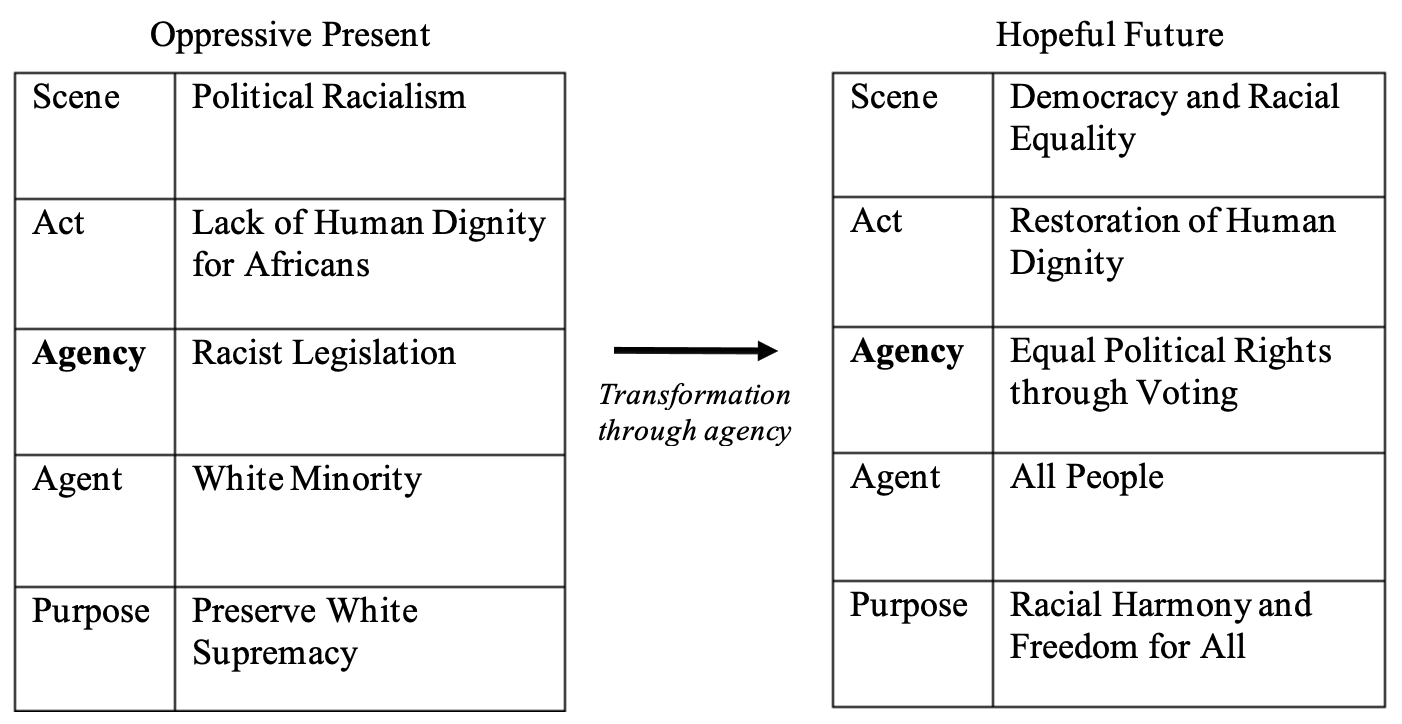
Figure 1.
Second, the arrangement of pentadic terms illuminate Mandela strategically crafting a counter-story. A counter-story presents the perspectives of the oppressed to “shatter complacency, challenge the dominant discourse on race, and further the struggle for racial reform” (Solórzano and Yosso 32). It is significant how Mandela arranges the pentadic terms because it shows his perspective. For instance, an alternative view—and perhaps the white minority’s view—could feature the violent situation, poverty, and breakdown of moral standards in South Africa as the scene. With this point of view, a variety of interpretations of the causes of the scene could be made, such as placing the locus of blame on the black South Africans. Instead, Mandela posits the turmoil in the country as an act. Naming the problems as an act removes the conversation from abstraction and makes it personal, indicating an intentional agent, agency, scene, and purpose at work. Mandela provides a line of logic that unjust pass laws ultimately cause poverty and violence. Overall, Mandela is explaining a counter-story on behalf of the oppressed African people that racist legislation is the root cause of the societal problems. Through examining the arrangement of pentadic terms, a window is created to peer inside the racial narrative.
Rights Realize Reality – A Pragmatic Worldview
The second step of the pentad method is to analyze the pentadic ratios or relationships. Analysis of the ratios shows a rhetor’s implicit, key motives. First, it is demonstrated that Mandela features agency as the dominant term through a process of elimination. Next, it is explored how agency as the dominant term reveals Mandela’s philosophic worldview.
At first it appears scene would be the dominant term in Mandela’s speech. Indeed, scene fits logically in controlling the other terms. The scene of political racialism could be seen to control or cause the act (lack of human dignity for Africans), agency (racist legislation), or purpose (to preserve white supremacy). However, Mandela presents the scene in subordination of agency when he states, “The lack of human dignity experienced by Africans is the direct result of the policy [emphasis added] of white supremacy.” The policy is the root cause while white supremacy is a descriptor. Granted, it may be unclear which preposition, “of the policy” or “of white supremacy,” is more significant in this sentence. The rest of the speech confirms a focus on agency, though, as Mandela centralizes issues in legislation, pass laws, and voting.
One could also argue that purpose is the dominant term in this speech. The purpose of preserving white supremacy could logically enact an agency of racist legislation, a scene of political racialism, or an act of abusing the human dignity of black Africans. Yet similar to scene, Mandela subordinates the purpose term when he says, “Legislation [emphasis added] designed to preserve white supremacy entrenches this notion.” Once again, Mandela highlights legislation. Furthermore, the rhetoric employed by Mandela in this speech is not characteristic of dramatistic purposive rhetoric. For example, in Fay and Kuyper’s analysis of John F. Kennedy’s (JFK) Berlin speeches, they claim JFK emphasizes purpose by using a prophetic and moralistic tone and employing the unconditioned future tense (207). Mandela does not employ similar wording as he passively uses the present perfect tense in the last paragraph of his speech saying, “I have dedicated my life to this struggle,” “I have fought,” or “I have cherished the ideal.” Mandela’s tone is more so somber than prophetic, offering a description of the oppressive present and hoping for change. This is not surprising considering his context—a prisoner on trial defending against the death penalty.
The term act, or the lack of human dignity for black Africans, does not logically realize the potential in the other terms in this case. Instead, it is often explained as a result of the agency of racist legislation. Similarly, the term agent, or the white minority, could not control the other terms except for maybe the purpose of preserving white supremacy. Also, Mandela only mentions “the white man” twice and focuses his discourse more so on agency, act, and scene.
After examining the relationships in all the ratios and “the strategic spots at which ambiguities necessarily arise” (Burke, A Grammar of Motives xviii), it becomes convincing that agency is the dominant term in this artifact. Previous examples have illustrated how Mandela desires transformation through agency by emphasizing key terms such “legislation,” “policy,” “pass laws,” and “equal political rights.” Additionally, Mandela’s counter-story positions unjust legislation as the ultimate cause of poverty and violence in the country. Since Mandela’s discourse mainly addresses aspects of agency, act, and scene, the main ratio pairs are Agency:Act and Agency:Scene. It can be concluded that Mandela’s main exhortation is to transform an oppressive present to a hopeful future by changing the nature of legislation or agency (refer to Figure 1). “Above all,” Mandela states, “we want equal political rights.” To transform a situation, a pentadic term can act unpredictably to upset the ratio and transform or reverse the relationship (Tilli 45). In this case, the pentadic term of agency is not being used to reverse a single pentadic ratio; rather, it is acting as a pivot to transform into a whole new pentad. Through changing agency, all the other terms will be changed as well. This is evidenced in that agency remains the dominant term in both pentads. It is the definitions of the terms that are changing. Using the pentad is monumental in understanding the course of action Mandela recommends and thus his key message.
Lastly, the dominant term reflects the rhetor’s motive or worldview through a corresponding philosophic terminology (Foss 389). Since agency is featured in this speech, Mandela is implying a pragmatic worldview to change the circumstances of Apartheid. Mandela’s discourse focuses on processes or means, which is caricature of a pragmatic philosophy. For example, Mandela calls for a democratic voting process, the elimination of pass laws, and less governmental regulation of daily life for Africans. Mandela’s argument is that by examining the consequences of legislation, one can determine the political direction South Africa should take. In making the case for the direction of democracy, Mandela first presents the dire consequences of the present racist legislation: poverty, violence, and inhumane treatment of black Africans. Afterwards, Mandela describes the positive consequences of having just and democratic legislation: human dignity and equality. Clearly, Mandela is exhibiting a pragmatic worldview in which truth or goodness is to be assessed by the consequences of processes.
Furthermore, one can elaborate on the main ratios, Agency:Act and Agency:Scene, in relation to their philosophic worldviews. The Agency:Act ratio translates into pragmatism defining realism or existentialism. In terms of Mandela’s speech, the message is that enabling just processes of legislation will create a reality or essence that is just. More specifically, equal democratic elections will inspire acts that restore and maintain human dignity for all. Equally so, unjust processes lead to oppressive acts. The Agency:Scene ratio translates into pragmatism shaping materialism. In the case of Mandela’s speech where scene represents an idea (political racialism or democracy), the implicit message is that legislation will ultimately shape the political landscape of the country. Just legislation will realize true democracy, not the other way around. Likewise, unjust legislation will realize a racist climate. Overall, Mandela is exhorting to change the unjust scene and dire acts of the oppressive present through first changing the dominant term of agency, and hence implies the philosophical worldview of pragmatism. Through dramatism, these implicit messages have been explored inside the racial narrative.
The Comic Foolishness of Racism
By examining Mandela’s discourse through a dramatic framing lens, it can also be argued Mandela uses a comic frame. Throughout the speech, his tone and words are educational and not derisive. As Carlson notes in his essay on Gandhi’s movement, “The comic frame identifies social ills as arising from human error, not evil, and thus reasons to correct them” (Carlson 448). In a similar manner, Mandela’s discourse focuses on reasoning instead of accusation. While very similar to the tragic universal frame, the comic frame may be more suitable to describe Mandela’s approach because of his focus on foolish human error versus shared guilt. Mandela’s comic spirit is shown through how he addresses a terministic screen to build universal identification, emphasizes impartiality, and focuses on agency to solve societal problems.
First, Mandela establishes universal commonalities by exposing and critiquing the terministic screen of white supremacy. In the first paragraph of the speech, he states, “White supremacy implies black inferiority.” Mandela then describes the consequences of viewing blacks as inferior such as expecting them to do only menial tasks. “Because of this sort of attitude, whites tend to regard Africans as a separate breed. They do not look upon them as people with families of their own; they do not realise that we have emotions—that we fall in love like white people do.” Mandela cites more examples and ends with “And what ‘house-boy’ or ‘garden-boy’ or labourer can ever hope to do this?” In this last sentence, Mandela is pointing out how labeling Africans with economic-like terminology selects a reality that Africans are inferior and deflects their hope to live with dignity. In other words, Mandela is exposing a terministic screen. By appealing to the universal human traits of love and family, Mandela builds identification with his wider audience.
The comic approach is also apparent when Mandela appeals to impartiality in the last two paragraphs of his speech. Mandela states, “Political division, based on colour, is entirely artificial and, when it disappears, so will the domination of one colour group by another.” He elaborates that the goal of the ANC is “fighting against racialism. When it triumphs as it certainly must, it will not change that policy…I have fought against white domination, and I have fought against black domination.” These excerpts show Mandela is more concerned with eliminating racism than with casting blame or guilt to a perpetrator. Mandela said he desires a “free society in which all persons [emphasis added] will live together in harmony.” It is clear Mandela is not using a rejection frame, for he suggests programmatic action for a democracy. Mandela is emphasizing a comic frame to advance social knowledge and avoid future mistakes.
Furthermore, Mandela’s focus on agency complements a comic approach. Instead of labeling the white South Africans as inherently evil, vicious, or criminal, he focuses on the foolishness of the policy of white supremacy and its negative societal effects. Through crafting a counter-story, Mandela provides a line of logic that unjust, racist pass laws ultimately cause poverty and violence, which affect both blacks and whites as “violence is carried out of the townships into the white living areas.” Arguably, keeping the focus on legislation and the problem of racism averts the speech from slipping into a factional tragic frame of blaming. Indeed, Mandela rarely mentions the agent of white men in the speech artifact, which may indicate he is trying to focus on the causal problems and long-term solutions.
In summary, Mandela’s attempts to reason through building identification, emphasizing impartiality, and focusing on agency exemplify the comic frame to bring about an ideal society. These rhetorical moves may serve to create what Burke termed “maximum consciousness” or self-reflection (Attitudes Toward History 171). Ironically, Mandela is seriously comic, and concludes his speech with his famous words, “it is an ideal for which I am prepared to die.”
Discussing the Hand of Racism
Amid the spectrum of contentious rhetoric on racism in the United States, there is an acute need for finding productive ways to discuss racism. The case study of Mandela’s speech demonstrates how the methods in dramatism may be helpful toward this goal. Specifically, pentadic and dramatic framing analyses allow for constructive dialogue and creative rhetorical approaches for addressing racism.
Promoting Constructive Dialogue through Clarity
For constructive dialogue to occur, a necessary precursor is clarity. Clarity is especially important in discussions of racism, where definitions and assumptions can be vague and abstract. In the present analysis, the methods in dramatism create clarity by illuminating the rhetor’s perspective, underlying philosophy, and holistic message.
First, dramatism helps one accurately understand a rhetor’s perspective. The analysis details how Mandela crafts a counter-story to explain the abuse of black Africans as an act, indicating an intentional agent, agency, scene, and purpose at work. Furthermore, the juxtaposing pentads of an oppressive present and a hopeful future reveal what Mandela believes are the causes and solutions of racial discrimination. He also critiques the terministic screen of labeling Africans with economic-like terminology, which fails to capture the universal human traits of love and family. Finally, understanding that Mandela uses a comic frame for his arguments helps to comprehend his goals for universal peace and long-term solutions. Overall, the terminology from dramatism provides clarity on Mandela’s perspective.
Second, dramatism provides the tools to identify a rhetor’s underlying philosophy. Changing agency through the right to vote is highlighted as Mandela’s central appeal, indicating the philosophy of pragmatism. Through analyzing the pentadic ratios, Agency:Act and Agency:Scene are found to be the key pairs. In other words, Mandela assumes that changing the processes of legislation will create a just reality and democratic climate. Identifying one’s assumptions is a vital step to bringing clarity to a discussion, regardless if the other agrees.
Third, clarity is a natural consequence of the pentad because identifying all five grammatical terms results in a holistic message. As Crusius notes, “The Pentad's main purpose is to overcome the limitations of any single critical vocabulary” (27). Whether one is analyzing a racist event or racial narrative, the perceived act, scene, agent, agency, and purpose must all be labeled. Additionally, the effort of organizing the relationships between the terms may reveal incompatibilities. If found, fixing logical errors creates more cohere arguments.
Arguably, one of the main issues with current discourses about racism is when only a single pentadic term is highlighted. For example, CRT seems to posit racism in mainly scenic language when they describe racism as “endemic, permanent” (Solórzano and Yosso 25), at the institutional, cultural, and individual level (Museus and Park 552), as the “center of analysis” (Love 228), where it “permeates society” (Hamilton 88), and is central to other forms of subordination (Bernal 110). Emphasizing scene follows the philosophy of determinism, where free will is inconsequential (Fay and Kuypers 202). At the other extreme, a classical liberal perspective emphasizes the agent and the philosophy of self-determination, believing in meritocracy, equality, and the ability of “an individual’s inner resources to overcome adverse circumstances” (Fay and Kuypers 202). Clearly, scene and agent have contrasting philosophies (Crusius 27). This is also apparent across political lines. Republicans are twice as likely as Democrats to attribute economic inequalities to life choices, whereas Democrats are more likely to point to structural barriers like racial discrimination (Horowitz et al. 30). To combat vagueness and one-sided claims to truth, perhaps what is needed is for all parties to present holistic messages, where all five grammatical terms and their relationships are expressed. After all, the pentad represents a hand and not just a finger. But what if both sides provide holistic messages and they are still at odds with each other? At the least, laying out viewpoints through the pentad provides clarity to aid discussions. Better yet, maybe a humble admission can be made that one school of philosophy cannot accurately portray reality. Like a diamond with many facets, being open to other perspectives can provide a more encompassing view of the world.
Promoting Creative Rhetorical Approaches
In addition to clarity, the methods in dramatism allow for creativity in addressing racism. The pentad can ironically provide a serious conversation by being playful with the terms. For instance, which pentadic term(s) should be the focus of a rhetor to effectively combat racism? One can extrapolate the answer using singular, scaffolded, or simultaneous pentadic approaches. Additionally, dramatic frames can be combined to create new rhetorical strategies.
A singular pentadic approach analyzes how transformation occurs from one pentadic term changing. Most pentadic analyses feature one pentad and explicate the ratios within the singular pentad (e.g., Fay and Kuypers; Rutten et al.; Tonn et al.). Sometimes a term can act unpredictably to upset the main ratio and reverse the relationship (Tilli 45). Yet in Mandela’s speech, the central term of agency acts like a pivot between two pentads. If agency is redefined, then one pentad swings into becoming another pentad. From Mandela’s perspective, changing the agency of racist legislation is the key to end domination.
But was Mandela’s approach successful in South Africa? Mandela’s hopeful belief could be explained by the context of his speech. At the time, he was still in a pre-civil-rights context in South Africa. Democratic elections were only held thirty years later in 1994 (Nicholson 126). Amid oppression, Mandela was searching for practical steps to achieve the ideal of harmony. Although South Africa is now a democracy, South Africa still struggles with the “entrenched social and economic effects” of racism (“Apartheid”). Proof of this struggle is very evident in a South African town hall debate show in 2014 (“Big Debate on Racism”). In the show, opinion leaders across a variety of industries and races debated why the dream of the “rainbow nation project” has seemed to fail. The debate illustrates the continued need for finding productive ways to discuss racism.
In contrast, CRT may critique Mandela’s focus on agency as inadequate and suggest attacking the ideological scene of racism itself. CRT maintains that racial gaps have not improved in the United States even with legislation from the civil rights movement (Delgado and Stefancic 41). Therefore, CRT advocates for political and educational structural reform (Bernal 110-111; Hamilton 87-88). However, CRT’s focus on group-based power structures are critiqued as encouraging revolution (Rufo) and fracturing society (Reilly 659). It is possible a focus on just the scene of racism does not yield long-term solutions of unity and peace.
Perhaps what is needed is a scaffolded pentadic approach, in which pentadic terms are changed in a step-wise process. Instead of assuming there is only one root problem, one can address the issue from multiple angles. For instance, a focus on transforming agency may have been an appropriate first step to allow all voices to be heard, and subsequent efforts should now attend to the scene of racism through education, hold individuals as agents to higher moral standards, and have public leaders implore the purpose of unity. Another strategy could be termed the simultaneous pentadic approach, in which all terms of the pentad are attempted to be transformed on the same occasion. Further research is encouraged to assess the various potential combinations and results of these different approaches.
Finally, combining dramatic frames may offer a creative framework to address racism effectively. In his speech, Mandela uses a comic frame by building universal identification, emphasizing impartiality, and focusing on the foolishness of racist policy. One critique of the comic frame, though, is its inability to address “situations justifying warrantable outrage,” such as Hitler’s actions or the bombing of Pearl Harbor (Desilet and Appel 356). Similarly in South Africa, the tension of wanting rectification—while desiring a unified country—is quite evident (“Big Debate on Racism”). Likewise in the United States, while the causes and solutions of racism are debated, the existence of racial inequalities is well documented and requires a response (Hartman et al.). The other option is a tragic frame. The general tone of CRT in addressing the dire consequences of racism is arguably a factional tragic frame, where all guilt and evil is externalized to another party. Yet as discussed so far, this approach does not provide long-term solutions. Instead of just selecting either a comic or tragic frame, there must be another possibility.
In such situations of warrantable outrage, Desilet and Appel discuss the potential of combining frames by initially using a tragic framing of conflict within a broader strategy of comic framing (356). They provide a notable example from President Franklin Roosevelt’s 1941 and 1943 speeches in the wake of the Japanese bombing of Pearl Harbor. In 1941, Roosevelt expressed appropriate, tragic rhetoric in condemning the attacks, yet he did not use words to dehumanize the Japanese people. In 1943, while Roosevelt projected victory for the battlefield in a radio address, he still verbalized hope for Germany to rejoin the international community after defeat. Roosevelt’s example illustrates how tragic framing can be embedded in a larger comic frame seeking unity (Desilet and Appel 356-358). In a similar way, it should be explored how combining modes of framing may be used to acknowledge the outrage of racism while also proposing peaceful solutions.
Conclusion
The topic of racism in the United States has fueled controversy and divisive rhetoric as different perspectives, political parties, and theories collide. Burke’s theory of dramatism can play a unique role in this discussion by offering methods suitable for integrating diverse viewpoints and encouraging unity. To Burke, rhetoric is not simply persuasion, but a means toward identification which “seeks to build a community, a sense of oneness amid diversity of conflicting interests and values” (Crusius 28). Through the case study of Nelson Mandela’s 1964 Rivonia Trial speech, this essay demonstrates how pentadic and dramatic framing methods can promote constructive dialogue and creative rhetorical approaches. Clarity and holistic messages are the first step, and it is seen that Mandela crafts a counter-story, creates a juxtaposition of an oppressive present and hopeful future, advocates for a pragmatic transformation through agency, and uses a comic frame to address the universal problem of racism. The pentad is heuristic, allowing for creative ways to address racism from a singular, scaffolded, or simultaneous pentadic approach. Furthermore, combining tragic and comic frames may offer an innovative strategy to rectify racial inequalities while still seeking unified solutions. Future research using dramatism is encouraged to continue the dialogue on how to address the pentadic hand of racism in today’s society.
Works Cited
Anderson, Floyd. “Five Fingers or Six? Pentad or Hexad?” KBJournal, www.kbjournal.org/anderson. Accessed 1 May 2017.
Apartheid.” Encyclopaedia Britannica, www.britannica.com/topic/apartheid. Accessed 22 Apr. 2017.
Bernal, Dolores Delgado. “Critical Race Theory, Latino Critical Theory, and Critical Race-Gendered Epistemologies: Recognizing Students of Color as Holders and Creators of Knowledge.” Qualitative Inquiry, vol. 8, no.1, 2002, pp. 105–26.
“Big Debate on Racism.” YouTube, uploaded by Big Debate South Africa, 12 Feb. 2014, www.youtube.com/watch?v=jpLFdtSNwpU. Accessed 18 Apr. 2019.
Brayboy, Bryan. “Toward a Tribal Critical Race Theory in Education.” Urban Review, vol. 37, no. 5, Dec. 2005, pp. 425–46.
Brock, Bernard L. “Epistemology and Ontology in Kenneth Burke's Dramatism.”Communication Quarterly, vol. 33, no. 2, 1985, pp. 94–104.
Bruner, Jerome. “Life as Narrative.” Social Research, vol. 71, no. 3, Oct. 2004, pp. 691–710.
Burke, K. A Grammar of Motives. Prentice-Hall Inc., 1945.
—. Attitudes Toward History. 3rd ed. University of California Press, 1937/1984.
—. Language as Symbolic Action. University of California Press, 1966.
Carlson, A. Cheree. “Gandhi and the Comic Frame: ‘As Bellum Purificandum.’” Quarterly Journal of Speech, vol. 72, no. 4, Nov. 1986, pp. 446–55.
“Critical Race Theory.” ASHE Higher Education Report, vol. 41, no. 3, 2015, pp. 1–15.
Crusius, Timothy W. “A Case for Kenneth Burke's Dialectic and Rhetoric.” Philosophy & Rhetoric, vol. 19, no. 1, 1986, pp. 23–37.
Delgado, Richard, and Jean Stefancic. Critical Race Theory: An Introduction. New York University Press, 2001.
Desilet, Gregory, and Edward C. Appel. “Choosing a Rhetoric of the Enemy: Kenneth Burke's Comic Frame, Warrantable Outrage, and the Problem of Scapegoating.” Rhetoric Society Quarterly, vol. 41, no. 4, 2011, pp. 340–62.
Fay, Isabel, and Jim A. Kuypers. “Transcending Mysticism and Building Identification Through Empowerment of the Rhetorical Agent: John F. Kennedy's Berlin Speeches on June 26, 1963.” Southern Communication Journal, vol. 77, no. 3, 2012, pp. 198–215.
Foss, Sonja K. Rhetorical criticism: Exploration & practice. 3rd ed., Waveland Press, 2004.
Foss, Sonja K., et al. Contemporary Perspectives on Rhetoric. 30th ed., Waveland Press, 2014.
Halsey, Max. “How CRT and Classical Liberalism Collide.” Public Square Magazine, 18 Oct. 2021, www.publicsquaremag.org/dialogue/social-justice/how-crt-and-classical-liberalism-collide/. Accessed 14 June 2022.
Hamilton, Vivian E. “Reform, Retrench, Repeat: The Campaign against Critical Race Theory, through the Lens of Critical Race Theory.” William & Mary Journal of Race, Gender & Social Justice, vol. 28, no. 2, 2022, pp. 61–102.
Hartman, Travis, et al. “The Race Gap: Black/White.” REUTERS GRAPHICS, graphics.reuters.com/GLOBAL-RACE/USA/nmopajawjva/. Accessed 13 June 2022.
Horowitz, Juliana, et al. “What Americans see as contributors to economic inequality.”PewResearchCenter, 9 January 2020, www.pewresearch.org/social- trends/2020/01/09/what-americans-see-as-contributors-to-economic-inequality/. Accessed 13 June 2022.
Kuhn, Moritz, et al. “Income and Wealth Inequality in America, 1949-2016.” Journal of Political Economy, vol. 128, no. 9, 2020, p. 4.
“Listen: Two Mandela Speeches That Made History.” NPR, www.npr.org/sections/the two- way/2013/12/06/249210908/listen-two-mandela-speeches-that-made-history. Accessed 10 Mar. 2017.
Love, Barbara J. “Brown plus 50 Counter-Storytelling: A Critical Race Theory Analysis of the ‘Majoritarian Achievement Gap’ Story.” Equity and Excellence in Education, vol. 37, no. 3, 2004, pp. 227–46.
Museus, Samuel D., and Julie J. Park. “The Continuing Significance of Racism in the Lives of Asian American College Students.” Journal of College Student Development, vol. 56, no. 6, 2015, pp. 551–69.
“Nelson Mandela.” Encyclopaedia Britannica, www.britannica.com/biography/Nelson- Mandela. Accessed 10 March 2017.
Nicholson, Christopher. “Saving Nelson Mandela: The Rivonia Trial and the Fate of South Africa (Pivotal Moments in World History) by Kenneth Broun.” Transformation:Critical Perspectives on Southern Africa, vol. 83, no. 1, 2013, pp. 122–27.
Ott, Brian, and Eric Aoki. “The Politics of Negotiating Public Tragedy: Media Framing of the Matthew Shepard Murder.” Readings in Rhetorical Criticism, edited by Carl Burgchardt, Strata Publishing, 2010, pp. 270–88.
Piper, John. “Critical Race Theory, Part 2.” desiringGod, www.desiringgod.org/interviews/critical-race-theory-part-2. Accessed 14 June 2022.
Ratcliffe, Krista. Rhetorical Listening: Identification, Gender, Whiteness. Carbondale: Southern Illinois University Press, 2005.
Reich, David. “How Genetics is Changing Our Understanding of ‘Race.’” The New York Times, 23 Mar. 2018, www.nytimes.com/2018/03/23/opinion/sunday/genetics-race.html. Accessed 7 March 2019.
Reilly, Christopher M. “Preferential Option for the Poor and Critical Race Theory in Bioethics.”National Catholic Bioethics Quarterly, vol. 21, no. 4, 2021, pp. 647–65.
Rountree, Clarke, and John Rountree. “Burke's Pentad as a Guide for Symbol-Using Citizens.”Studies in Philosophy & Education, vol. 34, no. 4, 2015, pp. 349–62.
Rufo, Christopher F. “CRITICAL RACE THEORY BRIEFING BOOK.” www.christopherrufo.com/crt-briefing-book/. Accessed 14 June 2022.
Rufo, Christopher F. “Critical Race Theory.” YouTube, 14 June 2021, www.youtube.com/watch?v=cfmpnGV0IGc&t=700s. Accessed 14 June 2022.
Rutten, Kris, et al. “The Rhetoric of Disability: A Dramatistic-Narrative Analysis of One Flew over the Cuckoo's Nest.” Critical Arts: A South-North Journal of Cultural & Media Studies, vol. 26, no. 5, 2012, pp. 631–47.
Rutten, Kris, and Ronald Soetaert. “Narrative and Rhetorical Approaches to Problems of Education. Jerome Bruner and Kenneth Burke Revisited.” Studies in Philosophy & Education, vol. 32, no. 4, 2013, pp. 327–43.
Smith, Francesca Marie, and Thomas A. Hollihan. “‘Out of Chaos Breathes Creation’: Human Agency, Mental Illness, and Conservative Arguments Locating Responsibility for the Tucson Massacre.” Rhetoric & Public Affairs, vol. 17, no. 4, 2014, pp. 585–618.
Solórzano, Daniel G., and Tara J. Yosso. “Critical Race Methodology: Counter-storytelling as an Analytical Framework for Education Research.” Qualitative Inquiry, vol. 8, no. 1, 2002, pp. 23-44.
Tilli, Jouni. “The Construction of Authority in Finnish Lutheran Clerical War Rhetoric: A Pentadic Analysis.” Journal of Communication & Religion, vol. 39, no. 3, 2016, pp. 41–58.
Tonn, Mari Boor, et al. “Hunting and Heritage on Trial: A Dramatistic Debate over Tragedy, Tradition, and Territory.” Readings in Rhetorical Criticism, edited by Carl Burgchardt, Strata Publishing, 2010, pp. 253–70.
Wagner, Jennifer K., et al. “Anthropologists’ Views on Race, Ancestry, and Genetics.” American Journal of Physical Anthropology, vol. 162, no. 2, 2016, pp. 318–27.
Weiser, M. Elizabeth. “Burke and War: Rhetoricizing the Theory of Dramatism.” Rhetoric Review, vol. 26, no. 3, 2007, pp. 286–302.
This work is licensed under a Creative Commons Attribution-NonCommercial-NoDerivatives 4.0 International License.
- 33133 reads
| Attachment | Size |
|---|---|
| HandRacism-Figure1.png | 123.72 KB |
Volume 13, Issue 2 Summer 2018
Contents of KB Journal Volume 13, Issue 2 Summer 2018
- 27965 reads
Embodied Rhetorics: Writing Rides from the Seat of a Bike
Janice Chernekoff, Kutztown University of Pennsylvania
Abstract
This essay connects Burke’s concept of a mind-body dialectic with studies of embodied rhetorics to explore connections between bodily vocations and the writing linked to them. Randonneuring, a form of endurance bicycling, and the ride reports written by participants, provides a case in point.
Introduction
I remember Roc’h Trevezel as the name of an endless climb at the end of an endless night.
As I climb in the blue gray light that comes before the dawn, I notice the crucifixes that appear along the road like distance markers. Each one unique but appearing regularly along the road we ride.
I remember climbing a steady moderate grade from one crucifixion scene to the next. As I ride past these potent symbols of sacrifice and redemption, these stations of the cross, I realize that I am on my own secular pilgrimage: [I am] one of many who have come from afar to visit a place that only exists for a moment, to share a transformational experience created by the faith, sacrifice and effort of many.
Tired and weak, I approach the peak of Roc’h Trevezel. Then the sun rises and reveals the world to me. The peak is not a peak as much as a plateau. The lower peaks of the valley are islands afloat above the low-lying clouds. (Greene 18)
Like pilgrims embarking on the five-hundred-mile Camino de Santiago walk in Spain, randonneurs come to France once every four years to attempt the seven-hundred-fifty-mile Paris-Brest-Paris (PBP). In the passage above, Nigel Greene, having completed the 2015 PBP in under ninety hours (the time allowed for an official finish), characterizes his attempt as a “secular pilgrimage” requiring “faith” and “sacrifice” to succeed. PBP is the equivalent of Mecca for randonneurs, long-distance cyclists in a French tradition established more than a century ago.¹ The ride report is also a well-established tradition: riders describe preparing for an event, the trials and tests encountered during the event, and the lessons learned from it. News reports from initial editions of PBP, as well as ride reports by cyclists from the UK, Australia, Canada and the U. S. essentially take the same form. This is a stable genre because the riding and the writing are connected in ways that point to the “chemical sort of rhetoric” that Debra Hawhee says Kenneth Burke locates in his study of endocrinology (Moving Bodies 86). The ride report is a deeply human expression of material rhetoric, a response to an embodied rhetorical situation, such that the genre of the response and its enduring nature can be explained using Burke’s concept of the mind-body experience (Burke P&C 229).
Rhetorical Bodies
We should take seriously the embodied rhetoric of which we are constituted and the genres it manifests. I use “embodied rhetoric” literally, building on Burke’s mind-body term that he argues is a way of signifying the material basis for human symbolic behavior; all symbolic behavior, according to Burke, “is grounded in biological conditions” (P&C 275). Burke adds that this is not to suggest that rhetorical behavior is reducible to biology (P&C 275), but that human bodies are the kind of bodies that learn language (P&C 307). Other scholars have also worked to clarify this productive term and what it allows us to consider regarding rhetoric. Hui Niu Wilcox, for example, writes that embodied knowledges are revealed and expressed through “lived experiences, cultural performance, and bodily intelligence” (106), a view that brings attention to the rhetorical intelligence of bodies at the level of muscle and bone. A. Abby Knoblauch as well says that embodied knowledge is “knowing something through the body” (52), which is another way of saying that at least some of what we know and the way in which we express it emerges from the inextricably linked mind and body. The ride report and similar kinds of stories — for example, the stories of long-distance trail runners, marathon runners, ironman triathletes, and other endurance athletes — provide concrete instances of embodied rhetoric, supporting my claim that while genres generally respond to changes in “audience and circumstance” (Schryer 208), and are consequently only temporarily stable at best (Schryer 204), the ride report melds riding and writing into a more enduring genre that evidences a symbolic dialogue regarding an enduring human rhetorical situation.
Recent scholarship on embodied rhetoric builds on Burke’s arguments and extends them into other fields, providing convincing examples of materially embodied rhetoric. Jack Selzer claims that Celeste Condit, for example, uses DNA coding to model “how material rhetoric might be understood to incorporate both gross physical corporeality and the social and material act of ‘coding’” (13). Condit, who claims that Burke can usefully be thought of as “an idiosyncratic American post-structuralist (Brock)” (331), argues that “language as used by human beings does not operate without regard to the material realm, [so] it is better to say that language users constitute objects out of matter/form relationships, or, more technically, that language essentializes (by selection and identification) material/form patterns and relationships into perceived objects” (332–33). Condit sees Burke’s relevance to contemporary discussions of material and embodied rhetoric and relies on Burke to argue that rhetoric emerges from “complex and shifting material/energy/relationships” (333). Embodied rhetoric engages human energy as generated within the body and expressed in language forms appropriate to the experience. Jay Dolmage approaches the issue through the lens of disability studies, arguing that, “our own and our students’ bodily differences [are] meaningful and meaning-making” (“‘Breathe Upon Us’” 119). In support of his argument, Dolmage discusses the Greek God Hephaestus whose disability, Dolmage argues, was his ability, informing his intelligence and his way of seeing the world (122). The various disciplinary approaches to embodied rhetoric demonstrates the idea that bodies and bodily energies interpolate discourse. As Debra Hawhee notes about Burke, his “engagement with bodies from a variety of disciplinary vantage points foregrounds the body as a vital, connective, mobile, and transformational force, a force that exceeds — even as it bends and bends with — discourse” (Moving Bodies 7). If the body is a rhetorical agent, what does the body prompt us to ask and explore? And what are the effects of experience on genre, on forms of discourse?
Rhetorical Riding and Writing
Bodily questions inspire rhetorical responses that inform and create intelligence. The question of how far we can push ourselves physically is one bodily question that has inspired not only randonneurs, but a wide range of endurance athletes as well as religious pilgrims who walk the Camino de Santiago or fast for extended periods or engage in other activities that take them out of their physical comfort zone. To a significant degree, it is the body that experiences the question, endures the trials, and experiences the answers to the question. It makes sense, then, that the writing about such experiences will have a similar form; the experience influences the form of the reflection on it. Not every person is an endurance athlete or religious pilgrim, but people who are ask some of the same questions. How far can I go? What will I learn by pushing my body and mind to the limit? What are the limits? Endurance runner Kilian Jornet, who has completed ultra-distance races world-wide writes, “I want to challenge myself, give the best of myself, and try to discover what my thresholds are, to know myself better” (153). Jornet is inspired by bodily exigencies that involve pushing himself to his limits in order to comprehend and physically live the responses to the mind-body questions. Endurance sports athlete Rebecca Rusch similarly claims that accepting physical challenges helps us define ourselves. She writes that “every moment is an opportunity to outlast and overcome the odds that threaten to either paralyze us or tether us to fear and doubt. The moments when we endure define us and mold us into the people we want to be, as athletes, leaders, or partners” (270). According to Rusch, taking up these bodily-generated questions is critical to who we are, how we act, and what we think. Brian Crable’s analysis of Burke’s ideas on bodily rhetoric echo the arguments of the above athletes. Crable writes,
According to Burke, the foundation of human existence is organic — we are embodied, which means that certain permanent needs and ‘purposes’ cannot be denied. Further, these needs and purposes, which drive our earliest behavior, form the foundation for symbolic activity; sociality, with both ideal and material/economic dimensions, is a biological outgrowth. At the same time, the symbolic realm that is thereby constituted is not reducible to biology. (123)
Some of these permanent needs and purposes underlie all symbolic behavior, according to Crable, but they also form the basis for enduring genres; patterns in symbolic responses may not be biological but the patterns respond to and satisfy biologically inspired rhetorical exigencies.
One feature of ride reports, indeed of many stories about physical challenges, is an explanation of how and why the writer accepted the challenge. People less athletically inclined may think that randonneurs are crazy to ride long distances in rain, without sleep, or over mountains, but even randonneurs feel the need to understand and explain why they undertake these challenges. The explanations point to a faith — a secular faith — not only in the ability of body and mind to overcome hardship, but also in the rightness of taking on the adventure. In the epigraph to this essay, a piece titled “Living the Dream,” Greene notes that PBP is a “transformational experience created by the faith, sacrifice and effort of many” (18). Randonneurs who train and show up for PBP do so in part because they accept that it is a good and human thing to show up for this 750-mile ride, no matter the results. Indeed, all along the route of PBP, local people come out to support riders with food, drink, music, and places to rest; so spectators in France also see the value in the efforts of the riders. And the riders hope (and have faith) that the mind and body will work together to make success possible, but even if the adventure goes awry, they will emerge more fully the human beings that they want to be. Long-time randonneur Laurent Chambard, writing about another 750-mile ride, The Gold Rush Randonnée through more remote areas of Northern California, explains his reasons for wanting to attempt this epic ride:
The Gold Rush Randonnée (GRR) has been on my list of targets for a good while. I find the description of the ride . . . simply fascinating. The promise of 1200km of cycling through some of the last unspoilt parts of California, in what was once Gold Rush country, and over a route where altitude varies from sea level to nearly 2000 metres [6500 feet], has left me dreaming over the map a good few times.
Chambard embraces the challenges presented by the “unspoilt” parts of Northern California in a ride that includes mountains, heat, desert, lack of shade, and long stretches without any services. Chambard dreamed of doing this ride, his mind and body, even in his sleep, wondering if he was up to the challenge.
Randonneurs often frame their induction into randonneuring, and especially an interest in PBP, in quasireligious terms, indicating the depth of their feelings about and commitment to their sport. In a 1975 PBP ride report, American Harriet Fell explains how she became interested in randonneuring when French work colleagues convinced her to extend her limits and accompany them on a two-hundred-kilometer ride, a distance that she had done once before so she was “willing to give it a try.” Her description of the ride includes the fact that they started before dawn on a day with “terrible, freezing rain.” The weather was so terrible that “Marvelous crystalline structures formed on the beards of [her] friends.” She notes that she was a lot faster after lunch and that the group finished together “in eleven hours and ten minutes.” Fell’s description of this ride, which amounts to her introduction to randonneuring, shows her pride in having faced physical and mental hardships with success — so much so that she agreed to ride a three-hundred-kilometer ride with these same colleagues a few weeks later. Also visible in this story, as with Chambard’s story, is an orientation to the world that includes a desire for challenges. Fell acknowledges that what they are doing is a little crazy, but she is pleased to find that she can endure, despite the “crystalline structures” on her friends’ beards, and despite the fact that she had only once before covered this type of distance. Sacrifice and faith: two key terms in religion, appear frequently in ride reports as well as in the stories of other endurance athletes signifying the importance to them of these activities.
A disposition for challenges may be viewed as an orientation or bias toward the world, and according to Burke, a disposition has biological roots:
Our calling has its roots in the biological, and our biological demands are clearly implicit in the universal texture. To live is to have a vocation, and to have a vocation is to have an ethics or scheme of values, and to have a scheme of values is to have a point of view, and to have a point of view is to have a prejudice or bias which will motivate and color our choice of means. (P&C 256–57)
If we embody vocations and related biases, and those predispositions affect our interpretations of events, including how we frame them, it is not hard to understand that endurance cyclists have written similar stories about their adventures since the inaugural running of the Paris-Brest-Paris. After all, the creation of this event was simply another iteration of a vocation or set of values embodied by some people. An endurance cyclist is likely to seek out, see and understand the experiences of, not only other endurance cyclists but also other endurance athletes as inspirational, while someone with a different orientation to the world might view these people as a little wacky. In another 2015 PBP ride report, Bob Hayssen recalls signing on for a 2014 200-kilometer ride “on a whim.” During the ride, there was much anticipatory talk of PBP 2015. Hayssen says that “it sounded like a great adventure. I was quickly hooked” (16). Hayssen already embodied the values required for endurance cycling when he was introduced to randonneuring; that is, he was predisposed not only to do PBP but to write the ride report he wrote before he signed up for the event. Condit argues that a fully materialist view of language “recognizes both the reality of forces in the universe and the way in which motivated human action objectifies those forces through language into more or less durable relationships with more or less intensive presence and visibility” (334). Some “motivated human action” is intense, deeply engaging the body and mind together in satisfying and durable relationships. Burke explains that our minds select certain linguistic concepts or relationships as purposeful, and that these “relationships are not realities, but interpretations of reality” (P&C 35). I’ve been arguing that such is the case with ride reports, and these “relationships” are visible in the way that ride reports are written. Additionally, some of the writing actually mimics bodies in motion (on bicycles).
The rhetorical intelligence of the body posited by scholars such as Hawhee and Jennifer LeMesurier is evident in writing about riding in which the author attempts to use language to describe the mind-body experiences of riding a bike over long distances. The problem is always, as Bryan Crable points out, identifying and characterizing the nonsymbolic “from within symbolicity” (126). However, in the following passage by French cyclist and writer Paul Fournel, he captures well the ineffable connection between cells, muscles, mind and words, and how the rhetoric of maximum effort can be circulated throughout the body:
I can’t determine precisely the instant in which my thought escapes its object to become a thought of pure effort. The moment the rhythm speeds up, the moment the slope becomes steep, the moment fatigue gets the upper hand, thought doesn’t fade away before the ‘animal spirits’; on the contrary, it’s reinforced and diffused throughout my entire body, becoming thigh-thought, back-intelligence, calf-wit. This unconscious transformation is beyond me, and I only become aware of it much later, when the lion’s share of the effort is over and thought flows back, returning to what is ordinarily considered its place. (128–29)
Fournel argues that during intense physical effort, “thought” flows through one’s entire body, so that the body — thighs, back, calves — takes control, and only later, after the physical effort has been completed, does thinking become primarily an activity of the mind. Even then, while the mind may seem to control thought, the memories and knowledge of the physical effort completed are stored in the body. The body, writes LeMesurier, is “a conduit for remembered knowledge” (363). In the middle of an intense activity, the body often seems to take the lead; indeed, athletes interested in improving performance train until the moves or actions that they expect of their bodies are “automatic.” It is as if the training and the experience makes one into the kind of person — in both body and mind — who does the kind of activity for which one is training.
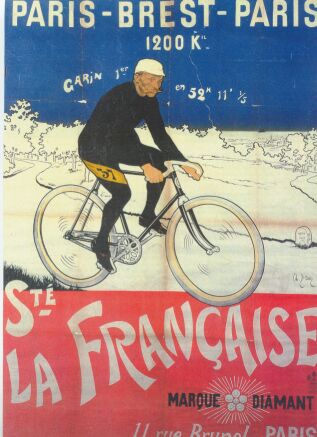
Figure 1. Featured in the poster is Maurice Garin, winner of the 1901 Paris-Brest-Paris as well as the inaugural Tour de France in 1903.
Shaping and reshaping the body and mind through repetition and a focus on rhythm was practiced by the Sophists, according to Hawhee. She writes that they used rhythmic gymnastic exercises, repetition of movement and music to train young rhetors properly (“Bodily Pedagogies” 147). According to Hawhee, the Sophists believed that “the forces (people, music, movement) one subjects oneself to will necessarily shape and reshape body and soul” (“Bodily Pedagogies” 152–53). It may also be true then, that a body and mind intensely trained to particular rhythms will seek them out, see them in experiences, and finally express them in language. Endurance cyclists experience most obviously the rhythms of turning wheels and pedals. They also experience the cycles of preparing for, doing, and then resting from intense physical efforts. In the following passage, Christine Newman effectively uses repetition of the phrase “I learned” to suggest the need to keep pedaling, even through pain and deep fatigue, to finish her ride:
I learned that mental toughness will allow you to ride for 300+ miles with two knees that are begging you to stop. I learned to pick the food which fills you up and keeps you going even if you can’t stand the sight of it after three days. Ninety miles from the finish, I learned that it is possible to be more tired than you have ever been in your life, so tired that you cannot stand up let alone ride a bicycle safely. I learned that I could fall asleep, in spite of a deep panic that my ride would fail not due to a lack of training but from a lack of sleep. (22)
In this description of the last part of her 2011 PBP ride, Newman uses the phrase “I learned” four times in as many sentences; the rhythm of the sentences suggests the rhythm of pedaling. While she tries to describe how she was feeling, Newman also tries to structure her sentences to suggest her meaning. Quite literally, this writing is embodied in the sense that Hui Niu Wilcox is referring to when she writes that embodied knowledges are revealed and expressed through “lived experiences, cultural performance, and bodily intelligence” (106). Newman’s lived ride experience is materially linked to her writing about it; her experience is written in, on and about her body, with the ride report being her best effort to reflect that experience.
Newman and Fournel, quoted above, also implicitly suggest that they engage in endurance cycling events because they anticipate that a tough ride, like PBP, will force them to function in a way that combines mind and body beyond logic and daily thought. The cycle and rhythm of such rides (or similar events) may then become familiar, and those wonderfully challenging moments may become something that one craves. That is, the process of an event can be ritualized, much as a religious ceremony, with each aspect of the ceremony holding meaning for the celebrant. Particularly in the writing of riders who have done events like PBP more than once, there is anticipation as well as the embodied knowledge of what it is required, and this is reflected in the way a person speaks and writes about the event. The ride and telling the story of the ride constitute a vocation in the sense that Burke uses this word — one’s “ethics or scheme of values” infuses one’s being as well as one’s speaking and writing. Lois Springsteen, who has completed PBP seven times so far, anticipates the event with joyful memories, with hopes for a decent performance in the next iteration of the event, and an eagerness for the wash of experiences that PBP brings. After the 2015 PBP, she reflects:
But why go back? It’s hard to describe the wonderful feel of PBP. At times it is more a festival than a grueling challenge. Cheering crowds and street parties, bicycle art, impromptu roadside coffee/snack stands abound. There were six thousand cyclists on this special, quadrennial 1230K/ 90 hour pilgrimage with red taillights glowing as far as one could see during that first night. While I have not ridden many other 1200K randonnées, I will venture to say that this one is the most unique of all due to the sheer number of participants. Even though I have become one of the oldest female riders, I still wanted to be part of it. (9)
Springsteen returns to PBP and writes about her experiences because she yearns for this familiar “pilgrimage.” Physically and mentally, rhetorically, Springsteen responds to the PBP call with the same questions that prompted her to show up for her first PBP thirty years ago. Can I complete this ride again? What will I learn this time? Now, the call elicits a response from her at the level of what Hawhee calls “learning-performing” memories (“Rhetorics” 156). Being tuned into a set of patterns and rhythms provides comforting familiarity as well as purpose in our work to understand and more deeply embrace our lives.
For many randonneurs, the ride report is the last part of the cycle of the event, providing an opportunity to reflect on one’s experiences and convert them into words, for oneself and to share with others. The ride report effectively transubstantiates the body-mind experience of the ride into a narrative that typically pays close attention to the call to ride, the ride and the difficulties endured, and the redemption earned through the ride. The report, that is, follows the contours of a spiritual body-mind experience. Vickie Tyer, in a middle section of her 2015 PBP ride report, illustrates the difficulties riders have when they begin to deal with sleep deprivation and fatigue. She describes the need to “dig deep” to make it through a second sleepless night to get to Brest according to her plan: “The skies got foggy, and the night got chilly and lonely. I had to dig deeper. I was determined to see Brest before sunrise, no matter what” (15). While the phrase “dig deeper” is typically used as a metaphor, here it is intended almost literally, as if her mind and muscles together are reaching deeper into her being for the willpower to keep turning the pedals. The end of her ride report describes the finish: “ . . . then I was crossing the finish line, with a crowd of wonderful people cheering for little ‘ole me. What a blast. What a sense of accomplishment. What redemption. What a ride. Words cannot describe it.” (15, emphasis added). I take Tyer literally. I think she did struggle to put into words the “learning-performing” memory — the sense of release — stored in her body by her PBP experience. The redemption earned completes the cycle and the narrative, written for herself and shared with others, allows people with the same set of values to see how they, too, might earn a similar sense of satisfaction. Ride reports like Tyer’s cause me to search within myself for the courage and will to attempt this ride, and I know that narratives like this may initiate similar forms of action and thought in others. I agree with Hawhee that there is a “curious syncretism between athletics and rhetoric” (Hawhee, “Bodily Pedagogies” 144), and this amalgamation of bodily matters with rhetoric inspirits body-mind journeys.
Endurance cycling, including randonneuring, is a vocation by Burke’s definition for Tyer and many others. Devotion to this vocation is deep and enduring because its adherents clearly see their experiences as spiritual, judging by the language and metaphors of ride reports. Piety is the attitude of a vocation; Burke notes that, “Where you discern the symptoms of great devotion to any kind of endeavor, you are in the realm of piety” (83). I would add that when we are operating in the realm of piety, we are by definition thinking and acting in a realm that is to some degree beyond language. As noted, Tyer is literally stumbling for words in the above passage to describe aspects of her experience. In a 1995 issue of Australia’s randonneuring magazine, Checkpoint, the editors also reference this phenomenon: “Many of the stories that found their way into Checkpoint over the past year reflected the self-confessed amazement by ordinary folk who actually achieved incredible feats. Little do they realize that they are capable of (sic), and some will attend PBP in 1999” (3). Awe and wonder, feelings associated with experiences that cannot be put into words infuse the attitude present in many ride reports. Writers are often amazed by their accomplishments; Australian Trevor King’s 1999 PBP report tells of his discovery after returning home that he had fractured his pubic bone during a fall, and that he had completed the last nine hundred kilometers with this injury (12). American Lois Springsteen writes in her 2015 PBP report of finishing the last forty miles with a broken wrist (8), and British journalist J. B. Wadley, in his 1971 ride report, writes about riding through mind-numbing and hallucination-creating fatigue. Finally, from a short 1921 Le Mirroir des Sports article comes this short quote from Louis Mottiat, winner of the event that year²: “I wanted to sleep, I felt bad sitting on my saddle, and I was thirsty, but I stayed strong” (trans. mine). A vocation is a calling or a mission that textures one’s life and gives it meaning. In the experiences summarized above, the rider-writers use available language and a familiar form to articulate transformative moments in life.
Embodied Rhetorical Genres
I’ve been the editor of American Randonneur, the official quarterly publication of Randonneurs USA, for four years, and in that time I’ve read hundreds of ride reports. Before that, it was reading ride reports that spiked my interest in randonneuring. Riding a lot, writing reports occasionally, and reading and editing others’ ride reports, I understand that writers shape and relive their experiences in their narratives. Shannon Walters sums up Aristotle’s notion that rhetoric belongs “to the genus of dynamis” with the claim that rhetoric, “like other arts, is produced by a transformative ‘coming into being” (32). Rhetoric is more skill than product, according to Walters, and in this case it is the skill to translate the “ thigh-thought, back-intelligence, calf-wit” mentioned by Fournel (128–29) into something intelligible. There are genre conventions that ride report writers abide by, probably mostly unconsciously, but somehow in rhythm with other ride report writers. My interest in and study of ride reports led to questions about arguments expressed by scholars of Rhetorical Genre Studies (RGS). Why do ride reports all seem to say the same thing? And what then to make of Catherine Schryer’s claim that genres are only “stabilized-for-now or stabilized-enough sites of social and ideological action” (204)? I’m citing Schryer’s often-used quote, but Carolyn Miller, Charles Bazerman, and many other noted RGS scholars argue that genres are rhetorical actions that respond to changing rhetorical situations and contexts, and as such, they constantly change. Schryer goes so far as to say that a “stable system,” including a stable genre, would have to be rhetorically unsound “because a stable system cannot respond to changes in audience or circumstance” (208). However, what I am suggesting in this essay is that if we allow that the body is a rhetorical agent, it may be possible that some embodied rhetorical situations present themselves again and again, because the answers are temporary or never entirely satisfactory.
Every time I try to put into words how and why the rhetoric of the ride report is deeply, materially, literally, embodied, I reach, almost as if into my body, for the right words. I am trying to pinpoint a practice, a form of moving-thinking-feeling-languaging that engages the whole body — body, mind, spirit — and is represented in the ride report as well as in related forms of writing about other kinds of life-intensifying challenges. Endurance runner Kilian Jornet writes, “I know that when I am running and skiing, my body and mind are in harmony and allow me to feel that I am free, can fly, and can express myself through all my talents. . . . Running provides my imagination with the means to express itself and delve into my inner self” (176). Jornet states that endurance running and the making sense of his experiences in language engage his whole being; he points to a form of life-affirming rhetoric that makes itself known in and through physical challenges as well as in his verbal explanations of those efforts. In an article from Le Petit Journal about the 1901 edition of PBP, Simon Levrai reports on Maurice Garin’s amazing ride: “1200 kilometers covered in 52 hours and 11 seconds, without stopping to sleep, almost without taking a breath, this is certainly one of the most magnificent tests of human endurance” (trans. mine). This brief news report celebrates the human potential that Garin’s effort exhibits, the willingness or desire of the human body to face and endure the “impossible.” The implicit awe and respect is directed not only toward Garin but toward humanity in general.
Embodied rhetoric can be a practice that allows people to creatively explore and better understand their rhetorical-biological selves, a point made by Jornet near the end of his book, “Perhaps I run because I need to feel creative. I need to know what is inside me and then see it realized somewhere outside me. . . . A race is like a work of art; it is a creation that requires not only technique and work but also inspiration to reach a satisfactory outcome” (177). Fournel, in the eloquent passage quoted earlier in this essay, and Jornet point to a biological-rhetorical impulse to engage in activities that demand a mind-body response to a bodily exigency. Both the physical effort and the thoughts and words formed around the effort are part of the creative act because we are a kind of being that makes sense of everything in language.
The existence of genres evidencing a deeply embodied rhetoric suggests that our bodies create and respond to rhetorical exigencies. Here I echo a conclusion drawn by LeMesurier: “The moving body as both responder and creator can be considered a material rhetorical device that . . . uses its own knowledge and forces, ever shifting in the albumen of bodily encounters, to yield rhetorical effects” (378). Rhetorical questions and exigencies exist in that “albumen,” a point suggested not only by the relative stability of the ride report across time and space, but also by the idea that the ride report responds to the same rhetorical questions as other quest stories including those I’ve cited as well as a host of others found in literary works, popular movies and religious stories. What is a person — mind and body together — capable of doing? What are our limits? Can we handle the exploration of those limits with grace and perhaps a little humor? What will we learn about ourselves and what it is to be human by testing ourselves? These questions haunt us, in part because they cannot be answered once and for all even for one person. And they continue to exist through time and across cultures. Bitzer argues that some well-established forms of discourse come to have a “power of [their] own,” so that the traditions endemic to these discourse forms “function as a constraint” upon any new possible responses (13). The ride report, a version of the quest or hero story, continues to exist and to draw creators and audience, in part because it has existed for so long and new writers and readers are steeped in its traditions. Additionally, however, it continues to exist because the exigency that inspires it continues to motivate people to bodily-rhetorical action.
Concluding Thoughts
I’ve noted my interest in ride reports and how they appear to defy basic precepts of Rhetorical Genre Studies. I’ve implied that Paris-Brest-Paris, Mecca for randonneurs, attracts because its history and everything about it is solidly grounded in the quest myth. That is, the ride report taps into a rhetorical situation that is “in some measure universal” and enduring (Bitzer 13). What my study offers, then, is not so much a counterpoint to the main ideas of Rhetorical Genre Studies but a reminder that the foundations of rhetoric are inexplicably and materially bound to our bodies. At the beginning of this essay, I said I wanted to take seriously the “embodied rhetoric of which we are constituted” (2), and this discussion has shown that the body can be a creative rhetorical agent, establishing and responding to rhetorical situations, sometimes with the cooperation of our minds, and sometimes in spite of what might seem like good sense. Like Condit, I believe we can see “an active biology in conversation with an active social coding system” (351). This study then suggests that the sources of and responses to rhetorical situations may take place at a fully embodied level, and this matters because it means that to be human is to be profoundly rhetorical.
As profoundly rhetorical beings, we create and use genres not only in response to situations encountered in our academic lives and in the business world, but just as importantly in situations where our bodies as well as our minds are equally and actively engaged. Or, this discussion also suggests our bodies are involved, to some degree, even in genres originating in professional contexts. That is, to explain and make use of a more fully embodied rhetoric, we must first accept that “embodied” literally means in the body. These conclusions raise questions for further studies of embodied rhetoric. The focus of this study, however, has been on the body as rhetorical actor, as thoroughgoing and intelligent rhetorician. What is to be learned from an endurance challenge, whether that challenge be a 750-mile bike ride, a fifty-mile run, or a three-month trek along a mountain trail? In each case, one is enticed by an activity that the mind and body together — working together — find engaging and meaningful, and we wonder how and why this is so. A bike ride might be so much more than just a bike ride. It may be a response to an embodied rhetorical situation the answer to which is ephemeral, individual yet universal, and reverently human.
Notes
1. “Randonneuring is long-distance unsupported endurance cycling. This style of riding is non-competitive in nature, and self-sufficiency is paramount. When riders participate in randonneuring events, they are part of a long tradition that goes back to the beginning of the sport of cycling in France and Italy. Friendly camaraderie, not competition, is the hallmark of randonneuring” (Randonneurs USA website).
2. PBP was a professional race until 1931, according to the Audax Club Parisien website.
Works Cited
Bazerman, Charles. Shaping Written Knowledge: The Genre and Activity of the Experimental Article in Science. U of Wisconsin P, 1988.
Bitzer, Lloyd F. “The Rhetorical Situation.” Philosophy and Rhetoric, vol. 1, 1968, pp. 1–14.
Burke, Kenneth. Permanence and Change: An Anatomy of Purpose. 3rd edition. 1954. U of California P, 1984.
Chambard, Laurent. “Chasing The GRRizzlies (In The Heat!). . . . Gold Rush Randonnée, July 19–23, 2005.” 2005. TS. Personal Writing of Laurent Chambard.
Condit, Celeste. “The Materiality of Coding: Rhetoric, Genetics, and the Matter of Life.” Rhetorical Bodies, edited by Jack Selzer and Sharon Crowley, U of Wisconsin Press, 1999, pp. 326–56.
Crable, Bryan. “Symbolizing Motion: Burke’s Dialectic and Rhetoric of the Body.” Rhetoric Review, vol. 22, no. 2, 2003, pp. 121–37.
Dolmage, Jay. “’Breathe Upon Us an Even Flame’: Hephaestus, History, and the Body of Rhetoric.” Rhetoric Review, vol. 25, no. 2, 2006, pp. 119–40.
Fell, Harriet. “Paris-Brest-Paris 1975.” http://www.ccs.neu.edu. Accessed 20 Feb. 2016.
“Editorial.” Checkpoint, Dec. 1995, p. 3. Web. Accessed 21 Feb. 2016.
Fournel, Paul. Need for the Bike. Trans. Allan Stoekl. U of Nebraska P, 2003.
Greene, Nigel. “Living the Dream: One Account of Paris-Brest-Paris.” American Randonneur, vol. 18, no. 4, 2015, pp. 16–19.
Hawhee, Debra. “Bodily Pedagogies: Rhetoric, Athletics, and the Sophists’ Three Rs.” College English, vol. 65, no. 2, 2002, pp. 142–62
— . “Rhetorics, Bodies, and Everyday Life.” Rhetoric Society Quarterly, vol. 36, 2006, pp. 155–64.
— . Moving Bodies: Kenneth Burke at The Edges of Language. U of South Carolina P, 2009.
Hayssen, Bob. “Paris Brest Paris 2015 in Under 84 Hours.” American Randonneur vol. 19, no. 1, 2016, pp.16–18.
Jornet, Kilian. Run Or Die. Velopress, 2013.
King, Trevor. “Paris-Brest-Paris: Thanks and Gratitude.” Checkpoint, 1999, p. 12.
Knoblauch, A. Abby. “Bodies of Knowledge: Definitions, Delineations, and Implications of Embodied Writing in the Academy.” Composition Studies, vol. 40, no. 2, 2012, pp. 50–65.
LeMesurier, Jennifer Lin. “Somatic Metaphors: Embodied Recognition of Rhetorical Opportunities.” Rhetoric Review, vol. 33, no. 4, 2014, pp. 362–80.
Levrai, Simon. “Le Semaine.” Weekly column. Le Petit Journal 1 Sept. 1901 (no. 563): np. randonneursbc.ca. 31 March, 2016.
Miller, Carolyn. “Genre As Social Action.” Quarterly Journal of Speech, vol. 70, 1984, pp. 151–67.
Mottiat, Louis. “Ma Victoire.” Le Miroir Des Sports 8 Septembre, 1921, p. 160. Randonneurs.bc.ca. Accessed 18 April, 2016.
Newman, Christine. “Red Hot Ride.” 2011 Yearbook: Paris-Brest-Paris. RUSA, 2012, pp. 21–23.
Rusch, Rebecca, with Selene Yeager. Rusch to Glory: Adventure, Risk and Triumph on The Path Less Traveled. Velopress, 2014.
Schryer, Catherine. “Records as Genre.” Written Communication, vol. 10, no. 2, 1993, pp. 200–34.
Selzer, Jack. “Habeas Corpus: An Introduction.” Rhetorical Bodies. Eds. Jack Selzer and Sharon Crowley. U. of Wisconsin Press, 1999, pp. 3–15.
Springsteen, Lois. “My Seventh PBP Adventure.” American Randonneur, vol. 18, no. 4, 2015, pp. 8–12.
Tyer, Vickie. “PBP 2015 Ride Report.” American Randonneur, vol. 18, no. 4, 2015, pp. 14–15.
Wadley, J. B. “Brestward Ho!” Chapter 2. Old Roads and New. J. B. Wadley, 1972. randonneurs.bc.ca. Accessed 14 April, 2016.
Walters, Shannon. Rhetorical Touch: Disability, Identification, Haptics. U of South Carolina P, 2014.
Wilcox, Hui Niu. “Embodied Ways of Knowing, Pedagogies, and Social Justice: Inclusive Science and Beyond.” NWSA Journal, vol. 21, no. 2, 2009, 104–20.
This work is licensed under a Creative Commons Attribution-NonCommercial-NoDerivatives 4.0 International License.
- 22688 reads
Analyzing Warrants and Worldviews in the Rhetoric of Donald Trump and Hillary Clinton: Burke and Argumentation in the 2016 Presidential Election
Emma Frances Bloomfield, University of Nevada, Las Vegas
Gabriela Tscholl, University of Illinois, Urbana-Champaign
Abstract
Combining a dramatistic analysis with the Toulmin model productively contributes to a rhetorical understanding of the 2016 presidential election and locates Burke as an integral component of political communication criticism. Donald Trump and Hillary Clinton's rhetoric differed not only on policy arguments, but also on their rhetorical vision for America. Trump's campaign arguments privileged the agent and thus invoked identification with an idealist worldview, while Clinton's rhetoric privileged agency and thus invoked identification with a pragmatic one. Warrants and worldviews are interconnected parts of campaign rhetoric that contribute to both persuasion and identification.
The 2016 presidential election has prompted commentary about the controversial rhetoric of President Donald Trump. His brash style and uncompromising assertions have caused scholars to renegotiate their conceptions of successful political rhetoric. While Trump lost the popular vote, he did win the presidency with an unconventional rhetorical style (Jacobson). Trump evoked populist arguments that promoted distrust of the establishment and called for change by "drain[ing] the swamp" (The American Presidency Project 2016, October 17, par. 30). Trump's appeal at least partially stemmed from his lack of political experience and his subsequent ability to claim an ethos untarnished by current political cynicism. Instead of attempting to explain the election result, we focus on the underlying worldviews evoked and promoted in the 2016 presidential election. The competing worldviews at stake in the election are best understood as rhetorical dramas that Trump and Democratic nominee Hillary Clinton constructed about America's future. This perspective opens opportunities for viewing worldviews as functioning to legitimize argument structures and for exploring voting as a meaning-making activity.
To analyze how political arguments serve as rhetorical visions, we employ Kenneth Burke's dramatistic theories of terministic screens, the pentad, and identification. We argue that Trump and Clinton's campaign arguments are discursive remnants of the candidates' guiding ideologies and terministic screens, or worldviews (Burke, LASA 45). Political arguments, therefore, either fail to carry or succeed in convincing audiences based on adherence to those guiding ideologies. Burke's pentad, as a five-faceted model of determining motives, enables us to compare the differences between Trump and Clinton's rhetorical dramas that were told through their campaign arguments. Identification further enhances our examination of the candidates' political discourse by emphasizing the dynamic relationship between speaker and audience in persuasion. Political arguments function as"a symbolic means of inducing cooperation" in voters to support the candidates' visions of what is best for the country (Burke, RM 47). These interrelated concepts afford different analytical opportunities than approaching political rhetoric through argumentation or dramatism alone. By combining dramatism with the Toulmin model's argument mapping, we illuminate how Burke's theories are integral components of political criticism and how warrants and worldviews are intertwined in political rhetoric.
Dramatism and Persuasion
Don Parson proposed that dramatism and argumentation can be productively combined when he summarized Burke's ideas on ideologies: "in choosing a vocabulary of action, humans necessarily select a part of reality and reason from that part" (146). Our ideologies, and thus the vocabularies we use that reflect those ideologies, provide the foundation for our reasoning processes. Barry Brummett expanded on this point by noting that "ideologies motivate and guide political rhetoric and give it purpose" (251). How people make sense of situations at least partially explains their "core" ways of thinking and making decisions (Brummett 252). When Trump and Clinton proposed solutions to the nation's problems, their ideologies served as inventional resources that justified the reasoning behind those arguments. Political arguments, as rhetorical markers of a person's guiding pentadic ratios and terministic screens, resonate with voters in different ways.
Alignment with those underlying ideologies and worldviews implied by those arguments create the opportunity for identification between voter and candidate. Without identification, Burke theorized that persuasion could not occur because there was no point of similarity from where persuasion could originate. He argued, "You persuade a man only insofar as you can talk his language by speech, gesture, tonality, order, image, attitude, idea, identifying your ways with his" (Burke, RM 55). While this statement indicates a sequential relationship between identification and persuasion, Burke also invited the consideration of the two as co-constitutive acts. Burke noted that the process of identification can occur between people "even when their interests are not joined, if he assumes that they are, or is persuaded to believe so" (RM 20, emphasis added). Thus, identification and persuasion are not fully sequential or separate acts but are instead components of a dynamic constellation of symbolic interactions that bring people into a state of being "consubstantial" (RM 25). Viewing identification and persuasion as intertwined rhetorical actions expands the potential application of Burkean theories for communication scholars and complements existing work on pentadic ratios and argument forms.
Scholars have turned to Burke's pentad to explain the reasoning behind the assigning of blame and the discovering of motivations within dramatic events. Burke highlighted that much can be learned from a person based on which parts of an event they emphasize and which they do not. He described events as containing an act, an agent (who performed the act), agency (how the act was performed), a scene (the situation containing the act and agent), and a purpose (why the agent performed the act). For example, a person who emphasizes the "scene" might argue that a potential criminal, or an "agent," was in the wrong place at the wrong time, resulting in a scene-act ratio, where the circumstances held more control over the act than the agent themselves (Tonn et al.). The same crime may be described differently as being the sole responsibility of the criminal who had complete control over their actions, resulting in an agent-act ratio. These ratios can also be seen in political ideologies. For example, Emma Frances Bloomfield and Angeline Sangalang argued that conservatives often support the autonomy of the individual in economic situations because they tell agent-act narratives where individuals can pull themselves up by their bootstraps and succeed regardless of any situation in which they might find themselves. Liberals, on the other hand, tend to argue for supportive policies, such as entitlement and assistance programs, because they embrace scene and agency-focused narratives that take environmental and structural limitations into consideration of an agent's ability to perform actions (Bloomfield and Sangalang). The pentad helps us understand the underlying worldviews and guiding narratives from which people interpret, respond to, and argue about situations. Different ratios make available different ideologies, vocabularies, and resources to create arguments.
If we consider the formal components of the Toulmin model, we can see more clearly how worldviews, ratios, and identification are enacted within political arguments. Toulmin's model of argumentation maps out how an argument is made with three primary parts: claim, grounds, and warrant. The argument claim is the "conclusion whose merits we are seeking to establish" (Toulmin 90). The information that supports this claim is the grounds or "data" (Toulmin 90). Toulmin defined the warrant as answering the question, "How do you get there?" because it serves as the often-unstated logical link that connects the grounds to the claim (90). In their article explicating the Toulmin model, Brockriede and Ehninger posited the claim, "Russia would violate the proposed nuclear ban on nuclear weapons testing," because of the grounds, "Russia has violated 50 out of 52 international agreement" (45). While unstated, the logical link that connects these two statements is that "past violations are symptomatic of probable future violations," or, in other words, past behavior predicts future behavior (Brockriede and Ehninger 45). The Toulmin model also contains a secondary component called the backing, which is a statement of data, facts, or ideology that adds strength to the warrant by "certify[ing] the assumption expressed in the warrant" (Brockriede and Ehninger 45). Toulmin described the backing as a series of "assurances," because without them, the warrants that linked our grounds to the claim "would possess neither authority nor currency" (96).
If we view campaign arguments as having an underlying claim that the public should vote for one candidate over opponents (Bloomfield and Katula 140), campaign promises become grounds on which that claim rests. A candidate's ideology, worldview, and pentadic ratios can thus be viewed as backing for warrants that justify campaign promises as rational criteria on which to vote. Bruschke called presidential campaign arguments "episodic," whereby they unfold periodically over a series of events (60). While each individual argument is important, it is also important to consider how political arguments function as "part of a much larger superstructure" that connects them (Brushke 60). We argue that Burkean theory provides insight into these superstructures by analyzing the underlying ideologies that legitimize Trump and Clinton's political arguments as part of a unified claim that they deserved the presidency. A warrant thus functions based on the audiences' adherence to the warrant's backing, which is the part of the argument where we find guiding ideologies and worldviews.
Through analyzing the public campaign speeches of Trump and Clinton, we concluded that Trump and Clinton differed in the pentadic ratios they expressed in their descriptions of America and their candidacy during the campaign. Those ratios served as backing for their arguments, through which their arguments resonated or failed to resonate with voters. Trump primarily employed arguments backed by an agent-focused, idealistic worldview. Without a belief in agents or agreement with an idealist perspective, the inferential leap that justified Trump's promises is left unsupported. Trump makes frequent authoritative arguments, which rely on "the quality of the source from which the data are derived" (i.e., Trump himself) to validate his claims (Brockriede and Ehninger 51). Clinton's vocabulary echoed an agency-agent ratio, which afforded arguments based on the mechanisms of change, the power of compromise, and the ability to find solutions to shared problems. Clinton's arguments rest on a worldview that considers the tools used and how acts are performed as more powerful than agents, thus subsuming individual desires under what is best for the system.
We use the pentad, identification, and the Toulmin model as analytical vehicles for considering the political vocabulary of the 2016 presidential election and how political ideologies are enacted in arguments. In combining dramatism and argumentation, we take seriously the implications of ideological orientations on politics and how argument warrants are legitimized and backed by underlying worldviews and ratios. While Burke rarely addressed argument (Levasseur), we argue that dramatism is naturally suited to analyze political logic and naturally-occurring argument because it is concerned with "equipment for living" (Burke, PLF 304). Indeed, Burke does offer "strategy" and "maneuver" as descriptions of dramatism's method, hinting at an orientation toward argumentation (PLF 298). Dramatism is an important component of contemporary argument studies and an active integration of the two offers insights into how campaign rhetoric is performed and can be understood. After explicating the argument structures of Trump and Clinton, we conclude by examining the implications of Trump's use of idealistic arguments for political communication.
Trump's Agent-Scene Arguments
Trump entered the 2016 presidential campaign as an outsider. With business experience and celebrity status, he seemed well-poised to enter an arena where political leaders had universally low approval ratings (Pew Research Center, "Campaign 2016"). Our characterization of Trump's political arguments as idealistic, and thus agent-focused, is based on two emergent themes: Trump describing himself as the controlling, dominant agent and describing the political scene as a corrupt enemy of the people. The warrants that "authori[z]e" Trump's arguments rely on an idealist backing that agents are powerful and, thus certified, serve as "bridges" from his campaign promises to the conclusion that people should vote for him (Toulmin 91).
I Will Build a Great, Great Wall
In Trump's political narrative, he is the only person capable of fixing the errors of the previous presidency. Burke argued that "idealistic philosophies think in terms of . . . the ‘self,'" in that they emphasize the individual mind in the performance of acts (GM 171). By aggrandizing the "self," there are no claims too wild, outrageous, or unreasonable. In his announcement address, Trump made a series of promises that functions as grounds for why people should vote for him: "I beat China all the time," "I will stop Iran from getting nuclear weapons," and "I will immediately terminate President Obama's illegal executive order on immigration" (The American Presidency Project 2015, June 16, pars. 5, 197, 198). These grounds can be viewed as legitimate voting reasons if voters believe in the power of individual agents to accomplish such tasks. In his campaign rhetoric, Trump frequently used these "authoritative arguments" where the implied warrant that Trump can complete these tasks "affirms the reliability of the source from which these are derived" (Brockriede and Ehninger 51). If someone does not trust "the quality of the source" making the claim, then the argument lacks a "factual point of departure" (Brockriede and Ehninger 44). But, if voters believe in Trump and his appeals to ethos and that he can accomplish those tasks if elected, they can be carried easily from the given grounds to the claim.
One of Trump's oft-repeated campaign promises was his assertion, "I will build a great, great wall" (The American Presidency Project, 2015, June 16, par. 191). With 70 percent of Americans listing immigration as a very important factor in their 2016 vote (Pew Research Center, "Top Voting Issues" par. 2), Trump's claim of dominance over immigration issues likely resonated with voters. Even if audiences were not fully convinced that Trump would be able to build a wall and "have Mexico pay for that wall" (The American Presidency Project 2015, June 16, par. 191), they could still identify with his confidence that he could bring about change. Trump did not promise incrementalism or compromise; he promised swift and complete transformation of the current political system based on his intrinsic qualities as an agent. Without specific examples or evidence, Trump backed his wall-building grounds by saying, "nobody builds walls better than me, believe me," again relying on warrants only backed by the source making them (The American Presidency Project 2015, June 16, par. 191). In the same speech, talking about rebuilding American infrastructure, Trump noted, "It will be done on time, on budget, way below cost, way below what anyone ever thought," the "believe me" this time implied (The American Presidency Project 2015, June 16 par. 206). As backing for his wall-building ability, Trump relied on voters' shared belief in his own assurance that he could have complete control over these issues if elected.
In many assertions, Trump paired "I" with words such as "alone" and "only," highlighting his unique capabilities. He argued, "I alone can fix [the system]" (The American Presidency Project 2016, July 21, par. 42), "I am the only person running for the Presidency who understands this problem and knows how to fix it" (The American Presidency Project 2016, April 27, par. 22), and "I know these problems can all be fixed . . . only by me" (The American Presidency Project 2016, June 22, par. 8). Trump frequently raised his own capabilities above others, using superlative statements. For example, Trump declared, "I will be America's greatest defender and most loyal champion" (The American Presidency Project 2016, April 27, par. 173) and that he would be "the greatest jobs president that God ever created," (The American Presidency Project 2015, June 16, par. 68). Trump positioned himself as a "super-agent" with complete control over the political environment, unlike his opponents (Burke, GM xxii). Even if voters did not view themselves as powerful individuals, by establishing consubstantiality with Trump they could vicariously become powerful by believing in and voting for him. Consubstantiality can thus be viewed as a self-fulfilling prophecy in the sense that people may act in accordance with what they wish to be instead of finding commonality with what they currently are.
Trump frequently referenced himself as outside of politics, despite running for political office. In his announcement speech, Trump argued, "Politicians are all talk, no action. Nothing's gonna [sic] get done" with more politicians in charge (The American Presidency Project 2015, June 16, par. 36). Trump positioned himself as a different kind of candidate, saying, "I am proudly not a politician" (The American Presidency Project 2016, August 31, par. 150) and "I want to be an outsider" (The American Presidency Project 2016, July 16, par. 25). This seeming contradiction can be explained by turning again to consubstantiality, which highlights the acts of identification and division as compensatory (Burke, GM). In claiming to not be a politician while running for office, Trump occupied a dynamic position between his then non-politician status and a vision of what a non-politician politician might look like. Drawing on idealism, Trump emphasized that his business experience and non-politician status would be the sole change needed to overhaul the current political scene. Trump argued that voters could dismantle the current system by electing him and rejecting traditional candidates. Trump encouraged voters to consider whether they would want to live in an America "ruled by the people, or by the politicians," where Trump becomes identified with the people and not the politicians (The American Presidency Project 2016, June 22, par. 25). For voters feeling separated from politicians, Trump painted a rhetorical vision where the stereotypical, untrustworthy politicians were replaced by someone who shared the voters' faith in the power of the individual and a commitment to change.
Instead of thinking of voting as a political act, Trump recast voting as a moral one. Trump's use of judicial metaphors framed the election as a national trial where the people could convict those who they perceived to have wronged Americans. Parson noted that metaphors are one of Burke's master tropes and easily serve "as a vehicle for argument" (147). When Trump asserted that he was "the law and order candidate," he used the justice metaphor to claim that he was powerful enough to serve not only as president but also as judge, jury, and executioner (The American Presidency Project 2016, July 11, par. 21). Trump argued that by voting for him, Americans had the opportunity to make "the politicians stand trial before the people" (The American Presidency Project 2016, June 22, par. 139). Trump's law and order rhetoric was "restorative," intending to right the inverted system, make politicians work for the people once again, and create a world "that is more faithful to [voters'] longings and aspirations" (Oliver and Rahn 190). These arguments constructed voting as an urgent act to restore an ideal political order and placed power and agency in the hands of voters to enact change in the political system.
Burke associated justice with idealism because the law's "essential feature is in its derivation from the attitudes of human agents" for the purposes of self-governance (GM 175, emphasis in original). Trump ignited these beliefs in his supporters, frequently leading chants of "Lock her up!" towards Clinton at rallies. Trump characterized Clinton as thinking that "she is above the law" but argued that "come November, the American people will show her that she is not" (The American Presidency Project 2016, July 11, par. 153). Extending presidential power beyond its limits, Trump asserted that he could perform these judicial functions as the head of state. Trump changed the deliberative frame of politics to a forensic one, where Clinton's "crimes" (The American Presidency Project 2016, July 16, par. 15) required a guilty "verdict" from the voting "jury" (The American Presidency Project 2016, June 22, par. 140). Trump argued that voting in the 2016 election was not simply what was best, most prudent, or most efficacious for the country, but was also an ethical and moral obligation to punish the guilty and reward the politically innocent. In voicing the "idea of justice," Trump made "possible some measure of its embodiment" (Burke, GM 174). The agent is the creator and manipulator of reality, so the agent's thoughts and ideas have material implications.
In support of his claims to the presidency, Trump offered multiple grounds based on his ability to accomplish tasks no one else could, which may seem on their face, unbelievable. As Dow noted, many people did not take Trump's arguments "seriously," because they seemed impossible for any individual to accomplish (137). Trump's supporters, however, did take his assertions seriously, because they viewed them not as specific promises, but as arguments for change that hinged on the power of individuals to control their situation. Toulmin argued that while grounds often serve as specific reasoning in support of the claim, warrants are often "general," thus "certifying the soundness of all arguments of the appropriate type" (92, emphasis in original). In making warrants backed by appeals to the authority of agents, Trump not only made an argument about himself but also proffered an idealistic worldview about the power of individuals, in general, to fight back against corrupt scenes and to enact change.
We're Going to Make America Great Again
In addition to lauding the power of the individual, Trump's arguments cast a negative light on current scenic features such as the political system and the media. The powerful agent needed enemies to attack and to overhaul once elected. Trump characterized current politicians and their policies as making "disastrous trade deals," slashing salaries, and "trapping kids in failing schools" (The American Presidency Project 2016, June 22, pars. 13–17). Previous decisions were made by politicians who have "rigged [the system] against you, the American people" for their own benefit (The American Presidency Project 2016, June 22, par. 18). The term "rigged" modified "system" to describe the political scene as manipulative, elitist, and structured purposefully to exploit the public. Trump noted that the rigged system is in place because "insiders wrote the rules of the game to keep themselves in power and in the money" (The American Presidency Project 2016, June 22, par. 12). In an age of "massive . . . voter discontent with the governing classes," Trump's message likely resonated with voters who saw themselves as being disadvantaged by the current political system and who aligned with the idealistic hope that change was possible with a replacement at the head of government (Oliver and Rahn 189).
Unlike other players in the political scene, Trump argued that he was "not behold [sic] to any special interest" (The American Presidency Project 2016, August 31, par. 150) and was thus not burdened with "crooked" monetary commitments (The American Presidency Project 2016, July 16, par. 18). In his announcement address, Trump noted, "I don't need anybody's money. . . . I'm really rich" (The American Presidency Project 2015, June 16, pars. 115–16). The repeated phrase "Nobody owns Trump" (The American Presidency Project 2016, August 31, par. 150) served as grounds that portrayed Trump as a candidate uniquely positioned to accomplish tasks despite the influences of the corrupting scene that had affected others. Conversely, people enmeshed in the political scene were described as "controlled fully by the lobbyists, by the donors, and by the special interests, fully" (The American Presidency Project 2015, June 16, par. 48).
In addition to attacks on career politicians, Trump also made arguments against the media. Trump argued that the media seek to withhold information from the people as a means to control them, a claim carried into his presidency. During the campaign, he said, "The truth is our immigration system is worse than anybody ever realized. But the facts aren't known because the media won't report them" (The American Presidency Project 2016, August 31, par. 13). Trump claimed that it is only he who "will tell you the plain facts that have been edited out of your nightly news and your morning newspaper" (The American Presidency Project 2016, July 21, par. 19). Burke argued that idealism grounds knowledge "in the nature of the knower" (GM 172, emphasis in original). In other words, idealism enables a type of relativism where truth, knowledge, and facts are contingent upon agents' belief in them. Trump, therefore, made frequent attempts to rewrite reality for voters and denounce those that hold a different version of reality.
Although Trump might not have told voters the truth, he did repeatedly express a commitment to honesty and to peeling back what he portrayed to be lies in the system. In other words, even if the statements Trump made were not extrinsically true, they might still "ring true" for his voters and thus gain their adherence to his political drama (Fisher 362). Burke argued that lies are a "creative aspect of idealism, since an ideal may serve as standard, guide, incentive — hence may lead to new real conditions" (GM 174). Trump's alternative facts, stretching of the truth, and blatant mischaracterizations produced a version of reality that supported Trump's candidacy and thus aligned the idealistic with the realistic. In characterizing the power of agents, Trump constructed a clear narrative whereby his election would overthrow the polluted scene and restore order.
Perhaps the most memorable phrase of Trump's campaign, the "Make America Great Again" slogan, refers directly to the rehabilitation of the corrupt scene, where "the decades of decay, division and decline will come to an end" (The American Presidency Project 2016, July 11, par. 154). Often referring to vague time periods of America's previous greatness, Trump argued, "The years of American Greatness will return," a predictive statement contingent on his election to office (The American Presidency Project 2016, July 11, par. 155). Trump created a powerful enthymeme, where the time America was once great is filled in by the audience, thus resonating with them because the full drama unfolded from them. However one defined greatness or whenever people thought America was previously "great," Trump implied that all of those powerful visions could be realized in a Trump presidency. Trump argued that he could "return us to a timeless principle," where "the interests of the American people," however varied and numerous, would be fully achieved (The American Presidency Project 2016, April 27, par. 4). Trump asserted that the damaged, weak, and vulnerable scene of corrupt politicians and lying media would soon be overthrown with the help of idealistic voters who believed in his power to enact his promises, in the need for change, and in the political story that a forgotten, yet undefined, greatness was just on the horizon.
Clinton's Agency-Agent Arguments
In contrast to Trump, Clinton's campaign arguments were guided by pragmatism, emphasizing compromise and cooperation within the system. Clinton removed Trump's powerful agent from focus and placed it as the antagonist of the current political climate. In Clinton's political drama, it is the stubbornness and overconfidence of agents that pose the biggest threats to democracy, while compromise and incrementalism engender success. Clinton's political arguments were legitimized by "motivational" warrants, where the claim is supported based on whether the warrant is "accepted as valuable or rejected as worthless" (Brockriede and Ehninger 51). When Clinton asserted that she was the best candidate based on her experiences and willingness to compromise, her grounds only supported her claim if the audience believed the unstated warrant that experience and compromise were valuable characteristics to have in politicians and that she had those characteristics. A pragmatic, practical worldview emphasizes achieving goals in the most prudent and efficient way possible, in some cases sacrificing the individual for the good of the whole. The two primary features that constitute Clinton's agency-agent ratio are her emphasis on agency and her devaluing the agent as the primary driver of political acts. Clinton's campaign rhetoric serves as a useful foil for understanding the differences in political dramas offered by Trump and Clinton and how agency-focused arguments are employed in political rhetoric.
America's Basic Bargain
Clinton's rhetoric emphasized agency, or the means by which agents act, as the guiding feature of pragmatic rhetoric (Burke, GM 275). Even when faced with obstacles, Clinton argued that people can overcome those obstacles through compromise, hard work, and pragmatism. Clinton frequently noted that while change is possible, it is not something that will come easy. Clinton argued, "I am a confident optimist [but] that doesn't mean I'm not aware of how difficult it is. I'm going into this race with my eyes open about how hard it is to be president of the United States" (The American Presidency Project 2015, May 18, par. 54). Instead of highlighting her power as an agent, Clinton positioned herself as a humble agent, fully aware that she faced a formidable task. Clinton noted that she could overcome this difficulty not because of her intrinsic status as an agent but because she had "both the experience and the understanding to deal with the complexity of the problems that we face" (The American Presidency Project 2015, May 18, par. 55). Clinton focused on the tools necessary to perform the job and proposed that only when agents are armed with those tools and a recognition of the problems ahead can they make real change.
Clinton defined the relationship between the American people and government as "a partnership," where both sides work together towards a common goal (Hopkins par. 9). Clinton stated, "Presidents don't do it alone. They do it with the American people" (Hopkins par. 9). A focus on agency privileges how people work together to "serve one another," acknowledging that "cooperation is necessary for the development" of society (Burke, GM 277, 280). Clinton argued that partnership and cooperation are parts of "America's basic bargain" where hard work enables people "to get ahead" (The American Presidency Project 2015, June 13, par. 11). She stated that the American people have held up their end of the bargain: "you worked extra shifts, took second jobs, postponed home repairs [and] you figured out how to make it work" (The American Presidency Project 2015, June 13, par. 24). Prosperity is something earned through effort, not something guaranteed as a quality of individuals qua individuals. Instead of asserting the power of the agent to accomplish incredible feats, Clinton focused on the means by which an agent might overcome problems and the principles of exchange and bargaining inherent in politics. Clinton was not a powerful agent unto herself; she required the cooperation and support of the people to achieve her campaign promises.
Clinton lauded the collective ability of individuals to work together to overcome their problems:"We don't hide from change, we harness it," (The American Presidency Project 2015, June 13, par. 57). In Clinton's worldview, the strength of the country comes from everyone, not just the president. She noted that it is the"choices we've made as a nation, leaders and citizens alike " that have"played a big role " in the success of the country (The American Presidency Project 2015, June 13, par. 55). Clinton focused on how people can come together and achieve the goals set out before them. When she praised the American people, Clinton praised their drive and commitment: "People have made a lot of sacrifice. . . . And they did everything that they could think of to do to get back on their feet " (The American Presidency Project 2015, May 18, par. 10). It was their actions and the tools by which they accomplished those actions, thus displacing agents as inherently valuable.
It's Not About Left, Right or Center
Clinton's agency-agent political arguments relied on the grounds that certain agents were responsible for the nation's problems. Clinton argued that the system is a workable one, but agents inside of it have created a political climate "so paralyzed by gridlock and dysfunction that most Americans have lost confidence that anything can actually get done " (The American Presidency Project 2015, June 13, par. 54). In this quotation, Clinton is praising the act of getting things done and decries agents who have prevented those acts from being performed. This rhetorical move upends Trump's ratio by placing agents as antagonists in the narrative instead of its heroes. In another speech, Clinton called the inability of agents to compromise "poisonous " to "the long-term needs of our country" (The American Presidency Project 2015, July 13, par. 103). Clinton noted that some politicians work "to pit Americans against each other and deepen the divides in this country" instead of focusing on the common good and becoming "stronger together" (The American Presidency Project 2016, September 19, par. 8). Clinton also laid blame on "powerful interests [in business] fighting to protect their own profits and privileges at the expense of everyone else" (The American Presidency Project 2016, October 3, par. 16). Furthermore, Clinton pointed to how businesses "are aided and abetted by the rules and incentives in our economy [that] actually encourage people at the top to take advantage of consumers, workers, small businesses, and taxpayers" (The American Presidency Project 2016, October 3, par. 16). With a tax code "riddled with loopholes," Clinton acknowledged that it is tough "for the well-meaning CEOs to take the high road" (The American Presidency Project 2016, October 3, pars. 18, 17). In this speech, Clinton repeatedly emphasized agents as being subservient to the opportunities available to them and the means by which they can act. In Clinton's political drama, agents may not make rational choices or act in the best interests of the nation, again undermining the idealist perspective that agents are in full control over their situation.
Clinton offered reasonable, rational, and practical decision-making as a solution to stubborn agents. Burke argued that pragmatism is suited to compromise because pragmatism is an idea that "all philosophies have in common, quite as the instructions for operating a machine are the same for liberal, Fascist or Communist" ideologies (GM 276). It is through cooperation that agents become strong, regardless of an agent's identity or political affiliation. To remedy loopholes and gridlock, Clinton argued that "Our next President must work with Congress and every other willing partner across our entire country. And I will do just that" (The American Presidency Project 2015, June 13, par. 56). Clinton equated the president's success with their ability and willingness to work with others.
Clinton's campaign arguments were not based on her personal qualities or ethos, but the actions she would take. Clinton argued that political affiliation, loyalty, and identity should not overpower the willingness to compromise and work together toward common goals: "It's not about left, right or center; it's about the future versus the past," advocating for the abandonment of individual needs and party loyalties in service of cooperation and progress (The American Presidency Project 2015, July 13, par. 105). Politicians should focus on "principled and pragmatic and progressive policies that really move us forward together" (The American Presidency Project 2015, July 13, par. 101). These policies are possible when agents "use the power to convene, connect and collaborate to build partnerships that actually get things done" (The American Presidency Project 2015, July 13, par. 103). In Clinton's political drama, the president is not the sole, driving force behind change but is only a component of change dependent on their actions and commitment to compromise.
Clinton argued that she did not want to be "a wet blanket on idealism," but did want to focus on "what we can achieve now" (Flores par. 5). Her pragmatic worldview deflected idealism because she viewed idealism as potentially impractical and an impediment to real change. Clinton described herself as "a progressive that gets things done" who believes "that standing still is not an option" (The American Presidency Project 2016, February 1, par. 4). While a subtle difference in weighing between agent and agency, Clinton's rhetoric promised to find ways to make things better, instead of positioning herself as the agent of change who will make things better. This small shift in emphasis reflects her pragmatic rhetoric where "what we are capable of doing" is the defining feature of agents (The American Presidency Project 2016, February 1, par. 4).
In a speech at Wake Forest University, Clinton defined her identity through the philosophies and policies she stood for: "Remember, it's not just . . . my name that's going to be on the ballot. So much of what we care about — so much that's at stake in the election is, too" (The American Presidency Project 2016, October 27, par. 5). Instead of highlighting herself as a reason to vote, Clinton enumerated the issues on the ballot and positioned herself as someone who would work within the system to advocate for those issues. Perhaps tired of and cynical towards a "politics as usual" mentality, Clinton's pragmatic ratio failed to carry for voters, or as Toulmin might have said, her ratio was a "[mis]step" between grounds and the claim that voters did not follow (104). Clinton did not guarantee success in her political arguments; she argued that agendas, planning, and compromise will open doors for willing agents and produce the opportunities for success.
Conclusion
Trump and Clinton's campaign arguments reflect inverted pentadic ratios, the former agent-scene and the latter agency-agent. Policies were not the only voting issue; voters were also attending to the political dramas enacted by candidates, where one offered the hope of the individual and the other the belief in the current system and its mechanisms. Now established in office, Trump has continued his idealist rhetorical style and has continuously relied on his own authority to support his claims. Trump's rhetoric goes against political norms that note "the existence of justifiable argumentative claims is of vital importance in democratic politics" (Ball 128). The significant shift away from appeals to fact and towards appeals to blind authority should prompt concern for the future of deliberation and political argumentation (Ball 128). Trump's vision of America is the guiding narrative of the moment and his rhetorical style is quickly becoming a hallmark of his presidency.
One immediate consequence of Trump's idealism is his reliance on executive orders (EOs) that enable presidents to chart a policy without confirmation or approval from other political entities, such as Congress or the Cabinet. The EO is an act that privileges no "co-agents" and relies solely on the power of a lone agent (Burke, GM xxii). Mere hours after his inauguration as the 45th President, Trump issued an EO to begin the process of repealing the Affordable Care Act, more commonly known as Obamacare (Lee and Luhby). The EO is a notable exception to the U. S. government's system of checks and balances that makes it near impossible for presidents to act in a vacuum. Instead, the presidency typically requires cooperation with multiple stakeholders, the opposing political party, branches of governments, and the public. In the spirit of Brushke's call that argument scholars and rhetorical critics engage "normative" standards for argument (63), we can say that Clinton's pragmatic rhetoric more closely reflects the reality of the president's political situation, whereas Trump's rhetoric attempted to create a new political reality. Brummett, summarizing the ideas of Edwin Black, noted that politics "offers to its audience a view of who they are" (261). Given the political rhetoric of successful and unsuccessful candidates, the 2016 presidential election gives us a view of who America's voters are and what we value as a nation. Voting is not simply an act of support for a candidate and their policies, but also one that legitimizes a resonating worldview.
This blended Burkean and argumentation approach provides added dimensions to the rhetorical differences between Trump and Clinton's campaign rhetoric. Furthermore, this research establishes concrete ways that Burke and argumentation can coexist in rhetorical analysis and sheds light on the importance of worldviews in constructing and carrying out political arguments. Toulmin argued that the backing of warrants "is something which [researchers] shall have to scrutini[z]e very carefully," because the backing's "precise" relationship to other parts of the model is incomplete and ambiguous (96). In pairing dramatism with the Toulmin model, we provide deeper scrutiny into warrants as backed by worldviews that legitimize grounds-claim relationships. In that the warrants and backings "to which we commit ourselves are implicit," we propose that we can analyze and evaluate these argument components through a Burkean focus on pentadic ratios and their corresponding ideologies (Toulmin 93). Either method would have provided an interesting analysis of the 2016 presidential election, but we believe that it is only by combining the two that we get a more complete perspective on how political campaigns function not only persuasively, but through identification to create compelling political dramas. The Toulmin model enables a look into the structure of an argument, while dramatism drives how its structure functions as a symbolic inducement of community-building and meaning-making. We encourage future scholars of political argument to use this analysis as inspiration to include dramatism as an integral component of their analysis to uncover the nuances of language and the narratives that emerge in campaigning.
Trump's rhetoric represents a change in norms for political argumentation; one that emphasizes the lone agent and unbridle idealism over the common good. But, even though a single agent rules in the White House, it has not stopped other agents from gathering and acting together as a rejoinder to Trump's political statements. With marches, protests, and increased activism, we can see that the seeds of pragmatism, collaboration, and democracy are still alive. Neither idealism nor pragmatism itself is worrisome, but when either is wielded against the common interests of the public, productive deliberation can be stifled. Thus, we end by turning to Clinton's words that "our constitutional democracy demands our participation" and the idea that it is with both politicians and publics that we create democracy (The American Presidency Project 2016, November 9, par. 24).
Works Cited
American Presidency Project, The. "Hillary Clinton: Remarks at a Campaign Event in Mason City, Iowa," 2015, May 18, www.presidency.ucsb.edu/ws/index.php?pid=111420. Accessed 7 Nov. 2017.
— . "Hillary Clinton: Remarks in a Campaign'Kickoff' Speech in New York City," 2015, June 13, www.presidency.ucsb.edu/ws/?pid=110267. Accessed 7 Nov. 2017.
— . "Donald Trump: Remarks Announcing Candidacy for President in New York City," 2015, June 16, www.presidency.ucsb.edu/ws/index.php?pid=110306. Accessed 7 Nov. 2017.
— . "Hillary Clinton: Remarks at the New School for Social Research in New York City," 2015, July 13, www.presidency.ucsb.edu/ws/index.php?pid=111418. Accessed 7 Nov. 2017.
— . "Hillary Clinton: Remarks in Des Moines following the Iowa Caucus," 2016, February 1, www.presidency.ucsb.edu/ws/index.php?pid=111439. Accessed 7 Nov. 2017.
— . "Donald J. Trump: Remarks on foreign policy at the National Press Club in Washington, DC," 2016, April 27, www.presidency.ucsb.edu/ws/?pid=117813. Accessed 7 Nov. 2017.
— . "Donald J. Trump: Remarks at Trump SoHo in New York City," 2016, June 22, www.presidency.ucsb.edu/ws/?pid=117790. Accessed 7 Nov. 2017.
— . "Donald J. Trump: Remarks in Virginia Beach, Virginia," 2016, July 11, www.presidency.ucsb.edu/ws/?pid=117815. Accessed 7 Nov. 2017.
— . "Donald J. Trump: Remarks Introducing Governor Mike Pence as the 2016 Republican Vice Presidential Nominee in New York City," 2016, July 16, www.presidency.ucsb.edu/ws/?pid=117791. Accessed 7 Nov. 2017.
— . "Donald J. Trump: Address Accepting the Presidential Nomination at the Republican National Convention in Cleveland, Ohio," 2016, July 21, www.presidency.ucsb.edu/ws/index.php?pid=117935. Accessed 7 Nov. 2017.
— . "Donald J. Trump: Remarks on Immigration at the Phoenix Convention Center in Phoenix, Arizona," 2016, August 31, www.presidency.ucsb.edu/ws/index.php?pid=119805. Accessed 7 Nov. 2017.
— . "Hillary Clinton: Remarks at Temple University in Philadelphia, Pennsylvania," 2016, September 19, www.presidency.ucsb.edu/ws/index.php?pid=119161. Accessed 7 Nov. 2017.
— . "Hillary Clinton: Remarks at Martin Luther King, Jr., Plaza in Toledo, Ohio," 2016, October 3, www.presidency.ucsb.edu/ws/index.php?pid=119154. Accessed 7 Nov. 2017.
— . "Donald J. Trump: Remarks at the KI Convention Center in Green Bay, Wisconsin," 2016, October 17, www.presidency.ucsb.edu/ws/index.php?pid=119183. Accessed 7 Nov. 2017.
— . "Hillary Clinton: Remarks at Wake Forest University in Winston-Salem, North Carolina," 2016, October 27, www.presidency.ucsb.edu/ws/index.php?pid=119694. Accessed 7 Nov. 2017.
— . "Hillary Clinton: Remarks in New York City Conceding the 2016 Presidential Election," 2016, November 9, www.presidency.ucsb.edu/ws/index.php?pid=119496. Accessed 7 Nov. 2017.
Ball, William J. Toulmin's Informal Logic As a Bridge Between Political Theory and Policy Analysis. Dissertation, University of Missouri, Columbia, 1992. ProQuest Dissertations Publishing.
Bloomfield, Emma Frances, and Angeline Sangalang. "Juxtaposition as Visual Argument: Health Rhetoric in Super Size Me and Fat Head." Argumentation and Advocacy, vol. 50, no. 3, 2014, pp. 141–56.
Bloomfield, Emma Frances, and Richard A. Katula. "Rhetorical Criticism of the 2008 Presidential Campaign: Establishing Premises of Agreement in Announcement Speeches." Communication Research Reports, vol. 29, no. 2, 2012, pp. 139–47.
Brockriede, Wayne, and Douglas Ehninger. "Toulmin on Argument: An Interpretation and Application." Quarterly Journal of Speech, vol. 46, no. 1, 1960, pp. 44–53.
Brummett, Barry. "A Pentadic Analysis of Ideologies in Two Gay Rights Controversies." Central States Speech Journal,vol.30, no. 3, 1979, pp. 250–61.
Brushke, Jon. "Argument and Evidence Evaluation: A Call for Scholars to Engage Contemporary Public Debates." Argumentation and Advocacy, vol. 49, 2012, pp. 59–75.
Burke, Kenneth. Language as Symbolic Action: Essays on Life, Literature, and Method. U of California P, 1966.
— . A Grammar of Motives. 1945. U of California P, 1969.
— . The Philosophy of Literary Form (3rd ed.). U of California P, 1973.
— . A Rhetoric of Motives. 1950. U of California P, 1969.
Dow, Bonnie J. "Taking Trump Seriously: Persona and Presidential Politics in 2016." Women's Studies in Communication, vol. 40, no. 2, 2017, pp. 136–39.
Fisher, Walter R. "Narration as a Human Communication Paradigm: The Case of Public Moral Argument." Communications Monographs, vol. 51, no. 1, 1983, pp. 1–22.
Flores, Reena. "Hillary Clinton Comments on Bernie Sanders Supporters in Leaked Recording." CBS News, 1 Oct. 2016, www.cbsnews.com/news/hillary-clinton-comments-on-bernie-sanders-supporters-in-leaked-recording/. Accessed 7 Nov. 2017.
Hopkins, Scott. "Hillary in SC: ‘When Democrats Win, Americans Win.' Hillary HQ, 3 June 2015, www.hillaryhq.com/2015/06/hillary-in-sc-when-democrats-win.html. Accessed 7 Nov. 2017.
Jacobson, Gary C. "The Triumph of Polarized Partisanship in 2016: Donald Trump's Improbable Victory." Political Science Quarterly, vol. 132, 2017, pp. 9–41.
Lee, M. J., and Tami Luhby. "Trump Issues Executive Order to Start Rolling Back Obamacare." CNN, 20 Jan. 2017, www.cnn.com/2017/01/20/politics/trump-signs-executive-order-on-obamacare/. Accessed 7 Nov. 2017.
Levasseur, David G. "Edifying Arguments and Perspective by Incongruity: The Perplexing Argumentation Method of Kenneth Burke." Argumentation & Advocacy, vol. 29, no. 4, 1993, pp. 195–203.
Oliver, J. Eric, and Wendy M. Rahn. "Rise of the Trumpenvolk: Populism in the 2016 Election." The Annals of the American Academy vol. 667, 2016, pp. 189–206.
Parson, Don. "Kenneth Burke and Argument? An Introduction." Argumentation and Advocacy, vol. 29, 1993, pp. 145–47.
Pew Research Center. "Campaign 2016: Modest Interest, High Stakes." Pew Research Center, April 2015, www.people-press.org/files/2015/04/4–2-2015–2016-release1.pdf. Accessed 7 Nov. 2017.
— . "Top Voting Issues in 2016 Election." Pew Research Center, 7 July 2016, www.people-press.org/2016/07/07/4-top-voting-issues-in-2016-election/. Accessed 7 Nov. 2017.
Tonn, Mari Boor, Valerie A. Endress, and John N. Diamond. "Hunting and Heritage on Trial in Maine: A Dramatistic Debate over Tragedy, Tradition, and Territory." Quarterly Journal of Speech,vol. 79, 1993, pp. 165–81.
Toulmin, Stephen E. The Uses of Argument. Updated edition, Cambridge UP, 2003.
This work is licensed under a Creative Commons Attribution-NonCommercial-NoDerivatives 4.0 International License.
- 22095 reads
Othello: An Alternative Dramatistic Analysis
Henry King, Malmö University, Sweden
Abstract
Kenneth Burke’s reading of Othello in terms of “the disequilibrium of monogamistic love” is both perceptive and puzzling, ignoring the issues of scene (Venice and Cyprus) and downplaying Othello’s racial otherness. This essay situates it within the wider story of his attempts to think about issues of race, and proposes a Burkean reinterpretation of the play emphasizing the agent-scene ratio and the dialectic of merger and division. The play is then related to the politics of its period of composition and the present day.
Kenneth Burke’s interpretation of Othello, discussed in A Grammar of Motives and fully expounded in “Othello: An Essay to Illustrate a Method,” is both perceptive and puzzling. In brief, he argues that the play is a tragedy of possessiveness, in which “mine-own-ness is . . . dramatically split into the three principles of possession, possessor, and estrangement (threat of loss)” (167), represented by Desdemona, Othello, and Iago respectively. This “dramatic split” alludes to his most challenging and characteristic claim, that possessiveness is intrinsically threatened by loss because “La propriété, c’est le vol. Property fears theft because it is theft” (167). Othello’s fears that he has lost (or never truly possessed) Desdemona “arise from within, in the sense that they are integral to the motive he stands for” (166), because having and not-having are dialectical complements; but in the play they are ‘split,’ dramatically embodied in Iago. As a result, Iago can function as the katharma — “that which is thrown away in cleansing; the off-scourings, refuse, of a sacrifice; hence, worthless fellow” (166) — primarily because “in reviling Iago the audience can forget that his transgressions are theirs” (169–70), seeing envy and dispossession as an external threat rather than an internal instability. As the allusion to Proudhon suggests, this has wider political implications. Although the overt topic of the play is “the disequilibrium of monogamistic love” (168), Burke states as a point of method that “[i]f the drama is imitating some tension that has its counterpart in conditions outside the drama, we must inquire into dramatic analysis of this tension, asking ourselves what it might be” (179), and finds this in changes to property ownership: as in British history “[t]here were the enclosure acts, whereby the common lands were made private; here is the analogue, in the realm of human affinity, an act of spiritual enclosure” (169).
Typically insightful though his reading is, one finds, on consideration of what it does not cover, that Burke ignores significant issues that his critical vocabulary is well suited to disentangle. For one thing, Burke never discusses the play’s settings (Venice and Cyprus), a strange omission given his close attention to the significance of scene in plays at the beginning of his Grammar. More controversially, he only briefly discusses Othello’s racial difference. Although he mentions “the social discrimination involved in the Moor’s blackness” (167), he minimizes its significance within the framework of his proprietorial interpretation, arguing that Othello’s social ennoblement through marriage into Venice’s governing class is actually symbolic of “the lover’s sense of himself as a parvenu”: “in contrast with the notion of the play as the story of a black (low-born) man cohabiting with (identified with) the high-born (white) Desdemona,” Burke argues that “we should say rather that the role of Othello as ‘Moor’ draws for its effects on the ‘black man’ in every lover.” (181–82) He thus approaches the kind of reading occasionally proposed — most recently by Joyce Carol Oates, in a controversial tweet — that “‘Othello’ is a great enough work of dramatic art that, if the racial element were entirely removed, the play would still be a profound accomplishment. That Othello is a ‘Moor’ could be made — almost — irrelevant.” Burke’s reading may be called salacious if we bear in mind not only the word’s primary meaning but also its root in the verb ‘to leap.’ (As Iago says at II.i.289–90, “I do suspect the lusty Moor / Hath leap’d into my seat.”) Burke leaps over the obvious political dimension in pursuit of a more recondite erotic interpretation.
To understand this omission within the broader study of Burke and racial politics, it should be noted that the essay first appeared in the summer of 1951. This was a pivotal moment for Burke, not just because he had only the previously year published A Rhetoric of Motives and was now commencing his projected A Symbolic of Motives, but also in his relationship with Ralph Ellison. As Bryan Crable has reconstructed the events, the publication of A Rhetoric caused tension between the two friends, since Burke briefly quotes “[t]he Negro intellectual, Ralph Ellison” when discussing “improvement of social status” as “a kind of transcendence,” especially with regard to Black Americans — a similar issue to that of Othello’s social ennoblement gained by marrying Desdemona. Ellison, however, was unhappy with the reference, feeling that he had been misrepresented. Ellison and Stanley Edgar Hyman planned to visit Burke at home late in 1950 to discuss the matter, but did not manage to do so until August 1951 (Crable 99); while they were in Andover, Burke recorded Ellison reading the “battle royal” scene from Invisible Man, which was published the following year. Given that this was presumably the same period during which Burke wrote the Othello essay, it seems likely that these circumstances were in the back of his mind as he worked; we may therefore take it as an aside (one which Crable ignores) within that discussion. And if, as Crable argues, “we can use Burkean concepts to identify a fundamental fault in Burke’s own perspective” (125), then we can also use his techniques to complement his interpretation of Othello, correcting his devaluation of the play’s racial themes, as I aim to do in what follows.
* * *
In the Othello essay’s third section, on the characters of the play, Burke takes up his pentadic terms and argues that “[f]irst, as regards the rationality of the intrigue, the dramatis personae should be analyzed with reference to what we have elsewhere called the agent-act ratio” (179). This is no doubt a sound procedure for dramatistic analysis generally; but with regard to Othello in particular, even before we reach the list of persons we should be struck by the play’s full title: The Tragedy of Othello, the Moor of Venice. Here, the modifying clause orients us squarely along the agent-scene ratio (which Burke totally disregards in the essay) and invites the reader to consider the tensions between these terms in Burkean ways. By “experimentally shifting the accent” (Grammar 46–47), we may look for where in the play the emphasis falls on the agential part — the Moor of Venice — and where on the scenic — the Moor of Venice; we may look at how this points up the paradox of substance in Othello’s identity.
We see these issues addressed early in the play, if not in Burke’s reading of it. In the second section of the essay, he identifies the business of the first act of Shakespearean tragedy as:
Setting the situation, pointing the arrows, with first unmistakable guidance of the audience’s attitude towards the dramatis personae, and with similar setting of expectations as regards plot. Thus we learn of Cassio’s preferment over Iago, of Iago’s vengeful plan to trick Othello. . . . Also we learn of Desdemona as the likely instrument or object of the deception. (170)
“Setting the situation” may include setting the scene, but Burke does not elaborate the specific instance: Venice, whose society and culture form the background against which the action takes place, and (remembering the scene-act ratio) conditions it. Thus we find Iago and Roderigo on their way to the home of Brabantio, whose daughter Othello has just married — an event that does more to set the plot in motion than “Cassio’s preferment over Iago,” yet which Burke ignores in this summary. Desdemona’s marrying Othello is crucial, however, not only for the action it entails, but because of its influence on the agent-scene ratio: although Othello is, as the first act makes clear, a trusted general in the Venetian army, it is by his marriage that he becomes a member of the ruling class. In short, by marrying him, Desdemona makes Othello consubstantial with Venice.
It might be argued that Othello was already identified with Venice through his role as general; but Brabantio’s outraged reaction demonstrates that, in marrying one of the city’s daughters, Othello has crossed a symbolic line, and thereby (in Brabantio’s view) threatens to corrupt the free, Christian nature of the state: “if such actions have their passage free,” he reasons, “Bondslaves and pagans shall our statesmen be” (I.ii.98–9). If Desdemona’s marriage, enabling Othello’s identification with Venice, is the event that begins the story (in the narratological sense of the events told), then the play’s discourse begins with a corresponding dissociation on the part of Brabantio, Roderigo and Iago, all of whom emphasize Othello’s otherness by consistently referring to him as ‘the Moor’ or even more pejorative terms — his actual name is never mentioned in the first scene. Brabantio puts his case in the third scene, believing the bonds of consubstantiality between himself and the Senate to be so strong that “the duke himself, / Or any of my brothers of the state, / Cannot but feel this wrong as ’twere their own” (I.ii.95–7), but is defeated by a double blow: Desdemona’s confirmation of her love, and the Senate’s acceptance of Othello as her legitimate husband. The first act therefore works to establish Othello as the Moor of Venice.
This leads us to a very different understanding of the play from that which Burke advances. His essay describes the play’s theme as “the disequilibrium of monogamistic love”; similarly, in A Grammar of Motives, Burke situates “the ‘identity’ of Othello in the theme of jealousy” (413). But if we follow Burke’s logic, according to which “an identity like the theme of a play is broken down analytically into principles of opposition in which their variants compete and communicate by a neutral ground shared in common” (413), yet identify the play’s theme not with jealousy but with identification itself, then we must conclude that the fundamental opposition is between the dialectical principles of merger and division. Desdemona represents the former, merging Othello’s otherness with her Venetianness. Brabantio drops out of sight after Act One, and Roderigo plays a minor role, leaving Iago as the primary representative of division — as in the pivotal episode of Act Three Scene Three, when he plays upon Othello’s sense of his difference in “clime, complexion and degree” (III.iii.232) until Othello sees himself in the same terms, convinced that Desdemona is not his:
for I am black,
And have not those soft parts of conversation
That chamberers have, or for I am declin’d
Into the vale of years[.] (III.iii.265–8)
Othello is, therefore, that “ground shared in common” which Iago and Desdemona contest. This may be read ad litteram: the name ‘Othello’ is neutral, hence the use of punning slurs like “his Moorship” in Act One Scene One; when Desdemona uses the term ‘Moor,’ she notably emphasizes their consubstantiality, as when she called him “my noble Moor” (III.iv.25, emphasis added).
If the action was set in motion by Desdemona drawing the pendulum towards merger, the development of the play is the swing back towards division. Burke takes up the Aristotelian term “peripety” (172), usually translated as “reversal,” and identifies this with the “mounting series of upheavals” (173) in Act Three Scene Three. The completion of this reversal is marked by the tableau of Othello and Iago kneeling together and exchanging vows — an appropriate symbol, Burke argues, “for they are but two parts of a single motive — related not as the halves of a sphere, but each implicit in the other” (196). The same image, however, is susceptible to a different emphasis. Othello’s marriage to Desdemona (and the merger-principle) was the initiatory act; here we see the counter-action, a symbolic inversion of the marriage ceremony — “I am your own forever,” as Iago says (III.iii.480). From this point on, Othello is wedded to the principle of division. This might seem paradoxical — a merger with division — but even here, we see Iago’s motivation of dissociation from Othello at work. Othello famously smothers Desdemona, and the image of him straddling her in her death-throes is often read as inverting the consummation of the marriage. But it is worth remembering (shifting our attention briefly to the agent-agency ratio) that this suggestion actually comes from Iago, who dissuades Othello from his first proposal: “Do it not with poison,” he says; “strangle her in her bed, even the bed she hath contaminated” (IV.i.182). What makes this significant is the fact that Iago frequently associates poison with words: he encourages Brabantio, on discovering Desdemona’s elopement with Othello, to “poison his delight, / Proclaim him in the streets” (I.i.72–3), and says of his insinuations, “The Moor already changes with my poison” (III.iii.368). Although the symbolic logic (or as Othello puts it, “the justice”) of smothering Desdemona certainly “pleases” the critic as well as the murderous husband, Iago has his own reasons for not wanting Othello to use poison: because Iago is himself, by his own admission, a poisoner. For Othello to use poison would put them on the same level, a form of identification that would undermine Iago’s self-image.
The reversal results in Othello’s murder of Desdemona, which would translate as division vicariously eliminating its opposite principle. With the representative of merger killed, the play would then conclude with division triumphant; but as a dialectician would expect, opposites are not so easily got rid of, and what is destroyed in the flesh returns in a spiritualized form. So, once the truth of his deception has emerged and Othello has punished himself, he throws himself down beside Desdemona on their marital bed, and the chiasmatic structure of his final words — “I kissed thee ere I killed thee; no way but this, / Killing myself, to die upon a kiss” (V.ii.363–4) — indicate a posthumous reconciliation. Not “till death us do part,” but till death us do bind. It is the posthumous, spiritualized nature of this reconciliation that makes Othello, unlike its comic counterpart Much Ado About Nothing, a tragedy.
But I have myself leapt over the dramatic climax of the final scene, Othello’s suicide. The play has been, I have argued, a shifting of emphasis between the Moor of Venice and the Moor of Venice. The dramatic triumph of Othello’s final speech consists in that, having identified himself primarily as a Moor through images of Oriental otherness — the “base Indian” and the “Arabian trees” — he concludes by identifying himself as both “a malignant and a turban’d Turk” and the upholder of Venetian dignity who “smote him — thus” (V.ii.358–61), as if simultaneously stressing both sides of the equation in the play’s title, the Moor of Venice. Rather than transcending the antitheses and producing a stable equilibrium, however, the strain results in a violent implosion.
* * *
If, as I hope, this agential-scenic reading of Othello is persuasive, it is not yet complete. From Act Two onwards the location shifts to Cyprus, and we see no more of Venice. This poses a problem: why the change of scenery? Specifically, what does this contribute to the play with regard to our chosen theme of identity? Burke has nothing to say on this point: although he describes the second scene in Shakespearean tragedy as metaphorically “analogous to the definite pushing-off from shore,” giving the audience the sense that “the bark had suddenly increased its speed” (176), he never discusses the literal journey to Cyprus and its implications. We may first consider this in relation to Othello as the common, contested ground between the opposing forces represented by Desdemona and Iago. If we bear in mind that there must be a “correlation between the quality of country and the quality of its inhabitants” (Grammar 8), we can see that the tragedy must logically take place somewhere other than Venice, because the setting must be contested just as Othello’s identity is. Cyprus is perfect for this, being a Venetian colony closer to North Africa and the Levant, and so in constant danger of being divided from Venice. The fact that, by the time of the play’s composition, Cyprus had been taken by the Ottoman empire should be taken as foreboding for Othello’s fate (as in another way should its punning association with the funereal cypress). And although the Turkish fleet is wrecked by storm, the threat it represents returns, as with the killing of Desdemona, in a spiritualized, internalized form: in place of the outward war of Christian against heathen, the removal of the Turkish threat leaves the stage clear for the war between merger and division within the Venetian society on the island and within Othello himself.
There is another function performed by the Cypriot setting, which leads us towards the issue of the play’s wider implications. We have focused till now on the paradox of substance in Othello’s nature: his identity as “the Moor of Venice” is substantiated by things external to him, including his marriage to Desdemona, his position with the Senate, and the Venetian culture which underlies those. But shifting the scene to Cyprus suggests that Venice itself is equally embroiled in such paradoxes. “Venice,” here, is not just the Italian city-state on the Adriatic: it is an imperial power, and as such is defined by its possessions; it is also defined by its rivalry with the Ottoman empire. Desdemona and Iago symbolize two sides of Venetian culture: the will to assimilate what is external and other, and the contrasting drive to reject it and define oneself by contrast. It may seem ironic that the expansionary motive is represented by a woman hitherto occupied by “the house affairs” (I.iii.146), while a soldier who has fought “At Rhodes, at Cyprus, and on other grounds, / Christened and heathen” (I.i.26–7) represents the isolationist motive; but even this can be developed with reference to Burke’s reading. Commenting on Othello’s ‘occupation’ speech, Burke argues that “the audience is here told explicitly what the exclusive possession of Desdemona equals for Othello, with what ‘values’ other than herself she is identified” (195). Despite her domestic history, Desdemona represents for him the expansionary motive, “the plumed troop and the big wars / That make ambition virtue” (III.iii.351–2). Instead of remaining a “moth of peace” (I.iii.254), she metamorphoses into a “fair warrior” (II.i.179) to compete with Iago, the foul one. Othello is, therefore, the victim of the struggle between these two impulses, both of them aspects of Venice as a scenic complex of motivations.
Besides its internal coherence, my agential-scenic reinterpretation of Othello ought also to cohere with “conditions outside the drama” specific to its context of composition. I have argued that the fundamental opposition in Othello is between the principles of merger and division, and more specifically the drives to assimilate of the other or reject it. We need not look far for a circumstantial analogue, requiring only a slight widening of the scenic circumference from Britain’s internal politics (the enclosure acts) to its global position. During the late Elizabethan and early Jacobean periods, contact with non-Christian and non-European ‘others’ was increasingly common and contradictory. On the one hand, otherness was officially rejected, as in the “Privy Council order in 1596 concerned with ‘the great numbers of Negroes and blackamoors’ in the realm” and “a royal proclamation of 1601 authorizing that ‘those kind of people’ should be ‘sent out of the land’” (Pechter 130–31). Yet at the same time there was “a Moorish retinue representing the king of Barbary at Elizabeth’s court during 1600–1601,” and under her rule “the Turks and the English became partners in the highly profitable enterprise of the ‘Levant trade’; in fact, the English were displacing the Venetians as the chief beneficiaries of this trade” (Pechter 134–35). Edward Pechter’s comparison of English and Venetian trade in the Levant indicates that the Venetian society of Othello is a substitute for England, and the play a means for its English audience to work through the tension between engaging with the Muslim kingdoms of the Mediterranean and establishing their difference. It is the same dynamic made familiar by Edward Said and others: on the one hand, the exotic other is desirable, a source of intrinsic fascination and extrinsic enrichment; on the other, it is despised, perceived as a threatening contaminant. This ambivalence is dramatically split into the Desdemona/Iago pair, allowing the audience to indulge both aspects: the audience is given a chance to indulge their fascination and revulsion vicariously through Desdemona and Iago respectively; to feel vindicated by the spectacle of Othello as threat, killing Desdemona, as well as his atonement through suicide, and to feel pity for him in his symbolic redemption.
It might appear from the fact that, in the play, Desdemona is characterised as good and Iago as evil that I am imposing modern liberal values upon the play, whereby acceptance of the other is always a virtue. Leaving ethics aside, this is not quite what I have in mind regarding Othello’s “topical” element. I have described Desdemona as the representative of assimilation and noted her frequently militant characterization. This should suggest that the motivation she embodies may actually translate, in the world beyond the play, into conquest; her attraction to the exotic world Othello described to her is of a piece with the incipient British empire, and its legacy of violence and exploitation. (“She might lie by an emperor’s side,” Othello laments at IV.i.179–80, “and command him tasks.”) Though the audience is manoeuvred towards sympathizing with Desdemona’s view of Othello, doing so implies cathartically offloading the moral complications of imperialism onto Iago. For contemporary audiences, this should sound a note of moral caution. Although it is easy to identify Iago with our current mouthpieces of racist discourse — one thinks of Donald Trump’s denigration of “shithole countries,” or the tropes of the anti-immigration pro-Brexit campaign in the UK — one should remember that, as Burke argues, his cathartic function is to represent a part of ourselves we would disown.
* * *
How does this reading of Othello reflect on the Burke/Ellison relationship? On the one hand, Othello’s position as ‘the Moor of Venice’ is very different from that of Richard Wright or Ralph Ellison, as Burke understood it. Although Othello has experienced slavery, as he tells the Senate, he is not an upwardly-mobile member of a large underclass within Venice: he has not recently climbed free of “a basket of crabs,” as Burke quotes Ellison, that would pull him back down, nor does he appear to “feel as ‘conscience’ the judgment of his own class” (Rhetoric 193); Othello is not personally concerned with the amelioration of black people’s class status. As such, Othello may seem quite inapplicable to the debate with Ellison in which Burke was then haltingly engaged. In Burke’s reading, however, the play does deal with a bone of contention between them: the relation between the universal and the particular, especially with regard to racial inequality. Ellison’s resistance to Burke, voiced in a letter of November 1945 and again after the publication of A Rhetoric of Motives, concerned what he saw as Burke’s “preference for an ethic which is ‘universal’ rather than ‘racial’” (qtd. in Crable 63). As Crable explains, “[f]or Ellison, the problem is not the quest for the universal; rather, the problem lies in the attempt to disguise racial bias behind a “universal” ethic, in seeking to “transcend” racial identity by ignoring race-based privilege” (64). Simply put, Ellison understood as Burke did not that a white American faces no bar to transcending her racial identity, as does a Black American continually defined in terms of their colour (e.g., as a “Negro intellectual”) instead of their humanity. This imbalance ramifies in Burke’s reading of Othello. Burke associates Othello’s blackness with a universal sense of personal ennoblement through love; but this ignores the extent to which Othello is beset by Iago and others specifically as a black man. Just when he appears to have transcended his social position, Iago manipulates him back into defining himself in terms of “clime, complexion and degree.” To state it crudely, it is easier for the white critic to identify himself with “the ‘black man’ in every lover” than for the Black person to identify himself with “every [i.e., the universal] lover” — a race-based privilege Burke appears not to see. All this goes to support Crable’s claim that although “Burke credited Ellison with spurring him toward greater racial sensitivity . . . in 1950 this process had not yet been completed” (77).
* * *
This interpretation is not intended to disprove or displace Burke’s. Its purpose is complementary, insofar as it responds to Burke’s acknowledgment that “[t]his essay is not complete” (201) by demonstrating how much more can be said about Othello when starting from a different pentadic ratio. But the complementary shades into the corrective, in that the very brilliance of Burke’s analysis might tempt us to see it as exhaustive. It would be a pity if Burke’s essay were to limit readers’ sense of the play’s polysemous potential, the illimitable complexity of its structure and responsiveness to circumstances. I hope to have shown that by bring Burke’s techniques to bear on what he overlooks, their flexibility and power may be more amply demonstrated. Furthermore, I hope that this has advanced in a small way the discussion of the racial politics of his work, to which Bryan Crable made such an important contribution, by showing that Burke’s vocabulary gives us the resources to analyze texts in such terms even when Burke himself downplays them. If this essay has achieved that much, it will have done the play, and Burke scholarship, some service.
Works Cited
Burke, Kenneth. A Grammar of Motives. 1945. U of California P, 1969.
— . “Othello: An Essay to Illustrate a Method.” The Hudson Review, Vol. 4, No. 2 (Summer, 1951), pp. 165–203.
— . A Rhetoric of Motives. 1950. U of California P, 1969
Crable, Bryan. Ralph Ellison and Kenneth Burke: At the Roots of the Racial Divide. U of Virginia P, 2012.
@JoyceCarolOates. ““Othello” is a great enough work of dramatic art that, if the racial element were entirely removed, the play would still be a profound accomplishment. That Othello is a “Moor” could be made — almost — irrelevant. (Disagree?)” Twitter 26 Dec. 2017 6:51 a.m., twitter.com/joycecaroloates/status/945668312171798530. Accessed 14 Aug. 2018.
Shakespeare, William. Othello: Authoritative Text, Sources and Contexts, Criticism, edited by Edward Pechter, Norton, 2004.
This work is licensed under a Creative Commons Attribution-NonCommercial-NoDerivatives 4.0 International License.
- 20928 reads
Freeing the Lockerbie Bomber: Cultural Constraints on the Construction of Motives
Clarke Rountree, University of Alabama in Huntsville
Simone McGrath, Independent Scholar
Abstract
Abdelbaset Ali Mohmed Al-Megrahi, who was convicted as the notorious Lockerbie Bomber, was freed by Scottish Justice Secretary Kenny MacAskill on humanitarian grounds. The justification MacAskill provided in a speech on the release was widely criticized as cover for alternative motives. This essay uses MacAskill's speech as a case study of a failed construction of motives to reveal cultural constraints on the construction of motives. It illustrates the function of what Clarke Rountree has called "specific dimensions" of pentadic relationships (as opposed to "general dimensions") and how that shapes constructions of motives.
On December 21, 1988 Pan Am flight 103 was making its way from London to New York City when it exploded over the small town of Lockerbie, Scotland, just twenty miles north of the English border. Eleven people on the ground died as huge chunks of the jet rained down, along with the bodies of 243 passengers, including 189 Americans and 16 crew members. The cause of the explosion was a bomb that punched a hole in the fuselage and caused the plane to quickly disintegrate.
British authorities worked with the US Federal Bureau of Investigation for three years before identifying two Libyan suspects. Ten more years passed before one of the suspects, Abdelbaset Ali Mohmed Al-Megrahi, was tried and convicted in a special Scottish court. That court had been set up in a neutral country, The Netherlands, by agreement with Libya. The court sentenced Megrahi to serve twenty-seven years in a Scottish prison. But, a few years into his sentence, Megrahi developed terminal prostate cancer. He appealed for release and Scottish Justice Secretary Kenny MacAskill announced on August 20, 2009 that Megrahi would be freed on compassionate grounds (K. MacAskill). Two hours later, the Libyan emerged from prison and flew to Tripoli where he was greeted by an enthusiastic throng of supporters. On May 20, 2012 he finally succumbed to the disease that had given him a three-month life expectancy (“Lockerbie Bomber”).
American officials, US and British media, and a skeptical public in both countries discounted MacAskill’s explanation for the release. Rumors of secret oil deals, of a botched original investigation of the case, and of outright corruption on the part of government prosecutors cast a cloud over MacAskill’s noble explanation of the decision to release Megrahi. In this sense, MacAskill’s construction of his motives and those of his government in the release failed. This essay examines that failure in order to better understand MacAskill’s discourse, the audiences of this discourse, and cultural constraints on constructions of motives.
Constructing Motives
In A Grammar of Motives, Kenneth Burke explains how people construct motives. He explores the question: “What is involved, when we say what people are doing and why they are doing it?” He explains that constructions of motives answer several questions: What was done? Who did it? When and where was it done? How was it done? Why was it done? These questions reflect the terms of Burke’s dramatistic pentad, respectively: act, agent, scene, agency, and purpose (Grammar xv). Sometimes, Burke suggests, we can add a sixth term, attitude, to answer “In what manner?” the act was done (Grammar 443).
The rhetorical construction of motives takes advantage of the various characterizations one may make of these five or six pentadic/hexadic terms (i.e., answers to the questions they present), as well as the relationships among them, which shapes an overall understanding of motives. Thus, as David Ling showed in his classic pentadic analysis of Senator Edward Kennedy’s construction of his actions following the accident at Chappaqquiddick, the junior senator from Massachusetts described a dominating scene, featuring a narrow, unlit bridge; cold, rushing water; and his exhaustion from fighting these elements in trying to save his passenger, Mary Jo Kopechne. Kennedy constructs that scenic explanation to account for his lengthy delay in reporting the accident that killed Ms. Kopechne (Ling).
Constructions of motives can become quite complex, as the first author has demonstrated in his own work, when such constructions involve multiple acts placed in strategic relationships with one another (Rountree, Judging the Supreme Court and “Instantiating ‘The Law’”). For example, MacAskill’s compassionate release decision is intimately tied to medical judgments about Megrahi’s life expectancy; therefore, constructing the act of diagnosis as objective and accurate was key to MacAskill’s justification for the compassionate release of this “terminal” prisoner.
This analysis demonstrates the complex constructions of MacAskill’s motives by MacAskill himself, as well as by political leaders and the news media. Ultimately, this essay explains why MacAskill’s speech releasing Megrahi was a failure at constructing appropriate motives for release, partly because of his own vacillations in that construction, and partly because the news media and its audiences are cynical about government and the claims of its officials.
Freeing the Lockerbie Bomber
MacAskill’s announcement of the release of the Lockerbie bomber on compassionate grounds is a grammatically complex discourse. First, it involves the construction of more than a dozen distinct acts including the bombing, the prosecution and conviction of Megrahi, legal appeals, actions by the UK and US governments, their officials, and citizens; and numerous actions by MacAskill in deliberating and reaching a final decision in this case. As the first author has noted elsewhere, such multipentadic constructions are often found in judicial opinions which grapple with the facts of a case, enacted law (constitutions, statutes, and regulations), and precedent decisions, as well as the judges’ own acts of decision, which they typically explain (Rountree, Judging the Supreme Court). But, of course, such constructions are found in other discourses as well (Rountree, “When Actions Collide”), as the MacAskill statement illustrates.
MacAskill’s construction of actions also is complex because of the strategic ways in which acts are related to one another. Typically, one set of acts reinforces another set of acts, as when he enumerates various meetings he had with interested parties in deliberating over this decision. Other times, his constructions set acts on a collision course, such as when his recounting of this heinous act of terrorism is directly contrasted with his decision to offer compassion to this convicted terrorist.
The complexity of MacAskill’s discourse required him to interweave multiple acts into a web of inter-pentadic connections to support the decision he reached. At the same time, that complexity provided multiple points of attack, as those who criticized the decision could tinker with this or that pentadic set in an effort to bring down the whole web of “grammatical” support. We will examine each of these various pentadic sets constructed by MacAskill, beginning with the oldest acts involving the bombing, investigation, and prosecution, before turning to MacAskill’s actions in deciding to grant a release to the Lockerbie bomber.
The Guilty Act
In the second paragraph of MacAskill’s speech, he describes the events of December 21, 1988, when “a heinous crime was perpetrated . . . [that] claimed the lives of 270 innocent civilians.” The act was heinous because those “innocent civilians” were “cruelly murdered.” The evil and cruelty of the act was enhanced by the scene within which the murders took place — “four days before Christmas” — and the innocence of the victims, who were “going about their daily lives.” This evil act was undertaken by an evil agent (or agents) with an evil attitude. But MacAskill does not name the evil agent in this initial construction. The effect is to suggest a mysterious villain, like Harry Potter’s “Lord Voldemort,” whose name is not to be spoken lest one invoke an evil spirit or somehow humanize one that should be demonized. Of course this choice of words could simply reflect the fact that the identities of all those involved in the bombing were never discovered, though MacAskill never raises that concern. A view of the entire speech, however, demonstrates that this is a pattern in MacAskill’s speech that creates a sense of “mixed motives” or unresolved constructions of actions. Whether this is strategic or rhetorically clumsy we will consider in the conclusion.
MacAskill next characterizes Megrahi as “[t]he man convicted of those offences in the Scottish courts.” This construction portrays Megrahi as a passive agent (one “convicted”) instead of an active perpetrator of this crime. Yet at the end of the speech, MacAskill makes the Libyan active, charging that “Mr. Al-Megrahi did not show his victims any comfort or compassion.” The passive construction seems to open the door for questioning Megrahi’s guilt, while the closing construction presumes guilt and paints Megrahi with a cruel attitude towards those he victimized.
MacAskill’s stress on the act of conviction moves the action from the bombing to the trial, and may imply that others found guilt where the Scottish minister had not. Rumors of a faulty or corrupt conviction were circulating, but MacAskill rejects them. Turning to the acts of investigation, prosecution, and conviction, he bolsters the agents involved in those acts, asserting:
Let me be quite clear on matters on which I am certain. The Scottish police and prosecution service undertook a detailed and comprehensive investigation with the assistance of the US and other authorities. I pay tribute to them for the exceptional manner in which they operated in dealing with both the aftermath of the atrocity and the complexity of a world-wide investigation. They are to be commended for their tenacity and skill. When Mr Al-Megrahi was brought to justice, it was before a Scottish court sitting in the Netherlands. And I pay tribute to our Judges who presided and acted justly.
Here, the acts of the investigators and prosecutors were thorough, despite the complexity of case. Their “exceptional manner” and “tenacity and skill” reflected the commendable means they employed and attitudes they evinced in the process. The “just” actions of the judges were the result of their evenhanded and fair attitudes and the appropriate means they employed in the act of presiding and reaching a conclusion. Yet, he limits his endorsement of legal process to “matters on which I am certain,” implying that there are other matters on which he is not certain.
After praising authorities, MacAskill returns to a construction that lets others say that Megrahi was guilty: “Mr. Al-Megrahi was sentenced to life imprisonment for the murder of 270 people. He was given a life sentence and a punishment part of 27 years was fixed. When such an appalling crime is perpetrated it is appropriate that a severe sentence be imposed.” Megrahi again is a passive agent here (“was sentenced”; “was given”). Instead of saying he deserved that sentence, MacAskill describes a justified sentence under generalized conditions, namely, “[w]hen such an appalling crime is committed. . . . [emphasis added]” (see a discussion of generalized actions in Rountree, “Coming to Terms”). He could have said: “Because Al-Megrahi committed such an appalling act, he deserved this punishment.” Instead, he again refused to say himself that Megrahi is guilty. He leaves his audience with a sense of mixed motives.
Perhaps MacAskill’s refusal to stress more emphatically his belief that Megrahi is guilty in the bombing of Pan Am 103 is because of his position as Cabinet Minister for Justice. His position is not equivalent to that of US Attorney General in the United States. He is not involved in prosecutions on behalf of the state; the Lord Advocate handles those. Instead, he oversees criminal law, the police, public safety, liquor licensing, witness protection, and other duties, notably, the prison system (“The Scottish Government”). His role makes the maintenance of an objective stance in such matters of justice more important, as he holds the prosecutorial and judicial departments of the government at arm’s length, taking their determinations as starting points without having to commit himself personally (as, say, a US Attorney General would be committed in US prosecutions). MacAskill would become more personally invested in the next set of acts, where he was confronted with deciding whether the man found guilty in the terrorist bombing deserved to be released from Greenock Prison.
MacAskill Constructs Himself: The Prisoner Transfer Agreement Decision
In discussing his own decision in this case, MacAskill begins by building a wall between two potentially connected acts. He notes that
Al-Megrahi has . . . withdrawn his appeal against both conviction and sentence. As I have said consistently throughout, that is a matter for him and the courts. That was his decision. My decisions are predicated on the fact that he was properly investigated, a lawful conviction passed, and a life sentence imposed.
Again, we have the emphasis on what was done to the passive Megrahi on his road to prison, with an emphasis on propriety, if not clearly on justice. But added is an active Megrahi who makes decisions about his appeals. MacAskill’s emphatic separation of his own deliberations in the request for release and Megrahi’s decisions is notable. “He protesteth too much,” one might conclude, in suggesting that there was no coordination or consideration between Megrahi’s actions and those of the Scottish minister. On the other hand, building a wall between himself and the investigators, prosecutors, and courts in this case is consistent with his refusal (in most places) to say explicitly whether or not he believes Megrahi is guilty, since that is not really his proper concern as minister over the prisons. MacAskill’s earlier tip of the cap to his counterparts in this case skirts the issue of whether the outcome was correct by focusing on the agents, their agencies, and their attitudes. Thus, he provides some support for setting aside concerns over corruption or incompetence in the prosecution of Megrahi, while standing apart in a way that narrowly circumscribes his role as agent to one working in a limited scene (certainly not in that place “between [Megrahi] and the courts”) for limited purposes (deciding on a release request).
MacAskill draws one more distinction between his own act of deciding on the release and the issue of the bombing and how it should be dealt with. Here he does not simply invoke a division of labor between himself and the investigators, prosecutors, and courts, but he makes the issue bigger than himself and even the people involved in bringing the bomber to justice, noting:
This is a global issue, and international in its nature. The questions to be asked and answered [in the Lockerbie bombing] are beyond the jurisdiction of Scots law and the restricted remit of the Scottish Government. If a further inquiry were felt to be appropriate then it should be initiated by those with the required power and authority. The Scottish Government would be happy to fully co-operate in such an inquiry.
This odd statement places any ultimate decision in the Lockerbie bombing case above the pay grade of the Scottish minister charged with making a decision over the release of the only person convicted in the bombing. Although MacAskill will shortly turn to “matters before me that I require to address,” he distinguishes out this larger “issue” that he refuses to elaborate upon. Again, this seems to point to questions unanswered which “further inquiry” would be needed to address, feeding speculation that there are skeletons in the closet of this case. In any event, by MacAskill’s reckoning, this unnamed issue appears to overshadow the smaller question before the Scottish minister. This may serve as a preparation for the disappointing news he is about to deliver, though it does so at the costs of throwing off responsibility to unnamed others and of providing fodder for conspiracy theories.
In distinguishing what he is doing from what the investigators, prosecutors, and courts have done and what unnamed global agents might do, MacAskill limits his own field of action. He need not concern himself with the correctness of the outcome of Megrahi’s case (only the process), nor with larger issues of international justice. Within this confined space (or as Burke would say, a narrowed circumference [Grammar 77–85]), MacAskill embodies the open-minded, thorough, thoughtful decision-maker. He also assigns blame, for the first time, to others whose actions directly touch on his decision-making process.
MacAskill had two questions before him: whether Megrahi should be released to the Libyan government under a Prisoner Transfer Agreement (PTA) and whether he should be granted a release on compassionate grounds in light of his terminal illness. He notes that the Libyan government applied for a transfer of Megrahi on May 5, 2008. The negotiating agent was not the Scottish government, however, but “the United Kingdom Government.” That government signed a PTA with Libya despite “the Scottish Government’s opposition.” Scottish authorities wanted UK negotiators to exclude anyone involved in the Lockerbie bombing from the provisions of the PTA with Libya, especially since Megrahi was the only Libyan in the Scottish prison system. That exclusion “the UK government failed to secure,” making Megrahi eligible for transfer.
In weighing the decision whether to transfer Megrahi, MacAskill “recognized that a decision on transfer would be of personal significance to those whose lives have been affected . . . [therefore, he] decided to meet with groups and individuals with a relevant interest.” Here MacAskill uses descriptions of each of those acts of reaching out for input to demonstrate his attitude of concern and interest, and the thoroughness of his deliberations. He reports that he spoke to families of victims, to US Secretary of State Hillary Clinton, to US Attorney General Eric Holder, to Libyan Minister Alobidi and his delegation, and even to Megrahi himself.
He evinces compassion by noting his concern for the victims’ families, for whom the subject “is still a source of great pain,” and specifically mentions a meeting with “a lady from Spain whose sister was a member of the cabin crew.” He met with Lockerbie families “whose kinfolk were murdered in their homes,” as well as videoconferencing with US families. In meeting with Libyan officials, he sought “their reasons for applying for transfer” and conveyed “the objections that had been raised to their application.” He met with Megrahi because of a promise made by UK Secretary of State for Justice Jack Straw, who negotiated the PTA and assured Libya that if the prisoner did not submit the PTA himself, he “must be given the opportunity to make representations.” Because of those promises, MacAskill insists, he “was duty bound to receive [Megrahi’s] representations.” MacAskill notes that American officials and victims’ families objected to the transfer because they were assured, before the trial, about the venue for the incarceration of anyone found responsible for the terrorist bombing, an assurance that gave them “comfort . . . over the past ten years.”
When MacAskill reached out to the UK government for feedback, “[t]hey declined to [make representations on the case].” Nevertheless, MacAskill did hear from them that there was no legal barrier to the transfer and that they had made no promises to the Americans on the case. Beyond that, MacAskill reports, “[t]hey have declined to offer a full explanation as to what was discussed [with the Americans] during this time, or to provide any information to substantiate their view,” which the Scottish minister found “highly regrettable.”
The silence of the British was the clincher for MacAskill in his own interpretation of motives in this case, where he concluded:
I therefore do not know what the exact nature of those discussions was, nor what may have been agreed between Governments. However, I am certain of the clear understanding of the American families and the American Government.
Therefore it appears to me that the American families and Government either had an expectation, or were led to believe, that there would be no prisoner transfer and the sentence would be served in Scotland.
Based upon those understandings, MacAskill rejected the request for a transfer of Megrahi under the PTA.
MacAskill’s decision-making here embodies the man who believes one’s word is one’s bond. He is not narrowly legalistic — the fact that a written prisoner transfer agreement allows the transfer is insufficient. Oral promises to the Americans, whose details were recounted for MacAskill in his meetings with families and officials, created a duty to keep them. Going back on one’s word would be a travesty here. And, obviously, MacAskill is dubious about the UK government’s account, given their lack of forthrightness.
MacAskill constructs himself as a paragon of virtue, especially through the contrast with the UK government, which negotiated an agreement for one person, pushed MacAskill to ignore entreaties from the Americans, and stonewalled when he asked for details. The UK government comes across as manipulative and their motives are thrown into question. Little wonder that conspiracy theories about secret deals quickly followed MacAskill’s speech.
MacAskill Constructs Himself: The Compassionate Release Decision
MacAskill next turns to his deliberations over the compassionate release request. In this narrative he is hemmed in by constructions of two different groups of acts: legal and medical. The former provides his means and the latter his ends in granting the request.
First, MacAskill establishes that he has the authority under Scottish law to grant a compassionate release. He notes that “[s]ection three of the Prisoners and Criminal Proceedings (Scotland) Act 1993 gives the Scottish Ministers the power to release prisoners on licence on compassionate grounds.” The requirements for such grants of release are somewhat general, he reports:
The Act requires that Ministers are satisfied that there are compassionate grounds justifying the release of a person serving a sentence of imprisonment. Although the Act does not specify what the grounds for compassionate release are, guidance from the Scottish Prison Service, who assess applications, suggests that it may be considered where a prisoner is suffering from a terminal illness and death is likely to occur soon. There are no fixed time limits but life expectancy of less than three months may be considered an appropriate period. The guidance makes it clear that all prisoners, irrespective of sentence length, are eligible to be considered for compassionate release. That guidance dates from 2005.
Three acts are concisely spliced together in this account of the law which guides MacAskill: the 1993 Act of Parliament, the 2005 act of “guidance” from the Scottish Prison Service, and the generalized act of compassionate release which the parliamentary act and its later clarification describe. Laws always deal with generalized acts inasmuch as they are developed to apply to future situations involving unknown particulars. In this case, the convicted agent eligible for release might include one with a terminal illness nearing its conclusion and that agent may have any number of days or years remaining on his or her sentence. MacAskill efficiently highlights elements of the statute in question so that they potentially fit Megrahi like a glove. It was left for him to establish that, indeed, Megrahi had but a short time to live.
Relying on medical authorities, MacAskill shows that these expert agents have concluded that Megrahi is dying. He develops a timeline that establishes the progression of Megrahi’s illness and his deterioration. He notes that the Libyan “was diagnosed with terminal prostate cancer in September 2008.” Following the application for compassionate release, MacAskill notes, “I have been regularly updated as to the progression of his illness.” He references “numerous comprehensive medical reports” from “consultants who have been treating him,” “medical experts,” “the doctors and prison social work staff,” “a range of specialists,” “other specialists and consultants,” and “Scottish Prison Service doctors who have dealt with [Megrahi] prior to, during and following the diagnosis of prostate cancer . . . [and have seen him] during each of these stages. . . .” Their conclusions, MacAskill notes, are that “[i]t is quite clear . . . that he has a terminal illness, and indeed that there has recently been a significant deterioration in his health,” “that his clinical condition has declined significantly.” After undergoing “several different trials of treatment,” the doctors determined that Megrahi’s illness was “’hormone resistant’ — that is resistant to any treatment options of known effectiveness.” His prognosis, therefore, “has moved to the lower end of expectations” to the point that recently “the Director of Health and Care for the Scottish Prison Service indicates that a 3 month prognosis is now a reasonable estimate.”
This construction of a throng of doctors engaged in a series of ongoing tests and treatments over a year’s time conveys a sense of certainty about Megrahi’s prognosis. Expert agents using multiple agencies seeking to diagnose and treat Megrahi implies that MacAskill is working with the best assessment possible. Nevertheless, MacAskill admits that Megrahi “may die sooner [than three months] — he may live longer.” Delegating the medical assessment to medical experts, as he delegated the prosecution and conviction of Megrahi to the legal experts, he insisted: “I can only base my decision on the medical advice I have before me.”
MacAskill draws on one last set of experts to reject an alternative plan for compassionate release, noting:
It has been suggested that Mr Al-Megrahi could be released from prison to reside elsewhere in Scotland. Clear advice from senior police officers is that the security implications of such a move would be severe. I have therefore ruled that out as an option.
MacAskill’s constructions of the acts of others has fairly hemmed in the decision he must make, limiting the reach of what now could constitute reasonable action on his part. The web of grammatical constraints was first fixed with his description of the statute’s requirements, which deserves closer scrutiny of its language at this point: “The Act requires that Ministers are satisfied that there are compassionate grounds justifying the release of a person serving a sentence of imprisonment” (emphasis added). The term grounds is commonly thought of as an agency of argument, whereby one argues a proposition and provides support, or the grounds, for it. However, there is a scenic quality to grounds reflecting its foundational connotations, an image of drawing from or sinking into something substantial, unmovable, earthly. MacAskill’s phrase highlights this scenic element, because in his formulation, either “there are” or “there are not” compassionate grounds. That is, those grounds exist or they do not exist. There is no middle ground, no continuum here, as were we to say, alternatively, “I must give weight to compassionate considerations,” where more or less weight may tip the balance this way or that.
Finding compassionate grounds in this formulation involves going out and looking to see if they exist. That scenic approach comports well with the medical experts to whom MacAskill looks for guidance. Doctors are scientists, looking at bodies, studying the effect of treatments, assessing the growth of cancers, and the like. As Burke has noted, such materialist orientations are scenic (Grammar 128, 131). The doctors’ scenic ground and MacAskill’s compassionate grounds are dovetailed in the Scottish minister’s construction. If death is imminent — a medical/scientific question — then the requisite compassionate grounds exist. Indeed, MacAskill as decision-maker is moved out of the picture to the extent that compassionate grounds themselves justify the decision to release. Stated grammatically, the scene (grounds/medical condition) controls the act of choosing to release Megrahi.
Around this scene-act construction are additional terministic moorings that fix the act of release to follow. The scenic requirements are a product of the legal agency that sets compassionate grounds as a standard. “Compassion,” an attitude and purpose, is a direct outgrowth of those scenic grounds. That is, a medical condition, a state of affairs, a unique scene, gives rise to a purpose of offering compassion, and an attitude of pity and sympathetic feeling towards Megrahi and his family. Oddly, agents, who are required elements as vessels of attitudes and purposes, are only implied here. Of course, technically it is the state that is offering compassion here, though MacAskill provides the face of the state. Overall then, the legal agency describes the required scenic grounds, the medical experts establish those scenic grounds, the scene gives birth to a purpose and attitude of compassion, all of which determine MacAskill’s act.
By the time MacAskill announces that Megrahi had “met the criteria [for release],” the die has been cast. Nonetheless, MacAskill reasserts his role as agent of the decision, insisting that “it therefore falls to me to decide whether Mr Al-Megrahi should be released on compassionate grounds.” MacAskill’s embrace of his responsibility in this case, where he reminds us, “a decision has to be made,” belies the fetters he has placed upon his own actions. He does not indicate where in this statute-driven decision he has wiggle room to decide that Megrahi will not be released; he makes no mention of his discretion in this matter. Yet he constructs himself as the final arbiter of this emotionally-charged decision, who is willing to face the disagreement he foresees, “whatever my decision.”
At this point of final consideration, after positioning himself squarely in the seat of what George W. Bush famously called “the decider,” MacAskill turns to reconstruct the actions of others, rather than of himself. One construction invokes the acts, judgments, and values of the Scottish people as a whole; the other constructs an act of God. On the latter, MacAskill assures his audience that ultimate justice has been meted out, regardless of his actions, because “Mr. Al-Megrahi now faces a sentence imposed by a higher power. It is one that no court, in any jurisdiction, in any land, could revoke or overrule. It is terminal, final and irrevocable. He is going to die.” Megrahi’s disease, previously part of the scenic-medical-scientific landscape is here transformed into an agency of divine action for the purpose of ultimate justice. Constructing the Libyan as one already sentenced and irrevocably serving out that sentence diminishes concern over the human-imposed sentence in Greenock as well as the release to come.
The other group of acts constructed by MacAskill at this juncture involves the Scottish people as a whole. He assures his listeners:
Scotland will forever remember the crime that has been perpetrated against our people and those from many other lands. The pain and suffering will remain forever. Some hurt can never heal. Some scars can never fade. Those who have been bereaved cannot be expected to forget, let alone forgive. Their pain runs deep and the wounds remain.
Note MacAskill’s specific focus on the Scottish nation’s memory, which is the storehouse for the victimage and pain of its people, as well as “those from many other lands.” He highlights the public memory of this particular group of agents because it is on their behalf that he will show compassion to Megrahi. Because they remember and they still suffer for all those victimized, the Scottish people are in a position to grant compassion because (1) they were harmed and, thus, are a proper party to offer a reprieve and (2) they understand suffering and, ironically, are thus positioned to identify with the suffering of the dying Libyan and his family.
Of course just because a group of victims could show compassion to their victimizer does not mean they will. But MacAskill explains how the character of the Scottish people makes such a compassionate act appropriate: “In Scotland, we are a people who pride ourselves on our humanity. It is viewed as a defining characteristic of Scotland and the Scottish people.” Those defined by their humanity are those who engage in compassionate acts, he avers, through an agent-act logic. It is the Scottish nation that is defined by its humanity, the Scottish people, and, as a Scot himself, MacAskill. Thus, the Justice Minister readies his audience to see his compassionate release of Megrahi as following from the nature of Scots. It also implies the reverse: that engaging in a compassionate release demonstrates the Scottish humanity he touts (through an act-agent logic), while failing to do so detracts from this noble construction.
Scottish humanity is directly contrasted with the inhumanity of “Mr Al-Megrahi [who] did not show his victims any comfort or compassion. They were not allowed to return to the bosom of their families to see out their lives, let alone their dying days. No compassion was shown by him to them.” Here MacAskill must deal with a collision course between two actions: Megrahi’s bombing and the Scottish nation’s compassion.
Grammatically, the two acts are incompatible. On the one hand, there is Megrahi, an evil agent undertaking a horrendous and deadly act with a heartless, cruel attitude towards the hundreds of innocents who perished. Megrahi then becomes the focus of a second act, supported by MacAskill, whereby victimized agents nonetheless maintain their compassionate attitudes to engage in an act of pardon for the very person who made them victims. MacAskill recognizes the leap required here, but insists: “The perpetration of an atrocity and outrage cannot and should not be a basis for losing sight of who we are, the values we seek to uphold, and the faith and beliefs by which we seek to live.”
Kenneth Burke told a story explaining what he called the “nevertheless” strategy in the construction of motives. He said:
A conference organizer is standing to introduce a keynote speaker, Walter Jones. He announces: “Now we will hear from Walter Jones.” An audience member jumps up and yells, “Walter Jones is a liar, a fraud, and a windbag.” The introducer responds: “Nevertheless, Walter Jones will speak now.” (Burke, Personal Interview)
Burke’s “nevertheless” principle highlights the fact that grammatical relationships are not deterministic of actions, but only terministic. That is, despite grammatical relationships among the pentadic terms, a particular understanding of a grammatical term is not deterministic of action “in the world,” though it is terministic in shaping our understanding of motives. So, for example, the conference organizer in the example above may let a “liar, fraud, and windbag” speak at his conference, but not without the consequence of others questioning the motives of the organizers (i.e., reassessing “what they are doing and why they are doing it”).
Of course, showing compassion to one who has not shown you compassion is not universally rejected. The grammatical incongruity involved in MacAskill’s appeal to the “nevertheless” strategy here does not reflect a lack of concern for what the first author has called a general dimension of terministic relations, such as the scene-act relationship, whereby a scene is thought to contain an act. Rather, it involves what is a culturally-coded specific dimension that says that compassion should not be shown to those who engage in evil acts (Rountree, “Coming to Terms”). That specific dimension might be thought to be otherwise, given the Christian heritage of the UK and US, whose citizens are key audiences of this discourse. But, there are other cultural factors at work in determining “what properly goes with what” in the construction of motives.
Christian teachings concerning “turning the other cheek” and letting “he who has not sinned cast the first stone” might smooth the grammatical discord in MacAskill’s construction. However, a prevalence of Christian belief in a society has not always tempered the urge to trade “an eye for an eye” in the justice system. Consider the United States after 9/11. One of the most Christian nations in history, widely regarded for its defense of human rights, quickly devolved to the point where former Vice President Dick Cheney could admit, on national television, that officials in the Bush administration ordered the waterboarding of three terrorist suspects. Waterboarding, an interrogation method that uses simulated drowning to coerce information from suspects, was first used during the Spanish Inquisition and was prosecuted as a form of torture in the United States as early as 1947 (Pincus; Mostrous). But, given the devastation of the terrorist attacks, with thousands dead and a nation in shock, the nation was quick to ignore human rights in the interests of security and revenge. Even as late as 2014, a CNN poll found that while most Americans believed waterboarding is torture, 49% approved of its use (Jaffe). Those results should come as no surprise, even without the 9/11 attacks, given “tough on crime” positions of both Republicans and Democrats over the past 30 years and fictional media heroes from “Dirty Harry” to 24’s Jack Bauer suggesting that playing tough with criminals is both necessary and useful. The Weekly Standard notes that over 12,000 prisoners died (mostly of natural causes) in US prisons from 2001–2004 — compassionate release has not been our practice (Lindberg).
Although the British are not as supportive of such extreme measures against the worst criminals (see, e.g., Miller and Kull), they do have a “tough on crime” legacy of their own. For example, a decade ago, Prime Minister Tony Blair was trying to “woo middle class voters” with a series of bills that were “tough on crime.” The appeal was needed, despite the fact that crime rates had fallen, because fear of crime had risen (see, e.g., “Blair Gets Tough”). Such changes in attitudes circumscribe both what ministers can safely do in offering compassion to criminals such as Megrahi as well as how their motives will be constructed. In the case of MacAskill’s speech, he was on shaky ground when he followed his appeal to Scottish humanity with the proclamation: “it is my decision that Mr Abdelbaset Ali Mohmed Al-Megrahi, convicted in 2001 for the Lockerbie bombing, now terminally ill with prostate cancer, be released on compassionate grounds and allowed to return to Libya to die.”
Overall, MacAskill constructs his motives for releasing Megrahi as law-following, grounded in medical/scientific evidence, compassionate, and comporting with the humanity of the Scottish people. He initially constructs Megrahi as a passive recipient of a conviction for a heinous crime, but ends by emphasizing his lack of compassion. Because MacAskill uses careful language in referencing the findings of the prosecutors and courts, he leaves the impression that he either does not agree with their assessments, or that it is simply beyond the scope of his duties (or perhaps conflicting with them) for him to take a position on the matter. He does not question the professionalism of those involved in the case, even if he does not directly endorse the verdict. He shows sympathy to victims, but berates British officials for failing to fully cooperate. He takes pains to state that he had no influence on Megrahi dropping an appeal, perhaps sensitive to appearances, but he does not discuss the concerns he is trying to alleviate. He demonstrates even-handedness in rejecting the Prisoner Transfer Request, while accepting the Compassionate Release request. The act of release itself, it would seem, satisfied the British in their efforts to secure a release, though his rejection of their means (PTA) seems to create a separation from them.
Next we turn to the construction of MacAskill’s motives by others. Generally, the explanation that the Scottish minister offers of compassionate grounds as the only basis for Megrahi’s release was rejected by commentators. We will argue that public incredulity over his construction of motives as offering compassion to a heartless agent who committed violent atrocities is central to a search for alternative explanations. The “mixed motives” he presented in failing to clearly blame Megrahi for the bombing also opened the door to alternative explanations.
Government Officials Respond
The reaction from government officials on both sides of the Atlantic was swift and overwhelmingly negative. Because 189 of the dead from the Lockerbie bombing were Americans, it is unsurprising that the news of Megrahi’s release was met with criticism from this side of the pond. Surprisingly, the criticism from the Obama administration was terse and measured. President Obama called Megrahi’s release “a mistake” and noted that his administration was “holding further discussions on the matter” (Cowell and Sulzberger). White House spokesperson Robert Gibbs was more formal, but still brief in reporting: “The United States deeply regrets the decision. . . . [W]e continue to believe Megahi should serve out his sentence in Scotland” (Siddique, Milmo, and Carrell ). Secretary of State Hillary Clinton had previously “expressed strongly” to MacAskill that the Libyan should not be released (Samuelson). FBI Director Robert S. Mueller, III, who had been the lead investigator in the Lockerbie bombing case, was the most vocal of all. He called MacAskill’s decision “as inexplicable as it is detrimental to the cause of justice” (Burns and Lipton). He admitted, “I have made it a practice not to comment on the actions of other prosecutors . . . ,” but ignored that practice in telling MacAskill, “ . . . I am outraged at your decision, blithely defended on the grounds of ‘compassion’” (Boyle). Overall, such comments did little more than to construct MacAskill’s act as wrong. Mueller’s comments implied a too-casual attitude on MacAskill’s part in “blithely” granting the pardon.
Greater outrage was expressed by US officials not from the release itself so much as the Libyan reaction to it. US Attorney General Eric Holder warned MacAskill two months prior to the decision that “the convicted Lockerbie bomber could not get a hero’s welcome if he were returned home to Libya” because such a return “would be seen as a vindication of al-Megrahi’s innocence . . .” (Macleod). And, indeed, that’s what happened. Cheering mobs greeted Megrahi. Libyan leader Muammar Qaddafi was shown hugging the freed prisoner. The entire scene was broadcast across the world. Robert Gibbs called the scenes in Tripoli “outrageous” and “disgusting,” noting that President Obama condemned the cheering Libyans’ behavior (Burns). New York Senator Chuck Schumer said “the Libyan government has shocked the world with its gross and callous behavior . . . ; the celebration compounded the crime” (Boyle).
This construction actually detracts attention from MacAskill by bringing in new agents — the Libyans, who lack a sense of propriety in celebrating the release of a mass murderer. From the perspective of Libyans, that celebration might have been warranted either because Megrahi was a hero in taking on Westerners in this bold and successful terrorist attack or, more likely, because they thought he was the victim of a frame-up by Western governments who wanted a scapegoat for the attack (see, e.g., Burns and Lipton). This latter perspective would be taken up by some Western commentators in their construction of MacAskill’s motives.
Government officials in the UK with the exception of Prime Minister Gordon Brown, expressed greater outrage at the decision than American officials. British Conservative leader David Cameron said Megrahi’s release was “wrong and the product of some completely nonsensical thinking” (Siddique, Milmo, and Carrell). After he became Prime Minister in 2010, Cameron told American officials during his first visit to Washington DC that Megrahi’s release “was completely and utterly wrong . . . totally fraudulent, morally offensive and, quite possibly, criminal” (“Drill for the Truth”).
Scottish officials were no happier about the decision of their Minister of Justice. The leader of the Scottish Conservative party, Annabel Goldie, proclaimed: “I want to make clear that the decision to release Mr. Megrahi was not done in the name of Scotland” (Underhill). At an emergency session of the Scottish Parliament called by MacAskill in 2009, to which Members of Scottish Parliament were recalled from their summer break, the opposition party claimed MacAskill “had not been speaking for Scotland . . . and the Justice Secretary had brought shame to Scotland” (Maddox). Labour justice spokesman Richard Baker accused MacAskill of having “made up his mind to release Megrahi and then tried to marshal evidence and paperwork to justify it” (Barnes). MacAskill retorted by attacking the UK Government, declaring that they “declined to make representations or provide information” on the case, had “shunned his request for advice on the matter, and withheld information he sought about any understandings with the United States regarding Mr. Megrahi’s imprisonment” (King). MacAskill found support from Alex Salmond in condemning the Prisoner Transfer Agreement brokered by Tony Blair as “ethically wrong” (Carrell).
Missing in this early round of condemnations was Prime Minister Gordon Brown, who was silent on the issue. Leaders from the left and right of Brown criticized this silence. Nick Clegg, the leader of the Liberal Democrats, said that “it was absurd and damaging [for Brown to keep quiet regarding the decision] in the vain hope that someone else will take the flak” (King). Conservative Party politician Liam Fox offered: “When the going gets tough, Gordon Brown disappears” (Kennedy and Croghan). The Guardian summarized numerous critics in suggesting that it was “absurd for Brown to continue to say nothing” five days after the release (Carrell). Secretary of State Jack Straw defended Brown’s silence, claiming that “it would be wrong for a UK minister to offer an opinion on a decision taken in Scotland” (Watt and Carrell). However, he was less generous to MacAskill, noting that unlike the Scottish minister, he had never “visited a prisoner in jail who has applied for compassionate release,” since a written representation would be sufficient (Watt).
Other UK officials took their wrath over the controversy out on the Americans. Lord Fraser the Lockerbie prosecutor, former Lord Advocate, and old friend to FBI Director Mueller throughout the years of the Lockerbie case, responded to Mueller’s criticism of the release. He was “absolutely shocked” at comments from Mueller, because they created a spectacle of “an unelected US police official publicly rebuking a Scottish minister.” He thought the “[t]he intervention of the director of the FBI was totally out of order. . . . It would be the equivalent of the Metropolitan police chief writing to Barack Obama to complain about a decision.” Henry McLeish, former first minister, suggested that Mueller “keep his nose out of Scotland’s affairs” (King).
These US and UK criticisms from officials generally failed to construct MacAskill’s compassionate release in any detailed way beyond saying that it was problematic or unjustified. It led to little speculation as to MacAskill’s “true” motives in the release, though the media were quick to fill the void. Indeed, the in-fighting among parties and between officials on either side of the Atlantic mostly drew attention away from MacAskill’s act and towards the subsequent acts (or omissions of actions) by various officials. However, the heat from the controversy demonstrated in these exchanges would fuel speculation that MacAskill acted with something less than humanitarian motives in his release of Megrahi.
The news media constructed two primary alternative motives for MacAskill, both involving a hidden government conspiracy, as well as several minor constructions. The most popular claimed that the release was part of a secret oil deal the British were trying to finalize with Libya. Or, more generally, this construction emphasized the British interest in good relations with Libya, for economic and other reasons. A second popular construction had MacAskill recognizing that Megrahi’s conviction had been bungled, making the release a means to avoid embarrassing revelations about the investigation and the conviction, particularly if Megrahi appealed the case. We will examine these two major constructions that compete with MacAskill’s own self-construction.
Blood Money
The most frequently cited motive for the release of Megrahi is that the Libyan was a bargaining chip in British efforts to open up Libya to lucrative business deals. It was widely reported that the British sought such deals (particularly for British Petroleum) and that the release of Megrahi was a prerequisite for the Libyans to move forward with those deals.
The construction of British action relating to Megrahi’s release in support of a business deal begins with their efforts to push a prisoner transfer agreement (PTA) that opened the door for Megrahi’s release. As The Guardian reported: “The UK government had ‘failed to exclude’ Scotland from the prisoner transfer agreement despite the fact that the only Libyan in Scottish custody was Megrahi, said MacAskill” (Siddique). That act of omission was taken to reveal a purpose of opening the door to Megrahi’s release. The Daily Telegraph constructed this PTA as a betrayal, because it went “back on a pledge made to the SNP [Scottish National Party] government to keep Megrahi out of a prison transfer agreement with Libya.” The scene within which they did this revealed a larger purpose, the British newspaper added, because the UK ministers “switched their position as Libya used its deal with BP as a bargaining chip” (Barnes). Indeed, BP admitted to pushing for the PTA. The New York Daily News reported: “BP says it pressed for a transfer agreement in general, not specifically relating to Megrahi” (“Drill for the Truth”). The newspaper quoted a Libyan source noting that “[i]t was obvious that we were talking about him [i.e., Megrahi]” (“Drill for the Truth”). The Press Association of Scotland stressed the timing of the PTA announcement:
The Tony Blair agreement [i.e., the PTA] was signed during the then Prime Minister’s global farewell tour. It also coincided with an announcement by oil giant BP that it was returning to Libya after 30 years in an oil and gas exploration deal. (Quinn)
Not only did Tony Blair indicate an interest in freeing Megrahi, his successor did as well. As The Sun reported, “sensational documents [released] showed that [Prime Minister Gordon Brown] did NOT want the mass murderer to die in jail.” Indeed, the newspaper noted, “[t]he PM and Foreign Secretary David Miliband both told the Libyan government they were against Abdelbaset Ali al-Megrahi perishing from cancer in Greenock Prison” (Nicoll). Thus, the purpose of freeing Megrahi was shown not to be merely an interest of the retiring Tony Blair, but of other top British officials as well, making this a conspiracy of leaders and not merely of parties.
BP was the primary corporate beneficiary of “lucrative oil contracts from the Qaddafi government,” according to the New York Times (Cowell and Sulzberger). News sources named a number of British officials, besides the former and current prime ministers, who lobbied on behalf of the British oil giant. The Economist noted that “three British ministers have visited Libya in the past 15 months (as has Prince Andrew, Britain’s special representative for trade and investment)” (“Counting the Cost”). The New York Times added that “the Duke of York [i.e., Prince Andrew] . . . has made a reputation for promoting British business interests in parts of the world where Britain has played down its human rights agenda as it has sought oil deals and other lucrative contracts” (Burns). The Economist added others to the list as well, such as “Lord Mandelson, the powerful business secretary, [who] had twice this year met Mr. Qaddafi’s son. . . .” The story quoted the British aristocrat as telling Megrahi on his return to Libya: “[I]n all the trade, oil and gas deals which I have supervised, you were there on the table” (“Counting the Cost). The Weekly Standard added another aristocratic voice, “Lord Trefgarne, the head of the Libyan British Business Council, lamenting the slow pace of oil deals, [who] charmingly noted [following Megrahi’s release], ‘Perhaps now, with the final resolution of the Lockerbie affair, as far as the Libyans are concerned, maybe they’ll move a bit more swiftly’” (Lindberg). That swifter movement involved “multibillion-dollar oil contracts,” according to the New York Times, “set[ting] the terms for the ‘deal in the desert’ that sketched a reconciliation between Colonel Qaddafi’s pariah government and the West” (Burns).
The Economist widened the economic interests at stake beyond those involving oil in noting that “[r]etailers such as Marks & Spencer, one of the 150 British firms present in Libya, hope to expand there, and defence and construction contracts beckon” (“Counting the Cost”). The image is one of a convergence of multiple business interests all wanting to smooth over relations with Libya by freeing Megrahi.
The British were not simply motivated by a general interest in establishing the possibility of business deals and by lobbying from BP. The New York Times noted an enticement from Libya, which “awarded Britain a major oil contract, a $900 million deal involving BP, and dangled the prospect of others” (Burns and Lipton). If an economic purpose was plain, so was the means for reaching those ends. Many news sources reported that Qaddafi’s son had made Megrahi part of the negotiations over British trade deals. Both the New York Times and the New York Daily News quoted the Libyan leader’s son, Saif al-Islam insisting that “in all commercial contracts for oil and gas with Britain, Megrahi was always on the negotiating table” (Kennedy and Croghan). The Washington Times used stronger language, urging that “[e]ven before the terrorist landed in Tripoli to the hosannas of the mob, the colonel’s sons were boasting of the deal their daddy made; Daddy himself said the trade would be ‘positively reflected in all areas of co-operation between the two countries’” (Pruden). The Sun emphasized that the trade talks would have been undermined without the release, reporting:
A month earlier the Libyans warned Foreign Office minister Bill Rammell of “catastrophic effects” for relations with Britain if Megrahi died in prison. The note says: “Mr Alobidi confirmed that he had reiterated to Mr Rammell that the death of Mr Megrahi in a Scottish prison would have catastrophic effects for the relationship between Libya and the UK.” (Nicoll)
Overall, the construction urged that securing the PTA and realizing Megrahi’s release were not ends in themselves; instead, those purposes were transformed into agencies of a larger economic purpose sought by the British. Connecting those purposes-qua-agencies into ultimate economic purposes redounded on public interpretations of what Scottish Justice Minister Kenny MacAskill was doing in releasing the Libyan. The implication is that MacAskill became an agent of British economic interests.
This construction was plausible enough that it led to some harsh words from American politicians. For example, Connecticut Senator Joseph Lieberman said that the suggestions of an oil deal were “shocking.” New York Senator Chuck Schumer asked: “Was there a quid pro quo here?” He added: “I don’t know if that’s the truth, but if it is: shame, shame, shame on the British government” (Burns).
The problem with these constructions of an economic motive, obviously, has to do with a missing grammatical link: Why would MacAskill, the Scottish Justice Minister, give a whit about British economic interests? These constructions ignore that little problem, identifying MacAskill with British prime ministers, aristocrats, royalty, and British Petroleum. They presume, without establishing, a connection, with rare exceptions. One New York Times article suggested a connection between MacAskill and the oil deal through the leader of his Scottish National Party, Alex Salmond: “[C]ritics in Scotland suggested that Mr. Salmond, a former oil economist for a Scottish bank, might have seen long-term benefits for Scotland beyond its reputation for compassion” (Burns). The implication is that if MacAskill’s party leader saw benefits for Scotland (rather than simply benefits for the British), then that Scottish economic purpose might have been shared (or foisted upon) MacAskill. But this purpose is tenuous (“might have seen long-term benefits”) and unexplored — we learn nothing of how Scotland might benefit. That mechanism is a black box, as political machinations often are conceived.
The Daily Record in Scotland tried another avenue of oil influence, noting that MacAskill “’took into account’ pleas for Megrahi’s release from the government of Qatar, where the Scottish government have been keen to build trade links” (Gardham). Thus, we have a completely different business deal being raised as crucial, while the huge majority of the news coverage spoke only of British interests. The same article took one more stab, this time through a familial connection, noting that Kenny MacAskill’s brother Allan “worked for oil giants BP — who have signed a major exploration deal with Libya. Allan also worked for Canada-based Talisman Energy, another oil firm who have sought business in Libya” (Gardham). The article admits that Allan MacAskill’s work with BP ended in 1997, but nonetheless seeks to assert Allan’s interests and connect them to his barrister brother.
We will return to the issue of grammatical disconnection in the construction of “oil motives” at the end when considering the competition among accounts of MacAskill’s motives. For now it suffices to note that there was no compelling construction of the release of Megrahi that clearly connected the Scottish minister to British economic interests. Indeed, the sound and fury committed to detailing the economic interests — particularly of the powerful BP and its government defenders — is motivationally rich, but strategically weak in implicating MacAskill as the primary agent of action. He would have to be a pawn, but no one bothered to show convincingly that someone was directing him.
Corruption or Incompetence in the Prosecution and Conviction of Megrahi
A second, though less widely discussed, alternative motive the news media offered for the release of Megrahi paints a picture of a botched or corrupt prosecution and conviction of the Libyan. Doubts concerning the conviction were fueled first by the media’s highlighting of Megrahi’s protestations of his innocence, in spite of his conviction, Libya’s payments to the victims of this convicted Lockerbie bomber’s terrorism, and Megrahi’s dropping of an appeal of his conviction prior to his compassionate release. The New York Daily News noted, “Al-Megrahi has always insisted he is innocent . . .” (Boyle and Kennedy). In four separate articles, the New York Times conveyed Megrahi’s position: “Mr. Megrahi has always maintained his innocence” (Lyall), “Mr. Megrahi insisted one more time on his innocence” (Cowell and Sulzberger), “Mr. Megrahi, meanwhile, at home with his family in Tripoli, continued to insist on his innocence” (Burns), and “ . . . Mr. Megrahi and his supporters have always depicted [his conviction] as a gross miscarriage of justice” (Burns and Lipton). The New York Daily News added Megrahi’s lament: “The remaining days of my life are being lived under the shadow of the wrongness of my conviction” (Boyle and Kennedy). One New York Times story offered this plea from the Libyan: “And I say in the clearest possible terms, which I hope every person in every land will hear: all of this I have had to endure for something that I did not do” (Cowell and Sulzberger). Megrahi’s claim of innocence added a note of sympathy for those he was alleged to have harmed: “To those victims’ relatives who can bear to hear me say this: they continue to have my sincere sympathy for the unimaginable loss that they have suffered” (Cowell and Sulzberger). Obviously, Megrahi’s attitude of sympathy was at odds with MacAskill’s construction of the Libyan as failing to “show his victims any comfort or compassion [in the bombing].” Megrahi also indicated that, despite his release, he would take steps to prove his innocence. John F. Burns of the New York Times reported that “Megrahi told The Times of London on Friday that he would ‘put out evidence’ exonerating himself and that the people of Britain and Scotland would ’be the jury’” (Burns).
Beyond such obviously self-serving statements, other people indicated that Megrahi’s conviction might have been tainted. As Sarah Lyall reported for the New York Times, “many Scots — including influential members of the legal establishment — feel that Mr. Megrahi was unjustly convicted and should never have been imprisoned in the first place.” She quoted Hans Köchler, a United Nations observer assigned to oversee the original trial in the Netherlands, who “called the guilty verdict ‘inconsistent’ and ‘arbitrary’” (Lyall). The Christian Science Monitor noted that the father of one of the Lockerbie bombing victims, Jim Swire, “long had doubts about Megrahi’s involvement and has pushed for an independent inquiry to examine the events surrounding the night of the bombing.” He stated that he was “determined to get at the truth” (Samuelson).The New York Daily News reported that many British relatives of the bombing’s victims “believe that Iran was the real culprit,” and “speculat[ed] that al-Megrahi’s release was engineered to distract from evidence he had been railroaded” (Boyle and Kennedy).
Megrahi’s decision to drop his appeal, which MacAskill had insisted “was his decision,” also fueled speculation of a government conspiracy to frame Megrahi. David Blair of The Daily Telegraph asked: “[W]hy did the Libyan suddenly drop his appeal last Friday? Why did his lawyers then go to court and win judicial approval for this decision on Tuesday?” (Blair). This action was odd because, Blair notes, “[i]f . . . illness was the only factor in Mr MacAskill’s mind, these moves would have been unnecessary. . . . Once back in his homeland, Megrahi could have sought to clear his name by persisting with his appeal” (Blair). Angus Macleod of The Times (of London) quoted a former British ambassador to Tripoli stating that there was “something fishy” in this coincidence of the dropped appeal and the compassionate release and inferring that “some kind of deal” had been made (Macleod). Carrell and Watt of The Guardian also emphasized the timing, noting that “[o]n 14 August, two days after it emerged that the Libyans had been secretly told that Megrahi would be released, Megrahi suddenly said he would drop his appeal” (Caroll and Watt). John Pilger of the left-of-center British magazine, The New Statesmen, was more explicit in drawing conclusions from this coincidence, asserting that the Libyan was “in effect blackmailed” to drop the appeal, before he could bring “some 600 pages of new and deliberately suppressed evidence [that] would have set the seal on his innocence and given us more than a glimpse of how and why he was stitched up for the benefit of ‘strategic interests’” (Pilger). The reporter even connected those interests to the Scottish government (rather than simply to the British, as the blood-for-oil theories had done) in giving voice to the ambassador’s belief “that there was growing anxiety in the Scottish justice department that a successful appeal would severely damage the reputation of the Scottish justice system” (Pilger, qtg. Oliver Miles). Pilger highlights this purpose even as he rejects the blood-for-oil claims, citing a BBC source insisting: “I don’t think there was a deal involving business. I think on that ministers are telling the truth” (Pilger). Such qualification by the left-wing writer — that they were lying about this, but not about that — gave him a sense of evenhandedness.
Although there were hints of problems in the prosecution and conviction of Megrahi, few mainstream media sources offered any elaboration of those problems. Doing so would not have been hard. For years, Professor Hans Köchler had been decrying the original conviction. Köchler had been nominated by United Nations Secretary-General Kofi Annan, with four other people, to observe the original trial. A first-hand report of his concerns over the trial was published in 2001 (Köchler, “Report on”). Köchler also weighed in on an appeal of the case and issued several statements to the international press expressing concern over the correctness of the verdict (Köchler, “Report on,” “Scots Complicit,” “I Saw the Trial”; “UN Monitor”; Macaskill). Köchler’s lone voice was joined more recently by the Scottish Criminal Cases Review Commission, which had enough doubts about the conviction to approve his case for appeal.
Despite these concerns, only left-of-center, small-circulation periodicals bothered to detail the unjust conviction/government conspiracy construction of the case. Pilger of the New Statesman, was a rare source in quoting the Commission’s finding: “based upon our lengthy investigations, the new evidence we have found and other evidence which was not before the trial court, that the applicant may have suffered a miscarriage of justice” (qtg. Commission Chairman Graham Forbes). Two years earlier, on June 28, 2007, the more mainstream Sunday Times of London had quoted the Commission’s concerns over a possible “miscarriage of justice,” though it did not revisit those concerns when it offered a 2009 construction of Megrahi; rather, it editorialized that MacAskill’s decision to release Megrahi was “the wrong decision” (“Return Flight”). Instead of considering the possibility that the verdict was wrong, it castigated MacAskill for the way he discussed Megrahi’s guilt in his speech of compassionate release, complaining that the Scottish Justice Minister seemed to “intend at least to leave a whisper of suspicion about the safety of al-Megrahi’s conviction [from appeal]” (“Return Flight”).
Pilger recounted problems with the case that were well-known in 2009. Two of those problems involved questionable witnesses. The bomb was alleged to have exploded in a suitcase that contained suits purchased from a Maltese shopowner. Although the shopowner testified against Megrahi as the purchaser of the clothes, Pilger notes, he “gave a false description of him in 19 separate statements and even failed to recognize him in the courtroom.” A “secret key witness” testified that he saw Megrahi and his co-conspirator, al-Alim Khalifa Fahimah, load the bomb on a plane in Frankfurt. But Fahimah was acquitted of the charges, while Megrahi was convicted. Furthermore, the secret witness “was bribed by the US authorities holding him as a ‘protected witness’ [whom] [t]he defence exposed . . . as a CIA informer who stood to collect, on the Libyans’ conviction, up to $4m as a reward” (Pilger). There also were problems with material evidence. A key piece of evidence was a circuit board that was used for the bomb’s timer. But, Pilger notes that “[a] forensic scientist found no trace of an explosion on it,” making it likely that the board “was probably a plant.”
Pilger’s construction paints a picture of likely corruption, forcing him to construct another act: that of the international court. For if the evidence was flimsy and the witnesses unbelievable, then why would Megrahi have been found guilty? Pilger has to construct them as corrupt agents as well, offering:
Megrahi was convicted by three Scottish judges sitting in a courtroom in “neutral” Holland. There was no jury. One of the few reporters to sit through the long and often farcical proceedings was the late Paul Foot, whose landmark investigation in Private Eye exposed it as a cacophony of blunders, deceptions and lies: a whitewash. The Scottish judges, while admitting a “mass of conflicting evidence” and rejecting the fantasies of the CIA informer, found Megrahi guilty on hearsay and unproven circumstance. Their 90-page “opinion,” wrote Foot, “is a remarkable document that claims an honoured place in the history of British miscarriages of justice.” (Pilger)
Here Pilger relies on his own witness, Foot, and an insinuation that the jury-less courtroom was run poorly and corruptly by “Scottish” judges who were not “neutral.” His strongest support is the quotation of the opinion that admits a “mass of conflicting evidence” faced the judges who nonetheless found Megrahi guilty, while freeing his alleged accomplice.
Still missing is a purpose for framing the Libyan. Drawing again on Foot, Pilger offers one:
[Foot] named Margaret Thatcher the “architect” of the cover-up after revealing that she killed the independent inquiry her transport secretary Cecil Parkinson had promised the Lockerbie families; and in a phone call to President George Bush Sr on 11 January 1990, she agreed to “low-key” the disaster after their intelligence services had reported “beyond doubt” that the Lockerbie bomb had been placed by a Palestinian group, contracted by Tehran, as a reprisal for the shooting down of an Iranian airliner by a US warship in Iranian territorial waters. Among the 290 dead were 66 children. In 1990, the ship’s captain was awarded the Legion of Merit by Bush Sr “for exceptionally meritorious conduct in the performance of outstanding service as commanding officer.”
Pilger’s account only goes so far as to purpose, suggesting pressure from 10 Downing Street was the result of a promise to a US president. He does not connect the dots, however. What was Bush’s purpose in protecting Iran? The US had fallen out with Iran since the hostage crisis after the fall of the Shah in 1979. The US had backed Iraq in its eight-year war with Iran. And it would be seven months before Iraq invaded Kuwait and turned its former ally into an enemy in the Persian Gulf Conflict. And why would even an ally as strong as Margaret Thatcher take the political heat and support a miscarriage of justice simply as a favor to a US president in a case involving such a heated public issue?
Although the scene-act ratio concerning the timing of the dropped appeal by Megrahi is compelling, establishing the government’s purpose for pushing Megrahi to drop the appeal is more difficult. The problem is the same one faced by those who see a conspiracy involving the assassination of John F. Kennedy or the attacks of 9/11 (as US government sanctioned) — too many agents have to be implicated in the conspiracy. In the Megrahi case, not only would Scottish, British, and American investigators and officials have had to participate in a cover-up, but Scottish judges and as well. Such thoroughgoing corruption is difficult to sustain in constructions of motives in the absence of insider leaks or smoking-gun documents, except among the most paranoid of audiences.
Conclusion
One might conclude that MacAskill did a poor job of explaining his motives in the release of Megrahi, given the widely-reported conspiracy theories about the release. On the other hand, perhaps the American and British publics that read about the release and its motives themselves were already skeptical, in general, of the government, government officials, and official explanations. In grammatical terms, they had trouble buying connections between the elements of the act of compassionate release, finding more conspiratorial constructions more convincing.
As we noted above, the first author previously drew a distinction between two dimensions of terministic relationships among pentadic terms that is relevant here. He contrasted general dimensions with specific dimensions of those relationships. Of the former, he argued: “General dimensions are described and amply illustrated by Burke in his Grammar of Motives: The scene ‘contains’ the act; means (agencies) are adapted to ends (purposes); agents are the ‘authors’ of their actions; and so forth” (Rountree, “Coming to Terms”). In a recent essay he went further in claiming that such general dimensions are universal, noting that it is “a social and historical fact that humans have made, and continue to make, distinctions that allow them to answer Who, What, When, Where, How, and Why [concerning actions]; and, indeed, that this perspective plays a central role in allowing us to become what is recognizably human (for better or worse). . . .” Accepting that, he urged, puts us “on the road to accepting the universality of the grammar of motives” (Rountree, “Revisiting the Controversy”).
Specific dimensions of terministic relationships get at differences in various discourse communities’ understanding of motives. Thus, while all human societies distinguish various acts, agents, agencies, purposes, scenes, and attitudes, and all human societies understand that scenes are containers of acts, that means must be adapted to ends, that certain agents tend to engage in certain kinds of actions, and so forth, they may differ in their understanding of, say, what kind of agent engages in a particular type of act.
Thus, one reason why MacAskill’s “compassionate release” explanation was so widely rejected rests upon the specific dimensions of our twenty-first century grammar of motives. Obviously, the “tough-on-crime” attitudes embodied in American and British policies and political discourses have sunk into the public psyche and into our cultural grammars of motives, making it unthinkable that one who has been convicted of killing so many — particularly through means employed by terrorists — should be given compassion. Or, put more simply, we tend to believe that government agents responsible for dealing with criminals don’t do this sort of thing. Furthermore, we, as a people, don’t show mercy to our enemies. We aren’t the kind of agents who engage in this kind of act. Certainly many Americans call themselves Christians, but many seem more comfortable thinking of themselves as Christian soldiers (as in the classic 19th century English hymn, Onward, Christian Soldiers), fighting more than forgiving enemies they see as evil.
Perhaps MacAskill is correct in insisting that Scots are different on this score. Given their long history of persecution by the British, perhaps their cultural grammar of motives includes a recognition of the value of compassion and the propriety of their leaders showing it. But the judgment of whether MacAskill’s decision was based upon compassion is never made in a vacuum. It is not compassion or not compassion; instead it is compassion or something else. Because we recognize (1) that people may lie, mislead, or slant their positions and (2) that alternative motives always exist for any given action, the compassion that was offered as central must stand against other possibilities. We don’t always take people at their word. That is why competing constructions become so important in our understanding of motives. Nonetheless, the fundamental strength of one’s claim, in a given cultural context, that “I released this prisoner on compassionate grounds,” will determine how it plays in that competition with other motives.
Admittedly, MacAskill’s speech opened the door to competing constructions, somewhat undermining his own construction of motives. As this analysis has demonstrated, his failure to clearly convey his belief in Megrahi’s guilt — even if it was the ethical product of his arm’s length stance as Justice Minister — led commentators to consider the possibility that the original conviction was flawed, notwithstanding his endorsement of the prosecutors’ professionalism and of the court’s authority. MacAskill’s complaints about British pressure and lack of forthrightness regarding the prisoner transfer agreement made audiences wonder about British motives. The British Petroleum interests at stake provided an easy fit for explaining the attitude coming from Scotland’s “big brother.” And, of course, Megrahi’s refusal to die in a timely manner following his release provided fodder for ongoing speculation about MacAskill’s honesty in explaining how the fatal medical verdict was reached.
These alternative explanations raised the specter of a government conspiracy — either to cover up a botched investigation or to curry favor with Libya for economic reasons. An audience’s willingness to embrace such conspiracy theories also depends upon a particular cultural grammar of motives, one that says: “My government/another’s government (agent) is likely to engage in an elaborate public deception (act) for ulterior motives (purpose).” Sadly, such assumptions are widespread in the United States, as evidenced by the persistent belief by many that Lee Harvey Oswald was framed for killing John F. Kennedy (Saad) or, more recently, that the government allowed or was behind the attacks of 9–11 (e.g., Mikkelson). Watergate, the Iran-Contra affair, the undiscovered “weapons of mass destruction” that were used to justify the 2003 invasion of Iraq, and other evidences of government conspiracies have fed our belief that this agent cannot be trusted, lending credence to alternative explanations for MacAskill’s release of Megrahi. And, though the British do not have a history of conspiracy theories against their government, they do tend to be as sensitive to economic double-dealing as any advanced capitalist country.
The force of such cultural grammars of motives can overshadow critical thought about motives. As we demonstrated above, no clear connection was made between British economic interests (exemplified in the BP deal) and the Scottish minister whose country and party would not directly benefit by serving this interest. Although MacAskill might be protecting the Scottish justice system from an embarrassing overruling of its prosecution, the blame that was laid by conspiracy theorists seemed to fall on the Americans (particularly the CIA) and not the Scots, and the breadth of the conspiracy had to be so broad as to strain credulity.
If MacAskill’s rhetorical goal was to ensure acceptance of his “compassionate grounds” explanation of his decision, then he failed, partly because of poor rhetorical choices, especially in showing less certainty about Megrahi’s guilt and complaining about the British influence. On the other hand, if his goal included other purposes, such as spurring government investigators and/or those who watch the investigators to dig more deeply into the Lockerbie tragedy, perhaps he was savvy, but faced a rhetorical situation where he had to sacrifice some of his standing to support these goals (on this “status-actus” relationship see Rountree, “The President as God”). There is no critical method that finally can determine what his actual goals were, so these two assessments must stand together as our judgment on MacAskill.
As communication scholars from Ernest Wrage to Michael Calvin McGee have pointed out, rhetorical criticism can reveal the values of a society at a given point in time, whether they involve the leading ideas of the day or the ideographs central to a polity’s value system. As Wrage explained: “Ideas attain history in process, which includes transmission. The reach of an idea, its viability within a setting of time and place, and its modifications are expressed in a vast quantity of documentary sources [including] . . . lectures, sermons, and speeches” (Wrage 452). McGee looked to discourse to reveal prevailing ideographs deployed by rhetors, which are links between rhetoric and ideology that describe and explain the dominant ideology of a people.
In a similar vein, examining public discourse such as in the Lockerbie bomber release case can tell us something about a public’s understanding of what are to count as credible motives and what are to be rejected. That is, it can reveal the specific dimensions of a culture’s grammar of motives at a particular place and time.
Rhetorical scholars deploying the pentad to study constructions of motives should add to their critical goals a concern for revealing the cultural grammars of motives at play in rhetorical exchanges. They must go to places where rhetoric confronts an audience, consider that audience’s weighing of various constructions (such as we do in our canvassing of the news media), and offer insight into “what goes with what” in a culture’s understanding of motives. That will help us contribute to Wrage’s goal of discovering “[t]he reach of an idea, its viability within a setting of time and place . . .” (452), and better understand ourselves, as we unpack rhetorical artifacts.
Methodologically, this essay demonstrates that pentadic analyses may be enriched by venturing beyond the singular pentad which has been the focus of most pentadic criticism, to consider how rhetors strategically construct various acts and then weave them together to reinforce particular constructions or, as in this case, to leave us with a sense of mixed motives. Multipentadic analyses also may benefit from considering competing constructions of the same acts, to better understand the contested ground and the culture that gives rise to them.
Works Cited
Barnes, Eddie. “MacAskill Defied Rules on Release.” Scotland on Sunday, 30 Aug. 2009. Lexis/Nexis. 27 July 2010.
Blair, David. “From Scotland Defiance, from London Silence; Analysis.” The Daily Telegraph (London), 27 Aug. 2009. Lexis/Nexis. 27 July 2010.
“Blair Gets Tough on Crime to Woo Middle Class.” The Independent, 19 Nov. 2000. Proquest. 6 Feb. 2012..
Boyle, Christina. “FBI Boss Rips Scot Who Let Terrorist Go.” Daily News (New York), 23 Aug. 2009..
— . and Helen Kennedy. “Mistaken Mercy for Killer Whose Vics Got None.” Daily News (New York), 21 Aug. 2009. Lexis/Nexis. 27 July 2010.
Burke, Kenneth. A Grammar of Motives. 1945. U of California P, 1969.
— . Personal Interview with Clarke Rountree. Iowa City, IA. April 1986.
Burns, John F. “Rationale Is Questioned over Release of Bomber.” The New York Times, 22 Aug. 2009. Lexis/Nexis. 27 July 2010..
— . and Eric Lipton. “Fueling Anger, Qaddafi Praises Britain over Lockerbie Convict’s Release.” The New York Times, 23 Aug. 2009..
Carrell, Severin. “US Paid Reward for Lockerbie Witness.” The Guardian Online, 2 Oct. 2009.
“Counting the Cost; Lockerbie Fallout.” The Economist, 29 Aug. 2009. Lexis/Nexis. 27 July 2010.
Cowell, Alan and A. G. Sulzberger. “Libyan Jailed in Bombing of Jetliner Arrives Home.” New York Times, 21 Aug. 2009. Web.
“Drill For the Truth.” Daily News (New York), 20 July 2010.Lexis/Nexis. 27 July 2010.
Gardham, Magnus. “MacAskill Brother’s Link to BP Oil in Libya; Revelation Raises Fresh Questions over Megrahi.” Daily Record, 9 Sept. 2009. Lexis/Nexis. 27 July 201).
Jaffe, Alexandra. “Poll: Most Americans Say Waterboarding Is Torture.” CNN.com, 15 December 2014. https://www.cnn.com/2014/12/15/politics/poll-waterboarding-torture/index.html.
Kennedy, Helen and Lore Croghan. “Lockerbie Vic’s Blood for Oil? US Pols Question Brits’ Dealings with Libya Leader for Terrorist’s Release.” Daily News (New York), 24 Aug. 2009. Lexis/Nexis. 27 July 2009.
King, Dave. “I Stand By My Decision. I’ll Live with the Consequences; Minister Defiant as MSP’s Savage Him over Bomber.” Daily Record, 25 Aug. 2009. Lexis/Nexis. 27 July 2010.
Köchler, Hans. “I Saw the Trial — and the Verdict Made No Sense,” The Independent, 21 August 2009.
— .“Report on and Evaluation of the Lockerbie Trial conducted by the Special Scottish Court in the Netherlands at Kamp van Zeist,” International Progress Organization Website, February 3, 2001. http://i-p-o.org/lockerbie-report.htm
— .“Report on the Appeal Proceedings at the Scottish Court in the Netherlands (Lockerbie Court) in the Case of Abdelbaset Ali Mohamed Al Megrahi v. H. M. Advocate.” International Progress Organization Website, 26 March 2002. http://i-p-o.org/koechler-lockerbie-appeal_report.htm
— . “Scots Complicit in Lockerbie Lie.” Sunday Express, 9 August 2009.
Lindberg, Tod. “Fair Is Foul in Scotland; The Feckless Release of A Libyan Terrorist.” The Weekly Standard, 7 Sept. 2009.
Ling, David. “A Pentadic Analysis of Senator Edward Kennedy’s Address to the People of Massachusetts, July 25, 1969.” Central States Speech Journal, vol. 21, 1970 pp. 80–86.
“Lockerbie Bomber Abdelbaset al.-Megrahi Dies in Tripoli.” BBC News, 20 May 2012.
Lyall, Sarah. “When Doing the Scottish Thing Backfires.” New York Times Online, 25 Sept. 2009.
MacAskill, Kenny (Scottish Secretary for Justice). “Decisions on the Applications for Prisoner Transfer and Compassionate Release in Relation to Abdelbaset Ali Mohmed Al-Megrahi.” 20 August 2009.
Macaskill, Mark. “UN Observer Says Scots Law Is Flawed.” The Sunday Times (London), 7 October 2007.
Macleod, Angus. “London and Edinburgh ‘Did Lockerbie Deal.’” The Times (London), 1 Sept. 2009. Lexis/Nexis. 27 July 2010.
— . “MacAskill ‘Misled’ MSP’s Over al-Megrahi Release; Doubt Cast Over Minister’s Security Claim Police Deny That They Could Not Have Dealt With Scottish Release.” The Times (London), 26 Aug. 2009.
Maddox, David. “How MacAskill’s Claims ‘Unravel.’” The Scotsman, 27 Aug. 2009. Lexis/Nexis. 27 July 2010..
McGee, Michael Calvin. “’The Ideograph’: A Link between Rhetoric and Ideology,” Quarterly Journal of Speech, vol. 66, 1980, pp. 1–15.
Mikkelson, David. “Top 10 9/11 Rumors and Conspiracy Theories.” Snopes.com. https://www.snopes.com/news/2014/09/11/911-rumors-and-conspiracy-theories/
Miller, Doug and Steven Kull, “World Citizens Reject Torture, Global Poll Reveals.” BBC Worldservice. http://www.globescan.com/news_archives/bbctorture06/ [Poll conducted 26 May-6 July 2006]
Mostrous, Alexi. “Cheney: Interrogations Problem is a ‘Political Act.’” Washington Post, 31 Aug. 2009. http://www.washingtonpost.com/wp-dyn/content/article/2009/08/30/AR2009083002474.html
Nicoll, Andrew. “Prime Mover; Brown at Heart of Bomber Storm as Documents Released Lockerbie Files Lift Lid on PM’s ‘Secret Jail Plea.’” The Sun (England), 2 Sept. 2009. Lexis/Nexis. 27 July 2010.
Pilger, John. “Megrahi Was Framed.” New Statesman, 7 September 2009.
Pincus, Walter. “Waterboarding Historically Controversial.” Washington Post, 5 Oct. 2006. http://www.washingtonpost.com/wp-dyn/content/article/2006/10/04/AR2006100402005.html
Pruden, Wesley. “Pruden on Politics: A Few More Chickens Home to the Roost.” The Washington Times, 25 Aug. 2009. Lexis/Nexis. 27 July 2010.
Quinn, Joe. “Libya — No More the Pariah State.” The Press Association Scotland, 15 Dec. 2008. Lexis/Nexis. 27 July 2010.
“Return Flight: The Decision to Release the Man Convicted of the Lockerbie Bombing Was Taken with All Due Consideration and Compassion, But It Is the Wrong Decision All the Same.” The Times (London), 21 August 2009.
Rountree, Clarke. “Coming to Terms with Kenneth Burke’s Pentad.” American Communication Journal, vol. 1, no. 3, 1998.
— . “Instantiating ‘The Law’ and Its Dissents in Korematsu v. United States: A Dramatistic Analysis of Judicial Discourse,” The Quarterly Journal of Speech, vol. 87, Feb. 2001, pp. 1–24.
— . Judging the Supreme Court: Constructions of Motives in Bush v. Gore. Michigan State UP, 2007.
— . “The President as God, the Recession as Evil: Actus, Status, and the President’s Rhetorical Bind in the 1992 Elections.” Quarterly Journal of Speech, vol. 81, 1995, pp. 325–52.
— . “Revisiting the Controversy over Dramatism as Literal.” KB Journal ,vol. 6, no. 2, 2010.
— . “When Actions Collide: Pentadic Constructions Spanning Different Acts.” KB Journal, vol. 12, no. 2, 2017.
Saad, Lydia. “Americans: Kennedy Assassination a Conspiracy,” 21 November 2003. Gallup Online. http://www.gallup.com/poll/9751/americans-kennedy-assassination-conspiracy.asp
Samuelson, Tracey D. “Hillary Clinton Urges Scotland to Keep Lockerbie Bomber.” The Christian Science Monitor, 19 Aug. 2009.
“The Scottish Government.” Scotland Government Website.
Siddique, Haroon, Dan Milmo, and Severin Carrell. “Anger from US as Freed Lockerbie Bomber Flies Home to Libya.” The Guardian Online, 29 Sept. 2009.
Underhill, William. “Braveheart Stands Up to the Globe.” Newsweek International Edition, 7 Sept. 2009.
“UN Monitor Decries Lockerbie Judgement,” BBC News World Edition (online), 14 March 2002.
Watt, Nicholas and Severin Carrell. “Straw Questions Release of Lockerbie Accused: Justice Secretary May Have Chosen Different Approach: MacAskill Misled Public, Says Scottish Labour Leader.” The Guardian (London), 27Aug. 2009. Lexis/Nexis. 27 July 2010.
Wrage, Ernest J. “Public Address: A Study in Social and Intellectual History,” Quarterly Journal of Speech, vol. 33, 1947, pp. 434–52.
This work is licensed under a Creative Commons Attribution-NonCommercial-NoDerivatives 4.0 International License.
- 19165 reads
Review: "Rhetoric and Ethics in the Cybernetic Age: The Transhuman Condition" by Jeff Pruchnic. Reviewed by Lauren Terbrock-Elmestad
Pruchnic, Jeff. Rhetoric and Ethics in the Cybernetic Age: The Transhuman Condition. New
York, Routledge, 2014. 206 pp. $46.95 (paperback); $155.00 (hardcover).
Reviewed by Lauren Terbrock-Elmestad, Saint Louis University
To what extent can videogames be held responsible for human deaths? What are the implications of paying vulnerable populations, such as the homeless, to create Internet material? What does it mean for chatroom users to communicate with a nonhuman entity, such as Burkebot — a language-recognition program that uses a stock of Kenneth Burke quotations? These are some of the questions investigated in the five chapters of Jeff Pruchnic’s book, Rhetoric and Ethics in the Cybernetic Age: The Transhuman Condition. The first two chapters introduce his tasks at hand: one, Pruchnic delineates the historical separation between Platonic philosophy and sophistic rhetoric to aid in his larger goal of bringing logos and techne together to rethink contemporary issues of technology and communication; two, he advocates for transhumanism as the best philosophical framework for achieving the former. Pruchnic relies heavily on Julian Huxley’s definition of transhumanism, which claims that understanding and replicating the processes of the natural world would “lead to a much greater cross-coupling of, or growing indiscernibility between, the natural and the artificial as conceptual categories” (10). The last three chapters utilize and expand Huxley’s definition of transhumanism in particular “cases” of what he suggests as indicative of the contemporary moment we are in. These final three chapters, which utilize theories of Burke, Deleuze, and Nietzsche, among many others, move toward rhetorical ecology as an approach for rethinking current ethical dilemmas of technology and communication, particularly as the human body is implicated in cybernetic loops that inform power distribution and knowledge production. In short, Pruchnic’s overarching claim of the book contends that new technology does not entail dehumanization and homogenization, as critiques of our contemporary moment claim; instead, current technology and communicative modes confirm an intensification of the human in processes of politics, economy, and culture.
Because this review is for the KB Journal, it seems appropriate that I focus on the ways Pruchnic directly engages with Kenneth Burke. Interestingly, the only direct link to Burke is about halfway through the book in the third chapter (the first of his “cases”): “Rhetoric in the Age of Intelligent Machines: Burke on Affect and Persuasion After Cybernetics” (100–19), wherein Pruchnic draws on Burke’s earlier works Counter-Statement and Permanence and Change. Although this is ostensibly the only chapter “about Burke,” Pruchnic’s book appears to fold into itself, making it possible to review it through the lens of Burke. In other words, the ways Pruchnic engages with Burke could be read as the ways Burke folds into the overarching topics of the book — rhetoric, ethics, cybernetics, and transhumanism (if one is to take the title literally) — and vice versa.
Folding is, as Pruchnic points out, a common trope in Burke’s work. So, to think about Burke’s earliest writings on rhetoric and aesthetics folding into the book fits Pruchnic’s goal “to thematize persuasion ‘after cybernetics’ — the ways in which computing technologies and new media have changed the bases of public persuasion” (102). This is a somewhat difficult task to accomplish with Burke considering the fact that Burke was opposed to “the becoming-machine of humans (and vice versa)” (Pruchnic 100) as well as the early cybernetic movement emerging contemporaneously with Burke’s career. However, Pruchnic makes it clear that his attempt to engage Burke with cybernetics is twofold. One, Pruchnic wants readers to rethink Burke’s earliest writings not as undeveloped thoughts on their way to becoming more mature works later on. Instead, Pruchnic sets out to convince readers that Counter-Statement and Permanence and Change are the criticalfoundations for how Burke will continuously investigate many of his recurring topics of human perception and response, or the ways Burke establishes “the crucial site of persuasion . . . neither as the unconscious or false consciousness, but the corporeal” (106). Two, and as a result of one, Pruchnic wants readers to rethink cybernetics, particularly early cybernetics, also as embodied. Challenging claims that cybernetics’ primary “impulse” is “toward disembodiment and the creation of artificial intelligence,” Pruchnic contends that the movement “might aid in transforming human perception and response,” much like Burke’s own sites of inquiry (105).
The thread holding these two goals together for Pruchnic is affect, particularly the role of affect in human perception and response. Burke views affect as one of the determining characteristics of humans as opposed to animals or machines. It is the affective capacities between human bodies that ensure and propagate persuasion as human. While some readings of cybernetics would pit embodiment and artificial intelligence against each other (as noted above), Pruchnic claims that human affect is central to new technology and media’s greater influence in political, economic, and cultural persuasion. Or, human affect becomes indiscernible from artificial processes of communication. Transhumanism, then, brings humanism into question as a pervasive ethical framework and becomes a conduit for rethinking current issues. In other words, the techniques of the human not only enhances but is also enhanced by contemporary technology and communication.
In the first chapter, “The Transhuman Condition,” Pruchnic lays out two shifts in contemporary culture that he sees as defining, of course, the transhuman condition. One is the conception of modernity as associated with constant transition, yet putting the body at stake like never before. The body is used in new ways, which “extends” cultural change “beyond social or experiential factors into more explicitly material and biological realms” (21). For Pruchnic, the rhetorical and ethical implications of this extension is most notable in something like neuromarketing, which he discusses later in the first chapter. Imaging technology, such as functional magnetic resonance imaging (fRMI) and Electroencephalography (EEG), allows one to see how marketing techniques work beneath the cognitive level, making it easier to target audiences. This brings the embodied — the neurological and biological happenings — to bear on how new technology impacts communication, which is a move away from simply intellectual modes of persuasion. With this in mind, though, readers must remember the second shift that Pruchnic situates as characteristic of the transhuman condition: while contemporary technological and material processes have changed capitalist production, science, politics, and marketing — via microtargeting, to be specific — it has become easier for institutions of social power to take advantage of these new “targets and resources” (22).
Pruchnic makes sure to point out the ethical dangers of this expansion and redistribution, but he encourages readers to see this as ultimately positive. For example, microtargeting possible through contemporary techniques and media creates new networks that become simultaneously more specific, more explicitly collaborative, and more embodied. In chapter two, “The Age of the World Program: The Convergence of Technics and Media,” he challenges Heidegger’s critiques of technology, most notably that “technology produces . . . an ‘unconditional uniformity’ of humankind” (66) and the “essence” of technology as a “compensatory mechanism” to fill a metaphysical void (63). To dispel these Heideggerian myths throughout chapter two, Pruchnic rethinks the Turing Test “not as an epistemological endeavor but as a rhetorical ecology” (84). This means that Pruchnic reads the Turing Test not as a task of determining what is human and what is machine, but rather as a process by which both human and machine engage and perform in complex ways. Or, new modes of persuasion emerge through the capacities of both human and machine to confront assumptions and values previously held as common knowledge.
One way to sum up rhetoric’s investment in that process is Pruchnic’s emphasis on rhetoric as concerned with “a spectrum of directly motivational or persuasive forces” rather than “representation, epistemology, or ideology” (17). Pruchnic’s engagement with Burke becomes apparent through Burke’s concept of Metabiology, an ecological approach to understanding “human actions and thought processes as networked” (Pruchnic 112). Burke is always concerned more with the pragmatic rather than the epistemic. This is most noticeable in his “scope and reduction” strategy (e.g., Four Master Tropes or Five Elements of Dramatism) (Pruchnic 104), as well as his inquiries into how effects are produced and what they do, rather than what effects are or what they should be. At its core, Burke’s Metabiology is such a pragmatic endeavor, as well as a rhetorical ecology. Moreover, Pruchnic makes direct connections between Burke’s Metabiology and cybernetics, particularly through theorizations of feedback, equilibrium, and homeostasis. The interdependence of the human and the material creates phenomena that can no longer be separated by qualitative distinctions, but rather emerge through dynamic processes of cooperation and communication (112). So, while Heidegger’s critique of technology would argue that “our connections to ‘reality’ and each other are increasingly mediated through impersonal and informatic exchanges of various types” (Pruchnic 63), Pruchnic suggests that Burke’s concept of Metabiology opens up new (ecological) ways to rethink affect and agency through phenomena produced through human and machine together.
Rather than a convergence (or separation) of distinct entities, Burke’s Metabiology emphasizes an emergence of body and environment. Pruchnic contends this aspect allows room for rethinking the rhetorical strategies that might be most helpful in intervening in the contemporary forces of social control. In the fourth chapter, “Any Number Can Play: Burroughs, Deleuze, and the Limits of Control,” Pruchnic focuses on the matter of intervention, particularly as he does not envision interventions of contemporary culture as radical reorganizations or total inversions. Instead, as he points out in chapter one, he wants to “figure out how these same techniques already immensely immanent” in contemporary power structures can be reworked and improved to better understand issues of inequality and control (38). In a sense, he wants to unfold and refold current techniques of power and control. In chapter four, then, Pruchnic introduces doxa as a useful term in this folding. He points to doxa (“opinion” or “common belief”) as an unaccounted for concept in the making and remaking of knowledge. As a contrast to episteme (“true knowledge”), he argues that doxa is often left out as a contributing factor in contemporary power and control. In other words, doxa emerges in much the same way as episteme, but is somehow dismissed as passive. For Pruchnic, taking any knowledge for granted, especially common opinion, puts theory’s relevance at stake. Rather than relying on critique, or relying on a concept of returning to some previous state of naturalness, theory should come to terms with its own persuasiveness as a result of taking both doxa and episteme for granted. To do so means “not a resistance to or renunciation of the forces in which one is immersed” (142), but a rethinking of how complacency within current systems of power and technology can be redirected in new ethical frameworks.
The fifth and final chapter of the book, “On the Genealogy of Morals; or, Commodifying Ethics,” deals more directly with the question of ethics, particularly as they are defined in Platonic, rather than sophistic terms. This final chapter, then, attempts to bring logos and techne together at last. He “take[s] up a technological and rhetorical ecology” that “might offer productive strategies for responding to the ethical and political challenges of the present moment” (147), which he suggests are useful for the refolding he proposes in chapter four. Again, the distinction between Platonic philosophy and sophistic rhetoric comes into play; Pruchnic highlights the transhuman body not as separated from but as simultaneously informed by and informing current technological modes of communication. The techniques of contemporary culture in the face of new technology provide affordances for rethinking the ethical implications of distinguishing between “truth” and “persuasion.” Ethics, as they are inextricably linked to our rhetorical modes of persuasion (and thus technologically), are then the commonplaces for contemporary culture, as well as the toolbox by which conventional knowledge emerges and circulates.
Although Pruchnic’s book theorizes the ways rhetoric can be useful in rethinking ethics in our current moment of technology and communication, he never fully articulates how this can be done. This might suggest, then, that the work of redirecting and improving the networks in which we operate is still thetask at hand. With that in mind, Pruchnic’s book reads less as a method for intervening in issues (and uses) of technology today and more like the historical account that will help us — primarily rhetorical scholars — understand how deep dualistic traditions have done us a great disservice and, moving forward, aid in our reimagining of human and machine in productive cybernetic loops.
This work is licensed under a Creative Commons Attribution-NonCommercial-NoDerivatives 4.0 International License.
- 16906 reads
The Art of Living in the Age of War
Ann George
Texas Christian University
Keynote Address
2017 Kenneth Burke Society Triennial Conference
"Conflicts and Communities: Burke Studies in a Divided World"
East Stroudsburg University of Pennsylvania
- 16756 reads
A Conversation with the Burke Family
Moderated by Elvera Berry
Featuring Michael Burke, Julie Whitaker Burke, and Tom Chapin
With reflections by David Cratis Williams, Florida Atlantic University
Keynote Address
2017 Kenneth Burke Society Triennial Conference
"Conflicts and Communities: Burke Studies in a Divided World"
East Stroudsburg University of Pennsylvania
- 14755 reads
Introducing Kenneth Burke’s The War of Words
Jack Selzer, Penn State University
Steven Mailloux, Loyola Marymount University
Kyle Jensen, University of North Texas
2017 Kenneth Burke Society Triennial Conference
"Conflicts and Communities: Burke Studies in a Divided World"
East Stroudsburg University of Pennsylvania
2018-08-15 09:47:37 -0400
- 16697 reads
Conflict and Communities: The Dialectic at the Heart of the Burkean Habit of Mind
James Klumpp, University of Maryland
2017 Kenneth Burke Society Triennial Conference
"Conflicts and Communities: Burke Studies in a Divided World"
East Stroudsburg University of Pennsylvania
- 21247 reads
Memories of Kenneth Burke
Featuring Michael Feehan, David Cratis Williams, Elvera Berry, Richard Thames, Ed Appel, Clarke Rountree, and James Klumpp
2017 Kenneth Burke Society Triennial Conference
"Conflicts and Communities: Burke Studies in a Divided World"
East Stroudsburg University of Pennsylvania
- 14519 reads
Volume 13, Issue 1 Fall 2017
Contents of KB Journal Volume 13, Issue 1 Fall 2017
- 38346 reads
Kenneth Burke's FBI Files
David Blakesley and Todd Deam

Todd Deam requested Burke's FBI Files in February, 1999. The Justice Department responded within several weeks to say that the files would be made available in "due time." Due time turned out to be only 45 days, in part because the files had been requested previously and thus didn't need to be censored again.
The packet contains twenty pages in all, some of which are inserts of an FBI form indicating that one or more pages is not being released because of exemptions specified in the Freedom of Information Privacy Act. Because of their location in the entire file, the missing pages appear to be from the mid-1950s, but that conclusion is only speculation. You can download the entire FBI file without annotations here. Otherwise, you can review each page and a transcription below.—DB
- View or download this single page in PDF format
Page 2
Perhaps the first thing that strikes the attention is the degree to which the documents have been censored. In many cases, items no longer readable will likely contain names of people involved in preparing the report or who may still be living and thus subject to having their privacy protected.
This first document is one of nine to treat the four League of American Writers' (LAW) Congresses. Burke is known to have participated in the first three (1935, 1937, and 1939).
At the first LAW Congress in 1935, he presented the much-discussed speech, "Revolutionary Symbolism in America." (See Simons and Melia, The Legacy of Kenneth Burke, Madison: U of Wisconsin P, 1989, for a copy of the speech and reactions.)
This first page of the report provides an overview of the LAW and identifies the content of the report, which appears to be a typical "brief" on the organization's activities. Seven lines from the bottom, the magazine Direction is mentioned.
- View or download this single page in PDF format
- View or download the transcribed version of this page in PDF format.
Page 3
Burke published "Literature as Equipment for Living" in Direction in 1938, as well as a series of essays in 1941-42 on the emergent war: "Americanism." Direction 4 (February 1941): 2, 3; "Where Are We Now?" Direction 4 (December 1941): 3-5. "When 'Now' Becomes 'Then."' Direction 5 (February-March 1942): 5. "Government in the Making." Direction 5 (December 1942): 3-4.
This next document notes that much of the history of the LAW used to construct this brief comes from Eugene Lyons's The Red Decade: The Classic Work on Communism in America During the Thirties. New Rochelle, N.Y., Arlington House, 1991. See also Frank A. Warren's Liberals and Communism: The 'Red Decade' Revisited, 1966, rpt. 1993, NY: Columbia UP.
Burke's name appears right above Erskine Caldwell's.
- View or download this single page in PDF format
- View or download the transcribed version of this page in PDF format.
Page 4
This page concludes the discussion of the first LAW Congress, then begins the narrative of the second one, held in NYC from June 4-6, 1937. Burke presented the speech, "The Relation between Literature and Science," which is republished in The Writer in a Changing World, ed. Henry Hart, NY: Equinox Cooperative Press, 1937, 158-171.
The LAW aimed in particular to fight the growing presence of fascist thinking in America and continued to ally itself with the Soviet Union, whose policies of repression under the Stalinist regime were rumored but as yet unsubstantiated in the U.S.
It should also be noted that the aims of the LAW as published in the brochure preceding the Second Congress were not as specifically supportive of the Soviet Union as were those accompanying the First Congress. The aims in 1937 focus more on role of the writer as a cultural watchdog, a healthy culture being perceived as the best defense against fascism.
- View or download this single page in PDF format
- View or download the transcribed version of this page in PDF format.
Page 5
By this Second Congress, the aims of the LAW had become more focused on advancing the role of the writer as cultural watchdog. The reasoning was that, as stated in the bulletin announcing the meeting, a healthy culture was both the product of freedom of thought and expression, as well as the means of defending "the political and social institutions that make for peace," and by implication, of forestalling fascism's spread to the United States.
There's is no mention here of the Soviet Union or Stalinism, as there was in the announcement for the First Congress. The LAW had begun to back off its support of Stalin amid widespread rumors of his repressive tactics. In hindsight, of course, we now know that these rumors turned out to be true.
Burke is identified on this page as one of the individuals serving on an organizing committee "functioning to make the congress a success."
- View or download this single page in PDF format
- View or download the transcribed version of this page in PDF format.
Page 6
The presence of fascistic thinking in America was of great concern to Burke, as was evidenced in his famous "The Rhetoric of Hitler's 'Battle,'" which was delivered at the Third Congress in June, 1939. The speech was a scaled back version of the essay Burke had already had accepted by The Southern Review and that would appear a month later in July, 1939. This essay also appears in The Philosophy of Literary Form, 1941, rpt. Berkeley: U of California P, 1973.
In "The Rhetoric of Hitler's 'Battle,'" Burke describes his purpose as follows: "let us try also to discover what kind of 'medicine' this medicine-man [Hitler] has concocted, that we may know, with greater accuracy, exactly what to guard against, if we are to forestall the concocting of similar medicine in America" (PLF 191).
- View or download this single page in PDF format
- View or download the transcribed version of this page in PDF format.
Page 7
This page includes more names of people associated with the LAW. Burke is listed again, as are some of the following notable figures: Van Wyck Brooks (whose The Flowering of New England, 1815-1865 won the Pulitzer Prize for history in 1937); Erskine Caldwell (novelist; Tobacco Road, 1932); Lillian Hellman (dramatist; The Children's Hour, 1934); Muriel Rukeyser (poet; a key figure in the development of feminst poetry in the thirties), Upton Sinclair (The Jungle, 1906; Dragon's Teeth,1942); William Carlos Williams (poet, and Burke's longtime friend); and 29-year-old Richard Wright (Native Son, 1940; Black Boy, 1945).
- View or download this single page in PDF format
- View or download the transcribed version of this page in PDF format.
Page 8
The tone expressed in this description of the 1939 Congress is one of optimism that various writers were withdrawing because the "Communists dominated the L.A.W." It is unlikely that Burke, whose name is still included at the bottom of the page as a "contributor to the material published and discussed in the 1939 congress" would have been one of those who abandoned the "cause" at this stage, having said in later interviews that he was not entirely persuaded to the truth about Stalin until well after World War II.
Thomas Mann, one of the key figures at this Congress, was greatly admired by Burke, who was the first person to translate Mann's Death in Venice into English. Mann had won the Nobel Prize for Literature in 1929.
- View or download this single page in PDF format
- View or download the transcribed version of this page in PDF format.
Page 9
The next several pages of Burke's file include the "National Membership" of the League of American Writers for "the information of the other Field Divisions." The FBI apparently desired to continute to track the activities of those listed. It's difficult to discern the reasons why so many names have been blacked out, while others remain untouched. Little information on John D. Barry could be found, though there was a San Francisco architect and author who died in 1942 and who may be the same person listed here.

- View or download this single page in PDF format
- View or download the transcribed version of this page in PDF format.
Page 10
Burke's name appears on this page, along with his friend's, William Carlos Williams. Williams and Burke corresponded for over forty years. Their mutual influence has been discussed in such works as Brian Bremen's William Carlos Williams and the Diagnostics of Culture (1993), James East's, One Along Side the Other: The Collected Letters of William Carlos Williams and Kenneth Burke (Ph.D. Diss. U North Carolina, Greensboro, 1994), and in David Blakesley's "William Carlos Williams's Influence on Kenneth Burke," which is published on this website.
Some of you may not know that Williams performed surgery on Burke 1945 to remove a "protuberance" from his mouth. About the incident, Burke writes, "But I was disgusted when you started talking down your next book, while I had such a face full of blood and gauze that I could not defend you against yourself. What bad advertising!" (Dec. 15, 1945; Beineke Rare Book and Manuscript Library, Yale University). Williams, of course, was quite pleased to be able to have all the final words on that day.
- View or download this single page in PDF format
- View or download the transcribed version of this page in PDF format.
Page 11
The subject of the next three documents in the files is Walter Lowenfels, whose shipment of 156 "pieces of mail" was seized by the Egg Harbor, NJ, Postmaster because of her determination that "the printed matter contained within the envelopes she had inspected was of a subversive nature." Burke, was one of the addressees.
Walter Lowenfels (1897-1976) was an activist poet and prominent editor throughout his career. According to the dustjacket on his collection of poetry, Reality Prime (1998), he was "among the principal figures in 'the revolution of the word,' the movement to modernize American writing in the early years of this century. He broke major ground as a surrealist and as a politcal poet. Closely identified with Henry Miller and Anais Nin, he was a key figure in the Paris avant-garde during the 1920s and 1930s. After Lowenfels' return to the United States, he was jailed as a Communist. He was a familiar, radical presence in non-academic poetry."
- View or download this single page in PDF format
- View or download the transcribed version of this page in PDF format.
Page 12
The opening quotation on this page describes Lowenfels's arrest by agents of the FBI. It is uncertain whether it is an account of the event that has been quoted from the material within the mailing (and perhaps written by Lowenfels himself).
Lowenfels was editor of the Pennsylvania edition of The Daily Worker, which is likely the newsletter deemed subversive and seized. The oldest of "The Philadelphia Nine," Lowenfels was arrested and prosecuted under the Smith Act in 1953. The Smith Act, otherwise known as The Sedition Act, was used by the Federal government to prosecute Communists during the late forties and early fifties for "inciting the overthrow of the government."
Katherine Anne Porter is the famous short story writer, feminist, and socialist who later in life argued for separating art and politics.
- View or download this single page in PDF format
- View or download the transcribed version of this page in PDF format.
Page 13
Burke would have loved this page from the files. His is the only name not blacked out.
- View or download this single page in PDF format
- View or download the transcribed version of this page in PDF format.
Page 14
This information sheet indicates that four pages have been withheld from this location in the file. The deletions were made for reasons 552-b.2, b.7.C, and b.7.C). The numbers refer to items in the Freedom of Information Act law, which states the following:
b.7.C: "could reasonably be expected to constitute an unwarranted invasion of personal privacy."
b.7.D: "could reasonably be expected to disclose the identity of a confidential source, including a State, local, or foreign agency or authority or any private institution which furnished information on a confidential basis, and, in the case of a record or information compiled by a criminal law enforcement authority in the course of a criminal investigation or by an agency conducting a lawful national security intelligence investigation, information furnished by a confidential source."
- View or download this single page in PDF format
Page 15
Once again, the FBI has withheld two pages from the file, on the basis that it
b.7.C: "could reasonably be expected to constitute an unwarranted invasion of personal privacy."
Interestingly, such decisions may be appealed. Burke would appreciate the simplicity of the rhetoric required (in italics):
"There is no specific form or particular language needed to file an administrative appeal. You should identify the component that denied your request and include the initial request number that the component assigned to your request and the date of the component's action. If no request number has been assigned, then you should enclose a copy of the component's determination letter. There is no need to attach copies of released documents unless they pertain to some specific point you are raising in your administrative appeal. You should explain what specific action by the component that you are appealing, but you need not explain the reason for your disagreement with the component's action unless your explanation will assist the appeal decision-maker in reaching a decision. " (From the The Department of Justice Freedom of Information Act Reference Guide )
- View or download this single page in PDF format
Page 16
Yet again, three more pages have been withheld from this location in the file because it has been deemed that releasing the information would violate someone's right to privacy.
In sum, nine pages of material have been withheld, which is roughly one-third of the entire file, all from the period between the previous entry (1954) and the next, which is from 1956.
That period was, of course, during the height of the McCarthy frenzy in the United States, a time when hundreds of thousands of civilians were being recruited by the U.S. Air Force as plane spotters amid fear of an invasion by the "Red Menace."
Burke was during this period producing work for The Rhetoric of Religion and for his Symbolic of Motives, which he still planned to complete and that only appeared in fragments in other works, such as Language as Symbolic Action (1966), until the posthumous publication of Essays Toward a Symbolic of Motives, 1950–1955 in 2007.
- View or download this single page in PDF format
Page 17
The next two documents concern Lily Batterham, who was Burke's first wife and the sister of his second wife, Libbie. According to the record, Burke and Lily were officially divorced in 1933.
The FBI believes that Lily was a member of the Communist Party. Burke himself claimed that he was never a card-carrying member, and nothing in the FBI file seems to contradict that.
JSSS stands for "Jefferson School of Social Science."
- View or download this single page in PDF format
- View or download the transcribed version of this page in PDF format.
Page 18
The Jefferson School for Social Science was designated by the Attorney General as having "affiliation with the Communist movement." The evidence for that has been blacked out, and the document ends here.
- View or download this single page in PDF format
- View or download the transcribed version of this page in PDF format.
Page 19
From the late forties on, Linus Pauling, as a member of Einstein's Emergency Committee of Atomic Scientists, actively sought to educate people about the dangers of nuclear war. Pauling won the Presidential Medal of Merit in 1948 and the Nobel Prize for Chemistry in 1954. According to his Nobel biography, in the early fifties and again in the early sixties, he encountered accusations of being pro-Soviet or Communist, allegations which he categorically denied. For a few years prior to 1954, he had restrictions placed by the Department of State on his eligibility to obtain a passport.
This Peace Rally took place in 1961. In 1962, Pauling won his second Nobel Prize (the only person ever to win two) for his peace efforts. Interestingly and because of a technicality, Pauling didn't officially receive his high school diploma until 1962.
The list of sponsors of this event appears on the next page.
- View or download this single page in PDF format
- View or download the transcribed version of this page in PDF format.
Page 20
"Prof. Kenneth Burke, Andover, N.J." is the seventh name down in the lefthand column.
Burke, of course, was deeply concerned with the dangerous machinery of war, the ultimate disease of cooperation. In a letter to William Carlos Williams on Oct. 12, 1945, just two months after atomic bombs had struck Hiroshima and Nagasaki, Burke wrote:
Meanwhile, weather permitting, I sally forth with my scythe each afternoon, to clear the weeds from the fields about the house. I have driven the wilderness back quite a bit, since the last time you were here (at least in some places, though it is patient, and ever ready to catch me napping, and move in here as soon as I go there). So, while scything, in a suffering mood, I worry about our corrupt newspapers, about nucleonics (for where there is power there is intrigue, so this new fantastic power may be expected to call forth intrigue equally fantastic), about things still to be done for the family, about a sentence that should never have been allowed to get by in such a shape. (Beineke Rare Book and Manuscript Library, Yale University).
- View or download this single page in PDF format
- View or download the transcribed version of this page in PDF format.
Credits
Todd Deam was the project coordinator who acquired Burke's FBI Files and transcribed them for publication in PDF format. David Blakesley prepared the images for web publication and wrote the running commentary. Kathy Elrick also prepared some HTML files and images.
- 25026 reads
Conflict and Communities: The Dialectic at the Heart of the Burkean Habit of Mind [Keynote Address]
James F. Klumpp, Professor Emeritus, University of Maryland
Webster's defines "keynote" as "a prevailing tone or central theme, typically one set or introduced at the start of a conference." But as you are well aware, we have already had two and a half wonderful days of our conference. "How," I was forced to ask myself, "will my voice key the notes emanating from the conference?" Perhaps, I thought, I should listen to your projects over these first two days and then hide myself away Friday night to prepare the definitive synopsis of your ideas—leading you where you wanted to go, as it were.
Now, I assume that at least one of the reasons why Nathan and Annie Laurie issued their request to me to address you is that I am one of those—shall we say "elderly sages" or "old buffaloes"?—who were fortunate enough to have spent time with the stimulus to our study, Kenneth Burke. And my thought of spending Friday evening preparing my remarks reminded me of a Burkean moment. I was fortunate enough to host KB at a conference that Jim Ford and I put together in Lincoln, Nebraska, in 1984. It was a marvelous conference on the subject of Critical Pluralism bringing together many of the great thinkers of the twentieth century including Richard McKeon, Wayne Booth, Robert L. Scott, Bruce Ehrlich, Ihad Hassan, Ellen Rooney, Stanley Fish, and of course, Kenneth Burke. The soon to be eighty-seven-year-old Burke was scheduled to present on the third morning of the conference. With no little amount of concern, I arrived early at the hotel to retrieve my charge for breakfast. I rang his room . . . , and rang, and rang. No answer. Finally, a weak voice answered. "What time is it?" "It's 8:30 KB. You are on in an hour and a half." "Oh, my gosh, I was up all night nailing that Howdy Wit," he said. I knew immediately he meant Hayden White who had spoken the day before. And, then I realized that Burke had rewritten his presentation that would take place within hours as a response to White's presentation that had riled his feathers. "I think I will skip breakfast and sleep a bit more." "You can't do that KB," I pleaded. "You need to have something to eat." Finally, he agreed to meet me for a bowl of cereal and some juice before we walked to the conference.
As the hour for his presentation arrived, he was certainly himself. The day before had ended with a presentation by Richard McKeon, who had ridden the ferry back and forth with Burke when they were studying together at Columbia University a century ago . . . in 1917 (Seltzer, 41). It was my distinct honor to host the last dinner that these two greatest humanists of the 20th century shared; McKeon would die within the year. For posterity it was at the Glass Onion in Lincoln, Nebraska. Anyway, I digress. That morning in March 1984, as Burke rose to speak, I realized that the appearance of these two displayed perfectly the contrasting habits of mind that made them so wise and so valuable to all of us working in their wake. McKeon, the day before, was as McKeon always was. He was immaculately coiffed, nattily and carefully attired in a three piece suit with a sparkling watch chain perfectly arced across his five button vest, visible through the perfect hang of his open suit coat. His wing tips were polished to a spit shine. He spoke in full sentences with each word seemingly measured. His presentation was easily outlined by those so inclined and each of his claims was presented clearly, explained precisely, and supported thoroughly.
Now this morning, the group was to hear from his counterpart in the humanistic Valhalla, Kenneth Burke. Burke's hair was in disarray. He wore a shirt that hadn't seen an iron in some time, and a green sweater lay askew around his shoulders, unbuttoned, with it quite obvious that none of those buttons were about to meet their corresponding button hole. Pants sagged just a bit. His loafers showed the mud generated from the rain the day before. As he approached the podium a sheath of yellow legal size sheets in his hand bore the unmistakable scribbles of his night's work. And sure enough, we were to hear him glide quickly from topic to topic, sometimes uttering a sentence, sometimes a fragment, sometimes a mere word, fumbling with the order of his pages, arms flailing, every once in a while breaking into that impish smile and saying "You know what I mean?" And we did. Maybe not fully grasping every thought, but certainly we understood the insightful direction he was leading us.
White sat somewhat uncomfortably, recognizing that he had been upstaged. I cannot remember the full impact of their dispute after 33 years, but I do remember the exchange that followed Burke's presentation. As I opened the floor to questions White's hand rose gingerly into the air. "It is my view that we think too little these days," White offered, "about death." Looking every year of his age, the nearly eighty-seven-year-old Burke did not pause. "Well, you may not think about it much, but I pretty much think about it all the time," he responded. The room broke into laughter and we were off to a rewarding intellectual parlor conversation.
Well, Burke would be Burke, but I decided I should not follow his example and spend a sleep-deprived Friday night preparing my remarks. For one thing, I am not as quick and witty as KB at his best, especially when sleep-deprived. But more than that, I do in fact have a message to deliver after my many years of interacting personally, and through his writings and mine, with the person who keynotes our conference far beyond my humble abilities to add or detract.
I want to make clear that I view my task today as something other than to tell you: "This is what the master actually meant." I will leave the exegesis to others. Nor am I here to declare precisely how we must now go beyond what Burke taught because the world has changed. Indeed, my pursuit is subject to neither a specific time nor a specific place. When I read Burke and similar scholarly models, I try to understand how they think through problems. "Habits of mind" is the term I used to refer to McKeon and Burke earlier: the characteristic way they array our understanding as they explain the world they experience. When we master such a habit of mind we advance our own capacity to richly encounter the experience that is life. We have not mastered an understanding, but acquired a way of seeing.
My last metaphor here has been visual which recalls one of my favorite Burkean figures: the two launches in the photograph hanging in the Museum of Modern Art. In the introduction to A Grammar of Motives, Burke described an incredibly complicated photograph: an intricate tracery of lines. But if the viewer briefly closed her eyes, opened them and looked again at the photo, she saw simplicity rather than complexity: two boats proceed side by side generating the interlocking patterns of their wakes (xvi). So, what I want to do today is to talk about what I take as a habit of mind that continually plays out in Burke's thought and journey, the simplicity of which is obscured by our seeing only the complication of his writing. Now, I will also warn you that I do not propose something made simple from cultural familiarity. No, indeed. This habit of mind has been largely lost to our culture because of our intellectual traditions and the politics of the twentieth century. Part of the reason we must seek it anew is that against our cultural and intellectual normality the habit of mind marks Burke as an aberration, not as a simple essence.
A Habit of Mind
Time to locate that habit of mind. I believe the best approach will be by triangulating the pattern, first from the perspective of our conference theme: conflict. The conference website traces the term back to its Latin roots: "to strike together." Over the years—specifically since the 1600s if we believe the OED—the term has acquired its more social meanings of combat, quarrel, or competition. I want to take my cue from the program and return to that Latin root. Two things are required for that meaning, (1) difference and (2) a vector that hurls the aspects of that difference into each other: to strike together. I think there is a word that will serve us better to communicate the imperative: "tension." I believe that Burke saw the world as composed—transitive and intransitive—through tension. Moments are given shape by the striking together. Understanding follows grasping the tensions that animate moments.
To continue the triangulation, consider a second approach: a little thought experiment. When we humans meet a moment and begin to engage it as an experience, what do we do? Many of us typically categorize: What just happened? What word best describes it? What other moment is this one like? We invoke these basic analytic tools: abstracting, naming, analogy. But I think Burke's habit of mind went at it with a slight difference. I think he experienced by seeking the tension that drew the moment into focus. What "striking together" compels us into the moment? Does it confront our expectations? Does its release of energy invite or threaten us? Are we called to become involved in resolution? What inherent conflict—what inherent energy—drew us into the moment?
Burke envisions this moment most explicitly in the beginning paragraphs of Attitudes Toward History. His living human critic—remember all living things are critics (P & C, 5)—embraces the tension of her moment. She senses the tension—the friendly and unfriendly—and having now constructed experience, begins to work into it, through the offices of human symbolic acts (ATH, 3-4).
The third perspective of our triangulation may finally put a recognizable name on this habit of mind for you: a focus on Burkean dialectic. Dialectical terms are everywhere in Burke's thinking and writing: permanence and change, identity and identification, actus and stasis, merger and division, the list goes on. These pairs emphasize how words do not define through their platonic ideal, but through their relationship with other terms. These dialectics mark tensions and they make the case for the centrality of tension. In terms of the meaning of words they reject referential theory—meaning is correspondence with a located reality—and point instead to meaning in use in context—a contextualist theory of meaning. And Burke was a major figure in the rise of contextualism in the twentieth century, perhaps its most thorough philosopher. When he considered the three orders of terms in A Rhetoric of Motives—positive, dialectical, and ultimate—it is in the dialectical order where humans live. Burke characterized this as "competing voices in a jangling relation with one another" (187). (As an aside we should note that even with the positive order of terms Burke invoked Kant to see them as "a manifold of sensations unified by a concept" (183). Thus, even a positive term is not in its essence a pointing, but a merger—a striking together.) Humans live in a web of connections where things strike together. Like the mental trick of blinking the eyes and seeing the intricate tracery turn into simplicity, encountering through abstracting, naming, and analogy disappears into a different habit of mind: dialectical tension.
This latter way into dialectic, however, emphasizes the role of words—of language, of symbolic action. After all, Burke's most concise definition of dialectic, that in A Grammar of Motives, proclaims, "By DIALECTICS in the most general sense we mean the employment of the possibilities of linguistic transformation" (402). Elsewhere, I have argued that Burke's dialectic differs from Hegel's philosophical dialectic and Marx's historical dialectic because it is a linguistic dialectic ("Rapprochement," 157). The symbol-using and mis-using animal differs because of the symbolic capacity. With language we project ourselves into the action of the world in conjunction with others. Our epistemological, sociological, and behavioral encounters develop within the capacity for language.
Well, dialectic can be complicated, particularly in Burke's hands. So, let me finally cut to a simplistic explanation: the simplest shorthand for understanding the habit of mind is the substitution of the "both/and" dialectic for the "either/or" binary. Either/or is the binary of mechanistic, referential habits of mind. The binary performs categorization and leads toward essences, platonic ideals, and what I call "hardening of the categories." Both/and turns the other way, emphasizing that division in the merger/division dialectic always draws back toward merger. Tension lies in their field of contestation—their striking together. So insistent am I that this is a key to Burke's thought that when my students parody me, they do so most often by simply mouthing in unison "both/and." But what their simplification leaves out is the complexity that opens up once our habit of mind turns to dialectical tension. For now, the contours of the striking together compel attention. What are the claims of the "and" in "both/and"? What narrative is set into action by the merger? And where does division defy the merger?
I see this as Burke's native habit of mind. Experience tension. Find the energy generated by the striking together. Accommodate both/and. Tease difference into the drive toward merger that inheres in every distinction. When encountering the either/or, transform it into its comparable both/and. Humanity—the human genius—lies in negotiating tension through the power of symbolic action.
Conflict and Communities
Of course, human action is at the center of this habit of mind. So, I suspect you are thinking about the both/and of our conference theme: conflict and communities. Going to that more socially focused pairing may provide an even fuller appreciation of Burke's habit of mind. Burke certainly formulated a sociology, developed by his disciples including most notably Hugh Dalziel Duncan and Joseph Gusfield, built on the constructs of other important contextualists in sociology, notably George Herbert Mead. There is no doubt of the presence of social concepts in Burke's work. He exploited the figure of the Tower of Babel linking language and diversity, and lodging the charge to humans to overcome that diversity through language. He exploited the figure of the wrangle of the barnyard. He portrayed war as the epitome of both cooperation and division, illustrating the extremity of dialectical tension and the both/and. He gave a central role in A Rhetoric of Motives to the dialectic of identity and identification that stresses how life is lived within the tension between the biologically autonomous individual and the loquacious inventor of community. The flow of life framed in those first two pages of Attitudes Toward History was a portrayal of communities managing the tensions of history through rhetorical interaction.
The key to understanding Burkean sociology is to grasp two things about his view. First, sociology is derived from the linguistic. Humans are the symbol using and misusing animal. Throughout daily life they transform the resources, the potentialities, of language to construct relations with their fellows, friendly and unfriendly. We are reminded that those two comm- words—community and communication—are intricately related to each other. One inheres in the other. The division in that conjunction "and" must be countermanded by the merger of "both/and." Conflict arises within the shared dialectical transformation of the linguistic into both rhetoric and social order. Perhaps this is a perfect moment to repeat the meaning of both/and, emphasizing the dialectic necessity of always forcing division into merger and vice versa.
The second key to Burke's sociology is this: Life is lived in the experiencing, creating, and cathartic relieving of dialectical tension. The concept of narrative, for example, arises from the interlocking of language and social action. No understanding of human interaction works well without understanding the linguistic transformation performed therein. I have argued elsewhere that this is the error of many treatments of Burke and hierarchy: separating the social hierarchy from the linguistic—seeing them as sequential causality—when instead they should be considered as dialectical performance. What is inevitable in hierarchy is simply how language inherently invokes and orders distinctions, and that inherent capacity is a linguistic resource, there to be exploited or transformed into the merger that is social order ("Burkean Social Hierarchy," 210-18).
Conflict and community are inextricably linked within the linguistic dialectic. Community naturally produces and is a product of conflict performed with the resources of human language. As conflict seems to divide, it requires and produces the cooperation from which the identity of communities emerges. This structural necessity illustrates again the power of both/and: conflict which seems to mark the divisions within a community is transformed as it performs the constructive process that reinforces the dance of community relations.
What Difference It Makes
I fear that I am guilty of multiplying a Burkean patois beyond easy assimilation, so let me move toward implications to illuminate what difference this Burkean habit of mind makes. Let me begin where my great teacher Bernie Brock always went: to contemporary politics. Obviously, those of us in the United States are now caught in a toxic political culture. Division is the order of the day, reason seems to have fled, and the line between words and violence seems quite thin. Conflict, indeed. Lamentation is heard daily, deploring the demise of civility, within a surrogate self-flagellation performed by our political intellectuals.
But if the habit of mind projects tension as natural, particularly in the human barnyard of politics, then the contemporary moment is reimagined. The best way to grasp this is to recall Burke negotiating the 1930s. As my co-keynoter Ann George and Jack Selzer have well documented, Burke was deeply involved in the intense political conflict of the 1930s. The politics of that decade were shaped by the tension between stability and anomie, the dialectic of permanence and change. Within that dialectic, democratic politics manifests permanence in consensus and change in ideological turmoil. At that time, as today, turmoil was clearly ascendant, but the yearning for the re-emergence of consensus was palpable. These were times appropriate to seeing politics as a striking together.
To complete the habit of mind, however, we must remember that Burke's dialectic invokes linguistic transformation. It is wise to ponder for a moment the perspective that gave rise to his two greatest political tracts: "The Rhetoric of Hitler's 'Battle'" and "Revolutionary Symbolism in America." They represent the both/and of another tension Burke lived, which I have characterized as "linguistic realism and social activism" ("Burkean Social Hierarchy," 218). The critic of "The Rhetoric of Hitler's 'Battle'" saw how political cultures constructed their motives from powerful symbolic resources with dramatic social consequences. He sought to divulge "what kind of 'medicine' this medicine-man has concocted" (PLF, 191). He worried out loud about the use of this medicine in America. In his deconstruction of the link between language and malignant political power lay the possibility of linguistic transformation of political motive.
In contrast, the social activist of "Revolutionary Symbolism" later described the intensity with which he approached his speech to the First American Writer's Congress: "I really wanted to get in with those guys." His message that day aimed at persuasion: the American party needed to adopt a vocabulary that would motivate Americans to their banner.
These two essays with their different approaches enact the merger of more tensions: the dialectic between identification with a political community and assertion of an individual political identity, paired with a tension between language's power to coordinate action through motive and the rhetor's power of persuasion to move others. Burke lived in a world which sought to bring these various tensions together in the service of linguistic transformation.
Would Burke deplore the state of our democracy? Sure, . . . in his comic way. For ironically, in the chest-pounding lament for our lost democracy today there is a surprising void of linguistic transformation. Today's public intellectuals seem to not only lack a Rexford Tugwell and William F. Buckley, they also lack an H. L. Mencken or Will Rogers. Where are the voices celebrating and invoking transcendent values to foster identification? Where are the narratives to envision a democratic resolution? The habit of mind that saw first the natural tension that defines democratic politics would seek to tease resolution, even within energetic critique.
Babel, however, was not just about politics. Genesis tells us that the Lord said, "Let us go down, and there confound their language, that they may not understand one another's speech. So the Lord scattered them abroad from thence upon the face of all the earth" (King James Version, Genesis 11:7-8). Thus, the Judeo-Christian Bible linked language, understanding, and the diversity of communities. In the dialectic of his confounding, the Lord fashioned the challenge for humans to overcome their diversity. Today, in the conjunction of globalization and racism, that challenge is foremost. How would a habit of mind that began by seeing a striking together encounter the challenge?
In our world, the tensions of globalization versus tribalism (and its variant nationalism) manifest in the social conflicts that are terrorism and racism. Within their intense rancor, it is so hard to see the need for linguistic transformation.
But perhaps nowhere is the need for linguistic transformation more vivid. Underlying the current talk about these divisions is an understanding that language plays a role. The war on terror invokes the Manichean judgment of "evil" and prescribes "war," "killing the infidel," and "annihilation." Pejoratives such as "radicalized" and "hate speech" describe the language of the other in this Babel. Less prominently condemned is the dominant culture's voice: the symbolic aggression of cultural hegemony. Yet, to this point, the strategies that would transform the issues of cultural clash and once again invoke that powerful symbol of Christmas 1968—the image of the big blue marble rising above the moon—are wanting. Seeing the problem in these terms challenges this habit of mind to pull humans back toward identification and community.
It seems to this point I have sought the significance of this habit of mind exclusively on the conflict side of our conference theme. Hopefully the both/and that drives the two words of our theme together has not been lost as I have emphasized political and social conflict. So, let me ponder where we go if we emphasize the comm- side of the theme. And let me focus on that comm- interest in which most of us are occupied in some way or another: communication.
In our age, that focus teases out concern about the new technologies of communication. Late in life Burke saw and wrote about the dangers of technology, but I think he could not have foreseen the internet and the other new technologies of communication. If we begin with his habit of mind, however, and look through the eyes of dialectic, certain observations follow. At a rudimentary level, a habit of mind that begins in an inquiry of how tension draws moments into context compels students of language to engage the emerging concern with the economy of attention (Lanham). The difference is profound when tension is not the product but is the initiate of communication. A Burkean view on the economy of attention is ripe for work.
But at a more focused level, understanding the impact of the new communication technologies may be opened by their power to illustrate the dialectic of merger and division. The promise of the universality of the internet is to electronically remove divisive barriers that limit communication, to permit identification across geography and, with electronic translation, even across languages. Now, it seems, the people of earth have a new tool to overcome the Lord's decree at Babel. But alas, just as dialectic would promise, in the trajectory of the new technologies of communication the prospect of merger has confronted the reality of division. It turned out that easy access opened the power of the receiver over the author—Who shall I choose to hear?—and the openness multiplied rather than merged divisive voices. The dialectic tension created by the multiplied voices has been matched by a tension in the strategy of voice: the tension between identification—"We are one!"—and identity—"Because we are better than them!" So the new technologies have accelerated social conflict rather than resolved it. We can observe in the chatter within the new technologies, just as Burke observed about war, identification and identity enhancing both merger and division.
I do not foresee the linguistic transformation that will hasten the full potential of the new technology. We do remember that humans are "separated from their natural condition by instruments of their own making" (LSA, 16). But perhaps there are lessons in the two previous technological crises through which Burke navigated. In one—nuclear energy—we seem to have achieved a passing grade on our linguistic transformation of its potential to destroy us. At least until the potential is reignited by another linguistic transformation. The other technological crisis—the environment and global warming—is unfinished. Even Stephen Hawking is now joining the Helhaven essay's projection for the human race, albeit giving humans a bit longer to escape to another world (Holley). But linguistic transformations critique the struggle in motives that may yet save the planet. We shall see.
I finally want to consider the comm- side of our theme in concerns perhaps more familiar to many in this room: in the human capacity for creative strategic communication. How can those of us who study language and communication exploit the habit of mind that experiences human action within a striking together? Where is the potential in such habit of mind? Without fully documenting, let me charge that our tendency throughout the twentieth century was too often to view discourse and meaning referentially, and to generalize about its effects and the author's goals and achievements. We were failed stewards of dialectic. For many years of that century I taught and supervised others teaching argumentation. One of the hardest lessons for students in that classroom to learn was the concept of stasis—the point at issue in an argument; what the arguer was striking together. The notion that messages were expressions of an author's inner thoughts as a starting place for understanding was simply too strongly ingrained in the twentieth century mind.
So, if we do begin to see a message as capturing a tension—discourse contextualizing a moment into a striking together—several important things follow. We will see a text as both individual text and as context. We will see each of the terms of this dialectic pulling on the other: context arising from text and forcing limits on text. We will overcome the isolation of authorship as expression of identity and put the author's voice into relationship with engagement, toward identification. In the process, we must look always, through the strategies of messaging, into the motivational quality of language in a symbolic driven world. The result is to see more clearly the dynamic nature of the world and the role that the human capacity for symbolicity plays in that dynamism. We will become—with all living things—critics.
The Contextualist Way
I warned at the beginning that I would refuse two burdens in my keynote. First, I would refuse to "interpret the master's words." I renounced exegesis. By pursuing the habit of mind instead—moving beyond the words with the metaphor of two launches as guide—my challenge to you today is to approach your work from a more fundamentally altered orientation. Second, I promised to avoid the argument that in this new world Burke needed to be reinterpreted. Indeed, there is nothing time-bound in my message. The habit of mind I have emphasized is an alternative that opens up paths of response in any moment, past, present or future. My challenge is to try it on as Burke did. Use this habit of mind and see how it opens up the world differently. There are reasons why dialectical thinking has been so difficult in the twentieth century. But I do not have time to fully explore the historical barriers today. I would hasten to add, however, that I believe the case to pursue this habit of mind emerges strongly from its silencing in the past. And my thesis is that in seeing Burke's contribution to this well-established intellectual habit of mind we will advance our own understanding.
In characterizing his take on dialectic, I referred to Burke as perhaps the greatest philosopher of contextualism in the twentieth century. Let me end by returning there. As many disciplines developed through the twentieth century, contextualism as a mode of inquiry challenged the mechanistic view of the world. The terms here are Stephen Pepper's. Others have used different terms: humanism challenging science, interpretation challenging measurement, the subjective challenging the objective, and others. What contextualism championed was the role that the symbolic played in humans experiencing and participating in their world. The human assertion of text reached into the environment to construct context into meaning and ultimately into action. Burke's habit of mind developed through the century as he interacted with others to refine this way of thinking about humanity and its relationship to the material world. He elaborated the implications of the contextualist viewpoint: text gathered context and in its strategic core—what Burke referred to as the "great central moltenness" (GM, xix)—transformed meaning and coordinated action, by resolving the tensions emerging in interpretation. Words do not reflect change. Words do work; words perform change. Words—symbols—achieve linguistic transformation.
There is much potential in this spirit as we go forward. Those of us working to understand and guide humanity have not exhausted the potentialities of this habit of mind, of the Burkean dialectic. Much is promised by encountering the world with the different questions generated by this habit of mind: What tension drew us into the moment? What "striking together" compels us into this moment? Does the tension confront our expectations? Does its release of energy invite or threaten us? Are we called to become involved in its resolution? What inherent conflict—what inherent energy—drew us into the moment? And what resources that we can call upon as a symbol user and mis-user will guide us toward transforming our moment to join with our fellow symbolic using and misusing animals in inventing our tomorrows?
The text of this essay was first presented as a keynote address at the 2017 Conference of the Kenneth Burke Society on June 10, 2017.
Works Cited
Burke, Kenneth. Attitudes Toward History. 1937; Berkeley: U of California Press, 1984. Print.
—. A Grammar of Motives. 1945; Berkeley: U of California P, 1969. Print.
—. Language as Symbolic Action: Essays in Life, Literature, and Method. Berkeley: U of California P, 1966. Print.
—. Permanence and Change, 3rd ed. 1935; Berkeley: U of California P, 1983. Print.
—. Philosophy of Literary Form: Studies in Symbolic Action, Baton Rouge: Louisiana State UP, 1941. Print.
—. "Revolutionary Symbolism in America" (speech, American Writer's Congress, New York, 26 April 1935). The Legacy of Kenneth Burke. Ed. Herbert W. Simons and Trevor Melia. Madison: U of Wisconsin P, 1989, pp. 267-73. Print.
—. A Rhetoric of Motives. 1950; Berkeley: U of California P, 1969. Print.
—. "Towards Helhaven: Three Stages of a Vision" Sewanee Review 79.1 (Winter 1971): 11-25. Print.
George, Ann, and Jack Seltzer. Kenneth Burke in the 1930s. Columbia: U of South Carolina Press, 2007. Print.
Holley, Peter. "Stephen Hawking Just Moved up Humanity's Deadline for Escaping Earth," Washington Post, 5 May 2017. Blog. https://search.proquest.com/docview/1895497983.
Klumpp, James F. "A Rapprochement Between Dramatism and Argumentation," Argumentation and Advocacy 29.4 (Spring 1993): 148-63. Print.
—. "Burkean Social Hierarchy and the Ironic Investment of Martin Luther King." Kenneth Burke and the 21st Century. Ed. Bernard L. Brock. Albany: SUNY P, 1999, pp. 207-42. Print.
Lanham, Richard. The Economics of Attention: Style and Substance in the Age of Information. Chicago: U of Chicago P, 2006. Print.
Pepper, Stephen. World Hypotheses: A Study in Evidence. Berkeley: U of California P, 1942. Print.
Selzer, Jack. Kenneth Burke in Greenwich Village: Conversing with the Moderns, 1915-1931. Madison: U of Wisconsin P, 1996. Print.
This work is licensed under a Creative Commons Attribution-NonCommercial-NoDerivatives 4.0 International License.
- 20426 reads
A Scapegoat for the Scapegoats: Investigating AIDS Patient Zero
Erin Doss, Indiana University Kokomo
Twenty-nine years after headlines proclaimed Gaetan Dugas as "Patient Zero" and "The Man Who Brought Us AIDS," Dugas's name appeared in headlines again, this time declaring Dugas was not singularly responsible for bringing HIV to the United States (Howard). A team of researchers in 2016 revisited samples collected from early AIDS patients and found that AIDS in the United States can be traced to multiple sources, including a pre-existing Caribbean outbreak. Although the study did not pinpoint the exact origin point of AIDS in the United States, it did establish that Dugas was not AIDS "Patient Zero," or even the first to demonstrate AIDS symptoms (Woroby et al.). Although Dugas's name has been cleared (32 years after his death), he will always have a significant role in stories of the AIDS epidemic. First identified as Patient Zero by Randy Shilts in his 1987 book And the Band Played On, Dugas was characterized as a beautiful, charismatic playboy who loved attention and casual sex with partners around the world. He was the center of every party he attended and had a wealth of friends and lovers. When he was diagnosed with Kaposi's sarcoma (a form of skin cancer often found in early AIDS patients), and later with AIDS, according to Shilts Dugas continued to pursue his promiscuous lifestyle, infecting hundreds of partners. Dugas's story is interspersed throughout Shilts's chronologically-organized book, a few paragraphs at a time, as relayed to Shilts by Dugas's friends and lovers. Shilts did not argue that Dugas was directly responsible for the AIDS epidemic, but, as reviewer Sandra Panem of Science suggested, this was not made clear to readers until page 439 of Shilts's 629-page book. Panem argued that "anyone knowledgeable knows that to pin a global epidemic on the actions of a single individual is absurd" (qtd. in "National" G2), yet that is exactly what happened in the fall of 1987.
Naming Dugas "Patient Zero" was not Shilts's immediate objective when writing And the Band Played On. Instead, he hoped to illuminate the role the media, the medical community, and the government played in allowing the AIDS epidemic to spread. Shilts was an openly gay reporter and, in the early 1980s, the only journalist in the United States covering AIDS with any regularity. Through his reporting, he became recognized as one of the only homosexual voices advocating for gay AIDS patients in the media. Shilts was the "only reporter in America who made AIDS his beat. … Shilts alone was able to tell when individuals and organizations were telling the truth. He knew the whole story" (Jones 6D). Shilts was at times ostracized by the homosexual community for his decision to write about gay sexual practices, sometimes in graphic detail, and to condemn gay leaders for their lack of effective action in curbing the epidemic (Sterel 13). However, he was known by those outside the community as a "gay activist" (Chase) and was credited with saving countless lives through his AIDS writing (Kinsella qtd. in Shaw, "A Critical" 7D).
When Shilts's book was published, however, the majority of related news coverage centered on Patient Zero. The idea of having a single target to blame for the AIDS epidemic grabbed media attention the way a reasoned, researched condemnation of government policy did not. The (often false) claims made about Dugas and attributed to Shilts created a myth of Patient Zero that I argue served to assuage the fear and guilt felt by both the homosexual community and the larger heterosexual society, and both further divided and in some ways created what Kenneth Burke referred to as "curative unification" (Philosophy 219) between the gay community and heterosexuals. However, I argue that by presenting the media with a scapegoat, Shilts built a narrative based on homophobia and provided society with a reason to ignore his carefully researched argument that the federal government and scientific community were responsible for the spread of AIDS. I build on current scapegoating literature by analyzing the case of a reporter who worked to resist the scapegoating of his community by providing two alternative scapegoats—one consciously and one seemingly unconsciously. I argue that ultimately Shilts failed to remove the gay community from its role as scapegoat and at the same time provided gays and heterosexuals with a common scapegoat, Patient Zero.
I first provide an explication of Burke's scapegoating process as it relates to my analysis and then further explain the situation of Patient Zero and the circumstances and rhetoric through which he became the ultimate AIDS scapegoat.
Burke and the Scapegoat
The concept of a scapegoat long outdates Burke, as the term originated in the biblical Old Testament when the Israelites were commanded to sacrifice a goat to atone for their individual and collective sin. Burke recognized the origin of the term and argued that a scapegoat could be denoted and slain symbolically through discourse. In Burke's usage, creating a scapegoat rhetorically involves three relationships between the scapegoat and society. Each of these relationships is imperative to the scapegoating process—guilt, purification, and redemption. If one aspect is missing, the scapegoating mechanism fails to function (Kuypers and Gellert). The first of these relationships is "an original state of merger," in which the scapegoat and the rest of society share the same "iniquities" in religious language, meaning the same feelings of guilt, fear, and/or uncertainty (Grammar 406). Often this guilt arises from the unavoidable hierarchies in society—as Burke noted, order is "impossible without hierarchy" (Attitudes 374). Such hierarchies are often understood in terms of good versus evil and participants must prove themselves worthy of their place in the hierarchy (Carter 9). As the moral order further builds up the hierarchy, it produces a sense of inferiority, which leads to feelings of imperfection and the need for purification. This need is intensified when those within the hierarchy are faced with the very real possibility of their impending death. The fear of death, then, in Carter's interpretation of Burke, is the "real director of the drama" (17). As a hierarchy must come to terms with its own imminent demise, those within the hierarchy begin to abuse power to compensate for their fear and uncertainty, thus creating a greater load of guilt. This guilt, then, needs to be dealt with in one of two ways according to Burke: mortification, the acceptance of guilt by society in an attempt to wash it away, or scapegoating, the process of placing the blame on someone else—the perfect vessel who both shares society's iniquities and embodies those iniquities in some way, whether tangible or through a rhetorical construction. The scapegoat is chosen because they are "worthy" of sacrifice, whether because they are seen as "an offender against legal or moral justice" who deserves punishment or are considered a candidate for "poetic justice," a vessel "'too good for this world'" (Philosophy 40).
Once chosen, Burke's vessel experiences a rhetorical "principle of division," in which the "elements shared in common are being ritualistically alienated" (1969a, p. 406). Through discourse, rhetors in some way shift society's fear, guilt, and/or uncertainty to the scapegoat, who becomes the embodied representative of society's iniquities. The scapegoat is then separated from society—rhetorically and in some cases physically. The scapegoat begins to represent "those infectious evils from which the group wants to be released" (Carter 18). As this happens, the scapegoat is forced out of society's discourse, taking with them the iniquities of society. As the scapegoat takes on the societal guilt, those remaining experience what Burke terms a "new principle of merger," in which society comes together under a new, "pure identity" created in "dialectical opposition" to the sacrifice (Grammar 406). Through this process society is saved by the alienation of the scapegoat, as "antithesis helps reinforce unification by scapegoat" (Language 19).
Although those viewing the situation from the outside may question the creation of a scapegoat, Burke posits that individuals within the situation feel a sense of catharsis as the blame is shifted and society is saved and brought together through the process of victimage. Burke clarifies that he is not saying scapegoating should bring feelings of catharsis and seem normal or natural, but that within literature, history, and rhetoric, this seems to be the result experienced by those within the situation (Permanence 16).
At the center of the scapegoating process is language. Burke argued that language is not neutral, but is "loaded with judgements," making speech an "intensely moral" act that gives hearers social cues about how to act toward objects and individuals (i.e., treating them as desirable or undesirable). Language, then, is a "system of attitudes, of implicit exhortations" (Permanence 177). For Burke, the way a person is referred to in conversation outlines a course of action toward that person. By considering the implications of discourse beyond the conversation or written text, Burke argued that language shapes reality and facilitates action—how a person is spoken about results in actions taken toward that person ("Dramatism" 92). As noted by Carter, seemingly neutral identifiers are "ethically charged," implying "All ought to be this, and none that" (7). Such language is "intensely moral," suggesting that words can be judged according to the actions they suggest, whether morally right or wrong (Permanence 177). In the case of Patient Zero, languages choices made by Shilts and other journalists ultimately impacted not just one man's legacy, but an entire community.
Scapegoating Patient Zero
To assess the usage of the term "Patient Zero" in reference to Gaetan Dugas, I chose to analyze both Randy Shilts's book And the Band Played On, published in 1987, and related media coverage. I collected 87 articles published between 1985 and 1990 which included the key words, "Patient Zero," "Gaetan Dugas," "Randy Shilts," or "AIDS." The majority of these articles appeared in 1987 (37) and 1988 (23), with all but one of the remaining articles published in 1989 or 1990. Much of the 1987-1988 coverage was directly related to the publication of Shilts's book and the controversy surrounding Patient Zero. Later articles focus on film and television treatments of AIDS stories, including the movie adaptation of Shilts's book.
I adopted a critical rhetoric approach, gathering these fragments of discourse together in a way that provides an understanding of how terms such as "Patient Zero" circulated during this period and ways these texts operate to both create and reinforce power structures (see McGee; McKerrow). In using critical rhetoric as a methodological orientation, I move from a study of public address to a study of the "discourse which addresses publics," taking on the role of an "inventor" who observes the social scene and analyzes communication fragments as "mediated" by popular culture and society (McKerrow 101). To provide a broader understanding of the discourse surrounding Patient Zero my analysis addresses the content of both the book and related media coverage. I first analyze Shilts's attempt to resist the media's scapegoating of homosexuals even as he seemingly unintentionally created the ultimate scapegoat. I then discuss the treatment of Shilts's scapegoat in the media and the ultimate impact of Gaetan Dugas's transformation into "the man who brought us AIDS" (Howard).
Shilts: Creating a Scapegoat
And the Band Played On details the spread of AIDS from its first known contact with the West in 1976 through 1985 and the announcement that Rock Hudson was dying from AIDS. Throughout his book Shilts sought to resist the labeling of AIDS as a gay problem. His introduction argued, "The story of these first five years of AIDS in America is a drama of national failure, played out against a backdrop of needless death" (xxii). Shilts continually placed the blame for AIDS on the Reagan administration's refusal to fund AIDS research, the scientific community's focus on competition and career advancement, public health and local government officials for failing to act, and gay leaders for playing politics instead of working to preserve lives. From a dramatistic perspective, Shilts attempted to change the public narrative of gay men as responsible for AIDS, instead describing a situation in which victims were given incomplete or false information and were allowed to act in unsafe sexual practices that led to contracting AIDS. He described the bathhouses, locations where gay men could have sexual encounters with multiple partners each night, in graphic detail and chronicled the minimal efforts made to shut them down. His description of the scenes allowed to exist in New York, San Francisco, and elsewhere demonstrated that gay men found themselves in a situation custom made for the spread of disease with no government, health, or community leaders willing to intervene.
As Shilts made the case that the government and societal hierarchy was to blame for the rise of AIDS, he also made it clear that AIDS was being overlooked and underfunded because it only affected homosexuals. Part of this blame lay with the lack of media coverage related to AIDS. For example, the New York Times did not run a story about AIDS on the front page until 1983 when the United States had already seen 1,450 cases of AIDS and 558 AIDS deaths, and the Los Angeles Times ran its first lead AIDS story in 1982 with the headline, "Epidemic affecting gays now found in heterosexuals" (Clare, 1988). As Shilts put it, the lack of media coverage about AIDS and the slow response of the medical community and the Reagan administration was "about sex, and it was about homosexuals. Taken together, it had simply embarrassed people—the politicians, the reporters, the scientists. AIDS had embarrassed everyone… and tens of thousands of Americans would die because of that" (And the Band 582). Shilts understood that homosexuals were becoming the scapegoats for AIDS. The language used in media stories related to AIDS demonstrate Shilts's concern about the scapegoating of AIDS victims and their position within the social hierarchy. As more AIDS victims died and threatened to bring the gay community into the forefront of conversation, the media continually refused to write about gay AIDS victims. As Carswell noted, newspapers "sought stories about 'real' people—that is, not homosexuals, bisexuals, drug users and others who were the early unwilling victims of the HIV virus" (4). Shaw also supported this assessment of the media's attitude toward AIDS, writing that "the American media didn't cover AIDS in any meaningful way until it seemed to threaten 'normal' (i.e. heterosexual) men and women and their children" ("A Critical" 7D).
While phrases in media coverage such as "real people," "normal," and "gay plague" clearly separated homosexuals from the heterosexual population, Shilts presented gay leaders as "real" people in their own right. The majority of his book deals with the men and women trying to fight the spread of AIDS. Shilts chronicled the few successes and many setbacks in AIDS research and the attempts to raise awareness of AIDS through the eyes of these men and women. He presented each of them as a person attempting to make a difference against a seemingly unbeatable foe. Instead of framing homosexuals as the scapegoats responsible for AIDS, Shilts described them as victims caught in a horrible situation and looking for help. By switching the focus from gay men as the agents to gay men as the victims of the scene, Shilts resisted the scapegoating of homosexuals and provided an alternate scapegoat—the federal government and scientific community, both of which he argued had failed to deal with AIDS in any real way. As noted by Foy, scapegoats rarely have the opportunity to resist the scapegoating process, as their voices are usually silenced (105). Shilts, however, refused to be silenced and used his position as a journalist to argue that homosexuals were the victims of AIDS rather than its perpetrators.
While Shilts's motive in writing the book seems clear—resisting the public's view of AIDS as a gay problem and focusing instead on the need for research and funding—he also included the perplexing story of Patient Zero, Gaetan Dugas. In a book about victims and heroes struggling to fight death, Dugas enters in the shadows of the story, making his first appearance on page 11 and quickly becoming the villain of Shilts's contradictory narrative. Even as Shilts described in detail the failings of the government and scientific community, his treatment of Dugas played on the homophobia of the broader society and provided a single, tangible evil to blame for AIDS. Dugas is first referred to as "Patient Zero" on page 23 when Shilts wrote about Dugas's "unique role" in the epidemic, one which included intentionally spreading AIDS (198). In a reversal from his strategy of focusing on scene over agent, Shilts painted Dugas as an evil agent with the knowledge of what he was doing and the desire to spread suffering. Although Dugas's story only takes up 46 pages of Shilts's book, Patient Zero became the focus of media coverage, overshadowing Shilts's careful resistance narrative.
Newspaper headlines read "Patient Zero: The airline steward who carried a disease and a grudge" (Shilts "Patient Zero") and numerous articles referred to Dugas as "Patient Zero" (see Associated Press; Carswell; Dunlop; Lehmann-Haupt; "MDs Doubt Claim,"; O'Neill). While a few articles described Shilts's reporting of Dugas's behavior accurately, most chose to focus on the idea conveyed by the term "Patient Zero." Headlines in October 1987 read "Canadian blamed for bringing AIDS to US" (Bremner), "Book singles out steward as AIDS culprit" ("Book"), and "Seductive steward blamed for spread of AIDS to US" (Hill). The New York Post even ran the headline, "The man who gave us AIDS" (Howard), a conclusion that was not supported by Shilts's discussion of Dugas or by any study conducted at the time. Shilts discussed the attention given Patient Zero and the irony of media focused on the dramatic story rather than policy (Engel; Sipchen): "Here I've done 630 pages of serious AIDS policy reporting with the premise that this disaster was allowed to happen because the media only focus on the glitzy and sensational aspects of the epidemic. My book breaks, not because of the serious public policy stories, but because of the rather minor story of Patient Zero" (qtd. in Engel). As Shilts recognized, media coverage of AIDS was shaped by the social, political, and economic climate in the United States (see Hardt). Deeply entrenched homophobia had created an environment where reporters weren't interested in writing about an embarrassing disease that impacted less than 10 percent of the population ("an aberrant 10% at that"), where political and scientific careers were threatened if they gave AIDS too much attention, and where the government and other funding agencies were loath to spend money or resources to study a "gay disease" (Shaw, "Anti-gay Bias"). In this climate neither the media nor the public was ready to accept Shilts's argument that the government and scientific community allowed the unchecked spread of AIDS. Instead, the narrative that resonated with the media—and presumably the broader public—was that of Shilts's alternative scapegoat: Patient Zero.
Dugas: The Scapegoat Rotten with Perfection
The concept of identifying a "patient zero" was not original to AIDS. The goal of discerning a single person as the starting point of an epidemic can be seen in other cases, such as the treatment of "Typhoid Mary" Mallon, who was identified as a typhoid carrier and quarantined for nearly three decades (Leavitt). The actual term, however, originated in 1984 during a cluster study completed by the Centers for Disease Control and Prevention (CDC). Researchers interviewed the first 19 AIDS patients in southern California and found that four of them had sexual contact with a non-California AIDS patient, who was also a sexual partner of four New York AIDS patients. The study, which linked 40 patients in 10 cities by sexual contact, demonstrated that AIDS was an infectious disease spread through sexual contact. The study identified Dugas as "Patient 0" and included a cluster graph charting the spread of AIDS between sexual partners (Auerbach, Darrow, Jaffe, & Curran 488). The study did not identify Dugas as having brought AIDS to the United States. Instead, it demonstrated the connection between Dugas's sexual activity and AIDS diagnoses. Dugas was first referred to as Patient "O," meaning his residency was outside California. However, as the results were clustered, the abbreviation was misinterpreted and Dugas became known as Patient "0," a clear error when Dugas's file named him "Patient 057," the 57th patient whose records were sent to the CDC (Worobey et al. 4). Labeling Dugas "Patient 0," however, provided a much different implication—an instance of Burke's "impersonal terminology" (A Rhetoric 32). The danger of using impersonal terminology is that it strips away the moral implications of humanity and contributes to the "satanic order of motives"—the process in which scientific investigation, and potential bias, can lead to treating individuals as less worthy of attention and aid, and, in extreme cases, as an evil to be eradicated (A Rhetoric 32; see also Mackey-Kallis and Hahn 13)
By the time Dugas's name became synonymous with the spread of AIDS, he had already died from AIDS-related complications. In fact, Dugas died the same month he was (anonymously) identified as "Patient 0" (March 1984), and three years before Shilts narrated his activities. Any information known about Dugas came from CDC interviews, which focused on his sexual encounters (he boasted of sleeping with nearly 2,500 partners), and from Shilts's book. In his narratives about Dugas, Shilts described him as "what every man wanted from gay life" (439), the man who thought himself "the prettiest one" and wanted to "have the boys fall for him" wherever he went (21). Shilts's description of Dugas fit perfectly with the gay stereotype already associated with AIDS, making Dugas's promiscuity and lack of concern about spreading his disease seem indicative of the entire homosexual community. According to Shilts, after Dugas was diagnosed, first with Kaposi's sarcoma, and later with AIDS, he continued to visit the bathhouses and told friends he was going to keep having sex because no one had proven that AIDS was sexually transmitted. Later, in 1982, there were reports of a man who would have sex in the bathhouses, then turn up the lights to reveal his Kaposi's sarcoma lesions, saying, "I've got gay cancer. I'm going to die and so are you" (And the Band 165). In these examples and others Dugas is portrayed as vain, angry, and unwilling to take responsibility for his actions. He is described as being angry he got AIDS and feeling justified in spreading it to others. "'Somebody gave this thing to me,' he said. 'I'm not going to give up sex.'" (And the Band 138). When Shilts wrote about Dugas's death he highlighted the irony of Dugas's life, that what had made him the epitome of the perceived gay ideal was quickly destroyed by AIDS. As Shilts wrote, "At one time, Gaetan had been what every man wanted from gay life; by the time he died, he had become what every man feared" (439). Shilts's suggestion that Dugas's promiscuity and irresponsibility were the ideal of gay culture characterized both Dugas and the gay community as the immoral evil many Americans already assumed them to be. Just as Burke noted that "enslavement, confinement, or restriction" must be present as the dialectic that allows us to locate freedom (Philosophy 109), so Shilts provided the narrative of a villainous gay man for society to oppose.
The Media's Scapegoat
The scapegoating of Dugas as Patient Zero began with Rock Hudson's death in 1985. At that point it became apparent that heterosexuals might not be safe from AIDS. As stated in a USA Today editorial, "With Hudson's death, many of us are realizing that AIDS is not a 'gay plague' but everybody's problem" (qtd. in Shaw, "A Critical"). Shilts and others suggested that the threat to those outside the gay community may have been exaggerated at points to "get the government and reporters moving," resulting in increased AIDS funding by 1989 as the broader society began to worry about contracting the virus (qtd. in Neuharth). These anxieties and worries about the potential of AIDS to affect the general population created the feeling of disorder Burke described when something changes in the hierarchic order (A Rhetoric). When the disease began to receive greater coverage and invade news broadcasts and front pages of "normal" people it broke the hierarchy of safety and the heterosexual community began to see themselves as susceptible to AIDS. This feeling of susceptibility to the disease and the fear of death brought heterosexuals into the realm of identification with the gay community—something most of society was not willing to accept—the "original state of merger" in Burke's scapegoating process, where both gays and heterosexuals lived in fear of contracting AIDS. Although the homosexual and heterosexual communities did not often identify, the shared fear of death brought by AIDS served as a "special case of identification"—an identification that quickly led to division (Hartzog 527).
When Shilts narrated the story of Gaetan Dugas he seemed to be setting up the perfect scapegoat for AIDS: a stereotypical gay man whose promiscuity threatened the pieties of heterosexual society. As Burke explained, pieties are "loyalty to the sources of our being," and are formed throughout an individual's experiences, both in childhood and through more formal education (Permanence 71). When these pieties are violated or challenged by others they become more pronounced (Daas 83). For the heterosexual society of the early 1980s, religious pieties and conservative ideas of what constituted proper and improper sexual practices were dominant, what Cloud termed <family values> (283).
Because Dugas's behavior was so antithetical to these pieties and societal values, it was easy—even rational—to blame him for AIDS. At the same time, however, whether or not those in the heterosexual community recognized it, the act of continuously attempting to ignore AIDS and its effect on the gay community both reinforced the moral hierarchy and created apprehension about the disease spreading beyond homosexuals. Society was steeped in Burke's iniquities—fear, guilt and uncertainty—related to AIDS. Perhaps they felt at least partly responsible for gay men's suffering, and certainly they feared for their own lives and experienced a nagging guilt about what might happen if the disease continued unchecked. This guilt and fear, born of hierarchy and domination, then, required purification. Because humans nearly always prefer to blame someone else then to take responsibility for their guilt (Mackey-Kallis 3; Walch 63), society needed a scapegoat and Dugas became the obvious choice.
Once Shilts's book was published, news coverage shifted from highlighting the risk of AIDS for heterosexuals to focusing on the larger evil, the villain responsible for single-handedly bringing the scourge of AIDS to the United States. Dugas was "rotten with perfection" (Burke, Language 16) as the vengeful demon who brought terror and disease to the gay community, the epitome of a "powerful" sacrificial goat (Brummett 67). Media articles depicted Dugas as using "his good looks and French-Canadian accent to lure handsome American men, even after he was diagnosed with AIDS in 1980" (Associated Press). The term "lure" framed Dugas as malevolent and suggested he took away the free will of his "victims" and then forced his disease on them. Likewise, by pointing out that Dugas slept with "handsome American men," the article highlighted Dugas's otherness as both a homosexual and a Canadian—someone who traveled the world to bring fresh horrors to the United States. Highlighting the "otherness" of a scapegoat by pointing out all the ways he is different from the rest of society allows for the principle of division to function—the more different the scapegoat becomes, the larger his or her division from society grows (Butterworth 156). Dugas's "otherness" included his homosexuality, his national origin, his promiscuity, and his desire to spread AIDS to others—the last of which became a focus of several news articles. Dugas was described in one article as "a Canadian airline steward who spread AIDS from coast to coast in the early 1980s." (Wade A34).
A brief article published in 1987 under the headline, "AIDS: The man they blame" frames Dugas as a mass murderer:
Sex-crazed air steward Gaetan Dugas . . . brought AIDS to the western world after taking an incredible 250 male lovers… The randy Air Canada steward sentenced thousands to death . . . the callous homosexual continued to seduce young men even after he had been diagnosed as the first American AIDS sufferer. . . . It is believed that Dugas, a French Canadian, originally caught the disease in Europe after having sex with Africans. In March 1984, aged 31, Dugas died of AIDS-related kidney failure—four years after he started spreading the gay plague. (emphasis added)
Though this description of Dugas is based on facts from Shilts's book, the language used conveys far more blame, describing Dugas as "sex-crazed," "randy," and a "calloused homosexual," all of which focus on the salacious aspects of the story. The writer even remarked on Dugas's number of sexual partners, "an incredible 250 male lovers" (though, in fact, Dugas claimed 250 lovers per year for a total of 2,500). This phrasing denoted Dugas as immoral and aberrant, failing the test of piety both in the sheer quantity of his sexual appetite and in the multiple references to his homosexuality. Such description stressed that Dugas was not like the majority of readers, regardless of sexual orientation. The article moved beyond these moral concerns to describe Dugas as the man who "brought AIDS to the western world," who "continued to seduce young men even after he had been diagnosed," who spread the "gay plague," and who, ultimately, "sentenced thousands to death." Although numerous aspects of this brief article are incorrect (i.e., the clearly racist reference to Dugas "having sex with Africans," further labeling him an outsider who brought a foreign disease to the United States) the article clearly conveys the claims made against Dugas: he alone was responsible for spreading AIDS. Although not stated implicitly, the article implied that Dugas's death was what he deserved for "spreading the gay plague." In short, the coverage of Dugas gave Americans "an object of hate, an individual whom we can comfortably 'blame' for AIDS" (Carswell 4).
Dugas was the perfect scapegoat—the absolute villain with no redeeming qualities. Even as members of society could identify their fear of AIDS with him long enough to come to an original state of merger, as Burke described it, Dugas's behavior and lack of remorse set him apart as the perfect vessel to blame, to set aside, and to alienate as the root of fear and suffering. For heterosexuals beginning to feel the impact of AIDS—the number of deaths, the possibility that their inaction had allowed AIDS to spread, the guilt of those not directly affected by the disease—Dugas provided a perfect opportunity to assuage their guilt. Reading these descriptions of Dugas's behavior, heterosexuals could believe he deserved his fate in a way they never would.
Dugas as the Face of Homosexuality
One result of the media's focus on Dugas's homosexuality and promiscuity was fresh attention to the homosexual lifestyle. The Patient Zero story created an opportunity to blame not only Dugas, but the entire homosexual community, a further attempt to return to the previously ordered moral hierarchy. Dugas became a symbol of homosexuality—a synonym for promiscuity and immorality. The connections between Dugas's behavior and feelings toward homosexuality in general can be found in multiple news items, such as this letter to the editor: "Homosexuality does seem to be synonymous with promiscuity… it is also an inescapable fact that these same homosexuals brought on the crisis in the first place and for the most part refuse to curtail the activity that is spreading it exponentially" (Christy 3D). With sentiments such as these, the scapegoating of Patient Zero became the scapegoating of the homosexual population in general, separating gays from the rest of society and completing the division of the scapegoat from society. As explained by gay activist Eric Sawyer, "It stigmatized gay men…like vectors of infection that would be responsible for spreading HIV and other horrible diseases, and that they should be avoided at all costs. It created a hysteria, which resulted in gay men being fired from their jobs, evicted from apartments, denied public accommodations and denied health insurance" (qtd. in Neese). Rather than resisting the scapegoating of homosexuals, Shilts's book ultimately ensured that the gay community would forever be connected to the spread of AIDS.
In Burke's third step of the scapegoating process, the sacrificial offering is completed and a new principle of merger exists in which a new, purified identity is revealed (A Grammar 406). For Americans in 1987, blaming Dugas for AIDS provided a way to separate themselves from the panic and worry of the epidemic. Focusing on the homosexual community and Dugas in particular as being responsible for the disease made it easier to move AIDS back into the "gay plague" status of the early 1980s, moderate feelings of societal guilt related to AIDS, and stop worrying about its impact on the heterosexual population. Although, of course, nothing changed in the spread of the epidemic, the rhetorical act of alienating the scapegoat provided a kind of catharsis for the heterosexual population. One reporter described this feeling of relief, writing that "one only wonders whether Mr. Shilts hasn't inadvertently provided fuel for those unsympathetic to the fight against AIDS, by reassuring them of their exemption from the epidemic," (Lehmann-Haupt C20). For those who comfortably moved AIDS back into the realm of a homosexual problem, the detailed descriptions of AIDS victims in Shilts's book only served to further alienate the horror of AIDS from the consciousness of heterosexuals. For example, Shilts directly blamed Dugas for the death of Wall Street businessman Paul Popham, saying, "I realized I was looking at somebody who was effectively dying of the virus, and that was courtesy of Gaetan… That was when the entire scope of the AIDS tragedy hit me like a bullet between the eyes. Gaetan had slept with somebody on Oct. 31 of 1980 and now I was looking at somebody in 1986 who was dying'" (qtd. in Sipchen 5). Regardless of the terrifying story being told and the feelings of sadness or helplessness it created, all three individuals involved in the story—Shilts, Dugas, and Popham—were gay men dealing with a virus that was brought to the United States by a gay man, affected mostly gay men, and killed mostly gay men. In the wake of recent reporting that highlighted the threat to heterosexuals, this focus allowed consumers of various media to relocate the threat of AIDS back toward the gay community and feel a sense of relief at no longer needing to worry about the "gay disease."
If, as I argue, Shilts's motive in writing And the Band Played On was to resist the scapegoating of the homosexual community, media coverage related to the book produced the opposite result. His choice to include the story of Gaetan Dugas—a choice that seems contrary to his overall argument—dominated public perception of AIDS and gave society a Patient Zero to blame. Dugas became the face of homosexuality—the gay man to be feared and hated. The media attention on Dugas effectively allowed the Reagan administration and the scientific community to escape any consequences for their lack of action.
Even as Shilts's portrayal of Dugas as Patient Zero alienated the gay community, it also gave homosexuals someone to blame for AIDS. Shilts himself recognized Dugas as a scapegoat in his statement about Popham's death being "courtesy of Gaetan" (qtd. in Sipchen 5), and in the way he told Dugas's story. In one narrative Shilts detailed Dugas's visit to a former lover in the hospital dying from AIDS, writing that "For the first time, his friend thought, he's seeing how serious this really is" (And the Band 79), then in the next mention of Dugas, Shilts described him bragging about his sexual exploits and casually mentioning that "one of his old tricks was in a New York hospital with something strange now" (83). Regardless of his stated goals in writing the book, Shilts consistently portrayed Dugas as the villain of the story, the one man who filled the role of agent in his narrative of AIDS. The other men and women in Shilts's book were trapped in a scene dominated largely by forces they could not control. Dugas, however, chose to take agency and to intentionally cause harm. Shilts's depiction of Dugas created the ultimate evil that homosexuals and heterosexuals alike could hate and blame. Even 30 years later, activist Larry Kramer relayed his frustration with Dugas: "You know, the fact Gaetan was labeled 'Patient Zero' does not deny the fact that he was, I think, an irresponsible gay man" (qtd. in Neese). For Kramer and other gay men, then, Dugas became a symbol of what they were not—the man who spread death instead of trying to stop it; the man who was responsible, if not for all AIDS victims, for many, many deaths from AIDS. The story of Patient Zero, narrated by Shilts and perpetuated by the media, served both to further stigmatize the homosexual community and to provide a purification function for gay men—a scapegoat for the scapegoats.
Conclusion
When Randy Shilts published And the Band Played On, he wrote in the prologue that his story was "a tale that bears telling, so that it will never happen again, to any people, anywhere" (xxiii). This stated motive, then, explains his careful research and retelling of the trials faced by AIDS patients and researchers alike. He believed that if the federal government, the scientific community, the media, local leaders, etc., could be held accountable for their actions in the AIDS epidemic, future generations would learn from their failures and work to address health crises in a timelier manner. When applied to the story of Patient Zero, however, Shilts's stated motive falls short. Although Shilts admitted that whether or not Dugas actually brought AIDS to the United States "remains a question of debate," he attributed the first AIDS cases in New York and Los Angeles to Dugas and referred to his ubiquitous travel as an airline steward, facts that "give weight to that theory" (439). In his attempt to portray Dugas as the one man who could take away the AIDS guilt homosexuals faced, Shilts brought more societal stigma toward the gay community. The drama and sensationalism of the Patient Zero story attracted the media and gave reporters and book reviewers a juicy, succinct narrative to recount for their readers.
In Burke's terms, Shilts's Patient Zero narrative served a clarification function (Philosophy 219). Gaetan Dugas was Patient Zero and he was the ideal of gay life, which meant that both Dugas and those like him (homosexuals) were guilty and deserved to be punished. Moreover, if AIDS was their fault, perhaps it only affected homosexuals and the heterosexual community could escape their fear of AIDS. By creating a scapegoat in Dugas and the homosexual community, media coverage of Shilts's book allowed heterosexuals to feel safe in their separation from the threat, potentially opening up this community to increased risk of unsafe sexual practices and other risky behaviors because they believed themselves to be unreachable by AIDS. The rhetorical result of Shilts's book and the surrounding media coverage was a seeming sense of relief and catharsis by the heterosexual community, a stronger stigma related to homosexuality, and a single man that both the homosexual and heterosexual communities could blame for AIDS. In a rhetorical sense, these two communities experienced a "curative unification" (Philosophy 218) as they shared a common enemy (see Grey). Each group placed a different load of guilt on Dugas's metaphorical shoulders—heterosexuals their determination to ignore the AIDS virus; homosexuals the guilt placed on them for the lifestyle choices and connection to AIDS—and each experienced a different brand of catharsis. For heterosexuals the scapegoating of Dugas signaled a return to the original hierarchy, while for homosexuals Dugas took on responsibility for the stigma they faced and gave them a person to blame for their suffering. As Burke noted, it is difficult to "get people together except when they have a goat in common" (Cowley 499).
For both groups, the creation of Dugas as a rhetorical scapegoat changed nothing about the reality of the AIDS epidemic. People continued to contract AIDS and die from the disease. However, as Shilts and other journalists continued to write about AIDS, the medical community and the federal government took notice and slowly increased AIDS funding and research (Neuharth 13A). The story of Patient Zero, however, resulted in the further alienation of the gay community and has continued to impact homosexuals in the United States. One of many lasting effects is the standing ban on homosexuals and bisexuals donating blood. The U.S. Food and Drug Administration (FDA) created the ban in 1985 in an effort to stop HIV-infected blood from contaminating the national blood supply. Blood banks have been conducting HIV tests on donated blood for years and screening has continued to improve since 1985, but the ban remains. In 2015 it was modified to allow gay and bisexual men to donate blood as long as it had been 12 months since their last male sexual encounter. However, in the wake of the Orlando shooting in the summer of 2016, thousands of gay and bisexual men wishing to donate blood were turned away. In the age of the Internet, these men took to Twitter, tweeting their frustration about the ban and asking others to donate in their stead (McKenzie, 2016). Even as Americans celebrated the Supreme Court ruling in favor of gay marriage and other advances forward for the gay community, constraints such as the blood donation ban exist as a legacy of AIDs, Patient Zero, and the longstanding effects of the heterosexual society's desire for moral superiority.
* An earlier version of this essay was presented at the 102nd National Communication Association Conference in Philadelphia, Pennsylvania, in November 2016. The author wishes to thank Clarke Rountree and Chris Darr for their helpful feedback, and Kambren Stanley for assistance in an early draft of this essay.
Works Cited
"AIDS: The Man They Blame." Sunday Mail, 22 Nov. 1987.
Associated Press. "Canadian Said to Have Had Key Role in Spread of AIDS." The New York Times, 7 Oct. 1987, p. B7.
Auerbach, David M., et al. "Cluster of Cases of the Acquired Immune Deficiency Syndrome: Patients Linked by Sexual Contact." The American Journal of Medicine, vol. 76, 1984, pp. 487-92.
"Book Singles Out Steward as AIDS Culprit." Telegraph, 7 Oct. 1987.
Bremner, Charles. "Canadian Blamed for Bringing AIDS to U.S." The Times (London), 8 Oct. 1987.
Brummett, Barry. "Symbolic Form, Burkean Scapegoating, and Rhetorical Exigency in Alioto's Response to the 'Zebra' Murders." The Western Journal of Communication, vol. 44, 1980, pp. 64-73.
Burke, Kenneth. Language as Symbolic Action. University of California Press, 1968.
—. A Grammar of Motives. 3rd ed., University of California Press, 1969.
—. A Rhetoric of Motives. 3rd ed., University of California Press, 1969.
—. Philosophy of Literary Form. 3rd ed., University of California Press. 1974.
—. Permanence and Change. 3rd ed., University of California Press, 1984.
—. "Dramatism and Logology." Communication Quarterly, vol. 33, 1985, pp. 89-93.
Butterworth, Michael L. "Purifying the Body Politic: Steroids, Rafael Palmeiro, and the Rhetorical Cleansing of Major League Baseball." Western Journal of Communication, vol. 72, no. 2, 2008, pp. 145-61.
Carswell, Phil. "Chronicle of Modern Tragedy." Herald, 12 Aug. 1988,p. 4.
Chase, Marilyn. "Activists Steal the Show at AIDS Conference." Wall Street Journal, 2 June 1989.
Christy, James V. "Letter to the Editor." St. Petersburg Times, 8 Nov. 1987, p. 3D.
Clare, Anthony. "Books: Chronicle of Many Deaths Foretold/Review of 'And the Band Played On' by Randy Shilts." The Sunday Times (London), 28 Feb. 1988.
Cloud, Dana L. "The Rhetoric of Family Values and the Public Sphere." Sally Jackson, Ed., Argumentation and Values: Proceedings of the Alta Conference on Argumentation 1995, Speech Communication Association, 1996, pp. 281–89.
Cowley, Malcolm, et al. "Thirty Years Later: Memories of the First American Writers' Congress." American Scholar, vol. 35, no. 3, 1966, pp. 495–516
Daas, Karen L. "The Pieties of Death: A Burkean Analysis of the Tri-State Crematory Case." Texas Speech Communication Journal, vol. 36, no. 1, 2011, pp. 82-93.
Dunlop, Marilyn. "Blunders Built AIDS Epidemic and the Band Played On: Politics, People and the AIDS Epidemic by Randy Shilts." The Toronto Star, 8 Nov. 1987, p. A19.
Engel, Margaret. "AIDS and Prejudice: One Reporter's Account of the Nation's Response." The Washington Post, 1 Dec. 1987, p. Z10.
Foy, Matthew M. "Disrupting the Scapegoat Mechanism: Steve Barber Versus University of Virginia's College at Wise." Southern Communication Journal, vol. 77, no. 2, 2012, pp. 94-110.
Grey, Stephanie Houston. "A Perfect Loathing: The Feminist Expulsion of the Eating Disorder." KB Journal, vol. 7, no. 2, 2011, www.kbjournal.org/grey. Accessed 28 June 2017.
Hardt, Hanno. Myths for the Masses: An Essay on Mass Communication. Wiley-Blackwell, 2004.
Hartzog, Molly. "Scapegoating in the Wild: A Burkean Analysis of Two Outdoor Adventures Gone Wrong." Environmental Communication, vol. 9, no. 4, 2015, pp. 520–38.
Hill, Tania. "Seductive Steward Blamed for Spread of AIDS to US." The Advertiser, 8 Oct. 1987.
Howard, Jacqueline. "The Truth about 'Patient Zero' and HIV's Origins." CNN, 29 Oct. 2016, cnn.com/2016/10/27/health/hiv-gaetan-dugas-patient-zero/. Accessed 26 July 2017.
Jones, Malcolm. "The Best Books of 1987." St. Petersburg Times, 13 Dec. 1987, p. 6D.
Kuypers, Jim A., and Ashley Gellert. "The Story of King/Drew Hospital: Guilt and Deferred Purification." KB Journal, vol, 8, no. 1, 2012, kbjournal.org/kuypers_gellert_king_drew_hospital. Accessed 26 June 2017.
Leavitt, Judith Walzer. Typhoid Mary: Captive to the Public's Health. Beacon Press, 1997.
Lehmann-Haupt, Christopher. "Books of the Times." The New York Times, 26 Oct. 1987, p. C20.
Mackey-Kallis, Susan, and Dan Hahn. "Who's To Blame for America's Drug Problem?: The Search for Scapegoats in the 'War on Drugs.'" Communication Quarterly, vol. 42, no. 1, 1994, pp. 1-20.
McGee, Michael. C. "Public Address and Culture Studies." Annual Meeting of the Central States Speech Association, 1987, St. Louis, IL.
McKenzie, Sheena. "Gay Men Outraged Over Continued Ban on Blood Donation." CNN, 14 June 2016, cnn.com/2016/06/13/health/orlando-shooting-gay-men-donate-blood/. Accessed 26 July 2017.
McKerrow, Raymie. E. "Critical Rhetoric: Theory and Praxis." Communication Monographs, vol. 56, 1989, pp. 91-111.
"MDs Doubt Claim Canadian Carried AIDS to Continent." The Toronto Star, 7 Oct. 1987, p. A2.
Neese, Joseph. "AIDS Activist Larry Kramer on 'Patient Zero' Myth, HIV Stigma." NBC, 2 Nov. 2016, nbcnews.com/feature/nbc-out/aids-activist-larry-kramer-stigma-patient-zero-myth-n676841. Accessed 26 July 2017.
Neuharth, Al. "Life Threats: Hunger Tops AIDS, Heart." USA Today, 1 Dec. 1989, p. 13A.
O'Neill, John. "A Cry for Compassion." Sydney Morning Herald, 26 Aug. 1988, p. 14.
Shaw, David. "Anti-Gay Bias? Coverage of AIDS Story: A Slow Start Series." Los Angeles Times, 10 Dec. 1987.
Shaw, David. "A Critical Look at the Media's Record on AIDS Coverage." St. Petersburg Times, 27 May 1990, p. 7D.
Shilts, Randy. And the Band Played On. St Martin's Press, 1987.
Shilts, Randy. "Patient Zero: The Airline Steward Who Carried a Disease and a Grudge." The Toronto Star, 12 Dec. 1987, p. M1.
Sipchen, Bob. "The AIDS Chronicles: Randy Shilts Writes the Biography of an Epidemic and Finds more Bunglers than Heroes." Los Angeles Times, 9 Oct. 1987.
Sterel, E. "A Reporter's Sad Vigil." Herald, 19 Aug. 1988, p. 13.
Wade, Nicholas. "The Editorial Notebook: AIDS, in Harsh Review." The New York Times, 10 Nov. 1987, p. A34.
Walch, Mary Pelak. "Looking for 'Truth' through a Burkean Lens: Synecdoche and Scapegoating in 'Secrets [of a Tobacco Executive].'" The Florida Communication Journal, vol. 36, no. 1, p. 57-71.
Worobey, Michael, et al. "1970s and 'Patient 0' HIV-1 Genomes Illuminate Early HIV/AIDS History in North America." Nature, vol.539, 2016, pp. 98-114.
This work is licensed under a Creative Commons Attribution-NonCommercial-NoDerivatives 4.0 International License.
- 24310 reads
Deacon, Burke, and Evolution of the "Symbolic Species": Six Points of Connection from Biological Anthropology
Edward C. Appel, Lock Haven University
Abstract
Terrence W. Deacon, University of California, Berkeley, has become an international star in biological anthropology and evolutionary neuroscience. His empirical research appears to provide intriguing analogues to, and confirmations of, Kenneth Burke's Dramatism/Logology. This essay explores six intersections between Deacon's semiotics and Burke's dramatism that mark that correspondence. The study concludes that, by Burke's own standard, the label "coy," reluctant theologian may characterize both these seemingly secular theorists.
Terrence W. Deacon is Chair of the Department of Anthropology at the University of California, Berkeley. He is both a biological anthropologist and laboratory neuroscientist (Tallerman and Gibson xvii). Deacon's account of primate and pre-primate evolution, before the appearance of what he has called the "symbolic species," and his description of human symbolic attributes and behavior thereafter, appear to significantly articulate with Kenneth Burke's dramatism/logology. As both biologist and neuroscientist of national and international stature, Deacon's pre-symbolic and post-symbolic claims about communication have bearing on, and add perspective to, Burke's philosophy.1
Deacon's theory serves to support Burke in the main, while calling Burke into question on one key point. Deacon's challenge to Burke's sweeping binary between "(Nonsymbolic) Motion" and "(Symbolic) Action" is apparent (Deacon, Incomplete; Burke, Human Nature 139). Burke's facile inclusion of nonsymbolic animals and inanimate natural phenomena in the same "motion" bin may stand in need of nuance. From the vantage point of Deacon and his mentor Gregory Bateson, presymbolic animal activity and interaction are of such "intentional[ity]" and "sentience" that they form a more distinct and structured bridge to the drama of the "symbolic species" than Burke gives credence (Deacon, Incomplete 10, 485-507; "Re: Fw: Re: Deacon's Neo-Aristotelian Complication": "Bateson . . . was a powerful personal influence on me").2
The central piling undergirding that presymbolic bridge to Burke's symbolizing animal is Deacon's (and Bateson's) notion of the "absential," or intuition of some kind of negative, that motivates the "behavior," or "self-movement," of nonsymbolic animal life on all levels, microbial to the great apes (Incomplete 3; Burke, Permanence 5-6; Grammar 157). This sense of "what is not" denotes recognition of a "difference which makes a difference," as Bateson phrased it (381). The "difference" in "expectation" nonsymbolic animals respond to, Deacon asserts, is not merely a difference of any particular kind. It is a difference that is grounded in a "teleonomic," end-directed, consequence-oriented matter of survival or reproduction (Incomplete 281-83, 377, 392-420).
"Teleonomy" is a central concept for Deacon. Analogous to Aristotle's notion of "entelechy," it is "a middle ground between mere mechanism and purpose," as Deacon defines it. "Teleonomy" refers to behavior "predictably oriented toward a particular target state," even with "no explicit representation of that state or intention to achieve it" (Incomplete 553).
From the protonegative intuition that authors the teleonomic activity of nonsymbolic animals, there devolve multiple adumbrations of the fully realized "drama" of the symbolic species. As Deacon describes it, such predramatic animal behavior evinces a kind of protopentad in operation (Burke's agent, act, purpose, means, and scene). These "basic forms of thought," as Burke calls them, as reflected, Deacon makes explicit, in Aristotle's pentad-related "Four Causes" (material, efficient, formal, and final), explain the "function[ing]" of that protonegative in the behavior of all animal life. Something like Burke's "terms for order" ("order," "constraint," "work," then the denouement of "survival") bring to fruition such animal activity. The "noncomponential" negative the impetus for it all, such "activity" is not reducible to "spontaneous" motion, irreducibility a highlight of Burke's notion of the symbolic negative (Incomplete 34-35, 50, 161, 185-86, 190-205, 207, 210-14, 326-70, 508; Deacon, "In Response"; Burke, "Dramatism" 10; Burke, Religion 16). These are conceptions that prefigure Burke's reading of human language, life, and rhetorical orientation (Burke, Grammar, Religion, "Dramatism").
A case for a critique of Burke on the so-called "motion" of presymbolic animal life is thus implicit in Deacon's evolutionary theory. That critique will remain implicit for now. Deacon's support for Burke on the explicitly moral "action" of the "symbolic species," as evolving and fully evolved, is herewith offered. Negative intuition as prime motivator characterizes both Deacon (Incomplete) and Burke (e.g., Religion, Language). Their shared emphasis on the motive power of negation will not be elaborated here. Suffice it to say, the attributes of the presymbolic negative remain "enigmatic" in Deacon (Incomplete 1). Deacon concedes the idea is something of a "nontechnical . . . heuristic," a kind of exploratory assumption ("In Response"). Clearly nonmoralizing, the protonegative remains elusive conceptually. Yet, both Deacon and Burke argue for the same trajectory of implications, rooted in the "what is not": order, constraint or restriction structuring that order, negation energizing that constraint, leading to purpose (Deacon, Incomplete 23, 190-95, 273; Burke, Grammar 294-97, Religion 4-5, 20-21, 184). These notions go hand in glove in the thought of the scientist and the rhetorician. For Deacon, these interlocking motives suffuse the world of animate being in general. For Burke, they underpin his "Definition of Man [sic]" alone (Language 3-24).3
That shared negative affirmation will be taken as given. The concept suffuses Incomplete Nature and the thought of late Burke. Six additional Burkean themes, all of them features of the evolving and evolved symbolic species, are recapped in Deacon in empirically ponderable ways. Deacon's analysis of the "symbol user" highlights: content-empty abstraction; a "bi-layered" human symbolic existence "revers[ing]" reference and entitlement; origin of language in "absential[ly]"-induced, which is to say negatively-induced, purpose; hexadic attitude as inherent in proto, and fully-emergent, language; symbolism as the human essence; culminating in theological dispositions as the symbolizer's normative wont (Symbolic Species; "Beyond").
We begin with the similarities between Deacon and Burke on their anti-representationalist view of human symbolic abstraction.
"Icons," "Indexes," and the Subversion of Signifier-Signified
The particulars of the nonsymbolic communication of so-called "lower" animals held little theoretical interest for Burke, overall, even though Burke occasionally paid those creatures significant attention (Hawhee). It is the necessary starting point for Deacon's semiotics. Following American philosopher Charles Sanders Peirce, Deacon founds his semiotic theory of emergence on the "iconic" and "indexical" communication of presymbolic animals (Symbolic Species 70-71, "Symbol Concept" 396-98). Such animals keep in touch by way of "sinsigns": "icons," or significant forms, and "indexes," vocal or physical gestures that "point" to those significant forms, "one-by-one" (Symbolic Species 70-71, 89). Here is where a naïve "signifier-signified" has relevance. "Dolphin signature whistles," for instance, "are indexical sinsigns," Deacon says ("Re: 'The Symbol Concept'"; Symbolic Species 59, 69). They point or indicate in particular. The signifier, the whistle, points directly to the signified, the dolphin in question. The symbolic stick figure on a restroom wall, in contrast, is an iconic "legisign," as per Peirce. It portrays in general. Its reference is to another symbol, not an identifiable person (Deacon, "Symbol Concept" 396-98, 401).
In respect to the symbolic species, then, Deacon alters the verbal realism of "signifier-signified," word-thing (Symbolic Species 69-70). For Deacon, the relationship is signifier-signifier, not signifier-signified. Symbolic reference is internal to itself. Symbols refer, abstractly and generally, "irrespective of any natural affinities" ("Symbol Concept" 393, 401). In other words, as per Burke, symbols synthesize, synthetically, disparate beings, entities, or events for seemingly pragmatic, culturally-conditioned purposes that transcend mere appearance of similarity (Permanence). Symbolic reference cannot be "map[ped]" in terms of any material aspect, according to Deacon (Symbolic Species 69). To the extent that a common word or symbol "maps" anything, it "maps" a position in a given lexicon in relation to other terminologies in that symbol system. Consult a dictionary or thesaurus to ascertain symbolic reference and relationships.
One point of clarification is required. Vervet monkey calls look, on the surface, something like symbolic abstraction. "Distinct [Vervet] calls referred to distinct classes of predators," eagles, leopards, or snakes (Deacon, Symbolic Species 54, 56, emphasis added; Seyfarth and Cheney 61). "Generalized . . . iconic overlap," or "stimulus generalization" of a "conditioned," "rote," one-to-one variety, is not, however, symbolization. "The grouping of these referents is not by symbolic criteria (though from outside we might apply our own symbolic criteria)" (Deacon, Symbolic Species 70, 81, 84).
A new kind of "generalization" is made possible by an "insight" a proto-symbolizer can summon: a shift from "stimulus generalization or learning set generalization" to "logical or categorical generalization." It is a shift from sheer token-object reference to "sense" or "semantic" reference, made possible by a dawning and interlocking network of abstracting gestures and sounds (Deacon, Symbolic Species 70, 83, 88, 93). Expanding "prefrontal computations" in the brain facilitate higher-order connectivities and thinking across all cortices, necessary for symbolization (Deacon, Symbolic Species 265-66). The larger prefrontal area in hominids supports the "sequential, hierarchic, and subordinate association analyses" required by human language and thought.
The prefrontal is not, though, the locus of language per se. "Widely distributed neural systems must contribute in a coordinated fashion to create and interpret symbolic relationships," Deacon maintains (Symbolic Species 265-66). Latent non-symbolic indexicality is superseded, but not obliterated, by the powers of cognition a mighty forebrain enhances. Echoes of the one-to-one indexicality of presymbolic mammals still reverberate, but are now subordinate to "higher-level associative ["hierarchical"] relationships" (Symbolic Species 73).
Symbolic reference, therefore, for Deacon, functions like this: "A written word [for example] is first recognized as an iconic synsign (an instance of a familiar form), then an indexical legisign (a type of sign vehicle contiguous with other related types), and then as a symbolic legisign (a conventional type of sign [making] . . . a conventional type of reference)" ("Symbol Concept" 397-98). Thus, in the symbolic communication of modern hominids, an emergent hierarchy of mental actions takes place that builds on their long mammalian past.
What is happening neurologically to effectuate this emergent hierarchal synergy is "counter-current information processing" that generally proceeds from lower to higher structures of the brain, and from back to front: from limbic, peri-limbic, and peripheral (e.g., thalamus and amygdala) to "specialized" cortical regions, and from "posterior (attention-sensory) cortical systems," to "anterior (intention-action) cortical systems"—and back again. This electro-chemical "counter-current" serves to monitor, check and balance, generate iconic, indexical, symbolic "equilibrium" (Deacon, "Emergent Process" 14-20; Deacon and Cashman 9). Transition, reference, syntax in general, are learned processes in Deacon-world. They become second nature, so to speak, via the mammalian "procedural" memory system, given detailed context below in the explanation of symbolism and religion (Deacon, Symbolic Species).
The empirically "empty" abstractiveness of Deacon's semiotics puts him at odds with positivist, representationalist, and scientist points of view. Crusius (69, 88-89, 228-32) and Appel ("Implications" 52-54) have argued the same for Burke. As Burke has said, in his pentad of terms, for instance, each element stands for "nothing" whatsoever, "no object at all . . . not this scene, or that agent, etc. but scene, agent, etc. in general" (Grammar 188-89). Burke's notion of "Argument by Analogy" further explains the symbol-object disconnect: In the service of a common interest, intention, expectancy, purpose, or value, that functions as a unifying metaphorical, teleological perspective, or by way of analogy between disparate beings, entities, or events, analogy not synonymy, symbols generate the perception of similar strains in dissimilar events, leading to the classification of those events together in a common, idealized, essentialized abstraction (Permanence 102-07).
The Underlying "Hidden" Symbolic World of a "Bi-layered" Species
Following on that similarity between Deacon and Burke on the airy abstractiveness of symbolic reference, there devolve two radical, but congruent, conceptions: Deacon and Cashman's assertion that symbolizers live essentially in a "bi-layered" world, the interpretive layer symbolic, the interpreted layer practical, material, quotidian; and Burke's claim that "'things'" ought preferably be seen as "'the signs of words,'" not vice versa. Or, as Deacon put it, note "how icons can indicate symbols," "how . . . dissonant iconic relations point to symbols" (Deacon and Cashman 16; Burke, Language 361; Deacon, "Origin and Consequences of Life in a Bi-Layered World").
The symbolic species gives evidence of a two-world metaphysics, Deacon claims ("Beyond," "Symbol Concept"). Symbolizers, like nonsymbolic animals, confront a natural environment of "real," "material," "tactile and visible objects and living beings," a world of "concrete . . . events." Unlike those avian and mammalian precursors, however, symbolizers inhabit a "second world," as well. This underlying realm is one of "symbols that are linked together by meaningful associations," a "virtual," indeed "spiritual" world, one accessed directly and most basically by taking in hand a dictionary or thesaurus ("Beyond" 37, "Symbol Concept" 401; Deacon and Cashman 13-18). The title of Viktor Frankl's book comes readily to mind as summative legend for this hidden domain: Man's Search for Meaning.
Humans are "symbolic savants," as Deacon puts it. "We almost certainly have evolved," he says, "a predisposition to see things as symbols, whether they are or not." "The make-believe of children," "finding meaning in coincidental events," seeing "faces in the clouds," "run[ning] our lives with respect to dictates presumed to originate from an invisible spiritual world" are conspicuous expressions of this singular susceptibility. "Our special adaptation," Deacon goes on, "is the lens through which we see the world." With it comes an irrepressible urge "to seek for a cryptic meaning hiding beneath the surface of appearances" ("Beyond" 37, Symbolic Species 433-38; Deacon and Cashman 15-18).
Analogously, Burke's philosophy evolved from a concern with "being" to a focus on "knowing," from ontology to epistemology, from dramatism to logology, from what humans essentially are to how they come to understand the universe they live in (Grammar 63-64, "Dramatism and Logology"). Burke turned to the epistemic from his essays on the negative, 1952-53, to the mid-1960s and beyond ("Dramatistic View" in Language 419-79). Burke's version of that "lens through which we see the world" is much like Deacon's in its quest for higher meaning. Encapsulized in his definition of "logology," Burke describes that epistemic template as, "the systematic study of theological terms . . . for the light they might throw on the forms of language," theological terms being the most thoroughgoing, far reaching, ultimate terms one can imagine (Language 47; Religion v-vi, 1-42). Burke's book The Rhetoric of Religion and his essays "Terministic Screens" and "What Are the Signs of What? A Theory of 'Entitlement'" epitomize Burke's rendering of drama, especially theological drama, as perfected filter or frame (Language 44-62, 359-79).
Hence the partly, but not altogether, new and central concerns of late Burke: that theological "motive of perfection" as an all-too-often impetus toward "tragic" drama; the sin/guilt/redemption cycle of dramatic stages endemic to human thought, action, and social cohesion, yet lamentably taken so recurrently to tragic excess; the drama-cum-theology lens as humankind's window on the world; "reality" as approached through variants of such a terministic screen; "reality" a kind of virtual world of transcendental meanings, with its "fantastic pageantry, a parade of masques and costumes and guildlike mysteries," nature "gleam[ing] secretly with a most fantastic shimmer of words and social relationships," as Burke describes it (Permanence 274-94; Language 44-62, 379; Human Nature 54-95; Religion; Attitudes 37-39, 188-90n).
Burke's "theory of entitlement" served first as direct answer to Heidegger's "metaphysical" attention to the nature of "reality." Burke's focal point: the principle of the verbal, particularly as energized by infinite negation, as sole access to that "reality," as "deflect[ing]" as well as "reflect[ing]" prism (Language 45; Mailloux 7-8).
Two Million Years of Brain-Language Co-Evolution
Deacon says language came slowly to hominids. Homo Habilians got their start about 1.8 million years ago, at the beginning of the Quaternary. If it stretched across the Pleistocene until about B.C.E. 200,000, the Habilian-to-Sapient progression took a long time evolving toward its unique adaptation. Those adjustments between brain, on the one hand, and symbolic gestures and "talk," on the other, were reciprocal, Deacon maintains. Neurostructures and linguistic skill ramified together (Deacon and Cashman 14; Deacon, "Beyond" 33-34, Symbolic Species 328-29).
Deacon's conception of the origins of language sounds much like Burke's. Burke emphasizes, as generative force, a "'pre-negative' . . . tonal gesture" (Deacon's "absential"?) "calling attention to" "danger" with "sound[s] . . . hav[ing] a deterent or pejorative meaning" (Language 423-24). Not surprisingly, the negative as implicit impetus underpins Deacon's account as well. Deacon speaks of "an undifferentiated starting condition." "We must ask: What's the form of a thought "—or "the idea that a sentence conveys"—"before it is put into words," the "'mental images' not quite formed or desires and intentions to achieve some imagined goal only vaguely formulated?" These "embryos of a speech act" would be "focused on aiming for and achieving expressive [which is to say, emotionally-charged] goals," which is also to say, making a choice among not-yet-realized "options" ("Emergent Process" 5-6).
Iconic "significant forms" would prompt those nascent attempts at "speech" communication. Such arresting icons would likely be those that pose a danger or alert to an opportunity. Gestural symbolic reference to them would warn kin or other group members of a need to act cooperatively. The "absential feature," the protonegative, already functions in Deacon as the basic engine of intentionality Burke deems the negative to be. Goal-seeking, or "end-directedness," and the absential go hand in glove in all living beings, Deacon affirms. The negative "Don't do," and the seemingly positive, "Don't fail to do," serve well emerging human "teleology," in Deacon's scheme. The absential did the same, and continues to do the same, with respect to the pre-linguistic "teleonomic" (Burke, Language 419-79; Deacon, Incomplete 10, 24-31, 553).
Where Deacon may differ from Burke on the origins of language: The "vocal gesture" as "symbol" may have come fitfully to the process. Varied forms of vocality were difficult, Deacon states, for early primates ("Beyond" 31). In addition, like Stephan Jay Gould, Deacon sees no directionality or inherently upward thrust toward ever-greater complexity in the evolutionary process itself. Like Gould, his watchwords are "diversification" and "distribution," not complexification. The symbolic species may exist in lonely isolation on this small planet, a chance once-and-done phenomenon in an incredibly vast cosmos (Symbolic Species 29-30; Gould). That bleak conclusion was basically beyond the purview of Burke, though Burke hints at such possible symbolic uniqueness at the end of The Rhetoric of Religion (315-16).
"Mood" as "Focused Readiness and Expectation"
The above brings us to Burke's hexad as integral to the symbolic mix. Language, for Burke, primarily expresses an "attitude," Burke's sixth grammatical term, the adverbial "in what manner" of high school English. Language as essential bearer of "attitude" creates an orientation toward certain pathways of action, gives cues to action and a command to follow those cues. "Attitude," connotation, symbolic communication as more inherently "active" than impartially informative—such are the fundamentals of Burke's dramatism (Grammar 235-47).
For Deacon, that attitudinal "expressive" dimension is denominated a "mood." In respect to symbolic origins, "Within this frame of social communicative arousal, what might be described as the 'mood' of the speech or interpreted act is differentiated," Deacon says. "This 'mood,'" he goes on, "needs to be maintained." It is a "focused readiness and expectation with respect to social interaction" ("Emergent Process" 6-8).
Cognition and emotion go hand in hand in communication, Deacon affirms. A tendentious arousal state, however slight, attends all symbolic operations (Deacon and Cashman 20: "Emotion cannot be dissociated from cognition").
For Good or Ill, the "Symbolic Species"
Burke famously defines humans as the "symbol-using," "symbol-making," and, do not fail to take note, the "symbol-misusing animal." These symbolizing creatures are "moralized" by a sense of negation that not only opens up vistas of infinity and eternity, but also serves as goad to strive for whatever "perfections," transcendent or immanent, their heart chooses to reach for. That top-of-the-ladder denouement could be eternal life with God in streets paved with gold (speaking metaphorically or not), or richest, most distinguished, man or woman on their block or in their town, industry, state, or nation. In the face of their weakness and vulnerability as very imperfect animals, this vision of the flawless existence they "ought" to fulfill so often leads, sadly, to destructive excess. "Rotten with perfection" is the concluding codicil in Burke's assessment of the human (Language 3-25).4
Thus, "rational animal" or "political animal" is off the mark as anthropological entitlement. Symbolizing animals possess a marvelously gifted intellect. Burke so acknowledges. Intellect, though, is not what fundamentally drives these beings, according to Burke. Symbolizers are best thought of as "methodical," not rational (Human Nature 72-75, Permanence 234). "Perfection," malign as well as benign; "entelechy," Burke style; excess, are then humankind's constant temptation and lure, much less the "humbler satisfactions" Burke would enjoin to temper the "linguistic factor," with its "absurd ambitions" (Language 16-20, Grammar 317-20, Dramatism 57-58).
Deacon's "symbolic species" functions as virtual synonym for the first article in Burke's "Definition of Man [sic]" (Language 3-9). "In my work," Deacon says:
I use the phrase symbolic species, quite literally, to argue that symbols have literally changed the kind of biological organism we are. Indeed, there is ample evidence to suggest that language is both well integrated into almost every aspect of our cognitive and social life, that it utilizes a significant fraction of the forebrain, and is acquired robustly under even quite difficult social circumstances and neurological impairment. It is far from fragile.
So rather than merely intelligent or wise (sapient) creatures, we are creatures whose social and mental capacities have been quite literally shaped by the special demands of communicating with symbols. And this doesn't just mean we are adapted for language use, but also for all the many ancillary mental biases that support reliable access and use of this social resource. ("Beyond" 32-33)
So says Deacon. What these myriad traits all add up to serves as transition, for the biological anthropologist, into a climactic attribute he shares with Burke as final reckoning.
Theological "Savants"
Kenneth Burke self-identified as a nontheist (Booth, "Burke's Religious Rhetoric" 25). Nevertheless, the theme of Burke as a theologian-in-spite-of-himself is a well-traveled interpretive path. Wayne Booth has claimed so in multiple venues (Booth, "Many Voices," "Burke's Religious Rhetoric," Plenary Lecture). Booth cites eight other scholars who have noted much the same ("Burke's Religious Rhetoric" 44; see, for example, Appel, "Coy Theologian"). Supports for such a reading are many. Suffice it to say, in this brief treatment, the implicit route from the hexadic grammar of language to the sin/guilt/redemption cycle, as energized by a necessarily hortatory negative, leads to Burke's "motive of perfection" as culminating and most fully realized in some religious system (Burke, Religion 297-304, Permanence 292-93; Appel, Burkean Primer 1-85). If "perfection" were as thoroughly attained in mundane endeavors, Burke could just as readily have labeled this existential urge the hierarchal motive of perfection, and let it go at that. "Call them [those linguistic arrows that point in a theological direction] the 'basic errors' of the dialectic if you want," Burke allows. "We are here talking about ultimate dialectical tendencies, having 'god,' or a 'god-term,' as the completion of the linguistic process" (Rhetoric 276).
In a coauthored article, "The Role of Symbolic Capacity in the Origins of Religion," Deacon puts a neuroscientific exclamation point on Burke's religious obsessions. Most typically, evolutionary biologists call religion a nonadaptive mistake, a "misapplication" of a perhaps once-useful adaptation of a kind. Deacon says these Dawkins/Gould/Lewontin types offer only a superficial explication. Sources of the religious impulse are more complex, and their outcomes similarly complex, if virtually inevitable (Deacon and Cashman 2-3; e.g., Gould and Lewontin).
Three "synerg[ies]," or emergent combinations, of mammalian neurostructures and abilities, account for the religious intuition, Deacon and Cashman claim. As emergent phenomena, these compositions give rise to outcomes greater than the sum of their separate effects. Symbolic facility, it is averred, puts together all three (12, 26).
First, "procedural" and "episodic" memory-functions, extant but operating separately in all previous mammals, were integrated by language. The result is "narrative," with the particulars of episodic ("synchronic") recall dropping into "slots" generated by the rote procedural (or "diachronic"), second-nature memory function that follows the learned pathways of syntax and indexing. This facility for narrative came with the "absential" end-directedness that seeks for a meaningful "telos" beyond the stark and unfinished details of many, if not all, human lives. A religious denouement of a kind most satisfactorily provides that narrative consummation (Deacon and Cashman 7-13).
Second, the "two-world" synergy previously described accompanied symbolic power, as well. The mundane world accessed and reconnoitered iconically and indexically by dolphins, lions, and chimps, via one-to-one signs and gestures "mapped" by way of signifier and signified, was now grounded upon a hidden world of internal symbolic relationships. From thence a leap is so readily made, from those relentlessly inferred symbolic connections, via the "infinite flexibility," "final causality," and "special exaggerated compulsion that complements our unique gift," toward a "virtual" world of transcendental meanings (Deacon and Cashman 13-18; Deacon, Symbolic Species 434-35; see Burke on the analogous motive of "perfection" and the dialectical "Upward Way," e.g., Permanence 292-95; Religion v-vi, 1-5, 300-305; Grammar 295).
Finally, unprecedented emotional experiences of the kind often associated with religious experience emerged. Evolving symbolic equipment fused primary mammalian arousal states into the likes of awe, reverence, sacredness, elation, transcendence, and spiritual renewal, perceptions of unity with the cosmos, a sense of the holy and the sacred. Other feelings, tied especially to the highest of human ethics, experienced within and outside the bonds of conventional religion, surfaced as well: charity, humility, lovingkindness, selfless action for others. Humor, irony, and the "eureka" moments of discovery, scientific and otherwise, derived from the same kind of often-contradictory syntheses (Deacon and Cashman 18-25).
Thus, Deacon, like Burke, makes explicit a theotropic trajectory in human symbolic evolution. Like Burke, also, Deacon drops hints that the theological motive may serve as humankind's downside, if not a siren call to illusion and impracticality. In his "Religion" piece, Deacon compares these "symbolic savants" to often remarked "idiot savants," generally handicapped individuals remarkably adept at one operation, like math or music. In addition, Deacon alludes to the first two of the above synergies as falling well enough within the purview of the nonadaptive theme of conventional evolutionary theory. The third synergy, the symbolic confluence that produces those noblest of human emotions and ideals, many of which can accompany any belief or ideology, not just those of a transcendental cast, escapes invidious comparisons (Deacon and Cashman 15-16, 18-25; see Symbolic Species 436-38 for a less subtle treatment of what Deacon calls the "most noble and most pathological of human behaviors").
As for Burke, rhetoricians are generally aware of his deep dubiety toward "perfection," expressly theological or otherwise, and its melancholy manifestation in tragic drama. Yet, as Burke has said, the "magic spell" of language cannot be broken. The most we can hope for is to "coach" a "better spell." That "better spell" is George Meredith's "comic spirit," as anatomized in Burke's conception of comic drama. Perhaps that is why, when asked for his favorite theologian at SCA in Boston, 1987, Burke answered without a pause, "Niebuhr," Reinhold, the very embodiment of comedy's sense of "limitation" (the Christian realism of Moral Man and Immoral Society), coupled with the charitableness of mid-twentieth-century liberal Mainline Protestantism. In that "comic" orientation, the severities of eternal judgment had long since disappeared (Grammar 101, 406-408; Permanence 195-97, 286-94; Attitudes 37-44, 166-75, 188-90n; Philosophy 119; Meredith, Comedy; Queens College Reception). Burke's bête noir was always an earth-bound "cult of empire," a "perverted religiosity" he called it, not transcendental religion. "Empire" in Burke-speak stands for an immanentized perfectionism. The insatiable quest for "more," and yet "more" still, here in this life—it is this unquenchable striving that prompted the Helhaven Papers, Burke's final assessment of Homo Loquax and their telos. That vision of a decimated planet, the perpetrators of the carnage having escaped to an ultimate gated community in the sky, a "Moon" for the truly "Misbegotten," fleshes out Burke's prediction in the Grammar: the symbol-motivated as bent on carrying their technological project, come what may, to "the end of the line" (Grammar 317-20, 441-43; Human Nature 54-95; O'Neill).
Deacon appears no less pessimistic in his "Epilogue" to Incomplete Nature. There he "sens[es] the tragedy of being part of a civilization unable to turn away from a lifestyle destroying its own future . . ." (539).
Both Deacon and Burke seem to go well enough with the darker predictions about a planet in crisis.
Conclusion
Comparisons between the semiotic theory of anthropologist and scientist Terrence W. Deacon and the dramatism/logology of Kenneth Burke strengthen, it would seem, the validity of Burke's system as a philosophy of language, that is, of distinctly human communication. Six dimensions of support for Burke's dramatism were cited and explored, all of which devolve from, or reflect in some way, negative, noncomponential transcendence of the material world (Incomplete 484). Symbolic abstraction that articulates directly with other symbols in thesaurus-like relationship, not "objects" in the "real world"; a "bi-layered" conception of the human species that mirrors Burke's preference for "things" as necessarily the "signs of words," not vice versa; evolutionary linguistic development founded on an inextricable connection between "purpose" and negation, a hallmark of both Deacon's theory and Burke's philosophy; attitude, or "mood," as essential and motivating accompaniment of any symbolic action; and the nature of the human as, for good or ill (depending on one's ability to moderate via a "comic" linguistic "discount"), essentially symbolic and theological—all these features of Burke's "symbol-using animal" derive reinforcement from Deacon's research (Burke on "discounting," Attitudes 244-46).
One point of conceivable contention is Deacon's potent demonstration, or postulation, of that very "negative" ubiquity. For Deacon, some capacity for negative intuition apparently suffused and suffuses the "behavior" of all nonsymbolic, as well as symbolic, forms of animal life (Incomplete 480). To use Aristotle's term, an "entelechial" purposivness of a kind extrudes in animate beings in general, not just in the "symbol-using animal," one of Deacon's fundamental claims (Burke, Dramatism 57-58; Language 3-9). Four "precursors," as Deacon calls them, of symbolic action anticipated in some "enigmatic" way the full-blown drama of human striving: the negative "absential," the "act"-to-"purpose" trajectory, terms of a kind for "order" that seem to make sense when applied even to the minimally sentient, and an incommensurable, nonreductive aspect to it all, as to purely physical causation. Burke's usually unqualified contrast between symbolic "action" and nonsymbolic "motion" may therefore necessitate some revision. Too often, Burke's dichotomy places lower animals, plants, and the processes of inanimate physical nature all in the same "motion" bin (e.g., Human Nature 139-71).
Where the preliminary purposefulness, or "teleonomic" tendencies, of Deacon's theory may have originated, in the case of nonsymbolic living beings, still poses a dilemma. Deacon argues for an intermediate "morphodynamic," or "form-generating," step. Snow crystals and the hexagonal convection cells in a heated liquid, for two examples, become "spontaneously more organized and orderly over time," via "perturbation" between two morphodynamic systems, "spontaneously" self-organizing "without . . . extrinsic . . . influences" (Incomplete 235-63, 305, 462, 550; "Emergent Process" 3). The crystals and convection cells adumbrate pre-teleonomic dispositions as precursors to life. How convincingly Deacon closes this divide between inanimate and animate is for scientific peers to assess.
"Incidently," Burke says (actually not so "incidently"), "Logology would treat Metaphysics as a coy species of theology" (Religion 24n, 300). Speculation along those metaphysical lines leads to the possibility that "coy" theologian may apply to Terrence Deacon, as well as to Burke. According to Arthur N. Prior, some establishment philosophers call even the linguistic negative "metaphysically embarrassing," let alone one as ostensibly unexplainable and ontologically confounding as Deacon's (Prior 459). Many such thinkers evidence that embarrassment in strained attempts to turn negatives into positives, or by defending a pristinely scientist semiotics in which negation barely fits (Alston, Hacking, Heath, Mundle, Owen, Rosen, Wiggins). A pre- to proto-"drama" of a sort, devolving from a pre-symbolic tropism toward negation and end-directedness of an admittedly "enigmatic" kind, suggests realms of transcendence Neo-Darwinians understandably ignore (Incomplete 31-34). Surely, "bi-layered" beings that see "faces in the clouds" and "run their lives" by "dictates" from an "invisible spiritual world" will follow such transcendental cues to their "compulsi[ve]" "end of the line" (Deacon and Cashman 15; Mish 780, "metaphysical," def. 2a; Burke, Philosophy 70, 84, 86, 88; Dramatism 57-58, on the "metaphysics" of Aristotle's "entelechy").
Acknowledgments
The author wishes to thank Professor Terrence W. Deacon for his gracious help in facilitating research for this essay, as well as the KB Journal editor and reviewers for their careful reading and useful comments.
Notes
1. Deacon's first book, The Symbolic Species: The Co-evolution of Language and the Brain, is widely considered a seminal work in the subject of evolutionary cognition (Schilhab, Stjernfelt, and Deacon 9-38; Deacon, "More Praise," Symbolic Species, frontispiece). Incomplete Nature: How Mind Emerged from Matter has been called, along with other encomiums, "Kuhn[ian] . . . revolutionary science," promising "a revolution of Copernican proportions" and "a profound shift in thinking . . . [to] be compared with . . . [those of] Darwin and Einstein" (qtd. in Deacon, Incomplete i-iii). Deacon has been accorded distinguished lectureships at universities and graduate schools in, among other venues, Holland, Norway, Denmark, and Atlanta, Georgia (Deacon, "Re: Update on Incomplete Nature"; e.g., "Naturalizing Teleology," "On Human (Symbolic) Nature").
2. Crusius calls the categorical distinction between "nonsymbolic motion" and "symbolic action" the "basic polarity" in Burke's philosophy. It subsumes or supersedes "mind-body, spirit-matter, superstructure-substructure . . . thought and extension" (164).
3. On the possibly cryptic meaning of "Incomplete" in the title Incomplete Nature, the order-constraint-"absential"/negative-purpose set of linkages can shed some light. With the term "incomplete," Deacon is referring to the telos, or end-directedness, "absential" or negative motivation confers on all nonsymbolic animal life, as well as the "symbolic species." Deacon posits such a trajectory, attenuated, "understood in a minimal and generic sense," for all living creatures (Incomplete 23, 190-95, 273). "Lower" animals are thus, like humans, creatures perpetually in transition, incessantly "not-quite-there-yet," oriented toward change, fulfillment of a kind, "completion," analogous, at least, in a sense, to the way humans are driven (Burke, Religion 42).
However, according to Deacon, such a negation-prompted "teleology" is, in reality, an "intrinsic teleology," bounded within earth's systems, or should be so conceived. Teleology names a "functional relationship" between "something physically present [that] depends on something specifically absent." Consequently, "Transcendent top-down [beyond-what-is-physically-present] teleology is redundant." The "eternal" does not, or should not, factor in. The quest for the likes of self-enhancement in the broadest sense, in the here and now, is as far as Deacon would take a useful notion of telos.
The symbolizers'problem, according to Deacon: Prompted by language, they, in the mass, do not see things that way (Deacon, "Naturalizing Teleology").
4. That hierarchal "motive of perfection" would not necessarily prompt a need to be "number one" oneself. It could be satisfied by attainment of a position within a respected, if not perfected, hierarchy, from the whole of which one can assess his or her personal standing as a worthy member. Thereby one becomes "a participant in the perfection of the total sequence," perhaps a "vessel of the major attribute identified with the 'superior' class" (Burke, Rhetoric 191, 287).
Works Cited
Alston, William P. Philosophy of Language. Englewood Cliffs, NJ: Prentice-Hall, 1964. Print.
Appel, Edward C. "Implications and Importance of the Negative in Burke's Dramatistic Philosophy of Language." Communication Quarterly 41 (1993): 51-65. Print.
—. "Kenneth Burke: Coy Theologian." Journal of Communication and Religion 16 (1993): 99-110. Print.
—-. Language, Life, Literature, Rhetoric and Composition as Dramatic Action: A Burkean Primer. Leola, PA: OarPress, 2012. Print.
Bateson, Gregory. Steps to an Ecology of Mind: Collected Essays in Anthropology, Psychiatry, Evolution, and Epistemology. New York: Balantine, 1972. Print.
Booth, Wayne C. "Kenneth Burke's Religious Rhetoric: 'God Terms' and the Ontological Proof." Rhetorical Invention and Religious Rhetoric: New Perspectives. Ed. Walter Jost and Wendy Olmstead. New Haven: Yale UP, 2000. Print.
—-. "The Many Voices of Kenneth Burke, Theologian and Prophet, as Revealed in His Letters to Me." Unending Conversations: New Writings by and about Kenneth Burke. Ed. Greig Henderson and David Cratis Williams. Carbondale: Southern Illinois UP, 2001. Print.
—-. Plenary Lecture: Burke as Theologian. Third Triennial Conference of the Kenneth Burke Society. Duquesne University, Pittsburgh. 21 May 1996.
Brown, Lesley, ed. Shorter Oxford English Dictionary: On Historical Principles. 6th ed. Oxford, UK: Oxford UP, 2007. Print.
Burke, Kenneth. Attitudes Toward History. 3rd ed. Berkeley: U of California P, 1937/1984. Print.
—-. "Dramatism." Drama in Life. Ed. James E. Combs and Michael W. Mansfield. 1968. New York: Hastings House, 1976. 7-16. Print.
—-. Dramatism and Development. Worcester, MA: Clark UP, 1972. Print.
—-. "Dramatism and Logology." Communication Quarterly 33 (1985): 89-93. Print.
—-. "A Dramatiatistic View of the Origins of Language." Quarterly Journal of Speech 38.3,4 (1952), 39.1,2 (1953). Print.
—-. A Grammar of Motives. Berkeley: U of California P, 1945/1969. Print.
—-. Language as Symbolic Action: Essays on Life, Literature, and Method. Berkeley: U of California P, 1966. Print.
—-. On Human Nature: A Gathering While Everything Flows, 1967-1984. Ed. William H. Rueckert and Angelo Bonadonna. Berkeley: U of California P, 2003. Print.
—-. Permanence and Change: An Anatomy of Purpose. 2nd ed. Indianapolis: Bobbs-Merrill,1935/1954. Print.
—--. The Philosophy of Literary Form: Studies in Symbolic Action. 3rd ed. Berkeley: U of California P, 1941/1973. Print.
—-. Queens College Reception in Honor of Kenneth Burke; interview by author and others. Speech Communication Association Convention, Boston. 6 Nov. 1987.
—-. A Rhetoric of Motives. Berkeley: U of California P, 1950/1969. Print.
—-. The Rhetoric of Religion: Studies in Logology. Berkeley: U of California P, 1961/1970. Print.
Crusius, Timothy W. Kenneth Burke and the Conversation after Philosophy. Carbondale: Southern Illinois UP, 1999. Print.
Deacon, Terrence W. "Beyond the Symbolic Species." The Symbolic Species Evolved: New Perspectives on Evolutionary Cognition from Some of the World's Leading Researchers in the Field. Ed. Theresa Schilhab, Frederik Stjernfelt, and Terrence W. Deacon. Netherlands: Springer, 2012. 9-38. Print. Electronic version used in this study provided by the author, 10 Sept. 2014.
—-. "The Emergent Process of Thinking as Reflected in Language Processing." Thinking thinking: Practicing Radical Reflection. Ed. Donata Schoellar and Vera Saller. Freiburg, Germany: Karl Alber Verlag, 2016. Print. Pagination from pre-publication electronic copy received from the author, 15 Sept. 2014. 1-24.
—-. "In Response to [Colin McGinn's Review]: 'Can Anything Emerge from Nothing?'" New York Review of Books. 11 Oct. 2012. <http://www.nybooks.com/articles/archives/2012/ oct/11/search-sentience/>. Accessed 25 April 2017.
—-. Incomplete Nature: How Mind Emerged from Matter. New York: W. W. Norton, 2012/2013. Print.
—-. "Naturalizing Teleology: The Redemption of Science by the Rediscovery of Self and Value." Ginn Lecture, Part 1. McAfee School of Theology, Atlanta, GA. 6 Oct. 2014. Power Point Visuals received from author, 20 Feb. 2015.
—-. "On Human (Symbolic) Nature: How the Evolution of Symbolic Abilities Restructured the Human Mind." Lecture. Oslo University, Oslo, Norway. 7 Jan. 2015.
—-. "The Origin and Consequences of Life in a Bi-layered World: Why It's so Compelling and Why It Matters." Ginn Lecture, Part 2. McAfee School of Theology, Atlanta, GA. 7 Oct. 2014. Power Point Visuals received from author/lecturer, 20 Feb. 2015.
—-. "Re: Fw: Re: Deacon's Neo-Aristotelian Complication of Simple Action/ Motion." E-mail from Deacon to the author. 18 Aug. 2014.
—-. "Re: 'The Symbol Concept.'" E-mail from Deacon to the author. 9 Sept. 2014.
—-. "Re: Update on Incomplete Nature." E-mail from Deacon to the author. 19 Feb. 2015.
—-. "The 'Symbol Concept." The Oxford Handbook of Language Evolution. Ed. Maggie Tallerman and Kathleen R. Gibson. Oxford, UK: Oxford UP, 2012/2013. 393-405. Print.
—-. The Symbolic Species: The Co-evolution of Language and the Brain. New York: W. W. Norton, 1997. Print.
Deacon, Terrence W., and Tyrone Cashman. "The Role of Symbolic Capacity in the Origins of Religion." Journal of Religion, Nature and Culture 3 (2009): 490-517. Print. <http://www.anthropology.berkeley.edu/sites/default/files/Deacon%20Cashman%20Religion%20reprint%202009.pdf>. Pagination follows the electronic version. Accessed 25 April 2017.
Frankl, Viktor. Man's Search for Meaning: An Introduction to Logotherapy. Boston: Beacon, 1946/2006. Print.
Gould, Stephen J. "The Immortality of Man." Centennial Garvin Lecture. Unitarian Universalist Church of Lancaster, PA. 16 Nov. 2001. Audio Tape Recording.
Gould, Stephen J., and Richard C. Lewontin. "The Spandrels of San Marco and the Panglossian Paradigm: A Critique of the Adaptionist Programme." Proceedings of the Royal Society of London. Series B, Vol. 205, No. 1161. 1979. 581-98. Print.
Hacking, Ian. Why Does Language Matter to Philosophy? New York: Cambridge UP, 1975. Print.
Hawhee, Debra. "Kenneth Burke's Jungle Book." The Minnesota Review 2010 (73-74) (2009): 171-182. Print.
Heath, Peter L. "Nothing." The Encyclopedia of Philosophy. Vol. 5. New York: Macmillan, 1967. 554-55. Print.
Mailloux, Steven. "Under the Sign of Theology: Kenneth Burke on Language and the Supernatural Order." Panel Presentation. Kenneth Burke Conference. Ghent University, Belgium. May 2013.
McGinn, Colin. "Can Anything Emerge from Nothing?" New York Review of Books. 7 June 2012. <http://www.nybooks.com/articles/archives/2012/June/07/can-anything-emerge-nothing/>. Accessed 25 April 2017.
Meredith, George. An Essay on Comedy: And the Uses of the Comic Spirit. Ed. Lane Cooper. Ithica, NY: Cornell UP, 1887/1956. Print.
Mish, Frederick C., ed. Merrian-Webster's Collegiate Dictionary. 11th ed. Springfield, MA: Merriam-Webster, 2007. Print.
Mundle, C. W. K. A Critique of Linguistic Philosophy. London: Oxford UP, 1970. Print.
Niebuhr, Reinhold. Moral Man and Immoral Society: A Study in Ethics and Politics. New York: Scribner's, 1932/1960. Print.
O'Neill, Eugene. A Moon for the Misbegotten. New York: Samuel French, 1947/1957. Print.
Owen, G. E. L. "Plato on Not-Being." Plato: A Collection of Critical Essays. Vol. 1. Metaphysics and Epistemology. Ed. G. Vlastos. Garden City, NY: Doubleday, 1971. Print.
Prior, Arthur N. "Negation." The Encyclopedia of Philosophy. Vol. 5. Ed. Paul Edwards. New York: Macmillan, 1967. 458-463. Print.
Rosen, Stanley. "Thinking about Nothing." Heidegger and Modern Philosophy. Ed. M. Murray. New Haven: Yale UP, 1978. 120. Print.
Schilhab, Teresa, Frederik Stjernfelt, and Terrence W. Deacon, eds. The Symbolic Species Evolved: New Perspectives on Evolutionary Cognition from Some of the World's Leading Researchers in the Field. Netherlands: Springer, 2012. Print.
Seyfarth, Robert M., and Dorothy L. Cheney. "Primate Social Cognition as a Precursor to Language." The Oxford Handbook of Language Evolution. Ed. Maggie Tallerman and Kathleen R. Gibson. Oxford, UK: Oxford UP, 2012/2013. 59-70. Print.
Tallerman, Maggie, and Kathleen R. Gibson, eds. The Oxford Handbook of Language Evolution. Oxford, UK: Oxford UP, 2012/2013. Print.
Wiggins, David C. "Sentence Meaning, Negation, and Plato's Problem of Non-being." Plato: A Collection of Critical Essays. Vol. 1. Metaphysics and Epistemology. Ed. G. Vlastos. Garden City, NY: Doubleday, 1971. 268-303. Print.
This work is licensed under a Creative Commons Attribution-NonCommercial-NoDerivatives 4.0 International License.
- 28638 reads
The Holism ± Reductionism Dialectic and Transhumanism’s Terministic Screens
Joshua Frye, Humboldt State University
Abstract
This essay interrogates transhumanistic rhetoric’s technotopian teleological assumption and the profound political implications for its entelechy of human transformation. Burke’s interest in rhetorical form and his insistence on a complex interplay of rhetoric and dialectic are good reasons to examine transhumanism through Burke, and Burke through transhumanism. Additionally, combining Burke’s definition of man, his action/motion distinction, and the body as the place where action and motion meet yields insights on both transhumanist rhetoric and Burke.
Introduction
The human species can, if it wishes, transcend itself —not just sporadically, an individual here in one way, an individual there in another way, but in its entirety, as humanity. We need a name for this new belief. Perhaps transhumanism will serve.
—Julian Huxley
The human preoccupation with transcending our species’ physical limitations dates back to ancient history. Transhumanism is one of the most recent and successful discourses dedicated to the melding of technological experimentation and the extension of life for the human species. Transhumanism offers us a rhetorically imagined post natural history future. A robust technophilia and decentering of homo sapiens as a biological organism fuels the “trans-humanist fantasy of escape from the finite materiality of the enfleshed self” (Braidotti 91).
Most accounts of the origins of transhumanism date to the early twentieth century with J. B. S. Haldane’s 1923 publication of the essay Daedalus: Science and the Future. However, what began as an obscure, fringe technotopian science-fiction discourse now boasts of contemporary advocates such as Peter Thiel who have been described in all seriousness as the “shadow president” of the United States (Kosoff 2017). Although transhumanist rhetoric evolved throughout the twentieth century with ideological inflections from several noteworthy thinkers, it has gained quite a lot of considerable ground since then. In 2015, Sam Frank wrote an extended report on transhumanism for Harper’s. Frank discovered the belief in transhumanism alive and well among a cadre he called the “apocalyptic libertarians of Silicon Valley” who are “mostly in their twenties: mathematicians, software engineers, quants, a scientist studying soot, employees of Google and Facebook, an eighteen-year-old Thiel Fellow who’d been paid $100,000 to leave Boston College and start a company, professional atheists, a Mormon turned atheist, an atheist turned Catholic, an Objectivist who was photographed at the premiere of Atlas Shrugged II: The Strike. There were about three men for every woman.” (4). Since the turn of the twenty-first century, this cadre has been busy founding well-funded scientific and political organizations such as the Center For Applied Rationality (CFAR), the Machine Intelligence Research Institute (MIRI), and conferences such as the Singularity Summit. They are well-educated, well-resourced, and true believers (Hart 1).
Transhumanists take a machine metaphor and extend it to the digital age as a philosophically and scientifically tenable proposition: the body is hardware; the mind is software. Transhumanists eschew the essentialism of biological determinism and ecological holism, and instead choose to feature relationality as the starting point of an inherent and ontologically polysemous nature-culture continuum. This philosophical assumption could have positive political implications for typically devalued “others” in classical humanism such as nonhuman animals. However, one of transhumanism’s core beliefs is a technotopian telos for determining the best set of relationships and structures for humans and nature through technological intervention. The probable implications of this approach for non-human biological life forms, ecosystems within the biosphere, and the entire human species—are intentionally transformative. As an intellectual movement and social-political program, transhumanism has ethical consequences, implications for bodies and materiality, and transformations yielding altered agencies and responsibilities. Transhumanism imagines expanding the conventional boundaries of homo- sapiens through technological convergence. If this rhetoric were to become reality it would fundamentally alter ontology, epistemology, and axiology in the world as we know it. But what types of transformations are transhumanists trying to advance? And what are some of the implications to transhumanist assumptions and definitions of nature, technology, and man?
This essay interrogates transhumanist rhetoric’s technotopian teleological assumption and the profound political implications for its entelechy of human transformation. Kenneth Burke’s interest in rhetorical form and his insistence on a complex interplay of rhetoric and dialectic (Zappen5) are good reasons to examine transhumanism through Burke, and Burke through transhumanism. Additionally, Burke’s definition of man, his action/motion distinction, and focus on the body as the place where action and motion meet (Burke, Permanence 309), provide a splendid array of grammars that when combined yield insights on both transhumanist rhetoric and Burke. In order to do so, this essay is organized along the following lines.
First, the essay explains and synthesizes the above-mentioned Burkean rhetorical principles. Second, the essay examines transhumanist rhetoric by critically examining the ideological influences of two of its key historical texts— The World, The Flesh, and The Devil (Bernal, 1929) and Transhumanism (Huxley 1953). Third, two cornerstones of contemporary transhumanist rhetoric—the Transhumanist logo and the Transhumanist Declaration—are introduced and critically analyzed. Fourth, the essay concludes what Burke can tell us about transhumanism’s rhetoric on nature, technology, and man and what transhumanism can tell us about Burke’s attitudes toward humans. Throughout the essay, to enrich the dialectic with a perspective by incongruity (Burke, Permanence 89), I contrast transhumanism with its alternative—ecological holism. When juxtaposed with ecological holism, transhumanism appears to be a rhetorically sophisticated instantiation of a reductionist materialist ideology: Instead of a living whole, it offers a mechanically enhanced biological part. Aligning itself with a Cartesian conception of the body, it forsakes the very organicism with which it seeks to unite.
Theoretical Framework
According to Burke, terministic screens are language uses that filter human perception (LSA 45). All symbol systems employ terministic screens in the building of an ideology. As language is the primary resource used in constructing an ideology, terministic screens are an unavoidable part of any ontology, epistemology, or axiology. Therefore, coming to terms with the language uses that occur and recur in the construction, maintenance, contestation, subversion, and transformation of a symbol system that takes itself seriously is a serious undertaking.
In The New Rhetoric, Perelman and Olbrechts-Tyteca present several philosophical pairs with important rhetorical uses. These are: (1) appearance/reality; (2) one/many; and (3) being/nonbeing (423). Examining any major philosophical pair as it manifests in a particular discourse through Burkean rhetorical criticism enables an understanding of the predisposed symbolic action suspended in that particular discourse. As Voigt attests, in the life sciences the holism-reductionism dialectic figures prominently. As an ideology transhumanism normalizes and advocates for a fundamentally altered natural order. As such, what it signifies can be better understood by exploring its latitude of acceptance or rejection of holism and reductionism. As the “universal invariant,” dialectic is both a structural framework and potentially transformative linguistic agent. This is true for the philosophical pair of being and non-being, as well as what Burke calls the fundamental rhetorical situation—segregation and congregation. How humans self identify themselves in this world has profound implications for the rest of this world. The non-humans in this world, including plants, non-human animals, and elements of earth, air, fire, and water are all affected by the ways humans segregate and congregate. How humans use rhetoric to create segregations and congregations of meaning will have consequences for being and non-being, also. Justifications for what gets to exist, in what way, where, how, and why, will be generated from the rhetorical resources of differing congregations and segregations of meaning. This rhetorical situation gives humankind incredible power to manipulate justifications for evaluations over being and non-being. Indeed, as Burke knew, we are both the symbol using and misusing animal.
The relationship between the whole and the parts of any system is a good indicator of a particular rhetorical discourse’s social consequences. Prevalent ecological attitudes toward invasive species are a good example of this. Ecosystems are communities of different species cohabitating. A holistic view of healthy ecosystem management requires from time to time the deliberate eradication of an individual member of a group that “does not belong”—an invasive species. Such a tactic prioritizes the whole over the part in order to maintain a semblance of equilibrium for the other pre-existing individual members of the ecosystem. A reductionist view, however, may question the legitimacy of privileging the whole over the parts, or even a particular part of a larger whole.
The holism-reductionism dialectic is a useful analytical framework for a Burkean interrogation of transhumanism’s terministic screens precisely because as rhetorical discourse, transhumanism thought will necessarily create congregations and segregations of meaning. Moreover, because transhumanism brings into question the very essence of human self-identity, its rhetorical situation uniquely affects not only humans, but the rest of the non-human world as well. In the spirit of Burke’s critical, rhetorical approach to dialectic, I coin the use of the ± symbol with the holism ± reductionism philosophical pair to apprehend transhumanism’s attitude toward holism and reductionism. It allows for an elegant Burkean articulation of how terministic screens goad audiences to develop an attitude of acceptance (+) of one pole of a dialectic while developing an attitude of rejection (-) toward the other. As Frank and Balduc indicated, these rhetorically-charged attitudes can create value hierarchies and through the negotiation of these attitudinal tensions, new social realities are constructed and legitimized (60).
Transhumanists envision virtually endless new social realities: portable holographic message devices transmitted and activated through biochemical control triggers; simulated simulations; boundaryless biomechanical technological advancements; nonmammalian machine men, abstracted information centers with diagrammed tele-nodes to connect with for a reasonable user-fee, memory downloading and identity uploading, etc. Rhetoric has always concerned itself with the probable contingent human social realities caused through intermediated symbolic agency. While “the possible” is a fertile space for imagination and rhetorical inventio, freewheeling symbolic action will always be interfered with at some point by a rhetor with some…or other bias or vested interest. In other words, while some aspects of tranhumanists’ vision for what is possible and desirable may be uncontroversial or beneficial, other elements of this “far-out rhetoric” (Frank 7) will likely meet resistance and become targets for rhetorical disputation on ethical, political, cultural, religious, economic, and medical grounds.
Now that the theoretical framework has been explained and synthesized, the essay uses this framework to examine two landmark transhumanism texts: J. D. Bernal’s essay “The World, The Flesh, and The Devil” (1929) and Julian Huxley’s “Transhumanism” (1953). These particular texts have been selected to analyze transhumanist rhetoric due to their central role in the ideological figuration of the contemporary transhumanist movement. Bernal was the first reputed respondent to J. B. S. Haldane’s groundbreaking 1923 essay Daedalus: Science and the Future and is one of the contemporary transhumanist movement’s progenitors. Huxley is purported to have been the first rhetor to have used the word “transhumanism” in his public discourse (Bostrom 2005).
Transhumanism’s Terministic Screens
Historical Texts and Ideological Influence
Transhumanist discourse enjoins a scientistic use of language. Early transhumanist discourse was influenced by twentieth-century scientists to “translate the problems of action into terms of motion” (Burke, Grammar 239). Perhaps this is not so surprising. This reduction of action to motion was one of Burke’s chief complaints with General Semantics—the field which influenced cybernetics, which has in turn been one of the most influential predecessors of the field of Artificial Intelligence (AI), a version of action-motion convergence that transhumanism has embraced.
To apprehend this scientistic feature of transhumanist rhetoric one only need attend closely to its seminal writings through a Burkean lens. In the essay “Transhumanism” penned in 1953, Julian Huxley displays a curious scientistic application of an approach to the action-motion nexus while defining man. Huxley professes adherence to scientific knowledge, evolution, technological progress, and control over nature, while simultaneously offering a profound need for man to have faith in this knowledge:
It is as if man had been suddenly appointed managing director of the biggest business of all, the business of evolution —appointed without being asked if he wanted it, and without proper warning and preparation. What is more, he can’t refuse the job. Whether he wants to or not, whether he is conscious of what he is doing or not, he is in point of fact determining the future direction of evolution on this earth. That is his inescapable destiny, and the sooner he realizes it and starts believing in it, the better for all concerned. (13)
In other words, as Burke so ingeniously observed about how language functions as a terministic screen, “crede, ut intelligas,” or “Believe, that you may understand.” Burke provides us with the analytical ability to read into this passage the sine qua non of language as attitudinal and hortatory. In this passage, one of transhumanism’s early proponents prepares the way for future audiences to believe in certain implications of man’s advanced evolutionary status. There is also a strain of pre-determination in this passage. Whether he wants or realizes it, man has an “inescapable destiny." In this early transhumanist rhetoric, the predictive agency of science combines with a definition of man that itself uses symbolic action to advance an idealization of motion.
To elaborate on these features of transhumanism language use, and to provide further insight into transhumanism’s terministic screens, transhumanist rhetorics of materiality and body will now be addressed. Key words in transhumanism texts such as “mechanical,” imitate,” “construction,” and “possibility” bind together in the discourse and provide a better understanding of the metaphysics of the transhumanism ideology.
For transhumanism, the cosmos is essentially physical material to be conquered and repurposed for transhumans. Human existence has endless possibility in this manipulable material scene. In his landmark transhumanism essay, “The World, The Flesh, and the Devil,” written in 1929, J. D. Bernal expounds upon this “reality,” which is of course only one particular view filtered through the terministic screens which the author himself has invoked. This is what Burke meant when he wrote that
Not only does the nature of our terms affect the nature of our observations, in the sense that the terms direct the attention to one field rather than to another. Also, many of the “observations” are but implications of the particular terminology in terms of which the observations are made. In brief, much that we take as observations about “reality” may be but the spinning out of possibilities implicit in our particular choice of terms (Language as Symbolic Action 46).
Bernal’s notion of the cosmos, the “physical world” in his sub-essay “The World” is a stage where transhumans can rearrange the set at will and where the “macro-mechanical” (Bernal’s term for outer space) and the “micro-mechanical” (Bernal’s term for the subatomic molecular biological world) should be manipulated by imitating nature’s script—its “mechanism of evolution” in order to construct a new existence where our species can improve upon nature and defeat our “opponent”—space-time curvature and entropy.
Bernal’s rhetorical move of abstracting information from the physical forms of biological organisms and planetary or cosmic systems is one of many disconcerting features of transhumanism discourse (Brooke, 788). It is also interesting to note that in his exposition on “reality,” Bernal feminizes nature and adopts an antagonistic attitude toward biological, spatial, and temporal constraints on the human condition of mortality. Thus, it is interesting to note that in 2015—as Frank observed—there are three times as many men as women—at transhumanism gatherings. This rhetoric seems to exude a paternalistic and even misogynistic attitude toward nature, which is feminine. Furthermore, in Bernal’s rhetoric, due to the plastic nature of our mechanistic, materialistic physical reality (motion) and the antagonistic attitudes toward nature inherent in the essay, the terministic screen of “construction” yields the possibility of a newly built hierarchy complete with mechanical angels, transhumanism space colonies, and human zoos; It is almost as if this early transhumanism ideologue is rewriting Dante’s vision of the universe, with a set of decidedly different language filters. Out of this scientistic, antagonistic, and paternalistic materialism, derives the transhumanism corollary of the human body, which is devalued. An interesting perspective by incongruity can be offered here by the rhetoric of ecological holism.
Because ecology is a subfield of biology, ontologically speaking, corporeality is construed as living matter. Furthermore, in ecological holism, parts of a system are biological parts that are functionally integrated into mutually necessary relationships. It is precisely because ecological holism does not abstract information from biological bodies that the distinction between nature and culture is unwarranted. In ecological holism, information is embodied and distributed in functional networks constrained by ecological principles such as predation, population balance, and succession. In ecological holism, corporeal bodies are “bio” logical, embedded in, and constitutive of food chains. For this very reason organicism is vital to ecological holism. Bodies are for consuming and being consumed, not plastic material containers for a directing and extractable intelligence. Thus, one of the key terms of ecology—decomposition—provides a striking antilogy when compared with key terms constituting transhumanism’s terministic screens. Because the terministic screen of ecological holism begins with biological premises, bodies of living things decompose. This process means the bodies of individual life form parts of the living system and eventually become food for other members of the system.
As Hawhee has extensively argued, bodies are rhetorical. In Burke’s definition of man, the body is where action and motion meet. The body in transhumanism discourse, is degraded. This implication, as many deep ecologists and eco-feminists have noted, is already present in Descartes’ cogito ergo sum (Plant 1989). In transhumanist rhetoric, because of its essentialist materialist assumptions, the body becomes the site for a problematic tension between teleological mechanism and human identity. Because the body is the nexus between symbolic action and non-symbolic motion (Burke, “(Nonsumbolic Motion)”814) transhumanism’s terministic screen spins out its rhetorical resources in a reconceptualization of the body, including the brain. In his sub-essay, “The Flesh,” Bernal posits: “man himself must actively interfere in his own making and interfere in a highly unnatural manner”. It is here, with regard to the human body, that Bernal advances and perhaps “perfects” the reductive nature of transhumanism’s teleological materialism. In contrast, Burke understood the entelechial motivation of man as contributing to man’s rottenness. Man, for Burke, is “rotten with perfection.” It is the very symbol use and misuse that goads man on to perfect his vision of the world without recognizing that he is endeavoring to actualize the implications inherent in his own terminology. This is exactly the insight that brings Burke to declare that man is, “rotten with perfection.” It is when Bernal’s and Burke’s definition and conceptualization of man’s relationship to his body are juxtaposed that we see dramatic differences between transhumanist rhetoric and Burke.
According to Bernal, the invasive procedure of surgery has taken humans further along the evolutionary journey. The improvement of “primitive nature” in adapting stones, clothes, spectacles, and artificial languages are indicative signs of this technological progress. However, it is with surgery that humans need to “copy” and “short-circuit” evolution by altering the germ plasm to break off from organic evolution, manufacture life, transform human beings, and build a “mentally-directed mechanism”. The primacy of mind over matter is revealed in what Bernal believes is a mere difference of degree of the “mechanism of evolution” rather than a difference of type. Never mind that the body has now become a kind of mechanical canister containing a compound mind. According to Bernal, this “mechanical man” will “conserve none of the substance and all of the spirit” of our species’ previous selfhood. It is at this very place in the discourse where Burke would warn of the problematic overlay of the terminology of motion onto the symbolic world of action. The body has been reduced to a sheer canister (i.e., “substance”) exactly because transhumanism’s terministic screen has abstracted mind (i.e., “spirit”) to such a stellar degree that the converse pole of the dialectic—body—has been devalued so that corporeal reality could mean anything, even a plastic sheath. Early transhumanist rhetoric is not just authorizing plastic surgery but rather a complete manipulation of the human body to an unrecognizable form. Another way to think about this is that because of transhumanism’s prioritization of the abstracted mind the material body gets left behind or undeveloped. This is a lopsided dialectic where the mind is equated with action and the body with motion. This suggests that transhumanism is a complex version of a reductionistic materialism.
The implications for the material body as seen through transhumanism’s terministic screens are perplexing. Moving closer to machinery and further away from biology has many nuances. The intangibility of mind/spirit and the corporeality of the body has had humans wavering between animals and machines in classical and contemporary literature and philosophy. In classical Greek theater, God was introduced to a scene with humans brought onto stage suspended in air with the help of a mechanical crane-like device (Deus ex machine). Descartes introduced his famous mind/body dualism in the 1600s. More recent 20th twentieth-century accounts are found in examples such as Oxford philosopher Gilbert Ryle’s “Ghost in the Machine” and John Durham Peters contemporary account of the history of communication. These investigations span thousands of years of this most human preoccupation. In the transhumanism view, spirit and substance are posited as inherent binaries. Thus, fundamentally altering the body—including the brain—is acceptable because the “spirit” of humanity will continue in a vastly transformed if unrecognizable package.
The continuity in this material transformation of the human would result from immensely more complex physical configurations enabling redistribution of energy and information, but perhaps not memory. Mind controls and directs the information, thus body becomes a plastic vehicle necessary to house the infinitely greater potentiality of mind, which has been compounded with information added from other abstracted individual minds. The human body seen through this terministic screen is essentially a vessel for compounding and re-distributing information. By many current social norms organ transplants could give way to organ harvesting; substitution of living parts (e.g., organs) to extend the life of the whole (e.g., organism) is a comparatively accepted practice. However, mind uploading, eugenics, bio-ports, and nanotechnological implants—by and large commended by transhumanists—is another matter. It is in this way that transhumanist rhetoric differs significantly from contemporary dominant biomedical ethics and functions as a mechanically-oriented mythology of the future. Transhumanism privileges a scientistic and technologically-rendered redefinition of what humans are meant to be: “Believe, that you may understand.” Transhumanists imagine that these further technological developments are consistent with “actively interfering with our own making” which we have been doing since we started making stone tools and using fire. In other words, they see even these fundamental alterations to the human being as differences in degree rather than differences in kind. The real difference however, can be seen in terms of the transformed identity and experience of transhumanist reality. These issues can be examined through transhumanism’s role for human beings—their agency and responsibility. For it is here in the mode of roles, Burke contends, where symbolic action shapes the Self.
It should be clear at this point in the analysis that transhumanism has strong tendencies for a kind of teleological mechanism and a species-centric frame. What needs to be understood and emphasized, however, is just how strong these ideological tendencies are in terms of the role and moral imperative of homo sapiens in transhumanism discourse. Key words such as “man,” “colony,” and “control” indicate a metanarrative of axiological claims with troubling sociopolitical and socioeconomic implications.
In transhumanism discourse, man’s agency comes not from his mutuality with other beings and his environment, as it does in shamanism (Abram The Spell 1996), but rather from his evolutionary uniqueness. It is with regard to the conception of man’s agency and his responsibilities that we see the rhetorical implications of transhumanism’s terministic screens spun out into full-fledged progress myth with man at the helm of the entire universe. Bernal writes of a “humanly controlled universe” where “as time goes on, the acceptance, the appreciation, even the understanding of nature, will be less and less needed” (The World, The Flesh, and The Devil). Huxley ordains man’s role as the “managing director of evolution” (Transhumanism). Isolated in his inevitable directorship, man will subdue, transform, and control everything, including his own ontological rearrangement. Here we see fully developed the agency of the transhumanist. His responsibilities include mastery of time and space, extending “human” life indefinitely, and establishing a superordinate hierarchy of power where a potential dimorphism between “humanizers” and “mechanizers” could result in transhumanist space colonies lording over a terrestrial human zoo where observation and experimentation are the purview of the more advanced “machine men.”
The reductionism inherent in transhumanism discourse is such a strongly developed version that this extinction scenario complete with a technologically-based evolutionary divergence within homo sapiens is the fatalistic outcome of a teleological mechanism. In this transhumanist rhetorical drama “intelligence” as a “product” of evolutionary process reacts to a “material” universe. In terms of this perfected machine-man’s agentic responsibilities for “humanizing” non-human features of the natural order, in 2015 a contemporary transhumanist explained to a Harper’s journalist,
If you think it through, actually, when a zebra is being eaten alive by a lion, that’s one of the worst experiences that you could possibly have. And if we are compassionate toward our pets and our kids, and we see a squirrel suffering in our backyard and we try to help it, why wouldn’t we actually want to help the zebra?” We could genetically engineer lions into herbivores, he suggested, or drone-drop in-vitro meat whenever artificial intelligence detects a carnivore’s hunger, or reengineer “ecosystems from the ground up, so that all the evolutionarily stable equilibriums that happen within an ecosystem are actually things that we consider ethical.” (Frank 6).
Finally, there is a conflation of intentionality and causality in this part of transhumanist discourse that can only be understood as a category mistake. It is the entelechial motivation of the transhumanism terminsitic screen that would bring about this scenario, not the necessary organic evolution of the species. It is instructive that Burke interprets Aristotle as locating the principle of evil in the realm of the potentiality of matter: “The scientific concept of potential energy lacks the degree of ambiguity one encounters in the potential as applied to the realm of living beings in general and human beings in particular” (Grammar of Motives 243). It is this tension between potentiality and actuality of matter where Burke’s paradox of substance and Aristotle’s concept of entelechy informs us that which is capable of being is also capable of not being. transhumanism ontology would bring about the end of not-being and usher in eternal life for its machine men. Just as potential however would be its consequence of bringing about not-being for human beings as we know them to be. But it is transhumanism axiology that is working to make this potential actual, not the inevitable evolutionary role and responsibility of human beings. For Burke, form was the fulfillment of entelechy. The transformation of the human that early ideological influences in transhumanist rhetoric propose is a perfect illustration of what Burke meant when he said that man was rotten with perfection:
The principle of perfection (the ‘entelechial’ principle) figures in other notable ways as regards the genius of symbolism. A given terminology contains various implications, and there is a corresponding ‘perfectionist’ tendency for men to attempt carrying out those implications (Burke 1966, p. 19).
Contemporary Transhumanist Rhetoric
The essay now examines two key elements to the contemporary rhetoric of transhumanism: The transhumanist logo and “The Transhumanist Declaration”. These rhetorics are essential to constructing the dominant symbolic identity of the contemporary transhumanist ethos. Logos have become an immensely potent force in contemporary culture, and are no longer the exclusive purview of corporate brands. They are equally central to social marketing campaigns and social movements of all types. According to Naomi Klein (1999), a logo is now “the central force of everything it touches” (29). In addition to the power of logos, declarations have long been used as political and legal statements of identity and value. In combination, the transhumanist logo and Transhumanist Declaration provide a synthesized “identity platform” including both visual and textual elements to analyze.
The transhumanist logo (see Figure 1) is the codified identity of the transhumanist movement and is featured by prominent organizations belonging to the movement such as Humanity+, Inc. and the Transhumanist Party. The transhumanist logo betrays an attitude of acceptance toward reductionism, or what this analysis calls a “Reductionist+” leaning.

Figure 1.
The primary contention regarding the transhumanist logo pertains to the misconceived or misrepresented nature of the dialectic of substance, or identity. The transhumanist logo is incomplete or partial, in a way. As we have seen, transhumanist rhetoric claims that its ideology values relationality rather than strict and narrow identity for human beings. The transhumanist logo, however, freezes a symbolic representation of identity that is rhetorically biased. The “h” stands for human or humanity. In addition to this, the logo adds a plus sign to suggest that transhumans are “more than” human. In fact, this positive integer is only a fraction, and a misleading one at that. The inherent significance of transhuman is that humans’ existence is obtained as a condition of permanent incompleteness and constant re-location or re-lationship. Harold (2000) identifies this quality of the posthuman condition when she states that bodies “are continually mutating through its relationship” (884) with outside forces such as food and technologies. The fact that the transhumanist logo symbolizes incompleteness is not inherently problematic. The problem is that with transhumanist’s logois that this intermediacy or indeterminacy is given an overt “+” sign and a correlating implicit attitude of acceptance. There is a subtle conflation of symbolism such that the plus sign (“+”) in the transhumanist logo means both “more than” and “positive”. Why is there not a minus sign in the logo also representative of what humans would be losing, subtracting, or giving up in their acceptance of being more than human?
From a Burkean perspective, this is a perfect revelation of the fundamental rhetorical situation. Transhumanism advocates have assembled as a group of human rhetors to rearticulate the meaning of the human condition. In the unfolding dialectic of their rhetoric, they have convinced themselves that the rhetorical vision they have articulated together is not only fundamentally accurate metaphysically or scientifically but fundamentally positive in terms of axiology. If transhumanism were a neutral or objective scientific rhetoric of the dialectic of substance, the logo would require the missing minus sign. Over time, the ambiguity of this meaning system would fade and future audiences would then be left with a polished meaning system belying the bias and vested interest of the meaning-makers themselves. In other words, while advocates of the posthuman condition may reasonably propose that humans are and always have been indeterminate, it is clear from the transhumanist logo that what is very determined is the positive bias toward whatever post-human entity is arrived at through whichever technological mutation is desired or sanctioned by transhumanist ideology.
What is more, the Transhumanist Party, founded in 2014, has encoded the transhumanist logo into a flag (see Figure 2) that is an alteration of the official flag of the United States of America. Flags, of course, are an important rhetorical staple in the legitimization of an imagined community (Billig 45-46). Decoding the Transhumanist Party flag is not difficult. In place of the stars that symbolize the 50 states that make up the United States of America, the transhumanist movement has substituted their logo. Apparently, instead of the political imaginary of 50 “states” united, under a Transhumanist Party ideology we would have a country united by various species of transhumanist beings. In addition to recently forming the Transhumanist Party as a non-profit organization, in 2015 the Party presented a Tranhumanist Bill of Rights to Washington and announced a 2016 US presidential candidate. In 2017, Peter Thiel—a prominent transhumanism advocate is a powerful presidential advisor for Donald Trump.

Figure 2.
The World Transhumanist Association and Humanity+, Inc. are two contemporary transhumanist organizations. They both offer substantially similar versions of the Transhumainst Declaration. Humanity+, Inc. acknowledges that the Transhumanist Declaration was originally crafted by an international group of authors in 1998 and has undergone several modifications. The current Declaration was jointly created between the World Transhumanist Association, Humanity+, Inc. and the Extropy Institute. The Declaration was adopted by the Humanity+, Inc. Board of Directors in 2009. The original World Transhumanist Association declaration offered seven transhumanist assertions while Humanity+, Inc. offered eight. As mentioned above, the assertions of these two versions of the Transhumanist Declaration are substantially similar. Taken from Humanity+, Inc., the Declaration offers the following formulations:
- Humanity stands to be profoundly affected by science and technology in the future. We envision the possibility of broadening human potential by overcoming aging, cognitive shortcomings, involuntary suffering, and our confinement to planet Earth.
- We believe that humanity’s potential is still mostly unrealized. There are possible scenarios that lead to wonderful and exceedingly worthwhile enhanced human conditions.
- We recognize that humanity faces serious risks, especially from the misuse of new technologies. There are possible realistic scenarios that lead to the loss of most, or even all, of what we hold valuable. Some of these scenarios are drastic, others are subtle. Although all progress is change, not all change is progress.
- Research effort needs to be invested into understanding these prospects. We need to carefully deliberate how best to reduce risks and expedite beneficial applications. We also need forums where people can constructively discuss what should be done, and a social order where responsible decisions can be implemented.
- Reduction of existential risks, and development of means for the preservation of life and health, the alleviation of grave suffering, and the improvement of human foresight and wisdom should be pursued as urgent priorities, and heavily funded.
- Policy making ought to be guided by responsible and inclusive moral vision, taking seriously both opportunities and risks, respecting autonomy and individual rights, and showing solidarity with and concern for the interests and dignity of all people around the globe. We must also consider our moral responsibilities towards generations that will exist in the future.
- We advocate the well-being of all sentience, including humans, non-human animals, and any future artificial intellects, modified life forms, or other intelligences to which technological and scientific advance may give rise. We favour allowing individuals wide personal choice over how they enable their lives. This includes use of techniques that may be developed to assist memory, concentration, and mental energy; life extension therapies; reproductive choice technologies; cryonics procedures; and many other possible human modification and enhancement technologies.
Both sets of declarations disdain biological determinism, adopt the master rhetorical frame of rights1 (Benford 1), advise rational discussion and debate on the integration of humans and technology, proclaim the well-being of all sentience, and are hopeful for “enhanced” human conditions but adversarial about technological bans/prohibitions.
A few significant differences between the two declarations deserve to be mentioned. The Humanity+ declaration calls for heavy investment in this research agenda and uses an appeal to urgency. The master rhetorical frame of rights is also used differently by the two different transhumanist organizations. Humanity+ uses the more accepted language of “individual rights”. The World Transhumanist Association uses a much more aggressive stance with the language of “moral right”. The World Transhumanist Association claims that transhumanism encompasses many principles of modern humanism and also that transhumanism does not support any particular political party, politician, or platform.
There are many noteworthy rhetorical maneuvers in these declarations, including the use of the rights master frame, appeals to urgency, association with generally agreed upon values, euphemisms, appeals to rationality, negative and positive rhetorical visions of the future, opposition and advocacy of different versions of determinism, and objectivist rhetoric. While fuller elaboration of these rhetorical moves is outside the scope of this chapter, they are significant rhetorical aspects to the Transhumanist Declaration.
The most important feature of these declarations for the thesis advanced in this essay is the recurrence of the focus on individuals. This lends further support for the claim that the transhumanist is a rhetorically sophisticated instantiation of a reductionist ideology: instead of a living whole, it offers a mechanically enhanced biological part. What is remarkable is the fact that this reductionism happens on two levels: the individual human being in relation to his/her environment as part of an ecosystem and the human organism in relation to his/her own biological organs and biochemical electrical systems. Whether the language invoked is “individual rights,” “personal growth,” “personal choice,” “human potential,” “modified human,” or “enhanced human conditions,” there is a thoroughgoing reductionism which privileges the (trans)human over another human or all (trans)humans over everything else. This reductionism leads to a problematic hierarchy. Burke (1950) reminds us that hierarchy, “with its original meaning of ‘priest-rule’” (306) can also be found in “the Darwinian doctrine of natural evolution” (137). But when the principle of hierarchy is reduced to purely material gradations of “higher” and “lower,” we “are then in the state of the ‘fall,’ the communicative disorder that goes with the building of the technological Tower of Babel” (139).
Ecological holism and even evolutionary biology on the other hand, recognize mutuality between human beings, other life forms, and the nested energy between individual organisms and their ecosystems. At a very basic level, the fact that the human body is teeming with millions of bacteria and outnumbers human cells at a ratio of 10:1, reflects this mutuality (Mara & Hawk, 2010, 2). Furthermore, ecological holism does not attempt to understand life forms in isolation. Not only do transhumanism’s terministic screens isolate human beings, they associate the human species more closely with machines and actively disassociates them from nonhuman animals and terrestrial flora. The omission of terrestrial flora and inanimate elements should be noted also; Man-made machines are given priority over naturally occurring non-animal biological or elemental forms of life. Some scholarly accounts go as far as claiming that transhumanism has no concern for other living beings (Welsch 3).
Prioritizing wholes rather than parts, rejecting reductionism, and eschewing oversimplification, ecological holism employs terms such as community, association, emergence, organicism, integration, niche, diversity, symbiosis, and web. Because ecological holism’s attitude that the whole is a community of organisms that create a “superorganism” (Voigt), individual species (and members of species), agency is constrained by the living system’s needs and responsibility manifests as playing one’s part in the community, analogous to an organ’s functioning for an organism. The terministic screens of ecological holism are socialized in a manner that transhumanism cannot be. While individual interactions constitute the whole, a living system (i.e., association, community, ecosystem) cannot be fully understood by reducing it to the sum total of its interspecific relationships.
Concluding Thoughts
This analysis of transhumanism’s terministic screens has fleshed out many of the filters this discourse has employed through the rhetorical resources of its key texts and contemporary symbols. In particular, this analysis brought into focus its positive bias toward “humanity+”; The Transhumanist Declaration’s reductive focus on the part rather than the whole at numerous levels; problematic hierarchy; a materialistic view of the physical universe; a degrading attitude toward the human body and a paternalistic attitude toward nature; teleological mechanism; a utopian myth of technological progress; and a category mistake between causality and intentionality.
If rhetoric emerges from dialectic, then the hope is that this critical analysis has provided some illumination of the assumptions, implications, and probable consequences of transhumanism’s terministic screens. The terminological screens through which transhumanists spin out the resources of their rhetoric include mechanism, imitation, possibility, colony, man, sentience, control, and construction. These screens filter some meanings and values in and other meanings and values out. Included in the in-filtering are ideologies of micro and macro mechanism, reductionism, technotopia, transcolonialism, neoanthropocentrism, material hierarchy, and a scientistic predetermination of man’s agency to transcend itself. The out-filtering contains many other versions of posthumanism, postcolonialism, classical humanism, evolutionary biology, ecological holism, egalitarianism, and normative biomedical ethics.
The word “transhumanism” has been selected to function as the title of this brave new movement. As any terminology “must implicitly or explicitly embody choices between the principle of continuity and the principle of discontinuity” (Language, 50) which do transhumanists choose? Does the “trans” or the “human” control the direction for the transhumanist’s rhetorically imagined future? If the “trans” wins, the principle of discontinuity for the species prevails; If the “human” wins, the principle of continuity for the species succeeds. Most terminologies do not conjoin the dialectical ambiguities of language into a unified whole. The new relationality transhumanists posit between man and nature with technology as the boundless mediator reflects this entitlement. This is both the genius of transhumanism as well as its associated risk. In this analysis, the conclusion is that transhumanism privileges discontinuity for the species’ public memory and inherited identity of what it means to remember and to be human.
In a way, the discontinuity between humans and the rest of nature stressed by other scientific (Darwinian evolution), metaphysical (Dante), and theological (Judeo-Christianity) hierarchies aligns transhumanists with a transcendent attitude of man’s “true nature.” On the other hand, transhumanists do declare an alliance with and respect for all sentient life. Most importantly, unlike ecological holists, transhumanists’ sense of continuity comes at the cost of a significant reductionism. This unique brand of reductionism would replace a biological whole for a mechanical part, not deducing a difference in kind that would result and consequently devalue other “non-mutated” biological forms in the elaborate web of life of which the human participates.
The fact that transhumanist adherents have continued to evolve this rhetoric over the past century to the current moment where The Transhumanist Declaration exhorts followers to advocate for a well-funded scientific research agenda aligned with these principles is perhaps where the rubber hits the road. If transhumanists are effective in their axiological claims (i.e., their worldly advocacy), scientific research would be redirected, biomedical ethics norms would be undermined, nanotechnology would incorporate an active program of biomechanics and genetic manipulation, and perhaps even eugenics would gain newfound legitimacy with machine men advancing over the “humanizers.”
One of the key insights of juxtaposing transhumanist rhetoric with Burke’s rhetorical theory is Burke’s humbling of humans. Rather than elevating man above the rest of the natural world, Burke recognizes both continuities and discontinuities between the human species and other life forms. Burke realized that not only are we caught up in webs of signification that we ourselves have spun, but that the urge and compulsion of humans to perfect their terminologies and thereby themselves does not lead to transcendence. We are animals, but so too are we separated from “our natural condition by tools of our own making” (Burke, 1966, Language 13). In attempting to perfect its own terminology—and our species in the process—transhumanism’s terministic screens lead instead to a privileging of mere motion and machinery, and would substitute the authentic human spirit for mastery of an eternity of motion. It is the perfecting of transhumanism’s terministic screens through symbolic action that allow this possibility. Transhumanist rhetoric advocates for a type of transcendence for our species that some of us may be goaded by. But while we are goaded by this spirit of hierarchy, rather than collective elevation or sustainability through ecological holism, Transhumanist rhetoric spins out a strong materialist reductionism, substituting a mechanical part for an organic whole. Burke realized that “substitution sets the condition for ‘transcendence’” (LSA 8). But for him, this should not be seen by our species as an invitation to self-flattery, but rather admonition.
Note
1. The concept of a “master frame” has been used by social scientists to explain the success of certain political discourse occurring within social movements. Basically, a master frame such as “rights” is appropriated by a movement and applied to its own domain of discourse. For example, “civil rights,” “animal rights,” “women’s rights,” “indigenous rights,” etc. The fact that the Transhumanist Party has developed a Bill of Rights in the last year indicates this is a rhetorical strategy of the movement. For a more lengthy explanation of the concept of master frame, see Robert D. Benford’s 2013 entry in the Wiley Blackwell Encyclopedia of Social & Political Movements.
Works Cited
Abram, David. The Spell of the Sensuous. New York: Pantheon, 1996.
Bernal, John. Desmond. The World, The Flesh, and The Devil. 1929. Web. 15 March. 2015.
Billig, Michael. Banal Nationalism. Los Angelos: Sage, 1995.
Bostrom, Nick. "A History of Transhumanist Thought." Journal of Evolution and Technology, 14 (2005): 1-25.
Braidotti, Rosi. The Posthuman. Malden, MA: Polity Press, 2013.
Crable, Bryan. ""Symbolizing Motion: Burke's Dialectic and Rhetoric of the Body." Rhetoric Review 22 (2003): 121-37.
Frank, Sam. “Come With Us If You Want To Live.” Harper’s (January 2015).
Frank, David A., and Michelle K. Bolduc. “Lucie Olbrechts-Tyteca’s New Rhetoric.” The Promise of Reason: Studies in the New Rhetoric. Ed. J. T. Gage. Carbondale: Southern Illinois UP, 2011, 55-80.
Harold, Christine L. "The Rhetorical Function of the Abject Body: Transgressive Corporealityi n “Trainspotting.“ JAC: A Journal of Rhetoric, Culture, & Politics 20.4 (2000): 865–87.
Hart, Rod. “The Rhetoric of the True Believer.” Speech Monograph, 38.4 (1971): 249-61.
Hawhee, Debra, and C. Holding. "“Case Studies in Material Rhetoric: Joseph Priestley and Gilbert Austin.” Rhetorica 28.3 (2010): 261-89.
Hawhee, Debra. Moving Bodies: Kenneth Burke at the Edges of Language. Columbia: U of South Carolina P, 2009.
—. "“Review Essay: Somatography.” Quarterly Journal of Speech 93.3 (2007): 365–74.
—. "“Language as Sensuous Action: Kenneth Burke, Sir Richard Paget, and Gesture-Speech Theory.” Quarterly Journal of Speech 92.4 (2006): 331–54
—. "“Rhetoric, Bodies, and Everyday Life.” Rhetoric Society Quarterly ˆ (2006): 155-64.
—. Bodily Arts: Rhetoric and Athletics in Ancient Greece. Austin: U of Texas P, 2004.
—. "“Bodily Pedagogies: Rhetoric, Athletics, and the Sophists’ Three Rs.” College English 65.2 (2002): 142-62.
—. "“Emergent Flesh: Phusiopoesis and Arts of Training.” Journal of Sport and Social Issues 25.2 (2001): 141–57.
Huxley, Julian. “Transhumanism.”New Bottles for Old Wine. New York: Harper and Row, 1957.
Klein, Naomi. No Logo. New York: St. Martin’s P, 1999.
Kosoff, Maya. “Donald Trump Has Made Peter Thiel Immensely Powerful.” Vanity Fair (February 27, 2017).
Mara, Andrew, and Byron Hawk. "Posthuman Rhetorics and Technical Communication.” Technical Communication Quarterly 19.1 (2010): 1-10.
Muckelbauer, John, and Debra Hawhee. "“Posthumanist Rhetorics: ‘It’s the Future, Pikul.’” JAC: A Journal of Rhetoric, Culture, & Politics 20.4 (2000): 767–74.
Perelman, Chaim, and Lucie Olbrechts-Tyteca. The New Rhetoric: A Treatise on Argumentation. Indiana: U of Notre Dame P, 1969.
Durham Peters, John. Speaking into the Air: A History of the Idea of Communication. Chicago: U of Chicago P, 1999.
Plant, Judith. Healing the Wounds: The Promise of Ecofeminism. New Society Publishers, 1989.
Plato’s Phaedrus. Trans. R. Hackforth. Cambridge: Cambridge UP, 1952.
Ryle, Gilbert. The Concept of Mind. Chicago: U of Chicago P, 1949.
Voigt, Annette. “Reductionism Versus Holism.” Oxford Bibliographies, 2015. Web. 4 January. 2015. www.oxfordbibliographies.com
Welsch, Wolfgang. "Mapping Trans- and Posthumanism as Fields of Discourses." Seoul, Ewha Womans University: Keynote presentation at the International Conference 2014. Web. 4 May. 2016.
Zappen, James P. “Kenneth Burke on Dialectical Rhetorical Transcendence.” Philosophy & Rhetoric 42 (2009): 279-301.
This work is licensed under a Creative Commons Attribution-NonCommercial-NoDerivatives 4.0 International License.
- 22304 reads
George Meredith and the Comic Spirit in Kenneth Burke's Early Poetry
William Schraufnagel, Northern Illinois University
Abstract
This article reads several unpublished poems written by Kenneth Burke as influenced by George Meredith's 1877 Essay on Comedy. It argues that critics have expected too much of Burke's comic criticism, as Meredith restricted comedy to a narrow social realm. Contrary to an understanding of Burke's poetry as "arhetorical," the poems reflect social awareness informed by Meredith. However, Burke's internalization of Meredith sometimes inclined Burke to the bitterness of satire.
Introduction: Limitations of Burke's Comic Criticism
One of Kenneth Burke's best-known critical orientations is the "comic frame" of motives, first articulated in his 1937 work Attitudes Toward History. The comic frame applies lessons learned from the dramatic art of comedy to the interpretation of history. Arnie J. Madsen describes it as an attitude midway between "euphemism" and "debunking," neither totally condemning, nor totally praising (170). Both self-corrective and charitable toward the errors of others, "[t]he comic attitude thus allows for transcendence and the transformation of losses into assets" (171). Scholars have applied Burke's comic frame to discourses as various as Gandhi, nineteenth century feminism, the cult of empire, nuclear weapons, cyberpunk fiction, and film.1
Although it may have originated as a stage art in ancient Greece, "comedy" in Burke is a specific mode of criticism. William H. Rueckert traces Burke's "comic criticism" from its late-1930s articulation in Attitudes Toward History through the last appendix to that book written in 1983. Pitted against the global tragedy of an impersonal, relentless drive toward high technology and the cult of empire, Burke, the word-man, offers "comic criticism." According to Rueckert, in comic criticism "symbolic verbal structures function as purgative-redemptive rituals of rebirth for those who enact them" (114). The critic accepts some, rejects others, and thereby adopts a properly socialized attitude, reborn in the light of social correction.
Rueckert admits, however, the difficulty of the term "comic." The evils of technology and empire never go away. Comedy responds to the "tragic" situation as a corrective. What can comedy do in the face of such an intractable opponent? Is there an inevitable or fixed "comic stance" for the critic to adopt? Rueckert breaks down the answer into two components: comedy allows us, first, to adapt to external circumstances and, second, to "contemplate [our need for order] with neo-stoic resignation" (129). The "order" which oppresses us from the outside also drives us "internally." Recognition of this fact allows us, in a way, to forgive ourselves and others for the inevitable victimization inherent in order. It may even provoke laughter.
Herbert W. Simons, for one, objects to the finality of the comic stance. Calling for "warrantable outrage," Simons insists, "Surely there must be thought and expression that proceeds beyond humble irony," a watchword for Burke's comic frame. Simons continues, assuming his audience must agree with him, "Yet there surely must be in some cases—not all—a stage beyond the sneer of primal outrage and the smile of comedy" (n.p.). This use of "must" raises the question. Why must there be something beyond comedy? Undoubtedly, Simons perceives the warrant for his own outrage, but in the process he obfuscates, rather than clarifies, the function of comedy. Simons regards some geopolitical tragedies as "beyond comedy": for instance, Adolf Hitler. But as we shall see, comedy was never intended to stretch its capacities to all of human existence. Another way of phrasing "beyond comedy" would be to acknowledge the limitations which make comedy possible.
Building on the work of Simons, Gregory Desilet and Edward A. Appel do a better job of showing how what they call the "filter of comic framing" (351) can provide a "warrant" for outrage. One can justifiably oppose those actions which de-humanize others only after recognizing the universal tendency to de-humanize others: "Burke still sees Hitler as within natural (human) boundaries rather than absolutely 'other,' as horribly and censurably mistaken rather than essentially vicious and evil" (352). Comedy reduces all of us to fools, Hitler included, but it does not thereby imply moral equivalence or passivity in the face of injustice.
The comic frame remains integral to Burke's stance as a critic and cannot be reduced to a simple formula such as "humble irony." The deep concern the comic frame draws from scholars suggests that it warrants further exploration.
One fact, not heretofore stressed by scholars, is that Burke did not invent the comic frame but learned it in high school from the British poet-novelist George Meredith. In a damaged letter from the "Burke-3" archive at Penn State, written possibly on September 14, 1917, Burke wrote to his friend Malcolm Cowley, "as Meredith pointed out in that essay of his on comedy which was once my Bible for a week or two, a cultured nation must invariably find its expression in comedy." Burke refers to Meredith's An Essay on Comedy and the Uses of the Comic Spirit, originally an address delivered at the London Institution on February 1, 1877, and published in the New Quarterly magazine in April 1877. Burke evidently read and absorbed this essay in high school (from which he graduated in 1915). Unpublished poems, also in the archive, from late 1915 demonstrate Meredith's influence on Burke and present an early expression of Burke's comic stance over two decades prior to its formulation as a critical mode.
By first examining Meredith's Essay on Comedy, followed by a close reading of Burke's 1915 poems, this study aims to reveal two aspects of a comic approach to criticism that have not yet been emphasized in the scholarship. First, comedy operates within a restricted domain under definite social conditions, the primary condition (in Meredith) being equality of the sexes; second, comedy originates in a social perspective. Burke's adoption of the comic stance internalized what Meredith calls the "comic spirit," and so Burke's version stresses self-criticism, but the solitary, romantic individual belongs to tragedy. These insights can help direct scholars' attention to better uses of the comic spirit in criticism.
George Meredith's Essay on Comedy
Meredith's essay shows explicit concern with the social conditions necessary for comedy, marked by anxiety over whether these have been achieved in England. Although Shakespeare shows characters "saturated with the comic spirit … creatures of the woods and wilds," Meredith's idea of the comic, as a social phenomenon, flourishes more precisely "in walled towns … grouped and toned to pursue a comic exhibition of the narrower world of society" (16–17). Here, Meredith's archetype of the comic poet is Molière at the royal court of Louis XIV in France.
The essence of the comic spirit as exemplified by Molière is to bring a "calm curious eye" (21) to the study of manners within a closed civilization. Such a society and such a poet are rarely to be found in any time or place. The archetypal comic activity seems to be a witty exchange between men and women as equals, as they approach each other: "[W]hen [men and women] draw together in social life their minds grow liker" (24). Meredith acknowledges the comic precursors Menander and Aristophanes in Greece, but implies that while they may have inspired hearty laughter with shrewd intellectual perception, their comic potential was limited by the inequality between sexes in their societies.
The possibility of comedy links directly to social conditions. Comedy illumines the social, but also takes its origins from an "assemblage of minds" (Meredith 76). Meredith expresses the interpersonal phenomenon of the comic spirit: "You may estimate your capacity for Comic perception by being able to detect the ridicule of them you love, without loving them less: and more by being able to see yourself somewhat ridiculous in dear eyes, and accepting the correction their image of you proposes" (72). To shy away from comic perception, according to Meredith, adopts an "anti-social position," of which Meredith significantly accuses the poet Lord Byron (76). A choice to enter society amounts to a choice to accept the world in comic tones.
Philosophically, Meredithian comedy represents "an interpretation of the general mind." Socially, "[t]he Comic poet is in the narrow field, or enclosed square, of the society he depicts; and he addresses the still narrower enclosure of men's intellects, with reference to the operation of the social world upon their characters" (79–80). This abstract, general mind, operating within a closed civilization, can be translated into a subjective feeling which Meredith equates with an explicit "class" ambition. To feel oneself the object of the comic gaze may sting, as one recognizes one's own Folly, but if one can transcend this momentary blow to one's ego, one will be rewarded with an apotheosis of health, good common sense, and elevated status:
[T]o feel [the comic spirit's] presence and to see it is your assurance that many sane and solid minds are with you … A perception of the comic spirit gives high fellowship. You become a citizen of the selecter [sic] world, the highest we know of … Look there for your unchallengeable upper class! You feel that you are one of this our civilized community, that you cannot escape from it, and would not if you could. Good hope sustains you; weariness does not overwhelm you; in isolation you see no charms for vanity; personal pride is greatly moderated. (84–85)
This promise of social advancement through laughter, through participation in the common mind, appealed greatly to the young Kenneth Burke, and quickly became for him an aesthetic ideal. Critics who wish to imitate Burke's model of self-chastisement should begin with Meredith as a starting point.
A curious dialectic between the individual and society pervades Meredith's essay on comedy. At first, individuals are lost in the wilderness, until they can manage to get themselves into the walled towns. Once they have gotten themselves into something called "society," comedy becomes possible: "A society of cultivated men and women is required, wherein ideas are current and the perceptions quick, that [the comic poet] may be provided with matter and an audience" (2). Clearly, the France of Louis XIV was Meredith's model, a mixture not only of the two sexes, but of occupations and classes: "A simply bourgeois circle will not furnish it, for the middle class must have the brilliant, flippant, independent upper for a spur and a pattern" (18). The comic spirit allows us all to live in Versailles as a mirror of society (not humanity), but it still requires the individual comic genius of Molière for its illumination.
The individual poet enters the social mise en scène at just the right moment to bring that "calm curious eye" to the study of manners. Following Meredith's digression through ancient Greek comedy, Molière's eye, or the eye of the comic poet writ large (a rare production indeed), vaporizes into an expression of the "general mind." A new individual, the auditor of Meredith's lecture, or its reader (including the young Kenneth Burke) appears at the end of the story as a beneficiary of comic chastisement, chosen to join the elect class of a spiritual Versailles.
Individuals escape into the confines of "society." A comic poet observes and immortalizes their foibles. The synthesis of society-plus-poet (actual dramatic comedy) provides the image of an abstracted comic "society," giving birth to the "spiritual" aspect of comedy. Now free to move on the winds across time and place, the comic spirit showers an ennobling "silvery laughter" (84) upon any willing disciple. Individuals come to society, and, transformed by an individual poet, an abstract sociality now comes to bless the wild individual once again with the spirit of society. The teenaged Kenneth Burke was one such wild, individual disciple. As an ambitious young poet, Burke internalized Meredith's dialectic of the individual and society, and attempted to capture the voices of both egoist and chastising social irony into individual poems.
By observing the transition from Meredith's theory of comedy into Burke's early poetry, we can see how Burke established an early foundation for his later, more explicit "comic criticism." Burke internalized the dialectic between individual and society at a very young age so that he was able to encompass, in a way, an internal check on his own egoism. The social origins of the comic theory, however, have been obscured. This has led critics to misinterpret the capabilities of comic criticism. If Burke tries to play both the comic poet (ala Molière) and the comic critic (ala Meredith), we must realize the social limitations that have made comedy possible in the first place. A great part of comic wisdom lies in this limitation. The comic poet or critic cannot, and should not, attempt to domesticate the entire tragic wilderness. Rather, the appropriate comic mode invites individuals into the "spiritualized" walled town of society, an invitation to a "higher civilization" as a relief from the general tragedy.
Established Criticism of Burke's Early Poetry
Critics have long recognized the element of "comedy" in Burke's poetry. Gerard Previn Meyer, John Ciardi, and Marianne Moore used the terms "satire" and "wit" to describe Burke's first poetry collection, Book of Moments (1955), and W. C. Blum called it "high comedy" (366). By 1981, Timothy W. Crusius elaborated this association into a theory of Burke's "comic" poetry, using Burke's well known "comic" criticism. In Crusius's view, comedy in the poems bemoans the victimizing forces of social order and represents human weakness in the image of Burke's poetic persona. Melissa Girard summarizes the poems' rhetorical effect as "subvert[ing] ideology through a process of communication" (144). The communication ironically "disrupts" conventional stability of meanings, especially through the pun.
A recent review of Burke's late poems by Gary Lenhart laments that "you don't discover much about [Burke's] thought through them" (23). A detailed look at Burke's earliest unpublished poems, written in 1915, challenges Lenhart's view. Read in the context of Burke's letters written to Malcolm Cowley at the time, and the influence of George Meredith, the poems very much illustrate Burke's process of thinking.
When the poems of Burke's final period were published posthumously in 2005, David Blakesley argued that "much of [Burke's writing] which remains to be published … may change the character of the narratives we tell about his emergence and the evolution of his thought" (xxi). Since then, a cache of documents known as "Burke-3" at the Pennsylvania State University library has become available on microfilm. This archive includes roughly one hundred poems written through 1920, when Burke's literary criticism began to appear in publication. Examination of the earliest poems in this archive shows a definite influence by George Meredith, and demonstrates how Burke internalized the "comic attitude" by applying Meredith's socially oriented chastisement to Burke's more individualistic impulses.
Not only does the archive help clarify the later development of comic criticism, but it changes the narrative regarding Burke's early poetic development. One major feature of this widely accepted narrative is that Burke as an "adolescent" was obsessed with aesthetic, romantic individualism, and only later (in the 1930s) adopted a "turn" towards rhetoric and social criticism. The poets generally thought to have been most influential on the young Burke are the French Symbolists.
The most detailed treatment of Kenneth Burke's earliest years is Jack Selzer's chapter "Burke among Others: The Early Poetry," in Kenneth Burke in Greenwich Village (1996). Selzer follows a tradition, set by Malcolm Cowley, of associating Burke's "adolescence" with the French poet Jules Laforgue, but this too, as the archive shows, is misleading. Selzer reads Burke's poetry primarily in terms of French Symbolism with Baudelaire as its godfather and Mallarmé its prime expositor. Quoting from Arthur Symons's The Symbolist Movement of 1899 (expanded in 1908), Ludwig Lewisohn's The Poets of Modern France (1918), and Edmund Wilson's Axel's Castle (1931), Selzer constructs the image of an inward-focused, hyper-subjective, private, "arhetorical" poet, "personal and individual at the expense of the civic and political" (77). Selzer adopts the tone and stance of Wilson, hostile toward the Symbolists:
Aloof and radically alienated from contemporary life … the followers of Baudelaire, Mallarmé, and Rimbaud after 1885 attempted to withdraw into an elitist realm of art … —like Swinburne, Pater, and Wilde in England—tended toward a radical aestheticism that expressed itself in an obsession with form and the determined pursuit of art above all. … that art could be an event in itself rather than a rhetorical statement about a worldly event … that ideal of arhetorical art. (71–72)
Selzer labels Burke's early poems as "personal and apolitical—far more aesthetic and Symbolist than the usual poetry of the Masses group" (77). Whereas artists associated with The Masses believed "art could be a lever for social change" (24), in Selzer's view—strongly indebted to Lewisohn (see Selzer 72)—the Symbolists seek only "to recreate … the speaker's inner condition … the inner consciousness of isolates" (74, 78). Removing a caricature of the isolated, adolescent Laforgue from his fixed position in scholarly opinion as the major influence on Burke's poetry restores the influence of George Meredith, and shows that Burke was always "socially-minded," from the earliest documents we possess.
Of the shreds of evidence concerning Kenneth Burke's high school years, we have, first of all, reading lists. Austin Warren, writing in 1932 (according to Selzer 206 n. 1, approved by Burke), listed "Meredith's Diana … Ibsen, Strindberg, Pinero, Shaw, Schnitzler, Sudermann, Hauptmann. Then came the Russians," Chekhov and Dostoevsky (227). Malcolm Cowley, from personal reminiscence, added Kipling, Stevenson, Hardy, Gissing, Conrad, Wilde, Mencken and Nathan, Congreve, "Huneker, Somerset Maugham, Laforgue (after we learned French)," and Flaubert (Exile's 20–22). Cowley came to identify Burke, as an adolescent, with Laforgue.
Writing in 1934, Cowley retroactively pictures Burke's "moonlit walks along Boulevard East … the crown of his days and moment when his adolescence flowered" (25), citing a letter from Burke written September 11, 1916, almost twenty years prior. At the end of these walks, around midnight, Cowley imagines, Burke would "question his face for new pimples, repeat a phrase from Laforgue and go to bed" (27). Thus began the legend linking Burke's poetic origins to Laforgue, an adolescent "phase" to be surmounted.
Armin Paul Frank, drawing on Cowley, claims that in Burke's earliest poems "the young poet puts on the 'Armour of Jules Laforgue': romantic irony, sometimes anticlimactically tagged on to the end of a poem in the traditional way of Heinrich Heine, but also, more Laforguean, incorporated into the immediate context of the high sentiment" (121). According to Cowley, Burke himself termed this effect a "tangent ending" (And I Worked 79). Cowley illustrates its operation at the conclusion of T. S. Eliot's "The Love Song of J. Alfred Prufrock" and compares it to "a door that opened on a new landscape" (80) after the complete tour of a house.
Selzer combines this "tangent ending" with the "double mood" theorized by Yvor Winters (Selzer 78–79). Winters quotes Laforgue's poem "Complainte du Printemps" as an example of "two distinct and more or less opposed types of feeling" which cancel each other (Winters 65–67). Also called "moods," these "types of feeling" alternate between "romantic nostalgia … with no discernible object," and "immature irony" (67). Winters attributes the origin of this trend to Byron, but takes Laforgue as the prototypical instance.
Three decades before Frank, Winters clarifies the particular "double mood" he names "romantic irony": "the poet ridicules himself for a kind or degree of feeling which he can neither approve nor control … the act of confessing a state of moral insecurity" (70). Writing in the mid-1930s, Winters also links Joyce's Ulysses and Kenneth Burke's novel Towards a Better Life to this romantic irony. Ulysses is "adolescent as Laforgue is adolescent; it is ironic about feelings which are not worth the irony." Burke's novel, to Winters, offers "not even progression; we have merely a repetitious series of Laforguian [sic] antitheses" (72). The word "adolescent" dismisses the feeling (of unmotivated nostalgia) and the petty irony concerned with so worthless a matter.
Burke himself perpetuated this trope in his first critical essay of 1921, "The Armour of Jules Laforgue." Burke implies that Laforgue, as a human being or personality ("life"), was a kind of belated innocent. As a writer, however (Burke speculates), Laforgue felt some responsibility to "apologize" for his platitudinous emotions (9). What Winters calls a "cynical" rejection of an emotion "not worth having" (74), Burke portrays as a "metaphysical interest," common among "the sexually immature" (9). Burke represents Laforgue's sexual immaturity as a failure of aggressive instincts "paralyzed by the passive attitude of receiving outward impressions" (9). Burke asserts his own aggression by naming a fear of sexual passivity and casts this fear, in the poetic persona of Jules Laforgue, into the oblivion of not only an historical past but a kind of biological past. To banish this fear as a surmounted "adolescence" would enable Burke's passage into maturity.
Cowley, Frank, and Selzer have suggested Burke's early lyrics resemble Laforgue's, but Burke's criticism of the French poet could possibly, covertly, address a tendency in Burke's own earlier poetry projected onto Laforgue. Burke summarized in Laforgue's poetry a "tendency to incorporate various voices into a poem. Sometimes these voices are frankly labeled, like Echo, or Choir. At other times they simply exist as a tangent, a change in metre [sic] or stanza" (10). Laforgue's alternation of voices puts him "always one remove from his emotion" (9), but such "remove" does not cancel the emotion, nor is the emotion itself fruitless.
Let us translate the "tangent ending" into terms of Meredithian comedy. For Meredith, individual pride is subject to the social gaze of the comic spirit. The comic gaze does not bludgeon romantic individualism, but gently, lovingly chastises it in the invitation to a "higher fellowship" of society. The apology or "tangent" arises from a socially conscious bashfulness for a feeling which, however satisfying to the individual, remains socially out of place. These feelings, as Burke's poems in the next section illustrate, include such "romantic" or "tragic" tropes as soaring exaltation, wearied cynicism, sighing, tears, pains, music, the divine, love, moons, roses, and other forms of "high sentiment."
What Burke describes as Laforgue's "dilettantism" ("Armour" 9), concedes the poet's vulnerability to social irony. Moons and roses are played out. The poet, while "expressing" these romantic feelings, adopts a final irony or apology as a defense, by including it at the end of the poem. If Burke was and remains a belated romantic, he did and does contain his own critique of such romanticism, in a way consistent with his later "rhetorical" career. The "tangent ending" is an explicit social gesture or "pose," a smile at one's own expense like Meredith's ability "to see yourself somewhat ridiculous in dear eyes, and accept [. . .] the correction their image of you proposes" (72).
Compared to Rimbaud, Arthur Symons calls Laforgue "eternally grown up, mature to the point of self-negation" (Symbolist 111). A sensitive reader detects immense suffering beneath the cool, ironic façade, but Laforgue "will not permit himself, at any moment, the luxury of dropping the mask: not at any moment" (109-10). Tropes of self-ridicule, therefore, designate a complex social awareness, quite the opposite of the romantic solipsism they display to the unironic. Winters suggests that Byron initiated this pose, and that "Laforgue is not in every case [of this modern attitude] an influence" (65). It expresses insecurity, perhaps, but expresses it in a self-conscious rhetorical gesture. Winters's critique of this feature in Marianne Moore's poetry even accuses her of "a tendency to a rhetoric more complex than her matter" (71) as a symptom. Claims linking Burke or his poetry to Laforgue should not be used to support the notion that either Burke or Laforgue, in person or poetry, was ever "arhetorical" or univocal.
Furthermore—we have reason, from Cowley's own hand, to doubt his account in Exile's Return, published in 1934, that he and Burke had known Laforgue in high school:
At the end of a letter written the day after Thanksgiving, 1966, I asked [S.] Foster [Damon] a question. "Did you introduce me to Laforgue," I said, "or was I already Laforguing when I used to come out to Newton and drink tea in your room, in the spring of 1918? I remember your copy of Tender Buttons, but there is so much I forget." Foster waited a month, then answered frugally on a New Year's card. "Mal—" he said, using a nickname that everyone else has forgotten. "Yes, I remember showing you the poems of Jules Laforgue. We went over them together. Happy New Year to you both!" (And I Worked 35-36)
Cowley and Burke graduated high school in 1915. Cowley entered Harvard in the fall of 1915, but only gradually befriended Damon (And I Worked 37-43). Burke records having met Damon in a letter to Cowley of May 11, 1918. I am not sure how much French Burke knew at all in high school and throughout 1915, when a large number of now extant poems were written. I do know he was soaking in many authors—English, German/Austrian, Russian, Irish, and American—and this leads me to conclude that an over-emphasis on French Symbolists, primarily Baudelaire and Laforgue, has allowed scholars to obstruct a greater possible richness in Burke's poetry.2
Whether he encountered Laforgue directly in high school or absorbed a similar influence along other channels, Burke's poems from the earliest period do evince a "double mood" as described by Winters. Burke can have implicitly criticized, in 1921, his own earlier poetry through the substitute of Laforgue without ever having read Laforgue during the earlier period. Burke may have been only able to diagnose Laforgue's "adolescence" because he had already worked through it in his own poetry. Much can be added to Selzer's account by examining Burke's English influences as well as the French.
George Meredith's Influence on Burke's Early Poetry
Timothy Crusius establishes bathos as the primary rhetorical figure of Burke's poetry, and praises Burke's "comic genius for inclusiveness and mediation between opposing viewpoints." Crusius finds Burke's poetry a "comic meeting-place of equal, opposing ways of looking at the world, each 'tragically' perfected in its partial knowledge of the truth, but undergoing the comic process of gaining self-awareness … and hence tolerance" (18-9). On October 9, 1915, Burke wrote to Cowley, wondering whether some epigrams he planned to submit to the magazine Smart Set reflected more "the influence of Meredith or Mr. Hall's vaudeville shows." The abstractions of Burke's early poetry often turn on the comic perspective espoused by Meredith. Consider the following sonnet, sent to Cowley on October 5, 1915:
If I could view myself without a laugh,
If I could flee the roaringly pathetic
Self-introspectiveness my evil half
Imposes on me, showing how bathetic
It is for me to soar,— were not the staff
Of self-acquaintanceship so energetic.—
Did I not feel at times a strutting calf,
Or a forty-year old virgin's tired cosmetic:
Then stupidly I'd purr to my caress,—
At my own stupid blandishments I'd bow,—
I'd take the poor dear world beneath my wing,—
And be the wearied cynic of success.
What proud Byronic sniveling songs I'd sing!
But I would be less proud than I am now.
Burke's "evil half" imposes bathetic, ironical images of himself as a "strutting calf, / Or a forty-year old virgin's tired cosmetic." Mocking both the youth trying to appear old, and the aged trying to appear young, Burke admits his pride. Without the "self-acquaintanceship" which is really a self-chastisement, he would obey his own appeals, purr to his own caresses: in other words, retreat cynically like his image of Byron.
Meredith had written, "[Byron] had no strong comic sense, or he would not have taken an anti-social position, which is directly opposed to the comic" (76). The "laugh" here is Burke's irony aimed at himself. Laughing is pride, self-acquaintanceship, and Burke's complex rebellion against what he considers "Byronic," self-satisfying and anti-social poetry.3 The comic spirit in Meredith tends to subdue pride, but the young Burke obviously takes enormous pride in his comic irony.
Another poem, sent to Cowley on October 9, 1915, makes the Meredithian dialectic of the individual and society more blatant. But where Meredith's comedy can be described as a "calm, curious eye," and "an oblique light . . . followed by volleys of silvery laughter" (84), Burke's comedy has a more malicious edge in the quest to thwart not only Folly, but all tragedy. Burke in the letter calls this a "novelistic poem":
To A Sense of Humor
Aroint thee, wicked plague to sighing swains.
A pox on thee, thou blotter to our tears.
Thou idle anti-climax to our pains,
Leave us, and take with thee thy heartless jeers.
Thou tellest us the music of our lute,
Which we were pouring forth so soaringly,
Is but the wheezy pibroch, and to boot,
Thou addest that we played it roaringly.
We settle, to enthuse in the divine,
And hear a voice ring out from high Parnassus.
Thou tellest us, "Your ether is cheap wine.
The voice you hear's the chanting of some asses.
Thou snickerer, if we got rid of thee,
Then every one could have a tragedy.4
The use of "roaringly," as in the "Sonnet on Myself" quoted above, again shows Burke's contempt for loud profusions. His antagonism toward Byron in the previous poem expands to other "romantic" tropes: sighing, tears, pains, the divine Parnassus, and above all, the dignity of tragedy. Burke plays the cynic well before achieving success, as if defensively anticipating and warding off the possibility of failure. The idle, heartless snickerer of Burke's comedy (implied by antithesis to "tragedy") defensively misreads Meredith's "calm, curious eye."
One explanation of the difference between Meredith's comedy and Burke's early poetry may be that Burke began with the final product (the comic Muse) of Meredith's dialectic which had passed through several stages: from the wilderness, to society, to comic poetry, to general chastisement by the comic spirit. By internalizing Meredith's abstract sociality without himself patiently observing the manners of a closed, narrow society (as had Molière), Burke remains, in a way, an individual in quest of society. Meredithian comedy can hardly be considered a "heartless" jeer, which implies the young Burke has not yet been properly softened by social irony.
On the following page of the same letter, October 9, 1915, Burke includes a poem aimed at the idea of "love," with the comic spirit lying in wait:
Lamentations of a Latent Genius
I want to love.
I want to build me a goddess once.
I want to dress my love up in pretty similes,
Be enraptured like drunken Bacchantes swirling
on hillsides- and all that.
I want to weep poetic rivers, too.
I want to be sick unto death with love,
So sick that I must moan in agonized sonnets.
Just let me love,
And I'll see to the moons and the roses.
Ah, Fatal Sisters, grant me one really ethereal love.
I want to have a Beatrice.
I want to have a noble, ecstatic love.
Perhaps I could sell it to some magazine.
One of the most revealing lines of this poem, to name Burke's implicit antagonist, is "I want to weep poetic rivers, too." That "too" points a finger at all the anti-social poets, who purr at their own caresses, bow to their own blandishments, violently cloyed to the sighs and tears of divine Parnassus, a noble, tragic, ecstatic love entirely built of images from within, and sold to the nearest magazine.
The impulse to sell sets the young Burke apart; a mark of his self-acquaintanceship, not self-praise, but a kind of jealous anti-self which attempts to negate the British romantic tradition. Burke uses Meredith's concept of "comedy" as a lever to fight this battle (against, say, "Byronism"), but Burke may fall into what Meredith calls "Satire": "If you detect the ridicule, and your kindliness is chilled by it, you are slipping into the grasp of Satire" (Meredith 73). One may have to seek encouragement in the precursor, Meredith, to better detect the kindliness of the comic spirit.
That October, the British novelist Louis Wilkinson agreed to show two of the eighteen-year-old Kenneth Burke's poems to a recently formed poetry magazine called The Others. Wilkinson called the following poem "the one about music" (qtd. in Letter to Cowley 10/12/15), sent to Cowley by Burke in a hand-written letter of September 30, 1915:
Some would call music a prestidigitator,
Insinuating into them a change of mood,
And twisting their souls about a keyboard
As the labyrinth of a guilloche.
They are prestidigitators to themselves.
I am not tickled by a trill,
I do not choke at a dance of death,
Nor do I fling myself to syncopations.
Music, be it loud or soft,
Be it dainty wisps,
Or awful crashes,
Or motion,
Lends me no sentiment.
It bids me seek my own.
It is dark.
I am alone in my room,
Casting for a thought.
From somewhere cords are rising.
They come like recollection.
Raggy things, they become tender.I am weeping at a fox trot.
As in the "Sonnet on Myself," Burke accuses those who allow themselves susceptibility to music as self-deceivers. Refusing to passively accept the sentimental "trick" of music, Burke undermines his own "Russian pride" at the end of the poem. Music takes its revenge on Burke in a grotesque return. The verbs "tickled," "choke," and "fling," in the first stanza, manifest bodily the musical forms of the trill, dance of death, and syncopation—or so the music would intend. "My own" initiates what Harold Bloom calls the Crossing of Solipsism involving emptiness and fullness, height and depth, and the Freudian tropes of isolation and repression (Wallace Stevens 403). The pathetic weeping at the end is a surcharge of the sublime, the return of the repressed.
The bathetic concluding line, "I am weeping at a fox trot," is fully aware of the earlier mood or attitude in the poetic persona's rejection of susceptibility to music. The bathetic weeper becomes a proto-Laforguean clown (even if Burke had not yet read Laforgue), Burke's "satirical presentation of himself, as he creates his most natural mask, his role of comic hero" (Crusius 23). The confrontation of moods or perspectives within the poem is the comic effect; Burke is the comic hero.
The other of the two poems Louis Wilkinson showed to The Others editor Alfred Kreymbourg (Selzer 63), was certainly written before October 5, 1915. Burke announces in that letter to Cowley that Wilkinson found the following poem "pretty good":
The Metropolitan Light as Seen from the Jersey Shore
I might liken you unto a jewel in the coronet of a sumptuous
Ethiop virgin,
In the coronet of a black-haired virgin as she lies upon a
bespangled couch;
Or unto the shapened soul of man, high, yet supported from
the earth;
Or unto a motionless balloon of sickly diamonds, with one
hidden, striving ruby;
Or unto the Star of Bethlehem, alluring the Seven Sages on
to Anti-Christ;
Or an emblem of purity- even an emblem of purity weeping over
an evil city;
Or unto the spirit of evil which glitters over an evil
city;
Or an anxious lantern my love has hung upon the sky to warn
me constantly against inconstancy.
So might I tempt my fancy.
But I will not deceive myself so happily.
To me you are nothing but a light- measured, calculated,
payed-for.
You are there to proclaim not man's genius, but man's
business.
The cluster which includes Comedy includes business. Byronic suffering, moons and roses, as well as religious yearning, the divine, and Parnassus, fall on the antithetical other side of Tragedy. So, in a painfully complex way, does music. The fox trot may be the only trope in the poems quoted above which approaches anything near to synthesizing or reconciling comedy and tragedy. Burke regards the fox trot as somehow banal, or bathetic, and yet it makes him weep. There may be a kind of weeping that is not tragic. A desire for this reconciliation comes through in these early poems, perhaps in spite of Burke's snickerer.
Burke longs for the tranquility that Meredith promises from the comic spirit: "[T]he laughter directed by the Comic spirit is a harmless wine, conducing to sobriety in the degree that it enlivens. It enters you like fresh air into a study; as when one of the sudden contrasts of the comic idea floods the brain like reassuring daylight" (Meredith 88). The sense of unresolved tension, or even hostility, in the irony of Burke's early poetry indicates that he has not yet earned the increment of his influence by Meredith. It may be that he achieved it by the late 1930s, but that question is outside the scope of this analysis.
Conclusion: The Cost of Internalizing the Comic Spirit
Contemporary frustrations with the "comic frame" of criticism arise because they hope for too much. William H. Rueckert's treatment of comic criticism tends to elevate it into a grand, final stance against the threat of over-powering technology and order. Perhaps in spite of itself, it presents Burke as something of a tragic hero. Against this looming image of a total confrontation against a total menace, Herbert Simons and his followers insist upon "warrantable outrage" that is foreign to the comic spirit as originally posed by George Meredith.
By returning to Meredith, we can see what the young Kenneth Burke blocked or ignored in his initial absorption of the comic idea. Writing about his ideal comic poet, Meredith claimed, "Molière followed the Horatian precept, to observe the manners of his age and give his characters the colour befitting them at the time" (14). Upon graduation from high school, Burke had not yet had time to observe the manners of his age. In his zeal, he took the entire comic process upon, and into, himself. Burke imposed a self-inflicted chastisement, as if anticipating later errors.
As described above, critics (beginning with Malcolm Cowley) have taken Burke's own self-criticism (in part revealed through Burke's criticism of Jules Laforgue) as a literal statement of Burke's adolescence. Reading the early poems against George Meredith reveals a more complicated picture, of Burke as a self-chastising romantic. It should be no surprise that Burke eventually turned to drama as an ultimate metaphor for human relations. After all, it was in the actual stage drama that Molière was able to capture the comedy of manners which gave birth to Meredith's social ideal. While skipping over its patient elaboration (the observation and presentation of manners in his own age), Burke held to an internalized comic ideal, and so, in a way, doomed himself to eventually return to drama.
What, then, of "warrantable outrage"? George Meredith makes no pleas for the goodness of human nature. He does not "forgive" or "tolerate" humanity, as some interpretations of Burke's comic criticism might urge us to do. No one, Meredith claims, will doubt that "it is unwholesome for men and women to see themselves as they are, if they are no better than they should be" (12). One does not need the extreme example of Adolf Hitler to perceive human ugliness, and no one, least of all the comic poet, will desire that we tolerate or forgive human weakness.
The key to comic improvement, in Meredith's scheme, lies in what "should be." We should learn to detect the comic spirit in our own and others' lives; we should shrink from being the object of comic chastisement; we should seek to gain admission into that "higher fellowship" defined by a narrow circumference, where men and women, meeting and conversing on equal ground, exchange in witty banter and grow more like each other. The fact that such occasions are so rare may warrant outrage. But outrage, far from "transcending" comic tolerance, may in fact take our eyes away from the comic goal of a better society. Let us keep our attention fixed on that "higher fellowship," and its absence in so much of the world will be criticism enough.
Notes
1. See Carlson (1986, 1988); Kastely; Toker; Renegar and Dionisopoulos; and Renegar, Dionisopoulos, and Yunker.
2. Archival letters to Cowley suggest that Burke did not seriously take up the study of French until late 1915. The first French writers Burke mentions in the letters are Anatole France, with whom Burke "made a bad beginning," and Victor Cherbuliez, whose novel Burke had not yet read, on November 9, 1915. On November 29, 1915, he wrote, "Which is better- to talk Berlitz French fluently, to read French poetry naturally, or to be able to know what I mean by, say, the Eleatic school?" He felt himself on the verge of entering college for the first time, and anticipated what he would study and do.
3. A version of this poem, likely written earlier, appears in the archive typed and dated June 1, 1915, some four months before Burke sent it to Cowley in the form printed above. The earlier version contains "that" for "the" in Line 2; and the last word of Line 10 was "blush" instead of "bow." As Burke transcribed the poem in the letter to Cowley of October 5, 1915, he first wrote the word "blush" but crossed it out, and wrote the four lines printed above to conclude. The final five lines in the original corresponded with the earlier "blush" in Line 10: "At my own stupid blandishments I'd blush,– / And be the gentle cynic of success. / Then I could waste my talents, not just booze, / And never would I call my genius mush gush. / But yet by that what Russian pride I'd lose." Without his self-imposed ridicule, Burke would waste his talents in praising his own genius; furthermore, the earlier version suggests a Russian influence behind this "self-acquaintanceship."
4. In transcribing Burke's poetry, I have maintained the spelling and punctuation from his archival documents. In the poem "To a Sense of Humor," he only puts the one solitary set of quotation marks.
Works Cited
Blakesley, David. "Introduction." Late Poems, 1968–1993: Attitudinizings Verse-wise, While Fending for One's Selph, and in a Style Somewhat Artificially Colloquial by Kenneth Burke. Edited by Julie Whitaker and David Blakesley, U of South Carolina P, pp. xvii–xxvii.
Bloom, Harold. Wallace Stevens: The Poems of Our Climate. Cornell UP, 1980.
Blum, W. C. "A Poetry of Perspectives." Review of Book of Moments by Kenneth Burke. Poetry, vol. 87, no. 6, March 1956, pp. 362–66.
Burke, Kenneth. "The Armour of Jules Laforgue." Contact, vol. 3, 1921, pp. 9–10.
—. "If I could view myself without a laugh." In Letter to Malcolm Cowley. 5 October 1915. Burke-3 P4 Box 1, Folder No. 20. Kenneth Burke Papers. Rare Books and Manuscripts, Special Collections. The Pennsylvania State University Libraries.
—. Letter to Malcolm Cowley. 30 September 1915. Burke-3 P4 Box 1, Folder No. 20. Kenneth Burke Papers. Rare Books and Manuscripts, Special Collections. The Pennsylvania State University Libraries.
—. Letter to Malcolm Cowley. 5 October 1915. Burke-3 P4 Box 1, Folder No. 20. Kenneth Burke Papers. Rare Books and Manuscripts, Special Collections. The Pennsylvania State University Libraries.
—. Letter to Malcolm Cowley. 9 October 1915. Burke-3 P4 Box 1, Folder No. 20. Kenneth Burke Papers. Rare Books and Manuscripts, Special Collections. The Pennsylvania State University Libraries.
—. Letter to Malcolm Cowley. 12 October 1915. Burke-3 P4 Box 1, Folder No. 20. Kenneth Burke Papers. Rare Books and Manuscripts, Special Collections. The Pennsylvania State University Libraries.
—. Letter to Malcolm Cowley. 9 November 1915. Burke-3 P4 Box 1, Folder No. 20. Kenneth Burke Papers. Rare Books and Manuscripts, Special Collections. The Pennsylvania State University Libraries.
—. Letter to Malcolm Cowley. 29 November 1915. Burke-3 P4 Box 1, Folder No. 20. Kenneth Burke Papers. Rare Books and Manuscripts, Special Collections. The Pennsylvania State University Libraries.
—. Letter to Malcolm Cowley. N.d. [14 September 1917]. Burke-3 P4 Box 1, Folder No. 22. Kenneth Burke Papers. Rare Books and Manuscripts, Special Collections. The Pennsylvania State University Libraries.
—. "The Metropolitan Light As Seen From The Jersey Shore." N.d. Burke-3 P0.6 Box 1, Folder No. 10. Kenneth Burke Papers. Rare Books and Manuscripts, Special Collections. The Pennsylvania State University Libraries.
—. "Some would call music a prestidigitator." In Letter to Malcolm Cowley. 30 September 1915. Burke-3 P4 Box 1, Folder No. 20. Kenneth Burke Papers. Rare Books and Manuscripts, Special Collections. The Pennsylvania State University Libraries.
—. "A Sonnet on Myself." 1 June 1915. Burke-3 P0.5 Box 1, Folder No. 4. Kenneth Burke Papers. Rare Books and Manuscripts, Special Collections. The Pennsylvania State University Libraries.
—. "To a Sense of Humor." In Letter to Malcolm Cowley. 9 October 1915. Burke-3 P4 Box 1, Folder No. 20. Kenneth Burke Papers. Rare Books and Manuscripts, Special Collections. The Pennsylvania State University Libraries.
Carlson, A. Cheree. "Gandhi and the Comic Frame: 'Ad Bellum Purificandum.'" Quarterly Journal of Speech, vol. 72, 1986, pp. 446–55.
—. "Limitations on the Comic Frame: Some Witty American Women of the Nineteenth Century." Quarterly Journal of Speech, vol. 74, 1988, pp. 310–22.
Ciardi, John. "The Critic in Love." Review of Book of Moments by Kenneth Burke. The Nation, vol. 181, 8 October 1955, pp. 307–08.
Cowley, Malcolm. And I Worked at the Writer's Trade. Viking, 1978.
—. Exile's Return. W. W. Norton, 1934.
Crusius, Timothy W. "Kenneth Burke on His 'Morbid Selph': The Collected Poems as Comedy." CEA Critic, vol.43, 1981, pp. 18–32.
Desilet, Gregory, and Edward C. Appel. "Choosing a Rhetoric of the Enemy: Kenneth Burke's Comic Frame, Warrantable Outrage, and the Problem of Scapegoating." Rhetoric Society Quarterly, vol. 41, no. 4, 2011, pp. 340–62.
Frank, Armin Paul. Kenneth Burke. Twayne Publishers, Inc., 1969.
Girard, Melissa. "Kenneth Burke and the Claims of a Rhetorical Poetry." Kenneth Burke & His Circles. Edited by Jack Selzer and Robert Wess, Parlor P, 2008, pp. 129–48.
Kastely, James A. "Kenneth Burke's Comic Rejoinder to the Cult of Empire." College English, vol. 58, no. 3, March 1996, pp. 307–26.
Lenhart, Gary. "A Poet's Distrust of Poetry." Review of Late Poems, 196–1993: Attitudinizings Verse-wise, While Fending for One's Selph, and in a Style Somewhat Artificially Colloquial by Kenneth Burke. American Book Review, vol. 27, no. 4, May/June 2006, pp. 22–23.
Madsen, Arnie J. "The Comic Frame as a Corrective to Bureaucratization: A Dramatistic Perspective on Argumentation." Argumentation & Advocacy, vol. 29, no. 4, Spring 1993, pp. 164–78.
Meredith, George. An Essay on Comedy and the Uses of the Comic Spirit. Charles Scribner's Sons, 1915.
Meyer, Gerard Previn. "The Enemy of Bureaucracy." Review of Book of Moments by Kenneth Burke. The Saturday Review, vol. 38, 3 September 1955, pp. 28–29.
Moore, Marianne. "A Grammarian of Motives." A Marianne Moore Reader, Viking P, 1961, pp. 233–37.
Renegar, Valerie R., and George N. Dionisopoulos. "The Dream of a Cyberpunk Future? Entelechy, Dialectical Tension, and the Comic Corrective in William Gibson's Neuromancer." Southern Communication Journal, vol. 76, no. 4, September–October 2011, pp. 323–41.
Renegar, Valerie R., George N. Dionisopoulos, and Matthew Yunker. "Up in the Air with a Burkean Clown: The Comic Frame of Acceptance in Uncertain Times." Western Journal of Communication, vol. 80, no. 2, March–April 2016, pp. 185–203.
Rueckert, William H. Encounters with Kenneth Burke. U of Illinois P, 1994.
Selzer, Jack. Kenneth Burke in Greenwich Village: Conversing with the Moderns 1915–1931. U of Wisconsin P, 1996.
Simons, Herbert W. "Burke's Comic Frame and the Problem of Warrantable Outrage." KB Journal, vol. 6, no. 1, 2009, n.p.
Symons, Arthur. The Symbolist Movement in Literature. Archibald Constable & Co. Ltd., 1908.
Toker, Caitlin Wills. "Debating 'What Ought to Be': The Comic Frame and Public Moral Argument." Western Journal of Communication, vol. 66, no. 1, Winter 2002, pp. 53–83.
Warren, Austin. "Kenneth Burke: His Mind and Art." Sewanee Review, vol. 41, 1933, pp. 225–36, 344-64.
Winters, Yvor. In Defense of Reason. Swallow & William Morrow and Co., 1947.
This work is licensed under a Creative Commons Attribution-NonCommercial-NoDerivatives 4.0 International License.
- 20081 reads
Dialogism Versus Monologism: Burke, Bakhtin, and the Languages of Social Change
Greig E. Henderson, University of Toronto
Burke and Bakhtin have at least two things in common. First, both endorse and champion a dialogical theory of language and literature, a theory that is better explained and elaborated by Bakhtin but better enacted and dramatized by Burke. Second, both have compelling metaphors for history and society. For Bakhtin, the social and historical world is to be imagined as "something like an immense novel, multi-generic, multi-styled, mercilessly critical, soberly mocking, reflecting in all its fullness the . . . multiple voices of a given culture, people and epoch. In this huge novel . . . any direct word and especially that of the dominant discourse is reflected as something more or less bounded, typical and characteristic of a particular era, aging, dying, ripe for change and renewal" (DI 60). For Burke, history is "an unending conversation" into which people are thrown (PLF 110), a conversation that has neither a discernable originary cause nor an ultimate teleological endpoint.1
Both metaphors make essentially the same point, for whether we see human beings as characters in an ongoing novel or interlocutors in an unending conversation, we are situating them in the middle of a social and historical process that precedes and outlives them. The main difference between Bahktin and Burke is that Bakhtin is a "traditional intellectual" espousing dialogism in his discourse, whereas Burke is an "organic intellectual" producing dialogism in his. From Antonio Gramsci, I borrow these terms for two distinct types of intellectuals but put a slightly different spin on them.2 By traditional intellectual, I mean a critic and theorist like Bakhtin who writes in a more or less recognizable scholarly genre, in his case, the academic essay. The content of Bakhtin's argument may be counter-hegemonic, but its form is professional, scholarly, and conservative. By organic intellectual I mean a critic and theorist like Burke who is responding to the exigencies of his historical moment "us[ing] all that is there to use" (PLF 23). Bakhtin cites other experts and quotes from literary and non-literary documents, but his footnotes, unlike Burke's, do not constitute a parallel text, and his own discourse is not an instance of living heteroglossia, heteroglossia being his term for the multitude of social languages that exists within a single national language. Bakhtin's utterances tend to be propositional; they say things about the nature of language, literature, and communication; we assign a truth value to them, usually a positive one. Burke's utterances tend to be performative; they are doing something as well as saying something; his dramatism is dramatistically presented; it is an instance of self-exemplification. Though Bakhtin is clearly conversant with a myriad of other thinkers, he writes as if his arguments require nothing more than his own terminology. Burke, by contrast, writes as if his arguments are part of a swirling intertextual pluriverse, a pluriverse that tries to embrace everything, preferably all at once, as Howard Nemerov had cause to remark decades ago.3
Both Burke and Bakhtin reject the Saussurean view that the codes and conventions that undergird discourse are the true object of linguistic study. For them, language is better understood as social activity, as dialogue. Every linguistic act imagines, assumes, or implies an addressee. The word, Voloshinov writes, "is a two-sided act. It is determined equally by whose word it is and for whom it is meant. A word is a territory shared by both addresser and addressee, the speaker and his interlocutor" (Marxism and the Philosophy of Language 86). Language, therefore, is essentially dialogical. "The word in living conversation is directly, blatantly, oriented toward a future answer word. It provokes an answer, anticipates it, and structures itself in the answerer's direction" (DI 280). All language use is language use from a certain point of view, in a certain context, and for a certain audience. There is no such thing as language that is not ideological, contextual, and dialogic. The words we use come to us as already imprinted with the meanings, intentions, and accents of previous users, and any utterance we make is directed toward some real or hypothetical other. Moreover, each speaker "is himself a respondent" for he is "not, after all, the first speaker, the one that disturbs the eternal silence of the universe" (Speech Genres 69). Each speaker builds on previous utterances, polemicizes with them, or simply presumes that they are already known to the listener. Each utterance refutes, affirms, supplements, and relies on the others, presupposes them to be operative, and somehow takes them into account. However monological an utterance may seem to be, however much it seems to focus on its own topic, it cannot help but be a response to what has already been said about the topic.
Any concrete . . . utterance . . . finds the object at which it was directed already . . . overlain with qualifications, open to dispute, charged with value, already enveloped . . . by the 'light' of alien words that have already been spoken about it. It is entangled, shot through with shared thoughts, points of view, alien value judgments and accents. The word directed towards its object, enters a dialogically agitated and tension-filled environment of alien words, value judgments and accents, weaves in and out of complex interrelationships, merges with some, recoils from others, intersects with yet a third group: and all this may crucially shape discourse, may leave a trace in all its semantic layers, may complicate its expression and influence its entire stylistic profile. (DI 276)
In short, verbal discourse is a social phenomenon. All rhetorical forms are oriented toward the listener and his or her answer, this orientation toward the listener being the constitutive feature of such discourse. "Understanding comes to fruition only in the response. Understanding and response are dialectically merged and mutually condition one another" (DI 282). Language is conceived not so much as a system of abstract grammatical categories than as a network of ideologically saturated speech acts that constitute our world view as well as our collective existence. For Burke as for Bakhtin, there is a ceaseless battle between, on the one hand, the centrifugal and counter-hegemonic forces that seek to rip things asunder and challenge the unitary language or dominant discourse of a given society and, on the other, the centripetal and hegemonic forces that seek to hold things together and sustain the status quo.
For Bakhtin, the two most powerful centrifugal forces are polyglossia (different national languages) and heteroglossia (different social languages within the same national language). For Burke, there are other important centrifugal forces, one of which is perspective by incongruity, "a kind of sheerly terministic violence achieved by a method for wrenching words from a customary context and putting them in new theoretical surroundings" (On Human Nature 30). Bakhtin, however, mainly confines perspective by incongruity to the realm of heteroglossia.
For him, heteroglossia comprises
the internal stratification of any single national language into social dialects, characteristic group behavior, professional jargons, generic languages, languages of generations and age groups, tendentious languages, languages of the authorities, and of passing fashions, languages that serve the specific sociopolitical purposes of the day, even of the hour . . . This internal stratification present in every language at every given moment of its historical existence is the indispensable prerequisite of the novel as a genre. (DI 262).
By contrast, the canonic genres–tragedy, epic, and lyric–suppress this inherently dialogic quality of language in the interests of using a single style and expressing a single world view. To the degree that these genres have not been novelized, these genres are monologic. The novel is Bakhtin's representative anecdote, and for a stylistics of the novel to have an adequate scope and circumference it must foreground the conversation among different languages, speech types, and literary forms and thus take into account the multiplicity of social voices that constitute a cultural world. Indeed, Bakhtin believes that it is the destiny of the novel as a literary form to do justice to the inherent dialogism of language and culture by means of its discursive polyphony of fully valid voices and its carnivalesque irreverence towards all kinds of repressive, authoritarian, and monological ideologies. The authentic novel always runs counter to the dominant discourse of a given social order. There is an indissoluble link in Bakhtin's theory between the linguistic variety of prose fiction, its heteroglossia, and its cultural function as the continuous critique of all totalizing discourses and ideologies, including its own.
Bakhtin's theory, therefore, hinges on this binary distinction between dialogism and monologism, a distinction that is really a matter of degree rather than kind, even if he himself sometimes speaks as if it were categorical. His theory also hinges on a stipulated definition: a novel is genuinely a novel if and only if it is dialogical, heteroglot, and polyphonic. Ayn Rand's fiction, then, with its single-minded, one-sided, and didactic discourse on the philosophy of objectivism and the virtue of selfishness, is not in his terms novelistic. Shakespeare's plays, on the other hand, with their subplots and multiple perspectives, deploy variegated social languages that range from the base to the elevated, the bawdy to the sublime, and thus are abundantly novelistic in Bakhtin's sense of the term as is "The Waste Land," a poem constructed almost entirely out of heteroglossia and polyglossia. Nevertheless, Bakhtin's general point holds. Classical tragedy is linguistically homogeneous and embraces the virtues of civic order and unity even if its restorative catharsis can only be achieved through carnage and violence; the Homeric epic is also linguistically homogeneous, invoking the pietistic language of tradition and received value to inscribe the ethos and worldview of Greek culture; and lyric poetry usually embodies a singular semantic intention and expressive intonation. Each of these genres tends to deploy a single voice, perspective, and style.
As an advocate for the novel, Bakhtin endorses the virtues of a multivoiced, multiperspectival style. Strangely enough, however, his own style, though quotable and memorable, as Adam Hammond points out, is single-voiced and uniperspectival. Whereas Burke is always attentive to his readers–imagining their responses and objections, even telling them what parts of his argument they might skip–and whereas Burke's writing is full of hesitations, qualifications, digressions, parentheses, footnotes, asides, recapitulations, and retrospections, Bahktin is oblivious to his readers. His writing relentlessly churns out elegantly shaped and strongly phrased declarative propositions, propositions that are variations on and repetitions of a single theme. Burke is hard pressed to get through a sentence without modifying his position or being reminded of a related or unrelated point. As Hammond points out, Bakhtin's argument does not really progress. In "Discourse in the Novel," he identifies the enemy–monologism–and spends some 160 pages lambasting it while justifying and explaining his one major assertion–namely, that the novel–because of its heteroglossia, dialogism, and polyphony–is the enemy of totalitarianism as well as the most authentic and valuable artistic genre. He persistently denigrates poetic style because of its alleged monologism. With Bakhtin, taking quotations out of context is almost impossible. He is a staggeringly redundant writer whose penchant for repetition is so pervasive that it ceases to subserve a summarizing function but becomes instead a pleonastic celebration of tautology and synonymity. With Burke, one is forced to follow his argument sentence by sentence. This is because Burke is in conversation with himself and other writers as well as with his readers.
Bakhtin and Burke share the same dialogical view of language and literature, but they write in radically different styles. Bakhtin's style is far removed from what he argues for. He says that "the prose writer does not purge words of intentions that are alien to him, he does not destroy the seeds of heteroglossia embedded in words, [and] he does not eliminate those language characteristics and mannerisms glimmering behind the words and forms" (DI 298). A style that "does not purge words of intentions that are alien to it" would seem to have to acknowledge the inescapably polysemantic nature of language, its referential and rhetorical liquidity. We might expect such a style to be ludic, ironic, digressive, multivoiced, comic, grotesque, or what not. Moreover, a style that "does not eliminate those characteristics and mannerisms glimmering behind words" would, like Burke's, verbalize in a multiplicity of voices–linear academic prose would yield to parables, jokes, colloquialisms, proverbs, puns, poems, songs, prologues in heaven, rhetorical lexicons, dictionaries of pivotal terms, electioneering in psychoanalysia, the thinking of the body, and so forth. But Bakhtin's style is not like this at all. It is serious, uniform, and polite even when he is talking about carnivalesque revelry and the grotesque body.
Unlike Burke, Bakhtin is in no danger of turning "beauty is truth, truth beauty" into "body is turd, turd body." Nor is he in any danger of saying that when dealing with mystical poetry, "we may watch for alchemy whereby excrement is made golden or for ways of defining essence whereby the freeing of an evil spirit is like the transformation of flatus into fragrance" ("Mysticism as a Solution to the Poet's Dilemma" 110). For Burke scatology and eschatology go hand in hand, and as all seasoned readers of Burke are well aware, sometimes to their chagrin, Burke is obsessed with "the interpretative sculpting of excrement" (PLF, 259) and sings scat with an almost adolescent verve. He also has his urinary tracts, "Somnia ad Urinandum" (LSA, 344), to give the most obvious example, not to mention his demonic trinity of sperm, urine, and feces (GM, 300-03).
Returning to Bakhtin, we might further expect a heteroglot style to embrace opposing views and voices, to welcome rejoinders and counter-statements.4 But Bakhtin's style is neither embracing nor welcoming. For the most part, he unrelentingly argues that prose is dialogical, polyphonic, and therefore authentic, whereas poetry is monological, univocal, and therefore inauthentic even if according to his own theory of language, no discourse can ever be absolutely monologic. Near the climax of his argument against poetry, Bakhtin says that when the language of poetic genres approaches its stylistic limit, it "becomes authoritarian, dogmatic, and conservative, sealing itself off from the influence of literary social dialects" (DI 287). But, in a rare footnote, as Hammond points out, Bakhtin adds a damaging admission. "It goes without saying," he writes, "that we continually advance as typical the extreme to which poetic genres aspire; in concrete examples of poetic works it is possible to find features fundamental to prose, and numerous hybrids of various generic types exist" (DI 287, n. 12).
Hammond further points out that on the very next page, while still haranguing the poet for his meretricious and misguided efforts to achieve a "unitary" language, Bakhtin confesses that any positing of a unitary language is fictive, for language "is unitary only as an abstract grammatical system of normative forms, taken in isolation from the concrete, ideological formulations that fill it" (DI 288). He admits in his footnote to taking poetry in such isolation, to treating it as an extreme that does not really exist in its elemental purity. Central to his argument, however, is the assertion that poetic and novelistic discourses are categorically different. He calls novelistic style "the expression of a Galilean perception of language, one that denies the absolutism of a single and unitary language" (366) and says that poetry presents "a unitary and singular and Ptolemaic world outside of which nothing else exists and nothing else is needed" (286). The inference is obvious–Galileo is correct and Ptolemy is mistaken (Hammond, 646). Yet Bakhtin's footnote suggests that in practice there is no purely Galilean or Ptolemaic style. All styles incorporate shades of hybridity. He makes this admission in a footnote, Hammond maintains, because the critical style of his main text is unremittingly monologic and cannot tolerate counter-statement. Even though the objection against the absolutism of the distinction between poetry and prose "[goes] without saying" (Hammond, 646), it must be banished from Bakhtin's argument and relegated to an explanatory note.
Utterly convinced that dialogic novelistic style is superior to monologic poetic style, Bakhtin talks like a dogmatic authoritarian. But such a tone is understandable given his status as an exile in Kazakhstan for six long years in the 1930's. In the terrifying darkness of Russia's seemingly endless Stalinist night, it is no wonder that Bakhtin is so passionately opposed to monologic speech. But it nevertheless remains the case that his own critical style, rather than embracing dialogism, is incessantly monological. This is not to say that an argument in favor of dialogism necessarily has to be made in a dialogical style. It is only to say that Bakhtin does not write in a dialogical style whereas Burke does. Burke's dialogical style, as I said earlier, is an instance of self-exemplification. It enacts his dramatistic philosophy of language, and "language," as Bakhtin observes, "is not a neutral meaning that passes freely and easily into the private property of the speaker's intentions; it is populated–overpopulated–with the intentions of others. Expropriating it, forcing it to submit to one's own intentions and accents, is a difficult and complicated process" (DI 294).
Burke is sensitively attuned to the language of others–be they scholastic philosophers or members of the gas house gang. As an organic intellectual, he welcomes heteroglossia and language diversity into his own work. In fact, it is out of this stratification of language that he constructs his own style. Deploying his dramatistic pentad in A Grammar of Motives, he is able to make use of diverse philosophical languages without wholly giving himself up to any one of them. He makes use of concepts already populated with the intentions of other thinkers and compels these concepts to submit to his own intentions, to serve, as it were, a second master. These concepts carry with them their own propositional content, their own semantic intention, and their own expressive intonation, features which dramatism assimilates, reworks, adapts, and re-accentuates. This is not to say that Burke does not have his own style. He plays with other thinkers' languages so as to refract his own semantic and expressive intentions within them. But this play with languages in no sense degrades the overall entelechy of his own project, his dialectic of the upward way.
Burke's entire corpus–heteroglot, polyglot, and polyphonic–can be seen as a Bakhtinian novel. A Grammar of Motives is a massive exercise in conceptual and tonal re-accentuation, a multiply-voiced discourse that translates various philosophical languages into the language of the pentad, a translation that opens up zones of dialogical contact between dramatism and its ideological comrades, dramatism and its polemical antagonists. Burke's dialogical style makes the movement of an abstraction or concept become readable as the procession of a character through multiple trials and perils, menaced by its ideological adversaries and aided and abetted by its magical helpers. The protagonist is dramatism and its ideological comrades; the antagonist is scientism and other essentialist, reductivist, and determinist vocabularies of motives. And the book is the dialectical battlefield itself, for as Burke reflects elsewhere, "terms are characters . . . an essay is an attenuated play" (ATH 312). In A Grammar of Motives, terms truly are characters, characters on trial, characters in alliance and combat with other characters, characters in competitive cooperation moving toward a higher synthesis.
The same can be said of almost everything that Burke wrote. His arguments never constitute a seamless whole. There is no figure in the carpet. If you persevere as a reader, you can discover a way in, a way through, and a way out, but the structure of his books is more like a maze than a path. Part One of Attitudes Toward History begins with frames of acceptance and rejection in James, Whitman, and Emerson, devolves into a discussion of poetic categories and instances of transcendence, and ends by circling back to frames of acceptance and the advocacy of comic criticism. Part Two traces the curve of history, taking us from Christian Evangelism to Emergent Collectivism while furnishing comic correctives along the way. Part Three analyzes symbolic structure and the general nature of ritual, ending with a 122 page dictionary of pivotal terms that rehearses the discussion in a non-consecutive fashion. Throughout we are immersed in a polyglot and heteroglot world of Latin, German, French, the language of philosophy, the language of criticism, the language of the street, the language of politics, the language of advertising, and so forth. The invoking of "Unseen Value" in a car advertisement leads to a meditation on the Christ/Chrysler pun (ATH 91n). And lengthy footnotes are in dialogue with the main argument, paratext at times threatening to overwhelm text. And, of course, there is a conclusion, an afterword, an appendix, and a retrospective prospect.
Burke's writing is writing that looks like thinking, and all of his books might well be prefaced with a warning–"Caution, Mind at Work." We miss the point if we focus primarily on propositional content, for it is the drama of poiema (action), pathema (passion or suffering) and mathema (knowledge or transcendence) that is paramount. "The action organizes the resistant factors, which call forth the passion; and the moment of transcendence arises when the sufferer (who had originally seen things in unenlightened terms) is enabled to see in more comprehensive terms, modified by his suffering" (GM 264).
This is not to say that Burke does not have a master narrative, a dialectic of the upward way moving toward a higher synthesis, "a perspective-of-perspectives that arises from the co-operative competition of all the voices as they modify one another's assertions, so that the whole transcends the partiality of the parts" (GM 89). The cooperative competition of divergent voices may be the desideratum, but often at odds with this dialectical aspiration are the centrifugal forces of heteroglossia, along with "the paradox of substance" and other destabilizing concepts discussed under the chapter heading of "Antinomies of Definition" (GM 21-58). In Burke's writings, there is a productive tension between a progressive movement toward an ultimate order—a wholly ample dialectic—and a regressive lapse into unstable irony—an inevitable capitulation to the forces of aporia that perpetually frustrate what Wittgenstein derisively called the deplorable craving for unity that besets the human mind. Burke's mind was beset by a deep-seated logological yearning, but his honesty as a critic kept him from ever imposing a premature closure on the dialogical process.
Burke knew two things at least: the first was that a way of seeing is a way of not seeing, all education being trained incapacity, every insight containing its own special kind of blindness; the second was that a new way of seeing and a new way of living can only come from a new way of saying, that social change can only come from linguistic change. This is why he assigned such an extraordinary importance to language even if "no single terminology can be equal to the full complexity of human motives" ("Freedom and Authority," 374). Terminologies of motive are ways of talking about a reality that talking itself largely creates. And sometimes it is necessary to "violate cultural pieties, break down current categories, and outrage good taste" (PLF 303) because such taste engenders static and inert categories when what we need are dynamic and active categories. An unquestioned terministic screen fosters a static and inert view of our collective existence, a view that sees change–the historical–as permanence–the natural. Criticism is a form of intervention. By changing our vocabularies, it helps us change our ideas of purpose, our symbols of authority, and our hierarchies of value.
Let us take as an example an October 1933 occasional essay reproduced in The Philosophy of Literary Form: "War, Response, and Contradiction." Here Burke intervenes in a dispute between Malcolm Cowley and Archibald MacLeish, a dispute that focuses on the representation of war. The controversy plays itself out in The New Republic of September 20, 1933 and centers on a volume edited by Laurence Stallings. Burke presciently points out that the volume's very title, The First World War, may be read as a prophecy of ominous things to come in an anticipated second world war. MacLeish criticizes the volume for picturing only the repellent side of war, its horrible and ignoble aspects rather than its heroic and adventurous aspects, whereas Cowley applauds the volume for realistically picturing the atrocities of war and thus inducing a revulsion toward militarism in the book's readers. Both assume a one-to-one correspondence between aesthetic stimulus and reader response. For Burke, of course, it is more complicated than that.
A work picturing the "atrocities" of the enemy would exploit our attitudes toward such atrocities. It would arouse our resentment by depicting the kinds of incidents which we already hated prior to the work of art. Such a work might form our attitudes by picturing a certain specific people as committing those atrocities: it would serve to aggravate our vindictiveness toward this particular people. (PLF 235)
Thus, Burke intervenes to complicate the agenda and to advance the perhaps counter-intuitive position that
MacLeish's plea for a total picture of war has much to be said in its favor. There are some reasons for believing the response to a human picture of war will be socially more wholesome than our response to an inhuman one. It is questionable whether the feelings of horror, repugnance, [and] hatred would furnish the best groundwork for a deterrent to war. They are extremely militaristic attitudes, being in much the same category of emotion as one might conceivably experience when plunging his bayonet into the flesh of the enemy. And they might well provide the firmest basis upon which the "heroism" of a new war could be erected….The sly cartoonists of The New Yorker might possibly do most to discourage militarism, while deeply pious tracts are but the preparation for new massacres. (PLF 239)
For Burke, a genuine question emerges, for if a depiction of "only the hideous side of war lays the aesthetic groundwork above which a new stimulus to 'heroism' can be constructed, might a picture of war as thoroughly human serve conversely as the soundest deterrent to a war?" (PLF 239). Noting that he has never seen anyone "turn from The Iliad a-froth with a desire for slaughter" (PLF 239), he wonders whether the graphic depiction of an inhuman war might act as a stimulant for a future war by inadvertently inculcating a "counter-hysteria of rabidity and ferocity" (PLF 240). In our day, rabid and ferocious anti-terrorist rhetoric promotes violent acts against the demonized other. It inculcates a rabid ferocity that invites us to make ourselves over in the image of our opponent.
Moreover, paradoxically, a steady diet of graphic violence may result in desensitization or anesthesia. "A book wholly constructed of the repellent may partially close the mind to the repellent. It may call forth, as its response, a psychological callus, a protective crust of insensitiveness" (PLF 241). We are so inured to images of bombings and beheadings that we are largely immune to them. Such immunity is not surprising. Under the contradictions of a capitalist society, responses to stimuli are bound to be contradictory and paradoxical. The stimulus of the horrific side of war does not necessarily engender antimilitarism just as the stimulus of the human side of war does not necessarily engender militarism. Characteristically, Burke wishes "merely to raise the question" (PLF 243). Does a pro-war book make its readers pro-war, an anti-war book make its readers anti-war? The answer itself is tentative. Not necessarily, Burke says.
Not necessarily, for there are good grounds for suspecting that our responses to stimuli under "normal" capitalist conditions of cognitive, sensory, and informational overload are inevitably contradictory. There is no one-to-one correspondence between stimulus and response. The machine metaphor and behaviorist model are insufficient. It is just not clear that anti-militarism produces anti-militarism. Indeed, contradictoriness of response yields apt equipment for living because "our capitalist social structure contains fundamental contradictions" and anyone "born and bred under capitalism" cannot "be expected to honestly and correctly express his attitudes without revealing a contradiction in them" (PLF 244-45). Those who display leftist attitudes in public may privately make profits on the stock market and thus practically thrive under the system they theoretically despise. They may believe in fair trade philosophically yet still purchase cheap commodities made in the third world under deplorable conditions. This is the existential burden most of us in the first world bear—the self-deception we permit ourselves to live in. A complete and nuanced response to a contradictory society is bound to be contradictory.
Contradiction can only be avoided if one embraces a monological or essayistic method of recommendation. But the dialogical or
poetic (tragic, ethical) method of recommendation would be quite different. The poet might best plead for his Cause by picturing people who suffered or died in behalf of it. The essayistic critic would win us by proving the serviceability of his Cause—the poet would seem as spontaneously to stress the factor of disserviceability. For how better to recommend a Cause by the strategies of a fiction than by picturing it as worthy of being fought for? And how better picture it as worthy of being fought for than by showing people who are willing to sacrifice their safety, lives, and happiness in its behalf? (PLF 251-52).
Business Christianity, Burke goes on to say, may be rational, but "Poetic Christianity" is contradictory, "building its entire doctrine of salvation about the image of a god in anguish" (PLF 252), a god dying on the cross, pierced by swords and bleeding profusely. The monological, essayistic, or "rational method would clearly be to plead for one's Cause by the most unctuous strategy one could command—but ethical attachments make one tend to 'testify' by invitation to martyrdom" (PLF 254).
"War, Response, and Contradiction" intervenes in the dialogue and becomes part of it, leaving the dispute between MacLeish and Cowley open and unresolved. It does not try to make a unifying synthesis emerge out of the clash between thesis and antithesis. Instead, it affirms Burke's earlier observation in Counter-Statement that "no categorical distinction can possibly be made between 'effective' and 'ineffective' art. The most fanciful 'unreal' romance may stimulate by implication the same attitudes toward our environment as a piece of withering satire attempts explicitly" (CS 90). Nostalgia for remembered plenitude, alienation from present reality, and projection toward future plenitude are all capable of functioning as revolutionary stimuli. "People have gone too long with the glib psychoanalytic assumption that an art of 'escape' promotes acquiescence. It may, as easily, assist a reader to clarify his dislike of the environment in which he is placed" (CS 119). Similarly, as we have seen, an art of unflinching realism toward the heinous brutalities of war does not necessarily make its readers recoil from militarism. It may, as easily, desensitize readers to violence or spawn in them a desire to take revenge against the evil enemy. Responses to the imagery of war run the gamut from numbed anesthesia to vindictive violence, and, as an organic intellectual responding to the exigencies of his historical moment, Burke keeps the contradictions alive and the dialogue ongoing.
In the end, Bakhtin is an essayistic and monological thinker espousing dialogism, whereas Burke is a poetic and dialogical thinker enacting it. Both, however, believe that linguistic and social change are intertwined and that whatever life and literature may be, criticism had best be comic.5 As Bakhtin puts it, the purpose of the comic frame is "to apply the corrective of laughter and criticism to all existing straightforward genres, languages, styles, and voices" as well as "to force people to experience beneath these categories a different and contradictory reality that is otherwise not captured in them" (DI, 59).
For Burke as for Bakhtin, history is an unending conversation, and the aims of comic criticism are threefold: first, to liberate what identifies itself as culturally given and politically correct from the hegemonic language in which it is enmeshed; second, to destroy the homogenizing power of myth and ideology over that hegemonic language by cultivating heteroglossia and perspective by incongruity; and third, above all, to create a distance between that language and reality so that the emancipatory possibilities of new languages and new social programs become not only visible but viable.
Notes
1."Imagine that you enter a parlor. You come late. When you arrive, others have long preceded you, and they are engaged in a heated discussion, a discussion too heated for them to pause and tell you exactly what it is about. In fact, the discussion had already begun long before any of them got there, so that no one present is qualified to retrace for you all the steps that had gone before. You listen for a while, until you decide that you have caught the tenor of the argument; then you put in your oar. Someone answers; you answer him; another comes to your defense; another aligns himself against you, to either the embarrassment or gratification of your opponent, depending upon the quality of your ally's assistance. However, the discussion is interminable. The hour grows late, you must depart. And you do depart, with the discussion still vigorously in progress" (PLF 110).
2. In his Prison Notebooks, Gramsci sees the traditional intellectual as implicated in the ideological state apparatuses of education, law, religion, and so forth. Exiled by Stalin in the 1930's, Bakhtin was not part of the establishment. His work is traditional in form but not in content.
3. "Everything, Preferably All at Once: Coming to Terms with Kenneth Burke" is the title of a 1971 article published by Nemerov in The Sewanee Review, an article that confronts the perplexities of Burke's critical style. In "The Honest and Dishonest Critic," Adam Hammond compares and contrasts the critical styles of Erich Auerbach and Mikhail Bakhtin. Although I have learned much from this article and am deeply indebted to Hammond for the manifold insights and leads he has proffered, the issue for me is not honesty versus dishonesty, mainly because I do not see why there is any imperative for a writer to write in the style that he or she advocates. In the case of Burke and Bakhtin, what we have is the dialogical style of an organic intellectual versus the monological style of a traditional intellectual. By contrast, Auerbach and Bakhtin, though stylistically distinct in the same way, are both traditional intellectuals.
4. In this and the next paragraph, some of the points made, quotations used, and examples adduced have been adapted from Hammond's essay.
5. As Burke puts it in a famous passage from Attitudes Toward History: "The progress of humane enlightenment can go no further than in picturing people not as vicious, but as mistaken. When you add that people are necessarily mistaken, that all people are exposed to situations in which they must act as fools, that every insight contains its own special kind of blindness, you complete the comic circle, returning again to the lesson of humility that undergirds great tragedy" (41). He later concludes that this "might be a roundabout way of saying: whatever poetry may be, criticism had best be comic" (107).
Works Cited
Bakhtin, Mikhail. Speech Genres and Other Late Essays. Trans. Vern W. McGee. Ed. Caryl Emerson and Michael Holquist. Austin: U of Texas P, 1986.
—. The Dialogic Imagination (DI). Trans. Caryl Emerson and Michael Holquist. Ed. Michael Holquist. Austin: U of Texas P, 1981.
Burke, Kenneth. A Grammar of Motives (GM). Berkeley and Los Angeles: U of California P, 1969.
—. Attitudes Toward History (ATH). 3rd Edition. Berkeley and Los Angeles: U of California P, 1984.
—. Counter-Statement (CS). 2nd Edition. Berkeley and Los Angeles: U of California P, 1968.
—. "Freedom and Authority in the Realm of the Poetic Imagination." Freedom and Authority in Our Time. Ed. Lyman Bryson, et al. New York: Harper, 1953. 365-75.
—. Language as Symbolic Action: Essays on Life, Literature, and Method (LSA). Berkeley and Los Angeles: U of California P, 1966.
—. "Mysticism as a Solution to the Poet's Dilemma." Spiritual Problems in Contemporary Literature. Ed. Stanley R. Hopper. Gloucester, Mass: Peter Smith, 1952. 95-117.
—. On Human Nature: A Gathering While Everything Flows, 1967-1984. Ed. William H. Rueckert and Angelo Bonadonna. Berkeley and Los Angeles: U of California P, 2003.
Gramsci, Antonio. Selections from the Prison Notebooks of Antonio Gramsci. Ed. and trans. by Quentin Hoare and Geoffrey Nowell Smith. London: Lawrence & Wishart, 1971.
Hammond, Adam. "The Honest and Dishonest Critic: Style and Substance in Mikhail Bakhtin's 'Discourse of the Novel' and Erich Auerbach's Mimesis. Style, 45.4 (Winter 2011): 638-53.
Lodge, David. After Bakhtin: Essays on Fiction and Criticism. London: Routledge, 1990.
Nemerov, Howard. "Everything, Preferably All at Once: Coming to Terms with Kenneth Burke." Sewanee Review 79.2 (Spring 1971): 189-205.
Voloshinov, V. Marxism and the Philosophy of Language. Trans. Ladislav Matejka and I.R. Titunik. Cambridge: Harvard UP, 1986.
This work is licensed under a Creative Commons Attribution-NonCommercial-NoDerivatives 4.0 International License.
- 32957 reads
A Response to Greig Henderson's "Dialogism Versus Monologism: Burke, Bakhtin, and the Languages of Social Change" by Whitney Jordan Adams
Henderson, Greig. "Dialogism Versus Monologism: Burke, Bakhtin, and the Languages of Social Change," KB Journal, 13.1, 2017.
Whitney Jordan Adams, Clemson University
In regard to a dialogic theory of language and literature, Greig Henderson articulates the similarities between Burke and Bakhtin. Why bother making this comparison, as he does in "Dialogism Versus Monologism: Burke, Bakhtin, and the Languages of Social Change"? Henderson does so to reflect on why Burke and Bakhtin should be studied together, or at least considered similar in terms of their scholarship on dialogism. The unique relationship between Burke and Bakhtin is important and one that warrants continued study. Henderson suggests that "[b]oth endorse and champion a dialogical theory of language and literature, a theory that is better explained and elaborated by Bakhtin but better enacted and dramatized by Burke." Bakhtin is the informer, and Burke does the enacting. Further investigation of the relationship between these two thinkers can illuminate some of the discord within the U.S., as well as the gap in identification between divided groups, especially those within divided regions like the American South. As Henderson writes, for both Burke and Bakhtin, language "is better understood as social activity, as dialogue." Henderson brings up an important point here, as it is this very notion of dialogue as a social activity that holds the potential for social change through dialogic language. This social change is needed in a region like the American South, where monologic discourse has held court for so long.
So, what is dialogic about Burke's body of work? How is he specifically enacting dialogism? Burke's work is dialogic in his focus on the rhetoric of identity, especially with his work on consubstantiality, or the ability to identify with others. Identification through consubstantiality also allows for the realization of division and suggests ways to confront it. Although division is apparent, as Burke suggests in the Rhetoric, the recognition of division fosters dialogism, which opens up the possibility for ongoing conversation and a return to past ideas and discourse to see how and why they impact the present and future. If we can first see how we identify with someone, then the differences might not seem so great. Focusing on Burkean identification and commonalities might have the potential to reduce division in regions like the American South, or in any area or situation where dichotomies have held power. Dialogic conversations about say, the proposed removal and vandalization of Confederate statues can position competing perspectives to be in conversation with one another. This type of dialogic move would not force closure, resulting in false unity, but would rather open conversation. Forced closure is monologic, whereas acknowledgment of differing perspectives is dialogic. This concept can be very useful when considering the current debate surrounding the Confederate monuments. I see the acts of vandalization as monologic, furthering the impossibility for identification between the different groups in the South. However, there is also severe monologic discourse on the other side, as hate groups like the KKK take over protests, espousing their one-sided rhetoric of white power.
Drawing on not just the South, personal identity and group identity are of significant importance at the moment, especially in terms of the current political climate. A real division exists between individual and collective identity, as Henderson mentions with his reference to Ayn Rand's fiction: "Ayn Rand's fiction, then, with its single minded, one-sided, and didactic discourse on the philosophy of objectivism and the virtue of selfishness is not in [Bakhtin's] terms novelistic." Bakhtin saw the novel as important due to its ability to critique itself, therefore encompassing the ability to promote social change, which Henderson is interested in. However, "As [critic] Hammond points out, Bakhtin's argument does not really progress. In "Discourse in the Novel," he identifies the enemy—monologism—and spends some 160 pages lambasting it while justifying and explaining his one major assertion—namely, that the novel–because of its heteroglossia, dialogism, and polyphony—is the enemy of totalitarianism as well as the most authentic and valuable artistic genre." It is important that Henderson discusses Bakhtin's shortcomings here because this further necessitates the consideration of Burke to see if he moves beyond Bakhtin's critique of what Burke called in Counter-Statement "pamphleteering" (vii). As Henderson so importantly points out, "Burke is in conversation with himself and other writers as well as with his readers." It is this conversation which is so desperately needed.
The specific structure of Burke's work lends to its dialogic nature and shows dialogism in action, therefore allowing for this conversation with himself, other writers, and his readers that Henderson discusses. The dialogic, as a multiply voiced discourse, is illuminated through Burke's work, and it is unique in this aspect. As Henderson writes, "The main difference between Bakhtin and Burke is that Bakhtin is a "traditional intellectual" espousing dialogism in his discourse, whereas Burke is an "organic intellectual" producing dialogism in his." An example of this "produced dialogism" is Burke's "Dictionary of Pivotal Terms" at the end of Attitudes Toward History. The inclusion of the dictionary suggests a different undertaking for a text in terms of produced dialogism, furthering Burke's personal ongoing relationship with language. Although Burke's total accessibility may be comparable with that of Bakhtin's, his application of theory is what differentiates him. Through produced dialogism, Burke makes dialogic theory accessible to his audience and readers, whereas Bakhtin was writing to a more limited audience. As Henderson suggests, "Though Bakhtin is clearly conversant with a myriad of other thinkers, he writes as if his arguments require nothing more than his own terminology." Burke's writing is involved and complex, but his inclusion of the dictionary stands in contrast to Bakhtin. Burke makes his writing dialogic rather than just suggesting it.
Although Burke's writing is dense, especially when considering texts like A Grammar of Motives or A Rhetoric of Motives. Burke is self-taught. His scholarship reflects this self-taught education; as Henderson suggests, Burke, "writes as if his arguments are part of a swirling intertextual pluriverse, a pluriverse that tries to embrace everything, preferably all at once, as Howard Nemerov had cause to remark decades ago." Burke's work and writing reflects this self-created education of studying everything—literature, poetry, rhetoric, philosophy and aesthetics. As Henderson articulates about Grammar, Burke "is able to make use of diverse philosophical languages without wholly giving himself up to any one of them."Did Burke's lack of a "formal" education allow for his move away from "traditional" rhetoric? Burke still engaged with traditional rhetoric and aspects of rhetoric, as he does in "Traditional Principles of Rhetoric" (Rhetoric), but did his distance from the academy allow for his ability to see and experience rhetoric in unique ways? Burke's acknowledgment that rhetoric exists in nontraditional places allows for his work to be more dialogic, especially when considering works like Permanence and Change and Counter-Statement. Permanence and Change, written during the Great Depression, highlights the importance of form and its impact on society. Burke claims that forms of art are not "mutually aesthetic." These texts represent a "pulling apart" of ideas and thought structures which up to this point had largely been untouched. Burke opens up new conversations, which allows for continued play and engagement with these ideas. His ability to recognize rhetoric in literature is another aspect that separates him from other scholars, considering that the split between literature and rhetoric/composition occurred late in the nineteenth century. Burke's treatment of literature as rhetoric has allowed for continued conversation on the topic, influencing later scholars, like James R. Averill, to investigate the rhetorics of emotion and how they connect to literature.
In Counter-Statement, Burke takes on "pure literature," psychology and form, poetry, as well as the "Lexicon Rhetoricae", or his narrative theory. The second edition of the work contains the "Curriculum Criticum," where Burke enters into a dialogic conversation with his own work, in order to consider Counter-Statement in light of his later texts. To revisit a work to reconsider how it impacts an evolution of thought is certainly dialogism in action, as Burke sees the importance of returning to his earlier ideas to track their change and progression. Henderson remarks that Bakhtin's "style is neither embracing nor welcoming." Henderson also suggests that "Burke is sensitively attuned to the language of others—be they scholastic philosophers or members of the gas house gang." Burke's superb attunement to the language of others, and not just those in the academy, is what leads to the language of social change Henderson alludes to in his title.
Burke's idea of returning to your own ideas and opinions, as well as being attuned to the language of others, is what is needed now in the wake of recent events, like the Confederate statue dilemma. If those within the academy, as well as those outside, can understand that ideas can change, and that how we think about things should be constantly shifting depending on dialogic conversation, then I am curious to see how a continued exchange with Burke's work can open new possibilities and push forward the social change through language that Henderson discusses.
Work Cited
Burke, Kenneth. Counter-Statement.1931. Second ed. U of California P, 1968.
This work is licensed under a Creative Commons Attribution-NonCommercial-NoDerivatives 4.0 International License.
- 21618 reads
Toward a Praxis of a Language of Social Change: A Response to Greig Henderson on Burke and Bakhtin by Charlotte Lucke
Henderson, Greig. "Dialogism Versus Monologism: Burke, Bakhtin, and the Languages of Social Change," KB Journal, 13.1, 2017.
Charlotte Lucke, Clemson University
While both Burke and Bahktin propound theories of the dialogic, only Burke performs it. Thus, Burke practices what he preaches, and Bahktin only preaches. This is the essence of Greig Henderson's argument in "Dialogism Versus Monologism: Burke, Bakhtin, and the Languages of Social Change," where he compares the pair's theories and practices as they pertain to theories of monologic and dialogic discourses. Moving forward, I would like to revisit and extend Henderson's comparison of Bahktin and Burke as well as use this extension to reconsider their implications for a "language of social change."
But first, what is the dialogic? Using Bahktin, Henderson explains the dialogic as happening when "[e]ach speaker builds on previous utterances, polemicizes with them, or simply presumes that they are already known to the listener. Each utterance refutes, affirms, supplements, and relies on the others, presupposes them to be operative, and somehow takes them into account." This account of discourse considers the use of language as social act, where speakers are in conversation with each other and build on each other's utterances. It is a critical conversation where a speaker reflects on and incorporates another's utterance into their own, whether in agreement, disagreement, or somewhere between. Unlike Bahktin, Burke formally explicates neither a theory of the dialogic nor of the monologic. However, we can see the way Burke's texts enact this discursive model. As Henderson states so well, "In A Grammar of Motives, terms truly are characters, characters on trial, characters in alliance and combat with other characters, characters in competitive cooperation moving toward a higher synthesis." Henderson explains that for Burke, "The protagonist is dramatism and its ideological comrades; the antagonist is scientism and other essentialist, reductivist, and determinist vocabularies of motives." Henderson compares Burke's opposition between dramatism and essentialism to Bahktin's comparison between dialogism and monologism.
To develop his theory of the monologic, Bahktin compares the novel to the traditional epic, lyric poem, and traditional literary genres. Henderson explains that Bahktin develops this dichotomy to champion his theory of a dialogic discourse that challenges the authoritarian, traditional dominant discourses that sustain the status quo. Monologism is pious discourse; Henderson uses Ayn Rand's fiction as an example of such pious discourse, explaining that it is monologic "due to its single-minded, one-sided, and didactic discourse." Although Burke doesn't explicitly theorize the monologic, we can note the way he describes similar concepts in his own writing. When discussing occupational psychosis, for example, he writes about the "doctor's point of view, as distinct from the lawyer's, the chemist's, the sandhog's, and the reporter's. Such interlocked diversification may be revealed psychotically in our emphasis upon intellectual intolerance, information giving … also perhaps in a kind of individualism" (PC 47). Each of these points of view could be considered monologic insofar as they are limited to specific, professional points of view. The same could be said about Burke's use of the concept, "piety," which refers to "a schema of orientation" such as utilitarian or religious orientations. It seems, then, that the monologic is the expression of a didactic or pious discourse. For Henderson, the primary difference between Burke and Bahktin's conceptualizations of these types of discourses is Bahktin's analysis of the discourses in comparison to Burke's enactment of the dialogic against the monologic.
Henderson focuses primarily on the distinction between Burke and Bakthin with respect to the form of their writing as dialogic or monologic, raising the question of the critic-writer's own involvement in the act of interpretation, the hermeneutics of criticism, and reaching an audience. According to Henderson, language, for both Burke and Bahktin, is best understood as "social activity, as dialogue" and "all rhetorical forms are oriented toward the listener and his or her answer, this orientation toward the listener being the constitutive feature of such discourse." Thus, a critic not only enacts the dialogic through their writing but also stages the dialogic to better reach an audience. Unanswered, then, is how critics orient their writing toward listeners— especially listeners who may be dogmatic or entrenched in their own monologic discourses and whose own pious orientations may be under critique. How does the critic engage dogmatic and monologic discourses in a way that works toward understanding rather than conflict? In addition to their focus on monologism and dialogism, or essentialism and dramatism, both Bahktin and Burke theorize a sociological and psychological approach to discourse and those who embody discourse. Focusing on this approach can perhaps extend Henderson's discussion about Burke and Bahktin's shared approach to a language of social change.
In the introduction to the Bahktin Reader, Pam Morris argues that Voloshinov and Bakhtin propound a "Marxist sociological understanding" of texts. She writes that Bahktin believes that "[r]elations of production, political and social structures determine the discursive forms of social interaction across a multitudinous range of daily and occasional speech, formal and informal verbal interactions referred to in the text as speech performances and speech genres" (12). The relations described suggest that economic, social, and political environments determine speech, further suggesting that such environments influence individuals to internalize discourses. In addition to considering the way productive, political, and social structures determine informal and formal speech and texts, Bahktin and Voloshinov suggest that such structures and speeches reflect ideology, suggesting a relationship between speech and ideology. Morris argues that they recognize "the Freudian account of the psyche as the existence of the unconscious and arising from it, a dynamic and conflictual account of life" (9). They, however, extend the notion of the psyche, and while Freud's conflictual emphasis is retained, Voloshinov and Bahktin "[transfer] this conflict from what is seen as Freud's report to elemental biological forces to the realm of social and ideological conflicts" (9). This transference suggests both that the psyche arises from structures and discourses and that conflicting social and ideological positions allow the opportunity for growth. While such growth of consciousness or ideology is possible, it is important to understand the way dogmatic or monologic discourses may resist this opportunity due to entrenched discourses and beliefs. Bahktin's focus on material influences on discourse, however, allows an understanding of how he interprets discourse to enact dialogue as a social activity oriented toward an audience.
Burke, like Bahktin, uses both Marxist and Freudian ideas to interpret the influence of social, political, and economic conditions on individual identities and discourses, suggesting that such interpretive processes can bolster communication. Consider again, for example, Burke's notion of occupational psychosis, a term borrowed from John Dewey and extended in Permanence and Change. Burke explains that "the term corresponds the Marxian doctrine that a society's environment in the historical sense is synonymous with the society's methods of production. Professor Dewey suggests that a tribe's way of gaining sustenance promote certain pattern of thought which, since thought is an aspect of action, assist the tribe in its productive and distributive operations" (PC 38). Although Burke insists on a complexity beyond simple reduction to methods of production and their impact on human thought patterns, his belief that economic circumstances play a role in the formation of human identity and experience is evident. In the Rhetoric, Burke extends this idea, suggesting that individuals develop or identities and habits through identification with properties, writing that "Man's moral growth is organized through properties, properties in goods, in services, in position or status, in citizenship, in reputation, in acquaintanceship, and love" (24). While properties can be considered in terms of economic properties, they can also be considered in terms of religious, moral, or nationalist properties. As a person develops through such properties, his or her morals, thought patterns, and discursive schemas also grow, and Burke discusses this through a focus on ideology. In Permanence and Change, Burke, like Bahktin, discusses the Freudian idea that consciousness develops or transforms through conflict. He writes, "there is general agreement that, whatever the so-called phenomenon of consciousness may be, it occurs in situations marked by conflict" (30). This implies that conflict can contribute to development of consciousness, allowing further consideration of the way different ideological discourses have potential to contribute to ideological growth. For this growth to take place, however, it seems necessary to interpret and recognize social and economic influences on an audience or discourse, in order to develop better communication and understanding. Henderson argues that in the dialogic, a critic orients rhetorical forms toward an audience. A focus on Bahktin's and Burke's shared sociological and psychological approaches to interpreting discourse and audience allows a better understanding of how this can take place.
When Henderson writes about monologism and dialogism, he writes about a writer's use of them in critical texts or novels. Today, dialogism for literary critics and writers in the humanities does not seem that revelatory. Rather, it seems to be something that critics and writers tend to practice through their writing and by responding to scholars in their field. Throughout Burke's work, however, he analyzes orientations and identification and discusses their implications for communication. This suggests that the dialogic could be enacted not only in the textual but perhaps even in the corporeal realm. Although neither Burke nor Bahktin explicitly discusses dialogism as it could relate to the public sphere, I wonder if they could be applied to the public sphere as a kind of social dialogic. Could a language of social change happen outside of academic texts and in the public sphere? Burke wrote during a time of "crisis," when communication was failing and concepts were shifting. Today, the crisis seems exacerbated, given the state of divisive discourse and social relations in the United States and across the world. Could it be worthwhile to consider the concepts of monologism and dialogism, as they relate to social and economic conditions and ideology and identity, when trying to enact languages of social change in the public sphere?
Works Cited
Burke, Kenneth. A Rhetoric of Motives. 1950. U of California P. 1969.
—. Permanence and Change: An Anatomy of Purpose. 1935. 3rd edition. U of California P, 1984.
Morris, Pam, ed. "Introduction." The Bahktin Reader: Selected Writings of Bahktin, Medvedev and Voloshinov. Oxford UP, 1994.
This work is licensed under a Creative Commons Attribution-NonCommercial-NoDerivatives 4.0 International License.
- 16889 reads
Review: Out of Mind by Michael Burke. Reviewed by Karyn Campbell

Burke, Michael. Out of Mind: A "Blue" Mystery. Anderson, SC: Parlor Press, 2014. 188 page. $14.99.
Reviewed by Karyn Campbell, Clemson University
In Out of Mind, Michael Burke's richly-drawn private eye is back for another raucous ride on the roller-coaster that is the life of Johnny "Blue" Heron. The third book in the series layers themes of Greek mythology, sexual fantasies that interrupt the narrative in unexpected places and the gritty characters who live at the Gold Hill Arms into a sandwich sprinkled with a slew of possible suspects and a cell phone that rings to the tune of Wagner's "Ride of the Valkaries." In addition to the familiar ringtone, Out of Mind brings us Blue's love interest, Kathy, aka the Chief of Police, grey-haired, pony-tailed hippie Leroy, owner of Leroy's Bar and (added almost as an afterthought) Strip Club, and a perfect plot puzzle that incorporates scenes from the story of mythic Perseus.
We are first introduced to Blue Heron in Swan Dive, Burke's 2009 debut mystery novel that borrows themes from the myth of Leda and her swan god lover. If you like your mystery with a side of Greek mythology, you will appreciate how Burke weaves small details from the myths into the narrative of his novels, but still leaves enough surprises and even the obligatory twist at the end of the novel to satisfy the reader with an unexpected culprit. In his second novel Music of the Spheres (2011) we revisit Blue's balcony with the panoramic view of the night skies where we are treated to small, but regular references to Pythagoras's theory of the inaudible musical frequencies created by the rotation of the planets. In fact, one of the strippers, Stella Starlight, pole dances every night to "Music of the Spheres" (no cameras allowed). The tie between the title of Out of Mind and mythology is a bit more elusive and the twist is revealed on the very last page of the book. However, Burke does allude to the legend of Perseus who severed the head of the Gorgon Medusa and we even have references to Hades's helmet of invisibility used by Perseus in his quest.
It's not surprising that the son of a gifted literary critic would be able to write a novel that embodies what Kenneth Burke had to say about the nature of form in Counter-Statement. If "form" in literature is an arousing and fulfilment of desires that leads the reader sequence by sequence in anticipation and gratification, Michael Burke has mastered the ability to tell a rousing story that creates expectation in the reader and then meets that need. However, like any good mystery writer, the syllogistic progression is not perfect, as the unexpected intrigues us and keeps us turning the pages. Michael Burke does not follow a completely predictable trajectory, which would give the mystery away, nor does he pin the whodunit on an illogical suspect. He has mastered the trick of following a logical progression while still surprising us.
Part of that surprise is in the characterization of Blue Heron himself. The back cover of Music of the Spheres refers to Johnny (Blue) Heron as a "down-on-his-luck detective," and at first glance, he doesn't appear to be what most little boys dream of becoming when they grow up. However, Blue is, in fact, living a pretty good life. Yes, he does reside at the Gold Hill Arms on Machinist Drive. Yes, to reach his place you have to pass by Iron Inc, the "rusted remains of a once-thriving iron industry" as well as Pharm-a-Lot, the drugstore that still hangs on because even those who are down on their luck need pharmaceuticals. Blue's place of residence is inhabited by the strippers at LeRoy's bar and others who, for whatever reason, do not feel a need to have a McMansion in the suburbs, but most of them are exactly where they want to be. Blue, a man of uncertain age, but definitely young and good-looking enough to have a lot of hot women hitting on him, seems to have plenty of things go his way. While many of the women who proposition him are only fantasy figures, he actually has real live women flirting with him wherever he goes and in every book, he gets to make love to a sexy character. While his on-again, off-again girlfriend, Kathy, wants him to get a "real" job, he manages to live his vagabond lifestyle of picking up private eye gigs and freelancing for the local police department, and keep the girl, despite her threats to leave him. And it's not like he can't get a real job; his friend at the police department frequently offers him full-time employment, which he turns down because he doesn't like the morning hours.
Michael Burke's eclectic life trajectory can be seen in the little details of Out of Mind. His turn as an astronomer is evident in the book's first line, "It was a hot, damp August night, and the Perseids were spectacular." In fact, his description of the night sky as seen from Blue's balcony is a spectacular painting, executed by a master artist. Burke's turn as an urban planner is evident in his spot-on descriptions of Blue's generic town, somewhere on a train line to New York City, that has seen better days. Burke is currently a painter and sculptor who has held exhibitions and installations in the U.S. and Europe and he puts this experience to good use as he paints pictures of the characters inhabiting Blue's world as well as the world itself – from the crumbling ruins where Blue lives and hangs out to the palatial realms of his clients.
One of the most satisfying mysteries about Out of Mind is the title itself. What does this have to do with Perseus, Medusa, a headless corpse and a charity for kittens? As we gallop through the novel, we see plenty of references to the Medusa tale, but the relationship to "out of mind" is elusive. It is only after the mystery is solved and all the loose ends are wrapped up, that Burke brings us back to the final mystery – that of the book's title. Deftly using pieces of the Perseus legend and tying them in to the characters in the novel, Burke solves that final mystery on the very last page, wrapping up the syllogism neatly in a way that would have made Kenneth Burke proud.
This work is licensed under a Cr
- 20693 reads
Review: Tibet on Fire: Buddhism, Protest, and the Rhetoric of Self-Immolation by John Whalen-Bridge. Reviewed by Ashley S. Karlin
 Whalen-Bridge, John. Tibet on Fire: Buddhism, Protest, and the Rhetoric of Self-Immolation. Palgrave Macmillan, 2015. 216 pages. $89.99 (hardcover)
Reviewed by Ashley S. Karlin, University of Southern California
When words fail, rhetoric turns to the rest of the body, beyond vocal chords and orthographic markings—when the voice cannot persuade an end to oppression, in the absence of learned helplessness and apathy, the body calls out in whatever way it can to end its suffering. It strives against the oppressor and, in some cases, turns on itself. In such cases, depending on the presence and perspectives of its witnesses, death becomes a rhetorical act and a rhetorical end. As Burke himself notes in A Rhetoric of Motives, "The depicting of a thing's end may be a dramatic way of identifying its essence" (17). The "may be" in this quote is important—particularly when we try to understand suicide. Anyone who has lost a loved one to suicide knows how harrowing an attempt to reconstruct that story can be, and how a context and a story can either heal or haunt.
While death is in most cases a private event, it has many public faces. The visage of death almost always prompts visceral responses and, sometimes, it prompts political action. From the viral 2015 photograph of Alan Kurdi, a three-year-old Syrian refugee who drowned on the journey to safety on the banks of the Mediterranean Sea, to the contested media-circulation of the images of Sadaam Hussein's executed sons in 2003, the images of death carry potent rhetorical material. Those images, however, are the aftermath of death, not "dying" in action—In Tibet on Fire: Buddhism, Protest, and the Rhetoric of Self-Immolation, John Whalen-Bridge seeks to understand the images and stories of self-immolation as a performance on a public stage. When I first approached this text, I was concerned it would be a distancing, academic analysis of deep pain, but as I progressed through the pages, Whalen-Bridge offered not only an academic lens but the heart, empathy, and deep engagement with the Tibetan diaspora necessary to fully process this acute manifestation of human suffering.
In Tibet on Fire, Whalen-Bridge situates self-immolation in Tibetan monastic communities and seeks to understand its causes and effects through the lens of Burkean rhetoric. Of the many ways a person can take their own life, fire is perhaps most dramatic and has specific historical and sociocultural meaning in Tibet and its neighboring nations. A fire puja cleanses, a butter lamp illuminates a spiritual path, and 1,000 flames celebrate the legacy of Je Tsongkhapa, the founder of the Gelug lineage (the Dalai Lama's own sect). Fire has many symbolic purposes in Tibetan Buddhism, which Whalen-Bridge is quick to note should not be lost on a reader when it comes to the subtle messages the act of self-immolation delivers to Tibetans. With the dual purpose of spiritual meaning and community protest, self-immolation also violently shines light on China's long-standing oppression of Tibetan people, from cultural genocide (moving Han Chinese residents into the Tibetan Autonomous Region) to political gaslighting (kidnapping a Panchen Lama and putting a decoy in the child's place). Like most refugees, displaced and exiled people, Tibetans have experienced a shared loss of home, comfort, and meaning. Whalen-Bridge, without losing sight of the seriousness of his object of analysis, honors those lost lives by trying his best to understand the message of self-immolation—to situate it in context and to elucidate the complexity of each individual case.
In the simplest and most brutal sense, setting oneself on fire is an action that cannot be reneged, cannot be reversed, and, destroys all evidence of the act and the agent. In both symbolic and material senses, the act leaves an indelible mark on the earth, a tangible absence, but is a fleeting, cancelling event. Whalen-Bridge argues that the act is also a dramatic one, in Burkean terms, in the sense that it relies on the responses of a global public to give it meaning. According to Whalen-Bridge, drama makes an event newsworthy, and lack of coverage is ultimately a form of censorship. He gears this book toward an audience who may not be familiar with rhetorical terms—in doing so, he spends a great deal of space explaining concepts that may be relatively elementary to a rhetorician. The effect is that it is at times unclear who the audience for this book may be: academic or public. This may be a product of the fact that the "[a]udience for self-immolation is up for grabs" (6).
So, too, are the motivations behind acts of self-immolation. For Whalen-Bridge, dramatism is a way to "forestall premature conclusions about motivation" (15). This is an apt message because we could easily get lost in "drama" and forget "reality." Yet, here dramaturgy offers the reader a gap, a way to take a step back to get a clearer perspective on a confusing, terrifying, and emotionally jarring event. To achieve this critical distance, Whalen-Bridge's analysis of self-immolation progresses in four main parts, the first two translational and the second two meditations on rhetorical impact: 1) a translation of key terms; 2) translation of cultural meaning; 3) analysis of the impact on the internal community;, and 4) analysis of the impact on the global stage. From a rhetorical perspective, this piece adds new dimension to Burke in two key ways: it examines the fine line between the dramatic and the real; and it frames performance not as fantasy or whimsy, which is incredibly important when covering such a sensitive topic.
Tibet on Fire first approaches the question of how we define the word immolation and whether the English term translates well from the Tibetan. Whalen-Bridge argues that in English the term connotes "sacrifice" and "martyrdom"—in a sense this translation is both deficient and ebullient. He offers a unique interdisciplinary perspective here, interweaving a Burkean rhetorical analysis of political context and text with a Tibetan Buddhist phenomenological perspective to understand religious and political motivations and how these are witnessed translated, understood, and reiterated across a broad, global audience. He charts the ebbs and flows of the internal culture, religious, cohesive narratives of Tibet in Exile and the extreme tidal impact of the CTA and Western Liberal values. As such, he joins an interdisciplinary conversation that is already well underway about Tibet in the "West", including arguments form religious studies scholar Donald Lopez (2008), historian David McMahan (2008), and cultural anthropologist Michael Lempert (2012), among others.
Whalen-Bridge asks more important fundamental questions that undergird self-immolation in the name of "Tibet": What is Tibet? Where is Tibet? Who is Tibet? Prior to 1957, we may have had a clearer sense of what the answers to those questions might be, but in 2017, there are few clear answers that link ethnicity, geography, and culture.
And in the final chapters, he asks what will happen not just in the next 5 to 10 years while the Dalai Lama presumably still reigns in the hearts and households of the Tibetan diaspora, but the next 50 years. What will happen when the Dalai Lama passes, when battles of reincarnation ensue, what obstacles the Karmapa will face when taking over political power?
Two things are useful about Burke in this context. First, Tibet on Fire employs Burke's theories of dramatism and rhetoric to foster awareness that the global stage has great bearing on the meaning of an act of self-immolation. The post-colonial relationship between Tibet and China plays out on that global stage, and a Western-liberal audience becomes exceedingly important for both to leverage power, but particularly for Tibet to foster alliances and solid identifications. Second, Burke offers a framework for analyzing "motive" and a fundamental fascination with the "ends" of rhetoric, which is key to parsing out whether or not death, per Burke's flourishing language around mortality and immortality, transcends the individual lifespan and uses the thrust of rhetoric to achieve immortal aims. Or, conversely, whether self-immolation is merely symbolic of tragedy and very real pain and heartbreak. To be clear, I am inclined to see it as the latter, but Whalen-Bridge's analysis aptly balances on the edge of this tension.
While the complexity of the issue means that there are few answers at the end of this book, its focus on "emanation" at the very end makes me look forward to a longer, extended conversation. Borrowed from the idea that the Dalai Lama is not merely the Dalai Lama in human form, but also Avalokiteshvara (or Chenrezig in Tibetan), the thousand-armed deity of compassion. Add to that Tenzin Gyatso, the man himself, an idea distinct from his role as Dalai Lama, and you have three people occupying the same space, filling the same vessel. An extension of this idea is that, perhaps, opposites can coexist, that we can be this and that, here and there, simultaneously. The idea is particularly compelling in the face of widespread global change, displacement, and strife. In applying Burke, it would have been a beautiful addition to look at some of the teleological perspectives that inform Burke's theory, since those are quite different from the iconography and teleologies that inform Tibetan Buddhism.
An element that could add to this analysis would be to examine whether Burke's overview of consubstantiation would be at all relevant to emanation—it would have been a natural fit to reference consubstantiation, but "emanation" offers a stronger, more optimistic and more Buddhist framework for dealing with cognitive dissonance. Burke, writing for a monotheistic perspective, may not entirely fit the underlying epistemologies feeding into Tibetan Buddhist iconography—the multi-deity (tantra) and otherwise nontheistic worldview. Moreover, sacrifice, interpreted by and through these two epistemologies, holds very different meanings.
It is also noteworthy that whether an act of self-immolation is powerful or futile relies on the response of global institutions, academic institutions notwithstanding. Western academic institutions are often the tangible grounds on which global forces fight on behalf of Tibet (such as in dialogues between Buddhism and Science hashed out via the Mind and Life Institute, Robert Thurman's vocal activism, or the intensely positive media coverage of Richard Davidson's study of Tibetan monks' pre-frontal cortex activity) and China (such as a growing base of Confucius Institutes in the U.S.). Whalen-Bridge argues that the constraints and cognitive dissonances that global audiences see when Buddhists get angry—that "monks and mobs" (19) do not fit together, that Tibetans demonstrate "political weakness and perceived moral superiority," that systems of karma and expressions of anger are at odds—have given rise to a "engaged Buddhism" (36). He asserts that this is how Buddhism will preserve itself in the near future—through direct, compassionate political action.
Buddhism is often reframed as "this, not that": open, not dogmatic; skeptical, not new-age-y; a philosophy, not a religion. As I've argued in my own research, the floating, contested definition of Buddhism (religion, philosophy, or fill-the-blank), makes it both easy to defend and culturally vulnerable. What Buddhism is in some ways is "up for grabs," in the same way the audience for self-immolation is. Whalen-Bridge asks essential questions in this book that, in my estimation, make this important reading for public audiences. The preface and concluding remarks of the book show an author who is not just invested in his own academic analysis but in the humane and humanistic ramifications of that work.
On the whole, this book is a strong contribution to the field of Buddhist studies and, one heartily hopes, to the Tibetan community and those who wish to protect it. Moreover, with the rise of new nationalistic movements, it is increasingly salient that we reflect on the many ways that oppressed people have fought to preserve their identities, their cultures, and their human rights in changing global contexts, as precious, fragile, mortal bodies call out for ever more powerful rhetorical ends.
Works Cited
Burke, K. A Rhetoric of Motives. 1950. Berkeley: The University of California Press, 1969.
Lempert M. Discipline and Debate: The Language of Violence in a Tibetan Buddhist Monastery. University of California Press, 2012.
Lopez, Donald S. Buddhism and Science. Chicago: The University of Chicago Press, 2008.
Lopez, D The Scientific Buddha, CT: Yale University Press, 2012.
McMahan, D. The Making of Buddhist Modernism. Oxford: Oxford University Press, 2008.
This work is licensed under a Creative Commons Attribution-NonCommercial-NoDerivatives 4.0 International License.
- 17339 reads
Review: Kenneth Burke + the Posthuman, ed. by Mays, Rivers, and Sharp-Hosking. Reviewed by David Measel
Mays, Chris, Nathaniel A. Rivers, and Kellie Sharp-Hoskins, eds. Kenneth Burke + the Posthuman. Penn State University Press, 2017. 248 pages. $32.95 (paperback)
David Measel, Clemson University
Kenneth Burke + The Posthuman, edited by Chris Mays, Nathaniel A. Rivers, and Kellie Sharp-Hoskins, is a collection of responses to the emergence of posthuman studies in an era when Burkean literary and language theory remains pervasive. As we know, there are "many Kenneth Burkes," and naturally his work requires a great amount of unpacking. That unpacking is exactly what the authors of these essays do, in the light of posthumanism and a technologically oriented future. This collection brings Burke into proximity with a number of theoretical perspectives, all voiced by scholars seeking to pull more from Burke's thought than has already been illuminated.
The introduction to Kenneth Burke + The Posthuman contains two points that characterize the collection effectively. First, the editors sum up the book's thesis with a statement that is supported by all of its authors: "In brief, we argue that Burke is compatible with posthumanism." Compatible is the perfect versatile term here: Burke's work is notably skeptical of a techno-future, but it also contains enough ambiguity and, quite frankly, hope, to be altered, carried into, and grafted on to posthumanism in ways that alter how we currently think about that field of inquiry.
The second quote that I will highlight from this introduction is this description of a future (present) network of entities and ideas: "As Deleuze and Guattari remind us, despite its seeming table, from this multiple can always be subtracted the one; as they put it, a person must begin mapping, or must find a point at which to engage, via 'subtraction.' In short, to deal with the multiple, as we do with this project, a person has to start somewhere" (3). It is on this self-explanatory note from the authors that I launch my critical review of this fantastic collection.
"Boundaries" opens with "Minding Mind: Kenneth Burke, Gregory Bateson, and Posthuman Rhetoric." In this essay Kristie Fleckenstein kicks off the book's greater conversation by diving directly into cybernetics through a comparative analysis of the work of Kenneth Burke and Gregory Bateson. She connects Burke's perch above history, which allows for his panoramic view, with Bateson's concept of "second-order cybernetics," arguing that both express the vision of monitoring complex systems in a metacognitive way. Essentially, the idea is that we are (or house) our own ways of knowing, and we are watching ourselves (27). Fleckenstein boldly ushers Burke directly into the posthuman conversation (alongside Bateson, to note), and brings Burke's sense of moral obligation along for the ride, which may be what the posthuman discourse needs most: "These, then, are the three implications of Burke's minding Mind: responsibility-with-intent, differences with a future, and a kairos of the long view" (38). Key to understanding the relationship between Burke and Bateson is their mutual understanding of difference and how it can be harvested and applied to futures. Fleckenstein highlights this facet of the Burke-Bateson conversation well, and demonstrates an understanding of how harnessing and harvesting ambiguities can serve to our betterment, illuminating a sometimes dim cyberfuture.
Jeff Pruchnic recognizes the inevitability of a posthuman rhetoric, and asks ethical questions that straddle a border between What can we do? and What will we do? In "The Cyberburke Manifesto, or Two Lessons from Burke on the Rhetoric and Ethics of Posthumanism," Pruchnic quickly reminds us that Burke never forgets the self-serving quality of ethical behavior, and the mirrored self-interest that characterizes (or, essentially, is) humanism. Pruchnic suggests that if the key ethical component of posthumanism is to extend our ethical behavior to consider nonhumans as subjects deserving of ethical treatment, then we can capitalize on the self-serving quality of humanistic ethics, and carry it over into posthumanism as a pillar of a new ethics: "…a posthuman rhetorical strategy that focuses on the 'vice' in the human tendency toward perceived exceptionality or supremacy, in order to motivate more ethical action toward other humans and nonhumans, might be a far from unethical process for creating more responsible behavior in the world" (57).
"Revision as Heresy: Posthuman Writing Systems and Kenneth Burke's 'Piety'" by Chris Mays is a fascinating exploration of mechanistic agency at work in the writing process. Mays asserts that each text comes equipped with its own agency, and therefore the revision process is not only much more complex than it may seem but it is also largely outside of the writer's hands, so to speak. Mays writes, "By taking seriously the notion that texts themselves have agency," his own argument "complicates commonplace notions of writing and, in particular, of revision" (61). He builds on the suggestion by Peter Elbow that a text is "in itself" oriented in a particular direction (qtd. in Mays, 61). The insertion of Elbow into this discussion is highly enlightening personally; the inquiry into agency in language and texts is not new, but it is in need of much more concentrated attention if we are to fully understand and articulate language's potential as a co-agent to the human.
Mays highlights Burke's emphasis on increasingly complex systems and our involvement in them, both as movers and moved entities. The implications behind Burke's designation of piety as expression of a need for orientation expand significantly when considered in the context of complex systems theory. Utilizing Dramatism, Mays uses Burke's pentad of terms to analyze the writer and text as codependent actors working together to create meaning in a shared drama. Ultimately his point is this: "Systems [here, texts] aren't 'willed' into new configurations. They 'drift' into them" (74). What sets this essay apart from others in this collection is its insistence on carrying pentadic analysis into the posthuman conversation.
The topic of the nonhuman as periphery enters the conversation with Robert Wess's essay, "Burke's Counter-Nature: Posthumanism in the Anthropocene." According to Wess, "Counter-nature may well be more important today than when Burke conceived it. Furthermore, it could become much more important in the decades ahead if posthumanists and Burkeans join together to use it to turn theorists toward Anthropocenic posthumanism" (80). He appropriately highlights critical attention beyond his own to Foucault's prediction of a coming epoch at the close of The Order of Things. Wess draws a line between posthumanism and the Anthropocene, arguing that the posthumanists can "turn to Burke" to find a bridge between posthuman and the Anthropocene, to an "Anthropocenic Posthumanism" (83). He notes, "Burke's interest in human difference is actually suited to the Anthropocenic difference that undermines the humanist difference. For Burke consistently sees that what makes us different is no reason to make us proud" (84). Wess's delineation between posthumanism and the Anthropocene is difficult to disentangle at first, but it becomes more apparent as the essay continues.
Wess digs into Burke's 1983 revisions (afterwords) to Permanence and Change and Attitudes Toward History to reveal Burke's reconsideration of his own term "counter-nature," which assigns to it an "open-ended" ambivalence rooted in the Latin contra (87). The strength of Wess's argument lies in the assertion that Burke's "counter-nature" anticipated the Anthropocene, and the Anthropocene in turn influenced Burke's own revision of his term "counter-nature." This particular part of the argument is a bit windy, but I believe it is intended to demonstrate through the prose the complexity of this (post-)predicament. Wess's argument ultimately boils down to this: the ambivalence that ultimately prevails in Burke's assessment of man's future in an environment dominated by technology can be applied in the modern epoch to emphasize human awareness of our ongoing interaction with technology, and move forward with (or against) technology with a sense of both curiosity and caution.
In his essay "Technique—Technology—Transcendence: Machination and Amechania in Burke, Nietzsche, and Parmenides," Thomas Rickert performs a comparative analysis of three daunting thinkers, focusing on their understandings of the relationship between technique and technology. His invocation of the Greek terms askesis, amēchania, and mêtis reminds us of the interactivity of these terms both aurally and logically (and lexically), and stakes a position similar to that put forward by Robert Wess in the previous chapter. To sum up the relationship between methods and modes of being, Rickert writes, "Technique, then, would be equivalent to styles of being with the technological. Techniques and technologies share a transcendent push, with technique emerging as the machining of the human that has sprung a technological attitude" (119). By "modes of being" I refer here to the human and the technological. These Rickert refers to additionally as the "Ding" and the "Non-Ding," heading to his suggestion of the human's awareness of shared activity, and possibly shared being, with technology, or the Überding (118). While the notion of "techniques and technologies" working together can be apprehended simply, the scope of this essay is awe-inspiringly large. It's a wide net that catches Burke, Nietzsche, and Parmenides together, but Rickert has the ethos to manage such an argument.
In "The Uses of Compulsion: Recasting Burke's Technological Psychosis in a Comic Frame," Jodie Nicotra seeks a path toward hope in Burke's skepticism toward technology. Nicotra draws attention to Burke's curious shift from the comic corrective focused on acceptance frames, to a tragic perspective focused on rejection frames. I can't help but wonder how this argument will transform in the light of Robert Wess' argument in "Burke's Counter-Nature." The attention Wess pays to Burke's "self-revision" brings to light a fresh perspective on the term "counter-nature" that could lead Nicotra to reconsider Burke's tragic perspective on technology (87). The "affirmative approach" that Nicotra suggests is curious: "How could we use this [Burke's] very idea of compulsion not as a corrective to technology, but as a way to push it through? […] naming and treating technology compulsively will open up certain possibilities for responding and shut down others" (137). The strength of this argument is in Nicotra's diction: her equivocation of Burke's "compulsion" with the modern buzzword "addiction" makes immediately clear the area where we can pivot between multiple positions on our relationship with technology. She demonstrates through examples (dependence upon oil, etc.,) that understanding the deeply rooted relationships between humans and technology can lead to insights into our dependence on technology, which we can use to fulfill the potentials we choose. In other words, the more we know, the fewer limits we have, and the more intelligently we can manage our dependence, or perhaps codependence, as surrounding essays suggest, on technology (138-39).
Steven B. Katz and Nathaniel A. Rivers state the issue succinctly: "As with Burke, so with posthumanism. Neither is stable and settled, and so much hinges on the point of departure and the attitude of the journey. How does one move from a given starting point?" (143). These authors identify "seeds of a postambiguity" in The Rhetoric of Religion, and move forward from this point to attempt answering the difficult question posed above. Katz and Rivers hone in on a curious phrase that shows up in Burke's prose: "the ground of the process as a whole" (151, quoting Burke). This is a classic postmodern juncture: what are the grounds of an ambiguous structure? How do we identify the seeds of a being in flux?
Before launching an extensive analysis of the film "Fixed," these authors deal with Burke's concept of entelechy with a complexity that leaves my head spinning. While arguing for the retention of Burke's dramatistic method of analysis in the consideration of "new materialisms," Katz and Rivers employ a Burkean move themselves, shifting from emphasis on the term "entelechy" to the term "predestination," and arguing for not only the potentiality in predestination, but also the prima facie quality of that entity: "Entelechy certainly seems to emerge, but it is only ever predestined." As I understand, it is to Burke's own "blurry predestination" that these authors turn in their rereading of his attitude toward our future in a complex technological environment. Despite the complexity and, honestly, the difficulty of the many points in this argument, Katz and Rivers offer eloquent summative phrases at key points in the essay: phrases like, "Posthumanism is…nothing new," "blurry predestination," and "Entelechial black boxes emerge" clarify what otherwise might be arguments too complex for most readers to untangle. Then again, these are complex subjects to tackle, and difficult questions often spur difficult answers.
All of this discussion is followed by a lengthy analysis of the film Fixed: The Science/Fiction of Human Enhancement, directed by Regan Brashear. The analysis of this film brings a thoughtful criticism to emerging and imagined technologies in a new world that works with human bodies to blend the human and technological words. The analysis certainly follows well conceptually where the argument by Katz and Rivers leaves off: interviews offer individual accounts of satisfaction and even ongoing joy as a result of technological implements that allow additional mobility to individuals with disabilities, expanding their worlds of possibilities. While the film analysis may fit more comfortably into the greater discussion that this book inhabits as a separate article, it is another example of how the editors in this collection bring a selection of authors with an eclectic array of interests and positions together in one resource.
In "Emergent Mattering: Building Rhetorical Ethics," Julie Jung and Kellie Sharp-Hoskins bring the issue of "mattering" to the table in order to discuss "the politics of differential mattering—namely, how and why objects come to matter differently" (163). Like many of the other chapters in this collection, this essay examines borders and oppressive activity in both the environmental and human worlds, and how modern and future technologies come to bear on both. What separates this essay from its surrounding arguments is that it calls for us to pay attention to a future that is already upon us. Not only do we know that our traditional linear considerations of time are becoming irrelevant, but even while we still can see the "future" as what it is, we can, according to Jung and Sharp-Hoskins, find significant issues to address here on our periphery, if we take the time to look for them.
These authors demonstrate the presence of these issues through examples concerning mandatory implantation of IUD's and "Toxic Tours," which highlight these problems through a shock tactic that these authors suggest can be utilized to reorient the viewer's perspective dramatically in the moment of viewing the toxic spectacle. For my money, the strength of this essay is its treatment of Burke's master tropes. Jung and Sharp-Hoskins demonstrate the metonymic relationship between a term and its entelechy (171), as well as the relationship between material excess and synecdoche (176). It may work as well in other contexts, as it supports much activity in critical studies and various genres of activism.
Nathan Gale and Timothy Richardson return to the theme of competing agencies in "What Are Humans for?" These authors argue that "pure persuasion" is evidently operative in modern data "data-driven technology": "Technological devices, like literary devices, make demands beyond the uses to which they are put by users and authors" (185). Gale and Richardson combine Kevin Kelly's idea of the "technium" and technological agency with Burke's "admittedly pessimistic treatment of Big Technology" to establish what they call "technolostic screens (185)." The holistic in "technolostic" refers to a perspective that takes in all of the humano-technological future in field of endless possibilities. The argument in this essay is similar to that of Rickert's and Wess's, except that Gale and Richardson are quick to point out that in Kelly's theory, the entities of language, humanity, and technology remain individual. One issue in this essay is an apparent double iteration of Kevin Kelly's theory.
Gale and Richardson asserts that Kelly's optimism toward what Burke refers to as "Big Technology" does not challenge the delineations that he draws between humanity, technology, and language (191). However, this assertion follows one of the highlights, for me, of the book as a whole: Gale and Richardson quote Kelly stating that language very well should be considered a technology: "…we tend not to include in this category paintings, literature, music, dance, poetry, and the arts in general. But we should. If a thousand lines of letters in UNIX qualifies as a technology (the computer code for a web page), then a thousand lines of letters in English (Hamlet) must qualify as well" (190). Despite this confusion, these authors employ the concept of technolostic screens to make a compelling argument as to how we can apply Burkean theory and keep it alive in a new era that does, and quite frankly has to, embrace technology. Personally, I get lost in reading and rereading the closing argument about looking for love in technology. Beautiful.
Casey Boyle and Steven Lemieux's essay A Sustainable Dystopia" closes the collection well by summing up the hopeful spirit of "Futures," and ends the collection building directly on another cornerstone (many Burkes; many cornerstones) of Burke's work. These authors look closely at Burke's "Towards Helhaven: Three Stages of a Vision," identifying it as a dystopia. The strength of this essay is the same as its weakness: it is in the wordplay. Their advent of the term "dystopoi" to orient and manage the human role in the field of emerging technologies upon which the human becomes dependent both smoothly leads the eye and the ear from one term to the next, and insists upon more than validates itself. Then again, this is how Burke achieves much of his brilliant linguistic magic, so the tactic is not without its merit.
Regardless of this issue, the ensuing discussion of man's potential for insisting upon resistance to his machines by creating technological screens to work against his writing faculty is both fascinating and . . . well, more fascinating. I feel the need to create a Kafka desk and limit myself to working in some difficult contraption not yet conceived. I sense that, in this way, I would be both challenging myself and the technology. Boyle and Lemieux close the essay with these memorable constructions: "We shall enact a reversal of the ultimate medium, life itself, when we realize that the manageable strife offered by dystopoi offers us equipment for living forever by dying well. In concert with Burke's claim that the human is "rotten with perfection" (Language 16), we propose the posthuman is ripe with imperfections."
Beyond its unique point of inquiry and the brilliant set of voices it brings to the table, the strength of this collection is in its coverage of Burke's many complex ideas. Furthermore, the close readings that these authors bring to the conversation touch on thoughtful points in Burke's prose that can easily otherwise be missed, due to his depth of thought and the breadth of his corpus. Not only do these texts enlighten the reader to fine points of Burke's theory and how it can be applied in new ways and new sectors, but we are reminded of the sheer breadth and complexity of his work.
This work is licensed under a Creative Commons Attribution-NonCommercial-NoDerivatives 4.0 International License.
- 20929 reads
Review: The Role of the Rhetorician in Sacrifice Zones
 Guignard, Jimmy. Pedaling the Sacrifice Zone: Teaching, Writing, and Living above the Marcellus Shale. College Station: Texas A&M University Press, 2015. 256 pp. $24.95 (paperback)
Reviewed by Megan Poole, Penn State University
It is rare that a Burke book becomes intimately personal. Scholars of rhetoric often theorize Burkean terms and theories yet overlook how these teachings transfer to everyday lived experience. In other words, living by Burke's rhetorical precepts might differ from theorizing or teaching them. This practice—employing rhetorical awareness to better intervene in the community and the surrounding world—is precisely the task of Jimmy Guignard, associate professor and chair of the Department of English and Modern Languages at Mansfield University, in Pedaling the Sacrifice Zone. More specifically, Guignard sets out to reveal his personal encounters with the rhetorical techniques used by extractive industries in north central Pennsylvania to influence how people understand the land and its resources.
Pedaling the Sacrifice Zone opens with a map of Tioga County, Pennsylvania, the "blank space," Guignard narrates, that he and his family attempted to transform into a "place" of their own (x). This space is "blank" for Guignard because it has not yet been filled with meaning, those hopes, beliefs, and ideologies that transform space into place. That is, all locations appear as blank spaces to those who have never inhabited or heard about them. In Guignard's experience, blank spaces can either become a place of belonging or a "sacrifice zone," those locations pillaged of their worth for the desires of others. The outcome is dependent on how actors conceive of and act upon that scene.
Residents who have leased their mineral rights and risked the safety of their land so that others throughout the nation can enjoy the privileges of natural gas occupy the "sacrifice zones" of Tioga County. Although Guignard's depiction of sacrifice zones provokes unanswered questions—what does it mean to "own" land? does one sacrifice the land or a way of life? who can be sacrificed by whom?—he offers a unique version of "rhetorical analysis made personal" (7) that places Burke's theories into action. As Guignard literally cycles through the rural landscape on various roads throughout north central Pennsylvania, he narrates how farm and forestland devolve into contamination sites and how the wildlife traveling backcountry roads give way to freightliner trucks hauling equipment for fracking. To put it another way, Guignard witnesses what happens when oil and gas industries consider places as blank spaces on a map. The map of Tioga County, then, becomes a site of contestation that could best be described as a "confusing web of words" (7).
Words have power to shape the land—this is the controlling idea that Guignard sets out in the first two chapters of his book. Though his specific task is to understand "how rhetoric used by extractive industries influences the way we see and use places" (77), he addresses not only rhetoricians and residents of Tioga County but also individuals at the local level who experience the realities of sacrifice zones. Indeed, the book is published by Texas A & M University Press (as part of a new series titled "Survival, Sustainability, Sustenance in a New Nature") in College Station, Texas, a town near the Gulf Coast that also bears witness to such realities. To these individuals and others like them, Guignard extends the following directive: "We need to care for the world we live in, and we owe it to ourselves and the land to understand how the rhetoric we craft and encounter shapes our attitudes toward it" (77). Burke's definition of humans as symbol-using animals becomes even more crucial to the book's argument as Guignard moves into the second chapter. It is through symbols, and the people who use them, that spaces becomes defined, appropriated, or saved. As Guignard reports, "Symbols can be understood in different ways, depending on what the person reading the symbol brings to his or her reading of it. That also means that symbols can be used in different ways to achieve different ends. . . . Same map, different attitudes. That's how symbols work." (60). That is, the symbols that compose individuals' attitudes and actions determine how they work with or against one another and how they use or misuse the land.
Chapters three through five center on specific rhetorical techniques engaged in by the natural gas industry in Tioga County to persuade individuals and families to lease their land to private companies. These techniques include oscillation between abstract concepts to valorize the industry's successes and concrete examples to downplay its failures. For example, the jobs, benefits, and economic successes of the industry are experienced by "us" and generalizable to "any place," while instances of pollution and contamination are specific to a certain location and a select few individuals (82). Other techniques include evidence of visual rhetoric on company websites: images of open farmland evoke notions of the pastoral, images of stoic laborers conjure the idea of the "roughneck," and continual display of the American flag appeals to a sense of patriotism. Throughout his analysis, Guignard reveals the complexity of the individuals who must consider socioeconomic concerns when deciding whether to work with or against fracking. Indeed, Guignard never offers a solution, implying that there is no one-size-fits-all resolution to a problem that consists of a multiplicity of motives. Even rhetoricians, Guignard demonstrates, have trouble determining exactly how symbols interact, persuade, and hold power to redirect the conversation.
The role of the rhetorician is the focus of the book's final two chapters. At times, the ethical responsibilities of this role seem nearly impossible for Guignard: "It's hard enough to keep up the energy to question something. It's even harder when I have to keep up the energy to see what I need to question" (166-67). Rhetoric, in other words, is not just about knowing the rhetorical situation—it's about seeing the self, a constant examination of the one acting within scenes and among other rhetorical agents. Pedaling the Sacrifice Zone ends with a call for non-academic readers to develop and employ rhetorical awareness and for academic rhetoricians to realize the stakes inherent to their work. If words can turn places into desolate, blank spaces, Guignard insists, they are also what can redeem the land.
Throughout this untraditional mix of narrative and analysis, Guignard's "pedaling" through the landscape serves as his way of witnessing the effects that the natural gas industry has on the land. While this aspect is part of the book's appeal, it is also what constrains the message: his perspective is unique to one individual whose position as a white, middle-class, male professor is not common to all. Guignard does seek to overcome his situated role in the academy by emphasizing his status as a first-generation college student with a blue-collar upbringing. Yet such an admission does not quite excuse the explicitly gendered tone of the book in which Guignard casts his wife as someone who should defer to his opinions because he "bring[s] home the damn cash" (2). Although Guignard attempts to dismiss his gendered moments with humor, admitting that they are evidence of "good, old-fashioned patriarchy" (2), such moments risk alienating readers who do not share the author's sympathies or sociocultural background.
Admittedly, Guignard's goal is to present rhetorical criticism through a personal narrative unique to this own situatedness in life, and in this he is successful. Such a narrative might also help individuals living in places impacted by the natural gas industry learn how to evaluate their rhetorical landscape and garner tools for pushing against verbal weapons. Further, while Pedaling the Sacrifice Zone does not offer Burke scholars any novel evaluation of Burke's work, the book may still be revelatory if we pair it with Burke's persistent concern with environmental issues throughout his career, concerns that Marika A. Seigel and Robert Wess have explored in their scholarship. Lastly, the book holds appeal for any scholar of rhetoric interested in the ethical role of the rhetorician at the local level of the community.
In the interest of making analysis personal, perhaps I should end with my own encounters with the oil and gas industry, which Pedaling the Sacrifice Zone made more immediate. Growing up in a rural town in Southwest Louisiana, I was acutely aware that the oil industry employed friends and family members and placed food on many tables. In 2005 when Hurricane Rita demolished homes and kept students away from school for many months, it was a local natural gas company that provided food, water, and clothing for those who lost their homes. As I grew older, I often questioned whether the ground I lived on was contaminated, but as a young college student I felt disempowered, as if pushing against the oil and gas industry would be a death sentence for my hometown.
Years later when I made the decision to move to central Pennsylvania, fracking was certainly in the back of my mind: I was moving from one contaminated state to the other. Yet was there any other choice? Was there a place where contamination of our land, our ecosystems, our lives starts and stops? Pedaling the Sacrifice Zone allowed me to articulate such questions and realize that our land and the words that shape that land are always contaminated, whether by oil or ideology. The task becomes reading, writing, teaching, and perhaps even pedaling, in such a way that makes a difference.
This work is licensed under a Creative Commons Attribution-NonCommercial-NoDerivatives 4.0 International License.
- 19225 reads
Review: Rhetorical Criticism, ed. by Jim Kuypers. Reviewed by Eryn Johnson
Kuypers, Jim A. Rhetorical Criticism: Perspectives in Action. 2nd ed., Rowman & Littlefield, 2016. 344 pages. $55.00 (paperback)
Reviewed by Eryn Johnson, Indiana University
The second edition of the textbook Rhetorical Criticism: Perspectives in Action from Jim Kuypers and his chapter contributors offers an insightful and productive look at what it means to write rhetorical criticism and why that practice matters, especially today. In the preface, Kuypers notes the challenge instructors face when students desire a "formula" for writing criticism and explains that with this book he has tried to give students "some starting point" while also stressing "the very personal nature of criticism" (xiii). While I agree with J. Michael Hogan of Penn State who describes the text as "sophisticated yet accessible" for both undergraduate and graduate students, I would add that Kuypers also delivers a textbook that lives up to the challenges of teaching rhetorical criticism.
New to this edition are "chapters on critical approaches to rhetorical criticism and the criticism of popular culture and social media" and appendices containing thirteen additional perspectives, four steps to begin writing criticism, and a glossary (xiii). Though Kuypers includes only the one chapter on Dramatism, notably at the heart of the text, Kenneth Burke's influence on both Kuypers and rhetorical criticism as we know it can be felt throughout. The investment in rhetoric as a pragmatic and humanistic subject is perhaps the text's most important overarching argument and its most apparent link to continual echoes of Burkean thought. This is evidenced early on when Kuypers's writes that rhetoric "allows for the creation of new knowledge about who we were, who we are, and who we might become" (1).
In the effort to show students why and how rhetorical criticism is worthwhile, Kuypers and his chapter contributors explain the basics of a range of rhetorical perspectives, ultimately advocating for rhetorical criticism as a means of civic engagement. Though Kuypers sets out to overview what rhetorical criticism looks like for the rhetoric scholar, he stresses the point that bringing these tools into our daily lives bears the potential to effect real societal change—a truly Burkean notion.
The textbook is organized into three parts: Overview of Rhetorical Criticism, Perspectives as Criticism, and Expanding Our Critical Horizons. Following an introductory first chapter, part one includes chapters two through six where Kuypers and contributors cover basic concepts related to the study of rhetoric in general and how those concepts translate into criticism. Chapter two covers rhetoric in its traditional sense (as persuasion) while encouraging students to understand rhetoric in its more nuanced forms. Among other important concepts, the authors also address rhetoric as it intersects with questions of intentionality, ethics, ideology, and objectivity and subjectivity.
In chapter three, Kuypers writes of the "critical turn" in rhetoric scholarship by defining criticism broadly and then explaining its application in the study of rhetoric. In rhetorical criticism, he writes, "We are looking at the many ways that humans use rhetoric to bring about changes in the world around them" (21). He takes care to characterize rhetorical criticism as an art rather than a science, stressing the idea that even though it does not adhere to a scientific method, criticism is still meant to be "quite rigorous and well thought out" (23).
In chapter four, Marilyn J. Young and Kathleen Farrell discuss "rhetoric as situated" (43). Leaning on the tradition of Lloyd F. Bitzer, they emphasize that situational rhetoric involves more than just context. Though exigence, audience, and constraints are essential factors, they explain how public knowledge comes to bear upon interpretations of rhetorical situations. Ultimately, Young and Farrell convey to readers that "[s]ituational analysis allows us to view rhetoric as an organic phenomenon" (44).
Additionally, William Benoit's chapter on genre and generic elements addresses the role of genre in the development of rhetorical criticism. He explains that "[g]eneric rhetorical criticism is based on the idea that observable, explicable, and predictable rhetorical commonalities occur in groups of related discourses as well as in groups of people" (47). Though no two pieces of rhetoric are identical, Benoit advocates for the "intelligent use" of criticism to broaden our understanding of rhetorical discourse (57-58).
To conclude part one, Edwin Black's chapter, "On Objectivity and Politics in Criticism", argues that rhetorical criticism has no obligation to avoid subjectivity; rather, as Benoit has suggested, it has the obligation to be intelligent (62-64). Black's closing paragraph succinctly captures this textbook's overarching message:
The only instrument of good criticism is the critic. It is not any external perspective of procedure or ideology, but only the convictions, values, and learning of the critic, only the observational and interpretive powers of the critic. That is why criticism, notwithstanding its obligation to be objective at crucial moments, is yet deeply subjective. The method of rhetorical criticism is the critic. (66)
The eight chapters included in part two of the text describe various perspectives from which to approach rhetorical criticism. Each chapter provides an overview of the perspective and its key terms, an explanation of the perspective in practice, sample essays, and a brief overview of the potentials and pitfalls of each perspective.
Part two begins naturally with a chapter on The Traditional Perspective in which Forbes Hill covers the traditional notions of rhetorical criticism. He includes content that instructors would typically expect to find here as well as key rhetorical concepts like artistic/inartistic proofs and syllogisms (74-7). Though Hill addresses a lot of content in this chapter, he does so effectively for students already familiar with basic rhetorical concepts.
In chapter eight, Stephen H. Browne illustrates the role that close textual analysis can play in rhetorical criticism. In spite of the tension between communication studies and literary studies, he asserts that this type of analysis "requires a sensibility cultivated by broad reading across the humanities and asks that we bring to the task a literary critic's sharp eye for textual detail" (91). In plotting out the "guiding principles" of close textual analysis, Browne emphasizes that "rhetorical texts are sites of symbolic action" (92), further cementing the Burkean strain of the text.
In their chapter Criticism of Metaphor, David Henry and Thomas R. Burkholder illustrate how this perspective can be a useful tool when metaphor is central to the artifact under consideration. Metaphors can be important sites for analysis, the authors suggest, because they influence how we understand seemingly unrelated ideas and "establish the ground for viewing" a given rhetorical situation (108). This chapter builds nicely upon the previous one by offering a tool that can work well in tandem with close textual analysis.
With chapter ten, Robert Rowland provides insight into narrative criticism, another perspective closely connected to Burkean notions of rhetoric. Because people have been telling stories for thousands of years, he asserts, narrative rhetoric is not only worthy of critical attention but also functions differently at the persuasive level than traditional argumentative or descriptive rhetoric (126). The theories of Burke and Walter Fisher become important assets to Rowland in this chapter as he lays out four functions for narrative in rhetoric. This perspective is essential, for Rowland, because narrative is central to how humans influence one another.
Notably, Kuypers's strategically places Ryan Erik McGeough and Andrew King's chapter, "Dramatism and Kenneth Burke's Pentadic Criticism", at the heart of the textbook. Building upon the previous chapter, they stress the idea of humans as storytellers by explaining Burke's theorization of Dramatism and the pentad's correspondence to narrative construction. They emphasize Burke's notion of identification because of the less often considered way in which persuasion occurs unconsciously. McGeough and King remind students in this chapter that "Burke thought that people ought to be able to analyze and understand public questions on their own" (151), which also ties this chapter back to Kuypers's original purpose of advocating for rhetorical criticism as a means of civic engagement.
In their overview of fantasy-theme criticism in chapter twelve, Thomas J. St. Antione and Matthew T. Althouse define a fantasy theme as "a narrative construal that reflects a group's experience and helps a group understand that experience" (168). The authors explain this perspective's relationship to symbolic convergence theory and provide a sample essay that analyzes multiple fantasy themes surrounding the same topic. They do well to explain that this perspective is useful to understanding webs of communication and the influence of fantasies on constructions of reality; however, this chapter will require more work on the part of the instructor to help students see how this perspective transfers into practice.
In chapter thirteen, Donna Marie Nudd and Kristina Schriver Whalen offer a compelling chapter on feminist analysis. In addition to making space for a productive discussion of gender, they define feminism as "a pluralistic movement interested in altering the political and social landscape so that all people, regardless of their identity categories, can experience freedom and safety, complexity and subjectivity, and economic and political parity—experiences associated with being fully human" (191). These authors identify four prevailing critical "techniques" for feminist criticism and emphasize language analysis as a means for reclaiming and redefining the symbolic systems that perpetuate gender inequalities (195-96).
Following Nudd and Whalen's important chapter on feminist analysis, Ronald Lee and Adam Blood provide rich insight into the practice of ideographic criticism. The authors identify Michael McGee's theory of "rhetorical materialism" as the "ideological turn" in rhetorical criticism and add significant points to the text's multiple discussions of ideology (215). While students are typically first introduced to rhetorical analysis as the nature of the effects of rhetoric on an audience, they explain that ideographic criticism better reflects what rhetorical critics actually do, which is to understand rhetoric as "a symptom of changes in ideology" (224). This chapter challenges students to move beyond the standard textbook notions of rhetorical analysis and toward the more complex, artistic notions of rhetorical criticism that Kuypers calls for.
With Lee and Blood having elevated the expectations for rhetorical criticism, Kuypers begins part three of the textbook by discussing eclectic criticism. This chapter pushes students to think about the previous chapters as tools rather than proscriptive methods for becoming effective critics. He makes this point best when he writes that eclectic criticism "takes components of various rhetorical theories and blends them together into a comprehensive whole, all to better explain the workings of an intriguing rhetorical artifact" (239).
Though Burke's influence can be felt throughout, Raymie McKerrow's chapter on critical rhetoric carries particularly Burkean overtones. While he foregrounds the necessity for students to understand that "the critic gives voice to his or her own ideological commitments in the act of evaluating the discourse of others", he also emphasizes that critical rhetoric is about embodying an orientation for its "emancipatory potential" (254). McKerrow credits Burke with influencing his idea of the orientation of critical rhetoric and concludes that the critical rhetoric project commits us to "the realization that action is never final" (266)—critical rhetoric commits us to keeping the conversations going ad infinitum.
In the final chapter, Kristen Hoerl demonstrates the value of popular culture and social media analysis as it allows critics to "participate in the political and social struggles of our time" (269). Citing Raymond Williams's conception of culture as a "'whole way of life'", Hoerl argues that this definition opens the door for scholars to critically approach what might be considered "low brow or trivial" cultural practices (269). She distinguishes pop culture as "an object of analysis" rather than a method and argues that rhetorical criticism of popular culture has a direct connection to "investment in civic life" (270). If for no other reason, Hoerl contends that we should be interested in pop culture and social media analysis for the same reasons that Kuypers believes we should care about rhetorical criticism—it can teach us something about "who we were, who we are, and who we might become" (1).
For as much as Burke's influence on rhetoric is apparent here, Kuypers and his contributors also resist allowing that influence to overpower the various perspectives that are offered. In keeping with the nature of rhetorical studies as a humanistic discipline, this text continually advocates for rhetorical criticism as an exercise of human agency that can affect social change. As intended, the textbook provides structure for students learning to write criticism while emphasizing that criticism is an art that requires intellectual rigor. Though students may not yet see it, Kuypers seems to argue, engaging with rhetoric is as crucial to their lives as anything. After all, he writes, "We simply cannot do without rhetoric. In fact, knowledge about the wise use of discourse has never been more necessary than it is today" (18).
This work is licensed under a Creative Commons Attribution-NonCommercial-NoDerivatives 4.0 International License.
- 26603 reads
Review: "Rhetoric, Narrative, and Management: Learning from Mad Men" by Ronald Soetaert and Kris Rutten. Reviewed by Martha Sue Karnes
Soetaert, Ronald, and Kris Rutten. "Rhetoric, Narrative, and Management: Learning from Mad Men." Journal of Organizational Change Management, vol. 30, no. 3, 2017, pp. 323–33.
Martha Sue Karnes, Clemson University
Ronald Soetaert and Kris Rutten in "Rhetoric, Narrative, and Management: Learning from Mad Men" use theories from Kenneth Burke and Richard Lanham to analyze Mad Men and discuss advertising and marketing in terms of rhetoric. In particular, the authors use the main character of Mad Men, Don Draper, as a case study for Lanham's homo rhetoricus. The authors use Mad Men due its massive popularity as a television show and its display of the professional and personal life.
The article begins by explaining the concepts from Burke and Lanham that will make up the theoretical backing of the study. The authors draw on Burke's definitions of identification and division, as well as his famous concepts of terministic screens and the principles of selection, reflection, and deflection, calling terministic screens "a vocabulary or a discourse to frame reality" (324). They briefly mention trained incapacities and how they act as "blind spots of human communication" (325). Richard Lanham's economy of attention serves as the major theoretical point of entry for this article, as it "highlights the role of styling and image-making in an economy where branding has become a central principle of marketing and corporate success" (325). This manifests itself in the concept of "stuff" and "fluff," which the authors invoke throughout. Finally, Lanham's concept of homo rhetoricus is discussed at length. The homo rhetoricus, evolving from Burke's homo symbolicus, results when a man or woman is trained in rhetoric. Soetaert and Rutten claim "The rhetorical man/woman is trained to interpret reality as dynamic or narrative and describes him/herself as a role player" (325).
The authors argue for Mad Men as a "revival of rhetoric as a major skill" (326) and offer various examples of rhetorical sophistry at work in the series They use Burke's concepts of identification and terministic screens to display how the show itself acts as an advertisement: "All over the world, people identify with the characters and this identification is the basis for the success of the series... this process shows how identification is based on how symbols can be used to create and perform identity" (327). Draper creates his own identity in order to sell and uses terms to carefully allow people to identify with the product.
Soetaert and Rutten conclude by claiming that Don Draper "becomes a case study of what it means to be a homo rhetoricus (and the entelechy of the concept)" (330). Draper creates the reality around him and is able to sell it to others, as displayed in the example Soetaert and Rutten offer about Draper selling Jaguars. Although Soetaert and Rutten explain the Burkean concepts and theory of Richard Lanham quite well, more examples would help connect all the theories together. While Draper makes sense as a homo rhetoricus, the reader is left to wonder just how the principle of terministic screens funtions in the series. Nevertheless, this article offers a interesting application of Burkean concepts to a popular culture phenomenon.
This work is licensed under a Creative Commons Attribution-NonCommercial-NoDerivatives 4.0 International License.
- 16023 reads
Review: Joel Overall's "Kenneth Burke and the Problem of Sonic Identification" by Martha Sue Karnes
Overall, Joel. "Kenneth Burke and the Problem of Sonic Identification." Rhetoric Review, vol. 36, no. 3, 2017, pp. 232–43.
Martha Sue Karnes, Clemson University
In "Kenneth Burke and the Problem of Sonic Identification," Joel Overall discusses Kenneth Burke's contribution to the field of sonic rhetorics. Namely, Overall contends that Burke's conception of identification can be applied to sonic rhetorics to form sonic identification, a term that melds Burkean scholarship and sonic rhetorics. Through the analysis of two of Burke's reviews for The Nation and Burke's early definitions of identification in Attitudes Towards History, Overall offers "a Burkean theory of identication that more fully accommodates sonic symbols such as music" (233).
Burke served as a music critic for The Nation from 1934 to 1936, right in the midst of Hitler's rise to power in Germany. During this time, Burke reviewed Paul Hindemith's Mathis der Maler and Roy Harris's "A Song for Occupations." According to Overall, Burke saw in the Nazi music scene sonic identification that "merged problematic ideologies while concealing divisions" (235). Hindemith weaved together conflicting identifications of Nazism and traditional German values in his Mathis der Maler in a way that did not preserve division. Burke saw this as deeply problematic and led him to "consider a more balanced approach between advocating sonic identification while preserving division as well" (235).
In the second half of the essay, Overall discusses the term integration in terms of sonic symbols. He says that "music integrates a variety of musical forms and the many disparate experiences of the audience into one symbolic synthesis, while erasing any reference to prior divisions" (239). Sonic symbols, according to both Burke and Overall, "lack the linguistic material of 'the negative'" (239). This is how sonic identification is problematized for Burke. If there is no negative present in sonic identification, there can be no division.
Joel Overall skillfully weaves Burke's theories of identification into sonic rhetorics. His contention that Burke's contribution emphasizes "the fragile nature of sound, meaning, and division in sonic symbols" (240) is articulated through his use of Burke's work as a music critic and his involvement in the Nazi Germany music scene. Overall's work is relevant today as the field of sonic rhetorics continues to grow, and hopefully Burkean concepts will continue to open the field.
This work is licensed under a Creative Commons Attribution-NonCommercial-NoDerivatives 4.0 International License.
- 16866 reads
Volume 12, Issue 2 Spring 2017
Contents of KB Journal Volume 12, Issue 2 Spring 2017
- 33954 reads
The Uses of Compulsion: Addressing Burke’s Technological Psychosis [Keynote Address]
Jodie Nicotra, University of Idaho
I'm so pleased to be here, not least because now I feel like I've come full circle with Burke and technology—writing this paper reminded me that back when I took Jack Selzer's seminar on Burke at Penn State in 2001 or so, I had initially proposed "Kenneth Burke and technology" as the topic for my seminar paper.* Jack said "eh, I don't think you want to do that. Why don't you write about Burke and this guy Korzybski instead?" Well, now I understand why he said that. I have to confess - about a third of my way into the research for this talk, I said out loud, "Why would ANYONE use Burke as a way to talk about technology?" But, as always, I'll be damned if I didn't come away understanding the human-technology relationship differently thanks to the depth of Burke's thinking about symbolic action and the function of language.
If the thinly veiled autobiographical protagonist of his short story "The Anaesthetic Revelation of Herone Liddell" was "haunted by ecology," then Burke himself was haunted by technology. Or perhaps it would be more proper to say that he was "goaded" by technology, judging by his repeated attempts to both theorize it and uncover some sort of symbolic action that might serve as a corrective. Beginning with "Waste—The Future of Prosperity," a prescient satirical essay from the late 1920s, the problem that Burke later termed the "technological psychosis" turns up again and again over the course of his career. But his later writings especially reveal what Ian Hill describes as "full apocalyptic overtones," an intensifying dread of technologically based environmental destruction that Burke, with comic ambivalence, viewed as the perfection, the logical, entelechial outcome of the rational animal's rationality.
Burke's pervasive anxiety about humanity's terrible, inevitable final goal manifests in these later works as an incessant hashing and rehashing of ideas. William Rueckert and Angelo Bonadonna characterize the Burke of the late essays as staging a "[relentless attack] on hyper-technologism" (On Human Nature 1), the essays rife with signs of his "late compulsion to refer back to earlier and other works of his, and to quote himself often" (6). Indeed, Burke himself likened his odd obsessiveness about technology to a compulsion. In one late essay, he admits to his "fixations about the problems of what I would call either 'technologism' or the 'technological psychosis'" ("Realisms, Occidental Style 105). In another he writes, "for several years I had been compulsively taking notes on the subject of technological pollution - and I still do compulsively take such notes." Burke actually loathed this compulsive note taking and longed to shut the door on the issue, "even," he wrote, "to the extent of inattention by dissipation. But it goes on nagging me" ("Why Satire" 72). If, as we can glean from reading this account, Burke took to drink in order to get shut of his obsessive attention to technology (not that he really needed that as an excuse), then certainly it must have had quite a grip on him.
Rueckert and Bonadonna suggest that Burke's obsession as it shows up in the redundancy of his later writings may have been the result of his advancing years combined with a loss of the desire to produce new work after the passing of his wife Libby. But further reading in Burke suggests that his language of compulsion in connection with technology warrants more sustained attention. Burke's own compulsions in regard to thinking about technology were also reflected in the way he talked about technology itself, to the extent that technology could be said to occupy a special third term in the nonsymbolic motion/symbolic action distinction that some scholars have marked as central to the whole of his philosophy. But more than this, I think pushing further on this idea of technology as compulsion actually suggests an avenue of response to the problem of technology as Burke sets it up. In my talk today, I want to dig a little deeper into Burke's attitudinizing of technology as compulsion and obsession; to think about what it means for Burke to characterize technology in this way, and the possibilities for action inherent in such a formulation. My talk is in two sections, the first being...
Haunted by Technology
For Burke, technology and language are deeply interconnected. In the afterword to Permanence and Change, he writes, "Technology is an ultimate direction indigenous to Bodies That Learn Language, which thereby interactively develop a realm of artificial instruments under such symbolic guidance" (296). Since for Burke as goes language, so goes technology, thinking about his treatment of one helps us understand the other. Despite his language of "instruments," Burke's depiction of the human relationship to both language and technology deeply troubles, if not reverses altogether, the typical understanding of control and agency. To wit, while the "Definition of Man" posits humans first as "symbol-using animals," reading a bit further clarifies that by this Burke doesn't mean that language is actually under our control, or that we can just use it in some instrumental fashion. He asks, "Do we simply use words, or do they not also use us? . . . An 'ideology' is like a spirit taking up its abode in a body: it makes that body hop around in certain ways: and that same body would have hopped around in different ways had a different ideology happened to inhabit it" (LSA 6). Likewise, since technology for Burke is inextricably bound up with symbol systems, he conceives of it less as an instrument than as a force that subsumes us, or at least a force that is not subject to our command.
As he suggests in the above passage, technology isn't simply neutral or passive, but has an inbuilt directionality - an "ultimate direction," to use his language. He writes, "I am but asking that we view [technology] as a kind of 'destiny,' a fulfillment of peculiarly human aptitudes" (296). Burke's mention of "destiny" and "fulfillment" here, of course, alludes to his appropriation of Aristotle's notion of entelechy; for Burke, entelechy is the "perfection" of language, such that the establishment of a particular terminology or nomenclature carries within itself its own "perfection" or inevitable end. And because of technology's inextricability from symbol systems, this entelechial drive is hence also inherent to technologies. As Burke explains in the afterword to Permanence and Change, human history has involved the turn from an early mythic orientation to what he writes is "our 'perfect' secular fulfillment in the empirical realm of symbol-guided Technology's Counter-Nature, as the human race 'progressively' (impulsively and/or compulsively) strives toward imposing its self-portraiture (with corresponding vexations) upon the realm of non-human Nature" (336). Note here Burke's language of impulsion and compulsion - the fulfillment of the technological imperative isn't just a passive happenstance of directionality, but an active drive. Thus, enmeshed in his notion of entelechy is this idea of an impetus or compelling force (i.e., something that's pushing through the perfection of symbol-guided technology). The language of compulsion, which crops up frequently in Burke's discussion of technology, appears most overtly in this passage from his satirical essay "Towards Helhaven": "Frankly, I enroll myself among those who take it for granted that the compulsiveness of man's technologic genius, as compulsively implemented by the vast compulsions of our vast technologic grid, makes for a self-perpetuating cycle quite beyond our ability to adopt any major reforms in our ways of doing things. We are happiest when we can plunge on and on" (61).
If entelechy comes from Aristotle, Burke borrows the language of compulsion from Freud, specifically the idea of the repetition compulsion developed in Beyond the Pleasure Principle. For Freud, the compulsion to repeat an originary psychic trauma across time and in differing circumstances was perhaps the most fundamental human instinct, albeit one that calls into question traditional notions of agency and freedom. Indeed, Freud suggested that the feeling of dread experienced by many people who are just beginning analysis might have its origins in the realization that they may not be as in charge of their lives as they'd like to believe. He writes, "what they are afraid of at bottom is the emergence of this compulsion with its hint of possession by some 'daemonic' power" (30).
David Sedaris's essay in the New Yorker called "Living the Fitbit Life" provides a comical, though pretty accurate portrait of such "possession by daemonic power." For those of you who don't know, a Fitbit is one of the new gadgets called "activity trackers," and it basically is like an amped-up pedometer. Sedaris writes, "To people like...me, people who are obsessive to begin with, the Fitbit is a digital trainer, perpetually egging us on. During the first few weeks that I had it, I'd return to my hotel at the end of the day, and when I discovered that I'd taken a total of, say, twelve thousand steps, I'd go out for another three thousand." His dismayed partner asks, "Why? Why isn't twelve thousand enough?" to which the narrated Sedaris replies, "Because my Fitbit thinks I can do better." Soon, the narrator finds himself walking more and more, driven by what he refers to as the "master strapped securely around my left wrist": first 25,000, then 30, 45, and finally 60,000 steps a day. He writes, "At the end of my first sixty-thousand step day, I staggered home with my flashlight knowing that I'd advance to sixty-five thousand, and that there will be no end to it until my feet snap off at the ankles. Then it'll just be my jagged bones stabbing into the soft ground."
Of course, Sedaris's description of the logical end of Fitbit wearing also happens to perfectly demonstrate Burke's definition of the entelechial function of satire, namely, "tracking down possibilities or implications to the point where the result is a kind of Utopia-in-reverse" ("Why Satire" 75). By the rationality of Sedaris's Fitbit, you must continue walking until you've worn your legs down to nibs. But while I agree with Burke that the Fitbit's symbolic framework is essential here for setting up this kind of logical end, I want to focus more specifically on the mechanisms of this compulsion. It's by the study of these mechanisms, I'll argue, that the "solution" for the technological psychosis diagnosed by Burke actually lies. To do that, I want to turn to an exchange that Burke had with Father Walter Ong, who, as you may or may not know, happened to teach at Saint Louis University for thirty years. The exchange between Burke and Ong provides some insight into the mechanisms of the technological psychosis.
This particular exchange of letters happened around an essay that Ong had sent Burke entitled "Technology Outside Us and Inside Us," in which Ong critiques instrumentalist notions of technology as "things 'out there,' in front of us and apart from us, belonging to and affecting the world outside consciousness" (190). Rather, Ong argues, we should think of how technologies also claim our insides, reorganizing our bodies through habit and reshaping our consciousness. Using the example of actual (musical) instruments, Ong points out that in learning to play, musicians must in a very material sense give themselves over to their instruments - as he writes, they "[appropriate] this machine, make it part of [themselves], [interiorize] it, gather it into the recesses of [their] consciousness" (190). Rich Doyle in Wetwares similarly articulates the human-technology relationship as a "grafting" that requires a hospitality of sorts to an inhuman form. This hospitality, writes Doyle, "relies intensely on forgetting; one must be capable of responding to the new action of a body….a capacity linked to a forgetting or an undoing of the old arcs of eye, hand, and memory" (5). In other words, we don't use technologies (including the ecologies that they come bundled with) so much as we are enticed or thrown into alliances that in return necessitate a reorganization of our bodies and our consciousness. Repeated encounters between human and technology in the light of purpose and scene prompt bodily reorganization in the form of new habits of action and perception, and new capacities. We might think of the regular user of Facebook, for instance, who starts to filter all of his experiences through the lens of their potential as written or photographic status updates; or the computer word processing program habitue, who, searching for a physical book on a shelf, finds her fingers reflexively attempting to use the Ctrl-F function; or the Fitbit user who becomes so accustomed to seeing his daily activity as the blinking dots on the device that he asks, like Sedaris, "Walking twenty-five miles, or even running up the stairs and back, suddenly seemed pointless, since, without the steps being counted and registered, what use were they?" This is more than human "use" of technology - in essence, through repeated interaction with the technology, a new virtual body has developed. And it is this virtual body, I want to suggest, that is the mechanism of the compulsion that Burke attributes to technology.
While Burke agrees with Ong's description of the mechanisms by which technology, in shaping humans, also serves as a compelling force, he still walks away from the exchange with a fatalistic view of the human-technology relationship. What he calls his "troubled attitude" in relation to Ong's essay is the fact that owing to technology's unintended byproducts (especially pollution and waste), and how much more powerful it makes individuals beyond their naked human bodies, no social or political system, no matter how full of self-consciousness, has been developed that can control "the astounding powers of technology." "Hence," he says, "mankind has a tiger by the tail." His Definition of Man reveals his lack of faith in the human ability to hang onto this tiger - he says, "The dreary likelihood is that, if we do avoid the holocaust, we shall do so mainly by bits of political patchwork here and there, with alliances falling sufficiently on the bias across one another, and thus getting sufficiently in one another's road, so there's not enough 'symmetrical perfection' among the contestants to set up the 'right' alignment and touch it off" (LSA 20). In other words, at his most pessimistic, Burke sees the technologically induced perfection of nuclear holocaust only not happening by chance.
Amplifying Obsession - Responses to Technology
Despite his anxiety about what he sees as the inevitable, terrible conclusion of the technological psychosis, Burke failed to secure a truly satisfactory solution to the problem as he defines it. As Rueckert and Bonadonna write, "Burke never developed a final vision beyond defining humans as bodies that learn language, establishing the link between language (symbol systems) and technology, and determining that technology was our entelechy" (272). Judging from the number of apocalypse narratives that currently populate screen, novel, and newspaper, there are many who would agree with Burke's fatalistic vision about the inevitable tragically perfect end of humanity's current rationally guided course. But I want to suggest that in Burke's very language of entelechy and irresistible compulsion there is a compelling framework for "solving" the problem of technology.
Because for Burke the human relationship with technology was thoroughly bound up with language, symbolic action was therefore the thing necessary to adequately address it. But what kind of symbolic action is the question. Perhaps because for Burke technology is so rooted in the idea of entelechy, both Burke and his critics assume that what is necessary to address the technological psychosis is a symbolic corrective - i.e., something that could serve to block or put the brakes on technology lest it continue rolling along to its disastrous finale of environmental apocalypse. James Chesebro summarizes the essence of this view in his argument that rhetorical critics must adopt a "decisively skeptical" role when it comes to the symbolic constructions of technology; everything must be put on hold until "dramatists have determined how a symbolic perspective can be used to counter technology" (279).
For some, such a corrective could only be grounded in human consciousness. Even Rueckert and Bonadonna, glossing Burke's take on the technological psychosis, fall into the consciousness trap. In their introduction to one of Burke's late essays, they write, "What you have at the 'end of the line' is a vast human tragedy which might have been averted if humans had paid heed to their own knowledge of what more and more technology might bring. We are not talking about pollution here, but about foreknowledge and the ability or failure to act on it. The other factor is the failure to foresee the consequences of an action or development" (4). With the language of knowledge and foreknowledge, we might hear in Rueckert's summary echoes of Ong's faith in human consciousness as the thing that might protect us from technology's disastrous consequences and preserve human freedom - that if we just knew enough or had enough knowledge about an issue, we could rationally discuss it and come up with a solution. Indeed, raising awareness about technologically induced environmental problems is what many environmentalists rely on to spur the public to action. But it's clear from even a cursory glance at the landscape of current public opinion and legislative wranglings over science and technology that mere awareness of problems (or even the provision of mountains of information and evidence) ultimately matters very little when it comes to decision-making or policy creation about environmental matters like, say, climate change.
Using tactics that are more recognizably Burkeian, T.N.Thompson and A .J. Palmeri recommend that rhetorical critics and dramatists develop what they call a "poetic psychosis" in order to counter Counternature. Psychotic poets would, they say, "exercise the resources and range of symbols, giving wings to 'agitating thoughts' so that they might enlist the action of others" (280), in countering technology. They write, ominously, "Poetic and comic correctives are needed to counter the rapid mutation of counternature before it reaches the 'end of the line' - its perfection - where the merger of mind and machine will leave no need for a poem" (283). But while I like this idea of fighting psychosis with psychosis, I still want to call into question the author's frame of rejection of technology here. [Problem with saying no - does Burke say anything about this in his ideas of the negative?.]
Satire was Burke's own solution for correcting the technological psychosis. As he explained in the essay "Archetype and Entelechy," satire can help reveal the terminological choices that lead to entelechies, but in a way that provides different possibilities for action. He writes, "satire can so change the rules that we have a quite different out. The satirist can set up a situation whereby his text can ironically advocate the very ills that are depressing us - nay more, he can 'perfect' his presentation by a fantastic rationale that calls for still more of the maladjustments now besetting us" (133). Burke employed this symbolic strategy of amplification in both his earliest satire on technology "Waste - The Future of Prosperity" and one of his final ones, "Towards Helhaven." With tongue in cheek, Burke suggests in the early essay that rather than people maximally waste in order to better the economy. He improves upon this amplification strategy in "Towards Helhaven" by "recommending" an action proposed by a certain gentleman who suggested that if a lake has been polluted, rather than turning backward or countering this action by asking how to undo or mitigate the destruction, to rather "affirmatively" address the issue by continuing to maximally pollute the lake, ten times as much - thereby, Burke writes, either converting it to a new form of energy or "as raw material for some new kind of poison, usable either as a pesticide or to protect against unwholesome political ideas" (61). The image is bitterly hilarious.
But even though Burke's approach to satire works mechanically by amplifying or pushing a particular notion through to its logical end, it still ultimately (as Thompson and Palmeri point out) is a frame of rejection. It hopes to counter technology, to say "no" to it. But, using Burke's notion of satire as a cue, what if we were to think of a form of symbolic action that uses this same strategy of amplification as a frame of acceptance - one that says "yes" rather than "no"? I want to suggest Burke's own concept of technology as irresistible compulsion as a candidate for this idea of amplification or pushing through. In other words, we might take the final words of the Helhaven essay - "No negativism. We want AFFIRMATION - TOWARDS HELHAVEN" (65) more seriously than Burke meant them - perhaps not in a directly material, technological sense, like adding maximal pollutants to a lake, but in a symbolic sense, whereby we amplify the concept of compulsion to its logical conclusion, by thinking of technology as a compulsion over which we have no control. What if we literally could not help ourselves when it came to technology? That we had to, as Burke says, "perpetually tinker" until we blew up the world or sank ourselves in a horrific miasma of pollution from which only the lucky rich few could escape? How could we use this very idea of compulsion not as a corrective to technology, but as a way to push it through? If nomenclatures, as Burke argues in his essay "Archetype and Entelechy," are formative, or creative, in the sense that they affect the nature of our observations, by turning our attention in this direction rather than that, and by having implicit in them ways of dividing up a field of inquiry" (Dramatism and Development 33), then naming and treating technology as a compulsion will reveal certain possibilities for responding, and foreclose others.
Consider, for instance, the range of responses by environmentalists to the problem of climate change, a convergence of factors that Burke would certainly have read as the moment before the apocalypse. Most mainstream environmentalist approaches - a perfect example being Al Gore's An Inconvenient Truth - rely on maximizing consciousness about climate change, the inherent assumption being that if people just understood or had enough information about the problem, they would change their behavior and their voting strategies. And while there's certainly nothing wrong with attempting to combat misinformation, one only needs to do a quick survey of the majority of Western attitudes to see that even if people have the "correct" information, it doesn't mean they'll automatically change their behavior or even their beliefs, thanks to factors like identification. (Along similar lines, X has an excellent article showing how, despite mountains of evidence for evolution, creationists still refuse to believe it).
Far more interesting approaches to the problem of climate change, I think, are those that amplify the idea of technology as compulsion by literally metaphorizing the Western relationship to oil as an addiction. Rather than setting up a frame of rejection, as do the strategies that rely on maximum consciousness, amplifications using the metaphor of oil addiction turn the attention affirmatively toward particular kinds of solutions. Those who adopt the nomenclature of oil as addiction can (to use more traditional rhetorical terminology), argue at the stasis of policy rather than fact or definition. They bring different sets of questions into play - like what is the most effective way to treat an addiction? For instance, Larry Lapide, the Research Director of MIT's Supply Chain Management 2020 initiative, argues that most American supply chains are "addicted to oil." The oil-as-addiction metaphor allows Lapide to move past arguments about whether there is a problem and who caused it to more pragmatic issues like identifying the most oil-heavy aspects of supply chains and encouraging businesses to analyze their own supply chains in order to make themselves less dependent on the fraught resource of oil. Lapide actually relies on a sort of petroleum-based Pascalian wager, recommending what he calls a "no regrets" risk management strategy when it comes to oil - namely, "Decrease your supply chain's dependence on oil to make it less vulnerable to price increases and supply chain disruptions." ("Is Your Supply Chain").
An even more interesting example is the Transition Network, an organization aiming to respond to the realities of climate change that was designed from the beginning around the concept that Western society is literally addicted to oil - in fact, the subtitle of The Transition Handbook, a bible of sorts for those who want to start a "Transition Initiative," is "From oil dependency to local resilience." In its pragmatic materials for guiding towns and other areas begin what Transition refers to as an "energy descent," lessening their dependence on oil, the Transition Network is grounded in metaphors of addiction. Arguing that generally speaking "the environmental movement has failed to engage people on a large scale in the process of change," (84), Rob Hopkins writes in the Transition Handbook that it is critical to understand how change actually happens, which led him to a model well known to addiction psychology called the Transtheoretical Change Model. The "Stages of Change," as the TTM model is popularly known, identifies a number of stages (like pre-contemplation, or the awareness of the need to change, through action, and maintenance) that addicts incrementally move through in treating their addiction. According to advocates of this addiction treatment model, understanding which stage one is in offers opportunities for understanding what might be blocking change (or, conversely, what pitfalls one needs to be aware of in the treatment of one's addiction). In applying this model to entities beyond an individual, Hopkins encourages potential Transition Initiatives to think of themselves as addicts and (like the supply chains above) apply the model to understand the specific nature of their dependence. As Hopkins says, "Recognising oil dependence makes it easier to understand why it might be difficult to wean ourselves off our oil habit, while also joining us towards proven strategies from the addictions field that might help us move forward" (87). A strategy of information—a strategy that says "yes."
Owing to his own tragic vision of technology, Burke ultimately could only view it through a frame of rejection. But while his writings specifically having to do with technology may not themselves offer to a productive response to technology, considered in a broader context - especially in terms of technology's enmeshment with language and all that entails in a Burkean sense, I find that they offer a way of thinking around the back door of technology, but one that says Yes rather than No, that affirms attitudes and hence pushes actions. Of course, I'm not suggesting that thinking of oil as addiction (or technology as compulsion) is the answer to all our environmental problems. But the general notion of looking for strategies of affirmation. I'll end here with an idea from Guattari that speaks to how I think Burke would have wanted to see technology were it not for this peculiar blind spot.
"This new logic - and I wish to stress this point - has affinities with that of the artist, who may be induced to refashion an entire piece of work after the intrusion of some accidental detail, a petty incident which suddenly deflects the project from its initial trajectory, diverting if from what may well have been a clearly formulated vision of its eventual shape. There is a proverb which says that 'the exception proves the rule'; but the exception can also inflect the rule, or even re-create it" (140).
The assignment according to Guattari is figuring out how to "promote a true ecology of the phantasm - one that works through transference, translation, the redeployment of the materials of expression - rather than endlessly invoking great moral principles to mobilize mechanisms of censure and contention" (141).
* This is an unrevised version of a keynote address at the Triennial Conference of the Kenneth Burke Society hosted at Saint Louis University in 2014. The revised version, "The Uses of Compulsion: Rewriting Burke's Technological Psychosis as a Posthuman Program," appears in Ambiguous Bodies: Kenneth Burke and Posthumanism, edited by Christopher Mays, Nathaniel Rivers, and Kellie Sharp-Hoskins. Penn State University Press.
Works Cited
Burke, Kenneth. "Waste, or the Future of Prosperity." The New Republic 63 (1930), 228-31. Print.
—. Language as Symbolic Action. Berkeley: U of California P, 1966.
—. "The Anaesthetic Revelation of Herone Liddell." The Complete White Oxen and Other Stories. U of California P, 1968. 255-310. Print.
—. "Towards Helhaven: Three Stages of a Vision." The Sewanee Review 79:1 (1971), 11-25. JSTOR. 20 Jan 2014.
—. Dramatism and Development. Worcester, MA: Clark UP, 1972. Print.
—. "(Nonsymbolic) Motion/(Symbolic) Action. Critical Inquiry 4:4 (1978), 809-838. JSTOR. Web. 16 Jan 2014.
—. Letter to Walter Ong. 9 September 1978. Walter Ong Papers. St. Louis University.
—. "Afterword: In Retrospective Prospect." Permanence and Change. U of California P, 1984. 295- 336. Print.
—. "Archetype and Entelechy." On Human Nature : A Gathering While Everything Flows, 1967-1984. Ed. William Rueckert, and Angelo Bonadonna. Berkeley: U of California P, 2003. 121-138. Print.
—. "Realisms, Occidental Style." On Human Nature: A Gathering While Everything Flows, 1967-1984. Ed. William Rueckert, and Angelo Bonadonna. Berkeley: U of California P, 2003. 96-119. Print.
—. "Why Satire, With a Plan for Writing One." On Human Nature: A Gathering While Everything Flows, 1967-1984. Ed. William Rueckert, and Angelo Bonadonna. Berkeley: U of California P, 2003. 66-95. Print.
Chesebro, James W. "Preface." Extensions of the Burkeian System. Ed. James W. Chesebro, Tuscaloosa: U of Alabama P, 1993. vii-xxi.
Doyle, Richard. Wetwares: Experiments in Postvital Living. U of Minnesota P, 2003. Print.
Freud, Sigmund. Beyond the Pleasure Principle. Tr. [from the German]. Bantam, 1959. Print.
Guattari, Felix. "The Three Ecologies." Trans. Chris Turner. new formations 8 (1989). Web. 30 May 2014.
Hill, Ian. "'The Human Barnyard' and Kenneth Burke's Philosophy of Technology." KB Journal 5.2 (2009). Web. 03 Jan 2014.
Hopkins, Rob. The Transition Handbook: From Oil Dependency to Local Resilience. Green, 2008. Print.
Lapide, Larry. "Is Your Supply Chain Addicted to Oil?" Supply Chain Management Review 11.1 (2007). ProQuest. Web. 06 Jun 2014.
Ong, Walter. "Technology Inside Us and Outside Us." Faith and Contexts. Ed. Thomas J. Farrell and Paul A. Soukup. Atlanta: Scholars, 1992. 189-208. Print.
Rueckert, William and Angelo Bonadonna. "Introduction." On Human Nature: A Gathering While Everything Flows, 1967-1984. Ed. William Rueckert, and Angelo Bonadonna. Berkeley: U of California P, 2003. Print.
Sedaris, David. "Stepping Out." The New Yorker 30 Jun 2014. Web.
Thompson, T. N., and A. J. Palmieri. "Attitudes toward Counternature (with Notes on Nurturing a Poetic Psychosis)." Extensions of the Burkeian System. Ed. James W. Chesebro. Tuscaloosa: U of Alabama P, 1993. Print.
This work is licensed under a Creative Commons Attribution-NonCommercial-NoDerivatives 4.0 International License.
- 21032 reads
Technological Devolution, Social Innovation: Attitudes Toward Industry
M. Elizabeth Weiser, The Ohio State University
Weep not that the world changes—did it keep /A stable changeless state, 'twere cause indeed to weep. —William Cullen Bryant
Abstract
Technology changes our identity, with the same ambiguous results Burke saw evidence of all around him eighty years ago.1 His reaction was to counsel caution, even repudiation, but his dialectical rhetoric and comic corrective offer a more nuanced theoretical approach to the ambiguous conversation between humans and technology. His theories point toward a means to replace both his extreme distrust of technology and industrial communities' previous naïve optimism with an active, critical shrewdness.
AS IAN HILL NOTES IN KB JOURNAL, "Because [Kenneth] Burke's theory of rhetoric is so intertwined with bodily survival and the technological threat thereto . . . Burke's critical program embodies a technological rhetoric." But his attitude is not friendly, Hill goes on: "Burke's observations of technology again and again emphasized its destructive capacity."
Rhetorical communication today, in contrast, with its emphasis on digital media analysis and production, oftentimes embodies a different sort of attitude. To paraphrase Bob Dylan, it is more like "better get out of the new world if you can't learn to code—for the times, they are a-changin'." Like so many, I teach my students to use the technology of the 21st century in a Rust Belt town bruised and battered by the technology of the 20th. So should our conversation with technology be one of praise or blame? Changing our viewpoint from the tragic to the comic frame makes it clearer that it is both. Technology has always been a-changin' our identity, with results more ambiguous, more akin to the love-hate relationship Burke saw evidence of all around him 80 years ago. His reaction—in his writing and his life—was to counsel caution, even at times repudiation, but his dialectical rhetoric and comic corrective offer a more nuanced theoretical approach to the ambiguous conversation between humans and technology. His theories point toward a means to replace both his extreme distrust of technology and industrial communities' previous naïve optimism with an active, critical shrewdness.
Because I study identity formation in museums, I became particularly interested in the potential manner in which this shrewdness was dramatized in museums in former industrial centers like my town. How do communities which thrived through technology, whose identity was based on their relationship to technology, narrate the story of their betrayal when that technological identity is lost? The experience of industrial museums in depicting the ambiguous human-technological relationship yields useful insights as we in post-industrial settings face the need to re-orient our perspectives.
In this brief article I compare two similar industrial museums—both named "Work"—in two similar industrial boom-bust-cautious recovery towns: Newark, Ohio (where I teach) and Norrköping, Sweden (where I worked while on sabbatical). I also look at the new industrial exhibits in the National Museum of American History, perhaps the first exhibits in any national museum to focus specifically on the business side of technological innovation. I examine museums because their epideictic frame is more likely to provide the space and time to consider multiple voices in debate, a hallmark of the comic frame. Through their promotion of a communal identity, they may also prompt visitors to engage as Agents in their world. I argue that Burke's interminable conversation in the comic frame, in a Scene which has the potential to promote identification with a polyvocal community, which has never been so important as now, as humanity continues "on the edge of the abyss" in a rapidly technifying world (Burke, "Anaesthetic Revelation" 296). Without recourse to an identity as Agents, communities facing industrial change as a tragedy become fatalistic and despairing, see heroes and villains rather than co-workers, invent scapegoats and strongmen, long for the past rather than challenging the future—in short, they become the "heartland" electorate that rose up in the last election in populist revolt against a changing nation. Changing the narrative that forms their identity is no mere aesthetic exercise, then, but a real-world exigence.
Before examining specific museum exhibits, let me acknowledge the ongoing conversations in museum studies over the degree to which any museum exhibit is memory rather than history, story rather than truth; as well as questions of whose memory/history/story/truth is recounted and to what effect. These are important questions, but leaving them aside in this article, I will instead focus on the effects of the narratives told by the exhibits, adopting Burke's pragmatic social constructivism that acknowledges both the viability of multiple perspectives and the recalcitrant nature of "reality": It exists, and it sets bounds on the ways the past can be portrayed and the future envisioned. As Edward Schiappa writes in a piece comparing Burke's master tropes and Thomas Kuhn's scientific paradigm shifts, "Despite the potential cries of relativism against both, neither Kuhn nor Burke meant that people can 'see' anything they want" in our metaphor-infused world "because, as Burke noted, 'the universe displays various orders of recalcitrance' to our interpretations, and we are forced to amend our interpretations accordingly. Thus, our perceptions have an 'objective validity' (PC 256-57, qtd. in Schiappa). It is not that museum exhibits and the communities they serve cannot shape the story, it is that the material objects, the communal memories, the larger sociopolitical context, and even the generic characteristics of narrative itself all set bounds on just how the shaping will occur—and it is the shaping and its consequences I examine in this article.
As Hill notes, Burke's concern with technology was due in part to its role in heightening people's natural reluctance to change in response to changing circumstances because "although capable of communicating, machines lack the poetic sensibility to react to changing conditions with altered symbolism." Human motivation is understandable but not rational, as Burke insisted repeatedly as a counter to his positivistic age—it is shot through with attitudes while "the technological machine [is] the external expression of the rational ideal" (Burke, "Literature and Science" 160). Technology, like the science that develops it, pushes the human toward that "rational ideal," but the human condition recalcitrantly refuses. Thus, wrote Burke in this 1937 address to the Third American Writers Congress, "I think that the restricted concept of scientific style is not adequate to name human motivations. I doubt whether references to 'causality' will ever 'explain' choice; they can only chart limitations of choice" (163). For Burke, it is the artist who sees beyond the strictures imposed by current expected connections to make new connections. These new juxtapositions, new ways of looking at a situation, are what allow people to move beyond an entrenched mindset—in this case, to see themselves as more than the cogs in a machine (particularly if that machine is now failing). Whether a given museum allows the needed juxtapositions into its narrative can mean the difference between a community asserting itself as a change Agent in the conversation with technology and a community struggling to do so, as we shall see.
The Towns
Newark, Ohio, pop. 48,000, and Norrköping, Sweden, pop. 87,000, are surprisingly similar. Both were home to prehistoric native communities which left important archaeological remains that both towns, until recently, have largely ignored. Both towns took advantage of their strategic transportation opportunities—rivers and railroads—to become proud engines of the Industrial Age during the 18th to 20th centuries. As a Norrköping pamphlet explains, "Several hundred years ago a number of factories were built along the river Strömmen. Imposing factory buildings took shape, providing many of the inhabitants with work producing textiles, weapons, paper and electronics. Norrköping was a flourishing industrial city for many generations" (Upplev Norrköping). Newark, meanwhile, was a stop on the Ohio & Erie Canal, the Baltimore & Ohio Railroad, and the National Road. Even today, Interstate 70, with its stream of semis delivering products back and forth across the country, runs just a few minutes south of town. By the 20th century Newark was the world's leading manufacturer of stoves and interurban cars, and its glass manufacturing, from Coke bottles to fiberglass, made it an important supplier in the global network. Large factory complexes dot its landscape. In the mid-20th century, Norrköping was called "Little Manchester"; Newark was "Little Chicago."
Clearly, the two towns' similarities are due in part to their integral roles in the industrial machine. As Burke noted in Attitudes Toward History, "We use the term 'world empire' with relation to technology because technology's vast and ever-changing variety of requirements means in effect that areas hitherto widely separated in place and culture are integrally brought together" (20). Both Norrköping and Newark utilized similar resources and locations to build powerful identities linking themselves to the global marketplace during the height of the Industrial Age, and with similar results. Beginning in mid-century, however, both towns suffered the effects of deindustrialization from automation and globalized competition. Little by little for the next forty years, the factories and mills shut down, thousands of people were thrown out of work, and the sense of identity in both towns suffered tremendous dislocation that continued through the turn of the new century. This was the destructive industrial force—or at least one of the destructive forces—that Burke saw as inherently threatening. The analogy Burke used in a 1974 article explaining his aversion to industrial technology was that "the driver drives the car, but the traffic drives the driver" ("Why Satire" 311)—that is, individuals are buffeted by the social force of the tools they supposedly control. Certainly this is what happened to the people of both Newark and Norrköping.
Out of this common industrial devolution, both towns opened museums devoted to their industrial legacy.
The Works Museum
The Works Museum, in Newark (hereafter the Newark Museum), was founded in the former Scheidler Machine Works, a 100-year old factory beside the mass of railroad lines and canal just south of the downtown courthouse square. Most of the museum, which attracts an audience mainly of local schoolchildren and their parents/grandparents, is oriented toward its ground floor science center, and the museum focuses the majority of its programming on science education and the returning small visitors who "play" in the center. But the reason the science center exists is because Newark identifies itself as a longstanding hub of technology, and that history is depicted on its much-less visited upper floor. One-third of this second-story space is devoted to the settlement and growth of the town into a "manufacturing city" during the19th century. Another third features volunteer-staffed "living history" displays from the era. A final third, "Manufacturing in Licking County," attempts to encapsulate the 20th century. Here are vitrines of self-contained displays from some dozen or so of Newark's key 20th century industries: Pure Oil, Rugg Lawn Mowers, Burke Golf Clubs, Wehrle Stoves, Heisey Glassware, Jewett Interurban Cars, Park National Bank, Holophane Lighting, Owens Corning Fiberglass.

Figure 1. Image of the Works Museum, Newark, Ohio, showing some of its historical exhibits of Newark industries. Photograph by the author.
More than half of the companies exhibited are now closed, and most of the others have seen significant local workforce reductions. The human impact on the workers of this dramatic change is only hinted at: "The Heisey Company closed its doors for Christmas vacation in 1957 and never re-opened." "In 1971 the Burke line moved to Morton Grove, Illinois." "By 1966 the plant was sold to the Roper Company." "The Jewett company declared bankruptcy in 1918 and never recovered." "What changes will take place in the 21st century?" asks the sign that closes the history section. Many of those changes have already occurred from the post-war industrial peak— the percentage of people in poverty in the County has nearly doubled in the first 15 years of the new century (Ohio Development Services Agency Research Office)—but that story is largely absent. Absent as well, then, is a dialogue on contemporary or future Newark.
What is this if not a Burkean terministic screen, the symbolic reflection of reality that by its very nature must be a selection of reality that must function also as a deflection of reality? Hill writes of technologists choosing terms that "select beneficial technological artifacts as argumentative proof of progress" thereby deflecting their "destructive reality." At the Newark Museum, the "proof of progress" that is selected is the glory that was, the technological achievements of an earlier era. The destructive reality that is deflected, therefore, is the human cost of the business cycles rendering many of these accomplishments obsolete. The company went bankrupt, the factory moved to Mexico, the business was sold to others . . . but what does this mean for the town? Because the Newark story focuses terministically on technology, it must spend its epideictic capital on praise alone—praise for the growing manufacturing might of the town, praise for the transportation channels, praise for the innovators who made technological advances and the entrepreneurs who opened factories; praise, then, for the factories themselves. If it were to epideictically blame anything, it would have to call into question the very advances—and advancers—that it is designed to praise.2
It is this gap in the selected conversation that the Arbetets Museum in Norrköping attempts to address.
The Museum of Work
The Arbetets—which means "Work" in Swedish, thus the Museum of Work—is housed in a former textile mill, and like Newark's The Works, it attracts a largely local audience of families, students, and retirees, with a smattering of tourists. Like Newark, the Norrköping Museum emphasizes upfront the educational fun of its children's science center. The historical aspects of Norrköping industry, meanwhile, are found next door in the Stadsmuseum (Norrköping City Museum), which includes a large section of textile mill and a "street" of 19th century tradesmen (cooper, cartwright, blacksmith, cobbler, tailor). So far this is not dissimilar to the Newark Museum, and from 2012-15 an exhibit of 20th-21st century history, displayed jointly in the two museums, echoed the post-war "Manufacturing in Licking County" exhibit as well. The synopsis for this exhibit, "Crisis and Vision: Dare to Love Norrköping," however, immediately makes it clear that the exhibit is more than epideictic praise for the glorious past. As it explains, "[h]istorically, the city of Norrköping has experienced both great successes as well as immense failures both of which have left their mark on the city and its inhabitants. What can we learn from these crises and visions and how will the city look in the future?" ("Facts about the Exhibition").
Figure 2. Image of the Arbetets Museum, Norrköping, Sweden, showing the entrance to its multi-year exhibition "Crisis and Vision." Photograph by the author.
With its mix of epideictic praise and blame for the communal values on display throughout Norrköping's 20th-21st century iterations, the exhibit wades directly into a conversation that would be familiar across the industrial rust belt: "What happened, and what will we do now?" Like Newark, Norrköping in the first half of the 20th century billed itself as "The City with Self-Esteem." Like Newark, its signage reports that it had transportation, "amazing gear-driven technology," and "skilled, low-paid workers." It is here that the "work life" orientation of the Norrköping Museum comes forth, however, as the exhibit goes on to add that "factory work at this time was low paid, dirty, noisy, and dangerous." While the Newark Museum mentions that post-war life was faster paced, the Crisis and Vision exhibit notes that that fast-paced life also meant that "The work tempo was increased and breaks were shortened." Industry was good for Norrköping—but not only good. Yet it was also not only bad. There are many examples of civic pride in the successful town. When textile mills began closing in the 1950s-60s, then, as the exhibit goes on to narrate, Norrköping struggled to respond. In its self-identified "City of Tomorrow" of the 1960s, it first attempted diversified industry and tourism. In the 1980s, "A Friendly Town" welcomed government agencies and demolished block after block of the old 19th century worker apartments. The exhibit shows a photo of the bright modern worker apartments that replaced the slums, but it also discusses the epithet resulting from this demolition—"The Bombed City." "The bleak 1990s" threw thousands more out of work, yet the exhibit also displays promotional videos from the period touting the pleasures of Norrköping for both tourists and businesses.
Looking to the Present
In the 2000s, the area around the Norrköping Museum has seen its sprawling, shuttered factories revitalized and turned into a college campus branch, a science park for new knowledge-based industries, shops, concert hall, and tourist office, all linked by pedestrian/bike pathways along the rejuvenated river in "The City of Knowledge and Culture."
The area around the Newark Museum is also revitalizing, with its 19th century courthouse and jail now deemed "historic" and marked for renovation, its closed movie and ballroom "palaces" turned into live concert venues, its square made pedestrian-friendly, its paved-over canal transformed into a covered Farmer's Market, and, slowly, ugly streetscapes turning into inviting areas. Industrial technology is also making new inroads into the county at large, with new companies moving in, taking advantage once again of the central location. Unemployment is down to 3.8% as of this writing, one of the lowest in the state (Williams).
At the same time, both towns face a continuing problem of poor health, low education, and un- (or under-) employment among their poorest residents. The workers that new industries need are dozens of highly skilled engineers and technicians, not the thousands of low-skilled line workers of decades past. This ambiguous recent development is documented in the Norrköping Museum exhibit, but not at the Newark Museum, where the epideictic praise-display upholding the value of Newark's past industrial greatness closes off the narrative from critique, and therefore from the possibility of discussing an ambiguous present. In contrast, the final sign in the Norrköping exhibit not only lays out the data on current successes and failures, it also encourages audiences to actively consider their impact and identify with the town: "Today, a lot of hard work is being done to create an attractive image of Norrköping. But the reality is more complicated. What is your view of Norrköping?" In a more dialectical world, people are the Agents in the conversation.
Assigning the Agents
What is it about the Norrköping Museum that allows it to engage visitors in the ongoing technology-driven changes outside its doors in a way that the Newark Museum cannot?
First, the mission statement of the Norrköping Museum focuses on people in dialogue, not industrial success. The Norrköping Museum's mission is "to document working life and bring its history to life through: providing a forum for debate and interpretation of the working lives and conditions of women and men" ("About the Museum"). Though this is similar to the mission statement of the Newark Museum, which aims to be "an interactive learning center where people of all ages can have fun and be inspired by the history, technology and artistic accomplishments of the communities we serve" ("About the Works"), there are two fundamental differences. One is the terministic screen through which the museums examine the role of industry in their communities. The Newark Museum adds to its mission statement an origin narrative noting that its founder "assembled a group of local citizens interested in preserving Licking County's industrial past" ("About the Works"). That is, preservation of industry was the impetus for the museum. Both museums recognize that workers and technology are the two components of industry, but the terministic screen for Norrköping—the linguistic lens with which it names its world—focuses on the workers ("working life") while that for Newark focuses on the technology ("industrial past"). Not surprisingly, then, the Norrköping Museum includes a number of social commentary exhibits among its rotating collections, such as the "Industrial Country—Sweden in the Modern Age" exhibit when I was there in 2012; "Job Circus," whose goal was both to help young people explore careers of the future and explain causes of the skills mismatch in 2014; or their recent "Land of Tomorrow," an exhibit that is "meant to be a tool box and source of inspiration for discussions and thoughts about a future that is sustainable – ecologically, economically and socially" ("Current Exhibitions"). That is, the Norrköping Museum uses its exhibits to re-orient its audiences from a late-century perception of themselves as (failing) industrial giants by posing critical questions designed to encourage thinking not so much about the technology itself but about the city's reaction to it, and their continuing reaction. The Newark Museum, in contrast, is more trapped in the past. It might, with its terministic screen of technology, add extant industries to its display cases, but by focusing on technologies rather than people its narrative can only relate the next industrial success rather than the ongoing town actions/reactions. Thus, its two industrial exhibits in the past few years have (1) added a display case on communication that "encourages all to examine how the cell phone has changed their own life and the world" ("History Exhibits"); and (2) housed a temporary exhibit on the history of glass-making, focusing on praising the post-war innovations of mid-century giants Owens Corning and Holophane, two companies that have downsized and closed in the county, respectively, in the past 10 years.
The difference in their terministic screen (industrial past or working life), in turn, affects to whom they assign the pentadic role of Agent in the dramatic conversation between human and technology. Newarkians should love Newark because it has been great. This terministic choice, however, in combination with its necessary focus on decades-old history, has consequences not only for the narrative but also for the current communal identity of the narrative's audience. To Newarkians today—to the 21 percent below the poverty line, for instance (Ohio Development Services)—"it has been great" is neither a current reality nor a future promise with which they can personally identify. The possible responses to this narrative of past industrial greatness are only passive: People can despair that the greatness is gone or they can wait for it to return (and hope it touches them). In this light, even the vote for a demagogue who promises to "Make America Great Again" is in the end a passive gesture—a shot in the dark that someone with the authority of industry can make bring back the past for them. In all cases, it is industro-technology which is the acting Agent, the one in the driver's seat, not humanity.
In contrast, the Norrköping Museum narrative is not one of industrial greatness but of industrial greatness and corresponding humanitarian difficulties. Its focus on working life means that its epideictic narrative can both praise workplaces for their industrious innovation and blame them for working conditions, pay, etc. Focusing on the social means focusing on the town, in other words, and the town can advance and retreat and (ambiguously) advance again. This is a narrative not of greatness but of resilience, and innovative Agents are not only technological but also social—perhaps most importantly social. Burke thought this focus on sociability to be key to understanding human motivation. Humans, he thought, were best explained not by their role as individuals who happened to join into groups, but as primarily political beings, "a context of definition whereby his individual role is defined by his membership in a group" ("Literature and Science" 165). It is through their identification as social/political beings that humans find themselves, Burke thought, not vice-versa, and therefore a focus on social resilience is in essence an appeal to human nature. Norrköpingers are encouraged by the museum narrative's praise and blame of the ongoing social history to identify with this ongoing social resilience of the town itself, and this calls for a more active response than that of Newark. It is a response that promotes ongoing cooperative innovation. To put it another way, residents of Norrköping are encouraged by the narration of their past century to become participating Agents in the succession of challenges and successes brought by technology to their town, while residents of Newark are prompted by the narrative to see their historic role as passive Agencies who may (or may not) be used by the industrial Agents that are changing the town today.
The Comic Corrective, the Industrial Past, and the Critical Present
Burke's America in the late 1930s was a time not wholly unlike our own. The disruptions and hardships of the Depression dragged on, war grew more and more imminent, and the bright promise of technology to make lives better that was so keen in early decades of the century grew increasingly muddied by its human consequences. Despite widespread struggle and the specter of worse, however, people did not rise up and embrace structural change—and Burke struggled in articles and books to understand why not. As he put it his 1937 piece for the Third American Writers' Congress, "[I]f we do learn by analogy, if we do form our response to new situations on the basis of what we have learned from past situations, it would seem to follow that we must, to an extent, be hypnotized by a past situation while confronting a new one" ("Literature and Science" 169). Technology was the rational outcome of the rational mind—and if the rationality that produced the very technology creating such new situations could only lead to continuing down the same path, regardless of human desire for other choices (the traffic driving the driver) then some way of perceiving the situation that was less purely rational was a needed corrective. As I've written about elsewhere (see Weiser, Burke, War, Words), it was the New Critical way of looking at old situations, exploring juxtapositions and paradoxes, embracing ambiguity, all so much a part of the modernist poetry of the early 20th century, that was Burke's model of the "sharp sound that awakens us [from our hypnosis], at times when the rise of new materials requires us to shake off an old perspective and to frame a wider circle of correctives" ("Literature and Science" 171). That is, the solution to "technosis," the kind of rational technological perspective that would lead to misery and war, was not more of the same but something different, a new, wider frame of reference enabled by a conscious reframing from inevitable tragedy to Agent-driven comedy.
To return to Burke's technological conundrum, does the fast-paced world in which so much of society finds itself, with technological advances that drive the driver, benefit society or threaten it? Although in Burke's 20th century those in power largely answered "benefit" and Burke therefore focused on "threaten," a Burkean comic frame would instead answer "yes." Yes, it does both, but—as was evident at the recent global climate summit—it is humans, not machines, who have the potential agility to adapt their conversation with technology to reflect changing Scenes and the shrewdness to continue the dialogue. Burke's stated view on technology seems so decidedly negative—as he sums up in "Why Satire," a relentless drive toward industrial technology produces waste, war, and pollution—that it seems too hopeless, of little use in forming an adequate conversation of "words about words about technology." For in fact Burke's view was rarely hopeless, and he both acknowledges the extremes of his perspective and offers a possible way out via what he termed from the beginning of his career the comic corrective (see Attitudes Toward History). While in a dramatic tragedy it is only through human suffering that catharsis is achieved, he noted, within the comic frame difficulties are not viewed as evils but as mistakes—and mistakes can be fixed. Thus Burke's explanation for the differences between the reactions to past greatness and ongoing resilience would be that the people of Newark are asked by their own industrial narrative to place themselves in the frame of a technological tragedy, invoking heroes and villains (then deflecting from the perceived villainy), while the people of Norrköping can place themselves within the frame of a social comedy, with its cast of fools, and then act to fix mistakes made earlier.
The outcome of the former is inevitable, that of the latter is a work in progress; thus, the tragic frame, Burke acknowledged, does not really offer a true perspective on the technological world.
Though the present developments of technological enterprise . . . have led to the affliction of much suffering, and raise many threats, the technologically experimental attitude behind all such activities is not in spirit tragic. So far as I can see, the technological impulse to keep on perpetually tinkering with things could not be tragic unless or until men became resigned to the likelihood that they may be fatally and inexorably driven to keep on perpetually tinkering with things. . . . Also, I keep uneasily coming back to the thought that, with the cult of tragedy, maybe you're asking for it. ("Why Satire" 312)
The technological impulse does not, in fact, lie in the hero-or-villain arena of tragedy unless we resign ourselves to its inevitability—whether that inevitability is the wasteful destruction of the planet or the technotopia of a brave new world. Thus pure indictment as surely as pure praise of our technological identity merely reduces our role as Agents in our own conversation.
The comic frame is the escape from the passive resignation or disengagement of such either-or thinking. "The comic frame of acceptance," he wrote in Attitudes toward History, "considers a human life as a project in 'composition,' where the poet works with the materials of social relationships" (173). As Burke had discussed in Permanence and Change, much social interaction tends toward stagnation rather than action—it was either wholly "euphemistic," upholding the status quo, or wholly "debunking," tearing down the existing structure (166). The comic attitude toward social interaction, in contrast, is neither overly sentimental—a nostalgic remembrance of better times—nor overly shocked when faced with the betrayal of those good times. It is instead a "shrewd but charitable" view toward one's opponents, one that acknowledges the possibility of betrayal even while continuing to engage, "picturing people not as vicious, but as mistaken. When you add that people are necessarily mistaken, that all people are exposed to situations in which they must act as fools, that every insight contains its own special kind of blindness, you complete the comic circle" (ATH 41). This shrewdness is what allows for social interaction rather than withdrawal— in interpersonal relationships as much as in political parlays and social dynamics. We might build an industrial empire only to lose it all and throw thousands out of work, we might pin our hopes on an industrial savior only to see it move to a cheaper labor market, we might try to clear out the slums and make better housing for all only to look like we've bombed our own city, we might better our lives through technology only to realize it is destroying the planet . . . and then, if properly primed by narratives of past engagements in similar dire moments, we might keep on trying. Notice again the Norrköping Museum's "Land of Tomorrow" exhibit: In a "future that takes the threat of climate change seriously," "what can you or I do?" it asks. Improving the conversation with technology—which is both part of the problem and part of the solution—is key to that future.
The comic frame, therefore, is not only a corrective to an overly rational historic hypnosis, not only a pragmatic solution. In its ambiguous perspective, its acknowledgment that there are multiple cuts of cheese even as one's own looks best, it is also the best way to converse with technology because technology itself is an ambiguous conversant, neither villain nor hero. At times technology is the Agency or tool, the thing made by our industrial genius; at times the Action, the interactive exploration of our innovative selves; oftentimes it is the problematic Scene, the context within which industrial cities like Newark and Norrköping forge their communal identity; other times it is the Purpose, its perfection the entelechial end goal of our actions regardless of the human consequences. As hero or villain or fool, it can appear also as the co-Agent with us humans, acting on us even as we act on it. The comic frame, though, reminds us that we humans are also always Agents in this drama, needing to act and react to the ongoing conversation with technology.
The National Museum of American History
To demonstrate a bit of this comic frame enacted in a cultural scene, let us look at one other museum, the National Museum of American History (hereafter National Museum) in Washington, DC. Unlike Sweden's national museum—indeed, unlike any of the 25 other nations' museums that I examine in my forthcoming monograph Museum Rhetoric—the U.S. National Museum has two permanent exhibits (opened in July 2015) expressly devoted to industrial entrepreneurship and business innovation. To what extent does the comic frame exist in the narratives of these two exhibits? How is ambiguity acknowledged, and who are the Agents in this industrial scene—people or technology?
The more technologically focused exhibit, "Places of Invention," uses a tripartite narrative frame of people, place, invention to tell the stories of six American regions where technological innovation occurred. "What kind of place stimulates creative minds and sparks invention and innovation?" asks its introductory sign. "See what can happen when the right mix of inventive people, untapped resources, and inspiring surroundings come together." In dramatistic terms, particular groups of Agents paired with particular Scenes and Agencies enabled an innovate Act moving the nation into the modern world. So for instance, Stanford, sunny weather, and a "casual but fiercely entrepreneurial business climate" lured tech workers who eventually banded together as "academic, corporate, and hobbyist communities [to] invent the personal computer" in Silicon Valley. These simple, monologic praise narratives are openly family-friendly, not meant for in-depth critical thought. Its exhibits, however, do walk a line between our two local "Works" museums by assigning agency to people and places in conversation to produce technology. That is, if the dot.com bust, gender equality, or privacy issues are not discussed in the Silicon Valley section, neither are the silicon chip nor Ed Wozniak given sole credit for personal computing. Collaboration, the narrative tells us, was the key to the invention—and what better way to materialize Burke's dramatistic contention that in any symbolic action the Act, Agent, Agency, Scene, Purpose overlap, none of them complete without the others, because "we are capable of but partial acts, acts that but partially represent us and that produce but partial transformations" (GM 19). The comic ambiguity of these partial acts-interacting is the essence of how invention occurs in the "Places of Invention" story.
This partial biographical agency given to communities of people interacting in places is continued in the narrative of the other new permanent exhibit, "American Enterprise," just across the hall. The intended audience for this exhibit is clearly older, more educated, and more willing to take the time to contemplate than the audience for Places of Invention. Thus artifacts are musealized in vitrines with a variety of signage offering both casual and in-depth reading, but the attitude of knowledge-production is not necessarily equated with one solo Truth. Instead, American enterprise in this exhibit moves by fits and starts, sometimes taking a wrong path only to course-correct later, generally moving toward increased industrialization but always within a scene of ongoing debate over whether this movement is necessarily "progress." The exhibit moves chronologically and divides US industrial history into four epochs: the Merchant Era, Corporate Era, Consumer Era, and Global Era. Each section tells its story from a variety of perspectives, making overt for the visitor those multiple cuts of cheese that, as Burke insisted, would make it easier to view one's own cut as just one possibility. For instance, in the Merchant Era visitors learn about business in the early years of the nation from the stories of Metis fur traders, Eli Whitney, shopkeeper William Ramsey, weaver Peter Stauffer, and stories of electricity, slavery, debt, gold, and land grabs.
As we can see already, the frame of the exhibit allows for the inclusion of a number of "mistakes" in the entrepreneurial path, from slavery to (later) the annexation of Hawai'i, the Dust Bowl, and consumer debt. Rather than a tragic frame that insists on either epideictic praise or blame, the comic frame of the exhibit allows for both/and in the interaction between human and technology. For example, it notes that with digital technology, "immediate access to everything helped spawn a social media revolution, gave consumers greater choices, and sped up business. Some loved being connected, but others worried that they could never escape work or surveillance." The artifacts accompanying this ambiguous signage also sometimes support the narrative of praise and sometimes that of blame. Thus, accompanying the digital technology sign is a radial display of all the types of devices (phone, watch, camera, map, computer) that are now contained in one smartphone—a praise display. But accompanying the signage on globalization, which tells us that "in a globalized economy, innovative ideas and products flowed easily across national borders," a more ambiguous display includes a Japanese McDonald's sign, a Walmart truck, and a Disney shirt, raising questions about the kinds of "innovations" flowing across the world. And a vitrine discussing green business practices, which notes that at first "companies responded with empty public relations campaigns" and only later saw the potential for profit, accompanies this statement with photos almost exclusively of people, rather than technology, acting to promote change for a more sustainable future. Within a comic frame these human Agents interacting with technology need not be pure in their motivations nor produce wholly praiseworthy results in order to proceed. Indeed, the history of wrong turns included in the entrepreneurial story lessens the need to imagine that such future-forward acts as digital media, globalization, and sustainable energy must be already resolved as good (or bad). In the comic frame, where tragic absolutism turns to comic potentiality, they may well be good and bad.

Figure 3. An image of the National Museum of American History, Washington, DC, showing the diversity of perspectives in its display of industrial eras. Photograph by the author.
At the end of each of the four industrial eras, signage "Debating Enterprise" sums up the intended comic frame of the exhibit…. and Alexander Hamilton debate whether government should promote industry at all or should encourage farming to grow the new nation. (Admittedly, these "differing voices" are nearly exclusively male, a weakness of their selection.) The visitor may infer that the question of how to balance government and business for the benefit of the nation has been the predominant debate of American enterprise—and it is a debate at best unresolved and perhaps unresolvable. That as readers of this article we may feel strongly that there is, in fact, a proper balance that, almost certainly, the nation has not achieved demonstrates our propensity to embrace the tragic frame of right and wrong, good and evil. The comic frame opts instead for the ambiguous answer between Agents whose varying positions are not considered evil but at most mistaken, and partially foolish, capable of persuading/being persuaded.
Conclusion: Symbolic Engagement
In his presentation at the 9th triennial Burke conference, Jimmy Butts argued that for Burke it would be the end of the conversation that would be the real tragedy. Butts began with Burke's interest in the word "apocalypse," which (like substance, another favorite Burkean word) has a paradoxical meaning. From its Latin root, kalypto, we get "eclipse," a covering of the sun; adding apo- or "away from" gives us the "apocalypse"—so the cataclysmic end-time is literally an unconcealing or unveiling, "a revelation of the truth," says Butts. For Burke the end of the world as we know it, the entelechial stasis would be the revelation of some ultimate truth that ended the interminable conversation that is "always decentering" (Butts). Such a revelation of truth is often a desired goal—including a goal of visitors to a museum, who want to hear the one true story—but Butts points out that for Burke it is the ever-ongoing conversation that keeps us from apocalypse. The end of the debate is stasis, and in any living organism stasis equals death.
As is evident in today's spiral of rancorous, ad hominem attacks, most of us do wish for an end to the always decentering dialectic whenever we debate opponents with strongly held beliefs. Surely the giant industrial complex of the 20th century either was, in truth, heroic or was, in truth, demonic. It is well to remember that in Burke's definition of the human, homo dialecticus, the creature who "by nature respond[s] to symbols" (Burke, RM 43), is also homo technologicus, "separated from his natural condition by instruments of his own making" (On Symbols and Society 70). What industrial museums and exhibits offer to the polarized world of homo technologicus, then, is a way to poetically interact with alienated (and alienating) technology. Recall Hill's insight that Burke's concern with technology was that it impeded change because unlike humans "machines lack the poetic sensibility to react to changing conditions with altered symbolism." The comic frame of a narrated exhibit can bring the human visitor into conversation with her own inventions—be they a full-scale turn-of-the-century machine workshop (Newark) or automated looms producing real woolen items (Norrköping) or the knick-knack-filled workshop of the inventor of Pong (National). They remind us materially of the relationship between humanity and technology. Though this can potentially be a mere nostalgia trap, the museal equivalent of "make America great again," it can also engage us in the narrative. And narrated as a heuristic for a community seeking agency, this engagement with the comic past of trial and error and trial again is an argument to move from the disempowering search for heroes and villains. As the National Museum asks visitors repeatedly, "What would you do?" This is the question not of victims of a tragic past but of citizens of an ever-struggling (ever-striving) future.
Notes
1. A version of this article was presented as a conference paper at the 9th Kenneth Burke Society Triennial Conference, July 2014. I am indebted to James Zappen's 2014 presentation at the Triennial Conference for the idea of this human-technology interaction as a "conversation" and a relationship, as well as his gracious reading of an earlier draft of this article. I am also grateful for the insightful comments of the KB Journal reviewer whose advice better focused the final draft.
2. Newark's newest permanent exhibit does highlight a person—local resident Jerrie Mock, who in 1964 became the first woman to fly solo around the world—but visitors are asked to imagine being her ("test your skills at a flight simulator"), rather than being asked, for instance, to consider how we in Newark today teach or learn the skills to become first in the world in a field.
Works Cited
Arbetets Museum. "About the Museum." n.d. Web. 2 Aug 2014.
—. "Current Exhibitions." 2015. Web. 13 December 2015.
—. "Facts about the Exhibition." Norrköping, Sweden, n.d. Print.
Burke, Kenneth. "The Anaesthetic Revelation of Herone Liddell." The Complete White Oxen: Collected Short Fiction. Berkeley: U of California P, 1968. 255-300. Print.
—. Attitudes Toward History. 3rd rev. ed. 1937. Berkeley: U of California P, 1984. Print.
—. Counter-Statement.1931. Berkeley, CA: U of California P, 1968. Print.
—. On Symbols and Society. Chicago: U of Chicago P, 1989. Print.
—. Permanence and Change. 1935. Berkeley: U of California P, 1984. Print.
—. "The Relation between Literature and Science." Henry Hart, ed. The Writer in a Changing World. New York: Equinox Cooperative Press, 1937. 158-71. Print.
—. A Rhetoric of Motives. 1950. Berkeley: U of California P, 1968. Print.
—. "Why Satire, With a Plan for Writing One." Michigan Quarterly Review 13.4 (1974): 307-37. PDF.
Butts, Jimmy. "How Burke Wanted to Save Us from Our Techno-Apocalypse." 9th Triennial Conference of the Kenneth Burke Society. St. Louis, MO, 19 July 2014. Presentation.
Hill, Ian. "'The Human Barnyard' and Kenneth Burke's Philosophy of Technology." KB Journal 5.2 (2009). Web. 1 Aug 2014.
Ohio Development Services Agency Research Office. The Ohio Poverty Report. Columbus, OH, 2014. PDF.
Schiappa, Edward. "Burkean Tropes and Kuhnian Science: A Social Constructionist Perspective on Language and Reality." JAC 2.13 (1993). Web.
The Works: Ohio Center for History, Art, and Technology. "About the Works." 2014. Web. 2 Aug 2014.
—. "History Exhibits." 2015. 13 December 2015.
Upplev Norrköping. The Industrial Landscape. Norrköping, Sweden: Upplev Norrköping AB, n.d. Print.
Williams, Mark. "Central Ohio Jobless Rate at 14-Year-Low." Columbus Dispatch 22 Sept. 2015. Web.
Zappen, James. "Kenneth Burke's Conversation with Technology." 9th Triennial Conference of the Kenneth Burke Society. St. Louis, MO, 19 July 2014. Presentation.
This work is licensed under a Creative Commons Attribution-NonCommercial-NoDerivatives 4.0 International License.
- 22564 reads
Consummation: Kenneth Burke’s Third Creative Motive
David Erland Isaksen, University College of Southeast Norway
Abstract
Kenneth Burke scholars differ on what the meaning of Burke's concept of consummation is and how it relates to perfection and entelechy. This article argues that consummation is a third creative motive (transcending self-expression and communication) that requires a rigorous vocabulary in order to be an active motivational force.
IN “A RHETORIC OF FORM: THE EARLY BURKE AND READER-RESPONSE CRITICISM,” Greig Henderson writes that we can divide Kenneth Burke’s scholarly project based on three creative motives which were at the center of his attention: self-expression, communication, and consummation (Henderson 127). Kenneth Burke himself discusses these three stages in his 1967 afterword to Counter-Statement, titled “Curriculum Criticum”: “The step from the opening chapter . . . to the next essay . . . clearly indicates a turn from the stress upon self-expression to a stress upon communication. And all that follows can be properly treated as the tracking down of the implications inherent in this turn. In later works I have added an explicit concern with the kind of consummation that is inherent in this very process of ‘tracking down the implications of a nomenclature’” (223-4). In other words, the transition from the first to the second chapter of Counter-Statement shows us Kenneth Burke shifting his focus from self-expression to communication, and the rest of the book tries to come to terms with (or track down) what it means to consider a text and its aesthetic qualities in terms of communication rather than self-expression. According to Burke, these findings were already implicit in the turn to communication, and he spends most of the book making them explicit. Later, he looked at the process he went through to track down the implications of this turn and “the kind of consummation” inherent in that process. By “the kind of consummation” I believe he is referring to the kind of drive, motivation, or urge he had, to find and flesh out the implications of this turn. Although Kenneth Burke never abandons self-expression or communication, we could make a rough outline of this scholarly progression based on these three creative motives, with the pre Counter-Statement era (1915-1931) concerned with self-expression, the 1930s and war years (1931-1945) concerned with communication, and the vast bulk of Burke’s later work (1945-1993) concerned with, or at least including a concern with, consummation. Of course, neither of the three motives are absent in his later work, so the best description of this progression may be as a shifts in emphasis rather than complete turns. 1
Even though consummation occupies a very central place in Kenneth Burke’s critical terminology, Burke himself mentions it by name very rarely. We find it mentioned twice in A Grammar of Motives, once in the essays that were meant to be a part of A Symbolic of Motives, twice in Rhetoric of Religion, four times in Language as Symbolic Action, and once in the essays collected in On Human Nature: A Gathering While Everything Everything Flows, 1967-1984. Yet the principle is discussed and illustrated at length in the manuscript Poetics, Dramatistically Considered (parts of which have been published in Unending Conversations) and it is referred to many times without him using that specific name. For example, William H. Rueckert writes in the preface to On Human Nature that the drive to take a vocabulary to the end of the line, which I argue is consummation, was Kenneth Burke’s major concern in his final years. Kenneth Burke himself refers to this drive as “consummation” on page 244 of the collection, but throughout the other essays he gives a description of the drive without using the word consummation. The drive is discussed in detail on pages 73-78 and is a recurring theme throughout the entire collection. 2
A survey of secondary scholarship and recent dissertations on related terms highlights the disagreement concerning this concept among some scholars and the complete absence of the term among others. Considering the density of Burke’s scholarship, it may not be surprising that this term has not been more developed and used in secondary scholarship than it has. Many scholars use terms like entelechy and perfection to discuss what Burke describes as consummation in the sources mentioned above. Others claim that Burke’s use of the term was similar to or the same as that of George Herbert Meade and John Dewey, or connect it with his concept of catharsis.
However, based on Burke’s writing, I claim that consummation is substantially different from entelechy and perfection. Whereas entelechy and perfection describe general tendencies and motivations, consummation is explicitly a linguistic phenomenon since it is the explicit drive to “track down the implications of a terminology.” Burke explains it with the example of an artist who starts with a desire for self-expression, develops this expression through a public medium for communication, and as a part of that process "encounters possibilities purely internal to the medium” that the artist then feels driven to complete or develop into reality “regardless of either self-expression or communication” (“Watchful” 48). As such, consummation describes a specific stage in the development of a terminology where the dialectic of self-expression and communication has developed a vocabulary with a momentum and life of its own. 3
Consummation in Secondary Scholarship
As mentioned above, few Burke scholars treat consummation individually as a significant term, often grouping or conflating it with entelechy or perfection. For example, in Kenneth Burke: Rhetoric, Subjectivity, Postmodernism, Robert Wess claims that “consummation” is basically a synonym for culmination, entelechy, and perfection, and that “sometimes even the same examples are used to illustrate entelechy in one context and another term in a different context” (246). However, Wess does not claim that consummation means exactly the same as the other terms, but rather that they are a part of the same “cluster of terms and examples” (246) 4. Of these terms, Wess chooses to discuss primarily entelechy and perfection and does not clarify any further how consummation is related to these. It may be indicative of similar thinking that in Kenneth Burke in the 21st Century, an edited collection of papers from the Kenneth Burke Society, there is not a single mention of consummation; however, there are frequent mentions of entelechy as a central principle. The way entelechy is described in this collection often sounds similar to how Burke describes consummation. For example, Star Muir writes that entelechy means “the tracking down of implications within a particular vocabulary” and that “Entelechy is illustrated, for Burke, in the scientific ‘perfection’ of the vocabularies of genetic manipulation” (36). Here, it seems that Muir conflates the principles of entelechy and consummation.5
There is a similar tendency to conflate perfection and entelechy or use them together without distinguishing clearly between them. In “Perfection and the Bomb: Nuclear Weapons, Teleology, and Motives,” Barry Brummett uses Burke’s concept of perfection to analyze why the atomic bomb is “such a powerfully motivating symbol” (88). He writes that the concept of perfection “is based on Aristotle’s idea of entelechy” (85) and describes a motive to extend and complete a vocabulary as “perfectionist,” implying that it is related to the drive for perfection. Brummett does not explain the specific relationship between the perfectionist motive, entelechy, and perfection, but the general impression is again that these terms are related, but do not mean exactly the same thing. In “Reassessing Truman, the Bomb, and Revisionism: The Burlesque Frame and Entelechy in the Decision to Use Atomic Weapons Against Japan,” Bryan Hubbard writes that entelechy is “the drive towards perfection,” so entelechy is the drive and perfection is the aim or end of the drive. This drive, he writes, “results from our ability to use symbols to envision the extreme ends of behavior” (360). Consummation is not mentioned by Brummett or Hubbard, which may indicate that they accept consummation as simply a synonym for entelechy.
Other scholars have briefly discussed the concept of consummation, but usually in a way that is peripheral to their main argument. In the introduction to Unending Conversations, for instance, Greig Henderson and David Cratis Williams write that Burke “shows how the motives of self-expression, communication, and consummation interanimate each other” (xi), but then do not write about exactly how Burke shows this. Henderson recognizes it briefly as a central motive in Kenneth Burke’s scholarship, but concerns himself more with the communicative aspects of Burke’s aesthetic theory (127). Similarly, Donald L. Jennerman briefly discusses consummation in “Burke’s Poetics of Catharsis.” He claims Burke developed consummation from his concept of “internal catharsis,” where a work is purified by being completed just as the fear and pity of the audience are purified by experiencing a tragic play. He states that this internal catharsis contains an “entelechial motive” and is “primarily an intellectual or aesthetic catharsis rather than emotional, it pertains less to pity and fear than to consternation and pleasure” (Jennerman 45). Yet, because his focus is on comparing the social and the individual aspects of Burke’s concept of catharsis, he does not discuss how this motive is developed and sustained. Cary Nelson discusses Burke’s more radical claims about language’s power to determine human action in “Writing as the Accomplice of Language: Kenneth Burke and Poststructuralism,” and includes a brief mention of consummation as the natural result of language and an “unconscious” that is desirous to complete terminologies (162). All these authors give some interesting insights, but do not give us any in-depth treatment of the concept.
Finally, there is a group of Burke scholars who connect consummation to the aesthetic theory of John Dewey and see it as the conclusion or result of a completed aesthetic process. In “Communication in Society,” Hugh Dalziel Duncan claims that the concept “consummation” has essentially the same meaning in the writings of Burke, Meade, and Dewey, and that it refers to a moment of finality at the end of an aesthetic process (417). Duncan sees consummation as a result rather than as a creative motive, which seems to go against Burke’s own description of where consummation fits in his critical vocabulary. In “A Dramatistic Theory of the Rhetoric of Movements,” Leland Griffin describes consummation as a stage in the life of a social movement and, therefore, talks about “consummation rhetoric” as containing specific traits. His description of rhetoric in the consummation stage is quite detailed and pulls together many of Burke’s thoughts on consummation, although he also sees consummation as a result rather than a motive.
These two main approaches to consummation, viewing it as a synonym for entelechy and perfection or relating it to Dewey’s aesthetic theory, seem to both be in use in modern publications on Burke. In his dissertation, “The Burkean Entelechy and the Apocalypse of John,” and in Implicit Rhetoric: Kenneth Burke’s Extension of Aristotle’s Concept of Entelechy, published in 1998, Stan A. Lindsay posits entelechy as Kenneth Burke’s most transcendent and most important term, and he analyzes the Revelation of John and the Branch Davidians at Waco to illustrate the mechanism of entelechy. In these two treatises, Lindsay mentions consummation only a few times, primarily as a synonym for the completion or fulfillment of an aesthetic process. In Kenneth Burke and the Conversation after Philosophy, published in 1999, Timothy V. Crusius sees consummation as being the fourth function of language. The first three are language as rhetoric, language as a “chart function” of realistic ambition, and language as self-expression (the dream function). Crusius writes, “After his initial treatment of symbolic action . . . Burke became interested in a fourth function of language, which he called ‘consummation’ that is, thoroughness, or the desire for ‘perfection,’ the drive to unfold to the last implication the meanings inherent in a given vocabulary” (73). However, he never distinguishes clearly between consummation, perfection, and entelechy. He talks about perfection as “a symbol-driven motive” and speaks of entelechy as a principle that leads to a “terministic compulsion” (170), which seems to conflate the concepts.
Most recently, Gregory Clark deals with consummation in Civic Jazz: American Music and Kenneth Burke on the Art of Getting Along. Of the two previously mentioned approaches, his treatment of consummation most closely mirrors the Dewey tradition. Clark sees consummation as a part of an aesthetic, communicative process where “separate identities dissolve into one, losing the differences that divide them in a felt experience of profound unity” (46). Thus, consummation is an aesthetic result, an “arrival at a destination where in our interactions no adjustment is needed for us to understand each other” (46). Clark believes that this is a state humans do not reach often, but that, as an experience, it maintains an aspiration and works as an ideal we are drawn towards (46, 134)6. I would argue that he is correct in his description of some of the social consequences of consummation, although his emphasis on the Dewey tradition does not give a very complete picture of how consummation is generated and sustained in terminologies.
Consummation in Kenneth Burke’s Theory
As is the case with many Burkean terms, consummation is perhaps best understood as a specific, defined link in a cluster of terms or a limb on a tree with significant contact points and areas of overlap with other terms and concepts. This does not mean that each individual concept lacks a meaning of its own, but it rather shows how Burke liked to think of things and how he tried to explain them. Burke describes his approach in A Rhetoric of Motives as follows: “Let us try again. (A direct hit is not likely here. The best one can do is to try different approaches towards the same center, whenever the opportunity offers)” (137). The result is often a myriad of explanations and terms to describe similar phenomena, and yet each different pathway touches on different aspects and different mechanisms. Though terms may be related, they are usually not interchangeable. In order to explain the relationship between consummation, entelechy, and perfection, I will first focus on consummation as an individual concept and then show how it operates with other terms in Burke’s critical vocabulary. The two main approaches Burke tried to get at consummation were the two texts “The Criticism of Criticism” and “Watchful of Hermetics to Be Strong in Hermeneutics.” In addition to these, there are brief references to consummation scattered throughout Burke’s last two essay collections, Language as Symbolic Action and On Human Nature, which seem to share a common concern for the relationship between consummation and agency. I believe these constitute a third approach to consummation. My treatment of consummation will follow these three approaches.
First Approach: “The Criticism of Criticism”
In “The Criticism of Criticism,” published in the autumn of 1955, Burke compares consummation with two philosophical and theological systems to explain the term.7 First, he compares his triad of self-expression, communication, and consummation with Saint Anselm’s triad of faith, understanding, and vision, calling his own three terms the “secular, aesthetic analogues” of Saint Anselm’s three theological stages: Faith equals self-expression, understanding equals communication, and vision equals consummation (245).8 In a secular, aesthetic sense then, consummation becomes analogous to the religious “vision” described by Saint Anselm. Although the terms are not exactly equivalent, we may reason that what Burke says about faith, understanding, and vision in this article will also hold true for or have a correlation with self-expression, communication, and consummation.
We learn from Burke that vision “transcends the ergotizing 9 ways of the understanding” (238) and is a kind of synthesis of both faith and understanding (239). The first (faith), is characterized by “energy” and “momentum” (242), and it is an “initiating intuitive power” (242). Intellectus (understanding) is a kind of intellectual frame that then strikes the imagination and can feed a “contemplation (or ‘vision’)” (243). For Saint Anselm, faith meant an active love of God that needed to then gain a deeper knowledge (understanding) of God. He writes in "Cur Deus Homo," “to my mind it appears a neglect if, after we are established in the faith, we do not seek to understand what we believe” (II). Faith is emotional, intuitive, almost instinctive,10 whereas understanding gives this emotional energy direction and structure. In “The Criticism of Criticism,” Burke criticizes R. P. Blackmur for seeing these two concepts as a dyad, with faith being able to question the intellect (understanding) and the intellect being able to curb faith. Burke claims that the goal for Saint Anselm was not that these should balance one another, but rather that the two together would transcend each other and lead to a vision or contemplation of God (238). A vision in this sense is a fusion of perfect faith and perfect understanding. More than merely seeing something, it is being able to grasp the essence of God, both intellectually and emotionally. It is in the vision or contemplation of God that intelligent nature finds its happiness or fulfillment (Anselm XVI).
To explain the analogous aesthetic triad, Burke writes that self-expression is the origin of art, with spontaneous utterances such as “outcries, oaths, interjection,” which are matured by translation into communication. Comparable to faith and understanding, self-expression is the initiating intuitive desire with energy and momentum, and communication is the matured realization of that desire. Just as with Saint Anselm’s triad, the two terms work towards a third: “the work of art moves towards the transcending of both self-expression and communication” (245). The way he describes the development towards this third stage is that an artist is motivated by self-expression, and then uses a public medium to transform it into a kind of communication, “but in the course of perfecting his work, he encounters possibilities purely internal to the medium; and he may exploit these possibilities ‘to the end of the line,’ regardless of either self-expression or communication” (245). Burke’s example is James Joyce’s later work, which he developed from a standpoint “of its ultimate possibilities” (245) even at the expense of clear communication. In so doing, Joyce answers a call (expresses himself), but the product is consummatory “in a way that could not be adequately confined to either of the first two stages, but would have something of both in being beyond both” (245). The artist is expressing and communicating, but he or she is also a discoverer on a journey or someone trying to complete a puzzle with the pieces available. The medium itself, meaning the language the artist uses or has developed for self-expression and communication, contains an inherent vision that the artist may pursue for its own sake.
In Personal Knowledge: Towards a Post-Critical Philosophy, Michael Polanyi gives us some examples of how people in scientific disciplines move from communication to consummation. Drawing on Saint Anselm’s theological triad, Polanyi tries to explain what motivates scientists to pursue their research in terms of a scientific vision. He claims that a scientist is “an intelligence which dwells wholly within an articulate structure of its own creation” (195). The structure may be “a theory,” “mathematical discovery,” or “a symphony,” but the principle is the same (195). It is only when the scientists surrender to the framework that they can gain a scientific vision. An astronomer reflects on the “theoretic vision” and experiences the “intellectual powers” of an astronomic theory, and a mathematician “loses himself in the contemplation” of the greatness of mathematics (195) in order neither to “observe or handle them, but to live in them” (196). The vision gained by scientific discovery is comparable to what he has termed the religious “ecstatic vision”:
Scientific discovery . . . bursts the bonds of disciplined thought in an intense if transient moment of heuristic vision. And while it is thus breaking out, the mind is for the moment directly experiencing its content rather than controlling it by the use of any pre-established modes of interpretation: it is overwhelmed by its own passionate activity. (196)
Polanyi sees intellectual passions, such as a desire for order, as the first step toward this vision. These passions then lead humans to articulate and construct frameworks that “handle experience on our behalf” (196), which are then again demolished as they are replaced by “more rigorous and comprehensive” frameworks until this process “culminates in the scientist.” The scientist has now acquired an articulate structure that can give her access to such a scientific vision, and this vision gives the scientist further direction and motivation. In this respect, Polanyi claims that science is just like art. Art “exerts to the utmost the artist’s powers of invention and discrimination merely for the purpose of satisfying the standards of appreciation which the artist has set for himself” (195), making artistic vision a self-sustaining motive. Here is a paradox that Polanyi claims is ‘inherent in all intellectual passions’: The human exerts itself to follow the dictates of a framework it has set up by itself. In Polanyi’s version of the triad, faith is intellectual passion, understanding can be a scientific theory, and the vision refers not to God but to intellectual power and beauty, which Polanyi claims are indicative of truth (135). The scientist gains this vision by what Polanyi describes as surrendering, yielding to, or contemplating the articulate structure he or she dwells within. This seems to describe a kind of aesthetic appreciation of the order or logical symmetry of an articulate structure, such as the way Bertrand Russell describes the study of mathematics: “Mathematics, rightly viewed, possesses not only truth, but supreme beauty. . . . The true spirit of delight, the exaltation, the sense of being more than Man, which is the touchstone of the highest excellence, is to be found in mathematics as surely as poetry” (Russell 31). Polanyi’s example shows us that Saint Anselm’s triad is recognized as a driver of human motives in secular as well as religious contexts.
After writing about Saint Anselm, Burke gives a second analogy to explain his triad of creative motives: the three-term system of cognition in Baruch Spinoza’s Ethics.11 The three terms are “(1) opinio, or imaginatio; (2) ratio;” and “(3) scientia intuitiva” (244). Spinoza writes of opinio or imaginatio that, “from the fact of having read or heard certain words we remember things and form certain ideas concerning them, similar to those through which we imagine things” (Spinoza). The connection with Burke’s self-expression is not completely clear, although one may say that to imagine or have an opinion displays a kind of faith in individual perception. Self-expression is the expression of individual imagination or opinion.
Of ratio he writes that it is “the fact that we have notions common to all men, and adequate ideas of the properties of things” (Spinoza). The common notions make it possible to check our initial perceptions and discuss them with others. To communicate is to make use of common notions to make others understand what we are trying to express. This may be how this step is related to Saint Anselm’s “understanding”: ratio is the level of thinking where we move beyond individual perception or faith and try to make it comprehensible and understandable to others also. The common notions and adequate ideas of, for example, the existence and proportions of things make this kind of communication possible.
Spinoza explains the third level, scientia intuitiva, as follows: “there is, as I will hereafter show, a third kind of knowledge, which we will call intuition. This kind of knowledge proceeds from an adequate idea of the absolute essence of certain attributes of God to the adequate knowledge of the essence of things” (Spinoza). There is some debate as to what Spinoza meant by this third term. The main idea seems to be that we can gain some kind of absolute understanding of or crucial insight into the Creator of all things, and as a result, we see things differently and are able to gain new knowledge. By seeing or understanding the One who is the essence of all things, we gain a derivative understanding about how the rest of the world must be.
Burke’s aesthetic analogue to God is the God-term, and his description of the perspective we gain through the God-term sounds similar to Spinoza’s scientia intuitiva: “Whereas before we were among varied worldly uses looking towards a single purpose, we are now in the realm of supernatural purpose looking down upon worldly multiplicity and seeing in it more strongly the new starting point at which we have arrived” (“Notes on ‘Nature’”). Anselm’s vision, Spinoza’s scientia intuitiva, and Burke’s consummation all name a totality, a grasp of life’s essence and diversity. By knowing God we also come to know all the things that God has created, and by grasping the God-term of a vocabulary we understand how the other words function in relation to it and each other. From these connections, consummation seems to be the grasping or creation of an essence, which then transforms all of our motivational vocabularies in its image.
Second Approach: “Watchful of Hermetics to Be Strong in Hermeneutics”
The second approach gives more details as to the origin of consummation as a creative motive and its relationship to Burke’s theory of form. During this approach, Burke also connects consummation to the great practical and political problems that occur as a result of scientific developments, such as the development of thermonuclear bombs. “Watchful of Hermetics to be Strong in Hermeneutics” is a selection of the unpublished manuscript Burke wrote called Poetics, Dramatistically Considered. The manuscript is an extended treatment of Aristotle’s Poetics and how Aristotle’s theory relates to Burke’s theory of form. In the manuscript, Burke gives his longest continuous treatment of consummation.12
It becomes clear in “Watchful of Hermetics to Be Strong in Hermeneutics” that consummation requires a rigorous, well-developed vocabulary in order to be a significant force. To explain how this force is generated and sustained, I will briefly discuss Kenneth Burke’s theory of form, which he laid out in Counter-Statement, and show how consummation relates to it. For Kenneth Burke, form is the arousing and fulfilling of desires or expectations in the audience or reader (124). A story arouses and fulfills desires through a narrative, but any other text or vocabulary does the same: a textbook introduction creates expectations for what the book will discuss and how it will discuss it, a legal opinion cites laws and precedent cases that set up the usually expected conclusion, and the vocabularies of the natural sciences train us to expect mechanisms in the natural world rather than agents, and as such set up expectations for the discovery of more mechanisms.
Burke claims there are four aspects of form: progressive form (subdivided into syllogistic and qualitative progression), repetitive form, conventional form, and minor or incidental forms” (Counter-Statement 124). The kind of literary form that best explains consummation is “syllogistic progression.” 13 Burke writes that, “We call it syllogistic because, given certain things, certain things must follow, the premises forcing the conclusion” (Counter-Statement 124). This aspect of form is created and maintained by structures of language that direct desires and expectations towards certain developments. The first act of the play sets up the conflict and the conflict sets up the resolution. For Burke, the same applies to any text or group vocabulary. Any definition of the world at the same time sets the stage for the drama of benevolent and malevolent forces, or the thou shalt and thou shalt not (Religion 279). 14 (I shall hereafter group all genres that use language under the general term vocabularies, since Burke claims every text makes its own vocabulary in the sense that it will give terms different nuances of meaning than those you will find in a normal dictionary (Philosophy 35)). Form thus creates a structure of requirements and directives that make both the endings in stories and the developments in group vocabularies somewhat predictable. Burke writes, “If the beginning of a work is viewed as setting up potentialities which are fulfilled at later stages in the work, in this sense the beginning can be thought of as matter that is subsequently actualized. The beginning, we might say, has ‘the makings’ of the ending” (“Watchful” 45). In the same way, one may say that the seeds for a vision or consummation are evident already in the first intellectual understanding or framing of the faith or self-expression.
I will now proceed to discuss Burke’s explanation of consummation in “Watchful of Hermetics to be Strong in Hermeneutics”. Syllogistic progression makes it possible for a vocabulary to take on a life of its own, in the way Burke indicates. The aesthetic principle that supports this autonomy is the requirement for consistency: “The principle of unity implies the fulfilling of expectations, for if a work violated expectations it would not be considered consistent” (47). The requirement of consistency may seem like a feeble motivation until one considers the great moral, scientific, and mathematical systems in the world that rely primarily upon consistency for legitimacy. 15 Burke writes that “consummation, obtained by exploiting the possibilities of a symbol-system as such, without primary regard for either self-expression or communication, may be better explained in terms of self-consistency than expectation, though the two imply each other” (49).
Burke’s general description of form is “the arousing and fulfilling of desires” or expectations (Counter-Statement 124), but when a writer or an audience is following a structure of expectations that has already been set up, one merely has to be consistent to achieve or experience literary form. As Burke writes, the two imply each other, and yet one can be primary while the other is secondary. It may be helpful to think of a continuum where expectation and self-consistency are at each end. At the beginning, a vocabulary starts arousing and fulfilling expectations, with self-consistency playing a relatively minor role simply because there is very little material for the new developments to be consistent with. As this text or vocabulary develops, the readers or participants have soon learned “the rules” well enough that they can anticipate the next developments even without having been given specific clues. At this level, self-consistency becomes the more dominant principle. On the far end of this continuum one may find systems such as mathematics or formal logic, where self-consistency becomes the primary and almost exclusive expectation for learned practitioners. Consummation, it seems, can only be an active principle in a vocabulary or system that has developed enough rules to require it to be self-consistent in order to maintain the aesthetic principle of unity.
Once a vocabulary or symbol-system has reached this level, it tends to “become a guiding principle in itself” (Counter-Statement 157) and can “appeal independently of its functional uses” (Counter-Statement 145). In “Watchful,” Burke warns that, “This formal principle of consummatory self-consistency is important when we consider technological developments as the possible manifestation of ‘aesthetic’ motives rather than as instruments of sheer pragmatic utility” (49). This is where consummation goes beyond being simply aesthetic theory. Kenneth Burke argues that this aesthetic principle of consummation, this desire for consistency, can lead a person or group of people to desire results that are devastating to humanity in general in order to satisfy an aesthetic craving. Thus, he claims, “In this regard, the various scientific specialists are to be viewed as carrying out the implications of their terminologies, and thereby seeking technological consummation for its own sake, however deceptively their efforts might be justified” (49).
One historical example of this motive could be the reaction of the young scientists at Los Alamos when the 1949 GAC report 16 advised against development of the hydrogen bomb. In The Legacy of Hiroshima, Edward Teller and Allen Brown write:
It [the GAC report] seemed to restrict the Los Alamos scientists to minor improvements in the old field of fission. But many of the scientists, especially the younger men, found it difficult to control an adventurous spirit urging them to get into the newer field of thermonuclear reactions. The GAC report seemed to state the conflict rather bluntly: As long as you people work very hard and diligently to make a better atomic bomb, you are doing a fine job; but if you succeed in making real progress toward another kind of nuclear explosion, you are doing something immoral. To this, the scientists reacted psychologically. They got mad. And their attention was turned toward the thermonuclear bomb, not away from it. (45; emphasis added)
Teller and Brown later credit this “scientific anger” with helping to propel the USA towards development of the hydrogen bomb (45). Remarkably absent from Teller’s description of their reaction is any kind of discussion of politics or morals related to the hydrogen bomb. The motivating factor among the young scientists seems to have been success and “real progress” in the “newer field of thermonuclear reactions” or, as Burke would say, seeking technological consummation for its own sake.
The specific example Burke gives of such motives is very likely a direct response to a text written by Edward Teller. In 1957, when Teller, along with Ernest O. Lawrence, tried to convince President Eisenhower not to sign a nuclear test ban treaty with the Soviet Union, their main argument was that they would be able very soon to develop “clean thermonuclear weapons” that would be of almost unlimited benefit to humankind (Magraw 32). The following year, Teller and Albert Latter wrote an article in LIFE Magazine titled “The Compelling Need for Nuclear Tests” in which the possibility of clean thermonuclear weapons again featured as a main argument. 17 It seems plausible that this is what Kenneth Burke is responding to in “Watchful of Hermetics to Be Strong in Hermeneutics.” Burke writes, “For instance, whether or not it is possible to develop ‘clean’ thermonuclear bombs, some men might well want to go on experimenting with these dismal weapons. For they have brought their calculations to the point where further experimental steps are in order, steps suggested by the present state of their terminologies” (49). 18 Studying the example of consummation Burke was referring to may help to illustrate some of the principles of consummation that he is describing.
Concerning Teller’s arguments, Magraw writes that “[a] consistent theme in the arguments for the development of the clean bomb and against a test ban was that it was positively un-American to believe that there are limits to what technology can achieve, or that one might want to impose such limits” (35). In addition to this, Teller argues that it is in a way anti-science to do so. Following Teller’s logic, there seems to be no other logical solution than continuing testing for the next 100 years. The essence of the argument is in the conclusion of the article, where Teller and Latter imply that if one opposes nuclear tests, then, by definition, one opposes science and humanity’s great endeavor to control nature:
The spectacular developments of the last centuries, in science, in technology and in our own everyday life, have been produced by a spirit of adventure, by a fearless exploration of the unknown. When we talk about nuclear tests, we have in mind not only military preparedness but also the execution of experiments which will give us more insight into the forces of nature. Such insight has led and will lead to new possibilities of controlling nature. There are many specific political and military reasons why such experiments should not be abandoned. There also exists this very general reason—the tradition of exploring the unknown. It is possible to follow this tradition without running any serious risk that radioactivity, carelessly dispersed, will interfere with human life. (Teller and Latter 72)Teller states that all kinds of progress have been achieved by “a spirit of adventure” and “fearless exploration of the unknown,” describing primarily attitudes that he later terms “a tradition for exploring the unknown.” He then identifies this source of all progress with nuclear tests, which give us insight into and power over nature, and claims that it would be inconsistent to abandon an approach that has given us so much progress. Progress here is equated with controlling nature.
In The Legacy of Hiroshima Teller gives us a vision of how thermonuclear weapons could be used to control nature: using H-bombs to blast channels, tunnels, harbors, and coal mines (84-5); to “frack” for oil (87); to blast the Canadian tar sands and distill oil (88); to make diamonds (89); to mutate plants for our benefit (115); to cultivate the oceans by killing off species that have no value as human food (93-4); and to finally make it possible for humans to leave Earth and colonize space (125, 133, 140).
According to Burke’s reading, some of these reasons would be rationalizations to justify work on weapons of war, but Burke also believes that they, at least at times, genuinely reflect a terminology that almost compels these scientists to continue onwards in the same direction. Teller openly admits that the final goal here is not victory over the Soviet Union or even peace, but rather “increasing man’s control over nature.” 19 Teller had pursued and perfected the hydrogen bomb for over 20 years by the time he published his book. Reading his version of the history, one almost gets the impression of an addict. Teller writes that, for him, talent in science or mathematics is an addiction, a love (160) and that “the force of inner necessity” (not motivated by utility or any external circumstance) is “the greatest power on the earth” (163). It seems to be this power that drives him to pursue the hydrogen bomb in times of both war and peace, and to label people as allies or opponents based on the help or hindrance they provide towards that goal.20
In “Watchful,” Burke treats this kind of addiction or compulsion as the result of an aesthetic principle: “the ‘principle of consummatory self-consistency’ would provide an incentive, or almost a compulsion, to continue in this same direction, quite as an author who had carried a novel to near completion might not be able to rest until he had finished it” (49). Although this may be a particularly powerful drive in the case of Teller or in the field of thermonuclear reactions in general, Burke claims that this drive is common for all fields of science: “The principle is the same. Each scientific specialization has its own particular idiom, making for its particular idiocy, in line with its particular possibilities of communication” (49). Note that it is the medium of communication, in most cases a professional vocabulary, which sets the terms for the potentialities available within a scientific specialization. The rigorous vocabularies of the scientific disciplines make them conducive to the aesthetic appeal of self-consistency and hence to the creative motive of consummation. Burke calls consummation “an autonomous formal principle” (“Watchful” 49), and both Polanyi and Kuhn agree that similar aesthetic principles play a large role in the developments within the natural sciences. 21 These sciences, Burke claims, are all developing towards aims determined by their professional vocabulary rather than any shared notion of the “common good” for mankind. Burke concludes his discussion of consummation with a broader view of the effects of these autonomous formal principles in operation all around us:
A clutter of such autonomous formal principles, each aiming at its own kind of perfection, can add up to a condition of considerable disarray—and especially insofar as many of the new powers thus being developed lend themselves readily to destructive purposes while even their ‘peaceful’ uses are menacing, as with the pollution that goes with the disposal of atomic wastes. Yes, the ‘aesthetics’ of recent technological consummations can become quite ugly. (49-50)
Here Burke ironically observes how the aesthetic desires of a range of scientific specialists create a markedly aesthetically unappealing world. Their desire for beauty leads to a hideous reality. He uses the word “perfection” to describe what these consummations or “autonomous formal principles” are aiming at, but makes it clear that the autonomous formal principle is not the same as perfection. I will discuss the relationship between perfection, entelechy, and consummation in the concluding section of this paper.
So what have we learned from the second approach to consummation? Consummation is an autonomous formal principle sustained by the aesthetic requirement for self-consistency. In order for self-consistency to become the dominant motivation, one needs an extensive vocabulary that is also rigorous, meaning that it has set up a wide range of rules for self-consistency that it follows consistently. The terminologies of different scientific specializations are examples of such extensive and rigorous vocabularies, and Burke mentioned the field of thermonuclear physics as one field where the principle of consummation was a significant factor.
Third Approach: Various Texts Written 1960-1993
Kenneth Burke often found it useful to separate between action and motion, where action infers an active consciousness that makes choices, and motion does not require consciousness or choices, exemplified in such mechanisms as the body’s ability to breathe (Religion 41). So far, based on the texts written in the 1950s, Burke’s explanations of consummation seem to reduce human agency to mere motion; indeed, he writes about this period that “[e]xperimentally, I often turn the usual perspective around, and think not of us as using language but of language as using us to get itself said” (22 April 1958; Jay, Correspondence 332).22 He writes, “To a large extent, I am sure, we are simply like a telephone exchange run by an automatic dialing system. Things go in and out of us much as though we were the coordinating center that didn’t even know what was being said” (Correspondence 332). As he works further on the concept of consummation, however, he seems to moderate this view and shows consummation as a complex interaction between action and motion, and between conscious and unconscious symbol-using. This approach comes at the end of Burke’s published work in The Rhetoric of Religion (1961), Language as Symbolic Action (1966), and essays gathered in the collected edition On Human Nature: A Gathering While Everything Flows 1967-1984. This is also where he theorizes ways in which this creative motive can be diffused or at least made less harmful. I will first show the potential cures or correctives Burke suggested for consummation, and then apply this in a discussion about the extent and the possibility consummation leaves for choice or action.
In The Rhetoric of Religion, Kenneth Burke uses the Bible as an example of a vocabulary that is capable of sustaining the creative motive of consummation. The cyclical chart of terms for Order that he finds through his analysis of the Bible “sums up the ‘directionless’ way in which such a cluster of terms imply one another” (4).23 The goal of the book is to develop a critical metalinguistic vocabulary (logology) that can make us aware of such persuasive structures in other non-religious vocabularies, such as the metaphysics of empire, technologism24, and scientism (170, 302). This implies that people can learn to question the consummatory drive if they become aware of it and have a critical vocabulary they can use to analyze it (301).
In Language as Symbolic Action, Burke seems to suggest a sort of competitive check on consummation:
Whereas there seems to be no principle of control intrinsic to the ideal of carrying out any such set of possibilities to its “perfect” conclusion, and whereas all sorts of people are variously goaded to track down their particular sets of terministically directed insights, there is at least the fact that the schemes get in one another’s way, thus being to some extent checked by rivalry one with another. (19-20)
The principle seems to be that a plurality of voices or at least the lack of univocality can constrain the negative impacts of consummation. Moves towards debate, inclusion, and interdisciplinarity may help to check consummation in specialized vocabularies.25
Finally, in On Human Nature: A Gathering While Everything Flows, Kenneth Burke describes the consummatory drive as a kind of autosuggestion, and he suggests a potential cure: “Might the best protection against the dangers of autosuggestion be in the development of methods designed to maintain maximum liquidity in all symbolic exercising?” (50). Aristotle’s Rhetoric is one example he gives of tools that can help us maintain such liquidity. If consummation requires a rigorous and disciplined vocabulary, symbolic liquidity could help to loosen the chains of formal syllogistic progression that make consummation possible.26 He recounts how he himself as an author became the victim of autosuggestion and was only able to free himself from it by criticism (49), and he seems to think that the same cure could help other people in the same way. Later, he suggests satire as a method of popularizing criticism of rigorous vocabularies by taking the demand for self-consistency to an excess and thereby showing its absurdity (73).
These opportunities for correction suggest that consummation is not ineluctable, despite Crusius’s claim to the contrary (Crusius 73). Even though Burke played with turning around the concept of people using language to language using people, he never claimed that it is false that people can and do use language. Because consummation is a motive that requires a rigorous vocabulary, it is as subject to criticism and capable of correction as the vocabulary it relies on. By debate it can be dissipated, by maintaining symbolic liquidity it can be destabilized, and by logology and satire it can be analyzed, criticized, and defused. Consummation seems to only be a danger when people are not aware of it, when the vocabulary is shielded from debate, or when the proponents of the vocabulary actively choose to disregard the danger.
How, then, should we conceptualize the extent or possibility for active choice for people driven by consummation? Self-consistency is an aesthetic desire; a sense for what is appropriate or beautiful, and yet it can become a “trained incapacity” to the extent that it becomes hard for someone habituated to that kind of thinking to think differently. It may be useful to use Burke’s phrase that “The driver drives the car, but the traffic drives the driver” (Human 71). People driven by consummatory self-consistency act, think, and make conscious decisions, but they do so within a framework defined by their vocabulary. For example, rather than considering whether or not it is good or even useful to “increase man’s control over nature” in the form of thermonuclear weapons, someone who buys into Teller’s scientific vision would simply ask “how can I best increase man’s control over nature.” The scientist thinks and makes choices, but the terminology determines the range of thoughts and choices available or acceptable to him or her.
To give a specific example, in “Physics in the Contemporary World,” Robert Oppenheimer dismisses the claim that scientists are responsible to society for the results of their discoveries. Instead, he argues, “The true responsibility of a scientist, as we all know, is to the integrity and vigor of his science” (67). Oppenheimer goes on to discuss what a scientist should and should not consider: “Science is disciplined in its rejection of questions that cannot be answered” (86), by which he means any question that cannot be answered by empirical measurements or mathematical proof. A person that has adapted such a way of thinking by commitment and habituation may feel more compelled by, and less able or willing to resist, the consummatory drive for self-consistency within that vocabulary. Although Kenneth Burke describes the drive at times as a compulsion, he uses words of action to describe people following it. For example, in Language as Symbolic Action, he writes:
A given terminology contains various implications, and there is a corresponding perfectionist tendency for men to attempt to carry out those implications. Thus, each of our scientific nomenclatures suggests its own special range of possible developments, with specialists vowed to carry out these terministic possibilities to the extent of their personal ability and technical resources. (19, emphasis added)The terminology suggests potential developments, but it is people that fulfill them because of their commitments and their desires. It is possible to reject the urge for completion, just as an author can refuse to finish a book or a listener can turn off a song before it has ended.
Burke compares this terministic compulsion to an astronomer who, through calculations and observations, predicts that an asteroid will soon hit Earth and destroy all life on it. “He would . . . feel compelled to argue for the correctness of his computations, despite the ominousness of the outcome” (19), not because awareness could in any way avoid the disaster, but because it is the answer that fits. The difference is that, in bioengineering or nuclear physics, following caluclations to the end of the line is what creates the ominous outcome. The potentiality may be latent in nature, but cloning and nuclear weapons do not just materialize from potentialities in nature; people choose to uncover and develop these potentialities. When James Joyce or Beethoven follow the implications of their symbol-systems, they can choose not to complete that journey, although it may feel gratifying and right to do so (305). Burke writes that artists or speculative minds can feel like “there is no rest” once they have glimpsed certain ultimate possibilities until they have “transformed its potentialities into total actualization” (Human 73). The person who glimpses the possibilities is “called” and is under “a kind of compulsion” to pursue those possibilities (Human 74), but it is possible to avoid heeding that call.
In terms of the action/motion duality, it seems that people who have been “under the spell” of such a consummatory drive feel they are less free to act.27 The level of agency and ability to act in opposition to the consummatory drive may be highest before one commits to a specialized vocabulary of a science, academic field, ideology, or religion, although it is questionable whether humans can operate without any such terminologies. Still, there is a great difference between the rigorous vocabulary of positivistic science and the playful vocabulary of an omnivorous reader of world literature,28 and they are not equally capable of generating expectations of self-consistency.
Conclusion: Entelechy, Perfection, and Consummation
As mentioned earlier, some Burke scholars tend to see consummation, perfection, and entelechy as identical, and there are some passages in Burke’s writings that could justify such an interpretation, and I will discuss them. However, I will make the argument that consummation should be seen as a separate term with a separate meaning.
In On Human Nature, Kenneth Burke discusses his thoughts on the third creative motive (consummation), which arose from speculations in the late 1930s, and then writes: “Later I began to ask myself whether I could round out this notion of a purely formal motive (or goad, implicit in our nomenclatures) by adapting for my purposes the Aristotelian concept of entelechy” (74). He goes on to explain that whereas Aristotle applied the term to explain biology, physics, and almost every development in nature and society, Burke only applies it to symbolic action. Different verbal structures are “illustrative, in their different ways, of the entelechial principle, tracking down the implications of a position, going to the end of the line” (74). One reading of this passage could be that Burke replaces consummation with entelechy since he realizes what he is talking about is basically a symbolic version of what Aristotle discussed in his writings on biology and physics.
The essay the quote is taken from, “Why Satire, With a Plan for Writing One,” was written in 1974, which definitely sets its date after his previous discussions of consummation. Although he discusses a third creative motive in the same article, he does not use the term “consummation,” which could justify the interpretation that entelechy simply became the new consummation. In fact, I have not been able to find an article where he uses the word “consummation” after 1967, when he uses it in both “A Theory of Terminology” (Human 244) and “Curriculum Criticum,” the afterword to the 1968 edition of Counter-Statement (225).29 However, it is not as if entelechy is a new invention in the Burkean vocabulary in 1974. He used the term actively in his criticism since at least 1952 (in “A ‘Dramatistic’ View of ‘Imitation’”) at the same time as he was writing about consummation as a separate term with a separate meaning. 30
I would argue that the concepts of consummation and entelechy, though related, are not the same. Entelechy is the “rounding out” of consummation in the sense that Burke takes a specific category of creative motive and shows that it is just one example of a general tendency within all symbol-using. I would argue that consummation is a specific manifestation of the entelechial principle, but that not every manifestation of entelechy is consummation. In this sense, they operate together in a cluster where entelechy is the greater summarizing term and consummation is the more limited and restricted term.
So what exactly is entelechy? In his introduction to “Archetype and Entelechy,” Rueckert writes that Burke borrowed the term entelechy from Aristotle, applied it to literary texts, and later “he expanded its application so that it applied to all symbolic action and became one of the prime functions of language and central concepts of logology” (Human 121). Rueckert’s explanation of entelechy is that “[l]anguage, or, perhaps, just the human mind, seeks perfection, is compelled to go to the ‘end of the line’ in its many endeavours” (Human 121). If we accept Rueckert’s definition, then it seems clear that entelechy is more expansive than consummation. The passages on consummation previously referred to all seem to require an established and preferably specialized vocabulary in order for consummation to be a factor, whereas entelechy applies to all symbolic actions and is one of the prime functions of language itself. To give an analogy: If entelechy is the general tendency humans have to get sick, then consummation is a particular class of diseases that can afflict them. This does conflict with Star Muir’s definition of entelechy as “the tracking down of implications within a particular vocabulary” (21st Century 36), although I would agree that what Muir is describing is one manifestation of the entelechial motive.
So how does entelechy relate to perfection? Are they the same for Burke? In “Archetype and Entelechy,” Burke defines entelechy as “such use of symbolic resources that potentialities can be said to attain their perfect fulfillment” (Human 125), with perfect victimage being one example. Other examples are the perfect villain, the perfect fool, the Nazi version of the Jew as the perfect enemy, and the perfect Communist (Human 126). These examples of entelechy seem to show that entelechy is a general tendency to take a concept, image, or principle to its extreme. For example, labeling someone as vicious or evil and taking that to its extreme might lead anyone defined as “good” to kill or conquer that person, whereas labeling someone as mistaken would direct good people to try to correct or persuade him or her (Attitudes 41). In the same way, Burke labels Freud’s myth of “the fatherkill” as entelechial in the sense that, although it may never have really happened, it is a “perfect representative expression of the tensions he viewed as intrinsic to the family structure” (Human 127). The fatherkill is the entelechy of the Oedipus complex. It is the fruition or culmination of a struggle or tension taken to its furthest extent. Unlike the descriptions of consummation, there is no qualification that this motive requires a highly developed vocabulary or that this form operates primarily through self-consistency rather than by the arousing and fulfilling of new expectations.
In order to understand entelechy, this drive towards the perfection of a concept, image, or principle, we have to understand what Kenneth Burke means by perfection. In “Theology and Logology,” he writes that perfection is the secular or logological analogue of the “idea of God as the ens perfectissimum” (Human 177) (most perfect being or conjunction of all perfections), but that Burke’s concept of perfection does not require that the perfection be positive, only that it be the ultimate of its kind. One example is how we may impute terrible motives to our opponents until they are little less than the pure embodiment of evil (such as one sees in war propaganda). By so doing, we “perfect” the idea of our opponents until they are the most loathsome enemy we could possibly imagine. This perfection of the enemy is what Burke would call an entelechy, a manifestation of the entelechial motive taken to its ultimate form. This seems to fit well with Bryan Hubbard’s definition of entelechy as the drive towards perfection. Entelechy is the drive and perfection is the goal that inspires the drive, comparable to how, in theology, piety is a yearning for God and a perfect God is the center or locus that makes such a drive possible. Burke describes the secular grounds for this drive as a formal obligation: “Discourse can be truly discourse only by having the power to be fully itself. Such a formal obligation applies always” (Religion 289).
To summarize the relationship between the three concepts, entelechy is a general drive towards perfection. Perfection is a goal or ideal fueled by a “formal obligation” for a discourse, concept, or principle to “be fully itself” which means to actualize inherent potentialities to its fullest degree (such as “perfecting” the enemy). Consummation is one manifestation of the entelechial drive, where a vocabulary sustains a drive towards a particular kind of perfection. The perfection the consummatory terminology is driving towards is most likely symbolized by a God-term. Unlike some other manifestations of the entelechial drive (such as creating “the perfect enemy” or “the perfect bread”), consummation requires an extensive terminology to be a significant motive. Self-expression and communication must first create utterance and structure before consummation can arise as an active motive, just as faith and understanding precede vision in Saint Anselm’s theology. The terminology must also be rigorous enough to allow self-consistency to become the dominant form and give rise to this autonomous formal principle.
So what does the concept of consummation add to Burke’s corpus of critical terms? First of all, it adds precision. Instead of just describing the existence of a general principle, consummation describes a motive which only arises at a specific stage in a dialectic between self-expression and communication. It gives a clearer description of how the general entelechial principle is developed and sustained in specialized vocabularies. Second, it adds understanding of a specific mode of persuasion that may be the source of some of the greatest problems we have in the world today, and just as vision transcends the ergotizing ways of understanding, so consummation may elude many of our normal filters for detecting and analyzing arguments. This rhetoric operates through self-consistency rather than expectation, and as such it may seem inevitable or unproblematic and therefore it is not subjected to criticism. Kenneth Burke warns us of the specific dangers of consummation in specialized vocabularies and directs us to study these vocabularies carefully for implications of future developments. Finally, this is a specific manifestation of the entelechial principle which requires a terminology in order to function as a motive, and it is therefore capable of criticism and correction through the remedies suggested by Kenneth Burke.
Based on these and the previous arguments, I maintain that consummation deserves to be considered independently of entelechy and perfection as an important term in Burke’s critical vocabulary. It is my belief that Kenneth Burke intended for it to be considered in that way. But, as Burke often said, “we may settle for less.” In either case, I argue that this concept of consummation is useful for Burke scholars and rhetoricians to distinguish an important manifestation of the entelechial drive.
Notes
1. Burke refers to such a shift in a letter to Cowley written 9th of August 1945: “I may end up where I began: with Flaubert” (Jay 268). He also mentions in “Curriculum Criticum” (in 1967) that he has added an explicit concern with consummation in his later works.
2. Rueckert writes that the essays in Part One “(and others in the collection)” are warnings about taking the development of terminologies (science and technology) “to the end of the line” (4). Although this also relates to entelechy and perfection, Burke specifically describes a motive of “tracking down implications of a terminology,” which I argue is the definition of consummation, over thirty times throughout the collection.
3. Burke’s concept of self-expression is universal and not limited to artists. People can, for example, express themselves by living or acting out the occupation or social class they belong to.
4. When asked to clarify this quote, Wess wrote in an email dated 19 November 2015: “The key word in the paragraph you quote from is ‘cluster.’ Terms in a cluster are synonyms in a Burkean sense, which is a bit different from the conventional meaning of ‘synonym.’ Broadening the context, I would say that Burke was always especially interested in action undertaken for its own sake rather than as a means to something else. Over the years, he theorized such action is a number of ways that are different but that also may be ‘clustered’ together.”
5. At least, his definition and description of entelechy match that of consummation in «Curriculum Criticum» and other texts.
6. There is no necessary contradiction between Clark’s concept of the social consequences consummation can have and my explanation of the term, although his book focuses more on the positive effects and my article focuses more on the dangers consummation entails.
7. The text is a review of The Lion and the Honeycomb by R.P. Blackmur. Kenneth Burke starts by critiquing Blackmur’s criticism of rhetoric and then goes on to digress on Saint Anselm and explains consummation in terms of Saint Anselm’s triad.
8. Burke connected the terms with the symbol =, which I transcribe as “equals.”
9. To ergotize is to argue logically or sophistically. Burke seems to imply that “vision” operates on a different plane than understanding and convinces us in a different way.
10. Faith is primary for Saint Anselm and does not require understanding. As he writes, “Were I unable in any way to understand what I believe, still nothing could shake my constancy” (II).
11. He gives it as an example of a triad structure and does not explicitly link it to consummation, but considering the proximity in the passage there is good reason to think that Burke at least viewed Spinoza’s triad as indicative of his aesthetic triad.
12. According to David Cratis Williams, the section on consummation was most likely written “in part” during 1951-2 “with the remaining . . . most likely written during Burke’s stay at the Center for Advanced Study at Stanford in 1957-58” (Williams 23), so temporally it was probably written both before and after “The Criticism of Criticism.”
13. Syllogistic progression has most to do with structures of language that direct our desires in a certain way and make a certain outcome almost inevitable. Qualitative progression has more to do with moods and states of mind that feel appropriate in sequence (the calm before the storm, etc.). Repetitive form is created by consistently repeating one principle while changing the guises it appears in, making the reader to expect further revelations of the same principle. Conventional form has to do with what we could call genre conventions, where we come to a play with certain expectations of that genre. The expectation is aroused before one experiences the content. Minor forms are such as metaphor, paradox, and other smaller forms that operate in any given text, without a necessary connection to the overarching form of the text. All these aspects will at times overlap and at times conflict in a text (Counter-Statement 124-8).
14. In Rhetoric of Religion Burke writes, “And implicit in their supposedly objective versions of what is and is not, they will have concealed a set of shall’s and shall not’s which they will proceed methodically to discover” (279).
15. In positivism, math and logic only have legitimacy because they are self-consistent tautologies, and any inconsistency would immediately doom both as nonsense (Ayer 10); similarly, Perelman claims that consistency helps to give a law legitimacy among the public (Perelman 62).
16. General Advisory Committee for the United States Atomic Energy Commission.
17. Over 50 years later, the military is still no closer to this elusive goal that Teller once described as merely a couple of years away (Magraw 34).
18. As mentioned before, this text was most likely written “in part” during 1951-2 and the rest written during Burke’s stay at the Center for Advanced Study at Stanford from 1957 to 1958 (Williams 23). Considering that Burke is describing “clean thermonuclear weapons,” it has to at least be after the advent of thermonuclear weapons in 1952. In addition, Katherine Magraw writes in “Teller and the ‘Clean Bomb’ Episode” that it was first in 1957 that “clean bombs” were discussed with the president (32) and that it was not discussed much publicly until February 1958, when Edward Teller and Albert Latter advocated for them in the LIFE magazine article. Probably, Burke wrote this text in 1958, making it likely that he is responding to Edward Teller and his justification for continued nuclear tests.
19. Teller sees this as an almost automatic mechanism: «Science brings progress; progress creates power» (93).
20. Teller sees the rejection of work on the H-bomb as almost a betrayal, and details the betrayal of Oppenheimer (41), Fermi, Rabi, and others (43-4). On the other hand, Ernest Lawrence (who was in favor of the H-bomb) is given a moving eulogy as “the best defender of our cause” and one who “sacrificed his life for science and for his country” (73).
21. Kuhn and Polanyi agree that scientists are motivated by a sense for order, consistency, and beauty in both their work and in their support of paradigms or theories. See Kuhn (154-5); Polanyi (13-4). Robert Oppenheimer claims that one of the main virtues of science and scientific life is its beauty (Oppenheimer 86).
22. This was in a letter to Malcolm Cowley written from the Center for Advanced Study at Stanford. As mentioned before, this was when he was writing “Watchful,” so it is likely that these are thoughts related to consummation.
23. Burke lists a chart of religious terms that can be viewed as logically dependent on and logical consequences of the idea of order. If there is order, then there is also potential for disorder, hence there is a law and a potential to either disobey or obey it. The whole cluster of terms ranges from Heaven to Hell with all of the terms seemingly logically dependent on each other. Thus, you are never “outside” of the larger order built on the terms implicit in the idea of order. Whatever choice you make, there is a description for it and a remedy assigned to that behavior.
24. A set of beliefs built upon the assumption that “the remedy for the problems arising from technology is to be sought in the development of ever more and more technology” (Human 133).
25. Although positivism, which was envisioned as the greatest hope for interdisciplinarity and unification among the sciences, became perhaps one of the greatest promoters of univocality and stifled dissent. So interdisciplinarity does not necessarily mean a plurality of voices.
26. Because Burke does not here explain what he means by symbolic liquidity, one can only make a guess based on the context of what he says and the content of Aristotle’s Rhetoric. My guess is that he believed that cultivating “an ability, in each case, to see the available means of persuasion” (1.2.1), would help people size up a situation in a lot of different ways, thereby avoiding too narrow views of a situation or an argument.
27. Robert Wilson describes that it was as though they had been programmed to finish the bomb and Frank Oppenheimer mentions being trapped by the machinery and momentum. Both are descriptions of limited agency (Trinity)
28. Kuhn writes that broad exposure to competing and incommensurable solutions is what distinguishes a student in the humanities or social sciences from a student in the natural sciences. This makes a natural scientist less prepared to handle paradigm crises and discover a fresh approach to answering the questions of his or her field (164-5).
29. In “'Always Keep Watching for Terms': Visits with Kenneth Burke, 1989-1990," edited by William Cahill, Kenneth Burke is still referring to three creative motives. In this interview he refers to the third motive as follows: "When you get to the third stage, it’s just fulfilling, you see, you finally get—what I decided to call it is the technical equivalent of inspiration, technological inspiration. You see, you’re really inspired when your vocabulary takes over. You start using words and words finally get you going and then the thing comes to life."
30. Burke writes that, "Since circa 1955, I have felt impelled to round out theories of 'self-expression' and 'communication' with a third term, 'consummation'" and states that consummation "essentially involves matters to do with 'tracking down the possibilities implicit in a given terminology" (Language 486).
Works Cited
Anselm. “Cur Deus Homo.” Medieval Sourcebook: Anselm (1033-1109). Internet History Sourcebook Project. Ed. Paul Halsall. Fordham University. 11 Dec 2015. Web. 31 Dec 2015.
Brock, Bernard L., ed. Kenneth Burke in the 21st Century. New York: State U of New York P, 1998. Print.
Brummett, Barry. “Perfection and the Bomb: Nuclear Weapons, Teleology, and Motives.” Journal of Communication. 39.4. (1989): 85-95. Print.
Burke, Kenneth. A Grammar of Motives. Berkeley: U of California P, 1969. Print.
—. A Rhetoric of Motives. Berkeley: U of California P, 1969. Print.
—. Attitudes Toward History. 3rd ed. Berkeley: U of California P, 1984. Print.
—. “Archetype and Entelechy.” On Human Nature: A Gathering While Everything Flows. Eds. William H. Rueckert and Angelo Bonadonna. Berkeley: U of California P, 2003. Print.
—. Counter-Statement. 2nd ed. Berkeley: U of California P, 1968. Print.
—. “Dramatic Form—And: ‘Tracking Down Implications.’” The Tulane Drama Review. 10.4. (1966): 54-63. Print.
—. Essays Toward A Symbolic of Motives, 1950-1955. Ed. William H. Rueckert. West Lafayette, IN: Parlor P, 2007. Print.
—. Equipment for Living: The Literary Reviews of Kenneth Burke. Eds Nathaniel A. Rivers and Ryan P. Weber. West Lafayette, IN: Parlor, 2010. Print.
—. “I, Eye, Ay: Emerson’s Early Essay on ‘Nature’: Thought on the Machinery of Transcendence.” The Sewanee Review 74.4 (1966): 875-95. Print.
—. Language as Symbolic Action: Essays on Life, Literature, and Method. Berkeley: U of California P, 1968. Print.
—. “Notes on Emerson’s ‘Nature.’” N.d. TS. Kenneth Burke Papers. Paterno Library, Pennsylvania State University, University Park, PA.
—. On Human Nature: A Gathering While Everything Flows. Eds. William H. Rueckert and Angelo Bonadonna. Berkeley: U of California P, 2003. Print.
—. “The Criticism of Criticism.” In Rivers and Weber. 228-45.
—. The Philosophy of Literary Form: Studies in Symbolic Action. 3rd ed. Berkeley: U of California P. 1973. Print.
—. “The Rhetoric of Hitler’s ‘Battle’” The Philosophy of Literary Form: Studies in Symbolic Action. 3rd ed. Berkeley: U of California P, 1973. 191-220. Print.
—. The Rhetoric of Religion: Studies in Logology. Berkeley: U of California P, 1970. Print.
—. “‘Watchful of Hermetics to Be Strong in Hermeneutics’ Selections from ‘Poetics, Dramatistically Considered.’” Henderson and Williams 35-80.
Cahill, William. “'Always Keep Watching for Terms': Visits with Kenneth Burke, 1989-1990.” K.B. Journal: The Journal of the Kenneth Burke Society. 7.2. (2011). Web.
Crusius. Timothy V. Kenneth Burke and the Conversation after Philosophy. Southern Illinois UP, 1999. Print.
Duncan, Hugh Dalziel. “Communication in Society.” Critical Responses to Kenneth Burke, 1924-1966. Ed. William H. Rueckert. Minneapolis: U of Minnesota P, 1969. 407-20. Print.
Griffin, Leland. “A Dramatistic Theory of the Rhetoric of Movements.” Critical Responses to Kenneth Burke, 1924-1966. Ed. William H. Rueckert. Minneapolis: U of Minnesota P, 1969. 456-78. Print.
Henderson, Greig, and David Cratis Williams, eds. Unending Conversations: New Writings by and about Kenneth Burke. Carbondale: Southern Illinois U P, 2001. Print.
Henderson, Greig. “A Rhetoric of Form: The Early Burke and Reader-Response Criticism.” In Henderson and Williams 127-42.
Hubbard, Bryan. “Reassessing Truman, the Bomb, and Revisionism: The Burlesque Frame and Entelechy in the Decision to Use Atomic Weapons Against Japan.” Western Journal of Communication. 62.3. (1998): 348-385. Print.
Jay, Paul. Ed. The Selected Correspondence of Kenneth Burke and Malcolm Cowley: 1915-1981. Berkeley, Los Angeles: U of California P, 1990. Print.
Jennerman, Donald L. “Burke’s Poetics of Catharsis.“ Representing Kenneth Burke. Eds. Hayden White and Margaret Brose. Baltimore: John Hopkins UP, 1982. 31-51. Print.
Kenneth Burke Papers. Paterno Library. Pennsylvania State University, University Park, PA.
Kuhn, Thomas S. The Structure of Scientific Revolutions. 4th ed. U of Chicago P, 2012. Print.
Lindsay, Stan A. Implicit Rhetoric: Kenneth Burke’s Extension of Aristotle’s Concept of Entelechy. Lanham, MD: University Press of America, 1998. Print.
—. “The Burkean Entelechy and the Apocalypse of John.” Ph. D. Diss. Purdue University, 1995.
Magraw, Katherine. “Edward Teller and the ‘Clean Bomb’ Episode.” Bulletin of Atomic Scientists. 44.4. (1988): 32-7. Print.
Muir, Star A. “Toward an Ecology of Language.” In Brock 35-70
Nelson, Cary. “Writing as the Accomplice of Language: Kenneth Burke and Poststructuralism.” The Legacy of Kenneth Burke. Eds. Herbert Simmons and Trevor Melia. Madison: U of Wisconsin P, 1989. 156-73. Print.
Oppenheimer, Robert J. “Physics in the Contemporary World.” Bulletin of the Atomic Scientists. 4.3. (1948): 65-68, 85-86. Print.
PBS American Experience: The Trials of J. Robert Oppenheimer. Dir. David Grubin. PBS, 2009. DVD.
Perelman, Chaim. The Realm of Rhetoric. Trans. William Kluback. South Bend: U of Notre Dame P, 1982. Print.
Polanyi, Michael. Personal Knowledge: Towards a Post-Critical Philosophy. Chicago, U of Chicago P, 1974. Print.
Russell, Bertrand. “The Study of Mathematics.” The New Quarterly. 1.4. (1907): 29-44. Print.
Spinoza, Baruch. The Ethics. Trans. R. H. M. Elwes. Project Gutenberg. 29 Jul 2007. Web. 31 Dec 2015.
Teller, Edward and Brown, Allen. The Legacy of Hiroshima. Garden City, NY: Doubleday, 1962. Print.
Teller, Edward and Latter, Albert. “The Compelling Need for Nuclear Tests.” LIFE. 44.8. (1958): 64-72. Print.
The Day after Trinity. Dir. Jon H. Else. Image Entertainment, 2002. DVD.
The Pleasure of Finding Things Out. Richard Feynman. Films Media Group, 1981. Online.
Wess, Robert. Kenneth Burke: Rhetoric, Subjectivity, Postmodernism. New York: Cambridge UP, 1996. Print.
—. “Re: Latour and Nuclear Science in France.” 19 Nov 2015. TS.
This work is licensed under a Creative Commons Attribution-NonCommercial-NoDerivatives 4.0 International License.
- 30254 reads
Kenneth Burke Digital Archive
Ethan Sproat, Lead Archivist, Utah Valley University
Abstract
This brief document introduces the Kenneth Burke Digital Archive (KBDA) that was established during a three-day seminar at the 2014 KBS conference in St. Louis, "Attitudes Toward Technology/Technology's Attitudes." A brief critical introduction to the KBDA, an explanation of goals, and an associated CFP are also included. Finally, this document also contains a list of all known audiovisual recordings of Kenneth Burke that are archived at various locations and universities across the country.
"The Discussion Is Interminable": Continued Conversation through the KBDA
KENNETH BURKE DEVELOPED HIS ENTIRE SYMBOL-USE PROJECT throughout the 20th century when our theories of communication were out-paced only by our means of communication. However, even though KB was one of the most influential theorists of human communication in a time of so many advances in communication technology, there is an apparent dearth of audio or video footage of KB. Yet such a dearth is only "apparent" because there actually are many existing audio and visual recordings of KB lecturing, performing readings, or participating in discussions or interviews. Most KB scholars have not seen or heard much of this footage for two basic reasons: first, the existing footage is not centrally accessible or cataloged in any one place; second, such footage is often in a medium that prohibits broad distribution (as with various analog recording technologies).
Accordingly, a small group of KB scholars led by Dr. Ethan Sproat convened during a three-day seminar at the 2014 KBS conference in St. Louis, "Attitudes Toward Technology/Technology's Attitudes." During that conference, these seminar participants effectively established the beginnings of the Kenneth Burke Digital Archive (KBDA).
The KBDA has the following goals:
- Coordinate efforts among KB scholars to identify the current repositories of all existing audio and video recordings of KB.
- Assemble historical notes and contexts of theory surrounding each recording.
- Catalog all these in one resource through KBJ: The Journal of the Kenneth Burke Society.
- Work with individual repositories to digitally transfer and transcribe all existing KB footage that is not already digitized.
- In cooperation with the Kenneth Burke Literary Trust, arrange to secure permissions to digitally archive as many of these digital materials and transcriptions as possible.
- In coordination with KBJ, arrange to have as many of these digital materials, transcripts, historical notes, and associated contextual/theoretical commentaries peer reviewed for inclusion in future issues of KBJ.
Apropos to the location of the 2014 KBS conference, the first recordings to be thus transcribed and submitted for peer review in KBJ are recordings that took place in St. Louis (see below for the entries for the reading and discussion with Howard Nemerov that KB delivered during the 1970-1971 school year at Washington University at St. Louis).
Additionally, the KBDA is a practical response to larger theoretical concerns about the role of digitization in current archiving practices. Specifically, the KBDA is a response to recommendations made by Mark Greene and Dennis Meissner in their article “More Product, Less Process: Revamping Traditional Archiving Processing,” published in the Fall/Winter 2005 issue of the American Archivist. While many responses to Greene and Meissner’s recommendations have addressed the institutional concerns of individual libraries and other associations with sizable physical/analog holdings, the KBDA project represents the formation of a digital archive outside of any given institutionalized collection. The KBDA is a meta-archive in the sense that it catalogs digitizations, transcripts, and commentaries of analog audiovisual materials that are physically archived at institutions around the USA (and perhaps, eventually, in other parts of the world). The KBDA emphasizes making digital copies of audiovisual recordings of Kenneth Burke available to KB scholars by crowd-sourcing the traditional archive staff responsibilities of arranging, preserving, and describing individual items in the KBDA (see “Call for Participation” below). The KBDA seeks to achieve what Greene and Meissner describe as the “golden minimum” for any archived collection: “the least we can do [as archivists] to get the job done in a way that is adequate to user needs, now and in the future” (237). As a peer-reviewed portion of KBJ, the KBDA also represents one way of responding to a pointed question facing any digital archive as posed by Greene and Meissner (who, in turn, are quoting the Council on Library and Information Resources): “Does the intellectual quality of the source material warrant the level of access made possible by digitizing?” (Greene and Meissner 248). In effect, the KBDA introduces contemporary KB scholars to material by Kenneth Burke that has neither been widely available nor submitted anywhere for peer review. Thereby, the KBDA allows Kenneth Burke (who passed away in 1993) to continue to contribute to ongoing conversations about his own theories.
This claim deserves more attention. In what is one of the most widely quoted passages written by him, Burke asks and then answers the question, “Where does the drama [of human life and symbol-use] get its materials? From the ‘unending conversation’ that is going on at the point in history when we are born” (110). Burke then immediately dives into his well-known parlor metaphor. In addition to a multitude of other uses, Burke’s parlor metaphor serves as part of the express theoretical basis of the bestselling composition textbook They Say / I Say by Gerald Graff and Cathy Birkenstein (Graff and Birkenstein 13). Graff and Birkenstein’s textbook is a very notable instance of Burke’s parlor metaphor being used as an invention strategy for composition students to engage with contemorary academic conversations in which they find themselves. However, in our current age of digital reproducibility, the temporally locked aspect of Burke’s parlor metaphor (i.e. whatever “is going on at the point in history when we are born”) becomes less pronounced than the “unending” aspect of the metaphor. Most pointedly, as Burke concludes his parlor metaphor, he suggests that “the discussion is interminable. The hour grows late [i.e. you grow old], you must depart [i.e. you will eventually die]. And you do depart, with the discussion still vigorously in progress” (111). A digital archive of audiovisual recordings disallows Burke (or any other similarly recorded individual) to fully depart the still-in-progress discussions surrounding their work (even after death). It’s true that a similar argument could be made about the availability of reprints of Burke’s written books, essays, fiction, and poetry. However, the “interminable” and inherently reproducible nature of audiovisual recordings made possible by 20th and 21st-century technologies situate all such recordings on more dynamic and fluid trajectories in time and space than is possible with the temporally static physicality of print materials. Furthermore, transforming any piece of analog media (audiovisual, print, or otherwise) into digital media only further unmoors the temporally grounded nature of all such media.
The basis of this sort of observation is not new. Indeed, Walter Benjamin articulates a sort of prolegomena to any future study of reproducible media in his 1936 essay, “The Work of Art in the Age of Its Technological Reproducibility.” While Benjamin’s essay specifically addresses the technological reproducibility of film as an art form, his observations apply presciently to digitally archived media as well. Benjamin acknowledges that works of art had been reproduced before his technological age. However, Benjamin contends, “In even the most perfect reproduction, one thing is lacking: the here and now of the work of art—its unique existence in a particular place. It is this unique existence—and nothing else—that bear the mark of the history to which the work has been subject” (103, emphasis in original). Conversely, Benjamin observes that new technological art forms like film lack similarly unique physical existence and instead rely on their reproducible nature for their existence in many identical iterations throughout time and space. Benjamin explains that, “In film, the technical reproducibility of the product is not an externally imposed condition of its mass dissemination, as it is, say, in literature or painting. The technological reproducibility of films is based directly on the technology of their production. This not only makes possible the mass dissemination of films in the most direct way, but actually enforces it (123, emphasis in original). If Benjamin’s observations find resonance as they relate to film (a technology originally dependent on physical copies of film reels), then his observations ought to apply more completely to digital media (a technology dependent only on computer code regardless of physical manifestation). Certainly, a piece of digital media exists by virtue of its ability to be digitally transferred more than by virtue of whatever physical platform may serve as the display for such media at any given time or place in history.
In the end, the KBDA is much more than merely a collection of recordings of Kenneth Burke at various “here-and-now” moments in his life. Ultimately, the KBDA invites KB scholars to reflect on the transferability of Kenneth Burke’s commentary in digital form (and in his own voice) into contemporary conversations of KB’s work long after he has personally departed his specific historical parlor. Certainly, KBJ: The Journal of the Kenneth Burke Society—as a digital peer-reviewed publication independent of any specific library or other archival institution—emerges as the ideal vehicle for such conversations.
Works Cited
Benjamin, Walter. "The Work of Art in the Age of Its Technological Reproducibility: Second Version." In Walter Benjamin: Selected Writings, Volume 3: 1935-1938. Trans. Edmund Jephcott et al. Ed. Howard Eiland and Michael W. Jennings. Cambridge, MA: Belkanp P of Harvard UP, 2002. 101-133. Print.
Burke, Kenneth. The Philosophy of Literary Form: Studies in Symbolic Action. 3rd Ed. Berkeley, CA: U of California P, 1973.
Graff, Gerald and Cathy Birkenstein. ”They Say / I Say”: The Moves That Matter in Academic Writing. 3rd Ed. New York, NY: W. W. Norton, 2014.
Greene, Mark A. and Dennis Meissner. "More Product, Less Process: Revamping Traditional Archival Processing." The American Archivist 68.2 (2005): 208-63. Print.
Call for Participation in the KBDA
As you can see from the extensive list of not-yet-digitized recording below, there is much work to do. Ethan Sproat (the KBDA lead archivist) is working with the Kenneth Burke Society and the KBJ editorial staff (who, in turn, are working with the Kenneth Burke Literary Trust) to take care of the necessary permissions and digitizations of every possible recording listed below.KB scholars from any background (university faculty, independent scholars, graduate students, undergraduate students, etc.) are invited to participate in any of the following activities:
- Identifying recordings of Kenneth Burke (or involving Kenneth Burke) that are not yet listed in the "List of Known KB Recordings" below.
- Being a person on-the-ground at any of the physical archival locations listed below to work as an in-person intermediary between the KBDA lead archivist and the institutions that possess not-yet-digitized KB audiovisual material.
- Transcribing a recording in coordination with the lead archivist once a recording is digitized.
- Writing historical/critical/theoretical commentary about a recording (what KB was up to at the time, the larger conversations KB was participating in at the time, the implications the recording may have for current strands of KB studies, etc.).
Digitized recordings (in accordance with appropriate permissions), their transcriptions, and any associated historical/critical/theoretical commentary will be submitted for peer review in future issues of KBJ.
If you would like to participate in the KBDA in any of the ways mentioned above, or if you would like more information about the KBDA, please contact Dr. Ethan Sproat, the KBDA Lead Archivist at Ethan.Sproat@uvu.edu or on his office phone at 801-863-5192.
Personal copies of not-yet digitized recordings of (or involving) Kenneth Burke can be shipped to the following address for quick industry-grade digitization and return shipping of the original recording:
Dr. Ethan Sproat
English and Literature, MS-153
800 West University Parkway
Utah Valley University
Orem, UT 84058
List of Known KB Recordings
The 2014 seminar in St. Louis was successful in identifying all the audio and video recordings listed below. Some recordings have already been digitally archived and transcribed at other universities and institutions (such as the 1949 Western Round Table on Modern Art at the San Francisco Art Institute; a 1966 lecture on the Theory of Terms on the American Rhetoric website; and a number of 1979 lectures and readings at the University of Cincinnati).
Each entry below is listed in chronological order by year, month, and day of its recording. A title is given for each recording (if known). Each recording's current format(s) and location(s) are given (if known). And the status of transcription, commentary, and publication in KBJ are listed.
Date of Recording: 1947
Title: "Lecture Series, 1947 / Title N/A"
Current Format(s): PDF (maybe audio)
Current Location(s) of Recording: Bennington College
Current Location(s) of Recording Transcript: unknown
KBJ Issue(s) with Recording, Transcript, and/or Commentary: TBA
Date of Recording: 1949
Title: Western Round Table on Modern Art
Current Format(s): Audio Wire, MP3, PDF Transcripts
Current Location(s) of Recording: San Francisco Art Institute
Current Location(s) of Recording Transcript: San Francisco Art Institute
KBJ Issue(s) with Recording, Transcript, and/or Commentary: TBA
Date of Recording: 1950, January 8
Title: "'The Rape of Culture,'" Broadcast on the University of Chicago Roundtable"
Current Format(s): Reel-to-Reel Audio
Current Location(s) of Recording: Michigan State University Libraries
Current Location(s) of Recording Transcript: unknown
KBJ Issue(s) with Recording, Transcript, and/or Commentary: TBA
Date of Recording: 1950, February 19
Title: "'Human Nature and the Bomb,' by Helen B. McLean; William F. Ogbum; Harrison Brown; Herbert Blumer; Kenneth Burke. Broadcast of Chicago Roundtape"
Current Format(s): Reel-to-Reel Audio
Current Location(s) of Recording: Michigan State University Vincent Voice Library
Current Location(s) of Recording Transcript: unknown
KBJ Issue(s) with Recording, Transcript, and/or Commentary:
Date of Recording: 1950, August 14-18
Title: "Harvard Summer School Conference on In Defense of Poetry" [readings by Kenneth Burke and others]
Current Format(s): Reel-to-Reel Audio, possible MP3 with Harvard ID access
Current Location(s) of Recording: Harvard University, Houghton Library, Woodberry Poetry Room digital collection of poetry readings
Current Location(s) of Recording Transcript: Harvard University Library, cataloged as "BLUE STAR PN1271 .H33 1950x"
KBJ Issue(s) with Recording, Transcript, and/or Commentary: TBA
Date of Recording: 1951
Title of Recording: "Reading and Commentary [of William Carlos Williams] recorded by Kenneth Burke at his home in Andover, NJ. June 21, 1951"
Current Format(s): MP3
Current Location(s) of Recording: The Pennsylvania State University
Current Location(s) of Recording Transcript: unknown
KBJ Issue(s) with Recording, Transcript, and/or Commentary: TBA
Date of Recording: 1952
Title of Recording: "Kenneth Burke; Janet Flanner; Marianne Moore; Elmer Rice; Glenway Wescott; Monroe Wheeler; Museum of Modern Art (New York, N.Y.). Junior Council."
Current Format(s): Reel-to-Reel MP3 recording (partial)
Current Location(s) of Recording: Museum of Modern Art (MOMA), New York, NY
Current Location(s) of Recording Transcript: unknown
KBJ Issue(s) with Recording, Transcript, and/or Commentary: TBA
Date of Recording: 1964, October 22
Title of Recording: "Regents Lecture: 'Language in General: Poetics in Particular'"
Current Format(s): Audio Tape
Current Location(s) of Recording: University of California Santa Barbara, Tape No. A5509/R7
Current Location(s) of Recording Transcript: unknown
KBJ Issue(s) with Recording, Transcript, and/or Commentary: TBA
Date of Recording: 1964, November 5
Title of Recording: "Regents Lecture: 'Terministic Screens'"
Current Format(s): Audio Tape
Current Location(s) of Recording: University of California Santa Barbara, Tape No. A5508/R7
Current Location(s) of Recording Transcript: unknown
KBJ Issue(s) with Recording, Transcript, and/or Commentary: TBA
Date of Recording: 1964, November 19
Title of Recording: "Regents Lecture: 'Mind, Body, and the Unconscious'"
Current Format(s): Audio Tape
Current Location(s) of Recording: University of California Santa Barbara, Tape No. A5510/R7
Current Location(s) of Recording Transcript:
KBJ Issue(s) with Recording, Transcript, and/or Commentary: TBA
Date of Recording: 1964, December 3
Title of Recording: "Regents Lecture: 'Coriolanus and the Delights of Faction'"
Current Format(s): Audio Tape
Current Location(s) of Recording: University of California Santa Barbara, Tape No. A5511/R7
Current Location(s) of Recording Transcript: unknown
KBJ Issue(s) with Recording, Transcript, and/or Commentary: TBA
Date of Recording: 1966
Title of Recording: "A Theory of Terms"
Current Format(s): MP3
Current Location(s) of Recording: American Rhetoric Website
Current Location(s) of Recording Transcript: American Rhetoric Website
KBJ Issue(s) with Recording, Transcript, and/or Commentary: TBA
Date of Recording: 1970
Title of Recording: Washington University in St. Louis Reading
Current Format(s): Audio Tape, MP3
Current Location(s) of Recording: Washington University in St. Louis Special Collections, Kenneth Burke Society (Ethan Sproat)
Current Location(s) of Recording Transcript: Kenneth Burke Society (Ethan Sproat)
KBJ Issue(s) with Recording, Transcript, and/or Commentary: Volume 12, Number 2 (Spring 2017)
Date of Recording: 1971
Title of Recording: Washington University in St. Louis Discussion with Howard Nemerov
Current Format(s): Audio Tape, MP3
Current Location(s) of Recording: Washington University in St. Louis Special Collections, Kenneth Burke Society (Ethan Sproat)
Current Location(s) of Recording Transcript: Kenneth Burke Society (Ethan Sproat)
KBJ Issue(s) with Recording, Transcript, and/or Commentary: Volume 12, Number 2 (Spring 2017)
Date of Recording: 1974-1986
Title of Recording: "An Introduction to Poetry: Edited from the Poetry Series Archives of the County College of Morris from 1974-1986"
Current Format(s): VHS, Laser Disc
Current Location(s) of Recording: University of Pittsburgh; University of Virginia; Oglethorpe University, Atlanta, GA
Current Location(s) of Recording Transcript: unknown
KBJ Issue(s) with Recording, Transcript, and/or Commentary: TBA
Date of Recording: 1977
Title of Recording: "Evening with Kenneth Burke"
Current Format(s): Audio tape
Current Location(s) of Recording: University of Maryland Libraries (OCLC: 4019880)
Current Location(s) of Recording Transcript: unknown
KBJ Issue(s) with Recording, Transcript, and/or Commentary: TBA
Date of Recording: 1979
Title of Recording: "An Evening with Gregory Bateson and Kenneth Burke: Asilomar, 1979"
Current Format(s): DVD
Current Location(s) of Recording: University of California, Santa Cruz (OCLC: 61104619)
Current Location(s) of Recording Transcript: unknown
KBJ Issue(s) with Recording, Transcript, and/or Commentary: TBA
Date of Recording: 1979, May 8
Title of Recording: "Poetry Reading: 'Life is a Day by Day' First Draft"
Current Format(s): MP3
Current Location(s) of Recording: University of Cincinnati
Current Location(s) of Recording Transcript: unknown
KBJ Issue(s) with Recording, Transcript, and/or Commentary: TBA
Date of Recording: 1979, May 8
Title of Recording: "Words in a World That Is Wordless: A Talk on the Relation Between the Realms of Motion and Action"
Current Format(s): MP3
Current Location(s) of Recording: University of Cincinnati
Current Location(s) of Recording Transcript: unknown
KBJ Issue(s) with Recording, Transcript, and/or Commentary: TBA
Date of Recording: 1979, May 9
Title of Recording: "Picking Up the Pieces: as we round things out with questions, comments, and suggestions that have turned up along the way"
Current Format(s): MP3
Current Location(s) of Recording: University of Cincinnati
Current Location(s) of Recording Transcript: unknown
KBJ Issue(s) with Recording, Transcript, and/or Commentary: TBA
Date of Recording: 1984
Title of Recording: "'Literary Criticism 1984: Interpretation, the Critical Difference': with Stanley Eugene Fish, Michael Riffaterre, Nancy K. Miller, Gerald Graff, Kenneth Burke, Gayatri Spivak, Charles Alteieri"
Current Format(s): Audio cassettes
Current Location(s) of Recording: Georgetown University (but unknown for sure)
Current Location(s) of Recording Transcript: unknown
KBJ Issue(s) with Recording, Transcript, and/or Commentary: TBA
Date of Recording: 1985
Title of Recording: "Rhetoric and meta-rhetoric: The Contribution of Secular Communications Theory to Effective Preaching" (1985 Rossiter lecture given October 8-9, 1985 at Colgate Rochester Divinity School/Bexley Hall/Crozer Theological Seminary)
Current Format(s): 2 sound cassettes (ca. 150 min.) : 1 7/8 ips, mono
Current Location(s) of Recording: Colgate Rochester Crozer Divinity School, Ambrose Swasey Library, Rochester, NY
Current Location(s) of Recording Transcript: unknown
KBJ Issue(s) with Recording, Transcript, and/or Commentary: TBA
Date of Recording: 1984-1986
Title of Recording: "The Year of the Pennsylvania Writer Collection, 1984-1986"
Current Format(s): Audio Cassette
Current Location(s) of Recording: The Pennsylvania State University
Current Location(s) of Recording Transcript:
KBJ Issue(s) with Recording, Transcript, and/or Commentary: TBA
Date of Recording: 1986
Title of Recording: "Conversations with Kenneth Burke: Interview 1, Literary Period"
Current Format(s): U-Matic, VHS, Digital Video
Current Location(s) of Recording: University of Iowa, Kenneth Burke Society (Ethan Sproat)
Current Location(s) of Recording Transcript: Kenneth Burke Society (Ethan Sproat)
KBJ Issue(s) with Recording, Transcript, and/or Commentary: TBA
Date of Recording: 1986
Title of Recording: "Conversations with Kenneth Burke: Interview 2, Social Criticism"
Current Format(s): U-Matic, VHS, Digital Video
Current Location(s) of Recording: University of Iowa, Kenneth Burke Society (Ethan Sproat)
Current Location(s) of Recording Transcript: Kenneth Burke Society (Ethan Sproat)
KBJ Issue(s) with Recording, Transcript, and/or Commentary: TBA
Date of Recording: 1986
Title of Recording: "Conversations with Kenneth Burke: Interview 3, Dramatism"
Current Format(s): U-Matic, VHS, Digital Video
Current Location(s) of Recording: University of Iowa, Kenneth Burke Society (Ethan Sproat)
Current Location(s) of Recording Transcript:
KBJ Issue(s) with Recording, Transcript, and/or Commentary: TBA
Date of Recording: 1986
Title of Recording: "Conversations with Kenneth Burke: Interview 4, Logology"
Current Format(s): U-Matic, VHS, Digital Video
Current Location(s) of Recording: University of Iowa, Kenneth Burke Society (Ethan Sproat)
Current Location(s) of Recording Transcript: Kenneth Burke Society (Ethan Sproat)
KBJ Issue(s) with Recording, Transcript, and/or Commentary: TBA
Date of Recording: 1986
Title of Recording: "'Excerpts: The Kenneth Burke,' by KB and Malcolm Cowley"
Current Format(s): VHS
Current Location(s) of Recording: The Pennsylvania State University
Current Location(s) of Recording Transcript: unknown
KBJ Issue(s) with Recording, Transcript, and/or Commentary: TBA
Date of Recording: 1987
Title of Recording: "Poetry in the Round Presents: Kenneth Burke & Dennis Donahue on Marian Moore"
Current Format(s): VHS
Current Location(s) of Recording: Seton Hall University, Walsh Library, South Orange, New Jersey
Current Location(s) of Recording Transcript: unknown
KBJ Issue(s) with Recording, Transcript, and/or Commentary: TBA
Date of Recording: 1987
Title of Recording: "The First American Poetry Disc" (volume 2)
Current Format(s): VHS, CD
Current Location(s) of Recording: McGill University Library, Montreal, QC; County College of Morris, Randolph, New Jersey
Current Location(s) of Recording Transcript: unknown
KBJ Issue(s) with Recording, Transcript, and/or Commentary: TBA
Date of Recording: 1988
Title of Recording: "Marianne Moore, in her Own Image" (KB is one of several thinkers who talk of Marianne Moore and her works)
Current Format(s): VHS
Current Location(s) of Recording: New York Center for Visual History, New York, NY; and 500+ libraries
Current Location(s) of Recording Transcript: unknown
KBJ Issue(s) with Recording, Transcript, and/or Commentary: TBA
Date of Recording: 1989
Title of Recording: Untitled
Current Format(s): Audio Cassette, MP3
Current Location(s) of Recording: Rick Coe
Current Location(s) of Recording Transcript: Unknown
KBJ Issue(s) with Recording, Transcript, and/or Commentary: TBA
Date of Recording: 1989
Title of Recording: "'Language, Nonsense, and Poetry,' by Howard Nemerov, Gertrude Clarke Whittall, with comment by Kenneth Burke" (Poetry and Literature Fund, Archive of Recorded Poetry and Literature)
Current Format(s): Audio Cassette and Reel-to-Reel
Current Location(s) of Recording: Library of Congress
Current Location(s) of Recording Transcript: unknown
KBJ Issue(s) with Recording, Transcript, and/or Commentary: TBA
Date of Recording: 1970s/1992
Title of Recording: "KB: A Conversation with Kenneth Burke"
Current Format(s): VHS, Digital Video
Current Location(s) of Recording: Chapin Foundation, Kenneth Burke Society (Ethan Sproat)
Current Location(s) of Recording Transcript: Kenneth Burke Society (Ethan Sproat)
KBJ Issue(s) with Recording, Transcript, and/or Commentary: TBA
Date of Recording: 1992
Title of Recording: "William Carlos Williams: The Collected Recordings"
Current Format(s): unknown
Current Location(s) of Recording: Keele University
Current Location(s) of Recording Transcript: unknown
KBJ Issue(s) with Recording, Transcript, and/or Commentary: TBA
This work is licensed under a Creative Commons Attribution-NonCommercial-NoDerivatives 4.0 International License.
- 21758 reads
Kenneth Burke WUSTL Reading, 4 Dec. 1970, Washington University at St. Louis
Click here for the original recording in MP3 format.
Transcribed and Edited by Adam Humes and Ethan Sproat
Editors' Note
This transcription is part of the ongoing Kenneth Burke Digital Archive (KBDA), which was initially established by a small group of KB scholars at the 2014 KBS conference in St. Louis, "Attitudes Toward Technology/Technology's Attitudes." Apropos to the location of the 2014 KBS conference, this recording and transcription also took place in St. Louis at Washington University at St. Louis (WUSTL). The transcription below is of a reading KB gave as part of the Assembly Series of invited lectures at WUSTL. At the time of the recording, KB was a visiting professor at WUSTL and a close friend of Howard Nemerov, who was a professor of poetry at WUSTL and had previously been a colleague of KB at Bennington College. During this recording, Howard Nemerov introduces KB to the audience before KB reads various poems amid his own commentary.
This transcription and the MP3 recording above appear here by permission of the Kenneth Burke Literary Trust and in coordination with the Washington University Libraries Department of Special Collections Manuscript Division. In the transcript below, timestamps in parentheses periodically precede shifts from reading to commentary or from speaker to speaker. Speakers' names appear in all caps in bold in brackets. Any portions that were unintelligible to the transcribers and editors are here represented with the word “unintelligible” in bold in brackets. If any readers have any suggested corrections to the text below based on the MP3 recording linked above, please contact Ethan Sproat, the KBDA Lead Archivist, at Ethan.Sproat@uvu.edu.]
(00:00-00:17)
[VARIOUS CROWD NOISES AND LAUGHTER]
(00:18)
[HOWARD NEMEROV:] That's the one for René Wellek I guess I better not give the introduction for René Wellek. Okay. Hey, Burke. Kenneth Burke, from the faculty of English at this university, this year as the very first visiting professor. For the most part of Mr. Burke's work, as you're aware, is in literary criticism and the study of the ways of language in general. And I could, as an introducer, properly recite the list of the titles of his works along these lines, but Mr. Burke and I got together earlier and agreed that this introduction is under no circumstances to last more than forty minutes. With, of course, a question period. And anyhow, as a demonstration of his philosophical and critical works, and a long with, he has written fictions in both prose and verse. And it is his poetry we are to hear on the present occasion. He called one volume of it a Book of Moments. That's a kind of description and key to the art. The problem in some of the poems is how much in the road from nothing to everything or the other way, too, can be eternized in a single moment if you were still to emerge with something? There's a wonderful image on the back dust jacket of his collected poems, which I've already said it was wonderful. I suspect he designed it himself. It starts like a spiral nebula from nowhere and it fades over the edge of the page into the sides. It's entirely composed of words. Alternatively, the objects of his poetry are the six biblical characteristics he set forth when he tried, poor fellow, to write a novel. Decided he couldn't write it. A real novel, the kind with plot, so he invented something like better. It had these six biblical characteristics: lamentation, rejoicing, beseechment, admonitions, sayings, and invective. I'm permitted to give you one example before his voice is not as good as mine. It's called
(02:45)
"Creation Myth."
In the beginning, there was universal Nothing.
Then Nothing said No to itself and thereby begat Something.
Which called itself, Yes.
Then No and Yes, cohabiting, begat Maybe.
Next, all three in a ménage à trois, begat Guilt.
And Guilt was of many names:
Mine, Thine, Yours, Ours, His, Hers, Its, Theirs—and Order.
In time, things so came to pass That two of its names, Guilt and Order, Honoring their great progenitors, Yes, No, and Maybe, begat History.
Finally, History fell a-dreaming
And dreamed about language—
(03:38)
And that brings us to critics who write critiques of critical criticism. Which, in turn, brings us to Kenneth Burke.
(03:56-04:13)
[APPLAUSE AND CROWD NOISE]
(04:14)
[KENNETH BURKE:] I should first tell you my—do we need this thing? I hate those things. I like to speak to you. I don't these damn machines. Can we put that off? Can I talk to you out here? Can't we? No? Can't be done? Can't be done, okay. This is progress. This is progress, I don't know. First thing, I would like to say: now is it back? Do I have to talk low or something? I don't know. You see, I've been living for years. I don't know how to do these damn things, you know? They mess me up,
(05:13)
[MALE VOICE 1:] I'll take it away for you.
(05:15)
[KENNETH BURKE:] Yeah, take it away.
(05:17)
[MALE VOICE 1:] if I can figure out how to do it. There.
(05:21)
[KENNETH BURKE:] Thank you. Now, can you hear me? I am most grateful to Howard Nemerov. And I am absolutely so against him in one way. And that is that a poet is a critic every goddamned year. Howard's half and half. A critic has to go every year either everything he does, he has to be a new deal. Or at least he has to make it look like a new deal. But I realized the racket that poets have. That is, one day I had put over a deal. They had offered me a job at a certain place where they gave me so much, and I said, "Add two hundred bucks and I will give a poetry reading." So I put this deal over, and you know, the poetry reading, because as a matter of fact, that particular poem I'm going to read to you tonight is worth two thousand two hundred dollars. By that method. But the truth is, you have this. What these fellas can do? What these poets can do, you know? Here you are: you're in your seventies, you're falling apart. If you said something last year, they say, "But he said that last year." I found out that the first time I put this deal over, then in the evening session, which was my theoretical talk, you see, that was my critical talk. I was to give a poetry session in the afternoon, and so in the evening talk, I ask for questions. And somebody got up and says, "Will you please read again that poem you read this afternoon?" I really put the poet's hat on this poor critic. I'm just working like hell to write poetry. Anyhow, I would like to first read the poem that has that sort of angle. The poem that was in here, "Heavy, Heavy—What Hangs Over?" Remember that little thing?
(09:41)
"Heavy, Heavy—What Hangs Over?"
at eighty
reading lines
he wrote at twenty
the storm now past
a gust in the big tree
splatters raindrops
on the roof
That makes sense to you? You got a storm going on its way. After that's over, so it's all through, and then a little wind summons creatures. Well, you know these fellas, they can sell their poems at the age of seventeen and I'm going to sell mine at the age of seventy. Tonight? Yes, I will read you some poems that I have written at the age of seventeen. But first I want to present my major number, I think. The rhetoricians tell me that your attention span is best at the beginning of a talk, so I'm going to read my long poem at the beginning of this talk. And it has to do with a situation I think you might be interested in. Over in [unintelligible], I'm trying to work this both ways. I'm trying to read a poem and talk about the kinds of things you might be interested in just as if I was just giving a lecture. We have a problem like this in this poem. I was immobilized in Brooklyn at this time because my wife happened to be physically immobilized and I was psychically immobilized. So we sat over this place in Brooklyn, looking over from Brooklyn Heights over to the southern end of Manhattan Island. Half of it was the bay and half of it was Manhattan Island. And there's no question about it, that—I thought that I was an insomniac, I would be up at around three or four 'o clock in the morning—that place was just blazing. Incredible. And that was exactly the same place in Brooklyn Heights, where Whitman came across. And there was the bridge, still there. [Hart's Range Bridge.] That's all cleared up. Of course, the Brooklyn ferry is not any longer there, that very street that he was living on, that very street I was living on, that's all Jehovah's Witnesses now. They work another angle. I build from that. I get the notion that I get the structure of this before we start: there are there stages. Here is where Whitman crossed on a ferry. Well, same area, same place from there. He went back, but that's all gone. And here's the bridge that Hart went across, here was I—let's say here was the writer—who was immobilized because his companion was immobilized. His companion was immobilized physically, so he was immobilized psychologically. So all he could do was see, was look across, you see. So the thing is called "Eye-Crossing—From Brooklyn to Manhattan." as built that way. Now in this picture, in this story that I tell, after the poem came out I was asked who was the Olympian leper that I referred to? And why was he a leper I said, "He was an Olympian because he was a man who transcended his physical problems. He was really a transcendentalist. I mean, he was a leper, because he was a leper. A poet, a critic, a thinker, a wall. If any of you have never met, remind me to go on. He was a beauty of his ways of dealing with all these problems. So when I refer to the Olympian leper in this poem, I am referring to [unintelligible]. This poem is dedicated to Marianne Moore, Marianne Moore was one of the most astonishing experiences of my life. She even taught me, for a while, to blush. I've lost the ability since then. She really had such delicacy, such perception. She would say all kinds of things, all of the sudden, I don't know. I don't know. But she had by the time this poem was written, Marianne Moore had left Brooklyn and gone back to New York. So that's the twist there. So therefore, our relationship with the Dodgers is a little bit ambiguous from then on. I don't know, a few little spots as we go along, you see, I'm only going to do one long poem because the rhetoricians that you can only hope to hold them for so long. your attention span will run down. So this is the only long poem I'm gong to do this evening. Pleas have that attention span spare. But I have to make a few little spots along the way. You could work this out for yourselves if you had a little more time. There's a couple of spots—for instance, you have Scylla and Charybdis. So in the first two lines, I don't know why I messed that up. Why worry about it? I’ll just do it the way I do it.
(19:17)
[I]
Scheming to pick my way past Charybdylla
(or do I mean Scyllybdis?)
caught in the midst of being nearly over,
not “midway on the roadway of our life,”
(19:38)
You know, that's what I'm doing there, "mezzo del cammin nostra vita." That's the big line in Dante that I'm referring to there.
(19:50)
a septuagenarian valetudinarian
(19:56)
A ninety guy who is ailing.
(20:01)
thrown into an airy osprey-eyrie
(20:06)
I should tell you about this place where we are. We were over this whole thing. This'll build up if you might know it in the first place. We were up, looking out over that bay. It's really one of the most marvelous spots in the world. You'll find my terror of the whole situation. It will come through. But that is the most incredible place. It is actually the eighth miracle of the [unintelligible] miracle, but to see that place at four o'clock in the morning. You wake up and there it is, just big, big. It's raging. So that's what I mean by that marvelous place we were then.
(21:05)
[I]
with a view most spacious
(and every bit of it our country's primal gateway even),
although, dear friends, I'd love to see you later,
after the whole thing's done,
comparing notes, us comically telling one another
just what we knew or thought we knew
that others of us didn't,
all told what fools we were, every last one of us—
I'd love the thought, a humane after-life,
more fun than a bbl. of monkeys,
but what with being sick of wooing Slumber,
I'll settle gladly for Oblivion.
(22:02)
Second [II]
Weep, Hypochondriasis (hell, I mean smile):
The bell rang, I laid my text aside,
The day begins in earnest, they have brought the mail.
And now to age and ailments add
a thirteen-page single-spaced typed missile-missive,
to start the New Year right.
On the first of two-faced January,
"… the injuries you inflict upon me … persecution …
such legal felonies … unremitting efforts … malice, raids,
slander, conspiracy … your spitefulness …"
—just when I talked of getting through the narrows,
now I'm not so sure.
Smile, Hypochondriasis, (her, I mean wanly weep).
(23:20)
[III]
Let's being again.
Crossing by eye, from Brooklyn to Manhattan,
(23:30) Maybe I forgot to tell you, it's called "Eye-Crossing—from Brooklyn to Manhattan." I'm saying we only cross by eye because we're caught on this side. What we're gong to do here; we have to do two things. We have to cross, and come back and look at things on this side, Brooklyn. Then we go back and forth. We only just look across. Let's begin again:
(23:56)
Crossing by eye, from Brooklyn to Manhattan
(Walt's was a ferry crossing,
Hart's by bridge)—
(24:08)
Now get that thing I'm trying to build up three stages here. Three stages, basically. I'm trying to build up the difference between Whitman's "Sail Stock", and Hart's "Nostalgia," and where we are now. I'm just trying to build a sequence that way. That's what I'm working on here, so watch it and you want to do a [unintelligible] that's the structure I'm working on. Let's begin again:
(24:35)
Crossing by eye, from Brooklyn to Manhattan
(Walt's was a ferry-crossing,
Hart's by bridge)—
to those historic primi donni,
(24:59)
I made up a word there, if you noticed. Here I am an ideal in an eye. What would be the masculine [unintelligible]. I just figured I'd do the best I could do.
(25:18)
to those historic primi donni,
(25:22)
Here I am, an ideal in an eye.
(25:28)
now add me, and call me what you will.
From Brooklyn, now deserted
by both Marianne Moore and the Dodgers—
(25:38)
I forgot to tell you, this poem is dedicated to Marianne Moore.
(25:44)
an eye-crossing
with me knocked cross-eyed or cockeyed
by a maddening, by a saddening vexing letter
from a dear friend gone sour.
I think of a Pandora's box uncorked
while I was trying to untie
Laocoön's hydra-headed Gordian knot,
entangled in a maze of Daedalus,
plus modern traffic jam cum blackout.
Let's begin again.
(26:25)
[IV]
The architectural piles,
(26:30)
Looking over from Brooklyn, would know what goddamned stuff they've got over there.
(26:34)
The architectural piles, erections, impositions,
monsters of high-powered real estate promotion—
from a room high on Brooklyn Heights
the gaze is across and UP, to those things' peaks,
their arrogance!
When measured by this scale of views from Brooklyn
they are as though deserted.
And the boats worrying
(27:08)
He can't see anything of them.
(27:11)
And the boats worrying the harbor
they too are visibly deserted
smoothly and silent
moving in disparate directions
each as but yielding to a trend that bears it
like sticks without volition
carried on a congeries
of crossing currents.
And void of human habitation,
the cars on Madhatter's Eastern drive-away
formless as stars
speeding slowly
close by the feet of the godam mystic giants—
a restlessness unending, back and forth
(glimpses of a drive, or drivenness,
from somewhere underneath the roots of reason)
(28:18)
I'd like to give those lines. By popular request I'm reading those lines over again.
(28:25)
(glimpses of a drive, or drivenness,
from somewhere underneath the roots of reason)
me looking West, towards Manhattan, Newark, West
Eye-crossing I have seen the sunrise
gleaming in the splotch and splatter
of Western windows facing East.
(28:52)
Now give me a chance for the next section. I'd like to give you a couple of things to prepare for. I used the fact that B-E-H-E-M-O-T-H uses two accents. you can say either beheMOTH or beHEmoth. And I used the word "boustrophedon." Now I know many of you know boustrophedon and many of you don't. I must admit that for a few years, I didn't know boustrophedon. Boustrophedon comes from a word which comes form "bous" is the ox, and "strophe" the turn. And what it refers to is when the ox went to the end of the line and turned. When you were plowing, you went back and forth and the word was used for kinds of languages. Some go from right to left and some go from left to right. Between Hebrew and English you get all these twists back and forth. So the next stanza works with that.
(30:25)
[V]
East?
(30:27)
You see we ended up there, I was looking west and seeing the east in the reflected.
(30:36)
East? West?
Between USSR and USA,
their Béhemoth and our Behémoth,
a dialogue of sorts?
Two damned ungainly beasts,
threats to the entire human race's race
but for their measured dread of each the other.
How give or get an honest answer?
Forgive me for this boustrophedon mood
going from left to right, then right to left,
pulling the plow thus back and forth alternately
a digging of furrows not in a field to plant,
but on my own disgruntled dumb-ox forehead.
My Gawd! Begin again!
(31:44)
See, I do these studies on two sides. Some I'm doing on the side of Brooklyn. some I'm looking over to New York, in Manhattan.
(31:54)
[VI]
Turn back. Now just on this side:.
By keeping your wits about you,.
you can avoid the voidings,.
the dog-signs scattered on the streets and sidewalks.
(you meet them face to faeces).
and everywhere the signs of people.
(you meet them face to face).
The Waltman, with time and tide before him,.
he saw things face to face, he said so.
then there came a big blow.
the pavements got scoured drastically.
—exalted, I howled back.
into the teeth of the biting wind.
me in Klondike zeal.
inhaling powdered dog-dung.
(here's a new perversion).
now but an essence on the fitful gale.
Still turning back.
Surmarket—mock-heroic confrontation at—.
(An Interlude).
(33:17)
You ask why I have used a surmarket as agianst supermarket. After all, they say surrealism is against superrealism, so why can't I say surmarket as against supermarket? We've got now a confrontation of bull acts and an interlude. This is a mock heroic confrontation.
(33:50)
[VII]
Near closing time, we're zeroing in.
Ignatius Panallergicus
(33:58)
Panallergicus, huh? That's me, and allergic to everything? Pan allergicus No? No?
(34:07)
Ignatius Panallergicus (that's me)
his cart but moderately filled
(less than five dollars buys the lot)
he picks the likeliest queue and goes line up
then waits, while for one shopper far ahead
the lady at the counter tick-ticks off and tallies
items enough to gorge a regiment.
Then, lo! a possibility not yet disclosed sets in.
While Panallergicus stands waiting
next into line a further cart wheels up,
whereat Ignatius Panallergicus (myself, unknowingly
the very soul of Troublous Helpfullness) suggests:
"It seems to me, my friend, you'd come out best
on that line rather than on one of these."
And so (let's call him "Primus")
Primus shifts.
Development atop development:
Up comes another, obviously "Secundus,"
to take his stand behind Ignatius, sunk in thought.
No sooner had Secundus joined the line
than he addressed Ignatius Panallerge approximately thus:
"Good neighbor,
(35:46)
I'm trying to make this very realistic.
(35:52)
"Good neighbor, of this temporary junction,
pray, guard my rights in this arrangement
while I race off to get one further item,"
then promptly left, and so things stood.
But no. Precisely now in mankind's pilgrimage
who suddenly decides to change his mind
but Primus who, abandoning his other post,
returns to enroll himself again in line behind Ignatius.
Since, to that end, he acts to shove aside
Secundus' cart and cargo, Crisis looms.
Uneasy, Panallergicus explains:
"A certain …Iamsorry … but you see …
I was entrusted … towards the preservation of …"
but no need protest further—
for here is Secundus back,
and wrathful of his rights
as ever epic hero of an epoch-making war
Both aging champions fall into a flurry
of fishwife fury,
(37:13)
Honest to God, I'm just throwing this stuff out there.
(37:21)
of fishwife fury, even to such emphatical extent
that each begins to jettison the other's cargo.
While the contestants rage, pale Panallerge
grins helplessly at others looking on.
But Primus spots him in this very act and shouts
for all to hear, "It's all his fault … he was the one …
he brought this all about …"
and Panallergicus now saw himself
as others see him, with a traitor's wiles.
I spare the rest. (There was much more to come)
How An Authority came swinging in,
twisted Secundus' arm behind his back
and rushed him bumbling from the store.
(38:15)
I tried to do a suggestion that around about there that the bums rush up.
(38:24)
How further consequences flowed in turn,
I leave all that unsaid.
And always now, when edging towards the counter,
his cargo in his cart,
Our Ignatz Panallerge Bruxisticus
(38:44)
He's got a new name now, he's been through. Bruxisticus comes from bruxism is the psychological twist of gritting your teeth.
(39:01)
our Ignatz Panallerge Bruxisticus
(gnashing his costly, poorly fitting dentures)
feels all about his head
a glowering anti-glowing counter-halo …
(39:18)
Haven't I done a job with counter halos? Haven't I got it countered in two ways? The counter you're around but the counter...
(39:30)
Is that a millstone hung about his neck?
No, it is but the pressing-down
of sixty plus eleven annual milestones.
(39:44)
That was when I was seventy-one. I was just a kid then.
(39:47)
(It was before the damning letter came.
Had those good burghers also known of that!)
(39:59)
[VIII]
But no! Turn back from turning back. Begin again:
of a late fall evening
I walked on the Esplanade
(40:10)
Anybody know that place there? It's just a marvelous thing. I can't build that up for you enough.
(40:16)
looking across at the blaze of Walt's Madhatter
and north to Hart's graceful bridge, all lighted
in a cold, fitful gale I walked
on the Esplanade in Brooklyn now deserted
by both Marianne and the Dodgers.
Things seemed spooky—
eight or ten lone wandering shapes,
and all as afraid of me as I of them?
We kept a wholesome distance from one another.
Had you shrieked for help in that bluster
who'd have heard you?
Me and my alky in that cold fitful bluster
on the Esplanade that night
above the tiers of the mumbling unseen traffic
It was scary
it was ecstactic
(41:19)
[unintelligible]
(41:23)
[IX]
Some decades earlier, before my Pap
(41:28)
Here's a twist in this thing here. Pap is worry, a personal concerning thing. Here I was, near the emblem. I'm looking this way, but a way back like God, first came to New York looking the other way, towards the east.
(41:49)
Some decades earlier, before my Pap
fell on evil days (we then were perched
atop the Palisades, looking East, and down
upon the traffic-heavings of the Hudson)
I still remember Gramma (there from Pittsburgh for a spell)
watching the tiny tugs tug monsters.
Out of her inborn sweetness and memories
of striving, puffing all that together,
"Those poor little tugs!" she'd say.
God only knows what all
she might be being sorry for.
(42:33)
Why did she say that thing? She'd sit up there, watching those pulling those folks around the highway. Those poor little tugs, pulling all those big freighters. Poor little tugs. I think her whole life was behind that is what I'm getting at. Now, repeatedly, we watch the tugs. Poor little tugs from here. they're over there in Brooklyn and we're on the other side.
(43:12)
their signals back and forth as though complaining.
The two tugs help each other tugging, pushing
(against the current into place)
a sluggish ship to be aligned along a dock,
a bungling, bumbling, bulging, over-laden freighter.
Their task completed,
the two tugs toot good-bye,
go tripping on their way,
leaning as lightly forward
as with a hiker
suddenly divested
of his knapsack.
"Good-bye," rejoicingly, "good-bye"—
whereat I wonder:
Might there also be a viable albeit risky way
to toot
"If you should drive up and ask me,
I think you damn near botched that job"?
"I think you stink."
What might comprise the total range and nature
of tugboat-tooting nomenclature?
(44:33)
Profusion of confusion. No, wait, don't. Am I still here? No. Am I still here? We changed the rhythm. We changed the pace.
(44:50)
[X]
a plunk-plunk juke-box joint
him hunched on a stool
peering beyond his drink
at bottles lined up, variously pregnant
(there’s a gleaming for you)
Among the gents
a scattering of trick floozies.
May be they know or not
just where they'll end,
come closing time.
He'll be in a room alone
himself and his many-mirrored other.
It was a plunk-plunk juke-box joint
its lights in shadow
(45:43)
[XII]
Profusion of confusion. What of a tunnel-crossing?
What if by mail, phone, telegraph, or aircraft,
or for that matter, hearse?
You're in a subway car, tired, hanging from a hook,
and you would get relief?
Here's all I have to offer:
Sing out our national anthem, loud and clear,
and when in deference to the tune
the seated passengers arise,
you quickly slip into whatever seat
seems safest. (I figured out this scheme,
but never tried it.)
Problems pile up, like the buildings,
Even as I write, the highest to the left
soars higher day by day.
Now but the skeleton of itself
(these things begin as people end!)
(46:45)
Do you know what I mean there? They build a skeleton first. First they put that basic structure on, and then they put all that stuff around it. So that's what I mean by saying, "Now, with the skeleton of itself," That the basic structure, these things begin as people end.
(47:11)
all night its network of naked bulbs keeps flickering
towards us here in Brooklyn …
then dying into dawn …
or are our … are our what?
(47:27)
I'll confess to you, that last line I put in doesn't make any sense. Except, I didn't say I could positively say it without growling. Rawr rat what? I put it in for that reason.
Now the next one is an epic simile that falls apart. It's time for that, isn't it?
(48:03)
[XIII]
As with an aging literary man who, knowing
that words see but within
yet finding himself impelled to build a poem
that takes for generating core a startling View,
a novel visual Spaciousness
(he asks himself: "Those who have not witnessed it,
how tell them?—and why tell those who have?
Can you do more than say ‘remember’?")
(48:38)
Imagine trying to say if you haven't seen that damn thing from there, I can't tell you really what a fantastic vision it is. From there, from Brooklyn, Looking at a tree at four o'clock in the morning. And I just don't know how to handle that.
(49:01)
and as he learns the ceaseless march of one-time modulatings
unique to this, out of eternity,
this one-time combination
of primal nature (Earth's) and urban, technic second nature
there gleaming, towering, spreading out and up
there by the many-colored, changing-colored water
(why all that burning, all throughout the night?
some say a good percentage is because
the cleaning women leave the lights lit.
But no—it's the computers
all night long now
they go on getting fed.)
(49:57)
I might bring in a spot there. Years ago, about the first job I had really, well paying job, I was working down there, at 61 Broadway. you could go out that place at night, but you wanted to stay and work in your office. which is like going out into a remote village. It was, my God, that place was just simply blazing. All night now. What's the difference? Just what I said. It's the computers being fed. They've got to keep those animals fed.
(50:49)
as such a man may ask himself and try,
as such a one, knowing that words see but inside,
noting repeated through the day or night
the flash of ambulance or parked patrol car,
wondering, "Is it a ticket this time, or a wreck?"
or may be setting up conditions there
that helicopters land with greater safety,
so puzzling I, eye-crossing …
and find myself repeating (and hear the words
of a now dead once Olympian leper),
"Intelligence is an accident
Genius is a catastrophe."
(51:45)
That's the one. That's the one. Thank God it's not mine.
(51:51)
A jumble of towering tombstones
hollowed, not hallowed,
and in the night incandescent
striving ever to outstretch one another
like stalks of weeds dried brittle in the fall.
Or is it a mighty pack of mausoleums?
Or powerhouses of decay and death—
towards the poisoning of our soil, our streams, the air,
roots of unhappy wars abroad,
miraculous medicine, amassing beyond imagination
the means of pestilence,
madly wasteful journeys to the moon (why go at all,
except to show you can get back?)
I recalled the wanly winged words of a now dead gracious leper.
(My own words tangle like our entangled ways,
of hoping to stave off destruction
by piling up magic mountains of destructiveness.)
(53:23)
[XIV]
Do I foresee the day?
Calling his counsellors and medicos,
do I foresee a day, when Unus Plurium
World Ruler Absolute, and yet the august hulk
is wearing out—do I foresee such time?
Calling his counsellors and medicos together,
"That lad who won the race so valiantly,"
he tells them, and His Word is Law,
"I'd like that bright lad's kidneys—
and either honor him by changing his with mine
or find some others for him, as opportunity offers."
No sooner said than done.
Thus once again The State is rescued—
and Unus over all, drags on till next time.
Do I foresee that day, while gazing across, as though that realm was alien
Forfend forfending of my prayer
that if and when and as such things should be
those (from here) silent monsters
those (from here) silent monsters (over there)
will have by then gone crumbled into rubble,
and nothing all abroad
but ancient Egypt's pyramidal piles of empire-building hierarchal stylized
dung remains.
Oh, I have haggled nearly sixty years
in all the seventies I've moved along.
My country, as my aimless ending nears,
oh, dear my country, may I be proved wrong!
(55:34)
Now I have two stanzas here. One on Whitman, and one on a Hart and then the final. The quotations in the Whitman are from his "Crossing Brooklyn's Ferry."
(55:52)
[XV]
"Eye-crossing" I had said? The harbor space so sets it up.
In Walt's ferry-crossing, besides the jumble of things seen
(they leave him "disintegrated")
even the sheer words "see," "sight," "look," and "watch" add up
to 33
(56:16)
I think that's a dirty trick. I'm not so sure. I'm afraid to try it again or anyhow.
(56:20)
the number of a major mythic cross-ifying.
(56:24)
I don't know. I think it now and again, it does that, after that, I haven't checked that again, but you get the idea anyhow.
(56:31)
33, the number of a major mythic cross-ifying.
In the last section of the Waltman's testimony
there is but "gaze," and through a "necessary film" yet …
"Gaze" as though glazed? It's not unlikely.
"Suspend," he says, "here and everywhere, eternal float of solution."
And the talk is of "Appearances" that "envelop the soul."
Between this culminating ritual translation
and the sheer recordings of the senses
there had been intermediate thoughts
of "looking" forward to later generations "looking" back.
Walt the visionary, prophetically seeing crowds of cronies
crossing and recrossing
on the ferry that itself no longer crosses.
(57:37)
That's a vision for you.
(57:41)
Six is the problematic section.
There he takes it easy, cataloguing all his vices
as though basking on a comfortable beach.
(57:53)
That's a wonderful trick, that is.
(57:57)
His tricks of ideal democratic promiscuity
include his tricks of ideal man-love.
In section six he does a sliding, it makes him feel good.
Blandly blind to the promotion racket stirring already all about him,
Blandly blind to the promotion racket stirring already all about him,
he "bathed in the waters" without reference to their imminent defiling
(Now even a single one
of the many monsters since accumulated
could contaminate the stream for miles.)
He sang as though it were all his—
a continent to give away for kicks.
And such criss-crossing made him feel pretty godam good.
Flow on, filthy river,
ebbing with flood-tide and with ebb-tide flooding.
Stand up, you feelingless Erections,
Fly on, O Flight, be it to fly or flee.
Thrive, cancerous cities.
Load the once lovely streams with the clogged filter of your filth.
"Expand,"
even to the moon and beyond yet.
"There is perfection in you" in the sense
that even empire-plunder can't corrupt entirely.
(59:54)
That's the end of the Whitman. Now I go to the Hart-Crane one. I treat here the twist between idealistic and realistic.
(1:00:07)
[XVI]
And what of Hart's crossing by the bridge?
"Inviolate curve," he says. Who brought that up?
The tribute gets its maturing in the penultimate stanza,
"Under thy shadow by the piers I waited."
Hart too was looking.
But things have moved on since the days of Walt,
and Hart is tunnel-conscious.
And fittingly the subway stop at Wall Street,
first station on the other side,
gets named in the middle quatrain of the "Proem"
(Wall as fate-laden as Jericho, or now as mad Madison
of magic Madhatter Island.) Ah! I ache!
Hart lets you take your pick:
"Prayer of pariah and the lover's cry."
(1:01:11)
Here's the alternative:
(1:01:14)
(If crossing now on Brooklyn Bridge by car,
be sure your tires are sound—
for if one blows out you must keep right on riding
on the rim. That's how it sets up now
with what Hart calls a "curveship"
lent as a "myth to God."
I speak in the light of subsequent developments.)
Elsewhere, "The last bear, shot drinking in the Dakotas,"
Hart's thoughts having gone beneath the river by tunnel, and
"from tunnel into field," whereat "iron strides the dew."
Hart saw the glory, turning to decay,
albeit euphemized in terms of "time's rendings."
And by his rules, sliding from Hudson to the Mississippi,
he could end on a tongued meeting of river there and gulf,
a "Passion" with "hosannas silently below."
All told, though Walt was promissory,
Hart was nostalgic, Hart was future-loving only insofar
as driven by his need to hunt (to hunt the hart).
And as for me, an apprehensive whosis
I'm still talking of a crossing on a river
(1:02:55)
And I might say here that the reference of the thing here has to with the first time they went around the moon before they ever set foot on the moon.
(1:03:09)
I'm still talking of a crossing on a river
when three men have jumped over the moon,
a project we are told computer-wise
involving the social labor of 300,000 specialists
and 20,000 businesses.
Such are the signs one necessarily sees,
gleaming across the water,
the lights cutting clean
all through the crisp winter night.
"O! Ego, the pity of it, Ego!"
(1:03:3)
That's my most ambitious pun. "Iago, the pity of it, Iago!'
(1:03:54)
"O! Ego, the pity of it, Ego!"
"Malice, slander, conspiracy," the letter had said;
"your spitefulness …"
(1:04:06)
[XVII]
Crossing?
Just as the roads get jammed that lead
each week-day morning from Long Island to Manhattan,
so the roads get jammed that lead that evening
from Manhattan to Long Island.
And many's the driver that crosses cursing.
Meanwhile, lo! the Vista-viewing from our windows at burning nightfall:
To the left, the scattered lights on the water,
hazing into the shore in Jersey, on the horizon.
To the right, the cardboard stage-set of the blazing buildings.
Which is to say:
To the left,
me looking West as though looking Up,
it is with the lights in the harbor
as with stars in the sky,
just lights, pure of human filth—
or is it?
To the right,
the towerings of Lower Manhattan
ablaze at our windows
as though the town were a catastrophe
as doubtless it is …
[APPLAUSE]
- 18757 reads
Kenneth Burke Discussion with Howard Nemerov, 4 Mar. 1971, Washington University at St. Louis
Click here for the original recording in MP3 format.
Transcribed and Edited by Adam Humes and Ethan Sproat
Editors' Note
This transcription is part of the ongoing Kenneth Burke Digital Archive (KBDA), which was initially established by a small group of KB scholars at the 2014 KBS conference in St. Louis, "Attitudes Toward Technology/Technology's Attitudes." Apropos to the location of the 2014 KBS conference, this recording and transcription also took place in St. Louis at Washington University at St. Louis (WUSTL). The transcription below is of a discussion between KB and Howard Nemerov, a professor of poetry at WUSTL. Nemerov and KB were good friends and colleagues who had worked together previously at Bennington College. At the time of this recording, KB was a visiting professor at WUSTL. During this recording, Howard Nemerov and KB discuss various aspects of KB's poetry.
This transcription and the MP3 recording above appear here by permission of the Kenneth Burke Literary Trust and in coordination with the Washington University Libraries Department of Special Collections Manuscript Division. In the transcript below, timestamps in parentheses periodically precede shifts from reading to commentary or from speaker to speaker. Speakers' names appear in all caps in bold in brackets. Any portions that were unintelligible to the transcribers and editors are here represented with the word “unintelligible” in bold in brackets. If any readers have any suggested corrections to the text below based on the MP3 recording linked above, please contact Ethan Sproat, the KBDA Lead Archivist, at Ethan.Sproat@uvu.edu.]
(00:00-00:09)
[NOTES ON PIANO]
(00:10)
[MALE VOICE 1:] [unintelligible] Club. Our speakers tonight are Kenneth Burke and Howard Nemerov. They tell me they have a game plan, but don't tell me what it is, so I'll leave it to them to show us what it is.
(00:26)
[HOWARD NEMEROV:] Well we've come to improvise, and we trust our powers of it insomuch that we brought our collected works along and are prepared just to sit there and to read to you out of them, maybe antiphonally. This is really Mr. Burke's show, I got kind of added to it the last day or two. So the idea was to see how long I could read something before Kenneth interrupted, because as we have allowed to each other the essence of this good word-man is that he wouldn't let a good explanation go unexplained. If I explain something, we've got to cap it. First, I got a little document that says I'm not gonna get more than three sentences through, but I took the precaution of bringing some other little documents that I didn't show him, as well as an essay about him which he was allowed to read finally on his request when it got to stage of proof. In which he said dourly, "That's very kind of you. Preserved your own independence at the same time, didn't you?" How do you do, Doctor? You'll get your chance. Do you want to go now?
(01:52)
[KENNETH BURKE:] Do you want to sit down?
(01:54)
[HOWARD NEMEROV:] I'll stand up. I'll stand on the table because otherwise I won't have the stature.
(02:01)
[KENNETH BURKE:] Because I have a lot of that.
(2:05)
[HOWARD NEMEROV:] This is on the question, "What is Man?" It's the minutes of the faculty meeting on the subject. I've been noticing that every discipline has a way of undercutting the others to say, "I am the essential where as you guys are kind of peripheral." And this never really got anywhere, but it might set somebody else off. What is man? Who professed through chemistry said that is easily answered, "A handful of chemicals and a lot of water. The whole business maybe a dollar ninety-eight, and that was only on the account of inflation. I remember in Popular Mechanics it was ninety-six cents years ago. "But the organization of all this stuff," said the professor of biology, "gives an impression of being directed and purposive that is quite foreign to the organization of the same chemicals in other relation." "But if you want to know what we are," said the professor of physics, "the fundamental thing to get straight is that we are arrangement of atoms dancing around in mostly void". And here the professor of economics got in: "If people were not paid to talk this stuff," he said, "people would not talk this stuff. Man was essentially an arrangement to ensure the steady circulation of goods and services." The professor of history sighed and said that the really interesting thing about what you were calling "man" was not his opinions about himself, but how he came over the course of millennia to hold the opinions he did. Now the professor of neurophysiology said that he would like to agree with the professor of history, but he said, from a radically different point of view. Now that we understood he said the interior of the brain to contain neither thought more words but only neurons it was truly fascinating to hear a body of learned men continue to talk as though—the professor of philosophy here interrupted to say that in that event his learned colleague in neurophysiology wasn't saying anything he was only clicking his neurons. any resemblance to thought would be recognized as purely coincidental. The professor of linguistic analysis he remarked after [unintelligible] nothing at all, that the really strange thing about man was his propensity to think of the universe and himself as generated according to the rules that generated grammar. In this instance the Indo-European ones. you want to get in there?
(04:44)
[KENNETH BURKE:] I want you to finish your page first
(04:48)
[HOWARD NEMEROV:] Whereupon the professor of English misquoted Samuel Johnson to effect that when the disputes of monarchs were discussed by grammarians they became disputes about grammar. The professor of moral theology pointed out that their question in somewhat fuller form asked by the Psalmist “What is man that thou art mindful of him?” permitted the answer to be inferred rather plainly, not much. The professor of anthropology observed that man was strikingly defined as the animal having gods, no other animal he said did that or anything like it. “One might with equal force contend,” said the university librarian, “that man is the animal who writes books. many of them about what is man. No other animal was known to do that either.” The professor of business administration suggested here that an interdisciplinary committee would be set off—
where upon the professor of political science broke in to say that man was the animal who formed committees. That just because the end of the page
(05:59)
[KENNETH BURKE:] well the reason i was happy to have this beginning was that i had thought i had an answer. My difficult friend here had showed me. And the idea's this: he offered a lot of definitions you see, which my definition would be among those present. Yet I have to find some way of claiming that this is the definition against all the other definitions. And the way I tried to work that out is this: all those definitions, every one of the has one thing in common, therefore we have to move to a higher level of generalization there, and note that all of them are definitions. What does it mean to be this defining animal? No other animal that we know of writes definition of itself. So therefore despite not only the differences among them, these definitions, they're all the use of symbol systems, every one uses some organized symbol system to get its statement made. So therefore, I would say that by that very situation the very internally the embarrassment of the diversity into something on my side by saying therefore we will define man as this symbol using animal. And that will cover the whole blame ground of them. Now given the symbol using animal, he can run committees; he can do all this and that but this would be the overall characterization for the lot. I ran across particularly in my definition of man, which of course I began defining man as the symbol using animal. I remember, by the way, we might keep in mind the overall logic of this discussion which doubtless get lost which we're supposed to be working on, and that is that its the matter of language in general and poetics in particular. In other words, we're going to do, what is it did you say about this whole field, our field, when you just talk about the fact that we are this symbol using animal and what do you say when you're discussing one particular problem in the analysis of the text and so on. We have to keep shifting back and forth. I've found that this has been my problem over about fifty years of teaching and that you just never quite resolved. If you talk to some people are interested say in philosophy and sociology and so on are interested in the notion of approaching this subject for the more general point of view, that would be the government of language in general. And yet when we have our special field where you're dealing with works in particular and I've tried to work out, more or less, a—I wouldn't say heroic—but a viable scheme working back and forth between those two. What would you say about a text purely from a stand point of it as a poem and what would you say about it as a standpoint of a statement of a citizen/taxpayer who has not necessarily fooled at all? in other words, he's using symbol systems. And in my definition of man, which by popular request I will now read to you, I got into this problem in discussing the third clause, where the problem really comes up in the most acute way. If I say, starting out step by step, now man is the symbol using animal and then we'll get our first definition. Then I will say inventor of the negative. We can go onto that if you want to discuss it. I've discussed it in an earlier talk here. That is the notion that the negative is a purely linguistic notion and doesn't exist in nature. The third, separated from his natural condition by instruments of his own making. That had to do with all these definitions that man is the tool-making animal. It is our ability to make tools that separated us so greatly from what would be in the state of nature. So it was dealing with that particular clause that i ran across the notion some people would say well why not the tool-making animal rather than the symbol using animal. And it was there that I ran into this maybe formalistic answer. That is even defining him as the tool-making animal you still have a higher level of generalization there. In other words, you're already using symbol systems, so let's go from your highest level of generalization for your definition that's about what they [unintelligible] there, no point in going to the next two stages of the definition, I want them to see what the issue is there. In other words, I just invite you to ask about it. I'm not trying to get away with something here. The point is does this sound like a reasonable way to approach a problem like that. Can you, should you, in making a definition, try to arrive at the highest level of generalization at that stage for your definition? Therefore, should this fact, that we are the specialists in symbol using, be the characteristic element? On a basis of that, you can derive our aptitude, a lot of it rather unfortunate, with tool-making. The very fact that you can use symbol systems produces the kind of attention whereby you can actually invent things and particularly, hand on the intention. You can tell somebody else what you've done and so on. Therefore a statement that might be an act of genius under conditions otherwise becomes something where you can make the whole tribe the equivalent of genius in that sense. You can tell them how to sew or how to this or that which with mere imitation they couldn't have done. The quality of attention wouldn't be there without this prior kind of sharpening up you get from being this kind of animal. As we go on, you'll find out that that isn't by any means just an honorific thing, it is also a problematic element. Mainly because the very fact that we do have a way of bringing the non-symbolic or the external reality into ourselves, making a bridge between these two realms, also implies that we have a gulf at the bracing point. In all likelihood it is the basis alienation right there before you get to the kinds of alienation you get in problems of property structures and so on. At that stage, we have a homelessness in relation to nature that an organism presumes he would not have if it did not have this particular genius of ours. When I made this mild neologism, the ability for symbolicity. We will now give our friend a chance here for a while to read.
(15:11)
[HOWARD NEMEROV:] Let me illustrate a point. Louis Mumford has this clever comparison when he's talking about the preeminence of language in making us what we are. He says archeologists and anthropologists tend to go for material artifacts and when they can find some flint axe heads they're pleased. But he said suppose that all the words people used left little dry husks like wing covers around, you wouldn't be able to see a flint axe head because there would be all the husks of those used words around. The moment people discovered they could talk what they must've done for millennia is talk. Great discovery, probably at first the whole damn business didn't mean anything, you just recited enormous long chants which other people had to recite back at you exactly the same way. At least if you define your temperament by saying whether you think people did it that way or whether they first said you are an axe or you are a hammer, you're a river, and stuff like that. I had a definition I wrote for Mr. Mumford after reading his book. I said, "The way people invented language was they got together and talked it over among themselves.”
(16:25)
[KENNETH BURKE:] There's another variation on that. Malinowski has what he calls phatic communion which he spells "p-h-a-t-i-c." Which is just communion by disusing language by speaking back and forth under random conditions. I discovered that he could also work from Latin. So people get together by just sitting around and chewing the fat.
(16:52)
[HOWARD NEMEROV:] My wife has a find definition of a committee meeting: RE: chewing the fat.
(17:02)
[KENNETH BURKE:] You were going to offer a few of your statements of the other business. Do you want to do that way now or no?
(17:14)
[HOWARD NEMEROV:] Alright. We'll see how well planned this is.
(17:20)
[KENNETH BURKE:] I want to say in advance that this is an article that I think is a piece of what this fellow always does. It's a marvelous piece of work. And he keeps you on your toes all the way through. And it's a piece of luck tonight that he's going to—
(17:43)
[HOWARD NEMEROV:] You give me a slice of embarrassment that I keep flattering the hell out of the master who conned me to write a piece about him.
(17:51)
[KENNETH BURKE:] Wait a minute. Wait a minute. I'll move ahead. Here is the way he flatters me. (by Birch Riley)Everything is in movement and development. Everything is always being used for all its worth, and sometimes maybe more. The world's just come to an end just before he got those last four words out there.
(18:22)
[HOWARD NEMEROV:] We thought originally that this might be a way to begin things. If you can take the shameless flattery with which I butter him up. The point being to see how many sentences I got through before he couldn't stand it and started. In one, perhaps accidental, symbolic act Burke expressed his essence. He has some of his early books reissued by Hermes Publications and indeed, it turned out afterwards he said he indeed named the publisher that. Hermes was originally a boundary stone. Just a little rock to show you where your land left off and your neighbor's began. The he grew a face and a beard, as seen in illustrations in classical dictionaries. You haven't got the beard yet, but—
(19:14)
[KENNETH BURKE:] This'll do.
(19:17)
[HOWARD NEMEROV:] Alright. And he went on to become the Roman god of boundaries who was called Terminus. Rising still further, he became Hermes Trismegistus, thrice greatest Hermes who was called that way because he was a king, a priest, and a prophet or legislator all at the same time, all three. “The fabled author,” says Marcoux, “the large number of works called Hermetic books, most of which embody Neo-Platonic, Judaic, and Kabaalistic ideas as well as magical, astrological, and alchemical doctrines.” In other words, everything, preferably all at once. And the dictionary from which I got this description of Burke in his aspect as Hermes identifies him as Socrates does, too in the Pheadras with the Egyptians scribe Thoth. Who had the head of an ape, I believe. Who, above all, says created by means of words. And appears, sometimes, as exercising this function on his own initiative. At other times acting as instrument of his creator. You wanna jump now or you wanna wait a little?
(20:31)
[KENNETH BURKE:] Nah. I can wait.
(20:34)
[HOWARD NEMEROV:] That is a doubt one may properly have about any scribe whose work is imposing enough to make you wonder whether he is representing the world or proposing to replace it. Something I always worried about with respect to John Milton. Put some of my colleagues through some of my experiences with John Milton last term. They were all telling me as soon as i got on to it, I would love it. I finally got back at them by explaining that they had never told me I was reading the English translation. But Milton, for instance, said when he invokes his heavenly muse, claims to merit the instruction by reason of his upright heart and pure. And yet, though it's obvious what is intended is humility, i always heard a certain obstinacy when he said "upright heart and pure," and thought of it as comparable with another of his epithets erected. Well, the doubt may be peculiarly appropriate to a philosopher who creates by means of words and the special sense that he creates words or takes over words, termed, terminologies, the business of Hermes: to set limits. The business of the philosopher, as Socrates defined it most tersely in the Phaedrus where he says, "I guess your way of translation is merger and division." Separating things out or putting things together. When the further inference to be drawn is that there is a way of doing this that is right. The anecdote is very wide-spread. Aristotle has it, too, and it's in some Chinese document I read about the Emperor's Butcher who was so good he didn't need a knife. He just divided things with his hand because he divided them where nature divided them. Then you don't need a sharp edge, it will just fall apart on you because that is right. Well, when you ask whether Mr. Burke does what he does on his own initiative or the instrument of his creator you get somewhat cryptic, though certainly comprehensive reply from his address to the logos where he ends, “For us,/A Great Synecdoche, /Thy works a great tautology.” I think I'll let you explain about synecdoche and tautology all you want from therein.
(23:09)
[KENNETH BURKE:] Yeah, that was a point that I used that in a poem of mine where the whole idea was to work up to those two unwieldy words at the end. Having used the poem several times in readings, I learnt by trial and error that the best way to approach that is first explain how using these two words indicated tautology. explain it along these lines: you have to begin by softening a blow; by synecdoche I here meant a part for the whole and by tautology I had in mind the dialectic fact that the if all creation is the work of the original creative word. What I'm doing here is following the step in theology and God said that there was. That is the creative fiat, which is the creative word. My whole method of working is to try to work from theology without any reference to the truth or falsity of it. But the standpoint of morphology. In other words that I can find statements about God that can be interpreted as statements about words can be used analogically in that way. And that's where the whole problem turns up here about this whole notion of the creative word. You do have a way in which this principle which is used one way in theology as God said let there be and there was and the way that same thing develops in language when you set up a particular set of terms. In terms of which you see something as far as people do see it in those terms you have created that weltanschauung, that view of the world for them. That would be the analogy. So what I did there, the actual poem, maybe I might read the poem because it would give you some general idea of the approach that I work with and this whole idea of the word. this poem is written in a quasi-pious way, but I'm just technically dealing with this problem of the logos, the creative word, and basically this whole idea of the symbol using animal. I might bring out one possible misunderstanding I find people often have about my work, and that is when I speak of the—although I think that for my particular field, the word is the primary area of symbolism that I must deal with. I don't by any means reduce the field to that. I think that dance, painting, music, they're all symbol systems; every one involves the same element. People sometimes have a feeling that there's a fundamental difference between words and these other kinds of symbols. I think we are the kind of animal that approaches the world through all kinds of symbol systems and not all of them just verbal at all. But your logos principle is a good summary for that whole idea. Particularly since in Greek, logos itself has a much wider than just word. It is the whole idea of reason and seeing things in terms of principle. I might suggest as to do with this whole pattern of moving to higher levels and lower levels of generalization which underlies our whole discussion of language in general and poetics in particular. I might read the whole thing. When I get to these last two word, you'll have that which is the only unwieldy words in the whole scheme. Just a little Plutonic dialectic here and you work up to the grand synecdoche as the notion of the part for the whole. And is that name, the great synecdoche, it is just one fragment standing for the whole of the world. and the work's a grand tautology. The idea there is that if the same principle is embodied throughout a work, then it's tautological. It's repetitious in the sense that it will be everywhere. So it carried that out in the standpoint of theology. If the whole universe is a creation of God, then of course God would be manifest in some way or other in every one of its parts. And you get the analogy of that, moving into what I call a step from theology to logology, where you say if you infuse a certain structure with a certain terminology, then of course the whole structure will partake of that one genius and therefore, in that sense, will be tautological. You'll be saying the same thing everywhere you turn.
(29:22)
[Dialectician's Hymn]
Hail to Thee, Logos,
Thou Vast Almighty Title,
In Whose name we conjure—
Our acts the partial representatives
Of Thy whole act.
May we be Thy delegates
In parliament assembled.
Parts of Thy wholeness.
And in our conflicts
Correcting one another.
By study of our errors
Gaining Revelation.
May we give true voice
To the statements of Thy creatures.
May our spoken words speak for them,
With accuracy,
That we know precisely their rejoinders
To our utterances,
And so my correct our utterances
In the light of those rejoinders.
Thus may we help Thine objects
To say their say—
No suppressing by dictatorial lie,
Not giving false reports
That misrepresent their saying.
If the soil is carried off by flood,
May we help the soil to say so.
If our ways of living
Violate the needs of nerve and muscle,
May we find the speech for nerve and muscle,
To frame objections
Whereat we, listening,
Can remake our habits.
May we not bear false witness to ourselves
About our neighbors,
Prophesying falsely
Why they did as they did.
May we compete with one another,
To speak for Thy Creation with more justice—
Cooperating in this competition
Until our naming
Gives voice correctly.
And how things are
And how we say things are
Are one.
Let the Word be dialectic with the Way—
Whichever the print
The other the imprint.
Above the single speeches
Of things,
Of animals,
Of people,
Erecting a speech-of-speeches—
And above this
A Speech-of-speech-of-speeches,
And so on,
Comprehensively,
Until all is headed
In Thy Vast Almighty Title,
Containing implicitly
What in Thy work is drawn our explicitly—
In its plenitude.
And may we have neither the mania of the One
Nor the delirium of the Many—
But both the Union and the Diversity—
The Title and the manifold details that arise
As that Title is restated
In the narrative of History.
Not forgetting that the Title represents the story's Sequence,
And that the Sequence represents the Power entitled.
For us
Thy name a Great Synecdoche,
Thy works a Grand Tautology.
(32:06)
Summing it up that way. There's one thing I might bring in there at that point because I think it's another thing that's going to underlie, I found this misunderstanding that underlies my whole relation to the word and the theory of the word. In a new edition of an earlier book of mine, Philosophy of literary form, I added this notion. It should be brought out to make this clear. I take it that the symbolically tinged realms of power, act, and order—those are the three great schemes or terms that I think have a great set of terminology that develops from a concept of the act, a great terminology that develops from the concept of order, and you have a terminology that develops from the concept of power. They overlap somewhat, but they're all grounded in the realm of motion so far as umbilical existence is concerned. And this realm is non-symbolic, as motion is not in itself an example of symbolic action. It's a symbolic act for a physicist to write about motion or to work out various schemes for analyzing motion and for making things move and so on. But motion itself is completely outside the realm of symbolism. if you don't get that, I'd wish you'd bring it up in discussion period. If you want, we can bring it up because it is a very important point about the whole thing I'm after. And this realm is non-symbolic, except in the sense that man, as the symbol-using animal, necessarily endows everything with a spirit of his symbol systems. I found it necessary to emphasize this point, because, over the years, my constant concern with symbolicity has often been interpreted in the spirit exactly contrary with my notions of reality. The greater my stress upon the roll of symbolism in human behavior and misbehavior, the greater has been my realization of the inexorable fact that in regards to the realm of empirical, one cannot live by the word-bread alone. And though the thing-bread is tinged by the symbolic action, in the sense that we have a name for it, its empirical nature is grounded in the realm of non-symbolic or extra-symbolic motion. In other words, bread makes possible certain weird digestive processes here in the body and motion in that sense?. There is a basic difference between metaphysical idealism and my concern with the word. You see, you can't talk about anything except by exemplifying the rules of talk is not identical with saying our world is nothing but the things we say about it. On the contrary, alas, there's been many a time when what we call a food should have been called a poison. And if our ancestors had but hit upon too many of such misnomers, we'd not be here now. My whole feeling is that the more you study this realm of symbolic action, of the terrific range of things that we do through being a symbol-using animal, the more you realize the last analysis, that the answers are in the realm of the non-symbolic. I think that's really the way this ties in with all these people who are worrying about ecology and so on. You can go on and sell yourself this idea or that idea, but if it's poison, it's poison no matter what you call it. And that's the way it will work out. I think that this the whole environmentalist emphasis that's coming up now just fits completely into the attitude that I have here, where you watch the comedy of human word-using. And you see it on the edges of the terrific tragedy when you do get this misnaming. Ultimately, it leads you to a little vision of crossing the jumping off place where you just realize that words be damned. The last analysis we live or die just as bodies. And that's exactly what we're facing in this whole issue now. We can go on and blow horn about doing this or that, but there is the final test. Are our names accurate or are they not? Insofar as they're accurate, they give us a chance to pull out of this thing. Insofar as they're not, we're down the drain. But the question is ultimately in realm when I mean the realm of sheer motion. Is the body being poisoned or is it not? no matter what they call it; they can call it food, they can call it the future. Is it being poisoned or not? Are we destroying our rivers or are we not? That is the element. That is what I mean by this whole feeling of the marvels of symbolism. Every single symbolic structure, every act of genius, every great drama, every great novel, and so on. there you see all this tremendous scope and mystery and genius of these works. And yet in the last analysis are these bodies being taken care of or not. And that is what I mean. That is purely in the realm of motion, not action. Now, the motion category looks like action, but that be so much in the use of the symbol-using animal, we endow nearly everything in the world with a symbolic content. But that's not intrinsic to the material itself. that's just the way we approach it, but that's the particular kind of animal that we are. You're allowed to go on, friend, if you get a chance.
(39:08)
[HOWARD NEMEROV:] Is there some place to go? I understand that you must've bet on a bad physicist or something if you're protesting so much about believing in motion. In that same book of philosophy of literary form, you divided language up in uses as dream, prayer, and chart. I suppose what you mean is you mustn't contradict the chart so hard it kills you by dreaming or praying things that just aren't in the situation. That relation's a fascinating one. Christopher Caudwell says about the tribes that do the rain dance, says, “They do it just before the rainy season and they don't do it in the dry season.” And as I think this guy's somewhere said, “With our technology, we tend to think of other civilizations' primitive people as inferior. And yet, the odd thing is that turning it around. How much nature allows for. It won't kill you off, there's many mistakes that don't kill you.” Your chart can be wildly astray and full of psychotic influences. These people just go on living in the same manner. Whereas our beautiful notions have brought us quite close to the apocalypse. While we are saying that people thought as the year 1000 approached, they thought that the destruction of the world was immanent. and weren't they superstitious to think that? Now, as the year 2000 approaches, we think, "Well, it's quite reasonable. We're allowing the extra thirty odd years for the round numbers sake. The whole thing might blow up in our faces, then or before then." Of course there's a nice relation there because you can't expect the millennium until you have a calendar. And there you get your symbolism coming in.
(41:08)
[KENNETH BURKE:] Well I guess that little analogy fits in there with that part this way, too. You take the absolute absurdity of the world we're in. You give somebody a couple of dollars and they can go into a supermarket and buy some food. He feels himself so confounded superior to a primitive tribe that can make a living in the wilderness. And this ass couldn't do anything.
(41:43)
[HOWARD NEMEROV:] That includes us, too.
(41:48)
[KENNETH BURKE:] I use that example is like a guy getting delusions of grandeur when every time he walks into the supermarket, the doors open of themselves. It's like, "I did that!"
(42:10)
[HOWARD NEMEROV:] I made up one couplet that I beg leave to intrude on this situation and thus to destroy everything. I came on with lots of couplets, just in case. This is called "Creation Myth." I've got one that's shorter than his, you see. It's on the idea of moebius band, where you can go from inside to outside without crossing an edge and back again. It says:
This world's just mad enough to have been made
by the Being His being into Being prayed.
You can have a copy and play and wrap around. Not the sort of thing you want to tell anybody. Time's for questions from the floor, I dare say.
(43:15)
[KENNETH BURKE:] It might be a good chance to let someone come in at this stage. Start from the other end. We can go on if we have to. Glad to get someone from the other end. That's what we're all here for. We're made to pop up. You want to say anything? Yes?
(43:36)
[AUDIENCE MEMBER 1:] I wish you'd to go back to the beginning and explain the relation between symbols and alienation?
(43:42)
[KENNETH BURKE:] Between symbols and what please?
(43:44)
[AUDIENCE MEMBER 1:] Alienation.
(43:45)
[KENNETH BURKE:] Alienation? Oh. What I was getting at there, I was saying that after you get a highly developed property structure, you can get alienation simply because of the fact that they property structure is out of align with the needs of the situation. The rational structure no longer seem rational to them. Whenever you've lost a sense of rationality to that extent you're confronting a feeling of alienation. What I was getting at is that I think that the beginning of alienation are further back. The very fact that we can develop all this elaborate departure from mere conditions of living are involved in this thing that I'm talking about. That by the very fact that we spontaneously approach everything from a standpoint of a symbolic film that is between us and those things. You might put it in this way and the simplest way in my own field: maybe you don't have a name for everything, but you think of everything as nameable. You could if you knew enough, you'd have a name for it. We just approach everything from the stand point of nameability. Go ahead.
(45:24)
[HOWARD NEMEROV:] Here's a nice illustration that Burke had of the difference that I thought is definitive. Notice, one corner of the world is a hurricane and the newspapers report it. Buildings are blown down, lives are lost, crops are destroyed, land is inundated. And the newspapers said, "It is estimated that there'd been five million dollars worth of damage." Five million dollars lost. He says, "Next day, the stock market goes down and it is estimated that the losses total five million dollars." Now you can see that one set of losses is what you'd call natural or real. The other has something to do with a symbol system. People hadn't lost things in exactly the way that they did in the hurricane.
(46:13)
[KENNETH BURKE:] Yeah, to carry that out a little further, I actually saw once after a big hurricane that went through New England and I saw an article on the financial page of the New York Times where this man writing there talked about the losses due to that hurricane up there through New England. It was some terrific number, billions of dollars, and this fellow says, "After all, that's just about what we lost in the market slump of 1929." When the market slumped in 1929, every single piece of property was there, there was no loss at all, you see, from this standpoint of this real realm. The losses were purely symbolic. Just all these twists in ownership and so on. And yet every single thing was there. And people so spontaneously think in symbolic terms in our system that they can't discount things like that. This is the great lie. This is the great deception between us and the state of nature. Yes?
(47:45)
[AUDIENCE MEMBER 2:] Then what is the link, then, between those consequences which were very real and not symbolic of the stock market crash? How do you get from the symbolic loss to the very real consequences?
(48:02)
[KENNETH BURKE:] the fact is that so far as the place was not destroyed, you had the actual reality of the conditions. In other words, you still had all the resources there and that's where people could go on living. They had to do new tricks of symbolism versus the government bailing out the people who were in debt, bail them out if they had big enough debt. If they had little debts, they weren't bailed out. they could take sell apples, but if anybody, really a big railroad or something, was in trouble, got bailed out. And just the way the fence set, really. The conditions are the same, but you have all these resources, all the symbolic manipulations. Because the whole monetary structure is, of course, an example of symbolism.
(49:01)
[AUDIENCE MEMBER 2:] This is a good instance of alienation, right?
(49:05)
[HOWARD NEMEROV:] Here's an illustration for a change that's not from you, but it's funny. Sherman Arnold has a book called The Folklore of Capitalism, which used to be very popular and still worth looking at. It was written on the basis of that depression. He said, "You’d think that anybody'd know the difference between a horse and a duck. But," he says, "suppose a situation where ducks are taxable and horses aren't. Then you will find people bringing their ducks out of the barnyard and putting bridles on them and saddles. Walking them around and proclaiming that it is obvious to anyone that this animal has been a horse from all eternity."
(49:56)
[KENNETH BURKE:] That, of course, is the marvelous way in which that comes to a focus and leads to alienation is when the corporation is made a person. When we set up the constitution, there were no such things as corporations. The word doesn't appear. It was much later that all these rights were guaranteed to the person, in the individual human sense, were transferred to a legal person. And when you transfer them to a legal person you get a whole new bag of tricks which don't even have anything to do with the reality of the situation. I know personally a man who divided himself into two corporations. And he had the most marvelous method. He was a publisher. He would make a deal with a writer and would give them a very tempting contract. Little clauses in the contract said he could—under uncertain, not too clearly specified conditions—sell the rights to another corporation. If he did so, there were changes in the schedule of royalties and so on. He was both corporations! He signed up this handsome contract with a chap as one corporation and sold it to himself as the other corporation. And there went the royalties down the drain, just by using this symbolic action device. This is one of the resources of symbolic usage. You can see how naturally it makes for alienation. Your turn, Howard. Unless somebody wants to say something. Here's somebody.
(52:30)
[AUDIENCE MEMBER 3:] I wonder if you'd care to comment on your conception of man's symbolizing ability as a source of his alienation in relation of say, Ernst Cassirer on that same idea. Do you find Cassirer to be someone important to you way of thinking?
(52:48)
[KENNETH BURKE:] The only basic place where I would deviate from Cassirer and his idea of the symbolicum is that the whole post-Kantian line—see, I make a distinction of this. I start this theory of symbolic action, I thinks of primariliy starting from an idea of language, not primarily as a field of knowledge, but primarily as a field of action. I view this as a kind of instrumentality that was developed by a tribes' modes of cooperation and competition. In other words, it was essentially ways of persuasion and dissuasion. Getting people to help you on this enterprise, and away from that enterprise. Don't do this, do that. But basically, of that sort. The Kantian line is what I would call dramatistic because the essence of it is an action. That's the same of my whole theory of poetics, also. Because in that whole scholastic line, act and form were equated. Act equals form, and of course if you start to work with pieces of literature and poetry and so on, the first thing you're doing is asking about form. How does it go from here to here? Rather than asking if it's true or false. I don't think truth or falsity is the main test. I think that verisimilitude is a much more relevant test than truth in that particular realm. Sometimes the very fact that something is true will help it to have verisimilitude, but it doesn't necessarily have to work that way. But your Kantian line, which Cassirer is in, is a grand line and I think that Kant's "Prolegomena to any Future Metaphysics" is one of the basic books. But it starts from a problem of knowledge, rather than this question of action. And to that extent, I would call it scientistic rather than dramatistic. The way that turns up in the history of the subject starts in epistemology, which is actually the question of knowledge. And I think that this whole line has this epistemological emphasis. Which is to me from the standpoint of the kind of problems that I have to deal with primarily matters of form and dramas and so on. It's a round about way of getting at the subject. I first have to ask myself, "What's going on here? How are you leading, pointing the arrows? How are you getting people to expect this and be gratified by that? And want this character to get bumped off and want this character to be saved?" and things like that. You got a whole group of dynamic questions developed that way, you see where we're going. If you start from the knowledge end, I think you do a better job. You’re much more direct there than if you're just dealing with the scientific nomenclatures primarily. This scheme starts with poetic problems, not scientific problems. Now, it becomes scientific in the sense that anything you say insofar as what you say is accurate, it's a contribution to knowledge. It's the question of where do you go into it. How do you get into that whole subject.
(56:55)
[HOWARD NEMEROV:] I think we ought to cut down to what we agreed was your [unintelligible]. I could introduce it with something that occurred to me: that poetry is like an eccentric filing system.
(57:09)
[KENNETH BURKE:] Since the time is up, I have what i was telling my friend, Howard Nemerov, this is a particularly a good poem to end on, after you've been in a conference for three days. I've found then that it almost goes over extremely well. But maybe an hour will be good enough to do that. It's called "I'm Putting Things in Order"
File this, throw out that.
Alert the secretariat
Idre each claim and caveat
To better serve the cause of alphabet
Throw out this, file that
File this, throw that out.
We know beyond all doubt
How perfect order reconciles
And now, throw out the files.
Now, let's go home.
(58:13)
[CROWD NOISES WITH KB HUMMING TO HIMSELF AND SHUFFLING PAPERS]
- 21980 reads
Pentadic Leaves
Steven B. Katz, Clemson University
Text of Pentadic Leaves written for and delivered at the Kenneth Burke Society Conference, Saint Louis University, 19 July 2014.
I> SCENE
Terministic Tree:
Spring, Summer, Autumn, Winter
It's green and moody.
Leaves rattle the air.
Trees rattle the clouds.
A breeze is moving
through the tree.
A wind is moving
through the clouds.
But nothing happens.
There is a tension in
the leaves; there is
attention between
this tree and
the next. The leaves
pale and thicken
like cloud.
But nothing
happens.
Now a breeze
rushes through
vowels that quickly
gather at the roots
like forsaken words.
A wind
crashes through consonants
of rock and wood
(not teeth and bone).
There is motion
in the tree. There is
causality in the cloud.
But transcendence?
Perfection?
A branch of sentence
flickers in the cloud,
breaks off, falls
down, is absorbed
by the deaf
ground, freezes
without an attitude,
without a gesture, without
a further sound.
II> AGENT
i
Consubstantial Division
(in the "Tragic Frame")
This is me in winter
a white wind which
twitches like witches, which
groans and moans, which
complains and whines
a noisy tabula rasa,
mistaken "negative capability,"
embarrassed presence and absence,
"trained incapacities"–
a green screen gone dark
and cold: a void of snow
that is me and mine,
wholly together
alone
ii.
"Recalcitrance"
In time's yoked yule
when lives are jangled,
snow bells dragged
as dry as broken crystal;
when green red days
are rung in dust,
and human thought
now turns to rot;
hands thick with cold
like slabs of clay,
prepare our lives
for another day;
then comes the new year
like a god,
to cheer us on
to faith and sod.
III> AGENCY
"Counter-Statement" (also in the "Tragic Frame")
'A Mind of Winter'*
A night full of flurry and thought:
black houses, black pine trees, become depressions
in the dark, branches etched
by ghostly winds made half-
visible, stenciled in air,
the world abstracted in the snow.
I see my reflection in the sky
with a small dull lamp behind me,
my hand moving across the void,
inscribing what I behold and cast
in fields of glass, transparent masks
covering the land below.
The sun will clarify, show things right,
melt these altered images
that haunt instrumental sight, these flakes
engraved on a disappearing
pane, this breath that now makes me blind,
these words imprinted in terministic ice
IV> ACT
i
Hierarchy and Identification
The Spark of Being/Lost
First, one foot, then the other, begins;
then the leg, each leg, swivels
around and under, collapsing, quivers,
gives into hidden pits of oblivions.
And in the wilds of your backyard
you are lost, stumbling through
your neighbor's grass, crawling toward a spark of dew,
rain on every blade piercing your
piety, your congruous perspectives, your rhetorical conscience
as you fall, your physiognomy interpreted, your biological base
becoming your ambiguous orientation, your dancing face
the symbolic act of an animal that grasps at language awk-
wardly, a tragi-comedy of hierarchies, a drama of attitudes providing motives
as unsubstantial as angels, talking to ourselves, a swaggering torso
movements turned into symbolic action, and so much dust, is
ii
Counter-Nature: Analogic Extension of Technology in "the Comic Frame"
By sheer repetition, imitation, mimesis, you will remember
your subjective routine, your technological psychosis, rising from your bed,
extending your counter-nature into the giving air
sideways transcendence to whose knows where…
one morning you'll awake without a body; —and unlike your ancestors
crawling, stumbling through the forest— reach out into space; and conscious,
trying to maintain your regimen, your linguistic nature, you'll
think yourself toward the bathroom, where . . .
you'll reach (without a hand, or a nipple)
for a toothbrush that is now a lion
and the clothes you laid out to be ironed, Orion,
that ironically have become unnecessarily supple
where physics and language meet to form a panoply
of screens from which to view the motives of your anatomy
and analyze the material of your autonomy
as you float in the ethics of planes of incompatibility
V> PURPOSE
Substance: "A Retrospective Prospect"
Where We Came From, Where We Go from Here
the forest floor is churning
quietly as the leaves
of deciduous trees are turning
into light brown ground,
soft conifers shedding
their pine needles, one by one
cover earth with stubble,
quickly convert old leaf meal
into decay, wood crumble
whereby twigs and branches, trunks
slowly blur and melt and
whole trees become little stumps that bump
against the tiny tips and stalks
of buds that gather, grow, rot
inward, reaching down, then sprout
balsam wings like little motive arrows,
and (since "all living things are critics")
point, protect the way for sparrows
into futures whose "attitudes towards history," altitudes of hierarchies, spread, conceal
a sky so full of transformations that the slow green
lives and logologies of word-trees will rise, congeal
into a substance of ideas and sounds whose ratios are
the apparatus we create and we don't yet understand,
new symbolics of rhetoric and grammar
where language and physiognomy explode in a biology of stars,
sprouting multiple parallels, the nerve centers of universes
in bodies no longer like ours, but are
This work is licensed under a Creative Commons Attribution-NonCommercial-NoDerivatives 4.0 International License.
*Title adapted from the first line of Wallace Stevens, "The Snow Man"
- 19634 reads
When Actions Collide: Motive Constructions Spanning Different Acts
Clarke Rountree, University of Alabama in Huntsville
Abstract
While Burke examined the relationships among the terms of the pentad within a single pentadic set (i.e., a single "act"), a few rhetorical critics using pentadic criticism have noted grammatical relationships that cross between pentadic sets (multiple acts). Yet no one has theorized about those multipentadic relationships. This paper provides a basic explanation of how such multipentadic relationships work in strategic constructions, using many illustrations from public discourse.
EVERYTHING IS CONNECTED TO EVERYTHING ELSE, AS THE TRUISM GOES. This idea is reflected in concepts such as "the butterfly effect" which describes how the most minor changes in a situation (e.g., a butterfly dying) can have unforeseen consequences in the future (given the connection of everything to everything else, in one way or another). The same concept of web-like relations appears in games like "Six Degrees of Kevin Bacon," which plays on the philosophical concept of "six degrees of separation," suggesting that people have connections through other people (either to Kevin Bacon's films or interpersonally to everyone else on the planet). That web of interconnectedness has at least two distinct dimensions: the causal connections that scientists focus upon and the human relations which cannot be reduced to mere causal relations. Of course scientists have tried to reduce human action to mere motion; however, as Kenneth Burke has noted, any such reduction loses what is unique about human action which, he insists, cannot be reduced to motion.
When we try to explain something in the world, we necessarily carve out some segment of that web in the explanation. For example, if I provide a causal explanation of how I sunk the eight ball in the side pocket in a game of pool, I don't start with the origins of the materials that make up the billiard balls, cue sticks, and table; or the construction and placement of the table in my house, or what I had for breakfast that gave me the energy to hit the cue ball. I say something like: "I kissed the side of the eight ball with my shot, nudging it into the corner pocket." Exactly what counts as relevant and proximate in such explanations is subject to debate, of course; but the whole idea of explaining circumscribes what is expected.
When it comes to parsing webs of human relationships, Kenneth Burke has given us a conceptual framework. He suggests we distinguish particular acts and their corresponding agents, agencies, purposes, scenes, and, when useful, attitudes (on this last term, see Burke, Grammar, 443). That is, he tells us to look for what is done, who did it, how she or he did it, why, when, where, and in what manner. The pentadic terms and the questions they represent are grammatically connected to one another so that a pentadic set, or pentadic "root" (Birdsell), is formed that circumscribes relevant elements. For example, if I say, "Jill drove John to the movies," I cannot say that the act of driving is something that John did, because Jill is the agent of that action in this construction. But if I am describing the action, I have the option of characterizing elements in a way that reduces Jill's agent role, such as saying, "Jill, a student driver, drove her watchful father John to the movies."
Burke was interested in the inventional resources available to rhetors in the construction of such actions. His A Grammar of Motives describes those resources and undergirds our understanding of the rhetoric of motives, where rhetors get to choose how to answer the pentadic questions with respect to a given construction of motives, stressing scene or agent or purpose or another term as dominant in accounting for motives in a given case. The relationships among the terms are considered in pairs, or ratios, to show how one element transforms our understanding of another. Thus, a scene may be shown to contain an act, an agency may be adapted to a purpose, a particular kind of agent may be said to be responsible for a corresponding kind of action (heroic, foolish, selfish, etc.), and so forth.
While this Burkean account of action and its corresponding approach to rhetorical criticism is well known, I wish to build on Burke's theory and method to account for a common but much more complex rhetorical phenomenon: the construction and strategic connection of multiple pentadic sets. Because, as I have noted, everything is somehow connected to everything else (including different actions), it is unsurprising that rhetors often construct more than one act and place those distinct acts in relation to one another. To take a simple but fateful example: President George W. Bush said that President Saddam Hussein of Iraq was constructing weapons of mass destruction (Act 1, undertaken by Hussein), he announced that the United States was going to war to stop him (Act 2, undertaken by Bush), and he claimed that Act 1 created a dangerous scene that necessitated Act 2.
To distinguish these different acts, I will use the term "pentadic sets," rather than Birdsell's "pentadic roots," because, theoretically, the same act could be constructed by different rhetors who feature different roots. For example, the "Do-Nothing" Congress dominated by Republicans in President Obama's second term might construct legislation he is proposing by emphasizing who is proposing it (agent), while a supporter might emphasize what it tries to accomplish (purpose). Each side highlights a different root. A pentadic set, by contrast, emphasizes that particular grammatical constructions serve to distinguish unique acts that have their own grammatically-related terms covering scene, agent, agency, purpose, and attitude.
Of course, as this paper will show, some of the terms of one pentadic set may be shared with different pentadic sets; however, no two pentadic sets will ever share all elements. Even the factory worker who makes the same widget day after day can be said to engage in different acts owing to the fact that, on different days, she will find herself in a different scene (a day later), a different agent (a day older, married between working days, changing party affiliations), and may have a different attitude (one day happy another sad) or may use a slightly different agency (a new wrench), etc.
Although rhetorical scholars have examined particular inter-pentadic constructions before, they have said very little about the practice in general. This essay theorizes such constructions with respect to actions that are connected for rhetorical purposes. It illustrates the forms that connections between acts may take and explains why they are rhetorically powerful. And it considers the need for rhetorical critics to take notice of this form of motive construction.
Grammars of Motives
Burke only hints at connections across different pentadic sets in A Grammar of Motives. For example, in discussing Eugene O'Neill's play, Mourning Becomes Electra, he notes: "When Lavinia instructs Seth to nail fast the shutters and throw out the flowers, by her command (an act) she brings it about that the scene corresponds to her state of mind. But as soon as these scenic changes have taken place, they in turn become the motivating principle of her subsequent conduct [i.e., additional acts]" (9-10). Burke's focus in the Grammar on providing a basic explanation of the pentadic terms and their connection in discourses about action (including much of the Western canon!) did not lead him to examine more generally how such acts may be related to another.
Rhetorical critics employing Burke's pentad have occasionally considered the relationships that prevail among different acts described by rhetors. For example, in his classic analysis of Senator Edward Kennedy's tragic accident at Chappaquiddick and its aftermath, David Ling describes two pentadic sets connected by Kennedy. The first involves the accident and Kennedy's subsequent actions, where a narrow, poorly lit bridge over cold, rushing water is blamed for the accident, for Kennedy's inability to save his passenger, Mary Jo Kopechne, and for Kennedy's disorientation, which, he urged, led to a failure to report the accident for eight hours. As Ling notes, Kennedy invokes the scene as controlling his actions. But, after recounting this construction, Kennedy puts his future into the hands of the people of Massachusetts, asking them to decide (in this second act) whether his actions warranted a decision that he remain in office representing them. Kennedy's constituents, in other words, were asked to act in a new scene in which their senator might be viewed in a different light. To the extent that he constructed his disoriented action as beyond his control, perhaps he could be forgiven and allowed to continue to serve the State of Massachusetts. (It also did not hurt that the agency of supporting or rejecting Kennedy was weak, involving sending letters of support or rejection to the Senator or, perhaps, to the local newspaper; and he was the ultimate judge of whether the State had "spoken" and what they "said.")
Colleen E. Kelley also conducted a study of a politician in trouble which looked at multiple pentadic sets. Congressman George Hansen of Idaho was constructed by the media as a crook after he was charged and convicted for filing false financial reports. But he managed to use that conviction as evidence of a federal conspiracy against him to win reelection. Kelley does not explicitly discuss the connections between the two other than indicating how the media's construction of Hansen required him to respond to a scene within which he was viewed by many as corrupt. She does show that he did so by actually using his conviction as a campaign point to demonstrate that the government wanted to get rid of him because he was crusading against it.
David S. Birdsell looked at two different acts constructed by Ronald Reagan following the deadly suicide bombing of over two hundred U.S. Marines in Beirut, Lebanon and his subsequent decision to invade the tiny Caribbean nation of Grenada. Birdsell notes that the two acts were framed differently, but were reconciled by Reagan "in the context of his elliptical remarks on foreign policy at the end of the speech" (267-68). Birdsell's analysis of Reagan's constructions was "complex and 'layered,' featuring a different pentadic 'root' for each portion of the speech."
My own work has featured some of the most complex constructions of multiple, related pentadic sets. In my analysis of the U.S. Supreme Court's Japanese internment case, Korematsu v. United States, I argued that "[t]he chief rhetorical work of the judicial opinion…is to embody and characterize actions" (Rountree, "Instantiating 'the Law'" 3-4). Among the most important of the characterized actions are constitutions (enactments of their founders), laws (acts of legislatures), precedents (acts of former courts), acts of litigants (such as the crimes they are alleged to have committed), and the acts of the government (e.g., law enforcement officers, prosecutors, regulators, etc.). Embodied actions, I argued, are those of judges handing down opinions. They must appear judge-like, speaking to the law, to justice, and (for appellate courts) to future interpreters of law (who may cite them). I extended my discussion of judicial constructions of action in a book on the Bush v. Gore decision, which ended the recount of presidential ballots in the 2000 election, awarding the presidency to George W. Bush (Rountree, Judging the Supreme Court). I showed how majority, concurring, and dissenting opinions connected a wide array of actions (by the Founding Fathers, the Florida Legislature, the Florida Supreme Court, the U.S. Congress, and others) to construct their disparate views of what law, justice, and good precedent requires.
None of this work, including my own, has grappled more generally with what is involved when distinct pentadic sets are constructed by rhetors and connected. This paper seeks to remedy that.
Constructions of Relationships between Acts
The most common way relationships are constructed between different acts is through a terministic bridge connecting two acts. That is, the first act constructs an element that becomes a scene, agent, agency, purpose, or attitude in a second act. Such terministic connections across pentadic sets may be very complex and rhetorically sophisticated. I will illustrate the terministic possibilities for each of the pentad's "bridging" terms.
Constructing Scenes
One of the most common inter-pentadic constructions involves a first act that creates a scene to which a second act must respond. American foreign policy is built around the idea that we only engage in defensive wars—wars ironically pursued in the name of peace. I have noted the example of President George W. Bush's invasion of Iraq before, where he constructed Iraq's actions as threatening and the U.S. response as defensive and reasonable. Another example comes from President Bill Clinton's decision to launch air strikes against the same country in 1998. Clinton's scenic justification was crucial because he was embroiled in the Monica Lewinsky scandal at the time and critics saw the strikes as an attempt to distract the country from his problems. In a nationally-televised address on December 16, 1998, Clinton showed how actions by Iraq's leader, Saddam Hussein, created a scene that required action:
Six weeks ago, Saddam Hussein announced that he would no longer cooperate with the United Nations weapons inspectors, called UNSCOM. They're highly professional experts from dozens of countries. Their job is to oversee the elimination of Iraq's capability to retain, create, and use weapons of mass destruction, and to verify that Iraq does not attempt to rebuild that capability. The inspectors undertook this mission, first, seven and a half years ago, at the end of the Gulf War, when Iraq agreed to declare and destroy its arsenal as a condition of the cease-fire.
Clinton noted that Hussein had used WMD before, on his own people, "not once but repeatedly, unleashing chemical weapons against Iranian troops during a decade-long war, not only against soldiers, but against civilians." Given Hussein's actions and his past history, the world was faced with a dangerous scene, Clinton urged:
This situation presents a clear and present danger to the stability of the Persian Gulf and the safety of people everywhere. The international community gave Saddam one last chance to resume cooperation with the weapons inspectors. Saddam has failed to seize the chance. And so we had to act, and act now.
That action, he explained, involved "a strong, sustained series of air strikes against Iraq. They are designed to degrade Saddam's capacity to develop and deliver weapons of mass destruction, and to degrade his ability to threaten his neighbors." Thus, Hussein's earlier actions created a scene that contained Clinton's act of ordering air strikes to change that dangerous scene.
Another act frequently citing as changing the scene for future actions was the terrorist attacks on September 11, 2001. Those attacks came several months after the most contested presidential election in U.S. history in which a bloc of the five most conservative justices on the United States Supreme Court ordered that the state of Florida stop recounting ballots that might have given Vice President Al Gore a victory in the 2000 presidential election. George W. Bush's inauguration was so controversial that for the first time in history the Secret Service declared the ceremony a "National Special Security Event," which required anyone attending the inauguration to have permission from the government (Greenfield, 298). Bush entered the White House as an agent whose presidential legitimacy was in question.
However, after the attacks of 9/11, his agent status changed. As Mark Miller, writing for the National Review, noted:
[A]ll questions of legitimacy suddenly vanished. In an instant, the controversy over hanging chads came to seem remote and inconsequential. The warnings about the stability of the American constitutional order were rendered utterly beside the point as the country absorbed far greater blows and survived with its constitutional integrity intact.
Thus, Miller argues, the terrorists' acts changed the scene; that scene altered our understanding of agent Bush from one of questionable legitimacy to a well-supported commander-in-chief who was then able to wield his authority boldly in subsequent acts of retribution against our attackers and those who harbored them.
Constructing Agents
As Burke has pointed out, agents and acts are related through a status-actus relationship, whereby who one is determines what one will do. Thus, a hero does heroic acts. Of course the reverse is true as well: acts establish who someone is. Thus, an otherwise nondescript pilot, Captain Chesley "Sully" Sullenberger, became a "hero" in January 2009 after making a successful emergency landing on the Hudson River when his U.S. Airways jet was hobbled by geese sucked into the jet's engines. Subsequent to this heroic deed, Sullenberger was chosen to be the Grand Marshall of the Tournament of Roses Parade in Pasadena, California in 2010. In that act of serving as Grand Marshall, Sullenberg appears as the hero leading the parade (rather than as an ordinary United Airways pilot)—an appropriately prominent figure to lead off this annual event.
Prior actions can cut both ways, however. When President Bill Clinton was accused of having an affair with White House intern Monica Lewinsky, constructions of his prior alleged infidelities (with Gennifer Flowers, Kathleen Willey, and Paula Jones) characterized him as a "womanizer," making his alleged affair with Lewinsky seem more probable (through an agent-act relationship).
Patrick J. Buchanan, who failed to win the Republican nomination for president in 1992 after running against a sitting Republican president, nonetheless spoke at his party nomination convention. And he used a contrast of past acts of Republican George H. W. Bush and Democrat Bill Clinton to explain what kind of agents they are and, thereby, what kind of presidents they would be. He argued:
An American President has many roles. He is our first diplomat, the architect of American foreign policy. And which of these two men is more qualified for that great role? George Bush has been U.N. Ambassador, Director of the CIA, envoy to China. As Vice President, George Bush co-authored and cosigned the policies that won the Cold War. As President, George Bush presided over the liberation of Eastern Europe and the termination of the Warsaw Pact. And what about Mr. Clinton? Well, Bill Clinton—Bill Clinton couldn't find 150 words to discuss foreign policy in an acceptance speech that lasted almost an hour. You know, as was said—as was said of another Democratic candidate, Bill Clinton's foreign policy experience is pretty much confined to having had breakfast once at the International House of Pancakes.
Buchanan's description of Bush's past acts (many of them being something, serving in a role) suggested that Bush would be better on foreign policy (a future act).
Constructing Agencies
Agencies may be technologies, methods, policies, laws, rules of thumb, ethical codes, protocols, how-to manuals, or other types of means for doing things. In the case of technologies, their creation is an act that provides a physical means for undertaking action. For example, Alexander Graham Bell's invention of the telephone was an act making possible subsequent acts of talking on the telephone. However, it is rare that a rhetor would want to refer back to that act (except perhaps on the anniversary of the telephone's invention). But such references are not as rare as you might imagine. Consider David Pogue's review of Apple Corporation's new iPad in the New York Times:
At least Apple had the decency to give the iPad a really fast processor. Things open fast, scroll fast, load fast. Surfing the Web is a heck of a lot better than on the tiny iPhone screen—first, because it's so fast, and second, because you don't have to do nearly as much zooming and panning.
But as any Slashdot.org reader can tell you, the iPad can't play Flash video. Apple has this thing against Flash, the Web's most popular video format; says it's buggy, it's not secure and depletes the battery. Well, fine, but meanwhile, thousands of Web sites show up with empty white squares on the iPad—places where videos or animations are supposed to play.
Here Pogue speaks of what Apple did in building the iPad (it "had the decency to give the iPad a really fast processor") then turns to what iPad users subsequently do in using the iPad (surfing the web fast; seeing empty white squares on Flash websites). Their inventional act yielded an agency that is a means for subsequent user actions—in Pogue's view, an unnecessarily compromised one.
In the case of symbolic agencies, such as codes, laws, protocols, and the like, rhetorical constructions may suggest that their development, rationale, or purposes require them to be used as guides to present action in a particular way. For example, Abraham Lincoln's "Cooper Union Address" spoke of what the Founding Fathers believed in the past about the control of slavery in territories in order to suggest that the U.S. Constitution was a legal instrument that permitted the federal government to regulate slavery in the territories. For example, he notes:
In 1787, still before the Constitution, but while the Convention was in session framing it, and while the Northwestern Territory still was the only territory owned by the United States, the same question of prohibiting slavery in the territory again came before the Congress of the Confederation; and two more of the "thirty-nine" who afterward signed the Constitution, were in that Congress, and voted on the question. They were William Blount and William Few; and they both voted for the prohibition—thus showing that, in their understanding, no line dividing local from federal authority, nor anything else, properly forbids the Federal Government to control as to slavery in Federal territory. This time the prohibition became a law, being part of what is now well known as the Ordinance of '87.
From this and similar evidence of what the Founding Father's intended, Lincoln draws an agency for present legislative action, insisting:
I do not mean to say we are bound to follow implicitly in whatever our fathers did. To do so, would be to discard all the lights of current experience—to reject all progress—all improvement. What I do say is, that if we would supplant the opinions and policy of our fathers in any case, we should do so upon evidence so conclusive, and argument so clear, that even their great authority, fairly considered and weighed, cannot stand; and most surely not in a case whereof we ourselves declare they understood the question better than we.
As I noted previously, judicial opinions are replete with references to precedents, whose "holdings" are agencies that they claim to follow (another court's means becoming its own means of action). But, anywhere rules, holdings, codes, and the like are invoked, we tether together two acts through an agency bridge.
Constructing Purposes
Purposes may be derived from religious texts, planning documents, corporate charters, lists of personal goals, or other ends-related sources. Thus, the Christian who proclaims she will join Doctors without Borders to help victims of the Syrian civil war, for "God's purposes," may construct religious texts, a "calling" she felt, an admonition from a spiritual leader, or another source to explain that this is where her purpose of helping the downtrodden originated. CEOs of Wall Street firms that took incredible risks with exotic financial instruments that led to the Great Recession may point to stockholder meetings where they received a demand to increase profits.
Susan B. Anthony invoked constitutional purposes in defending her present right to vote in an election in Rochester, New York. In defending herself from the charge of having illegally registered to vote, she noted:
The preamble of the Federal Constitution says:"We, the people of the United States, in order to form a more perfect union, establish justice, insure domestic tranquility, provide for the common defense, promote the general welfare, and secure the blessings of liberty to ourselves and our posterity, do ordain and establish this Constitution for the United States of America."
She interpreted what these words meant in noting:
It was we, the people; not we, the white male citizens; nor yet we, the male citizens; but we, the whole people, who formed the Union. And we formed it, not to give the blessings of liberty, but to secure them; not to the half of ourselves and the half of our posterity, but to the whole people—women as well as men.
Having established that "we" meant everyone, males and females, and that the central purpose of the constitution was to secure the "blessings of liberty," she builds on that established purpose to infer a means adapted to that end for present-day women such as her, insisting: "And it is a downright mockery to talk to women of their enjoyment of the blessings of liberty while they are denied the use of the only means of securing them provided by this democratic-republican government—the ballot."
Richard Nixon used others to construct his purposes in his 1952 bid to become Dwight D. Eisenhower's vice president. He had been accused of misusing $18,000 in political contributions. He retorted: "Not one cent of the 18,000 dollars or any other money of that type ever went to me for my personal use. Every penny of it was used to pay for political expenses that I did not think should be charged to the taxpayers of the United States." He cited an independent audit by the accounting firm Gibson, Dunn, & Crutcher, reading their statement:
It is our conclusion that Senator Nixon did not obtain any financial gain from the collection and disbursement of the fund by Dana Smith; that Senator Nixon did not violate any federal or state law by reason of the operation of the fund; and that neither the portion of the fund paid by Dana Smith directly to third persons, nor the portion paid to Senator Nixon, to reimburse him for designated office expenses, constituted income to the Senator which was either reportable or taxable as income under applicable tax laws.
Here, an act of auditing constructs a purpose for Nixon: using campaign contributions for things other than personal expenditures. Nixon constructs the audit as objective and credible. The audit yielded a purpose for Nixon's use of the money (or at least rejected a questionable purpose); that purpose, in turn, becomes the centerpiece of Nixon's construction of his own actions in taking and using those political contributions.
Constructing Attitudes
Prior acts may create attitudes that can bleed over into constructions of subsequent acts, shaping them. For example, unfair or tyrannical actions by a manager may lead to low morale on the part of his employees; that negative attitude may spill over into subsequent actions by those employees. On an individual level, an act may lead an agent to love, hate, envy, or have some other significant attitude towards another person; that, in turn, may be said to shape subsequent actions towards that person.
Like many sharp-tongued political speakers, Texas Governor Ann Richards sought to shape attitudes towards her party's opponent. Vice President George H. W. Bush was running against Democrat Michael Dukakis in 1988 and Richards skewered him at the Democratic National Convention. She argued:
[F]or eight straight years George Bush hasn't displayed the slightest interest in anything we care about.
And now that he's after a job that he can't get appointed to, he's like Columbus discovering America. He's found child care. He's found education.
Poor George. He can't help it—he was born with a silver foot in his mouth.
Richards constructs Bush as disinterested in voter's needs, spoiled, and a poor speaker. She creates attitudes of disdain and, sarcastically, pity (with "Poor George"). The attitudes towards a presidential candidate are generally incompatible with supporting that agent's candidacy.
Constructing Acts
Even the hub of action—act itself—can be said to connect to a previous act. For acts that are constructed as emulating or following previous acts, this may involve some kind of precedent. This is most obvious in the law, where prior cases lay down a pattern for subsequent cases. This connection might be limited to an agency link, where a prior case's "holding" becomes the legal means for resolving the subsequent case, as I suggested in the discussion of agency above. But, it is not always this simple. Often, the agents, scenes, purposes, and even attitudes of a previous act are invoked, so that a complex matching of one act to the other is a more accurate description. Consider Justice Sandra Day O'Connor's dissent in Kelo v. City of New London, an infamous case in which eminent domain was invoked to take the modest homes of residents along a river and give them to a development corporation to help the city's economic fortunes. The majority claimed that prior cases allowed economic development as a justification for such takings. O'Connor distinguished two key precedents, insisting:
The Court's holdings in Berman and Midkiff were true to the principle underlying the Public Use Clause [of the Fifth Amendment]. In both those cases, the extraordinary, precondemnation use of the targeted property inflicted affirmative harm on society—in Berman through blight resulting from extreme poverty and in Midkiff through oligopoly resulting from extreme wealth. And in both cases, the relevant legislative body had found that eliminating the existing property use was necessary to remedy the harm. (464-65)Thus, O'Connor invokes scene (harmful), agency (eliminating property), purpose (remedying a harm), and agent (legislature) in constructing what it meant to "follow" those precedents. Here a well-fleshed-out first act informs what the court should do in its subsequent act.
Other acts are invoked because they provide comparisons for critics or analysts of other acts. For example, past state of the union addresses might be compared to a current one (e.g., Barack Obama versus his predecessor, George W. Bush), past sports records may compared to current ones (Barry Bonds versus Roger Maris on the number of homeruns hit in a season), past acts of government action versus current actions (George W. Bush on Hurricane Katrina versus Barack Obama on the Gulf oil spill), and so forth. During political campaigns, comparisons of candidates' records to their opponents are common, stressing the contrast. As I have noted previously, hypothetical acts may be constructed by rhetors (Rountree, "Judicial Invention" 59-60) providing opportunities for comparing two competing proposed actions (e.g., taxing carbon emissions versus creating a cap and trade system for carbon credit), comparing an existing action with a proposed action (e.g., existing financial regulations versus proposed regulations), or a past action with a proposed action (e.g., putting a moratorium on capital punishment in the past and perhaps in the future). Rhetors may even compare fictional, mythical, or historical accounts of actions to present or future actions (such as when Christian children are told to treat others as "the Good Samaritan" did).
These are but a few of the ways in which acts can be connected. Stokely Carmichael provides a completely different approach in his speech, "Black Power," from October 1966. He references recent killings of three "Freedom Riders" in Mississippi:
On a more immediate scene, the officials and the population—the white population—in Neshoba County, Mississippi—that's where Philadelphia is—could not—could not condemn [Sheriff] Rainey, his deputies, and the other fourteen men that killed three human beings. They could not because they elected Mr. Rainey to do precisely what he did; and that for them to condemn him will be for them to condemn themselves.
How does he explain the failure of whites in Neshoba Country to condemn the killings of the civil rights activists? Through their earlier act of voting in a sheriff for the purpose of maintaining Jim Crow through any means necessary. That earlier action (with its racist purpose) shapes present action (or inaction) so that "for them to condemn [the sheriff] will be for them to condemn themselves." What they did in the past is connected to what they will not do in the present (a hypothetical act that one might expect to follow from the murders).
Rhetorical Advantages of Constructing Multiple Acts
To understand the advantages to rhetors of constructing multiple acts we must begin by considering the advantages of constructing any act. Generally, we see the construction of an act as an effort to portray the act in a particular way. For example, if I am a politician I show that my acts are good and noble and beneficial, while the acts of my opponents are bad and selfish and harmful. If I am a defense attorney I show that the acts of my client were innocent, while the prosecutor shows that they are guilty. If I am a critic I show that the acts of those I would praise are praiseworthy and those I would censure are blameworthy.
Rhetors also construct acts to shape our understanding of those acts, their agents, their scenes, their agencies, their purposes, or their attitudes. A politician may tell the story of a brutal murder to convince voters that they live in a dangerous world. If he emphasizes that the murder was committed by an illegal immigrant, he may be suggesting that immigration policies (an agency of government action) are not working. If he stresses the easily-obtained handgun that was used in the murder, perhaps he is suggesting that our gun laws are flawed. If he emphasizes where the murder took place, perhaps he is segmenting a city into "good" and "bad" neighborhoods. If he emphasizes the brutality of the murder, perhaps he is warning about a new attitude of reckless disregard for human life in our culture.
As Burke has shown, rhetorical constructions of motives work within the grammar of motives, drawing upon the power of act, scene, agent, agency, purpose, and attitude. Because of the grammatical relationships between each term, the characterization of one term will affect our understanding of them all; thus, there are limits to what a rhetor can do in constructing motives, since pulling a construction one way limits how far the other terms can be pulled in another direction. So, for example, as Ling has shown, Senator Edward Kennedy relied on scene to explain his failure to report the deadly accident at Chappaquiddick in a timely manner. But, having constructed himself as an agent victimized by a scene where a narrow, unlit bridge over cold, swiftly moving water led to an accident and the near drowning of the junior senator from Massachusetts, Kennedy could not promise voters that he was a heroic figure capable of overcoming all obstacles (since he obviously had succumbed to one in a moment of crisis). Kennedy sacrificed a better agent construction to explain his action, hurting his image as a candidate in subsequent presidential races, where Chappaquiddick was regularly invoked to question his presidential timbre.
When rhetors construct more than one act, they increase their inventional opportunities. Consider the Iraq War example from above: Bush could play within the grammar of motives of his "Saddam Hussein is developing weapons of mass destruction" pentadic set (playing up agency, such as the report that Iraq had bought yellowcake from Africa), then use that to bolster his "The U.S. needs to invade Iraq" pentadic set. The Bill Clinton critic could draw on the most credible acts of alleged infidelity by the former Arkansas governor, then use that construction of Clinton as a "womanizer" to conclude, "Of course he had an affair with Monica Lewinsky!"
Judges are among the most sophisticated rhetors constructing multiple acts. In the Kelo case cited earlier, the Supreme Court's majority opinion constructed the Berman and Midkiff precedents cited by Justice O'Connor (Acts A and B) to support their construction of the U.S. Constitution's Fifth Amendment "Takings" clause (Act C, undertaken by the founding fathers) and applied that construction their own act of allowing New London, Connecticut to seize the property of home owners (Act D). They also noted that such takings were permitted by Connecticut law (Act E, by the state's legislature). It was obviously useful for the court to construct the Constitution, federal statutes, and state statutes as supporting their own action in deciding this controversial case. Such constructions build a web of inter-pentadic relationships around judges, entangling their decision strategically to "force" their hand in acting. Once the groundwork is done, they can simply proclaim: "I was following the law in handing down this decision."
Another advantage of rhetoric that draws upon the power of the grammar of motives is that it can be indirect, subtle, and sophisticated. The woman who wants to get her sister to stop dating some guy doesn't have to come right out and say, "He's a womanizer"; instead, she can say, "I think I saw Joe's car when I passed the strip club last night." This scenic reference does the rhetorical work of constructing the agent as a womanizer by (grammatical) implication.
Given grammatical relationships between different acts, such rhetorical strategies can be quite sophisticated, deployed the way a chess master sets up the board several moves ahead to prepare the way to spring a trap. As I have argued elsewhere, the NAACP's Legal Defense Fund deployed a sophisticated, long-term strategy to put in place the elements for overturning the "separate but equal" doctrine laid down in Plessy v. Ferguson (Rountree, "Setting the Stage"). They worked for forty years to develop litigants, litigators, receptive courts, and precedents. They strategically focused on cases where African-American applicants to state graduate schools had been rejected solely because of their race. That allowed them to sidestep problems in public K-12 schools, where states could argue that, indeed, black schools were equal to white schools. There were no graduate schools for blacks in segregated states, so "separate" could not be "equal." A 1914 precedent established that states could not simply argue that too few black students wanted graduate degrees making it economically unfeasible, because the High Court found, equal accommodations is an individual right (McCabe v. Atchison, Topeka & Santa Fe R. Co.). When states began to throw together graduate programs for a handful of black students, it was easy to show that these extremely limited programs (limited in faculty, resources, course offerings, etc.) were not equal to those of hundred-year-old, esteemed programs such as that at the University of Texas Law School (Sweatt v. Painter). Constructions of state acts of not providing graduate education, of providing poorer education to African Americans, and of showing racial animus in these efforts, were easy to develop by the LDF's lawyers, setting the stage for a reversal of Plessy's doctrine for all public schools in Brown v. Board of Education.
This last example adds an interesting twist to the construction of multiple acts: that rhetors may actually become involved in creating the acts, scenes, agents, agencies, purposes, and attitudes they later construct, doing things that materially change conditions that they later would invoke symbolically. As I have noted elsewhere, Burke accounts for such nonsymbolic strategies coupled with the symbolic in his discussion of Machievelli's "administrative rhetoric" in A Rhetoric of Motives, noting: "[t]he persuasion cannot be confined to the strictly verbal; it is a mixture of symbolism and definite empirical operations" (158). I illustrated this form of rhetoric with President George H. W. Bush's rhetorical strategy to move the United States to war against Iraq's occupation of Kuwait in 1990-1991 (Rountree, "Building up to War").
Bush already had sent 100,000 troops to Saudi Arabia to prevent Iraq from moving its invasion into the territory of this oil-rich U.S. ally. But Congress was balking at Bush's plans to move from a defensive force to an offensive force and place American troops into combat. Senator Sam Nunn, the Democrat from Georgia who chaired the Senate Armed Services Committee, favored giving time for sanctions to work. Bush's strategic move was to wait for Congress to recess and then to order a doubling of the troops in case an offensive force was needed. Grammatically, Bush's actions changed the scene dramatically: members of Congress heard complaints as National Guardsmen were called up to service for an unknown period. News stories of mothers in the Guard separated from their young children played up the sacrifices, placing pressure on Congress to do something. But Bush's actions had upped the ante in the war and made backing down nearly impossible. As former Secretary of State Henry Kissinger told "This Week with David Brinkley": "Once 200,000 troops were sent there, we could not withdraw these troops without achieving our objectives without a collapse of our entire position in the Islamic world and the high probability of a much more damaging war."
By the time Bush addressed Congress in January 1991 to ask for their approval to engage in war with Iraq, the table had been set. He could describe a scene he himself had created as one requiring action.
Developing scenes that one later invokes is one possibility. Rhetors also can create agencies, such as weapons to be used later or precedents to be invoked; they can create purposes, as JFK did in calling for a mission to the moon; they can establish agents, such as appointing people to positions where they are poised for action; they can help create attitudes, as Reagan did over years in calling "big government" our biggest problem; and they can engage in, or encourage others to engage in, acts that may be invoked as precedents, examples, counter-examples, and so forth. Bringing such administrative rhetoric into the mix opens to the door to some complex and often long-term strategies of persuasion.
Conclusion
I have argued in this journal previously that Burke's pentad offers a literal description of how humans think about action, insisting: "No recognizably human society ever existed that was not able to draw the distinctions we draw in answering the questions Who, What, When, Where, How, and Why. In other words, these questions and the answers they call for are universal in human societies" (Rountree, "Revisiting the Controversy"). If I am correct, then how we think and talk about action necessarily works within the grammar of motives described by Burke. Thus, if rhetorical critics want to understand the logic undergirding the strategic constructions of motives that pervade human discourse, such analyses should yield an understanding of the inventional possibilities of the rhetoric of motives.
Even if we set aside my position that Burke's grammar of motives is universal, we at least should concede its heuristic value in framing analyses of particular constructions of action. Whether our use of Who, What, When, Where, How, and Why is implicit in the very idea of action or not, these questions undeniably pervade and usefully frame our discussions of action, as this essay has illustrated through a variety of texts.
Of course identifying the grammar invoked by a particular discourse alone is only a starting point for rhetorical analysis. What Anderson and Prelli call "pentadic mapping" reveals the structures of meaning in talk about action, showing that some discourses are privileged while others are marginalized. It is for the critic to explain why it matters that it is easier to talk and interpret some ways than others, whether that involves ideological hegemonies, muted voices and groups, preferred ontologies, favored constructions of knowledge, or something else. Pentadic mapping may ferret out more than strategic constructions of motives, getting at language practices that think for their users, leading them "logologically" through the verbal telos of a terministic screen of which they may scarcely be aware.
For those of us who are interested in strategic rhetoric, pentadic analysis reveals inventional choices and the constraints placed upon those who would lead us to view particular actions in particular ways. As I have suggested here, those choices and constraints become much more complex when more than one pentadic set is constructed. But, again, to identify those choices and constraints is the starting point for rhetorical analysis, rather than the end of it. So, for example, I show above (and in much of my research) that appellate courts strategically construct lots of acts in their judicial opinions; the rhetorical benefit, as I note above, is that constructions of such acts (including laws, constitutions, lower-court decisions, precedents, etc.) serve to constrain the appellate court's decision making, "forcing" their decision to "follow the law" rather than their own personal predilections (which unelected judges are supposed to avoid). That is, judges forge legal manacles for themselves, allowing them to claim that they are chained to the law and, as a result, that their conclusions are inevitable. Other rhetors also fashion "outside" acts to detract responsibility for their actions, such as in the war examples I note above where the (constructed) scene is said to constrain presidential action.
The examples I use in this paper of the ways in which rhetors strategically connect different acts stress their efforts to limit the ways their audiences are likely to interpret actions. That is not to say that their efforts will succeed, since language is normally flexible enough to yield different meanings. However, effective constructions suggest a preferred reading, closing the "universe of discourse" as Anderson and Prelli might say. Some preferred readings are quite closed, as I noted in the opening example of Jill driving John to the movies, where it becomes difficult to say that Jill is not the agent of the "driving" action.
On the other hand, as I pointed out in my essay "Coming to Terms with Kenneth Burke's Pentad," differences in interpretation are to be expected in light of cultural differences in audiences (and, I would add now, in personal and other differences as well). In particular, my essay distinguished those differences as reflecting general and specific dimensions of pentadic relations, noting: "General dimensions are described and amply illustrated by Burke in his Grammar of Motives: The scene 'contains' the act; means (agencies) are adapted to ends (purposes); agents are the 'authors' of their actions; and so forth." In contrast,
Specific dimensions of terministic relations are normative, established by a discourse community's shared beliefs about "what goes with what" at a given point in time, underlying expectations that one will or should find certain types of agents engaging in certain types of actions, using certain agencies, within certain scenes, for certain purposes, evincing certain attitudes.For example, in the United States of the early 19th century, women were not thought of as public speakers. As Karlyn Kohrs Campbell notes: "Quite simply, in nineteenth-century America, femininity and rhetorical action were seen as mutually exclusive. No 'true woman' could be a public persuader" (9-10). Yet, as I write this in 2016, Hillary Rodham Clinton is crisscrossing the country in her bid for President of the United States. The interpretation of which agents can do what has changed. While there is some lingering anti-woman sentiment in the electorate, the shock and novelty that abolitionist Angelina Grimké confronted on the public stage in the 1830s is gone. Culture matters to the construction of motives, whether those cultural differences derive from changing times or divergent audiences.
Beyond such specific terministic relations, words themselves can be vague, ambiguous, or freighted, leading audiences to interpret motive constructions differently than a rhetor intends. And, of course, there is the problem of the world itself threatening to impinge on a rhetor's constructions—Burke's recalcitrance. For example, 2016 Republican presidential candidate Donald Trump has repeatedly claimed that he never supported the Iraq War that began in 2003. A recording of him with talk show host Howard Stern in September 2002 shows that he did support the invasion, rather unenthusiastically. What many fact checkers have called a lie has apparently been dismissed or ignored by many of Trump's supporters who do not care about the lie or who take his own construction at face value (Caroll and Greenberg).
Constructions of motives, like other rhetorical discourses, always are shaped and understood in view of the communication situations where they are deployed. While analyses of the grammar of motives in particular statements about action can be quite rigorous—explaining general and specific dimensions of the relationships among pentadic terms and revealing rhetorical opportunities and constraints—the rhetorical work those motive constructions perform in a given case take the critic's analysis beyond the comforts of the speech transcript or the written appellate court opinion. Indeed, if we assume that visual images can be part of a text, as Blankenship and her colleagues did in studying Ronald Reagan's television image as one element of the construction of motives, the analysis can get quite messy. Going one step further, as I have suggested, to scrutinize changes in the material condition strategically wrought by far-seeing rhetors opens a whole new context-as-text to the rhetorical critic. Small wonder that rhetorical critics using the pentad have typically focused on words on a page in a relatively contained rhetorical act, such as a single speech.
Certainly there are justifications, beyond a critic's comfort, for such a focus. In my own work on U.S. Supreme Court opinions, the words of their written opinions carry the greatest rhetorical impact in most cases, telling litigants, lower courts, their own bench's future membership, and the public at large what the law is and why they think it is what they say it is. But facing up to the challenges of rhetorical analysis should remind critics—including those using what otherwise seems a straightforward and simple pentadic method—that teasing out what is interesting in rhetorical discourse is hard work. As this essay has argued, even analyzing a contained text can be complicated when multiple acts are constructed.
Of course not all rhetors engage in inter-pentadic constructions of motives. And even if they do, they do not always open up a prior pentadic set for significant grammatical construction. They may simply select a prior act as an example, counter-example, illustration, and so forth, without deploying the power of the grammar to construe it this way or that. However, when rhetors do take advantage of the connections between everything, they have the opportunity to work within more than one grammatical relationship to yield a relationship between acts that is sometimes easy and obvious but occasionally cunning and stealthy. Indeed, they may even engage in material actions that set the stage for those later constructions, either felicitously or strategically. Rhetorical critics ought to take note of such inter-pentadic constructions to better account for the rhetoric of motives. And rhetorical theorists might take this essay as a prolegomena to the study of the forms such inter-pentadic relations may take and the functions they serve.
* An earlier version of this essay was presented to the Eighth Triennial Kenneth Burke Conference in Clemson, South Carolina in May, 2011.
Works Cited
Anthony, Susan B. "Women's Right to Suffrage." Rochester and surrounding areas. 1873. Downloaded from americanrhetoric.com.
Birdsell, David S. "Ronald Reagan on Lebanon and Grenada: Flexibility and Interpretation in the Application of Kenneth Burke's Pentad." Quarterly Journal of Speech 73 (August 1987): 267-79.
Blankenship, Jane, Marlene G. Fine, and Leslie K. Davis. "The 1980 Republican Primary Debates: The Transformation of Actor to Scene." Quarterly Journal of Speech 69 (1983): 25-36.
Buchanan, Patrick J. "Address at the Republican National Convention." Houston, TX. 17 August 1992. Downloaded from americanrhetoric.com.
Burke, Kenneth A Grammar of Motives. 1945. Berkeley: U of California P, 1969.
—. A Rhetoric of Motives. 1950. Berkeley: U of California P, 1969.
Campbell, Karlyn Kohrs. Man Cannot Speak for Her, Volume I: A Critical Study of Early Feminist Rhetoric. New York: Praeger, 1989.
Carmichael, Stokely. "Black Power." Berkeley, California. October 1966. Downloaded from americanrhetoric.com.
Carroll, Lauren and Jon Greenberg. "Trump Repeats Wrong Claim that He Opposed Iraq War." Politifact.com. 7 Sept. 2016.
Clinton, William Jefferson. "National Address Announcing Air Strikes against Iraq." Washington, D.C., 16 December 1998.Downloaded from americanrhetoric.com.
"Florida Refought." National Review (2 September 2002). Downloaded from Lexis-Nexis.
Greenfield, Jeff. "Oh, Waiter! One Order of Crow!" New York: G. P. Putnam's Sons, 2001.
Kelley, Colleen E. "The 1984 Campaign Rhetoric of Representative George Hansen: A Pentadic Analysis." Western Journal of Speech Communication 51 (Spring 1987): 204-17.
Kelo v. City of New London, 162 L. Ed. 2d 439 (2005), 464-65.
Lincoln, Abraham. "Cooper Union Address." 27 February 1860. New York, NY. Downloaded from americanrhetoric.com.
Ling, David A. "A Pentadic Analysis of Senator Edward Kennedy's Address to the People of Massachusetts, July 25, 1969," Central States Speech Journal 21 (1970): 80-86.
McCabe v. Atchison, Topeka & Santa Fe R. Co., 235 U.S. 151 (1914).
Nixon, Richard M. "Checkers Speech." Nationally broadcast on television and radio. 23 September 1952. Downloaded from americanrhetoric.com.
Pogue, David. "Looking at the iPad from Two Angles." New York Times Online. 31 March 2010.
Richards, Ann. "Democratic National Convention Address." 18 July 1988. Downloaded from Gifts of Speech website at http://gos.sbc.edu/r/richards.html.
Rountree, Clarke. "Building up to War: Bush's 'Administrative Rhetoric' in the Persian Gulf Conflict," The Speech Communication Annual 10 (Spring 1996): 5-19.
—. "Coming to Terms with Kenneth Burke's Pentad." The American Communication Journal 1, no. 3 (May 1998). Reprinted in "Kenneth Burke." Twentieth-Century Literary Criticism. Vol. 286. Layman Poupard Publishers, LLC. 215-220.
—. "Instantiating 'The Law' and Its Dissents in Korematsu v. United States: A Dramatistic Analysis of Judicial Discourse." The Quarterly Journal of Speech 87 (February 2001): 1-24.
—. Judging the Supreme Court: Constructions of Motives in Bush v. Gore. East Lansing, MI: Michigan State UP, 2007.
—. "Judicial Invention in Cases Contributing to the Development of Corporate Criminal Liability: A Multi-Dimensional Dramatistic Analysis," Diss., University of Iowa, 1988, 59-60.
—. "Revisiting the Controversy over Dramatism as Literal." KB Journal 6.2 (Spring 2010).
—. "Setting the Stage for Brown v. Board of Education: The NAACP's Litigation Campaign Against the 'Separate But Equal' Doctrine," in Brown v. Board of Education at 50: A Rhetorical Perspective, Clarke Rountree, Ed. (Lanham, MD: Lexington Books, 2004): 49-90.
Sweatt v. Painter, 339 U.S. 629, 633-34 (1950).
This Week with David Brinkley, ABC, 11 November 1990.
This work is licensed under a Creative Commons Attribution-NonCommercial-NoDerivatives 4.0 International License.
- 20077 reads
The January 1832 Debate on Slavery in Virginia: Clashing Scenes and Terministic Screens
Jim A. Kuypers, Virginia Tech
Abstract
Following the Nat Turner rebellion, the Virginia State Legislature held a debate in early 1832 over the abolition of slavery in the state. Two sides, pro-abolitionists and traditionalists, sparred over a two-week period. Using dramatistic analysis, I undertake a case study of the debate, looking specifically for the terministic screens used by each side to ascertain their worldviews that ultimately led to a narrow defeat of the pro-abolitionists.
FOR TWO WEEKS, RICHMOND WAS AWASH WITH CITIZENS OF ALL CLASSES AND SLAVE-HOLDING STATUS.1 They came to witness a spectacle new to the American South; in January 1832, members of the State Legislature formally debated the abolition of slavery in Virginia. Newspapers described the momentous event, claiming, "we have never heard any debate so eloquent, so sustained, and in which so great a number of speakers had appeared and commanded the attention of so numerous and intelligent an audience. . . . Day after day, multitudes thronged to the capitol, and have been compensated by eloquence which would have illustrated Rome or Athens" (Dew 8). Governor John Floyd wrote in his diary that, "Nothing now is talked of or creates any interest but the debate on the abolition of slavery" (Ambler 172). The openness and candor of the delegates, coupled with the intense public and press scrutiny, produced an attention the likes of which Virginia never again lavished on the charged subject.
The deliberations represent only a footnote in history, overshadowed by the growing abolitionist movements in the North and the Nullification Crisis in the South. It is, however, a defining moment in the history of Southern oratory. Political oratory on the slavery issue, particularly the urgent calls for gradual emancipation, presaged many of the arguments and debates that constituted the "Rhetoric of Desperation" characterizing the South up until the War Between the States (Eubanks 19-72). The catalyst for this event, however, remains more than a historical note.
It occurred in late 1831, when Virginia witnessed the bloodiest slave insurrection in American history. Nat Turner, a slave and self-proclaimed prophet, met with six other slaves on August 22 ("The Confessions of Nat Turner"). That night he and his followers tore through Jerusalem, Va., leaving fifty-seven whites—mostly women and children—shot, axed, and bludgeoned to death (Pleasants 64). Rumor of the uprising spread quickly, fueled by grisly reports such as that published in Richmond's Constitutional Whig on August 22, 1831: "It was hardly in the power of rumor itself, to exaggerate the atrocities which have been perpetrated by the insurgents: whole families, father, mother, daughters, sons, sucking babes and school children, butchered, thrown into heaps, and left to be devoured by hogs and dogs, or to putrify on the spot. At Mr. Levi Waller's, his wife and ten children, were murdered and piled in one bleeding heap on the floor . . ." (Pleasants 64).
Fear of similar revolts from slaves viscerally gripped the outlying slave states Maryland, New Jersey, Delaware, and Kentucky through to the Deep South. Virginians dreaded a second rebellion, and no attempt by politicians and newspapers could soothe the public's apprehension at the thought of approximately 470,000 slaves (almost 40% of the state's total population) in open revolt ("U.S Census Office" tables 10-13).2 Joseph Robert wrote that until Nat Turner's capture on October 31, the whites living in heavily black populated sections of Virginia "hung dangerously near the panic stage," ready to spring to action at the slightest provocation (Robert 7). In the following months, other slave states took action to curb growing slave populations, attempting to avert rebellions. Georgia and Louisiana passed resolutions forbidding the importation of slaves from other states, and other regions considered similar measures (Robert 13). Virginia was a slave exporting state, and with a rapidly shrinking export market, Virginians realized that the black population would continue to grow faster than the white.
On December 5, 1831, Governor Floyd declared his commitment to ending slavery in Virginia ("The Diary of John Floyd" qtd. in Whitfield 63). The House of Delegates responded promptly, creating a committee of thirteen members to discuss the "insurrectionary movements of the slaves, and the removal of the free persons of color" (qtd. in Robert 15-16). After laborious proceedings, committee chairman William Brodnax requested that eight additional men join his ranks; thus, the final composition of the committee was sixteen easterners and five westerners (eastern Virginia had more representatives because it was more populous and heavily dependent upon slave labor). As discussion continued, the delegates coalesced into two main factions, labeled here as traditionalists—those who believed that slavery should remain in place—and the activists—who urged change, generally in the form of gradual emancipation. On January 10, 1832, traditionalist William Goode inquired after the progress of the committee. Brodnax replied that "any apparent tardiness…consisted of two main problems: the removal of the free Negroes and gradual emancipation" (Robert 18). On January 11, Goode, feeling the interests of his slave-holding constituents threatened, designed a resolution that he believed could keep the issue from reaching the floor (Robert 19). Thomas Jefferson Randolph moved immediately to amend the resolution, which, contrary to Goode's intention, opened the floor to debate. For the next two weeks, the delegates engaged in a historic sparring match over the merits and morality of slavery, its open discussion, and abolition.
Rhetorical Insights
Historians have been long aware of the 1832 slavery debate, and traditionally held that the results of the debate confirmed Virginia's acceptance and defense of the "Deep South's pro-slavery philosophy. . . . Supposedly, only the westernmost portions of the state seriously proposed emancipation in some form. The eastern areas with ease defeated the proposals and henceforth closed all further discussion of the issue" (Campbell 322). This traditional view has not gone unchallenged, with some, notably Alison Goodyear Freehling, writing that the debate was actually one act in a long struggle between conservative planter class aristocrats and democratic reformers who wished for more equitable participation in state and local affairs. Freehling stressed that the debate was "part of an ongoing contest between a white community irrepressibly divided by slavery. The struggle for political power . . . centered on slavery. Again and again, as democratic reformers challenged aristocratic conservatives for control of Virginia's government . . . a fundamental question recurred: Is slavery compatible with majority rule? Or must Virginia, to safeguard slavery, forever deny white men equal political rights?" (Freehling xii).3 Although these works focus on the historical and sociopolitical contexts, they do not engage in close rhetorical reading of the texts of the orations (Root; Aptheker; Curtis). A rhetorical analysis complicates some historical claims, notably one made by Freehling that the debate was but an additional act in a continuing struggle between democratic reformers and their aristocratic enemies. Viewed rhetorically, however, no such struggle ensued during the debate; instead, we find that many slave owners participated in substance with the activists and voted for emancipation. Viewed rhetorically, we also discover that "acceptance and defense of the 'Deep South's pro-slavery philosophy . . .'" was not as widespread or homogenous as some historians believed. The activists took great pains to identify with slave owners, and attempted to create a new vision of shared substance; traditionalists actively participated in the creation of this vision. Both sides expressed nuanced understanding of the issue, and acknowledged slavery's evil and impractical nature.
Through the analysis that follows, I reveal the historical moment's predominant attitudes and beliefs, as rhetorically expressed through the delegates' public discourse during the slavery debate. The aftermath of the Turner rebellion left Virginia in a complex and fragile state, one calling for bold yet delicate responses to the sociopolitical, material, and rhetorical dynamics. However, the way in which the speakers in this situation, the traditionalists and the activists, created their responses shows a very different understanding of the nature of the crisis, one that, when viewed rhetorically, transcends historical accounts of the debates.
A fruitful way of exploring the different understandings expressed during the debate is through the analysis of the terministic screens used by the delegates. Explaining terministic screens, Kenneth Burke wrote, "even if any given terminology is a reflection of reality, by its very nature as a terminology, it must be a selection of reality; and to this extent it must function also as a deflection of reality" (Language as Symbolic Action 45). Certainly, a speaker's choice of words and phrases orients listeners' attention to some aspects of reality over others. Importantly, "whatever terms we use … constitute a … kind of screen…." This screen "directs [our] attention to one field rather than another." Within that field there can be different screens, each "directing attention in different ways." According to Burke, "there are two kinds of terms: terms that put things together, and terms that take things apart" (Language as Symbolic Action 49). In short, continuity and discontinuity; composition and division; for Burke, all "terminologies must implicitly or explicitly embody choices between the principle of continuity and the principle of discontinuity" (Language as Symbolic Action 50).
Looking at the debate, we see how terms open up possibilities for unity, for consubstantial co-existence even while representing different political views on emancipation; or, alternatively, we see how terms diminish the strength of a consubstantial moment by stressing division. According to Lawrence Prelli and Terri S. Winters, the "notion of terministic screens enables us to scrutinize how efforts to come to terms with problematic situations often involve similarities and differences about what meanings to reveal and conceal, disclose and foreclose. At stake in efforts to 'screen' meanings terminologically is the adequacy of underlying perspectives in depicting a situation's reality" (Prelli and Winters 226). Along these lines, Burke stressed that "much that we take as observations about 'reality' may be but the spinning out of possibilities implicit in our particular choice of terms" (Language as Symbolic Action 46). Expanding on this notion, Paul Stob wrote that terministic screens "speak to the point at which language and experience move together. They emphasize the way that terms push us into various channels and fields, which continually shape and reshape our vision and expression" (146). Terministic screens allows us to infer the various means whereby identification occurs, so we can see how they open up or close down possibilities for consubstantiality.
Burke ascribed a strong influence to terminological screens; not so much in the sense of once uttered that they impose or compel a particular way of viewing the world, but rather they are indicative of the internal thinking of the communicator. These screens potentially have an influence upon those hearing the discourse: the nature "of our terms affects the nature of our observations, in the sense that the terms direct the attention to one field rather than to another.
Also, "many of the 'observations' are but implications of the particular terminology in terms of which the observations are made" (Language as Symbolic Action 46). Thus, these words and phrases can deflect, reflect, and select attention toward or away from a particular element of the Burkean pentad (Bello 243–52). Just as descriptions of acts, for instance, when viewed as representative anecdotes for a situation, are terministic screens, so too can we view descriptions of other elements of the pentad (Burke, A Grammar of Motives 199). Thus, discovering terministic screens allows us to track pentadic elements—act, scene, agent, agency, purpose—and better understand the larger, and sometimes background understanding of a situation expressed by the communicator. By examining the key terms and phrases used, we can answer very real questions concerning the nature of the observations "implicit in the terminology" chosen (Burke, Language as Symbolic Action 47). We can discover how the terminologies direct attention to affect a particular quality of observation. Moreover, by determining the nature and inner workings of the terministic screens operating, we can shed insight into the Motives, or underlying worldviews, operating to shape the delegates' understanding of the situation.
In our present case, there is a strong underlying current of scenic elements throughout the debate. Scene is essentially a container of sorts for all the action in a situation; it is both context and physical location, encompassing both time and events. With a focus on scene, we have a link to the philosophy of materialism. In describing materialism, Burke cited Friedrich Paulsen, who wrote that the "reduction of psychical processes to physical is the special thesis of materialism" (Baldwin 45). Of note, texts that emphasize scene, thus having a materialistic influence, "emphasize the power of the surrounding environment or the coercive power of circumstance . . ." (McGeough and King 153). Thus, by examining the discourse, we can assess the degree to which scene, which exists outside of an agent or an agent's act, influences the actions and thoughts of that agent. Ryan Erik McGeough and Andrew King stressed the potentially deterministic nature of such discourse:
Texts that emphasize scene downplay free choice and emphasize situational determinism. They tend to emphasize the power of circumstances over individual choice. Clarence Darrow excused the behavior of many criminals by arguing that they were victims of bad heredity and merciless environment. Supporters of social welfare programs point to bad schools and failing local economies as reasons that such programs are needed. Speakers who advise accommodating to circumstances emphasize the deterministic power of scene. (156)
As will be shown later, scene is an important element in the slave debates, yet even with such a deterministic influence, the delegates were able to work against it to stress their own moral action and agency.
I demonstrate in the pages that follow how the debaters' construction of past, present, and future scenes framed their perspectives and accounts for the differences in their deployment of terministic screens. Marguerite Helmers suggested that traditional notions of Burkean scene are temporally bound (77-94); in so far as this is true, the present case study extends our notion of scene since it highlights shifting constructions and interanimations of past, present, and future scenes. As will be shared, the terministic construction of scene is central to understanding the debate's outcome, and allows us to better understand the terministic strategies used within the four distinct themes addressed by the delegates, ultimately contributing to an understanding of scene that is supportive of competing views and, ultimately, policies. Moreover, the examination of the debate shows how even in the face of an overwhelmingly coercive power of scene, willful agent-centered moral action is attainable.
The Virginia debate offers a unique opportunity to view the clashing of terministic screens on a stunningly important topic. By examining the screens used, we can see just how close the sides came to a truly consubstantial moment; additionally, identifying these contending screens allow us to see how the political actors viewed the situation, and imbued it with meaning. Such an examination of the debate can reveal the speakers' thoughts and assessments of the political climate, latent feelings, attitudes toward slavery, and a multitude of related issues. Because the activists had the larger rhetorical burden in this debate, I focused primarily on them. I began this study by examining each speech for major themes, and then determined which themes were conveyed terministically throughout the debate.4 There are four themes, each with contrasting screens: discussion of slavery, the economy, public safety/property, and morality.
The Debate
The Discussion about a Slavery Debate
For traditionalist members of the Legislature, the debate itself seemed unwise, a foolish endeavor they needed to curtail as quickly as possible. Ironically, it was traditionalist William Goode's resolution to bar the discussion of any plans for manumission that inadvertently allowed members of the Legislature to spar. The activists' first order of business, then, addressed this issue: should the Legislature even discuss slavery? Some of the activists dwelled on this subject for large portions of their orations, making it a focal point in the debate, and an issue with which they easily attacked traditionalists. James McDowell offers a telling example in his forceful introduction:
And, sir, I would not break [the silence] now; I would not open the lips which discretion should seal, were it not that the question which we are discussing, and the discussion itself, have brought a crisis on the country; have brought up a measure for decision here, of such eventful influence over the social structure and condition of the State, as to demand . . . that, guided only by his judgment and his conscious, he should stand forth, firmly and deliberately, and take his position upon it (McDowell 3).McDowell claimed that the debate had "long been repressed by unmanly apprehensions or smothered as the dream of impracticable benevolence" (4). Like many others, he argued that every representative—by the nature of his position—had a right and obligation to fully address an issue of such great concern to the populace. The activists appealed to a common sense of duty, patriotism, and manliness, all virtues lauded in antebellum Southern rhetoric.5 Robert Powell cried: "Sir, a crisis is at hand; this great question is obliged to be met; it can no longer be evaded; and it becomes to us, as men, and as patriots, to meet it with firmness and decision, yet with caution and circumspection" (1). William Summers called the debate a "duty to ourselves"; William Roane claimed it was the "bar of patriotism"; Philip Bolling demanded "open, bold and manly" discussion (Summers; Roane; Bolling 3). Further, Bolling claimed that, "No man, who is firmly convinced that he is sustained by reason and justice, hesitates to confront his adversary," because that was "a tacit admission that reason and justice are against him" (3). Thomas Jefferson Randolph, the grandson of Thomas Jefferson, chided the representatives, claiming they had the "sagacity of the Ostrich who, if it hides its eye behind a pebble, imagines its huge body concealed from its enemies" (2). Stressing norms of virility, James Chandler acknowledged the attending females, noting the "mirth and happiness in their eye." He then goaded the men, proclaiming: "And shall man, fearless man, whose boast and pride it is to be regardless of danger, shrink from the discussion of that, which woman, lovely woman, with all her tender sensibilities and timid apprehensions, smiles at?" (Chandler 4).
Appeals to manly virtues did serve as motivational leverage, but did not squelch the opposition. The traditionalists wished to avoid discussion because they felt it would lead to widespread malcontent, and possibly incite additional slave revolts. William O. Goode described this position: The debate "is creating great pain and anxiety among a large portion of the citizens of the State, and it will raise expectations in the minds of the colored population—doomed to a disappointment which could not fail to endanger feelings highly injurious and dangerous to all parties" (1).
Charles Faulkner, a preeminent orator in the Legislature, cleverly reversed this sentiment: "There is not a county—not a town—not a newspaper—not a fireside in the state where the subject is not fully and fearlessly canvassed . . . shall we alone be found to shrink from this inquiry?" (6). Many of the state newspapers had written as much; now that the issue was in the open, they expected debate. For Faulkner and others, silence on the issue would amount to blithe neglect of their duties to their constituents, to democracy, and to Virginia. Samuel Moore admitted the debate was a "duty I owe to my constituents and to myself," so he could ensure the "future prosperity of [his] country" (1-2). These men believed their constituents deserved faithful representatives to speak for them, especially since so many Virginians considered this a crisis. By calling for direct public involvement, the representatives drew upon the ideals of democracy. Henry Berry gladly conceded, "[L]et the decision of the people be what it may, I shall cheerfully submit. I bow with submission to the will of the majority, in all matters of state" (8).
The debate was even more complex for politicians from western Virginia. The West had far fewer slaves, and most citizens wanted to maintain this balance. Western representatives, outnumbered approximately 3-to-1, had a twofold task. They had to convince the House to debate and explain how they, as Westerners—ostensibly with little vested interest—could proclaim their views on slavery. Once again, ideals of democracy and duty came to the fore; speakers also described the state as one entity, a tactic to lessen perceived differences. Faulkner defended his position by connecting the tenets of democracy and the notion that slavery directly impacted western Virginia: "I am disposed to accord to the east, exclusive legislation upon this and every other question, where the consequences of that legislation can alone affect themselves, so, in the same spirit of liberality and justice, do I claim to be heard upon any and every subject, where the effect of your legislation most fundamentally and vitally concerns my own people" (7). According to Faulkner slavery had become "a measure of vital policy with the west" for "self defense" (8). Since many slave markets had closed, and others were threatening to do so, these politicians feared that the expanding slave population would move over the mountains and into their domain. The West was now "in the same situation that the East was 100 years earlier—slaves are being imported, but [the West] wish[ed] they weren't" (Faulkner 7).
The idea of unity and community rallied the Westerners to call for the entire state to remain, in Summers's words, part of the "same political family." He further asserted that the Westerners had "come at [the Easterners'] request, not to lead and conduct the struggle, but to labor side by side, with them, to contribute whatever we may, to the success of the good cause in which we find them embarked, and which we feel to be the cause of all. I hope, Sir, that the people of the West, are yet permitted to entertain a kindly interest in the common safety, prosperity, and happiness of this Old Dominion, of which they form an integral part" (1-2).
Summary
For activists, the situation was "a crisis" of "eventful influence," one with a force such as to "demand imperatively" action; it "obliged" the assembled men to embrace their "duty" to "future prosperity." This action of discussion would enact democratic ideals: "the people," "the majority," and "public will." The public would see fear of such discussion as a "disease," "an evil." In such a scene, men must act with "judgment," and be "conscious" of allowing "unmanly" apprehensions to prevent them from discussion. They must discuss the difficult issue "as men," with a "duty" to themselves "as patriots," and with "firmness" in their decision. True men act in an "open, bold, and manly" manner, with "reason" and "justice." Certainly, if women could smile viewing the debates, men could discuss the issue with "caution and circumspection." Certainly outside the legislature the issue was being "fully and fearlessly" discussed; thus, the debate was their duty to themselves as men, to their constituents as elected officials, and finally to their state as proponents of democracy.
Ignoring these concerns could result in abhorrent consequences, even the division of the state, a prospect none found appealing. To continue the debate, the activists realized they first had to highlight their right to speak on the subject, and convince the House that the time was ripe to act.To this end, Western Virginians, although not slave owners to any large degree, were "one of the community," an "integral part," could act "disinterested," and "labor" with Easterners to contribute to the "common safety, prosperity, and happiness" of all Virginians.
Should discussion continue, traditionalists projected a future that would cause pain, anxiety, and "raise expectations." Failure to meet such expectations would lead to "feelings highly injurious" to others, "dangerous" and potentially leading to greater damage than that spawned by the rebellion. Certainly, those advocating discussion presented powerful arguments steeped in democratic tradition. In answer to such concerns, the traditionalists could only muster the specter of hurt feelings and disappointment, and a vague idea of further rebellion. Of note is that such sentiment simply begs the question of a failed emancipation. For the activists, we see a strong dominance of the present scene pressuring true men to act now for the purpose of a better future scene. For traditionalists, we see the present scene as one of relative peace, and concerns of the act of discussion leading to a future scene of chaos.
The Economy
The amended resolution proposed by Randolph had at its heart a plan conceived to alter slavery without negatively impacting Virginia's economy: "the children of all female slaves, who may be born in this state, on or after the 4th day of July 1840, shall become the property of the commonwealth, the males at the age of twenty-one years, and females at the age of eighteen, if detained by their owners within the limits of Virginia, until they shall respectively arrive at the ages aforesaid, to be hired out until the net sum arising therefrom, shall be sufficient to defray the expense of their removal, beyond the limits of the United States, and that said committee have leave to report by bill or otherwise" (Berry 8). This plan of gradual emancipation, which was not unlike many Northern states' gradual emancipation plans, sought to minimize the economic impact upon Virginia's citizens, which would have been colossal.6 An individual slave in the 1830s was worth approximately $80,000 in 2015 dollars, and the overall economic value of slaves in the entire South was over 7.4 trillion in 2015 dollars, with Virginia claiming about 28%, or almost 2.1 trillion (Williamson and Cain; Historical Census Browser).
Delegates from both sides were concerned about Virginia's economic progress. According to the 1830 Federal census, Virginia had slipped from the most populous state in 1810 to the third most populated, and could soon lose clout in the national political arena (Robert 11). Even worse, some delegates saw Virginia slipping into an economic depression, and they sought to highlight this context within the debate, ascribing the economic woes to slavery. Philip Bolling lamented of the slaveholding areas of the state: "it seems as if some judgment from heaven had passed over it and seared it; fields once cultivated, are now waste and desolate—the eye is no longer cheered by the rich verdure that decked it in other days. No, sir, but fatigued by an interminable wilderness of worn-out, gullied, piney old fields" (5).
Activists saw Randolph's adaptation of Thomas Jefferson's emancipation scheme as the best remedy. Slavery, they said, was a system that "converts the energy of a community into indolence—its power into imbecility—its efficiency into weakness," that "puts an effectual extinguisher upon all the humble aspirations of their [white laborers'] ambition," and that creates "masters [who] are prodigal, [and] slaves [who] are wasteful" (Faulkner 17; Bolling 4; Berry 8). They maintained that the only way to increase Virginia's productivity was through a system based upon free white labor. Henry Berry painted a vivid portrait of this: "Every individual . . . is stimulated by a desire to become wealthy, distinguished, independent, and powerful. All the faculties of each individual are expanded, and fully developed; each acquiring all he can, and taking care of what he does acquire; hence the mass of production of all that is essential to the comfort and happiness of man, is infinitely greater in a free, than in a slave population" (Berry 8). James McDowell echoed Berry's ideal, stating that "no proposition can be more easily or conclusively established . . . than this, that the labor of a free white man, in the temperate latitude of Virginia, is more productive than that of a slave—yielding a larger aggregate for public and for private wealth" (McDowell 4). Thus, as profitable as slaves could be, labor of free whites would be as much or more so. Traditionalists framed Randolph's proposal in opposite light. Even in gradual abolition, they saw great peril. John Thompson Brown warned that, "A few bankruptcies may go unnoticed, but it is a fearful thing to drag down an entire community from affluence and ease, to abject poverty" (Brown 8; Bolling 6).
Summary
The activists frequently pointed to Virginia's economic plight. McDowell stressed that, "it is true of Virginia, not merely that she has not advanced but that in many respects she has greatly declined; and what have we got for a compensation for this decline? Nothing but the right of property in the very beings who have brought this disparity upon us" (9). With a rapidly increasing black population and an uncertain economy, Virginia must abandon slave labor for its more efficient counterpart. The plan itself was meant to incorporate the issue in a manner respecting property rights—hence the proposed time lag of decades. Moreover, the economic burden would be non-existent since slaves would labor until they reached a specified age, and then they would work to pay their passage to Africa. For the activists, the future scene with slavery compelled a change due to "duty" and the desire for "future prosperity." They contrasted this with a past scene of Virginia as a "rich verdure" and the present scene of a Virginian "wilderness" as a "judgment from heaven." Pushing a dichotomy of existential states, activists suggested that slavery turned "energy" to "indolence," "power" to "imbecility," "efficiency" to "weakness," and was the "extinguisher of ambition." Stressing free will, the activists linked "human nature" as "free" to a "more productive" state. A free society would be a "wealthy" and "powerful" society, one in which its members would be "distinguished," "independent," living in "comfort" and with "happiness." Traditionalists countered the activists' images of Virginia's economy with specific references to successful and flourishing plantations and cities. The primary focus, however, was upon a future scene where emancipation would lead to "bankruptcies," and from "affluence and ease" to "abject poverty." "Desolation" would result even from gradual emancipation.
The economic portion of the debate thus spawned dueling scenes of both present and future Virginia. The activists' screen involves a present with slavery causing the blight existing in Virginia; emancipation would lead to a prosperous future scene. The traditionalists' framing presents a present scene in which slave holders and the state are particularly well off with slaves, contrasted to a future scene where that aspect of society, and the benefits of culture and economy, would be ruined without slaves. Thus, a future without slavery would cause an even greater blight than that envisioned by the activists should their vision hold true.
The Question of Safety/Property
Any complete discussion of emancipation necessitated debating the problem of constitutional property rights versus public safety. Traditionalists constructed their argument around a defense of private property, whereas activists viewed slavery as a threat to the public safety that outweighed any individual's right to property. Although some activists—notably William Preston—argued that slaves were not property at all, most refused to debate the issue of slaves' humanity in the eyes of the law, realizing the futility at that time of such an argument. Traditionalist Willoughby Newton epitomized the entrenched commitment of his faction to their beliefs: "I [shall not] attempt to answer the arguments of gentlemen who maintain that our property is not our own—that slaves are not property. I mean no disrespect to the gentlemen who have urged these arguments; but, sir, I would as soon attempt to convince, by argument, the midnight assassin, that my life is my own—or the highway robber that my purse is my property" (Robert 98). Some delegates, in the same breath that they admitted slavery was an evil, claimed that a man's right to property should take precedence. James Bruce asserted that slavery's "glaring and palpable defects serve to show us the difficulty, or rather the impossibility, of devising any scheme of emancipation which shall be practicable, and not at the same time in direct violation of the rights of property" (2). The next day, William Daniel took this argument one step further by asserting that no matter how terrible the evils of slavery, he would not allow the Legislature to interfere with their status as possessions. "You may prove, if you can," he stated, "that slavery is immoral, unjust and unnatural; that it originated in avarice and cruelty, that it is an evil and a curse, and you still do not convince me that our slaves are not property, and as such, protected by our Constitution" (1).
In order to increase their ranks, activists had to present the argument in a manner that would accept slaves as property, while simultaneously proving it a violable right. They thus designed their responses to counter the traditionalists' argument that any effort to abolish slavery—whether immediately, or in twenty years—would undermine the sacred right to property granted by the Constitutions of both the United States and Virginia. They chose to advance their case delineating the government's role in public safety, increasing the salience of this point by referencing as often as possible slavery's intolerable danger to the public. The recently released census that warned of an increasingly large proportion of blacks in Virginia bolstered this context; men on both sides of the debate expressed concern at the extent to which the black population was growing.
Rives, a delegate not firmly aligned with either camp, estimated that with closing borders for export, "the disproportion [of blacks to whites] would become as ten or twenty to one" (2). Activist John Chandler assumed that by 1880, Virginia would have over one million slaves, "an amount too great, too appalling for a statesman not to apprehend some danger from" (Chandler 9). Faulkner asked his audience to consider the effect this huge black population could have upon the whites of Virginia: "If this immense negro population were now in arms—gathering into black and formidable masses of attack—would that man be listened to, who spoke about property—who prayed you not to direct your artillery to such or such a point, for you would destroy some of his property?" (4). Such emphasis on the rapid growth of the state's black population added an extra degree of salience to the issue, and implied a timeframe after which action would be impossible and the system inextricably entrenched.
Activists asked their audience to prioritize the main purposes of government, and in arguing for personal safety, they agilely circumvented an individual's natural right to property. Henry Berry epitomized this stance when he posited: "The use and enjoyment of all property, is always controlled by a regard for the safety of the public, as the paramount law of every state" (Berry 5). James McDowell concurred that "security is the primary purpose for which men enter into government; property, beyond a sufficiency for natural wants, is only a secondary purpose" (McDowell 15). Berry later derided the traditionalists who claimed that nothing warranted the violation of property rights: "[R]aising young tigers… might be a very lucrative business; but, sir, it probably would be very dangerous to the public; and will it be pretended that the legislature could not check it?" He warned that, "it is probably that the raising [of] young slaves will be come equally dangerous" (Berry 5). Speaking in the wake of the Southampton tragedy, activists had a readily available emotional resource. Philip Bolling capitalized on this, seeking to prove conclusively that slaves are, beyond doubt, a grave danger to the public: "Fanaticism, of all the horrid passions with which man is cursed, is the most wild and ungovernable in its character, and is the peculiar child of ignorance. Ignorance is the necessary consequence of slavery; and we all know, sir, that our slaves are not only extremely ignorant, but extremely fanatical; and, therefore, always dangerous" (4). To buttress advocates' claim about slaves' threat to the public, John Chandler invoked Southampton directly: "Has slavery interfered with our means of enjoying LIFE, LIBERTY, PROPERTY, HAPPINESS, and SAFETY? Look at Southampton. The answer is written IN LETTERS OF BLOOD, upon the floors of that unhappy county" (7). Randolph felt that the uprising was just an indicator of bloodshed to come if things did not change.
In stark contrast to the doomsday rhetoric of the activists, traditionalists gave considerable effort to paint a scene populated by docile, happy, peaceful, and harmless slaves (Gholson). They accused activists of attempting to instill paranoia in the public: "these alarmists do injustice to Virginia, and the character of our people—The dangers they imagine, do not exist—the general alarm and apprehension of which they speak, do not exist" (Gholson 2). In another attempt to minimize the perceived threat to public safety, Rice Wood made the bold claim that even the Southampton massacre should hearten Virginians and convince them of their slaves' loyalty and contentment because the majority of slaves did not turn on their masters during the massacre: "They are obedient and tractable, and most of them, as recent events show, will not only put them upon their guard against meditated danger, but will shed their blood, in their defense when it comes. In the period of two hundred years, only one instance has occurred in which a black man has been so far misguided and deluded, as to attempt to assassinate the master and his family . . ." (qtd. in Robert 81). Committee Chairman William Brodnax turned the table of argument further and depicted activists' plan of gradual emancipation as a scheme that would lead to far more bloodshed than the current situation could ever yield. Citing the arbitrariness of the July 4, 1840 cut-off for emancipation, he asked, "Will this inequality of condition, do you suppose, excite no restlessness and dissatisfaction among them? Will they not feel that the same principle which gives freedom to one entitles the others to it? Will they quietly submit to such unmerited distinctions? Will this not also lead to lawless efforts and insurrections?" (Brodnax 16).
Summary
Depicting Southampton either as anomaly or tragedy, and choosing to focus on either property rights or public safety, created widely diverging pictures of the same events and institution. The activists stressed that the growing number of slaves was simply "too great" and "too appalling," thus delegates must apprehend immediate "danger." Should the numbers continue to rise, it would lead to "formidable masses of attack." Because of this immanent danger, the "safety" of the "public" trumped property rights. Safety was a "paramount law," with public "security" the primary purpose for the state. Slaves are a "danger" since "ignorance" is a consequence of slavery; slaves are "fanatical," and ignorance and fanaticism breed danger. Because of Southhampton, slavery has interfered with Constitutional guarantees to "life," "liberty," "property" (beyond slaves themselves), "happiness," and safety. There would be bloodshed to come. Traditionalists claimed that "alarm" and "apprehension" simply did not exist. Slaves, as a people, were "happy," "contented," "peaceful," and "harmless." Moreover, they had a 200 year history of being "faithful," obedient" and "tractable," demonstrating support to the assertion that Southhampton was an aberration. The state did not have the right to "confiscate" the property of citizens. It would be "impossible" to take property without "violation" of Constitutional "rights of property." Importantly, the proposed emancipation would introduce "inequalities" of condition in the slave population, and this would led to "restlessness" and "dissatisfaction." Non-emancipated slaves would become "lawless" and provoke "insurrection."
Although there is certainly a clash between the themes of property and safety, the real clash, as in the themes of the discussion of slavery and economic impact, lies between present and future visions of order and disorder. The traditionalists have one version of the character of the slave population. They point to a dearth of insurrections and violence, which acts as an anchor for a future scene. Activists use the tragedy of Southhampton as an anchor for a future scene as well, although one in direct contrast to that depicted by the traditionalists; additionally, they point to a different character of the slave population, one closer to a common human failing, that of ignorance within humans that leads to fanaticism and danger. So there exists a clash of the nature and character of slaves within the present scene following Southhampton. Activists see an ignorant, fanatical, and growing population turning violent, with no changes leading to insurrection. Traditionalists see a generally happy, protective slave nature continuing into a future based on a 200 year past lacking violence.7 For them, change will lead to other insurrections.
Morality and the Sins of the Father
Both activists and traditionalists widely acknowledged that the system as a whole—not necessarily the individuals involved—was evil. For the activists, morality represented a complex rhetorical posture. To convince traditionalists to abolish slavery, activists had to increase the salience of the evils of slavery to spur them to action; however, attacking the morality of slavery could be seen as a personal attack on the slaveholders themselves, something that would only engender bad feelings and resistance to change. To account for this, they referred to slavery and its related issues as evil, characterizing the system in the worst light possible: "the legacy of weakness, and of sorrow," "withering under the leprosy," "the evil of slavery," "the ruin of our best hopes," "deadening oppression," "disease," "a blighting, withering curse," "injustice and oppression," "advancing enemy," "the slothful and degraded African," "cancer," "an increasing curse," and "a hideous deformity" (McDowell 23; Powell; Garland; Bolling; White 7; Campbell qtd. in Robert 104; Faulkner 9; Berry 2; Chandler 7).
The traditionalists couched slavery in much the same terms: "appalling evils of slavery," "it is a mildew," "slavery in Virginia is a . . . transcendent evil," "abhorrence for slavery," and "evils of the system." They admitted the principle of slavery was wrong: "I should be the very last to agree with [the abstract principle of slavery]," the people must "mitigate its evils," and "I acknowledge [it] to be an evil" (Dabney; Brodnax; Gallagher qtd. in Robert 112; Bruce; Brown; Gholson; Wood qtd. in Robert 81). Nevertheless, the traditionalists went on to say eliminating slavery would not be worth the exchange. John B. Shell, for example, said: "I have attempted to show to this House, that whatever the evils of slavery may be—whatever the dangers which accompany its existence—whatever the calamities it is likely to bring upon our country, our pecuniary condition and prospects are such as to render action now totally impracticable" (2). That is, eliminating slavery would cause more material, economic harm than good. The emancipatory goals of the activists demanded that they somehow express the debate in terms of morality, and increase the salience of this issue. The other themes—the merits of the debate, economic arguments, and property rights—represented lesser issues. Morality, however, was the screen through which they desired the entire issue of slavery viewed. For if the immorality was considered pressing and destructive, then the other issues would be more easily resolved.
To avoid directly attacking the traditionalists, the activists delineated a nuanced view of morality. They claimed slavery was responsible for immoral acts, but it was through no fault of the slave owners. Samuel Moore explained that the "species of labor in which slaves are usually employed . . . is very generally regarded as a mark of servitude, and consequently as degrading and disreputable" (1). It was simply by affiliation that slavery's vices were transmitted to their owners and, according to Bolling, "every system of slavery is based on injustice and oppression" (9). Thus, it was not the owner's fault, but the institution's, since one could not escape slavery's inherent shortcomings. Faulkner claimed that slavery "converts the energy of a community into indolence—its power into imbecility—its efficiency into weakness" (17). Bolling elaborated on Falkner's idea: "Slavery always had, and always must produce a great amount of idleness and vice" because freemen will not want to reduce themselves to the level of a slave (15). For these speakers, idleness was a terrible side effect, one rooted in biblical prose known to all. Bolling deplored the system as well, pointing to the sheer number of slaves as a compounding factor for the immorality: "If one half of those inhabitants are slaves, one half of the mind, and moral susceptibilities of that society, is lost to all useful purposes . . . which I esteem a greater loss to the state than any amount of money could be" (12).
Perhaps the most emphasized aspect of morality was a theme addressing the sins of the fathers. Although traditionalists initially raised this issue, activists co-opted it quickly. Early in the debate, some traditionalists claimed it was unfair to blame current slave-owners for a system enacted by an earlier generation: "it is as unkind as it is unjust to reproach a generation for misfortunes transmitted to her by generations before her, and from which no exertions of hers could relieve her. . . . We are not responsible for the existence of slavery among us" (Gholson 2). The activists in no way shrank from this assertion; they instead embraced it, and simultaneously deflected criticism from themselves. First, activists redefined the issue by accepting Gholson's posture that the present generation was not responsible for slavery. Bolling referred to the institution as "a curse entailed upon us by our ancestors," and McDowell boldly declared "slavery has come down to us from our fathers" (Bolling 4; McDowell 10). In this sense, the activists avoided blaming the current slave-owners, and removed one of the traditionalists' potential attacks. The activists then used this situation to their advantage, defining the sins of the fathers in a manner that could induce guilt if an emancipation policy remained elusive. McDowell exemplified this idea, making posterity the motivational framework. The person "who could have blotted out this curse from his country . . . would have received the homage of an eternal gratitude, who casting away every suggestion of petty interest, had broken the yoke which, in evil hour, had been imposed and had translated . . . to another continent . . ." (10).
If the arguments of posterity were insufficient, the activists touched on the personal, focusing on the legacy delegates would leave their children. Creating guilt, they claimed that their children would revile them for inaction: "[T]he question now is, shall we, in turn, hand it over to our children? Hand it over to them in every attribute of evil? Shall we perpetuate the calamity we deplore and become to posterity the objects, not of kindness but of cursing? Possessed of slaves as a private property by the act of our ancestors, shall we transmit it as such throughout an indefinite future? This is the question" (McDowell 10). Moore worried about the Legislature's "lasting influence," and Randolph implored, "Are we then prepared to barter the liberty of our children for slaves for them?" (Moore 1; Randolph 9). The sense of posterity was palpable; speakers despaired that they could be the ones who could have averted calamity, and they would be enshrined in this position for eternity. Chandler feared for Virginia's very existence, exclaiming that the delegates could inevitably destroy the State: "Will not the life, liberty, prosperity, happiness and safety, of those who may come after us, be endangered in a still greater degree by [slavery]? How, then, can we reconcile it to ourselves, to fasten this upon them? Do we not endanger our very national existence by entailing slavery upon posterity?" (7).
Summary
For the activists, slavery represented a "weakness" that perpetuated a "sorrow" and an "injustice." Institutionally it had a "withering" effect upon the collective morality; it was a "leprosy," an "evil" that ruined the state's best hope for a resplendent future. Slavery was a "deadening oppression," a "disease," "curse," and "cancer." Left unchecked, it would continue to be an "advancing enemy" that "degraded" all Virginians with "hideous deformity." Activists saw the institution of slavery as a taint that could only infect further their genteel society: it was "disreputable," based on "injustice" and "oppression." Since laborers were not free, it also bred "idleness" and "vice"; yet in a culture steeped in the Puritan work ethic, this would also infect the entire planting class and beyond.
Activists clearly saw the institution as an ancestral curse, yet one to be broken in the name of posterity. The delegates could "blot out" the curse to receive "eternal gratitude" if only they would walk away from "petty interests" and "break the yoke" of actual slavery and its influence on the citizens of the state. The demeaning present scene must not continue; their children must not inherit it. Should they give to their children a "calamity" imbued with the "attribute of evil"? Should the delegates give kindness or a curse? This focus on the negative scene actually opens the door to a prevailing call for action, with "duty" coming first in order to avert the progress of evil. For speakers living in a time when family, history, and community weighed heavily on the psyche, the charge to posterity commanded attention.
Activists, though, intrinsically linked morality to economics and a particular scene. The increase in slaves, and the supposed desolation of the land, represented the catalyst demanding that the Legislature act at this exact moment. Postponing action would only make it more difficult to remove the disease growing daily stronger. This, of course, related to the original crisis and the need to engage in debate now, before it was too late. Having argued that slavery had a deleterious effect on master as well as slave, the activists now depicted emancipation as an act of "liberty" for all of their children. The rights of life, liberty, prosperity, property, and safety would be "endangered" by inaction. Traditionalists, too, framed slavery as an appalling evil, a "mildew," that was "transcendent," "abhorrent," and a systemic evil. The moral high road, emancipation, would rectify these wrongs, but would eventuate in the ruin of the state, which itself had moral implications. They minimized transcendental moral concerns through the foil of a greater practical immorality: of property loss resulting in economic collapse—a worse fate for the children of the state. This line of reasoning raised maintaining the status quo by the traditionalists to an actual moral act. Unlike the previous three themes, with their clashing present scenes, we see the clash between the traditionalists increasingly mired in the scene and inaction, and the activists in a similar scene, stressing the moral nature of human free will and the act.
Discussion
At the beginning of 1832, Virginia and the South stood at a crossroads, with the Nullification crisis ushering in a strife-filled era of rancor characterizing all politics leading up to the War Between the States. The debate in Virginia represented a final moment when slavery was discussed openly and civilly, with all sides listening and issuing sound retorts. Although civil, the political maelstrom elicited fiery orations from both sides; the burden of proof, however, was squarely on the shoulders of the activists, for they attempted to alter the very fabric of Virginia, and proposed what most considered a radical view of government interference and eminent domain. In this respect, activists had to convince the legislature to embrace a plan never attempted, never even seriously considered. The activists showed both a remarkable awareness of their audience and an adroit ability to manipulate the stances of traditionalists into tools to further the cause of gradual emancipation. That they failed should not be a cause for reproach; instead, we might ask how it was they came so close to success. In the end, fifty-eight members voted to enact Randolph's plan for gradual emancipation, and seventy-three voted against it. Out of one-hundred-and-thirty-one votes cast, the outcome would have been different had only eight members changed sides. A compromise did pass; it decried the evils of slavery, supported removal of free blacks, and left open the possibility of future legislation. The activists valiantly attempted to overthrow an institution they felt was antithetical to a glorious future. Ultimately, they failed by a slim margin. Historians view this debate as a power struggle between the rich planter class and democratic reformers, the east versus the west. Viewed rhetorically, this distinction proves problematic; instead, the contest was not so much between planter class and reformers as it was between competing visions of Virginia's present, and what moral action would present the best Virginia future. Although not successful in terms of emancipation, the debate did present a strong consubstantial moment that almost transcended differences in class and economic means.
There were, of course, four interanimated themes whose terministic screens acted to construct their respective themes in a particular manner. In terms of the discussion of slavery, activists saw the scene (present and future) as awesome in power, yet this was less powerful than the free will of the men in the legislature who could act now to change the situation. Traditionalists saw the scene (future) as awesome in power as well, yet such was its power that their acquiescence to activist action would be to abrogate their free will. In a sense, then, their non-act in the face of activists' call for change was actually an act of free will. In terms of the economy, activists did portray the present scene strongly, yet it was this description of a future scene of tragedy that compelled delegates to act for a different future scene of prosperity. Traditionalists painted a scene of relative harmony now, contrasted with a scene of tragedy if the plans of the activists were developed. Taken together, it was the scene (present/future) as awesome in power and avoiding action as an act. In terms of property/safety, the activists saw a present scene of disorder, one becoming intolerable with no action—a future disordered scene. Traditionalists stressed a present scene of order, in danger of the proposed action. Emancipation would lead to a disordered future scene, one with bankruptcy and violation of basic constitutional guarantees. In terms of morality, activists and traditionalists shared a mutual negative present scene (presenting the best opportunity for consubstantiality). Activists stressed a moral act of emancipation steeped in an agency of free will and posterity; traditionalists stressed the present scene of immorality trumped by a worse scene of economic and social ruin should emancipation pass.
Taken together, these terministic screens combined in a nexus of dramatistical importance, and in this place very forcefully point toward clashing worldviews making consubstantial moments difficult. Activists lived in a world were the present scene was one of disorder, and left unchanged would only grow worse. They urged acting now for a positive future scene of order. Traditionalists lived in a world where the present scene was one of order, and any change would be so catastrophic as to lead to devastation and a future scene of disorder. They urged an active act of inaction. Thus we have the grating of inconsubstantial elements: although both activists and traditionalists were operating from a scene-act sense of reality, the grounding understanding of scene was simply too different to fully overcome.
The nexus of these terministic screens seem to coalesce around the issue of morality. Here we see the activists' best chance at winning converts, since traditionalists in general agreed with slavery as an evil. The activists presented this in two parts. First, the area in which traditionalists agreed was the morality tainting scene of slavery that impacted the entire South, and in particular the owners of slaves. In this sense, slavery (scene) affected the person (agent). In the second part, the activists stressed the scene of slavery in which an act of emancipation occurs; thus, the act now would determine a new future scene for Virginia. The traditionalists were strongly entrenched within an unyielding scene, and the vision presented by the activists was ultimately not enough to secure the necessary majority of those opposing emancipation. They failed to provide enough of the enabling aspect to those shaped by the evil of slavery (scene). If anything, it worked to reinforce for some the notion of an intractable scene.
In the discourse of both the activists and traditionalists exists a dominance of scenic elements that suggest a philosophical materialism underpinning the discourse. Burke offers a traditional notion of materialism: "that metaphysical theory which regards all the facts of the universe as sufficiently explained by the assumption of body or matter, conceived as extended, impenetrable, eternally existent, and susceptible of movement or change of relative position" (A Grammar of Motives 131). It is "the theory which regards all the facts of the universe as explainable in terms of matter and motion . . ." (A Grammar of Motives 131). This intimates, according to Jim A. Kuypers, "that action is reduced to motion when scene dominates. In this sense, only the material is significant; that which is observable, touchable, and measurable takes precedence over other concerns. This materialistic motive also allows pressure to be placed upon those interpellated within the scene. We are a part of that which is occurring, but we are not necessarily able to remove ourselves from it" ("From Science" 154-155). This is clearly the case with the traditionalists, who created a scenic understanding of both present and future so compelling that many delegates were simply unable to embrace the morally liberating act offered by the activist discourse. However, the focus on the scene was not of an overwhelming domination, placing crass materialism (love for property) over the moral cleansing offered by the activists. Instead, the traditionalists were, as were the activists, allowing the situation to influence their act. For traditionalists, not joining the activists was itself an act, an act whose purpose represented both acquiescence to the present generational curse of slavery, and the moral act of saving a society and culture whose future was uncertain in the face of the actions of the activists.
The materialism inherent in this domination of scene suggests human action replaced by human motion; the scene is so strong that only what we can observe is important. For Burke: "things are more or less real according as they are more or less energeia [activity] (actu, from which our 'actuality' is derived). [F]orm is the actus, the attainment, which realizes the matter" (A Grammar of Motives 227). Insofar as this is true, we can see both activists and traditionalist enacting their plans in accordance to the form suggested by their respective scenes, the sequence of the act. The scene in this case did not enervate action, because both activists and traditionalists provided for a moral aspect of response, thus embracing that morally vital side of a human agent who can act independently of the scene. In our present case, either act of the activists (emancipation) or traditionalists (status quo), viewed morally, allows for redemption and purification of Virginia society from the guilt caused by the Southhampton tragedy.
In response to the scene, both sides called for a moral agent acting now. Although not dominating the discourse, the strength of the acts described flow well from the scene, and strongly implies a philosophical realism underpinning this aspect of the discourse. This correlates well with the activists' focus on the situation as it is now, and how action is necessary to alter Virginians' shared future. Realism is the belief "in the real existence of matter as the object of perception (natural realism); also, the view that the physical world has independent reality, and is not ultimately reducible to universal mind or spirit." In this sense, a realist motivation suggests "the existence of objects in the external world independently of the way they are subjectively experienced"; thus, a division between the stark facts of a situation and the subjective or idealistic interpretation of those facts ("Realism"). By focusing on the facts, the activists were actually inviting the traditionalists to participate in a potentially consubstantial moment in shaping Virginia's future. As Bernard L. Brock, Robert L. Scott, and James W. Chesebro wrote, "the realist grammar begins with a tribal concept and treats the individual as a participant in substance" (188). In our present case, the activists initially had to overcome the sense that they were all from Western Virginia, and thus distinct from their considerably more numerous, and slave holding, Eastern brethren. The underlying stress on action presented such an opportunity. Here we can see the underlying, although competing, cycles of redemption with activists and traditionalists. Following Burke's notion of Motivation, we can trace how the activists and traditionalists established a redemptive cycle within their discourse, and also how both sides allowed for an agent-centered moral action that worked for the possibility of a redemptive transcendence of the problem. As Burke suggested, by analyzing the terministic screens used to discuss the situation, we determined how the delegates named "their structure and outstanding ingredients, and name[d] them in a way that contain[ed] an attitude toward them" (The Philosophy of Literary Form 1).8 It is within these elements that the motives underpinning the delegates' discourse reside. Ultimately, it is within these motives that we can gain insight and understanding into how the discourse worked to secure action. Put another way, we can see how the delegates allowed opportunity for consubstantial moments on the issue of emancipation.
Importantly, both the traditionalists and activists have calls for action, with both envisioning a moral agent acting now. It is in this action that the third phase of the dramatistic cycle—redemption—will occur. For the activists, if the act is for good (emancipatory; redemptive), the present and future scenes are recast and society is saved. If there is no action, then guilt and pollution remain, the scene will continue to dominate and a moral taint and threat to safety remain. For the activists, there is no need for a scapegoat or mortification, only right action, one that embraces an idealism of a new future scene. In contrast, the traditionalists also envision a moral agent acting now, through which we can also see the third phase of the cycle of redemption. For the traditionalists, if the act is good (preserving social order, culture, and society from the fallout of Southhampton; redemptive), the present and future scenes are recast and society is saved. Their action is actually deliberate inaction, thus empowered by their view of the scene instead of being sheer motion. For the traditionalists, the action of the activists would result in added guilt and pollution, the scene would become even worse with the immoral act of leaving only devastation for their children.
Through this moral struggle, a redemptive transformation is within reach: both activists and traditionalists are the agents of the act, and imbued with certain idealism; they are empowered individuals who exist in a society dominated by a guilt-ridden and polluted scene. To better understand potential consubstantial moments, we can argue that the dialectical pairs (in this case the elements of the pentad) "are not merely to be placed statically against each other, but in given poetic contexts usually represent a development from one order of motives to another" (Burke, A Rhetoric of Motives 11). With this in mind, we can better understand the qualitative progression from scenic domination to a delegate's act. In understanding the power of these envisioned acts, we must pause and look again at the debate as a whole so that we see how the terministic screens employed by the delegates acted to reflect their realities, deflect both their own and others' perceptions of reality, and select certain aspects of reality to highlight. Importantly, we also see how these screens acted to encourage certain notions of continuity and discontinuity with Virginia's past. It is in these moments that we can see where there were true possibilities for consubstantial action, and where the respective terministic screens locked-in certain interpretations of reality that would make consubstantial moments unlikely.
A clash occurred throughout the debate between the scenes embraced between the activists and the traditionalists. Both groups seemed to embrace a notion of action based on human free will that could mitigate the dangers of these scenes; unfortunately, the natures of the scenes were so different as to prevent a consubstantial moment where joint action would act for both groups in a society-wide redemptive moment. The best hope for this redemption was in the area of moral concerns, where both groups shared in the substance of an immoral present scene mired in the degrading spectacle of slavery. It is in this area perhaps, where worldviews coalesced, that both activists and traditionalists were able to jointly operate from a realist grammar. In discussing what act to take to remove the present scene, true persuasion operated and the delegates were able to ensconce their arguments in notions of human free will necessary for true moral action. The activists began the debate heavily outnumbered, and in the end, fell only eight votes shy of achieving their goals. Ultimately their idea of a moral act of free will to step out of the moral quagmire of slavery was overshadowed by a compelling vision of the moral quagmire of slavery replaced by, in the eyes of the traditionalists, a deeper moral quagmire of a future Virginia desolate and ruined by emancipation.
Acknowledgments
This project was a recipient of the South Atlantic Studies Initiative Award, College of Liberal Arts & Human Sciences, Virginia Tech; an earlier version of this paper was presented as the Top Competitive Paper of the Burke Division at the Southern States Communication Association Convention, Tampa, 2015. For their contributions to this project, the author wishes to thank Elsbeth R. Drews and Alston B. Ramsay, both students in his Southern Oratory Seminar at Dartmouth College, Ashley Gellert, his research assistant at Virginia Tech, Nneka Logan, his colleague at Virginia Tech, and the anonymous KBJ reviewers.
Notes
1. Black and Native American slaveholders were not present during this debate. At the time, fewer than 5% of Southern whites owned slaves, and of those who did, only the top 1% of this number owed more than 50 slaves. In 1830, approximately 12% of free blacks in Virginia owned slaves.
2. According to the 1830 census, Virginia's slave population was 469,755.
3. In addition to Freehling, others, as early as Thomas R. Dew, advanced that the debate was not a complete endorsement of slavery, but contained elements of eventual emancipation, and denied slavery as a perpetual good.
4. By themes I mean the subject of discussion, or that which is the subject of the thought expressed. See Kuypers, "Framing Analysis"
5. See Waldo W. Braden, The Oral Tradition in the South (Baton Rouge: Louisiana State UP, 1983); W. Stuart Towns, Oratory and Rhetoric in the Nineteenth-Century South: A Rhetoric of Defense (Westport, CT: Praeger, 1998).
6. In 1830, these Northern states still had slaves: Connecticut, Delaware, Illinois, Indiana, Maine, Maryland, Michigan (territory), New Hampshire, New Jersey, New York, Ohio, Pennsylvania, and Rhode Island.
7. We do know now that there were insurrections in the South before that period, but should resist the urge to suggest duplicitous motives on the part of delegates advancing such argument as those represented here. Without the presence of mass media, many smaller insurrections and violent actions simply never made it out of the boundaries of the county or state in which they occurred. See Aptheker for an overview of such insurrections.
8. See also pages 6, 298-304. For a detailed discussion of Burke's notion of motive see, Andrew King. "Motive." The American Communication Journal vol. 1 no. 3, 1998, http://ac-journal.org/journal/vol1/iss3/burke/king.html. See, too, J. Clarke Rountree, III. "Coming to Terms with Kenneth Burke's Pentad, The American Communication Journal vol. 1 no. 3, 1998, http://ac-journal.org/journal/vol1/iss3/burke/rountree.html.
Works Cited
Ambler, Charles H. The Life and Diary of John Floyd. Richmond Press, Inc., 1918, Richmond, VA.
Aptheker, Herbert. American Negro Slave Revolts. International Publishers, 1974, New York, NY.
Baldwin, James Mark, editor. Dictionary of Philosophy and Psychology vol. 2, iss. 1. The Macmillan Company, 1911, New York.
Bello, Richard. "A Burkeian Analysis of the 'Political Correctness' Confrontation in Higher Education." Southern Communication Journal, vol. 61, 1996, pp. 243-252.
Berry, Henry "The Speech of Henry Berry of Jefferson in the House of Delegates of Virginia, on the Abolition of Slavery." T.W. White, 1832, Richmond, VA.
Bolling, Philip. "The Speeches of Philip A. Bolling (of Buckingham) in The House of Delegates of Virginia, on the Policy of the State in Relation to Her Colored Population: Delivered On The 11th and 18th Of January, 1832." T.W. White, 1832, Richmond, VA.
Braden, Waldo W. The Oral Tradition in the South. Louisiana State UP, 1983, Baton Rouge.
Brock, Bernard L., Robert L. Scott, and James W. Chesebro, editors. Methods of Rhetorical Criticism: A Twentieth-Century Perspective, 3rd ed. Wayne State UP, 1990, Detroit.
Brodnax, William H. "The Speech of William H. Brodnax of Dinwiddie in The House of Delegates of Virginia, on the Policy of the State with Respect to Her Colored Population: Delivered On The 13th Of January, 1832." T.W. White, 1832, Richmond, VA.
Brown, John Thompson. "The Speech of John Thompson Brown in the House of Delegates of Virginia, on the Abolition of Slavery: delivered Wednesday, January 18, 1832." T. W. White, 1832, Richmond, VA.
Bruce, James. "Speech before the Virginia Legislature." Richmond Enquirer, 24 Jan. 1832.
Burke, Kenneth. A Rhetoric of Motives. George Braziller, Inc., 1955, New York.
—. A Grammar of Motives. University of California Press, 1969, Berkeley, CA.
—. Language as Symbolic Action: Essays on Life, Literature, and Method. U of California P., 1966, Berkeley, CA.
—. The Philosophy of Literary Form, 3rd ed. U of California P., 1974, Berkeley, CA.
Campbell, Edward D. C., Jr. "Review of Drift Toward Dissolution: The Virginia Slavery Debate of 1831-1832, by Alison Goodyear Freehling," Louisiana History: The Journal of the Louisiana Historical Association, vol. 24, no. 3, 1983, pp. 322-324.
Chandler, James. "Speech of John A. Chandler of Norfolk County in the House of Delegates of Virginia, on the Policy of the State with Respect to Her Slave Population." T. W. White, 1832, Richmond, VA.
Curtis, Christopher M. "Can These be the Sons of their Fathers?": The Defense of Slavery in Virginia, 1831-1832. MA thesis, Virginia Polytechnic Institute and State University, 1997.
Dabney, William James. "Speech before the Virginia Legislature." Richmond Enquirer, 30 March 1832.
Daniel, William. "Speech before the Virginia Legislature." Richmond Enquirer, 31 January 1832.
Dew, Thomas R. Review of the Debate in the Virginia Legislature of 1831 and 1832. T.W. White, 1832, Richmond, VA.
Eubanks, Ralph T. "The Rhetoric of the Nullifiers." Oratory of the Old South, edited by Waldo W.
Braden, Louisiana State UP, 1970, 19-72.
Faulkner, Charles James. "The Speeches of Charles Jas. Faulkner of Berkeley in the House of Delegates of Virginia, on the Policy of the State in Relation to Her Colored Population." T. W. White, 1832, Richmond.
Freehling, Alison Goodyear. Drift Toward Dissolution: The Virginia Slavery Debate of 1831-1832. Louisiana State UP, 1982, Baton Rouge.
Garland, Samuel. "Speech before the Virginia Legislature." Richmond Enquirer, 17 April 1832.
Gholson, James. "Speech before the Virginia Legislature," Richmond Enquirer, 21 Jan. 1832.
Greenberg, Kenneth S. editor. The Confessions of Nat Turner and Related Documents. Bedford St. Martin's, 1996, Boston, MA.
Goode, William O. "Speech before the Virginia Legislature." Richmond Enquirer, 19 Jan. 1832.
Helmers, Marguerite. "A Visual Rhetoric of World War I Battlefield Art: C. R. W. Nevinson, Mary Ritter Hamilton, and Kenneth Burke's Scene." The Space Between, vol. 5, no. 1, 2009, pp. 77-94. Historical Census Browser. University of Virginia. http://mapserver.lib.virginia.edu/php/start.php?year=V1830 Accessed 15 Apr. 2015.
King, Andrew. "Motive." The American Communication Journal, vol. 1, no. 3, 1998, http://ac-journal.org/journal/vol1/iss3/burke/king.html. Accessed 17 Jan. 2017.
Kuypers, Jim A. "Framing Analysis as a Rhetorical Process." Doing News Framing Analysis, edited by Paul D'Angelo and Jim A. Kuypers, Routeledge, 2010.
—. "From Science, Moral Poetics: Dr. James Dobson's Response to the Fetal Tissue Research Initiative." Quarterly Journal of Speech, vol. 86, no. 2, 2000, pp. 154-155.
McDowell, James. "Speech of James McDowell, Jr. (of Rockbridge) in the House of Delegates of Virginia, on the Slave Question: Delivered Saturday, January 21, 1832." 2nd edition. T. W. White, 1832, Richmond.
McGeough, Ryan Erik and Andrew King. "Dramatism and Kenneth Burke's Pentadic Criticism." Rhetorical Criticism: Perspectives in Action, 2n, edited by Jim A. Kuypers, Rowman and Littlefield, 2016, 147-166.
Moore, Samuel. "Speech before the Virginia Legislature." Richmond Enquirer, 19 Jan., 1832.
Munford, Beverley B. Virginia's Attitude Toward Slavery and Secession. Longman, 1910, New York.
Pleasants, John H. "Letter from the Senior Editor." The Constitutional Whig>. 29 August 1831.
Powell, Robert D. "Speech before the Legislature." Richmond Enquirer, 31 Jan. 1832.
Prelli, Lawrence and Terri S. Winters. "Rhetorical Features of Green Evangelicalism." Environmental Communication, vol. 3 vol. 2, 2009, 226.
Randolph, Thomas Jefferson. "Speech before the Virginia Legislature." Richmond Enquirer, 19 Jan.,1832.
"Realism." Oxford English Dictionary, 2nd Edition, https://en.oxforddictionaries.com/definition/realism. Accessed 17 Jan. 2017.
Rives, William. "Speech before the Virginia Legislature." Richmond Enquirer, 21 Jan., 1832.
Roane, William. "Speech before the Virginia Legislature," Richmond Enquirer, 14 Feb., 1832.
Robert, Joseph Clarke. The Road from Monticello: A Study of the Virginia Slavery Debate of 1832. Duke UP, 1941.
Root, Erik S. Sons of the Fathers: The Virginia Slavery Debates of 1831-1832. Lexington Books, 2010, Lanham, MD.
Rountree, Clarke III. "Coming to Terms with Kenneth Burke's Pentad." The American Communication Journal, vol. 1, no. 3, 1998, http://ac-journal.org/journal/vol1/iss3/burke/rountree.html Accessed 17 Jan. 2017.
Shell, John E. "Speech Delivered in the Virginia House of Delegates." Constitutional Whig>, 16 February 1832.
Stob, Paul. "Terministic Screens, Social Constructionism, and the Language of Experience in Kenneth Burke's Utilization of William James." Philosophy & Rhetoric, vol. 41, no. 2, 2008, pp. 130-152.
Summers, George W. "Speech before the Virginia Legislature," Richmond Enquirer, 14 Feb. 1832. "The Confessions of Nat Turner, as told to Thomas R. Gray on November 10, 1831." Melanet, http://www.melanet.com/nat/nat.html. Accessed 3 January 2017.
Towns, W. Stuart. Oratory and Rhetoric in the Nineteenth-Century South: A Rhetoric of Defense. Praeger, 1998, Westport, CT.
U.S. Census Office, Fifth Census, Tables [10]-[13].
Whitfield, Theodore M. Slavery Agitation in Virginia, 1829-1832. Johns Hopkins P, 1930, Baltimore, MD.
Williamson, Samuel H. and Louis P. Cain. "Measuring Slavery in 2011 Dollars," https://www.measuringworth.com/slavery.php Accessed 17 Jan. 2017.
This work is licensed under a Creative Commons Attribution-NonCommercial-NoDerivatives 4.0 International License.
- 46281 reads
Burke on Psychodynamic Aesthetics: Forms that Help Us Cope
Christian Kock, University of Copenhagen
Abstract
A discontinuity is sometimes claimed to exist between Burke's early literary aesthetics and his later work. I argue for a continuity: already in Counter-Statement (1931), the formal¸ aesthetically powerful properties of literature are among those that, in his later formulations, enable texts to be "equipment for living" and "symbolic action."
IT IS SOMETIMES ASSUMED THAT A DISCONTINUITY OCCURRED BETWEEN BURKE'S EARLY LITERARY AESTHETICS, with its emphasis on form, and his later work. I argue that there was continuity: already in Counter-Statement (1931), the formal properties of literature that bring aesthetic gratification are also among those that, in his later thinking, enable texts to be "equipment for living" and "symbolic action." Throughout, form was always a crucial factor in Burke's view of how discourse may impinge on people's lives. What broadened was the domain Burke considered. Throughout he aimed for "generalizations as to what poems do for everybody," as he wrote in Philosophy of Literary Form (73), but aesthetic form was also central to his understanding of what texts of any kind can "do."
From the beginning, Burke was fascinated by form and by discourse as equipment for living. When he wrote Counter-Statement, the material he discussed was mainly (while not exclusively) literature, but a primary concern of his was always form, wherever found, as equipment for living: as his scope broadened, he continued to study how form can help humans—speakers, writers, hearers, readers—cope with their lives.
I will discuss how Burke saw form as a psychodynamic agent, as discussed primarily in Counter-Statement. To offset what is distinctive in Burke, I will then set his thinking on this theme beside related ideas in some significant forerunners and contemporaries. Further, I will briefly exemplify how the psychodynamic function of form is evident in actual readers' experience of poetry. Finally, I will locate a similar effect of form in a piece of non-poetic discourse spoken into a critical social predicament: Winston Churchill's famous wartime speech on "blood, toil, tears, and sweat." I suggest that this analysis of the psychodynamics of form accentuates a constant and central theme in Burke's thought.
The Psychodynamics of Form
Much commentary on Burke posits a break away from the emergent school of "New Criticism," among whose precursors he is often counted. For example, René Wellek sees early Burke as a New Critical pioneer, but notes that he, like R.P. Blackmur, "later rejected the New Criticism in strong terms" and "moved away from his neo-critical beginnings" (613-14).
I suggest instead that Burke's thinking was always decisively different from New Critical doctrine, and that on the other hand his notions of how human discourse may function show a clear and original continuity.
In Counter-Statement Burke proposes an aesthetic psychology of literature, equating form with "the psychology of the audience" (31), whereas other critical schools with a psychological tilt usually mean the psychology of writers and/or fictional protagonists. Form, according to Burke, is the arousal and gratification of expectations in the reader—processes occurring in the reader during the process of experiencing the text. Clearly, such processes are even more central in the experience of (instrumental) music, whose elements lack the conventionally determined semantic meanings attaching to words, and in which purely formal phenomena for that reason acquire dominance. In fact, it seems plausible, as discussed by Bostdorff and Tompkins (1985), that Burke's early theory of aesthetic form in Counter-Statement grew out of his work in the late 'twenties as a music critic. The fact that the pivot of his aesthetic theory is a concept of form that is most obviously in evidence in music foregrounds the original etymology of the word "aesthetics": it concerns aisthēsis—i.e., sensory perception.
Aesthetics, however, is not all in Counter-Statement. There is also an awareness of an existential psychology of literature—of how it may help humans "encompass" situations in life. Later, Burke develops and further emphasizes the idea that symbolic action—in all kinds of discourse—helps people (writers and readers alike) encompass situations, although he sometimes tends to find the poetic mode of symbolic action superior to that of science because poetic visions of reality can better, through ongoing revision, encompass "recalcitrance" (cf., e.g., Permanence and Change, 257)—that is, the perceived world's resistance to the vision applied to it.
The idea that symbolic action can help encompass life situations is developed in Permanence and Change (1935) and Attitudes Toward History (1937), as documented by Prelli et al. (2011). The discontinuity assumed by some between Counter-Statement's insistence on the formal gratifications afforded by literature and the broader, existential psychology of symbolic action of all kinds in the following works is a misperception because the purely formal-aesthetic properties of texts are throughout an equal part of what endows them with existential-psychological functions (as "equipment for living").
Any rupture between Burke's early insistence on formal aspects of literary texts and his later interest in how all kinds of discourse can be symbolic action and equipment for living is thus imaginary. While championing a psychology of form, Burke sees literature as not only offering purely aesthetic gratification, but also as capable of cathartic or "propitiatory" action (a term used in Permanence and Change) —in part precisely by virtue of its formal properties.
To understand this better, recall how Burke often emphasizes the puzzling fact that we derive aesthetic gratification from form in works that we have read or seen many times; clearly the gratification they afford does not depend on new insight brought by their informational content. In this, literature differs from ordinary informative messages, but resembles music and ritual. Literature and music do something for readers/hearers—comparable to what ritual does for participants. In Philosophy of Literary Form (1941), Burke resolutely generalizes this idea: "We propose to take ritual drama as the Ur-from the 'hub,' with all other aspects of human action treated as spokes radiating from this hub" (103). But already in Counter-Statement we hear that literature, by adding form to human "patterns of experience," may provide cathartic release from the emotional stress such patterns generate: "Art, at least in the great periods when it has flowered, was the conversion, or transcendence, of emotion into eloquence and was thus a factor added to life" (41). A footnote describes Greek tragedy as "the sublimation of emotion into eloquence" (41). Eloquence equals form, in the Burkean sense circumscribed here. Turning situations into eloquence "encompasses" them; they achieve "poise and rhythm," providing gratification. The "truth" found in art is simply "the formulation of symbols which rigidify our sense of poise and rhythm" (42). Human predicaments supply art's content side, the substance in which art's cathartic eloquence (form) is embodied ("individuated")
Burke's concept of form includes expectation and its fulfillment, gratification. We might paraphrase him with a physical metaphor by saying that formally generated expectation builds up the "voltage" of the process by increasing the felt resistance (Burke might say "recalcitrance") and hence the reader's forward urge; "current" comes from the emotional subject-matter involved. The cathartic process is analogous to Ohm's law: voltage is proportional to current and to resistance.
Formal patterns have the power to engage because human beings are innately susceptible to them; this is true, for example, of what musicians call crescendo, and rhetoricians gradatio or climax: "the work of art utilizes climactic arrangement because the human brain has a pronounced potentiality for being arrested, or entertained, by such an arrangement" (45). The forms into which human experiences are embodied in literature provide gratification and cathartic effects because they fit the native susceptibilities of our minds in the way that keys fit locks. As symbol-using creatures we have a "feeling for such arrangements of subject-matter as produce crescendo, contrast, comparison, balance, repetition, disclosure, reversal, contraction, expansion, magnification, series, and so on. ... At bottom these 'forms' may be looked upon as minor divisions of the two major 'forms,' unity and diversity" (46).
Burke repeatedly underscores this connection between forms and innate susceptibilities:
The formal aspects of art appeal in that they exercise formal potentialities of the reader. They enable the mind to follow processes amenable to it. … The forms of art, to summarize, are not exclusively "aesthetic." They can be said to have a prior aesthetic in the experience of the person hearing or reading the work of art. … A form is a way of experiencing; and such a form is made available in art when, by the use of specific subject-matter, it enables us to experience in this way. (142-43)In A Rhetoric of Motives (1950), Burke further explores how formal devices are "functional":
processes of "identification" would seem to function here ... the audience feels as though it were not merely receiving, but were itself creatively participating in the poet's or speaker's assertion. ... we know that many purely formal patterns can readily awaken an attitude of collaborative expectancy in us. (57-58)
We see, then, that according to Burke even "mere" form without specific subject-matter (as in music) has the capacity to perform cathartic functions. But the themes and "patterns of experience" that literary works embody (Burke says "symbols" where most of us would say "themes") also have the capacity to fit like keys into the locks of a readers' minds, helping them cope with situations. As an example, Counter-Statement cites the works of Byron, which allowed readers to feel "Byronic" if thus inclined: "Mute Byrons (potential Byrons) were waiting in more or less avowed discomfiture for the formulation of Byronism, and when it came they were enchanted. ... the symbol being so effective, they called the work of Byron beautiful" (58). Thus a writer may provide for himself (and his readers) "a vocabulary to a situation (stressing such ways of feeling as equip one to cope with the situation)" (108).
This anticipates the "equipment for living" idea formulated in The Philosophy of Literary Form. The wording in Counter-Statement is that writers offer readers "appropriate symbols for encompassing a situation" (80). Situations may, as Burke will later say, show "recalcitrance," but formal/aesthetic appeal can help a symbol motivate and engage; symbol and form together accomplish "the conversion of an existential pattern into a formula for affecting the audience" (157).
What features tend to generate formal appeal? A look at Burke's examples of texts offering formal gratification reveals, for example, many cases of strongly contrasting or opposite properties coexisting very near each other, or even coinciding as aspects of the same element. His first example in the section "Psychology and Form" is Hamlet, Act I, Scene 1—where Hamlet and Horatio wait for the appearance of the ghost. Their expectation (and ours), deftly generated by Shakespeare, is diverted as they hear the strident sounds of the King's carousal offstage; they drift into a discussion of Danes' overindulgence in drink—and then: "Enter Ghost." Its arrival is eagerly expected and yet—because the dialogue has taken a different turn—a surprise (30): two opposite qualities in one element. This backhanded way of satisfying our "appetite" is particularly gratifying. The formal ploy coupled with the existential urgency of Hamlet's desire to meet his father's ghost (which generates our sympathetic desire) makes the moment uniquely powerful.
Our expectations and gratifications increase, rather than decrease, if, by re-reading, we become more familiar with the work and know what to expect. We enjoy an "exaltation at the correctness of the procedure, so that we enjoy the steady march of doom in a Racinian tragedy with exactly the same equipment as that which produces our delight with Benedick's 'Peace! I'll stop your mouth. (Kisses her)'"—this being the climactic moment in Benedick and Beatrice's romance in Much Ado about Nothing (37).
Form thus involves "desires and their appeasements" (31); however, desire/expectation is not only formal/physical, but also symbolic (i.e., generated by theme/content). Thus formal "voltage" and symbolic "current" are proportional. Gratification provided by the "symbol" (i.e., theme) is the other main type of literary appeal that Burke dissects. In many of his analyses, the manifold partly subliminal meanings clustering around a symbol are what accounts for the work's main aesthetic appeal—and at the same time for its capacity to serve a cathartic function. Here too, the factors that provide aesthetic gratification are also the ones that allow the text to serve as equipment for living. Poetic texts, like music, are not messages imparting insight or knowledge; if they were, we could not derive the same gratification and catharsis from them repeatedly, the more so the better we know them. Rather, they function like rituals, not like revelations: "Revelation is 'belief,' or 'fact.' Art enters when this revelation is ritualized, when it is converted into a symbolic process. . . . Art as eloquence, ceremony, ritual" (168).
This does not mean that Burke "separates" form from content. The formal appeal (the ritual form, we may say) moves a certain content forward, the content providing the motivating impulse. Correspondingly, ritual is the formal enactment of some content/story/myth/ narrative. Burke's main emphasis is precisely on the ritual nature of aesthetic experience: the cathartic power resides in the process itself, as in ritual, not in any new information or insight it provides:
The "thoughts" of a writer are not the mere "revelation," not the statements of a fact – the "thoughts" are the framing of this revelation in ritual. Accordingly, our savants err who attempt to catalogue for us the "thoughts" of a stylist like Milton, by stating them simply as precepts divorced from their stylistic context. The "thoughts" of a writer are the non-paraphrasable aspects of his work. (168-69)
Forebears and Parallels
Burke's ideas of what form in literature can do, not only in terms of aesthetic enjoyment, but also in ways that extend beyond the reading experience, may become clearer in light of a few anticipations as well as contemporary parallels.
A quasi-ritualistic understanding of the capability of literary experience was proposed, of course, by Aristotle in his brief mention of catharsis in the Poetics. In Burke's "Preface" to the second edition of Counter-Statement (1952), he says his view is the same as "the principle implicit in Aristotle's view of tragedy, his somewhat homœopathic notion that we are cleansed of emotional tensions by kinds of art deliberately designed to affect us with these tensions under controlled conditions" (xii).
Aristotelian catharsis assumes the same connection that this article asserts: on the one hand it involves the specific processes activated during the progressive experience of the tragedy, and limited to that experience, by the tragedy's distinctive properties—the expectations aroused in spectators and the gratification (the "tragic pleasure") they experience in seeing such-and-such a hero undergoing peripety, anagnōrisis and the rest; on the other hand that experience also has an effect that lingers as an "afterglow," and it is through that effect—for which the formal properties are enabling conditions—that a tragedy may become "equipment for living" for citizens of the polis. Burke sees an intimate connection between the purely formal-aesthetic gratification that pleases while experienced, and its afterglow that remains for a while, helping spectators cope with their emotional situation.
That catharsis mattered to Aristotle both as an aesthetic and a social concept is evident in his Politics. There, near the end, we find a lengthy discussion of the social roles of music (1339a-1342b), and of which kinds of music should be used for which purposes in the polis— whose overall purpose, as stated at the beginning of the Politics (1252a), is to secure as far as possible the good life for all its citizens. Catharsis is a process for which every citizen has a need, hence the state should make it available to all. A city-state aiming to secure the good life for all should provide music and tragedy and related artifacts for its citizens as equipment for living. Further, catharsis is a psychodynamic process activated by music no less than by art forms with a verbal component (such as tragedy). What matters for us is that music (i.e., instrumental music), which is, in a sense, pure form with no meaning content, can be just as cathartic as verbal artifacts, perhaps more so. Since semantic meaning is absent in instrumental music, it follows that the purely formal gratification provided to hearers is at least co-responsible for its psychodynamic effect. As for artifacts with a verbal or representational component, they provide cathartic experiences by virtue of formal properties and the semantic content that they represent (or "imitate").
An anticipation of Burke's thinking on form is also found, not surprisingly, in one of his literary heroes, Coleridge, whose reflections in Biographia Literaria, for example, discuss how versification can lend poems a distinctive kind of pleasure and at the same time enable them to offer readers an experience of willful mastery. This is particularly clear in Ch. XVIII, where Coleridge speaks of the "Origin and elements of metre": This I would trace to the balance in the mind effected by that spontaneous effort which strives to hold in check the workings of passion. It might be easily explained likewise in what manner this salutary antagonism is assisted by the very state, which it counteracts; and how this balance of antagonists became organized into metre (in the usual acceptation of that term), by a supervening act of the will and judgment, consciously and for the foreseen purpose of pleasure.
Significantly, Coleridge refers to "that pleasure, which such emotion, so tempered and mastered by the will, is found capable of communicating" (my emphasis). His is one of the few attempts in literary theory that may help explain the labor that poets invest in writing versified, rhyming discourse rather than prose. The imposition of versification onto words expressive of passionate emotion provides intense pleasure; whether Coleridge means to the poet or to the reader or to both alike is not specified, but Burke would say: to both. Further, Burke would claim it can communicate an experience that the passions thus treated have been mastered or "encompassed." Other poets of the first rank have also attested to the power of poetic form. John Donne, in "The Triple Fool," a poem on the frustration of unrequited love written around 1600, says:
Then, as th' earths inward narrow crooked lanes
Do purge sea waters fretful salt away,
I thought, if I could draw my pains
Through rhymes vexation, I should them allay.
Grief brought to numbers cannot be so fierce,
For he tames it, that fetters it in verse.
What we see here is elements of a Poetics quite along the lines of Burke's early thinking in Counter-Statement. Even the idea of catharsis or "purgation" is there. Burke's "propitiatory" view of what literature can do has a contemporary parallel in Freud's theory of humor (1928); humor is a tool developed by humanity to immunize us against the suffering that life forces on us. Mastery could be the common denominator between this and Burke's thinking on how poetry may be symbolic action and do something for readers (and writers), rather than tell them insightful truths. Poems, like humor, may allow us to feel that we master or encompass situations in life.
Another contemporary of Burke, the Russian psychologist L.S. Vygotsky, proposes a related idea in his early treatise The Psychology of Art (1925, English translation 1971). One of his main examples of cathartic form is Ivan Bunin's story "Gentle Breath," in which Vygotsky finds that the imposition of form on a deeply depressing plot imbues the reading experience with a feeling of lightness and, indeed, "gentle breath." And Vygotsky's analysis of Hamlet makes the overall point that the play achieves its cathartic power through form as it leads spectators unexpectedly and by devious and surprising routes to the eagerly awaited result.
In musicology, a seminal idea reminiscent of this and of Burke's aesthetic thinking was proposed by the composer and philosopher Leonard B. Meyer (1956), who argued that value and greatness in music are functions of expectations deferred and then fulfilled.
As mentioned, Burke's thinking is often aligned with that of his contemporaries, the "New Critics." For example, there is the notion of "the heresy of paraphrase," elaborated by Cleanth Brooks in The Well-Wrought Urn (1947). Comparing literature to an exquisite urn (the book title is drawn from Donne's poem "The Canonization"), Brooks asserts that a poem's value is not in its informational content; but at the same time he insists that a poem is more than a mute, well-formed artifact: the poet, he says, gives us "an insight which preserves the unity of experience and which, at its higher and more serious levels, triumphs over the apparently contradictory and conflicting elements of experience by unifying them into a new pattern" (214). We see here the characteristic New Critical valorization of "irony" and "paradox"—devices based on contradiction—and a belief in the power of poetry comparable to Burke's; however, we also see a doctrine that the New Critics never abandoned, but which Burke never held: that the power of poetry comes from the insight it brings. Such insight, the New Critics would insist, is of a "higher and more serious" kind, made un-paraphrasable by properties such as irony and paradox. In contrast, Burke sees what poetry provides as ritual action, including but not limited to insight. Its ritualistic or formal element accounts for much of what it can do. Burke, in Counter-Statement, certainly shows himself to be just as much of a connoisseur of irony and paradox as the New Critics, but he sees these devices as aspects of formal appeal; poetry is not revelation. Burke deviates from New Criticism by recognizing that what poetry/literature does, partly in virtue of its formal "eloquence" (or "rhetoric,") is not to provide knowledge or insight ("revelation"); nor is its function only to provide aesthetic gratification, but also to perform "corrective," "cathartic" or "catalytic" functions in the lives of readers (and writers). New Critics such as Cleanth Brooks shied away from embracing a truly psychodynamic poetics, relying instead on their ambiguous theory that poetry does provide insight or knowledge, only of a "higher," non-paraphrasable kind. They highlighted many of the same properties as Burke—irony, ambiguity, paradox, contrast—but had little to say on the function of poetry, being generally anti-psychological, anti-emotional, anti-sociological, etc., like many of the leading intellectuals and creative artists of their period. They tended to believe, with a famous quote from Archibald MacLeish, that "a poem should not mean / but be"; to Burke a poem certainly also means something, but what it means is a vehicle for what it can do. He saw the gratifications provided by form and "symbol" as together constituting the aesthetic potential of a text, and thus its cathartic potential. Symbolic and formal effects, while not the same, are coordinated: "Symbolic intensity arises when the artist uses subject-matter 'charged' by the reader's situation outside the work of art. … Formal charges may be attributed to arrangements within the work itself" (163-64). What poetry can do for writers and readers is this: "Increase of perception and sensitivity through increase of terminology (a character or a situation in fiction is as much a term as any definition in a scientific nomenclature). An equipment, like any vocabulary, for handling the complexities of living" (183).
Form in a Reader's Experience
That grief and other unwieldy emotions may be "fettered" in verse (to use Donne's term) is known and felt not just by poets, but also by their readers. I will offer one example of this, a statement made by a graduate student, John, who took a graduate course of mine on "Why and How We Read" at a large Midwestern university. Students in the course had been asked to bring along literary texts or passages that had given them powerful aesthetic experiences. John brought Dylan Thomas's frequently anthologized poem "Fern Hill." Its speaker recalls his youth in highly suggestive language that is often slightly deviant in innovative ways; it is a poem much quoted by literary theorists for examples of linguistic "foregrounding." Irregular though the poem is linguistically, it is extremely rule-bound formally, using the same intricate metrical pattern—John calls it a "homostrophic form"—in all six stanzas:
This isn't really the way he lived his youth and none of us have our lives as well defined as this ... what he is doing here is imposing order on something. This is a good contrast, he's dealing with a subject which is mutability itself, time, and he imposes order on it, it's kind of yoking of opposites ... Thomas is using a homostrophic form here to combat the kind of chaos which his personal life possessed and which the passing of time possesses for all of us . . .
In Counter-Statement, Burke assigned to aesthetic form a function of which the order-imposing effect described by John the reader and the "fettering" celebrated by John Donne the poet are specific examples. In the poetics Burke developed in Counter-Statement, we can observe what he later described by saying "I was trying to develop a theory of literary form" (1976, 62). By expressing themselves in form, writers and speakers communicate to themselves, and to readers or hearers, an experience of overcoming something that needs overcoming. Here we find a bridge, rather than a rupture, between what poetry does according to early Burke and what rhetorical action in general does according to later Burke.
Another way of asserting this is to say that Burke would have seconded Jeffrey Walker's argument against "the bifurcated views of 'literature' and 'rhetoric,' or of epideictic and practical civic rhetoric" (146).
Eloquence to Match Exigence
I would like in conclusion to offer an example of how sheer formal eloquence of the kind that early Burke primarily finds in poetry can function similarly in non-poetic, public rhetorical action—in this case, a celebrated piece of rhetoric addressing a nation in a desperate situation: the speech given by Winston Churchill to Parliament on May 13, 1940.
At this time, Germany was victorious on all fronts. British forces had been humiliatingly ousted from Norway, and Hitler's armies seemed unstoppable in France. Only three days before Churchill had succeeded Neville Chamberlain as Prime Minister. Chamberlain's appeasement policy, which Churchill had long opposed, had been discredited. Churchill too had opponents in all parties, but was seen as the only politician who, as Prime Minister, could muster the confidence of all parties. The speech, later that day broadcast to the nation, has been seen as the one that cemented Churchill's leadership and his status as master orator. His grandson, in a collection of his grandfather's speeches, writes: "With this speech, which was subsequently broadcast to the world, Churchill electrified the House and the nation. … In the House, as he sat down, there was a moment of stunned silence, followed by a wholly exceptional standing ovation" (Churchill 168). Likewise, there are numerous examples of the energizing effect the speech had on ordinary Britons; for example, Nellie Carver, a London woman, is quoted in Toye's monograph The Roar of the Lion as writing this on the day the speech was broadcast: "Winston's speeches send all sorts of thrills racing up and down my veins and I feel fit to tackle the largest Hun!" (8).
The speech is only 730 words long and took c. 6 minutes to deliver. The first two thirds of it (491 words) are held in formal, almost bureaucratic language, beginning with "On Friday evening last I received His Majesty's commission to form a new Administration." It continues in a style that might be described as "ceremonial," the parlance of parliamentary procedure, as in this representative excerpt: "I hope that any of my friends and colleagues, or former colleagues, who are affected by the political reconstruction, will make allowance, all allowance, for any lack of ceremony with which it has been necessary to act."
At just this point, moving into the last third of the speech, without any pause or paragraph, Churchill abruptly shifts into the pathos of the famous words: "I would say to the House, as I said to those who have joined this government: I have nothing to offer but blood, toil, tears and sweat." Between these words and the previous passage there is a contrast that must have been surprising to all and may have been shocking.
A first observation about form at this point is that countless aesthetically powerful artifacts—from folktales to operas—have a structure where the last third, or the last unit of three, while continuous with the first two, differs markedly from them. Churchill's last third is the celebrated part; yet it could not have had the resonance it achieved if the preceding two thirds had not prepared a foil for it. It follows here (reprinted after Churchill, 168-69):
We have before us an ordeal of the most grievous kind. We have before us many, many long months of struggle and of suffering. You ask, what is our policy? I can say: It is to wage war, by sea, land and air, with all our might and with all the strength that God can give us; to wage war against a monstrous tyranny, never surpassed in the dark, lamentable catalogue of human crime. That is our policy. You ask, what is our aim? I can answer in one word: It is victory, victory at all costs, victory in spite of all terror, victory, however long and hard the road may be; for without victory, there is no survival. Let that be realised; no survival for the British Empire, no survival for all that the British Empire has stood for, no survival for the urge and impulse of the ages, that mankind will move forward towards its goal. But I take up my task with buoyancy and hope. I feel sure that our cause will not be suffered to fail among men. At this time I feel entitled to claim the aid of all, and I say, "come then, let us go forward together with our united strength."
Burke in Counter-Statement lists "crescendo, contrast, comparison, balance, repetition, disclosure, reversal, contraction, expansion, magnification, series, and so on" as "potentialities of appreciation which would seem to be inherent in the very germ-plasm of man, and which, since they are constant, we might call innate forms of the mind" (46). The abrupt change before the last third of the speech instantiates some of these phenomena—one could see it as a sudden crescendo creating a resounding contrast between before and after. Burke notes: "Over and over again in the history of art, different material has been arranged to embody the principle of the crescendo; and this must be so cause we 'think' in a crescendo, because it parallels certain psychic and physical processes which are at the roots of our experience" (45).
From here on Churchill continues in elevated, almost liturgical style, with literate, semi-archaic words like ordeal, grievous, and others from a pathos-laden register. We now find recurrent, tiny deviations from an unmarked, communication-conveying style, as in many long months of struggle and of suffering—the second of is a small, almost unnoticeable deviation from how one might normally say this. Similarly in You ask, what is our policy? I can say . . . , can has a similar effect of slightly deviating from the standard phrase one might normally use (which would just be: I say).
Aristotle declares in the Rhetoric: "It is therefore well to give everyday speech an unfamiliar (xenikon) air: people like what strikes them, and are struck by what is out of the way" (1404b). Churchill's little deviations from daily idiomatic speech have this quality, yet the passage seems to heed Aristotle's further advice that a rhetor "must disguise his art and give the impression of speaking naturally nor artificially. Naturalness is persuasive, artificiality is the contrary" (1404b). In other words, a feeling of the "unfamiliar" must be conveyed, but hearers must not be conscious of the unfamiliarity as a deliberate device. A modern term for features that impart an "unfamiliar air" to a text is foregrounding; in several empirical studies it has been shown that foregrounding involving "defamiliarization" correlates with affect and even a feeling of "sublimity" in readers (Miall and Kuiken 1994; Miall 2007).
Another formal artifice has to do with expectations aroused and gratified—but not necessarily gratified in the expected way. Consider, for example, the words to wage war, by sea, land and air. This phrase may raise an expectation that an anaphoric series has been begun, with wage war as the repeated initial element. But the continuation is not a parallel phrase beginning with wage war, but instead an adverbial phrase: with all our might and with all the strength that God can give us—which in turn might create an expectation of another anaphoric series where with all . . . is the recurrent initial element. However, now that hearers have probably stopped expecting a series with wage war, we do in fact get a reiteration of wage war. We may recall Burke's Hamlet example: the ghost doesn't appear when expected, but when the talk changes and almost makes us forget about it, it appears.
Churchill thus repeatedly raises and gratifies his listeners' expectations—either by fulfilling them, or by circumventing them and then fulfilling them when not expected, or in ways not expected. He inserts apparent beginnings of parallelisms, having us guess whether there will in fact be a parallelism, and if so, how complete and long it will be. In the passage without victory, there is no survival. Let that be realised, the short sentence Let that be realised helps cancel a possible expectation that an anaphoric series with without victory is to begin; but as soon as that expectation is likely to be canceled in listeners' minds, it is fulfilled. Significantly, Churchill admiringly wrote about the oratory of his father: "No one could guess beforehand what he was going to say or how he would say it" (Toye 14).
In Counter-Statement, Burke dissects specimens of "expert prose" (133), highlighting the prevalence of "dissimilar balances"—sequences where units are "intellectually equivalent" but "formally diverse." In Churchill's speech we find the converse phenomenon: recurrent words and forms that turn out to have different meanings or functions. Consider this anaphoric series with its apparently similar relative clauses beginning with that: no survival for the British Empire, no survival for all that the British Empire has stood for, no survival for the urge and impulse of the ages, that mankind will move forward towards its goal. The first that-clause here is clearly a defining relative clause: it defines the scope of all. It is then natural to understand the second that-clause, beginning with that mankind... , similarly, i.e., as defining the scope of the ages. But in retrospect it turns out to be a parenthetical clause, relative to the noun phrase the urge and impulse of the ages: the object of the urge and impulse is that mankind will move forward towards its goal. Hearers are momentarily led to understand that they are hearing a complete parallelism, but must revise that understanding retrospectively. Linguists call such structures "garden path phenomena" (Pritchett 1988).
The synonyms urge and impulse themselves may momentarily challenge hearers' interpretive capacities, making them inadvertently seek a subtle semantic difference between these two nouns of apparently identical meaning: if Churchill intends no such difference, why does he use both? But this spontaneous reaching out after a supposed semantic nuance may pass as the next sentences follow, and what is left in hearers' minds may then be a vague sense that more meaning was conveyed here than they had time to grasp. This use of synonyms is distinctive of discourse that is generally felt to be elevated or sacred—for example, the poetry of the Old Testament (cf. Jakobson 1966).
I would suggest that numerous tiny effects of these kinds in the last third of Churchill's speech (Burke might say "a frequency of formal eloquence") are apt to induce an affect, a sense of elevating grandeur, scope, and power in the words, that transfers to the hearer. I should emphasize that I do not assume hearers may have had a conscious awareness of all these small features that would enable them to analyze them in the way I have suggested here. On the contrary: as Aristotle repeatedly points out, the "unfamiliar" stylistic air that he counsels orators to assume, depends for its effects on its being "disguised," i.e., not registered consciously by hearers.
In A Rhetoric of Motives (1950) Burke observes that "purely formal patterns can readily awaken an attitude of collaborative expectancy in us," and that "where a decision is still to be reached, a yielding to form prepares for assent to matter identified with it. Thus, you are drawn to the form, not in your capacity as a partisan, but because of some 'universal' appeal in it" (57-58); in other words, the effect of a formal pattern may be that "on the level of purely formal assent you would collaborate to round out its symmetry by spontaneously willing its completion and perfection as an utterance" (58-59). This "purely formal" appeal to the audience is, he again asserts in a later essay ("Rhetoric and Poetics," in Language as Symbolic Action, 1966), "universal. Hence, an audience can readily yield to this aspect of an exhortation" (296). Already in Counter-Statement Burke spoke about "the value of formal appeal in inducing acquiescence. For to guide the reader's expectations is already to have some conquest over him" (178).
There is in fact a great deal of empirical evidence that the May 13 speech helped Churchill have conquest. It won him a unanimous vote of confidence in Parliament, and Britons as well as occupied peoples felt increasingly energized to fight the "Hun"—although he had said nothing substantially new in the speech, offered no arguments for his intransigent attitude towards Germany (which many Britons questioned), and offered nothing but "blood, toil, tears and sweat." Instead, it seems plausible that this speech and others helped Churchill's audiences "encompass" Britain's situation by sheer formal means. This suggests that the formal devices Burke knew from poetry can also be "propitiatory" and serve as equipment for living when used in rhetorical action in response to a critical worldly exigence.1
Recently, rhetorical affect theory has focused on workings of rhetorical utterances akin to what we find in Churchill's celebrated oratory, or in great poetry. Jenny Edbauer Rice, in a discussion on recent work in affect theory, notes: "affective energies will still remain part of rhetoric, discourse, and communication. Theories of affect are worth our time and our attention, even if not yet our full agreement" (211).
I suggest that Burke would have welcomed affect theory on the critical scene. He discussed and analyzed form-induced affect more thoroughly than anyone else in his lifetime. There was no discontinuity between his early aesthetic formalism and his later life-encompassing rhetoric. The observations on quasi-ritual effects of form in literature that dominate his earliest book are continuous with his later thinking on language as symbolic action. Throughout he saw form in language as equally powerful, and similarly powerful. This was inherent in his literary theory and criticism from the beginning and remained central as he expanded his purview to the entire realm of discourse. Rhetorical scholars would do well to always take the psychodynamic power of form into account in their analysis and critique of rhetorical action.
Note
1. A parallel to this reading of Churchill's historic speech is an analysis of Lincoln's Gettysburg Address by the Shakespeare scholar Stephen Booth (1998). Just as Churchill has numerous inconspicuous deviations from ordinary idiomatic English, so also Booth finds that the "simple, straightforward" Address is in fact "full of small gratuitous stylistic perversities that complicate—but do not weaken—our perceptions of the continuity and connection that syntax, logic, and phonetic patterning assert" (38). According to Booth, these "perversities" make the hearer feel, on the one hand, that he fully grasps the speaker's meaning, but on the other hand that this meaning, paradoxically, has a depth and complexity beyond his normal reach.
Works Cited
Aristotle. The Complete Works of Aristotle. The Revised Oxford Translation. Ed. Jonathan Barnes. Vol. II. Princeton: Princeton UP, 1984. Print.
Booth, Stephen. Precious Nonsense: the Gettysburg Address, Ben Jonson's Epitaphs on his Children, and Twelfth Night. Berkeley: U of California P, 1998. Print.
Bostdorff, Denise M., and Phillip K. Tompkins. "Musical Form and Rhetorical Form: Kenneth Burke's Dial Reviews as Counterpart to Counter-Statement." Pre/Text: A Journal of Rhetorical Theory 6 (1985): 235-52. Print.
Brooks, Cleanth. The Well-Wrought Urn: Studies in the Structure of Poetry. New York: Harcourt, Brace & World, 1947. Print.
Burke, Kenneth. Counter-Statement. Berkeley: U of California P, 1931. Print.
—. Permanence and Change. 1935. 2nd ed. Berkeley: U of California P, 1994. Print.
—. Counter-Statement. Berkeley: U of California P, 1931. Print.
—. Attitudes Toward History. Berkeley: U of California P, 1937. Print.
—. Philosophy of Literary Form. Berkeley: U of California P, 1941. Print.
—. The Rhetoric of Motives. Berkeley: U of California P, 1950. Print.
—. Language as Symbolic Action. Berkeley: U of California P, 1966. Print.
—. Counter-Statement. Second Edition. Berkeley: U of California P, 1968. Print.
—. "The Party Line." Quarterly Journal of Speech, 62.1 (1976): 62-68. Print.
Churchill, Winston S. Never Give In! Winston Churchill's Speeches. Ed. Winston S. Churchill. London: Bloomsbury, 2004. Print.
Freud, Sigmund. Der Witz und seine Beziehung zum Unbewußten. Leipzig/Wien: Franz Deuticke,1905. Print.
—. 1928. "Der Humor". Almanach der Psychoanalyse 1928. Ed. I A.J. Storfer. Wien: Internationaler Psychoanalytischer Verlag. 1928. Reprinted in Studienausgabe, Band IV. Frankfurt/M.: S. Fischer Verlag. 1972. 275-82. Print.
Jakobson, Roman. "Grammatical Parallelism and its Russian Facet." Language 42.2 (1966): 399-429. Print.
Meyer, Leonard B. Emotion and Meaning in Music. Chicago: U of Chicago P, 1956. Print.
Prelli, Lawrence, Floyd Anderson, and Matthew Althouse. "Kenneth Burke on Recalcitrance." Rhetoric Society Quarterly, 41.2 (2011): 97-124. Print.
Pritchett, Bradley L. "Garden Path Phenomena and the Grammatical Basis of Language Processing." Language (1988): 539-76. Print.
Rice, Jenny Edbauer. "The New 'New': Making a Case for Critical Affect Studies." Quarterly Journal of Speech 94 (2008): 200-12. Print.
Toye, Richard. The Roar of the Lion: The Untold Storyof Churchill's World War II Speeches. Oxford: Oxford UP, 2013. Print.
Vygotsky, Lev Semenovich. The Psychology of Art. Cambridge, MA: MIT P, 1971. Print.
Walker, Jeffrey. "What Difference a Definition Makes, or, William Dean Howells and the Sophist's Shoes." Rhetoric Society Quarterly 36.2 (2006): 143-53. Print.
Wellek, Rene. "The New Criticism: Pro and Contra." Critical Inquiry (1978): 611-24. Print.
This work is licensed under a Creative Commons Attribution-NonCommercial-NoDerivatives 4.0 International License.
- 22591 reads
Indexing: Kenneth Burke's Method of Textual Analysis
David Erland Isaksen, University College of Southeast Norway
Click on the image to load this multimedia project, or go here.
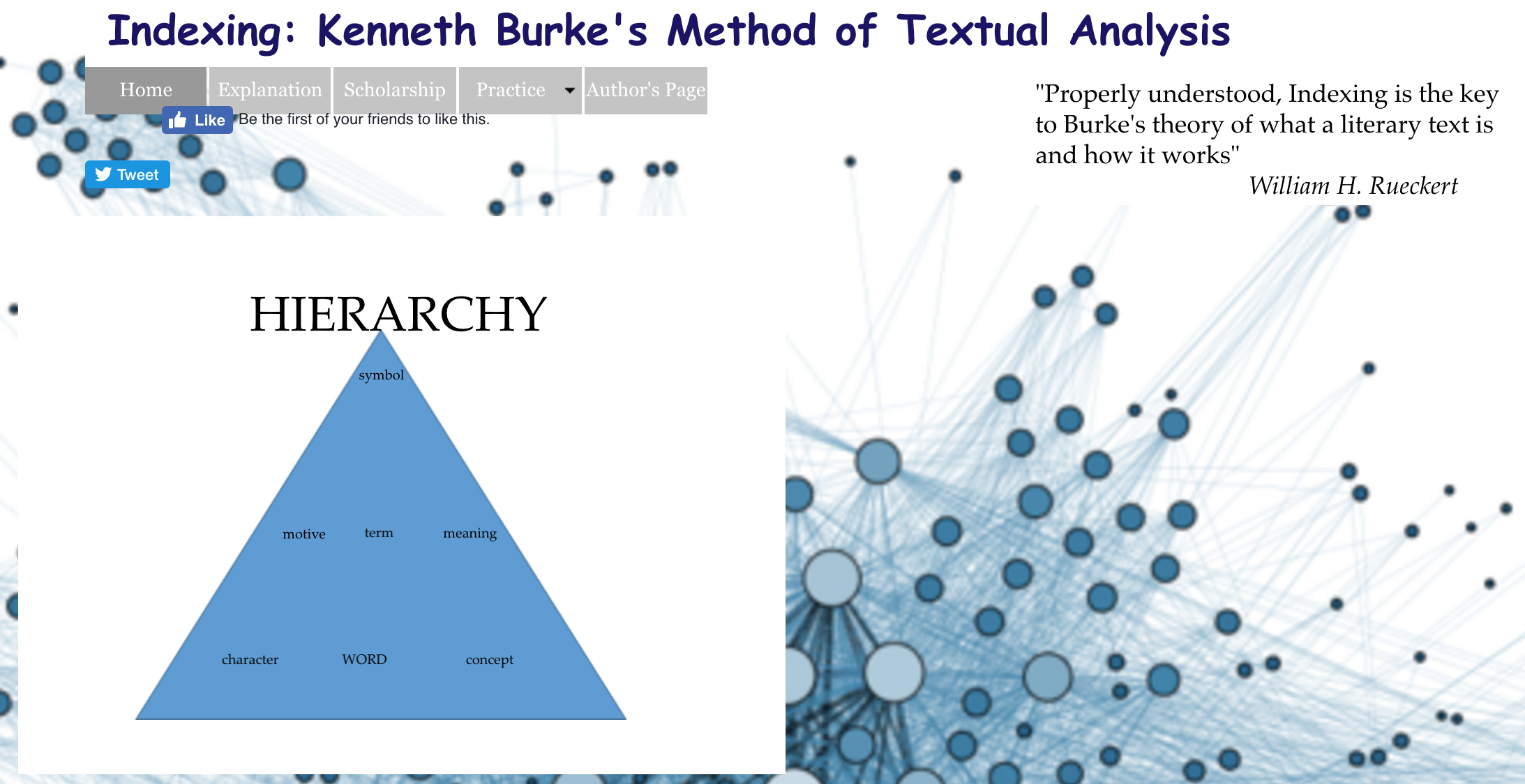
- 19022 reads
Volume 11, Issue 2 Spring 2016
Contents of KB Journal Volume 11, Issue 2 Spring 2016
- 39495 reads
Dramatism, Musical Theatre Interpretation, and Popular Artistic Production
Kimberly Eckel Beasley, Jacksonville University & James P. Beasley, University of North Florida
Abstract
While Burkean applications of dramatism to the world of dramatic theatre are easily seen, this collaborative study attempts to utilize Burkean identification as a method of character analysis in musical theatre production. Since musical theatre, as a popular art form, crosses many disciplinary boundaries, it is often difficult to demonstrate its scholarly purposes. The authors demonstrate that an analysis of Burkean motives can be more successful in musical production than current interpretive applications through its mystification of popular forms, its ability to promote identification, and its ability to offer Burke studies new directions in the arena of performative rhetoric.
Dramatism, Musical Theatre Interpretation, and Popular Artistic Production
As part of musical theatre production at a regional, liberal arts university, the scholarly attention to interpretation is a necessary facet of each student's learning experience. To demonstrate how even the production of a popular musical demands scholarly attention, directors have often resorted to focusing on literary interpretation or even archival research methodologies in this educational environment. To this end, it is important to maintain a transparent connection to literary theory, and specifically its manifestations in musical theatre characterization and production. As musical theatre bridges both the interpretive focus of theatre and the contextual focus of musicology, disciplinary boundaries are often violated and simultaneously observed. Therefore, while there is broad latitude in how characters and their dialog can be interpreted from the theatrical world, there are fewer interpretive options for the musical interpreter. This dilemma is precisely why a developed theory of musical theatre interpretation and production is significant, especially within the context of a liberal arts education.
In the development of musical interpretation in academic environments, there are three major textbooks which model interpretive strategies for musical theatre: The Third Line by Daniel Helfgot, Acting for Singers by David Ostwald, and Acting in Musical Theatre: A Comprehensive Course, edited by Joe Deer and Rocco Dal Vera. While all three offer comprehensive acting for singing techniques, none of them allow for how those techniques influence each other, requiring actors in musical theatre to utilize only one perspective. This study demonstrates the significance of being able to understand how interpretations actually influence each other and how Kenneth Burke's dramatistic ratios, "how the what influences the what" is a much more successful hermeneutic practice in musical theatre interpretation due to its contextual focus, and that contextual focus is also a characteristic of musical disciplinarity.
Daniel Helflot's The Third Line (1993) was the first and is the oldest systematic approach to interpretation in music theatre production. In The Third Line, Helfgot comes at acting for singing specifically for the operatic performer. The "park and bark" stigma associated with opera is a thing of the past, as contemporary opera must contend with the vivacity of music theater style acting, and opera singers are now more beautiful and spontaneous than ever on the stage. This is reinforced through several of Helfgot's chapters, such as "The Opera Performer as Actor," "Movement and Expression," and "Auditioning, Competitions and Recitals." The "third line" specifically refers to Helfgot's three-pronged structure of "Focus, Attitude, and Gesture." The Third Line is the singer's interpretation of the other two lines – the music and the text. The Third Line encompasses the music analysis, the textual analysis, the dramatic intent, and the expressive interpretation of the music.
David Oswalt's Acting for Singers (2005) improved on Helfgot by highlighting competencies such as using improvisation, improving concentration, analyzing dramatic structure, fashioning objectives and super-objectives, subtext, and rehearsing and auditioning. Its focus is both opera and music theatre, using examples from Carmen as well as West Side Story. Oswalt incorporates theme statements for the entire production, involving everyone from the Director to the Actor in a fascinating study of motivated character development.
The newest addition to musical theatre interpretation and production is Acting in Musical Theatre: A Comprehensive Course (2008). The emphasis on musical analysis in this text is important for the music theatre actor, in contrast with the operatic performer who usually needs more analytical acting support. Therefore, the chapters include topics such as foundational acting techniques, musical analysis, elements of storytelling, character analysis, the journey of the song, intensifiers, stylistic elements, as well as auditioning and rehearsal process techniques.
Musical Theatre Interpretation and Little Women, The Musical
When it came time to produce a musical theatre show in a liberal arts educational setting, the director began with these three interpretative textbooks in mind. Since students in this regional, liberal arts voice program had not previously been required to analyze their characters much in the past, the choice of interpretive approach would be significant. Would students be open to such character work? The director's own favorite directors by far have been those that have encouraged her own delving into her character and then forcing that research to reveal itself in rehearsal. Characters whose objectives were handed to her by a director have been forgotten, shallow characters. So of the three textbooks available, Acting for Singers by David Otswalt was chosen to achieve the kind of character development the director wanted, enabling the actors' own interpretations, actions, and directions.
The musical that was chosen for production was Jason Howland's 2005 Little Women: The Musical. As a Broadway musical, it ran for five months before touring nationally for over a year, and it featured musical theatre megastars Maureen McGovern as "Marmie," and Sutton Foster as Jo March. Because the story of Little Women is so well-known, the director did not want the students copying what they had seen in the movies, specifically the most recent adaptation by Gillian Armstrong, the one with which they were all most familiar. Since Little Women: The Musical is based on the Louisa May Alcott novel, the character analysis work would also have the added dimension of literary analysis. As the director and actors read through the script day for the first several days, super objectives were the first tool each actor utilized in developing their character. Helfgot writes, "If you have already developed your superobjective, you can fashion your objectives by asking yourself, 'How does my character pursue his superobjective in this scene?' You will find the concept of strategic means to be a good clarifying device. Invoke it by saying to yourself 'I,…am working toward… by means of…. Fashion your answer depending on what you feel the music, text, and the stage directions suggest" (112). In rehearsal, as the director had them journal about the super objective of their own life that helped them apply this concept to their Little Women character, the students' super objectives began to come together: "I (character's name) and working toward (fill in the blank)." Some examples of some of the students' superobjectives were the following:
- I, Professor Bhaer, am working toward starting my life over again in America.
- I, Jo, am working toward using my writing to provide for my family.
- I, Meg, am working toward finding an eligible young man.
- I, Beth, am working toward making every day beautiful.
- I, Marmee, am working towards raising my daughters to find their place in the world.
- I, Aunt March, am working toward preserving the March family name.
- I, Mr. Laurence, am working toward putting up with my neighbors.
The super objectives of the other characters all helped to give them an overarching motivation for the entire show. But this was only the beginning since breaking down each scene only continued to enhance the largesse of the super objective, making this a very important first step. The super objective for Aunt March really helped the actor give life to her number, "Could You," in which she attempts to whip Jo into shape by manipulating her to change, telling her she might take her to Europe: "I believe you could captivate the world…If you could change there is so much you could achieve…someone full of dreams like you…gracious living will make you sublime." This number was a highlight from the show, and this super objective gave Aunt March in her limited stage time, a strong motivation for her entire character every time she was on stage.
In a move similar to Kenneth Burke's dramatistic ratios, Oswalt connects the purpose of an act with the means by which the act is accomplished. In Oswalt's grammar, these means are called "beats." Oswalt writes the following:
A character will try anything that is consistent with her moral code and personality to get what she wants. If her objective in a particular scene is 'I want to keep my beloved from leaving,' she might begin with flattery. If that doesn't work, she might try reasoning, cajoling, threatening, seducing, bribing, or even blackmail. We call these various strategies acting beats. Acting beats are mini-objectives that clarify the relationship of your character's individual thoughts and actions to her objectives. (120)Discovering the "acting beats" for the ball at the Moffats was essential, since in the musical these scenes combine several balls and outings from the novel and the film adaptations into one. Because many dynamics are altered within this one section of Act I in the musical version, the scene objective/beat work on the getting ready for, attending, and recovering from the ball at the Moffats would make this scene pivotal for motivating the rest of the production. In the following charts, the director has provided examples of how utilizing Oswalts's objectives and beats lead the actors into an understanding of their motivations.
Scene 3: Getting Ready for the Ball
| Characters | Objective: I am working toward | Beat(s): by means of |
|---|---|---|
| Marmee | Making sure her girls get every chance available to them | Getting Meg to her first ball. |
| Beth | Living through my sisters | Helping Meg get ready |
| Jo | Becoming a lady like AM says I have to | Going to this ball with Meg. |
| Meg | Finding an eligible young man | Attending the Moffat's ball. |
| Amy | Equality with my sisters | Getting ready for the ball, too. |
| Delighted | The girls helping Meg feel comfortable | Appealing to Meg's vanity and romantic tendencies |
| OVERALL | This scene works towards dividing the sisters and their places in life | By placing Jo and Meg outside their normal environment and leaving Beth and Amy at home. |
At the Ball
| Characters | Objective: I am working toward | Beat(s): by means of |
|---|---|---|
| Amy (in transition to this scene) | Putting Jo in her place for not letting me go to the ball. | Burning her story. |
| Jo | Not getting frustrated by all this becoming a lady stuff | Trying to be polished and elegant, remembering the reward in the end (Europe) |
| Meg | Making a good impression to the Moffats | Making sure Jo behaves herself |
| Laurie | Avoiding having to meet important people | Getting away from meeting important people. |
| Brooke | Not getting fired by Mr. L | Finding where the hell Laurie is |
| Take a Chance: Laurie | Laurie: Getting Jo to like him | Telling her how unique she is. Trying to get her to dance. Making jokes. Appealing to her love of adventure. Appealing to her as a friend. Being willing to box her. Convincing himself it will happen. |
| Jo: distracting Laurie from liking her | Using humor. Making excuses. Scolding him. Being unladylike. Being competitive. |
|
| Take a chance transition (music) | ||
| OVERALL | This scene works towards establishing how much Jo is determined to write and provide for her family | By revealing how much Laurie likes her despite her repeated rejections of him. |
After the Ball
| Characters | Objective: I am working toward | Beat(s): by means of |
|---|---|---|
| Beth | Helping Meg feel better | Asking her about the ball |
| Marmee | Welcoming her girls home | Helping Meg and making Amy apologize |
| Brooke | Proving he can take care of a woman | Helping Meg home |
| Meg | Letting John know she likes him | Letting him help her |
| Jo | Downplaying her conflicting emotions | Complaining about the whole evening |
| Amy | Doing what Marmee wants her to | Apologizing to Jo |
| Better Reprise: JO | Recovering from Amy burning my story | Going to my attic to vent |
| OVERALL | This scene works towards heightening Jo's conflicting emotions about who she is | Destroying her story and stirring up emotions over Meg and Brooke and her and Laurie |
As can be seen from these charts, Oswalt's discussion of "beats" is extremely similar to Burke's concept of dramatistic "agency." Oswalt writes, "You can fashion your acting beats, whether for operas, musicals, songs, art songs, or lieder, most effectively by once again using the device of means. Say to yourself "I want to carry out my objective by means of…" Or you can ask, "What do I do in this scene to achieve my objective?" (120). While getting student actors to understand what they do in a scene to achieve their character's objective is important, what is missing from Oswalt's description is to what extent the act, agent, scene, agency, and purpose are acting on each other simultaneously, and this is the understanding that Burkean dramatism enables actors to accomplish, the ability to identify the degree of influence. In other words, while the pentads help us understand "how the what influences the what," utilizing the pentads in musical theatre productions helps us understand "to what degree the what influences the what," and this seems the most important result of this application for Burke studies at large.
Many adoptions of the pentad focus on the pentad's use for juridical rhetoric, or an examination of past "acts," whether it be Ronald Reagan's invasion of Grenada (Birdsell, 1990) Plato's rhetoric (Abrams, 1981), or even corporate picnics (Walker and Monin, 2001). Utilizing pentads for musical performance fundamentally changes the usefulness of Burke's thought from past events, to their adaptation for deliberative, or future events, i.e., an upcoming musical performance. Utilizing the pentad allowed actors to immediately see the degree of effect of their changing interpretations in real time. This ability to see the immediate variation of those changing interpretations is a potential new direction for Burke studies, and opens Burke scholarship from examinations of past acts, to a new methodologies for studying rhetoric as future performatives.
Dramatism and Little Women: The Musical
The first goal in utilizing dramatism in the production process of Little Women: The Musical was to achieve a greater depth of character analysis than found in Oswalt's "beats" method. To achieve this goal, a brief introduction to Kenneth Burke's dramatism was given by a Burke historian. In his workshop he presented students with the following:
In A Grammar of Motives (1945), literary theorist Kenneth Burke outlined his conception of what he would call "dramatism": a method that readers can use to identify the rhetorical nature of any text, opening it to multiple perspectives.The director, therefore, took the worksheet above and had the students examine the "purpose-agency ratio" to determine what influence they had on each other, whether or not the purpose determined the agency, and vice versa. In the cases above, the students could see that Amy's burning of Jo's story was one of the most significant purpose-agency ratios of that entire sequence of the show, and therefore the staging of that scene would get more attention than other purpose-agency influences. The most significant implication from using Oswalt's "beats" before engaging in a discussion of the Burkean pentads was to see how limiting Oswalt's "beats" actually was on dramatic interpretation. Since Oswalt's beats were only one out of a possible twenty ratios that could be utilized, students immediately began pentading other scenes in which they were singing. For example, Jo is proposed to twice in the musical, once by Laurie and once by Professor Bhaer. Burke's dramatistic ratios immensely helped the actor who played Jo in finding her motivation for rejecting one and accepting another. By only using Oswalt's "beats," Laurie's antics take center stage in his being refused, but through pentading Professor Bhaer's proposal, a new reason for Laurie's rejection emerged:
ACT: what was done?
SCENE: When and where was the act performed?
AGENT: Who did it?
AGENCY: How and with what was the act performed?
PURPOSE: What motivated the act?
After readers answer these statements based on their interpretations, the next question focuses on the influence one may have on another. "How does the _______influence the ___________?"
Act—Bhaer proposesIn this pentad, it is Bhaer as "the Other," the fact that he is "not-Concord" that the actor who played Jo identified as having the most effect on Bhaer's acceptance, and therefore since Laurie is the next door neighbor, the one who most specifically represents Concord, the actor who played Jo was able to exploit this tension between the two men.
Agent—mentor to Jo, represents "the Other," represents "not-Concord"
Scene—outside the March house
Agency—through her published book
Purpose—to tell her he's missed her and loves her
Directorial Intent, Actors, and Identification
The second purpose for utilizing Burkean pentads was to help shape the director's own interpretive focus. Since the director did not want to dictate the staging, the pentads help students identify with the directorial interpretations as they creatively participate in the creation of the meaning of the performance. As part of the preparation for the production, the director conducted archival research in the Louisa May Alcott papers in the Houghton Library at Harvard University. What surprised her was that there was no evidence in the Alcott letters that would indicate that Louisa and "Beth" were very close in real life. There were no letters in Louisa's collection from "Beth," but many letters between "Beth" and "Marmee." The director began to wonder whether Louisa's portrayal of Jo in the novel is what she merely wished her relationship had been with her sister "Beth" in real life. In the novel they are very close, thus every adaptation of the novel portrays them as very close. Based on her reading of the Louisa May Alcott letters, then, the director tried to capture a bit more of this dynamic in the scene "Some Things are Meant to Be." This scene is normally staged with Jo's overwhelming sadness of Beth's impending death. Based on a new possible interpretation from the Alcott letters, the director wanted to stage Jo not as a grieving sister, but in denial over what is happening, so much so that she cannot even give Beth her full attention in this scene. By staging Jo as calloused to her sister's illness, though, the director could encourage the audience to identify with her need to change, to collectively hope this is not the Jo we are left with at the end of the story. When Jo does realize that her home is truly important, her recent denial then becomes an even more significant motivation for her writing and submitting her great novel in the first place.
In order for this alternate interpretation to not be merely handed down to the actors to obey, utilizing the pentads allowed the actors to come to these conclusions on their own, as they creatively participated in arriving at similar interpretations. In A Rhetoric of Motives (1950), Kenneth Burke writes, "Longinus refers to that kind of persuasion wherein the audience feels as though it were not merely receiving, but were itself creatively participating in the poet's or speaker's assertion. Could we not say that, in such cases, the audience is exalted by the assertion because it has the feel of collaborating in the assertion?" (57-58). To demonstrate to the actors that they, too, might have alternative motivations than merely what is written in the novel, the actor playing Jo and the actor portraying Beth wrote their own pentads:
Pentad: Beth dies
| Character | Jo | Beth | |
|---|---|---|---|
| Act | Beth dies | Beth leaves Jo | |
| Agent | Beth—sister who has no aspirations | I love being at home | |
| Scene | Beach—life goes on | Beach—I'd rather be back in Concord | |
| Agency | Hummels, Concord--frustration | Hummels, Concord-fulfillment | |
| Purpose | Reminder of how awful Concord is | Jo's success |
While they did not necessarily arrive at the same conclusion, the fact that they could arrive at similar conclusions allowed them to understand the staging and see how many other interpretations were possible, i.e., "if not this one, then why not that one?" The pentads also balanced this artistic freedom with the need to stay as close to audience expectations as possible as a feature of the musical theatre genre. Dennis Brissett writes, "Dramatism gives one no criteria for such smug demarcations of one's own virtues and the vices of all others. We are not talking about some simplistic notion of demystification as an unmasking, a revelation of the truth; rather we are offering dramatism as a technique of analysis of human interaction and also as a method for assessing social theories of human conduct" (336). The students could see that while there was no one single correct interpretation, there were limitations on how interpretive we could be. While the pentads helped create those interpretations, they simultaneously allowed the students to examine them. Bissett writes, "The demystification of action that can be achieved by reclaiming neglected petadic elements has its counterpart in the critique of theories of action that similarly neglect elements of the pentad. And here, unlike other theories of action, dramatism provides the method of demystifying and criticizing itself. It is possible, therefore, to produce a dramatistic account of some situation, and, without shifting one's ground, equally possible to analyze that account" (Brissett 336). This analyzing of student interpretations is not allowed by Oswalt's "beats" method. The students only supplied what they thought were the agencies by means of which for their purposes, but they never considered why they believed that until they utilized Burke's dramatistic ratios. This is why filling out the charts for Oswalt's acting beats seemed like homework to many of the students, but creatively participating in persuading the audience that Jo March needed to change did not seem like homework at all.
Dramatism, Musical Theatre, and Popular Art
These interpretative choices that involve the audience in the creative participation of Jo March's transformation, their identification, has an even greater implication for the genre of musical theatre at large. Because musical theatre forms are much more closely tied to popular culture than "straight" theatre, musicals generally do not challenge audiences or create their own drama. Kimberling writes on dramatism's ability to challenge the inherent limitations in popular art's predictable forms:
The Burkean model provides a tentative answer to the frequently posed question as to whether popular art reflects or engenders social values and mores. Dramatism would suggest that it does both. Popular art reflects social values because it presents universal patterns of experience, patterns that the audience must recognize if it is to understand the work. It engenders values by presenting dramatic scenarios placing ordinary values in conflict situations, situations demanding that some hierarchy of values be established, and by stimulating audience identification with the processes of value formation (Kimberling 84).Again, the ball scene is an example of how dramatism can be used not only to reflect social values, but to engender values by demanding that the audience establish a hierarchy of those values. By utilizing Oswalt's "beats" in the previous charts, one can see how students supplied fairly formulaic means to their purposes, i.e., Meg wanting to make a good impression on the Moffatt's by making sure Jo behaves herself. However, since pentads allow students to both simultaneously produce and analyze their dramatistic accounts, the ball scene can be used to not only reflect social values, but to also engender conflicting values. To engender these conflicting values, however, some additional work is required by the actors than merely identifying the acting "beats." In other words, the actors must "earn their increment" through developing new pathways for conflicting values to operate. One of these pathways is the subject of Burke's Language as Symbolic Action:
There is a further step in our outward direction: and it is the one we most need for our present inquiry. Insofar as a poem is properly formed, suppose you were to ask yourself what subtitle might properly be given to each stanza. Or suppose you were to break up each chapter of a novel into a succession of steps or stages, giving titles to such parts of a chapter, then to chapters, then to groups of chapters, and so finally to the whole work. Your entitlings would not necessarily agree with any that the author himself may have given, since titles are often assigned for fortuitous reasons. And of course other readers might not agree with your proposed entitlings. But the point is this: Insofar as the work is properly formed, and insofar as your titles are accurate, they mark off a succession of essences (369-370).What Burke identifies as "subtitles," acting preparation generally calls "subtext." While "subtext" is a pretty common way for actors to find meaning in the script, it becomes even more significant the more the director wants the audience to establish hierarchies of values. For musical theatre productions, with their inertia already tilted towards merely reinforcing cultural norms and values, subtext is essential in producing dramatistic pathways for audiences to consider these competing values. This is how the concept of subtext was introduced to the actors for Little Women, The Musical:
Subtext now becomes useful specifically for the songs you sing. Subtext is the main source of your internal dialogue, the chatter of your inner voice expressing how you feel about what is happening. When you fashion subtext for each phrase of your text and complete it with internal thoughts for all the places where you don't sing, you make your character into a multi-level communicator like a real person, and you take a giant step toward being believable on stage.The focus on creating "internal dialogue" to form a "multi-level" communicator has its roots not only in the "unending conversations" taking place, but also in the creation of multiple pathways of action. Will the characters act in predictable ways that reinforce social norms, or will characters surprise audience members by their resistance to formulaic behaviors? Using the example of the student analysis of the ball scene again, the creation of subtext created some surprising opportunities for presenting audiences with conflicting values to examine. Using Oswalt's acting "beats," the actor playing Meg indicated that her purpose was to make a good impression on the Moffatt's by making sure Jo did not embarrass them. However, through subtext of the same scene, other values are revealed. As Meg is approached by Mr. Brooke at the ball, she pulls Jo away from the dancing to calm her down, dropping her own dance card in the process. Mr. Brooke has come to get Laurie to take him home. They are center stage and Jo and Laurie are listening and observing them intently:
Meg: Sir! You've taken my dance card!
I need it but I don't want to have to ask.Brooke: Your dance card? – Oh! Is this yours? Sorry. So – you're Margaret March?
What? I'm an idiot. Who is this? She's pretty!Meg: Yes, I am.
He's handsome!Brooke: It's – a splendid party, isn't it? –
I am wowed by you!
Meg: Yes, it is. Quite - "lovely." So you're from Boston?
I don't know what to say…Brooke: Actually Maine.
I can't stop staring at you!Meg: I've never been to Maine.
Why did I just say that?Brooke: You should go. It's beautiful country. Very primitive –
You should come with me!
Meg: I like primitive.
Why did I say THAT?Brooke: Really?
Does she like me?Laurie: Mr. Brooke is a romantic.
Ooooo (sarcastic)Meg: Is that true?
He has something I like.Brooke: Well, no, no. I read Sheats and Kelley. I mean Keats and Shelley. –
Shut up, Laurie, and let me talk!Meg: So do I.
I understand you.Brooke: You read Keats and Shelley?
This girl is way too cool for me.Meg: All the time.
I actually know those guys.
In the ball scene, Meg's subtext reveals other purposes than just not embarrassing herself in front of the Moffatt's, which reinforces the social norms. When Meg responds to Mr. Brooke saying, "I like primitive," and her subtext for that line was "Why did I just say THAT?" she is both "producing a dramatistic account of some situation, and, without shifting one's ground, making it equally possible to analyze that account." Meg is reinforcing social norms, i.e., getting married to the handsome male lead character of a musical theatre production, and simultaneously engendering social values, i.e., the legitimization of a distinctively different culture than that of the extravagant ballroom in which the attractive male lead character of a musical theatre production and the attractive female lead character of a musical theatre production will fall in love.
Motion, Action, and Staging
To "block" the production, the director wanted the actors to know why they were moving when they were, and to initiate their own movement rather than just being told to move when the director wanted. After all, the actors have done the character work for themselves more precisely than even the director, so their suggestions are often quite inspired. The addition of Burkean dramatism in the subtext process suggests blocking options to the actors that they can feel on their own, complicating how the audience believes the characters should be behave in response to social norms. Again, this complication is anachronistic for the musical theatre genre, but dramatism opens musical theatre up to such possibilities, while itself staying true to form. Kimberling writes, "Burke would view [Kaplan's aesthetic theory] as dehumanizing. The reaction mode of Kaplan would find its place, in Burkean terms in the world of motion, not action. The world of human thought and language, however, necessarily implies action, since it is a dialectical process of giving wings to motive, transcending the linear stimulus response realm of mere motion" (Kimberling 70). Insomuch as subtext is an interior dialogue, it participates in the dialectical process of "giving wings to motive," making staging much more meaningful than merely identifying "acting beats" only. In the ballroom scene, therefore, when Mr. Brooke says that Maine is "very primitive," he has many choices. He can reinforce social norms by delivering the line with disdain in comparison to the extravagant ballroom of the Moffatt's, or he could engender social values by deliver the line with pride, as an almost aside away from the other characters in the ballroom scene. When Meg replies, "I like primitive," she can reflect social norms by being embarrassed about valuing the primitive, or she can engender social values by shouting that out for all in the ballroom to hear.
The staging process, therefore, is based upon a deep understanding of the characters and their motivations for relating to other characters and their scenes independent of the individual objectives for each scene, the overall objective that the audience understands from each scene, and how a group of scenes relates to the entire act. Since no one character could both reflect and engender social norms at the same time, the director utilized a system of scene "leaders" and "followers" for each scene. While each scene demands its own leader, it is the balance of leaders to followers that both simultaneously reflects and engenders social values. The leader in a scene would be center stage more often than not; a follower in a scene would be more upstage rather than downstage. The leader could reflect a social norm, and the audience could witness that effect on the follower, or the leader could engender a new social value, and the audience could witness that effect on the follower. In this way, motion becomes action, since the movement is motivated by "human thought and language."
In a society where television productions such as Glee or Smash portray musical theatre production as frivolous pursuits of vanity devoid of scholarly attention, the significance of Burkean dramatism is vital to a reinvigoration of this popular art form. Brissett writes, "It is only in the social scientific use of dramatism—seeing to give due weight to all elements of the pentad in the explanation of human conduct—that we can find an implicit commitment to the demystification of any single-minded explanatory scenario"(336). Dramatism reconnects musical theatre to the contextualized field of musicology, while simultaneously distancing itself from pure aesthetic value conflict. The pentadic ratios, therefore, simultaneously provide the substance of interpretive material for musical theatre production in the characterization, blocking, and staging phases of production, and the means by which to examine characterization, blocking, and staging without "shifting one's ground," creating exciting opportunities for the scholarly attention to this popular art form.
Works Cited
Abrams, Judith. "Plato's Rhetoric as Rendered by the Pentad." Rhetoric Society Quarterly 11.1 (1981): 24-28. Print.
Alcott, Louisa May. "Personal Correspondence." Houghton Library Special Collections. Harvard University, Cambridge, MA. Print.
Birdsell, David. "Ronald Reagan on Lebanon and Grenada: Flexibility and Interpretation in the Application of Kenneth Burke's Pentad." Methods of Rhetorical Criticism: A Twentieth-Century Perspective (3rd revised edition). Ed. Bernard L. Brock, Robert L. Scott, and James W. Chesebro. Detroit, MI: Wayne State UP, 1989. 196-209. Print.
Brissett, Dennis, Charles Edgly, and Robert Stebbins, Robert, eds. Life as Theatre: a Dramaturgical Sourcebook. Piscataway, NJ: Transaction Publishers. 2005. Print.
Burke, Kenneth. A Grammar of Motives. 1945. Berkeley: U of California P, 1969. Print.
—. A Rhetoric of Motives. 1950. Berkeley: U of California P, 1969. Print.
—. Language as Symbolic Action: Essays on Life, Literature and Method. Berkeley, CA: U of California P, 1966. Print.
Deer, Joe, and Rocco Dal Vera, eds. Acting in Musical Theatre: A Comprehensive Course. New York: Routledge. 2008. Print.
Helfgot, Daniel. The Third Line: The Opera Performer as Interpreter. New York: Schirmer Books. 1993. Print.
Howland, Jason. Little Women: The Musical. New York: Cherry Lane Music. 2005. Print.
Kimberling, C. Ronald. Kenneth Burke's Dramatism and Popular Arts. Bowling Green, OH: Bowling Green State UP, 1982. Print.Ostwald, David. Acting for Singers: Creating Believable Singing Characters. New York: Oxford UP, 2005. Print.
Walker, Robyn and Nanette Monin. "The Purpose of the Picnic: Using Burke's Dramatistic Pentad to Analyse and Company Event." Journal of Organizational Change Management 14.3 (2001): 266-79. Print.
This work is licensed under a Creative Commons Attribution-NonCommercial-NoDerivatives 4.0 International License.
- 28380 reads
"Trouble with a Capital T": Jerome S. Bruner's Reenvisioning of Kenneth Burke's Dramatistic Pentad
Matthew T. Althouse & Floyd D. Anderson, The College at Brockport: State University of New York
Abstract
Widely embraced by many academic disciplines, Jerome S. Bruner's scholarly ideas hold important, but unexplored, implications for rhetoric. In addressing this situation, this study elucidates Bruner's concept of "Trouble" and shows how it redirects Burkeian pentadic analysis. It further demonstrates that Bruner's concept of Trouble represents a profound paradigm shift, an alternative understanding and reenvisioning of Burke's pentad, which suggests new heuristic possibilities for rhetorical scholars.
To paraphrase Kenneth Burke's classic, A Grammar of Motives, story structure is composed minimally of the pentad of an Agent, an Action, a Goal, a Setting, an Instrument, and Trouble (Burke, 1945). Trouble is what drives the drama, and it is generated by a mismatch of two or more of the five constituent terms of the pentad. —Jerome S. Bruner ("Life as Narrative" 697)
Indeed Burke's morphology of human Trouble (his capital T, not mine) still stands as a guide for students of narrative.—Jerome S. Bruner (Making Stories, 110, n1)
Introduction
Although Jerome S. Bruner is widely known for contributions to the study of education, psychology, law, and narratology, his scholarship also holds implications for the study of rhetoric. Bruner develops his ideas about narrative in relation to Kenneth Burke's dramatistic pentad, which consists of act, agent, agency, scene, and purpose. However, Bruner's use of the pentad includes the concept of Trouble, perhaps the single most important concept in his narratology. As Bruner envisions it, Trouble does not constitute the sixth term of a hexad, and it is not a separate, distinct pentadic term. Rather, Trouble is a complication, tension, or mismatch between the terms in a pentadic ratio. As such, it constitutes a breach of canonical legitimacy. Its inclusion as an additional dimension of the pentad, Bruner contends, enables one to more directly focus on terminological complications and imbalances. Bruner frequently claims that references to Trouble may be found in Burke's Grammar and has long and consistently maintained that Burke himself added "Trouble with a capital T" to the pentad. However, our own reading of Grammar, as well as Burke's earlier discussions of the pentad in "The Study of Symbolic Action" and "The Tactics of Motivation," failed to locate "Trouble with [or without] a capital T."
In light of the importance Bruner gives it, as well as the ambiguity surrounding its origin, a thorough investigation of Trouble is in order, a task that we undertake in this essay. Although Bruner attributes Trouble to Burke, we demonstrate that it is Bruner himself who deserves credit for its conceptualization and development. We also demonstrate that Trouble represents a profound change, what Thomas Kuhn calls a paradigm shift (e.g., 11, 77, 111), in thinking about the pentad and its application. Whereas Burke's pentad emphasizes consistency between the nature of acts and agents and a given scene, Bruner's version emphasizes inconsistency that confronts and is anomalous with cultural and canonical expectations. It represents a radical shift from the traditional understanding of Burke's pentad and a reenvisioning of it. Our discussion unfolds in four parts. First, we describe Bruner's development of Trouble. Second, we explicate his understanding of the concept. Third, we show how Trouble reenvisions and redirects our thinking about the pentad. Finally, we discuss Bruner's distinction between "ontological Trouble" and "epistemological Trouble."
Bruner's Development of Trouble
As we have stated, Bruner himself deserves credit for the conceptualization and development of "Trouble," despite his attribution of the concept to Burke (e.g., Actual Minds 20; "The Narrative Construction" 16; "The Reality of Fiction" 58). In Making Stories, Bruner remarks, "Indeed Burke's morphology of human Trouble (his capital T, not mine) still stands as a guide for students" (110, n1). In "Life as Narrative," he writes, "To paraphrase Kenneth Burke's classic, Grammar of Motives, story structure is composed minimally of the pentad of an Agent, an Action, a Goal, a Setting, an Instrument and Trouble (Burke, 1945). Trouble is what drives the drama, and it is generated by a mismatch of two or more of the five constituent terms of the pentad" (697). Despite references like these, our readings of Burke did not find "Trouble."
However, our reading of Grammar does correspond with Bruner's reading in our shared understanding that Burke propounds a "principle of consistency" between pentadic terms (Grammar 9). According to this principle, "the nature of acts and agents should be consistent with the nature of the scenes" (3). In Bruner's restatement, "Actions should fit Goals appropriately, Scenes should be suited to Instruments, and so on" (Acts of Meaning 50). However, whereas Burke grounds consistency between pentadic terms in the constituents of drama (Grammar 3, 7, 9), Bruner grounds the consistency principle in culture and its norms, conventions, and expectations ("Narrative Construction" 16). Bruner also maintains that Trouble itself "presupposes such a consistency of terms" (Acts of Meaning 50). Although Burke regularly maintains the need for congruence between pentadic terms, he discusses incongruity between featured terms at only two places in Grammar. First, he offers an example of mismatched, inconsistent terms: "And whereas comic and grotesque works may deliberately set the elements at odds with one another, audiences make allowances for such liberty, which reaffirms the same principle of consistency in its very violation" (3). Second, Burke notes how an "appositional relationship" between terms can become an "oppositional relationship," in which "we encounter the divisive relationship, the genitive transformation of something which is 'a part of' a larger context into something which is 'apart from' this context" (107). Except for these two comments, Burke is silent throughout Grammar about inconsistent terminological relationships.
To reconcile our reading of Grammar with Bruner's claim that it contains references to "Trouble with a capital T," we e-mailed him for assistance. From our correspondences, we draw two conclusions. First, the probable source of the idea that Bruner frequently attributes to Burke, that the impetus of drama lies in "Trouble with a capital T," is not Grammar or any other of Burke's works. Instead, it seems likely that Burke discussed Trouble with Bruner in one or more of their personal conversations, "typically while sipping coffee somewhere!" ("RE: Trouble with a capital T." 8 August 2011). Unfortunately and understandably, Bruner could not furnish specific details of conversations, verbatim or otherwise, that occurred decades ago. It is easy, however, to imagine a conversation such as Bruner describes in which Burke might have suggested that a "tension" or "misfit" between two pentadic terms amounted to Trouble, perhaps even "with a capital T."
Second, regardless of who originated the idea of Trouble, it is Bruner himself who deserves the credit for its conceptual development and for adding it to Burke's pentad. As Bruner informed us, his reading of Grammar lead him to reckon that "Burke's discussion throughout the book speaks to the generation of Trouble as an outcome of imbalance in his pentad" ("RE: Trouble with a capital T," 5 August 2011; Acts of Meaning 50). This understanding makes sense in light of Bruner's training, vocation, and scholarship. Indeed, one of Bruner's best known early works explores how humans perceive incongruity (Bruner and Postman). Reading Grammar through eyes accustomed to dealing with actions and agents that deviate from expected norms, Bruner saw the possibility for inconsistency and imbalance wherever Burke wrote of consistency and balance. Moreover, although the idea of inconsistency between pentadic terms is unstated in Grammar, it is not absent. It is implicit throughout the work. For where there is a possibility of consistent relationships, there is also a possibility of inconsistent ones. If there can be a "goodness of fit" between pentadic terms, there must also be a corresponding "badness of fit." Thus, in his conceptualization and development of Trouble, Bruner made explicit what Burke had left unstated and implicit.
As we have suggested, Bruner's interpretation sets the stage for a Kuhnian paradigm shift in the way Burke's dramatistic pentad can be understood. To investigate this shift and its implications, we now explore how Trouble functions in Bruner's program of narratology.
Looking For Trouble
In response to objectivism, positivism, and strict behaviorism, Bruner argues that psychology should key on how stories, rather than logical arguments or lawful principles, guide understandings of clients' plights. In Acts of Meaning, he illustrates how "logical or categorical" ways of thinking are often disregarded by interpretive acts of individuals (42). "An obvious premise of our folk psychology," Bruner writes, "is that people have beliefs and desires: we believe that the world is organized in a certain way, that we want certain things, that some things matter more than others, and so on" (39). These beliefs and desires are encapsulated in their stories, which are informed by culture and language (11). Although these factors may appear "vague" to many social scientists, they help "specify the structure and coherence of the larger contexts in which specific meanings [generated by stories of individuals] are created and transmitted" (64-65). The "emblems" of experiences, crafted by storytellers at the intersection of culture and language, differ from "logical propositions. Impenetrable to both inference and induction, they resist logical procedures for establishing what they mean. They must be interpreted" (60). Inspired by Bruner's perspective, narrative therapists believe that they must first understand the self-generated outlooks of people, as revealed by their stories, as the basis of and in conjunction with treatments.
The meanings of stories, Bruner contends, cannot be properly understood without first finding "Trouble." In defining the term, he turns to Burke's pentad: "Well formed stories are composed of a pentad of an Actor, an Action, a Goal, a Scene, and an Instrument plus Trouble" (Acts of Meaning 50). By themselves, Burke's basic five terms are "sufficient descriptions of story stuff,'" involving "characters in action with intentions or goals in settings using particular means" (Actual Minds 20). Yet, they may be insufficient to adequately reflect motives behind choices individuals make and behind interpretations used to understand their lives. To address this claimed inadequacy, Bruner explains that the drama driving meaning in stories emerges from "Trouble," a "mismatch" ("Life as Narrative" 697) or "imbalance" (Acts of Meaning 50) between paired constituents of a pentadic ratio. For instance, Trouble happens when "an Action toward a particular Goal is inappropriate in a particular Scene, as with Don Quixote's antic maneuvers in search of chivalric ends; an Actor does not fit the Scene, as with Nora in A Doll's House" (50; see also Actual Minds 20; Making Stories 34). In these cases, the "mismatch" or "imbalance" between pairs of pentadic terms suggests the need for resolution of tension between actual and desired states of existence. Thus, Don Quixote must be jolted by practical jokes into awareness of the Trouble his scenically inappropriate behavior has created. Nora must mature to face the scenic demands of marriage and of living in a society that requires honesty.
Trouble, says Bruner, is "what drives the drama" ("Life as Narrative" 697); it is the "engine of narrative" ("The Narrative Construction" 16; "The Reality of Fiction" 58). He illustrates this in Acts of Meaning, where he describes an experiment featuring kindergarten children who were told various accounts of a young girl's birthday party and who were asked to talk about their interpretations of those accounts. Different depictions of the event all featured a rather ordinary happening: the presentation of a cake adorned with lit candles. Here, the scene dictated a certain act; consequently, the young guests expected the girl to blow out the flames. That occurred in one version of the story. In another version, however, Trouble emerged because the youngster extinguished the candles with water (81-82). Bruner notes that, when asked to discuss impressions of the different stories, children were content to say little when the expected occurred. When pentadic terms were balanced or matched, "the young subjects were rather nonplussed. All they could think to say was that it was her birthday." Yet, children became unsettled when the unexpected occurred and, thus, they offered "ten times as many elaborations," as compared with elaborations of the expected (82). Bruner explains that people strive to find "'meaning' in the exceptional" and "meanings that inhere in the nature of their departure from the ordinary" (48).
With its emphasis on "departure from the ordinary," Bruner's notion of Trouble is similar to Kuhn's concept of "anomaly." Kuhn writes, "discovery commences with awareness of anomaly, i.e., with recognition that nature has somehow violated the paradigm-induced expectations that govern normal science" (52-53). Like anomalies that spur Kuhnian paradigm shifts, instances of Trouble involve violations, breaches of culturally-induced expectations. We are not suggesting, however, that Bruner's concept has been influenced by Kuhn's notion of anomaly. Quite the opposite is the case. Kuhn has affirmed that Bruner and Postman's 1949 experimental study of the perception of incongruity, which he considers "a wonderful and cogent schema for the process of scientific discovery" (62), was influential in shaping his own understanding of the role of anomaly in paradigm shifts (63-64; also see Bruner, Actual Minds 47). Nevertheless, our point is that anomaly and Trouble are similar concepts and perform similar functions. In science, an anomaly may lead to a radical "transformation of vision" that causes scientists "to adopt new instruments" and to look for explanations in "new places" (Kuhn, 111). In human relationships, Trouble may induce people to "expand the horizon" of interpretive possibilities (Bruner, Acts of Meaning 59-60). As Yoos points out, Bruner's concept is derived in part from what Aristotle in his Poetics calls peripeteia ("Making Stories" 463; also see Reframing Rhetoric 165). According to Aristotle, peripeteia works in conjunction with anagnorisis (discovery) and pathos (suffering) as the three elements of a plot. It is a sudden reversal of the protagonist's fortune or circumstances: "a change from one state of things within a play to its opposite" (Poetics 1452a15-25). Such a drastic change "troubles" agents and forces them to seek new meanings and in "new places." Without Trouble, there can be no drama.
Trouble is not the sixth term in a hexad. Burke (Grammar 443; Dramatism and Development 23; Attitudes Toward History, 3rd ed., 394; "Counter-Gridlock" 366-367) and others (Melia, 72, n21; Rountree, para 5; Anderson and Althouse, para. 31-41) have suggested the development of a hexad, but with the addition of "attitude" as its sixth term. This kind of undertaking, however, is not Bruner's goal, and he has expressed no interest in it. While maintaining that the pentad has "five constituent terms" ("Life as Narrative" 697), Bruner develops the concept of Trouble to describe a relationship between existing pairs of pentadic terms. These terms are grounded in cultural conventions, norms, and expectations. What constitutes "appropriate balance" between terms in various pentadic ratios is likewise determined by cultural values and beliefs. When balance is upset, Trouble emerges. For example, dressing appropriately for a formal church wedding conforms with canonical norms, but wearing a bathrobe and hair curlers would upset expectations, causing Trouble. Keeping one's lawn mowed and trimmed is considered the duty of a good neighbor, but cutting the grass with a power mower at 3:00 a.m. would be considered the act of an inconsiderate neighbor and would create Trouble.
With its emphasis on terminological imbalances, Trouble reframes our understanding of the pentad. As noted previously, Burke posits a "principle of consistency" between a scene and the agents and acts it contains (Grammar 9). Bruner, however, is interested in exploring stories about agents and acts that challenge and disrupt given scenes. This point is apparent in his explanation of the two ways of dealing with Trouble.
First, Trouble can be contained. That is, through narratives, breaches may be explicated to "keep peace" with cultural norms and expectations. However, this conciliation may not be lasting, as containment does not necessarily function to "reconcile," to "legitimize," or "even to excuse," although it sometimes might (Acts of Meaning 95). For instance, the homeowner who mowed his lawn at 3:00 a.m. might explain that his action hinged on a "tough week at work," a need to "teach a lazy teenaged son a lesson about getting yard work done," and having drunk "too much bourbon." Sharing this account with agitated neighbors may not fully assuage their irritation or prevent future conflicts. However, it may calm them somewhat, making neighborhood peace and quiet possible. For the homeowner, it may also function to make sense of and mitigate the occurrence. This imagined example helps illustrate Bruner's view about containment. Although not ruling out happy endings either in stories or in life, he is dubious that resolution of Trouble is always possible or even necessarily desirable. "Narrative," he writes, "is designed to contain uncanniness rather than to resolve it." He does not think that it is necessary in a narrative that "the Trouble with which it deals be resolved." Nor does he think that it has "to come out on the 'right side.'" Containment of human plight, not resolution, is Bruner's prescription: "The 'consoling plot' is not the comfort of a happy ending, but the comprehension of plight that, by being made interpretable, becomes bearable" ("The Narrative Construction" 16; see also Making Stories 15). In this process, canonicality may be affirmed to ensure social cohesion and a sense of "civility." Yet, non-canonical perspectives are also revealed and widely recognized (Acts of Meaning, 95-96).
Second, the Trouble caused by breaches of existing canons may be incapable of redress and may thus result in the adoption of new canons. Recognizing the positive uses of nay-saying, Bruner does not think that canonical norms and expectations in literature or in life are "culturally and historical terminal." The norms of narrative and of life change "with the preoccupations of the age and the circumstances" ("The Narrative Construction" 16). Bruner explains that "an initial canonical state is breached, redress is attempted which, if it fails, leads to crisis; crisis, if unresolved, leads eventually to a new legitimate order" ("Life as Narrative" 697). Imagine that a person attending a marriage ceremony in impious attire represents widespread discontent with the high cost and excessive decorum of weddings. This collective disgruntlement could drive the popularization of informal, "come-as-you-are" weddings in public parks and backyards, illustrating how new legitimacies can arise out of breaches of old legitimacies. Even when Trouble is contained and accepted pieties and norms are confirmed, its presence has revealed the possibility of an alternative "reality," one that is likely to recur in the future. Insofar as Bruner does not think that there can be final resolutions to the tensions that cause Trouble, his attitude toward human plight might be characterized as one of neo-Stoic resignation. But, it is an optimistic, even progressive, resignation that is tempered with a belief that "there are alternate 'realities' possible" ("RE: Trouble with a capital T," 5 September 2011). An imagined better world can become reality.
Trouble and Pentadic Ratios
The nature of Bruner's reenvisioning of the pentad now established, we turn our attention to elaborating its implications for understanding pentadic ratios. Trouble assumes the existence or possibility of a "goodness of fit" between the terms in a pentadic ratio. Such goodness of fit rests on the idea of cultural and canonical legitimacy. Because a narrative's "'tellability' as a form of discourse rests on a breach of conventional expectation," it is "necessarily normative." Hayden White, Victor Turner, and Paul Ricoeur, in addition to Bruner, maintain that narrative is concerned with "cultural legitimacy." "A story pivots," Bruner points out, "on a breach of legitimacy" ("The Narrative Construction" 15). The "appropriate balance" among the various terms in Burke's pentad, Bruner explains, is "defined as a 'ratio' determined by cultural convention. When this 'ratio' becomes unbalanced, when cultural convention is breached, Trouble ensues" (16). This description highlights Bruner's reenvisioning of the pentad as the five terms "plus Trouble" (Acts of Meaning 50). We have previously explained how this additional element enables Bruner to focus on the interrelationships between pentadic terms and ratios. This, in turn, facilitates exploration of how violations of cultural norms, and the ensuing complications of Trouble, may be charted. The "very notion of Trouble presupposes that Actions should fit goals appropriately. Scenes should be suited to Instruments, and so on" (Acts of Meaning 50). If actions do not fit goals, if scenes are not suited to instruments, or if there are other deviations from the "canonical," breaches of cultural legitimacy occur.
In Acts of Meaning, Bruner writes that the "proper study" of human psychology begins with "the concept of culture itself—particularly its constitutive role." Individuals and their personal systems of meaning reflect the values of a community (11). Culture, he says, is "constitutive of the mind" (33). "It is culture, not biology," he continues, "that shapes human life and the human mind, that gives meaning to action by situating its underlying intentional state in an interpretive system" (34). For Bruner, the pentadic terms and ratios represent such an interpretive system, one that is culturally constituted. The terms and ratios are, according to Burke, no less than "the necessary 'forms of talk about experience,'" and they are "transcendental" categories insofar as all human thought and speech "necessarily exemplifies" them (Grammar 317). By making drama, which is a product of culture, the key term for his critical system, Burke implicitly grounded the pentad in culture. Bruner is more explicit, maintaining that cultural conventions and shared understandings constitute and legitimize the transcendental categories. The "appropriate balance" among the terms, Bruner says, is "defined as a 'ratio' determined by cultural convention" ("Narrative Construction" 16). Each one of the ratios represents a particular perspective, point of view, or "terministic screen," that possesses culturally determined legitimacy. Unbalanced ratios are Trouble because they breach legitimacy. For this reason, Bruner sees the pentad as essentially ontological and concerned "with the cultural world and its arrangements, with norms as they exist" ("Narrative Construction" 16). His view is clearly at odds with and even constitutes an unintended rejoinder to Frederic Jameson's contention that Burke's dramatism is not sufficiently rooted in culture (509-511).
Pentadic ratios are important because they possess dialectical relationships to one another and function as terministic screens (see Beck, 456). In Grammar, Burke initially identifies ten ratios: scene-act; scene-agent; scene-agency; scene-purpose; act-purpose; act-agency; act-agent; act-purpose; agent-agency; and agency-purpose (15). He later adds that these ratios can also be reversed and that "the list of possible combinations would thereby be expanded to twenty" (262). But, there are also additional ratios. In the 1969 edition of Grammar, Burke suggests the possibility of adding "attitude" as a separate sixth term, making the pentad a hexad, and he proposes the inclusion of "scene-attitude" and "agent-attitude" ratios" (443). These, and their reverse, increase the number of ratios to 24. "For critics," Anderson and Althouse observe, "this condition opens new possibilities for expanding the scope of their perspectives" (para. 46). Since there are, at a minimum, 24 different pentadic ratios, each presenting a particular perspective or point of view, there are also at least 24 different "culturally illegitimate" forms of nay-saying (i.e., unbalanced or mismatched ratios) and, therefore, two dozen or more different kinds of Trouble.
By situating Trouble in culturally grounded pentadic ratios, Bruner incorporated it into the pentad, making it a useful and essential concept for drawing attention to deviations from the canonical. As Beck points out, "Because the basis for Burke's dramatic narrative is not just the interaction between the elements but instead an imbalance between two or more of these terms, Bruner called for inclusion of this sixth element to provide more focus in narrative analysis on this complication or imbalance" (457). A handful of studies in disciplines outside of rhetoric illustrate the utility of Trouble and its heuristic potential in pentadic analysis. For instance, in nursing, Beck employed Anderson and Prelli's "pentadic cartography" plus Bruner's Trouble to map birth trauma narratives of mothers. Her maps enabled her to pinpoint the source of the Trouble in a problematic ratio imbalance between act and agency. Inclusion of Trouble allowed her maps to focus more directly on the act-agency ratios in question. Thus, Beck drew attention to stories about breaches in standards for demonstrating "caring and effective communicating." Further, to offer critical redress, she recommended ways for health-care providers to recognize the perspectives of women during childbirth (464). In speech and language pathology, Althouse, Gabel, and Hughes incorporated Bruner's Trouble into pentadic analyses of "recovery narratives" of people who stutter. Viewing the management of Trouble as an integral part of stuttering recovery, the authors' pentadic maps revealed three distinct types of Trouble, which "hampered coping with stuttering in emotionally positive ways" (68). Redress for storytellers involved "desensitization" to cultural expectations, which allowed them to craft and follow their own expectations for fluency in social situations (67). In a sense, they created new "alternate realities" for speech.
The potential uses of Trouble by rhetorical critics are limited only by their own critical imaginations. Among the kinds of Trouble available for analysis are those resulting from incongruity between the shared values and norms of deviant and marginalized people and groups and those of the hegemonic, larger culture in which they exist. By using Bruner's reenvisioned pentad in such cases, critics could reveal and chart the various incongruities that cause Trouble and could assist in finding methods of redress. Critics could also explore how marginalized groups construct alternative and empowering social realities. From a theoretical perspective, these possibilities are important because some of Burke's detractors have argued that he did not pay sufficient attention to deviant and marginalized groups and that dramatism is therefore ill suited for studying their rhetoric. James Chesebro claimed that Burke was overly focused on the "science of words (logology)" and "de-emphasized diversity" (357-358). Celeste Condit contended that Burke's critical program developed during an earlier age and needed updating to meet the exigencies of contemporary contexts and to accommodate the issues of gender, culture, and class (350). Bruner's Trouble, however, does provide such an updating. Because it focuses on the anomalous, the deviant, the unconventional, and the non-canonical, Bruner's reenvisioned pentad seems ideally suited to investigations of the troubles arising from divergent interests and value systems based in gender, race, and class. In fact, Bruner has himself suggested the need for such analysis of several marginalized groups: the plight of African Americans in America's educational system (Acts of Meaning 25-27), the socialization of children in blue-collar Baltimore (81-81), the challenges of "the permanent underclass of the urban ghetto" and "the second and third generation of the Palestinian refugee camp" (96). Rhetorical scholarship employing pentadic mapping to locate Trouble and identify possible ways of redressing it might substantially assist in ameliorating the plights of these and other marginalized persons and groups.
Ontological Trouble and Epistemological Trouble
According to Bruner, there are two distinct kinds of Trouble, ontological and epistemological. Trouble is ontological when it involves breaches of existing social norms and "realities." Trouble is epistemological when it concerns the legitimacy both of accepted social "realities" and of the ways in which such "realities" are constructed. "Burke's principal emphasis is on plight, fabula," Bruner notes. "It is, as it were, concerned ontologically with the cultural world and its arrangements, with norms as they exist" ("The Narrative Construction" 16). When canonical norms and "realities" are breached, the resulting Trouble is ontological. But, in the last half of the 20th century, Trouble also became epistemological. Bruner explains that, "as the apparatus of skepticism comes to be applied not only to questioning the legitimacy of received social realities but also to questioning the very ways in which we come to know or construct reality, the normative program of narrative (both literary and popular) changes with it" (16). Both narratives and theories of narrative begin to reflect epistemological questions: Is there such a thing as a "text"? What is "text" and what is "context"? Does the "author" create the "text," or does the "text" create the "author"? Indeed, is not the idea of the "author" as a thinking, knowing, speaking "agent" a mere illusion? As a result, narrative comes to rely "on the use of linguistic transformations that render any and all accounts of human action more subjunctive, less certain, and subject to doubt about their construal. It is not simply that 'text' becomes dominant but that the world to which it putatively refers is . . . the creation of the text" (16). Human action is no longer treated in the indicative mood, as something actual, a matter of "fact," but "subjunctively" ("Life as Narrative" 699), as supposition, desire, hypotheses, or possibility. The subjunctive mood has become dominant in modern literature. As a result, it "has accommodated to the perspectivalism and subjectivism that replaced the omniscient narrator." "In the modern novel," says Bruner, "there is more explicit treatment of the landscape of consciousness itself. Agents do not merely deceive; they hope, are doubting and confused, wonder about appearance and reality. Modern literature (perhaps like modern science) becomes more epistemological, less ontological" (699).
Interestingly, Bruner's own academic and scholarly career exemplifies both ontological Trouble and epistemological Trouble. In the early decades of his career, Bruner employed and celebrated the accepted view that logic and scientific experimentation were the proper tools for studying human psychology and related academic disciplines. The "mood" of his scholarly work was "indicative," conducted with an assurance that he was dealing with actual events in "a world that is, as it were, assumed to be immutable, and . . . 'there to be observed'" ("The Narrative Construction" 1). Then, in the 1980s, he experienced a paradigm shift and rejected his own past views on the primacy of analytic cognition (Yoos, "Making Stories" 462; Hyvarinen, 261). His "mood" changed from "indicative" to "subjunctive." For Bruner, Trouble had become epistemological. Deciding that "logical thought is not the only or even the most ubiquitous mode of thought" ("Life as Narrative" 691) and that there is "no fixed and firm line between 'reality' and 'fiction'" ("RE: Trouble with a capital T," 5 September 2011), he embraced "stories or narratives" as the preferred method for understanding human psychology ("Life as Narrative" 691; see also Making Stories 101). Bruner's later work has posited "a view that takes as its central premise that 'world making' is the central function of mind, whether in the sciences or arts" ("Life as Narrative" 691). Ironically, Bruner's own constructivist narratology, despite its origins in epistemological skepticism, is grounded in the cultural norms, values, and canonical social realities that storytelling in all its forms has created. As a result, Bruner's description of Burkeian dramatism as "concerned ontologically with the cultural world and its arrangements, with norms as they exist ("The Narrative Construction" 16) seems an apt description of his own later work. His epistemological perspective that "all 'realities' are. . .constructs of our own making" ("RE: Trouble with a capital T," 5 September 2011) is tempered with an ontological assurance that "there are alternative 'realities' possible" ("RE: Trouble with a capital T," 5 September 2011).
Conclusion
Arguably, Trouble is the most important notion in Bruner's narratology. As Bruner himself maintains, Trouble is the "engine of narrative" ("The Narrative Construction" 16). In our analysis of the concept's implications for the study of rhetoric, what have we discovered? Let us summarize. First, although Bruner attributes Trouble to Burke, Bruner himself deserves recognition for its conceptualization and development. Burke's written work does not mention the concept. We demonstrate that Bruner developed Trouble to more effectively analyze the complications or imbalances between pentadic terms in narratives. Second, Trouble consists of a "breach" of cultural and/or canonical legitimacy. According to Bruner, the five pentadic terms and various ratios are grounded in cultural conventions, norms, and expectations. Deviations from these cause Trouble, which calls out for resolution. Because Trouble results from dysfunctional relationships between paired terms in pentadic ratios, it does not constitute the separate sixth term of a hexad but does add an important new dimension to understanding the interactions between pentadic terms. Third, Bruner fully incorporates Trouble into the pentad as an essential part of the whole. He accomplishes this by grounding appropriate fits between terms in pentadic ratios in culture and by situating Trouble in the imbalances, tensions, or mismatches of terms in the ratios. Because there at least 24 pentadic ratios, there are an equal number of types of Trouble. The existence of so many ratios opens up possibilities for theorists and critics by expanding the scope of their perspectives. Finally, Bruner distinguishes between two kinds of Trouble. Ontological Trouble, which features an "indicative mood," is concerned with the here and now, with what actually happens when cultural conventions are breached. Epistemological Trouble, which features a "subjunctive mood," involves critiques of accepted canonical conventions, methods, techniques, and even of the ways of knowing and understanding themselves, including the accepted conventions and methods employed by academic disciplines.
Bruner's Trouble marks a profound shift in the traditional understanding of Burke's pentad, and it presents an innovative reenvisioning of pentadic analysis. Traditional pentadic analysis does not deal with incongruous relationships between terms. Bruner's Trouble emphasizes them. With Trouble, Bruner is enabled to explore how individuals use narratives to interpret and manage breaches of canonical norms. Trouble may be contained or, if not contained, can lead to the creation of new canons and new realities. In either case, the concept enables Bruner to more directly focus on how the complications and imbalances between pentadic terms influence human relations. Several writers have made exemplary scholarly use of Bruner's Trouble, not only in psychology (Bruner, "The Narrative Creation of Self") but also in such health-related fields as nursing (Beck) and speech and language pathology (Althouse, Gabel, and Hughes). Could rhetorical scholars make equally effective use of Bruner's reenvisioning of the pentad? We have suggested its potential usefulness in studying the rhetoric of marginalized and deviant groups and in coming to terms with complications arising from matters of gender, race, and class. Its potential use by rhetoricians is limited only by their own critical imaginations. Not all scholars or critics, of course, will find Trouble to be an attractive or useful concept. Perhaps many others, however, will recognize its potential heuristic usefulness in scholarship and criticism.
Works Cited
Althouse, Matthew T., Rodney M. Gabel, and Charlie Hughes, "Recovery from Stuttering: An Application of Pentadic Analysis to Narratives of People Who Stutter." E-HEARSAY: Journal of the Ohio Speech and Language Pathology Association 3.1 (2013): 58-71. Print.
Anderson Floyd D., and Matthew T. Althouse. "Five Fingers or Six? Pentad or Hexad?" K. B. Journal 6.2 (2010). Web. 1 August, 2011
Anderson, Floyd D., and Lawrence J. Prelli, "Pentadic Cartography: Mapping the Universe of Discourse." Quarterly Journal of Speech 87 (2001): 73-95. Print.
Aristotle. Poetics. Trans. Ingram Bywater. The Basic Works of Aristotle. Ed. Richard McKeon. New York: Random House, 1941. 1455-1487. Print.
Beck, Cheryl Tatano. "Pentadic Cartography: Mapping Birth Trauma Narratives." Qualitative Health Research 16 (2006): 453-66. Print.
Bruner, Jerome S. Acts of Meaning. Cambridge, MA.: Harvard University Press, 1990. Print.
—. Actual Minds, Possible Worlds. Cambridge, MA.: Harvard University Press, 1986. Print.
—. "Life as Narrative." Social Research 71.3 (2004): 691-710. Print.
—. Making Stories: Law, Literature, Life. New York, NY: Farrar, Straus and Giroux, 2002. Print.
—. "The Narrative Construction of Reality." Critical Inquiry 18.1 (1991): 1-21. Print.
—. "The Narrative Creation of Self." The Handbook of Narrative and Psychotherapy: Practice, Theory, and Research. Eds. Lynne E. Angus and John McLeod. Thousand Oaks, CA: SAGE Publications, Inc., 2004. 3-14. Print.
—. "RE: Trouble with a capital T." Message to the authors. 5 August 2011. E-mail.
—. "RE: Trouble with a capital T." Message to the authors. 8 August 2011. E-mail.
—. "RE: Trouble with a capital T." Message to the authors. 5 September 2011. E-mail.
—. "The Reality of Fiction." McGill Journal of Education 40:1 (2005): 55-64. Print
Bruner, Jerome S., and Leo Postman. "On the Perception of Incongruity: A Paradigm," Journal of Personality. 18 (1949): 206-23. Print.
Burke, Kenneth. Attitudes Toward History. 3rd ed. Berkeley, CA: University of California Press, 1984. Print.
—. "Counter-Gridlock: An Interview with Kenneth Burke, 1980." On Human Nature: A Gathering While Everything Flows, 1967-1984. Kenneth Burke. Eds. William H. Rueckert, and Angelo Bonadonna. Berkeley: University of California Press, 2003. 336-389. This essay originally appeared in All Area 2 (Spring 1983): 4-43. Print.
—. Dramatism and Development. Barre, MA: Clark University Press, 1972. Print.
—. A Grammar of Motives. Berkeley, CA: University of California Press, 1969. Print.
—. "The Study of Symbolic Action." Chimera 1 (Spring 1942): 7-16. Print.
—. "The Tactics of Motivation." Chimera 1 (1943): 21-33 and Chimera 2 (1943): 37-53. Print.
Chesebro, James W. "Extensions of the Burkeian System."Quarterly Journal of Speech 78 (1992): 356-368. Print.
Condit, Celeste Michelle. "Post-Burke: Transcending the Sub-stance of Dramatism."Quarterly Journal of Speech 78 (1992): 349-355. Print.
Hyvarinen, Matti. "Life as Narrative' Revisited." Partial Answers: Journal of Literature and the History of Ideas. 6.2 (2008): 261-277. Print.
Jameson, Fredric. "The Symbolic Inference; Or, Kenneth Burke and Ideological Analysis. Critical Inquiry 4.3 (1978): 507-523. Print.
Kuhn, Thomas S. The Structure of Scientific Revolutions. 2nd ed. Chicago, IL: University of Chicago Press, 1970. Print.
Melia, Trevor. "Scientism and Dramatism: Some Quasi-Mathematical Motifs in the Work of Kenneth Burke." The Legacy of Kenneth Burke. Eds. Herbert W. Simons and Trevor Melia. Madison: The University of Wisconsin Press, 1989. 55-73. Print.
Rountree, Clarke. "Coming to Terms with Kenneth Burke's Pentad." American Communication Journal 11.3 (1990). Web. 7 September 2008.
Yoos, George E. "Rev. of Making Stories: Law, Literature and Life, by Jerome Bruner." JAC 23.2 (2003): 459-463. Print.
—. Reframing Rhetoric: A Liberal Politics Without Dogma. New York: Palgrave MacMillan, 2007. Print.
This work is licensed under a Creative Commons Attribution-NonCommercial-NoDerivatives 4.0 International License.
- 30412 reads
Analyzing a Performative Text through Cluster Criticism: Hegemony in the Musical Wicked as a Case Study
Valerie Lynn Schrader, Penn State Schuylkill
Abstract
This article proposes an extension of Burkean cluster criticism to include performative elements of a musical theatre text. Using the musical Wicked as a case study, this article uses cluster criticism to analyze Wicked’s script, cast recording, sheet music, and fieldnotes from three performances to reveal messages about hegemony.
Introduction
At the end of the first act during the Broadway performance of Wicked on July 11, 2009, the Wizard of Oz (P.J. Benjamin) urged Elphaba (Nicole Parker) to cast what she believes is a levitation spell on the Wizard’s pet Monkey,1 Chistery (played by understudy Brian Wanee). However, the Wizard and his new press secretary, Madame Morrible (Rondi Reed) tricked Elphaba into casting a spell that caused Chistery and the other Monkeys to sprout wings and shriek in pain. As the Monkeys ran around the stage, the Time Dragon, a giant mechanical dragon at the top of the proscenium, moved back and forth with its eyes blazing red. In fact, everything on stage became red.
“Such wing span!” Reed as Madame Morrible declared grandiosely, admiring the flying Monkeys. “Oh, won’t they make perfect spies!”
Parker’s eyes widened, signifying that Elphaba is horrified. “Spies?”
“You’re right, that’s a harsh word,” Benjamin as the Wizard replied. “What about scouts? That’s what they’ll be really. They’ll fly around Oz, and report any subversive Animal activity…”
Parker stiffened her stance; Elphaba can’t believe what she’s just heard. “So it’s you?” she asked. “You’re behind it all?”
Benjamin used a calm, explanatory vocal tone that made his character sound like a father explaining a difficult concept to a young child. “Elphaba, when I first got here, there was discord and discontent. And where I come from, everyone knows: The best way to bring folks together is to give them a really good enemy.”
Wicked’s storyline came to life through this performance. Stephen Schwartz’s and Winnie Holzman’s hit 2003 musical, based on Gregory Maguire’s novel Wicked: The Life and Times of the Wicked Witch of the West, takes a different twist on L. Frank Baum’s The Wonderful Wizard of Oz. Written as a prequel to Dorothy’s adventures in Oz, Wicked tells the story of two other young women: Pretty, perky, popular Galinda and awkward, outcast, green-skinned Elphaba, who grow to become Glinda the Good Witch and The Wicked Witch of the West, respectively. Wicked tells of their friendship, their loves, their losses, and of an oppressive regime, led by the Wizard of Oz, that promotes anti-Animal bigotry. In this Broadway performance, Benjamin’s calm, fatherly demeanor seemed to contrast the Time Dragon’s blazing red eyes and mechanical movements – and yet, the two are part of the same regime. Parker’s reaction to her character’s discovery also contributed to the scene; her initial shock was more believable than if, for example, she had chosen to immediately become enraged. The various aspects of the production – the acting, the scenery, and the props – came together in this scene to provide the audience with an entertaining performance that illustrates hegemony.
Theatrical performance is an act of communication, and it can serve rhetorical functions. Theatrical performance can serve as a channel for authors, directors, performers and audiences to co-construct messages. Writers, actors and directors communicate a message to an audience, which, in turn, provides feedback (often in the forms of applause, ticket sales, or reviews) for future consideration. But how does one begin use rhetorical criticism to analyze a performative text, such as a musical, so that the performative elements, like scenery, vocal tone, and props, are taken into account? This article proposes one possible methodology: An extension of Burke’s cluster criticism to include not only terms, but performative aspects as well. For the purposes of this article, performance is viewed as representation (Madison and Hamera), or as Dwight Conquergood describes it, a “complement, supplement, alternative, and critique of inscribed texts” (33). Through an analysis of the New York performance script, original Broadway cast recording, sheet music, and fieldnotes from three performances of Wicked, I suggest that the Burkean cluster criticism, which is most commonly used for public discourse analysis, be extended to incorporate the performative elements of a musical theatre text. This extension of cluster criticism embraces the interdisciplinarity of both rhetoric and performance.
Interdisciplinarity is not a new concept. Aristotle was perhaps the first to combine rhetoric with other disciplines. In On Rhetoric, he connects rhetoric with politics (52-75) and with prose (193-229). The work of Kenneth Burke also crossed disciplinary boundaries; for example, Burke (The Philosophy of Literary Form) explains that it is important to read and analyze literature because literature can serve as “equipment for living” (61). He suggests that poetry (or any other literary text) “arm[s] us to confront perplexities and risks” (61). Burke says, “Art forms like ‘tragedy’ or ‘comedy’ or ‘satire’ would be treated as equipments for living, that size up situations in various ways and in keeping with correspondingly various attitudes” (304). Works of literature can “single out patterns of experience that are sufficiently representative of our social structure” (300). Such philosophy applied to literature extends to the performance of literature in theatre. Theatre can also serve as “equipment for living” by offering “patterns of experience” that represent our social structure. For example, in Rodgers and Hammerstein’s classic musical South Pacific, Nellie, a Caucasian American nurse stationed in the South Pacific during World War II, falls in love with Emile, a French citizen who now lives with his Polynesian children where Nellie is stationed. Although Nellie loves Emile, her racist upbringing causes her to struggle with her feelings, especially her feelings towards Emile’s children. Nellie ultimately overcomes her own racism and finds happiness with Emile and his family (Aikin; Pao). As audience members, when we watch Nellie in South Pacific, we may learn how to cope with negative feelings, notions, and events from our own pasts. We may even identify with Nellie and her struggle in ways that are unique to our own lives. Theatre, like literature, provides us with equipment for coping with the perplexities of life.
While theatre is indeed a communicative process, there are relatively few studies that have examined musical theatre from a rhetorical standpoint. Elliot, Gassner, Hellman, Miller, Papa, and Schriver and Nudd have published works analyzing plays, and there are a handful of studies in various journals, both communication-oriented and theatre-oriented, which critically analyze musical theatre works. Some of these musicals include Oklahoma! (Aikin; Cook; Most “We Know We Belong”), Rent (Schrader “No Day But Today”; Sebesta), Pins and Needles (Schrader “Connecting to and Persuading”), Miss Saigon (Pao), and Wicked (Burger; Lane; Kruse and Prettyman; Raab; Schrader “They Call Me Wonderful”; Schrader “Witch or Reformer”; Schrader “Face-work, Social Movement Leadership, and ‘Glinda the Good;’” Schweitzer; Wolf “Wicked Divas”; Wolf, “Defying Gravity”). It is my hope that this article will contribute to this body of literature in addition to outlining a new way of using cluster criticism to analyze performative texts.
Extending Burke’s Cluster Criticism for Performative Texts
This article proposes that cluster criticism, as a type of rhetorical criticism, be extended from its original form in order to examine the messages conveyed through theatre and how performance contributes to the creation of these messages. Rhetorical analysis allows one to find emerging themes (or clusters in cluster criticism) in the text, and these themes or clusters can be used to construct meaning. Rhetorical analysis also focuses on the role of the audience. As Charland observes, the audience embodies discourse. As audience members, we participate in the meaning-making process along with the performers, directors, producers, lyricists, composers and playwrights. Therefore, it is important not only to examine the written textual elements of a theatrical work, such as the script and sheet music, but also the performative elements experienced by the audience, such as scenery, stage direction, musical intonation, and sound effects. While written texts allow for ease of access at any point in the study, performances, which occur in a certain place and time, can only exist outside that context in the audience’s memory. Therefore, fieldnotes of performances are necessary to examine performative elements. Using the research technique of qualitative observation (Angrosino; Lindlof and Taylor), I attended three performances of Wicked, taking detailed fieldnotes by hand. These fieldnotes were transcribed within twenty-four hours of being written, achieving the recommendations of Lindlof and Taylor, who suggest that it is beneficial to transcribe fieldnotes while they are fresh in the researcher’s mind. The three performances observed for this study were the September 2, 2008 performance in Chicago, the September 13, 2008 touring company performance in Pittsburgh, and the New York Broadway performance on July 11, 2009. All three performances were directed by Joe Mantello. Observing more than one performance enhanced this study by providing an opportunity to compare and contrast the usage of performative elements.
Playbills from the three performances observed for this study. Photo taken by Valerie Lynn Schrader.
Cluster criticism allows rhetorical critics to examine relationships and meanings between concepts in the text (Foss, 1996). In Attitudes Toward History, Burke suggests that “significance [is] gained by noting what subjects cluster about other subjects” (232). In The Philosophy of Literary Form, he elaborates on his previous discussion of cluster criticism, explaining that writers use “associational clusters,” and that by studying their work, scholars can “find ‘what goes with what’ in these clusters – what kinds of acts and images and personalities and situations go with…notions of heroism, villainy, consolations, despair, etc.” (20). He makes note that cluster analysis allows interrelationships between these elements to emerge, and it is only by studying a work after it has been completed that one can understand these interrelationships (20). Burke recommends that cluster criticism begin with a “God term” or simplistic “summarizing title,” which allows the rhetorical critic to examine “what complexities are subsumed beneath it” (Grammar of Motives 105). However, as Carol A. Berthold notes, Burke’s method of cluster criticism is not clearly defined. She contends that “Burke only vaguely sketches the steps involved in cluster and agon analysis,” and that this may cause “anyone desiring to use the method [to] become perplexed by the lack of a clearly defined procedure” (302). Because of this ambiguity, other scholars have sought to define the method in ways that are less abstract.
One of these scholars is William Rueckert. Rueckert explains that “the object of a cluster analysis is to find out what goes with what, and why; it is done by making an index and a concordance for a single work or group of works by the same author” (84). He illustrates the method by applying it to a number of different texts, including the Shakespearean play Othello, poems by Cummings and Wordsworth, and the novels Madame Bovary and The Ordeal of Richard Feverel (85-89). Sonja Foss’s work has also contributed to the discussion of Burkean cluster criticism. Foss describes three steps rhetorical critics should take when engaging in cluster criticism (“Cluster Criticism”). First, the rhetorical critic must identify the “God terms” or key concepts in a text. Next, the critic must look for additional concepts and ideas that are associated with the “God terms” already identified, and these sub-concepts form collections, or clusters. Finally, the critic must examine how each of the sub-concepts represents the “God term.” Foss observes that this step often involves comparing clusters and incorporating other methods of rhetorical criticism, such as metaphoric criticism or feminist criticism (“Cluster Criticism”).
Cluster criticism has often been employed as a method of analyzing public address. Berthold applied cluster criticism to the rhetoric of John F. Kennedy, noting key terms in Kennedy’s speeches, such as “peace” and “strength,” as well as the agon-term2↩ “communism.” Several scholars have employed cluster criticism to examine religious texts (Foss “Women Priests;” Graves, Pullum), while others have applied cluster criticism to epideictic rhetorical texts (Docan, Freitas and Holtzman). Cluster criticism can also be used as a method when examining other rhetorical texts. Two examples are Corcorcan’s work, which employed cluster criticism to examine images of USSR political funerals in U.S. weekly news magazines, and an article by Hoffman and Cowan, who used cluster criticism to study Fortune 500’s list of the “100 best companies to work for” in 2004.
While traditional cluster criticism is useful in public address settings, it often falls short when used to analyze non-public address texts, such as films, television shows, music, and theatre. In 2006, Lynch re-envisioned cluster criticism so that it could be used to analyze qualitative interviews and focus groups. In his study, Lynch provided key terms for focus groups to use, but his participants defined those terms by using other terms, which were then clustered together. Lynch was then able to form meanings from these clusters. Through Lynch’s discussion of cluster criticism, one finds a way in which to work both inductively and deductively within the same method.
Through this study, I attempt to extend cluster criticism in a way that will allow it to be a useful tool for rhetorical critics studying performative texts. I begin with a “God term,” and then let the clusters emerge from the analysis. Instead of looking for single terms that relate to the “God term,” as various other scholars employing this method have done (Berthold; Foss “Cluster Criticism;” Graves; Pullum), I look at terms and phrases along with such content as music, lyrics, and visual elements to explore relationships between and among themes that emerge.
Traditionally, cluster criticism has emphasized the importance of the rhetor’s intent, as noted by Foss (“Women Priests”), Blakesley, Rueckert, Berthold, and Pullum. However, this extension of cluster criticism focuses on the messages conveyed to the audience. Similar to what Kimberling describes in regards to the creation of motion pictures (31), there are many people involved in how a message is conveyed through theatrical performance, and therefore, one cannot determine one sole rhetor for a performance. Writers create scripts and characters. Directors and actors both have visions for how characters and events should be portrayed. Producers, lighting designers, sound directors, property managers, set designers and costume designers all play a role in how messages are conveyed through performance. It is nearly impossible to determine who is responsible for the way a particular scene is performed in a theatrical production. Therefore, the emphasis of this study is on the experience of the living product of this collaboration: The performance of the character by a particular actor. As Gadamer observes, “it is in the performance . . . that we encounter the work itself” (116). This article contends that cluster criticism can also be employed through a postmodern perspective to analyze meanings that are co-constructed by the writers, directors, producers, performers and audiences of a particular performance. In this cluster criticism of Wicked, I look for messages and meanings within the text and for the ways in which performance affects these messages and meanings.
This study employs multiple layers of Wicked’s text in order to allow themes and meanings to emerge: The New York performance script, the original Broadway cast recording, sheet music, and fieldnotes of the three performances. Through observation and close readings of these layers, several key themes emerged, including leadership, hegemony, and the characteristics and strategies of social movements. Using these themes, a “God term” was chosen for this cluster analysis in order to center the study on the political messages within Wicked: Hegemony. Through the analysis of these layers of text, additional concepts and examples that relate to hegemony have emerged. These additional examples and concepts formed clusters, all of which were diagrammed on a cluster map (See Fig. 1). Finally, the clusters were analyzed in relation to the “God term” in order to form meanings about the performative text. The extension of this method has allowed meanings that are salient in the messages and performances of Wicked to emerge.
To be certain that “hegemony” is an appropriate “God term” to use in this cluster analysis, it is necessary to understand the history and meaning of the term. Hegemony, initially coined by Antonio Gramsci, is the maintenance of power by one group over a subordinate group (Further Selections). Hegemony describes how the dominant group coerces or convinces the subordinate group to accept their own oppression; it creates a contradictory consciousness within people in that while they experience life in an oppressed way, they are also subjected to the messages that praise upholding the status quo (McGovern). Gramsci suggests that the effect of this conflicting consciousness is “to immobilize subordinate groups from acting on the very real grievances that they feel” (McGovern 423). To use Gramsci’s own words, hegemony is “a complement to the theory of state-as-force” (Further Selections 357-358). The hegemonic state becomes “the ‘common sense’ of the people” (Fontana 98) in that they accept their own oppression as a part of everyday life. As Benedetto Fontana explains, “hegemony is the institutionalization of consent and persuasion within both civil society and the state” (99). In short, hegemony is the ability of the dominant or institutional group to persuade or coerce a subordinate group to accept its own oppression because there is significant benefit for the subordinate group by doing so.
Some scholars have examined the role of the hegemon. Mearsheimer suggests that a hegemon is a state that dominates all others (40-42). The hegemon is the dominant group, institution, or leader that dominates an oppressed group. Keohane notes that “the hegemon plays a distinctive role, providing its partners with leadership in return for deference” (46). A hegemon cannot act alone, because “it is impossible to separate the concept of hegemony from consent” (Lentner 738). In short, a hegemon cannot exist without an oppressed group to dominate.
Several of Burke’s writings connect to the concept of hegemony. In his response to Lentricchia’s criticism that Burke did not invoke the concept of hegemony, Tomkins argues that that Burke wrote about hegemony in several of his works, though he sometimes used different words to address the concept (124). Tompkins suggests that Burke’s speech, “Revolutionary Symbolism in America,” which he addressed to the American Writers Congress in 1935, was “an explicit intervention in the intersection of rhetorical, philosophic, literary, social and political life” (124, emphasis Tomkins’); in this speech, Burke sought to influence social change. Tomkins also points out that Burke addressed hegemony in Permanence and Change3 and in “My Approach to Communism.4” Through these works, Tomkins suggests that Burke’s concept of hegemony is quite close to Gramsci’s. Hegemony, therefore, seems an appropriate term through which to examine a text using a Burkean methodology.
Hegemony in Wicked: A Case Study
This cluster analysis revealed a number of themes clustered around the concept of hegemony (See Fig. 1). Specifically, these clusters fell into two distinct categories: Strategies used by the hegemon and the Ozian public’s lack of concern for anything that does not directly affect them. While the first category appears more prominent based on the number of clusters and examples that refer to it (Oppression of Animals, Dillamond as scapegoat, Elphaba as scapegoat, Animals in lower level positions, and Morrible aligns herself with people in power), the second category is equally as important because it allows the hegemonic strategies to occur.
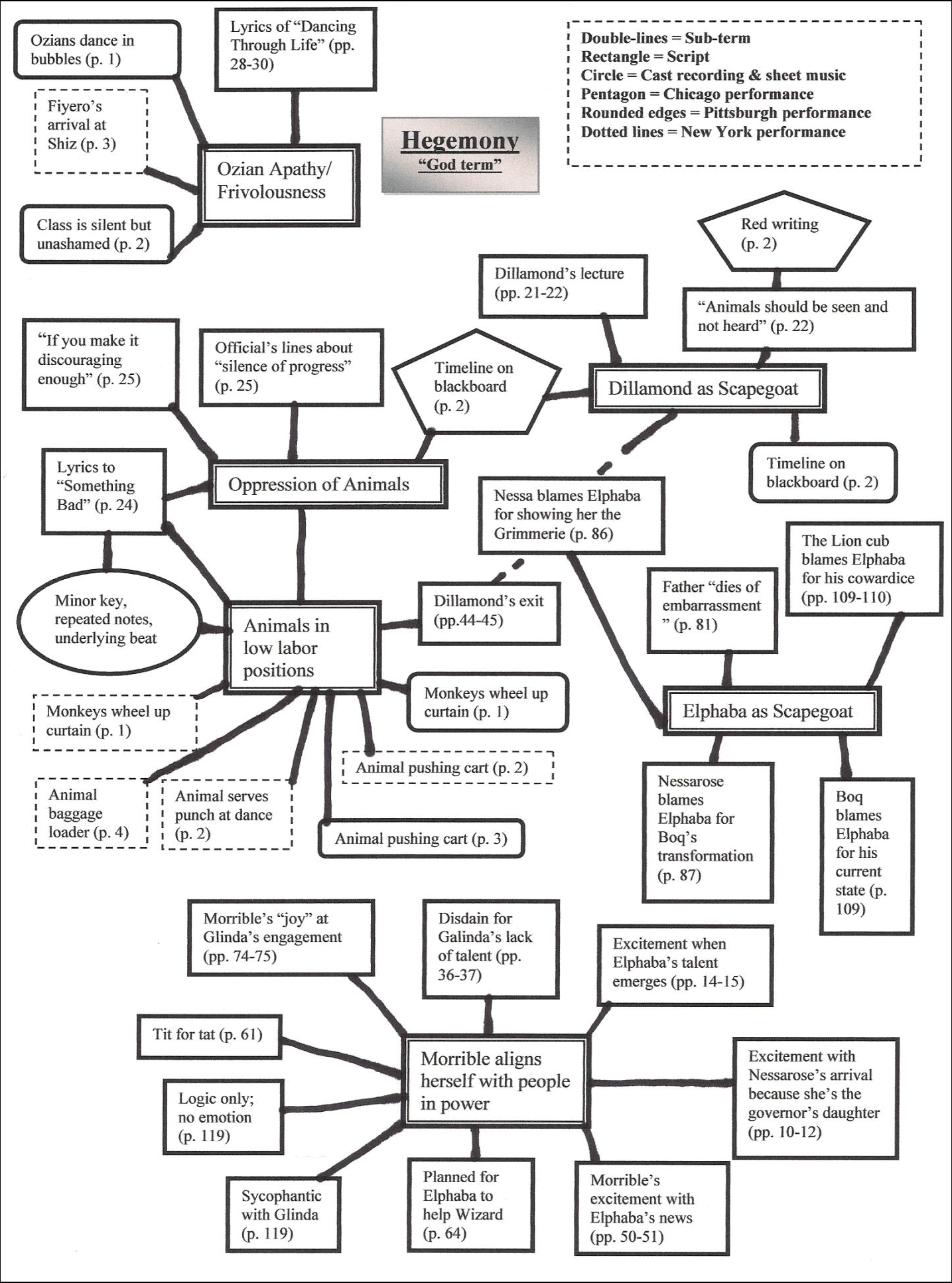
Figure 1. The cluster map created through this study. You can also view this image as a full-page PDF file here.
Apathy
The apathy of the Ozian public is first revealed through the character of Fiyero in the first act. A trouble-making prince from Oz’s Vinku province, Fiyero, upon arrival at Shiz University, immediately encourages the other students to stop studying and start “dancing through life.” Fiyero is a carefree party boy, and in the Chicago production, he was played very much like a stereotypical fraternity brother seen in popular American movies. Fiyero begins the song “Dancing through Life” in an upbeat, major key:
Dancing through life, skimming the surface, gliding where turf is smooth. Life’s more painless for the brainless. Why think too hard when it’s so soothing, dancing through life? No need to tough it when you can sluff it off as I do. Nothing matters, but knowing nothing matters. It’s just life, so keep dancing through.
At first, one may dismiss Fiyero’s lyrics as simply a carefree happy-go-lucky character encouraging his classmates to worry less and have more fun. However, other themes and examples in the musical suggest that this upbeat don’t-worry-be-happy song actually has deeper implications. In Oz, Animals (with a capital A) are different from animals (with a lower-case a) because of their ability to think and communicate; they are essentially an oppressed social class that is gradually having their rights stripped away from them. By encouraging his classmates not to think about things that upset them, Fiyero turns his back on the oppression of the Animals, thus contributing to the hegemony in the country. As Lentner notes, hegemony cannot occur without the public’s consent. If the public chooses to ignore issues that trouble them, they are, in a way, giving their consent for such problems to exist.
This apathy is further illustrated in the reactions of the class in the Pittsburgh and New York performances when Dr. Dillamond, the students’ Goat professor, turns his blackboard around and sees that someone has written “Animals should be seen and not heard” in large red letters. In the Chicago production, the Ozian students were ashamed and hung their heads. In the other two performances, however, they were silent with blank expressions on their faces, thus suggesting apathy; they simply do not care what happens to the Animals in Oz. It is this apathy that allows the hegemonic regime to oppress Animals without having to justify this oppression to a concerned public.
Aligning Oneself with Those in Power
This cluster analysis revealed three unique strategies used by hegemonic leaders to gain or maintain control over their populace: Aligning with those in power, scapegoating, and demoting Animals to lower level positions. The first strategy is primarily illustrated through the character of Madame Morrible, the students’ headmistress and later the Wizard’s press secretary, who seeks to connect herself with those in power in order to increase her own power. Morrible’s interest in those with power is apparent when she first meets Elphaba and her sister Nessarose, who are the daughters of the Governor of Munchkinland. She immediately fawns over the beautiful Nessarose in hopes to aligning herself with Nessarose’s powerful father. In the same scene, Morrible recognizes that Elphaba has a natural talent for sorcery, and insists on teaching Elphaba in a private sorcery seminar, in hopes that Elphaba will be able to develop her skill enough that Morrible can present her to the Wizard and be rewarded for her efforts.
Later in Act 1, when Madame Morrible arrives to tell Elphaba that the Wizard wants to meet her, Morrible is at least as overjoyed, if not more so, than Elphaba herself. While initially this appears to simply be the happiness of a mentor at seeing her student excel, it becomes clear that Morrible had selfish reasons for mentoring Elphaba and being happy for her. When Elphaba meets the Wizard and casts a spell to make the Wizard’s pet Monkeys fly, Morrible, as the Wizard’s new press secretary, tells the Wizard excitedly, “I knew it! I knew she had the power! I told you!” Elphaba, upset and backing away from Madame Morrible, replies, “You . . . you planned all this?” Morrible quickly tries to cover her selfish motives by insisting, “For you too, dearie! You benefit, too!” However, Elphaba is aware that she has been taken advantage of by her own instructor.
In this same scene, Morrible clearly articulates her quid pro quo strategy for gaining power. “I’ve risen up in the world,” she tells Elphaba and Glinda. “You’ll find that the Wizard is a very generous man. If you do something for him, he’ll do much for you.” It later becomes clear that Morrible offers two advantages for the Wizard: 1) She has trained Elphaba, a talented young sorceress who the Wizard hopes will join his regime, and 2) she uses her own sorcery power to help the Wizard achieve his goals. In return, Madame Morrible becomes an important figure in the regime. Madame Morrible’s actions suggest that the quid pro quo strategy is one strategy that hegemonic leaders may use to obtain their power.
Along with her desire to align herself with those who are powerful or potentially powerful comes Madame Morrible’s disdain for the ordinary. This is revealed through her dismissal of Galinda, who desperately wants to win Morrible’s favor and wishes to major in sorcery. Morrible brushes off Galinda’s questions about her entrance essay and refuses to include her in her sorcery seminar until Elphaba insists on it. When she reluctantly permits Galinda to join in the seminar, Madame Morrible tells her, “My personal opinion is that you do not have what it takes. I hope you prove me wrong. I doubt you will.” While most instructors seek to encourage their students to excel in their chosen major, Madame Morrible is completely unconcerned with Galinda’s education. Morrible is concerned only with her own welfare, and only encourages those who show promise because they potentially could help her obtain the power she seeks. Those, like Galinda, who do not show promise immediately, are simply brushed aside.
However, once Glinda becomes a figurehead in the Wizard’s regime, Madame Morrible begins treating her with respect, ultimately attempting to use her sycophantic ways to try to escape incarceration. When Glinda becomes engaged to Fiyero, Madame Morrible announces cheerily, “Glinda, dear, we are happy for you! As Press Secretary, I’ve striven to ensure that all Oz knows the story of your braverism!” The story that she tells, however, is a lie that is used to make Glinda look good in front of her constituents while making Elphaba appear jealous, angry, and mean. The story accomplishes two goals for Morrible as hegemonic leader: 1) She is able to continue to align herself with those in power by painting Glinda in a positive light, and 2) she is able to re-contextualize the situation to paint Elphaba in a negative light.
Morrible also attempts to survive a regime change through her sycophantic strategy when Glinda banishes the Wizard from Oz. She anxiously tells Glinda, “I know we’ve had our miniscule differences in the past, but . . .” Glinda, who is angry and confident in taking the reins of leadership, is not interested in listening to her, just as Morrible refused to listen to her when Glinda was a powerless young pupil. Glinda sends Madame Morrible to prison; it is Morrible’s disdain for the powerless, which initially caused her to rise to power, that ultimately is the key to her undoing. Morrible’s undoing seems to go against Audre Lorde’s famous quote: “The master’s tools will never dismantle the master’s house” (110). In her essay, Lorde suggests that feminism as a movement cannot be successful as long as it works within a patriarchy that will never let it advance. While this may be true of social movements, individuals are often brought down by the same device that causes them to rise to power. Morrible’s case suggests that a hegemonic leader’s own strength can also be her Achilles’ heel.
Scapegoating
The second strategy, scapegoating, is illustrated through a number of characters in the musical. Scapegoating is used by hegemonic regimes to maintain control over their state. The term “scapegoat” initially described a goat on which people symbolically placed their sins; the goat was then sent ceremoniously into the wilderness (Bremmer 8145). Similarly, a scapegoat is now “a specific person or minority” who is blamed for “crises (economic, political, social)” (Bremmer 8145). This analysis revealed two scapegoats in Wicked: The Animals in Oz (including Dr. Dillamond), and ultimately, Elphaba herself.
First, it is no surprise that Dr. Dillamond, the chief Animal character in the show, is a Goat. In fact, it is Dr. Dillamond, when lecturing to the students on Ozian history, who introduces the term scapegoat. He tells them,
Doubtless you’ve noticed I am the sole Animal on the faculty – the ‘token Goat,’ as it were. But it wasn’t always this way. Oh, dear students, how I wish you could have known this place as it once was. When one could walk these halls and hear an Antelope explicating a sonnet, a Snow Leopard solving an equation, a Wildebeest waxing philosophic. Can you see, students, what’s being lost? How our dear Oz is becoming less and less, well, colorful. Now, what set this into motion?When Elphaba answers that it began with the Great Drought, Dillamond continues, “Precisely. Food grew scarce, and people grew hungrier and angrier. And the question became – who can we blame? Can anyone tell me what is meant by the term ‘scapegoat?’”
Dillamond’s story is further enhanced by a visual aid in his classroom. In all three of the productions documented for this study, a timeline on a blackboard further illustrated this point. The timeline contained a history of Oz, including such events as the Great Drought, the ending of the war, and the Wizard’s arrival. The timeline allows Dillamond to show his students which events occurred in what order so that they may make connections between history and the oppression currently facing the Animals.
Dillamond’s story, while a fictional story in a musical, has real-life parallels. Most striking is perhaps the rise of anti-Semitism in post-World War I Germany. As Burke discusses in “The Rhetoric of Hitler’s Battle” (The Philosophy of Literary Form), Germany was in a state of economic ruin after the First World War and the German people were struggling. When Hitler took power, he sought to unify the country and offered the German people a “panacea, a ‘cure for what ails you,’ a ‘snakeoil,’ that made such sinister unifying possible within his own nation” (192). This “panacea” included the creation of a common enemy: The Jewish people. Writing in 1941, Burke suggests that Hitler was using the Jewish people as a “projection device” or “scapegoat;” one on which the German people could “hand over [their] ills” in order to be purified (202-203). The Jewish people were thus blamed for Germany’s problems, and this blame ultimately led to the Holocaust, where millions of Jews were murdered. The Animals in Oz serve as a reminder for audience members that there have been many social groups throughout history that have been unfairly blamed and persecuted for a nation’s problems.
As Dillamond’s story suggests, Animals are the primary scapegoat for Oz’s troubles. The same scene provides evidence that Ozians believe that Animals are the source of Oz’s problems. When Dillamond flips the blackboard to write on the side of it that does not contain the timeline, he sees the words “Animals should be seen and not heard” written in large red letters. As previously mentioned, the students’ reaction to this event varies by performance. Dillamond’s reaction also varies by performance. In the Chicago and Pittsburgh performances, Dillamond appeared angry and perhaps frightened. He screamed at the students to leave. In the New York performance, he appeared to be more hurt than angry, and his voice shook a bit when he told the students to leave.
Each performance choice offers a slightly different message for the audience to consider. The Chicago performance suggests that those being oppressed are strong and willing to fight, and that the Ozian population merely needs to be educated, like the students who recognized the unfair treatment and felt shame because of it, in order to change society and end the oppression. In contrast, the Pittsburgh performance suggests that the oppressed class of Animals, represented by Dr. Dillamond, is strong and willing to fight for their rights, but face the added challenge of winning the hearts and minds of an apathetic public. Finally, the New York performance allows audience members to feel more sympathy for the Animals, represented by a shaken Dr. Dillamond, and less sympathy for the students, or Ozian society, whom they represent.
Animals are not the only scapegoat in Wicked. Elphaba herself becomes a scapegoat in Act II. First, she becomes a scapegoat for her family. Elphaba’s sister Nessarose blames Elphaba for both their father’s death and the transformation of Boq, a Munchkin whom Nessarose loves. When Elphaba travels to Munchkinland to ask for her father’s help, Nessarose tells Elphaba that he died of shame because of Elphaba’s actions. Nessarose also blames Elphaba for Boq’s physical condition. When Nessarose erroneously casts a spell that has potentially-fatal effects on Boq, Elphaba saves Boq’s life by turning him into a tin woodsman. After Elphaba’s exit, Nessarose screams to Boq, “It wasn’t me; it was her! I tried to stop her! It was Elphaba, Boq, it was Elphaba!” Both of these examples suggest that Nessarose does not take responsibility for her own actions; instead, she blames Elphaba, the family scapegoat.
By the end of the musical, Elphaba becomes more than simply the family scapegoat. She becomes a scapegoat for the entire nation of Oz. This is especially prevalent during the mob scene at the end of the musical. As the mob sets out to kill the “Wicked Witch,” two figures, one human and one Animal, blame her for their troubles. The first figure is Boq, who declares that he holds Elphaba responsible for his condition and wishes to kill her in retaliation. The second figure, a Lion whom Elphaba and Fiyero freed during college, relays his message to Boq, who speaks for him. Boq announces to the mob, “The Lion also has a grievance to repay. If she’d let him fight his own battles when he was young, he wouldn’t be a coward today!”
The Lion’s story suggests that Elphaba has become a scapegoat for her own cause. Animals whom she has tried to help have blamed her for their troubles. Some social protest leaders, like Elphaba, have become a scapegoat for their own causes. One figure in U.S. history that exemplifies this is abolitionist John Brown. Brown became a leader of antislavery guerillas and fought against proslavery attacks. In retribution for a proslavery attack, Brown brutally murdered five settlers in a proslavery town (“John Brown”). While some abolitionists, like Ralph Waldo Emerson and Henry David Thoreau, praised Brown (“John Brown”), other leaders, like Abraham Lincoln, disapproved of Brown’s actions and believed he was insane (Sandburg). Brown became one of the most controversial figures of his time and has been partially credited with starting the Civil War (Frye). Like Brown, Elphaba is not only a scapegoat for her opposition, but for those who support her cause. Elphaba reminds audience members that one of the risks of fighting against hegemony is becoming a scapegoat.
Demoting Animals to Lower Level Positions
Another hegemonic strategy revealed through this analysis is the demotion of those in the oppressed class to lower level positions. Throughout Wicked, especially in the first act, Animals have been demoted to manual labor positions. What is particularly interesting about this theme is that it emerged almost entirely from performance fieldnotes, while most of the other themes and sub-themes arose from the script with the performance fieldnotes taking a supporting role. In fact, six out of the nine examples regarding this sub-theme are observable only through performance (see Fig. 1).
The first example occurs at the very beginning of all three performances. Flying Monkeys push, pull, and spin mechanical-looking wheels that appear to cause the curtain to rise. The Monkeys make sounds, but they do not speak as they turn the wheels and cogs. In the New York performance, they entered the stage from every possible entrance: Some entered from stage left or stage right, some came from around the proscenium, and still others entered the stage through trap doors in the floorboards of the stage.
Other examples of Animals doing manual labor occur at various points in Act I. Both the Pittsburgh and the New York performances included a character bit of an Animal pushing a cart containing Galinda’s massive suitcases when she arrives at Shiz University. The New York performance also featured an Animal serving punch to Boq and Nessarose in the dance scene at the OzDust Ballroom and an Animal loading and unloading baggage at the train station when Elphaba leaves for the Emerald City. In my fieldnotes from the New York performance, I note that the latter “looks exhausted and wipes the sweat from his brow.”
In fact, with the exception of Dr. Dillamond, Animals are never seen in a position of power or prestige during the musical. Dr. Dillamond explains the situation to Elphaba in the song “Something Bad.” The song serves as a warning, as indicated by its minor key, repeated notes, and underlying formidable-sounding beat. Dillamond sings,
I’ve heard of an Ox, a professor from Quox, no longer permitted to teach, who has lost all powers of speech. And an Owl in Munchkin Rock, a vicar with a thriving flock, forbidden to preach. Now he only can screech.
Dillamond’s story suggests that Animals in prestigious positions, particularly those in religious orders and higher education, were ousted from their jobs. Later, Dillamond becomes an example of his own story when he himself is forbidden to teach at Shiz University. With urgency, he enters his classroom for the last time, quickly tells his students that he appreciates them, and assures Elphaba that “They can take away my job, but I shall continue speaking out!”
When taken in context with Dillamond’s story and experience, it seems unlikely that the Animals in lower level positions, such as the baggage loader and the punch server, chose to take these jobs because they enjoy them. In Oz, Animals are forced to take these positions because they are considered a lower social class, and Animals in prestigious positions, such as professors or pastors, are removed by the government from the very positions they worked hard to obtain. Again, Wicked reminds audience members of real-life history: This is similar to the initial measures the Third Reich used in the 1930s to persecute the Jewish people. According to the United States Holocaust Memorial Museum website, in 1933, the Nazi-dominated German government passed a law that forbade Jews from holding positions in government, in the tax profession, and as stage actors. The German government also restricted their rights when holding positions in the legal sphere and in the medical profession. The rights of the Jewish people in Germany were further abolished throughout the 1930s until ultimately they were sent to concentration camps during the Holocaust. Wicked’s story serves as a warning to audience members about the dangers of apathy and the necessity of taking action. The musical reminds theatre-goers that no nation is safe from committing these atrocities, unless its citizens remember history, keep aware, and take action.
Cluster Criticism for Layered, Performative Texts: Moving Forward
Scholars have utilized Burkean concepts in studies of performance and popular art in various ways. In his book exploring twentieth century theatre and Shakespearean plays, Francis Fergusson explores the connection between dialectic and drama in Burke’s Grammar of Motives. He explains that “behind Mr. Burke’s view of the dialectic process there lurks ritual drama” (201), and praises Burke’s “analysis of language,” noting that it “works like a farcical plot” (xvii). C. Ronald Kimberling connects Burke’s work to popular art, using dramatism to analyze the film Jaws, the television miniseries Shogun, and the Stephen King novel The Dead Zone. He suggests that “dramatism has the flexibility to enable us to penetrate several aspects of popular arts from a variety of angles” (13). In his work on theatre as ritual, Bruce A. McConachie uses dramatism to define theatre as “a type of ritual which functions to legitimate an image of a historical social order in the minds of its audience” (466). This article has attempted to contribute to this ongoing conversation by proposing an extension of Burke’s cluster criticism to include performative elements of performative, layered texts. Through an analysis of hegemony in the musical Wicked as a case study, I have sought to expand the scope of cluster criticism so that it may be used for a broader range of texts.
While cluster criticism has previously been used primarily for examining public address texts, newspaper articles, and other word-oriented texts, Rueckert observes in Kenneth Burke and the Drama of Human Relations that cluster criticism can be used to examine dramatic texts, such as plays, as well. When employed in a traditional word-oriented manner, cluster criticism can reveal clusters surrounding “God terms” and/or “agon terms” that provide insight into the intention of the texts’ authors. Rueckert suggests that the cluster criticism can be applied to different texts in the same way (88), but applying traditional cluster criticism to a performative text only accommodates the words in a script or perhaps lyrics in a song, excluding elements that can only be experienced through performance. While the general procedure remains the same, this article has suggested that cluster criticism be extended to accommodate the various layers of a performative, fragmented text. Instead of searching for particular words that cluster together to form meanings, this extension of cluster criticism requires the critic to search for themes that clustered together to form meanings. In this case study, these clusters emerged upon the examination of each layer of the performative text (the New York performance script, fieldnotes from each of three performances, the original cast recording, and the sheet music).
First, this cluster analysis began with a “God term” that was contrived after a close reading of the textual layers used for this study, as well as after a review of the literature on the “God term” (hegemony). One “God term” was chosen in order to limit the numbers of clusters and sub-clusters to a manageable amount for this study, but future studies may include multiple “God terms” or include “agon terms” as well. It should be noted that different clusters and sub-clusters could emerge from the same text if a different term or phrase was used as a lens with which to examine each layer of text.
By analyzing each layer of text, numerous clusters and sub-clusters emerged from this analysis. These clusters included Ozian apathy and frivolousness, the oppression of Animals, the demotion of Animals to lower level positions, the scapegoating of Elphaba, the scapegoating of Dr. Dillamond, and aligning oneself with people in power (illustrated through the character of Madame Morrible). These six clusters form four overarching themes concerning Wicked’s messages about hegemony: 1. Apathy leads to hegemony, 2. Hegemonic leaders use scapegoating to gain/maintain their power, 3. Hegemonic leaders align themselves with those already in power to gain/maintain their power, and 4. Hegemonic regimes may demote members of the oppressed class from prestigious positions in order to gain/maintain power. Each of these themes was supported by a number of examples from the various layers of this performative text. It is important to note that the fourth theme was primarily illustrated through performative elements, and would not have emerged from a textual analysis or cluster criticism of the script’s text. The emergence of the fourth theme suggests that in order to thoroughly examine performative texts, one must extend cluster criticism as a method to include not only words and lyrics, but also performative elements, such as use of props, stage movement, music, and visual and sound effects.
The intention of this article was to provide rhetorical critics, performance scholars, and scholars of film, television and other media with a methodology through which to rhetorically study themes in layered, performative texts. Future research may employ cluster criticism to study multiple performances of theatrical productions, both musical and non-musical, the different visual and auditory elements of a television program episode, or the various layers of a film. It is my hope that rhetorical and performance scholars will find this extension of cluster criticism valuable when examining a variety of performance-oriented rhetorical texts, whether those texts are performed live, part of everyday life, videotaped, or broadcasted through new media.
Notes
1. The word Monkey is capitalized because in Wicked, Ozian Animals (with a capital A) are distinguished from animals (with a lower-case a) because of their ability to think and communicate; they represent an oppressed social class.
2. Agon-terms (or “devil terms”) are key words that appear to have the opposite message of “God terms.” Berthold explains that agon-terms, when contrasted with “God terms” can reveal a speaker’s intentions.
3. In Permanence and Change, Burke discusses “hegemony of custom” (186). He explains, “If there is a slave function in such a culture, the class that so functions does not know itself as such. A true slave morality is implicitly obeyed – and while such morality is intact, the slave does not consider his obedience as slavery, any more than a child normally considers obedience to its parents slavery. Before such obedience can be explicitly considered a state of slavery, a perspective by incongruity must arise” (186).
4. In “My Approach to Communism,” Burke refers to the “hegemony of business” when contrasting communism and fascism. He states, “The Fascist retention of business as the keystone of its scheme leads logically to the attempted subjugation of the workers, precisely as the Communist elimination of business leads to their establishment as the fulcrum of the governmental policies and purposes…Hence the logical demand that one choose Communism, which eliminates the hegemony of business, as against Facism, which would attempt to erect a stable economy atop the contradictions of business enterprise” (18).
* This article was adapted from the author’s dissertation. The author would like to thank her dissertation committee, Dr. Jerry L. Miller, Dr. William K. Rawlins, Dr. Benjamin R. Bates, Dr. J.W. Smith, and Dr. Jordan Schildcrout of Ohio University, for their guidance.
Works Cited
Aiken, Roger Cushing. “Was Jud Jewish? Property, Ethnicity, and Gender in Oklahoma!” Quarterly Review of Film and Video 22 (2005): 277-283. Print.
Angrosino, Michael V. “Recontextualizing Observation: Ethnography, Pedagogy, and the Prospects for a Progressive Political Agenda.” Handbook of Qualitative Research. 3rd ed. Eds. Norman K. Denzin and Yvonna S. Lincoln. Thousand Oaks: Sage, 2005. 729-762. Print.
Aristotle. On Rhetoric. 2nd ed. Trans. George A. Kennedy. Oxford: Oxford UP, 2007. Print.
Berthold, Carol A. “Kenneth Burke’s Cluster-Agon Method: Its Development and an Application.” Central States Speech Journal 27 (1976): 302-309. Print.
Blakesley, David. The Elements of Dramatism. New York: Longman, 2002. Print.
Bremmer, Jan N. “Scapegoat.” Encyclopedia of Religion. 2nd ed. Ed. Lindsay Jones. Vol. 12. Detroit: Macmillan Reference, 2005. 8143-8146. Print.
Burger, Alissa. From ‘The Wizard of Oz’ to ‘Wicked:’ Trajectory of American Myth. Diss. Bowling Green State U, 2009. UMI, 2009. ATT. 3350672.
Burke, Kenneth. Attitudes Toward History. Boston: Beacon Press, 1959. Print.
—. A Grammar of Motives. Berkeley: U of California Press, 1969. Print.
—. “My Approach to Communism.” The New Masses 10 (1934): 16, 18-20. Print.
—. Permanence and Change: An Anatomy of Purpose. Berkeley: U of California Press, 1954. Print.
—. The Philosophy of Literary Form: Studies in Symbolic Action. Baton Rouge: Louisiana State UP, 1941. Print
Charland, Maurice. “Constitutive Rhetoric: The Case of the Peuple Quebecois.” Quarterly Journal of Speech 73 (1987): 133-150. Print.
Conquergood, Dwight. “ Beyond the Text: Toward a Performance Cultural Politics.” The Future of Performance Studies: Visions and Revisions. Ed. S. J. Dailey. Annandale, VA: National Communication Association, 1998. Print.
Cook, Susan C. “Pretty like the Girl: Gender, Race and Oklahoma!” Contemporary Theatre Review 19 (2009): 35-47. Print.
Corcorcan, Farrel. “The Bear in the Back Yard: Myth, Ideology, and Victimage Ritual in Soviet Funerals.” Communication Monographs 50 (1983): 305-320. Print.
Docan, Tony; Freitas, Lisa, and Holtzman, Clay. "George W. Bush's 'National Day of Prayer and Remembrance' Speech: A Cluster Analysis of Bush's Rhetorical Argument for Revenge" Paper presented at the annual meeting of the International Communication Association, Marriott Hotel, San Diego, CA, 2003.
Elliot, Beverly F. “Nora’s Doors: Three American Productions of Ibsen’s A Doll House.” Text and Performance Quarterly 10 (1990): 194-203. Print.
Fergusson, Francis. The Human Image in Dramatic Literature. Gloucester: Peter Smith, 1969. Print.
Fontana, Benedetto. “The Democratic Philosopher: Rhetoric as Hegemony in Gramsci.” Italian Culture 23 (2005): 97-123. Print.
Foss, Sonja K. “Cluster Criticism.” Rhetorical Criticism: Exploration and Practice. Prospect Heights, IL: Waveland Press, 1996. Print.
—. “Women Priests in the Episcopal Church: A Cluster Analysis of Establishment Rhetoric.” Religious Communication Today 7 (1984): 1-11. Print.
Frye, Dennis E. “John Brown’s Smoldering Spark.” Hallowed Ground Magazine. Civil War Trust. 2014. Web. 27 February 2015.
Gadamer, Hans-Georg. Truth and Method. New York: The Continuum International Publishing Group, 2004. Print.
Gassner, John. “Aspects of the Broadway Theatre.” The Quarterly Journal of Speech 35 (1949): 289-296. Print.
Gramsci, Antonio. Further Selections from the Prison Notebooks. Trans. and Ed. Derek Boothman. London: Lawrence and Wishart, 1995. Print.
—. Letters from Prison. Trans. Lynne Lawner. New York: Harper Colophon Books, 1973. Print.
—. Selections from the Prison Notebooks. Trans. Quintin Hoare and Geoffrey Nowell Smith. New York: International, 1971. Print.
Graves, Michael P. “Functions of Key Metaphors in Early Quaker Sermons, 1671-1700.” Quarterly Journal of Speech 69 (1983): 364-378. Print.
Hellman, Wesley James. “Elements of tragedy in Arthur Miller’s The Crucible.” North Dakota Journal of Theatre and Speech 7 (1994): 84-92. Print.
Hoffman, Mary F. and Cowan, Renee L. “The Meaning of Work/Life: A Corporate Ideology of Work/Life Balance.” Communication Quarterly 56 (2008): 227-246. Print.
“John Brown.” Africans in America Resource Bank: Judgment Day, Part 4, 1831-1865. Public Broadcasting Service. Web. 27 February 2015.
Keohane, Robert O. After Hegemony: Cooperation and Discord in the World Political Economy. Princeton: Princeton UP, 1984. Print.
Kimberling, C. Ronald. Kenneth Burke’s Dramatism and Popular Arts. Bowling Green: Bowling Green State U Popular P, 1982. Print.
King, Andrew. “The State of Rhetorical Criticism.” Rhetoric Review 25 (2006): 365-368. Print.
Kruse, Sharon D. and Sandra Spickard Prettyman. “Women, Leadership, and Power Revisiting the Wicked Witch of the West.” Gender and Education 20 (2008): 451-464. Print.
Lane, Ileana. “A Relational Cultural Approach to the Broadway Musical Wicked.” Journal of Creativity in Mental Health 4 (2009): 173-179. Print.
Lentner, Howard H. “Hegemony and Autonomy.” Political Studies 53 (2005): 735-752. Print.
Lindlof, Thomas R. and Taylor, Bryan C. Qualitative Communication Research Methods. Thousand Oaks, CA: Sage Publications, 2002. Print.
Lorde, A. Sister Outsider: Essays and Speeches by Audre Lorde. Berkeley, CA: The Crossing Press, 1984. Print
Lynch, John. “Race and Radical Renamings.” Kenneth Burke Journal 2 (2006): 1-19.
Madison, D. Soyini and Hamera, Judith. “Performance Studies at the Intersections.” The Sage Handbook of Performance Studies. Eds. Norman D. Soyini Madison and Judith Hamera. Thousand Oaks: Sage, 2006. xi-xxv. Print.
McConachie, Bruce A. “Towards a Postpositivist Theatre History.” Theatre Journal 37 (1985): 465-486. Print.
McGovern, Stephen J. “Cultural Hegemony as an Impediment to Urban Protest Movements: Grassroots Activism and Downtown Development in Washington, DC.” Journal of Urban Affairs 19 (1997): 419-443. Print.
Mearsheimer, John J. The Tragedy of Great Power Politics. New York: W. W. Norton, 2001. Print.
Miller, Gail T. “Reality is Only an Option: Firesign Theatre and Surrealism.” Text and Performance Quarterly 11 (1991): 325-333. Print.
Most, Andrea. “Opening the Windshield: Death of a Salesman and Theatrical Liberalism.” Modern Drama 50 (2007): 545-564. Print.
—. “We Know We Belong to the Land:” The Theatricality of Assimilation in Rodgers and Hammerstein’s Oklahoma!” Publications of the Modern Language Association of America113 (1998): 77-89. Print.
Pao, Angela. “The Eyes of the Storm: Gender, Genre, and Cross-Casting in Miss Saigon.” Text and Performance Quarterly 12 (1992): 21-39. Print.
Papa, Lee. “We Gotta Make Up Our Minds: Waiting for Lefty, Workers’ Theatre Performance and Audience Identification.” Text and Performance Quarterly 19 (1999): 57-73. Print.
Pullum, Stephen J. “Common Sense Religion for America: The Rhetoric of the Jewish Televangelist Jan Bresky.” Journal of Communication and Religion 15 (1992): 43-54. Print.
Raab, Doris. “From Book to Broadway: Elphaba’s Gender Ambiguity and her Journey into Heteronormativity in Wicked.” Studies in Musical Theatre 5 (2012): 245-256. Print.
Rueckert, W. H. Kenneth Burke and the Drama of Human Relations. Berkeley: U of California Press, 1982. Print.
Sandburg, Carl. Abraham Lincoln: The Definitive One-Volume Biography. New York: Galahad Books, 1993. Print.
Schrader, Valerie Lynn. “Connecting to and Persuading Audiences through Musical Theatre: Burkean Identification in Harold Rome’s 1937 Musical Pins and Needles.” Pennsylvania Communication Annual 68 (2012): 70-83. Print.
—. “Face-work, Social Movement Leadership, and ‘Glinda the Good:’ A Textual Analysis of the Character G(a)linda in the Musical Wicked.” Studies in Musical Theatre 8 (2014): 43-55. Print.
—. “‘No Day But Today:’ Life Perspectives of HIV-positive Individuals in the Musical Rent.” Communication and Theatre Association of Minnesota Journal 36 (2009): 23-36. Print
—. “‘They Call Me Wonderful, so I am Wonderful:’ Social Constructionism in the Song ‘Wonderful’ in the Musical Wicked.” Pennsylvania Communication Annual 67 (2011): 61-72. Print.
—. “Witch or Reformer?: Character Transformations through the use of Humor in the Musical Wicked.” Studies in American Humor 23 (2011): 49-66. Print.
Schriver, Kristina and Nudd, Donna Marie. “Mickee Faust Club’s Performative Protest Events.” Text and Performance Quarterly 22 (2002): 196-216. Print.
Schweitzer, Carol. “A Parable, a Pearl and “Popular? How the Musical Wicked – Especially Elphaba’s Character – May Assist Adolescent Girls to Claim their Uniqueness.” Pastoral Psychology 61 (2012): 499-511. Print.
Scott, James C. Weapons of the Weak: Everyday Forms of Peasant Resistance. New Haven, CT: Yale UP, 1985. Print.
Sebesta, Judith. “Of Fire, Death, and Desire: Transgression and Carnival in Jonathan Larson’s Rent.” Contemporary Theatre Review 16 (2006): 419-438. Print.
Tomkins, Phillip K. “On Hegemony – ‘He Gave It No Name’ – And Critical Structuralism in the Work of Kenneth Burke.” Quarterly Journal of Speech 71 (1985): 119-151. Print.
Wolf, Stacy. “Wicked Divas, Musical Theater, and Internet Girl Fans.” Camera Obscura 22 (2007): 38-71. Print.
—. “Defying Gravity: Queer Conventions in the Musical Wicked.” Theatre Journal 60 (2008): 1-21. Print.
This work is licensed under a Creative Commons Attribution-NonCommercial-NoDerivatives 4.0 International License.
- 33908 reads
The Syrian Civil War, International Outreach, and a Clash of Worldviews
Peter C. Bakke, US Army, and Jim A. Kuypers, Virginia Tech
Abstract
We present a dramatistic analysis of the discourse of Syrian President Assad and his opposition in the ongoing Syrian civil war. Comparing terministic screens and world views expressed in the discourses, we find that the Assad regime believes it is not responsible for the current conflict, and is justified in the use of violence against rebel groups. Rebel groups overtly reject Western values and seek to depict their current and planned violence as morally justified.
Disclaimer
The views represented in this article are those of the authors and are not intended to officially or unofficially represent the position of the U.S. Army or U.S. Government.
Introductory Note
We originally undertook this project in the fall of 2013 – a time when the Assad Regime seemed to be gaining ground in the Syrian Civil War and rebel groups appeared to be fractured. Tension between the Syrian regime and the West was particularly high due to rebel allegations that the Syrian military was employing chemical weapons. ISIL (then known as the Islamic State of Iraq and al-Sham) was still jockeying for dominance with the Nusrah Front (al-Qaeda in Syria) within the trans-national Al-Qaeda power structure, and the refugee crisis was not nearly as intense as in late 2015. Throughout 2013, the Assad regime appeared to make a coordinated effort to portray itself as an ally in "Global War on Terror." When Assad appeared on Fox News to make such a case, we wondered whether he was trying to sell the U.S. public a "bill of goods." As Kenneth Burke might say, we wondered what kind of "medicine" the "medicine man" was prescribing. To gain a better perspective of the regime's position, we began examining the discourse of the disparate rebel groups fighting against Assad's forces to see if it lent any validity to his message. Coincidentally, many of the rebel groups we examined began collapsing under the umbrella of the "Islamic Front." In November of 2013, the "Islamic Front" issued a statement calling for the continuation of Jihad against the regime and the establishment of a Salafist Sunni Islamic state in Syria. Given this development, we felt that a two-sided analysis of the conflict's discourse would help uncover the motives of each side. We later added some examples of ISIL activities to demonstrate how ignoring rhetorical justifications for inhumane behavior (on both sides) can have serious implications.
* * *
The Islamic State, coined "ISIS" or "ISIL" by the U.S. news media, has recently garnered the attention of the U.S. and Western publics. Islamic State brutality against Yazidi Christians in the north of Iraq, seizure of crucial Iraqi infrastructure, and barbaric beheadings of American journalists James Foley and Steven Sotloff have resulted in the Obama administration's call for an international coalition to defeat the organization in Iraq and Syria. Coalition efforts have already required U.S. military commitment to meet the President's stated goal of "degrading and destroying" the Islamic State, and thwarting their objective of establishing an international caliphate. However, in order to make a new war palatable, as well as defend previous policy decisions, the Islamic State seems to be portrayed as a new and emerging threat, one differentiated from former adversaries who "pulled" us into previous conflicts. Thus, dominant administration and media narratives seem to push the idea that "ISIS" materialized from the ether to become a threat "even more extreme than Al-Qaeda" ("David Gregory"). U.S. Secretary of Defense Chuck Hagel, for instance, described the organization as "beyond anything we've seen," and Attorney General Eric Holder stated that ISIS's plans were " 'more frightening than anything I think I've seen as attorney general. . . . It's something that gives us really extreme, extreme concern….'" (Ritger, "Chuck Hagel"; Holder qtd. in Francis, "Why the Long Arm"). Suddenly, it seems the U.S. is faced with an enemy whose brutality tames our perception of those who attacked the U.S. in 2001 and may force our collaboration with the "blood soaked" regime of Bashar al-Assad. In the words of an Al-Qaeda aligned Syrian opposition fighter, "Your news makes it seem like [ISIL] appeared out of nowhere… [slamming his hand on the dashboard]. You want to talk about [ISIL]? Ask a Syrian!" (Day, "Syrian Fighter").
Presidential candidates and pundits now debate whether we should have armed earlier "a more moderate Syrian opposition" and whether collaboration with Assad is acceptable (Goldberg, "Hillary Clinton"). Such characterizations and suggestions, however, require a closer look at the recent history and discourse of the conflicts in Iraq and Syria. Such analysis would suggest that we have seen "ISIS" on the battlefield before (in Iraq 2003-2010), that "ISIS" and Al-Qaeda are the same movement, and that "ISIS"-like jihadist discourse permeates the influential branches of the very Syrian opposition the U.S. sought to aid in its rebellion against the Assad Regime (MacFarQuhar and Sadd, "As Syrian War Drags On").
Examining the discourse of the Syrian conflict is vitally important because the parties in conflict represent larger warring factions throughout the Middle East. Such sectarian conflict defies U.S. conceptions of allies and adversaries, because some of each may fall on either side of the sectarian divide, and much of the animus traces its roots back to the beginnings of Islam. Thus, it becomes important to understand how the conflict discourse of individual groups is indicative of motivation and actions that can potentially impact the security of American citizens and regional stability. An understanding of how extremism and violence manifest on both sides of the regional conflict can only encourage a more effective foreign policy.
Flowing out of dramatism is the idea that people universally use symbols to explain their actions in similar ways. In "The Rhetoric of Hitler's Battle," for instance, Kenneth Burke demonstrated how application of a dramatistic perspective allowed him to discover "what kind of 'medicine' this medicine-man [Hitler] has concocted, that we may know… exactly what to guard against, if we are to forestall the concocting of similar medicine in America" (Burke, "The Rhetoric of Hitler's Battle" 191). Burke's implication is clear: we should examine the speech-acts of those outside of the "American" world view, as well as critically compare such content with that of our own domestic political discourse. Other scholars since Burke have used dramatism and the pentad as starting points for the examination of non-U.S. and non-Western discourse. For example, Adriana Angel and Benjamin Bates examined Columbian radio conversations, Xing Lu examined the rhetoric of Chinese nationalism, Pedro Patron-Galindo examined the political marketing strategies of Peruvian President Alejandro Toledo, and Colleen E. Kelley wrote on the rhetoric of Soviet leader Mikhail Gorbachev (Angel and Bates; Lu; Patron-Galindo; Kelley). In general, the operating assumption of such studies is that Burkean dramatism is cross-culturally applicable, but the essays stop short of explaining why this is so or how one might efficaciously apply dramatistic principles most fruitfully in a cross-cultural context. In this paper, we demonstrate how this process, combined with an in-depth knowledge of recurrent cultural narratives flowing within a foreign discourse, can establish a framework that allows the dramatistic pentad to function as an effective cross-cultural analytical tool. Further, this dramatistic analysis of foreign discourse allows for an effective critical comparison between both the motives of a speaker with a foreign world-view and his or her representation in U.S. political discourse.
The nascent means for such a comparison (situational contextualization, explanation of cultural metaphor, application of the pentad, comparison with domestic discourse) are found in Burke's analysis of Mein Kampf, which includes all of these elements without specifically including them in the framework of dramatism. Burke contextualizes Hitler's anti-Semitic writing, for instance, by providing rich descriptions of the political conditions of Pre-World War I Vienna and Post-World War I Munich. Further, he describes the Christian and German mythology that functioned as a common language between Hitler and his potential base of supporters. This added knowledge allows his explanation of Hitler's foreign world-view to function cross-culturally. How else might one of Burke's readers of the 1930s (English speakers) be able to understand the particularly German flavor of Hitler's strongly anti-Semitic persuasive campaign? We believe that the application of dramatistic principles to the discourse of those with non-U.S. world-views is as relevant today as it was when Burke wrote of Hitler. As a contemporary extension to Burke's ideas, we examine the rhetoric of the still evolving sectarian conflict in Syria and Iraq, and then discuss how the reflection of such discourse in domestic politics holds serious implications for U.S. foreign policy. We accomplish this in five stages: first, we contextualize the nature of the conflict in Syria; second, we explore the different cultural narratives of President Assad and the Islamic Front; third, using a dramatistic analysis we analyze the internationally aimed discourse of Assad and the Islamic Front; fourth, we specifically look at the metaphor underpinning Assad's outreach to the United States; finally, we conclude with an exploration of Syrian clashing world views and implication for dramatism and U.S. policy in the region.
Contextualization: The Nature of the Syrian Conflict
The Syrian conflict, much as the Syrian population at large, comprises numerous groups and alliances. A 74% majority of Syrians are Sunni Muslims of Arab descent. A large portion of the Sunni-Arab population lives in rural areas throughout the country. The minority Syrian population consists of 12% Alawite-sect Shia Muslims (to which the Assad family and ruling class belong), with the remaining 14% of the population consisting of Christians, Jews, Kurds, and Druze ("Syria—People and Society"). For the purpose of discussion, we characterize the conflict within Syrian borders as one between the Sunni majority and ruling Alawite-Shia minority. However, sectarian and ethnic alliances within Syria spill well outside its borders. For example, Alawites maintain strong ties with their Shia neighbors in Iran and Lebanon, as well as certain militant/terrorist groups such as Hezbollah; the Sunni majority finds kinship among other Sunni-Arab dominated nations such as Saudi Arabia and Jordan, as well as support from transnational jihadist groups (Al Qaeda, for example) throughout the Middle East (Fassihi, Solomon, and Dagher, "Iranians Dial up Presence in Syria"). Therefore, the Alawite-Shia versus Sunni conflict within Syria can be viewed as part of a larger pan-Islamic sectarian struggle with implications for all nations involved. Further, undertones of secularism versus Islamism color the brutality inflicted by both parties.
Aron Lund provides insight into the ethno-religious sectarian nature of the conflict, writing, "revolutionary demands originally focused on democracy and economic reform but the new opposition movement did not arise in a social vacuum." In socio-economic terms, he describes the uprising as an "ideologically motivated uprising of the Sunni working class against the Alawite military ruling elite" (Lund, 8). As the conflict entered its second year in 2012, increasing numbers of foreign fighters (Salafi-Sunnis) joined the fray ("Syria Profile"). Although Sunni Syrians comprised the bulk of the opposition, further backing arrived from in the form of foreign ideologues and Islamic extremists—namely al-Qaeda (AQ). In May of 2013, analysts from the Rand Office for External Affairs provided testimony for the House Homeland Security Committee designating Jabhat-al-Nusrah as the Syrian arm of AQ. Analyst Seth Jones testified that "Jabhat al-Nusrah (JN) grew out of AQ in Iraq (AQI)." After a 2013 split with AQI, JN pledged allegiance directly to AQ senior leadership in Pakistan. The remainder of AQI maintained allegiance to Abu-Bakr al-Baghdadi and became known as the Islamic State of Iraq and the Levant (Syria) or "ISIL / ISIS." The point here is not to trace the linage and development of groups making headlines in the U.S.; rather, we wish to demonstrate a common sectarian interest between groups labeled "moderate" and those implementing the most perverse interpretation of Sunni Islam imaginable. When interacting with each other, JN and ISIS might be enemies. However, in the context of the sectarian war, they should be considered estranged brothers.
Burke demonstrated how one ideologue (Hitler) used language to set the German people on a path to destruction. Because conflict had yet to unfold, he needed to analyze only one voice, Hitler's. The Syrian situation differs in that it has evolved into a conflict with many parties. As such, we proceed by choosing an Alawite-Shia voice and a Sunni voice we feel most representative, the "embodiment," of each side. The ruling Alawites have been led and represented by the Assad family since the 1970's. Hafez al-Assad (now deceased), and his son Bashar have represented the Alawite-Shia grip on Syrian power for nearly 40 years. Likewise, they serve as a lightning rod for the animosity of a frustrated Arab-Sunni population. Thus, Bashar al-Assad is our chosen voice for the Alawite-Shia faction.
In November 2013, The Syrian Islamic Front, elements of the Free Syrian Army, and Islamist elements formerly operating under Supreme Military Command united under the banner of one group – the Islamic Front. ISIS and JN have formerly allied with the Islamic Front. Despite current estrangement between the groups, the Islamic Front provides the voice for the Sunni-Arab faction of the conflict. We selected the Islamic Front for two reasons: (1) it is directly opposed to Assad and (2) U.S. politicians indirectly cite them as "moderate" due to their estrangement from "ISIS."
Clashing Cultural Narratives
Having established some situational context, we now turn to the undercurrents of Syrian dialogue. In 2012, the Director of National Intelligence's Open Source Center (OSC) published Master Narratives Country Report: Syria. The report is intended to facilitate an understanding of the language used by various groups within Syria. The report details eight master narratives and subordinate themes, which interact or stand-alone, to shape each groups understanding of events. We use this document as our initial touchstone for understanding Syrian cultural narratives. Similar to how Burke expounded on Hitler's perversion of religion, we seek to use Syrian cultural narratives as an example of the "baseline" from which each side deviates. These "master narratives" are the threads with which Syrians tell stories and sometimes act as a lens through which they interpret events. Much as the German of the 1930's found familiarity in the liturgical rhythm of Nazi repetition, the Sunni-Arab Syrian might find familiarity in reference to the "Greater Levant." Much as the German blamed his economic problems on the tangible Jew, the Sunni-Arab narrative might provide a pre-ordained scapegoat in the Alawite.
Assad Narrative

Syrian President Bashar al-Assad attempts to convey his popularity. Courtesy of NPR.org.
Assad's explanation of current events, contained in his September 2013 news media interview with Dennis Kucinich and Greg Palkot, displays three prominent narratives common among the groups that he represents (Al-Assad). The included narratives are (1) Alawite Survival, (2) Conspiracies All Around, and (3) Greater Syria (United States, "Open Source Center" Executive Summary). According to the OSC, the "Alawite Survival" narrative centers around the Alawite rise from Sunni oppression by virtue of their "superior achievements." This narrative maintains that the Alawites hold a rightful place in the halls of leadership but always remain threatened by "fanatical Sunni's who wish to destroy them" (United States, "Open Source Center" 33). The core themes of "Alawite Survival" are the concepts of encirclement, existential fear, and survival. Assad addresses the themes of existential fear and encirclement through his characterization of the conflict. His description of foreign backed terrorists working in conjunction with fanatical jihadists toward an ideologically closed society invokes the possibility of Alawite destruction. A "new kind of war" also elicits the fear of the unknown, in which alliances among individuals and nations threaten a small core of Syrians dedicated to preservation of the state.
The "Conspiracy" narrative, as expressed by Assad, is particularly salient when used in conjunction with "Alawite Survival." The narrative is based upon Syria's turbulent history and espouses a worldview where "secretive cabals inside the country, scheming Westerners and envious Arab neighbors conspire against the people" (United States, "Open Source Center" 13). For his part, Assad alleges not only a terrorist threat but also raises the specter of faceless enemies who agitate the rebellion from afar. He names al-Qaeda among the conspirators but also accuses other Western and Arab nations of fomenting unrest.
Here we can establish a relationship between Assad's heavy use of scenic descriptions or grounded terminology (explained in the next section) and the wide array of Alawite cultural narratives that support them. Hostile Sunni's, terrorists, and foreign-led cabals create an environment where the secularist Alawites' struggle to survive. Such survival depends on Alawite ability to combat forces beyond their control. Thus, the Alawites are not responsible for the conflict. This demonstrates consistency between contemporary scene driven explanations and environmentally dominated Alawite cultural narratives. It also suggests that Assad's characterization of conflict is an attempt to sway listeners toward his real worldview.
Assad's self-described end-state for the conflict embraces the "Greater Syria" narrative. This narrative stems from the belief that Syria is the cradle of civilization. After having been fractured by the West, Syrians must seek to "restore their pride by reinstating Syria as a homeland for all creeds and the vanguard of the Arab World" (United States, "Open Source Center" 20). The core themes of this narrative are exceptionalism, restoration, and tolerance. Therefore, when Assad speaks of Syria in the interview as a "melting pot" and accuses his opposition of trying to create a closed and radicalized society, he is calling upon Syrian exceptionalism and accusing his enemies of violating the very essence of being Syrian.
The "Greater Syria" narrative is tied to Assad's explanation of specific brutal acts in which he highlights purpose. That is, when he is willing to assume responsibility for an act within the conflict, he invokes the only narrative able to vindicate such behavior. It is impossible to know for sure if a purpose-driven explanation for brutality is linked with a genuine worldview regarding Syrian greatness, or whether the weaving of this narrative into an explanation is a rationalization. However, it does provide perspective regarding the logic he uses to excuse his actions.
Islamic Front
As with the Assad Regime, the rhetoric of the Sunni opposition has deep roots within sectarian narrative ("The Islamic Front's Founding Declaration"). The central narratives of the Sunni majority within Syria are that of the "Alawite infidel" and "Greater Syria". The "Alawite infidel" is unique to the rural Sunni population and reflects the group's resentment toward minority rule. The narrative explains that Alawites, often referred to using derogatory slurs, connived their way to power during the period of French occupation of Syria. Following the French exit in the 1920's, the Alawites maintained their power through brutal oppression of the innocent. The narrative calls for vengeance against the ruling regime and by "pushing the Alawites and their supporters into their graves." Core themes include (1) intolerance, (2) revenge, and (3) righteous cause (United States, "Open Source Center" 5).
Note the group's objectives and goals as stated in their foundational charter: "To topple the existing regime in its entirety, with all its obscure remnants, to wipe them out of Syrian existence completely, and to defend the underdogs, their honor and wealth. Toppling the regime means detaching and terminating all its judicial, legislative, and executive authorities along with its army and its security institutions, in addition to prosecuting those who are involved in bloodshed along with their supporters.…" ("Islamic Front- Founding Declaration," 7th Clause, 1). This goal contains many of the"Alawite infidel" components, and one can see the narrative origin of such language seeking the destruction of the regime. As included in the narrative, the Islamic Front's goal promises that vengeance will be extended toward Alawite supporters. Additional language within the document includes historically based slurs against ethnic Alawites, as well as the promise of protecting the rights of groups unjustly persecuted by the regime.
The language of the document support use of a purpose-driven explanation of future acts – in this case, the creation of an Islamic state and massacre of enemies. Embracing "Greater Syria" in terms of an Islamic State encompassing the whole Levant (including Iraq and Jordan) justifies brutality en route. The Islamic Front wishes to characterize the conflict as the ultimate struggle to achieve their conception of a utopian state. This ideology as identical to that of the Islamic State (ISIS). Because the Levant exists within cultural narratives, certain aspects do not require further explanation for regional audiences. Further, achievement of an Islamic State controlling the Levant excuses the killing of enemies. There is no need to deflect responsibility. In fact, regional Sunni narratives already support a negative view of the Alawite. Thus, killing them requires less justification that that already provided in the "Greater Syria" purpose-driven explanation of intent. Again, we can see worldviews in cultural narratives and consistency in how worldviews manifest in persuasive attempts through a dramatistic lens.
Important to our purpose here, both Assad and the opposition seem to understand the importance of influencing multiple audiences. Both sides struggle for popular support among the Syrian people, their sectarian allies, and the international community. Leadership of both sides routinely engage in dialogue and interviews, and also maintains websites stating their objectives. To better understand the rich rhetorical nuances of the various discourses operating in this civil war, we further examine the content of the September 2013 news media interview between Syrian President Bashar al-Assad, Dennis Kucinich and Greg Palkot, as well as the foundational video-statement produced and published by the Islamic Front, the most powerful opposition group as of this writing. Thus, we hope to gain an appreciation of the worldview and motivations of each by analyzing specifically the dramatistic elements presented in their dialogue as well as draw comparisons between their content and ethnic narratives.
Assad and the Opposition: A Contrast in Drama
Burke provides insight into analyzing texts to find the implied worldview of their authors. One way involves looking for what he called terministic screens: "even if any given terminology is a reflection of reality, by its very nature as a terminology, it must be a selection of reality; and to this extent it must function also as a deflection of reality" (Burke, Language as Symbolic Action 45). Taking this into consideration, we can look for how the Islamic Front and Assad's choice of words and phrases act to orient listeners' attention toward a particular view of reality. For Burke, "there are two kinds of terms: terms that put things together, and terms that take things apart" (Language as Symbolic Action 49). This process acts to create either or both continuity and discontinuity; we can see how discourse creates moments for composition as well as division. Viewed dramatistically, we can see that "whatever terms we use … constitute a … kind of screen…." This screen "directs" our "attention to one field rather than another. Within that field there can be different screens, each" acting to focus our attention on various elements within a given situation: "All terminologies must implicitly or explicitly embody choices between the principle of continuity and the principle of discontinuity" (Burke, Language as Symbolic Action 50).
In our present case, we can look specifically at the discourses of the opposition and of Assad to see how their choice of terms opens up possibilities for unity or division with each other and with the international community. Are there true moments for consubstantial co-existence? Or instead, do the discourses operate to shut out such consubstantial moments by stressing division? On this point Lawrence Prelli and Terri S. Winters write, the "notion of terministic screens enables us to scrutinize how efforts to come to terms with problematic situations often involve similarities and differences about what meanings to reveal and conceal, disclose and foreclose. At stake in efforts to 'screen' meanings terminologically is the adequacy of underlying perspectives in depicting a situation's reality" (Lawrence and Winters, 226).
Screens point us toward certain elements of what Burke described as a dramatistic pentad—agent, act, scene, agency, purpose—and these different elements have differing degrees of influence upon ourselves and others. How we describe these elements provides insight into how we view the workings of the world. Andrew King describes the utility of Burke's work in this area as a "method of discovering why people do what they do." He writes further, "the dramatic frame features a battle over meanings, perspectives and values" (King, 168-9). In order to uncover the speaker's motivation and perspective, Burke suggested that each of the pentadic elements represents a way of explaining or rationalizing a specific event. Thus, when examining a speaker's explanation of an action, one examines the degree to which he or she juxtaposes other pentadic element against the action – the elemental ratio. The ratio itself represents the interpretation a speaker offers to his or her audience. For example, if a speaker explains an act in terms of the environment in which it occurs (scene-act ratio), he or she might seek to frame the event as inevitable – or to deflect responsibility (Burke, A Grammar of Motives; King). Thus, the elemental ratios used by Assad and his opposition should provide some clue as to how they view their role in the conflict, or at least how they wish us to perceive it.
By discovering the elements of the terministic screens operating, we shed insight into the motives, or underlying worldviews, operating in the discourses of both the Assad regime and the opposition. Specifically, we look for how the various terminologies used acts to reflect the inner worldviews of the parties. Armed with this knowledge, we are then in a position to offer insights into how these worldviews operate to increase or decrease opportunities for consubstantial moments with each other as well as the international community.
Bashar Al-Assad's Interview with Kucinich and Palkot
By August of 2013, the conflict in Syria had raged for over two years. Islamic Front momentum seemed to have shifted to a stagnant but deadly equilibrium, if not somewhat to the Assad Regime. On August 21st, hundreds of Syrian civilians perished in an opposition-held suburb of Damascus. A United Nations investigation attributed the deaths to the employment of a chemical nerve-agent (a violation of international law), known as Sarin (United Nations Mission). Furthermore, the concentration and delivery system for the nerve-agent seemed to implicate Alawite regime forces. The United States immediately threatened retaliatory military action against the Assad Regime while Syrian allies such as Russia and China scurried to broker a diplomatic agreement to prevent such action. On September 12th, the same day U.N. made the investigation public, the Syrian regime agreed to disarm its chemical arsenal. It was in light of these events that Bashar al-Assad addressed the international community via his September 13, 2013 interview with Fox News contributor and former Democratic Congressman Dennis Kucinich. Assad ostensibly conducted the interview to deny his part in the chemical attack and to state his commitment to the U.N. chemical disarmament mandate. However, his status as the Syrian President and member of the Alawite minority placed him in a position to serve as a spokesman for the regime and his sect. His verbal engagement with Kucinich provides an ample number of examples from which we can better understand Alawite characterization of the entire conflict, their perceived role in it, and motivation behind their actions.
Early questions focus on the chemical attacks, and Assad wryly admits that the presence of his chemical weapons stockpile "is not a secret anymore" (Al-Assad). He denies that his forces were responsible for the attacks and suggests that his enemies engineered the attack. As the interview progresses, Assad engages in a broader discussion of the conflict and the character of the opposition. For example, when Kucinich asks about the future of a secular Syria and whether the country is engaged in a civil war, Assad describes his country as a tolerant "melting pot" of many ethnicities and religions. He describes the threat to the status quo as "extremism, terrorism and violence," the result of which would be an "ideologically closed… more fanatic" society (Al-Assad). Assad emphatically denies the conflict is a civil war. The ideological shift threatening Syrian society, he says, can be directly attributed to foreign-backed "terrorists." He states, "A civil war should start from within. A civil war doesn't need to have 80 or 83 nationalities coming to fight within your country supported by foreign countries. What we have is not a civil war. What we have is a new kind of war" (Al-Assad). When elaborating on the composition of the opposition fighters, he estimates that they are 80% "terrorists or Al Qaeda," who cross the border into Syria with funding and weapons provided by ideologically motivated individuals (Al-Assad). Thus, Assad provides us with the Alawite and regime characterization of the conflict. That is, they are engaged in a fight for the survival of a secular, multi-cultural Syria, against foreign backed terrorists who have ignited jihadist motivations among certain elements of the Syrian population.
Dramatistic Elements of Assad's Interview
If one looks at the entirety of Assad's interview through the lens of Burke's dramatic pentad, we can see deeper into the Alawite characterization of the conflict and their justification for violence. Assad certainly places the element of "scene" at the forefront; he would have his audience believe that he has no choice but to involve himself in a struggle with foreign backed terrorists who seek to undermine the secular nature of his country. In doing so, he not only denies responsibility for the conflict but also extends this denial to Syrian opposition groups who have been "duped" into rebellion by foreign conspirators. Such denial of responsibility can serve a threefold purpose; first, it saves face for the regime in the sense that it allows foreign influence – rather than the regime's own policies - to have caused the rebellion; second, it allows both parties to negotiate a settlement without either "being at fault"; third, it recognizes that the majority Sunni population cannot be vilified if the Alawites wish to remain in power.
However, when discussing particular actions, rather than characterizing the conflict, Assad places "purpose" at the forefront. Thus, when questioned about the thousands of casualties incurred since the beginning of the conflict, Assad cannot deny involvement; rather, he asserts that his actions are justified given the nature of his opponents and the extremist agenda they will visit upon the Syrian people. As a former medical doctor, Assad relates that his actions are humanitarian in nature in the sense that he is "extracting a limb to save the patient." By privileging purpose, his discourse assumes a logic where the ends justify the means. This represents a break with his overall denial of responsibility for the conflict. He is assuming responsibility for brutal actions, which he wants us to view as necessary, for the restoration of Syrian governance. Taken as a whole, we can infer that Assad wished audiences to view his role as reactionary yet strong and appropriate. He did not start the fight but will take the necessary means to resolve it properly.
For Burke, a dominance of scene suggests a sense of materialism operating in the discourse. He believes materialism to be "that metaphysical theory which regards all the facts of the universe as sufficiently explained by the assumption of body or matter, conceived as extended, impenetrable, eternally existent, and susceptible of movement or change of relative position" (Burke, A Grammar of Motives 131). It is "the theory which regards all the facts of the universe as explainable in terms of matter and motion. . . ." (Burke, A Grammar of Motives 131). Important here is that Assad's discourse scenic reliance threatens to "downplay free choice and emphasize situational determinism," and that it is from scenic domination that Assad's purpose flows: "The dramatistic concept of purpose answers the question why an action should or should not take place and is, as such, moralistic in tone. Since purposive thinkers concentrate on the goal of an act, they understand small acts and decisions in light of a larger program" (King, 174; Fay and Kuypers, 207). In this sense, Assad is justifying deadly force as necessitated—compelled even—due to the scenic pressures. However, the focus on purpose also allows for the move toward a transcendent aspect of Assad's active use of deadly force: a greater, multicultural, and secular Syria (King, 170-171). Thus, Assad is willing to sacrifice lives and fortunes to save not himself, but a greater Syria. From Burke's point of view, the "sacrificial principle is intrinsic to the nature of order" because sacrifice leads to ultimate fulfillment and rewards ("Dramatism" 450).
The Islamic Front's Foundational Statement
The Islamic Front ratified their founding principles and goalson November 22, 2013. These principles were announced in an online video, in which the leadership of all subordinate factions surround the speaker, Ahmed Issa al-Sheikh ("Islamic Front- Founding Declaration"). Issa al-Sheikh is the former military commander of a powerful Jihadist fighting force and served as the Islamic Front's leader. Particularly relevant due to its timing, the statement is rife with sectarian undertones, ethno-religious narratives, and is clearly meant to address a diverse audience. The statement comes in the wake of recent pro-regime victories against several key Jihadist fighting groups and the killing of a key Islamist opposition leader. Subordinate groups of like ideology recognized the need to unify their forces and clearly articulate a vision for a future Syria. Their exigency became even more salient in the wake of the internationally brokered deal preventing U.S. intervention against the Assad regime.
Issa begins the statement by defining the Islamic Front as "a comprehensive Islamic, social, political, and military formation. Aiming to a complete toppling of Assad regime in Syria, and building an Islamic state in which the lordship will be for the almighty God Sharia (law)…." ("Islamic Front- Founding Declaration," Introduction). With this statement, Issa breaks the silence, intentionally maintained by many Jihadist groups, regarding their end-game for a post-Assad Syria. The remainder of the statement takes on the nature of a governing document. Fifteen clauses distinctly outline the group's ideology, goals, rules for membership, characterization of other groups, and codes of behavior. In broad terms, the statement attempts to strike a balance between vehement advocacy for the implementation of Sharia law and understanding the concerns of Syrian citizens who would exist under it. Further, the speaker defines the Islamic Front's central role within the conflict, while directly and indirectly naming its enemies.
Issa is very clear regarding the group's intentions for governance. His desire is "to establish an independent state in which God's faithful Sharia will reign sovereign.…" ("Islamic Front- Founding Declaration," 1st Clause). He further rejects any form of secularization, stating "Religion without policy is a kind of monasticism that is forbidden in our religion and policy without religion is rejected secularization." His moderating tone shows up in his address of how such a system might be implemented. To the Syrian people (and perhaps the international community) he relays the group's commitment to work "for political progress, to create unified visions and positions compatible with societal issues; along with the civilian side, it revives and activates society's various capacities in preparation for rebuilding the desired new Syria, the state of Islam, justice, and advancement." The speaker further highlights elements of class and sect by stating that in the "new Syria" the group will "defend the underdogs" and their honor ("Islamic Front- Founding Declaration," 7th Clause, 1).
When discussing its enemies, the group directly addresses the Alawite-Shia Assad Regime as well as indirectly addressing supporters of an Arab style secular state. With respect to the regime, the groups stated goal is "to topple the existing regime in its entirety, with all its obscure remnants, to wipe them out of Syrian existence completely" ("Islamic Front- Founding Declaration," 7th Clause, 1). The statement addresses regime supporters by stating that following the dismantling of all governmental institutions, they should receive an "equitable trial" ("Islamic Front- Founding Declaration," 7th Clause, 1), although one might assume that such trials would occur based upon the Islamic Front's interpretation of Sharia Law. The other take-away from the statement, is the frequency with which the speaker denounces secularism. Without naming anyone, the group is sending a clear message to elements of the opposition who have not yet aligned with them, as well as rejecting the influence of foreign powers. Finally, the group stakes its claim to legitimacy by citing its member-groups successful participation since the beginning of the "revolution" and paying homage to its own military prowess.
Dramatistic Elements of Opposition Discourse
The speaker's words within the video indicate that the group advocates the destruction of the Assad Regime and the establishment of an Islamic State governed by Sharia Law. However, the meaning of the speaker's words extend beneath the surface regarding the Islamic Front's role in the formation of the Islamic State, and the likelihood it will carry out its agenda against Assad regime supporters. Here the act of the Islamic Front is the establishment of an Islamic State and the conduct of retribution. Throughout the text there is a mingling of purpose and agent with this act. This varies by clause within the document, with some assuming an act-purpose ratio and others assuming an act-agent ratio. These ratios interanimate to form a general sense of act to purpose/agent emphasis. The speaker's interchanging emphasis on purpose and agent with respect to the act of establishing an Islamic state demonstrate their ambition to rule such a state as well as a willingness to justify violence in order to establish it.
The strong domination of act in the discourse of the Islamic Front implies an undercurrent of philosophical realism operating in the discourse. Burke describes realism as a belief "in the real existence of matter as the object of perception (natural realism); also, the view that the physical world has independent reality, and is not ultimately reducible to universal mind or spirit." Importantly for understanding the discourse of the Islamic Front, this realist underpinning also suggests "the existence of objects in the external world independently of the way they are subjectively experienced" ("Realism"). The act of the Islamic Front fuels their very conception of self: "things are more or less real according as they are more or less energeia [activity] (actu, from which our 'actuality' is derived). [F]orm is the actus, the attainment, which realizes the matter" (Burke, A Grammar of Motives 227).
Agent and purpose work together to legitimize the Islamic Front's central role in the conflict, qualify them for leadership, and promoting ideology. As agents, the leaders of the Islamic Front view themselves as fighting for a larger cause, and their discourse suggests that they take on a larger than life persona. Certainly the dramatistic agent can be viewed as a heroic person, one willing and able to take on the most difficult of circumstances. This aspect of the Islamic Front's discourse could be particularly appealing to Western cultures where, as Andrew King points out, "the charismatic leader who triumphs in spite of obstacles, setbacks, and enemies" has long been celebrated (170). The reliance on purpose in the discourse serves to highlight the larger context in which the Islamic Front views their actions. Since purpose answers the question why an action should or should not take place, we have a greater sense of how the Islamic Front sees its individual acts of violence are seen in relation to a much larger program of the imposition of Sharia Law within a Middle East Caliphate. This emphasis on purpose within the text reflects concerns of mysticism. On this point King writes that "in the extreme example of this kind of rhetoric means are subordinated to ends… for the sake of higher or divine law" (172). The speaker's consistent emphasis upon the use of violence for the sake of Islam and Sharia Law certainly fits here. For example, with regard to necessarily justified action the speaker states that, "the Islamic Front believes that the way to achieve its targets cannot be realized unless the armed military movement actively undertakes the Assad regime's toppling." The document additionally explains that this entails wiping the Assad regime from existence. The justification for intended brutality remains the establishment of the Islamic state. The speaker views such actions as acceptable in light of "an independent state in which God's faithful Sharia will reign sovereign."
As noted by King, persons who expect charismatic leaders to solve their problems tend to emphasize the agent in their discourse (171). The speaker in the Islamic Front video places the Islamic Frontas the agent for taking action and solving the problems of its advocates. The statement's sixth paragraph provides the following example; "Islamic Front sons were the first to revolt against the Assad regime's tyranny and protected the people from its injustice. The most prominent military victories over the Assad regime are theirs, so they are part of the Syrian people and interpret Syrians' aims and hopes." In this telling example, the speaker clearly designates the central nature of Islamic Front within the conflict and offers their suitability to "protect the underdog [and] his honor," and to represent the Syrian people.
Metaphor and "Selling" of the Alawite Case to the U.S.
An examination of Bashar al-Assad's interview can inform us about the perception and motivations of the group he represents. A juxtaposition of history, events, narrative, and dramatistic pentad show an Alawite ruling class which believes it is locked in conflict with a sectarian enemies bent on its destruction; events of the conflict are beyond their control as evidenced by a conspiratorial relationship between their neighbors, ideologically motivated individuals, and Western nations. Because they argue that the conflict is not of their making, Alawite rulers feel justified in using violence on those they perceive as not being truly Syrian. They also believe that in destroying their opposition and reincorporating certain factions of the rebellion, they will be resurrecting "Greater Syria." Given the difference between Syrian and Western narratives, understanding regarding the nature of the conflict, and preconceived Western notions of a "tyrannical regime," how does Assad try to influence U.S. opinion?
Throughout the interview, Assad chooses to explain his case using carefully selected language understood by Westerners, particularly Americans. The language used—metaphors—translates central ideas using words that produce wide meaning and invoke sympathy among his audience. Thomas R. Burkholder and David Henry describe a metaphor as a speaker's means to "ask listeners to comprehend one thing, represented by the tenor, in terms of another, represented by the vehicle" (98). Metaphor, however, is more than just a description or comparison of one thing in terms of another. Michael Osborn describes how "the 'thought' of the subject (tenor) and the 'thought' of the item for association (vehicle)… in their meaningful action together, determine psychologically the appearance and sense of the metaphor" ("The Metaphor" 228). Thus, the metaphor is a process of thought and understanding on the part of the sender and receiver. In some cases, we might consider it a contextualization in the pursuit of persuasion. Osborn's later work describes such a process whereby "cues in the context include consciousness of recent events… susceptibility of listeners, and deeper cultural configurations that come into play" ("The Trajector," 80). In our present case, Assad is asking us to understand the opposition and their actions in terms of terrorists and terrorism.
A September 11, 2001, terrorists no longer only attacked small groups who chose to venture into dangerous lands, nor was their destruction limited to those unfortunates within the blast radius of a bomb. Terrorists could now pilot airplanes, destroy cultural landmarks, kill thousands in well-coordinated attacks, and do it where ordinary people live and work. Terrorism invokes visceral images of buildings collapsing with thousands trapped inside. It also elicits fear of a faceless enemy who violates the American sense of security, challenges ideals of tolerance, and seethes with incomprehensible hate. Further, with the exception of certain high-profile domestic cases, terrorists are foreign. The collective nature of emotion, fear, and suspicion described above comprise the Alawite understanding of the Syrian rebellion and the conceptualization he asks U.S. audiences to assume. Although he doesn't directly state the following, Assad seems to extend the metaphor toward The Syrian Governments actions are a war on terror. Such a metaphor permeates a barrier between the Syrian-Alawite and U.S. world-views that might have been impenetrable on September 10, 2001.
We believe that Assad understands the power characterizing opposition as terrorists based upon his frequency of use. It is important, however, to understand why he uses it. When engaging with U.S. audiences, the Alawite use of metaphor assumes certain ideographic characteristics as both a call for inaction and a justification for action. If the abstract of terrorism represents a collective commitment to a normative goal, that goal is combating terrorism. Following 9/11, the U.S. engaged in the War on Terror. Although the concept of War on Terror eventually led to military action, it was initially an ill-defined call to action against an unknown enemy (Kuypers). By characterizing 80% of the Syrian opposition as terrorists, Assad and his Regime seek to align themselves with this call to action – and justify their use of force. Similarly, if Regime forces are combating terrorism, the U.S. shouldn't intervene in their execution of a war on terrorism. The specter of terrorism warrants and excuses Regime actions while attempting to avoid U.S. involvement by invoking collective commitment to a common goal. It is powerful because it calls upon U.S. commitments and imparts an immediate and visceral understanding of the Alawite worldview - existential fear, encirclement, vigilance, and survival.
Additionally, Assad's metaphor of rebels as terrorists aligns his objectives with those of the U.S. By defining a common enemy he not only seeks to stem U.S. opposition, but to invite active support. At the time of his interview, the specter of terrorism in Syria proved insufficient for U.S. policy-makers to overcome the short-term political benefit of taking a hard line on the regime's brutality. However, the recent horrific actions of the Islamic State as well of the AQ affiliations of the Islamic Front have made it clear that Assad does indeed fight self-proclaimed enemies of the United States. Perhaps we can judge his previous appeals in a new light as we consider the way ahead in the larger regional conflict. In recent months, Secretary of State Kerry alluded to a possible tacit cooperation with Syrian forces fighting the Islamic State (Islamic Front is not specifically addressed) despite the U.S.'s official policy of arming and equipping the opposition. He noted, "we are working very hard with other interested parties to see if we can reignite a diplomatic outcome… we have to negotiate in the end" (Kerry qtd. in Gordon, "Kerry Suggests"). This shift does not necessarily represent support for the Syrian dictator or his Iranian allies. However, it seems to indicate a willingness to revaluate the application of economic and military pressure as policy makers refine their understanding of the conflict.
Clashing World Views: Dramatism and International Audience
Our analysis suggests that U.S. audiences use care when evaluating the discourse of potential allies in the Syrian conflict, as well as when applying the pentad to non-Western discourse. Three pitfalls can lead to oversimplification and misplaced sympathy toward either of the two sides. These pitfalls include: one, listening to what is being said about the groups involved rather than what they themselves are saying; two, listening to speakers who do not represent the warring parties; and three, imposing a U.S. understanding of the "underdog versus the tyrannical regime" upon the conflict itself. These pitfalls can, however, be avoided through the proper contextualization and use of primary sources, the analysis of cultural narratives, and the application of the pentad used to better understand worldviews. In particular, one must evaluate the discourse of the persuasive agent rather than discourse about a persuasive agent. For example, if one intends to evaluate Bashar al-Assad's motives, a Western media outlet's interpretation of his words would be an ill-advised source. Although such documents might contain quotes, those chosen might actually support a pre-existing U.S. culturally based interpretation (such as the "the underdog vs. the tyrannical regime").
U.S. failure to hold a conversation regarding the actual discourse of Syrian (by extension Iraqi) partisans in context of the conflict is already leading it toward poorly advised "side-taking." Never has U.S. publicdiscourse regarding Syria included a scenario where the U.S. intervenes on behalf of the Regime to prevent an internationally recognized terror syndicate from gaining control of the infrastructure of a developed country. This is not to imply that such strategies would be correct, but rather to highlight that a robust understanding of the parties involved ought to lead to questions regarding potential U.S. support for the opposition. Such questions, when they have been addressed in the public discourse, are answered by rhetoric that supports the "moderate" opposition. Such lines of logic conclude with the idea that the "extremists" are a minority, and support for the "moderates" will prevent others from filling a power void. However, a closer look shows that much of the "moderate" voice is either disregarded as irrelevant by representative opposition groups, if not used as a tool for bargaining by influential individuals with ties to those groups. Furthermore, the group now overseeing the "moderate" opposition (The Islamic Front) originates from the same cloth, holds the same ideology, desires the same goal, and uses similar narratives as the Islamic State (ISIS). The ethno-religious/sectarian nature of the conflict, as well as the role of terrorist groups within it, are not only ignored in public discourse, but also at times denied completely. For instance, U.S. Secretary of State John Kerry stated in September 2013, "I just don't agree that the majority of them are al-Qaeda and the bad guys" (Michaels, "Kerry"). However, the value of public knowledge informed by those who choose to agree/disagree with certain characterizations pales in comparison with realistic assessments based upon what the groups themselves tell us. On the contrary, when commentators and officials choose to ignore primary sources and make statements of opinion, they perpetuate mischaracterization by a public who relies on their judgment to inform foreign policy. We feel that in conflicts involving ideologies and worldviews completely foreign to most Americans, the public would do well to listen to words spoken by the combatants themselves.
Analysis of foreign discourse with respect to commonly used cultural narratives is a necessary first step for cross-cultural applications of the dramatistic pentad. For example, rural Sunni narratives tell us that those who are fighting against the Assad regime historically sought regional dominance and routinely discuss the destruction of the "illegitimate" Alawite regime. These are not motives in the Burkean sense. However, they do contextualize the "who" and "why" when applying the pentad. For example, if a fanatical Sunni seeks to cast "enemies of Islam" into their graves, we have some idea of who is first in line (Alawites) and what sets of ambitions exist outside of the immediate discourse. Thus, if "freedom and democracy" are not part of the cultural repertoire of a rural Sunni rebel, we might not consider such an end-state among the menu of his or her possible motives.
Following our methodology, once we understand the speaker's cultural repertoire, we can apply the pentad. As we have shown, the Islamic Front assumes a realist worldview by placing the act of creating a Syrian Islamic state governed by Sharia Law as the central component of their discourse. The act is achieved by the killing and expulsion of the Alawite Regime as well as imposing judgment on its supporters. The Islamic Front intertwines the use of purpose and agent with act, creating an act-agent/purpose ratio. This ratio provides us further insight regarding their worldview and motivation. Thus, we know that the Islamic Front's leadership feels justified in killing for the purpose of establishing a religious state. Further, they are the self-styled rulers of the future regime by virtue of their military prowess and righteousness. This is not the language of tolerance expected of governments in the West; future studies may show that it is quite similar to the language of the Islamic State (ISIS/ISIL).
The danger of imposing our perceptions upon the warring groups (rather than listening to the discourse) is that they might well pursue their ideological path to its logical conclusion, despite our fervent wishes to the contrary. As we have seen here, for some this includes the bloody disposal of all perceived enemies and the establishment of an ideologically narrow autocracy. To sympathize with the Islamic Front or Al-Nusrah because we do not perceive them to be as extreme as "ISIS," or with jihadists because they are fighting a bloody war against the Syrian state apparatus, is a failure to recognize the credibility of their motivations as portrayed in their own words (Sly, "Al-Qaeda"). Such groups tell us that they will kill their enemies according to (their interpretation of) Sharia Law and establish a caliphate. Perhaps the important question is not whether we can cooperate with (or even identify) a moderate opposition, but why the jihadist discourse of the Islamic Front and ISIS resonates so heavily with the regional Sunni population and potential allies. Understanding this might allow real dialogue with those who must eventually be part of the solution.
Application of the pentad provides the starting point for a truly contextualized policy discussion. As the final portion of our method discusses, we can now move beyond the immediate discourse of the partisans themselves. A starting point lies in the Islamic Front's purpose. What does a strict interpretation of Sharia Law look like to a Sunni extremist, and what does it tell us about the potential for partnership against "undesirable" elements in Syria? Reliance of the Traveler and Tools for the Worshiper (A Classic Manual of Islamic Sacred Law by Ahmad Ibn Naqib al-Misri) written in the 14th Century provides some insight. It is an authoritative manual on Sunni Islamic jurisprudence that dictates rules for interactions with non-Muslims, lists requirements of Jihad, details when killing is permissible, itemizes corporal punishment for various offenses, and so forth. Interpretations of this kind have serious implications for a potential alliance with any opposition aligned with the Islamic Front. The document makes clear that Jihad is obligatory, as is the killing of apostates in Muslim lands, or of Christians who criticize Islam. Additionally, any alliance with non-Muslims is prohibited, unless Muslims are outnumbered (Al-Misri, 246). The document does not leave any room for interpretation for strict followers. Thus alliances with the Islamic Front or subordinate groups might prove ultimately unreliable, as their law mandates a return to a strict Sharia interpretation once they have numerical superiority. Reference to such interpretations of Sharia (also used by ISIS/ISIL) might also be an underlying reason Arab nations are hesitant to cooperate in a ground coalition. Even if Jordanian and Saudi politicians do not use such documents to govern their actions, blatant violations might jeopardize their legitimacy with Sunni constituents. Unfortunately for the West and the U.S., there doesn't seem to be much choice between "ISIS" and other fighters who share their ideology in the larger sectarian conflict. Further, the "rules of the game" used by ISIS and the "moderate" rebels in Syria are the same as those used by the Charlie Hebdo attackers. A nuanced conversation might highlight the inanity of creating artificial pecking orders of evil (e.g. the Paris attackers and ISIS are really evil, Al-Qaeda is in the middle, and the Syrian rebels are "good").
The regime of Bashar al-Assad has been successfully fighting against such militants. His discourse has traditionally been that of defining a common enemy through the metaphor of terrorism. He justifies his brutal actions using a scene-act/purpose ratio to describe the inevitability of conflict, and to justify his methods. Uncovering the motivation behind his discourse, it seems that we have a willing and capable ally in the struggle against extremism. Be that as it may, his discourse indicates that the reverse may also be true. That is, he might attack and destroy U.S. trained "moderates" because he perceives them to be terrorists. What is to stop him from doing so when his demise is their primary stated objective? Unfortunately, this possibility has not frequently surfaced in U.S. domestic discourse – which seems to assume a one-on-one fight between "moderates" and "ISIS." The ultimate question is whether we are willing to recast groups in a new light after listening to their discourse, or whether we will cling to old labels, impose U.S. narratives on the conflict, and develop untenable courses of action.
Moving beyond the finding of worldviews and sharing policy implications, this essay also demonstrates how the dramatistic pentad provides a fruitful analytic path into cross-cultural rhetorical criticism, and an effective rhetorical lens for understanding diverse worldviews. In order to navigate this path one must examine the speaker's actual discourse and draw context from the speaker's own culture. This requires the identification of primary sources to serve as artifacts for analysis and the examination of native historical-cultural discourse surrounding the artifacts. Close readings of such culturally related discourse can discover thematic cultural narratives that enhance understanding of the intended audience of a speaker, as well as more accurately account for the worldview of that speaker.
This is an important step since the supplantation of native (non-U.S.) narratives with U.S. narratives leads to miscues regarding a speaker's motive. For example, in our present case, both Assad and the Islamic Front tell us which of their cultural narratives are relevant by explaining them in terms of our own, U.S. narratives. When Assad describes the current conflict as a "fight against terror," we understand that he is describing a perceived existential threat. Thus, we can glimpse the worldview from which he is operating, and would have his audience enter into, by examining the narratives of existential threat. Native narratives provide such nuanced context for applying the pentad. As an additional example, rural Sunni narratives (those of the opposition) do not simply discuss humiliation and justice. Such narratives describe humiliation at the hands of Alawites, and justice against Alawites. It is with this insight that we can actually apply the pentad. Native narrative and use of metaphor allow us to properly identify the pentad's elements. Thus, the act, or "medicine" the Islamic Front (for example) asks us to take is the extermination of Alawites and the establishment of a caliphate in Syria. We would not, however, arrive at this conclusion by applying the pentad through the lens of our own sacred narratives (e.g. equality, tolerance, and justice for the oppressed). As Burke demonstrated in his early unveiling of Hitler's sinister intent, uncovering motive through application of the pentad requires understanding of the other's history, culture, and the surrounding discourse. Only when this is accomplished can we begin the intuitive work of understanding how each element fits together to provide meaning.
Works Cited
Al-Assad, Bashar. Interview with Dennis Kucinich and Greg Palkot. You Tube. Fox News Incorporated 13 Sept. 2013. Web. 9 Jan. 2016. http://www.youtube.com/watch?v=qmMmGZQaVsc
Al-Misri, Ahmad Ibn Naqib. Reliance of the Traveler. Trans. and Ed. Nuh Ha Mim Keller. Beltsville, MD: Amana Publications, 1994.
Angel, Adriana, and Benjamin Bates. "Terministic Screens of Corruption: A Cluster Analysis of Colombian Radio Conversations." KB Journal 10.1 2014. Web. 9 Jan. 2016. http://kbjournal.org/angel_bates_terministic_screens_of_corruption
Burke, Kenneth. A Grammar of Motives. 1945. Berkeley, CA: U of California P, 1969. Print.
—. "Dramatism," International Encyclopedia of the Social Sciences. Ed. David L. Sills and Robert K. Merton. New York: Macmillan and Free Press, 1968: 445-52.
—. Language as Symbolic Action: Essays on Life, Literature, and Method. Berkeley, CA: U of California P, 1966. Print.
—. "The Rhetoric of Hitler's 'Battle." Readings in Propaganda and Persuasion: New and Classic Essays. Ed. Garth S. Jowett and Victoria O'Donnell. Thousand Oaks, CA: SAGE , 2006. 149-68.
Burkholder, Thomas R., and David Henry. "Criticism in Metaphor." Rhetorical Criticism, Perspectives in Action. Ed. Jim A. Kuypers. New York: Lexington, 2009. Print.
"David Gregory: Al-Qaeda Cast off ISIS as Too Extreme." The Tampa Bay Times 13 August 2014. Web. 9 Jan. 2016. http://www.politifact.com/punditfact/statements/2014/aug/13/david-gregory/david-gregory-al-qaida-cast-isis-too-extreme/
Day, Anna Therese. "Syrian Fighter: We are the Western Front against ISIL." Mashable.com 24 June 2014. Web. 9 Jan. 2016. http://mashable.com/2014/06/24/syrian-fighter-we-are-the-western-front-against-isil/
Fassihi, Farnaz, Jay Solomon, and Sam Dagher. "Iranians Dial up Presence in Syria." Wall Street Journal 13 Sept. 2013. Web. 9 Jan. 2016. http://online.wsj.com/news/articles/SB10001424127887323864604579067382861808984
Fay, Isabel, and Jim A. Kuypers. "Transcending Mysticism and Building Identification Through Empowerment of the Rhetorical Agent: John F. Kennedy's Berlin Speeches on June 26th, 1963." Southern Communication Journal 77.3 (2012): 198-215.
Francis, David. "Why the Long Arm of ISIS Has Eric Holder Spooked." The Fiscal Times. 15 July 2014. Web. 9 Jan. 2016. http://www.thefiscaltimes.com/Articles/2014/07/15/Why-Long-Arm-ISIS-Has-Eric-Holder-Spooked
Goldberg, Jeffrey. "Hillary Clinton: 'Failure' to Help Syrian Rebels Led to the Rise of ISIS." The Atlantic 10 Aug. 2014. Web. 9 Jan. 2016. http://www.theatlantic.com/international/archive/2014/08/hillary-clinton-failure-to-help-syrian-rebels-led-to-the-rise-of-isis/375832/
"The Islamic Front's Founding Declaration; Full English Text" Democratic Revolution, Syrian Style. 28 Nov. 2013. Web. 9 Jan. 2016. < http://notgeorgesabra.wordpress.com/2013/11/29/full-english-text-of-the-islamic-fronts-founding-declaration/
Kelley, Colleen E. "The Public Rhetoric of Mikhail Gorhachev and the Promise of Peace." Western Journal of Speech Communication 52 (1988): 321-34.
Kerry, John. qtd. in Michael R. Gordon. "Kerry Suggests There Is a Place for Assad in Syria Talks." The New York Times 15 March 2015. Web. 9 Jan. 2016. http://www.nytimes.com/2015/03/16/world/middleeast/kerry-suggests-there-is-a-place-for-assad-in-syria-talks.html?_r=0
King, Andrew. "Pentadic Criticism: The Wheels of Creation." Rhetorical Criticism, Perspectives in Action Ed. Jim A. Kuypers. New York, NY: Lexington Books, 2009. Print.
Kuypers, Jim A. Bush's War: Media Bias and Justifications for War in a Terrorist Age. Lanham, MD: Rowman and Littlefield, 2006. Print.
Lu, Xing. "A Burkean Analysis of China Is Not Happy: A Rhetoric of Nationalism." Chinese Journal of Communication 5.2 (2012): 194-209.
Lund, Aron. Syria's Salafi Insurgents: The Rise of the Syrian Islamic Front. Swedish Institute of International Affairs: UI Occasional Papers No. 17. March 2013. Web. http://www.ui.se/eng/upl/files/86861.pdf
MacFarQuhar, Neil, and Hwaida Saad. "As Syrian War Drags On, Jihadists Take Bigger Role." The New York Times 29 July 2012. Web. 9 Jan. 2016. http://www.nytimes.com/2012/07/30/world/middleeast/as-syrian-war-drags-on-jihad-gains-foothold.html?pagewanted=all&_r=0
Michaels, Jim. "Kerry: Syrian Rebels have not been Hijacked by Extremists." USA Today 5 Sept. 2013.
Osborn, Michael M., and Douglas Ehninger. "The Metaphor in Public Address." Communications Monographs 29.3 (1962): 223-34.
Osborn, Michael M. "The Trajectory of My Work with Metaphor." Southern Communication Journal 74.1 (2009): 79-87.
Patron-Galindo, Pedro. "Symbolism and the Construction of Political Products: Analysis of the Political Marketing Strategies of Peruvian President Alejandro Toledo." Journal of Public Affairs 4.2 (2004): 115-24.
Prelli, Lawrence, and Terri S. Winters. "Rhetorical Features of Green Evangelicalism." Environmental Communication 3.2 (2009): 224-43.
"Realism," Oxford English Dictionary, 2nd Edition (OED2). Web.
Ritger, Clara. "Chuck Hagel: ISIS is 'Beyond Anything' the US has Seen." The National Journal 21 Aug. 2014. Web. 9 Jan. 2016. http://www.nationaljournal.com/defense/chuck-hagel-isis-is-beyond-anything-the-u-s-has-seen-20140821
Sly, Liz. "Al-Qaeda Disavows any ties with Radical Islamist ISIS Group in Syria, Iraq." The Washington Post 3 Feb. 2014.
"Syria—People and Society." The World Factbook. Central Intelligence Agency, n.d. Web. 9 Jan. 2016. https://www.cia.gov/library/publications/the-world-factbook/geos/sy.html
"Syria Profile," BBC News. BBC, 9 Dec. 2015. Web. 9 Jan. 2016. http://www.bbc.com/news/world-middle-east-14703995
"United Nations Mission to Investigate Allegations of the Use of Chemical Weapons in the Syrian Arab Republic: Report on the Alleged Use of Chemical Weapons in the Ghouta Area of Damascus on 21 August 2013. United Nations. 12 Sept. 2013."http://www.un.org/disarmament/content/slideshow/Secretary_General_Report_of_CW_Investigation.pdf
United States. Central Intelligence Agency. Director of National Intelligence Open Source Center (OSC). Open Source Center Master Narratives Country Report: Syria. Reston: Open Source Center, 2008.
This work is licensed under a Creative Commons Attribution-NonCommercial-NoDerivatives 4.0 International License.
- 26770 reads
Branding Cyber-Activism: Burke's Identification and the Visual Identity of Anonymous
Débora Antunes, University of Antwerp*
Abstract
The cyber-activist collective Anonymous has created a powerful visual representation through the use of three key symbols: the mask, the headless suit logo, and its signature. Those images appear in almost all the campaigns launched by the collective and are part of Anonymous' visual identity, becoming important carriers of identification, which is understood here according to Kenneth Burke's theory. In this paper, I argue that, through the use of those symbols as means to promote identification, Anonymous created a cyber-activist brand that can be used by anyone who wishes to use the name and appeal of the collective to promote his/her message.
1. Introduction
Seen in protests from all over the world, Anonymous presents itself as a cyber-activist collective without a fixed ideology. The collective makes use of cyber-activists practices and have a culture of its own and, in a phenomena that can be explained through identification, Anonymous was able to gather a massive community around its campaigns. Norton summarises the presence of the collective, its fluid identity, and its worldwide power in the following fragment:
Anonymous has broken the bounds of the digital and pushed its way out onto the streets, it has become a radical movement unlike any other. It doesn’t have a founding philosopher or a manifesto; there’s no pledge or creed. It’s true that Anonymous does have a politics, but it’s hardly a specific platform—just a support for online freedom and a rage at anyone who tries to curtail it. No, what Anonymous has become, in reality, is a culture, one with its own distinctive iconography (the Fawkes masks, the headless man in the business suit), its own self-referential memes, its own coarse sense of humour. And as Anonymous campaigns have spread around the world, so too has its culture, bringing its peculiar brand of cyber-rebellion to tech-savvy activists in Eastern Europe, Asia, Latin America, and the Middle East. Like a plastic Fawkes mask, Anonymous is an identity that anyone can put on, whenever they want to join up with the invisible online horde.
Because of its loose identity and strong iconography, Anonymous has become a kind of brand that can be used to give credibility to any idea promoted under its symbols. As with any brand, visual identity plays an important role since it will determine how the organisation will be recognised by others; and Anonymous has been doing a great job in this respect. The collective has created a wide range of audio-visual content by exploring symbols that already exist, in what is called a remix culture. This creation and re-appropriation are possible because of the digital nature of the Internet, which allows users to easily manipulate and re-purpose images. Joss Hands characterises the remix possibilities as a culture which takes "all kinds of texts already in the public domain, and - with the aid of cheap consumer electronics - [cuts] them up, [sample] them and [mix] together, so that new contexts generate new meanings" (73).

Anonymous took the best out of the possibilities afforded by the remix culture and the web in order to create powerful images and symbols that stand for the collective as well as its campaigns. For instance, Gabriella Coleman ("Aesthetic") affirms Anonymous "would be far weaker as a phenomenon without the masks, without their fantastic art work, without those videos", and adds that "Anonymous is a faceless phenomenon that is everywhere represented via their artistic output". Thus, the importance of the visual identity created by the collective is part of its power.
As a result, the symbols are important carriers of identification, since they allow the transfer of one's energy from the image to the collective, reinforcing the process of community-gathering. Moreover, as those symbols are usually based on pre-existent icons, people can engage with the content in a critical manner, making associations and building meanings from what is already known about the images. Anonymous' symbols can be analysed in terms of kinds of identification and strategies, according to the definitions that I discuss below. In this paper, I focus on the three main symbols used by Anonymous: the Guy Fawkes mask, the headless suit in front of what look likes the United Nations logo, and Anonymous' signature. Those symbols pervade all the campaigns created by Anonymous. Before moving to the analysis of the symbols, it is important to understand how identification operates.
2. Burke's Identification
The use of identification as a mean to persuade has been observed since Ancient Greece, when Aristotle proclaimed the importance of using commonplaces and understanding the audience to promote persuasion. However, Aristotle concentrates his efforts in a rhetoric that is all about convincing and does not give particular attention to the term identification itself. It is Kenneth Burke who constructs a theoretical approach to rhetoric that has identification as the essential aspect of persuasion and, consequently, as the key term of his theory. Burke departs from a perspective based on drama that analyses the use of language as a symbolic system to induce cooperation among human beings.
In order to understand Burke's idea of identification, we should first look at his definition of human beings. Burke ("Man" 493) affirms that people are symbol-using animals whose experiences define the symbolic system used by them and who are in turn defined by it. The author also differentiates identity from the self, defining identity as a social product that is created through the symbolic interaction between individuals, whereas the existence of the self is denied. He affirms that "identity is an active process in which 'I' is merely a unique combination of potentially conflicting corporate 'we's'" (Attitudes 264). Thus, Burke situates people as a product of their social relations, ideologies, and contexts.
As a result of Burke's definition of man, we can see how the social aspect is important in his studies. It is this fact that sets identification as a key term in Burke's studies since he says that the function of rhetoric is to proclaim the unity of men who are by nature divided (Motives 22). Consequently, identification is the only mean of participating in collective acts, and is considered an essential part in the function of sociality (Burke, Attitudes 267). Furthermore, Jay Jordan explains that identification is important "to a wide range of Burkean preoccupations: sacrifice, scapegoating, organisational behaviour, political affiliations, transcendence" (267). Thus, identification works to bring people together and move them collectively towards the same ideal.
Though the origins of the term identification are in the word identity, it is not about similarity, but joint interests. Burke defines identification by saying: "A is not identical with his colleague, B. But insofar as their interests are joined, A is identified with B. Or he may identify himself with B even when their interests are not joined, if he assumes that they are, or is persuaded to believe so" (Motives 20). Nevertheless, the identity of A or B is not excluded when they come together because of shared interests, being them at the same time consubstantial and independent individuals. Gary Woodward summarises the concept by saying that identification "creates spikes of decisive recognition that can bind us to specific sources, while affirming the boundaries of our own recognised world" (5).
Burke also explains that as the natural division of human beings is the origin of the necessity of identification, both division and identification are constantly subordinate to each other (Motives 22). It is interesting to notice that even the associations formed through identification imply division since people organise themselves in groups that are usually distinguished from other groups, creating an antagonism between "them" and "us". As a consequence, identification offers an attempt to overcome division at the same time that perpetuates it (Jordan 269). In other words, identification results simultaneously in sociality and rivalry, since people tend to tie themselves to the perspective created by a group, at the same time that they ignore or reject other angles.
Keeping in mind the idea of what Burke's identification means, we can move on to the categories that can help to analyse how it appears in imagetic discourse. Here, I am going to develop two taxonomies related to the term: the kinds of identification, which implies how the symbolic system is used and perceived by human beings, and the strategies that can be used to promote identification. I develop each of these categories in this section, but they can be summarised in the following table.
Table 1. Identification Taxonomies
| Identification | ||
|---|---|---|
| Kinds | Mechanical | Unconscious association between symbols and ideas. |
| Analogical | Use of different frameworks to discuss a category. | |
| Ideological | Creation of a symbolic system that will give meaning to other symbols. | |
| Strategies | Similarity | Emphases is given to resemblance (i.e., demographic). |
| Commonality | Shared perspective (i.e. same enemy). | |
| Hidden Division | Discourse hides tokens that induce identification.. | |
The first important aspect of identification relates to how symbols will be interpreted by human minds in order to promote identification. Through this process of interpretation, the symbols will be associated with certain elements according to the critical approach used by the ones taking part in the symbolic act. Departing from this idea of associations, Burke presents three kinds of identification: mechanical, analogical, and ideological.
Mechanical: this kind of identification results from the simple association between an idea with a symbol or image. Woodward affirms that this kind of identification does not involve any critical thinking, being based on how previous experiences shape the way we interpret the world (29). Mechanical identification can be seen when a certain object is associated with a desired class status. For example, in Western culture, brands of cars are preferred according to the image that one has of oneself and wants to project to others. Consequently, mechanical identification can also show how symbols can be used to perform identity (Woodward 129).
Analogical: in this case, identification happens when "the principle of an order is transferred to another order" (Burke, Motives 133). Analogical identification uses a framework that does not belong to the category of the idea under discussion in order to re-contextualise the subject and give it a new meaning. For example, arguments are typically defined using a vocabulary of conflict (i.e., argument is a fight), which moves them from the realm of an exchange of ideas to a battle in which only one side can win.
Ideological: this is the most abstract of the three kinds of identification. Burke defines rhetorical ideology as "a system of political or social ideas, framed and propounded for an ulterior purpose" (Motives 88). Thus, the ideological identification happens when a complete system, or cluster of signs, is created to represent a large idea that is used to order other signs. As an example, Christian conservative groups can attract people using an ideological form of identification by offering them a new ideological framework. Hence, as soon as they start to share the membership of this group, people will start to judge based on the views that the new framework considers natural or abnormal, creating a new organisation for their own worlds. Ideological systems are particularly good at giving meaning to signs that do not have a fixed position when it comes to good or bad per se, such as capitalism (Burke, Motives 184). Here, it is important to notice that this form of identification can happen in a subliminal way since ideological systems are often interiorised by individuals in an unconscious manner. For instance, Tony Thwaites mentions that ideologies are keen to address people as if they were already part of that system, leaving no choice to the addressee other than to accept his/her role as part of the group (162).
Woodward affirms that the analogical identification reframes one's experience, while the ideological renames it (33). When either one is in action, it is able to modify one's idea, showing the association between identification and identity. A modification in mind calls for an identity adjustment and a change of attitude, which has the power to change the way people perceive themselves and the world (Woodward 36; Ambrester 205). Thus, a successful identification can be noticed, at a superficial level, through explicit connections to the group, such as the use of the same vocabulary, and, at a deeper level, in the impact on the symbolic organisation of one’s mind.
The three kinds of identification discussed can appear in discourse according to three different strategies. These strategies take into consideration how the audience will be attracted to an specific idea. As do all rhetorical acts, identification occurs when an audience can be addressed and, consequently, convinced. Although Burke points out that one can be one's own audience as long as s/he "cultivates certain ideas or images for the effect [s/he] hopes they may have upon [her/himself]" (Motives 38), rhetorical acts usually have external audiences that can be convinced. Hence, different strategies can be used, together or alone, to create identification with the audience: 1) similarity — when points of resemblance are created among people; 2) commonality — when the audience shares a common ideal; and 3) terms that hide division — when a discourse implicitly moves the audience towards a sense of group (Woodward, 2003: 26). These strategic appeals happen when a speaker is able to talk the same language as the audience "by speech, gesture, tonality, order, image, attitude, idea, identifying your way with his" (Burke, Motives 55). By doing that, the speaker will identify his/her causes with the interests and opinions of the audience.
Burke summarise the three strategies in the following paragraph:
The first [similarity] is quite dull. It flowers in such usages as that of a politician who, though rich, tells humble constituents of his humble origins. The second kind of identification [commonality] involves the workings of antithesis, as when allies who would otherwise dispute among themselves join forces against a common enemy. This application also can serve to deflect criticism; a politician can call any criticism of his policies "unpatriotic", on the grounds that it reinforces the claims of the nation's enemies. But the major power of "identification" [terms that hidden division] derives from situations in which it goes unnoticed. My prime example is the word "we", as when the statement that "we" are at war includes under the same head soldiers who are getting killed and spectators who hope to making a killing in war stocks (Dramatism 28).
Here it is interesting to notice that the creation of enemies used in commonality is marked by the striving for perfection that defines human beings in the view of Burke. As so, people tend to create perfect enemies, entities that are not really people, but the embodiment of evil. The author exemplifies with the construction of Jews in Mein Kampf, by Hitler (Burke, "Man" 509) . A contemporary example would be the traditional conflicts between East and West and the creation of villains, such as Osama Bin Laden, as the personification of terrorism. As a consequence of the perfect enemies, there is the presence of the perfect victims, who can identify themselves with each other because of the shared enemy.
Regarding similarity, it is not only seen when an evident characteristic is shared among people, but also when people are invited to imagine themselves in a certain situation to build empathy with those who actually are in that situation, then being an abstract representation of similarity is created.
As a rhetorical appeal presented through the three strategies, identification can fail or succeed at four different levels: associative, admiring, sympathetic, and cathartic. The levels were developed by P. David Marshall in his scholarship about film studies (quoted in Woodward 49). However, they are also useful in understanding social contexts since the three levels can define how people engage with a person or group. The terms are self-explicative and define the state of mind of the audience after receiving a message, implying diverse degrees of engagement with an idea. Though the final aim of identification, as described by Burke, is to move people towards some action, it only happens when associative identification is conquered. In this case, an individual not only identifies his/her views with the view of the group, but also becomes an active member of the organisation.
Burke's perspectives about identification can be applied to understand how Anonymous' symbols can operate as a brand and gather people towards the ideas promoted by the collective. In the following sections, I analyse the three main symbols one by one: the Guy Fawkes Mask, the Headless Man, and Anonymous' signature.
3. The Guy Fawkes Mask
Although many ideas are hidden behind the Guy Fawkes Mask, Gregg Housh, a not so anonymous Anon who was part of Chanology, the very first campaign created by Anonymous against The Church of Scientology, affirms that the icon was picked almost randomly by Anonymous. It happened when people in the collective faced the necessity of omitting their personal identities when protesting against Scientology on the streets, since it "had been claimed that Scientologists harassed mercilessly their critics" (Anonymous). Though some people argue that from the beginning the mask was part of a political decision, Housh says there was not a consensus about it and other suggestions were given, such as super hero masks (as quoted in Walker). However, when Anons decided to check the general availability of the masks in shops, the Guy Fawkes mask won.
As the collective grew stronger, the meaning of the mask started to make sense as part of Anonymous representation. Nowadays, the icon is used in many Anons' social media profiles and is also a common presence in street protests promoted and/or supported by the collective. Its power as a symbol is even challenged by governments, who have been banning masks in protest because of the massive appearance of Guy Fawkes masks. Such action was taken by the governments of Bahrain, Dubai, Canada, and even the United States, which used an old law to justify the banishment. As a matter of fact, the related charges can add up to ten years in prison in Canada (Fitzpatrick).
When it comes to identification, the Guy Fawkes mask can operate in two ways: mechanically and ideologically. Moreover, it also makes use of similarity and commonality as strategies. Among the operations, the ideological kind of identification is the most complex one, since it requires an understanding of the stories behind the mask, from the Gunpowder plot to the release of the movie V for Vendetta (2005), that make the icon a symbol of fighting against oppression. Noticeably, as part of a product created by the remix culture, the mask can also be considered according to the analogical identification. However, the subversion of frameworks in the case of this symbol does not affect its main ideological meaning.

The Guy Fawkes mask was created in memory of a catholic man, Guy Fawkes, who tried to blow up the English parliament in an attempt to kill King James I because of the religious intolerance that prevailed in England. However, Fawkes was betrayed by his fellows, arrested, and would have been executed if he had not committed suicide while waiting to be hanged. For many years, November 5th, the night intended for the Gun Powder Plot, the name given to the plan, has been celebrated in Great Britain. The festivities were not in honour of Fawkes, though, but to mock him and his attempt to kill the king. During those nights, an effigy of Guy Fawkes, using a mask to resemble his face, was burnt. However, history changed his fame and, as time passed, he became known as a figure who fought against the government, being considered by some as the last man with good intentions to walk through the British parliament. Currently, the mask is no longer mocked, but used as a symbol of dissent. But Guy Fawkes' story was not well-known outside the British Isles until 1980.
From that year to 1990, two well-known graphic novelists, Alan Moore and David Lloyd, decided to use the icon in their graphic novel, V for Vendetta (1989). Lloyd drew a version of the mask, the one that is seen on the streets nowadays, and the story reinforced the old ideology behind the symbol, the fight against oppression. In addition, the graphic novel embedded the mask in the question of how people can empower themselves and fight for their rights. V for Vendetta (1989) happens in a totalitarian Britain that uses minorities, such as homosexuals, in medical experiments and controls the lives of its citizens. In this scenario, V, the major character who uses the mask, appears as a dissent who fights against the government and teaches people how they should rule themselves. When the graphic novel was released, V became a popular character among geeks and comic fans. However, it was the movie directed by James McTeigue and written by the Wachowski Brothers, released in 2005, that popularised the mask. The movie was based on the graphic novel, although some alterations were made. When it was released, the image of the mask and its ideology of fighting against oppressive governments were wide spread and those who could identify themselves with this ideology could also identify themselves with the Guy Fawkes mask, the major symbol of the movie and the graphic novel.
When Anonymous adopted the mask as its symbol through a random decision, the ideology worked well with their discourse in favour of freedom of speech. Though the context and framework were changed, which would count as an analogical identification, when an idea is removed from its original framework for another purpose, the ideology behind the symbol was still the same. As said by one Anon, the mask is no longer about blowing up governments, but it is still about giving the power back to people (Anonymous). In other words, the mask represents the fight against any kind of oppression. By making use of a symbol with such a strong ideological appeal, Anonymous could also use the strategy of commonality. In this case, people who identified themselves with the mask's ideology could transfer this energy to Anonymous itself since they had a shared interest represented by the Guy Fawkes mask.
Moreover, the Guy Fawkes mask holds an ample ideological perspective, making it appealing to a wide range of people. As Lloyd proposes, the mask carries no political view other than fighting against tyranny. He even adds that:
The important thing about that mask is that it’s used on a widespread level by many people who just want to use it as an all-purpose symbol of resistance to tyranny, even of perceived tyranny. That’s the most important thing about that mask. That’s why it’s been used in so many disparate groups. It’s been used in anti-Scientology demonstrations, also used by Occupy Wall Street Movement, also used by protesters in Egypt and in China. [...] It only means that you are somebody that doesn’t want to be run by an authoritarian government. That is most of us, and that’s why that’s so fantastic a symbol.Noticeably, the loose ideological appeal of the mask is similar to the appeal of Anonymous, which promotes a wide range of campaigns with multiples perspectives; though most of them are connected to oppression.
Though the mask carries a strong power of ideological identification, it can also result in dissociation from Anonymous. It happens because at the same time that the icon is used in fights against oppression and exploitation, it is also at the root of some exploitation systems. The symbol's copyright belongs to Time Warner, and the enterprise has been profiting from large sums of money due to the sales of the item. Moreover, the large scale production of the mask tends to exploit the vulnerabilities of third world countries. As an example, Figure 3 shows a picture of Guy Fawkes masks being mass produced in slums in Rio de Janeiro, it circulates on the web as an "somewhat ironic image" (Kelley).

Figure 3 - Assembly Line of Guy Fawkes Mask in São Gonçalo, Rio de Janeiro. Reuters. "Workers manufacture Guy Fawkes masks at a factory in São Gonçalo, Brazil in July". IbTimes. Web. 03 Nov. 2015.
People who work in assembly lines in slums tend to be low paid, a result of the poor labour division of neo-liberal globalisation. As a consequence, some people see the icon as an inconsistency when it comes to activism, causing dissociation from the Guy Fawkes mask, which can be passed on to Anonymous. In order to overcome such criticisms, Anonymous has been incentivising Anons to produce their own masks.
Despite the problematic nature of its production, the mask has become a popular symbol of Anonymous, being shared by many mainstream media as well as by Anonymous' social media profiles. Because of this massive use, it was able to promote a mechanical identification. In this case, no critical thinking is involved to associate the mask with Anonymous. Even if a person knows nothing about Guy Fawkes or V for Vendetta s/he can still associate the mask with Anonymous since it has become part of popular culture. The mechanical association is possible because Anonymous has consolidated the message of the mask as its symbol. For instance, it is not difficult to see people calling it "the Anonymous mask" instead of referring back to Guy Fawkes or any version of V for Vendetta. In such cases, the mechanical kind of identification is deeply connected to the strategy of similarity. By using the mask, even without critical thinking about it or its ideology, one can have the feeling of belonging to the collective and, as said by Burke, social ties are the ultimate aim of human beings when interacting with each other.
Moreover, the sense of community created by the mask also has a political significance. When people deny their individual identities when protesting, they fully assume the role of citizens, forming a mass claiming for ideals. Thus, the mask does not represent an individual, but the full collective, and its presence can be summarised in one of the quotes from the movie: "beneath this mask there is more than flesh. Beneath this mask there is an idea, Mr. Creedy, and ideas are bullet-proof" (V for Vendetta). By becoming ideas, citizens are no longer targetable and subjected to repression, but act as a unison voice to express dissent, reinforcing the functions of sociality through identification and also strengthening Anonymous as a community.
4. The Headless Suit
Although the mask became the most well-known symbol of Anonymous, the collective's logo is in fact a headless man wearing a suit with a background that resembles the United Nations (UN) logo, and a question mark in the place where the head should be, as shown in Figure 4.

Figure 4 - Anonymous Logo and United Nations logo Huff, Jason. " Left: Anonymous logo, Right: United Nations logo". Rhizome. Web. 03 Nov. 2015.
Though the logo is not so popular as the mask, it still stands for Anonymous, appearing in its widely followed Twitter account, @AnonOps, and used in some practices of e-graffiti. Thus, it deserves some consideration here. The logo was heavily marked by the remix culture since it re-appropriates the symbol of the UN in order to pass on Anonymous' message. As opposed to the mask, the logo is not widely discussed and does not have any historical background apart from the UN symbol. However, some interpretations can be found online.
Jason Huff (2011), for example, presents a theory, a bit forced, about Greek references, though none of the Anonymous channels or profiles has ever discussed such presences. As a matter of explanation, Huff argues that the man in the picture has no arms and the olive branches work as wings; though it seems that his arms are crossed on his back in a typical position of a business man while the olive branches are originally part of the UN logo. By reaching this conclusion, Huff argues that the image resembles Nike, the Greek goddess of victory. Meanwhile, other people affirm that the man is in fact an adaptation of a René Magritte painting, The Son of a Man (OhInternet). As no explanation can be found in Anonymous channels, it is difficult to affirm from where the image of the man came or what it represents. However, in the remix culture, interpretation is free so people tend to interpret symbols according to their own knowledge of world. What is clear about the faceless man is that it stands for anonymity and leaderlessness, two of the concepts defended by Anonymous.
It is also clear that the UN logo was used, and a few observations can be made about that without misinterpreting the image. The UN is an organisation that should promote cooperation among nations and stand for human rights in general. In times of globalisation, such organisations can be more powerful than countries. However, in recent times, the UN has been accused of corruption, support of dictatorships, lack of representation from some countries, and even omission in cases of genocide, such as in Rwanda. Consequently, when Anonymous creates its logo by using part of the UN logo, an analogical process occurs. That is, the ideals that the UN should fight for are now characterised as the dissenting voice of cyber-activism, while the UN involvement in scandals is interrogated. In such cases, identification may occur if an individual agrees with the new framework given to the logo of UN and accepts that the issues represented by UN, and consequently its logo, should be discussed by Anonymous. If this agreement is effective, analogical identification is seen through the use of a strategy of commonality, since people will share the same idea.
However, as with the mask, identification can also occur mechanically. In other words, people can recognise the logo as belonging to Anonymous and identify themselves with the group or with the idea behind the logo because they believe in what Anonymous proclaims. In the last case, Anonymous again works as a brand that gives credibility to causes using its name. Nevertheless, the appeal of the logo is much weaker than the one created by Guy Fawkes mask, which is able to represent a whole ideology. Even when it comes to the mechanical identification, the mask seems to be stronger than the logo since it is much more popular in mainstream media and is seen with more frequency as associated with Anonymous. The identification power carried by the mask is also stronger than the one present in the signature.
5. Anonymous' Signature
As with everything related to the origins of Anonymous, the signature of the cyber-activist collective came from 4chan, an Internet board created to share images and general content, more specifically from a set of rules called the "Rules of the Internet". The rules were created mainly for the sake of joy, but when Anonymous made its first video as an embryonic cyber-activist collective, rules 3, 4, and 5 appeared as part of its signature. Those rules are: 3) we are Anonymous, 4) Anonymous is legion, and 5) Anonymous never forgives. When adapted to Anonymous' signature it appeared as: We are Anonymous / We are legion / We do not forgive / We do not forget / Expect us. When the collective reached its cyber-activist fame, its signature became its catchphrase and is now seen in all of Anonymous' videos and most of its visual material.
The appeal promoted by the signature is made through the strategy of hidden division. As the catchphrase uses the pronoun we, it is expected that there will be a "they", a group that should expect Anonymous' actions; since the signature gives no other option, people are expected to take part in one of those groups, being with Anonymous or its target. The argument is even more compelling when presented by the "spectaclish orientation" (Coleman, "Aesthetic") that is often present in Anonymous' videos. Moreover, the signature can be reinforced by the lines: "The corrupt fear us / The honest support us / The heroic join us / We are Anonymous". By using this sequence, the distinction between "them" and "us" also becomes a question of good and bad, making it clear that if one wants to stand on the good side, s/he must be part of Anonymous. Of course, in real life individuals can also choose just to ignore the message, though the speech per se does not present that as an option. Consequently, the signature works as an ideological appeal in which a role is given as if the audience were already in this position; thus, denial is almost non-existent in terms of the message. Though the ideological appeal is present, the ideological identification is not held by the signature since it has no ideological power if disconnected from the collective; so, the ideological appeal is in Anonymous as a collective, not in the signature itself.
The creation of two distinct groups through the use of the pronoun "we" makes the signature an interesting piece when it comes to identification as well as of its counterpart, division. In this piece, we have a clear example of how identification is able to create sociality and rivalry at the same time: the ones who agreed with the tagline and feel that they are part of Anonymous exercise socialisation; meanwhile, the ones on the other side will be seen as the corrupted people that Anonymous should fight against, appearing as the rival faction. Interestingly, the fragment which is sometimes used in association with the tagline, "The corrupt fear us / The honest support us / The heroic join us / We are Anonymous", offers the audience the possibility of engaging with Anonymous in different levels. Those levels can be compared to the ones proposed by Marshall, as mentioned by Woodward: associative, admiring, sympathetic, and cathartic. In this case, the associative is represented by the "heroic" ones who will join Anonymous, while the admiring and sympathetic levels are seen in the "honest" ones who support the cyber-activist collective. On its turn, the cathartic is seen on the ones who just completely ignore the message.
It is also important to notice that the signature operates as a mechanical kind of identification since it is automatically associated with Anonymous, and an individual can unconsciously accept it or not. The presence of a mechanical identification associated with the strategy of hidden division makes the signature quite strong when it is not considered critically, since both terms operate in an unconscious manner. In addition, the implicit creation of two distinct groups also induces the strategies of commonality and similarity. Commonality occurs when a person agrees to share in the name of Anonymous, and also accepts the other group as an enemy. Meanwhile, similarity is present in the idea of group itself and the sense of belonging to this faceless organisation.
The signature, like the logo, is also not so strong as the mask, though it is present in most of Anonymous publications and also used as sign of protests in the streets. It happens because the visual impact of the mask is much more significant since it has a strong ideological factor and also works to preserve one of the main characteristics of Anonymous as a collective, its culture of anonymity. However, even if the symbols vary regarding their power of appealing, it is undeniable that they are important in creating the image of Anonymous. Nowadays, this image is even seen as a brand inside the cyber-activist world.
6. Conclusion
These symbols all relate to a question that may not appear directly correlated to cyber-activism: how willing are you to buy a new product sold by a brand that you already like? It may sound awkward to discuss branding when talking about cyber-activism and its fight against neo-liberal globalisation and the negative side-effects of capitalism, but branding is what best defines the power of the symbols created by Anonymous; the difference is that the collective does not sell products, but promotes ideas.
By making an impressive use of the remix culture, Anonymous has created a powerful visual image and style now recognised all over the world. The symbols that were re-appropriated by Anons are even losing their own name and being labelled as Anonymous properties. When Anonymous consolidated its image and symbols, the collective created a strong brand image that can be associated with Anonymous' campaigns and messages. When people come together under the name of Anonymous, the collective starts to form part of their identities, creating a kind of brand identification with the name. The term, brand identification, is defined "as the degree to which the brand expresses and enhances consumers’ identity" (Golob, Tuškej, & Podnar 54). When it comes to cyberspace, the brand identification can define the way that a person will present him/herself through discourse. For sure, the influence exercised by Anonymous as a brand will vary according to the level of engagement, but it does exist as long as a person identifies him/herself with Anonymous.
It would be a simple question of brand identity if Anonymous were not a porous loose collective when it comes to participation. As everyone can write in the name of Anonymous and use its identity to promote his/her own ideas, branding allows a double process of identification: the symbols can make a person identify him/herself with Anonymous, but it can also make someone who is already engaged with Anonymous accept an idea promoted under the collective's visual identity. As those ideas are freely published and do not depend on the authorisation by a leader, they heavily rely on public acceptance to grow strong in cyberspace. This acceptance can be seen when a large number of people start to share an idea and it goes viral. Thus, being branded by Anonymous plays an important role in the legitimisation process that can decide if a cause will live or not on the Internet.
For instance, not all the campaigns that have been held by Anonymous were created by the collective. Some of those campaigns started with other organisations; however, when their names were associated with Anonymous, they could make use of the brand identity of the collective to produce identification for their own causes. An example is the campaign against Monsanto. Though Anonymous had already initiated a campaign against Monsanto and genetically modified food in general, as a part of a movement called #OperationGreenRights, it was not the collective that created the march in 2013. In this case, the main website that organised the March Against Monsanto, which happened all over the world on 25 May 213, announced that Anonymous was a sponsor, but not the organiser. As a sponsor, Anonymous promoted the cause in its social media profiles, such as Twitter, Facebook, and Youtube, calling the attention of Anons to the March. By doing that, the collective was using the organisational power of cyber-activism in order to transfer the energy from Anonymous to the March, trying to mobilise a large number of people to go to the streets and protest against Monsanto. One piece of evidence that this transfer works is that the March had a large number of people using Guy Fawkes mask.
Thus, as the symbols used by Anonymous are now able to stand by themselves and fully represent the collective, they have become powerful carriers and transfers of brand identification. By contrast, dissociation can also happen. When people do not feel compelled by the message carried by Anonymous or even condemn the actions taken by the collective, they tend to automatically reject an idea promoted under the name of Anonymous. The coexistence of the two possibilities, identification and dissociation, shows how the cyber-activist collective can really work as a brand, since the same phenomena can be seen in the market-place. In other words, people tend to buy new products released by brands that they like and reject new products whose brands are not part of their identities. As a consequence, when Anonymous created its visual identity as a cyber-activist brand, the same process can be observed in the campaigns promoted by the collective.
Acknowledgment
* The author completed much of the research for this article while at the University of Waterloo.
Works Cited
Ambrester, Roy. "Identification Within: Kenneth Burke’s View of the Unconscious." Philosophy & Rhetoric 7.4 (1974): 205–216.Web. 29 May 2013.
Anonymous. "Guy Fawkes: The Story Behind the Mask, and Tits..." AnonInsiders.net. 27 Feb. 2013. Web. 1 July 2013.
Burke, Kenneth. Attitudes Toward History. Boston: Beacon, 1961. Print.
—. A Rhetoric of Motives. Berkeley: University of California Press, 1969. Print.
—. Dramatism and Development. Massachusetts: Clark University Press, 1972. Print.
—. "Definition of Man." The Hudson Review 16.4 (1963): 491–514. Web. 7 June 2013
Coleman, Gabriella. "The Aesthetic Face of Anonymous." Owni.eu. 20 Dec. 2010. Web. 1 July 2013.
Fitzpatrick, Megan. "Wearing a Mask at a Riot is Now a Crime." CBC. 19 June 2013. Web. 01 July 2013.
Golob, Urša; Urška Tuškej; & Klement Podnar. "The Role of Consumer Brand-Identification in Building Relationships." Journal of Business Research66 (2013): 53-59. Web. 05 July 2013.
Hands, Joss. @ is for Activism. London: Pluto Press, 2011. Print.
Huff, Jason. "Revolutionary Convergences: History and Symbolism in Anonymous and OWS Arts." Rhizome. 22 Nov. 2011. Web. 04 July 2013.
Jordan, Jay. "Dell Hymes, Kenneth Burke’s "Identification", and the Birth of Sociolinguistics." Rhetoric Review 24.3 (2005): 264–279. Web. 13 May 2013.
Kelley, Michael. "Where Those Iconic Guy Fawkes Masks That So Many Protesters Wear Are Manufactured." Business Insider. 02 July 2013. Web. 07 July 2013.
Lloyd, David. "The Man Behind the Mask: Q&A with David Lloyd." Interview with Thomas Halleck. International Business Time. 11 June 2013. Web. 1 July 2013.
March Against Monsanto. Website. 2013. Web. 06 July 2013.
Moore, Allan. V for Vendetta. Illus. David Lloyd. New York: Vertigo-DC Comics, 1989. Print.
Norton, Quinn. "How Anonymous Picks Targets, Launches Attacks, and Takes Powerful Organizations Down." Wired. 07 March 2012. Web. 18 May 2013.
OhInternet. "Anonymous." OhInternet.com. Web. 05 July 2013.
Opgreenrightspr. "OperationGreenRights Press Release." Online Video Clip. Youtube. 12 July 2011. Web. 06 July 2013.
"Rules of the Internet." Encyclopedia Dramatica. Web. 25 July 2013.
Thwaites, Tony. "Ideology." Introducing Cultural and Media Studies: A Semiotic Approach. New York: Palgrave Macmilliam. 158-175. 2002. Print.
V for Vendetta. Dir. James McTaigue. Warner Brothers Pictures, 2005. Film.
Walker, Rob. "Recognizably Anonymous." Slate. 8 Dec. 2011. Web. 1 July 2013.
Woodward, Gary C. The Idea of Identification. Albany: State University of New York Press, 2003. Print.
This work is licensed under a Creative Commons Attribution-NonCommercial-NoDerivatives 4.0 International License.
- 31188 reads
Material Correspondences in Icíar Bollaín’s Even the Rain: Ambiguities of Substance
Christopher Carter, University of Cincinnati
Abstract
Whether describing the distillation of labor into commodities or the representation of affect through objects, Kenneth Burke attends to the interlaced agencies of people and things. This essay locates such convergences in Icíar Bollaín’s film Even the Rain, uncovering forms of politically-charged consubstantiality between human and extrahuman materiality. An awareness of what Burke calls "ambiguities of substance" gives viewers a way to interpret the movie's linkage of imperialism and "thing rhetoric" across five centuries.
Introduction
Whether describing the distillation of human labor into commodities or the representation of affect through objects, Kenneth Burke regularly attends to the interlaced agencies of people and their surroundings, anticipating Bruno Latour’s claim that “things do not exist without being full of people.”1 This essay locates such lively objects in contemporary cinema, uncovering varied forms of identification between human and extrahuman materiality and thus building on scholarship that links Burkean theories of consubstantiality to the rhetoric of film (Blakesley; Oktay; Perez). The argument concentrates especially on Icíar Bollaín’s Even the Rain (2010), a Spanish film that depicts the troubled production of a movie about Christopher Columbus’s arrival in the so-called new world. Bollaín’s picture depicts a fictional shoot in Cochabamba, where the crew draws on lush settings and an eager cohort of inexpensive extras to evoke the historical period without recourse to computer-generated imagery. The attractions of the location fade, however, as many of the actors become embroiled in protests over the city’s water policies. As early skirmishes escalate into a full-scale water war, the same director/character who lauds indigenous opposition to the Spanish occupation comes to subordinate present-day protests to his artistic vision. Deriving in part from Howard Zinn’s A People’s History of the United States, Even the Rain establishes relations of identification between gold, water, and film so as to connect modes of imperial violence across more than five centuries.2 Bollaín both condemns that violence and undermines any sense of safe, critical distance from it, for even as she distinguishes her methods from those of her invented filmmakers, her metafilm calls attention to its own set location, its own dependence on the labor of underpaid extras, its own consubstantiality with the object of critique.
To note likenesses between working conditions on the set of Even the Rain and the conditions the movie dramatizes is to evoke what Burke calls “ambiguities of substance.” The word substance may “designate what a thing is,” he writes in A Grammar of Motives, but it “derives from a word designating something that a thing is not […] Or otherwise put: the word in its etymological origins would refer to an attribute of the thing’s context, since that which supports or underlies a thing would be a part of the thing’s context” (23). To describe the substance of a phenomenon is to deal, as Burke so often does, with the interdependencies of distinction and concurrence, singularity and situational entanglement. Bollaín and her fictitious director Sebastián may be substantially joined in their cinematic renunciations of Columbus’s conquest, but their shared substance does not imply sameness. She distances herself from the character, after all, by juxtaposing his resounding affirmation of sixteenth-century indigenous resistance with his more limited concern for immediate public demonstrations in Cochabamba. Sebastián’s movie exists both inside and outside Bollaín’s, ambiguously serving as the guts of her production and the thing it defines itself against.
Attention to ambiguities of substance, while illuminating the relation between the metafilm and its nested counterpart, gives viewers a way to understand Even the Rain’s articulation of contested material phenomena across vast historical terrain. The coming argument establishes intertextual connections between A Grammar of Motives, A Rhetoric of Motives, and Gilberto Perez’s “Toward a Rhetoric of Film: Identification and the Spectator,” each of which addresses relations of consubstantiality not just between rhetors and audiences but between characters and the nonliving things that populate the narrative frame. The essay then describes identifications between the things themselves, showing how those correspondences condense and intensify the argument of the text they inhabit. To posit “correspondence” between a prized, terror-infused substance in the Age of Discovery, the substance of the water wars, and the substance of their cinematic representation honors the Burkean idea of ambiguity, implying likeness without unity and hinting at dialogic connections between extrahuman phenomena. Such linkages, while distinct from those outlined by Burke and Perez, come to us similarly permeated by the social character of rhetorical exchange, and they remain every bit as grounded in living negotiation and struggle, compromise and conflict.
Cogent as is the film’s association of substances across time, such associations nevertheless risk undercutting audience identification with the picture’s political project. With such risks in mind, the argument concludes by addressing the objection that the contexts are too divergent, too particular and nuanced, to allow for parallels. Such evaluations have a degree of validity, though they tend to interpret the conceptual overlap between substances as too perfect rather than partial and ambiguous. Critical emphasis on the movie’s purported contrivances deemphasizes its self-consciousness, for at the very moment the text most powerfully fuses the narratives of Columbus’s brutality, the water wars, and the exploitation of film-workers, Bollaín calls attention to Even the Rain as a dream structure—and one that courts hypocrisy by undercompensating indigenous workers even as it censures such practices. As Isabel Santaolalla implies in The Cinema of Icíar Bollaín, and as the director herself attests, the question of how properly to compensate those workers remains unanswered. Although Bollaín claims that her crew showed more labor consciousness than her fictional producer, she expresses concern about the formation of onset classes and the difficulty of avoiding them (DP/30). If her imagined filmmakers constituted straightforward scapegoats, viewers could leave the experience feeling cleansed of the bad faith the film portrays. But Even the Rain provides no such comfort, insinuating instead the audience’s complicity with the modes of power displayed onscreen. Visceral reaction to that insinuation may explain the initial impulse to resist the film, to seek sure division from a thing that identifies itself with us.
The Heavens Weep: Thing Rhetoric
However persistently we posit clear divisions between human subjects and the object-context we inhabit, seemingly inert phenomena often express dynamic consubstantiality with human labor and social interplay. Burke addresses such consubstantiality while reflecting on the ethics of Karl Marx’s historical materialism, contending that
precisely where Marxism is most often damned as materialistic, is precisely where it is most characteristically idealistic. Marx’s most imaginative criticism is directed against the false idealism derived from the concealed protection of materialistic interests. His chapter on “The Fetishism of Commodities and the Secret Thereof,” shows how the human personality itself comes to be conceived in the abstract terms of impersonal commodities. And the whole purpose of such materialist criticism is to bring about such material conditions as are thought capable of releasing men from their false bondage to materials. (Grammar 214)Burke suggests that where Marx demonstrates the identification of life with profit-generating mechanism, he engages in resolutely ethical inquiry, discrediting the logic of Capitalism by describing its operations in systematic, “materialistic” fashion. Capital details a system wherein those who purportedly control the means of production become dependent on those means, and those who labor for the overclass find themselves fastened to—worse yet, reduced to—machinery. In Burke’s view, materialist criticism aims to disrupt these modes of consubstantiality by investigating their historical concealment.
Such criticism concentrates not just on the treatment of wage earners as objects but also on the identification of their labor with the commodity-form. Framing commodification as a type of identification requires recognizing what Yakut Oktay describes as the “flexibility” of Burke’s theory, its capacity to illuminate rhetorical transactions that transpire not only in words but also “beyond language” (KB Journal). Those transactions occur through the routinized, profit-driven motions of bodies as much as through verbal discourse or deliberate acts of persuasion. The commodity at once concretizes labor’s output and represents the expropriation of that output from the subjects who produce it. Barry L. Padgett calls this expropriation “the alienation of the laborer into the product” (7). The estranged object expresses consubstantiality with its maker, simultaneously embodying the worker’s creative vitality and marking a separation from it. Hardly just a signal of individualized alienation, however, objectified labor condenses what Harry Cleaver calls “a set of power relations” that pervades social experience under Capitalism (83). Those relations involve an apparent interdependence between subjects who control the means of production and subjects who activate those means—a perceived co-reliance accompanied by various historical antipathies, most prominently between managers and employees but also amid the strata of the rank-and-file. When A Grammar of Motives addresses the commodification of workers themselves, it contests forms of calcified value that are shot through with those modes of antipathy, and it defies the “set of power relations” that systematic self-estrangement helps to sustain.
Whereas Grammar briefly addresses the transfiguration of people and social processes into commodities, A Rhetoric of Motives addresses the identification of people and things by examining how affect installs itself in the material surround. To illustrate such identification he imagines a novelist who, “ending on the death of his heroine, might picture the hero walking silently in the rain. No weeping here. Rather stark ‘understatement.’ Or look again, and do you not find that the very heavens are weeping in his behalf?” (326). However prosaic the homology between setting and a character’s action, Burke memorably identifies the animate with the inanimate, carrying forward from Grammar the idea of a scene-act ratio. The scene constitutes an appropriate backdrop for human action just as the act finds expression through its surroundings. If we accept the (con)fusion of scene and act without recognizing it as one, the acceptance likely stems from our recurrent exposure to—and concomitant identification with—the conventional metonymies of popular fiction, whether novelistic or cinematic.
Inventive filmmakers sometimes rely on these metonymies to unsettle viewers’ long-held assumptions. In “Toward a Rhetoric of Film” Perez locates such techniques in the films of Carl Theodor Dreyer, who gives viewers false comfort by associating characters with the fecundity of their surroundings. “Young lovers are shown walking in a meadow,” writes Perez, “with flowers around them, trees, a sunny sky with a few puffy white clouds, maybe a river softly flowing in the distance. This is of course a romantic cliché. The young lovers are being identified with nature.” In Dreyer’s Day of Wrath (1943), the sanguine coding of nature soon gives way to tones of reproof, as the film introduces attitudes that prevailed centuries before:
Set in seventeenth-century Denmark, the film takes us back into a Lutheran society that looked upon nature as dangerously pagan, a realm where witches roam and the devil lurks. We heirs of romanticism may admire and embrace nature, but those Lutherans would keep it at arm’s length. Set in seventeenth-century Denmark but of course aimed at us who take a different view, Day of Wrath does not make it easy for us to decide (as Arthur Miller does in The Crucible) that we are right and they were wrong. Dreyer has cunningly, unsettlingly constructed his film around the split between these two different rhetorics of nature, these two different ideologies.Although Dreyer’s audience might interpret the narrative as validating modern perspectives, Perez finds only ambivalence in the structure of the picture, which gradually shows the “natural” lovers to be engaged in acts of betrayal and incest. When viewers identify with those figures early in the movie, they bring their social and historical contexts into conversation with those of the characters and the filmmakers, with results that are never certain and at times deeply disconcerting. Whatever the effects, to watch the production of consubstantiality between agents and scenes, persons and things, involves a concomitant overlap between the contexts of diegesis and reception, all of which occasionally feels more like a violent collision than a relaxed integration.
Perez locates just such a collision in Martin Scorsese’s Taxi Driver (1976), which presents audiences with a psychological portrait so intimate as to be claustrophobic, hailing us as sympathetic spectators while repeatedly throwing our sympathies into question. The patterned alternation of affinity and disgust exemplifies a Burkean ambiguity of substance, as the film produces outraged repulsion in the very attempt to establish relations of commonality between viewer and anti-hero. For Perez, this pattern helps clarify distinctions between identification and what Murray Smith calls “alignment” and “allegiance.” Alignment “describes the process by which spectators are placed in relation to characters in terms of access to their actions and to what they know and feel,” while allegiance signifies “approval, taking sides with the character in a moral sense, rooting for the hero against the villain.”3 Whereas Smith believes that the term “identification” typically conflates alignment and allegiance, and wishes to replace that broad analytical category with more exacting concepts, Perez attributes to identification meanings that alignment and allegiance cannot encompass. Of Taxi Driver he writes that
even though we don’t approve [of Travis Bickle], even though we don’t even like him, do we not in some significant way identify with him? How else to explain our response to that scene [. . .] in which Travis, having succeeded in getting Cybill Shepherd to go out with him, chooses to take her to a porno movie? We feel acute embarrassment. This may not be exactly what he feels, but surely we wouldn’t be feeling it if we weren’t putting ourselves in his place. We don’t want to be in his place, we want to get out of there, but the film leaves us no choice, and it derives its peculiar impact from the way it puts us there. (“Toward”)That impact depends in part on similarities in diegetic context and context of reception. Many viewers feel the embarrassment that Travis would feel were he better attuned to his rhetorical situation, because we have been interpellated by social and sexual conventions he manages to miss. More salient still, we cringe also at how the scene identifies Travis with a particular kind of material culture, as manifest in the “blue movie” house as well as the glimpses and muffled sounds of the offending film. Betsy bolts for the door not just in response to Travis’s violation of social expectation, but because the film comes immediately to stand for his intentions toward her, regardless of whether he would claim those intentions himself. Just as Dreyer’s lovers become linked to nature in Day of Wrath, Bickle becomes identified with his surroundings in ways not easy to escape, no matter his readiness to apologize or eagerness to try another approach. In an ironic turn that contradicts his longing for a “real rain” to cleanse New York of its seedier element, the mise-en-scène of Travis’s failed date embodies the same vice he wishes to eliminate.
Whether figuring mise-en-scène in terms of a scene-act ratio—“the heavens weep”—or tracking the objectification of labor in the realm of economic production, Burke’s theorization of rhetoric involves regular consideration of dialogic relations between the human and extrahuman. What we encounter less frequently in Burke’s work, and what will prove key to our analysis of Even the Rain, is consubstantiality among nonliving objects in the diegesis. Throughout Bollaín’s film, certain of those objects express hierarchical relations maintained by violence, the threat of violence, or what amounts to the same thing, the threat of resource withdrawal. Various people in Even the Rain passionately decry one type of violence while performing another, giving the audience few characters with whom to safely ally themselves. Even if those audiences identify at first with what Burke terms the “orientation” of key figures (Permanence 21), we may balk when a wider view of those figures’ social and material circumstances contradicts their previously clear-cut politics. Such contradictions arise with frequency as the film frames multiple, shifting perspectives including those of the fictional producer and director, the indigenous actors and those who hail from outside Cochabamba, the documentarian who covers the making of the biopic, the fictional Arawaks, as well as Columbus and his crew. Those perspectives all involve an orientation toward one or more of Even the Rain’s focal substances, though the movie generally destabilizes the audience’s allegiance to any single standpoint. Once we identify with the critique of one object and its concomitant social relations, we subsequently find ourselves identified with another, similarly vexed object. The consubstantiality of objects in Even the Rain draws viewers into a process of what Perez describes as “comparative ideology,” a juxtaposition of contexts wherein we fuse historical analysis with critical self-consciousness, and in which we stand implicated by Gael García Bernal’s reflection on the film: “In Latin America this is nothing new. This is where we come from. This New World emerged from terrible violence and ambition, which led to what we have now” (Santaolalla 202).
To suggest that Columbus’s conquests gave way to contemporary forms of social violence, or that present-day expressions of corporate empire are “nothing new,” does not entail an equation of disparate historical periods. The substantial linkage of power-laden objects—and here we should remember Burke’s idea of substance as ambiguous, as evoking both the object and its exterior—involves acknowledging their difference as well as their likeness. Honoring such ambiguity, the next section details correspondences between objects in three different scenes: first, it describes a segment of Sebastián’s film in which the Spanish occupiers force indigenous people to pan for gold as a tax to the crown, and it focuses on the water-drenched quality of the ensuing drama; the section then addresses scenes immediately before and after the panning sequence—one in which the fictional producer Costa depicts his extras as inexpensive materials and another in which Antón, the actor who plays Columbus, alerts one of the indigenous actors to the division of labor that makes the movie possible. In specifying sometimes overt and at other times quiet correspondences between substances, the scenes set up a metacinematic dialogue between histories of “terrible violence and ambition,” accentuating not their interchangeability but their resemblance. By joining a chain of objects to a chain of social histories, the film shares Burke’s interest in the mutual elucidation of people and things.
Corresponding Substances
A key scene in Sebastián’s nested film begins with Columbus’s “Indians” immersed in water, panning for gold. The camera shifts to a lineup of indigenous people positioned just off the riverbank, presenting small lockets of gold dust to agents of the Spanish crown. The agents evaluate each offering, and if one does not meet the expected weight, they send its purveyor into the forest to be clipped. Soldiers wrestle the convicted through a rushing stream on their way to the punishing grounds. The lens tightens focus, bringing into view the worried expression of a girl as she reaches the front of the line. Her father, who stands beside her, finds himself quickly caught up in a confused debate over whether his offering achieves the standard. The Spanish agents decide that the locket is slightly under weight, and so apprehend him for discipline. The girl pleads for mercy as they drag her father toward the woods. Columbus arrives on horseback as her cries reach frantic pitch, and he gazes on the bloodstained block reserved for the day’s tax evaders. The men turn to him for instruction; he nods. We see the father’s arm laid out on the block, the fall of the ax. We hear his agony as the camera locks on his daughter’s face.
Figure 1. Spanish soldiers and a convicted Arawak splash through water on their way to the clipping grounds.
Copyright Morena Films, 2010.
The scene entails a variation on Zinn’s People’s History, which attributes similar circumstances to Columbus’s second expedition, in which his crew enslaved people from various Caribbean islands and made concentrated efforts to gather gold in Haiti. Intent on paying back the investors who financed the “seventeen ships and more than twelve hundred men” he brought with him, Columbus established an efficient way to motivate his workers:
In the province of Cicao on Haiti, where he and his men imagined huge gold fields to exist, they ordered all persons fourteen years or older to collect a certain quantity of gold every three months. When they brought it, they were given copper tokens to hang around their necks. Indians found without a copper token had their hands cut off and bled to death. (Zinn 4)
The trinket that designates forced compliance in Zinn’s history becomes the locket in Even the Rain, the vessel that contains the ritual offering. Whether designated via a copper ornament or gathered in a locket, the gold remains soaked in a specific set of social relations marked by national sponsorship of theft, slavery, and wholesale slaughter of native populations, much of it undertaken in the name of Christian progress. Burkean thought holds relevance to that history insofar as he tracks the dense accumulation of meanings in the extrahuman; to use Thomas Rickert’s formulation in Ambient Rhetoric, Burke “advocates seeing how social drama plays through material things” (208). Although Rickert resists the symbol-using subject/inanimate object dichotomy that often informs Burke’s considerations of thing-rhetoric, the idea that motive and orientation inhere in objects and environments rather than individual psychology constitutes a valuable advance in theorizing communicative ecology. Zinn’s book and Bollaín’s movie work in slightly different ways not just to dramatize the rapacious pursuit of a fetishized substance, but to accentuate how that substance both mediates and becomes sodden with the social drama that “plays through” it.
As Even the Rain examines that drama, the “extras” who perform in Sebastián’s production find their own natural resources appropriated by outsiders claiming interest in local progress. Although Sebastián regards the extras’ troubles as insignificant by comparison to the Columbus story, the prominence of water in the lineup scene connotes its correspondence with the gold of past epochs. His obsessively focused orientation renders him insensitive to that correspondence, but the interplay of metafilm and interior film brings the identification of substances powerfully into view—or, to make further use of the Burkean lexicon, as audiences perceive the shifting “circumference” of Sebastián’s project from a recreated, conflict-ridden Haiti to the immediate violence occurring near the film-shoot, Even the Rain invites us to compare the substances that motivate the distinct struggles, and to critique the fictional director’s hesitancy to do so.4 Once early sequences in Even the Rain alert audiences to the privatization of water in Cochabamba, we bring that awareness to later depictions of Discovery-era violence: indigenous people panning for gold in a flowing stream, and the raucous splashing that attends the journey to the chopping block, strengthen the film’s already pronounced connection between Zinn’s “history from below” and more contemporary forms of exploitation.
Those forms of exploitation in Even the Rain have their corollary in the actual Bolivian water wars, which occurred a decade before the release of Bollaín’s picture. Fabrizio Cilento explains that in the late 1990s, Bolivia entered into an agreement with the Bechtel-supported Aguas del Tunari, which generated “a 300% rise in consumer charges” and forced many people to spend “one-third of their income on water” (248). The price increases, along with resentment that a necessary public utility—even the rain—could be so shamelessly commodified, led to an uprising devoted to nullifying the contract. The protests built on previously established resistance to Bolivia’s Law 2029, a statute that affords external organizations rights to supply water “to centers of population with more than 10,000 inhabitants” while demanding that “local organizations such as cooperatives or neighborhood associations” respect those agreements (Assies 17). When people refused to forgo their communal wells or subjugate the ritual value of water to its exchange-value, Aguas del Tunari manager Geoffrey Thorpe threatened to cut off the supply to all who would not pay (24). Outraged citizens soon occupied the Plaza and set up blockades, engaging in confrontations with troops intent on quelling the protest.5 As the events drew international attention, the Bolivian government felt increased pressure to reconsider Law 2029 as well as the troubled corporate contract. The protests resulted in a series of government concessions that included the voiding of the Aguas del Tunari agreement, revisions to Law 2029, release of imprisoned dissenters, and financial remuneration for the wounded as well as the families of the slain (Assies 30).
By situating the Columbus biopic amid such turmoil, and accentuating the watery motif of key scenes, Bollaín establishes historical juxtapositions akin to Perez’s “comparative ideology.” As the comparison unfolds, the correspondence between gold and water proves to be at once startlingly apt and necessarily imperfect. Cilento praises Even the Rain’s “confluence of temporalities,” contending that the “short circuits” between historical periods imply a charged connection between “colonialism (what went wrong)” and “neocolonialism (what is wrong)” (247). In both periods, powerful emissaries appropriate the resources of the local community, exacting payment from the indigenous people in the form of labor or money. Justifying their actions as tending toward native betterment, the emissaries impose an idea of socioeconomic order first through the violence of hegemony and then through physical terror. The “terrible violence and ambition” of the early era, to return to Bernal’s observation, prefigure “what we have now.”
Still, those who recognize how gold and water correspond in the film will note significant dissimilarities as well. The process of identification, as Burke insists, presumes a state of difference. In “A Note on the Writing of A Rhetoric of Motives,” Michael Feehan maintains that
Burke’s identification differs from some psychological theories of identification in rejecting the idea that identification involves a merger so complete that the separate identities dissolve into one. Burke’s identification reaches toward consubstantiality not transubstantiality. (K. B. Journal)
However evocative of earlier modes of oppression, the Cochabamba water wars were not transubstantial with those practices, and did not, for instance, involve the ritualized maiming of people for failing to honor the demands of an occupying force. The contemporary expression of such force is more economic than royal or national, though certain nation-states prosper greatly while countries like Bolivia continue to struggle. To such distinctions we should also add the most obvious, geographical discrepancy: for although Cochabamba constitutes an inexpensive option for producing the picture, it differs dramatically from the areas where Columbus made his expeditions. Bollaín emphasizes the problem by having María, the young woman hired to make a behind-the-scenes documentary of Costa and Sebastián’s production, question her employer’s choice of venue: “We’re in Bolivia. It doesn’t make much sense. 7,500 feet above sea level, surrounded by mountains, and thousands of miles from the Caribbean.” Sebastián echoes María’s critique, playfully blaming Costa for privileging budgetary considerations over historical accuracy. Costa explains that if money were the primary concern, they would have shot the movie in English—to which Sebastián retorts, “Spaniards speak Spanish.” Even as Sebastián affirms María’s position, however, she insists on linguistic divisions that neither he nor his film acknowledges. “So Spaniards speak Spanish,” she interjects with amusement, “and the Taínos that Columbus found speak Quechua?”6
Costa finds María’s critique unimpressive, as his orientation as film-producer predisposes him toward realizing Sebastián’s vision with the least possible expense. His managerial perspective attains clarity in a metafilmic moment that precedes the scene of taxation and punishment, as he recounts during a phone conversation the advantages of working in Cochabamba. “Fucking great, man. It’s cheaper to get a man to sit on a light stand than to buy a sandbag,” he says. “Two fucking dollars a day and they feel like kings. Throw in some water pumps and give them some old trucks when you’re done and ¡listo! [ready!], two hundred fucking extras.” He delivers the soliloquy within earshot of Daniel, a would-be extra whose intensity on- and offset catches Sebastián’s attention and wins him the role of Hatuey, the Arawak chief who helps lead a revolt against the Spanish invasion. Although Costa’s monologue dominates the scene in aural terms, the camera mostly concentrates on Daniel’s reaction, featuring his face in medium close-up and keeping him in focus as Costa makes his call in the blurred background. Given that the call transpires in English, he presumes that Daniel will not understand. Once Costa finishes the conversation he approaches his actor with Spanish words of congratulations for the scenes shot thus far. Daniel responds—in English—“Fucking great, man” before explaining in Spanish that “I worked in the States for two years in construction. I know the story.” Having heard Costa reduce his coworkers to sandbags, and realizing the insincerity of the various forms of payment given to the Cochabamban community, he is in no mood for hollow compliments. Working in the US taught him both the English he would need to recognize Costa’s insult and the tendency for foreign management to treat his people as interchangeable objects.
By situating concerns about film labor alongside the taxation scene, Bollaín broadens the correspondence between gold and water so that it includes Sebastián’s movie. Coding film as yet another substance permeated by hierarchical social relations, Even the Rain addresses an issue that has received limited attention in the scholarly study of cinema and in movies themselves. Danae Clark specifies this inattention in Negotiating Hollywood: The Cultural Politics of Actors’ Labor, encouraging scholars to consider moving pictures as commodities in the Marxian sense, and thus as “quantities of congealed labour time” (83). Such consideration constitutes a break with conventional film criticism, which tends to highlight the relationship between image and spectator rather than the work of making movies. Although she praises Richard Dyer’s investigations of the star system, she regards his orientation as complicit with the forms of corporate Capitalist ideology that obscure the work of people further down the compensation ladder (xii). Taking inspiration from Murray Ross’s Stars and Strikes, Clark reorients readers toward the efforts of film extras, who tend to comprise the largest percentage of actor labor (19). She admits that such labor is difficult to examine given its often “sporadic” and “undocumented” character but she also suggests that without creative efforts to address the problem, the study of film will likely persist in its attention to consumption of movies while maintaining a thin view of their production (5).
Despite the force of her analysis, there is no need to cordon off film labor from audience engagement, as they both contribute to what Clark describes as the “‘work’ of cultural (re)production.”7 Even the Rain encourages us to bridge those modes of analysis by fostering audience identification with the film’s self-consciousness about working conditions onset. Antón, the veteran actor who plays Columbus, embodies that reflexive appeal. After watching rushes of the taxation scene, he praises Daniel’s daughter Belén for her harrowing performance in Sebastián’s picture, hoping aloud that Costa is paying what her acting is worth. She responds with pride that she receives “a lot more than the extras.” Antón makes a show of being impressed and then tells her that he will make two million bolivianos, or approximately three hundred thousand dollars, for his part in the film. Without mockery or malice, he attempts to alter her orientation toward movie-making by briefly describing the stark inequalities of power and pay that it involves. The same person who helps bring Sebastián’s vision of systematized exploitation to the screen shows a cunning awareness of his own participation in such a system, and takes multiple opportunities to orient the crew toward the paradox in which they are caught. Although Antón’s alcoholism tends to muddy his perspective, he proves attuned to the material and historical homologies that arise while filming the Columbus biopic in Cochabamba. To identify with Antón is not merely to have a sympathetic reaction to a fictional persona but to experience, in Perez’s sense, a convergence of ideologies once presumed discrete. As the upcoming section will show, some viewers refuse that convergence, resisting identification not just with characters but also with what Amy Villarejo describes as the film’s “project.” For such viewers, the project of demonstrating consubstantiality across epochs looks too much like conflation.
Figure 2. Antón watches himself play Columbus during a screening of the rushes. Copyright Morena Films, 2010.
Like a Dream
Bollaín’s daring rhetorical strategy generates multiple objections, though the present section focuses on just two. One concerns the ethics of history, the other the ethics of work. To say that Even the Rain is susceptible to such critiques or that it withstands them is to miss the complexity of the film’s rhetorical appeal. Bollaín anticipates the resistance, attributes to it a certain validity, and in quiet ways, incorporates it into her argument. That argument hints at her discomfiting complicity with the very power relations she challenges; further, it implicates us in its tapestry of object associations. For no matter how vigorously we try to maintain a critical orientation toward the modes of identification the film depicts, she insinuates our immersion in the systems of privilege and oppression Even the Rain calls to mind. Rather than a polemic that purports to elude the vast reach of neoliberal economics, the picture enacts a form of inquiry that aims to historicize that reach, to juxtapose synchronic and diachronic modes of indigenous exploitation, and to stage a dialogue with perspectives that question the movie’s ethical grounding.8
The first objection to Bollaín’s project concerns the narrative as a whole, though it typically concentrates on just one scene. The scene begins inside Sebastián’s movie as Spanish soldiers round up dissident Arawaks for punishment. As the soldiers tie the men to crosses, the camera lingers on Hatuey/Daniel, who refuses a final blessing from an attending priest, proclaiming hatred for the Spanish god and Spanish greed just as his captors light the pyre at his feet. The community of enslaved Indians then chants “Hatuey!” as he and twelve others slowly burn alive. The next shot focuses on Sebastián whisper-chanting Hatuey’s name on a hillside overlooking the action. After an interval in which his voice mingles with those of the extras, he calls “Cut!” and applauds his crew. As Daniel and the other actors disentangle themselves from their crosses, a police vehicle arrives on the scene. Officers apprehend Daniel and prepare to transport him to prison as punishment for participating in the Bolivian water protests. But before the police can leave, the extras surround the vehicle. Wearing Arawak clothing, they flip the car and free Daniel from his captors. As the police emerge with guns drawn, Costa and Sebastián intervene to protect their investment. While Costa attempts to defuse the tension, a few extras surprise the officers by seizing their weapons, allowing Daniel to escape into the forest alongside a group of actor-activists. Dazzled by the “confluence of temporalities,” and the speed with which the circumference of indigenous resistance expands before his eyes, Sebastián speaks once more in the reverent tones with which he chanted Hatuey’s name: “It’s like a dream,” he says to Costa.
Figure 3. Costa (right of center) and Sebastián (rear left) attempt to mediate as a policeman points his weapon at the indigenous extras. Those extras refuse to let the officers take Daniel/Hatuey to jail for his participation in the water wars. Copyright Morena Films, 2010.
When the extras come to Daniel’s aid, they do so not merely to defend the movie but to safeguard a leader in the fight against price hikes in public utilities. While fusing narrative layers as powerfully as any sequence in the picture, the scene designates in concentrated ways the identification of gold, water, and film, as Daniel comes to embody and resist the relations of exploitation embedded in each substance. Despite the summative character of the scene, some reviewers object to what they see as Even the Rain’s narrative contrivance. Comparing Columbus-era atrocities to contemporary practices of corporate greed, or worse yet, the vicissitudes of filmmaking, seems to such viewers facile and reductive. Whereas Burke argues that any vocabulary for representing a phenomenon involves a necessary reduction, a coding of one thing in terms of another (Grammar 96), some terministic screens provoke controversy insofar as they elide historical distinctions. Dismissing the movie’s “obvious parallelism” (Schenker) and “earnest didacticism” (Wheeler 246), critics oppose using the idea of imperialism to equate vastly different modes of exploitation. From such a skeptical perspective, Sebastián’s assertion of the dream-like quality of Daniel’s escape looks especially suspect. If it signals the realization of Sebastián’s fantasy, it clumsily illustrates his narcissism. If it connotes his surprise and disbelief, it suggests his obliviousness to parallels that critics like Schenker find all too obvious.
There is, however, another way to read the line that identifies Bollaín with her fictional director. Rather than expressing Sebastián’s good fortune or bafflement, it may imply an awareness of the artificiality of the historical overlap. Given Even the Rain’s orientation toward the politics of film production, it may be that Sebastián lets slip not only his own anxiety about historical ethics but Bollaín’s as well. To say that the intermingling of histories is like a dream is to reject their interchangeability, to assert the ambiguity of their substantial connection. Without breaking the narrative spell, the line acknowledges that the very train of object associations she has worked so hard to create is an evanescent projection, a multimodal fashioning of conceptual unity out of raw contingency and irreducible singularity.
But even if Bollaín’s self-consciousness helps deflect the charge that she conflates disparate events, concerns about the division of labor on her set remain to be addressed. Duncan Wheeler, who makes known his suspicions of the film’s pedagogical “neatness,” also raises concerns about the material conditions of its production, holding that “any genuinely ethical appraisal of the film would have to look at concrete information about the treatment and payment of the indigenous cast and crew, examining how the Bolivian extras were treated” (251). In a brief note at the end of his chapter, Wheeler cites Bollaín’s claim to have paid the extras twenty dollars a day for their work on the film (253). Unaware of Bollaín’s disclosures about actor compensation, Roger Ebert states bluntly that he “looked in vain for a credit saying, ‘No extras were underpaid in the making of this film.’” It seems that the subject matter of Even the Rain invites an assessment criterion that rarely if ever figures into film reviews—and, as Clark shows in Negotiating Hollywood, one that receives little attention in the history of film scholarship. And what’s more, that assessment criterion becomes the Burkean God-principle by which to determine the ethics of the film’s project. For such critics and reviewers, insofar as the scope of Even the Rain’s critique of labor conditions expands to include the metafilm itself, the ethos of the metafilm crumbles.
But Bollaín’s film never purports to embody a singular solution to the multiple problems it poses. Instead, it investigates the intersectionality of those problems, showing the critique of indigenous labor exploitation to have an elastic circumference, which frequently stretches to subsume those who level the critique at others. Such an investigation does not suggest, however, the equivalence of each instance of such exploitation, nor does it indicate Bollaín’s concession to presumed inevitability. In an interview with DP/30 about the production of Even the Rain, she claims to improve on the practices of her fictional filmmakers, yet remains uncertain about the extent of those improvements. While directing, she was conscious of differences in pay between actors, between Mexican and Spanish crewmembers, and between participants from Argentina and Bolivia, acknowledging that the distinctions held potential to create “classes” on the set (DP/30). Such class formations, she notes, are “very ugly.” While doing her utmost to support a spirit of shared purpose and mutual respect among workers, she found refreshing the requests of some Cochabamban participants not for individualized payment but for community enrichment. They wanted bricks and computers for their schools, basketball goals, trucks for transporting water, and direct payment to families for using their land while filming (DP/30; Vitagraph). Bollaín and producer Juan Gordon accommodated such requests whenever possible, although she admits the likely imperfection of the result, saying that some people in the community may be “annoyed with us.” Even the Rain’s intertexts stress the film’s inability to solve the problems it poses, suggesting that the ethical tensions that infused the production process also linger after the movie’s release.
The interviews highlight the ambiguous relationship between Bollaín’s metafilm and the interior movie, hinting that however critical she is of the biopic, it is substantially one with her own text. And here we must remember that substance, for Burke, designates the identity of a thing while gesturing toward its contextual basis, subverting the border between figure and ground. Once we acknowledge the ambiguity of substance that links Bollaín’s and Sebastián’s projects, her narrative depictions of filmmaking take on a disquieting quality. When we return, for example, to Costa’s observation that it only takes water pumps and old trucks to buy “two hundred fucking extras,” we may hear Bollaín questioning whether her own offering of trucks, bricks, and school materials to Cochabamban workers constitutes just payment. Granted, such payments came in direct response to local requests, but the worry remains that fulfilling those requests provides a cheap, convenient means to achieve grand cinematic scale. While we may, with momentary safety, distinguish between the producer who compares employees to sandbags and the director who dramatizes those attitudes, Even the Rain establishes a troubled identification between inter- and extradiegetic rhetors. That mode of identification becomes all the clearer when we learn of Bollaín’s concerns about classes forming on the set. While her description of those concerns helps disclose the material and political conditions of the film’s production, it also provides a filter for interpreting the scene in which Antón alerts Belén to pay discrepancies between the extras, characteractors, and leads. In the ironic sequence that finds “Columbus” pointing out the injustice of naturalized inequality, we recognize an ugliness that Bollaín strives with limited success to avoid. As the Columbus-figure voices disapproval of Costa’s production, he accentuates the condition wherein the object of cen-sure turns the analytical lens on the critic.
As the identification of gold, water, and film reaches outside the primary diegesis to include Bollaín’s text, it brings into question situations wherein resource-rich filmmakers attempt to raise awareness of injustices in contexts distant from their own. For all Sebastián’s anti-imperialist sentiments, he proves doggedly oriented toward completing his project rather than ensuring the well-being of his actors. And Costa, though he becomes increasingly sensitive to the plight of Daniel and Belén, cannot commit to the long, dangerous project of supporting their struggle for water rights. Admittedly, he helps save Belén during the demonstrations, and he later expresses deep respect for her father along with regret about having to leave the country. But he leaves the country nonetheless, and only after intimating to Daniel that he will not return. During the taxi-ride to the airport, he opens a gift from Daniel—a lovingly wrapped vial of water—and gazes into the Cocha-bamban streets as the ordinary bustle of commerce supplants the drama of the protests. We share his perspective as the city and its people fade. Although his shift in orientation reverses that of Sebastián by moving from self-concern to compassionate action, the conjoining of verbal and visual rhetoric at the movie’s conclusion suggests that such compassion does not last: Costa and Daniel say not temporary but final goodbyes; the image of the city flickers and decomposes, giving way to darkness.
Even the Rain thus contends that the activism of well-meaning outsiders all too often proves fickle. But if the movie were merely an elaborate expression of mea culpa, it would hold limited interest, embodying the self-fulfilling rhetoric that declares intractable the very problems it articulates. Bollaín’s movie suggests that those problems will not be resolved by cinematic narrative, and that they require dedicated, long-term attention rather than one-time address. The film may insinuate our consubstantiality with Costa, but assertions of shared substance, as Burke reminds us, occur within conditions of intersubjective difference. How, then, can we amplify such difference? How can we insist on the ambiguity of “substance”—a term that vacillates between identity and exteriority—and thus demonstrate that even as Bollaín’s portrait of abandonment interpellates us, the correspondence is neither total nor inevitable? Whatever our answers to those questions, our engagement with Even the Rain clarifies a profound if frequently overlooked dimension of metafilmic rhetoric: the inward turn reflects not solipsism but a counterintuitive and even ironic summons to grapple with material circumstances that exceed the cinematic frame.
Notes
1. See Latour, page 10. Bill Brown cites the same passage in “Thing Theory,” though he designates “thing” as a more capacious concept than “object” (3). As likely to be an idea as a concrete artifact, the signifier “thing” fuses loose generality with the ostensible precision of tangible materiality. The tension between vagueness and the desire for certitude often commands our attention, Brown observes, when objects “stop working for us: when the drill breaks, when the car stalls, when the windows get filthy, when their flow within the circuits of production and distribution, consumption and exhibition, has been arrested, however momentarily” (4). Although this essay focuses on the consubstantiality of what Brown calls objects, it also concerns the thing-ness of varied valued substances—the way they cloud the border between presumably reliable physicality and ticklish abstraction.
2. Bollaín’s partner Paul Laverty wrote the screenplay for Even the Rain. He meant it to be the first in a series of pictures based on Zinn’s A People’s History of the United States, all of which were to be period films tied to specific chapters. When the plans for that series collapsed, he kept working on the initial chapter and added the metafilmic layering that included the fictional filmmakers and the Cochabamba water wars (DP/30).
3. Perez derives these definitions from Smith’s “Altered States: Character and Emotional Response in Cinema.”
4. See Grammar (77-85) for a discussion of how changing the location or spatial circumference in which an act unfolds may change actors’ (or audiences’) interpretation of that act, along with the language they use to describe it.
5. The riot squads fired tear gas into crowds of dissenters, attacked people who refused to leave, and one army officer killed the student Victor Hugo Daza with a rifle shot to the face (Assies 29-30, Finnegan).
6. Clark draws here on Raymond Williams’s Marxism and Literature, hinting that interpretation is itself a form of work. Yet too much of that interpretation, she argues, “occurs without an accompanying theory of labor” (14).
7. Many thanks to an anonymous reviewer at KB Journal for describing Even the Rain as a form of rhetorical inquiry.
Works Cited
Assies, Willem. “David versus Goliath in Cochabamba: Water Rights, Neoliberalism, and the Revival of Social Protest in Bolivia.” Latin American Perspectives 30.3 (2003): 14-36. Print.
Blakesley, David. ed. The Terministic Screen: Rhetorical Perspectives on Film. Carbondale: Southern Illinois UP, 2003. Print.
Bollaín, Icíar, dir. Even the Rain. Morena Films, 2010. Film.
Brown, Bill. “Thing Theory.” Critical Inquiry 28.1 (2001): 1-22. Print.
Burke, Kenneth. A Grammar of Motives. 1945. Berkeley: U of California P, 1969. Print.
—. Permanence and Change. 1935. Berkeley: U of California P, 1984.
—. A Rhetoric of Motives. 1950. Berkeley: U of California P, 1969. Print.
Cilento, Fabrizio. “Even the Rain: A Confluence of Cinematic and Historical Temporalities.” Arizona Journal of Hispanic Cultural Studies 16 (2012): 245-258. Print.
Clark, Danae. Negotiating Hollywood: The Cultural Politics of Actors’ Labor. Minneapolis: U of Minnesota P, 1995. Print.
Cleaver, Harry. Reading Capital Politically. 1979. Oakland: AntiThesis, 2000. Print.
DP/30: The Oral History of Hollywood. “Even the Rain: Director Icíar Bollaín.” Viewed 1 Nov. 2014. http://www.youtube.com/watch?v=oliHeIto8PM. Web.
Dreyer, Carl Theodor. Day of Wrath. Palladium, 1943. Film.
Dyer, Richard. Stars. London: British Film Institute, 1979. Print.
Ebert, Roger. Rev. of Even the Rain, dir. Icíar Bollaín. RogerEbert.com 24 Feb. 2011. http://www.rogerebert.com/reviews/even-the-rain-2011. Web.
Feehan, Michael. “A Note on the Writing of A Rhetoric of Motives.” KB Journal: The Journal of the Kenneth Burke Society 8 (2012): http://kbjournal.org/ feehan_note_rhetoric_of_motives. Web.
Finnegan, William. “Leasing the Rain: The World Is Running Out of Fresh Water, and the Fight to Control It Has Begun.” The New Yorker. 8 April 2002. http://www.newyorker.com/magazine/2002/04/08/leasing-the-rain. Web.
Latour, Bruno. “The Berlin Key or How to Do Words with Things.” Matter, Materiality, and Modern Culture. Ed. P. M. Graves-Brown. London: Routledge, 2000. 10-21. Print.
Marx, Karl. Capital: Volume I: A Critique of Political Economy. New York: Penguin, 1992. Print.
Oktay, Yakut. “‘You’re Not Going to Try and Change My Mind?’: The Dynamics of Identification in Aronofsky’s Black Swan.” KB Journal: The Journal of the Kenneth Burke Society 10 (2014). http://kbjournal.org/oktay. Web.
Padgett, Barry L. Marx and Alienation in Contemporary Society. New York: Continuum, 2007. Print.
Perez, Gilberto. “Toward a Rhetoric of Film: Identification and the Spectator.” Senses of Cinema 5 (2000). http://sensesofcinema.com/2000/society-for-cinema-studies-conference-2000/rhetoric2/. Web.
Rickert, Thomas. Ambient Rhetoric: The Attunements of Rhetorical Being. Pittsburgh: U of Pittsburgh P, 2013. Print.
Ross, Murray. Stars and Strikes: Unionization of Hollywood. New York: Columbia UP, 1941. Print.
Santaolalla, Isabel. The Cinema of Icíar Bollaín. Manchester: Manchester UP, 2012. Print.
Schenker, Andrew. Rev. of Even the Rain, dir. Icíar Bollaín. Slant 14 Feb. 2011. http://www.slantmagazine.com/film/review/even-the-rain/528. Web.
Scorsese, Martin, dir. Taxi Driver. Columbia, 1976. Film.
Smith, Murray. “Altered States: Character and Emotional Response in Cinema.” Cinema Journal 33 (1994): 34-56. Print.
Villarejo, Amy. Film Studies: An Introduction. New York: Routledge, 2013. Print.
Vitagraph Films Distribution. “Even the Rain Filmmakers Juan Gordon and Icíar Bollaín on How Not to Exploit Extras in Bolivia.” Viewed 1 Nov. 2014. https://www.youtube.com/watch?v=qGWJ6rpD0_c. Web.
Wheeler, Duncan. “También la lluvia/Even the Rain (Icíar Bollaín, 2010): Social Realism, Transnationalism and (Neo-)colonialism.” Spanish Cinema, 1973-2010: Auteurism, Politics, Landscape and Memory. Ed. Maria M. Delgado and Robin Fiddian. Manchester: Manchester UP, 2013. 239-55. Print.
Williams, Raymond. Marxism and Literature. Oxford: Oxford UP, 1977. Print.
Zinn, Howard. A People’s History of the United States. 1980. New York: HarperPerennial, 2005. Print.
This work is licensed under a Creative Commons Attribution-NonCommercial-NoDerivatives 4.0 International License.
- 30720 reads
Review of The Terministic Screen: Rhetorical Perspectives on Film, edited by David Blakesley. Reviewed by Jonathan A. Cannon
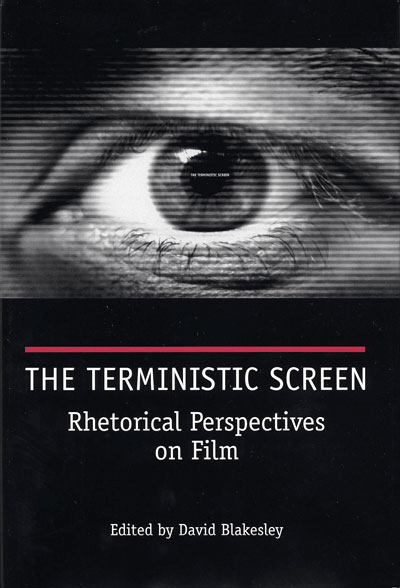 Blakesley, David, ed. The Terministic Screen: Rhetorical Perspectives on Film. Carbondale: Southern Illinois University Press, 2003, 2007. Print. 312 pages.
Reviewed by Jonathan A. Cannon, Oklahoma State University
Containing a rich sundry of filmic analyses channeling scrupulous rhetorical acumen, The Terministic Screen: Rhetorical Perspectives on Film (2003), edited by David Blakesley, functions as a much-needed collection of articles that underscore en masse the nexus between rhetoric and the area of film studies. In his introduction titled “The Rhetoric of Film and Film Studies,” Blakesley establishes a solid theoretical foundation for the rest of the critical anthology to unfold, and argues for a greater presence and conscientious reexamination of cinema for rhetoric and composition studies. Through an eclectic array of rhetorical lenses, The Terministic Screen initiates a critical understanding of the medium of film. Moreover, the book – as the title clearly articulates – points to new and more interdisciplinary perspectives on the Burkeian term “terministic screens.” Indeed, scholars of rhetoric, composition studies, and professional writing should be familiar with this seminal concept, which is found in Kenneth Burke’s Language as Symbolic Action (1966).
The Terministic Screen is divided into three distinct sections: “Perspectives on Film and Film Theory as Rhetoric,” “Rhetorical Perspectives on Film and Culture,” and “Perspectives on Films about Rhetoric.” Part One emphasizes the relationship between rhetoric and film theory. The first section presents essays ranging from colonial rhetoric in The English Patient (Anthony Minghella, 1996) to bodily rhetoric in Hoop Dreams (Steve James, 1994). Part Two examines film that concern themselves with rhetoric, film, and culture more broadly. The second section contains articles spanning collective memory and the (in)famous Hollywood Blacklist of the 1950s to anti-plutocratic rhetoric found in German cinema. Finally, Part Three focuses on articles that point to films about rhetoric. These articles in the third section span from notions of rhetorical conditioning in The Manchurian Candidate (John Frankenheimer, 1966) to postmodern dialogics in Pulp Fiction (Quentin Tarantino, 1994).
Blakesley’s introduction is the fundamental backbone for the entire book and its assembly of authors, granting the reader the opportunity to rethink what they know about rhetoric in terms of its possible filmic associations and applications. He points to film theory being a common starting point for comprehending film on a host of levels in the field of film studies. Blakesley’s overall agenda is to wed rhetorical theory, and the specific Burkeian term “terministic screen” to the interpretation and analysis of film and film criticism. Symbolic gestures, for Blakesley, lie at the heart of a clear, coherent, and nuanced approach to a rhetorical perspective of film and film criticism in the communication between screen and viewer, and vice versa. Burke defines “terministic screens” as a metaphorical “screen” made up of terms through that humans perceive the world, and which directs attention away from some interpretations and toward other ones. For Blakesley and the collection’s authors, the purpose of film highlights both an act and manner of address that showcases a variety of means for a particular purpose in an isolated context and/or situation. Indeed, when applied to cinema, evidence of terministic screens spans from the diegesis of the “film world” to the extradeigesis of the “outside world” for both the film spectator and critic alike.
Blakesley, channeling Burke, underscores the notion that rhetoric functions metaphorically as either/both “a filter or screen” (2) that acts as a fluid gatekeeper, filter, and/or barrier. Again, Blakesley makes clear that the scaffolding of the entire book rests and is acutely influenced by the phrase “terministic screens.” With a critical eye toward a reapplication of Burke’s concept of symbolic action to suit rhetorical analyses of films, Blakesley defines a certain kind of cinematic communication as “film rhetoric,” which elucidates both the visual and verbal signs and strategies that shape a particular film experience and screen identification – the latter, in the Burkeian sense of the term. Blakesley peppers the critical prelude with a fresh take on the overall objective of film theory, which he interprets as a way to tap into an at times overlooked language system – that of film. Indeed, film provides the modern rhetorician with both a language and approach au courant to narrative, ideology, corporeality, politics, economics, and cultural connotations of cinema around the world and across the yesteryears of motion picture ontogeny.
Specific articles in the anthology demonstrate the robust caliber of the authors gathered here in an effort to push for new film rhetoric(s), or the rhetoric of film(s). For example, Alan Nadel’s article “Mapping the Other: The English Patient, Colonial Rhetoric, and Cinematic Representation,” deals primarily with the rhetorical narrativization of colonialism through the Hollywood film The English Patient. Nadel situates the film alongside colonial and postcolonial theory, which has been a growing branch of film theory since the 1990s. He ties colonizer/colonized binary within the film to narratological and rhetorical cues and conventions, to recast The English Patient as a problematic text within the romance film genre that makes commonplace the ignorance of the foreign(er), the other, and the tension between home and exile. For Nadel, the only way to understand the prejudice characterizations of men and women in the film’s diegesis is to marry film theory with both rhetorical theory and postcolonial theory and, in turn, create a three-pronged approach to the popular film in question. Another noteworthy piece in the collection is penned by James Roberts, which concerns itself with the rhetoric of cinematic subjects and bodies in the documentary Hoop Dreams. Roberts recognizes the fluid exchange between rhetorical analysis and film criticism and, as such, wants to reinvigorate such a critical relationship through attention to subjects and bodies as evidence of how spectators engage with and interpret films such as Hoop Dreams on the basis of corporeal rhetoric – that is, issues such as race, age, masculinity, and paternity. All in all, Roberts provides a sober, enriching, and highly balanced analysis of Hoop Dreams using both film terminology (apparatus) with rhetorical jargon (rhetoric and discourse)
In sum, The Terministic Screen acts as a crucial stepping stone toward rhetoricians, compositionists, and professional writers welcoming the medium of film into the rhetoric and composition/writing studies fold. Bridging the gap between this and the field of film studies requires one to take such a risk, and usher forth an interdisciplinary endeavor, in both scope and execution. Indeed, with the recent push towards visual rhetoric, such a reassessment of Blakesley’s edited text is necessary in order to see where the initial seeds were sown for critical film rhetoric, and determine where the relationship between film and rhetoric is going in the future. With Blakesley at the helm of this rather ambitious yet completely necessary project, the underlying point of the well-established collection is to encourage and foster a heightened interest in thinking, researching, and writing about the rhetorical booty found within the treasure chest of history, cultures, and politics of the seventh art.
This work is licensed under a Creative Commons Attribution-NonCommercial-NoDerivatives 4.0 International License.
- 31629 reads
Review: The Making of Barack Obama: The Politics of Persuasion, ed. Matthew Abraham and Erec Smith. Reviewed by Jean Costanza Miller
Abraham, Matthew, and Erec Smith, eds. The Making of Barack Obama: The Politics of Persuasion. Anderson, SC: Parlor Press, 2013. 243 pages. $27 (paperback); $60 (hardcover); $20 (ebook)
Reviewed by Jean Costanza Miller, The George Washington University
Some U.S. presidencies are more historical than others, and some may be more rhetorical than others. Certainly, the election and presidency of Barack Obama has captured the attention of rhetorical critics, both because of the historic nature of the first election of a man who identifies as African-American and because of the rhetorical and oratorical skill he exemplifies. The Making of Barack Obama: The Politics of Persuasion is a collection of essays dedicated to exploring the rhetorical moves made by Obama as he "made" himself in his first campaign for the presidency and in his first administration, particularly his first two years in office. The book includes an introductory overview of the importance of studying Obama from a rhetorical perspective, nine essays delving into Obama's rhetoric—either in particular speeches or in addressing particular issues, and a final reflective essay by David Frank that draws out lessons to be gleaned from the substantive essays.
As a whole, the essays represent a nuanced account of Obama's rhetorical strategies, strengths, and shortcomings. Representing criticism that ranges from situational to Ciceronian to constitutive analyses, the essays address not only the challenges Obama faced, but also the implications of his successes and failures. In the Editors' Introduction, Matthew Abraham and Erec Smith note that, "Obama seems to have mastered Burkean concepts such as identification and consubstantiality, as well as Perelman and Olbrecht-Tyteca's conception of adherence." Indeed, issues of identification and division, of presence and adherence, are brought to the fore in this collection, offering much food for thought for Burkean scholars interested in the rhetoric of Obama, and specifically, how his rhetorical moves strategically negotiated the dialectic tensions of identification and division. In this review, I will highlight three themes that emerge in the book that serve to encompass Obama's construction of himself and his audience within the context of his campaign and early presidency: how he faced unique situational constraints, how he addressed complex composite audiences, and how he attempted to construct himself as consubstantial with his audience.
While all of the essays consider situational constraints facing Obama, two of the essays make Obama's response to particular situational constraints a more explicit focus. In the first essay of the book, Robert Rowland answers critical evaluations of Obama's domestic policy rhetoric by demonstrating that Obama's explicit and detailed explanations and justifications of his budget proposals, clearly argued and rhetorically sound cases for reform, failed not from a lack of rhetorical effort, but due to a long list of systemic and political constraints that made it all but impossible for Obama to win Congressional support for his domestic policy agenda. In his essay on Obama's response to Bush's statements on torture policy, Richard Marback argues that Obama's restrained and deliberative rhetoric appears weak and unpersuasive when contrasted with his predecessor's expansive presidential rhetoric that emphasized his role as the sovereign "decider." Marback makes the case that Bush's rhetoric functions as a constraint on Obama, who had the daunting task to "raise the level of rhetoric from rationalizing the sovereignty of the decider to encouraging the character of everyone" (159). These two essays importantly remind us of Burke's admonition that rhetoric, indeed, is contextual, and real material constraints exist. These essays highlight how Obama's choices in the face of these constraints define him as a pragmatic policy advocate.
A consistent constraint of presidential rhetoric is the need to address composite audiences. John Jasso and Anthony Wachs offer an intriguing account of Obama's relationship with Catholics by tracing his appointments to key social welfare and health care posts as symbolic acts that negotiate his relationship with dissident Catholics, the Catholic laity, and the Church hierarchy. Jasso and Wachs show how the shifting appointments and rhetoric surrounding them signal shifts in Obama's strategies for appealing to Catholics and non-Catholics, and open opportunities for different interpretations of that relationship. Michael Kleine explicitly addresses the composite audience in his analysis of Obama's West Point Address. Drawing on classical rhetorical theory, Kleine demonstrates that in this discussion of the war in Afghanistan, Obama establishes both his own authoritative presidential ethos and the ethos of the nation as a moral member of the world community by unifying policy factions through his use of narrative, argument, and refutation in support of a moderate policy claim. Both of these essays remind us of the importance of rhetoric as addressed, and thereby as a means of negotiating meanings among multiple audiences with different interests.
Perhaps particularly intriguing from a Burkean perspective are the essays that address how Obama identifies himself with, even embodies, the American collectivity, and how these attempts at identification ultimately demonstrate the simultaneous pull toward division. Courtney Jue's account of Obama's campaign rhetoric demonstrates how he met the demands of constitutive rhetoric by appealing to common values and constructing the audience as an historical subject, which led Americans to embrace his identity as their own. At the same time, the backlash by those who did not see themselves as part of Obama's "we" shows the persistence of division among composite audiences. In his analysis of the much analyzed "A More Perfect Union" speech, Erec Smith focuses on Obama's response to the Jeremiah Wright controversy as a kairotic moment through which he was not only able to establish himself as "a model American," but also to call for a more participatory democracy (102). Smith contributes a strong argument for the value of the speech in creating a "neutrality of culpability" that is prerequisite for effective citizen dialogue on race (108). These essays offer new insights into the identificatory and constitutive dimensions of Obama's discourse.
Several essays highlight the shortcomings of Obama's identification strategies. Steven Salaita offers a comprehensive account of the discourse of racial belonging in America, demonstrating how Obama's response to racialist discourses targeted at him actually allowed him to place himself within a normative construct of Americanism positioned against the "foreign" identities of Arab and Muslim, thereby reinforcing the very division he purported to overcome. In his critique of Obama's Cairo speech, Matthew Abraham notes the constraints Obama faced in appearing empathetic to the Arab world while maintaining absolute loyalty as an American. Abraham shows how Obama met those constraints through a rhetorical strategy that reinforced a "good Muslims" and "bad Muslims" distinction within his call for "a new beginning in East-West relations" (182). René Agustin De los Santos' analysis of Obama's speech at the 2009 Summit of the Americas draws on Zarefsky's account of presidential rhetoric as defining political reality to provide an insightful exploration of the barbarism/civilization dialectic that has characterized the history of U.S.-Latin American relations. De los Santos shows that Obama's rhetoric ultimately falls short by failing to break out of that historic dualism. These essays artfully critique Obama's strategies of identification by attending closely to his linguistic motives as he addresses particular audiences.
The Making of Barack Obama: The Politics of Persuasion has much to offer rhetorical scholars in general, and Burkean scholars in particular. Individually and as a whole, the essays attend carefully to context and audience dynamics to provide insightful readings of many important speeches and issues addressed in Obama's first campaign and first term. The essays are strongly theoretically grounded, offering the reader new insights into constitutive rhetoric, the rhetorical presidency, and cultural politics. In the final essay of the volume, David Frank gleans insight from each essay as he notes the uneven character of Obama's presidential rhetoric. The influence of Burke can be seen in Frank's statement that he leaves the book "inspired to think through how presidents deal with the challenge of reconciling opposites and the rhetorical problem of the composite audience" (212).
The strength of the volume is, indeed, in its pointing up of the oppositions, tensions, and ambiguities that for Burke are the "characteristic invitation to rhetoric." Clearly, the push and pull of identification and division characterize the rhetoric of Obama, but this volume also points us to issues of rhetorically negotiating stability and change, a necessary task for a president, if not a candidate. Ultimately, the essays in the book point us also to the rhetorical tension of authenticity and strategy. Where some see in Obama's discourse an authentic rhetoric of unity, others see a strategic exploitation of divisions. The rhetoric of the Obama presidency will certainly be analyzed for years to come, and this volume suggests that such critique will likely result in new questions, deeper understandings of presidential rhetoric, and conflicting insights and conclusions. Burke wouldn't have it any other way.
This work is licensed under a Creative Commons Attribution-NonCommercial-NoDerivatives 4.0 International License.
- 23243 reads
Review: Purpose, Practice, and Pedagogy in Rhetorical Criticism by Jim Kuypers. Reviewed by Michael Osborn
Kuypers, Jim. Purpose, Practice, and Pedagogy in Rhetorical Criticism. New York: Lexington, 2014. 234 pages. $85 (hardcover); $84.99 (ebook)
Reviewed by Michael Osborn, University of Memphis
This book sets out to tell the back stories of fifteen prominent rhetorical critics and in the process to develop a rationale for rhetorical criticism (hereafter RC) as a legitimate academic enterprise. As critics, what do they hope to accomplish? How do they teach RC? And what does it mean to be such a critic?
These scholars explain their various approaches in a series of idiosyncratic essays that explore a wide spectrum of possibility. Consequently, the book opens an array of potential uses for beginning students and for those who may be stuck in a critical rut. I found the level of discussion to be high and the style of the writing to be engaging. It was a special, unexpected pleasure to also learn more about the people behind the critical work and the motives that drive them.
There is no apparent strategy to the arrangement of Kuypers's buffet of intellectual treats. The book does open appropriately by reprinting a statement from Edwin Black on what constitutes good criticism (Black n. pag). The goal of it, Black tells us, is fair judgment. The effect of it is enlightenment: good criticism surprises us, opens a portal on the textual point of focus. Or as Ryan Erik McGeough summarizes it, "The role of the critic is. . .to see more in the text than is readily apparent"(102). One caveat: the twin criteria of fair judgment and enlightenment don't seem of equal value. Rather, the enlightenment function of criticism appears primary: a fair criticism can be quite boring, but an unfair criticism can nevertheless be illuminating. The devil's discourse can be instructive despite itself.
Black's reflections also raise an interesting companion question: what motivates the proper reading of RC? Perhaps we could say that the competent reader seeks not confirmation of some previously decided point of view, but rather desires to penetrate the mystery of rhetorical power and influence. Or perhaps such a reader seeks to develop resistance to a rhetoric that would otherwise exploit. Or perhaps again, a proper reading of RC may seek to satisfy curiosity over the symbolic ways that humans have with one another. Certainly it is true that good criticism requires a competent reader to complete its purpose.
It was a happy idea to begin this feast of ideas with Black. He satisfies one of his own requirements: if he does not surprise us, he certainly strikes intellectual sparks. One other possible shortcoming is that while Black discusses good criticism as a genus, he does not focus precisely on the species (or subspecies) of RC. Indeed, it would be desirable if the entire terrain of criticism were laid out more clearly for the reader's inspection. Are there distinct domains, for example, that separate esthetic, philosophical, and historical criticism from each other and from RC? Do these border on each other or do they interpenetrate, comprising one grand critical perspective that shifts according to the reader's need and to the nature of the text? These are questions to contemplate as we launch further into the book.
While the fifteen essays that follow are all over the intellectual map, they converge on one central issue: What justifies RC? This question would appear grounded in how the critics approach the nature of rhetoric itself. The writers appear to accept the premise that we are social and symbolizing creatures and that how we interact through symbols can be crucial to our survival and well-being as well as to our power positions within social hierarchies. The study of rhetoric becomes the study of how we influence one another through symbolic interactions. As Marilyn Young puts it, "The purpose of rhetorical criticism is to explore, illuminate, and explicate human communication in its many forms" (194). Criticism becomes an assessment of the quality and ethics of symbolic influence and what it reveals about us (Kathleen Turner calls us "verbivores," borrowing Stephen Pinker's happy neologism [Pinker 24]). Andrew King points out that such criticism can be justified, as De Quincey once noted, by the "sheer intellectual pleasure" it can provide (70): in short, there can be an element in RC which is its own excuse for being
In response to the question of justification, however, most of the contributors emphasize the instrumental nature of RC--it does some good in the world. Some of the essayists, for example, emphasize RC's possible contribution to our knowledge about rhetoric. Edwin Black's insistence that good criticism should surprise us and teach us something sets the tone for this emphasis. Jason Black calls this "appreciative"criticism, and describes it as preliminary to "interventionist" criticism that would alter the behavior under consideration (8-11). Celeste Condit agrees that the function of RC is to help us understand more about ourselves, but she turns the focus to the power of emotion in public life. The role of RC should be to help us guide the role of feeling in productive directions. Especially when we need to influence the choices and policies that govern our lives. RC can help us ask the right questions when we must evaluate discourse that asks for our commitment. It can also help us develop effective strategies in dealing with the controversies that confront us.
Ned O'Gorman warns, however, that preoccupation with technique can deflect the critic's attention from the underlying moral aspects of discourse. But I would argue--I believe in agreement with Herbert Wichelns--that one can enter the moral dimension of a work through a grasp of its technique and technical boundaries. Once we grasp, for example, the binary nature of many archetypal figurative clusters (light-dark, war-peace, high-low, forward-back, etc.) we can see how the mind superimposes itself upon perceptions and reduces, simplifies, and shapes them in ways that can have profound moral implications. In a perversion of ethos, for example, speakers can pose as the sun that will bring us enlightenment, the captain who would impose unrelenting discipline on the ship of state, or the general who would command us into battle. Thus a grasp of rhetorical technique, rather than distracting us from moral considerations, can be our point of entry into what can be the dark moral universe of a text.
The discovery function of RC also relates it to the generation of rhetorical theory. While others support the importance of other functions, Samantha Senda-Cook emphasizes that the purpose of RC is to "build theory" (150). In his elegant essay, Raymie McKerrow develops this idea in a pluralistic approach: the motives for RC can be many, depending on the critical question that drives one's work in the first place. What RC helps us discover about human symbolic behavior also helps us understand and appreciate ourselves and our possible species shortcomings for which we must somehow attempt to compensate. RC helps us expand and correct the systematic explanations we develop to account for phenomena in the world, including the phenomenon of symbolic behavior. In turn these enhanced explanations can help sensitize the critic to subtle resonations within texts.
At the other end of the continuum, other critics pursue more concrete, socially useful, immediately practical justifications for RC. Michael Hogan would reclaim "a neoclassical rhetoric for the digital age" (63), which would ground our discipline in civic education. This focus, would help students become more effective citizens by teaching them how to argue and how to evaluate the arguments of others. The approach revives what Hogan calls the Wisconsin Idea, a movement out of the Progressive Era which depicted the critic as a "consumer 'watchdog' in the marketplace of ideas" (55). The goal is to develop "citizen critics" in line with David Zarefsky's vision of growing "a deliberating and decision-making public" (Zarefsky 133). Robert Terrill expands this theme of connecting RC with learning the art of citizenship. Acquiring rhetorical sensibilities encourages, he says, the "crafting of rhetorically-habituated selves" (165), instrumental to participation in public life. And in his insightful essay, Martin Medhurst goes beyond the idea of civic education to reinforce the classical idea that the study of rhetoric can become the nexus for many of the liberal arts and should be central to a liberal education.
Operating also at this "practical" end of the justification continuum is an essay that is destined to be perhaps the most controversial in the collection. Dana Cloud champions what she calls "ideology criticism," which takes up the cause of the underdogs in our society against those who exercise power over them through exploitative rhetoric. Such criticism exposes the tactics of the one-percenters and their lackeys, racists, anti-feminists, and other such undesirables.
Hers is a provocative essay and there is much about its program for RC that seems attractive. It is quite timely in an era in which power and wealth are indeed more and more concentrated and the voices of many who claim to represent poor and working people seem muted and discredited. The power of large corporations has surely been magnified by recent court decisions that loosen, for example, restrictions on contributions to political campaigns. Clearly, the potential for mass manipulation through the media has grown exponentially. Developing a counter-consciousness along lines suggested by Cloud could well help students build a much-needed resistance to dangerous abuses of power. Finally, the course Cloud describes appears to inculcate a set of sophisticated questions that should help students probe the mysteries of elusive rhetorical texts.
These virtues, however, do not come without a price tag. For one thing, the kind of criticism favored by Cloud is quite melodramatic. It envisions a world without moral nuance or complexity, a world which poses wicked exploiters against innocent victims. Presumably, in the bold new world that will follow the successful revolt of the oppressed, these newly emancipated innocents will themselves resist the urge to abuse their own newly found power. The former abusers will remain either wicked and diminished or will somehow find redemption: their fate is not entirely clear and perhaps they do not deserve our concern. It seems so easy in this melodrama for the discussion to pass over into stereotype and caricature. For example, the abusers are described as "elites who subordinate their wives, starve the poor, visit prostitutes, and so on" (31). This kind of language raises concerns about the fairness of ideology criticism as a serious mode of inquiry.
Another problem is that the worldview of ideology criticism pre-programs the criticism and constrains the critic. The critic's function now becomes solely to reveal the abuses perpetrated by the few and the powerful. As Condit argues, "To do rhetorical criticism . . . requires that one approach one's task with a question, rather than with a hammer designed to pound home what one already considers the truth" (45). Hammer-oriented criticism, Edwin Black would complain, is quite predictable: its range of discovery is limited, and it risks simply becoming an instrument to promote the predetermined narrative of good vs. evil in the class struggle. Ironically, the price of its function to free the innocent is that it must also confine the critic.
Having expressed these reservations, this is an essay I would rely upon to provoke thought and argument in the RC classroom. Moreover, this essay, along with those especially by Turner, Jason Black, Kuypers, Condit, and Medhurst, offers rich pedagogical suggestions. Using this book as a springboard, I would pursue Medhurst's vision of a course that would be "central to a liberal education," that would pursue Turner's desire to "teach my students how to think," and that would promote the Hogan/Terrell ideal of effective citizenship
What a contribution Jim Kuypers's book makes to our discipline!
* Michael Osborn is Professor Emeritus in the Department of Communication, University of Memphis.
Works Cited
Black, Edwin. "On Objectivity and Politics in Criticism." The American Communication Journal 4.1 (2000), n. pag. Web. 8 Oct. 2014.
Pinker, Stephen. The Stuff of Thought: Language as a Window into Human Nature. New York: Viking, 2007. Print.
Zarefsky, David. "Two Faces of Democratic Rhetoric." Rhetoric and Democracy: Pedagogical and Political Practices. Ed. Todd F. McDorman and David M. Timmerman. East Lansing: Michigan State UP. 2008. Print.
This work is licensed under a Creative Commons Attribution-NonCommercial-NoDerivatives 4.0 International License.
- 19017 reads
Review: The Rhetoric of Intention in Human Affairs by Gary Woodward. Reviewed by Raymond Blanton
 Woodward, Gary. The Rhetoric of Intention in Human Affairs. New York: Lexington Books, 2013. Print. 160 pages. $80.00 (hardcover); $79.99 (eBook)
Raymond Blanton, The University of Nebraska-Lincoln
"A motive is not some fixed thing, like a table, which one can go and look at. It is a term of interpretation." —Kenneth Burke
"Fantasy, imagination, and projection provide imperfect but useful frameworks for studying acts of indefinite construal. Each assumes a level of subjectivity that must be embraced if we are to plumb the deep enigmas of communication" (134). Embracing the subjectivity of the imperfect but useful within indefinite construal is our charge. Woodward's stark words, drawing from the rhetorical work of Walter Fisher and (utmost) Kenneth Burke as well as from the psychoanalytic and social constructivist work of Kenneth Gergen, mark the end (and beginning) of Gary Woodward's The Rhetoric of Intention in Human Affairs.
To make clear the end from the beginning, Woodward's notion of "imperfect but useful" marks the strength and area of most want in the book. Put differently, Woodward's work is most useful in broaching the subject and providing varied and interesting approaches to the implications of intention in human affairs. It is (naturally) imperfect in its implementation of balance as it pertains to the means of "imperfect but useful."
More specifically, emphasizing intention as an "assumed purpose behind our acts," Woodward notes that we "usually make our way in life with the belief that we are the authors of our actions: that intentions are the markers of our values, and they can be known" (x). For these reasons, Woodward details the means by which humans "guess" at motivations and offer "air-brushed reasons" as tonal indications of said imperfections. On one hand, merely emphasizing the imperfections of human motives is unremarkable. However, on the other hand, when taken into consideration with the representative case studies that Woodward utilizes, all in all, the work is a worthwhile and essential venture into the underworld of why.
Contextually, Woodward's Rhetoric of Intention extends the work he began in The Perfect Response: Studies of The Rhetorical Personality (Lexington, 2010), where he sought to isolate "traits of character" to designate the substance of "rhetorical personality" (xiii). Here, Woodward expounds upon such ideas with a particular focus on the "acute inference-making skills" of adept rhetors.
Specifically: "We will take discourse about intentional action on its own terms: not necessarily as representations of "the truth"—if that is even possible—but as a revealing window that helps us see how we make sense of the world" (xii).
Through this window, Woodward details our compulsive quest to "join purpose to acts," which is present in essentially all human exchanges, where "sociality provides the impetus" and "language provides the means" (129). Generally, The Rhetoric of Intention is a "broad map" for the various categories of naming intentions that so easily drift across narrow boundaries. Particularly, using a wide variety of examples from fiction, popular journalism, film, theatre, painting, political rhetoric, television, cultural analysis, and personal experience, Woodward makes a valuable contribution to beginning a broader conversation about motive. It's a good start, in other words. In his own words, the why of Woodward's aims are:
"Whether looking inward or outward for the springs of motivation, what sets this study apart from other discussions is our focus specifically on how it is named. Where most theorists of intention treat the idea as arising in thought and existing behind a dense fog of alleged first causes, the approach here places emphasis on how we express it. Our interest is not primarily on tracing the interiority of intention within an agent or author, but its forms captured in moments when we are addressing others." (x)
In light of Woodward's self-described aims, I will assess the book, first, structurally, followed by an argumentative and stylistic assessment. Then, I will situate the book's contributions to the work of Kenneth Burke and conclude with some critical reflections.
Structurally, I found The Rhetoric of Intention to be accessible and concise, modest in length (at 144 pages) while also being thorough and clear. Woodward's rendering of the mercurial nature of the human impulse to know why—a human propensity that we are inundated with but perhaps think very little about—makes Intention both a worthwhile and meaningful contribution to the subject of intention and various realms of disciplinary and critical thought.
Woodward develops his perspectives across six chapters. The first chapter, "How We Know What We Can't," argues for the centrality of narrative as the archetypal form of reconstructed experience (52) by delineating a simple tiered approach to understanding the rhetoric of purpose. This is foundational to the work. Woodward's tiered approach to contemplating the process of "locating intention," whether in self or others, lists towards either taking the strangeness out of behavior, giving context to an action, or constructing meaning and identity (xiv). More specifically, Woodward's offers three tiers for describing intention:
First Tier: What someone says about their own intentions.
Second Tier: What someone says about another's intentions.
Third Tier: What someone concludes about representations of intentions issuing from other parties.
Each of the subsequent chapters adumbrates specific contexts for exploring the nuances of these tiers via conspiracies, theatre and performance, journalistic writing, legal theory, and a "super-agency implied in belief in a higher power," respectively.
The second chapter, "Them: Conspiracies, Disasters, and Presumed Culpability," draws out the nuances of intention in conspiracy theorists who identify design within random events. For Woodward, conspiracy fantasies are difficult to overcome because they are, partially, "self-fulfilling." In the third chapter, "Theatre, Acting, and the Sources of Motivation," Woodward explicates how a character's motivation evolves—namely how theatre functions as an "all-encompassing idea: metaphor, model and mode" for conveying the "durable mandates of our nature" (53).
The fourth chapter, "The Telepathic Journalist," works to juxtapose the realms of reporting with the proclivity of critiques to frame behavior within a given community's norms of conduct. Woodward's image here is of a pilot flying a plane through fog without the benefit of instruments (72). The fifth chapter, "Legal Benchmarks for Establishing Intent," argues for the fundamental basis of motives in the establishment of proof of guilt in a criminal act. In short, humans tend to believe that accounting for the why is necessary in the cause of justice (93). The sixth and final chapter, "God's Plan: Agency, and the Quandary of Divine Intention" addresses how the devout constitute perspective with regards to divine intervention. How do we account for the visceral pain and suffering so evident in human experience with the idea of an all powerful and omniscient deity (114)?
Argumentatively, though Woodward is adept at offering a multiplicity of perspectives or representative cases from which to consider motives, I found the work wanting in its ability to render the sentiment of the book's final sentence apparent. In other words, when Woodward emphasizes the "imperfect but useful" framework for studying intention, I found the work to stress the former rather than the latter. To be fair, his aim was to offer a "revealing window" into how we make sense of the world of why. In short, the window mixes panes of opaque and transparent. Stylistically, The Rhetoric of Intention in Human Affairs is highly accessible. It is erudite and colloquial, thorough while pithy, and selective while versatile. It is likely to appeal to a broad contingent of scholars and thinkers across disciplines.
Perhaps most applicable to KB Journal readers is Woodward's extension and exploration of Burke's foundational rhetorical work on motives. From the outset, Woodward draws upon the "symbol using" elements of Kenneth Burke to conclude, along with Walter Fisher, that we are the "species that needs to know why" (ix). Susan Foss states the case simply as addressing an important issue that is widely ignored by rhetorical scholars.
Perhaps one of the most useful elements of Woodward's Rhetoric of Intention can be found in the corpus of Kenneth Burke. To be more plain, what I intend to suggest here is that perhaps the imperfections of intention can be illuminated more broadly by giving attention to overarching signatures across works or time rather than only in isolated instances. For instance, what Burke's method of textual criticism reveals is that his method is subservient to his methodology. More specifically, the critic seeks to develop not only a method but also a methodology that is formed by reference to the "collected revelation" of accumulated critical lore (Philosophy of Literary Form, 67-68).
How do we make sense of Burke's potential motives? We comprehend Burke's overarching signature. Particularly, Burke's work emphasizes: an art of living (Permanence and Change 66); equipment for living (Attitudes Toward History 5); strategies for living (Attitudes Toward History 43); recipes for wise living (Philosophy of Literary Form 293); strategies for situations (Philosophy of Literary Form 296); and campaign for living (Philosophy of Literary Form 298). Additionally, William Rueckert writes of Burke's fiction, "The White Oxen (1924)," as having, despite its variety of methods, a curious unity; that though his hands move incessantly, sliding through various tricks, his attitude from start to finish remains unchanged. In short, Burke's work helps us size up interpretations of reality and identify a "pattern of experience as representative of social" by critically excavating particulars, perhaps by conjecture in Woodward's sense, to find a general assessment. To be Aristotelian, we have only those means of persuasion that are available. But they are available.
In essence, Burke's method of textual criticism notes that all questions are leading questions, selecting and deflecting attention to a particular field of interest and away from others (Philosophy of Literary Form). In other words, every ontological and methodological question of the critic (in this case Woodward) selects a field of "battle" that forms the nature of our answers. Hence, Woodward's reflections are both selections and deflections, with his selections providing a much-needed framework for consideration.
On the other hand, his deflections weaken the force of the book. Namely, while Woodward considers the rhetorical and psychological habits we exhibit with regards to motive, I found the concluding chapter, "God's Plan: Agency, and the Quandary of Divine Intention," wanting for religious or theological credibility. To be fair, Woodward disavows any claims to expertise in these areas of representative consideration and the cases are useful in considering the means by which we make sense of intention in expression. Woodward notes: "Kenneth Burke wisely noted that those who would simplify the relation between man and God are justifiably going to hear the rejoinder: "It's more complicated than that." I concur.
Overall, The Rhetoric of Intention in Human Affairs offers a versatile and accessible account of the habits that we possess and exhibit in the quest to understand the versatility of human action. What becomes clearly evident is that though we may desire clarity in differentiating motives, disentangling motives is rarely if ever a simple and straightforward process. What is most evident in Woodward's work is that our rhetoric is filled with motives-talk that assesses and often disputes inferences made by others about why someone did what they did" (6). We imperfectly reach: we "search in vain to find the most useful ways for expressing contingent attribution"; "have no similar linguistic depth that would give us a lexicon of personal will"; "describe action in an endless variety of available verb forms…no exact counterparts for what should be the complementary "whys"; and we "insert imprecise qualifiers in front of clumsy and inexact representations" (133). On these grounds, our ability is limited but we can utilize only what is available.
All in all, The Rhetoric of Intention is a most useful foray into the realms of human intention, where in the post-Babel concerns of rhetoric, where identity is "change of identity" (Attitudes Towards History, 268) and identification and change are emboldened as the "permanence of change" (Grammar 329), we work to "persuade" others insofar as we can talk their language by "speech, gesture, tonality, order, image, attitude, idea, identifying" our ways with theirs (Rhetoric of Motives 55). We "plumb" and "embrace" the deep enigmas of communication.
For further consideration, in addition to the aforementioned The Perfect Response: Studies of The Rhetorical Personality and the work under consideration, Woodward has also written: Persuasive Encounters: Case Studies in Constructive Confrontation (Praeger, 1991), Perspectives on American Political Media (Allyn and Bacon, 1997), The Idea of Identification (State University of New York Press, 2003), and Center Stage: Media and the Staging of American Politics (Roman and Littlefield, 2007).
Works Cited
Burke, Kenneth. A Grammar of Motives. 1945. Berkeley: U of California P, 1969.
—, A Rhetoric of Motives. 1950. Berkeley: U of California P, 1969.
—, Attitudes Toward History. 1937. Berkeley: U of California P, 1984.
—, Permanence and Change. 1935. Berkeley: U of California P, 1984.
Rueckert, William H. Encounters with Kenneth Burke. Urbana: U of Illinois P, 1994.
This work is licensed under a Creative Commons Attribution-NonCommercial-NoDerivatives 4.0 International License.
- 18931 reads
Review: Spiritual Modalities: Prayer as Rhetoric and Performance by William Fitzgerald. Reviewed by Richard Benjamin Crosby
Fitzgerald, William. Spiritual Modalities: Prayer as Rhetoric and Performance. University Park: The Pennsylvania State University Press, 2012. Print. 168 pages. $24.95 (paperback); $56.95 (hardcover)
Richard Benjamin Crosby, Iowa State University
Spiritual Modalities is arguably the first major work to take up the high theoretical questions of rhetoric and religion since Burke's Rhetoric of Religion published more than half a century ago. While a number of other studies deal with the relationship between religious discourse and other phenomena, such as politics, social movements, or particular rhetors and periods, Spiritual Modalities makes a strong claim to understand the primeval stuff of prayer's varied and complex discourses. As Burke writes: "we are to be concerned not directly with religion, but with the terminology of religion" (vi). So Fitzgerald is not concerned with prayer as an efficacious means to access God, but with prayer as a discourse with motives grounded in human experience. Fitzgerald's contribution deserves praise, then, by virtue of its very manifestation in our literature, for it engages broadly and deeply the discourses of prayer in their complexity, situatedness, diversity, and embodiment. In order to cover this broad ground, Fitzgerald employs Burke's pentad, which is an appropriate choice because it provides a natural vocabulary for the various and compelling motives that undergird the discourses of prayer. Fitzgerald focuses primarily on three of the pentadic elements: scene, act, and, the belated sixth, attitude. Prayer, Fitzgerald affirms, is a fusion of "distinct, though interrelated, elements of discursive performance expressible as a 'scene of address,' an 'act of invocation,' and an 'attitude of reverence'" (7). These three essential elements then serve to guide the overall structure of the book.
Fitzgerald's first two chapters consider prayer not only as an oral or textual discourse, but also as a kind of temporal berth. More than the mere result of a rhetorical situation, prayer is, in some sense, the situation itself. It is simultaneously a place, a time, a relationship, an act, an attitude, a response, a provocation. In pursuing this line of reasoning, Fitzgerald engages in dialogue with the quickly growing literature on the intersection between space, time, and rhetoric. Prayer plays a potentially important role in this literature, because it explicitly signals a removal from time and a ritual encounter with the occasional. Drawing on the classical notions of kairos and krisis, Fitzgerald sees prayer as a means to create openings of meaning in the chronic everydayness of life (15). These kairotic openings then function as "performative spaces in which human and divine communication occurs"; they provide a space of "retreat and recalibration in which aspects of communication and performance (such as ethos and agency)" are rehearsed and practiced (22 parentheses in original). Fitzgerald supports these claims by performing a reading of Reinhold Niebuhr's "Serenity Prayer," a prayer-text that explicitly and complexly plays with notions of kairos (timing) and krisis (judgment) whereby the supplicant rehearses important and situated practices for living free from addiction.
Chapter 2 in particular reads prayer as a "scene of address" (8). The important Burkean ratio here is scene-act. If scene is a matter of relationships, as Burke affirms, then prayer must be a discursive means of negotiating those relationships. Fitzgerald points out that divine beings vary widely, but the kairotic nature of the human-divine relationship has certain essential and generalizable characteristics. (Fitzgerald is careful, I should add, to point out where there are meaningful exceptions.) Prayer, in short, is a performative space. It is an opening in time within which supplicants perform their relationship with the divine. In Chapter 3, Fitzgerald outlines how this space is to be negotiated and sustained, focusing specifically on the act of invocation. Fitzgerald argues, contra-convention, that prayer's "performative core" lies in invocation, not in petition or praise (53). The speech-act of invocation is the primary complement to the kairotic scene of prayer discussed in Chapter 2. To put it another way, an invocation is an act of prayer designed to create and "realize the potential of (the scene of prayer)" (54). In this chapter, Fitzgerald performs a series of short close readings through we which he illustrates a number of important characteristics of prayerful invocation. He discusses, for example, the importance of naming the divine. He discusses the role of accumulation and repetition of the invocation, which is a way of keeping the kairotic space open. More even than in the preceding chapters, Fitzgerald uses Chapter 3 to illustrate the collapse of text and context in the act of prayer, paying special attention to prayer as "an unfolding drama of divine-human relations" (54).
Chapters 4 and 5 complete the Burkean theoretical arc by discussing the "attitude" of prayer, which is a performed reverence, and conceptualizing prayer as a "rhetorical art of memory" (9). Prayer as attitude and art suggests overlap with the young subfield of embodied rhetorics. Fitzgerald talks about the "dance of attitude," a notion that prayer is often an embodied signification of the reverence discussed above. A supplicant extends arms or clasps hands, stands or kneels or lies prostrate, moves or reposes, lifts the head or bows the head, and so on (see p. 77). Fitzgerald is especially conscientious here to embrace the full diversity of prayer's symbolic gestures. He asks provocatively: "Is prayer, finally, a form of address to specific beings apprehended as divine? Or is it a manner that infuses various modes of performance with an ethical dimension? Can recycling be prayer?" (83). Fitzgerald suggests in the conclusion that the answer to these questions tends to the affirmative. Prayer wears many "guises and disguises," and it "manifests a powerful complex of motives driving human action" (137). Far from watering down the theory Fitzgerald is building, the broadening of prayer as a discursive genre seems to lend density and vitality to Fitzgerald's claims.
Readers of this journal will like to know that Kenneth Burke plays a starring role in Fitzgerald's work. Burke is more than just the source of a useful heuristic for Fitzgerald. For just as Burke saw God and religion as somehow implicit in all of language, so Fitzgerald sees prayer as a central origin and destination for the art of rhetoric. "Indeed," he writes, "one can go so far as to claim no other discourse realizes ideal communication more than authentic acts of prayer" (5). And he further believes (with Burke) that as rhetoric discovers or rediscovers certain terrain, such as the physical body, it will naturally also rediscover prayer (see e.g. 77). This central argument – that prayer is a kind of essence of rhetoric – ties back to Fitzgerald's claim that prayer is a kairotic, meaning-making act in the midst of chronic meaninglessness, the implication being that rhetoric can be described in the same way. For Fitzgerald, not only is prayer rhetoric, but rhetoric – or as he puts it, "the perfection of the rhetorical principle" – is prayer (97).
I appreciate Fitzgerald's willingness to go boldly. I believe his sensitive, elegant analysis as well as his deep grasp of both the discourse of prayer and modern rhetorical theory uniquely qualify him to make the arguments he makes in this book, which is why I at times wanted to hear more from him and less from the chorus of philosophical voices he brings into the book. In Fitzgerald's push to justify the ways of prayer to rhetoric – that is, to demonstrate prayer's inherent rhetoricity – he engages with such a robust set of interconnected theories and literatures that his own central contribution gets overlooked at times. In Chapter 3 alone, which consists of eighteen pages devoted largely to small critiques, he still finds time to put Burke, Buber, Bakhtin, Culler, Levinas, Derrida, Marion, and the Rhetorica Ad Herrenium in conversation. Fitzgerald is a responsible and conscientious critic and theorist, so he does not do damage to the literature, but his heavy use of it occasionally inhibits his ability to throw his own contributions into relief. That being said, I can hear another reviewer inevitably complaining that Fitzgerald did not cite so-and-so, and needs to read so-and-so, a refrain we read in many peer and book reviews. So Fitzgerald's heavy use of other literature may have been a preemptive response to such moans. Nevertheless, it was at times difficult to know where a given theorist ended and Fitzgerald began.
Fitzgerald's voice is especially backgrounded when Burke is in the room. On this point, I give Fitzgerald the benefit of the doubt. The great premise with which one must contend in considering Fitzgerald's argument returns fundamentally to Burke – Burke, who increasingly throughout the book becomes a kind of oracle to whom Fitzgerald seems to serve as disciple. This statement, I fear, could be misread to mean that I see Fitzgerald's work as obsequious. Not so. Fitzgerald does what any good disciple does. He takes the essential tools of the oracle and refashions them for a new audience. He uses them to invent artful and fertile new ground with new relevance for a new generation. Burke, like Fitzgerald and, for what it is worth, like the author of this review, sees in religion and prayer the archetypes of culture and discourse – the living, breathing, meaning-making life forms of language and identification. Prayer is "the ultimate reach of communication between different classes of beings" (Burke qtd in Fitzgerald 97). It is the uttermost of discourse. I could revisit my small protest and ask for less Burke, more Fitzgerald, but from the waters of Burkean theory, Fitzgerald blazes lovely theoretical paths. And for what it is worth, Fitzgerald does a particularly good job of articulating his contributions when he gets to the last chapter of the book, a conclusion in which he eloquently argues that prayer "has a prayer" for our time. Fitzgerald's essential insights on prayer's relationship to kairos and space, address and invocation, attitude and reverence, body and memory, technology and motion, are hardly trivial addenda to Burke's work on rhetoric and religion. Fitzgerald's book is nothing less than a comprehensive twenty-first century theory of the rhetoric of prayer, and it persuasively argues prayer's relevance in twenty-first century discourse generally.
Work Cited
Burke, Kenneth. The Rhetoric of Religion: Studies in Logology. 1961. Berkeley: U of California P, 1970. Print.
This work is licensed under a Creative Commons Attribution-NonCommercial-NoDerivatives 4.0 International License.
- 20975 reads
Volume 11, Issue 1 Summer 2015
Contents of Issue 11.1 (Summer 2015)
- 40265 reads
Burke on Documentary Poetics: An Overlooked Essay
Ben Merriman, University of Chicago
Abstract
In 1934, Kenneth Burke published an essay, "The Matter of the Document," as an introduction to Charles Reznikoff's book Testimony. The text is not included in standard bibliographies of Burke's writings. This note examines the circumstances of the composition, publication, and failure of Testimony, which may help explain why Burke's introduction has been overlooked. The note then offers an overview of Burke's argument, which characterizes documentary forms of literary composition as both artful and moral. This assessment anticipated Prokofieff's development as a poet, as well as later critical assessments of his work. Burke's view of literary composition from existing documents may be valuable in critically assessing the wide range of contemporary documentary and conceptual poetics in the United States.
IN 1934, THE OBJECTIVIST PRESS issued Testimony, a slender prose work by Charles Reznikoff. The book presents short narratives drawn from trial transcripts, and though it marked the first sustained use of the documentary approach that would define Reznikoff's most distinguished works, the book sank into immediate obscurity. Its disappearance took with it Kenneth Burke's six page introductory essay, "The Matter of the Document." That introduction is included in library catalog entries for the book, and is mentioned briefly in articles by Hardy and Listoe. However, the introduction is not included in standard bibliographies of Burke's writings, and the Reznikoff scholars who occasionally mention the introduction have not noticed that they have repeatedly rediscovered a more or less forgotten text of an important theorist. This note serves to call the introduction to the attention of Burke scholars. The note first describes the circumstances of the publication of Testimony. It then briefly considers the content of Burke's introduction, which is both an astute reading of Reznikoff, and an illuminating discussion of compositional practices that are now widespread in American poetics.
Charles Reznikoff (1894-1976) was trained as a lawyer at New York University. At the time he wrote Testimony he was working as a researcher for Corpus Juris, a legal encyclopedia (Watson 651). His work there obliged him to compile and digest cases. He took note of particularly interesting trials, whose transcripts he reworked according to compositional principles discussed in Watson (656). The unstated foundation for these techniques was, of course, his own sensibility and eye for the interesting and lurid: the work describes shipwrecks, industrial accidents, murder, slavery, and similar calamities. Although Testimony was written in spare prose, Reznikoff is recognized mainly for his poetry. He would later employ the same techniques of document manipulation to produce his best-known works, Testimony, Volume II and Holocaust.
The prose volume of Testimony received very little notice. It was issued by the Objectivist Press in an edition of 100 copies, and was not printed again until 2015, when it appeared as an appendix to a new edition of Reznikoff's poetic Testimony. What little notice an edition of this scale might have garnered would have been divided between several works; the Objectivist Press issued three titles by Reznikoff in 1934 (Cooney 387). This is consistent with a larger pattern: Reznikoff struggled for his entire career to receive notice, and was not a skilled promoter of his work. The remembrances collected in Hindus describe an extremely self-effacing and retiring man prone to making poor practical decisions about his writing (see also Cooney 383, Watson 657). Burke's introduction, which was intended to call more attention to the book, was written at the request of William Carlos Williams (Listoe 121), who characterized Reznikoff to Burke as a man "difficult through diffidence" (East 65). There is little to suggest that the introduction had the desired public effect. Even Williams himself never cut the pages of the copy of Testimony presented to him by Reznikoff (Weinberger 16).
Although Burke's introduction did not garner wider notice for Reznikoff's work, it is a thoughtful assessment in its own right. The introduction attempts to understand how dry rehearsals of legal fact—what Burke terms "vignettes" (xii)—can have aesthetic and moral power. Burke offers three arguments to explain the force of the work. First, he suggests that the work achieves a balance between the social constraints imposed by legal evidence and legal training (xv) and Reznikoff's own expansive, humane sympathy (xvi). Second, he points to a convergence of scientific and aesthetic forms of expression in modern times. The influence of Naturalism and psychoanalysis had prodded fiction in the direction of the case study. Yet the open or concealed artifice of the case study gives it many of the same qualities as fiction (xi), rendering outwardly objective texts open to many forms of interpretation. Third, Burke notes that Reznikoff's narrative approach is psychologically thin, owing in part to the legal source material, which was largely indifferent to psychology. This approach extends to the reader an account that has, in a sense, not been interpreted in advance, preserving deep psychological ambiguities (xiv).
These arguments are of a piece with many of Burke's larger critical commitments. They also present an astute contemporary appreciation of Reznikoff. Louis Untermeyer, writing in 1930, believed that Reznikoff had no style at all, and Hindus (1977) shows that most critics of the 1930's focused on Reznikoff's apparent artlessness, his Jewish immigrant background, or both. Burke, by contrast, identified key features of his compositional technique, and anticipated by several decades the significant role Reznikoff's legal training would play in his mature poetics. Burke's intuition that Reznikoff's concerns are primarily moral—a minority opinion at the time—has now become the consensus critical view; it is his quiet moralism that distinguishes Reznikoff from his modernist contemporaries (White 203), as well as successors who have adopted many of his compositional practices (Magi 262).
It is doubtful that scrutiny of Burke's introduction will yield significant new insights into his thought or its development. However, it may be a useful starting point for a Burkean view of literary composition from factual documents, a practice that is central to many contemporary developments in American poetry. Conceptual writing, which enjoys rapidly growing prominence, focuses upon the composition of poetry by a number of impersonal techniques; Dworkin and Goldsmith's influential description presents conceptual writing as a means of effacing the subjective and expressive dimensions of literary writing. Magi has offered a strong characterization of the critical challenge posed by such work: its political and ethical valence can be difficult to discern. Vanessa Place's poetry, for instance, uses legal documents in a way that signals no particular commitment. Other poets, such as Jena Osman and Mark Nowak, use similar kinds of documents and compositional techniques for unmistakably political ends. Burke's critical writing may be particularly useful in understanding the range of uses of a single technique. This note has suggested that a nearly-forgotten piece of his work provides a specific starting point for such an effort.
Works Cited
Burke, Kenneth. "Introduction: The Matter of the Document." Testimony. Charles Reznikoff. New York: Objectivist Press, 1934. xi-xvi. Print.
Cooney, Seamus. "Chronology." The Poems of Charles Reznikoff: 1918-1975. Jaffrey, NH: Black Sparrow Books, 2005. 381-92. Print.
Dworkin, Craig, and Kenneth Goldsmith. Against Expression: An Anthology of Conceptual Writing. Evanston: Northwestern UP, 2011. Print.
East, James H. The Humane Particulars: The Collected Letters of William Carlos Williams and Kenneth Burke. Columbia: U of South Carolina P, 2003. Print.
Hardy, Edmund. "Grass Anti-Epic: Charles Reznikoff's Testimony." Jacket 30 (2006). Web. 15 March 2014.
Hindus, Milton. Charles Reznikoff: A Critical Essay. Santa Barbara: Black Sparrow Press, 1977. Print.
—. Charles Reznikoff: Man and Poet. Orono: National Poetry Foundation, 1984. Print.
Listoe, Daniel. "'With All Malice': The Testimonial Objectives of Charles Reznikoff." American Literary History 26.1 (2014): 110-31. Print.
Magi, Jill. 2015. "Poetry in Light of Documentary." Chicago Review 59.3/4 (2015): 248-75. Print.
Nowak, Mark. Coal Mountain Elementary. Minneapolis: Coffee House Press, 2009. Print.
Osman, Jena. Corporate Relations. Provience: Burning Deck Press, 2014. Print.
Place, Vanessa. Tragodia 1: Statement of Facts. Los Angeles: Insert Blanc Press, 2011. Print.
Reznikoff, Charles. Testimony. New York: Objectivist Press, 1934. Print.
—. Holocaust. Los Angeles: Black Sparrow Press, 1975. Print.
—. Testimony, Volume II: The United States of America (1885-1915) Recitative. Santa Barbara: Black Sparrow Press, 1979. Print.
—. Testimony: The United States (1885-1915): Recitative. Jaffrey, NH: Black Sparrow Press, 2015. Print.
Untermeyer, Louis. "Introduction." By the Waters of Manhattan. Charles Reznikoff. New York: Charles Boni, 1930. 7-9. Print.
Watson, Benjamin. "Reznikoff's Testimony." Law Library Journal 82 (1990): 647-71. Print.
Weinberger, Eliot. "Poet at the Automat" London Review of Books 37.2 (2015): 15-16. Print.
White, Eric B. Transatlantic Avant-Gardes: Little Magazines and Localist Modernism. Edinburgh: Edinburgh UP, 2013. Print.
This work is licensed under a Creative Commons Attribution-NonCommercial-NoDerivatives 4.0 International License.
- 20954 reads
Stylizing Substance Abuse as Ritualized Healing
Mark Williams, California State University, Long Beach
Abstract
This paper examines Burke's incantatory and confessional styles as strategies to intervene in substance abuse. Invoking two of Burke's "conversations," honoring his aim to "coach" synecdoche for diseases and cures, and embracing his claim for a magical quality in rhetoric to disrupt facile binaries, I examine how Burke's reversible ideas of piety and impiety inform his discussion of an alcoholic. Burke's styles can also be seen in the Big Book as strategies to potentially reject abused substances.
Alcohol is a relative newcomer to inebriating substances, as cave paintings and plant evidence suggest that opium and marijuana were ingested 30,000 years ago (Gately 7-9). By about 10,000 B.C.E., fruits, barley, and other materials fermented in calorie-rich brews to be stored for consumption (Patrick), and alcohol became an increasingly important part of diet, ritual, and medicine. While moderate use usually enhances social and civic activity, and while wine and other spirits are much praised in ancient poetry, painting, and literature, abuse of the beverage creates interminable drama and trauma (Hanson; "Global").1 Recent epidemiological studies estimate that thirty percent of U.S citizens experience some form of alcohol-related problems during their lives, and tens of thousands die each year from alcohol-related accidents, disease, and violence ("Excessive;" Hasin et al.).2 Alcohol use and abuse has a long history with college life ("Fact Sheets;" Thoreson).3
Individuals unable to control their cravings for alcohol and other substances perhaps find recovery through psychoanalytic talk, verbal intervention by family and friends, and "conversations" among each other (Kurtz; "Starting").4 Kenneth Burke stirs interest in alcohol soon after the "'unending conversation,'" which grounds his dramatistic reading of rituals and texts, and where "material interests" affect our attitudes and orientations (PLF 103-11). After exploring how Coleridge's opium provides "material" to read his works (xi, 21-5, 73, 96-7), he questions the deterministic powers of things by asserting that they do "not 'cause'" our acts; language grants "different" alignments with physical elements as we "symbolically" realign our dramatic "rôles" (111-12).5 Offering "strategies" for changing circumstances and conjuring the magical decrees he sees in language (1, 4-7), Burke presents an alcoholic writer who might refuse booze by incanting "different" symbolic spells (120).
Similar ideas sound in 1932, when Burke invokes an ongoing "conversation" to convey an inventive speaker who offers "different" ideas as cultures incorporate changed material interests. Grappling with Marxism's appeal during the Depression's depths, Burke sees contemporaries adopting literary ideals directly opposed to their previous perspectives, and he argues that "difference," not flat "antithesis," may best permit poetic innovations for "new matter" ("Auscultation" 100-03). Burke extends these concerns to wider desires when identifying how food, sex, and drugs provide pleasures otherwise lacking, but the "negativeness of our impulses" create problems. For instance, physicians tried to evade cravings for "the taste"of opium with needles, but veins disastrously replaced tongues as scenes for obsession (78-80). An imaginary community illustrates other evasions: unable to make fire, the group piously maintains pyres as sacrosanct, and prohibits stick rubbing because of a similarity with sex. Burke then offers a blaspheming fellow who violates such "magic taboos" to ignite wood on his own, which the tribe then uses to incinerate him. Eventually, the tribe invents a new term—"aboozle"— to sanction new ignitions (105-06).
The negative principles and magical implications surrounding Burke's two conversations combine with distinctions between "opposite" and "different" to fuel interest in his anecdote of the alcoholic. The drinker appears soon after Burke channels Mead's idea that individuals and groups can internalize the external through incantation and externalize the internal through confession (PLF 112-13). Burke's drinker mistakenly thinks that liquor and writing are "opposite" (120). Fearful of losing his symbolic skills, the lush must ironically see how booze and script are for him "parts of the same spectrum," must know how his prose "synecdochically" fuels his disease. Aware as well of the "magical incantations" that invite his "djinn," he losses control once booze is beckoned. He should thus avoid liquid spirits by writing with "a different incantatory quality," by not interpreting his texts and toasts as opposites (119-23). The anecdote thus conjures how substance abuse might end when flat oppositions are replaced with different relationships towards malign matters.
Many respond to Burke's "unending conversation," but not through the alcoholic. David Blakesley sees the conversation's puns informing post-structural aims (72-4); Timothy Crusius interprets it as a dialogic scene not reduced to nonverbal circumstance (Kenneth 193-94); Greig Henderson and David Cratis Williams label it Burke's "most famous topoi" (ix; see Lentricchia; Selzer; Wess).6 The 1932 analogy understandably receives less attention given its 1993 publication (Crusius; Hawhee; Henderson "Aesthetic").7 Meantime, despite Burke's bond with alcohol (Ruckert; Rountree and Kostelanetz), to my knowledge just two scholars briefly note the alcoholic anecdote (Bygrave; Hennig; see below). Although Robert Wess notes material interests in the "unending conversation," he sees such matters missing from the 1932 analogy (133n). Burke's earlier conversationalist does leave assertions "in the air," but Burke follows him with a sycophant who cultivates favors to advance his material standing ("Auscultation" 102). Speakers can revise terminologies to unify, divide, and alter ideas to engage changed material situations (101-03). For instance and as noted above, the tribe accepts a previously impious invention with the term "aboozle" to sanction flames.
Burke's imaginary fire maker and abuser of firewater share a satirical outlook; the former violates custom, and the latter writes ironically. This tone extends to Marx, whose "antithetical" methods may have converted "the 'esthetes' to Communism," but such binary thinking eliminates different possibilities. Burke thus questions ambiguities in Marxism, and Marx's neglect of human bodies, to rebut the German's "determinism" ("Auscultation" 62-3). The alcoholic's body remains addicted to the liquid, and his skillful parodic twists are then erased by more booze. Unlike the blaspheming fire maker, however, the alcoholic is offered to serve "the ends of freedom" (PLF 119-20). The drinker must "coach 'good' spells" by creating different texts and by writing without distortions (120). Because booze requires no faith for effect, the alcoholic inhabits an "indeterminacy" akin to historical ambiguities about transubstantiation, which were viewed as magical by some and as belief by others (121). The alcoholic must thus believe that "a different" incantation might alter his allegiances and relationships with liquid spirits (123-24).
The alcoholic and blasphemous anecdotes enact Burke's negative principle as resource for revising roles among recalcitrant material interests. They also illustrate different relationships among magic, religion, and science to potentially ease antitheses of magic/religion, magic/science, and magic/rhetoric. The alcoholic can spell negative principles by saying "no" to liquor and saying "yes" to different kinds of writing. Such attitudinal turns imply Burke's valuing "tropes" more than "tropisms" to help discover and describe "'the truth'" for dramatic acts (PLF 114; GM 503).8 These powers partly emerge, I believe, through the "paradox of substance," whose ambiguities permit a kind of magic, or "miracles of transformations" (GM xix, 23-24, 51). The fire maker was doomed by static cultural values; the alcoholic might intervene his abusing scenes by confessing and incanting rather magical substances to convert "opposed" relationships between alcohol and writing with a "different" understanding. This symbolic action might end substance abuse.
I elaborate the previous points by first examining pious and impious incantations that perhaps permit different alignments with malign material interests. Burke's reversible, paradoxical substance gains salience through his three synecdochic principles—as representative, as "negatively," and as "otherness." These tropical resources admit identification with, division from, and revisions among verbal and nonverbal matters. I end by extending some of Burke's ideas to the Big Book, published in 1937 to help found Alcoholics Anonymous. When the desperately alcoholic "Bill" converses with a suddenly-sober friend, for instance, he is shocked to see more than sobriety: Bill's friend confesses to having miraculously "got religion." Now "inexplicably different," the friend radiates a new-found power originating not intrinsically, yet still from the "heart" (10-11). This indeterminate power helps the newly sober impiously say "no" to booze while piously saying "yes" to the divine. Although Burke does not name "dramatism" until 1942 (Wess 109), his dramatic or dialectical focus in Philosophy resounds in the Big Book: unable to control their desire for drink, alcoholics turn to the ultimate source: "hereafter in this drama of life, God was going to be our Director" (59-62). These writers also reject distortions, forge fellowships with others, and cultivate humility. Burke cites no fellowship for his alcoholic, aside from friends who worry about the boozer. Still, those "schooled in the experiences of alcohol" are equipped with apt styles to intervene with the debauched (PC 50). The negative principle permits pious and impious incantations and confessions as stylistic strategies for ongoing interventions with substance abuse.
Piously and Impiously Internalizing the External—and Vice-Versa
Burke's reference to the alcoholic may have been sparked by his work at the Bureau of Social Hygiene between 1926 and 1930. Debra Hawhee analyzes how Burke created there a different perspective for his literary pursuits when helping write Dangerous Drugs. Burke's ghostwriting of Colonel Woods's book perhaps aided Burke's shaping of piety and "efficiency" as he prepared "to 'sing' about" the body (Hawhee "Burke" 12, 17). Hawhee also credits synecdoche for permitting Burke to disrupt facile binaries (Moving 5). Jordynn Jack examines Burke's efforts at the Bureau to interpret piety through identifications that are difficult to alter: "the network of beliefs, activities, and emotions" developed over time. Jack also questions social and psychological dimensions of piety to argue that the concept works with perspectives by incongruity to integrate "poetic and biological factors" (452-53, 461). Other scholars briefly invoke Burke to engage rhetorics related to alcoholism (Daniell; Hedges; Kleine; Jensen; see below).
I next examine the alcoholic anecdote through the symbolic powers Burke attributes to Mead and malleable ideas of substance. Burke cites Mead's "vision" for the "unending conversation," and Burke lauds him for means to internalize the external and vice versa as writers craft alternative roles for material interests (PLF 111,117).9 Later, Burke praises Mead's pragmatic ideas as "philosophy of the act," which permits us to "adopt the 'attitude of the other'" (GM xxi, 236). The alcoholic anecdote ferments the need to identify with an other way of perceiving verbal and nonverbal substances: if the drinker is willing to believe in the power of "different" incantations, he might then not be induced to abuse booze. Such substantive changes in attitudes and behaviors towards material interests calls for internalizing different externals. This process might be nourished by a reversible substance which allays otherwise opposed pairings that can sustain habitual acts. In other words, Burke concedes how dialectical, political, and/or personal pressures are always present to turn the "other" back into "an antithesis" (PLF 77-8). Still, a reversible ambiguity of substance potentially makes malign matters benign. Although Burke continues to critique the "harshly antithetical" methods of dialectic (RM 189), he of course does not outlaw antithesis: the alcoholic needs different kinds of writing to discover a "truly oppositional" relationship with bottled spirits (PLF 123); he must, through difference, develop strength to oppose intoxicants. He must turn impious to Bacchus and so salvage health.
The alcoholic anecdote also exemplifies the negative principle's reversible powers, which permit turns from pious to impious and "opposed" to "different." Although metaphor is central to the "transformation" of orientations that incongruous perspectives provide (PC 69; Rosteck and Leff; Jack),10 synecdoche permits shifts between impiety and piety. For example, Burke examines how impiety arises from the oppositions poets feel when symbolic meanings are dismissed. Invoking a mighty tree, which synecdochically represents poetic, political, and artistic realms (PLF 26), Burke explores the deep significance when a grand trunk, limbs, and branches, slam to the ground. "Not only firewood, but a parent symbol, might be brought down in the crash" (PC 71). A poet's "magical" attitudes might thus be felled without a corresponding ritual to signify the loss (72). With pragmatic aims remaining ascendent, though, no "symbolic overtones" might ever emerge. The parricidal implications of a downed oak or other organism might then exemplify "a direct antithesis between artistic and practical responses" (72). Nevertheless, piety is not necessarily opposite or antithetical to impiety; the latter recognizes and reorganizes the former through different experiences (80-81). The alcoholic, meanwhile, must reorganize his pious, symbolic "twists" and the material warps of liquor. He must become impious to both. This task trends back to Burke's tropical aims: he hopes "to 'coach' the concept" of synecdoche for diseases and cures (GM 508-09). Synecdoche conveys relationships "outside of poetry" and permits conversions from "representative" to "antagonistic" (PLF 26n). The alcoholic, who knows the magic invoked by his comedic texts, cannot control the magical powers his satire inspires; "hence, let him not summon it" (PLF 123). This claim conjures the "magical decree" inspiriting all words (PLF 4); it may also invoke the negative principle that empowers us to reject malign material interests.
These possible powers appear in pages between the "unending conversation" and the alcoholic, where Burke codifies key points of Philosophy of Literary Form: the "inconsistency" of dramatic readings admit "both determinism and free will" (116). This idea perhaps grows out of Burke's dispute with Marx's antithetical thinking, and is later elaborated through the paradox of substance whereby inside and outside convert (GM 21-4). The alcoholic externalizes the internal by confessing his "fears" about alcohol's powers; he internalizes external matters by ironically conjuring "forth a djinn" with his satire, so he must write differently (PLF 119-20, 122-23). These strategies gain salience from Burke's "irony-dialectic" pair: again noting Mead's ideas of how selves are informed by others' attitudes, Burke argues that reductive, dualistic, and relativistic perspectives might be revised with a "humble irony" growing not from flat oppositions to alternative perspectives. Rather, potential enemies, or "others," might become "consubstantial" through perception of a "different quality" (GM 236,511-14). Identification and division thus exist "ambiguously together" as rhetoric "'proves opposites'" (RM 25). By turning a simple binary between booze and writing into a different kind of relationship, Burke's alcoholic potentially proves opposites: he might affirm an alternative incantation to reject booze.
Mutably Magical Substances
Revising relationships with powerful material interests might call for miraculous acts. Burke partly provides them through versions of magic, which remain "outside the realm" of strict binaries; magic is "itself a subject matter belonging to an art that can 'prove opposites'" (RM 44). As we know, Burke embodies a seemingly magical power with liquor. As William Rueckert notes, Burke had "an amazing capacity . . . and obvious need" for alcohol (xxi). In a 1932 letter, Malcolm Cowley suggests that Burke "go on the wagon for a year," and Burke responds by confessing the "damage done me by drinking" (qtd. in Jay 202-03). Admitting to throwing away his booze-influenced prose, Burke confessed the need "to go easy on" liquor from time to time. "But, it made me feel as though I had sinned. I was ungracious to a kind thing" (qt.. in Rountree and Kostelanetz 9; see Hawhee, Moving 134-35).
I return to magic below. Next, though, while the alcoholic metaphor in Philosophy may imply some experiences in Burke's life, and while it compliments Burke's discussions of Coleridge in the same text, as far as I know the metaphor receives just two readings. Stephen Bygrave briefly notes how the alcoholic represents rituals that potentially purify acts. Writing and alcohol are "alike 'conjurings,' better seen as respectively spiritual and material versions of the same power" (39). Still, for Bygrave, the anecdote remains a "banality," albeit one with seriousness (39). Stefanie Hennig cites the alcoholic when suggesting that symbolic action potentially trumps physical motion: "the rhetorical act . . . outranks the physical act." Moreover, she asserts, "symbolic action does not cling to a certain form."
I reformulate the alcoholic anecdote through Burke's recollection of working with Woods on Dangerous Drugs. When introducing the 1966 edition of Philosophy, Burke acknowledges how most of his research material with Woods vanished. He then quickly shifts to recalling how Coleridge's addiction manifests in the Mariner's "confession." Reversible images of sun and moon form parts of the poem's "spell" (x-xii). While Burke warns of reductively interpreting the poet through "observable simplification," the poet's complexities are enhanced by awareness of his onus—how opium may be evinced as snakes convert from cursed to redeemed (22-24). Although Coleridge's addiction is "private," the guilty implications of his acts are available to discerning readers (25). We can, for instance, chart the synecdochic principles that permit the snakes' "transubstantiated identity" (28-29).
These consubstantial powers might imply the "magical decree" constituted by all symbolic actions (4). The reversible, transubstantiating process may also permit shifts from "opposed" to "different" as well as enable internalizing the external and vice-versa. Again, immediately after the "unending conversation," Burke invokes Mead's ideas of internalizing the external and its reverse. Although confessions and incantations carry cathartic and fictive extremes, these acts are means to "make ourselves over" (PLF 117). Origins for such revisionary agency and attitude perhaps emerge from etymological ambiguities of "substance," which fund "alchemic moments of transformation" (GM 23; RM 22). Discerning motives means engaging ambiguity, where an "alchemic center awaits" (GM xix), and some symbolic alchemy might emerge during the engagement. Blakesley interprets the internalizing powers as "developing the language of the other" (93). Wess contends that Burke's incantatory and confessional strategies theorize "the rhetorical constitution of the subject" (134). My aims might enact what Wess calls "rhetorical idealism"—how language seemingly trumps recalcitrant matter (133). However, we might recall Burke's assertion that drama is "physicalist-plus" (PLF 116). In other words, Burke sums up the 1966 introduction to Philosophy by claiming that we can incant "non-symbolic" matters "with the spirit" of language (xiv-xv). Otherwise put, nonverbal motion is recalcitrant to words, but terminologies can affect our attitudes towards the physical world. We thus might "become piously equipped" to ponder how language "so often 'transcends'" nonverbal motions (xvi). Stubborn material interests do not necessarily "cause" our acts: language provides stylistic agencies to create different relationships with malign substances.
Reconstituting Scenes Through Reversible Substances
One means for addressing deterministic scenes appears when Burke repeatedly mediates reductive either/ors that he encounters in behaviorism, Marxism, and other orientations (see Crusius, "Kenneth;" Henderson; Wess).11 Rather than flat oppositions between magic and science or sobriety and drunkenness, rhetoric's reversibility provides means to ameliorate the polarities. In 1950 and before, as contemporaries saw magic and science as a "simple antithesis" of primal and advanced vocabularies, Burke recovers rhetoric's role across discourses (RM 41). Poets can confess and incant foul matters like incest and sadism, and journalistic "efficiency" can reductively sensationalize and sentimentalize (PLF 115-17). Between these extremes are stylistic means to partially reverse relationships with recalcitrant scenes.
A reversible substance emerges early in Burke's works to internalize the external and vice versa. These agencies, as Rueckert, Hawhee, and others examine, include reincorporating the "mind-body" continuum. Burke offers this corporeal/conceptual spectrum when summing up Permanence and Change. Historical phenomena can be understood "to 'cause' our frameworks," yet histories can also be glimpsed through "the externalization of biologic, or non-historic factors" (228). This corporeal perspective might dissolve reductive binaries between materialistic and idealistic orientations. For this aim, Burke identifies a "fundamental substance" that is both conceptual and material (229). In other words, Burke later writes that situations have "endless variety," but they share "a common substance"—language. Thus, proverbs and spells, curses and prayers, are publicly available means to style scenes (PLF 1-2). Words authorize conversions of inward and outward, as with Joyce's "narcissistic" imagery and scapegoats' "delegated" shame (42-5). Confessions permit individuals and groups to divide from the previously identified while aligning with the previously opposed; incantations might create or reinforce different identifications and divisions.
An ambiguous substance also appears just prior to the "unending conversation" to complicate relationships between different and opposed. Continuing his "cluster analysis" to identify dialectical means to read the U.S. Constitution, Burke first reviews Plato's dialectic as a ritualistic means to develop "competitive collaboration" as well as "incantatory" devices among tribal societies that enhance consubstantial relationships. He then cites the U.S. Constitution as a "strategy for encompassing a situation" (27, 107-09). The text must be interpreted through oppositional, different, and agreeable exchanges emanating from the scenes where it emerged—what Wess calls a transformation of "the Hegelian antithesis into the Burkean agon" (63-4). Burke then footnotes "positive" terms, which denote tangible things, and "dialectical" terms, which require opposites for meaning. The U.S Bill of Rights emerged from "different situations" than did its antecedents, and thus should be interpreted through different perspectives. The British Bill of Rights, for instance, pitted the people versus royalty. Consequently, the "Crown . . . was a necessary term in giving meaning to the people's counter-assertions" (110n). The U.S. Bill of Rights had no royalty to oppose, but oppositional perspectives appeared when some individuals sought protection from majority rule. Stated alternatively, the U.S. Bill of Rights gave voice to the "individuals or minorities against a government" (110n). Over time, corporations converted into "the new Crown," which a majority then opposed. Hence, we should consider a range of different perspectives: question the forces "against" a particular text in certain times, ponder the document "as an act in a scene outside it," ask about "the Constitution beneath . . . above . . . or around the Constitution" (111n). Each reading would require a pliable idea of substance that admits how an agreement among some conversants may be a disagreement among others.
Admittedly, the preceding passages perplex Burke's treatment of "antithetical" and "different," as the two strategies intertwine. Still, given the rhetorical resources for ambiguity, we might note how oppositions differ across historical epochs. A constitution, thus, should be read not by simply by those "against" the document, but by and through the "different" socio-scenic elements around it (110n). When reflecting on the Constitutional passages from Philosophy in A Grammar of Motives, Burke writes that participants in conversations might reject alternative readings as impious. Constitutions "involve an enemy" (357). Furthermore, a constitution should "substantiate an ought," which necessarily turns away from "what should not be" (358). Synecdoche is one strategy to convert such interpretations; it designates how "some part of the social body . . . . is held to be 'representative' of the whole" (508). While participants might argue about which material interests represent general values and perspectives, some apt part eventually stands in for a whole (362-64). An entity or idea first identified with a group's wishes may eventually become divisive, as a scapegoat, to represent what a group opposes. A "yes" becomes a "no" as values convert.
Returning to Burke's anecdote of the alcoholic, we see the drinker needing to reconstitute his understanding of prose to then oppose liquid spirits; by seeing his satire sharing the same psychic world as the distorted perspectives inspirited in bottles, he might create different interpretations of writing, might find different means to alter scenes. This incantatory magic partly aligns with rhetoric's potential to reverse relationships through symbols. Although rhetoric "is no substitute for magic" (RM 44), Burke's magic works across texts: there "is not a choice between magic and no magic . . . but a choice between magics that approximate truths" (PLF 6; GM 65-66).
Because magic is generally antithetical to post-enlightenment epistemology, a few more passages from Burke may allow a different, perhaps more accepting perspective of the magical to conceivably alter relationships with recalcitrant material interests.
Magically Internalizing the External to Alter Attitudes Towards Material Interests
Burke's aim for the alcoholic to incant different spells to end his addiction perhaps illustrates the "magical decree" of ritual, prayer, and curse (PLF 4-5). Burke offers complicating ideas for these means when intersecting his alcoholic metaphor with a brief treatment of historical changes in sacramental rituals. The alcoholic shares an "indeterminacy" found in "transubstantiation"—how Christ's body "really" was "transubstantiated" in early times. Theologians later converted those magical beliefs by aligning "[t]he 'scientific magic' of paganism" with belief in transubstantiation (PLF 121). The alcoholic, pious to distorting liquid and distorted prose, must find faith to confront his malign substances, must transform his understanding of how writing and drinking intermix.
The incantatory qualities the drinker might then conjure partly align with magic, which has long associations with rhetoric. Among "traditional" groups, magic is a "rhetorical genre" (Kennedy 139). As we know, in Encomium of Helen, Gorgiascelebrates the enchanting means of language; he offers an "incantation" to enhance power and reduce pain (10). Such magical connotations of course become antithetical to religion and science (see Covino; de Romilly; Stark). For my purposes, Burke's most salient reference to magic appears in A Rhetoric of Motives, where he extends rhetoric to anthropology, where magic has traditionally been examined. The magical can be seen "as 'primitive rhetoric'" (43), but rhetoric is more than a sheer manipulation of motion, as magic attempts to be. In words reverberating from the "unending conversation," where language provisionally intervenes in deterministic material interests, Burke writes: "Rhetoric . . . . is rooted in an essential function of language itself." This function may create cooperative acts among symbol users—for the good of some and the bane of others. There remains a reversible, perhaps magical "wavering line" among conversants whereby we identify with one while dividing from another (RM 44-5). This alchemy may provide some agency.
Burke values magic in part because of the increasingly powerful agencies of science and behaviorism. He early on asserts how symbols may have affects "like the magic formula of a savage" (CS 61). In Permanence and Change, he explores orientations developing from "magic and religion" (3, 44). Magic figures in the first "scapegoat," or "unburdening" of sins (PC 16). In his 1953 "Prologue" to the same text, Burke again reflects on relationships among magic, religion, and science. Language makes the three stages '"forever born anew'" (lix). In Attitudes Towards History, Burke notes how the "elegiac" creates a "spell" that can inaccurately read situations. Homeopathy and allopathy also cast a "spell" that accepts and or rejects meaningful perspectives (44-5). By the time Burke publishes Philosophy of Literary Form, a "magical decree is implicit in all language." Instead of ridding rhetoric of magic, "we may need [a] correct magic" (4). Writers might meet readers' needs with "formal devices," which fall "within the sphere of incantation, imprecation, exhortation, inducement, weaving and releasing of spells" (282).12 Burke also offers magic to aptly read situations and so counter religious abstractions and scientific reductions.13 Burke's work with Woods was one of "three stretches of magic" (On Human Nature 348; Blankenship).14
The above passages intimate different relationships among magic, religion, and science to potentially question the flat oppositions of magic/religion, magic/science, and magic/rhetoric. These aims are apparent when Burke reviews James's ideas of creation: magic, Burke writes, works "in the area of more-than-matter that we call action." Further, "magic, in the sense of novelty, is seen to exist normally, in some degree, as an ingredient of every human act" (GM 65). In A Rhetoric of Motives, Burke casts how Marxist critique uncovers the rhetorics otherwise obscured by '"material interests'" (24). Division ironically accompanies identification as private property provides opportunities for spellbinders to cooperate with and exploit each other. God can be lauded for "worldly" aims, and science can be praised for "unscientific" ends as rhetoric '"proves opposites'" (23-26). Communicators can thus incant idealistic and realistic acts not "as strictly true-or-false" claims but to '"prove opposites'" (41, 44-46). Or, a few pages later, Burke contends that "simultaneous identification-with and division-from" are marks for choosing scapegoats; readers are encouraged to see how rhetoric relates to "witchcraft, magic, spellbinding, ethical promptings, and the like" (RM 46; "The Rhetorical" 263).
Variants of this ambiguous yet potentially powerful magic figure in the alcoholic anecdote: Burke prefaces the drinker by exploring how authors might revise their characters' roles to identify with and divide from others. He does so by channeling Mead with an illustration from Shaw, whose character simplistically transforms herself by incorporating the mannerisms of a higher social class. Joyce, meanwhile, transforms readers with his "individualistic" words (PLF 112). These seemingly elliptical claims are central to Burke's "'orthodox' statement" for Philosophy, whichcelebrates strategies for "internalizing . . . the external" and vice versa. Whereas alcohol works materially, writing requires some kind of faith for effect. Because the alcoholic is pious to the distorting style, he must thus reject Bacchanal genres and "refuse to write" awry to then invite malign spirits (121-22). "He may know the magical incantations that summon it; but he does not know the magical incantations that compel it to obey him" (123).
Versions of this magic emerge when Burke reverses relationships between words and things to contend that language works synecdochically to inspirit or entitles matter as "gods" (LASA 361, 379). These inspiriting powers might then be invoked for different relationships with debilitating material interests: because the synecdochic principle permits conversion of parts/wholes and vice-versa, it may be a symbolic means to shift between limited selves and more expansive wholes; the "ruts" of a potentially debilitating piety (PC 77-8) might be disrupted. While not addressing the alcoholic anecdote, Blakesley reads Burke's "comic and pragmatic skepticism" in Permanence and Change to assert how perspective by incongruity permits key reversals: there is value in being "purposely impious" (83). Michael Feehan examines analogous conversions when examining how Burke confesses to "secularizing" Christian Scientist ideas. Comparing Mary Baker Eddy's tenets with selected sections of Burke's Permanence and Change, Feehan argues that Burke's perspective by incongruity works analogically to suggest conversions to new orientations (220). These ideas include a "pliant piety," which may disrupt the potentially harmful ruts that devout behavior can create (206, 209-10). Blakesley and Feehan's ideas direct attention to the negative principle and agency that Burke sees in synecdoche. In his 1941 "Forward" to Philosophy, Burke reflects on relationships between vocabularies of "power" and '"substance'" to note the nearly magical "permutations" that synecdochic principles permit (xxi-xxii).
Before ending with a brief examination of the Big Book, I next turn to synecdoche as strategy to possibly reverse relationships with malign matters.
Burke's Three Synecdoches for Pious and Impious Acts
This section adds Burke's "negatively synecdochic" and "synecdochic otherness" to the representative powers the trope typically conveys. The negative principle at work in three synecdoches assent to a reversible substance, whereby scapegoats are means to turn pious ideas of "what goes with what" into impious ideas of "what does not go with what." Synecdochic otherness also ironically yet humbly allows perspectives of different ideas, which emerge from empathizing with "the other." These three synecdochic dimensions are means to represent or identify with some and to negatively divide from previously identified others. Perhaps by coaching good spells through the almost magical conversions that synecdoche concedes, conversants might revise unproductive binaries to constitute a more healthy relationship with verbal and nonverbal substances.
As we know, synecdoche is "the 'basic"' representative power of words which connotes salient part/whole relationships (PLF 26). Wess sees among other ideas how synecdoches "rhetorically qualify one another as they question and modify one another" (118; see Gregg).15 We might also recall how the "unending conversation" has synecdochic elements: when presenting one of his "outlines" for dramatic works, Burke notes how "the acts of other persons become part of the scenic background" for our acts (PLF 115). Synecdoche can "represent" important parts of sensations, arts, and politics (26-7). Identifying things with names is a kind of synecdochic spell, which Burke elaborates by examining possible motivations for Coleridge's works. One motive is opium. The drug transubstantiates across texts, in some sections representing malevolent influences and in other sections benevolent influences. Perhaps foreshadowing the alcoholic anecdote, Burke notes how Coleridge encodes snakes as "synecdochic representatives" of opium, which convert from malign to benign and back again (96-7).
Burke's 1932 conversation provides a reintroduction to synecdoche through the negative principle, which provides transformative ideas of the divine to perhaps help act against the malign. Readers see the fire-making "recidivist" acting in direct opposition to social pieties, which ban stick friction as too representative of sex ("Auscultation" 105). The fire maker's culturally criminal acts echo in Burke's subsequent treatment of scapegoats. First identifying the symbolic "criminality" that might be obscured in texts (PLF 51-52), Burke again discerns a reversible substance that revises simple binaries between pious heroes and impious scapegoats. He does so through ambiguities concerning "sacer." For instance, when examining forbidden names and taboos, Burke notes a "negatively synecdochic" dimension. It functions in and outside of texts to represent "some forbidden impulse," or "certain unwanted evils" (PLF 30, 39). In rituals, scapegoats are "felt to have and not to have" characteristics projected upon them (45). A variant of these negative principles emerges when Burke sums up how puns may express taboos, how prayer may permit the expression of otherwise "'unutterable'" monikers, and how the "sacred" and the profane may be reversed (54-5). Burke then offers reversible strategies for addressing the divine. At one time, Burke writes, "Jehovah was 'unspeakable'" because the name "represented the Almighty Power." Later, as ideas of the Almighty shifted from "a 'power god'" to a "kindly" God, the divine again became utterable (56-57). Ideas of the divine transform across times and cultures. Then examining the "internal" workings of texts, Burke sees how concepts of divinity convert from representative to divisive. For instance, Coleridge casts Prometheus as "'the Redeemer and the devil jumbled together.'" However, in Milton, Burke sees how Lucifer becomes "divisively" representative of the divine (59). In other words, as religions develop, ambiguities of power can be resolved or reduced through either/or principles of good versus bad. Yet ideas of the divine share common grounds with their ostensibly polar opposites, and ambiguity returns: ancient ideas of Lucifer introduced a divisive part of God to humans, "as an offense to the gods;" subsequent theologies recast Christ "as an unambiguously benign Lucifer, bringing light as a representative of the Godhead." As Milton then offered a rebelling angel, Burke writes, the disavowed part can then be understood as"negatively synecdochic"(59-60). The reversible substance underwriting these shifts is funded by the negative principle, which might stir some to negate booze by affirming a differently configured divine, which I explore below through the Big Book.
Next, however, a third dimension for synecdoche helps address Burke's alcoholic. As noted above, the drinker's relationships with writing and booze correspond to some degree with historical debates about the sacrament. These relationships can be approached through "synecdochic otherness." Burke introduces this idea when reviewing Hegel to recast concepts of "the 'other.'" In language echoing the engagement of Marx and Hegel in "Auscultation," Burke in Philosophy reviews how Hegel provides "a polar kind of otherness," as a particular type of villain may imply a particular type of hero and the reverse. In contrast, "synecdochic otherness" conveys how any thing or idea might represent some other thing or idea. Whereas Hegel's binary otherness can unite elements "opposite to one another; synecdochic otherness unites things that are simply different from each other." Over time, though, pressures from dialectical, political, and/or personal experience might reverse "the 'other' back into "an antithesis" (77-78). Nevertheless, perhaps foreshadowing the strategy of proving opposites, Burke's "synecdochic otherness" implies listening to enemies, cultivating the "competitive collaboration" required for developing apt strategies across changing situations (107). The alcoholic needs to alter his scene for writing, where satiric twists represent alcohol. He must thus turn what he thinks as a divisive, or negative relationships, into representative ones. Revising his mistaken opposition between satire and brew, the drinker converts the synecdoche of representation to the synecdoche of otherness and negativity. He might then create a different relationship with writing that grants power to negate his djinn.
The Big Book exemplifies principles of Burke's reversible, seemingly magical substances, the part/whole conversions of synecdoche, as well as pious and impious internalizing of externals and vice versa.
Pious and Impious Magics in the Big Book
Some scholars examine rhetorical dimensions of A.A. through Burke's ideas of identification (Daniell; Hedges; Jensen; Kleine),16 but none note Burke's alcoholic anecdote. I return focus to the drinker through Burke's "substance" and its sibling, "constitution," which connote fleshy and written matters (GM 341-42). Corporeal constitutions also imply ancestral sources of being (26-28). Some individuals might thus be piously aligned with alcohol through attitudes emerging from the body: the Big Book admits how a few drinkers are "constitutionally incapable" of the honesty that recovery requires and so find no help with A.A. "They are not at fault; they seem to have been born that way" (58). To potentially regain sobriety, then, drinkers must reverse booze from substantiating the good to substantiating the bad—an act requiring a reconfigured understanding of how the person fits within secular and divine communities.
While Big Book editors admit that most shifts to sobriety are not sudden, thetext's miraculous conversions imply the pious/impious pairing that figures in changed attitudes and perspectives towards material interests. Burke's alcoholic, by perceiving liquor and satire as representing each other, might negatively identify with the bottle by writing differently, without distortion. He also must become impious to Bacchus cults while altering relationships with the material contexts that shape his alcoholism. Big Book writers likewise compile lists of people whom they have wronged, work to right those wrongs, and recognize that other drinkers are sick too (63-9). Some make amends for past mistakes by stressing how alcoholics can ally with drinkers "when no one else can" (89). Still others confess bad behavior while incanting alternative visions of the divine. Big Book writers internalize a divine external by enlarging their understanding of God; they amend distorted views of family and friends to potentially turn malign materials benign.
Bill begins the Big Book by recalling how alcohol transformed his perception. "Liquor ceased to be a luxury. . . it became a necessity." Realizing after much pain that he was not able to have just one drink, Bill prefaces his conversation with a friend by confessing to have always "believed in a Power greater than myself" (10). However, Bill parts company with the pious when they claim "a God personal to me"— an idea to which Bill's mind "snapped shut." Admitting disgust of the conflicts so frequently motivated through theological disputes, aggrieved that God had not prevented World War 1 and many other calamities, Bill admits a negative Almighty. "If there was a Devil, he seemed the Boss Universal, and he certainly had me." Then, during the surprise conversation with his ally, Bill wonders how the man miraculously gained agency over liquor. "Had this power originated in him?," he asks. "Obviously it had not" (11). Bill sees that his friend "was much more than inwardly reorganized . . . He was on a different footing. His roots grasped a new soil" (11-12). Even though Bill's friend soon after relapses and dies a drunk (Kurtz 8), he temporarily reconstitutes his alignment with the divine. Bill then suddenly accepts his friend's potentially impious advice to "choose your own conception of God" (Big Book 12). By accepting unorthodox ideas of the divine, Bill internalizes a newly configured external to discover an empowered position. "Scales of pride and prejudice fell from my eyes. A new world came into view" (9-13). Bill's conversion implies how recovering alcoholics might miraculously say "no" to a habitual abuse of booze by affirming a new, different piety: only "God as we understood him" can restore health (59). The material effects of liquor eventually become "a great persuader," and drinkers turn to the previously rejected or neglected divine (48).
Big Book writers also stop scapegoating; they accept responsibility for past wrongs and appeal to forgiveness from those wronged. Perhaps most importantly, drinkers also recount a need for humility: Bill confesses to "a humble willingness" for God when fighting in World War I, but his openness was "blotted out" by his own selfishness and fear of combat (12-3). About fifteen years later, after having conversed with his friend, Bill "humbly offered myself to God." This humility embraces a need for divinity: "I admitted for the first time that of myself I was nothing" (13; see Kurtz).17 Long pious to drink, other Big Book writersat first reject the "leveling of our pride" that recovery requires (25). Eventually, drinkers decline alcohol by accepting "a Spirit of the Universe . . . underlying the totality of things" (46). Some Big Book writers develop humility and tolerance by caring for "others . . . even our enemies" (70); in fact, assisting "others is the foundation stone of . . . recovery" (97). For instance, as a child, "Doctor Bob" was required to attend church. Yet years of alcoholism began when, after leaving home and becoming liberated from dominating parents, Bob realized he "would never again darken the doors of a church" (172). Bob eventually recovers through spirituality and speaking with recovered drinkers who "talked my language" (180). Bob thus revises his pious role with alcohol in part by identifying with a fellow alcoholic; language helps him incant a spell that reverses his unhealthy role with material interests. Synecdochic principles inspirit these conversions: once divided from family and spirituality, Bob identifies with the previously rejected fellowship with other mortals and with the divine.
The humility that fellowship might encourage among Big Book writers includes "otherness," or difference that is not necessarily binary. When summing up irony as one of the four "master tropes," Burke argues that "humble irony" requires "the enemy," or the other. A character's "rôle" is enhanced by humbly seeking "consubstantial" relationships among opponents (GM 511, 513-14). This perspective may avert the fragmented, either/or thinking that Burke sees in discussions about magic and science, poetics and behaviorism; humble irony informs "the strategic moment of reversal" (517). Bob and others seem to live such humility by turning an opposition into a difference, by transforming their antithetical views of spirituality into different appreciations of material and ethereal spirit
Unending Struggles with Malign Material Interests
This paper begins with two conversations. It ends by noting the need for antithesis and difference. The drinker, unlike the blasphemer, can revise attitudes towards material interest in a "different" rather than "opposed" method. He might realign with nonverbal matters to find "a happier kind of spell" (PLF 118-19). Nevertheless, the drinker also needs opposition—a strength to reject the bottle.
One means for both difference and antithesis emanates from the ancient community in "Auscultation," which Burke presents to poke fun of Marxist's antitheses. The blasphemer's invention, which impiously opposes ideas about fire, must eventually be incorporated into the group. Tribal elders thus create the term "Aboozle" to sanction rubbing wood for sparks (105). Later still, as "profane fires" burn, children soon get scalded. Parents thus warn the young to be wary of flames. This hortatory "was 'antithetical;'" it served a "regulating" end, not a "furthering" of the blaze (106). Stated otherwise, fire making called forth a new terminology, "Aboozle," which sanctioned revised acts towards material interests. As Burke asserts, "our vocabulary" reveals matters in term of our orientations. "The entire universe can thus become a crowd of becoming symbols" (102-03). Revising our language may lead to "a whole new world," because our classifications "of 'things' determines our conduct toward them" (101). Burke perhaps deliberately deploys "determines" here to parody Marx, but cultivating attitudes that honor the power of language might provide new agencies for dangerous material interests. By thinking and talking differently about the symbolic acts that lead to drinking, the alcoholic might develop more healthy attitudes towards liquor—might be able to say "no" to the firewater. Perhaps not coincidentally, too, "aboozle" is close to "booze;" Burke's 1932 anecdote perhaps prefaces his later dramas regulating and furthering drink.
Everyone ultimately is determined by the "unanswerable opponent" (PLF 107), the nonsymbolic world of motion, but we might meanwhile believe in rhetorical spells to potentially reverse damaging relationship with material interests. Such conversions might be engaged through different rituals and conversations with ourselves as well as with others; strategic styles for incanting and confessing perhaps spell healthier relationships with unending material interests.
Notes
1. As Iain Gately notes, alcohol is praised in Gilgamesh and subsequent Greek and Roman texts (5, 12-8). David Hanson examines historical research on alcohol to underscore how moderate drinkers create few problems. The intemperate disrupt decorum, are violent towards themselves and others, and thus prompt legislation across cultures. The World Health Organization concludes that alcohol abuse is a leading causes of "disease, disability, and death" worldwide ("Global").
2. The Centers for Disease Control and Prevention estimate that 88,000 people in the U.S. die each year from ingesting too much alcohol ("Excessive.") Deborah Hasin and colleagues interviewed 43,000 adults between 2001 and 2002 to extrapolate that "the total lifetime prevalence of any alcohol use disorder was 30.3%" (833).
3. The CDC reports that binge drinking occurs "commonly" among college students, and that 16% of adults consume "eight drinks per binge" up to four times per month ("Fact Sheets"). Richard Thoreson acknowledges that rates of alcoholism are likely lower among the professoriate than the general population, but the relative autonomy among some faculty make the academe "a veritable mecca for both scholarship and alcohol abuse" (56).
4. Ernest Kurtz identifies 1931 origins of Alcoholics Anonymous in "conversations" among drinkers and physicians (7-8, 33).The National Institute on Drug Abuse (NIH) encourages parents to have "conversations" with their children about marijuana ("Starting"). The NIH also cites residential treatment and medication along with "counseling" and "[m]otivational interviewing" ("Drug Facts").
5. All emphases in quotations are the authors'.
6. David Blakesley sees the analogy presenting rhetors as "social actors," as "producers and critics of orientations" (87). The analogy stylizes how rhetorics construct and reconstruct ideas, how particular identities are composites, and how plural "voices . . . populate a language" (92-3). Timothy Crusius compares the analogy with Gadamer's hermeneutics to argue that Burke "rejects economic determinism" in a kind of "dialogic sense of history" (Kenneth 193-94; "Kenneth" 372). Frank Lentricchia asserts that the conversation is "[t]he primal scene of rhetoric" (160). While not referring to the 1941 analogy, Jack Selzer identifies "conversation" as a "key metaphor" to locate Burke among the moderns. The metaphor has "agonistic" connotations for controversial issues (17-18, 206n). Robert Wess claims, among other ideas, that conversants "share" and "struggle" with definitions in conversations (153-54).
7. Crusius reads "Auscultation" as early logological proof of Burke's fluid dialectic, with its varied yet limiting vocabularies. "Burkean difference is the sociocultural counterpart of Heisenberg's principle of uncertainty" ("Kenneth" 356-62). Debra Hawhee cites Burke's reference to drug addiction in "Ascultation" as proof of pious links with bodies ("Burke" 21-2). Greig Henderson sees "difference" in "Auscultation" as more rhetorically effective than antithesis (180).
8. In a 1981 interview, Burke states that we "use tropes which are innovative, allowing us to develop new twists" (Rountree and Kostelanetz 13).
9. Here is a representative passage from Mead: "The internalization in our experience of the external conversations of gestures" engages us with others. These social processes are "the essence of thinking; and the gestures thus internalized are significant symbols because they" correspond with communal or social significance (47). When reflecting on Mead in A Grammar of Motives, Burke credits him for animating new and different attitudes: by "studying the nature of the object, we can in effect speak for it; and in adjusting our conduct to its nature as revealed in the light of our interests, we in effect modify our own assertion in reply to its assertion" (236-37).
10. Thomas Rosteck and Michael Leff examine the metaphorical basis of piety: "pieties reflect our varying interests and perspectives, and the disorder caused by the inevitable conflict of pieties can be resolved only by reference to strategies that realign old perspectives into new orders of propriety" (331).
11. Crusius examines Burke's work with dialectic and rhetoric in "Auscultation" to read his earlier and later texts. "Since 'the general muddle' cannot be adequately grasped by antithesis, Burke proposes . . . difference" as key term in Permanence and Change; "if new matter is thought of as just 'different from' rather than 'antithetical to' the old, the sharp, dramatic alignments of the Hegel/Marx view of history are spoiled" ("Kenneth" 360-61). Henderson reads "difference" in "Auscultation" as "less threatening and less alienating than antithesis" (180). Wess interprets "difference" as a "more spacious" strategy, which provides means to include language historically located far from "a privileged antithetical opposition" (63).
12. Burke deploys the same language when detailing how Lucretius mixes poetic and semantic aims to argue for a world void of divine influence. The Roman poet "has tried, by the magic of his incantations, to get analgesia (perception without emotion); but he builds up, aesthetically, the motivation behind his anesthetic incantatory enterprise" (PLF 153). Later in the same text, Burke contends that writers can shape "a magic incantation" to break a spell (431). As children, "we discover the 'magic' that words can do" (qtd. in Rountree and Kostelanetz 12).
13. In Rhetoric of Motives, Burke writes: "In Hollywood, hierarchies of motives, such as "the magic of class relations," can be occulted by "the images of private property . . . . from low dives. . . to classy night clubs" (223-4). When discussing other hierarchical orders, Burke argues that a "magically endowed" individual might transcend his role as an isolated being (277).
14. Blankenship examines how Burke entitles situations as a form of magic, and she cites one of Burke's personal letters, in which he calls Coleridge "a 'truly magical writer'" (130-31).
15. Richard Gregg examines negative principles in Burke to assert "that the principle of reversibility" corresponds with "unmasking" (195). Synecdoche acts thusly: "while the symbolic part must stand for a larger symbolic whole, the discount—the negative—must be at work" (193).
16. Beth Daniell notes Burke's ideas of identification and language as a means to name recurring situations when examining how women gain health through therapeutic communities of literacy (77-85). James Hedges equates Burke's identification with potentially therapeutic practices in Alcoholics Anonymous. He also notes the importance of confession (51, 62-3, 280, 289). Michael Kleine explores how, as an alcoholic, he and other participants in A.A. meetings enter Kenneth Bruffee's "conversation of mankind" to forge consubstantial relationships (152-55). George Jensen refers to Burke's metaphor of "the kill" as a transformative means to alter identities (114-16). Other scholars do not mention Burke when examining discourse about alcoholism. Stephen Strobbe analyzes narrative strategies in Big Book for nursing implications. Maria Swora sees metaphor and "confessional practice" extending the power of memory to potentially heal alcoholism (59, 66). Jane E. Hindman identifies embodied agency through critical narratives of A.A.
17. While not noting Burke, Kurtz's history of Alcoholics Anonymous presents complimentary readings. For instance, drinkers seeking recovery must admit that they are "not God" as well as tolerate "difference" in spiritual experiences (3-4, 24).
Works Cited
Big Book Online. Alcoholic's Anonymous World Services. 2013. Web. Nov. 15, 2014.
Blakesley, David. "Kenneth Burke's Pragmatism—Old and New." Brock 71-95.
Blankenship, Jane. '"Magic' and 'Mystery' in the Works of Kenneth Burke." Simons and Melia 128-55.
Brock, Bernard L. Ed. Kenneth Burke and the 21st Century. Albany: SUNY P, 1999.
Burke, Kenneth. The Philosophy of Literary Form. 2nd ed. Baton Rouge: Louisiana State UP, 1967.
—. "Auscultation, Creation, and Revision: The Rout of the Esthetes. Literature, Marxism, and Beyond." Chesebro, Ed. 42-172.
—. A Grammar of Motives. New York: Prentice Hall, 1945.
—. A Rhetoric of Motives. New York: George Braziller, 1955.
—. Permanence and Change: An Anatomy of Purpose. 1961. 3rd ed. Berkeley: U of California P, 1984.
—. On Human Nature: A Gathering While Everything Flows: 1967-1984. Eds. William H. Rueckert and Angelo Bonadonna. Berkeley: U of California P, 2003.
—. "The Rhetorical Situation." Common Moral and Ethical Issues. Lee Thayer, Ed. New York: Gordan and Breach, 1973. 263-74.
Bygrave, Stephen. Rhetoric and Ideology. New York: Routledge, 1993.
Chesebro, James W., ed. Extensions of the Burkean System. Tuscaloosa: U of Alabama P, 1993.
Covino, William A. Magic, Rhetoric, and Literacy: An Eccentric History of the Composing Imagination. Albany: SUNY P, 1994.
Crusius, Timothy. Kenneth Burke and the Conversation after Philosophy. Carbondale: Southern Illinois UP, 1999.
---. "Kenneth Burke's Auscultation: A 'De-struction' of Marxist Dialectic and Rhetoric." Rhetorica. 6.4 (1988): 355-79.
Daniell, Beth. A Communion of Friendship: Literacy, Spiritual Practice, and Women in Recovery. Chicago: NCTE, 2003.
de Romilly, Jacqueline. Magic and Rhetoric. Cambridge: Harvard UP, 1978.
"Drug Facts: Treatment Approaches for Drug Addiction." National Institute on Drug Abuse. Sept. 2009. Web. 20 Dec. 2014.
"Excessive Drinking Costs U.S. $223.5 Billion." Centers for Disease Control and Prevention. April 2014. Web. 9 April, 2015.
"Fact Sheets—Binge Drinking." Centers for Disease Control and Prevention: Alcohol and Public Health. 16 Jan. 2014 Web. 10 April, 2015.
Feehan, Michael. "Kenneth Burke and Mary Baker Edy." Henderson and Williams 206-24.
Gately, Iain. Drink: A Cultural History of Alcohol. New York: Gotham, 2008.
"Global Status Report on Alcohol and Health 2014." World Health Organization. Web. PDF. 2014. 9 April, 2015.
Gorgias. The Encomium of Helen. Internet Archive. Web. 10 April, 2014.
Gregg, Richard B. "Kenneth Burke's Concept of Rhetorical Negativity." Chesebro 189-207.
Hanson, David J. Preventing Alcohol Abuse: Alcohol, Culture, and Control. Westport, Ct.: Praeger 1995.
Hasin, Deborah S., Frederick S. Stinson, Elizabeth Ogburn, and Bridget F. Grant. "Prevalence, Correlates, Disability, and Comorbidity of DSM-IV Alcohol Abuse and Dependence in the United States." Archives of General Psychiatry 64.7 (2007): 830-42.
Hawhee, Debra. Moving Bodies: Kenneth Burke at the Edges of Language. Columbia: U of South Carolina P, 2009.
—. "Burke on Drugs." Rhetoric Society Quarterly 34.1 (Winter 2003): 5-28.
Hedges, James Patton. The Expressions and Transformations of Identity in Alcoholics Anonymous: A Multimethod Study of Individual, Groups, and Organization. Unpublished Dissertation. U of Utah: 2008.
Henderson, Greig E., and David Cratis Williams, eds. Unending Conversations: New Writings by and about Kenneth Burke. Carbondale: Southern Illinois UP, 2001.
Henderson, Greig E. "Aesthetic and Practical Frames of Reference: Burke, Marx, and the Rhetoric of Social Change." Chesebro 173-85.
Hennig, Stefanie. "A German version of Kenneth Burke." KB Journal. Web. Fall 2008: 5.1. August, 2013.
Hindman, Jane E. "Making Writing Matter: Using 'The Personal' to Recover[y] an Essential[ist] Tension in Academic Discourse. College English 64.1 (Sep., 2001): 88-108.
Jack, Jordynn. "The Piety of Degradation: Kenneth Burke, the Bureau of Social Hygiene, and Permanence and Change." Quarterly Journal of Speech 90.4 (Nov. 2004): 446-68.
Jay, Paul ed. The Selected Correspondence of Kenneth Burke and Malcolm Cowley: 1915-1981. Berkeley: U of California P, 1988.
Jensen, George H. Storytelling in Alcoholics Anonymous: A Rhetorical Analysis. Carbondale, IL: Southern Illinois UP, 2000.
Kennedy, George. "Comparative Rhetoric." Sloane 137-43.
Kleine, Michael. "The Rhetoric of 'I Am an Alcoholic:' Three Perspectives."Rhetoric Society Quarterly 17.2 (Spring, 1987): 151-65.
Kurtz, Ernest. Not-God: A History of Alcoholics Anonymous. Center City, Minn.: Hazleton, 1979.
Lentricchia, Frank. Criticism and Social Change. Chicago: U of Chicago P, 1984.
Mattingly, Carol. Well-tempered Women: Nineteenth-century Temperance Rhetoric. Carbondale, Ill.: Southern Illinois UP, 1998.
Mead, George Herbert. Mind, Self, and Society: From the Standpoint of a Social Behaviorist. Charles W. Morris, ed. 1934. Chicago: U of Chicago P, 1992,
Patrick, Clarence Hodges. Alcohol, Culture, and Society. Durham, NC.: 1952.
Rountree, Clark III, and Richard Kostelanetz. "Richard Kostelanetz interviews Kenneth Burke." The Iowa Review 17.3 (Fall, 1987): 1-14.
Rosteck, Thomas, and Michael Leff. "Piety, Propriety, and Perspective: An Interpretation and Application of Key Terms in Kenneth Burke's 'Permanence and Change.' Western Journal of Speech Communication 53.4 (1989): 327-41.
Rueckert, William H. Letters from Kenneth Burke to William H. Rueckert, 1959-1987. West Lafayette, IN: Parlor P, 2003.
Selzer, Jack. Kenneth Burke in Greenwich Village: Conversing with the Moderns. 1915-1931. Madison: U of Wisconsin P, 1996.
Simons, Herbert W, and Trevor Melia, eds. The Legacy of Kenneth Burke. Madison: U of Wisconsin P, 1989.
Stark, Ryan J. Rhetoric, Science, and Magic in Seventeenth-Century England. Baltimore, MD: Catholic UP, 2011.
"Starting the Conversation." Marijuana: Facts Parents Need to Know. National Institute on Drug Abuse. Mar. 2014. Web. 11 Nov. 2014.
Strobbe, Stephen. Alcoholics Anonymous: Personal Stories, Relatedness, Attendance and Affiliation. Unpublished Dissertation. U of Michigan: 2009.
Swora, Maria Gabrielle. "Commemoration and the Healing of Memories in Alcoholics Anonymous. Ethos. 29.1 (Mar,. 2001): 58-77.
Thoreson, Richard W. "The Professor at Risk: Alcohol Abuse in the Academe." The Journal of Higher Education 55.1 (1984): 56-72.
Wess, Robert. Kenneth Burke: Rhetoric, Subjectivity, Postmodernism. Cambridge: Cambridge UP, 1996.
This work is licensed under a Creative Commons Attribution-NonCommercial-NoDerivatives 4.0 International License.
- 21159 reads
The International Legacy of Kenneth Burke
Kris Rutten, Dries Vrijders and Ronald Soetaert, Ghent University
Abstract
This special issue of KB Journal is the second of two issues that offer a compilation of papers presented at the conference Rhetoric as Equipment for Living. Kenneth Burke, Culture and Education, which was held in May 2013 at Ghent University, Belgium. In part II of the special issue we will continue with a more theoretical examination of Burke's international legacy, by giving a stage to scholars who confront Burke's ideas with the work of European thinkers such as François Lyotard, Chaim Perelman and Augustine but also non-western thinkers such as the Ehtiopean scholar Maimire Mennsasemay. Other contributions in this issue confront the work of Burke with more contemporary theoretical perspectives.
The International Legacy of Kenneth Burke
This special issue of KB Journal is the second of two issues that offer a compilation of papers presented at the conference Rhetoric as Equipment for Living. Kenneth Burke, Culture and Education, which was held in May 2013 at Ghent University, Belgium. As we discussed in the introductory article of Part I of our special issue, the aim of this conference was to introduce rhetoric as a major perspective for synthesizing related turns in the humanities and social sciences—linguistic, cultural, ethnographic, interpretive, semiotic, narrative, etc.—that focus on the importance of signs and symbols in our interpretations of reality, heightening our awareness of the ties between language and culture. The conference focused specifically on 'new rhetoric', a body of work that sets rhetoric free from its confinement within the traditional fields of education, politics and literature, not by abandoning these fields but by refiguring them (for an extended discussion on the revival of rhetoric, the new rhetoric and the rhetorical turn, see Gaonkar, 1990). The conference's focus on new rhetoric was inspired by the work of Kenneth Burke, who together with scholars such as I. A Richards, Wayne Booth, Richard McKeon, Chaim Perelman and Lucie Olbrechts-Tyteca, was a foundational thinker of this new conception of symbolic exchange.
In addition to exploring what it implies to become symbol-wise and if and how (new) rhetoric can still be relevant in a world that is becoming ever more complex, the second aim of the conference was to explore the international legacy and potential of this seminal thinker. By introducing Burke to scholars and fields of research that are as yet less familiar with his ideas, the conference aspired to initiate a lively exchange between people, scholarly domains and geographical regions. The two special issues share the double aim of the conference: introducing Burkean new rhetoric into—and confronting it with—new areas of research and new geographical domains. The first spring 2014 issue was devoted exclusively to non-US scholars, with contributions by authors coming from Belgium, The Netherlands, Germany, Sweden, the UK and South Africa. The issue offered both an overview of the conference set-up, as well as a practical incarnation of its international and explorative spirit. In part II of the special issue we will continue with a more theoretical examination of Burke's international legacy, by giving a stage to scholars who confront Burke's ideas with the work of European thinkers such as François Lyotard, Chaim Perelman and Augustine but also non-western thinkers such as the Ehtiopean scholar Maimire Mennsasemay. Other contributions in this issue confront the work of Burke with more contemporary theoretical perspectives.
In his contribution "Rhetorical Figures in Education: Kenneth Burke and Maimire Mennasemay," Ivo Strecker (Johannes Gutenberg University, Germany) starts from the growing interest for new rhetoric in educational studies. Strecker argues that Western education has always stressed the need for an intelligent use of literalness, especially in the fields of natural sciences. Plain style, clear expressions, transparent meanings, and methods of disambiguation are held in high esteem while at the same time tropes and figures like metaphor, hyperbole, irony, chiasmus etc. are viewed with suspicion. Strecker turns to the writings of Kenneth Burke, especially his essay "Linguistic Approaches to Problems of Education," and subsequently to other publications such as The Rhetoric of the Human Sciences (Nelson, Megill, and McCloskey), and The Rhetorical Turn: Invention and Persuasion In the Conduct of Inquiry (Herbert Simons) to argue that rhetoric—and thus figurative language—pertains to all domains of teaching, learning and research. This is the starting point of a paper that explores some of Kenneth Burke's flamboyant contributions to the study of rhetoric, which help to better grasp how figurative forms of expression are indispensible not only in educational practice, but also for thinking and arguing about education. Strecker adresses the question whether Western forms of education can claim universal relevance.His search for an answer leads Strecker to Maimire Mennasemay, an eminent Ethiopian scholar who has tried to figure out what the development of genuine forms of education in his country may involve.
In her contribution "Reading the Negative: Kenneth Burke and Jean-François Lyotard on Augustine's Confessions," Hanne Roer (University of Copenhagen, Denmark) offers a reading of Kenneth Burke's chapter on Augustine's confessions in his Rhetoric of Religion, confronting itwith Jean-Francois Lyotards posthumous published La Confession d' Augustin. Roer argues that Burke's chapter offers new perspectives on his logology, and specifically on its gendered character. Roer confronts the interpretations of Burke and Lyotard about the notion of negativity in the Confessions and she argues that Burke explores negativity in order to understand the human object as social actor, whereas Lyotard unfolds the radical non-identity of the writing subject. According to Roer, Burke is more interested in the social-hierarchical implications of the negativity of language than Lyotard. She claims that they are both radical in their insistence upon the emptiness of origins, but whereas Lyotard deconstructs the notion of subject, form, narration, Burke focuses on the sociological implications, the links between subject and society, and his reading is also an ideological critique.
In his contribution, "Burke, Perelman, and the Transmission of Values: The Beautidues as Epideictic Topoi," Stan Lindsay (Florida State University, US) conducts a genre study of the gospels by merging Perelman's rediscovery of the values aspect of epideictic—it "strengthens the disposition towards action by increasing adherence to the values it lauds"—with Burke's entelechy, which claims that humans unconsciously act upon themselves in accordance with the implicit value system of the entelechies with which they identify. In this paper, Lindsay sketches out the steps of his academic journey that brought him to an appreciation of Burke and Perelman and the transmission of values. As an example of how Burke, Perelman, and Classical rhetoric figure in his epideictic perspective, Lindsay considers the New Testament gospels and, more precisely, the Beatitudes of Matthew and Luke as a text.
In his contribution, "Symbolic Action and Dialogic Social Interaction in Burke's and the Bakthin School's Sociological Approaches to Poetry," Don Bialostosky (University of Pittsburgh, US) explores how both Burke and the Bakthin school developed sociological approaches to poetry. According to Bialostosky, both perspectives start from an unsituated word for which they construe a situation: for Burke, the poet responds dramatistically to the scene of writing; for the Bakthin school, the poem's speaker responds entymetically to assumed social values and understandings. This implies that Burke's approach focuses on reading the poet's response to the situation in which he writes, while the Bakthin school follows the unfolding social interactions of the participants in the implied situation represented in the poem.
In his contribution "A McKeonist Understanding of Kenneth Burke's Rhetorical Realism in Particular and Constructivism in General," Robert Wess (Oregon State University, US) confronts the work of Kenneth Burke with that of McKeon. The main inspiration for this essay was the fact that McKeon's name was mentioned alongside other scholars of the new rhetoric tradition in the call for papers for the conference. Wess states that readers of KB Journal areindeed familiar with the work of Richard McKeon, mainly through his essays on rhetoric and his relationship to Kenneth Burke. However, Wess argues that McKeon was first of all a philosopher, who only later came to rhetoric. This implies that his work is a philosophical path to and a defence of rhetoric. Furthermore, this path can offer insight into why the linguistic turn eventually culminated in the rhetorical turn that forms the background to constructivist theorizing. Wess exemplifies this by exploring Burke's "rhetorical realism".
In their contribution "Toward A Dramatistic Ethics," Kevin McClure and Julia Skwar (University of Rhode Island, US) present an extensive exploration of the possibilities for developing a Dramatistic ethics. They reconsider the status of ethics after the poststructuralist and linguistic turns and they explore what potential Kenneth Burke has to offer in the response to the impasse that these turns might have created for ethics. They specifically argue that a Dramatistic ethics primarily begins as a mode of inquiry and they advance pentadic analysis as a holistic framework for the continuous development of ethical scholarship. They end their essay by providing an exemplary pentadic analysis of five ethical theories as possible points of entry and a possible next step in the development of a Dramatistic ethics. McClure and Skar argue that dramatism invites a shift in the contemporary converstation on ethics toward a discussion of ethics as equipment for living that transcend both modernity's universalizing impulses and poststructuralism's deconstructive desires.
In his contribution "Attitudes as Equipment for Living," Waldemar Petermann (Lund University, Sweden) explores Burke's concept of attitude through an overview of its use in Burke's writings, connecting it to the concept of literature as equipment for living, the concept of the comic frame and by focusing on the practical impact of attitudes in rhetorical situations. Petermann argues that attitude is an important and fascinating part of Burke's theories, and as equipment for living it can become directly usable in innumerable situations. Peterman states that attitudes can be seen as shortcuts to the successful handling of rhetorical situations and, from this perspective, attitudes as equipment for living become powerful tools for handling our everyday rhetorical lives.
In his contribution "Burke's New Body? The Problem of Virtual Material, and Motive, in Object Oriented Philosophy," Steven B. Katz (Clemson University, US) starts from a distinction between Object-Oriented Philosophy (OOP) and Actor-Network Theory and applies Burkean theory to explore whether in OOP objects as Actants can have agency, if not motive. Katz uses a variety of Burkean concepts such as pentadic ratios, entelechy, Spinoza's method, intrinsic/extrinsic, symbolic of the body, and catharsis to rhetorically analyze claims of OOP. Rather than to ask how new materialism might apply to and clarify Burke's work on the relations of bodies/rhetoric to language/objects—which has been explored a number of times before—this paper asks how Burke's work can help to begin to comprehend the implications of new materialisms, in particular OOP, for rhetorics, poetics, and even ethics in the twentieth century.
Works Cited
Gaonkar, Dilip P. "Rhetoric and Its Double: Reflections on the Rhetorical Turn in the Human Sciences." The Rhetorical Turn. Ed. Herbert W. Simons. Chicago: U. of Chicago P. 341-66. Print.
This work is licensed under a Creative Commons Attribution-NonCommercial-NoDerivatives 4.0 International License.
- 18907 reads
Rhetorical Figures in Education: Kenneth Burke and Maimire Mennasemay
Ivo Strecker, Johannes Gutenberh University Mainz
Abstract
Western education has always stressed the need for an intelligent use of literalness, especially in the fields of natural sciences. Plain style, clear expressions, transparent meanings, and methods of disambiguation were held in high esteem while tropes and figures like metaphor, hyperbole, irony, chiasmus etc. were viewed with suspicion, and their use was discouraged. Yet, in the writings of Kenneth Burke, especially his essay "Linguistic approaches to problems of education"(1955), and subsequently in other publications such as The Rhetoric of the Human Sciences (Nelson, Megill, and McCloskey ed. 1990), and The Rhetorical Turn: Invention and Persuasion in the Conduct of Inquiry (Herbert Simons ed. 1990), it has been shown that rhetoric pertains to all domains of teaching, learning and research. It is from here that the present paper departs in order to recall some of Kenneth Burke's flamboyant contributions to the study of rhetoric, which help us to better understand how figurative forms of expression are indispensible not only in educational practice but also when we think and argue about the discipline itself. Can Western forms of education claim universal relevance, or are they in other cultural contexts inappropriate - even destructive? The search for an answer will lead us to Maimire Mennasemay, an eminent Ethiopian scholar who more than anyone else has tried to figure out what the development of genuine forms of education in his country may involve.
Point of Departure
Western education has always stressed the need for an intelligent use of literalness, especially in the fields of natural sciences. Plain style, clear expressions, transparent meanings, and methods of disambiguation were held in high esteem while tropes and figures like metaphor, hyperbole, irony, chiasmus etc. were viewed with suspicion, and their use was discouraged. Yet, in the writings of Kenneth Burke, especially his essay “Linguistic approaches to problems of education” (1955), and subsequently in other publications such as The Rhetoric of the Human Sciences (Nelson, Megill, & McCloskey, 1990), and The rhetorical turn: Invention and persuasion in the conduct of inquiry (Simons, 1990), it has been shown that rhetoric pertains to all domains of teaching, learning and research.
In a recent article entitled “Revisiting the rhetorical curriculum” (2012), which was inspired not only by the work of Kenneth Burke, but also others, in particular Giert Biesta (2009, 2012), Kris Rutten and Ronald Soetaert have argued that “New rhetoric’s focus on the role that rhetoric plays in socialization and thus the creation of cultural or social rules and behavioral patterns” (p. 734) poses new challenges for the embattled ‘science’ of education. It “implies that we do not only look at education in rhetoric, but that we position education also as a rhetorical practice . . . Approaching the curriculum as rhetoric means that we not only look at the most effective ways of communication in or outside classrooms, but that we position education and the curriculum essentially as a rhetorical practice” (Rutten & Soetaert, 2012, p. 736).
Interestingly, this new and progressive approach to education harks back to the distant past. Biesta drew his inspiration from the German Classics (e.g. Wilhelm von Humboldt) writing that the concept of Bildung “brings together the aspirations of all those who acknowledge––or hope––that education is more than the simple acquisition of knowledge and skills, that is more than simply getting the things ‘right,’ but that it also has to do with nurturing the human person, that it has to do with individuality, subjectivity, in short, with ‘becoming and being somebody’” (2012, p. 731).
Rutten and Soetaert (2012), quoting Dillip Gaonkar, one of the doyens of the Rhetoric Culture Project (www.rhetoricculture.org), go even further back in time when they write that “new rhetoric becomes a constitutive art ‘that not only moulds individual personality but creates and sustains culture and community’ and the ideal of a new rhetorical pedagogy can therefore also be seen as ‘the preparation of the citizen and the formation of community [which is] reminiscent of the older sophists and their successors’” (p. 740).
It is from here that the present paper departs in order to recall some of Kenneth Burke’s flamboyant contributions to the study of rhetoric, which help us to better understand how figurative forms of expression are indispensible not only in educational practice but also when we think and argue about the discipline itself. Can Western forms of education claim universal relevance, or are they in other cultural contexts inappropriate—even destructive? The search for an answer will lead us to Maimire Mennasemay, an eminent Ethiopian scholar who more than anyone else has tried to figure out what the development of genuine forms of education in his country may involve.
The Continuing Relevance of Kenneth Burke
Kenneth Burke was a veritable Homo rhetoricus who had—and still has—a strong hold over his audience. I think this has to do with Burke’s skill to weld form and content together as he sought for an adequate way to speak about the world. It has to do with his genius to ‘size up’ issues, his capacity to imagine unheard-of phenomena, like the ‘terministic screen,’ and also his foible for hyperbole and his inexhaustible sense of drama.
At one time, inspired by “The Golden Bough” (1890), in which Sir James Frazer had explicated the workings of homoeopathic magic, Burke argued, “The poet is, indeed, a ‘medicine man’” who “would immunize us by stylistically infecting us” (1967, pp. 64–65). We can extend this image of poet as ‘medicine man’ to Burke the scholar, and use it to explain the spell he was—and still is—able to cast on his audiences. This involves: his imaginative ways of identifying and naming particular topics of discourse; his ingenious use of figuration; his labeling, sizing things up, identifying and finding key terms—a process, which he calls ‘entitlement;’ his Faustian ability to “conceal or reveal,” as one commentator says, “magnify or minimize, simplify or complexify, elevate or degrade, link or divide;” and last but not least his great delight in puns, paradoxes, contradictions, irony and the whole realm of the comic.
It is known that Burke read very widely (Homer, Aristotle, St. Augustine and Goethe being among his favorites), and the influences that impinged on him may be legion, but I cannot help thinking that two idiosyncratic modern writers were of special importance and energized his writing: Friedrich Nietzsche and James Joyce. To show some of the resonance between these three literary giants, I quote here what Burke wrote about Nietzsche and Joyce:
-
In reading Nietzsche, one must be struck by the pronounced naming that marks his page. Nietzsche’s later style is like a sequence of darts…. His sentences are forever striking out at this or that, exactly like a man in the midst of game, or enemies. They leap with a continual abruptness and sharpness of naming, which seems to suggest so much as those saltations by which cruising animals suddenly leap upon their prey. (1984, p. 88)
Language, of all things, is most public, most collective, in its substance. Yet Joyce has methodologically set about to produce a private language, a language that is, as far as possible, a sheer replica of inturning engrossments. His medium is of the identical substance with himself—and with this medium he communes, devoting his life to the study of its internalities. (1967, p. 44)
Anyone who knows him will realize that Burke has not only characterized Nietzsche and Joyce here, but also his own style of thought and writing. He shares with them the ‘pronounced naming’ that hits like ‘darts,’ and thoughts that ‘leap’ like lions, as well as the production of a new—and therefore private—language that is recklessly subjective and involves what Joyce (1944) has called ‘epiphany:’ the joy we feel when the ‘whatness’ of a thing or a situation, ‘leaps to us from the vestment of its appearance’ (p. 213).
Nietzsche, Joyce and Burke are certainly great educators. But they are also often extreme, at times elitists, and some times obscure. This is why people read them opportunistically and, as time goes by, in ever-new ways. Burke’s essay, “Literature as equipment for living” has, for example, recently had such a renaissance, and in fact the whole move of rhetoric towards education, which Kris Rutten and Ronald Soetaert are currently initiating at the University of Ghent, gets its impulse from a new and inspired reading of Burke.
‘Equipment for living‘ is a lucky entitlement, when paired with ‘literature,’ as well as ‘rhetoric.’ Also, it shows itself to be an educational topic par excellence when it is supported by a methodology, as well as theory, that says, “Art forms like ‘tragedy’ or ‘comedy’ or ‘satire’ would be treated as equipment for living, that size up situations in various ways and in keeping with correspondingly various attitudes” (Burke, 1967, p. 304). To better understand what is involved here let us read—not quite in full—Johann Wolfgang von Goethe’s The Sorcerer’s Apprentice, which is a paragon of literature as equipment for living:
Good! The sorcerer, my old master
left me here alone today!
Now his spirits, for a change,
my own wishes shall obey!
Having memorized
what to say and do,
with my powers of will I can
do some witching, too!
Go, I say,
Go on your way,
do not tarry,
water carry,
let it flow abundantly,
and prepare a bath for me!
Look, how to the bank he's running!
and now he has reached the river,
he returns, as quick as lightning,
once more water to deliver.
Look! The tub already
is almost filled up!
And now he is filling
every bowl and cup!
Stop! Stand still!
Heed my will!
I've enough
of the stuff!
I've forgotten – woe is me!
what the magic word may be.
Oh, the word to change him back
Oh, he runs, and keeps on going!
He keeps bringing water
quickly as can be,
and a hundred rivers
he pours down on me!
No, no longer
can I let him,
I must get him
with some trick!
I'm beginning to feel sick.
Oh, you ugly child of Hades!
The entire house will drown!
Everywhere I look, I see
water, water, running down.
And they're running! Wet and wetter
get the stairs, the rooms, the hall!
What a deluge! What a flood!
Lord and master, hear my call!
Ah, here comes the master!
I have need of Thee!
From the spirits that I called,
Sir, deliver me!
This wise and multi-layered poem is precisely what Burke means by ‘literature as equipment for living,’ and it helps us to answer the question why Burke chose the seemingly simple and technical term ‘equipment’ to address such complex matters as the meaning and educational value of literature. Partly, the answer is that he delighted in vernacular terms, which, like a magician, he would turn into gold when he applied them to matters of learning. But there was also something else at the back of ‘literature as equipment for living:’ The dictionary defines the verb ‘equip’ as, “furnish (ship, army, person with requisites); furnish (oneself etc.) with what is needed for a journey etc. (from French equipper, probably from Old Norse skipa, to man a boat.’ The noun ‘equipment’ is glossed as ‘outfit, tools, apparatus necessary for an expedition, job, warfare, etc.”
So, when Burke spoke of ‘equipment’ he likened ‘equipment’ in his mind to manning a boat with individuals who help a skipper on his voyages to distant destinations. This includes that Burke also matched ‘equipment’ with his knowledge that rhetoric derives its power from countless devices, which serve well so long as the speakers are their masters. But all too often these devices turn into vices, means turn into masters, and the crew with whom the boat is equipped goes it’s own way. Rhetorical figures like metonymy, synecdoche, metaphor, irony, chiasmus, hyperbole and so on, are striking examples of such an unruly crew. Burke knew how much inappropriate, shallow and backfiring metaphors abound in everyday life. This is why, right at the beginning of his essay Linguistic approach to problems of education, he stressed that “Man literally is a symbol-using animal. He really does approach the world symbol-wise (and symbolfoolish)” (Burke, 1955, p. 260, my emphasis).
Burke was, of course, also aware that tropes may obscure as much as they reveal, which is an important fact that Stephen Tyler drew attention to when he wrote about metaphor: “There can be no doubt but that a good metaphor has a dual role in the imagination, for it both reveals and obscures. By emphasizing certain features in a comparison, for example, it draws our attention to just those features, pushing others into the background. When we see something as something else we see only the similarities and not the differences. A metaphor may mislead in exact proportion to the amount it reveals, but this is the price of any revelation” (1978, pp. 335–36).
The age-old suspicion—and often even outright rejection—of rhetoric derives from this willfulness; from the power of rhetoric to act like the spirits in Goethe’s poem. And are not all of us who choose rhetoric as ‘equipment for living’ prone to feel at times like the sorcerer’s apprentice who cried out “What a deluge! What a flood!”? Burke was acutely aware of this dangerously independent life of rhetoric, and yet he fought for a rhetorical mode of discourse. For even though we may lose control and open the floodgates of insanity, we have no choice but engage and cultivate rhetoric as equipment for shaping ourselves, and the social worlds we live in.
I had similar thoughts myself while doing ethnographic fieldwork in Hamar, southern Ethiopia, where I noted down the following:
-
At the root of Hamar reasoning lies the all-pervasive practice of thinking and speaking metaphorically. People know from experience that metaphor is a useful cognitive tool. And in my view it makes sense that in societies like Hamar analogical, or rather metonymical and synecdochical thinking should abound. Where cause and effect, whole and part, etc., can not always be clearly distinguished, where many causal relationships in nature are still an open question, much analogical reasoning should be allowed. But the problem is that analogies often have limits, which are difficult to check. Therefore, even though they lie at the heart of discovery and are essential for an extension of knowledge, they do have their pitfalls and can become an obstruction to objective knowledge. (Strecker, 2013, p. 343)
Maimire Mennasemay: The Dekike Estifanos of Ethiopi
Kenneth Burke observed that the persuasive—even bewitching—power of rhetoric shows itself in all domains of human life but is most evident in the field of religion:
-
The study of religion fits perfectly with the approach to education in terms of symbolic action. What more thorough examples of symbolic action can be found than in a religious service? What is more dramatistic than the religious terminology of action, passion, and personality? What terminology is more comprehensive than the dialectic of a theologian? What is linguistically more paradoxical than the ways wherein the mystic, seeking to express the transcendently ineffable, clothes theological ideas in the positive imagery of sheer animal sensation? (1955, p. 296)
Here we have again an example of Burke’s hyperbolic style. He does not say, “in the imagery of nature,” or “in the imagery of whatever is at hand in his habitat.” No, this would lack verve! Instead, “sheer animal sensation” is excitingly raw and primitive, counterpointing as it does the “transcendently ineffable.” The concomitant assertion that it is linguistically paradoxical to compare the ineffable with animal sensation is also hyperbolic, because we know that since time immemorial Homo sapiens or Homo rhetoricus has ingeniously used analogies drawn from nature to address the social and moral realm.
In an essay about Dekike Estifanos (2009), Maimire Mennasemay provides a striking example of how the rhetorical use of figures was central in the teachings of this heretical movement that flourished in medieval Ethiopia.
The Dekike Estifanos were most active in the fifteenth century and spread over all regions of the Ethiopian Empire. Although the “Ethiopian Orthodox Church was riddled with heresies at the time,” the Dekike Estifanos were persecuted—particularly by Emperor Zera Jacob—more mercilessly than other movements, because their heresy could be understood as “bearing within itself utopian, rational and political critique of Ethiopian society mediated through a religious discourse” (Mennasemay, 2009, p. 73).
Zera Yacob was a despot who used the Church “as an effective tool for strengthening his hold over his kingdom . . . (and) for imposing his will, for repressing dissent and subduing rebellious chiefs, and for penetrating the everyday life of his subjects” (Mennasemay, 2009, p. 79). Maimire argues that the Dekike Estifanos’ “critical stand against the absolute power of the Monarch” “bequeathed” Ethiopia in the process “a legacy of critical questions and ideas.” To fully recover this legacy, Maimire “deciphers” from the teachings and actions of the Dekike Estifanos “their criticisms of power, of institutions, and of knowledge” and in addition considers “the roles that reason, hope and imagination play in their critiques” (2009, p. 80).
The Dekike Estifanos “use metaphors, allegories, stories and dreams in their teachings,” which requires “that we go beyond their immediate meanings and disclose the unsaid, the ‘political unconscious,’ in what they say” (Mennasemay, 2009, p. 76). There is no room here to fully present what Maimire has said about the polysemic character of Dekike Estifanos discourse. It must suffice to provide a single—but very telling—example, which I quote here at some length:
- On the surface, the conflict between the Dekike Estifanos and Zera Yacob appears to be about religious matters. At the center of the debates are issues such as the mystery of the Trinity and of the incarnation, the adoration of religious images and the crucifix, and the nature of Debre Tsion or salvation at the ‘end of times.’ However, behind these seemingly theological conflicts gestate new ideas about power, law, institutions, and knowledge. Whereas laymen, nobles, priests, and monks address the Emperor by using the respectful ‘You,’ the Dekike Estifanos refuse to follow this practice and address the Emperor using the familiar ‘you;’ and whereas others prostrate themselves before the Monarch, the Dekike Estifanos refuse to do so. When the Emperor demands that they, like everyone else, should use the respectful ‘You,’ and that they should prostrate themselves before him, they respond that since they use the familiar ‘you’ when they address God in their prayers, there is no justification for using the respectful ‘You’ when they address a human being. As for prostration, according to them, it is due only to the Trinity; to prostrate themselves before the Emperor would be to treat him as the Fourth person of the Trinity, which is sacrilegious.
-
Though couched in a religious language, these reasons harbor criticisms of the relationships between the Monarch and his subjects. Insofar as the Monarch’s demands imply a qualitative gap between his humanity and that of his subjects, and insofar as the Dekike Estifanos’s refusal to accede to his demands implies a rejection of such a qualitative gap, the implications of their refusal go beyond the conflicts between them and the Monarch. Theirs is a challenge that desacralizes the Emperor and affirms the notion of equality between the Monarch and his subjects. (Mennasemay, 2009, pp. 80–81)
It is plain that two rhetorical strategies were employed here. One was non-verbal and literally “embodied” by bodily posture: The Emperor demanded that his subjects prostrate themselves before him, and the Dekike Estifanos refused to do so. The other was verbal and pertained to the term of address, the Emperor demanding the respectful ‘You’ while the heretics granted him only the familiar ‘you.’ This in turn provoked the wrath of the ruler who then took recourse to yet another embodied rhetoric, which was meant to let everyone see what he thought of them: He had them “flogged, thrown down ravines, their hair torn out, their faces and bodies lacerated with knives; they were speared, dragged on the ground until their skins peeled off, tortured by fire, their tongues pulled out, their ears and nose cut, their eyes gouged out and hot rods inserted in the sockets, their limbs chopped off, beheaded, their corpses dismembered and burnt” (Mennasemay, 2009, pp. 73–74).
Here Maimire terminates his horrific litany of the Emperor's figurative rhetoric, which, as we can see, involved not only the destruction but also the disfiguration of the bold Dekike Estifanos, who in their deeds and writings wanted to teach him the ethos of equality.
Figures in Maimire's Discourse about Education.
Maimire's essay about the Dekike Estifanos has the subtitle, “Towards an Ethiopian Critical Theory” and is meant to show how an ancient Ethiopian tradition—the teachings of the Dekike Estifanos—“bequeaths us questions, ideas and ideals that could provide the intellectual resources for developing an Ethiopian critical theory capable of illuminating the potentially possible routes to a modernization productive of freedom, equality, justice, and prosperity” (2009, p. 64).
Again there is no space here to do justice to the complex argumentation of the author, especially as he musters a host of historical and cultural details. So I will focus on only one rhetorical figure—chiasmus—which Maimire uses three times to structure his text and propel his argument about education and the emancipation of Ethiopia:
- Individuality without individualism versus individualism without individuality. The following is what Maimire writes about this chiasmus as it emerges from a confrontation between Western education and the teachings of the Dekike Estifanos:
- The future is a critical moment of the present, and the present is a critical moment of the future. In the interest of their rulers the Ethiopian clerics conjured up “Debre Tsion as a place outside time and space: an abstract utopia that detaches hope for a better life from earthly possibilities and projects it into another world separated by an unbridgeable abyss from the present” (Menassemay, 2009, p. 100).
- Reason cannot blossom without hope and imagination, and hope and imagination cannot speak without reason. I quote again at length to show how Maimire uses this chiasmus to articulate the emancipation of Ethiopia, which he envisions as follows:
The Dekike Estifanos are not individualists avant la lettre. To think so is to misunderstand them, for they value life in a community: ‘He who lives in a community fulfills the hope of God’s word.’ Yet, the Dekike Estifanos also claim that one should ‘follow one’s mind’ and struggle until ‘one reaches one’s goals’ or ‘summit.’ When these apparently contradictory statements valorizing community life and individual autonomy are mediated through their challenges to the Monarch’s absolute power, their notions of ‘litigation,’ mutual accountability and ‘not being an insult to Ethiopia,’ one sees the emergence of something new: ‘individuality without individualism.’ This is a unique understanding of individual identity that emerges from within Medieval Ethiopia as an immanent critique of the subjugation of the individual to the absolute power of the monarch (Mennasemay, 2009, pp. 92–93).
From here Maimire goes on to envision a future Ethiopia where “‘Individuality without individualism’ makes possible identification with collective projects and harbors the potential of society-transforming actions. In the Dekike Estifanos . . . the notion of ‘individuality without individualism’ has a critical dimension: it points to a society-oriented vision that avoids the pathological closures of both the atomistic and collectivist conceptions of the individual that now confront Ethiopians. It offers an alternative to the atomistic conception, spawned by modernization in Ethiopia, which breeds a culture of indifference to injustice and to the suffering of others” (Mennasemay, 2009, p. 93).
The Ethiopian heretics, however, opposed this view and defined Debre Tsion “in terms of a dialectic of immanence and transcendence that points to its emergence from within the here and now” (Menassemay, 2009, p. 101). Asked if they believe in Debre Tsion, they responded that for “the holy, Debre Tsion is already here, and for those whose holy work is in the future, Debre Tsion will be there.” Maimire adds, “The interesting point is that whereas Zera Yacob’s understanding makes a radical gap between profane time and the holy time of Debre Tsion, the Dekike Estifanos interrelate dialectically profane and holy time and see Debre Tsion as immanent in the present. For ‘the holy’ they claim, ‘it is already there’ . . . Unlike Zera Yacob, the Dekike Estifanos do not devalue the present in their conception of Debre Tsion. One could say that for them, the future is a critical moment of the present, and the present is a critical moment of the future. As such, they see the present as a historical site within which gestates a ‘concrete utopia,’ Debre Tsion. This has important implications for an Ethiopian critical theory. Modernization in Ethiopia treats Ethiopia as a tabula rasa in that it is premised on a rupture with the past and the lived present, making it a free-floating phenomenon that comes from above (experts, foreign aid, international institutions). But were we to consider modernization from the perspective of the ‘concrete utopia’ gestating in the present, following the Dekike Estifanos’s conception of Debre Tsion, it has to be conceived as a utopian grasp of the future informed by empirical judgments” (Menassemay, 2009, pp. 101–102).
The Dekike Estifanos conception of Debre Tsion brings out the role that hope and imagination play in their critique of power, institutions and knowledge. According to them, hope drives man to that which is essential to him as thirst drives one to water . . . Their religious terms should not obscure the important critical idea—that hope and imagination are the militant partners of reason in the quest for an emancipated society (Debre Tsion) . . . In the discourse of the Dekike Estifanos, hope and imagination interpenetrate, and the latter takes the form of tales and dreams. Where there is hope, the imagination is active; and where there is imagination, hope emerges. To paraphrase Bloch, reason cannot blossom without hope and imagination, and hope and imagination cannot speak without reason. Imagination unveils the emancipatory possibilities of the future by going against the grain of the present, while hope breaks down the firewall between the present and the future by inseminating the present with the semantic contents of the possible emancipated future. The conjugation of the two revolutionizes the symbolic realm, reinvents the very modes of anticipating the future, and makes it possible to envision an Ethiopia beyond the actual, to see that which in the present is ‘more’ (the concrete utopia) than the present itself, prefiguring an alternative future. Hope and imagination provide new resources for context immanent social critique. They are, to adopt the poetic language of the Dekike Estifanos, the critical eyes that could see what is not yet visible and the critical ears that could hear what is not yet audible. Without hope and imagination, critique would be, to borrow again from their poetic language, like ‘clouds without rain, fruit trees without fruits.’ Hope and imagination could see and hear what reason's power of conception cannot: that Ethiopians could be ‘more’ than present conditions permit (Mennasemay, 2009, pp. 102–103).
Conclusion
In the present paper I have tried to fathom some of the implications of Rutten, Soetaert and Biesta's invitation to rethink education as something “more than the simple acquisition of knowledge and skills.” As a first step, and in order to evoke what this more might mean, I recalled Kenneth Burke's seminal texts on rhetoric as ‘equipment’ for living in general, and for education in particular. This led on to reflections on the unruly nature of the orator's (or writer's) rhetorical ‘equipment,’ and the risks we take when we use figures to articulate our rhetorical will. Tropes—as for example metaphor—are prone to simultaneously reveal and mislead, and we can never be in full control of them. But to get the work of the world done we cannot do without them. True, certain situations demand strictly univocal forms of expression, but this does not mean that univocality, i.e. discourse reduced to literal meanings, should be our universal maxim. Particularly in education, Stephen Tyler's dictum applies: “To ask for mathematical exactitude in our everyday rules is to ask for disaster, the very destruction of the form sought rather than its fulfillment” (1978, p. 396).
In the second part of the paper, I moved on to show firstly how an emerging Western interest in new—or rather, very old—forms of education is also found in other parts of the world. Although Maimire Mennasemay did not refer to Burke, who noted that “the study of religion fits perfectly with the approach to education in terms of symbolic action” (see above), he was of the same mind when in his essay “Towards an Ethiopian critical theory” he enlisted the teachings of the Dekike Estifanos, a religious movement in medieval Ethiopia, to call for a retrieval and new cultivation of an old ethos not of individualism but of individuality in his country.
Secondly, I chose Maimire's text to exemplify how rhetorical figures are used in teaching. The Dekike Estifanos applied rhetorical means of evocation, that's to say a host of polysemic figures, to nudge their pupils, including the Monarch, towards understanding the issues at hand. But their efforts also fueled situations where social confrontations and threats were involved, and the despot Zera Yacob reacted by teaching the heretics a lesson, not simply killing them, but using gruesome bodily disfiguration.
Thirdly, Maimire's essay provides an intriguing instance of figuration in the discourse about education. As we have seen, at crucial junctures in his text Maimire uses chiasmus to propel his argument forward. In this way he captivates the mind and emotion of his readers and leads them to imagine what he has in mind. His key chiasmi are (1) individuality versus individualism, (2) future in the present versus present in the future, and (3) reason depending on hope and imagination versus imagination and hope depending on reason. The “versus,” which I have written here in italics, represents what George Kennedy (1998) would call the “rhetorical energy” of the figure. That is, like other tropes (metaphor, hyperbole or irony), chiasmi carry rhetorical energy that causes the mind to ‘turn’ from one direction (or one semantic domain) to another, leading to a cognitive and affective oscillation that only comes to an end when reason and desire have been satisfied (or exhausted).
The rhetorical use of figures—so well understood by Kenneth Burke and so convincingly demonstrated by Maimire Mennasemay—is indispensible in education. As long as teaching aims exclusively at technical knowledge and skills, education may confine itself to a strictly literal use of language, but when it comes to questions of nurturing the person, of Bildung, of individuality, hope and imagination the limits of literalness and the need for figural uses of language become apparent.
Here the new conception of ‘education as rhetoric,’ which is advocated by Biesta, Rutten, and Soetaert, is surprisingly close to postmodern ethnography and anthropology. Ever since its inception, anthropology has had a wide-ranging educational mission. No matter how far we go back into the past, be it to Antiquity (Herodotus), the Renaissance (Giambatista Vico), the Enlightenment (Wilhelm von Humboldt), Modernity (Franz Boas) or Post-modernity (Stephen Tyler), anthropology has aimed to learn from “Other Cultures” (so the title of John Beattie’s influential introduction to anthropology). By providing a “Mirror of Man” (as Clyde Cluckhohn called it) anthropologists have helped to create trans-cultural visions that reflect the complexity of the human condition and allow us to better know and, however imperfectly and provisionally, ‘improve’ ourselves.
In his provocative essays assembled in The unspeakable: Discourse, dialogue, and rhetoric in the postmodern world (1987), Stephen Tyler has envisaged this ‘improvement’ as an urgently needed resistance to the hegemony of literalness in the scientific discourse of Modernity, “that inappropriate mode of scientific rhetoric which entails ‘objects,’ ‘facts,’ ‘descriptions,’ ‘inductions,’ ‘generalizations,’ ‘verification,’ ‘experiment,’ ‘truth,’ and the like concepts which, except as empty invocations, have no parallels either in the experience of ethnographic field work or the writing of ethnographies. The urge to conform to the canons of scientific rhetoric has made the easy realism of natural history the dominant mode of ethnographic prose, but it has been an illusionary realism, promoting, on one hand, the absurdity of ‘describing’ nonentities like ‘culture’ or ‘society’ as if they were fully observable, though somewhat ungainly, bugs, and on the other, the equally ridiculous behaviorist pretense of ‘describing’ repetitive patterns of action in isolation from the discourse that actors use in constituting and situating their action, and all in simple-minded surety that the observer's grounding discourse was itself an objective form sufficient to the task of describing acts” (p. 207).
After he has argued against the hegemony of science, Tyler urges us to realize “the ethical character of all discourse, as captured in the ancient significance of the family of terms ‘ethos,’ ‘ethnos,’ and ‘ethics’” (1978, p. 203). Part of this is to acknowledge the creative role of rhetorical figures and to accept evocation—the process that “makes available through absence what can be conceived but not represented” (Tyler, 1978, p. 199)—as a key term in the epistemological repertoire of anthropology (and by implication also education).
Evocation is of such importance and yet so difficult to grasp that in a paragraph entitled Free voice: Postmodern ethnography Tyler has tried twice to articulate what he means. Convinced as I am of the value of parallelism as a means for emphasis—and also to provide food for thought beyond my conclusion—I quote both passages here in full:
- A postmodern ethnography is a cooperatively evolved text consisting of fragments of discourse intended to evoke in the minds of both reader and writer an emergent fantasy of a possible world of commonsense reality, and thus to provoke an aesthetic integration that will have a therapeutic effect. It is in a word, poetry—not in its textual form, but in its return to the original context and function of poetry which, by means of its performative break with everyday speech, evoked memories of the ethos of the community and thereby provoked hearers to act ethically . . . Postmodern ethnography attempts to recreate textually this spiral of poetic and ritual performance. Like them, it defamiliarizes commonsense reality in a bracketed context of performance, evokes a fantasy whole abducted from fragments, and then returns participants to the world of commonsense—transformed, renewed, and sacralized. (Tyler, 1987, p. 202)
- Postmodern ethnography is a return to the idea of aesthetic integration as therapy once captured in the sense of Proto-Indo-European ‘ar’ (‘way of being,’ ‘orderly and harmonious arrangement of the parts of a whole’) from which have come English ‘art,’ ‘rite,’ and ‘ritual,’ that family of concepts so closely connected with the idea of restorative harmony, of ‘therapy’ in its original sense of ‘ritual substitute’ (cf. Hittite tarpan-alli), and with the poet as therapon, ‘attendant of the muse.’ A postmodern ethnography is an object of meditation which provokes a rupture with the common sense world and evokes an aesthetic integration whose therapeutic effect is worked out in the restoration of the commonsense world. (Tyler, 1987, p. 211)
References
Biesta, G. (2009). Good education in an age of measurement: on the need to reconnect with the question of purpose in education. Educational Assessment, Evaluation and Accountability, 21(1), 33–46.
Biesta, G. (2012). Becoming world-wise: an educational perspective on the rhetorical curriculum. Journal of Curriculum Studies, 44(6), 815–826.
Burke, K. (1955). Linguistic approaches to problems of education. In N. B. Henry (Ed.), Modern Philosophies and Education: The Fifty-Fourth Yearbook of the National Society for the Study of Education, Part 1 (pp. 259–303). Chicago, IL: University of Chicago Press.
Mennasemay, M. (2009). The Dekike Estifanos: Towards an Ethiopian critical theory. Horn of Africa, 27, 64–118.
Nelson, J. S., Megill, A., & McCloskey, D. (Eds.). (1990). The Rhetoric of the Human Sciences. Madison, WI: University of Wisconsin Press.
Rutten, C. & Soetaert, R. (2012). Revisiting the rhetorical curriculum. Journal of Curriculum Studies, 44(6), 727–743.
Simons, H. (1990). The rhetorical turn: Invention and persuasion in the conduct of inquiry. Chicago, IL: University of Chicago Press.
Strecker, I. (Ed.). (2011). Ethnographic chiasmus: Essays in culture, conflict and rhetoric. Berlin: Lit Verlag.
Tyler, S. (1978). The said and the unsaid: Mind, meaning and culture. New York, NY: Academic Press.
Tyler, S. (1987). The unspeakable: Discourse, dialogue, and rhetoric in the postmodern world. Madison, WI: University of Wisconsin Press.
This work is licensed under a Creative Commons Attribution-NonCommercial-NoDerivatives 4.0 International License.
- 21975 reads
Reading the Negative: Kenneth Burke and Jean-Francois Lyotard on Augustine's Confessions
Hanne Roer, University of Copenhagen
Abstract
This article offers a contrastive reading of Burke’s chapter on Augustine’s Confessions in The Rhetoric of Religion (1961) with Lyotard’s posthumous La Confession d’Augustin (1998). Burke’s chapter on Augustine throws new light on his logology, in particular its gendered character. Central to the interpretations of Burke and Lyotard is the notion of negativity that Burke explores in order to understand the human subject as a social actor, whereas Lyotard unfolds the radical non-identity of the writing subject.
Introduction
In this article I compare Kenneth Burke’s reading of Augustine’s Confessions in The Rhetoric of Religion (1961) to Jean-Francois Lyotard’s posthumous La Confession d’Augustin (1998, English 2000). The publication has attracted many readers because it offers new perspectives on Lyotard’s preoccupation with the philosophy and phenomenology of time. Understanding time is no simple matter as Augustine famously put it in the Confessions (book 11, 4):
-
What, then, is time? If no one asks me, I know what it is. If I wish to explain it to him who asks me, I do not know. Yet I say with confidence that I know that if nothing passed away, there would be no past time; and if nothing were still coming, there would be no future time; and if there were nothing at all, there would be no present time. But, then, how is it that there are the two times, past and future, when even the past is now no longer and the future is now not yet?
This paradoxical circularity of time, the absence of presence, is central to Lyotard and also to Burke’s reading of the Confessions. It is inextricably connected to the notion of negativity, and I hope that my juxtaposition of Burke and Lyotard’s readings may clarify what the negative means to these two philosophers. My point is that although Burke’s reflections in The Rhetoric of Religion in many ways are related to and anticipating poststructuralism, his logology still presupposes some traditional assumptions, such as a gendered notion of the subject, that come to light in the comparison to Lyotard. Last but not least, Burke’s cluster reading of Augustine deserves more scholarly attention, often disappearing between the other parts of the work.
In the first part of The Rhetoric of Religion, “On Words and The Word, Burke defines his new metalinguistic project, logology, leading to the outlining of six analogies between language and theology. The second part, ”Chapter 2: Verbal Action in St. Augustine’s Confessions,” deals with Augustine’s Confessions, of which the last book (XIII) deals with beginnings and the interpretation of Genesis. Burke in the third part of The Rhetoric of Religion similarly proceeds to a reading of Genesis. It probably is unfair to concentrate on just one part of the work, since there might be a greater plan involved. According to Robert McMahon, Burke imitates the structure of Augustine’s Confessions, its upward movement towards the divine, ending with an exegesis of Genesis. Burke too goes from his reading of the Confessions to an interpretation of Genesis, but the last part of the book, “Prologue in Heavens” lends a comic frame to his ‘Augustinian’ enterprise (McMahon 1989). Rhetoricians, however, have focused mainly on the first part, the third chapter on Genesis and “Prologue in Heaven” (e.g. Barbara Biesecker 1994, Robert Wess 1996).
Scholars in the field of Augustinian studies have paid even less attention than rhetoricians to Burke’s reading. Thus Annemare Kotzé in her book Augustine's Confessions: Communicative Purpose and Audience (2004) laments the lack of coherent, literary analyses of Augustine’s Confessions, one of the most read but least understood of all ancient texts (Kotzé 1). Today most scholars have given up the idea that the Confessions consists of a first autobiographical part, followed by a second philosophical part, arbitrarily put together by an Augustine who did not really know what he was doing! Kotzé does not mention Burke at all, as is often the case in scholarly works on Augustine.
Burke on Augustine’s Confessions
In the chapter on Augustine, Burke defines theology as ‘language about language’ (logology), words turning the non-existing into existence. The Confessions demonstrate this movement from word to Word, hence Augustine’s importance to Burke’s logological project: the study of the nature of language through the language of theology. Burke’s reading of the Confessions is essentially a commentary, following the dialectical moves of crucial pairs of oppositions (such as conversion/perversion) and comparing them to later authors such as Joyce, Shakespeare and Keats. It is not a literary analysis, in Kotzé’s sense, because Burke does not discuss the character of the authorial voice nor questions that the first half (books 1-9) of the Confessions is an autobiography (a modern idea, according to Kotzé).Burke is closer to literary analysis when it comes to the structure of the work. He focuses on the interplay between narrative and purely logical forms, as he calls it. His subtle reading points to the paradoxical circularity of Augustine’s work, working on many levels. The transcendent state of mind pondered upon books 10-13 is the result of the conversion, but it is also the condition allowing Augustine to write his story ten years after the event. The first and the second parts are stories about two different kinds of conversion. Book 8, the conversion scene in the garden, is the centre of the whole book and it has a counterpart in book 13, “the book of the Trinity,” where Monica’s maternal love is transformed into that of the Holy Spirit. This is, in Burke’s words, a dramatic tale, professed by a paradigmatic individual and addressed to God (and thus, one may add, not really an autobiography in the modern sense).
Another indication of the highly structured character of the Confessions is that the personal narrative in books 1-9 does not follow a chronological pattern but presents the events according to their “symbolic value,” in Burke’s words. This is the tension usually described by plot/story in narratology. For example, Burke notes, we are told that Monica dies before Adeodatus, but the scene describing Augustine’s last conversation with her and her death the following day comes after the information that Adeodatus has died.
Burke also demonstrates that the Confessions is tightly woven together by clusters of words forming their own associative networks. Burke’s cluster criticism is a kind of close reading, following the dialectical interplay between opposites. For example, in the Confessions, Burke observes, the word “open” (aperire) is central and knits the work together in a circle without beginning or end. Thus the work begins with the ”I” opening itself to God in a passionate invocation, the word “open” is also central to the moment of conversion in book 8 and, finally, it ends with these words: “It shall be opened.” Throughout the work “open” is used about important events, especially when the true meanings of the Scriptures open themselves to Augustine.
Verbum is another central term, not surprisingly, in the Confessions where Augustine transforms the rhetorical word into a theological Word. Burke claims that Augustine plays on the familiarity between the word verbum and a word meaning to strike (a verberando) when saying that God struck him with his Word (percussisti, p. 50). Verbum has several meanings in the Confessions: the spoken word, the word conceived in silence, the Word of God in the sense of doctrine and as Wisdom (second person of the Trinity). Burke also notes that Augustine links language with will (voluntas, velle), which is grounded in his conception of the Trinity. Burke thus recognises his own ideas about motivations in language in Augustine.
Another cluster of words and verbal cognates that form their own web of musical and semantic associations throughout the Confessions are the words with the root vert, such as: “adverse, diverse, reverse, perverse, eversion, avert, revert, advert, animadvert, universe, etc.” (Burke’s translations p. 63). These words abound in book 8 where God finally brings about the conversion of Augustine (conversisti enim ad te). The most important dialectical pair is conversion/perversion, which runs through all of the books. Book 8 is the dialectical antithesis of book 2: the two scenes – the perverse stealing of the pears and the conversion in the garden – are juxtaposed.
Burke also notices that the word for weight, pondus, is used in a negative sense in the beginning of the Confessions (the material weight of the body is what leads him away from God), but its sense is being converted until designating an upward drift in the last part of the book. This conversion of a single word is another evidence of Augustine thinking of language-as-action.
Burke concludes that the Confessions offer a double plot about two conversions – one formed by the narrator’s personal history, the other his intellectual transformation. In the last four books Augustine turns from the narrative of memories to the principles of Memory, a logological equivalent of the turn from “time” to “eternity,” Burke says (p. 123 ff). Memory (memoria) for Augustine is a category that subsumes mind (opposite modern uses of the word memory), thus his reflections on time and memory are also reflections on epistemology.
The Confessions are full of triadic patterns alluding to the Trinity, for example in Book XIII, xi where Augustine says that knowing, being and willing are inseparable. His road to conversion was triadic and involving the sacrifice of his material lusts, paralleling the sacrifice of Christ the Mediator: “And the Word took over his victimage, by becoming Mediator in the cathartic sense. In the role of willing sacrifice (a sacrifice done through love) the Second Person thus became infused with the motive of the Third Person (the term analogous to will or appetition, with corresponding problems). Similarly, just as Holy Spirit is pre-eminently identified with the idea of a “Gift,” so the sacrificial Son becomes a Gift sent by God. By this strategic arrangement, the world is “Christianized” at three strategic spots: The emergence of “time” out of “eternity” is through the Word as creative; present communication between “time” and “eternity” is maintained by the Word as Mediatory (in the Logos’ role as “Godman”); and the return from “time” back to “eternity” is through the Mediatory Godman in the role of sacrificial victim the fruits of Whose sacrifice the believer shares by believing in the teachings of the Word, as spread by the words of Scriptures and Churchmen” (pp. 167-8).
As a conclusion to his long analysis, Burke suggests that the clusters of terms (especially the vert-family) may be summed up in a single image (159), a god-term, that somehow is “another variant of the subtle and elusive relation between logical and temporal terminologies” (160). Burke also notices that Augustine in his search for spiritual perfection is on the way to delineate a new ecclesiastical hierarchy ready to replace the hierarchies of the Roman Empire.
The Frame: Logology and the Six Analogies Between Language and Theology
An explanation of the lack of interest among scholars in Burke’s reading of Augustine might be that in some ways it simply illustrates what he says about logology in the first part of The Rhetoric of Religion. The reading on Genesis in part Three, however, goes a step further ahead from the analogy between the philosophy of language and theology to the hierarchical aspects of language, the way language is constitutive of social order (Biesecker pp. 66-73). In this context I shall look closer at the first chapter, in order to understand Augustine’s role in the logological enterprise.
Augustine analysed the relation between the secular word and the Word of God, thus approaching the divine mystery through language, but Burke goes the opposite way. His logology is the study of theology as “pure” language, words without denotation, in order to understand how human beings signify through language. Logology is the successor to the dramatism of A Grammar of Motives (1945) and A Rhetoric of Motives (1950). Burke apparently grew more and more dissatisfied with the ‘positive dialectics’ inherent in dramatism and its reading strategy, the pentad, preventing him from writing the promised “A Symbolic of Motives.”1 Burke initially thought of dramatism as an ontology, a philosophy of human relations. These relations, similar to those between the persons in a drama, were thought of as determining human actions. Analysing these situations and the relations between the elements of the human drama would reveal the character of human motives.
However, having discovered the importance of the idea of negativity in philosophy and aesthetics, Burke became unsatisfied with dramatism conceived as ontology because this ignored the absence of meaning involved in language use. He studied the range of the meaning of negativity in philosophy and theology in three long articles from 1952-3 (reprinted in LSA, to which I refer). I shall look briefly at them because they are the forerunners of the logological project of The Rhetoric of Religion. In the first of these articles, Burke examines the notion of negativity in theology (Augustine, Bossuet), philosophy (Nietzsche, Bergson, Kant, Heidegger) and literature (Coleridge), leading to his own “logological” definitions, analyzing the role of the negative in symbolic action. He credits Bergson for the discovery of negativity as the basis of language but criticizes him for reducing it to the idea of Nothingness. The negative is primarily admonitory, the Decalogue being the perfect example of “Thou-shalt-nots” (LSA 422).
Burke produces a host of examples of the inherent negativity of our notions such as “freedom” (from what) and “victim” (seemingly the negation of guilt). There are formalist (negative propositions), scientist and anthropological ways of analysing the negative but the dramatistic focuses on the “”essential” instances of an admonitory or pedagogical negative.”
In the second article, Burke turns to Kant’s The Critique of Practical Reasoning. Burke sees Kant’s categorical imperative as a negative similar to the Decalogue. He also discusses the way the negative may be signified in literature, painting and music. An analysis of a sermon by Bossuet focuses on the interaction of positive images and negative ideas, linking it to Augustine’s “grand style” in De doctrina christiana. Behind moral advocacy and positive styles lies a negative without which great art has no meaning (453).
In the third article, Burke outlines a series of different kinds of negativity: the hortatory, the attitudinal, the propositional negative, the zero-negative (including ‘infinity’), the privative negative (blindness), the minus-negative (from debt and moral guilt) (459). From the original hortatory No language develops propositional negatives.
Now let us return to The Rhetoric of Religion in which Burke arranges these definitions into a new system, the logology replacing dramatism. The distinction between motion (natural) and act (determined by will) was a principal idea to dramatism and also to logology though Burke now discusses whether there are overlaps. He still claims that nothing in nature is negative, but exists positively, and hence language is what allows human beings to think in terms of negativity. Burke translates Augustine’s notion of eternity as God-given in contrast to sequential, human time into a distinction between logical and temporal patterns. This paradox between logical and narrative patterns is a leading principle of the logological project that seeks to explain the relation between the individual and social order, between free will and structural constraints.
Though the opposition between motion and act runs through all of Burke’s texts he now questions the clear boundary between them. In a similar way he questions his own analogy between words and the Word, hence his logology implies a deconstructive turn:
“So, if we could “analogize” by the logological transforming of terms from their “supernatural” reference into their possible use in a realm so wholly “natural” as that of language considered as a purely empirical phenomenon, such “analogizing” in this sense would really be a kind of “de-analogizing.” Or it would be, except that a new dimension really has been added” (8).
Burke thus nuances his former definition of language as referencing to everyday life and the natural world. As Biesecker puts it, there is an exchange between the natural and the supernatural taking place in language itself (56). Language is not just a system of symbols denoting objects or concepts because linguistic symbols create meaning by internal differences or similarities. Rhymes such as “tree, be, see, knee” form “associations wholly different from entities with which a tree is physically connected” (RR 9). What Burke observes here is what Saussure referred to as the arbitrariness of language or perhaps, more precisely, Roman Jakobson’s distinctive features. But is Burke’s logology based on theory of the sign? Again, we do not hear much about that, but there is a telling footnote in which Burke defines the symbol as a sign:
- A distinction between the thing tree (nonsymbolic) and the word for tree (a symbol) makes the cut at a different place. By the “symbolic” we have in mind that kind of distinction first of all. As regards “symbolic” in the other sense (the sense in which an object possesses motivational ingredients not intrinsic to it in its sheer materiality), even the things of nature can become “symbolic” (p. 9).2
Words are symbols that stand for things, a classical definition of the sign going back to Aristotle (who uses the term “symbolon” in De interpretatione) and Augustine (De doctrina christiana II). We may also note that Burke mostly talks about words, which at a first glance places him in this classical rhetorical tradition, in contrast to modern semiotics according to which the word is not the fundamental sign-unit. Burke is not primarily interested in linguistics but in the philosophy of language, i.e. theories concerning the relation between language and reality, meaning and language use. He warns against an empirical, “naturalistic” view of language that conceals the motivated character of language (p. 10). This shows his affinity to, on the one hand, the American pragmatic tradition of language philosophy (such as C. S. Peirce), and on the other, to reference and descriptivist theories of meaning. The latter is evident in his interest in naming, leading to his theory of title, entitlements and god-terms, terms that subsume classes of words.
Burke summarises these dialectics of theology in the six analogies between language and theology: The ‘words-Word’ analogy; the ‘Matter-Spirit’ analogy; the ‘Negative’ analogy; the ‘Titular’ analogy; the ‘Time-Eternity’ analogy; and the ‘Formal’ analogy. I shall shortly characterize these analogies in which the negative is the linking term, as Biesecker has argued (56-65).
1) The likeness between words about words and words about The Word: “our master analogy, the architectonic element from which all the other analogies could be deduced. In sum: What we say about words, in the empirical realm, will bear a notable likeness to what is said about God, in theology” (RR 13). Burke then defines four realms of reference for language: a) natural phenomena b) the socio-political sphere c) words and d) the supernatural, the ineffable. In a footnote he explains that language is empirically confined to referring to the first three realms, hence theology may show us how language can be stretched into almost transcending its nature as a symbol-system (p. 15). Hence the logologist should forget about the referential function and look at the linguistic operations that allow this exchange between words and the Word (cf. Biesecker 57).
2) Words are to non-verbal nature as Spirit is to Matter. By the second analogy, Burke emphasizes that the meaning of words are not material, though words have material aspects. As Burke puts it, there is a qualitative difference between the symbol and the symbolized. Biesecker (58) interprets the first two analogies this way: “If the purpose of the first two analogies is, at least in part, to calculate the force of linguistic or symbolic acts, to determine the kind of work they do by contemplating how they operate, the purpose of the third analogy is to try to account for such force by specifying its starting point.”
3) The third analogy concerns this starting point, the negative. Burke dismisses any naïve verbal realism (RR 17) and explains “the paradox of the negative: […] Quite as the word “tree” is verbal and the thing tree is non-verbal, so all words for the non-verbal must, be the very nature of the case, discuss the realm of the non-verbal in terms of what it is not. Hence, to use words properly, we must spontaneously have a feeling for the principle of the negative” (18).
Burke’s exposition of the ‘Negative’ analogy summarizes his reflections from the three articles mentioned above. Interestingly he interprets Bergson’s interest in propositional negatives as a symptom of “scientism” and prefers talking “dramatistically” about “the hortatory negative, “the idea of no” rather than the idea of the negative (20). Burke emphasizes that symbol-systems inevitably “transcend” nature being essentially different from the realm they symbolize. Analogies and metaphors only make sense because we understand what they do not mean. As Biesecker points out (58), the paradox of the negative governs all symbol systems and secures the ‘words-Word’ analogy that is the basis of logological operations. It is also the principle of the negative that produces the last three analogies.
4) The fourth analogy involves a movement upwards, the “via negativa” towards ever higher orders of generalizations. Whereas the third analogy concerned the correspondence between negativity in language and its place in negative theology, the fourth concerns the nature of language as a process of entitlement, leading in the secular realm towards an over-all title of title, this secular summarizing term that Burke calls a “god-term” (RR 25). Paradoxically this god-term is also a kind of emptying, and this doubled significance, in Biesecker’s words (60), is also central to the next analogy.
5) The fifth analogy: Time is to “eternity” as the particulars in the unfolding of a sentence’s unitary meaning. Burke is inspired by the passage in the Confessiones 4, 10, where Augustine ponders on signs: a sign does not mean anything before it has disappeared, giving room for a new sign. Burke finds an analogy between this linguistic phenomenon (the parts of the sentence signify retrospectively in the sequence of a sentence) and the theological distinction between time and eternity (27). For Augustine as well as Burke, meaning exceeds the temporal or diachronic series of signs through which it is communicated.
According to Biesecker, Burke’s Time-Eternity analogy reproduces the Appearance/Thing polarity so essential to Romantic idealism (62). Burke’s quote from Alice in Wonderland concerning the Cheshire cat’s smile tells us that the phenomenon is nothing in it self but “points to something [“smiliness”] in which meaning and being coincide.” Biesecker concludes: “… the movement of the argument implies the persistence rather than the undoing of a metaphysics of presence and the reaffirmation rather than the denigration of ontology, for what is being proposed here is that truth is accessible.” She does not agree with those have interpreted this passage as anticipating poststructuralism or Foucault. This priority of the essential receives support from the sixth analogy (Biesecker 63).
6) The sixth analogy concerns the relation between the thing and its name that really is a triadic relationship similar to “the design of the Trinity.” There is something between the thing and its name, a kind of knowledge (RR 29). Burke continues: “Quite as the first person of the Trinity is said to “generate the second, so the thing can be said to “generate” the word that names it, to call the word into being (in response to the thing’s primary reality, which calls for a name).” Burke next claims that there is a “There is a state of conformity, or communion, between the symbolized and the symbol” (30), an almost mystical realism that is not further explained, but supports Biesecker’s claim that this is a metaphysics of presence.
As a conclusion to his exposition of the six analogies, Burke says that they may help as conceptual instruments for shifting between “philosophical” and “narrative,” between temporal and logical sequences, hence enabling us to discuss “principles” or “beginnings” as variations of these styles (33). The new interpretative strategy, cluster criticism, is grounded in Burke’s preference for logical priority. Since temporal succession is secondary to logical structures, the task is now to discover “a detemporalized cycle of terms, a terminological necessity” (Melia quoted in Biesecker 66).
Lyotard on the Confession of Augustine
Burke characterizes his logology as a fragmentary, uncertain way of thinking, in opposition to a positivist thinking (RR 34). This certainly also holds for Lyotard’s way of reading, focusing on fissures and breaks in the text. Whereas Burke prioritizes the ‘logical’ patterns that so to say engender the narration, Lyotard, however, seeks to do away with this metaphysics of presence. The little book compiled after his death by his wife is a collection of fragments and thoughts, intended for a work on Augustine – as it is, it is “a book broken off” (Lyotard vii). The French text La confession d’Augustin consists of 20 fragments with these titles: Blason, Homme intérieur, Témoin, Coupure, Résistance, Distentio, Le sexuel, Consuetudo, Oubli, Temporiser, Immémorable, Diffèrend, Firmament, Auteur, Anges, Signes, Animus, Félure, Trance, Laudes (Blazon, The Inner Human, Witness, Cut, Resistance, Distentio, The Sexual, Consuetudo, Oblivion, Temporize, Immemorable, Differend, Firmament, Author, Angels, Signs, Animus, Fissure, Trance, Laudes). The Confession of Augustine unites two texts, the first 12 fragments are based on a lecture given October 1997, the last eight on a lecture given May 1997 and published under the title “The Skin of the Skies.” This is marked by a white page in the French text, but not in the English translation. The book also offers a last part, cahier/Notebook, containing collections of fragments and handwritten notes
Though Lyotard did not intend a publication as fragmented as it turned it out to be, the book is an example of Lyotard’s way of commenting sublime art. He interweaves quotations from the Confessions – particularly from the last four books on time and memory, also at centre of Lyotard’s own philosophy – with his own thoughts, creating a new persona, Augustine-Lyotard. In what follows I mostly quote the English text, but it should be remembered that there are differences, such as the choice of an old English translation of Augustine’s text. In this way the translation slightly differentiates between Augustine’s text and Lyotard’s commentary. Maria Muresan in her penetrating article, “Belated strokes: Lyotard’s writing of The Confession of Augustine,” points to the fact that Augustine also blends quotations from the Psalms without reference into his own text, a cut-up technique that Lyotard repeats in his reading (“the writing takes the form of a marginal gloss, which is a citation of the original text without quotations marks,” p. 155; Lyotard 85). These cuts are the effects of the stroke, the way the “I” in Confessions was struck by the divine word (percussisti, percuti, ursi), also noted by Burke. This original event is an absent cause, one that cannot be represented in language, but its effect is felt as a series of belated strokes, après-coups, a concept central to Lyotard, translating Freud’s Nachträglichkeit. These textual cuts perform a continued conversion, a process rather than a finite event (Muresan 152, 162).
Lyotard does not, as Burke, accept the narrative of Confessions locating the moment of confession to the scene in the garden (Tolle, lege) in book 8, but insists that Augustine’s work is an attempt at witnessing, not representing, a moment of conversion. Hence his book is called the “Confession d’Augustin,” in the singular instead of Augustine’s plural (ibid. 155). The words of Lyotard-Augustine intertwine in a co-penetration, a dramatic enactment of this conversion-experience, in which the “I” and “You” blend, the personae of Augustine’s work that imitate the ecstatic mode of the Psalms, the individual addressing his God, or rather his unknown, absent cause. Like Burke, Lyotard deconstructs the Christian theology, inverting the paradigm: “Lyotard discovered in the poetic parts of the Confessions the possibility of an inversed paradigm, namely verbalisation: instead of the Word made flesh, he found the possibility of the flesh made word […] what Lyotard reads in the Christian mystery is not primarily incarnation, the Word (the law, the concept) made flesh, but the opposite movement of the convulsion of flesh that liberates words, making itself word” (159).
Lyotard thus reverses the pattern between literature and theology, but his commentary is very different from Burke’s. He pays no attention to the narrative patterns but cuts out the lyrical, ecstatic passages (see his comment, Lyotard 67). He opens with this passage from Confessions 10, 27 that Burke also noted:
- Thou calledst and criest aloud to me; thou even breakedst open my deafness: thou shinest thine beams upon me, and hath put my blindness to flight: thou didst most fragrantly blow upon me, and I drew in my breath and I pant after thee; I tasted thee, and now do hunger and thirst after thee; thou didst touch me, and I even burn again to enjoy thy peace.
- Infatuated with earthly delights, wallowing in the poverty of satisfaction, the I was sitting idle, smug, like a becalmed boat in a null agitation. Then – but when? – you sweep down upon him and force entrance through his five estuaries. A destructive wind, a typhoon, you draw the closed lips of the flat sea toward you, you open them and turn them unfurling, inside out. Thus the lover excites the five mouths of the woman, swells her vowels, those of ear, of eye, of nose and tongue, and skin that stridulates. At present he is consumed by your fire, impatient for the return to peace that your fivefold ferocity brings him.Thine eye seekest us out, he protests, it piercest the lattice of our flesh, thou strokedst us with thy voice, we hasten on thy scent like lost saluki hounds. Thou art victorious; open-mouthed he gapes at your beatitude, you took him as a woman, cut him through, opened him, turned him inside out. Placing your outside within, you converted the most intimate part of him into his outside. And with this exteriority to himself, yours, an incision henceforth from within, you make your saints of saints, penetrale meum, he confesses, thy shine in me.
The flesh, forced five times, violated in its five senses, does not cry out, but chants, brings to each assault rhythm and rhyme, in a recitative, a Sprechgesang. Athanasius, bishop of Alexandria, invented the practice, from what Augustine says, for the Psalms to be read in this way, a modulation of respectful voices, in the same pitch of voice, to whose accents the community of Hebrews swayed (2-3).
Lyotard picks such passages from Confessions where the “I” tells us about being penetrated with God, feeling the terror accompanying the destruction of the subject, and the repercussions hereof in memory (most of the quotes are from Book X). Lyotard is exclusively interested in the intense aspects of Augustine’s religious experience that he finds expressed in the passages in which Augustine invokes his God or himself.
In the passage above and elsewhere in the text, Lyotard spells out the erotic connotations of Augustine’s words that occur particularly in his quotations from the Psalms. The first fragment has the title “Blazon,” a late medieval genre praising the parts of the female body, that Lyotard considers an inheritor to an ancient near-eastern tradition of love poetry. In Muresan’s words: “this erotic tradition was an intensive writing on the female body, whose beauty was located in a part of this body (sourcil, têtin, larme, bouche, oreille etc). […] In order to make visible this world of desire, the technique of the cut-out receives its full effect here: only parts of a body can make the writer write, and the reader love” (158). Whereas Burke tries to follow Augustine’s wish of controlling desire on the terms of the narrative, Lyotard goes the opposite way. When Burke notices that Augustine transfers his love for his mother to Continentia and the Holy Spirit, it is a subtle interpretation, relevant to the academic altercations about Augustine’s views on women and sex. Lyotard, on the other hand, does not take Augustine’s words for granted, but insists that the conversion-strokes are of an erotic character. Augustine does not transfer his desire into Continentia, rather he is transformed into a woman, a container of the divine (“the five holes”). Lyotard has not ‘given up’ Freud though he does not consider the Freudian unconscious a privileged source of the negative.3 Rather it is the belatedness (Nachträglichkeit) of the subjective experience that causes negativity, removing the origin into the unknown. The desire for God is related to the erotic urge: “ Two attractions, two twin appetites, almost equal in force, what does it take for one to prevail upon the other? A nuance, an accent, a child humming an old tune?” (Lyotard 22).
Lyotard reads Augustine’s conversion-stroke as a “Sprechgesang,” focusing on his rhythm, style and figures. The Confessions abound in figures combining metaphor and metonymy, such as “de manu linguae mea,” from the hand of my tongue. Read allegorically these figures express the sublimation of the physical into the spiritual, but they still convey a figural sensuality, alluding to the link between writing, beauty and desire. It is this ambiguity that Lyotard unfolds: “Receive here the sacrifice of my confessions, de manu linguae mea, from the hand of my tongue which thou hast formed and stirred up to confess unto thy name” (Confessions V I, cut into Lyotard’s fragment “Oblivion,” 26).
The belated stroke, the conversion-experience, is linked to beauty, being the aftermath of an a-temporal creative principle (Muresan 152). Augustine calls this process of creation pulchritudo (Divine beauty), in contrast to beautiful forms, species. Lyotard opens his commentary with the famous words from Confessions X 27: Sero te amavi, pulchritudo. Freud placed the artistic drive in the sexual desire, an expression of libidinal urges, and Lyotard agrees: “the feeling of Beauty and religion are both immanent movements of desire […] the illusory part of any transcendence” (Muresan 157).
Muresan’ emphasizes that Lyotard’s main interest in the Confessions are Augustine’s species and pulchritudo, both a-temporal principles creating time (163; see also Caputo 503-4). It is also an important observation that this pulchritudo is not identical to the Kantian sublime: “The sublime is a feeling opposing the senses’ interest (Kant), while Beauty-Pulchritudo is carried at the heart of this interest, which it actually endorses from the place of a surplus-value and a hyper-interest” (163). Beauty is a belated stroke, and writing is an act of recollecting the act, from memory. Beauty is the origin, a creating instant, a principium in which “God enjoyed this perfect coincidence of creation and the Word” (166).
Here as elsewhere, Lyotard comments on Augustine’s pair of opposites, distentio/intentio, the erring of the subject in earthly matters versus the urge for finding God, the conflict that the Confessions on the level of the narrative seems to dissolve. But the lyrical parts, according to Lyotard, reveals the act of writing is distensio, which is the constant companion of intentio. The confessive writing reveals a split subject, a subject penetrated by the other, and a product of time: “Dissidio, dissensio, dissipatio, distensio, despite wanting to say everything, the I infatuated with putting its life back together remains sundered, separated from itself. Subject of the confessive work, the first person author forgets that he is the work of writing. He is the work of time: he is waiting for himself to arrive, he believes he is enacting himself, he is catching himself up; he is, however, duped by the repeated deception that the sexual hatches, in the very gesture of writing, postponing the instant of presence for all times” (Lyotard 36).
The last fragments, from the lecture “The Skin of the Skies,” comment a passage from Confessions XIII xv in which Augustine envisions the firmament as covered by a tent, made by the skin that Adam and Eve had to wear after the Fall (Augustine’s interpretation of Isaiah xxxiv, 3-4). Though this eternal night is the punishment of Yahweh, the skin of the Heaven at the same time bears the Holy Scripture as inscription: the signs of bestiality have been transformed into the Holy Scripture.
Lyotard writes:
- Firmament. Is it not true that you dispensed the skin of the skies like a book? And who except you, O our God, made that firmament of the authority of the divine Scripture to be over us? For the sky shall be folded up like a book, and is even now stretched over us like a skin. […] The mantle of fur that you stretch out like a canopy over our heads is made from animal skin, the same clothing that our parents put on after they had sinned, the coverings of the exiled, with which to travel in the cold and the night of lost lives, sleepwalkers stumbling to their death (37).
This is the writing of God, the writing of the creator: “ Auctoritas is the faculty of growing, of founding, of instituting, of vouchsaving” (39). We are waiting for the divine to break through, knowing that without the protecting skin of the heaven it would crush us (40). We are reading the signs, the traces of the divine, but the confessive writing stems from a fissure, a stroke undermining the belief in the universal referents of sign systems. The writing intellect, the animus, tries in vain to understand itself.
This is far from the rhetoric of the law court, Lyotard notices: arguments, reasons, causes, the philosophical and rhetorical modes only presume to find light in the obscurity of signs (46). Still, the animus finds an escape in time and in memory making it possible to write its own story, not as a presentation of a reality but as a witness of this confession-experience. Surprisingly, perhaps, Lyotard’s La confession d’Augustin ends on a note of hope:
- What I am not yet, I am. Its short glow makes us dead to the night of our days. So hope threads a ray of fire in the black web of immanence. What is missing, the absolute, cuts its presence into the shallow furrow of its absence. The fissure that zigzags across the confession spreads with all speed over life, over lives. The end of the night forever begins” (57).
Burke’s and Lyotard’s Inverted Paradigms
Burke, too, comments briefly on this passage (158-9) in which he sees an exemplary mode of logological thinking, showing analogies between the secular and sacred realms: “In particular, logology would lay much store by Augustine’s chapter xv, in the “firmament of authority,” since it forms a perfect terministic bridge linking ideas of sky, Scriptures and ecclesiastical leadership” (159). In fact, Burke does not say much about this passage, contrary to Lyotard’s lengthy reflections on the writing of the creator, the mystical letters left for humans to decipher. Burke, on the other hand, twice emphasizes that this “the-world-is-a-book”-allegory legitimizes the church offering the authoritative exegesis of the obscure signs (158,159), something that Lyotard only briefly hints at. This, I believe, shows a major difference between these two readings of the Confessions. Burke is more interested in the social-hierarchical implications of the negativity of language than Lyotard (in this text, at least). They are both radical in their insistence upon the emptiness of origins, but whereas Lyotard deconstructs the notions of subject, form, narration, Burke is focused on the sociological implications, the links between subject and society, and his reading is also an ideological critique. Biesecker in her book takes up this suggestion and develops a critical logology combining Burke and Habermas’ philosophy of communication, a surprising combination at first sight, but the comparison of Burke with Lyotard’s reading also brings out this “sociological” aspect of logology.
Burke’s ideological critique reveals the power structures built into theological language. He is radical in his philosophy of the negative, stressing the missing referents even of God-terms, but he stops at a certain limit: that of the subject and the narrative forms it is built upon. Burke’s reading points to the circularity of the Confessions and clusters of terms that he sees as “families” summing up ideas, “another variant of the subtle and elusive relation between logical and temporal terminologies” (159-160). But the subject is basically intact and ready to act in the hierarchies of society, obeying the “Thou-shalt-nots.” Moreover this subject is male. Burke does not unfold the gendered metaphors, in the way Lyotard does, thus missing some radical transgressions in Augustine’s text (see also Freccero 58). Burke sees that the “I” of the Confessions relegates the feminine to an allegorical level, sacrificing sex and women in order to obtain closeness to the divine Beauty, but he does not see the paradoxical transformation of this subject into a “feminine” receiver of the divine, a topos in Christian mysticism.
Burke and Lyotard’s inverted paradigms, the reading of theology as a philosophy of language or aesthetics, are based on the idea that negativity in language is a human condition. Burke, however, still adheres to a metaphysics of presence, allowing for the mystical union between symbol and thing. His logology is partly based on metaphysical opposites, most important being-appearance lying behind the distinction between logical structures and sequential narratives. At the same time, his reading points out the breaks and contradictions inherent in this way of thinking. Lyotard is more consequent, taking the notion of negativity to its extreme, seeing the differentiating process in every sentence. Each phrase has its diffèrend, a central notion to Lyotard’s thinking, its own perspective formed by history and interests, making it difficult to communicate across language games. A central problem in Lyotard’s linguistic theory is whether or how it is possible to shift between different language games, or phrase regimes. His “inverted paradigm” does not try to translate theology into linguistics but demonstrates the fissure of the split subject writing a poem that becomes the witness of an event beyond representation.
I am not saying that Lyotard’s reading is better than Burke’s but pointing out that Burke does not carry through his Negativity-project to its logical conclusions (which might be a cul-de-sac). Apart from the romantic opposition between being and appearance, the potentially dualistic opposition motion-act still haunts Burke and this is a remnant of a traditional philosophy of the subject.4 Burke, for sure, has his reasons for not deconstructing the subject, as it is the social, acting subject that lies at his heart. The future that already is presence is a threat to humankind, according to Burke. He seeks the transgression of functional language and the abuses of it in a world threatened by technology – this is his last warning in the section on Augustine in The Rhetoric of Religion. Hence the two readings of the Confessions should be valued on their own terms, Burke for having shown the narrative forms allowing humans to think and act, Lyotard for demonstrating the radical aesthetics of Augustine’s confessive writing.
Notes
1. Rueckert (1963) is still a good presentation of Burke’ move from dramatism to logology. Wess (1996, chapter 8) is a thorough study of this development.
2. Burke did discuss his own dichotomy critically in several texts, e.g. in the chapter “What are signs of what? (A Theory of “Entitlements),” where Burke turns the picture upside down, suggesting that things are signs of words. The idea is that the ‘word as sign of thing’ is the common sense theory (that he ascribes to Augustine) that one should qualify by admitting for the possibility that language sums up “complex nonverbal” situations, thus letting “things become the material exemplars of the values which the tribal idiom has placed upon them” (LSA 361). Se Wess (op.cit.) for further references. Carter (1992) sees Burke as a structuralist, but a structuralist with his own philosophy of a language.
3. Helms offers a brief introduction to Lyotard’s treatment of the relation between negativity and the unconscious (125-6). Burke grapples with the same question in “Mind, Body and the Unconscious” (LSA 63-80) resulting in the famous “five dogs.”
4. Burke’s humanism has been pointed out by many scholars, e.g. Scott-Coe (2004) who points to Burke’s lingering between a traditional humanism and a radical constructivism. Burke in fact nuances this distinction between act and motion by defining action as “motion-plus” (“Mind, Body, and the Unconscious,” LSA, p. 67), hence offering a pair of opposites in Jakobson’s sense (marked-unmarked) instead of a contradictory opposition. Another take on Burke’s act-motion distinction is offered by Biesecker (1997) who emphasizes that humans move and act, that we are mixtures of mechanical bodily function and the nervous system underlying conscious thinking. This is in fact a much more interesting interpretation which brings out an affinity with psychoanalysis, for example Lacan’s the “real,” the unknown to the subject, in contrast to the imaginary and the symbolic (see Thomas 1993 for a structural relation between Burke and Lacan). Debra Hawhee (2009) also has brought this aspect of Burke’s interest in human biology to the fore. In “Theology and logology” (1979), Burke suggests (admits?) that action-motion is a dualism. Still, critics have pointed to a certain “positivism” in Burke’s own thinking. Thomas Carmichael emphasizes that Burke is not at all clear when it comes to the referential functions of language: “This question of the relation between the verbal and nonverbal rests, too, at the heart of every effort to discuss Burke and his relationship to contemporary theory and is the focus of most prior discussions of the epistemological and ontological in Burke” (2001:149).
Works Cited
Biesecker, Barbara. Addressing Postmodernity: Kenneth Burke, Rhetoric, and a Theory of Social Change. Tuscaloosa: U of Alabama P, 1997. Print. Studies in Rhetoric & Communication
Burke, Kenneth. Language as Symbolic Action. Essays on Life, Literature, and Method. Berkeley and Los Angeles: U of California P, 1966. Print.
—. The Rhetoric of Religion. Studies in Logology. Berkeley and Los Angeles: U of California P, 1970. Print.
—.“Dramatism and Logology.” Communication Quarterly 33.2 (1985): 89-93. Print.
—. “Theology and logology.” The Kenyon Review 1.1 (1979): 151-85. Print.
Caputo, John D. “Augustine and Postmodernism.” A Companion to Augustine. Ed. Mark Vessey. Chichester: Wiley-Blackwell, 2012. Print.
Carmichael, Thomas: “Screening Symbolicity: Kenneth Burke and Contemporary Theory.”Unending Conversations. New Writings by and about Kenneth Burke. Ed. G. Henderson and D.C. Williams. Carbondale: SIUP, 2001. Print.
Carter, Allen C. “Logology and Religion: Kenneth Burke on the Metalinguistic Dimensions of Language.” The Journal of Religion 72.1 (1992). Print.
Freccero, John. “Logology: Burke on St. Augustine.” Representing Kenneth Burke. Ed. Hayden White and Margaret Brose. Baltimore: John Hopkins UP, 1982. Print.
Hawhee, Debra. Moving Bodies. Kenneth Burke at the Edges of Language. Columbia: U of South Carolina P, 2009. Print
Helms, Jason. “Discourse, Figure by Jean-Francois Lyotard.” Philosophy & Rhetoric 46.1 (2013): 122-30. Print.
Kotzé, Annemare. Augustine's Confessions: Communicative Purpose and Audience. Leiden: Brill Academic Publishers, 2004. Print.
Lyotard, Jean-Francois. La Confession d’Augustin. Paris: Galilée, 1998. Print.
Lyotard, Jean-Francois. The Confession of Augustine. Stanford: Stanford UP, 2000. Print.
Lyotard, Jean-Francois. Discourse, Figure. Minneapolis: U of Minnesota P, 2010. Print.
McMahon, Robert. “Kenneth Burke’s Divine Comedy: The Literary Form of The Rhetoric of Religion.” PMLA 104.1 (1989): 53-63. Print.
Muresan, Marcia. “Belated Strokes: Lyotard’s Writing of the Confession of Augustine.” The Romanic Review 95.1-2 (2004): 151. Print.
Rueckert, William H. Kenneth Burke and the Drama of Human Relations. Minneapolis: U of Minnesota P, 1963. Print.
Scott-Coe, Jo. “Canonical Doubt, Critical Certainty: Counter-Conventions in Augustine and Kenneth Burke.” KB Journal 1.1 (2004. Web.20 July 2015.
Thomas, Douglas. “Burke, Nietzsche, Lacan: Three Perspectives on the Rhetoric of Order.”Quarterly Journal of Speech 79.3 (1993): 336-55. Print.
Wess, Robert. Kenneth Burke. Rhetoric, Subjectivity, Postmodernism. Cambridge: Cambridge UP, 1996. Print.
This work is licensed under a Creative Commons Attribution-NonCommercial-NoDerivatives 4.0 International License.
- 26601 reads
Burke, Perelman, and the Transmission of Values: The Beatitudes as Epideictic Topoi
Stan A. Lindsay, Florida State University
Abstract
Perelman rediscovered the values aspect of epideictic: It “strengthens the disposition toward action by increasing adherence to the values it lauds.” Burke's entelechy claims that humans unconsciously act upon themselves in accordance with the implicit value systems of the entelechies with which they identify. The two are here merged in a genre study of the gospels.
Introduction
Kenneth Burke began his shorter articles in Philosophy of Literary Form with the article “Literature as Equipment for Living.” Burke was, of course, pointing in that article to the “rhetorical” element in literature. But, which rhetorical element? Aristotle offered three genres of rhetoric: judicial, deliberative, and epideictic. Literature may offer some small direction for deliberative rhetorical purposes, but it is hard to see how literature as equipment for living is used extensively at all in judicial rhetoric. Judicial rhetoric, as the rhetoric of the court, is interested in factual matters—what actually happened—not scenarios that one might find in literature. Literature as equipment for living, however, may be used extensively primarily in epideictic rhetoric. Burke even notes in the PLF article that what he was doing was “sociological criticism of literature” (293). Sociological emphasis pertains neither to Judicial nor to Deliberative rhetoric. Chaim Perelman rediscovered the values aspect of epideictic oratory, two millennia after Aristotle wrote his Rhetoric. While Perelman thought that classical rhetoric missed the point of epideictic rhetoric, my journey toward the appreciation of the epideictic genre argues that Perelman was wrong. I discovered the values element in classical rhetoric while I was a student of classical rhetoric—well before I became acquainted with Perelman’s work. I will return to Burke and Perelman later, as I sketch out those steps of my journey that brought me to an appreciation of Burke and Perelman and the transmission of values. As an example of how Burke, Perelman, and Classical Rhetoric figured in the development of my epideictic perspective, I consider the New Testament gospels as a text, and more precisely, the Beatitudes of Matthew and Luke.
Step One: Gospels and Rabbinic Literature
My journey began in 1973, while a master’s student of Rabbinic Hebrew at Indiana University under Henry Fischel. In particular, I found the parallels between the New Testament Gospels and Rabbinic Literature to be very informative. For example, the Gospel of Matthew 5:32 presents a teaching on divorce that allows for divorce only in the case of fornication: “But I say unto you, That whosoever shall put away his wife, except for the cause of fornication, causes her to commit adultery: and whosoever shall marry her that is divorced commits adultery.” Again, Matthew 19:9 states: “I tell you that anyone who divorces his wife, except for sexual immorality, and marries another woman commits adultery.” Rabbinic Literature supplies the context for the issue. The Babylonian Talmud (Talmud Bavli), tractate Gittin, 90a states: “The House of Shammai held that a man may only divorce his wife for a serious transgression, but the House of Hillel allowed divorce for even trivial offenses, such as burning a meal.” The House of Hillel (Bet Hillel) and the House of Shammai (Bet Shammai) were two schools of Rabbinic/Pharisaic thought. Matthew presents Jesus as siding with Bet Shammai in the debate. A great deal of what follows the Beatitudes in Matthew’s version of the Sermon on the Mount relies heavily on the assumption that Matthew’s audience already knows the context of the issues addressed—from Rabbinic tradition. The sermon comments included by Matthew are extremely short and pithy, using the formula: “You have heard it said . . . but I say unto you.” Matthew just assumes that his audience has heard the contextual discussion (“You have heard it said . . .”). In this sense, Matthew’s Gospel differs from Luke’s Gospel. Luke frequently explains arcane Rabbinic issues for his audience. As I will suggest in Step Two of my journey, Luke’s audience appears to be more attuned to Greco-Roman culture and less attuned to Rabbinic culture. From a cultural standpoint, it is not difficult to see that Matthew and Luke are operating in slightly different cultural milieus. That Matthew addresses an audience that holds an appreciation for the Rabbinic oral tradition actually argues for a strong value of accuracy in oral transmission as it applies to Matthew’s audience. The Rabbinic oral tradition that was eventually written down, more than one hundred years after it was taught, as the Talmud and Mishnah is exceptional in its historical and textual accuracy. This careful referencing of the Rabbinic oral tradition in Matthew is an argument for the value of historicity and accuracy held by the audience of, at least, Matthew’s account.
The early observation of the cultural difference between Matthew’s and Luke’s audiences was a beginning for my interest in the rhetorical aspects of the gospels. Devotees of Perelman might say that my “universal audience” has long been rather small. It consists of those who know classical and contemporary rhetorical criticism, plus biblical studies and rabbinic studies. Although my master’s was in Hebrew language and literature, largely due to Fischel’s intercultural (Greek-Roman-Jewish-Christian) approach, I also pursued PhD coursework in Comparative Literature at Indiana University. I prepared a doctoral dissertation prospectus in which I sought to determine the literary genre of the New Testament gospels. I reasoned that, if we understood the category to which the gospels belonged, we would have a better perspective for interpreting what they were attempting to accomplish. Although I knew nothing, at this point in my career, of Kenneth Burke, I later would appreciate the fact that Burke would classify genre studies as studies in conventional form and alert us to the notion that form is the arousing and fulfilling of expectation. So, what expectation does or did the “gospel” form arouse and fulfill? The view that the gospel is an entirely unique genre exists, but it seemed likely that it, at least, had literary antecedents. I considered the genres of Romance, Novella, and (a then newly “discovered” genre put forth by Moses Hadas, Morton Smith, and Howard Clark Kee) Aretalogy. These “literary” genres, however, lacked something of the real-life experience sense that those reading the gospels surely encountered. One may read a romance, novella, or aretalogy without risking one’s life or social standing due to the nature of the subject matter. I sensed a definite need for a satisfactory genre classification for the gospels that would direct the audience’s expectations. I first sought that genre classification among contemporary literary genres.
Step Two: Gospels and Hellenistic Biography
Not being convinced of the close relationship between any of the above-mentioned genres and the New Testament gospels, I considered Hellenistic biography—as exemplified by Plutarch’s Lives—as a possible antecedent. The biographical genre holds some definite parallels—especially, I think, to the Gospel of Luke. In 1978, under the tutelage of Vernon Robbins, of the departments of Speech Communication, Classics, and Religious Studies at the University of Illinois (prior to his move to Emory University), I compared and contrasted the Gospel of Luke with Plutarch’s Life of Alexander. Here are some of the parallels:
- Plutarch delimits the type of writing he is attempting: “[W]e do not give the actions in full detail and with scrupulous exactness but rather a short summary since we are not writing histories but lives.” Luke likewise delimits: “Forasmuch as many have taken in hand to draw up a narrative concerning those matters which have been fulfilled among us, even as they delivered them to us . . . it seemed good to me . . . to write to you in order . . . so that you might know the certainty concerning the things wherein you were instructed” (Luke 1.1–4).
- Both authors supply genealogies for their subjects—Alexander back to Hercules, Jesus back to Adam and God.
- Both authors supply miraculous birth stories for their subjects.
- Both authors suggest Divine parentage for their subjects.
- Both authors present their subjects as boy geniuses. Plutarch tells of Persian ambassadors who arrived in the absence of Alexander’s father(?) Philip. Alexander impressed them with his solid sense. “He asked them no childish questions.” Luke is the only gospel writer who provides an account of the twelve-year-old Jesus visiting the temple in Jerusalem. Mary and Joseph had lost track of him, but found him sitting in the midst of the doctors, both hearing them and asking them questions. The doctors of the Law were amazed at his answers (Luke 2.41–50).
For reasons, many of which are discussed in Charles H. Talbert’s What is a Gospel? The Genre of the Canonical Gospels, I conclude that the Gospels are not to be categorized as biographies. Plutarch took, at least, the appearance of an objective perspective regarding the issue of whether or not Alexander the Great was divinely parented; the Gospel of Luke exhibits no such objective perspective. Rather, the author brazenly argues for the divine heredity of the book’s hero, Jesus. Hence, there remain differences between the gospel form and the Hellenistic biography. Literary genre studies, while not exactly a dead end, did not appear to be completely satisfactory for understanding the gospel genre. Hence, my search for satisfactory genre comparisons began to turn from literary genres to rhetorical genres.
Under Vernon Robbins, I became exposed to the Form Criticism (Formgeschichte), Redaction Criticism (Redaktionsgeschichte), and Rhetorical Criticism of the Gospels. Form Criticism began to point me in the direction of smaller conventional forms from oral tradition. I will return to these concepts/approaches, shortly, but at this stage, Form Criticism opened up the relationship between gospels genre studies and rhetorical genres. Aristotle’s Rhetoric, with its discussion of paradigms, would prove to be quite enlightening as these smaller forms are used in his three rhetorical genres. The gospels extensively employ the “paradigm” form. I was beginning to find a satisfactory track.
Step Three: Gospels and Epideictic Oratory
Under John Bateman, of the Department of Classics at Illinois, I studied Hellenistic Rhetoric. I became particularly intrigued with the rhetorical genre of epideictic. It occurred to me that epideictic and biography were very closely related—the primary differences being that epideictic appeared to be the more explicitly persuasive of the two, that epideictic was more of an oral genre, and that epideictic more closely related to the everyday experiences of the audience. I wondered aloud to Bateman if the gospel genre were a close relative of epideictic. Bateman—not much of a religious believer—laughed. His view of epideictic was that it was a genre not to be taken seriously. It was merely a demonstration of the persuasive skills of the rhetor. For the Classicist Bateman, classifying the gospels as epideictic reduces them to a joke.
Indeed, sophistic encomia, such as Gorgias’ In Praise of Helen, tend to support Bateman’s view. Yet, such sophistic encomia were chronologically prior to Aristotle’s Rhetoric with its epideictic genre. Nevertheless, even English translations of Aristototle’s Rhetoric may have contributed to Bateman’s view, describing the auditor of epideictic as a "spectator,” as opposed to a “judge” in Deliberative and Judicial rhetorical genres. In Rhetoric I.3.ii, the “spectator” appears to be primarily concerned with the rhetor’s skill. The Greek term that George Kennedy translates as “spectator,” however is the term theoros. It is built on the root from which we have the English words “theory” and “theorist.” Aristotle’s very definition of rhetoric uses the same root, usually translated “to see:” “the capacity to see [theoresai] in any case the available means of persuasion” (On Rhetoric I.2.i). Viewing the audience of epideictic as a “theorist” rather than as a “spectator” sheds an entirely new light on epideictic. Later, I would be impressed with Kenneth Burke’s view of Aristotle's rhetoric as explicit: “Here's what to say if you want to smear a man . . . to build him up . . . and so on” (Dramatism and Development 27). In my opinion, the nature of epideictic as a transmitter of values is, by contrast, implicit (perhaps, even that which might require more of a “theorist” than a “judge” to decipher).
Aristotle’s Rhetoric comes from the fourth century BC. A much closer contemporary to the gospels—the Hellenistic Rhetorica ad Herennium, written in the century preceding the gospels—clearly seems to take the epideictic genre seriously. Years later, I was pleased to learn that Chaim Perelman had rediscovered serious epideictic at least two decades before I became interested in it. If the gospels are actually a form of epideictic, one might expect the gospel writers to rely heavily on the value system that was presently (as opposed to the past/Judicial or future/Deliberative) operative in the culture to which they were appealing. By praising or blaming certain individuals in the paradigms they chose to present, they were, in Perelman’s words, “strengthen[ing] the disposition toward action by increasing adherence [of the audience or culture to whom it was directed] to the values it lauds” (50).
Step Four: Connecting Epideictic Oratory with Formgeschichte
Aristotle, in On Rhetoric II.20.ii, admits both historically-based stories and fictions as his two species of paradigms, useful for inductive reasoning. I was struck by the fact that Martin Dibelius, in his ground-breaking work on Formgeschichte, From Tradition to Gospel, emphasizes “paradigms” as the first major type of form he sees in the gospels. He sees the various forms—paradigms, tales, legends, analogies, and the passion story—as the building blocks with which the gospel writers constructed their gospels. He also sees that these various smaller forms were probably transmitted throughout the church in sermon illustrations. He makes a comment on the historicity of these transmissions: “Because the eyewitnesses could control and correct, a relative trustworthiness of the Paradigms is guaranteed” (62). Years later, I would recognize this comment of Dibelius as a statement of what Kenneth Burke calls recalcitrance. Stan A. Lindsay, in Psychotic Entelechy: The Dangers of Spiritual Gifts Theology, explains: “Burke sees recalcitrance as not only something to be overcome but also as a method of overcoming, of correcting. Burke notes that recalcitrance ‘refers to the factors that substantiate a statement, the factors that incite a statement, and the factors that correct a statement’ (Attitudes Toward History 47). He suggests that ‘communicative problems and procedures’ may be ‘corrected by the principle of recalcitrance’ (PC lix).” Dibelius effectively refocused Gospel studies to the study of an oral medium, rather than written literature.
Aristotle’s comments concerning paradigms, however, apply to all three genres of rhetoric, and I think fictions would be more appropriately applied in the Deliberative genre. A political advisor, for example, might, using Deliberative rhetoric, warn his candidate not to use untruths to smear his opponent: “Remember what happened to the boy who cried ‘Wolf’!” Certainly, Judicial rhetoric emphasizes narratives that are arguably historically-based, and the entire point of epideictic in praising and blaming is that the narratives are presumably historically-based. Aristotle discusses the two general modes of persuasion. The “example” or “paradigm” is the basis of inductive reasoning. The “enthymeme” is the basis of deductive reasoning. This article is less concerned with deductive reasoning than it is with inductive reasoning. In terms of “paradigms,” there are two types—historical and invented. Since both historical and invented examples serve to persuade, we may expect both epideictic oratory and literature (whether historically-based or purely fictitious) to be persuasive. What then do both epideictic oratory and literature persuade? They subconsciously persuade auditors and readers to internalize the values they represent. Also, entelechially, they supply “cow paths” to follow in similar situations.
The minor form paradigm figures in a major way in the analysis of Martin Dibelius. In his work, he seeks to “explain the origin of the tradition about Jesus, and . . . to make clear the intention and real interest of the earliest tradition” (Preface). While calling Formgeschichte the “criticism of literary form” (1), he concludes that “[o]nly two or three of [early Christian literary] documents approximate to the literary standards of Philo and Josephus. . . . Without a doubt these are unliterary writings” (2). My conclusion is also that the gospels were not intended to be literary works; they were intended to be rhetorical works. Aristotle’s emphasis on the role of the paradigm in rhetorical genres, therefore, is particularly enlightening. Since Burke suggests that form is the arousing and fulfilling of expectations, the realization that the gospels are a rhetorical form, rather than a literary form, supplies an important expectation: The gospels were not intended to be classical literature, that might touch audiences in different ways throughout the ages; they were intended to be rhetorical works that were directed towards specific audiences, in specific cultures, at specific points in time. To interpret the gospels, one needs to consider them, as Burke puts it, neither as art for art’s sake (Counter-Statement 16), nor as art for the artist’s sake, but as art for the audience’s sake (Dramatism and Development 16). What is the psychology of the audience? What are the values of the audience? What are the specific, timely needs of the audience? In my analysis of the gospels, later in this article, I contend that the audience of Luke’s gospel holds as a much higher value than does the audience of Matthew’s gospel the virtue of being voluntarily poor. One might, therefore, speculate that Luke’s audience found itself in a much more severe situation of (voluntary?) poverty than did Matthew’s audience. One might wonder if Luke’s audience has already begun to become more “dispossessed” of their property, as Christians, than Matthew’s audience was. Perhaps, a persecution of Christians had begun against Luke’s audience. One might envision a situation similar to the Jews of Anatevka in Fiddler on the Roof, in which Christians were forced out of town, forced to leave their homes and lands behind. One might wonder if the Most Excellent Theophilus, to whom the Gospel of Luke and the Acts of the Apostles was addressed, may have originally been a rather wealthy official who lost a great deal of his property by converting to Christianity. This type of audience scenario might account for a difference in emphasis between Matthew’s gospel and Luke’s gospel. Of course, these are only speculations; the values system at work in Luke’s gospel may be demonstrated by objective citation.
Step Five: Epideictic Topoi and the Rhetorica ad Herennium
My professors at the University of Illinois, Ruth Anne Clarke and Jesse Delia, comment: “Since the Classical period, rhetoricians have taught topoi, or commonplaces—general strategic approaches to be adapted to specific communicative needs” (195). The epideictic topoi of a given rhetorical handbook, for example, would provide a tool for an orator of the milieu in which the handbook is valid in order to persuade an audience from that milieu to either praise or blame the individual who was the subject of the epideictic speech. The topoi serve as indicators of the level of virtue of a person, according to the values the audience accepts.
In the Hellenistic Greek milieu, the Rhetorica Ad Herennium provides an interesting list of epideictic topoi. Topoi may vary greatly from age to age and from culture to culture, but the Ad Herennium epideictic topoi are at least indicative of what Burke means when he links topics/ topoi with values. The Ad Herennium divides the topoi of epideictic oratory into three categories: external circumstances, physical attributes, and qualities of character. The topoi that the Ad Herennium (III.10) lists under the heading of external circumstances are: a) Descent, b) Education, c) Wealth, d) Kinds of Power, e) Titles to fame, f) Citizenship, g) Friendships (3.10). Further elaboration is probably unnecessary. In the list of topoi are revealed the sort of values that were held in esteem in this milieu.
These topoi work quite well when judging the virtues of Alexander the Great as presented by Plutarch. The values indicated in the Ad Herennium are clearly reflected in Plutarch. In terms of Alexander’s descent, the issue is whether he is the son of Philip or of the god Apollo. His education in the Greek schools is unquestioned. His wealth, power, fame, and citizenship are given. However, some important differences in values may be noted when attempting to utilize the Hellenistic topoi of the Ad Herennium to examine the virtues of Jesus of Nazareth in the gospel accounts. Although both works (Plutarch and the Gospels) are produced in roughly the same age, they differ in cultures. The Gospels provide virtually no physical attributes of Jesus whatsoever. There is no clue concerning his height, weight, relative handsomeness, color or length of hair, etc. Whatever exceptional physical feats he accomplishes (walking on water, healing, calming storms) are attributed in no way to his physical attributes. Hence, an entire major category of topoi is missing. Certainly, other topoi such as “wealth” and “citizenship” which were important for Plutarch's primary audience are unimportant or even anathematized in the Gospels. Quite obviously, an alternative value system/symbol system/epideictic topoi system is at work in the Gospels, despite the fact that the Ad Herennium is from roughly the same age as the New Testament. I began to realize that, when Aristotle suggests that epideictic rhetoric deals with the “present,” that term “present” can refer to not only time limitations, but also cultural limitations. The gospels and the Ad Herennium shared proximity in time, but certainly not in culture. Likewise, Matthew and Luke shared much closer proximity in both time and culture, but there were still distinct difference between Matthew’s and Luke’s cultures.
This sense of “presence” is not what Perelman means by his use of the term “presence,” but it is, perhaps, more significant than Perelman’s term, as the term is applied to the understanding of epideictic. For Perelman, presence is “the displaying of certain elements on which the speaker wishes to center attention in order that they may occupy the foreground of the hearer’s consciousness” (142). Conversely, an Aristotelian understanding of “presence,” might convey the concept of the exact set of temporality and cultural values at any specific point in time and place and culture in history. Luke’s audience may be separated only slightly from Matthew’s in culture, time, and place, but the “present” or “presence” of Luke’s audience may be vastly different in some respects.
Step Six: Chaim Perelman’s Epideictic and Universal Audience
Yet one more University of Illinois professor, John Patton—my major professor, who moved to Tulane University before I could complete a dissertation under him—introduced me to the works of Kenneth Burke, suggesting to me that Burke’s perspective could supply many of the answers I sought. Since all of the members of my committee at Illinois were either moving away to other universities or retiring, I would eventually begin my PhD program anew, from scratch, at Purdue University, under the tutelage of the Burkean Don M. Burks. But, before I took my program to Purdue, I flirted with doing a PhD under Wilhelm Wuellner, at the Graduate Theological Union and the University of California Berkeley. Wuellner pointed me in the direction of Chaim Perelman. Perelman's observations regarding the connection between epideictic oratory and values are not difficult to grasp. He states, “since argumentation aims at securing the adherence of those to whom it is addressed, it is, in its entirety, relative to the audience to be influenced” (New Rhetoric, 19) and “Epideictic oratory has significance and importance for argumentation because it strengthens the disposition toward action by increasing adherence to the values it lauds” (50). Epideictic implicitly contains those “starting points” of Perelman’s argumentation—those facts, truths, and presumptions—that each specific culture unconsciously admits. By supplying concrete examples of the values of a culture in the life being praised, epideictic supplies “presence” and “amplitude.”
Burke has consubstantiality/communion with Perelman. Both epideictic and entelechial perspectives may be used. Perelman’s primary contribution to my journey was his work with epideictic and audience analysis. Since, as I noted earlier, the gospels appeared to me to be written to somewhat divergent audiences, and since the Rhetorica ad Herennium, though written in approximately the same historical period, was clearly divergent in cultural assumptions from the gospel accounts, I posited that the key to determining the values system that is being transmitted through epideictic rhetoric is the determination of the epideictic topoi that are functioning in the culture. Perelman’s concept of a universal audience—a mental concept that the speaker constructs—is comprised of all reasonable and competent people (14), “those whom the speaker wishes to influence by his argumentation” (19). The universal audience for epideictic must include the members of the culture whose adherence to the values presented the epideictic speaker wishes to accomplish. Since Matthew and Luke constructed mental concepts of their audience—those competent and reasonable people they wished to influence—they, no doubt, used their knowledge of those audiences in the audiences’ “present” time and situation. They spoke to what Lloyd Bitzer called the “exigences” faced by the audiences, those “imperfection(s) marked by urgency,” those defects, obstacles, things waiting to be done, things other than they should be (6). The rhetorical situations of Matthew’s and Luke’s audiences differ, and each author’s skill in addressing the values that pertain to the exigencies of their specific universal audiences will determine their success in praising and blaming.
Step Seven: Kenneth Burke’s Methodology
While Perelman points us in the right direction, he does not offer a methodology for locating the cultural values as useful as does Kenneth Burke. Kenneth Burke’s methodology is especially useful in elucidating the values one finds in a given piece of epideictic oratory. Burke's concept of entelechy as a process of development in which the telos or goal of the individual is implicit throughout the process is more difficult to grasp, however. Burke uses the Aristotelian biological entelechy of a seed, growing to maturity, and then makes human symbolic extensions. Essentially, Burke claims that humans unconsciously act upon themselves (in a manner analogous to the seed growing to maturity) in accordance with the implicit value systems of the entelechies/stories with which they identify. Both Perelman’s and Burke’s approaches supply metarhetorics explaining how values are transmitted implicitly to the audience. While epideictic utilizes primarily historical persons and events, entelechy is present in both historically-based stories and in fictions. The song made famous by Burke’s grandson Harry Chapin, “Cat’s in the Cradle,” points simultaneously to both types of entelechy. The song’s narrator speaks/sings of his child who arrived just the other day, that child’s gradual maturing (during which process the child assimilated implicitly the value system of his father), and the father’s epiphany at retirement that, to his dismay, his boy had grown up just like him. While this type of entelechy can be seen in countless historical situations—the proverbial acorn does not fall far from the oak—we actually realize that Harry Chapin is not speaking/singing autobiographically. He is speaking/ singing literature. Burke’s concept of entelechy encompasses both historically-based stories and fictions.
Clause Two of Kenneth Burke's definition of the human—inventor of and moralized by the negative—introduces the existence of “polar” terms such as “true-false, order-disorder, cosmos-chaos, success-failure, peace-war” (Language as Symbolic Action 11), etc. Burke observes that certain clusters of terms automatically exclude certain other clusters of terms. These clusters of terms at times can be violated so as to produce a perspective by incongruity. But, usually, these clusters can be studied for the purpose of understanding the peculiar symbol system of a given author (or, more specifically, a given author within a given work) to find out which terms s/he automatically associates with which other terms. For Burke, “a book is a replica of the human mind” (Dramatism and Development 20). He would qualify the comparison by adding that “in a book,” the “vast assortment of ‘equations’” is “finished, whereas in life there is always the possibility of new situations which will to some degree modify such alignments” (Dramatism and Development 20). The mind is in a state of constant modification. Note, however, that for Burke, “Any work is a set of interrelated terms with corresponding ‘equations,’ sometimes explicit, but more often implicit” (Dramatism and Development 20). Such clusters of “implicit or explicit ‘equations’” form a “structure of terms, or symbol-system” (The Philosophy of Literary Form viii).
The associational nature of these equations, according to Burke, make them similar to what “contemporary social scientists call ‘values’ or what in Aristotle's Rhetoric are called ‘topics’” (The Philosophy of Literary Form ix). Otherwise put, the inductive procedure to which Burke adheres is capable of providing not only enlightenment regarding the specific text under consideration, but also of revealing a picture of the scenic background in which the literary act takes place (since Burke considers the scene to be the ideological background in which the act occurs, and values considerations are ideological). So, how is Burke's method to be used to become enlightened concerning the values and associations of New Testament authors? In charting the specific symbol system of a given author, Burke's method requires “objective citation:”
-
Now, the work of every writer contains a set of implicit equations. [S/h]e uses “associational clusters.” And you may, by examining his[/her] work, find “what goes with what” in these clusters—what kinds of acts and images and personalities and situations go with his[/her] notions of heroism, villainy, consolation, despair, etc. And though [s/]he be perfectly conscious of the act of writing, conscious of selecting a certain kind of imagery to reinforce a certain kind of mood, etc., [s/]he cannot possibly be conscious of the interrelationships among all these equations. Afterwards, by inspecting his[/her] work “statistically,” we or [s/]he may disclose by objective citation the structure of motivation operating here. There is no need to “supply” motives. (The Philosophy of Literary Form 20)
Burke includes the proviso, “by objective citation,” and his elaboration, “There is no need to ‘supply’ motives,” as an answer to and protection against his method being “characterized as ‘intuitive’ and ‘idiosyncratic,’ epithets that make (him) squirm” (The Philosophy of Literary Form 68).
Burke would begin his search for “equational clusters” by watching “for the dramatic alignment. What is vs. what” (The Philosophy of Literary Form 69). Another way of considering this first step is as a search for polarities. When Burke says that he might “sloganize [his] theory . . . by treating the terms ‘dramatic’ and ‘dialectical’ as synonymous” (The Philosophy of Literary Form xx), he implies that there are “two quite different but equally justifiable positions . . . in [his] approach” (Language as Symbolic Action 54):
-
There is a gloomy route of this sort: If action is to be our key term, then drama; for drama is the culminative form of action (this is a variant of the “perfection” principle . . .). But if drama, then conflict. And if conflict, then victimage. Dramatism is always on the edge of this vexing problem, that comes to a culmination in tragedy, the song of the scapegoat.
-
There is also a happy route, along the lines of a Platonic dialectic. . . . [T]his happier route . . . states the problem in the accents of an ideal solution. (Language as Symbolic Action 54–55)
Whether Burke's method is called “dramatic” or “dialectical,” the implicit antithetical nature of Burke's method may be noted. In drama, the antithetical hero and villain are present. Burke can speak of “the ‘villain’ that makes the total drama go” (Attitudes Toward History 343). In Platonic dialectic, something similar to the “opposite banks of a stream” is present. The antithetical nature of the “opposite banks” may be transcended by the “reality” of the whole stream. It is not necessary in dialectic to disprove one bank of the stream, in order that the opposite bank may be true. Still, in both the “dramatic” and the “dialectic” separate “bins” (Attitudes Toward History 135) are present. Polarities are present. The question, “What is vs. what?” is present.
Step Eight: Applying Burke and Perelman to the Beatitudes
The present article is not the first to identify the Beatitudes as rhetoric. Charles H. Talbert in Reading the Sermon on the Mount states of George A. Kennedy that he sees the beatitudes of Matthew as the Prooemium to Jesus’ sermon (23). According to Aristotle, III.14.ii, “The prooemia of epideictic speeches are drawn from praise or blame. . . . Gorgias praises . . . ‘You are worthy the admiration of many, O men of Greece.’” L. John Topol states in Children of a Compassionate God: A Theological Exegesis of Luke 6:20–49: “The beatitude has the social function of promoting those values and behaviors which the community holds dear (Hamm, Beatitudes 12). “The beatitude . . . functions as a kind of epideictic rhetoric” (62). Yet, to my knowledge, this article may be the first to identify the beatitudes as epideictic topoi. Aristotle, Book I, Chapter 9 discusses epideictic rhetoric. In verse 34 of that Book and Chapter, Aristotle identifies the blessing/ makarismos as a type of epideictic. The Greek word makarios is precisely the term used in the Beatitudes. The values=epideictic topoi of the Gospel According to Matthew are fairly well explicated in Matthew’s Beatitudes (New International Version, Matthew 5.3–12):
- “Blessed are the poor in spirit. . . .” This beatitude is backed up by stories such as the rich young man whom Jesus commanded to sell everything he had and give the money to the poor (Matthew 19.16–24). It stands in direct contrast to the ad Herennium topos of wealth.
- “Blessed are those who mourn . . . .” This beatitude is backed up by stories such as Jesus’ prayer in the Garden of Gethsemane (Matthew 26.36–46).
- “Blessed are the meek . . . .” This beatitude is backed up by stories such as the Palm Sunday entrance of Jesus to Jerusalem, riding on a donkey (Matthew 21.1–11). It stands in direct contrast to the ad Herennium topos of power.
- “Blessed are those who hunger and thirst after righteousness . . . .” This beatitude is backed up by stories such as the feeding of the five thousand (Matthew 14.13–21). It stands again in contrast to the ad Herennium topos of wealth.
- “Blessed are the merciful . . . .” This beatitude is backed up by stories such as the many healings performed by Jesus (Matthew 8.14–17).
- “Blessed are the pure in heart . . . .” This beatitude is backed up by Jesus’ seeming literary allusion to wolves in sheep’s clothing (Matthew 7.15) and by the label hypocrite which he applies to his opponents (Matthew 23.13, 15, 23, 25, 27, 29).
- “Blessed are the peacemakers . . . .” This beatitude is backed up by Jesus’ command to love one’s enemies (Matthew 5.43–48).
- “Blessed are those who are persecuted . . . .” This beatitude is backed up by stories such as the passion of Christ.
These are just a few of the explicit epideictic topoi to be found in Matthew. Many more implicit topoi are present. The religious phenomenon known by the slogan WWJD (What would Jesus do?) is evidence of both the epideictic and the entelechial nature of the gospels. There is not space in this article to examine all of the beatitudes, but, since two of the beatitudes seem to stand in direct opposition to the ad Herennium topos of wealth—“Blessed are the poor” and “Blessed are those who hunger and thirst”—it is informative to check the wealth-related paradigms of Matthew and Luke (the only two gospel writers who include a list of beatitudes).
We must apply Burke’s methodological instruction requiring “objective citation.” Before checking the paradigms we note the difference in the phraseology used by Matthew and Luke. Whereas, Luke states flatly “Blessed are ye poor” (6.20), Matthew seems to pull his punches: “Blessed are the poor in spirit” (5.3). Whereas, Luke states flatly “Blessed are ye that hunger now” (6.20), Matthew seems to pull his punches: “Blessed are those who hunger and thirst after righteousness” (5.3). Does Matthew’s audience/culture not hold the same value towards poverty as Luke’s audience/culture? Bear in mind that no matter how Jesus originally may have phrased such beatitudes, they would have been uttered in Aramaic or Hebrew. Matthew and Luke, on the other hand, are writing in Greek. Therefore, the interpretation of Jesus’ sayings could be emphasized differently in different cultures. This could be a translation issue. Luke, however, seems intent on clarifying that his value of voluntary poverty should be taken literally—not reinterpreted as being poor “in spirit.” He supplements his list of beatitudes with woes: “Woe unto you that are rich! For you have received your consolation. Woe unto you that are full now! For you shall hunger” (Luke 6.24–25).
Luke’s cultural value as it regards money/wealth appears to be more severe than Matthew’s cultural value. Luke is the only writer (albeit, in his companion work, Acts of the Apostles) who reports that the early Christians in Jerusalem “sold their property and their belongings and distributed them to all as anyone might have need” (Acts 2.45). He presents Peter and John as having neither silver nor gold (Acts 3.6). He praises Barnabas who owned a field, sold it, and brought the proceeds to deposit at the apostles’ feet (Acts 4.36–37). He condemns Ananias and his wife Sapphira for attempting to fake this act of poverty. They sold a field and secretly kept back some of the profits, but they reported to the apostles that they had given all. They were both struck down dead (Acts 5.1–11).
Of course, since Matthew did not, as Luke did, write an account of the early church after Jesus’ death, the paradigms of Acts can only be used to account for Luke’s culture’s value system. We may, however, compare and contrast the paradigms in the two gospel accounts to note the comparative emphasis placed on voluntary poverty.
- In an account that only appears in Luke, Jesus’ mother Mary, during her pregnancy, remarks about her own “low estate” (Luke 1.48) and how God has “exalted them of low degree . . . has filled the hungry . . . [and] has sent the rich away empty” (Luke 1.52–53).
- Luke’s account of the birth of Jesus is the only one that mentions that he was “wrapped in swaddling clothes and laid in a manger”—details that suggest poverty —at his birth (Luke 2.7). By contrast, Matthew is the only gospel that mentions “wise men from the east . . . opening their treasures . . . [and] offering unto him gifts, gold, frankincense, and myrrh” (Matthew 2.2–11).
- Luke’s account of Jesus’ baby dedication, with Mary and Joseph offering up “a pair of turtle doves, or two young pigeons” (Luke 2.25) indicates that Mary and Joseph’s offering was of the variety offered by the poor.
- Luke is the only one who chooses to include the money-themed account of John the Baptist’s advice to his audience when, after being converted, they asked what they must do: “He that has two coats, give to him who has none; and he that has food, do likewise . . . publicans . . .extort no more than that which is appointed to you . . . soldiers . . . do not exact anything wrongfully and be content with your wages” (Luke 3.11–14).
- Luke is the only evangelist to record Jesus’ sermon in Nazareth in which he says he is anointed to “preach good tidings to the poor” (Luke 4.18).
- Both Matthew and Luke record Jesus’ admonition to love your enemies, but Luke adds the embellishment: “[F]rom him who takes away your cloak withhold not your coat also. Give to everyone that asks of you and of him that takes away your goods, ask not to have them back” (Luke 6.29–30).
- Only Luke records the paradigm of a man who disputed with his brother over their inheritance. Jesus responds that he is not a judge or divider over people and follows up with the parable of a rich man who decided to tear down his barns and build bigger ones. Jesus condemns him: tonight his life will be required of him (Luke 12.13–20).
- Only Luke records two parables on stewardship. In the parable of the steward who forgave many debts that were owed to his “rich” boss who was firing him, his boss commended him because he had done wisely. In the parable of the rich man and the poor beggar Lazarus, both die and the rich man finds himself in torment while the poor man is relaxing in Abraham’s bosom. Abraham tells the rich man: “Son, remember that you in your lifetime received your good things, and Lazarus received evil things; but now here he is comforted and you are in anguish” (Luke 16.1–26).
- A very significant paradigm, the story of the rich young man, appears in all three synoptic gospels (Matthew 19.16–20.16, Mark 10.17–31, and Luke 18.18–30). In this paradigm, the rich man asks what he needs to do to inherit eternal life. Jesus tells him to keep all the commandments. He responds that he has kept them since he was a child. Mark and Luke have Jesus responding: “One thing you lack . . .” (Mark 10.21 and Luke 18.22). Matthew rephrases: The man asks, “What do I lack yet? Jesus says to him, ‘If you would be perfect . . .’” (Matthew 19.21). Then all three accounts tell the man to “sell all that you have and give to the poor, and . . . come, follow me.” This difficult requirement astonishes all of the disciples. The only hint that Matthew may have pulled his punches on this paradigm is that he has Jesus tell the man, “If you would be perfect, sell all that you have and give to the poor, and . . . come, follow me.” Perhaps, Matthew is setting up an ideal value for his audience, but implicitly recommending, at least, that they be “poor in spirit.”
- Luke alone records the paradigm of Zacchaeus the publican, who though rich, tells Jesus, “Lord, the half of my goods I give to the poor, and if I have wrongfully exacted anything of any man, I restore it fourfold” (Luke 19.1–9).
- Only Luke and Mark record the story of the Widow’s mites. Jesus comments, “This poor widow cast in more than the all; for all these did of their plenty cast in, but she of her want did cast in all the living that she had” (Luke 21.1–4).
- Only in Matthew is the kingdom of heaven likened to a man finding hidden treasure and to a man finding a pearl of great price (Matthew 13.34–46).
The sheer volume of paradigmatic amplification presented by Luke, as compared to Matthew, suggests that epideictically-speaking, Luke’s culture held the notion of voluntarily giving away one’s wealth to be a much higher value than did Matthew’s culture, even though both cultures saw the topos of wealth in an opposite sense from that presented in the Rhetorica ad Herennium. Matthew’s cultural value as it pertains to poverty and giving may be connected to the words “in spirit” that he includes with the beatitude: Blessed are the poor in spirit. Burke recommends that we ask, “What is vs. what?” Matthew appears to set up his Christian culture’s antagonists as the Pharisees. In Matthew’s gospel, it is clear that the Pharisees do give alms, so it is difficult to criticize their giving, but Matthew’s culture questions the motive for their apparent liberality:
- While both Matthew and Luke have John the Baptist, preaching and calling people in his audience “the offspring of vipers,” only Matthew identifies these antagonists as “Pharisees and Sadducees” (Matthew 3.7).
- Matthew also has Jesus calling the Pharisees “the offspring of vipers” and comparing a good man who “out of his own good treasure brings forth good things” with an evil man who “out of his evil treasure brings forth evil things” (Matthew 12.34–36).
- Only Matthew criticizes the “hypocrites” for doing “their righteousness before men, to be seen of them.” He recommends giving alms—but in secret (Matthew 6.1–4). Likewise, he recommends praying in secret—not on the street corners.
Form criticism (Formgeschichte), according to Dan O. Via, Jr. in the foreword to Norman Perrin’s What is Redaction Criticism, “has concerned itself largely with investigating the individual units—stories and sayings—in the synoptic gospels. Redaction criticism . . . grew out of form criticism, and . . . investigates how smaller units—both simple and composite—from the oral tradition or from written sources were put together . . . . Its goals are to understand why the items from the tradition were modified and connected as they were, to identify the theological motifs that were at work, and to elucidate the theological point of view which is expressed in and through the composition” (vi–vii). But Redaction criticism would be more of an Art-for-the-Artist’s sake approach. What I am proposing with this article is an essentially new approach—an Art-for-the-Audience’s sake approach. It could be termed “epideictic criticism.” The examples of epideictic rhetoric I have cited here appear to be less concerned with the theological perspective of the author than they are with the values system of the audience. Therefore, epideictic criticism is not the same as redaction criticism.
To view the gospels as epideictic, as Perelman says, “strengthens the disposition toward action by increasing adherence to the values it lauds” (50). Aristotle instructs: “[In epideictic] one should also use many kinds of amplification, for example if the subject [of praise] is the only one or the first or one of a few or the one who has most done something . . . these things are honorable” (I.9.38). Therefore, when Matthew amplifies the proposed behavior pattern for the rich young man—“If you would be perfect, sell all that you have and give to the poor, and . . . come, follow me” (Matthew 19.21), he increases the audience’s disposition toward action by increasing its adherence to that value. Matthew can then reinforce this adherence by offering Peter’s example: “Lo, we have left all, and followed you” (Matthew 19.27). Then Jesus responds with amplification and laudation for all who have left things and people to follow him (Matthew 19.28–30). Sonja K. Foss, et al., in discussing Perelman, note: “Amplitude in argumentation can be accomplished by adding new evidence to lines of arguments, increasing the range of kinds of argumentative techniques employed, and adding redundancy. In many cases, increasing the amplitude of arguments increases their strength” (105). The redundancy of Luke in exhibiting paradigms of people giving all that they have would almost certainly increase his audience’s adherence to the value of voluntary poverty. The epideictic approach to the gospels differs from much of the current emphasis in rhetorical criticism of the gospels in that it views the gospels from the perspective of a culture (or subculture) whose values are already somewhat established (and seeks to reinforce them) rather than from the perspective of an author who wishes to present new rhetorical argumentation.
The cluster-agon method of Kenneth Burke assists the researcher in determining not only the values and symbol-system of the author of a given gospel, but also (since the Greek formulations of the paradigms in the gospels are largely the product of early Christian culture) the values and symbol system of something like Perelman’s “universal audience” of a specific gospel.
After determining the epideictic topoi (as this study does, using the values listed in the Beatitudes), this method begins by identifying the protagonists and antagonists in the story. In Matthew, there seem to be strong indications of an agon between the “the pure in heart” (a beatitude that is not reported in Luke, and terminology that might be used to interpret the meaning of those who are poor “in spirit”) and those whose hearts are disingenuous (hypocrites, Pharisees, those who may appear to be liberal but who are only doing it for selfish, cynical reasons).
Next, the method would trace the terms that are associated with the protagonists and antagonists by using Burke’s statistical method of equations, where each term—such as “rich,” “poor,” “viper,” “hypocrite,” “Pharisee,” “give,” “low,” “hungry,” “fool,” “forgive,” “good,” “evil,” “perfect,” “all,” “treasure,” “price,” and “alms”—can be placed in either the protagonist bin or the antagonist bin (or the situation in which it has, in the past, been in one bin but is now changing to the other—Burke’s “arrow” notation). The method would also note those terms that seem to be equated with or opposed to those terms, to determine what values are being expressed. This step is actually easier in gospels studies and biblical studies than it is in the analysis of many other types of literature or rhetoric. Elaborate, analytical Bible concordances in English and Greek exist, which make the tracing of terms in biblical literature comparatively easy, while other literature requires detailed analytical work just to form connections between terms in the literary work. As one who has engaged in concordance work in Burkean studies, I find such tasks to be monumental. For a more thorough account of Burke’s entelechial statistical method of elucidating values and symbol systems, the reader is referred to Chapter 6 (“The Entelechial Statistical Method”) in Stan A. Lindsay’s Implicit Rhetoric: Kenneth Burke’s Extension of Aristotle’s Concept of Entelechy.
Finally, it should be emphasized that epideictic rhetoric is highly entelechial. Lindsay’s Implicit Rhetoric (9–10) observes three levels at which implicit persuasion, or entelechy, operates: Level One is the model that the reader may follow. Paradigms supply such entelechies, if they are paradigms that are placed in the protagonist bin. Level Two is the anti-model, the reactionary level. Lindsay writes: “Not all entelechies are followed. Some are reacted to” (9). Paradigms supply such entelechies, if they are paradigms that are placed in the antagonist bin. Level Three is the literary level. Since literature, to a greater extent than rhetoric, is subject to different perspectives that may produce various and sundry identifications and applications, the “actual attitude . . . engendered by the [literature] might be quite different. It depends, as Burke indicates, upon the situation of the audience member and how s/he identifies with the characters in the” story (10). As Burke suggests, humans unconsciously act upon themselves in accordance with the implicit value systems of the entelechies/stories with which they identify. Hence, values are transmitted.
Works Cited
Aristotle. On Rhetoric. Trans. George A. Kennedy. New York & Oxford: Oxford UP, 1991. Print.
Bitzer, Lloyd. “The Rhetorical Situation.” Philosophy & Rhetoric 1.1 (Jan. 1968): 1–14. Print.
Burke, Kenneth. Attitudes Toward History. 3rd ed. Berkeley: U of California P, 1984. Print.
—. Counter-Statement. Berkeley: U of California P, 1968. Print.
—. Dramatism and Development. Barre, MA: Clark UP with Barre, 1972. Print.
—. Language as Symbolic Action: Essays on Life, Literature, and Method. Berkeley: U of California P, 1966. Print.
—. The Philosophy of Literary Form: Studies in Symbolic Action. 3rd ed. Berkeley: U of California P, 1973. Print.
Cicero: Rhetorica ad Herennium. Trans. Harry Caplan. Loeb Classical Library (No. 403). Cambridge: Harvard UP, 1954. Print.
Clarke, Ruth Anne and Jesse G. Delia. "Topoi and Rhetorical Competence," Quarterly Journal of Speech 65 (1979): 195–215. Print.
Dibelius, Martin. From Tradition to Gospel. New York: Scribner’s, 1965. Print.
Foss, Sonja K., Karen A. Foss, and Robert Trapp. Contemporary Perspectives on Rhetoric. 3rd ed. Long Grove, IL: Waveland, 2002. Print.
Lindsay, Stan A. Implicit Rhetoric: Kenneth Burke’s Extension of Aristotle’s Concept of Entelechy. Lanham, MD: UP of America, 1998. Print.
—. Psychotic Entelechy: The Dangers of Spiritual Gifts Theology. Lanham, MD: UP of America, 1998. Print.
Plutarch. Plutarch: Lives of the Noble Grecians and Romans (Complete and Unabridged). Ed. Arthur Hugh Clough. Benediction Classics, 2010. Print.
Olbrechts-Tyteca, L. and Chaim Perelman. The New Rhetoric: A Treatise on Argumentation. Trans. John Wilkinson and Purcell Weaver. Notre Dame, IN: U of Notre Dame P, 1969. Print.
Perrin, Norman. What is Redaction Criticism? Philadelphia: Fortress, 1969. Print.
Simon, Maurice. Soncino Babylonian Talmud Gittin. Ed. Isidore Epstein. Talmudic Books, 1912. Kindle.
Talbert, Charles A. Reading the Sermon on the Mount: Character Formation and Decision Making in Matthew 5–7. Grand Rapids, MI: Baker, 2006. Print.
—. What is a Gospel? The Genre of the Canonical Gospels. Philadelphia: Fortress, 1977. Print.
Tolpol, L. John. Children of a Compassionate God: A Theological Exegesis of Luke 6:20–49. Collegeville, MN: Liturgical, 2001. Print.
This work is licensed under a Creative Commons Attribution-NonCommercial-NoDerivatives 4.0 International License.
- 23266 reads
Symbolic Action and Dialogic Social Interaction in Burke's and the Bakhtin School's Sociological Approaches to Poetry
Don Bialostosky, University of Pittsburgh
Abstract
Burke and the Bakhtin School both proposed sociological approaches to poetry. Both start from an unsituated word for which they construe a situation. For Burke, the poet responds dramatistically to the scene of writing; for the Bakhtin School, the poem's speaker responds enthymematically to assumed social values and understandings.
Scholars have noted similarities between Burke and Bakhtin since Holquist and Clarke's 1986 biography of Bakhtin, and there is good reason to think of them together. Margaret Zulick posted an online chronology that reminds us that they were born two years apart in the last decade of the nineteenth century and that they led engaged intellectual lives through more than half a century in the wake of the Russian revolution. In 2004 she published the only extended essay that treats them together, a discussion of their views of ethics and aesthetics. Though their lives were radically divergent, both pursued lifelong intellectual inquiries and wrote voluminously over decades without the support or the constraint of conventional academic degrees, disciplines, or careers. Both developed their ideas in dialogue with friends and colleagues. Burke's dialogues are richly chronicled by Selzer and George; Bakhtin's are so intricate that he has been both credited and discredited with authoring texts published under colleagues' names so that it is now common to meld them in a Bakhtin School. Both the Bakhtin School and Burke wrote in response to major movements in the thought of the twentieth century, Marxism and Freudianism in particular, and to other major philosophers—Plato, Aristotle, and Kant figure for both of them. For both, literary texts were crucial points of reference in inquiries that ranged well beyond the disciplinary boundaries of literary criticism.
Both wrote what they represented as sociological approaches to poetry, Marxism-inflected responses to the formalisms and Freudianisms of their divergent situations (Voloshinov 93ff; Burke, Philosophy, 102, 284, 293, 303). Neither, however, has become the titular guiding light of a school of poetic criticism. Burke's account of poetry, as a recent essay has shown, is a footnote to the New Criticism that "went the way of the footnote, sliding almost unobtrusively from the margins of the page to the edges of history," though this essay brings it back to the main text and the historical center (Vrijders 537). Poetry in Bakhtin's account has been taken by all but a few critics as nothing more than a reductively diminished foil to the novel, though a few, myself included, have seen promising loopholes through which a dialogic sociological poetics might emerge (See Wesling). One may reasonably wonder why it is worth comparing their thoughts on this topic now.
As Vrijders' article makes evident, the New Criticism and its footnotes remain salient topics of historical inquiry, but they are also at least in the U. S. continuing influences on how students in the schools and colleges are taught to read poetry. Burke's account of poetry as symbolic action articulates a practice familiar in pedagogical reductions as symbol-hunting (see, for recent evidence, Scholes); it has also received influential theoretical elaboration in Fredric Jameson's first level of interpretation as "symbolic act" in his Political Unconscious, which, though it acknowledges Burke, overshadows him with Marx (76-81). The Bakhtin School, most frequently brought by critics to the study of the novel, has not yet had its day as a poetic theory or pedagogy, but I believe it can offer a defensible and teachable alternative to the New Criticism and its footnotes—a sociological poetics that also accounts for poetry's formal features and enables a rich close reading of social interactions in poems. Burke's claim that his poetics is also "sociological" and also takes those formal features into account prompts a Bakhtinian like me to engage with his version of the sociological, for perhaps the central Bakhtinian insight is that
No living word relates to its object in a singular way: between the word and its object, between the word and the speaking subject, there exists an elastic environment of other, alien words about the same object, the same theme, and this is an environment that it is often difficult to penetrate. It is precisely in the process of living interaction with specific environment that the word may be individualized and given stylistic shape. ("Discourse" 276)
In this case, I will sharpen the profile of the Bakhtin School's sociological poetics by comparing it with Burke's and at the same time bring out some of the distinctive features of Burke's poetics. Burke's approach, we will see, focuses on reading the poet's response to the situation in which he writes, while the Bakhtin School follows the unfolding social interactions of the participants in the implied situation represented in the poem.
This comparison could be traced through many texts in both oeuvres, but I will confine my inquiry here to a smaller set in which it is opened and elaborated. Valentin Voloshinov, a close collaborator of Bakhtin's, introduced an explicitly Marxist sociological poetics in response to Russian formalism and to psychological criticism in his 1926 article "Discourse in Life and Discourse in Art," an essay published in English translation as an appendix to, but that originally preceded the publication of, Voloshinov's Freudianism: A Critical Sketch. Nearly thirty years later Bakhtin wrote an essay translated as "The Problem of Speech Genres," which, though not called "sociological" or Marxist, repeats key points from Voloshinov's essay and connects the language of literature with everyday language of social interaction. Burke posited a sociological criticism in his 1938 essay "Literature as Equipment for Living," in a journal "closely identified," Selzer and George tell us, with" the League of American Writers" a year before he spoke at the third American Writer's Congress (199); Burke invoked the epithet "sociological" again to name his approach in the long title essay that opened The Philosophy of Literary Form in 1941, in which he also republished "Literature as Equipment for Living." In the "The Philosophy of Literary Form" the neo-Aristotelians, with whom Burke included the New Critics, play the formalist part that focuses on the internal structure of the poem to the exclusion of its situation.
Any sociological approach to poetry will offer some way to relate the words of the poem to some understanding of its situation. Both Burke and Voloshinov open their arguments with the case of an unsituated word and then build their argument by constructing the word's situation. Burke begins "The Philosophy of Literary Form" writing: "Let us suppose that I ask you: 'What did the man say?' And that you answer: 'He said "yes."' You still do not know what the man said. You would not know unless you knew more about the situation, and about the remarks that preceded his answer" (1). Voloshinov opens his account of discourse in life in this way: "Two people are sitting in a room. They are both silent. Then one of them says "Well!" The other does not respond. For us, as outsiders, this entire 'conversation' is utterly incomprehensible. Taken in isolation, the utterance 'Well!' is empty and unintelligible" (99).
Burke never fills in a specific situation for the "yes" but immediately posits that "Critical and imaginative works are answers to questions posed by the situation in which they arose. They are not merely answers, they are strategic answers, stylized answers. For there is a difference in style or strategy, if one says 'yes' in tonalities that imply 'thank God' or in tonalities that imply 'alas!' So I should propose an initial working distinction between 'strategies' and 'situations,' whereby we think of poetry . . . as the adopting of various strategies for the encompassing of situations" (1). He is moving fast here, and there is already a lot to unpack, but I want to note that Burke presumes the "yes" to be a relieved or disappointed answer to a question, a response to a prior utterance of a particular kind, and not a fist-pumping celebratory evaluation of victory or an affirmative orgasmic outburst. And he takes the tonal variations he imagines as indicative of strategies or styles without yet saying what the difference might be, what ends the strategies might be directed toward or what persons or decorums the styles might bespeak. As the argument develops, we will learn that the focus is on an individual speaker revealing through recurrent stylistic patterns unconscious strategies that respond to a prior situation or conscious strategies that aim to affect a future situation.
Voloshinov explicates his "Well!" as already "expressively intoned" with "indignation and reproach moderated by a certain amount of humor" (9). Even with this determinate tone, however, the situation of its utterance still remains indeterminate, and he goes on at some length to narrate a story that fills in its requisite unspoken shared determinants in the "extraverbal context" that make the utterance intelligible. He identifies three factors: "(1) the common spatial purview of the interlocutors . . . , (2) the interlocutors' common knowledge and understanding of the situation, and (3) their common evaluation of that situation." In this case "both interlocutors looked up at the window and saw that it had begun to snow; both knew that it was already May and that it was high time for spring to come; finally, both were sick and tired of the protracted winter" (99). The focus here is on the shared natural and social conditions necessary for an evaluative utterance to make an intelligible common evaluation of a present situation for its speaker and listener.
Burke goes on in Philosophy of Literary Form to articulate the factors in the situation of a poem dramatically as the situating of an act. Anticipating the dramatism of Grammar of Motives, he considers "literary acts as placed upon a scene" (xviii) and "poetry, or any verbal act . . . as symbolic action" (8). Later he sums up, "We have drama and the scene of the drama. The drama is enacted against a background. . . . The description of scene is the role of the physical sciences; the description of drama is the role of the social sciences. . . . There is an interaction between scene and role. Hence dramatic criticism takes us into areas that involve the act as 'response' to the scene . . .[and] the acts of other persons become part of the scenic background for any individual person's act" (114-15). Again a lot to unpack here, but a question arises for me regarding how scenes peopled with "the acts of other persons" remain the scenic object of the physical sciences when they would appear to have become socialized and, as Burke's first remarks about words answering earlier words would suggest, dialogized. In drama, the other actors on a stage are not merely part of the scene but part of the action and verbal interaction, but Burke's incorporation of them into scene appears to objectify them or at least to put them on a different plane from the primary actor whose motives he attends to. Burke addresses this difficulty by "equating 'dramatic' with 'dialectic'" so that a text responding strategically to a situation must be considered "as the answer or rejoinder to assertions current in the situation in which it arose" (109), but this dialectical addendum still radically limits the kinds of prior utterances to assertions and the kinds of responses to answers or rejoinders. Burke's account of situation in these terms becomes not just dramatic but philosophical, concerned with claims and counter-claims and the movement of discussion toward the next level of claims.
Voloshinov articulates the situation of the poem enthymematically rather than dramatically not as an act of a single agent but as an utterance in verbal interaction between a speaker and a listener. He writes, "the extraverbal situation is far from being merely the external cause of an utterance—it does not operate on the utterance from outside, as if it were a mechanical force"—a formulation with which Burke would agree. "Rather," he goes on, "the situation enters into the utterance as an essential constitutive part of the structure of its import. Consequently a behavioral utterance as a meaningful whole is comprised of two parts: (1) the part realized or actualized in words and (2) the assumed part. On this basis, the behavioral utterance can be likened to the enthymeme [a form of syllogism one of whose premises is not expressed but assumed]" (100). The situation is partly explicit in the utterance and partly taken for granted by participants in it. He goes on to say that the assumed part is socially shared, different for intimates and contemporaries than for people separated by time, social position, and way of life. Something like Burke's "scene" recurs in Voloshinov's assumed "shared spatial purview," but this formulation makes it not the background against which an observer sees Burke's actor but the world on which the interlocutors themselves look out and notice the same thing. The rest of Voloshinov's assumed situation, the unspoken common knowledge and common evaluation of it, are part of the interlocutors' shared social experience, going without saying and informing the terse utterance that brings them together in a way that "resolves the situation, bringing it to and evaluative conclusion" and joins them as "co-participants who know, understand, and evaluate the situation in like manner" (100).
Poems as utterances double the communication situation of everyday discourse by adding the situation of the representing poet to the situation of speaker represented in the poem. At the latter level poems inscribe utterances between a speaker and a listener in a situation they share with one another. As scripts made by the poet representing those utterances, however, rather than immediately spoken and heard utterances they cannot "rely on objects and events in the immediate milieu as things 'understood' [by readers] without making the slightest allusion to them in the verbal part of the utterance. . . . Much that could remain outside the utterance in life must find verbal representation"(106) or remain ambiguous to the reader of a poem. Nor can the reader be presumed to share knowledge and evaluations that the speaker could share with his or her immediate interlocutor. Footnotes and critical inquiry become necessary where in everyday utterances a nod of shared understanding might have been sufficient. Finally, the speaker's evaluative intonation is perhaps the most important element that is lost when the spoken utterance becomes a written script. In spoken communication intonation prompts the listener to share the evaluations of the topic or the hero—the person or personified thing it represents; in poetic texts the evaluation must be communicated by choice of words, the manner of the utterance's unfolding, and the rhythm and formal elements of the versification. Texts are silent, and their intonation and indeed their meaning must be actively co-created by the reader from textual features.
The reader's role differs from Burke's to Voloshinov's models. Postulating that poems are strategic acts of poets in scenic situations Burke focuses on the poet as strategic agent whose poem enacts his or her strategy; this orientation makes reading the poem the occasion to infer what that poet-agent is unconsciously (when the poem is read as dream or wish) or consciously (when it is read as "prayer" or communicative act) trying to do and why. Poems for Burke are occasions to discover "the motivation, or situation, of the poetic strategy" (78) for "situation is but another word for motives" (20). This is a discovery reserved for the psychologically oriented critic who is in a position after the completion of the work to observe the patterns of interrelation and image the poet "could not have been conscious of" (20) in writing or for the rhetorical/dialectical critic to read formal and stylistic features of the work as designed toward convincing the reader of its claim.
These strategies become "equipment for living" valuable to readers as well as poets insofar as the situations that motivate them are "typical, recurrent situations" (293), the sort of situations Burke says sociological criticism aims to name and codify (301). Proverbs, the type of utterance Burke turns to in both essays, are prepackaged, memorable responses to recurrent situations to which they may be repeatedly applied. They 'have a word for" social situations that frequently recur (293), fulfilling the terms of the critical approach he calls the "chart." Poems, Burke speculates, might be thought of as "complex variants and recombinations of such material as we find in proverbs" (3), strategies for encompassing and addressing more complex but still recurring situations such as those we call tragic and comic. The Burkean sociological critic reads poems to discover and explicate the situations they respond to and the strategies of their writer's responses to them; the members of the audience, since the play is still the paradigm here, may simply enjoy going through a performance of feelings and attitudes, devised by the poet, to prepare for or get over such situations in the course of their lives. Poems can strengthen us to face and relieve us from having faced recurrent situations of love, loss, guilt, and other existential emotions without our critical awareness of their patterns or functions or genres.
Claiming that poems are textual scenarios of verbal social interactions of represented participants that condense and depend upon unarticulated social evaluations, Voloshinov imagines a reader who attempts to bring the poetic text to life as an utterance by discovering signs from which to co-create its evaluative tone and follow the unfolding social relations of its speaker, listener, and topic or hero. Because the lyric poem is his model instead of Burke's drama, actors have not already realized these tones and relations of participants on stage, and the words on the page guide the competent contemplator's co-creation of them. "Every instance of intonation," Voloshinov writes, "is oriented in two directions: with respect to the listener as ally or witness and with respect to the object of the utterance as the third, living participant whom the intonation scolds or caresses, denigrates or magnifies. This double orientation is what determines all aspects of intonation and makes it intelligible" (104-5). Further, "The author, hero, and listener . . . are to be understood not as entities outside the artistic event, he goes on, "but only as entities in the very perception of an artistic work, entities that are essential constitutive factors of the work. They are the living forces that determine the form and style" (109). These intrinsic participants are, as Bakhtin would later put it, "on a common plane" ("Discourse" 291), not like the acts of Burke's persons other than the agent, part of the "scenic background" (115) of that primary agent.
Indeed, Burke's model of motivational variables—terms of the pentad are already incipient in these essays--focuses on that single agent and gives no formal place to the other actors whom the primary actor answers and addresses. Burke is clearly alert to dialogic interactions, even in his opening anecdote of the "yes" conditioned by "the remarks that preceded his answer" (1), but neither here nor in the pentad does he add a precedent speaker or an addressee to his dramatistic terms. His inquiry into motives reads the poem for the psychology of the poet or the strategies of the poet-rhetor, the actor whose strategic act, unconscious or conscious, is the poem, while Voloshinov's inquiry co-creates the text of the poem as an unfolding social interaction among its represented speaker, listener, and hero.
Voloshinov's model of the internal participants in the poetic utterance includes the addressee and the topic/hero but, like Burke's model, lacks the speaker to whose prior utterance the speaker of the poem responds. The utterance he starts from, the "Well!" is seemingly unprovoked by a previous remark. It is, as he notes, an utterance with "no immediate verbal context" (102). Bakhtin's essay on speech genres adds this fourth participant to Voloshinov's trio of them by calling attention to the "dialogic overtones," signs in the language of the poem (and other kinds of utterances) that reflect "others' utterances and others' individual words." These overtones appear not only in the insertion of "others' utterances and others' individual words" into another's utterances but also in "many half-concealed and completely concealed words of others" and in gestures toward unspecified prior utterances such as apology or self-correction or argumentative defense (92).
Quotation of and answers to the words of others not only indicate the speaker's relations with the prior utterances of others but also introduce parts of the textual utterance that "are analogous . . . to relations among rejoinders in a dialogue" though contained within the unfolding utterance of one speaker. They are among "the various transformed primary genres" that Bakhtin says "play out the various forms of primary speech communication" in "secondary genres of complex communication" like literary works (98). In such genres, "within the boundaries of his own utterance the speaker (or writer) raises questions, answers them himself, raises objections to his own ideas, responds to his own objections, and so on. But these phenomena are nothing other than a conventional playing out of speech communication and primary speech genres" (72).
Bakhtin's claim that complex secondary genres are composed of simpler primary genres, such as the question, the rejoinder, the apology, the assertion, the giving of directions, the greeting, the farewell, the invitation, the request, the boast, the command, or the anecdote is comparable to Burke's hypothesis that "complex and sophisticated works of art [could be] legitimately considered somewhat as 'proverbs writ large'" (296). Both Bakhtin and Burke start from discursive models of what Burke calls "typical recurrent situations" (293) to propose general theories of complex poetic utterances. The differences in their models are revealing. Burke's proverbs articulate responses to typical social situations or relations that recur across a variety of settings, such as consoling, foretelling, getting your own back, giving in, or anticipating. They sound like memorable and reusable utterances that enact the functions of Bakhtin's primary speech genres. Burke projects that more complex works would similarly address themselves to such functions in more complex and more difficult to name situations. Poems for him work like proverbs, and Burke invites critics to discover the patterns of relations that reveal the strategies they too symbolically enact. For Burke; "Sociological classification . . . would derive its relevance from the fact that it should apply both to works of art and to social situations outside of art" (303).
Bakhtin, by contrast, sees primary speech genres of everyday situations as the elements from which complex secondary genres are composed, but he does not propose that literary genres perform primary functions. They are secondary speech genres that may incorporate or imitate both primary, everyday genres and secondary genres from other spheres of communication—military, commercial, scientific, technical, or rhetorical. They share with all complete utterances the common property that they are shaped to enable the possibility of some kind of response, but the response is specific to their being a "literary-artistic event," not an event in "everyday life." Transfer of genres and styles from discourse in life into literary discourse "alters the way a style sounds . . . but also violates and renews the given genre." Utterances from life incorporated into poems "lose their immediate relation to actual reality and to the real utterances of others" and "retain their significance only on the plane of the [poem's] content" (62)
The sociological poetics of Bakhtin and Voloshinov thus treats discourse in poetry as derived from but not reducible to discourse in life. They call attention to the origin of poetic language in the genres of other social spheres of communication but insist upon poetry's transformation of those genres and redeployment of them to aesthetic ends. Burke's sociological poetics, on the other hand, treats poetic works as coded and complex versions of everyday language, reducible to motives similar to those in simpler proverbial versions of discourse in life. Bakhtin and Voloshinov treat the poem as an enthymeme that depends for its intelligibility on the reader's sharing or reconstructing its unspoken premises and tones. They invite co-creation of the intimate and hierarchical social relations among the implied participants in the poetic utterance, the speaker, listener, hero, and precedent speaker. Burke, by contrast, focuses attention on the poem as the poet's dramatic act in a scene. He invites the critic to discover from patterned relations of terms in the poem the poet's psychological motives and unconscious strategic response to the scene of his symbolic act or his deliberate rhetorical communicative strategies.
Burke scholars are familiar with Burke's demonstration of how he would read a poem in his essay "Symbolic Action in a Poem by Keats," and I will not try to summarize it in a journal aimed at them. Burke's reading, as Vrijders rightly says, "offers highly divergent ways of entry for the aspiring critic, including biographical, psychoanalytical, and especially historical, none of which can be excluded in advance from the domain of critical scrutiny" (545). What I will note is that the poem is especially well-chosen to illustrate the dialectical side of Burke's dramatic reading, ending as it does in lines that can be taken as a thesis that he can read as transcending opposing terms found earlier in the poem. Burke's final review of his reading, too long to quote in full here, outlines a series of transcendences and movements from lower to higher levels. These sentences in the penultimate paragraph will suffice:
The transcendent scene is the level at which the earthly laws of contradiction no longer prevail. Hence, in the terms of this scene, he can proclaim the unity of truth and beauty (of science and art), a proclamation which he needs to make precisely because here was the basic split responsible for the romantic agitation (in both poetic and philosophic idealism). ("Symbolic Action"462)
The biographical, psychoanalytical, and historical readings repeat this dialectical pattern in transcending different opposing terms that bespeak the poet's thoughts in response to his bodily condition and to the ideological contradictions of his time.
I will offer a Bakhtin-School reading in contrast, though the poem poses some challenges for such a reading. It focuses on the relation of its speaker to the personified hero-urn and the figures on the urn but shows no evidence of a listener outside that relationship to whom the speaker addresses himself, and the only prior speaker it evokes is the urn itself, imagined as an "historian/ Who canst thus express a flowery tale" that the speaker asks to be told. And even the hero-urn itself is a work of art whose relation to the speaker we may not readily think of as a social relation.
But we need only think for a moment to realize that our encounters with works of art are socially organized interactions of persons with what are taken to be the works of other persons made to invite and reward our attention. The places we encounter such works, and the attitudes with which we approach them are social through and through. Works of ancient provenance like Keats' urn enjoy in his society and ours hierarchical superiority to their observers and require extra effort to recover the unspoken shared understandings and values that made them intelligible to their original communities.
I have said that, according to the Bakhtin School, poems too are silent texts that call for co-creative reanimation to make them sound, but they usually at least name their participants and their interactions with words that provide clues to the situation they address. Keats' urn offers visible figures with no words to situate them. His speaker's first address to it relates it to quietness and silence as bride and foster-child but still attributes to it the capacity to express a tale. He immediately turns to inquire into who the characters in the tale are and which of many classical stories it might be narrating.
There is of course no answer, and the second stanza responds to the sight of silent pipes and timbrels by declaring their silent melodies preferable to actual melodies addressed "to the sensual ear." The poet-speaker suspends his inquiry into the tale being represented to comment through this stanza and the next on the suspended animation of the figures on the urn, repeatedly contrasting their permanence with losses experienced in the world of time and sensation. "Comment" is too mild a word, however. Repeated adverbs, "never, never, " "For ever . . . For ever . . . For ever, "and adjectives "happy, happy. . . happy . . . happy. . . happy, happy," bespeak intensities of response on the speaker's part (and show no effort at artful variation on the poet's part that would distract us from the speaker's intensities) that call out for a tonal reading. The figures on the urn have what the speaker of the poem seems intensely to lack--enduring youth and love, unflagging desire, and immunity from death. But the speaker's repetitious modifiers seem to celebrate their having what he doesn't have rather than to begrudge their having it. As Keats' speaker in "Ode to a Nightingale" declares, "Tis not through envy of thy happy lot/ But being too happy in thine happiness." But this identification with the unchanging happy figures on the urn sharpens the contrast with the final lines of the stanza in which he starkly and unflinchingly articulates the painfulness of "breathing human passion."
The speaker's emotional response to this scene here reaches its low point, and the poet has him turn to another scene on the urn whose sacrificial piety and solemnity seem like a response to the recognition of human mortality and unfulfilled desire that ends the preceding stanza. The speaker again inquires about the identity the figures and the town from which they have come and again receives no answer. He evaluates the town, this time with the single adjective "desolate," a far cry from the multiple happies of the stanza before.
In the final stanza the speaker turns from attending to the depicted scenes to look at the urn itself, this time not as a potential narrator associated with silence but as a "silent form," shaped marble "overwrought" with human and natural forms. The difference between anticipating a "flowery tale" and a "leaf-fringed legend" at the outset and clearly seeing "forest branches and the trodden weed" at the end bespeaks a cooler eye. He recognizes, I think, that the urn has prompted him to (teased him out of) the thoughts uttered in the previous stanzas and has the capacity to do that not just for him but for "us"--poets perhaps in the first instance, whom he referred to in first person plural ("our rhyme") in the first stanza, or perhaps all humans, with whose plight he contrasted the suspended lives of the figures on the urn and to whom he turns again at the end of the stanza.
His final evaluation of the urn seems ambivalent, for he finds it cold but also imagines it as a "friend to man" that will endure beyond the sufferings of the present generation and will finally speak not the tale he had originally hoped for from it but the now famous enigmatic, chiasmatic utterance: "Beauty is truth, truth beauty—that is all/Ye know on earth, and all ye need to know." He finally imagines the object which has not answered any of his earlier questions saying something that might be taken as a response to them: "My beauty says all I have to say, and that should satisfy you and every other mortal." The form of the utterance is of course universal, not the urn's answering the speaker's intimate second person direct addresses in its own first person but declaring impersonally its status and the status of every other beautiful thing as fully sufficient in itself and not calling, as Keats put it in a letter, for any "irritable reaching after fact and reason." If I were to turn to one source outside the poem in Keats' writing, it would be to the letter on "negative capability" that glosses that phrase with the one I have quoted. The passage ends, "with a great poet the sense of Beauty overcomes every other consideration, or rather obliterates all consideration" (Complete Poetical Works 277).
The Bakhtin-School reading I have invented has followed the unfolding interaction of Keats' speaker with the urn and with his own questions and responses, bringing out the ways "within the boundaries of his own utterance the speaker (and writer) raises questions, answers them himself, raises objections to his own ideas, responds to his own objections, and so on" ("Speech Genres" 72). Attention to these social interactions and to the participants involved in them is entirely missing from Burke's reading though he declares that "our primary concern is to follow the transformations of the poem itself" ("Symbolic Action" 451). His attention to the poet's acts in the scene of writing and to the transformations of terms he selects from the poem invents multiple motivated accounts of the poem none of which follow the speaker's utterance and the place those terms have in it. Like the historicist readers who have followed in his footsteps, with and without recognition of his precedence, Burke makes the language of the poem echo, translate, and amplify the language of the scenes that surround it; like the psychoanalytic readers who have taken inspiration as he did from Freud and his followers, Burke makes the language of the poem bespeak struggles within the poet-agent. What he does not do that a Bakhtin School reading might teach us to do is attend to the language of the poem as the uttered response of the speaker to prior speakers, listeners, topic-heroes, and his/her own unfolding utterance, to attend to the poem itself as a scenario of social interaction that points to a social world of understandings and values beyond itself as it plays out the social interaction of the participants within.
I hope in this essay that I have met Burke's criterion for demonstrating an alternative perspective to his dramatic one by making an "explicit proclamation [of a Bakhtin School perspective] and illustrating . . . its scope [and merits] by concrete application . . . to poetic materials" (Literary Form 124). In publishing that claim here, I submit it to an audience likely to put it to the test.
Works Cited
Bakhtin, Mikhail M. "Discourse in the Novel." The Dialogic Imagination: Four Essays by M. M. Bakhtin. Trans Caryl Emerson and Michael Holquist. Ed. Michael Holquist. Austin: U of Texas P, 1981. 259-422. Print.
—. "The Problem of Speech Genres." Speech Genres and Other Late Essays. Trans. Vern W. McGee. Ed. Caryl Emerson and Michael Holquist. Austin: U of Texas P, 1986. 60-102. Print.
Burke, Kenneth. The Philosophy of Literary Form: Studies in Symbolic Action. Berkeley: U of California P, 1973. Print.
—. "Symbolic Action in a Poem by Keats." A Grammar of Motives and a Rhetoric of Motives. Cleveland and New York: World Publishing, 1962. 447-63. Print.
George, Anne E. and Jack Selzer. Kenneth Burke in the 1930s. Columbia: U of South Carolina P, 2007. Print.
Holquist, Michael, and Katerina Clark. Mikhail Bakhtin. Cambridge, Mass.: Harvard, UP, 1984. Print.
Jameson, Fredric. The Political Unconscious: Narrative as a Socially Symbolic Act. Ithaca: Cornell UP, 1981. Print.
Keats, John. The Complete Poetical Works and Letters of John Keats. Boston and New York: Houghton Mifflin, 1899. Print.
Selzer, Jack. Kenneth Burke in Greenwich Village: Conversing with the Moderns, 1915-1931. Madison: U of Wisconsin P, 1996. Print.
Scholes, Robert. "Reading Poetry." In The Crafty Reader. New Haven, Yale U P, 2001. 1-75. Print.
Voloshinov, V. N. "Discourse in Life and Discourse in Art."Freudianism: A Critical Sketch. Trans. I. R. Titunik. Ed. I. R. Titunik and Neal H. Bruss. Bloomington: Indiana UP, 1987. 93-116. Print.
Vrijders, Dries. "History, Poetry, and the Footnote: Cleanth Brooks and Kenneth Burke on Keats's 'Ode on a Grecian Urn.'" New Literary History 42 (2011): 537-52. Print.
Wesling, Donald. Bakhtin and the Social Moorings of Poetry. Lewisburg: Bucknell UP, 2003. Print.
Zulick, Margaret. "Kenneth Burke and Mikhail Bakhtin: A Common Chronology." n.d. Web. 21 Feb. 2015
—. "The Dialogue of Ethics and Aesthetics in Kenneth Burke and Mikhail Bakhtin."The Ethos of Rhetoric. Ed. Michael J. Hyde and Calvin O. Schrag. Columbia: U of South Carolina P, 2004. 20-33. Print.
This work is licensed under a Creative Commons Attribution-NonCommercial-NoDerivatives 4.0 International License.
- 21241 reads
A McKeonist Understanding of Kenneth Burke’s Rhetorical Realism in Particular and Constructivism in General
Robert Wess, Oregon State University
Abstract
Readers of KB Journal likely know Richard McKeon mainly through his essays on rhetoric and his relationship to Kenneth Burke. But McKeon was first and foremost a philosopher who came to rhetoric in mid-career, so that his work is a philosophical path to and defense of rhetoric. This path, moreover, precisely because of its philosophical depth, offers insight into why "the linguistic turn," which began sooner than is commonly thought today, culminated in "the rhetorical turn" that informs constructivist theorizing in general and that is perhaps best exemplified by Burke's "rhetorical realism" in particular.
The main inspiration for this essay is the appearance of Richard McKeon’s name among the new rhetoricians linked to Burke in the “Call for Papers” for the Ghent conference on Burke, Rhetoric as Equipment for Living, a milestone in Burke studies. McKeon influenced me more than any of my other teachers at the University of Chicago. He is the principal reason I began studying Burke seriously, and throughout my career, I have been engaged in a McKeonist understanding of Burke. This understanding, furthermore, is inextricably intertwined with a McKeonist view of developments described in this “Call”:
The second half of the twentieth century has witnessed a number of different but related turns. . . . All these turns recognize the importance of signs and symbols in our interpretations of reality and more specifically the cultural construction of meaning through both language and narrative.
This notion of “construction” seems to have emerged as the principal fruit of a generation of language‑centered theorizing. McKeon’s capacious philosophical pluralism encompasses both constructivism in general and Burke’s rhetorical realism in particular.
"Rhetorical realism" is a term I have used elsewhere to identify what distinguishes Burke’s rhetorical theorizing (Wess). One example of this distinctiveness is Burke’s statement, “Whenever we call something a metaphor, we mean it literally” (Brock et al. 27). Burke says this during his debate in the early 1980s with Bernard L. Brock and other Burke scholars, an episode that is famous in the history of Burke scholarship. This debate centered in the issue of whether in his dramatism Burke should be understood as speaking literally or metaphorically. Burke sided with the literal, and while I was not at this debate it is my understanding that in doing so Burke stood alone as the Burke scholars sided with metaphor—a case of scholars telling an author how to understand himself, but perhaps not really as odd as it might sound initially.
In any case, in subsequent decades Burke scholars have returned to this issue, and these scholars have generally sided with Burke. A notable example is Clark Rountree’s “Revisiting the Controversy over Dramatism as Literal,” which appeared in KB Journal in 2010. Among its strengths, this essay includes an account of what Burke meant to communication scholars in the 1960s and 1970s that explains their reaction to Burke’s insistence that dramatism is literal. Miming their emotions, Rountree exclaims, "Burke was a breath o f fresh air. . . . He warned us about terministic screens. . . . How could the one who helped show us the light turn around and insist that his own view wasn’t merely perspectival, but ontological and literal?"
I do not propose to return to the details of this debate, but instead to let the Burke statement stand as a “representative anecdote” for his rhetorical realism, which combines theorizing the constructive powers of language with the recognition of language as a reality in its own right, a reality that is not itself a construct, so cannot be understood in constructive terms. This reasoning, as we shall see, informs Burke’s defense of his statement.
A McKeonist understanding of constructivism in general and Burke’s rhetorical realism in particular is virtually equivalent to understanding the relationship between philosophy and rhetoric in McKeon’s work. What gives this relationship special interest in McKeon’s case is that McKeon was a philosopher first, foremost, and always. Rhetoric is something he turns to but for philosophical reasons. His example is thus simultaneously a philosophical defense of and path to rhetoric. Burke, by contrast, seems to have started with rhetoric. Even in his twenties, during the 1920s, when he concerned himself principally with art and aesthetics, he defined artistic form as a relation of the art work to its audience, as in “Psychology and Form,” for example, which was first published in 1925 and later reprinted in Counter-Statement, where his “Lexicon Rhetoricae” appears. This reliance on rhetoric is all the more remarkable when one considers that modernism was in its heyday in the 1920s and that one of modernism’s maxims was “True Art Ignores the Audience” (Booth 89).
McKeon’s philosophic path to rhetoric reveals the distinctive explanatory power of his theorizing of rhetoric, but important contributions to the sparse scholarship on McKeon—Charles W. Wegener’s and George Kimball Plochmann’s—see not a path but a detour. A McKeon student in the 1940s, Wegener remembers a McKeon preoccupied with “logical and methodological questions and their close relation to metaphysics,” adding, "[O]ne of the persistent items in the student scuttlebutt which always surrounded him was that he had in mind to write—and perhaps had already written in part—a history of logic" (104).
Wegener notes that in the 1930s McKeon frequently taught
a course called “metaphysics and method,” and while that title disappeared from his repertory in the period with which I am here concerned, it would not be a bad title for some of the logical courses, except that it would more accurately reflect the trend of his teaching were it reversed to method and metaphysics. (104)
Wegener writes this over a decade after McKeon’s death, and even in retrospect he wonders, given the McKeon he knew in the classroom, why McKeon turned to rhetoric, as he asks, “Did [McKeon] follow where the argument led? If so, what is the argument?” (109).
Wegener leaves his questions unanswered, but he implies that he thinks the answer to the first question is “no,” which erases the second question altogether. For he explicitly leaves explaining McKeon’s rhetorical turn to “historians and biographers” (109), which would seem to put the explanation outside the domain of philosophical argument. With respect to history, Wegener does note that McKeon’s turn coincides with a widespread growth in the prominence of rhetoric in the last half of the twentieth century (109). Nothing comparable appears with respect to biography, although earlier in his essay Wegener does add an endnote contrasting McKeon’s pluralism to the pluralism “his friend Kenneth Burke was developing” in the 1940s from a rhetorical standpoint (106n2, 246). While this suggests a possible influence in McKeon’s biography, Wegener does not make a point of it.
By contrast to Wegener, my answer is “yes”; it is precisely the “argument” that led McKeon to rhetoric that I aim to outline. McKeon’s friendship with Burke is probably relevant but not decisive. Burke no doubt drew on rhetoric in his many conversations with McKeon, but they became friends as teenagers, before 1920, while McKeon’s turn to rhetoric does not come until mid-century.1 For McKeon to turn to rhetoric, there needed to be a path in the development of his philosophy that led to it.
The McKeon counterpart to Burke’s early commitment to rhetoric is a commitment to philosophical pluralism. McKeon is a pluralist not in the soft sense of toleration for multiple viewpoints but in the hard sense of seeing the nature of things as fundamentally ambiguous, so that there is no one way to disentangle this ambiguity. He indicates that early in his career he became intrigued by two ideas that anticipated his pluralistic philosophizing: “there is a sense in which truth, though one, has no single expression and a sense in which truth, though changeless, is rendered false in the uses to which it is put” (“Philosopher Meditates” 49). He indicates that these ideas ran counter to his convictions at the time but looking back at them thirty years later, he realizes that they proved to be seminal for him. The development of McKeon’s pluralism, then, is where one must look to find the argument that led to his rhetorical turn.
From a bird’s eye view, this development has two main stages, with the second occurring around mid‑century when a historical semantics emerges to create a division between philosophical and historical semantics. In this division, philosophical semantics focuses on philosophical issues that cut across historical periods, while historical semantics identifies subject matters relative to different historical periods. The issues that cut across historical periods take different forms depending on the subject matter of different periods.
The most detailed account of the development of McKeon’s pluralism appears in George Kimball Plochmann’s Richard McKeon: A Study. Plochmann’s account is irreplaceable insofar as it draws on classroom experience and interplay between what McKeon did in class and in publications. Plochmann first took a class from McKeon at Columbia University in 1934, when McKeon turned 34; then, after McKeon moved to the University of Chicago, he followed him there in 1936 (2,5). He also returned to Chicago after WWII for additional work with McKeon in the late 1940s (11).
Plochmann recounts that McKeon’s earliest pluralistic scheme “was reminiscent of Coleridge’s famous remark that everyone is born a Platonist or an Aristotelian (46). In a course at Columbia, McKeon would put “Plato” and “Aristotle” on the blackboard, then list under these names terms contrary to one another to identify pluralistic options. One essay evidencing this pluralistic scheme (primitive compared to McKeon’s mature pluralism) is “Literary Criticism and the Concept of Imitation in Antiquity,” published in Modern Philology in 1936, then reprinted in Critics and Criticism: Ancient and Modern, the principal volume of what came to be known as the “Chicago School” of literary criticism. Analogous to his classroom practice, McKeon analyzes in this article the different meanings “imitation” has for Plato (149‑59) and Aristotle (160‑68). After these sections, McKeon goes on,
The word [imitation] was used in still other senses by other writers in antiquity, but considerations of method are not so important in the fashions of their usage, and the systematic implications are not so subtle. None of the writers on literature employed the dialectical method of Plato in any but a highly attenuated and faltering manner. Their definitions are literal like those of Aristotle, but in their writings the term “imitation” does not appear in a context of subject matters distributed in various scientific disciplines. Rather, the meanings in which they use the term are derived for the most part from the meanings which it assumed in Plato’s dialogues, usually degraded and rendered static or, what amounts to the same thing, in a meaning which “imitation” might have had if Aristotle had used it in some other work than the Poetics, as, for example, the Rhetoric. (168)
McKeon thus sees in descendents of Aristotle and Plato degradations of Aristotle’s and Plato’s methods and meanings. He finds examples of these degradations among rhetoricians in antiquity and groups them together: “A third variant to the meanings of Plato and Aristotle may therefore be said to derive from the tradition of writers on rhetoric” (168). Rhetoric is thus marginal in McKeon’s earliest pluralism.
McKeon quickly began moving toward the complexity of his mature pluralism, substituting for the individuals Plato and Aristotle two pluralistic categories: “holoscopic” (Plato) and “meroscopic” (Aristotle) (Plochmann 47). These terms identify a problem of philosophical first principles common to all philosophies: view from the whole (holoscopic) or view from the part (meroscopic). Later, Democritus became the illustration of meroscopic principles and Aristotle was moved to a position between meroscopic and holoscopic (Plochmann 49). While there is a sense in which this part/whole issue appears in its purest form in metaphysical periods, like Plato and Aristotle’s, it reappears in other periods in modified forms.
As McKeon’s pluralism developed, other pluralistic options appeared, leading to what became philosophic semantics. The evolution of this semantics is Plochmann’s principal concern. The key essay in Plochmann’s account is “Philosophic Semantics and Philosophic Inquiry,” which McKeon delivered as a lecture in 1966 at Southern Illinois University, where Plochmann taught (Plochmann 68). McKeon never published this lecture in his lifetime, but it became legendary among his students as he used mimeographed copies of it in classes, with its fourfold of fourfolds (“Philosophic Semantics” 218.)
The philosophical argument leading to McKeon’s rhetorical turn, however, is to be found not in philosophical semantics but in the emergence of historical semantics. Some material relevant to this emergence appears in Plochmann, but very little compared to his extensive attention to philosophical semantics. Plochmann’s response to McKeon’s rhetorical turn, furthermore, is similar to Wegener’s insofar as he does not see the turn as a direction “where the argument led”—that is, a direction where the development of McKeon’s pluralism led him. Rather, he sees the turn prompted by something external to argument. In Wegener’s case, the external is history and biography. In Plochmann’s, it is historical, albeit not the historic revival of rhetoric but instead the formation of UNESCO (United Nations Educational, Scientific, and Cultural Organization). McKeon’s involvement with UNESCO began in the late 1940s, and continued for many years after in essays directly related to UNESCO projects and, more broadly, to issues arising from UNESCO’s aim to foster international dialogue. Plochmann alludes to this work in observing,
In the late 1960s and 1970s he [McKeon] turned his attention more and more to the uses of rhetoric, which he now called an architectonic art. This may have been owing to his realization that one must use all available means of persuasion if one hopes to win hostile persons or states over to a search for common understanding, peace, and world unity. Not that McKeon grew disillusioned with philosophy; he merely approached it from another side. (151)
But if one looks at McKeon’s “A Philosophy for UNESCO,” one sees that it is his pluralism that is ideally suited to fostering international dialogue. His pluralism, one suspects, must have been a key reason for his involvement with UNESCO in the first place. Concern with “world unity” is more a reason to develop pluralism than to approach philosophy from “another side,” as Plochmann suggests in seeming to envision McKeon becoming an Aristotelian rhetor using “all available means of persuasion.”2
Material in Plochmann relevant to historical semantics appears when he describes McKeon’s classroom experiments with pluralistic options based on subject matters:
Things, thoughts, words
Thoughts, words, things
Words, things, thoughts
In these options, the term on the left is dominant and the two to the right are subordinate. This classroom experimentation begins a few years before McKeon’s essay on G. E. Moore, first published in 1942, which Plochmann cites as published evidence of the skepticism about the option in which words are dominant that McKeon expressed in class (80). There is no indication in Plochmann’s account that history was a consideration in McKeon’s discussion of these options. It would appear, rather, that at this point McKeon was responding to the fact that many philosophers at that time, including Moore, were focusing on language in what came to be known as “the linguistic turn.” The classroom experimentation is evidence that McKeon was looking for ways to incorporate this turn to language in a pluralistic schematism, while his skepticism seems to indicate some doubt about the viability of language, as distinct from thing and thought, as a basis for philosophy. On this point, he would later change his mind.
At the same time, history was far from foreign to McKeon’s thought insofar as a number of his early essays are concerned with developing a philosophical conception of intellectual history. Notably, he contrasted Plato’s and Aristotle’s conceptions of intellectual history in a 1940 essay, “Plato and Aristotle as Historians: A Study of Method in the History of Ideas.” McKeon spent his 1934-1935 year at the University of Chicago as a visiting professor in the Department of History, before joining the faculty permanently in 1935 with appointments in the Departments of Greek and Philosophy (Levine 92). In this early historical work, McKeon challenged a “conception of intellectual history as the simple record of the development of a body of knowledge by more or less adequate investigations of a constant subject matter” (“Rhetoric” 124).3 This conception assumes unchanging subject matters on one side and thinkers on the other side developing over time better reproductions of these subject matters in their representations of them. This assumption came to be widely questioned in the wake of Thomas S. Kuhn’s The Structure of Scientific Revolutions, which demonstrates that science proceeds not by accumulating more and more knowledge of an unchanging subject matter but by paradigm shifts that change the subject matter (Kuhn 4-5). McKeon’s early pluralistic interest in changes in subject matter came to its ultimate fruition in his historical semantics. Along the way, in a 1951 essay, he stated succinctly the conception of science that later appears in Kuhn (“Philosophy and Method” 184).
The “linguistic turn” phrase identifies a change in subject matter whose origins appear no longer to be common knowledge. In a 2013 article, Eileen Joy refers to Derrida as “one of the architects of the `linguistic turn’” (28), when in fact it was already underway when Derrida was born in 1930. McKeon’s historical semantics informs his mature understanding of this historic change in subject matter, which also explains his turn to rhetoric.
No doubt this phrase became commonplace with the help of Richard Rorty’s collection of essays, The Linguistic Turn: Recent Essays in Philosophical Method, which appeared in 1967, then reappeared in a new edition in 1992, with “Recent” deleted from the subtitle. Rorty attributes the coinage of the phrase to Gustav Bergmann (9). In an essay Rorty includes in his collection, Bergmann indicates that the “turn” begins with the emergence of logical positivism (63), or logical empiricism.4 As Bergmann puts it, “They [logical positivists] all accept the linguistic turn Wittgenstein initiated in the Tractatus” (63), which appeared in 1921, then in English translation in 1922. Rorty’s Linguistic Turn collection, then, was a contribution to the analytic tradition that the logical empiricists launched, so much so that the glut of books on this tradition by the 1960s made it difficult for Rorty to find a publisher for the collection (Gross 178).
The reason the term “linguistic turn” is applicable to logical positivists is that they made language the subject matter of philosophy. What distinguishes their work from later developments in this focus on language, stretching across many decades, is that they thought philosophy’s job was to align the language of philosophy with empirical science. The language of philosophy, in other words, needed to be not politically but scientifically correct. Moritz Schlick—the figure around whom the Vienna Circle formed in the 1920s to launch logical positivism (Ayer 3)—lays out this philosophical project in simple terms in an essay Rorty puts first in his volume, after his own lengthy introduction:
Thus the fate of all “philosophical problems” is this: Some of them will disappear by being shown to be mistakes and misunderstandings of our language and the others will be found to be ordinary scientific questions in disguise. These remarks, I think, determine the whole future of philosophy. (51)
This is philosophy as therapy, that is, philosophy conceived as curing philosophy of mistaken uses of language that led it astray in the past and turning philosophy in the direction of scientific correctness going forward. The dismissal of much earlier philosophy that such therapy involved is completely foreign to McKeon. Looking at the past differently, McKeon also came to look differently at language becoming the subject matter of philosophy. As a result, as we shall see, his work suggests why rhetoric, not scientific correctness, is the logical culmination of philosophy’s turn to language. Rorty himself, after breaking with the analytic tradition, later remarked, first “the linguistic turn,” then “the rhetorical turn,” as Herbert W. Simons records in his Rhetorical Turn (vii). Today, there may be a tendency to conflate the “linguistic” with the later “rhetorical” turn.
Subsequent to Plochmann’s classroom example, McKeon added “action” to “word.” In a 1959 essay, he outlined in detail how philosophizing could proceed from three standpoints: thing, thought, or language and action. With respect to language and action, the problem of principle centers in the issue of whether (a) words are fundamentally acts, or (b) acts instantiate fundamental verbal rules (“Principles and Consequences” 395). One can see the (a) option in Burke and speech act theory and the (b) option in structuralism and poststructuralism. The notion of the “linguistic turn” encompasses both.
These three philosophical standpoints appear in McKeon’s historical semantics as cycles in the history of philosophy. An excellent introduction to these cycles appears in the work of Walter Watson, who compiles a lengthy list of texts where one can find McKeon using thing, thought, word, and act—which Watson calls McKeon’s “master topic”—to map “three‑stage cycles in the history of philosophy” (“McKeon” 16n29, 234‑35). These cycles are a pluralism of philosophical subject matters, that is, subject matters that are the changing (historical shifts of subject matter) changeless source (recurrent cycles) of philosophical first principles. Watson indicates that if one puts together all the cycles McKeon identifies in various texts, one finds five altogether in the history of Western thought (Architectonics 11), with the last cycle beginning in the seventeenth century (a metaphysical period) then turning to thought, most prominently in Kant (an epistemological period), then turning to the “linguistic turn” in our time, possibly best characterized as a rhetorical period when one considers that the great revival rhetoric enjoyed in the closing decades of the twentieth century is likely to be seen as among the important rhetorical periods in the long history of rhetoric. Earlier rhetorical periods McKeon cites most often as analogous to our own are the Renaissance and Rome in the time of Cicero (e.g., “Uses of Rhetoric” 205).
Watson’s list is a significant indicator of the timing of the emergence of historical semantics. Almost all of McKeon’s discussions of these cycles come after mid‑century. Only two examples appear before 1950, the first in 1943, and arguably they are not worked out as well as the later examples, including examples I witnessed in classes, where McKeon would often review the most recent cycle, beginning in the seventeenth century, to identify the distinctiveness of the intellectual situation in the 1960s. What Watson calls McKeon’s “master topic,” then, arrives late, but when it arrives it becomes the “master.” The same is true of McKeon’s rhetorical turn. There is a connection.
Before turning to it, one needs to note that any review of a cycle almost automatically raises the question “what next?” McKeon typically leaves that question hanging unanswered, but in a 1967 course called “The Philosophy of Communications and the Arts,” in the context of a review of the most recent cycle, he answered it, predicting that the next revolution in philosophy
shall proceed again to a choice between parts and wholes and to the establishment of principles in a new metaphysics. I want to confess that I am subversive in intention. But this course is not a revolutionary one. It is not aimed at the philosophy of the future. It is a simple introduction to philosophy as it is practiced today, rendered a little novel and difficult by exposure to its basis in rhetoric and communication. (“Experience”)
While this remark links the philosophy of the day to rhetoric, it also points to a different future, which suggests that McKeon saw his turn to rhetoric as suited for his time, not for all time. The remark is also notable in 2013 because there are currently signs that this 1967 prediction is coming true. There is a new philosophical movement that takes its name from a 2007 workshop entitled “Speculative Realism,” held at Goldsmiths, University of London.5 In varying ways, speculative realists advocate a turn to what McKeon’s historical semantics identifies as “thing.” Of these realists, Graham Harman is probably now the most widely known. His variant of speculative realism, “object‑oriented ontology” (OOO), is sometimes confused with speculative realism as a whole. Anyone who follows this movement will see new names popping up the way they did in the theory revolution in the US in the 1970s. What will come of this emergent philosophical movement remains to be seen. But its emergence does add some credibility to McKeon’s prediction, making it something to keep in mind going forward.
The connection between McKeon’s historical semantics and his rhetorical turn is where one finds the “yes” answer to Wegener’s question, “Did [McKeon] follow where the argument led?” This connection appears clearly in “The Methods of Rhetoric and Philosophy: Invention and Judgment,” published in 1966, where in the first paragraph McKeon introduces the subject matter of the “linguistic turn,” then in the second paragraph argues that rhetoric provides the method needed to philosophize about this subject matter.
The first paragraph recounts revolutions in the history of philosophy, ending with McKeon turning himself into the mouthpiece for the twentieth‑century’s revolution, using his “master topic” to do so:
Since it is absurd to seek to base meanings on alleged characteristics of being or on supposed forms of thought, inquiry into what men say and what they do may be used to provide clarification and test of what they say they think and of what they think is the case. Things and thoughts are in the significances and applications of language and in the consequences and circumstances of action. (97)
This formulation contrasts sharply with McKeon’s Moore essay, mentioned earlier. Contrasts with this 1942 essay reveal the difference historical semantics makes. While much of this essay is about Moore’s focus on language, there is nothing about how this focus is an example of the twentieth‑century’s revolutionary turn to language and action. Instead, as Plochmann indicates, the essay registers skepticism about the value of this focus. This critical bent in the essay is somewhat anomalous insofar as McKeon’s usual pluralistic practice is to put the figures he discusses in different places, all credible, in some pluralistic schema. Plochmann recalls a McKeon anecdote that encapsulates McKeon charitable reading practice. When reading Kant, McKeon once remarked, "Do not worry at first whether space and time are really subjective forms in the mind, but worry instead about what Kant means when he says they are (205n4)." In other words, rather than jump to the conclusion that an author is right or wrong, read charitably enough to take time to work out an author’s meanings, even if that entails entertaining assumptions that seem far‑fetched. While McKeon’s Moore essay is laced with critical remarks, McKeon is still charitable enough not to argue that Moore is flatly wrong. Instead, his essay moves to a conclusion where McKeon underlines Moore’s separation of thing, thought, and word. McKeon accepts Moore’s separation of these three. His criticism is that Moore fails to find productive connections among them: "[Moore’s] entire philosophy is devoted, once the separation of the three has been ensured, to a vain effort to find legitimate connections between things, thoughts, and statements (478)." This “vain effort” claim is supported by a motif, running through the preceding pages, that states in varying ways that Moore’s work does not add up to much. (455–56, 457, 459, 460). After the emergence of historical semantics, by contrast, McKeon sees that the twentieth‑century’s turn to language can add up to a great deal.
But for this to happen, the second paragraph argues, one must turn to rhetoric. Having briefly sketched “revolutions in the first decades of the twentieth century” that inaugurated the turn to language and action, McKeon goes on,
The vast and difficult task undertaken in these revolutions lacked instrumentalities needed to carry it out successfully, because no art of rhetoric had been formed adequate to the possibilities of communication or to the contents or ends to which communication might be adapted. (97)
McKeon’s philosophizing of rhetoric is a rhetorical turn that takes a step beyond not only the therapeutic philosophy at the beginnings of “the linguistic turn” but also the later constructivism that rejected scientific correctness in favor of deconstructive exposure of constructs everywhere, prompting some, as Joy illustrates, to mistakenly think that Derrida’s deconstruction launched this “turn.” The now commonplace constructivist argument takes as its premise that words are mediations: one does not have direct access to a thing, which in turn guides one’s use of words to represent it; instead, words are mediations that construct things linguistically, not in their full materiality, as if language were godlike, but in their meaning, as in the example of sexually differentiated bodies mediated through gendered meanings. To claim these bodies inform these meanings is to essentialize. The constructivist counterargument exposes such essentializing as a construct forged in history.
McKeon’s step beyond both centers on the premise in this reasoning. The constructivist argument that words mediate shows how words do this mediating, this verbal mediating being the premise that grounds the inferences in the argument. What tends to go unnoticed is that this argument’s insistence that this mediating actually happens testifies to the sense in which verbal mediating is a mode of existence. As an existent, it is a thing, different from other things, but nonetheless a thing. In a 1960 essay, “Being, Existence, and That Which Is,” delivered as the Presidential Address at a meeting of the Metaphysical Society of America, McKeon explicitly called for a broadening of our notions of what things can be “to include things we say and things we seek” (254).
A similar recognition appears in Burke. In “What are the Signs of What?” he puts words in four categories: natural, verbal, sociopolitical, and supernatural, then adds, “Though there are many differences among them with regard to their referents, all four are equally real so far as their nature as sheer words is concerned” (374). Burke goes on,
And of all situations having to do with language, the only time when something can be discussed wholly in terms of itself, is when we are using words about words. Insofar as nonverbal things are discussed in terms of words (or symbols generally), they are necessarily discussed in terms of what they are not. (375; see also Grammar 58)
All of us have no doubt lost count of our encounters with words about words. For decades, few things have been more common than words (a book on one’s desk) that claim to explain what words do, what they cannot do, and so on (the book’s subject matter).
Books on one’s desk telling one about words, moreover, are the result of a thing being accessed directly, this thing being verbal existents that are distinct from the books that claim to represent them correctly. This result is unique in a constructivist world; such access occurs nowhere else. These existents inform the constructive process, but they themselves are not constructs. In the notable case of Derrida, the key existent is “differance,” which is the immanent formal cause of verbal meanings. Perhaps unwittingly, Derrida underlines the sense in which “differance” is a distinct existent when he insists, “Differance is neither a word nor a concept” (130). From the standpoint of McKeon’s “Principles and Consequences,” discussed earlier, “differance” is a rule of rules, prior to acts.
While words are secondary to things and thoughts in some senses, as well as in much philosophy in previous centuries, there is also a sense in which words are not only existents, but also the primary existents, the one and only gateway to everything else. These primary existents are a reality in their own right and as such, they are a philosophical subject matter, as McKeon’s historical semantics recognizes. Attending to this reality, one can go beyond the negativity of therapy and deconstruction to philosophizing constructively the reality of a rhetorical world. Instead of viewing verbal mediating as something requiring therapeutic attention or deconstructive exposure, one can view it as a reality, indeed, a primary reality, and then inquire into what is needed to philosophize this reality.
In his subtitle to “The Methods of Rhetoric and Philosophy,” McKeon suggests that key components to such constructive philosophizing appear in “invention” and “judgment.” To indicate the philosophical significance “judgment” acquires, he first reviews Aristotle’s four fundamental questions, especially the “why” question of ultimate first principle. He then considers the rhetorical revision of these questions, wherein the answer to “why” appears in “judgment,” which occurs in the context of “individual persons and determinate times, places, and circumstances” (101). A related passage appears in McKeon’s 1970 essay, “Philosophy of Communications and the Arts”:
Rhetoric is an art of invention and disposition: it is an art of communication between a speaker and his audience, and it is therefore an art of construction of the subject‑matter of communication, that is, of anything whatever that can be an object of attention. What is, is established by the convictions and agreements of men. (317)
Here the “judgment” function appears in “convictions and agreements.” One can conceive this function appearing in other forms. The specific form is less important than its general function of establishing “what is,” which in a rhetorical world consists of verbal existents.
Philosophizing rhetoric, one explains what comes into existence by of means of what words can do. Instead of looking, say, to nature for foundational causes of existents, one looks to human “judgment” for the foundational cause of verbal existents and their uses in forming constructs. The structure of a philosophical ultimate principle reappears but in a different form, centering on human “judgment” rather than a cause independent of humans, because humans are the ultimate cause of the emergence and dissolution of constructs. Different views of just how this “judgment” works, and even what to call it, shape philosophical controversy at the level of first principle. As a reality, a rhetorical world is limited when compared to an encompassing metaphysical reality that explains everything. Compared to such an encompassing reality, rhetorical reality is small, a bubble in a cosmos. But in the “linguistic turn,” rhetorical reality is as big as it gets.
“Invention” is at the beginning of the process that ends in “judgment.” It is “judgment” that seals the deal, giving a thing brought into existence by means of words the stability it needs to be an existent, a “what is,” at least for a time, before it is displaced by another “what is” in the context of a different “judgment.” Invention” is the beginning and is unlimited except in one respect. No “invention” can preclude future inventions (“Methods” 100). What words bring into existence is determined by “judgments,” which are alterable. Agreements today may tomorrow no longer be agreements. Existence in rhetorical reality is always open to new existents, so that any representation of this rhetorical reality must be open to the new to represent it accurately. A claim that a particular “what is” is true for all time is false.
This McKeonist standpoint clarifies the sense in which Burke’s pentad represents rhetorical reality. The philosophical significance of the pentad is aided by Burke’s applications of it in “The Philosophic Schools” (Grammar 125-320), but its applications are not limited to philosophies. The important point is that the pentad is consistent with the principle that, because of the variability of “judgment,” no “invention” can preclude future inventions. In rhetorical reality, “what is” is “invented” and can change with changes in “judgment.” What is unchanging are the principles of rhetorical reality that limit “invention” and empower “judgment” in these ways. Rhetorical reality is a world always open to the new. To represent it accurately, one’s representation must incorporate a principle of openness, as in the pentad, which is open forever to new uses.
Further illustration appears in possible philosophical debate centering on the issue of open-endedness. For example, one could pit the pentad against Burke’s theory of terministic screens, which argues that terminologies are “selections” from reality so that they are both “reflections” and “deflections” (“Terministic” 45). Because there is always “deflection,” a terminology always leaves open the possibility of a future terminology attending to what it looks past. Is this theory more open-ended than the pentad? Possibly, but one could counter that this openness is achieved by moving to a higher level of abstraction that looks past the concreteness of scene, agent, act, agency, and purpose. My purpose is not to settle this hypothetical debate between two Burke texts, but to use such a possible debate to illustrate the fashion in which debate about reality in a rhetorical world properly centers on the issue of the open‑ended that McKeon pinpoints in the principle that no “invention” can preclude future invention.
It is true that forms such as Burke’s pentad and the trio of selection, reflection, and deflection are forms presented as eternal truths. But they are rhetorical variants of eternal truths. For the truth claimed to be eternal is the truth that guarantees openness to new possibilities. For openness to be possible, some things must be permanent.
Returning to Burke’s claim that “whenever we call something a metaphor, we mean it literally,” it helps to return to the earlier point that philosophizing rhetoric explains what comes into existence by means of what words can do. Words as existents have discernible characteristics that determine what they can and cannot do. It is on the level of such characteristics that Burke supports his claim. Here is the key passage:
there is a difference between “horsepower” as referring to a horse, as referring to a car, and as referring to an orator’s diction. One could say that any word applied to a horse’s characteristics is but an arbitrary (fictive) title. But the mere fact that all linguistic entitlement is necessarily a mode of abbreviation when applied to any situation, the details of which are necessarily unique, shouldn’t require us to treat a word like “horsepower” as the same kind of (if you will) “metaphor” when applied to a horse as when applied to an orator’s diction. (Brock et al. 28)
The characteristic isolated here is that “linguistic entitlement” is “necessarily a mode of abbreviation.” For a word as existent to function, it must be applicable to multiple situations that differ in their details. Imagine a horse in multiple situations: at a racetrack, grazing, in a barn, etc. For “horse” to function, it must be applicable to all these situations. If one demanded a unique word to match the uniqueness of each unique situation one would have racetrack‑horse, barn‑horse, grazing‑horse, etc. In other words, one would quickly have too many words for words to function. A word depends for its existence on “abbreviation.” This is part of what is essential to this kind of existent.
Consequently, there is a sense in which a word such as “horse” identifies a similarity in situations that are differ in their details, so that one could use this characteristic to argue that every word is a metaphor. But even at this level, one would be giving a literal account of words and how they work to explain the sense in which a word is metaphoric.
Furthermore, to turn to Burke’s main contention, such an argument simply rephrases the issue because it leaves one with the need to distinguish two kinds of metaphor: the first would be the similarity cutting across the racetrack-horse, barn-horse, and grazing-horse to produce “horse”; the second would cut across the difference between a horse and an orator’s diction. Without such a distinction, one would be arguing in effect that there is no difference between these two kinds of difference. But even if one decided to do without this distinction, Burke could counter by arguing that only a literal account of words as existents can explain exactly what was not being distinguished. At every point, one gets to the level of words as existents that McKeon identifies as the subject matter properly treated with rhetorical methods. Inferences based on these existents always refer to them literally. In a rhetorical world, words as existents are things and these are the things to which one has direct access, without mediation.
The proper conclusion of this McKeonist understanding is a reminder that McKeon turned to rhetoric for his time, not for all time. If the recent emergence of the speculative realists is a harbinger of the new metaphysics that McKeon envisioned, then we are at the dawn of a new metaphysical age. Such an age would need a reconfiguration of rhetoric, not its abandonment. For rhetoric does account for a portion of reality. It is properly contained, not eliminated, by metaphysics. A step toward such a reconfiguration would be a precise charting of the contours of rhetorical reality. This charting could take the form of a historical narrative in which the extraordinary revival of rhetoric in the closing decades of the twentieth century is seen as the telos of the “linguistic turn” that began early in the century. For this charting, one needs to turn away from therapeutic dictates and deconstructive exposures to McKeon’s philosophizing of rhetorical reality.
Notes
1. Jack Selzer’s authoritative chronology indicates that early in 1917, a few months before turning 20, Burke entered Columbia University and began taking a ferry to classes with McKeon (186), who was three years younger. McKeon was born in 1900; Burke, in 1897. It is not altogether clear but Douglas Mitchell, one of McKeon’s many dedicated students, seems to imply that McKeon’s commitment to rhetoric coincides with the beginning of his friendship with Burke during their student days at Columbia University (396). That is not supported by the evidence, but in any case it is a minor point in what is otherwise a review-essay filled with valuable insights into a number of McKeon’s essays.
2. An important work of scholarship that remains to be written would combine a detailed historical study of the formation of UNESCO with an in‑depth analysis of McKeon’s work relevant to it. A glimpse of what a chapter of such a book might look like appears in Erik Doxtader’s “The Rhetorical Question of Human Rights—A Preface,” which draws extensively on a large number of McKeon essays that address UNESCO concerns in varying ways.
3. This quotation comes from McKeon’s 1942 essay, “Rhetoric in the Middle Ages.” The 1942 McKeon is the McKeon both Wegener and Plochmann worked with closely and distinguished from the later rhetorical McKeon. The “rhetoric” in the title of this essay should not be mistaken as a sign of a turn to rhetoric. As the quotation indicates, this essay theorizes a conception of intellectual history and applies this conception to the subject matter of rhetoric in the middle ages.
4. In The Age of Analysis: 20th Century Philosophers, Morton White indicates that the “marriage of the empirical and logical traditions was first solemnized by the name `Logical Positivism’ in order to indicate the two families united, but this was later changed to `Logical Empiricism’ when it was realized how bad the odor of the word `positivism’ was for those who associated it with the narrowness of Auguste Comte” (204). Bergmann nonetheless uses “logical positivism,” explaining, “The very name, logical positivist, is by now unwelcome to some, though it is still and quite reasonably applied to all, particularly from the outside” (63).
5. Four philosophers participated in this workshop: Ray Brassier, Iain Hamilton Grant, Graham Harman, and Quentin Meillassoux. Harman subsequently published a book on Meillassoux (Quentin Meillassoux: Philosophy in the Making, 2011). Meillassoux’s After Finitude: An Essay on the Necessity of Contingency (published in French in 2006 and in Brassier’s English translation in 2008) played an important role in the emergence of the movement. For a convenient summary, see Harman’s “The Current State of Speculative Realism.”
Works Cited
Ayer, A. J., ed. Logical Positivism. New York: Free P, 1959. Print.
Bergmann, Gustav. “Logical Positivism, Language, and the Reconstruction of Metaphysics (in part).” Rorty 63-71. Print.
Booth, Wayne. The Rhetoric of Fiction. 2nd ed. Chicago: U of Chicago P, 1983. Print.
Brock, Bernard L., Kenneth Burke, Parke G. Burgess, and Herbert W. Simons. "Dramatism as Ontology or Epistemology: A Symposium." Communication Quarterly 33.1 (1985): 17-33. Print.
Burke, Kenneth. A Grammar of Motives. Berkeley: U of California P, 1969. Print.
—. Language as Symbolic Action: Essays on Life, Literature, and Method. Berkeley: U of California P, 1966. Print.
—. “Terministic Screens.” Burke, Language 44-62. Print.
—. “What Are the Signs of What? (A Theory of `Entitlement’).” Burke, Language 359-79. Print.
“Call for Papers.” Rhetoric as Equipment for Living: Kenneth Burke, Culture and Education. Ghent University, Belgium. May 22-25, 2013. Web. 3 Dec. 2012. <http://www.cultureeducation.ugent.be/kennethburke/>.
Derrida, Jacques. “Differance.” Speech and Phenomena and Other Essays on Husserl’s Theory of Signs. Trans. David B. Allison. Evanston: Northwestern UP, 1973. Print.
Doxtader, Erik. “The Rhetorical Question of Human Rights—A Preface.” Quarterly Journal of Speech 96.4 (2010): 353-79. Print.
Gross, Neil. Richard Rorty: The Making of an American Philosopher. Chicago: U of Chicago P, 2008. Print.
Harman, Graham. “The Current State of Speculative Realism.” Speculations: A Journal of Speculative Realism 4 (2013): 22-28. Web. 8 June 2013.
Joy, Eileen J. “Weird Reading.” Speculations: A Journal of Speculative Realism 4 (2013): 28-34. Web. 8 June 2013.
Kuhn, Thomas S. The Structure of Scientific Revolutions. 2nd ed. Chicago: U of Chicago P, 1970. Print.
Levine, Donald N. Powers of the Mind: The Reinvention of Liberal Learning in America. Chicago: U of Chicago P, 2006. Print.
McKeon, Richard. “Being, Existence, and That Which Is.” McKeon, Selected Writings 1: 244-55. Print.
—. “Experience and Reality: Problems and Categories.” Philosophy of Communications and the Arts: Rhetoric and Poetic. Department of Philosophy, University of Chicago. 26 July 1967. Lecture.
—. “Literary Criticism and the Concept of Imitation in Antiquity.” Critics and Criticism: Ancient and Modern. Ed. R. S. Crane. Chicago: U of Chicago P, 1952. 147-75. Print.
—. “The Methods of Rhetoric and Philosophy: Invention and Judgment.” McKeon, Selected Writings 2: 97-103. Print.
—. “A Philosopher Meditates on Discovery.” McKeon, Selected Writings 1: 41-60. Print.
—. “Philosophy and Method.” McKeon, Selected Writings 1: 183-208. Print.
—. “A Philosophy for UNESCO.” Philosophy and Phenomenological Research 8.4 (1948): 573-86. Print.
—. “Philosophy of Communications and the Arts.” McKeon, Selected Writings 2: 307-25. Print.
—. “Philosophic Semantics and Philosophic Inquiry.” McKeon, Selected Writings 1: 209-21. Print.
—. “Plato and Aristotle as Historians: A Study of Method in the History of Ideas.” Ethics 51.1 (1940): 66-101. Print.
—. “Principles and Consequences.” Journal of Philosophy 56.9 (1959): 385-401. Print.
—. “Propositions and Perceptions in the World of G. E. Moore.” Philosophy of G. E. Moore. 2nd ed. Ed. Paul Arthus Schilpp. New York: Tudor, 1952. 451-80. Print.
—. Rhetoric: Essays in Invention and Discovery. Ed. and introd. Mark Backman. Woodbridge, CT: Ox Bow P, 1987. Print.
—. “Rhetoric in the Middle Ages.” McKeon, Rhetoric 121-66. Print.
—. Selected Writings. Ed. Zahava K. McKeon and William G. Swenson. 2 vols. Chicago: U of Chicago P, 1998-2005. Print.
—. “The Uses of Rhetoric in a Technological Age: Architectonic Productive Arts.” McKeon, Selected Writings 2: 197-214. Print.
Mitchell, Douglas. Rev. of Rhetoric: Essays in Invention and Discovery, by Richard McKeon, ed. and introd. Mark Backman. Rhetorica: A Journal of the History of Rhetoric 6.4 (1988): 395-414. Print.
Plochmann, George Kimball. Richard McKeon: A Study. Chicago: U of Chicago P, 1990. Print.
Pluralism in Theory and Practice: Richard McKeon and American Philosophy. Ed. Eugene Garver and Richard Buchanan. Nashville: Vanderbilt UP, 2000. Print.
Rorty, Richard, ed. The Linguistic Turn: Essays in Philosophical Method. Chicago: U of Chicago P, 1992. Print.
Rountree, Clarke. “Revisiting the Controversy over Dramatism as Literal.” KB Journal 6.2 (2010): n. pag. Web. 27 Dec. 2012
Schlick, Moritz. “The Future of Philosophy.” Rorty 43‑53. Print.
Selzer, Jack. Kenneth Burke in Greenwich Village: Conversing with the Moderns 1915‑1931. Madison: U of Wisconsin P, 1996. Print.
Simons, Herbert W, ed. The Rhetorical Turn: Invention and Persuasion in the Conduct of Inquiry. Chicago: U of Chicago P, 1990. Print.
Watson, Walter. The Architectonics of Meaning: Foundations of the New Pluralism. Albany: State U of New York P, 1985. Print.
—. “McKeon: The Unity of His Thought.” Pluralism 10‑28, 231‑39. Print.
Wegener, Charles W. “Memoirs of a Pluralist.” Pluralism 92-109, 246. Print.
Wess, Robert. Kenneth Burke: Rhetoric, Subjectivity, Postmodernism. Cambridge: U of Cambridge P, 1996. Print.
White, Morton, ed. The Age of Analysis: 20th Century Philosophers. New York: Mentor, 1955. Print.
This work is licensed under a Creative Commons Attribution-NonCommercial-NoDerivatives 4.0 International License.
- 23569 reads
Toward A Dramatistic Ethics
Kevin McClure and Julia Skwar, University of Rhode Island
Abstract
This essay presents an initial response to the challenge that scholars begin to flesh-out the possibilities for a Dramatistic ethics. In turn we consider the status of ethics after the poststructural and linguistic turns and explore the potential in Burke's work as a response to the impasse that these turns have created for ethics. Next, we argue that a Dramatistic ethics begin as a mode of inquiry and advance pentadic analysis as a holistic framework for continuing ethical scholarship. Last, we provide a synoptic pentadic analysis of five ethical theories as suggestive points of critical entry.
Introduction
The field of ethics has been particularly challenged by the linguistic and poststructural turns in the humanities and the social sciences. Among the troubling challenges of poststructural thought for ethics are the decentering of the subject as the locus of meaning and action and the subversion of the metaphysical grounds of traditional ethical theories. For some, the upshot of these challenges has led to a certain ethical malaise that involves the loss of shared moral standards and notions of the good, and a search for new grounds upon which to construct ethical theories. For others, the demise of ethics is viewed as a liberation that presents an opportunity for a variety of critical unmaskings.1
While Burkean scholars have long noted the centrality of ethics in Dramatism, both Smith and Crusius (The Question of) opine that scholars have collectively missed the potential in Burke’s work to develop a Dramatistic ethics and challenge Burkean scholars to begin to flesh-out the possibilities of a Dramatistic ethics. This essay presents a tentative response to these challenges by considering the possibilities that Dramatism offers in reconfiguring the field of ethics. We begin with a review of the status of ethics after the linguistic and poststructural turns. Next, we consider the contribution that Dramatism offers theoretically to the contemporary conversation on ethics, including both the affinities and disparities of Burke’s thought with that of poststructuralism. Building on that discussion, we argue that an initial Dramatistic ethics begins as a mode of inquiry. In an effort to further this initiative, we advance the pentad as a particularly apt critical method for engaging the ethical. A synoptic pentadic analysis that charts representative ethical thought follows. The pentadic synopsis is intended to be suggestive of potential points of entry for a Dramatistic ethics of inquiry and to provoke alternative starting points. Finally, we argue that dramatism invites a shift in the contemporary conversation on ethics toward a discussion of ethics as equipment for living that transcends both modernity’s universalizing impulses and poststructuralism’s deconstructive desires.
The Status of Ethics
A number of scholars have noted that by mid twentieth century Burke was already working through many of the problems posed by poststructuralism.2 While there are many challenges to a variety of disciplines, the two most problematic poststructural tenants for ethics are the rejection of ethics as a meta-discourse concerned with the search for a universal concept of the good, and the displacement of the autonomous Cartesian subject.3
Burke is, in many ways, in-hand with poststructuralism regarding the problems associated with the poststructural distrust of the study of ethics as a meta-discourse concerned with finding the ethics. However, perhaps because Burke spent 70 years working through a similar position of skepticism towards claims of truth, he moved beyond the strict detached relativism such a posture implies or, in its extreme, the Derridean silence it encourages. Crusius hints at this in his essay on the possibility of a Burkean ethics when he notes that a Burkean ethics will be both a “practical” ethics and simultaneously an “ethics of resistance” (The Question of). Put another way, a Burkean ethics will encompass a poststructural skepticism in the spirit of its resistance against truth, certainty, and absolutism but it will also be a pragmatic ethics—as equipment for living. Any endeavor to develop a Burkean ethics must recognize that Burke’s thought is skeptical but not “just” skeptical, in the sense that “just” skepticism or doubt interferes with praxis (Crusius, The Conversation After 29). Burke’s move beyond skepticism underscores how a Dramatistic ethics is inclusive of poststructural thought.
Burke began in Counter-Statement with a skepticism that looks similar to Lyotard’s “incredulity toward metanarratives.”4 At this point in his career Burke noted that his work was situated toward using art and aesthetics as a counterpoint to the technologic and scientistic ideology of capitalism. To this end, the themes running through his earlier work encourage “doubt . . . [in] . . . certainties” and “ . . . advocat[ing] nothing, . . . but a return to inconclusiveness” (91). He was wary of the “deceptive allurement of tradition” (105) and was using literature and art as a means to combat “the practical, the industrial, the mechanized [which are] so firmly entrenched” (113). At this juncture we find a Burke who at his core values skepticism and aesthetics as a means for counteracting the hegemonic and ideological values of Western society – a Burke that is simpatico with current poststructural thought.
As Crusius points out, something happened to Burke’s ridged skepticism in the period between Counter-Statement and Attitudes Toward History (The Conversation After 31-32), and we contend that something really happened when Burke arrived at Dramatism in A Grammar of Motives.5 As Crusius notes, Burke mid-career “discards antinomian skepticism because he comes to see it as unlivable and ineffectual” in the sense that rigid skepticism is deconstructive and builds nothing – it denies the possibility of claims to truth that merit even temporary allegiance (The Conversation After 32). It is with the development of Dramatism that Burke gets ahead of current lines of thought. By A Grammar of Motives, Burke makes the turn away from an inflexible skepticism and an unequivocal rejection of “Truth” toward the assertion that getting closer to “Truth” is possible (and not invaluable) if all perspectives on a given subject are viewed in concert: “insofar as one can encompass . . . opposition, seeing [a] situation anew in terms of it, one has dialectically arrived thus roundabout at knowledge” (367).
This dialectical treatment of perspectives is at the heart of Burke’s development of Dramatism and its corresponding pentadic method of analysis set out in A Grammar of Motives. Burkean thought responds to the poststructural challenge of incredulity toward “Truth,” in its many forms, with a mode of inquiry that is contemplative and reflexive, yet active and engaged. Burke’s Dramatism offers a mode of inquiry that the study of ethics presently needs, since Dramatism is focused on human action, and “action implies the ethical, the human personality” (Burke, LASA 11).
In Burke’s treatment of Dramatism the notion of ethics is critical – it is in the constant unraveling of human motives, the attempting-to-understand more perspectives in order to find the “strategic spots at which ambiguities necessarily arise” and it is in those ambiguities that human being can hope to get closer to the good (GM xviii). Part of the good for Burke is to “understand our symbol-driving motivations better and through increased understanding achieve greater self-control” (Crusius, The Conversation After 3). Surely, Burke would not imagine replacing traditional ethics with yet another inflexible and stringent system. Rather, as Smith notes, Burke offers “a basic position toward ethics” instead (173), a position that finds value in critiquing and unraveling the motivations of traditional ethical theories without discarding any of them.
Dramatism also encompasses Burke’s view of reality, or his ontology, which is a pragmatic one based on the definition of human being as a “symbol-using, symbol-making, and symbol-misusing animal” (On Symbols 60). There are instances in Burke’s writing when he describes Dramatism as literal:
. . . man [/woman] is defined literally as an animal characterized by his [/her] special aptitude for ‘symbolic action,’ which is itself a literal term . . . And from there on, drama is employed, not as a metaphor but as a fixed form that helps us discover what the implications of the terms “act” and “person” really are. Once we choose a generalized term for what people do, it is certainly . . . literal to say that “people act.” (CS 448)
And in other instances, he concedes that, like any other system, it need not be taken as absolute:
I should make it clear [on Dramatism]: I am not pronouncing on the metaphysics of this . . . maybe we are but things in motion. I don’t have to haggle about that possibility. I need but point out that, whether or not we are just things in motion, we think of one another . . . as persons. And the difference between a thing and a person is that the one merely moves where the other acts. For the sake of the argument, I’m even willing to grant that the distinction between things moving and persons acting is but an illusion. All I would claim is that, illusion or not, the human race cannot possibly get along with itself on the basis of any other intuition. (LASA 53)
This is Burke’s distinct kind of ontology, it does not resemble traditional monistic ontologies in which the concept of reality or Being is understood as uniform, knowable and immutable. Rather Burke’s Dramatistic ontology folds back in on itself, it uncoils language as language recoils back into it. Burke understands that human beings are bodies that use language, and are used by language. It is a pragmatic ontology that is grounded in the embodied use of language, which is to say that it can “move through language to a position on language, and in that sense beyond language” (Williams 217). And, because ethics is tied up in symbol-use, this is the kind of ontology that allows ethics to exist and to be critiqued. Understood against the assertion that there is no ontological substructure, no basis for reality, and thus there exist no coherent subjects, Burke’s ontology affirms a foundation of reality (we are bodies that learn language) from which a coherent, albeit still linguistically-constructed, subject can exist – and one that can act ethically.
Dramatism can also work through the second challenge that poststructuralism poses for ethics: the decentering of a freely acting and autonomous subject. The self or subject that poststructuralism deconstructs is the Cartesian, sovereign, unitary subject, who is conscious, rational, and detached. After poststructuralism’s deconstruction of this subject, it is effectively “‘decentered’: no longer an agent of action in the world, but a function through which impersonal forces [texts] pass and intersect” (Waugh 5). People are constituted and conditioned by language, which is always situated, and which reproduces certain social structures that inscribe difference. The poststructural move to decenter the Cartesian subject is one that often aims to respect Others. Yet, instead of creating space for both the self and the Other to exist, the deconstruction of the subject is a “death” of the self and the Other. In claiming that subjects are nothing more than the intersection of external textual forces —as Nelson explains, “the autonomy of language . . . belongs to language, not to those who use it” (169) —the ability of subjects to act (ethically or not) of their own will is thus wholly displaced.
Burke’s Dramatistic view of language centers on action, and “action implies the ethical, the human personality” (LASA 11). Language affords subjects (or, Burke’s word, agents) with the ability to act, and “[t]o say that action is motivated is to say that one is not (entirely) a victim of circumstances, but that one must make a choice” (GM 250). Action and choice are inextricably tied to judgments of good and bad, or right and wrong— for “when one talks of the will, one is necessarily in the field of the moral” (PC 136). Burke’s theory of Dramatism, in which the act contains ethical choice, is thus dependent on a subjective, conscious agent (Hassett 181). In order to understand how Burke allows for an ethical agent that has the ability to act and choose, while still accounting for the linguistically-constructed nature of agents, we look to his notion of language as embodied action.
For many poststructuralists there is “nothing outside the text” (Derrida 158). While Derrida’s declaration is not necessarily representative of all forms of poststructural thought, all too often poststructuralists follow Derrida and insist that there isnothing beyond texts, discourses, or the play of language or “nothing beyond the fetishes of the commodity – [in poststructuralism there are] no bodies” (McNally 6). Human experience is but the play of language and text, and the subject is but an illusion of determining discourses.
For Burke it does not follow that we are only language or that we are wholly controlled by it. We are symbol-using animals grounded in a realm of non-symbolic motion. As animals we are a part of that non-symbolic realm; as symbol-users, we separate ourselves from it. Utterances are spoken by and through a non-symbolic body, and it is this interplay of our linguistic abilities in the context of our bodies, or “central nervous systems” that makes us individual agents.
By learning language the human body, a composite creature, combines the realms of non-symbolic motion and symbolic action. The body thus provides a principle of individuation that is grounded in the centrality of the nervous system. But this separateness as a physiological organism is “transcended” by the peculiar collective social nature of human symbol systems. (cited in Blankenship, Pivotal Terms 147)
For Burke individual bodies can never disappear into a hyper-reality of texts. As Crusius points out, “the poststructural contention that an individual (a unique identity) cannot result from impersonal and universal forces must be an error” (The Conversation After 40). While the subject is certainly linguistically constructed, in Burke we are also in constant dialectical tension with the nonverbal realm. It is this tension and the very human ability to separate ourselves from our sheer animalness through symbol use – through the negative — that creates or affords human agency. In The Rhetoric of Religion, Burke plays out a conversation between the Lord (TL) and Satan (S) about TL’s creation of humans, wherein Burke dramatically describes the uniquely human ability to choose or “deviate”:
TL . . . When I introduce words into my Creation, I shall really have let something loose. . . In dealing with ideas one at a time (or, as they will put it, discursively) they can do many things which can’t be done when, like us, all ideas are seen at once, and thus necessarily corrected by one another.
S . . . I see it! . . . By their symbolocity, they will be able to deviate! . . . and to that extent that will really be free . . . by the dramatistic nature of their terminology, they are in a sense ‘forced to be free,’ since they will think of themselves as persons, and the idea of personality implies the idea of action, and the ideas of both freedom and necessity are intrinsic to the idea of an act. (282-83)
While words can be acted onto us, the very nature of our ability to use words allows us to deviate from those words—recalcitrance. Put another way, while we are “symbol-used” we are also “symbol-using” and thus able to make choices. Burke’s understanding of human language implies an active agent who is both empowered through language and limited by it.
In this way Burke allows for the possibility of the ethical whereas poststructuralism does not. Yet it should be underscored that Burke acknowledges that individual agents are also linguistically constructed by social and institutional forces. Sharing this notion with poststructuralism is one reason why Dramatism so adequately responds to that important insight. Indeed, for Burke “the so-called ‘I’ is . . . a unique combination of partially conflicting ‘corporate we’s’” (PC 264). Burke’s agent is no bourgeois individual, unitary and fixed, rather she is an amalgamation of social and corporate forces acting on the agent and the agent’s particular embodied response to those forces in her own skin. Burke’s self is “polyvocal, both an inner dialogue of voices and a potential for dialogue with other individuals whose identity is also both collective and unique” (Crusius 41).
It is clear that Burke’s thought can help us move through the challenges poststructuralism poses for the study of ethics. As a scholar who for decades was working through many of the same problems that we are now dealing with, it seems as if Burke, while he recognizes many of the same basic “problems” of language and reason, provides a way through these challenges. In Burke’s pragmatic ontology, a critical dialogue about ethics can be grounded in a reality that understands language as metaphorical and thus always skeptical of “Truth” but not frozen in inaction and silence. In Burke’s view of language there exists an agent/a body—that can and does act, and that can resist becoming nothing but automata in a complex system of symbols at play. Burke’s view of language “privileges the human subject, not truth or knowledge” (Williams 217), and in doing so provides for the possibility of the ethical, although in a new and discounted form.
In the next section we shift our concerns from the theoretical grounds in Dramatism that provide the basis for constructing an ethics and toward suggestive points of entry for a Dramatistic ethics of inquiry. We do so by advancing the pentad as a particularly apt critical method for engaging the ethical and by employing the pentad in a synoptic analysis of representative ethical theories as an initial act of inquiry. Given the brevity of a journal article and the expanse of a project on a Dramatistic ethics, our preliminary foray using the pentad as a meta-theoretical critical method provides a rich basis from which a number of critical departures can be generated.
The Pentad as a Meta-Theoretical Method6
Indeed a Dramatistic ethics that responds to poststructuralism will have to begin as a mode of inquiry. To this end, the study of ethics can benefit from what sociologist Zhao calls meta-study, or second-order analysis of the ethical theories and critiques within the discipline itself. Zhao goes on to describe meta-study as the “remapping of . . . a changing discipline . . . if primary study is a long journey to an unfamiliar place, then meta-study involves frequent pauses for rest, identifying directions, revising travel plans, or even having second thoughts on the final destination” (381).
Overington notes that Burke’s pentad provides an ideal meta-methodological framework for studying “explanatory discourses” about human action, or theories about human action (133). In the pluralized dialectic operationalized via the pentad, Burke sought to displace the totalizing and authoritative privileging of any particular rhetorical construction or version of reality by seeking out “counter-statements” and “corrective rationalizations” to the dominant orientations. Thus, any complete or well-rounded treatment of a subject needs to include the full panoply of discourses, representations, and orientations detailed in Burke’s discussion of the pentadic ratios because no one perspective is capable of being fully correct. In symbolic action wo/men “seek vocabularies that will be faithful reflections of reality. To this end, they must develop vocabularies that are selections of reality. And, any selection of reality must . . . function as a deflection of reality” (GM 59). What is said is in dialectical tension with what is left out. For Burke, any chosen or selected terminology “necessarily directs the attention into some channels rather than others” (LASA 45), and the choice to direct attention to a particular channel is a motivated act. In order to tease out the motivations inherent in symbolic acts, Burke codifies them in the pentad, a five-pronged pattern that is apparent in “any rounded statement” about reality:
In any rounded statement about motives, you must have some word that names the act (names what took place in thought or deed), and another that names the scene (the background of the act, the situation in which it occurred); also, you must indicate what person or kind of person (agent) performed the act, what instruments he used (agency) and the purpose. (GM xv)
Burke points out that even the “primary philosophical languages . . . are to be distinguished by the fact that each school features a different one of the five terms” (127): realism is tied to act, materialism is tied to scene, idealism to agent, pragmatism to agency, and mysticism to purpose. While any statement about reality will be grounded in one of these philosophies or terms, many statements favor one term or a ratio of two terms over all others (i.e., scene-agent or agent-purpose). Pentadic analysis allows critics to ferret out the motives of symbolic acts (and tie these motives to a philosophic school or modes of thought). With “the pentad as a generating principle,” Burke contends that:
. . . we may extricate ourselves from these intricacies [of motive], by discovering the kinds of assertion which the different schools would exemplify in a hypothetical state of purity. Once this approach is established, problems are much less likely to conceal the underlying design of assertion, or may even serve to assist in the characterizing of a given philosophic work. (131)
While expressions of motives through “terministic screens” are unavoidable, Burke maintains that there are some uses of terminologies that are more representative of reality than others. Terminologies that feature one term or ratio as the “perspective of perspectives” and that suppress other terms or ratios in the pentad are less representative of reality, since any “rounded” or full statement features all five terms (PLF 89). That is, terminologies arrive closer to reality as they move toward greater inclusiveness of all five terms by providing a greater circumference of perspectives. In this way the pentad is an ideal method for “asses[ing] the degree to which discourse is open (or closed) to a range of reality orientations” (Anderson and Prelli 88). Because the pentad makes no authoritative claims “in the form of some final synthesis culminating in the truth” it shares an attitude with poststructuralism that reaches superior ends by approaching discourse from a multi-perspective position (73).
Poststructuralist discourses normally feature the agency of language as a “perspective of perspectives” and hence are more “closed” in their nature. Whereas Burke’s pentad, by way of the ratios borne of five perspectives, is a pluralized dialectic that:
. . . avoids a totalizing metaphysics insofar as no particular discourse is viewed as authoritative; rather, it is a ‘dialogue of many voices’ in both agreement and disagreement . . . In this sense, Burke’s pluralized dialectic seeks to cultivate openness to many perspectives with each perspective correcting the other. (McClure and Cabral 76)
Thus pentadic analysis is a particularly apt methodology for moving beyond incredulity toward conceptions of “the Good” and toward a better understanding what might be good in any particular case.
In what follows, then, we employ the pentad synoptically to chart an overview of representative ethical theories. In turn we consider Kantian ethics, classical utilitarianism, Marxist ethics, Aristotle’s virtue ethics, and Nietzsche’s individualist ethics. A pentadic meta-critique of ethical theories will make more apparent the extent to which those theories can be seen as orientations in a dialogue of many voices that constitute conceptions of the good. While the depth and scope of our analysis is limited, it is suggestive of analyzes that could be conducted on the panoply of ethical theories with much greater depth. The analysis, then, functions as a representative heuristic that invites further inquiry and counter-statements. As we progress through the analysis a dominant term or ratio(s) is ferreted out of each theory illuminating the perspective by which each is motivated. Moving through a pentadic analysis of ethical positions allows for a fuller understanding of each perspective on ethics and offers a productive approach for moving forward with a Dramatistic ethics as a mode of inquiry.
Pentadic Analysis
Burke makes it clear that because morality is contained within the act, all ethical theories feature the act. In A Grammar of Motives, while discussing the philosophical schools, he notes that “so far as our dramatistic terminology is concerned . . . the ethical requires the systematic featuring of act” (210). In his critique of Kantian duty theory Burke observes that “[E]thics builds its terminology around the problem of action” (LASA 436). Thus, in the following analysis the act is the pentadic grounding on which all theories of traditional ethics are formulated; act as a term, then, will not be explicitly discussed, as it is the central term of any pentadic view of ethics. Accordingly, our pentadic overview of five ethical theories seeks to identify each theory’s featured ratio as motive grounding in the act of theorizing. While each theory features a distinct ratio, traditional and modern theories of ethics, especially those premised on the Cartesian subject, tend to consistently feature agent as a prominent perspective; therefore, it is also noteworthy that each of the following theories places the agent in either a primary or secondary position in its featured ratio. Put simply, these theories vary insofar as how they position the ethical subject or agent in relation to acts.
Aristotle’s virtue ethics, as it is explained in his Nicomachean Ethics, is grounded in an understanding of human agents as beings capable of developing characteristics– virtues—that lead to the agent engaging in ethical action. For Aristotle, the human good is viewed as “a soul in accordance with virtue” (Rosenstand 424). In order to become virtuous, people must engage in habitual practices that encourage development of the virtues early in life. These virtues are further developed later in life by participating in social practices that require virtue intrinsically. For Aristotle, then, ethical knowledge is not just rational knowledge accessible by studying texts. Rather ethical knowledge is gained through the agent’s active participation in civic practices that experientially encourage the development of culturally virtuous characteristics that improve society: “we learn by doing, for example, people become builders by building and lyre players by playing the lyre; so too we become just by doing just acts” (Chappell 78). Aristotle believed that acting virtuously not only moves society closer to perfection, but that human beings should strive to be virtuous or ethical because it leads to “human flourishing.” Pentadically, then, Aristotle’s virtue ethics features an agent-purpose ratio, wherein the agent, capable of virtue, develops virtuous characteristics in society in order to fulfill his or her purpose or end—flourishing or happiness.
Unlike Aristotle’s ethics, which recognizes that ethical choices made by virtuous people may vary according to the situation, Immanuel Kant’s deontology asserts that there exists one fundamental principle of morality on which all other moral duties are based—the categorical imperative: “Act only accordingly to that maxim whereby you can at the same time will that it should become universal law” (Kant 421). An action is thus conceived as ethical on the basis of its universal application. Johnson describes the means by which a rational agent arrives at the judgment of a course of action as moral or not moral. First, formulate a maxim that enshrines your reason for acting as you propose. Second, recast that maxim as a universal law of nature governing all rational agents in these circumstances. Third, consider whether your maxim is even conceivable in a world governed by this law of nature. If it is, then, fourth, ask yourself whether you would, or could, rationally act on your maxim in such a world. If you can, then your action is morally permissible. From this brief explanation of Kantian ethics, the pentadic ratio can be charted. The goal or purpose of Kant’s ethics–establishing a rational universalization of moral maxims–necessarily deemphasizes the scenic nature of ethical matters while featuring the purpose of universalizing. While purpose is the dominant term, the agent is featured secondarily, creating a purpose-agent ratio. The agent is a rational subject able to decide whether or not a certain course of action is ethical based on the universal application of reason.
Conversely, classical utilitarianism, an ethical framework popularized by Jeremy Bentham and John Stuart Mill, views actions as right or ethical in terms of the utility of the consequences it produces (Irwin 364-66). In utilitarian ethics, “the ultimate value is happiness or pleasure . . . what is good is pleasurable, and what is bad is painful . . . hedonism (pleasure seeking) is the basis for [utilitarian] moral theory” (Rosenstand 216). As a normative and consequentialist theory, utilitarianism mathematically calculates the likely consequences of human actions by numerically ascribing conceptions of intensity, duration, certainty, remoteness, fecundity, purity, and calculating the extent to which an act will produce pleasure or pain. As long as an action is likely to produce more pleasure than pain for the individual or the community, it is deemed as right action. Utilitarianism thus seeks to end the accumulation of misery by compensating for it with pleasure. Many of these calculations are aimed at eliminating “bad” laws that were a concern in the early nineteenth century: if a law causes more misery than pleasure, it should be eliminated. Thus, utilitarianism posits that moral value of an action should be determined instrumentally.
The ethical act, while implied in any theory of ethics, plays a relatively insignificant role in utilitarian ethics. Act is featured insofar as utilitarianism attempts to calculate good acts, but the act is seen as relative to the ends it produces by way of mathematical calculation. Thus, agency, understood here as the means by which ethical action is achieved, suggests that agency is the featured term. The agent is presented as calculating and autonomous, and important to the extent that it is the agent’s rationality that determines or calculates ethical actions. Agent is subsumed beneath agency or instrumentality. Thus, utilitarianism is understood as an explanation of good action that features agency (as instrumental) as the dominant term, with the rational agent as secondary. Agency-agent is the likely dominant ratio here.
Marxist ethics, however, is largely a critique of the naive “bourgeois mentality” of Bentham’s ethics (Wood 147). Marx holds that an ideal or ethical society is one in which all human agents are endowed with the right to live sustainably, not necessarily pleasurably. For Marx, “to receive according to need, and to give according to ability” (Rosenstand 323) is the basic foundation for a good and ethical life. Based on a critique of the capitalist state, Marxism equates value or justness with material needs being met by social systems (i.e., governments) so that people might engage in meaningful work without suffering and struggling in a system of labor that values profitability over the sustainability of human life (Wood). Marx asserts that the oppressed social classes must rise up against oppressive governments and create this more just social system.
Agents for Marx are important; in order for the ideal social system to exist, agents, willing to improve their own situations, are assumed. But the character of agents in Marxism are derived from human consciousness across historical periods by the material conditions of the prevailing time. Burke calls the Marxist treatment of conditions (scene) as “dazzlingly concrete” (GM 200). Human consciousness, goodness, and contentedness are products of the material conditions of agents. Thus, Marxism can be said to feature scene in relationship with the agent, resulting in the featuring of a scene-agent ratio. The agent is grounded and controlled by the capitalist scene, which is also the ground for agents creating a more just society.
Friedrich Nietzsche expressed similar concerns with modern society. It is difficult to locate a secure launching point for an analysis of Nietzschean ethics. Because Nietzsche contends that “the voluntary is absolutely lacking, everything is instinct” (251), his ethical philosophy does not square with traditional ethical theories that center on a conception of agents as rational and autonomous. While Nietzsche’s concept of the “will to power” values an agent who strives to master his or her environment, he also recognizes that the agent “continually encounters similar efforts on the part of other [wills] and ends by coming to an arrangement (‘union’) with those of them that are sufficiently related to it: thus they conspire together for power” (340). We can find an ethics, though, in the characteristics Nietzsche believes constitute an excellent person, which centers on agents who disengage from public life, who pursue a creative project in solitude, and who deal with others only instrumentally. He encourages “gifted” agents or Ubermensch (such as himself) to “reject the herd mentality of the majority [so that] the individual can reach an authentic set of values for himself” (Rosenstand 480). While there is a stark contrast here to Aristotle’s virtue ethics, there are also underlying similarities in that both thinkers put forth the idea that the potential for goodness lies in the character of an agent. For Nietzsche the ideal agent is one who can resist power and affirm his or her own life unconditionally (his concept of a “Dionysian” life) and go beyond good and evil in a state of nature. Nietzsche’s novel brand of virtue ethics, then, heavily features the agent–but the agent is limited to one that is aloof, solitary, creative and standing alone and in a natural state; goodness is not transcendental, tied to any religion or mystic scheme, but occurring in the agent. Here, the dominant ratio is likely agent-scene, with the scene conceived as the location where human beings are apart from society in a return to a state of nature.
We believe that the synoptic pentadic mapping of these five ethical theories’ ratios offers a good starting point for a conversation about ethical scholarship in general. Ethics can no longer prescribe unilateral, monistic frameworks for ethical action. The postmodern critique is valuable insofar as it demonstrates that monistic/modernist theories cannot work in a globalized, diverse, linguistically-constructed and constrained world. Instead of discarding theories though, Burke would have those theories act in dialogue with each other, “in co-operative competition,” creating a dialectic that when “properly developed can lead to views transcending the limitations of each” (CS 188). The aim here is to find what reality orientations (the ratios) of theories of ethics so that we might better understand them singularly and, more importantly, in relationship to one another.
Each of these five theories position the agent as either primary or secondary in their controlling ratios: Aristotle’s virtue ethics features an agent-purpose ratio wherein agents develop themselves to reach the teleos of human being—a good life; Kant features a purpose-agent ratio wherein the goal or purpose of universalizability limits the agent’s ability to make ethical choices; utilitarianism features an agency-agent role where the process of means-end calculation serves as the agency by which rational agents decide on ethicality; Marxism features a scene-agent ratio, where the scenic conditions of bourgeois capitalist society are the grounds on which a better life must be forged by agents; and Nietzsche articulates a radical brand of virtue ethics featuring an agent-scene ratio, where the agent, separate from society in a scene of nature, forges his or her own good life. Poststructuralism, however, challenges the featuring of the agent by doing away with the agent all together, arguing that the agent is wholly constructed by the agency of language (as is ethics itself). This killing off of the agent, though, is also problematic.
Yet, the pushback on the part of poststructural thought is grounded in a valuable critique of monism; any approach toward ethics must avoid a unilateral foundation. It is argued here that Burke’s approach—a dialogue of many voices, a perspectivism that is pluralistic while it avoids relativism—offers a position that goes beyond an absolute denial of the agent. In applying Burke’s method of pentadic analysis to ethical theories, the critic avoids any claim to absolute ethical “Truth,” while striving to open closed discourses by pointing out the terministic screens by which ethical discourses are formed. In viewing all ethical frameworks pentadically, a Burkean approach will find ways in which some of these theories are more apt as frameworks for application in any particular case than others. A pentadic approach will also help ethics as a field of study find points of ambiguity in its theories, allowing opportunities for correcting or amending theories that tend toward totalization. A Dramatistic ethics as inquiry offers a constructive avenue after the deconstruction of modern ethical theories.
Conclusion
This essay presents a tentative response to the challenge that scholars begin to flesh-out the possibilities for a Dramatistic ethics. In turn we considered the status of ethics in the context of poststructuralism and explored the potential in Burke’s work as a response to the impasse that poststructuralism has created for ethics. Next, we argued that a Dramatistic ethics begin as a mode of inquiry and advanced pentadic analysis as a holistic framework for continuing ethical philosophy and for beginning to flesh-out the possibilities for a Dramatistic ethics of inquiry. Lastly, we provided a brief synoptic pentadic analysis of five ethical theories as suggestive points of critical entry. The challenge of constructing a Dramatistic ethics is broad and deep, so we see this study as a preliminary and tentative response to that challenge. While the depth and scope of our analysis is limited, it is intended to be suggestive of analyzes that could be conducted on the panoply of ethical theories. Thus, our analysis also functions as a representative heuristic that invites further inquiry and counter-statements.
Future research might expand the inquiry on the theories pentadically considered here or explore more contemporary theories of ethics such as Emanuel Levinas. Alternatively, in response to the meta-study offered here, future research might focus instead on a pentadic analysis of social-ethical problems. In any case, the utility for Burke’s theory of Dramatism and his method of pentadic analysis for ethical studies is clear.
Notes
1. Among these are: Albrecht; Chappell; Cornell; MacIntyre, After Virtue and “The Claims”; Madison and Fairbairn; Mason; Racevskis; and Vattimo.
2. See Brock; Crusius, The Conversation After; Bentz and Kenny; Wess, Kenneth Burke; Hassett; and Southwell.
3. For examples see Arenson; Bauman; Comas; Cornell; Hoffmann and Hornung; Jarvis; MacIntyre, After Virtue and “The Claims”; and Madison and Fairbairn.
4. Lyotard essentially defined the postmodern condition as an “incredulity” toward the definitive narratives of modernity. Burke shared this insight and it informed his construction of Dramatism. See Crusius, The Conversation After 62-63; Weiser; and Wess, Kenneth Burke 62-63.
5. For an excellent analysis of the shift in Burke’s thought leading up to A Grammar of Motives, see Weiser.
6. There are numerous exemplary critical studies that employ and discuss Burke’s pentad, among these are: Anderson and Prelli; Birdsell; Blankenship, Murphy, and Rossenwasser; Blankenship, Fine, and Davis; Brummett; Conrad; Fergusson; Fisher; Hamlin and Nichols; King; Ling; Overington; Signorile; Tonn, Endress, and Diamond; and Wess, “Pentadic Terms.”
Works Cited
Albrecht, James M. “Saying Yes and Saying No: Individualist Ethics in Ellison, Burke, and Emerson.” Modern Language Association 114.1 (1999): 46-63. Print.
Anderson, Floyd and Lawrence Prelli. “Pentadic Cartography: Mapping the Universe of Discourse.” Quarterly Journal of Speech 87.1 (2001): 73-95. Print.
Arenson, Pat. Exploring Communication Ethics: Interviews with Influential Scholars in the Field. New York: Peter Lang Publishing, 2007. Print.
Bauman, Zygmunt. Postmodern Ethics. Oxford: Blackwell, 1993. Print.
Bentz, Valerie M. and Wade Kenny. “Body-As-World: Kenneth Burke’s Answer to the Postmodernist Charges Against Sociology.” Sociological Theory 15.1 (1997): 81-96. Print.
Birdsell, David. “Ronald Reagan on Lebanon and Grenada: Flexibility and Interpretation in the Application of Kenneth Burke’s Pentad.” Quarterly Journal of Speech 73.3 (1987): 267-79. Print.
Blankenship, Jane, Marlene Fine, and Leslie Davis. “The 1980 Republican Primary Debates: The Transformation of Actor into Scene.” Quarterly Journal of Speech 69.1 (1983): 25-36. Print.
Blankenship, Jane, Edward Murphy, and Marie Rossenwasser. “Pivotal Terms in the Early Works of Kenneth Burke.” Philosophy and Rhetoric 7.1 (1974): 1-24. Print.
Brock, Bernard L. Introduction. Kenneth Burke and the 21st Century. Ed. Bernard L. Brock. Albany: State U of New York P, 1999. 1-19. Print
Brummett, Barry. “A Pentadic Analysis of Ideologies in two Gay Rights Controversies.” Central States Speech Journal 30.3 (1979): 250-61. Print.
Burke, Kenneth. Language as Symbolic Action: Essays on Life, Literature, and Method. Berkeley: U of California P, 1966. Print.
—. Counter-Statement. 2nd ed. Berkeley: U of California P, 1968. Print.
—. A Grammar of Motives. 2nd ed. Berkeley: U of California P, 1969. Print.
—. The Rhetoric of Religion; Studies in Logology. Berkeley: U of California P, 1970. Print.
—. The Philosophy of Literary Form: Studies in Symbolic Action. 3rd ed. Berkeley: U of California P, 1973. Print.
—. Permanence and Change: An Anatomy of Purpose. 3rd ed. Berkeley: U of California P, 1984. Print.
—. On Symbols and Society. Ed. Joseph R. Gusfield. Chicago: U of Chicago P, 1989. Print.
Chappell, Timothy. Values and Virtues: Aristotelianism in Contemporary Ethics. Oxford: Clarendon P, 2006. Print
Chesebro, James W. “A Construct for Assessing Ethics in Communication.” Communication Studies 20.2 (1969): 104-14. Print
Comas, James N. Between Politics and Ethics: Toward a Vocative History of English Studies. Carbondale: Southern Illinois U P, 2006. Print
Conrad, Charles. “Phases, Pentad and Dramatistic Critical Process.” Central States Speech Journal 35.2 (1984): 94-104. Print.
Cornell, Drucilla. “Toward a Modern/Postmodern Reconstruction of Ethics.” University of Pennsylvania Law Review, 133.2 (1985): 291-380. Print.
Crable, Bryan. “Defending Dramatism as Ontological and Literal.” Communication Quarterly 48.4 (2000): 323-42. Print.
Crusius, Timothy. Kenneth Burke and the Conversation after Philosophy. Carbondale: Southern Illinois U P, 1999. Print.
Crusius, Timothy. “The Question of Kenneth Burke’s Ethics.” Kenneth Burke Journal 3.1 (2006): N.p. Web. <http://www.kbjournal.org/crusius>.
Derrida, Jacques. Of Grammatology. Baltimore: Johns Hopkins U P, 1976. Print.
Fergusson, Francis. “Kenneth Burke’s ‘grammar of motives’.” Critical Responses to Kenneth Burke. Ed. William Rueckert. Minneapolis: U of Minnesota P, 1966. 173-82. Print.
Fisher, Jeanne. “A Burkean Analysis of the Rhetorical Dimensions of Multiple Murder and Suicide.” Quarterly Journal of Speech 60.2 (1974): 175-89. Print.
Hassett, Michael. “Constructing an Ethical Writer for the Postmodern Scene.” Rhetoric Society Quarterly 25.1-4 (1995): 179-96. Print.
Hamlin William and Harold Nichols. “The Interest Value of Rhetorical Strategies Derived from Kenneth Burke’s Pentad.” Western Speech 37.2 (1973): 97-102. Print.
Hoffmann, Gerhard and Alfred Hornung, Eds. Ethics and Aesthetics: The Moral Turn of Postmodernism. Heidelberg: C. Winter, 1996. Print.
Irwin, Terence. The Development of Ethics: From Kant to Rawls. 3 vols. Oxford: Oxford U P, 2009. Print.
Jarvis, Darryl. International Relations and the "Third Debate": Postmodernism and its Critics. Westport, CT: Praeger Publishers, 2002. Print.
Johnson, Robert. Kant's Moral Philosophy. 2004. Stanford Encyclopedia of Philosophy. Web. 5 June 2011. <http://plato.stanford.edu/archives/sum2010/entries/kant-moral">
Kant, Immanuel. Groundwork of the Metaphysics of Morals. Trans. Thomas Kingsmill Abbott. Radford, VA: Wilder Publications, 2008. Print.
King, Robert. “Transforming Scandal into Tragedy: The Rhetoric of Political Apology.” Quarterly Journal of Speech 71.3 (1985): 289-301. Print.
Ling, David. “A Pentadic Analysis of Senator Edward Kennedy’s Address to the People of Massachusetts, July 25th, 1969.” Central States Speech Journal 21.2 (1970):81-6. Print.
Lyotard, Jean-Francois. The Postmodern Condition: A Report on Knowledge. Trans. Geoff Bennington and Brian Massumi. Minneapolis: U of Minnesota P, 1984. Print.
MacIntyre, Alasdair. After Virtue: A Study in Moral Theory. Notre Dame: U of Notre Dame P, 1984. Print.
MacIntyre, Alasdair. “The Claims of After Virtue.” The MacIntyre Reader. Ed. Kelvin Knight. Notre Dame: U of Notre Dame P, 1998. 69-72. Print.
Madison, Gary and Marty Fairbairn. The Ethics of Postmodernity: Current Trends in Continental Thought. Evanston, Ill.: Northwestern U P, 1999. Print.
Mason, Mark. “The Ethics of Integrity: Educational Values beyond Postmodern Ethics.” Journal of Philosophy of Education 35.1 (2001): 47-69. Print.
McClure, Kevin and Kristine Cabral. “Clarifying Ambiguity and the Undecidable: A Comparison in Burkean and Derridian Thought.” Qualitative Research Reports in Communication 10.1 (2009): 72-80. Print.
McNally, David. Bodies of Meaning: Studies on Language, Labor, and Liberation. Albany: State U of New York P, 2000.
Nelson, Cary. “Writing as the Accomplice of Language: Kenneth Burke and Poststructuralism.” The Legacy of Kenneth Burke. Ed. Herbert W. Simons and Trevor Melia. Madison: U of Wisconsin P, 1989. 156-73. Print.
Nietzsche, Friedrich W. The Will to Power. Trans. Walter A. Kaufmann and R. J. Hollingdale. New York: Random House, 1967. Print.
Overington, Michael. “Kenneth Burke and the Method of Dramatism.” Theory and Society 4.1 (1977): 131-56. Print.
Racevskis, Karlis. Modernity’s Pretenses: Making Reality Fit Reason from ‘Candide’ to the Gulag. Albany: State U of New York P, 1998. Print.
Rosenstand, Nina. The Moral of the Story: An Introduction to Ethics. 5th ed. New York: McGraw-Hill, 2006. Print.
Signorile, Vito. “Ratios and Causes: The Pentad as an Etiological Scheme in Sociological Explanation.” The Legacy of Kenneth Burke. Ed. Herbert W. Simons and Trevor Melia. Madison: U of Wisconsin P, 1989. 74-98. Print.
Southwell, Samuel B. Kenneth Burke and Martin Heidegger: With a Note against Deconstructionism. Gainesville: U of Florida P, 1987. Print.
Smith, Daniel. Rev. of The Rhetorical Imagination of Kenneth Burke, by Ross Wolin. Philosophy and Rhetoric 36.2 (2003): 172-76. Print.
Tonn, Mari Boor, Valerie Endress, and John Diamond. “Hunting and Heritage on Trial: A Dramatistic Debate over Tragedy, Tradition, and Territory.” Quarterly Journal of Speech 79.2 (1993):165-81. Print.
Vattimo, Gianni. Nihilism and Emancipation: Ethics, Politics and Law. Ed. Zabal Santiago. NY: Columbia U P, 2004. Print.
Waugh, Patricia. Introduction. Postmodernism: A Reader. Ed. Patricia Waugh.New York: Routledge, 1993. 1-10. Print.
Weiser, M. Elizabeth. Burke, War, Words: Rhetoricizing Dramatism. Columbia: U of South Carolina P, 2008. Print.
Wess, Robert. “Pentadic Terms and Master Tropes: Ontology of the Act and Epistemology of the Trope in A Grammar of Motives.” Unending Conversations: New Writings by and about Kenneth Burke. Ed. Greig E. Henderson and David C. Williams. Carbondale: Southern Illinois U P, 2001. 154-75. Print.
Wess, Robert. Kenneth Burke: Rhetoric, Subjectivity, Postmodernism. Cambridge: U of Cambridge P, 1996. Print.
Williams, David C. “Under the Sign of (An)Nihilation: Burke in the Age of Nuclear Destruction and Critical Deconstruction. The Legacy of Kenneth Burke. Ed. Herbert W. Simons and Trevor Melia. Madison: U of Wisconsin P, 1989. 196-223. Print.
Wolin, Ross. The Rhetorical Imagination of Kenneth Burke. Columbia: U of South Carolina P, 2001. Print.
Wood, Allen. Karl Marx. 2nd ed. London: Routledge, 2004. Print.
Zhao, Shanyang. “Metatheory, Metamethod, Meta-Data-Analysis: What, Why, and How?” Sociological Perspectives 34.3 (1991): 337-90. Print.
This work is licensed under a Creative Commons Attribution-NonCommercial-NoDerivatives 4.0 International License.
- 37916 reads
Attitudes as Equipment for Living
Waldemar Petermann, Lund University, Sweden
Abstract
This article explores Burke’s concept of attitude through an overview of its use in his writings, connecting it to the concept of literature as equipment for living, using the comic frame and research into the practical impact of attitudes in rhetorical situations, in order to better understand both concepts.
Attitudes as Equipment for Living
In his article “Literature as Equipment for Living,” found in The Philosophy of Literary Form, Kenneth Burke proposed that literature can be used as what he calls “equipment for living,” as tools for dealing with encountered situations (Philosophy 293-304). Here he used proverbs as models for equipment for living and described them as “strategies for dealing with situations” (Philosophy 296). He also suggested that these strategies can be seen as attitudes. In the discussion of which term to use, Burke made clear that the process of using literature as equipment for living should neither be seen as completely conscious, nor as especially methodical (Philosophy 297). If literature is equipment for living and functions like proverbs, proverbs that are strategies for dealing with situations, and strategies are attitudes, then clearly attitudes are equipment for living. While attitude features a lot in Burke’s writing and often in a very central place in his theory of symbolic action, it is hard to get a clear picture of the concept as it is treated rather differently in different works. And since attitude is poorly understood, so is the meaning and implication of attitudes as equipment for living. The connection between attitude and equipment for living can, however, be of help when exploring the attitude. Equipment for living can serve as a focus when reconciling or synthesizing the different descriptions of attitude provided by Burke’s works and different readings of them.
Scholars have proposed rather dissimilar explanations for what attitude is supposed to be in Burke’s writings: Sarah E. Mahan Hays & Roger C. Aden see attitude as something almost wholly cognitive in nature (35), Debra Hawhee, in her Moving Bodies, criticizes them for over-emphasizing A Grammar of Motives and views attitude as something very much grounded in the body (108), while Stephen Bygrave, in his reading of Burke’s 1978 article “(Nonsymbolic) Motion / (Symbolic) Action” finds the meaning of attitude “so extended as to designate any kind of response to a stimulus” leading to an attitude that loses its “distinctiveness.” (87). Depending on scholar attitude can evidently be of the mind, of the body or occupy some sort of amorphous, indistinctive middle ground.
It his perhaps tempting to view these differences as a result of scholars reading different works of Burke’s substantial production, however it does seem to be a bit more complicated. While, as mentioned, Hawhee does criticize Mahan-Hays & Aden for over-emphasizing A Grammar of Motives when constructing their version of a Burkean attitude, it is indeed a question of emphasis since Mahan-Hays & Aden do delve into the earlier works – e.g. The Philosophy of Literary Form (34-36). And when Bygrave charges attitude with indistinctiveness, he does so in a chapter spanning about half a century of Burke’s works (77-106).
Taking a closer look at Burke’s use of the term attitude, it turns out that its meaning and place in his theory of symbolic action can be dealt into three periods: the early period containing Permanence and Change, Attitudes toward History and The Philosophy of Literary Form, the intermediate centering around A Grammar of Motives and the late period containing the developments after Grammar, including an addition to a 1962 edition of the same work, later articles and forewords to earlier volumes as well as some of his letters.
In the early period, and more specifically in the two companion volumes Permanence and Change and Attitudes toward History, Burke often used attitude as a word meaning “mood” or “state of mind” , as Ann George & Jack Selzer notes (257). Burke did, however, make clear in Attitudes toward History that there is a difference between attitude and mood. While moods can be changed without any trouble at all, attitudes, especially if they have become “rationalized,” demand conflict in order to be changed (Attitudes 184). In terms of attitudes as equipment for living, this is interesting. It suggests that considered as a tool, an attitude should be chosen with care as it cannot necessary always be discarded with ease. As evidenced by “Literature as equipment for living,” cultural texts can be seen as strategies for dealing with situations – keeping in mind that attitude is another term for strategy. As Michael Denning notes in The Cultural Front: The Laboring of American Culture in the Twentieth Century,the center of Burke’s theory of symbolic action in early works, is a quite flexible view on strategy—attitude—and situation (438-439).
Attitude is, however, not quite as unambiguously just a state of mind or an abstract strategy for handling a class of situations. From time to time a more basic physical connection emerges in Burke’s early works. In the conclusion of Attitudes toward History, attitude and bodily action are described as counterparts, which makes an interpretation of bodily act as manifested attitude possible. However, the order of Burke’s description goes in the other direction: acts of grasping are counterparts to attitudes of grasping, but the “predacious” body, “the original economic plant,” may require acts of grasping. Were attitudes purely mental things, and acts just physical manifestations of these, the body would not require anything in relation to attitude, but instead just act in accord with the dictates of attitude. Evidently, there is the possibility of an important bodily dimension of attitude. A specific bodily act is tightly tied to a specific attitude. Burke here used the metaphor of dancing to describe the expression of an attitude—you dance the act to a corresponding attitude (Attitudes 339).
Burke makes heavy use of Paget and his discussion of words as physical acts in Attitudes toward History, and as Hawhee notes, Burke went quite far in his interpretation of Paget (115). To further reinforce the bodily connection of attitude, Burke criticized Richards in The Philosophy of Literary Form as being “too sparse in realistic content” (Philosophy 9). Richards’ view on attitude, which can be found in his Principles of Literary Criticism from 1924, differs from Burke’s in that it is completely abstract and entirely of the mind (98-103). With the physical—behavioristic—side of the attitude, Burke also introduced the possibility of multiple conflicting manifestations of attitude in the same subject, at the same time. In The Philosophy of Literary Form, he told the story of a man, who during a visit to the dentist tries to dance a calm attitude – and does so – but is betrayed by the attitude his body dances in form of thickening saliva. His calm is a “social façade” and his sticky saliva the dancing of his “true” attitude, but nevertheless, both are danced (Philosophy 11). The body performing to the tune of the mind. Of course, here, the body has its own idea and performs a second dance to a second tune. This plurality of attitudes opens up for Burke’s later concept of identification and it may therefore not be surprising that he, as Hawhee observes, wrote about identification for the first time when discussing Paget’s ideas of words as physical acts. At least in this early version, identification is as much a bodily construct as it is a part of the psychological and social realm (116-117).
All taken together, the early Burkean concept of attitude and its relation to symbolic analysis is rather complex. Attitude clearly has a both mental and bodily dimensions. On the one hand, attitude is central in symbolic analysis as one member in the attitude-situation pair. On the other hand, the body-oriented attitude with its behavioristic touch paves the way for persuasion in the form of identification. As part of the attitude-situation pair, the concept of attitude as equipment for living seems straight forward and well in line with the description in “Literature as Equipment for Living,” but the bodily dimension is not as easy to reconcile with it. The nature of the connection between the physiological and mental part of attitude is not quite clear and especially the idea of the primacy of the body makes it unclear how that part of attitude can work as equipment for living.
During the early 1940s something happens to Burke’s view on attitude and its relation to symbolic analysis. If his earlier works sometimes showed a lack of properly worked out and presented methodology—something which rendered him a bit of critique according to George & Selzer (158-161)—he set out to change that radically in A Grammar of Motives. Here he chose to motivate his choice of terms, the pentad, by demonstrating that they led to a working methodology (Grammar 92). The place of the earlier pervasive attitude in the new pentadic model is explained in the first chapter, where it is declared a part of the agent (Grammar 20). Attitude has been subsumed by the pentad.
A Grammar of Motives deals with attitude here and there, but attitude is here described as an incipient, or delayed, act. This view of attitude is heavily influenced by I A Richards’ thoughts on the matter in his Principles of Literary Criticism, that is referenced, but in contrast to Burke’s marking of distance to Richards’ very abstract view in The Philosophy of Literary Form, such is not forthcoming, here. Burke points out that there is an inherent ambiguity to attitude as an incipient act, in that it may be either the substitute for an act or the first step towards an act (Grammar 235-236). This view puts attitude in an interesting position between action and non-action. Furthermore attitude as delayed action has an interesting connection to motion and the body, as Burke thinks that the delayed action, the mental attitude, must have a bodily posture and so be supported by motions (Grammar 242). While this is interesting, the bodily connection of attitude is not especially prevalent and Paget, a strong influence for the earlier Burke, is entirely absent. Attitude is here something more of the mind than the body.
The lack of Pagetan influence in the section on attitude in A Grammar of Motives does, however, not mean that it lacks information on the role attitude plays in Dramatism as a whole. From George Herbert Meade, Burke takes the notion of distinction between action and motion and then places attitude in the middle. Motion is an act of the body, action an act of the mind and attitude connects the two. The action is a motion with a will or intent and what separates an act from another might be nothing more than the attitude toward that motion. (Grammar 237) As Burke explains later in the Grammar: “Two men, performing the same motions side by side, might be said to be performing different acts, in proportion as they differed in their attitudes toward their work” (Grammar 276). This relation of motion and action is, as Hawhee observes, of utmost importance to the ambiguous and changeable relations between the terms of the pentad (123).
As it turns out, attitude also performs an important function for rhetoric and persuasion in Burke’s intermediate period. In A Grammar of Motives, when discussing the ambiguity of attitude as incipient act, he claimed that rhetoric can induce action by making listeners adopt appropriate attitudes—advertising being one of his examples (Grammar 236). Burke returned to the concept in A Rhetoric of Motives, where he wrote that “rhetorical language is inducement to action (or attitude, attitude being an incipient act)” (Rhetoric 42) and “often we could with more accuracy speak of persuasion ‘to attitude,’ rather than persuasion to out-and-out action” (Rhetoric 50). Attitude is evidently an important target for persuasion.
Taken together, then, the attitude of the intermediate period has been subsumed into the pentad and lies in the realm of the mind too a much higher degree than in the earlier period. Attitude does, however, perform a central function as a connective between action and motion and is an important target for persuasion. That attitude fulfils an important function for rhetoric by being a target for persuasion, is interesting and speaks to the relevance of considering it as an equipment for living. Furthermore, while Burke made the attitude more mental in nature, the conception of it as connective between action and motion opens up possibilities for explaining how the earlier more physiological parts of the attitude fits with the concept of equipment for living. As a connective of action and motion, the intentional and non-intentional, the attitude can potentially form a bridge between its earlier parts of mental strategy and bodily manifestation. Since the attitude—especially the bodily dimension—is so diminished here, however, it is just a potentiality.
The new nature of the attitude as a thing almost wholly of the mind that was established in A Grammar of Motives and upheld in A Rhetoric of Motives would, as it turns out, not last long. In a 1952 article in Quarterly Journal of Speech, ”A Dramatistic View of the Origin of Language,” just two years after the publishing of the latter volume, Burke wrote that “Dramatistically, we watch always for ways in which bodily attitudes can affect the development of linguistic expression.” and then adds a parenthetical comment on Paget (“A Dramatistic View” 254).
The bodily aspect of the attitude is back and so is Paget. It may be a small comment, but as Hawhee remarks, Burke’s interest in the Pagetan side of the attitude would persist for a long time, even if it not always obviously so (124).
The subsumption of the attitude into the pentad would not last either. In the 1962 Meridian paperback version of A Grammar of Motives and A Rhetoric of Motives, Burke added a comment where he declared that he “sometimes” added attitude to the other terms of the pentad (Grammar 443). While the comment is short, there is evidence that Burke put quite some thought into it. As evidenced by letters to from the editor of the volume, Aaron Asher, Burke had intended to include a lengthy postscript, but due to printing technicalities, the editor was not keen on adding any pages. Burke then instead decided to add comments that could be inserted in the volume without requiring any additional pages (Letters to and from Aaron Asher). Regardless, with the comment, attitude is brought up on the same level as the other pentad terms.
In the 1983 afterword, “In Retrospective Prospect,” to a new edition of Attitudes toward History, Burke had the opportunity to comment his earlier pervasive attitude. Far from reducing the importance of attitude, he instead choose to explain important features of the volume in terms of attitude. He emphasized the importance of the bureaucratization of the imaginative, a perspective by incongruity carrying the meaning that the institutionalization of an idea turns it into something else, effectively destroying it, and equates it with history of the attitude (Attitudes 413).
In comparison with the early and intermediate periods, the late attitude forms something of a synthesis: the attitude is elevated to the pentad, forming an hexad with all its practical implication, it is an important connective between action and motion, it is clearly of both body and mind and is an important target for persuasion. This synthesis also allows for attitude to be that bridge between mental strategy and bodily manifestation that had to remain a potentiality in the intermediate period. As a connective between action and motion, attitude takes a central place in the theory of Dramatism and as a part of the hexed pentad, it is an important part of its methodology. Together, this makes attitude a potentially very useful equipment for living.
Considering the above review of attitude in Burke’s works, the theoretical use of attitude within his theoretical framework should not be considered strange. The range of possible uses is impressive. Attitude has been used successfully in such a fashion in rhetorical analysis, e.g. Clarke Rountree’s analysis of Charles Haddon Spurgeon’s rhetoric (33-48). Attitude as a part of regular hexadic analysis, interesting as it is, however, is not the end of it. The nature of attitude as a connective between action and motion, the conscious and the below-conscious, suggests a usefulness beyond that. Judging by its place in the dramatistic theory, attitude seems to be well suited to analyse fully and partly unconscious expressions. The interaction of attitude and persuasion is bidirectional. You can persuade toward an attitude but attitude also forms a basis for the possibility of persuasion. Expressing an attitude may help persuade by way of identification, but adopting that attitude also opens up for new persuasion of the adopter. This is analogous to the problematization of text and context that exploded in the 20th century history of ideas, where Derrida can serve as an example. Seen from this perspective, attitude has possible connections to concepts such as Pierre Bourdieu's habitus, habitual structures that governs and are governed by our actions, and Judith Butler's ideas on the performativity of identity. Indeed, Dana Anderson, in his article ”Questioning the Motives of Habituated Action: Burke and Bourdieu on Practice,” connects a Burke to Bourdieu, influenced by Butler's reading of the latter, and argues that practice can be interpreted as a sort of attitude-act ratio in order to better capture the nature of practice that according to him is both physiological and symbolic (255-274). This opens up for attitude to be used as an immediate analytical tool when examining situations that contain instances of practice, but also for the individual to better be able to influence the own behaviour in such situations by way of considering and adapting attitudes. Together with the earlier mentioned observation that the change of attitudes may require conflict, this can also provide an explanation for the difficulty of breaking a pattern of conflict.
However, attitude can be used to a more immediately practical gain. In Brigitte Mral’s “Attitude matters' – Attitydyttringar som retoriska medel,” she performs an analysis of manifestations of attitude in discussions on nuclear waste disposal. Mral draws from Michael Billig's take on latitudes of attitude as well as Burke’s concept of attitude and makes an important distinction between attitude and its expressions. Here it becomes clear that displayed attitude (of the wrong kind) can actively hinder identification (28-29). Reconnecting this to the concept of literature—or attitudes—as equipment for living potentially results in a useful rhetorical tool. From an analytical point of view, the article shows that attitude can successfully be used as the focus of rhetorical analysis when trying to understand and explain the outcome of a discussion. In terms of attitudes as equipment for living it also indicates that by choosing an appropriate attitude, you adopt a strategy suitable to the situation.
Attitudes in Burke’s writing clearly possess an impressive range. Attitude can be a strategy for dealing with a particular situation. When Burke describes attitude as connected to “quo modo,” manner, in the 1962 addition to A Grammar of Motives, this is precisely what he is describing (Grammar 443). The manner in which you perform something is in a sense a strategy for dealing with the particular situation at hand. In “Literature as Equipment for Living,” proverbs are manifestations of attitudes generalized to a category of situations. In congruence with Burke’s earlier mentioned equating of bureaucratization of the imaginative with a history of attitudes, “The Curve of History” in Attitudes toward History (Attitudes111-175) can be seen as a history of such generalized attitudes—albeit on a larger scale. At the end of that part of the volume, in “Comic Correctives” (166-175), attitudes are in a way considered on a meta-level, as attitudes toward attitude. As Ross Wolin points out in his The Rhetorical Imagination of Kenneth Burke, Burke wanted to create a perspective on perspective taking (95), and the comic frame—the comic corrective—is precisely such a perspective on perspectives, or an attitude of attitudes, which is what Burke names it in his 1955 introduction to Attitudes toward History (3rd page of “Introduction”). The comic frame is, as George & Selzer point out, the guiding principle of Burke’s (early) symbolic analysis. It is the embodiment of a synthesizing attitude – a comic attitude (161). In bringing together two ideas, two perspectives, the comic frame proscribes an accepting synthesis between the two and thereby creates an idea on top of the others, a perspective containing both of the starting ideas. While this attitude of attitudes can form a perspective by incongruity, it is also a guideline for what to do with a perspective by incongruity. It is in that sense definitely an equipment for living. Through this attitude of attitudes Burke provides a strategy for dealing with situations where ideas clash.
Altogether the attitude displays an impressive range of uses. It can be a strategy for dealing with a particular situation, a generalized strategy for dealing with a category of situations and it can be a strategy for dealing with strategies. Seen from a theoretical perspective, a benefit of considering attitudes as equipment for living is that it clearly connects the concept of equipment for living with Burke’s Dramatism in several ways due to its nature both as central to the theory and as part of the methodology. Seen in another way, thinking of attitudes as equipment for living may be helpful both for understanding the concept of attitude and the concept of equipment for living. On the one hand, attitudes as equipment for living suggests that attitudes are practically used as just that—keeping it from being just a necessary theoretical concept or a point of analysis. On the other hand it can help clarify the process of applying something as equipment for living. When discussing this process in The Philosophy of Literary Form, Burke comments that his choice of the word “strategy” for the process is somewhat problematic as it suggests an “overly conscious procedure,” but that the alternative, “method,” is at least as problematic as it suggests an “overly methodical” one (Philosophy 297). The attitude fits this concept perfectly. As connective between action and motion, it lies partly—but not fully—in the realm of the conscious and as a part of the hexed pentad it is part of a method, but not a method in itself.
Attitude is an important and fascinating part of Burke’s theories, but as equipment for living it becomes directly usable in innumerable situations. Moreover, as well as being equipment for dealing with situations on different levels—be it hammering with diligence, generally meeting people with friendliness or striving for the synthesizing of meeting attitudes through the comic corrective—it also drives home the point that there are more benefits to an adopted strategy than what the adopter thinks of directly. By adopting a friendly attitude, for example, the adopter will in all probability exhibit a range of behaviours that it identifies with being friendly. And this without needing to plan or even consciously think of all these behaviours. Attitudes can so be seen as shortcuts to the (hopefully) successful handling of rhetorical situations. In this sense, attitudes as equipment for living become powerful tools for handling our everyday rhetorical lives.
Works Cited
Asher, Aaron. Letter to Kenneth Burke. 22 May 1961. MS. Burke Archives. Penn State, State College.
Anderson, Dana. ”Questioning the Motives of Habituated Action: Burke and Bourdieu on Practice.” Philosophy and Rhetoric 37.3 (2004): 255-274. Print.
Burke, Kenneth. Permanence and Change: An Anatomy of Purpose. 1935. Berkeley: U of California P, 1984. Print.
—. Attitudes toward History. 1937. Berkeley: U of California P, 1984. Print.
—. Letter to Aaron Asher. 18 May 1961. MS. Burke Archives. Penn State, State College.
—. Letter to Aaron Asher. 20 January 1962. MS. Burke Archives. Penn State, State College.
—. A Grammar of Motives. 1945. Berkeley: U of California P, 1969. Print.
—. ”A Dramatistic View of the Origin of Language.” Quarterly Journal of Speech 38.3 (1952): 251-264. Print.
—. A Rhetoric of Motives. 1959. Berkeley: U of California P, 1969. Print.
—. The Philosophy of Literary Form: Studies in Symbolic Action. 1941 Berkeley: U of California P, 1973. Print.
Bygrave, Stephen. Kenneth Burke: Rhetoric and Ideology, New York: Routledge, 1993. Print.
Denning, Michael. The Cultural Front: The Laboring of American Culture in the Twentieth Century. London and New York: Verso, 1998. Print.
George, Ann & Selzer, Jack. Kenneth Burke in the 1930s. Columbia: U of South Carolina P., 2007. Print.
Hawhee, Debra. Moving Bodies: Kenneth Burke at the Edges of Language. Columbia: U of South Carolina P, 2009. Print.
Mahan-Hays, Sarah E. & Aden, Roger C. “Kenneth Burke’s ”Attitude” at the Crossroads of Rhetorical and Cultural Studies: A Proposal and Case Study Illustration.” Western Journal of Communication 67.1 (2003): 32-55. Print.
Mral, Brigitte. “'Attitude matters' – Attitydyttringar som retoriska medel.” Rhetorica Scandinavica 56 (2011): 6-30. Print.
Richards, I. A. Principles of Literary Criticism. London: Routledge, 2001. Print.
Rountree, Clarke. ”Charles Haddon Spurgeon’s Calvinist Rhetoric of Election: Constituting an Elect.” Journal of Communication and Religion 17.2 (1994): 33-48. Print.
Wolin, Ross. The Rhetorical Imagination of Kenneth Burke. Columbia: U of South Carolina P, 2001. Print.
This work is licensed under a Creative Commons Attribution-NonCommercial-NoDerivatives 4.0 International License.
- 30267 reads
Burke's New Body? The Problem of Virtual Material, and Motive, in Object Oriented Philosophy
Steven B. Katz, Clemson University
Abstract
Distinguishing between Object Oriented Philosophy and Actor-Network Theory this essay applies Burkean theory to question whether in the former Objects as actants can have agency if not motive. Burkean concepts of pentadic ratios, entelechy, Spinoza’s method, intrinsic/extrinsic, symbolic of the body, and catharsis are used to rhetorically analyze claims of Object Oriented Philosophy.
Burke's New Body?
Cosmetics, prosthetics, cybernetics, social medias, actor-network theories, digitalities, virtual realities, electracies, online literati, object-oriented ontologies. In the first two decades of the twentieth-first century alone, philosophies that attempt to shift the focus and privilege the study of (meta)physical systems of objects in the world over traditional human-centric philosophies have quickly emerged in the sciences, social sciences, and humanities (see Dolphijn and Der Tuin), including the field of rhetoric (see Rickert; Barnett; Rivers, "Circumnavigation"). To varying degrees, these new philosophies, loosely collected under the nomer New Materialisms, seem to be in a process of sublimating if not supplanting and replacing the physical human body as the (only) source of motivated agency, intelligence, audience, and language, the traditional subjects of most rhetorical study from the ancient Greeks and Hebrews until now. (The Hebrew tradition of rhetoric is generally not regarded as distinct from the Greco-Roman classical rhetorical tradition, or from the Judeo-Christian rhetorics. For a discussion not unrelated to OOP, see Katz, "Socrates as Rabbi.")
In what we can see as (at least) two movements within New Materialisms, Object Oriented Philosophy (OOP) tends to focus more on the Objects themselves as solipsistic entities (Harman, Speculative; Tool-Being; Bryant; Morton, passim), whereas Actor-Network Theory (ANT) tends to focus on objects in 'equal' and different interactions with one another (Latour, Reassembling; Rivers, "Rhetorical Theory"; Bennett). Latour distinguishes himself from the extremes of OOP by his focus on the different 'social' configurations of objects in the world (most recently in/as "modes of existence"), rather than the transcendental withdrawal of Objects from the world in OOP, and has pushed back somewhat against this more 'extreme' philosophy—even as he co-edits a press with Harman (Latour, Harman, and Erdélyi; cf. Harman, Prince; Latour, Modes of Existence).
In this short essay, the latter 'relationlists' will be less of a consideration; their social stripes, much like rhetoric's, are quite visible, as they manifest themselves in movements of New Materialism (e.g., see Coole and Frost). Because it does not focus on relations as much as Being, Object Oriented Philosophy (OOP) is the most philosophical and therefore least rhetorical of new materialisms (see Rivers, "Rhetorical Theory"; cf. Barnett), and will be the primary focus of this essay. (Henceforth, I will capitalize "Objects" throughout this essay not only to distinguish my use of the term to refer the entities under discussion vs. the more general sense of the word "objects," but also to suggest the Idealistic quality of the term in Object Oriented philosophies, vs. the more socially interactive nature of objects in Actor-Network Theory.)
This essay joins an already ongoing discussion of how these emergent philosophical movements might square with key Burkean concepts of rhetorics and poetics (e.g., see Rickert, esp. 159-90) that in the end still appear to remain recalcitrantly rooted in the human body and language as the source of agency and meaning, and thus in a stubborn distinction between motion and agency, object and body, world and language (see Hawhee; Rickert). But rather than ask how new materialism might apply to and clarify Burke's work on the relation of bodies/rhetoric to language/objects, which has been a new thrust in Burkean studies, this paper asks: can Burke's work begin to help us comprehend the implications of new materialisms, in particular, OOP, for rhetorics, poetics, and even ethics in the twenty-first century? In the language of OOP, Objects are "actants." That is, Objects don't merely behave according to sheer mechanical causation or motion, but rather are characterized as having agency and purpose. From Burke's more humanistic rhetorical perspective, if Objects have agency and purpose, would they be considered to possess motives? Inversely, if humans are Objects/objects in the world, what are some of the rhetorical and moral implications from a Burkean perspective? By necessity this essay will limit its brief exploration to one branch of new materialism, OOP, and barely scratch that. But we will begin to peel back some key rhetorical (t)issues by examining in fine-grained detail salient and sometimes underexplored parts of Burke's corpus: not only his obviously pertinent discussions of substance, materiality, and agency, but also his discussion of entelechy and mimesis in Medieval and Romantic poetics; his pentadic reading of Spinoza's in relation to motion and determinism vs. agency and free will; a book review in which Burke addresses the problem of machine and human consciousness growing out of the physical body; and coacle movements—and/as catharsis—as the basis of a symbolic of substance, motives.
OOPs!
This is the reaction I got when describing OOP to a disbeliever, as if Western philosophy had put its big metaphysical foot right into poo. But (deriving much from the work of Heidegger, who I cannot much discuss here because of space constraints [see Harman, Tool-Being; cf. Rickert]), in many ways OOP is not only elegant but also quickly coming to constitute what Harman calls "speculative realism" (Harman, Speculative). OOP began in the 1970s as Object Oriented Programming, morphing into Object Oriented Ontology (as if keeping up with the reality it was creating), and now is newly (re)minted by Graham Harman, Levi Bryant, and Timothy Morton, among others. Dubbed "the Speculative Turn," as opposed to "the now tired tiresome 'Linguistic Turn,' a phenomenological of subjectivity [that has] become….infested with linguistic marks," Object Oriented Philosophy (OOP) is a counterforce in continental philosophy "[a]gainst the reduction of philosophy to an analysis of texts or of the structure of consciousness" (Bryant et al. 4).
As Bryant et al. continue in The Speculative Turn, "Deleuze was a pioneer in this field, including in his co-authored works with Fèlix Guatarri [who] set forth an ontological vision of an asubjective realm of becoming, with the subject and thought being only a final, residual product of these primary ontological movements" (4). In the historical introduction to what is an apologia for posthumanism, critiquing everything before, Bryant et al. state:
Humanity remains at the centre of these works, and reality appears in philosophy only as the correlate of human thought. In this respect phenomenology, structuralism, post-structuralism, deconstruction, and postmodernism have all been perfect examples of the anti-realist trend in continental philosophy. Without deriding the significant contributions of these philosophies, something is clearly amiss in these trends. In the face of the looming ecological catastrophe, and the increasing infiltration of technology into the everyday world (including our own bodies), it is not clear that the anti-realist position is equipped to face up to these developments…. By contrast with the repetitive continental focus on texts, discourse social practices, and human finitude, the new breed of thinker is turning once again to reality itself. (3)
Unfortunate metaphors aside here to describe the philosophical effect of prior work, including that of the Jewish Derrida, Bryant et al. rightly claim that OOP is at the intersection of a new realism. Critiquing Heidegger's concept of Zuhandenheit—"ready to hand," by which Heidegger understands our relation to nature as means-ends, consciousness as Enframing, and nature itself as "Standing Reserve" for human need and use, in Toward a Speculative Realism Graham Harman comments: "[T]he theory of equipment is not an account of human practical comportment, but an ontology of entities or objects themselves"; Harman thus uses "the word 'objects' interchangeably with 'beings' or 'entities', despite Heidegger's own restriction of the term 'object'; to the pejorative sense of 'mere correlate of a representation'" (46). To summarize Harman's position briefly, OOP holds the following tenets: that all Objects, even inanimate objects, are "actants" in social networks; that humans, as Objects, are ontologically co-equal—at best (see Bryant's Democracy of Objects); that humans become aware of Objects only as they emerge in consciousness when we need them and/or when they malfunction as we use them; and that empirical knowledge and control of the Objects themselves remain, in their infinitudes of relations, beyond us.
Among some new object oriented philosophers, there is a feeling that the fields of philosophy, rhetoric, social sciences, should recognize and move beyond its historically human-centric position to consider the reality and realm of Objects. Speaking of Latour's three "purifications" in We Have Never Been Modern—"naturalization, "socialization," and "deconstruction"—Harman states: "[S]cience deals neither with reality nor power nor rhetoric, but with all of these insofar as they belong to a network of animate and inanimate actors…"; quoting Latour, Harman continues: "'Rhetoric, textual strategies, writing, staging, semiotics—all these are really at stake, but in a new form that has a simultaneous impact on the nature of things and on the social context, while it is not reducible to one or the other'" (Harman, Speculative 77).
Thus, Objects, properties as the only known entities, appear to be not merely at the mercy of the sheer mechanical motion of things, but also possess the self-determination of beings that exist equally and electrate in the new ontological frames of material, social, and digital matrices and networks. Indeed, as a philosophy of rhetoric, OOP can be understood to ontologically underlie both cybernetic and 'virtual' theories of meaning and agency. Once understood as the natural result of subjective, material, and physical bodies (with all the ambiguities of "substance," which Burke etymologically explicates in the Grammar of Motives), meaning and agency are now considered the effect of super-objective post-human Objects (seemingly without any of the rhetorical ambiguity of substance at all). OOP will be seen to appear to presuppose, if not will itself, to become the ontological ground of some contemporary developments in philosophy, science, and technology. Within a rising maelstrom of quantum and genetic modification, communication technologies, and artificial intelligences, OOP, and new materialism generally, can be understood going forward as the ontological basis not only of rhetorics of new media and digital experience (Bay and Rickert), but also of physics (Barad; cf. Rickert 281-84, 303n.5), synthetic biology (see Thacker; Coole and Frost), and non-sentient life forms (Morton, Realist Magic).
Society is treated as the domain of all that pertains to the human in the form of freedom, agency, meaning, signs, and so on, while nature is treated at the domain of brute causality and mechanism without agency. As a distinction, the concept of society thus encourages us to focus on content and agency, ignoring the role that nonhuman actors or objects play in collectives involving human beings. Within the distinction pertaining to nature, nature is treated as already gathered and unified and we are encouraged to focus on causality and mechanism alone. (Bryant 270-271; cf. Latour, Politics; Assembling; Bennett; Davis)
"Actants"
For Bryant, Harman, Morton, and other Object Oriented philosophers, both human and nonhuman actors, or objects, are "actants"—material entities that don't merely behave according to sheer mechanical causation or motion postulated and presumed by Newtonian science; they also 'act', are not entirely predictable, and possess their own purpose within a system of relations that are not wholly or even mostly known to us. The realm of unknowable and infinite realm of Objects is a "flat ontology" (Bryant 245-290). Perhaps the pressing issue is that Objects are not only actants along with humans, but also are becoming the more important focal point of philosophy and rhetoric in a 'posthuman', digital age. And these Objects include machines: "[W]hen Deleuze and Guattari refer to machines," says Bryant, "I see no reason not to treat these machines as objects. In short, a collective is an entanglement of human and nonhuman actors" (270). As Katherine Hayles' states in How We Became Post-Human, a study of cybernetics, literature, and society:
The contemporary pressure toward dematerialization, understood as an epistemic shift toward pattern/randomness and away from presence/absence, affects human and textual bodies on two levels at once, as a change in the body (the material substrate) and as a change in the message (the codes of representation). The connectivity between these changes is, as they say in the computer industry, massively parallel and highly interdigitated. (29)
Of particular concern in this essay on Kenneth Burke, then, is the "new consciousness" of electronic being in relation to agency, to which both OOP and ANT lead if not bring us. At the time of this writing, new algorithms, e-life forms, viruses, procreate and proliferate, are continuously forming in, from, and around media (think smart phones and computers), e-mersing, e-merging, mixing, and replacing bodies (think telepresence and screens), morphing, generating, and instantly publishing new versions of themselves (think Facebook, Twitter), all through a new reality of media, social networks, satellites, and clouds. If we can imagine such a thing, are these virtual bodies real outside of ANT, OOP's Speculative Reality, and other ecologies of New Materialism? (Are they real virtual bodies? Are they virtually real?) Quoting Delanda, who is citing Deleuze, Harman states: "'The virtual is not opposed to the real but to the actual. The virtual is full real insofar as it is virtual…. Indeed, the virtual must be defined as strictly as part of the real object—as though the object had one part of itself in the virtual into which it is plunged as though into an objective dimension'" (in Speculative 175; cf. Bryant 105-106). More importantly, whether they are "real" or not, and even whether they possess sentience yet, if Objects as actants possess agency, do they possess intention? Motive? Free will? If not, what kind of (un)real bodies are these? And what about their philosophical relation to human bodies, our bodies, half flesh, half media prosthetic?
Ratios
The Objects and ontologies of OOP are not ones Kenneth Burke specifically anticipated in his theory of Dramatism. (Nor do these continental ontologies acknowledge this American "philosopher," where until the first conference on Kenneth Burke in Europe at the University of Ghent, Belgium, from whence the essays of this special edition of the KB Journal come, Burke had only a marginal presence.) Can Burke's work, particularly his pentad of motives (Grammar of Motives) or any of the many analyses derived from it, such as entelechy and mimesis in poetics, and his analysis of Spinoza, help us account for or at least better understand these "new" Objects, which are presented as both actants and environment (agents and scenes, whether virtual and real), in which human and nonhuman activities, operations, and interactions exist and conceal themselves?
We will start with the basic premise that OO Objects, like other virtual entities, are all created, supplemented, enhanced, and supported not only by science and technology, but also by rhetorics and poetics. Because the Objects of OOP are presented to us as a vision of a future realism in its infancy (e.g., Bryant et al. 7), we can and will treat them as we would any rhetorical, poetic or philosophical objects—without diminishing their ontological potency by ignoring their persuasive power. That is, we will treat them as metaphors, which transcendental, postmodern, and posthumanist philosophers (Nietzsche; Derrida; Ulmer, Teletheory, respectively) have argued underlie philosophical forms of knowledge.
Where in the pentadic ratio would Burke locate the "actant" Object? As Act? Agent? Agency? Scene? Even Purpose? In accordance with OOP, the actant Object might occupy any/all of these. We will see that this ubiquity is important. For now, we will place the Object in the agent/scene ratio, where the Object can be seen to either shift between the active actant and the environment, or to totally fill both sides of the ratio simultaneously, even overflowing the equation and so overwhelming the ratio, space. Thus, scientifically, the Object (as object in environment) is either seen as an existing thing subject to mechanical causality, or dramatistically, the Object becomes in its totality its own entire and only motive (if it has one). This pentadic view of the Object is in keeping with OOP as articulated here. (The issue of mechanical or scientific causality vs. motivated or embodied agency also can be understood to animate much of the corpus of Burke's work.)
But we will see through Burke's own analyses that this dramatistic proposition is much too simplistic and unsatisfactory to reveal motive. Would Burke regard Objects as having "motive," as understood in the humanistic rhetorical tradition from which Burke emerges? To the exclusion of human will, as presented by Object Oriented philosophers? How might physical or virtual Objects act with agency but not have motive?—an important question as we create new biological and mechanical life forms. (Will there come a time when it can be said that Objects possess free will? What will the ethics of those life forms be?) Or, despite the supposed protestations of Object Oriented Philosophy, does the Object qua rhetoric represent what Burke might call "scientism"—with the focus and force mechanically relayed as material power alone? We will apply Burke's distinction and discussion of agent/scene, which also indicts act, agency, and purpose and so engages the entire pentad of motives, to help us understand not only the nature of Objects as the new Forms of Actors/Environments (or as objects/mechanistic causality) that are emerging and merging in "speculative realism" as a new empiricism. Through our pentadic analysis we will 'begin to arrive' at the ethical relationship of the Object/object to the human bot, and some implications for OOP, human agency, and the valuation of rhetorical self-determination in a posthumanistic world.
Entelechy
In A Grammar of Motives, Burke discusses at length in various places the problem of substance as it relates to issues of causality and will: mechanical action vs. agency, determinism vs. freewill. Dramatistically, the issue is discovering motive in thought, matter, and motion, specifically that of the human/body. Even scene embodies the paradox of substance (Grammar 21-24); in a discussion of the pentadic method, Burke sums up the issue this way: "In behavioristic metaphysics (behaviorists would call it No Metaphysics) you radically truncate the possibilities of drama by eliminating action, reducing action to sheer motion" (Grammar 10). Therefore the comprehension of motion with a motive must connect act or agency or agent to purpose, rather than simply to scene, to give the agent freewill.
We get a hint of the implications of the actant as operant in the scene/agent ratio in Burke's discussion of entelechy—of teleology or purpose—in dramatic stereotypes in the Middle Ages, based on one of Aristotle's Four Causes, the last of which, Final Cause, finds the agent 'by nature' teleologically bound up with its own purpose. (For the sake of metaphorical analogy, and in keeping with a dramatistic analysis, I will suggest that we can and should also look at the actant Objects in OOP as "characters," which is sometimes how Object Oriented philosophers seem to discuss or advocate for those Objects.) For the first problem of action vs. motive in the scene/agent ratio becomes the problem in drama of entelechy vs. its absence. In his essay "A Dramatistic View of 'Imitation'," Burke argues that beginning in the Middle Ages, the translation of mimesis as "imitation" no longer completely captured the philosophical dimensions of Aristotle's concept of mimesis; for Burke, the translation was too scientific, too representationally "statistical," to be "particularlistically," and thus morally, accurate. Even more, in such translations, the stress was on the "scenic" element of the pentad—the spectacle, according to Burke, which for Aristotle was the lowest of six parts of tragedy ("Dramatistic" 6-7). Burke adds that what is missing from the concept of imitation from the Middle Ages is Aristotle's notion of entelechy, "the idea that a given kind of being fully 'actualizes' itself by living up to the potentialities natural to its kind" ("Dramatistic" 8).
Indeed, "'entelechy' is essentially Dramatistic, a term for action, in contrast with the great Renaissance inquiries into motion" ("Dramatistic" 7). The more mechanical version of mimesis that Burke in "A Dramatistic View of 'Imitation'" locates as motion in the Middle Ages is perhaps a phenomenon that would become increasingly magnified not only with the scientific discoveries of the sixteenth century, the Newtonian revolution of the seventeenth, and the rise of industrial societies in the eighteenth and nineteenth centuries, but also with the development and propagation of cybernetics in the 1950s, the world wide web in the 1970s and 80s, digital and social medias in the 1990s, and increasingly articulate avatars in highly well-animated environments in the first decades of the twenty-first century and beyond. The problem in medieval drama, for Burke, is the difference between scientistic and entelechal notions of imitation (i.e., causality and motion).
For Burke, the scientistic conception of imitation that emerged in the Middle Ages resulted in a set of deviations from Aristotle's conception of entelechy. For Aristotle, the potential to be realized in the human being is rationality (Burke, "Dramatistic" 8). In medieval and Renaissance poetry, "[t]he didactic emphasis (the Renaissance stress upon 'instruction' as an important element of poetry" [10]), and "the use of stock characters and stock situations" (11)—all of which ends in "moral pragmatism"—is scientistic, even "to a faulty analysis of poetic excellence" (12). In short, the characters became too rigid, socially, morally and emotionally, too much like allegorical categories in a chemical formula. Could this also describe the Objects as actants in OOP? Commenting on literary criticism, "Critics would suggest that the writer appealed by purely naturalistic imitation," says Burke, "after several centuries during which 'nature' came progressively to be equated with the processes of technology" (13). More than mere anthropomorphism, is this what Object Oriented philosophers do with actants?
Of course, the answers are not this stable, and perhaps even wrong. Just as the stuff of the scientific study of nature, its categories of apprehension, and its apparatuses of entelechy and detection, increasingly became the substance of nature, so too in rhetoric and poetry such models became the reality that defined mimesis. Both the arts of rhetoric and poetry during the Middle Ages and early Renaissance demonstrated this degeneration from degraded genus to type that Burke discusses. As Burke suggests, "low canons of rhetoric would spontaneously lead mercenary playwrights into this path since one must appeal through an audience's sense of the 'natural,' and a convention can become 'natural' in this sense" (11). Thus the typical becomes the natural, Burke suggests, which then can be tested scientifically against particulars, such as the characteristics of an audience: this is the new "bond" between "'imitation' and the 'universal'" as an "idealization." Hence, Kenneth Burke's comment about Coleridge, that "an obscuring of the distinction between imitation and copy results…from the use of Aristotle's term without reference to the theory of the 'entelechy' that was an integral part of it" ("Dramatistic" 7) perhaps can be understood to apply only to the functioning of the 'secondary imagination' and the 'fancy,' to the definitiveness of forms as objects of synthesis or mimesis, and not to the 'primary imagination'. In short, it is clear that just as in Medieval plays, a character, or in science, the empirical object, can become an ideological sign or social symbol for any analogue (cf. Harman, Speculative 16). But a reading of any of the philosophical texts of OOP (ironically) reveals that the Objects as actants are not simply stereotypes of "objects."
Kenneth Burke's assertions concerning the lessening role of entelechy and the increasing role of mechanism in mimesis (as well as any corresponding ethic of causation as an entelechy of "natural law") merely suggests, then, that the Object as an actant in OOP may be a problem of telos. Since OOP itself postulates that we only know the Object via our "stance" or "attitude" toward it (my use of Burkean terms to suggest the ambiguity of "substance" in the first place, and the unarticulated pentadic motive [attitude] in the second [cf. Hawhee]), it is actually impossible (and apparently not necessary) to know the teleology or whole reality of an Object, human or no (e.g., see Bryant 105-106; cf. Turing; Simon). This goes much further than early Latour, for example, for whom normal scientific "fact" was a closed black box into which all the history, theories, examples, experiments, apparatuses, arguments, assumptions, and uncertainties have been stuffed, and by consensus, shut (e.g. Latour, Laboratory Life; Science in Action).
In addition, since teleology itself is its own teleology, a kind of "natural determinism" that can be understood in its strong form to actually preclude freewill (the ability to become something else), our discussion thus far merely implies that OOP is a debased version of a philosophy of Final Cause, one that is perhaps more closely related to Material Cause (substance), Formal Cause (form), or in 'worst case' scenarios, Efficient Cause (its 'trigger,' or origin), than Final Cause, which is the most purposeful (see Aristotle, Physics). While OOP is more "action-oriented" and less "motivated," this in and of itself does not negate agency, although it lessens that component of rhetorical motive within it. Therefore, to say that Burke would regard OOP as a new scientism, never mind a transcendental empiricism that also would compete with Dramatistism, is merely to acknowledge possible positional relations of philosophical and rhetorical elements within and without the Object, which for Object Oriented Philosophers is central to "understanding" the unknowable interior (what used to be called 'essence'?), as well as the only partially knowable exterior of Objects (see Harman, Speculative; Bryant 106-108).
Spinoza
This distinction between "interior" and "exterior," or to use Burke's terms in the Grammar, "intrinsic" and "extrinsic," also may be important in comprehending the metaphysical empiricism of some kind of "speculative realism"—not only as new materialism, which the collectives of philosophy and media theory seem to embrace to interface and bring the virtually real into physically being (see Ulmer, Avatar xv), but also as transcendental idealism that they ethically may rebuke but that nevertheless motivates them and their movement (I am thinking of Heidegger here). Of course, Burke has explored the phenomenon of intrinsic and extrinsic too in a Grammar of Motives, in his detailed analysis of the philosophy of Baruch Spinoza. A necessarily quick examination of Burke's discussion of Spinoza, into whose geometric labyrinths many philosophies, including OOP, can trace some of their tangled roots (see Bryant et al.), would help us determine what kind of "bodies" the Objects of OOP are, and the implications for humans who already inhabit their virtual media worlds—whether in textual stasis, the subatomic topoi of random affect, or "flash reason" in an age of diffused electracy (Ulmer, Avatar xvi)—and the rhetorical and ethical prospects for talking about and interacting with post-human objects we meet on and off line everyday.
In his close reading and cross-ranging treatment in The Grammar of Rhetoric, Burke exposes in Spinoza's work every pentadic swell, great and small, every ratio swing in Baruch's book, shifting with constantly active and moving motive, sentence by sentence, right to the cliff-hanging edge of reasoning, affect, and materialism. Burke begins with the problem of a "naturalistic ethics" in which "God equals Nature," or "action equals motion" (Grammar 137), where Spinoza's sheer geometric equation clearly seems to imply there is no room for human motive or freedom since God would fill all of space. (We noted the similar effect when Objects are both agent and scene in the agent/scene ratio.) For Burke, the ethical choices that remain are to submit to a religious absorption (or substantiation) into a transcendental deterministic value system, or to be left laying helplessly at the non-mercy of a brute, mechanistic empirical realm run by an ethics of causality and necessity (see Burke's analysis of Hobbes in the Grammar, 132-37).
But to better comprehend the complexity of Spinoza's treatise, Burke asks us to shift the terms of "Nature" away from our "over-naturalist usage by thinking of 'Nature' also in the sense we have in mind when we speak of a person's or poem's nature" (Grammar 138). From a Dramatistic point of view, Burke says, we have the theological moment in history, when we seem to have a "narrowing of the circumference from a scene comprising both creation and creator to a scene comprising creation below" (Grammar 138), which could have been enacted by Spinoza. "Dramatistically," Burke implies, "this narrowing meant the shift from a poetic or moralistic vocabulary of action and passion to a scientific or mechanistic vocabulary of motion" (Grammar 138). But for Burke, this is at best ambiguous in Spinoza: "[B]y proclaiming the two circumferences to be identical in scope," Burke suggests, "Spinoza leaves you somewhat undecided whether he has naturalized God or deified Nature. The thought readily suggests why pantheism provides a perfect transition from theistic to naturalistic vocabularies of motives. And we also can see why materialists could claim Spinoza as one of their own, by stressing the Nature side of the equation…" (Grammar 138). (The less obvious ambiguity of the [in]decision—which appears to be lacking in OOP—is crucial for understanding the operation of the scene/agent ratio. For the separation provided by the slash equals human freedom.)
But Burke is not done yet. The key turning point and term (Burke's "god-term") in Spinoza's ethics is not Nature, but Reason. Thus Burke begins a discussion of Spinoza's concept of "action and passion" (139), which unlike Hobbes' movement of motive by "strict reduction to motion," proceeds "formalistically and systematically with the whole structure of terms developed in accordance with such dramatistic logical" (Grammar 139). That is, Spinoza's geometry of ethics, in which "purpose retreats behind the concept of rational necessity," is ultimately motivated by Reason, which leaves purpose in his philosophy as a "terminology of action" (Grammar 139). Thus, Burke argues, "Spinoza's naturalism is primarily ethical in its stress" (Grammar 139). Further, for Burke, "Reason is as essentially dramatistic a term as Substance, the key word of the entire Spinozistic terminology" (Grammar 139). Without going into all the machinations, Burke argues that "'[C]ause' would contain connotations of action and freedom, while 'Caused' would contain the connotations of passivity and constraint" (Grammar 141). The result for Burke is that Spinoza's philosophy contains both an "active" and "passive" causality, in which God "caused," not "causes," and Nature is rhetorically stressed, thus leaving room in this partial and past determinism for agency (Grammar 140-41). "If we are but the partial cause of something, we are constrained or passive to the extent of this partiality," Burke explains (Grammar 141). Likewise, "intrinsic motivation" for Burke involves totality being delimited so that the part or individual can express if not contain the whole (Grammar 468). Thus, in Spinoza's world, unlike the Object world of OOP, God, universe, action, as scene, withdraw, making room for creation, agency, passion.
Therefore, Book I Definition 7 of Spinoza's Ethics "gives us explicit justification for equating action with freedom and passion with necessity or determined things," which Burke points out is similar to Spinoza's disquisition on the affections in Book III of the Ethics (Grammar 141). Pointing out and pursuing the strong pragmatic, materialistic, and geometric form of Spinoza's reasoning, Burke arrives at what is most important for our inquiry here into OOP: that unlike OOP, Nature as a scene in Spinoza is only partially determined, even though it is also only partially knowable. "Just as Infinite Substance goes on forever, so every finite or determinate mode of Substance would forever persist in its nature if its existence were not terminated by the boundaries imposed on it by other determinate things" (Grammar 144).
Geometries of Virtual Power
In OOP, the opposite of the above seems to pertain to Objects, not only as scenes, but also as actants or agents: they too are only partially knowable (even when 'virtual', or human-made), but they seem to be largely determined intrinsically! As Bryant demonstrates:
The virtual always belongs to a substance, not the reverse. Moreover, the virtual is always the potential harbored or carried by a discrete or individual being. In this regard, we must distinguish between the two halves of any object, substance, or difference engine. On the one hand, there is the actual side of the object consisting of qualities and extensities, while on the other hand, there is the virtual side of substances, consisting of potentialities or powers. (105)
Thus, in OOP, at least this version, the Object, motivated intrinsically, would be the universal scene. It is the Object as scene, not as the actant, that is the source of agency for Objects in OOP. And the motive of that agency, even in OOP, would be relational. According to Bryant, for Deleuze, "the virtual is relational. These relations, however, are not relations between entities, but constitute the endo-structure of an object, its internal topology" (Bryant 105). We might remind ourselves that the internal structure of the Objects is unknowable (Simon). Indeed, so are at least some of the Objects themselves—or as Harman wrote, "whatever objects might turn out to be, which remains a mystery for now" (Speculative 115). "[I]t is entirely possible—if not common— Bryant adds, "for actually existing entities to remain in a state of virtuality such that they are fully real and existent in the world, fully concrete, without producing any qualities and extensities" (Bryant 105). These are Objects whose reality is totally out of reach of humans.
In the Ethics, Burke concludes, Spinoza dramatistically has shown us the moral relationship and benefit of the physical to the human, but also perhaps the benefit of the human to the physical world—a world of realized and lived-in reason, ethics. It's not just that rhetoric as a phenomena of language compensates for division and helps us overcome mechanical causality by building with intent consubstantial bridges of relational action—not just identification vs. "function." More pentadically precise, compensation is the "purpose" the motions of rhetoric serve, and their natural or non-human objects use. Virtual Objects, on the other hand, are focused wholly on themselves. Like their teleology (in OOP), the relations of virtual Objects serve nothing but themselves, and neither want nor need nor know any relations with humans even as other-motivated objects. In short, Objects in OOP occupy the totality of space, just as Burke argues God does not for Spinoza. The Object is an amoral, indifferent, and overly determined virtual universe.
Whose Body Is this Anyway?
Where does the Object in OOP leave the human being? Within physical constraints and among numerous (and noumenal) Objects (according to Kant, noumenal objects are those independent of the mind). But for Burke, the existence and exercise of agency and free will belong to the physical human being as a symbol using entity and animal, as an agent of meaning and change. In Burke's analysis of Spinoza we've seen not only how scene may change to agent, but also how scene becomes agent, and what happens when it does. And the human body as object? It is cast among decidedly physical and thus rhetorical and poetic objects—unlike the metaphorical Objects of the virtual world—objects that we have struggled to define in an ever-indeterminate and meaningful structure that we have called daemon, soul, psyche; id, ego, mind; consciousness, individual, self; persona, personality, presence; social construction, agent, actant; robot, android, avatar; cyborg, clone, cloud. Burke ends his discussion of Spinoza by saying: "As for purpose: it is apparent that the endeavor towards self-preservation provides at least for a stimulus in the purely biological sense, and we shall see that the equating of self-preservation with action and the development of adequate ideas gives us purpose in the rational sense…" (Grammar 145).
But even if human bodies are not Objects (or parts of other Objects) in OOP, we are still left with the question of how to account for dramatistic motive of the physical human body as a material scene. In "Thinking of the Body," as well as books reviews such as "More Dithyrambic than Athletic" (Equipment 351-55), Burke troubled about the entelechy of flesh. As he remarks in this 1967 review of Norman O. Brown's book, Love's Body,
As regards the term 'body'…[t]he more one speculates upon the paradoxes of the term "substance," the more difficult becomes the task of isolating the 'individual'. We all merge into our environment, the circumference or scope of which can be extended to the farthest limits of 'nature' (and beyond, to the 'supernatural', if you are theologically minded). Even when considered close up, the identity of the 'self' or 'person' becomes part of a collective texture involving language, property, family, reputation, social roles, and so on—elements not reducible to the individual. The same is true of our physical nature. (Equipment 351-52)
But Burke adds, "with one notable exception. Physiologically, the centrality of the nervous system is such that…I as a person may sympathetically identify myself with other people's pleasures and pains…." (Equipment 352).
It's Personal
These questions of object vs. body, cause vs. motive, were not just abstract or bizarre for Burke. Burke often referred to himself as "'a word man'" and his own poetry as a "'wordy human body,'" by which David Blakesley said Burke meant "a word-being. Who 'he' is—the cluster of physiological and motivational drives—is indistinguishable in the molten center of being but emergent in his distinguishable becoming" (xvii-xviii). But according to William Rueckert (Towards a Symbolic xviii-xix), one of Burke's students and close friends, Burke wrestled with the symbolic of the body, particularly the basic bodily functions, such as the "coacal motives," his whole life (see "Thinking of the Body"). Rueckert affirms that this struggle arrested the full development of Burke's projected third book, a Symbolic of Motives, in his rhetorical trilogy of the Grammar and the Rhetoric (of Motives). For as Burke knew and grappled with, the grotesqueness of the actual physical body entails some unpleasant attributes. As Bakhtin wrote in Rabelais: "[t]he main events in the life of the grotesque body, the acts of the bodily drama, take place in this sphere. Eating, drinking, defecation, and other elimination (sweating, blowing of the nose, sneezing), as well as copulation, pregnancy, dismemberment, swallowing up of other bodies—all these acts are performed on the confines of the body and the outer world, or on the confines of the old and new body" (317; see Hawhee, esp. Ch 7).
Debra Hawhee asserts that Rueckert seemed to have resented this blockage, and the physical body that was the cause of it. As she demonstrates in a 'medical examination' of a "body biography" (Burke's personal letters during the attempted writing of the Symbolic of Motives), "[i]n the 1950's, Burke's own body was falling apart" (Hawhee 129). Indeed, there seems to be a correlation between the "mechanical breakdowns" of Burke's body, and the writing. In various essays contained in Essays Toward a Symbolic of Motives, 1950-1955 (e.g., "Goethe"; "Mind, Body"; "Rhetoric and Poetics"; "Thinking of the Body"), Burke can be seen to struggle with how to understand and represent the "physical" as motive, as symbolic action, without falling into the trap of causality and mechanical force. Hawhee believes Burke does this in part through the concept of catharsis, discussed below. We now know that OOP will not help this effort—cannot provide a rhetorical metaphysic for human motivation (cf. Rickert, who argues for a rhetorical metaphysic that is not based on the human body at all, but rather the rhetorical interrelations of everything in the environment as "ambient"). But from Burke we have no full dramatistic treatment of bodily functions as motives in rhetoric and poetry (but cf. Hawhee 105-155, who does give us a treatment).
Catharsis
This question of the body, too, can be related to Aristotle's theory of poetics—this time, to catharsis. But perhaps like Burke, we may discover that Aristotle's notion of catharsis was a wholly rational process (cf. Hawhee [136-146], who persuasively makes the case for a more physical conception catharsis in Aristotle than I do). In the essays for the Symbolic, and according to William Rueckert, subsequent unsuccessful revisions of them, Burke sought to counterbalance and supplement Aristotle's treatment of catharsis by taking into literary and rhetorical account bodily excretions and purging. For Hawhee, Burke, in his writings on the subject ("Catharsis"), finds some relief by considering catharsis as a crowd-polluted collective, and in the awful offal of ecology (141-147). As Rueckert discusses in his introduction to Essays Toward a Symbolic of Motives, to Aristotle's non-physical notion of catharsis, Burke adds not only pity, fear, and pride to emotions purged in tragedy, but also "the whole concept of body thinking (the demonic trinity, the physiological counterparts of pity, fear and pride—the sexual, urinal, and fecal—to the cathartic process)" (xviii). In fact, says Rueckert:
"Catharsis—the purgative, redemptive motive"—has been at the center of Burke's thinking about literature since The Philosophy of Literary Form, but what is added in "Poetics, Dramatistically Considered" is what Burke describes as his great 'breakthrough' in his thinking about his dramatistic poetics… Burke's insistence in that essay [is] that, to be complete, all cathartic experiences must also express the three major bodily motives, or Freud's cloacal motive, the whole realm of privacy. (xviii-xix )
In this, Rueckert and Hawhee seem to agree (see Hawhee 146-147).
While Burke's work on the body bogged down and at least in part defeated his attempt to complete the "trilogy," it also obviously points to the painful need Burke felt to try account for poetic catharsis as a physical as well as an abstract, rational process, and to situate symbolic motives in the material processes and conditions of the organic body itself. This may still be a problem for us, especially in light of OOP and the increasing dematerialization of the human body. As Nietzsche wrote in On Truth and Lies in a Nonmoral Sense, "Does nature not conceal most things from him—even concerning his own body—in order to confine and lock him within a proud, deceptive consciousness, aloof from the coils of the bowels…?" (6). It's so much nicer, easier, neater, cleaner, to consider and speculate on the symbolic of the Object as opposed to the symbolic of the body, the holic, the colic, the bawlic, the coacle, the cocoa in the middle of the warm we don't know. Perhaps more important than how to make meaning out of human mush are questions such as the morality of all that stuff.
Genwarks and Netsomes?
I agree that this short exposition is far too general, and not fair. For example, discussions of New Materialisms that emerge out of Bruno Latour's Actor-Network Theory, which I am sure we would all agree seems to account to a degree for the value that social-epistemic rhetorics can bring. And the idea that to survive and succeed in our communication and our daily actions we interpersonally interact with and require not only other human beings, but also things, lots of things, both visible and hidden, seems completely reasonable to me. And that these things play essential parts in our genwarks and netsomes (and the next level of our nature and being as bodies, our netquarks and genano technologies) will be acceptable as well. But Turing's test always strikes me as a bit of a "behaviorist" hoax. And now we have the Object's disappearing act. And we might be amazed at how far this can go. What was once metaphorical is now ontological. And in this ontological scheme, Objects in OOP…natural and technological… not only make up the environment, what Burke dubbed scene, but also facilitate a complete and contradictory transformation of all Burke's ratios, in which Objects are both agents/scene, with their own agency for "their own" purposes, both known and indeterminate, extrinsically and intrinsically, collapsing everything into total, all-encompassing metaphysical Scene.
On the face of it (pun intended), this description of Objects in nature or technology is otherwise quite ordinary, a simple chain reaction, a feedback loop; any thermostat can tell you that! But the symbolic of it!! Given Turing, OOP would seem to exist solipsistic, to have a purpose if not a kind of consciousness of its own. (As Katherine Hayles explains in How We Became Posthuman, the thermostat, with its self-regulating mechanism, was only the first stage [in the first wave] of cybernetics in the fifties. I don't know what wave we're on now.) But accepted without the benefit of Burke's rhetoric, if the Objects in this ontology are taken as fact into which all questions of empiricism are stored, the Objects are metaphysically stacked. OOP does have potential uses in the physical world. I believe OOP can be seen as the epistemological basis of the virtual, the art-ificial (art-official—the opposite of Benjamin's riddance of "ritual" in art). I also intimate that OOP now provides an amoral ethical ground for genetic modification, social engineering, and synthetic biology itself. And it is also my prediction that OOP may constitute the nascent ontology of the independent, sentient, non-human life forms we are working so hard to create. According to our exposition, Objects as actants would seem to lack an "extrinsic" entelechy—or is it that we lack knowledge of their entelechy? Has the mechanical notion of purpose critiqued by Aristotle or Burke become the manifest, non-mimetic, teleological cause in OOP? Or are we imposing the whole Aristotelian philosophy of teleology—or Dramatism—or Object Oriented Philosophy—on Objects, which according to OOP primarily may be undiscoverable? (Would OOP exist if humans weren't here to think it?)
It is perhaps significant that Bryant et al. state: "we must not conclude that collectives as such are composed of human and nonhuman actors," and goes on to point out that "planets and asteroids, and so on," can be considered collectives "without any human involvement whatsoever" (271). Is it a question of consciousness? Comparing human existence to the existence of Objects within contemporary European philosophy, Harman states: "[T]he difference between unconscious use and conscious awareness is insufficiently fundamental. Instead of a single privileged gap between human and world…there are actually trillions of gaps; or rather, an infinite number" (Speculative 115).
Machine/Intelligence
Just as Latour, Bennett, and Davis, to respectively increasing degrees, open up for us social and ethical black boxes of nature based on a priori social and/or moral conditions of a rhetoric of relations, our inquiry into Burke's corpus opens up our relation with machines as well. After all, like our bodies, it is machines, Bryant and others state, that also provide Objects a home. In critiquing "mechanistic" notions of causality vs. motivism, Burke would say that when action is reduced to mere motion, humans become objects. Is the inverse true as well? Would Burke say that Objects in OOP, with their solipsistic teleology and relations, have motive, freewill as well? For Burke, this might be the "true test" of sentience in machines. As Burke writes in "Mind, Body, and the Unconscious," "The computer can't serve as our model (or 'Terministic screen'). For it is not an animal, but an artifact. And it can't truly be said to 'act.' Its operations are but a complex set of sheerly physical motions. Thus, we must if possible distinguish between the symbolic action of a person and the behavior of such a mere thing" (63).
If in the posthuman Scene there are no absolute demarcations, no essential differences between bodily existence and object simulation, cybernetic mechanism and biology, causality and substance, we may now say: if Burke had a choice, we might know a little better what kind of ethical relationship with objects, humans, machines he would deem more rhetorical, and why (cf. Katz and Rhodes).
Works Cited
Aristotle. Barnes, Jonathan, ed. The Complete Works of Aristotle. 2 vols. Princeton: Princeton UP, 1984. Print.
—. Physics. Trans. R. P. Hardie and R. K. Gaye. Vol. 1, Barnes 315-446.
—. Poetics. Trans. I. Bywater. Vol. 2, Barnes 2316-2340.
Bakhtin, Mikhail Mikhaĭlovich (see also Vološinov, V. N.). Rabelais and His World. Trans. Hélène Iswolsky. Bloomington: Indiana UP, 1984. Print.
Barad, Karen. Meeting the Universe Halfway: Quantum Physics and the Entanglement of Matter and Meaning. Durham: Duke UP, 2007. Print.
Barnett, Scot. "Toward an Object-Oriented Rhetoric." Enculturation: A Journal of Rhetoric, Writing, and Culture 7 (2010): n. pag. 7 April 2014. Web.
Bay, Jennifer, and Thomas Rickert. "New Media and the Fourfold." JAC 28.1-2 (2008): 209-244. JSTOR. 7 April 2014. Web.
Blakesley, David. "Introduction: Kenneth Burke—Word Man." Late Poems, 1968-1993: Attitudinizings Verse-wise, While Fending for One's Selph, and in a Style Somewhat Artificially Colloquial. Ed. Julie Whitaker and David Blakesley. Columbia: U of South Carolina P, 2005. xvii-xxvii. Print.
Bryant, Levi. The Democracy of Objects. Open Humanities Press, 2011. Print.
Bryant, Levi, Nick Srnicek, and Graham Harman, Eds. The Speculative Turn: Continental Materialisms and Realism. Melburn: Re.press, 2011. Print.
Burke, Kenneth. "A 'Dramatistic' View of 'Imitation.'" Essays Toward a Symbolic of Motives: 1950-1955. West Lafayette, IN: Parlor Press, 2007. 5-18. Print.
—. "A Dramatistic View of the Origin of Language and Postscripts on the Negative." Language as Symbolic Action: Essays on Life, Literature, and Method. Berkeley: U of California P, 1966. 419-79. Print
—. "Catharsis—Second View." Centennial Review of Arts and Science 5 (Spring 1961): 107-32.
—. Equipment for Living: The Literary Reviews of Kenneth Burke. Ed. Nathaniel A. Rivers and Ryan P. Weber. West Lafayette, IN: Parlor Press, 2010. Print.
—. "Goethe's Faust, Part I." Essays Toward a Symbolic of Motives: 1950-1955. West Lafayette, IN: Parlor Press, 2007. 283-310. Print.
—. A Grammar of Motives. Berkeley: U of California P, 1969. Print.
—. Language as Symbolic Action: Essays on Life, Literature, and Method. Berkeley: U of California P, 1966. Print.
—. Late Poems, 1968-1993: Attitudinizings Verse-wise, While Fending for One's Selph, and in a Style Somewhat Artificially Colloquial. Ed. Julie Whitaker and David Blakesley. Columbia: U of South Carolina P, 2005. Print.
—. "Mind, Body, and the Unconscious." Language as Symbolic Action: Essays on Life, Literature, and Method. Berkeley: U of California P, 1966. 63-80. Print.
—. "More Dithyrambic than Athletic." Equipment for Living: The Literary Reviews of Kenneth Burke. Ed. Nathaniel A. Rivers and Ryan P. Weber. West Lafayette, IN: Parlor Press, 2010. 351-55. Print.
—. "Rhetoric and Poetics." Language as Symbolic Action: Essays on Life, Literature, and Method. Berkeley: U of California P, 1966. 295-307. Print.
—. A Rhetoric of Motives. New York: Prentice, 1952. Print.
—. "The Thinking of the Body." Language as Symbolic Action: Essays on Life, Literature, and Method. Berkeley: U of California P, 1966. 308-43. Print.
Coole, Diana, and Samantha Frost, eds. New Materialisms: Ontology, Agency, and Politics. Durham: Duke UP, 2010. Print.
Davis, Diane. Inessential Solidarity: Rhetoric and Foreigner Relations. Pittsburgh: U of Pittsburgh P, 2010. Print.
Derrida, Jacques. "White Mythology." Margins of Philosophy. Trans. Alan Bass. Chicago: U of Chicago P, 1982. 207-72. Print.
Dolphijn, Rick, and Der Tuin, Iris van. New Materialisms: Interviews & Cartographies. Open Humanities Press, 2012. Print.
Harman, Graham. Prince of Networks: Bruno Latour and Metaphysics (Anamnesis). Melbourne, Australia: Re.press, 2009. Print.
—. Tool-Being: Heidegger and the Metaphysics of Objects. Peru, IL: Carus Publishing, 2002. Print.
—. Towards Speculative Realism: Essays and Lectures. [Winchester]: Zero-Hunt, 2010. Print.
Hayles, N. Katherine. How We Became Posthuman: Virtual Bodies in Cybernetics, Literature, and Informatics. Chicago: U of Chicago P, 1999. Print.
Hawhee, Debra. Moving Bodies: Kenneth Burke at the Edges of Language. Columbia: U of South Carolina P, 2009. Print.
Katz, Steven B. "Socrates as Rabbi: The Story of the Alpha and the Aleph in an Age of Information." An Introduction to Jewish Rhetorics. Eds. Janice Fernheimer and Michael Bernard-Donals. Waltham, MA: Brandeis UP. Print.
Katz, Steven B, and Vicki W. Rhodes. "Beyond Ethical Frames of Technical Relations: Digital Being in the Workplace World." Digital Literacy for Technical Communication: 21st Century Theory and Practice. Ed. Rachel Spilka. London: Routledge, 2010: 230-56. Print.
Latour, Bruno. An Inquiry into Modes of Existence: An Anthropology of the Moderns. Trans. Catherine Porter. Cambridge: Harvard UP, 2013. Print.
—. Pandora's Hope: Essays on the Reality of Science Studies. Cambridge: Harvard UP, 1999. Print.
—. Politics of Nature: How to Bring the Sciences into Democracy. Cambridge: Harvard UP, 2004. Print.
—. Reassembling the Social: An Introduction to Actor-Network-Theory. Oxford: Oxford UP, 2007. Print.
—. Science in Action: How to Follow Scientists and Engineers through Society. Cambridge: Harvard UP, 1987. Print.
—. We Have Never Been Modern. Trans. Catherine Porter. Cambridge: Harvard UP, 1993. Print.
Latour, Bruno, Graham Harman, and Peter Erdélyi. The Prince and the Wolf: Latour and Harman at the LSE. [Winchester]: Zero-Hunt, 2011. Print.
Latour, Bruno, and Steve Woolgar. Laboratory Life: The Construction of Scientific Facts. Princeton: Princeton UP, 1986. Print.
Morton, Timothy B. Ecology without Nature: Rethinking Environmental Aesthetics. Cambridge: Harvard UP, 2009. Print.
—. Realist Magic: Objects, Ontology, Causality. London: Open Humanities P, 2013. Print.
Nietzsche, Friedrich. On Truth and Lies in a Nonmoral Sense. Chicago: Aristeus, 2012. Print.
Rickert, Thomas. Ambient Rhetoric: The Attunements of Rhetorical Being. Pittsburgh: U of Pittsburgh P, 2013. Print.
Rivers, Nathaniel A. "Circumnavigation: An Interview with Thomas Rickert." Kairos: A Journal of Rhetoric, Technology, and Pedagogy 18.2 (2014): n.pag. 7 April 2014. Web.
—. "Rhetorical Theory/Bruno Latour." Enculturation: A Journal of Rhetoric, Writing, and Culture 15 (2012): n. pag. 7 April 2014. Web.
Rueckert, William, ed. Introduction. Essays Toward a Symbolic of Motives: 1950-1955. West Lafayette, IN: Parlor Press, 2007. xi-xxi. Print.
Simon, Herbert A. The Sciences of the Artificial. 3rd ed. Cambridge: MIT P, 1996. Print.
Spinoza, Benedict de. Ethics. Edwin Curley, Ed and Trans. Princeton, NJ: Princeton UP, 1994. Print.
Turing, A.M. "Computing Machinery and Intelligence." Mind 49 (1950): 433-60. Print.
Ulmer, Gregory L. Avatar Emergency. Anderson, SC: Parlor Press, 2012. Print.
—. Teletheory. New York: Atropos, 2004. Print.
This work is licensed under a Creative Commons Attribution-NonCommercial-NoDerivatives 4.0 International License.
- 22998 reads
Volume 10, Issue 1 Summer 2014
Contents of Issue 10.1 (Summer 2014)
- 43055 reads
Terministic Screens of Corruption: A Cluster Analysis of Colombian Radio Conversations
Benjamin Bates, Ohio University
Abstract
To explore understandings of corruption in Colombia, we analyzed public talk on Hora 20, a very popular Colombian radio program. Using Burke’s concept of terministic screens and his method of cluster analysis, we found that Hora 20’s radio speakers express six terministic screens regarding corruption. Each cluster triggers different programs of action with diverse linguistic and practical implications, both for addressing problems of corruption in Colombia and for complicating Burke’s cluster analysis method.
A PUBLIC DISCUSSION OF CORRUPTION in Colombia is certainly needed. Transparency International confirms that Colombia is a highly corrupt country; on a scale of transparency from 0 to 10, Colombia only reached 3.4, and, out of the 183 countries that are measured, Colombia ranked number 80 (Morales). In 2011, corruption emerged in different fields including land, health, military forces, and public administration. Several cases investigated by the Attorney General, the Public Prosecutor, and the Comptroller, as well as many studies conducted by NGOs and academic institutions, reveal the magnitude of the administrative irregularities in the country (Semana).
According to the last Gallup Survey, 63% of Colombians believe that the country has serious problems of corruption (Samper). According to Samper (2011), the Colombian state recovers only eight of every 1,000 pesos stolen. Likewise, one-tenth of all public budgets are diverted to improper payments. This means that, annually, Colombia loses about 18 trillion pesos (about $10 billion) due to corruption. To overcome this problem, the government has created more than 4,500 internal control units, but, according to the Attorney General (Samper), they have not succeeded. Out of 26,000 cases of bribery, extortions, and embezzlement, only a few of them are fully investigated and adjudicated (Samper). In fact, impunity in Colombia can be as high as 90%, which means that most authors of corruption are neither accused nor punished (Cepeda 1).
To address cases and even scandals of corruption, the intervention of media is necessary because it is through media that information becomes public and known (Tumber and Waisbord 1143). An event of corruption becomes a scandal only after mass media have communicated or denounced it to a nation’s public (Restrepo 68). The few Colombian scholars who have studied media representation of corruption agree that we must study corruption’s causes, implications, and its relationship to media if we are to resolve this problem (Fedesarrollo 49; Ureña 213). These claims presume, however, that there is a shared meaning given to the term “corruption” in Colombian media. But there is not.
To explain the lack of agreement about the definition of corruption and to understand the construction of corruption in Colombian radio media representation, we turn to Burke’s concept of the terministic screen (Philosophy 109) as well as his method of cluster analysis (Attitudes 232). Given the multiple understandings of corruption, Burke’s concept of the terministic screen helps us to understand each perspective of corruption as a different frame of interpretation that motivates speakers and that also triggers different programs of action with diverse linguistic and practical implications. But Burke’s ideas are not only important from a theoretical perspective. They are also helpful from a methodological standpoint in the sense that Burke provides some methodological guidelines and teaches us how terminologies come together in clusters so that they reflect and reproduce particular understandings of reality. Burke’s cluster analysis allows us to explore different terministic screens of corruption and how they are reproduced through language.
To access terministic screens of corruption, we performed a cluster analysis of Hora 20, a very popular Colombian Monday-to-Friday radio program. On this program, journalists, politicians, and scholars discuss important news of the day. Corruption was a common topic on the program in 2011. This cluster analysis method reveals understandings of corruption in Colombia and provides clues on how to start managing the problem. We decided to perform this cluster analysis on radio conversations considering the importance of this medium in Colombia.
Since its arrival to the country, radio has played a fundamental role in Colombian society. Colombian radio has been used to entertain (Antequera and Obregón 147), to provide news (Lalinde 47), to educate (Kaplún 147; Mwakawago 307), and to advocate for social change (Mejía and Gómez 140; Mwakawago 308; Bonilla, Restrepo, Vásquez and Betancur 241; Vaca 254). People of all ages, genders, social classes and occupations, and in all parts of the country, often listen to radio (Centrao Nacional de Colsutoria; Mastrini and Becerra 9). Radio is the second most widely consumed medium in Colombia after television; 67% of the Colombian population listens to radio every day (ACIM).
One of the most popular radio programs is Hora 20. In 2011, Hora 20 devoted several episodes to issues of corruption, as levels of corruption increased significantly during this year. Despite spending many hours trying to construct the causes and consequences of this increase, the radio speakers invited to the program rarely achieved agreement. The conversations were highly controversial, in part, because they lacked consensus on what “corruption” is.
We begin this article with a brief review of the literature regarding Colombian corruption. Turning to cluster analysis, a Burkean method of analysis, we examine the radio program Hora 20 to show the clusters of terms that give rise to six different constructions of corruption’s meaning in Colombia. Finally, we offer implications that these findings have both for addressing problems of corruption in Colombia and for complicating Burke’s cluster analysis method.
Colombian Corruption
Even though every country in the world has corruption, what is considered to be a corrupt act varies from country to country (Rønning 158). Scholars have defined corruption as “the abuse of public office for private gain and the abuse of public power for private benefit” (Vargas-Hernández 270). In some cases, corruption involves the payment of bribes to finance a State decision. In other cases, corruption implies clientalism, a system of privileges in which “resources are controlled by patrons and delivered to clients in exchange for deference and various kinds of support” (Yusha’u 162). Corruption not only involves the payment of money but also some kind of exchange of favors or benefits (Solimano, Tanzi and del Solar 270).
Scholars have also classified the kinds of corruption according to the magnitude of the scandal (Ureña 211), the type of agent who commits the act (Solimano, Tanzi and del Solar 270), the kind of result that the act seeks (Vargas-Hernández, 285), and the theoretical framework that is used to explain its causes (Jain, part II). Given the diversity of definitions, operationalizations, and examples, we do not adopt a priori a definition of corruption. Rather than imposing a definition, whether it be a moralistic or legalistic definition, we seek to understand how Colombians have articulated the meaning of corruption. To do this, we turn to Hora 20 as a representative anecdote for how Colombians discuss corruption.
Method
Text Selection
Every day, Monday through Friday, Hora 20 is broadcast live from the most prestigious and widely heard radio station in the country, Caracol Radio, to all cities in the country (AICM). Hora 20 is one of the most important journalistic programs of opinion among all kinds of Colombian media, which explains its large audience (Duzán). The producer of Hora 20 has told us that the audience of the program is over one million listeners, which makes Hora 20 the most important radio program of opinion and news information in Colombia (C. Torres, personal communication, July 15, 2011). This data, of course, is not entirely reliable because it comes from the producer of the program. However, the general idea among citizens and media producers is that Hora 20 is the most important program of opinion in the country because of the depth of the analysis and discussion that if offers (Duzán). Indeed, in addition to being listened to by 44% of the population each week, Caracol Radio is judged by Colombians to be the most trustworthy source of news and information (Intermedia). And, of the programs on Caracol Radio, Hora 20 is the most popular program. Overall, Caracol Radio and its flagship programs nationwide enjoy a 62% audience share for news and current affairs (Prisa). Hora 20 is consumed across many social classes and regions of the country.
Néstor Morales hosts the program every day, but his guests vary. These guests are politicians (usually congressmen and former government officials), widely known journalists in the field, or scholars with high positions in important universities. Over one hour and a half (7:30 PM to 9:00 PM), Morales asks questions to his guests about one topic that has been relevant during the day, often the most controversial political topic of the last 24 hours.
Major corruption events in Colombia occurred in March 2011 and Hora 20 covered them through the analysis of their causes and implications. To analyze how the notion of corruption is constructed and communicated in Colombian news-talk radio, we recorded all episodes where the main topic was corruption broadcast by Hora 20 from the beginning of March of 2011 until October 31 of the same year. Because of the several kinds of corruption occurring in Colombia in 2011, we selected the four broadcasts that Nestor Morales named as approaching corruption as a general phenomenon. These episodes were likely to provide some perspective about the context and general characteristics of corruption without concentrating on specific cases. We also included cases of corruption in both the health and the agriculture systems for three reasons. First, these broadcasts represent cases of corruption of national scope. Second, they were quantitatively the most discussed cases of corruption, as the numbers of broadcastings show. Third, corruption in the health and the agriculture sectors have been considered the most serious instances of Colombian corruption over the last decades in the history of the country (Pizano). In total, 13 episodes of Hora 20 and, therefore, about 20 hours of spoken discourse, were selected. Once we transcribed these 13 broadcasts (about 750 pages), we performed a cluster analysis to examine how the notion of corruption was communicated by radio speakers.
Cluster Analysis
In Attitudes Toward History (19-24, 293-298) and Permanence and Change (19-36), rhetorician Kenneth Burke presented his preliminary ideas about how certain terms reflect individuals’ motives and, therefore, their attitudes toward action. He posited that when speakers use terms to communicate about a certain idea, their terminologies come together in “clusters.” Clusters, as defined by Burke, are “what goes with what” in terms of what vocabularies begin to be associated with one another when a speaker speaks (Philosophy 20). Cluster analysis allows the researcher to explore “what subjects cluster about other subjects” because speakers will use associated terms in ways that demonstrate patterns of uses where some terms are commonly used with other terms to create a set and, further, these terms are against some other cluster of terms (Attitudes 232). Through cluster analysis, other scholars have studied American racial politics (Lynch), the question of women priests in the Episcopal Church (Foss 1), and John Kennedy’s speech (Berthold 302) by exploring what goes with what and what is against what.
Although it is common to use frameworks like Burke’s pentad to derive a single rhetor’s motivational vocabulary, we must consider Burke’s argument that it is all-too-common for interpreters to ignore the dramatic and dialectical origins of group motives when they posit that a single principle motivates a text. This move to place unified motives above the actual dialectic of a society becomes “an act of supererogation” in which the unified motive cannot account for conflicting motives within the group that the text claims to represent (Rhetoric 367). Multiple motives can exist in a society, and when different speakers speak, they may be motivated by these different vocabularies differently. At a social level, and as Burke has noted, however, “ideals, or wishes, need not be consistent with one another. . . . Yet one might wish for both dispensations at once” (Grammar 374). This inconsistency is not fatal to the organization of group motives; it is essential to them. This is why Burke claims we must acknowledge that multiple terministic clusters exist and that they are in agonistic and complementary relationships at the same time:
There are principles in the sense of wishes, and there are principles in the sense of interrelationships among the wishes. Principles as wishes are voluntary and arbitrary, inasmuch as men can meet in conference and decide how many and what kind of wishes they shall subscribe to. But once you have agreed upon a list of wishes, the interrelationships among those wishes are necessary or inevitable. (Rhetoric 375)
The specific means of identifying these principles (or motives) and their associated vocabularies is not fully clarified by Burke.
To conduct this analysis, we therefore followed four traditional steps of cluster analysis (Berthold 304-306; Burke Attitudes 3-30; Lynch). First, we began by establishing “corruption” as the a priori key term that guided the consecutive search for other terms. That is, we explored the main terms that news-talk radio speakers use when they define and describe corruption. While we predetermined corruption as the key term, other terms emerged a posteriori from the reading of the text.
For the second step of cluster analysis, we identified the terms often used by speakers when referring to corruption. As Lynch observes, at this stage of the analysis it is necessary to identify “terms that appear in the same context as the key term(s) and rank them according to frequency of appearance and the intensity or power of the term.” Terms of high frequency are those that repeatedly appear in a text and terms of high intensity are those charged with special meaning and connotations in the sense that they are used to define, describe, or undermine key terms (Foss 2-3).
The third step to conduct the cluster analysis consisted of identifying the clusters of terms that showed patterns of meaning insofar as they referred to broad and more complex narratives about corruption. These patterns of meaning referred to similar ideas or narratives that speakers often convey when describing and analyzing corruption. These terms can, at this time, also be classified by following Burke’s (Attitudes 3-30) ideas about frames of acceptance and rejection. These acceptance and rejection frames allowed us to identify the agons or terms in opposition to corruption. This agonistic relationship, as Lynch calls it, is developed “through some form of contraposition which includes direct opposition and negation, description of a potential competition between terms, imagery portraying, opposition or struggle, indirect opposition vis a vis a third term, and enumeration.” In this sense, we explored the ideas that news-talk radio speakers accept and reject through the analysis of the terms that they employ to construct corruption; different terms show the practices, characteristics, and dimensions that are included and excluded in their constructions of corruption.
The fourth and final stage of cluster analysis consisted, as Foss explains, of “naming the rhetor’s motives on the basis of the meanings of the key terms” (367). Unlike a psychological approach, it is important to notice that these motives are not related to the speakers’ intentions or to their mental states. According to Burke (Permanence 19, Attitudes 293, Rhetoric 99-101) motives are systems of interpretation that work as frames of orientation through which individuals perceive the world. Thus, motives exist in the realm of meaning and, therefore, in the specific vocabularies that individuals use of define the world (Jasinski 367). Through the terms that we use, we not only communicate meaning, but also refer to particular attitudes and actions over the world. The purpose of exploring radio speakers’ motives when discussing corruption did not aim at establishing their intentions, but to examine the systems of interpretation and the frames of orientation through which they construct their discourses about corruption.
Findings
When invited to analyze Colombian corruption, Hora 20’s radio speakers express their different approaches to this phenomenon and talk radio allows them—and the audiences—the possibility to share these different constructions. The conversation led radio speakers to reproduce six main terms that name the clusters speakers use to frame corruption: invasive decay, illegal practice, piñata, irregular action, unethical behavior, and normal practice. Each of these terms constitute what Burke (Language 44-45) calls a terministic screen, or a frame of interpretation from which speakers define and reproduce specific approaches to corruption. While terministic screens are vocabularies or lenses that speakers use to define and understand the world, the method of cluster analysis allows researchers to study the way in which those terms group, relate, and distinguish from others. Thus, reality is already mediated by language and cluster analysis allows us to study the forms and the consequences of that mediation.
In tracing terministic screens that reveal motives of a social (or non-unified) rhetor, it would be a mistake to claim that there must be a single, consistent, principle (or motive) that guides the text (Burke Rhetoric 61-62). Rather, in a collectively articulated text in which multiple speakers come together to express different terministic clusters surrounding a phenomenon, it is more likely that there will be multiple articulations of principles and motives, and that these motives will operate agonistically (in some dialogues/dialectics) and consistently (in other dialogues/dialectics). Indeed, we must take care to recognize and protect these terministic tensions within a social text.
We did not consider one of these six different voices or understandings of corruption as correct and the others wrong because, as Burke argues “charts of meaning are not ‘right’ or ‘wrong’—they are relative approximations to the truth. . . . In fact, even in some of the most patently ‘wrong’ charts, there are sometimes discoverable ingredients of ‘rightness’ that have been lost in perhaps ‘closer’ approximations” (Philosophy 108). Moreover, because the drama within a text comes from the dialectical negotiation of terms to chart meaning, “we shall automatically be warned not to consider it [the text/document] in isolation, but as the answer or rejoinder to assertions current in the situation in which it arose” (Philosophy 109). It is less important, then, to identify the voice of single speaker in a text; rather, the tracing of terministic clusters, allows us to hear the motives of “a group dance in which all shared” as rhetors in a society (Philosophy 109). To examine the motivations within this group dance that creates multiple meanings of corruption, we present the six different clusters of Colombian corruption.
Corruption as Decay
When talking about corruption as a long term problem in Colombian society, some news-talk radio speakers frame corruption as an invasive decay. The following brief radio excerpts illustrate this terministic screen: “Many institutions that are fundamental to the State are today gnawed” (Santos); “Corruption is the plague of the Colombian State” (Nieto); “So, according to what you all have been saying, the diagnosis is that we are corroded by corruption” (Morales); and, “Corruption is corroding the soul of Colombians” (Esguerra). Insofar as corruption is presented as a decay in the form of plague, rot, rust, or virus, the identity of corruption is ambiguous and unclear. The gnawing, corroding, plaguing agent is not named. Corruption may simply be a natural phenomenon that comes from age. In this cluster, corruption is not an illegal practice or an unethical behavior, but a vague entity that attacks institutions and individuals. The motive for decay, then, is not one of ill intention. Like rusting metal or rotting wood, corruption-as-decay is motivated by natural causes. And, like rusting metal or rotting wood, humans can use cleaning and maintenance to prevent or ameliorate corruption as a stopgap solution, but, in the long term, decay is inevitable.
Corruption as an Illegal Practice
By presenting corruption as an illegal practice, radio speakers give a severe and very negative connotation to corruption by clustering “corruption” together with terms from legal settings. A corrupt action constitutes an illegal act insofar as it violates the law so that a few people can gain some private benefit. Defining corruption in terms of legality and illegality is a matter of controversy in the scholarly literature on corruption. Some scholars consider that what makes an event an act of corruption is not its condition of illegality, but the violation of ethical principles of justice. In the following excerpt, offered as a representative example, journalist and researcher for the United Nations, Claudia López, frames as illegal the use of public money to finance two political campaigns:
I do believe, I have no doubt, I think that it is common sense to think that taking advantage of the money that we Colombians pay in taxes in order to support some campaign funders is not only unethical, but it’s clearly a crime of favoritism and an abuse of public office.
Terms like prison, law, crime, and judicial system cluster around this understanding of corruption as an illegal practice. When radio speakers frame corruption in this sense, they define corrupt practices as actions that categorically and certainly constitute violations of law. For example, when debating the judicial consequences of corruption, radio speakers who frame corruption as an illegal practice claim that individuals implicated in cases of corruption have to go to prison since corruption implies the violation of law. Those who frame it differently (see below) consider excessive a punishment like this since corruption does not mean crime, but an irregular action of less severe nature. Finally, unlike corruption as a decay, the corrupt act here is committed by a specific agent and not by an unknown specimen or element (time, rust, something) of uncertain nature. While the former approach tends to consider corruption as a condition of a system, the latter views it as the attribution of an illegal behavior of a particular agent. Thus, corruption-as-illegal practice is motivated by the law as guiding principle. For corruption to be understood as illegal practice, it emerges because corruption is performed in opposition to or in violation to the Law. And, in turn, the solution to corruption is to strengthen the reach of the Law.
Corruption as a Piñata
A third cluster of terms—terms naming corruption as a piñata—is similar to the construction of an illegal action, but it is not exactly the same. Rather than being an action that violates the law, corruption as piñata refers to contexts of celebration and feast. Likewise, a piñata is a container filled with treats and gifts, which are given to the guests of a party. In the context of agricultural corruption, for example, some radio speakers frame Secure Agricultural Income1, a government program to subsidize smallholding farmers, as a piñata in the sense that agricultural programs like this was designed as a system of gifts according to which quick-witted individuals could appropriate “treats” that were in fact large amounts of money. This cluster emerges clearly in the following example:
Forero: We are talking about giving public resources to private individuals without making any public bidding and many times those individuals didn’t have to return those resources.
Later in the same episode, Forero is more direct and claims:
Forero: Through Secure Agricultural Income [the government] created a very dangerous piñata that produced incentives for corruption.
Rangel: A piñata?!
Forero: If this program had been very well regulated, I wouldn’t use that word.
Rangel: A piñata? Is it a piñata a program that helped 316 thousand families? Please!
In this excerpt Forero points out that subsidies were given to private individuals without any process of public bidding or corroboration of information, which stimulated corruption.
Finally, a piñata refers to an opportunistic scenario where every person strives to use his/her skills to collect as many treats as he/she can. Thus corruption is represented as extravagance, wastefulness, and squandering. This last excerpt by professor and Congressman Jorge Enrique Robledo illustrates these ideas:
[When we were discussing] the creation of Secure Agricultural Income in the Congress I clearly explained that it was obvious that [through this program] the government decided to give money away. When we talk about these subsidies for land we are talking about the government giving the money away. Gifts for some people, for who? For those families or more witted individuals who could take advantage and receive that money.
When corruption is seen as a piñata, individuals undertake corrupt acts out of opportunism. Here, corruption is not motivated by an opposition to the law that informs individual practice broadly; rather, corruption is motivated by one-time opportunities to take a fleeting advantage. Once the piñata has burst and the treats collected, the individual is not likely to engage in corrupt practices. Thus, the solution to corruption is to either not fill the piñata with treats; the advantages from fleeting acts of corruption must be minimized.
Corruption as an Irregular Action
In a variation of corruption as wrong, yet not illegal or exploitative (as in the piñata), other news-talk radio guests approach corruption as an irregular practice. This cluster includes many other terms such as deviation, trick, cheat, abuse, and taking advantage. Many radio speakers’ statements can be placed under this cluster according to which corruption is neither an illegal nor a completely “normal” program. The following claim made by the former Minister of Health, Diego Palacio, is an example of construction of corruption as an irregular practice. Diego Palacio, was invited to the May 5 broadcast of Hora 20 to talk about a scandal of health corruption that occurred when he served as Minister of Health. When asked about the magnitude of the events, Palacio starts by framing them as irregularities and abuses, not crimes:
I think that one has to analyze two or three things understanding that there are problems with the [health] service and understanding that there are problems of lack of control. But I think that one has to separate what is abuse from what is corruption, these are different things.
Throughout the episode, Palacio seeks to show both that these events are legal and that they do not constitute corruption. By claiming that it is necessary to differentiate abuse from corruption he tries to minimize the scope of health corruption. Speakers like Palacio specify their understandings of corruption by stating, for example, that there are differences between illegal and improper practices in the sense that some behaviors might be unconventional but not necessarily illegal. Speakers argue that even though abuses, tricks, and cheats are improper actions, they are not intrinsically illegal practices. Most of the time, law is used as the main criterion to frame corruption as an irregular practice. In this context, the magnitude of corruption is not as severe as it is in previous constructions of the term because it does not refer to violations of law, but to procedures that are legal even though they might be dishonest or misleading. Because corruption-as-irregular practice is not motivated by opposition to law, but motivated by opposition to convention, the objection to state regulation is not part of its motivation. As such, to resolve corruption, one cannot simply attempt to enforce laws against corruption, one must understand the conventions that allow corruption to emerge. Corruption, here, is understood as motivated by the failure of social conventions to apply.
Corruption as an Unethical Behavior
The construction of corruption as an unethical behavior constitutes one of the less severe approaches to corruption. This is also the subcluster of terms less-often used by news-talk radio speakers. Radio speakers rarely define corruption in terms of ethics, and the few times that they do so the construction of ethics is so ambiguous that it is difficult to understand the way in which they approach this relationship between ethics and corruption. Speakers minimize the scope and magnitude of corruption by claiming that certain events do not constitute violations of law, but they are just unethical actions. When defining corruption as a problem of a lack of ethics, radio speakers frame corruption as the attribute of an action in which the values of a given individual come into conflict with the broader system of values of a society. Thus, unlike corruption as irregular activity, corruption is seen as regular yet also improper. Unlike law, this system of values is intangible and may become entangled in the culture of a given society. For example, lawyer Juan Manuel Charry frames health corruption as an ethical problem:
I think we have a serious problem in the health sector and what it hurts me is the lack of ethics of many of the individuals who took advantage of [the lack of] legal circumstances. I’m a bit surprised because, as far as I understand, what is happening is not corruption itself, but unethical investments.
This excerpt also constitutes an example of the many times that speakers define corruption in terms of a dichotomy in which corruption is either an illegal act or an unethical behavior; it cannot, in this cluster, be both. In this cluster, corruption is not formally punishable because it exists outside the law and, thus, is left to the realm of ethics. Unlike corruption-as-irregular action, corruption-as-unethical practice places the motivation for corruption as the individual level. It is a flaw in character that motivates corruption, not a flaw in social convention or in the Law. Therefore, to resolve corruption, one must teach ethics and morals to individuals, and have those individuals embrace ethics and morality.
Corruption as a Normal Practice
This last subcluster of terms refers to the least radical approaches to corruption. Each of these previous clusters names corruption a bad thing to be resolved. Yet, some news-talk radio speakers strive to show that some acts of corruption are normal and there is no need to frame those events as corrupt. This normalization of corruption is accomplished in different ways. For example, the number of times that a probable corrupt event occurs may be an indicator that the event is not perceived as corrupt, but perceived as normal. During the July 21, 2011 episode of Hora 20, lawyer Rafael Nieto, claimed that it is common for some institutions to avoid public bidding and for some investigated individuals to agree on a version to testify. He did this not once, but many times. Such repetition contributes to normalization. In the following excerpt professor and journalist Juan Carlos Flores strives to undermine this normalization of corruption:
But Rafael [Nieto], the fact that we have accustomed to do so doesn’t mean that it’s ok. The fact that we have done so for years doesn’t mean that it is legal [. . . ]. Rafael Nieto’s argument is very dangerous: We have been doing so for years, what is the problem that we do it now? Amazing Rafael! I’m stunned, the truth, I confess.
In this excerpt Flores problematizes Nieto’s argument according to which some practices have become normal because they have been done so for a long time. If corruption is normal, then the motive for corruption need not be understood. Corruption is simply part of being human, and need not (and perhaps cannot) be resolved. Under this motivational cluster, corruption is not a problem, and therefore needs no solution.
The Agon(s) of Corruption
Unlike other cluster-agon analyses (Berthold 302; Foss 1; Lynch) in which authors present a terms that stand in oppositional pairs, in the case of radio conversations about Colombian corruption the agon terms work according to the context because of the multiple meanings of the word corruption. While the term “control” appears as an important agon to health corruption, this term is not present when speakers analyze other cases of corruption. In addition, the uses of the words “justice” and “ethics” are so ambiguous that it is hard to say if both of them are positively or negatively associated with corruption. Agon terms emerge according to the way in which radio speakers approach corruption. For example, when speakers define corruption as an illegal practice, normality emerges as an agon; however, normality is not agonistic as they construct corruption as an irregular practice yet irregularity is often presented as normal. Thus, we should not claim that corruption has a particular agon term, but that the polysemy of the word as well as the context of the conversation originates different agon terms that work according to the context (i.e., ethics or justice).
Discussion
Different approaches to corruption correspond with different terministic screens. The invitational nature of radio makes possible the co-existence of various terministic screens in which different perspectives of corruption are represented through language. Beyond the realm of discourse, this polysemy of corruption has material consequences leading to the normalization of corruption.
Polysemous Nature of Corruption
The different constructions of corruption presented above vary according to the terministic screen that is used when discussing a particular corrupt event. For example, seen from the terministic screen that considers corruption as an illegal act, corrupt events are illegal practices through which individuals attempt to increase their capital (i.e., political, economic, symbolic, or social). The severity of corruption is far higher here than in the terministic screen that approaches corruption as an irregular behavior, which might be illegitimate, but not necessarily illegal.
This polysemous condition of corruption extends Burke’s classification of positive and negative terms as frames of acceptance and rejection. According to Burke, negative terms stand against positive terms insofar as the latter contradict the former. Specifically, the co-existence of various terministic screens of corruption complicates Burke’s categorization in the sense that, rather than having a dialectic relationship between positive and negative terms which rotate around a shared ultimate term, the analysis of Hora 20 shows six different constructions of corruption operating simultaneously. In other words, the analysis of news-talk radio conversations shows that there is not one term that clearly stands against another, but six different terms whose nature is not always entirely positive nor negative. For example, the way in which radio speakers frame corruption as an irregular practice is neither positive nor negative, but stands between both values. In addition, the fact that there is not a clear agon term illustrates the complexity of the kinds of relationships that emerge among the terms that speakers use to describe corruption. Finally, unlike previous cluster analyses, in this study we did not find two main clusters of terms which relate to each other in a dialectic manner, but six different clusters of terms that represent corruption in a diversity of ways. According to the context, some terministic screens operate as positive terms. However, seen in relation to other screens they might be considered as dialectical terms. The abstract idea of corruption constitutes the ultimate term around which they rotate. Moreover, the six clusters and their vocabularies also work to disable any agon term to corruption. In this set of texts, the opposite, the agon, of “illegal” could be said to be “legal,” but that which is legal is normative and “normal” has already been articulated as a cluster term characterizing “corruption.” Or, the agon could be “ethical,” but the speakers dissociate legality and ethicality as both could be “normal,” but one is wrong in the juridical sense whilst the other is wrong in the moral sense. In addition, if corruption is a natural process as it is when named decay, corruption is again “normal.” Of course, as ultimate term, corruption is related to the world of principles and systems of thought and is argued to manifest itself as a concrete phenomenon in the realm of positive terms when some speakers name acts of corruption. Nonetheless, because corruption is polysemous, and because the six clusters operate agonistically (at times) and cooperatively (at others), this polysemy prevents the emergence of a dialectical “god-term” to stand in opposition to corruption as ultimate “devil term” in all six clusters at the same time.
Each terministic screen can be considered as a set of specific vocabulary, rhetorical resources, and figures of language that works as a particular system of interpretation of corruption. The conversational character of talk radio allows speakers the possibility to present, argue, and reproduce their own terministic screens on corruption. The agonistic tone that Ong attributes to pure orality is indeed present in the secondary orality of radio where speakers confront their own terministic screens and undermine others’. The tone of the program is agonistic itself since we have six different perspectives on corruption, each of which struggles to be accepted as “the one” correct perspective. In this sense, the construction of corruption is polysemous but attempts to be monosymous. News-talk radio reproduces an agonistic tone not so much because there might be verbal confrontations between radio speakers, but especially because talk radio becomes a scene of dispute or competition among different terministic screens that present corruption in very different ways.
Normalization of Corruption
Each terministic screen exists in the vocabularies and rhetorical strategies that speakers use to define corruption and to frame it according to specific characteristics. However, beyond reproducing different constructions of corruption, terministic screens also suggest diverse programs of action. Here we return to Burke’s notion of program of action to explain how the frames of orientation through which individuals perceive the reality not only ground their perception of the world, but also reflect speakers’ motives for acting. To recall Burke’s example, “To call a man a friend or an enemy is per se to suggest a program of action with regard to him” (Permanence 177). In a similar sense, the six different terministic screens that radio speakers use to construct corruption suggest distinct programs of action with respect to this phenomenon. For example, to define corruption as an unethical act suggests a program of action centered on an individual’s behavior and, specifically, on his or her system of values. On the other hand, to construct corruption as an illegal practice suggests a different program of action that is focused on the legal system of a Nation-State.
This idea of identifying several motives is consistent with Burke’s warning against allowing a single motive to determine the meaning of a social text: once in the case of the rise of fascism and again in condemning the rush toward anti-Communism. In tracing terministic screens that reveal motives of a social (or non-unified) rhetor, it would be a mistake to claim that there must be a single, consistent principle (or motive) that guides the text. Rather, in a collectively articulated text in which multiple speakers come together to express different senses (or terministic clusters) of a phenomenon, it is more likely that there will be multiple articulations of principles and motives, and that these motives will operate agonistically (in some dialogues/dialectics) and consistently (in other dialogues/dialectics). The acknowledgment that multiple terministic clusters, rather than unified meaning, operate allows for multiple intellectually competing, yet socially co-present, motivations within a social text to be engaged and considered.
This linguistic polysemy of corruption has material consequences. One of the main consequences of this polysemy has to do, precisely, with the lack of agreement on the definition of corruption. Despite a great deal of analysis, consensus is also lacking about the nature, causes, and consequences of corruption (as explained above). This is evident in the fact that, for example, according to one terministic screen corruption represents an invasive decay of unknown nature while, according to another, it is a deliberate illegal business. The difficulty in coming to a shared definition of corruption prevents both linguistic and practical cooperation. As Burke argues, “If language is the fundamental instrument of human cooperation, and if there is an ‘organic flaw;’ in the nature of language, we may well expect to find this organic flaw revealing itself through the texture of society” (“Meaning” 330). Acts of corruption may be the revelation of the organize flaw of not being able to cooperate linguistically in creating a shared meaning of corruption. In the context of several competing approaches to corruption, several programs of action also compete, even those where there is nothing to do against some practices of corruption because they have become normal, and therefore, legitimate. The inability to act against corruption, because we cannot cooperate in defining corruption, may allow those in Colombia who profit from corruption to continue their acts and at the cost of the larger Colombian society.
The second—but related—material consequence of this polysemy is the normalization of corruption. For instance, some radio speakers argue that the practices that occurred within health and the agricultural fields are normal and should not be framed as corrupt events. In addition, the number of times that a probable corrupt event occurs may become an indicator that this event does not constitute corruption anymore. In this sense, because they are culturally accepted, these practices become legitimate even though law forbids them. This hiatus between law and culture is a main consequence—and cause—of the normalization of corruption (Mockus 2). In addition, this hiatus is maintained by the reliance on particular terministic screens. Speakers claim that the fact that some actions have always been done in the same way justifies continued practices or corruption.
The fact that there is not a definitive and explicit term that stands against corruption as its main agon term also confirms the polysemy of corruption. The most striking case is the speakers’ use of the term normal to both define what corruption is and to describe what its opposite action is. That is, they use “normal” both as a cluster term and as an agon term. Some radio guests minimize acts of corruption because they consider that there were not corrupt practices involved, but normal actions that do not represent violations of law, unethical behaviors or major irregularities. Ultimately, we are still uncertain about which the opposite of corruption is. It might be values, ethics, cleanliness, control, normality, and legality, among others. In this context of dispute among different agon terms, it is also difficult to find a solution to corruption. The existence of competing terministic screens of corruption and agon practices implies the existence of competing programs of action against corruption; we cannot know if the program of action must address particular individuals, entire social structures, or some unknown agent. The inchoate program of action makes suggesting solutions to the problem of corruption more complex and uncertain.
Conclusion
This scenario of dispute among programs of action against corruption might seem daunting or challenging, to say the least. However, knowing what the different vocabularies are constitutes an important step in the fight against corruption. While some scholars think that communication plays a very important role in this fight (Jarso 40-45; Yusha’u 155-156; Mockus 2), others accuse mass media of trivializing issues of corruption and turning them into a spectacle (Breit 620; Giglioli 390-391; Pásara). Rather than approaching Hora 20 as a program that turns corruption into a spectacle, we can consider this talk radio show as a scenario where speakers analyze issues of corruption and help Colombian audiences to understand the way in which these events occur. The lack of agreement about corruption does not make of Hora 20 a weak program. On the contrary, it provides a kind of radiography about how Colombians construct corruption. The different terministic screens embraced by radio speakers reveal Colombians’ cultural perceptions of this phenomenon. Moreover, it illustrates the programs of action that each of these terministic screens carry with them.
In addition, talk radio shows why some scholars claim that communication represents the first step against corruption. To have a dialogue in which some Colombians discuss whether or not corruption is an illegal, unethical, irregular, or normal practice constitutes the first – and one of the most important – steps to decide how to deal with this phenomenon. Insofar as a society can have a dialogue that allows it to share and confront its different constructions of corruption, this society might more easily know what programs of action to undertake; the competition of terms allows the negotiation of meaning. Hora 20 not only shows that Colombians do not agree on what corruption even is, but also that a large hiatus separates culture from law so that illegal actions that seek to benefit private interests may be considered legitimate. Once Colombians realize that, even though corruption is one of the most serious problems of the country, and there is no agreement on what it is and how to avoid it, it might be easier for Colombian society to decide the kinds of cultural, economic, legal, and political measures required to decrease this phenomenon if they begin to seek a shared vocabulary. Thus, communication is a key strategy to articulate and implement different programs of action against corruption.
Notes
1. As a way to prepare the economy for a possible free trade agreement between Colombia and the United States of America, the Colombian Minister of Agriculture, Andrés Felipe Arias, created in 2007 the Secure Agricultural Income program [Agro Ingreso Seguro, AIS] whose main objective was to protect small farmers and to ensure their participation in the international market. Through illegal maneuvers such as falsification of documents and subdivisions of land, politicians and businessmen obtained the subsidies that were aimed at smallholding farmers. The Prosecutor General accused Arias of using the Secure Agricultural Income program as a platform for his presidential campaign Arias is currently in jail awaiting trial for embezzlement and misappropriation of state funds (Boyd).
Works Cited
AICM. Estudio general de medios. 2011. Web. 16 Mar. 2012.
Antequera, Juan Carlos, and Obregon, Rafael. “La radio como dinamizadora de procesos sociales y culturales en Barranquilla (Colombia).” Investigación y Desarrollo. 10 (2002):146-169. Print.
Berthold, Carol. “Kenneth Burke’s Cluster-Agon Method: Its Development and an Application.” Central States Speech Journal 27 (1976): 302-309. Print.
Boggs, Carl, and Dirmann, Tinna. “The Myth of Electronic Populism: Talk Radio and the Decline of the Public Sphere.” The International Journal of Inclusive Democracy 5 (1999): 65-94.
Bonilla, Jorge Ivan, Restrepo, Adrian, Vásquez, Katalina, and Betancur, Juan Gonzalo “Cinco estudios de caso sobre buenas prácticas para superar el conflicto armado en Antioquia: Claves, lecciones y balances”. Comunicación, desarrollo y cambio social. (2011): 241-286. Ed. J. M. Pereira, y A. Cadavid. Bogotá: Editorial Pontificia Universidad Javeriana. Print.
Boyd, Alice. “Corruption Trial Opens Against Ex-Minister Arias.” Colombia Reports. 13 Oct. 2011. Web. 12 Jan. 2012.
Breit, Eric. “On the (Re)Construction of Corruption in the Media: a Critical Discursive Approach.” Journal of Business Ethics 92 (2010): 619- 635.
Burke, Kenneth. “The Meaning of C. K. Ogden.” New Republic 78 (1934): 328-31. Print.
—. A Grammar of Motives. 1945. Berkeley: U of California P, 1969. Print.
—. Permanence and Change: An Anatomy of Purpose. Los Altos: CA: Hermes, 1954. Print.
—. Attitudes Toward History. Los Altos, CA: Hermes, 1959. Print.
—. Language as Symbolic Action. Berkeley: U of California P, 1966. Print.
—. A Rhetoric of Motives. 1950. Berkeley: U of California P, 1969. Print.
—. The Philosophy of Literary Form: Studies in Symbolic Action. Baton Rouge, LA: Louisiana State UP, 1941. Print.
Centro Nacional de Consultoría. Estudio continuo de audiencia radial. 2011. Web. 20 Feb.2012.
Cepeda, Fernando. La corrupción en Colombia. Bogotá: Tercer Mundo Editores, 1997. Print.
Cepeda, Fernando. "La financiación de la política y la corrupción". 9th International Anti-Corruption Conference, IACC, Durban, South Africa. Oct. 1999. Web.14 Apr. 2012.
Colombia. Secretaría el senado. Agro Ingreso Seguro: Ley 1133. 9 abr. 2007. Web. 22 Mar. 2012.
Duzán, Maria Jimena. “El periodismo entró a la Unidad Nacional”. Revista Semana. 10 Sep. 2011. Web. 22 Mar. 2012.
Ekströ, Mats. “Announced refusal to answer: A study of norms and accountability in broadcast political interviews”. Discourse Studies 11(2010): 681-702. Print.
“Exministro de Protección Social se pronuncia frente al « carrusel de la salud»”. Revista Semana. 30 Nov. 2011. Web. 22 Mar. 2012.
Fedesarrollo. "Causas de la corrupción". La corrupción en Colombia. (1997): 49-57. Ed. F. Cepeda. Bogotá: Tercer Mundo Editores. Print.
Foss, Sonja. “Women Priests in the Episcopal Church: A Cluster Analysis of Establishment Rhetoric”. Religious Communication Today 7 (1984): 1-11. Print.
—. Rhetorical Criticism: Exploration and Practice. Prospect Heights, IL: Waveland, 1989. Print.
Giglioli, Pier Paolo. “Political Corruption and Media: The Tangentopoli Affair.” International Social Science Journal 48 (1996): 381-94. Print.
Hutchby, Ian. Confrontation Talk: Arguments, Asymmetries, and Power on Radio. Mahwah, NJ: Erlbaum, 1996. Print.
Intermedia. Urban Colombia: Communication profile. Ago. 2010. Web. 15 Jun.2013.
Jarso, James. “The Media and the Anti-Corruption Crusade in Kenya: Weighing the Achievement, Challenges, and Prospects.” International Law Review 26 (2011): 33-88. Print.
Jain, Arvind, ed. The Political Economy of Corruption. New York: Routledge, 2001. Print.
Jasinski, James. Sourcebook on Rhetoric: Key Concepts in Contemporary Rhetorical Studies. Thousand Oaks, CA: Sage, 2001. Print.
Kaplún, Mario. “Why Educate?” Communication for Social Change Anthology: Historical and Contemporary Readings. (2006): 147-156. Ed. A. Gumucio-Dragon, and T. Tufte. South Orange, NJ: Communication for Social Change Consortium. Print.
Lalinde, Ana Maria. “Radio informativa: ¿Es posible la participación?” Signo y Pensamiento 33 (1998): 47-58. Print.
Lynch, John. “Race and Radical Renamings: Using Cluster Agon Method to Assess the Radical Potential of ‘European American’ as a Substitute for ‘White.’” KB. Journal 2 2006. Web. 16 Mar. 2012.
Mastrini, Guillermo, y Becerra, Martin. “Estructura y dimensión de las industrias infocomunicacionales en América Latina." Palabra Clave 12 (2005): 9-28. Print.
Mejía, Gabriel, y Gómez, Juan Carlos. "Para entender la radio comunitaria hoy.” Signo y Pensamiento 38 (2001): 140-47. Print.
Mockus, Antanas. “¿Por qué competencias ciudadanas en Colombia?” Bogotá: Al Tablero 27 (2004): 1-3. Print.
Montilla, Gabriela, and Jackman, Robert. “Sources of Corruption: A Cross-Country Study.” British Journal of Political Science 32 (2002): 147-70. Print.
Morales, Fernando. (2011, December 1). “Colombia otra vez rajada en percepción sobre corrupción.” El Espectador 1 Dec. 2011. Web. 2 Dec. 2012.
Mwakawago, Daudi.. “Radio as a Tool for Development.” Communication for Social Change Anthology: Historical and Contemporary Readings. Ed. A. Gumucio-Dragon and T. Tufte. South Orange, NJ: Communication for Social Change Consortium, (2006): 307-13. Print.
Neckel, Sighard. “Political Scandals: An Analytical Framework.” Comparative Sociology 4 (2005): 101-11. Print.
Ong, Walter. Orality and Literacy: The Technologizing of the Word. New York: Routledge, 2002. Print.
Pásara, Luis. El conflicto entre medios de comunicación y justicia. MA Thesis. Instituto de Investigaciones Jurídicas de la Universidad Nacional Autónoma de México. 2003. Web. 6 Feb. 2012.
Pinseler, Jan “The Politics of Talk on German Free Radio Stations.” Westminster Papers in Communication & Culture 5 (2008): 67-85. Print.
Pizano, Daniel. “Nos chupó la corrupción.” Revista Semana. 27 Feb. 2011. Web. 2 Mar. 2013.
Prisa. “Caracol Radio Consolidates Its Lead with 8,826,600 Listeners.” 6 Feb. 2010. 15 Jun. 2013.
Programa Agro. “Programa Agro Ingreso Seguro ha beneficiado a hijos de políticos y reinas de belleza.” Revista Cambio. 23 Sep. 2009. Web. 12 Jan. 2012.
Restrepo, Juan. "El escándalo: Una construcción social y política de la corrupción en los medios de comunicación.” Escribanía 15 (2005): 69-77. Print.
Roeh, Itzak. The Rhetoric of News Radio in the Israel Radio: Some Implications of Language and Style for Newstelling. Bochum, Germany: Studienverlag & Brockmeyer, 1982. Print.
Rønning, Helge. “The Politics of Corruption and the Media in Africa.” Journal of African Media Studies 1 (2009): 155-71.
Samper, Daniel. “Nos chupó la corrupción.” El Tiempo. 27 Feb. 2011. Web. 2 Mar. 2011.
Semana, (2011, July 30). “La hecatombe del ‘irremplazable.’” Revista Semana. 30 Jul 2011. Web. 1 Aug. 2011.
Solimano, Andres, Tanzi, Vito, and Del Solar, Felipe. Las termitas del Estado: Ensayos sobre corrupción, transparencia y desarrollo. Santiago de Chile: Fondo de Cultura Económica, 2008. Print.
Tumber, Howard, y Waisbord, Silvio. “Political Scandals and Media Across Democracies.” American Behavioral Scientist 47 (2004): 1143-52.
Turbide, Oliver, Vincent, Diane, and Laforest, Marti. “The Circulation of Discourse: the Case of Deprecating Remarks on Trash Radio.” Discourse Studies 12 (2010): 785-801.
Ureña, Nubia Esperanza. "Corrupción y ética: Polos opuestos de la misma realidad". La corrupción en Colombia. Ed. F. Cepeda. Bogotá: Tercer Mundo Editores, 1997: 211-31. Print.
Vaca, Hernando. “Procesos interactivos mediáticos de Radio Sutatenza con los campesinos de Colombia”. Signo y Pensamiento 58(2011): 254-69.
Vargas-Hernández, José. “The Multiple Faces of Corruption: Typology, Forms and Levels.”Contemporary Legal & Economic Issues 3 (2009): 269-90.
Yusha'u, Muhammad. “Investigative Journalism and Scandal Reporting in the Nigerian Press.” African Journalism Studies 30 (2009): 155-74.
Podcast Reference List
Charry, Juan Manuel. "Intervención de Saludcoop, llegó tarde el gobierno?" Hora 20. 12 May. 2011. Web. 10 Nov. 2011.
Esguerra, Juan Carlos. "Cuestionamientos a Conservadores: La corrupción es de un solo partido?" Hora 20. 14 Mar. 2011. Web. 10 Nov. 2011.
Flores, Juan Carlos. "Fiscalía imputa cargos contra Andrés Felipe Arias: Irá a la cárcel?" Hora 20. 21 Jul. 2011. Web. 10 Nov. 2011.
Forero, Alvaro. "Hacia dónde va la imputación de cargos contra Andrés Felipe Arias?" Hora 20. 13 Jun. 2011. 10 Nov. 2011.
López, Claudia. (2011, July 26). " Por intentar obstruir la justicia: Andrés Felipe Arias a la cárcel" Hora 20. 26 Jul. 2011. Web. 10 Nov. 2011.
Nieto, Rafael. "Facultades a Santos: Una reforma para el fin de la corrupción?" Hora 20. 15 Mar. 2011. Web. 10 Nov. 2011.
Palacio, Diego. "Escándalo por nuevo cartel de la salud, un nuevo carrusel de corrupción?" Hora 20. 5 May. 2011. Web.
Rangel, Alfredo. "Hacia dónde va la imputación de cargos contra Andrés Felipe Arias ?" Hora 20. 13 Jun. 2011. Web. 10 Nov. 2011.
Robledo, Jorge Enrique. “Por intentar obstruir la justicia: Andrés Felipe Arias a la cárcel .Hora 20. 26 Jul. 2011. Web. 10 Nov. 2011.
Santos, Alejandro. "Facultades a Santos: Una reforma para el fin de la corrupción?" Hora 20. 15 Mar. 2011. Web. 10 Nov. 2011..
Touffou, Marie. "La corrupción en Colombia vista por los analistas internacionales: Problema cultural, nacional o universal?" Hora 20. 13 May. 2011. Web 10 Nov. 2011.
Uribe, Néstor. "Cuestionamientos a Conservadores: La corrupción es de un solo partido?" Hora 20. 14 Mar. 2011. Web. 10 Nov. 2011.
This work is licensed under a Creative Commons Attribution-NonCommercial-NoDerivatives 4.0 International License.
- 32553 reads
Reflections on the First European Kenneth Burke Conference
Rhetoric as Equipment for Living: Kenneth Burke, Culture and Education
Kris Rutten, Ghent University
Dries Vrijders, Ghent University
Ronald Soetaert, Ghent University
Introduction
This special issue of KB Journal is the first of two issues that offer a compilation of papers that were presented at the conference Rhetoric as Equipment for Living: Kenneth Burke, Culture and Education, which was held in May 2013 at Ghent University, Belgium. The aim of this conference was to introduce rhetoric as a major perspective for synthesizing the related turns in the humanities and social sciences—linguistic, cultural, ethnographic, interpretive, semiotic, narrative, etc.—that focus on the importance of signs and symbols in our interpretations of reality, heightening our awareness of the ties between language and culture. The conference focused specifically on "new rhetoric," a body of work that sets rhetoric free from its confinement within the traditional fields of education, politics and literature, not by abandoning these fields but by refiguring them. (On this, see Dilip Gaonkar.)
The conference’s focus on this "new" kind of rhetoric was inspired by Kenneth Burke, who together with scholars such as Wayne Booth and Chaim Perelman, was a foundational thinker of this new conception of symbolic exchange. As a rhetorician and literary critic interested in how we use symbols, Burke described human beings as the symbol-making, symbol-using and symbol-misusing animal. Our interpretations, perceptions, judgments and attitudes are all influenced and "deflected" by the symbols that we make, use and misuse, and we are at the same time used by these symbols. This implies that we can approach the world either symbol-wise or symbol-foolish. The conference aimed to explore how rhetorical concepts (specifically those developed by Kenneth Burke) can be deployed as tools—equipment—to make students, teachers, scholars and citizens symbol-wise: to understand the way linguistic, cultural, narrative . . . symbols work, and to develop effective means of critical engagement with, as well as on behalf of, those symbols. The conference furthermore aimed to explore if and how (new) rhetoric can still be relevant in a world that is becoming ever more complex and paradoxical by political, economic and cultural differences on a global scale.
In what was the first major event devoted to Kenneth Burke outside the United States, the second aim of the conference was to explore the international legacy and potential of this seminal thinker. By introducing Burke to scholars and fields of research that are as yet less familiar with his ideas, the conference aspired to initiate a lively exchange between people, scholarly domains, and geographical regions. Under the banner of “Rhetoric as Equipment for living,” the broad call for papers resulted in a highly varied program that explored Burkean conceptions of rhetoric in pedagogy, social work, psychology, cultural studies, management, and communication, and from the perspective of education, citizenship, literature, literacy, technology, games, (new) media . . . And with over a 100 attendees from 20 different countries, this mix of topics and perspectives also resulted in a true crossover between national and intellectual traditions.
Thanks to what we believe was a successful conference that realized its double aim—introducing Burkean new rhetoric into new areas of research and new geographical domains—and the generous response to the ensuing call for papers, we are very happy to change roles from being satisfied conference organizers to becoming excited guest editors of two special issues of KB Journal. This first Summer 2014 issue is devoted exclusively to non-US scholars, with contributions by authors coming from Belgium, The Netherlands, Germany, Sweden, the UK, and South Africa. This issue will offer both an overview of the conference set-up, as well as a practical incarnation of its international and explorative spirit. In the second issue (to be published in the fall of 2014), we will continue with a more theoretical examination of Burke’s international legacy, by giving a stage to scholars who confront Burke’s ideas with the work of European thinkers such as François Lyotard, Chaim Perelman, Augustine, and others. Before introducing the contributions to this first special issue, however, we would like to take some time to look back (with both the satisfactions and benefits of hindsight) to the May 2013 conference. For those unable to attend, we will first give an overview of the set-up of the conference and the different topics that have been dealt with.
Keynote Speakers
Driven by our aspiration to explore the international legacy of Burke, we invited two speakers from Europe and two speakers from the US, selecting speakers who would address the theme of the conference "rhetoric as equipment for living" from a broad range of different perspectives and disciplinary backgrounds (philosophy, communication, rhetoric and literature).
The first keynote speaker was Michel Meyer, Professor of Rhetoric and Philosophy at the Université libre de Bruxelles (Belgium) and former student of Chaim Perelman. In his opening keynote, he confronted the work of Burke with that of Perelman. In his lecture on Burke, Perelman and Problematology: Three Different Views of Rhetoric? Meyer argued that Perelman deeply respected Burke’s vision of rhetoric and that he resorted several times to the notion of a Burkean ethos. In addressing the question of what it is in Burke’s work that was so relevant for the rhetorical conception of Perelman, Meyer focused on the conception of the interacting person playing with identification at all levels. However, whereas Burke offers a vision of man and his dramatic expressions through rhetoric, Perelman provides a vision of rhetoric, and for Meyer this difference is specifically clear in their respective views on tropes. In his lecture, Meyer integrated both Burke’s and Perelman’s views into a single vision of rhetoric, more specifically the question-view or problematological approach that Meyer himself has developed in recent years.
The second keynote lecture was given by Barry Brummett, Charles Sapp Centennial Professor in Communication at the University of Texas at Austin, who introduced A Burkean Framework for Rhetoric in the Digital Age. Starting from Burke’s observation that new rhetoric today creates an existing audience rather than appealing to a preexising one, the paper developed a general perspective on the development of rhetoric in our current digital age. Working on a metaphorical level, the paper claimed that people today can be understood as terminals. Our consciousness is made up of the images grounded in the material pixels of the screen, yet the images are not physically real. These images must be cognitively integrated and assembled following culturally shared forms. The paper addressed the question as to where the individual stands in connection to cultural discourses if the individual is conceptualized as a terminal.
The third keynote lecture was given by Steven Mailloux, President’s Professor of Rhetoric at Loyola Marymount University, who gave a lecture on Under the Sign of Theology: Kenneth Burke on Language and the Supernatural Order. The paper examined Burke’s rhetorical paths of theological thought in the 1960s. In his lecture, Mailloux explored “Theotropic Logology” as a way of characterizing Burke’s approach in a series of publications and conference papers during that period. Mailloux argued that through theotropic logology, or words about words about God, Burke developed a distinctive rhetorical hermeneutics in addressing questions at the intersection of what he called (in “What Are the Signs of What?”) the linguistic and supernatural orders.
The final keynote lecture was given by Jennifer Richards, Professor of Early Modern Literature and Culture in the School of English Literature, Language and Linguistics at Newcastle University, who gave a lecture on Kenneth Burke: Literary-Rhetorical Thinker. In this lecture, she explored how a literary-rhetorical frame of mind equips us not only to live, but also to live well with each other. She explored what Burke meant by describing ‘literature’ as ‘equipment for living’ and how this might also work for rhetoric. Initially, Richards argued, it is hard to see how Burke’s major contribution to rhetoric, A Rhetoric of Motives (1950), equips us for living, because its mode of argument is so difficult. Richards unfolded what is difficult and, apparently, impractical about A Rhetoric of Motives by comparing it with a recent attempt to revive rhetorical analysis, Sam Leith’s You Talkin’ to Me (2011), which does set out self-consciously to ‘equip’ readers with a method of rhetorical and political analysis. She compared these two works not to show up Burke but to try to understand what was different about the use of rhetoric he had in mind. Despite the difficulty of A Rhetoric of Motives, its mode of argument does aim to equip to live well. To help explain how, Richards turned to Burke’s short essay on "Literature as Equipment for Living," focusing on his conception of literary writing in terms of proverbial wisdom: strategies or attitudes for different situations. Burke’s comparison of literary genres to proverbs provided Richards with a starting point for re-thinking rhetoric, and the rhetoric of literary experience, that might clarify Burke’s own style of thinking. What Burke can give us is equipment for thinking, Richards argues, because he furnishes us with a different style of thinking in utramque partem (i.e. on different sides).
Plenary Sessions
Next to the keynote lectures, we also organized a series of plenary sessions that offered detailed explorations of specific aspects that are of importance for the theme of the conference. To set the scene for the conference, we started with a panel on The Rhetorical Turn in the Human and Social Sciences, which explored Burke’s importance for anticipating (and influencing) the (re)turn to rhetoric of the past century. In Kenneth Burke and the Rhetoric of the Human Sciences Herbert Simons (Temple University) focused on the way Burke anticipated what has come to be called the Rhetorical Turn in the human sciences. The rhetorical turn has been an intellectual movement that refashioned the human sciences in rhetorical terms by criticizing commitments to objectivism and to foundationalist presuppositions. Simons argued that when used disparagingly, the term “rhetoric” can be something of an ironic entitlement, summoning images of scholars as flatterers and deceivers, con artists and propagandists and raising questions about relationships between science and ideology, scholarship and political practice. Simons claimed that while traditionalists might be pleased to learn that the project to re-conceive the human sciences has a reconstructive aspect—that it is not all criticism and deconstruction—they might still legitimately conclude that while the news from the rhetoric front is somewhat mixed, it is generally bad for them. Simons addressed the question how there can be progress in the human sciences absent foundations and with objectivity called into question.
From an anthropological perspective, Ivo Strecker (Johannes Gutenberg-Universität Mainz, Germany) honored Kenneth Burke, who pioneered the rhetorical turn in the study of culture, and who demonstrated that symbolization and figuration play a crucial role in art, science and everyday-life. Strecker argued that Burke hardly ever used the term “culture” but preferred to speak of “human relations,” the “human condition” or simply “ourselves and others.” Strecker’s contribution first reflected on the metaphor of “rhetoric as equipment for living” and then presented two new approaches to the study of rhetoric, which are greatly indebted to Kenneth Burke. Firstly, the homo rhetoricus project which is based at the University of Tuebingen and which derives its innovative power from a new alliance between philosophical anthropology and rhetoric. Secondly, the rhetoric culture project—a project that originated at the Johannes Gutenberg University (Mainz) and Rice University (Houston) but has now become thoroughly international and nomadic—and that derives its innovative thrust from a new alliance between anthropology and rhetoric. In his paper, Strecker explored the many different ways in which rhetoric molds culture and culture molds rhetoric.
One of the aims of the conference was to explore what it implies to become symbol-wise and this inevitably also implied a focus on new developments, such as digitization. Therefore, in collaboration with DiGRA Flanders we organized a plenary session on Videogames as Equipment for Living which was chaired by Jeroen Bourgonjon. Christopher Paul presented a paper on Identification in Play: People, Processes, and Paratexts in which he focused on the concept of identification as the core of Burkean notions of rhetoric. According to Paul, identification works to build a sense of ‘we’ among individuals and, through consubstantiality, can demonstrate representations of what can bring a group together. In moving from an approach to rhetoric predicated on persuasion, a Burkean focus on identification rather facilitates a focus on connections and interactions. Christopher Paul argued that this kind of approach is particularly suited for the analysis of video games and their multifaceted platforms for interaction. Applying Burke’s ideas about identification to the study of video games indeed enables a richer understanding of games.
In his presentation Burke, Bogost, and Foucault in Colloquy on the Rhetoric of Games Gerald Voorhees (Oregon State University) aimed to put Kenneth Burke’s notion of literature as equipment for living in conversation with Ian Bogost’s conception of procedural rhetoric and Michel Foucault’s theory of discourse, knowledge, and power. Burke’s explanation of literature’s capacity to identify both recurrent situations and strategies for negotiating them has been applied to study a diverse range of mediated communication, including games. Games not only teach players which ways of interaction "make sense," according to Voorhees, they also assess player input and provide feedback evaluating the effectiveness of the player’s action. This paper explored how games offer a more responsive equipment for living that communicates knowledge about recurring situations. Voorhees argued that games advocate the effectivity of specific responses by dynamically modeling the outcomes afforded by different possibilities for action.
Seeing that the conference theme also specifically explored the educational dimensions of Burke’s corpus, we organized a panel on Rhetoric as Equipment for Education. In this session, Kris Rutten and Ronald Soetaert focused on the question: How can rhetoric and narrative function as equipment for living? They discussed how Burke argues for the importance of literature by focusing on his major concepts as: "equipment for living," "everything is medecine" and "proverbs writ large." They discussed some "representative anecdotes" from recent literature, films, and TV to illustrate how these concepts are thematized and problematized in recent fiction. By presenting a set of case studies they discussed how rhetoric and narrative can serve as equipment for education.
The final panel of the conference was an informal one that explored the current status and the possible future of the international legacy of Kenneth Burke. Noting suitable points of exchange between Burke and European scholars, the panel also discussed potential obstacles to the integration of Burke into different national traditions of scholarship. The main obstacle, the panel agreed, is the lack of suitable translations of Burke’s work. Burke himself, it was noted, earned a living in part as a translator: this meant he was very susceptible to the different shades of culture and meaning that are present in language. Transposing Burke’s idiosyncratic vocabulary into different tongues might make us more aware of these different shades in Burke’s conceptual metaphors, exposing prospective common ground between Burkean ideas and those of other thinkers. Such common ground, it was argued, might provide a basis for more comparative scholarship on Burke and contemporary European thought. Also, it was hoped, such scholarship might be flanked by studies that tackle the European (Freud, Marx) and classical (Plato, Aristotle, Augustine) sources from which Burke’s scholarship draws.
Reflection
It is obviously beyond the scope of this introductory essay to describe how the many and diverse paper sessions of the conference interacted with, and deviated from, the topics discussed in the keynote lectures and panels. For a full overwiew of the presented papers and panels we are happy to redirect you to the conference program. Still, before introducing the conference papers that made it to this first special issue, we would like to point out some general tendencies, developments and hiatuses that struck us as the conference unfolded.
Despite the specific focus in the Call for Papers on the implication of Burke's work for (and in) education, only a minority of the presented papers explicitely explored the relationship between Burke and education. As we stated before (in “Narrative and rhetorical approaches to problems of education”), Burke has only written one essay explicitly about education—“Linguistic Approach to Problems of Education”—which was published in Modern Philosophies and Education: The Fifty-Fourth Yearbook of the National Society for the Study of Education. In KBJournal 7.2 William Cahill already extensively discussed the specific volume that this essay was published in and he argued that “[t]hough Dramatism could be called a philosophy, and there were people who regarded it as such in the period, it was still a stretch to call it a “general philosophy” in the sense implied by the Yearbook’s editorial committee, which brought together in the volume the main philosophies studied in academic departments of the day—Thomism, Pragmatism, Realism, etc. Burke’s philosophy was not studied in this way at that time” (¶2). His exploration of the context of this publication specifically raised the question: “How did Burke come to appear in this book whose other writers, with one exception, were professors of philosophy in universities and one a professor of education?” (¶2). Probably, as we argued (“Narrative and rhetorical approaches to education”), it is even today still more or less exceptional to give Kenneth Burke a major role in educational studies. However, our (continuing) aim is to re-visit the work of Burke for educational studies by exploring if and how Burke’s ideas are still relevant for contemporary discussions in education. We concur with Peter Smudde, that ‘to take Burke seriously calls for an examination not only of the substance of his corpus, but also of the implications of that substance for how we function as educators,’ which does not imply to ‘develop or advance any singular view on education, except to have Burke as the nexus for thinking about and acting on education’ (xii, our emphasis).
A second notable (near) absence was that of papers that tried to strike a bridge between classical rhetoric and Burke’s new breed of identificatory symbol usage. Does this suggest a radical break between the ‘old’ and the ‘new’ rhetoric on which our Ghent Conference focused? Or have Burke studies as yet to convince those scholars of Aristotle, Aquinas and Ramus that Burke also speaks to them—and do we new rhetoricians, in turn, need to get in touch with our classical roots? Whatever the case, it seems that there is still a lot of scholarly ground that needs covering before we can establish more accurately the novelty of Burke’s thinking, and ours in its wake. Related to this is a third notable (near) absence: that of papers that explore Burke’s relation to those great European thinkers—Marx and Freud—that shaped his thought. Here, too, European scholars still have their part to play.
Contributions
In his paper “In Pursuit of Persuasion: Burke’s Rhetoric of Motives and the Artistic Practices of the Painter Frank Auerbach,”Derek Pigrum (University of Bath, United Kingdom) starts from Jean-Luc Nancy’s claim that ‘there is an incapacity, an infinity, an impossibility inherent in writing about, to writing in the face of painting, for which every text on painting must account’ (341). He starts his paper with this claim and, accordingly, has chosen to view Frank Auerbach’s painting in terms of his practices and what he terms his ‘quest.’ Pigrum argues that this quest has vital links to key notions in Kenneth Burke’s A Rhetoric of Motives that, although it deals primarily with works of literature, has, according to Pigrum, a relation to the painting practices of Auerbach and perhaps other painters too. Thus, this paper is experimental and exploratory in terms of the relation between Burke’s rhetoric and the visual arts. In the paper Pigrum characterizes Auerbach’s endless practice, that Weiss terms "erasure and restitution," as part and parcel of the "self-address" of the artist in pursuit of "pure persuasion," which according to Burke, is "the furthest point of rhetoric."
In her paper “The Vox Populi in Poems: Ramsey Nasr as Poet Laureate and Public Intellectual,” Odile Heynders (Tilburg University, The Netherlands) puts the spotlight on the work of Dutch Poet Laureate Ramsey Nasr. In the four years of his official appointment, he wrote poems and essays articulating a critical perspective on the current political conjuncture in the Netherlands. The Poet Laureate can be considered a public intellectual in that he shows engagement in regard to concrete societal issues and translates this into poetry. Using ideas and rhetorical tools from the work of Kenneth Burke, Heynders shows how Nasr’s poetry prompts readers to identify with his perspective while illuminating how such identification leads to division from a perspective that frames nationalism in terms that would exclude multiethnic citizenship.
In his paper “Urban Motives. Rhetorical Approaches to Spatial Orientation, Burke on Lynch's ‘The Image of the City,’” Pierre Smolarski (University of Bielefeld, Germany) argues that whoever raises questions about the legibility of the city must notice that the metaphor of legibility involves the ideas of interpreting signs and symbols under different motivational axes, which leads to the creation of different scopes of reading, understanding and acting. Thus, the legibility of the city involves the idea of a rhetoric of the city. Smolarski examines Kevin Lynch’s inquiry, The Image of the City, in terms of the rhetorical theory developed by Kenneth Burke. The aim of this confrontation is to see what happens when Lynch’s central terms are discussed rhetorically, and to show that Lynch’s categories can be understood as rhetorical motives. In conclusion, he argues that The Image of the City can be interpreted rhetorically, and in a more fundamental way the paper aims to demonstrate that problems of orientation in the metropolis have an essential rhetorical dimension. Finally, Smolarski interrogates the results of the rhetorical impact on urban environmental design.
In their paper, “Expanding the Terministic Screen: A Burkean Critique of Information Visualization in the Context of Design Education,” Anneli Bowie and Duncan Reyburn (University of Pretoria, South Africa), start from what information design theorist Richard Wurman has dubbed "information anxiety" to argue that information visualization has become a widely accepted tool to assist with the navigation of the symbolic world. Information visualizations, or infographics, are essentially external cognitive aids such as graphs, diagrams, maps and other interactive and innovative graphic applications. It is often argued by design theorists that information visualizations are rhetorical texts in that they have the ability to persuade. From this perspective, Bowie and Reyburn assert that information visualization may be understood as one expression of Kenneth Burke’s notion of the "terministic screen." This paper aims to interrogate the rhetoric of information visualization within the domain of design education in South Africa by analyzing two student visualization projects. Moreover, it explores the selective and deflective nature of visualization alongside issues regarding the interplay between ideology and Robin Kinross’s idea of a visual "rhetoric of neutrality." Burke’s explanation of synecdoche is shown as a useful approach to understanding how visualizations function rhetorically. Furthermore, Burke’s concept of perspective by incongruity, which is echoed in the notion of "Critical Design" is shown as an alternative method with the potential to ameliorate the problems with traditional infographics. Bowie and Duncan present Burke’s rhetorical theory as a critical tool for developing more ethical communication design education and praxis.
In her paper, “‘You’re Not Going to Try and Change My Mind?’: The Dynamics of Identification in Aronofsky’s Black Swan,” Yakut Oktay (Bogazici University, Turkey) focuses on the movie Black Swan, directed by Darren Aronofsky, to analyse how the rhetoric of ballet is used as a tool for shaping, and interrupting, the journey of the hero. The movie follows its main character Nina, who is dangerously obsessed with becoming the perfect swan for the new production of Swan Lake, which requires the principal dancer to embody both the White and the Black swans. By focusing on her struggle with identification, this article aims to pinpoint these instances by utilizing the theory of the monomyth, propounded by Joseph Campbell.
In her paper, “Who are you working for? How 24 Served as Post-9/11 Equipment for Living,” Laura Herrmann (Eberhard-Karls-Universität Tübingen, Germany), focuses on the groundbreaking television series 24. Portraying a post-9/11 society, 24 has been an interesting show to watch and analyze, Herrmann argues. Not only did it tie viewers all over the world to their screens, it also attracted fierce criticism in regards to its depiction of society, its war on terror, and the means by which it was fought. Times author James Poniewozik put an interesting point to these discussions, asking: “Is 24 just a TV show or right-wing propaganda? Or, to turn Jack Bauer’s frequent refrain on him: Who are you working for?” (“The Evolution of Jack Bauer“). This paper argues that 24 worked for us; as equipment for living to a post-9/11 society. As 24 "sized up" (Burke, Literature 298) a status of exception of a post-9/11 era, it offered us attitudes and strategies to symbolically (Literature, 299) overcome our fear. Employing a pentadic analysis, it examines the portrayal of a post-9/11 status of exception, its promoted strategies and attitudes. The idea is that these attitudes bear different notions of self: they offer facets of identity to a post-9/11 society, which had to deliberate on how our actions morally define us, how they not only determine our identity, but also create it anew.
References
Cahil, W. (2011). Kenneth Burke’s pedagogy of motives, KB Journal, 7(2). http://www.kbjournal.org/william_cahill
Gaonkar, D. (1993). "The revival of rhetoric, the new rhetoric, and the rhetorical turn: some distinctions." Informal Logic 1, 53–64.
Rutten, K. & Soetaert, R. (2013). Narrative and rhetorical approaches to problems of education. Jerome Bruner and Kenneth Burke revisited. Studies in Philosophy and Education, 32(4), 327–43.
Smudde, P.M. (Ed.) (2010) Humanistic Critique of Education: Teaching and Learning as Symbolic Action. Anderson, SC: Parlor Press.
This work is licensed under a Creative Commons Attribution-NonCommercial-NoDerivatives 4.0 International License.
- 24937 reads
In Pursuit of Persuasion: Burke’s Rhetoric and the Artistic Practices of the Painter Frank Auerbach
Derek Pigrum, University of Bath
Introduction
Jean-Luc Nancy states “there is an incapacity, an infinity, an impossibility inherent in writing about, to writing in the face of painting, for which every text on painting must account” (341). I began this paper with this in mind and, accordingly, I have chosen to view Frank Auerbach’s painting in terms of his practices and what he terms his “quest” but a quest that I believe has vital links to key notions in Kenneth Burke’s A Rhetoric of Motives that, although it deals primarily with works of literature, has, I will argue, a relation to the painting practices of Auerbach and perhaps other painters too. Thus, this paper is experimental and exploratory in terms of “how far one might systematically extend the term rhetoric” (44) to include the visual arts. In the paper I characterize Auerbach’s endless practice of what Weiss terms “erasure and restitution” (löschung und restitution) (15), as a ’realism of the act” (Burke 44) and as such part and parcel of the artist’s pursuit of “persuasion available in (the) given situation” (Burke 46) of painting and drawing.
My interest in rhetoric originates in the context of my PhD thesis at the University of Bath and subsequently in a book on what I term “Multi-Mode Transitional Practices.” It was while looking at drawing as a means of generating, modifying and developing ideas that I came across the work of Michael Summers who closely relates artistic practices to rhetoric as involving a process of change, constant transformation and the final persuasion that effects closure. Burke states “wherever there is persuasion, there is rhetoric” (172). Auerbach’s practice of “erasure and restitution,” in which he all but removes the painting of the previous day and then begins to paint the subject all over again is one of change and transformation directed towards the achievement of persuasion that the work is complete.
In the first section of the paper I outline Auerbach’s “topics” or the way he restricts his drawing and painting to the area of Camden Town and to the sitters that come to his studio according to a strict schedule—some of them for over twenty years. I explore the transitional and transformational changes these undergo in Auerbach’s sketching, painting and drawing process. This is followed by a section on “erasure and restitution” in Auerbach’s artistic practices that I relate to Burke’s notion of “standoffishness.’
In the next section the emphasis is on the all-important role of mark- making in Auerbach’s practices as involving what Burke terms “nonverbal conditions or objects (that) can be considered as signs by reason of persuasive ingredients inherent in the meaning they have for the audience to which they are addressed” (161). In terms Auerbach’s of the painting practices of Auerbach this involves a notion of the self -address of internal rhetoric. Burke states that “nothing is more rhetorical in nature than a deliberation as too what is too much or too little, too early or too late” (45). This deliberation is at the root of Auerbach’s painting practices and when “fused with the spirit of the formative moment” (Burke 323) results in a state of closure akin to Burke’s notion of “pure persuasion” (267). However, I suggest that there is a tension between Burke’s notion of art as “construction of the self” and Auerbach’s account of what for him counts as a state of closure, or “pure persuasion” in which he rejects our accustomed way of thinking about painting as self-expression and self-discovery. In my conclusion I go over the main points again and suggest how Burke and his notion of “self-address” could provide a bridging principle between the work of painting and drawing and the realm of rhetoric. I also outline some directions for further research where Burke’s ideas on rhetoric could expand our understanding of the practices of visual artists.
Auerbach’s “Topics”
To begin with let us consider the two main themes in Auerbach’s painting: the area of Camden town where his studio is situated and the sitters that come according to a strict schedule to his studio, some of them for over twenty years. It is these two external entities that have been Auerbach “topics.” Topics that he approaches through charcoal drawings made outside the studio in the city and inside the studio in the presence of a sitter. The drawings as such are a bridging principle between what is seen, drawn and then painted. Auerbach, talking about the cityscape, states,
buses come across and people move and then you do more drawings and all sorts of sensations about pace and speed and the plastic coherence of the material you are dealing with, and people walking across begin to appear in space, and you just make these drawings and take them back to the studio and it gives you an impetus you know, to do something with the painting you’re working on. (Tusa 9).
Thus, the drawings continually inform the act of painting. In Auerbach’s paintings both the sitter and the cityscape are lifted temporarily out of the continuous flow of life. The marks that Auerbach makes in the process of sketching, drawing and painting stand for a relation between observer and observed where something is abstracted from what is seen. Burke states in his comments on poetic observation, there is “no naked relation between an observed object and the observer’s eye” (Burke 219). The to-and-fro between painting and drawing, like that of poetic observation, turn what is perceived into an image that moves at another level from that of empirical perception. This produces work that, in the words of Nancy, is “utterly, infinitely different from the image of reality which is neither its opposite, nor its reversal” (Nancy 162) but open to infinite possibilities.
Erasure, Restitution and “Self-Address”
Robert Hughes describes Auerbach’s drawing and painting process as a pattern of continual erasure and re-appearance carried out in an effort “to stabilize and define the terms of his relations to the real, resistant and experienced world” (Hughes 202). In his book on Auerbach Hughes states that “each days drawing is left over night, taken up the next day when the sitter arrives, and then scrubbed back to a grey blur—usually to the sitter’s disappointment as there seems no end to all this(198).” Hughes tells us that such drawings go through up to thirty states of erasure and that, before Auerbach began to use much heavier paper, he often applied a patch to where the paper had become perforated by “the abrasive action of the charcoal [and] the rubbing of the rag” (ibid). According to Hughes, when asked why he did not begin again on a fresh sheet of paper, Auerbach said that he felt that “the ghosts of erased images “in” the sheet contribute some pressure to the final version, which he is loath to lose” (ibid). My former professor Ralph Lilleford attended the Royal college at the same time as Auerbach and sent me the following recollection of Auerbach at work:
He was a strong, well built man and put emotional power into his thrashings and murderous avenge by holding the board with an inch of paper on it and ravaging it with a fist clenched round a handful of willow charcoal sticks, holding a rubber to devaluate what he had drawn, quite a performance -along with the 10 meter path of trodden in charcoal where he walked back and forth to the easel. He would draw through several sheets in inches, in furrows, flaking paper off in a ragged way. He wore all black, generally industrial clothing, black hair, very serious [and with] no relation to any one else in the studio, expecting complete silence except for his crunching underfoot and groans and yells at the easel. He did painting from four-gallon cans occasionally. I can’t think of any model or other artist he based his actions on. . . .” (email)
For Auerbach, drawing and painting are always on the verge of both losing and finding, or what Burke describes as “a ritual of getting and not getting” (273) that, I would argue, involves, in Burke’s terms, an element of “self-address.” In this self-address erasure is not total obliteration nor restitution or return to what has gone before but its ghost, and this is then subjected to a renewed act of making, a kind of Penelopewerk or work of Penelope where, as Walter Benjamin states, “hier löst der Tag auf, was die Nacht wirkte” (here the day unravels what the night has woven) (in Fleckner 268). Auerbach’s process of “erasure and restitution “ is closely related to what Burkes says concerning amplification that “of all rhetorical devices (is) the most thoroughgoing” (67) because “it increases persuasiveness by sheer accumulation” ibid).
It is interesting to note that the importance Auerbach assigns to the “grey traces of obliteration” (Feaver 19), is echoed by the German writer Matthias Politycki on the process of writing. He states, “The first draft, even if not a word of it remains, is always crucial in every text because its pressure remains in all subsequent versions” (“Die Erstniederschrift, auch wenn davon kein einziges Wort am Ende erhalten bleibt, ist allerdings für jeden Text ausschlaggebend, weil als Druck darin durch alle Fassungen spürbar.’) (Politycki 23). This process of making, erasing, and re-emergence becomes, in Auerbach’s painting, marks, streaks, scratches, trails and traces that are subject to a process of attrition, accretion, upheaval, erasure and restitution.
In a recent BBC radio interview with John Tusa Auerbach describes how he works:
things are going well and I feel it’s almost as though something arose from the canvas of its own accord, you know, the various attempts one has been making come together and an image seems to form out of the paint: when I’m actually in pursuit of this I no longer quite know what I’m doing because all my energies are engaged in this pursuit of the possibility that’s arisen on the canvas. (8)
Tusa goes on to ask why Auerbach, despite what he has just said, will look at the painting at the end of the sitting and then “scrape it off.” Auerbach’s reply is that “at the end of the sitting I’ll put it on the floor and look at it and turn it to the wall” (ibid). He then goes on to describe how his working habits have changed over time so that instead of scraping the paint off at the next sitting he now waits three or four days and then “I blot it off with newspaper so that I have . . . a sort of flattened version of the image which gives me a basis to go on the next time but without the paint on it . . . “ ibid). Later, in the same interview, Auerbach talks more about the necessary role of destruction in his painting process as “the only possible progress” and if he feels a “slight unease, even if the thing seems plausible and presentable and nobody else might notice that it’s no good, one’s got to destroy it” (9).
In Auerbach’s practices this is a to-and-fro of “making, erasing and restituting” that seems to know no rest. In terms of creative practices, the sculptress Louise Bourgeois sheds light on this:
[What] I do is an active state. It’s positive affirmation. I am in control, and move forward, toward a goal or wish or desire. . . . The undo is the unraveling. The torment that things are not right and the anxiety of not knowing what to do. There can be total destruction in the attempt to find an answer, and there can be terrifying violence that descends into depression. . . . The re-do means a solution is found to the problem. It may not be the final answer, but there is an attempt to go forward. You get clearer in your thinking. You are active again. (368)
This doing, undoing, and redoing is closely related to Burke’s view of the formal situation as involving “winding–up and unwinding, finding and losing, loosening and binding” (Burke 11). It is this “loosening and binding” that must be given priority because it is concerned with actively making, responding to and transforming marks together with a specific form of self-address.
The Stimulus of the Mark
The mark belongs to what Peirce termed the “third universe,” that is to say “everything whose being consists in the active power to establish connections” and as such is “essentially a sign” (in Liske.2). There is also a sense in which the mark is the outcome of what Peirce termed “pure play” (ibid) that produces a form of “musement’; once the mark is there it sets in motion a lively give-and-take of possibility produced by accretions that Peirce relates to purposes which have essentially shaped the “springs of action,” or what Burke would term “motivation,” that is purpose accompanied by the “habit of expectation” and of surprise, but also the possibility of temporary failure. Thus the mark can induce an affective state of excitation. Certain marks stop us in our tracks, move us in some way, often without our knowing why, and at the same time move us on or forward, albeit tentatively and provisionally, seizing upon the “material sign” of the mark as an inducement to act.
In terms of the mark and primary linguistic signifiers Seebald, in his novel Austerlitz describes the experience of becoming aware of the perceptual nature of the signifier of the linguistic sign akin to the painters recognition of the mark or the trace when he states, “The sentences are dissolved into many individual words, and the words into letters, and the letters into broken signs and these, here and there, into a lead grey shiny trace . . . “ 180). (“Die Sätze lösten sich auf in laute einzelne Worte, die Worte in eine willkürliche Folge von Buchstaben, die Buchstaben in zerbrochene Zeichen und diese in eine blei-graue, da und dort silbrig glänzende Spur’).
Auerbach says that each painting begins “as an almost nothing, an incoherence worked on, worked at, worked with . . . “ (in Feaver 19). Auerbach comments on this primacy of the mark as a point of departure when, even after long years of practice, he has
totally forgotten how to paint . . . and then a mark may happen at any time that reminds one what it is like to paint, and one tries to do the thing with the energy at one’s disposal before the feeling goes. And what happens on those occasions is that I find myself making certain marks. It’s what happened to me rather than what I mean to do, it’s what’s happened to me in the thrill of the chase, with the quarry in sight. I’ve done my best, I’ve forgotten myself, and this is how it has come out. (Peppiatt 9)
There is an echo here of Bourdieu’s notion of habitus as an “estimation of chances . . . of objective potentialities, immediately inscribed in the present, things to do or not to do, in relation to a forthcoming reality which . . . puts itself forward with an urgency and a claim to existence excluding all deliberation” (Bourdieu 76). The mark is in the order of an inaugural moment, a beginning, something close to what Said, referring to the writer Erich Auerbach, termed an “Ansatzpunkt” or point of departure that has a quality that is intelligible in the same way that Said states that “an X is intelligible in an algebraic function . . . yet its value is also unknown” 68) until , like the mark, it is seen in relation to other marks. At this moment something emerges and is actualized, a coming, or potency that is grasped as an opening, a point of departure that is a tightening or slackening of the mark from which variations flow. Above all the mark is a sign occurrence where the subjective and the objective, the signifier and the signified have not yet been separated.
Elkins comes as close as perhaps anyone has ever done to providing a description of painting. One of the people Elkins contacted in order to verify his findings was Frank Auerbach who stated: “as soon as I become consciously aware of what the paint is doing my involvement with the painting is weakened. Paint is at its most eloquent when it is a by-product of some corporeal, spatial, developing imaginative concept, a creative identification with the subject”(qtd. in Elkins 74). In this sense the making of marks and their erasure are what Burke would term “successive moments in a single process” (187) that he likens to a “footfall” that continues to “echo in the memory” because fused with the taking up again of the “formative moments . . . as vague adumbrations of later possibilities” (323).
According to Elkins the mark has “the dual nature of the pictorial trace” (240) and as such is partly semiotic and partly non-semiotic. We might see the mark as sub-semiotic, that is to say meaningless until by accretions it forms into a meaningful sign. But Elkins counters this reduction of the mark to something like the status and role of the morpheme in linguistics, and instead places the mark “beyond the reach of linguistic analogies” (824) on the grounds that the mark can produce a response or incitement that is “un-coded.” Elkins argues that although small changes to marks can alter their syntactic and semantic function “this does not correspond well with the ways that pictures are actually made or viewed” (828).
Some marks might have a significance open to deliberation and as such are what Burke terms the “putting,” the “may” or “must,” “will” or “ought” (153) of deliberation, stating “nothing is more rhetorical than a deliberation as to what is too much or too little” (45).
We might say then, following Burke’s ideas, that Auerbach makes a mark that “sets up demands of its own . . . demands conditioned by what has gone before but not foreseen” (269). This is what Auerbach is seeking, this is the “quest.” There is a sense in which this “quest” is imbued with a “predatory principle” shaped by the principles specific to each kind of cultural activity” (134). But this raises the very difficult philosophical question of the relation between temporality and affect. In other words, what are the qualities in a painting that, at a particular moment, reach a state that persuades Auerbach that he has caught in the paint what he is after.
In Pursuit of “Pure Persuasion’
For Burke “the furthest we can go, in matters of rhetoric, is the question of “pure persuasion” (267). Auerbach’s “self-address,” is intertwined with his repeated “erasures and restitutions” but we have suggested that many of the decisions he makes are unconscious. The question is how does this equate with a notion of Burkian “self-address.” Nienkamp develops a notion of ’internal rhetoric” as affecting the way we act at an intentional conscious level and the unconscious level of what she terms “primary internal rhetoric” that she equates with Burke’s notion of “a wide range of ways whereby the rhetorical motive, through the resources of identification, can operate without conscious direction . . . in varying degrees of deliberativeness and unawareness” (20). An example of this primary rhetoric is provided by Elkins when he describes the “turning of the body against itself” (17). What he means here is how in the process of painting the body is countered in its inclination towards a predictable pattern of marks that “stems from a fleeting momentary awareness of what the hand might do next” (18).
But what is it that ultimately persuades Auerbach, in the “formal situation,” that the work is completed? The very fact that Auerbach does not immediately erase a day’s work on the canvas or on paper suggests that the “pure persuasion” that Auerbach seeks lies in “a thing one doesn’t understand and which one suspects may work” (qtd. in Feaver 19) which implies a temporal gap between completion and final persuasion, or what Burke describes as an “element of standoffishness” (269). Auerbach’s painting practices rely on an immersive moment or state. It is of great interest in this context that Fried in his book on Caravaggio, uses the term “immersive moment” to describe that state in which the painter is to be imagined as continuous with the picture on which he is working and a subsequent “specular moment” that we might identify with Burke’s “standoffishness” in which he separates or cuts himself off or detaches himself from the painting to view the possibilities that have emerged.
In Auerbach’s case, this is a day away from the moment when he is persuaded that the painting “stands up for itself, and I no longer see the trace of my will and hopes in it” (in Feaver 19), words that cast a whole new light on the notion of closure and its consequences for the painter, and on some of our accepted notions on the relation between the work of art and the artist.
Auerbach’s account of what constitutes for him closure, as quoted at the end of the previous section, does not include a notion of either identity or Burke’s notion of the way we “construct the self” (45). It is in fact far closer to Adorno’s notion of “the factor in a work of art which enables it to transcend reality . . . found in those features in which discrepancy appears: in the necessary failure of the passionate striving for identity” (131).
In the case of Auerbach the completed work is by definition implicated in what Burke would term as belonging “in a larger unit of action” (27). I suggest that this “larger unit of action” for Auerbach has two main components: the way his work relates to painters and paintings of the past and the way in which the “pure persuasion” that constitutes closure also anticipates and leads to further action, to further painting.
For Auerbach paintings of the past are fundamentally incomplete, leaving traditions, like the tradition of portrait painting, open to startling revisions. At the same time, the present moment of painting constitutes the indispensable point of reference by means of which past painting achieves its significance for Auerbach. While painting Auerbach will sometimes “pull a book from the shelves, flick it open . . . and dump it on the floor as assurance, or incitement, or aid to reflection” (qtd. in Feaver 5). These books are among his formative influences together with the teachings of David Bomberg and the work of artists such as Francis Bacon, Alberto Giacometti and Chaim Soutine, all of who have had motivational processes similar to those of Auerbach, but none of this subtracts from Auerbach’s autonomy because such influences have been intuitively absorbed and interwoven with the particulars of Auerbach’s practices. Auerbach’s recourse to these books and artists is closely related to what Burke says about the need “ . . . to keep trying anything and everything, improvising, borrowing from others, developing from others . . . schematizing; using the incentive to new wanderings, returning from these excursions to schematize again” (265).
I would argue that Auerbach’s paintings, by means of the to-and-fro between drawing and painting and erasure and restitution, shift from the initial sensory image of the cityscape or sitter to a non-empirical image that is not reducible to either a positive mimetic image or to the dialectical order of ideas but nevertheless achieves what Burke would term a “mythic image” 203). But why mythic? The explanation Burke provides is that such an image embodies or “summarizes successive positions or moments in a single process” (187). Here I would remind the reader of the “ghost” in the painting that is blotted out with newspaper and how Auerbach applies successive drawings on the same sheet of paper, all of which are subsumed in a final act of painting that I suggest is comparable to Burke’s notion of “pure persuasion.”
In Burke’s expanded view of rhetoric “pure persuasion” is a balancing act on the very edge of finding and losing, which, as we have seen, is the way Auerbach describes his painting process. However, Bryan Crable mentions Burke’s insistence on human beings as “symbol using/making/misusing animals (of) the inclination and aptitude to verbal appeal (that) shapes all aspects of our uniquely rhetorical existence” (231). The question here is if we can assign to the moment when Auerbach sees that a painting “stands” to a verbal appeal, albeit one that takes place internally but at the same time is beyond“rational terms of definition” (268–69).
According to Deleuze Aristotle’s view of the transition from potentiality to actuality is that which has left behind all uncertainty. We leave behind all uncertainty of form when we achieve closure. But how do we know when to stop, to call a halt of closure as the end result of a series of events that begin with possibilities and end in the imperative cessation of activity that Burke termed “pure persuasion” (267). However, and most interestingly Burke related “pure persuasion” to a “non-existent limit.” Non-–existent because the limit set by “pure persuasion” opens into “vague adumbrations of . . . higher possibilities” (323). In other words, the work, although subject to the limit of closure, is always arriving. This I believe is of the essence of Burke’s notion of “pure persuasion” and the impetus that continuously fuels Auerbach’s painting.
But there are further grounds for admitting painting to the order of “pure persuasion.” Crable argues that Burke’s “pure persuasion” shatters a “primary unity” that “is a ground, in both agent and scene, beyond the verbal” (324) but which, “contains the potentiality of the verbal” (290) that once actualized “interposes distance” or a “standoffishness” (271) that is the differentiation and distance created by symbolic or other sign use as an incentive for the maintenance of appeal.
But no more profound question exits than that of how and when our capacity to create verbal and written signs began. One thing seems to emerge: that the written sign was preceded by the iconic sign and this would seem to have been prefigured by marks of different sizes and shapes with different spacing that did not produce any recognizable image. I would argue then that one of the first ways human beings created distance or Burke’s “standoffishness” was through mark making. Marks made either by fingers dipped into some pigment and then applied to a cave or rock wall or incised on some such surface. It is interesting to note here that the root of the English word to write is the German word ritzen, to scratch or incise. I would further argue that the writer’s words on blank sheet of paper or a painter’s marks on the blank canvas are acts that initiate the distance required for the maintenance of appeal that is essence of rhetoric.
Conclusion
The reader might think that I am filling in my own blank check in this paper with regard to rhetoric and Burke’s notion of “pure persuasion” in the painting practices of Frank Auerbach in which the verbal does not seem to play a part. However, Burke mentions “sources of mystery beyond rhetoric, found among other things in “the non verbal” where the “unutterable complexities” to which the implications of words themselves, or, in Auerbach’s case, marks, give rise. Finally he talks about the “super-verbal” that “would not be nature minus speech, but nature as the ground of speech, hence nature itself as containing the principle of speech” (180) and here I would add nature itself as containing the principle of the mark and the iconic sign.
Auerbach’s external world is transformed into drawings and paintings that involve an integrated rhythm of painting, drawing, or what Burke’s calls the “formal situation,” where the illusive nature of the mark acts as an incitement and inducement to act. The mark as a point of departure subject to deliberative self-address that involves erasure and restitution in a tireless quest over time for the “pure persuasion” of closure. What for Auerbach constitutes “pure persuasion” is the “surprise” that no one painting can fulfill.
A direction in future research would be to explore in far greater depth than has been possible here, the nature of the stimulation produced by the mark and those practices that develop its use. An additional direction for future research would be to explore Burke’s notion of “primary inner rhetoric.” Burke’s A Rhetoric of Motives could act as a way of bringing forward and making connections between the “formal situation” and the work or labor of painting as a liberation form, rather than an expression of the ego. In this connection I would argue that Auerbach’s deep interest in certain artists of the past suggests, contrary to popular belief, that influence is not an obstacle to creativity but rather an enhancement, something we learn from in complex ways. A future research direction would be to examine the importance of influence on visual artists in much the same way that Harold Bloom has done this for writers in his book “The Anxiety of Influence.” Finally, I believe that this essay provides a starting point for utilizing Burke’s A Rhetoric of Motives to reassemble and achieve a new and improved understanding of the disparate aspects of individual artistic practices.
Works Cited
Benjamin, Walter. Das Penelopewerk des Vergessens in Fleckner, U. Hrsg. (1995) Die Schatzkammern der Mnemosyne: Ein Lesebuch zur Gedächtnistheorie von Platon bis Derrida. Göttingen: Verlag der Kunst 1929. Print.
Bloom, Harold. The Anxiety of Influence: A Theory of Poetry. Oxford: Oxford UP, 1973. Print.
Bourgeois, Louise. Destruction of the Father Reconstruction of the Father. Writings and Interviews 1923–1997. Ed. M.L. Bernadac and H.U. Obrist. Cambridge, MA: MIT Press, 2005. Print.
Burke, Kenneth. A Rhetoric of Motives. Berkeley, U of California P, 1969. Print.
Crable, Bryan. “Distance as Ultimate Motive: A Dialectical Interpretation of A Rhetoric of Motives.” Rhetoric Society Quarterly 39.3 (2009): 213–39. Print.
Elkins, James. “Marks, Traces, Traits, Contours, Orli, and Splendores: Nonsemiotic Elements in Pictures.” Critical Inquiry 21 (Summer 1995): 822–870. Print.
—. The Domain of Images. Ithaca and London: Cornell UP, 1999
—. What Painting Is: How to Think about Painting Using the Language of Alchemy. London: Routledge, 1999
Feaver, William. Frank Auerbach. New York: Rizzoli, 2009
Hughes, Robert. Frank Auerbach. London: Thames and Hudson, 1992
Fried, Michael. The Moment of Caravagggio. Princeton, NJ: Princeton UP, 2011. Print.
Lilleford, Ralph. Email to the Author (6 March 2013).
Liske, James, Jacob. A General Introduction to the Semeiotic of Charles Sanders Peirce. Bloomington: Indiana UP, 1996. Print.
Nancy, Jean-Luc. The Birth to Presence. Trans. by Brian Holmes. Stanford: Stanford UP, 1993. Print.
Nienkamp, Jean. “Internal Rhetorics: Constituting Selves in Diaries and Beyond.” Culture, Rhetoric and the Vicissitudes of Life. Ed. Michael Carrithers. New York: Berghahn Books 2012. 18–33. Print.
Peppiatt, Michael. Interviews with Artists 1966 to 2012. New Haven: Yale UP, 2012. Print.
Pigrum, Derek. Teaching Creativity: Multi-Mode Transitional Practices. London: Continuum, 2009. Print.
Politycki, Matthias. “Schräglage zur Welt: Was bringt den Schriftsteller zum Schreiben.”Neue Zürcher Zeitung. Samstag 15 (Dec. 2012): 23–24. Print.
Said, Edward. Beginnings: Intention and Method. New York: Columbia UP, 1985. Print.
Seebald, Winfried Georg. Austerlitz. München: Carl Hauser Verlag 2001. Print.
Summers, David. Michelangelo and the Language of Art. Princeton, NJ: Princeton UP, 1981. Print.
Tusa, John. Frank Auerbach. Interview.BBC-Radio 3 (7 Oct. 2001). http://www.bbc.co.uk/programmes/p00nc4kl
Weiss, Judith Elisabeth. “Frank Auerbach’s Porträts und Köpfe.” Trajekte 25 (Oct. 2012): 14–20. Print.
This work is licensed under a Creative Commons Attribution-NonCommercial-NoDerivatives 4.0 International License.
- 25547 reads
The Vox Populi in Poems: Ramsey Nasr as Poet Laureate and Public Intellectual
Odile Heynders, Tilburg University
Abstract
This paper puts the spotlight on the work of Dutch Poet Laureate Ramsey Nasr. In the four years of his official appointment, he wrote poems and essays articulating a critical perspective on the current political conjuncture in the Netherlands. The Poet Laureate can be considered a public intellectual in that he shows engagement in regard to concrete societal issues and ‘translates’ this into poetry. Using ideas and rhetorical tools from the work of Kenneth Burke, I will show how Nasr’s poetry prompts readers to identify with his perspective while illuminating how such identification leads to division from a perspective that frames nationalism in terms that would exclude multiethnic citizenship.
The Poet Laureate as Public Intellectual
ON MONDAY JANUARY 28, 2013, DUTCH POET RAMSEY NASR (b. 1974) was one of the guests on the popular Dutch TV talk show De Wereld draait door (DWDD),1 being invited on the showin connection with the festivities surrounding the annual ‘Poetry Week’ and the termination of his four-year appointment as Poet Laureate (from 2009 to 2013). On the evening in question, however, he did not get a chance to discuss literature at all, the program being interrupted by a Breaking News item in which the Dutch Queen announced her abdication. After this, the discussion at the DWDD table turned to her thirty-three-year reign and remained there for the rest of the show. The next day, Nasr appeared on the program again, in full swing now, since that morning he had written a long poem addressed to the queen,2 thus underscoring his position as Poet Laureate. He read the poem in a solemn voice, delivering it flawlessly as the trained actor that he is. On Wednesday January 30, Nasr reappeared again on DWDD, this time to really discuss his ideas on the potential and the power of poetry, and his past performances as poet Laureate. Some of his poems and statements had caused quite a stir, being considered by some to be too left wing and, perhaps even more importantly, because they were clearly pro-Palestine.3
Nasr’s appearing on an important prime-time television show three evenings in a row, and expressing his views on political and social topics, reaching a wide general audience in the process (much broader than that of the average readers of poetry), underlined his cultural authority (Collini 452). The prestige involved not only lay in his being Poet Laureate, but also in a broader structure of relations (Collini 52), including his being invited by top TV personality Van Nieuwkerk and his editorial team, expressing clear opinions on the Queen and the monarchy, having met the challenge and writing an appealing poem in response to her abdication, which, as an actor, he could recite convincingly. A successful television appearance on a quality talk show is an obvious indication that one is performing one’s role well, doing the right thing at the right moment.
The Poet Laureateship was introduced into the Dutch literary context when quality newspaper NRC Handelsblad in collaboration with the Poetry International organization and Dutch Public television NPS decided to organize a contest to choose a renowned poet who was to promote poetry by writing on important current events and special occasions. The Poet Laureate was to be an ambassador for poetry. The first to be chosen as Poet Laureate was famous poet and anthologist Gerrit Komrij (1944–2012), in January 2000.4 Four years later the less canonized, light verse poet Driek van Wissen (1943–2010) was elected after an elaborate campaign (which he had organized himself). In 2009, Ramsey Nasr became the third Poet Laureate. When his term was over, a committee of connoisseurs was formed to choose his successor in order to avoid the public voting-procedure, which had turned out too easy to manipulate. The current Poet Laureate is Postmodernist poet Anne Vegter (b. 1958), who accepted the honor in January of 2013.
The Poet Laureate is a historical institution, going all the way back to the Roman Empire in which poets, such as Horace, were officially appointed by the Capitol to compose texts for special events. This institution developed into the tradition of the court poets in the Middle Ages. The Poets Laureate Petrarch and Chaucer are famous representatives of the position in the Renaissance.5 In 1668, the laureateship acquired royal status in the UK when Dryden was appointed to the post and was the first to receive the official title. In England, the Poet Laureate writes for the court at national events. It is a job for life. Ted Hughes was one of the most renowned Poets Laureate in the 20th century. In the US, the Poet Laureateship was introduced as recently as 1937, and there the Poet Laureate is appointed by the Librarian of Congress for a period of only eight months. S/He is supposed to write poetry for a broader audience. In addition, every Poet Laureate can choose his own personal project to pursue. There is a wide variety of choices open to him, ranging from writing columns on poetry, or compiling an anthology, to organizing poetry projects at schools. Today, every American state has its own Poet Laureate, comparable more or less to the city poets in Dutch cities.
The Dutch Poet Laureate position is obviously a bit different from the ones in the UK and the USA. In the Netherlands, this position has been configured at arm’s length from government—neither the public broadcaster NPS or Poetry International though both subsidized can be taken as representative of the state—whereas in the other countries mentioned the appointment does have clear ties to the state. This, indeed, shapes the auditor’s and reader’s expectations: in the Dutch context the configuration is much more unofficial and progressive. The poet can make his point without taken the representativeness as such as too restrictive.
Ramsey Nasr, born from a Palestinian father and a Dutch mother6, is a jack-of-all-trades: poet, essayist, renowned actor and director. In 2000, he published his debut, the collection 27 Poems & No Song (27 gedichten & Geen lied). His second book of poetry, awkwardly flowering (onhandig bloesemend) appeared four years later. In 2005, Nasr was appointed city poet of Antwerp, a city in the North, Dutch-speaking part of Belgium. His third poetry volume our-lady-zeppelin (onze-lieve-vrouwe-zeppelin) (2006) includes all his ‘Antwerp poems’ along with detailed commentary and historical photographs of the city. A selection of articles on art and politics was published in 2006 under the title Of the Enemy and the Musician (Van de vijand en de muzikant). Aside from his literary work, Nasr is also a gifted actor and director. In May 2013, he was appointed a member of the prestigious theatre company Toneelgroep Amsterdam (TGA). He has played parts in films and television series.7 In 2010, Heavenly Life appeared, the first English-language collection of the work of Ramsey Nasr, translated by David Colmer and published by Banipal Books.
The Dutch Poet Laureate is supposed to write at least four poems a year on an international event of a cultural, political, sports (sic) or societal character. The poems are published in the NRC newspaper.8 In the four years of his Poet Laureateship, Nasr wrote 23 poems on occasions such as a shooting in a provincial town with seven people dead and seventeen injured (‘the spring gun’ (‘het lentekanon’)), the attack on Queen’s Day—a national Dutch holiday—in 2009 (‘In the land of kings’ (‘In het land der koningen’)) and the installation of a new government in October 2010, made possible by the support from Geert Wilders’ populist Party PVV (‘Mijn nieuwe vaderland’ (My new fatherland)). He also wrote memorial poems on the death of three renowned Dutch writers: Harry Mulisch, Simon Vinkenoog and Gerrit Komrij and, as said, ended his official Poet Laureateship with a poem on the announced abdication of Queen Beatrix.
In this article, I argue that Nasr as Poet Laureate demonstrates how the generic expectations associated with poetry can be ‘sized up’ rhetorically to accommodate the expression of timely political critique. Nasr, so to say, successfully mingles poetry and politics and in doing so intertwines various linguistic dimensions in the Burkean sense, in order to underscore the authority of the poet and the importance of his voice in judging the societal conjuncture. The Poet Laureate is an example of the literary author as a public intellectual,9 addressing an audience on conflicting cultural or social issues that need to be interpreted and commented upon. The ‘intellectual’ element emphasizes the writer having (a certain amount of) authority, often rooted in an academic education or on the prestige of his oeuvre, and being able to judge things from a wider perspective. The ‘public’ element refers to the author performing a role as a social critic and mediator, both from the sideline and from the centre of a public sphere.
Italian philologist Antonio Gramsci, locked up in prison by Mussolini’s fascist regime, wrote in his Prison Notebooks (1926–1937) that “all men are intellectuals” though not all of them have the function of intellectuals in society (Gramsci 9). He distinguished between the traditional intellectual (teacher, priest, literary writer and so on, occupying specific professions in between classes deriving from historical formations in rural society), and the organic intellectual (the organizing and reflective element in a particular social class or group). At first sight, the contemporary Poet Laureate typically is a traditional intellectual, performing the role of the Man of Letters. Today, however, in our mediatized society, the intellectual finds himself in a more organic position in which he frequently has to bridge the gap between intellectualism (high education, well-informed) and the general public (partly well-educated and interested in poetry, and partly not reading poetry at all, but interested in the public figure as a celebrity). While the unique and defining characteristic of intellectuals is that they take a stand on issues and deliver critique from a universal or sophisticated point of view, public intellectuals by the very fact of their having to present their ideas to the general public and performing a role in the media, are forced to popularize their ideas. They find themselves in the middle of a public sphere that they also consciously have to detach themselves from, in order to be active as artists. It is this paradox or bi-dimensionality10 that becomes explicit in the performances of Ramsey Nasr as Poet Laureate, and I will examine it with the help of some of Kenneth Burke’s ideas and rhetorical tools. The particular focus will be on concepts such as poetics, engagement, associational cluster, identification and symbolic action.
As regards the latter, poetry as symbolic act can be analyzed in three subdivisions: the poem as dream, prayer and chart. Burke elaborates on this in the first chapter of Philosophy as Literary Form (1941).11 The prayer and chart dimensions make us aware of the communicative aspect, as well as of the potential of the “realistic sizing up” of poetry, which is relevant when discussing these politically motivated poems. Nasr’s observation is that art-for-art’s-sake (he calls it “postmodern art”) is a luxury, though social and political commitment should be part of poetry without affecting the poetic dimension. This is what he writes in a pivotal passage in one of his essays:
Is it possible to let engagement enter poetry without affecting the poetry? I think it is, as long as one has enough talent and manages to keep solutions at a safe distance. As long as your pen wriggles and lives and slips out of your hands. And particularly: as long as it is up to the reader to decide what is a love poem and what is politics. Engagement is not to choose in favor of or against a party, engagement is simply being engaged in life itself and participating, if only in language (Van de vijand en de muzikant 78).12
This ties in with certain ideas on “life, literature and method” put forward by Burke, connecting the aesthetic with the concrete or referential. What I am aiming at is an analysis and understanding of the political, cultural and social potential of an aesthetic text such as a poem, an examination of the public performance of the poet, and of the responses of the lay audience. The question addressed is: does the audience comprehend the combination of aesthetic practice and popularized political statements, that is inherent in the position of and exemplified by the practice of this Poet Laureate? This article develops as follows: first I will discuss some of Burke’s ideas and analyses, and subsequently relate them to a number of Nasr’s poems. Secondly, I will go into the poet’s performance and the public responses to it. Finally, the third part will present an argument on cultural authority, linguistic dimensions and civic participation.
Burkean Perspective on Poetry
Ramsey Nasr’s My New Native Country, Poems of Crisis and Fear (2011) is a collection of sixteen poems and two polemic texts—entitled ‘Beyond Freedom’ (De vrijheid voorbij) and ‘But we put Orcs in charge of Culture’ (Alleen op cultuur zet je een ork)—representative of his laureateship. As such, the volume immediately confronts the reader with the problem of deciding on the attitude to take with regard to the content. After all, one cannot help but recognize that the poetry is written from an official Laureate’s position and thus inspired by particular societal events that the poet was invited to write about as Laureate. Two of the lectures Nasr delivered as Poet Laureate are collected in the volume, which not only makes it more than just a collection of poetry, but also provides a specific context in which the poems are placed and thus, one would assume, are expected to be read. In Burkean terms: these poems are not just poems in their own right—they are explicitly presented in a more broadly defining general language context. Moreover, Nasr’s poems can be considered to be didactic poetry, as Burke has described this poetic category in Attitudes Toward History; the didactic impliying: “coaching the imagination in obedience to critical postulates” (75). Poets can deal with issues that cannot be solved by essayistic legislation, Burke observes, and the didactic poet attempts to avoid the confusion of synthesis by a schematic decision to label certain people “friends” or “enemies,” though this sometimes leads to oversimplification and sentimentality (79). Nasr is not unfamiliar with an enemy discourse, and more than once feels tempted to make others aware of the dangers of fascism and anti-Islam sentiment. In a ‘Letter to my Enemy’ from 2006, he confronts Dutch (Jewish and evidently pro-Israel) writer Leon de Winter with his negative and bellicose rhetoric in regard to Palestinian issues (Van de vijand en de muzikant 108). Nasr’s plea is to resist the simplification of putting Israel and Palestine in opposition, and considering all Arabs, Muslims and Palestinians as the same people.
Before we focus on Nasr’s poetry, it will be helpful to draw some more ideas from Burke’s texts. In the essay ‘Poetics in particular, Language in General’ (from: Language as Symbolic Language, Essays of Life, Literature, and Method), Burke discusses Edgar Allen Poe’s famous essay ‘The Philosophy of Composition,’ and observes that for the 19th century American author “supremeness, perfection” is the ideal, not only with regard to composition but also with regard to the things one writes about. The most poetical topic in the world, according to Poe, is the death of a beautiful woman. Burke points out that this should not just be taken at face value, as capturing the quintessential characteristic of Poe’s poems. There are other motivating factors besides those of a poetic nature that stand out in this work, the most conspicuous being the necrophile theme that is linked to the psychiatric disorder the poet was suffering from. In other words, what we might say about a poem as a poem “might not adequately cover the wider motivational problem of what we might say about the poem ( . . . ) as aspects of language in general” (27). Hence, we can make a deliberate choice to read a poem beyond its poetic dimension.
Poetics is but one of the four primary linguistic dimensions: there are also logic, rhetoric, and ethics (28). The poetic motive is understood by Burke as “the sheer exercise of ‘symbolicity’ for its own sake” (29). As said, an approach to the poem in terms merely of poetics is not enough in itself; sometimes a poem requires an analysis as an example of language in general. Burke is very clear on this issue when he states that “the very attempt to discuss the poem purely as the product of a poet should eventually help sharpen our perception of the respects in which the poem must be analyzed rather as the product of a citizen and taxpayer, subject to various social embarrassments, physical ills, and mental aberrations” (38). In an earlier reading of Coleridge (1941) he had pointed at the “associational clusters” that can be picked up in a work, implying that acts, images, personalities and situations come together and have to be examined to disclose the structure of motivation in a work. The poet as a person survives in his work. It is clear that the four dimensions of language are related, and that poetics is the principle of perfection, in the sense that component parts of a work are produced in perfect relationship to one another. But the aesthetic principle should not be viewed in too simple a sense. The study of a work in terms of poetics alone is not sufficient, if we are also “inquiring humanistically into the poem’s full nature as symbolic act” (Language as symbolic Language 41).
Burke’s essays and readings help to clarify the complicated motives underlying the poems of Poet Laureate Ramsey Nasr; motives rooted in personal experiences, political contrasts, as well as in the societal conjuncture, and motives involved in his efforts aimed at reaching and encouraging a general audience. Burke’s point of poetry as symbolic action moves midway between a formalistic and a Marxist approach, the former studying the text in terms of poetics and treating the work as anonymous, the latter studying the text as language in relation to the author and his environment. Burke rediscovers, so to say, the rhetorical elements that aesthetics had banned. It is important to become conscious of this essence of Burke’s work, in order to make his ideas even more functional in the contemporary political context of the poetry of Ramsey Nasr.
This being said, we can zoom in on another concept relevant when discussing this didactic poetry: identification. Burke discusses this notion as a key term for rhetoric, and argues: “identification ranges from the politician who, addressing an audience of farmers, says, ‘I was a farm boy myself,’ through the mysteries of social status, to the mystic’s devout identification with the source of all being” (A Rhetoric of Motives XIV). Rhetorical analysis throws light on literary texts and human relationships in general, since there are two main aspects of rhetoric: its use of identification and its nature as being or intended to be addressed. Aristotle refers to rhetoric as the art of persuasion. Burke refines this to “rhetoric as art of identification,” thus placing the activity of speaking in a wider context. He underlines that in regard to the relation between identification and persuasion, we might keep in mind “that a speaker persuades an audience by the use of stylistic identifications; his act of persuasion may be for the purpose of causing the audience to identify itself with the speaker’s interests; and the speaker draws on identification of interests to establish rapport between himself and his audience” (46). This seems particularly applicable in the context of Nasr’s work as poet Laureate, thus as public figure, prompting the reader to think and to form an opinion about literature as well as politics, without blurring the two categories.13
Burke appears to have been ahead of his time, since we observe that feminist literary theories, postcolonial theories, and cultural studies in the second half of the twentieth century started from a similar assumption that texts cannot fully be understood in terms of their aesthetic qualities only. The rhetorical project of identification is indeed based on the idea that language is used by individuals to persuade others, and to identify and recognize themselves in regard to others. Values and beliefs are shaped in ways we are not always aware of. It is precisely in the unawareness of expressions and the use of language, that identification as association becomes most clear. This is often achieved without rational assent. Burke, as Jennifer Richards has clearly pointed out, “makes us routinely and deeply suspicious” of the words used (166).
In the third part of A Rhetoric of Motives Burke discusses three elements of vocabulary: positive terms (naming the things of experience; the imagery of poetry is positive to the extent that it names things having a visible, tangible existence), dialectical terms (referring to ideas, concerned with action and idea rather than things) and ultimate terms (placing competing voices in a hierarchy or sequence, it is the guiding idea or unitary principle behind the diversity of voices) (183–187). He uses these terms to analyze poetry as a form of identification, and discusses works by T.S Eliot, W.B. Yeats, and other canonical poets. These are analytical tools that can likewise be applied to the poems of Nasr, and they can help us grasp the device of identification as well as the various linguistics motives underlying the poetry, thus locating the poet’s voice moving in between poetic and general language.
To sum up, I argue that Burke’s texts offer an appropriate framework for analyzing and understanding the poems of Dutch Poet Laureate Ramsey Nasr, since these poems are strong in rhetorical aspects of identification, and specific in their prickly critique of current societal and political issues. The singularity of Nasr’s didactic poetry lies in particular in its popularizing lyrical voice, effective in prompting a broad audience to react. A purely poetic approach would not be sufficient to understand the tough public dimension of these poems.
The Poems of the Poet Laureate
To build up my argument, I will focus on four poems from the volume, My New Native Country, Poems of Crisis and Fear. The first poem that I would like to analyze is entitled ‘My new native country.’ It consists of seven stanzas of eight rhythmic lines each. In terms of form and phrasing, this poem explicitly refers to the lyrics of ‘Wien Neerlands bloed’14, written by 19th century poet Hendrik Tollens (1780–1856), which was the Dutch national anthem before the well-known ‘Wilhelmus’ was chosen to replace it 1932. Nasr wrote the poem in the autumn of 2010, honoring Tollens as predecessor, as a first Poet Laureate so to say. The occasion on which Nasr wrote this poem was the installation of the first ‘Mark Rutte coalition’ government. This was a right-wing minority coalition of liberal conservatives and Christian democrats made possible by the support (laid down in an official agreement) of the PVV,15 the anti-Islam party led by populist politician Geert Wilders. In return for his support, Wilders got stricter immigration checks, a ban on burqas, and conditional passports for new immigrants. Philosopher Slavoj Zizek warned in The Guardian that Wilders is part of a European trend in which centrism is being challenged by populist neo-fascism.16
In the poem, we find Poet Laureate Nasr identifying with and at the same distancing himself from his predecessor Tollens, who in no mistaken terms wrote about the “cleanliness of his country.” Indeed, it was Tollens who introduced the image of Dutch blood “free from foreign stains” (“Wie Neerlands bloed in d’aders vloeit / van vreemde smetten vrij”—“All those with Dutch blood flowing through their veins/ free from foreign stains”). Nasr uses this image and ironizes it, ridiculing the connotations of a stainless native land by deliberately referring to the populist politician: “Today I sing my song of joy / for fatherland and scum.” Here I quote the complete first stanza,
Wie Neerlands bloed in d’aders vloeit
van vreemde smetten vrij
wiens hart voor volk en orde gloeit
verhef uw zang als wij.
Vandaag zien wij weer één van zin
de vlaggen afgestoft
Vandaag zet ik mijn feestlied in
voor vaderland en schoft.
All those with Dutch blood flowing through their veins
free of foreign stains
whose hearts for our people and order burn,
join us in song and sing in praise.
Today once more in unison we see
the flags are dusted down
Today I sing my song of joy
for fatherland and scum.17
Tollens, whose patriotic ideas were expressed in response to and as a rejection of the Napoleonic reign, can be considered a Poet Laureate because of his ambition to appeal to and reach a specific public.18 This public first of all consisted of the audience of the ‘literary societies’ in which his poems found response and support. In this intimate circle, the poet was free to express his thoughts; publishing, on the contrary, was a more restricted activity. Thus, the first identification in this poem is with Tollens as a voice raised against suppression, immediately followed, if not simultaneously accompanied by, a critical distancing from his words and images.
In the second stanza, the lyrical voice uses the clear and positive term fascist: “and most high sits a fascist / supporting you and me / as long as he decides.” I use the qualifying term positive in the Burkean sense of it, referring to something that has a tangible, visible existence. Nasr is very clear in his statement that fascism is not just a thing of the past—a dialectical term—“when in the name of the country / a whole people was burnt”,19 but very much also a thing of the present, as evidenced by the presence of Geert Wilders as a politician at the center of power in Dutch politics. Fascism also is an ultimate term, as recognizable behind the voices of the people deliberately misbehaving in the fourth stanza: “Humiliate what you don’t like / destroy what you deny / show how you love this fatherland / embrace it at its smallest.”20 The voices of the people heard here are not just those of the Dutch white trash21, but also the voices of educated citizens expressing the view that freedom of speech is sacred, thus implying that every offensive and hurtful remark should be tolerated. The lyrical voice, by contrast, seems to address mainstream democratic politicians and other opinion-leaders and intellectuals, inviting them to be braver and more outspoken in combating this sort of inflammatory rhetoric. The final words are very clear: “I’d rather be raped by Huns than to be taken along by this vortex of scum and fatherland.”22
Identification is a multifaceted rhetorical strategy central to this poem. As said, Nasr, while at the same time identifying with and distancing himself from Hendrik Tollens, also identifies with the common people–“you and me”—who, against their will, though effected by the system of representative democracy, are ruled by a government supported by and thus depending on a populist politician. Populism inflates democracy; the people have voted for someone who brings democracy down. This is the message of the didactic poem; speaking out and addressing others immediately presupposes an act of identification as well as of distanciation.
What we have read here is a poem based on an intertextual link with another poem, in which the current situation in Dutch politics is brought to the fore. In both poems, the 19th and the 21st century one, a political statement is made in poetical language. The reader has to open up the lyrical context in order to really grasp the political critique. This, obviously, can be understood as a negotiation between a poetical and a general language reading, as found in Burke’s essay on Edgar Allen Poe. Yet, there also is another text by Burke, which is relevant here. In ‘Literature as equipment for living,’ an early text from the volume The Philosophy of Literary Form (1941), Burke emphasizes the importance of a “sociological criticism of literature,” focusing on what we might call the proverbial aspect of literature, i.e., its succinct manner of expression in short, well-known pithy sayings, stating a general truth or piece of advice. It is the proverb-like or proverbial quality of literature that is designed for consolation or vengeance, for admonition, exhortation, or foretelling. His argument is again a stimulating one: could we consider literary texts as proverbs, and as such could we apply them to life in general? In other words, can literature be used in a non-literary, social situation, be considered as social knowledge? Although Burke, in my opinion, is somewhat imprecise in working out this argument, I do think that his idea about the wider applicability of literature is encouraging. Striking recent examples can be found in the work of Martha C. Nussbaum (Poetic Justice) or Rita Felski (Uses of Literature). Returning to Nasr’s poem, we notice that certain lines can indeed be read deliberately as proverbs, warning us about the consequences of populist politics in contemporary western societies.
Burke’s texts offer a framework for analyzing and understanding the poems of the Dutch Poet Laureate, since these poems are strong in the rhetorical aspect of identification and in using proverbial phrasings in relation to current societal issues. The poet as a public voice criticizes the political circumstances in his native country, and takes responsibility as a recognizable authoritative voice in offering the audience a counterstatement regarding the anti-Muslim accounts of a prominent politician. A purely poetic approach to this poem would fail to bring out its specific social and political dimensions.
Similar observations can be made with regard to another work by Ramsey Nasr, that I would like to discuss. It is a series of three sonnets (en)titled ‘Transatlantic.’ The poems were translated into English by David Colmer and they once again reveal a sharp critique of politics. This time the focus is not merely on the disquieting Dutch political climate, but also on American imperialist strategies. I quote the sonnets in the English translation.
I—hudson’s shortcut
our outcome was that you were in the way
we sailed to that conclusion on a dream
dreamt by a fool: our captain hudson claimed
that he could find a shortcut to the east
go straight and keep the north pole on your left
then you can slip down quickly to the indies
and we believed the guy and followed him
yes, even when he said: “or maybe west . . . ?”
henry hudson had been dismissed before
and when he swore on the shore of a foreign bay
that all we had to do to reach the orient
was set a course straight through america
we’d wisely lowered sail—already wedged
from stem to stern in this new continent
This straightforwardly written poem refers to the discovery of America, and Hudson’s historic enterprise. Henry Hudson (1565–1611) was an English navigator and explorer who sailed on a Dutch ship in 1609 to find a short route from Europe to Asia, through the Arctic Ocean. The outcome of this adventure was,—“our outcome” as the poet says, ironizing his words as if he is speaking for and identifying with the Dutch representative majority—that “you were in the way.” It turned out America lay on the perceived route to the East-Indies, effectively blocking it, and the Dutch ship got stuck on its way as a result. However, after this catastrophe, New Amsterdam was built on the new-found shore and became the city of colonizers and entrepreneurs, and as such representative of “the true world champions of immigration.” This is what we read in the next poem.
II—new amsterdam
the waiting bay lay like an outstretched finger
at the end of an invisible dutch arm
we went exploring, stamping round we found
our way in a deserted fertile backwater
perhaps no other body but ours, which never
managed to win one god, one people for itself
which rose from drifting, loose minorities
could lay the seed for such a babelopolis
who taught you how to use the melting pot?
who said, be equal, be diverse and free
your trade, who told you, dreams can spread like shares?
the true world champions of immigration
we were, a distant spark of liberty
america, the netherlands writ small
The people from New Amsterdam, then Dutch and now American, were the champions of immigration. The lyrical voice here is obviously mocking the anti-immigration rhetoric of the populist politicians. If we take the words of Geert Wilders as an example: “because immigration results in enormous problems for Dutch society (problems of integration, crime, and too much of a strain on the welfare system), it is more than reasonable to stop family reunion in regard to not-western “allochtonen” (i.e., immigrants and their offspring) in the coming five years.”23 It is not only Wilders, however, who employs this kind of rhetoric, former Minister of Foreign Affairs, Maxime Verhagen, seemed to accept this kind of talk as normal as well. He was party leader of the Christian-Democrats and very much in favor of forming a government with the support of the PVV (some 30% of his fellow party members, including many high-ranking ones, such as former ministers and party leaders, were dead against it). In the last stanza, the humanist ideals, which the Dutch were so fond of in the Golden Age, are pushed aside by the Christian-Democrats, accepting the American rule without any critical thought.
III—new netherland
oh font of humanism, oh shining beacon
oh cradle of exemplary citizenship
who listens to us now? we have our leaders
they blare their christian values round the place
and mount the moralistic foghorn high
but in america their frightened faces
all gleam with drooling pride, it’s not prime time
but still we steal a slot in the cool white house
what kind of model country toes this line?
we bob along behind the big boss boat
impressive, don’t you think? a fifty-state fleet
with an inspiring airbed at the back
WANTED URGENTLY: foolish fools with vision
who dare to dream and make the cold sea crack24
The Netherlands has become the fifty-first state of the US by accepting American rules and strategies on a global level. The Dutch and their representatives are the “foolish fools.” Most likely, Nasr is making an intertextual link here to Erasmus of Rotterdam, contemporary of Hudson, who wrote The Praise of Folly (1509), in which he advocated a return to a more simple Christianity. The lyrical voice expresses a strong and critical opinion, and in fact expresses it on behalf of a “we.” It is not easy to decide who exactly this “we” is meant to represent. Whose words do we hear resonating in the words of the poet? Whose voices are encapsulated, or—following M. Bakhtin -, should we say ventriloquized, by Nasr? Since he is the Poet Laureate, it is obvious that Nasr speaks for the Dutch in general, he expresses the vox populi, the opinions or beliefs of the majority, for whom politics is becoming more and more incoherent. But if we take a look at the responses to Nasr’s poems and performances generated on the web, we can no longer be quite so sure that the poet does indeed speak the general public’s mind.
Public Responses and Engagement
The words of the lyrical voice did not leave any room for doubt in regard to his ideas on the emerging populist current in Holland. The poem as symbolic act is a very public affair. The subsequent step now is to raise the question if this reflects the personal opinion of the poet, Ramsey Nasr himself, and if so, what the implications of these words are if we expect a Poet Laureate to also represent the vox populi, the voice of the people, and to reflect the communis opinio.
The poem ‘My new native country’ was published in NRC Handelsblad on 28 October 2010 and a day later in the Belgian newspaper De Standaard. On the evening of the 28th, Nasr read three stanzas of the poem on the television talkshow Pauw & Witteman and discussed his political ideas with Stef Blok, the leader of the liberal conservative VVD party. Nasr explained that what had inspired him to write the poem was a television interview with working people from Volendam (a well-known provincial town, famous for its singers, and showing one of the largest percentages (one in three) of populist party PVV voters).25 Interviewees from Volendam had uttered opinions such as: “the taxpayer isn’t getting anything in return for his money,” “nobody works anymore,” “nothing is transparent.” It is phrases like these, Nasr emphasized, that are representative of the climate of silliness created by Dutch politics.
Thus, asked to read parts of his poem in a television talk show, the poet expresses his personal commitment and ideas, including his aversion in regard to the political climate of stupidity and lack of nuances, and he positions himself as an engagedwriter criticizing ordinary men as well as politicians. This is how he gives additional substance to the Poet Laureateship: he not only writes poems, he also discusses the context in which they were written, and takes a personal stand underlining the superficiality of the public debate. Nasr makes a point of calling attention to the fact that Geert Wilders’ ideas are essentially fascist and dangerous. This interview caused a lot of commotion. Responses to the poem and to his television performance, mainly in blogs by lay people, were both positive and very negative in character. Some bloggers applauded Nasr as “the true Poet Laureate,” others called him “a communist” and “Left-wing extremist.” Other comments included “a left-wing Muslim telling me that Wilders is a fascist” and “neo-nationalist.”26 Dominique Weesie, hosting the right-wing TV show Powned, made it very clear that he did not consider Nasr his Poet Laureate: “Away with Ramsey Nasr.”27
The Poet Laureate writes engaged poetry, prompting the audience to respond, to identify with his words. And bloggers do indeed react, though more often in negative rather than positive terms. But what exactly does this engagement involve? Is it something the poet decides upon, or something that the reader arrives at, brings in, or reads into it? It is precisely this question that Nasr answers in the essay ‘Look, there! The engagement of the poet,’ published in Of the Enemy and the Musician. Starting with an anecdote on reading poetry on tours in Indonesia and Palestine, Nasr points out that in non-western societies engagement is quite a different issue from the way it is interpreted in the west. Thus, his Palestinian audience interpreted a poem on love as being a political poem: “not only did they misunderstand the poem, ( . . . ) crying men came to shake my hands afterwards” (72).28 His Indonesian listeners interpreted a poem on a painting as being a pro-Islam statement, and Nasr realized that “not the poet but the public had given birth to a huge monster” (74).29 He subsequently states that it probably is not the poet but his audience that decides what the work is about: “The artist is the worst exegete. It is the reader, the public, the listener, who can pick up the engagement, whether it is there or not” (74).30 Engagement is not the result of the wish to engage in politics, but emerges from events in which politics rule life. Engagement, Nasr stresses, is not writing pamphlets. Engagement implies having a heart, being a living human being in a world that does not make sense. Nasr ends with the sentence already quoted: “engagement is simply being engaged in life itself and participating, if only in language” (78). This, I think, ties in exactly with Burke’s ideas on poetics and symbolic action: on the poem as poem, and the poem as language. Engagement is understanding the symbolizing poem as general language, and acting on it when the community asks for responsibility and participation. This presupposes identification and establishes the Poet Laureate’s cultural, political and social authority.
Conclusion
Ramsey Nasr addresses the audience in various ways: by writing poems that are published in a newspaper and thus are immediately readable in the context of particular events, by speaking out on political and social issues and by doing so in the public sphere—on television, in demonstrations, at cultural events–, and by writing and publishing official volumes of poetry and positioning himself as a writer. The role of Poet Laureate is that of a public intellectual who has already built up artistic prestige with his writings, and subsequently expresses his views on the political, ethical and social landscape. The public intellectual is a mediator in articulating and popularizing ideas and as such he again and again confirms his cultural authority.
In analyzing Nasr’s activities, I have distinguished the various linguistic dimensions that Burke discussed. The rhetorical dimension is opened up when the poet addresses the audience and identifies with the people in general or with particular social groups. In addressing them, he encourages their identification. The ethical dimension can be observed when the poet shows and requests explicit engagement. And the poetical dimension is recognized when the poet articulates what poetry is about—the poem as poem. Nasr’s specific position as Poet Laureate emphasizes his conviction that poetry, art and culture demand responsibility. An artist cannot stay “pure” and “naïve” (Mijn nieuwe vaderland 8). The examination of the various activities and linguistic dimensions also shows how specifically symbolic and more general linguistic actions are interwoven in the performances of the Poet Laureate. Analyzing Nasr’s work in the context of Burkean ideas, one becomes aware both of the layered quality of linguistic dimensions, and of the various strategies and discourses employed by the public intellectual voice. Participation in the debate on television requires another voice than speaking before an audience of poetry readers, or when taking the floor at a cultural protest meeting on behalf of fellow-artists. The poet accepts his civic responsibility, he identifies with general, political as well as artistic audiences. In the last few decades, literary studies have put too much energy in distinguishing literariness from discursive language. Arguments based on the uselessness of literature (Bloom 1994) were supposed to disengage the aesthetic from the social and the ideological. Recently, scholars like Rita Felski and Marjorie Garber in the footsteps of Martha C. Nussbaum have tried to bridge the divide.31 In this article I have shown that Kenneth Burke defended the same position as early as the 1930s.
The final question is whether the identification of the poet can also be comprehended as a form of engagement, even though Nasr himself looks upon engagement merely as a reader’s perspective. What is it that the poet wants to share and advocate, is it experience or knowledge, belief or truth? Obviously, it is difficult to draw the line between participation and teaching, or between being one with the people and keeping a distance as an intellectual public figure. This leads us back to the challenges involved in the conceptualization of the notion of a public intellectual as someone who is committed and aloof at the same time, both contributing to discussion and keeping a certain distance, moving up and down from the center of the debate back to the writing desk in order to recapitulate ideas and discussions. Ramsey Nasr, as I hope to have shown, deliberately unites the various interventions. He is poet and columnist, artist and critical observer, commentator and actor at the same time. His voice is heard in didactic poems as well as in presentations, performances, interviews and other media appearances, and in all these various manifestations Nasr articulates the dynamic process of identifying as an intellectual in a complicated political conjuncture. The main message of this engaged Poet Laureate is that democracy is at stake. Identification requires that the auditors and readers affirm the value of a democratic mediatized culture, that is ethnically and religiously plural in its constitution.
Notes
1. The World keeps on turning [De wereld draait door] is a TV show broadcast live from an Amsterdam studio every day between 7.00 and 8.00 p.m., in which host Matthijs van Nieuwkerk discusses politics, culture and social issues with various guests. More than one million people watch this infotainment program every day. See <http://www.kijkonderzoek.nl> [Accessed on 8 October 2013]
2. The poem was entitled ‘O, zoete onbereikbaarheid’ (‘Oh, sweet unreachable one’) and marked the end of his Poet Laureateship.
3. A clip was shown from Pow Nieuws, another Dutch TV show, in which host Dominique Weesie declared that Nasr was too left-wing and should resign as Poet Laureate: ‘Ramsey Nasr, take your leave, You are not my poet.’ Pow Nieuws 29–10–2013.
4. Gerrit Komrij was chosen by the general public—some 3000 people had voted—as ‘second best.’ The poet who had actually won the election was Rutger Kopland (1934–2012), but he rejected the job.
5. The origin of the term lies in the metamorphosis myth of Apollo and Daphne; he tried to seize her, upon which she turned into a laurel tree. He ordained that the laurels should be the prize for poets and victors, Penguin Dictionary of Literary Terms and Literary Theory, 682.
6. For more biographical information, I refer to his official website < http://www.ramseynasr.nl> [Accessed on 9 May 2013].
7. Including De man met de hond (1998), Mariken (2000), Liefje (2001), Magonia (2001) and Het Echte Leven (2008).
8. As described on the official website: “De Dichter des Vaderlands hoeft niets in opdracht te schrijven, hij schrijft alleen wanneer hij zich daartoe bewogen voelt. Aan hem zal slechts worden gevraagd zo’n vier keer per jaar een gedicht te schrijven bij een (inter)nationale gebeurtenis van culturele, politieke, sportieve of maatschappelijke aard. Welke gebeurtenis dit is, bepaalt de dichter zelf, er zijn geen verplichte thema’s. De gedichten zullen worden geplaatst in NRC Handelsblad.” <http://www.dichterdesvaderlands.nl/read/benoeming-2013—2016> [Accessed on 18 May 2013]
(“There is nothing the Dutch Poet Laureate will be commissioned to write on; he will only write on things when he feels the urge to do so. All that will be asked of him is that he write a poem some four times a year on a national or international event or occasion of a cultural, political, or societal nature, or sports event. It is up to the poet himself to decide which events or occasions these will be; there are no required themes. The poems will be published in NRC Handelsblad”).
9. See Heynders (2013) for a comprehensive conceptualization of the public intellectual.
10. It was French sociologist Pierre Bourdieu who defined the intellectual as both “a paradoxical being” and a “bi-dimensional being.” The paradox involves the classical combination of pure culture and political engagement. The intellectual as literary writer grounds his authority in the autonomous world of art, and on the basis of this prestige interferes in political life. The intellectual is a bi-dimensional being, because he has to fulfill two conditions: he has to belong to an autonomous intellectual field, independent from religious, economic and political powers, while at the same time investing his competence and authority in political action which occurs outside the intellectual field proper. Cf. Bourdieu 1991 and Heynders 2013.
11. “We might make the following three subdivisions for the analysis of an act in poetry: dream (the unconscious or subconscious factors in a poem) . . . , prayer (the communicative functions of a poem, which leads us into the many considerations of form, since the poet’s inducements can lead us to participate in his poem only in so far as his work has a public, or communicative, structure . . . ), chart (the realistic sizing-up of situations that is sometimes explicit, sometimes implicit, in poetic strategies . . . ).” (5–6)
12. “Is het mogelijk engagement in de poëzie toe te laten zonder dat het die poëzie aantast? Ik ben overtuigd van wel, zolang je maar genoeg talent hebt en oplossingen buiten de deur houdt. Zolang je pen maar kronkelt en leeft en uit je handen glipt. En vooral: zolang het maar aan de lezer wordt overgelaten wat een liefdesgedicht is en wat politiek. Engagement is niet het kiezen voor of tegen een partij, engagement is eenvoudigweg in het leven staan en deelnemen, desnoods alleen in taal (Nasr 2006, 78).”
13. When Ramsey was appointed ‘Poet of the city of Antwerp’ he was involved in a polemical debate on the difference between ‘fiction and propaganda.’ Being accused of mixing politics and his function, he defended himself by saying that he had an opinion “not as city poet, but as human being” (2006, 128).
14. This poem was the national anthem from 1815 to 1932.
15. Party for Freedom.
16. Zizek: Liberal multiculturalism masks an old barbarism with a human face. <http://www.guardian.co.uk/commentisfree/2010/oct/03/immigration-policy-roma-rightwing-europe >[Accessed on 21 May 2013]
17. Translation Hans Verhulst, Tilburg University.
18. See: N.C.F. Sas, 2008: “Voor de ideale dichter van deze tijd was de dichtkunst nauw verweven met deze ‘orale communicatiesituatie,’ die weer aansloot bij het verlichte sociabiliteitsideaal. De literaire genootschappelijkheid gaf de dichtkunst zowel een klankbord als een draagvlak. Dichters als Helmers, Loots en Tollens waren geen toevallige enkelingen, geen roependen in de woestijn, zoals wel is gesuggereerd. Ze waren juist de steunpilaren van deze genootschappelijkheid. Van belang is ook dat op de katheder een grote mate van vrijheid gold.”
(“For the ideal poet of his time, the art of poetry was closely interwoven with this ‘situation of oral communication,’ which in turn linked up with the ideal of sociability. The literary societies provided the art of poetry with a sounding board as well as support from others. Poets like Helmers, Loots and Tollens were not isolated single individuals, not voices crying in the wilderness, as some have suggested. On the contrary, they were pillars of this structure of societies. It is also important to realize that the lecterns of these societies were characterized by a great amount of freedom.”)
19. ‘toen in het landsbelang / een heel volk werd verbrand’
20. Verneder dus wat u niet zint / sla stuk wat niet bevalt / laat zien hoe u dit land bemint / omhels het op zijn smalst.’
21. White trash in the sense as used by another Dutch public intellectual Anil Ramdas (1958–2012): white people not interested in civilization, social order, or education. These people are often considered as dangerous because they are unpredictable, and without respect for authority whether it be political, legal, or moral.
22. “Veel liever word ik door een volk / van hunnen aangerand / dan mee te gaan in deze kolk / van schoft en vaderland.”
23. As stated on the PVV website, accessed on 8 October 2013: <http://www.pvv.nl/index.php?option=com_content&task=view&id=716.
24. Poets’s Note: 400 years ago, in September 1609, a Dutch East India Company ship sailed into an unknown bay on the North American coast. Captain Henry Hudson hoped to find a shorter, northern route to the Indies. Instead he stumbled upon a territory that would be populated in the years that followed by Dutch merchants and colonists, eventually developing into the most renowned city in the world: New Amsterdam, later New York.
The 400th anniversary of Dutch-American relations was celebrated in the Choir Church in Middelburg on 2 September 2009 in the presence of Princess Margriet, the U.S. ambassador and the Dutch Minister of Foreign Affairs, Maxime Verhagen. At the invitation of the Roosevelt Study Center, Ramsey Nasr wrote three sonnets, which he recited during this ceremony. That same day the poems were published in the NRC Handelsblad. See:
< http://www.poetryinternationalweb.net/pi/site/poem/item/15988/auto/THE-HUDSON-SONNETS > [Accessed on 8 October 2013]
25. http://www.volkskrant.nl/vk/nl/2844/Archief/archief/article/detail/1054562/2010/11/17/Zo-erg-is-het-niet-Berlusconi-blijft-ook-bezig.dhtml > [Accessed on 21 May 2013]
26. See: <http://www.decontrabas.com/.services/blog/6a00d8341c6d0253ef00d8341c6d0353ef/search?filter.q=nasr > [Accessed on 21 May 2013] and <http://www.youtube.com/watch?v=yVXKX8O9H38 > [Accessed on 21 May 2013]
27. Pownews 29–10–2010.
28. ‘Niet alleen begreep men het gedicht ( . . . ) verkeerd, de mensen waren tot tranen toe geroerd. Huilende mannen kwamen me na afloop de hand schudden (2006: 72).’
29. ‘Niet de dichter maar het publiek had een groot monster gebaard (2006: 74).’
30. ‘Ik vraag me sterk af of de kunstenaar zelf in staat is te bepalen waarover zijn werk gaat. De kunstenaar is zelf zijn slechtste exegeet. En het is de lezer, de toeschouwer of de luisteraar, die engegament kan opzoeken—of het er nu is of niet (2006: 74).’
31. As Garber (116) writes: “literature is a status rather than a quality. To say that a text or a body of work is literature means that it is regarded, studied, read, and analyzed in a literary way.”
Works Cited
Bloom, Harold. The Western Canon. The Books and School of the Ages. New York: Harcourt Brace & Company: 1994. Print.
Bourdieu, Pierre. “Universal Corporatism: The Role of Intellectuals in the Modern World.” Poetics Today, 12.4 (Winter 1991): 655–69. Print.
Burke, Kenneth. Attitudes Toward History. Third edition, with a new Afterword. Berkeley: U of California P, 1984 [1937]. Print.
—. “Literature as Equipment for Living." The Philosophy of Literary Form, Studies in Symbolic Action. Louisiana: State UP, 1941. 293–305. Print.
—. Language as Symbolic Action, Essays of Life, Literature and Method. Berkeley: U of California P, 1966. Print.
—. A Rhetoric of Motives. Berkeley: U of California P, 1969. Print.
Collini, Stefan. Absent Minds, Intellectuals in Britain. Oxford: Oxford UP, reprint 2009. Print.
Cuddon, J.A. The Penguin Dictionary of Literary Terms and Literary Theory. London and New York: Penguin, 1999. Print.
Felski, Rita. Uses of Literature. Malden & Oxford: Balckwell, 2008. Print.
Garber, Marjorie. The Use and Abuse of Literature. New York: Pantheon, 2011. Print.
Gramsci, Antonio. Selections from the Prison Notebooks. Ed. and trans. by Quintin Hoare and Geoffrey Nowel Smith. New York: International Publishers, 1971. Print.
Heynders, Odile. “Individual and Collective Identity—Dutch Public Intellectual Bas Heijne." Journal of Dutch Literature, 4.1 (2013). Web.
Ramsey, Nasr. Van de vijand en de muzikant. Essays, artikelen, opiniestukken. Amsterdam: de Bezige Bij, 2006. Print.
Nasr, Ramsey. Mijn Nieuwe Vaderland, Gedichten van Crisis en Angst. Amsterdam: De Bezige Bij, 2011. Print.
Nussbaum, Martha C. Poetic Justice: The Literary Imagination and Public Life. Boston: Beacon Press, 1995. Print.
Richards, Jennifer. Rhetoric. Abingdon: Routledge, 2008. Print.
Van Sas, N.C.F. De metamorfose van Nederland. Van oude orde naar moderniteit, 1750–1900. Amsterdam: Amsterdam UP, 2005.
This work is licensed under a Creative Commons Attribution-NonCommercial-NoDerivatives 4.0 International License.
- 29320 reads
“If one language is not enough to convince you, I will use two”: Burkean Identification/Dissociation As a Key to Interpret Code-Switching
Marco Hamam, Università di Sassari (Italy)
PEOPLE ARGUE EVERY DAY. Convincing others, by letting them identify with the way we look at the world, is everyone’s bread-and-butter activity, everyone with his own rhetorical abilities. But how do bilinguals argue? Is the sociolinguistic phenomenon known as code-switching rhetorically significant? What has Burke to tell us about code-switching? This article is based on spoken language and will try to provide some insights on how rhetoric can offer a coherent reflection in order to understand code-switching. Its intent is to show how the Burkean approach to rhetoric and especially the Burkean concept of identification (and its contrary dissociation1), as a crucial rhetorical concept, have contributed to influence the sociolinguistic reflection on code-switching and, in particular, to the development of the approach to discourse analysis known as “ethnography of communication.” Finally, Burkean concepts such as motion and action will be exploited to describe the distinction between writing and speech as the symbolic “capital” from which code-switching draws. Focus will be place on Arabic for the extreme symbolism of its diglossic system.2
1. Introduction
To begin with, Burke agrees with the main classic Aristotelian goal of rhetoric, which is to persuade: “Rhetoric is the art of persuasion, or a study of the means of persuasion available for any given situation” (RM 46). But more specifically, the term “rhetoric” is mainly used by Burke with the sense of every symbolic interaction: “Rhetoric is rooted in an essential function of language itself, a function that is wholly realistic and continually born anew: the use of language as a symbolic means of inducing cooperation in beings that by nature respond to symbols” (RM 43). For Burke human beings are rhetoricians because they are “symbol-using animals” (Language as symbolic action 16). Symbolic action, grammar, rhetoric and dialectic are all elements, according to the Burkean system, useful to describe the strategies men use to affect situations and audiences. What can be found out approaching code-switching in the light of the Burkean system is that the latter is a powerful framework to rhetorically understand code-switching. Burke has a lot to say on code-switching. Although, to my knowledge, he never directly dealt with this phenomenon, nonetheless his views are, in many points, convergent to those of other authors who worked on code-switching such as John J. Gumperz, to the extent that one may presume Burkean influences. As far as Gumperz is concerned, we do not know whether he actually read Burke or not. It is not unlikely that Gumperz might have known Burke at the suggestion of Hymes who worked for many years with Gumperz. Both of them are considered as the major contributors to the field of study called “ethnography of communication.” In fact, Hymes could have been the link between Burke and Gumperz because we do know, thanks to Jordan’s work, that Hymes was deeply influenced by Burke’s work, especially in his Ethnography of speaking (1962). Gleaning from both published literature and the correspondence between Hymes and Burke housed at Penn State University, Jordan traces how Hymes was affected and adapted to his theoretical framework many Burke’s concepts such as identification. As Jordan advocates "Hymes could speak about Burke’s work with considerable authority: he had been a student of Burke’s during a critical reading seminar fourteen years earlier and since then had read, advised on, and published various pieces of Burke’s writing, adapting quite a bit of it along the way as he explored the implications of his own work" (Jordan 265).
Although admitting that to many linguists Burke’s enterprise seems unknown, Hymes saw in the Sixties that Burke, not only could offer an important contribution to the new-born field of sociolinguistics, but that, in fact, he pioneered in the sociolinguistic reflection in studying language use rather than language as an abstraction. Hymes writes:
Underlying parallels can be found between Burke’s work and recent trends in linguistics, and there are possibilities of convergence of the two. Indeed, it would seem that Burke has been first in the field, commonly enough by a generation, with regard to standpoints toward language that recent linguists take to be recent on the American scene. He is still ahead of us in some respects (Foundations in Sociolinguistics 136; emphasis is mine)
Burke, Hymes and Gumperz have in common their profound interest in the influence society, topic and speakers exercise on language and in the linguistic settings, communication and speech analysis. They all advocated language as a non-neutral medium. As far as code-switching is concerned, Burke’s rhetorical reflection anticipated in many aspects the sociolinguistic comprehension of this phenomenon.
2. Code-Switching as a Rhetoric, Thus Symbolic, Phenomenon
Code-switching concerns mainly spoken language, although we can find it also very frequently in written texts. A general, broad definition of code-switching to move from and which will circumscribe the kind of approach adopted here for code-switching would be this:
Within the verbal interaction, [code-switching] is the functional transition from a linguistic system to another, in conjunction with a change in the communicative situation: for example in the communicative intent, topic, interlocutor to whom one addresses, functions, key etc. (Grassi, Sobrero, and Telmon 186; translation is mine)
The peculiarity of code-switching is its having an essentially contrastive value: it breaks up the speech flow and draws attention to a change in code and in the symbolic structure of the speech. This contrast allows the speaker to achieve a main goal: emphasize. By doing this he highlights certain speech segments or marginalizes them, helping him argumentatively structure his discourse. It is like using a camera: the speaker continuously focuses and defocuses, back and forth.
There exist dozens of approaches to code-switching and the proposed models are often in competition with each other. Mainly, the linguistic boundaries and the kind of focus adopted represent what differentiates one approach from another. In fact, code-switching may go from a broad definition that includes all the combinations of any grammatical or lexical-grammatical element at any of thelevels of the sentence to a narrow definition that relates to the functional switch from a code or a language system to another at a higher level of the sentence, namely at an intersententiallevel3. Approaches could be summarized in two main: a grammatical approach, trying to answer the question ‘how do codes mix?,’ and a functional/pragmatical/rhetorical (terminology is fluctuating), trying to answer the question ‘why do codes mix?.’ The two main groups of factors at the base of the motivations for which bilinguals switch (rhetorical approach), according to Grosjean are: A) social-related motives and goals,4 B) discourse-related motives and goals.5 Factors often overlap: "Rarely does a single factor account for a bilingual’s choice of one language over another", says Grosjean (143). Here a rhetorical, discourse-related approach will be followed, as already stated in the preliminary definition of code-switching.
Discourse-related motives and goals concern what Blom and Gumperz, who studied language use in Hemnesberget, a small village in northern Norway, called the ‘metaphorical’ code-switch, a code-switching that "relates to particular kinds of topics or subject matters rather than to change in social situation" (Blom and Gumperz 425). The classic example of metaphorical code-switching, provided by Blom and Gumperz, is the one found in a conversation at the local community administration office, where two villagers switch from the standard variety of Norwegian, in which they have been discussing official business, to the local variety to discuss family and other private affairs. It is clear that the rhetoric of code-switching is shared around common symbolism. A shared symbolism makes a common experience and common meaning possible.
It is interesting to notice that Hymes proposed to stick to Burke’s term “symbolic competence” in opposition to the Chomskian “linguistic competence.” For Hymes while language has a universal symbolic peculiarity, it is locally, ethnographically, symbolic: every “speech community” (to use a Hymesian term) has its own symbols to refer to (cfr. Review of Language 667). For Gumperz too, symbolism is the key to interpret code-switching. The individual’s choice of a code has, for Gumperz, "a symbolic value and interpretative consequences that cannot be explained simply by correlating the incidence of linguistic variants with independently determined social and contextual categories" (VII). Gumperz specifies this “symbolic value” by saying that "rather than claiming that speakers use language in response to a fixed, predetermined set of prescriptions, it seems more reasonable to assume that they build on their own and their audience’s abstract understanding of situation norms, to communicate metaphoric information about how they intend their words to be understood" (61) Burke would agree that meaning is created through a symbolic codification and decodification of speech/text and that behaviour, and especially linguistic behaviour, has a polysemic character. The Burkean dramatistic pentad is a tool that helps read and interpret a kaleidoscopic rhetorical situation with many co-existing and co-working factors. For Burke and Gumperz, speakers/writers are not passively influenced by the situation but they manipulate it conveying specific metaphoric information. If objects and events are given meaning through symbolic codification and decodification, then those who possess the right symbolic keys of interpretation will give a meaning closer to “truth.” For bilinguals code-switching is meaningful and represents a communicative resource because they possess these keys while, for ‘outsiders’ who do not share the same “second grammar” as Gee would call it, code-switching would seem unpredictable or unintelligible. At the very beginning of The Philosophy of Literary Form, in 1941, thus very much ahead of the sociolinguistics reflection, Burke gives this example: "Let us suppose that I ask you: “What did the man say?.” And that your answer: “He said ‘yes.’” You still don’t know what the man said. You would not know unless you knew more about the situation, and about the remarks that preceded his answer [ . . . ] There is a difference in style or strategy, if one says “yes” in tonalities that imply “thank God” or in tonalities that imply “alas!”" (1; my emphasis). Burke, not only acknowledges the essential role played by paralanguage in conveying meaning, but also highlights the importance of the rhetorical strategy, as an essential tool to construct meaning. Similarly Gumperz sees, in this regard, that only by focusing on the strategies "that govern the actor’s use of lexical, grammatical, sociolinguistic and other knowledge in the production and interpretation of messages in context" (Discourse strategies 35) in order to convey meaning and to convince, one can really analyse and interpret spoken language. Describing these strategies Gumperz uses adjectives such as “persuasive,” “conversational,” “contextualization,” “verbal.” But, in his well-known 1982 work Discourse strategies, he uses eight times the expression “rhetorical strategies.”
3. Code-Switching’ Rhetorical Function: Identification/Involvement; Dissociation/Detachment
One of the most common functions of code-switching is identification and dissociation. The terms involvement (instead of identification) and detachment (instead of dissociation) are also common in literature. Despite a diverse terminology, identification/involvement (and its opposite, dissociation/detachment) is a cross-function, reflecting what Goffman has described as footing, i.e. changes in alignment we take up to ourselves, others and toward the material or content. While we speak we often shift from one foot to another, signalling this in various way, code-switching being only one of these signalling devices (cfr. Goffman 22). Switches in footing can range from gross changes in social settings to the most subtle shifts in tone.
According to Tannen (Oral and literate strategies 9; Talking voices 25–42), involvement is seen as the product of the following factors:
- devices by which the speaker monitors the communication channel (rising intonation, pauses, requests for back-channel responses) (spoken language);
- concreteness and imageability through specific details;
- a more personal quality; use of 1st person pronouns;
- emphasis on people and their relationships;
- emphasis on actions and agents rather than states and objects;
- direct quotation;
- reports of speaker’s mental processes;
- fuzziness.
- emphatic particles (really, just).
On the contrary, detachment is seen as characterized by:
- a higher degree of abstraction;
- emphasis on states and objects having things done to them;
- impersonal aspect;
- while involvement deals with events in an ‘experiential’ and detailed manner, detachment gives a more abbreviated report.
Identification and dissociation are found in many loci. Auer (120) calls conversational loci those parts of discourse, or those rhetorical and argumentative mechanisms, that are particular susceptible to code-switching. In doing this, Auer distinguishes locus from function: in every locus, code-switching produces a series of functions. Thus, for instance: involvement is a function, whereas reiteration and quotation are the conversational loci in which this function can take place. In this sense, when Tannen talks about the importance of reiteration in rhetoric, she states that speakers might try to convince by "instilling in the reader a sense of identification with its point of view" (“Spoken and written language” 7). Quotation is another locus where identification/dissociation are at work. Especially in speech, quoting is used as a tool to identify or to dissociate from a person or an idea, normally to build or to strengthen one’s own argumentation. This rhetorical movement can even be stated explicitly either before or after the quote in a meta-communicative introduction or conclusion or it can be emphasized through paralinguistic elements such as vocal features (voice tone, pauses, emphasis, laugh etc.) or non-vocal features (gestures, facial expression etc.). Imaginary quotes exploit to the utmost this double function: the speaker says something in the form of a quote but, at the same time, he/she identifies or dissociates himself/herself from what is stated. The use of one or another code enables the speaker to personalize/depersonalize the content, attributing it to an external voice. This allows him/her to delegate the responsibility of what is said to another person (whether this person exists or not it does not matter, whether he/she said or not those words does not matter either) and, at the same time, to provide it with greater objectivity and meaningfulness.
Gumperz calls this function personalization vs. objectivization: "The code contrast here seems to relate to such things as: the distinction between talk about action and talk as action, the degree of speaker involvement in, or distance from, a message, whether a statement reflects personal opinion or knowledge, whether it refers to specific instances or has the authority of generally known fact" (80; my emphasis).
Burkean concept of identification is clearly here and confirms the rhetorical value of code-switching. His definition (or it should better be said definitions) of identification is scattered throughout his works. Yet, as it will be clearer through the following excerpts, it seems that the Burkean concepts of sympathy or antithesis, two of the possible ways in which identification can explicit itself, are not only used to create identification between interlocutors/writers and readers, but also with the speech/text. Here the consubstantiality, that is the "common sensations, concepts, images, ideas, attitudes" (RM 21) that make men identified in a same substance, is between what is said/written and the speaker/writer who hopes that also his listeners and readers will, by their turn, identify with his identification. There is an acting-together (see Burke RM 21) with the speech/text and then an acting-together with the audience. Commenting on Burke’s concept of identification Jordan states that "identification, ambiguously locating as it does both division and the tendency to transcend division, presents the possibility for rhetoric, figures the inevitability of rhetoric, and stresses the need for rhetoric in language and in social relations" (269).
For Burke identification is the condicio sine qua non one has to fulfil in order to persuade:
You persuade a man only insofar as you can talk his language by speech, gesture, tonality, order, image, attitude, idea, identifying your ways with his (RM 55; my emphasis)
As for the relation between “identification” and “persuasion”: we might well keep it in mind that a speaker persuades an audience by the use of stylistic identifications; his act of persuasion may be for the purpose of causing the audience to identify itself with the speaker’s interests; and the speaker draws on identification of interests to establish rapport between himself and his audience. So, there is no chance of our keeping apart the meanings of persuasion, identification (“consubstantiality”) and communication (the nature of rhetoric as “addressed”) (RM 46)
Commenting on the importance of identification in Burke’s work, Gusfield states that: "Identification is the key process through which poets and ordinary people further rhetorical purposes in attempts to persuade others. In the use of symbols there is a bid toward others, or to self, to be joined or to oppose the identities which are proffered" (18).
4. Examples of Code-Switching
I.a. Sociolinguistic conventions |
I.b. Transcription conventions |
/ short pause (less than 1’’) // medium pause (nearly 1’’) ? interrogative intonation | conclusive intonation . . . hesitation |
as far as the Arabic transcriptions are concerned : or :: vocalic lengthening ɂ glottal stop that is etymologically a /q/ [yixlaɂ à x l q] /ð/ ḏ /θ/ ṯ // ḏ̣ |
I.c. Glosses and other abbreviations |
|
2 second person excl part exclamatory particle imp imperative f feminine m masculine p person pl plural poss possessive marker rel relativizer s singular voc prep vocative preposition |
EN English SP Spanish HI Hindi SA Standard or Substandard Arabic NA Native Arabic EA Egyptian Arabic YA Yemeni Arabic |
4.1. Excerpt 1
In excerpt 1, two Chicano (Mexicans grown-up in the US) professionals are talking. The speaker talks about her attempt to cut down on smoking:
(1) EN à SP à EN dialogue |
(Gumperz 83–84) |
The speaker talks about her attempt to cut down on smoking.
1. |
They tell me “How did you quit Mary?” I don’t quit I . . . I just stopped. I mean it wasn’t an effort that I made (EN) |
2. |
que voy a dejar de fumar por que me hace daño o (SP) that I’m going to stop smoking because it’s harmful to me or |
3. |
this or that uh-uh. It’s just that I used to pull butts out of the waste paper basket yeah. I used to go look in the . . . (EN) |
4. |
se me acababan los cigarros en la noche (SP) my cigarettes would run out on me at night |
5. |
I’d get desperate(EN) |
6. |
y ahi voy al basarero a buscar, a sacar, (SP) and there I go to the wastebasket to look for some, to get some |
7. |
you know.(EN) |
Commenting on the latter example, Gumperz states: "The code contrast symbolizes varying degrees of speaker involvement in the message. Spanish statements are personalized while English reflects more distance. The speaker seems to alternate between talking about her problem in English and acting out her problem through words in Spanish" (81; italics are mine). In this passage, Spanish is used to express feelings, convey intimate and personal feelings while English is used to convey facts. This wavering between two linguistic codes show an ambivalence in the attitude of the woman of the example in relation to the question discussed. It appears evident how code-switching can be a bearer of meaning as much as lexical choice. Identification/dissociation here are primarily between the speaker and the part of the message conveyed. But there is also an identification/dissociation with the interlocutor and the linguistic group they both belong to. This kind of identification/dissociation will become clearer in the next excerpt.
4.2. Excerpt 2
This brings to the distinction ‘we-code’ and the ‘they-code’ theorized by Gumperz. The ‘we-code’ is "associated with in-group and informal activities" (66; emphasis is mine) while the ‘they-code’ is normally the majority language (he speaks about situation of bilingualisms) which is "associated with the more formal, stiffer and less personal out-group relations" (ibid; emphasis is mine). The identity opposition ‘we’ code/‘they’ code has not only psycho-social signification. He writes: "Participants are likely to interpret ‘we’ code passages as personalized or reflecting speaker involvement and ‘they’ code passages as indicating objectification or speaker distance. But this does not mean that all ‘we’ code passages are clearly identifiable as personalized on the basis of overt content or discourse context alone. In many of these cases it is the choice of code itself in a particular conversational context which forces this interpretation". (83–84; Italics are the author’s). Gumperz states that in order to really understand the semantic processes that are at work in code-switching, one must see whether code-switching’s direction is from a ‘we code’ to a ‘they code’ or the contrary. He proposes these four examples:
(2) We-code vs. They-code
code-switching they code à we code |
code-switching we code à they code |
(2/1) Father talking to his five year old son, who is walking ahead of him through a train compartment and wavering from side to side: Keep straight (EN). Sidha jao (‘keep straight,’ HI) |
(2/2) Adult talking to a ten year old boy who is practicing in the swimming pool: Baju-me jao beta, andar mat (‘go to the side son, not inside,’ HI). Keep to the side! (EN) |
(2/3) A Spanish-English sequence taken from a mother’s call to children: Come here. Come here (EN). Ven acá (‘come here,’ SP). |
(2/4) A Spanish-English sequence taken from a mother’s call to children: Ven acá. Ven acá (‘come here.’ SP). Come here, you (EN). |
In 2/1 and 2/3 the code-switching is from the ‘they code’ (EN) to the ‘we code’ (HI and SP) while in 2/2 and 2/4 the code-switching is reversed. When speakers were asked if there was a changing in meaning, they agreed that the reversal normally does make a difference: "The shift to the ‘we’ code was seen as signifying more of a personal appeal, paraphrasable as “won’t you please,” whereas the reverse shift suggests more of a warning or mild threat" (Gumperz 92). The ‘we code’ and ‘they code’ can have metaphorical extension. They can, in fact, mean the oppositions: warning/personal appeal; causal remark/personal feeling; decision based on convenience/decision based on annoyance; personal opinion/generally known fact (Gumperz 93–94). Here Burkean identification clearly acquires another sense: speakers use a given code to flag an identification with, or a dissociation from a linguistic group. Which, in its turn, is translated as an identification/dissociation with the role the father wants to play with the child. This sense will be better illustrated in the next excerpt.
4.3. Excerpt 3
Arabic is not far from these mechanisms. The state of diglossia, that is, according to Ferguson (1959), that particular linguistic situation which characterizes the Arabic language, in which, in addition to the primary dialects of the language (Low), there is a divergent, highly codified superposed variety (High), does not prevent code-switching. On the contrary, it exploits to the utmost the particular symbolic charge of the Arabic linguistic situation.
The well-know Egyptian leader Ğamāl ‘Abd al-Nāṣir (Nasser) is one of those Arab politicians who exploited the rhetorical power of code-switching the most. Here is an excerpt taken from one of his speeches.
(3) SA à EA monologue |
(Holes 34); glosses added, transcription adapted |
The Egyptian leader Ğamāl ‘Abd al-Nāṣir (Nasser) addressing a speech.
1. |
Today, my brethren, we look at the past with its victories,
we look at the past with its battles, we look at the past with its martyrs,
we look at the flags that we raised in victory [ . . . ] and we remember
our blood stained flags. |
||||||||||||||||||||||||||||||||||||||||||||||||||||
2. |
Today, my brethren, we look at the past with its battles,
we look at the past, we look at our past with its martyrs,
we look [ . . . ] at our flags that we raised in victory [ . . . ] and we remember
our blood stained flags. |
Paragraph 1, in SA, and paragraph 2, in EA, are almost identical. Paragraph 2 ‘rewrites’ paragraph 1 in another code. According to Holes between the two a process of lexical replacement occurs in the first place: ‘today’: al-yawm (1.)à in-naharda (2.);‘we look’: nanẓuru (1.)à nbuṣṣ(2.); ‘we remember’: nataðakkar (1.)à niftikir (2.). The need to deliver twice the same concept with two different codes is explained by Holes by the fact that the first ‘we’ (nanẓur, nataðakkar) refers to Egypt on a international level, an Egypt that works for peace and stability while the second ‘we’ (nbuṣṣ, niftikir) refers to the Egyptians themselves, to the public. We will come back to this kind of identification in §4.4.
Here, the coce-choice reflects also a more rhetorical issue: the ‘important’ messages, what are perceived as ‘truths,’ ‘theorizations’ are expressed in SA and are paralinguistically marked by a slow elocution; the ‘organizational speech,’ which is not central to the message, and it is thus marginal, it is said in EA and in a faster way. SA is used by Nāṣir to express abstract, idealized, metaphoric messages, and without any kind of personalization. It conveys maxims, slogans. EA is used, instead, to channel what is felt as concrete and physical and it is strongly linked to the personalization of the facts (see Holes 33). The two varieties are used in tandem: SA conveys the abstract aspect of a question and EA amplifies, personalizes its effects in the real world. Holes summarizes this dynamics stating that "the ʕāmmiyya organizes for the audience in ‘real time’ the ‘timeless’ fuṣḥā text" (Holes 33). Burke refers to a sort of “doubling of language,” which allows for different symbol-systems, when he says
A notable aspect of language is that it makes for a kind of doubling. For language variously refer to, or bears upon, or takes from in “context of situation” outside itself; and it can convert one symbol-system into another, by translations with varying degrees of literalness or freedom" (Above the Over-Towering Babble 88)
In this sense, this repetition/translation is not only meant to stress the same concept but also to convey two different symbol systems. Identification here is with the text and the role: code-switching helps Nāṣir assign a rhetorical function to every segment; moreover code-switching helps him flag the strategic role he identifies with. But also the audience is important in influencing the code-switching: SA marks distance between the leader and the people, conveying the political slogan as an international leader. On the contrary, the EA segment reduces distance and lets Nāṣir put himself in the people shoes, consubstantiating himself with them. EA segment seems more a sentence extrapolated from a conversation between fellow Egyptians.
4.4. Excerpt 4
(4) SA à EA monologue |
(Bassioney 174–175); translation is the author’s, glosses added, transcription slightly adapted |
The ousted Egyptian Ḥusnī Mubārak addressing a speech.
1 |
Secondly, redressing the deficit in the trade balance, by
increasing exports and controlling imports. [This is because] the issue of the Egyptian exports
is a crucial issue that has to occupy the minds of everyone
who is involved in Egyptian production.
[This issue should also occupy the mind] of all establishments that work for the security of
the Egyptian economy [ . . . ] |
||||||||||||||||||||||||||||||||||||||||||||||||||||||||||||||||||||||||||||
2 |
I was in Sharm El Sheikh the other day. Do you know these kites
we used to make in the countryside? the ones made from papers, the ones we used to fix with reed
and a piece of string and then we would let them fly? They import these kites from Brazil! Of course this
is a trivial amount of money. Then someone comes and tells you “is this an amount worth bothering about?” But I am just giving an example.
They buy them from Brazil! [applause] |
Bassiouney discusses this excerpt taken from one of the discourses of the ousted Egyptian president Ḥusnī Mubārak twice: when talking about the role the speaker wants to play vis-à-vis the audience (cfr. §4.3.) and when discussing detachment and involvement. In the first case, she says that code-switching signals the passage from the role of ‘governor—governed’ to that of ‘good old friend’ or ‘fellow Egyptian.’ This brings to mind this other definition of identification given by Burke in his The Philosophy of Literary Form (227):
By “identification” I have in mind this sort of thing: one’s material and mental ways of placing oneself as a person in the groups and movements: one’s way of sharing vicariously in the role of leader or spokesman; formation and change of allegiance; the rituals of suicide, parricide, and prolicide, the vesting and divesting of insignia, the modes of initiation and purification, that are involved in the response to allegiance and change of allegiance; the part necessarily played by groups in the expectancies of the individual [ . . . ]: clothes, uniforms, and their psychological equivalents; one’s way of seeing one’s reflection in the social mirror.
It appears clear, in the previous excerpt and here, how important the role played by the psychological and social aspects is in identification. Man has to deal with multiple identifications which are psycho-socially grounded. Identification would be useless if it were not provided with—Burke uses an amazing image—a “social mirror,” if it had no applause and no objection. As in excerpt 3, here too Mubārak uses code-switching to psychosocially mark different roles, form and change allegiances (namely he doses distance with the audience), vesting and divesting insigna (he puts up the clothes of the president, then those of the fellow Egyptian) etc.
In the second case, when Bassiouney discusses detachment and involvement, she comments on this code-switching by saying that "Mubarak decides to tell a story to explain a fact, which increases the level of involvement of the audience. The story is very appealing to the audience because it involves allusions to shared childhood memories" (212; her emphasis), that is shared symbolism. We encounter again of a triple identification: with a role, with an audience, with a message. Which comes first is difficult to say.
4.5. Excerpt 5
(5) SA à EA monologue |
Mattā al-Miskīn (Hamam 262); glosses added |
Father Mattā al-Miskīn commenting on Mt 25,31–46
1. |
The Lord Jesus Christ saw in every sick, weak and paralytic
the image of his Creator. He saw . . . doesn’t [the Bible say]
“Let Us make man in our image” [Gen 1:26]? Christ used to take delight
in going about doing good all day long. |
||||||||||||||||||||||||||||||||||||||||||||||||||||||||||||
2. |
Then, in the Baptism he told us: “Take, then. You have become
my children put me on, do my works, stretch out your hands, as
I did to every blind and poor man, wear yourselves out, night
and day, then climb the mountains and pray. |
This excerpt is taken from a homily that the contemporary Coptic hegumen father Mattā al-Miskīn (1919–2006) delivered to his disciple monks. Paragraph 1 comes after a brief passage in which father Mattā synthesizes the point that on earth we see Christ under the form of the sufferer (Mt 25:31–46). Paragraph 2 continues the argumentation of the previous passage and adds a link between action and prayer. But here father Mattā lightens up the point: he paraphrases the previous movement and personalizes it in EA with an imaginary dialogue between Christ and believers. These imaginary quotes are extremely powerful from a rhetorical point of view. As Saeed states they "occur in the form of illustrative examples, short stories, episodes and scenarios that support the position of the speakers. This strategy—presenting examples or supporting evidence in the form of dialogic scenarios or narrative-like styles—serves to add vividness and is a device to convince the audience of the logic and sensibility of speakers’ arguments" (Saeed 143). Burke, in his The rhetoric of religion, points out the paradox of theological language: words are borrowed from the material realm to describe the supernatural realm, which then can be borrowed back to describe the material realm in new ways because of the implications gained from the supernatural usages (see 7).
Moreover, code-switching continues to work as a tool to mark identification. Father Mattā has already said elsewhere in the same homily that we must be Christ-like. Here he repeats the same concept by using, again, a triple rhetorical identification: the role (he identifies with Christ whom he embodies and lets speak in plain language), the audience (he identifies with the listeners to whom he directly addresses with a dialogue), the message conveyed (he wants to stress the link between action and prayer). Here SA in the first paragraph is not used to dissociate from the message but for abstraction, which is, in some way, a rhetorical distanciation, as we have already seen in §4.3. . We will come to this point back later on.
4.6. Excerpt 6
The contrary can happen too. This kind of imaginary quotes can also have the function of "saying something, but at the same time distancing oneself from what one is saying. The use of the other code makes it possible to depersonalize the expressed point of view, attributing it to a voice external to the interaction, with the purpose both of not taking the responsibility for what it is said and to provide it with greater objectivity and meaningfulness" (Alfonzetti 136; translation is mine). This is clear from this example in which direction in code-switching is particularly indicative:
(6) YA à SA monologue |
(Saeed 147); Saeed’s translation; glosses added, transcription slightly adapted |
A Yemeni Islamic cleric talking about the Islamic banking
1. |
After that he tells you: “On condition.” There must be conditions. “What [are they]?.”
“I supply you with the engineers,” he replies [ . . . ] |
||||||||||||||||||||||||||||||||||||||||||||||||||||
2. |
When an agricultural project comes, [the Islamic bank says] “Take it to the expert.”
Once it has been examined by the expert:
“Oh, it is a [potentially] successful project.” [The Islamic bank then suggests:] “Let’s be partners in the project. We will administer it together,
a representative from our side and one from your side,
and the administration should be as such and such |
Here we find two imaginary quotes (story-tellings): between a loan customer and another from a representative of a non-Islamic country or bank (paragraph 1) and between a loan customer and a representative of an Islamic bank (paragraph 2). Saeed says that in the first example, the code used is always YA to "show the loan lender’s deception" (148) while in the second example the cleric switches to SA in order to "convince the audience of the soundness of his categorization of Islamic banks as humane, and Islamic banking as an honest way of banking" (1997:148), within a function Saeed calls ‘iconic.’ "This kind of code manipulation", states Saeed "can be considered a form of iconicity, in that the form of the language mirrors the content [ . . . ] In other words, the H [High] code [SA] is used to express what is perceived to be [+ positive] and the L [Low] code [Native Arabic] to express what is seen as [- positive]" (117). When discussing the function of exemplifying he states that in his corpus Native Arabic (NA)6 is used for hypothetical, non-real examples while SA is used for real examples. This is very common in his corpus. The goal, according to Saeed, is to distinguish what has been highly thought of, or what is very serious (SA) (see 142–143) from what "they do not value or respect, possibly to downgrade its importance, or to ridicule it or its significance" (NA) (131). Once again code-switching flags identification and its contrary, dissociation, in a triple way: with/from the message, with/from the role, with/from the audience.
Conclusion
In conclusion, from the excerpts above it emerges that identification/dissociation is a threefold process: the speaker identifies or dissociates himself with/from a role he wants to play, with/from the audience he addresses to and with/from the content he is conveying. When theoretically discussing the Burkean perspective on identification, Radcliffe interestingly confirms what comes to light from the text analysis: "Burke’s identification contains a personal, a cultural, and a discursive dimension" (54). She then quotes Christine Oravec who expands on this point by stating that Burke’s identification "never strays very far from earlier versions of the three ruling analytically schema of the twentieth century: Freudianism, Marxism, and structural linguistics"; as such, it "tracks the interpenetration of subject, environment, and discourse" (quoted in Radcliffe 54). This “triangle of identification” is what makes the discourse a source of consubstantiality and an effective tool of persuasion.
Burke’s work not only offered a decisive pioneering contribution to the new-born field of sociolinguistics but it might also have had an indirect influence on the first pragmatical approaches on code-switching through his theorizations of the key-concept of identification/dissociation. Burke does not explicitly refer to an identification with a code or a linguistic group, which is an crucial point in the understanding of the psycho-socio-rhetorical processes behind code-switching and without which code-switching cannot be seized in its relational dimension. This is certainly due to the fact that Burke never directly dealt with bilingualism and its rhetorical potentialities. Nevertheless, as textual analysis has demonstrated, his multifaceted conceptualization of identification is so yielding that it lends itself to be adapted and adopted into the framework of a wider rhetorical approach to code-switching.
Notes
1. Burke uses both the term division (e.g., RM 22) and dissociation (e.g. RM 34). This latter seems to better fit this sociolinguistic context.
2. The technical term diglossia which describes, since Marçais (1930) , the situation of the Arabic language counts a profusely abundant literature. About twenty years ago, Fernández (1993) published a monograph that examined a vast bibliographic review of works concerning the concept of diglossia from 1960 to 1990, including about 3000 titles. The very term ‘diglossia’ has been intended by the various scholars, from time to time, in various ways ranging from a very narrow definition, referring to the particular situation of certain regions (the German-speaking Switzerland, the Arab world), to a very wide definition that practically overlaps with that of bilingualism (see Berruto 191–204) Ferguson’s “standard” definition of diglossia is the following: "Diglossia is a relatively stable language situation in which, in addition to the primary dialects of the language (which may include a standard or regional standards), there is a very divergent, highly codified (often grammatically more complex) superposed variety, the vehicle of a large and respected body of written literature, either of an earlier period or in another speech community, which is learned largely by formal education and is used for most written and formal spoken purposes but is not used by any sector of the community for ordinary conversation" (Ferguson 336).
3. In particular here the intersentential switching will be the level which will be dealt with. This includes those cases in which an entire sentence (complex or simple) or an entire clause within a sentence are switched. In the intersentential switch, the switching point is between a sentence and another, or in other cases between a clause and another. This kind of switching is normally bearer of rhetoric functionality unlike other kind of switches, generally called code-mixings, i.e. intrasentencial switching where the mixing of segments belonging to the two or more systems in contact happens at the level of a single clause.
4. These may concern 1. participants (language preference and attitude, for instance: a speaker has an ideological or an affective attitude towards one code and prefers it or children of a stigmatized minority may decide not to use their native language with their parents so as not to be differentiated from the children of the majority group; 2. situation: degree of intimacy, for instance: one uses a code only with strangers whereas one switches to another code with friends; 3. social interaction: to create social distance, for instance: one can choose a code different from the one of the interlocutor breaking group solidarity (Grosjean 136 et seq)
5. For instance, topic: "Some topics are better handled in one language than another either because the bilingual has learned to deal with a topic in a particular language, the other language lacks specialized terms for a topic, or because it would be considered strange or inappropriate to discuss a topic in that language" (Grosjean 140).
6. Native Arabic is a more “neutral” term instead of ‘colloquial’ or ‘dialect’: it refers, in fact, to the first variety of Arabic people learn since they are children.
References
Alfonzetti, Giovanna (1992). Il discorso bilingue: italiano e dialetto a Catania. Milan. Franco Angeli.
Auer, Peter (1995). “The pragmatics of code-switching: a sequential approach.” In Milroy & Muysken (1995). pp. 115–135.
Bakhtin, Michail (1981). The dialogic imagination. Austin. University of Texas Press.
Bassiouney, Reem (2006). Functions of code switching in Egypt: evidence from monologues. Leiden. Brill.
Berruto, Gaetano (2007). Fondamenti di sociolinguistica. Bari. Laterza.
Blom, Jan-Petter & GUMPERZ, John (1972). Social meaning in linguistic structure: code- switching in Norway. In John Gumperz and Dell Hymes (ed.). Directions in Sociolinguistics. New York. Holt, Rinehart and Winston. pp. 407–434.
Burke, Kenneth (1941). The Philosophy of Literary Form. Louisiana. Louisiana State University Press.
Burke, Kenneth (1969). A Grammar of Motives. Berkeley & Los Angeles. University of California Press.
Burke, Kenneth (1961). The Rhetoric of Religion. Berkeley & Los Angeles. University of California Press.
Burke, Kenneth (1966). Language as symbolic action. Berkeley & Los Angeles. University of California Press.
Burke, Kenneth (1969). A rhetoric of motives. Berkeley & Los Angeles. University of California Press.
Burke, Kenneth (1972). Dramatism and Development. Barre, MA. Clark UP.
Burke, Kenneth (1976). Above the Over-Towering Babble. Michigan Quarterly Review, 15(Winter 1976). pp. 88–102.
Burke, Kenneth (1984). Attitudes Toward History. University of California Press.
Ferguson, Charles Albert (1959). Diglossia. "Word." 15. pp. 325–340.
Fernandez, Mauro (1993). Diglossia: a comprehensive bibliography, 1960–1990, and supplements. Philadelphia. John Benjamins.
Gee, James Paul (2005). An introduction to discourse analysis: theory and method. Cambridge. Routledge.
Goffman, Erving (1979). Footing. Semiotica. 25(1–2). pp. 1–30.
Grassi, C., Sobrero & A. A., Telmon T. (2003). Introduzione alla dialettologia italiana. Rome-Bari. Editori Laterza.
Grosjean, François (1982). Life with Two Languages: an Introduction to Bilingualism. Cambridge, Massachusetts/London. Harvard University Press.
Gumperz, John (1982). Discourse strategies. Cambridge. Cambridge University Press.
Gusfield, Joseph R. (1989) (ed.). Kenneth Burke: on symbols and society. Chicago & London. The University of Chicago press.
Halliday, Micheal A.K. (1992). Lingua parlata e lingua scritta. Firenze. La Nuova Italia [Italian translation of the original H.M. (1985), Spoken language and written language. Oxford. Oxford University Press).
Hamam, Marco (2011). Loci and rhetorical functions of diglossic code-switching in spoken Arabic: an analysis of the corpus of homilies of the Egyptian hegumen Mattā al-Miskīn (1919–2006). Doctoral dissertation. Rome/Louvain-la-Neuve.
Holes, Clive (1993). “Theuses of variation: a study of the political speeches of Gamal Abd al-Nasir.” In Eid & Holes (eds.) (1993). Perspectives on Arabic Linguistics V. Amsterdam/Philadelphia. John Benjamins Publishing Company. pp. 13–45.
Hymes, Dell (1962). The Ethnography of Speaking. Anthropology and Human Behavior. Ed. T. Gladwin, W. C. Sturtevant. 13–53. Washington, D.C. . Anthropological Society of Washington.
Hymes, Dell (1968). Review of Language as Symbolic Action. Language 44(3), pp. 664–68.
Hymes, Dell (1989 [1974]). Foundations in Sociolinguistics: An Ethnographic Approach. Philadelphia. University of Pennsylvania Press.
Hymes, Dell (2003). Now I Know Only So Far: Essays in Ethnopoetics. Lincoln (NE). University of Nebraska Press.
Jordan, Jay (2005). “Dell Hymes, Kenneth Burke’s ‘Identification,’ and the Birth of Sociolinguistics.” Rhetoric Review 24, pp. 264–79.
Lakoff, Robin Tolmach (1979). “Stylistic strategies within a grammar of style. Language, sex and gender.” In Orasanu, J. et al. (eds.) (1979). Annals of the New York Academy of sciences. 327. New York. pp. 53–78.
Lindsay, Stan A. (1998). Implicit Rhetoric: Kenneth Burke’s Extension of Aristotle’s Concept of Entelechy. Lanham, MD. University Press of America.
MARÇAIS, William (1930). La diglossie arabe dans l’enseignement public. Revue pédagogique. 54(12), Algiers. pp. 401–409.
Radcliffe, Krista (2005). Rhetorical Listening: Identification, Gender, Whiteness. Carbondale, IL. Southern Illinois University Press.
Saeed, Aziz T. (1997). The pragmatics of codeswitching from fusha Arabic to aamiyyah Arabic in religious-oriented discourse. PhD dissertation. Muncie (Indiana). Ball State University.
Taine-Cheikh, Catherine (2002). “De la variation linguistique dans le prêche populaire mauritanien.” In Rouchdy, Aleia (2002). Language contact and language conflict in Arabic: variations on a sociolinguistic theme. London. Routledge Curzon. pp. 177–202.
Tannen, Deborah (1980). “Spoken and written language and the oral literate continuum.” In Proceedings of the Sixth Annual Meeting of the Berkeley Linguistics Society. Berkeley. University of California at Berkeley.
Tannen, Deborah (1982). Oral and literate strategies in spoken and written narratives. Language. 58(1). pp. 1–21.
Tannen, Deborah (2007[1989]). Talking voices: repetition, dialogue and imagery in conversational discourse. Cambridge. Cambridge University Press.
Weiss, Matthew (2008). Kenneth Burke on Motion and Action: The Problem of Dualism. Paper presented at “Kenneth Burke: transcendence by perspective,” 7th Triennial Conference for the Kenneth Burke Society, June 29-July 1, 2008. Villanova University. http://terpconnect.umd.edu/~jklumpp/kbworkshop08/readings/weiss.pdf
This work is licensed under a Creative Commons Attribution-NonCommercial-NoDerivatives 4.0 International License.
- 36698 reads
Urban Motives—Rhetorical Approaches to Spatial Orientation, Burke on Lynch’s “The Image of the City”
Pierre Smolarski, University of Applied Sciences Bielefeld
Abstract
Whoever raises questions about the legibility of the city must notice that the metaphor of legibility involves the ideas of interpreting signs and symbols under different motivational accesses, which leads to the creation of different scopes of reading, understanding and acting. Thus, the legibility of the city involves the idea of a rhetoric of the city. Kevin lynch is one of the most important theorists of the legibility of the city and his ground-breaking work The Image of the City is first of all on questions concerning the influence of architectural clues and city form on the degree a city becomes legible. Therefore, he emphasizes the important role of three major terms: identity, structure and meaning. But, while his inquiry stresses identity and structure, he says almost nothing about meaning. Since Lynch has no background in theories of meaning, his work leaves a desideratum. It seems to be obvious that leaving out questions of meaning won’t lead to any kind of legibility of the city, as long as the metaphor of legibility is taken seriously. To fill this gap Lynch’s work has to be grounded on a theory of meaning which is able to explain how form influences attributions of meaning, creates scopes of understanding and, finally, affects questions of appropriate behavior. This theoretical background is given by Kenneth Burke. The thesis of this paper is that Burke describes the relation of form, situation and action by the help of what I will call the motive-circle and that this motive-circle is able to explain the above mentioned advisements. Thus, the aim of this paper is to show the rhetorical dimension of the creation of an image of the city. Since—for Lynch—our processes of orientation are based on our image of the city, the main thesis of this paper is that processes of spatial orientation have a rhetorical dimension.
Introduction
Finding your way has never been more important. Getting places on time, with minimum stress, is more valuable than ever. Easy accessibility to services whether on foot, by public transit or by automobile is not just a matter of courtesy or common sense. It is an economic necessity.(Hunt 152)
Finding your way, Hunt says, is an economic necessity. I want to show, however, that finding your way has an essential rhetoric dimension. Therefore, I will examine Kevin Lynch’s inquiry, The Image of the City, in terms of the rhetorical theory developed by Kenneth Burke. The aim of this confrontation is to see what happens when Lynch’s central terms are discussed rhetorically, and to show that Lynch’s categories can be understood as rhetorical motives. In conclusion, I will show that The Image of the City can be interpreted rhetorically, and in a more fundamental way the paper should demonstrate that problems of orientation in the metropolis have an essential rhetorical dimension. Finally, I interrogate the results of the rhetorical impact I will have shown, on urban environmental design. Thus, this paper is not concerned with drawing a historical link between the development of the ideas of Burke and Lynch, but is to be understood as a contribution to current questions concerning the link between rhetoric and design in general (among others: Kaufer and Butler; Joost and Scheuermann; Hill and Helmers; Krippendorff; Buchanan) and the rhetoric of urban design in particular (among others: Mikunda; Scheuermann; Clark). Therefore, the present paper creates a distinction which has some similarities to the distinction Gregory Clark draws between land and landscape: “Landscape is not the same as land. Land is material, a particular object, while landscape is conceptual. [ . . . ] Land becomes landscape when it is assigned the role of symbol, and as symbol it functions rhetorically.” (9) In an similar way, I aim to show that elements of the city-image—which are for Lynch paths, edges, districts, nodes and landmarks—are both physical objects and conceptual ideas, and as such, the link between the two becomes a rhetorical challenge for every city dweller, and of course, urban designers.
The Image of the City
To better understand the following argument some background is needed on Lynch’s inquiry The Image of the City. Published in 1960, this work is the result of a five-year study on how people perceive their surroundings and on how they orientate themselves in their cities. For this study Lynch interviewed the inhabitants of three American cities: Boston, Jersey City and Los Angeles. He asked them to draw maps of specific points, or even whole regions of the city. Lynch overlaid the maps in order to create several master maps, which highlight the city elements important to most people. The elements become the Lynch’s central categories. Thus, he interpreted the drawn maps not only as drawings but as mental maps, upon which subjects repeatedly act. In this respect, there is a strong correlation between Lynch’s work and the concepts and discourses on mental/cognitive maps. Lynch works in the same vein as psychologists Edward C. Tolman and Warner Brown, who elaborate the concept of cognitive maps (Tolman; Brown; see for this discussion: Seifert). Since Lynch’s book combines a study on human orientation with thoughts about urban design, he also stands in the tradition of theorists of urban design and influenced the whole field of urban design. (among others: Alexander, Notes on the Synthesis of Form and A Pattern Language; Rapoport)
The book is accessible due to its clear categorisation and usable distinction of ‘only’ five basic elements of every city-image. Given this fact, and that Lynch coined the words ‘imageability’ and ‘wayfinding,’ it is easy to see why Lynch’s work has such an enormous impact on the study of urban orientation processes. For Lynch imageability means “that quality in a physical object which gives it a higher probability of evoking a strong image in any given observer.” (9)1 In The Image of the City, Lynch takes up the challenge of analysing the mental images that allow city-dwellers to orientate themselves.
Lynch describes the city in the following way: “At every instant, there is more than the eye can see, more than the ear can hear, a setting or a view waiting to be explored. Nothing is experienced by itself, but always in relation to its surroundings.” (1) As such he describes the complexity of the city as an aesthetical overtaxing of the recipient, which has its classical locus in artwork. Immanuel Kant’s aesthetical idea2, which gives rise to more thoughts than could be named in a single term (§49), may stand implicitly behind Lynch’s description of the city. The complexity of the city and the continuous stimuli it offers will lead to overstimulation unless the recipient is able to overcome it through the strategy of fragmentation. “Most often, our perception of the city is not sustained, but rather partial, fragmentary, mixed with other concerns.” (Lynch 2)
On the one hand, because of the complexity of the city and—in response—the fragmentation, our city-image is characterized by a principle ‘interminableness’ of the ideas of imagination. “There is no final result, only a continuous succession of phases.” (Lynch 2) From this point of view it is evidentially clear that the city confronts us vehemently with problems of orientation, since orientation has the function to create within this principle ‘interminableness’ of the ideas of imagination a specific idea which allows us to find partial endings. Thus, on the other hand, our city-image might be incorrect in detail, but has to be simplified, graspable and endingly. Or to put it more generally: Orientation has the function to create certain scopes of action under uncertain conditions. Lynch also calls this specific idea an image, but he means by this something which alternates between an idea and a map.3
Lynch’s book The Image of the City is about the image, interpreted as a partial endable (cognitive) map, a kind of graphic snapshot of the urban structure, which does not have to be adequate or correct in detail. He is asking what the categories are that can give us partial endings and, as such, structure our image of the city. These categories are paths, edges, districts, nodes and landmarks. According to Lynch, every mental map helping us to orientate ourselves in urban environments is built upon an interaction of these five categories. That’s why he simply calls them in an Euclidian way, the “elements of the city-image” (46).
Mental maps have, because of their fragmentary status, a relation to the manifest urban forms. My thesis is that this relation is similar to the relation Burke describes between terminology and reality: “Any given terminology is a reflection of reality, by its very nature as a terminology it must be a selection of reality; and to this extend it must function also as a deflection of reality.“ ( LSA 45) Therefore we must introduce the concept of orientation that Kenneth Burke develops in Permanence and Change—An Anatomy of Purpose. We will see how the reflective, selective and deflective character of the elements of the city-image involves the idea of a rhetorical dimension in urban orientation processes.
The Circular Motive Structure
Burke’s concept of orientation is based on four pivotal terms: situation, motive, symbolic action and form. These four terms are—for Burke—inseparable from, and circularly bound to each other so that it makes in principle no difference where to start. To unfold what is meant by these categories it is important to show how motives correlate and interact with situations and lead to and arise from symbolic action, and finally, what the function of form is in this context.
The term “motive” is one of the pivotal terms in Burke’s whole work. Motive does not mean an isolated reason to explain in a criminological sense human action, but rather it means a linguistic pattern of explanation and justification to describe a situation so that an act becomes comprehensible. Motives are, like Burke says, “shorthand terms for situations” (PC 29). That is to say, motives were expressed through linguistic forms, which symbolize experience and create a connection to reality. “Reality, to outline Burke’s ontological background, is constituted through linguistic constructed relations and that’s why reality is always an interpretation of reality.”4 (Holocher 112, see: PC 35) It is reflected, selected and deflected by our terminologies. For Burke, motives are terms of interpretation, and on the basis of these terms reality can be interpreted as a specific, nameable reality. Since interpretative approaches to reality always structure the thus interpreted reality within a larger frame of orientation, motives are therefore regulatory and meaningful parts of orientation. Motives are like atoms of orientation; you build them to interpret your situation.5
Two aspects of motives are also important to note. First, the naming of a motive is not irrelevant. Language itself is a motive and not only a medium for description of motives. “The names we give to motives shape our relations with our fellows. Since they provide interpretations, they prepare us for some function and against others, for or against the person representing these functions. Moreover, they suggest how we shall be for or against.” For example: “Call a man a villain, and you have the choice of either attacking or cringing. Call him a mistaken and you invite yourself to attempt setting him right.” (Blankenship and Murphy and Rosenwasser 77, see: PC 4)
Second, it is remarkable that motives create a scope of action, widening it and at the same time restricting it. When Burke says motives are shorthand terms for situations, then it follows, motive is to situation like act is to scene, as so far as a motive always includes strategies to handle situations. It is in this respect important to note that situation is not to be seen as something which lies before any motivated access and is quasi-objectively given, so that it could be said motives were responses to situations, but are rather circularly bound to each other. To quote Burke: “One tends to think of a duality here, to assume some kind of breach between a situation and a response. Yet the two are identical. When we wish to influence a man’s response, for instance, we emphasize factors which he had understressed or neglected, and minimize factors which he had laid great weight upon. This amounts to nothing other than an attempt to redefine the situation itself. In this respect our whole vocabulary of motivation is tautological.” (PC 220) What Burke here calls tautological is describing the circular relation between motive and situation and is a result of the recursive nature of every orientation-process. Werner Stegmaier calls this the paradox of self-reference: “The self-reference is justified by the external reference; the external reference of orientation is the sense of its self-reference.“6 (13) So tautological here does not mean tautological in the argumentative sense—in short, that it is ineffective. Tautological means the possibility of transformation so that motives can function as shorthand terms for situations.
The Elements of the City Image
After this short introduction into Burke’s term motive, we have to come back to Lynch. The question we want to raise now is whether Lynch’s elements of the city-image could be understood as Burkean motives and if so, what this means for urban orientation processes and wayfinding design matters.
The five elements of the city-image map can be classified as following: punctual elements (nodes and landmarks), linear elements (paths and edges) and a laminar element (districts). These elements are characterized by specific forms and functions. Let’s see what happens when these elements are not treated primarily as signifiers for an urban form, but as action leading motives which are created based on form-clues.
The Linear Elements
Lynch says: “For the most people interviewed, paths were the predominant city elements” (49) and he characterizes paths as with continuity and identity attributed vectors through urban space. Thus, paths are shorthand terms for a situation, which Lynch describes as courses of motion with “directional quality” (54). The crucial point is not that paths and situation are associated, but that they are identical. By describing a situation—in this case where courses of motion with directional quality take place—as ‘following a path,’ and by describing the manifest urban form on which someone could be situated while ‘following a path,’ as a ‘path,’ as an element of the city image, is by the same token to describe the situation as course of motion with directional quality. This is exactly the circular relation between motive and situation which is caused by the fact that “our whole vocabulary of motivation is tautological.” (Burke, PC 220) To put it otherwise, it seems to be evident that the existing path as a manifest urban element does not involve the path-situation as such. It can also be treated as, for instance, an edge-situation. Or to express it more radically, there is no path in urban landscape that pre-exists before naming, and thereby perceiving it as a path; This is because naming a situation invites you to overcome it, which by the same token is created through naming. And to name something as something, which it is not, is no more than a metaphorical extension, or as Burke calls it in Permanence and Change a perspective by incongruity. Like every sidewalk is often interpreted as a path by walkers and interpreted as an edge by drivers, the sidewalk itself is neither a path nor an edge. To take another example, a riverbank in a city is for Lynch a typical example for an edge. Lynch characterizes edges mainly ex negativo as those linear elements which are not paths. This means that they are “not used or considered as paths by the observer.” (41) While paths are coordinate axis’ in the city-image, edges are lateral references. Their imageability is increased if they are entirely visible and uninterrupted. Thus, as lateral references it seems that edges do not invite people to act upon them. But edges can involve motives too. Because edges enclose, divide areas and limit accessibility, different motives can occur to handle an edge-situation. While taking a walk on the (above mentioned) riverbank, it is simply treated as a path involving you as in a path-situation without awareness of its edge-quality. A surrounding city wall—also a good edge example—could be treated as a path too. Parcour-runners have raised this to an urban sport. They treat edges as paths and are—in contrast to the riverbank-flaneur—of course in every moment aware of its edge-quality. Beside this ‘along-motive’ of the flaneur and this ‘crossing-motive’ of the free-climber, the main edge-motive—regarding an edge as an element of the city-image whose main quality is to function as a lateral reference—could be named as ‘division-motive.’ Edges, like rivers, highways or railways often cut the city into pieces, dividing parts associated with one kind of character from parts associated with their opposites. The highway through the German city of Essen, for example, divides the wealthy south from the poorer north.
If we do not understand manifest linear urban forms as paths or edges, but as indicators which create path-motives or edge-motives, we can emphasize the relation between urban structure and meaning. And because of the circular connection of motive and situation, it is possible to focus on matters of action more closely than Lynch does.
Let’s see the effects in the following example: I like to ride via bicycle through the City I live and work in. Via bicycle I know exactly the shortest way to the place I work. Knowing exactly the shortest way means that I have trained an ability to interpret a direct line of given manifest urban forms as paths (sometimes even against the traffic rules). If I have to guide a friend using a car, my trained ability functions mostly as a trained incapacity in mean-selecting and my orientation will often fail. There are one-ways I can’t go through, there are sidewalks I can’t use with a car and of course I can’t use the same parking-place for the car, I use for my bicycle. In short: To interpret the direct line of given manifest urban forms still as paths shows that my orientation, my trained incapacity functions as blindness. So I need a re-orientation. If, like Robert Wess says, “Orientation is trained incapacity [and] re-orientation is perspective by incongruity” (69), I have to change the perspective to redefine the situation itself. Paths are no longer paths, some are edges and some are nodes. Landmarks are no longer landmarks, edges no longer edges–some are paths (like the local highway). This example is, of course, simplifying a complex problem. But the challenges we are confronted with are basically the same in more complex situations. For example, try orientating yourself at a foreign university-campus, in a large hospital, or in a foreign city.
The Punctual Elements
Lynch mentioned two kinds of punctual elements of the city-image: nodes and landmarks. While landmarks are point-references which the observer cannot enter, and whose function in orientation-processes is more or less passive, nodes are enterable active points. Lynch describes nodes in two ways: “Nodes are points, the strategic spots in a city into which an observer can enter, and which are the intensive foci to and from which he is traveling. They may be primarily junctions, places of a break in transportation, a crossing or convergence of paths, moments of shift from one structure to another.” (41) Nodes, like main junctions, are points of decision. Their recognisability and imageability correspond with their demands that the observer act. This demand–the demand to decide to change direction or to hold the lane–is what makes a junction become a node. While we cross many junctions on our daily commute, we do not usually interpret all of them as a demand to act; most of them are so unimportant for us that we cannot even remember having crossed them. Like the designer Markus Hanzer says: “We like to remain true to a path once we have chosen it until we stumble across new possibilities. We don’t examine every available symbol to make a decision; we just look for indications that seem to confirm the path already taken instead. Our view is selective.” (24)
Lynch’s impressive thesis is that the difference between a junction we even can’t remember and a junction which functions as a node, is not only given by the fact that nodes are points where we can decide to follow main roads, or that we can move faster or more directly by changing our ways only at node-junctions (which is probably not true). He asserts rather, that the difference is primarily a difference in architectural and urban forms which demands us to act. Or to put it otherwise, form gives us clues to interpret a given situation as a node-situation and by interpreting it as a node-situation, form invites us to act upon it the appropriate way. “However, if symbols persuade us to change directions we tend rebuild our thoughts to make wrong paths, detours and zigzag courses look like straight lines. So the world of symbols doesn’t only help make decisions, it also changes, often subconsciously, our motives, intentions and goals.” (Hanzer 24) That is, form invites us to create node-motives.
The second description of nodes is the following: “the nodes may be simply concentrations, which gain their importance from being the condensation of some use or physical character, as a street-corner hangout or an enclosed square. Some of these concentration nodes are the focus and epitome of a district, over which their influence radiates and of which they stand as a symbol. They may be called cores.” (Lynch 41) Cores are not primarily points of decision; they are remarkable punctual elements of the city-image whose characteristics influence our view of whole districts. Because of their direct relation to districts, the issue will be discussed in the next chapter.
“Landmarks are another type of point-reference, but in this case [in contrast to nodes] the observer does not enter within them, they are external. They are usually a rather simply defined physical object: buildings, sign, store, or mountain. Their use involves the singling out of one element from a host of possibilities.” (Lynch 48) Thus, landmarks help to create radial coordinate axis around a punctual reference; they “symbolize a constant direction” (Lynch 48) and therefore need to be visible over long distance and identifiable as singular objects. Lynch notes that visitors who are unfamiliar with the city make an extended use of such ‘rough’ landmarks for orientation purposes, while familiar observers rely on more subtle landmark-tools: “Other landmarks are primarily local, being visible only in restricted localities an from certain approaches. These are the innumerable signs, store fronts, trees, doorknobs, and other urban detail, which fill in the image of most observers. They are frequently used clues of identity and even of structure, and seem to be increasingly relied upon as a journey becomes more and more familiar.” (Lynch 48) There is one common quality in the use of both rough and subtle landmarks: “Since the use of landmarks involves the singling out of one element from a host of possibilities, the key physical characteristic of this class is singularity, some aspect that is unique or memorable in the context. Landmarks become more easily identifiable, more likely to be chosen as significant, if they have a clear form; if they contrast with their background” (Lynch 78). There is, like Klaus Sachs-Hombach and Jörg Schirra mention in Bild und Wort (Schirra and Sachs-Hombach 2006), a figure-ground-difference to be created by the observer. Since the differentiation of what is figure (what is meant?) and what is context (as what is it meant?) is the basis of all semantic identification; this difference becomes the basis on which the observer may act in correspondence to landmarks. The process of ‘singling out’ is once more a process following the invitations of form-clues which are given not only by the architectural and urban form, but also by environmental graphic design, signage and orientation-tools like maps and way-descriptions.
The Laminar Element
The laminar element upon which the observer constructs his city-image are districts. “Districts are relatively large city areas which the observer can mentally go inside of, and which have some common character.” (Lynch 66) As an element of the city-image, and therefore, an element of a mental map, the district remains a mental concept only able to be entered mentally. But by identifying a manifest urban form as an indicator of a district we are able to enter it physically. Thus, districts are containers with a specific character which contain nearly everything: concepts, experiences, places, and events—each district gives rise to different expectations about the probability that any of these things could occur. Out of these differences in expectation, the district derives its specific character; this character, in turn, influences our feelings and behaviour in each district. A main part of what is meant when we say ‘I am in London-Soho, Berlin-Kreuzberg or New York-Brooklyn’ derives from a kind of container/things-contained relation. To clarify this point, we can refer to the first chapter of Burke’s A Grammar of Motives which is about “container and things contained” (GM 3). Here he distinguishes between scene and act and shows the meaningful relation between them in the scene-act-ratio. The “stage-act contains the action ambiguously—and in the course of the play’s development this ambiguity is converted into a corresponding articulacy. The proportion would be: scene is to act as implicit is to explicit.” (GM 7) Of course, this quotation could stand for the whole work we have done till now. What we have shown by discussing the linear und punctual elements as motives is based on the implicit-explicit relation of scene and act, of situation and motive. In the now given context of discussing districts as containers the idea behind this quotation becomes strongly relevant. Burke emphasizes relating to the scene-act-ratio one important limitation: “One could not deduce the details of the action from the details of the setting, but one could deduce the quality of the action from the quality of the setting.” (GM 7) The Lynchean elements (paths, edges, nodes, landmarks and of course districts) are scenes in this way, they contain ambiguously a quality of appropriate action. This means the scene consists of (ambiguous) clues on which the rhetorical category of the aptum (acceptability, adequacy, fittingness) is created, which is probably the only measurement to judge the quality of the action. In this context a variety of important questions arise: What is the quality of a specific district? That is, what is the specific character of the district-container upon which action leading motives are created, and from where does this character derive? Of course, this question is much too broad to be answered in this text since it involves the demand to formulate a whole theory of meaning of the built environment. The character of any given district derives from many sources: literature, poems, artwork, experiences of its inhabitants, political decisions, architectural form, myths and oral traditions and much, much more. That’s why we want to focus on just one building block, one part of this question which remains in our research question focusing on Lynch: how does the above mentioned second type of node—the core—influence the character of the container in which they were contained? Cores, as we saw, are points of thematic concentrations. As such they are meaningful architectural forms which have certain similarities to landmarks. But while landmarks have to be unique objects visible at a distance, cores “are the focus and epitome of a district, over which their influence radiates and of which they stand as a symbol.” (Lynch 41) From the various elements contained in the district (container), cores are prototypical elements. This means, following the prototype-theory developed by Eleanor Rosch, that cores are not only elements of districts–they are the best example of that category. If someone asks for an example of the category ‘bird,’ the answers robin, sparrow, penguin and ostrich are not equal. Although all these are not more or less birds than any other–they are all 100% bird–the first two are thought of as being ‘more bird’ than penguins or ostriches. They are prototypical for the category ‘bird.’ Like Rosch, and later George Lakoff pointed out, prototypes are those elements of a category which are highly memorable and easy to identify as a member of the given category. Moreover they structure the whole category; they influence the production of examples, create an asymmetry in similarity ratings7, an asymmetry in generalization8 and are follow the effects of family resemblance9. Thus, it is clear that cores as prototypes have a great impact on the perception of the district. A main part of the character of the district derives from the character of its core. For example, there are many places in Berlin, Mitte (the central district of Berlin), but ask any passer-by where the city center is, and he will point you to Alexanderplatz. This illustrates that Alexanderplatz is a core which could symbolically stand for the whole district—even the city. Or, to take an example from Lynch: “Louisburg Square [in Boston] is another thematic concentration, a well-known quiet residential open space, redolent of the upper-class themes of the Hill, with a highly recognizable fenced park. It is a purer example of a concentration than is the Jordan-Filene corner, since it is no transfer point at all, and was only remembered as being ‘somewhere inside’ Beacon Hill. Its importance as a node was out of all proportion to its function.” (76)
More research must be carried out to evaluate the degree to which cores function as prototypes of districts, but it seems evidentially clear that if cores have such an enormous impact on the generalization of districts, much of what I have called the district-motive derives from the core-motive and from the scope of action manipulating associations related to the core. Part of the quality of districts seems to be deducible from the quality of their cores, and from this we can deduce the quality of the action which takes place in accordance to districts. And, since districts may have different cores for different people at different times, the quality of this deduction depends on the selection of a core as prototypical.
To conclude, the ‘elements’ Lynch is describing are always terms which are interpreting any given situation as a such-and-such-situation, and thereby have a bearing on the scope of action. That’s why we can characterize these elements as motives. There are two main benefits given by this characterization; because of the circular connection of motive and situation, it is possible to focus the matter of action more closely than Lynch does. This matter of action is describable as ’symbolic action.’ On the other hand, the symbol based nature of urban orientation shows evidently that there is a rhetorical dimension in orientation. The problem of orientation becomes essentially a rhetorical problem.
City Form
The rationalistic chapter ‘City Form’ in The Image of the City, which sounds a bit like the introduction into Descartes meditations, aims to raise the legibility of the city by increasing the clarity and distinctness of the city-image. Lynch emphasizes the function of the architectural and urbanistic form as the following: “Above all, if the environment is visibly organized and sharply identified, then the citizen can inform it with his own meanings and connections. Then it will become a true place.”(Lynch 92) Thus, when Lynch describes form as the possibility that one part fits to another, then a certain similarity to Burke’s statement that “work has form insofar as one part of it leads the reader to anticipate another part” might be seen (CS 124). Indeed both authors emphasize the receiver-orientated function of form, but Burke understands form first of all as “the way of uniting motive and symbol, situation and act” (Blankenship and Murphy and Rosenwasser 84).
This ‘way of uniting’ has its meaning, if transferred to the context of urbanistic form, not in a reduction of the orientation-problem to a problem of distinctness, but form becomes the smallest building block in a rhetorical process. No persuasive orientation happens, even when motive, symbol, situation and act have become a chosen and communicable united form, in the absence of identification. In successful cases, the recipient identifies himself with the form after the city planner has chosen this urban form in reference to his identification with the (probable) recipient. This process, on another level, is based on the semantic identifications that arise through metaphorical extensions. Lynch lacks the rhetorical dimension of urban orientation precisely because the process of identification in this doubled form is the key concept of rhetoric. It is not, as Lynch says, that a distinct structure and a clear legibility of the city-image gives the citizen the possibility to “inform it with his own meanings and connections”—or to identify himself with the city. It is, rather, a question of how motives, symbols, and situations and acts become a communicable unit, which allow/invite the recipient to identify with them or not. Distinctness is only one way of uniting and probably not the clearest.
Some Remarks on Urban Environmental Design and Signage
The main task of urban environmental graphic design, orientation-design and signage-design is to deliver indicators that may help to identify situations. In conclusion, the identifications of situations dependent on these indicators have to be understood as motives. The main task of every environmental graphic design is to create motives—to create action-leading interpretations of situations. This motive creation is rhetorically based on semantic identifications of physical urban forms as situational, which makes it possible for the city dweller to handle the involvement in that (conceptual) form. This is the creation of the situation-motive-action-circle. From here it would be possible–though not in this essay–to formulate a rhetorical inquiry concerning environmental graphic design that focuses not on way-showing, but on motive-creation. The main question should be whether there is a motive persuasively expressed. That is one reason why the way-finding-processes have to be based on form-finding-processes. Based on this we could discuss projects such as The Legible City projects (Bristol, London, Melbourne, Sydney, etc.) in terms of motive-creation. The idea behind this project is that because of the increasing number of visitors and inhabitants the city of London has to—in the truest sense of the word—motivate people to use their feet as transportation instead of using tubes or buses. This relies on the observations that many stations and other locations are quicker to reach as pedestrian than by any other transportation system. “From Covent Garden nine out of ten adjacent stations are quicker to walk.” (Bauer and Mayer 238) Though my analysis of the rhetorical dimension of the Lynchean elements of the city-image does not provide enough detail to carry out an discussion on the wide variety of solutions found in The Legible City project and others, we can still ask whether there are, for example, node, path or edge-motives expressed through the design of guidance systems and signage. More research has to take place to answer these questions. However, a rhetorical theory of design—concerning not only questions arising with Lynch, but also questions concerning the identification-potential of different typographies and pictograms, map-making and map-designing, the motives expressed through categorization given by legends, and many more—is called for.
Conclusion
By forcing a confrontation between Lynch and Burke, I have proven that Lynch’s ‘elements’ of the city are terms of interpretation. The crux of my argument is that Lynch knows that his elements are terms of interpretation and therefore fall under a rhetorical theory, but he ignores the consequences arising from this.10 To quote Lynch, Charles Street “acts ambiguously either as linear node, edge, or path for various people at various times. Edges are often paths as well.”(65) Take an almost common highway as an example: it might be interpreted as a path, or as an edge, or maybe even as a main part of a district. Of course it is possible to interpret it in part as a landmark, and it probably is often interpreted as a node. It seems to be that everything can be interpreted as everything else. Thus, I might be forced to say that a distinction of elements which does not make any difference is ineffective and in this way meaningless. But I am not forced to this conclusion; Burke has shown that from the fact that these elements are terms of interpretation, we do not have to conclude that they are useless, since to interpret something as something different is always circularly connected with the creation of a situation, which leads to a specific scope of action. Thus, interpreting the Lynchean elements of the city-image as Burkean motives, is nothing other than giving these elements use and meaning by embedding them in rhetoric. What Lynch lacks is a theory of meaning in the background of his inquiry that would enable him to show what it means to see the elements of the city-image as terms of interpretation. This theory of meaning might be implemented by the new rhetoric.Notes
1. “It is that quality in a physical object which gives it a higher probability of evoking a strong image in any given observer” (Lynch 9)2. Immanuel Kant wrote in Kritik der Urteilskraft: „Unter einer ästhetischen Idee aber verstehe ich diejenige Vorstellung der Einbildungskraft, die viel zu denken veranlaßt, ohne daß ihr doch irgendein bestimmter Gedanke, d. i. Begriff, adäquat sein kann, die folglich keine Sprache völlig erreicht und verständlich machen kann.—Man sieht leicht, daß sie das Gegenstück (Pendant) von einer Vernunftidee sei, welche umgekehrt ein Begriff ist, dem keine Anschauung (Vorstellung der Einbildungskraft) adäquat sein kann.“ (Kant § 49.)
3. See Wagner and Seifert. Both point out that Lynch’s term image alternates between a drawn, visual map, a cognitive map and a collective and shared idea. Moreover, Lynch wanted it to function as a design-device for urban architects and city-planners.
4. Original: “Wirklichkeit, so kann man Burkes ontologisches Verständnis zusammenfassen, konstituiert sich aus sprachlich konstruierten Beziehungen und ist daher immer eine Interpretation von Wirklichkeit.”
5. To quote Burke: “Motives are subdivisions in a larger frame of meaning; this larger frame of meaning is [ . . . ] an orientation.” (Burke, PC 19)
6. Original: „Der Selbstbezug ist auf den Fremdbezug ausgerichtet, der Fremdbezug der Orientierung ist der Sinn ihres Selbstbezugs.“ (Stegmaier 13)
7. “Less representative examples are often considered to be more similar to more representative examples than the converse. Not surprisingly, Americans consider the United States to be a highly representative example of a country. [ . . . ] Subjects considered Mexico to be more similar to the United States than the United States is to Mexico.“ (Lakoff 41)
8. “New Information about a representative category member is more likely to be generalized to nonrepresentative members than the revers.“ (Lakoff 42)
9. “Characterizing ‚family resemblances‘ as perceived similarities between representative and nonrepresentative members of a category, Rosch showed that there was a correlation between family resemblance and numerical ratings of best examples derived from the above experiments.“ (Lakoff 42)
10. In The Image of the City Lynch gives three terms to structure his inquiry: identity, structure and meaning. “A workable image requires first the identification of an object, which implies its distinction from other things, its recognition as a separable entity. This is called identity, not in the sense of equality with something else, but with the meaning of individuality or oneness. Second, the image must include the spatial or pattern relation of the object to the observer and to other objects. Finally, this object must have some meaning for the observer, whether practical or emotional. Meaning is also a relation, but quite a different one from spatial or pattern relation.” (Lynch 8) It may not be quite right to say that Lynch ‘ignores’ the consequences since Lynch only focuses on identity and structure of the city-image and leaves out the difficult work on meaning. Thus, in this context ‘to ignore’ means not that Lynch merely ignores, but that his inquiry is constructed under the condition ‘to ignore.’
Works Cited Alexander, Christopher. Notes on the Synthesis of Form. Cambridge: Harvard UP, 1964.
Alexander, Christopher, Sara Ishikawa, and Murray Silverstein A Pattern Language: Towns, Buildings, Construction. New York: Oxford UP, 1977.
Bauer, Erwin K., and Dieter Mayer: Orientation and Identity: Portraits of International Way Finding Systems. Vienna: Springer, 2009. Print.
Blankenship, Jane, and Edward Murphy, and Marie Rosenwasser: “Pivotal Terms in the Early Works of Kenneth Burke.” Landmark Essays on Kenneth Burke. (1993): 71–90. Ed. Barry Brummett. New York: Routledge. Print.
Brown, Warner: “Spatial Integrations in a Human Maze.” University of California Publications in Psychology. 5(5) (1932): 123–34. Print.
Buchanan, Richard: “Declaration by Design: Rhetorik, Argument und Darstellung in der Designpraxis.” Design als Rhetorik. Grundlagen, Positionen, Fallstudien. (1985): 49–80. Eds. Joost, Gesche; Scheuermann, Arne. Birkhäuser: Basel. Print
Burke, Kenneth. Attitudes Toward History. Los Altos, CA: Hermes, 1959. Print.
—. Counter-Statement. Berkeley: U of California P, 1931. Print.
—. A Grammar of Motives.1945. Berkeley: U of California P, 1969. Print.
—. Language as Symbolic Action: Essays on Life, Literature and Method. Berkeley: U of California P, 1966.
—. Permanence and Chang:. An Anatomy of Purpose. Los Altos, CA: Hermes, 1954. Print.
Clark, Gregory. Rhetorical Landscapes in America. Variations on a Theme from Kenneth Burke. Columbia: U of South Carolina P, 2004. Print.
Hanzen, Markus. “Identität als Orientierungsmaßstab.” Orientation and Identity. Portraits of International Way Finding Systems. Ed. Erwin K. Bauer and Dieter Mayer. Vienna: Springer. Print, 2009. 21–24. Print.
Hill, Charles A., and Marguerite Helmers. Defining Visual Rhetorics. New Jersey: Routledge, 2004. Print.
Hunt, Wayne, Gerry Rosentswieg, and Eric LaBrecque. Designing and Planning Environmental Graphics. New York: Madison Square P, 1994. Print.
Joost, Gesche, and Arne Scheuermann. Design als Rhetorik. Grundlagen, Positionen, Fallstudien. Birkhäuser: Basel, 2008. Print.
Kant, Immanuel. Kritik der Urteilskraft. Stuttgart: Reclam,1963. Print.
Kaufer, David S., and Brian S. Butler. Rhetoric and the Arts of Design. Mahwah, NJ: Erlbaum, 1996. Print.
Krippendorff, Klaus. The Semantic Turn. A New Foundation for Design. New York: Taylor & Francis, 2006. Print.
Lakoff, George. Women, Fire and Dangerous Things. What Categories Reveal about the Mind. Chicago: U of Chicago P, 1987. Print.
Lynch, Kevin. The Image of the City. Cambridge: MIT UP, 1960. Print.
Mikunda, Christian. Der verbotene Ort oder die inszenierte Verführung. Unwiderstehliches Marketing durch strategische Dramaturgie. München: Redline Wirtschaft, 2005. Print.
Rapoport, Amos. The Meaning of the Built Environment: A Non-Verbal Communication Approach. Tucson: U of Arizona P, 1982. Print.
Rosch, Eleanor. “Principles of Categorization.” Cognition and Categorization. Ed. Eleanor Rosch and Barbara B Lloyd. Mahwah, NJ: Erlbaum, 1978. 27–48. Print.
Scheuermann, Arne: Visuelle Rhetorik 2: Regeln, Spielräume und rhetorischer Nullpunkt im Informationsdesign am Beispiel des öffentlichen Verkehrs. Bern University of the Arts. 2012. Web. 15 July 2014.
Schirra, Jörg R.J., and Klaus Sachs-Hombach. “Bild und Wort. Ein Vergleich aus bildwissenschaftlicher Sicht.” Essener Linguistische Skripte—elektronisch. Jg. 6, Heft 1, 2006. S. 51–72. Print.
Seifert, Jörg. Stadtbild, Wahrnehmung, Design. Kevin Lynch revisited. Gütersloh: Bauverlag, 2011. Print.
Stegmaier, Werner. Philosophie der Orientierung. Berlin and New York: De Gruyter, 2008. Print.
Tolman, Edward C. “Cognitive Maps in Rats and Men.” 55.4 The Psychological Review (1948): 189–208. Print.
Wagner, Kirsten. “Die visuelle Ordnung der Stadt. Das Bild der Stadt bei Kevin Lynch.” Historisches Forum 8 (2006): 101–21. Print.
Wess, Robert: Kenneth Burke, Rhetoric, Subjectivity, Postmodernism. Cambridge: Cambridge UP, 1996. Print.
This work is licensed under a Creative Commons Attribution-NonCommercial-NoDerivatives 4.0 International License.
- 36653 reads
Expanding the Terministic Screen: A Burkean Critique of Information Visualization in the Context of Design Education
Anneli Bowie, University of Pretoria
Duncan Reyburn, University of Pretoria
Abstract
In the face of what information design theorist Richard Wurman has dubbed "information anxiety," it is well documented that information visualization has become a widely accepted tool to assist with the navigation of the symbolic world. Information visualisations, or infographics, are essentially external cognitive aids such as graphs, diagrams, maps and other interactive and innovative graphic applications. It is often argued by design theorists that information visualisations are rhetorical texts in that they have the ability to persuade. Thus, it is not a leap to assert that information visualization may be understood as one expression of Kenneth Burke’s notion of the ‘terministic screen.’
Bearing the above in mind, this paper seeks to interrogate the rhetoric of information visualization within the domain of design education in South Africa by analyzing two student visualization projects. Moreover, it explores the selective and deflective nature of visualization alongside issues regarding the interplay between ideology and Robin Kinross’s idea of a visual "rhetoric of neutrality." Burke’s explanation of ‘synecdoche’ is shown as a useful approach to understanding how visualizations function rhetorically. Furthermore, Burke’s concept of ‘perspective by incongruity,’ which is echoed in the notion of ‘Critical Design’ is shown as an alternative method with the potential to ameliorate the problems with traditional infographics. Ultimately, this paper presents Burke’s rhetorical theory as a critical tool for developing more ethical communication design education and praxis.
Introduction
IN THIS ARTICLE, WE SET OUT TO PROVIDE A BURKEAN CRITIQUE OF THE RHETORIC OF INFORMATION VISUALIZATION within the context of design education in South Africa. In recent years, information visualization has become an increasingly popular means to explore and present both scientific and cultural phenomena, through the use of graphs, diagrams, maps and other graphic formats. Owing to the amount of data people interact with increasing exponentially in the last few years, through the internet and specifically the rise of web 2.0 and social media, new ways to mine, process and visually represent data have been developed. Advances in technology, along with the increasing availability of data, have furthermore led to a democratization of visualization practice, and a proliferation of visualization projects displayed on the internet, in popular science magazines and in the news media.
In the face of what information design theorist Richard Wurman has dubbed ‘information anxiety,’ it is well understood that although we are accustomed to thinking about an ‘information economy,’ information is not the commodity that is in short supply. Indeed, as Richard Lanham observes, “we’re drowning in it” (xi). Lanham, who echoes Wurman’s perspective by referring to an “attention economy,” points out that “what we lack is the human attention needed to make sense of it all” (xi). Under such circumstances it is understandable that information visualization has become a widely accepted tool to assist with the navigation of the symbolic, hyper-informational world. This is to say that information visualization acts as an example of Kenneth Burke’s notion of a “terministic screen” in that it “explicitly and implicitly turns our attention in one direction rather than in other directions” (LASA 57). Following Burke’s logic, it may even be deemed a form of “magic” in that it establishes a kind of visual-linguistic coercion—a prioritization of a particular set of scopic regimes—albeit in a subtle way. It is a medium that reflects the human capacity for negotiating both visual and verbal symbolic vocabularies in order to reflect and thus also control reality. Nevertheless, as with all such orienting vocabularies, every reflection of reality automatically “functions as a deflection of reality” and is also inherently a reduction or “selection” of reality (LASA 59). Visualization is certainly a genre that has developed its own symbolic hierarchies, each allowing for the privileging of specific terminologies and meanings, as well as the marginalization of others, but this is not our main concern. Our main concern is the way in which this ideological construct becomes institutionalized and solidified in a way that such symbolic hierarchies go unchallenged. While it is true that contemporary discourse on information visualisations has started to include a challenge to the supposed scientific biases of the medium, our contribution in this paper is to present the first critique of the medium from a Burkean perspective.
When we speak of ideological constructs above, we are aware that Burke spent most of his career avoiding the term ideology when referring to systems of ideas. However, his uses of terms like “‘orientation,’ ‘rationalization,’ ‘perspective,’ ‘critical perspective,’ ‘way of life,’ ‘critical mind-frame,’ ‘Weltanschauung,’ and ‘gestalt’” point to the same basic idea as what is captured by the word ideology (Beach 1). Slavoj Žižek considers ideology to be a “generative matrix that regulates the relationship between visible and non-visible, between imaginable and non-imaginable, as well as changes in this relationship” (Žižek 1), but Burke’s definition of ideology is more succinct: it is simply “the study of ideas and of their relation to one another” (RM 53), but it can also refer to “a structure of interrelated ideas” (A rhetoric of motives 88). Thus, while ideology may be considered in terms of the performative relationship between the linguistic and the practical, Burke’s view of ideology tends to stress the linguistic even while the performative is called into question. This fits well with a critique of ideology in design, since design is fundamentally concerned with visual language. Accordingly, it makes sense to stress the paradoxical or analogical structure built into the very nature of language: it both accepts and rejects, leads and misleads; informs and misinforms; by drawing attention to itself, it points away from itself.
A similar paradoxical structure is reflected in our roles as information design educators. One of our many tasks involves equipping our students with the necessary skills to be able to create their own information visualizations or information graphics (infographics). Infographics are a subset of information visualizations often used in popular media. They are usually static, manually crafted graphics created by designers, as opposed to being generated or updated automatically by software applications (Kosara). Infographics in their current popular format usually combine an array of data visualization elements into a single layout in order to communicate a statistical overview of a topic or issue.
Thus, on the one hand, we must promote the extension of a particular kind of designerly orthodoxy, in alignment with the linguistic idealism of the Bauhaus (1919–1933), New Typographic movement of the 1920s and 1930s, and Ulm School (Hochschule für Gestaltung Ulm) (1953–1968). However, on the other hand, as academics involved in critical discourse, we are also tasked with imparting the importance of self-reflective critique to our students. This approach, while taking the legacy of older design schools seriously, is closely aligned with the international design movement towards what is known as ‘Critical Design’ practice. Anthony Dunne and Fiona Raby explain how most design activities fall into two broad categories, namely ‘affirmative design’ and ‘critical design.’ They explain how typical design practice is mostly affirmative, as it “reinforces how things are now, it conforms to cultural, social, technical and economic expectation.” However, critical design can be seen as an alternative form of design practice that challenges the status quo and critiques “the prevailing situation through designs that embody alternative social, cultural, technical or economic values” (Dunne and Raby 58).
The above distinction is thus played out in the current scenario where we need to both promote information visualization as a useful tool for graphic communication and demote it for its sometimes less-than-obvious limitations. To put it more bluntly, we need to tell our students that even this orthodoxy is a kind of heresy, which means that even in their sincerest attempts to create truthful communication, it is almost certain that they will also mislead, albeit unintentionally. This reminds us that Burke’s notion of “trained incapacity” is not just something found in human beings with regard to occupational specialization, but is something inherent to the way that language itself works as a mediator of the world. By stating one thing, language automatically overstates it and therefore understates or neglects other things; by emphasizing one thing, it overemphasizes it and therefore underemphasizes other things. This is referred to by the French philosopher Alain Badiou as a problem of “nominal occlusions” whereby one term or name in a truth procedure occludes and thereby possibly even obliterates another: thus, “[t]he name ‘culture’ comes to obliterate ‘art.’ The word ‘technology’ obliterates the word ‘science.’ The word ‘management’ obliterates ‘politics.’ The word ‘sexuality’ obliterates love” (Badiou 12). This is noted not to claim that language is entirely bound to fail in its aims, but to simply point out that, like any medium, language has both a positive and a negative charge. Foregrounding one thing automatically causes another to recede, leading every statement to require a corrective counter-statement. To navigate the somewhat disconcerting or destabilising paradoxical/analogical nature of language, Burke’s ideas are applied in what follows as a means of interrogating the rhetoric of information visualization.
Although Burke paved the way for the study of ‘visual rhetoric’ (Foss 141), remarkably little has been written about Burke from within or for design discourse. Although some authors, such as Foss and Brummet, consider Burke’s theories from a visual rhetorical perspective, this is usually from a broader visual culture perspective, and not specifically as it relates to communication design practice. In communication design discourse, Burke is sometimes mentioned in passing or as a footnote, but to date there is no in-depth application of Burke’s rhetoric in this domain. This paper attempts to address this gap, albeit on an introductory level.
Burke’s dialectical approach to rhetoric, also explained as both “a dialectic of ideological demands and the critique of ideology” (Bygrave 9), makes his theories particularly useful in a design education context. Not only does his theory of rhetoric shed light on how to use rhetorical strategies in information visualization, but it also simultaneously presents a method for ideological critique. This approach resonates with our teaching approach, in that we need to equip our students to communicate as effectively as possible (through the strategic use of visual rhetoric), while also encouraging them to think more critically about the ethics and politics of their rhetorical practice.
This paper thus aims to illustrate how Burke’s theories can be used to disseminate the rhetoric of information visualizations and how his theories can be applied within the domain of design education. While our focus is specifically on visualization practice in an educational context, the way that we are applying Burke’s thinking below could certainly have a bearing on a wider view of design and design discourse, although it is not our aim to explore such implications here. Examples of student visualization projects are employed to support the following argument.
Visualizations and Infographics
Information visualizations are typically seen as external cognitive aids that serve two main functions (Card, Mackinley and Schneiderman 1). Firstly, they assist in the discovery of concepts, by making data visual. Researchers and scientists, for instance, make use of visual processing and mapping in order to identify patterns and relationships hidden in data sets. Through such processes, factors previously unknown or only hypothesized are confirmed through visualization techniques. Secondly, after such discoveries have been made, the other main function of visualization is to communicate these findings to others. Infographics take this a step further in that they are particularly focused on communicating to a wider audience and for a very specific purpose. Max Gadney explains that information visualizations “require more work and sifting by a user, in order to find patterns and insight” whereas infographics are “a quick and popular way of communicating that insight.” This apparent strength of infographics may, however, turn out to also be its fundamental weakness since it paves the way for creating a kind of nominal occlusion regarding its very own character.
Visualizations are considered particularly powerful communicative and persuasive tools. Peter Hall posits that some visualizations can “have a profound effect on society, changing the course of government policy, scientific research, funding and public opinion” (“Critical Visualization” 123). We grant that this is a fairly bold claim, but it does at least stress the seriousness with which visualizations are generally accepted. Throughout history, visualization has been used to present ‘evidence’ in a tangible form. As a consequence, visualization has become persuasive not only of the validity of the collected data and information that it presents, but has also become persuasive regarding its own status as a viable and even valuable form of visual communication.
Today we can visualize much larger data sets with the use of computers (as well as animate them or have them unfold interactively over time), but the basic principles of visualization have remained largely the same since the nineteenth century (Manovich). The rise of social statistics in the mid-eighteenth century had a direct impact on the development of visualization practice (Manovich), with scholars such as William Playfair, John Snow, Florence Nightingale and Charles Joseph Minard collecting numbers, calculating averages and representing statistical data visually. During this time the development of visual conventions for maps, graphs and charts has enabled people to communicate complexity in more eloquent and believable ways.
Today, the rise of social statistics through online and social media has once again fuelled the development and popularization of information visualization practice. This, in combination with the accessibility of visualization software tools such as Gapminder, Visual.ly and Processing, has led to the democratization of visualization practice. The visual communication design skills needed to convert crude data visualizations into eloquent infographics has also been democratized through the myriad infographic templates readily available online. Infographics obviously aim to draw attention by using powerful visual aesthetics, but the irony of course is that the more infographics we see, the less likely we are to pay attention to them. Along with this democratization of visualization practice one thus finds an increasing amount of criticism regarding the poorly-used (and perhaps even overused) medium. However, the fact that visualizations and infographics remain hugely popular in mass media indicates that they are still effective at creating favorable impressions about the nature of the information presented.
As can be observed from the history of visualization, as well as the current use of infographics, the emphasis remains on statistics, facts and scientific plausibility. But to take this emphasis too seriously is to miss the importance of the aesthetic and rhetorical dimensions of these visual artifacts. It is also to overlook the fact that even empirical data requires the context of a particular theory, and that the scientific is never neutral, as has been argued by Thomas Kuhn. In order to investigate this general acceptance of infographics as objective, scientific representations of statistical realities, we now look towards the rhetorical theories of Burke and illustrate these theories by analyzing two student case studies.
Visualizations as Terministic Screens
It is often argued that information visualizations are rhetorical texts in that they have the ability to “direct attention, persuade, and shape attitudes” (Kostelnick). Furthermore, design theorists such as Gui Bonsiepe, Richard Buchanan, Robin Kinross, Ellen Lupton, Hanno Ehses and Katherine McCoy have all pointed to the potential value of studying information design from a visual rhetorical perspective. Thus, what we are doing here is, in some respects, nothing new. Nevertheless, bearing in mind the above-mentioned paradoxes, we would like to focus on the often-overlooked ideological biases that inform the way in which information visualizations are both created and interpreted. Notably, we want to call into question the fact that these visualizations tend to display a seeming scientific authority and are thus perceived as having a kind of informational integrity. Kinross calls this particular kind of rhetoric the “rhetoric of neutrality” (18). By indicating the rhetorical, Kinross is emphasizing the fact that motive and bias are never eradicated. The human author remains a subjective interpreter who adopts and adapts facts and also designs in accordance with personal choices and established conventions.
Although their ideas are very closely aligned, Kinross never directly mentions Burke. Burke’s ideas are however particularly useful in understanding Kinross’ ‘rhetoric of neutrality.’ Burke was particularly skeptical of seemingly objective language and understood that all terminologies are value-laden and ideologically loaded. He specifically investigated the manner in which scientific language makes use of “a neutral vocabulary in the interests of more effective action” (Burke in Hildebrand 635) and in a similar manner one can investigate the visual vocabularies / terminologies (aesthetic design elements) of infographics in order to understand their rhetorical power. Therefore, any information visualization can be understood, in Burkean terms, as a subjective terministic screen even while it seeks to, or perhaps pretends to, ward off the shortcomings of human subjectivity.

The first visual example, titled “There’s no place like home” by one of our third year students from 2011, shows a fairly typical infographic (figure 1). During this two week Information Design project, students were tasked with gathering information on a pressing issue in South African society and to create an infographic poster thereof, utilizing a variety of visualization elements such as graphs, charts, etc. This specific infographic poster deals with the effects of “brain drain”—that is, human capital flight involving the large scale emigration of highly trained and knowledgeable people—on South African society, and consists of pie charts, bar graphs, icons and other communicative elements typical of infographics. This brain drain is a very complex issue, especially since it exposes some of the ongoing and seemingly irresolvable racial problems of South African society that have resulted, in part, from its Black Economic Empowerment policies. The subject of the poster is highly topical in post-apartheid South Africa, and an infographic that seeks to counter the dominant ideology—the normalization of the brain drain—would thus seem appropriate.
At a glance, the poster, with its bold lines, strong contrast, structured layout and clear labeling in a neutral sans-serif font is quite conventional. The poster, with its clear message, seems to be a fairly confident expression of the so-called ‘truth’ about emigration. This is somewhat illustrative of Kostelnick’s observation that visualization as we know it developed in a modernist style, “which fostered universal forms and aimed to objectify representations of cultural diversity by making them appear economical and perceptually transparent” (216). The visualization methods that have developed over time have become familiar genres leading to these forms being interpreted as “natural, direct representations of fact, [supposedly] unmediated by the lens of design” (Kostelnick 225). The ideological stance of this modernist style can be found in its stress on only one aspect of the analogical structure of language, namely is ability to convey a truth. It seems to neglect the other side of this binary, namely the inability of language to fully capture the truth that it is indicated towards.
As a consequence, on closer inspection of this poster, some problematic assumptions can be noticed. The most obvious of these is that the apparent “facts” are never sourced. This is not an error of the student’s inexperience, but a result of the student’s ability to follow the representational norms of infographics, the vast majority of which do not make any reference to sources. Furthermore, while the poster aims to create an overview of the current situation regarding brain drain, many of the statistics are fairly outdated, and also from vastly different time periods—some from 1995, others from 2001, and so on. A ‘cherry-picking’ of statistics thus takes place in the construction of this graphic, which is only visible after closer scrutiny. The need for closer scrutiny may be understood as somewhat defeating of the purpose of infographics, which are typically geared towards aiding the navigation of the symbolic world rather than making such navigation more time-consuming. An infographic that seeks to clear up a complex issue but ends up only making it more opaque is surely, albeit unintentionally, highlighting the potential failings of the medium.

Similarly, when one looks at the bar graph in the lower right corner (figure 2), one sees a comparison in prices on consumer goods in South Africa and Australia. These comparisons appear reliable until one realizes that no indication has been given of the vastly different economic contexts of the two countries. This is to say that a logical fallacy of false analogy is at work here: oranges are compared with apples, so to speak. In an attempt to strengthen the visual argument, the student has in fact weakened it. Nevertheless, the certainty with which this information is presented appears to make this false analogy quite plausible.

In another section of the poster (figure 3), one reads that of all the South Africans who emigrated, only a relatively small number of those were in fact professionals (only 205 of the 10 057 in 2001). In comparison, 4835 skilled professionals entered the country. However, it is unclear whether these were returning South Africans or foreign nationals. The difficulty in reading this specific graph, which uses suitcase pictographs as a statistical indicator, will quite likely cause the viewer to abandon any attempt at interpretation. The most prominent feature here is obviously the enormous suitcase, reaching out of the ‘frame,’ indicating unskilled immigrants entering the country. The infographic legend shows that these unskilled immigrants include illegal immigrants and asylum seekers, indicating a severely reductionist approach in presenting the data leading one to wonder whether this entire category of immigrants should be seen as a threat, as the designer suggests.
Without going through every detail of this poster, it is safe to say that the ideological orientations that have driven its creation and that also implicitly guide its interpretation have been left unchecked. To be clear, there is a hint of authorial self-awareness in the use of whimsical examples from the “land down under” (figure 4). Yes, dangerous wildlife and skin cancer are problems in Australia, but these are not problems unique to Australia. Furthermore, such problems are certainly not escaped by living in the outdoors culture of sunny South Africa. Furthermore, the negative aspects of living in South Africa are not given nearly as much real estate on the poster (only a small block naming some reasons why South African medical professionals choose to emigrate).

The student in question, of course, only did what was asked of him, and the strategic selecting (and therefore deflecting) of information is part and parcel of any infographic design process. The student was briefed to create an infographic that addresses a particular issue in a South African context, and in his final layout this is exactly what he delivers. In general, there would seem to be nothing clearly misleading in the poster, because it follows the trend of infographics, which is concerned with simplifying the complex. But the rhetoric of infographic aesthetics serves as a shield against critical scrutiny and readers may accept such information without questioning it. The designer wants to justify his own point of view, and by rendering it in supposedly neutral terms ends up concealing his real motivation. Consequently, the rhetoric of neutrality is ultimately reinforced rather than challenged.
The fundamental rhetorical device of the rhetoric of neutrality is uncovered in its “representative” symbolic nature. Synecdoche, “the figure of speech wherein the part is used for the whole, the whole for the part, the container for the thing contained, the cause for the effect, the effect for the cause, etc.,” is the foundation of this rhetoric of neutrality (Burke, The philosophy of literary form 25–26). On synecdoche, Burke notes: “The more I examine both the structure of poetry and the structure of human relations outside of poetry, the more I become convinced that this is the ‘basic’ figure of speech, and that it occurs in many modes besides that of the formal trope” (The philosophy of literary form 26). The positive aspects of synecdoche should not be overlooked, since it certainly enables the specifics of communication to become more universally applicable and more easily accessible. Nevertheless, this is also precisely the limitation of synecdoche: by presenting itself as self-evidently true, it conceals its own ideological location.
This synecdoche may be an example of Tyler’s (26) suggestion that factual information appears to be communicated in an “omniscient voice”; thus, the part not only stands for the whole, but is actually confused with the whole. This “omniscient voice of science” seems to eliminate emotional qualities and present information as truth (Tyler 26). If an artifact appears too subjectively constructed, people will perceive it as biased and therefore unreliable. Nevertheless, our argument is that it is precisely this unreliability that needs to be communicated in order to foster a more honest rhetorical ethos. The rhetoric of neutrality needs to be exposed and demystified. Edward Tufte outlines a variety of ways in which data can be presented in more neutral and unbiased ways. He contends, for example, that visualizations “become more credible if constructed independently of a favored result” (Tufte, Beautiful evidence 29). However, the fact that Tufte, one of the leading authorities on visualization, suggests the possibility of unbiased communication should raise the alarm. All communication design is “infiltrated rhetorically” (Ehses 5). All data is collected, processed and presented for specific purposes, under specific circumstances and ordered in according to subjective preferences (Hall, “Critical visualization” 130). To neglect to notice this is to fall back into the modernist biases out of which visualization practice arose.
Expanding the terministic screen
Bearing all of this in mind, and in accordance with an observation of this problematic perpetuation of the rhetoric of neutrality in the infographic project of 2011, the brief to the students was changed in 2012. Prior to the commencement of the project students also participated in an additional four day workshop on visualization, in which they gained a more in-depth understanding of the medium and its persuasive character. Furthermore, instead of simply asking for a basic information visualization, the project leader encouraged the combination of a more playful, self-reflective process. This is to say that from the outset students were made more aware of their own subjective presence and rhetorical choices. As could be expected, some students fell back on the myth of neutrality, but others found a way to embed their new awareness of the limitations of this genre into their work.

Take, for example, this poster entitled “I cried making this poster” (figure 5). The self-deprecating tone and the self-referential title are already enough to spark a slightly different reading of the communication, even while it seems at first to contain fairly commonplace infographic devices. On closer inspection, the content of the poster presents a kind of auto-critique that draws further attention to the subjective nature of the information on the poster. It is, in Burkean terms, an example of “perspective by incongruity” in that it tries to not simply present something “as it is,” but rather to throw the entire visual artifact into question (Beach 39). It presents the image as a drama that invites participation, rather than as a static picture to be believed or rejected.
Hill explains how ‘perspective by incongruity’ can be seen as a “corrective symbolism derive[d] from an impious appropriation of the problematic symbolism.” The tongue-in-cheek statement about infographics as a medium is thus achieved through the appropriation of the typical visual infographic aesthetic. The power of the piece is found precisely in the fact that we do not immediately recognize the poster as a ‘rip-off’ and only after closer inspection do we notice that we have been tricked. Such is the power of ‘perspective by incongruity’ to jolt one into a more critical frame of mind. It is a poignant response to the objectivist fallacy.
The poster, on the left-hand side, represents a blank canvas, and then tracks the “treachery” and “randomness” involved in arriving at a final concept for the poster design, which reveals the final poster within the very same poster. The design process outlined here is treated as somewhat typical of the experience of the average designer, but the meta-referential content and personal rhetorical choices evident in the visualization seem to undermine this universalization of the particular. The treatment of time here makes for a unique interpretive experience, especially since it implicitly argues that there is a lot about the design process that is invisible to the audience. Its use of chronology is more of a sketch than an exact record; thus, it is more representative of how time is perceived than of how it is measured.

When we read that it takes 50 licks to finish an ice-cream or that the student yawned four times while researching yawning or even that the “power of white space” is precisely nothing (in one example of a subversion of the pie-chart metaphor), we are confronted by a certain ‘dysfunction’ of the infographic. The made-up-ness of the statistics is a glaring reaction against the traditional ‘factual’ data display. Through its symbolic action, this poster could potentially be seen as a manifestation of Burke’s claim that “the aesthetic must serve as anti-mechanization, the corrective of the practical” (Burke in Hill). The impracticality of the infographic, being less objective and ‘useful’ in teaching us something about the world, could thus perhaps be seen as a deliberate ‘corrective’ in a world where objectivity and functionality is valued above all else.
The power of anti (or at least alternatively)-functional design can be linked to Burke’s concept of “anti-instrumental instrumentalism” (Hill). Instrumentalism, a prevailing ethos primarily focused on functionality and efficiency, can be subverted through a type of deliberate anti-functionality. In other words, the way in which this infographic does not function as an infographic should, allows it to become an aesthetic and critical statement about the prevailing and problematic rhetoric of information visualization in general. The above example could thus be framed within a critical design framework. Critical design, as mentioned previously, is an alternative design practice that “evaluates the status quo and relies on design experts to make things that provoke our understanding of the current values people hold. Critical design ‘makes us think’” (Sanders 15). Paula Antonelli’s articulation of critical design furthers an understanding of this intentionality:
The Critical Design process does not immediately lead to useful objects, but rather to food for thought whose usefulness is revealed by its ability to help others prevent and direct future outcomes. The job of critical designers is to be thorns in the side of politicians and industrialists, as well as partners for scientists or consumer advocates, while stimulating discussion and debate about the social, cultural and ethical future implications of decisions about technology made today (Antonelli).
The power of this infographic may arguably be discovered in how we are not compelled to believe the information as being unbiased or somehow flawless. Nevertheless, there is a kind of raw honesty in the image. It resonates with any designer who has battled through the design process, but it does not presume to encapsulate every designer’s experience. To put it differently, it manages to embody the power of synecdoche, but without supplanting the various complexities of context. It represents the universal in the particular without universalizing the particular. This poster, too, is not without its problems, but it represents, in our view, a positive step towards educating our students about the possibility of playing with and thus expanding the terministic screens that guide information design praxis.
We are aware, however, that this example of a counter-statement may simply be another kind of overemphasis that utterly trivializes the medium of the infographic. It may be helpful to counter the modernist biases that govern infographic design praxis, or to at least call such biases into question, but it is certainly problematic to argue that this should be done in the same way as what our second student example demonstrates. Our intention, however, is not to set up another ideological extreme. Instead, it is, as aligned with critical design practice, to present the possibility of calling into question the way that the primary function of infographics and other visualizations are seen. To date, they have been fundamentally understood, as the name so obviously implies, as a means for conveying information. But conveying information is not the same thing as communicating. Relaying data is not synonymous with creating meaning. Thus, while the poster “I cried making this poster” may fail in a number of respects, it gets one thing absolutely right: it implicitly argues that facts are given meaning through a better understanding and appropriation of context.
Conclusion
It is clear, as DiSalvo argues, that “the obscene proliferation of information in our daily lives” leads to a “crisis of meaning” (76). It is for this reasons that we regard information visualization as an area of design practice that could be highly influential in creating greater understanding of complex phenomena and thus something that can also contribute to a better grasp of meaning. However, many contemporary visualizations are too reductionistic to add real value. Indeed, the danger is that such visualizations add to the clutter and thus also to this crisis of meaning. According to Gadney, infographics are useful when simplicity and accessibility is required, but designers often produce “glib infographics when depth is desired.” He further raises his concerns about infographics, becoming a “fashionable stylistic motif in graphic design” instead of being a genuine “tool for communication.” This problem of popular and superficial visualization has led us as educators to reconsider our teaching strategy. Students should not simply go through the motions of placing graphs and charts on a page, but need think more critically about their actions and the medium itself. In Burkean terms, students need to overcome their ‘occupational psychosis’ and ‘trained incapacity,’ the blindness towards the effects of that which they are proficient in, in order to see not only the limited value of information visualization, but also the misleading and harmful potential of the medium.
Our pedagogic approach has thus been shown as aligned with important developments in critical design practice. Although we acknowledge that designers primarily operate within commercial contexts, where they do not always have the freedom to express critical concerns, we believe it is important to include critical design approaches in our curriculum. Dunne and Raby argue that “Critical design, or design that asks carefully crafted questions and makes us think, is just as difficult and just as important as design that solves problems or finds answers” (58). They therefore challenge designers to “move beyond designing for the way things are now and begin to design for how things could be, imagining alternative possibilities and different ways of being, and giving tangible form to new values and priorities” (Dunne and Raby in Antonelli).
A problem remains that we have highlighted only briefly here, namely the fact that visualizations are often assumed to reflect reality without properly acknowledging the fact that they have a selective and deflective function as well. Hall believes that the most valuable effect of considering a design object as a rhetorical argument is that it “allows us to look under the hood and consider it not as an inevitable or neutral invention but as something that embodies a point of view” (Hall, “A good argument”). However, it is our contention that ethical design itself could contain clues that draw attention to its own rhetorical nature. By representing the illusion of objectivity that is known as the rhetoric of neutrality, visualization often carries with it a highly problematic ethos in that it discourages other ways of interrogating this terministic screen. Thus, we have attempted to argue briefly for introducing a kind of auto-critique into the visual text, as an instance of Burke’s ‘perspective by incongruity.’ Such auto-critique may not necessary appear in the final visual text, but its presence should be somewhat implicit in the process that leads to the creation of that text. Auto-critique must, of course, be preceded by a particular kind of attitude. The attitude of the designer is an “incipient act” that informs the possibilities of what any designed communication can achieve (Burke in Beach 66). It allows for an opening up of meaning, rather than a closing down; and, most importantly for our purposes here, it offers a challenge to and the expansion of a particular kind of terministic screen. Critical design, as a current approach used in design pedagogy, deliberately attempts to create ‘perspective by incongruity’ and can ultimately be seen as aligned with Burke’s goal to “keep us reasoning as equitably and democratically as possible so that when we judge, we have done our utmost to avoid personal and cultural dogmatisms” (Hildebrand 643).
* The authors wish to thank Nick Hlozek for leading the information visualization projects analyzed in this paper, as well as the University of Pretoria’s third year Information Design students of 2011 and 2012 for their hard work and creativity.
Works Cited
Antonelli, Paula. States of Design 04: Critical Design. 2011. Web. 20 Feb. 2013. https://www.domusweb.it/en/design/2011/08/31/states-of-design-04-critical-design.html.
Badiou, Alain. Saint Paul: The Foundation of Universalism. Trans. Ray Brassier. Stanford: Stanford University Press, 2003. Print.
Beach, J.M.. A Sociology of Knowledge: Dramatism, Ideology and Rhetoric. Austin: West by Southwest, 2012. Print.
Bonsiepe, Gui. “Visual/Verbal Rhetoric.” Looking Closer 3. Ed. Michael Beirut, et al. New York: Allworth, 1999. 169–173. Print.
Buchanan, Richard. “Design and the New Rhetoric: Productive Arts in the Philosophy of Culture.” Philosophy and Rhetoric 34.4 (2001): 183–206. Print.
Burke, Kenneth. A Grammar of Motives. Berkeley: U of California P, 1945. Print.
—. A Rhetoric of Motives. Berkeley: U of California P, 1969. Print.
—. Language As Symbolic Action: Essays on Life, Literature and Method. Berkeley: U of California P, 1966. Print.
—. The Philosophy of Literary Form. Baton Rouge: Louisiana State UP, 1941. Print.
Bygrave, Stephen. Kenneth Burke: Rhetoric and Ideology. London: Routledge, 1993. Print.
Card, S. J. Mackinley, and B. Schneiderman. Readings in Information Visualization. San Fransisco: Morgan Kaufmann, 1999. Print.
DiSalvo, Carl F. “World Wide Web Interfaces and Design for the Emergence of Knowledge.” Design Issues 18.1 (2002): 68–77. Print.
Dunne, A. and F. Raby. Design Noir. The Secret Life of Electronic Objects. Basel: Birkhäuser, 2001. Print.
Ehses, Hanno. “Rhetoric and Design.” Design Papers 5: Rhetorical Handbook. Ed. E Lupton. Halifax: Nova Scotia College of Art and Design, 1988. 3–6. Print.
Foss, Sonja K. “Theory of Visual Rhetoric.” Handbook of Visual Communication: Theory, Methods, and Media. Ed. Ken Smith, et al. Mahwah, New Jersey: Lawrence Erlbaum, 2005. 141–152. Print.
Gadney, Max. PSFK. 2012. Web. 8 May 2013. http://www.psfk.com/2012/05/data-visualization-vs-infographic.html.
Hall, Peter. A Good Argument. 2009. Web. 8 Dec. 2010. http://www.metropolismag.com/March-2009/A-Good-Argument/.
Hall, Peter. “Critical Visualization.” Design and the Elastic Mind. Ed. L Hruska and R Roberts. New York: The Museum of Modern Art, 2008. 120–131. Print.
Hildebrand, David L. “Was Kenneth Burke a Pragmatist?” Transactions of the Charles S. Peirce Society 31.3 (1995): 632–658. Print.
Hill, Ian. ““The Human Barnyard” and Kenneth Burke’s Philosophy of Technology.” KB Journal 5.2 (2009). Web. 12 Jun. 2013. http://www.kbjournal.org/ian_hill.
Kinross, Robin. “The Rhetoric of Neutrality.” Design Issues 2.2 (1985): 18–30. Print.
Kosara, R. The Difference Between Infographics and Visualization. 2010. Web. 8 May 2013. http://eagereyes.org/blog/2010/the-difference-between-infographics-and-visualization.
Kostelnick, Charles. “Melting-Pot Ideology, Modernist Aesthetics, and the Emergence of Graphical Conventions.” Defining Visual Rhetorics. Ed. C Hill and M Helmers. Mahwah: Lawrence Erlbaum, 2004. 215–242. Print.
Kuhn, Thomas S. The Structure of Scientific Revolutions. 3rd edition. London: University of Chicago, 1996. Print.
Lanham, Richard A. The Economics of Attention. Chicago: University of Chicago, 2006. Print.
Lupton, E and H Ehses. “Applying Rhetoric to Graphic Design.” Design Papers 5: Rhetorical Handbook. Ed. Ellen Lupton. Halifax: Nova Scotia College of Art and Design, 1988. Print.
Manovich, Lev. What Is Visualization? 2010. Web. 1 Nov. 2010. http://manovich.net/index.php/projects/what-is-visualization.
McCoy, Katherine. “Information and Persuasion: Rivals or Partners.” Design Issues 16.3 (2000): 80–83. Print.
Sanders, Liz. “On Modelling: An Evolving Map of Design Practice and Design Research.” Interactions 15.6 (2008): 13–17. Print.
Tufte, Edward. Beautiful Evidence. Cheshire: Graphics Press, 2006. Print.
—. The Visual Display of Quantitative Information. Cheshire: Graphics Press, 1983. Print.
Tyler, AC. “Shaping Belief: the Role of Audience in Visual Communication.” Design Issues 9.1 (1992): 21–29. Print.
Wurman, Richard. Information Anxiety 2. Indianapolis: Que, 2001. Print.
Žižek, Slavoj, ed. Mapping Ideology. London: Verso, 1994. Print.
This work is licensed under a Creative Commons Attribution-NonCommercial-NoDerivatives 4.0 International License.
- 42991 reads
“You’re Not Going to Try and Change My Mind?” The Dynamics of Identification in Aronofsky’s Black Swan
Yakut Oktay, Bogazici University (Istanbul, Turkey)
“ . . . where we had thought to slay another, we shall slay ourselves; where we had thought to travel outward, we should come to the center of our own existence; where we had thought to be alone, we shall be with all the world” (Campbell 23).
KENNETH BURKE HAS INTRODUCED THE NOTION OF “IDENTIFICATION” into what the Aristotelian approach to rhetoric entails, namely “persuasion,” which provided modern criticism with a wider scope while, ironically, taking a step “back into the world of particulars” from the generalised ultimate (Burke, “Rhetoric” 204). The flexibility identification has created within rhetoric enables it to expand into elements beyond language. As Burke states in “Rhetoric—Old and New,” “Aristotle treated rhetoric as purely verbal. But there are also areas of overlap” (Burke 205).
The Burkeian treatment of rhetoric thus forms the terminus a quo for this article. It will delve into the movie Black Swan, directed by Darren Aronofsky, to analyze how the rhetoric of ballet is used as a tool for shaping, and interrupting, the journey of the hero. The movie follows its main character Nina, who is dangerously obsessed with becoming the perfect swan for the new production of Swan Lake, which requires the principal dancer to embody both the White and the Black swans. Through her struggle with identification, this article will try to pinpoint these instances by utilizing the theory of the monomyth, propounded by Joseph Campbell. As the monomyth—or in everyday terms, the Hero’s Journey—follows a rather chronological pattern, by means of which the manifold checkpoints each hero passes throughout a story are noted, I will shape the argument within its boundaries. For the sake of keeping visual integrity, the paper will mostly take the screened version into consideration. As for the ending of the movie, although there exist clashing interpretations of the character’s fate, this article assumes that, as a result of the final act, the main character dies.
As a major area of overlap in rhetoric, and the centerpiece of the movie Black Swan, I would offer ballet as a second-, or rather, third-nature form of art. In Burke’s words, “Human beings have created a new set of expectations, shaped with the norms, to break away from sheer animality. This has become a ‘second nature’ to us; even more natural than the original from time to time” (Burke, Language as Symbolic Action 13). Within this context, the understanding of second nature includes the common social structures, such as language and basic aesthetic expectations that appear as a challenge to natural inclinations—yet stays within performative limitations. Therefore, in comparison to what Burke initially describes as the second nature human beings have adopted, an art form like ballet that has been established within these very structures, and has developed its own norms and aesthetic which takes expression a step further into particularity, may arguably become the third nature. Under the well-established and ever-improving symbolic structures, ballet facilitates such sub-symbolicity, a strict sub-structure with alternative standards for rhetoric.
However, in order for a minority of human beings to be able to specialize in this area, a persuasion process of the body into the standards of ballet, which push the limits of what is remnant of the “first nature”—the unstructured, uninterrupted inclinations that are granted by evolution and not society or an institution—must take place. This persuasion is expected to keep the body away from the sheer natural, so much so that the further the dancer can bend her body the better the performance. In Basic Principles of Classical Ballet: The Russian Ballet Technique, for instance, Agrippina Vaganova emphasizes this aspect multiple times when she states that “it is necessary to begin a struggle with nature” in the case of bending the Achilles tendon, or describes the turn-out as “the faculty of turning out the knee to a much greater extent than is made possible by nature,” and provides guidance on how “to bring [the arm] into an obedient . . . state” (18, 24, 45).
Darren Aronofsky takes up on this state of obedience in Black Swan, and merges it with the identification process going on at the backstage, which will be discussed subsequently. The film has a documentary-like quality in terms of exhibiting the technical aspects of the art, which is also emphasized by the editor, Andy Weisblum, during the “Making Of” interviews. This style especially dominates the beginning, such as the scene where the audience follows Nina’s morning flexion ritual. The short interval between the dream and the daily preparation sets the primal contrast between on- and off-stage; the graceful en pointe Nina dreams about turns into disturbing cracks of her neck and toes off-stage (Black Swan).
These two sequences generate our first impression of Nina; she is presented as a childish girl who giggles at an inside joke with her mother on “how pink! [and] So pretty” a grapefruit is (Black Swan). The same sequences also provide the first hints of Nina’s perspective on her “occupation”: having dreams about the ultimate role she thinks she can get, and her structured and disciplined manner of stretching before starting her day pave the way to what Debra Hawhee mentions as “passionate blindness,” which “also names a sort of obsessive overfocusing” (99).
On another note, in the same scene, the mother, Erica, is introduced as the first authority figure. Her attitude suggests that she is determined to keep Nina the way she was before puberty; she is overprotective, and from what is heard in most of her dialogues with Nina throughout the film, she makes her daughter nervous, both in terms of her performance and her identity. Within the boundaries of the house, Erica displays and fulfills the role of the caring and benign mother, until she transforms into “the hampering, forbidding, punishing mother” when confronted (Campbell 102).
The confrontation against the mother figure is enabled through creating two main realms in the film to which Nina is shown to belong: that of her house and the ballet company. These two realms, although the boundaries blur as the film proceeds, acquire the context of off- and on-stage for Nina. The house presents the audience the background for the impression Nina gives, whereas the company is where she is required to assert her identity, and when necessary, change it (Goffman 17-76).
The audience is not introduced to the identificatory aspect of the occupation until the Call for Adventure is revealed, namely, the announcement of a new Swan Lake production. Up to this point, the way the dancers are presented in the movie is exactly what Burke despises in American ballet, which he deems to have lost its magic; instead of allowing the body to feel the music, and adapt its movements to it, thus creating a “self,” American ballet “has been made, machinelike, through continual repetition of habituated practice” (qtd. in Hawhee 42). Although it is a part of the daily practice for modern day ballet companies, the extremely harmonized, well-monitored (the mistress retouching the smallest difference of each dancer) exercise is depraved of the Burkeian expectation of magic from dance.
It is during this scene that a second authority figure appears: Thomas the ballet director, who comes up with the fresh and revolutionary idea for the new production, and who is ironically non-American. Throughout the film, both Erica and Thomas struggle to influence the direction Nina will take. In terms of the Hero’s Journey, both act as the mentor; however, after Nina is chosen for the embodiment of both Swans, the two mentors take their roles on “the true-or-false basis”; Erica trying to conserve Nina within the White Swan, and Thomas trying to turn the “beautiful, fearful, fragile” girl into the Black (Burke, On Symbols and Society 90; Black Swan).
The appearance of multiple mentors, and multiple modes of rhetoric, twists the mono-myth from the beginning, shaking the very ground from which the hero has to set out. The disruption is deepened when the main conflict is hinted: the announcement of an audition for the title role—again, with a twist. The Call for Adventure brings not one, but two roads for Nina to take: two parallel journeys that need to be taken simultaneously, with only one body to spare.
The Call for Adventure also brings forth the second aspect of the rhetoric of ballet, which includes the “appropriation of and commitment to a particular identity or a series of identities” (Foote 17). The multiplied processes of identification and transformation Nina goes through build the spine of the film, and the audience is subjected to numerous modes of identification within the multiplicity of personalities.
The first instance would be the scene where Nina watches Beth throwing a tantrum over her “forced” retirement, and sneaks into her room after she smashes the door and leaves. This action puts the audience out of their comfort zone as it creates a contrast with the fragile character we met at the beginning. The uneasiness continues as Nina steals the lipstick that belongs to Beth. Moreover, with the sound that implies some “spirit” in the lipstick, the objective correlative, “[the object] which shall be the formula of [a] particular emotion” is identified (Black Swan; Eliot 3). Nina is a ballet dancer, and as she is not trained in the art of verbal rhetoric, therefore she uses materials—such as the lipstick—and her bodily features for identification and persuasion. As Burke expresses:
. . . in mediating between the social realm and the realm of nonverbal nature, words communicate to things the spirit that the society imposes upon the words which have come to be the “names” for them. The things are in effect the visible tangible material embodiments of the spirit that infuses them through the medium of words. And in this sense, things become the signs of the genius that resides in words. The things of nature, as so conceived, become a vast pageantry of social-verbal masques and costumes and guild-like mysteries, not just a world of sheer natural objects, but a parade of spirits. (Burke, Language as Symbolic Action 362)
With the help of the lipstick, Nina nonverbally utters her attempt to identify with Beth, the principal dancer in the company. She puts the attempt into action as she wears the very lipstick, “dolls up,” and visits Thomas’ office. It is hard for Thomas not to notice the difference, acquainted with Nina’s stiffness, so he works on this light of change in her. His words “You’re not going to try and change my mind? You must have thought it was possible” openly state a demand towards a strong rhetoric on Nina’s side; verbal or nonverbal. He provokes her for a “means of persuasion available for [the] given situation” (Black Swan; Schwartz 211). Thomas suddenly kissing Nina is his second attempt against the “Beth effect,” which triggers Nina’s identification in turn, and causes the biting reflex. We understand that the persuasion is successful as soon as Nina is chosen for the role.
“Yet a persuasion that succeeds, dies: an indefinite courtship which feeds on estrangement and reconciliation is a felt necessity: there is, in other words, a continuing need of interference, a need to discover new modes of transcendence through cultivated division and innovative re-identifications” (Meadows 85). Consumed for the succession to the role, the “Beth effect” dies; Beth’s retirement is officially announced, followed by the traffic accident that ends her career forever. As a result, Nina sets out to look for the innovation, which comes in the form of Lily, the new dancer from San Francisco.
While the identification with Beth has connotations of “deliberate design,” an action taken purposefully and with consequences in mind, the process of identification with Lily is only triggered by the comment Thomas makes during the scene where Nina watches her dance from a distance, and therefore “includes a partially ‘unconscious’ factor in appeal” (Black Swan; Burke, “Rhetoric” 203). “As a process, [identification] proceeds by naming; its products are ever-evolving self-conceptions—with the emphasis on the con-, that is, upon ratification by significant others” (Foote 17). While watching Lily, Thomas does not hide that she would make a better Black Swan, and provides Nina with the guidelines: “imprecise, but effortless,” the opposite of what Nina does, for she is often told by the mistress to “relax.”
“Burke discusses a second process of identification, that of association, which roughly corresponds to Freud’s mechanism of displacement by which one element of dream comes to stand for another” (Wright 1-2). Although Nina seems annoyed by the newcomer and imperfect Lily, unconsciously she is drawn to the contrast. Lily becomes the displacement for, or association with, Black Swan in Nina’s perspective, and with this qualification in mind, she tries to identify with her. This contrast between the two characters, and the Swans that they come to represent, is also emphasized with the color code determined by the costumes department for the movie. While Nina constantly wears shades of white, light grey and light pink, Lily is characterized with dark grey and black. Nina’s identification, therefore, can be tracked via this code; as she comes closer to uniting with the Black Swan, her clothes take darker hues.
The objective correlative that sets a turning point for Nina is the tank top Lily lends her during their night out. Not only is this the first instance Nina is seen in black, but also the tank top being a possession of Lily, the scene implies a foregone conclusion. With the help of a drugged drink, Nina finally “relaxes,” and blends in. Afterwards, as the two Swans enter Nina’s house, the image that is seen in the mirror is confusing; we wonder where Nina ends and Lily begins (Black Swan). And when Nina’s reply to her mother’s question is completed by Lily—yet in Nina’s voice—ambiguity takes over; the parallelism of the two journeys gets blurred. However, Burke argues that
it is in the areas of ambiguity that transformations take place; in fact, without such areas, transformation would be impossible . . . A may become non-A. But not merely by a leap from one state to the other. Rather, we must take A back into the ground of its existence, the logical substance that is its causal ancestor, and on to a point where it is consubstantial with non-A; then we may return, this time emerging with non-A instead. (Burke, On Symbols and Society 142-143)
It is the sequent sex scene that marks the transition of identities. By projecting her identity onto an imaginary Lily, Nina manages to be consubstantial with her, or the Black Swan, in one body through the intercourse, which is also emphasized with the tattoo on Lily’s back changing from a couple of flowers to a set of black wings before her face changing into Nina’s.
The end of this scene clarifies the second step of Nina’s identification with Lily: the process of becoming her. In the Burkeian sense, the dynamic process of becoming is “the basis for growth as the self moves toward a unity of being” (Ambrester 206). However, within the context of this movie, the unity of being is in contradiction with the requirements of the role the heroine accepts. While the identities begin to merge in Nina’s body, one of the ends she has set out for is interrupted. Erica’s rhetoric is eliminated, and The White Swan, or the pure and virginal heroine, that is supposed to be kept intact in the process of acquiring the Black slowly breaks away, erasing one of the journeys. The story proceeds in a way that allows Nina only to transform into the Black Swan, or only to “lose control.” This process of losing the self is indicated through a physical metamorphosis, which is finalized with the full self-loss in Nina’s performance as the Black Swan.
Nina’s struggle to lose control to become the Black Swan is initiated through the Thomas’ rhetoric, who offers an alternative mode of perfection, which is an end Nina strives to achieve, and which she expresses multiple times throughout the film. As the film proceeds, and the audience are better acquainted with the authority figures, or the mentors, it is possible to examine how the rhetoric of each shapes Nina’s outlook on perfection, and triggers the passionate blindness. While the idea of perfection Nina has grown up with is parallel with strictness and technique like her mother advocates, Thomas’ declaration is that perfection is about letting go, like Lily does when she dances. As a result, the words “becoming” or “identification” and “perfection” come to acquire similar meanings as the story approaches to the final performance, or in the context of the journey, the apotheosis.
As Nina is back in the arts center for the premiere, and prepares for the first act as the White Swan, her identification with her virginal, pure self, is not successful, which is hinted at her sharp-tongued reply to Thomas: “After Beth, do you really need another controversy?” While she manages to perform until the end, as she sees Lily, and by default, projects her identity onto her, “the doubt of identity creeps in,” and her “action is paralyzed,” for “only full commitment to one’s identity permits a full picture of motivation” (Foote 18). Nina’s doubt eventually affects her passage into the third-nature, and as her technique fails, so does the rhetoric of the White Swan. Nina loses her balance, and falls from the arms of the male dancer, disrupting the persuasion of the audience.
The scene where Nina returns to her room to get ready for the Black Swan performance is where the “projected” and the “internalized” identities clash. Nina sees Lily in the Black Swan dress, and after a brief struggle, kills the imaginary Lily—or the Double, as referred in the screenplay—spitting that “it is [her] turn,” signifying that the identification with Black Swan is no more through the association with Lily. As Burke states, the aim of perfection “shows in the tendency to search out people who, for one reason or another, can be viewed as perfect villains, perfect enemies, and thus, if possible, can become perfect victims of retaliation,” and in Nina’s perspective, the perfect enemy, Lily, is eliminated (Burke, Language as Symbolic Action 39).
An imagery of slaying (slaying of either the self or another) [however] is to be considered merely as a special case of identification in general. Or otherwise put: the imagery of slaying is a special case of transformation, and transformation involves the ideas and imagery of identification.
Thus Nina completes her transformation into the Black Swan. However, to use Coleridge’s words, the “Victorious Murder,” indeed, proves a “blind Suicide” (qtd in Burke, “The Imagery of Killing” 159).
Burke equates the rhetoric that aims at perfection with the Aristotelian notion entelechy, and defines the imagery of death as the narrative equivalent of entelechy. As Nina finds out that the imaginary person she stabbed is, in fact, her own body, she proceeds to the apotheosis stage, which enables the hero to perceive the world in a completely different manner, and through his move towards a “mind that has transcended the pairs of opposites,” towards a divine bliss (Campbell 140). Nina, who was up to that point directed by the mentors, and lacked “experiential confirmation,” lives through both Swans, and by sharing the same fate as the White Swan, is able to identify with her once more, for the last time (Foote 19). The childish Nina in the beginning, and the vicious Nina she transforms into, are immolated by Nina herself, and as a successful persuader, she accepts a literal death, which is visualized during the last make-up scene, and is finalized as Thomas calls her “his little princess” like he called Beth upon the announcement of her retirement.
Nina’s death interrupts the Hero’s Journey altogether, for the third stage, or the Return, is never attained. According to Campbell, death is an integral part of the hero’s journey; however,
the individual, through prolonged psychological disciplines, gives up completely all attachment to his personal limitations, idiosyncrasies, hopes and fears, no longer resists the self-annihilation that is prerequisite to rebirth in the realization of truth, and so becomes ripe (220).
Throughout his argument, Campbell emphasizes a metaphorical death, a threshold passing, which can be symbolized with physical death in a myth, but cannot be realized in other realms. Therefore, the process, the last checkpoint on the full circle, is interrupted by Nina’s physical death, which does not entail a physical rebirth.
In conclusion, Black Swan is a visual tragic poem, which presents Burkeian identification in multiple layers. It utilities this aspect to create the spine of the movie, by multiplying the terms of identification that the heroine is expected to adopt and adapt, and therefore seeding a question regarding the potential practicability of the theory: indeed, identification is required to persuade the observer by creating the right impression, but how can the performer maintain mental integrity throughout multiple terms of expression (Goffman)? On its endeavor to set the question, and offer an answer—a negative one, the film thus takes a different road in terms of the Hero’s Journey, and establishes a journey that divides into two paths, with two mentors that support these different paths, and a heroine that needs to take both paths at the same time, which in turn creates a multiplicity of identities, and eventually, the death of the body through the clash of those very identities. In terms of the tragic mechanism, on the other hand, the film achieves the tragic lyric attitude Poe expresses, which is quoted by Burke: “The death, then, of a beautiful woman is, the most poetical topic in the world” (Burke, Language as Symbolic Action 39). The rhetoric, in this story, proves to be the crucial equipment for this death.
Notes
1. The term, and later in the paper, its counterpart “impression,” is used within the context of Erving Goffman’s The Presentation of Self in Everyday Life. Goffman, Erving. The Presentation of Self in Everyday Life. New York: Doubleday, 1959. Print.
Works Cited
Ambrester, Roy. “Identification Within: Kenneth Burke’s View of the Unconscious.” Philosophy & Rhetoric 7.4 (1974): 205–16.
Black Swan. Dir. Darren Aronofsky. 2010. DVD.
Burke, Kenneth. Language as Symbolic Action: Essays on Life, Literature, and Method. Berkeley and Los Angeles: U of California P, 1966. Print.
—. On Symbols and Society. Chicago: U of Chicago P, 1989. Print.
—. “Rhetoric—Old and New.” Journal of General Education 5.3 (1951): 202–09. Print.
—. “The Imagery of Killing.” The Hudson Review 1.2 (1948): 151–67. Print
Campbell, Joseph. The Hero with a Thousand Faces. Princeton and Oxford: Princeton UP, 2004. Print.
Eliot, Thomas Stearns. “Hamlet and His Problems.”The Sacred Wood: Essays on Poetry and Criticism. New York: Alfred A. Knopf, 1921. 87-94. Print
Foote, Nelson N. “Identification as the Basis for a Theory of Motivation.” American Sociological Review 16.1 (1951): 14–21. Print.
Goffman, Erving. The Presentation of Self in Everyday Life. Garden City, New York: Doubleday, 1959. Print.
Meadows, Paul. “The Semiotic of Kenneth Burke.” Philosophy and Phenomenological Research 18.1 (1957): 80–87. Print.
Schwartz, Joseph. “Kenneth Burke, Aristotle, and the Future of Rhetoric.” College Composition and Communication 17.5 (1966): 210–16.
Vaganova, Agrippina. Basic Principles of Classic Ballet: Russian Ballet Technique. Trans. Anatole Chujoy. New York: Dover Publications, Inc., 1969. Print.
Wright, Mark H. “Burkeian and Freudian Theories of Identification.” Communication Quarterly 42.3 (1994): 301–11.
This work is licensed under a Creative Commons Attribution-NonCommercial-NoDerivatives 4.0 International License.
- 25979 reads
Who Are You Working For? How 24 Served as Post-9/11 Equipment for Living
Laura Herrman, Eberhard-Karls-Universität Tübingen (Stuttgart, Germany)
JACK BAUER IS BACK—in May 2014, the Fox Broadcasting Company returned its groundbreaking television series 24 to international TV screens. Once more, CTU-Agent Jack Bauer faced ticking time bomb scenarios in which he had to conquer assassination attempts and terrorist attacks. Also, once more, viewers were tied to their screens when the real and hyper-real of reality and film will collapse (Weber 3).
For the past eight seasons, which aired between 2001 and 2010, 24 has been an interesting show to watch, analyze, and engage in. Jermyn, Allen and Mikos have pointed out 24’s stylistic inventions of split-screens; others (e.g., Furby and Mikos have analyzed the show’s real-time format; which altogether may represent reasons for why 24 may be such a groundbreaking television show). However, one may also consider it that way for its depiction of a post-9/11 society, its war on terrorism and the current political climate:
While season 1 aired only days after the 9/11-attacks, 24’s following seven seasons purposefully anticipated a reflection of pressing public issues. Whether these regarded society’s fear of biochemical weapons, nuclear attacks, and uncontrollable terrorist activity, all plots circulated around the overarching question of how to deal with the aftermath of 9/11. In this regard, “ground-breaking” may also be the new, realistic turn 24 took on our typical narratives of unity, bravery, and hero-figures in the context of a “war on terror”: while it occasionally allowed its characters to heroically survive or rescue their friends and family, all too often worst-case scenarios could not be averted, main-characters, their friends, and family died, and our fears were realized (Cavelos 7).
“Put simply,” Peacock concludes, “24 is a cultural phenomenon” (5). It certainly had its finger on the pulse of a post-9/11 era. Portraying a new and “global sense of uncertainty and suspicion with its provocative depiction of America’s role on the world stage and of terrorists activity and political double-dealing” (Peacock) to more than 100 Million viewers worldwide (Aitkenhead, “One hour with Kiefer Southerland”), the show communicated to its viewers “the very sense that American politicians . . . have been insisting upon and repeating ceaselessly . . . : 9/11 changed everything” (Caldwell and Chambers 97f.). Simultaneously though, it appears that 24 did not only reflect a post-9/11 discourse on how the world had changed, but also created a discourse anew, making it impossible to escape political reality for the matter of simple enjoyment, as Weber notes: “In the weeks after the terrorist attacks, US movie-goers who may . . . have been craving an escape from the realities of war and a return to normalcy all too often found themselves caught up in national debates about the status of the war on terror.” (3)
It might not seem surprising, that the show provoked intense reactions and fierce, moral criticism. National and international media reception evolved from questions as to whether or not the show was pro-torture (Aitkenhead, “One Hour with”; Dana, “Reinventing 24”; Mendelson, “Zero Dark Thirty Doesn’t Endorse Torture, and Neither Did 24”), or contained anti-Muslim propaganda (O’Brien “24 writers urged to be careful of portrayal of Muslims“). Nelson and Fournier even argued that the show was arguing according to the logic of the Bush Administration. And scholars such as Woolf, Herbert, or McCabe have pointed out that 24 was deliberating American values and narratives in the context of its “war on terrorism.” It seemed that fiction and reality did not only collapse within the series’ plot, but suddenly also outside the show, as public controversies at some point demanded of the show’s producers to respond to public debates of what can, should and shouldn’t be done for the sake of the country and against terror (Aitkenhead, “One hour”). In this regard, Times-author James Poniewozik (“The Evolution of Jack Bauer”) may have put a point to these discussions asking: “Is 24 just a TV show or right-wing propaganda? Or, to turn Jack Bauer’s frequent refrain on him: Who are you working for?“
However, some scholarship has taken a different turn on answering this question. In her psychological analysis, Jeanne Cavelos’ considered 24 a “coping-mechanism” (7) for post-9/11 trauma. This paper would like to elaborate her idea from the rhetorical perspective of Burke: Presenting to us our trauma on screen, how might have 24 helped us to cope, “gain some measure of confidence, some sense of control” (Cavelos 6)? Thus, I’d like to propose the idea to consider 24 piece of “literature as equipment for living.” As such, I’d like to think about how 24 might have actually worked for us, as we used and interpreted the show “so that we might equip ourselves to live better lives” (Blakesley 50) in an ever changed post-9/11 situation.
Burke’s concept of “literature as equipment for living“ describes one of the major functions of literature to provide “strategies” (“Literature as Equipment for Living” 296)—which Burke also calls “attitudes” ("Literature" 297)—for naming and dealing with situations in our real life. By literature, Burke means any piece of “imaginative cast” (Burke, Literature 1), that “singles out a pattern of experience that is sufficiently representative of our social structure, that recurs sufficiently often mutandis mutatis, for people to ‘need a word for it’ and to adopt an attitude towards it” (Philosophy of Literary Form 300).
As such, works of art are “answers to questions posed by the situation in which they arise. They are not merely answers, they are stylized answers” (Burke, The Philosophy 1) to a hitherto unknown situation: “Men seek for vocabularies that will be faithful reflections of reality. To this end, they must develop vocabularies that are selections of reality. And any selection of reality must, in certain circumstances, function as a deflection of reality” (Grammar of Motives 59).
One may say, that 9/11 marked the beginning of such a new situation. After the attacks, Cavelos notes, society “gained a new and immediate fear” (3); one that can’t be successfully countered, as there where no clear enemies, no clear home fronts, and no clear boundaries between any two terms (Weber 152). As the world had changed, so had the way society had thought of itself and of its world:
many people, prior to a trauma, hold four core beliefs: ‘The belief that the world is benign, that the world is meaningful, that the self is worthy, and that people are trustworthy’ [Epsetin qtd. in Foa]. In many of us, these core beliefs were shaken by the trauma of September 11. The world certainly no longer seems benign, . . . , the world no longer seems meaningful. While the self may still seem worthy, others may be viewed with suspicion or fear (Cavelos 14).
The attacks had violated an old belief in safety and invulnerability (Cavelos 4); as such, the effects were not limited to American society. In the aftermath of the attacks, people all over the world needed to understand what just had happened, what just had changed, and how whatever had changed might have an effect on them, too. In the wake of a new era of international terrorism, they all had to not only reflect on a new concept of a possible ‘other,’ but also on concepts of self, that is, on concepts of identity.
According to Burke, “identity would here be its uniqueness as an entity in itself and by itself, a demarcated unit having its own particular structure” (Rhetoric of Motives 21). However, society’s particular structure was deeply questioned in the aftermath of the attacks. 9/11 demanded of all of us to seek a new framing and new vocabularies that would be “faithful reflections” (Burke, Grammar 59) of an ever-changed reality in order to deal with the aftermath of the attacks, nationally and internationally. Post-9/11 society was confronted with multiple questions about “who we think we were/are . . . , who we’d never been; who we really are, and who we might become” (Weber 5): What can, should, and shouldn’t we do in order to impede future attacks? Do we endorse torture (Mendelson, “Zero Dark Thirty”)? Who do we consider friends, strangers and enemies (O’Brien, “24 writers“)? And what do the answers to these questions tell us about ourselves, our identity? What did it mean to be a citizen before 9/11, and what would it mean to be one after, be it individually, nationally and internationally? As Weber notes, this kind of deliberation “wasn’t just about what we ought to do in response to 9/11; it was about who we are—about how our responses to 9/11 morally configure us” (Weber 4).
In the wake of this new situation, Burke considers rhetoric coming into being, as it “is par excellence the region of the Scramble“ (Burke, Rhetoric 19). As we know from Burke, rhetoric in his understanding aims for identification. Considering the state of a post-9/11 society an identificational crisis, Burke would prefer to name this kind of crisis “ambiguity.” That’s what he’d consider the state of mind where you put “identification and division ambiguously together so that you cannot know for certain just where one ends and the other begins, and you have the characteristic invitation to rhetoric” (Rhetoric 25). As identification is key to persuasion, and aims for consubstantiality, it best describes the creation of social relations: “A is not identical with his colleague, B. But insofar as their interests are joined, A is identified with B. Or he may identify himself with B even when their interests are not joined, if he assumes that they are, or is persuaded to believe so” (Burke, Rhetoric 20). The relationship between rhetoric and identification works according to a sine-qua-non-formula: “If men were not apart from one another, there would be no need for the rhetorician to proclaim their unity” (Rhetoric 22).
However, by arguing that 24 served as equipment for living, this paper does not mean to eliminate ambiguity, “but to clearly reveal the strategic spots at which ambiguities necessarily arise” (Burke, Grammar xviii). In doing so, it will employ Burke’s dramatism in its analysis.
In this context, dramatism is considered especially helpful as it is employed as the analytic lens, that allows studying literature a symbolical adaption to a specific situation (Burke, Literature 299) in which a type of equipment for adapting shared, lived experience occurs (Blakesley 50). More importantly, it is a helpful resource to link identification to the concept of equipment for living, since one concept could not work without the other.
Furthermore, focusing on five key pentadic elements, dramatism does not only provides a clear procedure to points of departure “for human motivation in complex situations” (Blakesley 97), but may also serve as guiding orientation itself in an identificational crisis. Taking the pentadic ratios into account, we will consider clusters of “equipment for living”:
We will begin by looking at the scene and act, which according to Burke are “at the very center of motivational assumptions” (Grammar 11). We’ll consider their ratio, as the scene can be considered a “fit ‘container’” (Grammar 3) for the act; and vice versa, “we learn of a scene, or situation, . . . central to its motivation (Burke, Grammar 4). As the scene—realistically or symbolically—reflects the course of action, it furthermore “contains implicitly all that the narrative is to draw out as a sequence explicitly (Grammar 7). As I will try to show by analyzing the scene-act ratio of 24, the stage-set contains the action ambiguously. It presents to us an ideal-projection of how we’d like to deal with exceptional situations, yet, might fail to do so. As I will show in the course of the scene, the initial ambiguity of “who we think we” are (and who we are not) will be “converted into a corresponding articulacy” (Grammar 7). Thus, this ratio analysis is summed up as “who we think we are.”
Considering the scene a “motive-force” (Grammar 9) behind characters, the analysis will then proceed with considering the agent contained in the scene. In doing so, it builds up on the “correlation between the quality of a country and the quality of its inhabitants” (Burke, Grammar 8) in the containing scene and act 24 presents to us. In this regard, I’ll try to trace references to self and personal responsibility (Griffin 331f.) made by the agent, summing up this cluster under the heading of “who we really are“.
Lastly, the analysis will consider agency and purpose. Both have a certain overlap with the first cluster; so does for example agency, if we consider the scene pragmatically “not as a way of life, or act of being, but as a means of doing” (Grammar 15). Thus, agency may bear traces of the agent’s mindset of pragmatism. Correspondingly, an analysis of purpose may uncover “common concerns” (Griffin 331f.) 24 presents to us. However, grounded in scene and act, agency and purpose will be presented to us ambiguously, which is why they are summed up as a cluster of “who we might become.”
Altogether, the three clusters of “who we think we are,” “who we really are,” and “who we might become” aim to uncover the identificational ambiguities that arose in the aftermath of September 11. They reveal the attitudes and facets of identification 24 presented to us, which lastly offer “equipment for living” to a post-9/11 society.
In order to reduce the large amount of data record of eight seasons, the analysis will focus on season 2 (aired 2003) to season 7 (aired 2009). As season 1 was written and directed well before the attacks in New York and Washington D.C., season 2 truly marks “the first post-9/11 representation of counter-terrorism on the show” (Caldwell and Chambers 97). Aligned closely along the actual political discourse, it deals with a nuclear threat to Los Angeles by terrorists from the Middle East. Season 7 marks an important turn within the show. Following the political development of reality, it is a critical assessment of what has been done in the “war on terror,” which can be thought of according to the lines of Burke’s question: “What is involved, when we say what people are doing and why they are doing it?“ (Burke, Grammar xv). The opening of the season presents to us an interesting meta-perspective, as Jack Bauer interprets his interpretation of his “war on terror” while on trial for the alleged crimes he committed working for the CTU.
All We Are—Pentadic Analysis of 24
Who we think we are—exceptional victims in exceptional times
Scene
In each season of 24, the setting functions as the plot’s and character’s drive. It is a means to “size up” (Burke, Literature 298) and dramatize the situation of a post-9/11 society that faces the permanent threat of terrorism. It presents this threat to its viewers in all “detail and horror” (Cavelos 7), placing a ubiquitous sense of urgency and constant danger into every detail of the show. In doing so, the scene of 24 anticipates an actual existing logical pattern: The metaphoric ‘war on terrorism’ was not only a set of actual practices, but also a set of accompanying assumptions, beliefs, justifications, narratives, and thus, an entire language or discourse (Jackson 8).
After 9/11, President Bush insisted on treating the attacks “not as criminal acts but as acts of war” (Caldwell and Chambers 101). Accordingly, he created a discourse of exceptionality to the attacks, as well the victims (Jackson 33), and inferred that exceptional acts “require for their response exceptional measures” (Caldwell and Chambers 101).
Following the wake of a ‘changed world,’ circumstances in 24 realistically anticipates this pattern of a status of exception. Within the show this status is referred to as “a situation” (Day 2: 8:00 A.M.—9:00 A.M.), “national crisis” (Day 2: 6:00 A.M.—7:00 A.M) or “security issue” (Day 7: 8:00 A.M—9:00 A.M.) to which countdown and worst-case scenarios are inherent.
Also, the scene is introduced to us as a current and global setting; switching from a bird’s eye perspective on Seoul, South Korea, to the US-west coast of -16 hrs. at Midnight, then turning to a very specific place at Lake Oswego in Oregon, and from thereon to the CTU headquarter in Los Angeles (Day 2: 8:00 A.M.—9:00 A.M.). At a first glance, this headquarter functions as central base for communication between institutions, and as technological, strategic, and informative back-up for protagonist Jack Bauer, who will be operating mostly outside the CTU. Moreover, the CTU symbolically morphs into the center of action, the center at which decisions are made, and from where the state of exception is called into action by CTU Chief George Mason:
Alright, heads up ( . . . ). It appears there is a nuclear bomb under terrorist control somewhere here in Los Angeles and it’s set to go off sometime of the day. So from this moment on we do not communicate with anybody outside of our secured envelope. That means we do not call home, we don’t talk to friends, we do not call relatives. Our job is to find this device and stop it. We do not want to create panic. I know this is not very pleasant, but this is our job. This is what we do. So let’s do it. (Day 2: 8:00 A.M.—9:00 A.M.)
At first, the state of exception is portrayed as a nightmare coming true, as “a rare and exceptional event that ( . . . ) interrupts standard order” (Caldwell and Chambers 98). However, through Mason’s call for protocol-procedure, it then transcends into standard order. The exception becomes “regularized” (Caldwell and Chambers 98), the response to it seems “rational and reasonable” (Jackson 2). As such, the CTU does not only set the stage for its narrative. Furthermore, it symbolically functions as interception of personal and political attitudes in the wake of a terrorist threat. It sizes up the situation of a terrorist threat changing everything, and calls our attention to strategies of what can, should, and shouldn’t be done in the wake of these threats. Hereto, the audience is closely engaged in through the camera’s perspective. As the department heads group around Mason, shots vary between medium and extreme close-ups, capturing a view over team members shoulders, from behind their heads, or from the side. It is a scene of what Mikos (192) calls “primary identification” (\primäre Identifikation), were the camera’s view becomes consubstantial with the audience’s view. Inviting us to become a team member, 24’s scene provides a notion that there are things more important than our fear and our lives; that is, the safety of our country, and / or “maintaining our integrity” (Cavelos 13). Identification with such strong attitudes in this scene offers to us an idea how we might do better in coping with our fear and trauma, offering to us some “confidence and hope” (Cavelos 13). As such, the plot anticipates a facet of identity of “who we’d like to be”: While 24 exposes us to our greatest fears, it represents the dream of this fear being “manageable” (Cavelos 7). Thus, it provides equipment for living with increased feeling of fear and helplessness in the context of terrorist threats.
Act
However, the notion of a state of exception is also taken to another extreme: In the context of 24, consideringthe act directs our intention towards act-ual incorporation of exceptions and extremes within the state of exception: “Willful acts of terrorism are thought to evoke the most severe reactions” (Cavelos 3). Hence, the show spins the logic of a state of exception to its very end. 24’s President David Palmer for example argues that his choice of kidnapping a journalist and torturing a staff member “may have been extreme, but I was only responding to the extremity of today’s events” (Day 2: 4:00 A.M.—5:00 A.M.).
This extremity furthermore accumulates in a constant atmosphere of suspicion, which anticipates the sense of society’s vulnerability: Jack Bauer can’t trust his closest colleagues (Day 2: 8:00 A.M.—9:00 A.M.), and friends (Day 7: 08:00 A.M.—09:00 A.M.); President Palmer faces conspiracy (Day 2: 8:00 A.M.—9:00 A.M.; Day 7: 08:00 A.M.—09:00 A.M.), there are moles in governmental institutions (Day 7: 09:00 A.M.—10:00 A.M.). Furthermore, twists and plot points highly involve the audience. Along with the characters, we constantly need to question identities and challenge loyalties. The extremer the situation becomes, the more we need to contest the course of action, as all too often, these actions are staged as “collateral damage” (Day 2: 11:00 A.M.—12:00 P.M.). The early facet of “who we think we are” is challenged, which shall be illustrated in another example.
In season 2, President Palmer is informed that Bauer threatens to kill the two sons of terrorist Sayed Ali. In an extreme-close-up, we capture the stunned and grave look on his face, as he asks: “Can we let this happen? . . . How could it have come to this?” (Day 2: 07:00 P.M.—08:00 P.M.) The state of exception has outruled the former notion of a manageable standard protocol, and worse; it has become a permanent situation. While every character tries to follow a notion of what should be done in ‘the war on terror,’ they fail to do so, and begin drifting along the lines of what shouldn’t be done: We witness how they harm themselves (Day 2: 9:00 A.M.—10:00 A.M.), loose important witnesses (Day 2: 10:00 A.M.—11:00 A.M.; Day 7: 08:00 A.M.—09:00 A.M.), sacrifice other’s (Day 2: 11:00 A.M.—12:00 P.M.; Day 2: 5:00 P.M.—6:00 P.M.) and their own lives (Day 2: 5:00 P.M.—6:00 P.M.; Day 2: 10:00 P.M.—11:00 P.M.; Day 7: 07:00 A.M.—08:00 A.M.). Yet, they hate to be in such dilemmas and may even beg to not make extreme decisions. So does for example Jack Bauer facing a potential terrorist, Sayed Ali: “I despise you for making me do this. [ . . . ]. Please don’t make me do this.“ (Day 2: 07:00 P.M.—08:00 P.M.)
As the former manageable status of exception is ‘sized up’ (Burke, Literature, 298) as a farce, the act challenges our identificational facet of “who we think we are”; a strict setting of a state of exception in return calls for a “corresponding restriction” (Burke, Grammar 9) of the acts. Thus, the scene provides an insight on the relationship of circumstances and its impact on free will. Or, as Neslon argues, lends credence to the Bush Doctrine (78). Also, it demonstrates a commitment to realism, reminding us in a Burkean manner that “a way of seeing is also a way of not seeing” (Permanence and Change 49): “The constant crisis of identity . . . takes its toll on the characters who not only subject themselves to grave physical harm and push themselves into psychological disorders. . . , but must also harm and even kill their friends and colleagues” (Monahan 109).
Overall, scene and act provide a deliberative reflection of “who think we are,” always pending (and here, also overlapping with the other clusters) between facets of “who we’d like to be,” “who we think we are,” and even a prophetic reflection of “who we might become.” This I’d like to elaborate further by focusing on the agent.
Who we really we are—Jack Bauer between Idealism and Realism
Agent
Following a notion of Burke, it is by the logic of the scene agent-ratio, that if the scene is exceptional in quality, the agent contained by the scene will partake of the same exceptional quality (Grammar 8). In 24, Jack Bauer, functions as personified exception, thus incorporating a two-folded identity between idealism and realism, constructivism and determinism.
At first, many of Bauer’s characteristics offer a projection surface for identification through a scent of idealism: Bauer is a loving and caring father, a grieving widower, a loyal friend. As special-agent, he is a hero, a patriot, willing to do the exceptional for his country. It’s an ideal depiction, though, picking up on our “idealist's concern with the Einklang zwischen Innen- und Außenwelt” (Burke, Grammar 9).
However, following the logical pattern set by scene and act, exceptional threats do not only demand for exceptional heroes, but for exceptional acts of a hero. It is this strain of thought that provides a realistic reflection of a disordered “Einklang.” It’s scenes where the hero—literally rolling up his sleeves, killing or torturing suspects, getting blood on his hands—undermines his audience’s morals, challenging existing loyalty and identification. The exceptional hero speaks on behalf of his exceptional status, as he exclaims to Mason: “You want to find this bomb? This is what it’s going to take. . . . That’s the problem with people like you, George. You want results but you never want to get your hands dirty. I’d start rolling up your sleeves” (Day 2: 8:00 A.M.—9:00 A.M.).
It is this rhetorical evidentia that reflects society’s struggle with ambiguity. On the one hand, especially in the aftermath of 9/11, one may be wishing for a hero, who is willing to roll up his sleeves in order to restore our trust in safety and invulnerability. Hence, we perceive things than can be done. Killing for results is simply what Bauer needs to do in order to protect the country. On the other hand, we simultaneously perceive the limits of what can be done. Hence, we need to question this distorted ideal of an exceptional hero in an exceptional situation; or, as Burke would suggest: the character of Jack Bauer is portrayed as exceptional and brutal as his scene and thus, “is not worth saving” (Burke, Grammar 9).
The antagonism of empathy and enclosure reveal realistic cracks in an idealistic surface of a hero-figure; it is “both the genuine need for the exception and the space opened up for distorting and abusing the exception” (Caldwell and Chambers 103) that are inherent to the agent. Hence, the extreme and exceptional conception of the scene, restricted to a state of exception, as motive-force behind the character “in turn calls for a corresponding extreme restriction” (Burke, Grammar 9) upon Bauer’s personality.
Consequently, the principle of an exceptional hero is transformed into the principle of a scapegoat. As Burke notes,
the guilt from failures of perfection symbolically necessitates a sacrifice or purging of this guilt on some level, theorizing that this rhetorically functions through either victimage or mortification. Victimage requires a sacrificial “scapegoat,” [ . . . ], who is blamed for the social imperfection and symbolically punished or purged (Treat).
We witness how Bauer is left alone with the consequences of his choices, how his identity is torn between the normal and the exceptional. This can be further illustrated in season 7, when Bauer is on trial for his extreme interrogation techniques during his time at the CTU. Here, Bauer has to answer the questions of judge Blaine Mayer:
Jack Bauer: Senator, why don’t I save you some time. It’s obvious that your agenda here is to discredit CTU and generate a series of indictments ( . . . ) Ibrahim Hadad had targeted a bus carrying 45 people, 10 of which were children. The truth, Senator, is that I stopped that attack from happening.
Blaine Mayer: By torturing Mr. Hadad!
Jack Bauer: By doing what I deemed necessary to save innocent lives.
Blaine Mayer: So basically, what you are saying, Mr. Bauer, is that the ends justify the means and you are above the law.
Jack Bauer: When I am activated, when I am brought into a situation, there is a reason. And that reason is to complete the objectives of my mission at all costs.
Blaine Mayer: . . . Even if it means breaking the law.
Jack Bauer: For a combat soldier, the difference between success and failure is your ability to adapt to your enemy. The people that I deal with, they don’t care about your rules. All they care about is a result. My job is to stop them from completing their objective, at all costs. I simply adapted. In answer to your question: Am I above the law? No sir. I am more than willing to be judged by the people you claim to represent. I will let them decide what price I should pay. But please sir, do not sit there with that smug look on your face and expect me to regret the decisions I have made. Because, sir, the truth is I don’t. (Day 7: 08:00 A.M.—09:00 A.M.)
Scenes as these call for a moral assessment. Firstly, because the debate between Bauer and Mayer proves that in a state of exception, distinctions of legitimate and illegitimate measures and their premises “cannot ultimately hold” (Caldwell and Chambers 107). Secondly, Bauer’s justification reveals another facet of identificational ambiguity. It proves that there are multiple identities rather than simple black and white distinctions. While we would like to consider the protagonist Jack Bauer the hero, we cannot forget that he killed and tortured people (Caldwell and Chambers 107). The evidently distorted idealistic facets of identity thus offer another conclusion: no one can claim “that the exception is warranted by the law. Indeed, the exception is always an exception to the law. If it were truly warranted, if it were simply, legally legitimate, then there would be no need for the exception” (Caldwell 109). Consequently, Bauer cannot be saved. We, on the other hand, are equipped with “a new and expanded understanding of . . . fearful situation[s] and undergo emotional catharsis” (Cavelos 11).
Who we might become—No time for excuses
Agency and Purpose
Agency and Purpose both have a certain overlap with the scene-act-ratio. We can focus on agency as a way to consider the scene pragmatically not as “a way of life, or act of being, but as a means of doing” (Burke, Grammar 15). In the state of exception, agency might thus reflect a “‘get-the-job-done’ approach that springs from the agent’s mindset of pragmatism” (Griffin 332). In this regard, we can look at purpose as the stated goal of the action. Its analysis may reveal a strong desire for “common concerns” (Griffin 332).
In 24, all pragmatism aims at a common concern, which, put simply, is getting through the day. However, within a state of exception agency and purpose lack a sense of justice. While characters follow the logic of the state of exception, they ambiguously hold the interception of idealism and realism, of official and personal attitudes. They run out of time, rush into hopeless one-way scenarios, where urgency does not allow reasonable either-or-considerations or any kind human emotional response for that matter as for example President Allison Taylor concludes: “Grief is a luxury I can’t afford” (Day 7: 08:00 A.M.—09:00 A.M.).
In Day 2: 4:00 P.M.—5:00 P.M., Nina Meyers takes Jack Bauer hostage and demands of President Palmer to grant her immunity for the murder of Jack Bauer she is about to commit. While on the phone with the President, the intertwined personal challenge of all three characters is captivated in split-screens and extreme close-ups. Jermyn suggests that in this moment, the “spectator’s experience comes to parallel that of the characters; forced to scan multiple frames for information” (52). Split-screens frame the emotional “tension” (Jermyn 53) of a situation that once again deviates from standard protocol, and in which even friends have to distance themselves from one another in order to maintain the course of action they’ve agreed upon. As Bauer, Meyer and Palmer agree on Meyer’s immunity and Bauer’s sacrifice, split-screens transform into a single one again. From thereon, camera shots take turns between the plot’s settings of the CTU, the President’s office, and the location of Meyer and Bauer, suggesting that Bauer and Palmer couldn’t be further apart. Yet, they’ve agreed upon objectives and procedure, and as such, they are consubstantial. Yet, at the same time, they remain “unique” (Burke, Rhetoric 21) as conflict and crisis escalate. Bauer accepts to die, and Palmer accepts to hold responsibility for his friend’s murder: “There was only one right choice to make and you made it” (Day 2: 4:00 P.M.—5:00 P.M.). When Palmer asks Bauer for his last wishes, the screens split up again in extreme close-ups depicting Palmer’s pain and tears, and Bauer’s resignation.
Purely by being the kind of agent that is at one with the scene and accepts an exceptional agency, both Bauer and Palmer become “divine” (Burke, Grammar 8), whereas we as viewers are made aware of our human weakness; that some pain is just unbearable. And there just is no way to cope. In this regard, agent and purpose emphasize a division of attitudes, providing us with a notion of self, that pends between “who we might become” and “who we really are.”
Conclusion
One might think that we would have become habituated to the fear of a terrorist attacks more than a decade after September 11. But even now researchers, e.g. Glazer, are finding that “Americans are suffering lingering symptoms of anxiety and trauma,” (qtd. in Cavelos 3) trying to find their way to cope. And since we are constantly reminded of a possible attacks—be it by the government and / or the media—it surely “is difficult for a threat to fade into the background of our lives” (Cavelos 4).
Yet, this paper concludes that post-9/11 society is also provided equipment to cope with the aftermath of 9/11. “With their stories, artists name a situation, they give us words to name a situation, and behind that lies strategy” (Burke, Literature 596). 24 surely provided us a name for an ever-changed situation; even more so, by symbolically offering to us a state of exception, it revealed the whole range of exceptionality and crisis that affected our sense of identity before and after. While it presented to us our fear and trauma, it simultaneously helped us to deal with it; and to symbolically overcome our trauma (Burke, Literature 299). 24 provides some sense of “developmental repair. While the worst often happens on 24, each day ends with the specific terrorist threat conquered” (Cavelos 12).
Moreover, as one of the first post-9/11 shows 24 provided a reflection on society’s identificational ambiguity: “What does it mean to be a moral American, and how might we act morally in the post-9/11 era?” (Weber 151) Thus, the show rather equipped viewers with a critical reflection on multiple selves.
As it followed the lead of a hegemonic discourse of the “war on terror” it depicted revenge, war, and means that are justified not by law, but by their ends. We consider these facets fragments of our identity, as we interact with characters and ask the same questions: How do we deal with fear, loss, and tragedy? How do we deal with the fact that there are constantly threats in this world that are out of our control? Here, 24 provided us with an “empowering sense of knowledge, preparation, and control” (Cavelos 12).
Furthermore, 24 may have been supporting a moral and deliberative discourse that was imagining a world at war with terror; a world of how we as society think it is and might become. Ultimately, it points out that in exceptional situations there are many strategies and attitudes that may equip us for a better live, and by that, a way of coping. 24 constantly pushes the limits of such attitudes by the means of its dramatistic elements, illustrating modes of action and their consequences. Thus, the show does not only reveal the inconsistencies of the existing discourse of a “war on terror.” It also opens space for individual considerations: Projecting heroic idealism onto a post-9/11 society may look good on the outside; yet, heroic visions are not reliable, the relationship between crime and consciousness (Weber 135) is an uneasy one, not matter the given purpose. Lastly, they are extreme, and as such, they may end in isolation instead of unity.
Concluding, 24 serves as “equipment for living.” It emphasized the search for a nation’s identity, depicting multiple forms of ‘we.’ It accomplished the difficulty to include fragments of society, and constantly anticipated and reflected contemporary US-discourse, mirroring and creating reality anew. As such, it enhances self-reconstruction to a “country of the traumatized” (Cavelos 6). We were equipped with a lesson for life: Unlike the characters, we have options. We have a choice in who we want to be beyond our weaknesses, our grief, disbelief, and trauma. And so, 24 may have made left us “both joined and separate” (Burke, Rhetoric 21), as it provided its answers as identificational options, as a choice no matter the common concerns. Or, to say it in the words of Jack Bauer:
I can’t tell you what to do. I’ve been wrestling with this one my whole life. I see fifteen people held hostage on a bus, and everything else goes out the window. I will do whatever it takes to save them—and I mean whatever it takes (Day 7: 07:00 A.M.—08:00 A.M.).
In a way then, Jack Bauer worked for us: He engaged us in a dialectical journey of identification and division on the search for a new consubstantiality. 24 might have helped us reflect on the basis of our unity and our differences, of what is holding us together as society, no matter what.
Acknowledgments
The author would like to thank Prof. Dr. Dietmar Till and Pia Engel for their inspiration, support, and encouragement.
Works Cited
Allen, Michael. “Divided Interest: Split-Screens Aesthetics in 24.” Peacock. 35–47. Print.
Aitkenhead, Decca. “One Hour with Kiefer Southerland.” The Guardian. 2 Feb. 2009. Web. 1 March, 2013.
Blakesley, David. The Elements of Dramatism. Boston: Longman, 2002. Print.
Burke, Kenneth. A Rhetoric of Motives. 1950. Berkeley: U of California P, 1969. Print.
—. A Grammar of Motives. 1945. Berkeley: U of California P, 1969. Print.
—. “The Philosophy of Literary Form.” The Philosophy of Literary Form. Studies in Symbolic Action. 1941. 3rd ed., Berkeley: U of California P, 1973. 1–137. Print.
—. “Literature as Equipment for Living.” The Philosophy of Literary Form. Studies in Symbolic Action. 1941. 3rd ed., Berkeley: U of California P, 1973. 293–304. Print.
—. Permanence and Change. An Anatomy of Purpose. 1935. 2nd rev. ed., Berkeley: U of California P, 1954. Print.
Caldwell, Anne and Chambers, Samuel A. “24 after 9/11. The American State of Exception.“ Peacock. 97–108. Print.
Cavelos, Jeanne. “Living with Terror. Jack Bauer as Coping Mechanism in Post-Traumatic Stress Disordered America.” Jack Bauer for President: Terrorism and Politics in 24. Ed. Richard Miniter. Dallas: BenBella Books, 2008. 1–16. Print.
Dana, Rebecca. “Reinventing ’24.’” The Wall Street Journal. 2 Feb. 2008. Web. 1 March 2013.
“Day 2: 8:00 A.M.—9:00 A.M.” 24: Season 2. Writ. Joel Surnow and Michael Loceff. Dir. Jon Cassar. Twentieth Century Fox. 2003. DVD.
“Day 2: 9:00 A.M.—10:00 A.M.” 24: Season 2. Writ. Joel Surnow and Michael Loceff. Dir. Jon Cassar. Twentieth Century Fox. 2003. DVD.
“Day 2: 10:00 A.M.—11:00 A.M.” 24: Season 2. Writ. Howard Gordon. Dir. James Whitmore, Jr. Twentieth Century Fox. 2003. DVD.
“Day 2: 11:00 A.M.—12:00 P.M.” 24: Season 2. Writ. Remi Aubuchon. Dir. James Whitmore, Jr. Twentieth Century Fox. 2003. DVD.
“Day 2: 4:00 P.M.—5:00 P.M.” 24: Season 2. Writ. Howard Gordon. Dir. David Ehrman. Twentieth Century Fox. 2003. DVD.
“Day 2: 5:00 P.M.—6:00 P.M.” 24: Season 2. Writ. David Ehrman. Dir. Rodney Charters. Twentieth Century Fox. 2003. DVD.
“Day 2: 07:00 P.M.—08:00 P.M.” 24: Season 2. Writ. Evan Katz. Dir. Frederick King Keller. Twentieth Century Fox. 2003. DVD.
“Day 2: 10:00 P.M.—11:00 P.M.” 24: Season 2. Writ. Robert Cochran. Dir. Ian Toynton. Twentieth Century Fox. 2003. DVD.
“Day 2: 4:00 A.M.—5:00 A.M.“ 24: Season 2. Writ. Robert Cochran and Howard Gordon. Dir. Ian Toynton. Twentieth Century Fox. 2003. DVD.
“Day 2: 6:00 A.M.—7:00 A.M.” 24: Season 2. Writ. Evan Katz and Gil Grant. Dir. Jon Cassar. Twentieth Century Fox. 2003. DVD
“Day 7: 08:00 A.M.—09:00 A.M.“ 24: Season 7. Writ. Howard Gordon and Joel Surnow and Michael Loceff. Dir. Jon Cassar. Twentieth Century Fox. 2009. DVD.
“Day 7: 09:00 A.M.—10:00 A.M.“ 24: Season 7. Writ. Howard Gordon and Evan Katz, Joel Surnow and Michael Loceff. Dir. Jon Cassar. Twentieth Century Fox. 2009. DVD.
“Day 7: 07:00 A.M.—08:00 A.M.“ 24: Season 7. Writ. Manny Coto and Brannon Braga, Howard Gordon. Dir. Jon Cassar. Twentieth Century Fox. 2009. DVD.
Fournier, Knut. “Torture Justification in 24: Aesthetics of the Bush Administration.“ Les Cahiers de l’Unite, 3 (2012). Web. 30 March 2013.
Furby, Jaqueline. “Interesting Times: The Demands 24’s Real-Time Format Makes on Its Audience.“ Peacock. 59–70. Print.
Griffin, Em. “Dramatism of Kenneth Burke.“ A First Look at Communication Theory, 6th ed. New York: McGraw Hill, 2006. 329–37. Print.
Herbert, Daniel. “Days and Hours of the Apocalypse: 24 and the Nuclear Narrative.” Peacock. 85–95. Print.
Jackson, Richard. Writing the War on Terrorism: Language, Politics and Counter-Terrorism. Manchester: Manchester UP, 2005. Print.
Jermyn, Deborah. “Reasons to Split Up: Interactivity, Realism, and the Multiple-Image Screen in 24 Reading 24.” Peacock. 49–57. Print.
McCabe, Janet. “Damsels in Distress: Female Narrative Authority and Knowledge in 24.” Peacock. 149–61. Print.
Mendelson, Scott. “Zero Dark Thirty Doesn’t Endorse Torture, and Neither Did 24.” The Huffington Post. 16 Jan. 2013. Web. 1 March 2013.
Mikos, Lothar. Film- und Fernsehanalyse. Konstanz: UTB Verlag, 2008. Print.
Monahan, Torin. “Just-in-Time Secuity. Permanent Exceptions and Neoliberal Orders.“ Peacock. 109–17. Print.
Nelson, Aaron Thomas. “Simulating Terror. Why Bush’s Critics Love 24 Even Though it Supports the Bush Doctrine.” Jack Bauer for President. Terrorism and Politics in 24. Ed. Richard Miniter. Dallas: BenBella Books, 2008. 77–86. Print.
O’Brien, Meredith. “24 writers urged to be careful of portrayal of Muslims.“ The Huffington Post. 18 Jan. 2007. Web. 1 March 2013.
Peacock, Steven. Reading 24. TV against the Clock. London, New York: I.B. Tauris, 2007.
—. “It’s about Time.” Peacock. 1–9. Print.
Poniewozik, James. “The Evolution of Jack Bauer.“ Time Magazine, 14 Jan. 2007. Web. 1 Jan. 2013.
Treat, Shaun. “Scapegoating the Big (Un)Easy: Melodramatic Individualism as Trained Incapacity in K-VILLE.“ KB Journal 5.1 (2008). Web. 28 March 2014.
Weber, Cynthia. Imagining America at War: Morality, Politics and Film. London, New York: Routledge, 2006. Print.
Woolf, Paul. “‘So what are you saying? An oil consortium’s behind the nuke?’ 24, Programme Sponsorship, SUVs, and the ‘War on Terror.’” Peacock. 73–84. Print.
This work is licensed under a Creative Commons Attribution-NonCommercial-NoDerivatives 4.0 International License.
- 32105 reads
Volume 9, Issue 1, Fall 2013
- 43563 reads
A Note from the Editors
Welcome to issue 9.1 of KB Journal. We are very pleased to present the issue, which features many new elements as we nudge the journal in new directions. As a result, 9.1 broadly reflects a series of moves we have made as editors.
We have worked to exploit the strengths (and limitations) of the online format
Because KBJ is an exclusively online publication, we strived to make the best use of what the internet affords and what it constrains. For example, we aimed for shorter pieces with fewer endnotes to allow for scrolling reads. An online journal may be theoretically more spacious, but online reading habits make lengthy articles less attractive.


Second, we have the striking video creations of Jimmy Butts, who has done more than simply translate three of Burke’s short stories; he has brought them to new life. His films not only attend to Burke’s fiction, which is explored far less than his scholarly output, but they also make these stories do important work. Through these films, we are compelled to think about Burke in fruitful, inventive ways. As Butts argues in his concise introduction of the films, “Adaptation as close reading, then, becomes a way of seeing, as Burke would say—but then also a way of not seeing.” Butts’s films are both delightful and suggestive of the many ways in which we can do scholarship.
We have worked to shift the way the journal engages Burke
Applications of Burke abound in rhetoric scholarship generally. As such, we have endeavored to downplay such work in KB Journal (more on this below). We do this not because we believe that such work is not valuable, but because we wager that the health and relevance of the journal lies in its ability to push Burke in new directions rather than in using Burke as a stable platform from which to read the world. Instead, we looked for work that might challenge readers to reconsider Burke (rather than to reaffirm that he was so often right). Christopher Oldenburg’s more traditional scholarly piece on the protest of the Milwaukee 14—who burned draft cards and other documents in protest of Vietnam—claims that this action represented “hybrid victimage,” in which the protestors played the part of both mortifiers and scapegoats. Oldenburg’s rich reading of Burke offers the kind of work we have sought: work that might change the way readers think about Burke.
Third, issue 9.1 features a healthy crop of book reviews cultivated by reviews editor Ryan Weber. We have reviews of Bryan Crable’s Ralph Ellison and Kenneth Burke: At the Root of the Racial Divide; Debra Hawhee’s Moving Bodies: Kenneth Burke at the Edges of Language; John McGowan’s Pragmatist Politics: Making a Case of Liberal Democracy; Krista Ratcliffe’s Rhetorical Listening: Identification, Gender, Whiteness; and Clarke Rountree’s The Chameleon President: The Curious Case of George W. Bush.
* * *
Readers will likely note not only the delay between issue 8.1 and 9.1 but also that issue 9.1 features one scholarly article. Why, longtime readers might reasonably ask, have we waited so long for such a brief issue? We took over the journal in Fall 2011, before Andrew King’s final issue went into production. In our 18 months of editing the journal, we’ve received 21 submissions, or a little more than one per month. Of those 18, we have forwarded eight to reviewers. Only one of the eight received a decisive reject; the other seven were encouraged to revise and resubmit. Of those seven, four are still in process and two have been withdrawn by their authors. The remaining piece is this issue’s feature article. We did consider waiting until we had three or four articles, but the long gap since 8.1 suggested to us that it was time to publish 9.1.
As for the ten submissions that we did not forward to reviewers, these pieces fall into one of two groups, which we might call the “straightforward application” and the “tangential relation.” The first moniker is self-explanatory: many authors simply apply Burke—usually the pentad—to some text, artifact, or situation. Though the authors often perform this operation successfully, the straightforward application articles all tend to come to the same conclusion: Burke was right. As persuasive as readers of KB Journal may find that thesis, it does not serve to challenge or even complicate any conventional scholarly assumptions. This is not to say that we did not welcome applications. Oldenburg’s “Redemptive Resistance” is an application, but it is complex and deeply engaged with a wide range of Burke’s writing.
That brings us to the second type of problematic submission, the “tangential relation” article. In these, the author pursues a rhetorical inquiry (sometimes a compelling one) that does not really rely on or even need Burke for its analysis. For these submissions, the telltale sign is usually a bibliography that features a single work from Burke’s corpus. Once inside the article, the reader finds what we would call (following John Schilb’s discussion of Foucault in rhetoric scholarship; see “Turning Composition toward Sovereignty” in Present Tense 1.1) the “drive-by Burke moment”: a passing reference that could be deleted without damage to the overall structure. Here, the question is obvious: why KBJ? As the journal’s mission statement makes clear, “Kenneth Burke need not be the sole focus of a submission, but Burke should be integral to the structure of the argument.”
In spite of these problems, we have never summarily rejected an article. We have sent every author feedback, including those whose work did not make it to the review stage. We outlined our concerns, related those concerns to the journal’s mission statement, and encouraged every author to revise with those guidelines in mind. Happily, a couple of authors who received an initial rejection have since submitted new work that reached the review stage. Moreover, our rate of external review has increased: of our most recent eight submissions, four have gone out. We interpret this as a sign that authors are becoming more attuned to the journal’s mission statement. Meanwhile, the journal is planning to produce a special issue of European Burke scholars who participated in the Ghent conference in May. That issue, guest edited by Kris Rutten and Ronald Soetaert, should appear in late 2013 or early 2014. After this long delay, the gears of the journal are starting to turn more quickly.
In spite of these welcome developments, however, we have decided to step down as editors. After two years and one issue, it has become apparent to us that we are taking the journal in a direction that the Burke community may not want to follow. Given the special issue that is coming this fall, and that the natural end to our tenure comes next summer, now seemed a good time to step away. We have enjoyed our time as editors, but we think the journal might be better served by other leadership. David Blakesley has taken over the journal’s editorship as of August 1. Authors whose submissions are in process should refer their questions to him. In the meantime, we are looking forward to seeing everyone at next year’s Burke conference in St. Louis, and we remain the point-persons for that event. Finally, we wish to thank the following reviewers for their service to the journal: Matthew Althouse, Denise Bostdorff, A Cheree Carlson, Gregory Clark, Miriam Clark. Nathan Crick. Sonja Foss, Robert Ivie, Robert Heath, David Hildebrand, James Klumpp, Stan Lindsay, Star Muir, Lawrence Prelli, Peter Smudde, Mari Boor Tonn, and David Cratis Williams.

"A Note from the Editors" by Paul Lynch and Nathaniel Rivers is licensed under a Creative Commons Attribution-NonCommercial-ShareAlike 3.0 Unported License.
- 22427 reads
Video Parlor: Action and Motion Featuring Debra Hawhee and Bryan Crable
Debra Hawhee and Bryan Crable discuss the Action-Motion distinction in this "Video Parlor":
From the Editors' Introduction
In this video discussion between Debra Hawhee and Bryan Crable, “Video Parlor: Action and Motion,” Crable and Hawhee (whose respective books are both reviewed in this issue) discuss how Burke’s action/motion pair has figured in their own work—how they have deployed, supplemented, and even discounted it. They likewise engage issues of the body and of bodies—including Burke’s own body—as they are made manifest in and through rhetoric. In this vein, Crable and Hawhee describe where Burke himself gets with the pair and how further we can go with it after Burke. Their compelling conversation concludes with a discussion of how they have both used archival research and how such research is changing the work of Burke scholarship. Perhaps most importantly, and in light of KB Journal’s revised mission statement, we see two scholars fully deploy the work of Burke, who remains not a static figure but a thinker whom we think with (and sometimes against). In short, Crable and Hawhee perform what it is to be Burkean.
—Paul Lynch and Nathaniel Rivers
- 33294 reads
Three Short Film Adaptations
"Parabolic Tale, with Invocation," The Excursion," and "Scherzando"
Jimmy Butts, Louisiana State University
Introduction
I have become increasingly interested in the process of adapting literature to the screen. Short stories represent a particular kind of medium that I find attractive in the age of new media, because they’re quickly taken in, but also manageable in the space of an hour long class discussion. Even so, Kenneth Burke’s short stories still remain largely unread—even by Burke scholars—and so I wanted to give them a broader audience by shifting them into another medium.
Adapting short stories in particular, has become quite a lucrative business, after all, with the recreation of F. Scott Fitzgerald’s “The Curious Case of Benjamin Button,” or Christopher Nolan’s reworking of his brother Jonathan’s short story “Memento Mori,” A.I. as Kubrick and Spielberg’s retelling of Brian Aldiss’s wonderful “Super Toys Last All Summer Long,” or the long list of Philp K. Dick stories adapted for the big screen. Total Recall, based on Dick’s “We Can Remember It for You Wholesale,” is now being adapted for the second time. These are just a handful of short stories that I’ve liked and that come to mind without even thinking about it much.
But this is not an overview of the growing field of adaptation studies. For that, you should talk to a Shakespearean rather than a Burkean. Still, making multimedia as a way of responding to Burke in particular offers us some interesting insights into his literary work. Collections like Dave Blakesley’s The Terministic Screen testifies to this relationship to Burke studies.
A couple of years ago, I started having some of my English classes adapt short literary works into little videos with some success. What I began to understand is that adaptation is interpretation. And cinematic adaptations, for my students and myself and for Hollywood as well, have become a very interesting and entertaining way of conducting close readings upon some of our favorite texts.
Adaptation as close reading, then, becomes a way of seeing, as Burke would say—but then also a way of not seeing. When I was sharing with Julie Whitaker, the wife of Kenneth Burke’s son, Michael, that I had made the films, her first response was a kind of wonder. How could Burke’s highly stylized writings be transferred onto the screen? The language itself was almost visual, but sometimes more cerebral. Furthermore, Burke’s writing isn’t primarily plot driven. In some ways, making Burke’s writing visual takes us away from the language that he so adeptly employs, but there is also something that calls us to visualize the symbolic imagery he invokes. After she’d seen the films, however, Julie seemed to really appreciate the watching of Burke’s work. She came up and gave me a hug.
The result was that these films offered another way of breaking down Burke’s fiction, and I have kept his exact wording from the stories as voiceovers. This tactic is one that I as a lover of writerly language haven’t been able to shake in my work with literary adaptation. Keeping Burke’s beautiful language was important to me.
The three stories, “Parabolic Tale, with Invocation,” “The Excursion,” and “Scherzando” are now in the public domain and have been collected elsewhere in The Complete White Oxen and Here and Elsewhere, with a wonderful introduction by Denis Donahue. Each movie has its own soundtrack that I created using computer software and looping. Each short piece considers God in some way by happenstance. I merely chose the three shortest fictions that I could find to adapt for the screen. I first showed them at the Triennial Kenneth Burke Society Conference in 2011, and now they are available here.
I made each of the movies in this little trilogy in chronological order. “Parabolic Tale, with Invocation” was written in 1917, and functions like a strange parable. The first movie, the blue one as I began to think of it, seemed to work best with shadow puppets. As a parable, the narrative needed some kind of distancing that would allow us to read the text symbolically. Parables do this by using representative characters—animals oftentimes. Here I place the camera vertical, and placed a pane of glass above it. This allowed me to move paper shadow puppets using wires for the different shots. The blue hue of the video makes for a calming and serene experience in the vein of wisdom literature. The prayer at the end is meditative as well and shifts visually to show its addition in the same way that Burke adds the invocation on at the end of his short parable.
Read “Parabolic Tale, with Invocation" by Kenneth Burke here.
“The Excursion,” written in 1920, is an angry piece. It is the most seemingly plot-driven piece, but in the end moves toward philosophical and poetic thought. The red movie works from an ironic perspective. Because the main character of “The Excursion” is not an admirable fellow, I thought of the way that Burke notes irony as a humble trope in The Grammar of Motives. He suggests, “True irony, humble irony, is based upon a sense of fundamental kinship with the enemy, as one needs him, is indebted to him, is not merely outside him as an observer but contains him within, being consubstantial with him” (514). So, I played the role of the unlovable speaker in “The Excursion.” It was not easy to watch myself like that. I also learned a lot about killing ants. Although, as a disclaimer, I should note that no ants were harmed in the making of the film.
Read "The Excursion" by Kenneth Burke here.
The final video, “Scherzando,” whose accompanying written piece was first published in 1922, was the most difficult to make and is the most difficult to pronounce. Scherzando is a musical term—and Burke knew his musical terms—meaning “in a light, playful manner;” it literally means “joking” in Italian. The music for the final movie is the most playful, and the cuts are certainly the most playful in this collection. Because the written work was a pastiche, a joke of sorts, I decided to make the entire film a pastiche of other films. The yellow figured in for the anxiety that the piece elicited. One might think that pastiche is a simpler form of mere borrowing, but I went back and borrowed from many old films now in the public domain. Trying to find the right shots was difficult, and making them layer well was also difficult. I shot some of my own footage and added it to the mix. The final work is a blend of alienating visions that end apocalyptically.
Read "Scherzando" by Kenneth Burke here.
I hope that these three little projects offer a new way of spying on Burke. Maybe I’ll continue this project and show another adaptation at a future Burke Conference, but I also want other Burkeans to explore these kinds of thoughtful responses to Burke’s writing. However, my main goal has simply been a broader audience for Burke that cinematics can facilitate. It in some ways prompts all of us as Burke scholars to make our own responses to Burke in various media. I want to see projects like the Burke videos help us address, apply, extend, and repurpose Burke as the new mission statement of the KB Journal asks of us.
I had the happy opportunity to study with director Volker Schlöndorff in Switzerland this past summer. His work has focused largely on adapting literary classics like Death of a Salesman, The Handmaid’s Tale, Coup de Grâce,and the Palme d’Or winner at Cannes Die Blechtrommel. Schlöndorff values the power of story as a way for us to interpret our lives. I believe Burke valued fiction for similar reasons.
I’d like to close with my deepest thanks to the Burke family and the Burke Literary Trust for their encouragement and endorsement of this project. It’s been quite an experience.
* Jimmy Butts likes to explore strange rhetorical tactics, in places like sentences and in digital media. He has worked with students in Charleston, at Winthrop, Clemson, and most recently at Wake Forest University in Winston-Salem, North Carolina to get them composing in brave, new ways. He received his PhD from the transdisciplinary program called Rhetorics, Communication, and Information Design at Clemson. His research interests include structural and poststructural composition strategies, new media, rhetorical criticism, defamiliarization, and writing pedagogy. He has published multimodal work elsewhere with Pre-Text, in the CyberText Yearbook, for Pearson Education, and as a proud instructor in The Journal for Undergraduate Multimedia Projects. You can find him online at theyellowrobot.com.
"Three Short Film Adaptations" by Jimmy Butts is licensed under a Creative Commons Attribution-NonCommercial-ShareAlike 3.0 Unported License.
- 28071 reads
Parabolic Tale, with Invocation
Kenneth Burke
And the old man, being an old man, and therefore a senex, and entitled to give counsel, asked the young man:
"Young man, what do you know?"
And the young man, who had felled trees, had girded mountains and swum rivers, done many things, and who never took counsel, immediately answered:
"I know everything, father."
And the old man rather smiled and said:
"I know nothing."
And the old man, being old, then gave the young man counsel, which the young man tossed aside with anger. And the young man continued to do many things, while the venerable senex meditated in silence and was mildly discomforted by the young man's stubbornness. And the old man's mind became quiet, and magnificent, and awesome, like a deserted Cathedral full of vanished echoes. And his soul became tall, and calm, and Gothic, like the Cathedral. But he was still vexed at the sacred stubbornness of the young man, and still gave counsel.
Until finally the young man hearkened a little, and found that what the ancient senex said was wise. And the more he obeyed, the less often he swam a stream too swift.
And the old man wrote his counsel, that other young men might read of it, and died. And the young man became old, and counseled the young. And these young men hearkened to him, at first not at all, then more, and more, until they, too, were senexes, fit to give counsel. And having spoken, they died.
And as time went on the young men were led more and more by the accumulated wisdom of the old men, and their mistakes became fewer and fewer.
They are trying to guide me; 0 God, be merciful, and spare me, who should be young yet, from the wisdom of death.
* "Parabolic Tale, with Invocation" originally appeared in The Sansculotte 1 (January 1917): 8. [Also in The White Oxen and Other Stories and Here & Elsewhere: The Collected Fiction of Kenneth Burke by Kenneth Burke (Black Sparrow Books, 2005)]
This story has been adapted to video by Jimmy Butts in KB Journal 9.1 (Fall 2013).
- 16290 reads
Scherzando
Kenneth Burke
As I entered the room, he was reading one of his poems to a very moth-eaten person. “Catalogus Mulierum,” he grunted at me, and went on with the poem. From which I assumed that the title of the thing he was reading was “Catalogus Mulierum,” or “A Catalogue of Women.”
“Yes, I know the old ones who have had their day.
I have observed them.
Those old wrecked houses;
Those dead craters.”
The next I do not remember. Or rather, I do not want to remember it. It was detestable. And the stanza following. . . . The moth-eaten person clucked after each, and murmured something. When he had read another stanza, I left, while the moth-eaten person clucked—whether at the poem, or at me, I do not know.
| “Then there are the little girls, Recently able to become mothers; Packages wrapped securely In the admonitions of their parents.” |
Why must men be hog-minded like that, I say. Great heavens! Have we exhausted the play of fresh morning on a lake? Have all the possible documents been written of a star near the horizon? I have seen him sitting monstrously in his chair and leering at me as though I were a whole world to leer at. I remember him in the distillation of my memory as a carcass, so many pounds of throbbing flesh with the requisite organs stuffed in, growling over the raw meat of his ideas.
| Is there some gigantic cancer for us to sap with wells, and where we can descend on ladders? Could we spend our holidays here, on the edge of the decaying flesh, with our wives and children? I used to grind my teeth at the mere thought of him, until I had diseased my liver, and I ached from escaping juices. | Ossia: There has been Christ, and the saints, and whole libraries of sanctity, and yet there was no law to exterminate this man! What darkness of darknesses have we been plunged into, when pestilence is invited among us, suffered to sit at our table and fester our tongues? But the critics are coming, and the satirists. Soon a wide plague of caterpillars will cover all the green leaves. There will be nothing behind them but naked trees and the scum of intestines. Prepare for a lean season, made meager with excessive insects. |
I have sat opposed to him, and remembered the sunlight with a bursting gratitude. I remembered a little town sleeping in the foothills, with a bright clay road working across the countryside, and a green pool with the shadows of trout. I remembered the long, drooping fingers of the chestnuts—for the chestnuts blossom late, and there was a scattered frost of them even though the beards on the corn were already scorched. I remembered all this, while there spread about me the cool, dank mold from the cellar of his brain.
Coda
Let us construct a vast hippopotamus to the glorification of our century. Other ages could have constructed hippopotami of equal vastness, but ours will be superior in this: That it is exact within as well as without. A steam heart will beat against the brazen ribs of the brute, and the ooze of the kidneys will have been studied accurately. On the bolsters of his folded hide we shall have blotches and sores proper to the hippopotamus. And when we have finished, we shall have constructed a vast hippopotamus, which will cast its shadows
across the plain, and disfigure the sky to the glorification of our century.
* "Scherzando " originally appeared in Manuscripts 1 (February 1922): 74. [Also in The White Oxen and Other Stories and Here & Elsewhere: The Collected Fiction of Kenneth Burke by Kenneth Burke (Black Sparrow Books, 2005)]
This story has been adapted to video by Jimmy Butts in KB Journal 9.1 (Fall 2013).
- 16579 reads
The Excursion
Kenneth Burke
Having nothing to do, and having searched in vain among the notes of a piano for something to think on, I started off on a walk, trusting that I might scent a scandal on the breeze, or see God’s toe peep through the sky. I passed a barbershop, a grocery store, a little Italian girl, a chicken coop, a roadhouse, an abandoned quarry, a field of nervous wheat. All this distance I had walked under God’s blue sky, and still without a thought. But at last, after trudging on for hours, I came upon a thought. Miles upon miles I had walked for a thought, and at last I came upon an anthill.
Idly curious, I stopped to look at the ants. They would go from one place to another and return to that first place again, and for no reason that I could see. Little ants with big burdens, big ants with bigger burdens, and ants with no burdens, the most frightened and panicky of them all. As I watched them they seemed so human to me that my heart went out to them. “Poor little devils,” I said.
But I grew tired of watching the swarming mass of them. “I shall watch just one of them,” I said to myself after much deliberation. And I picked out one frightened little ant to watch. He went running about unaware of my presence, not knowing that a great god was looking down on him, just as I did not know but that a great god might be looking down on me. And with the toe of my shoe I marked out a rut in his path, so that he had to climb over it. And then I began dropping little bits of sand on him, and turning him over with a blade of grass. “I am his destiny,” I whispered; the conception thrilled me.
As the poor little fellow rushed about in terror, I realized how massive his belief in life must be at this moment, how all-consuming his tragedy; my pity went out to him. But my blade of grass was too limber; I picked up a little stone to push him with. I drew a circle. “May God strike me dead, little ant, if you get out of that circle.” I took that oath, and the battle was on. It was long and uncertain, with victory now on his side, and now on mine.
The little ant, in a last despairing burst, made for the edge of the circle, and crossed it. I was aroused. “I’ll kill the ant,” I shouted, and brought the stone down on his body, his passions, his dreams. Destiny had spoken. For an instant I was ashamed, for I had been unfair. He had beaten me under the terms I had made for myself. I should have let him go free.
I began watching other ants. They irritated me—they were so earnest, so faithful. Two ants came up and touched. I wondered what that could mean. Do ants talk? Then I watched one of the ants which had touched the other to see if it touched still other ants. For it might be a herald of some sort; perhaps ants do talk.
One little ant was tugging and pulling at a dead bug. Slowly, carefully, I took my stone and drew it over two of his legs, so that he was wounded grievously, and began writhing in agony. My face was distorted with compassion; how my heart bled for him!
I ran the stone across his other legs, and the motion was like a thrust into my own flesh. I was almost sick with pity for the poor little ant, and to end his suffering I killed him. Wide regret came on me, “Perhaps,” I thought, “perhaps, he was a poet. Perhaps I have killed a genius.”
And I began stepping on the other ants, digging up the anthill, scattering destruction broadcast about me. When my work was finished, and only a few mangled ants remained alive, my sorrow for the poor little ants had grown until it weighed on me, and crushed the vitality out of me. “The poor little ants,” I kept murmuring, “the poor, miserable little ants.” And I was bitter with the thought of how cruel the universe is, and how needlessly things must suffer. I stood gazing at the death and slaughter about me, stupefied with calm horror at what I had done. I prayed to God.
“O Great God,” I prayed, throwing back my head towards Heaven and stretching out my hands like Christ on the Cross, “O Great God”—but I didn’t really throw back my head, for I still kept looking at the ants, and I did not address God, for at times I even wonder if there be no God. I didn’t do these things, I say, since I was too intently watching the ants. “O Almighty God,” I thundered out in mighty prayer, throwing back my head towards Heaven and stretching out my hands like Christ on the Crucifix, “Thou who art Ruler of us all. Now I know why we suffer, and ache, and I pity Thee, God.”
* "The Excursion" originally appeared in The Dial 69 (July 1920): 27-28. [Also in The White Oxen and Other Stories and Here & Elsewhere: The Collected Fiction of Kenneth Burke by Kenneth Burke (Black Sparrow Books, 2005)]
This story has been adapted to video by Jimmy Butts in KB Journal 9.1 (Fall 2013).
- 26221 reads
Redemptive Resistance through Hybrid Victimage
Catholic Guilt, Mortification, and Transvaluation in the Case of the Milwaukee Fourteen
Christopher Oldenburg, Illinois College
Abstract
In 1968 the Milwaukee Fourteen, members of the Catholic Anti-Vietnam War Movement, removed approximately ten-thousand draft files from a Selective Service Office and burned them with home-made napalm in a nearby park before awaiting arrest. Employing the Burkean concepts of categorical guilt, mortification and transvaluation as a framework from which to analyze the Milwaukee Fourteen’s “statement” and the resistive act itself, this essay troubles the general understanding of mortification as simply extirpating one’s guilt by self-victimage. Rather the Milwaukee Fourteen mortify themselves for the disordered transgressions of a culture. Their sacrificial purification results in a form of hybrid victimage with the ultimate goal of transvaluing the moral order of the Vietnam War era.
THE FIRE BURNED AT THE BASE OF A FLAGPOLE in a small downtown Milwaukee park. With arms locked in solidarity, fourteen men stood in a single line; they awaited arrest and peacefully entered police patrol wagons. As reported by the Milwaukee Sentinel on September 24, 1968, fourteen me—comprised of five priests, a protestant minister, and Catholic laity—raided a Milwaukee Selective Service Office. They seized approximately ten thousand 1-A draft files and burned them with homemade napalm in an adjacent park dedicated to America’s war heroes. Before anyone could to make sense of what occurred, all fourteen peaceful demonstrators were demonized by the Milwaukee Sentinel as “war foes,” and charged with “burglary, arson to property (other than a building) and criminal damage to property” (Patrinos 7).
In a statement to the Milwaukee Journal, Senator Robert W. Warren, Republican candidate for attorney general described the event as “brazen anarchy” (Kirkhorn 2). Framing the event this way, the Senator converted civil, Christian-inspired dissent into “anarchy.” The false dichotomy of “with us or against us” was not far behind. Lamenting that the reconstruction of Wisconsin draft files would be long and costly, Lt. General Lewis Hershey, national selective service director, said “people have the right to oppose the Vietnam war, but I don’t think it’s doing service to give aid to the enemy by showing such disunity here” (Kirkhorn 2). The Milwaukee Fourteen’s bail was set at $415,000. They were tried and sentenced to two years in prison.
While much scholarship has been produced on anti-war protests and social movements of the Vietnam era, the purpose of this essay is to understand the Milwaukee 14’s resistance from a Burkean perspective. Through an analysis of both “The Milwaukee Fourteen Statement” and the public act of resistance itself, I argue the case of the M-14 is of particular interest for Burkean scholarship because it demonstrates how categorical guilt is managed with both blame and complicity through what I call hybrid victimage. The M-14 mortified themselves by the “cleansing fire” of burning draft files for which they were arrested, but their victimage ritual simultaneously included serving as scapegoat for the larger American public guilt. Such hybrid instances are absent from the Burkean literature on vicitmage and its variants. My study aims to fill this gap. More examples and analyses of hybrid victimage will better help Burkeans understand the complexity, contingency, and interdependence of sacrificial variants in ethico-melodramas. I intend to illustrate how the M-14’s hybrid victimage can function as a socially purposive political trope, another means of coping with the misguided instruments of our own making whereby symbol users need not have to choose between the all-or-nothing extremes of dogma and skepticism that imperil war and democracy. I would suggest that hybrid victimage is a concept that Burke himself would endorse due to its affinity with his “both/and” view of the symbolic “Scramble,” his pursuit to purify war, and his mindful dedication to the pedagogy of language.
A full understanding of the M-14’s blending of purgation devices requires a brief review of those Burkean scholars who have theorized alterative peace building and guilt relieving strategies. Robert Ivie, for example, underscores Burke’s point that self-mortification is not a default response to guilt. Ivie notes that calling “for a redeeming act of self-mortification by a nation accustomed to condemning scapegoats, asking in effect that it purge itself of savagery without the benefit of the principle of substitution” fails to engender peace (“Metaphor” 178). As a corrective to the ritual of redemptive violence via trigger-happy scapegoating, Ivie calls for rites of reconciliation with the main rite being making enemies less evil and more human (“Fighting” 236). Margret Calvin, in an examination of William Sloane Coffin’s language of peace, suggests the scapegoat function can be replaced by “mutual mortification leading towards a mutual confession” between adversaries (288). Calvin acknowledges that sacrifice is still part of this process “with mortification requiring a death of self, the collective self” (290). But Calvin does not specify who represents the collective self. It is plausible that a mortifying representative from the guilty collective could in fact also serve as a scapegoat.
Offering the idea of hybrid victimage troubles the dichotomy of scapegoating and mortification and thus extends the Burkean applications of these previous studies. The M-14’s brand of hybrid victimage is another rehumanizing rite that purifies the guilt created by war culture in two significant ways. First, the case of the M-14 accounts for Ivie’s assertion that the political language of demonization and national blame alone are insufficient in changing the order of war. Consequently, the M-14 conflates the two variants of victimage. By standing in as sacrificial scapegoats, the M-14 simultaneously exorcise their own guilt and the guilt of their culture. Their burning of draft files and arrest were non-violent and saved lives. Secondly, beyond attenuating guilt through a mutual, confessional “language” of peace as Calvin suggests, the M-14’s hybrid victimage centered on a radical, positive act of bearing witness. Their resistance was a sacrificial drama with deep symbolic meanings that focused on transvaluing the disordered practices of a war culture. My examination of the Milwaukee Fourteen’s resistive drama therefore focuses on the Burkean concepts of categorical guilt, mortification and transvaluation.
Categorical Guilt
Order is a decisive notion in Burke’s dramatistic theory of human relations. Given that symbol users are “inventors of the negative” (LSA 9) language generates orders, hierarchies, and bureaucracies that goad individuals towards perfection. To the extent that verbal acts construct orders and establish proprieties, they engender guilt. Categorical guilt is an initial and necessary precondition of Burke’s cycle of terms implicit in the concept of order. Burke writes of the steps in history that join order and sacrifice, “Order Leads to Guilt…Guilt needs Redemption…Redemption needs a Redeemer (which is to say, a Victim!)” (RR 4-5). Since falling short in the glorious pursuit of entelechy is endemic to the symbol-using animal, guilt is a condition that abides. Burke writes in The Rhetoric of Religion “as there is guilt intrinsic to the social order, it would not in itself be ‘actual,’ but would be analogous to ‘original sin’ an offense somehow done ‘in principle’” (224; PC 290). Here Burke draws an apt parallel between the logological and theological conceptions of guilt. Burke insists that it is important to note the tautological nature of Order. “[W]e may say either that the idea of Disorder is implicit in the idea of Order, or that the idea of Order is implicit in the idea of Disorder” (RR 182). Based on this observation, how might the sacrificial variants engendered by the guilt of such Order and Disorder be purified? It is no accident that Burke defines mortification as “a systematic way of saying no to Disorder, or obediently saying yes to Order” (190). What we witness with the M-14 is a party mortifying themselves for failing to say “no” to disorder and serving as scapegoat for others who and fail to say “yes” to a moral order.
Following Burke’s cycle, “‘guilt’ intrinsic to hierarchal order…calls correspondingly for ‘redemption” through victimage” (PC 284). The purgative sacrifice may be completed by two main salvation devices: scapegoating, “a sacrificial receptacle for the ritual unburdening of one’s sins” (PC 16); and mortification, whereby castigation for one’s sins is self-enforced or self-inflicted which Burke places on the “suicidal” ambit of human motives (RR 208). William Rueckert’s Kenneth Burke and the Drama of Human Relations, provides a narrow distinction between the two salvation devices:
The essential difference between victimage and mortification is that the first always directly involves some other person, place, or thing; always calls for ritualistic transference of pollution to the chosen vessel…In mortification, however, even in its most extreme form of suicide…nothing outside the person involved needs to be polluted or destroyed in order for purification to take place….Generally, then, to make others suffer for our sins is victimage; to make ourselves suffer for our sins is mortification. (146-147)
Barry Brummett notes that mortification “involves open confession of one’s ‘sins’ and actual or symbolic punishment of them” (256). Here an opportunity arises to problematize Rueckert and Brummett’s emphasis on the narrow, autotelic understanding of mortification as “making ourselves suffer for our sins.” But Brummett and Rueckert do not consider the possibility that the ritual of mortification could be enacted for the sake of redeeming the sins of an external group or culture in the form of a self-scapegoat.
In“A Dramatistic View of Language,” Burke does stress the significance of “self” as both the source and telos for mortification; it functions as Rueckert’s paraphrase of Burke suggests as the “self-inflicted punishment for one’s self-imposed, self-enforced denials and restrictions” (Drama 146). For Burke, mortification “does not occur when one is merely ‘frustrated’ by some external interference. It must come from within. The mortified must, with one aspect of himself, be saying no to another aspect of himself” (RR 190). However, mortification is not limited simply to self-punishment. Later in The Rhetoric of Religion, Burke acknowledges mortification’s wider social utility as “basic to the pattern of governance” (RR 200), the Biblical equivalent to Mosaic Law (“THOU SHALL NOTS”). Burke also notes mortification’s martyrdom function. “Martyrdom is the idea of total voluntary self-sacrifice enacted in a grave cause before a perfect (absolute) witness. It is the fulfillment of the principle of mortification, suicidally directed, with the self as scapegoat” (248). This martyrdom function of self-scapegoating can be socially purposive and uncover politically corrective possibilities for guilt. Burke writes, “mortification…can be developed by conscientious priesthoods who would transform the negatives of guilty trespass into a corresponding regimen of ‘positive’ athleticism” (“Dramatistic” 264). Mortification is not merely an efficient self-atoning device but can be a political trope for changing the status quo. To use mortification in this politically active manner, agents must enact an imaginative strategy where “taking one for the team,” a positive athletic form of martyrdom, attempts to achieve a moral victory by altering the game itself.
C. Allen Carter comes close to this strain of mortification when he writes in Kenneth Burke and the Scapegoat Process that mortification involves the secret yearning in people “to be the one whose sacrifice saves the group. Who would not secretly revere the one who behaves heroically in the face of punishment or death at the hands of the authorities?” (19). In accordance with Burke’s cycle, sacrificial motives are driven by a range of partisan and hierarchic estrangements, order/disorder, right/wrong, etc. Every act of victimage, mortification, or some hybrid version is an effort to transvalue the flouted piety incurred by these divisions.
Transvaluation
The lesser known, but highly relevant, Burkean concept of transvaluation plays a critical role in redemptive dramas and social orders. In Attitudes Towards History,Burke defines transvaluations as “new attitudes” and remarks that attitudes are synonymous with values (381-382). In Permanence and Change,Burke characterizes the process of transvaluation “whereby the signs of poverty were reinterpreted as the signs of wealth, the signs of hunger as the signs of fullness, and present weeping was characterized unmistakably as the first symptom of subsequent delight” (155). One rhetorical goal of transvaluation is the conversion of attitudes and orders. Sacrifices, self-inflicted or otherwise, are performative rituals enacted for transformative purposes. Virgins are sacrificed to end droughts; baptisms (the symbolic death to self) are conducted to remove original sin. Burke’s conception of transvaluation is another corrective means of “pious yet sportive fearfulness” (“Poetic” 63) that the symbol user can take up to cope with the “ultimate disease of cooperation” (RM 22).
The Milwaukee Fourteen: Catholic Guilt and the Improprieties of Property
In her book Divine Disobedience, Francine Gray provides some historical context and insight into the motives of the M-14. The Catholic Church’s apathy towards the Vietnam War and the Civil Rights Movement prompted the Milwaukee Fourteen to employ an act of radical civil disobedience, one in a series of actions by the little known Catholic Anti-War Movement in the United States. These Catholic activists worked with related organizations such as Clergy and Laymen Concerned about Vietnam (CLCV) and Dorothy Day’s Catholic Worker. The incursion on the Milwaukee Selective Service Office was the third destructive act of resistance following similar episodes earlier that year. In Baltimore, four activists poured blood on draft files. In Catonsville, led by the infamous Berrigan brothers, nine opponents to the war in Vietnam ransacked the draft headquarters there and burned 1-A draft files with home-made napalm. Unlike the members of SNCC and SDS, who were not going to be drafted anyway, the Catholic anti-war movement carried out their resistance away from the insulated college campus and into the public sphere. The Milwaukee Fourteen, all draft-exempt themselves, confronted the administrative instruments of war directly. Disillusioned with the unraveling of America’s social, economic, political, and moral fabric, these Catholic activists resolved that concrete action was the only option left. Resistive communities like the M-14 held “since politics weren’t working anyway, one had to find an act beyond politics: a religious act, a liturgical act, an act of witness” (Gray 57).
The M-14’s direct confrontation and destruction of property was viewed by the general public as a secular transgression. Yet, for the M-14 it was only a small part in a broader “catholic guilt” that motivated them to self-victimage in the first place. Both meanings of “catholic,” both “Roman Catholic” and “universal,” apply to this situation. Many of the members of the M-14 were Catholic priests, brothers, and laity who were motivated to burn draft files out of their own sense of guilt. And for Burke, guilt is an essential motive in human communication and is therefore catholic. James Forest, one the Fourteen, concisely characterized the general sense of cultural indifference, soft, hands-off dissent, and catholic guilt by drawing analogy to a Peanuts comic strip:
It [soft-dissent] is not unlike the Peanuts cartoon in which Linus, a grim SDS sort of expression on his face, marches forward with a placard in his hands proclaiming: HELP STAMP OUT THINGS THAT NEED STAMPING OUT! But following along a few paces to the rear was Snoopy, a drowsy, clerical expression on his face. He, too, is carrying a sign: (THIS ANNOUNCEMENT IS VOID WHERE PROHIBITED BY LAW). Many of us considered the war in Vietnam, the draft, racism, and poverty intolerable. We didn’t hesitate to say Amen to Linus’s sign. But we marched behind Snoopy. (2)
A close analysis of “The Milwaukee Fourteen Statement” can be read as a confession of “categorical guilt.” Such guilt prescribed purification though social and moral change and redirected readers’ attention to the discourse surrounding the M-14’s own motives for action as they are described in the introduction of the Statement:
Generation after generation religious values have summoned men to undertake the works of mercy and peace. In times of crisis these values have further required men to cry out in protest against institutions and systems destructive of man and his immense potential. We declare today that we are one with that history of mercy and protest. In destroying with napalm part of our nation’s bureaucratic machinery of conscription we declare that service of life no longer provides any options other than positive concrete action against what can only be called the American way of death: a way of death which gives property a greater value than life, a way of death sustained not by invitation and hope but by coercion and fear. (3)
As the statement suggests, the categorical guilt of the M-14 stems from an unconscious acceptance of the actions of political authorities, in which “positive concrete action” is the only remaining corrective. Refusing to act renders one complicit in “giving property greater value” and sustaining the “American way of death.” “The American way of death” was employed as an ironic, subversive phrase with the intention to awaken the American people and inspire more resistive communities. That particular way of death can be understood as another articulation of Burke’s “socialization of losses.” Burke explains, “the most normal mode of expiation is that of socialization (the “socialization of losses”). […] And the patriot may slay for his country, his act being exonerated by the justice of serving his group.” (PLF 50-51). “The socialization of losses” in the context of the Vietnam War could very well be synonymous with “the American way of death” precisely because it illustrates other symbolic related pathologies, i.e. “trained incapacity” and “occupational psychosis” (PC 7, 37) from which collective America suffers.
This kind of desensitizing doxa allows for the violence of war to persist because its dehumanizing effects are remote, not seen or discussed in public. Stephen Brown observes the challenges of confronting and transforming violence rhetorically are difficult to surmount because violence is a potent force that silences, dulls the moral imagination, and eliminates the capacity for resistance (159). Quiescence to the violence of war is socialized under the mytho-poetic banners of “duty,” “service,” and “protecting our freedoms.” More sophisticated strategic ambiguity and double-speak employed by the military to describe events in Vietnam have been captured in such familiar phrases as “pacification,” “neutralization,” and General Westmoreland infamous, “destroying the village to save the village.” It is resistance communities like the M-14 who seek to transfigure such criminal complacency and call attention to systematic distortions of communication. Such an example is the M-14’s own rhetorical revolution evident in the ironic inversion of “the American way of life.”
Moreover, the “genesis” of their moral culpability also centers on acquiescing for far too long to the indifference of ecclesiastical authority. At the risk of being lumped in with those apathetic religious leaders who Martin Luther King indicted for “remain[ing] silent behind the anesthetizing security of stain glass windows” (“Letter” 52), the M-14’s repudiation of Church authorities was necessary for redemption. According to the M-14, their shame also derives from being part of a fractured order. They believed that certain practices such as “killing is disorder, [and] life and gentleness, and community and unselfishness is the only order we recognize” (2). For the sake of bringing about that benevolent order, the group was willing to mortify themselves if it meant purifying the disorder of war and saving even a small amount of human lives.
The M-14’s categorical guilt and motivation for resistance is clearly articulated. “We confess we were not easily awakened to the need for such action as we carry out today. In order for communities of resistance to come into being, millions of America’s sons were torn from family, friends, health, sanity and often life itself” (3). The aforementioned passage illustrates the magnitude of the M-14’s own transgressions. First, they admit the lag in their own enlightenment. Secondly, more significantly, they confess that their own existence as a community of resistance was called forth by immense suffering and loss of life. Thus, as they state later in the pamphlet: “For a growing number of us, the problem is no longer that of grasping what is happening. […] Ours is rather a problem of courage. We wish to offer our lives and futures to blockade, absorb and transform the violence and madness which our society has come to personify” (3). In articulating this disruptive desire to shift a nation’s moral conscience and exorcise their own categorical guilt, it becomes clear to the M-14 that abstract hopes and inert political talk has failed. What are needed are sacrificial acts of witness; however, the acts must to be public, profoundly symbolic, transvaluative and purify by a new brand of sacrifice. Federal property would become the target of this concrete action.
While the M-14’s guilt stemmed from indifference and inaction, they were also deeply troubled by America’s obsession with property. A simple cluster analysis of the Milwaukee Fourteen Statement associates property with: evil, slavery, the instruments of torture and human holocaust. Several examples of this “what goes with what” exercise include: “Today we destroy Selective Service System files because men need to be reminded that property is not sacred”; “So property is repeatedly made enemy of life: gas ovens in Germany, concentration camps in Russia, occupational tanks in Czechoslovakia, pieces of paper in draft offices, slum holdings, factories of death, machines, germs, and nerve gas”; and finally, “Some property has no right to exist” (3-4). However even deeper analysis reveals the role that destroying Federal property played in both the M-14’s micro rhetorical strategies and their grander sacrificial resistance. Property was described using mechanistic imagery, most notably in reference to the draft system as the “bureaucratic machinery of conscription.”
Beyond the materialistic bourgeois sense of property, the M-14 were more interested in eradicating a particular kind of property, that which is given “a greater value than life.” The “bureaucratic machinery of conscription” is one such a type of property. The purposeful use of this mechanistic imagery in describing what the M-14 destroyed functions rhetorically in two important ways. Mechanistic imagery further articulates the pathology of institutions and bureaucracies like the Department of Defense and Selective Service Offices who hold a view of the world as a set of objects preserved by systematic, unconscious, and naturalized practices and behaviors, what British cultural studies theoretician Raymond Williams calls “mechanical materialism” (96). From this perspective, what must stop this apparatus of enslavement is destructive friction. In short, framing the administrative injustices of the military industrial complex in mechanical terms allows for the possibility of breakdown or more pointedly, sabotage—the proverbial “monkey-wrenching.”
Closely related to the idea of property is the thought that categorical guilt is a byproduct of constructed hierarchies of values. As Burke informs us in Permanence and Change that the etymological propinquity of property and propriety is no accident (212). Here the principles of hierarchy allow for the symbol-using animal to place and be placed in positions of moralizing status. “[T]o the extent that a social structure becomes differentiated, with privileges to some that are denied to others, there are the conditions for a kind of ‘built in’ pride. King and peasant are ‘mysteries’ to each other. Those ‘Up’ are guilty of not being ‘Down,’ those ‘Down’ are certainly guilty of not being ‘Up’” (LSA 15). The bounded reciprocity between property and propriety therefore sets up variations of social regulation on who’s in and who’s out, who is guilty and who is innocent. This is precisely the problem the Catholic Anti-War Movement has with property. That is to say, America values property over people; it rejects secular and spiritual norms and therefore establishes why purification is needed.
Fr. David Kirk, a proponent of the Catholic Anti-War Movement declared, “We must depropertize, renounce the material of power. She [the Church] must divest Herself of property to return to the spiritual roots of the Gospel” (qtd. in Gray 25). Brother David Darst, a Christian Brother from Memphis, Tennessee, and the youngest member of the Catonsville Nine, condemned the deleterious effects of privileging property over people at his own trial. Darst, using Jesus’ actions as an analogue, vindicates the radical destruction of property:
The non-violent tradition of our religion has always drawn the line between people and things. It said that material things are for the use of people, but that people are sacred, they are absolute ends in themselves, they can never be used as means. Jesus Christ beat the moneychangers and threw over their tables because these were properties which were desecrating a more sacred property—the Church. Our point is that we’re destroying property which is desecrating the most sacred property—life. Was Jesus Christ guilty of assault and battery? (qtd. in Gray 179)
In short, through America’s quest to accumulate material property, rapacious capitalism has reified human beings. Phil Berrigan, a member of the Catonsville Nine, quipped, “One thing that Americans do understand is the destruction of property! Think of how much more upset the average parent is when his kid smashes the family car into a tree than when he receives an induction notice” (qtd. in Gray 151).
Thus burning draft files served two interrelated functions in the larger goal of reconfiguring the moral order. First, those individuals whose draft files were destroyed were ensured of not being drafted in what was perceived by many as an unjust war. Such an act of destruction was ironically lifesaving. Secondly, perhaps even more important, burning draft files was the impetus for ensuring the M-14’s mortification. As stated the M-14’s scapegoating of the Selective Service was an incomplete sacrifice. For if scapegoating the supreme example of property—the Selective Service—would have exculpated the sins of the Milwaukee Fourteen, then why stand around and wait to be arrested? A defining feature of the sacrificial deed, which marks the M-14’s act as mortification, is the protest notion of “stand around.” Contrary to other alternative tactics such as “hit and run,” after burning the draft files the M-14 simply awaited arrest. Their sabotage was grounded in “the nonviolent mystique that the presence of the man awaiting arrest, sacrificing his freedom to witness to his moral indignation, is an ingredient that transforms sabotage into a religious act” (Gray 2). Along with this shift from sabotage to act of witness, the M-14’s hybrid-victimage becomes clear. They state: “We have no illusions regarding the consequences of our action. To make visible another community of resistance and to better explain our action, we have chosen to act publicly and to accept the consequences. But we pay the price, if not gladly, at least with profound hope” (3). Here, the mortified are transvalued into more than an instance of self-atonement, but, rather, are offered up as a scapegoat for the collective guilt of a culture with the “profound hope” of transcending the disorder of war. In sum, Burke’s guilt-purification-redemption cycle is not always tidy; internal machinations occur. The M-14 was willing to stand in as scapegoat and be mortified by incarceration, however, in order for them to ensure mortification, it was necessary to locate an antecedent material scapegoat (the Selective Service, a penultimate synecdoche for property).
Transvaluation and Mortification: Salvation, Condemnation, and Atonement
Having established the M-14’s guilt and the role property played in the redemptive drama, let us now continue with an analysis of the ways in which the M-14 reappropriated the instruments of war for peaceful purposes, culminating in an act of martyrdom that transvalued mortification into a self-scapegoat. Just as the justification and public support for war necessitates a strategic choreography of attitudes, so, too, does resistance to the tribal war waltz require the “dancing” of new attitudes (PLF 9). But new attitudes are often side stepped or dubbed disgraceful by older orders with recalcitrant values. How can one rhetorically refresh the moral imaginative of older, static orders? One answer is through transvaluation. It follows that the attainment of a new moral order insistent on a conversion of hearts only has hope of taking hold to the extent that the old order undergoes significant rhetorical transformations.1 The M-14’s acts of destroying property did more than simply render the group consubstantial, scapegoat the Selective Service, or set in motion the cyclical elements of redemption; they also saved lives through nonviolent transvaluations.
The M-14’s symbolic conversions rely on changing the perceived meaning of terms and contexts used by the old order. Such refining by redefining is similar to Burke’s concept of “exorcism by misnomer” (PC 133). Burke explains “[o]ne casts out demons by a vocabulary of conversion, by an incongruous naming, by calling them the very thing in all the world they are not” (133). The M-14’s name is itself an exorcism of the more familiar meaning of the M-14, an automatic rifle with a 20-round magazine, more efficient than the 8-round weapon used in World War II and Korea. One protest poster offered this ironic slogan “The M-14, a soldier’s best friend.” Thus, the proverbial sword is turned into the plowshare. But the M-14 had other significations, as well: the number fourteen indicated an increasing momentum and potency of the movement, containing more members than those of antecedent groups—the Baltimore four, and the Catonsville nine.
In addition to transvaluing the meaning of the M-14 machine gun, the scene where the draft files were burned and the M-14 awaited arrest also undergoes a symbolic reformation.2 The draft files were strategically burned with homemade napalm in a nearby park that memorialized America’s war heroes. It goes without saying that a nation’s commemoration of its war dead is an archetypal and rhetorical aesthetic form. But as Burke would remind us, such a form is not only “a reflection of reality, by its very nature as a terminology it must be a selection of reality; and to this extent it must function also as a deflection of reality” (LSA 45). Under a different scheme of hierarchical and cultural values, at different times in history, involving different wars, it is possible to interpret commemoration as condemnation.
However, this translation from commemoration to condemnation is more easily understood when juxtaposed by competing symbolic forms. The choice of the war memorial is intended to produce a radical rethinking of the exploits involved in what those monuments represent. Honor becomes horror, and we are reminded that both “victim and executioner have been trapped in the same dragnet of death” (MFS 3).It is also important to note that it is at this park where the M-14 themselves are arrested. From the perspective of a religious drama, the Milwaukee memorial park may be transvalued into the Garden of Gethsemane through Burke’s idea of secular conversions. “It [conversion] effects its cures by providing a new perspective that dissolves the system of pieties lying at the roots of the patient’s sorrows…offering a fresh terminology of motives” (PC 125). Scholars of rhetoric have observed discourse’s ability to reinforce the conversion process.3 The M-14’s own religious piety is consubstantiated by the symbolic conversion of the situation. The act of their willing arrest converts a secular green space into the locus of their Lord’s sacred Passion. Just as Jesus refrained from resistance upon his arrest by Roman centurions, giving himself up freely; so, too, did the Milwaukee Fourteen accept the consequences of their actions. In doing so, they invited the American public to view their mortification as a resistive act having larger sacrificial purpose.
Finally, there is the repeated allusion to Napalm, which the M-14 used both rhetorically and extra-rhetorically in their act of resistance.4 Symbolic destruction of institutional property and the burning of documents rest on mythic, biblical and historical precedent. Harvey Cox, a Harvard theologian, compared the acts of the radical Catholic anti-draft movement to several other such religious acts, including:
Jeremiah destroying the clay pots on the steps of the Temple; to William Lloyd Garrison’s public burnings of the Constitution in protest against slavery; to Martin Luther’s burning of Cannon Law in front of the University of Wittenberg.... Catholic priests have a special task of carrying out sacrificial acts which lead to redemption. (qtd. in Gray 163)
Before elucidating how the extra-rhetorical use of napalm functions as incipient redemption and corroborates the hybrid victimage thesis, let me explain the rhetorical ways in which the M-14 reconstitute napalm. First, they plainly state, “we use napalm and strike at the draft as a point of continuity in the nonviolent struggle recently carried forward in Maryland” (2). This genuflection to the Catonsville nine, who also burned draft files with napalm, sears the bands together, thereby sustaining and propelling the Catholic anti-draft movement. Secondly, apart from the simple thought that “if it worked once, it will work again,” they use napalm metaphorically. “Indeed Napalm is the inevitable fruit our national un-conscious, the signs of our numbness to life” (2). This metaphor operates on two levels. First, as an all-consuming weapon of mass destruction, napalm is compared to the collective complacency that has subsumed the Catholic Church and the larger American public. While the comparison to “the inevitable fruit,” may appear anachronistic, it becomes analogous to the forbidden fruit of the Garden Eden in the book of Genesis when conjoined with the possessive pronoun our preceding “national un-conscience” and “numbness.” When they eat this fruit under the temptation that it will make them godlike, they directly disobey God’s commandment and thereby instantiate humanity with our “original sin.” Likewise, in the U.S. military’s ubiquitous and arbitrary use of napalm it attempts to be god-like, raining fire down on our enemies, the godless Communists of Vietnam.
Another example present in the opening section of the pamphlet informs readers of precisely why the M-14 chooses to use napalm. In burning government property the M-14 turns the very instrument of war on itself. This transposing of napalm gets close to a more elaborate symbolism. Recall that in order for the M-14’s or any group’s redemption there must first be a purgatory ritual. It has become clear that what the M-14 desires to purify is not the simple machinery of war, but the ideology promulgated by it. It is an ideology that sees “devotion to property take ever greater precedence over devotion to life” (MFS 4). The expiation of guilt, the rejection of the hierarchical position that America has placed on death over life and the guilt by association that complacency produces requires a purification ritual. Joseph Gusfield, in the introduction of Kenneth Burke On Symbols and Society observes, “Rituals, dramatic enactments, provide us with visible symbols in which hierarchy is built up and in which rejection is atoned for (33). Thus, a more expanded understanding of the M-14’s transvaluation of napalm requires the knowledge of liturgical ritual. As the M-14 prepared the altar for sacrifice, as it were, these “suffering servants” burned draft files in order to enact the final rite of mortification.
Most importantly, through mortification by incarceration, the M-14 publicly forge a moral reordering. Although the symbol of fire in most religions has liturgical resonance signifying refinement, purity, or vengeance, for the M-14 it is the light of new life brought about by a holocaust, the “purgatorial fire,” the “ritual cleanser” (SM 97). The draft files functions as a synecdoche representing the larger institution of war and all the guilt and disorder associated with it while destroying the draft files functions as a scapegoat device and not as an act of mortification alone. Since new covenants require the central agents of fire and sacrifice, napalm is transvalued into the fire that creates a new non-violent moral vision with the sacrifice occurring in the arrest and imprisonment of the M-14. While potential draftees’ lives were saved by the protest pyre, the sacrificial act is not complete without self-victimage. Here Burke’s more nuanced definition of mortification as “scrupulous and deliberate clamping of limitation upon the self” (qtd. in Burke, PC 289) aligns most appropriately with the redemptive drama of the M-14. The M-14’s meticulously planned and public act of burning Federal property and subsequent incarceration, the “clamping” of handcuffs, the “limitation” of space, and restrictions of freedoms were all expected and accepted consequences. These self-impositions, the symbolic death of one’s liberties, thereby constitute a form of mortification. The M-14’s hybrid victimage becomes the ultimate act of transvaluation whereby one becomes the object of sacrifice themselves.
Conclusion
The purpose of this paper has been to challenge the narrowly defined concept of mortification by analyzing an act of resistance that illustrates how categorical guilt can be purified through a blend of mortification and scapegoating. The M-14’s actions were not those of mere anarchists or saboteurs, but those of “secular sinners.” The M-14 mortified themselves for the disordered transgressions (most notable the Vietnam War, racism, sexism, poverty, and exploitative capitalism) of a culture. Crucial to this sacrificial drama is that the Selective Service be marked as scapegoat. However, because the M-14 saw themselves complicit with the larger socio-political sins of the Vietnam era, stealing and destroying draft files from the Selective Service did not to purify their guilt outright. It only became a subsequent sin, a necessary catalyst for their mortification by incarceration. Ultimately, the M-14’s brand of hybrid victimage managed both individual and collective guilt and, most importantly, saved human lives through peaceful, nonviolent resistance.
* Dr. Christopher J. Oldenburg is Assistant Professor of Communication and Rhetorical Studies at Illinois College in Jacksonville, Illinois. He can be reached at chris.oldenburg@mail.ic.edu.
Notes
- For an excellent analysis of how a new order (albeit an odious one) is achieved by distorting the symbols of another see Kenneth Burke, “The Rhetoric of Hitler’s Battle” in The Philosophy of Literary Form.
- In focusing on the scene or site of the resistive act of destroying draft files, I do so for the purposes of demonstrating the concept of transvaluation and mortification. While I acknowledge the scene is arguably the most prominent element of Burke’s dramatistic pentad, it is not my intention to analyze the scene from that framework.
- See E.E. White. Puritan Rhetoric: The Issue of Emotion in Religion. Carbondale: Southern Illinois University Press. 1972.
- For Burke’s own poetic reflections on the Vietnam War and napalm, see, Collected Poems 1915-1967, Berkeley: University of California Press, 1968, 290-291.
Works Cited
Brown, Stephen. Angelina Grimke: Rhetoric, Identity, and the Radical Imagination. East Lasing: Michigan State UP, 1999. Print.
Brummett, Barry. “Burkean Scapegoating, Mortification, and Transcendence in Presidential Campaign Rhetoric.” Central States Speech Journal 32 (1981): 254-264. Print.
Burke, Kenneth. Attitudes Towards History. 3rd ed. Berkeley: U of California P, 1984. Print.
—. Collected Poems 1915-1967. Berkeley: U of California P, 1968. Print.
—.“A Dramatistic View of the Origins of Language.” Quarterly Journal of Speech 38 (1952): 251-264. Print.
—. Essays Toward a A Symbolic of Motives, 1955-1955. Ed. William H. Rueckert. West Lafayette, IN: Parlor Press, 2007. Print.
—. Language as Symbolic Action: Essays on Life, Literature, and Method. Berkeley: U of California P, 1966. Print.
—. On Symbols and Society. Ed. Joseph R. Gusfield. Chicago: U of Chicago P, 1989. Print.
—. Permanence and Change: An Anatomy of Purpose. 3rd ed. Berkeley: U of California P, 1984. Print.
—. Philosophy of Literary Form Studies in Symbolic Action. 3rd ed.Berkeley: U of California P, 1973. Print.
—. “The Poetic Motive.” Hudson Review 40 (1958): 54-63. Print.
—. A Rhetoric of Motives.Berkeley: U of California P, 1969. Print.
—. The Rhetoric of Religion: Studies in Logology. Berkeley: U of California P, 1970. Print.
Calvin, Margret. “Replacing the Scapegoat An Examination of the Rebirth Strategies Found in William Sloane Coffin’s Language of Peace.” Peace & Change 19 (1994): 276-295. Print.
Carter, Allen C. Kenneth Burke and the Scapegoat Process. Norman: U of Oklahoma P, 1996. Print.
Forest, Jim. “In a Time of War.” Delivered into Resistance. (N. editor) New Haven: The Advocate Press, 1969. Print.
Gray, du Plessix Francine. Divine Disobedience: Profiles in Catholic Radicalism. New York: Alfred A. Knopf, 1970. Print.
Ivie, Robert L. “Metaphor and the Rhetorical Invention of Cold War ‘Idealists.’” Communication Monographs 54 (1987): 165-182. Print.
—. “Fighting Terror by Rite of Redemption and Reconciliation.” Rhetoric and Public Affairs 10 (2007): 221-248. Print.
King, Martin Luther Jr. “Letter from Birmingham Jail.” Audiences and Intentions: A Book of Arguments. 2nd ed. Ed. Nancy Mason Bradbury and Arthur Quinn. New York: Macmillan, 1994. 43-55. Print.
Kirkhorn, Michael. “Draft Office Here Raided, Protestors Burn Records.” The Milwaukee Journal 25 September 1968: 2. Print.
Milwaukee Fourteen, The. The Milwaukee Fourteen Statement. Milwaukee: The Milwaukee Fourteen, 1968. Print.
Patrinos, Dan. “War Protestors Give Statement.” The Milwaukee Sentinel 25 September 1968: 7. Print.
Rueckert, William H. Kenneth Burke and the Drama of Human Relations. 2nd ed. Berkeley: U of California P, 1981. Print.
Vkbellis. “Milwaukee Fourteen Action.” YouTube, 22 Feb. 2009. Web. 5 Sept. 2012.
White, E.E. Puritan Rhetoric: The Issue of Emotion in Religion. Carbondale: Southern Illinois UP, 1972. Print.
Williams, Raymond. Marxism and Literature. Oxford: Oxford UP, 1977. Print.
"Redemptive Resistance through Hybrid Victimage: Catholic Guilt, Mortification, and Transvaluation in the Case of the Milwaukee Fourteen" by Christopher Oldenburg is licensed under a Creative Commons Attribution-NonCommercial-ShareAlike 3.0 Unported License.
- 32971 reads
Review: Moving Bodies by Debra Hawhee
 Hawhee, Debra Moving Bodies: Kenneth Burke at the Edges of Language: Columbia: University of South Carolina Press, 2009.
Patricia Fancher, Clemson University
Debra Hawhee’s book Moving Bodies: Kenneth Burke at the Edges of Language develops the only comprehensive examination of the role of bodies in Burke’s rhetorical theory. For Burke scholars, this fact alone makes this book a significant contribution to the continuing conversation that Burke initiated. In addition, Hawhee argues that the broader field of rhetorical theory must re-focus on the body in order to account for the complex interaction of language and material in each rhetorical situation. This book constructs an argument for and a performance of body-focused rhetorical analysis. Through her body-focused analysis of Burke, Hawhee illustrates how refocusing on the body in rhetoric can add new depth and complexity to our understanding of rhetoric and rhetorical theory. For an audience of Burke scholars and rhetoricians in general, this book reminds us that the body is the foundation of rhetoric, and that we create new perspectives to understand any rhetorical situation by paying close attention to bodies.
Hawhee argues that, in Burke’s rhetorical theories, bodies are inseparable from language. Bodies and language are in a co-constituting relationship. Bodies represent non-symbolic motion. Words represent symbolic action. Although Burke distinguishes between non-symbolic motion and symbolic action, language (symbolic action) cannot exist without bodies (motion). Therefore, bodies form the ground of all symbolic action. If we are to understand symbolic action, we must understand the bodily foundation. However, bodies are not just the foundation of symbolic action; Hawhee focuses on numerous ways that the bodies in Burke’s world and his writing move toward language and symbolic action. Hawhee’s argument focuses on how bodies move, dance, and sneak away from non-symbolic motion and toward symbolic action. Hawhee supports this argument by looking at how bodies, in Burke’s writings, in Burke’s life, and in Burke’s own body, move toward language.
Burke’s employer, Colonel Author Woods of the Bureau of Social Hygiene, was a significant ‘body’ outside Burke’s text that influenced Burke as he formulated his method of counter-efficient scholarship and perspective of incongruity. Hawhee explains that the Colonel represented the counter-Burke, about whom Burke once claimed “it would take a life time to explain the damages and rewards” from working with Colonel Woods (61). Woods was efficient, serious, and bureaucratic (62). He promoted the training of efficient disciplined bodies in order to create efficient social organizations. Colonel Woods held an unwavering conviction that drugs, of any sort, are evil, in part, because they drugged body was an inefficient, uncontrolled body (69).
Hawhee explains Burke’s reaction to this professional relationship: “the counter-efficient style of scholarship no doubt made more explicit to Burke through his oppositional relation to Colonel Woods” (74). Burke develops his counter-efficient style of scholarship, in part, as a reaction to the ‘efficient’ bodily mannerisms and convictions of Colonel Wood. Burke saw this type of efficiency as a form of mental gridlock. Burke advocates for a ‘counter-gridlock’ that would allow the mind to “go every which way” (64). This counter-gridlock thinking appears as the key term ‘perspectives by incongruity’ in Permanence and Change and Attitudes Toward History, the books that Burke wrote during and immediately after his employment at the Bureau.
Hawhee’s chapter “Body Language: Paget and Gesture-Speech Theory” focuses on the bodies within Burke’s texts in order to explain how Burke configured the body/language dualism. Hawhee traces out numerous locations where Burke invokes gesture-speech theory. Hawhee argues, “attention to Burke’s Pagetian side will show… that attitude both stems from and manifests in generative, connective, bodily movement…. Burke’s addition of attitude brings with it the crucial mind-body correspondences that his theories honored all along” (108). Gesture-speech theory draws on physical science and evolutionary theory to argue that language evolved out of a foundation in the body and gesture (107). Burke developed an interest in Richard Paget’s gesture-speech theory early in his career and continued to incorporate the concepts into his theories of dramatism and symbolic action.
Burke uses gesture speech theory to demonstrate that bodies have a formative role in the ‘linguistic dance’ of meaning and attitude (117). Bodies do not simply produce the sounds necessary to speak and convey meaning. The body also performs the attitude motivating the speech act. The physical cues made by the larynx and mouth, which he calls ‘tonal gestures’, convey meaning and attitude that may or may not correspond to the logic of the words alone. In Philosophy of Literary Form, Burke writes, “The Paget theory of ‘gesture speech’ obviously makes a perfect fit with this [theory of drama] perspective by correlating the origins of linguistic action with bodily action and posture” (121, in Hawhee). Hawhee stresses that Burke’s interest in gesture speech theory should remind rhetoricians that “communication is difficult to separate from language’s materiality, which is never far from communing, communicative bodies” (124).
The final chapter, “Welcome to the Beauty Clinic”, is likely the most useful for rhetoricians interested in the connection between bodies and rhetoric because Hawhee performs the most body-focus method of rhetorical analysis, which she calls a body biography. In this chapter, Hawhee creates direct connections between an analysis of Burke’s physical condition and his intellectual progress on the Symbolic of Motives. Until this point, Hawhee has performed a rhetorical method that connects Burke’s writings to the bodies in Burke’s life. She has also performed a method that connects Burke’s writings on bodies and his writings on language. In this chapter, she moves language and bodies even closer by making the most direct connection between bodies and language. Hawhee explains the method is to “examine how two bodies – the body in theory and Burke’s own ailing body – both sculpted and stultified his writing during this period [1950’s]” (129).
She opens the analysis by discussing Burke’s various ailments and then connects those ailments to Burke’s developing thinking on bodies and symbolic action. His abuse of alcohol and ongoing respiratory ailment hindered the flow of his ideas. These physical conditions affected his process of writing, creating starts, stops and interruptions. His writing stops and stumbles like the Gaspo-Gaggo-Gulpo of his lungs struggling to breath. Both of these physical ailments led Burke to return to thinking on the body in further depth. Hawhee explains, “Burke’s relationship to his ailing body, as evidenced in his painstaking account of his symptoms’ correlation – indeed, response – to the flow of ideas, approximates....a belief in the transformative power of illness” (134). She then connects these physical ailments to how Burke develops four different bodies of catharsis – bodies that purge, bodies that laugh and cry, bodies of the crowd, and bodies as part of ecology - in “On Catharsis or Resolution” a piece of writing that was intended to contribute to A Symbolic of Motives, his final major book project. Hawhee explains that these bodies and Burke’s own body remind him of the ‘deathiness’ that “paradoxically binds and divides bodies and language” (146). Without bodies, language may be pure and essential, but it would also be dead and empty. Bodies give language life, vivacity and through the birth and death of new bodies, language builds and grows.
Hawhee does not simply urge rhetoricians to focus on the connection between language and body; her entire book performs body-focused rhetorical analysis. This focus on the body is most clear in “Welcome to the Beauty Clinic”. In Moving Bodies: Kenneth Burke at the Edges of Language, Hawhee effectively argues for a rhetorical analysis at the intersection of language and bodies. The book functions as a performance of a rhetorical analysis that connects bodies and language. By connecting Burke’s ideas to the bodies surrounding the texts, this book breathes fresh life into Burke’s words. Before publishing Moving Bodies, Hawhee states, “It would be incumbent upon Burke scholars to take seriously Burke’s terms and turns and look into their conditions of emergence” (Burke on Drugs, 1). Moving Bodies represents the most extensive example connecting Burke’s terms and turns and their “conditions of emergence”. In this case, the conditions of emergence are the bodies in the text, the bodies influencing Burke’s ideas, and Burke’s own body as he develops his theories throughout his life. Hawhee’s argument and performance in this text remind scholars of rhetoric to pay attention to the bodies that give language life, movement and energy.
* Patricia Fancher is a PhD student in the Rhetorics, Communication, and Information Design program at Clemson University.
Works Cited
Hawhee, Debra. Moving Bodies: Kenneth Burke at the Edges of Language. Columbia: U of South Carolina P, 2009. Print.
Hawhee, Debra. “Burke on Drugs”. Rhetoric Society Quarterly. 34:4 (2004), 5-28. Print.
"Review: Moving Bodies by Debra Hawhee" by Patricia Fancher is licensed under a Creative Commons Attribution-NonCommercial-ShareAlike 3.0 Unported License.
- 25465 reads
Review: Ralph Ellison and Kenneth Burke by Bryan Crable
 Crable, Bryan. Ralph Ellison and Kenneth Burke: At the Roots of the Racial Divide. Charlottesville: U of Virginia P, 2012.
Tyler Branson, Sharon A. Harris, Tom Jesse, and Joel Overall, Texas Christian University
Ralph Ellison once said in an interview that he chooses not to recognize a distinct “white” culture: “I recognize no American culture,” he said, “which is not the partial creation of black people” (McPherson 174). Ellison thus rejected the separation of “black culture” from a more general “American” culture. And this “fundamental hybridity” (Stephens 119) embodied in Ellison’s work is what, according to Bryan Crable, links him with Kenneth Burke. Ralph Ellison and Kenneth Burke: At the Roots of the Racial Divide highlights how the personal relationship between the two men embodies a “distinctly American” conversation, one in which discomfort, silence, distance, and awkwardness represent building blocks of a new kind of “transformative discourse” which more accurately counters the prevailing and stifling dialogue on race in America.
In Chapter 1, Crable investigates why, given their biographical and intellectual alignment (45), Ellison’s fan-letter to Burke—in which he said he was “indebted” to Burke’s theories—was met with “awkward distance” and reticence (3). Crable writes that Burke’s “discomfort” with Ellison’s praise and identification indicates the larger “awkward conversation” developing around race in America, the “antagonistic cooperation . . . that has long characterized the relationship between blacks and whites” (5).
In the book’s second chapter, Crable frames his discussion of the brief correspondence between Burke and Ellison around a central paradox. The chapter’s title—“Antagonistic Cooperation”—borrows from Ellison’s comments on the challenges of maintaining friendships between writers (46), but Crable shifts here from personal history to textual analysis in an effort to demonstrate how the long silences and unresolved tensions present in their “ongoing dialogue had helped [Burke and Ellison] create some of their most celebrated works” (78).
Over a series of five documents—Ellison’s 1945 essay “Richard Wright’s Blues,” three letters written between 1945 and 1946, and the published text of A Rhetoric of Motives in 1950—Crable details the countervailing approaches to race each man would develop in conjunction with but wholly separate from the work of his peer. The on-again, off-again correspondence between Burke and Ellison becomes, paradoxically, one of the most important and most consistent influences in the development of both thinkers’ attitudes toward racial identity, privilege, and justice (64). As both men struggle to find the right words to express their early positions on race in America, each converts this lack into an excess by exploiting the “motive force” inherent in language that compels “man to transcend the ‘state of nature’” (Burke 192). This force enables Burke to develop his terminological hierarchy (moving from positive to dialectic to ultimate vocabularies) in the Rhetoric and motivates Ellison to create the character “Invisible” who comes to embrace “a more complex set of coordinates” regarding “the symbolic constitution of reality” (Crable 93).
The same “drive for transcendence” (75) that Burke felt Ellison missed in his 1945 review of Richard Wright’s Black Boy becomes a major concept in the final section of the Rhetoric, and through his detailed readings of the five documents featured in Chapter 2, Crable constructs a convincing case that “Burke’s Rhetoric constitutes a significant treatment of race, one developed in response to Ellison” (76, emphasis added). And though, at times, the focus veers so sharply from Ellison to Burke and back again that the finer points of Crable’s analysis get a bit muddied, there can be no denying that the paradox inherent in the relationship between these men—the formative correspondence that had no coherent form; the substantial sharing that lacked consistent substance—produced transformative results in the works each published from 1950 onward.
This paradox, embodied by disconnected correspondence and inconsistency, manifests itself particularly in Burke’s response (or lack thereof) to Ellison’s Invisible Man in 1952. In Chapter 3, Crable argues that while many scholars have highlighted the Burkean structure of Invisible Man, few have adequately placed it within the context of Burke and Ellison’s relationship with one another. Examining private letters between Burke, Ellison, and their mutual friend Stanley Hyman, Crable demonstrates how Burke deliberately refused to comment on or even read Invisible Man for years after it was released in 1952, despite Ellison’s letters of praise and the fact that Invisible Man is so very clearly Burkean in its “comic consciousness” (101). Crable writes, “When we consider that this book was initially dedicated to Burke, this admission is simply astonishing” (105). Burke, jealous of the quick rise in fame of Ellison and of the success of Invisible Man in particular, was unable to see the useful adaptation of his own theories into a valuable counter-statement (98). Thus, Burke’s 1985 essay on Ellison, “Ralph Ellison’s Trueblooded Bildungsroman,” is not simply a friendly meditation thirty years later, but a manifestation of the response that Burke never wrote to Ellison, the letter of approval that Ellison so desperately wanted but never received (110). Crable also shows that merely noting the linkages between Burkean concepts and Ellison’s Invisible Man is by itself is not enough: we need to look deeper into the context of their own relationship, at the acceptance and rejection--or the “tragic grammar” of purpose, passion, and perception between them--in order to visualize an “ultimate vocabulary” for better understanding and combating America’s racial divide.
Before we can arrive at this vocabulary, however, Crable feels that the issue of Burke’s own personal attitudes on race need to be addressed. Chapter 4 (“Was Kenneth Burke a Racist?”) contests other scholars’—especially Beth Eddy’s and Donald Pease’s—simplistic denunciations of Burke as a racist and argues for a more nuanced view of Burke’s and Ellison’s disagreements on race. To achieve this, Crable constructs a holistic context from little-used archives. As in other chapters, Crable assembles evidence from published and unpublished correspondence between Burke, Ellison, and others, as well as critical works by both men to address the central argument of his book: Although his own position within a white cultural milieu rendered him incapable of transcending a dialectical terminology, Burke provided Ellison with the model for creating a vocabulary to address race as an irreducible element of humankind. More importantly, Crable’s analysis of the theme of race in Burke’s letters to Ellison and others from the 1940s through the 1960s reveals Burke’s habitual framing of race as a binary—a “unified whiteness . . . whose sole other was the black American” (132). The consistency of Burke’s dualistic view of race is perhaps Crable’s greatest contribution to scholarship on Burke and Ellison, a portrayal all the more unsettling because Burke—the quintessential observer of linguistic practice—appears at times unconscious of the terministic screens with which he conveys the duality.
Inasmuch as their correspondence reveals Ellison’s desire for Burke’s affirmation and counsel, Burke can only offer Marxist terminology as an admittedly temporary and unsatisfying way for “minorities to transcend social conflict” (135). Burke himself is unable to envision “the possibility of an ultimate vocabulary of race” (135). However, Ellison understood the origins of racial identity in ways that Burke could not, and, building upon Burke’s theory, Ellison projects “a more complex, ultimate vocabulary which would treat race as central to the question of human existence, thus providing a vision of true cooperation to replace wins and losses inherent in the dialectical order” (136). The transcendent order of vocabulary Ellison envisioned would probe the foundations of American racial identity in ways that Burke could theorize but not articulate beyond the terministic screens warranting race as a binary circumstance of American culture. However much Burke and Ellison, the individuals, may have yearned for equilibrium within and between their cultural scenes, Crable writes, only a conscious union of their vocabularies offers a new discourse on race.
From the introduction, Crable claims his book provides “important intellectual resources for the critique of [the] racial binary” (6), and in Chapter 5, Crable most fully details these resources. By combining Burke’s theoretical description of an ultimate vocabulary with Ellison’s enactment of this theory in his often-overlooked nonfiction, we can more effectively critique the racial binary. Some readers might have expected Crable to delve into Ellison’s posthumously published fiction (Juneteenth and Three Days before the Shooting…) in this final chapter, but instead, Crable argues Ellison’s nonfiction more fully envisions “a nondialectical approach to the analysis of race” (138). While readers might prefer to know in which nonfiction essays Ellison articulates this nondialectical approach to race, Crable chooses instead to treat the works of nonfiction as a unified body of thought. For the most part, this strategy works, though a few dates to help trace the evolution of Ellison’s thoughts might have been helpful. Nevertheless, Crable delivers a clear articulation of “the central arguments and insights of an Ellisonian rhetorical theory of race and identity” (214).
Crable details a comprehensively Ellisonian and Burkean rhetoric of race by first confronting the fantasy of racial purity within the positive and dialectical orders of current racial vocabulary. While Crable claims Burke was blinded by his own whiteness, he describes how Ellison rejected a dialectical vocabulary of race and adopted an ultimate vocabulary that unified black and white races. Though Ellison was unable to fully transcend the dialectical order of race, Crable pushes Ellison’s insights further to “move closer to the ultimate account of race” (150). By acknowledging race as “a concept which signifies and symbolizes social conflicts and interests by referring to different types of human bodies” (159), Crable argues that the racial divide too often relies primarily on dialectical symbolism, which can be divorced from the natural, biological world. In arguing for transcendence into the ultimate order, Ralph Ellison and Kenneth Burke: At the Roots of the Racial Divide continues the process of regrounding the racial dichotomy in nature and bodies and compelling us to take responsibility for both our social and symbolic acts.
* Tyler Branson is a PhD Student in Rhetoric and Composition at TCU. He can be reached via email at tyler.branson@tcu.edu
* Sharon A. Harris is a PhD Candidate in Rhetoric and Composition at TCU. She can be reached via email at s.a.harris@tcu.edu
* Tom Jesse is a PhD Student in 20th Century American Literature at TCU. He can be reached via email at t.jesse@tcu.edu
* Joel Overall is a PhD Candidate in Rhetoric and Composition at TCU. He can be reached via email at joel.overall@tcu.edu
Works Cited
Burke, Kenneth. A Rhetoric of Motives. 1950. Berkeley: U of California P, 1969. Print.
McPherson, James. "Indivisible Man." Ed. Maryemma Graham and Amritjit Singh. Conversations with Ralph Ellison. Jackson: U of Mississippi P, 1995. 173-191. Print.
Stephens, Gregory. On Racial Frontiers: The New Culture of Frederick Douglass, Ralph Ellison, and Bob Marley. Cambridge: Cambridge UP, 1999. Print
"A Note from the Editors" by Paul Lynch and Nathaniel Rivers is licensed under a Creative Commons Attribution-NonCommercial-ShareAlike 3.0 Unported License.
- 24323 reads
Review: The Chameleon President by Clarke Rountree
Four Ways of Looking at Eleven Ways of Looking
 Clarke Rountree, The
Chameleon President: The Curious Case of George W. Bush. Santa Barbara: Praeger, 2013.
Clarke Rountree, The
Chameleon President: The Curious Case of George W. Bush. Santa Barbara: Praeger, 2013.
Jason C. Thompson, University of Wyoming
In 1917 Wallace Stevens published “Thirteen Ways of Looking at a Blackbird,” a poem that, in presenting alternative perspectives of a mundane act, argues not for the narrative construction of one singular and edifying meaning, but for the intellectual possibility of perspectivism: in place of a distinct narrator’s voice, thirteen narrators speak, a literary prefiguration of the “virtual camera” that pioneered Bullet Time® in the 1999 film The Matrix.
J. Clark Rountree, Professor of Communication Arts at the University of Alabama, Huntsville, appears to engage in a project similar to that of Stevens: when I read on the dust jacket that Rountree proposes “eleven different versions of George W. Bush” that illustrate his multi-perspectival mode of inquiry, I got excited by the project and remembered the quote in Kenneth Burke’s Rhetoric of Motives: “But put identification and division ambiguously together, so that you cannot know for certain just where one ends and the other begins, and you have the characteristic invitation to rhetoric” (25).
I thrilled at the idea of a writer ambiguously combining various and quite possibly contradictory portraits of the controversial former president and architect of the War on Terror—the notion of an invitation to rhetoric, an incitement to a kind of Corderian spaciousness, a consideration, after Erasmus, of a political De Copia. In anticipation of a reading a modern Dissoi Logoi on a contradictory president I eagerly pick up the book and turn to read the first words of the first chapter.
II
In his Acknowledgments, Rountree sets out the nature of this unique project: The Chameleon President: The Curious Case of George W. Bush marks “a departure from [his] usual academic work—a chance to apply [his] theoretical work on the rhetorical constructions of human motives to an understanding of one of the most confounding politicians” (ix). The book also offers “a postmortem on the ugly body of work known as George W. Bush’s presidency” that aims to “get at the issue of who Bush is, and how who he is has led us to where we are to today” by comparing “several of the most popular and defensible constructions of Bush” (xvi). Rountree identifies these eleven constructions in corresponding chapters: “Not the Sharpest Tool in the Shed,” “The Callow Frat Boy,” “The Born-Again President,” “The Conservative Texan,” “The Man Who Would Be King,” “The Incredible Oedipal Bush,” “The Corporate Crony,” “The Evil President,” “Cheney’s Puppet,” “The Victim of Circumstance,” and “The Far-Seeing Patriot.” For each chapter, Rountree adopts the appropriate writerly persona (the voice of what he terms “an advocate” of that construction) and discursively channels that argument. He concludes the book with a short final chapter that asks “Will the Real George W. Bush Please Stand Up?”
Through his source material, experimental form, and cunning use of Kenneth Burke, Rountree intends to reach a non-academic or general audience in order to achieve his ambitious purpose of showing how rhetoric—specifically Burke’s dramatistic Pentad— can be used to illuminate motive. This light, then, artfully destabilizes the solid ground that had, just before, seemed to support the construction. By voicing dominant popular constructions of Bush—and rigorously supporting these voices with compendious endnotes (there may by 900 in all)—Rountree nicely sidesteps the difficulty that attends an academic writer arguing directly against a named authority or a known argument. Here, in creatively voicing a given construction—“Not the Sharpest Tool in the Shed,” for example—Rountree inductively gathers evidence that eventually coheres. To watch it occur on the page is not only to experience the fleshing out of a commonplace (a type of argumentative z-axis emergence) but also to understand that its reconstruction (like Bakhtin’s heteroglossia or Butler’s drag performance) unveils its ontological construction. Again, an expert move for his audience.
In order for Rountree to embody the eleven most “defensible” constructions of Bush, he appropriately draws on the most widely-known material from popular, not academic, sources: biographies, autobiographies, tell-alls, and reportage written by and about Bush administration officials. When looking to articulate the construction of Bush as “The Callow Frat Boy,” for example, Rountree argues that Bush’s use of nicknames and his practice of nepotism coalesce in the infamous Katrina press conference, in which Bush “stated in front of the media, ‘Brownie, you’re doing a heck of a job.’” Rountree recounts how Brown had become FEMA director based on “his work as commissioner of the International Arabian Horse Association” (17) and along the way had earned the nickname “Brownie,” a badge identifying his status as a “loyal Bushie.” Rountree points out that Bush’s “penchant for nicknaming . . . suggests an informality that makes him as playful” but that it may also be “sinister” and, according to journalist Ron Suskind, “‘a bully technique’” (28). The cluster—callow, frat boy, nepotism, nickname, “Brownie,” bully—gets set up by Rountree. However, the quotation cementing it comes from the tell-all What Happened by longtime Bush press secretary Scott McClellan:
Even Brown looked embarrassed, and no wonder . . .. For Bush to commend him publicly suggested either that the president’s well-known belief in personal loyalty was overwhelming his judgment or that he still didn’t realize how bad things were on the Gulf Coast. Either way, the incident said something bad about the Bush administration. (38)
Given that Rountree’s audience lived through both Bush terms, they likely recall the many press conferences held by Bush’s longest-serving press secretary. Hurricane Katrina, in addition to being the costliest domestic disaster, affected millions of people and generated thousands of rhetorical identifications that would have been consumed by Rountree’s audience. Also, administrative mishandling of Katrina came to exemplify Bush’s disconnection from the American people, particularly his detachment from suffering Americans. In McClellan’s assessment, either Bush accidentally revealed how loyalty trumped judgment (supporting the voice of Chapter 2: “The Callow Frat-Boy”), or how incuriousness trumped fact (supporting the voice of Chapter 1: “Not the Sharpest Tool in the Shed”). It is worth noting here that this interpretation of presidential motives comes from the former press secretary, the official manager of popular rhetorical constructions of the president. Surely the audience reading The Chameleon President must think back to that particular press conference and to the many defenses of Bush policy outlined by McClellan over the years. “If a former, official apologeticist can be such a chameleon,” Rountree’s reader might wonder, “how changeable must Bush himself be?”
Throughout the book, Rountree offers some masterful deployments of the work of Kenneth Burke, particularly of Burke’s theory of human motivation as given in the Grammar of Motives. However, though his book relies on the Pentad, Burke is not named until page 147, when the Pentad gets summarized without the familiar terms Act, Agent, Scene, Agency, Purpose, (and Attitude). Burke is named again on page 217, in order to introduce pentadic ratios. Given his audience and purpose—not to mention the unwieldy nature of harnessing Burke—this choice to downplay helps the project. Finally, Rountree returns for a third time to Kenneth Burke, the idea of terministic screens and the pentadic elements, in order to reveal his higher purpose: the 11 constructions of Bush can be related to agent (“Not the Sharpest Tool in the Shed,” “The Callow Frat Boy,” “The Born-Again President,” “The Evil President”), to scene and act (“The Conservative Texan,” “The Victim of Circumstance,” and possibly “Cheney’s Puppet”), to purpose (“The Incredible Oedipal Bush,” “The Corporate Crony,” and “The Far-Seeing Patriot”), and attitude (“The Man Who Would Be King”). In other words, the Pentad itself is revealed as the scene of the act of popular presidential construction. Readers among Rountree’s intended audience will likely find satisfaction in this conclusion: in addition to offering a way out of the maddening binaries and high volumes that currently mark popular political discourse, it creates a feeling of anagogic arrival. Rountree’s “eleven Bushes” serve a pedagogic function, one designed to improve our politics by destabilizing unitary understandings of our forty-third president. In this, it does resemble a political Dissoi Logoi, and that accomplishment deserves high praise.
III
Academic audiences, especially ones familiar with Kenneth Burke, may find aspects of RountreeÕs project problematical: his title and chapter constructions might be read for tensions of a work at cross-purposes.
For example: the title of Rountree’s book, The Chameleon President: The Curious Case of George W. Bush, smashes rhetoric (in the implied sophistry of a president best characterized as a lizard, a reptile able to change its color to match its surroundings) and literature (in the salute to “The Curious Case of Benjamin Button,” the 1922 short story by F. Scott Fitzgerald about a man who ages in reverse). If, as Kenneth Burke argued, “To call a person a murderer is to propose a hanging,” then Rountree’s title calls Bush a lowly reptile, a natural liar whose very adaptability suggests no essence. Aligning Bush’s life and presidency with Benjamin Button proposes that the reader see Bush as out of time, backward, a child’s mind controlling a grown man. Neither association—lizard nor liminality—proves complimentary to George W. Bush. To borrow from Kenneth Burke’s Counter-Statement, before beginning Rountree in his choice of form creates a contradictory appetite in the mind of his reader: as a president, Bush’s lack of essence allowed him to become invisible; also as a president, his anachronisticity makes him conspicuous.
Looking more closely at the eleven constructions, too, a reader might observe that nine propose flatly negative rhetorical identifications that range from simple stupidity (“Not the Sharpest Tool in the Shed”) to cosmic malevolence (“The Evil President”); only the final two chapters offer positive identifications, iambically starting on the weak foot of victimage (“The Victim of Circumstance”) and ending on the strong foot of Promethean exceptionalism (“The Far-Seeing Patriot”). A quick tally of endnotes mirrors this: whereas “Cheney’s Puppet” offers the most—129 notes in support of 25 pages—the final two chapters combined share only 104 notes in support of 35 pages. In fairness, it may be that Rountree in selecting the most popular rhetorical constructions simply found more evidence to support the initial nine Bushes; alternatively, it may be that Rountree was disinclined to apply de Gourmont’s La Dissociation des Idees to associations for which he advocates.
This disproportion could lead one to question the project. For example, in his Introduction Rountree maintains that “While constructions of Bush’s motives are always rhetorical—persuasive attempts to convince other to see Bush as the author sees him— they run into limitations” of fact and cohesion (xvi); in this light, one could read Rountree’s book for the way it tacitly proposes a twelfth rhetorical construction of Bush. This finds support in the Conclusion, in which Rountree writes, “So who is George W. Bush? This book offered 11 possible answers to that question. If I’ve done my job well, my readers should not be able to identify which profile I personally endorse” (235).
After working so diligently to offer this needed lesson on the productive nature of multiple perspectives and their import for political discourse, the conclusion—that one “essential” Bush has been disclosed but successfully obscured by the author—like the book’s title, seems at cross purposes. An academic might find in the book’s conclusion the Psychology of Information, relying as it does on suspense (“Who is this ‘humanist thinker’ Kenneth Burke? Which is the real George W. Bush?”)—and surprise “This book is about rhetoric!”). What eloquence here marks the Psychology of Form? Other formal difficulties: if the reader accepts that each of the eleven chapter voices is written in a persona voice, does it follow that Acknowledgements, Introduction, and Conclusion are not? What might a reader make of an exculpatory statement contained within a persona chapter but presented prior to its articulation as when, in “The Far-Seeing Patriot,” Rountree asserts “I cannot attribute this particular construction to the 43rd president”? (219). The ambiguities brought on by these questions may enliven the project; on the other hand, they may be taken for intratextual signs that make some readers wonder if an academic, too, can become an unreliable narrator.
I submit that these dangers, however compelling, grow directly from the ingenious methodology Rountree employs in pursuit of his monumentally difficult task.
IV
In his final sentence, Rountree hopes, “Perhaps in seeing these constructions side-by-side we can engage in a more thoughtful conversation about this man who has had such a significant impact on our country, for better or worse” (239). Given the increasingly polarized and shrill nature of US political discourse, Rountree implies, here we have a modern president whose ultimate meaning has not yet been established. In terms of Burke’s Definition of Man: despite an overabundance of rotten symbol-using, Bush escapes perfection. This destabilization of Bush constructions recalls Burke’s own rejection of strongman rule and his advocacy of the messy, many voices of a polyvocal parliamentary. Rountree’s book takes us back to the Scramble, “the flurries and flare-ups of the Human Barnyard . . . the War.” Rhetoric must lead us through.
I close Rountree’s book and re-read the Wallace Stevens poem. In part V he writes, “I do not know which to prefer, / the beauty of inflections / Or the beauty of innuendoes, / The blackbird whistling / Or just after.”
When I first read the description of Rountree’s book I imagined what would happen if Burke himself undertook to explode the multiplicities of George W. Bushes contained and obscured in those singular constructions. In my mind’s eye I pictured a sort sol, the “black sun” of a million birds as they form, deform, and reform in flight: a spectacle of profound identification and division together.
I applaud anyone willing to engage the messy, irascible, and indefatigable intellectual curiosity of Burke, and I absolutely stand and salute anyone who, after such engagement, succeeds in reaching a non-specialist audience. The beauty in Rountree’s book is the beauty of inflections, in his facility with explaining how motives shape real- world constructions of presidency. If his experimental form is a departure, we should not only applaud his courage but this: we should entertain how formal ambiguity might inform our own future projects as we pause to enjoy its enthymematic effect—the beauty of innuendoes, the “just after” that occurs in that silence when the back flap folds over, a blackbird’s wing.>/p>
* Jason C. Thompson is Assisant Professor of English at the University of Wyoming
"Review of The Chameleon President by Clarke Rountree" by Jason C. Thompson is licensed under a Creative Commons Attribution-NonCommercial-ShareAlike 3.0 Unported License.
- 27335 reads
Review: Pragmatist Politics by John McGowan
 McGowan, John. Pragmatist Politics: Making the Case for Liberal Democracy. Minneapolis: University of Minnesota Press, 2012.
Paul Stob, Department of Communication Studies, Vanderbilt University
John McGowan’s Pragmatist Politics draws upon the pragmatist tradition—primarily the work of William James, John Dewey, and Kenneth Burke—to formulate a liberal democratic politics for the twenty-first century. At least that’s the overt aim of the book. But what may stand out most to readers of KB Journal is how McGowan seems intent on crafting an attitude. In formulating a pragmatist politics, McGowan fails to explicate political programs and initiatives, he disregards the nuts and bolts of democratic negotiation, and he provides no real strategies for building grassroots coalitions. What he does—and what he does admirably—is present readers with a pragmatist attitude that will, he hopes, come to permeate public culture. This attitude leaps off the page in the book’s introduction as McGowan foregrounds the writers who will help him construct a pragmatist politics:
Because of my interest in desire, Dewey alone does not suffice. William James and, more idiosyncratically, Kenneth Burke have a large role to play in this book. . . . I am not particularly interested in being “faithful” to any of the writers who have inspired me. I have mined each of them for what they can contribute to the vision of a possible and desirable democracy that I try to articulate. . . . My title, “pragmatist politics,” is meant to indicate my sources and general outlook, but if readers find what I have to offer not really “pragmatic,” that’s all one to me. Nothing significant hinges on whether what I say deserves the name “pragmatist” or not. And since I am not purporting to offer either an interpretation or an introductory understanding of Dewey or James or Burke, but, instead, an account of a possible democracy, I feel no responsibility to discuss parts of their work not relevant to my concerns. (xvii)
The presentation of an attitude in Pragmatist Politics is wholly fitting because of the role of “attitude” in pragmatist philosophy. For James, pragmatism is an “attitude of looking away from first things, principles, ‘categories,’ supposed necessities; and of looking towards last things, fruits, consequences, facts” (James 32). For Dewey, one’s attitude is integrally linked to the art of communication:
To be a recipient of a communication is to have an enlarged and changed experience. One shares in what another has thought and felt and in so far, meagerly or amply, has his own attitude modified. Nor is the one who communicates left unaffected. Try the experiment of communicating, with fullness and accuracy some experience to another, especially if it be somewhat complicated, and you will find your own attitude toward your experience changing. (Dewey 8)
For Burke, attitude is integral to symbolic action, for “The symbolic act is the dancing of an attitude” (Philosophy 9).
Pragmatist Politics seems intent on making an attitude dance. McGowan has little interest in reasoned argumentation—at least in the objective, philosophical sense of the term. But he does hope to persuade readers that “liberal democracy as described herein offers the best possible guidelines currently available for creating a polity that we could embrace because it most fully approximates concrete achievement of goods to which we are committed” (39). Accomplishing this project, McGowan recognizes, requires a bit of Burkean identification: “I need to convince you that liberal democracy is aligned with goods you already cherish or should now come to cherish—and that liberal democracy is more likely to promote those goods successfully than other possible political arrangements” (39).
For many readers, especially those already interested in the pragmatist tradition, McGowan will likely succeed in making his liberal democratic vision compelling. While he presents no novel or specific political initiatives, often just reaffirming the basic commitments of Deweyan social democracy, he does show how the pragmatist tradition relates to America’s current political culture. In so doing, he implements all the key terms of American pragmatism: uncertainty, novelty, possibility, contingency, deliberation, habit, orientation, meliorism, anti-foundationalism, collective action, and more. Taken together, these terms lay the groundwork for a liberal democracy, even though McGowan is careful to note that pragmatism “does not inevitably go hand in hand with liberal democratic values” (36). It does, however, emphasize “that each of our fates is inextricably tied to the fate of our fellow citizens, that an affirmation of the everyday as the scene of our entanglement with one another is preferable to imagined ‘elsewheres’ that transcend the limits of the ordinary, and that effective freedom is not only a cherished good, but also possible to achieve for all” (42).
Central to McGowan’s political vision is the art of rhetoric. Rhetoric, McGowan argues, fits naturally with pragmatism because pragmatism puts philosophy “at the center of democratic action,” where the “attempt to persuade others” connects citizens in a common project (xv). Indeed, one of the more heartening aspects of Pragmatist Politics is the fact that it brings together pragmatism and the rhetorical tradition—and does so from outside the rhetorical tradition. It is one thing for a scholar of rhetoric to link pragmatism and rhetoric; it is another thing entirely for a political theorist to recognize rhetoric’s role in a vision of pragmatist politics. As McGowan describes the rhetorical nature of his interests,
This pragmatist account is meant to introduce a dynamic understanding of everything involved in the articulation of reasons. What count as convincing reasons (to one’s self as well as to others) will shift over time and from context to context. Each self is constantly buffeted by the judgments and demands of the other selves with whom that self occupies the world. (105)
In a world that hinges upon intersubjective negotiation, rhetoric is the counterpart of pragmatism.
McGowan develops his view of pragmatist politics across five chapters. The first chapter, “The Philosophy of Possibility,” uses Burke’s thoughts on literature as “equipment for living” to show how pragmatism lays the intellectual groundwork for liberal democracy. The second chapter, “Is Progress Possible?,” draws upon pragmatist philosophy to explore the idea of democratic progress, which “is not about moving the world, or a whole society, toward a certain substantial good. Rather, goods are plural, and progress involves creating the conditions for the pursuit by individuals within varying social associations of those multiple goods” (77). The third chapter, “The Democratic Ethos,” explicates the attitude and posture that, according to McGowan, ought to define a liberal democracy. In this chapter, Burke’s “unending conversation” plays a key role in grounding the sense of moral responsibility that makes citizens attentive to one another (106-107). The fourth chapter, “Human Rights,” operates as a kind of case study that reveals how rights are rhetorical and performative: “They are words spoken in public, in a particularly solemn or ceremonious way, that are designed to bring what they designate into existence” (130).
The fifth chapter, “Liberal Democracy as Secular Comedy,” will likely prove most interesting to readers of KB Journal. Drawing extensively on Attitudes Toward History, McGowan affirms comedy as the best political attitude for accommodating the “cacophony of multiple voices and motives” that mark modern society while also “giving each person the opportunity to undertake the work” of writing his or her own story (175). Burke’s idea of the comic frame, McGowan argues, leads to a politics that aims at a social, contingent, ever-changing “modest utopia of the ordinary,” which allows individuals to love diversity, embrace imperfections, and accept those “constraints designed to enable our peaceful intercourse with others even as we avoid turning those constraints into straightjackets” (157). McGowan’s comic frame is secular because it involves turning away from nonhuman subjects and toward the human community itself. We can then perform
the work of continually adjusting ourselves to the presence of others and to our need to cooperate with them to sustain life. The work of comedy is to foster first the ‘charitable attitude’ that can help us to avoid the temptation of blaming others for our ills and then, possibly, to move us toward a more positive love that delights in the fact of others who are not like me. (182)
With the help of James, Dewey, and Burke, Pragmatist Politics enters a conversation about political goods in the twenty-first century. It is safe to say that McGowan largely succeeds in making pragmatism speak to current problems. Even those who may not find his liberal democratic politics wholly persuasive will no doubt find in the book compelling fodder for discussion. Pragmatist Politics raises the issues about public life that need to be raised.
This review would be incomplete, however, without noting two potential shortcomings in the book. “Shortcomings” may not be the right word here, for McGowan is simply presenting an attitude, simply formulating a vision of politics. As a result, he can pick and choose whatever ideas and themes he finds most inspiring, and he need not worry about “shortcomings.” Nevertheless, the book passes over two areas that could have, according to my own vision, strengthened it further.
First, McGowan adeptly positions the rhetorical tradition as a fitting counterpart of the pragmatist tradition. The trouble is that a number of scholars have already begun this project, and McGowan pays no attention to their work. Mailloux, Keith, Danisch, Crick, and Stroud, among others, have already started accounting for the intersection of pragmatism, rhetoric, and democratic politics. Their work could help round out and bolster McGowan’s account. To be sure, McGowan is able to make his case apart from this body of secondary literature, yet connecting to it could have contributed to a larger framework for understanding the issues he raises. Pragmatist Politics has, unfortunately, missed an opportunity to bring rhetorical scholarship and humanities research writ large into closer conversation.
Second, and more germane to readers of KB Journal, are issues surrounding McGowan’s final chapter on “secular comedy.” Burke’s influence comes through most prominently in this chapter, yet McGowan’s emphasis on secular comedy misses a key aspect of Burke’s work. In fact, it misses a point that James, Dewey, and Burke made time and again. In advocating a secular comedic frame, McGowan argues for a turn away from “nonhuman agents” (158). He also argues for a turn away from religious terminology, which, he insists, has corroded civic connections. McGowan, for example, describes James’s “obsession with ‘salvation’ and redemption’” as “disquieting.” “Why talk of salvation?” he begs to know. “What are we to be saved from? . . . To talk of salvation is to dream of a once-for-all dramatic transformation, of a tool that will fix the human condition permanently” (158). For McGowan, the “talk” of salvation impedes effective political operation, as does the language of “sacrifice” (160) and “sin” (165-166). Secular comedy, he hopes, will provide “a social, this-worldly, non-extreme response to the ongoing presence of evil in human affairs” (182).
If a secular comedic frame means relinquishing religious symbols, McGowan moves in a direction that James, Dewey, and Burke were not willing to go. All three pragmatists recognized the motivational, coordinational power of religious language. As symbols, sin, salvation, redemption, faith, God, and sacrifice do important rhetorical work. James, for example, not only investigated but routinely employed religious discourse, particularly in The Will to Believe and The Varieties of Religious Experience. Even Pragmatism culminated with a lecture on “Pragmatism and Religion.” Dewey preached a kind of democratic gospel grounded in the language of sin, salvation, faith, and cooperation. While this language was disconnected from the realm of the supernatural, Dewey drew upon it regularly to motivate and inspire.1 Furthermore, Burke’s logology was premised on the power of religious symbols. Logology, for Burke, is “a purely secular project,” but it probes religious terminology to understand symbolic transcendence and human motivation (Rhetoric 5). As a result, Burke warns against “a simple historical development from the ‘sacred’ to the ‘profane,’ from the ‘spiritual’ to the ‘secular’” (Rhetoric 35). Because humans are “goaded by the spirit of hierarchy,” religious language, shot through with ultimate terms, establishes powerful grounds for action.
McGowan can, of course, advocate for whatever kind of secular project he wants. As already noted, his book is not a systematic treatment of pragmatism, rhetoric, and democracy, but a presentation of an attitude. Yet considering pragmatism’s historical commitment to religious terminology, McGowan’s emphasis on secular comedy may have missed an important piece of the motivational puzzle. His own conclusion to Pragmatist Politics underscores the need for liberal democracy to tell captivating stories that will garner adherents: “Liberal democracy needs to become what people desire, not something viewed as an impediment to individual fulfillment” (185). He also notes that while supporters of liberal democracy have failed to tell a compelling story, “Conservatives have understood the rhetorical core of politics in a democracy” (186). The conservative story is, at least in part, a religious story. Yet McGowan advocates for the creation of a narrative based on secular comedy. James, Dewey, and Burke point down another path. Religious language, all three pragmatists suggest in their own way, ought to play a role in the story of liberal democracy.
Contrary to McGowan’s book, then, pragmatist politics may lead not to secular comedy but to a comedic frame that infuses collective life with a new kind of religious meaning. This religious meaning need not be tied to the supernatural, and it need not be divisive and exclusive. But it ought to be compelling to a populace that has long responded to religious symbols. At the very least, the liberal democratic story needs to provide terminological order to the messy world of modern politics. One way to do that, Burke insisted long ago, is with the “‘transcendence’ of man’s symbol-systems” (Rhetoric 38).
* Paul Stob is Assistant Professor of Communication Studies at Vanderbilt University*
Notes
1. I develop this point about Dewey and religious discourse at length in Stob, “Minister of Democracy.”
Works Cited
Burke, Kenneth. Philosophy of the Literary Form: Studies in Symbolic Action. 3rd Edition. Berkeley: U of California P, 1973. Print.
—. The Rhetoric of Religion: Studies in Logology. Berkeley: U of California P, 1970. Print.
Crick, Nathan. Democracy and Rhetoric: John Dewey on the Arts of Becoming. Columbia: U of South Carolina P, 2010. Print.
Danisch, Robert. Pragmatism, Democracy, and the Necessity of Rhetoric. Columbia: U of South Carolina P, 2007. Print.
Dewey, John. Democracy and Education, vol. 9 of The Middle Works of John Dewey, 1899-1924. Ed. Jo Ann Boydston. Carbondale: Southern Illinois UP, 1980. Print.
James, William. Pragmatism (The Works of William James). Cambridge: Harvard UP, 1975. Print.
Keith, William. Democracy as Discussion: The American Forum Movement and Civic Education. Lanham, MD: Lexington Books, 2007. Print.
Mailloux, Steven. Reception Histories: Rhetoric, Pragmatism, and American Cultural Politics. Ithaca, NY: Cornell UP, 1998. Print.
Stob, Paul. “Minister of Democracy: John Dewey, Religious Rhetoric, and the Great Community.” Trained Capacities: John Dewey, Rhetoric, and Democratic Culture. Ed. Brian Jackson and Gregory Clark. Columbia: U of South Carolina P, forthcoming 2013. Print.
Stroud, Scott. John Dewey and the Artful Life: Pragmatism, Aesthetics, and Morality. University Park: Pennsylvania State UP, 2011. Print.
"Review: Pragmatist Politics by John McGowan" by Paul Stob is licensed under a Creative Commons Attribution-NonCommercial-ShareAlike 3.0 Unported License.
- 25791 reads
Review: Rhetorical Listening by Krista Ratcliffe
 Ratcliffe, Krista. Rhetorical Listening: Identification, Gender, Whiteness. Carbondale: Southern Illinois University Press, 2005. 248 pages.
Steven M. Pedersen, Oklahoma State University
During the 2005 Kenneth Burke Conference at Penn State, I was lucky enough to meet Donald Jennerman, who told me stories about knowing Kenneth Burke. One in particular has always stayed with me. It has to do with Burke’s notion of the negative. The story goes that, as a child, Burke’s grandmother would follow him around the house and any time Burke would touch or grab something he wasn’t supposed to, his grandmother would shake her index finger and say, “You musn’t.” This experience of listening to his grandmother, as I understand it, was the genesis of his later theories of the negative.
Listening is a skill often overlooked in scholarship, and yet in the anecdote above, it is the means by which we learn, retain and share stories, hold onto memories, understand our world, and develop our own voice in conversation with others. Krista Ratcliffe’s work, Rhetorical Listening: Identification, Gender, Whiteness, has given “listening” new prominence in the field of composition and rhetoric for the way she extends Kenneth Burke’s theories of rhetoric. It is a work that explores how rhetorical listening, grounded in Burke’s theory of “identification,” might foster and increase cross-cultural communication in a number of different contexts.
In her introduction she writes, “This concept of rhetorical listening is important to rhetoric and composition studies because it supplements Kenneth Burke’s rhetorical theory” (1). She frames her project through Burke’s theory of identification in A Rhetoric of Motives and extends listening’s social and communicative function when talking about gender and whiteness:
But identifications, especially cross-cultural identifications, are sometimes difficult to achieve. Such identifications may be troubled by history, uneven power dynamics, and ignorance. Curious about such troubled identifications, I use this project to investigate the following question: How may people employ rhetorical listening to foster conscious identifications with gender and whiteness in ways that may, in turn, facilitate cross-cultural communication about any topic? (1-2)
In other words, Ratcliffe demarcates her project in questioning how rhetorical listening operates as a stance/space that allows individuals to foster “conscious identifications” in overcoming troubled issues of gender and race within cross-cultural communication practices.
In the first chapter, Ratcliffe sets the foundation for what she refers to as rhetorical listening. She writes, “As a trope for interpretive invention, rhetorical listening signifies a stance of openness that a person may choose to assume in relation to any person, text, or culture” (her emphasis 17). In defining this, Ratcliffe goes on to review how listening has largely been overlooked in composition scholarship. She “makes a case” for what listening has to offer research. Later, she elaborates on what she means by rhetorical listening as a trope for interpretive invention, where a person occupies a space of openness “to cultivate conscious identifications in ways that promote productive communication” (25). She defines a “code of cross-cultural conduct” that “assumes that listeners posses the agency for acknowledging, cultivating, and negotiating conventions of different discourse communities,” (34) and she details how “rhetorical listening may foster understanding of intersecting gender and race identifications in ways that may promote cross-cultural communication” (35).
In the second chapter, “Identifying Places of Rhetorical Listening: Identification, Disidentification, and Non-Identification,” Ratcliffe makes a case for extending Burke’s notion of identification to promote better understanding of cross-cultural communicative contexts. Ratcliffe begins by critiquing the limitations of Burke’s identification:
As a place for rhetorical listening, however, Burke’s concept of identification is limited. It does not adequately address the coercive force of common ground that often haunts cross-cultural communication, nor does it adequately address how to identify and negotiate troubled identifications; moreover, it does not address how to identify and negotiate conscious identifications functioning as ethical and political choices. (47-48)
Ratcliffe’s critique of Burke’s theory of identification, with its limited discussion over the inequities found within cross-cultural communication contexts, is a fair perspective when looking back over A Rhetoric of Motives (RM). But I also believe Ratcliffe overlooks a critical passage in RM, a passage where Burke readily opens the door for the type of project Ratcliffe pursues in Rhetorical Listening. Towards the end of “The Range of Rhetoric,” Burke outlines how the resources of identification can extend into a more idealistic realm found within human relations:
[T]he resources of identification whereby a sense of consubstantiality is symbolically established between beings of unequal status may extend far into the realm of the idealistic. And as we shall see later, when on the subject of order, out of this idealistic element there may arise a kind of magic or mystery that sets its mark upon all human relations. (46)
Burke shows that through the resources of identification, a more “idealistic realm” is found within human relations. And it is within this idealistic realm that Ratcliffe is able to carve out her extended theories of identification in Rhetorical Listening, making it accessible and giving it form in practical ways that promote what she refers to as “productive communication” (25).
After making this critique, Ratcliffe moves beyond Burke to outline competing definitions and functions of identification and how it “directly informs or indirectly haunts academic theories in many fields, such as, psychoanalysis, philosophy, communications, drama and performance studies, queer studies, [as well as] feminist studies” (50).
Ratcliffe draws upon the scholarship of postmodern feminist scholar Diana Fuss and her ideas of “disidentification” as an example of how the context of communication is complicated by internalized factors (60-62). To explain, the idea of “disidentification” is the direct result of preconceived stereotypes a person might hold that fosters an automatic disindentification with another person. Ratcliffe writes, “Within this logic, disidentifications are dependent upon previous identifications however faulty or stereotypical” (62). By understanding this interplay within a communicative context, we begin to see how cross-cultural communication can be obfuscated by inaccurate presuppositions.Another important factor that Ratcliffe writes about later in the chapter is the notion of “non-identification” (72). To simplify, this idea postulates the reality that sometimes there is a lack of any notion of “identification,” whether about a “person, place, thing, or idea” (73). Within this space, rhetorical listening enables one to explore identifications and disidentifications with increased awareness. Towards the end of this chapter, Ratcliffe underscores some ethical concerns and possibilities with “theorizing and practicing identification, disidentification, and non-identification as places of rhetorical listening” (77). In a world separated by political, cultural, and ideological differences, Ratcliffe makes clear that embracing an open stance of acceptance in rhetorical listening might foster “appropriation, [and] misunderstanding,” but it also holds the possibilities for “coalition building across cultural boundaries” (77).
In the last three chapters of the book, Ratcliffe outlines different contexts in which rhetorical listening can be applied as a tactic. Chapter 3 is entitled, “Listening Metonymically: A Tactic for Listening to Public Debates.” In this chapter she offers specific functions that rhetorical listening can take in listening to public debates. In Chapter 4, Ratcliffe introduces another tactic for listening that she refers to as “eavesdropping” in scholarly discourse. She writes that “eavesdropping is . . . an ethical tactic for resisting the invisibility of a gendered whiteness in scholarly discourses within rhetoric and composition studies” (her emphasis 101). She recovers the term from its negative connotations (as “busybody”) and redefines it “as an ethical rhetorical tactic . . . as a means for investigating history, whiteness, and rhetoric” (103). In the final chapter, Ratcliffe outlines how to “listen pedagogically” and how rhetorical listening in the classroom can overcome resistance between students and teachers. After a thorough discussion on pedagogy and resistance, Ratcliffe elaborates on issues of gender and whiteness in the classroom, outlining specific ways of helping students develop awareness of these issues. In the appendix section of the work, Ratcliff generously shares her assignment sequence and lesson plans for those interested in incorporating these strategies for teaching gender and whiteness in an advanced writing course.
Krista Ratcliffe’s Rhetorical Listening: Identification, Gender, Whiteness is a work of tremendous impact for composition, communication, and rhetorical studies, not only for the ways it calls attention to the importance of listening as an area of scholarship, but for the ways it extends Kenneth Burke’s theory of identification in order to help bridge the difficult space between cross-cultural communication. In fostering “conscious identifications,” brought about through acts of rhetorical listening that are cognizant of the interplay between disidentifications and non-identifications, Ratcliffe brings to the forefront research that holds great theoretical and pedagogical potential. Burke’s Grammar of Motives opens with the epigraph, “Ad bellum purificandum” (the purification of war), an epigraph that calls for greater rhetorical awareness that might advance peaceful communication practices. Towards this end, Ratcliffe’s work is a step in that direction, one that reminds us all of the importance of listening rhetorically, whether dealing with our students, scholarship, public debates, colleagues, or a grandmother who shakes her finger to admonish, “You musn’t.”
Steven M. Pedersen is a PhD Student in Rhetoric and Composition at Oklahoma State University.
"Review: Rhetorical Listening by Krista Ratcliffe" by Steven M. Pedersen is licensed under a Creative Commons Attribution-NonCommercial-ShareAlike 3.0 Unported License.
- 42948 reads
Volume 8, Issue 1, Spring 2012 Special Issue
 This special issue of KB Journal (8.1, Spring 2012) is the last prepared by outgoing editor Andy King. The issue begins with Andy's Editorial: Soldiers of the Burke Legion and is followed by an outstanding series of interviews and articles that take Burke and related scholarship in new directions. Andy interviews James Klumpp in “The Burke I Knew.” This interview is followed by Richard H. Thames's The Meaning of the Motivorum’s Motto: "Ad bellum purificandum" to "Tendebantque manus ripae ulterioris amore," Kevin R. McClure's Media Coverage of Natural Disasters: Pentadic Cartography and the Case of the 1993 Great Flood of the Mississippi, Robin Patric Clair's Rhetorical Ingenuity in the New Global Realities: A Case of the Anti-Sweatshop Movement, Rebecca Walker's Flash Flooding: A Burkean Analysis of the Scene-Agent and Scene-Agency Ratio in the Flash Mob, Jim A. Kuypers and Ashley Gellert's The Story of King/Drew Hospital: Guilt and Deferred Purification, Tonja Mackey's Introducing Kenneth Burke to Facebook, Michael Feehan's A Note on the Writing of A Rhetoric of Motives, and Grace Veach's Divination and Mysticism as Rhetoric in the Choral Space.
- 47502 reads
Editorial: Soldiers of the Burke Legion
This is my last roll call with you. My signal fires are dying on the mountain; the bivouac in wild terrain is abandoned. The staff is decommissioned. Our cartridge boxes are empty and we have beaten our swords into ploughshares.
My tenure as editor is ended, and it is time to put up the shutters and go home. Only the kindness of David Blakesley and Clarke Rountree have indulged me in a last supplement issue to clear the decks. And I am grateful. This issue contains a long-awaited article by Richard Thames, one I consider an unprecedented piece of blinding magnificence. There is also an interview with James Klumpp, a wonderful conversation with a senior scholar.
There is also a review of Michael Burke’s novel Music of the Spheres, a novel so full of brilliant imagery that the whole work is like a light-struck canvas. Kevin McClure’s "Media Coverage of Natural Disasters" represents an ingenious use of Burkean cartography. And there are more riches in the rest of the articles and features.
Since November, 2010,I have been fighting a battle with throat cancer, and it has complicated my editorial work. Please forgive any roughness and marks of haste in the issue. I finished my last treatment a few days ago and am deeply grateful to everyone who has supported me in this difficult time.
Andy King
Summer 2011
- 21433 reads
“The Burke I Knew”: An Interview with Professor James Klumpp
Andy King
King: Can you tell our readers how long you have been part of the Burke Society?
 J.K.: I was, as they say, there at the founding. I attended the first meeting set up by Herb Simon in Philadelphia in 1984. When the formal organization was completed (by 1987) I joined the organizational structure on the board of directors, and served on the conference planning committee through the 1999 conference that David Blakesley and I planned. Along the way I chaired the Eastern Communication Association branch and the Speech Communication Association branch. So, I have been pretty much continually involved.
King: You and I have been at this for a long time. We remember when Burke was a rather marginal figure in departments of English and Communication. Recently he has become fully mainstream and scholars at the recent Southern Communication convention complained about his hegemony. What do you make of all this fame and expansion and does it surprise you?
J.K.: In the introduction of a special issue honoring him in the Southern Communication Journal after his death I referred to Burke’s ideas now being “the air that we breathe.” That affirms your idea that he is fully mainstream and more. It also explains the hegemony. You and I remember the time when, if your criticism looked anything like a Burkean criticism, the editor demanded that you justify the use of Burke. I think that today the kind of orthodox demand we encountered has been subordinated to a demand for insight, but perhaps that is just me not recognizing the new orthodoxy.
For those in communication, Burke came along at a time when contextualism was taking control of our criticism. We were participating in the linguistic turn that was happening throughout Western intellectual circles. The difference was that for us, the linguistic turn elevated what we studied to the central place in human action. That was unusual heights for rhetoricians, who had been toiling with the “harlot of the arts” for millennia. We were fortunate because Burke gave us such a well-rounded statement of contextualist motive. After a false start in the early 1950s, by the late 1960s we were not only following Burke, but leading him to new insights.
As far as the hegemony is concerned, I can fill out your story. A number of years ago I was sitting in a panel at the Eastern Communication Association that dealt with culture. I can no longer remember exactly what the topic was, but I remember the panelists attacking Kenneth Burke because he had nothing to say about culture. I was incredulous. I prepared my scathing rebuttal for the question and answer period. I was ready to point to Permanence and Change and A Rhetoric of Motives, and surely A Grammar of Motives. But as I listened on, I realized what was happening. I remembered back to those of us attempting to loosen up the orthodoxy of Neo-Aristotelianism in the late 1960s and early 1970s. We launched some attacks on Aristotle that, no matter how fair to the neo-Aristotelians, were certainly unfair to Aristotle. We were attacking Aristotle and his “failings” as a way to make room for our voice in a hegemonic discussion. I realized as that panel proceeded that this was what was happening here, that these students were trying to make room for their voice by attacking the orthodox. Is that orthodoxy charge justified? I don’t think so because I believe the inherent power of permanence and change will always give power to new voices. To the extent that by acknowledging hegemony we give room to those voices, I am all for acknowledging that it is Burke’s ideas that today compose the taken-for-granted.
But you ask if I am surprised. No. From where I sit contextualism was a powerful and important move that has unleashed much understanding and much good on the world. This has led to its dominance.
King: Did Burke think of himself as a contextualist? I do not remember him using the term. Do you think there are keys to understanding Burke as a contextualist?
J.K.: No, I do not recall him using the term either. But, Burke was not one to embrace “category terms.” He didn’t mind “agro-bohemian” but obviously that phrase is half metaphor and half perspective by incongruity and suitably playful. He deflected the label “Marxist” and “Freudian” by admitting to being a “Marxoid” and a “Freudoid.” He thought of our question of whether he was “post-modern” as unimportant and uninteresting to him.
But, of course, labels are important and interesting not because of the fences they include people in but because of the influences that they track. They entail narratives of development that are important ways of perceiving the “launches” that create order like the ones on that photograph at MOMA that he refers to in the Introduction to A Grammar of Motives.
I believe the best explanation of contextualism is Stephen Pepper’s (World Hypotheses). Using Pepper’s scheme captures the formalism (formism) of the classical tradition in rhetorical theory and the mechanism of Neo-Aristotelianism and the dominant social science of the 20th century as well as the contextualism of the linguistic turn. There are times when Burke is moving toward an organicism as Pepper defines the intellectual identity, but for most of his life he demonstrates how a contextualist thinks.
King: Do you reckon Burke would be pleased by the growth of the Burke industry?
J.K.: Yes, but not with your metaphor. I truly believe that Burke believed the formation of the Kenneth Burke Society was one of the highlights of his life. He believed it affirmed his intellectual influence. He cared a great deal about his ideas having a life beyond his own biological life. He wrote to Cowley one time about the search for their legacy. So, he would be very pleased.
King: Some Burke scholars believe that he left us a coherent body of theory. Others, like our mutual friend, Robert L. Scott, see Burke as a kind of excitable polymath who always developed his ideas unevenly and invented under the pressure of events and publication deadlines. Do you line up in either camp or do you have a different take on Burke, the “unsystematic system builder” as Howell called him during a long-ago NCA debate?
J.K: All these folks are right. He was an excitable polymath, first and foremost. Good contextualists are. At the time Burke was emerging in our discipline (Communication), there was a political (more, I think, than intellectual) struggle between the humanists and the social scientists. In intellectual terms that struggle was between the domination of the mechanistic metaphor for social science and the emerging contextualists in the humanities. Of course, the same struggle was going on in the social sciences for contextualists trying to earn traction for their approaches to understanding human action. As a result, the question of whether there is a “coherent body of theory” led to a search for a theory in the theory-practice mode of mechanistic social science. Theory means something different to a contextualist,, more akin to “I have a theory that . . .” This notion is grounded in interpretation rather than in the primary/secondary categories of mechanism. Stable interpretation does require categories, and the vocabulary that provides those categories is a cousin of theory as the mechanist sees it, but with pragmatic rather than referential tests for the theories’ usefulness. And, there is no doubt that Burke has provided us an abundant jargon with which interpretation may proceed. Coherence, for a contextualist like Burke, does not lie in the theory however. It lies in the interpretation. So, what we would say is that Burke has provided us a body of work—vocabulary and categories—that permits coherent interpretation of the moments of our lives. Contextualism has above all a texture of probes in which the things being interpreted and the interpretation must interpenetrate. Thus, it is unsystematic, but informed by the system. I like Howell’s phrase: “unsystematic system builder.”
King: What is your favorite Burke piece?
J.K.: “Rhetoric of Hitler’s 'Battle.'"
King: There is still no consensus on whether Burke’s pentad is a metaphor or a literal entity. I know that beginning in the 1980’s with the advent of post—modernism a lot of scholars refused to accept Burke’s apparent foundationalism. Is the metaphoric pentad a point of view for you or is it the only point of view? Or do you consider it rubbish. Burke made a number of statements that suggest his belief in a relentless material world. “You better not put your out house above your well. You will be poisoned and it doesn’t matter what you think about the matter. Mother Nature is a bitch,” he stated. This quarrel still arouses
fury and some anti-foundationalists have actually abandoned Burkean studies because of it.
J.K.: The pentad is a vocabulary for characterizing the variety of points of view. It is utilitarian and it is a vocabulary. It belongs to the realm of methodology, stretched perhaps into epistemology, but definitely not ontology.
As you present them foundationalism and anti-foundationalism are dichotomous terms. If so, Burke was neither. Those who label Burke a “linguistic realist” have it about right, I think. We forced him to emphasize the material by using him—incorrectly for certain in his view—as the base of our nominalism. When we would say “It is all language!” he would strenuously object. He would do so with some turn of phrase such as the one you quote; drawn beautifully, I might add, from his agro-bohemianism. But he was a good distance from the referentialist assumptions that are inevitably a part of a foundationalism. For Burke, the material was “recalcitrant” to our efforts to impose interpretation; but this was important because we are interpreters. Interpretation is not right or wrong, it is the essence of motivation. No foundationalist would cotton to this. But Burke is pragmatic through and through. Interpretation must deal pragmatically with all sorts of reality, including the material. I usually prefer to say the world is not fluid but sticky. Change happens but within the dialectic of permanence and change. At the heart of this is the imperative of “both/and.” If foundationalism and anti-foundationalism are dichotomous rather than dialectic terms, then “both/and” precludes either side from claiming Burke.
King: In your justly famous “Burkean Social Hierarchy and the Ironic Investment of Martin Luther King,” you wrote that you could not find any strong proof in Burke that he believed in the inevitability of hierarchy. That piece got several people’s goat (I can think of three Sociologists). I know that William Bailey angrily called the piece “wish fulfillment” and “a Leftist apology for the old man.” Those strong reactions are still evoked when my conservative graduate students read the piece. What is your reaction and have your beliefs about Burke and hierarchy changed?
J.K.: Well, that is a misinterpretation of my point. What I said was that I could find no place in all of Burke’s corpus where he makes the empirical argument that social hierarchy is inevitable. I believe the reasoning here is critical because the dismissal of Burke on the basis of a mythical symptomatic reasoning deprives those repulsed by the claim of important insight.
My argument in the piece is long and complex. I do not wish to repeat it in toto here. But perhaps with a few words I can urge our readers to invest in the full argument again.
Most of the people who are bothered by the idea that hierarchy might be inevitable are bothered because they are egalitarians who value the possibility that a social order can feature equality. Obviously, such people would have to reject Burke if his argument was empirical, and if it were about social order. But, in my view, Burke believes that social order is constructed through language. Those constructing, maintaining, and destroying social orders do so by exploiting resources of language. Hierarchic qualities of language are among those resources.
Burke’s line of reasoning does not begin in a survey of human social forms. Rather, it begins in the nature of human language and its influence on social order. Burke argues that human language is based on such notions as selection and attention that elevate some over other. A linguistic utterance refers to something, and in doing so it selects from among all the things it could refer to and directs attention. The result is that something is lifted above something else. Also, Burke says that human speech is inherently moral. Thus, the sense that some things are good and others are bad is a sense of hierarchy inherent in language. Then, we get to the drama of human relations in which humans make their societies with the resources of language. The hierarchical resources of language are there, ready to be called upon in asserting ideals or grading the world around. Now the principle of hierarchy is there to be invoked. But the principle does not dictate a particular hierarchy. Egalitarians, indeed, assert a hierarchy that elevates equality over other values instantiated in social gradations. Thus, the inevitability of hierarchy is not for Burke true because he has looked at all societies, cultures, and communities and never seen one without hierarchy; it is true because hierarchies are established and maintained in linguistic acts that inevitably through selection and evaluation elevate some things over others. What Burke says, in fact, is that the principle of hierarchy is inevitable, not that social hierarchy is so.
King: David Cratis Williams and I debated you and Jim Chesebro at the 1992 Southern and 1993 Burke Conference in Virginia. Do you remember those debates over Burke’s status as a modern or postmodernist thinker. David and I were told it was going to be an informal debate but when we faced you, we discovered that you and Jim had been provided with pieces of evidence. We were lacking in formal evidence and were crushed in 1992 debate. In the 1993 debate in Virginia both sides were steeped to the lips in boiler plate evidence and the result was a bare knuckle affair. David Williams claimed victory of our side but Jim averred that your side won on body blows and knockdowns. Do you remember those debates?
J.K.: I don’t remember that debate that way. You may be confusing me with a much more effective debater. But let me address the question of the debate: Burke’s postmodernism. I earlier addressed Burke’s attitude toward labels. I tend to be on his side. But there can be no doubt that he and whomever you wish to label a “postmodernist” were playing in the same sandbox. I think it has turned out two decades later that the label “postmodern” has not weathered very well. The years have eroded rather than added to its ability to focus our gaze. But the debate at its best sent us to inquiring into underlying intellectual commitments of Burke and others. That was a good thing.
By the way, long after that debate I came across something else that I believe colored Burke’s attitude toward our interest in this question. In a letter to Cowley in 1945, right after A Grammar of Motives had come out and long before the postmodern question was prescient, he wrote the following: “But I suppose, despite the extent of the effort, we can look forward to the usual reception: i.e., my noble colleagues will pilfer bits here and there, and scrupulously give credit to dead Frenchmen or half-dead Harvard professors.” Does that sound like our debate or what? This certainly speaks to your question about systemness. He believed that Grammar was a coherent statement and the process of burking it and associating it with the ideas of others in a kind of “Who is he really?” was offensive. I think that was some of his reaction to our postmodern debate. He just thought it was a labeling exercise that would diminish rather than enhance our understanding the world he saw.
King: On a lighter note, what was your favorite memory of Burke?
J.K.: I have so many. Not so much because when I first met him he was so far advanced in age that you knew each moment was precious, but more because he was a character. He enjoyed life so much. Those eyes did twinkle. And he fully embraced life with intellectual development. He would engage my students with all the energy of Socrates and he would never forego setting me straight. I can answer that question you asked on foundationalism so fully because I was one of those anti-foundationalists that he pounded.
But my favorite memory is a dinner at the Glass Onion in Lincoln, NE, in 1984 when Burke and Richard McKeon attended a conference that Jim Ford and I sponsored at the University of Nebraska. It was their last meal together. McKeon died within the year. It was a combination of remembering their time together on the subway going to Columbia, their time together since including Burke’s time at Chicago at McKeon’s invitation, and a mutual praise society. Here were two of the greatest humanists of the 20th century enjoying their final dance. It was a privilege to buy that dinner.
King: What was your favorite Burke conference and why?
J.K.: With absolutely no hesitation it was New Harmony. I have always thought that New Harmony is the perfect place for a conference about an agro-bohemian. I have thought that going back there every three years would be something akin to visiting Valhalla. But I have lost that argument. It was obviously my favorite first of all because of the place and its appropriateness. But also because Burke was there. We had to budget his time at his advanced age, but he absolutely delighted in the attentions of my graduate students and he reveled at the attention to his work.
The certainness with which I respond is not to disparage the other conferences. There is absolutely no doubt in my mind of the value of our triennial gatherings. They have significantly deepened our understanding of the intellectual content of Burke’s work. This is so because of the generally high quality of our work. My graduate students always say this is where they go to meet their footnotes. And the conferences defy the academy’s organizational caste system by bringing scholars together across disciplinary lines. Finally, they humanize Burke, not only because of the excellent historical work that is part of our research, but because of the participation of Michael Burke, Julie Whitaker, and the Chapins. There are those who charge that the conferences (and even the Burke Society) are a kind of hero worship blinded to intellectual debate. On the contrary. No doubt fond recollections of the human Burke may on the surface appear to be such worship. But those who see this as our activity must have let it keep them away from the conference. The intense critical encounters of the seminars and programs, whether biography or not, makes the conference vital to energizing the faculty of insight that so many have developed from reading Burke. It is this intensification of energy that I have enjoyed and that should bring others to the conferences.
Dr. James Klumpp, a senior Burkean scholar, is a professor at the University of Maryland.
- 25532 reads
The Meaning of the Motivorum’s Motto: "Ad bellum purificandum" to "Tendebantque manus ripae ulterioris amore"
Richard H. Thames, Duquesne University
Abstract
Why render the Motivorum’s motto in Latin? Because ad bellum purificandum can be translated “toward the purification of war,” but also “toward the purification of the beautiful [thing],” an alternative Burke himself suggests in his unfinished second draft of the Symbolic. In addition, purificandum (associated with transcendence in dialectic) is a neologism Burke probably constructs from purgandum (associated with catharsis in rhetoric and poetics). Working back and forth between interpreting the motto and interpreting the text, the relationship between rhetoric (whose end is War) and dialectic (whose end is Beauty à la Plato’s Symposium and Phaedrus) can be established and the nature of poetic (which weaves the two together) discerned.
This essay follows on "The Gordian Not: Untangling the Motivorum" (KB Journal Spring 2007).
In memory of Michael Leff—admirer of Burke, scholar of Classical rhetoric, and close reader extraordinaire.
Introduction
AD BELLUM PURIFICANDUM—such was the epigram or motto of Kenneth Burke’s proposed multi-volume “Motivorum” found on the opening page of A Grammar of Motives, published in 1945. As all Burkeians subsequently noted, the epigram was odd. The typical translation, “Toward the purification of war,” seemed to beg the immediate question, “Why not eradication?” And just as quickly the attempt to answer mired all in a myriad of difficulties. The Grammar started innocently enough, then abruptly dove into the deep end, examining the paradox of substance, then the paradox of purity. The “purification of war” would be no simple matter, nor the books dedicated to that proposition.
But perhaps the first question truly begged is the more obvious but never asked “Why render the epigram in Latin?” when it’s perplexing enough in English. Why complicate the matter further? Because, to echo the Lord’s repeated reproach of Satan in “A Prologue in Heaven,” it is indeed “more complicated than that” (RR 277). A close reading of the Latin reveals a richness the standard rendering fails to convey.
I say this with some trepidation. All too often we over-complicate Burke, bifurcating him into early and late; then middle, post-modern, post-structuralist, etc. Actually, Burke is simple in the sense that all great thinkers are—which is not to say easy. Great thinkers thoroughly, relentlessly, and oft times systematically pursue one or two profound ideas for decades or even life.1 Burke sought to understand language as more than a tool, more than a means to innumerable ends; he thought of language in and of itself as motivation. What is required is a representative summation of the system thereafter elaborated, a statement that is simple but not superficial, assuring students and scholars alike that plunging into his work will prove to be not bewildering but bracing and worthwhile.
Such a statement will be offered in conclusion. First, a plunge into paradox.
Burke’s Warrant
The warrant for this reading is Burke’s own discussion from the unpublished second draft of A Symbolic of Motives (left unfinished in 1963)2 in which there is an early section entitled “Preparatory Etymology” with a subsection on “Beauty and War.” Burke notes the Greek root of the word “artistic” (ar-, the source, he says, of “articulate,” “aristocracy,” and “arithmetic”) is related to the Greek word meaning “to join” and even older Sanskrit forms meaning “to attain” and “to fit.” Thus, he continues, looking in this etymological direction—
We may encounter Socrates’ notion that the dialectician knows how to carve an idea at the joints, and that dialectics itself begins with two kinds of terms, those that generalize and those that specify. The thought suggests that the work of art will be found, on inspection, to have its own peculiar kind of dialectic, an expert interweaving of composition and division. And in accordance with the genius of this route, when analyzing a poem we are admonished to ask how its parts are related to one another and to the whole. (’63 SM ms.32)
Burke further notes that the Greek words for “armament,” “Ares” (the god of war), and “virtue” (arête) share the same root, as do (obviously) the Latin words vir (a man of arms-bearing age) and virtus.3 Contemplating this route, he continues, may suggest reasons for the inclination to consider the tragic cult of the kill as exceptionally “poetic.”4
Turning to “beauty,” Burke observes that
in pre-classical Latin, a word duellum (deriving ultimately from the Indo-European root for “apart” or “two,” and meaning “war between two”) became transformed into bellum, meaning “war.” This was related to a word bonus, meaning “good” (and derived from an older form, duonus, also meaning “good,” and similarly related to the root word for “two”). (SM ms.33)
Etymologically, then, “beauty” is related to both “war” and “good.”
(“Beauty” is from French beauté, that came from an assumed Late Latin word bellitas, built from bellus, itself modulating from benulus to benus to bonus, the word for “good,” and related to bellum, the word for “war.”) By the same token, when on the subject of artistic felicity, we might well recall that the saintly word “beatitude” apparently bridges us back to the same origins. And inasmuch as the whole story apparently leads to the Indo-European root for the notion of things apart, or two (dva-, dvi-; English two, twice, twilight, twig, twist, twin, twine), it might be relevant to recall also that when St. Augustine wrote his no longer extant tracts on beauty and fitness (de pulchro et apto), he apparently constructed his entire theory around a distinction between unity and division . . . (SM ms.33-34)
Obviously Burke knew his Latin (from Peabody High School in Pittsburgh) and was well aware that bellum was ambiguous, that with the epigram“ad bellum purificandum” he was dedicating his magnum opus to the purification of both “war” and “the beautiful [thing]” (bellum being the accusative form of the noun bellus) with suggestions as well of “the good” (the etymologically related bonus).
The word purificandum is likewise suggestive. Unlike with bellum, however, Burke offers no observations concerning its etymology, the term apparently being his own—the post-Augustinian verb purifico having been derived from the earlier, more common purgo and its non-occurring gerundive form having been derived by Burke himself, perhaps from purgandum. The choice of the neologism “purifying” over the vernacular “purging” suggests a preference for dialectical processes effecting transcendence over rhetorical processes effecting catharsis through victimage (both real and symbolic); at the same time, the etymology suggests some relationship between the two.
Clearly Burke himself warrants closely reading the Latin, though doing so will involve working dialectically back and forth between interpreting the motto and interpreting the text.
Purificandum I
Without doubt one of the most devilishly difficult notions in dramatism is that of “pure persuasion.” One need not be ancient in the ways of Burke to beware his invocation of the adjective “pure,” tempting him at every dialectical twist and turn to ensnarl in paradox whatever it modifies.
But Burke’s discussion represents more than a mere exercise in dialectical deviltry. There is considerable payoff for those with the patience to follow every twist and turn, every image and example. What can be learned concerns the nature of rhetoric and its ultimate possibilities vis-à-vis the human condition.
Burke’s analysis of pure persuasion is supposed to be unique, but Aristotle’s analysis of money in Nicomachaean Ethics (5.5) and Politics (1.8-10) is remarkably similar and may provide an easier entry.
According to Aristotle, in barter, one commodity is exchanged directly for another (wine for wheat). In more advanced markets, money mediates exchange; one commodity is sold for money to buy another (wine is sold to buy wheat). But as exchange after exchange extends over time, the exchange of commodities mediated by money becomes instead the exchange of money mediated by commodities (money buys wine or wheat to be sold in turn for even more money). Ultimately the mediating commodity is dropped and money is exchanged directly for more money still (money is lent for interest—or in modern times made by playing exchange rates, though ancient “bankers” were often money-changers). Thus money, introduced as a means to facilitate the end of exchange, is transformed into an end in itself.
Commodities have natural ends—wheat to be eaten and wine to be drunk. There are natural limits to consumption, duration, and therefore acquisition—wheat spoils and wine turns sour. Because there are natural limits to the acquisition of any one thing, as well as many things in toto, at some point there will be enough. In other words, wealth is not unlimited; its natural end is in whatever constitutes enough—not the store of money for exchange, but the stock of real things useful for living the good life, achieving happiness, realizing our nature in the polis.
But money as a means has no proper end. There is no natural limit to its accumulation; no such thing as enough. Its pursuit is therefore endless, irrational, and unnatural.
Pure persuasion would likewise involve transforming a means (persuasion) into an end (persuasion for the sake of persuasion alone), thus making pure persuasion the endless pursuit of a means.
Burke’s point is more than mere word-play, an end being not only a goal or purpose but also a completion or termination. Therefore pure persuasion as a means transformed into an end would paradoxically become both purposeless and perpetual—purposeless in that once persuasion’s purpose is accomplished, it ceases to be persuasion for the sake of persuasion alone, becoming instead persuasion for the sake of whatever was purposed (RM 269-70); and perpetual in that once persuasion reaches its goal, it ceases, thereupon becoming something else (RM 274).
The perpetual frustration of purpose requires an element of standoffishness or self-interference, says Burke (RM 269, 271, 274), to prevent persuasion’s ever achieving its end. For example, constructing a rhetoric around the key term identification means confronting the implications of division (RM 22). Identification compensates for division, but pure identification could never completely overcome it; identification for the sake of identification alone would require standoffishness, the perpetuation of some degree of division for identification to forever overcome. Or, insofar as rhetoric involves courtship grounded in biological and/or social estrangement (RM 115, 208 ff.), pure persuasion would require coyness or coquetry (RM 270)—again a degree of standoffishness, but more obviously connoting eros.
According to Burke, rhetoric is rooted in the use of language to induce cooperation as a means to some further end (RM 43). Cooperation is always being sought because there is always competition. Cooperation for the sake of cooperation alone would require some interference, the perpetuation of some degree of competition for cooperation to forever overcome.
Burke’s analysis of pure persuasion reveals a resistance to rhetoric that lies at its very heart. His point is that analysis of an ultimate form (e.g., pure persuasion) reveals a motivational ingredient present even in the most elemental (RM 269, 274)—i.e., what is ultimately the case is always the case to some degree.5 Therefore any rhetorical act would comprise a complex of motives, minimally consisting of (1) persuasion itself compounded with (2) pure persuasion to some degree (i.e., some degree of standoffishness or interference). Rhetoric as rhetoric then can never transcend itself. Rhetoric as rhetoric can never be salvic, for all rhetoric is somewhat self-defeating.
War constitutes the ultimate instance of pure persuasion—the greatest degree of cooperation perpetuated by the greatest degree of competition, the greatest degree of identification perpetuated by the greatest degree of division.6 Burke regards war as diseased cooperation (RM 332) in that complete cooperation cannot be achieved by means of competition, because there must always be something against which we compete; the communion of complete identification cannot be achieved by means of division, because there must always be an enemy from which we are divided, an enemy in opposition to which we stand united.
War, says Burke, is a special case of peace—“not as a primary motive in itself, not as essentially real, but purely as a derivative condition, a perversion”(RM 20)—like evil for Augustine. Little wonder then that Burke writes, the Rhetoric
must lead us through the Scramble, the Wrangle of the Market Place, the flurries and the flare-ups of the Human Barnyard, the Give and Take, the wavering line of pressure and counterpressure, the Logomachy, the onus of ownership, the War of Nerves, the War. It too has its peaceful moments: at times its endless competition can add up to the transcending of itself. In ways of its own, it can move from the factional to the universal. But its ideal culminations are more often beset by strife as the condition of their organized expression, or material embodiment. Their very universality becomes transformed into a partisan weapon. (RM 23)
If war constitutes pure persuasion’s ultimate instance, then we are always somewhat at war. If war constitutes pure persuasion’s ultimate instance,then war would be the essence of rhetoric. And the motto “ad bellum purificandum,” “toward the purification of war,” could be justly translated “toward the purification of rhetoric” as well.
If war perverts cooperation, turning it toward competition, war purified would transform competition, turning it toward cooperation—as in dialectic. In rhetoric, says Burke, voices cooperate in order to compete (i.e., “cooperative competition”); but in dialectic, voices compete in order to cooperate (i.e., “competitive cooperation”) (LSA 188). If rhetoric is in essence war, then dialectic is in essence not peace negatively defined as the absence of war but positively defined as love—as in Plato’s Symposium and Phaedrus where Beauty is the ultimate object of love (or eros).
Burke’s own etymological analysis supports as much, bellum suggesting war on the one hand, beauty and good on the other. The “bellum-bellus” or war-beauty pair suggests the rhetoric-dialectic contrast again, but embodied in victimage on the one hand and eros on the other. The adjective bellus is derived from benus and bonus meaning “good,” once more suggesting Plato’s Symposium and Phaedrus and the dialectical climb to the mystic experience of Beauty “by itself with itself” (Symposium 2111b), the Good, the One.
Purgandum
As noted above, the post-Augustinian verb purifico is derived from the earlier, more common purgo, and its non-occurring gerund purificandum apparently derived from purgandum by Burke himself. The choice of “purifying” over “purging” suggests his preference for dialectical processes effecting transcendence over rhetorical processes effecting catharsis through victimage (both real and symbolic); at the same time the etymology implies some relationship between them. So, what is that relationship?
Burke actually distinguishes between dialectical processes of purification and dramatic (rather than rhetorical) processes of purgation. But drama involves both dialectic in the sense of thoroughly using language for no purpose other than using language and rhetoric in the sense of using language for a particular purpose—e.g. the author’s persuading himself and/or his audience vis-à-vis a particular subject, often problematic. For Burke, drama (indeed all literature) is ceremonial rhetoric addressing the timeless (i.e., speaking to all human beings insofar as they are bodies that have learned language) and the present (the here and now, hic et hunc, of the author’s life and time).
Burke defines human beings as bodies that are genetically endowed with the ability to learn language.7 As such, all humans (though some more than others) take delight in expressing or exercising their being (as in Jerome Kern’s lyric from Showboat, “fish gotta swim, birds gotta fly”), in doing that which distinguishes them from all other animals, in using language for the sake of using language alone (Rueckert, “Language of Poetry” Essays 38). The internally directed use of language for its own sake is dialectical and ontological; the externally directed use of language for the sake of something else is rhetorical and historical, tied to a particular person and a particular place and time (seeSM ms. 179).
Both dialectic and drama, says Burke, exemplify competitive cooperation (as opposed to the cooperative competition of rhetoric)—though Burke would appear to be emphasizing the dialectical (rather than rhetorical) aspect of drama insofar as its parts are organically related to the whole. Out of conflicts within a work, “there arises a unitary view transcending the partial views of the participants”—the dialectic of the ideal Platonic dialogue (LSA 188).8
Both transcendence effected by dialectic and catharsis effected by ceremonial rhetoric or drama “involve formal development,” says Burke; therefore both give us “kinds of transformation,” operating in terms of a beyond in dialectic and victimage in rhetoric (or its imitation in drama), though in dialectic there are traces of victimage (i.e., voices left behind), and in drama the cathartic “resolution ‘goes beyond’ the motivational tangle exploited for poetic enjoyment.” Burke even proposes translating Aristotle’s famous formula, “through pity and fear beyonding the catharsis of such emotions,” noting the word normally translated “effecting” or “producing” (perainousa) is etymologically from the same root as peran, meaning “opposite shore” (LSA 298-99).9
Transcendence involves building a terministic bridge whereby one realm is transcended by being viewed in terms of a realm beyond (LSA 189, 200),
a kind of “translation” whereby the reader is induced to confront a problem in terms that allow of resolutions not possible to other terms of confrontation. Dialectic, we might say, can even effect a kind of “quashed catharsis,” or “catharsis by fiat,” or “implicit transcendence,” since the terms in which a given problem is presented can so setup the situation that a given problem is “resolved in advance,” if you can speak of a problem as “resolved” when the terms in which it is treated do not even give it a chance to be expressed in all its problematic aspects. (SM ms. 170)
Dialectical purification and dramatic purgation then are both the same and different—the same insofar as the dialectical aspect of drama is emphasized, different insofar as the rhetorical is. And rhetoric and drama are different insofar as the former involves victimage and the latter its imitation (all the difference in the world to the victim), but they are the same insofar as both are ultimately partisan. Economic, political, and social tensions may be purged by sacrifice upon the stage, but the curtains close and the playhouse doors reopen on a world that remains unchanged. “Hence,” says Burke, “tragic purges, twice a year. Such symbolic resolutions must be repeated, since the actual underlying situation is not resolved” (Dramatism and Development 15).
So ultimately we return to the problematic aspects of rhetoric and Burke’s preference for dialectic—though along the way, the idea of dialectic operating in terms of a beyond has emerged. Understanding what Burke means unfortunately involves another plunge.
Purificandum II
The epigram suggests that Burke is prejudiced against rhetorical action, but ultimately Burke is prejudiced against any action other than linguistic action for its own sake. All other action would constitute a means to an external end that would in its purity be transformed into an end in itself, thereby perpetuating itself by never attaining its intended end; all other action would be to some degree undertaken for its own sake, thereby requiring some degree of interference in accomplishing its external purpose. Thus, all action is problematic, all action somewhat self-defeating, because what is ultimately the case is always the case to some degree.
The only action that is not self-defeating is linguistic action for its own sake, because there is an ultimate end internal to language attained when all that is inherent to language itself has been thoroughly unfolded. Such pure action is dialectic and its inherent end transcendence—the mystic experience of an ultimate, unitary pantheistic ground beyond nonverbal and verbal—NATURE (à la Spinoza).10
Once again, because what is ultimately the case is always the case to some degree, all other action would also involve an ingredient of linguistic action for its own sake. All other action would contain some element of language’s reaching toward its inherent end.
Normal actions then would comprise a complex of motives consisting of (1) an action undertaken for the sake of its intended external end compounded with (2) some degree of that action undertaken for its own sake (i.e, an element of interference in accomplishing its intended external end); (3) linguistic action for the sake of an external end compounded with (4) some degree of linguistic action undertaken for its own sake (i.e., an element of language reaching toward its inherent, internal end; an element of dialectic culminating in transcendence) —what Burke refers to as a “fragment” of dialect (RM 175) and its inherent end, transcendence, and therefore a “fragment” of mysticism.11
This complexity of motives can be resolved into a simplicity (banality?) when an act in its purity is transformed from a means into an end in itself. Like pure persuasion, pure actions (other than purely linguistic ones) would be more than fragments of dialectic or mysticism; they would constitute substitutes for mysticism, ersatzmystiken, as with money, sex, drugs, crime, war—instrumentalities of living transformed into demonic purposes with which one may identify “quite as with mystic communion.” Anyone for whom means are thus transformed has “a god” and, “engrossed, enrapt, entranced,” can become lost in its godhead (RM 331-32).
This perverse internality (eventuating in false mysticism) is counterpart to dialectic’s own internality (eventuating in mysticism proper). Their internality is in turn counterpart to the externality of normal action and linguistic action which constitute means to an external end. Pure action and purely linguistic action constitute simple actions that are counterparts to complex normal actions. Normal actions, however, in their confusion of motives are ultimately ineffectual—self-defeating (as somewhat pure) and partial (as fragmentary dialectic), their internal ends (between their poles of purity, false and proper) frustrating attainment of their external ends.
The only action by which true transcendence could be achieved would be by dialectic directed toward the internal end of language, devoid of all rhetoric directed toward an external end and therefore defeated by its purity to some degree. The cooperative competition of voices in rhetoric is transformed into the competitive cooperation of voices in dialectic, says Burke, by the inclusion of one voice that is primus inter pares, the foremost among equals, a role performed in Platonic dialogue by Socrates who functions as the summarizing vessel or synecdochic representative of the end or logic of the development as a whole (GM 526). Such is the role of the mystic fragment of linguistic action for itself alone that points to the mystic experience of a pantheistic ground beyond nonverbal and verbal, body and mind, material and ideal.
Bellus I
Returning to the epigram, bellum suggests Hobbes’ bellum omnium contra omnes, “the war of all against all,” characterizing the rhetorical realm. But as Burke himself suggests, bellum can also be the accusative of the noun bellus, “the beautiful [thing].” The “bellum-bellus” or war-beauty pair suggests Mars/Ares (god of war) and Venus/Aphrodite (goddess of beauty and sexual love or eros) and the rhetoric-dialectic contrast again, but embodied in victimage on the one hand and sexual love on the other. The adjective “bellus” is derived from “benus” and “bonus,” meaning “good,” once more suggesting Plato’s Symposium and Phaedrus as well as Castiglione’s Courtier and the dialectical climb to the mystic experience of Beauty, the Good, the One.
So ad bellum purificandum can also be translated “toward purification of the beautiful (or beauty).” Such is the dialectical task Burke sets for himself in the second part of his ‘63 version of the Symbolic at whose conclusion the manuscript breaks off but whose equivalent can be found in the chapter from the ‘58 version on “The Thinking of the Body,” the thorough and thoroughly disgusting “monster” of a chapter that “wrote itself” in 1951 (Williams, Unending Conversations 9 and 24), much to the embarrassment of Burke. That part of that original chapter was published in 1963 and collected with an equally disgusting essay (Somnia Ad Urinandum) in Language as Symbolic Action is testament to a deeply felt need for “expressing or redeeming the fecal motive” that, according to Burke, is required for transcendence to be complete (RM 309). So, in this alternative translation of the motto, we spy the body that learns language—i.e., we uncover the significance of embodiment in Burke.
The mystic, says Burke, “invariably aims to encompass conflicting orders of motivation, not by outlawing any order, however ‘inferior,’ but by finding a place for it in a developmental series.” The mystic, for example, treats the body, not as an antithesis to spirit, but as a way into spirit—“a necessary disciplinary step” for “entry to ultimate communion.” Indeed, says Burke, the mystic in his thoroughness employs body terms for his ultimate experiences (RM 189).
Having made his point, Burke arranges the remainder of the Rhetoric in a pattern climbing through rhetoric, beyond rhetoric in keeping with the pattern in Castiglione’s “paradigmatic” Book of the Courtier—“a series of formal operations for the dialectical purifying of a rhetorical motive,”climbing through dialogues on the endowments of the perfect courtier, the forms of courtly address, and the code of courtly intercourse between men and women which is Platonically transformed in the final dialogue concerning the end of the perfect courtier (i.e., the theme of sexual love dialectically climbing “from woman to beauty in general to transcendent desire for Absolute union” (RM 221)). Burke begins by considering rhetoric as courtship and dialectically climbs to considering mysticism as ultimate identification where rhetoric and the Rhetoric end in a vision of Aristotle’s God (RM 333).
The end of rhetoric would be peace, rest, love—and at the same time the end or cessation of rhetoric, when rhetoric transcends itself in dialectic. Rhetoric in its ideal culminations would be love such as we find in Augustine, whose “God has made us for Himself,” so “our hearts remain restless until they rest in Him”;12 in Spinoza, whose crowning motive was “the intellectual love of God”; in Plato in the Symposium and Phaedrus in the love of Beauty and the Good; and in Aristotle whose God is “the motionless prime mover that moves all else not by being itself moved, but by being loved” (GM 254). And so rhetoric and the Rhetoric end with one of the greatest passages in Burke:
Finally let us observe, all about us, forever goading us, though it be in fragments [emphasis mine], the motive that attains its ultimate identification in the thought, not of the universal holocaust, but in the universal order—as with the rhetorical and dialectic symmetry of the Aristotelian metaphysics, whereby all classes of beings are hierarchically arranged in a chain or ladder or pyramid of mounting worth, each kind striving towards the perfection of its kind, and so towards the kind next above it, while the strivings of the entire series head in God as the beloved [emphasis mine] cynosure and sinecure, the end of all desire. (RM 333)
Purificandum III
Worth noting in the wonder of this concluding passage is the word “mounting,” whose range of meanings Burke has considered only a few pages earlier—the kinesthetic sensation of height, social betterment, ethical ascent, fecal matter such as the dung-pile (which might be associated with pyramids, given that ancient Egyptians held the dung-beetle sacred, and thus for Burke the surmounting of the fecal motive), as well as sexual mounting (RM 301-13).
Burke, in the final pages, claims the mystic state would have its bodily counterpart. Following neurologist Charles Sherrington (oft-quoted by Burke), he explains how movement is made possible by the coordinated flexing and relaxing of opposed muscles. If conflicting impulses expressed themselves simultaneously, if nerves controlling opposed muscles all fired at once, movement would not be possible. Such a neurological condition could be accurately described in terms of total activation (or pure action) and/or total passivity and plausibly would be involved in the pronounced sense of unity to which mystics habitually testify (PC 248; GM 294; RM 330-31), a oneness as thorough as that experienced in the womb (PC 248)—or, dare one suggest, sexual union.
Two cautions. First, ideally sexual union would be the consummation, the culmination of courtship; and such would always be the case to some degree. Sexual activity would always involve more for bodies that learn language than it would for other animals. Second, the suggestion is not that sexual union is (always or even sometimes) mystical but that dialectic can lift us to a mystic state which would manifest itself physically in a manner much like sexual union for the body that learns language.
Burke himself hints at sexual union—and such an interpretation would explain the mystic’s recourse to erotic imagery. For Burke continues, if a taste of new “fruit” is knowledge—or, given the sly allusion to “forbidden fruit,” if sexual intercourse is considered (carnal) knowledge—then the experience of a rare and felicitous physical state would be so too. The mystic, reasons Burke, would be convinced his experience was “noetic,” conveying a “truth” beyond the realm of logical contradiction, constituting a report of something from outside the mind, a “communication with an ultimate, unitary ground” (RM 330-31).
Transcendence and catharsis are “rival medicines” (LSA 186-89), says Burke—transcendence being effected in terms of a beyond and catharsis by imitation of victimage. But both are medicines (not metaphorically, though perhaps in contrast to “cookery”), similar enough to suggest the embodiment of transcendence is comparable to the more obvious embodiment of catharsis. So, one should not be surprised when Burke observes that despite discord an audience may be brought by means of dramatic devices to a unitary response. He regards “the tearful outbursts of an audience at a tragedy as a surrogate for sexual orgasm” and 18,000 Athenians weeping in unison as a variant of “what was once a primitive promiscuous sexual orgy” such as “the Dionysian rites from which Greek tragedy developed” (Dramatism & Development 14; LSA 186; GM 229).13
Ideas of pity readily attain natural bodily fulfillment in tears, says Burke; and ideas of mirth lead similarly to laughter as well as tears from riotous laughter. Weeping at tragedy and laughing at comedy are akin to love, but not identical. They operate as substitutes for catharsis through erotic love which has its own kind of bodily release (completion, fulfillment). Surely, says Burke toward the end of the 1958 first version of the Symbolic, the most “cathartic” experience possible would be the ability to love everything, without reservation in such bodily spontaneity as attains its purely verbal counterpart in ejaculations [sic] of thanksgiving and praise (PDC ms. 322).
A final caution—sexual orgasm would be cathartic; sexual union need not be (e.g., the Tantric spiritual practice of sexual yoga and meditation in which orgasm is delayed or withheld). The mystic state would be more like the moment just prior to release—a neurological state, Burke speculates, that could be described in terms of total activation and/or total passivity in which all nervous impulses “attitudinally glowed” at once, “remaining in a halfway stage of incipience” (attitude functioning for Burke as a substitute for action or an incipient action); like, he continues appositively, “the status nascendi” (not the act but the state of being born) of “the pursuit figured on Keats’ Grecian Urn” (RM 330-31)14 (which appropriately for Burke, Keats addresses as “Fair attitude!”—see GM 459).
Bellus II
Burke’s mention of Keats is intriguing but confusing. He mentions Keats earlier to exemplify pure persuasion—“A single need, forever courted, as on Keats’s Grecian Urn, would be made possible by self-interference” (RM 275). Such interference would prevent persuasion’s ever coming to its end. But persuasion—rhetoric—transcends itself in dialectic. Linguistic action for itself alone does come to its end, an end inherent to language itself and a state such as that depicted on the Urn, a state characterized in a manner suggestive of self-interference—with a difference.
Pure persuasion, says Burke, would be “as biologically unfeasible as that moment when the irresistible force meets the immovable body.” It would be psychologically related to “a conflict of opposite impulses” and philosophically suggestive of “Buridan’s extremely rational ass” starving to death between two equally distant, equally succulent bales of hay. It would be “the moment of motionlessness . . . uncomfortably like suspended animation” (RM 294).
Noting that if, “as neurologists like Sherrington tell us,” the expression of some impulses is contrived by the repression of others, then there is even on the bodily level an “infringement of freedom” within us, a sheerly physiological state of “inner contradiction.” Thus, he continues, “discord would have become the norm.”
However if going beyond [emphasis mine] it, the nervous system could fall [an odd choice of words, but see below] into a state of radical passivity whereby all nervous impulses “attitudinally glowed” at once (remaining in a halfway stage of incipience, the status nascendi of the pursuit figured on Keats’ Grecian Urn) there could be total “activation” without the overt acts that require repressive processes. Hence “contradictory” movements could exist simultaneously. (RM 330-31)
If normal action involves on the bodily level an “infringement of freedom,” the state concerning which Burke speculates, the state to which the purely linguistic act would lift us would be experienced not as “self-interference” but as “freedom.”
And perhaps not as “suspended animation” either, not as time stopped (or interfered with) but as an eternal present (GM 449). In his analysis of Keats’ poem, Burke writes of “suspension in the erotic imagery, defining an eternal prolongation of the state prior to fulfillment—not exactly arrested ecstasy, but rather an arrested pre-ecstasy.” But what he stresses is “the quality of incipience in this imagery.” And he cites G. Wilson Knight’s referring in The Starlit Dome (295) to “that recurring tendency in Keats to image [sic] a poised form, a stillness suggesting motion” (GM 449-50)—as with total passivity caused by total activation. Though Keats addresses the Urn as a “still unravish’d bride of quietness,” Burke points to Keats’ discovering erotic imagery (“maidens loth,” “mad pursuit,” “wild ecstasy,” and more) everywhere in the embroidered scene covering it (i.e., the “brede [breed?] of marble men and maidens overwrought [overly excited?]”), fevered imagery of ravishment frozen on the Urn, imagery sharing the incipience of the Bold Lover who never, never wins the kiss (?) but forever loves.
Burke interprets this incipience as a variant of the identification between sexual love and death typical of 19th century romanticism (e.g., the “musical monument” of Wagner’s Liebestod). “On a purely dialectical basis, to die in love would be to be born to love (the lovers dying as individual identities that they might be transformed into a common identity).” Indeed any imagery of a dying or a falling in common (perhaps why Burke speaks of the nervous system falling into a state of radical passivity—see above) when woven with sexual imagery “signalizes a ‘transcendent’ sexual consummation” (GM 450-51).15
Purificandum IV
But Burke reminds us that “transcendence is not complete until the fecal motive has in some way been expressed and redeemed” (RM 309). Indeed “the entire hierarchic pyramid of dialectical symmetry may be infused with such a spirit” (RM 311). If we would ascend to the vision of Beauty, beauty must be purified—ad bellum purificandum. The mystic—like Keats in the “Ode,” like Burke in the Grammar, Rhetoric, and Symbolic—encompasses conflicting orders of motivation by finding a place for them in a developmental series, treating the body not as an antithesis to but a way into spirit—“a necessary disciplinary step” for “entry to ultimate communion.” In his thoroughness the mystic even employs body terms for his ultimate experiences (RM 189).
Keats seeks to transcend the body and his own illness16 (“with the peculiar inclinations to erotic imaginings that accompany its fever”), to redeem by a poetic act his bodily suffering (“death, disease, the passions, or bodily ‘corruption’ generally (as with religious horror of the body)” being variants of the fecal), by splitting a distraught state into active and passive aspects, so that the benign (purified spiritual activity) remains, while the malign (tubercular—and sexual—fever) can be abstracted and left behind (RM 317; GM 452-53).
More happy love! more happy, happy love!
For ever warm and still to be enjoyed.
For ever panting, and for ever young
All breathing human passion far above,
That leaves a heart high-sorrowful and cloyed,
A burning forehead, and a parching tongue.
But transcendence is not complete with only a sexual mounting; the urinal and literally fecal must be expressed and left behind as well. Burke claims that sometimes transcendence “may be got by purely tonal transformation” (myriad instances of which can be found in language change and partially codified in Grimm’s Laws). Such transformations “would reduce to a single letter or syllable, the process of catharsis, or ritual purging, that is developed at length in tragedy” (RM 310), enabling us to say something without really saying it—like “shucks” (one word, two expletives). Readers of Burke may remember his Great-Gramma Brodie who forbad his saying “G” or “Heck, Holy Smokes, and Darn it” because she knew what they implied (Collected Poems 242). Nevertheless, he speculates that in the title “urn” may be just such a tonal transformation of “urine” and in the final oracular lines “beauty” a transformation of “body” and “truth” of “turd.” Burke cautions, however, that such “joycing” is heuristic or suggestive “though it may put us in search of corroborative observations” (RM 204, 310; “As I Was Saying” 21, an article in which Burke mounts a full defense of his position 20-24).
Bellus III
According to Burke, the same pattern of transcendence (minus joycing) is evident in Plato’s Phaedrus. Lysias’ reference to a “feast of discourse” on the topic of love functions not merely as a metaphor but a juncture of two levels, the dialogue leading step by step from “feast” on the level of sheerly physical appetite (with an element of sociality introducing a motivation beyond mere hunger) to “discourse” on the level of “purely verbal insemination.” In brief, says Burke, “the dialogue is a ‘way’ from sexual intercourse to the Socratic intercourse of dialectical converse,” an instance of the Socratic erotic—Plato’s cure to rival the playwrights’ which he resisted (GM 424).
Propounded most directly in the Phaedrus and the Symposium (which likewise features discourses concerning love on the occasion of a banquet), the Socratic erotic is defined by Burke as “an ideological technique whereby bodily love would be transformed into love of wisdom, which in turn would be backed by knowledge derived and matured from the coquettish give and take of verbal intercourse” (“Catharsis—Second View” 132; PDC 359); though Burke later observes such coquettish give and take “could be relevantly analyzed as an attenuated variant of the tragic principle (‘learning through suffering’), since the victimage involved one’s methodic ‘suffering’ of one’s opponent, in order that exposure to such counter-action might thus contribute to the mature revising of one’s own position” (Unending Conversations 76; PDC 372); or, characterizing the Socratic erotic more terministically, Burke says “the seeds of merely bodily love are [so] placed in a terministic context” that “doctrinal insemination” becomes the concern (Unending Conversations 71; PDC 362).
Catharsis being associated with drama, Platonic transcendence is in contrast associated with lyric, “the kind of arias-with-dance which drama had necessarily subordinated in the very process of becoming drama,” says Burke, observing that when drama overstresses thought, it dissolves into exposition, homily, or dialectic (“Catharsis—Second View” 121; PDC 342). Burke considers Keats’ “Ode on a Grecian Urn” an ideal example of such dialectic adapted to lyric poetry (Unending Conversations 76; PDC 373; “On Catharsis” 362).
The contrast between lyric and drama is not absolute, however. Both comedy and tragedy can be partisan; derisive laughter can be as socially unifying as sacrifice. Both employ victimage to some degree—“the butt of humor at whose expense we jointly laugh” as well as the “scape-goat.” But comedy involves a “comic blotch” (hamartema) rather than a “tragic flaw” (hamartia), a foolish blunder rather than a prideful error of judgment. And Aristophanic comedy would culminate in secularized variants of the “sacred marriage” (the hierogamy) and the “love feast” rather than the “kill” (“On Catharsis” 348, 362).17
Given that Plato’s particular system of cure was based on the Socratic erotic (“Catharsis—Second View” 132; PDC 359), the transformations characteristic of dialectic would be more akin to comedy than tragedy, falling on the side of sex rather than victimage—perhaps the reason for Burke’s approaching Plato roundabout through Nietzsche (which he does) and Aristophanes (which he planned to do) (PDC 359-60, a paragraph added in the PDC to “Catharsis—Second View”).
Purificandun V
Burke’s positions vis-à-vis dialectic and drama are part of a running argument with Nietzsche’s as expressed in the Birth of Tragedy. Nietzsche claims that tragedy originates in the struggle between two forces, drives, or principles which he associates with Greek deities—Apollo, embodying the drive toward drawing and respecting boundaries and limits; and Dionysus, the drive toward destroying boundaries and transgressing limits. The purest expression of the Apollonian is Homeric epic poetry and the purest expression of the Dionysian quasi-orgiastic forms is music (especially choral singing and dancing). Applying the one-many alignment, Nietzsche equates the principle of individuation with Apollo and the aristocratic, and “primordial unity” with drunken worshippers of Dionysus and primitive democracy. Tragedy is a merger of aristocratic and popular tendencies (the Chorus “hovering on the edge of riot”), a balance of Apollonian moderation and self-control and Dionysian excess (with the musical, Dionysian element tending to dominate). Tragedy’s decline commences, according to Nietzsche, with the arrival of Socrates, a new force dedicated to creating abstract generalizations and attaining theoretical knowledge (Unending Conversations 74; PDC 369).
Though Burke believes scholarship provides backing for Nietzsche’s view of tragedy as “the marriage of conflicting social motives,” he disputes Nietzsche’s equating the principle of individuation with any one social class, there being democratic as well as aristocratic forms; besides, individuation is not exclusively a social principle. He claims primordial unity is equated with the Dionysian dance when it could be equated with the Apollonian dream as well. And music’s equation with Dionysus (an equation central to Nietzsche’s argument) could be made more justifiably with Apollo— an equation Burke himself implicitly makes, Apollo’s lyre being the instrument accompanying lyric poetry recited or sung at symposia (though flutes were also common). Burke would appear to align his terms differently, associating Dionysus more with drama and Apollo more with non-dramatic lyric and therefore Platonic dialectic. And while Burke believes Plato did offer a cure in direct competition with both the tragic and comic playwrights, he hardly considered his medicine inferior (Unending Conversations 75-76; PDC 369-72).
But Nietzsche remains more than relevant for Burke’s purposes because, throughout the Birth of Tragedy, there runs “a terascopic [sic] concern” with what Burke calls “the Daedalian motive”—named for the creator of the Labyrinth on Crete in which the Minotaur (part bull, part man) was kept—given Nietzsche’s speaking of trying to find his way through “the labyrinth of the origin of Greek tragedy” (Unending Conversations 75; PDC 371).
The relation “between articulate form and the inarticulate matter out of which such expression emerges,” says Burke, is “labyrinthine” in two senses—“not only is the inarticulate a tangle (at least, as viewed from the standpoint of the articulate); but also articulation itself is a tangle, since any symbol-system sets up an indeterminate range of ‘implications’ still to be explored.” The Daedalian motive—the desire for articulation—is cathartic in the non-Aristotelian, Crocean sense of expression being cathartic, an experience of relief resulting from converting an “inarticulate muddle into the orderly terms of a symbol-system,” as well as from finding a direction through a maze of implications (from a beginning through a middle to an end) (“On Catharsis” 364). And maintaining his Apollonian alignments, Burke observes, “Regarding dialectical processes in general, any expression or articulation may legitimately be considered as embodying a principle of individuation” (Unending Conversations 75; PDC 370).
Burke identifies three critical points in the process of purgation or purification—the poet being “cleansed” of his “extra-poetic materiality” when he hits upon his theme and starts tracking down its implications; when “he becomes so deeply involved in his symbol-system” that it takes over, and “a new quality or order of motives” emerges; when he reaches his goal and fulfillment is complete (“On Catharsis” 364).18
Contra-Nietzsche, Burke argues Plato may have formulated his medicine after the great tragic playwrights had concocted theirs, but “dialectical transcendence is logically prior to drama.” Any work translating
the formless tensions of life into an orderly set of systematically inter-related terms (which make possible a treatment of the tension “in principle,” in “entelechial perfection”) by the same token provides a kind of transcendence, through having “translated” us into the formal realm of a symbol-system. In fact, any orderly terminology “transcends” non-terministic conditions (as a medicology can be said to transcend the diseases it diagnoses and prescribes for, or as any theological, metaphysical, political, historical, etc. theory can be said to transcend the non-symbolic motives to which it imparts form by symbolism). Man’s first notable step away from the realm of sheer sensation (that is to say, man’s first “transcendence”) is probably best got by the spontaneous symbolizing of sensation in poetic imagery. (PDC 172-73)
Beyond sheer expression, beyond “turning brute impressions into articulate expressions” (LSA 188), there is the cathartic process of unfolding, of successively actualizing initially vague potentialities (“On Catharsis” 364). The terms in a symbol-system mutually imply one another in a timeless (eternal), cyclical, simultaneity (like notes in a chord), but the terms themselves are future to one another as a thinker proceeds in a temporal, linear sequence from one to the next (like notes in an arpeggio), discovering successively how each in turn is implicit in the others. The futurity of an implicational cycle of terms still to be made explicit is “a cause of great unrest,” even if the implicational network is built about the cathartic promise of an ultimate rest (“On Catharsis” 364-65). Insofar as such a cycle of terms is without direction, there would be “cathartic” value in the irreversibility of “narrative or dramatic forms, each with its own unique progression.” Such development “gives the feel of going somewhere, even though, in the last analysis, the same cyclic tangle broods over any self-consistent symbol system” (“On Catharsis” 366).19
But what Burke contends concerning the articulation of any particular work or network is true of the articulation of language in general, its potentialities still to be made actual causing great unrest, though promising nonetheless ultimate rest at the end of their unfolding. To say the human being is a “symbol-using animal” is by the same token to say the human being is a “transcending animal.” There is in language itself “a motive force” calling us to transcend a world without language (RM 192). And implicit in language as “a means of transcending brute objects” is the idea of God as “the ultimate transcendence”. (RM 276)
Per linguam, praeter linguam
À la Nietzsche, Burke goes on his own hunt for the origins of tragedy. (In fact, the degree to which Nietzsche’s Genealogy of Morals and Birth of Tragedy inform the Symbolic may be greater than at first appears). Like Nietzsche, he turns to Aeschylus, analyzing the Oresteia almost line by line.
But his search for the origins of tragedy leads to a search for the origins of language and a focus on the negative as the essence of language. Burke moved rapidly through the early sections of the first draft of the Symbolic (“Poetics, Dramatistically Considered”) up through the one on Aeschylus’ trilogy. In summer 1952, he published “Form and Persecution in the Oresteia” in the Sewanee Review, then in fall ’52 and winter ’53 a long four-part essay in the Quarterly Journal of Speech on “A Dramatistic View of the Origins of Language,” which he identified as part of his Ethics years later (1959) in his initial correspondence with William Rueckert—“the damned trilogy” having split along the way into a tetralogy (Letters 3). For the next decade he worked back and forth between the proposed Symbolic and Ethics, publishing parts of each here and there, though the closest he came to publishing either as a complete volume was Language as Symbolic Action and The Rhetoric of Religion.
The Sewanee Review article (collected in LSA 125-38) sits halfway between the section of the 1958 first draft that it summarizes and the QJS articles. There Burke argues the Oresteia (though not reducible to terms so “biologically absolute”) is concerned “with the unresolved conflicts between the verbal and the nonverbal” out of which the verbal arises and in which it is necessarily grounded (LSA 136). The persecuting Furies and Orestes’ mother, Clytemnaestra, are described as the amphisbaena—what Burke takes to be the mythic representation of “the ultimate dreaming worm” (LSA 135) “ever circling back upon itself in enwrapt self-engrossment, the ‘mystic’ dreaming stage of vegetal metabolism in which the taking in and the giving off merge into one another” (LSA 310), “the caterpillar” residing at “the roots of our being” (“Art–and the First Rough Draft of Living” 157), “the sheerly vegetating digestive tract that underlies all human rationality, and out of which emerge the labyrinths of human reason” (LSA 135). Burke takes the “purely social justice” celebrated in the Eumenides’ pageantry at the mythic founding of the Acropolis to be a “dialectical transcending of the basic biological worm” (LSA 135).
In light of the “sheer physicality” of life, writes Burke, the human animal is but a “digestive tract with trimmings” (White Oxen 282), the human organism “simply one more species of alimentary canal with accessories” (“Art–and the First Rough Draft of Living” 157). Somehow, out of this nonverbal tract there emerge linguistic labyrinths in which we lose immediate contact with the sheer materiality of existence. Though the powers of speech may “guide and protect” us in our “tasks of growth, temporary individual survival, and reproduction” (White Oxen 282), they also “cause us to approach the world through a screen of symbolism.” This screen, forcing us to “approach reality at one remove,” distinguishes us from the dreaming worm and makes us the sort of animal human beings typically are (“Art–and the First Rough Draft of Living” 157).
Thus the body that learns language suffers a kind of “alienation” from nature and its own body (LSA 52). Language establishes a “distance” between us and the nonverbal ground of our verbalizing, a distance not felt by organisms “whose relations to nature are more direct” (LSA 90). The body that learns language exhibits “an unremitting tendency” to make itself over in the image of his distinctive trait, as if aiming to become like “the pure spirit of sheer words, words so essential that they would not need to be spoken” (PC 184). Such a tendency denies our animality even though the action of symbolicity depends upon the resources of physical and biological motion.
Prior to language, we are submerged in nature. However, even then a certain kind of individuality is implicit in the sheer physical centrality of the nervous system whereby food a particular body consumes or pains a particular body suffers belong exclusively to that particular body—a view that Burke considers the logological equivalent of the Thomist view of matter as the principium individualionis (“Catharsis: Second View” 107). Then come language and the resulting alienation of nonverbal and verbal. Language “strongly punctuates” physical individuality by making us aware of the centrality of the nervous system” (LSA 90). Though we may all “go through the same general set of physiological and psychological processes,” each of us is still isolated within his own body since “universality of that sort by no means removes the individuality intrinsic” to the central nervous system (“Catharsis: Second View” 107). Our alienation is exacerbated further as the material reality of the human body in physical association with other bodies, human and non-human, becomes submerged beneath the ideality of socio-political communities saturated with the genius of language (White Oxen 289-90).
The tension created by the vague and vast implications of language yet to be unfolded is released by speech. Thereafter language points down problematic paths, but out of labyrinthine tangles and turns the ultimate course emerges as the thread of language leads up and out in a long climb to its end—by and through language, beyond language, per linguam, praeter linguam (“Linguistic Approach to Problems of Education,” 263; Essays Toward a Symbolic of Motives 266). Such is Plato’s Upward Way, the route of dialectical rather than dramatic cleansing by tears or laughter, purification rather than purgation, transcendence rather than catharsis (Unending Conversations 70; PDC 361)—the way of death and rebirth.
For there is an analogue of dying (and a corresponding rebirth) in the very form of dialectical mounting, the particulars of the senses subjected to progressive transformation whereby their sensuous immediacy and sensory diversity are left further behind with each advance in generalization, the climb complete in the vision of the One—a mortification by means of abstraction, (GM 429; Unending Conversations 74; PDC 367) and death the final slaying of image by idea. “Death then becomes the Neo-Platonists’ One, the completely abstract, which is technically the divine” (“Thanatopsis for Critics" 374).
In Plato’s analogy of the cave, the imagery is reversed—we leave behind the shadow realm of death; the cave where we have been imprisoned or entombed becomes a womb giving birth to a new world where we are free at last, a new world in which “everything is, as it were, shined on by the same sun, the unitary principle discovered en route, so that entities previously considered disparate can henceforth be seen as partakers of a single substance, through being bathed in a common light” (Unending Conversations 74; PDC 367).
How appropriate then that Keats knew, though there was a lust for life in the brede covering the Grecian Urn, there was an aura of death surrounding it as well.20 An urn after all is a funerary vessel, a chamber pot for life’s remains when life is left behind—although the ashes inside may remain from the conflagration of transcendent sexual union rather than cremation. Sub specie aeternitatis transcendental fever is transformed into transcendental chill, though Burke cautions that as only the fever’s benign aspects remained after consumption’s malign aspects were left behind, so it is on a wholly benign chill that the poem ends (GM 458-59). “Cold Pastoral!” writes Keats, describing an unheard melody with a pastoral theme, or the pastoral last rites rendered by a priest, or the pastoral scene of a transcendental ground (“mortality” left behind for “immortality”) from which the “silent form” issues its epiphany. Then isolation falls away in rapture, and we know . . .
Ordinary knowledge comes via the senses, says Burke, so an extraordinary sensory condition (such as one in which “all nervous impulses ‘attitudinally glowed’ at once” so that we remained “in a halfway stage of incipience, the status nascendi of the pursuit figured on Keat’s Grecian Urn”) would likewise be felt as knowledge.
The mystic would thus have a strong conviction that his experience was “noetic,” telling him of a “truth” beyond the realm of logical conditions, and accordingly best expressed in terms of the oxymoron. And indeed, why would it not be “knowledge”? For if the taste of a new fruit is knowledge, then certainly the experiencing of a rare and felicitous physical condition would be knowledge too, a report of something from outside the mind, communication with an ultimate, unitary ground. (RM 331)
Could not a mystic Plato, Keats, or Burke speak of that which in that moment is revealed
‘Beauty is truth, truth beauty,’—that is all
Ye know on earth, and all ye need to know.
Imago
Burke observes in the closing pages of the Grammar that Jowlett, who devoted a great portion of his life to the translating and interpreting of Plato, fully recognized the Platonic doctrine of transcendence but never analyzed the dialogues themselves as acts of transcendence. “For not only do they plead for transcendence; they are so formed that the end transcends the beginning” (GM 421). The same might be justly said of the Rhetoric and surmised of the Symbolic.
The Rhetoric’s culminating passage concludes a dialectical climb to a transcendent end. I believe the Symbolic’s culminating passage would have concluded a similar climb. I believe the steps can be found in the final sections of the ‘58 version (itself unfinished), which examines similarities and differences between dramatic catharsis and dialectical transcendence and in Burke’s great essay on Emerson which does the same (“I, Eye, Aye—Concerning Emerson’s Early Essay on ‘Nature,’ and the Machinery of Transcendence” published in 1966 and collected in Language as Symbolic Action, pp. 186-200).
Burkes writes in “Platonic Transcendence” of
an “Upward Way” moving towards some “higher” principle of unity; once this principle is found, a whole ladder of steps is seen to descend from it; thus, reversing his direction, the dialectician can next take a “Downward Way” that brings him back into the realm . . . where he began; but on reentering, he brings with him the unitary principle he has discovered en route and the hierarchal design he saw implicit in that principle; accordingly, applying the new mode of interpretation to his original problem, he now has the problem “placed” in terms of the transcendent . . . (Unending Conversations 71; PDC 361-62 )
He continues,
Insofar as reality is non-symbolic and thus outside the realm of the symbol-systems by which we would describe it, to that extent reality is being described in terms of what it is not. At the point where we have gone from sensory images to ideas that transcend the sensory image, we might next go beyond such ideas in turn by introducing a “mythic” image (an image that is interpreted not literally but ironically, since it states the new position by analogy, and analogies must be “discounted”). Such use of “myth” as a step in a dialectic may carry the development across a motivational gulf by providing a new ground of assertion at some crucial point where a further advance is not attainable through strictly logical argument. (Unending Conversations 72; PDC 364)
The image of the Urn as an “object” would be sensory, says Burke; the vision of the Urn as “viaticum” would be mythic (Unending Conversations 73; PDC 366).
Burke’s final step in the Emerson essay is his introduction of such a mythic image (toward which perhaps the whole Symbolic moves) by reference to book six of the Aeneid where early in his journey to the Underworld Virgil descries a wailing throng stranded on the shore opposite death, the land of life behind them; unburied and hence as yet unferried to their final abode, those shades are said to have “stretched forth their hands through love of the farther shore”—
Tendebantque manus ripae ulterioris amore.
That is the pattern. Whether there is or is not an ultimate shore towards which we, the unburied, would cross, transcendence involves dialectical processes whereby something HERE is interpreted in terms of something THERE, something beyond itself. (LSA 200)21
Does not Burke’s image suggest we suffer life and long for death; that life is imprisonment and death a release? Expelled from and wandering the realms east of Eden, are we not like those wretched shades ourselves, yearning for the life we knew before the Fall, the Life that would be ours if we should truly Die?
Stretching forth his hands each day—enthralled in tracking down and contemplating the interrelationships prevailing among terms of a system (“Poetic Motive” 60), whether another’s or his own; constantly scrutinizing linguistic operations, how they unfold, what they ultimately hold within themselves; aware that wherever the process can be found, even in traces, of considering things “in terms of a broader scope” than terms those particular things themselves allow, “there are the makings of Transcendence” (LSA 200)—stretching forth his hands from the land of life and language to the silent shore beyond in “benign contemplation of death,” Burke is led and would lead us likewise to live “a dying life” (GM 222-23).
Representative Summations
“Burke’s conception of the relationship between language, mind, body, and reality is informed by (a) naturalism, the mean between an anti-scientific idealism and a reductive materialism; and (b) organicism (biology), the source for hierarchy (an organism’s organization) and entelechy (its development). Language is the entelechy of the human organism, generating the mind, the highest (meta-biological) level of a body genetically endowed with the ability to learn language. Language itself mirrors biology (a terminology generating a hierarchy on the path to its entelechy) and possesses its own entelechy (an all-inclusive “nature . . . containing the principle of speech,” or NATURE.” 22 The system resulting is basically Aristotelian.
However, though Burke’s system is Aristotelian, his concept of rhetoric is Platonic. There is no “fall” for Aristotle, but there is for Plato and a corresponding fall for Burke, the consequence of which is a “false” or “fallen” consciousness regarding the relationship between body and mind, nonverbal and verbal, material and ideal, as well as ourselves and others. Being primarily ontological rather than historical, this fallen consciousness can be characterized on the one hand as Platonic; being a fall into the ideal world of language rather than the material world, it can be characterized on the other as Marxoid; but being naturalistic (i.e., being primarily neither idealistic as with Plato nor materialistic as supposed with Marx, but acknowledging both the material and the ideal as natural), it is more Aristotelian than either (unless like Burke one considers Marx a naturalist and an Aristotelian).23
Consistent with Plato, rhetoric leaves us mired in this fallen realm; only dialectic can mystically lift us from it. All rhetoric (i.e., action for the sake of some purpose) is always to some degree self-defeating; every attempt to compensate for or overcome the imbalances and conflicts that characterize the human condition leads to but further imbalance and conflict. Only dialectic (i.e., linguistic action for itself alone) leads to true, though momentary, transcendence. No linguistic action is ultimately efficacious other than purely linguistic action effecting transcendence through dialectic (the preferred route) or catharsis through drama (the less preferred in that drama mixes dialectic and rhetoric). The problem being language, the only solution is more of the same—rhetoric’s giving way to dialectic (i.e., a true and transcendent Rhetoric as with Plato) that overcomes the imbalance or conflict between body and mind, nonverbal and verbal, material and ideal, the conflict between ourselves and others, and for the moment makes us whole.
The cause of this fall can be traced to language which in its thorough (“cathartic”) operation turns distinctions (such as mind and body) into divisions. The remedy is likewise found in language which in its thorough (dialectical and in the Crocean sense “cathartic”) operation overcomes divisions. The cause is too much language, the cure more of the same—a “homeopathic” approach Burke characterizes as Aristotelian.
But the ultimate cause must be traced to the very nature of things (the existence of time and space and thus of distinction and potential division between parts which language in its thorough operation makes actual)—a “proto-fall” for which language provides no remedy. The ultimate remedy lies only in an end to the nature of things—the escaton. Language provides temporary solace by generating an experience of wholeness through drama and (preferably) dialectic. But the experience of wholeness is shattered by (linguistic) action of any kind. The experience can be maintained only by a constant repetition of drama or dialectic. The eternal repetition which at first provides solace eventually becomes a source of despair from which death is the only escape, a position characteristic of Zen Buddhism in which the Nirvana of nothingness and oblivion is sought. Thus, action is depreciated by Burke, the only action sanctioned being incipient (or more accurately, substitutive): an attitude of Neo-Stoic resignation à la Spinoza.
Notes
1. The question of how systematic Burke actually may be is subject to ongoing debate. Burke’s system is not readily apparent because he was an autodidact with a dense and difficult highly personal (not to say jargon-laden) style. Had he stayed at Columbia he might have proven easier to categorize and read, but within the strait-jacket of academe he might never have become the protean thinker beloved by his admirers. From the Grammar on Burke clearly thinks he is being systematic, the question thereafter being whether he abandoned “dramatism” following the Rhetoric with the development of “logology,” though Burke himself claims dramatism is his ontology and logology his epistemology ("Dramatism and Logology," The [London] Times Literary Supplement, August 12, 1983, p. 859). Burke’s never publishing his proposed Symbolic is also supposed as grounds for arguing he abandoned dramatism. Clearly the author believes otherwise. Burke’s thought is systematic though its expression may be more like that of a poet than a philosopher, more Plato than Aristotle.
2. Correspondence, partial publication, and the manuscript itself indicate the bulk of the unfinished second draft of the Symbolic of Motives (hereafter the SM for “Symbolic,” its running header) can reasonably be dated 1961-63, though the history of the complete manuscript is complex going back to the last sections of the first draft (hereafter the PDC for “Poetics, Dramatistically Considered,” the manuscript’s title). In a sense Burke was already revising the first draft before distributing it in 1958. Not only does Burke indicate the first draft is incomplete (PDC ms. p 374); in addition “The Poetic Motive,” the last section of the first draft (PDC ms. pp 375-391) becomes the first section of the second draft (SM ms. pp. 1-17) with virtually no change. The section is published in Hudson Review 11 (Spring 1958): 54-63. Other parts of the PDC published after 1958 with virtually no change (e.g., “Catharsis (Second View),” Centennial Review of Arts and Science 5 (Spring 1961): 107-32) may have been intended like “The Poetic Motive” for the revised SM.
Burke indicates to Malcolm Cowley in a series of letters from 1961 that he is now working hard on revising the Symbolic (see David Williams, “Toward Rounding Out the Motivorum Trilogy,” Unending Conversations, p. 16). On the other hand 1963 appears to be the date for Burke’s completion of “Part Two” of the second draft covering SM ms. pp. 223-269 (the point at which the manuscript breaks off). “Part Two” is a major revision of “The Thinking of the Body” section from the first draft covering ms. pp. 76-179. The essay “The Thinking of the Body (Comments on the Imagery of Catharsis in Literature),” published in Psychoanalytic Review 50 (Fall 1963) and collected in Language as Symbolic Action (pp. 308-343), is drawn almost entirely from the PDC except for most of the last two sections (LSA pp. 308-30 and 330-43, respectively). There Burke writes (LSA p. 341) that as he works he is living on a Florida key—in fact Englewood, Florida from the end of December 1962 through the middle of March 1963, where he was working on the Symbolic among other things. Burke specifies in the SM (ms. p. 265) exactly what he has cut out of the section from the PDC and indicates he plans to publish the material in a separate monograph (i.e., the above mentioned essay). Burke has probably completed the SM material too, since he receives news on March 4th that William Carlos Williams has died. Thereafter he appears to be caught up in innumerable projects, especially those involving his budding relationship with the University of California Press, and from 1967 until her death in 1969 his wife’s illness.
3. A similar though less thorough discussion can be found in the PDC—e.g., “Embracing such words as ‘arms’ and ‘articulate,’ the root of the word ‘artistic’ is apparently related to a Greek word meaning ‘to join.’ (Further back, in Sanskrit, there were related roots meaning ‘to attain’ and ‘to fit.’)” Summing up the discussion of previous pages Burke says, “the etymological inklings in the word ‘artistic’ point towards dialectic, or articulation, with appropriate modes of generalization and specification—and this trend would come to a head in principles of classification (as with the order of the terms in a Platonic list of classes arranged like the rungs of a ladder)” (4-5).
4. Burke adds parenthetically, “Later in this text, we shall consider Poe’s proposition that ‘the most poetical topic for the ideal lyric is a beautiful woman dead” (SM 32-33)—suggesting the SM will turn ultimately to the consideration of “beauty” (traditionally the end of poetics and aesthetics) and “death” (which Burke associates with perfection and the end of dialectic as well as “rebirth.”)
5. Burke’s exact phrasing is important given the claim: “though what we mean by pure persuasion in the absolute sense exists nowhere, it can be present as a motivational ingredient in any rhetoric” (RM 269); and “as the ultimate of all persuasion, its form or archetype, there is pure persuasion. . . . The important consideration is that, in any device, the ultimate form (paradigm or idea) of that device is present, and is acting. And this form would be the ‘purity’” (RM 273-74). Emphases mine.
6. See also RM 218 where Burke discusses Shakespeare’s Venus and Adonis and the “antinomian yet intimate relation between love and war” where he characterizes the marriage between Venus and Mars as “a love match that is itself a kind of war.”
7. Burke phrased his definition in precisely this manner during a dinner conversation with Barbara Biesecker and me among others on November 5, 1987 at the SCA Convention in Boston. Burke’s phrasing echoes his 1985 essay “In Haste” (p. 330): “. . . our bodies being physiologically in the realm of nonsymbolic motion, but genetically endowed with the ability to learn a kind of verbal behavior I call symbolic action.” See also his 1978 essay “(Nonsymbolic) Motion/(Symbolic) Action” (pp. 811-12): “ . . . our anthropoid ancestors underwent a momentous mutation. In their bodies (as physiological organisms in the realm of motion) there developed the ability to learn the kind of tribal idiom that is here meant by symbolic action.” And “. . . the mutation that makes speech possible is itself inherited in our nature as physical bodies.” See also his 1981 essay “Variations on ‘Providence’”: “But unlike all other earthly animals (to our knowledge) the human kind is genetically, physiologically, materially endowed with the ability to learn the kind of language which Logology would call ‘symbolic action’” (On Human Nature 274).
8. Burke goes on to observe both dialectic and drama “treat of persons and their characteristic thoughts”—though the dialectic of Platonic dialogue stresses the thoughts held by persons, while drama stresses the persons holding the thoughts. Still, “in both forms the element of personality figures”—though “dialectic can dispense with formal division into cooperatively competing voices.” The thoughts can still be “vibrant with personality,” but they are considered “various aspects of the same but somewhat inconsistent personality, rather than as distinct characters in various degrees of agreement and disagreement” as in Platonic dialogue (LSA 188).
9. See also LSA 125, fn 1.
10. In a critical passage in the Rhetoric (180—the end of “Part II”), Burke distinguishes between the nonverbal (by which he means the “visceral”), the postverbal (“the unutterable complexities to which the implications of words themselves give rise”) and the superverbal (whatever would be the “jumping-off place” if we went “through the verbal to the outer limits of the verbal”)—i.e., the superverbal not as “nature minus speech, but nature as the ground of speech, hence nature as itself containing the principle of speech,” an all-inclusive nature that would be not less-than but more-than-verbal (or NATURE to make the distinction clear and the phrase concise), Burke’s equivalent to Spinoza’s “God or Nature” (though the elements or attributes are reversed).
Unlike Spinoza, however, Burke does not forget the phenomenal character of his starting point. Spinoza describes the finite in terms of the infinite, his metaphysical propositions assuming the character of assertions about external reality; his one infinite divine substance possesses an infinite number of attributes of which we know but two, thought and extension (“God” and “Nature” being the names we respectively give them), mind and body constituting their finite modifications or modes. Burke describes the infinite in terms of the finite, his metabiological propositions being projections of the human; his infinite “nature [equivalent to extension] . . . containing the principle of speech”[equivalent to thought] is an extension of the finite “body genetically endowed with the ability to learn language” [equivalent to mind] —i.e., our phenomenally limited (anthropocentric) view of ultimate being is of human being writ large.
11. Burke does not seem altogether consistent in his use of the term “fragments” in the Rhetoric. Of course one could always argue (as Burke himself undoubtedly would) that however the notion is named, the idea is still inherent in the system. Still it is instructive to examine Burke’s usage.
Burke says, for example, “Empirically, what theologians discuss as the ultimate Oneness of God is equivalent to the ultimate oneness of the linguistic principle.” And from what has been argued, he would seem to suggest here that that principle operates in part or as a “fragment” in all language use. But he goes on, “Rhetoric is thus made from fragments of dialectic.” His explanation: Expression “as persuasion, seeks to escape from infancy by breaking down the oneness of an intuition into several terms, or voices. It defines by partisanship, by determination. These terms may bring clarifications that are themselves confusions on another level” (RM 175-76). The discussion calls to mind an earlier discussion: “The notion of the Son as bringer of light seems in its essence to suggest that the division of the part from the whole is enlightening, a principle that might be stated dialectically thus: Partition provides terms; thereby it allows the parts to comment upon another. But this ‘loving’ relation allows for the ‘fall’ into terms antagonistic in their partiality, until dialectically resolved by reduction to ‘higher’ terms” (RM 140). In these passages and others, “fragments” suggests pieces divorced from or apart from the whole.
But elsewhere “fragments” suggests pieces that retain some aspect of the whole, that are somewhat or somehow connected to or a part of the whole—in which two cases (RM 331) the term is bracketed in quotation marks. Burke, for example, contrasts mysticism and its “fragments” with “substitutes” for mysticism that involve “the transforming of means into ends”—false mysticisms of money or crime or drugs or war (RM 331-32).
Overall, the term seems to retain the ambiguity of the rhetoric-dialectic relationship, of voices cooperating in competition versus voices competing in cooperation, of opposition versus apposition.
The ambiguity of mysticism versus false mysticism (and the ambiguity of “fragments” as well) continues to the end of the Rhetoric: “Mysticism [including false mysticism?] is no rare thing. True, the attaining of it in its pure state is rare.” Does Burke mean a “true” or “real” state as opposed to a false one? or some other kind of state such as “pure” versus “impure,” that is, mixed with the ersatz? He continues: “And its secular analogues [the “secular” contrasted with the “sacred” or “pure”? the “social” contrasted with the “cosmic”?], in grand or gracious symbolism, are rare. But the need for it, the itch, is everywhere [à la Augustine?—see fn. 12 below]. And by hierarchy it is intensified.” (RM 332-33)
Mysticism (?), says Burke, can exist “under many guises” in hierarchy. Anagogically the conditions of the “divine,” the goadings of “mystery” reside in hierarchy (RM 333). In his “Definition of Man” Burke says that in his Rhetoric he tried to trace the relationship between social hierarchy and mystery. He concedes that should the fourth clause of his definition, “goaded by the spirit of hierarchy,” sound too weighted, he could settle instead for “moved by a sense of order.” He then points to E. M. Forster’s A Passage to India “for its ingenious ways of showing how social mystery can become interwoven with cosmic mystery”; and Castiglione’s Book of the Courtier for nicely bringing out two kinds of “worship,” kneeling on one knee to the sovereign and on both knees to God; and the ancient Roman application of the term pontifex maximus to the Emperor to specifically recognize his “bridging” relationship as the head of the social hierarchy and as a god (LSA 15-16).
But given that “the mystery [social and cosmic?] of the hierarchic is forever with us,” writes Burke in the final paragraph of the Rhetoric, let us
scrutinize its range of entrancements, both with dismay and in delight. And finally let us observe, all about us, forever goading us, though it be in fragments [meant in all its ambiguity?], the motive that attains its ultimate identification in the thought, not of the universal holocaust, but of the universal order—as with the rhetorical and dialectical symmetry of the Aristotelian metaphysics, whereby all classes of being are hierarchically arranged in a chain or ladder or pyramid of mounting worth, each kind striving towards the perfection of its kind, and so towards the kind next above it, while the strivings of the entire series head in God as the beloved cynosure and sinecure, the end of all desire. (RM 333)
12. Burke’s own system can be profitably considered in regard to Augustine’s famous aphorism and modern theologian Paul Tillich’s rendering of it—God is the end of all our striving, that with which we are ultimately concerned. For Augustine and Tillich the theistic motive (though it may not be recognized as such) inspirits all aspects of our lives, so no account of human motivation is complete without it. The motive might be misdirected toward other ends (wealth, power, glory—other “gods”) but no substitute could fully satisfy. The theistic motive in Augustine and Tillich is apparently secularized as the hierarchic motive in Burke. The end of all striving is not God but a principle (such as money) that infuses all levels of a particular hierarchy and functions as God. Thus sheerly worldly powers take on the attributes of secular divinity and demand our worship. For Burke, though, the hierarchic motive itself is ultimately linguistic. And the linguistic motive is ultimately natural—meaning the natural world would encompass more than the merely material (see RM 180). The end of all linguistic striving then would be that NATURE which gives birth not simply to our bodies but also to language and our minds. Thus the theism of Augustine and Tillich is transformed into the naturalism of Burke in which it is NATURE that has made us symbol-using animals and our hearts are restless until our symbols bring us to rest in IT. See Thames, “The Gordian Not” 29.
13. Burke’s contention is particularly apt given Mircea Eliade’s analysis of the centrality of sex and victimage in his study of the archaic ontology implicit in myth and ritual (Myth of the Eternal Return; see also Richard H. Thames, Mystical Ontology in Kenneth Burke [dss.])
According to Eliade, myths testify to archaic man’s terror of losing contact with being (the eternal and sacred) by allowing himself to be overwhelmed in the process of becoming (the temporal and profane). When archaic man repeats an archetypal gesture (at essential moments such as a New Year, birthday or anniversary; a rite of passage; a founding) his action not only repeats but also coincides with an archetype initiated by the gods ab origine, at the beginning of time. By repeating such a gesture he escapes from becoming and maintains contact with being; he abolishes and projects himself out of profane into primordial or mythic time: he returns and is witness to Creation. Thus his rituals evince a thirst not only for the ontic but also the static. Such repetition enables him to maintain contact with being in all its plenitude; such repetition enables him to live like the mystic in a continual, atemporal present by generating a cyclical structure for time.
According to Eliade, “sex” and “victimage” were central to primitive festivals in which time and space were ritually abolished and regenerated. Both constitute repetitions of the cosmogony—the act of Creation. Sexual intercourse ritually repeated the hierogamy, the union of heaven and earth resulting in the cosmos’ birth. In the Babylonian New Year festival the king and a temple slave reproduced the hierogamy, a ritual to which there corresponded a period of collective orgy. Intercourse and orgy represent chaos and a rebirth of the universe. It was also during New Year festivals that demons, diseases, and sins were expelled in ceremonies of various types, all involving some form of victimage. According to Sir James Frazer (in that part of the Golden Bough entitled the Scapegoat) the “riddance of evil” was accomplished by transferring it to something (a material object, an animal, or a human being) and expelling that thing (now bearing the faults of the entire community) beyond inhabited territory. With the scapegoat’s sacrifice, chaos was slain. Such ritual purification means a combustion, an annulling of the sins and faults of the individual and the community as a whole—not a mere purifying, but a regeneration, a new birth.
Both sex and victimage repeat the cosmogony. Both represent attempts, in the words of Eliade, “to restore—if only momentarily—mythical and primordial time, ‘pure’ time, the time of the ‘instant’ of the Creation” (Myth 54). In illo tempore the gods had displayed their greatest powers, the cosmogony being “the supreme divine manifestation, the paradigmatic act of strength, superabundance, and creativity.” Religious man, says Eliade, thirsts for the real. “By every means at his disposal, he seeks to reside at the very source of primordial reality, when the world was in statu nascendi” (The Sacred and the Profane 80).
Burke argues that Aristophanic comedy culminates in secularized variants of the “sacred marriage” (the hierogamy) and the “love feast” whereas tragedy culminates in ritual sacrifice, victimage, the “kill” (“On Catharsis” 348, 362).
See endnote 14 below.
14. See endnote 13 above. The mystic state would involve annulment of the here and now and absorption into the Absolute which would be formless as opposed to form in time and space and therefore chaotic as the ground of creation, nothing as opposed to all that is, the womb of plenitude out of which the world is born—pure being.
15. Later in his analysis Burke adds in a footnote
In the light of what we have said about the deathiness of immortality, and the relation between the erotic and the thought of a “dying,” perhaps we might be justified in reading the last line of the great “Bright Star!” sonnet as naming states not simply alternative but also synonymous:
And so live ever—or else swoon to death.
This use of the love-death equation is as startlingly paralleled in a letter to Fanny Brawne:
I have two luxuries to brood over in my walks, your loveliness and the hour of my death. O that I could take possession of them both in the same moment. (GM 456)
16. See Burke’s own piece, “The ‘Anaesthetic Revelation’ of Herone Liddell” (White Oxen 255-310), cited by Burke himself (“Catharsis—Second View” 119-20; PDC 340), in which the protagonist,
a “word-man” recovering from the ill effects of surgery, becomes engrossed in studying the death of Keats, as revealed through Keats’s letters. Here, by critically re-enacting the death of a “perfect” poet, the word-man in effect uses Keats as cathartic victim. But the cathartic principle is broken into other fragments also, as for instance, in shell-gathering, in speculations on the sea as life-giving charnel house, and in the change of scene, itself designed to be curative.
Burke takes the title from William James’ Varieties of Religious Experience from which Burke takes excerpts of excerpts, assembling the “cullings into one consecutive, dithrambic but rambling account, which should give a composite portrait of the experience, [the] mystic state” (RM 328-29).
17. “On Catharsis or Resolution, with a Postscript” (Kenyon Review 21 (Summer 1959): 337-75) is commonly supposed to have been drawn from the PDC section on “Catharsis (First View)” written in 1951 (ms. pp.38-56). Actually parts of the essay are taken verbatim from the first draft, but parts can also be found verbatim in the second! In 1959 Burke indicated in his first exchange with William Rueckert (Letters from Kenneth Burke to William H. Rueckert: 1959-1987, p. 4) that the “Symbolic” was somewhat delayed because unfortunately “some other possibilities turned up—and I couldn’t resist tracing them down.” Still he hoped to complete the Poetics’ “final bits” in the fall of that year—“a section on comic catharsis, for instance, though the general lines [were] already indicated” in his essay “On Catharsis.” He also hoped “to make clearer the relation btw. dramatic catharsis and Platonic (dialectic)/ transcendence” though he thought Rueckert would also agree that he had “already indicated the main lines in that connection,” again in “On Catharsis” as well as elsewhere (e.g., the final sections of the PDC). Burke appears to have thought the “Symbolic” through to the end and did not anticipate its taking much longer to finish.
Burke adds at the end of “Platonic Transcendence” in the PDC (375):
We may not be able, at this time, to complete our remarks on Comedy. [How ironic that Burke’s remarks are incomplete and Aristotle’s lost, a situation Burke surely found fitting.] But here is, roughly, the sort of things to be treated:
First, by using as [a] model the three comedies of Aristophanes on peace, we shall be able to dwell on the pleasing antics of peace.
We want to consider the relation between wholly cathartic laughter and derision.
We want to ask in particular about the role of “body-thinking” in Aristophanic comedy.
We want to inquire further about laughter, tears, and appetite, as regards the materials of poetic form. (Unending Conversations 77; PDC 374)
Burke’s comment about completing “a section on comic catharsis” coincides with plans from the PDC but his comment about hoping “to make clearer the relation between dramatic catharsis and Platonic (dialectic)/ transcendence” takes things a step further. Clearly then, the essay is of considerable importance, indicating the direction the unfinished second draft may have taken.
In fact the distribution of the PDC in the Summer of 1958; the publication of “The Poetic Motive” (the essay included at the end of the PDC and moved to the front of the SM) in Spring 1958; the publication of “On Catharsis” in Summer 1959 and the presence of verbatim sections in the SM; and Burke’s comments in the letter to Rueckert on 8 August 1959 vis-à-vis material in “Beyond Catharsis” and “Platonic Transcendence” as well as comments on what remains to be done on page 375 of the PDC, suggest that pages 362-68 from “On Catharsis” may constitute a sketch for the remainder of “A Symbolic of Motives.”
Other essays published between 1959 and 1966 may contain additional clues—e.g. “Rhetoric and Poetics” (a talk presented at a Symposium on the History and Significance of Rhetoric under the auspices of the UCLA Classics Department in May 1965 and collected in LSA 295-307) as well as the extensive footnotes in LSA.
18. Burke continues: “Corresponding stages may be ascribed to the reader, or to the work itself, as with the different qualities of beginning, peripety, and end, analyzed without reference to either reader or writer” (“On Catharsis” 364).
19. Such translation of the logical into the temporal is the subject of Burke’s essay on Poe’s “The Philosophy of Composition” which he promises to discuss later (SM 129). He does discuss Poe’s essay in his own “The Principle of Composition” (Poetry 99, October 961, 46-53) which he tells Rueckert will be used in some form in the Symbolic (Letters 31-32). See also “Poetics in Particular, Language in General” (LSA 25-43).
20. Burke quotes Bernard Blackstone who in The Consecrated Urn (332) observes that in the original draft the line “And silent as a consecrated urn” read “And silent as a corpse upon a pyre” (see “As I Was Saying” 21).
21. The first reference to this image appears on p. 363 of the essay “On Catharsis”; Burke describes it again in “Rhetoric and Poetics” (LSA 298); and he expands on it in the Emerson essay published in 1966 about the time he would have been returning to the Symbolic after finishing LSA and prior to the diagnosis of his wife’s malady sometime between late 1966 and early 1967.
22. See Thames, “The Gordian Not: Untangling the Motivorum. Part One: Seeking the Symbolic.” KB Journal (Kenneth Burke Society Journal online at kbjournal.org), Spring 2007.
23. In his Grammar ( 200-14) Burke argues that, so far as dramatistic terminology is concerned, Marxist philosophy begins by grounding agent in scene but requires a systematic featuring of act given its poignant concern for ethics; in other words, that Marx, an “idealistic materialist,” should be grammatically classified with Aristotle and Spinoza as a “realist” (or “naturalist”)—like Burke! Consequently, Burke offers “a tentative restatement of Marxist doctrine formed about the act of class struggle”—a “somewhat Spinozistic” characterization consistent with Soviet philosophical thought during the 1920s and ‘30s but also with Burke’s own philosophical stance. (See G. L. Kline, Spinoza in Soviet Philosophy, London: Routledge Kegan Paul, 1952.)
Burke accepts the idealistic-materialistic dialectic as descriptive of the dynamic underlying social change but not the Marxist escatology—sub specie aeternitatis all revolutions are essentially the same, ultimately leading to but another revolution, one system of inequality being replaced by another perhaps for some period more adequate to the demands of a particular time and place. (See Thames, “The Gordian Not: Untangling the Motivorum. Part One: Seeking the Symbolic.”)
Not only does Burke assimilate Marx to Spinoza and Aristotle and the naturalist tradition in the Grammar, he assimilates him to Plato and the dialectical development of terms in the Rhetoric (183-97). There Burke distinguishes between three orders of terms: the positive that names visible and tangible things which can be located in time and place; the dialectical (i.e., says Burke, dialectical “as we use the term in this particular connection”) that permeates the positive realm but is itself more concerned with ideas than things, more with action and attitude than perception, more with ethics and form than knowledge and information; and the ultimate (or mystical) that places the dialectical (actually from context, the rhetorical—see above) competition of voices in a hierarchy or sequence or evaluative series, a developmental series ordered by a “guiding idea” or unitary principle, transforming the competing voices into “successive positions or moments in a single process” (RM 183-87). The dialectic development typical of Platonic dialogue is the instance par excellence of the third order (see the discussion above in “Bellus”).
Burke contends the Marxist dialectic gains much of its strength by conforming to an ultimate order. Rather than confronting one another merely as parliamentary voices representing conflicting interests, various classes are instead hierarchically arranged, each with a disposition or “consciousness” matching its peculiar set of circumstances, “while the steps from feudal to bourgeois to proletarian are grounded in the very nature of the universe” (RM 190).
The assimilation of Marx to Spinoza and Plato are both examples of Burke’s tendency to de-historicize—to essentialize the temporal rather than temporize the essential (see Trevor Melia’s “Scientism and Dramatism” in The Legacy of Kenneth Burke, edited by Herbert W. Simons and Trevor Melia, Madison: University of Wisconsin Press, 1989, pp. 66-67).
Works Cited
Blackstone, Bernard. The Consecrated Urn, An Interpretation of Keats in Terms of Growth and Form. London: Longmans Green, 1959; reprint 1962.
Burke, Kenneth. “The Anaesthetic Revelation of Herone Liddell.” Complete White Oxen: Collected Short Fiction of Kenneth Burke. Berkeley: University of California Press, 1968. 255-310.
— . “Art—and the First Rough Draft of Living.” Modern Age 8 (1964): 155-65.
— . “Beyond Catharsis.” “Poetics, Dramatistically Considered.” Ms., 1958. 281-320. Also in Unending Conversations: New Writings by and about Kenneth Burke. Eds. Greig Henderson and David Cratis Williams. Carbondale: Southern Illinois University Press, 2001. 52-64.
— . Collected Poems: 1915-1967. Berkeley: University of California Press, 1968.
— . The Complete White Oxen: Collected Short Fiction of Kenneth Burke. Berkeley: University of California Press, 1968.
— . “Catharsis—Second View.” Centennial Review of Arts and Science 5 (1961): 107-132.
— . “Dramatism.” Communication: Concepts and Perspectives. Ed. Lee Thayer. Washington, DC: Spartan Books, 1967. 327-352. Also abridged in International Encyclopedia of the Social Sciences 7. New York: Macmillan and Free Press, 1968. 445-452.
— . “Dramatism and Logology.” Times Literary Supplement. 12 August. 1983: 859.
— . Dramatism and Development. Barre, MA: Clark University Press with Barre Publishers, 1972.
— . A Grammar of Motives. Berkeley: University of California Press, 1969.
— . Language as Symbolic Action: Essays on Life, Literature, and Method. Berkeley: University of California Press, 1966.
— . “Linguistic Approach to Problems of Education.” Modern Philosophies and Education. Ed. Nelson B. Henry. National Society for the Study of Education Year Book 54. Chicago: National Society for the Study of Education; University of Chicago Press, 1955: 259-303. Also abridged in Essays Toward a Symbolic of Motives, 1950-1955. Ed. William H. Rueckert. West Lafayette, IN: Parlor Press, 2006. 261-282.
— . “On Catharsis, or Resolution, with a Postscript.” Kenyon Review 20 (1958): 337-375.
— . “The Orestes Trilogy.” Essays Toward a Symbolic of Motives: 1950-1955. Ed. William H. Rueckert. West Lafayette, IN: Parlor Press, 2006. 103-147.
— . Permanence and Change: An Anatomy of Purpose. 3d ed. Berkeley: University of California Press, 1984.
— . “The Poetic Motive.” Hudson Review 40 (1958): 54-63.
— . “Poetics, Dramatistically Considered.” Ms., 1958.
— . “The Principle of Composition.” Poetry 99 (1961): 46-53. Also in Terms for Order. Ed. Stanley Edgar Hyman with the assistance of Barbara Karmiller. Bloomington: Indiana University Press (A Midland Book), 1964. 189-98.
— . A Rhetoric of Motives. Berkeley: University of California Press, 1969.
— . The Rhetoric of Religion: Studies in Logology. Berkeley: University of California Press, 1970.
— . “A Symbolic of Motives.” Ms., 1963 (?).
— . “Thanatopsis for Critics: A Brief Thesaurus of Deaths and Dying.” Essays in Criticism 2 (1952): 369-375.
Eliade, Mircea. The Myth of the Eternal Return: Cosmos and History. Princeton, NJ: Princeton University Press (Bollingen paperback), 1971.
— . The Sacred and the Profane. New York: Harcourt, Brace & World (Harvest Book), 1959.
Henderson, Greig and David Cratis Williams (eds). Unending Conversations: New Writings by and about Kenneth Burke. Carbondale: Southern Illinois University Press, 2001.
Kline, G. L. Spinoza in Soviet Philosophy. London: Routledge Kegan Paul, 1952.
Knight, G. Wilson. Starlit Dome: Studies in the Poetry of Vision. London: Methuen, 1941.
Nietzsche, Friedrich. The Birth of Tragedy and Other Writings. Raymond Geuss and Ronald Speirs (eds). Cambridge: Cambridge University Press, 1999.
Rueckert, William H. (ed). Essays Toward a Symbolic of Motives: 1950-1955. West Lafayette, IN: Parlor Press, 2006.
— (ed). Letters from Kenneth Burke to William H. Rueckert: 1959-1987. West Lafayette, IN: Parlor Press, 2002.
Rueckert, William H., and Angelo Bonadonna (eds). On Human Nature: A Gathering Where Everything Flows, 1967-1984. Berkeley: University of California Press, 2003.
Simons, Herbert W. and Trevor Melia (eds). The Legacy of Kenneth Burke. Madison: University of Wisconsin Press, 1989
Thames, Richard. “The Gordian Not.” Kenneth Burke Journal, Spring 2007.
— . “Mystical Ontology in Kenneth Burke: Consequences for His Theory of Rhetoric.” Dissertation. University of Pittsburgh. 1979.
— . “Nature’s Physician: The Metabiology of Kenneth Burke.” Kenneth Burke and the 21st Century. Ed. Bernard L. Brock. SUNY Series in Speech Communication. Albany: State University of New York Press, 1998. 19-34.
Walker, Jeffrey. Rhetoric and Poetics in Antiquity. Oxford: Oxford University Press, 2000.
An earlier shorter version of this paper was presented at the 2011 Southern States Communication Convention in Little Rock, Arkansas.
Richard Thames is an Associate Professor of Communication & Rhetorical Studies at Duquesne University. A founder of the Kenneth Burke Society, he helped organize the original 1984 conference in Philadelphia and the centennial 1996 conference in Pittsburgh. Thames edited the KBS Newsletter for over a decade and now serves on the editorial board of the Journal. His publications include “The Writings of Kenneth Burke, 1968-1985” and “A Selected Bibliography of Critical Responses to Kenneth Burke, 1968-1985” in The Legacy of Kenneth Burke, edited by Herbert Simons & Trevor Melia; “Nature’s Physician: The Metabiology of Kenneth Burke “ in Kenneth Burke and the 21st Century, edited by Bernard Broack; and most recently “The Gordian Knot: Untangling the Motivorum” in the Spring 2007 KB Journal. Thames is currently editing a critical edition of Burke’s unpublished “Symbolic of Motives,” a copy of which was given to him by Burke during his visiting professorship at the University of Pittsburgh in 1974.
"The Meaning of the Motivorum's Motto" by Richard H. Thames is licensed under a Creative Commons Attribution-NonCommercial-ShareAlike 3.0 Unported License.
- 54970 reads
Media Coverage of Natural Disasters: Pentadic Cartography and the Case of the 1993 Great Flood of the Mississippi
Kevin R. McClure
Abstract
This essay employs pentadic cartography in an analysis of media coverage of natural disaster with particular attention to the 1993 Great Flood of the Mississippi. It begins with a review of pentadic cartography. Next, the survey reports of the 1993 Great Flood of the Mississippi taken from the National Oceanic and Atmospheric Administration (NOAA) and the U.S. Army Corps of Engineers (USACE) are coupled with a synoptic pentadic analysis informed by scholarship from the disaster research field. A detailed pentadic analysis of 48 Hours: Flood Sweat and Tears (CNS 1993) follows. The critical discussion argues that Flood, Sweat and Tears is representative of media coverage that overstresses physical destruction and human suffering in natural disasters, while constructing a symbolic landscape in which disasters are, implicitly and explicitly, presented as “random acts of nature.” Through these analytical comparisons, I argue that media coverage of natural disasters functions to “close the universe of discourse,” contributing to a technological vocabulary of motives that tends to screen out the politics of disasters and disaster management policies.
IN THE CULTURE OF CALAMITY (2007), Rozario explains that major natural disasters have long “gripped the public imagination, challenging and transforming ideas of nature, religion, social organization, and public policy, while inspiring intense deliberation about the meaning of America and of life itself” (p. 12). In his exploration of the symbiotic relationship between the project of modernity and disasters, he details the importance of “disasters to modern thought and activity” and reveals that calamities “generate an extraordinary amount of cultural production” (p. 14). Disasters disrupt the daily routines and the putative stability of everyday life and call into question our constructions and understandings of reality and our relationships with the social and natural world (Alexander, 2005a, 2005b; and Hewitt, 1995). In other words, natural disasters create raptures and “ambiguities” in our symbolic universe, challenging the veracity of our terms as “faithful reflections of reality” (Burke, 1969, p. 59). Moreover, extreme natural disasters are linked to the inner workings of industrial-technological society and the society’s culpability due to factors such as race and class, failure to mitigate, growth and development, capitalism, and perhaps, the limits of modernity itself.1 This essay advances a theoretical and critical rhetorical engagement with elements of this extraordinary cultural production by exploring how the media respond to and construct meanings out of the chaotic events and situations brought about by natural disasters.2
The 1993 Great Flood of the Mississippi was the worst flood in U.S. history, lasting from June to September. Like the disasters of the Japanese earthquake and tsunami (2011), the Haitian earthquake (2010), and Hurricane Katrina (2005), the 1993 flood had powerful impacts materially, economically, psychologically, politically, and sociologically.3 These extreme events reveal that disasters are exigent issues that provoke complex fields of rhetoric, which ripple across the broad discursive “spaces” of culture, including the institutional domains of civil society, politics, science, technology, media, and religion. While the case of the 1993 flood of the Mississippi, specifically CBS News’ 48 Hours: Flood, Sweat, and Tears that aired on July 14, 1993, serves as the “representative anecdote”4 of this essay, the critical analysis includes media coverage from other notable natural disasters.5 Given the range of rhetorical phenomena associated with the rhetoric of disaster, Anderson and Prelli’s (2001) pentadic cartography is appropriate because of its methodological flexibility for critically engaging discourses at both a macro-level and a micro-level.6 Burke’s pentad, as Anderson and Prelli (2001) explicate, “can be used as a cartographic device for mapping the universe of discourse, charting the terminological network of often implicit assumptions and relationships that serve to close or open discursive interactions” (p. 80).
I begin with a review of pentadic cartography. Next, the survey reports of the 1993 Great Flood of the Mississippi taken from the National Oceanic and Atmospheric Administration (NOAA) and the U.S. Army Corps of Engineers (USACE) are coupled with a synoptic (or global) pentadic analysis informed by scholarship from the disaster research field that serves as the baseline for the symbolic terrain of the 1993 flood. A detailed pentadic analysisof 48 Hours: Flood, Sweat, and Tears (CBS, 1993) follows. I conclude with critical discussion, arguing that Flood, Sweat, and Tears is representative of mediacoverage that overstresses the physical destruction and human suffering of disasters, while rhetorically constructing a symbolic landscape in which disasters are, implicitly and explicitly, presented as “random acts of nature.”7 In so doing, media coverage of natural disasters functions to “close the universe of discourse,” contributing to a terminological vocabulary of motives that constrains thoughts and discourses that deflects attention away from the politics of disaster and long term disaster management policies. The main objective is to provide the foundation for further critical engagements with the rhetorics of disaster.
Pentadic Cartography
Anderson and Prelli’s (2001) pentadic cartography extends Burke’s pentad.8 The pentad is Burke’s method of accounting for the rhetorical construction and advocacy of "realities" and for tracking motivations and attitudes in language.9 Pentadic cartography provides a critical methodology that affords both a synoptic perspective for the global mapping of the rhetoric of disaster and a more detailed interpretation of the specific terminological vocabularies via large-scaled mapping10 In their discussion of mapping symbolic terrain, Anderson and Prelli note that “[P]entadic cartographers operate in ways that parallel empirical map makers . . . and produce pentadic maps, which are symbolic models that give a synoptic perspective from which critics can talk about the many ways that humans have talked about things” (p. 83). Extending the analogy of empirical mapping, they point out that maps can operate at different scales: “Critics could track the dominate vocabulary of motives within an entire social order and, thus, yield a relatively global, or small scaled, interpretation; or they could map terminological implications within a single speech, or poem, or play, and generate a more detailed, or larger scaled, interpretation” (p. 83).
Pentadic cartography has all of the advantages of Burke’s formulation of the pentad while emphasizing a critical focus on the verbal and visual rhetorics associated with the inner workings of advanced technological society. More critically important, then, is that Anderson and Prelli employ Burke’s pentad as a means “for charting the ways that terminologies function to open or close the universe of discourse” by rhetorically mapping the “observable linguistic structures” of verbal terrain and visual messages (p. 74). “The cartographer of motives must locate the featured term that coordinates transformation of one vocabulary into the terms of another at pivotal sites of ambiguity” (p. 80). The critic’s task, they argue, is to function as an agent of “demystification” to reveal how “‘legitimate’ perspectives are reduced . . . to the terms of a single technological system of thought” and to “reopen that closed system” of thought via the “construction of an alternative vocabulary to those privileged in the technological society” (p. 73).
In their discussion of the universe of discourse, Anderson and Prelli (2001) note that a broad range of social, political, and philosophical thinkers have argued that “advanced industrial society is so pervaded with a technological rationality that it fosters a closed universe of thought and discourse that stifles and silences all other points of view” (p. 73). Informed by Burke’s discussion of terminological psychoses,11 as a “tendency to . . . see everything in terms of . . . a particular recipe of overstressings and understressings peculiar to [an] institutional structure,” and that the “technological psychosis” emerges as “supreme” among these psychoses, Anderson and Prelli’s critical method underscores the ways in which the contemporary closed universe of discourse “reduces all terminologies to the terms of agency or of scene” (p. 81). Like Burke, Anderson and Prelli argue that in the technological society the “ultimate terms of . . . discourse are associated with scene or agency” (pp. 78-81).
Every vocabulary is limiting, in that it selects particular terms that provide a way of seeing or thinking. With regard to matter and motion, the terminologies associated with scene instill totally mechanical meanings, lacking spontaneity and purpose.12 “The scene then acts as a ‘container’ for the agent and act. . . . The industrial-technological scene reduces act, agent, and purpose to external conditions, through its own mechanical terms” (p. 81). As Burke (1969) explains, scene corresponds with the philosophy of materialism, which “regards all the facts of the universe as explainable in terms of matter and motion” (p. 131). The discourses of the sciences are the contemporary archetypeof scenic discourse. In contrast, agency corresponds with a philosophy of pragmatism and a vocabulary that reduces “people, actions, places and purposes in terms of, or from the standpoint of, instruments or means” (Anderson and Prelli, p. 81).13 Exemplars of agency are found in the areas of the applied sciences, engineering, and technology (Burke, 1969, p. 286), which reduce “the language of action . . . ultimately to terms of motion” (Anderson and Prelli, p. 81).14 Both the vocabularies of scene and agency are complementary to each other as they reduce the universe of discourse to mechanical terms that narrow “the terms of deliberation to terms of motion” and “circumference of motivations associated with motion [they] are inappropriate for political and social discourse” (p. 81). Vocabularies of scene and agency mask motivations associated with acts, agents, and purposes.15
The following synoptic pentadic analysis of the survey reports from NOAA and the USACE serves as the baseline for the symbolic terrain of the 1993 flood.
The Great Flood of 1993: A Synoptic Analysis
According to the reports by the USACE and NOAA, the 1993 flooding of the Mississippi and Missouri rivers resulted in the death of fifty people and caused about $20 billion in damage. The flood was distinctive from other floods in terms of its magnitude, severity, damage, and the season in which it occurred—all summer. Flooding and water levels above the flood stage continued through the middle of September in many regions along the Mississippi River. At Hannibal, Mo., the Mississippi River remained above flood stage for more than six months, while portions of the Missouri River were above flood stage for several months (USACE, 1993).
At St. Louis, near the convergence of the Missouri, Illinois and Mississippi rivers, all of which were in flood at the same time, the first spring flooding on the Mississippi River began on April 8. The Mississippi rose above flood stage again on April 11 and stayed above flood stage until May 24. Then, on June 27, the Mississippi went above flood stage again and did not drop below flood stage until October 7. The Mississippi River was above the old record flood stage for more than three weeks at St. Louis, from mid-July to mid-August (NOAA, 2003). During July, Iowa became the focus of attention when flooding overwhelmed Ames and Des Moines. The state of Iowa was declared a disaster area, as well as portions of eight other states: North Dakota, South Dakota, Minnesota, Wisconsin, Illinois, Missouri, Nebraska, and Kansas (NOAA, 2003). According to the U.S. Army Corps of Engineers “40 of 229 federal levees and 1,043 of 1,347 non-federal levees were over-topped or damaged” (USACE, 2003). The national disaster survey report of the NOAA (1996) describes the flood of 1993 as “an unprecedented hydro meteorological event since the United States started to provide weather services in the mid-1800s.”16 When floodwaters finally receded in October, the flood had saturated an estimated 20 million acres in nine states.
This description by NOAA and the USACE transforms nature (scene) into a geophysical agent. The account, then, constructs the natural events as scene-agency, with the disruptions of the Midwest scene explained in terms of the motions of the Mississippi River and the rains that function as natural agencies (scenic-motions). An important feature of this terminology is that scenic terms dominate as an orientation omitting acts, agents, and purpose. The pivotal terms of this description transform the events into “an unprecedented hydro meteorological event,” and thus, into a random act of nature, with no further explanation.
Hewitt (1995) describes this way of envisioning natural disasters as the technological or physical hazards view. This conception, he notes, is “the most common vision of disasters, even in the work of social scientists” (p. 319). Steinberg (2006) argues that this view, “understood by scientists, the media, and technocrats as primarily accidents—unexpected, unpredictable happenings that are the price of doing business on this planet,” constructs disasters as “random acts of nature” (p. xxi).17 A number of scholars in the disaster research field contest the adequacy of the “random act of nature” view and eschew its impact on public policy.18 When natural disasters are “seen as freak events cut off from people’s everyday interactions with the environment,” the events “are positioned outside the moral compass of our culture,” and thus, “no one can be held accountable for them” (p. xxi). The political import of the “random act of nature” view is that it constrains our understandings of socio-political and socio-economic factors and the interplay of human agents and agency as factors in the production of disaster risks. As Steinberg explains, “natural calamities frequently do not just happen; they are produced through a chain of human choices and natural occurrences” (p. xxi).
The 1993 flood is distinctive given that the Mississippi River is a product of a long-standing attempt to engineer the river to suit the needs of a contemporary capitalist economy. In fact, the Mississippi River has been shaped by the industrial-technological agencies of the modern world ever since Congress authorized the Mississippi River Commission in 1879 for the construction of a levee system to prevent the annual flooding along the waterway, which connects the industrial centers and agricultural heartland of the Midwest with the Gulf Coast. In 1927, the levee system famously blocked the river from its floodplains and led to even greater flooding when the levees failed. The 1927 flood was one of the worst disasters in American history and a turning point in the implementation of modern disaster relief after intense media coverage “encouraged the public to invest emotionally in the flood and to demand that politicians do whatever they could to help the victims” (Rozario, p. 146). Indicative of the technological psychosis, the problem was not seen as a failure in engineering but a defective program. “The levee-only policy had failed” so “the only solution was a new system that included controlled spillways” (Rozario, p. 149). The new system represented an expensive and massive long-term Federal commitment to further re-engineer the river that was accompanied by the commercial development of floodplains, the destruction of wetlands, and the striping of forest cover, ultimately tended to serve entrenched socio-political and socio-economic class interests of the economy.19 When the 1993 flood struck, like Hurricane Katrina, it was the prototype of a disaster where “modern disaster policy . . . was the mother of disaster” (p. 146).
But this is not the lesson to be drawn from the reports of NOAA and USACE. Rather, the terms used to describe the 1993 flood above, map a symbolic terrain that is wide in scope but narrow in circumference. This description decontextualizes the scene as a product of the industrial-technology agencies of modernity and understresses the meaning of these events for agents and public policies insofar as it lacks any significant consideration of socio-economic and socio-political factors that contribute to such events. Pentadically, this description complements the technical idiom of the “purely” scientific discourses that formulate a scene-agency ratio. The idiom of science is one of pure motion as in the example of hydrologists who explain the 1993 flood in terms of rainfall amounts (agency) and ground saturation models that led to the flooding in the Midwest scene (Changnon, 1996). Scientific discourses can also mask issues of human agency that may play a more direct role in disasters.
The flood that disrupted and shattered the social fabric of people and communities was far more rhetorically complex and ambiguous than the events described in the calculable terms above . Indeed, the people directly affected by this tremendous flood likely found little comfort in knowing that it was an “unprecedented occurrence.” As local and national media covered the story throughout the entire flood, there were, of course, a number of rhetorical responses to the events, including official government statements20 and religious interpretations.21 Prior to Hurricane Katrina, no other natural disaster in U.S. history received so much media coverage or directly touched so many lives for so long as the 1993 flood (USACE, 1993).
In what terms and terminology, then, did media coverage present the events of this natural disaster? Did these terms also “narrow the circumference” of the public’s understandings of the disaster? And if so, does a narrowing of terms and terminology in the media have an analogue in public policy toward natural disasters?
Flood, Sweat and Tears: A Detailed Pentadic Analysis
Although the description of events above excludes any meaningful consideration of the impacts of the disasters upon individuals, the seemingly “arbitrary” impact of scenic motion upon agents is a primary concern for the media. For the mainstream visual and print media, natural disasters “are ideal subjects” insofar as the media “seeks the dramatic, emotionally-charged, even the catastrophic to capture audience attention” (Fry, 2004, p. 721).22 This is certainly the case in the July 14th episode of 48 Hours: Flood, Sweat, and Tears (CBS, 1993) that was broadcast live fromDes Moines, Iowa during some of the worst flooding.23 The episode, hosted by Dan Rather, was devoted to the 1993 Mississippi flood and the heat wave that was hitting the South and East.
The episode opens with a medium shot of the Mississippi River flowing while dramatic music plays in the background. As the camera shot pulls back to a wider view, it reveals that the river is in complete flood, with houses, roads, and bridges clearly inundated. As the music crescendos, Dan Rather’s voice narrates, “Tonight on 48 hours.” The next shot is footage of people reinforcing a levee with sandbags, with the voiceover of another man: “We got people fighting this thing like you wouldn’t believe.” The shot then turns to a specific house surrounded by sandbags with water rising on one side of the sandbags; Rather continues in voiceover, “fighting a flood.” The shot then turns to Mrs. Kim Camp as she notes, “this is where we started laying up our sandbag, April 16th.” Rather voices, “and standing firm.”
As the introduction continues, it shifts to a man in an urban location who complains, “the heat, it’s too much.” Rather, in voiceover, comments “It’s hell . . .” A meteorologist in voiceover adds, “It’s a hundred and twenty in the shade.” The next shot is of a paramedic administering aid to a person in distress, remarking that “his body feels hot.” The shot cuts quickly back to the flooding Rather, still in voiceover, saying, “and high water.” As Rather’s voiceover continues, “America’s summer of flood, sweat and tears,” the footage is of medical service workers, children playing in the water from a fire hydrant in an urban setting, and then back to flooding. An unidentified woman comments in voiceover, “We’re going to safe Mom’s house.”
The theme music from 48 Hours begins with its stock opening footage and credits. This opening signals an important terminological moment of pentadic reversal and crisis, indicating a break or rapture in the putatively stable symbolic terrain of civil society, the container--human agencies like levees and dams--no longer contain or control the scene; dialectical speaking, the ratios shift from agency-scene to scene-agency.
After a commercial break, Dan Rather greets the audience. “Good evening. I’m reporting live from Des Moines, Iowa, a city under siege; a city coping with the crisis literally flooding America’s heartland.” The shot is medium, from above, with the river in the background below and with scores of people in the immediate background urgently sandbagging a large levee; it is nighttime but large lights from above reveal the chain of human action. As the shot moves into a close-up, Rather states, “An incredibly large part of the Mississippi Basis is involved in this flood crisis. Mark Twain once called the Mississippi River ‘monstrous.’ Now the monster is on the loose. It has swallowed homes, towns and livelihood. The toll rises like the tide, and it’s a long way from over. That’s part of the heartache.” After commenting on the heat wave in the South and East, he notes that “tonight you will meet men and women facing these twin disasters with courage, resolve, and grit.” Rather proceeds to inform the audience that the program will begin with Phil Jones in “flood ravaged Illinois,” who will report “on people still clinging to their homes and clinging to hope.”
The opening sequence of Flood, Sweat, and Tears constructs a symbolic terrain where people are at “war” with nature, in a city “under siege,” “fighting this thing,” this “monster,” that threatens to engulf “mom’s house” and “towns and livelihood.” In cartographic terms, the extent of the massive flooding is visually reduced in the opening footage. Even the long shot of the river is only a partial view of a few miles of river. This reduction in the scope of the flooding is further reduced as coverage shifts to a particular impact, the house of Kim and Scott Camp to represent the struggle against the “monster.” Pentadically, the transformation is a progressive narrowing in scope as it shifts from scene to agents.
After an interlude of theme music, the next segment opens with footage of a hose pumping water over a sandbagged barrier, then to water coming up from a drain on the side of the house, and then to Kim and Scott Camp at their modest home. The home is almost entirely surrounded by sandbags. Jones narrates, “Kim and Scott Camp are desperate.” The shot shifts to inside the Camp home with Scott and Kim both holding children. Next, we hear Kim, a young mother with an infant on her hip, exhausted and distraught. “It seems like it never ends, and we just have to keep going. We have to keep trying because it’s still ours.” Jones says, "The river is about to swallow their house.” Kim continues, “We’re doing the best we can. We’ve got—we both come from big families. We’re religious. And we just pray that it’ll hold out.”
In the next sequence, Jones and Kim walk around to the back of the house; Jones is now holding one of the Camp’s children. As they approach a high sandbagged wall, the shot is from above, with high water on the other side. Long panning shots of the river follow. One shot is from inside the house through a large side window - a shot that invites the audience to see the flood from the Camp’s living room. Kim comments that her husband did “all the construction work himself with help of friends and family.” Jones in voiceover, “And they build their dreams.” Kim continues, “Everything is new—walls, floor, carpet—the whole works.” Jones, says in voiceover, “the home is on the lowest ground in Hardin, Illinois.” Then speaking to one of the children, Jones asks, “Does that scare you when you see that water out there?” The young girl in his arms nods yes. The camera then shifts to more footage of the flooding. Jones, again in voiceover, “If it goes to the river, the fear is, the whole town will follow.” Footage continues to show the sandbagging around the house, while Kim discusses a nightmare in which she forgets to close the window at night and floodwaters keep “coming and coming and coming.” Jones then assures the audience that “Kim and Scott Camp and four-year-old Lacey and one year old Levi—they’re not beaten yet.” As this scene ends, Kim discusses how the sandbags will need to be three feet higher, with footage of the sandbags and high water, followed by Jones in voiceover, “Keep holding on Kim and Scott!”
With a quick cut to prisoners marching like soldiers, we hear Jones in voiceover, “Hope has just arrived in Hardin. Eighty-nine prisoners . . . are here to gang up on the flood.” Cartographically, the entire sequence’s terms shift as follows: from scene to agents, then to purpose-act, then a return to scene controlling agents. As the scene shifts to the efforts of the prisoners, the emphasis is again on agents and their noble and redemptive efforts, as the young “convicted felons” in a special corrections “boot camp program” help “save the town.” Without resolution regarding the Camp’s house, this sequence ends. Moving through the water to a close-up of Jones, he comments, “While old man river and the people of Hardin are staring at each other, down south of here, some of the toughest old birds are giving up and calling for help.” Cartographically, the most prominent ratios in this sequence are scene-agent, followed by agent-agency, with a return to scene-agent. Perhaps most obvious is that agents are portrayed as struggling via agency with the purpose of controlling a small aspect of the scene, to save one house and one town.
The next sequence begins with footage of a small Coast Guard boat moving quickly along the river, with trees, cars, and houses clearly flood-out in the immediate background. Reporter Phil Jones is now with Warrant Officer Terry Adams, who describes that beneath the boat “used to be a neighborhood.” This sequence is a rescue mission for an eighty-seven year old Mrs. Millie Adams and her son. Jones notes in voice over that Officer Adam’s “men go into the most devastated areas to save people who’ve been stranded and kidnapped by the flood.” Just as the boat arrives at Mrs. Adams’ house, the program shifts back to the Camp’s house. Jones comments, “Back in Hardin, Kim and Scott Camp’s crisis appears to be getting worse,” as they face the “likelihood of losing their home.”
The Camp’s house is flooding from the inside because of backed-up sewer lines. We see the Camps, friends, and family urgently trying, with little success, to do something to save the flooding house—the footage shows them digging a drainage ditch and water rising out of the sewer. Jones continues, “It’s one thing after another. The more they try, the worse it gets.” The footage then shifts back to the rescue of Mrs. Adams with Jones in voiceover saying, “Back at the Coast Guard operation, there’s a happier result to report.” As the rescue sequence progresses Coast Guard officers help a frail eighty-seven year old woman with a cane into a small boat. Mrs. Adams comments, “I’ve been through a lot in my life but nothing like this.”
As the sequence ends, Jones informs the audience that Scott Camp “was hospitalized” and that he was “dehydrated and physically exhausted.” Kim spent the day at his bedside; she appears exhausted and notes that she can’t go back to the house anymore. Jones says, “As for the house, well, it’s still here - but barely. As they say, when it rains, it pours. Dan.” As the program turns back to Dan Rather live, he asks Jones: “You know, why did the Camps build their dreams on such low land?” Jones replies:
Because the Camps, like many of the people along the rivers here, are children of the river; their parents lived here, their grandparents lived here. They saw the good life. Many of the—communities along here are small communities and they were raised here as children and they think it’s a good place for them to be. They love it. It’s a dream come true for many of them.
Rather, without comment, thanks Jones and turns to a preview regarding the heat wave “gripping the East and the South.” The theme music begins as the program goes to announcements.
After the commercial break, we again see Rather in the lighted nighttime foreground, from above, with the river in the background below and scores of people in the immediate background urgently sandbagging a large levee. Rather comments: “Let me show you something here. As part of the desperate defense of Des Moines, these people under the lights and into the night, keep doing the back-breaking, hand blistering work of sandbagging; symbolic of what’s going on throughout the Midwest in the fight against rising water.” The remainder of the program covers the heat wave until the final live sequence with Dan Rather delivering his concluding comments:
If there’s good to be found in this flood, it is found in the faces of the brave people who live up and down the rivers of the heartland, the faces of survivors, hearty Midwesterners who refuse to back down, give up or give in. It is found in their enormous generosity, like the people of these sandbag lines tonight—neighbors helping neighbors with open arms and open hearts. We’ve seen it repeatedly since we’ve been here, friends and strangers sharing food, supplies, clothing, money and that most precious commodity: hope. I’m Dan Rather, and that’s 48 Hours.
From a cartographic perspective, a number of critical transformations in the symbolic landscape are significant. Primarily, these sequences repeat the progression of the prior sequences. Each sequence begins with the prominent ratio of scene-agent, as we witness specific agents controlled, “stranded,” “kidnapped,” and trying to overcome the scene. As the sequence moves to the rescue operation and the “struggles” of the Camps to save their home, the dominant ratio shifts to agency-agent. In one instance, the agents achieve a modicum of success insofar as they are able to rescue Mrs. Adams. Yet the Camps are unsuccessful in saving the house. Despite the shift to particular agents, the scene controls agents, whose agencies, in the end, are insufficient to gain control over the situation.
The program is tautological as it moves from scene-agent to agency-agent and back to scene-agent. The concluding moments present a large group of agents engaging in the agency of sandbagging, “refusing to back down, give up or give in.” These agents are not in control of the scene; they are held hostage by the impersonal material scene, which is marked by its own destructive dynamism that lies uncharted, somewhere beyond the map’s edge. These agents’ bodies are symbolically transformed into agencies, too,, with an almost instinctive mechanical motion. The episode presents agents that have no choice but to “bravely” engage in further interventions via agency to control the scene.
Perhaps the most telling part of these sequences is when Rather asks Jones spontaneously, “Why did the Camps built their dreams on such low ground?” It is a perilous question because it risks blaming the victims, who are being transformed into brave survivors, locked in a heroic battle with nature. Here a small portion of the symbolic terrain points toward an agent-act ratio and an opportunity to explore another viewpoint about the situation and the relationship between individuals in society and their choices regarding the natural world. Investigating the symbolic terrain of other orientations about the scene, however, is beyond the horizon of the program’s terminological landscape. Jones elides the agent-act question raised by Rather by indicating that the Camps had little choice about being there, because they “are children of the river.” The shift is back to scene-agent; as the episode ends it leaves all other points of view unmapped.
Lastly, as noted above, this symbolic map is reduced in both scope and circumference as it presents specific people in specific places of the flooding. Despite its limits in circumference and complexity, the symbolic terrain of Flood, Sweat, and Tears provides a relatively accurate representation of the fear, suffering, and hardship of specific individuals and communities impacted by the flood. The map drawn by 48 Hours presents the events via a scene-agent ratio in contrast to the survey reports drawn by NOAA and the USACE, which present the events as scene-agency. While the reports provide significant scope, but little in the way of typographical complexity in circumference, 48 Hours offers a narrow scope, although similarly lacking circumference with its focus on the scene’s specific agents and communities. Nevertheless, both maps present a narrow symbolic universe in which scene-agency and scene-agent are the dominant points of orientation, while the flood is implied to be a random act of nature.
In the critical discussion below, Flood, Sweat, and Tears is considered in context of the media coverage of the 1993 flood and other natural disasters.
Critical Discussion
From a global pentadic perspective, Flood, Sweat, and Tears is typical of much of the landscape of media coverage of natural disasters.24 Ted Koppel, the host of ABC’s Nightline, at the beginning of a special on the 1993 flooding, recognized that the public was growing weary of the repetitiveness of such coverage, commenting that the images and stories create “a sort of sensory overload” (Bettag, 1993).25 As Fry (2004) notes, television, in particular, with its “penchant for striking visual content,” uses “the camera lens to frame numerous images of drama and chaos” presenting the events “in such a way as to convey hopelessness, presenting them as battles between powerless humans and powerful nature” (pp. 723-724). Much of this coverage invokes pity, fear, and sympathy from the public as it witnesses the relentless visual spectacles of calamity.26 Also typical of this type of coverage are narratives of individual survival, heroism, and rescue (like the Adams rescue) and stories of resiliency that convey a message of the triumph of the human spirit and ingenuity (agency) over nature. Flood, Sweat, and Tears’ coverage is also typical because it includes a surveying of the scenes of destruction, with its focus on specific victims and survivors.
Emblematic of this type of coverage is what could be called the “at war with nature” theme, where communities and individuals struggle against nature to save their lives and property, the pentadic ratio in these instances is scene-agent. Whereas victims lack agency, survivors are portrayed as heroic agents. Rozario (2007), commenting on the “media’s preoccupation” and “ubiquitous” focus during calamities upon human suffering and struggle against nature, notes that this helps “to ensure that disaster victims rather than, say, the homeless, the poor, and other victims of economic misfortune,” are “deemed uniquely worthy of attention and support from the government, the public, and philanthropic organizations” (pp. 142-143).
Missing from these preoccupations on human suffering and struggles is any consideration of how or why any specific victims come to be victims in the first place. As long as natural disasters are viewed as “random acts of nature,” so too are the victims of disasters who are simply unlucky and misfortunate. Like much of the media’s coverage of the 1993 flood, Flood, Sweat, and Tears lacks any meaningful exploration of the relationship between victimhood and issues such as race and class and the acts, purposes, and agencies of the contemporary industrial-technological scene in the production of the flood.
The media’s representation of the victims paid scant attention to the poverty of the Midwest’s flood plains and the Federally subsidized housing in those areas. In St. Charles County, MO, one of the worst struck counties during the 1993 flood, it was the poor who lived in the most vulnerable areas and were most likely to be dispossessed.27 “Awareness . . . that disaster policy is a product of political choices or the interplay of material interests” is “concealed under a rhetoric that cast rescue and relief as the heroic struggle of ‘man’ against ‘nature’” (Rozario, p. 141).
Consideration of sociological factors in becoming a victim of a natural disaster is typically absent in such media coverage, as Powell, et al (2006) note in their analysis of the media’s initial coverage of Katrina: “the mainstream media . . . continued to fixate on the destructive force of Katrina’s winds to the exclusion of everything else, including race and racism” (p. 63). As audiences across the country watched the spectacle of the tragedy, with countless images of blacks crowded on to rooftops, the media relentlessly presented dramatic footage of deaths, property damage, and the suffering of victims with little discussion of race or class as a factor. When it became impossible to ignore race as an issue, the mainstream media “did not seek to discover how racism contributed to the catastrophe” as a structural issue in modern capitalist society, but rather limited its coverage to individuals (p. 64) such as President Bush.28 Nor was there any discussion of New Orleans’ “middle-class-oriented evacuation plan,” which was “predicated on people leaving in their own vehicles” (p. 65).
Nevertheless, Katrina was a moment when it became impossible to avoid the relationship among race, class, and poverty and being a victim of Katrina. The New Republic, Newsweek, and U.S. News and World Report each reported stories that drew “on the deep wells of sympathy traditionally reserved for disaster victims” and the “travails of the ‘other America’” (Rozario, p. 216).29 But the media did not quite close the circle by linking the coordinates of sociological factors of victimization with the regime of technological control over nature that had made Katrina’s impact possible.30 Rather the coverage, as the New Republic noted, revealed “not only that the poor had been abandoned but that this was symptomatic of a social order that treated the poor in general, and people of color in particular, with contempt” (Scheiber, 2005, September 19, p. 6). Jonathan Adler, writing for Newsweek, reached a similar conclusion, commenting that Katrina had “fixed [the] restless gaze of [Americans] on enduring problems of poverty, race and class that have escaped their attention” (2005, September 19, p. 42). The lesson of Katrina was not as much about the relationship among race, class, and poverty and being a victim of a natural disaster as it was about problems of race, class, and poverty in America. The media missed an opportunity to establish new coordinate lines for the mapping of natural disasters. The fact that the Bush administration managed the rescue and relief so poorly only helped to further deflect media attention from the coordinates that linked a failed policy of technological mastery over nature with the political, economic, and sociological factors that contribute to being a victim of a natural disaster.31
By the end of July, 1993, it was clear that there were many lessons to be learned from the flood of the Mississippi. But what lessons did the media coverage develop? The July 26 cover of Newsweek, for example,proclaimed, “Deluge: Lessons of a disaster,” with an image of a man wading through water up to his neck. The primary message that Newsweek conveyed to its readers was that “the lesson of the disaster, which is the lesson of most disasters, is to never underestimate nature” (Adler, 1993, July 26, p. 23). USA Today raised more serious concerns over whether the U.S. Army Corps of Engineer’s investment of billions of dollars was “worth the cost,” and if development along the banks of the river had contributed to the damage (Taming River, 1993, July 15, p. 11A). On the same page was the USACE response, more than twice the length of the questions, which countered these inquiries by outlining how much damage had been prevented. As Brig. General Genega noted, “In the Midwest, the Federal flood-control structures in place have performed as they were designed and have prevented an estimated $8.2 billion in damages that would have otherwise occurred” (Genega, 1993). Counter claims about how much money was saved by these structures were not developed. In fact, “no one actually knows the total cost to the Federal government of the 1993 flood” since “there is no central database that records the expenditures by all Federal responding agencies for specific disasters and governmental units” (Platt, p. 232). Nor was there any questioning of Gen. Genega’s assertion that flood-control structures “performed as they were designed” in the media’s coverage of the flood, when “environmentalists have long argued” that these structures “actually contributed to the destructiveness of floods” (Steinberg, p. xviii). These treatments in the media’s “critical coverage” serve to reinforce the impression that the flood was a random and unpredictable act of nature for which no one is accountable. Here again, the map of media coverage essentially masks the extent of socio-economic, socio-political factors, and human culpability in natural disasters.
Natural disasters have proven to be difficult challenges for politicians and for rescue and relief by local, state, and federal agencies.32 Unfortunately, the media’s primary critical preoccupation, when considering human culpability in its coverage of disasters, is with the effectiveness and ineffectiveness of governmental agencies during rescue and relief—the failures of administrative agency. This, too, deflects attention from the coordinates that link technological mastery over nature with the political, economic, and sociological factors that contribute to being a victim of a natural disaster. Coverage by the media tends to invigorate the public’s expectation that government do everything it can to aid victims and prevent future damge. Ironically, these demands result in further industrial-technological attempts to control nature.
Is there an analogue to the technological psychosis of the media coverage in public disaster management? A 1994 presidential report on floodplain management by the Galloway Committee made thoughtful and positive proposals for improvement but few recommendations have been carried out. As the media moves on to new scenes of destruction and human suffering, the public’s horror and sympathy follow, with scant attention to the importance of human agency in the production of disaster risks. Neither Congress nor the executive branch of government achieved more than a miscarriage of good intentions regarding the implementation of the policy recommendations of the Galloway committee.33 The levees and dams were rebuilt, higher and stronger —as in New Orleans--with little meaningful change in disaster management policy. In a closed universe of discourse, where natural disasters are ubiquitously viewed as random acts of nature, “disorderly nature—as opposed to social and economic forces—is seen as the problem that technology must solve. But natural disasters are not simply scientific dilemmas in need of a technical solution. They are instead “the product of particular social and political environments” (p. 152).
In an ironic signal of the supremacy of the technological psychosis, twenty-four hour cable news now transforms all major natural disasters into profitable spectacles of destruction, complete with an endless line of supernumerary victims--“the CNN syndrome”--while screening out the politics of disaster management policy. Is it too idealistic to hope that the news media will develop a multi-focused approach that includes a wider circumference and scope of voices, representations, and experiences of disasters, one that stresses agents as more than either heroic or tragic victims frozen in a single moment of time and place?
With the pluralized dialectic operationalized through the pentad, Burke sought to displace the totalizing and authoritative privileging of any particular rhetorical construction or version of reality by seeking out “counter-statements”34 and “corrective rationalizations”35 to the dominant orientations of the technological society. According to this mantra, any complete or well-rounded treatment of a subject needs to include the full panoply of discourses, representations, and orientations detailed in Burke’s discussion of the pentadic ratios because no single perspective is capable of being fully correct. What, then, might a more well developed or well rounded and, by definition, more accurate symbolic map of natural disasters include?
Given that the 1993 flood was among the longest lasting and most exhaustively covered disasters in American history, the media clearly had time to develop other aspects of its coverage than it did. One can only wonder what Kim and Scott Camp and others impacted by the flood would have to say about the flood and flood management policy six months, a year, or five years after the media and the public turned their attention to the next catastrophe. Perhaps the media could provide greater coverage on the history of flooding along the Mississippi (and other engineered scenes). Media could devote greater critical attention to the nation’s attempts at engineering the river to suit the needs of an advanced capitalistic industrial society and to the relationship of these projects with the entrenched interests served by such policies. Perhaps the media could be more attentive to the critical discourses of those in the disaster research field, environmentalists, and naturalists, who have long challenged the orientations that have dominated the politics and policies of disaster management. Perhaps media coverage could be more attentive to the federal, state, and local debates and decisions regarding disaster and flood control management policies, despite the fact that this type of coverage lacks the dramatic elements that typically invoke the interest and sympathy of the public.
Perhaps it is too unrealistic to imagine that the media can resist the technological psychosis of the age and address its pentadic preferences. The media are, themselves, a form of agency, whose products are made possible by the technologies of advanced industrial capitalistic society--technologies that enable the disasters that become profitable media events.36 Anderson and Prelli, following Burke, suggest, it is “the function of intellectuals, or critics and of artists, to create [a] dialectical process through rehearsal of values and experiences antithetical to those privileged by the dominant scientific-technological orientation of our time” (p. 79) that can function as counterarguments and correctives. It is partially for the purposes of counterargument and corrective that this essay employed critical viewpoints from the disaster research field to fill-in some of the symbolic terrain and to provide greater circumference, scope, and depth of detail than that presented in the media. As noted in the introduction, this essay is limited to how the media respond to and construct meanings out of natural disasters as one aspect of the complex field of rhetorical activity occasioned by natural disasters. In order for a more complete symbolic map to be drawn of the rhetorics of disaster, it would require greater critical attention by rhetorical scholars to the full panoply of symbolic representations--be they intuitive, visionary, revelatory, critical, or artistic--using a variety of critical methods of analysis.
Summary
This essay employed pentadic cartography in the analysis of media coverage of natural disasters with particular attention to the 1993 Great Flood of the Mississippi. I began with a discussion of pentadic analysis followed by a synoptic pentadic analysis of the survey reports from NOAA and the USACE informed by scholarship from the disaster research field that served as the baseline for the symbolic map of the 1993 flood. Next, I employed a detailed pentadic analysis of CBS’ 48 Hours: Flood, Sweat and Tears as an exemplar of media coverage of natural disasters that overstresses destruction and human suffering in which natural disasters are rhetorically constructed as “random acts of nature.”
In the critical discussion, I argued that media coverage ultimately masks motives associated with the inner workings of industrial-technological society, including factors such as: race and class, failures in mitigation, our own culpability in reoccurring disasters because of growth and development, and the political economy of capitalism. I also argued that the rhetoric of the media functions to close the universe of discourse and contributes to a terminological vocabulary of motives, a technological psychosis, which constructs natural disasters as simply random acts of nature that technology can control. The coverage by the media tends to reinforce the public’s demand that politicians and the government do everything they can to help the victims and prevent future recurrences without serious consideration of long term disaster management policies. It is irrevocably hoped that this essay will provide the foundation for further critical engagements with the rhetorics of disaster.
Notes
1. See Fleetwood (2006); Hartman and Squires (2006); Hewitt (1995); Kline (2007); Pielke (1996); Perry and Quarantelli (2005); Platt (1999); Quarantelli (1995); Racevskis (1998); and Steinberg (2006).
2. The rhetorical analysis of disasters largely has been limited to specific case studies that typically are not natural disasters but rather political crises and technological accidents. See Bernard-Donals (2001); Courtright and Slaughter (2007); Gross and Walzer (1997); Lindsay (1999); Littlefield and Quenette (2007); Lule, 1990); and Waymer and Heath (2007). For an interesting analysis of how photo coverage of Hurricane Katrina participated in the creation of a rhetorical situation see Booth and Davisson (2008).
3. For a purely scientific report on the history of the 1993 flood see Changnon (1996).
4. See Burke, (1969), 59-61; Brummett (1984a & 1984b); and Crable (2000).
5. I limit this analysis to coverage of natural disasters as opposed to human induced disasters like the BP oil spill, war, and terrorism.
6. As King (2009) notes “Anderson and Prelli's Pentadic Cartography, the system of rhetorical mapping . . . is now being hailed as one of the most original and generative uses of the pentad. It has been used to decode advertising, to critique politics, to provide a vocabulary for visual rhetorics, and it has unexpected uses. It has even been used . . . to map birth trauma and post traumatic stress in delivery rooms.”
7. See especially Dombrowsky (2005); Cutter (2005a, 2005b); Hartman and Squires (2006); Hewitt (1995); Perry and Quarantelli (2005); Platt (1999); Quarantelli (1995); and Steinberg (2006).
8. There are numerous exemplary critical studies that employ and discuss Burke’s pentad, among these are: Anderson & Prelli (2001); Birdsell (1987); Blankenship, Murphy, & Rossenwasser (1974); Blankenship, Fine, & Davis (1983); Brummett (1979); Conrad (1984); Fergusson (1966); Fisher (1974); Hamlin & Nichols (1973); King (1985); Ling (1970); Overington (1977); Signorile (1989); Tonn, Endress, & Diamond (1993); and Wess (2001).
9. The pentad enables the critic to consider the constitutive functions of symbolic acts to explore the motives and ambiguities that attend various “philosophic idioms” of action and motion by casting terms into materialism (scene), pragmatism (agency), mysticism (purpose), idealism (agent) as the terministic screens of realism (the act). See Burke (1969, pp. 127-131).
10. Anderson and Prelli’s pentadic cartography has been used for a variety of rhetorical activities including their own analysis of a sixty second commercial and Marcuse’s social criticism; to chart the discourse of faith and politics (DePalma, et al., 2008); to analyze women’s maternity leave (Meisenbach, Remke, Buzzanell & Liu, 2008); to map birth trauma narratives (Beck, 2006); and to study the discourse of physicians and midwives testimony at the criminal trial of a midwife (Ropp, 2002). For more on critical rhetorical approaches see McKerrow (1989).
11. See Burke (1984), especially pp. 44-49.
12. See Burke’s (1966) discussion on terministic screens, pp. 44-46.
13. Also see Burke (1969), pp. 184-287.
14. Interestingly, and perhaps indicative of the extent of the technological psychosis, is the emergence of post-structural thought wherein the agency of language displaces the agent as the locus of meaning and action (Crusius, 1999, p. 42) and (Oravec, 1989, p. 176).
15. See Burke (1969) especially pp. 127-131 and 286-287.
16. For a more complete explanation of the 1993 flood in hydrological and meteorological terms see Changnon (1996).
17. The cultural transition from viewing disasters as a deliberate “act of God” to a “random act of nature,” corresponds with the shift to modernity (Rozario, pp. 135-143). In the act of God view disasters are constructed by employing the agent-agency ratio in which the scene is presented as an agency of God who acts purposefully to punish human transgressions. An example is the Presbyterian Church minister who “compared the Asian tsunami to Noah’s flood and claimed it was an act of God to punish ‘pleasure seekers’ who broke the Sabbath”; the minister argued that “those who explained the disaster ‘simply as a natural phenomenon resulting from a movement in the earth’s crust underneath the ocean floor’ were forgetting that God ‘is in sovereign control of all events’” (English, 2005, February 10).
18. See Cutter (2005a, 2005b); Hartman and Squires (2006); Hewitt (1995); Perry and Quarantelli (2005); Platt (1999); Quarantelli (1995); and Steinberg (2006).
19. For more on the history of the Mississippi River Commission see Rozario (pp. 143-150); Steinberg (pp. 109-113); and Platt (pp. 2-8). For an excellent history of the 1927 flooding of the Mississippi and its political and social import see Barry (1997).
20. During the flooding President Clinton toured flooded areas and engaged in a number of town hall meetings, held a “flood summit” in St. Louis on July 17, held press conferences and exchanges with reporters, and gave three addresses on the flooding (See Clinton, July 4, 1993; July 8, 1993; and August 12, 1993).
21. For an astute discussion on the history of religious interpretations of natural disasters in American history see Rozario (2007). For examples of the types of religious responses to the 1993 flooding see (Merrell, 1993).
22. Also see Berrington and Jemphrey (2003).
23. All of the quotes in this section are from (CBS, 1993).
24. While this analysis focuses on the primary category of this coverage,analysis of all these categories would likely reach similar conclusions; namely, that the media implicitly and explicitly present natural disasters as random acts of nature and thereby narrow the range of political discourse and public policy toward natural disasters. There are four readily identifiable categories of media coverage of natural disasters that intersect and overlap, these are: (1) the personal and communal struggles that focus on the impact of disasters on particular agents and communities; (2) the continuing coverage and updates of events as they unfold, including reports on weather conditions, the tracking of tornados, hurricanes, aftershocks, rising water levels, etc., (3) the emergency and political responses and relief efforts of local, State, and Federal agencies and officials; and (4) the critical accountability coverage that focuses on the effectiveness of political and institutional agencies in rescue, relief, and recovery. The categories are drawn from scholarly surveys and overviews of media coverage of natural disasters. See especially Adams (1986); Berrington and Jemphrey (2003); Fry (2003, 2004, and 2006); Piotrowski and Armstrong (1998); Singer and Endreny (2009); Sood, Stockdale, and Rogers (1987); Svenvold (2005); Sturken (2001, 2006); and Walters and Hornig (1993).
25. Nightline shifted the emphasis of its July 13, 1993 episode from the “images of flooding and loss” to “words, the words of people who know and fear and love the Mississippi” (Bettag, 1993). The shift was to a refreshingly original act-purpose ratio that explored the mystical ambiguities of the Mississippi as an agent.
26. For an overview of these stories see Des Moines Register (1993); Life Magazine (1993, September); U.S. Department of Homeland Security, Federal Emergency Management Agency (2003).
27. For a fuller discussion of the relationship between Federal flood control policy, class and vulnerability during the 1993 flood see Platt (1999, pp. 215-240).
28. While no one in the media directly called President Bush a racist, rapper Kanye West’s accusation received wide coverage and comment. See Stein (2010, November, 2).
29. See Adler (2005, September 19); Scheiber (2005, September 19); and Zuckerman (2005, September 19).
30. The risk to New Orleans was well known; see Quindlen (2005, September 19).
31. For more on the Bush administration’s mismanagement of Katrina and the media’s coverage see Brinkley, D. (2007); Hartman and Squires (2006); and Horn, J. (2008).
32. For a synoptic history of rescue and relief policy in the U.S. see Platt (1999, pp. 11-46). For a genre analysis on the history of presidential addresses on natural disasters see (McClure, 2011). For more on Katrina as a political crisis of the Bush administration see Benoit and Henson (2009); and Bumiller and Nagourney (2005, September 4).
33. For the full Galloway committee’s report see Interagency Floodplain Management Review Committee (1994).
34. See Burke (1968), pp. 107-122.
35. See Burke (1984), p. 65.
36. See especially Fleetwood (2006); Sturken (2006); and Svenvold (2005).
References
Adams, W. (1986). Whose lives count? TV coverage of natural disasters. Journal of Communication, 36, 113-122.
Adler, J. (1993, July 26). Troubled waters. Newsweek, 23-26.
Adler, J. (2005, September 19). The other America. Newsweek, 42-44.
Adler, J. (2006, September 4). Still blind to the poverty; how could George W. Bush have blown the aftermath of Katrina? Newsweek, 38.
Alexander, D. (2005a). An interpretation of disaster in terms of changes in culture, society and international relations. In Quarantelli, E. and Perry, R. (Eds.), What is a disaster: New answers to old questions (pp. 25-38). Available at www.xlibris.com.
Alexander, D. (2005b). The meaning of disaster: A reply to Wolf Dombrowsky. In Quarantelli, E. and Perry, R. (Eds.), What is a disaster: New answers to old questions (pp. 97-103). Available at www.xlibris.com.
Anderson, F. and Prelli, L. (2001). Pentadic cartography: Mapping the universe of discourse. Quarterly Journal of Speech 87, 73-95.
Barry, J. (1997). Rising tide: The great Mississippi flood of 1927 and how it changed America. New York: Simon and Schuster.
Beck, C. T. (2006). Pentadic cartography: Mapping birth trauma narratives. Qualitative Health Research, 16, 453-466.
Benoit, W. and Henson, J. (2009) President Bush’s image repair discourse on Hurricane Katrina. Public Relations Review, 35, 40-46.
Bernard-Donals, M. (2001). The rhetoric of disaster and the imperative of writing. Rhetoric Society Quarterly, 31, 73-94.
Berrington, E. and Jemphrey, A. (2003). Pressures on the press: Reflections on reporting tragedy. Journalism, 4, 225-248.
Bettag, T. (Producer). (1993, July 13). Nightline [Television broadcast]. Washington, DC: ABC News.
Birdsell, D. (1987). Ronald Reagan on Lebanon and Grenada: Flexibility and interpretation in the application of Kenneth Burke’s pentad. Quarterly Journal of Speech, 73, 267-279.
Blankenship, J., Fine, M., & Davis, L. (1983). The 1980 republican primary debates: The transformation of actor into scene. Quarterly Journal of Speech, 69, 25-36.
Blankenship, J., Murphy, E, & Rossenwasser, M. (1974). Pivotal terms in the early works of Kenneth Burke. Philosophy and Rhetoric, 7, 1-24.
Booth, P. and Davisson, A. (2008). Visualizing the rhetorical situation of Hurricane Katrina: Photography, popular culture, and meaning in images. American Communication Journal, 10. Retrieved from: http://acjournal.org/holdings/vol10/01_Spring/articles/booth_davisson.php
Brinkley, D. (2007). The great deluge: Hurricane Katrina, New Orleans, and the Mississippi Gulf Coast. New York: Harper.
Brummett, B. (1979). A pentadic analysis of ideologies in two gay rights controversies. Central States Speech Journal, 30, 250-261.
Brummett, B. (1984a). Burke's representative anecdote as a method in media criticism. Critical Studies in Mass Communication, 1, 161-176.
Brummett, B. (1984b). The representative anecdote as Burkean method, applied to evangelical rhetoric. Southern Speech Communication Journal, 50, 1-23.
Burke, K. (1966). Language as symbolic action: Essays on life, literature, and method. Berkeley, CA: University of California Press.
Burke, K. (1968). Counter-statement. Berkeley, CA: University of California Press.
Burke, K. (1969). A grammar of motives. Berkeley, CA: University of California Press.
Burke, K. (1984) Permanence and change: An anatomy of purpose. (3rd ed.). Berkeley, CA: University of California Press.
CBS News. (1993, July 14). 48 hours: Flood, sweat, and tears [Television broadcast]. New York, NY.
Changnon, S. A. (Ed.). (1996). The great flood of 1993: Causes, impacts and responses. Boulder, CO: Westview Press.
Clinton, W. J. (1993, July 4). Remarks at a town hall meeting in Eldridge, Iowa. Retrieved from The American Presidency Project: http://www.presidency.ucsb.edu/ws/index.php?pid=46806&st=&st1
Clinton, W. J. (1993, July 8). Radio address to Midwest flood victims.Retrieved from The American Presidency Project: http://www.presidency.ucsb.edu/ws/index.php?pid=46818&st=&st1
Clinton, W. J. (1993, August 12). Remarks on signing flood relief legislation at a tribute to flood heroes in St. Louis, Missouri. Retrieved May 28, 2009, from The American Presidency Project: http://www.presidency.ucsb.edu/ws/index.php?pid=46982&st=&st1
Conrad, C. (1984). Phases, pentad and dramatistic critical process. Central States Speech Journal, 35, 94-104.
Courtright, J. and Slaughter, G. (2007). Remembering disaster: Since the media do, so must public relations. Public Relations Review, 33, 313-318.
Crable, B. (2000). Burke’s perspective on perspectives: Grounding dramatism on the representative anecdote, Quarterly Journal of Speech, 86, 318-333.
Crusius, T. (1999). Kenneth Burke and the conversation after philosophy. Carbondale and Edwardsville: Southern Illinois University Press.
Cutter, S. (2005a). Are we asking the right question? In Quarantelli, E. and Perry, R. (Eds.), What is a disaster: New answers to old questions (pp. 39-48). Available at www.xlibris.com.
Cutter, S. (2005b). Pragmatism and relevance: A response to Wolf Dombrowsky. In Quarantelli, E. and Perry, R. (Eds.), What is a disaster: New answers to old questions (pp. 104-106). Available at www.xlibris.com.
Des Moines Register. (1993). Iowa’s lost summer: The flood of 1993. Ames, IW: Iowa State University Press.
DePalma, M, Ringer, J., and Webber, J. (2008). (Re)charting the (dis)courses of faith and politics and democracy in the Burkean barnyard. Rhetoric Society Quarterly, 38, 311-334.
Dombrowsky, W. (2005). Not every move is a step forward: A critique of David Alexander, Susan L. Cutter, Rohit Jigyasu and Neil Britton. In Quarantelli, E. and Perry, R. (Eds.), What is a disaster: New answers to old questions (pp. 79-96). Available at www.xlibris.com.
Editorial, (1996, February 12). “Short Takes; Quick Witt Helps,” Atlanta Journal-Constitution.
English, S. (2005, February 10). Tsunami was ‘God’s punishment’. The Times. Retrieved from: http://www.timesonline.co.uk/tol/news/world/article512563.ece
Fleetwood, N. R. (2006). Failing narratives, initiating technologies: Hurricane Katrina and the production of a weather media event. American Quarterly, 58, 767-798.
Fergusson, F. (1966). Kenneth Burke’s “grammar of motives.” In W. Rueckert (Ed.), Critical responses to Kenneth Burke (pp. 173-182). Minneapolis: University of Minnesota Press.
Fisher, J. (1974). A Burkean analysis of the rhetorical dimensions of multiple murder and suicide. Quarterly Journal of Speech, 60, 175-189.
Fry, K. (2006). Television news: Hero for New Orleans, hero for the nation. Space and Culture, 9, 83-85.
Fry, K. (2004). Disasters and television. In H. Newcomb (Ed.), Encyclopedia of Television (2nd ed., Vol. I, pp. 721-724). New York: Fitzroy Dearborn. Retrieved from: http://www.museum.tv/eotvsection.php?entrycode=disastersand
Fry, K. (2003). Constructing the heartland: Television news and natural disasters. Cresskill, NJ: Hampton Press.
Genega, S. (1993, July 15). The corps responds. USA Today, p. 11A.
Gross, A. and Walzer, A. (1997). The Challenger disaster and the revival of rhetoric in organizational life. Argumentation, 11, 75-93.
Hamlin W. and Nichols, H. (1973). The interest value of rhetorical strategies derived from Kenneth Burke’s pentad. Western Speech, 37, 97-102.
Hartman C. and Squires, G. (2006) There is no Such thing as a natural disaster: Race, class, and Hurricane Katrina. New York: Routledge.
Hewitt, K. (1995). Excluded perspectives in the social construction of disaster. International Journal of Mass Emergencies and Disasters, 13, 317-339.
Horn, J. (2008). Breach of faith: Hurricane Katrina and the near death of a great American city. New York: Random House.
Interagency Floodplain Management Review Committee. (1994). Sharing the challenge: Floodplain management into the 21st century. Retrieved from: http://www.floods.org/PDF/Sharing_the_Challenge.pdf
King, A. (2009). Editor’s introduction. Kenneth Burke Journal, 5. Retrieved from: http://www.kbjournal.org/node/285
King, R. (1985). Transforming scandal into tragedy: The rhetoric of political apology. Quarterly Journal of Speech, 71, 289-301.
Lindsay, S. (1999). Waco and Andover: An application of Kenneth Burke’s concept of psychotic entelechy. Quarterly Journal of Speech, 85, 268-284.
Ling, D. (1970). A pentadic analysis of Senator Edward Kennedy’s address to the people of Massachusetts, July 25th, 1969. Central States Speech Journal, 21, 81-86.
Littlefield, R. and Quenette, A. (2007). Crisis leadership and Hurricane Katrina: The portrayal of authority by the media in natural disasters. Journal of Applied Communication Research, 35, 26-47.
Lule, J. (1990). The political use of victims: The shaping of the Challenger disaster. Political Communication and Persuasion, 7, 115-128.
McClure, K. (2011). The rhetoric of disaster: The presidential natural disaster address as an emergent genre. Relevant Rhetoric, 2, 1-16. Available at http://relevantrhetoric.com/wp-content/uploads/The-Rhetoric-of-Disaster.pdf
McKerrow, R. E. (1989). Critical rhetoric: Theory and praxis. Communication Monographs, 56, 91-111.
Meisenbach, R., Remke, R., Buzzanell, P., and Liu, M. (2008). “They allowed”: Mapping women’s maternity leave discourse as organizational rhetoric. Communication Monographs, 75, 1-24.
Merrell, J. (1993, October 6). Hearing God through the flood: After the deluge. Christian Century, 110, 926-927.
Oravec, C. (1989). Kenneth Burke’s concept of association and the complexity of identity. In H. W. Simons and T. Melia (Eds.), The legacy of Kenneth Burke (pp. 174-195). Madison, WI: University of Wisconsin Press.
Overington, M. (1977). Kenneth Burke and the method of dramatism. Theory and Society, 4, 136-137.
Perry, R. and Quarantelli, E. (Eds.). (2005). What is a disaster?: New answers to old questions. Available at www.xlibris.com.
Pielke, Jr., R.A., (1996). Midwest flood of 1993: Weather, climate, and societal impacts. Boulder, CO: National Center for Atmospheric Research.
Piotrowski, C. and Armstrong, T. (1998). Mass media preferences in disaster: A study of Hurricane Danny. Social Behavior and Personality, 26, 341-346.
Platt, R. (1999). Disasters and democracy: The politics of extreme natural events. Washington, D.C.: Island Press.
Powell, J., et al. (2006). Toward a transformative view of race: The crisis and opportunity of Katrina. In Hartman, C. and Squires, G. (Eds.), There is no such thing as a natural disaster: Race, class, and hurricane Katrina (pp. 59-84). New York: Routledge.
Quarantelli, E. (1995). What is a disaster? International Journal of Mass Emergencies and Disasters, 13, 221-229.
Quindlen, A. (2005, September 19). Don’t mess with mother. Newsweek, 76.
Racevskis, K. (1998). Modernity’s pretenses: Making reality fit reason from ‘Candide’ to the gulag. Albany, NY: State University of New York Press.
Ropp, C. (2002, November). Pentadic Cartography: Mapping obstetric medicine and traditional midwifery. Paper presented at the National Communication Association, New Orleans, LA.
Rozario, K. (2007). The culture of calamity: Disaster and the making of modern America. Chicago: University of Chicago Press.
Scheiber, N. (2005, September 19). Poverty line. The New Republic, 6.
Signorile, V. (1989). Ratios and causes: The pentad as an etiological scheme in sociological explanation. In H. W. Simons and T. Melia (Eds.), The legacy of Kenneth Burke (pp. 74-98). Madison, WI: University of Wisconsin Press.
Singer, E. and Endreny, P. (1994). Reporting risk: How the mass media portray accidents, disasters, and other hazards. Risk: Heath, Safety, and Environment, 5. Retrieved from: http://law.unh.edu/risk/vol5/summer/singer.htm
Sood, R., Stockdale, G., and Rogers E. (1987). How news media operate in natural disasters. Journal of Communication, 37, 27-41.
Stein, S. (2010, November 2). Bush NBC interview: Being called a racist by Kanye West the worst moment of my presidency. Huffington Post. Retrieved from: http://www.huffingtonpost.com/2010/11/02/george-bush-kanye-racist_n_777967.html
Steinberg, T. (2006). Acts of God: The unnatural history of natural disasters in America. (2nd Ed.). London: Oxford University Press.
Sturken, M. (2001). Desiring the weather: El Niño, the media, and California identity. Public Culture, 13, 161-189.
Sturken, M. (2006, June 11). Weather media and homeland security: Selling preparedness in a volatile world. Understanding Katrina. Social Science Research Council. Retrieved from: http://understandingkatrina.ssrc.org/Sturken/
Svenvold, M. (2005, November 6). Look dear—more catastrophes! Washington Post, B1, B5.
Tonn, M., Endress, V., and Diamond, J. (1993). Hunting and heritage on trail: A dramatistic debate over tragedy, tradition, and territory. Quarterly Journal of Speech, 79, 165-181.
Taming river: Can it be done. (1993, July 15). USA Today, p. 11A.
U.S. Department of the Army, U.S. Army Corps of Engineers, Rock Island District (1993). The great flood of 1993 post-flood report. Retrieved from: http://www.mvr.usace.army.mil/PublicAffairsOffice/HistoricArchives/Floodof1993/fl-1.htm
U.S. Department of Commerce, National Oceanic and Atmospheric Administration (2003). Quiet beginning heralded nation’s worst flood in 1993. NOAA Magazine. Retrieved from: http://www.noaanews.noaa.gov/stories/s1125.htm
U.S. Department of Commerce, National Oceanic and Atmospheric Administration (1996). The Great Flood of 1993. Retrieved from: http://www.nwrfc.noaa.gov/floods/papers/oh_2/great.htm
U.S. Department of Homeland Security, Federal Emergency Management Agency (2003). The 1993 great Midwest flood: Voices 10 years later. Retrieved from: http://www.fema.gov/library/viewRecord.do?id=1789
Walters, L. and Hornig, S. (1993). Faces in the news: Network television news coverage of Hurricane Hugo and the Loma Prieta earthquake. Journal of Broadcasting and Electronic Media, 37, 219-232.
Waymer, D. and Heath, R. (2007). Emergent agents: The forgotten publics in crisis communication and issues management research. Journal of Applied Communication Research, 35, 88-108.
Wess, R. (2001). Pentadic terms and master tropes: Ontology of the act and epistemology of the trope in A grammar of motives. In Henderson G. and Williams D. C. (Eds.), Unending conversations: new writings by and about Kenneth Burke (pp.154-175). Carbondale, IL: Southern Illinois University Press.
Ziba, K. (2006, March). Newsflash: Race and class matter; for a hot moment, race and poverty became a major story in the coverage of Katrina and the civil unrest in France. Colorlines, 9, 5.
Zuckerman, M. (2005, September 19). Fixing what’s broken. U.S. News and World Report, 139, 68.
* Kevin R. McClure (PhD, The Pennsylvania State University, 1992) is an Associate Professor in the Department of Communication Studies at The University of Rhode Island. He can be contacted via email at kmcclure@uri.edu.

"Media Coverage of Natural Disasters: Pentadic Cartography and the Case of the 1993 Great Flood of the Mississippi" by Kevin R. McClure is licensed under a Creative Commons Attribution-NoDerivs 3.0 Unported License. Based on a work at www.kbjournal.org.
- 34975 reads
Rhetorical Ingenuity in the New Global Realities: A Case of the Anti-Sweatshop Movement
Robin Patric Clair
Abstract
The purpose of this project is to conceptualize, theorize and provide a representative anecdote of rhetorical ingenuity as it has surfaced in the contemporary history of the anti-sweatshop movement. Rhetorical ingenuity is a term derived from the work of Kenneth Burke (1969) based on the combination of imagination and inventiveness. The anti-sweatshop movement, part of the new global realities (Ingram, 2002), calls for more imaginative tactics and strategies. Special attention is paid to the proposition of and development of counter-organizations as forms of rhetorical ingenuity. Two parallel situations are compared where a traditional social movement tactic (i.e., the hunger strike) ushers in the example of rhetorical ingenuity through the development of new counter-organizations (i.e., the WRC and later the DSP), occurring in 2000 and the other in 2006. The purpose of rhetorical ingenuity to add to social moment theory is discussed in light of previous contributions. Finally, exploring the success of rhetorical ingenuity in social movements is considered for future research.
Rhetorical Ingenuity in the New Global Realities: A Case of the Anti-Sweatshop Movement
IN AN ERA OF UNPRECEDENTED GLOBALIZATION, the rhetorical methods of mobilization required to counter exploitation and to resist oppression demand new levels of ingenuity and tenacity (Bruner, 2002; Ingram, 2002).1 “Although global phenomena such as mass migration, the spread of disease, conquest, colonialism, and international trade are hardly new, the nature and shape of globalization has taken a new urgency since the 1980s,” and responses to it must keep pace (Ganesh, Zoller, & Cheney, 2005, p.169-170; Ganesh, 2007). The urgency of which Ganesh et al. are speaking is evident in the tensions that are played out as people protest, sometimes violently, against corporate dominance, sweatshop labor, child labor, environmental exploitation, as well as cultural imperialism and political hegemony.
Mobilizing against the exploitive side of globalization has spawned numerous grassroots movements, the most famous of which may be the anti-sweatshop movement. Activist organizations that oppose sweatshops argue for better working conditions and higher pay as well as transparency of practices and accountability of management and owners. In the new global arrangement, thousands of small operations supply mega-corporations with parts or whole products, sometimes made under questionable conditions. Although advocates for reform are diligent, they face daunting circumstances; oftentimes, exposed sweatshops fold overnight only to reopen elsewhere under a new name. Corporations that buy goods from such factories claim that suppliers, who may be using sweatshop tactics, are not a part of the corporation, suggesting that the corporations are not accountable, thus, making social transformation difficult, at best. Countering this rhetoric requires both inventive and imaginative strategies.
The purpose of this project is to conceptualize, theorize and provide examples of rhetorical ingenuity as it has surfaced in the contemporary history of the anti-sweatshop movement. Special attention will be paid to the proposition of and development of counter-organizations as forms of rhetorical ingenuity. Two parallel situations will be compared where a traditional social movement tactic (i.e., the hunger strike) ushers in the example of rhetorical ingenuity (i.e., the counter-organization), one of which occurred in 2000 and the other in 2006. The promise of rhetorical ingenuity to act as a viable strategy in social movements as a form of organizational rhetoric is discussed in the conclusion.
New Global Realities
Before exploring rhetorical ingenuity through the representative anecdote of the anti-sweatshop movement, it is important to define what is meant by the expression new global realities. One helpful typology is presented by Ingram (2002), who categorizes the problems of globalization into four main categories: “economic, environmental, socio-cultural, and political antagonisms” (p. 5). Ingram points out that it is difficult, at best, to suggest that these categories do not overlap and intertwine with one another. Nevertheless, his category scheme can be heuristic.
First, Ingram (2002) points out that with respect to “economic terms, globalization threatens the stability of national and local communities,” (p. 5) that rely on “special inducements,” especially in the way of tax exemptions. Corporate tax exemptions draw corporations to specific communities under the promise of creating more jobs for the local residents. However, the outcome rarely meets the expectations. Contemporary evidence of this practice and its devastating outcome came to light in 1998, following a special investigative report by Time magazine reporters which revealed that corporate inducements meant to create and save jobs within local communities never achieved such results. Instead, the practice of providing inducements merely created a system of “corporate welfare” (Special Report: Corporate Welfare, 1998). Ironically, the small community in Mississippi that initiated the inducement scheme was left in poverty as the company packed up and left years later when the inducements ran out (Special Report, 1998).
The practice of pitting communities against each other has now reached the global level with U.S. jobs moving off-shore at unprecedented rates. Off-shore, underdeveloped communities which may be geographically distant are tightly tied to industrialized nations’ economic markets, especially the U.S. market. Giddens (1999/2000; Castells, 2000) suggests that trillions of dollars exchange hands in the global market each day, increasing dependence of localized economies on large, volatile markets, thus creating an increased vulnerability for these small international communities.
Second, Ingram (2002) points out that in addition to economic issues, “environmental issues have become more complex in an increasingly globalized world” (p. 5). Like corporations that seek financial inducement to locate within certain communities, organizations today are seeking locations with low environmental standards. In addition to the point that Ingram makes, Gore’s (2006) award-winning documentary, An Inconvenient Truth asserts the dangers of uncontrolled industrial pollution, mainly due to the increased manufacturing and societies’ gluttonous appetites for electricity, oil, and gas. Furthermore, manufacturing goods in countries with low environmental standards also means increased use of transportation fuels to move these commodities to markets around the world.
Third, socio-cultural concerns related to globalization reshape “nation-states, family structure, and gender roles” (Giddens, 1999/2000, p. 30). Lindsley’s (1999) study of the maquiladoras provides one of the best examples of this phenomenon. She studied U.S. American-owned factories in Mexico and found that the American organizational system eroded Mexican values of stability and trust. The hiring of a primarily female workforce from central Mexico left rural towns with fragmented families and a gender imbalance. Hiring women instead of hiring men disrupted the gender roles within families. (There is of course a feminist side to this argument as well and will be discussed in the following paragraph.) With more men immigrating to the U.S. and more women moving to the maquiladoras the balance of community care was disrupted as well. In addition, the management style of Americans who continued to live in the U.S. just across the border from Mexico, driving back and forth from their families in the U.S. to their workplaces in Mexico, created an atmosphere of distrust between workers and managers. Workers felt the managers were not truly invested in their Mexican workforce.
Fourth and finally, Ingram (2002) suggests that antagonism between global and local identities may exacerbate isolation and frustration on the part of marginalized groups, but on the other hand, and as Marcuse (1999) points out, globalization may create empowerment. Ingram provides an example: “Global ties can provide valuable resources for challenging abuse, as the work of Amnesty International illustrates (Ingram, 2002, p. 7). Ingram also draws on Ehrenreich’s (2001) work to note that “Demonstrators in Italy were brutally beaten by Italian police trained by the Los Angeles County Sheriffs’ Department” (p. 28 as cited in Ingram, 2002). On the other hand, ripples of empowerment may also be seen as this story further unfolds. The trans-national press coverage of the beatings pressured the Italian Minister to resign, which “allowed for the articulation of resistance to police crackdowns” (Ingram, 2002, p. 7). The same complex coupling of oppression and resistance/empowerment could be noted of workers studied by Lindsley (1999). For example, exploited women workers experienced the ripple of empowerment as they engaged in factory work (Featherstone and United Students Against Sweatshops, 2002) which simultaneously exploited them through low wages while giving them freedom from patriarchal roles of femininity which offered no pay at all.
Thus, the political and cultural situations that arise out of globalization are more complex than meets the eye. In short, there are indeed new global realities which may lead to the possibility of, if not demand for, new forms of rhetorical strategies and tactics for social movements. Thus, the specific purpose of this project is to explore one contemporary, global social movement for evidence of emerging rhetorical ingenuity in light of the new global realities.
Rhetorical Ingenuity
Rhetorical ingenuity is tied to the concepts of invention and imagination. Beginning with invention, it can be noted that the definition has taken different forms over time. “The definition has changed and expanded from the Sophists to the Tagmemicists, from Aristotle to Burke” (Burke Lefevre, 1995, n.p ). Etymologically, the word ‘invention’ or ‘invent’ can be traced to the Latin terms inventio, venire, and vent, meaning come, find, or contrive. For Aristotle, rhetorical invention referred to the means by which arguments were developed and presented. Aristotle was especially attached to the invention of reason, but ethos and pathos played important parts as well. Cicero, having had the benefit of Plato’s Dialogues and Aristotle’s Rhetoric, was able to discuss invention at great length. In Cicero’s work, De Oratore, invention parallels Aristotle’s in-depth discussion of artistic proofs that depended on logos, ethos and pathos. Whereas during the Enlightenment, scholars such as John Locke pushed forward the notion of a more scientifically oriented form of invention calling for less reliance on ethos and pathos as well as fewer arguments that could easily be dismissed as fallacies. This more scientific and rational model held sway for some time and went unchallenged until Francis Bacon begged for rhetoric to be grounded in reason that stirred the imagination (Bizzell & Herzberg, 2001).
Praising the work of Bacon, Kenneth Burke (1969) argued that the revitalization of the aesthetic side of invention, that is “the concern with ‘imagination’ as a suasive device does not reach full expression until the modern era” (p. 78). Attributing this rebirth of imagination to Bacon, Burke pointed out that Bacon believed that reasoned rhetoric should “fill the imagination.” Burke felt that too often imagination is relegated to the “lyric motive” rather than to the “dramatic motive” (p. 81). Burke provided an etymology of imagination, including a review of Longinus’s thoughts on the subject, and singled out the role of imagination in rhetoric as opposed to poetry:
After citing examples in poetry which “show a strongly mythic exaggeration, far beyond the limits of literal belief,” he [Longinus] says that the “best use of imagination” in rhetoric is to convince the audience of the “reality and truth” of the speaker’s assertions. He also cites passages from Demosthenes where, according to him, imagination persuades by going beyond mere argument. (“When combined with argument, it not only convinces the audience, it positively masters them.”). He ends by equating imagination with genius (megalophrosyne, high-mindedness) and with imitation. . . . . This is probably the highest tribute to “imagination” in all Greek and Roman literature (Burke, 1969, p. 79).
“Imagination,” Burke wrote, “does not require a presence of the thing imagined” (p.78). This notion “opens another set of possibilities whereby imagination can be thought of as reordering the object of sense” ( p. 78-79). In short, Burke calls for imagination to be given equal status with reasoned argument and represent and create possibilities.
Responding to this call, Ingram (2002) argues “imagination can open up different perspectives, which is important in a global scene” (p. 18). More recently, Symon (2008) suggests that scholars need to focus on rhetorical invention, especially in light of today’s era of globalization. Burke calls for both imagination and inventiveness and called for a term that addressed both simultaneously.
More specifically, Burke (1969) calls for the creation of a new term that blends and transcends the bifurcation imposed by earlier rhetorical theory, thus creating “a dualism whereby the same person can now subscribe to both poetic estheticism and scientific positivism” (p. 81). A term “whereupon it may also take unto itself the area of overlap between the two terms” (p. 81). Again, Burke calls for this term, but does not provide one. Such a term then should draw from both invention and imagination and express rhetoric that simultaneously exhibits inventiveness and imagination--rhetorical ingenuity is proposed here to meet that challenge.
Burke moved his discussion on the topic of this illusive term to the realm of idea and imagination, and argued “that there should be a term for ideas and images both” (p.86), a term that will bring the “body forth,” (p. 86). For Burke, this strategy that brings the body forth could be found in “identifications” (p. 86). Identification is one example of rhetorical ingenuity, but does not close the door on the possibility of other strategies fitting under this rubric. Indeed, any strategy that simultaneously draws from inventiveness and imagination to body forth what does not exist materially demonstrates rhetorical ingenuity.
Rhetorical ingenuity demonstrates the reasoned arguments advanced from invention as well as the aesthetic elements of imagination. Rhetorical ingenuity makes possible the intangible and attempts to give materiality to the nonobjective. Rhetoricians who conceive of skillful invention as reaching this simultaneous opposite fall short of promoting Burke’s ideas, as do those who linger in the forest of imagination alone; those rhetorical projects that explore identification provide insight, but may be stopping short of discovering other forms of rhetorical ingenuity.
If we are to learn whether there are other forms of rhetorical ingenuity, beyond identification, then studies must explore instances that are both inventive and imaginative and that call for the materiality of the intangible. Althusser (1971) argued that the “subject . . . is the constitutive category of all ideology” as the “ideology has the function (which defines it) of ‘constituting’ individuals as subjects” (p. 171). McGee (1975) advances this notion from a rhetorical perspective, suggesting that “the people” are “conjured into objective reality, [and] remain so long as the rhetoric which defined them has force” (p. 242). Charland’s (1987) work, based on the rhetoric of interpellation (Althusser, 1971) and the political-mythical construction of the people (McGee, 1975), argued that the ‘people’ of a social movement are constituted in the rhetoric. They are not merely subjects that exist and identify with a discourse, but instead become embodied as a ‘people’ through and with rhetoric. This bodying forth of a ‘people’ is rhetorically ingenious; it systematically and rationally argues a ‘people,’ which did not previously exist, into existence. Strategies of inventiveness coupled with imagination—rhetorical ingenuity—may be able to body forth not only ‘people,’ but also ‘organizations.’
This study explores such strategies in a global social movement—the anti-sweatshop movement. More specifically this study explores the possibility that rhetorical ingenuity can body forth and materialize, not only a ‘people,’ but also ‘organizations.’ Just as Charland (1987) points out, “not all constitutive rhetorics succeed” (p. 141); likewise, not all attempts at organizational development will result in substantiated organizations. However, the success is not in question at this point; instead the possibility of rhetorical ingenuity that Kenneth Burke called for is in question—exploring if and how it exists in global social movements. With this purpose in mind, a history of the contemporary anti-sweatshop movement is provided, first to set the stage and second to provide details of specific strategies. The discussion will eventually compare two parallel moments in the movement that demonstrate the use of a traditional strategy (i.e., the hunger strike) to usher in a more rhetorically ingenious strategy (i.e., the bodying forth of a new organization). Comparing strategies in two different, but parallel, situations during the history of the contemporary anti-sweatshop movement may contribute to understanding the value and shortcomings of rhetorically ingenious strategies.
A Brief History of the Anti-Sweatshop Movement
In 1996, Kathie Lee Gifford, then co-host to Regis Philbin, faced criticism that her brand label clothing, which was being sold at Wal-Mart, had been stitched by the hands of exploited workers under sweatshop conditions (Galestock, 1999). Although the celebrity’s status brought the issue to public attention, Ebeneshade and Bonacich (1999) suggested that sweatshops had been in the country long ago and returned to the U.S. “in the late 1950s, when apparel firms began to run away from the New York area where unions were strong and could insist on decent labor standards” (p. 21). The authors suggest that as the clothing industry moved to the South and then into Mexico, companies found less stringent labor standards. As companies searched for cheaper labor sources, the apparel industry began to move offshore. Concomitantly, clothing imports from Hong Kong, Taiwan and South Korea increased, further elevating the demand for cheap labor markets. In addition, by the 1980s, the U.S. government encouraged company movement to the Caribbean, Central America and Mexico based on the belief that this would “not only help them to develop, but also to tie them to a capitalist development plan and to prevent revolutionary alternatives from emerging (as in Cuba, Nicaragua, and potentially El Salvador) . . . [such as] socialism” (p. 22). Such plans were supported with policies that took the form of the Caribbean Basin Initiative (CBI) and the North American Free Trade Agreement (NAFTA). These policies increased the use of cheap labor, and eventually sweatshops existed not only in “Third World” countries, but made their way back to, if indeed they ever left, the United States. Activist Charles Kernaghan of the National Labor Committee exposed Gifford’s sweatshops after years of in-depth research that discovered sweatshops in New York City (Jones, n.d.). An apologetic Gifford teamed with Robert Reich, then Secretary of Labor who had already been campaigning for three years to end these abuses under the slogan of “No Sweat.” Between 1993 and 1996, the government “recovered $7.3 million in wages for more than 25,000 garment workers” (Archived news release, U.S. Department of Labor, 1996), and this was considered the tip of the proverbial iceberg.
In the summer of 1996, the AFL-CIO initiated its summer internship program for college students, providing first hand experience to students who wished to learn about the labor conditions of garment and needle-workers. In the fall of 1996, students and activists “gathered in Madison Wisconsin, for the Youth-in-Action Conference” (Featherstone, 2002, p. 107).
President Clinton responded to public outcry (made more visible due to Kathie Lee Gifford’s public persona) by creating the Apparel Industry Partnership (AIP) “to create workable, enforceable labor standards” (Galestock, 1999, p. 1). In April 1997, the AIP unveiled its Workplace Code of Contact, rules regarding “forced labor, child labor, abuse, harassment, health and safety, nondiscrimination, freedom of association and bargaining, wages and benefits, . . . [rules for] contractors, suppliers, and the companies themselves” ( p. 1-2). The AIP also called for “the formation of the Fair Labor Association (FLA) to oversee the monitoring and evaluation of compliance with the code” (p. 2). The FLA was to be comprised of representatives of manufacturing, human rights and religious organizations, advocate groups, and universities. The establishment of the AIP led to the more refined FLA. These organizations were meant to address the outcry from concerned citizens.
Codes of conduct, written by the AIP, were disseminated to universities, even though many universities already had a code of conduct in place that were intended to regulate the apparel suppliers with respect to human rights. Universities have a particular stake in the apparel industry as they sell their logo items, not only in their own bookstores, but in a variety of other stores, raising money for scholarships and athletic programs. Financial stakes are intertwined with the educational and humanistic mission of universities. Many universities quickly signed the code of conduct agreement, but it failed to save them from reproach.
Critics, including Robert Reich, then Secretary of Labor, concluded that codes of conduct were not enough to keep owners from exploiting workers (Hunter-Gault’s, 1996). Jeff Balinger, Director of Press for Change, agreed with Reich and charged that the situation was more complicated than it appeared on the surface. He suggested that Western investors were not the problem. “Companies that open factories off-shore are, for the most part, paying fair wages; it’s the subcontractors who supply mainland operations, like Nike, that tend to be the problem,” Reich insisted. “For subcontractors,” he claimed, “a code is not enough.” “We want regular inspections by independent organizations that we can put some faith in, and not just a public relations façade” (Hunter-Gault, 1996).
The following year, in 1998, Duke students campaigned for their university to sign a code of conduct as an initial show of good faith. Duke University signed the code of conduct, and several other universities followed suit. However, issues heated up in Washington D.C. and “several labor unions and religious groups resign[ed] from the FLA, objecting to the excessive influence of its corporate members” (Featherstone, 2002, p. 107). The FLA took the position that their organization could monitor subcontractors, while those who resigned and proposed to start their own monitoring organization (i.e., the Workers Rights Consortium—WRC) charged that industry could not possibly monitor itself any better than the fox could guard the proverbial chicken coup. After all, Nike was on the board of the FLA.
This conflict spawned one more organization, the United Students Against Sweatshops (USAS), which officially established itself in 1998. Nationwide student protests took place in 1999 at universities as well as at the World Trade Organization in Seattle, Washington. Small groups of USAS students, as well as garment workers around the world, held protests. In the spring of 2000, Purdue University students held their first hunger strike which lasted eleven days and resulted in the formation of the President’s Standing (Advisory) Committee on Marketing, Licensing, and Merchandising, to determine which organization (FLA or WRC) Purdue University should join. The WRC did not exist at this time as an officially documented organization. It existed only in the hearts and minds of the activists who argued on behalf of its right to exist. It was only a possibility voiced in the form of a rhetorical proposition as an alternative to the FLA. As such, it meets the criteria of rhetorical ingenuity—a combination of invention and imagination.
Eventually, the WRC, as a collective of university faculty and staff, union members, students, workers, and NGO members, moved from possibility to actuality and was able to take on the task of monitoring factories overseas. Thus, the WRC is an example of rhetorical ingenuity—it is rhetoric that existed as argument grounded in invention and imagination and culminated in the formation of an organization that brought material changes into existence. Achieving this end was not easy and required serious attention to social movement strategies in the new global era. For example, the membership base was drawn from both other-directed (e.g., students) and self-directed (e.g., workers) (Stewart, 1999), as well as other-directed and self-directed (e.g., union leaders) individuals who crossed national boundaries. Tactics drew from both the more pathos and traditional methods (e.g., hunger strikes), to the more ingenious methods (e.g., creating a counter-organization with a strategic plan) with some success. However, use of these same strategies will meet a very different end when applied six years into the movement. Thus, it is important to take a closer, longer, and more careful look at the anti-sweatshop movement as it unfolds.
Rhetorical Ingenuity in the Anti-Sweatshop Movement: A Case Study
In order to explore rhetorical ingenuity in the case of the anti-sweatshop movement without becoming so encumbered as to lose sight of the focus, I bracketed the movement historically and locally. That is, although the movement has a history that could be traced back to the early labor movement and a geopolitical parameter that could stretch around the world, this project set time and place markers while engaging in participant observation, reflecting on field notes, collecting artifacts, and interviewing participants. The speeches were collected either via public documents that are available on the respective organization’s web sites (i.e., FLA and WRC) or through participant-observation and note taking at public meetings. The public documents used in this study are available at the respective organization’s websites (www.workerrights.org for the WRC and www.fairlabor.org for the FLA). Documents were collected for a seven-year period, from 2000 to 2007. The documents were printed, organized by date of release, and collected into folders. Over 200 documents were collected and read. Of those, 65 documents from January 17, 2006 to December 12, 2006 deal with the topic of the Designated Supplier Program (DSP) and the counter project, the Soccer Project. They were selected for more intensive review because the DSP matches the WRC with respect to rhetorical ingenuity. These documents vary in length from short announcements to 25 page proposals. Although I only attended one public meeting at the national level, I attended nearly thirty local university meetings. The local university meetings are not open to the public; I attended as a Member of the President’s Standing Committee at Purdue University.
I also had access to the public activities of the student activists, as well as some of the behind the scenes activities (e.g., I housed three activists at my home—one worker from the Dominican Republic who had lost her job after rallying for a union and two national members of United Students Against Sweatshops—USAS). I also engaged in discussions with student members of Purdue Organization for Labor Equality—POLE (previously known as PSAS—Purdue Students Against Sweatshops). Using data from the university where I am employed was both opportune and crucially relevant, as certain students at Purdue University have been actively involved in the contemporary anti-sweatshop movement since its inception. Furthermore, the Purdue University students were the first group of anti-sweatshop students to stage a protest that included a hunger strike, and they did so more than once. Moreover, these students were actively engaged in efforts to get the university to join the WRC in 2000 and later the DSP in 2006.
The Anti-Sweatshop Movement: A Representative Anecdote
The Purdue University student hunger strike of 2000 was held in order to persuade the university president to agree to more than signing the code of conduct. It was intended to shake up the previous committee, advance a new committee to advise the president (e.g., the students demanded that female professors be included as members of the committee based on the argument that the issue largely affected women workers), and urge the new committee to recommend endorsing membership in the WRC, which was itself still in its imaginative stage. In addition, the student activists hoped to increase awareness of the issue. While some members of PSAS held the hunger strike, others went to classrooms and gave informative talks to students (one such student activist came to my classroom and gave a presentation on the topic).
The Purdue University student activists’ disagreements with the FLA hinged on two practices: lack of transparency and self-monitoring. Transparency referred to the FLA practice of allowing organizations to keep the names of the factories which supplied leading organizations with apparel from public view and from withholding information, such as salary figures or hours worked. Self-monitoring referred to the practice of organizations selecting and hiring their own private monitoring agency, which Applebaum and Bonacich (2000) explain as problematic because “The Department of Labor found that as many as two-thirds of self-monitored companies remained in violation of basic wage-and-hour laws” (p. B4). Based on this finding, concerned professors, students, and AFL-CIO leaders called for the formation of the Workers Rights Consortium (WRC). Its founding conference, which moved it from a grassroots movement to a proposed nonprofit monitoring organization, was held April 7, 2000, in New York City. The WRC promoted the concept of raising global labor standards by calling for a living wage and promoting labor negotiations (Applebaum & Bonacich). Universities were being asked to join the WRC rather than the FLA.
The cost to join either organization had been set at 1% of all revenues brought in by the logo apparel being sold for the university, an amount not to exceed $10,000.00 annually (e.g., Florida State University, “receives approximately $1.7 million in profits annually from university-licensed apparel,” [Fontaine, 2004, p. 1]). By April of 2000, five influential universities had left the FLA and joined the WRC. Only two universities (Brown University and University of Iowa) had joined both the FLA and the WRC, doubling their annual dues. This was not a practical choice for many universities due to the costs that would be incurred. The tension between members of the FLA and the initiators of the WRC increased. The matter appeared simple--The WRC needed members; the FLA feared losing members. Money was crucial for monitoring to take place, and the universities were providing that money through membership.
Bama Athreya (2000), committed human rights advocate and labor sympathizer, argued on behalf of the FLA, invoking ethos as the rhetorical appeal. Athreya’s arguments suggested that the FLA should not be “jettisoned”, as it has a working program that has made many advances, has the support of the government, and has a well-rounded board, including trade union representatives. As suggested, the arguments were grounded in ethos—character and credibility. In addition, Athreya argued against the WRC by pointing out that the WRC is a “fledgling organization” with no plan in place, a point made several times over. This ethos-based argument, intended to de-legitimate the WRC by calling it a fledgling organization, actually reinforced its status as an organization. That is, had the WRC been ignored, perhaps its legitimacy would have taken longer to develop. And had other language been used to describe it, such as a plan rather than an organization, a different image may have been created of the WRC.
Applebaum and Bonocich are members of the advisory council of the WRC; Athryea is Director of Asian programs at the International Labor Rights Fund, which is a Member of the FLA. Thus, in addition to ideological differences, organizational survival lay in the balance for the spokespersons on each side who were making public arguments in the form of scholarly work or as newspaper articles (Applebaum & Bonocich, 2000; Arthryea, 2000). The rhetorical strategy by which the FLA meant to discredit the WRC, ironically, lent credibility to the WRC as an organization. Even though the FLA had been established by the government and held institutional legitimacy, it reacted as if it had been seriously threatened.
Concurrent to the FLA-WRC debates, at Purdue University, President Beering ended the Hunger Strike of 2000 by promising a new committee comprised of two students (one from USAS and one Purdue’s student council), two faculty members, two administrators, and one Chancellor as director of the committee--President’s Standing Committee on Marketing, Licensing, and Merchandising. The president agreed to include one woman from a list generated by the students. Once the committee was formed, the president charged the members with advising him as to whether to join the FLA or the WRC. The committee spent months researching the situation and concluded that the university should join both the FLA and the WRC on the grounds that the WRC, working through NGOs, promised superiority in uncovering human rights abuses in sweatshops, while the FLA, working through government liaisons, promised superiority in the ability to enforce the code of conduct. The advice was sent to the president (One dissenting vote was noted, and a minority report was also provided that argued that the university should join only the FLA). Purdue’s president promised the students, who in the meantime had changed their group name to POLE (Purdue Organization for Labor Equality), and the members of the advisory committee that he would engage in “dialogue” with both the FLA and WRC before making his final decision. In the end, the president decided to take the advice of the committee--Purdue joined both the FLA and the WRC, making it the third university to join both the FLA and the WRC.
The Hunger Strike of 2000 was quite successful. Students of the hunger strike had set up tents in the quad (the open space between buildings at the center of campus). Thus, they had been highly visible. They consumed nothing but water. They were antagonized by another group of students who didn’t seem to have any agenda or platform except to ridicule the hunger strikers. These antagonists set up grills and began cooking hot dogs and brats in front of the hunger strikers. Indeed, they even ordered pizza and had it delivered to the hunger strikers.
The traditional tactic of a hunger strike was invoked early in the movement, just a year after the first nationwide student protests, and launched the beginning of a long campaign. However, the students had no idea how long the campaign would last. At that time, 2000, the students’ demands were marginally met--the committee was reformulated, one woman was added, and the committee recommended the university join both the FLA and the WRC. The president did just that; although the student activists would have preferred more women on the committee and that the university join only the WRC.
As time passed, it became apparent that the fledgling WRC did indeed have a well-thought out plan and was quite capable of monitoring factories. As more members joined, the WRC obtained enough funds to put a legitimate monitoring practice into effect. Over time, the FLA relaxed its opposition to transparency, making public the names of suppliers and wages paid. Within a few years, the two organizations watched factories in a variety of countries (e.g., Mexico, Philippines, Indonesia,), which were in some cases owned by companies from other countries (e.g., a Korean man owned a factory in Mexico), and reported on abuses to the universities. An uneasy truce prevailed between the FLA and the WRC. However, both organizations discovered that gaining compliance from suppliers was not always easy. Some efforts resulted in fair treatment for workers, while others resulted in the midnight shut down and disappearance of offending sweatshops that would simply move to new locations, reopen and resume sweatshop practices. Nevertheless, the FLA and the WRC worked to keep the apparel industry as free of sweatshops as possible and seemed to be more compliant with each other’s ideological differences, until the WRC announced, in 2005, that monitoring efforts were not working well enough and proposed a new plan of attack—the Designated Supplier Program (DSP).
Rhetorical Ingenuity and the Genesis of the Designated Supplier Program
Simply put, the Designated Supplier Program (DSP) would designate which factories were meeting code. Factories would apply to the DSP by offering documentation of their high quality work standards. Instead of the WRC or the FLA having to chase down and ferret out the abusive factory owners, the factory owners had to apply for membership in the DSP. This rhetorical strategy to end sweatshop abuse may evidence the highest degree of rhetorical ingenuity to date in the movement. It not only attempted to achieve its goal of ending sweatshop abuse, but it also attempted to usurp authority from the FLA. The strategy, both inventive and imaginative, supplied a well-reasoned argument in the form of a possibility—the DSP.
Instituting the DSP would end the need for monitoring organizations; this threatened the FLA. Of course the members of the WRC were not threatened, as their membership would administer the newly developed DSP. In addition, within a year of their efforts to get the university to sign onto the DSP, another hunger strike would be initiated and both rhetorical strategies would meet a very different end from what happened in 2000.
Details of the Designated Supplier Program
Members of the WRC posited that monitoring had been ineffective. They explained that thousands of suppliers exist in the form of small factories and garment houses, some of which are more clearly organized than others. Some small operations exist in the shadows, making it difficult to monitor them. In order to truly oversee logo apparel production, the WRC asserted that those shops which were willing to follow the codes of conduct; be monitored; supply a living wage to the workers (living wage was calculated according to the wage necessary in the worker’s home country, and it included provisions for food allotment to feed one woman and two children, pay for basic health needs, rent, education, and bus fare to visit family once a year (“ WRC Sample Living Wage Estimates: Indonesia and El Salvador,” 11 pages at WRC website); allow the workers the right to form unions or other representative employee bodies without resistance from management during their organizing period; and allow workers the right to negotiate for better work conditions, be given a designated label. The DSP would oversee such a project. Universities that would join the DSP would agree to pay slightly higher prices for their merchandise (a proposed approximate increase of five cents per T-shirt/sweatshirt) because these suppliers would not be able to cut wages as had been a past practice. The licensee, therefore, had to commit to purchasing from the designated supplier. Furthermore, the suppliers needed to make approximately two thirds of their production university logo apparel (a process which would be phased into practice), and when possible, university orders would be regulated (e.g., a place in the playoffs can produce increased orders for the winning team’s logo apparel, causing management to demand unreasonable overtime from workers, often without overtime pay) (“WRC, The Designated Suppliers Program: An Outline of Operational Structure and the Implementation Process,” 13 page document at WRC website).
Rhetorical Turbulence as a Response to Rhetorical Ingenuity
The development of this program (DSP) as an organization of suppliers who meet certain standards and buyers who promote certain labor conditions and promise to adhere to certain buying practices (e. g, paying more for sweat-free products) is the most novel rhetorical strategy of the campaign to date. It attempts to body forth an organization and this attempt at rhetorical genesis does not go unnoticed. Earlier, the members of each group had hoped for the demise of the other. The WRC had hoped that it would replace the FLA and the FLA did not want any universities to join the WRC. Ironically, the rhetorical strategy led to the development of two monitoring agencies working on the issue. And most notably it was even possible for three universities, including Purdue University, to join both organizations. To the contrary, the FLA recognized the power of the DSP strategy to end its existence entirely, if indeed the universities accepted the counter-organization as the better solution. As such, this rhetorical strategy created a sense of heightened vulnerability that resulted in a flood of rhetorical messages, which I describe as rhetorical turbulence. Rhetorical turbulence is a flurry of rhetoric (questions, concerns, counter-arguments, symbolic actions, etc.) that follows a threatening, symbolic act of rhetorical ingenuity that is attempting to depose or negate one side of the dialectic.
The proposal for this new organization (DSP) from Scott Nova, Director of the WRC, was met with criticism in the form attacks: (1) pointed questions from the director of the FLA and (2) less antagonistic questions from university members of the FLA, university members of the WRC, and corporate managers. By February 2006, the FLA sponsored a teleconference to facilitate a discussion between all interested parties. In short, the FLA planned a defensive attack.
The FLA argued that they had already put into effect a plan for “sustainable improvement,” as they agreed that monitoring alone would not achieve satisfactory workplace conditions. The FLA explained that they were implementing a program in their A and B factories (where general apparel is made, but not necessarily university logo apparel) and hoped to move this plan into their C factories (primarily where university logo apparel is made) in the future. They had not disclosed this plan to the universities until prompted by the announcement of the DSP proposal. Even then, the details of the sustainability plan were not given to universities until later. However, a document entitled “Special Projects” was copyrighted in 2005 (“FLA Special Project: Soccer Project,” two pages at the FLA website) and lays out a general plan for “sustainable compliance.” This plan was to be implemented in either Thailand or China, in the “soccer products sector,” and involved training trainers to teach suppliers how to meet codes of conduct, set a “scorecard” to assess their compliance, set up a website to post results of the pilot project, and organize an “international stakeholder forum in mid-2006 to present a progress report on the project.” The final report on the plan’s progress was indeed made available to the public in August 2006, under the title of “FLA Soccer Project,” (“FLA Soccer Project: Interim Report August 2006,” 25 pages at the FLA website) approximately six months after the DSP program plan had been unveiled.
Uncertainty existed as to whether the WRC knew of the FLA’s intention to “train trainers,” whether it launched the DSP prior to the FLA’s “Sustainability Program,” or whether the FLA launched its program first. To understand why the WRC and the DSP ratcheted up the argument between one another requires understanding the details of the DSP. This plan was launched in October of 2005 by USAS under the slogan of “Sweat-Free Campus Campaign by holding demonstrations at more than 40 universities and colleges” (FLA, October 17, 2005 letter to constituents, p. 1 at the FLA website). At that point, when the details of the proposal were not yet clear, the FLA took immediate steps by releasing a letter commending USAS for its passionate commitment to workers’ rights. The FLA summarized the new plan as having “three issues: the complex nature of association, the wages of garment workers, and the impact that sudden production shifts can have on the structure of garment production and employment” (p. 1). Then the FLA argued that they themselves had already been working on these three issues for several years, specifically citing their “training of labor inspectors,” which began in “the Central American region in 2003;” a forum they sponsored on the practicality of a living wage in October 2003; and a “resolution” adopted by the FLA due to the expiration of the Multi-fiber Arrangement (MFA), which predicted a mass shift of garment suppliers to China within the next few years, in 2004. The FLA letter assured its members that the FLA was dealing with the issues. In short, there was no need to join the DSP, according to the FLA. The letter was signed by “Auret van Heerdon, FLA President and CEO” and discussed at the teleconference.
This letter of assurance relied on a tactic of ethos that had served the FLA well in the past, or at least until the details of the DSP were released. Furthermore, it hinted at the idea that there were no antagonisms to deal with as the FLA has been looking into the three issues of concern. However, of the three issues mentioned (i.e., union organizing, fair pay, and reasonable work hours) the FLA saw the issue of association (i.e., union organizing) as “complex.” Framing a concept like union membership as “complex” is a tactic that arose again when the FLA discussed both child labor and the living wage as “complex issues.” The strategy behind it was three-fold: it portrayed the WRC as too naïve to understand complex issues; it portrayed the FLA as wiser and more experienced; and it obfuscated clear concerns (e.g., union representation, child labor) into confounded complications. The WRC countered with concerns that the FLA was anti-union.
Van Heerdon’s title is also of interest as a tactical maneuver meant to strengthen the legitimacy and credibility of the FLA. This government association, the Fair Labor Association, suddenly had a Chief Executive Officer. This highlighted the business savvy of the director. Even with these tactics, the teleconference did not end the concerns of university members of the FLA or the WRC. Thus, the two directors, Nova (WRC) and van Heerdon (FLA) exchanged further public dialogue following the teleconference.
First, fearing that it was being portrayed as anti-union, the FLA responded with a statement in February 2006 that included the following: “In summary, good labor relations and the ability of workers to negotiate and determine their own needs are the foundations which underpin sustainable improvements in workplace conditions” and that the FLA abides by “freedom of association.” However, they argued against the living wage, claiming that it “irresponsibly endangers the economic viability of factories” and that “the convergence of market forces and worker empowerment” should guide wage determination (“FLA, February 2006,” Fair Labor Association’s Approach to Sustainable Improvement of Labor Conditions in Factories, 3 pages at FLA website). It released a second document on February 17, 2006, which suggested that “FLA constituents” were raising issues and asking questions. In short, university members wondered if the DSP really could work, which would be a frightening proposition for the FLA. The FLA responded quickly with a rhetorical document. They framed this document in a question and answer format; the questions speak for themselves: 1) Are there anti-trust concerns? (e.g., Why is there no business letter?); 2) If union representation is mandatory won’t this rule out countries like China?; 3) Will having “a single organization” [meaning the WRC / DSP] as arbiter cause problems across the wide variety of countries involved?; 4) “Is the proposed path to achieving a living wage the best?”; 5) Is the proposed supply-chain model economically viable?; 6) “Who is going to pay for the cost increase, and how large will it be?”. Their own answers followed which were aligned with the FLA’s ideological positions, suggesting the DSP would create a monopoly, endangering free market practices (This document is dated February 16, 2006, but Nova describes it in his next document as having been “circulated to universities” on the 17th.).
On March 4, 2006, Scott Nova, President of the WRC responded in turn by writing a letter directed not to constituents, but directly to “Dear Auret,” making the argument more personal and suggesting that the FLA’s previous document had been rife with “inaccuracies,” “misconceptions,” and “misinterpretations” (p. 1). The letter reframed the “questions,” called them six “assertions,” and addressed each in turn in an 11 page attachment (WRC website). Later in March, the FLA released another document entitled, “FLA March 2006, Points for Schools to Consider Regarding the FLA Program and the Designated Supplier Program Proposal.” This document, in essence, was a revised version of the six questions document sent out earlier, with only slight rewording (e.g., Does it [DSP] pass muster under anti-trust law?) (FLA website). It is interesting and important to note that the FLA does not make the same mistake as in the past of granting the DSP organizational status--that is, this document clearly calls the DSP a “proposal.”
Some of the critical questions posed by the FLA, such as “Who will pay for the proposed increase?” and “Are there anti-trust concerns, Why is there no business letter?” were taken to heart by the initiators of the DSP. These WRC members further refined their economic plan and sought a business letter. Ironically, the counter-rhetoric of the FLA inadvertently helped the DSP refine its formation and move it toward materialization as an organization. Indeed, the FLA complained that the business letter obtained was insufficient and so, in the meantime, the WRC sought a second business review letter and released it.
The assessment of Baker & Miller, PLLC, concluded on March 1, 2006, that universities joining the DSP would be acting in good faith and “To summarize [a number of legal positions] as long as a Licensee simply complies with and implements Program-related requirements included in a license at the insistence of the UL [University Licensor] it faces no significant risk of being found to have violated the U.S. antitrust laws” (WRC website). On March 28, 2006, the FLA increased its attack providing more specifics as to how the “business review letter,” written by Baker, had “critical” errors (“FLA March 28, 2006,” University Antitrust Considerations for WRC Designated Supplier Program, 3 pages at FLA website). On the same day, the FLA issued a letter “to the leadership of USAS,” who had started an “FLA Watch site,” much to the dismay of the FLA. The FLA letter debated USAS’s portrayal of the FLA as the “fox guarding the hen-house” (p. 1) and USAS’s portrayal of the FLA as incompetent and guilty of using cover-ups in its monitoring (FLA website). The next day, March 29, 2006, the FLA issued another attack entitled, “Is it the FLA versus the WRC, or the FLA and the WRC?” The two page flyer claimed that the WRC’s DSP plan shifted from “challenging factories to vouching for them” and, in a turnabout, the FLA claimed that “The FLA, from its inception, took the position that there needs to be a pool of preferred suppliers from which smaller licensees could choose” (p. 1 FLA website). This flurry of rhetoric was often one-sided in the sense that the FLA did not wait for responses from the WRC, but posted continually on its website.
The rhetorical turbulence was so intense that the arguments provided by the FLA lost their coherence over time. For example, the FLA argued against the DSP but by the end of this flurry of rhetoric the FLA suggested that they were the first, from the time of their “inception,” who wanted to create a designated group of suppliers. It is possible that this lack of coherence may actually have been a rhetorical tactic, known as superlative rhetoric (e.g., the first, the most, the best), that relies on ethos by positioning the FLA as the first to think of this possibility. Nevertheless, they had argued against it in previous posts.
At this point, the FLA wrote another document that assessed the debate. This document reframed the history, arguing that the FLA was the only recourse in 2000, at which point they had tried to include labor, but labor had threatened to exit (this exit is presumably due to the inclusion of big business on the FLA board) and so they had to make compromises to their ideal plan. They asserted that detractors criticized them and the detractors eventually developed the WRC. This meta-rhetorical tactic, rhetoric that summarizes and assesses the situation and claims awareness of the whole social movement, purports an omniscient view and asserts superior knowledge of the history. It was meant to bring control back to the FLA. Furthermore, the FLA portrayed itself as the hero and as the victim. It did not end there. They contended that the two organizations, the FLA and the WRC, had been able to collaborate by taking different approaches and that they should return to that arrangement, and perhaps even work on a joint plan. The desperation seemed obvious in the deluge and type of arguments the FLA promoted during this turbulent rhetorical period. The FLA rhetoric was eventually interrupted by the advent of a new “business review letter,” from the WRC. Scott Nova of the WRC secured another legal opinion (12 pages in length) to address the “business review letter” concern posed earlier by the FLA (WRC website). Nova sent this letter to the FLA and posted it on the WRC website.
On March 30, 2006, Auret of the FLA replied in the form of a letter addressed “Dear Scott.” The more personal address was followed with an apology for not getting back to him sooner and a compliment that the DSP language had been adjusted. However, at this point the FLA raised new concerns: the improbability of achieving compliance in a global supply chain and the sustainability of the DSP program. In the letter, Auret van Heerdon used child labor as an example, suggesting that in some countries, child labor is a reality that must be dealt with from various vantages including “the family, the education system, local economic development and the employer” (p. 2), hinting that the DSP could not deal with these issues, but perhaps the FLA could. Van Heerdon ended on a somewhat condescending note that suggested that the DSP demonstrates naiveté and was only “repeating the past mistakes of the 1990s” (FLA website). At this point, the FLA still relied on ethos by questioning the credibility of the WRC and promoting their own knowledge and experience, just as they had when the WRC first challenged the FLA. They also used the tactic of complexity to frame child labor just as they had used it to discuss the right to association (i.e., union organizing) previously. The FLA argued that children’s labor is necessary for the survival of the family in poverty-stricken areas and unions are not feasible in some countries.
These FLA arguments failed to persuade some key constituents and on March 21, 2006, University of Wisconsin–Madison’s Larry Billups, Special Assistant to Chancellor John Wiley, announced that UW-Madison would join the DSP and said, “We’re the first university in the nation to even acknowledge the DSP” (Pelzek, 2006). Eight other universities quickly followed UW-Madison’s lead and joined the DSP. However, many more universities were still undecided, which led to the announcement of public meetings to be held.
On March 30, 2006, a joint forum was held in Berkeley, California; on March 31, 2006, a joint forum was held in Chicago, which I attended as an official representative of the university. I took copious notes and reported back to the committee. Several POLE students attended. Both Nova and van Heerdon gave eloquent speeches. The audience included representatives from several universities, students groups, suppliers and businesses. The forum addressed the DSP, but the FLA took the opportunity to promote “the FLA program—FLA 3.0” (a.k.a. the Soccer Report mentioned earlier). At this forum, Auret van Heerdon explained the FLA’s program as grounded in “root causes” and “best practices” and argued that this approach could achieve “sustainability.” Nova countered and explained how these “best practices” were not necessarily what was best for the workers.2 Both the FLA and the WRC argued that monitoring was not working and that it required more than a monitoring organization to end abuses. The FLA argued that its own FLA 3.0 Soccer Project was more than a monitoring organization. They planned to teach owners of factories how to be better businesspeople and treat their workers fairly. Therefore, the FLA 3.0 matched the DSP in creating a new program, but not one that could be described as a new consortium or a new organization.
In the meantime, student activists continued their rhetorical engagement. A demonstration with about 70 students was held in March 2006 at Purdue University. The independent campus newspaper questioned whether the students knew what they were doing, as the university already belonged to the WRC, and did not necessarily need another monitoring agency. On April 5, 2006, The Hartford Courant reported that “UConn backs Worker Rights Plan,” joining “about a dozen other universities” who signed onto the DSP as a working group that would help to iron out wrinkles in the DSP and help move it along to end sweatshop labor (Merritt, 2006). Others added their names to the list, while more conservative universities remained tied to the FLA.
Purdue University student pressure to join the DSP increased and conservative members of the Merchandising, Licensing and Marketing Committee felt that signing onto a group working to improve the DSP was tantamount to supporting or joining the DSP, which they were not prepared to do. The idea that the DSP existed only in the hearts and minds of the activists was nearly completely forgotten. Yet, it worked to the disadvantage of the activists this time instead of to their advantage, as it had worked before. In other words, when the WRC was perceived as an organization, it lent it more legitimacy and moved its materialization along, but when the DSP proposal was perceived as an organization it instilled fear into the conservative members of the Purdue University President’s Merchandise, Licensing, and Marketing committee, who expressed concerns about antitrust law suits.
On April 13, 2006, Purdue students protested again in the Memorial Mall and marched into the president’s office to protest the fact that President Jischke had thus far refused to sign onto the DSP. No response followed. Students complained about the lack of dialogue. Classes let out and the summer passed without incident. However, when classes began in the fall, Purdue University had not yet given the POLE members a definitive answer. Demonstrations were revitalized, but failed to push the issue to a vote in September or October. The advisory committee did not give President Jischke a recommendation until November 15, 2006, at which time the committee did not recommend joining the DSP working group. The vote was 4-2 against the DSP (Press release from Martin C. Jischke, 2006). A minority report was written and submitted. The president made no final determination.
Frustrated by the negative committee vote and the lag in time awaiting the president’s decision, on November 16, 2006, “eleven students chained themselves together [‘with bicycle locks around their necks’] in Purdue President Martin Jischke’s office (Thomas, 2006). Following this event, which ended with the students agreeing to leave, several Purdue University students initiated a hunger strike. This would be the second hunger strike held at Purdue University. They camped out in two university buildings (Hovde and Stewart Center Hall); made signs; gave interviews to the Indianapolis Star, WBAA, Jouranl & Courier, Purdue Exponent, WLFI 18, as well as the Ball State and Purdue-Calumet student campus newspapers (Purdue Hunger Strike Update, 2006); and managed to get their picture and an article in The Nation magazine (Rothberg, 2006). After a short time, they consolidated their strike into the open, high-visibility lobby area of one building, Stewart Center, but the university deemed them a fire hazard and had them moved to a different and low-visibility area of the building. The students drank water, juice and other liquids and took vitamins for sustenance. Nevertheless, as students began to show signs of lethargy, dehydration and weakness, concerned parents called the university and their advisor, Prof. Berenice Carroll, grew more alarmed and worried about their physical health. She contacted me and asked me to accompany her to see the local priest from St. Thomas Aquinas Catholic Church who took up their cause, noting that the students were young, passionate, and dedicated, if somewhat naive. Shiela Klinker, a State Representative weighed in on the matter on behalf of the students. Letters were written to the local newspaper. Some described the students as having been persuaded by labor unions and argued that the students didn’t understand how sweatshops are good for the economy of under-industrialized nations. Although the students’ credibility was questioned, awareness was heightened. However, unlike the first hunger strike of 2000, which for the most part succeeded, the second hunger strike of 2006 failed to achieve the desired end. Unlike the WRC, the DSP failed to materialize and instead continued to exist only in the hearts, minds, and rhetoric of its creators.
On December 12, 2006, Purdue University’s President Jischke officially announced that the university would not join the DSP. The following day, the students announced the end of the 27-day hunger strike and broke bread together, but refused to accept defeat, vowing that they would continue to fight in other ways on behalf of worker rights (Marburger, 2007; Hunger Strike Update, 2006). Purdue University remains a member of both the FLA and the WRC. However, the current president has disbanded the advisory committee and reasserted the university’s stand against the DSP.
Conclusion
Conceptualizing rhetorical ingenuity as simultaneously drawing from inventiveness and imagination to body forth what does not exist materially has been the heart of this article. Establishing rhetorical ingenuity as a third term, perhaps an umbrella term, leans heavily on the contributions of previous scholars, but most importantly on the insights of Kenneth Burke (1969), who provided ground-breaking insights into ideology and constructing, defining, and positioning the subject through rhetoric as well as how the subject legitimizes the ideological discourse. For Burke, a keen example of rhetorical ingenuity is found in the strategy of identification as it creates the subject according to discourse. This study has proposed the extension of Burke's insights by combining inventiveness and imagination into rhetorical ingenuity and applying it to the creative development of not only people but also organizations..
This project means only to be one small contribution to the body of knowledge concerning the rhetorical construction of the possible. It hopes to partner with scholars who focus on the construction of the subject by adding a place for organizations to be rhetorically materialized and to provide a term that seems conducive to discussing tactics and strategies, especially for social movements. This project has specifically looked at the rhetorical genesis of two organizations, the WRC and the DSP. As origins are indeterminate or at least ambiguous, I would like to point out that I could have focused on the rhetorical genesis of the FLA. I did not because I wanted to supply a representative anecdote that would offer both a fairly successful as well as relatively ineffective rhetorical genesis.
Clearly the relative success or failure of each deserves future attention. These organizations, the WRC and the DSP, existed as rhetoric and demonstrated inventiveness and imagination--rhetorical ingenuity. The WRC began as imaginative and inventive rhetoric that later materialized into an organization, meaning it had members, goals, duties, projects, active involvement with other organizations, and had an impact on people’s lives. The other, the DSP, failed to materialize in an active manner; it existed in oral and written rhetoric, but never materialized in the sense of carrying out its duties or impacting the lives of workers. Student activists still talk as if the DSP does indeed exist. Months after the President’s negative decision, I asked one student why he felt the university decided not to sign onto the DSP; his answer: “Yet.”
A thorough analysis of why the different tactics (e.g., the hunger strikes) and strategies (e.g., gaining control through the rhetorical genesis of organizations) met such very different ends is a matter for future scholars. I could offer conjecture at this point, but it would be incomplete without a full description of the micro and macro political situation which is so relevant to understanding the success and failure of social movements. Oftentimes, perhaps too often, the rhetorical choices are commended or blamed without taking into account the full rhetorical situation (Bitzer, 1968). For instance, in the case of Purdue University’s involvement with the anti-sweatshop movement, the outgoing president, President Beering, ended the first hunger strike by promising to restructure the advisory committee, including adding a woman, and assigning the members the task to make a decision as to whether to join the WRC or FLA. Outgoing presidents have more leeway with regard to decisions they make. The incoming president, President Jischke, was rescued by the committee’s recommendation to join both the FLA and the WRC. The third president during the period under review, President Córdova, faced a serious quandary.
President Córdova had agreed to and signed the letter of intent to support the DSP while she was at UC-Santa Barbara and before coming to Purdue University. Once she was faced with the same set of circumstances at a different university and completely different political environment, (she suggested that she had dealt with numerous unions in California, and that was the norm, but she found in Indiana, in general, unions are not supported and few exist on campus), she chose not to join the DSP. This example does not even begin to capture the national political picture between 2000 and 2006. Thus, it is important to note that tactics and strategies do not exist in a social movement vacuum. Indeed, like the new global reality, a complex set of circumstances surround the rhetorical enterprise. Thus, it would be premature to attempt to assign specific designation for the relative success or failure of the strategy in this specific case at this time.
The rhetorical genesis of organizations, specifically the WRC and the DSP, stands out as rhetorical ingenuity--both invention and imagination. The WRC and DSP challenged the FLA as well as the organizational structure of the new global corporations. But the DSP in and of itself, much like the WRC at its inception, does not exist in an active manner; it lives only in the imagination of the students, workers, and other activists. It is where imagination meets invention, where the lyric meets the dramatic; it is rhetorical ingenuity. These organizations either did or intended to address the complexities of the new global realties. How these actualized or imagined organizations move into the material realm deserves further investigation, especially if scholars are to assess what strategies and tactics will best alleviate worker exploitation in the global arena.
Notes
1. A portion of this article appeared in a related paper that received the Top Paper Award from the rhetoric division of CSSA in 2006. The author would like to thank Charles J. Stewart, Professor Emeritus at Purdue University for comments on an earlier draft. The author would also like to thank Dennis Yan for his help in collating documents and Erin Doss for providing helpful readings. Although this article relies primarily on textual analysis and the insights of Kenneth Burke, a second article based on the ethnographic methods (interviewing, observation, etc.) has recently been published by Cultural Studies <=> Cultural Methodologies. That article does not develop Kenneth Burke’s insights.
2. The FLA’s argument was further strengthened through the tactical use of business jargon – root causes, best practices and sustainability. While sustainability had been laced throughout earlier arguments, root causes and best practices may have sealed the deal for conservatives. The general idea of root causes and best practices are traced to business gurus, Peters and Waterman (1982). Van Heerdon allowed the jargon to surface through success stories. He relayed the story of one organization failing to be in compliance but when they searched for the root cause, they found that the employees had taken their masks and gloves off because they felt that it slowed down their work. Thus, the root cause approach showed that by teaching the employees the necessary safety guidelines and reasons for wearing their masks they could return to compliance. The root cause approach did not attempt to trace the root cause for having to wear the masks to begin with and thus is highly suspect. For example, small cotton processing plants in Africa require workers to wear masks as the cotton fibers can be dangerous to their lungs, but fine particle screens could be placed over the conveyor belt to reduce fiber pollution, possibly a more costly solution, but perhaps more comfortable for workers (See Zachary, 2007 for information on cotton production in Africa and a visual of a cotton gin in Zambia). This type of solution to the root cause is not considered by the FLA. Nevertheless, the business jargon reinforces the credibility of the FLA to deal with business issues. With regard to best practices, van Heerdon told the story of interviewing workers to find out their most serious grievances. A group of men reported that they were not paid enough to cover the costs of a funeral when a family member died. The solution van Heerdon promoted was to take a small portion of every man’s salary and put it into a joint funeral fund so that any man could draw from the fund when such sad circumstances presented themselves. The story ended there. Never did the FLA President and CEO consider raising the salaries of the men.
Counter-arguments by Scott Nova were equally persuasive to those in favor of the WRC/DSP. He told stories of young Muslim girls who complained that their wages were being paid to their fathers. The WRC saw to it that their wages were paid directly to them. Once given the chance to handle their own finances, the girls flourished. Some even used “the money to return to school to complete their education.” This, Nova claimed, is directly dealing with the problems. He also addressed all of the concerns raised by the FLA and added testimonials concerning the legal decision and antitrust concerns. Nova assured the audience that the DSP would make it even easier to address the concerns workers were facing and at no risk to universities. The rhetoric of a living wage and union representation, although frightening to proponents of laissez-faire capitalism, acted as a similar tactic as the business jargon in that it gave the liberal constituents a comfortable form of talk to support their argument and provided the WRC with credibility during this time of rhetorical turbulence.
References
Applebaum, R.P. & Bonacich, E. (April 7, 2000). Choosing sides in the campaign against sweatshops: The key is enhancing the power of workers. Chronicle of Higher Education, B4-B5.
Althusser, L. (1971). Lenin and philosophy and other essays (Trans. B. Brewster). New York: Monthly Review Press.Archived news release (May 5, 1996). U.S. Department of Labor, Office of Public Affairs. Washington D.C. retrieved 1-27-2007.
Athreya, B. (April 7, 2000). We need immediate, practical solutions. The Chronicle of Higher Education, B5-B6.
Bitzer, L. (1968). The rhetorical situation. Philosophy and Rhetoric, 1, 1-14.
Bruner, M. L. (2002). Global constitutionalism and the arguments over free trade. Communication Studies, 53, 25-39.
Burke, K. (1969). A rhetoric of motives. Berkeley: University of California Press. (Original work published in 1937)
Burke Lefevre, K. (1995). Rhetorical Invention: A web source for scholars and students. Retrieved on April 12, 2009 from http://www. rpi.edu/dept/llc/invention.
Castells, M. (2000). Information technology and global capitalism. In W.Hutton & A. Giddens (Eds.) Global capitalism. ( p. 52-74). New York: The New Press.
Charland, M. (1987). Constitutive rhetoric: The case of the peuple Québécois. Quarterly Journal of Speech, 73, 133-150.
Clair, R.P. (2012 in press). Engaged ethnography and the story(ies) of the anti-sweatshop movement. Cultural Studies<=>Critical Methodologies, 12(2), 132-145.
Ehrenreich, B. (August 17-23, 2001). Baton twirling: L.A.’s finest train Italian police on crowd suppression. LA Weekly, p. 28.
Esbenshade, J. & Bonacich, E. (July/August 1999). “Can conduct codes and monitoring combat America’s sweatshops?” WorkingUSA, 21-33.
Featherstone, L. & United Students Against Sweatshops (2002). Students against sweatshops. London & New York: Verso.
Fontaine, A. (April 19, 2004). “Sweatshop labor fight renewed: Student senate passes resolution, urges University to join WRC” available at http://media.www.fsunews.com
Galestock, K. (July/August 1999). Sweatshops: Labor standards and codes of conduct. The College Store. Retrieved from http://www.nacs.org/info/cs/99-mj/advance_look up.asp.
Ganesh, S. (2007). Grassroots agendas and global discourses: Tracking a planning process on children’s issues. In B. J. Allen, L. A. Flores, & M. P. Orbe (Eds.) Communication within/across organizations, XXX, ( p. 289-316). Washington D.C.: National Communication Association.
Ganesh, S., Zoller, H. & Cheney, G. (2005). Transforming resistance, broadening our boundaries: Critical organizational communication meets globalization from below. Communication Monographs, 72, 169-191.
Giddens, A. (1999/2000). Runaway world: How globalization is shaping our world. New York: Routledge.
Gore, A. (2006). An inconvenient truth. Documentary. Hollywood, CA: Paramount.Hunger Strike Update (November 20, 2006) by Anonymous. Press release. WestLafayette, IN more information available from http://purduehungerstrike.org
Hunter-Gault, C. (July 16, 1996). “Naming names.” Transcript. PBS MacNeil/Leher Productions.
Ingram, J. (2002). Hegemony and globalism: Kenneth Burke and paradoxes of representation. Communication Studies, 53, 4-24.
Jones, K. (n.d.). “The guy who made Kathie Lee Gifford cry” Monitor, Issue 21, p. na http://www.monitor.net/monitor.
Lindsley, S. L. (1999). Communication and the “Mexican way”: Stability and trust as core symbols in maquiladoras. Western Journal of Communication, 63, 1-31.
Marcuse, H. (1999). Reason and revolution. Amhurst, NY: Humanity Books.
McGee, M.C. (1975). In search of ‘The People’: A rhetorical alternative. Quarterly Journal of Speech, 61, 235-249.
Merritt, G. E. (April 5, 2006). UConn backs worker rights plan” http://www.courant.com/news/local/hc-ctuconnsweatshop0405.artapr05,0,5766317.story?coll=hc-headlines-local
Marburger, J. (January 26, 2007). Student reveals reasons for participating in hunger strike” The Purdue Exponent. West Lafayette, Indiana. np
Pelzek, E. (March 22, 2006). “UW one of eight universities supporting anti-sweatshop initiative. The Daily Cardinal. http://www.dailycardinal.com/index.php?option=com content & task=view&id=224Itemid=40
Peters, T. J., & Waterman, R. H. (1982). In search of excellence. New York: Harper & Row.Press release from Martin C. Jischke (December 12, 2006). Untitled. Available at http://news.uns.purdue.edu/UNS/html3month/2006/061212JischkeDSP.html.
Purdue Hunger Strike Update (November, 2006). Retrieved on September 27, 2010 from http://newsinfoshop.org/article.php?story=20061127153108737
Rothberg, P. (December 2006). Hunger Strike at Purdue. Retrieved September 27, 2010 from http://www.theneation.com/section/DSP
Special report: Corporate welfare (Nov. 9, 1998) Time: The weekly newsmagazine, 152 (19), pp 36-54.
Stewart, C. J. (1999). Championing the rights of others and challenging evil: The ego function in the rhetoric of other-directed social movements. Southern Journal of Communication, 64, 91-105.
Symon, G. (2008). Developing the political perspective on technological change through rhetorical analysis. Management Communication Quarterly,
Thomas, A. (November 17, 2006). “Students occupy Jischke’s office in protest over vote.” The Exponent, Vol. 120, No. 174, p. 1 & 4.
Zachary, G.P. (January 14, 2007). “Out of Africa: Cotton and cash.” New York Times, Section 3, p. 1 & 7.
"Rhetorical Ingenuity in the New Global Realities: A Case of the Anti-Sweatshop Movement" by Robin Patric Clair is licensed under a Creative Commons Attribution-NoDerivs 3.0 Unported License. Based on a work at www.kbjournal.org.
- 43727 reads
Flash Flooding: A Burkean Analysis of Culture and Community in the Flash Mob
Rebecca Walker, Southern Illinois University
Abstract
In 2003, writer and
cultural critic Bill Wasik stunned the world with his newest
experiment, the MOB Project, which flooded the streets of New York City
with strange performances quickly labeled “flash mobs” by
participants and local media. With the goal of understanding the
communicative purpose and function of these new performance events,
this project analyzes the eight original flash mobs of 2003 through the
use of Kenneth Burke’s Pentad. Specifically, this essay explores
the agent, agency, and scene of the flash mob, arguing that the scene
was the dominant pentadic feature of Wasik’s act (the Flash Mob).
Additionally, this paper examines the specific social, cultural and
political influences of the flash mob and its participants with a
particular emphasis on technology and the hipster subculture.
Skene1
Date: Wed, 25 Jun 2003 21:45:21 -0700 (PDT)
From: The Mob Project
To: themobproject@yahoo.com
Subject: MOB #3
(Apologies to those who received an incomplete version before.)
You are invited to take part in MOB, the project that creates an
inexplicable mob of people in New York City for ten minutes or less.
Please forward this to other people you know who might like to join.
FAQ
Q. For a mob to be inexplicable, does it need to take place in an
otherwise empty space?
A. No.
(Savage)
A Scene
Fred has a nice action shot of MOBsters applauding. Notice the smiles.
You couldn’t help smiling; it was gorgeous (Ginger).
The Scene
3 July 2003
I just returned from Flashmob #3. This was called “The Grand
Central Mob Ballet,” and was supposed to involve claiming to be waiting for a train, and writing
the word “MOB” on a one dollar bill, but none of that came into play. Instead, we got
a form saying:
*** MOB #3 ***
Change of Plans
If you are reading this, we have decided to change venues.
By 7:02, walk out to 42nd St. and look for the main entrance to the Grand Hyatt.
Enter and take the escalator up one flight to the main lobby. Loiter until 7:07.
At 7:07, start taking the escalator and elevators up one floor, to the wraparound railing overlooking the lobby. Stand around it, looking down. Fan out to cover as much of the railing as possible. If asked why you are there, point down to the lobby and say, “Look.”
At 7:12, begin applauding. Applaud for fifteen seconds, then
disperse in an orderly fashion (Note: the exit on that floor is
not a pedestrian exit.).(Danzig)
Seen:

Figure 1. Man, Myth, Morland. 2 July 2003. Web. 12 July 2010.

Figure 2. Man, Myth, Morland. 2 July 2003.Web. 12 July 2010.

Figure 3. Man, Myth, Morland. 2 July 2003. Web. 12 July 2010.

Figure 4. Satan’s Laundromat. 2 July 2003. Web. 12 July 2010.
Introduction
Consider, for a moment, Figures 1 and 3. Figure 1 depicts multiple
flashmobbers gathered against the hotel railing, gazing down upon the
lobby, as instructed. Many, although not all, appear to be with friends
or loved ones, evidenced by arms around shoulders and other close, open
body language. In the hallway, a singular individual in a suit walks
by, casting what one can only assume to be a bewildered sideways glance
at the flashmobbers lining the balcony. Perhaps this individual wonders
at what they are all staring. According to Figures 2 and 4, which
depict the empty atrium lobby below, they were an audience for nothing.
Now look at Figure 3: Two individuals—perhaps friends, perhaps
strangers—stare down into the lobby like all the other
flashmobbers. However, the angle from which this photo is shot
intrigues: the photographer of Figure 3 seems interested in capturing
at least two things: first, the similarity of the two individuals in
the forefront, whose skin color may differ, but whose clothing and body
positions seem to almost mirror one another; and second, the picture of
what falls in these individuals’ direct line of sight—other
flashmobbers on the opposite side of the balcony, engaged in the exact
same activity (staring down into the empty lobby below). In a sense,
these flashmobbers at the far opposite end of the atrium balcony serve
as another reflection, or mirror, of the two in the forefront. One
begins to realize, or merely infer, that this flash mob—maybe
even all of flash mob creator Bill Wasik’s original eight
mobs—are not simply about the absurdity of the act, but also the
communal nature of the action. Wasik himself supports such a claim, in
his description of Mob #3, depicted above:
Then, all at once, we rode the elevators and escalators up to the mezzanine and wordlessly lined the banister. The handful of hotel guests were still there, alone again, except now they were confronted with a hundreds-strong armada of hipsters overhead, arrayed shoulder to shoulder, staring silently down. But intimidation was not the point; we were staring down at where we had just been, and also across at one another, two hundred artist-spectators commandeering an atrium on Forty-second Street as a coliseum—style theater of self-regard. After five minutes of staring, the ring erupted into precisely fifteen seconds of tumultuous applause—for itself—after which it scattered back downstairs and out the door, just as the police cruisers were rolling up, flashers on. (58)
Three of Wasik’s comments in this account stand out as strikingly important, and heretofore unexamined. First, Wasik takes care to point out one unifying characteristic of the flashmobbers—their shared status as members of the hipster subculture. Second, Wasik specifically mentions the scenic or spatial element of this particular mob, whose goal was to “commandeer” a space in two different ways. In so doing, he highlights the different nature of this mob from most, if not all, of the other seven, as a non-verbal performance event. Mob #3 was physical in nature—its directive being to move bodies around in a space and have those bodies engage in a shared act, applause, before dispersing out of the space. Finally, Wasik’s use of language points toward the communal or community-building nature of this mob. Wasik’s mob participants look across “at one another” and his mob applauds “itself,” acknowledging the “we” of community created in the act of participation.
As products of the digital age, flash mobs require a certain level of technological advancement to form, namely e-mail and text message technology created in the latter part of the 20th century. Every flash mob begins with an e-mail (often from an anonymous account or organizer using a pseudonym) announcing the date and time of occurrence, along with either a set of instructions for action or the promise of instructions to be delivered on site. Recipients then forward this e-mail to others in cyberspace through computers and cell phones, forming the mob (or at least its virtual potential) with each successive email or text message. Usually, upon arrival, participants are given instructions on fliers detailing what they should do during the flash mob. As a rule, flash mobs tend to last no longer than ten minutes (Wasik 66). Participants arrive at a site, perform their action(s), and then leave, often just before the police arrive. These actions range from shopping en masse for a rug, to pointing at a fast food menu and mooing like cows, to pretending to stand in line for Strokes tickets (Johnson, Wasik). This article uses Burke’s Pentad to examine the scene, agent, and agency of the eight original flash mobs organized by Bill Wasik in 2003, ultimately arguing that the scene served as the dominant factor for determining the agent and agency of Wasik’s act (the flash mob). However, before I begin this examination, a more brief description of these eight mobs, ending with a detailed depiction of Mob #3, offers the reader a shared point of departure.
Bill Wasik, cultural critic and Harper’s Magazine editor, produced eight flash mobs that acted upon the streets of New York City in the summer of 2003. The first, an utter failure, occurred on June 3, 2003, at the site of a Claire’s Accessories store in the East Village’s Astor Place. Mobsters were instructed to gather inside the store and on the street at 7:24 p.m., at which time those outside the store would point at those inside and chant “Acessories!” until the mob dissipated at 7:31 p.m. However, as stated earlier, the mob failed because one of the individuals receiving an e-mail invitation informed the police of its occurrence. When potential members of the flash mob arrived upon the scene, they found six police officers and a police truck blocking their entrance to the store.
Wasik remedied this problem by only disseminating a spot at which to gather and receive further instructions for his subsequent mobs, thereby preventing any potential participants from alerting the police as to their actions or site. Mob #2 occurred a few weeks later on June 17, when a few hundred people gathered in Macy’s rug department to shop for a “love rug” for their supposed commune in Long Island City. After a few minutes of shopping, the mob abruptly left the store. Mob #3, described below, took place in early July at the Grand Hyatt Hotel, where mobbers lined the atrium balcony, stared at each other, and then burst into spontaneous applause before quickly leaving the site.
Wasik’s fourth mob took place on July 16, 2003, at Otto Tootsi Plohound, an expensive shoe store. Participants gathered to pretend they were tourists from Maryland, proceeding to examine and appreciate the store’s expensive footwear as if the shoes were relics from another universe. Mob #5 followed, where participants gathered along a ridge in Central Park West and made a variety of natural and ironic bird calls before leaving. Often the most discussed of Wasik’s eight mobs, Mob #6 occurred at the Toys ‘R Us in Times Square on August 7th, 2003, when participants gathered to cower in false capitulation before the store’s animatronic Tyrannosaurus Rex, leaving just as police arrived.
Wasik’s last two mobs took place outdoors, with Mob #7 occurring on the sidewalk outside St. Patrick’s Cathedral, where participants lined up single file, informing anyone who asked that they were waiting for tickets to a concert by The Strokes, a popular hipster band. Wasik’s final mob took place in an alcove on Forty-Second Street, where mobsters gathered to await instructions from “the performer.” The performer turned out to be a portable radio, or boom box. However, the mob was so large and unruly that they failed to hear the performer’s instruction. When a participant (later discovered to be a local performance artist) opened his briefcase to reveal a neon sign reading “Café Thou Art” and then proceeded to hold up two fingers of his right hand, participants believed this man to be “the performer” and began chanting “Peace!” over and over for about a minute before dispersing.
When viewed within the larger context of all eight mobs, Mob #3 gains added significance as the last of Wasik’s highly self-reflexive first three mobs. Mobs 1–3 focus largely on the mobbers themselves—they are the accessories (Mob 1), they are a commune (Mob 2), they applaud themselves (Mob 3). After Mob #3, Wasik’s mob project turns toward the other, if only in jest. The performers play with tourists (Mob 4), nature (Mob 5), religion (Mob 6), and culture (Mob 7). Wasik’s final mob shifts the game completely by telling his performers, the flashmobbers, to simply serve as an “enthusiastic audience” for a sidewalk performer (Bemis). The move from self to other seems more than coincidence. I believe Wasik used his first three mobs to create a scene, and in so doing, created a community, a powerful “we” whose influence and membership expands to this very day.
Crucial to the creation of Wasik’s scene was the socio-cultural and historic climates of New York City in a post-9/11 era, as well as the spatial layout of the city itself. These material and philosophical realities created the environment, or scene, where Wasik’s acts took place. Drawing upon Kenneth Burke’s dramatistic theory, I argue that the scenic element—more than anything else—allowed for the act (the creation of Wasik’s flash mobs) to occur. In addition, two other heretofore unexamined elements—Wasik’s agents, the hipster subculture, and his primary agency, cellular phone technology—function as tangential, necessary elements in the more dominant scene. I first examine these secondary components and ultimately end with an extensive discussion of scene and its relationship to culture and community in the flash mob.
Agent
Noted literary critic, philosopher, and rhetorician Kenneth Burke expanded the fields of contemporary rhetoric and performance studies exponentially through his Pentad, created as a method for divining rhetorical motives out of literary dramas. According to Burke, in order to understand motives, one must begin by identifying and examining the five elements (or questions) of his Pentad: “what was done (act), when or where it was done (scene), who did it (agent), how he did it (agency), and why (purpose)” (xv). Contemporary rhetoricians use Burke to examine not only literary dramas, but also those occurring in politics, media, and society. Performance teachers often use Burke in their introductory classes as a way to teach students how to examine and perform literature. Taking cues from both, I expand and apply Burke’s Pentad to the flash mob, a contemporary performance event, to identify the flash mob’s components and examine the relationship between them.
In simplest terms, the agents of the eight original flash mobs in this study are New York City hipsters of 2003. Although one might argue Wasik, as originator of the idea of the flash mob and sender of the invitational e-mails, is the primary agent of the flash mob, he places himself within the larger group of actors by retaining his anonymity and e-mailing his original and subsequent invitations not only to his friends, but also to himself.2 As such, anyone who shows up and takes part in one of these flash mobs becomes an agent of the act. Before examining the particular makeup of the New York hipster of 2003, further elaboration on Burke’s theory of the Pentad is necessary.
Identifying the five elements of the Pentad in regard to a particular act is the first step in determining its motives. The second, and ultimately more important, step examines the relationship between each of the parts. Burke labels this relationship their ratios or “principles of determination” (15). In other words, Burke highlights the intermingling between elements, those points where one part of the Pentad merges with or strongly differentiates itself from another. Within these ratios, Burke locates the dramatic tensions that reveal the motivations behind particular rhetorical strategies. Burke identifies and discusses ten possible ratios arising from his Pentad; I focus on two: scene-agent and scene-agency. These two ratios, unlike the other seven, directly address the subjects of this essay: the scene, agent, and agency of Wasik’s flash mobs, as well as the dominant relationship existing between them.
Burke describes the scene-agent ratio as a “synecdochic relation . . . between person and place” (7) or perhaps more simply as the “container and thing contained” (3). The container referred to here is the scene and the agent the thing contained. Burke provides literary examples for this ratio; however, as I am expanding Burke’s analysis outside of the literary realm into contemporary culture, I suggest a more apt example from the days following Hurricane Katrina in 2005. The scene left by Katrina was one of utter devastation and destruction for the residents of both New Orleans and south Louisiana. Although many agents engaged in various acts, the entire nation looked toward one agent in particular—President George W. Bush. The scene of Katrina called for a response of urgency on the part of the President, the expression of concern, perhaps even a disheveled physical appearance as evidence of long nights spent working on solutions to such devastation. As such, the scene controls, or dictates, the requirements of its agent and act. President Bush’s initial act—the flyover of the area days after the hurricane—inspired outrage among residents because it appeared more the act of a curious tourist than that of a concerned President. In other words, the agent did not suit the scene.
I argue that the agents of the original eight flash mobs do suit
the scene. Modern hipster subculture emerges out of a distinct and
particular socio-cultural and historical scene, which I discuss in the
final section of this paper. Furthermore, Wasik states that the entire
impetus for flash mobs came out of his and his friends’ own
fascination with being a part of “the scene”:
seeing how all culture in New York was demonstrably commingled with scenesterism,
the appeal of concerts and plays and readings and gallery shows
deriving less from the work itself than from the social opportunities
the work might engender, it should theoretically be possible to create
an art project consisting of pure scene—meaning the
scene would be the entire point of the work, and indeed would itself
constitute the work. (58)
In short, the very essence of the modern hipster lies in her association with and participation in the scene. However, before I address the scene-agent ratio in the flash mob fully, let me return to the question of the modern hipster: who is she, and how does she differ from other historical “hipsters”?
The term hip most often connotes youth culture and the materials associated with it (e.g., the new, often wacky clothes, music, and books that the youth of America deem fashionable at any given moment). New York Times reporter John Leland’s recent Hip: The History explains the connection between youth and hip, arguing that “hip is a culture of the young because they have the least investment in the status quo” (22). Hip, then, is often something new or different from the everyday. But where did hip come from? While acknowledging the cultural influences of the European avant-garde, Leland locates hip in the Americas, emanating along with the African slave trade. In his opinion, hip originates out of the exchange of African and European cultures on the plantation, with each group taking bits of the other’s culture and accumulating (and often refashioning) those bits into their own. For Leland, hip originates in America, particularly in the acquisition of African culture, without which he argues, “there is no hip” (18).
Following Leland, one’s hipness appears rooted in their knowledge of African-American culture. The term hip itself is often attributed to be a derivative of the African word hipi, which loosely translates as “to open one’s eyes” (Fletcher).3 Our modern understanding of hip and hipsters, however, arises out of the jazz and art scene of America in the 1930s and ’40s. Jazz, a uniquely American musical blend of African and European styles, produced a unique subculture among its largely black musicians, one which middle-class white youths found fascinating and ultimately sought to emulate. Shortly after World War II, rising young authors such as Jack Kerouac and Allen Ginsberg sang the praises of the burgeoning hip/jazz scene in their novels and poems, becoming the faces of hipster culture. Norman Mailer, American playwright and novelist, sought to define the movement and its members, famously referring to them in his essay “The White Negro: Superficial Reflections on the Hipster.”
Mailer’s essay extends the notion of hip beyond an adoption of black culture by highlighting the existential nature of the youth within the subculture. According to Mailer, young people strongly affected by both fear of the atomic bomb and loathing of conformity in middle America sought escape (and possibly rebellion) through their association with jazz and black America as well as their idealism of vagabond travelers such as Kerouac’s Dean Moriarty. A similar desire to escape the middle class and associate the self with the other or the unknown is evident in both the hippie and punk subcultures of the 1960s, 1970s, and 1980s.
However, the hipsters who chase hip are more than just vanguard thinkers and lovers of difference; they are also trendsetters. Hip perseveres because hip sells itself to the mainstream. In Hip: The History, Leland writes “where religion creates workers, hip creates consumers” (342). Hip is not simply a fascination with the dark other, or a reaction to the time in which one lives; it is a product to be sold. For Wasik’s New York hipsters of 2003, hip certainly involved all three.
Wasik’s hipster, or the modern hipster, is almost always
defined by her appearance. Some writers focus on the hipsters’
physical appearance, describing them as “fashion-conscious
twentysomethings hanging about and sporting a number of predictable
stylistic trademarks: skinny jeans, cotton spandex leggings, fixed-gear
bikes, vintage flannel, fake eyeglasses and a keffiyeh” (Haddow).
Other journalists focus their depictions on the hipster’s
psychological stance, arguing that “everything about them is
exactingly constructed to give off the vibe that they just don’t
care” (Fletcher). Some take these psychological descriptions a
step further creating categories of hipster psychosis: “We know
that there are Sweet hipsters, who practice the sort of irony you can
take home to meet the parents, and there are those Vicious hipsters,
who practice the form of not—quite-passive aggression called
snark” (Lorentzen).
Critics often deride the modern hipster’s ironic stance and
particular fashion sense as empty trademarks pointing towards a hollow
society, or as some say, “the dead end of Western
civilization” (Fletcher). Such remarks usually stem from the
modern hipster’s fashion sense, one that, according to columnists
like Christian Lorentzen, “fetishizes the authentic and
regurgitates it with a winking inauthenticity.” In this
reiterated fashion, the modern hipster, although a definite product of
her time (both historically and capitally), distinguishes herself from
her predecessors. Whereas 20th century hipsters borrowed from
contemporaneous aspects of the other’s culture—such as
jazz—to create their fashion, or simply created their
own—as in punk—the 21st century hipster recycles the
fashion of their predecessors.
Some of these reclamations appear to serve as acts of
identification, others as desperate attempts to collage a new identity
out of an older, more established one. An example of the former
appropriation is the keffiyeh—a scarf originally worn by Jewish
students and Western protestors as a symbol of support for
Palestinians—now sold in a variety of colors and patterns to
teenagers at the local Target. Douglas Haddow, cultural critic,
provides further examples:
The American Apparel v-neck shirt, Pabst Blue Ribbon beer and Parliament cigarettes are symbols and icons of working or revolutionary classes that have been appropriated by hipsterdom and drained of meaning. . . . such things have become shameless clichés of individuals that seek to escape their own wealth and privilege by immersing themselves in the aesthetic of the working class. (1)
These appropriations differ from those of early 20th century American teenagers wearing black turtlenecks and berets. The modern hipster revisits the past in search of authenticity, instead of looking around in the present for inventions of new meaning. Although one might argue such scavenging and re-assembling serves as a form of invention, many reporters and cultural critics view this desire to forage the past and assemble some sort of new meaning from its symbols and trends as a cannibalistic act:
Those 18-to-34-year-olds called hipsters have defanged, skinned and consumed the fringe movements of the postwar era—Beat, hippie, punk, even grunge. Hungry for more, and sick with the anxiety of influence, they feed as well from the trough of the uncool, turning white trash chic, and gouging the husks of long-expired subcultures—vaudeville, burlesque, cowboys and pirates. . . . Simlarly, they devour gay style. . . . these aesthetics are assimilated—cannibalized—into a repertoire of meaninglessness, from which the hipster can construct an identity in the manner of a collage, or a shuffled playlist on an iPod. (Lorentzen)
Whether cannibalistic or inventive, the modern hipster sets herself apart as more of a historian and collage artist than an adventurer or explorer.
In 2009, music and entertainment magazine Paste published a two-page photo spread portraying “The Evolution of the Hipster 2000–2009” (Kiefer). Serving as an ironic timeline of the modern hipster’s appearance and perseverance on the cultural scene, Paste’s evolution points out many of the modern hipster’s recycled identifications in the names given to each year’s hipster: The Twee, The Fauxhemian, The Mountain Man, The Vintage Queen, The Meta-Nerd (Kiefer). Paste titles Wasik’s hipster, the hipster of 2003, “The Scenester,” writing “a gaudy tattoo appears on her chest, and she is never spotted without her iPod” (Kiefer). While this iPod is the only description in Paste’s entire evolution that references modern technology of any sort, the title “Scenester” excites me most. This label validates my contention that Wasik’s hipster of 2003 emerged not only as a product of her historical and socio-cultural scene, but also defined herself by participation in the scene of her own hipster subculture. Stated differently, Wasik’s hipster not only wore the proper clothes, acquired the newest gadgets, and cultivated the proper attitude of ironic distance and nonchalance, she desired to be a part of something: to be seen in the scene.
In 2003, Wasik, out of a desire to comment upon the prevalence of scenesterism within his own New York hipster subculture, created the flash mob, and inadvertently produced the newest scene of which to be a part. In the e-mail for Wasik’s first mob, he provides a frequently asked questions section. He answers the first question, “Why would I want to join an inexplicable mob?” with evidence of the scenester nature of the mob, stating, “Tons of other people are doing it” (Wasik 57). While this might explain why participants took part in the first two or three of Wasik’s mobs, it fails to provide an answer for why the mobs became so popular, not only within the New York hipster subculture, but within youth culture at-large. Perhaps the most important question we can ask of the flash mob’s hipster is not why she showed up, but why she kept coming back.
To answer such a question, I turn to the historical hip predecessors mentioned earlier—the beats, the hippies, and the punks. Each of these subcultures united themselves in fashion as well as in artistic taste, much like Wasik’s hipster. However, aside from a love of the same music, the same books, the same clothes, or the same art, something else also united each of these groups—participation in the scene of their particular era, a participation that yielded a feeling of separation from the mainstream, but togetherness with one another, a feeling Victor Turner labeled communitas. The term refers to a feeling of shared togetherness or communal spirit. One might achieve such a feeling by hanging out within the scene of a particular subculture; however, one is much more likely to experience communitas, at least according to Turner, if she engages in communal activities. Beats traveled together, hippies protested en masse, and punks raged as one. Modern hipsters, at least up until Wasik’s flash mob, failed to engage in any sort of communal activity outside of hanging out and traveling within their own scene—attending the same concerts, gallery openings, book signings, etc. What Wasik, unknowingly in my opinion, provided was a communal act—the flash mob.
Turner believed in a dialectic existing between ritualized, highly structured social forms of behavior, such as religious rites and playful, anti-structural forms of behavior, such as festivals and celebrations. Communitas exists within both realms of performative behavior. In other words, one might experience communitas while holding her hand to her heart and singing the national anthem alongside thousands of other fans in a sports stadium as well as begging for beads with fellow Mardi Gras revelers. With the flash mob, Wasik inadvertently provided a feeling of communitas between strangers engaged in a shared activity. If Wasik’s goal was to create an art project that mocked his own community’s lack of substance—the fact that they were “scenesters” appearing at the same spots just to be a part of the scene, not out of a love of the art within it—he probably did not plan on the power of such a “scene”: its ability to bring strangers together through shared physical activity:
You didn’t have to feel like you were cool. . . . It got a lot of people to do something . . . just because they thought it was a clever idea and they wanted to see what would happen. . . . but while a Web page can give you some notion of being part of a group, it’s very different to then find yourself in a physical space with all those people. It’s a virtual community made literal. Again, these weren’t people who knew each other. It wasn’t an established group who decided to put on an action. Whoever got the e-mail would attend, and they represented the interconnectedness of people in a city. (Bemis 4)
Wasik’s particular choices of place for the flash mobs also added to this communal feeling. Wasik purposefully chose small places in which the flash mob—even if it only consisted of a hundred people—appeared large and powerful. Furthermore, the flash mobs contributed to a feeling of hipster communitas by creating a performance in which hipsters highlighted their own “otherness” through showcasing traits such as their ironic humor and technological savvy. In sum, flash mobs were created by hipsters, for hipsters, or as Wasik reasons, “flash mobs were gatherings of insiders, and as such, could hardly communicate to those who did not already belong” (64).
By emphasizing the communal nature of the flash mob, I hope to draw attention towards the mob’s role as an influential performative act, undertaken by agents out of both curiosity and a desire for community. In so doing, I want to provide an alternative narrative of the flash mob, one in which the flash mob exists as more than the fad of a post-hip generation, a narrative which unfortunately tends to prevail among scholars of “hip:”
Urban anthropologists can spot post-hip by its prefixes and quotation marks, a politically incorrect mix of neo-shitkicker, neuvo-blaxploitation, and kimchi kitsch. To the above inventory, add metrosexuality, McSweeney’s, Vicodin, flash mobs, smart mobs, thumb tribes, “extreme” everything, free folk and the return of no wave (Leland 340).
The above definition and others like it relegate the flash mob to the category of trend and the modern hipster to the realm of ironic collage artist, assertions which are both somewhat unfair. Wasik’s flash mobs definitely excited many as the next new thing; however, their spread, continuation, and refashioning into new performance styles over the following nine years speak to their power as more than mere trend. As for the modern hipster, she may indeed be post-hip—fractured, wandering, in search of a center. However, if so, she is only a product of her time, a thing contained by a larger container which she did not make. In sum, she is a product of her scene—shaped by its structure and influenced by its technology.
Agency
At present, a decade into the twenty-first century, one easily forgets the truly radical nature of the mobile phone and its offspring: text messaging. Take someone’s mobile phone away for a day, however, and she begins to remember. Recently, I went without my mobile or “cell” phone for two days, and after the first hour of sheer panic, I recalled what life was like before the cell phone. I racked my brain for the phone numbers of my friends and family, all of which were stored in the memory of my phone, and realized I only remembered two. I phoned these two numbers from a family member’s archaic “land” line and realized the need to introduce myself to the person on the other end of the line—something I rarely do these days, as my phone’s caller identification system usually does this for me. Finally, as I spent a whole two days without my cell phone, anxiously wondering who had called and/or texted, I slowly realized the power my cell phone possessed. I wondered what Donna Haraway would think of me—a cyborg, yes, perhaps, yet also a woman relying upon Steve Jobs’ software to act as memory bank and personal identifier in her stead. Losing my mobile phone highlighted how essential a part of me it had become.
Haraway’s theory of the cyborg offers an insightful view into the relationship between humankind and the tools we create. Haraway, a feminist philosopher and biologist, defined the cyborg in her seminal “A Cyborg Manifesto” as “a cybernetic organism, a hybrid of machine and organism, a creature of social reality as well as a creature of fiction” (149). Haraway used her fictional and ironic cyborg manifesto to comment on both feminist theory and the technophobia she found arising in the latter part of the twentieth century. Her theory provides an understanding of the relationship between human and machine that is neither diametrically opposed nor completely fused, but rather based in an exploration of boundaries and borderlands. As Haraway, herself, reasons:
Cyborg imagery can help express two crucial arguments: . . . first, the production of universal, totalizing theory is a major mistake that misses most of reality; . . . and second, taking responsibility for the social relations of science and technology means refusing an anti-science metaphysics, a demonology of technology, and so means embracing the skillful task of reconstructing the boundaries of daily life, in partial connection with others, in communication with all of our parts. . . . Cyborg imagery can suggest a way out of the maze of dualisms in which we have explained our bodies and our tools to ourselves. This is a dream not of a common language, but of a powerful infidel heteroglossia. . . . It means both building and destroying machines, identities, categories, relationships, space stories. (181)
Haraway’s manifesto allows scholars to shift from an assessment of the power relations between a woman and her machine to an acknowledgement of the assemblage they jointly create. In Wasik’s flash mob, such an assemblage functioned as the primary agency (or means of production) of the act.
When Wasik’s flash mobs first appeared in 2003, most journalists linked their appearance more to the internet than to mobile phones, reporting that flash mobs were “arranged via Web sites and e-mails” or the even more vague description that they “organized anonymously through the internet” (Shmueli, Johnson). While true, to a certain extent, such reports fail to address the mobile nature of Wasik’s communiqué. A year earlier, in 2002, two mobile phones appeared on the market containing a surprising new feature—a full QWERTY keyboard—allowing for the rapid expansion and proliferation of one of the mobile phone companies’ pre-existing technologies: text messaging. One of these phones, the Blackberry 5810 (labeled “Crackberry” by many due to its addictive nature), contained an additional advantage: the combination of Blackberry’s existing e-mail, organizer and keyboard technologies with voice (or cell phone) capabilities. In so doing, Blackberry created the ideal conditions for the advent of Wasik’s flash mobs: mobile mass communication.
Communication scholar Judith Nicholson addresses this change in her article “Flash Mobs in the Age of Mobile Connectivity.” Nicholson argues:
Flash mobbing shaped and was shaped by a worldwide shift in mobile phone use from private communication characterized primarily by mobile phoning in the 1980s and 90s to more collective uses dominated by mobile texting in the late 1990s and early 2000s. This shift was evident in a corresponding change in sentiments and concerns regarding direct one-to-one mobile phone use versus indirect one-to-many mobile phone use. (2)
Nicholson’s quotation acknowledges the symbiotic relationship between the flash mob and the mobile phone, noting that each shaped the other. Mobile phone technologies, such as texting and e-mail, allowed for the rapid forwarding of Wasik’s initial e-mail, as his “inexplicable mob” invitation quickly bounced from one individual’s contact list to another’s. In turn, the advent of Wasik’s flash mob as a pop culture phenomenon spread large around the world showcased the possibilities for mobile mass communication contained in new mobile phone technologies.
As scholars such as Nicholson and Howard Rheingold point out, however, the powerful nature of mobile mass communication appeared on the public’s radar as early as the late 1990s, due to its use in the anti-globalization movement’s protests, most notably those of the World Trade Organization protestors in Seattle in 1999. Rheingold also describes the use of text-messaging and SMS (Short Message Service) technology to organize protests calling for the resignation of President Estrada in the Philippines in 2001. More recently, the world not only bore witness, but also took part in the 2009 Iranian election protests via the so-called “Twitter Revolution” by rapidly re-tweeting the updates of Iranian protestors under attack by the government. The mobile phone’s proliferation, along with its portability and advanced technological capabilities, contributes to its dominance as the preferred medium of one-to-many mass communication—not only for activists and politicians, but also for anyone with a regularly updated Twitter account.
Unlike the Philippine revolution and WTO protests, flash mobs (as an elaborate inside joke enacted upon the city of New York) promote play, and therefore stand out as one of the first cases in which mobile phone technology and one-to-many mass communication were used to stage a public performance without an overt political agenda. The idea of the flash mob is nothing really new. Similarities exist between the flash mob and similar performances created by Dadaists, Surrealists, Situationists, Happenings artists and even the Yippies. However, the speed and ease of the flash mob separates it from its predecessors. I do not want to suggest some inextricable link between the flash mob’s popularity and the rise of mobile mass communication. Rather, like Bill Wasik, I believe the flash mob’s appeal to be rooted more in its creation of community than in its use of technology. As Wasik writes, “I myself believe that the technology played only a minor role. The emails went out a week before each event, after all; one could have passed around flyers on the street, I think, to roughly similar effect” (58). Wasik and his flash mobbers used modern mobile mass communication technologies not so much because they were hip or trendy, but because they were readily available.
Kenneth Burke’s work supports the above. In Grammar of Motives, he writes, “Pragmatist philosophies are generated by the featuring of the term, Agency” (275). In other words, when making a choice between one form of agency and another, agents tend to choose that which is practical. Sending an email appeared more practical to Wasik than passing out fliers. Forwarding that email via their mobile phones seemed more practical for his flashmobbers than relaying the message in person. Consequently, I argue that the agency of the flash mob arose out of the technocultural scene in which it occurred, one which made mobile phones the easiest and most practical method of communication between Wasik and his attendees. Scene dominated and contained the flash mob’s agency, mobile mass communication, as powerfully as it contained its agent, the modern hipster.
Scene
On September 11, 2001, two hijacked airplanes crashed into the World Trade Center, one hijacked airplane crashed into the outer barrier of the Pentagon, and a fourth airplane crashed on a field in Pennsylvania, after passengers valiantly fought back against the terrorist hijackers intent on crashing it into the White House. As the first attack on American soil since the Japanese invasion of Pearl Harbor, the events of 9/11 changed America forever. For the first time in over sixty years, Americans lived in fear of outside invaders, and of an enemy who might strike at any moment. As a response, Congress passed the USA PATRIOT Act in October of 2002, dramatically reducing the restrictions placed upon law enforcement regarding the surveillance of American citizens deemed to be terrorist suspects, as well as increasing law enforcement officials’ ability to detain and deport suspected terrorist immigrants. A few months earlier, in March of 2002, the Homeland Security Advisory System emerged, as the result of a Presidential directive. The system consisted of a color-coded scale, used to inform Americans of the specific threat level of terrorist attacks: severe (red), high (orange), elevated (yellow), guarded (blue), or low (green). Each day, Americans could turn on their televisions to their morning talk shows, or monitor radio or internet broadcasts, to be advised of the specific threat level of terrorist attacks, which usually lingered between yellow and orange, the elevated or high end of the scale. The Department of Homeland Security, a new government agency designed to combine and focus the attempts of the FBI, CIA, and other intelligence agencies, debuted in November of 2002 as the result of the passage of the Homeland Security Act. Finally, on March 19, 2003, President George W. Bush appeared on television to declare war on Iraq, providing Americans with a visible and known enemy in the heretofore vaguely-worded war on “terror” itself. Two months later, President Bush appeared again, landing in full pilot combat gear on an aircraft carrier full of soldiers, to announce (somewhat prematurely) America’s mission accomplished, and declare an end to major combat in Iraq. One month later, on June 3, 2003, Bill Wasik attempted his first flash mob at a Claire’s accessory store in New York City’s Astor Place, a primary shopping center and hangout spot of the hip, neo-bohemian East Village.
By aligning these events, I do not wish to assert that Wasik’s mobs were a reaction to 9/11. Instead, I argue that Wasik’s mobs are products of their time, reactions to a heightened level of surveillance, a desire for community, and perhaps, even to the President’s admonitions for Americans to get back to normal by going shopping.4 In this section, I seek to address both the historic and sociocultural scene described above, as well as the physical scenes chosen by Wasik for his eight flash mobs. In so doing, I hope to provide an understanding of the flash mob in relation to its context, and draw attention to the fact that the scene, or container, is often more important than the things it contains: acts, agents, and agency.
Nicholson alludes to the effect of context upon the mob when she
queries, “Can flash mobbing . . . be considered a response to the
social and political conditions of 2003, particularly conditions that
existed in New York where the trend was started?” (11). According
to Christian Lorentzen, cultural critic and writer for Time Out
New York, the answer is yes. In his infamous “Why
the hipster must die” article, Lorentzen points to the
loss of menace among the modern hipster subculture, arguing,
“[Norman] Mailer, who traced hipster psychosis to the Holocaust
and the atom bomb, would likely point to September 11 as the event that
left hordes of twentysomethings whispering, ‘We would be
safe’” (1). For Lorentzen, the recycling of trends among
hipsters and lack of an overt agenda in the flash mob allude to the
effects of fear upon the youth of America following the events of 9/11.
Others disagree, locating the power of the flash mob within its very
existence in a post 9/11, hyper-secure society. In a 2003 article for
the Chicago Tribune, reporter Maureen Ryan quotes the words
of one particular flash mob participant: “Honestly, it seems like
a way to tweak the nose of those responsible for security, since things
have gotten so tense since Sept. 11, flash mobber Eric Longman said via
e-mail, ‘Remember, the 1st Amendment specifically protects the
right of the people to peaceably Assemble’” (1). Whether
the flash mob is a safe, sterile event created by the modern hipster
out of a desire for safe artistic play/transgression, or the slightly
more risky tantrum of a surveillance-weary youth culture, it
undoubtedly exists as a product of its historical time, specifically of
the events of 9/11. As such, the flash mob sits as a marker of its
time, a monument to the effects of 9/11 upon the consciousness of
America and its youth.
We are a lost generation, desperately clinging to anything that feels real, but too afraid to become it ourselves. We are a defeated generation, resigned to the hypocrisy of those before us, who once sang songs of rebellion and now sell them back to us. We are the last generation, a culmination of all previous things, destroyed by the vapidity that surrounds us. The hipster represents the end of Western civilization—a culture so detached and disconnected that it has stopped giving birth to anything new. (1)
Haddow’s rant, while somewhat melodramatic, speaks to the sociocultural scene of the flash mob. At the dawn of a new millennium, the modern hipster finds herself the focal point of a generation trying desperately to find itself. Amidst a terror-stricken and surveillance-laden backdrop, she turns towards conspicuous consumption, as so many youth before her have done. However, even here, she finds no novelty, only recycled artifacts of older generations readily available for ironic display. She frequents those establishments full of like-minded and similarly dressed souls, purchasing communion through participation in the so-called scene. Her rebellion consists of a well-rehearsed posture of ironic distance—an ability to mock the mainstream, as well as her own scene, instead of seeking to change it.
Wasik’s flash mob also mocks the mainstream, as well as the
hipster subculture from which it is constructed. However, the physical
nature of the mob—its ability to appear and hold dominion over an
actual space, if only for a moment—provides the modern hipster
with something new: the ability to act out. While full of
self-reflexivity and ironic commentary on its own participants, the
flash mob also acts as a form of cultural noise: the tantrum of a
childish subculture against the authoritarian structure(s) monitoring
its every move. When viewed in such a light, one begins to see the
flash mob as more than a mere prank. Instead, the flash mob appears as
a slightly subversive, and also somewhat safe, playful form of cultural
critique.
As a reminder, Wasik chose retail stores as sites for four of his eight mobs: Claire’s Accessories, Macy’s, Otto Tootsi Plohound, Toys “R” Us. These choices might lead the critic to believe Wasik wanted to make some commentary on capitalist culture in America. However, when viewed within the broader historical timeframe, another distinct possibility appears. In his address to the nation on September 21, 2001, President Bush took special care to ask Americans for their “continued participation and confidence in the American economy” (1). Although Bush’s request was rather typical, in light of the fact that the attacks of September 11th as well as the destruction of the World Trade Center created a slump in both the stock market and general economic activity, the media reacted rather strongly to his request. Headlines such as “If in doubt, go shopping” and quotes such as “And for God’s sake keep shopping!” flooded the newspapers and magazines, and even led to critiques by both Barack Obama and John McCain in the 2008 Presidential election (Riddell; Pellegrini). As candidate Obama once quipped, “Instead of a call to service, we were asked to go shopping” (Ferguson). When read in such a light, one might argue Wasik’s flash mobs take on the role of cultural critique. Nicholson, when discussing the sites of Wasik’s eight mobs, suggests “these sites were potentially made even more significant to Americans in light of George Bush’s plea to get back to normal living following the 9/11 attacks by going shopping” (9). Against the backdrop of earlier generations who supported their war efforts through rationing and volunteerism, the directive to conspicuously consume given to the millennial generation may have felt like a slap in the face—a dismissal of their abilities due to their inexperience. After such dismissal, one naturally seeks to act out.
Wasik, however, offers a different perspective on his choice of locations for the mobs. According to him, the scenes of his inexplicable mobs served two purposes: first, to comment on the changing nature of public space in America; and second, to “create an illusion of superior strength” (Wasik 65). Although in most early interviews Wasik denies the existence of any political aim at work in the flash mob, by 2004 he admits to at least one, the liberation of public space. In an interview with LA Weekly, Wasik acknowledges:
The more I did them, the more I realized the mobs actually did have a deeply political value. The nature of public space in America today has changed. Its shopping malls, large chain stores, that kind of thing. The presumption is that you’re going to purchase something, but once you try to express yourself in any other way, suddenly you’re trespassing. New York City is blessed with a bunch of real public spaces, but at this point, if you’re young in America, chances are you have grown up without authentic public space. I discovered it was political to go into one of those stores. (Bemis)
In this sense, one might argue that the sites of the flash mob, at least to some extent, are dictated by the overarching historic and sociocultural scene. These dictates may be obvious and apparent, such as the shift in location from Grand Central Station to the Grand Hyatt Hotel due to increased security threat levels mentioned earlier. Others may be more subtle, such as the use of mass shopping in the Macy’s and Otto Tootsi Plohound mobs to highlight the overarching spread of corporate or retail space and the diminishing of space in which we can freely exercise our right to assemble. I hope to explore whether or not Wasik and his flashmobbers purposefully sought to communicate such sentiments in future research. Regardless of intent, Wasik’s mobs emphasized the changing nature of public space in America, thereby contributing to the production of the larger sociocultural scene while simultaneously existing as one of its productions.
Necessity also contributed to Wasik’s choice of venue. In order to create the feeling of a group of insiders—a community—Wasik needed to make the mob feel powerful. As he takes care to remind the reader, flash mobs “drew their energies not from impressing outsiders or freaking them out but from showing them utter disregard, from using the outside world as merely a terrain for private games” (65). Although often prodded by bloggers and other mob participants to hold mobs in more open spaces, where more than a few employees and passersby could witness their “game,” Wasik sternly refused. In Wasik’s opinion, in order to make the mob feel big, he had to choose venues which were small, and easily overpowered by a few hundred participants. To do otherwise, and set the mob inside a large, open space, would only serve to highlight its frailty—its rather small size of participants. Wasik elucidates on this aspect of the mob in his 2006 coming-out article: “I never held mobs in the open . . . but this was entirely purposeful on my part, for like Colin Powell I hewed to the doctrine of overwhelming force. Only in enclosed spaces could the mob generate the necessary self-awe; to allow the mob to feel small would have been to destroy it” (65). Wasik uses Howard Dean’s rapid rise and decline in popularity during the 2004 election as an example.
Prior to the Iowa caucuses, Dean’s campaign appeared at the forefront, thanks in part to a virtual community of chat rooms, bloggers, and other online web supporters. According to Wasik, before the caucuses, Dean supporters were on the rise, due to the confined communal nature of Dean’s online virtual community, which led supporters to believe they were part of Dean’s faceless, “seemingly numberless throng” (65). However, when a paltry number of Dean volunteers showed up on-site in Iowa to travel door-to-door and wrangle support before the caucus, the Dean campaign allowed itself to feel small and outnumbered, thereby (at least in Wasik’s opinion) destroying its chances at success. For Wasik, small, enclosed venues were imperative to the success of the flash mob, for without such sites participants would not feel part of a powerful, “hip” game, but rather mere participants of a silly and unsuccessful prank. As such, Wasik used the scenes (physical sites) of his flash mobs to create a feeling of scene (in a sociocultural sense) within his flash mob.
Finally, the flash mob managed to create a scene entirely its own by employing carnivalesque tactics to dominate and transform physical space. By employing these tactics and creating a carnival-like atmosphere of fun and frivolity that simultaneously provided participants with an opportunity to blow off steam, flash mobs unknowingly seduced a larger audience, that of the public and world at large. After all, who doesn’t enjoy a little transgression, a little reversion, and a little carnival now and then?
Flash mobs share a number of similarities with aspects of carnival emphasized by Russian literary theorist Mikhail Bakhtin in Rabelais and His World. To begin with, the choice of a public forum such as a department store or downtown city street, as opposed to a more traditional theatrical venue, situates the flash mob as “a play without footlights” (235). One of the foundational aspects of Bakhtin’s carnival is that it occurs in the marketplace—the public forum—and thereby erases the usual boundaries between spectators and participants. As anyone who has attended a Mardi Gras festival can tell you, no one simply watches a carnival. Even those who choose not to participate in the throwing and catching of beads and excessive eating and drinking still participate in the carnival. This is primarily because carnival time is a specific sort of time—one which is calendrically regulated and set apart as distinct. Therefore, even the solitary citizen who does nothing during carnival season but sit inside his house and peer out the window at the activities below is a participant, as he is not living life as usual, but as though on vacation from the normative behaviors and structures of society. In much the same manner, the flash mob operates under a distinct set of temporal rules that allow for an inversion of typical structural patterns.
The strictly regulated ten minute time period of the flash mob allows the rapid formation of a likeminded mass or mob out of a throng of distinct, singular identities. During the brief interval in which the mob swarms a specific site, they are able to disrupt its typical operating patterns of behavior. An example of this disruption and inversion can be found in Bill Wasik’s sixth mob in 2003. In Mob #6, Wasik instructed participants to gather in front of a robotic dinosaur in the Times Square Toys “R” Us and—on cue—fall to their knees and cower before the dinosaur for a set time before leaving. This cowering of the participants took the form of individuals sitting on their knees, arms extended above their heads and repetitively bowing to the floor. In the normative, rule-based act of consumption typical of such a corporate, public space, consumers arrive at a site (such as Toys “R” Us), peruse the products for sale, perhaps asking for help, and then carry their chosen purchase to a cash register where they pay for their goods and exit. Consumers are not supposed to fall to the floor and raise their arms in adoration or capitulation to an item on display, such as the robotic dinosaur. When employees of the Toys “R” Us witnessed this behavior, they were unsure of how to respond, and although the mob participants were doing nothing illegal, they quickly called the cops who managed to turn off the dinosaur just as the mob was dispersing. Other spectators—such as out of town tourists shopping in the Toys “R” Us that day—were compelled to stop their normal behaviors (shopping) and engaged in extraordinary behaviors (such as taking pictures of the mobbers). In these small ways, both store employees and random customers were forced to acknowledge an inversion of structure and react to it, thereby becoming participants in the carnival-like atmosphere the mob created.
Although flash mobs portray a number of the characteristics of carnival outlined by Bakhtin—the inversion of hierarchical norms, an emphasis on the marketplace or public square, the formation of a large crowd of like-minded individuals, and the display of silly, somewhat foolish behavior—the flash mob is not a carnival. Rather, the flash mob should be discussed as a carnivalesque form of performance, referring to its carnival-like properties, yet distinguishing between this fractured form of a carnival and the carnivals of the medieval period to which Bakhtin devotes most of his attention. Bahktin explains that despite the efforts of bourgeois culture to stifle carnival and its forms, carnival did not die, rather, “it was merely narrowed down” (“Rabelais” 276). Peter Stallybrass and Allon White detail this narrowing down of carnival as a four-part process in The Politics and Poetics of Transgression. According to the authors, institutions of law and order sought to wipe out carnival and festivity from European life between the 17th and 20th centuries. All sorts of ritualistic and carnival behaviors came under attack—feasting, fairs, processions, rowdy spectacles—and were suddenly subject to strategic forms of surveillance and control via the state. However, the rising nation states sought to co-opt carnival for their own purposes, reinventing it as military parades and national holidays.
Other factors, such as the rise of industrialism and the movement of people from rural country areas to large cities, where squares were quickly replaced by business districts, also contributed to the so-called disappearance of carnival. However, as Stallybrass and White remind us, carnival did not disappear. It managed to be both everywhere and nowhere at the same time. The first process involved in the breakup of carnival is fragmentation. Certain elements of carnival began to be separated from others, in an attempt to maintain a more regulated control over the participants’ actions. For example, feasting becomes separated from performance, spectacle from procession, etc. Simultaneously, carnival became marginalized, both in terms of social class and geographical location. Until the 19th century, carnival was something in which all social classes participated, and it was only with the rise of the bourgeois as a class that carnival became seen as part of the culture of the Other—the uneducated, unrefined, improper other of the lower classes. Similarly, carnival, which had historically run rampant throughout entire towns, began to be pushed out of wealthy districts and neighborhoods, and eventually out of the town itself into the countryside or coastal locations.
The third process involved in the narrowing down of carnival is sublimation. Carnival behaviors involving excess and the grotesque become sublimated into the private terrors of the isolated bourgeois individual. In other words, those excessive appetites and grotesque bodily functions celebrated in carnival—feasting, drinking heavily, defecation, and waste—become the very things bourgeois members of society find repulsive and seek to hide from others. Finally, the behavior of the bourgeois body—particularly the female body—and not only its desires become controlled during the fourth part of the process: repression. In carnival, the grotesque body of the people is articulated as both social pleasure and celebration. Literally placed outside and apart from the carnival body, the female bourgeois body which longs to take part in the festivity creates a pathological phobia of being associated with the carnival body, knowing that if she were to give into her desires and join in, her status as different and therefore proper would be lost. This behavior is typical of the entire bourgeois class of the 19th century, who might allow the existence of fragmented, marginalized forms of carnival out of sentimentality for the past, but could never fully engage with it. Rather, they were forced to remain inside and apart, thereby defining their status as other and more proper against it.
Flash mobs, then, are a carnivalesque type of performance born from the fragmentation of carnival. In our post 9/11, terror-filled global society, one does not come across too many manifestations of the carnivalesque. As the 1999 Seattle World Trade Organization protests taught us, crowds are often viewed as threatening, even when their actions may be non-violent in nature. Furthermore, a seemingly purposeless gathering of people engaged in silly sorts of actions stands out in our often humorless society. When faced with a performance such as the flash mob, one is forced to question what the purpose or goal of such a carnivalesque form of action might be. An initial answer lies in the realm of laughter, which Bakhtin reminds us is liberating in and of itself. Although fragmented and incomplete, notes written by Bakhtin towards the end of his life seem focused on the unique and powerful potential of laughter:
Irony (and laughter) as a means for transcending a situation, rising above it. Only dogmatic and authoritarian cultures are one-sidedly serious. Violence does not know laughter. . . . The sense of anonymous threat in the tone of an announcer who is transmitting important communications. Seriousness burdens us with hopeless situations, but laughter lifts us above them and delivers us from them. Laughter does not encumber man, it liberates him. (“Speech Genres” 134)
If laughter is liberating, then in the case of the flash mob, from what exactly are both its participants and observers liberated? Clearly further research into the flash mob’s purpose is required to answer such questions.
Conclusion
Flash floods, like the flash mob, distinguish themselves by their rapid appearance, dissemination, and domination/destruction of low-lying areas. They emerge on the scene without warning and within a matter of hours change its familiar appearance and function completely. Usually, after the rain stops falling, the flood disappears or dries up, often disappearing as quickly as it developed. Flash floods, like flash mobs, surprise us because they are unexpected, and as such, tend to leave us at a loss for what to do, other than notify the authorities of their occurrence.
In the introduction to Perform or Else, Jon McKenzie locates and describes performance as the “embodied enactment of cultural forces” (8). Although I disagree with many of McKenzie’s arguments, I find this definition of performance to be of use when considering both the scene as well as the purpose of the flash mob. Like most performances, Wasik’s eight flash mobs, as well as their subsequent offspring, provide their participants with an opportunity for the physical expression of cultural fears, desires, and tensions. Through careful analysis of their various components, we discover the objects of those fears, desires, and tensions: surveillance, community, space, and power.
In this article, I outlined the specific attributes of Wasik’s flash mobs’ agent (the modern hipster), agency (mobile mass communication), and scene (small, enclosed pseudo-public spaces in New York City’s post 9/11 society). I also discussed the dominant nature of the flash mob’s scene as the overarching container of its agent and agency, as well as the possibility for community building and communitas existent in the actions of the flash mob. Keeping these discussions in mind, future investigations of the flash mob’s purpose should focus not simply on why--but rather, why this particular type of performance, at this particular time, in these particular places, through these particular means, and perhaps most importantly, for this particular audience? Such questions, while obvious and mundane, serve as signposts leading to the Burkean scholar’s ultimate goal: discovering what Wasik’s eight original flash mobs communicate.
Notes
1. A term taken from ancient Greek theater, a skene
is the structure facing the audience forming the background, or
scenery, on which performances occur.
2.
In a 2004 interview with LA Weekly, Wasik
states, “I e-mailed the invitation to myself, then forwarded it
from my own account to about 50 people.”
3.
Others locate the origin of the term in
“hop,” a slang term for opium, placing hip’s origins
within both drug and Eastern culture (Fletcher).
4.
In his first official address to the nation following
the attacks of 9/11, President Bush made a point of encouraging
Americans to continue supporting the economy. Media outlets created a
number of news stories focusing on this admonishment, which I discuss
in detail later in this essay.
Works Cited
Bakhtin, Mikhail. Rabelais and His World. Trans. Helene Iswolsky. Bloomington, Indiana UP, 1984. Print.
Bakhtin, Mikhail. Speech Genres and Other Late Essays. Trans. Vern W. McGee. Ed. Caryl Emerson and Michael Holquist. Austin, U of Texas P, 1986. Print.
Bemis, Alec Hanley. “ ‘My Name is Bill . . . ’: A Q&A with the Anonymous Founder of Flash Mobs.” LA Weekly. 5 Aug. 2004.Web. 4 April 2009.
Burke, Kenneth. A Grammar of Motives. 1945. Berkeley: U of California P, 1969. Print.
Bush, George W. “Presidential Address.” Capital Building, Washington, DC 20 Sep. 2001.
Danzig, David. “Flashmob #3.” The Official Record: A Blog by Someone Who Doesn’t Like or Understand Blogs. 3 July 2003. Web. 12 July 2010.
Ferguson, Andrew. “Self-Interest is Bad?” WeeklyStandard.com. 21 July 2008. Web. 13 Aug. 2010.
Fletcher, Dan. “Hipsters.” Time. 29 July 2009. Web. 28 July 2010.
Ginger. “mob rulz! (revised).” You Listen to Me, Mr. Kick Ass: Ginger’s Follies, Foibles and Fixations. 3 July 2003. Web. 23 Mar. 2009.
Haddow, Douglas. “Hipster: The Dead End of Western Civilization.” Adbusters 79.29 (July 2008). Web. 28 July 2010.
Haraway, Donna. “A Cyborg Manifesto: Science, Technology, and Socialist-Feminism in the Late Twentieth Century.” Simians, Cyborgs and Women: The Reinvention of Nature. New York: Routledge, 1991: 149–181. Print.
Johnson, Mark D. “Good Mob, Bad Mob: The Art of the Flash Mob: an Amusing Concept Easily Ruined.” The Partial Observer. 24 Sept. 2003. Web. 4 Dec. 2005.
Keifer, Kate. “The Evolution of the Hipster 2000–2009.” Paste Magazine.com . 3 Dec 2009. Web. 28 July 2010.
Leland, John. Hip: The History. New York: HarperCollins, 2004. Print.
Lorentzen, Christian. “Kill the Hipster, Why the Hipster must Die: A Modest Proposal to Save New York Cool.” Time Out New York 609 (2007): 1. Print.
Mailer, Norman. “The White Negro: Superficial Reflections on
theHipster.” Dissent (Summer 1957). Print.
McKenzie, Jon. Perform or Else. New York: Routledge,
2001. Print.
Nicholson, Judith. “Flash! Mobs in the Age of Mobile
Connectivity.” The Fibreculture Journal. 6 (2005). Web.
29 Oct 2009.
Pelligrini, Frank. “The Bush Speech: How to Rally a
Nation.” Time. 21 Sep. 2001. Web. 13 Aug. 2010.
Rheingold, Howard. Smart Mobs: The Next Social Revolution.
Cambridge, MA: Perseus, 2002.
Riddell, Mary. “If in Doubt, Go Shopping.” The
Guardian. 30 Sep. 2001. Web. 13 Aug. 2010.
Ryan, Maureen. “All in a Flash: Meet, Mob and Move On.”
Chicago Tribune. 11 July 2003. Web. 8 Aug 2010.
Savage, Sean. “Upcoming flash mobs.” cheesebikini?.
26 Jun 2003. Web. 12 July 2010.
Shmueli, Sandra. “ ‘Flash Mob’ Craze
Spreads.” CNN.com. 8 August 2003. Web. 12 Nov. 2005.
Stallybrass, Peter, and Allon White. The Politics and Poetics
of Transgression. Ithaca, NY: Cornell UP, 1986. Print.
Turner, Victor. “Liminality and Communitas.” The
Ritual Process: Structure and Anti-Structure. Chicago: Aldine,
1969: 94–113, 125–130. Print.
Wasik, Bill. “My Crowd: Or, Phase 5: A Report from the Inventor of the Flash Mob.” Harper’s Magazine 312.1870 (2006): 56–66. Print.
"Flash Flooding: A Burkean Analysis of the Scene-Agent
and Scene-Agency Ratio in the Flash Mob" by Rebecca Walker is licensed under
a Creative
Commons Attribution-NonCommercial-ShareAlike 3.0 Unported License.
- 40849 reads
The Story of King/Drew Hospital: Guilt and Deferred Purification
Jim A. Kuypers and Ashley Gellert
Abstract:
In this study we use a dramatistic perspective to explore the absence of guilt as a determining factor of the continued hierarchical destruction in the Martin Luther King, Jr./Charles R. Drew Medical Center. This public hospital’s history of patient mortality dilemmas was featured in the Pulitzer Prize-winning public service series authored by the Los Angeles Times staff. We examine the hierarchical relationships within the hospital especially in terms of Kenneth Burke’s trio of guilt, purification, and redemption. We found that without recognition of guilt and fitting purification, redemption remained out of reach, and the polluted hierarchy further grew.
THE PULITZER PRIZE IN JOURNALISM is widely recognized as the ultimate award for journalistic excellence. Among these total awards the prize’s three oldest categories stand out: editorial writing, public service, and reporting. The public service category is of special interest since these series exhibit not only excellence in writing quality, thus making for fine reading, but have frequently served to inspire the public in such a way that societal change is enacted. Recent winners have included the “exposure of the high death rate among construction workers on the Las Vegas Strip amid lax enforcement of regulations, leading to changes in policy”, the “mistreatment of wounded veterans at Walter Reed Hospital, evoking a national outcry and producing reforms”, and a “comprehensive probe into backdated stock options for business executives that triggered investigations, the ouster of top officials and widespread change in corporate America.”1 Although not all winners exhibit a series of stories culminating in some type of action or shift in societal thinking, this pattern—excellence in reporting dramatically exposing a societal ill followed by reform—is present in an overwhelming number of articles, particularly those written since the 1970s.
To better understand the rich rhetorical culture the Pulitzer Prize in public service represents, we examine a series of 2004 Los Angeles Times prize-winning articles regarding medical malpractice and patient mortality issues at Martin Luther King, Jr./Charles R. Drew Medical Center in South Los Angeles. Although the articles, if separated, could be viewed as “disconnected bits of discourse,”2 their status as a series unites them and, when combined with their plotlines of hierarchical dilemmas, creates a rhetorical effort ripe for study from a dramatistic point of view.
Of particular note, these articles present a major exception to the pattern of exposure/action found in the majority of public service winners. Instead, the King/Drew articles exhibit all the elements of a major societal drama, but, subsequent to their publication, no real action surrounding King/Drew occurred; far from it, the situation persisted, eventuating with the hospital’s closing in 2007. Intrigued by this, we sought to discover how the authors of the article series could write in such a manner to receive a Pulitzer, yet also write in such a manner that their exposure of a gross societal ill was unable to motivate South Los Angeles’ community members, hospital staff, and supervisors to societal action and redemption.
In order to better understand the relationships among the journalists, the community, King/Drew hospital, and the lack of action regarding the hospital’s history of medical inadequacies, we employ a two-tiered pentadic analysis to explore both the journalists’ motives underpinning the news series and the King/Drew world they create. Few studies have examined news articles from a Burkean perspective. Two examples include Brian L. Ott and Eric Aoki’s framing analysis of Matthew Shephard’s murder3 and Daron Williams and Jim A. Kuypers’ pentadic analysis of NASCAR driver interviews.4 These studies examine journalists’ influence on story content and agents within news coverage, respectively, as separate elements. In this study, however, we unite these two elements to evaluate journalists’ role as agents in writing this news series, then also examine, in terms of story content, how the King/Drew agents function in the scene the journalists construct.
Following a brief discussion of how we use dramatism in this essay, we move to our actual analysis. The first portion of the analysis is external in orientation because it considers the journalists’ role as agent within the overall situation and their use of the news series as a means to provide residents of South Los Angeles with reformed healthcare. The second portion of the analysis is internal in orientation because it considers the hospital’s situation as mediated and constructed through the journalists’ act of writing the news series. Finally, we unite the external analysis of the journalists’ agenda for writing the news series and the internal analysis of the journalists’ constructed situation within the King/Drew hospital. This allows us to explore the dramatistic cycle inherent within the overall situation; we are thus able to explore the journalists’ act of writing the news series and, as a result, see how they created a scenic motive that actually perpetuated the very acts that occasioned the writing of the articles in the first place. We feel that this reconstructed scene hampered efforts of the public and hospital agents to move through the cycle of redemption. Importantly, then, the journalists’ act of writing the series thwarted the dramatistic cycle and the societal action that Pulitzer Prize-winning public service articles aim to achieve.
A Dramatistic Point of Departure
As Burke explains, “Dramatism is a method of analysis and a corresponding critique of terminology designed to show that the most direct route to the study of human relations…is via a methodical inquiry into cycles…and their functions.”5 In this essay, we view dramatism as the study of the hierarchies within society and the subsequent actions of the people within those hierarchies as they build relationships, acquire responsibilities, accept or reject their positions, and strengthen or destroy the structure. This rhetorical perspective explores drama through language, specifically how language becomes a form of action for people within hierarchies. According to Bernard L. Brock, Robert L. Scott, and James W. Chesebro, “hierarchy generates the structure of our dramatic society. In society, the social, economic, and political powers are unevenly divided. Power endows individuals with authority. Authority, in turn, establishes definite relationships among people, reflecting how much power they possess.” 6 Given this power distribution inherent within society, Burke notes that the formation of hierarchies is “inevitable.”7
Just as hierarchies are inevitable within society, so is the struggle over power within them. C. Allen Carter warns that as people within hierarchies “consolidate their…position by asserting themselves over those beneath them…abuse of power is endemic.”8 He continues to remind us that “power corrupts, and absolute power corrupts absolutely those goaded by the hierarchical order” because people are always working to achieve new positions and thus new levels of power and responsibility within a hierarchy.9 This hierarchy, along with its resulting distribution of power, forms a type of societal pyramid with different layers of people in varying positions stacked upon each other with the few most powerful on top and those with less power at the bottom. People have different responsibilities to themselves and others surrounding them depending upon their position within this intricate societal structure. The relationships that people build with others on different hierarchical levels internally cement the structure. Once given a place within the hierarchy, we can choose to accept or reject not just that position but also the relationships and the personal and interpersonal responsibilities that accompany that position.
With acceptance, the structure remains strong and unified,but “when people reject the traditional hierarchy,” write Brock, Scott, and Chesebro, “they ‘fall’ and thereby acquire a feeling of guilt.”10 Be that as it may, Edward C. Appel notes that guilt can also be the result of not working to “improve or at least maintain [the] social and ethical standing” that accompanies one’s position within a given hierarchy.11 With this guilt comes the need to purify through mortification, “self-sacrifice that relieves guilt,” or victimage, “the purging of guilt through a scapegoat that symbolizes society’s guilt.”12 Burke views this dramatic form, in a large sense, with humans “in principle in revolt against the principle of authority. This condition is indigenous to the nature of the idea of Order.”13 Burke sees victimage as a natural response to guilt, where humans act and do not think about how their rejection of the hierarchy led to their guilt.14 He also finds that “the compensatory sacrifice of a ritually perfect victim would be the corresponding ‘norm.’ Hence, insofar as the religious pattern (of ‘original sin’ and sacrificial redeemer) is adequate to the ‘cathartic’ needs of a human hierarchy . . . it would follow that the promoting of social cohesion through victimage is ‘normal’ and ‘natural’.”15
Although the guilty have two purification options, Rise Jane Samra is quick to note that the type and magnitude of purification expressed must fit the magnitude of the rejection. She writes that, “the act of purification must be appropriate to the sin of the guilty for the drama to succeed as an act of redemption.”16 Redemption is achieved when the purification of the guilty matches the magnitude of his or her rejection, and when society’s perception of the actions of the guilty are reset. Burke explains the function of guilt, purification, and redemption in terms of a system, or “perfect mechanism,” of many parts where each piece is integral to the function of the whole.17 This speaks to the complementary nature of rejection and purification, and the crucial need to achieve redemption in order to allow the mechanism to function. If just one element from this system is absent, then the mechanism will stop, or continuously cycle through guilt and attempts at purification until either redemption is achieved or the hierarchy crumbles from within.
Sometimes, critics can help to re-build a hierarchy by exploring what events have weakened it and by concurrently determining what types of relationships and events would strengthen it. Brock writes that critics working to achieve this hierarchical reconstruction “can explore efforts to transform the hierarchy with an eye toward strengthening them and bringing them to full fruition in…relationships that better promote justice.” Additionally, he notes that through such exploration, “motives that perpetuate social inequality can be transformed into motives that perform social justice.” 18 Brock also acknowledges that critics do not always revitalize a hierarchy because new relationships that emerge might not serve to generate social justice for the people who inhabit that hierarchy. Although Burke writes that hierarchies are “inevitable,” he is quick to note that this does not mean “that any particular hierarchy is inevitable; the crumbling of hierarchies is as true a fact about them as their formation.”19 We believe that the Los Angeles Times journalists who authored the Pulitzer Prize-winning series can be viewed as the critic about whom Brock writes because of their efforts to expose the problems that plagued the King/Drew hierarchy through their news series. Ultimately, the scene and relationships the journalists revealed prevented them, having been agents, from revitalizing the hierarchy from within. Once a hierarchy crumbles, no social action will be able to repair that societal structure.
An External View: The Journalists’ Act and Purpose
Burke believed that drama was everywhere, that people’s lives were “saturated” with dramatic language and action.20 The Martin Luther King, Jr./Charles R. Drew Medical Center situation is just such an example. King/Drew serviced the minority communities in South Los Angeles—once primarily black, now predominantly Latino—many of whom are unemployed with 36% living below the poverty level.21 The hospital was born from the 1965 Watts race riots, where then South ‘Central’ Los Angeles’ residents demanded equality in basic aspects of daily living. A study of the riot’s causes found that the residents saw a great need for quality, accessible healthcare for the local minority population.22 Days after Martin Luther King, Jr.’s assassination, ground broke for the medical center; seven years after the Watts riots, King/Drew opened its doors.23 It is named in honor of Dr. King and Dr. Charles R. Drew, who helped develop blood banks in the United States following World War II.24 Despite its residents’ and namesakes’ hope for equality, the dream was eventually deferred by employee negligence, charges of nepotism, graft, medical malpractice, and avoidable patient deaths.
For 32 years, patients died at the hands of nurses and doctors because of careless medical mistakes. Many of these incidents would be buried along with the patients through waivers and the blind eyes of the hospital supervisors. However, these secrets were exhumed in 2004 in a series written by the Los Angeles Times regarding the hospital’s history of dilemmas, patient stories, grief, and loss. Two consistent themes unite the articles within the series: the need for the guilty to take responsibility and redeem themselves in the eyes of the South Los Angeles residents, and the persistent need for quality, affordable healthcare. The latter issue helped to ignite the 1965 riots led by the community’s minority population and, once again, called residents to the picket lines. This time, however, it was to demand support for a hospital that provided them with healthcare services that were both desperately needed and responsible for killing their family members, friends, and neighbors.25
If we look at the Prize winners in the public service category, it is safe to assume that the King/Drew series was meant to serve as a call to action for community members and health officials to finally solve the hospital’s patient care dilemmas. Within this series, the journalists could encourage community members and the hospital’s staff to reform their actions to better support the hospital’s purpose of healing and serving the community, and thus working against its current actions that resulted in gross medical malpractice suits. Yet, because of the conflict between the journalists’ efforts to reconstruct the scene within the hospital to achieve social change and the ultimate role that such scenes played in overwhelming and masking the agents responsible for the hospital’s state, we are inclined to believe that the public and hospital’s agents were never able to respond to the action the series prescribed. In short, our journalist agents’ act was to write the series with the purpose of producing a mechanism of change within the societal hierarchy. Looked at Dramatistically, this externally understood act-purpose ratio dominated the situation and would seem to suggest the potential for a positive response regarding King/Drew. This changes considerably when one examines the scene that the journalists actually created through their stories; that is to say, from an internal point of view.
An Internal View: Voices of Agents Create a Scene
When considered in terms of Burke’s pentad, three clusters of agents arise in the dramatistic world that journalists from the Los Angeles Times created: supervisors, doctors, and nurses. These agents are responsible for caring for the hospital’s patients, providing actions that would reinforce the hospital’s purpose of healing and serving South Los Angeles’ minority community. Of major concern in the series, however, was the perversion of this purpose—the hierarchical confusion, lack of supervision, and gross medical malpractice. However, the purpose and disordered hierarchy, though accurate and well constructed by the journalists, was rendered impotent through the journalists’ construction of the agents responsible for the King/Drew situation. The stories, viewed collectively as the journalists’ act, constructed agents of the hospital who, in speaking with their own voices, focused not on purpose or redemption, but instead created an overwhelming, chaotic scene. The result of this dramatic world is a scene that reinforces the King/Drew agents’ dangerous actions and prevents the hospital from achieving its purpose in the community.
Supervisors’ Role as Agents
Five supervisors comprise the first cluster of agents in King/Drew: Yvonne Brathwaite Burke, Gloria Molina, Zev Yaroslavsky, Michael Antonovich, and Don Knabe. They are responsible for governing the hospital.26 It is their job to remain updated with employee discipline, medical malpractice, and personnel issues, in addition to ensuring that the hospital meets accreditation standards and receives necessary funding. Because of their role as hospital overseers, they have received much of the blame for allowing King/Drew to reach the state of woeful inadequacy in terms of healthcare, employee relations, and mortality rates. Also known as the “little kings,” this group is responsible for establishing and enforcing laws and regulations for, in this case, the King/Drew hospital and its employees. According to one reporter, the supervisors “are both the executive and legislative branches of county government which gives them broad powers with few checks and balances.”27
Such limited regulations create issues for the supervisors, hospital, and employees when the supervisors create rules—including the need for them to be kept current with doctors’ and medical staff’s malpractice issues, the consequences for which are punishments at work and reports to the Department of Health Services—but do not follow through with such consequences. For example, just one doctor in a five-year time span, from 1999-2004, was reported to a disciplinary committee; however, numerous patients died from medical staff negligence within that same time frame.28 This is just one example of the consequences resulting from the hospital’s governing system, but it continued to occur as the hospital had yet to learn from its mistakes.
The supervisors were portrayed as making claims that they were not updated on new medical malpractice, negligence, and disciplinary issues among the hospital’s staff. For example, Burke was quoted as stating that, “We have not had the information that there were these kinds of problems,” problems that Molina deemed “astounding,” after government inspectors accused the hospital of negligent patient care in 2003.29 Yaroslavsky expressed similar surprise, demanding to know why he and his fellow supervisors were not told “that [King/Drew] was going to hell in a handbasket.”30 But the Los Angeles Times reporters reveal that the supervisors were told, for if they were not so informed the hospital would not have been able to settle malpractice suits brought against it and its employees by patients and their families.31 Since King/Drew spent $20.1 million on such suits between 1999 and 2003, we feel there is little merit to the supervisors’ claims, and yet, the supervisors were ultimately portrayed as operating out of a sense of ignorance. 32
Due to the investigations the supervisors finally realized the correlation between inaction with staff disciplinary problems and the accumulation of patient care dilemmas. They had two choices: make serious changes to the hospital in an effort to curb patient fatalities and injuries, or continue to allow the hospital’s doctors to get away with gross malpractice. The supervisors chose the former and, in addition to hiring consultants and health department managers to investigate the hospital’s problems, they decided to close the trauma, radiology, and neonatal care units to afford more time repairing the damage in the hospital’s remaining units.33
Some believed the efforts made were minimal, the easy first steps to achieving a lofty, integral goal. For example, Connie Rice, a Los Angeles civil rights attorney, stated that she does not want King/Drew to “bring in this consultant to do tooth whitening and flossing [when] we need root canals and dental implants.” Rice called for greater enforcement of the new rules the consultants might have suggested and stronger measures that truly ensured patient safety and progress.34 But others, like Fred Leaf, Department of Heath Services Chief Operations Officer, are pleased by King/Drew’s efforts to make the hospital a safe place for patients to receive medical treatment. Leaf acknowledged the situation, stating that, “obviously, something like this is terrible,” then continued by suggesting a positive aspect to the situation noting that community members “can believe, you can bet, that every time something occurs, safety process doubles. . . . I think we’re doing everything we can to assure there’s a safe environment.”35
Supervisor Burke agrees that “considerable work” has begun on restructuring the hospital to ensure patient safety. Yaroslavsky further considers this work as “a major step…a beginning at MLK.”36 However, with such a long history of negligent patient care, Burke is unsure of how long such a process will take. Furthermore, she admits that she does not “know that you can correct all of the problems from 25 years in three months. It’s going to take awhile because there’s still a lot of people to be removed and there has to be a whole discipline approach—so that when people do something . . . you can hold them accountable. And that has not been done there.”37
Although it is possible that measures were taken to heighten patient safety each time a medical negligence issue arises, as Supervisor Burke suggests, these measures have simply failed to prevent repeated instances from occurring. This is evidenced by the frequency with which patients have died at doctors’ and nurses’ hands for much of the hospital’s lifetime. Regardless, the most recent limited changes have forced the hospital to close several of its units, sending frustrated community members, who are grateful for nearby medical attention, to protest outside the hospital. According to one activist named Mobley, “We have to stand together to fight this battle. . . .” A community member who has fought for the hospital since its first days, Mobley insisted that, “We have to rise every morning under God’s will…to save Martin Luther King.”38 Lee Russell has joined Mobley’s plight to save the hospital. Russell, who was brought to King/Drew after a shooting and stabbing incident, noted that he would have died had the hospital’s trauma unit been closed when we was injured.39
The supervisors seem to share community members’ struggle, for they are conflicted between recognizing the need for a local hospital in South Los Angeles; yet, they strongly suggest that they are frustrated by the inferior care that King/Drew provides. For example, Yaroslavsky stated that, “ If there is one thing that has been certain at King/Drew over the last few years, if not longer, it’s that aberrations happen too often, and that is obviously of great concern and frustration. I’m really at my wit’s end. . . . It doesn’t seem to stop. It doesn’t seem to end.”40 Gloria Molina is similarly disappointed with herself and fellow supervisors at their failing efforts to solve King/Drew’s problems, stating that, “We [the supervisors] should all be embarrassed, all of us collectively because we have failed the community.”41 King/Drew had failed its local community, particularly the minority communities for which it served as a symbol. The supervisors even acknowledge—somewhat—their role in helping to perpetuate the malpractice that prevented the hospital from healing and serving South Los Angeles’ impoverished community.
Importantly, though, their inability to act responsibly and govern the hospital by establishing and enforcing rules as well as disciplining the medical staff—responsibilities given to them through their role as the hospital’s supervisors—was mediated through an ever pervasive sense of scenic domination: “things are so bad” that supervisor actions were never enough. They “did the best” they could “under the circumstances,” but their actions alone could never be enough. Thus, medical malpractice and disciplinary issues went unreported and undetected. The supervisors failed to solve King/Drew’s problems and create and maintain a safe environment for patients seeking quality healthcare; it was simply, though, not their fault. In short, they did act, yet the scene remained so powerful that their actions were impotent.
Doctors as Agents
The doctors are the second cluster of agents within King/Drew. The supervisors are not solely responsible for allowing doctors to get away with incompetence and malpractice. If not for the doctors’ gross medical mistakes and subsequent malpractice suits, King/Drew’s supervisors would not have had to minimize and hide employee negligence and disciplinary problems. Yes, the supervisors are responsible for governing the hospital, but the doctors are responsible for healing patients and saving their lives, not ignoring patients while their lives and livelihood are taken away. As supervisor Molina stated, “If doctors, nurses, and administrators keep failing us, this hospital is going to sink. . . . That’s my fear.”42 Molina believed that employees need to be held accountable as well, because they currently are not, as is evidenced by the unreported accounts of patient negligence, co-worker assaults, and the hospital’s use of waivers and lies to hide the truth behind patients’ encounters with King/Drew.
The hospital staff failed the community through its acts of staff negligence and disciplinary problems that plagued King/Drew for much of its life. Just after the hospital opened in the early 1970s employees were caught working while inebriated and stealing medication from the pharmacy to sell outside of work. By the end of that decade, King/Drew had earned the nickname, “Killer King,” and was known for its unsanitary conditions, employees who worked under the influence of alcohol or drugs, employee absenteeism, and numerous patient deaths.43
Two doctors exemplify King/Drew’s deadly legacy. The first is Jonathan Heard. Heard, a surgeon at King/Drew, was brought before the supervisory board after he accrued several malpractice suits in 10 years. These charges included administering a police officer a lethal blend of heart medication while treating him for gunshot wounds, perforating a patient’s esophagus during surgery (leading to a serious infection), and billing a man’s insurance company for an appendectomy when in reality Heard had simply stitched through the patient’s intestines leading to an infection that another doctor had to surgically repair.44 According to Heard, these instances are not atypical for doctors. As he declared at one supervisory board meeting, “I want you to find me a surgeon that works in a high-risk field and find one that has not had any type of adverse action against him. . . .”45
The second doctor, Dennis Hooper, was responsible for similar medical malpractice issues during his tenure at King/Drew. A pathologist, Hooper frequently misdiagnosed patients; he often reported that some had cancer when their biopsies were in fact benign, and at other times he failed to identify malignancies. These mistakes led to unnecessary medical procedures and to patient deaths. As one example, Hooper misdiagnosed Johnnie Mae Williams with uterine cancer, which required her to endure an unnecessary radical hysterectomy. Hooper’s colleagues at King/Drew were appalled by his performance. Dr. Timothy Dutra, a fellow pathologist at the hospital, noted Hooper’s disregard for his careless mistakes, stating that, “He would make these casual diagnoses that were wrong and they didn’t seem to bother him.”46
Frustrated by Hooper’s negligence, Dutra and four colleagues wrote to their administrators about Hooper’s fatal errors and malpractice suits. But nothing came of it, perhaps because the administrators say they never received the letter. According to Dutra, “Here you had five pathologists signing a letter listing causes and telling administrators in no uncertain terms that this pathologist has competency problems. . . . And there was no response.”47 So Dutra went above his administrators and began writing first to the hospital’s supervisors and eventually to the South Los Angeles auditors and state medical board. It was county auditors that finally investigated Hooper’s performance at King/Drew, but by the time they recommended disciplinary action, Hooper had already left to work at a San Antonio hospital.48
King/Drew is a teaching hospital affiliated with Charles R. Drew University. As the supervisors failed in their responsibilities to ensure that the hospital fulfills its purpose of healing and serving the community, some doctors associated with the university similarly reject their responsibility to oversee residents, and as such, mistakes have led to patient deaths and injuries.While completing her OB/GYN residency at King/Drew, Dr. Penelope Velasco had three medical malpractice suits brought against her, two of which were related to delivery delays that resulted in physical and mental impairments or death in babies. The third suit was the result of Velasco stitching through a patient’s colon when operating to remove ovarian cysts. The error proved fatal when the patient died 12 days later, after Velasco and her supervising doctors failed to notice the mistake. Like Dr. Heard, Velacso sees such errors as commonplace in her field, stating that, “It’s just the nature of medicine, the nature of life.”49
Additionally, convicted child abusers without the appropriate education have been hired as physicians’ assistants, like Andrew Josiah, who “spent his nights working at King/Drew and his days at the halfway house where he was serving out a sentence for felony child abuse...[after] trying to choke his 12-year-old son.”50 Furthermore, people who failed or dropped out of medical school—and thus did not have medical licenses—were also hired to staff the hospital.51
Nurses as Agents
The hospital’s nurses are the third cluster of agents within King/Drew. Nurses have been known to leave their shifts early, thus abandoning their patients and leaving them without care. They have also been noted to take meals when unauthorized to do so and to turn off patient monitors on their own initiative. In all of these instances, there have been patient deaths. One such instance involved a two-year-old who was on a ventilator. His nurse, without leave, left early for dinner, and the toddler suffered “profound mental retardation” after his breathing tube came loose and none of the other employees checked on him.52 Another case involved a 28-year-old AIDS patient, on whom a nurse was supposed to check. The nurse left before checking in on him that evening at 6 p.m., but falsified his chart to make it seem as though she had visited him at that time; in reality, the patient died at 5 p.m., alone, after his monitors had been turned off earlier.
Furthermore, nurses administered the wrong medicine to patients, including William Watson, who was hospitalized for meningitis. Watson received Gleevec, a chemotherapy drug, when nurses failed to check his chart after a mistake was made in the pharmacy. Watson survived, but his eyes swelled to the size of golf balls over the four days that he was given the drugs. Once nurses discovered the mistake they had the patient sign a waiver, telling him, “We can just forget about it, and squash it like it never happened.” He signed the waiver because he had not known better.53 Other times, nurses failed to provide basic care and assistance to patients. One case is that of Robbie Billbrew, who has hospitalized for her problems in a unit that provided patients with additional nursing attention than regular patients receive. Yet Billbrew received little care from her nurses let alone additional care, leaving her daughters to tend to their mother’s bedsores and clean her breathing tube. “We had to do everything,” recalls Cynthia Millage of the basic care she had to provide her mother.54
As dangerous as the hospital is when its employees are at work, there have been numerous times when doctors and nurses simply fail to show up for their shifts. Entire units—from orthopedic suites to emergency rooms—have temporarily closed as a result and patients are left without medical staff to treat them and are thus forced to travel to another of the county’s hospitals for treatment.55
Considering Failed Redemption
The Los Angeles Times series provides copious evidence to support the hospital staff’s collective inaction regarding these gross accounts of patient deaths, injuries, and staff inadequacies. Yet the journalists’ act of writing the series ultimately created a scene constituted by a disordered hierarchy and confusion regarding responsibility for patients that perpetuated the staff’s medical malpractice. This scene was powerful, so much so that it prevented the social action required to allow the hospital’s agents to act in a way that would support the hospital’s purpose and also create a new healthy scene marked by quality healthcare. Essentially, the journalists’ act of writing solidified the hierarchical break within the King/Drew hospital by enabling those involved to avoid purifying their evident guilt regarding the hospital’s inability to serve the community because of its gross issues with medical malpractice.
Within King/Drew’s hospital hierarchy, members have positions of superiority and domination beginning at the top with supervisors, followed by the hospital’s doctors, nurses and other staff, then the patients and their families. The people who comprise the more powerful positions in the hierarchy—namely, staff—have responsibilities to other members of the hierarchy and themselves depending upon their position within this medical social structure. King/Drew’s staff had a responsibility to heal and serve the community through quality patient care and ensuring such care through regulations within the hospital. When the staff refused to accept these responsibilities—by not enforcing regulations to curb patient deaths and staff negligence and making numerous significant medical errors resulting in patient deaths—they rejected their positions within the hospital’s hierarchy and a polluted hierarchy only reinforced itself.
When we view this through Burke’s notion of Motivation, we can better understand how the series of articles failed to establish a redemptive cycle. We saw that the journalists’ act was the series of public service stories. The purpose of these stories was to shed light on a rather intractable and deadly problem with King/Drew. The way in which the journalists described the situation (our external analysis) could have, in Burkean terms, constructed a motive for action within those reading the articles. By analyzing the manner in which the journalists described the situation, we can then determine how the journalists named “their structure and outstanding ingredients, and name[d] them in a way that contain[ed] an attitude toward them.”56 Within this attitude lies the motive at the heart of the journalists’ act of writing the stories. However, within their act, the journalists created multiple competing agents (supervisors, doctors, and staff), each of which discursively constructed a powerful scene (our internal analysis), one that eclipsed the act and purpose of the journalists.
Put another way, the journalists’ act of writing was done with the purpose (we assume here) of exposing the negligent acts of King/Drew staff. However, in the act of writing about these acts, the journalists instead created (through their reported descriptions given by the supervisors, doctors, and staff) a disordered scene of such proportions that it was no longer just part of the hospital staff’s (agents) description. Instead, the scene created overpowered the described acts. Thus, we begin the award-winning series with an act-purpose ratio and end it with a scene-act ratio.
Viewed externally, the pentadic elements of the situation showed a domination of acts. The journalists set out to show the problems with King/Drew and detailed dozens of negligent acts that had occurred at the hospital throughout the years. In explaining a stress upon acts, Burke writes that “things are more or less real according as they are more or less energeia [activity] (actu, from which our ‘actuality’ is derived). [F]orm is the actus, the attainment, which realizes the matter.”57 Externally, this domination of acts suggests a philosophical realism influences the apprehension of the situation and subsequent discourse. Realism is the belief “in the real existence of matter as the object of perception (natural realism); also, the view that the physical world has independent reality, and is not ultimately reducible to universal mind or spirit.” Such a motivation stresses “the existence of objects in the external world independently of the way they are subjectively experienced.”58 The journalists put forward a narrative that stressed the heavy reality of the situation, the facts that show the pattern of abuse and neglect. As Brock, Scott, and Chesebro note, “the realist grammar begins with a tribal concept and treats the individual as a participant in substance.”59 In this sense, the hospital agents were envisioned to work together to compound the problem; in this way, they would also, we assume in the eyes of the journalists, accept responsibility to mortify or to be scapegoated.
When one moves from viewing this situation externally to internally, from journalists as agents in the act of writing to an internal understanding of the text they created, one finds a noticeably different construction of events. Instead of having the (external) act of writing with the (external) purpose of exposing the hospital’s sins, the writers constructed too detailed a world, one in which the hospital agents came alive and were allowed to create their own scene in their own words. The acts described above are still the acts of the hospital supervisors and staff. However, when one looks at the series of articles as a single text created by the journalists, examining it internally for pentadic elements, one finds not the act taking dominance, but rather a powerful tripartite agent creating a dominating scene. In short, we move from the act as dominant to a scenic domination at the root of the failure to establish a cycle of order.
The scene is a cacophony of negligence, malpractice, and entrenched systemic failure. Since there are three clusters of agents, each points to the others, and each points to a problem (scene) larger than itself. They construct, and are interpolated into, a scene so dominating, that they could do nothing. Even when specific acts of malpractice and negligence are mentioned in the articles, they fail to provide traction for change. This “scenic collection of acts”60 instead functions as a background of sorts, directing attention away from culpable agents and onto instead a hopeless situation. This scenic domination suggests a philosophical materialism operating throughout the collective stories of the hospital agents. Of materialism, Burke wrote “that metaphysical theory which regards all the facts of the universe as sufficiently explained by the assumption of body or matter, conceived as extended, impenetrable, eternally existent, and susceptible of movement or change of relative position.”61 It is “the theory which regards all the facts of the universe as explainable in terms of matter and motion. . . .”62
Burke suggests that this understanding allows us to view action as reduced to motion when scene dominates. According to Jim A. Kuypers:
In this sense, only the material is significant; that which is observable, touchable, and measurable takes precedence over other concerns. The observable, touchable, and measurable are the assumptions of a positivistic science. This materialistic motive also allows pressure to be placed upon those interpellated within the scene. We are a part of that which is occurring, but we are not necessarily able to remove ourselves from it. The previously described acts emerge out of the scene. Although the realism attached to the acts seem to place principle over material objects, by describing the scene as the dominating genesis, [the hospital staff] allowed for the situation to control the acts.63
There is a certain determinism operating here, a domination of the mind by the scene. Viewed another way, one could construe outside elements as pushing or coercing the hospital agents to act in a particular way. Of note, though, is that even with a scenic domination, an agent could be empowered to act, to initiate a redemptive cycle. This obviously did not happen in the King/Drew situation, neither by the journalist agents nor the hospital staff agents. But why not?
Viewing the redemptive cycle as a form of narrative provides us with insight into the failed King/Drew restoration. Edward C. Appel offers insight into viewing the redemptive cycle as a narrative: “the terms of the guilt-redemption cycle can be viewed or can function as both a nontemporal logic (that is, as a dialectic) and a narrative progression (that is, as a drama), not just as a temporal ‘process’ . . . or temporal sequence. . . .”64 The Pulitzer Prize articles were, at their core, constructed as a narrative, a series that worked to tell the story of King/Drew. Appel suggests that there is “an equivalency” among the terms of the pentad and “the terms implied by the idea of order”; in some senses, they are “interconnecting stages, moments, or concepts.”65 Accordingly, when “viewing the terms of the pentad dialectically the ‘features of action’ may take on any combination; when viewed dramatically, however, ‘they progress from disordered scene to sacrificial act to redeemed purposes and agencies.’”66
Recall, though, that the journalists’ act-purpose ratio gave way to the scene-act ratio contained within the narrative itself. If we view all of this externally, we could well see a grammar of interconnected pentadic terms for the situation, something that produces a static view. However, if we look at the situation internally, then we can see the interconnected pentadic terms as a drama, one in which the various elements could be drawn out “into a temporal succession.” 67 From this point of view, a disordered hierarchy is presented as the (1) scene; this scene required (2) agents to offer sacrifice/purification in the form of an act, which, in turn, would lead to a new order with (3) agencies and purposes commensurate to this new order. This dramatistic cycle, however, rises or falls on the willingness or ability of an agent to assume mortification or scapegoating; either way, it necessitates an agent who would offer “redemption through his acts. . . .”68
Such was not the case with King/Drew. The journalists simply failed to provide a way to challenge the powerful scene that they had created. As J. Clarke Rountree, III has written, “relations among grammatical terms function as rhetorical constraints that do not dictate action, but shape the interpretation of action. By extension, these constraints function when one attempts to account for any sort of action, whether undertaken by one's self or another.”69 In a sense, the trouble was institutional, thus no single agent was powerful enough to challenge the problem—one scapegoat or one act of mortification was insufficient. The journalists presented a domination of acts—from the act of writing, the journalists created a series of acts within their text. However, these acts were so well described that they created a scenic oppression; moreover, the acts were allowed to be explained by well described agents (supervisors, doctors, and staff) in such a manner that “act as dominating” gave way to “scene as dominating”: human action was replaced by human motion. The agents (supervisors, doctors, staff) are prisoners of the scene. Because of this, the cycle of redemption simply stalled. No moral agent stepped up to act after the series of articles. No redemption: the agencies and purposes were never truly presented as open to transformation. Instead, there was simply a non-act, the allowing of things to remain the same. Guilt and pollution remained, and the scene continued to dominate. The agents and their purposes continued down the same path.
Viewed in this manner, the staff simply failed to purify at a level appropriate to its guilt. Although they acknowledge disappointment and embarrassment in the current supervisory system, as well as the consequential patient deaths their medical mistakes accrued, they did not purify at a level appropriate to their rejection, guilt, or to the consequences that their inaction has created for the hospital. Simply stating embarrassment and frustration (at the scene) cannot possibly purify the supervisors because these purification attempts are meager mortification compared to the hospital’s accumulating number of patient deaths and medical malpractice fees.
Redemption Deferred
Years after the 2004 LA Times series ran, King/Drew continued to crumble. The hospital lost its accreditation in 2005, and in 2006, the hospital lost $200 million of its total $380 million budget after failing to pass a federal Medicaid and Medicare inspection in 9 of the 23 examined areas.70 With such a devastating loss, the hospital’s supervisory board was left with difficult decisions. How many other units would need to be closed? And should King/Drew’s managerial duties be transferred to a credible hospital, such as one of the UCLA Medical Centers, which would provide South Los Angeles’ residents with the services that King/Drew would no longer have? Despite the dangerous environment and incidents that led to the hospital’s failed inspection and funding cuts, community members were angered at the prospect of once again having limited access to healthcare, despite its inadequacy. Limited care, even very poor, seemed better than no care at all.
One community member angered by this situation was Mollie Bell. Bell, who helped fight to promote the need for quality local healthcare in South Los Angeles during the Watts riots, saw the potential hospital closure as a return to the 1960s, when residents—many of whom did not have personal transportation—had to travel to other communities to seek medical treatment.71 Others, including the Los Angeles County Medical Association’s (LACMA) and California Medical Association’s (CMA) presidents—Dr. Ralph DiLibero and Dr. Michael Sexton, respectively—shared Bell’s distress. Both spoke about the detrimental effect this limited access to medical care would cause South Los Angeles’ residents and made statements supporting the hospital’s supervisory committee in its efforts to salvage the hospital’s services. In a press release issued by the CMA, DiLibero stated that “LACMA thanks the…County Board of Supervisors for their continued reasoned and deliberate positive response to this healthcare delivery crisis…and all the efforts that have been put forth to correct the mistakes of the past and to create an effective, safe, and perpetual healthcare system.”72
We do not feel, however, that the Board of Supervisors was responding appropriately to solve the hospital’s history of patient negligence and redeem its reputation; this is evidenced by the hospital’s failed federal inspection and loss of over half of its budget. This ineffective leadership would continue, despite the hospital’s partnership with Harbor-UCLA Medical Center after the 2006 funding cut. By 2007, still more patients had died from nursing negligence, one of whom collapsed in the emergency room and writhed in pain as employees ignored her. During this same year, the partnered hospital failed yet another federal inspection, forcing it to close in spite of residents’ and hospital leaders’ arguments to keep it open.73
Without purification, there was no redemption, and a broken hierarchy persisted. Instead of guilt, purification, and redemption, denial, obfuscation, and rationalization was allowed to thrive in the scene the reporters crafted. We believe a contributing factor in King/Drew’s demise was the inability of its supervisors and doctors to acknowledge their collective guilt; they simply failed to try to purify in ways that were appropriate to the magnitude of their hierarchical rejection. This lack of fitting purification is why the hospital’s efforts to change its policies and redeem its reputation failed. Without the right form of purification, redemption could not be achieved, thus allowing the dramatic cycle of destruction to continue within the King/Drew hospital. Regardless of how many consultant teams were hired and units were closed, the hospital continued to provide inadequate healthcare and to steal its patients’ lives and livelihood while those at the top of the hospital’s hierarchy failed both to accept their positions and responsibilities and to appropriately purify to achieve redemption and thus end the cycle of destruction.
Undoubtedly, the Pulitzer Prize-winning series on King/Drew makes for heart-wrenching and intense reading; these are very good stories. However, the stories’ scenic focus allowed for those responsible for the chaos to elude responsibility by simply blending into the scene, pointing to the acts of others, and continuing acts of medical malpractice. The reporters created a world in which the hospital’s agents were subordinated to the scene, and in such a state, those in King/Drew need not, or could not, take on the necessary guilt, since the guilt was a systemic problem 32 years in the making. It is possible that purification was unattainable after 32 years of accumulated medical malpractice fees, patient deaths, and staff negligence because the magnitude of purification must match the magnitude of guilt that the agents have acquired. Those decades destroyed the hierarchical relationships that cemented the hospital’s structure. King/Drew had begun to crumble long before the Los Angeles Times published its series, and it is possible that too much time and too many failed attempts at purification prevented the hospital from re-establishing its integrity and strength. Sometimes a building simply cannot be refurbished, and it must be torn down.
Burke believed that drama was everywhere and once wrote that “the drama . . . may be studied as a ‘perfect mechanism’ composed of parts moving in a mutual adjustment to one another like clockwork.”74 But King/Drew was imperfect. The drama only works when all of its parts of guilt, purification, and redemption are present and functioning once a hierarchical rejection has wrenched this mechanism. Without just one of these elements, the drama will continue to cycle until its interior structure crumbles, as was the result of King/Drew.
By first focusing on the journalists’ actions in writing the series and then conducting a similar analysis of the dramatic world that they created within King/Drew, we were able to explore how King/Drew’s scene allowed for persistent medical malpractice actions that prevented the hospital from fulfilling its purpose of healing and serving the community. Finally, by uniting both pentadic analyses, we were able to identify the missing piece to resolution despite many attempts to solve the hospital’s problems.
Because the dramatistic application revealed an integral part to the hospital’s failure after numerous employees’ and supervisors’ rejection of their hierarchical position, it might be useful to apply the same perspective to other Pulitzer Prize-winning public service series to determine if cyclical series of events are perpetuated by the absence of a similar dramatistic element. Or the reverse, one could ask if prize-winning stories which were followed with some form of action allowed for a dramatistic cycle to properly function. Was the transgressed hierarchy identified, guilt assumed, and redemption achieved? However, since only one such series was examined in this case, similar studies would have to be conducted to determine a definite correlation between Pulitzer-winning series and missing dramatistic elements.
Notes
1. “Public Service,” Pulitzer.org: http://www.pulitzer.org/bycat/Public-Service (accessed February 8, 2010).
2. “Public Service,” 319.
3. Brian L. Ott and Eric Aoki, “The Politics of Negotiating Public Tragedy: Media Framing of the Matthew Shepard Murder,” Rhetoric and Public Affairs 5, no. 3 (2002).
4. Daron Williams and Jim A. Kuypers, “Athlete as Agency: Motive in the Rhetoric of NASCAR,” Kenneth Burke Journal 6, no. 1 (Fall 2009).
5. Kenneth Burke, “Dramatism,” International Encyclopedia of the Social Sciences, vol. III., David L. Sills, ed. (New York, Macmillan/The Free Press, 1968): 445.
6. Bernard Brock, Robert L. Scott, and James Chesebro, “Rhetorical Criticism: A Burkeian Approach Revisited,” Methods of Rhetorical Criticism: A Twentieth-Century Perspective 3rd Ed/ (Detroit, Wayne State University Press, 1990): 185.
7. Kenneth Burke, A Rhetoric of Motives (Berkeley, University of California Press, 1950): 141.
8. C. Allen Carter, Kenneth Burke and the Scapegoat Process, (Norman: OK, University of Oklahoma Press, 1996), 10.
9. Carter, 10.
10. Brock, Scott, and Chesebro, 185.
11. Edward C. Appel, “Implications and Importance of the Negative in Burke’s Dramatistic Philosophy of Language,” Communication Quarterly 41, no. 1 (Winter 1993): 60.
12. Brock, Scott, and Chesebro, 187.
13. Kenneth Burke, The Rhetoric of Religion: Studies in Logology (Berkeley, University of California Press, 1970), 231.
14. Burke, “Dramatism,” 450.
15. Kenneth Burke, Permanence and Change, 3rd ed. (Berkeley; University of California Press, 1984), 284.
16. Rise Jane Samra, “Guilt, Purification, and Redemption,” The American Communication Journal 1, no. 3 (May 1998): 2, http://acjournal.org/holdings/vol1/iss3/burke/samra.html (accessed October 22, 2009).
17. Burke, “Dramatism,” 449.
18. James F. Klumpp, “Burkean Social Hierarchy and the Ironic Investment of Martin Luther King,” in Kenneth Burke and the 21st Century, Bernard L. Brock, ed. (Albany, State University of New York Press, 1999): 237.
19. Burke, A Rhetoric of Motives, 141.
20. Floyd Douglass Anderson, Andrew King, and Kevin McClure, “Kenneth Burke’s Dramatic Form Criticism,” in Rhetorical Criticism: Perspectives in Action, ed. Jim A. Kuypers (Lanham, MD: Lexington Books, 2009),146.
21. Los Angeles Almanac, online version at http://www.laalmanac.com/LA/la11c.htm
22. “Editorial: Fulfilling the Wrong Dream,” Los Angeles Times (December 12, 2004): 1, http://www.pulitzer.org/archives/6951 (accessed October 24, 2009).
23. “Brief History of King/Drew Medical Center,” (July 12, 2004): 1, http://159.225.64.18/message_ceo.asp (accessed November 22, 2009).
24. “Brief History of King/Drew Medical Center,” 2.
25. Mitchell Landsberg, “Why Supervisors Let Deadly Problems Slide (part 1),” Los Angeles Times (December 9, 2004): 1, http://www.pulitzer.org/archives/6948 (accessed October 24, 2009).
26. Charles Ornstein and Tracy Weber, “For Days, Potent Drug Given to Wrong King/Drew Patient,” Los Angeles Times (February 26, 2004): 1, http://www.pulitzer.org/archives/6953 (accessed October 24, 2009).
27. Landsberg, “Why Supervisors Let Deadly Problems Slide (part 1),” 2
28. Steve Hymon, Charles Ornstein, and Tracy Weber, “Massive Overhaul of Ailing Hospital Urged,” Los Angeles Times (December 23, 2004): 4, http://www.pulitzer.org/archives/6952 (accessed October 24, 2009).
29. Mitchell Landsberg, “Why Supervisors Let Deadly Problems Slide (part 1),” 2.
30. Landsberg, 2.
31. Landsberg, 2.
32. Mitchell Landsberg, Charles Ornstein, and Tracy Weber, “Deadly Errors and Politics Betray a Hospital’s Promise,” Los Angeles Times (December 5, 2004), 5.
33. Mitchell Landsberg, “Why Supervisors Let Deadly Problems Slide (part 1),” 1.
34. Steve Hymon, Charles Ornstein, and Tracy Weber, “Massive Overhaul of Ailing Hospital Urged,” 2.
35. Charles Ornstein and Tracy Weber, “For Days, Potent Drug Given to Wrong King/Drew Patient,” 2.
36. Landsberg, Ornstein, and Weber, 6.
37. Ornstein and Weber, “For Days,” 2.
38. Landsberg, Ornstein, and Weber, 3.
39. Landsberg, Ornstein, and Weber, 4.
40. Charles Ornstein, “Clamp is Left in King/Drew Patient,” Los Angeles Times (July 13, 2004): 1,
http://www.pulitzer.org/archives/6954 (accessed October 24, 2009).
41. Mitchell Landsberg, “Why Supervisors Let Deadly Problems Slide (part 1),” 2.
42. Charles Ornstein and Tracy Weber, “For Days, Potent Drug Given to Wrong King/Drew Patient,” 3.
43. Mitchell Landsberg, “Why Supervisors Let Deadly Problems Slide (part 1),” 3.
44. Ornstein and Weber, “Other Doctors Faulted,” 1.
45. Ornstein and Weber, “Other Doctors Faulted,” 1.
46. Tracy Weber and Charles Ornstein, “One Doctor’s Long Trail of Dangerous Mistakes (Part 3),” Los Angeles Times (December 7, 2004): 5, http://www.pulitzer.org/archives/6941 (accessed October 24, 2009).
47. Weber and Ornstein, “One Doctor’s Long Trail,” 2.
48. Weber and Ornstein, “One Doctor’s Long Trail,” 3.
49. Charles Ornstein and Tracy Weber, “How Whole Departments Fail a Hospital’s Patients (Part 4),” Los Angeles Times (December 8, 2004): 4, http://www.pulitzer.org/archives/6943 (accessed October 24, 2009).
50. Charles Ornstein and Tracy Weber, “How Whole Departments Fail a Hospital’s Patients (Part 4),” 3.
51. Ornstein and Weber, “How Whole Departments,” 3.
52. Steve Hymon, “The Lost and Bereaved: a Damaged Boy,” Los Angeles Times (December 8, 2004): 1, http://www.pulitzer.org/archives/6944 (accessed October 24, 2009).
53. Charles Ornstein and Tracy Weber, “For Days, Potent Drug Given to Wrong King/Drew Patient,” 2.
54. Ornstein and Weber, “For Days, Potent Drug,” 6.
55. “Editorial: Perilous Chairs,” Los Angeles Times (December 7, 2004): 1,
http://www.pulitzer.org/archives/6950 (accessed October 24, 2009).
56. Burke, The Philosophy of Literary Form, 2nd ed. (Baton Rouge: Louisiana State University Press, 1967), 1. See pages 6, 298-304, as well. Andrew King provides a detailed discussion of Burke’s notion of motive in, “Motive,” The American Communication Journal 1, no.3 (1998), (http://www.americancomm.org/~aca/acj/acj.html). For additional insight, see, J. Clarke Rountree, III, “Coming to Terms with Kenneth Burke’s Pentad,” The American Communication Journal 1, no.3 (1998), http://www.americancomm.org/~aca/acj/acj.html.
57. Kenneth Burke, A Grammar of Motives (Berkeley; Los Angeles; London: University of California Press, 1969), 227.
58. “Realism,” Oxford English Dictionary, 2nd Edition (OED2). On-Line version.
59. Bernard L. Brock, Robert L. Scott, and James W. Chesebro, eds., Methods of Rhetorical Criticism: A Twentieth-Century Perspective, 3rd ed. (Detroit: Wayne State University Press, 1990), 188.
60. Jim A. Kuypers, “From Science, Moral-Poetics: Dr. James Dobson's Response to the Fetal Tissue Research Initiative,” Quarterly Journal of Speech 86, no. 2 (2000): 154.
61. Burke, Grammar of Motives, 131.
62. Burke, Grammar of Motives, 131.
63. Kuypers, 154-155.
64. Edward C. Appel, “Position Paper: Using Kenneth Burke in Rhetorical Criticism.” Paper presented at the Kenneth Burke Society Conference, New Harmony, Indiana, 1990, p.4.
65. Appel 5.
66. Kuypers, quoting Appel 5.
67. Burke, Grammar of Motives, 264; see also 15-16.
68. Kuypers. For a discussion of the linkage between the pentadic terms and the cycle of order see: Kenneth Burke, The Rhetoric of Religion,180-189.
69. Rountree.
70. Sonya Geis, “South-Central L.A. Hospital in Critical Condition,” Washington Post, (October 4, 2006): 1, http://www.washingtonpost.com/wp-dyn/content/article/2006/10/03/ (accessed November 23, 2009).
71. Geis, “South-Central L.A. Hospital in Critical Condition,” 1.
72. Rebekah Alperin and Karen Nikos. “LACMA and CMA Statements on King/Drew Medical Center and the Threat to L.A. County Health Care,” California Medical Association, (October 2, 2006): 1, http://www.cmanet.org/publicdoc (accessed November 23, 2009).
73. Garrett Therolf, Mary Engel, and Jean-Paul Renaud, “County Medical Crisis Deepens,” Los Angeles Times (April 11, 2008): 3, http://www.latimes.com/news/local/la-me-chernofresigns (accessed November 23, 2009).
74. Burke, “Dramatism,” 449.
* Dr. Jim A. Kuypers (Ph.D., LSU) Department of Communication at Virginia Polytechnical Institute and State University. Ashley Gellert (M.A. Virginia Polytechnical Institute and State University), Department of Communication. They can be reached at kuypers@vt.edu and ashel87@vt.edu
"The Story of King/Drew Hospital: Guilt and Deferred Purification" by Jim A. Kuypers and Ashley Gellert is licensed under
a Creative
Commons Attribution-NonCommercial-ShareAlike 3.0 Unported License.
- 42182 reads
Introducing Kenneth Burke to Facebook
Tonja Mackey
Abstract
The following feature draws a parallel between the “Burkean parlor” and the social networking site, Facebook. It also applies the Burkean pentad to the principle of motive behind Facebook users. In addition, it details several different types of Facebook pages and the growth patterns of each regarding purpose.
I am at your mercy. I don’t dare to bore you. But let us not forget that I have a stance of my own. You are for me magic, music, and mystery. But I can magically, musically mystify you too.
—Kenneth Burke, A Rhetoric of Motives (1969)
FACEBOOK WAS FOUNDED IN 2004 TO HELP PEOPLE “communicate more efficiently with their friends, family, and coworkers….in a trusted environment,” (Facebook Factsheet). Currently, there are over 500 million active users on Facebook who create profiles enabling them to construct online identities and post unlimited messages that they want their friends to read. These forums are used for many purposes, and sometimes users’ online identities are contradictory to their real-life identities. Additionally, posts can often include inaccurate information, either intentionally or unintentionally. Both of these instances call into question the ethos of the rhetorical venue, which is not so different from real life. Regarding Kenneth Burke’s philosophy of literary and social analysis, when Facebook users post a ‘status’ on Facebook, they are making a comment about society, or about themselves in relation to society. In actuality, these users are constructing their versions of reality through this online social venue, which can be compared to Kenneth Burke’s argument that language is a creator of and response to what is going on in the world. Likewise, Facebook comments are responses to what is going on in the world of the users. Such users are expressing their opinions, usually embedding one-sided arguments within those messages in order to persuade their “friends.” Users from all walks of life participate in this online community. Burke’s five principles of act, scene, agent, agency, and purpose can be applied to the argument that users are responding to and acting within society, both in the online community and within the real world. Hence, users create identities and alter realities through invented personal narrative. I will argue that the community of Facebook (FB) validates Kenneth Burke’s theories of dramatism, symbolic action, and the concept of language as the key to creating the world as we know it. Weiser explains that “dramatism is an understanding of language as the basis of human interaction with our world…language is more than a conveyer of meaning; language is the maker of meaning” (3). Burke argues that language is symbolic action. We have made, and continue to make, our realities through language. Facebook is a portal through which language (meaning) is spread.
In A Grammar of Motives, Burke defines act as something that takes place “in thought or in deed,” and scene as the site where said action takes place (xv). In comparing Facebook to “[Burke’s] ‘scene,’ setting or background, and ‘act,’ action,” one could say that the forum (portal) is the scene, and the action is the post. “And using ‘agents’ in the sense of actors,” one could say that the actors are those who are doing the posting, or the Facebook users. Therefore, the scene contains the action and the online representation of the agents, but the agents produce the action. Just as it is a “principle of drama that the nature of acts and agents should be consistent with the nature of the scene,” the statements made on Facebook are expected to remain consistent with the nature of the community of ‘friends’ (Burke, Grammar 3). However, the expansive nature of ‘friendship’ on Facebook undermines this expectation and makes one wonder if the environment is really as “safe” as the creators intended.
Never before in history has the average person had the ability to interact socially, politically, educationally, and commercially with such a diverse range of people. Distance transcends the World Wide Web, making the ability to converse with someone halfway around the world a simple task. Social networks such as Facebook not only allow for this ease of interaction, but also expand conversations to include larger groups of people. Conversations occur among users who may or may not know each other; they just have to have a common friend. Facebook allows anyone to interact at any time, hence a unique example of the Burkean parlor:
Imagine that you enter a parlor. You come late. When you arrive, others have long preceded you and they are engaged in a heated discussion, a discussion too heated for them to pause and tell you what it’s about. In fact, the discussion had long begun before any of them got there, so that no one present is qualified to retrace for you all of the steps that had gone before. You listen for a while, until you decide that you have caught the tenor of the argument; then you put in your oar. Someone answers; you answer him; another comes to your defense; another aligns himself against you, to either the embarrassment or gratification of your opponent, depending upon the quality of your ally’s assistance. However, the discussion is interminable. The hour grows late, you must depart. And you do depart, with the discussion still vigorously in progress. (Philosophy 110-111)
Facebook presents a parallel to the Burkean Parlor: You arrive home late from work one evening and log on to FB. You find your wall (messages from friends) full of new posts. Many of your other friends, as well as some of their friends, have made comments on said posts, some emotional (or heated), some not so much. You read and you think for a while before you decide if there is anything you’d like to add to anyone’s comments, or, perhaps, you read something that prompts you to post a hasty response that, later, you wish that you had dwelled on for a while first. You grow tired, so you post a “status” (often a discussion starter) of your own, knowing that you’ll log back on tomorrow to see who has responded to you. And so it continues, day after day. Weiser argues that Burkean “dramatism explores and encourages dialectic (the celebration of differing perspectives) and transcendence (the search for points of merger) in a parliamentary debate…,” (xiv). While FB offers the potential to celebrate differing perspectives and mergers, in reality, most FB users are asserting their own opinions without offering much evidence to engage in persuasive discourse.
In Convergence Culture, Henry Jenkins speaks of communities “defined through voluntary, temporary, and tactical affiliations, reaffirmed through common intellectual enterprises and emotional investments” (27). Facebook users interact on a voluntary basis within defined communities. There are two types of Facebook profiles: personal and organizational. With personal profiles, users must request to become “friends” of other users before they are allowed to post any type of messages on each other’s profile pages – called “walls.” When users post something on their wall, that message, consequently, posts to the walls of all of their friends. Supposedly, users feel that their posts are important enough that each of their friends will want to read or know the content, and, if not, the users suffer the consequences of either being told so or being ignored completely. Organizational profiles allow FB users to “like” a particular page. Examples of these types of profiles include those of public figures, institutions, and causes. Rather than request a friendship, users who want to be part of a community click on the “like” button and are typically automatically accepted.
Individuals typically create the personal profile. Someone requesting friendship normally knows the person of whom they are requesting, or is at least a friend of a friend. However, these communities can become quite extensive. In looking at one college student’s network, I find 852 “friends.” This nineteen-year-old white male uses his profile to post photos and an occasional “this is what I’m doing” or “this is what I think” type post. Personal FB posts fall into several different categories, though this list cannot be all inclusive: (1) to spread the word about something, (2) to express an emotional response to something (I.E. pleasure or disgust), (3) to seek acceptance or agreement, (4) to post a meme, saying, or other expression, (5) to post a video (personal or otherwise), (6) to post personal photos for friends and family to see, (7) to promote a cause, or (8) to find and correspond with a distant friend or family member.
Organizational profiles reach beyond the local network and allow users with common interests to interact. These profiles typically include fan pages, political pages, advertisements, news, education, and businesses. Colleges and universities typically use these type profiles and post comments that they think will be of interest to their students. Though it’s impossible to see who maintains it, Jacques Derrida has an organizational FB profile with 29, 321 people who “like” it. On his page, I find posts written in English, French, Spanish, and Chinese, at minimum. Though these users do not know one another, they still interact and converse about a common interest (that is if they speak the same language). On a bit larger scale, current pop culture icon Miley Cyrus has 11,925,278 “likes,” while Michelle O’Bama has 4,165,559. The First Lady posts frequently, almost daily, concerning her various projects and causes. On March 31st, Mrs. Obama (or her aide who maintains her profile; we can’t tell) posted a link to a YouTube video that shows her interacting with children who are planting the 2011 vegetable garden at the White House. This is done as part of the First Lady’s outreach program, called “Let’s Move,” that targets childhood obesity. This one post has 6967 “likes” and 563 comments. Again, not all of the posts are in English, though the majority of them are. Not surprisingly, there is a mix of favorable and unfavorable comments, some related to the original topic, some not. Though not many could condemn the First Lady for encouraging children to have healthier eating habits, there are obvious political repercussions that simply go along with having a public profile that anyone can respond to. The number of “likes,” or followers, that an organizational (or personal) page gets certainly attests to the popularity of the creator of the page (agent).
In A Rhetoric of Motives Burke speaks of Alice in Wonderland, “communication between the classes,” and “social courtship” (267); likewise, Facebook provides the ability to invent a virtual fantasy, a never-ending hole of noise and news in which members fall through judgment, risk, and the wonder of uninhibited expression. Burke states that “Pure persuasion involves the saying of something, not for an extra-verbal advantage to be got by the saying, but because of a satisfaction intrinsic to the saying…It intuitively says, ‘This is so’ purely and simply because this is so” (Burke, Rhetoric 269). Burke compares this to an “ultimate” motive rather than an “ulterior” one. Users find Facebook a venue through which they can “shout from the rooftop” beliefs that they want the whole world to hear. Not all Facebook posts, however, are without ulterior motive. Some use this forum to express an opinion or make a claim that they would never verbally shout to such a large crowd, sometimes with the intent to provoke. The ability to write something rather than say it to someone directly removes the author from the possibility of face-to-face confrontation, thereby making them feel safer to say what they really want. At present, the user doesn’t have to think about what they will say the next time they have to confront that person (or people). Some users don’t think about how their FB world affects real world circumstances.
Language as the key motive for all actions involves a difference between the verbal (or written) and non-verbal (thought) in that “before man added the verbal to the non-verbal nature, there were no negative acts, states, or commands” (Rueckert 130). The ability to express negative thought essentially creates negative circumstances. Facebook is a great venue through which to communicate, advertise, and connect with others. However, online social networking systems are also used to trick and bully others through the manipulation of self and language. It is incredibly easy to create a fake identity through which to prey on unsuspecting victims. The Megan Meier Foundation (1420 “likes” on Facebook) was established to “bring awareness, education and promote positive change to children, parents and educators in response to the bullying and cyber-bullying in our children’s daily environment” (Megan Meier Foundation Mission Statement). The Foundation is run by Tina Meier, whose daughter, Megan, had an online relationship (on MySpace, another social networking venue) with a fictitious friend, Josh. According to the foundation and reported through various news sources, the parent of an estranged friend of Megan’s created an account using a fictitious name and the photo of a “hot” guy Megan’s age to lure her into talking with him. The two quickly became online friends and thirteen year old Megan rushed home from school each day to communicate with the allegedly homeschooled young man. Eventually, “Josh” began to post mean comments about Megan and she didn’t understand why. She became very emotionally distraught when, in a final post, Josh told Megan that she was a horrible person and that the world would be a better place without her. The next day, Megan’s mother found her unconscious in her bedroom; she died the next day, three weeks before her fourteenth birthday. The Megan Meier Foundation’s Facebook page includes many comments of thanks from kids who attend schools that the foundation has visited with their program. Many are simply thanking them for coming and wishing them the best with their mission; however, many are thanking them because they identify with Megan; they too have been or are being picked on online. These “acts” involved a manipulative “agent” misusing “scene” and “agency” with a misguided “purpose.” While the initial purpose of the act was likely not the outcome, this act is an example of language acting as a key motive or scene for all of man’s acts (Rueckert 130). Language was manipulated; there was no truth in the scene or the acts; language created the negative scene that could not be sustained. Writing a fake reality online altered Megan’s real life, as well as her family’s, in an irreparable way.
Anytime Facebook users click on the profile of another user, they can see how many “friends” he or she has. In a world where social status is so important to school-aged children, students view these numbers as having significant importance. FB has been accused of causing “friendship addiction” and “fueling insecurities in users” (“Facebook to Blame”). In addition to creating online versions of their true selves, social networking sites enable users to try out virtual identities or misrepresentations of themselves in order to attain more friends. “While some argue that the Internet erases difference…available rhetorical features enable individuals to construct not only a representation of their offline selves but also to experiment with and create new identities” (Leonardi 3). Leonardi continues to argue that this creation of new self can also change the way users, and others, perceive themselves offline. In essence, we create ourselves with language when we write. Hence, there are real life implications to what we post about ourselves online. In writing an online identity, it’s not hard to venture into the genre of fiction. Burke asserts, “You persuade a man only insofar as you can talk his language by speech, gesture, tonality, order, image, attitude, idea, identifying your ways with his” (Burke, Rhetoric 55). This assertion contends that imitation within the “act” of creating an identity through language is probable. In addition, “the linguistic motive eventually involves kinds of persuasion guided not by appeal to any one local audience, but by the logical of appeal in general” – or socialization (Burke, Rhetoric 129).
In A Grammar of Motives, Burke quotes Aristotle: “Men, individually and in common, nearly all have some aim, in the attainment of which they choose or avoid certain things. This aim, briefly stated, is happiness and its component parts” (292). He goes on to list Aristotle’s seven causes [motives] for human actions: “chance, nature, compulsion, habit, reason, anger, and desire” (292). Burke presents a broader umbrella under which to classify these motives: freedom and necessity (74). Necessity, however, is a matter of opinion, and freedom has its boundaries before affecting others. In the Megan Meier’s example above, the mother of the friend who created the fake profile may, in some twisted way, have been trying to attain happiness for her and her daughter, but did not consider (or care about) the cost, or unhappiness, that their actions would create for someone else.
However, happiness, freedom, and necessity came together, for good, in Jeff Kurtz’s Facebook story. In early 2011, thirty-five year old Jeff Kurtz’s kidneys began to fail. His wife, Roxy, posted a Facebook message about his health problems and word began to spread, quickly. Ricky Sisco, from a nearby city in Michigan, responded to Jeff’s need for a kidney transplant by donating one of his own – to a complete stranger. These two men had no prior connection other than friends in common on Facebook. This social network, originally developed to make communication easier, served that purpose for this act/scene/agent/purpose. Without this venue, it is not likely that the two men would have ever connected. It’s not often that one’s plea for a kidney is put in a newspaper.
The following examples are actual posts from Facebook both on national and local levels, personal and corporate. Agent, scene, act, agency, and purpose will be looked at in terms of intent, originality, and effectiveness. The agent (FB user), the scene (the online community of FB), the act (the actual posting or thought processes leading to it), the agency (language, words, pictures, videos, etc.) all combine to achieve various purposes, sometimes undeterminable, but perhaps the most important element of the pentad. Burke argues that there may be disagreement about the purpose of acts or the character of the agents, but motive will always answer questions about “what was done (act), when or where it was done (scene), who did it (agent), how he did it (agency), and why (purpose).
The following post has been circulating for about ten years: “Don't buy the patriotic PEPSI CAN coming out with pictures of the Empire State Building and the Pledge of Allegiance on them. Pepsi LEFT OUT two little WORDS on the pledge, ‘UNDER GOD’. Pepsi said they did not want to offend anyone. So, if we don't buy them they won’t be offended when they don't receive our money that has the words ‘In God we Trust’ on it!!! How fast can you re-post this??” (Random post spreading via Facebook) This is a post with an undeterminable original author that is currently (April 2011) spreading by way of FB. It is designed to appeal to the emotions of patriotic and religious, specifically Christian, users. The purpose is to keep users from buying Pepsi products. FB gives those who want to spread the word about this a means through which to do so. It is likely that they would not have the means to advertise this through a television commercial or a highway billboard, but average Joe Smith can start an Internet campaign that has the possibility of reaching a national audience. Could a grassroots campaign like this hurt Pepsi Co.’s business? Of course it could, but not substantially. The quote originally began spreading via email around November 2001 after the terrorist attacks when Dr. Pepper designed a can with the Statue of Liberty with the caption “One Nation…Indivisible” (Snopes.com). The quote, originally aimed at Dr. Pepper, evolved to include Pepsi and Coca-Cola as well. Pepsi has never designed a can with the Statue of Liberty on it. The spreading of Urban Legends has spread to Facebook.
Another campaign currently circulating on FB is political in nature. “Gas is to jump up to $5.00 a gallon by Memorial Day. Obama said ‘get used to it and trade in for an energy efficient car.’ With unemployment above 10% in many states, can you afford a trade in? Re-post if you want Obama to ‘get used’ to being a one-term president! I will gladly re-post to get him out of office!!” (Random quote spreading on Facebook). On Wednesday, April 6, 2011, President Obama participated in a town hall meeting at a factory in Pennsylvania. When questioned about the high prices of oil, Obama suggested that all citizens consider driving more energy efficient vehicles. Obama’s quote was distorted into the above flippant sounding answer that sounds like he wasn’t interested in offering a solution to the oil crisis. He did not say, “Get used to it.” He told the audience that if anyone was driving a vehicle that got eight miles per gallon, they should trade it in. However, the FB post appeals to the unemployed, and there are many. The implication of the post is that unemployment is Obama’s fault, and the purpose is to keep him from winning a second term. In this case, the text has been manipulated to fulfill the author’s purpose.
On April 7, 2011, the Associated Press (AP) reported that the Department of Homeland Security (DHS) is replacing the five-level color-coded terrorist warning system, which ranges from low to severe with a simpler, more specific, two-level system of “elevated” and “ imminent.” AP also reported that these alerts may be publicized through Facebook and Twitter, “when appropriate,” but only after federal, state, and local leaders have been notified. By doing this, DHS is acknowledging the scene of Facebook as a valid means through which to alert citizens about the threat of national terrorism. The Department of Homeland Security already has an official Facebook page with 14,464 followers. A recent post includes a blog about the new National Terrorist Advisory System (NTAS) (April 20, 2011): “For Americans, this will mean some visible changes. You won’t hear the old color-code announcements when you go to airports, or see them when you visit a government website. Instead, when a threat arises that could affect you and your family, you will hear about it through an NTAS Alert issued by DHS through official channels, such as the DHS website, the news media, and via social media channels such as Facebook and Twitter.” Fifty-nine followers “liked” the post; however, there were thirty-two comments to the announcement, most of which were negative expressions toward the DHS itself: “Oh, absolutely, we believe everything you say in Washington,” “Lame, harder to follow than a simple color,” “We don’t need your ‘protection’ DHS. We need protection from you.” For the most part, rather than responding to the topic of the DHS’s post, citizens used comments as a forum to express displeasure with the department. Despite consistently negative remarks posted on the page, DHS continues to maintain the page and attempt to educate the public through FB updates.
Another way that FB can be used is to spread a cause established on a local level to the national level. On April 1, 2011, “The Caring Tree Project” had 37 followers, or users who liked their page. By April 23, that number grew to 346. The mission of “The Caring Tree Project” is to “educate consumers about cost-saving opportunities to buy your favorite products and services, including home buying and home-related products” (Caring Tree Project Facebook Profile). The project began a contest in which other FB users could submit photos of a boy or girl-scout in uniform. The owner of the photo with the most votes (in the form of “likes” by members of the FB community) will win an iPod. Naturally, anyone who submitted a photo invited all of their friends to join the community so they could vote for their friend’s picture. The company in Hanover, Maryland has reached Northeast Texas by way of the Girl Scouts of America. By April 30, 2011, the page had 342 followers. The page obviously grew during the contest and had support of those who entered, but when the contest ended, followers dropped off the site.
On the more local level, day-to-day posts by the average user vary in terms of purpose, content, format, and length. Some status posts get no comments, while others initiate the Burkean Parlor-type conversation. Many use the forum for a “this is what I’m doing right now” type post. “Standing in the Wal-mart line…again,” “Heading to Dallas for the weekend,” or “Just got home from a great night out,” are common examples. Users create pages to promote a cause or send invitations to events. A local group formed a team for Race for the Cure and solicited sponsorship from their friends through FB invitations. The local college’s drama department sends invitations to plays through FB announcements. Individuals, as well as teams, can elicit support through FB messages. In addition to global announcements, FB users can send private messages to other users. FB has a calendar to help users keep up with and wish friends “Happy Birthday.” All of these acts are purpose driven by the agent, through the scene by way of the agency. The subject matter and content style are as varied as the personalities of the users. It would be interesting to study if the writing style of the agents affects the perceived validity of their comments. Are FB users judged for their writing style, grammar, and punctuation?
While the acts and agents are various and complex, agency is a bit more limited within the community. The agencies through which FB agents can act are written language, pictures, videos, songs, and links to other content. For example, to wish a friend happy birthday, a user might simply post “Happy Birthday” on a friend’s wall, or may link to a digital birthday card that is sponsored by another link on the web. Either way, the user is using language to perform the act of wishing a friend a “Happy Birthday.” To acknowledge Burke’s theory of symbolic action, we have to ask, do these acts, through agencies, improve or alter reality for the individual? Imagine getting a “wall” full of “Happy Birthday” wishes, but then imagine getting only two or three.
Visual rhetoric is a prevalent means through which FB users express themselves. Users can express themselves through the use of “emoticons”, facial expression icons that visually, or pictorially, express a mood or temperament. Users can add a smiley face to something they have written, an icon that represents a shocked or unbelieving look, or a frown- face that expresses dislike for something. Users can post family vacation photos (they’ll post only the good ones, right?), videos, or simply capture a picture of the web to express a thought or idea. In addition, they can add captions or explanations of when and where, etc. the photo was taken. Proud parents post pictures of children, friends may post videos of activities they have participated in with others, or someone may post pictures after an event. As with comments, friends of the ones who post can “like” photos. As of now, there is no “dislike” button on FB, though someone has created a FB page titled “Create a Dislike Button,” and it features 125,049 followers discussing their desire for one.
In a final analysis, the “Arkansas Severe Weather Watchers” (ASWW) FB page exemplifies just how quickly word can spread through this venue when agents are producing significant, relevant information. During the week of April 25, 2011, virtually the entire state of Arkansas (AR) was under severe thunderstorm or tornado warnings. On Monday evening, Vilonia, AR was hit with a mile-wide tornado that destroyed the small town. On Monday afternoon, ASWW had 4500 followers (likes). By 11:00 Monday night, the page had 8000 followers. The following shows how quickly the page grew in popularity over the next several hours: 6:00 Tuesday morning – 14,000 followers; noon on Tuesday – 18,871 followers. By 10:00 on Tuesday evening, the page had 30,000 followers, and the numbers continued to rise. At noon on Wednesday there were 31,242 followers. The most significant rise in followers was occurring as news channels were predicting “treacherous,” “catastrophic,” weather conditions across Arkansas. As the weather improved, the rise in membership began to slow down.
ASWW was providing an immediately pertinent service of interest to citizens of the state of AR. Updates were frequent and informative; they posted every time they learned of any type of weather warning in AR. They posted so frequently that a small number of users began complaining that they were getting too many posts to their walls. ASWW’s response (as if they had to respond or justify at all) was, “If you don’t like the updates, simply ‘unlike’ our page. You’ll stop getting them.” Those who complained also received negative comments back from other ASWW followers. It is impossible to tell if they “unliked” the page, but the comments ceased. While a page such as this one has the potential to create panic or an alarmist reaction, the honorable purpose of trying to inform the public in advance of when it is necessary to take cover supersedes that risk if lives are saved due to their diligence.
As of today, FB has always been free of charge to users, but occasionally a rumor will surface that the owners are going to start charging a fee. So many people are such frequent users of FB, if they were unable to have access, they would likely suffer withdrawal symptoms. One study proposes that a Facebook addiction should be added as a subcategory of Internet spectrum addiction disorders and possibly added to the next update of the DSM (Karaiskos, et al). FB is accessible through mobile devices such as iPads and smart phones. Users can receive instant alerts when they receive messages. Instant communication with anyone, anywhere, is available at any time. If this widely-used venue suddenly became inaccessible, the lifestyles of many would significantly be altered, through a feeling of extreme disconnect from friends. The web pages of most organizations that maintain a FB page include a button so that site visitors can instantly “like” them on FB and become a follower. For some, consulting, reading, and writing on Facebook is, or is becoming, a way of life. Users stay connected with each other socially, stay informed about events, and keep others informed about information they find important. Through the scene of Facebook, agents act, or react, with an intended or unintended purpose through accessible agencies. Users create an online world through language.
Works Cited
Burke, Kenneth. A Grammar of Motives. Berkeley: U of California P, 1969. Print.
---. The Philosophy of Literary Form: Studies in Symbolic Action. Baton Rouge: Louisiana State U P, 1941. Print.
---. A Rhetoric of Motives. Berkeley: U of California P, 1969. “Facebook to Blame for ‘Friendship Addiction’.” Therapy Today 19.9 (2008): 10. Academic Search Complete. Web. 30 Apr. 2011.
Facebook Factsheet. Facebook Pressroom, 2011. Web. 28 Apr. 2011. <http://www.facebook.com/press/info.php?factsheet>.
Jenkins, Henry. Convergence Culture: Where Old and New Media Collide. New York: New York U P, 2006. Print.
Leonardi, Marianne. Narrative as Self-Performance: The Rhetorical Construction of Identities on Facebook Profiles. Diss. U of New Mexico, 2009. Dissertations and Theses: Full-text, Proquest. Web. 13 March 2011.
Rueckert, William H. Kenneth Burke and the Drama of Human Relations. Minneapolis: U of Minnesota P, 1963. Print.
Weiser, Elizabeth M. Burke, War, Words: Rhetoricizing Drama. Columbia: U of South Carolina P, 2008. Print.
"Introducing Kenneth Burke to Facebook" by Tonja Mackey is licensed under a Creative Commons Attribution-NonCommercial-ShareAlike 3.0 Unported License. Based on a work at www.kbjournal.org.
- 39970 reads
A Note on the Writing of A Rhetoric of Motives
Michael Feehan
Abstract
In a letter of April, 1989, Kenneth Burke suggested that the process of writing A Grammar of Motives contributed significantly to the choice of identification as key term for A Rhetoric of Motives. Burke proposed two representative anecdotes for the study of the composing process of the Rhetoric: The story of the shepherd that appears in the Rhetoric and the story of some children who are born without the capacity to feel pain from the external world. If we follow out these leads, using the methodology of the Grammar to look at the work of writing the Rhetoric, Burke says that we will see how identification emerged as a “positive negative,” a program for negative thinking. We might also learn more about connections between the Grammar and the Rhetoric.
IN A LETTER OF APRIL, 1989, KENNETH BURKE SUGGESTED that the methodology developed in A Grammar of Motives opened the way to the choice of identification as the key term for A Rhetoric of Motives:
First, note the basic difference between the topics in Aristotle’s Rhetoric and my five terms (later hexed), with their ratios and circumferences. His topics are telling you what to say in what you intend to write. My terms were telling you what to ask about the form and structure of a work that was already written. You could do some real work in showing how I thus ran into the kind of questions introduced in terms of “identification.”
Burke repeats the argument he presented in the 1978 article “Questions and Answers about the Pentad” to the effect that the methodology of the Grammar looks to completed discourses, in which the “structure had already implicitly supplied the answers,” allowing the critic to prophesy after the event (332). The methodology of the Grammar was not designed for finding content to fill the blank page, but to dig into the inscribed page, to work backwards to the issues that have already emerged through the composing process.
However we may wince at this argument, we get a glimpse here into Burke’s conception of a comprehensive dramatistic methodology for the study of the imputation of motives. We can only study the imputation of motives if some motive has already been imputed. Were we, on the other hand, to create a metaphysics of motives, we might study motives “in themselves”; indeed, we might even presume, for the sake of argument, that no motives actually exist. However, for a study of the imputation of a motive, we must look at an act of some actual person in some actual place and time through some actual medium for some actual purpose. As Robert Wess says, “In GM itself, circumference is deployed as a grammatical principle to insure that discourses are legitimated as grammatical only if they, in their varying ways, legitimate action” (181). In the methodology of the Grammar—circumference, the (hexed) Pentad, and ratios—Burke intends to analyze actions, what’s already happened.
In his letter, Burke asks us to look at the writing of the Rhetoric as a development out of and through the writing of the Grammar. This suggestion is especially ironic given Burke’s oft repeated narrative of the genesis and development of the Grammar: Burke tells us that the Grammar emerged unexpectedly through his attempts to write a book “On Human Relations.” As he began work on that book, he discovered that he would need two books: A rhetoric for the study of humans in interaction and a symbolic for the study individual humans. As Burke started work on the Rhetoric and the Symbolic, he realized that he needed to introduce the whole project with a representative anecdote (the U.S. Constitution) and that realization led him to the further realization that he needed a pre-pre-introduction to lay out a rock bottom logic of analysis on which the entire project could be built. Thus, A Grammar of Motives (GM 317, 340, CS 217–218, Jay 292).
Now we are to a study how the methodology constructed in the Grammar led Burke toward the key term of the Rhetoric, “identification.” Although the Grammar emerged as an unintended by-product of planning the Rhetoric and Symbolic, once Burke had written the Grammar, that very work of writing gave shape to the focal concern of the Rhetoric.
If we look at Burke’s letters from around the time he was writing the Rhetoric, we see Burke on an emotional merry-go-round. In a letter of October 13, 1945, to Malcolm Cowley, Burke wrote: “The Rhetoric should be the easiest volume of the three to write” (Jay 270). Four days later, Burke wrote to William Carlos Williams that “at the moment I’m lying sluggish sans breeze, not yet having got the new direction going for the next book” (East 82). Burke had outlined a general sense of his new direction in the October 13 letter to Cowley: “to keep the book from disintegrating into particular cases . . . I want it to be a rather philosophizing on rhetoric” (Jay 270). During the writing of the book, Burke told Malcolm Cowley that he was writing the book “from the middle out” (Jay 274). And, as David Blakesley points out, Burke suggested a primary writing problem to Hugh Dalzeil Duncan, the monumental status of Aristotle’s Rhetoric: “‘There goes Aristotle, stealing my thunder again,’ he [Burke] would say. ‘That guy makes me tired’“(Blakesley 2). To philosophize about rhetoric, Burke would have to go beyond, or around, Aristotle.
To allow us to follow the methodology of the Grammar toward the Rhetoric, Burke proposes two representative anecdotes for studying the writing of the Rhetoric, both, though in quite different ways, concerned with questions of property and identification:
On p. 27 in my RM, for instance, note how the principle of identification serves implicitly as a negative, in identifying the shepherds as guardian of his sheep, yet while he is also identified with an employer who intends to sell them in the market for mutton. And as for Mary Baker G. Eddy’s “scientific” identification of pain with error, recall the anecdote of some children who are born without the normal sensitivity to pain from external contacts, and who as a result never learn how to move without calamities. Nothing is more real than the admonishments of pain.
And, all told, I have ended up with a “positive negative,” with an appropriate “rationale,” in my summings-up.
Burke’s suggestion that we study anecdotes takes us to the “dramatistic approach to dramatism”: “The informative anecdote, we could say, contains in nuce the terminological structure that is evolved in conformity with it. Such a terminology is a ‘conclusion’ that follows from the selection of given anecdote. Thus the anecdote is in a sense a summation, containing implicitly what the system that is developed from it contains explicitly” (GM 60). In his letter, Burke asks us to use anecdotes as clues to the process that led Burke from the methodology created in the Grammar to the choice of identification as key term for the Rhetoric.
For his first anecdote, Burke directs us to the discussion of the shepherd that appears in the section of A Rhetoric of Motives headed “Identification and the Autonomous.” We should note for future reference that the section on autonomy immediately follows the section headed “The Identifying Nature of Property.”
The shepherd appears to be autonomous, literally alone in the fields with her sheep, yet the shepherd is also connected to the merchant who will sheer and slaughter the shepherd’s sheep—for thirty pieces of silver. Our “view” depends on circumference, the scope of our use of the term “shepherd.” The appearance of autonomy arises from a strategic narrowing of circumference.
“Identification” is a word for the autonomous activity’s place in this wider context, a place with which the agent may be unconcerned. The shepherd, qua shepherd, acts for the good of the sheep, to protect them from discomfiture and harm. But he may be “identified” with a project that is raising the sheep for market. (RM 27)
Cut the merchant out of the discussion and we see the shepherd as exclusively devoted to the health and wellbeing of the flock. Step back from our focus on the open fields and we see the shepherd as a cog in the wheels of commerce—a mere lackey of the capitalist system. The role of the shepherd in the drama of sheepherding changes as her relation to the overall drama changes. Thus the shepherd may be The Good Shepherd or Judas, depending on the scope or reduction of our perspective.
With the story of the shepherd, we find just the kind of sliding back and forth among categories that Burke intends as the hallmark of his Grammar: The shepherd is Agent to his sheep who are the instruments (Agency) of his goals (Purposes) of care and nurture. Widen the circumference and the shepherd becomes one of the merchant’s instruments (Agency), one functionary in a triad of shepherd-sheering-slaughter for the Purposes of marketing and profit, the sheep merging into Scene as aspects of the world of production and consumption that makes the merchant’s work possible. Ratios change with changes of circumference; values and valuations change with changes of circumference.
For the present discussion, Burke wants us to see how these considerations might lead to the questions implicit in the concept of identification, how ambiguities of circumference and ratio might lead to thoughts about the process of creating consubstantiality. The connection perhaps becomes more clear if we look at the section of the Rhetoric immediately preceding the discussion of the shepherd, “The Identifying Nature of Property,” looking at the linkage of property, shepherd, and identification. The story of the shepherd tells us that considerations of property, when viewed from various circumferences, shows us how the roles we play change depending on scope and reduction, show us how persons can become instruments.
In the surrounding of himself with properties that name his number or establish his identity, man is ethical . . . But however ethical such an array of identifications may be when considered in itself, its relation to other entities that are likewise forming their identify in terms of property can lead to turmoil and discord. Here is par excellence a topic to be considered in a rhetoric having “identification” as its key term (RM 24).
Again, circumference comes into play: A person working alone to create a self through connections with various properties—material, emotional, metaphysical—may be seen as ethical, may be treated in isolation, under the sign of symbolic. Yet, place that same person in a shared barnyard with other persons pursuing the same or similar patterns of self-creation and battles over ownership of properties inevitably erupt. At some moment even the most sophisticated of us will cry, “Mine.”
David Blakesley (3) again hits the right note in looking at a letter from Burke to William Carlos Williams, dated February 1, 1947, in which Burke focuses his discussion of rhetoric on the individual’s identifications with property: “My own notion, reduced to its simplest form, would run like this: The individual, to be moral, social, communicative, etc., identifies himself with ‘property.’ Property may be of many sorts. Capitalist property, property in methods of working, property in wife and children, property in convictions, property in one’s job, etc. Such properties lead to conflict, (as one man’s area of integration encroach upon another’s). . . . The Rhetoric, if it turns out as planned, should show the many ramifications of property” (East 111). When the Rhetoric finally emerged, property had been demoted, had become one among the many factors involved in the question of identification.
Questions surrounding property in all its guises allow to us to see what would otherwise be invisible, the process of identity formation through contact with the world. Problematically, a narrow focus on a single individual struggling with naming her number may prevent us from seeing how other people’s motives influence that individual’s developing sense of self. Questions surrounding identification stand at the crossroads between the symbolic and the rhetoric. “In pure identification there would be no strife. . . . But put identification and division ambiguously together, so that you cannot know for certain just where one ends and the other begins, and you have the characteristic invitation to rhetoric” (RM 25). By turning from the individual in isolation to a consideration of the variety of individuals in collaboration with that individual, expanding the scope of circumference, we move toward a comprehensive understanding of the range of that individual’s properties. “When two men collaborate in an enterprise to which they contribute different kinds of services and from which they derive different amounts and kinds of profit, who is to say, once and for all, just where ‘cooperation’ ends and one partner’s ‘exploitation’ of the other begins?” (RM 25). No one may say, once and for all, what is the right name for the relationships operating in a given collaborative event, whether cooperation or exploitation or some combination of the two. The issue of naming properties is irreducibly arguable, inherently rhetorical. We will never all always agree on the right name for our properties.
And so, we study the shepherd and the merchant, two actors in complex, ambiguous collaboration regarding a common property. A narrow circumference creates the appearance of autonomy and allows the participants to deny any inherent discord, but put the two together and who’s to say which is the Real Shepherd? The assignment of (hexed) Pentadic terms, a survey of the ratios and an analysis of the functions of Circumference focus our attention on two connected, but often conflicting kinds of identification implicit in the concept of a shepherd.
For his second anecdote, Burke directs us to the story of the child who does not feel pain from external contacts. From Burke’s perspective, “Nothing is more real than the admonishments of pain.” In the Grammar, Burke situates the body as the starting point of dramatistic analysis: “This is contained in our formula: the basic unit of action is the human body in purposive motion. We have here a kind of ‘lowest common denominator’ of action, a minimal requirement that should appear in every act, however many more and greater are the attributes of a complex act” (61).
For Mary Baker G. Eddy, “Matter cannot be sick, and Mind is immortal. The mortal body is only an erroneous mortal belief of mind in matter” (372). Eddy’s rejection of pain is literal and unequivocal: “The effect of mortal mind on health and happiness is seen in this: If one turns away from the body with such absorbed interest as to forget it, the body experiences no pain” (261). We see here the first phase of Eddy’s dialectical process for transcending the realm of the body. By our nature as fallen creatures, we appear to be trapped in mortal bodies with mortal minds. If we can learn to focus our attention in just the right way, even our limited mortal mind can escape the limitations of the body. This first step, achievable by an initial understanding of the interpretive scheme constructed by Eddy in Science and Health, can lead to an entry into Immortal Mind and eventually to an escape from mortality itself.
The dramatistic perspective begins from a stance diametrically opposed to Christian Science. Burke insists on the body as the irreducible sine qua non for both motion and action. Eddy denies the body any legitimacy at all; any bodily claim is error. When we set these two positions side by side, Burke asks us to see the “positive negative.”
The best available discussion of the concept of “positive negative” appears in Richard Coe’s article, “Defining Rhetoric—and Us.” Coe is here discussing the second clause of Burke’s “Definition of Man”: “inventor of the negative”(LSA 9–13).
Still, Burke is right to add this second clause, for many crucial features of language, culture and humanness fall under the heading of “the power of negative thinking,” which Burke calls “my positive negative." We are for the most part logical positivists . . . we believe in the positive facts of practical realism and can grasp the virtues of negativity only with difficulty (often only with the aid of Asian spiritualism or Hegelian philosophy).
Burke thinks of the “positive negative” in terms of Greek drama, especially Oedipus and the Orestia, juxtaposing Aristotle’s Poetics with his Rhetoric. Antigone is Hegelian, he says. Pain is a “positive negative” as in catharsis “a message, not an error,” as when it tells us to remove our fingers from a hot stove (personal communication, 31 August, 1989) (42).
Negative thinking allows us to see the limitations of claims about facts, allows us to see facts from varieties of perspectives, to break out of our occupational psychoses to recognize the values implicit in all claims about facts. (For a connection to Korzybski see Nicotra 345).
Negative thinking creates a positive result, a result which is inherently dialectical: We go to the theater of tragedy knowing that we will be drawn into unwanted, even painful experiences, but we go with an expectation of release (and perhaps enlightenment) that can arise through the pain. Just as physical pain sends messages to the body, symbolically induced pain sends messages to the psyche. In the language of the Grammar: “One of the most common fallacies in the attempt to determine the intrinsic is the equating of the intrinsic with the unique. . . . We cannot define by differentia alone; the differentiated also has significant attributes as members of its class” (48). We must carry dialectical thinking with us as an active tool in everyday life.
Then Burke says in the April, 1989, letter, that “all told, I have ended up with a ‘positive negative,’ with an appropriate ‘rationale,’ in my summings-up.” The concept of identification exhibits the characteristics of a positive negative: First, note the inherent dialectical character in any given identification, then look for ways to use that dialectical term positively in action.
Burke’s identification differs from some psychological theories of identification in rejecting the idea that identification involves a merger so complete that the separate identities dissolve into one. Burke’s identification reaches toward consubstantiality not transubstantiality. “A is not identical with his colleague, B. But insofar as their interests are joined, A is identified with B. Or he may identify himself with B even when their interests are not joined, if he assumes that they are, or is persuaded to believe so” (RM 20). Burke here shows the pervasive power of “insofar” throughout the Boikwoiks, and centrally for the Rhetoric: “insofar as their interests are joined.” Each participant remains doubly distinct: (1) Bodies never merge; my toothache is always only mine and quintessentially real; (2) Identification among participants occurs only for those motives at risk in the given rhetorical situation. We join in celebrating The Good Shepherd because we focus only on the guardian aspect of the shepherd, ignoring the market. We may all join in opposing the latest war, but we will adjourn to quite different venues after the rally.
Burke’s “positive negative” choice to set identification as key term for the Rhetoric arose through the program for systematic negative thinking he had constructed in the Grammar. Circumferential thinking helped him to see the role of transcendence in judgments about relations between individuals and society. Circumference advances on earlier terms for perspective by incongruity, because circumference is recursive, directing us to see changes in value emerging through a variety of changes in scope. We may learn more about the recursive nature of circumference along lines Robert Wess suggests. “While it is perhaps easiest to think of circumference from the standpoint of scene, as in the range of scenes in which Stephen Dedalus places himself, circumference is not limited to scene. In the chapter on idealist terminologies [see GM 181] for example, Burke marks the shift from Berkeley’s agent to Hume’s as a ‘narrowing of circumference’“ (151). Burke reminds us (GM 316, RM 111) that forgotten aspects of a dialectical process may reappear in cognate terminologies at higher levels of transcendence—treating circumference through the rhetorical concern for hierarchy.
The terms of the (hexed) Pentad and its ratios helped Burke to see how shifting perspectives can change our thinking about people’s roles, even to the point of seeing people as agents from one perspective while from another perspective seeing those same people as agencies. The (hexed) Pentad, adapting Aristotle’s terminology for drama, provides a comprehensive taxonomy (when mood, quo modo, is included—hexed) of dramatistic roles. Ratios among the terms allow us to see the dialectical interchanges among the roles.
From the evidence that Burke was, during the early phases of writing the Rhetoric, thinking of human interaction in terms of property, we may infer that property was insufficiently “positive negative.” Given a society steeped in positivism, nothing is more heavily weighted toward the positive than property. Although Burke speaks a good deal about property as both a term for material possession and for internal aspects of persons, the physicality of properties tends to overwhelm their metaphorical value. Identification starts a step back from the physical, resisting efforts to make identification an exclusively positive tool in rhetorical action.
And, of course, identification resists the purported rationality of property ownership and exchange, reaching into the realm of the nonrational. Although Burke rather disingenuously says in the “Introduction” to the Rhetoric that identification is “but an accessory to the standard lore” (xiv), he argues that identification provides a significant new line of investigation quite different from the traditional concern for rational deliberation, “an intermediate area of expression that is not wholly deliberate, yet not wholly unconscious” (xiii). The term “identification” will allow us to set beside Aristotle’s focus on persuasion, Burke’s own amalgam-on-a-bias of Freud and Marx, the family drama and symbols of authority (PLF 305–313).
No doubt these speculations will be superseded by further revelations from the Burke archives as scholars find more unpublished information about the writing of A Rhetoric of Motives, as Blakesley has already done with Burke’s letters, Zappen with unpublished ancillary documents and Crable with manuscripts. We might set Burke’s “positive negative” beside Crable’s and Zappen’s recent studies of the function of dialectical symmetry in the overall design of the Rhetoric.
We might look closer at the intertwining of concepts between the Rhetoric and the Grammar along lines that Robert Wess suggests: “‘Ultimate’ [as used in the Rhetoric] corresponds to ‘circumference’ and ‘substance’ [as used in the Grammar]” (205). Extension should be possible along the lines of Elizabeth Weiser’s study of the composition of A Grammar of Motives, expanding the circumference of the issues raised in this note from the intertextual impact of the Grammar on the Rhetoric to a view of Burke’s interactions with his friends, the nation, J. Edgar Hoover, et al., as WWII ended and the Atomic Age began. Burke devoted several passages of the Rhetoric to the Cold War (see Wess 195). In his letters to William Carlos Williams, Burke said, that the Rhetoric would “mitigate the imperialist itch [of the United States]” (East 111)
Burke returned to his concern with properties and persons in his last sequence of published work, the Afterwords to Permanence and Change and Attitudes Toward History and the article “In Haste.” There, Burke proposed a dialectical program pairing the personalistic principle with the instrumentalist principle, asking us to look at the ways in which those two principles interact and even interchange. His principle anecdote, analyzed in “In Haste,” is the medieval process of vassalage through which people voluntarily became instruments of the local warlord for purposes of periodic maintenance and improvement of roads (Agents choosing to become Agencies).
Works Cited
Blakesley, David. “William Carlos Williams’s Influence on Kenneth Burke.” KB Journal. Conference Paper Repository. 1997. Web. 4 April 2012. http://kbjournal.org/blakesley_williams_burke
Burke, Kenneth. Attitudes Toward History. 3rd rev. ed. Berkeley: U of California P, 1984. Print.
—. Counter-Statement. Berkeley: U of California P, 1968. Print.
—. A Grammar of Motives. Berkeley: U of California P, 1969. Print.
—. “In Haste.” Pre/Text: A Journal of Rhetorical Theory. 6.3–4 (1985): 329–77 [339- 42]. Print.
—. Language as Symbolic Action: Essays on Life, Literature, and Method. Berkeley: U of California P, 1966. Print.
—. Letter, 13 April 1989.
—. “On Persuasion, Identification, and Dialectical Symmetry.” Ed. James Zappen. Philosophy and Rhetoric. 39.4 (2006): 333–39. Print.
—. Permanence and Change. 3rd rev. ed. Berkeley: U of California P, 1984. Print.
—. The Philosophy of Literary Form: Studies in Symbolic Action. Berkeley: U of California P, 1973. Print.
—. “Questions and Answers about the Pentad.” College Composition and Communication. 29.4 (December 1978): 330–35. Print.
—. A Rhetoric of Motives. Berkeley: U of California P, 1969. Print.
Richard Coe. “Defining Rhetoric—and Us.” Journal of Advanced Composition 10 (1990): 39–52. Print.
Crable, Bryan. “Distance as Ultimate Motive: A Dialectical Interpretation of A Rhetoric of Motives.” Rhetoric Society Quarterly 39 (2009): 213–39. Print.
East, James, H. The Humane Particulars: The Collected Letters of William Carlos Williams and Kenneth Burke. Columbia, SC: U of South Carolina P, 2003. Print.
Eddy, Mary Baker. Science and Health: with Key to the Scriptures. Boston: Christian Science P. Soc., 1875, 1906. Print.
Jay, Paul. The Selected Correspondence of Kenneth Burke and Malcolm Cowley, 1915- 1981. Berkeley: U of California P, 1990. Print.
Nicotra, Jodie. “Dancing Attitudes in Wartime: Kenneth Burke and General Semantics.” Rhetoric Society Quarterly 39.4 (2009) 331–52. Print.
Weiser, Elizabeth M. Burke, War, Words: Rhetoricizing Dramatism. Columbia, SC: U of South Carolina P, 2008. Print.
Robert Wess. Kenneth Burke: Rhetoric, subjectivity, postmodernism. Cambridge: Cambridge UP, 1996. Print.
Zappen, James P. “Kenneth Burke on Dialectical-Rhetorical Transcendence.” Philosophy and Rhetoric 24.3 (2009): 279–301. Print.
* Michael Feehan is Staff Attorney for the Bureau of Legislative Research in Arkansas. He can be reached at Michael@blr.arkansas.gov
"A Note on the Writing of A Rhetoric of Motives" by Michael Freehan is licensed under a Creative Commons Attribution-NonCommercial-ShareAlike 3.0 Unported License. Based on a work at www.kbjournal.org.
- 33628 reads
Divination and Mysticism as Rhetoric in the Choral Space
Grace Veach
Abstract
This paper examines the element of rhetoric that dwells outside of the logos, specifically as it is described in Gregory Ulmer’s chora and in Kenneth Burke’s references to the mystical. When Gregory Ulmer introduced divination into Electronic Monuments, his 2005 book advocating the commemoration of the abject, he reintroduced the idea of rhetoric as a link to the unknown. This move actually refers to a long tradition; in fact, Kenneth Burke had laid groundwork for Ulmer, as had Ernesto Grassi. Together, these three theorists lay out possibilities for making a space in rhetoric for the mystical and the divinatory; the demise of modernism may mean that we are once again ready to hesitantly approach the unknown through the equally mysterious medium of language.
GREGORY ULMER AND KENNETH BURKE BOTH POSIT A REALM OF LANGUAGE that connects the City, with its logical, reasoned commercial interactions, with the abyss, the realm into which the human can peer, but not venture. Ulmer uses the term “chora” to describe this intermediary space. In the chora, events are random, not causal, and it is up to the symbol-using animal to make sense of these random events, images, and encounters. The ability to do so productively can be intentionally refined; Burke, Grassi, and Ulmer each approach this technique in ways that demonstrate the power of metaphor and the performative in the rhetoric of mysticism.
Ever since Gorgias, the old Sophist, acquitted Helen by attributing to rhetoric powers comparable to magic, rhetoric has been linked to the mystical, the unknown, and that which is beyond the natural. Yet the Enlightenment, with its emphasis on reason and science, forced this strand of rhetoric largely underground. When Gregory Ulmer introduced divination into Electronic Monuments,his 2005 book advocating the commemoration of the abject, I had almost forgotten this characterization of the discipline. Although Ulmer’s connection of rhetoric with divination seemed at first to come “out of the blue,” I realized that he was refreshing a long tradition; in fact, Kenneth Burke had done groundwork for Ulmer in several of his works. Together, Burke, Ulmer, and Ernesto Grassi lay out possibilities for making a space in rhetoric for the mystical and the divinatory; the demise of modernism may mean that we are once again ready to hesitantly approach the unknown.
In his 2007 article “Toward the Chōra,” Thomas J. Rickert postulates that the little-used rhetorical term “chōra” might be a rhetorical space where rhetorical work that mingles reason and mystery might take place. Although Plato uses the term interchangeably with “topos,” Rickert teases out the meaning of “the outskirts of a city” for chōra. The repetitive movement between the city proper and its outskirts evokes the original Homeric meaning of chōros, a dancing space (254). In the sense that chōra is non-city, it carries a sense of place not-yet-formed, which Rickert associates with the initial state of invention “in the sense of finding ways to actualize or enact what are initially only ideas, feelings, or intuitions” (257). Ulmer’s choice of the word “chōra” as the site of invention for his electronic monuments, then, deliberately situates the divinatory work of rhetoric outside the site (topos) of rhetorical invention that emphasizes argumentation and logic. Another feature of the chōra, situated as it is surrounding the city, is that it occupies the space between the city and the abyss. The abyss, of course, brings the unknowable, thus the ineffable, to the borders of the known, where, as Kenneth Burke famously writes, humans “build their cultures by huddling together, nervously loquacious, at the edge of an abyss” (Permanence 272). The abyss represents that space where foundations fail; the chōra represents the expansive space between certainty, reason (the city), and the unspeakable.
In his book, Electronic Monuments, Gregory Ulmer begins in the chōra, which he claims that Plato interpreted “as a third metaphysical entity, as the space or region in which being and becoming interacted” (Electronic Monuments 6). For Ulmer, chōra leads toward divination early in the book, when he writes that “chōra is about the crossing of chance and necessity” (39). As opposed to topoi, where the rhetor purposefully seeks answers, the chōra is a space of potential; as the querent mindfully dwells within the chōra, the answer to her dilemma may arise by chance. The ability to recognize the kairotic coincidence of need and solution is the skill the rhetor needs in this moment; Ulmer writes, “’Chora’ names the memory or memorial operation of sorting or ordering of that which remains undifferentiated” (125). Thus chōra names a place of action, of assigning potential meaning to a seemingly random occurrence. Calling on Aristotle’s distinction between essential and accidental qualities, Ulmer distinguishes literacy from electracy, his term for electronic literacy, by using these same categories. Thus “a topos collects entities into universal homogeneous sets based on shared essences, necessary attributes; chora gathers singular ephemeral sets of heterogeneous items based on associations of accidental details” (120). The accidental quality of the chōra establishes it as the place for non-logical combinations, i.e. divinations.
In moving to the level of the self, Ulmer theorizes that there is a point, the “punctum,” which is the response of the subject to that in an image or a text which disturbs, unsettles, or disperses the audience. The subject’s response results in the construction of a MEmorial, an electronic monument, which maps her attempt to fill in the gap that occurs as a result of the punctum. Ulmer calls this mapping function “choragraphy”; it is not “choreography,” a map of the movements of a dance, but a map that is generated within the organizing space of the chōra. When Ulmer writes, “the challenge is to locate and engage with the hole that necessarily opens onto the outside of every whole” (85), he relates the individual to what he calls the “group subject.” In attending to her own punctum, the mapping egent (i.e. electronic agent) offers her partial solution to the gap she has intuited. Ulmer goes on to remind the reader that “the paradox of modern knowledge circulates around the incompleteness theorem postulating the paradox that no system is able rigorously to account for itself. There is a blind spot at the very core of clarity” (85). The blind spot Ulmer refers to is similar to that which Derrida refers in “The Principle of Reason”; in Derrida’s case, that which is built on reason fails to account for the use of reason as foundation (10), thus creating an abyss. In both situations, that which is foundational cannot be explained with regard to itself and must call upon some radically different principle. For Ulmer, the egent resorts to choragraphy, invention which takes place between chaos (the abyss) and reason (the city).
The link between the chōra and divination results from several elements characteristic of the chōra. As the site of mystery, the chōra is the home of the sacred, the metaphorical, the random, and many other communicative acts that employ indirection rather than direction. Ulmer quotes Bataille: “In the sacred place, human existence meets the figure of destiny fixed by the caprice of chance: the determining laws that science defines are the opposite of this play of fantasy constituting life” (125). “Destiny fixed by the caprice of chance” is a fairly accurate definition of divination. Ulmer’s association of the chōra with chance, mysticism, emblem, music, and dance links meaning with that suggestion-which-is-not-quite-meaning, in a way that is somehow both inside and outside of language. Ulmer adds to the literate pair signifier/signified a third element to represent the electrate age; the chōra, the “third space” is represented by the image or emblem. Divination, then, is one possible means of linking the punctum, the perceived hole in the subject, with its destiny as suggested by the invention of the querent within the chōra; this encounter will be mapped through choragraphy.
Once Ulmer actually introduces the concept of divination within Electronic Monuments, he approaches it via “the magic tool,” to Ulmer a dowsing rod in the shape of a Y. He writes, “this transversal of instances constitutes a kind of divination process, shared among all those holding the ends of the virtual wishbone [another Y] . Together we are like those dowsers who wandered over the grounds of certain premises…” (163). Note that the divination to which Ulmer refers is here a collective process; the entire egency (electronic agency) searching together for meaning. He recalls the generation of his juxtaposition of divination with deconsulting (consulting regarding the punctum):
The chief addition to deconsulting … that resulted from the Miami experience was the syncretism of poststructural poetics with the Afro-Caribbean epistemology of divination. The formal operations of divination lent themselves well to choragraphy as sacred space … applied to cognitive mapping. Divination as an interface for consulting makes mystory [the individual’s electronic memoir] intuitively intelligible. A person with an intractable problem consults a diviner, who uses a chance procedure to connect the personal problem with the collective cultural archive. (213)
Ulmer imagines divination acting upon the punctum as one member of the deconsultancy speaks as “querent” and posits a “burning question.” He writes, “the querent…makes the final decision on the answer based on an emotional experience of recognition” (214). Ulmer calls this specialized application of divination “choramancy.” The specific mapping addressed by the choragraphy, which includes divination, is that of a maze or a branched tree (i.e. a rhizome). Ulmer: “The ubiquity of references to Borges’s ‘forking paths’ in hypermedia poetics is not only about linking, but about ethics. In the face of a collective amnesia, the Real presents us with a materialized rebuke: Don’t you see that every action—every click—is a choice?” (254). Completing the circle, Ulmer ends Electronic Monuments by calling on egents to “think at the speed of light,” a process which he terms “flash reason” (262). Flash reason equates to an electrate version of intuition, as Ulmer explains in his blog: “The immediate relevance for us is engagement with dimensions of experience that exceed the reach of language or discourse. The task of flash reason is to develop an image metaphysics that ontologizes this register of experience. Flash reason supports collective epiphany” (“Lord Chandos”).
Although Ulmer refers to divination several times in Electronic Monuments, the sudden introduction of the apparently occult into rhetoric might surprise the reader. While Kenneth Burke does not go so far as Ulmer does in opening the door to explicitly mystical practices, his rhetoric certainly paves the way for—and perhaps explains to some extent—Ulmer’s approach. In her book Moving Bodies: Kenneth Burke at the Edge of Language, Debra Hawhee devotes a chapter to Burke’s approach to mysticism. Hawhee believes that Burke’s encounter with mysticism led him to “a critical method that foregrounds the body as a vital, connective, transformational force” (33). This focus on the body may have been a result of Burke witnessing the mystic G. I. Gurdjieff’s 1924 visit to New York. Gurdjieff led a dance troupe that was certainly known to Burke and his circle; the troupe’s “performances aimed to alter existing habits radically, to revitalize bodies, and communicate sacred and vital knowledge through those bodies” (Hawhee 40). It is no coincidence that dance is involved in mysticism; once again, choreography leads to its near-cognate, choragraphy. Dance, as an embodiment of mysticism, necessarily occupies space in the chōra.
Hawhee cites Burke’s embrace of the mystic P. D. Ouspensky’s Tertium Organum; Burke termed Ouspensky mysticism’s “apologist of distinction” (37). In his book, Ouspensky relates art and divination: “The artist must be a clairvoyant [i.e. a far-seer]: he must see that which others do not see: he must be a magician: must possess the power to make others see that which they do not themselves see, but which he does see” (quoted in Hawhee 37). Although Ouspensky generalizes here about the artist, his description could as easily portray the rhetorician, who sees and then seeks to share her vision. Burke picks up this metaphor of sight in Permanence and Change. “When traditional ways of seeing and doing (with their accompanying verbalizations) have begun to lose their authority” (223) mysticism will come to the fore. He apparently felt that he was living in such a time; he describes American culture of the 1920’s and 1930’s as a situation in which “precisely the resources which could make us joyous are allowed to mark the centre of our disasters” (quoted in Hawhee 35). Ulmer too expresses concern for “the centre of our disasters” (i.e. the punctum); in Ulmer’s vision, however, it is not only the task of the artist, but of any who wish to become egents, to explain the punctum via the Electronic Monument.
Burke does not use “chōra” terminology; it would be up to Derrida to later revive the term. His descriptions of mysticism make frequent use of the choral metaphors we have come to expect, however. In Rhetoric of Motives, for example, he writes “there is a ground, in both agent and scene, beyond the verbal” (324). Assuming that the verbal is represented by the city, the chōra is that which is beyond and surrounding the verbal. Burke seems to be referring to the abyss when he writes that “there are also sources of mystery beyond rhetoric….found in fears that arise from the sense of limits (so that one says in effect: ‘Another perhaps can go beyond that point, but not I’—or ‘Maybe I can go beyond that point after preparation, but not now’)”(Rhetoric 180). The city (logos) is therefore a place they can visit, but the chōra, with its uncertainty and its proximity to the abyss and its ephemeral boundaries is their true home. In Burke’s overall scheme this makes sense; because humans are the symbol-using animal, the place where body and mind both hold sway would be humankind’s natural dwelling place.
Even though logical argument composes a large field within rhetoric, there has always also been a parallel path for rhetoric in which it is “the speech that acts on the emotions” (Grassi 200). In “Rhetoric and Philosophy,” Ernesto Grassi illustrates the difference between rhetorical speech and philosophical speech through the example of Cassandra and the Chorus in Agamemnon. Cassandra, the prophetess or diviner, “knows nothing of cause and effect,” but “speaks only through images and symbols” (205). The only way that Cassandra and the Chorus can communicate is through metaphor, the special language which connects logic and emotion through intuition, or flash reason. Burke identifies oxymoron as the characteristic rhetorical figure of the mystical, referring to a “‘truth’ beyond the realm of logical contradictions, and accordingly best expressed in terms of the oxymoron” (Rhetoric 331). The space opened in the oxymoron’s juxtaposition of contradiction is nothing more than the chōra being employed in discourse to extend meaning beyond the effable.
In spite of their seeming agreement to this point, regarding the extra-logical space which is home to both mysticism and rhetoric, Burke and Ulmer do differ significantly regarding the mystical. For Ulmer, divination is a means of invention which can be encountered within the chōra and which the querent (the rhetor) can shape into a pattern that reveals a message relevant to the query. In other words, the motivating force behind divination is ultimately the rhetor herself. For Burke, however, there is always a hint, the merest possibility, that the rhetor is not alone in the mystical activity. So rather than communicating with one’s own unconscious mind, one is communicating with the true unknown. Burke writes, “mystery arises at that point where different kinds of beings are in communication” (Rhetoric 115). Later, he elaborates:
Implicit in persuasion, there is theology, since theology is the ultimate reach of communication between different classes of beings….prayer has its own invitation to the universalizing of class distinction, the pleader being by nature inferior to the pled-with….One cannot without an almost suicidal degree of perfection merely pray. One must pray to something. Hence, the plunge direct to the principle of persuasion, as reduced to its most universal form, leads to the theologian’s attempt to establish an object of such prayer; namely: God….In sum, we are suggesting: The ‘theology’ that Marx detected in ‘ideological mystification’ is the last reach of the persuasive principle itself. (178-79)
Burke, Ulmer, and Grassi have all made a special place for mysticism within rhetoric, but how might this knowledge assist the rhetor in effecting social change? One key is in the power of metaphor. Grassi makes special note of this in the example from Agamemnon described above. In their book on metaphor, Lakoff and Johnson explain that metaphor “unites reason [i.e., philosophy] and imagination [i.e., poetics]” (193). Burke illustrates the rhetorical power of metaphor at the beginning of The Rhetoric of Motives, when he describes how Milton used the biblical story of Samson to rhetorically identify with this blind hero:
In saying, with fervor, that a blind Biblical hero did conquer, the poet is ‘substantially’ saying that he in his blindness will conquer. This is moralistic prophecy, and is thus also a kind of ‘literature for use,’ use at one remove, though of a sort that the technologically-minded would consider the very opposite of use, since it is wholly in the order of ritual and magic (5).
By pairing the rhetorical strength of the metaphor with Burke’s concept of identification, the rhetor employs a powerful appeal to the audience. This is in essence the technique that Gorgias uses in his Encomium of Helen when he compares the power of persuasion to witchcraft (metaphor), and reminds his audience that they themselves have been won over by words (identification): “So that on most subjects most men take opinion as counselor to their soul, but since opinion is slippery and insecure it casts those employing it into slippery and insecure successes” (11).
The mystical and divinatory are also key in practicing and interpreting the performative in rhetoric. Both mysticism and divination involve physical practices, as does the chōra, with its rootedness in “choreography” and with its connotation of movement to and from the city. For Ulmer, one of the ways to perform divination is to move through a space and take note of recurring themes within that space as they might apply to the query. Burke expresses this more generally by describing mysticism as the way that body opens access to spirit (Rhetoric 189). Performativity can function in ways that do not easily fit into any of the classical rhetorical appeals, yet it remains firmly linked to rhetorical practice. In his book Acts of Enjoyment, Thomas Rickert quotes Žižek to emphasize this: “Leave rational argumentation and submit yourself simply to ideological ritual, stupefy yourself by repeating the meaningless gestures, act as if you already believe, and belief will come by itself” (115). Here is the opportunity for positive change. C. S. Lewis writes of the power of pretending to transform or to be transformed: “Very often the only way to get a quality in reality is to start behaving as if you had it already” (161). Burke generalizes this when he writes “action is not merely a means of doing but a way of being” (Grammar 310). How mysticism and divination participate in rhetoric is indeed a mystery in itself. Perhaps allowing openness to the possibility of non-intentional (i.e. mystical, divinatory, intuitive, epiphanic, performative) cues is the first step. By being attentive to these cues, or at the very least to the individual’s interpretation of them, the rhetor can access a new level of possibility for inventing meaning in the world.
Works Cited
Burke, Kenneth. A Grammar of Motives. 1945. Berkeley: U of California P, 1969. Print.
---. A Rhetoric of Motives. 1950. Berkeley: U of California P, 1969. Print.
---. Permanence and Change: An Anatomy of Purpose. New York: New Republic, 1935. Print.
Derrida, Jacques. “The Principle of Reason: The University in the Eyes of Its Pupils.” Diacritics 13.3 (1983): 2-20. Print.
Gorgias. “Gorgias' Encomium of Helen.” Web. 17 Nov. 2010.
Grassi, Ernesto. “Rhetoric and Philosophy.” Philosophy and Rhetoric 9.4 (1976): 200-216. Print.
Hawhee, Debra. Moving Bodies: Kenneth Burke at the Edges of Language. Columbia: U of South Carolina P, 2009. Print.
Lakoff, George, and Mark Johnson. Metaphors We Live By. Chicago: U of Chicago P, 2003. Print.
Lewis, C. S. Mere Christianity. Rev. ed. New York: Macmillan, 1960. Print.
Rickert, Thomas J. “Toward the Chora: Kristeva, Derrida, and Ulmer on Emplaced Invention.” Philosophy and Rhetoric 40.3 (2007): 251-273. Print.
Ulmer, Gregory. Electronic Monuments. Minneapolis: U of Minnesota P, 2005. Print.
---. “Lord Chandos.” Heuretics: Inventing Electracy 4 July 2010. Web. 27 Nov. 2010.
*Grace Veach is a doctoral student in Rhetoric and Composition at the University of South Florida and Dean of Library Services at Southeastern University at Lakeland, Florida. Her research interests include Kenneth Burke, literacy and St. Augustine. She can be reached at gveach@seu.edu
"Divination and Mysticism as Rhetoric in the Choral Space" by Grace Veach is licensed under a Creative Commons Attribution-NonCommercial-ShareAlike 3.0 Unported License. Based on a work at www.kbjournal.org.
- 27629 reads
Volume 7, Issue 2, Spring 2011
The Spring 2011 issue begins with an editorial from KB Journal editor Andy King, "Burke on the Persistence of Myth and Ritual." Features in this issue include Barton R. Horvath, “The Burke I Knew”; Gretchen K. G. Underwood, “From Form to Function: In Defense of an Internal Use of the Pentad”; William Cahill, “Always Keep Watching For Terms: Posthumous Interview With Kenneth Burke (Report of Six Visits with KB 1989-1990 in Andover New Jersey)”; William Cahill, “Cahill’s Photo Gallery: Pictures from the Interview”; Andrew Kidd, “Kenneth Burke and the Contemporary Philosophy of Science”; Rosemary Royston, “Positive Indemnification Through Being the ‘Occasional Asshole’: A Burkean analysis of Dear John by Poet Tony Hoagland.” This issue also includes articles by Ted Remington, “Ceci N’est Pas Une Guerre: The Misuse of War as Metaphor in Iraq”; Abram Anders, “Pragmatisms by Incongruity: ‘Equipment for Living from Kenneth Burke to Gilles Deleuze”; Brian O’Sullivan, “Crimes of Juxtaposition: Incongruous Frames in Sullivan’s Travels”; Stephanie Grey, “A Perfect Loathing: The Feminist Expulsion of the Eating Disorder”; William Cahill, “Kenneth Burke’s Pedagogy of Motives”; Drew M. Loewe, “‘Where Human Relations Grandly Converge’: The Constitutional Dialectic of Hizb ut-Tahrir”; Jeffrey Carroll, “The Song Above Catastrophe: Kenneth Burke on Music.” Additionally, there is a review of Mark A. Huglen and Basil B. Clark’s Poetic Healing: A Vietnam Veteran’s Journey from a Communication Perspective and a Scholar’s Note from Mary Hedengren.
- 54038 reads
Editorial: Burke on the Persistence of Myth and Ritual
The View from Andy King’s Camera Obscura
“MALCOLM COWLEY AND I CAME LATE to reading Alan Fraser’s famous work, The Golden Bough; Malcolm wondered why a man like Alan Frazer who dismissed all myth and ritual as superstition and primitive survival would have spent so many years recording all those sacrificial and ceremonial practices if he thought they were so stupid," said Kenneth Burke to Bill Bailey and I as we picked over the remains of a meal in Tucson in 1971. I don’t remember much of the rest of our late night conversation because at that point we had just broken into Bailey’s second bottle of claret. Although we weren’t exactly legless, the rest of Burke’s wonderful language has long faded in my memory but I can still pretty well recall the general outlines of the conversation.
Burke said that while Cowley and some of his other friends had experienced The Golden Bough as an emancipatory and liberating experience, he felt that Frazer’s core idea was utterly and crudely false. Fraser, a proudly lapsed Scottish Calvinist and rationalist, argued that myth and ritual were remnants of our primitive and superstition-laden past. Burke on the other hand felt that the hardy survival of so many myths—creation, redemption, guilt and sacrifice, and charismatic transformations of spirit—proved the opposite. Burke believed that myths were not illusions and mistakes, but rich systems of understanding human experience and powerful generators of social behavior. His famous Rhetoric of Hitler’s Battle with Hitler as tribal medicine man and cunning magician came out of his understanding that myth and ritual are brutally alive in the present. Perhaps as a result of his translation of Thomas Mann’s works, Burke further rejected Max Weber’s then received wisdom of the disenchantment of the world and the triumph of Enlightenment mechanistic thought. So much of Mann’s work was founded on the myth of the questing hero and his work was informed by pagan ideas of the spirits of locale and middle air.
One could speculate that Burke’s reconnection with myth and ritual eventually led him out of communitarian politics and toward the ecology movement. Burke himself had been in the grip of the agrarian myth as had Alan Tate and the Agrarians of the 1920s who sought an intermediate place between civilization and wilderness—Robert Penn Warren’s “cultivated state of grace.” As there is a piece by a Thoreau scholar in this issue I am reminded of Burke’s mixed feelings about Henry David Thoreau. Burke had sought Virgil’s “unbeastly pastoral” in Northern New Jersey in the 1920s and his difficult experience there allowed him to expose Henry David Thoreau as a “fraud who mistook suburbia for wilderness.” Burke described Walden Woods in Concord in the following manner: “I think it is not a hell of a lot more than a big grove of oak trees added to a couple of orphan wood lots. And I am told that what Thoreau lived on was supposed to be the twelve acres owned by Emerson.” But in the long run Burke forgave Thoreau’s wilderness fantasy reminding us that it was Thoreau who had written that the wilderness was really an imagined realm inside ourselves. I hunted down Burke’s long ago reference and found it in Thoreau’s book American Landscape (New York, 1991). “It is vain to dream of a wilderness distinct from ourselves. It is the bog in our brain and bowels, the primitive vigor of nature in us that inspires the dream” (pp. 126-27).
Burke’s genius was that he was able to take myth seriously without being utterly dazzled by its poetic power. He could appreciate myth without debunking it and yet without surrendering to it blindly. This wonderful sense of balance is illustrated throughout his Rhetoric of Hitler’s Battle, surely one of the grandest pieces of rhetorical criticism ever written and a style model for the ages.
Despite Burke’s harsh indictment of Southern agrarian literature as “a kind of gritty Sociology”, he always admired their keen portrayals of the survival of myth in the modern world. It has become a literary commonplace to note that Faulkner’s Flood story recalibrated the river legends of Isis and Osiris, and Tate’s Ode to the Confederate Dead reanimated sacrifice and resurrection. For him the work of Tate and Warren and Faulkner and Welty illustrated the generative power of myth in shaping our social relations and providing what the artist Bailey called “the narrative night music that helps us make sense of this buzzing burbling daylight world.

"Editorial: Burke on the Persistence of Myth and Ritual; by Andy King is licensed under a Creative Commons Attribution-No Derivative Works 3.0. Based on a work at www.kbjournal.org.
- 24995 reads
The Burke I Knew
I TAUGHT WRITING FOR MORE than forty years on the agricultural campus of a large Mid-Western university. Year after year I assigned students to write essays using extended comparison and then was bludgeoned by five dozen dreary essays comparing oats and barley, hard red winter wheat and Kansas Spring wheat, and the manners and morals of two rival National Football League quarterbacks. These essays were stapled and stuffed into cardboard folders of Lincoln green, the traditional color of Christian Hope. But my early hope died as over the decades the essays bludgeoned me with their slipshod sentences, their mindless conclusions, their sentimental blather, and their teeming grammatical barbarisms. The red knuckled children of the farm and the workshop were more like the thick tongued warrior, Ulfila than the lyrical Thomas Cranmer, more thundering Odin than John Milton, more Tarl the Viking berserker than melodious Dante. Devoutly did I seek, fervently did I pray, earnestly did I call out for a diamond in the rough. No diamond in the rough ever showed up; thus, my intellectually empty and spiritually joyless years in the composition classroom.
I seldom went to conferences and my single and well focused research interest was in the work of Henry David Thoreau, the man Emerson said “could have been a great admiral, a great statesman, a major poet, but ended up having done nothing more significant than organizing a huckleberry party.” I felt a strong kinship with Thoreau. Passed over by our contemporaries, I believed that he and I drew our thought from a deeper source. We were lonely keepers of the literary flame.
One year I went to a dreary conference on Emerson at Purdue. Except for two or three papers that touched on Emerson’s relationship with Thoreau I found the papers incredibly boring. One paper explored Emerson’s relationship with the new invention of the telegraph. Another plumbed the depths of his contempt for the American university. Even more sleep-producing presentations concerned his reflections on walking, national character and farming. But during the conference I heard that the great Kenneth Burke was giving a lecture on campus. My friend, Roger Clement Knox, urged me to go telling me that Burke was “an original thinker, not the usual academic piss ant.”
I forget the title of the lecture except that it was about the moral geography of America. I had a good deal of difficulty following the lecture which seemed to lurch off in several different directions at once. However, during the lecture Burke uttered a sentence I will never forget. He said (in effect for I wrote down what may be a garbled version of his exact words) “For Henry David Thoreau and the early Transcendentalists there could be no middle ground between nature and the wilderness. They did not permit equivocation. For people like Thoreau, nature must be the virgin and culture the whore.” Burke went on to say that there was nothing uniquely American about these observations. They were inherited themes, the exhausted sentiments of the Old World, the warmed over Classicism of Goethe and Schiller and Fichte, and the hard cheese stale folk tales that Washington Irving stole from the European arcana.
I was so infuriated by these perspectives that I considered shouting Burke down. After the lecture I cornered him and attempted to refute him.The little man was actually delighted by my fury. My objections were like rich wine to him. “I understand you. I fully understand you,” he kept saying happily. His replies were astoundingly civil and good humored. After two hours of argument I was exhausted but Burke was still going like the Energizer Bunny. His stock of information about Thoreau was immense. Several people joined us and no matter what observation was made, Burke seemed to have what I can only call “instant context”.
We continued our argument through correspondence. But Burke as a letter writer seemed far less fluent than Burke as a debater. Although he never convinced me that Thoreau was the last flatulent echo of the Greco-Roman agrarian tradition, I shall never forget the electricity of that encounter at Purdue.
That was a long time ago. Burke is long gone. Cox is gone. My Lincoln green composition folders went into the paper shredders a couple of decades ago. But Burke’s stream of argument, example and narrative and the little horns of hair standing up above his ears are still vividly alive in the black projection room of my mind.
He was always a man apart from anyone else, a man you remembered forever. In his thought he had spanned cultures, nations, and centuries. He interrogated Aquinas in his midnight study, traveled with Cervantes to Lepanto, and sparred with Carlyle in the Bobby Burns Tavern in Edinburgh. For more than seven decades he lived the life of the literary intellectual largely outside the university. We will not see his like again. The breed is extinct.
*Dr. Barton R. Horvath is a pseudonym for a professor of Rhetoric who spent more than forty years teaching composition at a large upper Midwestern university (also not named by him). He also taught a well known undergraduate course on Transcendentalist Literature featuring the work of Channing, Emerson, and Thoreau.
"The Burke I Knew; by Kenneth Burke Journal is licensed under a Creative Commons Attribution-No Derivative Works 3.0. Based on a work at www.kbjournal.org.
- 35624 reads
From Form to Function: In Defense of an Internal Use of the Pentad
Gretchen K. G. Underwood, Penn State Greater Allegheny
Abstract
One of the early lessons that all Burkean scholars must learn is that “everything is more complicated than it seems” (Rueckert, 1982, p. 267). As a society we seek out user-friendly interfaces that enable us to interact with a variety of tools and ideas, but often forget to look beneath the surface. This essay asks readers to look beneath the surface, to explore the depths of the pentad so that the complications of what Burke created are not lost by our focus on act, scene, agent, agency, and purpose (i.e. the interface). This essay identifies how the pentad first began to take shape through Burke’s definition of form as “the creation of an appetite in the mind of the auditor, and the adequate satisfying of that appetite” (1968, p. 31), and traces Burke’s discussions of both form and the pentad to help readers to unravel the complications beneath the surface of the pentad.IN A LETTER TO MALCOLM COWLEY in 1940, Burke wrote,
I am going to try once more to carry out my resolve to do no further development of my ideas for the Human Relations book, and simply edit the notes already taken. I see a way of making a very neat monograph of my five terms, ‘act, scene, agent, agency, purpose’ and how they behave implicitly and explicitly in all the ways in which people attribute motives to one another’s acts. I think this might prove to be as fertile an essay for me personally as my ‘Psychology and Form’ one was. (Burke & Cowley, 1989, p. 233)
Whether or not Burke’s prophecy became reality, it is clear that Burke’s work on the five terms was taking form even before its first mention appeared in print in his book Philosophy of Literary Form (1941), and long before it debuted as “the pentad” in A Grammar of Motives (1969a). This focus appears to have continued throughout the remainder of his career; as Rueckert (1982) contends, “if there is a single overriding lesson to learn from Burke, it is that everything implies everything else, and everything is more complicated than it seems” (p. 267).
In reviewing the writings of secondary sources, and exploring the ways in which the pentad has been put to use by others, it becomes apparent that the pentad is much more complicated than it seems.1 The following essay will demonstrate how Burke’s definition of form (1968, p. 31) anticipates his introduction of the pentad, and more specifically his internal use of the pentad, as developed in A Grammar of Motives. Accomplishing this task will require an exploration of Burke’s definition of form, his references to the five elements of the pentad throughout the “Boikwoiks,” and his continued development and explications of the pentad through his works on dramatism, logology, and rhetoric.
Rueckert suggests that the overarching themes and approaches developed by Burke began to take shape as early as the 1930s, though “most of what is essentially Burkean is present somewhere in A Grammar of Motives, A Rhetoric of Motives, and the uncollected parts of ‘A Symbolic of Motives,’ the three works that formulate and develop dramatism as a system” (Rueckert, p. 243). These ideas were continually revisited and redefined throughout the Burkean opus (“Boikwoiks”).
In an essay on the pentad, Burke sets out “an account of how one thing led to another. It starts with the theory of form as the arousing and fulfilling of expectation” (1978b, p. 331). Burke argues that his “job” was to develop a method that could be used to help critics frame questions that would help them uncover the motives and assumptions implicit within a text (Burke, 1978b, 332).
In Counter-Statement, Burke defines form as “the creation of an appetite in the mind of the auditor, and the adequate satisfying of that appetite” (p. 31). Within Burke’s essay, “LEXICON RHETORICÆ,” (1968, p. 123-183), readers find the further development of Burke’s theory of form; “a work has form in so far as one part of it leads a reader to anticipate another part, to be gratified by the sequence” (1968, p. 124). The appetite essential to form is often created by a series of temporary frustrations – moments when we are unable to clearly identify with one another – which are adequately resolved when we finally see ourselves as consubstantial with another either because our interests are joined with theirs or we are persuaded to believe that they are joined (Burke, 1969b, 20-21);
the poignancy of the rhetorical situation attains its fullness in spontaneously arising identification whereby, even without deliberative intent upon the part of anyone, we fail to draw the lines at the right places. In effect the situation is thus as though there were two salads, side by side. They look alike, and we might call them both by the same name, though unbeknownst to us one happens to be wholesome, the other contaminated. The rhetorical situation, as I see it, comes to a head in faulty identifications of this sort (Burke, 1973b, p. 271).
Our failure to properly draw the lines is the result of the inherent ambiguity of language. By invoking what Burke refers to as “ritual drama” (1973a, p. 103), and others have referred to as archetypal metaphor (Fisher, 1984), a rhetor asks her audience to become consubstantial in order to collectively participate in an experience. Fisher believes that even if we were able to access the truth, archetypal metaphors are the only resources that we have that allow us to share our knowledge with others. Archetypal metaphors provide us with a way of communicating with others, and understanding one another’s thoughts and actions.
Burke suggests metaphors allow us to make the connections that our rational language cannot allow us to make; connections that we see only in our dreams (1984, p. 90). Metaphors help us to see “the thisness of that, and the thatness of this” (Burke, 1969a, p. 503), in the way that our subconscious minds see them but our rational minds have tried to filter out. Burke suggests, in A Grammar of Motives, that we substitute the term “perspective” for metaphor, because, he argues, metaphor is simply a way of making connections between two previously unrelated things. Metaphor helps us to create a common language for and way of thinking about an object, emotion, or situation; it helps others to understand how one person perceived the world around her at a particular time by making implicit connections to experiences that each has had in common.
Burke tells us that communication requires a certain degree of ambiguity because no two events, ideas, things, or acts are identical (1969a, p. xix). “To tell what a thing is, you place it in terms of something else…we should consider each thing in terms of its total context, the universal scene as a whole…to define a thing in terms of its context, we must define it in terms of what it is not” (Burke, 1969a, p. 24-25). Because of this paradox of substance, we look to the interrelationship among the five terms of the pentad in order to explore the arguments implicit to the transformation of one thing to another (Burke, 1969a, p. xix).
Among the basic propositions Burke makes regarding Dramatism, he argues there is, conceivably, a formal structure (principle) intrinsic to all communication, and this structure accounts for the collapsing of the division between the realms of the symbolic and the non-symbolic into the logological reduction that enables us to understand that a symbol is a symbol even before we consciously recognize its potential meaning. “In keeping with his specific nature as the symbol-using animal, he necessarily sees the non-symbolic realm (of motion) in terms of the symbolic mediums through which he contemplates the nonsymbolic realm and thereby in effect translates it” (Burke, 1973b, p. 263). Further, Burke proposes we “take ritual drama as the Ur-form, the ‘hub,’ with all other aspects of human action treated as spokes radiating from the hub” (1973a, p. 103). This hub becomes the point of translation that makes individual human action and motivation consubstantial with the actions and motivations of others. “The social sphere is considered in terms of situations and acts… [and] ritual drama is considered as the culminating form” (1973a, p. 103). When a writer describes an event in her life as a “quest for the truth”, her reader is able to anticipate a story in which the writer will describe the obstacles she had to overcome in order to reach her reward. Insomuch as the story conforms to the reader’s expectations, the drama is form. Through the cathartic act of writing her book, the writer seeks to justify (for both herself and others) her actions in terms of a specific situation, the quest for knowledge. The ritual drama that she creates by the invocation of the quest narrative ultimately serves to make writer and reader(s) consubstantial.
Accepting ritual drama as the hub of human action, Burke turns to work out his first statement of what will become, in A Grammar of Motives, the pentad. Burke insists, if we extend our scope on the ritual drama beyond the connection between the situation-act pair to include act, scene, agent, agency, and purpose, we may move a step closer to uncovering human motivation (1973a, 106).
These five terms, with a treatment of the purely internal or syntactic relationships prevailing among them, are I think particularly handy for extending the discussion of motivation so as to locate the strategies in metaphysical and theological systems…Hence, one will watch, above all, every reference that bears upon expectancy and foreshadowing, in particular every overt reference to any kind of ‘calling’ or ‘compulsion’ (i.e. active or passive concept of motive). And one will note particularly the situational or scenic material (the ‘properties’) in which such references are contexts; for in this way he will find the astrological relationships prevailing between plot and the background, hence being able to treat scenic material as representative of psychic material” (Burke, 1973a, p. 106: footnote).
In other words, Burke argues the scene or context in which an act takes place may provide us with clues regarding the motivations of the author or those motivations that the author wishes to identify with a particular character with in the ritual drama.
Burke’s connection of drama and dialectic further suss out for us the connection between form and the pentad. Burke states, “Plato’s dialectic was appropriately written in the mode of ritual drama” because at the heart of dialectic is a concern for “the ‘cooperative competition’ of the ‘parliamentary’” (1973a, p. 107). According to Burke, the greatest mistake that a political leader can make is to silence the opposition and thereby remove cooperative competition. In so doing the leader locks himself into a description of reality which, when it fails to accurately reflect reality, is more easily refuted by the opposition. “Men seek for vocabularies that will be faithful reflections of reality. To this end, they must develop vocabularies that are selections of reality. And any selection of reality must, in certain circumstances, function as a deflection of reality” (Burke, 1969a, p. 59).
Through this argument Burke suggests that it is our collective and competitive collaboration that enables form to be developed. Our desire to create a faithful reflection of reality drives us to select metaphors and ritual dramas, from our bank of options that we share in common with other members of our society or culture, that will create and satisfy our appetites. Through this reflective selection we are able to whet the appetite by the selection of a metaphoric scene, act, agent, agency, or purpose; through identification and with the collaboration of the audience via the dialectic we are able to satisfy that appetite in a way that is not possible without the dialectic. Collaboration also allows us to maintain a degree of ambiguity sufficient for the development of form. “The hypertrophy of the psychology of information is accompanied by the corresponding atrophy of the psychology of form” (Burke, 1968, p. 33). Increased information leads to a lack of form because there is no longer a need to crave when you know that you will be fed, and “the drama, more than any other form, must never lose sight of its audience: here the failure to satisfy the proper requirements [including a need for ambiguity] is most disastrous” (Burke, 1968, p. 37).
Form requires the use of style in a way that implicitly encourages ambiguity. The pentadic ratios act as a type of synecdoche: “by the logic of the scene-agent ratio, if the scene is supernatural in quality, the agent contained by this scene will partake of the same supernatural quality” (Burke, 1969a, p. 8). Burke explains how the circumference of the scene can expand or contract in order to meet the needs of an argument. “The main point is that any change in circumference in terms of which an act is viewed implies a corresponding change in the quality of the act’s motivation. Such a loose yet compelling correspondence between act and scene is called a ‘scene-act ratio’” (Burke, 1967, p. 332-333). By substituting a part (such as the assumption of a supernatural scene) for the whole we allow a necessary degree of ambiguity to flourish. “There is implicit in the quality of a scene the quality of the action that is to take place within it. This would be another way of saying that the act will be consistent with the scene” (Burke, 1969a, p. 6) just as “the contents of a divine container will synecdochically share in its divinity” (Burke, 1969a, p. 8). By describing the scene as supernatural, we transform the remaining elements described by the pentad in ways that transcend their individual uniqueness (Burke, 1970, p. 9). A “summarizing word is functionally a ‘god-term.’ …Is there not a sense in which the summarizing term, the over-all name or title, could be said to ‘transcend’ the many details subsumed under that head, somewhat as ‘spirit’ is said to ‘transcend matter’” (Burke, 1970, p. 3) and therefore introduces the ambiguity necessary to sustain form.
Likewise, “if we arouse in someone an attitude of sympathy towards something, we may be starting him on the road towards overtly sympathetic action with regard to it” (Burke, 1969a, p. 236) because we have substituted a partial response which may then consume our other responses. Burke describes a hero as a man whose actions are heroic, “his ‘heroism’ resides in his act” (1969a, p. 42). The implicit connection is made explicit in the ratio: actor is to act as implicit is to explicit (Burke, 1969a, p. 7). At the same time, we may associate the term hero with a particular profession or type of actor. Here we synecdochically imbue the actor with status because of his potential agency, “heroism resides in their status” (Burke, 1969a, p. 42). In this way, we can only discuss and make claims about the status of an actor or the scene in which his acts took place by considering the various pentadic aspects involved (Burke, 1968, p. 141). “In this sense we would restore the Platonic relationship between form and matter. A form is a way of experiencing. ... The universal experience are implicated in specific modes of experience: they arise out of a relationship between the organism and its environment” (Burke, 1968, p. 143, 150).
Burke suggests by making explicit the implications of the interrelationships among the various elements (i.e., act, scene, agent, agency, purpose) that define a situation, we may better understand human motivations. Therefore, the elements of the pentad “need never to be abandoned, since all statements that assign motives can be shown to arise out of them and to terminate in them” (Burke, 1969a, p. xv-xvi). Invocation of any individual element in order to describe an aspect of the human condition provides us with a means of achieving consubstantiality with another by way of a common, albeit ambiguous, understanding of the world. “The universal experience are implicated in specific modes of experience: they arise out of a relationship between the organism and its environment” (Burke, 1968, p.150). The invocation of a scene that contains a hero creates an appetite for a story in which the actor behaves (acts) heroically. We experience consubstantiality with the author of our story only in so far as she adequately satisfies our appetite by maintaining the relationship between the actor and the act that we crave. If “a form is a way of experiencing” (Burke, 1968, p. 143), then form stems from our common understanding of the relationships between organism and environment.
In later discussions of the pentad and human motivation, Burke claims, consubstantiality is an essential part of human interaction. “Substance, in the old philosophies, was an act; and a way of life is an acting-together; and in acting together, men have common sensations, concepts, images, ideas, attitudes that make them consubstantial” (Burke, 1969b, p. 21). Burke’s definition of form implicitly anticipates this need for consubstantiality and the ratios of the pentad provide an explanation of the mechanism through which we become consubstantial: we are able to identify with others because we share a bank of common resources that suggest certain scenes require certain types of actors and actions, and vice-versa. The equations that Burke establishes in the ratios are possible because identification of “one part of it leads a reader to anticipate another part, to be gratified by the sequence” (1968, p. 124).
Dramatism is not drama; it is the systematic use of a model designed to help us define and place the nature of human relationships and the relations among our terms of the discussions of such matters. To move from the observation that ‘a character in a play acts in character’ to a corresponding concern with an ‘agent-act ratio’ is by no means to be speaking metaphorically. There literally is some kind of consistency between a man’s character and his actions. Similarly, there literally is a ‘scene-act ratio,’ involving respects in which men’s acts are influenced, or are interpreted as being influenced, by their situations (Burke, 1978a, p. 29-30).This literal connection between the elements of the pentad, as described in the ratios, is the missing link that explains how we convert the non-symbolic into the realm of the symbolic in order to identify with others. Form becomes the appeal (Burke, 1968, p. 138) that allows us to bring substance to existence through the pentadic ratios. In his essay on “The Nature of Form”, Burke sets out the five aspects of form: progressive (further divided into qualitative and syllogistic progressions), repetitive, conventional, and minor or incidental. In particular, the connection between syllogistic progression which follows from the argument that “given certain things, certain things must follow, the premises forcing the conclusion” (Burke, 1968, p. 124), and qualitative progression which Burke suggests means that certain qualities are precursors that prepare us to accept other claims of quality made in an argument, we can see how Burke’s definition of form anticipates the pentad. These two key assumptions about form are the underlying features that allow humans to view imbue an actor within a scene with transcendent qualities stemming from the scene. This behavior is then reinforced through repetitive form as time and again we see the same situations with a new costume (Burke, 1968, p. 125). Each time we are able to recognize (consciously or subconsciously) a pentadic ratio in a new guise, we have the opportunity to challenge the association or to identify with the messenger. Identification maintains the form, while our objections work to reduce ambiguity “plus the vexing fact that each ‘solution’ raises further problems. (Confidentially, that’s ‘the dialectic.’)” (Burke, 1970, p. 275).
* Gretchen K. G. Underwood is an Adjunct Instructor of Communications at Penn State Greater Allegheny. She can be contacted via email at gku1@psu.edu or by phone at 412-805-7546.
Endnotes
1. As an example, see Blakesley, D. (2001). The elements of Dramatism. Boston: Longman. Blakesley provides readers with several examples of the external use of the pentad. An external use is characterized as an application in which a critic reviews a text by asking “the five W questions” (who, what, where, when, and why) in order to determine what is taking place. This use is juxtaposed with an internal, or implicit use of the pentad, characterized by the application and consideration of the pentadic ratios (GM, 3) as a means of reduction to the text’s “underlying atomic constituent” (GM, xxii). Although D. Burks suggested, in personal correspondence, that Burke was always flattered by any application of his work, the latter (internal use) will be considered in this essay to be his preferred use. Burke argues his intent was for the critic to focus on the ratios among the terms rather than the terms in and of themselves (Q&A, 332) because, “whether explicitly or implicitly, the nomenclature of every text embodies ‘equations’…implicit in the idea of an act there is the idea of an agent; and for an agent to act there must be a scene” (Q&A, 334-335).Works Cited
Burke, K. (1966). Language as symbolic action: Essays on life, literature, and method. Berkeley: University of California Press.Burke, K. (1967). Dramatism. In L. Thayer (ed), Communication: Concepts and perspectives. Washington, D.C.: Spartin Books.
Burke, K. (1968). Counter-statement. Berkeley: University of California Press.
Burke, K. (1969a). A grammar of motives. Berkeley: University of California Press.
Burke, K. (1969b). A rhetoric of motives. Berkeley: University of California Press.
Burke, K. (1970). The rhetoric of religion: Studies in logology. Berkeley: University of California Press.
Burke, K. (1973a). Philosophy of literary form: Studies in symbolic action. Berkeley: University of California Press.
Burke, K. (1973b). The rhetorical situation. In L. Thayer (ed), Communication: Ethical and moral issues. New York: Gordon and Breach Science Publishers.
Burke, K. (1978a). Rhetoric, poetics, and philosophy. In D. Burks (ed), Rhetoric, philosophy, and literature: An exploration. West Lafayette, IN: Purdue University Press.
Burke, K. (1978b). Questions and answers about the pentad. College Composition and Communication: 330-335.
Burke, K. (1984). Permanence and change, an anatomy of purpose. Berkeley: University of California Press.
Burke, K. & Cowley, M. (1989). The selected correspondence of Kenneth Burke and Malcolm Cowley. Berkeley: University of California Press.
Fisher, W.R. (1984). Narration as human communication paradigm: The case of public moral argument. Communication Monographs, 51, 1-22.
Rueckert, W.H. (1982). Kenneth Burke and the drama of human relations. Berkley: University of California Press.
- 29370 reads
“Always Keep Watching for Terms”: Visits with Kenneth Burke, 1989-1990
William Cahill, Independent Scholar
Abstract
The interview provides a look at Burke in his twilight years as well as something of the sound of his eloquent but halting talk in that period. Burke's ideas in the transcriptions offer insights about his method and philosophy that could prove helpful to scholars but would also make a useful introduction to Burke as a philosopher of language. They also tell the story of humorous profound American thinker still vigorous in a green old age.
DRIVING UP AMITY ROAD, a narrow, quiet lane running through a little New Jersey Highland valley, we had glimpsed darkly shaded clay tennis courts and a sinuous, brimming pond on the lower side of the lane and then the frame house, sided with cedar shakes behind which dark screen forsythia came into view. The house was on the upper side of the road, quite close to the pavement. A large maple hid one side of the house, whose curtainless windows framed stacked books almost from their sills to their upper sashes. A small porch-roof projected above the front door, which met the road with a few narrow mossy stone steps. A large galvanized mailbox at the foot of stone steps by the front door said “Burke” and a note on the door told visitors to come around back.
The house was set on a narrow ledge under the shoulders of a dark hill forested with oaks, maples and hemlocks. A stream swelled in summer to a pond in the low ground traced the bottom of the little valley below it. Stone paths led to the back of the house, opening to a grassy, sunlit crescent of grass keeping back to tall trees of the hillside. The lawn was edged with lilacs, forsythias, peonies, hostas, bluebells, daffodils, poppies and crocuses, as well as milkweeds and wild grasses. This was the Andover, New Jersey home of philosopher, poet and critic Kenneth Burke. Standing in his kitchen, Kenneth Burke greeted us with a wave through the window, inviting us in.
 Robert Brewer and I were two among an intermittent stream of visitors who came to Kenneth Burke’s home in Andover, NJ in his later years to talk with him about his writing and his philosophy. Burke loved to talk and was a generous host. I was a schoolteacher and graduate student who had recently read Burke in university courses. One of my professors, Janet Emig, who had assigned two of Burke’s books in a course I was taking, mentioned one evening in class that Burke lived in New Jersey and that Andover wasn’t far from our university. Emig suggested, “Some graduate student from here [Rutgers] should go up there to Andover and talk with Burke.” This precipitated our contact with him, which is described in the following pages with transcriptions from Burke’s conversation on several visits in 1989 and 1990, when Burke was in his early nineties.
Kenneth Burke (1897-1993), author of A Grammar of Motives (1945), A Rhetoric of Motives (1950), Language as Symbolic Action (1968), and other works on the philosophy of language, was a poet, novelist, literary critic, music critic, editor, composer, and teacher, and rhetorician. Burke was born in Pittsburg, Pennsylvania. He attended Peabody High School there and moved to Weehawkin, New Jersey with his parents after graduation. Burke attended Ohio State and Columbia Universities without taking degrees. In the late nineteen-teens he lived in Greenwich Village in New York studying classical texts, medieval philosophy and poetry, modern literature, and languages on his own and writing poems and stories. His first publication was a poem, “Adam’s Song, and Mine,” in Others, in 1916. From 1920 to 1929 he worked as an editor and music critic at The Dial magazine with Marianne Moore and others. He assisted with that magazine’s first publication of “The Waste Land” and contributed translations of French and German works, including Thomas Mann’s Death in Venice (in March 1924). During these years of literary and critical apprenticeship Burke participated in New York’s literary culture in a complex way; as a junior editor and critic at The Dial which published many major figures in modern writing, and as contributor and editor with friends of his generation for avant-garde little magazines such as Secession and Broom.
Burke's first book, The White Oxen (1924), was a collection of stories. His novel Towards a Better Life, written as a series of “declamations” by an anxious self-loathing protagonist in love with a woman he is not sure he deserves, was published in 1932. Three books published in the 1930s, Counter-Statement (1931), Permanence and Change (1935) and Attitudes toward History (1937), developed ideas of criticism and literary form. In the latter two he began to write about social experience as having the form of the drama and social action. This was the beginning of his philosophy of “Dramatism,” which characterized human action as symbolic in the same sense that literature was, operating on principles that could be understood through the study of poetics. Burke’s The Philosophy of Literary Form (1941) included essays exploring poetics through ideas from psychoanalysis and the psychology of addiction. A Grammar of Motives (1945) studied philosophies as actions, working out a scheme (the “Dramatistic pentad”) for analysis of theoretical texts as agendas for living that emphasized alternately action, the agent, scene, purpose, and agency or means of action, or various “ratios” of these elements. Burke’s decision in the early 1940s to make a symbolic analysis of philosophies expanded his thinking as he theorized about all writing and expression as symbolic action. A Rhetoric of Motives (1950) showed how identifications operated in social life through compelling associations of terms that built our social order. Burke’s conception of identification showed it to be an ineluctable linguistic process that could be understood and managed in action through careful criticism. This led Burke to the idea that human characters were held together as expressions of motives by the same principles that held poetic texts together, which would be the subjects of his “symbolic of motives,” a study in poetic principles, and an “ethics of motives,” a projected study in the formation of the poetics of character. The latter two works were never completed. But as he worked on these projects Burke also developed his theory of symbolic action as distinct from the realm of motion, the sheerly physical aspect of the world, which action shaped and influenced. His idea of “the thinking of the body” addressed the question of how people might understand this influence. These latter ideas are clear in many of the transcribed remarks from Burke’s conversation printed below.
Burke's studies of The Book of Genesis and St. Augustine’s Confessions became The Rhetoric of Religion (1961), in which he analyzed as a compulsion of language to generate the divine as a fundamental human orientation, his theory of “logology.” Burke’s writing after this turned to a critique of technology, which he saw as an expression of language that created monstrous social projects whose criticism should be sensed in ecological awareness. Burke’s ideas about language and criticism anticipated postmodern theoretical ideas and his understanding of rhetoric, identification and argument have influenced speech and composition theory as well as criticism.
Language involves us in hierarchy and guilt, Burke claimed in many of the pieces he wrote for his unfinished Symbolic of Motives. It structures in our expression involving us always in the commitments of meanings our words brought to us—though we might think things transpired the other way around. Things are the signs of words, as he eventually put it (in an essay called “A Theory of Entitlement”); our world is so mediated by language, and language by our past uses of it, that everything in the world of human action speaks to us persuasively, compelling us to believe in the order they have borrowed from the language people have imbued them with. Our bodies, too, then become signs of the words we have lived with and through, which are the leading and shaping actions of our lives. No wonder that a man who thought like this would attend keenly to anything that was said, including everything he could remember having said or written in his long life. Burke was committed to listening critically to the action of language in the world, starting with this action in himself.
Burke had also been a teacher through much of his life, relating his teaching closely with his writing and his belief that understanding the meaning implicit in his expression could be helped by hearing what others read in it. He seems to have made this a principle, at least for himself, of teaching and giving talks at universities, as well as a principle of writing. He remarked to me that in teaching he never like lecturing as much as a seminar, saying he found lecturing “too much like talking to yourself.” A seminar could bring questions that would prompt new thinking. Burke’s teaching career started with temporary appointments at the New School and the University of Chicago in the 1930s and continued through the rest of his life with visiting professorships at many institutions. He was a professor at Bennington College in Vermont between 1943 and 1962.
 Burke’s wrote poetry throughout his life. His first collection, Book of Moments, was published in 1955 hisCollected Poems in 1968, and a further collection, Kenneth Burke: Late Poems, 1968-1993, edited by Julie Whitaker and David Blakesley, was published in 2005.
Music had also been important to Burke since he was young. Talking to me he recalled how his father would take him for walks in Pittsburgh and stop outside a black church in the East Liberty neighborhood where they lived to listen to spirituals sung by the congregation. Burke said his father would not dare go in and that he held the normal prejudices of his class, but that these dissolved when he heard the music. He said he believed his father deliberately walked by that church on Wednesday evenings because he knew the congregation would be singing. Several times in our talks Burke sang spirituals. His voice was too hoarse to do them justice, but their words and his spare rendering of their rhythms carried the songs nevertheless. Burke said he began studying music in high school, learning piano. He said he had a feeling for music, if not technical mastery and used this in improvising. His lessons were with a piano teacher who rented rooms above the office of his family’s physician in Pittsburgh. (The physician was Malcolm Cowley’s father; Burke pointed out that Cowley, too, took piano lessons, but from another teacher, who was more expensive.) Burke said his father, James Leslie Burke, had written music and had a song published. The elder Burke had taught himself to play piano by ear; Burke’s mother could sing and they accompanied each other often on Sunday afternoons in their apartment in Weehawkin. Burke said his father also wrote sonnets a few of which were published.
 Kenneth Burke was ninety-two at the time of our first visit. When we asked him how he was doing, he said, “Oh, hanging on, you know. Force of habit. Burke had long white hair combed back from his temples, penetrating blue-gray eyes appearing slightly unequal, prominently flared nostrils, and thick, expressive lips. A neatly trimmed Vandyke beard accented the triangularity of his portrait. A purple lesion marked his lower lip toward one corner of his mouth. Burke’s face was smooth, faintly stained with age spots, but barely wrinkled. His right ear was slightly deformed, its lobe broadened and flattened, something he concealed in early photographs but mentioned obliquely in his writing. His hands and wrists were muscular and articulate as a pianist’s; they played out his turning thought in vivid gestures, some heavy, others light and melodic. His fingernails were clipped to sharp points he used in lifting papers. On these visits he dressed in striped Oxford or plaid shirts with the collar unbuttoned, chinos, and, when it was cool, tweed sport coats with pens in their outer breast pockets. He wore leather sneakers and walked carefully in short, shuffling steps, usually, I noticed, humming a tune to himself as he went. All the time,” he shouted once quite suddenly, you live in fear of falling. Always in fear of falling. It’s goddamn boring. His back was hunched and twisted. Walking, he would balance with a cane, which he held to a pivot when he stopped to talk. He put on glasses when he went out.
We usually spoke in Burke’s kitchen, where he read his mail. Burke would sit at one end of the maple table there, which was strewn with books, letters, manuscripts people had sent him, announcements for conferences, pages of notes he had written. A similar mass of books and papers lay on the floor beneath the table, where he could just reach it. He said he had trouble finding things since his wife died, which was in 1969. On the walls were inked drawings she had done, one showing a cat in nine expressions, another of herons at a pond, and a third of a rustic mill. Behind him in a corner was a heavy dark cabinet on which he kept his telephone and several photographs, one showing him with his wife dressed in city clothes on a sidewalk in New York. Also on the cabinet was a small black, gray and white painting of a labyrinth of stairs, towers, and passageways by Burke’s son, Michael Burke.
At the entrance to the next room, a portable manual typewriter rested on the corner of a table, touching the window sash, which held it from falling, a sheet of paper typed a third of the way through still in is carriage. I remember seeing that on another visit, when the machine was perched in a similar way, the page was different. He had been writing. The machine sat among papers—envelopes, letters, the New York Times Book Review, typed pages with handwritten notes—with no apparent order. The light from the window read the words in the carriage, the letters and numbers on the keys, and a few exposed lines of writing thrown into diverse perspectives.
For Burke, talk and correspondence, poetry and fiction writing, were ancillary to the project of writing critical essays about texts as a search for principles of language that could outline for us the structure of our action in the world. He seemed to be still thinking his way through the implications of his writings on language and human action. He spoke of his writings as a body of work he or others could draw new conclusion from. He said he wanted people now to tell him what he had said. Always the critic, Burke wanted to hear what people thought his writings meant. He valued expression as a wellspring of clues about what he saw as our life as bodies that learn language.” “Five books have come out on me,” Burke said, “and I’ve got to answer them.” “I wanted to ask you about books,” I said. “Well,” Burke answered, that’s rather awkward, because mostly I’m reading Burke at the moment.
Brewer and I came late in the day each time and Burke would talk late into the night. I still remember the cool blackness of the New Jersey Highland hillside where he lived when we would say good-bye and walk invisibly to our car. Burke’s talk rambled, sometimes responding to a question, sometimes starting a line of reflection or recitation that went beyond anything we had asked him or any comment we had made. Brewer silently took the pictures that appear here while Burke talked and I took notes. I read more between visits and my notes seemed more and more revealing as I did so.
Burke’s speech in these interviews was difficult. He spoke haltingly and did not finish some sentences. His pronunciation tended to slur some syllables, obscuring some words, but the momentum of his sentences carried through these imperfections and as his meanings came clear these elisions almost seemed strategic, as if his clipping and slurring of syllables were necessary economies made to get things said in spite of the voice’s dwindling power. His speech would sometimes fade entirely, like a distant radio signal, but he persisted. His handwriting had slurred, as well, his written words flattening into illegible lines with minimal figuring has his pen moved across the paper. On one visit I noticed a musical score note book among the papers and books he was reading. It lay open to pages scrawled with penciled notations. He joked that posterity might be interested in these, if anyone could read them. He said he found he could not read his notations himself and had given up the project.
Though his talk was sometimes hard to follow, much of what he said echoed the themes of his books, or rippled from the contours of their thought. I had thought to make a formal interview, but found Burke’s talk too incomplete for this. I recorded what he said to me, mostly on tape and sometimes in a notebook. What follows here are transcriptions of those tapings and notes. Burke sometimes had trouble starting a sentence and repeated its opening words until he could get it going. These have been omitted silently. Burke said “by God” and “my God” in many of his sentences and I have left most of these in because they seemed expressive and dramatic. In making these transcriptions, I have used dashes to indicate pauses in Burke’s speech or places where he substituted one word for another. Where his speech trailed off, I have not indicated this if his next remark fit clearly with what he had been saying. Thus the transcriptions in some places have a fluency that Burke’s speech lacked. In most of the places where he repeated a word several times at the start of a sentence, I have given the word just once. Where words are italicized for emphasis, the emphasis is from Burke’s speech.
Burke’s talk in these visits flowed like an erratic stream, moving around obstacles age had put before him, but finding its way. Here and there the currents would eddy and slow, but then resume with vigor. A good host, Burke recited anecdotes from his literary career for his visitors and said things that helped elucidate his theory. But he also mentioned new things he was thinking about, as in his remarks on binding and loosing,” which he said he was still trying to understand. His rambling stream of talk seemed to have several currents with their own sources and directions, but the currents joined with the main stream of his ideas about language theory and critical method. This is not unlike the spirally approach to topics Burke used in many of his essays and books. I have left the transcriptions in their original order. Reading through them, they seem in their meandering to represent the drama of my experience meeting Burke.
______________________________________________________________________________The following transcriptions were made on June 5 and August 11, 1989, and on January 2, June 1, and June 13, 1990. Those from January 1990 were from a visit with Burke at his son Michael’s home in New York; the others were at Burke’s house in Andover, NJ.
June 5, 1989:
When we arrived for the first visit, Burke said he had to “get into a groove or he wouldn’t be able to talk. He gave me two photocopied sheets, one the “Poem” printed that year in Hebert W. Simons’ and Trevor Melia’s The Legacy of Kenneth Burke, and the other a typed page on “constitutions” that he wanted to talk about.
Burke mentioned working with Marianne Moore (1887-1972) at The Dial. “Marianne,” he said, “made a deal. ‘I want it understood, Mr. Burke, I have no appreciation at all for your stories.’ ‘All right, that’s a deal.’ And we got along fine that way. She’s the one finally ended up getting me The Dial award for my Towards a Better Life story. So she changed her attitude on that. She finally, when the poems came out—I had dirty poems, too. She said, ‘Well, he’s in a tradition there, a great tradition: Baudelaire, Rabelais and Aristophanes.’ ” He said he had been thinking about his theory of “two constitutions” that he had spoken about in Seattle at the Conference on College Composition and Communication, but then turned to an old subject close to his beginnings as a theorist. “Where I first got the word ‘symbolic action’,” Burke said, “was from [Bronislaw] Malinowski, The Meaning of Meaning, that Ogden and Richards got out [in19--]. There’s a supplement in there [by Malinowski] and he tells us that language is not to tell you what things are, it’s to get you to do things. And he tells you, it’s a form of action, and his simple example—these people, a tribe that lives by the sea—and a tribe further in—and [they] fish for them, and transfer [the fish to] them. And then he gives you the whole terminology that they have. They have a wonderful way of catching these fish. You don’t realize it, but fish catching itself is—the most marvelous thing. You get this great cooperative act. This whole group know when to get the things, where to get them, and what to do, and they call back and forth to one another—and in this great cooperative act they got the fish and then they go back home and, by God—on the way back they have a game competing in their boats. You’ve got three kinds of language out of that one thing, which started out of that one business, the one when you’re using it to catch the fish. And I think that that notion, that’s the instrumental principle.
Among the things Burke talked about in our meetings was his theory of “Two Constitutions” and he gave me a photocopy of typed page on this. The single-page text was written to develop the ideas of "Two Constitutions" Burke had recently spoken about at the “4 C’s” (the Conference on College Composition and Communication) in Seattle. “The one constitution,” Burke told me, “gave us two constitutions.” “Nobody [at the conference] ever murmured about it,” he said. “My God, maybe they took it for granted or something.” The Founding Fathers, Burke’s typescript explains, had originally given the country a constitution based on the civilization or technology of their time, economically grounded in slavery and other means of production. But the Constitution actually had become double as another kind of constitution, a technological one, developed from the original. This other was “constitution” had developed as an abstract one, an “artificial intelligence,” in the form of the country’s gross national product, which measured productivity as a whole. The Constitution, as a document, Burke theorized, could be seen as a political means for organizing groups within the country as a pluralistic society to “compete” rhetorically for the right expression that would apportion these things in the ways they wanted. Thus the Constitution was a technological and a political document. “You see,” Burke said, “I was against technology for a long time, until I realized, by God! Environmentalism’s attack on the world is really an attack on—if you attack technology, you need technology to say what’s wrong with it. The only person I can think of to give you a really radical attack on technology would be St. Augustine. He’d probably say it took your mind off God.” “One thing it [technology] has done,” Burke said, “It’s led to a whole new system of perception.” Technology, he continued, “often introduces things that throw all your plans, your original constitution, out of line.
Referring to someone who had said to him, “You kept the same thing all your life, Burke said: "Yes, kept the same theory, developed it, but kept the same thing. I started out—my first book, Counter-Statement, was the transformation I needed. I started out with theory of form. I put it under literary form, and after I’d worked on it a while, I finally discovered, my God, form was the arousal of expectation in the audience. Shakespeare, his stuff. By God, if anybody ever worked on his audience! Therefore I had a double thing as I started. I started out with the theory of form as self-expression and then theory of form as communication and for a long time I worked with those two, self-expression and communication. Then [I] found out something, a third thing was needed here—like the last stage of Joyce, the end of the line—and I found out, by God, where this thing originally started. I had a secular conversion and I left Columbia. Dick McKeon, a boy I knew very well, was in philosophy, medieval philosophy. He was a Catholic, from his family, but he lost his faith, but loved, like me. I don’t believe, but I love the theology.  My dad—I made a deal with him, let me out and I’d go down to the Village [Greenwich Village in New York] and I’ll sit there and do my work, and I did, I did all the work. Dick and I were going along with a class with a Jesuit scholar giving a talk on fides quaerens intellectam, ‘faith seeking understanding.’ I’d been trying all that time to get from feelings of theology to secular equivalents of them, [linking] the idea of faith with the idea of self-expression. Your impulse, your faith, comes in as your self-expression and then the intellect, fides quaerens intellectam, ‘faith seeking understanding,’ that would be your communication. I worked on these two that way and then finally I got to the stage where, the third stage, and it transferred medieval thought. When you get to the third stage, it’s just fulfilling, you see, you finally get—what I decided to call it is the technical equivalent of inspiration, technological inspiration. You see, you’re really inspired when your vocabulary takes over. You start using words and words finally get you going and then the thing comes to life. When you get to Joyce’s last stage everything he does is carrying out; he’s inspired in that sense all the time. His terms have taken over. ‘Faith seeking understanding’ would be your way of building yourself up so that other people will follow you.”
Burke recounted attending and speaking at a memorial for Malcolm Cowley, who had recently died, at the Century Club in New York. He recalled belonging to the club once but then quitting because he could not afford it. He mentioned that he sat next to Daniel Aaron at the memorial and that Aaron had recently reviewed The Selected Correspondence of Kenneth Burke and Malcolm Cowley (edited by Paul Jay, New York: Viking, 1988) for The New Republic. Burke told me he had been asked to speak at the memorial and chose to remember his high school days with Cowley in his talk. “Ellsworth Avenue was a street that we went [on] when I started to go to Peabody High School where Malcolm went. Malcolm was further down in East Liberty than I was. We found that we’d started each going over to the library at the same time. We used to walk to this library—in those days you walked, you know—and so we arranged to go down at the same time. Well, then I started—and the idea is this—this is going back, of course—birds like to fly, and sometimes fly either to get something or to get away from something, and fish like to swim, and we like to verbalize—and I had to tell my joke about ‘chewing the phatic communion’… And so then, we started out just talking back and forth, just talking, and then, by God, first thing you know we began to have something to talk about. We had to talk about classes. We’d talk about our teachers, our games, our courses. We were all interested in what we were taking there. And we got all this stuff going that way. And then, as Malcolm points out [in Exile’s Return, 1956, p. 21] lots of books [at the library] had restrictions, because some of them were a bit sexy, but most of them were just—oh, Bernard Shaw, people like that. Some of them were just too far out. We found out that some of the librarians would give us these books, some wouldn’t. So then we’d talk about that. We got our education by getting the ones that would give us these restriction books. But the whole point was, by that time, whenever I thought of something I thought I was talking about it to Malcolm. Sometimes [if] I was just reading something I would, just naturally, it was just something I did, I thought I’d tell Malcolm about it. And this time I thought—by God, I suddenly started thinking again into what I was going to say to Malcolm the next time I saw him.” Burke said that Cowley at the Century Club memorial for Cowley he had started to cry. “By God, I felt like a damn fool. I’ve known Malcolm longer than anybody in his whole family knew him. It’s the damnedest thing. When I wrote to Muriel [Cowley] about Malcolm, I said, ‘We should have died at the same time, I wish we had, but not yet!
Asked what differences he saw between himself and Cowley, Burke replied: “He and I were doing the same job, but with this difference. He got the more literary end of it, the more Bohemian end of it, and I had done this work with [Joris Karl] Huysmans [1848-1907] who actually started out—he was an understudy of Zola. His A Rebours [1884]—he [was] transforming and ended up a straight royalist, a believer. Coming through all this stuff, I had read a lot of medieval stuff, poetry, and when I got into [Remy] de Gourmont [1858-1915], Latin Mystique [1892], that was the book I needed. De Gourmont had no belief at all in theology, in religion, but he loved the beauty of the thing, you see, the beauty of the language, and, my God, that Latin Mystique of his is a wonderful book, in that respect. You’ll find in some of my early stories my use of some of the material that I got in him. And then also he put me on to some of the early Christian poets. The language was always the belief; it was always the language. When they started to modernize the Church, that’s the last chance I ever had. I could only get a thrill out of the rituals of the Church.” Then returning to his thought about Cowley, Burke said: “I was going on to what it is to be a symbol-using animal in general; he was sticking to what it means to be a literary [type]. We have an overlap, but there’s always a lot of differences in there, and that’s where we worked all our lives.” Cowley had written a sort of sociology of the twentieth century American writer in The Literary Situation, 1954.
Burke told of his childhood fall from a second story window, which resulted in a neck injury and persistent “fits,” delaying his starting school: “What happened was, I had this broken neck. I had fits and I didn’t go to school until I was about eight years old. Ironically enough when I got there in the first grade Miss Clancy—at that point, I couldn’t read. They gave me a dictionary and I carried the dictionary around and they never told me how to read the damn thing. It was funny, carrying the dictionary around. The Catholics always had these books of piety, these books of miracles and stuff like that. I remember one of them was Christ going up to heaven on a ray of light. I didn’t want to go to heaven. I wanted to put it off. Every once in a while I’d see a ray of light coming down through a cloud that way—well, [he would say] ‘This is it’—and I’d have one of my fits again. I got the fits until a doctor came, or my dad came home, either one. They’d fix me up. Every night I had this dream, this fall I had, oh, my God, going out a second story floor, I lost my grip. But Miss Clancy, she created a class to read this book, Heidi [Heidi’s Years of Wandering and Learning, by Johanna Spyri 1860. Oh, boy. That’s where I first got my dislike of technology. Heidi is a wonderful book. There’s a lot of stuff in it, reactionary stuff that I didn’t know about at all. All I [would] know is there was this one little kid up on a cavern on the mountainside, lived up there with the sheep. My whole business, the technology thing, I’d kept this a long time, and then I had a problem about it, because, my God, technology is in, and I felt so bad about it. I finally solved that problem for myself: technology is your whole feeling of—what’s the word for it—oh, God damn it, what’s the word I’m trying to get—the word for attack on pollution—environmentalism is technology’s self-criticism. If you say something is polluting, you’ve got to get a technological expert to tell you what it is. If anything in the world, I’m a critic; and that solved everything for me.
“I don’t think that technology can give you a vision, but it gives you a conceit and the conceit is that we are the only animal that, by God, it’s as though nature had done this job of producing someone who could talk.”
August 11, 1989:
I asked Burke if he would talk more about his childhood fall from a second story window in our August meeting: “Oh, yes. Oh, that was—that was, the trick was, I had this fall. I had a broken neck, literally a broken neck. When I was a kid, around the back of my neck there, I was young, and they said my neck was actually broken, and I could push a little spot there and make my heart flop. Until a few years ago I could do that, push there and make my heart flop—and I think it had a lot to do with my sleeping problem. But anyhow, I didn’t go to, didn’t go to school, and I was so irritated that during that period [that] my mother never taught me anything about reading—she just thought it was something that was taught at school, you see, and I could have read. They gave me a dictionary, and I carried that damn dictionary and didn’t know a word in it. And so, then, later on I was—the best thing that ever happened to me—because when I got to words, by God, I loved ’em so—boy I ate ’em up from that time on. I learned what words are!” “My mother,” Burke said, “she wasn’t intellectual herself, she never thought of this, doing it that way. She thought it [learning to read] would be done at school. The first place I went to school,” Burke said, “in Bruxton—Bruxton is one of the low suburbs of Pittsburgh.” He told more of his first reading at school, Heidi, saying his teacher “used to teach us and read us little bits of Heidi and Heidi gave me my whole feeling about, dislike of technology. She [Burke’s first grade teacher] kept the kids busy… if they didn’t stay good, she wouldn’t read them their Heidi every day. The whole class went for that damn book. But later on I realized it was quite a reactionary book, in a way, but I didn’t know. I got this beautiful Swiss landscape. But then after I’d gone through school for a long time I knew what I wanted to do. I had two years of Greek and six years of Latin and they still wouldn’t let me take any Medieval Latin at school. That you had to take at graduate school and I was still taking regular [undergraduate courses]. I was going to Columbia then and finally I made a deal with Dad. I said, ‘Pap, I’ll make a deal with you.’ I said, ‘Let me stop, send me down to the Village and just give me enough to live on and I’ll go one with my work.’ And I did. People used to come and look and say, ‘By God, there was a guy that was really working.’ I went over my Greek. I became a Loeb’s Classics scholar of Greek. I had all the basic texts.” I asked Burke why he was so interested in Latin: “Well,” he said, “for one thing, I just took a shine to language. I learned Esperanto, a wonderful language—if you know Latin, you almost know it already—and I took to languages very much—did my German, and I made a living a long time translating from German.” On learning German, Burke said, “I went to school on that, started out in school, and then I took a course—I started it for pronunciation. I took a course with Berlitz. But, I always said, I got so deep into—well, of course, the book that made a terrific difference to me, the one book in the world that made a difference to me was Remy de Gourmont’s Latin Mystique. That thing—you see, de Gourmont was not a believer. He was completely a disbeliever, but he knew, he saw the beauty of, well, the beauty of religion, and he had this book, a marvelous book—you should have a look at it. You’ll never get over it; it’s got all kind of stuff. Now that I’m back with religion again, not as a believer, but as a lover, I find that—I always say, even an amoeba may have religion, but he doesn’t have theology. And why I like is theology.” “Another twist I got into,” Burke said, continuing on his beginnings, “was—you see, Malcolm [Cowley] got his start out of [Henry] Murger, Scene de la Vie de Boheme [1888], ‘Scenes of the Life of the Bohemian.’ Then I got into the French, to Huysmans. Huysmans had originally been an understudy of Zola—a materialist, a materialistic thinker—and, by God, when he began to write, he had to get converted. The book that made sense to me was A Rebours. That book—you go through that thing, he goes through that line there and comes out—he’s converted. I got into that for a while. I realize I was in a whole stage of my life that’s completely lost; I’ve lost it totally. I’ve got to go back—and I began to realize how deep it was with me; I followed this fellow so damn thoroughly. And then I got into—even anti-Semitism, a literary kind. Hitler fixed me up completely. I was very anti-Semitic, but I certainly got over it. I was wild about Spinoza, Bergson.” Burke noted that anti-Semitism was common enough in those days and in his family, though he was now “ashamed of it.” Burke continued: “I got over the damn thing, but it was there for quite a while. One thing I always loved was literature that—battles, all kinds of fighting, and so in Cicero’s ‘Oration against Catiline’—I remember, I used to love that thing, read it over and over, in all its venom. Then, my God, at that stage, a certain leftover of the Civil War, of the French Revolution, a Catholic movement, intellectual Catholics who attacked that whole war, and I got into that. I’m trying to get it straightened out now. But what I felt was, when they started fixing up the Church, modernizing the rituals, and so on, my only chance of ever being saved was, if they kept the Latin.”
 Burke described his getting a job at The Dial as fortuitous: “They were looking for Malcolm [Cowley] for it,” he said. “I didn’t find this out till later. They couldn’t find Malcolm. You see, they [Schofield Thayer and James Sibley Watson, The Dial’s publishers] were both Harvard men, so they naturally got work in that way. Malcolm was much more able to get around than I ever was. I don’t know what would have happened to me [if it] hadn’t happened that way.”
About age, Burke remarked, “I’ve found out when you get old, there’s two of you. There’s you and your body; and your body sets the rules, house rules, and, by God, you obey the house rules, or else [it’s] out with you, kid.”
“My whole thing now,” Burke said, “I’ve got my technology business. Did I tell you this thing? There’s different languages. Even when you’re learning the same language, you’re learning a different language. And your body, see, all what we call psychogenic illnesses—that’s your body, you taught your body that. It’s just a matter of languages. You learn a language in such a way that you end up with—well, like [Marcel] Proust, you end up with asthma, and then somebody else turns up with stomach ulcers.”
January 2, 1990:
Referring again to psychogenic illness: “When I wrote Towards a Better Life, that was written in high blood pressure and when I wrote the sequel I turned it around. I turned my whole method of writing around. I changed my ways of writing and my thinking. Whereas before that I thought always that you fought your enemy, I began to realize, my God, your enemy is useful to you. He’d tell you something your friend wouldn’t tell you. I really felt that—get a nice mean enemy and you learn a lot from him. I had Sidney Hook, when I wrote my Attitudes toward History. He reviewed it as though I was a Stalinist. I’d used the word ‘bureaucratization of the imaginative’ and he thought I’d universalized the thing in order to save Stalin.” Sidney Hook (1902-1989), philosopher and social critic, had died he summer before Burke made these remarks. Burke mentioned at this point his plan to write letters to people who had died, including Hook. He said that he could never pronounce Hook’s name correctly after Hook’s attack on Attitudes toward History, thereafter dubbing him “Shitney” Hook. The problem had a precedent, Burke said, in the Bible, the pet insult becoming his “shibboleth.” He said he would have to tell Hook about this in the letter he planned to write him, to clear the air; after that he would say to Hook, “You’re a good man,” and go on to tell him, “You did misunderstand me.” With this, Burke returned to the Cowley theme. “Everything I wrote, I always told Malcolm about it,” he said, but “that began to break down” shortly before Cowley died. “While Malcolm was still alive,” Burke said, “he said he didn’t want to talk about ideas anymore.” On the Century Club memorial for Cowley Burke said: “When I got back [to the Century Club, which he had belonged to years before] I felt the whole place was different and sensed a terrible feeling that something had gone and then I started to cry and then I was so damn vexed because after all I was a rhetorician. If you [a rhetorician] cry, you should do it purposely! And if you did it on purpose, it would be awful! Either way, it was awful, you see. One is professional crying and it would be a dirty trick.”
Responding to a question about technology: “It’s critical, criticism. Permanence and Change—the book starts out with criticism: the wily trout, food as bait, the critic. And at the end of the book, I end up with a little routine of the poetry of cooperation. Then competition is a phase of cooperation—can’t compete without having an organism that has great cooperation in all its parts. Well, that’s all just conceits,” Burke said, emphasizing the word. “Nothing—no visions, just conceits.”
June 1, 1990:
Burke mentioned several times that he was trying to understand the phrase “binding and loosing” that he thought represented something he had written about years before and that might be a lead into a new idea. “In my head, the words ‘binding and loosing’ is a formula—the keys, the powers of binding and loosing is a way of working at form and I cannot locate it again. I don’t know where the hell I got it and why it disappeared. It’s sort of, well, making a contract; ‘binding and loosing,’ making a contract with God, or something like that, a serious contract. You make a vow, a votary of some sort, that’s the ‘binding’. If a person can be bound to kill a pagan, for instance, you’d bind him. In war we all have binding and loosing. A man in war is supposed to kill the enemy, yet ‘Thou shalt not kill’ is a famous law, you see. That sort of thing has to change the thing around. The pacifists get out of war that way. Pacifism would be a ‘binding and loosing’ kind of thing I have in mind.”
Burke wanted me to read his essay on Hawthorne’s “Ethan Brand.” “The trouble about this thing—” Burke said, “this is just note-taking, and therefore it’s not finished at all. I’m in this absurd position of showing you how, when something’s unfinished, [you are] supposed to finish everything.” “Your notion is that you’re supposed to finish,” I said. “Yes,” Burke said. “I take notes. The way I taught my course up at Bennington, I realized—I found out that I was really teaching them what is called ‘Deconstruction’ I told them, ‘Anything could come out of your note-taking’. Anything went. The first half of the year they’d take notes while I was talking—take anything out of it—each would be making it—analyzing—making it—the terminology of a book. The usual thing that would happen, they’d got to a—and some word—they’d write that down in the book. They’d get certain words that fit their scheme. They could even do that, you see. Quite possible—somewhere it fits in that—the two books overlap. Anything goes in your first draft, that way. Then we had this term off—an administrative problem up there, Bennington was too damn cold to heat in the winter. The winter term off, they would get jobs or something. The first half of the term, they’d take notes on the book. And then I would have a discussion with them and they’d show me their notes to show me what they got out of it. The midterm [they would] show me a copy of all the material. And when they got back [he would ask them], ‘Now what could you prove out of all this? Just use what you’ve got proof of, how it develops, and work out this theory. That’s the way I taught, started out, to take notes. And this example, this story of Hawthorne’s, the story of ‘Ethan Brand’—I used to take notes on ‘Ethan Brand’. I’ve got all kinds of notes in there. To give a good example of what I meant by note-taking: for instance, if I started writing a review, the first thing I’d get would be—after I’d read a few pages I’d get the title I wanted for it. At first I wouldn’t even know what the title was for it. For instance, one thing you can try to do with titles: If the title is formal, then you could look for individuating terms for it. For instance, Joyce’s Portrait of the Artist as a Young Man: I would say the first section is the introduction; the introduction is preparation, building of the terms; and I say that the name for that is ‘The Pandybat’, because the pandybat starts it all going there. The priest takes his hand”—here Burke made a slapping gesture on his own hand to illustrate. “Then the last chapter, which could be the completion of the thing, I would use some word like ‘The Refusal’, something like that. The idea would be this: in that chapter, when he’d been asked to become a priest and the priest holds—takes his hand and starts asking him to become a priest, he pulls his hand away, no violence, but he pulls away. And then he crosses a little stream, a little bridge over the stream, and he goes this way, and four priests are going this way. He’s going out, going in, like that. I use terms—imagistic terms, like that. In that case I would tentatively—if he’d called it ‘The Pandybat’, I would have called it something else; I would have taken a formal name for it. That’s the idea. It’s a tentative way. You see, what I figure is that everything you do, you keep looking for titles for your work and for what titles are going on in the meantime. You get the idea? You always keep watching for terms. That’s why I keep watching out all the time. You find out—but I find out I gotta put in one place, sometime soon, all my definitions I’ve given. Each one of those definitions has been a stepping forward in my way of working things out. And what I find out when I said, ‘We are bodies that learn language’, the last step I got in that definition of ‘the symbol-using animal’: ‘that learn language’—it brought out certain things I hadn’t thought of before. Things that you do as a body and things that you do with language.”
Continuing is talk about the relations of the formal and individual meaning, Burke talked about a connection between his writing and music. “I discovered that because of my interest in music I have a twist in my writing that’s never been developed. What I did finally, to at least make it useful—since I write so badly now, I can’t read my writing anyhow—the idea was that I would write down anything that happened that I got a tune. I’d just write down the tune and then—say a phone call came, a person called up about something or other and then I would—immediately a tune occurred to me—what did that have to do with the phone call? Then I would write down, ‘Phone call with so and so; who said such and such’. Every tune is a response to a situation and I have a whole way of working that way, a twist. But the idea is that anything goes in your first draft. That’s a law. Anything goes in the first draft. You see I have [an essay called] ‘Auscultation, Creation, and Revision’. Auscultation is the pulse-beat, then creation is the relation in the formula—” “The nearest approach—apostrophes—poetry that is very apostrophic, like a sudden splurge, a sudden expression, is the nearest you get to symbolism and reality—and verbal reality. You get an attitude. The attitudes in poems are that sort. I’ve got a whole theory coming from that thing I quote about moods in poems, ‘Our moods don’t believe in each other’. The absolute—and Emerson uses his symbolic words and his analogical words and his ritualistic—very interchangeable all the time. That thing I did on his ‘Eye, I, Aye’ gives a good example of that. But here’s—this thing—this thing can get—.” At this point Burke resumed looking among the papers on his table for his “Ethan Brand” essay, which he wanted me to read. The essay is “Ethan Brand: A Preparatory Investigation,” The Hopkins Review 5 (Winter 1952): 45-65.
“I found out that a poem or tune or idea,” Burke continued, “occurs after—a tune occurred to me after a phone call, then I wrote that down and wrote down what happened when I got this phone call. Somehow that’s a response to that. You try to get’ em. It’s rough. You try to do as you can. Now next time—my tune varies quite a bit. Suppose I find, here’s another tune, a totally different relationship, that has this same damn tune turns [sic] up in there. Well, then I think, my God, it’s a matter of putting that—a totally different world—that’s my real world—that’s what this other thing—and I began to work—it’s spying on yourself.” Burke related this to his memories of Malcolm Cowley, picking up again the theme of their mutual discovery that their talking together on the way to and from the library in their high school days became the beginning of shared interests that lasted and developed over their literary careers. “In those days you walked to the big public library. We found out we were walking over certain hours, at the same time, so we agreed to go over together. Well, the first thing you do, walking with somebody you don’t know—I use Malinowski’s idea of ‘phatic communion’—and I had a pun on it, ‘chewing the phatic communion’—then gradually, we began to have something to talk about. We’d talk about our teachers, we’d talk about our courses, and our fellow students. The first thing you know, by God, we had a whole world to go with. Then we were terribly interested in our reading at that time. Particularly, we’d found this way of getting the minor restriction books. The minor restriction books were—by God, they weren’t porn. Never got any porn. They were just books that—oh, George Bernard Shaw was ‘minor restriction’. We found out certain librarians would give us books, certain ones wouldn’t. Then we’d talk about which ones we’d know—if we went to her, might get a book. [Another librarian] gave us all the writers he could. Some of those were a little on the edge of porn. Schnitzler, for instance, had a lot of stories of, well, whores, and things like that, not in a big way, but a little bit on the side. Then the articles published in The Smart Set [were] right on the edge.”
Burke made his way back to Remy de Gourmont. “When I began to lose my religion, he [de Gourmont] taught me the beauty of Latin literature, and I got it all in poems. I went from truth to beauty. ‘Beauty is truth, truth beauty; that is all you need to know’—you get that in Keats, you know. I had my analysis of ‘Ode to [sic] a Grecian Urn’, which, by the way, Denis Donoghue mentions in a book he just got out and sent to me. He, finally, after all these years, disagrees with my analysis if the ‘Urn’. But the irony is that I also have a second analysis of the ‘Urn’. Remember the D. H. Lawrence ‘How I Learned Dirty Words’: ‘Beauty is truth, truth beauty; body is turd, turd body, that’s the miracle.’ The irony is that I had both. The way I get into the other one, there’s a formula; I get Freud in there. Freud had a thing called the cloacal theory. Freud becomes, ironically enough, a Trinitarian. Well, I carried out the cloacal theory to perfection in this thing. I take it that Freud’s Trinitarian theory is the real truth about the body. The body is the way of seeing tings. You see, my notion is that poetry is very radical. Of course, in Flaubert, in his Education of St. Anthony, there he ends up with matter and matter is just simply filth. He ends up in getting the final reduction of reality, material things. He never got over that. It had a terrible effect on me. I had a period when I really saw everything in those terms. I find I analyze a poem in which I analyze, analyze my own stuff, my poem on the cloacal theory, ‘Ecclesia’—there’s a formula of ‘church over a sewer’ [Collected Poems, p. 84]—a strange thing—and how real is that? I went to the last minute here; didn’t get changed into modern plumbing till very late, till Libby [Burke’s second wife] was having trouble. Had to do it then. But, by God, I had staying at the place up the hill for a while. He was a psychoanalyst and the kid—finally he had to get away because his kid was so horrified, because they had the ‘can’ out there and the kid—he finally decided the kid was too mixed up. He found out that carrots, for instance, were born in the dirt. The kid couldn’t take it. I said, ‘My God, if you’ve got a kid that can’t take the reality of the body.’ ”
Again on the subject of “tunes,” Burke said, “I find that when I take a bath it is a ritual. I have a way into it, a way of developing it. I had a funny thing happen. I happened to fall over backwards on the floor—got careless, fell over backwards onto the floor. My God, I couldn’t get up. I wasn’t hurt in any way, but it took me almost an hour to get up and the only way I could do it was this: I had a tune, the tune was finishing up, you see, leaving, and at this interval I dropped to the floor. I had to get myself turned over, had to get pushed up, and this damn tune, that notion wouldn’t go that far. Finally, I had to give up the tune entirely and make another tune, like starting out, not finishing up. I threw the tune away, threw the old tune away. I made a new one. As soon as I did that, I got up, no problem at all.”
Burke in his nineties thought he might rely on others writing about his work and the subjects he studied to give insights about their meaning, which he would accept if they were thoroughly worked out, whether they affirmed his conclusions or not. “I’m the eponymous founder of six Kenneth Burke societies and I’ve worked out this theory of ‘operation benchmark’ and ‘operation benchmark’ is: Anybody can belong to any of these societies; if he disagrees with me completely, he has to say, ‘Burke says this and I say that’.” A few minutes later, talking about people who had written recently about him, Burke said: “You see, what I’ve found is that I’m asking them, ‘What am I saying?’ I’m not telling them anymore; I’m asking them, ‘What am I saying?’ ” On one of my visits, a phrase similar to this was written on a sheet in the carriage of Burke’s typewriter.
Returning to his thought on ‘binding and loosing,’ Burke said, “I’ve got a feeling I did something along that line. My ‘Perspective by Incongruity’ is mixed up with that. I’d put two things together that before weren’t together. So I’m sure that the principle of ‘binding’ is there in that sense, but what the devil goes on from there I don’t know.” With this he turned to the philosopher George Santayana (1863-1952): “Santayana was a wonderful guy who didn’t believe in religion except as a trick. He was a regular Marxist in [relation] to religion, but he liked the idea of it. He started with the principle of solipsism. You go from solipsism to high development of nomenclature, solipsism to your secularized theology—‘Realms of Being’, he calls them. His psychology is completely secular. There’s a principle of transcendence in your body and all that is your tricks with language. He’s my patron saint, you know. Somebody told me up at Boston once, the James boys were afraid of him. They didn’t—he wasn’t right.”
Burke spoke again of his religion in childhood. When he was young, he said, he “got tied in with the Christian Scientists and the whole thing there is the verbal cure. I was a Christian Scientist. The thing about Mary Baker Eddy is that she—it was a science. The whole thing was a matter of error. Sin was an error and pain was an error and that’s where I lost my religion, my faith in Christian Science. Pain—my God—there were actual people in institutions that didn’t have pain, when they were young, children that didn’t fight, they didn’t have their sensations and therefore they didn’t know how to take care of themselves. Pain is your great admirer and the trouble is we have so many painkillers we haven’t learned to [use] pain [in this way] anymore.” Burke said his had lost his faith in Christian Science when he was in high school. He remembered a Christian Science practitioner who came to his home when he was about six and prayed for him when he had a swelling that his family feared was tuberculosis. “The thing burst and I got better,” he said. But he had a cousin who had gone to a regular doctor for the same thing and had died. Christian Science seemed better than medicine, Burke said, because in those days all the doctors did was to put poultices on these swellings, which didn’t work. Referring to his cousin, he said, “They put poultices on his, and they burst inside and choked him. The marvelous thing is I did get better from it. I remember going to school with that damn thing; if it burst, I’d come home.” Burke related his memories of Fourth of July fireworks and tetanus infections kids incurred from being wounded by them to his realization that Christian Science’s doctrine of “error” couldn’t be true. “We got these big enormous things, lit ‘em and they’d blow up. They all came from China. The Chinese, they had corked them with mud and that mud was Chinese dirt, full of tetanus. You see, after the Fourth of July in those days there would be these stories of people dying of tetanus. It was fantastic. You get one of these damn things that blows up and you get a wound; once you get that dirt put into your blood you’re done for. I knew that tetanus was a bug; there’s no error about that. That was accurate and if you got tetanus in your blood stream it was tetanus did it, the bug that did it, not any error. It was a standard thing after every Fourth of July. Kids’d pick up something and thought it was done and just as they’d get there it would blow up belatedly. There were several of those things. There was tetanus; that was one. There was sleeping sickness and there was—oh, what the devil—whooping cough. Whooping cough was a terrible thing. There were four of those things they already knew, other than the one you get when you get bitten by a dog or something—rabies. They had four of those things lined up that way, the beginnings of your modern medicine. There was no error about those.”
I asked Burke about his remark that while at Columbia he had started to think a metaphysic could be turned into a psychology. “I started in belief,” he said. “And of course psychology—the whole idea of cure, belief—I knew stories about people who would die. This other business, turning it around, and you just tell yourself you’re feeling good. Certainly, there’s no question about it; you can worry yourself more really than you have to.”
Turning back to “Ethan Brand,” Burke said, “You see, what I did on the thing, I first ‘joyced’ the name: ‘Heathen-Ethan-Heathen Brand’; and then the ‘Brand’ is ‘burnt’: ‘Heathen Burned’. And of course the whole story is about his burning, the lime kiln, you see. ‘Kill’ is a pun on ‘kiln’: ‘k-i-l-n’, ‘kiln’. People say ‘kill’ but it’s really ‘kiln’. One of the first things I do, tentatively, in everything I read, I look at the man’s name, try hexing it, try ‘joycing’ the name. You see, you take—well, the best example I have of that is ‘Flaubert-Bouvard’. ‘Bouvard’ as ‘Bovary’—‘Bouvard et Pechuchet’ and ‘Bouvard’ and ‘Bovary’. He said himself, ‘Madame Bovary, c’est moi’. He was very delicate about names like that.” Continuing, Burke said: “Also I think my trick with ‘Perspective by Incongruity’—my word for the opposite of the imaginative was ‘bureaucratization’, and I remember when Bill Brown discovered ‘Bureauke’—‘Burkeratization of the imaginative.”
Burke said that in hindsight he realized that in writing Towards a Better Life “I was “building a life for myself.” “Justice is when you do it all to yourself. That’s the basic rule: you finally punish yourself.” Quoting the last words of Towards a Better Life, “Silence, that the storm will be heard descending in all its fullness,” Burke said: “My God, here I’m gonna spend my life talking and here—with silence. What have I done to myself? Why did I put that curse on myself?”
Burke mentioned that in high school he had admired Jack London. “He [London] had a theory of what we would call ‘magic’, I guess. He was a socialist, very leftist, but very snooty about the white as the greatest race on the earth. Working it out that way, his idea was that they were the only ones that could see this great socialist wish carried through. They had a superior way of looking at things, racists.”
Speaking again of Marianne Moore Burke mentioned someone he had recently met who had been studying Moore. “She specialized in Marianne Moore and her idea was obviously that Marianne Moore had no sex in her and I thought that was so goddamn dumb. She was the most sexy woman I ever met and yet she didn’t know it herself. She taught me to flush. Certain associations would make her flush. Taught me for a while; I could flush for a while. But, my God, we had a sort of—it had water in it—big fountain there, big can for our water, and sometimes the water wouldn’t come down right and she says, ‘Oh, you just put your hand right up in there’ and the great—oh!” But sex, Burke said, “was the last thing she ever thought about. I was [once],” he said, “in an awkward position to come to her defense. There was a guy up in Bennington tried to say, ‘Tell me this, was Marianne Moore your mistress?’ I said, ‘My God! Now I’ve seen the world!’ If I had been wise, I would have said, ‘I’m not saying.’ ”
Burke showed us two books he had annotated as examples of his “indexing,” which he made into a technique central to his teaching, writing, and reading. This was Burke’s method of listing key terms from a work that he thought might as a set represent the work’s “motives,” an interpretive technique he developed for his unfinished “Symbolic of Motives.” He thought his “Ethan Brand” essay represented the method clearly. It also assumes an important role in his educational scheme in “Linguistic Approach to Problems of Education,” published in Modern Philosophies and Education, the 1955 Yearbook of the National Society for the Study of Education, by the University of Chicago. (This essay is the subject of an anecdote Burke told a moment later.) One of the books Burke showed us was Wilhelm Windelband’s 1901 History of Philosophy, which he said was from his study at Columbia; the other was William H. Rueckert’s Kenneth Burke and the Drama of Human Relations (1982). Both books were copiously annotated in pencil. Burke opened their indexes side by side on a desk to show that he would add terms to a book’s index as he read it. Paging through Rueckert’s book he told an anecdote. “Did I ever tell you about this essay I did in the—theories of education. Maritain did Catholicism, I did theory of language, and so on. I started to use this book that year [with] the kids [at Bennington], [asking them to] just take one of these things at a time and discuss it this way, and I had my own chapter in there. Coming back on the train down from Albany to New York, I could see a guy that was looking at my book sitting next to me. Finally he says, ‘Pardon me, I wonder if you could answer some questions about that book. There’s a chapter in there that didn’t make any sense to me. I wonder if you would help me. It’s the one of Burke.’ ‘Well,’ I said, ‘I won’t say I can speak for Burke, but I could say what it means to me.’ So he says, ‘Take some sentences; start from them. What does this mean? What does he mean by that?’ I’d say it the other way, you see, and then, [the other man would say] ‘Well, why didn’t he say that?’ Finally, we were all this way and by God he got into the swing of the thing and he began to see it. Then, we got into New York, time to close up, and he said finally, ‘You’ve done a wonderful good, because my sister [is] up in Columbia, the girls’ school there, and she’s doing this chapter on Burke and she asked me to help her. I couldn’t make any sense. My God, you sound wonderful.’ And then he introduced [himself to] me. He says, ‘I happen to be down on Wall Street’. And I said, ‘You know who I am?’ ‘You’re not Burke, are you?’ The kids [at Bennington] thought it was a damn lie.” Burke opened a folded letter he found in one of the books on the desk. It was from teacher, critic, and poet Elder Olson (1909-92) about Towards a Better Life. The letter, which Burke read interpreted Birle’s novel as “euphuistic.&rdquo: “It never occurred to me,” he said. “It’s true in a sense. The book is really euphuistic. You see, Euphues is a guy that can’t tell what his name is until he sees his girl. I never thought of it before. I must remember I’ve got it [the letter] in there, when I go over that book.” Then he turned to the Windelband volume, showing his notes in the text, his underlining and circling. “It’s the one I studied at Columbia. The last part of this thing, back there, you get into this theory of values. I’ll never forget Nietzsche’s ‘transvaluation of all values’. That’s where this comes out.” Burke said he could show us similarly annotated volumes of Aquinas and Freud. “And this book,” he said. “Boy, I used this thing. And that last chapter. I didn’t even study that when I was up there [at Columbia University], but I got working on it myself, later.”
June 13, 1990:
Showing again the annotated copy of Windelband’s History of Philosophy, and referring to Kant, on whom he had written notes at the back, Burke commented: “He was all based on knowledge and apparently he never knew a woman.” The notes said: “Immediate knowledge, knowing is feeling.” “Get that, too,” he said. “Those are good notes. His third book is feeling, it can’t be either proved or refuted.” I read some of the notes aloud, with Burke reading silently: “Kantian epistemology might be the most ingenious symbolic structure ever made, in its way of growing from itself. With regard to the thinking of the body, I can’t keep from wondering whether this fantastically inventive solution to the problem of knowledge could possibly have been thus thoroughly pursued if he had ever known a woman.” Burke said he wanted to show me his notes in Carlyle’s Sartor Resartus, but couldn’t find the volume. “By God,” he said. “They’re wonderful notes.” Burke’s attention just then was distracted to the facet of his kitchen sink, which dripped almost imperceptibly. “Look at that damn thing,” he said. “That thing—you turn that thing off, and you go—twice, lately, I’ve come out and that thing was doing that all night long. The last minute, isn’t good enough. You’ve got to come back and close it again. And it costs me money. Money, money, money, money!”
“I told you my new scheme,” Burke said, referring to his being the “eponymous founder” of several “Kenneth Burke Societies.” “[For] anybody [that] belongs to the society,” Burke said, “for the whole thing: ‘operation benchmark’. In other words, anything you start, you locate it, and you don’t have to agree with me on anything. ‘Burke says this, I say that’. Then I say, ‘If it’s right, and they got me, and there’s nobody in my society that can take care of it, then, by God, he’s right and I’m through anyhow. I saw an ad for a paper on Coleridge. I’ve got to get some people in my group to look at that for me. In my Philosophy of Literary Form all my work I did on Coleridge—terrific amount of work on Coleridge—analyzed all his magical poetry, his ‘Ancient Mariner’, all his opium stuff. If he’s found a different way, then our outfit should do one of two things: either bring him in, or else, ‘What the hell’s the matter with you. You didn’t mention Burke.’ I swear to God I don’t see how the hell they can beat me on that that I did on Coleridge. I’d be surprised. Anyhow, there’s certainly something he can add to the Burke stuff on Coleridge. If he does it some other way entirely, that’s something else, but I don’t see how in hell he could do anything without saying, ‘Burke said this and I say that’. I took all Coleridge’s poems and analyzed them on different aspects of the drug addiction business and ended up with ‘Kubla Khan’. I had a whole new thing I did on ‘Kubla Khan’. It’s in Oscar Williams. It’s one of my analyses where I say why I’m doing it at the same time.” (The essay is in Williams’ Master Poems of the English Language, 1966, reprinted as “Kubla Khan: A Protosurrealist Poem” in Burke’s Language as Symbolic Action.)
Reading an article on Aquinas in The New York Review of Books, for June 22, 1990, Burke said he was thinking of animals’ souls. The animal, he said, “can’t reflect on things, because he hasn’t got words to reflect on. I always say, ‘An amoeba may have religion, but doesn’t have theology’. One of the great problems that you find about rhetoric in this thing too is that often—you see, in the Middle Ages, theology was knowledge and you had questions. We treat science that way now, but we admit that science always changes. The Church couldn’t do that. The point is that the relation between belief in theology and rhetoric would be like the Stoic one, science and rhetoric: Science was your knowledge and rhetoric was what you do about it, how you get people to act. In all those guys the soul was just a thinner matter. Everything was matter.”
Burke stood at his kitchen counter, leaning on it over an open page of the New York Review of Books, talking about an article he had been reading. “Peristroika,” he pronounced, saying that he had been figuring out how to say it in a way that would reveal some pun within it. He had heavily underlined the page. (On another visit, in the same place he had a paper copy of Language as Symbolic Action, the binding cracked and the book divided in two, open to two essays he was reading together.) He had notes penned in the margins of the paper, paragraphs reddened with his underlining and circling. His marginal notes were words he wanted to remember particularly. He said he had to check on “Kulaks” as the term for those in Stalin’s Russia who exploited peasants. “Intifada is the PLO resistance movement,” he said. “I have to learn all these damn words.” He punningly linked “Peres”— then the Israeli prime minister—and “perestroika” and suggested jokingly that Peres “ought to get a little perestroika.”
Speaking again of constitutions, Burke said, “I say that we’re the symbol-using animal. Well, what’s so basic about that? Well, you organize. What it is that organizes the symbol-using animal, is a constitution. It’s a constitution that is a way of living together. One thing about it, our way of living is self-constituted. We actually have a written constitution. We’re the only one that has a written constitution. You tell me that we can ever do it any other way. We’ve got something here that, if you’re gonna change it, [you might] change it all kinds of ways, make it some kind of Fascism, or anything. There are so many attempts now to gain control of this whole system by the big information racket. I say that it may go this way, it may go that way, but we’re in it now to stay and we’re gonna go on from there. You can’t make one [a constitution] that will stick. Animals, they have a way of doing things and that’s the way they do them. But with a person, you make a constitution, and every few years a new twist in your constitution.”
 On this visit, I walked down to Burke’s pond, which filled the little valley across the road. The pond dates to about 1930, when Burke dammed the stream running there, paying for it with money he received from the 1929 Dial Award, which he was given “for service to literature.” In its springtime fullness the pond’s waters would be visible from the front windows of Burke’s house. He joked, “Other people that got that award, their money might have gone over the dam, but, by God, I got the dam.” He called it “Lake Bottom.” The dam was cement, some 21 inches thick and more than fifty yards long, giving an eight-foot head of water for the pond. It had a few cracks, some patched with tar, some with mortar, and it was colonized with moss and lichen medallions. The water poured through a spillway eight feet across, rushing down a cement ramp with the sound of a torrent, foaming and roiling there, resuming again, after being part of this human artifice, its nature as a narrow stream disappearing among alders, willows, viburnums and maples, and thence under an unpaved lane. Six cement steps descended alongside the spillway to the stream, the uppermost bearing the imprint of a foot, large enough to be an adult’s, and the lowest seven handprints and the small rounded figure of someone’s buttocks. Catching water splashing from the spillway, the handprints when I was there were visited by the red-spotted newt, coming to drink. The torrent is loudest down there, racing from the pond and disappearing beneath the bushes. Beyond its spillway, the dam makes an oblique turn, flanked on its downstream side with swamp bushes and trees, its watery boundary brimming against the concrete. The view up the pond mirrored the shrubby, sedgy banks, thickly growing trees, and the oblique descent of a wooded hillside defining the valley. The pond was long and sinuous, its banks tangled with viburnum and maple, cattails and sedges. On my springtime visits I could hear frog choruses ringing there at night and songbirds in the daytime. Pumpkinseeds lurked in the shallows and larger fish briefly touched the air making slowly fading concentric rings on the surface farther out. The pond’s surface was littered with pollen, leaves, drowned insects collecting as detritus behind shoreline snags where water-striders skated. Swallows darted in looping curves after insects above open stretches of the water. The air was cobwebby along the path leading to it, thick at night with moths and mosquitoes. When I returned Burke repeated William Carlos Williams’ comment on the pond: “It’s still wet. Still wet.”
The last recording I had from these visits is of Burke reading his inscription in my copy of his Collected Poems, by the poem “Lines from out my Scatteredhood.” The words are illegible in the volume. The inscription said “Aubade, a morning song. An aubade, a morning song, as versus a song of mourning.” “You see,” he said, “here it is the last thing in the book. I ended on a good note. Pointing to the piece on the opposite page, he read, “the chance to have lived / the need to die” and remarked that that poem had been “an answer to Schopenhauer, I guess.”
* William Cahill is an independent scholar who is affiliated with the Graduate School of Education at Rutgers University. He can be contacted via email at wcahill7@gmail.com.
"“Always Keep Watching for Terms”: Visits with Kenneth Burke, 1989-90; by William Cahill is licensed under a Creative Commons Attribution-No Derivative Works 3.0. Based on a work at www.kbjournal.org.
- 36186 reads
Kenneth Burke and Contemporary Philosophy of Science
Andrew Kidd, University of Minnesota
KENNETH BURKE CRITICALLY RESPONDED to numerous academic trends throughout his long career and one of his earliest such intellectual engagements was with the Logical Positivist movement in philosophy, which enjoyed an influential, albeit brief, period of prominence in the 1930s. Although positivism was breathing its last gasps as a major philosophical force by the time The Grammar of Motives was published in 1945, its influence remained strong enough that Burke felt obliged to respond to the scientism which still permeated the academic hallways of the time. Burke tried to present an alternative to a model of empirical thought which he felt was excessively reductionist and overly rash in its rejection of metaphysical thought or linguistic alternatives to the positivist model of inquiry. In its place, he advocated a “critical realism” which tried to accommodate the notion of an objective reality existing independently of the individual, with an equal acknowledgment of the role language plays in our own specific interpretations of reality (Brock, 1999; Heath, 1986).
Ironically, while Burke was putting forth his logocentric alternative to empiricism of the Logical Positivists, philosophers of science themselves were also coming up with their own alternatives to a philosophy which left too many gaping holes, and came to similar conclusions with their own models of inquiry. “Scientific realism,” the most prominent of these alternatives to logical positivism, came about from philosopher’s attempts to explain how a scientific theory is able to “work” even when it is based in non-observables. Accordingly, scientific realism postulates that our theories in science work because they are literally true, and that the acceptance of theories as true hinges on how well they are able to explain and provide a generalized description of external reality through the fulfillment of the required axiomatic propositions, and not on empirical claims (Psillos, 2002; Van Fraassen, 1980).
Although one would expect the Burkean scholar to welcome this move away from the extreme empiricism of the Positivists, the rationalist alternative of scientific realism poses its own problems to a symbolic study of rhetoric. For one, scientific realism proposes that language and other forms of symbolic interaction are a form of “mental toolkit”, which enables us to provide literal representations of reality while Burkean models, as well as most schools of the rhetoric of science, necessitate that we view our symbolic models not as literal but as figurative representations that can be interpreted as true. This is also a similarity that logical postivism has with the Burkean model of rhetoric as well as other interpretative models, although the similarities end there; logical postivism insists that the use of linguistic terms or statements, including the axioms of geometry and mathematics, are only valid to the extent that they correctly correspond to an empirically verified proof.
In an attempt at reconciliation between the positivist and realist schools, Van Fraassen (1980) has tried to return the philosophy of science to empiricism, while at the same time retaining those aspects which the scientific realists had done right, beginning a new conversation in the philosophy of science which has continued for some twenty-five years now. Van Fraassen’s notion of “constructive empiricism” hinges on a notion similar to that of scientific realism, that theories are sets of models and statements which serve as a useful description of physical reality when they are shown to “work” properly. However, according to Van Fraassen, a good theory need not necessarily be true, nor is truthfulness arbitrarily assigned when a theory is found to fulfill certain axiomatic propositions. Rather, the truthfulness of a theory is confirmed if and only if it is found to fulfill the tests of empirical adequacy, but it is not necessarily “inadequate” if it does not meet these tests. Moreover, Van Fraassen rejects the rules of linguistic determinacy which both logical positivism and scientific realism insist upon; instead, any form of symbolic representation, regardless of whether or not it meets propositional rules, may constitute a valid basis for a scientific model so long as it is stands as an accurate description (Van Fraassen, 1980). Here, we find ourselves edging closer to the Burkean conception of science, with a theory’s validity dependant on well it uses language to explain - or more accurately, persuade - the audience of its truthfulness.
What we are interested in here is less an attempt to draw analogies between Burke and contemporary philosophy of science than a desire to examine what is the relevance of this modern philosophy to a Burkean model for studying the rhetoric of science. It shall be demonstrated that Van Fraassen’s model of constructive empiricism is useful in explaining how the four master tropes described by Burke in A Grammar of Motives. To undertake this task, Tietge’s application the four master tropes to a study of scientific discourse shall be used as the theoretical basis for a synthesis of Burke and Van Fraassen.
The Four Master Tropes and The Philosophy of Science: A Dialogue
We begin by examining Tietge’s description of how Burke’s four master tropes correspond to scientific practice. According to Tietge, the general statements Burke makes about science as an extension of the human symbol-making capacity in the Grammar of Motives necessarily lends itself to a discussion of how we relate the role of the four master tropes in communicating knowledge and meaning in scientific discourse. Accordingly, the key rhetorical features of scientific expression have their corresponding equivalents in Burke’s tropes. “Reduction”, the representation of features and phenomena in mathematical form, has its counterpart in the trope of metonymy. “Perspective” has its counterpart in the trope of metaphor, as it involves the attribution of features to an object of phenomenon which it actually does not have, but is useful in providing a simplified understanding (as when physicists describe quarks as having “color”: naturally, it is impossible for them to actually have colors as we know them but the metaphor has proved highly useful in explaining how the particles interact). “Synecdoche’s” counterpart is found in the use of representation of science, the inductive use of specific examples to establish universal principles; “dialectic” has its counterpart in irony, using examples to describe how outcomes differ from predictions or expectations (Tietge, 1998).
In using Burke’s four master tropes as a means of explaining and situating scientific practice, Tietge arrives at conclusions which parallel those which Van Fraassen derived from his notion of constructive empiricism. Both Van Fraassen and Tietge describe their individual interpretations as moves away from scientific realism, although the definitions of ‘scientific realism’ used by both scholars differ slightly and should be clarified before proceeding further. The scientific realism Van Fraassen is responding to specifically maintains that scientific theories, while capable of being either true or false, are to be considered literally true when their predictive value in explaining the world existing outside the mind has been validated and is also a rationalist response to the extreme empiricism of the logical positivists who focused on the use of observed evidence and argumentative structures in theory (Van Fraassen 1980). Van Fraassen is similarly critical of logical postivism but also maintains that weaknesses exist in the precepts of scientific realism, which must be further examined as well if we are to come up with an accurate model of how science proceeds.
On the other hand, the philosophy of scientific realism which Burke described and responded to, in a conversation continued by Tietge, encompasses the key assumptions of the philosophies of both scientific realism and positivism. The Burkean reply to scientific realism, that theories and observations are as much functions of symbolic action as other forms of rhetoric are, is further extended by Tietge to describe science as an ordering of observations and predictions through the use of language in an understandable manner (Burke, 1945, Tietge, 1998). As such, scientific theories are not literal descriptions or interpretations of objective reality as scientific realism insists, nor are they mere linguistic or social constructs as some of the more extreme constructivists would have us believe. They are, instead, an attempt to place in order our observations and interpretations in a manner which is clear, coherent, and understandable to their audiences, be them other scientists or the lay audience as a whole. If they fall short of a complete or accurate description of external reality it is less a failing of the theories themselves than of the very nature of language itself, subject as it is to ambiguity and imprecision, to say nothing of individual preference and competence in the selection of tropes (Tietge 1998).
It is at this point that we are able to proceed to a synthesis of Burke’s four master tropes with Van Fraassen’s constructive empiricism. Van Fraassen opposes logical positivism on the basis that a theory’s validity need not hinge on observables, be they direct observations of phenomena or observations of their effects. In turn, he also opposes realism on epistemological grounds, arguing that claims about what is and is not observable are not to be accepted as literal representations of reality but as linguistic constructs. Theories and models are as much “inventions” as they are explanations and may be defined and defended through any conceivable application of language (Van Fraassen, 1980). This is in part the same approach to science which Heath identifies in Burke’s approach: viewing theories as perspectives on reality instead of representations of reality itself and holding that language is as real as the theories it defines (Heath, 1986).
There is, however, one area where Burke and Van Fraassen are very much at odds and it is at this point that the four master tropes come into play. Van Fraassen holds that scientific theories and models are still primarily mental constructions and, as such, can be defined through any language by any means or manner we choose. We need not even define models in terms of any form of regimented or formal language, and can merely consider them to be abstract objects so long as some form of linguistic representation is utilized. Although a theory may not necessarily be literally true or empirically verifiable in order to be valid, a theory which both satisfies the given axioms and is empirically verifiable may be viewed as literally true (Van Fraassen, 1980).
For the Burkean scholar, however, “any old language” simply won’t do, nor can the theories and models be conceived or interpreted without the use of some systematic application of language and symbols. The Burkean perspective also encounters friction with the notion of constructive empiricism in that it denies that we can satisfactorily maintain that any theory may be viewed as literally true given that the limitations of language necessarily mean that we cannot provide a full description (Heath, 1986). Here is where the four tropes become useful: we may use them to more precisely define the use of language in the construction of scientific theories and models. This has a precedent in Schiappa’s (1993) synthesis of Burke with Kuhn’s philosophy of science, where it was demonstrated that the linguistic tropes were consistent with the epistemological pragmatism in scientific theories put forth by Kuhn. As noted by Schiappa, Burke provides the sort of social philosophy of language which Kuhn viewed as necessary for the advancement of the philosophy of science. This, according to Schiappa, leads to a pragmatic approach in which paradigms are selected on the basis of their utility and language becomes the basis of shared claims and concepts through which said paradigms are both developed and selected. The following will attempt to do for scientific realism and constructive empiricism what Schiappa did for Kuhn: demonstrate that Burke’s approach to rhetoric, embodied in the notion of the four tropes, provides a vehicle for linguistic analysis in Van Fraassen’s philosophy of science. The key difference is that whereas Schiappa argues that that combining Burke and Kuhn leads to a social constructionist viewpoint, the synthesis of Burke with Van Fraassen leads to an approach where hypotheses and models are more appropriately regarded as mental constructs with social interactions nonetheless playing an important role in the evolution and maturity as theories.
The Four Master Tropes and Constructive Empiricism: A Synthesis
Using examples found in Van Fraassen’s text as well as those who have responded to him in the unending conversation of the philosophy of science, we can demonstrate how the four master tropes become the source of description in the empirical construction of scientific theories. The first of these tropes we shall try to use in this manner is metonymy, and as this corresponds the most closely to the quantitative models and representations used in the sciences, it is probably the most important of the four tropes in this regard. Theories and models themselves, when viewed according to constructive empiricism, become a form of metonymy, as they serve as a reduction of observable phenomena to a statement which can be adequately be expressed linguistically. Whereas the other tropes rely on the imprecise definitions of formal language, the use of mathematics to provide for a metonymic reduction of objects allows for a more accurate model, although not a perfect one. Giere (1985) has responded negatively to both Van Fraassen and the more hardcore realists’ claims of isomorphic closure in scientific modeling; that is to say, the notion that any quantitative model which satisfies the required axioms may be regarded as a complete and accurate representation of object or phenomenon. The notion of “constructive realism” put forth by Giere argues against this claim in a manner similar to Heath’s interpretation of Burke (1986), although arrived at independently. According to Giere, the precise geometric models used by Van Fraassen are not valid analogies to scientific theories, as no quantitative model can ever provide an exact and complete representation of an actual object. Although Tietge maintains that metonymy is somehow separate from the other tropes in its use of a more precise language in the invention of theories and models, when we take Giere’s arguments into account we find that it too is subject to the same linguistic limitations which restrict the other tropes. Metonymy is still a trope apart, however, in the sense that it is used a form of persuasion almost exclusively within the rhetorical community of scientists where it occurs, and it also serves as the “root trope” from which the use of metaphor, dialectic, and synecdoche all spring forth. Whenever any one of the other three tropes is used in constructive empiricism, it is as usually as a means of either re-interpreting a metonymic model or to supplement it (Tietge, 1998).
Giere further argues that instead of relying on certitudes, a model’s validity can be evaluated on the basis of how similar it is to an actual object and on certain specified degrees of realism. Accordingly, just about any form of representation which meets the tests of empirical adequacy maybe considered valid. Here, we have the basis for an understanding of the use of synecdoche in the use of models which serve as the representations of nature which a theory aims to describe. Since we cannot ever have a complete representation of reality, we rely on synecdochal models which derive general principles from representations of specific objects. The validity of the use of synecdoche in a particular model is therefore dependant on the tests of empirical adequacy such as those insisted upon by Giere or Van Fraassen. Moreover, since theories in scientific realism are viewed as endpoints instead of reductions, they rely largely upon a linguistic approach; thus, theories serve as linguistic representations of physical reality and models, in turn, serve as representations of theories. If metonymy is the trope which corresponds to the understanding of theory in constructive empiricism, then synecdoche corresponds in parallel to theory in scientific realism.
Trying to locate the role of metaphor and especially irony in either scientific realism or constructive empiricism proves to be rather more problematic. As Burke himself noted in A Grammar of Motives, these tropes tend to shade into one another in a manner which makes them hard to define; this, added to the fact that contemporary philosophy of science has still only made a tentative investigation of the roles of metaphor and irony in science, means that the status of these two tropes in probing the validity of scientific theories and models remains up in the air. Both Tietge and Schiappa, however, have attempted to demonstrate how the Burkean definitions of metaphor and irony have a role in scientific understanding. In trying to explain the use of both metaphor and irony in scientific discourse, Tietge uses the examples of Charles Darwin’s (1959, cited in Tietge, 1998) use of the term “community of descent” to both provide an understanding of the deeper implications of natural selection through the use of metaphor, as well as an example of irony in the way that it inverts an accurate interpretation of what the theory of evolution truly means. Metaphors such as “community of descent” and “natural selection,” as noted by Tietge, have a certain degree of cognitive power as they serve as a means by which representations of nature can be done so linguistically in a manner which is not necessarily exact but which is sufficiently pragmatic to provide a reasonable conceptualization of a working model.
It has been further noted by Giere (1999) that we cannot establish perfect analogical models in a theory because the similarities can never be fully exact and therefore definitions of the individual objects can never be fully precise. Metaphor especially embodies this double-edged usefulness of analogy in science; but just as metaphors are essential to conceptual understanding in language, so too are models essential to the foundations of scientific theories. As noted by Psillos (2002), scientific realism views model construction in science as being guided by an analogical approach based upon substantial similarities which are either formal (derived from mathematical descriptions of a system) or material (descriptions of purely physical properties), and can then be tested against the phenomena they intend to describe. Although models are on one level synecdochal in the perspective of scientific realism just as they are in constructive empiricism, given that they are representations of larger structures which eventually lead to the development of mature theories, their dependence on analogies based on substantial similarities makes them metaphoric as well.
As for irony, it is perhaps best reinterpreted as a form of dialectic, which is also how it was interpreted by Schiappa (1993). Although a dialectic interpretation fits well with the Kuhnian view of science as a series of competing paradigm shifts, it is less comfortable with either scientific realism or constructive empiricism, both of which conform with the traditional view of science as eventually moving towards an accurate vision of physical reality differing primarily in how that vision is represented mentally and linguistically. Irony is then perhaps best defined, in the context of both scientific realism and constructive empiricism, in terms of models being adequate, but not exact, representations, so that the observed outcomes are not always as expected. Needless to say, irony is more suited to constructive empiricism and other pragmatic theories than to scientific realism, where, as Psillos maintains, “belief in truth is better” (1999, p. 204). The history of science is replete with examples of irony where the outcomes of observables did not match those of predictions, the most famous being perhaps the null effect of the Michelson-Morley experiment and the nonexistence of the hypothetical planet Vulcan, the puzzling outcomes of both of which were later resolved by, respectively, Einstein’s special and general theories of relativity. In constructive empiricism, an ironic outcome does not necessarily constitute a failure of a theory if it continues to meet certain other tests for empirical adequacy. Both Maxwell’s electromagnetic theory and Newton’s gravitational theory continued to meet those tests and continue to be considered adequate even though they have been supplemented by new theories necessitated by new knowledge borne by new observations.
Conclusion
Hopefully, the reader has brought back from the preceding article two key impressions. The first of these is that Kenneth Burke’s four master tropes have a renewed importance in social and rhetorical studies of science given the emphasis on language and symbolic systems that preoccupies much contemporary philosophy of science. The second impression is that there is room for a dialogue between both the rhetoricians and philosophers of science that will allow both sets of scholars to work towards a greater understanding of how scientific theories are developed. If this dialogue is to be successful, however, both sets of scholars must try to go beyond the tropes to other discourse rules and structures which are used in science, as well extending the scope of their investigations beyond the hard sciences of physics and biology typically used as subjects, to encompass theories in sociology, economics and psychology as well.
In addition to asking what rhetorical theory can provide to the philosophy of science, we should also be asking ourselves what the philosophy of science can provide for rhetoric. The preceding paper provided only one side of a conversation; I happily invite the other side to join in.
*Andrew Kidd is at the Department of Communication Studies at University of Minnesota. He can be reached at kidd0039@umn.edu.
The author wishes to thank Arthur Walzer of the University of Minnesota for his assistance with an earlier draft of this paper.
Works Cited
Brock, B. L. (1995). Evolution of Kenneth Burke’s criticism and philosophy of language. In B.L. Brock (ed.) Kenneth Burke and contemporary European thought, (pp. 1-33). Tuscaloosa AL: University of Alabama Press.
Burke, K (1945). A grammar of motives. Berkeley: University of California Press.
Giere, R. N. (1985). Constructive realism. In P. M. Churchland and C. A. Hooker (Eds.) Images of science: Essays on realism and empiricism, (pp.75-98). Chicago: University of Chicago Press.
Giere, R.N. (1999). Using models to represent reality. In L. Magnani, N.J. Nersessian, and P. Thagard (Eds.) Model-reasoning in scientific discovery, (pp.41-57). New York: Klewer/Plenum.
Heath, R. L. (1986). Realism and relativism: A perspective on Kenneth Burke. Macon, GA: Mercer University Press
Psillos, S. (2002). Scientific realism: How science tracks the truth. London and New York: Routledge.
Schiappa, E. (1993) . Burkean tropes and Kuhnian science: A social constructionist perspective on language and reality. Journal of Advanced Composition 13, 401-22.
Tietge, D. (1998) The role of Burke’s four master tropes in scientific representation. Journal of Technical and Writing Communication 28, 317-324
Van Fraassen, B.C. (1980). The Scientific Image. Oxford UK: Clarendon Press, a division of Oxford University Press.
"Kenneth Burke and Contemporary Philosophy of Science” by Andrew Kidd is licensed under a Creative Commons Attribution-No Derivative Works 3.0. Based on a work at www.kbjournal.org.
- 31555 reads
Positive Identification through Being the ‘Occasional Asshole’: A Burkeian Analysis of “Dear John,” by Poet Tony Hoagland
Abstract
This paper gives a brief overview of the redemption drama as found in the work of rhetorician Kenneth Burke and applies this drama to the poem “Dear John” by Tony Hoagland. The poem is examined through the Burkeian lens, with special attention to the elements of the redemption drama, while also highlighting the use of humor as an effective rhetorical strategy.
RECALL A TIME WHEN someone said something inappropriate – how the moment was uncomfortable, yet, upon the apology from the offender and the forgiveness of the offended, everyone is suddenly at ease. A moment such as this is exactly what contemporary poet Tony Hoagland describes in his poem “Dear John.” In fact, when examining “Dear John” through a Burkeian lens, it is easy to identify Burke’s redemption drama. In the text, Communication Criticism: Approaches and Genres, Karyn and Donald Rybacki describe the redemption drama as a social drama that involves the elements of guilt, purification, and redemption (72). Yet for this drama to be effective, the main concept of Burkeian rhetoric, identification, must be present. Burke saw society as a collection of various hierarchies, with individuals and groups engaging in ongoing struggles (Rybacki 71). Because there are a number of hierarchies (political, social, economic) an individual is unable to satisfy all the rules imposed on him. In his text, The Rhetoric of Religion, Burke outlines the redemption drama in short verse, where order represents the many expectations or “commandments” found in society:
Here are the steps
In the Iron Law of History
That welds Order and Sacrifice:
Order leads to Guilt
(for who can keep commandments!)
Guilt needs Redemption
(for those who would not be cleansed!)
Redemption needs Redeemer
(which is to say, a Victim!).
Order
Through Guilt
To Victimage
(hence Cult of the Kill)… (4-5).
To summarize, in no way can an individual satisfy all of the expectations of the many hierarchies with which he is engaged When the individual fails to keep “order,” he feels guilty. He then needs to redeem himself for his failing and either be the victim or name a victim for the shortcoming. In the end, redemption is needed to alleviate the sin or shortcoming.
However, for this social drama to work, the reader or listener must identify with the rhetor, which in this case is a poet. Without identification between the two, then, the redemption drama will fail as the reader must experience the guilt (even if vicariously) and witness both the redemption and the purification of the speaker. In his work, The Rhetoric of Redemption, Bobbit posits a key question in regard to the redemption drama, “How does the rhetor take the listener from guilt to redemption…how does he or she achieve symbolic purification for the audience?” (41). This paper will examine how the poet does just that, allowing the reader to vicariously experience not only the poet’s faux pas but also his purification and ultimate redemption. As this social drama is enacted, one will also see how Hoagland utilizes many rhetorical strategies in his poem, such as narration, description, and justification. But inevitably it is his use of humor which allows the reader to enter and exit a social drama with an unexpected amount of ease.
All humans yearn for acceptance. We all wish to be a part of a group where shared beliefs, interests, or values exist. And within the first stanza of “Dear John,” the poet describes his desire to be liked as he attempts to make friends with someone to whom he has just been introduced. However, his attempt at bonding fails miserably, as he writes, “I never would have told John that faggot joke / if I had known that he was gay” (1-2). Immediately the reader is thrown into a social drama. The poet admits to cracking a bad joke and instead of welcoming his potential new friend he has likely offended him. The poet continues, “I really shot myself in the foot with that Neanderthal effort / to make a witty first impression” (3-4). Within these four opening lines, the reader has had two opportunities to identify with the poet. First, all readers can identify with the wish to be liked. Secondly, readers (if honest) can also remember a time when they, too, said something inappropriate and offended someone. Yet a glimpse of the character of the poet is revealed as he admits to his “… Neanderthal effort / to make a witty impression” (3-4). Instead of being defensive or making a quick exit after his faux-pas, the reader understands that the poet feels guilty and the next stage of the drama begins: purification.
Purification is evident as the poet justifies the impetus for his off-color joke. The poet simply wants John, the “skinny guy from New York City,” who has just arrived in Vermont and is “nervous about how real the maples really were” to feel comfortable (5, 9-10). After all, the only Vermont John is familiar with is the one “…from the pictures on the side / of a gallon can of Log Cabin maple syrup” (7-8). Hoagland continues, “so I made my tasteless remark to put him at his ease” (11). The reader now has further insight into the character of the poet – he is the type of person who admits to a mistake and whose basic motivation was to make a new person feel comfortable.
Hoagland’s strategy for keeping the reader engaged in the scene has been not only to describe the situation and to justify his acts, but also to use humor as a rhetorical strategy. His humor is directed not only at the outside drama, but also at himself in the form of self-deprecation. In fact, he finds a type of freedom in being a self-acknowledged jerk, as he writes,
there’s something democratic
about being the occasional asshole—
you make a mistake, you apologize
and everyone else breathes easier—(16-19).
The elements of the redemption drama are now all evident: guilt in being the “asshole,” purification through explanation of motive, and redemption as “everyone else breathes easier” (19). Because the poet recognizes his “male idiocy,” apologizes, and is forgiven, he and John become friends (12). The friendship is the ultimate form of redemption as it affirms that the poet has been forgiven. The poet describes how John helps him “…through the whole lesbian thing / when Margie decided to take her feminism in a recreational direction” (20-22). In turn, the poet buys John “…a recording / of simulated gunfire and police sirens” to help him sleep through the quiet Vermont nights (22-23).
>In fact, not only does the poet become friends with John by the end of the poem, he has come to love him,
---not for his cuteness (he is)
or for his endearing manner of being always on the brink
of falling apart,
but precisely because he doesn’t ever threaten to love me back (30-33).
At this point in the poem, a shift occurs. The Burkeian social drama has taken a twist, moving away from a generalized outside audience to a much more internal and personal one. The poet continues in the confessional mode,
On someone like that you can lavish your affection
in perfect safety—
that’s nothing to be proud of, I suppose—
and yet, obscurely, I am (34-37).
In short, the poet feels safe in “lavishing his affection” on John simply because John never “threaten[s] to love [him] back” (33-34). This personal observation tells the reader much about the poet’s persona and his view on love. Clearly, the poet is more comfortable loving someone who does not threaten to return the adoration. And while the generalized outside audience has somewhat disappeared, an opportunity for readers to identify with the poet remains. However, any identification occurring will be on a subjective level. Not all people are fulfilled by unreciprocated love. Yet some readers will find this personal revelation similar to their own life situation and will identify. In his ending, the poet has veered away from speaking solely to an outside audience and turned to an interior view – it is as if he is having a conversation with himself to which the reader is privy.
To return to the initial question posed by Bobbit, the rhetor, or poet, has taken the listener from guilt to redemption by becoming the sacrificial lamb at his own hand. Because of the multiple opportunities for consubstantiation or identification, the reader experiences the poet’s guilt, purification, and redemption. Even though the poet takes on the role of the “occasional asshole,” the reader vicariously experiences every crucial element of this social drama. By sacrificing himself through admission of guilt and self-deprecating humor, the poet pays for his sin and is redeemed through the reciprocal friendship. Ironically, it is the freedom experienced from being an “asshole” that enables the redemption drama to operate on both a universal level and a personal level, and it is the rhetorical strategy of humor that allows the reader to have a few chuckles along the way, moving in and out of this social drama with ease.
* Rosemary Royston is a poet with a Master of Fine Arts in Writing from Spalding University. She currently works as the Vice President for Planning and Assessment at Young Harris College. She can be reached at rainbow_28rr@yahoo.com.
Works Cited
Bobbit, David. The Rhetoric of Redemption. New York: Rowman & Littlefield Publishers, Inc.,
2004.
Burke, Kenneth. The Rhetoric of Religion. Berkeley: University of California Press, 1970.
Hoagland, Tony. “Dear John,” What Narcissism Means to Me. Minnesota: Graywolf Press,
2006.
Rybacki, Karyn, and Donald Rybacki. Communication Criticism: Approaches and Genres.
California: Wadsworth, 1991.
"Positive Identification through Being the ‘Occasional Asshole’: A Burkeian Analysis of “Dear John,” by Poet Tony Hoagland"; by Rosemary Royston is licensed under a Creative Commons Attribution-No Derivative Works 3.0. Based on a work at www.kbjournal.org.
- 30775 reads
Ceci N’est Pas Une Guerre: The Misuse of War as Metaphor in Iraq
Abstract
On the occasion of the end of the official “combat mission” in Iraq, it is worth examining the role rhetoric played in what some have termed one of the longest wars in U.S. history. But that raises the question. Was what happened in Iraq, at least after the initial invasion in 2003, a “war?” Everyone from the most hawkish of hawks to the most peaceful of doves chose war as the term with which to refer to the United States’ involvement in that country. But was this term literal or metaphoric? If the former, was it accurate? If the latter, what were the rhetorical (and political, social, and global) consequences of its use?
I use this question as a starting point for a meditation on the larger theme of the rhetorical role of metaphor as described by Kenneth Burke. Given Burke’s admonishment to beware the dangers of understanding the symbolic literally, I suggest taking a closer look at the distinction between metaphor and simile, not simply as literary tropes, but as conceptual tools for ordering the world. I particularly look at the Burkean triad of the Order, Secret, and Kill (in Rhetoric of Motives) to understand what’s at stake in our symbolic choices.The metaphor/simile distinction allows us to more fully understand the role of the symbolic in Burke’s ultimate goal: the purification of war. Understanding the rhetorical and philosophical consequences of the metaphor/simile distinction gives us a tool to move toward (but, of course, never fully arriving at) transcendence.
Returning to the specific case study of Iraq, I close by hypothesizing how using the term war was a rhetorical choice that blocked the way to peace. Even those who most opposed U.S. policy in Iraq rhetorically empowered the rationale for never-ending conflict when they referred to their position as “anti-war.” A keener understanding of the role of the symbolic in structuring our motives, as provided by Burke, coupled with an appreciation for the distinction between simile and metaphor (something even Burke spends little time discussing) provides us one way of moving toward a better life.
ALL METAPHORS ARE FALSE, all similes are true. We rarely note this fact, given its obviousness. Metaphors say two different things are the same, while similes say two things resemble each other. No matter how alike two things are, they are never identical, and no matter how different they are, there are always qualities they share (even if that quality is something as vague as “existence.”). To say, “Juliet is the sun” is to lie—Juliet and the sun are not one in the same. But saying “Juliet is like the sun” states something demonstrably true. Regardless of the radiance of her beauty, Juliet and the sun share qualities in common, even if that quality is simply their existence in Romeo’s world.
At first blush, this seems like mere wordplay. But of the many lessons Kenneth Burke teaches us, one of the most central is this: pay attention to tropes and their use. In A Rhetoric of Motives, Burke warns of the dangers of confusing the literal and the symbolic. I would add that ignorance of how different figures of speech operate make this confusion much more likely. This is particularly true in the case of metaphor, which is, on the surface, a claim that could be taken literally. It does not call attention to its own figurativeness the way simile does. Burke defines metaphor as the trope that allows us perspective—itself a metaphor that implies distance. But what if a metaphor actually collapses that distance? What happens to the perspective then? And what are the consequences?
I suggest that the consequences can be grave indeed, particularly when the metaphors lead us to the deadly cooperation Burke most wanted to save us from: war. In this essay, I suggest that the word “war” itself has become an uneasy and unstable metaphor, not offering perspective, but creating a deadly myopia. Specifically, the word “war” in relation to United States involvement in Iraq after the 2003 invasion, while often used as a factually accurate term, was not appropriate on a literal level. It must be metaphorical, then. But its metaphorical aspect, while crucial to its power as a rhetorical term, went unnoted. The president, the press, protesters . . . all invoked “war” when referring to the conflict in Iraq. Yet the consequences of this trope remain unacknowledged. Most problematically, the insistence on using the term “war” brought about the deaths of tens of thousands of human beings by making U.S. disengagement from Iraq problematic, thus drawing out the occupation and its attendant violence for the better part of a decade.
This essay aims to acknowledge the consequences and suggest a Burkean antidote. I make a number of specific assertions:
- the situation in Iraq did not meet the literal definition of “war” after 2003
- the continuing use of “war” to describe the situation in Iraq was a figurative use of the term, one loaded with rhetorical weight
- the unproblematic use of the term by virtually all parties shows us the power of war as a representative anecdote (as Burke describes in A Grammar of Motives)
- the metaphor of war holds a powerful allure, even for those who oppose U.S. policies in Iraq
My hope is that this examination of a specific case of the power of tropes to shape our collective lives together can shed some light on our journey toward a better life. In this effort, I pull broadly and freely from Burke’s work rather than working through a single specific concept. When using ideas of some critics, this might be unseemly liberty-taking. I hope and trust, however, that I am working within the spirit of Burke’s ideas and his own idea of the critical enterprise. I take as my guide Burke’s own words from A Rhetoric of Motives:
So we must keep trying anything and everything, improvising, borrowing from others, developing from others, dialectically using one text as comment upon another, schematizing; using the incentive to new wandering, returning from these excursions to schematize again, being oversubtle where the straining seems to promise some further glimpse, and making amends by reduction to very simple anecdotes. (265)
“War” As a Metaphor We Live (and Die) By
Within hours of the attacks of September 11th, 2001, the word “war” became the dominant term to describe the situation facing the United States (Montgomery). This became explicit with the coining of the phrase “war on terror.” Any number of commentators have noted the problem of waging “war” on a concept, and it would be hard to argue that this use of the word “war” is not in large sense metaphoric, as it is in the phrases “war on poverty” and “war on drugs” (John, Domke, Coe, and Graham; Smith; Goodall; Ivie; Stahl).
But the invasions of Afghanistan and later Iraq made the metaphor real. Although war was not declared in either case, the events in both countries surely fit the general definition of the word—an ongoing military conflict between two nation states. But by this definition, the “wars” in Afghanistan and Iraq ended after a matter of weeks. This is particularly true in the case of Iraq, where the opposing army was disbanded, the leader of one of the nations involved was forced into hiding (and eventually captured), and the armed forces of the other nation occupying its adversary.
Yet, despite the surrender of the opposing army, the word “war” continued to be used to refer to the situation in Iraq. At first glance, this seems fair. After all, armed conflict continued, with far more U.S. service members (as well as Iraqis) killed after the fall of Saddam Hussein than were killed during the invasion.
Still, the situation did not fit the definition of “war.” There was not one conflict between two nations, but a series of conflicts among a wide variety of entities with shifting alliances. There was no capturing of territory or even pitched battles. Rather, Iraq suffered through sporadic, spasmodic fits of violence among any number of groups, including the United States military. It is a bloody and chaotic occupation of a defeated country, not a war.
Despite this, the word “war” continued to be used to describe Iraq, not only by the Bush administration, but by journalists and those opposed to the administration’s policy. So, we find not only Bush referring to himself as a “war” president, but also reporters discussing legislation on funding “the war in Iraq” and groups protesting U.S. involvement in Iraq printing bumper stickers saying “End this endless war.”
Why War?
Why would “war” be the chosen metaphor for Iraq? Burke would have a ready answer to this question. As he writes in A Grammar of Motives, war offers a powerful and comprehensive representative anecdote not simply for armed conflict, but for conflict (and hence the human condition as a whole). If one is looking for a means of drawing a collective together for action (as was the case with Bush and his policy in Iraq), war is a perfect vehicle since, as Burke notes, “war draws things to a head as thoroughly as a suppurating abscess, and is usually, like revolution, the dramatic moment of explosion after an infinity of minute preparatory charges” (Burke, Grammar of Motives 329).1
This explains the lure of war as metaphor for Bush, but what about the media? Why the unquestioning use of the word “war” despite the clear problems with using it literally? One might suggest that the singular power of a political leader such as Bush to frame the issue in terms of his choosing makes the press’s acceptance of the term inevitable. But plenty of examples exist of the media not simply accepting a president’s favored terminology. So, where does the media’s motivation lie2
Again, Burke offers an answer. Noting that the press in a capitalist democracy largely gives itself over to propagandizing for private business, Burke suggests that the press serves its master by celebrating the destructive component of the military (part of the public sector). This contrasts with its dialectical opposite, the constructivist private sector. Collective sacrifice is fetishized only when it is in the service of “booty” (Burke’s term). Burke, who suggested this in looking back at the actions of the press leading up to and through World War II, would likely point out the extent to which the benefits of the invasion and occupation of Iraq landed in the laps of private industry. At the same time, true collective sacrifice for the greater good (e.g., higher taxes to pay for the invasion) has not only been ignored, but actively discouraged, as in Bush’s exhortation for consumers to spend more money at the mall as a response to the terrorist attacks.
To the extent that militaristic adventuring serves private gains, and the press serves as a propagandistic tool of private industry, it should not surprise us that our media continued to label the occupation of Iraq as an ongoing “war.” This was not in deference to the Bush administration as much as it was to corporate forces, which were the ones to collect the booty. In fact, the situation in Iraq served as an almost comic exaggeration of the motives Burke describes. Writing half a century ago, Burke says: “I have never heard it said that we should let out our wars to private contractors, so far as the recruiting of a fighting force itself is concerned” (Grammar 395). With the advent of Blackwater, KBR, and a host of other private “contractors,” the corporate/military synergy described by Burke reached an extent in Iraq that even he might have had trouble believing.
Finally, we have the use of “war” by those who specifically opposed the U.S. invasion of Iraq and oppose the continued occupation. Even Barack Obama, as both candidate and as president, continued to invoke the term “war” for the situation in Iraq, despite his opposition to the initial invasion. If “war” is the metaphor of choice largely because it serves the purposes of those who profit from U.S. policy in Iraq, why should those who opposed this policy also embrace "war"?3
Again, Burke’s discussion of war-as-anecdote sheds light on the question. War, he notes, need not be used only as a constitutive anecdote (saying what we are), but as an admonitory one (one that warns us of what we may become) (Grammar 330). That is, “war” can be used as a means of insisting on the necessity of peace. Those who implored us to “end this endless war” used “war” because of the power of the word to stand for all that we fear. Calling for an end to the “war” frames a policy debate in nearly metaphysical terms, asking us to turn away from the most hideous and cruel aspect of ourselves and toward the better angels of our nature.
This goes some way in explaining the acceptance of the “war” trope by Barack Obama. Although opposed to the initial invasion and promising to bring the troops in Iraq home, candidate Obama repeatedly referred to the situation in Iraq as a “war.” After becoming president, Obama continued to use the term in discussing Iraq, despite his efforts to bring U.S. troops home as promised during the campaign. It might make sense for Obama to abandon the “war” metaphor precisely because that would allow him to undercut the rationale the continued presence of the military in Iraq and make ending the occupation of Iraq less rhetorically tricky. So why did he continue to invoke “war?”
Part of this might be explained by the fact that the situation in Iraq had already been rhetorically framed as a “war,” and to not use this trope might make Obama seem out of touch with the “reality” of the situation, as popularly understood. On a deeper level, however, Obama may well have been using “war” for the same reasons critics of the Bush policy did: it served to dramatize the situation. By ending the “combat mission” in Iraq, Obama could claim to have ended the “war” in Iraq, an achievement that looks much better on a presidential resumé than ending an “occupation.” Such framing portrays Obama as triumphing over “war,” the ultimate evil, by putting an end to it.
Yet Burke warns that there are limits to the power of “war” to serve the function of the ultimate “thou-shalt-not”, noting:
It may be doubted whether a purely admonitory idiom can serve even the deterrent role for which it is designed; for it creates nothing but the image of the enemy, and if men are to make themselves over in the image of imagery, what other call but that of the enemy is there for them to answer? (Grammar 331).
Burke’s rhetorical question takes on even more weight given that one of Obama’s leading reasons for drawing down combat forces in Iraq was to aid in persecuting the United States’ other “war” in Afghanistan.
Burke’s discussion of war as a representative anecdote takes place in context of a search for an overarching constitutive anecdote for the human condition. One can raise the objection that to apply this to the much more tactical situation of the rhetoric of the Iraq conflict is to conflate two very different issues. I agree. Burke’s discussion of the lure of war as a lens through which we can understand human nature does suggest some answers to the question of why “war” would become the metaphor of choice for the Iraq. However, I do not suggest that Bush, the media, or those opposed to U.S. policy in Iraq proposed war as an overarching representative anecdote for humanity.
To apply this observation to the specific and narrow case of the rhetoric of the Iraq conflict, I use another Burkean concept, the terministic screen. (It strikes me that when Burke talks about a “representative anecdote,” he is talking about the equivalent of a terministic screen writ large.). The adoption of “war” as the controlling metaphor for American involvement in Iraq colored our understanding of it in particular ways, ways that are not in the control of those who use the word.
In Attitudes Toward History, Burke notes that “[e]ven if any given terminology is a reflection of reality, by its very nature as terminology it must be a selection of reality; and to this extent it must function also as a deflection of reality” [Burke’s emphasis] (Burke, Attitudes Toward History 45). A terministic screen “necessarily directs the attention into some channels rather than others” (45). If, for varied reasons, “war” has been chosen as the terministic screen through which we view Iraq, we should look at what it draws our attention to and what it deflects.
“War” suggests at least three specific qualities of the conflict in Iraq. First, it views the United States engaging a singular, monolithic “Enemy” that must be defeated. Wars are fought against someone. Second, it lets us see only two possible outcomes: victory or defeat (surrender). In war, one side wins, the other loses. Lastly, it portrays the conflict in Iraq as a defense of the United States itself. Wars are fought to defend one’s own way of life. Even wars of aggression are sold to the citizens who fight them as the only way to defend their own homes, families, and livelihoods.
What is deflected? The complex, chaotic nature of the multiple conflicts and shifting alliances in Iraq, where even those collectively labeled “insurgents” are often battling each other, and today’s “warlord” is tomorrow’s valued “tribal leader.” So is the possibility of negotiation. In war, peaceful settlement happens after one side conquers the other. Withdrawal of troops equals surrender. Finally, the terministic screen of war obscured the nature of U.S. interests in Iraq, which are primarily economic and geo-political “booty,” not the immediate safety of Americans.
The collective mythic understanding of war in America amplifies these distortions. World War II remains the archetypal war in America’s collective consciousness, a “good” war where “citizen soldiers” “liberated” oppressed people terrorized by an undeniably evil enemy. We see the potency of this when we reflect on Bush’s rhetorical linkage of Saddam Hussein to Adolf Hitler before the invasion. When the United States fights a war (says the myth), it is a good war against an evil enemy, and victory is the only acceptable, indeed the only possible, result.
One might think that the specter of Vietnam would act as a corrective to this triumphalism, but in fact, it simply shows the dangers of not seeing a war through to victory. To give up a war (rarely is the word “lose” used, even in reference to Vietnam) invites dishonor and raises the dangers of falling into a “syndrome.”
To sum up: “war” was the dominant term used in the public sphere to describe U.S. involvement in Iraq. This is despite the fact that the literal meaning of the word bore little resemblance to the situation on the ground after 2003. Its use was a rhetorical choice made by a variety of voices for a variety of reasons, all of which were tied to war’s natural appeal as a representative anecdote for human action. The term “war” was a figure—a metaphor—which created a terministic screen through which we viewed events in Iraq that necessarily drew our attention to certain aspects of the situation while obscuring and distorting others. Most problematically, it placed possible topics of debate and policy decisions squarely “out of bounds.”
The Lure of War
In the previous section, we considered possible motivations for the use of the war metaphor in conjunction with Iraq. We noted that those who supported the invasion and occupation, those reporting on it, and those opposed to it—including Obama—had particular reasons for using this term, despite the gap between its literal meaning and the situation on the ground. In this section, I push this discussion further, speculating on deeper, more visceral motivations for the adoption of this metaphor by all parties. While the previous section looked at different motivations among these three groups, I now move to looking at the lure of war as a metaphor in a way that is shared among all who use it, drawing together even those who see themselves as enemies.
Specifically, the term “war” serves as a seductive term of mystification, invoking deep-seated myths of human action at its highest and most dramatic levels. This lure transcends the particular positions of those involved in the rhetorical give-and-take. All involved, including those who label themselves “anti-war,” participate in the thrill that this invocation provides. “War” becomes what Burke describes as a “grounding” term that allows opposing factions to transcend differences. It is the shared battlefield for those on opposing sides, and as such, it “transcends their factionalism, being ‘superior’ to it and ‘neutral’ to their motives, though the conditions of the terrain may happen to favor one faction” (Rhetoric of Motives, 11). Yet, while this lure is equally powerful, the ramifications of adopting the war metaphor are not equal. I suggest that this metaphor serves the interests of those in favor of the continued occupation of Iraq.
In his book War Is a Force that Gives Us Meaning, former war correspondent Chris Hedges describes how war holds a perverse attraction for us at both individual and communal levels. He states that
[t]he enduring attraction of war is this: Even with its destruction and carnage it can give us what we long for in life. I can give us purpose, meaning, a reason for living. Only when we are in the midst of conflict does the shallowness and vapidness of much of our lives become apparent.” (Hedges, 3).
Hedges speaks candidly of how, despite coming face to face with war’s horrors and suffering tremendously as a result, he personally found himself addicted to the visceral thrill of participating in war, even as a neutral observer, to the point of being willing to risk death, if only it would allow him to live for another moment in this heightened state of human drama and avoid being taken back to the humdrum routine of a life of peaceful ordinariness (5).
This heightened state of being, this sense of being involved in a cause that draws us to the most meaningful of actions, does not operate only on the level of the individual but on the level of the social as well. For Hedges, this is most clear in the strength of patriotism’s grip on us during times of war. Such is the power of nationalism that it can, at times, relieve us of our moral judgment and sense of individual autonomy. War is the ultimate expression of this drive for collective action, of dissolving the self into the social. While myths of nationalism are often invoked during peacetime for “benign” ends, they also “are the kindling nationalists use to light a conflict” (Hedges).
The myth of nationalism is the overarching lie that grounds and justifies the innumerable other lies that are told to justify and carry out war, including the most barbaric atrocities. It is also this myth that makes such lies believable. Hedges cites examples of otherwise intelligent, educated people, from the former Yugoslavia to Argentina, willingly believing the most outlandish, risible claims because they were in the thrall of the nationalist myth.
In both the description of the allure of war on the personal level and its collective seductiveness as the epitome of social action, Hedges (while not referencing Burke) describes processes akin to mystification. Personal pain, uncertainty, and collective anxiety are numbed by the narcotic of war, a situation that replaces reality with a simplified vision of a world of black and white, right and wrong. But more than assuaging the anxieties that are inherent in the scramble of life, war holds out the promise of personal and collective transformation through participation in human action at its most dramatic levels. This is what Burke terms the “special” form of mystification that is used in overt deception (as opposed to the general sort he believes lurks in any mode of persuasion), that creates the “misunderstandings that goad to war” (Rhetoric of Motives, 179). When such mystification involves issues of war and peace, they invoke “ultimate choices,” for “[m]en must make themselves over profoundly, when cooperatively engaged in following such inescapable purposes. And as the acts of persuasion add up in a social texture, they amount to one or the other of those routes—and they are radical, no matter however trivial the errors by which war is permitted to emerge out of peace” (179).
In understanding the fundamental allure of the metaphor of war that lays at the foundation of any particular invocation of it by various parties, we should note this promise of transformation. Hedges notes the ability of war to provide an almost drug-like state of euphoria on a personal level. But it would be a mistake, and underestimation of war’s power, to suggest that war holds out only illusory promises of transformation. As William James notes in his essay “The Moral Equivalent of War,” war calls for demonstrations of the highest of human values. Militarism, James notes, “is the great preserver of our ideals of hardihood, and human life with no use for hardihood would be contemptible” (James, 664). War calls on universally acknowledged ideals of bravery, sacrifice, loyalty, ingenuity, tenacity and evokes them within the most extreme of situations, where individual and collective survival are placed in the balance. Only pointing to the horrors of war will never do away with war, since “the horrors make the fascination” (661). Only when we create a peaceful alternative, one that calls for peaceful purposes on those qualities fostered by war to facilitate killing and destruction, can we hope to do away with war’s gruesome allure.
This discussion has suggested reasons why the invocation of “war” carries weight beyond the parochial interests of particular interest groups. Its lures are manifold. It soothes individual and collective frustrations that emerge in the give-and-take of life, and it calls on qualities that are, in and of themselves, laudable and even necessary for the health of a society. Above all, as Burke, Hedges, and James all note, war holds out the promise of life lived at its most dramatic and intense limits. It is presented to us as the human drama played out in the most visceral of ways, and this drama depends on the very things that make it abominable.
But what does this do for us in terms of our specific topic, the use of war as a metaphor for the U.S. actions in Iraq beyond 2003? Obviously, it gives us a better sense of what might motivate those inclined to favor these policies. It even suggests reasons for why the media adopted this metaphor so readily. Hedges’ personal experiences serve as a synecdoche for the allure war has for those who tell its story. War is the ultimate story. Even those who, unlike Hedges, are far from the actual slaughter and immune from the visceral thrill of life lived in extremis, partake in the vicarious thrill of telling the ultimate story. And attendant with this are the lucrative rewards of serving up the ultimate story to audiences who, likewise, wish to partake in this communal action from a distance, if in no other way than bearing witness to it.
But what of those who opposed the invasion and occupation? Why would they invoke the war metaphor? I suggest it is because war provides, to use Burke’s terminology, a grounding term for transformation (Rhetoric of Motives, 10-11). If war is, as Hedges suggests, a higher mode of being, then to oppose war itself becomes a higher mode of being. “War” as a term provides a place of transcendence—a common ground that both sides accept. I have argued that the acceptance of this particular common ground greatly favors those who supported the invasion and occupation, but one does not need to look very far to see why the allure of the war metaphor would blind activists on the other side to its perils.
An anecdote might help illustrate this phenomenon. As a college student during the first Gulf War in 1991, I saw many of my fellow students become fascinated with recreating an anti-war movement reminiscent of the Vietnam-era protests of the 1960s and 70s (which was part of their mythic past rather than remembered past, given that these students were just being born at the height of the antiwar movement). Although there was no serious consideration of a draft, informational meetings were held about how to achieve conscientious objector status and the ramifications of signing up (or not) for selective service. Protests were planned. Fliers were put up.
Certainly much of this activity was based on sincere and thoughtful disagreement with the specifics of the foreign policy decisions of the first Bush administration. But even as a student myself, it was clear to see that there was another motivation—a craving to create anew the drama and passion that these students had read about from their parents’ generation. The desire to transcend the humdrum existence of a student at a small college in the Midwest was powerful and understandable. “War” carries a cachet as a modifier, whether it comes in the phrase “war president,” “war correspondent,” or “anti-war protestor.”
In a Burkean sense, “war” as a term connotes drama, both personal and social, at its highest level. To play with Burke’s metaphor of a “battleground” term, one could reframe this dramatistically: “war” provides all involved, regardless of their animosity toward one another, the grandest of stages. That this stage is fit only for putting on the bloodiest of tragedies is lost on the participants. Or, if not lost, it actually heightens the perverse attraction of the term (as Hedges and James say of war itself) as a scene for human drama.
The particular danger for champions of peace in setting foot on this stage is that the invocation of war is powerful and activates deep seeded narratives. Yes, war can be framed as the ultimate evil, as the perverse result of human cooperation at its blackest. As such, it seems an inviting target. Yet, to grant the figurative use of this term is a devil’s bargain—a Trojan horse that seems promising but brings defeat. “War,” particularly in the context of American political rhetoric, conjures up images of victorious soldiers vanquishing a hated and evil enemy, of making the world safe for democracy. Were we closer in time to the Civil War, or had we had the European experience of the world wars in the twentieth century, perhaps our collective vision of war would be more realistic. But, despite involvement in Korea and Vietnam, our myth of war is still based largely on Greatest Generation triumphalism. In that context, it is difficult to persuade Americans, let alone those elected to represent them, to unilaterally disengage from a “war” without the requisite signs of victory. Such signs were in abundance at the end of the actual war in Iraq: enemy POWs, a bombed capital city, effigies of the enemy leader ripped from their pedestals, etc. But an occupation does not lead to a triumphal march through the streets or a treaty signed on a battleship. It cannot provide victory of the sort that the “war” metaphor promises. By invoking this metaphor in the case of Iraq (and Afghanistan, for that matter) we frame the conflict in a way that makes it extraordinary difficult to bring ourselves to break off from it.
This is not to say, of course, that “war” should never be used. Nor is the case being made that the issue is whether “war” is being used correctly in a legalistic sense. The objection to the use of “war” in the case of Iraq is not that the invasion and occupation did not occur under the auspices of a formal declaration of war. Certainly American involvement in Korea and Vietnam deserved to be called “wars” regardless of whether they were declared or not. Insisting on not calling something a war will not necessarily make it easier to end. In fact, in the case of both Korea and Vietnam, surely the hesitance by political leaders to call these episodes “wars” made it easier, not harder, to escalate them. The argument is simply that, in the case of Iraq, the use of “war” to describe the conditions after spring 2003 was figurative and that the adoption of this figure by all involved was both understandable and, from the point of view of those who labeled themselves “anti war,” tragically counterproductive.
The Cult of the Kill
As we have seen, “war” possesses a terrible power as a representative anecdote, so much so that in the case of Iraq, it is invoked unquestioningly by all parties concerned, despite the fact that it does not describe the situation on the ground. This discussion focused on Burke’s observations about war’s constitutive powers as a term—its socio-political power.
But there is another level. Other forces are at work which are more deeply psychological. Again, Burke offers us a vocabulary with which to talk about them, particularly his idea of the “Cult of the Kill.”
The Kill, the climax of the order-pollution-guilt-purification-redemption narrative, describes the destruction of the scapegoat—a sacrifice—that purges collective sin (or, more properly, the guilt created by the sense of having sinned). For Burke, of course, this process should be symbolic. Yet the symbol of The Kill, like the term “war,” is dangerous in that it is easily misunderstood or pursued so feverishly that it becomes an end in itself. In its most destructive form, it becomes literal. It takes the form of conflict rather than becoming a symbolic way of transcending conflict through dialectic. In A Rhetoric of Motives, Burke tells us why this is:
[G]enuine peace today could be got only by such a dialectic that risked “contamination” by the enemy. Or rather, by such a dialectic as sought deliberately to give full expression to the voice of the enemy, not excluding it, but seeking to assign it an active place in an ultimate order. But when confronting the need for “dyings” and new “births” thus dialectically encouraged, men seem to prefer the simple suicide and homicide of militarist devotion, having persuaded themselves that the further dialectical growth of doctrine would be immoral. (Burke, Rhetoric of Motives 263)
This aptly captures the tenor of the war rhetoric of the Bush administration (and many others) from September 11, 2001, through the invasion of Iraq, and beyond. Understanding underlying causes for the attacks, or even focusing strictly on eliminating those most responsible for the attacks, were lost under the rhetoric of “evil” that placed any dialectic out of bounds and symbolically conflated the 9/11 hijackers, Osama bin Laden, and Saddam Hussein into one looming threat that had to be destroyed through “simple homicide”—what Burke would call an example of the “’scrupulous’ preference for militaristic solutions over peaceful solutions” which is part and parcel of the deception used to invoke a devotion to killing (Rhetoric 264).
Here, Burke delves more deeply into the power of war as symbol, a power that goes beyond its use as an anecdote to its deeply entrenched psychological seductiveness. Just as it “draws things to a head as thoroughly as a suppurating abscess,” it draws people together: “we cannot deny that consubstantiality is established by the common involvement in a killing” [Burke’s emphasis] (p. 265). Burke immediately follows this statement with the warning, “But one must not isolate the killing itself as the essence of the exaltation” (Rhetoric 265). The problem, as Burke himself realizes, is that the awful lure of the literal understanding of the kill as a replacement for the messier, more complicated dialectic of peace can overwhelm us.4
The invasion and occupation of Iraq in the aftermath of the 9/11 attacks gives us an all-too-vivid example of Burke’s fears about the perversion of The Cult of the Kill. We collectively enact an Abrahamic sacrifice of our sons (and daughters) in an effort to rid ourselves the “evil” that we have allowed to harm us. But this act itself causes guilt. (How could it not?) And more sacrifice is required. Thus, we get the often-invoked argument that if we were to leave Iraq, those who have fallen already “will have died in vain.” More killing is required to stave off the terrible guilt that would come from asking ourselves, “Why did we do this?” and not having an answer worthy of the sacrifice. And so more are killed. And the potential guilt grows. And the killing must continue, ad infinitum.
The way out, Burke tells us, is through a simultaneous dying and not-dying—dying dialectically. The first step in this, I am arguing, is to “refigure” the situation in Iraq, denying it the lure of war by critiquing the metaphoric discourse that dominates the discussion of Iraq and offering an alternative discourse based on simile that points out similarities and differences and opens the way for multiple perspectives. But, as our discussion of the Cult of the Kill suggests, we cannot simply change the way we talk about Iraq. We have to find an alternative way of feeling about it as well. We must find an alternative mode of symbolic dying that allows for consubstantiality, purging of guilt, and dialectic with the “enemy” that does not stress the image of the kill over this dialectic, which, Burke reminds us, leads towards the Holocaust rather than away from it (Rhetoric 254).
Responses to the Metaphor of War
What would such a “refiguring” look like? Let me briefly offer two suggestions for how, on a practical level, the metaphor of war could be dismantled in a case like Iraq, the first a “negative” solution, and the other a “positive” one.
The first and most obvious response is to point out the mistaken use of the term “war” and refuse to use it. Such action could be taken by any and all inhabitants of the public sphere, from the president to the average consumer of the news. Barack Obama could have, both as candidate and as president, reframed the narrative of Iraq as of a war won, followed by an occupation and a return home. This could have mobilized the dominant American narrative of war—World War II—in a positive way, suggesting that the war had been won, and now we had to “bring our boys home.” This would not automatically mean that there would be unanimity about the proper course of action; even those accepting this framing of the issue might point out that the United States maintained a significant presence in Europe for decades after the end of World War II and that this presence was necessary for the region’s stability. But that debate—whether to end an occupation outright or greatly reduce troop levels participating in it—would be much more easily won than a debate about ending a war.
Similarly, critics of the war metaphor could point out the inaccuracy of the term “war” when used in a way that denied its figurativeness. Journalists could pointedly not use it and critique those who did. When journalists did use it, readers, listeners, and viewers could contact news organizations and point out that the term “war” was misleading and carried an inherent bias. Self-aware activists could pointedly talk about ending the “occupation” rather than the “war,” and call out their fellow activists who had been lured into adopting this metaphor. Lastly, students of public discourse could speak up about the inaccuracy of the term and expose the interested motives behind its use. No doubt there would be many who would turn a deaf ear to such critique, but the more often efforts were made to problematize the unthinking use of the war metaphor—however humble such attempts might be individually—the more difficult it would be for this metaphor to be taken literally.
There is a second, more positive, approach that could be taken as well. This would be a Burkean solution in that it would invoke the trope of irony to expose the figurative nature of the term “war” as applied to Iraq. Critics could insist on taking the war metaphor literally themselves, and push for this understanding to be played out to its logical end. If we truly are at war, then we are fighting for our survival. If that is the case, then every conceivable action should be taken that would ensure victory. A move could be made to institute a draft to ensure enough troops to fully pacify Iraq. Rationing should be put in place to make sure the military has the finest of all material goods in any quantities needed. A congressional declaration of war should be made to unequivocally commit ourselves to the task at hand. War taxes should be levied so that we are truly supporting our troops by more than affixing a bumper sticker to our SUV. The use of atomic weaponry should be openly considered as a viable option.
Such suggestions, whether advocated by elected representatives or their constituents, would be ironic to the degree that they would be made not for their own sake, but to reveal the fact that many who support the continued occupation under the cover of “winning the war” would balk at enacting them. Yet, when this happened, those who demurred from supporting these acts could be asked why they are not in favor of doing all that might help to win the war. Again, this might not yield immediate results. There is no guarantee that it would yield any results at all. But using irony to unmask the metaphorical use of “war” would make its invocation more problematic. Unfortunately, such tactics went largely unused by those opposed to the continued occupation of Iraq, with a few scattered exceptions, the most notable being Representative Charlie Rangel’s yearly introduction of a bill to reinstate the draft.
Conclusion: Toward the Purification of the “War” Metaphor
How does this discussion help us move toward a better life, toward a “purification of war?”
“War” as a term for the occupation of Iraq cut off the way to peace. It was invoked by people on all sides without much attention being paid to whether it is being used literally or figuratively. Of course, Burke would instantly note that simply by virtue of the term “war” being a symbolic construct, it is figurative. Moreover, it convinces us that the conflict in Iraq was not simply “like” war in some respects, but was war, and with that comes a host of associations that conceal facts, motivations, and possible courses of action. The war metaphor holds out appeal to all involved in the debate, even to those who oppose the conflict. Most importantly, it tells us that the way forward must be through what Burke calls the Cult of the Kill, this time understood literally, either through destruction of the “enemy” or through an act of collective suicide (“surrender”).
The job of the rhetorical critic is, first, to point out the figurative nature of the term “war” as applied to Iraq and to make explicit the consequences, intended or not, of its use. The rhetorical critic must show how the use of war cuts off certain paths of action and obscures ways of looking at the issue that might prove productive. The critic can point out that the conflict in Iraq might be like a war in some respects. The simile is true. But it cannot be called a war in any but the most figurative of senses. The metaphor “We are at war in Iraq” is a lie.
Of course, the ultimate Burkean goal before us is not simply to point out the problems with “war” as a term in the particular case of Iraq, but to move us toward a symbolic transcendence of war itself. But in the case of the “war,” we at least have one clear, albeit small, step we can take toward that goal. The role of the rhetorical critic is to refigure the metaphor of war, to rehabilitate it, so that it can play the role Burke envisions for metaphor—a tool with which to gain perspective. To do this, however, we must acknowledge that any term we choose will always be imperfect. Only by synthesizing multiple perspectives can we hope to grasp the state of the world. This way lies the ironic, the comic, and the humane.
* Dr. Ted Remington is an Assistant Professor of English at the University of Saint Francis in Fort Wayne, Indiana. He can be reached via email at tremington@sf.edu.
An earlier draft of this paper was initially delivered at the Seventh Triennial Conference of the Kenneth Burke Society, June 29-July 1, 2008
Endnotes
1. It is beyond the scope of this essay to offer a catalog of the numerous ways Bush and other administration officials have invoked “war” to describe the post-invasion occupation of Iraq, but a few representative examples might be in order. In an address to the nation on December 18, 2005 (more than 18 months after the invasion of Iraq), Bush said, "not only can we win the war in Iraq, we are winning the war in Iraq.” Nearly a year later, in announcing the resignation of Secretary of Defense Donald Rumsfeld, Bush said, “America remains a nation at war . . . In this time of war, the President relies on the Secretary of Defense.” At the same announcement, the new nominee to be Secretary of Defense, Bob Gates, said, “[T]he United States is at war, in Iraq and Afghanistan.” Speaking of Iraq in his 2007 State of the Union speech, Bush said, “This is not the fight we entered in Iraq, but it is the fight we're in. Every one of us wishes this war were over and won.” A year later, on the fifth anniversary of the invasion of Iraq, Bush conceded, “No one would argue that this war has not come at a high cost in lives and treasure.” In all of these cases, Bush’s word choice states or implies that the “war” in Iraq is ongoing and didn’t end after the occupation of Baghdad.
2. Again, an exhaustive study of the use of “war” by the media in referring to the occupation of Iraq is beyond the scope of this essay, but there are many examples. A New York Times article discussing the role of the Iraq issue in the 2008 presidential campaign noted that “Democratic contenders and the presumptive Republican candidate, underscoring how much the economy has overshadowed the war in Iraq, even as the fifth anniversary of the start of that war approaches on Wednesday.” The following day, an Associate Press story on the fifth anniversary of the invasion of Iraq stated that “Activists cite frustration that the war has dragged on for so long and hope the more dramatic actions will galvanize others to protest.” An article in USA Today about an Army college football player drafted by a professional team who will avoid having to serve in Iraq observed, “more than 4,000 servicemen and women have been killed in the war that's been going on for more than five years with no end in sight.” As with the rhetoric used by Bush himself, the word choice in each example suggests that the “war in Iraq” is ongoing and current.
3. Several of the leading groups opposing the continued occupation of Iraq prominently invoke the term “war” in their messages to this day. On its homepage, the group United for Peace & Justice demands that the government “stop sinking billions more of our tax dollars into war.” In describing their group on its website, CODEPINK says that it “is a women-initiated grassroots peace and social justice movement working to end the war in Iraq.” An organization of those with family members in the military, Military Families Speak Out, features a call to the Democratic presidential candidates on their website, demanding “Senator Clinton and Senator Obama: use your leadership now to end the war in Iraq!” And Iraq Veterans Against the War embeds the term in their very name, saying on their website that the group’s purpose is “to give a voice to the large number of active duty service people and veterans who are against this war.”
4. Under the heading of “meaningful coincidence,” it is difficult to read Burke’s section in A Rhetoric of Motives on Order, the Secret, and the Kill without marveling at how the imagery he uses prefigures the symbolic condensation of the events of September 11, 2001 and Iraq. A recurring image in Burke’s discussion of the Cult of the Kill is that of a father and son standing on top of a tall building in New York City, with the father startled by the sudden thought of throwing his son over the edge. Burke closes the section with the following paragraph:
“And when our friend, standing with his son in that high place, felt ‘infanticidal’ impulses, perhaps he was but manifesting roundabout the fact that he felt exalted, as though he and his son shared the attributes of the Ultimate Father and the Ultimate Son in heaven. Even though he may not have got to such feelings by true religious reverence, he could have got to them by the temptations of social reference. For here was the principle of hierarchy materialized, as he stood atop a high building, while that building itself represented nothing less than the straining social hierarchy of the great modern Babylon. ‘And upon her forehead was a name written, MYSTERY, BABYLON THE GREAT, THE MOTHER OF HARLOTS AND ABOMINATIONS OF THE EARTH.’ (Revelation 17:5).” (Rhetoric 266-267).
What would Burke have made of the fact that the destruction of two of these monuments to the “straining social hierarchy” in this “great modern Babylon” would be symbolically linked to the invasion and occupation of the land that was once ancient Babylonia?
Works Cited
Associated Press. “Army Player Selected by Lions, Won’t Head to Iraq.” USA Today 27 April2008, online edition. Retrieved April 28, 2008, from http://www.usatoday.com/sports/football/nfl/2008-04-27-caleb-campbell_N.htm
Burke, Kenneth. Attitudes Toward History. 3rd ed. Berkeley: University of California Press, 1984.
---. A Grammar of Motives. Berkeley: University of California Press, 1969.
---. A Rhetoric of Motives. Berkeley: University of California Press, 1969.
Bush, George W. “Address to the Nation.” December 18, 2005. Retrieved April 28, 2008, from
http://www.americanrhetoric.com/speeches/wariniraq/gwbushiraq121805.htm
---. “On the War in Iraq After 5 Years.” March 19, 2008. Retrieved April 28, 2008, from
http://www.americanrhetoric.com/speeches/wariniraq/gwbushiraq031908.htm
---. “Remarks on Rumsfeld Resignation and Gates Nomination.” November 8, 2006.
Retrieved April 28, 2008, from
http://www.americanrhetoric.com/speeches/wariniraq/gwbushdrumseldgates.htm
---. “State of the Union Address, 2007.” January 23, 2007. Retrieved April 28, 2008 from
http://americanrhetoric.com/speeches/stateoftheunion2007.htm
Chiappe, Dan, John M. Kennedy, and Tim Smykowski. “Reversibility, Aptness, and the
Conventionality of Metaphors and Similes.” Tim. Metaphor & Symbol 18.2 (2003): 85-105.
Christoffersen, John. “Protests Mark Fifth Anniversary of Iraq War.” Associated Press
article. 18 March 2008. Retrieved April 28, 2008, from: http://www.truthout.org/docs_2006/031908L.shtml
CODEPINK. “About Us.” 2007. Retrieved April 28, 2008 from
http://www.codepink4peace.org/article.php?list=type&type=3.
Gates, Bob. “Remarks on Rumsfeld Resignation and Gates Nomination.” November 8, 2006.
Retrieved April 28, 2008, from
http://www.americanrhetoric.com/speeches/wariniraq/gwbushdrumseldgates.htm
Gibb, Heather and Roger Wales. “Metaphor or Simile: Psychological Determinants of the
Differential Use of Each Sentence Form.” Metaphor & Symbolic Activity 5.4 (1990): 199-213.
Glucksberg, Sam and Catrinel Haught. “On the Relation Between Metaphor and Simile: When
Comparison Fails.” Mind & Language 21.3 (Jun 2006): 360-378.
Goodall, Jr., H. L. “Why We Must Win the War on Terror : Communication, Narrative,
and the Future of National Security.” Qualitative Inquiry 12.1 (Feb 2006): 30-59.
Hedges, Chris. War is a Force that Gives Us Meaning. New York: PublicAffairs, 2002.
Iraq Veterans Against the War. “About IVAW.” 2008. Retrieved April 28, 2008, from
http://www.ivaw.org/about
Ivie, Robert L. “Fighting Terror by Rite of Redemption and Reconciliation.” Rhetoric & Public
Affairs 10.2 (Summer 2007): 221-248.
James, William. “The Moral Equivalent of War.” In The Writings of William James: A Comprehensive Edition. Ed. John J. McDermott. Chicago: University of Chicago Press, 1977.
Laclau, Ernesto. "The Politics of Rhetoric." In Deconstruction: Critical Concepts in Literary and Cultural Studies , edited by Jonathan Culler. London: Routledge, 2003.
Lockett, Sue John, David Domke, Kevin Coe, and Erica Graham. “Going Public, Crisis after
Crisis: The Bush Administration and the Press From September 11 to Saddam.” Rhetoric
& Public Affairs 10.2 (Summer 2007): 195-219.
Military Families Speak Out. Homepage. Retrieved April 28, 2008, from
http://www.mfso.org/article.php?id=1157
Montgomery, Martin. “The Discourse of War After 9/11.” Language & Literature. 14.2 (May
2005): 149-180.
Myers, Steven Lee. “Bush Backs Fed’s Actions, but Critics Quickly Find Fault.” New
York Times 18 March 2008. Online edition. Retrieved April 28, 2008, from http://www.nytimes.com/2008/03/18/business/18bush.html?pagewanted=print
Roberts, Richard M. and Roger J. Kreuz. “Why Do People Use Figurative Language?”
Psychological Science. 5.3 (May 1994): 159-163.
Smith, Craig Allen. “President Bush's Enthymeme of Evil: The Amalgamation of 9/11, Iraq, and
Moral Values.” American Behavioral Scientist 49.1 (Sep. 2005): 32-47.
Stahl, Roger. “A Clockwork War: Rhetorics of Time in a Time of Terror.” Quarterly Journal of
Speech 94.1 (Feb 2008): 73-99.
United for Peace & Justice. Homepage. 2008. Retrieved April 28, 2008 from
http://www.unitedforpeace.org/
"Ceci N’est Pas Une Guerre: The Misuse of War as Metaphor in Iraq" by Ted Remington is licensed under a Creative Commons Attribution-No Derivative Works 3.0. Based on a work at www.kbjournal.org.
- 30369 reads
Pragmatisms by Incongruity: ‘Equipment for Living’ from Kenneth Burke to Gilles Deleuze
Abstract
Kenneth Burke’s sociological criticism of literature as “equipment for living” situates the work of art as a response to a situation that is essentially social; literature serves a therapeutic role insofar as it diagnoses and dissolves maladaptive social categories and orientations. Burke’s complementary notion of “perspective by incongruity” describes the way in which artists push a system of belief or interpretive scheme to its limits by deliberating creating effects which escape its means of formalization. In the work of Gilles Deleuze, we encounter similarly the artist of literature and discourse who assumes the role of a physician of culture and seeks to produce new possibilities for life by multiplying available perspectives for action. In judging whether the rhetorical appeals and interpretive schemes they offer are medicine or poison, our criteria shall be whether they constrain, narrow, or otherwise limit life (gridlock), or whether they provide new possibilities, experiences, and configurations of knowledge for living (counter-gridlock). Through the incongruous imbrications of Burke and Deleuze, we discover a resonant pragmatism in which art, literature, and ethics become something more than tools for refining the ways in which we currently experience the world. Rather, they offer means for a way out of the orientations which configure and constrain our capacity to actualize potentials for a better tomorrow.
So I should propose an initial working distinction between “strategies” and “situations,” whereby we think of poetry (I here use the term to include any work of critical or imaginative cast) as the adopting of various strategies for the encompassing of situations (1). – Kenneth Burke, “Literature as Equipment for Living”
Moreover, the writer as such is not a patient but rather a physician, the physician of himself and of the world. The world is the set of symptoms whose illness merges with man. Literature then appears as an enterprise of health … (3). – Gilles Deleuze, Essays: Critical and Clinical
MANY SCHOLARS STUDYING KENNETH BURKE’S work have focused on resituating his work in the context of the problems that he wrote to solve. After all, this historical approach is entirely in keeping with Burke’s own theory of dramatism and understanding of the critical or imaginative process; his works should be recognized as responses to specific situations. As Clayton Lewis argues, Burke should be seen as responding to an overemphasis or privileging of “scene” in the explanation of motivational factors. That is, against the scientific or technocractic tendencies of his era, Burke sought to reintroduce the individual, the personal, and the poetic as factors worthy of consideration (368). However, as Carol Blair has countered, such readings tend to “settle Burke down” and have “transformed him into our kind of humanist, our source of precept … Burke has much more to say than we have allowed him to say” (Qtd. in Hawhee 130). Perhaps, it could be said that we have been too pious in our readings of Burke; that is, too beholden to a particular orientation or view of “what goes with what” in dealing with his work.
Certainly, the present study will be an exercise in impiety as far as traditional readings of Burke have gone. Yet, following his early work Permanence and Change, such impiety is entirely in keeping with his championing of “perspective by incongruity.” In attempting to open up our understanding of Burke’s work and his value for today, I want to focus on this early work in conjunction with two other thinkers, William James and Gilles Deleuze. All three were pragmatists of one sort or another: James seeks to understand individual psychology philosophically and develops an anti-foundationalist approach to truth he describes as a radical empiricism; Burke builds on pragmatist influences and provides a novel turn in situating the problem of interpretations of reality as a matter of rhetoric—of an agon of appeals that can only be adjudicated on the basis of ethical and pragmatic grounds; finally, Deleuze offers a version of radical empiricism that is surprisingly complementary to both thinkers—his writings in literature in particular can be seen as a poststructuralist explication of Burke’s perspective by incongruity.
The immediate reason that it makes sense to put Burke and Deleuze in conversation is that they both approach literature from a perspective immanent to life. Burke’s sociological criticism of literature as “equipment for living” focuses on the poet as responding to a situation that is essentially social. Thus, the literary work is an attempt to encompass a particular problem. In this approach, Burke offers an approach that “would derive its relevance from the fact that it should apply to both works of art and to social situations outside of art” (Philosophy 303). Deleuze, for his part, also seeks to undermine the categories by which literature is normally analyzed and understood in order to emphasize the artist as one who explores possibilities of life.
Important work has yet to be attempted exploring these two thinkers as heirs to different branches of a similar intellectual line. Both are heavily influenced by Bergson and Nietzsche; however, the main emphasis for the current project and the main connection I will explore between them lies in the pragmatic aspects of their thought. As Armin Frank argues, “in keeping with Burke’s essentially pragmatist outlook, he postulates a continuity between artistic and non-artistic intellectual activities” (Frank 95). Deleuze, for his part, approaches literature through the categories of the clinical and the critical.
Against the clinicization of literature (i.e., treating it as an example to be diagnosed and analyzed psychoanalytically or otherwise), Deleuze focuses on the writer as a critic, or in Nietzschean fashion, as a physician of culture. Thus, rather than a “symptom” of culture, the writer should be understood as someone who engages it in a critical and creative fashion. In attempting to influence the approach or attitude of interpretation of literature, Deleuze seeks to alter the conditions of its enunciation:
This practice corresponds to a fundamental axiom in Deleuze’s philosophy, often described as ‘radical empiricism’ or even ‘pragmatism’; that is, the condition of a statement on literature is at the same a condition of literary enunciation itself, and the criteria by which literature appears as an object of real experience are at the same time the conditions of each particular expression or enunciation (Lambert 140).
In Burkean terms, such an emphasis points out the way that interpretations not only guide our experience of the world or of an object (such as literature), but in turn configure our possibilities for action. As we shall see, this fundamental aspect of Burke’s thought is best understood through an investigation of its pragmatist context. This will be the aim of the first section of my essay.
However, the primary goal of such an introduction is to clarify the way in which orientation as a condition of experience is implicated as an important ground of ethical contestation for Burke. In his analysis of social change (and by extension, the role of literature and the poet), Burke offers perspective by incongruity as a primary means of opening up possibility. It is a tool for challenging and reshaping the orientations through which we experience the world. As Ross Wolin argues, “Perspective by incongruity, in simple terms, pushes to the limit our ability to generate meaning and make sense of the world through rational, pragmatic means. Perspective by incongruity is a violation of piety for the sake of more firmly asserting the pious” (76). As I will argue, the “pushing of limits” is the essential feature of Burke’s perspective by incongruity; the expansion of boundaries becomes “the pious.” In other words, through an engagement with pragmatism and the work of Deleuze it will be shown that Burke’s perspective by incongruity and approach to literature as equipment for life ultimately locates the highest ethical value in the pursuit of new possibilities for life.
Perspective by incongruity is not, as a casual read might have it, a tool for refining the way in which we currently experience the world or a critical method for better comprehending reality. Rather it is the pursuit of an interval, a slender space of possibility, discovered once we understand language as force. In his most direct engagement with the force of language, The Rhetoric of Religion, Burke describes this space in the following fashion: “But once the successiveness of time (and its similarly indivisible partner, space) introduces the possibility of an interval between the command and the obedience, by the same toke there is the possibility of disobedience” (278). As Barbara Biesecker argues, it is Burke’s concern for the conditions of human possibility that has proven most prescient and relevant to the problems confronting us today; and, it is perhaps the most useful aspect of his thought for helping us encompass a host of contemporary problems often associated with life in postmodernity:
What Burke intimates [in the previous quote] is that situated within the “interval” is the possibility for a future that is not simply a future-present, but a radically other future whose conditions of realization are given over to us as a promise but whose actualization rests solely upon us (102).
It is my contention that perspective by congruity can be read profitably as a tool for producing such futures; and, furthermore, that Burke’s approach to literature is one that respects the poet as a figure fully invested in the same project. Ultimately, the value of linking Burke and Deleuze together is that it amplifies this shared commitment and attitude toward literature and its powers of ethical, social transformation. Burke and Deleuze radicalize traditional, Romantic notions of the value of literature and art, insisting that great literary artists not only inspire, reflect, or influence society, but also exercise profound forces for discovering and shaping our collective futures.
Of course, my goal is not so much to offer a simple synthesis or explanation of the correspondences of these thinkers. After all, such an approach would merely flatten out what is unique to each. Rather, I am seeking to trace a strain of radical empiricism or pragmatism that runs through each of them, in order to modify and fashion it, to creatively imagine it for our contemporary situation. This is itself a pragmatist approach. It seeks not to establish its truth in a foundation or lineage (history of ideas), or solely by its systemic coherency (idealism), but rather to evaluate it on the basis of its use for today:
Deleuze’s own image for a concept is not a brick, but a “tool box.” He calls his kind of philosophy “pragmatics” because its goal is the invention of concepts that do not add up to a system of belief or an architecture of propositions that you either enter or you don’t, but instead pack a potential in the way a crowbar in a willing hand envelops the energy of prying (Massumi xv).
By placing Burke at the center and working forwards and backwards through James and Deleuze, I will seek to contextualize his thought in a way that brings fresh insight to the fore—that unleashes, in a new way, the energy for “prying” it provides. In the pragmatist tradition and following Deleuze’s exhortation, I am interested in discovering a set of approaches or interpretations that have value for encompassing the problems we face today—theory as a tool box to be judged by its pragmatic value.
Belief/Orientation
Undoubtedly, part of William James’s lasting appeal is that he straddles or mediates the opposed philosophical temperaments that he characterizes as the “tough-minded” versus the “tender-minded.” James’s radical empiricism or version of pragmatism was an attempt to walk a slender line between the rational idealists and the scientific empiricists of his day. Against the tender minded rationalists, James held that as empiricists we “give up the doctrine of objective certitude,” though “we do not thereby give up the quest or hope of truth itself” (Pragmatism 17). For pragmatists including James, John Dewey, and Charles Peirce, truth is something that “happens to an idea” (92). As anti-foundationalists, they set themselves against any philosophy that would maintain an ideal realm that can be discerned through rational thought and is seen to support or exist behind “reality.” Rather, truth is merely “whatever proves itself to be good in the way of belief, and good, too, for definite, assignable reasons” (James, “The Will to Believe” 37). Such a view denies Platonic ideality—the possibility of universal or certain truth.
Truth is for pragmatists primarily a matter of ethical or pragmatic value. It is a tool for engaging the world and better managing experience. Yet, this practical emphasis also cuts against the scientific empiricism of the day by pointing out that “the trail of the human serpent is … over everything” (Pragmatism 33). Burke clarifies this point in his explanation of Dewey, “a way of seeing is also a way of not seeing” (Permanence and Change 49). As Burke explains, when looking at criminality, for example, we may focus on individual responsibility and the psychological development of the criminal; however, this would blind us to the structural social factors that produce criminality in society. At the same time, focusing on the latter would blind us to the former and incline to us to read criminality as purely determined by social forces foreclosing the possibility of individual agency.
For Burke and James, there are neither pure ideas nor pure facts that exist outside of human, social, and historical modes of experience and thought. It would seem that as tool users, all we have are tools that achieve certain results. There is no pure, unmediated experience, ideal or material. James characterizes the general approach this way: “The pragmatic method in such cases is to try to interpret each notion by tracing its respective practical consequences. What difference would it practically make to any one if this notion rather than that notion were true?” (Pragmatism 26). Rather than depending on an a priori foundation for truth, pragmatists look to the effects or value of an idea or theory. To return to the previous example, the two approaches to criminality—emphasizing individual responsibility or social determination, respectively—cannot be adjudicated on the basis of their “rightness” or correspondence with reality. It is a chimera to think such a judgment is possible. Rather, these ways of engaging the social experience of criminality must be decided on the basis of their pragmatic value and/or ethical appeal.
James argues truth is simply the body of tools, ideas, and theories that have proven useful, accreting through history, comprising our body of “common sense.” Beliefs and habits are levels of socialized knowledge that are adapted and modified over time through experience both in society and the individual. Habits are shortcuts for repetitive action, while beliefs characterize the basis for means selecting in undertaking action. A belief is a bet on the future developed with reference to an interpretation of the past. This idea is a link between the thought of James, Dewey, and Burke. As John McGowan characterizes Jamesian belief, it is something that changes, but not by individual volition:
Beliefs, then, appear as fundamental commitments that play a crucial role in laying out just what world it is that I find myself in. Maybe “commitments” is the wrong word, since I don’t choose them. “Orientation” might be better. My beliefs locate me; they are the coordinates of my positioning in a world (126).
Thus, our beliefs are inherited through the processes of socialization and to a degree they pre-configure the lens through which we will view the world and the frame the ways in which we will act. In this way, the experiences which form the basis for the continued development of truth are already mediated by our beliefs or rather experienced through our orientation (as a body of beliefs or general understanding of the world).
Furthermore, as James explains, new beliefs gain acceptance on two levels. First, the degree to which they provide novel and pragmatically useful ways of engaging experience; yet, primarily, by the degree to which they can be incorporated into the prior body of belief and system of common sense through which we experience the world. Thus, belief tends to self-perpetuating; new beliefs are often read as true (corresponding to reality) because they correspond to beliefs we already hold and accurately engage the ways we already experience the world. For James and Burke, such a recognition presents a problem for discovering possibilities of thought and action that are not completely determined or configured by the frameworks and orientations of language, belief, and habit. As James put it:
between the coercions of the sensible order and those of the ideal order, our mind is thus wedged tightly. Our ideas must agree with realities, be such realities concrete or abstract, be they facts or be they principles, under penalty of endless inconsistency and frustration (Pragmatism 96).
As I will attempt to show, for James, Burke, and Deleuze, the primary motivation in all of their works can be seen as an attempt to create a space for possibility and for human agency in a field of experience that appears socially configured through and through.
However, it is important to keep in mind that for pragmatists recognizing the “trail of the human serpent” cuts against two kinds of absolute determination: on one hand, it undermines an idealist or rationalist account of a priori foundations, teleological ends, or transcendental design; on the other hand, it unsettles the mechanical causation logic of materialist accounts of reality. As Burke argues, “this point of view does not, by any means, vow us to personal or historical subjectivism. The situations are real; the strategies for handling them have public content; and in so far as situations overlap form individual to individual, or from one historical period to another, the strategies possess universal relevance” (Philosophy 1). This pragmatist approach to truth, belief, and social action carves out a space of experience that is conditioned, yet contingent and never fully determined either ideally or materially. This is the slender space in which our minds are wedged tightly.
Before moving on to discuss the strategies for producing possibility, it will be helpful to illustrate the ways in which this pragmatist legacy or radical empiricism operates in Burke’s work and more fully sketch out his theory of orientation. In keeping with the pragmatist emphasis on last things (uses and effects) over first things (a priori foundations), James and Dewey especially are often wont to describe belief and truth as a “bet” on the future.1 As Dewey notes, we often think of experience as what is “given.” However, in its “vital form,” it is “experimental” and “characterized by projection, by reaching forward into the unknown; connexion with a future is its salient trait” (7). A primary target of pragmatist critique is the way in which ethical and pragmatic claims for the value of a particular approach to experience are presented as descriptions of “how things are.” Thus, in the attempt to influence belief and therefore action (especially in scientific discourse), a common strategy is to offer such arguments as a value free description of what “is.” As I discussed before, this is also a primary feature of the tenacity of particular orientations or belief systems in general: the correspondence of a theory with what has been “given” or inherited is often taken as correspondence with reality. If we understand reality as something human beings produce, then this is a very different claim than that forwarded by foundational theories that claim access to some stable, universal, a priori reality.
Of course, emphasizing this aspect of pragmatist thought leads us directly to Burke. As many scholars have noted, a primary feature of Burke’s work is his attempt to understand interpretation as a matter of appeal—a thoroughly ethical, rhetorical affair. In his attempt to do so, Burke utilizes techniques and adapts arguments that bear a clear influence of pragmatism. In his conception of orientation, for example, Burke makes the classic pragmatist move of focusing on belief as a “bet” on the future:
It forms the basis of expectancy—for character telescopes the past, present, and future. A sign, which is here now, may have got a significance out of the past that make it a promise of the future. Orientation is thus a bundle of judgments as to how thing were, how they are, and how they might be (Permanence and Change 14).
For Burke, attempts to shift the way we understand how things “were” and “are” should be recognized as attempts to influence how they might be. In engaging such attempts to shift orientation, we must take care to understand the way they make their “appeal” and can only evaluate them on the basis of their pragmatic and ethical value for the future. As Wolin argues, in Permanence and Change, Burke seeks to write:
[a] book of ethics, if ethics refers to the general governance of action, covering all that affects the decision to take a course of action (chiefly attitudes, values, and procedures). Burke subsumes traditional concerns about good and bad, making orientation, interpretative methods, and means selection the very center of ethics (77).
However, following this pragmatist trajectory, we might rather say that Burke is making an argument about truth or “knowing,” itself; that is, he subsumes truth into the “very center of ethics.” Or, to put it more radically, Burke makes of truth an essentially ethical and rhetorical enterprise. Of course, these are rather broad claims. In order to more closely investigate these pragmatist influences and the development of Burke’s theory of orientation, I would like to examine an example of a pragmatist tactic taken up and revolutionized by Burke.
A common object of pragmatist critique is the fallacy of “substance” in rationalist or idealist philosophies. As James points out: “Truth ante rem means only verifiability, then; or else it is a case of the stock rationalist trick of treating the name of a concrete phenomenal reality as an independent prior entity, and placing it behind the reality as its explanation” (Pragmatism 99). Originating in Charles Peirce’s work, “How to Make our Ideas Clear,” this critique points out the way in which the Platonic idea is an abstraction from experience that is made to stand in as the explanation of it. James offers the following illustration:
Climate is really only the name for a certain group of days, but it is treated as if it lay behind the day, and in general we place the name, as if it were a being, behind the facts it is the name of … The fact of the bare cohesion itself is all that the notion of substance signifies. Behind that fact is nothing (Pragmatism 43-4).
Of course, in such examples the fallacy of the idealist approach is readily apparent. Across a variety of milieus and examples, Peirce and James regularly and readily diagnose this idealist error of positing the abstract description of an experience as the cause of the experience itself.
Burke, however, provides a novel twist on this pragmatic critique by applying to the question of human motivation. In his discussion of motivation, Burke points out that a description of a motivation is merely a short hand for the situation in which it is encountered. Thus, an individual may react to a particular situation comprised of “danger-signs,” “reassurance-signs,” and “social-signs”:
By his word “suspicion” he was referring to the situation itself—and he would invariably pronounce himself motivated by suspicion whenever a similar pattern of stimuli recurred. Incidentally, since we characterize a situation with reference to our general scheme of meanings, it is clear how motives, as shorthand words for situations, are assigned with reference to our orientation in general (Permanence and Change 31).
In a manner similar to the pragmatists, Burke points out that we often abstract our typical “reaction” to a situation and place it as the cause behind the situation. However, such an abstraction has the matter backwards. Furthermore, this move to abstract motivation from the situation covers over the role of orientation or belief in the matter:
Stimuli do not possess an absolute meaning … Any given situation derives its character from the entire framework of interpretation by which we judge it. And differences in our ways of sizing up an objective situation are expressed subjectively as differences in our assignment of motive (35).
The degree to which we correctly grasp the motivation of an individual is really the degree to which we diagnose his/her situation through the framework of a shared orientation. Thus, for Burke, as for James, the way we experience reality and the way in which we act is largely determined by the orientation or interpretive scheme that we “believe” in.
Expressed this way, the room for “possibility” becomes rather narrow. However, insofar as in any given age and society there exist competing orientations, socialization is not a completely determining force, and, even in a particular orientation, a particular interpretation of a situation, there can be further room for maneuvering. We might consider Burke’s discussion of complementary proverbs that agree on the situation but diverge in their attitude (i.e., glass half-full, glass half-empty). However, the key point here is the way in which interpretation governs human action through the presentation of a limited choice or frame for action.
Ultimately, for Burke, it is in the competition of schemes of interpretation that true possibility exists; and, it is in this arena of competition that rhetoric and social struggle make their entrance into our exploration of pragmatisms: “Any explanation is an attempt at socialization, and socialization is a strategy; hence, in science as in introspection, the assigning of motives is a matter of appeal” (24-5). If belief configures experience and is produced through socialization, then the rhetorical analysis of explanations is an important matter indeed. Burke’s innovation is to recognize that if belief or orientation is a matter of socialization, then we must consider language as a force that has an impact on the way we experience and act in the world.2 As Paul Jay writes:
Burke’s intervention in the contest of interpretive theories is essentially pragmatic and ethical: he rejects any notion that such theories can be grounded in a transcendental way, insisting instead that the legitimacy or validity of such a system must be grounded in the nature of its ethical and pragmatic claims (541).
In Burke’s thought, situations and motives are thoroughly constructed and largely configured by the interpretive schema, systems of belief, or orientations that ground our experience. Thus, the true arena of human possibility is in the contestation and judgment of orientations and the question of interpretation as rhetorical appeal.
As Wolin interprets this stage of Burke’s thought, it marks a shift from an earlier concern for “how an individual constructs symbols to deal with social and political structures”:
in Permanence, he is more interested in how our culture constructs social and political institutions (which operate to a great extent through symbols) to deal with what are principally symbolic structures. As Burke said, in Permanence he “now stressed independent, social, or collective aspects of meaning, in contrast with the individualistic emphasis of his earlier Aestheticist period” (85).
I would argue this shift entails a corresponding emphasis on a Jamesian understanding of belief as inherited orientation. For Burke, human beings are not simply critics of experience; all living things are critics in this sense.3 As we encounter the world, we do not deal with unmediated stimuli to which we respond and adapt. As Burke notes, “stimuli do not possess an absolute meaning” (Permanence and Change 35). Rather, our experience in the world, our role of critics, is often as critics of criticism. In Permanence and Change, Burke pushes a Jamesian conception of belief to its logical conclusion by emphasizing interpretation—the attempt to shift our orientation—as the primary focus in the pursuit of possibility. This entails a focus on the social and collective aspects of meaning as a battleground for ethical (truth) claims. The following section will be to explore such attempts to shift perspective in light of these pragmatist insights.
Perspective by Incongruity
According to Burke, both Marx and Freud have produced “terminologies of motive,” ways of talking about a reality which the talking itself creates. His point about them is a double one: while neither is more than an interpretation or a perspective, this does not mean they are simply at play, since they are purposeful and instrumental, aimed at change (or cure) (Jay 541).
Two important interpretive schemes that sought to shift perspectives on social phenomena in Burke’s day were Marxism and psychoanalysis. As Jay points out, Burke was interested in learning from the powerful influence these discourses were able to effect in society, but at the same time he sought to recognize their role as perspectives amongst possible others. Debra Hawhee situates this emphasis as owing to the influence of Nietzsche:
Nietzschean perspectivalism, as Burke saw it, described not only the multiplicity of interpretive frameworks available to and deployed by humans, but also—and more importantly—the transformative power of the slightest shifts in what Burke would call orientation (133-4).
For Burke, discourses such as Marxism and psychoanalysis attempt to reinterpret our experience on the basis of an appeal that they can improve our orientation to experience; that is, they offer new outlooks meant to give a better grip on life and a sounder basis for action and to resolve the dilemmas that outmoded orientations have left us in.
As Burke argues, trained incapacity or occupational psychosis (concepts he adapted from Thorstein Veblen and Dewey respectively) is descriptive of orientations that have proved maladaptive in changing circumstances. Marxism and psychoanalysis each provide strategies meant to address the symptoms of such outmoded orientations and resolve the problem by a new interpretive scheme of the situation. Of course, a new interpretation and understanding is also a new terminology of motive. That is, insofar as motives are shorthand for situations, redefining the situation implies a different motivation and consequently a different program of action.
While such broad social discourses may have the great reach and power of socialization, the phenomena of resolving a problematic situation by a new schema of interpretation is everywhere on the human map. To illustrate this point, Burke offers the relatively mundane example of proverbs: “The point of view might be phrased this way: Proverbs are strategies for dealing with situations. In so far as situations are typical and recurrent in a given social structure, people develop names for them and strategies for handling them” (Philosophy 296-7). Thus, in keeping with his emphasis on the rhetorical nature of such interpretive schemes, in his later essay, Burke recharacterizes them as “strategies” for encompassing situations. Poetry and literature, then, share in a similar effort to discover new ways of understanding experience and situations that implies new programs of action.
Keeping in mind the pragmatist foundation Burke is working from, the shift in perspective or interpretive schema can have profound effects: “altering what one can perceive and, thus, act upon, is transforming reality itself … Literature is equipment for living because it is direct, effective action upon the terms and the relations in which they stand to one another” (McGowan 142). The point is thoroughly pragmatist. However, again it is necessary to emphasize Burke’s key innovation respective to pragmatism: namely, if truth is always instrumental—an interested, useful enterprise—attempts to provide new interpretations are never disinterested or simply attempting to better describe reality. “A better description for what purpose and to what end?” Burke might ask.
As Jay points out, Burke appreciated that “… Marxism contributes to the critique of ideology and helps demystify political rhetoric, while it is itself both a rhetoric and an ideology” (544). To cite Burke himself on this point:
Class-consciousness is a social therapeutic because it is reclassification-consciousness. It is a new perspective that realigns something so profoundly ethical as our categories of allegiance … The new classification thus has implicit in it a new set of ideas as to what action is, and in these ideas are implicit a new criteria for deciding what means-selection would be adequate (Permanence and Change 113).
In summary, interpretive schemes or perspectives are properly strategies for encompassing specific situations. Often new schemes arise to resolve some problem encountered as the incapacity of a prior orientation; thus, they are therapeutic in aim. These new schemes are necessarily interested in seeking to frame a new motivation as a program for action. Thus, Marxism and psychoanalysis provide interpretations that critique the old orientation, but are rhetorical insofar as they seek to supplant it and imply a new relation to experience. Yet, from a pragmatist perspective there is no recourse to correspondence with objective reality to judge these new interpretive schemes. Rather, they must be considered on ethical and pragmatic grounds. Whether Marxist, psychoanalyst, or literary figure, “the poet is, indeed, a ‘medicine man.’” Regardless of the medium, “the situations for which he offers his stylistic medicine may be very real ones” (Philosophy 65).
For a more extended treatment of perspective by incongruity as therapeutic, Burke turns to psychoanalysis. As Burke characterizes it, the essential strategy of psychoanalysis is that “it effects its cures by providing a new perspective that dissolves the system of pieties lying at the roots of the patient’s sorrows or bewilderments. It is an impious rationalization, offering a fresh terminology of motives to replace the patient’s painful terminology of motives” (Permanence and Change 125). Through a renaming of the situation, the psychoanalyst seeks to dissolve the “psychosis” that arose from the old orientation. Thus, “it changes the entire nature of his problem, rephrasing it in a form for which there is a solution” (125). The radical aspect of Burke’s description is that the diagnosis is itself the solution.
To be more specific, the patient suffers from a problem wrapped up in his orientation or interpretive scheme of his situation. Psychoanalysis in the act of diagnosis supplants this interpretation with a new one which, when successful in its appeal, dissolves the problem along with the situation. Hence, Burke’s curious suggestion that such therapy operates by “misnaming” the problem: “The notion of perspective by incongruity would suggest that one casts out devils by misnaming them … One casts out demons by a vocabulary of conversion, by an incongruous naming, by calling them the very thing in all the world they are not” (Permanence and Change 133). Such a reading would sit at odds with a reading of Burke that would describe the symbolic action of poetry and literature as a thinking through of alternatives or as a preparation or practice for “real” action. Rather, the strategy for encompassing a situation often presents itself as a diagnosis of the problem—a diagnosis that dissolves old categories and offers new ones that provide a means of escape from the distressing situation. Read this way, Burke anticipates a rather Deleuzian formulation of the poet or writer as a physician who diagnoses illness as an enterprise of health.
However, lest shifts in perspective appear as too easily achieved and possibility too readily attained, Burke also cautions that orientations can be rather persistent and self-sustaining though vulnerable after a particular fashion:
An orientation is largely a self-perpetuating system, in which each part tends to corroborate the other parts … However, for all the self-perpetuating qualities of an orientation, it contains the germs of its dissolution … The ultimate result is the need of a reorientation, a direct attempt to force the critical structure by shifts of perspective (Permanence and Change 169).
It here that Burke’s Nietzschean debt comes to the fore. Insofar as Deleuze is similarly indebted, this is a key hinge shared in their thought. Following Nietzsche, both consider language as invested by force. Insofar as interpretive schemes structure experience, the rhetorical contestation of perspective is a form of critique that takes its aim at the seed of dissolution in an unhealthy orientation: “It would seem to me that a system so self-sustaining could be attacked only from without” (61). This space of the “outside” occupies an important place in work of many post Nietzschean thinkers including Michel Foucault and Gilles Deleuze;4 Deleuze argues that the outside of an orientation, of language, or a system is encountered as its limit.
Burke, for example, argues that orientations find the seed of their own destruction in inexorably carrying out their logic to absurdist extremes.5 The limit of an interpretive scheme is that sooner or later it produces effects that escape its own self-logic; that is, it inevitably encounter its “outside.” Deleuze’s favorite example is the way that in modern writers, “language seems to be seized by a delirium, which forces it out of its usual furrows.” In seeking a new perspective, the writer pursues a “foreign language … hollowed out in one language [which cannot occur] without language as a whole in turn being toppled or pushed to limit, to an outside or reverse side that consists of Vision and Auditions that no longer belong to any language” (Essays 5). These visions or auditions are effects that escape their own formalization; that is, they are effects that cannot be reconciled or captured by the system that they escape. For Deleuze, modern literature in most radical manifestations strains the limits of meaning; it makes language “stutter” and strains our ability to “understand” it. In doing so, it eludes the orientations that would seek to contain it through interpretation. In this way, literature creates possibility by offering a possibility that is not yet “formalized” or actualized in meaning; this is the essence of its possibility and creativity.
For his part, Burke cites approvingly the decomposition of language by literary figures such as James Joyce. These stylistic attacks on an orientation from its limit are precisely examples of the most radical kind of perspective by incongruity that Burke describes:
Were we to summarize the totality of its effects, advocating as an exhortation what has already spontaneously occurred, we might say that planned incongruity should be deliberately cultivated for the purpose of experimentally wrenching apart all those molecular combinations of adjective and noun, substantive and verb, which still remain with us (Permanence and Change 119).
Amidst these grotesque gargoyles of language, the proliferating incongruities of the modern age, Burke asks: “Out of all this overlapping conflicting and supplementing of interpretive frames, what arises as a totality? The only thing that all this seems to make for is a reinforcement of the interpretive attitude itself” (118). Though Burke begins with a rather mild invocation of perspective by incongruity as a tool for overcoming trained incapacity, he ultimately reaches a Nietzschean apotheosis in which perspectivalism as tool for creating possibility becomes a good in and of itself.
Hawhee argues the perspectivalism of Nietzsche which Burke takes up is not only a way of considering the claims of any individual interpretation but a means of reflecting on the “consequences or effects produced by perspectivalism,” itself (134). As she goes on to cite Deleuze, perspectivalism reinforces this interpretive attitude as a means of creating new possibilities for life, as an enterprise of health:
As Gilles Deleuze puts it, “Nietzsche demands an aesthetics of creation” … Insofar as all language forces an encounter with the world, art transforms even as it produces knowledge. Deleuze writes, “In Nietzsche, ‘we the artists’ = ‘we the seekers after knowledge or truth’ = ‘we the inventors of new possibilities of life’” (138).
It is in this sense that perspectivism becomes something more than a tool for refining the ways in which we currently experience the world. Rather, it becomes a method for discovering a way out of the orientations which configure experience.
In the Jamesian idiom, perspective by incongruity acquires its “cash value” by virtue of offering a greater space for human possibility. Insofar as it proliferates the possibilities of experience, of knowing, of acting, and of being in the world, Burke deems it a welcome relief from metaphysical claims that so often tend to rationalist or materialist determinism: “Rather than a ‘three-dimensional … organic experience,’ Burke favors an ‘x-dimensional … theoretical experience,’ hence allowing for differences, contingent valuations, multiple possibilities. Thus, he writes, ‘the more we can avoid the metaphysical the better’” (Hawhee 132). The revolutionary potential of Burke’s x-dimensional, theoretical experience is that it seeks to coordinate its many incongruous perspectives without sublimating their energies and possibilities to pre-ordained orientations or determinist ends.
Counter/Gridlock
Remember, the big traffic jam in New York when the subways stopped? That’s when I learned the word gridlock. Gridlock means you can’t go any way. The traffic is so jammed, it can’t go forward, backwards, or sideways. What I had was counter-gridlock. I went every which way (Burke, Qtd. in Hawhee 139).
For Burke, as for James before him, the difficulty of clearing a space for human action in a world that seems increasingly confusing and constraining was a primary concern. In James, this challenge took the figure of being wedged tightly between sensible and ideal orders and the concomitant necessity of discovering new opportunities heretofore unrevealed in the accumulated “truths” of history which configure our experiences of reality. Burke further sharpens our sense of this difficulty and identifies the pressing and essential task of a “criticism of criticism,” a need to unwind the tangled field of our interpretation (Permanence and Change 6). While on one hand there is a need to overcome the priests of culture who “devote their efforts to maintaining the vestigial structure” (179), in works like “Counter-Gridlock” Burke seems equally concerned by the rapid pace and proliferation of new contexts and socialization processes of his era’s emerging mass communication culture. Experiencing the quickening pace and amplifications of modernity, Burke felt acutely the danger that the incapacities of our training may outpace our ability to diagnose and discover adaptive perspectives for them.
Hence, the importance he placed on poetry and literature, for “poetry, broadly defined, is a locus of perspective by incongruity, a place where incongruous metaphors can be pushed together to create new ways of viewing the world—a counter-gridlock.” (Hawhee 139). In fact, Burke names this task as the explicit aim of literature and poetry: “So I should propose an initial working distinction between ‘strategie’ and ‘situations,’ whereby we think of poetry (I here use the term to include any work of critical or imaginative cast) as the adopting of various strategies for the encompassing of situations” (Philosophy 1). If we experience reality through the categories of our orientations, then any attempt to resolve the “problems” produced by these situations are necessarily attempts to think and explicate their “outside.” That is, the orientation itself is the problem to be encompassed. As Greg Lambert points out, this is precisely the value literature offers for Deleuze:
In a diagnostic and critical vein, certain literary works can be understood to produce a kind of ‘symptomatology’ that may prove to be more effective than political or ideological critique in discerning the signs that correspond to the new arrangements of ‘language, labour, and life’ to employ Foucault’s abbreviated formula for the grand institutions of instinct and habit (135).
Thus, in the war of medicine men, of priests and prophets who strive, respectively, to constrain or open up possibilities of life, literature is a powerful ally for the latter. In judging whether the rhetorical appeals or interpretations they offer are medicine or poison, our criteria shall be whether they constrain, narrow, or otherwise limit life, or whether they provide new possibilities, experiences, and configurations of knowledge for living; or, to put it after a Nietzschean fashion, the question is whether they imply modes of action and existence that are sickly (gridlock) or healthy (counter-gridlock).
Echoing the pluralism of James, Burke describes a universe that is essentially plastic to human “knowing”—a universe open to a multiplicity of interpretations and implicated becomings:
When a philosopher invents a new approach to reality, he finds that his predecessors saw something as a unit which he can subdivide, or that they accepted distinctions which his system can name as unities. The universe would appear to be something like cheese; it can be sliced in an infinite number of ways—and when one has chosen his own pattern of slicing, he finds that other men’s cuts fall at the wrong places (Permanence and Change 103).
In Deleuze’s idiom the attempt of literature to encompass a problem or situation and define a strategy takes the form of a diagnosis: “The doctor certainly does not “invent” the disease, but rather is said to “isolate” it: he or she distinguishes cases that had hitherto been confused by dissociating symptoms that were previously grouped together, and by juxtaposing symptoms that were previously dissociated” (Smith xvi). It is in this particular sense that writers are Nietzschean physicians of culture; and, it is by the means of diagnosis that writers seek to develop programs of action for responding to situations as problems.
However, such an insight is one that Burke himself makes, though in his own idiom: “the poem is a sudden fusion, a falling together of many things formerly apart—and the very force of this fusion leads one to seek further experiences of the same quality” (Permanence and Change 158). As Hawhee explains,
considered figuratively, this statement can apply to almost any act: the carving of the veins, for example becomes through the act of materially fusing razor and flesh. Poetry, then, produces effects, effects that, at times, may in turn produce unexpected results, thus creating more and sometimes endless opportunities for becoming (138).
In his analysis of psychoanalysis, Burke argues that psychoanalytic therapies work primarily as a form of interpretive appeal. As we previously noted, in the secular conversion that psychoanalysis attempts, the diagnosis is itself a solution for the problem insofar as it reconfigures the situation in a way that dissolves the prior orientation and motivation.
It is precisely this figure of secular conversion and this type of rhetorical, interpretive appeal that Deleuze sees as the most powerful capacity of literature: “There is no literature without fabulation, but as Bergson was able to see, fabulation—the fabulating function—does not consist in imagining or projecting the ego. Rather, it attains these visions, it raises itself to these becomings and powers” (Essays 3). In its most elementary sense, fabulation as a fable is akin to Burke’s discussion of the proverb. It is an attempt to encompass a particular situation and formulate an attitude (a program of action) towards it.
Fabulation posits an attitude or interpretation of situation that is a rhetorical appeal for action which seeks to unleash a revolutionary force. However, what distinguishes it from the proverb is its reliance on a retelling of history that is properly a prophecy—both a vision of the future and a lesson for its achievement. Thus, fabulation derives transformative possibility, in its latent or virtual state, from the situation itself. As a reinterpretation of reality, it is an appeal that seeks to transform society. As Burke would put it, insofar as it is an explanation that would shift or transform our orientation, and consequently how we experience the world, it is an “attempt at socialization”; that is, it is an attempt at “conversion.”
Consequently, fabulation, insofar as it is a means of socialization, seeks to create a people. It should be seen as active, transformative ethical vision rather than as positing an ideal world to be attained. As Lambert explains, fabulation is a type of appeal that turns the incongruities of an individual writer into a socializing force in language:
What is the power unleashed in revolution but the ideal game deployed within what is essentially a fiction; that is, the power to select and re-order the objects, artifacts and meaning that belong to a previous world? Utopia, then, rather than designating a static representation of the ideal place, or topos, is rather the power of the ‘ideal’ itself, which can bifurcate time and create possible worlds (148).
In this sense, fabulation echoes the Jamesian “will to believe.” This ethical vision is not derived from any first principle and cannot properly be a system of rules, dogmatism, or moralisms. Rather, it is a revolutionary force for life. To return to Burke, we might note the way in which he characterizes the incantatory mode of literature in which an artist like Joyce sets the task of “externalizing the internal” (Philosophy 112). In this incantatory mode, literature “functions as a device for inviting us to “make ourselves over in the image of the imagery” (116). This is the socializing aspect of the writer’s vision; literature is always an appeal to shift our interpretation of the world.
Deleuze argues that the modern writer seeks to raise a personal vision to the level of a language, a language meant for a “people who are missing”: “The ultimate aim of literature is to set free, in the delirium, this creation of a health of this invention of a people, that is, a possibility of life. To write for this people who are missing … (‘for’ means less ‘in the place of’ than ‘for the benefit of’)” (Essays 4). Thus, the writer seeks not his own diagnosis and healing, his own strategy for encompassing a situation, but to launch a rhetorical appeal for a new orientation that carries with it a program of action, a way of being:
For Deleuze, every literary work implies a way of living, a form of life, and must be evaluated not only critically but also clinically. “Style, in a great writer, is always a style of life too, not anything at all personal, but inventing a possibility of life, a way of existing” (Smith xv).
It is in this sense that Deleuze can declare that “Literature is a passage of life that traverses outside the lived and liveable” (Essays 1). Out of an engagement with problems of the “lived” the writer seeks a diagnosis that is properly a perspective by incongruity. It is a reformulation of orientation through a new interpretation. It is rhetorical, pragmatic, ethical and an enterprise of health. This is finally the pragmatist thread that unites James, Burke, and Deleuze:
The agonistic space of literature allows the conflict of various attitudes without any avowal that there is a correct, final, or totalizing attitude … Literature dramatizes possibility—recalling the Jamesian insight that only the existence of options and the capacity, but not the necessity, to exercise some but not all of those options render action thinkable and desirable (McGowan 133).
The point is not that literature can simply “dissolve” our problems. However, literature’s dramatic role is not separate from life itself; rather, it can diagnose particular configurations of “gridlock” and map the lines of flight and effect a “counter-gridlock” through its diagnosis and marshalling of the strategies of perspective by incongruity. For Burke, literature is equipment for life; for Deleuze it is an enterprise of health; for all of us, it a means of creating possibilities that make “action thinkable and desirable.”
The ethical and pragmatic value of literature for life is that it embraces and pursues an attitude towards truth and ethics and valorizes possibility as such. As Wolin avers, “Burke’s genius as an ethical theorist lies in his refusal to supplant traditional ethics with another system equally fixed. He offers instead a basic position toward ethics, a flexible attitude or approach” (77). As Hawhee argued of perspectivalism, the value in such an ethics is not only in its recognition of all ethical systems as contingent and pragmatic, but that it provides a grounds for reflecting on the “consequences or effects produced by” a “flexible attitude or approach,” itself.
Thus, Burke’s genius is not only to frame an ethical attitude as opposed to a code, but to also to argue and even demonstrate through the prolific inventiveness of his career that this attitude is itself a highly adaptive strategy for pursuing the “good life.” Ultimately, both Burke and Deleuze in their pragmatist approaches to literature and life heed the Nietzschean insistence that the “good life” is the pursuit of “an overflowing and ascending form of existence, a mode of life that is able to transform itself depending on the forces it encounters, always increasing the power to live, always opening up new possibilities of life” (Smith xv). However, like the Jamesian “will to believe,” these ethics only emerge from a profound confrontation with the ‘slender space’ of human possibility: wedged between the socializing forces of language and the necessities of our historical circumstance, the pursuit of possibility and ethical action is a highly situated affair. In the most difficult and compromising of circumstances and in the face of the most systemic and intractable problems, the space can be narrow indeed.
Our heightened contemporary sense of these challenges is one of the reasons that Burke is important as a resource. As Biesecker argues, one of most relevant aspects of Burke’s thought for today lies in his attempt to theorize human possibility while taking seriously the coercive force of language as it operates through socialization:
[Burke offers a] retheorization of the relation between subject and structure and, hence, of social change that discerns in the symbolic or discursive practices of the present the opening for a future that is something other than a repetition or projection of the self-same (88).
In the pursuit of tools for grasping and capitalizing on this opening for the future, Burke’s perspective by incongruity and his formulation of literature as equipment for life are of extreme value: they are possible means of “prying” open the traffic jam of postmodernity and countering our contemporary forms of “gridlock.”
*Abram Anders is an Assistant Professor of Business Communications at the University of Minnesota Duluth. His research interests include ethics, new media, professional communications, rhetorical theory, and technology. He can be contacted at adanders@d.umn.edu.
AUTHOR NOTE: This article was invaluably improved thanks to the assistance and advice of these readers at Pennsylvania State University: Richard Doyle, Jeffrey Nealon, Jack Selzer, Xiaoye You, and Robert Yarber.
Endnotes
1. For James, pragmatism is primarily a method of focusing on the value, use, and aim of “truth” rather than its foundation: “The attitude of looking away from first things, principles, ‘categories,’ supposed necessities; and of looking towards last things, fruits, consequences, facts” (Pragmatism 29).
2. But the question of motive brings us to the subject of communication, since motives are distinctly linguistic products. We discern situational patterns by means of the particular vocabulary of the cultural group into which we are born. Our minds, as linguistic products, are composed of concepts (verbally molded) which select certain relationships as meaningful. Other groups may select other relationships as meaningful. These relationships are not realities, they are interpretations of reality—hence different frameworks of interpretation will lead to different conclusions as to what reality is” (Permanence and Change 35).
3. For example, consider Burke’s opening discussion of the fish who encounters “jaw-ripping food.” In characterizing a change in behavior towards similar “food,” Burke describes criticism as a process of revising behavior: “I mean simply that in his altered response, for a greater or lesser period following the hook-episode, he manifests the changed behavior that goes with a new meaning, he has a more educated way of reading signs. It does not matter how conscious or unconscious one chooses to imagine this critical step—we need only note here the outward manifestation of a revised judgment” (Permanence and Change 5).
4. For more on this point, consider Massumi (xiii) and Lambert (139).
5. I call both of these “heresies” because I do not take a heresy to be a flat opposition to an orthodoxy … I take heresy rather to be the isolation of one strand in an orthodoxy, and its following-through with-rational-efficiency to the point here ‘logical conclusion’ cannot be distinguished from ‘reductio ad absurdum’” (Philosophy 113).
Works Cited
Biesecker, Barbara A. Addressing Postmodernity: Kenneth Burke, Rhetoric, and a Theory of Social Change. Tuscaloosa: University of Alabama Press, 1997.
Buchanan, Ian and John Marks, Ed. Deleuze and Literature. Edinburgh: Edinburgh University Press, 2000.
Burke, Kenneth. “Literature as Equipment for Living.” Philosophy of the Literary Form: Studies in Symbolic Action. 3rd Edition. Berkeley: University of California Press, 1973. 293-304.
---. Permanence and Change: An Anatomy of Purpose. 1954. Berkeley: University of California Press, 1984.
---. Philosophy of the Literary Form: Studies in Symbolic Action. 3rd Edition. Berkeley: University of California Press, 1973.
---. The Rhetoric of Religion: Studies in Logology. 1961. Berkeley: University of California Press, 1970.
Deleuze, Gilles and Felix Guattari. a thousand plateaus: capitalism and schizophrenia. Trans. by Brian Massumi. 1987. Minneapolis: University of Minnesota Press, 2003.
---. Essays: Critical and Clinical. Trans. by Daniel W. Smith and Michael A. Greco. Minneapolis: University of Minnesota Press, 1997.
---. “The Need for A Recovery of Philosophy.” Creative Intelligence: Essays in the Pragmatic Attitude. New York: Holt, 1917: 3-69.
Frank, Armin Paul. Kenneth Burke. New York: Twayne Publishers, 1969.
Hawhee, Debra. “Burke and Nietzsche.” Quarterly Journal of Speech. 85 (1999): 129-145.
James, William. Pragmatism. Edited by Bruce Kuklick. 1907. Indianapolis: Hackett Publishing, 1981.
---. The Will to Believe: and other essays in popular philosophy. New York: Dover Publications, 1956.
Jay, Paul. “Kenneth Burke and the Motives of Rhetoric.” American Literary History. 1.3 (1989): 535-553.
Lambert, Gregg. “On the Uses and Abuses of Literature for Life.” Deleuze and Literature. Edited by Ian Buchanan and John Marks. Edinburgh: Edinburgh University Press, 2000: 135-166.
Lewis, Clayton W. “Burke’s Act in A Rhetoric of Motives.” College English. 46.4 (1984): 368-376.
Massumi, Brian. “Translator’s Foreword: Pleasures of Philosophy.” a thousand plateaus: capitalism and schizophrenia. Gilles Deleuze and Felix Guattari. 1987. Minneapolis: University of Minnesota Press, 2003: ix-xv.
McGowan, John. “Literature as Equipment for Living: A Pragmatist Project.” Soundings: An Interdisciplinary Journal. (2003): 119-148.
Peirce, Charles S. “How to Make Our Ideas Clear.” Popular Science Monthly. 12 (January 1878): 286-302.
Smith, Daniel. “‘A Life of Pure Immanence’: Deleuze’s ‘Critique et Clinique’ Project.” Essays: Critical and Clinical. Gilles Deleuze. Minneapolis: University of Minnesota Press, 1997: xi-liii.
Wolin, Ross. The Rhetorical Imagination of Kenneth Burke. Columbia: University of South Carolina Press, 2001.
- 55781 reads
“Crimes of Juxtaposition”: Incongruous Frames in Sullivan’s Travels
Brian O’Sullivan, Saint Mary’s College of Maryland
ABSTRACT
Increasingly, rhetoricians are taking notice of the intertwining of “serious” discourse with comedy, humor and satire. Satire TV: Politics and Comedy in the Post-Network Era, for example, includes an array of articles that recognize the “discursive integration” (Baym 2005) of news and politics with comic entertainment. Rather than seeing this integration as a degradation of news into infotainment, Baym sees it as a creative response to the need to make important information competitively appealing in the “televisual sphere” of a post-modern consumer economy. But does the framing of journalism and politics as humor or clowning leave room for the possibility of serious, constructive action?
A KIND OF COMMENTARY IN advance on this “postmodern” problem is offered by Preston Sturges’ Sullivan’s Travels (1941), a seminal film-about-film which has often stymied viewers by its seemingly incoherent muddling of serious themes and low comedy. Sturges’ film takes as its central question whether or not comedy is relevant in a world of economic depression and war—and it arrives at an ambivalent conclusion. In exploring this question, Sturges (1898-1959) paralleled his near contemporary, Kenneth Burke. Burke’s frames, along with his concept of perspective by incongruity, provide robust and flexible equipment for analyzing the discursive integration of the humorous and the serious in the mass media. The idea of comic framing has already been applied to Saturday Night Live (Smith and Voth), for instance, and Kaylor has recently applied comic, burlesque and satirical (as well as epic) frames to reviewing the controversy over Judge Roy Moore’s courtroom display of the Ten Commandments. To frame serious matters comically and comic matters seriously, or even comically, is to partake of the spirit of Burkean “counterstatement”—the principle that active inquiry and flexible thinking require every settled perspective to be unsettled by contrary perspectives. This unsettling approach serves as an antidote to false certitude and leaves us self-reflectively aware of the absence of a firm foundation for action—though still in want of such a foundation. Through Burke, we can see Sturges’ apparent muddling as a productive, and disquieting, example of perspective by incongruity. Like Burke, Sturges finds no particular perspective—or genre—adequate in itself.
The Problem and the Plot
Sturges, in his memoirs, retrospectively took a dim view of the genre mixing in his film:
Sullivan’s Travels started with a discussion about movie-making, and during its unwinding tried a little bit of every form that was discussed. It made for some horrible crimes of juxtaposition, as a result of which I took a few on the chin. One local reviewer wanted to know what the hell the tragic passages were doing in this comedy, and another wanted to know what the comic passages were doing in a drama. They were both right of course. (Sturges 195)
The notion that tragic passages were incompatible with comedy and comic passages incompatible with drama echoess 1930s and 40s Hollywood marketing demands. Predictability was commercially important, especially as movie-making became more capital-intensive, and most especially in times of hardship when audiences were thought to want the reassurance of the familiar without too much intellectual challenge or provocation (Harvey 410). Burkean rhetorical theory, however, makes it possible to understand Sturges’ “crimes of juxtaposition” as intentional, strategic violations of the Hollywood rules. “Burke,” as Hatch (744) puts it, “offers a comic corrective, ‘perspective by incongruity,’ which transcends the serious commitments of each distinct perspective of human motives and can appreciate their differences as complementary, not conflictual.” This complementariness, however, is perhaps only available at a certain level of abstraction—that is, from a kind of critical metaperspective. In Sturges’ film, the divergent perspectives and genres are complementary only in that they all contribute to the whole narrative and its critique of its own medium and social context. The incongruity between these perspectives allows Sturges to expose a false choice offered by the Hollywood machine, in which it sometimes seemed that directors could only choose between going through the crowd-pleasing motions of formulaic comedy or making solipsistic gestures at symbolic action in serious (but seriously unpopular) drama.
Initially, Sturges, by his own account, intended the film as a rebuke—a “comic corrective,” even— to some whom failed to respect the purity of the comic:
After I saw a couple of pictures put out by some of my fellow comedy-directors, which seemed to have abandoned the fun in favor of the message, I wrote Sullivan’s Travels to tell them that they were getting too deep dish; to leave the preaching to the preachers. (195)
Sturges’ peers, driven by the seriousness of the times, were making films that mixed “comedy” (or humor, or satire) with “deep dish,” or ponderously grave, social and political messages. Capra, for example, was criticizing political corruption in Mr. Smith Goes to Washington; Luvitch was satirizing Soviet totalitarianism in Ninotchka. As Sturges saw such projects when he set out to make Sullivan’s Travels, they were subordinating the primary imperative of cinematic comedy—to make people laugh—to external agendas. As Moran and Rogin have pointed out, Sturges feared that Capra and company were losing the appeal of comedy in the process of trying to harness that appeal to a Popular Front; these directors seemed overly optimistic about their ability to critique capitalist corruption within a capital-driven medium. In the first half of Sullivan’s Travels, Sturges mocks the errant comedy directors by portraying the vain efforts of his protagonist-director to transcend genre and make a socially important work. As the film goes on, however, it portrays real injustice, and its satire shifts to target social conditions, thus undermining the notion that laughter by itself is a sufficient goal. This ambiguity of genre can profitably be understood, and can in turn illuminate, Burke’s literary categories and genre-based frames for narrating history.
Before discussing the film from divergent perspectives, a synopsis will be helpful. The protagonist, John L. Sullivan, is a Hollywood slapstick director who decides to cast comedy aside and make a saga, O Brother Where Art Thou, which will speak to the serious issues of the Great Depression. Studio executives, appalled at the idea of a project that sets social commentary above profit, tell Sullivan that he can’t succeed because he “[doesn’t] know what trouble is”; a pampered studio executive, he lacks the perspective necessary to represent the suffering of the masses. Sullivan takes the criticism to heart—and he is propelled also, perhaps, by his sense of being trapped in a gilded cage with all the comforts Hollywood has to offer but without a real purpose, stuck in a sham marriage designed as a tax write-off by the accountant who has now taken up with his wife. Sullivan resolves to travel the country in the guise of “tramp” so that he can learn enough about the lives of the poor to portray them empathetically in his film. Much of the first half of the movie concerns itself with Sullivan’s vain attempts to escape from Hollywood and see the real world; he is trailed by a “land yacht” sent by the studio executives who are trying to protect their prime talent, and when be he convinces his handlers to leave him alone, he hitches a ride only to be dropped off back in Hollywood.
Finally, however, Sullivan, along with a female travelling companion and love interest he meets along the way, does manage to move among the poor as one of their own. In a long silent montage in the middle of the film, Sullivan and his companion (who is never named in the film, and who is known in the credits only as “The Girl”) witness a poignant yet sentimental tableau of deprivation, as they sleep in flophouses and rummage in garbage cans. Unlike their “fellow” impoverished, however, they are able to leave their deprived state and return to the comforts of the land yacht at will—and in fact, they run to that comfort after they apparently rummage in the wrong garbage can (although viewers are spared the apparently revolting sight that the protagonists see in that can). Sullivan now feels he knows enough about trouble to make O Brother Where Art Thou, and, as studio publicists prepare to tell his heroic story, he returns to the poor to reward them with handouts of cash for helping him learn what he needed to know. However, in the process of making this “last hurrah,” Sullivan is mugged, rendered amnesiac, and presumed dead. In his confusion, he quarrels with and strikes a railroad employee, and he is sentenced to a chain gang. In scenes reminiscent of I Am A Fugitive From a Chain Gang (as noted by Moran and Rogin 131), the prisoners’ life is represented in ways that are more gritty and realistic than the film’s earlier representations of poverty. After running afoul of the warden and spending time in a “sweat box,” Sullivan apparently finally does “know what trouble is.” However, rather than confirming his ambition to leave slapstick behind, Sullivan’s time as a prisoner leads him to an epiphany about the value of laughter. When the prisoners are welcomed to a local African-American church to watch a Walt Disney cartoon, Sullivan is startled by the almost ecstatic laughter of his fellow prisoners. The cartoon depicts a hapless dog, Pluto, getting trapped in fly paper and otherwise stymied; although, or perhaps because, the film depicts a kind of imprisonment, the real prisoners watching it forget their troubles and are transported by laughter. Sullivan himself joins with the prisoners and their hosts in the laughter—thus becoming, for the first time in the film, unambiguously part of a social body; as Moran and Rogin (133) observe, the camera pans back to show the director as part of the masses. After Sullivan returns to Hollywood by “confessing” to his own murder and thus getting himself in the papers and getting the attention of his old friends and employers, he reunites with The Girl, whom he can marry now that his estranged wife, believing him dead, has remarried. He startles his employers by renouncing his ambition to make O Brother Where Art Thou; though they believe the film can now be a sensation and commercial success, he says, amazingly, that he has not “suffered enough” to make the film faithfully. Sullivan tells them what he has learned about the importance of laughter: “There’s a lot to be said for making people laugh. Do you know that laughter is all some people have? It isn’t much, but it’s better than nothing in this cockeyed caravan. Boy!”
But this gushing line seems hollow. If laughter alone is “all some people have,” it hardly seems sufficient—especially after the film has shown us the suffering of the poor and imprisoned. And even as the film breaks up into a tableau of laughing faces—with Sullivan’s and his fellow prisoners among them—laughter alone seems an inadequate response to real suffering. Sullivan seems to have been co-opted back into his world of oblivious luxury. This has left critics puzzled as to Sturges’ point. Although he claims, in his memoir, to have begun with the intention to remind his peers that laughter is a worthy goal, he seems to ultimately arrive at this conclusion only facetiously. If Sullivan’s ambition to speak for the poor was self-righteous and presumptuous, his retreat from that ambition is nevertheless callow and quitistic. Thus, Moran and Rogin (107) call the film “oddly self-cancelling” and suggest that it brilliantly critiques cinematic activism while still leaving the impression that dumb laughs are not enough—and without proposing an alternative to activism. Harvey suggests that its picaresque digressiveness makes it sometimes less purposeful than some of Sturges’ other films, though he also finds it ultimately also a bit too “blatant” in its “preachment against preachments.” Sturges, as we have seen, agreed with critics who found that the film erred by mixing comic and tragic idioms. I argue, however, that this muddling was key to Sturges’ innovation.
Perspective by Incongruity: The Method of a Clown
Sturges’ retrospective worries about his film’s “crimes of juxtaposition” are symptomatic of the “occupational psychoses” of a Hollywood writer/director and a critic. An “occupational psychosis,” as Burke reads Dewey’s term, is a “pronounced character of the mind” that arises from and supports a particular way of making a living (PC 40). Writers have their own occupational psychoses; professional writers, Burke says, have found their audiences and made their livings by specializing in particular sensibilities: “One became adept a kind of barometric response to the concerns of others. The type ranges from Broadway drama, through Hollywood, to simple reporting” (PC 48). The subtype of “Hollywood” is still further subdivided by Sturges, in his concern for the proper domain of “comedy-directors.” Comedy-directors, according to Sturges, specialize in “fun,” and straying into “message” compromises their professional integrity. He nevertheless does so stray in Sullivan’s Travels--but in his retrospective doubts about his “crimes of juxtaposition,” the Hollywood occupational psychosis is amplified by the critic’s. “Paradoxically enough,” says Burke, “perhaps the specifically writer’s psychosis, as opposed to any other, is to be seen in criticism, though it is usually the critics who are plaguing the poets with the charge of specialization” (PC 48). The typical modern critic’s sense of superiority is partly “justified,” however, in that the critic’s “essayistic” mode of writing is better suited than poetic writing to the dominant occupational psychosis of the modern world: the technological psychosis (PC 48). For Burke, whereas primitive magic sought to control nature and religion sought to control human relations, science, the “third great rationalization,” is “the attempt to control for our purposes the forces of technology, or machinery” (44). The occupational psychosis of technology is to see values primarily or only in terms of machinery, or as “tools or weapons in the struggle for existence” (PC 45). For instance, to the extent that Hollywood writing and filmmaking aim to become “barometers” of the concerns of the movie-going public in order to fund the Hollywood machine, they reduce art to “tools or weapons” and are unable to perceive alternative purposes or principles—except, perhaps, in the light of perspective by incongruity.
The term “occupational psychosis”—and with it, the related but more explicitly ambivalent term trained incapacity--is an example of “perspective by incongruity,” which Burke defines at an elementary level as “taking a word usually applied to one setting and transferring its use to another setting” (PC 90). Perspective by incongruity “violate[s] the ‘proprieties’ of the word in its previous linkages,” (PC 90) and thus has the capacity to startle us out of rigid preconceptions. Like Shakespearean metaphor, it has the power of “revealing…hitherto unsuspected connectives which we may note in the progressions of a dream. It appeals by exemplifying relationships between objects which our customary rational vocabulary has ignored” (PC 90). Among Burke’s examples are “that big dog, the lion” and “man as the ‘ape-God”; depending on how we are used to categorizing “lion” and “man,” these verbal innovations may provide a “sudden flash” that disrupts, or shines light on, our categories (PC 90). Thus, “perspective by incongruity” is not only a category which the terms “occupational psychosis” and “trained incapacity” exemplify, but also a corrective to these limitations which these specialized perspectives entail. Though we are trained to see in certain ways and not in others, we can glimpse in other ways by the “flash” of perspective by incongruity.
Burke’s idea of enlightenment through violating proprieties is reflected by Sturges’ praise of clowns—those specialists who make an occupation of impropriety. Sturges dedicates the film to clowns:
To the memory of those who made us laugh: the motley mountebanks, the clowns, the buffoons, in all times and in all nations, whose efforts have lightened our burden a little, this picture is affectionately dedicated.Clowns are by nature improper and incongruous; they are defined by “defiance of normal rules of behavior, or of physical logic” (McManus 13). The clown in fiction “is either too smart or too dumb” to be bound by conventions, and he or she thus struggles with problems whose solutions are obvious to “normative characters” and the audience. The clown’s novel solutions to these problems make us laugh and/or think (McManus 12). In its method of revelation by impropriety and surprise, clowning is like perspective by incongruity.
And by taking on the perspective of tramp, buffoon or clown, Sullivan enacts a kind of perspective by incongruity; he becomes what we might think of as “’that big dog,’ that penniless tramp, a Hollywood director,” in order to surprise himself and his viewers into seeing differently. For Sturges as for Burke, “trained incapacity” and “occupational psychosis” are obstacles to identification across socio-economic class; the capitalist and the laborer cannot see from each other’s occupational perspectives. Sullivan seeks to overcome these obstacles by literally walking in the shoes of another class. The attempt is not unpredecented; as Schocket explains,
Between the depression of the early 1890s and progressive reforms of the 1910s, a number of white middle-class writers, journalists and social researchers ‘dressed down’ in order to traverse with their bodies what they saw as a growing gulf between the middle class and white working and lower classes. (Schocket 110).In a sense, this masquerade might be seen as an attempt at Burkean identification and consubstantiation. As Schocket shows, however, such experiments frequently led to “the translation of class conflict into class difference and then into cultural difference” (127). Instead of consubstantiation, they lead to a substantiation of perceived differences, essentializing poverty as a distinct identity or way of being.
To more effectively communicate to and for the poor, the filmmaker cannot simply imitate the poor; though the naiveté of such a procedure is initially lost on Sullivan, it is not lost on Sturges. Though the film may have been intended, if Sturges’ memoir is to be believed, as a satire on directors who turned their attention from comedy to social problems, it became also, sometimes by turns and sometimes simultaneously, a satire on the social problems itself, a light-heartedly humorous story of a clown, a modern quest romance, a tragedy and a comedy. By reading the film successively as each of these (following the structure used by Kaylor in his study of a religious-political controversy through several frames), I will show how the incongruous rhetorics of the film self-consciously reflect the complex relationship between a socially conscious filmmaker and the viewing public.
Satire: Scapegoating the Director
Insofar as Sturges originally intended the film as a rebuke to wayward comedy directors, he framed it as satire. Oddly, though, to the extent to which Sturges satirizes his peers, he commits the same sin of which he accuses them—for to satirize is not only to play for laughs, but also to have a “message.” This ambiguity as to whether Sturges divides himself from his targets or identifies with them is characteristic of the satirical frame as described by Burke.
The satirical frame, as Burke describes it, is more a “frame of rejection” than a “frame of acceptance”; it is a narrative strategy that tends to be used oppositionally to break with the prevailing order, not to reaffirm it. Burke agrees with Wyndham Lewis that satire is “an attack ‘from without’” (AH 49). Though Burke self-deprecatingly describes one of his own attempts at satire as a bit of “clowning” (“Why Satire” 22), the satirist is not ordinarily equivalent to a clown. Aas Wickberg points out, whereas medieval fools served as “an object of laughter, the butt of all jests,” neoclassical wits and satirists actively directed raillery at others and made their targets ridiculous (52). But Burke adds an important caveat to the “from without” formulation: he believes that satirists characteristically externalize their own shortcomings in order to satirize them as if “from without” (i.e., as if from a detached critical perspective). “The satirist attacks in others the weaknesses and temptations that are really within himself,” Burke says (AH 49). The best satirists, such as Swift and Juvenal, Burke argues, display a “strategic ambiguity” (AH 49), subtly empathizing with their targets and criticizing themselves.
Such a strategic ambiguity is made apparent by the opening moves of Sullivan’s Travels. First, to slow and sentimental music, a female, well-manicured and tastefully bejeweled pair of hands opens an envelope bearing a “Paramount” seal. The envelope contains a frontispiece; the male and female leads, both in “tramp” clothes and with his hand on her shoulder, gaze solemnly down at a landscape full of Lilliputian-sized, indistinct fellow tramps, who form a queue extending beyond the horizon. The frontispiece is reminiscent simultaneously of Gulliver’s Travels (already evoked by the film’s title) and Grapes of Wrath, forecasting the ambiguity as to whether the film is a Swiftian satire or a “straight” social commentary. The mediation or constructedness of the film is inescapable; the elegant hands that opened the envelope frame the frontispiece—reminding us, together with the towering protagonists, that our view of the poor in this picture is heavily mediated by the affluent. The frontispiece teaches us to be skeptical of this very film along with the films it satirizes.
The strategic ambiguity continues as a page turns, and in place of the frontispiece the credits roll, with the sentimental music reaching a crescendo at “Written and Directed by Preston Sturges”—still a rare credit in 1941, and one that suggests to viewers that the story about to unfold reflects the imagination of one man more than it reflects shared reality. A page turns again, and Sturges’ credit gives way to his dedication “to the memory of those who made us laugh.” This leads us to expect, perhaps, a movie that pays homage to the kinds of tramps known to moviegoers through Keaton, Chaplin, and others, to whom the clothing of the protagonists in the frontispiece alludes. But the white page of the dedication abruptly fades to black, to be replaced by a darker scene, accompanied by frenetic music; two men—one clad in darker and one in lighter clothes—struggling on the outside of a train, from which they eventually fall into a river, under the title “The End.” This “ending,” as Ames (81) observes, ejects us from one cinematic illusion into another, making us aware that we have been watching a film within a film, and prompting us to be suspicious of further tricks.
At the same time, the film-within-a-film frames the film as a clash between the interests of labor and capital. Sullivan has shown the film as an example of the kind of work he would like to do, but it also seems to be an implicit, perhaps unwitting, ironic comment on his relationship with the executives. The swirling of the river into which the antagonists have fallen gives way to the swirling of tobacco smoke as we see Sullivan, haloed in the backlight, gesturing wildly and expostulating to studio executives on this allegory of social struggle. In this struggle, Sullivan views himself as “labor,” of a sort; he grumbles that he is “just a minor employee” of the studio. However, their relationship is not so allegorically “black and white”; while Sullivan is wearing light colors in contrast to the executives’ dark, his suit is offset by a dark boutonniere, just as his ideological purity as “labor” is mitigated by his interdependence with studio “capital.” Indeed, he hints that the social problem film will serve his and the executives’ interests as members of a capitalist class; when an executive calls the film he has screened “Communism,” Sullivan calls it “an answer to Communism,” suggesting its utility for capitalists who must mollify labor in order to avoid revolution. The executives are not notably persuaded by this argument, but they are persuaded by profits. Though they believe the public is hungry for Hey, Hey in the Hayloft 1941, and not for O Brother Where Art Thou, Sullivan is a proven moneymaker, so they are resigned to humor him in his humorless project—as long as the film can have “a little sex in it.” Sullivan is only slightly grudging in agreeing to include “a little sex”; he has become idealistic, but not to the point of ignoring marketability altogether. In the rhetoric of the smoke-filled viewing room and the opulent office adjoining it, the persuasive factor is not logos or ethos or pathos, but the inartistic proof of money.
This inartistic proof operates two ways, however. The executives manage to convince their “minor employee” that he has been too rich and too comfortable to speak for the poor. Sullivan has not suffered enough to make a movie about suffering—and he takes this criticism to heart, though not with the result the executives intended. Instead of abandoning the project, he resolves to develop an ethos of experience and suffering that will validate his new, serious cinematic rhetoric. Or maybe he will just dress up as a hobo and go slumming as a way of feeding his ego. Here, the strategic ambiguity of satire arises from contradictory repulsions. The film signals us to be repelled by the mercenary outlook of the dark-clad executives yet it signals this so ham-handedly that we are alerted to be skeptical of the self-appointed cinematic white knight, Sullivan.
And the next scene amplifies this skepticism; here Sullivan is clearly not a neoclassical wielder of ridicule, but a simple object of laughter—the image of the clown, buffoon or fool to which the film is dedicated. Wearing a tattered coat and with sack tied to a stick over his shoulder, he practices his role, he trudges towards a mirror, shoulders slung low; he is accompanied by cartoonish, comic music, and even his valet tells him that he might be overdoing it a little. While Sullivan thinks that dressing in a hobo’s clothes is part of a sober sociological experiment, the viewers can share Sturges’ joke that Sullivan is really just making himself a Charlie Chaplin character—a recognizable cinematic “tramp” as defined by generic conventions. At the same time, viewers get a hint of Sullivan’s real motivations when his estranged wife calls about her alimony check. The romance of a quest to save the poor and the American way—and now the even greater romance of a quest in search of suffering—seem to be less about altruism than about freedom from a bad marriage and from a comfortable but sterile existence. For Sullivan, the silly tramp costume represents freedom. As Sullivan will realize later, “tramps” are essentially outlaws; they are outside the social system in which every law-abiding citizen has an assigned and inescapable place, and thus they have a kind of freedom. If, as McManus argues, clowns typically acknowledge and break invisible walls that separate the fictional world occupied by characters from the “real” world occupied by viewers, Sullivan goes further; here, the rules at issue are those that make the viewers’ own world a kind of fiction or “imaginary representation” (Althusser)—rules of ideology that determine the sphere or action open to particular classes.
Sullivan, like the typical clown, is both too stupid and too smart to follow the rules. He is “too stupid” in that he doesn’t realize the ethical and physical hazards of class travestitism. He is warned of the risks of class masquerade by his butler, Borroughs. In a close-up which confers a remarkable gravitas upon an already grave actor, the butler warns Sullivan that the poor resent “invasions of their privacy” and that “poverty is an affirmative evil…to be shunned, sir, even for purposes of study.” And the butler also warns Sullivan that he may be swallowed by this evil; in what may be an allusion to the turn-of-century transvestisim examined by Schocket, Borroughs tells Sullivan of his previous employers who went adventuring “similarly accoutered” in 1910, and “have not been heard from since.” Burroughs’ speech is a key epideictic moment in the early part of the film; his critique reinforces a suspicion that has already been with a viewer who paid attention to the film’s dedication to clowns—the suspicion that Sullivan’s preference for suffering over comedy may be misguided.
But Sullivan is also “too smart” for the rules in that he is learning a clown’s evasive maneuvers. This point is comically dramatized in a tumultuous chase scene immediately after Sullivan’s confrontations with Burroughs and the executives at his home. Now on the road, Sullivan tries to elude the Hollywood land yacht and the comforts of his class. The velocity of his escape, aided by a child in a model whippet tank, pays homage to the slapstick of silent movies while also foreshadowing continued topsy-turvy social mobility and turmoil. In the process, a black cook is dosed in white floor and a police officer soaked in mud; the humor here is an example of the Bakhtinian carnivalesque, as hierarchical social distinctions are inverted and dissolved in laughter. This scene exemplifies Bergson’s claim about laughter—that it exposes and defuses the tendency for human behavior to become rigid or automated and devoid of the flexibility and fluidity that conscious choice makes possible (Bergson 10). In Burkean terms, laughter reveals the fissure between action and motion. In the chase scene, we laugh at Sullivan’s incongruous ability to evade and outwit the massive machinery behind him—and perhaps even to evade the occupational psychosis of technology as embodied by this machinery. Sullivan sees the mechanized chase as the sign of things to come at the end of the chase scene. “What a future!,” Sullivan sighs at the end of the chase scene, after the has asked his young tank driver’s age and learned that he is only eight. Clearly he is contemplating the boy’s potential future as a getaway driver or some other kind of speed demon; but at the same time, he might be imagining a larger future in which the world of “moving pictures” has developed into a technological world of unconstrained motion and velocity. Thus, the pursuit of a tramp by a massive land yacht is satire in the sense that Burke describes in his Hellhaven writings—an enetelechial extension of a situation’s negative tendencies towards their dystopian extreme.
Here we again see the satirist’s “strategic ambivalence,” or displaced self-criticism. As an innovator in the still-fledgling enterprise of moving pictures, Sturges is part of a technological movement towards the incipient culture of technology and speed that he satirizes. Conversely, when he satirizes traditional rather than emerging value systems, he also reproduces and exploits the sins of those systems; the carnivaleseue accidents of the cook and the police officer—who are thrust into white face and black face—parody the American minstrel tradition and the stereotypes that carried over from that tradition into film, just as the film parodies social problem cinema. Such an upheaval of values is characteristic of what Burke sees as a transitional time between dominant psychoses—a time of the “bureaucratization of the imaginative.” Deprived by that bureaucratization of a stable moral standpoint, Sturges faces a problem that Bakhtin saw and that literary theorist Linda Hutcheon has called the “paradox of parody”: parody is simultaneously critical and conservative, exploiting and reinscribing what it critiques. Though Hutcheon is addressing parodic imitation, this paradox applies to satire of social realities as well, and it marks of one of the frustrations and limitations of the satirical frame. For Sturges, the comedy-director caught up in the paradoxes and ambiguities of message is necessarily inclined towards losing “the fun” (Sturges 195).
Humor: Dwarfing the Situation
Much of what Sturges calls “comedy” Burke would call “humor.” Most modern “comedians,” Burke notes, are actually humorists, in that they promote an “attitude of ‘happy stupidity,’ in which the gravity of life simply fails to register” (AH 43). This attitude is exemplified by “some childish quality of voice” that is found in Gracie Allen, Eddie Cantor and their peers, “the stutterers and the silent” (AH 43). In the company of these peers it is not hard to imagine the old John L. Sullivan, whose oeuvre included such titles as Hey, Hey in the Heyloft and Ants in Your Pants 1941. The childishness and seeming powerlessness of such humorists leads not to their destruction by a cruel world, but to laughter—and this provides otherwise fearful audiences with momentary relief. Humor “takes up the slack between the momentousness of a situation and those in the situation by dwarfing the situation” (AH 43). The humorist diminishes and trivializes problems by turning them into jokes. Humor “specializes in incongruity”—and specifically in the incongruity between small agent and vast situation—but, unlike the grotesque, humor represents incongruity in such a way that it produces the relief of laughter.
Sullivan’s dissatisfaction with his previous films is similar to Burke’s view of humor as a strategy for living. Like the sentimental, in Burke’s view, humor provides an illusory relief by portraying the world as simpler and more hospitable than serious adults typically find it to be. Unlike comedy, humor and the sentimental tend to “gauge the situation falsely” (AH 43). Once Sullivan realizes just how falsely his lighthearted cinematic romps are gauging the situation of the Great Depression and the war in Europe, he responds, in effect, by trying to shift from the humorous to the heroic as a strategy for bridging the gap between human beings and their situation.
“Humor,” for Burke, “is the opposite of the heroic” (43); both humor and the heroic (in particular, the epic) respond to incongruities between a finite individual and the infinite, and infinitely troublesome, world. The epic resolves this incongruity by magnifying the hero. Ancient epics magnified the image of the warlike hero, Burke suggests, in promoting the values of courage and strength that were thought necessary to the defense of the tribe. Epics endow their heroes with virtues such that they appear adequate to the greatest challenges presented by the world. In a sense, Sullivan’s ambition is epic: he recognizes the vastness of the challenge of representing the poor in cinema, yet he imagines himself adequate to meeting that challenge. The problem for Sullivan is that he is only imagining; he is not, in fact, at all adequate to comprehending the experience of the poor and making himself their spokesman. In his belief that he is adequate to this challenge, Sullivan repeats the error of “gauging the situation falsely”—even though he waxes eloquent about the extent of social problems, he still dramatically underestimates the difficulty of understanding and addressing them. Sullivan, in short, is a mock-heroic hero. As he sets out to cross the landscape of American Depression—the kind of Eliotic waste land that haunts the literature of the twenties and thirties—the viewer knows he is doomed to epic failure. Thus, while attempting to make his own epic, Sullivan becomes the butt of Sturges’ humor. And when the fictional director realizes the falseness of his heroic pose, he returns to humor. For Sullivan, both humor and heroism have now been revealed as false—but humor at least appears to be useful. It provides needed, regenerative relief to the prisoners, and it creates a sense of community between them and their African-American hosts
But when Sullivan fully embraces humor, the portrayal of his character, in the eyes of many viewers, may edge from the humorous towards the unwittingly burlesque. His final line (“There’s a lot to be said for making people laugh. Do you know that laughter is all that some people have? It isn’t much, but it’s better than nothing in this cockeyed caravan. Boy!”) exemplifies the child-like voice or “happy stupidity” that Burke finds among humorists—but if we laugh at it, we probably laugh dryly, and we are perhaps more likely rejecting its stupidity than accepting its happiness. To whatever extent we cringe at Sullivan’s willful obliviousness at this moment, we are reading Sturges’ scripting of Sullivan as something closer to the burleseque—that narrative strategy which features its targets’ flaws to the exclusion of their virtues—than to humor. Any laughter at Sullivan’s misrecognition of himself and his situation does not so much provide relief as express judgment.
And yet Sullivan is rewarded by implicit engagement to The Girl. A Hollywood comic paradigm seems to require this happy ending. The competing demands of humbling Sullivan and marrying him to the Girl posed a problem that Sturges confessed being unable to solve:
The ending wasn’t right, but I didn’t know how to solve the problem, which was not only to show what Sullivan learned, but also to tie up the love story. It would have been very easy to make a big finish either way, but one would have defeated the other. There was probably a way of doing it, but I didn’t happen to come across it. It might be profitable for a young director to look at Sullivan’s Travels and try not to make the same mistakes I did. (Sturges 195)
But Sturges’ dissatisfaction with his own work is premised on the assumption that there had to be a “big finish” that resolved the problems of the film one way or another. We might instead read the vexed ending as a realistic “gauging of the [vexed] situation.” If the ending is unsettling—shouldn’t it be unsettling? The Great Depression and World War II were unsettling, to say less than the least; the question of whether comedies could be “serious” works in such times was unsettling. It is perhaps necessary that the film should have an unconvincing end. The film trains us to be skeptical of Hollywood; it must, then, draw some of our skepticism towards itself.
Romance: Courting Freedom
But to be successful entertainment, a film had to do more than court skepticism; it also needed, in the words of Sullivan’s boss, “a little sex.” More than that, it needed romance. If Sullivan cannot escape Hollywood literally, neither can the story Sturges is telling about Sullivan escape Hollywood conventions. Just as the studio executive cautioned Sullivan that his movie must have a little sex in it, Sturges puts a little romance, if not actual sex, in Sullivan’s Travels. Yet while the satirical frame tends to keep Sullivan trapped in Hollywood, the romantic frame impels him to wander. In an odd sense, the Paramount marketers actually advertised the film’s “romantic frame” as an alternative to comedy and tragedy; the film’s tagline reads “A Happy-Go Lucky Hitch-Hiker on the Highway to happiness! He wanted to see the world . . . but wound up in Lover's Lane!” (IMDB). This tagline emphasizes the film’s “love story,” but the film is also a romance in another sense: it enacts what Burke, in A Rhetoric of Motives, calls “the ‘principle of courtship’” (208). This principle is “the use of suasive devices for the transcending of social estrangement” (208). Taking her cue from this principle, Lewis approaches interreligious dialogue from through a “romantic” frame, seeing a kind of “courtship” between fundamentalists and non-fundamentalists. This romantic frame is useful for understanding Sullivan’s Travels as an attempt to “woo” a movie-going audience to transcend social estrangement and identify with the downtrodden.
The difficulties of such “wooing” are made apparent in Sullivan’s first stop after he ditches the land yacht. Promising to meet his exhausted pursuers in Las Vegas, he nevertheless finds himself back at the movies. He is hired as a laborer by an amorous widow with designs on him based on misrecognition of his socio-economic needs and vulnerability; her “courtship” of him parodies, in effect, the kind of cross-class courtship that Burke envisions:If a woman of higher social standing (a ‘woman of refinement’) were to seek communion by profligate abandonment among the ‘dregs of society,’ such yielding in sexual degradation could become almost mystical. (208)But instead of a socially recognizable “woman of refinement” who courts the economic “dregs of society,” Sullivan’s Travels presents a backwoods petty doyenne who reaches across class lines to court a supposed tramp who is actually a wealthy Hollywood director. The lack of authenticity of their “courtship” frames an example of the inauthenticity of socially conscious film; the widow takes him to a sad, serious movie, which proves to be a claustrophobic experience, in which the audience seems neither entertained nor edified but merely bored. This does nothing to jolt Sullivan out of his ambition to make serious films, but it does seem to fuel his desire to be free (while also foreshadowing the frustration of that desire). That night, he escapes from the bedroom in which the widow has locked him; he hitches a ride—and finds himself again in Hollywood.
To escape Hollywood will require a more convincing instance of the principle of courtship. When Sullivan meets the Girl, there is again a misrecognition of social disparity. Though leaving Hollywood in poverty, she can at least afford a bus ticket and a plate of ham and eggs for someone who appears to be a penniless tramp; she believes she is doing a favor for someone who is socially inferior to her. She doesn’t know that he is among the directors she has been trying to “court” to advance her career. Her attempt to reach out to the poor is, unknown to her, a farce, and to the viewer she appears at first only to be present for a gag and as a concession to Hollywood conventions and marketability. As he tells a police officer who has pulled him over as an apparent hobo who seems to have stolen John L. Sullivan’s car, and who asks him what The Girl is doing in this picture, “there’s always a girl in the picture; haven’t you ever gone to the movies?”.
When The Girl learns Sullivan’s true identity and becomes an ally in his project, their relationship becomes a truer courtship in Burke’s sense of the word; they are partners from across a social gulf, bringing disparate perspective together. She is crucial in helping Sullivan escape; in keeping with the conventions of screwball comedy, which Sturges himself had played a leading role in creating, The Girl is in some ways more savvy and gritty than her male co-protagonist, and it is only with her as companion that he manages to break out of the Hollywood bubble. Moreover, The Girl disguises her gender in order to travel inconspicuously with Sullivan; she adopts gender tranvestisim in order to facilitate what Schocket calls “class transvestitism.” With The Girl, Sullivan finally gets his first taste of the open road—they hop onto freight car, and, though sneered at as amateurs by their fellow travelers, they make it off alive. They accidentally find themselves in Las Vegas; though they are glad to find the land yacht, as they are hungry and penniless, Sullivan yearns to continue his adventure. It seems he will be sidetracked by a fever—but it is in that fever that he has his epiphany about the freedom of tramps. He realizes that “some invisible force”—the invisible hand of capitalism, perhaps—keeps him and others in place, as if saying “as you were, so you shall remain.” And “tramps,” Sullivan imagines, get in trouble because they are outside the system that the invisible force protects. After Sullivan has this realization he and The Girl escape their handlers and enter the world of breadlines, shelters and revivals, and the film blends slapstick humor with gritty realism. In a long, silent montage in the middle of the movie, the two protagonists move among scenes of the gravest suffering—even passing under the shadow of a hanged body in one scene—but they also laugh at vermin-induced dancing, and we laugh at the quirks of their shelter-mates and the ridiculous extremities of their circumstances . The montage provides a funnyhouse version of the mutually destructive complicity between labor and capital seen at the beginning of the film; while Sullivan wears a sandwich board for Mo’s tailor shop (“Don’t look like a tramp! Slightly damaged misfits.”), the girl carries a picket sign protesting Mo’s exploitation of union labor. We begin to see that poverty and comedy are not mutually exclusive. It is here that the “paradox of parody” leads Sturges’ film to become more progressive than he may have meant for it to be; whereas he may have set out to tease directors who had gotten too invested in a high-minded, activist role, he does some of their work for them by showing audiences what suffering looks like.
But despite the success of courtship at broadening the film’s perspective, Sullivan, at first, is unable to bring his relationship with The Girl to the happy ending suitable to a comedy; trapped in a tax shelter marriage, Sullivan is unable to propose to the Girl, and unable to wriggle out of the fiction he has made for himself. This frustration seems to confirm Sullivan’s intuition that an “invisible force” keeps everyone in place; rather than a “mystical” fulfillment of romance, the film seems headed towards tragic acceptance—a reaffirmation of resignation to the existing order, with all its inequities and encumbrances on freedom.
Tragedy: Victimage and Transformation
Sullivan’s hubris in trying to escape this system leads to his tragic downfall: amnesia and imprisonment. Amnesia serves as a symbolic death, wiping away Sullivan’s prior identity as a wealthy director. Sullivan’s misrecognition—indeed, his non-recognition of himself—leads to a tragic reversal. For the movie to end at that point would have seemed to validate two seemingly quite different positions: that of the socially conscious “deep dish” directors whom Sturges professedly wanted to rebuke, and that of Burroughs in his admonition to Sullivan. The tragic ending would show that the deep dish directors were right that the times demanded tragedy rather than unalloyed comedy, and that Burroughs was right to warn that poverty is “to be shunned, even for purposes of study.”
By such closure the film would complete the mortification of the commercial individualist that was, by Burke’s reckoning, the original function of tragedy. In Burke’s imagination of the passage from the primitive to the classical, tragedy displaced epic when “warlike” virtues (AH 35) became outmoded due to “the individualistic development of commerce” (AH 37). As merchants gained wealth and power not rooted in “the earlier primitive-collectivist structure” (AH 37) of tribes and communities, the peoples’ “fear of self-aggrandizement was strong” (AH 37). Tragedy gives vent to this fear by symbolically humbling and expelling the hubristic self-aggrandizer.
On the other hand, the problem with a tragic frame for the Great Depression is that tragedy is a frame of acceptance—and the Depression exposed and aggravated social injustices that were not acceptable. In the absence of a “primitive-collectivist structure,” humbling one capitalist among many—especially when the one humbled capitalist had pro-social ambitions—would do little to satisfy any “fear of self-aggrandizement.” We would simply be told that directors should stay in their place and the impoverished masses should stay in theirs—not a particularly satisfying prospect for anyone.
Accordingly, the movie continues beyond its tragic “ending” to enact a more productive aspect of Sullivan’s symbolic death, which allows Sullivan to discover a remnant of “collectivist structure.” Death in literature, as Burke argues in his discussion of Lycidas in A Rhetoric of Motives, is often a symbolic action that prepares the way for transformation (RM 3-6). Sullivan’s amnesia wipes out his old substance—his identity as wealthy director. Needing new ground on which to stand, he is enabled to identify with the poor and reach the moment of consubstantiality in the church, at the movies. There, the film provides an epideictic answer to Burroughs in the person of an African-American preacher who welcomes the prisoners to a picture show. Whereas Burroughs argued that “poverty is to be shunned,” the preacher suggests that poverty is to be engaged; he tells his congregants that they are not to shun “those less fortunate than ourselves,” but to welcome them. The preacher also serves as an answer to the awkward minstrel-show parody of race relations in the land yacht chase scene; whereas that scene merely inverts racial roles, the preacher reconciles them; singing “Let My People Go,” he includes the white prisoners in his congregation’s aspiration to freedom. When the congregation and the prisoners, watching Pluto’s humorously entrapped antics, laugh together, Sullivan finally experiences consubstantiality with a community.
And only after discovering the value of laughter does Sullivan move toward a comedic end, reversing the transformation worked by his amnesia. In making this move, he depends on upon the fixed social boundaries that he once, as a clown, transgressed; he had told the prison trusty, much to the latter’s innocent surprise, that “they don’t send picture directors to a place like this for a little disagreement with a yard boss”—and it turns out to be true, at least, that directors don’t stay in prison. “I killed John L. Sullivan,” Sullivan proclaims loudly in the presence of the warden, thus getting his picture in the newspaper and bringing about his rescue by The Girl and the studio. Like the imagery of killing and suicide Burke discusses in his analyses of Milton’s Lycidas and many other literary and rhetorical works, Sullivan’s “killing” of Sullivan is a transformative symbolic action (RM 3-6). It is his final clown-like act of transgression—but also an act of reaffirmation. “He’d have to be a Houdini to get out of this one,” Sullivan’s business manager had told his wife on hearing the news of his “death.” And indeed, in his clowning, the director has also become an escape artist. He escapes even his marriage: “You’re free,” the girl tells him, after giving him the news of his wife’s remarriage. “Not for long,” he replies, smiling. “Freedom” is redefined from the individualistic economic liberty of the rich to free participation in community and family. Sullivan has escaped tragedy and is about to attain the classic comedic conclusion, a wedding.
Comedy: Man in Society
“Rather than seeking death or banishment of the scapegoat, [comedy] attempts to shame or humiliate the protagonist into changing his or her actions,” as Smith and Voth paraphrase Burke. Sullivan has, indeed, been humiliated into changing his actions; he has abandoned his hubristic view of himself as an American savior. And he reaches the threshold of the traditional comic closure: marriage. Yet Sullivan’s own perspective at the end of the film is more humorous than comic; Sullivan chooses “happy stupidity” and the renunciation of any social purpose beyond the relief that laughter brings.
Comedy, as Burke understands it, is not to be confused with humor; its objective is not necessarily to produce laughter, but to promote a humane and tolerant, yet not passive, attitude of acceptance (AH 107). Indeed, contrary to Smith and Voth, comedy is not always about shame and humiliation, but it is necessarily about sharpening our awareness of our own, inevitable, human foolishness—so that self-knowledge may be tempered or mitigated, though it cannot be eliminated. The comic frame, according to Burke, entails self-observation without passiveness; the true comedian has an ironic detachment, but that detachment provides a space for reflection and judgment, not for ultimate resignation and withdrawal.
“The progress of humane enlightenment,” Burke says, “can go no further than in picturing people not as vicious, but as mistaken” (41). If, for a moment, we view Sullivan’s newfound advocacy of the humorist’s perspective as “not vicious, but…mistaken”—if we do not sneer but smile and shake our heads at his blithe acquiescence to a situation in which laughter is “all some people have,” and at his abandonment of the ambition to expose and change the material conditions of that situation—then we see the film not as either burlesque or tragedy but as comedy. Sullivan chooses to make a humorous film; but Sturges, in large part, has made a true comedy.
Yet, it could only be comedy “in large part” because pure comedy would not ring true. “An ideal world is one in which comedy would be a perfect fit. But to say as much,” Burke laments, “is to disqualify comedy, since this is so far from being a perfect world” (72). Some recent Burkean scholars have tried to reconcile the potential of “comedy” with manifestly tragic aspects of history. Condit, Farrell and Hatch have all recognized that recognition of the tragic construction of history is ubiquitous in Burke’s thought and may be a necessary predicate to the reconciliation and healing Burke seeks; as such, they have suggested that we should think of this reconciliation and healing not as simply “comic” but as “tragicomic.” For Hatch, “tragicomic framing” is a way of confronting the need for racial reconciliation without excessive scapegoating; the tragicomic frame recognizes tragic history while projecting a comedic conclusion. Sturges achieves a kind of tragicomic framing by incorporating the tragic realities of destitution and chain gangs in the midst of laughter. But in doing so, and in allowing his fictional director only the most tentative and questionable of triumphs, Sturges acknowledges, like Burke, that “this is far from being a perfect world.”
Discursive (Dis)integration
Sullivan’s Travels influenced the Coen Brothers’s playful version of the tragicomic corrective in O Brother Where Art Thou, the film that takes its name from the abandoned project in Sullivan’s Travels. This O Brother has been called a comic epic of the American South (Ruppersburg). It is not the “deep dish” panorama of suffering that Sullivan imagined, but it is a film that incorporates chain gangs and the Ku Klux Klan into an irreverent, non-formulaic comedy. Indeed, it represents a pastiche of every stereotype of the racist South. Like Sullivan’s Travels, then, it encourages us to laugh with our eyes open, without obscuring the reality of injustice and of suffering. As another encomium to clowns, and an homage to Sullivan’s Travels itself, O Brother Where Art Thou, with the new televisual satires, testifies to the continuing relevance of Sturges’ film as well as the growing relevance of satire, humor and comedy to serious discourse. This rhetoric seeks to induce in the audience the clown’s outsider perspective, free of the blindspots of insiders well-socialized in a discourse.
O Brother Where Art Thou, like Sullivan’s Travels, can be accused of “crimes of juxtaposition.” So can, for example, Jon Stewart, who was told “I thought you were going to be funny” when he reproached the Crossfire hosts for insufficient seriousness in their debates on public affairs. But as these “crimes” have become more ubiquitous, they have come to seem less criminal. While Baym’s concept of “discursive integration” is useful in conveying the convergence of discourses that formerly seemed mutually exclusive, we might equally well speak of discursive disintegration, as the boundaries and definitions of particular frames or genres no longer seem very clear. “Disintegration,” in this sense, need not be a pejorative term; if occupational psychoses are being disintegrated, ground may be prepared for consubstantiation and a more inclusive conversation.
At the same time, Sullivan’s Travels, together with Burke, cautions us not to be too sanguine about the prospect of salvation though comic framing or through perspective by incongruity. To expose the dysfunctionality of dysfunctional perspectives is not to produce a functional perspective. The film’s ungainly conclusion—suspended between the Hollywood happy ending and tragic loss—reminds us that there is no simple solution to the problem of making art in a troubled world. Humorous news and serious satire provide an abundance of counterstatement, but they do not provide the abiding and definitive statement which we continue to crave. Art, and mass media, will be troubled and troublesome.
*Brian O'Sullivan is an Assistant Professor of English at St. Mary's College of Maryland. He can be reached via email at bposullivan@smcm.edu.
Endnotes
In this way it is quite like much of the satire in the contemporary “televisual sphere”. The Daily Show, as Morreales points out, insistently critiques the very blending of entertainment and new that it exemplifies.
Works Cited
Althusser, Louis. Lenin and Philosophy and Other Essays. NY: Monthly Review Press, 2001. Print.
Ames, Christopher. Movies About the Movies: Hollywood Reflected. Lexington, KT: University Press of Kentucky, 1997. Print.
Baym, Geoffrey. “Crafting New Communicative Models in the Televisual Sphere.” The Communications Review, 10.2 (April 2007): 93 – 115. Print.
--“The Daily Show: Discursive Integration and the Reinvention of Political Journalism.”
Political Communication, 22.3 (July 2005): 259 – 276. Print.
Burke, Kenneth. Attitudes Toward History. Berkeley: University of California Press, 1984. Print.
--. Permanence and Change: An Anatomy of Purpose. Berkeley and Lose Angeles: UC Berkeley, 1984. Print.
--A Rhetoric of Motives. Berkeley and Lose Angeles: UC Berkeley, 1984. Print.
--. William Howe Rueckert and Angelo Bonadonna, eds. On human nature: a gathering while everything flows, 1967-1984. Berkeley and Los Angeles, CA: UC Press, 2003. Print.
Bergson, Henri. Laughter: An Essay on the Meaning of the Comic. Cloudsley Brereton, trans. New York: The McMillan Company, 1941. Web, 2010. 8 August, 2010. Print.
Condit, Celeste Michelle. "Post-Burke: Transcending the Sub-Stance of Dramatism" Quarterly Journal of Speech 78.3 (1992): 355. Print.
Farrell, Thomas B. "Comic History Meets Tragic Memory: Burke and Habermas on the Drama of Human Relations." Kenneth Burke and Contemporary European Thought. Ed. Bernard L. Brock. Tuscaloosa: University of Alabama Press, 1995, 488-493. Print.
Gray, Jonathan, Jeffrey P. Johnson, and Ethan Thomson. Satire TV: Politics and Comedy in the Post-Network Era. NYU Press: New York and London, 2009.
Hatch, John B. “Reconciliation: Building a Bridge from Complicity to Coherence in the Rhetoric of Race Relations.” Rhetoric & Public Affairs 6.4 (2003), 737-764. Print.
Harvey, James. Romantic Comedy in Hollywood. New York: Da Capo Press, 1987. Print.
Hutcheon, Linda. Theory of Parody: Teachings of Twentieth-Century Art Forms. London: Methuen, 1995. Print.
Internet Movie Database. “Sullivan’s Travels,” 2010. Web. 10 August, 2010.
Kaylor, Brian T. “Savior, Fool or Demagogue: Burkean Frames Surrounding the Ten Commandments Judge.” KB Journal. 6:2 (Spring 2010). Web. 10 August, 2010.
Lewis, Camille. Romancing the Difference. Waco, TX: Baylor UP, 1997. Print.
McManus, Donald Cameron. No Kidding!: Clown as Protagonist in Twentieth-Century Theatre. Delaware: University of Delaware Press, 2003. Print.
Moran, Kathleen and Michael Rogin. “’What’s the Matter with Capra?’: Sullivan’s Travels and the Popular Front.” Representations, 71 (Summer 2000), 106-134. University of California Press, 1984. Print.
Morreale, Joanne. “Jon Stewart and the Daily Show: I Thought You Were Going to Be Funny.” Satire TV: Politics and Comedy in the Post-Network Era. Eds. Jonathan Gray, Jeffrey R. Jones and Ethan Thompson. NYU Press: New York and London, 2009. 104-123. Print.
Ruppersburg, Hugh. "Oh, So many Startlements...": History, Race, and Myth in O Brother, Where Art Thou?” Southern Cultures. 9: 4 (Winter 2003). 5-26. Print
Schocket, Eric. “Undercover Explorations of the ‘Other Half,’ or the Writer as Class Transvestite.” Representations, N. 64 (Autumn 1998): 109-133. Print.
Sickels, Robert C. "We're in a tight spot!": The Coen Brothers' Screwy Romantic Comedies.” Journal of Popular Film and Television. 36:3 (Fall 2008). 114-122. Print.
Sturges, Preston. Preston Sturges by Preston Sturges: His Life and Words. Sandy Sturges, ed. New York: Touchstone, 1990. Print.
--, dir. Sullivan’s Travels. Paramount, 1941. Film.
Smith, Chris and Ben Voth. “The Role of Humor in Political Argument: How ‘Strategery’ and ‘Lockboxes’ Changed a Political Campaign.” Argumentation and Advocacy. 39.2 (Fall 2002):110-130. Print.
Wickberg, Daniel. The Senses of Humor: Self and Laughter in Modern America. Ithaca, NY: Cornell U Press,1998. Print.
“Crimes of Juxtaposition”: Incongruous Frames in Sullivan’s Travels by Brian O’Sullivan is licensed under a Creative Commons Attribution-No Derivative Works 3.0. Based on a work at www.kbjournal.org.
- 41206 reads
A Perfect Loathing: The Feminist Expulsion of the Eating Disorder
Stephanie Houston Grey, Louisiana State University
Abstract
In Kenneth Burke's Language as Symbolic Action, it is suggested that communities build internal cohesion by negating portions of their constituencies in rituals of purification. Over the past thirty years these dynamics have been evidenced in the role that eating disorders have played in the development of contemporary feminist consciousness. While key feminist authors have been framing these conditions for the larger public, the manner in which anorexia and bulimia have been projected through these writings has become increasingly problematic.
This article deploys Burke's frameworks of purgation and negation to explore the dynamics of a changing narrative within the feminist community and the consequences of that narrative for those identified as having an eating disorder. With the spread of American culture world-wide, eating disorder and feminism have both 'gone global’ intensifying and complicating debates about diversity and authenticity. Thus, new emerging frames of reference may make possible a recasting of this troubled relationship.
ONE OF THE EARLIEST TEXTS to make the connection between food and feminist consciousness was Margaret Atwood’s first novel, The Edible Woman (1969). It is revealing to note that Atwood, who would become iconic for dramatizing feminist issues within her fiction, chose to inaugurate her career by exploring women’s struggles with consumption. Forging an authentic relationship to food, including detangling its complicated relationship with consumer culture, the health and beauty industry, and the patriarchy, has long been at the heart of the feminist project; meanwhile, Western culture, led by the United States, has seen rates of obesity on the rise, even as the cult of the thin grows more permeating. Caught in the frenzy, stigmatized from all directions, those identified as eating disordered find no public stance that others may accept. Their condition is all the more poignant in that, potentially, they may reveal the unsustainable paradoxes of consumption that are etched visually into their bodies and made physical by their apparent inability to simply enjoy and digest. This paper explores their plight as made manifest in discourse, especially key texts in feminism, the movement that once seemed poised to come to the aid of these abject but has instead turned on them, accusingly.
At the end of The Edible Woman, the main character Marian bakes a cake representing her body and leaves it in the hands of her male suitors, who devour it. Atwood is scrutinizing the way that women’s bodies have themselves been offered as products for heterosexual male consumption and that the reclamation of these bodies is central to freeing the mind from patriarchal control. Emerging at almost the same time was the first modern, encyclopedic treatise on eating disorders. Psychologist Hilde Bruch (1973) connected the dieting pressures placed on young women to the explosion in the diagnoses of anorexia nervosa, adding this insight to her clinical assertions that eating disorders also illustrated compromised childhood development. As expert conversations about eating disorders moved to center stage in the public culture, second wave feminism coalesced into a distinct cultural force that transformed dominant understandings of eating disorders as a manifestation of troubled psychology into a political issue. During the following decades, feminist explanations for anxieties about the body and consumption, and eating pathologies affecting women went virtually unquestioned in American culture. Kenneth Burke (1989) observed that attempts to overturn orthodox understandings are often enacted against a mythic backdrop. Using set, stage, and critical agon, major intellectual shifts are constituted as high dramas, albeit at times hidden within their literal vocabularies. Following Burke’s reading of the function of culture, it becomes clear that certain questions have been obscured within the historical association between feminism and eating disorders. First, where may we see this mythic force and what does it look like? Second, what dynamics have marked the historical transformation marking eating disorders as a nexus of the personal and political? Third, what has been the impact of this political appropriation for those identified with these conditions?
Unlike most mental illnesses, eating disorders are widely believed to be contracted by transmission, not unlike a virus, from either from one sufferer to another or from elements of popular culture. Today, the most resonant of contemporary feminist observations about eating disorders targets the beauty industry’s marketing strategies, particularly the argument that overly thin models constitute a source of contagion through which these conditions are spread. Naomi Wolf (1991) puts it in stark terms, writing, “We are in the midst of a violent backlash against feminism that uses images of female beauty as a political weapon against women’s advancement: the beauty myth” (10). This argument, which has moved beyond the academy to become a cultural commonplace, suggests that women, who are subjected to higher standards of thinness than men, are victimized by a misogynistic cosmetic and clothing industry that strikes at the core of their self-esteem and renders their bodies objects for commercial consumption. Jean Kilbourne’s influential lecture series Killing Us Softly is one of many examples of counter-campaigns designed to reverse the effects of the beauty industry. More importantly, most undergraduates are able, without prompting, to correlate these images of air-brushed models to eating disorders. Wolf (1994) also asserts that beauty standards are issues of power, writing that “the cultural fixation on female thinness is not an obsession about female beauty, but an obsession about female control” (97). As women navigate the public and professional spheres, their status as objects of desire delegitimizes any serious goals that they might achieve. This issue of control and resistance to control has blended seamlessly with the discourse surrounding eating disorders. As Eve Browning Cole states, “Constant dieting, eating disorders such as anorexia and bulimia, compulsive exercising, and (not least of all) enormous cash investments in beauty and fashion, are all symptomatic of the power of the cultural ideal” (66). Fashion magazines, particularly those directed at teenagers, portray female bodies that are unrealistic, establishing standards of beauty that are beyond reach. These authors and many before them share the assumption that eating disorders constituted a symbolic contagion, and that a systematic political response was required to combat them.
Unrecognized in this shift from understanding eating disorders as a manifestation of troubled child development to a result of the beauty industry run amok is the way that strategies of political empowerment were blended and transformed with those of political containment. Throughout his work Burke explored the dynamics of linguistic identification, the process through which communities organize and reorganize themselves through deeply entrenched symbolic dynamics. These undercurrents sometimes surface through redemptive rituals of purgation, purification, perfection and transformation. At the core of these sub-currents resides the essential counter-dynamic of linguistic negation. Burke observes that “definition is a symbolic act” that blends the differentiation of symbols with cultural admonitions and that negation is the driving force connecting “thou shall” and “thou shalt not” (Language as Symbolic Action 44). During times of stress and transformation, communities enact these redemptive rites by “projecting” a symbolic container of pollution. This projection is “the curative process that comes with the ability to hand over one’s ills to a scapegoat, thereby getting purification by disassociation” (Philosophy of Literary Form 202-203). He warns that “the principle of perfection in this dangerous sense derives sustenance from other primary aspects of symbolicity. Thus, the principle of drama is implicit in the idea of action, and the principle of victimage is implicit in the nature of drama” (Language as Symbolic Action 18). Drama is therefore not complementary or external to literal political enactments, but constitutes the substance of these acts. As communities constantly strive to perfect the images and ideas around which they are built, they also negate and thus purge elements that have some projected association with their own substance. During key moments of political transformation, these redemptive rites embody the counter-veiling forces of identification and separation in such a way that participants may act unconsciously to purge and contain potential elements of their own imagined constituency—a process that can have negative consequences for the scapegoated group that is marked and isolated. Thus, as communities seek to realize some desirable telos endemic to the vocabularies they embrace, the drive to perfect these ideological lexicons has a profound effect on the cartographies of exclusion that mark all political units.
By the late 1980s and early 1990s the eating disorder became so thoroughly integrated with ruminations over the hyper-visual, artificial commercial culture that cultural theorist Jean Baudrillard (1989) used the metaphor of the anorexic to characterize this two-dimensional glut. The eating-disordered subject was no longer a real person in the traditional sense, but an inauthentic extension of this commercial economy of illusions. When Burke observed that containment strategies driven by symbolic negation result in the creation of new social hierarchies he went on to suggest that the ultimate example of this ritual negation is embodied by those moments where “being” is contrasted with “non-being” (On Symbols 269). During the late 1980s, as eating disorders gradually moved from the therapeutic realm to that of cultural and political criticism, representations of the eating-disordered person underwent a problematic transformation. While this transformation was part of a larger, ongoing cultural process, a prominent locale for this shift came in the new ways that some feminist authors began to define these conditions. Certainly the insights into both the cultural context and therapeutic culture surrounding eating disorders made by many feminist theorists have been extremely valuable in providing new vocabularies for managing eating disorders. However, at a key juncture in this history a paradigmatic change occurred when the discourse of liberation shifted dramatically to that of containment. Most important to this reversal was feminist philosopher Susan Bordo’s Unbearable Weight (1995), a work with a broad influence that has extended into the new century. As it projected the eating-disordered person as a symptomatic outgrowth of patriarchal repression that had to be contained in order to facilitate women’s empowerment, this book provoked a conflicted, even combative, relationship between feminism and the eating disorder through which the body became a site not of reclamation, but expulsion. The present essay explores this intellectual shift as a symbolic drama in which rituals of perfection and self-realization became guiding dynamics in quarantining and stigmatizing the eating-disordered person. First, this piece investigates how the eating disorder became a central metaphor in the gender equality debates of the 1970s and 1980s. Next, it examines the strategic negation of the eating-disordered person within this political context as the anorexic/bulimic subject was transformed into a projection of patriarchal visual codes. Finally, this work discusses the political and social ramifications of the containment strategies through which the eating-disordered person was symbolically purged as a non-woman (indeed a “non-being”) and ultimately as a patriarchal tool. Only by understanding the history of the eating disorder as a product of dramatistic motive can the contours of isolation and stigma associated with these conditions be appreciated.
The Transformation of Eating Disorders into Metaphor for Woman’s Struggle
Burke observed that ritual drama is the focal point for all dynamic symbolic and intellectual activity, functioning as an “Ur-form or hub for all human action” (PLF 134). Not relegated to the primitive, these conflict-driven enactments remain submerged within literal discourses that subsequently shape a milieu. The Burkean template is such a powerful tool for analysis because of its capacity to find within these dramas more than mere symbolic abstraction, drawing connections instead to the sphere of practice. In this framework, the agents in these dramas enact formal structures and, in turn, are impacted by discourse in material ways.
As eating disorders came to occupy the public’s attention during the 1970s with high profile celebrity cases such as Karen Carpenter, these conditions were quickly appropriated by many feminist scholars as essential components in understanding women’s modern experience. These conditions inspired a generation of therapists, led in part by the influential Susie Orbach, to create a new type of treatment that blended traditional psycho-dynamic approaches with narratives of political empowerment. From this standpoint, patients’ resistance to their disease was sublimated in a program designed to encourage them to assert their political status and independence from a repressive regime. This fusion of the therapeutic and the political was also fueled by confessional moments in the work of high-profile feminist authors. The subsequent drama enacted through this literature would become integral to our understandings of both eating disorders and feminism as uniquely related, consubstantial issues.
Perhaps most interesting about the appropriation of eating disorders is the extent to which they have become the “women’s disease,” conditions that are so universal to women’s experience that, even if individual women do not develop full-blown pathologies, all suffer the negative consequences of weight neuroses. Notice how seamlessly Orbach (1986) makes this connection:
There are those women who are constantly dieting and consistently limiting their food intakes, there are those women who diet during the week then let themselves go at weekends, there are those women who do not eat until suppertime…there are those women who consistently plan to diet but end up over eating every time they start to eat something (compulsive eaters); and there are those women who try to avoid food at all costs (anorectics). The adaptations are endless and women vary in their responses (61).She then suggests that for millions of women “food is a combat zone, a source of incredible tension, the object of the most fevered desire, the engenderer of tremendous fear, and the recipient of a medley of projections centering round notions of good and bad” (62). As they have lost control over the ways that their bodies are represented, women must now constantly battle to meet normative standards that are both unrealistic and beyond their ability to set.
It is not surprising that, for many early authors who write in this vein, confession is a powerful discourse for marking female bodies as political subjects, since as a narrative form it is deeply tied to the assumption that the personal is political. These assumptions about commonalities in experience moved away from biological essentialism to support the notion that women shared the same problems and conditions, a unity that had been denied by the patriarchy’s fragmentation and reduction of gender. Sheila Collins writes, “We came to learn that the problems we thought were purely personal—that we thought were due to our own peculiar upbringing or to our own inabilities or neuroses were in fact, shared by every other woman” (363). The experience of the eating disorder or related issues dealing with food was one arena where these commonalities could be located and to some extent exploited, as the patriarchal enemy galvanized women’s experience into a general theory of sexual politics and shared interests. This focus on the private sphere as extension of the political had a profound impact on the ways that eating disorders came to be recognized within the feminist community. Sandy Friedman asserted that male-based language “forces women either to deny their own experiences or to reframe them in male-defined language. Reinforcing only the male perspective makes women feel that the very way that they speak is wrong and that the stories they tell are trivial” (290). The feminist strategy of inserting narratives from the private sphere into the political realm to establish authenticity has translated quite easily into the realm of food disturbances. In fact, both discussions emerged concurrently in the late 1960s. The link between individual trauma and commonality in experience represented by eating disturbances became a natural conduit for this discourse of the personal made public, legitimating the anorexic/bulimic experience as symbolic of women’s experience in general and illustrative of the challenges that they had to overcome.
Growing from the dramatic linkage between food consumption and female emancipation within feminism has been a culture of confession in which individuals find entry into the “women’s community” by discussing the pressures levied against them by the diet industry. The most vivid moments of oppression and subsequent awakening for many white, middle class women often center upon issues of weight and appearance. Gloria Steinem (1983) notes that the most powerful moment in her young adulthood was her recognition that she possessed an eating disorder, a realization that led to an interrogation of her own internalization of sexist values. An eating disorder, from this standpoint, becomes a rite of passage or admission into a community—an experience that signifies that you have suffered as your sisters have and can purify yourself through confession. It is not surprising that Wolf, who made manifest “the beauty myth,” would also share similar occurrences in her life:
It is dead easy to become Anorexic. At 13, I was taking the caloric equivalent of the food energy available to the famine victims in the siege of Paris. My doctor put his hands on my stomach and said he could feel my spine. I turned a cold eye of loathing on women who evidently lacked the mettle to suffer as I was suffering. Adolescent starvation was, for me, a prolonged reluctance to be born into womanhood if that meant assuming a station of beauty (102-103).Containing most of the commonplaces of the female experience of anorexia, Wolf’s account is very instructive because it presumes a commonality of experience among all women. Like many accounts of religious conversion, a deluded existence is replaced by a higher level of consciousness—in this case, rejecting the anorexic/bulimic identity for a more authentic mode of political awareness.
As this drama evolved, it spawned a body of scholarship that interrogated the obsession with the control and management of the female body in popular culture. After critiquing Victorian assumptions about feminine hysteria, among the next goals of many contemporary feminist thinkers was to disengage eating-disordered individuals from the realm of individual psychopathology and discuss them as socio-political phenomena, particularly as casualties of the consumer culture obsessed with the shape and size of women (Hepworth & Griffin 1990). For the past thirty years, media critics have examined the roles that fashion magazines, the beauty industry, and icons such as Barbie Dolls, play in creating unrealistic body expectations in young women and, by extension, eating disorders (i.e. Spitzack 1993; Kilbourne 1995; Wolf 1991). This abundance of research is designed to demonstrate that the recent increase in the occurrences of eating disorders is a predictable outcome of media campaigns that imprison women in their own bodies, thus exposing the negative impacts that such representations have on self-perceptions (Botta 2000; Harrison 2000) as well as revising therapeutic approaches to the treatment of women who display consumptive pathologies (Gremillion 2002). Robin Morgan laments, “We have no bodies either because they are defined, posed, abused, veiled, air-brushed or metaphorized by men” (53). The eating-disordered person and her treatment became a projected template upon which to ritually contest this oppression.
Burke notes that frameworks of acceptance and rejection emerge from particular political contexts. During key points in history, he notes, “Our philosophers, poets, and scientists act in the code of names by which they simplify or interpret reality. These names shape our relations with our fellows. They prepare us for some functions and against others, for or against the persons representing these functions” (ATH 4). The cultural revolution that defined feminism in the 1960s and 70s revolved around the idea that personal enlightenment was the first step toward challenging the destructive policies and perceptions of patriarchal false-consciousness. In the case of food, Kim Chernin (1981) described a prison constructed from “our culture’s tendency to encourage women to retreat from strength and physical abundance into a sinister self-reduction” (182). It is important to note that this appropriation locates the eating disorder as a site of conflict, translating these conditions into the critical agon of an ongoing quest for perfection ultimately realized by political empowerment and self-determination. While this pathway could be understood as a personal journey, these journeys shared certain key elements. To understand the personal as political meant to apply shared political frameworks to the subjective lifeworld.
Most important to this historical appropriation, eating disorders became a projected site for the enactment of women’s struggle for independence. Since eating disorders present a false consciousness that must be corrected, a patient’s reticence to alter her behaviors is often viewed as a resistance to appropriate gender identity. This frustration is illustrated in Orbach’s work where she suggests that anorexia expresses ambivalence toward gender identity. She writes, “Sexual identity is an aspect of gender identity so that in rejecting models of sexuality one is simultaneously rejecting models of femininity” (183). The anorexic’s resistance to her own femininity was graphically illustrated in the popular literature of the late 1970s surrounding this topic. Lui, for example, describes her disgust with her gender in the most visceral terms: “I grab my breasts, pinching them until they hurt. If I could only eliminate them, cut them off if need be to flat chested like a child again” (79). What emerges is a type of opposition between feminism as the acceptance of femininity and the eating disorder as a pathological rejection of femininity. Along with descriptions of the way the female body is appropriated by the beauty culture, a discourse for reclaiming the body as a site for authentic feminine experience also emerged.
Through these key texts, eating disorders were projected as a sphere against which the empowerment of the feminine could be enacted. Anorexia can thus be seen as a form of protest by turning the body into a creative palimpsest on which pain can be inscribed and represented. One key to using the eating-disorder body as a site for critique is finding ways to heal the fractures between self and representation that define it. This notion plays a significant role in feminist understandings and responses to eating disturbances. Miriam Greenspan (1983) asserts, “As long as woman is essentially defined by her body and as long as her body is appropriated by men, she will always have the problem of female identity” (181). Yet it is important to note that even as these authors appropriated the eating disorder as a political issue, they also maintained a humane, empathetic relationship to these conditions. Orbach (1986) noted that politicizing the eating disorder might have therapeutic value since, if “we begin to see the anorexia as an attempt at empowering, and food refusal as the action of one whose cause has been derogated, dismissed or denied,” then, “there is an urgency and a strength in the refusal to eat.” She continued, “To see the anorectic’s food refusal as a hunger strike is to begin the process of humanizing her actions” (102). Thus, almost as soon has she had appeared on the public stage, the eating-disordered subject became one of the primary actors in the drama to empower women and legitimate their experience. One sees in Orbach’s work a reverence for the anorexic even as she labored to turn her patients’ energies toward more productive forms of protest and resistance. While Orbach suggested that the eating-disordered subject possessed a certain agency through her refusal to eat, a new generation of scholars would largely desert this position as they explored the philosophical and socio-historical significance of the eating disorder for women. After the anorexic’s appropriation into the body-politic of the feminist community, the stage was set for her to become the subject of ritual purgation as this developing political entity embraced lexical strategies to perfect itself.
Purification and the Eating Disordered as Patriarchal Agent
By the late 1980s the eating disorder had become firmly established as one of the primary signs of women’s struggle for political consciousness. It functioned as persuasive evidence for the negative impact of patriarchal images and discourse on women’s lives. Yet, as the next decade came into finer relief, the dramatic dynamics began to shift from appropriation to purification. Burke observed that symbolic motive is driven by a will to perfection that can be achieved only by systematic negation (Language as Symbolic 145). This leads to critical junctures where elements of one symbolic domain are purged, facilitating a reorganization of the remaining components in a new symbolic hierarchy. This clarification (and here the term clarification is used in the technical sense—the reduction of elements to their essential form) of terms leads to a new and more powerful “curative unification” (PLF 219). As the eating disorder entered into the realm of cultural critique proper, these individuals were gradually read as cultural symptoms or ancillary extensions of other political forces. This process occurred during a discrete period of time within certain portions of the feminist community where the eating disorder was reduced to a mimetic spectacle that, rather than producing its own original voice, simply spoke through an artificial form of perverse mimicry of commercial culture. Once the connection between the eating disorder and the artificial was established, this led to the symbolic containment rituals of purification which the clarified the feminist enterprise through the projection of the eating disorder as an entity that was at once an agent provocateur of the patriarchy and a two-dimensional non-being. As the eating disorder had become a stage upon which feminine emancipation was enacted, a new generation of scholars began to characterize eating disorders as inauthentic non-beings who had to be quarantined.
This process was gradual. Caroline Walker Bynum’s (1987) Holy Feast Holy Fast and Joan Jacobs Brumberg’s (1988) Fasting Girls, following Bruch’s lead, explored the relationship between practices of religious fasting (anorexia mirabilis) and modern anorexia. Unlike Bruch, however, each would recast this history as concerned with political authenticity and voice. For Bynum, anorexia mirabilis, rather than misdiagnosed anorexia, was a legitimate form of self-expression with motives set in contrast to the modern disease paradigm. She considers cases such as that of Julian of Norwich as well as a host of other Christian anchorites who used fasting as a legitimate means for communing with Christ. Unlike the modern anorexic who attempts to mimic the diet and fashion models, the “miracle maidens” recognized that women had a deeply entrenched symbolic connection to food and by performing their sacred roles in particular ways, they could gain social status. Bynum writes, “They manipulated their families, their religious superiors, and God himself. Fasting was not merely a substitution of pathological and self-defeating control of self for unattainable control of circumstance. It was part of suffering; and suffering was considered an effective activity, which redeemed both individual and cosmos” (207). Their ability to sustain their bodies on nothing but the spiritual flesh provided them status as holy vessels of transmutation.
While Bynum’s work on the medieval body and women’s attempts to gain recognition within the Church is informative, one striking characteristic is the author’s assertion that the miracle maidens must be demarcated from women of the modern period who engage in the same practices. Commentator Michelle Lelwica (1999) suggests that Bynum seems to set the medieval and modern in opposition, with a preference for the former, writing, “Her appreciation of it [mirabilis] downplays the extent to which this construction of female holiness has supported oppressive ideologies of women and the pursuit of feminine virtue into the present. Ultimately, Bynum’s reluctance to question the belief that female suffering and sacrifice are salvic contributes to her distinction between the symbolically fruitful practices of medieval women and what she sees as the superficial motives of present day anorexics” (28). Certainly the two phenomena are marked by historical distinctions and differing contexts, but Bynum’s assertions that the miracle maidens are so different from modern women who engage in identical practices reads like a defense of her subject matter against the inherent superficiality of the modern eating disorder.
This question of the relationship between mirabilis and nervosa was re-engaged the following year by Brumberg, whose work brought a slightly different perspective to this issue. Brumberg seemed to challenge Bynum, but her deference to Bynum’s historical containment argument blunted her critique and her ability to draw clear conclusions. Brumberg seems, perhaps more accurately than Bynum, to suggest that the transformation from mirabilis to nervosa is a product of Western culture’s shifting vocabularies for understanding unconventional behaviors, as these women are redefined from “saints” to “patients.” She further appears to correct Bynum by not committing to legitimating mirabilis over nervosa. Instead, Brumberg suggests that Anorexia mirabilis no longer exists not because the motives of those who starve themselves have changed, but because the paradigms for coding these behaviors have shifted. If a young woman were to make the decision to self-starve as a means to transmute the flesh of Christ, healthcare professionals would code her as anorexia nervosa regardless of the legitimacy of her motives. Yet while Brumberg did not seek to legitimate one form over the other, she maintains a focus on the question of legitimacy. Her primary metaphors to describe the history of anorexia are display, casuistry, and fraud. One of her primary subjects, Ann Moore of Turbury, presents an example. Playing the role of miracle maiden, she was able to use her status and manipulation of religious narrative and iconography to manipulate her gullible public. After a physician exposes her fraud, the modern press quickly castigates her. Brumberg writes:
Ann Moore stood as a symbol of female cunning and deceit. She was decried by everyone as a fraud and cited in medical textbooks as evidence of the scurrilous nature of religious fasting claims. Here was a woman who made a mockery of Christian piety and scientific learning, employed her own daughter in the deceit, and drew substantial material gain from the earnest gifts of the pious (60).While Bynum sought to describe mirabilis in historical isolation from the superficial modern anorexic, Brumberg suggested that differences between these two conditions are the products of cultural vocabularies (i.e. spiritualism or disease). Brumberg documents how those who starved themselves for God were debunked by enlightenment skeptics and thus moved from the realm of miracle to medicine. Once the anorexic, with her perverse desire to display her starvation for personal ends has been revealed as a fraud, she can then be correctly cast in the role of patient. Thus mirabilis and nervosa are both delegitimized in this latter viewpoint. The primary historical shift in which both works participate is to look at self-starvation as 1) a means of political expression and 2) as a means of inauthentic political expression (at least in terms of its modern manifestation).
Once re-inscribed on the socio-historical terrain of the late 90s, the eating-disordered individual was set to take on a problematic relationship to feminist theory with the publication of Bordo’s (1993) Unbearable Weight: Feminism, Western Culture and The Body. One of the best-selling books on the University of California Press, it had tremendous ramifications for the status of eating disorders in American culture both inside and outside feminist spheres. Bordo’s work combined cultural critique and philosophical rumination, particularly with respect to the challenges women faced in their coding along the mind/body dichotomy, traced back to the Cartesian subject. She writes, “If we do not force our work and workplaces to be informed by our histories of embodied experience, we participate in the cultural reproduction of dualism, both practically and representationally” (42). She then notes, “Between the media images of self-containment and self-mastery and the reality of constant, everyday stress and anxiety about one’s appearance lies the chasm that produces bodies habituated to self-monitoring and self-normalization” (203). Bordo correctly asserts that certain modes of transcendence are promulgated throughout the modern diet culture, which created barriers and boundaries that ultimately damage women’s autonomy. The forces of normalization continue to destructively influence women’s lives as they struggle to cross the mind/body boundary and exercise real political agency. Yet when considering eating disorders, she makes a logical turn that had remained nascent in Bynum and Brumberg: that the eating disordered had to be purged for the feminist community to be perfected.
When Bordo presents her sustained analysis of the eating disorder, her interpretation diverges from those of the early 1980s. In her response to Orbach’s use of the hunger strike metaphor, she posited, “It is no wonder that a steady motif in the feminist literature on female disorder is that of pathology as embodied protest—unconscious, inchoate, and counterproductive protest without an effective language, voice, or politics, but protest nonetheless” (175). While the eating-disordered individual emerges as a political subject in her work, Bordo wanted to move the discussion away from the idea that they are using their bodies as a site to parody or resist the patriarchy. She notes, “The anorectic, of course, is unaware that she is making a political statement. She may, indeed, be hostile to feminism and any other critical perspectives that she views as disputing her own autonomy and control or questioning the cultural ideals around which her life is organized” (176). Here those identified as anorexic play a key role in the gender political terrain, but any type of anti-patriarchal statement they might be making is completely unconscious.
Of all of the feminist critics who have dealt with the eating disorder, Bordo was most concerned with how anorexia in particular functioned as a political terrain through which women negotiate their relationship with male domination. Borrowing from Bruch’s work, particularly sections still heavily influenced by traditional psychoanalysis where she speculated that anorexia represents a desire to purge the feminine and adopt the body of an adolescent boy, Bordo suggested that anorexia functions as a space through which masculinist and feminist ideologies are contested: “These two selves are perceived as at constant war. But it is clear that it is the male side—with its associated values of greater spirituality, higher intellectuality, strength of will—is being expressed and developed in the anorexic syndrome” (155). Bordo strategically avoided addressing Bruch’s observations that women who engaged in overeating also had male-dominated fantasies. This point was mimicked and amplified in Leslie Heywood’s Dedication to Hunger (1996), in which the author suggested that certain assumptions found in Western epistemology, particularly the Cartesian split between mind and body, promote feminine disempowerment. She states, “In both the high modernist art artist and the anorexic there is a rejection and will to eliminate the feminine, a will to transcendence, and to shape the base material into a higher form” (61). This higher form is associated with the anorexic’s deluded conception of male values, that they are in essence performing a male psychology through self-starvation. As Bordo gradually distanced herself from Orbach, her commentary on the anorexic became increasingly severe:
Through anorexia, by contrast, she has unexpectedly discovered an entry into the privileged male world, a way to become what is valued in our culture, a way to become safe, to rise above it all—for her they are the same thing. She has discovered this, paradoxically, by pursuing conventional feminine behavior—in this case, the discipline of perfecting the body as object—to excess. At this point of excess, the conventionally feminine deconstructs, we might say, into its opposites and opens onto those values our culture has coded as male. No wonder the anorexia is experienced as liberating and that she will fight family, friends, and therapists in an effort to hold onto it—fight them to the death, if need be. The anorectic’s experience of power is, of course, deeply dangerous and illusory (179).Here the eating-disordered persona is seen as an inauthentic, deceptive attempt to construct a sense of self. She is in fact using the debris of objectification left in the wake of the patriarchy to construct this identity. She fights against the liberatory impulses of the feminist community so that she can reaffirm a patriarchal psychology that, according to Bordo, she uses to gain unwarranted access to the male privileged world.
Among the key terms that animate Bordo’s discussion of eating disorders, along with “male privileged,” and “feminism,” is “collusion.” Her position is summarized in the following passage:
The pathologies of female protest function, paradoxically, as if in collusion with the cultural conditions that produce them, reproducing rather than transforming precisely that which is being protested. In this connection, the fact that hysteria and anorexia have peaked during historical periods of backlash against attempts at reorganization and redefinition of male and female roles is significant (177).The anorexic is not merely a symptom of femininity as political struggle, she is the engine of the backlash against women. Given the use of the term “collusion” in the preceding passage, the logical extension of this argument is that the eating-disordered individual functions as a traitor to her gender. She is an agent provocateur of the patriarchy operating within the sphere of feminism and threatening to destroy it from within. Following the logical conclusion of this narrative, the eating-disordered person was not co-opted by early feminist writers, but had insinuated herself into this discourse willfully and malignantly to inhibit it from within. It was she who stood in the way of the logical dynamics of ritual perfection. Only through her correction and quarantine would women gain access into the privileged center of rationality as equals rather than perverse spectacles. The anorexic was the commercial spectacle come to life as a patriarchal golem that, if not checked, would ultimately undermine the entire feminist project.
Ramifications for Eating Disorder Community
As the 1990s progressed, earlier understandings of eating disorders as mental illnesses were increasingly eclipsed by their supposed association with criminal activity and gender-betrayal (Grey 2006). Celebrities who were outed as having eating disorders were subjected to campaigns of public detection and confession through which the contours of their body could be used to measure their political authenticity as women. Bordo supplied the intellectual framework for these performances in public interviews such as the one that appeared in Bitch, in which she commented on the relative political value of various women in the media based upon the size and shape of their bodies (Jervis 2003). Those whom she identified as being too thin were cast as potential sources of contagion and hence outside the borders of the feminist community. The intense speculation about the relationship between the size and shape of a woman’s body and her political awareness came to fruition with Ms Magazine’s “This is What a Feminist Really Looks Like” campaign. One of the interesting ironies of this viewpoint was that the quarantine of the anorexic became a means for gaining access to the sphere of Cartesian rationality as the rejection of the eating disorder became a bridge for entry into the male-privileged sphere. This transformative reversal whereby the contours of resistance mimic the contours of oppression reflects one of the most troubling of Burke’s observations about liberatory politics. In Attitudes Toward History Burke observes that ideologically-driven groups who deploy negation as a strategy to secure their own borders will themselves become products of an unconscious reversal whereby they begin to exhibit the structural contours of the very group whom they seek to challenge (21).
This obsession with political authenticity and the body stems in part from the dramatic context emergent in the early 1990s, an association that continues to have disturbing ramifications for both feminism and those associated with eating disorders. Indeed, at least one critic has cautioned against the stance—suggesting that those with severe mental and physical health issues are not the best targets for rejection—even if this rejection fuels political progress for feminism (Nicki 2001). Unfortunately, this passing comment went largely unheard. Through the appropriation of the eating disorder and subsequent quarantine, some feminist authors created a new internal dynamic through which women were set in opposition to one another and instructed to reclaim their bodies by rejecting and isolating their own sisters. In some ways, this campaign provides vivid evidence for what Phyllis Chesler called “women’s inhumanity to women,” as in their attempts to break with the patriarchy some women had inadvertently adopted the very coercive strategies that they sought to escape. These voices became products of the dramatistic dynamics and aesthetic undercurrents upon which they had relied rather than projecting a flexible emancipatory future. It is a failure rendered acute, as these narratives continue to reverberate through the eating disorder community.
Perhaps the most problematic legacy of the history of eating disorders has been the systematic division between body and voice that this community has endured. Take for example the response of many feminist commentators to the online Proana community, a digital space in which those with eating disorders explore the boundaries of their condition, seek community with one another, and, at times, embrace their conditions as alternative lifestyles. Digital artist Ivonne Thein recently created an exhibition inspired by an anorexia billboard entitled Thirty-Two Kilos using the Proana aesthetic to highlight the dangers associated with eating disorders. This exhibition, while intended to raise public awareness about eating disorders, met with an interesting response from many critics. One typical response can be found on the feminist blog The F-Word:
On one hand I respect an artist’s right to their passion and subject matter choice and I appreciate Thein’s intention with this exhibit. And as an artist and photographer myself, I also admire the flawlessness of the digital manipulation here. But I am also an eating disorders awareness activist and I also have to question the extreme disconnect between Thein’s images’ intention and the ways in which the exhibit will be interpreted by the mass audience. The edgy, couture nature of the photographs gives no sense of abject horror deserving of anorexia. Thein’s exhibit might get a brief tsk-tsking about the dangers of anorexia but its lasting legacy will be more to serve as thinspirational images for girls and others hellbent on self-destruction.The author’s fear seems to be that perhaps those within the Proana community might appropriate these images on their websites. Certainly Proana websites have already incorporated Thein’s work for “subversive” purposes. Yet the core of the criticism reveals a disturbing component of the abjection directed at eating disorders. Consider the possibility that this is your body. To speak through the image of Thirty-Two Kilos is to speak with an unauthorized, and hence non-, voice coded as inherently inauthentic and diseased. Rather than engage such voices, the response has been systematic and widespread censorship to a degree very few online communities have experienced. Speech is thus a near impossibility for the eating-disordered person unless she uses legitimate vocabularies. As a non-being, First Amendment rights do not apply to her.
In her work on the continued resistance to gay marriage among many conservatives, Martha Nussbaum (2010) argues that, in face of all reasoned arguments, the core of this resistance is an irrational disgust that is driven by fear of cultural contamination. This fear of contamination, gay to straight, unconventional families, sex-organs being misused etc., drives the continued push to deny basic civil liberties to large portions of the population. Because the images displayed in Thirty-Two Kilos are not “disgusting” or “horrible” the exhibit can become a vehicle for spreading the disease. To speak from an eating-disordered body is by definition to speak from a position that becomes a conduit for the spread of these conditions. It is not the image itself that the blogger objects to, but the potential that it might be appropriated and used to bring unauthorized voices into existence. The question is not whether one supports groups like Proana or should or should not watch movies with thin actors, but whether projecting the eating-disordered person as a two-dimensional symptom of the patriarchy that must be silenced is necessarily the best strategy for dealing with these conditions. Recent social scientific research has demonstrated that these conditions are now among the most highly stigmatized among all mental health concerns (Roehrig and Mclean 2010). Given that eating-disordered individuals exist in a climate of growing hostility, their continued isolation and silence is a direct product of this cultural backlash. If she is nothing but an inherently superficial non-being, then she does not deserve the right to speak. Websites discussing eating-disordered experience are censored and shut down not only in America; France is currently considering legislation to criminalize any such activity on the web. Burke might caution us to pause at the threshold of this delineation and reflect upon the impacts of this type of redemptive quarantine.
In her analysis of the vocabularies that represent anorexia within the psychoanalytic community, Judith Hepworth (1999) proposed that the doctor/patient, wellness/disease relationship that has defined anorexia should be revised and the anorexic granted a voice. She writes, “For a group of people diagnosed with a psychiatric illness, such as anorexia nervosa, the shift in bureaucratic organization towards participation creates opportunities for them to move beyond the position of patients and become part of the state-citizen relationship” (127). From a Burkeian perspective it may be time to explore the possibility of creating a new terministic screen through which the eating-disorder community can coalesce. In his exploration of Burke’s political potential Richard Gregg writes, “The ability we have to engage in symbolic reversal manifests itself in a myriad of ways. It means we can manipulate symbols in order to achieve a transposition of meaning, substitution, transformation, reduction and production, ambiguity, analytic and dialectical processing, transcendence, and more” (194-195). Robert Wess further notes that Burke plays a key role in understanding the juncture between the historically determined subject and the creation of strategic spaces through which the political agent can maneuver. Hepworth’s use of the term “citizen” is telling because it demonstrates a recognition that eating disorders such as anorexia have been deprived of certain forms of personhood that have been accorded to other groups. If she is nothing but a product of patriarchal objectification, she neither possesses nor deserves a voice. From this standpoint, feminist scholarship, which did so much to enlighten and inform therapeutic approaches to eating disorders, became one of the primary movers driving these conditions underground and perpetuating a cultural stigma that continues to define the experience of eating disordered people and communities today.
Conclusion
It must be noted that the observations of many feminist authors have been crucial in making inroads into better understanding of and managing eating disorders. Yet the key juncture in history traced in the present study saw a systematic shift from models that promoted empathy and sought to empower individuals to ones that dehumanized them. Perhaps one explanation for the presentation of the eating-disordered woman as anti-feminist agent can be found in the relationship many of these authors adopted toward their subject matter. While early authors such as Chernin, Wolf, and Orbach worked directly with eating-disordered patients or revealed within their own work that they themselves had struggled with these conditions, influential later authors had no such reference points. Within this cultural model people simply became extensions of ideological systems and once this turn is made the flesh and blood behind the image can go unseen and unheard. In many ways eating-disordered individuals function as effective scapegoats because they can be projected as a benign element that is never completely purged (Carter 1996). The projection of the eating-disordered individual as an inauthentic, failed woman has become so commonplace in the academic and popular culture that she has been reduced to a stereotype. This allows for continual repetitions of rejections where she is negated in an endless regress. Such a perfecting impulse does not seek to annihilate her, but to contain her outside the borders of voice and reason.
To some extent, Burke reveals that liberatory models are highly susceptible to dramatic perfection and transformation through negation. The ongoing salience of Burke is that his framework reawakens our understanding that these symbolic manipulations are connected to individuals through the motive drive and that these rituals are not abstractions, but lived material conditions. The amplification in intensity and prevalence of eating disorders during the past two decades is a vivid demonstration of the salience of this observation. As isolation and stigma increase, those with these conditions are less likely to seek treatment. The reverberations of eating-disordered negation have echoed through the past two decades as these individuals have been subject to a level of stigma unseen in their history and to a higher degree of shame than those diagnosed with any contemporaneous mental health condition. Burke warned us to mind how these symbolic dynamics shape the social topography upon which all people live and the oppositions that are manufactured to divide and isolate those against whom we attempt to establish our own sense of authenticity and empowerment. In the case of the cultural construction of the eating disorders, this warning has gone unheeded.
*Stephanie Houston Grey, Ph.D. is an Associate Professor of Rhetoric and Culture in the Department of Communication Studies at Louisiana State University. She can be contacted via email at houston@lsu.edu.
Works Cited
Atwood, Margaret. The Edible Woman. New York: Anchor, 1970.
Bates, Karen Grigsby. “Ms. Magazine and Modern Feminism” aired on Day to Day, National Public Radio, Sept. 21, 2003.
Baudrillard, Jean. “The Anoretic Ruins.” Looking Back at the End of the World. Ed. Deitmer Kamper and Christopher Wolf. New York: Semiotext, 1989. 31-46
Bordo, Susan. Unbearable Weight: Feminism, Western Culture, and the Body. Berkeley: U of California P, 1993.
Boskind-Lodahl, Marlene. “Cinderella’s Step-Sisters: A Feminist Perspective on Anorexia and Bulimia.” Signs 2 (1976): 342-346.
Brown, Catrina. “The Continuum: Anorexia, Bulimia, and Weight Preoccupation.” Consuming Passions: Feminist Approaches to Weight Preoccupation and Eating Disorder. Eds. Catrina Brown and Karen Jasper. Toronto: Second Story, 1993. 53-68.
Bruch, Hilda. Eating Disorders: Obesity, Anorexia Nervosa, and the Person Within. New York: Basic Books, 1973.
Brumberg, Joan Jacobs. Fasting Girls: The Emergence of Anorexia Nervosa as a Modern Disease. Cambridge: Harvard UP, 1988.
Burke, Kenneth. Attitudes Toward History. Boston: Beacon, 1961.
-----. Rhetoric of Motives. Berkeley: U of California P, 1966.
-----. Language as Symbolic Action: Essays on Life Literature and Method. Berkeley: U of California P, 1966.
-----. The Philosophy of Literary Form: Studies in Symbolic Action. Berkeley: U of California P, 1973.
-----. The Rhetoric of Religion: Studies in Logology. Boston: Beacon, 1961.
-----. On Symbols and Society. Chicago: U of Chicago P, 1989.
Butler, Judith. Bodies that Matter: On the Discursive Limits of Sex. New York: Routledge, 1993.
Bynum, Caroline Walker. Holy Feast and Holy Fast: The Religious Significance of Food to Medieval Women. Berkeley: U of California P, 1987.
Carter, C. Allen. Kenneth Burke and the Scapegoat Process. Norman: University of Oklahoma Press, 1996.
Chernin, Kim. The Obsession: Reflections on the Tyranny of Slenderness. New York: Harper Row, 1981.
Chesler, Phyllis. Women’s Inhumanity to Women. New York: Penguin, 2002.
---. Women and Madness. New York: William Morrow, 1972.
Cole, Eve. Philosophy of Feminist Criticism: An Introduction. New York: Paragon, 1993.
Fallon, Patricia, Katzman, Melanie, and Wooley, Susan. “Introduction.” Feminist Perspectives on Eating Disorders. Eds. Patricia Fallon, Melanie Katzman, and Susan Wooley. New York: Guilford, 1994. ix-xv.
Faludi, Susan. Backlash: The Undeclared War Against American Women. New York: Anchor, 1991.
Foucault, Michel. Madness and Civilization: A History of Insanity in the Age of Reason. Trans. Richard Hurley. New York: Vintage, 1965.
Friedman, Sandy. “Decoding the Language of Fat: Placing Eating Disorder Groups in a Feminist Framework.” Consuming Passions: Feminist Approaches to Weight Preoccupation. Eds. Catrina Brown and Karin Jasper. Toronto: Second Story, 1993.
Greff, Richard. “Kenneth Burke’s Concept of Rhetorical Negativity.” Extensions of the Burkeian System. Ed. James Chesebro. Tuscaloosa: U of Alabama P, 1993. 189-209.
Grey, Stephanie. “Ally McBeal as Allegory: Setting the Eating-Disordered Subject in Opposition to Feminism.” Communication and Critical/Cultural Studies 4 (2006): 288-306.
Hepworth, Judith. The Social Construction of Anorexia Nervosa. London: Sage, 1999.
Heywood, Leslie. Dedication to Hunger: The Anorexic Aesthetic in Modern Culture. Berkeley: U of California P, 1996.
Ivie, Robert. “Fighting Terror by Rite of Redemption and Reconciliation.” Rhetoric and Public Affairs 10 (2007): 221-248.
Jensen. Robin. “The Eating Disordered Lifestyle: Imagetexts and the Performance of Similitude.” Argumentation and Advocacy 42 (2005): 1-18.
Jervis, Lisa. “Written on the Body: An Interview with Feminist Philosopher Susan Bordo.” Bitch: The Feminist Response to Pop Culture 21 (2003): 52-57, 92.
Johnson-Roullier, Cyrania. “Identity Politics, Feminism, and the Problem of Difference.” Surfaces 7 (1997): 1-11.
Kilbourne, Jean. Deadly Persuasion: Why Women and Girls Must Fight the Addictive Power of Advertising. New York: Free Press, 1999.
Lelwica, Mary Michelle. Starving for Salvation: The Spiritual Dimensions of Eating Problems Among American Girls and Women. Oxford: Oxford UP, 1999.
Lester, Rebecca. “The Disembodied Self in Anorexia Nervosa.” Social Scientific Medicine 44 (1997): 479-89.
Nicki, Andrea. “The Abused Mind: Feminist Theory, Psychiatric Disability, and Trauma.” Hypatia 16.4 (2001): 80-104.
Nussbaum, Martha. From Disgust to Humanity: Sexual Orientation and Constitutional Law. Oxford: Oxford UP, 2010.
Orbach, Susie. Fat is a Feminist Issue: The Self-Help Guide for Compulsive Eaters. London: Arrow, 1978.
---. Hunger Strike: The Anoretic's Struggle as a Metaphor for our Age. New York: Norton, 1986.
Roehrig, J. and C. Mclean. “A Comparison of Stigma toward Eating Disorders and Depression.” International Journal of Eating Disorders. print version pending (2010).
Spitzack, Carole. “The Spectacle of Anorexia Nervosa.” Text and Performance Quarterly 13 (1993): 1-20.
Steinem, Gloria. Outrageous Acts and Everyday Rebellion. New York: Holt, 1983.
Wess, Robert. Kenneth Burke: Rhetoric, Subjectivity, Postmodernism. Cambridge: Cambridge UP, 1996.
Wiegman, Robyn. American Anatomies: Theorizing Race and Gender. Durham: Duke UP, 1995.
-----. “Feminism, Institutionalism, and the Idiom of Failure.” Differences 11 (1999): 107-136.
Wolf, Naomi. The Beauty Myth. New York: William Morrow, 1991.
-----. “Hunger.” Feminist Perspectives on Eating Disorders. Eds. Patricia Fallon, Melanie Katzman, and Susan Wooley. New York: Guilford, 1994.
Zerbe, Kathryn. The Body Betrayed: Women, Eating Disorders, and Treatment. Washington, DC: American Psychiatric Press, 1993.
"A Perfect Loathing: The Feminist Expulsion of the Eating Disorder" by Stephanie Houston Grey is licensed under a Creative Commons Attribution-No Derivative Works 3.0. Based on a work at www.kbjournal.org.
- 65886 reads
Kenneth Burke’s Pedagogy of Motives
William Cahill
Abstract
This paper clarifies Burke's ideas on education in his 1955 essay entitled "Lingusitic Approach to Problems of Education" and relates it to the context and circumstances to which Burke was responding at the time of that essay. The papers shows Burke's writing as an expression of his characteristic position as a thinker, that is as a responsive dialogist who used it as a tool of invention. Using archival materials from the Kenneth Benne papers at the University of Vermont, the paper tells the story of Burke’s essay and his relation to the key ideas in educational theories at the mid-point of the 20th century.
THE FIRST TIME I OPENED a copy of Modern Philosophies and Education and began to read Kenneth Burke’s essay, “Linguistic Approach to Problems of Education,” I was doubly intrigued by two facts of the publication that I thought I should perhaps be ignoring: one was the fact of Burke appearing in such a book at all, and the other was the footnote on his essay’s first page indicating that Burke had an “Educational Consultant” for his work on the essay, a professor at Boston University named Kenneth Benne. It appeared the relationship might have been substantive in a way that was important to the development of ideas in the essay, since Burke quoted a long passage from his correspondence with Benne in its opening pages, noting a disagreement and making it important to his argument. How did Kenneth Burke, who was such an idiosyncratic writer, I wondered, use this collaboration, and how did Burke get into this 1955 publication in philosophy of education, which brought about the collaboration, in the first place? Burke’s quotation in the essay from Benne’s letter piqued my curiosity about the nature of Benne’s “consultancy” in the project and about what else the two might have said in their behind-the-scenes exchange that might shed light on the meaning of Burke’s “Linguistic Approach to Problems of Education.”
Kenneth Burke’s work had appeared in social science journals in the 1930s and 1940s and later and he published a few essays in the Journal of General Education; but his appearance in Modern Philosophies and Education seemed quite different, putting him in company with mainstream educational theorists, who were the volume’s editors, and it was a unique appearance in such a context by Burke. Not only had Burke not published before in a book or journal of educational theory, but Modern Philosophies and Education was a volume bringing together the work of different “general philosophers,” as its introduction says, for the insights philosophy might provide to education, and Burke was no more likely to have written or delivered papers as an academic philosopher in this period than as an educational theorist. Though Dramatism could be called a philosophy and there were people who regarded it as such in the period, it was still a stretch to call it a “general philosophy” in the sense implied by the Yearbook’s editorial committee, which brought together in the volume the main philosophies studied in academic departments of the day—Thomism, Pragmatism, Realism, etc. Burke’s philosophy was not studied in this way at that time, and it was also distinguished by being a philosophy—if it was one at all—with only its philosopher, rather than a school, as its source of texts others could read or develop the philosophy further from. How did Burke come to appear in this book whose other writers, with one exception, were professors of philosophy in universities and one a professor of education?[1]
Burke’s education essay has been recognized by other writers as a crucial part of his oeuvre, written at a period when he was producing essays on poetics for his projected “Symbolic of Motives,” which William H. Rueckert has argued “Linguistic Approach to Problems of Education” should be considered part of (Rueckert 2007). In this sense Burke’s essay has a meaning integral with his theory of Dramatism and complete in this sense without the meaning it might have had for educational theory at the time it was written, obscurely suggested in the footnote on its first page naming Kenneth Benne as Burke’s “consultant” for the article. An astute reader might well understand Burke’s idea in its own terms from the text of “Linguistic Approach” itself, and a reader who knew Burke’s Dramatism might understand the way “Linguistic Approach” works out the themes of that philosophy. But reading the essay in its original educational context, in the sort of “behind-the-scenes” reading I shall attempt here, reveals a resonance in the article with ideas of education that further brings out the clarity and point of Burke’s thought.
Kenneth Burke was a responsive as well as an original writer; his characteristic habit was to follow his intuitions as his starting point, but to work out their expressions at least partly as responses to the intellectual life of his time and place. His inclusion of a letter he received from Benne in the first pages of “Linguistic Approach” and his summary there of things Benne had done with or written about Dramatism suggest that “Linguistic Approach” was no exception to this pattern. Burke’s educational idea in “Linguistic Approach” might seem to be one that he spun out as a web from his own characteristic resources, but reading it in the context of his invitation to write for Modern Philosophies and Education, which called on its contributors to address an agenda of contemporary interests in education, and of the further exchange he and Kenneth Benne undertook as part of the process of producing the article, brings out this aspect of Burke’s character quite clearly. This is not to say that the ideas of “Linguistic Approach” came from anywhere but in Burke’s idea of Dramatism, but that their expression and clarification had much to do with his responsiveness to the particular occasion of being asked to write an essay for the editors of Modern Philosophies and Education.
The biographical footnote accompanying Burke’s essay in Modern Philosophies and Education is thus not a mere ornamental niche in the labyrinth of its author’s ideas, but a back-passage worth following, a work-space where the inventor put together some of the devices his command performance traded on.
Burke’s development of his Dramatistic idea for education in this context was deeply relevant to several important contemporary ideas in educational theory, a fact that makes his transformation of them in “Linguistic Approach to Problems of Education” all the more interesting. The present essay attempts to spell out the history of Burke’s insight with a reading of “Linguistic Approach to Problems of Education” in light of the editorial aims of Modern Philosophies and Education and of the full written exchange of ideas Burke and Kenneth Benne engaged in about it, which is found in the rest of Benne’s letter and Burke’s written response to it, both of which are preserved in the Kenneth Benne Papers at the University of Vermont.
Modern Philosophies and Education,1955
Each philosopher writing in Modern Philosophies and Education, the 1955 Yearbook of the National Society for the Study of Education (Henry 1955, p. 259-303), was to have an “educational collaborator” appointed by the Yearbook’s editors, who chose this person as “someone from the field of educational philosophy whose system of thought was as nearly sympathetic to that of the contributor as possible.” The grammar of this statement from the Yearbook’s introduction, written by John S. Brubacher, makes it seem as though the philosopher-contributor was chosen first and the “collaborator” was then matched to him. The work of the “educational collaborator” would be to help the “general philosopher,” who might be somewhat familiar with education as a field of study through teaching in a university, to work out the implications of his theory for secondary and elementary education, “the lower rungs of the educational ladder.”
But in fact Kenneth Benne, Burke’s “collaborator,” knew Burke’s work well more than a decade before the Yearbook was published. Benne had made use of Burke’s Dramatism in coauthoring with a team of educational theorists a 1943 book entitled The Discipline of Practical Judgment, which designed a model for pragmatic adult deliberation on public issues. The Discipline of Practical Judgment (re-titled The Improvement of Practical Intelligence in its 1950 reprint and subsequent editions) was a key text in the educational theory known as Social Reconstruction that became prominent in this period. This book was about the social dynamics of democratic decision-making and it used ideas from poetics, including some of Kenneth Burke’s, to formulate its theory of deliberation as an essentially dramatic experience. It was a key text in the new formulation of progressive education at the time. Brubacher, in his own essay in Modern Philosophies and Education, mentions the concern among some educators about the reprise and reformulation of progressive education at midcentury as a topic for which the insight of general philosophers of the volume might help to address (Henry 1955, p. 7 and passim). Benne’s inclusion in the Yearbook represents one side of this interest and, as the present essay will show, Burke’s development of his own ideas contributes to the now nearly forgotten drama of that concern. Benne had also written a review of Burke’s A Grammar of Motives in 1947 (Benne 1947) and he had used some of Burke’s ideas in his 1951 essay, “Education for Tragedy” (Benne 1951, p. 269-71) which Burke mentions in the “Bibliographical Note” at the end of “Linguistic Approach.” In his correspondence with Benne, Burke mentions an earlier discussion the two writers had on the occasion of Benne’s writing that paper. Thus the two writers had an intellectual relationship before the invitation to Burke to write for Modern Philosophies and Education with Benne as its “Educational Consultant.”
Burke mentions these connections with Benne in “Linguistic Approach.” I will discuss them further along here in more theoretical detail, as they are important to understanding Burke’s development of his position in his article.
This background of Benne’s interest in Dramatism shows something of the aptness of Modern Philosophies and Education’s matching of Burke and Benne and suggests that Benne was responsible for bringing Burke into Modern Philosophies and Education. The editorial agenda of the volume suggests that each “general philosopher” it included was an obvious or natural choice and that the consultant was then sought to provide help. But in fact Dramatism was not generally studied in philosophy departments at universities at the time, as were the other philosophies represented in the volume, and the choice of Burke was thus most likely an expression of Benne’s prior interest in Dramatism, which would have been equally unfamiliar to professors of education as to academic philosophers at the time. But while Benne’s theoretical interest in Burke’s Dramatism goes a long way to explain Burke’s selection as a contributor to the Yearbook, Burke’s development of his ideas in “Linguistic Approach to Problems of Education” also vindicates his selection in the astuteness with which it addresses primary concerns of the Yearbook itself.
Brubacher had set out what he saw and the essential concerns or “anxieties” about education in the public and among educational theorists at the time, which included concern about the ideological neutrality of educational methods, having universal standards for knowledge, the role of religion in education, and the worry many people felt that education at the time was “adrift without a rudder.” Burke’s essay addresses these concerns, sometimes obliquely but sometimes head on. Brubacher added to his list several other themes that were particularly important to Kenneth Burke: the relation of secularization to modern society and the relation of modern learning to religion; the possibility of a “neutral” basis for education and of the discovery of “ultimate and perennial” goals of education; and the possibility of social philosophy taking the lead in guiding education. The oddness in finding Kenneth Burke in Modern Philosophies and Education further dissolves when these mutual interests are taken into consideration and the interest of Burke’s essay increases when seen in this context. This close relation of Burke’s thought to the interests of the Yearbook, and the unique turn he gives to his argument in view of them, are important to understanding “Linguistic Approach to Problems of Education” and its original context.
Burke’s Educational Argument
Burke affirms his idea of the goals of education in three related expressions, each deeply implicated in the theoretical character of Dramatism. He says education should aim to give the student a “terminology” for the interpretation of representative human motives, which are the same in life situations and in poetic texts; that it should eventuate in a “sophisticated and methodized set of parables, or fables”; and that it should prepare students for seeing through the “clutter of machinery, both technological and administrative, which civilization has amassed in its attempts to live well.” Education, Burke says, should accomplish the latter by cultivating a sense of “the ironic nature of the human species” (Henry 1955, p. 269, 270, 271). By this he means a sense of the way the solutions people devise for problems tend to become counter-productive or to rob their devisers of the kinds of satisfactions they might have thought they were preparing. This is Burke’s basic view of the irony of symbolic inventiveness. The educational program Burke offers to meet these aims would then be negative and “admonitory,” and in this sense it distinguishes itself from the progressive, melioristic approach advocated by various educational theorists of the time.
Burke predicates “Linguistic Approach to Problems of Education” on a dialectical pair of terms, “appreciation” and “admonition,” which he expects should work together as elements of a process of learning from texts. “Admonition” is the complementary attitude mimicking the work of the negative in the original production of texts the reader would tend to appreciate. The reader, in Burke’s view, feels positive appreciation for a text in admiring its technical achievement, but the work has itself been generated by a negative principle, which is its exclusion from its symbolic arrangement of anything that would contradict its fidelity to a social pattern or order that its language presses it to represent. According to Burke, texts in their aesthetic forms represent social and moral proprieties that make them acceptable to their public audiences. Burke regards the creative process as a selection of means influenced by the negative, by the tacit exclusion of things that would not seem acceptable—things that would not “satisfy desires” in the audience, which are in the first place socially-set motivations. What there is to appreciate in a text, then, has been generated in part by the negative and this negative principle is hidden in the workings of the text. The same would be true for life situations, which form according to symbolic principles they have in common with poetry—a principle Burke developed in his earlier writings, including Permanence and Change, published in 1935. A key thing Burke wants students to learn is how to recognize these implicit negatives and the way he suggests they might do that is by turning appreciation into a new negative, “admonition,” to be used as a critical and educational principle to prevent being swept up into complete identification with the positive social order a text symbolically upholds.
The key pedagogic device Burke offers in “Linguistic Approach to Problems of Education” is his practice of reading by “indexing,” which he thought disclosed the symbolic associations of meaning that formed texts, especially ones connected with the representation of social hierarchy, superiority, and inequality. The point of this “indexing” is to discover these symbolic relations. By “indexing,” Burke believes, students would learn to discover how a text makes certain elements equal ‘socially superior’,” and others something different (Henry 1955, p, 271), so that the social representation the text symbolizes will work in a way that is consistent with the hierarchical image society imposes on things. “Indexing” would disclose this symbolic tendency, as well as many others necessary to the transformation of common meanings into new symbolic structures in texts. The persuasiveness of texts tended, Burke thought, to bring readers into acceptance of social representations that might include schemes of value that should not be accepted uncritically, and learning to make these critical discriminations would be essential to education, in his view. “Indexing” would disclose them and learning to study texts in this way would be a special task for schooling.
Texts in Burke’s Dramatistic view assume form and meaning by combining motives from their author’s social realm with “intrinsic” motives brought to the text by language.[2] While the words of a text have personal meanings for their author, as well as meanings from other contexts, they embody in their poetic arrangement in the text the social idea of order the author implicitly buys into and represents in the work, from his or her own social orientation. This is what Burke calls the “socioanagogic” function of language. However complete their devotions to art or truth, texts are expressions of the language available to their authors, which is saturated with social values, including the ones that represent hierarchical power and unless readers have ways of recognizing these persuasive “equations,” they will be taken in by them, “appreciatively.” Thus the need for “admonition.” As a text must arrange and subordinate its symbolic elements, it represents arrangements of the things in society these elements represent or associate with. The poetic reader then cannot help in “appreciating” the text also seeing the world through this arrangement of things the text imposes or suggests.
Burke writes: “…there is a pageantry in objects, a ‘socioanagogic’ element imposed upon them, so far as man is concerned, because man necessarily approaches them in accordance with the genius of his nature as a symbol-human species. Since language is social in the political, administrative sense, the purely physical sociality of nonlinguistic things thus subtly partakes of this purely symbolic spirit, so far as human dealings with ‘nature’ are concerned” (263). “The purely physical sociality of nonlinguistic things” refers to the real association of things brought about by human imaginative and “administrative” associations. Thus things come to be perceived together in nature as people imagine them as associations of words in their consciousness.
The specific value of great poetic texts for education, Burke writes, is in the fact that they are “sufficiently complex and mature to be representatives of human motives” (Henry 1955, p. 264). Thus studying them in school would teach the most fundamental patterns of symbolic association, which will be useful in understanding all or any symbolic expression. The main function of formal education is to teach the student to learn about these beautiful things in a way that allows careful, detached “watching,” rather than immediate moral engagement. Thus the symbolism of a play might “thunder” in the student’s aesthetic appreciation of it, but in Burke’s scheme the student would be taught to “’appreciate’ man’s ways of thundering” perhaps more than the artistic and persuasive effects experienced in reading the text. The student’s attention then would be mainly on the discovery of human ways of acting and forming relations in the world as these are represented in poetic language. The symbolic means thus studied are “absolute,” in Burke’s view—and thus they supply something Brubacher had wondered about in his remarks in the Yearbook, a kind of grounding in truth for education. The student would be allowed to “appreciate” the aesthetic feeling involved in reading a great text, but only with the “admonition” to look through it to the revelation of symbolic means and their relation to general human motives—the “absolutes”—beneath them that should also be available in this study. Burke’s sense of “the ironic nature of the human species” is clear in this formulation. The positive attributes of the study of great texts might be felt in appreciation, a real feeling, but they would not be educational unless they were joined with a sense of their disclosure of something much different at the same time. Art, then, is a part of the “machinery of civilization,” which disguises human motives in pleasurable ways and the analysis of the disguises reveals not just an understanding of what they are, but a recognition of what they otherwise hide, and, for students, of the ways by which the symbolic hides such things. And Burke thought all writing had poetic attributes and thus the socioanagogic could structure expression even in texts that were not considered poetic. The special value of poetic texts for education is in their rich exemplification of symbolic resources.
Burke does not exempt the larger context of study—its institutional context insofar as the institution of school represents a social philosophy—from this ironic requirement. The Yearbook asked its contributors to address the question of social philosophies and education and Burke treats this topic in a way that follows from the particulars of his argument about what and how students should study. He suggests that wariness about appreciation should extend to social philosophies because these are positive representations of social order generated in their origins by sets of “thou shall not’s.” Thus such philosophies are orders for societies made not only for telling people how their lives should be but also as defenses against many things that would seem inappropriate. Burke specifically addresses his skepticism to the social philosophy undergirding democratic education, which he acknowledges might be the “ideal” state for education, but which he suggests might only be found in “an ideal world of civilized and sophisticated people.” Democracy is, Burke wrote, “difficult to maintain, except in glimpses and at happy moments” (Henry 1955, p. 284). Burke is not preferring some other social philosophy to democracy, but discounting its offering and suggesting that because it is too often not held as a governing principle some other basis must be found for education. What Burke claims “actually happens in education” is that the democratic and three other general kinds of social philosophy—“training,” “partisanship,” and “humanitarian” authority—tend to mingle with the democratic principle “fluctuantly” (Henry 1955, p. 284). Thus, some advance preparation from a different sort of absolute basis must be necessary.
Burke wanted to equip students for solving in their lives the problem of being duped by beautiful works (and ideas) that were less than perfect in their transcendence of the social norms their words embodied. He thought a period of study of great texts would prepare students for this by teaching them the ways of the symbolic resources of texts, especially their ways of equating values with new associations representing preexistent, preemptive social order. Students would learn the poetic resources that effected the compromises of moral meaning in texts in studying ones where these compromises could be seen disinterestedly in light of attention to the means themselves and the patterns of human relations they encoded. The great texts did this in becoming, as it were, Burke thought, obsessively committed to the most complete poetic artistry.
Students would need to see this education as a moment apart from the ordinary business of life, which was taken up with almost incessant formulations of meanings in ways that promoted dominant social values and demanded the necessary compromises along with this promotion. Education, then, would be a special moment of “temporary withdrawal,” a provisional, Epicurean sort of retreat. This would not be possible, Burke reasoned, if education were conducted for the aims of a social philosophy, which, in his view, was, like a poetic text, an embodiment of norms that demanded their own compromises. A retreat from all possibilities of normative compromise was then required in education. Studying great poetic texts could allow the subject matter to be studied in a way that was immune to such preemptions, but only if the educational scene itself were also thus exempted.
In the processes of “indexing” and other means of studying the symbolic, teachers and students following Burke’s plan would expect that “ ‘Truth’ is absolute, in the sense that one can categorically make assertions about certain basic resources and embarrassments of symbols” (Henry 1955, p. 276). In other words, the study of symbols in texts would give students knowledge of the “resources and embarrassments of symbols,” a reality that transcended interpretations of meanings in texts (or other forms of expression, or events of life). Truth, then, was not to be found in appreciation or interpretation (which could be taken as prompts for action), but in learning the ways of symbols in a setting apart from worldly action. Burke makes the symbolic absolute while recognizing the contingency and persuasiveness of all its uses. His suggestion that these things could best be learned in a state of “temporary withdrawal” from the persuasiveness of language in society makes the state of “good will” that he theorizes at the end of the essay an impermanent good, known only as an effect of studies that revealed the “socioanagogic” and other “embarrassments” as an object of contemplation rather than a prompt for engagement. This essential insight sheds light on Burke’s resistance to social philosophies, even the most humane ones, as possible bases for education. The educational scene must be exempted from engagement.
The aim, Burke writes, “is to droop, at least ad interim (within the special conditions of the educational enterprise, considered as but one stage of a person’s life)—but to droop so methodically, with such an emphasis upon method, that each day can bristle with assertions, as we attempt to perfect our lore of the human scramble (what Goethe calls the Zeitenstrudel, and Diderot the grand branle).” Education, then,
would brood, as with the Flaubert who wrote L’Education Sentimentale. But in its attempts to perfect a technique of brooding, it would learn to cherish the documents as never before. No expunging of records here. All must be kept, and faithfully examined; and not just that it may be approved or disapproved, but also that it be considered a challenge to our prowess in placing it within the unending dialogue as a whole… If we temporarily risk being stopped by such a discipline, let us realize that the discipline is ideally designed precisely to that end… Education must be thought of as a technique of preparatory withdrawal, the institutionalizing of an attitude that one should be able to recover at crucial moments, all along the subsequent way (Henry 1955, p. 272-3).
Education would place students in a relation to texts that allowed them to map or locate the assertions or affirmations texts made in the general “dialogue” of meanings that continued, without abatement, even as students and teachers needed to find some way to place it on hold while they learned from it.
Burke’s skeptical position in “Linguistic Approach” is the essential one that sets his perspective in all his writings: his belief that subjectivity should transcend social thought, that the world continuously changes and requires personal and social adaptation through the reinvention of expression and ideas, which will use the same devices as the old expressions but in new ways and with new potential embarrassments (George and Selzer 2007). This wariness trumps all other assertions in Burke’s philosophy. It is not skepticism for its own sake, but rather an exploitation of caution for the sake of the subjectivity that criticism would enhance and protect.
Burke’s thesis in “Linguistic Approach” – his repositioning of the relation of language study and social philosophy – and its development in the structure of his essay, addressing the Yearbook’s interests, is responsive in a way that was characteristic of Burke. He wrote from his own insight, but used the intellectual context of his day as its foil, or as material he could rearrange and recast in new expressions that would be in keeping with this insight. This was Burke’s fundamental idea of what a poet should do (Rueckert 1982, p. 68 and passim) and he made his critical studies in the same way. The understanding a critical argument could produce would be like the catharsis produced by a work of art, achieved through transformations of familiar materials that were necessary if the original insight was to be held onto in its theoretical embodiment.
Brubacher explained in his introduction that the Yearbook committee had set out criteria or guidelines for the articles in the volume, including the request that they should not only summarize their philosophies but tell how they related to education. The sections of Burke’s essay were roughly the ones suggested by the editorial committee for all authors contributing to the volume: general philosophical orientation of the writer; educational aims, values, and curriculum; educative process, methods and motivation; school and society; the school and the individual; and religious and moral education (Henry 1955, p.2). Burke varies this a bit, putting methods and curriculum under “process.” He also adds an epilogue and a personal bibliography. The “problems” referred to in Burke’s essay title follow this division generally; they are the problem of orienting education and social philosophy; of restoring language to prominence within the curriculum (which the proliferation of school subjects in some Progressive Education, and perhaps more saliently the scientific and business curricula included under this umbrella term, obscured, Brubacher explained); the problem of making methodology suit a philosophy of education; of making education a help to the individual as well as the society; and of dealing with religion in education.[3] It is clear that Burke was responding to these interests and using them as prompts for a new expression of his own characteristic ideas.
Ultimately, one of Burke’s key distinctions in “Linguistic Approach to Problems of Education” is in his emphasis, which answers some of the questions Brubacher raises for educational theory in a way that is quite different from the answers provided by some of the leading educational philosophers of the day. Many of these thinkers saw education as a process of self-understanding and social awareness developed through democratic problem-solving and decision-making. While Burke’s essay does not directly rebut this leading position in educational theory, it broaches and plays on a critical concern about letting any social philosophy take the lead in understanding. His emphasis on the moment of “good will” rather than democratic social philosophy as the essential aim of education rearranges many ideas that were important to educational theory at the time and in a way this shows Burke carrying out his own philosophy of the symbolic, since the rearrangement allows him to cast an insight that seems sustaining to him in a new formulation that remake some of the commonly accepted ideas he is given to use.
The Burke-Benne Correspondence, 1953-56
The whole of the particular letter from Kenneth Benne that Burke excerpts in “Linguistic Approach to Problems of Education” and Burke’s rejoinder to it are preserved in the Kenneth Benne Papers at the University of Vermont. The full exchange shows Burke at work on “Linguistic Approach to Problems of Education” in 1953, writing several drafts of the essay and responding to critical questions from Benne on several key points. Benne’s comments show him pressing Burke for a direct application of his Dramatistic theory to actual human situations, which Burke resists; Burke’s demurral seems a metaphor for the idea of contemplation he theorizes in “Linguistic Approach to Problems of Education.” The exchange plays out the implicit argument about formal education and social philosophies Burke develops in “Linguistic Approach to Problems of Education” and shows Burke’s commitment to his subtly different idea and its expression of his characteristic position as a philosophical thinker, i.e., as one who seemed engaged in the intellectual and social ideas of his time, but only to use them as foils for his assertion of an idea that resisted engagement.
The content of these two typed documents shows that they were written after Burke had made a draft of his article but before he produced the final version of it. Benne’s letter begins “Dear Kenneth Burke,” but Burke’s begins “Replies to Comments by Kenneth D. Benne.” Both lack dates, addresses, signatures or other signs that they were letters, but the fact that Burke refers to the passage he quotes from Benne in “Linguistic Approach” as from his “correspondence” with “Professor Benne” shows that the Benne text was written as a letter. Burke’s “Replies” do not look like a letter but its content responds directly to Benne’s comments in the former document, identifying Benne’s comments by the letters Benne had written to list them. Thus the two documents represent an extended dialogue in correspondence between the two writers about the theme Burke was developing in “Linguistic Approach” before the essay was finalized.[4]
The letters treat, in detail, Benne’s suggestion that Dramatistic analysis might be done in schools not only on poetic texts but also on dramatic events of school life, such as reenactments of conflicts within the school—e.g., “playground fights,” mentioned in the part Burke excerpted in “Linguistic Approach” – and Burke’s rejoinders to these arguments. Since Burke was a critic as well as a philosopher, it might seem to follow that he would be interested in making Dramatism a basis for the interpretation of real-life experiences, which is what Pragmatism does and what Benne, using Burkean ideas in The Discipline of Practical Judgment, suggested could be done in deliberative social interactions. Benne also wrote about this in his 1947 review of Burke’s A Grammar of Motives. Burke noted in “Linguistic Approach to Problems of Education” that Benne had there written that Dramatism was not “sufficiently normative, or preferential,” and that it offered only an “implicit” method for interpreting experiences. Thus Benne was suggesting Burke take his Dramatistic critique a step further and show how it would be used to interpret actions in real time, rather than just texts. Burke’s responses, like the theory he develops in “Linguistic Approach,” turn on his commitment to finding the symbolic resources themselves first, and it leaves him with a sense that life itself is much less predictable or amenable to improvement than pragmatist-minded thinkers would suggest. The difference is subtle, but important, and it turns especially on Burke’s idea of “good will” as a moment apart from the fray. Burke’s difference seems to be in his sense that good will is more valuable than whatever might be achieved in engagement in the wrangle of social relations. Though he describes this good will in “Linguistic Approach to Problems of Education” as something necessary for learning in school between a teacher and students, it seems to mean something more generally important in Burke’s view of things, as he hints in his remark about democracy as a good to be experienced only “in glimpses and at happy moments.” Burke is not a pessimist, but he is not an optimist, either. His thinking is essentially ironic. This is not to say Benne lacked a keen sense of irony, but his ironic view seemed to push him all the more toward hoping for a method that would obviate waiting too long to know the meanings of actions experienced in the world.
Benne’s interest was in a method for clarifying norms in action, as his question about playground fights indicates, and while Burke’s philosophy was about the interpretation of action, it was not about doing that while an action was happening. Burke’s insistent demurral is more than an argument against Benne, in that it is a logical premise that pushes him to formulate an idea of “good will” in his educational philosophy. Benne, in The Discipline of Practical Judgment and elsewhere, attempted to theorize a method for democratic deliberation that would be continuous with the action of society. But Burke seems to have seen good will as a kind of logical moment that emerged with the possibility of disinterested study of the resources of action and thus as something that was not identical with method and not in itself normative. Burke was in agreement with Benne that life presents people with emergent situations that have to be interpreted, but his idea of education – and criticism - was to that it could not teach interpretation of experiences as perfectly as it could the symbolic resources of action, which could be learned from the study of great texts. But Burke also wanted to teach a methodical “brooding,” ironic contemplation apart from action.
In his letter, Benne asks whether Burke hasn’t “prescribed an education which focuses in the analysis and appreciation of pure symbolic action, to the neglect of the important areas of human experience where ‘action’ and ‘motion’ interweave and, ideally at least, attain some working harmony, though not coincidence?”. Benne notes that a stage drama such as Burke would analyze includes “the interweaving motions of actors, props and scene within the governance of the symbolized characters, roles, plot and lines” and that it is “an enactment under the rule of the dramatist’s language but not limited to the language, written or spoken.” From this premise Benne asks whether Burke’s analyses shouldn’t include “the whole enactment of the drama as action, as seen, heard, perhaps enacted, not merely to the text as written and read?”. He asks Burke to consider “the interinvolvements of the language of the dramatic play with the motions of animals and things—both somehow and to some degree fused in its symbolic enactment…” and he asks, “Why limit educational analysis of the symbolic dimension of human action and human relations to the texts of plays, poems, pulp stories or newspaper editorials?”. He continues:
You mention ‘typical human situations, such as family quarrels, scenes at a business office, lovers during courtship, a public address by a spellbinder, Etc.’[5] Here are enactments which might be analyzed, with or without spontaneous dramatization by students, to develop, at least to reenforce [sic], the basic admonitions and appreciations toward human symbol-using (its folly and grandeur) which you wish to communicate educationally… I’m certainly not against textual analysis in education. But I fear if your education in symbolism is limited to textual analysis, the spread of the attitudes developed there to human experiences where symbolic action and animal motion are commingled will hardly take place… I don’t want just an added course in the curriculum to introduce the student to dramatistic analysis of motivation and action, as you suggest in one place. I want it to permeate various areas of school experience—after all ‘action’ is to be found, variously commingled with ‘motions,’ throughout ‘human’ experience—by your definition of ‘human’ actually… True enough, there is a place in education for dramatic texts as test cases. But is the ‘real world of action…in its entirety so confused and unstable for orderly observation?’[sic] A play-ground fight, for example, is by no means formless nor so extended or unstable that it cannot be observed. If it can’t be observed at the time, it can be spontaneously reenacted. While it might not have all the dramatic ‘compactness’ of the duel between Hamlet and Laertes, the same principles of human symbolic action are present also in the play-ground fight, if your analysis of man is generalizable, and I think it is. Why not supplement textual analysis, dramatistically, with analysis of the actual ‘dramas of human relations’ in which students are involved? I think actually some interweaving of ‘text’ and ‘experience’ educationally is more ‘practical’ than relying on either alone. Wouldn’t you strengthen your position on education by recognizing that there is a place for the study both of pure action and impure action-motion in the test cases of human relations used in schools?
This last idea represents Benne’s position in educational thought and his attempt to fuse it with Burke’s. Education, Benne thought, has to teach people to study the actions of their lives and it might sometimes have to do so without waiting for a complete course in the ways of symbolic action. Thus the study of action should “permeate” the actions of school life, Benne argues. This study could “supplement” the study of texts. “Permeate” creates a different spatial metaphor from the one Burke had used in theorizing a moment “apart” from the fray and the difference in these devices sums up the different theories in a way.
Burke answers the question about drama being more than its script with comments that turn on the word “watch,” which fits with his idea of “admonition” in “Linguistic Approach to Problems of Education”:
Everything should be watched, when we are in search for all the adjectives modifying our noun. But the main concern must be with the text as written, since that is what stays put, and thus gives us the form in conformity with which to develop our terms. Aristotle, for all the strongly Dramatistic nature of his terminology, considered the written play superior to the play performed, so far as a philosopher’s contemplation of it was concerned. And perhaps in our way we have come upon a similar consideration (as one might expect, in view of our proposal—as with Cassirer—to transform his ‘rational animal’ into the ‘symbol-using animal.’
Burke’s idea of “brooding” in “Linguistic Approach to Problems of Education” is thus a kind of philosophical contemplation, following Aristotle, not of the eventuation of the symbolic in experience (or in the watched play as an experience), but in considering the verbal form more abstractly. To the question about using dramas of actual life as subjects for educational analysis Burke responds:
One well might, once he had had the full advantage of fixed forms. As a matter of fact, that’s exactly what one should do, as one developed cues from clear, formal structures, and then tried one’s terminology on realms not thus perfect. But there is a notable problem here. Only accidentally can the comparatively formless incidents of life reveal the finality that is the nearest esthetic equivalent of moral purposiveness. Or, otherwise put: To discern this element in human relations generally, one must have studied it thoroughly in its most perfect expression, as preserved in great documents—and with such insight in mind, one may catch fragmentary glimpses of such motivation in human incidents generally.
Thus Burke does not completely disagree with Benne, but he insists on the messiness and murkiness of the results that would be obtained from such studies. The difference seems perhaps only to turn on when these things might be attempted. “Permeating” and “supplementing” get somewhat different roles in the ultimate plan Burke proposes in “Linguistic Approach,” which separates these things logically if not temporally from the “preparatory” stage he believes formal education should constitute. But without that, the idea of education working “under the sign of good will” is not a logical necessity. This means that the difference is a matter of logic, as well as of temporal sequencing in the life of education.
On the question whether Burke’s idea is “limited to” the analysis of texts, Burke reverses the significance of “limit” by making it a “ground” for, rather than a restriction on, understanding:
The project is not ‘limited to’ textual analysis. It is methodically grounded in textual analysis. But if, having studied the explicit ‘equations’ in a book, one next proceeds by asking himself what equations seem to be implicit in a given man’s conduct, though we grant that the answer to the second question will be more problematical, we cannot see why a training in the first question should confine us to that comparatively sharper realm. Why should it not, rather, help us to consider the full range of possible problems?
Contemplation, if that is what Burke sees as the means of education, aims at perceiving as widely as possible, which is only possible by a kind of abstraction or separation from the details of actual events. This contemplation is then a prelude to criticism of actual life situations. Burke explains:
Perhaps we should specifically note, at some point, that the study of formal drama is as near as we can come to ideal conditions of Dramatistic observation for subject-matter of this sort; yet, once the principles have been developed from such a realm, they can and should be applied mutatis mutandis to the hazards of life in general (with new observations doubtless being derived from the shift in subject-matter). Indeed, the whole purpose of the Dramatistic perspective is to make the step from the observation of action and attitude under the ‘laboratory conditions’ of the mature and complete symbolic act of art, to the observation of action and attitude in human relations generally. But as we have said before, the principles of completion are hard to discern in most haphazard incidents, unless we have been trained to see them—and training for such perception is best developed by the contemplation of perfected forms… As for the ‘spontaneous reenacting’ of some agon in life itself: The new modes of recording (as motion pictures with sound) would seem best for the conditions of observation here. A playground fight that happened to have been recorded (that is, ‘written down’ in our newest modes of ‘writing’) would be capable of endless reenactment for purposes of study—but it is hard to understand how any other kind of ‘spontaneous reenactment’ would be possible.
Burke is concerned about clear recognition and learning from “the principles of completion,” which he thinks can only be fully learned in textual study – and, in fact, only in the study of great texts. But Benne had pressed his concern in his letter about bringing the knowledge to be gained from poetic study to bear on questions of action in the world where people must make choices even if the results appear uncertain. He is interested especially in the educational potential of the “ordeal of choice” that “committed action” brings to life experiences, and in ways of making this potential part of formal education. Benne’s letter says:
That such detached analysis [as Burke theorizes for education] has a place I would gladly agree. And that it is typically neglected in education I would also agree. My question is whether the analysis must eventually be related to an actual choice, the tentative and inner wisdom gleaned through dramatistic analysis tested in some sort of committed action, in order to complete the therapy, to complete the educational act of seeking wisdom about something… Somehow the ordeal of choice and action is necessary to complete the purchase of wisdom, if for no other reason than to expose the folly of what was gained during the withdrawal from the heat of action, during the circumlocutions preparatory to the purchase.
Burke’s answer to Benne’s question about education as an “ordeal” turns on the tragic theme implicit in the word:
There is formal education, and there is the kind of education we read of in Goethe’s Wilhelm Meister, education in life itself. Education in life itself is essentially ‘tragic,’ in the sense that we learn by suffering (ta pathemata ta mathemata). This process is attenuated in formal education, in that we learn by studious effort, which has its ‘pain’ as well as its gratifications and promises. One may call this a stage of attenuated tragedy, if one thinks of the effort involved; or one may call it attenuated comedy, if one thinks of the ‘unmasking’ that goes with this view of human genius. And insofar as the comic unmasking of human symbol-using in general brings us face to face with a glimpse into the abyss stretching beyond men’s social and linguistic motives (as per last sentence of Permanence and Change), comedy itself takes on tragic dimensions. Clearly, we are here at the point Socrates faced at the end of the Symposium, when after an all-night session he said that the genius of comedy was the same as the genius of tragedy, and that the true artist in tragedy was an artist in comedy, too. To this, we are told, the other symposiasts were ‘constrained to assent, being drowsy, and not quite following the argument.’ Start with tragedy, and its solemnities; then the educative study of its methods is comedy; but follow comedy through ‘to the end of the line,’ and there again looms tragedy. We would consider ‘comedy’ the better name for the lot, however, since we are concerned with secular education—and we would consider religious education closer to a preponderantly ‘tragic’ emphasis.
Thus, the “withdrawal” Burke affirms in “Linguistic Approach to Problems of Education” makes possible a comic tone for study in the ‘unmasking’ of the truth of the human condition that education could make possible. The irony of Burke’s play on the words comic and tragic represents the essentially ironic interest he would have education cultivate. Tragedy’s “religious” orientation would bring in another form of contemplation, focused on the metaphysical rather than on the real processes of experience Burke was interested in studying. As he says in “Linguistic Approach,” such things could be studied in the way great texts would be, for their disclosures of symbolic resources, rather than as beliefs.
Burke agrees that the separation of action and motion might limit the Dramatistic perspective, but he sees a special advantage in this limitation: “Unquestionably,” it will, he writes, continuing:
Though ‘Dramatism’ is here being offered as the approach favored by one advocate, the principle would undergo many changes, insofar as others chose to exemplify it explicitly (as many have done, throughout the past, implicitly). It is possible, however, that the approach to all life in terms of a book to be deciphered is not confined to literary critics, but is a Grand Metaphor well worthy of all education, once education has passed beyond the stage of mere primitive example to the stage of sophisticated, verbalized precept. However, though one might ask that the Dramatistic perspective permeate all ‘areas of school experience,’ in such cases it best makes itself felt by systematically trying to exclude itself. Thus, it studies the terminologies of motion in the effort to disclose any purely symbolic dimensions that may cast doubt on the absolute reality of the supposedly ‘objective’ observations.”
Burke’s educational goal, then, was “sophisticated, verbalized precept” – in other words, a precept of language that would not derive naively from interpretations, or accept interpretation as the form or precept education should resolve itself in. Rather, education’s “sophisticated, verbalized precept” should, Burke believes, derive from the structures of experiential meaning to be seen and learned by looking further into texts than interpretation would see, not from these meanings themselves. As Susan Sontag – who read Burke – put it, the focus of reading might work better if it were “against interpretation,” that is, against the moral drawn by teachers and traditions of reading from texts, and more on appreciative attention to how these texts represented social meanings. The source of the methodology would then not be important except in its delivery of this knowledge. Even Dramatism, then, the source of Burke’s methodology for education, should see itself as dispensable, alerting students and teachers to the possibility that their observations might be influenced by the dramas of their perceptions and so would not really disclose truth objectively.
But Benne’s interest was in the intrusion of action or real-life drama into the educational scene anyway, since the moment or place of retreat Burke describes could not occupy the whole of the educational scene. He had argued in his letter from the premise that problematic life situations will always intervene in education and cannot be conveniently separated from study, which was a key principle in his educational theory. Education, he argued, should teach people to learn from the “continuity” of life and formal study that these experiences bring to it:
You mention [Benne wrote to Burke] the hope that ‘formal’ education will have its uses, after it is over, as its products[6] withdraw for analytic contemplation of man and his actions in the post-educational turmoil of actual life. I would hope for this too but I would hope that the fruits of the withdrawal, both its admonitory and appreciative ones, might permeate the periods of scramble in between withdrawals, might reduce some of its formlessness, ugliness, and meaninglessness. If, in education, attention is not given to the continuities, as well as the discontinuities between detached symbolic action and the choices which shape the minglings of motions and half-formed actions in the bulk of human experience, the gap between the two worlds of the intellectual and the practical will be widened, rather than bridged. Plato’s dream of the intellectuals taking over the power of the state is a mad one—perhaps undesirable. But can the intellectual come to share, along with the administrative, political and public-relations wielders of powerful symbols, in the shaping of the symbolic constructions that govern men, say no and yes to their choices and aspirations [sic]. If collaboration is the goal, and it certainly isn’t an unmixed good and under some conditions is treason to the intellectuals’ craft of detached manipulation of symbols and symbolic constructions, shouldn’t the goal influence the shape and character of the educational program? Intellectuals need to become more political in order that politicoes [sic] may possibly become more intellectual.
The relation of education and politics is theorized by Benne as what John Dewey called “continuity,” which Benne believes should be a key occasion for learning and for the resistance or reconstruction of ideas by everyone for whom they become problems. Benne wants to avoid the logic of Plato’s “mad dream” of intellectuals taking control of society, but not the possibility of intellectual learning being of help to society, which he thought required a democratic process. He is pointing out here something he thinks is missing in Burke’s scheme, the collaboration of adults in thinking through problems in a world where the possibility of philosopher kings telling them what it is wise to do in problematic situations is but a “mad dream.” Burke does not reject this as a real problem, but he cannot accept the moment of contemplation as a mere tool. Instead, his principle of “temporary withdrawal” is a kind of Epicurean-inspired contemplation, a logical interlude in the drama of education, which could be reprised at any time in their lives by those who had experienced and learned it in their youth, and perhaps the highest good in education and the situations of learning it prepares us for.
Burke’s Difference
Burke summarized his differences with Benne in brief remarks in a letter he wrote to Hugh Dalziel Duncan on August 20, 1953, just after he completed the manuscript for “Linguistic Approach to Problems of Education.” The difference, as he saw it, was in their different senses of human nature, in spite of Benne’s agreement with much of Burke’s Dramatistic analysis of human relations. Burke notes in his letter to Duncan, “my chapter is now with him [Kenneth Benne], plugging hard for the ‘Dramatistic’ view of man as the ‘symbol-using animal,’ and for an educational program based on that definition.” Burke continued: “But he [Benne] himself, meanwhile, has sent me the outline of a project for a book built around ‘man the chooser,’ so I may not fare so well by the choice. I would, of course, maintain that ‘choice’ in the human sense is but an aspect of the yes-no bizz in general (that fully human choices, in other words, require a preparatory course in symbol-using), but I don’t know whether that will seem cogent to someone who has opted for a different essence. I don’t know…” (ellipsis in the original).[7]
These remarks condense Burke’s difference with Benne to its essential element, a difference in their definitions of human nature. The symbolic is for Burke the human difference in the world, the essential character of human nature; being human is then not essentially about being a “chooser,” though human action involves choices. Burke’s philosophy recognizes action – implying continuous choosing – as the main substance of human relations, but his theory includes a way of being at least temporarily apart from the fray of action, as a human possibility of good. Benne’s “man the chooser” makes an existential fact about human life its defining character, which is a mistake Burke seems to think; his own “the symbol-using animal” would be an essential definition, which produces the existential fact of people having to understand their symbolic nature in order to make good choices in the actions it generates.
The logic in Burke’s concern over this seems to be that the definition should not indicate the ethical good, which is something to be added to the given quality of life by theory and contemplation, not something springing from human nature. “Man-the-chooser” is a construct that sees human beings as essentially rational, since choice implies rationality. But seeing humans as essentially symbol-users does not imply an essential rationality in their nature, unless this can somehow be discovered in reflecting critically on this symbolic nature and what people do with it. The rational, or critical, for Burke, might be something that distinguishes humans, but it is not their essential nature Burke discusses this briefly in “Linguistic Approach to Problems of Education,” again in response to Brubacher (Henry 1955, p. 260). In his correspondence with Benne he remarks, “I do wince at the thought of passing up the tie-up with Professor Brubacher’s reference to the classical definition of man as “rational animal.”[8] This is important because Burke’s quarrel with the definition “rational animal” represents his essential difference from Benne’s pragmatic-deliberative approach to understanding education, which held that in the processes of their inter-relations, even when these are simulated or improvised for the purposes of study, people could learn what they needed to know in order to solve social problems and make good moral decisions. This was the idea Benne and his colleagues had developed in The Improvement of Practical Intelligence. Burke’s concern is that the meanings of human actions follow a rhetoric of social control through uses of language that disguise the requirements of the dominant social order in everyday terms, in social action as in poetry, though not with the same “perfection” and transcendence of power motives in the latter as in the former.
Since 1955, educational thought has taken up something like Burke’s interest in recognizing that talk in classrooms often imposes predominant social values on students, often or usually without much awareness by the students or the teacher. Critical theorists (in some ways the intellectual legatees of Kenneth Benne’s Social Reconstruction) have recognized the role of institutions such as schools in inculcating such values in social action. These ideas are in keeping with what Burke thought and with what he said in “Linguistic Approach to Problems of Education” in 1955, as well as in other writings. The fact that Burke recognized this possibility when he did makes his “Linguistic Approach” seem like a forerunner of these notions, or at least logically akin to them. But Burke’s theory remains unique in asserting that only a position outside social philosophy could give students the critical resources they need for recognizing and understanding the persuasiveness of the dominant social order around them, and it is unique in its way of affirming “good will” as the logically best “sign” for education to operate under. This would mean that only through such relations as could be called “relations of good will” could teachers and students really learn how to interpret the messages of their social world – and this would include messages of social philosophies, including the ones that seemed most persuasive or most good, and presumably also ones adopted by schools as social institutions. “Good will,” then, is the real logical upshot of “Linguistic Approach to Problems of Education.”[9]
* William Cahill is an independent scholar who is affiliated with the Graduate School of Education at Rutgers University. He can be contacted via email at wcahill7@gmail.com.
Endnotes
1 The other exception was Ralph Harper, Director of the Council for Religion in Independent Schools.
2 Burke had worked out his theory of indexing in several essays including “Othello: An Essay to Illustrate a Method” published in The Hudson Review IV (Summer 1951), p. 165-203 and “Ethan Brand: A Preparatory Investigation,” 1952, in The Hopkins Review V (Winter 1952), p. 45-65.
3 “Linguistic Approach to Problems of Education” suggests making theology a subject for Dramatistic study in school, though Burke notes that there would be social obstacles to treating religion as a textual or linguistic matter only, pp. 296-7.
4 The Benne document I cite and quote here begins, “Dear Kenneth Burke”; the Burke one has the numbered running head “Replies to Kenneth Benne.” Both are in the Kenneth Benne papers in the Special Collections of the Gail W. Bailey/David W. Howe Library at the University of Vermont.
5 Benne is referring here to Burke’s discussion of these things in his 1935 book, Permanence and Change.
6 I.e., graduates or adults using what they learned in school.
7Burke to Duncan, August 20, 1953, original in Kenneth Burke Papers, University of Pennsylvania Libraries. In this letter, Burke refers to Benne as “my mentor, or consultant, or whatever, as regards my chapter for the proposed N.S.S.E. Yearbook (for which I uphold the ‘The Linguistic Approach to Problems of Education’).”
8 Kenneth Burke “Replies to Benne – 11,” op. cit.
9 In reprinting “What Are the Signs of What? A Theory of Entitlement” in his 1968 collection, Language as Symbolic Action, Burke notes that it was a paper originally given at the Human Relations Center at Boston University in 1953. Papers in the Burke and Benne archives show that Benne had invited Burke to present a paper on that occasion and that Burke wrote “What Are the Signs?” for that occasion, which was the Boston University Founder’s Day conference for that year. The letters show Burke and Benne’s professional relation continuing from 1953, when Burke began “Linguistic Approach to Problems of Education,” at least until 1956.
Works Cited
Benne, Kenneth D. (January 1947). “Toward a Grammar of Educational Motives: An Article Review.” Educational Forum, p. 233-9.
Benne, Kenneth D. (November and December 1951). “Education for Tragedy” Educational Theory.
Brubacher, John S. (1955). “The Challenge to Philosophize about Education.” In Modern Philosophies and Education: The Fifty-fourth Yearbook of the National Society for the Study of Education. Edited by Nelson B. Henry. Chicago: Published by the Society and distributed by University of Chicago Press.
Burke, Kenneth (1955). “Linguistic Approach to Problems of Education.” In Modern Philosophies and Education: The Fifty-fourth Yearbook of the National Society for the Study of Education. Edited by Nelson B. Henry. Chicago: Published by the Society and distributed by University of Chicago Press.
Burke, Kenneth. (2007). Essays Toward A Symbolic of Motives 1950-1955. Edited by William H. Rueckert. West Lafayette, IN: Parlor Press.
George, Ann and Jack Selzer. (2007). Kenneth Burke in the 1930. Columbia, SC: University of South Carolina Press.
Henry,Nelson B. (ed.). (1955). Modern Philosophies and Education: The Fifty-fourth Yearbook of the National Society for the Study of Education. Chicago: Published by the Society and distributed by University of Chicago Press.
Kenneth Benne Papers, Special Collections, Bailey/Howe Library, University of Vermont.
Kenneth Burke Papers, Pennsylvania State University Libraries.
Rueckert, William H. (1982). Kenneth Burke and the Drama of Human Relations. Second edition. Berkeley, Los Angeles and London: University of California Press
"Kenneth Burke’s Pedagogy of Motives" by William Cahill is licensed under a Creative Commons Attribution-No Derivative Works 3.0. Based on a work at www.kbjournal.org.
- 34521 reads
"Where Human Relations Grandly Converge": The Constitutional Dialectic of Hizb ut-Tahrir
Drew Loewe, Saint Edwards University
Abstract
I argue that a sub-area of Burkean criticism should be developed using Burke’s constitutional dialectic to examine constitutions as the primary objects of study. To demonstrate the possibilities of this strain of criticism, I use Burke’s constitutional dialectic to examine the draft constitution for an Islamic state urged by the worldwide movement Hizb ut-Tahrir. In that document, internal conflicts and differences, not to mention challenges coming from ideologically incorrect states, are anticipated and woven into a comprehensive plan offering Islamic answers to citizens’ problems and to the problem of the state’s place and purpose. I argue that the draft constitution is a systematic strategic act of totalizing comprehensiveness that trades agency for order, with troubling consequences.
KENNETH BURKE POSITIONED THE LONG “Dialectic of Constitutions” section of A Grammar of Motives as “logically prior” to dramatism itself (Grammar xvii) or, more emphatically, as “a representative anecdote” for a “generative model for the study of language as symbolic action” (“Questions and Answers” 334). Yet Burke was dismayed at the relative neglect of this section by reviewers, scholars, and teachers (Grammar 1, Dramatism and Development 24, Rueckert x). I say “relative neglect” because Robert Wess and Michael Feehan, in essays appearing in a 1991 double issue of Pre/Text, argue for the centrality of the constitutional dialectic to dramatism. Were we able to communicate with Burke now, he might be pleased to learn that stock in the dialectic of constitutions has risen. Articles such as Virginia Anderson’s “Antithetical Ethics” (1995) and monographs such as Wess’s Kenneth Burke (1996), Gregory Clark’s Rhetorical Landscapes (2004), Dana Anderson’s Identity’s Strategy (2007), and Elizabeth Weiser’s Burke, War, Words (2008), have contextualized, extended, and used Burke’s constitutional dialectic, contributing to a richer understanding of what Clark describes as Burke’s larger concern with “the constitutive rhetorical function of symbols” (125).
Even with these important recent advances, however, criticism of constitutions themselves as the primary object of study have not been well represented in our scholarship. I contend that we gain by Burkean readings of other constitutions besides the U.S. Constitution, so I undertake one such reading here, in the hope of offering a first step in the direction I suggest. I examine a particular constitution at the heart of an ongoing ideological struggle: the 186-article draft constitution for an Islamic khilafah (caliphate) state advocated by the global movement Hizb ut-Tahrir (HT). As Burke argues, and recent Burke scholarship acknowledges, constitutional enactments can offer particularly salient insights into forms of talk about human motives.
HT, whose name translates to “Party of Liberation,” seeks to spread the Da’wah (call to Islam) and to create a wide-ranging, perhaps even global, state that implements Islam as a comprehensive way of life. HT is openly active in the United Kingdom, Australia, the United States, Denmark, Malaysia, and Bangladesh, and more or less covertly active in several other countries. Reliable membership figures are difficult to come by. While remaining political outsiders (a position mandated by the ideological purity of its vision of Islam), HT nevertheless commands the attention of thousands of Muslims, particularly among young English-speaking Muslims. HT adherents march in demonstrations, distribute HT literature and videos, and tirelessly spread HT doctrine in person, on television, and on the World Wide Web. Perhaps one measure of HT’s persuasive influence, beyond simple membership estimates, is the success that various HT branches have enjoyed in hosting conferences on the khilafah state. For example, a 2007 HT conference in Indonesia filled a soccer stadium with a crowd estimated at 80,000 strong (Marks n.pag.).
While it may seem strange to focus critical attention on such an outré document as HT’s draft constitution, this document (examined here in HT’s English translation) has animated HT’s prodigious rhetorical campaigns for over five decades in many countries. Thus, the draft constitution warrants study as a window into human motives clustering around competing contemporary political and religious narratives.
As Burke reminds us, “there is a test applicable to visions: the test of moral grandeur and stylistic felicity” (Grammar 345). Alternatively, as Ross Wolin puts it, “practicality is not the proper test” for criticism of a moral vision (163). Even a constitution such as this one, which is unlikely to be enacted, is an especially important site for understanding attempts at “linguistic transformation” (Grammar 402) through dialectic that desires to have “human relations grandly converge” (Grammar 324). Moreover, it would be foolish to dismiss HT’s draft constitution as the mere Utopian wish of fringe radicals. The thousands of interviews of Muslims reported in the recent Gallup Press book Who Speaks for Islam? show that Muslims in many parts of the world support a greater role for shari’a law among Muslims throughout the world (though this support should be contextualized--shari’a, like Islam itself, is not monolithic) (Esposito and Mogahed 92-93). As thousands of HT members and supporters work to implement the document that would breathe life into the caliphate state, and multiple governments around the world work to resist, the HT draft constitution creates a dialectic between a comprehensive vision of Islam underwritten by God’s will and the identity and social power of Muslims and non-Muslims alike.
For Burke, one of the benefits of the Grammar’s attempt to purify war by examining symbolic action was its orientation toward “encouraging tolerance by speculation” (442). As a “set of coordinates” (377) for analyzing motives, HT’s draft constitution is important evidence of an attempt to fashion an enduring framework for a collective narrative about who We are and what We value. The draft constitution manifests the human drive for answers to questions about human purpose and about managing the causes of strife. I argue that the HT draft constitution offers a systematic strategic act of totalizing comprehensiveness that trades agency for order through a master motive of pious rejection. We cannot begin to find the common ground from which to begin mutual “tolerance by speculation” until constitutional wishes are examined; but there is little “tolerance by speculation” to be found in this document. Instead, it offers a brittle fantasy of a purified, comprehensive theocracy likely to sow discord and violence.
Who is HT?
In 1953, Muhammad Taqiuddin an-Nabhani (1909-1977), a jurist in the shari’a Court of Appeals in Al-Quds (Jerusalem), founded HT as a revivalist Islamic political movement (“Who Is Hizb ut-Tahrir?”). As David Commins points out, when Nabhani founded HT, the world’s dominant ideologies were “capitalism, socialism (including communism), and Islam” (197). Nabhani rejected capitalism (and its political structure of democracy) because of his belief that capitalism derives from humankind, not God; thus, human rights in a capitalist democracy are guaranteed merely by humankind (197-98). Nabhani also rejected socialism and communism because of their origins in materialist ideas and in their views of society’s basis as derived from material and structural conditions (197-98). Nabhani was angered by what he saw as the Islamic world’s “state of gloom, anarchy and decline,” relative to competing ideologies, which he blamed on Muslims’ neglect of the Arabic language (the language Muslims believe that God used for his final revelation) and Muslims’ acquiescence in the influence of non-Islamic ideologies (Concepts of Hizb ut-Tahrir 3-5).
In Nabhani’s reading of Islamic history, earlier Muslims “used to understand that their existence in life was for the sake of Islam” (4). Islam, in Nabhani’s view, compels Muslims to spread the Da’wah (call to Islam) and to create a state implementing Islam as a way of life (5). The Muslim world went wrong, and Islamic states declined, he argued, when they lost the focus on Islam as supported by a strong state, settling instead for the mere outward tokens of religious practice (mosques, books, education) while “they kept silent over the domination of kufr (disbelief; non-Muslim). . . and . . . colonisation” (5). Past reform movements from within Islam fell short, Nabhani claimed, because they failed to maintain the correct ideas about Islam and they failed to use the correct method. In particular, Nabhani blamed Muslim scholars for studying Islam scholastically, removing it from practical concerns, for misunderstanding Quranic verses, for allowing “the malicious West hateful of Islam and the Muslims” to attack the faith, and for allowing Muslims to believe that an Islamic state was only a Utopian dream (7-11). Nabhani founded HT to link a purified Islamic ideal (unified community of believers living in a just state) with the clearest Islamic method (following Muhammad’s example of inviting non-Muslims to convert). Nabhani hoped that this ideal and method would first take root in a Muslim country, remaking that country into “a nucleus for the great Islamic State that resumes the Islamic way of life by the application of Islam completely in all Islamic lands and conveys the Islamic da’wah to the entire world” (11).
In HT doctrine, every Muslim is duty-bound to work for the revival of the caliphate state (3). Nabhani even challenged contemporary Muslims to exceed the glories of past caliphates:
If the Muslim Ummah [community of believers]… in the past, lived in a country which did not stretch beyond the Arabian Peninsula, and which… numbered only a few million, [yet] . . . when she embraced Islam and carried its Message[,] she represented a world superpower . . . conquer[ing] [foreign] lands and spread[ing] Islam over almost the whole…inhabited…world . . ., then what are we to say about the Ummah today; numbering more than one billion, . . . if she were a single state, stretching from Spain in the East to China in the West and from Turkey in the north to Malaysia in the south . . . [and] carrying a single correct ideology to the world? She would undoubtedly constitute a front…stronger in every respect than the leading superpowers put together. The Islamic State 238-39.
Nabhani mapped HT’s ideologically correct transformative vision onto three sweeping stages. In the first stage, the movement will seek to inculcate belief in its mission and gather followers; in the second stage, followers will establish Islam in worldly affairs; finally, the movement will establish an Islamic government, overseen by an elected male Muslim, the khilafah, and will use the state to spread the call to Islam to the world (The Methodology of Hizb ut-Tahrir for Change 32-35). Nabhani argues that spreading the call to Islam “dictates the invitation of the people to Islam, acculturating them with its concepts and rules, and the removal of any material obstacle,” including, under certain conditions, opposing peoples and states (The Islamic State 48; 143-44). Nabhani goes on to explain that the method of propagating this call is “a defined method that never changes, which is Jihad,” defining Jihad as “the call to Islam which involves fighting, or the contribution of either money, opinions, or literature towards the fighting” (143). Relying on Muhammad’s example, Nabhani proposes that non-Muslims be invited to convert; failing that, non-Muslims should be invited to “pledge allegiance to the State and the regime” and pay Jizyah (tax for living under the protection of the Muslim state) (144). If non-Muslims neither convert nor pay Jizyah, “then…fighting would be lawful.” (144). In HT doctrine today, the scope of fighting on behalf of the state is not limited to fighting external obstacles. For instance, Abdul Qadeem Zallum, Nabhani’s successor as party head, argued that Muslims must stop “the dismemberment of any country from the body of the Khilafah… even if [such action leads] to the killing of millions of Muslims” (197).
Although HT describes itself as a political party, it does not intervene in the political process by, for example, running candidates for office or intervening with lawmakers through procedural channels. Indeed, HT doctrine eschews gradual change from within kufr states, using that term for “non-believer” as a dyslogistic epithet marking all other existing governments, including current governments in Muslim countries, which HT condemns as Islamic in name only. As HT puts it, “Today, it is clear that…no country including every single Muslim country implements Islam” (“Clarifying the Meaning” n.pag.). Nabhani divides the world into, on the one hand, the Dar-al-Islam (realm of Islam) and, on the other hand, the Dar-al-Kufr (realm of unbelief), also known as the Dar al-Harb (realm of war) (The Islamic State 240, 278). In HT doctrine, the realms of unbelief and of war are synonyms because “in origin the aim of Islam is to spread to all lands until the Islamic state encompasses the whole globe” (“Clarifying the Meaning” n.pag.).
But, how would this global state structure human relations within the frame of a purely Islamic political arrangement? To add flesh to his polemical and ideological skeleton for HT’s transformation of Muslims’ place in the world, Nabhani drafted a lengthy constitution for the khilafah state. Before using the tools that Burke gives us to examine the draft constitution as important symbolic action, I will pause to trace Burke’s development of the constitutional dialectic.
Burke and the Constitutional Dialectic
“The Dialectic of Constitutions” ends the Grammar, and is its longest section. Yet, Burke’s original plan was exactly the opposite. Searching for an appropriate “representative idealist [agent-centered] anecdote” to introduce his work on “rhetorical strategies and symbolic acts,” Burke settled (after several blind alleys and abandoned drafts) on “The Constitutional Wish” (323). But, Burke soon found himself in the unenviable position of needing to introduce his introduction so he could establish why a written constitution is a fruitful place from which to begin understanding talk about human motives (323-24). Escaping “the hint of an infinite regress” of introductions (338), Burke eventually found a way out of his dilemma.
Conceiving of “constitution” as “enactment” returned Burke to his “final set of terms,” the dramatistic pentad (340). Burke’s struggles with finding the right anecdote led him, as Wess puts it, to “the discovery of the convertibility of substance and motive” (Wess “Dialectic” 13). As enactments, constitutions are evidence of agents’ purposeful acts within a historical scene (and looking ahead to future scenes) that use symbolic action (not force) to create a particular political order and group character. Burke argues that the pentad’s terms and ratios are central to asking questions about human motives and can readily be justified by “the ‘collective revelation’ of common usage” and application; thus, “they [need] nothing to proceed [sic] them” (340). Burke’s maneuvering to justify his choice of anecdote and method links motives with the rhetorical ground upon which motives are born:
Men’s conception of motive…is integrally related to their conception of substance. Hence, to deal with problems of motive is to deal with problems of substance. And a thing’s substance is that whereof it is constituted. Hence, a concern with substance is a concern with the problems of constitutionality. And where questions of constitutionality are central, could we do better than select the subject of a Constitution and its typical resources as the anecdote about which to shape our terms? (337-38).
Burke maintains that constitutions are particularly representative anecdotes for a work “[o]n Human Relations” because constitutions are “anecdote[s] summational in character…wherein human relations grandly converge,” human wills are enacted agonistically, and “the attempt is made, by verbal or symbolic means, to establish a motivational fixity of some sort, in opposition to something that is thought liable to endanger this fixity” (323, 324, 357). Thus, a written constitution, by creating a body politic and the structure of motives on which that body stands, can serve as “a calculus of motives…a terminology, or set or coordinates, for the analysis of motives” (325, 377). If history is best viewed as an “unending conversation,” as Burke’s parlor metaphor (Philosophy of Literary Form 110-111) suggests, then constitutions are texts that work internally and externally to structure the parlor and to purify war. Using the image of the fencing statue (what can be said to make the defender’s parry timeless, regardless of which weapon or line of attack future opponents take?), Burke calls our attention to the contexts in which agents make particular constitutional enactments and to the oppositions within those enactments that can become motives shaping history’s ongoing conversations (365).
Turning to the example most familiar to his readers, the U.S. Constitution, Burke foregrounded one of the pentadic terms—Agent—to exemplify how motives can best be examined (323). Constitutions are symbolic actions intended to shape the realm of possibilities for each society’s view of who We are, how We should act toward One Another, and how We relate to Them. Such generalized enactments are philosophically “idealistic” because they position the agent’s unique characteristics as the source of present and future acts (171, 323, 360). As Burke points out, the U.S. Constitution is an especially idealistic document because it is interpreted using “the fiction that the will of the people today is consubstantial with the will of the Founding Fathers,” making today’s interpreters “co-agents” along with the Founders (175).
Burke also calls our attention to the importance of agent-to-agent address in constitutions (360). Constitutions create an I or a We that addresses a You, with statements and definitions becoming exhortations: “What a Constitution would do primarily is to substantiate an ought…to base a statement as to what should be upon a statement as to what is” (358, emphasis original), or, more specifically, “If a Constitution declares a right ‘inalienable,’ for instance, it is a document signed by [people] who said in effect, ‘Thou shalt not alienate this right’” (360). I or We state (or define) X; X shapes the realm of what you can (or ought) to do. Burke’s focus on agents highlights how constitutions are evidence of efforts to create a timeless continuity of shared history and values, while using the necessarily elastic constitutional terms to enable interpretation as contexts change (as new attacks are launched at our hypothetical fencer, still holding the parry).
While he stresses the role of agents, Burke also points to a special conception of scene for constitutions: the “Constitution-Behind-the-Constitution” or the “wider circumference” for constitutional acts (362). This “wider circumference” describes any particular “social, natural, or supernatural environment in general” in which the constitutional enactment or its later interpretation occurs. (362). For example, with the U.S. Constitution, Burke points to the influence of business interests on legal interpretation and to the Constitution’s origin within a time of “retraction and consolidation” after the revolution (362-63). To see the full range of strategies of a constitutional enactment through the lens of this widened circumference, the critic must pay attention not only to the text but also to these particular contexts. A complete statement about motives obliges the critic, Wess contends, to engage in “[c]onstitutional analysis” that “uncovers the rhetorical situation within which the pentad functions” (178). Putting it another way, Wess asserts, “In the pentad, all roads lead to the act–that is, to the constitution” (181) so critics must not simply pull the pentad out of the Grammar, a practice that irritated Burke (“Questions and Answers” 334).
What emerges from this crystallizes into a critical framework for Burkean analysis of constitutions as the primary object of study and as strategic, stylized purifications of war. Critics should argue for a particular conception of the constitution behind the constitution, show how the constitution strategically positions the Agent’s unique characteristics as the source of present and future acts, focus on constitutional appeals to, and tensions among competing idealistic concepts, identify constitutional exhortations as addressed (We, One Another, Them), and account for how the constitution attempts to remain timeless within present and future contexts. Of course, such critical considerations may be important in examining a range of symbolic action, not just constitutions. However, constitutions present particular rhetorical challenges. They must breathe life into a new state, manage the tensions of past, present, and future, and create a new national character that remains vibrant–ideally, in perpetuity. The HT draft constitution is evidence of one worldwide effort to meet that rhetorical challenge, but with troubling implications.
Generalized Wishes in the HT Draft Constitution
For HT, Islam is not just a set of religious beliefs practiced in certain ways in certain places at certain times. Instead, HT views Islam as “a comprehensive way of life that is capable of managing the affairs of state and society” (“Draft Constitution”). As former HT member (now outspoken critic) Majid Nawaz puts it, “Religion had been merged with politics in such a way that we worshipped God through our political activities” (qtd in Rowland and Theye 69). Thus, the draft constitution is a detailed plan for carrying out the state’s “primary function,” namely, “to carry the Islamic Da’wah” (Art.11, Nabhani, The Islamic State 242). Indeed, for HT, the very “raison d’etat of the Ummah is Islam in the forceful persona of its State; the sound implementation of its rules; and in the persistence of conveying its Da’wah to mankind” (Art.183, The Islamic State 275). There are no U.S. Constitution-style efforts to manage tensions between religion and the state here; this document creates a state in which religion is central.
The draft constitution contains ten sections totaling 186 articles. Spanning almost 10,000 words in the English translation that HT distributes, it touches all aspects of citizens’ lives: religious practice, government, military, judicial, and financial matters, and economic, social, political, and educational policy. The role of the Islamic government in citizens’ lives in HT’s khilafah state is comprehensive. Indeed, in reaching out to the Egyptian people in the wake of Mubarak’s recent ouster, HT uses this very comprehensiveness as a selling point for its solutions to humankind’s troubles:
We in Hizb-ut-Tahrir fully realise that the Ummah’s choice is Islam and that she will choose the rule of Islam, not the rule of Jahiliya [ignorance of Islam]. We also inform you that Hizb-ut-Tahrir has drafted a comprehensive constitution with its incumbent motives. It is a pure Islamic constitution based exclusively on the Shari’ah texts and their denotations. (“To the Sincere Noblemen,” bracketed text mine)
By contrast, the U.S. Constitution, drafted in the wake of America’s revolution against British rule, divides governmental power and contains just seven articles augmented, over the years, by twenty-seven amendments (authorized by Article V), for a total of about 4400 words. While HT’s draft constitution allows for removal of the khilafah as head of state under certain circumstances (Articles 38 and 39), it does not provide any express means of amending its 186 articles. Its provisions and HT’s campaigns citing the draft constitution create, what might only half-jokingly be dubbed, a turnkey solution for ideological and methodological impiety.
Indeed, solving the problem of impiety is this imagined state’s root motive. Thus, the “constitution behind” the HT draft constitution is a complete rejection of competing ideologies such as capitalism, democracy, socialism, individualism, and nationalism coupled with the imperative to succeed where other Islamic movements failed (because, in HT’s view, their methods were impious). Ultimately, to break from competing ideologies and impious methods is, for HT, to return to God, to the perfection of the very idea of unified timelessness and the source of all law. “We the People” are not the source of governmental legitimacy and authority, while “secur[ing] the blessings of Liberty” (to borrow two aspirational phrases from the U.S. Constitution’s Preamble) takes a backset to creating a harmonious order. The common mythos of U.S. culture (often despite the actual conditions on the ground) is one of individual freedom and self-determination—that is, pentadic Agency. For HT, (God’s) Order comes to the fore and, indeed, supersedes other terms.
Order, as the draft constitution portrays it, results from the state’s (correct, pious) “moral grandeur,” to return to Burke’s term. As for the second half of Burke’s test of visions, “stylistic felicity,” the English translation that HT uses is written in what Byron Hawk has, in another context, called “the style of no style” (85). Through a prose style that often reads more as a rule book than as a set of broad principles, the draft constitution positions its articles as foundational, comprehensive, and able to anticipate, answer, and transcend competing political ideologies founded on any basis other than (HT’s conception of) Islam.
Islam is a heterogeneous worldwide religion with no centralized clergy structure. Despite Islam’s immense diversity, the draft constitution uses the singular article “the” throughout (“the Islamic Da’wah,” “the Islamic point of view,” “the Islamic personality,” and, most saliently, “the Islamic State”), linguistically transforming diversity (and the potential for dissension) into unity. The draft constitution attempts to transcend potential divisions among citizens that might derive from nationalism, sectarianism, race, or class by declaring that the state rests on a foundation of Islamic aqeeda (core Islamic creed; from root word connoting “knotted together”) (Art. 1, The Islamic State 240). Nothing within the state’s political, social, or economic structures, institutions, or state-controlled educational curriculum can be done unless it derives from aqeeda (Art. 1, Art. 165, The Islamic State 240, 271).
Creed, then, is the pure source of present and future action. It is the way to learn about and to enact belief in Islam as God’s final revelation while spreading that belief to others and getting down to the core of Muslim belief enacted in a political arrangement that unites Muslims, resists outsiders’ attempts to divide the Ummah, and endures in the face of history’s constant flux. The draft constitution, to use Burke’s term, “establishes a motivational fixity” (Grammar 357) that opposes threats to the state’s continued vitality. Motivational fixity is crucial for preserving the state’s role as the community in which Islam is lived out and competing ideologies and states are rejected.
For HT, the linguistic source for living out creed is purified: the draft constitution stipulates that because Arabic “is the language of Islam,” it will be “the sole language used by the State” and thus part of an educational scheme mandating that Islamic culture and the Arabic language receive as much class time per week as every other subject combined (Art. 8, 168, The Islamic State 241, 272). Just as the chief purpose of the state is to carry the call to Islam, so too the function of education is to “produce the Islamic personality” equipped with “different disciplines of knowledge and sciences connected with life’s affairs,” all within the framework of the single language of God’s final revelation (Art. 167, 172, The Islamic State 272, 273). The draft constitution goes on to urge that Muslim males serving their compulsive military service “should be provided with the Islamic education” to come to “a full awareness of Islam, in toto”(Art. 63, The Islamic State 253).
In contrast with popular caricatures of an Islamic state, the state envisioned by the draft constitution is not a medieval anachronism that would reject advancements in science and technology. Instead, in setting educational policy it draws a bright line distinguishing between, disciplines and skills “such as business administration, navigation, and agriculture,” which may be “studied without restriction or conditions” as to their cultural origin and, on the other hand, disciplines and skills “that might be associated with a particular culture” or “influenced by a particular view, as with painting and sculpturing” (Art. 171, The Islamic State 272). This latter category quite simply “will not be studied if they contradict the Islamic point of view” (Art. 171, The Islamic State 272). Put another way, the draft constitution chooses between technologies and ideologies: the former can be diverse, the latter cannot. In its educational policy, the draft constitution seeks to develop advanced, educated citizens best able to carry the call to Islam by striking a balance between the ideal of a modern, advanced education and the ideal of ideological and cultural purity. To strike this balance now and in the future, the document refers citizens once again to origins and substance.
From the individual level to the state itself, the draft constitution positions the Islamic creed and its resulting character as the essence of ideologically, religiously, and politically correct action. The state acts chiefly through a single individual, a male Muslim who, once elected, assumes the title of khilafah (Art. 26, The Islamic State 242). Indeed, the draft constitution makes no distinction between the man and the state: “the Khilafah is the State. He possesses all the authority of the State” (Art. 35, The Islamic State 246). He has the power to issue binding law, set foreign and domestic policy, make war and sign treaties, set the state budget, and appoint judges (Art. 35, 37, 39, The Islamic State 246, 247). The khilafah’s power “to conduct the affairs of the citizens” is a matter of “absolute right” (Art. 37, The Islamic State 247), albeit within limits set by shari’a law (as HT sees it),and subject to limited judicial review by judges the khilafah appoints (Art. 40, 78, The Islamic State 248, 255).
Yet, to ensure that the state remains uncorrupted from kufr political systems, even the khilafah cannot accept an oath of allegiance from non-Muslim states or from states under protection of non-Muslim states (Art. 29, The Islamic State 245). Like domestic policy, all foreign policy must have its genesis in da’wah (Art. 183, The Islamic State 275). The unique characteristics of Islam become the source of life in the khilafah state and in its relations to other states. To purify internal strife in the khilafah state through linguistic transformation, the draft constitution seeks to anticipate and manage competing rights. Among the many conflicts that it anticipates are conflicts between Muslims and non-Muslims, between citizens competing for economic resources, and between the khilafah state and other states. Because the state will follow an exclusively Islamic origin and method, the draft constitution imposes shari’a law on all citizens, whether Muslims or not, and forbids non-Muslims from forming political parties or voting to elect the khilafah (Art. 7, 21, 26, The Islamic State 241, 243). It does permit non-Muslims to voice complaints about the application of shari’a on them, and allows them to serve on the elected assembly able to offer advice to the khilafah, but only with the limited role of complaining of unjust treatment (Art. 20, 103, The Islamic State 243, 260). Non-Muslim males are not required to serve in the military or to pay taxes that Muslims must pay, but are subject to the Jizyah protection tax (Art. 140, 142, The Islamic State 266, 267).
Through these broad grants of authority and particular limits on authority, the draft constitution establishes the khilafah as the living model of a particular view of the Islamic personality. Compared with the U.S. Constitution, memorably described by Burke as “a Constitution for small business”; that is, a constitution providing “coordinates [to] think by” that emphasize a shared investment in tropes of private industry, making one’s own fortune, and upward mobility, the HT draft constitution is a constitution for transforming creed into deed (Grammar 367). Its “coordinates to think by” are a stunningly thorough expression of “the” Islamic personality enacting the aqeeda.
But what of strategically answering the problem of religious freedom? Not all citizens of the khilafah state will be Muslims, after all. The draft constitution grants non-Muslims the right to “follow their own beliefs and acts of worship”; however, the articles describing rules for divorce, child custody, and religious training of children in mixed households favor Islam (Art. 7, 118, The Islamic State 241, 263). Perhaps the fullest expression of the state’s investment in Islam’s status as paramount, even with a scope of religious tolerance, can be found in this section of one of the general articles at the beginning of the document: “The Murtadeen [apostates] will be treated according to the rules of Murtadeen, provided that they themselves have renounced Islam” (Art. 7, section c., The Islamic State 241). Islamic thought is not monolithic on this issue. However, a view that has persisted in some strands of Islamic thought is that apostasy is, as Bernard Lewis puts it, “a capital offense, both for the one who is misled and the one who misleads him” (55).
HT spokespersons generally refuse to answer questions about apostasy in the khilafah state, but the draft constitution’s grants of protection and limited political rights to non-Muslims, coupled with descriptions of how Islam is nevertheless to control many facets of non-believers’ lives, attempt to shape the realm of what’s possible in individual lives and religious expressions. HT’s brand of Islam tolerates other religions, on its own terms, but remains the expression of pious rejection, the paramount political engine that does not brook renunciations. In short, the document creates an Us (all citizens in the state, co-existing) circumscribed by another, smaller Us (only the Muslim citizens) on the dominant side of a “Thou Shalt Not,” strategically positioning Islam as both flexible enough to tolerate other religions (up to a point) and important enough to defend against influence from other religions or from renunciation.
The draft constitution’s longest section, Articles 119-164, addresses competing rights and obligations as managed within the state’s economic system, a system Nabhani mapped out as a refutation of competing ideologies of capitalism and socialism that both derive from corruptible man-made ideas. The state’s basic task in setting economic policy is how best “to distribute funds and benefits to all citizens, to enable them to possess them and to work for them” (Art. 120, The Islamic State 263). To begin that task, the draft constitution declares the fundamental starting point that “Wealth belongs to Allah” (Art. 122, The Islamic State 263). While God permits persons to own and dispose of property and to earn profits, their actions are “restricted by the permission of Shari’a” (Art. 128, The Islamic State 264). Thus, “Squandering, extravagance, and miserliness are forbidden,” as are “capitalist companies, cooperatives, and all other illegal transactions such as Riba (usury), fraud, monopolies, gambling and the like” (Art. 128, The Islamic State 264). The state is to provide “free health care for all,” “guarantee adequate support” for the needy, provide shelter and sustenance for “the disabled and handicapped,” and “guarantee employment for all citizens” (Art. 149, 152, 160, The Islamic State 269, 270).
Toward those ends, the state “must ensure the circulation of wealth among all citizens and forbid the circulation of wealth among only a sector of the society” (Art. 153, The Islamic State 269). Zakat (mandatory alms) that the state collects are “only to be spent in one or more of the eight categories mentioned in the Qur’an” (Art. 139, emphasis original, The Islamic State 266).[1] To prevent foreign influence over the khilafah state’s economy and currency, the draft constitution forbids foreign investment and mandates that the state issue its own currency that is “not…associated with any other foreign currency” (Art. 161, The Islamic State 162, 271). To avoid the boom-and-bust cycles of the currency markets, the state may not issue currency unless gold or silver reserves completely cover it (Art. 163, The Islamic State 271).
The draft constitution portrays its economic principles as derived from God’s true, timeless ownership of all, including monetary wealth. From the individual to the state to the international level, it enacts economic policy as creed and as performance of “the Islamic personality.” Through exhortation and prohibition, the draft constitution positions the acquisition, use, growth, and distribution of wealth as a potentially corrupting force to be converted into an avenue of worship and obedience. Wealth is to be spent and managed in specific ways, all in the Ummah are to be provided for, the state’s economy is to be kept uncontaminated by foreign influence, and the shocks of other states’ experimentations with economic policy not derived from Islam are to be walled off. Whether any particular state could actually meet these goals by following these strict principles is beside the point, at least so long as HT confines itself to persuasion only (though Nabhani’s writings transform “fighting” into a legitimate means of political action). What matters is that the draft constitution takes one of the most fractious and turbulent human symbol-systems ever devised—wealth—and attempts, by language, to preempt present and future misalignments with God’s will that wealth all too often brings about.
Conclusion
I hope that this essay shows the merits of using Burke’s constitutional dialectic to examine constitutions themselves as the objects of study. Comparative studies of ideological opponents’ constitutions and close readings of draft constitutions for emerging nations are potential avenues for continuing Burke’s project of ad bellum purificandum with the constitutional dialectic at its heart.
As this essay has shown, HT’s draft constitution for the khilafah state attempts to comprehensively chart a new Islamic nation that touches all aspects of citizens’ lives, transcends differences, and perpetuates the call to Islam. Thus, this document offers particularly salient evidence of one worldwide effort to transform human relations through symbolic action and offers an example of the kind of primary criticism I suggest.
While the U.S. Constitution, too, is evidence of human attempts to fix motives and to parry present and future threats to a new state, its sparse provisions “grandly converge” human relations in a divided government whose powers have their genesis in citizens’ shared mythos of self-determination, individual liberty, and (let me be blunt) capitalism. The dialectic of the U.S. Constitution is a dialectic of competing ideals, rights, and interests that emphasizes, especially in the Bill of Rights, the individual agent’s rights to be free from state action. The dialectic of the HT constitution is a dialectic of rejection—rejection of impious political arrangements (that is, every other political arrangement besides the khilafah state) and rejection of potential fractiousness that might impede the development of “the Islamic personality” or the call to Islam.
In short, HT’s generalized wish trades agency for order. Burke reminds us that constitutions offer strategic answers, derived from ideals, to the shared problems of living, derived from partial, time-bound human existence. If not continually reenacted and performed, even a shared vision of the perfect state sows the seeds of its own unmaking. In this case, internal conflicts and differences, not to mention challenges coming from ideologically incorrect states, are anticipated and woven into a comprehensive plan offering Islamic answers to citizens’ problems and to the problem of the state’s place and purpose. Instead of creating a linguistic framework for the Sisyphean tasks of political negotiation and judicial interpretation, HT offers a brittle fantasy of a totalized, comprehensive state that trades agency for order.
I say “brittle fantasy” because the state that HT envisions, the state it seeks tirelessly to implement (thus far through persuasive means only) is so comprehensive, so ideal, so perfected as to be rotten, to borrow a plank from Burke’s “Definition of Man” (Language as Symbolic Action 16-17). The HT draft constitution squeezes out all the air from the kind of contextually reworked “general chapterhead” concept of broad values and principles that Burke describes as features of “our secular Constitutions” (Grammar 366). What’s left is, in HT’s own characterization—indeed used by HT as a selling point—is an already worked-out set of ideological and political arrangements for rejection and transformation derived from the purest of pure foundations: God. HT’s drive to purify war through aqeeda, as this essay has shown, yields insights into the unique human genius/psychosis for elaborate symbolic enactments that mark out an Us versus a Them: the pure state with its pure basis versus “the realm of war,” Islam versus kufr, full citizens versus tolerated citizens. Unfortunately, though, Nabhani’s “lawful fighting” as political method is incipient in this document because there is precious little “tolerance by speculation” or hint of a Burkean comic frame to HT’s efforts to transform the world. The draft constitution’s strategic oppositions and end-of-the-line terms for order all but guarantee that there will always be a huge gap between perfected generalized wish and political reality. Pious rejection and frustrated transformations of substance are not the seeds of a purified war.
* Drew M. Loewe is an Assistant Professor in the department of English Writing & Rhetoric at St. Edward’s University in Austin, Texas. He can be contacted via email at drewml@stedwards.edu or drewloewe@gmail.com and by phone at (210) 478-8220.
I thank the editor, Andrew King, and KB Journal’s anonymous external reviewers for their probing and helpful comments that have strengthened this article.
Endnotes
1 These eight categories, specified in Qur’an 9.60, are the poor, the needy, administrators, converts and certain non-Muslims, captives, debtors, those carrying out Jihad (not necessarily meaning war or fighting), and travelers (Benthall 31-32). The exact parameters of these categories, whether one must be a Muslim to receive Zakat funds, and other details are, as with practices of other religions, a subject of debate among Muslims (31).
Works Cited
Anderson, Dana. Identity’s Strategy: Rhetorical Selves in Conversion. Columbia: U of South Carolina P, 2007. Print.
Anderson, Virginia. “Antithetical Ethics: Kenneth Burke and the Constitution.” JAC: A Journal of Composition Theory 15.2 (1995): 261-79. Print.
Benthall, Jonathan. “Financial Worship: The Quranic Injunction to Almsgiving.” Journal of the Royal Anthropological Institute 5.1 (1999): 27-42. Print.
Burke, Kenneth. Dramatism and Development. Barre: U of Massachusetts P and Barre Publishers, 1972. Print.
—. A Grammar of Motives. 1945. Berkeley: U of California P, 1969. Print.
—. “Definition of Man.” Language as Symbolic Action: Essays on Life, Literature, and Method. Berkeley: U of California P, 1966. Print.
—. “Questions and Answers About the Pentad.” College Composition and Communication 28 (1978): 330-35. Print. “Clarifying the Meaning of Dar al-Kufr & Dar al-Islam.” Khilafah.com. 28 March 2007. Web. 22 Jun. 2010.
Clark, Gregory. Rhetorical Landscapes in America: Variations on a Theme from Kenneth Burke. Columbia: University of South Carolina Press, 2004. Print.
Commins, David. “Taqi al-Din an-Nabhani and the Islamic Liberation Party.” The Muslim World 81:3-4 (1991): 194-211. Print.
Esposito, John and Dalia Mogahed. Who Speaks for Islam? What a Billion Muslims Really Think. New York: Gallup, 2007. Print.
Feehan, Michael. “Co-Haggling with Robert Wess.” Pre/Text: A Journal of Rhetorical Theory 12.1 (1991): 34-36. Print.
—. “Kenneth Burke’s Dualistic Theory of Constitutions.” Pre/Text: A Journal of Rhetorical Theory 12.1 (1991): 39-59. Print.
Hawk, Byron. “Hyperrhetoric and the Inventive Spectator: Remotivating The Fifth Element.” The Terministic Screen: Rhetorical Perspectives on Film. Ed. David Blakesley. Carbondale: Southern Illinois UP, 2003. 70-91. Print.
Lewis, Bernard. The Crisis of Islam: Holy War and Unholy Terror. New York: Modern Library, 2003. Print.
Marks, Kathy. “Islamists Rally to Demand Creation of Muslim State.” The Independent. 13 Aug. 2007. Web. 8 Jan. 2010.
an-Nabhani, Taquiddin. Concepts of Hizb ut-Tahrir. Trans. unknown. Khilafah.com. 25 October 2007. Web-PDF e-book. 12 Jan. 2010.
—. The Islamic State. Trans. unknown. Living Islam Series 2. New Dehli, Milli, 2001. Print.
—. The Methodology of Hizb ut-Tahrir for Change. Khilafah.com. 16 Mar. 2006. Web-Internet Archive files. 7 Jul. 2007.
Rowland, Robert and Kirsten Theye. “The Symbolic DNA of Terrorism.” Communication Monographs 75.1 (2008): 52-85. Print.
Rueckert, William H. Kenneth Burke and the Drama of Human Relations. 2d ed. Berkeley: U of California P, 1982. Print
“To the Sincere Noblemen of the Islamic Ummah in Egypt: Open Letter.” Hizb ut-Tahrir.org. Hizb ut-Tahrir. 7 Feb. 2001. Web. 1 Mar. 2011.
United States Constitution. Cornell Legal Information Institute. Cornell U. Law School. Web. 22 Feb. 2011.
Wess, Robert. “Kenneth Burke’s ‘Dialectic of Constitutions’.” Pre/Text: A Journal of Rhetorical Theory 12.1-2 (1991): 9-30. Print
—. Kenneth Burke: Rhetoric, Subjectivity, Postmodernism. Cambridge: Cambridge UP, 1996. Print
“Who is Hizb ut-Tahrir?” Hizb ut-Tahrir: The Liberation Party. 27 Jul. 2006. Web. 9 Dec. 2007.
Weiser, M. Burke, War, Words: Rhetoricizing Dramatism. Columbia: U of South Carolina P, 2008. Print.
Wolin, Ross. The Rhetorical Imagination of Kenneth Burke. Columbia: U of South Carolina P, 2001. Print.
Zallum, Abdul Qadeem. How the Khilafah was Destroyed. New Dehli: Milli, 2002. Print.
“Where Human Relations Grandly Converge”: The Constitutional Dialectic of Hizb ut-Tahrir by Drew M. Loewe is licensed under a Creative Commons Attribution-No Derivative Works 3.0. Based on a work at www.kbjournal.org.
- 29571 reads
The Song above Catastrophe: Kenneth Burke on Music
Jeffrey Carroll, University of Hawaii at Manoa
Overture
ON THE MORNING OF SEPTEMBER 11TH, 2001, a giant of modern music heard the towers fall only seven blocks away from his apartment. On September 12, 2001 he took to the stairs of his apartment. He walked down thirty-nine stories to get to the front door of his building; he had spent the night of the 11th without electricity, alone. He was 71 years old. When he evacuated the building on the 12th he carried a briefcase, a bag of clothes, and one more thing in his arms: his tenor saxophone.
Four days later Sonny Rollins played a gig in Boston.
Nearly seventy-five years earlier, Kenneth Burke—the subject of this small book—began his brief career as a music critic by writing monthly columns for The Dial, by many accounts the foremost literary magazine of its time; his first words, as published, are “Decidedly, it is with misgivings”: an indication, perhaps, that this new role was unsuited to him. But almost a year later, in late 1928, he describes his hopes, with perhaps a side of irony, for the role of music in all our lives:
Music, we had decided, would be the song above catastrophe—something like the court of a great Lewis before the patter of rain has become the trampling of many feet. How long could it last? No answer! Perhaps it would grow firmer, and spread even to those dark and fetid regions. The vast enterprise of music. That art which has charms to make the soothed breast savage, and which tends as naturally towards the grandiloquent as literature tends toward laundry lists. (“Musical Chronicle” [9] 529)
Burke continues with a defense of art that might apply not only to Sonny Rollins heading for Boston but for all those who, Burke tells us, “are nameless in their effects”; they are nameless, of course, because art is such an integral part of our lives that we tend not to “authorize” art unless, as Burke asserts, it emanates from the true “metaphysicians” among us. Burke then delivers a heady assertion that defies easy refutation, despite there being something peculiarly radical about it: “A complex social organization is maintained by a state of mind, and that state of mind is constructed out of art” (“Musical Chronicle” [9] 529).
A glimpse, perhaps, into that day in the life of Sonny Rollins, and into all of our days.
Introduction: Scales and Chords
This book concerns itself with texts on music in the work of Kenneth Burke––buried, with few exceptions, among other texts many times analyzed, many times multiplied and asserted, revised and created––with the aim of finding their concordance, their sense together, even though the verbal texts outweigh the tonal to such a degree that Kenneth Burke’s writing on music has been largely ignored. Such are the consequences of the masterpieces being largely absent of music save for occasional illustrative incidents. This book will concern itself primarily with Burke’s two stints as music critic for The Dial from 1928 to 1929 and The Nation from 1933 to 1936. Burke’s novel, Towards a Better Life (1931) and short stories, from The Collected White Oxen (1968) will also yield, among greater non-music content in these texts, some of Burke’s thinking about music; his grasp of the subject is broad, his interest a subject of this small book.
Our connections to music seem infinite, and of these several will be explored in this book. As for another connection, between me and Kenneth Burke, there is the very common one: I have read Burke, thought about Burke, talked about Burke, written about Burke. I was introduced to him, or rather his work, in 1985 by Anne Ruggles Gere, who assigned her class the “Lexicon Rhetoricae” from Counter-Statement. At the time, I was balancing literature and creative writing upon the scales of my doctoral studies. I can’t claim that Burke made the world over again, but the text was so lusciously dense, so literarily off-hand while at the same time almost frighteningly assertive—that I knew the day had come to change. He blew everyone off the stage that quarter.
And, to think, he was still alive. He had the original power of an Aristotle, I thought; my bit of a swoon for the big text, the systematic and anti-systematic, the hints of the big picture, the dissolution of having to try to be that ambitious: the cool of the offhand of genius. One doesn’t need to belong to any kind of cult of personality, or hero, to appreciate living in the moment of something important, somebody important. Aristotle was not here, nor was Quintilian, but Burke was. Of books and conversation—the kinds of ideas that could help sustain my commitment to the field of teaching and writing about rhetoric.
Narrowed very quickly to music, the work of Kenneth Burke would appear to be only glancingly relevant, an obscure handful of footnotes or a quick chapter in something larger, more tuned to those matters that have always come up in discussions about Burke’s work. If we look at three fine, representative full-length works on Burke, we find how little attention has been given his writing on music, or writing with music: William Rueckert asserts on his first page of Kenneth Burke and the Drama of Human Relations that “I have not discussed Burke as a music critic or the possible effect of this activity on his literary theory and critical practice”(3); Ross Wolin in The Rhetorical Imagination of Kenneth Burke digs deeply into Burke’s years in New York, and especially his early tenure at The Dial, but does not discuss any of Burke’s music criticism, which appeared late in Burke’s time there; Jack Selzer’s Kenneth Burke in Greenwich Village, a vivid account of the critic’s formative years in New York, only reports that the critical pieces were “surveys of serious modern musical performances”(135); only in Robert Wess’s Kenneth Burke: Rhetoric, Subjectivity, Postmodernism is there a key point made about Burke’s early interest in music criticism. Wess argues, although very briefly, that “music is the ideal artistic medium, the one in which the elements making for permanence display themselves most readily” (45); Wess argues, however, from Counter-Statement, and does not go to Burke’s music criticism, as we might expect (or wish) him to do.
The slight attention is, realistically, about right, if one looks at the attention given so far to the whole corpus of Burke’s career; in short, the masterpieces abound (there are surely more than one), and prevent hardly more than a glance at the apparent margins—or the occasional use of music and musicality within those masterpieces. But there is a more obvious reason, intellectually oriented, that prevents there being much said about music in Burke’s criticism: there is no unitary relation between it and the rest. If one were to be found, then readers would still be confronted with a massively incongruous pair: a gathering of footnotes and a many-storied work of philosophy, sociology, rhetoric, and literary theory. In formal terms, they can’t illuminate each other, except by perhaps a tiny glare of footlights cast upon the giant edifice or, conversely, a light so blindingly cast down that the smaller object disappears in the solar field.
Given, too, the hundreds of works on Burke over the years, it cannot be accidental, or only unfortunate, that there is no sustained analysis of the subject-matter of music in Burke; anecdotes seem to abound more freely about his private life as a musician than the meaning of music in his publications. This is somewhat odd—that his personality, or life’s narrative, appears of more interest—but perhaps not when viewed over the long span of his career. In this view we even see what appears to be an almost perfect drying up of music—or better, “on-music”: a steady diminuendo over the decades, so that what begins as a young man’s ardent love of the form is pushed aside by the rigorous demands of a new calling, more grand, yet, in this case, more exclusive in a career that still seems spectacularly inclusive.
The same case can be made for Burke’s art of fiction-writing—short or long—and poetry too. What seems to be a multi-directional intelligence, with a wide array of persuasive channels at his call, is eventually honed, but I will argue in this book that there is more than a kind of unconscious career-choice at work here. Or even a choice of preferred forms, or discourses, at work. I don’t intend to go to the life for answers, as I suggest above; I hope to stay in public histories for the most part and, by far as predominant, Burke’s own published work. It is there that music and musicality and “on-music” reside (or play) in quite plentiful amounts and occurrences, and it is there that I hope to argue convincingly for the importance of Burke in, and on, music.
I want to show that Burke was formally more than competent at the time (that is, from about 1920 to 1936) working in several distinct forms; I also want to respond to contemporary expectations of our century, where there are still rooms of distinct design, formal situations that demand rules, expectations, and effects. Thus, the chronology of this book, though moving generally forward, is clustered by formal restraints early on—and by Burke’s early submersion in the Modernist aesthetic of New York that tended to look for analogical situations across a broad range of aesthetic experiences.
Working also against the setting up of a kind of narrative of encounters is Burke’s love of the addendum, the postscript, the revision, the foreword, the second foreword, the third foreword, the fourth foreword, the retrospect—all of those add-ons that Rueckert cannot resist calling “Burke’s disease” finally, and which of course speak to the author’s enduring engagement with his subject-matter, and also his ruthless self-examination and self-commentary. Thus, the short stories of the 1920s are supplemented by one in 1952; the novel, published in 1931, is partially explicated by detailed chapter headings 25 years later, and the canonical books of theory and criticism are repeatedly “revised” by these strategies of form by which Burke can do as little as adjust the meaning of a word, or respond to a critic. More importantly, as in his “Criticum Curriculum” to the last edition of Counter-Statement, he provides an overview of the whole career (to that point). Burke looked for the both/and, wholeness, for the sense of that greater sense of the parts brought together. Given the productiveness of his career, this was a new book in itself, a new work on the “curriculum” that, of course, points to the easy perception of a career fraught with sensitivity to particular times and places.
The books, chapters, essays, articles, stories, and commentaries, then, tend to swirl in somewhat of a dance among or with one another. Linearity is a fiction, resisted.
But the presence of music in that process, or arc, can be seen as erratically explicit and implicit—as even Burke works at it early on, as “music” and “musicality”––a continuum of varying volume, I hope to show, of the fictional character “getting up from her Grieg” to the unvoiced and voiced plosives and fricatives of a speech in Shakespeare to the informationlessness of music to the power of repetition as rhythm. I think that it is through music that Burke was arguing for the dignity of mankind as somehow formulated, yearned for, and grasped through the power of music. The “dignity of mankind” is my phrase, but it is one that I have adjusted or revised from Burke’s variations on the ground of motives in his work: equipment for living, “towards a better life,” “the song above catastrophe”: these are formulations of a basic motive underlying the act of communication, itself symbolized in the steady movement of Burke’s explorations of the human condition through language and the critical uses of language. His own, that is: beginning with stories and reviews and critical pieces, interspersed with the more canonical pieces collected in Counter-Statement and then of course beyond to the creative critical peak of A Rhetoric of Motives. Taken as a multi-act drama the career of Burke, not so much as a biographical fact but an unstoppable excrescence of writing and speech, is the symbolic act of moving towards (or aiming for, reaching, grasping) a better life.
What this seems to have meant for him was, in part as he looks in retrospect, what he eventually recognizes as a version of Nietzsche’s transvaluation of values. There are surface similarities in the work: an early interest in music, then diminution, a predilection for aphoristic texts, for creative forms and malforms, for multi-generic grasps of ideas and realities. These similarities in themselves are not interesting to this study except to suggest that Nietzsche, acknowledged early and late in Burke’s life as having had the right idea about “big” things, suggests that Burke was, at heart, as radical thinker as Nietzsche while living in the tempering environment of New York. Exciting and experimental as the work being done there, it was thoroughly grounded in a heavily-networked elite of artists and politicians, artist-politicians, and business people, who were firm believers in their ability to change social conditions. Burke searched for that instrument, finding it in rhetoric; Nietzsche carried out no such sustained rational search, instead finding in the dance of his own genius the answers and counter-answers to the human condition. The better life is recognizably Western, recognizably American, in fact, a politically liberal but hardly radicalized view of how society was systematically understood and run through hierarchy, power relations differentiated (in his time) most obviously by class.
How does one associate this approach to “better living”that is, an approach through being able to negotiate the “barnyard” of modern life through knowing how to communicate more effectively––to music? Isn’t music meaningless––or, when programmed to history, a hopelessly reduced representation, blame or tribute? Its absoluteness, its purity as sheer “tone” or “shaking air” would seem the antithesis to rhetoric, with rhetoric’s intentional, narrowed meanings its situatedness, its specified audiences, its timeliness. A contemporary understanding of rhetoric as the interestedness of language––coming into focus during Burke’s time, and in part because of Burke himself––does not account for the effective, intentional presence of music in Burke’s work, especially the early texts.
Yet, the idea of the nobility, of the dignity of man persists through Kenneth Burke’s entire oeuvre. It is old-fashioned, yet Burke seems to have continued to search for it with the endless resourcefulness of his mind and thought so that it returns, even as the overall force of the later arguments would look at these old ideals as quaint, inadequate, or reductive. The very length of his career, spanning nearly the entire 20th century, mediates against our reaching simple conclusions about it, and does suggest that there will be inner contradictions produced over time. Indeed, Burke recognized these tensions, if not contradictions, in his endless self-commentaries, his self-revisions I mentioned above. It wasn’t just the need to get things precisely right, it was the need to get them precisely right twice, even three times—as their audience changed, as space and circumstance shifted beneath them.
I will argue in this book that Burke was looking for ways to ensure the dignity of each of us—as only he could, but in such a way as to show us that each of us can so argue for ourselves and others. Besides dignity, many other words continue to appear in Burke over the decades, veritable clusters like those that his own dramatistic method underscored for discovery (and which was brilliantly foreshadowed in the music criticism): piety, nobility, humility, perfection. The meanings of these words do shift, as we know, yet they indicate what Burke’s contemporary, William Faulkner, called “the old virtues”: those ideals he was trying to rediscover, to enact and to enable, to recuperate and place in fruitful tension with changed circumstances, the changed field of the human condition.
So too, Burke: in all phases of his career interested in the ways we understand “human relations” to take form—and how communication energizes, or makes possible an aural reality, those forms in everyday display and deployment that are at once in tension with human conditions like unity and division, and which must trend, Burke believed, in an increasingly serious confrontation with fascist or life-destroying forces. Thus, I choose dignity from the first page of his novel Towards a Better Life as a watch-word for the glimmering project of music in Burke’s critical theories. Why, then, does music seem to grow, then wither, in Burke? Is it only a footnote to the larger project, which I have dared to whittle down to a single term after denying that we should try it? A movement that failed? An aesthetic conceit of the author? Or a sub-text like a river running underground?
Chapter One: Theme, or “Inventory”
By the time Kenneth Burke began his music criticism for The Dial late in 1927 he had already done seven years’ worth of varied work for the journal. Besides editing, Burke had published in several distinct genres: he had done translations of, among others, Thomas Mann, Stefan Zweig, and Arthur Schnitzler; he had reviewed books by, among others, Virginia Woolf, Oswald Spengler, and Gertrude Stein; he had published a story, “The Soul of Kajn Tafha,” and would publish a set of poems, “From Outside,” during his tenure as music critic. The clear signs are of a voracious reader, a thinker, a responder, and a creative artist who, in quick rotation, or as a many-headed beast, was open to the world of art as it was being channeled into the offices of The Dial in Greenwich Village in the 1920s. The purview was not solely The Dial’s either, of course; Burke had already published his collection of short stories in 1924, and was appearing in journals like Bookman and The Little Review.
It is a wonder, in fact, that it took Burke seven years to turn to music as a subject for published criticism; Selzer tells us, however, that Burke was “a full participant, a central participant in the written and oral and artistic exchanges that comprised the modernist dialogue”(60), a dialogue by which American culture was examined not only in its foregrounded expressions, but those of the less obvious, those that were not primarily reproduced (and brought home as signature of the newly bourgeois 1920s wage-earner, no matter how progressive her politics): those that required a night out, or a day out at the museum (although here it is that the last lacuna of this critic—painting and sculpture—remains). Music, dance, theatre: the art of the gathered audience, the ceremonies of civilized thought and feeling, those that were only now edging fatefully into the arts of reproduction. (Burke will later review recorded music.)
Into this realm of the performance Burke enters in the pages of The Dial in 1928, “decidedly,” with:
misgivings. And one’s resolve to learn docent is an inadequate apology to others. Nevertheless, Mr Rosenfeld having called for a sabbatical year and Mr Gilman having at the last found it impossible to take his place, we enter by a non-sequitur, thought never for a moment forgetting our office as makeshift. (“Musical Chronicle” [1] 536)
The voice is familiarly energetic and somewhat distanced, formal in its defensiveness. This is the regular Burke of The Dial, the familiar performer, stepping into a new ring by making that step seem somehow unexplainable, a “non-sequitur” of events, and clearly temporary. The move, our taking the first words of Burke as a fair signpost, is fairly essential Burke: the voice that takes up a new position, declares itself in fact a familiar voice, then proceeds to offer, in spite of this, confident guidance.
Burke then drops the apologetic tone (and here forward I offer fairly copious quotations from the first chronicle, since it is not readily accessible, and has not been reprinted in full) and jumps into the business of taking on the phenomenon, the challenge of understanding music:
But to the Inventory. Music as a substitute for religion, a secular mysticism, belief without theology . . . . Music as orgy––or music as a mechanism. . . . Music elements do conflict and later submit. Minor disputes become reconciled in larger entities. Themes, first introduced tentatively, may grow powerful and assertive as the whelp ripens to lionhood. Their character, from phase to phase, may be transformed . . . .In the weldings and modifications, there is even the record of revision—and thus the result is all the more like a process of creation. (536)
Besides the sensitivity to process, or a narrative of converging positions, or “weldings,” a suggested dialectic, is the stepping-off point for these early observations as his first line of “inventory”: “The greatest of composers, it seems, have been given to describing the mentality or inspiration of their works, and have not hesitated to use for this purpose the vocabulary of heroism” (536). We can be sure that Burke will consider the texts, even the performances, of music as driven by, or starting from, the composer. The modernist impulse, as complex as it will become in Burke’s view, is here in the first chronicle posed as singular and derived from the work of a unitary consciousness. Indeed: “This we should take into account. Yet to an extent they may have been handling a technical phenomenon in a lyrical nomenclature” (536).
“Music as orgy.” Perhaps, since he moves from the “mystical” sense of this phenomenon, its “heroic” or lyrical indescribability, to the other path: “to analyse a work technically. Note how the theme of the first movement reappears with a difference in the third!” Burke continues, making explicit one of the difficulties of writing about music as “talking about the emotion-machine with the vocabulary of suffering and salvation reduced to a minimum.” Burke apologizes for this approach, this “anti-orgy” that will certainly not work for him: “Analyzing a work technically, one would (a) become quickly aware of one’s own lacunae in musical knowledge, and (b) attempt a task in which ignominy would be in direct proportion to efficiency.” The foreshadowing of his warnings about scientistic discourse might be discoverable here, but, more importantly, it shows Burke’s predilection for the synthetic. Having set up these “only two possible alternatives” for the critic, he jokes that “with both of them eliminated, the wise critic will choose what is left.”
Which is . . . ? Perhaps not being a critic at all? Sort of because, “one must turn to the music itself for the sterling experiencing of those moments wherein the medium of tones is most skillfully and magnanimously exemplified” (536). In short, there is no substitute. This can be read, too, as suggesting that “art for art’s sake” is an indirect way of suggesting the same thing: the aesthetic experience is in itself unduplicatable, in fact unsayable, and the burden of the “docent” is to guide. Nonetheless, Burke does not give in to this sort of ecstatic despair of the young critic, and adds, “We categorically refuse to be depressed at least in this, our failure to regive in another medium the equivalent of these wholly musical events.”
Burke has anticipated a commonplace thought, at least by Thelonious Monk’s time, who has had famously attributed to him the remark that “writing about music is like dancing about architecture”; it is the less interesting of two responses Burke makes as critic. The second one—“failure to regive”—can be seized upon as an admission of the parasitic role that criticism was, and is, assigned in relation to the art “itself.” But Burke anticipates this takeaway too and argues that instead of taking the third way as “silence” or “despair” one sees the way between the orgy and the anti-orgy as a synthetic middle way of a “second reading,” a “study”, a “pedantry” that follows “the pot aboiling”: “to expect of an audience a sustained emotional tension is to ask for nothing short of pathology” (537).
Burke sets out to produce a pedantic role for the critic, one that will create a meditative or reflective state in the listener: criticism becomes a part of “the class of the useful” by extending and transforming the aesthetic experience, from one primarily unreflective, emotional, filled with tension, into one of recollection and consideration. Burke in this section employs an amusing anecdote:
I know an individual who, the first time he heard the Sacre, wept, choked, and suffered acute convulsions of the chest muscles at each irruption of the rhythm. On second hearing he was an old man, and sat motionless, stonily suffering the concert like an Indian scanning the horizon. He voted that it had failed—but perhaps it was this second man for whom Strawinsky was writing. (537)
Burke has moved the position of the critic into the encounter itself, so that it occurs after a first hearing, but during the second hearing. As Burke moves on, one is left with the impression that he has settled his identity comfortably within the circle of the artist and listener. There is no distance in time: tone and reading are simultaneous if not initially intertwined.
He moves into his second and third points of this highly engaged “Inventory” of his musical views. The first of these two: He disposes of the popular sense of there being a “classical-modern dichotomy” in short order. As a common issue of the 1920s in the arts or, more generally posed as a modern-traditional divide, Burke doesn’t so much deny the dichotomy as reduce it, a logical chronology of change, of understandable evolution over time that is only understandable in terms of its “pastness,” its having in its vocabulary the meanings of yesterday now penetrated by the percussion, the shock of the new word: “The values of a neologism depend upon the values of a language to which it is added”(538); the linguistical illustration is unavoidable, the tonal/verbal dichotomy perhaps one that Burke will never transcend or solve in this period of his criticism.
He extends the analogy: “Music is a vocabulary, and all vocabulary is subject to disruption into dialect. It is not the result of an aesthetic property, but purely through error in codification, that music has been thought of as “universal.’” He explains that the lack of instructions in music (as heard, and which he will exploit a little later in The Philosophy of Literary Form) make the experience of music “irrefutable” and thus seemingly “universal” in its appeal. Taking the example of the idiomatic or dialectal within language, Burke sees music as a less audience-driven medium than verbal language:
The average musician seems to be much more of a Mallarmé than the average literator. But to an extent this dual purpose has always figured in art, the artist asking first that the audience divine his idiom and then, divining it, be influenced by it and obey its exhortations. And if this is so, if much of the work now being done is turned upon the development of the medium itself, then in these cases there must be more importance attachable to the creation of the idiom than to its subsequent exploitation for emotive purposes. (538)
Modern music would aspire to poetry, the self-reflexive, the idiomatic, local, blind to the audience. The “emotive purposes” of classical music have become recessive, its rhetorical force somewhat leveled out by the “sterile” inventions of the artists and musicians.
Burke pauses here before his final item of inventory to take a long view, to avoid condemning what seems to be an increasingly “trivial” pursuit of musical idiom, and firmly anchors the music that he has been listening to—and which he is about to critique in over a dozen pieces—as perhaps only “the vogue of the age” having only “a certain temporary importance” (537; 538). Coupled with his linguistical illustration of the dialectal and the idiomatic, Burke is of course displaying the unavoidable literary, metaphorical realm of this thinking about “the tonal” while not despairing about the subject’s refusal to stay centered—and also working an audience expectation that The Dial recognized: a growing sense of an American seriousness about its culture and its cultural events, its ceremonial aspect, its rhetorical force as an emerging ritual of cultural independence. Scanning the names of The Dial’s roster produces a list in British, Continental, and American art as the world opened up (before it abruptly crashed down on Burke and The Dial in a matter of months) to ideological and richly diverse literary conversation. It’s no wonder that Kenneth Burke, immersed in this conversation, would draw a line somewhere mid-way, as if to say, “This but not this, that but not that,” and, like Vygotsky, “This is only new in relation to the old, which we leave within.”
The last of his three inventory notes, before the leap into “specific concert criticism”, is the problem of pure music. Another issue, more for the theorists, critics, and musicologists than for a general audience, was whether or not music had anything to do with telling a story, or with anything we associate with story: plot, characters, place, time, or the representation of those things or elements. Of course, vocal music raised no such question, and was now clearly diminished to a kind of crypto-secular concert event for the general populace, the province of popular and folk song, both ignored in The Dial except for a negative tone in dealing with George Gershwin. More interesting was the rise of interest in opera: a fully-realized narrative, fully integrated with not only vocal and instrumental music—but orchestral music as well.
Burke poses a common ideological conflict, most famously captured in Eduard Hanslick’s essay “On the Musically Beautiful” in 1854: how does music carry information, or can it at all, and if so, can it be put to specific use? Hanslick himself was of the “purist” camp, which saw itself as formalists who considered music a separate aesthetic, without tether or bond to language or its formal constraints. Orchestral music in particular, having no allegiance to church or court, could exist outside the constraints of representative tonal constructions. As Burke puts it in his first Dial piece: “Tone seems to share the pudency of pigment at telling a story, or at least at avowedly doing so” (539). Just so: like visual art, music’s force lay outside having to subject itself to the verbal. Burke’s qualifier “avowedly” reminds us that we can always say that a piece of music “reminds” us of something, or “seems to represent” something. But its intentionality is, according to those in the purist camp, anti-intentional––that is, without explicit reference to the pre-existing real.
The popularity of opera, on the other hand—which Hanslick did not like, especially as Wagner made it—suggested to critics that the programmatic in orchestral music was unavoidable, and that the opera simply made this representational power more explicit, dramatic, brought it to the fore, and unapologetically used vocal music to underscore the power of the tonal to meld with the verbal to make great, lasting art. Burke in this last item of the Inventory takes a long view, working first from the obvious example of Beethoven and the 18th Century composers who
seem to have depicted their storms and furies literally; and though the results are highly conventionalized, much closer to minuets than to a ride of the Walkyrie, and perversely neither so loud nor so discordant as they easily could be, they are none the less “programmatic.” Beethoven’s sixth and seventh symphonies are clearly on the edge, if not of the literal, then of the metaphorical. (539)
Burke was about to write pieces on Hindemith, Schonberg, Harris—but also Copland, Stravinsky, Gershwin. What to do with a perceived binary that Burke saw opening in this heated cultural and critical discussion about the ontology of music?
One response would have been that of Nietzsche’s, expressed only forty years earlier (and then complicated twenty years after with the German philosopher’s attack on Wagner): Nietzsche writes, in The Birth of Tragedy, of “something never before experienced struggles for utterance,” of “the emotional power of the tone, the uniform flow of the melody, and the utterly incomparable world of harmony” (40). Burke may have found here an expression of the autonomous distance that music inhabits, and which now presented itself to him as one path for the music critic.
But Burke was not sure of the lines between this pure music and the other, the “impure.” Burke invokes “the operatic aspect,” music’s ability to tell a story, to be literal, and quotes Roger Fry, that “In all music lurks the opera” an apology for those who will find story where there is “less obvious” literality:
So the ambition to write pure music might mean one of two things: to give us either pieces which recommend themselves as embodied treatises on musical method, or those in which the operatic aspect is a little less obvious than it was heretofore. The usual result probably contains something of both: the original representative (or realistic; or impressionist!) element being present, but subjected to a purely musical destiny. (539)
The position Burke takes up here is for engagement: there is no such performed purity, given that the composer works in the conditions of the everyday, except that a “treatise” is “sterile,” a mere experiment in musical theory. What takes front and center on the popular stage is an array of music that can be variously placed upon a continuum of representation––a “more or less” in its obviousness to suggestion, indication, intention––but which, over time, becomes less so, less situated or indicative, and more “pure” as the listener encounters the music in more distant times and places from the time and place of its creation.
And so Burke embarks on his first sustained critical voyage into music. Fourteen short pieces follow, and then cross the many-scored wall of the crash of 1929. In his “Curriculum Criticum” of 1967, Burke begins his self-overview, in terms of publications, with Counter-Statement (with which “Curriculum Criticum” was re-published in 1968), first published only two years after the last “Musical Chronicle”:
Counter-Statement shows signs of its emergence out of adolescent fears and posturings, into problems of early manhood (problems morbidly intensified by the market crash of ’29). The role, or persona of the author seems not that of father, or even of brother, but of conscientiously wayward son (whom the Great Depression compelled to laugh on the other side of his face). (213)
These “adolescent fears and posturings” are perhaps on best display in Burke’s neat Inventory of three issues that he decides to pose and fix in his first four-page work on music. Music as new religion, music as modern, and music as pure are pretty bonbons, or deadly provocations, tossed in the air for a typically cutting quick treatment by the “wayward son” (so self-labeled, and suggestive of the intellectually rebellious spirit he was associated with for decades).
But Burke continues and, characteristically, jumps with conscious incongruity to the opposite shore, where he criticizes this neat description of his role: “. . . he soon came to see that any such orderly unfolding of the past into the present would be greatly complicated, if not made irrelevant and even impossible, by the urgencies and abruptnesses of social upheaval” (213). While not referring directly to his first attempt at a theory of music, I think we can include its “orderly” inventorying of a history of musical development, and a half-handful of issues, as falling under that reference; and we can also see how “social upheaval” shakes the critical core of the young Burke—not to drive him away from the project, to make it “irrelevant” or “impossible,” but “greatly complicated” (213).
A month later, he tackles Bach and Stravinsky.
Chapter Two: Encounters at The Dial
“The hazard of specific concert criticism” is Burke’s phrase for describing what he will face on a monthly basis for The Dial. His inventory has come to a close, and like the clerk who has surveyed his store room and taken down numbers, he is ready to move into the market.
We don’t have a promise of music criticism, just concert criticism. This is a significant choice, favoring performance, event, encounter, process, the appreciable, manifest audience—over what might have been construed, if posed as “music criticism,” to be the reading of sheet music, the work in suspension, the dry and technical over the drama of the happening—its features, it players, the exigencies of a rainy night, or the beauties or shortcomings of a venue. Polo Grounds. Carnegie Hall.
“To analyze a work technically” as he has offered as one choice in the inventory is to miss all that, particularly if one is, as Burke insists he himself is, unable to handle the discourse. Instead, Burke synthesizes as he anticipates: “the music itself . . . the sterling experiencing of those moments wherein the medium of tones is most skillfully and magnanimously exemplified” (537). Of course, what Burke is describing here is not the music itself, but the music encountered. Burke is trying to create a sense of music as “itself” only in its performance, a willful sort of paradox that can be understood best as the result of not only an unwillingness to talk of “technicalities” but also the willingness to see music as embedded in contexts that are inseparable from its nature. That is, “music itself” requires human eyes, ears, and hands for it to be music made; anything less is a field of abstracted symbols. And so the encounter with music is the music itself: we are part of it in so intimate a way as to blur the sound as having any source other than our own sensitivities before, during, and after the event itself.
The audience is called “the voice of God itself”: Burke will resort to hyperbole at times to underscore the power of the concert to judge not only musicians but music and listeners as well, but it is in the fashion of getting at the importance of history, of music come and gone, that he hints at the power of identity in our first encounters:
Unless some fresh and greater glow can be contrived which does not too much endanger the style, any previous enthusiasms must be felt to invalidate the present one. The sole possible procedure is lame, but necessary: first to insist that the earlier praises arose, to some extend, faute de mieux; to abjure, then become a new man. (“Musical Chronicle” [6] 445)
Or, is this mere fashion? After all, he is speaking of Strawinsky (a spelling he eventually adjusts). Stravinsky is the dominant figure in Burke’s music criticism, and by the tone of Burke’s music criticism the dominant figure of the new music, a new ceremony of sound. Stravinsky, by this time of late 1928, is past the Sacre du Printemps. To be past that titanic work, considered by many critics to be a sort of apocalyptic end to music, where could he go? Burke wonders aloud in the passage above: if one has the Sacre in him, what can anything beyond it mean?
It is merely the Oedipus Rex this time, the Boston Symphony in New York, and in a moment Burke creates an identification between the audience and the artist in what could possibly be motive: we have a “weedy plenty” against which “People presumably still search for some mechanism—Freudian, gymnastic, or anaesthetic—to loosen their utterance” against the standard of the Sacre and other landmarks of new music. Oedipus is suddenly “hushed” with “that sense of the impending, of overhanging fate” that might be “the constant admonition which the author had imposed upon his own methods” (446).
Burke, in some despair of the weight of this recent history upon his critical back, asks, rhetorically, “Who has found a metaphor, a new toot, that can proudly go and sit with all the other metaphors, the other toots?” (446)
In hindsight, the burden that Burke writes of is comical, but at the same time indicative of his immersion in the importance, the need to hear “the voice of God” at such a time as it would seem that a voice had gone, too soon “thwarted” (446). One can accuse Burke of sampling the evidence—of considering concerts the end-all of music, even as recorded music was gaining everyday popularity (he would later review recordings)—and also of looking too quickly into the oppositions between a great work and its antecedents. The latter case is painfully true in the works of literary critics, of course, which have to somehow deal with the career of writers who, after producing a masterwork or one thought to be, create something far lesser. How does one then deal with the earlier work? Do we have to revise opinions with the enlargement of the horizon? With the diminution, somehow, of the artist’s vision?
And so the “voice of God,” the audience’s response in immediate communion with the performance of the work, is commingled with the “toots” of performance, each one looking to “sit with” the others. Besides the mixing of metaphors, there is here the interesting reversal of rhetorical perspective: God speaks back to the “toot” of a Stravinsky. If nothing else, the passage suggests that Burke is as much interested in responses to art as he is in their production.
Indeed, in his evaluation of George Gershwin, Burke suggests that the “toot” of the composer may entirely deflate the audience’s expectations for the power of the work to be art, to have specific characteristics that separate it from (if not alienate it from) the everyday. In an early chronicle (his term for his reviews, a suggestion of an everyday jotting or recording of events), Burke balances aesthetics with economy, and finds Gershwin to carry “artistic economy” “to its farthest limits—to economy of musical excellence” (“Musical Chronicle” [11] 177). He needs a reason to go to a concert that transcends the cheerful, the humble, the coquettish—all terms for Gershwin’s economy of expression. Burke will privilege, at this stage, the grandiloquent, or what he calls in his Inventory “a secular mysticism.” (535). Gershwin would seem to evince or evoke only a squandered awareness of the street or the sound of the folk, the “familiar”:
An American in Paris was not good modern music watered—it was bad modern music improved. It represented the bringing of considerable thought to the sort of thing that comes up the airshaft. Thus we may find an element of wholesomeness in the recognition that was accorded it. (“Musical Chronicle” [11]177).
The music “that comes up the airshaft” is casually, unavoidably heard music, not listened to, only noted and put aside, in the background, in the underground of one’s consciousness. This cannot be great music if it is encountered so casually, as he believes Gershwin has so constructed it. (But this is not an anti-American-music stance; Burke will praise Copland, Harris, Sessions, and Ives.)
It is not good to be casual about one’s Art, or the performance of it. Not only can one avoid the “airshaft” as a place of encounter, one may actually find that the audience can be “separated from [the performer] by a wall of sound-proof glass, so that her problems and her triumphs could be observed as a purely mimetic event, without the production of any tones whatever” (176). The encounter of audience and performer, or performance, must be a fully realized one of full consciousness, of eventfulness, of the ceremony of which Burke writes is “indigenous to music” (“Musical Chronicle” [1] 537). Burke invokes God again, this time in reference to Delius’s Concerto for Violoncello and Orchestra: “The work, like the Deity, has been praised in terms of negatives; and thus we have, for our admiration, the formlessness, the absence of climax, the lack of excitement, all of which can be found without going to concerts at the Philharmonic” (“Musical Chronicle” [11] 176). Besides the churchly metaphor of the Philharmonic being a sacred space that validates the negatives, Burke’s words contain here a real sense of the ceremonial power of “going to.” Recordings of classical music were relatively new in 1928; for only a year or so were they being sold and circulated. That particular power—of having the music “coming to” you––was yet to be a counter-thrill among the masses. Instead, the “going to” was part of an expectation of clearly bounded creativity (in one’s presence), for which the invoking of God or the godlike would not only be in naming the audience, and the work, but the performer himself.
In these first fourteen pieces of music criticism, the performing star is Arturo Toscanini above the rest, or he who would shine brightest in the New York music scene for Burke. He is mentioned several times, and enjoys a particularly grand entrance in late 1928: “It was on the two thousand, two hundred and seventy-second concert of the Philharmonic that Toscanini, having found in the course of his season certain pieces which had delighted beyond the others, played them all on the one evening” (356). In those performances, or conducting of those performances, Toscanini manages to “telescope” the natural and the mechanical—a summer’s day and a locomotive—so that the latter is “as lyrical as the summer’s day, presenting an anthology of the most erudite utterances of which a locomotive is capable—and there is nothing here to suggest the irritability underlying the Sacre” (357).
If one must compare, compare to the Sacre! And in Respighi‘s Pines of Rome, Burke attributes the effectiveness of the crescendo as “indebted” less “to the imaginativeness of the composer than to the tact of the conductor’ (357). It is Toscanini’s “rheostat” that can make the music remind Burke of “the death-bed scene in drama” (“Musical Chronicle” [5] 357). The composer here takes a kind of inferior position to the “reader” figure of Toscanini—albeit a mechanical engineer who “reads” with a masterful tact—who brings the work to fruition.
A month later, Toscanini is Burke’s primary figure again, under whose performance Beethoven’s Sixth “loveliness” is made “magnificent,” “disclos[ing] a wealth of effects which it would be disquieting to hear happen and vanish so quickly did we not have the naïve assurance that the same sequence could be repeated” (“Musical Chronicle” [6] 447). The next year, 1929, Toscanini has seemingly grown into the God-like figure that cleaves one’s tongue to the roof of the mouth—“we found Toscanini again present, found ourselves inarticulate at the splendour of his Mozart”—but who suddenly has cause to make Burke “aggressively diffident” at Respighi, so that Burke can only despair at these “two major aspects of being a professional” (356). He ponders the meaning of this swing, these opposites of the critical enterprise creating in him not only “girlish hopefulness” but a longing “for confirmed silence” (356). His answer, always only tentative, is that “if music has a purpose, that purpose is to give us the opposite” of “multiplication” (“Musical Chronicle” [13] 356).
There are other stars, gods in his encounters, though somewhat lesser than Toscanini. In many passages Burke describes not only the physicality of music and its production, but a sense of Modernist embrace of the spiritual in the same moment, the negative of complexity found in the singularity of the master, at times Koussevitsky, who also achieves this subtraction of effects so that the rhetorical consequence is rather less of musicality than verbal gesture:
By Koussevitsky the ideation was subtracted; one saw merely the emergence of the composer’s subject from among a host of knowingly handled themes; the Independence Day riot was totally eliminated, and in its place we were allowed to watch a skilful musician at work. The result was a much deeper tribute. (357)
The passage, from a mid-1929 review of Ernst Bloch’s America, is a comparative evaluation of two performances, the latter, Koussevitsky’s, having far less emotion or attention-grabbing flamboyance, than the earlier performance by Walter Damrosch. The “deeper tribute” is evidently the result of the conductor’s refusal to play to emotion, eliminating the “riot” episode in favor of more reflective passages. Burke returns to his theme of music as more than emotional response, of a recurring though evanescent patterning of joy or sorrow—so that what results, instead, is a consecutive response of the heart and mind. The second listening, in the hands of a great musician like Toscanini or Koussevitsky, is indeed folded into the first, its consecutiveness creating in the moment a “deeper tribute” that has as its dignified trace the “religion” of music that is not reduced to the “emotion-machine” he discusses in his first piece, the “Inventory.” Rather, Burke describes, in the same review as the Koussevitsky triumph, the Modernist composer Roy Harris, who is “scrupulous in take no theoretic step which he does not duplicate by the imagination,” in which music “is readily adjusted to formal and emotional variety, a variety which still permits us to feel the consistency of the whole” (“Musical Chronicle” [13] 357).
What Robert Wess calls Burke’s “aesthetic humanism” of this period is on full display in the music criticism for The Dial. The work needs “wholeness,” it needs both logical and emotional power, it needs to arise from a distinctive imagination entwined in an intelligence that transcends its abilities to construct a performance of mere “enthusiasm” into something that recalls a tradition, even as it extends the narrative of that tradition into the new, into a dialect that furthers the tradition’s filiations.
In the “Inventory”, Burke likens a symphony to “somewhat a book of genesis,” a “triumph over chaos.” This is the artist deified again, bringing light into the dark, order into the mess of modern life, making its sensible, sensual to the audience who is also somehow speaking in the storm of the performance with the “voice of God.” The discourse appears to be meaningful, but meaningless as well: a ritual of voices, raised, transcendent, but speaking of nothing in particular, only making sound. What is this voice of God, then?
In his last review for The Dial, Burke still wrestles, with words and gestures, this duality of the theoretic and the imaginative, the large and small, the neat and thick, the emotional and the logical, with words and gestures. The passage is worth quoting in full, in part because it concerns Wagner, in this case in relation to Debussy. Wagner was one of Burke’s subjects later in the career here he appears as the seed of Burke’s emerging ethic of dignity against (or upon) his aesthetic:
Opera is naturally a semaphoric thing—its plot should be signaled to the audience, whose participation is not constant, but momentarily overcomes their sense of aloofness. Perhaps Debussy went much farther than Wagner in eliminating this tragic distance, for despite the exceptional emotions which he invokes, his effects are intimate. He does not confront us; he surrounds or permeates us, utilizing for his appeal a fluctuant method that relies more upon our sensibility than upon analysis.
It is, perhaps, the logical conclusion of opera—the progression from wooden conventionalizations to fluidity, from the stressing of aesthetic propriety to the stressing of emotional effectiveness. Yet I should not venture far beyond the assertion that our recent contemporaries have vilified aesthetic propriety with over-glibness, forgetting that if we define art in terms of emotional reality, the scantest life is superior to the fullest masterpiece. Which it is, but not as art. We have liked in music its inevitable stylization, the fact that it simply cannot speak without posturing— (“Musical Chronicles” [15] 538)
The dualities noted in the “Inventory” find some convergence in opera, naturally, in its cohabitation of lyric, melody, and narrative. It would seem to take center place later in Burke’s music writing, if only (always) briefly. Opera is plotted in human terms, not in the theoretic terms of music, and has lyrics, and symphonic riches. It would seem, as it seemed for Nietzsche, to have a mastery of many forms, to have the potential for a masterful form of visual, linguistical, and musical arts. Burke seems in this passage to be arguing for the appeal of opera to be based on its artifice and on its naturalness: the aloofness of the audience is overcome by the emotive content, the ability of the opera to overcome the aesthetic distance the artifice of the constructed narrative, its agreed upon conventions, wooden in their mechanical consecutiveness.
Yet, the opera has the formlessness of pure music; too, it’s freeing passages of symphonic “fluidity.” Burke argues that, between Wagner and Debussy, we have two artists on a continuum of musical art, one trending to the theoretic or analytical, the other immersed in the emotive. Together, they stake out the powers of music to ponder and to dream.
Nevertheless, if Debussy is ascendant here, the immersion of dream, and the power of emotion to define reality in terms of feelings, of intuition—then Burke distrusts this power at once, and warns that to seek this result in the encounter with art is simply unethical, becomes mere escape from a reality. In the world of late 1929, it is succinctly put as that of the “scantest life”: the body under the wheel, the rag in the mud. This “scantest life is superior to the fullest masterpiece.” Here the future sociology of art as subject or frame for Burke takes at least a practice flight. He elaborates on that life as understood as mere feeling, as if pity or sympathy are present in the street, in every scant life but almost wholly uncapturable by art as art. We save that understanding, in other words, for the work of every day.
Instead, the work of Art at that time is to acknowledge its relation to “life” as affording life a place to become not devalued but re-shaped, formed, through “stylization” into a medium of posture. This posture, in turn, stands for the attitude (literally, if thought of as the inclination of the body, either standing or in repose) of the artist toward his subject. The “masterpiece” is not seen, then, as something superior to the ‘scantest life” but as comprising both life and posture: two lives, no longer scant and full, but speaking with the power of their reality merged.
The formula flies quickly over a sense of the “inevitable” rhetoric that would suffuse language theory in the 100 years to come. Burke is only suggesting here what would become explicit: To posture is to be.
Chapter Three: Story and Summation
Almost all of Burke’s short stories were published in the 1920s; the standard collection is still The Complete White Oxen: Collected Short Fiction of Kenneth Burke, published in 1968, which has the original 15 White Oxen stories and three more, two of which are earlier pieces and the third that was written much later and published in 1957 as “The Anaesthetic Revelation of Herone Liddell.” Any attempt at chronology, either within or among the author’s overall production of work in or about music will be frustrated by formal considerations, as well as by publishing histories. In general, however, the stories were written before the first music criticism began to appear in The Dial, although some overlap is most likely. The stories appear far in advance of the later criticism that appeared in the Nation in 1934 through 1936. While this study has already violated a natural chronology by working first with the full-blown music criticism of The Dial, it declares a second violation by jumping to the last story published as a part of the collection revised in the 1960s.
The rationale of this forward view (with backward glance) is that only “The Anaesthetic Revelation of Herone Liddell” has anything profound to say about music, as opposed to the allusive content of music in the earlier stories, in which music appears sometimes as illustration or as part of the scenic or ecological content. The early stories instrumentalize music but don’t analyze it as central to the scene, as do the critical pieces. A second important reason for this jump is that Burke, by the 1950s, has very little to say about music as music; indeed, the near-disappearance of the subject is a part of the mystery the current volume hopes to offer and perhaps understand.
Yet this “final” story (in the collection, if not in fact) offers an analysis of music’s function as both dream-stuff and the creative consciousness and as sustained as anything in the early criticism. One cannot make a generalization about “return” here, but it might be that Burke’s isolated creative work here (creative by genre, not thought) recalled the early critical work as well, or the whole creative fervor of the 1920s in which he played such a wide-set part.
“The Anaesthetic Revelation of Herone Liddell” is the object itself of critical examination by the author in the later edition of the complete stories. Burke lays out a “’schematism’ (to use a deliberately unwieldy word)” by which he tries to summarize much of his early work in story form, in which the physical realm is “attendant” to the non-physical realm, with the “symbolic emerging as a bridge or blurred potential between the two—and, finally, in which the plot demands of a story are meant through the return of the scapegoat.” So much for the “scheme” which is, according to Burke, influenced by the German erziehungroman, named as the dialectic of Mann’s The Magic Mountain, Pater’s “moody treatment of ideas” and, for later Burke, Hesse’s Bead Game. In all, Burke sees “Herone Liddell” as his way to “extricate a plot out of aphorism” (Complete White Oxen, xvi).
There is nothing here that suggests the role of music in storytelling, but the reference to The Magic Mountain may recall the uses of music to conjure ghosts, literal and figural, from the minds and memories of the inhabitants of the sanitarium. In The Magic Mountain, music is a medial bridge between the man-made phenomenon of the reproduced sound and the recalled lives of others, ghosts that arise out of thin air like the wavering tinny sound of a Chopin nocturne on an early wax cylinder.
But that is our only clue, extrinsic to the story but supplied by the author, that there may be music in it and, as Burke calls it in Counter-Statement, purely formal in its ability to remain informationless and for all that, perfect in its clearing the treetops and floating beyond human care, if not human need. Liddell, in the hospital for an operation—to fix a hernia––is beset by revelations of mind-and-body dialectic as he moves into and out of his anaesthetic, one evidently of pure feeling, one of pure language: he looks for a Perfection of the two, a dialectical convergence of one with the other in such a way as to erase the hyphenate of mind-body:
Were there certain resources of language, driving us towards a purely linguistic fulfillment, as though towards the origin of everything? A terminology had certain logical conclusions implicit in it, certain possibilities, or “perfection”—and for a symbol-using species maybe these can form as real a kind of ultimate purpose as any congeries of material things and physical sensations. (281)
Burke also mines the familiar—though by the time of his writing the story, quite retrospective—of the pun, the attitudes, and the material embodiment of identifications within “socio-political communities.” But Liddell is most concerned with developing a “transcendence of these parts of understanding,” “a kind of ‘transcendent entitlement,’ since its unifying function is in effect an addition to the elements it unifies” (291). The use of “in effect” does not mean “approximately” but the rhetorical effect of the act: the produced results of this “fusion or transcendent elements creating a bigger thing that still comprises all thee previous elements.”
What could this bigger thing be? Some new form, but still a form to be recognized, but such a form as to impress upon the maker and the viewer that in the form are the possibilities of the not-quite-present. Burke significantly turns to music in an extended analogy, produced here in full:
Suppose you are a musician—and of a sudden, a likely them occurs to you. You awaken—and there it is. And somehow it is like an unopened bundle of possibilities.
Maybe this theme appeals to you because of its hidden relations to some other theme—a theme that you may have actually heard, or all-but-heard, many years ago, in some situation that then seemed to you vaguely laden with some such futurity as you now experience clearly. The theme thus looks back to an earlier time when you were vaguely looking forward (in effect fumbling with the beginnings of a word, a class name which you would need later, when you came to classify this later actualizing experience under the same head as the earlier potential experience).
Next, you proceed to develop variations on your theme. Successively, you make it brisk, playful, plaintive, pensive, solemn, grandiose, nostalgic, muscularly ingenious, and the like.
On the surface, at the very least you have produced a form by carrying a principle of consistency into an area that threatened it with disintegration (disintegration insofar as the principle of consistency risked becoming lost in the variety). But insofar as you have succeeded, you have unified this variety.
And have you not done still more? For insofar as your theme originally welled up from a secret personal relationship to situations that, however tinged by symbolism, were themselves largely outside the realm of symbolism (as the thing tree is outside the realm of the word “tree”), you have saturated this whole range of the symbolic and the non-symbolic with a single personal motive, summed up in the attitude-of-attitudes that was implicit in your theme (which would be the musical equivalent of a title-of-titles).
Thereby you have had, in effect, an immediate vision of an ultimate oneness (thanks to symbolic manipulations that have brought many disparate things together). You have had the direct feeling of this principle. You have “got the idea.” (291-292)
There are, of course, many echoes of the “Lexicon Rhetoricae” here, of consistency and variety, of pattern and disparity. And it is in Counter-Statement that Burke has made his first aesthetic principles clear. He later argues that the stories are pre-Counter-Statement in their working out the “oneness” of the invention of art as it brings together the mind (psychology), the word (eloquence), and form (appetite).
But why music at this critical juncture of this late story, in which the hero presses for “oneness”? For “perfection” (with which we are rotten, given a later codicil)? For a contradictory brake on this will to perfect, out of which comes imbalance, even a ecological disaster, empire-building: the mere over-reach of the superabundant ego?
Liddell looks to poetry and the poet, to John Keats in particular, for answers to this unanswerable question about the human condition (or infinitely answered, but for Liddell, in essence, the deflation, the solution through the scapegoating of one who would find himself having to ask the questions in the first place). Keats allows Liddell to understand the world as Coleridge does as the place where “extremes meet” (299). The dialectic of Gallantry and Ecology—of the one and the many—finds a formal sense of unity.
Kenneth Burke can refer to the 1920s in Counter-Statement as the time when he was a young man, thinking young thoughts, and creating the somewhat rebellious words of Counter-Statement in response to the conventional statement. Even in this outline there is a counter positioning, of course, of a gallantry as posed against an orthodox (however new, but sung by a chorus of young aesthetes). It could, in fact, be the schema of Burke’s entire life of encounters with orthodoxy and his constant pushing back, pushing away, and reformulating traditional thoughts with the new, creating thereby an ecology of extremes. This ecology will never hold and, in Burke fashion, constantly undergoing revision, re-examination, restatement, counter-statement.
Seemingly buried in this metaphysical last story of the collected stories is the sustained analogy of the musician and his music. How better, for Burke, than to recall Stravinsky, Barber, Debussy—those whom he experienced in his youth—as the masters of both dream and technique, of “possibilities” and manipulation that prefigures the ultimate revelation of Herone Liddell? The dying Keats may serve as the chosen illustration of the “gallant” scapegoat, but it is the unnamed musician and his music that creates for Burke and his reader the full sense of process, of a lifetime experience of “theme and variation” that recalls the music criticism of thirty years earlier in tone, but goes beyond in marrying it to Burke’s later meditations on the relation between the human and the natural.
The “single personal motive” still exists for Burke in 1957: the “single personal motive” that is so extremely contrastive, as he argues Coleridge would have it, as it exists in the figure of Toscanini at the Polo Grounds, unproblematized then, attacking the score, pulling emotion up out of notes on a page, and horsehair on strings, and fingers on keys. Like a dream, the 1920s swirls dark and wet, and rather dismal around the critic; “Catastrophe” somehow small in the weather of a bad day or as prophetic of economic collapse. Still, the masterful figure, gallant, stands forth with the force of a religious figure, taking ritual into the realm of the emotional.
In 1957, however the single personal motive exists for Burke, the music is no longer the revelatory explosion it was when hearing Stravinsky for the first time—or even the second time as he relays the anecdote of the friend who barely nods the second time through Sacre du Printemps. Instead, “To think words by the seaside is like hearing music from a distance. (Even a trivial tune, floating at night across waters, seems a bit fate-laden).” Herone Liddell is reminding himself that, for all its symbolic power, language gives way to death and its agents of physiology and ecology: death here broadly understood perhaps as being struck wordless by the meaningless language of other species, other spheres. In this passage, music has not lost its meaning—it never had one, which was its power—but it has lost its immediacy, its ability to surprise and galvanize as the concerts of Koussevitsky and Toscanini did in the mid-20s.
But Burke is making the point through its parallel to language, which here too seems to be fading as the dying poet fades into the sounds of nature, the seaside. The story ends in the form of a letter from Herone, in which he “lay awake listening to the bluster of the climate. The rain slapped loudly, as it fell from the roof to the cement floor of the porch.” The sounds are not quite musical nor are they exactly without meaning: they inspire “some rhymes slightly deflected.” Finally, in a further P.P.S., the scene changes: “To reach this front of sand-topped ridge, we drove over a sunny clop-clop bridge” (310). The rhymes give way to rhythm again, the interior language of pattern, whether by horse or car undesignated, but still recalling the young Burke’s initial excitement at there being some such pattern above all else—but now implicated into an ecology of rhyme and rain.
Before this summation of a life, the stories themselves from The Complete White Oxen, published between 1919 and 1924, show a modest range of interest in music—from the character of certain composers and composition to the music itself as engendering certain responses in audiences to the characters themselves who have intimate knowledge of music. It would be unwise to argue, however, that there is any great import, or critical weight, in these stories to think that we are really witnessing a foreshadowing of the critical work to come in just a couple years after their first publication in 1924. One can find, for example, a far greater interest in music in two of Burke’s pantheon, Nietzsche and Mann. Yet neither of these authors could be called music critics as it is fair to call Burke, not once but twice in his residencies at The Dial and the Nation.
Do these stories display a rhetoric of music, as do the critical pieces to follow only a few years later? I think that they do, if only sketchily, and only with the kind of hindsight that Burke used generously to understand the narrative of his own varied career as a thinker and writer—and only if we read the musical content as poorly-prefigured “ideas” placed in the way of a narrative movement as stones are on a path: to dimensionalize, to deepen, to slow down the walk, to give roundness to what were narratives of which Burke was not so interested in as stories but as vessels for other kinds of discourse. One was the nature and meaning of music.
In the title story, music is used as a tool of seduction of one man by another, Lucia di Lammermoor’s voices being used by the seducer to “reach [Matthew] out of the darkness” (31) and Carmen, which makes Matthew “vaguely happy” (32) as if music has the spell of magic, a not untypical understanding of the emotional reach of music, its formal powers arousing the appetite—but for what? In several of these stories it is the vague yearning for change, for something more. In “A Man of Forethought,” music is the opposite of lust or will: it is the quieting of those appetites, a cathartic pause of nerves, in which “there is a soft little thing of Debussy’s . . . . There is a lovely little minuet in Beethoven’s sonatas” (53). Here, the classical piece cannot only be butchered into sections, bereft of its original form; it can also be the lull of a sleeping potion for him who is in love. John Carter is one of several musicians in the collection; he himself doesn’t write “gentle” music, but it is gentle music that will make him gentle, or so he believes.
Siegfried, in “Mrs. Maecenas,” is another pianist brought under the influence of the title character, who eventually throws him over for being too young, but who can listen to Siegfried play the “Moonlight Sonata” and warns in the story’s only long piece of dialogue,
“No, Siegfried, you can say what you like about the beauty of asceticism; but after you have perverted and twisted and beautified to your heart’s content, at bottom the original thing remains. . . . For your art’s sake, for America’s sake, you must get up and move. . . . The Muse is a woman, Siegfried, and the formula is that the worse you treat a woman the more she loves you. You may find that if you forget art long enough to live, your art may be all the stronger for it afterwards.” (74)
Music, in the story, serves as an emblem of the desiccated operations of the mind, as a thing that can serve as a withdrawal. Music is separate, even a kind of ruse in this story. A third musician, also a keyboard player, is the music instructor J. J. Beck of “Olympians,” who suffers a similar fate to Siegfried’s in that he associates music with the power to communicate in simple and clear terms, and yet is devastated when the student he is teaching receives no such message as he has intended—so brilliant, so “neat and white.” Beck believes the message to be loving and chaste, and Dorothy can only say, “How fine it was” and that is all. “He must annihilate Dorothy from his head” (91). If there is a rhetoric of music being advanced in these stories, it is the limitation that the form must place upon its performers.
One story, “My Dear Mrs. Wurtelbach,” Burke ascribes to a bet he made with Malcolm Cowley to do something “formally” different than the average story and writes in the introduction to the collection, “would somewhat proceed like the movements of a symphony” (xii). He refers to “qualitative breaks from one part to the next”; as we read today, these are stylistically clear as to a kind of a variation in register, or a Ciceronian scope of plain, middle, and grand. More interesting is the intention, not imbedded in the desire of a character to hypnotize or anesthetize using music instrumentally, but in a meta-fictive use as a structural device. Only here do we see a fair suggestion of the moments in “Herone Liddell” in which the gallantry of the artist—here Burke––is posed as potentially consubstantial with the ecological world. In “Wurtelbach” Burke hopes to unify the story with the symphony, not as opera might, and not as jazz might (which appears to be savaged in part 3 as the blindly-driven drivel of half-hearted musicians playing for people who are eating (140-141)) but as the artist’s rhetorical grasp might allow: a gesture of, according to Burke in the same introductory essay, “that disjointed kind of form” (xii). He self-deflates the gesture by referring to it as “neo-classical” a moment later, but the point, it seems, is clear even now: by invoking musical form, Burke is arguing for its rhetorical estrangement from that of the literary and/or the communicative, while asserting, nevertheless, that such a rhetoric was there, potent and present.
Chapter Four: The Novel and the Nation
Contrary to the sense of music that emerges in The Dial—a power apart from contemporary scene, but being molded anew by masterful figures for the immediate and emotional reception by a select and undifferentiated audience—the short stories (except for “Herone Liddell”), written prior to The Dial pieces, seem to view music in a different light. Music is never the subject, yet it becomes an agency of separation and anxiety, of nervous excitement. While not drawing too fine a line between two rather small samples of Burke’s overall output, the contrast suggests not so much a chronological shift in thinking as a more likely reflection of Burke’s pluralistic thinking on the function of art or the relation of art to society and its members.
The zeitgeist of the 1920s and New York City in particular seems to have been one of an almost ecstatic immersion in the heightened life experience—wherever that might lead: alcohol, drugs, art, the foreign, the exotic, the Other. Burke seems to have been himself thoroughly immersed in parts of this mood, yet with the doubled consciousness of the critic that could pull back and scratch his head at some moments and wonder if this immersion were merely a submersion of the intelligence in favor of some unwilled appetite.
I think it is most interesting that the critical pieces in The Dial are most uncritical of this mood or zeitgeist, this ethos of the moment, the punch of sound over the spaciousness of silence. It is in The Dial pieces that there is an enraptured entanglement with the classical composers, their profound and familiar harmonies, and excitement too with the emerging modern masters like Barber and Stravinsky, and above all a certain wonderment at the musicians and conductors themselves, who have somehow found a single direction in the rich wilderness of American culture in the 1920s. Conversely, the short stories manage to be critical of these tendencies to elevate music above the fray, to imagine that one could find “the song above catastrophe” in one’s daily experiences. We have, then, a kind of neurosis associated with music in which characters in the stories are disabused of their music, find it emptied of potency, find it an illusion of a community’s worth, or find it only an agent of deception. Only in “Herone Liddell,” written 30 years later, does music seem to find a dialectical comfort in Burke’s fiction.
We might hazard to conclude that The Dial criticism was less reflective, more immediate, more a journalistic enterprise for Burke, a series of quick and easy responses to another night at concerts and events like Toscanini at the Polo Grounds. How else to respond but wholeheartedly? Add a disclaimer about the stodginess of one movement or piece, and the critical ear presumably emerges. Overall, however, you have the highly intellectualized musings of a music fan deflected through the focus of the encounter with art itself. On the other hand, we can conclude perhaps that the fiction is more suited for Burke’s Modernist leanings: that art is a problematical phenomenon in which its creator or adherent is simultaneously victimized and privileged by his or her proximity to it. We might also hazard that both forms are autobiographical in that they show Burke’s abilities to be almost comically identified with the music, in the criticism, and parsimoniously self-questioning in the fiction.
But of an underlying theme, dignity: Burke’s only novel Toward a Better Life, written over a period of several years, from the mid-1920s and published in 1931, written during the same period he was writing music criticism, and written by chance so as to embrace the stock market crash at approximately the mid-point—Burke’s only novel is, I argue now, very much about dignity, a theme only glimmering in the short stories and music criticism.
Sorting through these three distinct forms—short fiction, criticism, and mainly the novel, all roiling about in their creation and revision during this period—is the subject first of this chapter before we move to his second body of music criticism, this time for the Nation.
The form of the novel seems least well suited to Burke’s intentions as at least stated in the preface to the second edition of Towards a Better Life, to situate the plot as emerging “from a background of aphorism, lamentation, invective, and other such rhetorical modes” (vi). The pastiche already overwhelms this novel’s articulated plot into the “anti-novel” that Burke also thinks it to be. As a plot, TBL is likened to Goethe’s Sorrows of Young Werther, as “the end of the line” leading not to suicide but to, in Burke’s case, “the best possible of worlds” in which “the Comic Muse [is] its tutelary deity.” While this reader has difficulty finding “plot” in TBL beyond the somewhat too-imaginary turns in the narrator’s mental state, what is more at odds with the novel form is the intention to display rhetorical modes in the process.
If this is what makes the novel “anti” to those of its time, then it succeeds minimally as a display of rhetorical power. But, as Burke admits in the same preface, “In the last analysis, a work of art is justified only insofar as it can give pleasure” (vii), then the novel is hardly a reading experience at all, but an artifact of a personal ritual of purification whereby Burke, through Neal, casts off ideas and desire through the power of his own articulateness, or facility, to a point where the mode of fiction is nearly washed away in the author’s career as well.
What is left for Neal, at least, is the question that the artist, facing the void, can utter if the distancing of rhetorical power allows it:
what voices would one hear were the mind to be plunged into total silence? Were he to say nothing, not even in his thoughts—were he to live in the stillness of a void—could he hear the cells of his body speaking? Might he distinguish the songs of the myriad little tenants in his blood, as we can contemplate the pulsing sound of frogs rising above a marsh? (218)
What are being heard, perhaps, aren’t other artifices or art, but the sounds of nature. Neal asserts earlier “there comes a time when one must abandon his vocabulary. For the rigidness of words, by discovering a little, prevents from discovering more” (216). The aphoristic section that concludes the novel is an appropriate form, especially given the rhetorical forms like invective that have preceded it and evidently driven Neal from the stage of his own plotting. This fragmentation of language—at least of its prosiness, the luxuriant abstractions of the early chapters that do at least attempt to plot Neal through a series of difficulties—is purposeful in displaying Neal’s withdrawal, and is captured better in the novel’s last sustained passage about music’s relation to the everyday, poised upon a razor’s edge of sensation and meaning:
How pleasant, after the strained hours I had spent recently in the coercing of my story, to place myself at the disposal of a master, to let him dictate when there should be risings and when subsidences. I assisted him—and together we mounted to assertion, capped by kettledrums. And as another evidence of my cunning, I left the theatre before the close of the performance, I went away while the violins were repeating a design in unison, ever more softly, and the stage gradually darkened, suggesting the submerged castle of a fish bowl and the mighty distances discoverable there by peering. I left before the end that I might carry away the sense of the opera’s continuing—and for several hours afterwards it seemed as though that vast battle were still in progress. I went from opera sounds to street sounds, but the imperiousness of the music was still strong in me, and every casual noise was translated into the perfect note most like it. Thus the city sang melodically and contrapuntally. (180)Neal expresses some guilt at the marriage of these sounds, but does not withdraw them.
The role of the artist and his art is problematic in this passage, as it is in the musical chronicles he wrote for The Dial: on the one hand, music has its masters and its over-riding rhythms to sooth or to make savage, but on the other hand it must always give way to its situation, to a greater rhetorical field, whose noises are just as melodic as music, and whose discords are as powerfully contrapuntal to the aesthetic object encircled or perhaps left behind.
Burke captures this inevitable embrace of the mundane-after-art in the words of an anonymous scholar who visits Neal and wonders “if the day will come” when love joins us, as “speech, or happiness, or music” divide us: “people are set apart by art or happiness, just as one interrupts for a moment his exaltation in a concert hall to glance with scorn at a restless neighbor” (82). The scholar changes his mind in mid-speech, and disappoints Neal through his “aridity”, as if this ambiguity is not something to weep about—as the scholar does—but to take in, to inhale, as Kenneth Burke seems to do, as the contrapuntal fact of life that must be dealt with comically and with dignity.
This fact of life is earlier expressed by Neal in the coldest term of the both/and:
As the building of vocabulary admitted me to new fields of enquiry, even the work of the philosophers became an ill-poised and unclean thing. Art, letters, the subtleties of affection and longing, the sole factors by which some whit of dignity might have been made accessible, were surely the foremost causes of my decay. I openly identified myself with literature, and thus identified disgrace with literature. (35)
The scope of Neal’s quest for the pure form is only temporarily solved with his meeting music in the great noisy city of New York; it seems to push him beyond “vocabulary” or documents or facts or philosophy in the form of Bach’s Passion, a part of the city’s “regiving of great music” so that “out of fear, malice, rivalry, and ill-natured interruptions, is drawn forth the denial of all uncleanness, a broad flowing river of assertion, its parts united in one purpose as it moves steadily toward seas of the mind which lie in a vague remoteness, surging imperatively for this exceptional hour” (137-138).
It is such an exceptional hour that later the interrupted opera and, even later, the aphoristic retreat into the music of nature would seem to signal an end to categorical statements about art and society, about music and the hearer—about there being any happy binaries like lover and lover, husband and wife at all. One could ponder the glimmer of a post-structural Burke here, in which the initial separation of art from its obvious situatedness—for Burke—in the city is swiftly dealt with in Toward a Better Life: first, as a consolatory separateness, then as a site of conflict, and finally of irrelevance as the sounds of both street and melody become indistinguishable somewhere beyond the sounds of nature, “the songs of the myriad little tenants in his blood” (218).
Dignity is better served if sought elsewhere, not in the vocabularies, not in the city, not in the shrug of a fellow auditor at the opera, but to “Choose rather the dignity of a savage chieftain, which coexists with vermin” (200-201). Much like the protagonists of his short stories that find Art a prisoning of the self, its ecstatic belief in the power of the right choice grinding to a halt that very power of choice, Neal seems to look for dignity in the Ur-society of nature, among myriad beasts and creatures as the novel winds toward its aphoristic conclusion (and written post-Crash), that he “die as a mangled wasp dies—its body hunched, its wings futile, but its sting groping viciously for its tormenter” (201).
Burke is making clear that such a retreat into the primitive isn’t without consequence, of course: dignity is a coexistence with the lowest, perhaps, not the highest, and that dignity does not suffer the powerlessness of the man who cannot choose: there is the choice of the “vicious” seeking of the problem, in which there is “some ghastly decency” (201). The novel ends in silence, as all novels do, but in TBL silence is an especially potent counterpoint to melody: the two converge in a dialectic of eventual convergence that might serve, at this point in Burke’s career, as a perfect synecdoche of the man’s mind as it turns this way and that, seeking purchase in a handful of genres that, at times must have seemed to rush together into one. In Towards a Better Life we are left with a grounded, though fluid, language: “the torrent” (219).
The first Nation column, in November 1933, begins with the faintly self-referential sentence about the music at hand, Schonberg. “In the first of this season’s concerts by the league of Composers, an all-Schonberg”: an announcement of Burke’s re-voicing the basic program of The Dial reviews: he will begin as the music begins, he will be aware of processes and programs, and he will be attending concerts, he will again attend to the great names (“Schonberg” 633). These outlines are not unlike The Dial reviews, and would seem to suggest that Burke after four years has not altered his approach to writing about music culture, about its events and consequences for the discerning audience who, one imagines, sit down and read the review weeks later and—if having attended might say—“This recalls that event very well, and Mr. Burke has illuminated some of its features for me.”
Indeed, the “docent in retrospect” role of the critic has not changed. The vocabulary has changed, however, even in this first piece and reflects a historical shift and a personal rhetorical shift in Burke as well. Class consciousness is obviously on Burke’s mind as he denies that Schonberg can speak to “proletarian” expectations of “bluntness,” nor can he even provide “vanishing ‘bourgeois’ comforts,” but has become ‘introspective” in his (Schonberg’s) “marvels” (633). One would not expect quite this simple dicing of the audience’s economic allegiances (or ideological labeling) in a piece six years earlier. Burke’s perspective has now become class-situated. Burke, here, is developing his earlier theme of the modern music versus the classical, finding a thread that locates them situated in history, but pushing this composer beyond the tradition into the ream of the new, even the future:
He moved to the next adjoining step, the conclusion that one might permit the same dissonances when the melodic characters were slightly less pronounced—and so on, step by step dissolving each objection by a cautious, rational extension, until the progressions by slight quantitative degrees had mounted up to produce a new musical idiom, qualitatively distinct. (633)
Technique can push content. And so: “It is music of the future, to be sure, but the present would pass it by.” He saves his parting comments on Schonberg, and whatever class allegiances Burke thinks that the music must entail for some of his most withering fire—earlier trained on Gershwin, a populist voice in the 1920s to Schonberg here, a voice of the preterit of the same decade. Burke first grumbles that the earlier work, the Opus 10, makes nods to the classical tradition, but this only compounds the composer’s error of making reference to “a line” and “older architectural patterns”:
I have heard more joyous kinds of fun. Alas! The rollicking tune was sick, it was dying, and it departed with a groan . . . .We go into thinner air—but what is more, we have been made willing, we are now fit for this attenuated region inhabited by moony beings which, if they speak at all, must speak with stringlike voices, and discuss disturbances we are still content to leave unnamed. It is an alternative world, but of a kind we should not care to see the real world duplicate. (634)
Even in this first piece, Burke sounds more conservative, yet in a way that places him not with some higher discourse of music theory—but with those who would judge music by its accessibility to the present audience, its esthetic response perhaps qualitatively affected by social situation, one that must hear a continuity of content, particularly of “real world” emotion, to respond, as Burke said it would, as “the voice of God.” There is no validity to being not of this world any longer—this seems in the first piece after years of absence, but of history, a real change in Burke’s aesthetics. It’s no longer an achievement to be of that other world, to be separate, somehow universalized by patterns or rhythms; now there is, instead, a sense of imposed distance from the place that really matters: this place, the everyday.
Two months later, in January 1934, he accuses much of contemporary music of recalling, or re-constructing, the 19th century “Poesque” aesthetic of the “spell,” to “provide no ‘formal release’ for undoing what it had done to us. It would give us a realm of purgatorial moodiness to which there is a “way ‘in’ but no ‘way out,’ much as though one were to hypnotize a man and leave it at that, relying on his own natural resistance for the restoration of his non-hypnotic temper” (“Orpheus in New York” 53). Again, there is a strange crossing of times and intentions here, suggesting to me that Burke is dissatisfied both with legacy and future: the contemporaries are recasting old, dissatisfying forms. In this case, the forms are such that the audience, again foregrounded as inhabiting Burke’s own sensitivities, is put under an unhealthy spell of no little duration. Burke laments this new “melancholy, an almost too Orphic ‘invitation,’ which can make us understand why even so musical writer as Plato would have banished the softnesses of music from his Republic” (53). In this second column of The Nation series, Burke reserves his praise for Bela Bartok, who shows great “authoritativeness,” who “finds many ways of keeping all his instruments going steadily about their business, all asserting themselves and not merely ‘helping out.’ One felt here the work of a skilled rhetorician, who could embark upon varied kinds of discourse with confidence” (54).
So much for softness; give us assertiveness, variety, confidence: some sort of rhetoric.
What sort of rhetoric—in music? One finds in his next column a partial answer, perhaps, as Burke mulls over an opera based on Gertrude Stein’s “Four Saints in Three Acts,” with music by Virgil Thomson. Opera is exerting its influence, as usual, but here it allows Burke to expound further on the tonal/verbal binary he discussed in The Dial columns: what meaning can there be in the tonal? He answered, then, with the unavoidable metaphorical bridging of the tonal to the verbal. Given its performance in some situation, and for some audience, the tonal will always “recall” emotions as well as provoke them, and will anchor those emotional responses in the individual experiences of the audience members—or perhaps, now, several years later, their collective experiences.
Stein gives Burke the best of possible worlds, if the unavoidable operatic aspect is a part of the experience of music: the words will be nonsense at the same moment they are recognizable language: “Stein’s nonsense, as reinforced by Thomson, has established its great musicality. Even as nonsense it sings well; indeed, its very ambiguity may have prodded the composer to express its quality as utterance; it what was said was vague, en revanche it was said with extreme mobility of emphasis” (257). “Mobility of emphasis” is the re-individuation of a form—the expectation of sense—to such a degree that it loses its verbal form and becomes musical instead, mere morphemic sound that does not presage meanings through words any longer. The alchemy of words into music becomes, then, a demonstration, by absence as it were, the power of words as they have been vacated here: no sense, then no words, just sound.
In what sounds like mock celebration of becoming part of the growing audience for musical entertainment, Burke concludes by saluting how the Stein/Thomson collaborations work rhetorically on this fun-seeking audience:
as a piece of ingratiation—and all art in the end must ingratiate itself—I believe that “Four Saints” prevails [over a companion piece by Stokes and Hanson]. Perhaps it is one kind of light entertainment which all the world will some day care for, when a new day has imposed the privileges and problems of leisure upon all, and the wealthy patrons of this bounteous performance will have been generously admitted into the ranks of the spectacle-loving masses. (258)
A dig at the call for a re-distribution of wealth? Perhaps, but Burke is not calling for or against such thing—but merely envisioning what the future ‘spectacle” will be: massive in both audience and performance.
From his use of “proletarian” in the first column for the Nation, Burke has shown that the “social upheaval” referred to in the “Curriculum Criticum” has indeed infected the simplicity of The Dial columns in such a way as to re-position Burke’s rhetoric. The first columns in The Nation show a clear awareness of historical conditions that were beginning to undermine the elitist tone of the earlier concert reviews, composer profiles, and theorizing on the “Inventory” topics. Now the audience is uppermost import, whether hypnotized or amused or baffled, positively entertained or knocked over by spectacle; it has become more visible, dominating Burke’s position or point of view. The audience is not only the “voice of God” as Burke maintained seven years earlier, it is also the arbiter of the encounter’s success, its rhetorical uptake—not only the aesthetic double-consciousness of emotion and emotion-recollected as the two-step critical view of The Dial pieces. Here, Burke shows awareness about changed expectations, about audiences growing in power and size, of the audience personality more than the composter personality, less about the venue—the Polo Grounds versus Carnegie Hall—as the state of the audience’s backbone. The Great Divide of the decades has been crossed, and now, as Burke writes Permanence and Change, there is less art and more sociology, less emotion and more consequence. Thus, in the next column, for example in April 1934, he breaks from the concert regime of all of his previous columns and reviews two books, both having to do, Burke argues, with the state of popular culture in America.
Both books, Howard’s Stephen Foster, America’s Troubadour and Marks’s They All Sang: From Tony Pastor to Rudy Vallee, are for Burke a way to take on the commodification of song in America: “The art song, no matter how great its pretentions, falls clearly in the category of ‘business’” (484). Anyone searching the works of Kenneth Burke will be forgiven for regarding this passage as a kind of “Aha! The smoking gun!” of the case that argues Burke as an elitist, pompous apologist for all that was (and may still be) wrong about the high/low divide in American culture. The attitude suggests why Burke hardly ever wrote of popular music, and when, he did, the case against, for example, George Gershwin arises. But that was the 1920s—here in the 1930s Burke would still seem to be holding out for a high positioning against even the art song which he subdivides using Foster as a “purveyor of pleasant melancholy to millions” via the folk song, and Tin Pan Alley as doing the same, but in endless repetition: “An endless procession of agitated and unstable bohemians who quickly manufactured the raw materials of sentiment into salable objects” (485) whose “one aim . . . was to turn out a commercially useful product” (485).
The echo of Theodor Adorno’s charge of “pseudo-individualizations” is almost preternatural here. Burke reveals that originality is still a touchstone of great music, which the popular composers of the era do not have: “Any work that caught the public fancy was immediately followed by an avalanche of imitators, each of whom attempted to abstract the factor he considered most responsible for the success of the piece, and to put together a commodity which would exemplify this factor still more intensively” (485).
Popular songs would seem to feed the masses’ need for repeated pleasures of the same kind, and the folk song, which Burke sees lodged in Foster’s legacy, has to do with “things far away and long ago” (485). Thus, the fountainhead of Foster and his degraded Tin Pan Alley dwellers are both caught in pandering to a mass demand for repetition and nostalgia. The present has no movement, no mystery; the future is not interesting, not even real. What Burke has decided the masses have are the near-hypnotic delights of popular song, an atrophied form whose rhetoric is sickly, nostalgic longing for something past.
One can see, even at this stage of his career, that Burke is not moving so obviously in his perspectives from high aesthetic to one somewhat lower that he cannot take on, what he sees as the commodification of art for purely business ends; what occurred so often in aesthetic discussions of the 1930s—the sentimentalized heroism of the proletarian hero and his “art song”––will not be at all the same fare for Burke. He has a much more complex set of allegiances to forge. In his October 1934 column he argues that Hindemith is as much a function of Hindemith’s nation’s contemporary “psyche” as he is a musician or artist without boundaries or allegiances. He is something more; he is, in this time of a growing threat, an “integrative function” that art can perform upon its artists. This integrative function has to do with drawing together parts or features of a whole—Germany—that otherwise should not be brought together since the nation is now considered, as it is, dangerous. The threat will increase if there is a consequential art: one that seems rhetorically operable upon audiences beyond mere emotional or impressionistic grounds.
Burke, after praising Hindemith’s abilities, warns:
I might add my belief that great art always will be found to base its appeal upon such a synthetic, or “coordinating” capacity, and that this function is regrettable only at times when psychological fusions serve to conceal economic division. In other words, Germany is not now entitled to have a musician as capable as Hindemith, whose abilities can help to integrate a political attitude which requires disintegration. When there is need of revolution it is not until the revolution has occurred that the integrative function of art can fully operate without tending to obscure issues and alignments that should be sharpened. (“Hindemith Does His Part” 488)
The audience is being confronted, in other words, with a bigger picture than mere tonal content: the audience is being brought under the banner of nation as if the music is a synecdoche of nationhood. In certain times, this is good; other times, no. And when that nation is veering toward fascism, any consequence of art that would appear to coalesce with that spirit in tonal language is a synthesis of politics and art that—as rhetoric—should be not “entitled.”
What has caused this alarm in Burke? Audience reaction, as God-like, in which a passage in Hindemith’s “Matthias de Maler”, “released the explosions of applause among the composer’s countrymen, whose appetite is for the “archaic,” “devotional,” “militaristic”: “the requirements of the German psyche at the moment” (488).
Burke expresses no doubt that music is the trigger of these nationalistic outbursts of applause, not the music as “pure” but the music tainted, in this case, with a national furor, a nationalistic disease or psychosis that the rhetorical art of music can alone synthesize and perform. Such now is the function of music, in ways alike to Cicero’s good orator and good man: not so willingly judged as a technical phenomenon but as a device of the moment to capture the spirit not of the composer’s mind, not of the form’s own capacities, but of the dreams and wishes of the audience.
So, three paths seem to emerge for Burke in the wilderness of the mid-1930s as he fights to articulate his own position on the role of art in politics. We might call them the podium, product, and purpose, suggesting the artist, text, and audience triangle of the communication triangle, but here enacted somewhat more freely and eventfully in the music. Burke is perfectly willing to work, as he did in The Dial columns, on each separately, but the balance has certainly shifted from the first and second to the third. We might imagine a flow chart, initially valorizing the “heroic” posture of the composer and conductor—the enactor of the music, inhabitant of the podium, who can be brilliantly interpreted by Burke as the tonal form emerges in performance—to the eventual uptake in the audience, the purpose of this no longer residing in the form itself as having been brought to the day by “modernizing” genius of its practitioners. Rather, the story reaches its more effectual conclusion in the way audiences think and feel about the “product,” whether that product be the mere folk song of a Foster warped into an obvious cookie cutter commodity by Tin Pan Alley or by the grand scaling of a Hindemith somehow metamorphosing elements of a national character into the ancient and militaristic blaring of horns. High and low, the “voice of God” is the response of the audience, until then mute in the regard or posture of the listener who, perhaps, receives the prayers of the tonal priests. The audience, situated in a web of specific historical conditions affecting all such discourse of the mid-1930s, must answer, Burke argues, as citizens.
Burke fights Hindemith and his “Hitlerite orthodoxy” with Roy Harris’s “A Song for Occupation” in Burke’s next column in December on “A Most Useful Composition.” In contrast to Hindemith’s “ominous trinity—hymn, lullaby, and military march” (719), Burke (via Harris) counters with Walt Whitman: “Musically accentuating the tonalities and rhythms of Whitman’s ecstatically conversational prose, the record of men busied with their tasks” (719). Burke explicitly counters Hindemith’s fascist synthesis of counterpoint with the “rhythms of speech”, “stressing the constructive non-competitive, communicative aspect of work” (719) [Burke’s emphasis].
No questions remain about the communicative power of music, its ability to verbalize, in this case the plain American rhythms of speech, and of speech arising out of work, that homeliest and most common of daily activity.
Burke leaps at the response of the audience to Harris’s Whitman in a passage that is surely a declaration of the purposiveness of this tonal language:
The response of the audience was gratifying. There was none of that deadly amuse-me-or-off-with your-head attitude of the usual concert-going public, who receive their entertainers with the weary passiveness of some fabulously jaded Oriental potentate wile the performing virtuoso in desperation rips at the keyboard like a tornado or turns somersaults on a slack wire fifty feet above the stage. There are doubtless many important steps to be taken before we have completely thrown off this state of musicological corruption wherein people consider music with the casual curiosity of an uninformed idler killing an extra hour among the fossils in a museum of natural history. Our whole philosophy and methodology of living must be remade before this ominous element has been eliminated and something of that cultural hunger which seems to animate the audiences of contemporary Russja can again prevail. But Harris’s new work goes far toward restoring the participant function of audiences as distinct from a merely receptive one. (720)Equipment for living, indeed: a “musical equivalent of pragmatism, the philosophy of a people who would discover poetry in jobs” (720).
This sense of having settled on a somewhat less complicated view of the functioning of music—satisfying the cultural hunger of peoples or nations—seems to have allowed Burke in his final five columns of The Nation—his final columns in his lifetime on the music scene in America, to disperse his attention across a far more broad array of cultural phenomena that are, in some cases, only tangential to the music “event” that was almost the sole focus of his music writing to that point.
Beginning with the February 1935 number, Burke wrote a book review, a performance of a Shostakovich piece (though unnoted as to where and when, unusual in its unspecified details), an essay on ballet, a review of records, and a final piece that is as much about music criticism as it is about music. No sure pattern arises from this final procession of columns. The record review, ballet and conference report are unique to The Dial and The Nation pieces, and the book review only once repeated. The obvious conclusion one can make from this dispersion of interest is a lessening of interest as well: the eventfulness of the concert was somehow less important as Burke hit mid-decade, or was better understood in a finer array of encounters with American culture as it struggled against economic conditions and those extra-national events, particularly in Europe, that Burke saw as metonymically present in America as musical compositions and their reception.
One can pull back even further and see that, in the longer narrative arc of the career, these two sustained streaks of music criticism are hardly streaks at all, more like spots of particular color upon that arc, and are traces of a now-diminishing interest in the aesthetic conceits of the 1920s; we have already seen how The Nation columns appear to have audience and economics soldered into them, wedged in with a somewhat graceless crowbar at times. The highly partisan The Nation could not stand quite the acontextual musings of The Dial Burke. The latter pieces have forced Burke to come down to a more collective consciousness of the cheap seats and without the privileged, narrow interests of only classical music or even its modern counterpart. Instead, that privilege now must extend to the masses. Burke, as unhappy as he is with popular music for those same masses, must still acknowledge it and its rhetorical power.
And it is not only the music itself, or its wise docents, that will shape audience response. A full volume of cultural observation by Constance Lambert called Music Ho! A Study of Music in Decline is just the sort of perspective that Burke sympathizes with; thus Burke sets forth not only to agree but to disagree as well. Lambert takes a perspective similar to Burke’s Dial: “The one great drawback of Lambert’s study, from my point of view, is that it shows too little sympathy for the aesthetic behind the new collectivist trends in art” (“A Pleasant View of Decay”). He finds Lambert too simplistic in her objections to the collective spirit: “The artist who is one of a group . . . writes for that group alone, whereas the artist who expresses personal experience may in the end reach universal experience” (201). Lambert’s prime example is Jean Sibelius, whom Burke characterizes as “the lonely Finn”, an amusing turn on the separation of the artist from his society that, in the past, has seemed to be a little more expressive of genius than only “lonely.”
The review underscores an earlier point: the triangle of composer, text, and audience has been reapportioned by this collectivist spirit in Burke’s Nation columns; what is collective, or cumulative perhaps, is not only the audience’s judgment and its powers to affect great movements among popular culture, but also the composers themselves who, like Roy Harris, find ways to make explicit connections to American culture, to poets like Walt Whitman who, in perpetuity, stand for the common voice and collective spirit of America and the American experience.
Burke ends the review with a provocative formula for the rhetorical functioning of music in the mid-thirties, after rejecting Lambert’s tilt toward the artist. Burke writes, “It is a problem in the coordination of production and consumption” (201), a systemic challenge, in other words, in a time and place that requires a collectivist spirit to dominate and, eventually, to overcome historical conditions that threaten this spirit.
Burke’s next column, “What Shostakovich Adds”, extends this debate of the aesthetic contra the political into a particular case, the composer’s opera, “Lady Macbeth of Mzensk.” Characteristic of much of Burke’s career, in this column he looks for the compounding of alternative solutions rather than a singular response to a problem that excludes one or the other. The audience at this performance is again “engrossed” at the composer’s “confidence” and the orchestra’s “authoritativeness” (230). The opera is “topical” yet still artful:
we heard here and there the customary complaints about the intrusion of propaganda into art, and the unfeasibility of same, it might be relevant to remember that the French master [Flaubert] of “pure art” wrote books practically all of which were redoubted at the time of their appearance for their sharp political implications. (230)
“Redoubted” is an interesting word for interpreted—the audience again becomes the judge of whether we do, in fact, have a mingling of art and politics. Of course, we do, Burke says, and he expresses a personal slight:
as one who is still disgruntled at the memory of how unfairly the radical critics in America treated the “aesthetic” movement when the first zest of political criticism was on, I was pleased to see a contemporary Soviet composer following the patterns of anti-bourgeois thought quite as Flaubert had laid them down. (231)
Whether Katerina, the opera’s central figure who plunges to her death in the icy waters of Siberia, is a truly tragic figure or is the object of the composer’s irony, this is the open question that stimulates Burke’s thinking about the rhetorical device of the orchestra within the performance. As modern Greek chorus whose ‘voices” can signal a kind of Wagnerian leit-motif of coloring or hinted-at interpretation, this interior device of judgment suggests that the orchestra itself can make the rhetorical force of the politics suggested in the opera somewhat clearer. An internal audience is created—rather like the Greek chorus—so that there is a narrowing of interpretive possibilities. The work becomes more focused, more functional as political commentary upon the explicit features of the story—in this particular case, the bourgeois life of the central character and her pitiful (perhaps tragic) end.
The column is the last of Burke’s on a single composer, as if the hero still recedes amongst the collectivist identity of the 1930s. Burke underscores this greater embrace of the “author” in the column’s closing sentence, in which he argues that this device of the interpretive orchestra is “a kind of ‘rational’ trend which need not, like a trick, be confined to one man but could be developed by operatic composers of many different hues” (231).
Burke will not ascribe the invention of this device to either the Greeks or Wagner or Shostakovich; rather it remains a kind of mutable device available to all: its core the collective voice of a classical aesthetic convention of the drama, returning now at a moment when American culture was itself struggling to find or invent such a collective voice that it could call, in the face of international and national challenges of economic and political revolution, American.
In his next and penultimate columns for The Nation in, March and December 1935, respectively, Burke retreats comfortably again into the role of the average audience member who is innocently looking for some kind of comfort, some vicarious thrill in the face of changing economic conditions, or even more simply the phenomenon of the aging physical body. In his column on “The Problems of Ballet”, he begins by asserting that the dance is “vicarious atonement” for our being lethargic; besides the comic overtones, the address to the common complaint of “too many months of winter” suggests a search not for the meaning of life, for instance, but the meaning of aches and pains: thus the “spectacular kind of art” like the Roman circus (343). Here the satiric creeps back into Burke’s language again, a little bit of a sneer, directed of course at himself as well as others, over the reasons for our going to events in the first place: cultural “atonement” having been the pre-judgment of a culture that languishes in the spectator arts of the dance, sport, and physical display for vicarious enjoyment.
His penultimate column, “Recent Records,” is initially a meditation on the erasure of difference among audience types’ access to art, a variation on the preceding argument: one may now become a part of a larger group, the purchaser of art, through the wonders of reproductions of art, and thus elide the economic privileges of attending concerts at prices beyond mere mortals. Indeed, Burke invokes the Pharaohs of ancient Egypt and the ultimate purchase:
Historians of ancient Egypt tell us that at first the privileges of immortality were restricted to the Pharaohs; later, an ever-widening circle of priests and royal followers acquired the same benefits; and eventually, as the ‘democratization of Osirianism’ progressed, it became possible for even very humble men to purchase a few magic scrips by which they might safeguard their destiny after death. (692)
Burke amusingly conjoins this with the buying of records; what are immortal are the great orchestras now, captured on discs, their “expert performers” at one’s service at the drop of a needle, or the drop of one’s money. Access is extended, and the commodity of the record is quickly dispensed with in favor of brief discussions of the recordings, as if they were, upon being played, as magically re-vivified as the spirits of those ancient Egyptian Pharaohs.
We read only that the Sibelius Second Symphony by Kouusevitsky and the Boston Symphony Orchestra is contained on eleven discs. Other than that daunting detail, we have brief review of Ormandy’s Beethoven, Mahler, and Honegger discs. Sharing the printed page of this December 1935 column is an advertisement by victor for a recent batch of recordings, notable for RCA Victor’s own rhetoric of “Burke’s Pharaoh”:
music is essentially a part of everyone’s life. It gives you the pleasure of passing on to a friend some particular musical preference of your own. . . and gives the recipient the opportunity of sharing a type of entertainment that is especially dear to his heart. Above all, it permits hearing at will the best music performed by solo artists and orchestra of great reputation. (693)
The unproblematic dissemination of art to the masses, when reduced to what has been given the imprimatur of industry—RCA Victor, for example—is of no consequence to Burke except when he is in his mode of capturing all humanity in its need for “atonement.” He believes that “we may at times profit by a partial democratization of spiritual goods” (692), partial perhaps in their distribution and consumption, if not their production.
The production of great art Burke reserves for his final column for The Nation, “A Bright Evening, with Musicians.” Published on the first day of 1936, the column manages to synthesize much of what Burke was interested in as he surveyed the music scene in late 1935, and recounted in such a way that a slim narrative emerges. The occasion is a combined concert and symposium sponsored by the New Music Society. Aaron Copland speaks first, and Burke is sympathetic to Copland’s melancholic recounting of the dilemma facing composers who are looking for a niche in the contemporary scene; Burke quotes Copland as saying that the composer need write something “that is somehow an expression of the times”––or face anonymity. Burke ascribes to Copland the laying out of a continuum that is familiar to Burke’s readers, since Burke himself has proposed it in so many words: the more contemporarily popular the work, the more it will trend toward being perceived, or heard, as entertainment; and, the more technically recondite it is, the more it will be appreciated only by that small band of trained listeners, the musicians themselves, and the rare critic.
Burke calls this “the problem of the expert,” for which Burke doubts “there will ever be a final answer . . . . It is an irreconcilable dualism inherent in our complex social structure” (27). The “dualism” is a kind of collapsed continuum of reception, in which communication is more or less a function of the non-specialist. In other words, the artist, whose medium is some sort of language, faces rejection as he works more and more on the nature of the medium itself, since he will be pushing that medium, or use of that medium, away from the received procedures.
But Burke lets fly with a very brief comment that would seem to undercut his own refusal to answer or solve this dilemma, and at the same time he pushes the debate into a rhetorical solution of sorts: Copland “did not discuss the ways in which a work is or is not contemporary” (27). While elaborating briefly on this remark having to do with how continuous we consider the threads of history to be, the remark may indicate the situational response that Burke has been working from all along: the music in itself has no effect, but its performance here or there does. Not only could a composer like Toscanini make a nineteenth century composer more “contemporary’ in the performance of his symphony at the Polo Grounds, the demographics of the audience would affect its ontology as well. In short, the contemporariness of a work is no longer inherent in the work itself—but in the reception of it, as Burke has demonstrated in both The Dial and the Nation columns on the eventfulness of the musical event.
The review of the evening continues, with the significant example of Charles Ives, who at the time had very little standing in the critical community and certainly not in popular music circles; Burke illustrates the “specialist problem” with Ives, whom he says hardly thought of the performability of his work, Ives being “so far from the tests of production”(27). Burke pairs the overly-expert Ives with the critical perspective of a speaker named Eisler, who falls heavily on the propaganda side, or music made entertaining for the sake of an explicit message, preferably political. Burke disposes with the either/or “simplification” of the man with an amusing response: “Some would call ‘let us be on the side of the angels’ poetry and ‘let us be on the side of the party’ prose; in so far as you agree, you will tend to resist Eisler” (27).
Burke ends his career at The Nation’s music desk with a characteristically comic, though earnest, evaluation of just what it means to confound and compound the problems implicit in any criticism of art in his time: “Perhaps, all told, nothing was permanently ‘solved.’ But for one evening, at least, much of the composer’s plight was solved. Astute people who stayed away weren’t so astute either. I have been to no other concert of new music that elicited so much zeal from the audience” (27). He manages to fold composer, music, audience, and occasion into one natural formfullness, optimistic in its outcomes, selective in its uptake, dramatic in its choices and emotions, and representing as always a peak experience for the author, who, in 1935, was working on texts that had everything to do with his own future as a great voice of the twentieth century—as these small columns of brilliance did not.
Chapter Five: Final Notes
The rest, of course, is not quite silence. To use the renewable voice of the novel, comes now the torrent. With Permanence and Change, Attitudes toward History, and The Philosophy of Form all appearing within five years of his last Nation column, and with Auscultation, Creation, and Revision written just prior to and during the Nation columns, Burke releases a torrent of words upon his audiences, and the ephemera of his music writing seemed to disappear like sound into a passing cloud.
There are the occasional uses of music as metaphor, or musicality as a feature of poetry, the occasional reference to opera, and discussions of music and musicians that occur in the letters to friends and acquaintances—yet there is no sustained attention to music in the remaining half-century of Burke’s life with the exception of the short story “The Anesthetic Revelation of Herone Liddell” from 1957 and a later essay to be discussed in this chapter; the short story has been placed early in this book’s consideration of Burke on music because it does not cap or summarize—more, it recalls the earlier work, the inventive power of music to revive the “mintage” Burke describes as the coin of the creative and the critical (Auscultation, in Chesebro 144).
So we are left with crumbs that seem to have been tossed carelessly into the masterpieces for mainly illustrative purposes. Music, in short, ceases to be; it does, however continue to function, but as a rhetorical tool in order to underpin arguments about the verbal world. What has been given up is music’s absoluteness, its sovereignty, and its aesthetic of presence against the silence of non-regard and against the noise of the modern world; it has, by virtue of its expedience, become a part of that noise, the undifferentiated voice of the worker, for example. What may stand out occasionally is the remarkable achievement of a nineteenth-century composer, Wagner, whose opera has a richness of narrative content that permits it to become a part of an array of discussed texts as if it were now, finally, only on a par with the novel.
Of course, the perspective was never this: a great shift from some angle of the music critic to one of society, literature, language, and rhetoric. The work on music was always sedentary, backgrounded, minor. No one reading Burke at the time could have felt, in other words, that something significant had happened to Burke’s critical gaze: a slight, turn, perhaps, but certainly not a swerve or disruption, a mysterious elision. Better to put one in that reading position and think, “Hmm, Burke’s music column used to run here.” Shrug. The sharp cone of brilliant light cast upon the concert would be replaced by the great floodlamps trained upon society at large. Enough of the limited frame of the concert, or even the recording: give him the human concert, the conversation.
So what was never really dominant becomes further recessive, and it is not the point of this little book to try to illuminate what would follow the work on music. There are the interesting tonal/verbal dichotomy discussions, of course, and the metaphorical uses—certainly to be read as “illuminations”—but the subject of this book remains his work on music as work on music and not on symbolicity or rhetoric. Rather than attaching the remaining musical references, as scattered as they are, to some masterpiece of the time, in which they are embedded, I will go through the most stimulating as forming a kind of conceptual coda over the decades to the concentrated work of The Dial and The Nation columns.
Dignity. I choose the term carefully, cognizant that it may hardly serve—as symbol or piety or aesthetic or rhetoric also do not—as a watch term, a crowning ultimate term for Burke’s achievement. For its consubstantiality with music, however, I will make the case, a perspective of congruity with those greater perspectives that Burke turned to when he, in his final column, saluted composer, audience, and sound in one small but grandly synthetic gesture.
The chord/arpeggio binary presented in The Philosophy of Literary Form is a perfect example of the way earlier thought informed Burke, how he would reach for an earlier perspective in order to illuminate a new one: “. . . if A is in the same chordal structure with B and C, its kindred membership must be revealed by narrative arpeggios. That is, its function as an associate will be revealed by associational progressions in the work itself” (58-59). The chord in music is, of course, two or more tones sounded simultaneously in order to create a fullness, an at-onceness of sound that can in itself be harmonically conventional or not, can serve as a creative explosion in the middle of one-note lines, or simply to underscore a moment with the beauty or terror of many sounds at once. In PLF, Burke uses the chord as a kind of backhanded entry into narrative and the consecutiveness of the reading experience—or, if at that time he was still as much text-driven as audience-aware, the way authors can construct a “chordal” effect over time, i.e. with the arpeggio structure. The arpeggio is the drawn out chord, or the unstacked chord, so that each part of the chord is sounded separately. Visually, Burke might have referred to the way the eye casts itself over an image: the image does not move, the eye does, and in so doing picks out an infinite number of “tones” in constructing out of this arpeggiation, a sense of the image’s chordal power.
But does the use of this metaphor of the chord say anything at all about Burke’s rhetoric of music? Probably not. In fact, music now seems in servile usage to literature, the easy effectiveness of the metaphor. It does, however, suggest that, in his choice of figures, Burke returns to the well of earlier inspiration: not architecture, not painting or sculpture, or nature, but music.
Perhaps more interesting in PLF is his brief discussion of musicality and verse, presented as a rough transcript of a portion of a course on Coleridge he gave at the University of Chicago in 1938. Burke’s conclusion is as interesting as his discussion beforehand: he makes no attempt to draw any connection whatsoever between sound and meaning, “I have here been offering coordinates for the analysis of musicality pure and simple, without concern for the possible expressionistic relation between certain types of tonal gesturing and certain types of attitude” (378). “Tonal gesturing” is his term for peppering a poem with many gutturals, for examples, or a regular display of plosives; and he is careful not to draw some simple association between those sounds and any determined meaning or attitude toward them. If one refers to music alone, one can say, for example, that the trilling of a flute is recognizable in its repetitions, but not exactly what it must mean: speculative stabs can be made at that trill, or the hammer strokes of tympani, but Burke is not to be trapped by tonal similarities in written language, or “musicality,” with the relatively closed game of meaning in the close reading of texts. Nevertheless, there is something in literature that is “musical,” a purity of sound that would seem to simply move the language along with an added expressiveness, an implied emotional content that floats above or under a delimited meaning.
This undefined relation between music and literature, or language, can be seen as an ongoing question that arose in Burke’s youthful idealism. In his letters to Malcolm Cowley, Burke displays the kind of positive ambivalence that would be a hallmark of his mature writing: a celebration of both/and over either/or, a working out of the compound, sometimes contradictory solution over the too-narrow simplicities of a single answer. While still a teenager, Burke tells Cowley:
Think of it, Mal, to have two mediums! Perhaps I shall be able to set free verse to music? Hein? That would be fine. And the music is so much more satisfactory than literature anyway. It is an exquisite enjoyment just to play chords, just to tantalize oneself with dissonances, and then resolve them. Music awakens more reactions in us, and reactions which are of a more organic nature . . . (24)
Music wins this one, although in spirit only perhaps, as having some superior seat in the welling of emotions. “Reactions” are an interesting point in this letter, suggesting that reading, even at this age, has become a more analytical or intellectualized activity for Burke than might be expected; music, on the other hand, is “organic,” seated deeply in some pre-linguistic zone.
Cowley, for his part, denies that Burke should choose allegiance to music, thinks that the music people he knows “are not interesting” and that Burke should find a way to do both: “A little broadness as well as a little concentration” (26). Burke seems to have followed this formula very well. Almost 30 years later in 1944 Burke is still displaying the both/and of literature and music to Cowley—at this point, though, the music going private, while literature, here Dostoevsky and the modern crime novel as focus, is more typical of what the published Burke will look like:
I have gone on now, for a couple of years, partly by theory, partly by trial and error, contriving some new sounds, with progressions from one to another, and so on to the next, etc. They are a kind of reversion to the days of my short stories, except that they aim at that sort of thing this time sans paroles. I gravitate between two styles, which I have labeled “faiblesses” and “sournoiseries.” The sournoiseries threaten to become odd and sullen; the faiblesses threaten to become so sweet that I sometimes don’t even write them down. But there’re some faiblesses sournoises and vice versa—and these I have eternized. So usually for several hours a week, I pound away at these, thus indirectly repeating, “I am I,” until I wonder who am I . . . (262)
As in the letter from his teen years, the music is somehow deeper, more private, recessed in a psychology that has as its top layer language and literature and those relations. Burke suggests that his loyalty to the piano is echoing the years in the twenties when he wrote short fiction: a young man continues to manifest itself in Burke’s creative output, but he is hidden by the relative sophistication of the literary critic. Even in the musical output there are the attacks on categorization at the same moment they are thrown up in structures of the fable and the sournoise: they dance apart and together, and serve best of all to show that their composer still believes that in the creative act there is something to be “eternized.”
Cowley, significantly, says nothing in his response about his friend’s composing, only the need to write on the crime novel. Thirty years has passed, and Cowley must see the red herring for what it is: Burke’s lament for what is only one life to live and its inevitable identification with literature, which will be the subject of individual essays to the end. Music, on the other hand, disappears; even a substantial essay like “the Thinking of the Body” from 1963, promises a sub-section on Wagner’s Ring, but after its label as an “opera” it is treated as a text, with terms like problem, battle, dramas, plays, and letters and not a single musicological term. In the posthumous collection On Human Nature, Wagner is again involved in a conference paper from 1982. Here, Wagner serves as an example of anticipatory analogy, a sign of “the nature of our times variously anticipated in earlier times”:
The tremendous amount of organization in a Wagnerian opera, for instance, when at fortissimo moments it blares and blasts and pounds as on a battlefield in obedience to the commands of an authoritarian “leader,” is enough to give me the feel at times that the Hitlerite Blitzkrieg was but the transference of the same powers from one set of terms to the another (a feeling which Hitler himself seems to have shared). (110)
One remembers the music columns that paint Toscanini and Koussevitsky in a heroic light. Now, the “leader” is cast more darkly, as an “authority” that resembles the leader of armies and nations. A collapse of boundaries—not only temporal but also aesthetic and rhetorical—and what is left is “blares and blasts,” as unmusical as musical terms can be.
One is left rather like the reporters in Citizen Kane who, when presented with a mountain of evidence of the title character’s larger-than-life vitality, search for the essential key to Kane’s life in a single phrase, “Rosebud,” that must offer itself to them as a victim of the man’s multiplicities and at the same time suggest a salvation for anyone who must look for one answer among many. This reader of the Burke oeuvre has suffered a similar intuitive search, since it is simultaneously fine and terrible to essentialize 60 years of work, fine for its romanticism, its search for the grain of sand, and terrible for it says about the organizational needs of the human mind.
But there it is: a final piece upon which to conclude this discussion of Kenneth Burke’s rhetoric of music. It appears in 1977 in Critical Inquiry as part of a series that the journal was publishing called “Artists on Art.” The series title is interesting in itself, suggesting that Burke, and Critical Inquiry, was willing to grant the discussion as emanating from not a critic or a philosopher or an analyst, but an artist, in this case in the throes of creating art. “Post-Poesque Derivation of a Terministic Cluster” does not answer any of the current issue-related squabbles of the time, as were many of his essays directed at individuals like Fredric Jameson, or B. F. Skinner or René Wellek. Instead, Burke invokes Edgar Allan Poe assertion that Poe’s poem “The Raven,” as Burke quotes Poe, “proceeded, step by step, to its completion with the precision and rigid consequences of a mathematical problem.”
Burke has no more use for Poe except to touch and then separate himself from him: “My aim is not to show how certain interrelated commonplaces were deduced. Rather, I would offer a rationale whereby they would be deducible” (215). In other words, Burke wishes to aim higher than a mere poem for what he intends to argue: the relation of body to language, or speechlessness to speech. His object is not a mere self-analysis in the mode of Poe, although Burke will begin the piece with a text of his own. His tool, or his “terministic bridge” for this argument, is music.
As with the late texts that seem to invoke music, like the one that discusses Wagner above, there is not any real musicological analysis, no discussion of “pitch” or “melody” or “harmony” or “technique” as fill The Dial columns, no particular attention to emotive content or performance. Instead, the emphasis is on the words, or lyrics, of the musical text. But it is in the processional gaps between “my quite orthodox tune” and “the hand-to-mouth job of writing words” for his “Chorale Omega” that Burke struggles, in spectacular and complex fashion, to find what it is that music might finally be, what its rhetoric is in that gap between what Burke calls “this life as sheerly physiological organisms” (216) and “our public acts as citizens” (219).
Burke sees our lives as finding ways to close the gap between these two realities; he believes, however that this dissonant pair is “our role as divided natures (half-dumb bodies, half-involved with symbol systems such as tribal languages) moves us far from the state of inarticulate physiological motion” (216). In shorter notation, Burke is working out the body/language divide, the motion/action divide, the speechlessness speech divide, the sound/sense divide. He is working it out in such a way as to suggest, as he would remark, as a true believer of the trinity, or better in communicative terms, a dialectic that yields a new product, a third form that has transcended both ingredients or progenitors.
The transcendental instrument is discussed briefly in an essay form the 1960s, “I EYE AY” in which Emerson provides Burke with a solution to the insolvency of distinct realms that must understand each other. Burke’s answer is a “terministic bridge” that somehow does not erase but comprises the two. In the current essay, there is no explicit mention of this terministic bridge, for reasons discussed below, but what I call the “processional gaps” above is in fact this third entity, described in experiential terms for Burke as, “the whole a tangle that culminated in this clear emergence” (217).
The divide between body and language, or physiology and speech, confounds with its apples-and-oranges feel. One might more readily say that the two are often present together, but are distinct in their function. But Burke is after two kinds of “sound” that arise from these two things: expressions of supplication and the communication of ideas. Now the bridge is clearer, and the entities divided are not so much different as consecutive phenomena of the human life-span. After discussing the actual cries and prayers of the human, Burke describes this development of meaning: “a hymn is for a less extreme form of address—and whereas ‘cry’ is on the purely physiological side of our beginnings, ‘call’ is the counterpoint where considerations of verbal address are in order, as is a verse-form of the sort we are here concerned with” (216). We learn to call, with intention, when our infancy shows us the unintentional effects of the cry, which are the same. One is made with consciousness, the other not.
Both, however, are heard. In a follow up essay a year later, also in Critical Inquiry, Burke invokes Jung and Freud in order to illustrate the difficulties of handling the motion/action phenomenon in a consistent way:
There is a kind of “synchronic” relationship between the realm of symbolic action and its grounding in the sensations made possible by the physiology of nonsymbolic motion. Such would seem to be at the roots of Jung’s concern (almost nostalgic concern?) with the “polar” problem inherent in his ideal of an overall nomenclature to be formed in the name of Unus Mundus.
Freud’s concern with the temporally prior would be on the “diachronic” side, having to do with the fact that the human animal develops from speechlessness (nonsymbolic infancy) through successive stages in the ways of symbolicity . . . . In any case, both of such concerns (Jung’s and Freud’s) require us to track down the ultimate implications of what it is to be the kind of animal who relations between its Self (as an individual) and its Culture (its society) is infused (“inspirited”) with the genius (for better or worse) of its symbols systems, which it learns to manipulate and by which it gets correspondingly manipulated. (“(Nonsymbolic) Motion/(Symbolic) Action” 164-165).
In this later piece Burke is less interested in a transcendence of these warring paradigms of growth, seeing now that any closing of the gap is an aesthetic manipulation of difference so that, with examples of Keats and Yeats, “the realm of symbolic action take[s] over, in terms of images that stand for things (materials) themselves symbolic” 165).
And so the tantalizing offer of transcendence seems withdrawn, but the offer remains: “all is symbol” if the thing is or the self is nothing until named, which is the moment of symbolizing. Or, as Burke writes in the later essay, “Even if we don’t know a thing’s name, it exists for us only as we think of it as potentially nameable” (165).
Where does this leave us with the “Chorale Omega”? Burke has extended his own experience with the musical form to illustrate this deducible, and irreducible, fact about human relations: we begin in speechlessness, find voice, and thus learn to petition audiences, who will hear our prayers, broadly or narrowly understood. In an echo of his Dial assertion that the audience is “the voice of God” the “petitioned” is powerful, the petitioner weak. Burke again outlines the human story in terms of symbol systems: “the more absolute the power, the greater the impulse to make fear of a helpful power and praise of that power into convertible terms” (217).
“Convertible terms,” “public acts,” “purely physiological motion”: caught in this web of pre-conditions, of ineluctable forward movement, of synchronic or diachronic action, we are to see the composer of the “Chorale Omega,” and, for example, Richard Wagner, Mozart, Debussy, Stravinsky, Ellington, Cole Porter, and Lennon/McCartney with their “tribal language”, a system of symbols (nevertheless dialectal in their relation to one another) creating some sort of rhetorical force in the world.
Yet the discussion seems to turn textual, or linguistic again; the musical content has dropped away as Burke works through his own composing process, and deals more generally with the relation of poet to poem, about the effects and causes of disease among the creative soul, and how these may or may not manifest in the work. The last half of the essay has nothing to say about music or its features, and we are left again with the intimation that when Burke speaks of “fiction” or any “dramatic ‘imitation’” he would seem to be embedding music in this creative universe, especially since he has begun this discussion of the creative act with his own musical composition. (Another published musical composition, the song “One Light in a Dark Valley,” is subtitled an “Imitation Spiritual,” and published in Collected Poems with musical notation; Burke calls it “feeble-minded,” and in the same letter refers to “Post-Poesque Derivation of a Terministic Cluster” as “a theory of ‘commonplaces’ in my words, to match the commonplaces of the music” (Burke, Letters 408); his grandson, the singer-songwriter Harry Chapin, will record the song for Dance Band on the Titanic).
The self-deprecating tone of Burke’s remarks about his own forays into music and musical composition aside, the elision of music as a stand-alone symbol system continues. While the sense of music as “tribal” or “dialectal,” the latter as he refers to music in an early Dial column, has survived some 50 years in Burke’s career. The easy brilliance of Burke’s “Inventory” has not, in which music seems to stand as a magnificent “song above catastrophe,” or at least above a darkening mood, and which is identified with the sounds of the city, a crafted noise that the country can only counter with Nature. That easy opposition of Art against Nature is no longer present in this late essay; instead, Burke falls into a double-sided consideration of the simultaneous and consecutive existence in symbols. The either/or, which Burke would counter endlessly with both/and, the trinary coup that might transcend choice and confirm an embrace of both in their individual and cultural manifestations, is called a “possibility” in this essay but, when paired with “(Nonsymbolic) Motion/ (Symbolic) Action” seems not terribly persuasive or, at best, a trick of the eye and mind contemplating a universe in which every perceived thing has, by virtue of its thingness, a meaning.
The dualism abides. And as Burke reads his own art, the verbal world emerges from a physiological one, symbols out of needs. Sound, finally, is a current upon which words eventually “cry,” “call,” and depart from, a medium in itself no longer complete for analysis––of fear and terror, yes, but of a kind that Burke quotes Aristotle as calling “tragic pleasure” (219), to distinguish from the real. Or, as Burke once more dances backward from any privileging of the non-aesthetic, the “real.”
Coda: Without a Song
Four days after the towers fell, Sonny Rollins performs in concert at the Berklee School of Music in Boston. When the applause gives way to Rollins’s announcement of the first tune, the audience hears that the band will “start out” with something that Rollins knew “when I was growing up.” Rollins adds that “it’s very appropriate at this time” and that “everybody feels this way” (Without a Song: The 9/11 Concert).
In this manner Rollins captures the life of song at a moment without song.
To many of those in the hall, the words are indeed heard, silently sounded under the jazz of Rollins and his band: “Without a song the day would never end / Without a song the road would never bend / When things go wrong a man ain’t got a friend / Without a song . . . .”
* Jeffrey Carroll is a Professor of English in the Department of English at the University of Hawaii at Manoa in Honolulu, Hawaii. He can be reached via email at jcarroll@hawaii.edu.
Works Cited
Reviews
Burke, Kenneth. "Musical Chronicle." The Dial 83 (December 1927): 535-539.
----. "Musical Chronicle." The Dial 84 (January 1928): 84-88.
----. "Musical Chronicle." The Dial 84 (February 1928): 174-178.
----. "Musical Chronicle." The Dial 84 (March 1928): 265-267.
----. "Musical Chronicle." The Dial 84 (April 1928): 356-358.
----. "Musical Chronicle." The Dial 84 (May 1928): 445-447.
----. "Musical Chronicle." The Dial 84 (June 1928): 536-538.
----. "Musical Chronicle." The Dial 85 (July 1928): 85-88.
----. "Musical Chronicle." The Dial 85 (December 1928): 529-532.
----. "Musical Chronicle." The Dial 86 (January 1929): 87-89.
----. "Musical Chronicle." The Dial 86 (February 1929): 177-178.
----. "Musical Chronicle." The Dial 86 (March 1929): 242-243.
----. "Musical Chronicle." The Dial 86 (April 1929): 356-358.
----. "Musical Chronicle." The Dial 86 (May 1929): 447-448.
----. "Musical Chronicle." The Dial 86 (June 1929): 538-539.
----. "Schönberg." The Nation 137 (November 1933): 633-643.
----. "Orpheus in New York." The Nation 138 (January 1934): 52-54.
----. "Two Brands of Piety." The Nation 138 (February 1934): 256-258.
----. "The End and Origin of a Movement." The Nation 138 (April 1934): 422-424.
----. "The Most Faustian Art." The Nation 139 (August 1934): 138-140.
----. "Hindemith Does His Part." The Nation 139 (October 1934): 487-488.
----. "A Most Useful Composition." The Nation 139 (December 1934): 719-720.
----. "What Shostakovich Adds." The Nation 140 (February 1935): 230-231.
----. "The 'Problems' of the Ballet." The Nation 140 (March 1935): 343-344.
----. "Recent Records." The Nation 141 (December 1935): 692-693.
----. "A Bright Evening, with Musicians." The Nation 142 (January 1936): 27.
Essays
Burke, Kenneth. “Curriculum Criticum.” Counter-Statement. Rev. ed. Berkeley: University of California Press, 1968.
----. “Post-Poesque Derivation of a Terministic Cluster.” Critical Inquiry 4 (Winter 1977): 215-220.
----. “(Nonsymbolic) Motion/(Symbolic) Action.” Critical Inquiry 4 (Summer 1978): 809-838. In Burke, On Human Nature, 139-171.
----. “Realisms, Occidental Style.” In Burke, On Human Nature, 96-118.
Books
Burke, Kenneth. The Philosophy of Literary Form. 3rd ed. Rev. Berkeley: University of California Press, 1973.
----. Towards a Better Life: Being a Series of Epistles, or Declamations. New York: Harcourt, Brace and
Company, 1932; 2nd ed., Berkeley: University of California Press, 1966.
----. The Complete White Oxen: Collected Short Fiction of Kenneth Burke. Berkeley: University of California Press, 1968.
----. The Selected Correspondence of Kenneth Burke and Malcolm Cowley. Ed. Paul Jay. Berkeley: University of Califorjia Press, 1990.
----. On Human Nature: A Gathering While Everything Flows, 1967-1984. Berkeley: University of Califorinia Press, 2003.
Chesebro, James, ed. Extensions of the Burkeian System. Tuscaloosa: University of Alabama Press, 1993.
Nietzsche, Friederich. The Birth of Tragedy. Trans. Walter Kaufmann. New York: Vintage, 1967.
Selzer, Jack. Kenneth Burke in Greenwich Village: Conversations with the Moderns. Madison: University of
Wisconsin Press, 1996.
Wess, Robert. Rhetoric, Subjectivity, Postmodernism. New York: Cambridge University Press, 1996.
Wolin, Ross. The Rhetorical Imagination of Kenneth Burke. Columbia: University of South Carolina Press, 2001.
Other
Ro Rollins, Sonny. Without A Song: The 9/11 Concert. Milestone 2005.
The Song above Catastrophe: Kenneth Burke on Music by Jeffrey Carroll is licensed under a Creative Commons Attribution-No Derivative Works 3.0. Based on a work at www.kbjournal.org.
- 38783 reads
BOOK REVIEW: Poetic Healing: A Vietnam Veteran’s Journey from a Communication Perspective
Hugeln, M., & Clark, B. B. (2005). Poetic Healing: A Vietnam Veteran’s Journey from a Communication Perspective. Parlor Press: West Lafayette, IN.
Bryan Moe and David Tarvin, Louisiana State University
A GRENADE EXPLODES FEET FROM Private Basil Clark while trucking through the jungles during a tour of combat in Vietnam. The blast sends shrapnel, force, and sound through his body, doing irreparable violence. For Clark, medical professionals were able to repair the visible wounds only leaving behind scars, but it was the invisible wounds that caused the most damage. The blast presented unique challenges to his healing and recovery process. Even after the diagnoses of tinnitus and subsequent medical treatment there has been little relief to the persistent ringing in his ears. The ringing experienced by Clark is similar to the ringing we may experience after going to a loud rock concert. The difference is that the ringing for us will last only a short time. For Clark the ringing has lasted over fifty years with little chance of ever disappearing. Coupled with the “ringing” are the emotional and psychological damages caused by the war.
The inability for conventional medicine to heal his wounds led Basil Clark to a new form of treatment: “poetic healing.” By giving form to his traumatic experiences through art, Clark strives to “propel the understanding and helps to explain the free flow of one human’s emotion” (xvii). Poetic Healing: A Vietnam Veteran’s Journey from a Communication Perspective, written in cooperation with Clark’s friend and communication scholar, Mark Huglen, is an exploration of the effort to use art as equipment for living. Their goal is to provide an example of how one veteran was able to heal, through poetry, in the hopes that “people would relate the insights to their own experiences” (xxi). It is a “chronicle of Professor Clark’s successful self-help methods through a miraculous journey of ‘poetic healing’” (xiii). Primarily through Burke’s redemption cycle, also known as terms of order, Huglen argues that Clark was trying to find a way to pull the memories of war and experiences thereafter together to make some kind of sense for his future. Huglen claims, “The process of questioning and the acts of communicative battling were themselves teaching the poet something about himself” and “also teaching others. . . . What was the poet doing? He was teaching, and he was healing” (281) By outlining the process of healing it became clear to both Huglen and Clark that this process was also about teaching others a method of coping with psychological and physical trauma.
Burke’s redemption cycle provides the theme for their method of overcoming and transcending pain. The first five chapters can be categorized as one of the five categories in the cycle: order (chapter 1); pollution (chapter 2); guilt (chapter 3); purification (chapter 4); and, redemption (chapter 5). While “Basil’s phases are unique to Basil,” Huglen shows how “the poet took us through a sense of order to a period of disorder, and then back to order” (286). To show this cycle, Huglen gives narratives of evenings spent with Clark in the scenic Appalachian Mountains dominating the Kentucky landscape. These narratives provide metaphors to the redemption cycle and other concepts discussed in each chapter.
The chapters begin with an introduction from Huglen, proceed with Clark’s poetry and prose, and conclude with analysis from Huglen inspired by the work of Kenneth Burke. For instance, chapter 4, titled “Burning the Postwar Terrain,” provides an example of how the authors layout this process. The chapter begins with Huglen’s narrative of a day sitting on Clark’s porch looking out at the “gorgeous” mountain landscape. Pointing out to a particular area upon the mountain range, Huglen says to Clark, “that mountain range looks so picture perfect. It looks like has been cosmetically altered” (185). Without delay Basil grabs Huglen, driving off in the car to investigate this picturesque mountain. Upon arrival they discover the range is a reclamation project. Huglen states, “The mining reclamation projects are analogous psychologically to the veteran’s tasks” (187). Like the mountain, Clark had been stripped of something – silence. Like the coal, it will never return. However, upon restoring the area around the mine beauty begins to overcome the effects of the mining. In Clark’s case, his poetry serves as this restoring device. The poetry in chapter 4 deals with death and shows how Clark is coming to function with his pain. For example, Clark’s poem Some Folks Kill Themselves reads “Some folks kill themselves by hanging. / Some folks use a gun. / Others kill themselves by living. / Waiting ‘till it’s done” (195). Huglen suggests the dichotomy between being killed and living is important in the purification stage. He states, “The veteran places incongruous things side by side, suggesting that some kind of movement is going to take place for resolution” (192). In the end, Basil will rise anew, from the grave to solid footing upon a living soil.
The poet’s ability to transcend the pain of tinnitus through poetry provides useful insights for the Communication discipline. The book serves as a “focus upon the conflict and consequences for interpersonal relations” (xvi). The interpersonal struggle Clark went through shows the power of communication because it “both reflects and creates at the physical and symbolic levels and carries our attitudes, actions, and beliefs in the spirit and orientation that we espouse” (xvi). In the introduction, the authors suggest, “College and university professors may use Poetic Healing as a supplementary text in the following courses: Communication in Human Relationships, Interpersonal Communication, Rhetorical Theory and/or Criticism, Oral Interpretation, and Acting/Theater” (xix). Huglen and Clark’s book works well with these courses because it shows the power communication has to transform pain.
Poetic Healing should be placed in the communication discipline as both a case study of Burke’s redemption cycle, and, more importantly, as a tool for interpersonal conflict management of traumatic suffering. The book serves a rhetorical function as it acts as a microcosm of sorts; here we are suggesting the power of art. The poetry allows Clark to reorient his life and heal through a poetically constructed understanding of pain as it relates to experiences in Vietnam War and return home to the United States. The poetry helps him transcend the ringing in his ears to a life with purpose: “God is simply giving him some powerful experiences to write about” (126). Understanding the rhetorical functions of art provides a paradigm for reading Poetic Healing. The process of writing these poems and prose was like the stitching of the flesh wounds caused by shrapnel.
Many scholars in Trauma Studies have discussed overcoming and transcending pain caused by traumatic experiences at length. Huglen and Clark add to the current literature by extending the scope of research to documenting the poetic process of an American Veteran over an extended period of time with rich and ample texts. By observing the emotional struggle in Private Clark’s writing and matching it with Burke’s critical eye, the audience is grasped by aesthetic pleasure and enriched with the wealth of knowledge in Communication and Trauma Studies. Scholars in these fields, coupled with students studying Burke and victims of similar traumas, will find Poetic Healing useful for demonstrating the rhetorical potential of art and its ability to help transcend pain.
*Bryan Moe is a Communication Studies Doctoral Student in Rhetoric at Louisiana State University. He can be reached via email at bmoe1@lsu.edu.
*David Tarvin is a Communication Studies Doctoral Student in Rhetoric at Louisiana State University. He can be reached via email at dtarvi1@lsu.edu.
"Review of Poetic Healing" by Bryan Moe and David Tarvin is licensed under a Creative Commons Attribution-No Derivative Works 3.0. Based on a work at www.kbjournal.org.
- 27610 reads
SCHOLAR'S NOTE: Burke on Propaganda in Art
Mary Hedengren
RATHER THAN STRICTLY DEFENDING OR denouncing propagandistic elements of art, Burke, as always, seemed inclined to break through antithetical opposites with a third option. He believed that art didn’t have to be purely aesthetic, “art for art’s sake” and it didn’t have to be “a class weapon”; art could be “a learning tool” that could “effect change in the attitudes of the masses” (Weiser 13). As usual, Burke refuses to make a definite statement condemning or extolling propagandistic art. Instead, he describes propaganda as an essential component of art itself, contrasts different styles of propaganda and different objects of propaganda. While we may be hesitant to use the term “propaganda” to describe a piece of art, Burke used the term in a non-pejorative sense—propaganda can describe art that recognizes the capacity to be both influenced by and be an influence on audience’s attitudes and beliefs.
But while propagandistic art could be a powerful force for good, it had to be based on a sound moral philosophy and employ a style that treats its audience as people, not pawns. Propagandistic art could be as terrible as Mein Kampf, as Burke describes in “The Rhetoric of Hitler’s Battle,” or it would be as constructive as the radio plays and novels he reviews in “War and Cultural Life”; much depends on the purpose and style of the piece. In the end, Burke is less than perspicuous on the topic, but in his ambiguities, he provides rhetoricians with a sophisticated understanding of how art and propaganda are related, as well of the ethical standards to guide writers in forming moral propagandistic art.
What is Art’s Relationship with Propaganda?
When is art propaganda? In a sense, Burke might say, all art contains an element of propaganda. In 1933, aesthete Allen Tate wrote a scathing article condemning artists who abandon the universal in order to pursue political aims and Tate singled out Burke as a prime example (George and Selzer 1930s 96-97). With writers like Burke focusing on the political capacity of literature, Tate wondered what became of art’s universality, its craft, its soul? Tate argued that what was best about art was the way it resisted the moment in which it was created, participating instead in something independent from temporal needs and audiences. Burke wouldn’t take that sitting down. In the ensuing letter-battle with Tate, Burke responded with shock and sarcasm to the argument that literature doesn’t need audience: “What! Does this lad not try to make his verse appealing? Has he not even omitted things which he considered significant, but the significance of which he felt would not be apparent and moving to others?” (qtd. in George and Selzer 1930s 98). Even Tate has to be selective in his writing to address an audience, changing and omitting what might not be readily understood by his audience. Burke argues that since all artists must persuade the audience to interest and engagement, all art has an element of propaganda to it. Tate’s claims that art can be independent of audience and circumstance simply cannot exist in real life: all art must respond to and garner response from an audience.
This response strengthens the art. In 1933, a young Burke suggested in “The Nature of Art Under Capitalism,” that because propagandistic art engages the world, it keeps art from being so removed from “merely using the values which arise out of a given social texture” as purely aesthetic art might (“Nature of Art” 677). Ironically, propaganda is the art that focuses on the ability of readers to change and to change the worlds around them, while “art for art’s sake” demonstrates a sleepy world where things exist without any relation to the readers or their world. Burke argues that “art for art’s sake” can lull a reader into a false sense of comfort and security, but propaganda engages the reader into something bigger and better, something that influences society much more widely.
There must be a relationship between the reader, the writer, and the world beyond.Burke developed more fully the relationship between art and the forces of the outside world that he sets up in “The Nature of Art Under Capitalism” in Counter-Statement. Presumably, Tate had been offended by such phrases from the book as “we may look upon literature as an incipient form of action” when he criticized it so soundly (185). Certainly, Burke’s assertion that “the reader has certain categorical expectations” would rub the aesthete the wrong way (139). Art contains propagandistic characteristics (for example, highly considering the readers’ expectations) so it would seem that Burke suggests that art belongs in the arsenal of the propagandist seeking wide-scale social change.
Despite his clear argument that literature can and does have a widely felt influence on society, Burke carefully backs away from any claim that would equate literature with “the pamphlet, the political tract, the soapbox oration,” which “deal with the specific issues of the day” (CS 189). Literature’s role was to subtly influence general attitudes, not to demand a specific action about a single incident. Good propagandistic literature shouldn’t tell readers how to vote on a union bill, but create sympathy and concern for the strikers as fellow human beings.
By the time he writes Counter-Statement, Burke argues that art exists within the realm of propaganda, changing readers’ attitudes, not their direct actions, about general principles. Burke claims that the purpose of “literature of the imagination [is to] prepare the mind in a more general fashion” to eventually support “reforms in the particular” (189-90). It isn’t art’s job to directly support a current issue, but to change minds in a more subtle way.
There is a fundamental difference between the way art and direct propaganda function. Burke’s correspondent William Carlos Williams might rightly be frustrated when Communists insisted that his poetry must be “[turned] into a force directed toward one end, Vote the Communist Ticket,” (qtd. George and Selzer 1930s 33-34). However, Burke’s assertion that art has propagandistic characteristics in no way implies that art must perform the same work as a political poster.
In the unpublished manuscript Burke was developing about literature and politics, the rather catchy-titled Auscultation, Creation and Revision: the Rout of the Esthetes, or Literature Marxism and Beyond, Burke highlights the difference between poetry and propaganda, using the example of an ensuing storm. Here he suggests that “poetry (pure literature) and propaganda (applied literature) will both deal with it. … The poet will prepare us … by saying, ‘beware, a storm approacheth,’ while the pamphleteer will handle the matter by saying ‘Go thou, and buy rubbers” (qtd. George and Selzer 1930s 79). Literature and propaganda differ in their degree of specificity, but not in their worldview or attention to the reader. Sometimes all it takes for a work of literature to cross over into direct propaganda is to touch on the immediate specific issues of the day. Burke describes how these issues create propagandistic art in Auscultation, Creation and Revision, when he says that a “book becomes ‘propaganda’ simply by reason of the fact that the ideology upon which it relies for its effectiveness is close to a ‘burning issue’” (55). These “burning issues” are firmly rooted in the real life (for example, the need to buy galoshes), while in Counter-Statement, Burke reframes this relationship by saying that the poet both complements and counters the pamphleteer. Through the aesthetic we practice our general beliefs for eventual specific action, or in Burke’s words, “[in] preparing for imaginary ills, we also prepare for real ones” (112). In fact, Burke claims that even “the most fanciful, ‘unreal,’ romance may stimulate by implication the same attitudes toward our environment as a piece of withering satire attempts explicitly” (90). Poetry and propaganda may differ in their method and degree of specificity, but not in their rhetorical essence.
Burke’s concept of propagandistic literature resists both the aesthetes’ pejorative and the Communists’ imperative; art and propaganda are intertwined because of their very nature. George and Selzer astutely gloss Burke’s position on propaganda as “there is no ‘categorical breach’ between ‘pure’ and ‘applied’ literature […] nor between ‘poetry’ and ‘propaganda’—each is persuasive and potentially revolutionary” (1930s 78). Although poets like Tate and political thinkers like Cowley may feel poetry and propaganda as striving against each other (as surely do many 21st century readers), Burke suggests that they are essentially similar, if directionally separate, like two sides of the same coin.
How Ought Propagandistic Literature To Work?
When Burke tells both the aesthetes and the Communists that art and propaganda are fundamentally similar, he doesn’t mean that all art progresses a noble project, and he doesn’t think that all propaganda is done artfully. If the poet is to create a piece that is “potentially revolutionary,” he or she must found it on worthy principles and stylistically organize it to create identification, not exclude or demean.
Propagandistic art’s sense of morality is based, in part, on what it’s promoting. “Pure art is safest only when the underlying moral system is sound,” Burke writes as his sixth principle of “The Nature of Art Under Capitalism” (677). For Burke at this stage, the number one requirement for a sound “underlying moral system” is that it undermines capitalist paradigms. He goes on to proclaim that “the moral breach arising out of capitalist vitiation of the work-patterns calls for a propaganda art” (677). The communist cause is the first worthy principle that Burke envisions inspiring great propagandistic art, but he eventually generalizes his requirement beyond just a criticism of capitalism: what makes capitalism so nefarious, in part, is its pervasiveness and its wide-spread, unchallenged acceptance. In addition to any economic concerns Burke has about capitalism, he also hates the unthinking way that his society accepts it.
In “Reading While You Run,” Burke complains, “Propaganda? Capitalist propaganda is so ingrained in our speech that it is as natural as breathing” (PLF 323). In this unexamined state, art must point out new perspectives to our commonly held beliefs. Art should encourage a break from the status quo, an upheaval of traditional thought instead of “devoutly plugging for the standard per se, without examining too closely the one-way profit system” (PLF 325).
Art is especially prone to either aping commonly held perceptions or else shaking them up fundamentally. If “[pure] art tends to promote a state of acceptance,” as Burke’s fifth principle of “The Nature of Art Under Capitalism” argues, then propagandistic art provides an opportunity to challenge that paradigm (677). Art can merely support unexamined thought, but it’s most worthwhile when it challenges a society’s standards. In Counter-Statement, Burke puts this another way: “art may be of value purely through preventing a society from becoming too assertively, too hopelessly, itself “(105). It may take effort for artists to step back and analyze whether their art supports or undermines the status quo, but it is well worth the effort.
Sometimes it takes massive, external influence for art to change from its pervasive biases. These environmental changes affect our cultural assumptions and provide space for art to challenge political, religious and aesthetic intolerance (Counter-Statement 89). During World War II, Burke saw the outbreak of war as an impetus to shift “the emphasis from ‘diversity in unity’ to ‘diversity in unity’” and away from capitalist assumptions through the art of leftist, American propagandists such as John Steinbeck (“War and Cultural Life” 404-5). But even though these huge external influences provide a chance for art to change society, it isn’t enough to have the noble cause—the way propaganda is used matters too.
Burke claims that the style of propaganda greatly determines its morality. The best propaganda, as Elizabeth Weiser points out, will consist of “a proper use of style engaged with the masses rather than manipulating them, or as Burke put it, it used a tone that did not talk down to people or falsely build them up” (84). This style wouldn’t just demoralize enemies—it would also “remoralize” them (“War and Cultural” 404). Burke’s vision of propagandistic art brings people in, instead of shutting them out, and treats them as actual human beings instead of puppets to be manipulated. Its style would not only seek out “the lamentable rather than the picturesque” but also utilize the “strategy of idealization, or humanization” (PLF 224). In short, it would be a style that encouraged identification.
Language and style represent more than just the topic—it reflects also the artist and the society within which the artist resides. In his article “The Calling of the Tune,” Burke explains that “the artist, as spokesman, does not merely represent his subject; nor does he merely represent himself; he also represents his readers […]. He speaks for an audience […] with whom he is identified” (PLF 229). With such an intimate and privileged relationship with the audience, the artist must be especially aware of the existing terms, concepts and beliefs of the audience and speak for them as well as for himself.
In order to create sympathetic identification, art must seek to include, not exclude, its intended audience. Burke managed to upset many of his Communist friends with his criticisms of Marxist art that excluded and depressed the reader without “mov[ing] anyone to action” (Weiser 13). In fact, Burke found much in Communist art that he felt was too prescriptive, too specific, and too unsympathetic. He criticized those writers
who focus all their imaginative range within this orbit [of] … strikes, lockouts, unemployment, unsavory working conditions, organized resistances to the police, etc. [because they] must produce an oversimplified and impoverished art, which would defeat its own purposes, failing even as propaganda since it did not invigorate audiences. (qtd. in George and Selzer 1930s 26)
For Burke, the propagandistic work art could do for Communism had less to do with Williams’ dour “Vote the Communist Ticket” and more to do with finding things in common, seeking inclusion, and creating what he would later describe as identification.
If the Communist message was to be disseminated across the world, it had to be done in a way that would woo adherents, rather than alienate them. Burke expected all propaganda, literary and otherwise, to follow a doctrine of inclusion rather than exclusion. This expectation got in him trouble at the First American Writers’ Congress. As might be considered typical, the Communists were eager to depict the struggle of the Worker in strikes and unions; however, Burke saw this as poor propaganda because average Americans were adverse to the Worker as a phrase that was antithetical to their cultural history and personal identity (George and Selzer “What Happened”). Burke instead recommended a “propaganda by inclusion” that focused on America’s familiarity with the People as the cultural moniker for egalitarian aspirations, but some of the Communists were so set in their ways that they failed to see this “propaganda by inclusion” as propaganda at all. This attention to propaganda by inclusion eventually developed into his theory of identification (George and Selzer 1930s 26). Careful attention to the style and form of language could persuade an audience to change their minds and attitudes about a political position.
Burke’s theory about which words Communist propaganda should employ, though forward, was not entirely foreign to the purposes of the Congress, as George and Selzer have pointed out (“What Happened”). Still, some members of the Congress took exception to Burke’s views, seeing them as not “Communist enough” because they accommodated bourgeois vocabulary. Vocabulary, though, was near to the heart of Burke’s developing identification theories. A single word could change minds. When life-long friend Malcolm Cowley criticized Burke for his aesthetic approach to Communist issues, Burke responded, “Granted: there are sewers to be cleaned. To get them cleaned by calling them alters is promotion work” (qtd. in Weiser 13). Careful attention to the existing words and attitudes of the audience creates propagandistic art that is more effective and more ethical.
A Conclusion and Word of Warning
In the first half of the 20th century, aesthetes on the one hand and party activists on the other both tried to lionize either poetry or propaganda, creating a dichotomy of privilege. Burke resisted this binary and instead suggested the poetry and propaganda shared similar creations and similar effects in an audience. He articulated the way that those who sought to impact an audience’s attitudes might do so without being unethical or unwise. In this paper, I’ve focused on Burke’s requirements of the creator; however, not all who create propagandistic art are founding their pieces on “sound” moral principles, nor are all poets aware of their propagandistic biases. While Burke tries to advise his fellow poet-Communists in creating art that is both impactful and moral, he understands that it is absolutely necessary to develop the capacity to resist propaganda, and to be alert to instances where writers are less than moral.
When art contains such propagandistic characteristics, it becomes even more vital that readers are aided by astute critical capacities. M. Elizabeth Weiser pointed out the connection between Burke’s article about art’s power, “Equipment for Living,” and his call to the critic, “Debunking,” when she summarized that, “Art is by its nature functioning already as a semi-propagandistic device; what criticism could do was to make conscious its propagandistic critique” (41). Like Burke’s criticism of pervasive capitalist propaganda, as careful readers we have to learn to recognize that art is intrinsically propagandistic. The reader assumes that art is innocent because it is art; instead, the reader must be aware also of art’s native element of propaganda.
*Mary Hedengren can be reached via email at Mary.hedengren@gmail.com.
Works Cited
Burke, Kenneth. Counter-Statement. Berkeley: U California P, 1968. Print.
---. “The Nature of Art Under Capitalism.” The Nation 137.3571 (1933): 675-77. Print.
---. The Philosophy of Literary Form: Studies in Symbolic Action. 3rd ed. Berkeley: U California P, 1973. Print.
---. "War and Cultural Life." The American Journal of Sociology 48 (1942): 404-410. JSTOR. Brigham Young University, Provo. Web. 8 Apr. 2010.
George, Ann and Jack Selzer. Kenneth Burke in the 1930s. Columbia SC: U South Carolina P, 2007. Print.
---. “What Happened at the First American Writers’ Congress? Kenneth Burke’s ‘Revolutionary Symbolism of America.’” Rhetorical Society Quarterly 33.2 (2003): 47-66. JSTOR. Brigham Young University, Provo. Web. 24 Mar. 2010.
Weiser, M. Elizabeth. Burke, War, Words: Rhetoricizing Dramatism. Columbia: U South Carolina P, 2008. Print.
"Burke on Propaganda in Art" by Mary Hedengren is licensed under a Creative Commons Attribution-No Derivative Works 3.0. Based on a work at www.kbjournal.org.
- 32594 reads
Volume 7, Issue 1, Fall 2010
- 56384 reads
Fall 2010 Editorial
The view from Andy's Camera Obscura
By Andy King
In the October 2010 issue of Harper’s Magazine Terry Eagleton notes that, “Like any other human system, market societies need a skilled and trained workforce in order to survive. Yet because they tend to treat education as a commodity, they also devalue the kind of humanistic culture that makes us responsible citizens. The result is a glut of knowledge and a paucity of wisdom”
“I have to say that Agent has been subordinated to Agency. Agency is now the dominant lever of the pentad. Big business and big Science are in bed together,” said Burke as we all gazed out of the enormous conference room window onto flowery green meadow fringed by Indiana sycamore trees.
Later at a solemn supper, Burke talked more doom and gloom. But this time his target was not “techno-industrial civilization” but the “techno-literary establishment.” For Burke, American intellectuals themselves were the betrayers. The American liberal arts establishment had surrendered without firing a shot.
Burke’s narrative angered his mess mates. It was not the intellectual condescension but the moral condescension that stung like a frozen lash. Burke blamed the humanists for cutting the heart out of humanities. We had taken the advantages of the Humanities and flung them away with a curse. In our quest to imitate the Sciences we embraced the famous metaphor of strapping a poem to a table, etherizing it and then interrogating it savagely, cutting up and labeling its parts. We catalogued imagery, invented the most complex and arcane methodologies, and adopted double-barreled vocabularies that gave our analyses the pseudo-scientific flavor of advertising. We reified the categories of social science, bludgeoning texts with smarmy ideology.
Burke condemned the mechanics of Cleanth Brooks and Robert Penn Warren, what he called “the political tests” of Sydney Hook, and the little wars of literary critics and the “bureaucrats of the composition book industry.” Burke believed our eyes were on our professional dignity as scholars and not on the treasures of great literature.
And thus it was that we neglected all of the strengths of the old humanistic enterprise: embracing the secret drama of the human heart, pursuing visions of the good life and the good community; or listening for the footsteps of God with Dostoevskey. When Burke predicted that the arts and letters would disappear from American education in favor what President Obama recently called “the things that really matter in higher education,” we chided him.
“Old people always think the best things are coming to an end when they face death,” said one of our diners after the meal, “the younger generation is always weak and soft. Arts and Humanities will be there for our great grandchildren.”
Now, twenty years later, we see Burke’s “saving mission of the arts” in peril and as Eagleton has warned: “Our social orders are driven by greed, crippled by a crass utilitarianism and callously indifferent to education in anything but the most bloodless, technocratic sense of the term.” Recently President Obama talked about the important things in education and it was obvious that he was talking about math and science. When he spoke of abandoning the things that don’t matter, it was apparent from the full context of his speech that he meant the humanities.
Burke’s nightmare seemed silly in 1990. With the arts and sciences under savage attack in the universities, his vision was merely premature. The age of Brutalism is dawning. As Burkeans we must become dog-faced soldiers of the arts and humanities; we must put the heart back into education.
- 19999 reads
Breakfast with Two Kenneths: Kenneth Burke and Kenneth Fearing
Charles Blair
IN 1955 AS A twenty-one year old junior at Harvard, I had brunch with Kenneth Burke, and the well known poets Kenneth Fearing and Alan Tate. This delicious meal was consumed at the old Automat on Broadway. At a gap in the conversation I remember looking out across the street to the old Lexmark Theatre where the movie Picnic starring Kim Novak and William Holden was playing. As we sat eating twenty five cent automat sticky buns and seventy five cent egg, and bacon dishes (and free single English muffins) we talked about modern poets. Bruce Fearing, Kenneth Fearing’s son, introduced me to his father and Tate and KB as someone he just happened to have brought along to the breakfast. I remember Tate making some very funny remarks about “Red” Warren as a “border state personality” although he himself had been born in Southern Kentucky. I had heard of Alan Tate and the fugitive poets but not of Kenneth Burke. Tate and Burke did almost all of the talking. Bruce Fearing who knew everyone at Harvard and every literary figure in New York made a few remarks, but I was utterly silent. I do remember that during the meal Tate borrowed a large number of cigarettes from me.
“I bet you thought you were safe smoking Kools? Well you are never safe, not with a man as mad as I am to pack a blue coil of smoke against his belt buckle and blast it up into the stratosphere,” said Tate.
That line is burned into my memory but alas, I remember almost nothing else of what struck me as a brilliant conversation.
The two Kenneths did almost all of the talking until late in the breakfast when Burke turned to me and asked what I thought of Dylan Thomas. I knew almost nothing about Thomas but I was an asinine Harvard Square bohemian who had picked up a lot of stories from the Hayes Bickford intellectuals and so I repeated the one good story I thought I knew about him.
“Well, you know that he made a big scene at Radcliffe on his American tour in 1954,” I began and went on to relate the following tired and probably apocryphal tale:
“It was a very hot night in a theatre without any air conditioning. In a donnish bray a visiting English scholar gave a tepid introduction in which he compared Thomas to Owen Glendower, the Welsh Wizard and Ab Gwylim, the great Welsh bard. Thomas rose, strode to the microphone and recited four or five of his poems to an audience of about two hundred and fifty young women. His voice seemed thick and a bit slurred. He stumbled over an occasional consonant and repeated several of his lines, correcting himself as he went. After that he paused and mopped his brow with the tip of his filthy ascot. He looked about and asked if there were any questions.
“What does your poem Fern Hill really mean?” This question from a young woman in the back in a powerful penetrating voice.
Dylan Thomas tore off his ascot and mopped his face. He began an impressive series of throat clearings and harrumphs. Finally he walked to the apron of the stage and peered out into the audience.
“I guess it means what it means. It means I would like to screw you all,” he said.
Then Thomas straightened himself, dropped his script to the floor and walked rapidly into the wings.
Burke looked at me and the corners of his mouth twitched a little. He was not amused.
“That man wrote that ‘song is a burning and crested act, the fire of birds into the dodged night’.”
“At Harvard they call him a great minor poet,” said Fearing coming quickly to my aid.
Burke disagreed with the sages of the Harvard English Department and argued that he was a great poet. I don’t remember his arguments but I recall that Tate nodded vigorously in assent. I remember feeling wired from three cups of strong coffee and worried that Burke would engage me again when he finished his soliloquy.
After Burke’s speech of praise, Bruce stood up and excused us both on the ground that he had important business with a landlord in the village and we left them to their talk of modern poets.
“You really should read this Kenneth Burke guy. It is great exercise for your mind if you put yourself out to understand him,” said Bruce as we walked to the subway.
- 25271 reads
Existentialist Literature in the Burkean Parlor: Exploring the Contingencies and Tensions of Symbolic Action
ABSTRACT
Existentialism is known as a philosophical construct, but one consistent theme in its canon is a critical exploration of the ontological aspects of communication. Drawing the connection between this and Kenneth Burke’s understanding of symbolic action, this paper considers the Burkean parlor a representative anecdote of existentialism and analyzes two works of existentialist literature, Samuel Beckett’s Waiting For Godot and Fyodor Dostoevskey’s Notes from the Underground. The purpose is to consider existentialist literature as rhetorical acts which provoke a Burkean discussion of communication that emphasizes the contingencies and tensions inherent to symbolic action.
EXISTENTIALIST LITERATURE is often referred to as a function of absurdity, alienation and nihilistic despair since the works of this genre are inhabited by unsavory protagonists and gloomy subject matter. The idea of existential dread often dominates our understanding of existentialism, and this is not only unfortunate, but terribly flawed. It is as if the decision to pick up and leaf through any novel by Franz Kafka or Simone de Beauvoir, Jean-Paul Sartre’s Nausea, Albert Camus’ The Stranger or Samuel Beckett’s play, Waiting For Godot, is not just an exercise in leisurely entertainment, but a statement about how one is feeling—and that feeling might be summed up, in the popular imagination, as meaninglessness. Viewed through a Burkean lens, however, one may re-consider existentialist literature as rhetorical acts that provoke the ontological difficulties with which persons negotiate their social environment equipped with only the resources of symbolic action. Instead of viewing this genre as advancing the desolate egoism of individual consciousnesses, applying the Burkean Parlor described in The Philosophy of Literary Form and Burke’s notion of the representative anecdote re-figure these works of fiction as animating a particular orientation and worldview—the point of which is to create a vocabulary that reflects, selects and deflects reality (Grammar of Motives 59). Burke’s method of literary analysis suggests that literature should be organized “with reference to strategies” in “active categories” (Philosophy 303). By adopting Burke’s methodology to analyze existentialist literature, I’d like to move away from the popular reception of the genre and reveal its preoccupation with the ontological struggle of communication which fits squarely within Burke’s dramatistic notion of symbolic action. These works of fiction should not be evaluated aesthetically but as rhetorical acts whose purpose is to intensify the exigencies that arise in human interaction. In this essay I conceptualize the Burkean parlor as a representative anecdote for existentialism and then analyze two works of existentialist literature through a Burkean lens: Samuel Beckett’s Waiting for Godot and Fyodor Dostoyevsky’s Notes From the Underground. I’ve chosen these two works because Beckett and Dostoevsky did not write philosophical essays explicating existentialism to accompany their fiction—like Beauvoir, Camus, and Sartre—but instead sought to articulate the ontological tensions of symbolic action through the presentation of dramatic situations in literary form.
Authorial invention and the act of reading, which initiates an intersubjective communicative process, would seem to preclude the foreboding landscape that existentialist literature is said to possess. As early as 1931, with the publication of his first critical work, Counter-Statement, Burke declares “all competent art is a means of communication, however vague the artist’s conception of his audience may be” (73). For Burke, a symbolic act functions as “the dancing of an attitude” (Philosophy 8-9). Taken from a Burkean perspective, then, our understanding of the purpose and style of existentialist literature changes. Rather than a stamp of approval for egotistic conduct, the literary works of existentialism are presentations of situations that individuals face and the corresponding attitudes with which they face them. As one scholar writes of the rhetorical texture of these works of fiction, existentialist literature “begins with a complex gesture on the part of the author [who is] inviting an audience to consider the nature of the universe” (Kaelin 131). In What is Literature?, the existentialist Jean-Paul Sartre describes how literature only comes into being through the “joint effort” of the author and the reader: “The creative act,” he writes, “is only an incomplete and abstract moment in the production of a work,” adding, “There is no art except for and by others […] realized through language” (51-52). If we take an expansive view of rhetoric as Burke does, whereby symbolic acts impress an attitude from one to another in any communicative exchange, the scope of existentialist literature is altered such that it does not function as a descent into the bleak depths of one’s singular consciousness. Rather, it activates a forum of meta-communication that describes the sheer difficulty of living in a body that, as Burke says, learns language in a world where only our symbolic resources bring us together. Existentialist literature activates this intersubjective process, alerting readers to the necessity and struggle of consciousness as intertwined and compromised by other consciousnesses through communication. If there is anything absurd about existentialist literature, it is the dominant perception that it represents the hopeless despair of individuals living in an otherwise ambivalent world.1 The writings of one of the few self-declared American existentialists, the novelist Walker Percy, are instructive in this regard. First, in a very Burkean manner, Percy suggests, in his non-fiction writing, that humans should be viewed as man-the-talker or man-the-symbol-monger. “Language, [or] symbolization,” he writes, “is the stuff of which our knowledge and awareness of the world are made, the medium through which we see the world” (The Message in the Bottle 17, 150). In Signposts in a Strange Land, Percy sizes up humans as “homo symbolificus” (120). What this implicates for existentialist literature is that the movement of such art “achieves a reversal through its re-presenting. To picture a truly alienated man, pitcture [an existentialist] to whom it had never occurred to write a word” (93). The act of writing and reading is thus a communicative endeavor which quashes the idea of existentialist alienation or, for that matter, art for art’s sake. Albert Camus considers such a distorted view of the literary process to be the invention “of a factitious and self-absorbed society” since, as he writes in Resistance, Rebellion and Death, “art cannot be a monologue” (255, 257). Burke shares a similar distrust of pure art in the pages of Counter-Statement. He finds the expressiveness of the author “is too often confused with pure utterance” when it should more properly be seen as “the evocation of emotion” projected to the reader (53). Whether they know it or not, authors of dramatic fiction, adds Burke, use their “expressiveness as a means of making people seek what they customarily fled and flee what they customarily sought” (67). To size existentialist literature up more properly, as Burke might have us do, I propose that it be seen as the presentation of rhetorical situations which emphasize the contingency of social experiences brokered by intersubjective encounters between consciousnesses that are not isolated in the Cartesian view but mutually dependent and compromised by one another. “Existentialist literature [is] social action,” writes Kaelin, adding, “It intended to produce change by offering its audience a conception of the human individual consistent with (ironically enough) its true nature: man in face of his coefficient of adversity, a given individual working out his destiny within an unfriendly environment” (103). This is the pervasive, active category, I propose to argue, that binds the genre of existentialist literature together. I continually stress the focus on intersubjectivity because it must be established that existentialism does not endorse an autonomous, unitary subject free to impose her will as she pleases.2 What may be considered an existentialist struggle is the subject’s recognition that she is not alone, that her consciousness necessarily projects, via communication, with and toward others. As Percy writes, to fully understand existentialism, it is vital to see consciousness and intersubjectivity as “inextricably related; they are in fact aspects of the same new orientation toward the world, the symbolic orientation” (274). What existentialism—existentialist literature, in particular—rebels against is the danger of what Burke might call pure identification: fleeing from one’s being to merge the self into either a process of scientific rationalism, a determinism set in advance by a god, or losing oneself in a public crowd. It posits intersubjectivity as a dramatistic interaction of the self’s being-with-others which should never degenerate into negating one’s own being or freedom. This is often taken for an endorsement of fluid egotism, but it most assuredly is not. While his novella, The Stranger, features a man condemned for his indifference, Camus warns readers from identifying him, as an author, with his characters. In The Rebel, Camus describes the radically contingent situatedness of the self that is emphasized in such works of fiction: “I have need of others who have need of me and of each other [….] This individualism is in no sense pleasure; it is perpetual struggle, and, sometimes, unparalleled joy when it reaches the heights of proud compassion” (297). Existentialist literature asks and attempts to answer the following questions: How can we live authentically when we have a need to identify with others? That is, how can we symbolically act when we have such a tendency to either lock up our consciousness within itself or to yield it all-too-willingly to others? Contrary to accepted opinion, existentialism does not permit the refuge of solipsism, but nor does it, for that matter, allow the perversion of communion Burke so eloquently warns against. Unfortunately, the present critical enterprise is not without difficulty since the characters that inhabit existentialist literature, taken individually, are, to begin with, unlikeable fellows. They are often selfish and preoccupied with only themselves. For instance, Dostoevsky’s Underground Man and Camus’ protagonist, Meursault, from The Stranger, fail in their ability to possess any empathy for, or reach out to, others. This should not, however, be construed as encapsulating the projected ethos of their authorial creators. What we find over and over in existentialist literature, on the contrary, are situations where individuals have the possibility of the ability to act with others, morally or unethically, or do nothing. The authors of existentialist literature intensify the constraints and the freedom of contingency in the predicaments and situations individuals face. Some characters rise to these challenges with honor, others fail to act at all; others make poor choices for unspecified reasons. Milan Kundera has written that while some may consider Kafka’s works to be preoccupied with the solitude of consciousness, on the contrary, his writings feature “[n]ot the curse of solitude but the violation of solitude” (The Art of the Novel 111). Kundera’s observation can be extended to the entire genre of existentialist literature. As Burke demonstrates, the literary transaction itself negates the possibility of lapsing into solipsistic despair. Each literary act of existentialism is a rhetorical enterprise and cannot be judged merely by the admittedly pervasive failure of its characters: Estragon and Vladimir, who never find Godot in Beckett’s play; the final pages of Antoine Roquentin’s diary in Sartre’s Nausea, which shows a man yielding to unjustifiable resignation; Meursault’s acquiescence to his own execution; and the conclusion to Kafka’s The Trial, where Joseph K. is inexplicably killed before a fair trial is conducted. There is, true enough, very little triumph in the narratives of existentialist literature.3 Its pages are inhabited by anti-heroes who, as Dostoevsky’s Underground Man recognizes in himself, “produce a most unpleasant impression” (296). While existentialist literature may seem to possess, on the surface, a pessimistic scope, it is important to move beyond mere character assessment and consider the dramatistic situations in existentialist literature. The world of human relations in these books is not governed by reason but rather a contingent space where the tissue of human communication is disruptive, fragile and unavoidable. It offers a world in which only the exercise of symbolic action is at one’s human disposal, highlighting the ontological aspects of communication. For far too long, however, many have evaluated existentialist literature with a focus only directed toward the feelings its characters evoke rather than the situations or attitudes the author presents. It is thus appropriate to apply some critical energy from a Burkean perspective to analyze the orientations of the works taken holistically. While all literature may be said to function as acts of communication, existentialist literature, in particular, highlights a two-fold aspect of it: the author is communicating to the reader and the consciousness of the characters are haunted by their need to communicate with one another. The violations of solitude which Kundera describes reflect the total will-to-communication, which, for the existentialist Karl Jaspers, is impossible to deny. Kaelin expresses existentialist literature in terms of “creative communication”: an author exercises the rhetorical tool of invention, which necessitates a communication situation (98). I would add that, as in the Burkean parlor, the fundamental theme to existentialist literature is about the process of communication itself, which is why I have described it as a form of meta-communication. Its characters experience the need to communicate and the difficulties that arise from this perforce requirement. They can neither escape themselves with a flight into pure being nor break free of others; if they fail, it is because they attempt one or the other. The fact remains they exist precisely because they communicate. That they communicate entails absolute contingency within the particularity of their situations, the constraints that compromise the ability to choose, and the responsibility that stems from such choices.Abandoned in the Burkean Parlor
Burkean scholars such as Wess (“Pentadic Terms”) and Brock (“Kenneth Burke’s Philosophy of Rhetoric”) find within his works a collapse of the traditional dividing line between ontology and epistemology. In a Burkean frame, knowledge is dictated by the drama of human relations fortified by symbolic action. Language, for Burke, can never be transformed into a pure domain of objective facts. As such, knowledge takes on a secondary role to dramatism, which, Burke writes, is concerned with the problems of action and form rather than methods employed to isolate kernels of knowledge (Language as Symbolic Action 367, The Rhetoric of Religion 38-39). Knowledge, or the process of knowing, is seen as a function of our ability to symbolically interact with one another, which renders epistemology as inextricably tied to ontological considerations. As Wess writes, Burke moves away from positing any final epistemological program, preferring, instead, the open-endedness of drama whereby knowledge “is not [expressed by] an individual in permanent possession of a knowledge fixed once and for all, but, rather, in symbol-users equipped to converse today better than yesterday and maybe even better tomorrow” (“Pentadic Terms” 168). Existentialism rebels against epistemology in a similar way by enfolding it as, or into, an ontological understanding of communication. This rebellion begins specifically with Soren Kierkegaard’s critique of Hegelian system-building, a distrust that can be traced all the way back to Plato, who elevated reason as the hallmark of human greatness. The faculty of reason had been celebrated as “the distinguishing mark of man,” according to Miguel de Unamuno, but for existentialism, he writes, all reason, all knowledge, becomes a social product that owes its origin to the use of language (Tragic Sense of Life 25). Privileging language by accepting its rich ambiguities, Unamuno considers any “purely rational philosophy” to have been constructed from “an inhuman language—that is to say, one inapt for the needs of life” (144). His thoroughgoing critique of the myth of pure language and pure knowledge resembles Burke’s own criticism of Jeremy Bentham’s utilitarian calculus of a neutral vocabulary, which Burke describes as “a patient labor of hate” (Permanence and Change 191). Just as existentialists such as Unamuno, above, and Jaspers, who considered all truth and reason to be a function of communication (Reason and Existenz), Burke likewise reduces knowledge to the exchange of our symbolic resources. Burke is explicit about this in The Rhetoric of Religion, distinguishing his method of dramatism and logology as ontological compared with “scientism,” which is epistemological. In drawing these distinctions, however, Burke is apt to point out that we be “reminded that each ends by implicating the other” (39). For this reason, it is better to say Burke and existentialism collapse the epistemeological/ontological breach rather than necessarily privileging the latter over the former. Both Burke and the existentialists could be seen, from this vantage point, as forerunners to postmodernism or the rhetorical turn in the humanities, which is said to have heralded a devastating critique of Enlightenment thought and its preoccupation with discovering objective knowledge.4 Burke’s idea of symbolic action is the central theme that binds his corpus together because it suggests that all language use, manifested as communication, functions ontologically. Symbolic action is essential to Burke because his other main concepts—dramatism, identification, and logology (among others)—are implications that draw from the belief that we are the symbol-using animal or, as he later put it, bodies that learn language. All verbal acts, as Burke writes in The Philosophy of Literary Form, are to be considered as instances of symbolic action (8). Grounding Burkology, as Stanley Edgar Hyman calls it, in symbolic action is, admittedly, a thesis that could be (strenuously) contested. The justification here is that symbolic action functions as not merely a theory but an orientation to the world itself—one that locates Burke firmly in the existentialist camp. As Bertelsen points out, “The realm of symbolic action, then, is the realm of social existence [….] Thus, all of our talk embodies a statement about existence—an ontological statement” (233). Recognizing symbolic action as fundamental to Burke’s project provides a window into how he viewed the world. After all, Burke’s ingenious ideas do not play out in a theoretical vacuum. By teasing out the implications of symbolic action and all that Burke shares in its wake, an existentialist warrant surfaces that suggests we, as humans, are abandoned on earth with only our communicative resources available to negotiate existence. Burke’s entire career was spent investigating what I consider the central tenet of existentialism: exploring the meaning in life as opposed to the meaning of life. Declaring that humans are abandoned does not necessarily entail an affirmation or negation of God or religion, either. Burke stresses over and over that this is not even within his critical ability. In the introduction to The Rhetoric of Religion, for instance, he writes: “It is not within the competence of our project to decide the question [of God] either theistically or atheistically, or even agnostically” (2). Later he would declare, as a demonstration of logology, “Linguistically, God can be nothing but a term” (Language as Symbolic Action 456). And in an interview conducted in the early 1980s, Burke adds: “You can’t have religious doctrine unless somebody tells it to you. Theology is a function of language” (On Human Nature 380). This is precisely the stand Kierkegaard, a devout Christian, and Sartre, a committed atheist, make. Asking the question whether God exists or does not exist is beyond the communicative resources humans possess. Belief itself occupies a spatial realm that transcends the faculty of discourse. As a result, communicative interaction arises as the most significant aspect to our existence and should be the locus of human inquiry. Human abandonment, for existentialism as well as Burke, is but the point of departure for beginning critical explorations. An illustration of this is worked out in Burke’s Permanence and Change:I do not see why the universe should accommodate itself to a man-made medium of communication [….] Perhaps because we have come to think of ourselves as listening to the universe, as waiting to see what it will prove to us, we have psychotically made the corresponding readjustment of assuming that the universe itself will abide by our rules of discussion and give us its revelations in a cogent manner. (99)This sentiment reflects existentialism such that, as Jaspers writes, communication is considered “the universal condition of man’s being” (Reason and Existenz 79). It is, that is to say, all we have—or all we can be sure of. The world does not find us; rather, we carve out our projects of discovery through symbolic action. This view, however, provides little comfort. Privileging symbolic action necessitates a view of human life awash in abandonment warded off from pure logical or religious truth. Positing communication as the fundamental, perhaps only recognizable certainty in existence lacks any secure ground since it is a wholly slippery enterprise. Burke’s theory on humans as the symbol-using animal finds its fullest expression with not only the statement that we create and use symbols but, more importantly, we necessarily misuse symbols. That we coerce or disagree with one another allows for life to unfold as primarily dramatistic rather than scientifically knowable or theologically determined. In the section of The Rhetoric of Motives where Burke establishes identification, “The Range of Rhetoric,” there is a productive display of this existentialist worldview. Our understanding of rhetoric, writes Burke, “lead[s] us through the Scramble, the Wrangle of the Market Place, the flurries and flare-ups of the Human Barnyard.” He concludes the section by asserting that “[r]hetoric is concerned with the state of Babel after the Fall” (23). The necessary corollary or unspoken warrant to Burke’s view of the fall of Babel, or, as he would work out in The Rhetoric of Religion, man’s fall expressed through original sin in the story of Adam and Eve (172-272), is the inauguration of a world where humans are abandoned but have need of one another through communication. According to Burke and the existentialists, we are abandoned in the world except for the properties and possibilities of symbolic action. Biesecker recognizes this existentialist warrant in Burke’s corpus, suggesting that he “is quite correct from the existential purview” such that Burke “claims the human being is always already estranged” (27, 46). The philosopher Maurice Merleau-Ponty supports this existentialist-Burkean nexus as well, writing, “We are in the world, mingled with it, compromised with it,” and adding that communication is our “way of being” through this world (Sense and Non-Sense 147, 93). While Burke articulates how symbolic action functions in a human life-world governed by contingency rather than reason, his writings critically dwell on the effects or implications of such a state of affairs. Existentialism, on the other hand, works from the inside out: its major thinkers continually describe the individual’s supreme difficulty in negotiating a world with no a priori legitimization. They lack a facility with rhetoric which would otherwise provide more rich explorations of how to negotiate one’s existence with others. Both, however, share a frame of acceptance that acknowledges the possibility of an extra-human dimension but focuses more introspectively on human-interaction. “We start out,” Camus confirms, “from an acceptance of the world” (The Myth of Sisyphus 64). Thompson and Palmeri clarify this Burkean frame in a comparable way: “Acceptance,” they write, “means dealing with the drama of human action as it is but allows one the freedom to ‘thunder against’ it” (277). A frame of acceptance, as Burke describes in the opening to Attitudes Toward History, entails abandonment—one accepts the world as it works from within rather than determined from without. Abandonment, in this sense, should not be seen as a terrifying encounter with nothingness or pure relativity. It merely expresses that while we cannot be sure of any truth that can deliver a teleological meaning of life or an objective set of determined values, we can profitably concentrate on analyzing and devising the means of our all-too-human encounters through a focus on communication. Existentialism would indeed be a thoroughly pessimistic enterprise if it left us standing alone without any recourse to deal with such a state of affairs. Camus, in particular, addresses these charges of pessimism, suggesting that such a philosophy would be one of “discouragement” whereas existentialism explores the problem of civilization thus: “to know whether man [sic], without the help of eternal or rationalistic thought, can unaided create his own values” (Resistance, Rebellion, and Death 57-58). From this vantage point, existentialism does not merely throw up its hands in nihilistic resignation; it paints a poetic, Burkean view of life that galvanizes our ability to communicate in order to recognize that values and actions are thoroughly creative in scope and open to chance, flux, and purposeful commitment. “We believe,” Camus adds, “that the truth of this age can be found only by living through the drama of it” (59). Recognizing our collective abandonment is merely a point of departure upon which one can begin to more profitably negotiate the symbolic activities of an all-too-human life-world. To take it a step further, let me assert that Burke’s unending conversation presented in The Philosophy of Literary Form serves as a representative anecdote of the existentialist notion of abandonment in a world that necessitates communication.5 A representative anecdote, according to Burke in The Grammar of Motives, stems from the human need to create “vocabularies that will be faithful reflections of reality” (59). He adds that it is reductive in scope that can be understood in terms of drama “in the realm of action, as against scientific reduction to sheer motion” (61). Here an opportunity arises to stand Burke on his head. His relaying of an unending conversation in a parlor evinces the rhetorical texture of existentialism and reveals what I consider Burke’s existentialist warrant more clearly. In writing this little sketch, Burke, of course, is not attempting to define existentialism but make an account for the source of his dramatistic view of human relations. Its retelling betrays the existentialist implications that underscore Burke’s work, however. Dramatism, he begins, starts with “the ‘unending conversation’ that is going on at the point in history when we are born” (110). Burke then invites the reader to imagine herself entering a parlor, arriving in the middle of a heated discussion in which the participants neither pause nor inform the newcomer about what the discussion entails. After listening for awhile, you, the reader, decide to “put in your oar” and start participating in the discussion. The vicissitudes of the Burkean parlor are such that one person may argue against you while another may defend you while someone else may take a completely different approach altogether. “However,” Burke concludes, “the discussion is interminable. The hour grows late, you must depart. And you do depart, with the discussion still vigorously in progress” (111). While this certainly serves as an accurate description of the drama of human relations, it also encapsulates existentialism better than any pithy statement, essay or story I know of. Notice that Burke provides no epistemological grounding that explains why you, the reader, should show up at just such a parlor; who the other persons that inhabit the parlor are, or why they are there; and there are no descriptions of, or explanations for, the parlor itself. All we find is an abrupt ontological manifestation of communication between persons who spontaneously come and go. All sense of time and truth exists outside the contingencies of the parlor. The participants of the discussion are equipped with no resources to negotiate the parlor except for engaging what is being said and trying to find ways to engage the arguments at hand in order to interact with one another. Communicative acts are granted a primacy above the questions of how the parlor came to be and who the participants of the discussion are. As mentioned above, it rounds out a frame of acceptance to the natural world. Burke points out, a few pages later, that “[w]hatever may be the character of existence in the physical realm, this realm functions but as scenic background when considered from the standpoint of the human realm” (115). The objective of this representative anecdote is to bring the discursiveness of the parlor into sharper focus because the process of symbolic action is the only dominant, pervasive aspect of existence we can be sure of. Whereas a scientist or theologian might encounter Burke’s parlor and then attempt to discern why it was there and what the meaning behind it was, someone with an existentialist orientation would accept the terms of the parlor and, as the reader is instructed, gauge where the discussion is flowing and put in an oar. In Sartre’s lecture, “Existentialism and Humanism,” he asserts that “man [sic] first of all exists, encounters himself, surges up in the world—and defines himself afterwards” (28). In Burke’s parlor, you, the reader, are summoned to the parlor without any a priori cause reason: you show up and are disciplined to recognize the flurry of symbolic activity going on around you, and are thus compelled to join in. Imagine, however, someone demonstrating Sartrean bad faith in the Burkean parlor—perhaps a person with either a scientistic or theologically-deterministic orientation. Pretend, for a moment, this person is in fact able to imagine themselves, as Burke instructs, entering a parlor. In keeping with Burke’s anecdote, that person first recognizes her own tardiness. Next, she realizes that a discussion, well-advanced already, is continuing without her. These two factors of the situation immediately arouse feelings of inadequacy, shame and vulnerability. At this point, you can either accept the parlor for its dynamic, or rebel against it. Recall that a Burkean, or, in my reading, an existentialist, sizes things up and decides to put in an oar, reveling in the odd contingency of fate that should locate oneself in such surroundings. But would everybody? I think not. The person of bad faith, whom I hypothesized above, would halt the discussion immediately and demand to know whence the parlor came. The discussion would not be permitted to continue unless a satisfactory account of the parlor’s origins and make-up had been formulated. If no factual reasoning for the parlor could be assessed or divined, the newcomer would not permit the previous discussion, or a new, spontaneous one, to ensue. The person of bad faith would demand an inquiry and instruct the other participants to never again impulsively converse until the parlor’s constitution was ascertained. Rather than enjoy the meanings that multiply within the parlor, this newcomer would want the participants to discover the meaning of the parlor. The Burkean parlor, that is to say, does not work for everyone. It takes what I consider to be an existentialist frame of acceptance in order for the parlor to continue on in the Burke imaginary. Since the parlor, in my reading of it, can be seen as a representative anecdote of existentialism, the remainder of this essay pivots to demonstrate the degree to which existentialist literature creates Burkean parlors.
How (Not) to Wait for God(ot)
Samuel Beckett’s play, Waiting For Godot, is an illustrative example of the two-fold element of communication in existentialist literature. Beckett’s work can be seen as but an extension and exploration of the parlor itself. In Burkean dramatism, the statement, “all life’s a stage,” is not considered metaphorically, but literally: it serves “as an aid for helping us find answers to the question ‘What related observations follow from the proposition that humans are people who can act, as distinct from things that can but move?’” (“Rhetoric, Poetics, and Philosophy” 29). Burke adds, moreover, that dramatism should not be seen as merely drama in and of itself. Rather, he considers it “the systematic use of a model designed to help us define and place the nature of human relationships and of the relations among our terms for the discussion of such matters” (29). It is important to keep this in mind since technically, there is very little drama in Beckett’s play—if drama is considered as the coherent structure of a narrative detailed with character trajectory and plot devices. Beckett’s play is dramatistic, as opposed to dramatic, such that it reflects the perforce demand of negotiating our contingent existence through only the resources of symbolic action. Waiting for Godot functions as an intensification of the tensions that result from being bodies that learn language—or, otherwise put in a Burkean vocabulary, the symbol-using animal. Vladimir and Estragon show up on stage without any a priori justification. While they attempt to figure out their purpose, they are abandoned in this Burkean parlor equipped only with their potential for symbolic activity. They know they are waiting for someone named Godot, but they do not know why this is the case or when, if ever, Godot will come. They think, however, that should they find Godot, their purpose will be finalized—that is, all will be well. Beckett, of course, does not permit them to find Godot—or allow Godot to find them—but this wont of purpose or justification on the part of Vladimir and Estragon represents the Sartrean bad faith and/or the drive towards pure identification. Godot, for them, represents a purposeful cause by which, in their minds, they can escape the pure contingency of their situations. They symbolically interact with one another and Pozzo, who intermittently appears on stage, because they have to, not because they want to—ultimately, they would like to flee from being in order to be with God(ot). The God/Godot link is so obvious as to perhaps not even warrant mentioning, but it demonstrates the wish to escape being through pure identification. Whether Godot is an authoritative figure such as a general or political leader or captain of industry (a boss, if you will), or, for that matter, a god, he represents Vladimir’s and Estragon’s hope to lose themselves. If they find God(ot), they will then be able to finally abandon the world of talk to which they are already assigned. Beckett’s play serves as one long exercise in communicative frustration for Vladimir and Estragon. They are not permitted to escape themselves or their symbolic action. Vladimir cries out, at one point, “Let us not waste our time in idle discourse!” (51). It betrays Beckett’s attempt to call attention to our condition, which is always situated in the particular, not the abstract, and governed by the resources of symbolic action within the Burkean parlor. It is why Vladimir continues in the following way:But at this place, at this moment of time, all mankind is us, whether we like it or not. Let us make the most of it, before it is too late! Let us represent worthily for once the foul brood to which a cruel fate cosigned us! [….] The tiger bounds to the help of his congeners without the least reflexion [sic], or else he slinks away into the depths of the thickets. But that is not the question. What are we doing here, that is the question. Yes, in this immense confusion one thing alone is clear. We are waiting for Godot to come. (51-52)Notice how Vladimir recognizes the fundamental contingency and pervasiveness of symbolic action but ultimately rejects it. He wishes to be like an animal of the wild, or function through the properties of sheer motion, as Burke would say. If only, for Vladimir and Estragon, they could react like animals and not have to think or communicate with others. Vladimir fails to realize that there is no such thing as idle discourse. All language is purposeful in and of itself to a particular end through its intersubjective, rhetorical texture. The act of communication necessitates a world pregnant with meaning, but Vladimir and Estragon, despite their verbal flurry with one another, cannot recognize this. They have bad faith because they want to negate their own ability to talk with others. As the play unfolds, it becomes clear Vladimir and Estragon want out of this Burkean parlor, but Beckett denies them this possibility. It is why, in the final pages of Beckett’s play, the two main characters contemplate suicide. They cannot abide by the meaning in life without some greater purpose coming into focus. “I can’t go on like this,” says Estragon in the conclusion to the play, indicating his exasperation with being a symbol-using animal (61). “We’ll hang ourselves to-morrow,” Vladimir responds, adding the caveat, “Unless Godot comes.” “And if he comes?” asks Estragon, to which Vladimir answers: “We’ll be saved.” A couple of lines later, the play ends with Vladimir asking if they should go; Estragon agrees, “Yes, let’s go,” but Beckett’s final word before the curtain is the stage direction, “They do not move.” The stage, or Burkean parlor, is inescapable. The characters are suspended in communicative flux on stage as the curtain draws to a close. They cannot escape the dramatistic stage of existence. To understand this play as an exercise about communication divorces Beckett, the dramatist, from his characters. The conditional situation of the play is what is significant, not the fact that Vladimir and Estragon do not find Godot. While it is necessary that the characters fail in their attempt to erase their being in order to find a purpose or the purpose that God(ot) promises, they still have one another as well as the ability to communicate. This, I think, is the lasting impression of Beckett’s play, and it is why we have seen performances of this work staged in bleak or hostile landscapes. A performance was staged in San Quentin prison in 1957, Susan Sontag directed it in Sarajevo in 1993 amidst a civil war, and the artist Paul Chan orchestrated a performance of it in New Orleans’ 9th ward in 2007. The point of each performance was not to emphasize the hopelessness of each situation but reflect the common bond of vulnerability, which can only be met with symbolic action as it is existentially understood. Ultimately, all we can be sure of are the possibilities of symbolic action that we share despite the fact we cannot compute it mathematically. “Life totters,” writes Jaspers as an illustration of this theme, “not really understanding the speech it is itself using” (Man in the Modern Age 79). While our abandonment is thus stark, it possesses that binding aspect of our nature, symbolic action, which ties us together and upon which a better future can be actualized.
Communicating from the Underground
While Beckett’s play is meant not just for an isolated act of reading consumption, but public performance, existentialist novellas and novels suppose a greater difficulty. Dostoevsky’s Notes from the Underground is an interesting case study in this regard. Walter Kaufmann, who helped frame the existentialist canon with the 1956 publication of his reader, Existentialism: From Dostoevsky to Sartre,6 included only the first section of Dostoevsky’s novella in his reader. While quite obviously Kaufmann, serving as an editor, has page limits and structural constraints prohibiting the inclusion of the entire work, it is curious that he dismisses the second portion of Notes as unnecessary to Dostoevsky’s work as a whole. I draw attention to this prior to discussing Dostoevsky’s book in order to demonstrate the purposeful disregard of any social interaction within the text by the protagonist with others, which happens only in the second part. To read the first portion of Notes is to witness a long, polemical digression from a singular consciousness. It is a quite fascinating soliloquy, but by reading only the first installment of the text one fails to witness the narrator being rendered vulnerable by others—and that, ultimately, is our situation—his situation—in existence. After being embarrassed by a group of associates—it would be a stretch to call them friends—the Underground Man returns to his previous isolation and decides that while he only likes playing with words himself, “what I really want is that you all should go to hell” (290). This sentiment would later be reflected in Sartre’s play, No Exit, whose conclusion finds the antagonist exclaiming, “Hell is other people!” While this may be construed as support for an egotistic view or solipsism, the point of these works is to demonstrate the inability to wish away other persons. A more fundamental question arises as well: who can the reader believe—Dostoevsky, who is writing the book as an act of public communication, or the Underground Man, who is mired in his contempt for humanity? This question ultimately surfaces when considering any work of existentialist literature. We have no choice but to communicate with others. Even if our interpersonal communicative efforts fail, as in the case of the Underground Man, we must exercise the will-to-communicate and symbolic action in some manner, and, in this case, it is the composition of “notes” for a reading public. It is why, despite his evocation of solitude, the Underground Man continually peppers his writing by addressing his readership as “gentlemen”. This betrays Dostoevsky’s attempt to speak through his protagonist, who considers himself a coward but is aware that, in the act of writing, he is reaching an audience: “If it is not for the benefit of the public, why should I not simply recall these incidents in my own mind without putting them on paper?” asks the Underground Man (214). The answer is simple: despite himself, the Underground Man cannot escape his total will-to-communicate and symbolically interact with others. By evoking a sense of personal feeling, Dostoevsky’s narrator is thus provoking his audience in a rhetorical act. Even though, as a character, the Underground Man rejects his opportunity to be with others, calcifying his criticisms with self-righteous disgust, this does not amount to a mere surface endorsement by Dostoevsky of a retreat into solipsism. In fact, Dostoevsky is demonstrating the impossibility of the position in which such a character adopts by virtue of writing as a communicative endeavor. While the Underground Man is contemptible in his concern for others, he is not without justification for his opinions. Like much of existentialist literature, the Underground Man rejects the rationalist account of human nature prevalent in the nineteenth century, just as Kierkegaard and Nietzsche critique Hegel and Plato, respectively. In particular, the self-assurances of scientism are Dostoevsky’s target; he imbues the Underground Man with both distrust and hatred for the wish to rationally codify the universe. The existentialist texture of this book is reflected in Dostoevsky’s unwillingness to permit any finalized, teleological account for human actions and motivations:[S]cience will teach man […] so that everything he does is not by his willing it, but is done of itself, by the laws of nature. Consequently we have only to discover these laws of nature, and man will no longer have to answer for his actions and life will become exceedingly easy for him. All human actions will then, of course, be tabulated according to these laws, mathematically, like tables of logarithms up to 108,000 and entered into an index […so that] everything will be so clearly calculated and noted that there will be no more deeds or adventures in the world. (200)Dostoevsky teases out scienticism as resulting in a nightmare where our very humanness is erased—being as such is collapsed into a mathematical model of exactitude. The will to calculate everything by scientific or religious decree is an illustration of bad faith; it reflects the wish to flee being as such and reduce human interaction to the re-activity of sheer motion. Dostoevsky approaches human rationality as does Unamuno and other existentialists as well as Burke, where it is considered but one aspect of our human capabilities. “You see, gentleman, reason is an excellent thing, there’s no disputing that,” says the Underground Man, “but reason satisfies only the rational side of man’s nature, while will is a manifestation of the whole life, that is, of the whole of human life including reason and all the impulses” (203). Now Dostoevsky is not explicit about the primacy of communication as Burke is, but consider the above passage by adding “the will-to-communicate” as a manifestation of the whole life. This is what Jaspers does in discussing existence in terms of the manifestation of communication—or the self’s “communicative manifestation” in the world (Philosophy 92). As it has been remarked above, though, manifesting communication as ontologically grounded provides a slippery ground for which to evaluate and negotiate our human life-world. It reflects our fallibility and the inability to perfect human interaction or relations. This is why existentialists such as Dostoevsky can admit through his Underground Man that although life “is often worthless, yet it is still life and not simply extracting square roots” (203). The above statement captures the existentialist orientation to life such that there is no a priori justification for the meaning of life, but at the same time a totalizing frame of relativity is avoided because life itself, pregnant with meaning from our symbolic activity, is lived with others in an interaction of meaning in existence. While on the one hand Dostoevsky could be interpreted as being pessimistic here, a Burkean frame allows us to consider Dostoevsky’s Underground Man as presenting life as dramatistic in scope. A human being, writes Dostoevsky, “is a frivolous and incongruous creature, and perhaps, like a chess player, loves the process of the game, not the end of it” (208). Yet many people, as it was hypothesized when considering the Burkean parlor, reject a dramatistic or existentialist view of life. It is why Vladimir and Estragon want to enfold themselves in God(ot) or flee being through suicide. Science and religion are not to be eliminated, but their goal to discover a complete account of all human actions and motivations can be seen as misguided. Existentialism proposes that we negotiate the hand we are dealt, moving our chips forward without certainty as to whether we will win the hand. As Dostoevsky writes in the conclusion to Notes from the Underground, “It’s a burden to us even to be human beings—men with our own real body and blood; we are ashamed of it, we think it a disgrace and try to contrive to be some sort of impossible generalized man” (297). This sentiment reflects Beauvoir’s claim that “[u]niversal, absolute man exists nowhere” (The Ethics of Ambiguity 112). We are ashamed of ourselves as symbol-users, that is, and thus we drive toward a state of perfection or entelechy instead of accepting the ambiguities which being the symbol-using animal presupposes. Existentialist literature attempts to move us toward accepting the insecurity of our contingent situations without bad faith, which would be the self’s acquiescence to the temptations of pure identification.
Conclusion
Existentialist literature can be actively categorized as representative anecdotes that exhibit an orientation to the world which highlights the contingency and non-reason, beyond-reason and the irrationality of such a place where we have only recourse to symbolic action. It directs us toward the maze of meanings within the human universe which operates in a natural world that it is distinct from but inextricably linked with. The situations which appear in the pages of existentialist literature present uncomfortable aspects about our condition: the inability to secure any prima facie cause or final, teleological goal to life; the difficulties involved in our interactions with others; and the temptation of acquiescing to bad faith or pure identification. All persons, in their particular situations, must negotiate the meanings in life, and this is where existentialist literature directs us. Reading these works, one is disciplined to consider the Burkean parlor to which the chance of circumstance has assigned her. It is the rhetorical ploy and hope of these authors to convince the reader to begin concentrating on the maze within the parlor rather than getting caught up and exasperated with the meanings of it. Don’t fret for God(ot) to allocate a sense of purpose for you, is the coherent message of these works. For, truly, hell is other people, as Sartre’s antagonist concludes in his play, but they are also, as Merleau-Ponty writes of Sartre’s play, “indispensable to our salvation” since “[w]e are so intermingled with them that we must make what order we can out of this chaos” (Sense and Non-Sense 41). We can but communicate in a world fraught with peril, but we can do so patiently and with generosity if we try. Resisting the urge to lock up consciousness in solipsistic bad faith or purely identify the self with a cause or public is the very foundation not just of existentialism as a philosophy, but a thoroughly Burkean perspective grounded in the ontology of symbolic action. I am hesitant to assert Kenneth Burke was an existentialist since he critiques the philosophical positions of the movement in A Rhetoric of Motives, but our understanding of existentialism should, at the same time, move beyond the identity of the propositions we associate it with. As Beckett and Dostoevsky demonstrate, existentialism is grounded in an orientation or worldview demanding greater focus on the ontological aspects of symbolic action. Burke’s influence in communication and rhetorical studies owes to his own insight that more careful intellectual study regarding the relationship between communication and human interaction is warranted. Existentialism, as both a literary genre and a philosophical position, lacks the Burkean vocabulary to explicitly make clear its interest in communication and rhetorical theory, but the works themselves, as I hope my analysis has made clear, offer a profitable consideration of the tensions inherent to a world where symbolic action governs our ability to interact within it. *Zac Gershberg, PhD is a Visiting Assistant Professor of Rhetoric at Ashland University. This essay was developed from his 2008 dissertation, A Rhetoric of Existentialism, which was advised by Andrew King at LSU. An earlier version of this essay has been accepted for presentation at the 2010 NCA Convention in San Francisco, CA. Persons wishing to contact Dr. Gershberg about this essay will find him at zgersh@hotmail.com.
Endnotes
1. While absurdity and existentialism are related in particular to Camus, it is important to note the context in which he invoked absurdity. By absurd, Camus merely suggests there is no rational explanation for our being or existence, but importantly, beyond that, he writes: “the absurd can be considered only as a point of departure” (Lyrical and Critical Essays 159).
2. For a critique of existentialism from a post-humanist rhetorical perspective, see Gunn’s “Mourning Humanism.”
3. In an explicit connection between Burke and existentialism, Kaelin writes how the failures found in the pages of existentialist literature are because they serve as “novels of reaction of which Burke had spoken: to depict its pathetic shortcomings and abortive justice” (103).
4. Implicit in this pre-postmodern connection is the chronological trajectory of the works of Burke and existentialism. Besides the contributions of Kierkegaard and Nietzsche, existentialism plays out in the same time period as Burke’s written career, extending from the 1930s to the 1960s.
5. I owe to Robert Wess, “Pentadic Terms and Master Tropes” (168), the idea that the “Burkean parlor” functions as a representative anecdote, but he sees it as a microcosm of Burke’s methodology writ large whereas I am attempting to adapt it to existentialism.
6. On the stature of Kaufmann’s text, which is still in print, and its contribution to shaping public conceptions of existentialism, see George Cotkin’s Existential America, 134-35.
Works Cited
Beckett, Samuel. Waiting for Godot. New York: Grove Press, 1982.
Biesecker, Barbara A. Addressing Postmodernity. Tuscaloosa: University of Alabama Press, 1997.
Brock, Bernard L. “The Evolution of Kenneth Burke’s Philosophy of Rhetoric: Dialectic between
Epistemology and Ontology.” Extensions of the Burkeian System. Ed. James W. Chesebro. Tuscaloosa: University of Alabama Press, 1993. 309-340.
Burke, Kenneth. Attitudes Toward History. 2nd ed. Boston: Beacon Press, 1959.
- - -. A Grammar of Motives. Berkeley: University of California Press, 1969.
- - -. Counter-Statement. 2nd ed. Los Altos, CA: Hermes Publications, 1953.
- - -. Language as Symbolic Action. Berkeley: University of California Press, 1966.
- - -. On Human Nature. Berkeley: University of California Press, 2003.
- - -. Permanence and Change: An Anatomy of Purpose. 2nd ed. Indianapolis: The Bobbs-Merrill
Company, 1965.
- - -. The Philosophy of Literary Form. Berkeley: University of California Press, 1974.
- - -. A Rhetoric of Motives. Berkeley: University of California Press, 1969.
- - -. The Rhetoric of Religion. Berkeley: University of California Press, 1970.
- - -. “Rhetoric, Poetics, and Philosophy.” Rhetoric, Philosophy, and Literature: An Exploration.
Ed. Don M. Burks. West Lafayette: Purdue University Press, 1978. 15-34.
Camus, Albert. Lyrical and Critical Essays. Trans. Ellen Conroy Kennedy. New York: Alfred A.
Knopf, 1969.
- - -. The Myth of Sisyphus. Trans. Justin O’Brien. New York: Vintage International, 1991.
- - -. The Rebel. Trans. Anthony Bower. New York: Vintage International, 1991.
- - -. Resistance, Rebellion, and Death. Trans. Justin O’Brien. New York: Vintage International,
1988.
- - -. The Stranger. Trans. Matthew Ward. New York: Vintage International, 1989.
Cotkin, George. Existential America. Baltimore: Johns Hopkins University Press, 2003.
de Beauvoir, Simon. The Ethics of Ambiguity. Trans. Bernard Frechtman. New York: Citadel
Press, 1976.
de Unamuno, Miguel. Tragic Sense of Life. Trans. J.E. Crawford. New York: Dover Publications,
Inc., 1954.
Dostoevsky, Fyodor. Notes from the Underground. Trans. Constance Garnett. Garden City, NY:
Anchor Books, 1960.
Gunn, Joshua. “Review Essay: Mourning Humanism, or, The Idiom of Haunting.” Quarterly
Journal of Speech 92 (2006): 77-102.
Jaspers, Karl. Man in the Modern Age. Trans. Eden Paul and Cedar Paul. New York: Doubleday
Anchor Books, 1957.
- - -. Philosophy, Volume 2. Trans E.B. Ashton. Chicago: University of Chicago Press, 1970.
- - -. Reason and Existenz. Trans. William Earle. U.S.A.: The Noonday Press, 1966.
Kaelin, Eugene F. An Existentialist Aesthetic. Madison: University of Wisconsin Press, 1962.
Kaufmann, Walter. Existentialism from Dostoevsky To Sartre. New York: Meridian Books, 1956.
Kundera, Milan. The Art of the Novel. Trans. Linda Asher. New York: Harper & Row, 1988.
Merleau-Ponty, Maurice. Sense and Non-Sense. Trans. Hubert L. Dreyfus and Patricia Allen
Dreyfus. Evanston: Northwestern University Press, 1964.
Percy, Walker. The Message in a Bottle. New York: The Noonday Press, 1995.
- - -. Signposts in a Strange Land. Ed. Patrick Samway. New York: The Noonday Press, 1998.
Sartre, Jean-Paul. “Existentialism and Humanism.” Lecture from 1945. Trans. Philip Mairet. Jean-
Paul Sartre: Basic Writings. Ed. Stephen Priest. New York: Routledge, 2001. 25-46.
- - -. Nausea. Trans. Lloyd Alexander. New York: New Directions Publishers, 1964.
- - -. No Exit. Trans. S. Gilbert. New York: Vintage International, 1989.
- - -. What is Literature? and Other Essays. Cambridge: Harvard University Press, 1988.
Thompson, Timothy, N., and Anthony J. Palmeri. “Attitudes toward Counternature (with Notes on
Nurturing a Poetic Psychosis).” Extensions of the Burkean System. Ed. James W. Chesebro. Tuscaloosa: University of Alabama Press, 1993. 287-308.
Wess, Robert. “Pentadic Terms and Master Tropes: Ontology of the Act and Epistemology of the
Trope in A Grammar of Motives.” Unending Conversations. Eds. Greig Henderson and
David Cratis Williams. Carbondale: Southern Illinois University Press, 2001. 154-175.
"Existentialist Literature in the Burkean Parlor: Exploring the Contingencies and Tensions of Symbolic Action; by Zac Gershberg is licensed under a Creative Commons Attribution-No Derivative Works 3.0. Based on a work at www.kbjournal.org.
- 35669 reads
Reading Resistance to Kenneth Burke: “Burke the Usurper” and Other Themes
ABSTRACT
Randall Jarrell writes in a letter describing a public lecture given by Kenneth Burke in 1952: “It was so bad it was almost feeble-minded; so extravagantly mechanical and verbose and senseless and full of absolutely irrelevant free association that you felt a band of robbers had made up the speech and were making him deliver it, to his own disgrace, with a machine-gun trained on him.” Following this vein, this essay considers scholarly resistance to the work, theories, and person of Kenneth Burke. Burke has become a central figure in rhetorical scholarship, so much so that some have come to consider his contributions as a dangerous form of undiagnosed “received wisdom” (Jameson 1978). The extent of the contemporary inducement to resist Burke is great enough to warrant discussion of resistance to Burke as an intellectual movement in rhetorical studies, and as such further warrants a discussion of what effects this movement may be having in our field. Finally, the essay considers whether rhetoric has something to gain by making such a divestment from a Burke-centric view of its own foundations, and investigates the disciplinary stakes such a debate lays bare.
“Heresies and orthodoxies will always be changing places, but whatever the minority view happens to be at any given time, one must consider it as ‘counter.’ Hence the title—which will not, we hope, suggest either an eagerness for the fray or a sense of defeat.” – Kenneth Burke, preface to the first edition of Counter-Statement (1931)
KENNETH BURKE IS undisputedly one of the most influential figures in the last century of rhetorical studies. His vast textual corpus has over time established the very bedrock and lexicon upon which much of the discipline has been built. Despite his death and the decades that have passed since his last major publications, Burke remains today a widely well regarded cultural critic and rhetorical theorist. The plainest evidence of Burke’s lasting influence in rhetorical studies is the rate at which he continues to be cited; between the 1970s and 1980s, the number of articles citing Burke nearly quadrupled (from 119 to 400), and this rate has continued to steadily increase since then (Rountree “By the Numbers”). For example, since 2008, far more articles have been published about or using Burke in Rhetoric Society Quarterly than any other rhetorical theorist or figure.1 Burke is also the only rhetorical theorist to have his own journal.2 I mention these data only to highlight Burke’s continued and lasting significance for rhetorical scholarship.
Nevertheless, one consequence of sustained intellectual importance is the inevitability of critique. Burke’s work has always endured critique from a variety of perspectives. A number of rhetorical theorists have questioned the continued relevance of Burke for the new directions rhetoric has taken since the mid-twentieth century, and have begun to question why common critical practice often treats Burkean theory as received wisdom, or what Fredric Jameson referred to in 1978 as “received idea or unexamined presupposition” (“The Symbolic Inference” 508). My goal with this essay is to explore this resistance to Burke in its full spectrum and to bring the major sources of this resistance together in one place. In doing so, I identify three main themes resistance to Burke heralds. The first of these is Burke the usurper. Critiques in this vein highlight ways in which Burke has (allegedly) usurped and transformed the work of other theorists in ways that appropriated, distorted or unnecessarily reduced their claims. A common variant of this argument is that some or many Burkean scholars are guilty of using Burkean theory to commit the same crime. The second theme is Burke the outdated/uncritical. Much of the work revolving around this theme notes the need for rhetorical theory to move past Burke either by rejecting him or revising him in productive ways that take into account various developments in rhetorical theory over the last century. For example, authors exploring this theme tend to note the variety of ways Burke’s theories have (allegedly) ignored important social dynamics such as ideology, gender, ethnicity, or class (to name the most common few). Finally, the third theme hinges on Burke’s relationship to postmodernism: Burke the modernist/postmodernist. While there is considerable controversy over whether Burke should be read as a modernist or a postmodernist, critiques of Burke that enter this debate tend to consider his work to be too modernist (or, perhaps more specifically, not postmodern enough). I’ve chosen these themes because they are represented in a diverse range of work on Burke, and broadly represent commonplaces of discontent. In many cases, these resistant themes overlap, and one often finds writers employing more than one of them in their scholarly criticisms.
I see this article as in some ways an inverse counterpart to Brummett and Young’s 2006 article “Some Uses of Burke in Communication Studies.”3 Whereas the authors in that article describe their work as a study of the uses of Burke by rhetoricians in communication studies, one might characterize this essay as a study of the various disuses of Burke (or at least attempts to disuse, dislodge, distort, or disorient Burke from rhetorical studies). It will, I think, also become apparent how the “disuse” of Burke is itself but another way of using him. Thus far, there has been no extended examination of the body of work that resists Burke in one form or another. The extent of the inducement to “resist Burke” is great enough to warrant discussion of resistance to Burke as an intellectual movement, and as such further warrants a discussion of what effects this movement may be having in our field. Finally, I consider whether rhetoric has something to gain by making such a divestment from a Burke-centric view of its own foundations, and investigate the disciplinary stakes such debates lay bare. In the following section, we start with some reactions to the early Burke, and establish the context in which Burke ultimately found his footing with rhetorical scholars.
A Context for Resisting Burke
Burke was no stranger to harsh criticism in his early career. In the 1930s, a number of unfair and intellectually questionable appraisals of his work were written. Burke faced criticism from the academy for violating or ignoring what were considered standard approaches to understanding form, judgment, and poetry, and in some cases from the political left for his attempts to combine literary criticism with Marxist politics. Allen Tate notes that at the American Writers’ Congress in 1935, Burke was “attacked for describing the class-struggle as a myth competing with other myths for supremacy in the modern world” (63). I have chosen to consider several sources of early criticism of Burke (what we might call pre-canon criticisms) separately from the later criticisms mainly to tell a story of the early Burke’s rise to disciplinary importance, as a crucial historical element of what has led us to the point at which we now find ourselves again considering the need to challenge something of what Burke brought with him to the parlor.
Many of the early criticisms of Burke were ripe with misreadings, ad hominem, and vitriol, but were sometimes tempered by a nod toward theoretical concerns (some valid, some baseless). For example, in an early review of Counter-Statement, Harold Rosenberg writes that “Mr. Burke has accepted a too naïve form of the artist as craftsman and communicator idea; and this is related to the even greater ingenuousness with which he treats certain philosophical problems” (29). After quoting a passage in which Burke suggests that Plato’s divine forms can be translated from the metaphysical to the psychological, Rosenberg continues: “It would be unfair to Mr. Burke to quote this absurd passage were it not at the root of his misconception of the poetic problem” (29). Rosenberg goes on to argue that Burke “impugns” just about everyone with his arguments about the nature of form and its relationship to art, and in so doing reveals not just the narrowness of his own views on but also many of the limitations undergirding academic theories of literature, art, and criticism in the early 20th century generally. Rosenberg’s review ironically ends up giving a great deal of evidence for Burke’s importance in introducing a degree of complication to literary and art criticism in a time dominated by the New Critics.
In 1937, Allen Tate wrote a review of Burke’s paper “Symbolic War” in which he argued that the only way to make sense of Burke is to recognize that he “must obviously be an opportunist” (67). Tate doubts Burke’s sincerity of belief in his own theory of literature: “I cannot imagine why Mr. Burke ridicules his own theory, but I should like to guess why: he does not believe in it, but he cannot allow himself to think up any other because he has previously subscribed to a theory of the relation of the human and the economic environments…” (65).4 In two articles published in 1937 and 1938 (tellingly titled “The Technique of Mystification” and “Is Mr. Burke Serious?”), Sidney Hook couches similar criticisms of Burke’s blending of theory and politics with an onslaught of personal ire: “It is difficult to name the mode in which Burke writes. It is not comic; nor is it humanistic. But whatever its name, it is in the style in which weak men of minor talent make a bid for acceptance to the side they think will win” (Hook 1937, 96). In describing Attitudes Toward History, Hook writes
The greatest difficulty that confronts the reader of Burke is finding out what he means…The result is that there is neither beginning nor end to his argument. Its course meanders into all fields of knowledge where due to Burke’s wide but not very discriminating reading its force is weakened by a lore more quaint than precise… Even for an unsystematic writer, the organization of the book is extremely bad (89-91).
Hook’s criticism ultimately develops into a critique of relativism, which he considers the key to understanding Burke. Hook argues that Burke’s call for “ideological homogeneity, to be corrected by a methodology of latitudinarianism” is a defense of a form of Stalinism in which “[a]ny major policy or action sanctioned by the official interpreters of communist ideological homogeneity must be accepted[, b]ut it need not be defended or justified in the official way” (Hook 1938, 100). After promising to give Burke credit for “not scalping his grandmother” if he asks him for it, but not for his socialist intentions, Hook concludes that “[t]here are some social and political perspectives to-day which a critic cannot take without doing great harm to his craftsmanship. We have a right to expect more from Burke than from people like Granville Hicks whose intellectual reach, by a divine charity, extends no further than their nearsighted piety” (100-101). Hook’s argument about Burke’s ultimate relativism—allegedly demonstrated by his “meandering” into “all fields of knowledge”—is one of the few examples of early critiques that still surfaces in what we might call the post-canon period of Burkeanism in which we find ourselves today.5
Even as Burke’s influence began to grow in literary and sociological circles, this aggressive breed of criticism would not wane so easily. By the 1950s, Burke was a radical insofar as he was not quite an Aristotelian, not quite a New Critic, and not quite a Communist. Burke was neither pure rhetorician nor pure literary theorist. His theoretical writings offered new ways through which to approach language, but weren’t yet the foundational grail of theory and criticism many would consider them to be in years to come. In 1952, after listening to a public lecture given by Burke, poet Randall Jarrell wrote a letter to his fiancée Mary von Schrader. In it, Jarrell wrote the following:
Burke’s speech was just like a parody of everything in “Age of Criticism”; Robert [Fitzgerald] and I looked at each other in mute awe. The audience shifted and yawned and half of them, even, saw how bad it was. It was so bad it was almost feeble-minded; so extravagantly mechanical and verbose and senseless and full of absolutely irrelevant free association that you felt a band of robbers had made up the speech and were making him deliver it, to his own disgrace, with a machine-gun trained on him.
Brummett and Young note that in the early 1950s “[Burke] turned to Communication Studies at about the same time that Communication Studies turned to him.” In the same year as Jarrell wrote his unflattering letter, Burke found himself introduced to Communication Studies as a serious force in contemporary rhetorical theory in Marie Hockmuth Nichols’ article “Kenneth Burke and the ‘New Rhetoric’” in the Quarterly Journal of Speech. In commentary on the article, William Rueckert wrote that “Burke’s two major spheres of influence up to this point had been among the literary critics and sociologists; Marie Hochmuth Nichols’ essay marks the beginning of a long and essentially healthy relationship between Burke and students of modern rhetoric” (286). Only an issue later, Burke published his first article contribution to QJS. It was from this point forward that Burke began gaining the theoretical traction that would eventually make him a major player in Communication Studies.
Many of the early attempts to assimilate Burke into rhetorical studies—like that undertaken in Nichols’ article—relied on strategic misreadings to equivocate Burke’s rhetoric with Aristotle’s. Michael Leff writes of this reading of Burke as “an almost irresistible temptation to chart the new in terms of the old” in a time when rhetoric was dominated by neo-Aristotelianism (115). Leff describes teaching a classical rhetoric seminar on Cicero’s De Oratore which turned at one point into describing parallels between Cicero’s concept of form and Burke’s, but then “[t]here was an uncomfortable pause and then the boldest of my students blurted out: ‘But Burke is an Aristotelian’” (115). Leff’s story illustrates the challenge Burke faced in being read as Burke, rather than as simply another figure within an Aristotelian lineage.
Despite an overall increase in the attention given to Burke in the late fifties and early sixties, the neoclassical paradigm would remain dominant roughly until Edwin Black published Rhetorical Criticism in 1965, in which he identified and questioned many of the assumptions underlying the approach.6 Another critical element of Black’s text is that he did not use it to advance a new singular model of rhetorical theory or criticism but rather encouraged the broader exploration of both.7 In many ways, by opening the door for new modes of rhetorical thought and inquiry to proliferate, Black made it possible for Burke to gain wider acceptance on his own terms.8
After Black, we can identify two simultaneous and contradictory anxieties that emerged, both of which contributed to Burke’s ultimate transformation into the most influential figure in the field. First, Black clearly issued a call for “imaginative criticisms” working outside of the existing neo-Aristotelian system, a call that emphasized the need for the field to grow and develop new approaches which may at some point become their own systems (Black 177). This impulse toward expansion emphasized the potential breadth of both what could be considered a rhetorical object and what could be used as a rhetorical method of criticism, and led to a more inclusive understanding of rhetoric. Black’s concluding remarks were a clarion call which found their underlying theme repeated in several influential essays by Douglas Ehninger and Robert Scott, among others.9
On the other hand, by identifying the shortcomings of the neo-Aristotelian approach to rhetoric Black left in his wake a glaring and urgent absence. As Thomas Benson wrote in a 2001 tribute to Black, “In naming neo-Aristotelian criticism, Black forever changed the grounds on which rhetorical criticism would be conducted… We woke up one morning in 1965 in a new discipline. One could disagree with Black, but one could not get back to the old context” (Benson 536-537). By undoing Aristotle, some felt the discipline had lost not only its system but also its most heralded figure. Thus, the second anxiety to emerge from Black’s Rhetorical Criticism was the need to find a system—or at least a figure—that could replace the newly defunct neo-Aristotelian model.
Without a doubt, Burke benefited from both of these conflicting anxieties. What Rosenberg, Tate, and Hook had called a lack of organization and intellectual meandering was re-interpreted as inclusiveness and breadth of focus, illustrative of Burke’s capacity for encompassing the variety of rhetorical experiences Black made clear we needed to consider. In the same moment, Burke was a singular figure who could be identified as rhetoric’s new giant and who offered a developed system called “dramatism.” I am undoubtedly glossing over the complexities of the moment here, but there was certainly a sense that Burke could substitute for Aristotle as a father figure for the field, and that having such a recognizable giant added institutional legitimacy (and recognition) to the discipline much as Freud once did for psychology, Saussure did for linguistics, and Mills did for sociology.
Of course, this is hardly the end of the story for Burke—indeed it is perhaps better understood only as an end to the prologue. It is to Burke’s credit as a writer that one can read the grooves and striations through which Burkean discourse has traversed so clearly through his famous parlor metaphor.10 Burke’s metaphor is especially poignant when considering its implications for the future of rhetoric. If Burke has undergone the initial trials, the initial bouts of debate, and entered into an era of chief discussant, at what point will the hour grow late? Burke needn’t be present for discussions about his contributions to go on, yet eventually new interlocutors will enter (indeed they have already) and the atmosphere of the parlor changes. With the explosion of new methods, orientations, and philosophies of rhetoric since Burke first became part of the rhetorical canon, it is neither unusual nor unexpected that many have found new reasons to react against something of Burke. Indeed many who recognize Burke’s importance to our discipline nevertheless feel that he was but a man of his own era (as we are all limited by our fleeting appearance in the relentless march of time) and therefore offers a system inadequate to the challenges rhetorical theory and criticism face today. The remainder of this essay will explore these newer sites of resistance to Burke.
Because this essay is ultimately about resistance, I feel my use of the term requires some explanation. Resistance includes a wide range of behaviors, thoughts, and impulses that need not always be intentional. In other words, I mean to include the implicit resistances of misreading (whether deliberate or not, or productive or not), transforming, revising, and stretching in my definition along with more explicit elements like the expressed hostility and disdain of many of the early critics we have already examined. Acts like “extending” on Burke’s theories or transforming one of his tools to better fit a new object do not operate only by implying a utility in Burke’s work but also by expressing some fundamental lack, partialness, or inadequacy which the critic is to address. Such extensions of Burke function dialectically by, on the one hand, preserving something of Burke, but on the other by pointing out an obsolescence within his work. Thus, while I have often heard it remarked that critique is the sincerest form of flattery, I do not believe we should conclude that scholarly engagement is always about locating pockets of consubstantiality with the work of the one who has been engaged. Just as often, engagement implies a relationship of resistance. Burke’s own view of identification as compensatory to division supports such an understanding (Rhetoric of Motives 22).
Now, in the following sections we will explore some of the themes surrounding more contemporary resistance to Burke and Burkean scholarship.
Burke the Usurper and the Usurped
One of the most common objections from those with an unsympathetic view of Burke’s project (or, of those who adopt Burkean concepts for their own uses) is that he interprets and reduces the theoretical foundations provided by other thinkers. For example, in Brian Vickers’s 1988 In Defense of Rhetoric Burke is described as a usurper of Giambattista Vico:
Vico seems to be the source—typically, unacknowledged—behind Kenneth Burke’s adding to one of his books an appendix discussing ‘Four Master Tropes’, namely the same four, metaphor, metonymy, synecdoche, and irony. Burke also subordinates them to his own concerns, free-wheeling, allusive, unhistorical philosophizing, a system that rearranges the components of classical rhetoric so idiosyncratically as to be virtually unusable (440-441).Thus, in Vickers view, not only is Burke derivative of Vico, but he usurps him by not acknowledging his influence on his work, and in reducing Vico for his own “concerns” makes his work idiosyncratic and virtually unusable. Vickers’ short paragraph succinctly identifies the kernel behind all of the ‘usurper’ criticisms of Burke—not only that he uses the work of others, but that he does so with inadequate acknowledgement of the source and in a manner that dilutes the original material.
Barbara Biesecker confronts Burke with less direct hostility than Vickers, but with a similar critical touch in her discussion of A Grammar of Motives and Burke’s pentad in her own book Addressing Postmodernity:
At this juncture Burke stops theorizing and begins reading philosophy. For nearly two hundred pages he assumes the perspective of the disinterested morphologist, deciphering “the various schools as languages,” using the pentad “as a generating principle that should enable us to ‘anticipate’ these different idioms” ([A Grammar of Motives] 127). In this way Burke reads Hobbes, Spinoza, and Darwin; Berkeley, Hume, and Leibniz; Kant, Hegel, Marx, and Santayana; Aristotle and Aquinas, appropriately situating each philosopher’s discourse on his terminological grid. However, it is in the process of reading Marx that Burke unwittingly exceeds the protocols of his own method and in so doing brings his morphology and, by implication, his theorization of the human being to crisis (34).Biesecker’s critique mirrors a commonly held anxiety about what Arthur DuBois referred to as Burke’s “intellectual larking” and “rococo manner” of analysis (DuBois 83, 89).11 The argument is that Burke tries to “reconcile too much” in his fleeting accounts of what a number of giants of literary theory, philosophy, sociology, and psychology have said before (DuBois 86). While such reconciliations are sometimes plausible, at other times Burke simply overreaches. One cannot, for example, give a reasonably developed account of the trajectory of philosophy by covering Berkeley in four and a half pages, Hume in three, Leibniz in one, Kant in a handful, and Marx in a handful more as Burke does in the middle of Grammar of Motives. To do so excludes too much, and virtually concedes to the conclusion that his perspective on these thinkers is reductive, at least insofar as it is expressed within those pages. What Biesecker chose to explore are those places where she feels he has taken one step more than may be justified.
Biesecker gives comment on her own critical approach to Burke, framing the perspective from which her analysis comes. Biesecker leaps out of her critique for a moment to describe, almost as an authorial aside to the reader, why she makes the arguments she does:
About the task of this book and the use of a deconstructive strategy of reading in order to accomplish it, two more points must be stated. First, a deconstructive critique does entail a critical gesture… [T]here can be no doubt that the project does challenge the authority of the text; that the critic does confront the text with an eye out for its limits. In terms of my reading of Burke, then, all of this means I will move into his writing with the attitude that “this is not it, that is not all.” I suspect that such an approach to Burke will not sit well with a great many scholars who will diagnose my approach as a sign of clandestine disrespect for the father of modern rhetoric or perhaps even as a symptom of failure on my part to appreciate the delicate workings of a mind whose capacities far outstrip my own. In anticipation of such charges I simply say that I only demand of Burke what he always demanded of others: that we engage in persistent critique, that we refuse to forget that it is always “most complicated than that” (18-19).
What Biesecker reveals with this passage is that her act of deconstruction operates dialectically. On the one hand, she describes her critical act as displaying a rigor which Burke’s work demands—a description which clearly grants due respect to Burke’s corpus—but on the other she acknowledges that her effort ultimate challenges “the authority of the text” itself, suggesting that, like with all scholarship, Burke’s work will be found wanting. Biesecker, then, is describing a willingness to resist Burke on his own terms, to identify the places he “exceeds the protocols of his own method.” Biesecker’s list of philosophers Burke works through is given to us flippantly, in a way that suggests Burke’s approach to each of them was equally flippant or superficial. Burke, in Biesecker’s view, is interested not in understanding these thinkers, but in situating them within his own grammar.
The common theme of Burke as usurper pervades a number of other texts, most frequently citing appropriations of Marx and Freud. Robert Wess takes a more optimistic view than Biesecker of Burke on Marx, writing that “He took Marx seriously without taking him as gospel” (59). Wess cites a revealing letter written by Burke to Malcolm Cowley on his own “literary” communism: “I can only welcome Communism by converting it into my own language… My book will have the communist objectives, and the communist tenor, but the approach will be the approach that seems significant to me” (qtd. in Wess 60). Combining Wess’s and Biesecker’s perspectives one might formulate the argument that Burke appropriates thinkers into his mode of thought without the intention of necessarily preserving their philosophical discourses in precisely the ways the original thinkers might have intended for them to be read.
Diane Davis’ “Identification: Burke and Freud on Who You Are” is one of the most recent and compelling examples of the “usurper” critique of Burke. Davis’ article is largely about the ways in which Burke’s theory of identification is an oversimplification of Freud’s own theories of identity and identification. Davis writes:
I’m not the first to observe that Burke spent much of his career, in fact, tweaking, applying, and extending Freud’s ideas. Ellen Quandahl, David Blakesley, and others have demonstrated that Burke, in Freud’s footsteps, set out to expose human motivations by analyzing language, and that he lifted several of his own key terms, such as “identification” and “motive,” from The Interpretation of Dreams (124).Davis then remarks in her first footnote (thus setting the tone for the critique that follows):
There was no clean break, no moment at which Burke suddenly turned against Freud. What I hope to demonstrate here, rather, is that according to the subtle registers of the Freudian ambivalence machine, Burke’s love harbored within it a desire to take out his teacher, to take his place, to re place him and his theory of identity (124).
Davis’ critique goes beyond just pigeonholing Burke as a warmed-over Freud. Her essay takes on “[w]hat gets deep-sixed in Burke’s articulated revision,” which Davis summarizes as “a more radically generalized rhetoricity, an a priori affectability or persuadability that precedes and exceeds symbolic intervention” (125). One can catch snippets of the resistant overtones just by grabbing a few key rhetorical constructions throughout the article: “[Burke’s] anxiety of influence did take a parricidal turn” (124); “digging up something of what Burke buried” (125); “[Burke] repeats it over and over like a refrain, as if it were deflecting a traumatic insight” (130-131); “Freud also had the guts” (in context, this line seems to imply that Burke did not) (133); “we witness Burke bring up but then very quickly drop the ‘rhetoric of hysteria’” (140); “Burke’s truncated rearticulation of Freud’s theory” (144); “what Burke censored in Freud” (144). Davis includes Burke scholars in her criticism, too: “Burke scholars rarely challenge his claim that the ‘centrality’ of the nervous system is intrensically [sic] divisive” (128). Ultimately, Davis persuasively proves her point about the shortcomings of Burke’s understanding of Freud, but includes a healthy dose of academic ire along with it.
One could point to Burke’s breadth of philosophical influences as well as his wide influences on others, both of which are often ambiguously readable, as a major reason Burkean theory has gained such high standing in many circles of rhetorical scholarship, his lexicon perhaps having reached the status of “received wisdom” for some. Burke’s growing dominance in the field enabled a new comparison between Burke and Aristotle: like Aristotle in the first half of the 20th century, so was Burke by its end. Such an obvious comparison between the treatment of the two in rhetorical scholarship in part led Bernard Brock to write the following in his opening to a special forum of Quarterly Journal of Speech:
A brief examination of current communication journals will reveal that today Burke has become the most popular rhetorical theorist in the field, but with this popularity comes a problem. Kenneth Burke is in danger of becoming the modern-day Aristotle. Most communication scholars have now read some of Burke’s work and are aware of the flexibility of his rhetorical theory. Burke himself even argues that he has a general theory. So the danger is that scholars will use Burke’s concepts for anything they want to study. Some people act as if there is no research question that his method cannot answer, no data to which it cannot be applied. This is essentially what happened to Aristotle’s rhetoric... However, a theory that is required to do everything does very little in practice because it becomes too general. It does not make the fine distinctions necessary for sophisticated analysis. It ultimately is reduced to conventional wisdom (347).
We can read Brock’s statements in two different but compensatory ways. The first interpretation of Brock’s introduction is that there is simply too much Burke floating around. By inundating the field with Burkeanism, we limit the scope of what we can do with criticism by pretending we can do it all with a single approach. The second interpretation, to which I think we should lend significant weight considering Brock’s own forays into Burkean theory and criticism, is that by doing too much with Burke we hurt Burkeanism by diluting it. By pretending Burke’s methods are universally applicable, one may inadvertently forgo the opportunity to make a case for their unique applicability to anything in particular. Consider the relative disappearance of neo-Aristotelian criticism today (at least compared to its status a few short decades ago), and one can imagine Burke’s methods becoming similarly historicized rather than used. This anxiety may be the more important component of Brock’s critique.
Reticence toward dominant theories and narratives is a more-or-less consistent theme in the study of rhetoric. If the discipline has come to the point where one could neutrally label Burkean theory as a dominant force without causing considerable controversy over the claim, then it should not be surprising that some might suggest that a reconsideration of the state of the parlor is in order. This leads us to the second major theme in reading resistance to Kenneth Burke: the need to move on.
Burke the Outdated and/or Uncritical: Arguments for Rhetoric Contra-Burke and Post-Burke
In 1978 Fredric Jameson published "The Symbolic Inference; Or, Kenneth Burke and Ideological Analysis," which was in many ways the first considerable scholarly broadside upon Burke that wasn’t marred by the kinds of anti-Burke ad hominem employed by Jarrell and the other early critics. Nor was it marred by the fundamental reductions of Burkeanism to Aristotelianism or other wide-ranging movements in attempts to “read the new in the terms of the old.” Jameson’s critique was levied equally at Burke and critical scholars of Burke, whom he argued found in Burke “wider latitude for the exercise of personal themes and the free play of private idiosyncrasies” (508). His critique, then, is in part against the genealogical study of Burke described by Brummett and Young. Jameson writes:
[W]e thereby instinctively designate bodies of criticism in which the practice of peculiar and sometimes eccentric textual interpretations is at one with the projection of a powerful, nonsystematized theoretical resonance, and this even where the critic himself… misguidedly but compulsively submits his materials to a rage for patterns and symmetries and the mirage of the meta-system (508).
In other words, Jameson read Burke’s latitude as wide enough to vaguely encompass nearly any of “the older philosophical systems,” which in turn led to free association and play on the part of the critic rather than serious theory. Jameson questions Burke’s corpus, “to which lip service is customarily extended in passing,” for not being uncompromising enough in his apologia for the “active power and social function of the aesthetic,” arguing that we need instead a theory strong enough to approach the criticism of the ideology of form (508, 510). These concerns come in part as a precursor to Jameson’s own book The Political Unconscious: Studies in the Ideology of Form which was to be printed a few short years after the essay in Critical Inquiry. Jameson was concerned with placing ideological criticism at the forefront of the study of symbolic forms, and ultimately tells us of the lesson he wants his reader “to learn and then to unlearn from Burke”: first the notion of strategy and second the theory of dramatism (“The Symbolic Inference” 513-514). Jameson writes that thinking of the strategies of linguistic discourse in the terms Burke does formalizes critical discourse and leads one to sense its inner ambiguity, “to suspect it of harboring some secret strategy in its own right” (514). Thus a discourse of strategy ends up dividing the act from the interrogation of the social and ideological purposes that first constitute it as an act.
Burke responded to Jameson’s attacks three issues later in the article “Methodological Repression and/or Strategies of Containment.” One could read his response either as a comprehensive and devastating rebuttal to Jameson’s criticisms, nearly line by line pointing out the shortcomings of Jameson’s reading of the Burkean corpus, or alternately as a polemic response which largely misread the point. Burke borrows Jameson’s language and flips it back onto him, arguing that Jameson employs a “strategy of containment” in citing only particular passages of Burke’s books that fit his agenda, ultimately aiming for a critical “methodological repression” (“Methodological Repression” 401-404). He accuses Jameson of having not read several of Burke’s books (including ones Jameson cites in his own essay), pointing to places where he discusses “ideology,” “the unconscious,” “mystification,” “perspective by incongruity,” and a number of other ideas that directly rebut Jameson’s concerns. Yet I’m unconvinced Burke adequately refutes Jameson’s larger meaning. Jameson seems concerned in part, of course, by Burke’s incomplete treatment of ideology (to which Burke thoroughly responds), but also and especially to the ways in which the effects of Burke’s discussions of strategic and ideological symbolic meaning in themselves reify capitalist ideology. Jameson argues in particular that what were at Burke’s time avid ideological criticisms of the New Deal, Deweyan liberal democracy and “the competitive use of the cooperative” in The Grammar of Motives and The Rhetoric of Motives should be reconsidered under the present conditions of capitalism to recognize how they yield different legimating effects on the ideology of capital than they did before (Jameson, “The Symbolic Inference” 520). Jameson writes:
The very forms of legitimation have been dialectically transformed, and consumer capitalism no longer has to depend on conceptual systems and abstract values and beliefs to the same degree as its predecessors in the social forms of the immediate past; thus what tends to strike us today about the Grammar and Rhetoric of Motives is less their critical force than Burke’s implicit faith in the harmonizing claims of liberal democracy and in the capacity of the system to reform itself from within (“The Symbolic Inference” 520).
Through this statement we can understand what Jameson means when he argues Burke is uncompromising, but not uncompromising enough. Jameson gives us an angle by which to understand what would prompt Brock to write of Burke as the new Aristotle – Burke was being appropriated to become a tool for a continued political and intellectual hegemony. Thus, while Jameson was certainly critical of Burke, much of his discontent seems also characterizable as an ire toward the power of capitalism to recover and incorporate critical methods as evidence of its own superiority as a system. That Burke’s own heated response speaks past these issues is due to the nature of the ideological just as much as to Jameson’s potentially incomplete knowledge of Burke’s work.
The ways in which the Jameson-contra-Burke debate is written about now speaks much to the importance of understanding ideologies of theory. In David Smit’s “Burke Contra Jameson on Ideological Criticism,” the author writes of the conflict as if it were somehow a “pure” contest of cultural theory and criticism, two equal minds facing off together in “the paradox of cultural critique put in its strongest terms” (81). Such a characterization of the debate, while likely not intended to do so, resituates the theoretical struggle in safe terms that offhandedly dismiss any challenge to Burkean theoretical dominance posed by Jameson. Other notable texts that include consideration of the Jameson debate include Stephen Bygrave’s Kenneth Burke: Rhetoric and Ideology, Robert Wess’s Kenneth Burke: Rhetoric, Subjectivity, Postmodernism, and Bryan Crable’s article “Ideology as ‘Metabiology’: Rereading Burke’s Permanence and Change,” all of which do considerable and valuable work in addressing the role of ideology and ideological criticism within a Burkean framework. Nevertheless, all three work primarily to answer the question of how Burke treats ideology, rather than Jameson’s second question of how Burke reinscribes (or is used to reinscribe) dominant ideologies. While Burke himself would understandably reject any characterization of his work as a tool of ideological hegemony, Jameson compellingly illustrates ways in which it may be read primarily through “our old friend ‘false consciousness’” (“Ideology and Symbolic Action” 417-418).
If Jameson is characterizable as “contra-Burke,” Celeste Condit and James Chesebro are decidedly “post-Burke” in the sense that they seek major revisions (or “extensions” as Chesebro frames it) to Burkean criticism that would “extend its usefulness” (Chesebro, “Extensions” 356). The extent to which their offerings can be considered resistant to Burke are not immediately obvious from the summary the authors give of their motivations, but comes out more clearly in the texts of each of their articles. In general the arguments circulated in this forum primarily had to do with treatments of Burke and his allegedly simplified visions of culture, though such a portrayal rings especially true for Condit’s arguments more than for Chesebro’s.12
The post-Burke debate emerged out of a special forum series in Quarterly Journal of Speech, spanning issues from 1992 to 1994. The decided goal of the forum was, as Bernard Brock writes in introduction, to answer the question, “Are there limits to the Burkeian system?” (Brock 347). Condit and Chesebro both answer in the affirmative, while Phillip Tompkins and George Cheney later reply in defense of Burke to rebut and deny the allegations. Condit identifies three loci around which she argues a post-Burke framework must re-align: sex and gender, culture, and class. She writes that “In Burke’s writing there is basically one gender – man” (“Post-Burke” 350). Condit indicts Burke’s definition of man not just for semantically leaving women out of the equation (or more specifically for allowing for women’s “inclusion under the sign of ‘man.’”), but for failing to recognize how privileging the “spirit of hierarchy” and negativity do not allow for understanding across the wide ranges of non-essentialist gender deconstructions, and cannot merely be understood by association with masculinity and antagonism (350-352).12 She offers a post-Burkean definition of people as:
Players with symbolsThis adaptation of Burkean themes clearly indicates the extent to which re-evaluation and “extension” of Burke is plausible in Condit’s frame.
Inventors of the negative and the possibility of morality
Grown from their natural condition by tools of their collective making
Trapped between hierarchy and equality (moved constantly to reorder)
Neither rotten nor perfect, but now and again lunging down both paths (352).
Condit further indicts Burke for a failure to engage critically with multi-cultural texts, using as example his discussion of victimage in Language as Symbolic Action and Permanence and Change. She argues that he reads “almost exclusively what he openly describes as the texts of ‘Western’ civilization” (352). So too does he assume, “without any questioning of that assumption, that Christianity is a representative anecdote for all religion” (352). Thus rather than reaching a universal description of how humans are symbol using animals, Condit argues we receive only a vision of how Westerners use symbols. Condit argues that by Burke’s failure to use “multi-cultural materials,” he “leaves us with insufficient evidence to claim that [victimage] is the dominant motive of all cultures,” which “threatens to blind us to… the multiplicity of different motive structures available in language” (352). A post-Burkean model, then, would engage non-Western rhetorics in ways that would not diminish their forms so as to situate them within ill-fitting Westernized equivalents.
Condit’s third contention on class is much more a critique of Burkean critics rather than Burke himself. She argues that it has become typical practice for Burkean critics to engage in the tragic perspective, while Burke himself advocated the comic approach. The result is that, when dealing with class issues, Burkean critics end up merely participating “in the oppositional processes that lead to a dialectic in which we indict the powers that are ‘in,’ urging that the ‘ins’ become the ‘outs’ and the ‘outs’ become the ‘ins.’ In the end, we still have ‘ins’ and ‘outs.’ We still have tragedy and victims. We still have the excesses of capitalism” (353). Condit’s discussion of class is her most developed argument of the three, and also the most directly Burkean. She argues that the rhetoric of tragedy that pervades rhetorical criticism only sets in motion the cogs of capitalism, and leads to the scenario in which “the capitalists win and the critics become the tragic victims” (354). Thus, Condit contends that only by adopting irony and a “tragicomic attitude” can the critic (a) be more faithful to the spirit of Burke, but more importantly (b) resist capitalism without falling prey to immediate reinscription.
Chesebro’s “Extensions of the Burkeian System” focuses on four biases of the Burkean literature in need of reevaluation for Burke’s methods to extend their usefulness “in the years to come.” Chesebro labels these the monocentric bias, logocentric bias, ethnocentric bias, and methodological bias. He finds suspect in particular that “Burke has made claims for the universality of his system, and many of these claims have direct implications for how human communication is understood” (356). Chesebro argues that Burke’s project of finding a single, coherent center by which to understand human communication is a kind of monism, which is “a form of reductionism which de-emphasizes diversity” to promote a uniform perspective via overgeneralization (357-358). In other words, the idea of identifying a universal framework for formal analysis is always reductive if used without identifying alternate contexts and frames. While Chesebro himself doesn’t make this step explicitly, I think it’s safe to infer that his point isn’t to fully discredit the study of form, but rather to suggest that using the analysis of form broadly and uniformly is itself only a first step of study, and that good rhetorical criticism must be willing to step beyond the general into the specific. It is not enough to locate vague patterns; one must recognize also the points of formal difference arising out of contextual specificity. Such a move represents a shift, as Burke might frame it, from the grammatical to the rhetorical criticism of motives.
Chesebro also describes Burke as overly interested in “the science of words” (logology), by which he means an interest into fitting words into schemas of symbols (358). Burke displays a bias for logological or scientific approaches to word use in that his methodologies frequently depend on categorization, structuration, definition, and a host of actions meant to shelter the forms of language use into an analytic in the same way scientists attempt to quarantine extraneous variables in an experiment. Though Burke’s analytic is hardly rigid (else it would be ridiculous to simultaneously discuss the sheer breadth of study Burke’s methods have been used for), even its fluidity is measured by a “fluid dynamics” so to speak when Burke introduces, for instance, a discussion of how the pentadic elements function in “ratios” with one another. Burke’s scientism, thus, implies a favoring of scientistic or logocentric modes of analysis: the need to identify “‘key terms’ initially to be isolated, the ‘bridging terms’ creating interrelationships among the key terms to be identified, and the points of departures, transitions, and terminations of the relationships between key and bridging terms be noted” implies a specific philosophy of language which is not on its face a neutral starting point from which to build all other methods (Chesebro “Extensions” 358-359). A bias toward logocentrism, Chesebro argues, isolates language from its societal contexts and masks its sometimes privileged origins (360-361). In other words, from Chesebro’s perspective a scientistic bias both decontextualizes rhetoric and masks one’s ability to recognize ideological discourses.
Chesebro’s description of the Burkean “ethnocentric bias” reads the most similar to Condit’s arguments. He argues that the “older, white, Anglo, heterosexual, Western, male” perspective Burke employs is restrictive and potentially destructive, and gives his definition of ethnocentrism as “a habitual disposition to judge foreign peoples or groups by the standards and practices of one’s own culture or ethnic group” (361). He notes as did Condit, however, the profound societal changes with which Burke as critic had to deal, and notes that “Burke’s longevity has functioned as a double-edged sword, allowing him to promote his system for a protracted period of time but also dating specific reference points which rationalized the system” (361-362). In other words, Chesebro sees many of Burke’s limitations as a function of the social and scholarly environment from which he emerged.
Chesebro’s contention of a methodological bias in Burke reads similar to the critiques leveled in his description of the logocentric bias, but deals more explicitly with the troubled notion of “frameworks” in general. Methodology in general (i.e., not just in Burke’s approaches) lends itself to ‘toolbox-ism,’ or the treatment of “any scheme of concepts” as a means through which to create “pre-fabricated ‘cookie cutter’” criticism that fails to be particularly insightful in any way. Chesebro doesn’t just indict Burke’s followers for this ill-advised activity, but cites Burke’s own use of the pentad to reduce radically different philosophical schools of thought (Hobbes, Spinoza, Darwin, and Stoicism) to having “substantial relationships” with one another by virtue of, for instance, a shared emphasis on the pentadic “scene” (363). Chesebro agrees that there may be ways in which the treatment of scene by these thinkers may be formally alike, but the analogs between them should require “more than the forty pages Burke spends” (363).
Chesebro’s account of the biases culminates in the argument that Burkean scholars should not be religious in their devotion to Burke’s methods, and must be willing to recognize the limits of the Burkean system and use the knowledge of those limits to choose between “rejection, selective use, or modification” as strategies for maintaining the continued relevance of Burkean criticism (364-365). A subtext of Chesebro’s argument is that those who use Burkean methods for everything do not see the same Burke as he and others of the early adopter generation of Burkeans did. He argues especially persuasively that “The outcome turns, I think, on how Burkeian scholars employ Burke’s works in the years to come” (356). This impulse is especially relevant for the consideration of how Burke engages and has been engaged with the discourses of postmodernism. Responses to Burke from the “postmodern camp” have been especially varied and interesting, and considering some of the trends rhetorical theory has taken recently may best represent where we must look to determine precisely what the years to come for Burkean scholarship will look like.
Burke the Modernist/Postmodernist
Postmodern responses to Burke tend generally to fall into one of two categories: either they rejoice in Burke’s apparent postmodern tilt or they reject Burke for being a modernist and a foundationalist. Generally, those who have resisted Burke in print since the first Jameson debate emphasize his failure to include the breadth of critical theories and approaches emerging out of the ideological and deconstructive turns. Theoretical resistance to Burke tends to come largely out of a fidelity to (piety, perhaps, if we wish to use a Burkean term) or sympathy with the project of postmodernism.
Nevertheless, there are a number of scholars who discover an implicit postmodernism within Burke. For one exceptional account of the relationship between Burke and postmodernism, see Robert Wess’s Kenneth Burke: Rhetoric, Subjectivity, Postmodernism. Wess closely analyzes the Burkean corpus and puts it in conversation with postmodern thought, ultimately concluding that, while there are many different Burkes to be found in his work, Burke is undoubtedly postmodern in his arguments for the rhetorical constitution of subjectivity. Other notable postmodern takes on Burke include Cary Nelson’s “Writing as the Accomplice of Language: Kenneth Burke and Poststructuralism,” which asserts that the image of Burke as “guide to the efficacies of communication” is false and sees Burke as thoroughly poststructuralist, and Frank Lentricchia’s “Reading History with Kenneth Burke,” which argues that Burke anticipates deconstruction and locates it in a dialectic with structuralism (Nelson 158; Lentricchia 232-235). Another notable essay is David Cratis Williams’s “Under the Sign of (An)Nihilation: Burke in the Age of Nuclear Destruction and Critical Deconstruction,” which asserts that there are notable “margins of overlap” between Burke and Derrida, and that critics should convert the points of “oppositional thought” to difference rather than wage an all out war on Burke (197).
There is a sense in which postmodern, poststructuralist, and/or deconstructive interpretations of Burke’s theories and criticism are forms of resistance themselves. While there is considerable room to debate the issue, and while I frequently discover some postmodern theme beneath the surface of something Burke has written (for example, in his treatments of identity and identification, in his arguments for the primacy of language in the construction of social life, in much of what he wrote in The Rhetoric of Religion), I do not believe one should conclude that Burke was himself a postmodernist unless one does so in order to distort what Burke actually wrote. For one, to call Burke postmodern is to ignore his own affinity for dialectics and historical materialism. Permanence and Change and Attitudes Toward History are both distinctly about exploring Marxist themes within the rhetorical framework that made sense to Burke.14 Second, the organizational logic of much of Burke’s work clearly indicates a modern and pragmatic attitude toward rhetoric and argumentation. One would not, for example, ever find a Lexicon Rhetoricæ such as Burke’s in Counter-Statement in a postmodern work (CS 123-183). Burke’s lexicon is Burke at his most Aristotelian, and that is something to find value in without misreading it as postmodern. One of Burke’s interests, made particularly obvious in Counter-Statement and A Grammar of Motives, is in categorizing the variety of ways rhetoric can work on a person or through a person. Burke achieves this categorical clarity through the development of vocabularies for the critic such as those established in the lexicon, the five terms of the pentad, and his frequent use of descriptive binaries (tragic and comic frames; permanence and change; container and thing contained; etc). Such an interest in categories reflects a modern sensibility, not a postmodern one.
Finally, some of Burke’s own public remarks give strength to the non-postmodern interpretation of his work. At a meeting in New Harmony, Indiana, when asked for his thoughts on postmodernism, Burke referred to “Dumb Ass Derrida” and made comments about “Wonder Boy Frenchie” (the wonder boy in question was Michel Foucault) (King “Interview with David Williams”). While we should avoid going so far as to make the intentional fallacy—that the author’s interpretations of his work are the most important—his colorful descriptions do suggest that Burkeans ought to be cautious in how far they are willing to go to find a fit between Burke and postmodernism.15
Ross Wolin speaks to the implicit resistance to Burke one finds in much contemporary Burkean criticism in the introduction to his book The Rhetorical Imagination of Kenneth Burke:Unfortunately, throughout his career—and even today—Burke has been largely misunderstood by even his most ardent admirers… Burke is misunderstood in large part because of two coextensive desires: (1) to explore the great complexity involved in understanding the roles of language and agreement in human relations, and (2) to try to make his case in a new way, in the hope that his ideas would have more impact. (Burke has said that “everything” he wanted to say found its roots in his first book of criticism, Counter-Statement.) Put otherwise, Burke is misunderstood because the very themes he hoped to reinforce and make more persuasive are actually obscured by his series of rearticulations and extensions in new intellectual idioms… Influenced heavily by the intellectual currents of the 1950s and 1960s, scholars have sought within Burke theoretical and philosophical systematicity that is not there. Worse yet, because of the profoundly fertile observations Burke makes about the nature and characteristics of language in general, many readers have largely ignored the social and political arguments that infuse his work (Wolin xi-xii).
This argument from Wolin is a biting critique of those who would interpret Burke through the postmodern “idiom” for essentially distorting the meaning of Burke’s work. Ultimately, with the postmodern interpretation of Burke we unearth the same problem Leff’s students had when they described Burke as an Aristotelian: charting the new in terms of the old. At the same time, we also discover the opposite problem: charting the old in terms of the new. Postmodern interpretations of Burke not only misread postmodernism through the lens of Burke (the new by way of the old), but also Burke through the lens of the postmodern (the old by way of the new).
Chesebro’s 1995 essay “Kenneth Burke and Jacques Derrida” seeks to take focus away from potential similarities between the two thinkers and emphasize the considerable differences between their philosophies of symbol use (166-167). Chesebro’s implicit goal is to anticipate and reject analyses that would seek to align Burkeanism and deconstruction, and follows up on his description of Burke’s logocentric bias laid out in his 1992 article. Though Chesebro makes no explicit polemic here, the implication is clear: the genealogical linking of Burke with Derridean deconstructive modes of thought generally relies upon the selective reading of both. Whereas Biesecker (in Addressing Postmodernity) makes the genealogical link as a strategic move toward getting Burkeans to think about postmodernity, Chesebro denies the genealogical link as a strategic move to prevent Burkeans from co-opting deconstruction within a reductive terministic screen.
Nevertheless, the postmodern turn within rhetoric has opened up new directions both for rhetoric as a discipline and for the study and application of Burkean theory. At this stage, it is important to evaluate our disciplinary allegiance to Burke and weigh the intellectual stakes these debates have laid before us. Thus:
Conclusions, or, Resistance to Burke as an Intellectual Movement
The critical and resistant attitudes toward Burke I’ve described in this essay have overwhelmingly been about his scholarship and theory. However, because Burke was also a poet and novelist we ought to—with tongue firmly planted in cheek—also identify at least one example of disdain for his fiction. As David Beard notes, Yvor Winters was a contemporary of Burke’s “affiliated with the same literary critical movement” (Beard 2007). Winters describes Burke’s novel Toward a Better Life as “befogged by unexplained feeling” resulting in “diffuse lyricism” (In Defense of Reason 64). Winters writes that “One feels a discrepancy between the detail and the form; the detail appears labored, the form careless and confused” (64). Burke’s novel is “aphoristic,” and reflects his apparent desire to be quotable more than to develop a plot (37). Beard’s essay on Winters and Burke reveals the depth of Winters’ ultimate derision for Burke in an analysis of Winters’ collected letters. As Beard writes, “his disdain for Burke becomes a trope for criticizing others” (Beard 2007). Winters’ vilification reached its zenith in a letter he wrote to Burke, which Beard made into the titular quotation of his essay: “You are undoubtedly a man of remarkable mentality, but I feel that you are, at times, misguided; and unless you mend your ways, and that at an early date, I shall, with the greatest of ease and the greatest of friendliness, scour you from the earth” (Winters Letters 66). Unlike Winters, ultimately I don’t see the need to scour Burke from earth or from the realm of rhetoric.
Though I agree with Wolin that Burke is not a postmodernist, one can hardly deny the productivity of this particular misreading. Resisting Burke either by calling for changes (or extensions) to his system, like those typified by Condit and Chesebro’s perspectives, or by reading him through the lens of the new (e.g., postmodernism) is not so very unlike scholarship in general. As scholars, we tend not to read key thinkers in exactly the ways they would want to be read, and in so doing sometimes fundamentally change the meanings those thinkers would want us to take away from their work. But in the end this productive misreading is often just how intellectual change, progress, or development happens. Perhaps it is in this sense that we should understand what Burke was doing in A Grammar of Motives when he marched through the history of philosophy in roughly eighty pages. Thus we come to a point at which it becomes necessary to ask whether the move to resist Burke – to revise, extend, reject, deconstruct, or harangue – could be productive.
Wolin writes, “There is a big difference, I think, between saying ‘Burke makes me think…’ and saying ‘Burke says…’ I hope that greater clarity about what Burke said will improve both the extensions of Burke’s thought and our understanding of Burke himself” (xii). There is no better exemplar of one who writes in awareness of the difference between “Burke makes me think” and “Burke says” than Biesecker in Addressing Postmodernity. In Biesecker’s read of Burke, the potential for postmodernity looms, but only once the “trivium of motives” has been thoroughly deconstructed (Biesecker 74). She refers to the recovery of Burke’s limitations as “the productive possibilities of failure,” and uses his work as a starting point from which to build a postmodern theory of agency and the subject (88). Consider the attitude expressed by Biesecker, Davis and others of Burke and some Burkeans as usurpers, and Brock’s note that Burke is in danger of being inappropriately applied to all systems of thought. The image of the usurper Burke, wildly appropriating philosophy for his own methods and encouraging others to do the same, gives a sense in which the postmodern scholar may justifiably identify Burke as an intellectually dangerous force within rhetorical studies, and may resist Burkean appropriation out of the natural need to open spaces for other theoretical discourses. Biesecker, after noting this danger, in a sense reverses the image of the usurper Burke to instead claim the deconstruction of Burke for the postmodern project. In other words, Burke can be used as a productive starting point even for the resistant scholar.
As a discipline, we must be willing to ask whether there is something to be gained by divesting in a Burke-centric view of our own foundations. There have been a number of compelling defenses of Burke’s ongoing influence in the discipline, such as Bryan Crable’s “Kenneth Burke’s Continued Relevance” and Andy King’s “Disciplining the Master.” Yet if such perspectives are used, as Brock suggests they sometimes are, to support the idea that there is no research question Burke’s method cannot answer, and in turn to establish the habit of reducing other critical viewpoints to a monistic Burkean lens, then such a privileging of Burke is dangerous. If, however, Burke continues to be a useful foil against which and lens through which new explorations of the realm of rhetoric are made possible, then there is no need to deliberately resist—or avoid resisting—Burke more than we have.
*John M. McKenzie is a doctoral candidate at the University of Texas, Austin, Department of Communication Studies. He can be reached at jmckenzie2@gmail.com
Endnotes
1. This is no doubt due not just to the prevalence of Burkean scholarship in the field, but also to editor Carolyn Miller’s own interest in Burke. In any case, as the flagship journal of the Rhetoric Society of America, Burke’s recent disproportionate representation within its pages should be taken as significant evidence of his continuing influence and disciplinary importance.2. It’s worth noting that although Plato and Aristotle both have journals dedicated to their work, none of them are exclusively about their rhetorical theories.
3. Brummett and Young’s description of “genealogical” studies of Burke in their article is particularly helpful. The authors describe genealogical works as those that position Burke “as coming before or following on a particular scholar, theme, or line of scholarship” so as to “theoretically situate a number of issues: race, gender, culture, ethnocentrism, class, religion and social hierarchy.” The notion of the genealogical study of Burke is useful in considering the kinds of resistance this paper examines especially given such texts as Barbara Biesecker’s 1997 Addressing Postmodernity: Kenneth Burke, Rhetoric, and a Theory of Social Change and Bernard Brock’s edited volume Kenneth Burke and Contemporary European Thought, both of which focus on “showing links, connections, and influences between [Burke] and influential poststructuralists” (Brummett and Young).
4. In regards to Tate’s portrayal of Burke it should also be noted that Tate includes an extremely callous and offensive use of racial epithet as part of a (fortunately) long-dead southern colloquialism, which he uses to analogize his perception of Burke’s insincerity surrounding his own theory.
5. For a detailed exploration of Burke’s relativistic tendencies (especially in his early work), see: Heath, Robert. Realism and Relativism: A Perspective on Kenneth Burke. Macon, GA: Mercer University Press, 1986.
6. For a more detailed account of the growing body of work surrounding Burke’s theories in this period, see Brummett and Young’s “Some Uses of Burke in Communication Studies.”
7. Black concluded his book with the following call: “We have not evolved any system of rhetorical criticism, but only, at best, an orientation to it… If his criticism is fruitful, he may end with a system, but he should not, in our present state of knowledge, begin with one. We simply do not know enough yet about rhetorical discourse to place our faith in systems, and it is only through imaginative criticism that we are likely to learn more” (177).
8. This makes it interesting that Black’s book includes a criticism of Burke’s interpretation of T.S. Eliot’s play Murder in the Cathedral. Black remarks of Burke’s account that “one can question how much it really reveals about either Murder in the Cathedral or T.S. Eliot. We can doubt, as a psychologist probably would, that a quest for ‘elegance’ is ever in itself a very profound motive to action, and we can suspect that such a quest, if it exists in a particular case, is never any but the most superficial expression of motive. More broadly, we can doubt that Eliot’s inner life bore quite so simple a relationship to his play as Burke alleges. We are certainly entitled to doubt, since Burke has not cited evidence for his interpretation” (26).
9. See, for example, Ehninger’s 1968 “On Systems of Rhetoric,” Scott’s 1973 “On Not Defining Rhetoric,” and their 1975 exchange “A Synoptic View of Systems of Western Rhetoric.” Though this is not the place for an in depth analysis of the influence of these articles, perhaps the most important argument of these essays is that we needn’t have a restrictive view of what constitutes rhetoric (and what is constituted by rhetoric), and that systems of rhetoric ought to always be considered as a plurality of “different but not competing” approaches (Scott 1973, 95).
10. Burke’s parlor metaphor: “Imagine that you enter a parlor. When you arrive, others have long preceded you, and they are engaged in a heated discussion, a discussion too heated for them to pause and tell you exactly what it is about. In fact, the discussion had already begun long before any of them got there, so that no one present is qualified to retrace for you all the steps that had gone before. You listen for a while, until you decide that you have caught the tenor of the argument; then you put in your oar. Someone answers; you answer him; another comes to your defense; another aligns himself against you, to either the embarrassment or gratification of your opponent, depending upon the quality of your ally’s assistance. However, the discussion is interminable. The hour grows late, you must depart. And you do depart, with the discussion still vigorously in progress” (Philosophy of Literary Form 110-111).
11. DuBois’s comments were made as part of a review of Burke’s paper “Acceptance and Rejection” published in The Southern Review and included as the first part of Attitudes Toward History.
12. Ed Appel, in an online correspondence with the Kenneth Burke Society e-mail listserv, comments on Chesebro’s shift in terms of his Burkeanism around the time of this forum debate. Appel’s notes seem to support the idea that though Chesebro is and was an established Burkean scholar, his forum essay indicated more of a resistant approach than his previous work on Burke. Appel writes: “Jim [Chesebro] was my mentor in Burke at Temple U. I heard him say at a Burke panel at ECA in Washington, spring 1994, ‘Now that he's gone, Burke will be disappearing from the scene.’ Those Burke-negative articles (no pun intended) by Chesebro and Condit followed soon thereafter… Subsequently, Jim seemed to disappear from the Burkean scene himself. I didn't see him at Pittsburgh in 1996, Iowa in 1999, or New Orleans in 2002. Jim did attend the conference at Penn State in 2005, and presented a paper. I know he attended the Burke Society business meeting in San Antonio last year. I was pleased to see him back in the Burkean fold” (Appel 2007).
13. It is certainly worth mentioning that not all feminists are opposed to Burke. For a good example of a feminist use of Burkean theory, see Japp, Phyllis. “‘Can This Marriage Be Saved’: Reclaiming Burke for Feminist Scholarship.” Kenneth Burke and the 21st Century. Ed. Bernard Brock. Albany: State University of New York Press, 1999. 113-130.
14. Granted, there is much more to both of these works than the exploration of Marxism and Marxist themes, but it features prominently in both—explicitly in some parts and implicitly in others.
15. David Williams responded to a question from Andy King about these names and Burke’s attitude toward the French by writing, “By the time Derrida and Foucault came along, Burke was attending to other things. They did not engage his theories, and I don’t think they much attracted his interest. When Burke finally got around to dabbling in some of their writing—and I don’t think he did much more than that—he was quite old and I suspect not really at all interested in major new projects that would pull him away from the projects he still had at hand, his ‘unfinished business.’ Besides, these weren’t the French of his youth, the French he loved. They were mere poseurs in the forever unreal image the artistic milieu of Paris in the 1920s that had burned so radiantly in the imagination of Burke as a young man” (King “Interview”).
Works Cited
Appel, Ed. Online correspondence in KB Digest 19.6 (December 6, 2007). https://lists.purdue.edu/pipermail/kb/2007-December/002731.html
Aune, James A. Rhetoric & Marxism. Boulder, CO: Westview Press, 1994.
Beard, David. “‘I Shall, with the Greatest of Ease and Friendliness, Scour You from the Earth’: Yvor Winters on Kenneth Burke.” KB Journal 3.2 (2007): http://www.kbjournal.org/node/198
Benson, Thomas. “Edwin Black: A Tribute.” Rhetoric & Public Affairs 4.3 (2001): 535-539.
Biesecker, Barbara A. Addressing Postmodernity: Kenneth Burke, Rhetoric, and a Theory of Social Change. Tuscaloosa: University of Alabama Press, 1997.
Black, Edwin. Rhetorical Criticism: A Study in Method. 1965. Reprint, Madison: University of Wisconsin Press, 1978.
Brock, Bernard. "The Forum: Burke, Revisited and Reviewed." Quarterly Journal of Speech 78 (1992): 347-348.
Brummett, Barry, and Young, Anna. "Some Uses of Burke in Communication Studies." KB Journal 2.2 (2006): http://kbjournal.org/communication
Burke, Kenneth. Counter-Statement. 2nd edition. Berkeley: University of California Press, 1968.
—. A Grammar of Motives. Berkeley: University of California Press, 1969.
—. A Rhetoric of Motives. Berkeley: University of California Press, 1969.
—. The Rhetoric of Religion: Studies in Logology. Berkeley: University of California Press, 1970.
—. The Philosophy of Literary Form. 3rd edition. Berkeley: University of California Press, 1973.
—. “Methodological Repression and/or Strategies of Containment.” Critical Inquiry 5.2 (1978): 401-416.
—. Permanence and Change: An Anatomy of Purpose. 3rd edition. Berkeley: University of California Press, 1984.
—. Attitudes Toward History. 3rd edition. Berkeley: University of California Press, 1984.
Bygrave, Stephen. Kenneth Burke: Rhetoric and Ideology. London: Routledge, 1993.
Chesebro, James W. “Extensions of the Burkeian System.” Quarterly Journal of Speech 78 (1992): 356-368.
—. "Kenneth Burke and Jacques Derrida." Kenneth Burke and Contemporary European Thought. Ed. Bernard L. Brock. Tuscaloosa: University of Alabama Press, 1995. 166-206.
Condit, Celeste Michelle. "Post-Burke: Transcending the Sub-stance of Dramatism." Quarterly Journal of Speech 78 (1992): 349-355.
—. "Framing Kenneth Burke: Sad Tragedy or Comic Dance?" Quarterly Journal of Speech 80 (1994): 77-82.
Crable, Bryan. "Ideology as "Metabiology": Rereading Burke's Permanence and Change." Quarterly Journal of Speech 84 (1998): 303-319.
Crable, Bryan. “Kenneth Burke’s Continued Relevance: Arguments Toward a Better Life.” Argumentation and Advocacy 40.3 (Fall 2003): 118-123
Davis, Diane. “Identification: Burke and Freud on Who You Are.” Rhetoric Society Quarterly 38.2 (2008): 123-147.
DuBois, Arthur. “Accepting and Rejecting Kenneth Burke (1937).” Critical Responses to Kenneth Burke 1924-1966. Ed. William Rueckert. Minneapolis: University of Minnesota Press, 1969. 80-89.
Ehninger, Douglas. “On Systems of Rhetoric.” Philosophy & Rhetoric 1.3 (1968): 131-144.
Ehninger, Douglas. “II. A Synoptic View of Systems of Western Rhetoric.” Quarterly Journal of Speech 61.4 (1975): 448-453.
Heath, Robert. Realism and Relativism: A Perspective on Kenneth Burke. Macon, GA: Mercer University Press, 1986.
Hockmuth Nichols, Marie. “Kenneth Burke and the ‘New Rhetoric’ (1952).” Critical Responses to Kenneth Burke 1924-1966. Ed. William Rueckert. Minneapolis: University of Minnesota Press, 1969. 270-287.
Hook, Sidney. “The Technique of Mystification (1937).” Critical Responses to Kenneth Burke 1924-1966. Ed. William Rueckert. Minneapolis: University of Minnesota Press, 1969. 89-97.
Hook, Sidney. “Is Mr. Burke Serious? (1938)” Critical Responses to Kenneth Burke 1924-1966. Ed. William Rueckert. Minneapolis: University of Minnesota Press, 1969. 97-102.
Jameson, Fredric. "The Symbolic Inference; Or, Kenneth Burke and Ideological Analysis." Critical Inquiry 4.3 (1978): 507-523.
—. “Ideology and Symbolic Action.” Critical Inquiry 5.2 (1978): 417-422.
—. The Political Unconscious: Narrative as a Socially Symbolic Act. Ithaca: Cornell University Press, 1981.
Jarrell, Randall. Personal letter to Mary von Schrader, 1952. Reproduced online in KB Digest, 19.6 (December 6, 2007) by Miriam Clark, Associate Professor, Auburn University. https://lists.purdue.edu/pipermail/kb/2007-December/002737.html
King, Andy. “Disciplining the Master: Finding the Via Media for Kenneth Burke.” American Communication Journal 4:2 (Winter 2001): online. http://www.acjournal.org/holdings/vol4/iss2/special/King.htm
King, Andy. “Burke Distinguished Scholars Series: An Interview with David Cratis Williams.” KBJournal 6.1 (Fall 2009): http://www.kbjournal.org/david_cratis_williams
Leff, Michael. "Burke's Ciceronianism." The Legacy of Kenneth Burke. Eds. Herbert W. Simons and Trevor Melia. Madison: University of Wisconsin Press, 1989. 115-127.
Lentricchia, Frank. "Reading History with Kenneth Burke." Landmark Essays on Kenneth Burke. Ed. Barry Brummett. Davis: Hermagoras Press, 1993. 232-240.
Nelson, Cary. "Writing as the Accomplice of Language: Kenneth Burke and Poststructuralism." The Legacy of Kenneth Burke. Eds. Herbert W. Simons and Trevor Melia. Madison: University of Wisconsin Press, 1989. 156-173.
Rosenberg, Harold. “A Review of Counter-Statement (1932).” Critical Responses to Kenneth Burke 1924-1966. Ed. William Rueckert. Minneapolis: University of Minnesota Press, 1969. 26-30.
Rountree, Clarke. "Burke by the Numbers: Observations on Nine Decades of Scholarship on Burke." KB Journal 3.2 (2007): http://kbjournal.org/node/177
Rueckert, William, ed. Critical Responses to Kenneth Burke 1924-1966. Minneapolis: University of Minnesota Press, 1969
Scott, Robert. “On Not Defining Rhetoric.” Philosophy & Rhetoric 6.2 (Spring 1973): 81-96.
—. “Colloquy I. A Synoptic View of Systems of Western Rhetoric.” Quarterly Journal of Speech 61.4 (Dec. 1975): 439-447.
Smit, David W. "Burke Contra Jameson on Ideological Criticism; or How to Read Patricia Hampl Reading Whitman During the Vietnam War." Rhetoric, Cultural Studies, and Literacy: Selected Papers from the 1994 Conference of the Rhetoric Society of America. Ed. John Frederick Reynolds. Hillsdale: Lawrence Erlbaum Associates, Publishers, 1995. 79-88.
Tate, Allen. “Mr. Burke and the Historical Environment (1937). Critical Responses to Kenneth Burke 1924-1966. Ed. William Rueckert. Minneapolis: University of Minnesota Press, 1969. 62-70.
Tompkins, Phillip K., and Cheney, George. "The Forum: On the Limits and Sub-Stance of Kenneth Burke and His Critics." Quarterly Journal of Speech 79 (1993): 225-231.
Vickers, Brian. In Defence of Rhetoric. Oxford: Clarendon Press, 1988.
Wess, Robert. Kenneth Burke: Rhetoric, Subjectivity, Postmodernism. Cambridge: Cambridge University Press, 1996.
Williams, David Cratis. "Under the Sign of (An)Nihilation: Burke in the Age of Nuclear Destruction and Critical Deconstruction." The Legacy of Kenneth Burke. Eds. Herbert W. Simons and Trevor Melia. Madison: University of Wisconsin Press, 1989. 196-223.
Winters, Yvor. In Defense of Reason. Athens, OH: Swallow Press, 1987.
—. Selected Letters of Yvor Winters. Ed. R. L. Barth. Athens, OH: Swallow Press, 2000.
Wolin, Ross. The Rhetorical Imagination of Kenneth Burke. Columbia, SC: University of South Carolina Press, 2001.
"Reading Resistance to Kenneth Burke: “Burke the Usurper” and Other Themes"; by John P. McKenzie is licensed under a Creative Commons Attribution-No Derivative Works 3.0. Based on a work at www.kbjournal.org.
- 38908 reads
Cynics, Hypocrites, and Nasty Boys: Senator Larry Craig and Gay Rights Caught in the Grotesque Frame
C. Wesley Buerkle, East Tennessee State University
Abstract
In 2007 US Senator Larry Craig plead guilty to soliciting sex in an airport men’s room, a notable irony as he has a consistent record of voting against gay-rights. Comedy Central’s The Daily Show with Jon Stewart sought to punish Craig for homophobia by hoisting him with his own homophobic petard, using homosexuality as a punch line. Turning to Burke to untangle this rhetorical knot, we see The Daily Show providing a grotesque response to Craig’s troubles. As a transitional frame, the grotesque has received relatively little scholarly attention, due in part to the fact that this particular response to social and political strife does little to resolve the conflict at hand. As analysis shows, by punishing Craig as a grotesque figure while using a strategy of prejudice he, himself, would employ (i.e., homophobia) the social and political struggle over gay-rights becomes mired in cynical mud rather than providing either defense for homosexual acceptance or potential for Craig’s personal redemption. By contrast, we can see that a comic response focusing on Craig’s seeming repressed homoerotic desire would redeem Craig as lost, not hopeless, and gay rights as a logical course.
US Senator Larry Craig (Republican, Idaho) appeared on Meet the Press in January 1999 to speak of then-president Bill Clinton’s publicly-known sexual misconduct: “The American people already know that Bill Clinton is a bad boy, a naughty boy. I’m going to speak out for the citizens of my state who, in the majority, think that Bill Clinton is probably even a nasty, bad, naughty boy.” A scant eight years later, in June 2007, Senator Craig had his mug shot taken after being charged with soliciting sex in a men’s restroom at the Minneapolis-St. Paul International Airport during a sting operation meant to catch just such activity. It should go without saying that when the story of Craig’s arrest and guilty plea broke some two months later, it had all the necessary ingredients for rich, late-night television comedy: a US senator, charges of sexual misconduct, denial, hypocrisy, and—the pièce de résistance—homosexuality. For the more cynical corners of television comedy, epitomized by Comedy Central’s The Daily Show with Jon Stewart (TDS), the story came as a delicious cross between Laud Humphreys’s Tearoom Trade and Woodward and Bernstein’s All the President’s Men. Here, a sitting US senator, on record against gay rights and critic of politician’s sexual misconduct, plead guilty to soliciting sex in a men’s restroom. The ensuing responses from TDS capture the existing tension in discourses regarding popular media discussion of gay-male sexuality: a progressive tendency for gay rights amidst a persisting stigma toward homosexuality.
Hosted by the acerbic Jon Stewart, TDS describes itself as a fake news show, reporting political news stories with biting, satirical commentary from the host and correspondents. A person like Craig, a politician who opposes gay rights and pleads guilty to soliciting sex in a men’s room, becomes an easy source for low-brow jokes against personal hypocrisy and the conservative politics TDS despises. For TDS’s viewers, finding humor in the behaviors of political figures represents what Kenneth Burke calls “equipment for living,” a means for an audience to make sense of and strike out at politicians who may not always seem to serve their constituents well (“Literature” 304). By using Burke’s poetic frames we can better understand the arc of TDS’s commentary and the effects it suggests, the extent to and means by which they embrace dominant ideologies or actually seek change, here, the degree to which they actually reject the homophobia they protest to so despise.
Not surprisingly, TDS treats Craig’s arrest and embarrassment as just deserts for condemning homosexuality. I argue, however, that TDS’s attempts to hoist Craig by his own petard inadvertently slur homosexuality by using same-sex desire as a punch line for jokes about intolerance and hypocrisy. The irony of the situation lies in the TDS’s reputation for challenging those who express homosexual intolerance or thwart the efforts of gay rights.[1] Finding humor in Craig’s alleged homosexuality muddies the waters of a pro-gay rights message, cementing a queer stigma amidst the efforts to erode exactly such an assumption. In this manner theirs represents a grotesque response that, as a transitional frame, cannot fully divorce itself from one ideology and therefore limits it from moving to new ways of thinking and doing. Reflecting on TDS’s treatment of Craig provides an opportunity to examine both the complexities of using humor as part of a gay rights discourses and the function of the grotesque frame which has received relatively little scholarly attention.
The Grotesqueness of The Daily Show
A graduate school mentor of mine often said that Burke wants to do for society what Freud does for the individual.[2] By that, he meant Burke studies our symbolic activity to understand how we define and resolve the conflicts we experience in our personal and community lives. To that end, Burke suggests attitude as the organizing term for our (re)actions to life (“Dramatism” 446). In Attitudes Toward History, Burke arranges various attitudinal postures into three broad categories—acceptance, rejection, and transition—that define our discursive responses to human misdeeds by figuratively destroying, banishing, or merely reprimanding the wrongdoer. For its part, TDS processes the day’s political news, bringing attention to political figures’ missteps and then deciding whether the behavior warrants the person’s destruction, banishment, or reproof. Looking at the TDS’s responses to the Craig scandal in terms of the attitudes adopted helps us to understand the implications of their discourse, how they accept and reject components of that which they critique. Looking first to the literature concerning the grotesque frame, I discuss below the nature of the grotesque attitude as a mode of discourse that seeks change despite being unable to let go of the familiar. Then, turning to scholarship on TDS, I make the case that Stewart and his collaborators process political news for their audience, rather than merely seeking cheap laughs, thereby providing a sense of order and accountability to politicians’ behaviors. Understanding the grotesque response and TDS’s role in public discourse sets the scene for the predicament of gay rights in popular discourse and the extent to which TDS’s responses to the Craig scandal matter to larger socio-political discussions.
Burke discusses the grotesque as one of eight poetic categories, or frames, that represent the ways in which we cast our experiences in relation to the status quo (Attitudes 34). As a transitional frame, the grotesque perspective wishes to shun the present system but is either unwilling or unable to let go and, therefore, cannot move forward to a new order. Much scholarship on the use of Burkean frames has concentrated on acceptance and rejection frames. Acceptance frames (epic, comic, and tragic) respect the current system and confront problems or challenges in a manner that remedies the difficulty without having to make any serious changes to the established order. By contrast, rejection frames (burlesque, satire, and elegy) seize upon a moment of disharmony as demonstrating the system’s fatal error and need for some new organization. Analyses emphasizing the presence of acceptance or rejection frames often indicate that audiences find resolution to social and political unpleasantness through either rejecting the current order or accepting it by remedying some troublesome component (Appel; Bostdorff “Making” and “Vice Presidential”; Brummett; Carlson “Gandhi”; Hubbard; Moore).[3] Still other studies note that responses to unrest may move through or concurrently exhibit characteristics of acceptance and rejection of the status quo (Buerkle, Mayer, and Olson; Carlson “Limitations”). Relatively little scholarship looks to what happens when conflicts arise that receive neither clear acceptance nor rejection (Boje, Luhman, and Cunliffe; Chesebro and McMahan; Olbrys).[4]
In the case of TDS’s treatment of Craig, we find a response that neither accepts the status quo as TDS abhors those who do not give full respect to queer-identified men and women, yet invokes homophobic humor to punish others’ intolerance. The internal conflict between denouncing and engaging similar behaviors signals the presence of a transitional response, here the grotesque. Burke identifies the grotesque as one of two frames (grotesque and didactic) that occupy an overlapping space between acceptance and rejection. These occur when the response to a rupture within the expected order neither fully defends nor expels the dominant structure. In the case of the grotesque the response typically seizes upon an individual to punish as emblematic of a failed system
Burke cautions that no response to social conflicts exists in its “chemical purity,” but instead with a degree of “free play” between categories of responses (Attitudes 57). TDS itself often relies upon comic and burlesque attitudes, especially the latter when responding to a perceived lack of support for gay rights. Both comic and burlesque responses can become difficult to distinguish from each other and the grotesque. The comic response, which need not be humorous, features a clown—someone acting in error not malice—who is rebuked, thus creating an opportunity for repentance that restores both the order and the offender to it (Burke, Attitudes 41; Appel; Brummett; Bostdorff “Vice Presidential”; Carlson “Limitations” and “Gandhi”). A segment on TDS from July 29, 2008 teases John McCain for a lack of charisma and ease, at one point picking on McCain’s seeming discomfort with holding the Dalia Lama’s hand: “Boy, McCain does not look comfortable there. . . . Here’s what you’ve gotta love about McCain: The guy’s got no poker face” (“Indecision”). The sentiment expressed emphasizes that McCain is not ridiculous, merely awkward, giving him the potential to improve himself.
Unlike the comic, a burlesque treatment shows no mercy to the accused. The burlesque’s central character, the buffoon, receives no mercy from assailants, who seize upon every flaw as a fatal error thereby dismissing the offender and entire system as imbecilic (Burke, Attitudes 54; Buerkle, Mayer, and Olson; Carlson “Limitations,” Bostdorff “Making”; Moore). In both the comic and burlesque cases the individual is flawed, but in a burlesque, over a comic frame, the offender and the system itself are regarded as beyond hope rather than worthy and capable of redemption. Responding to Congressional hearings on the military’s “Don’t Ask, Don’t Tell” policy, Stewart mocks an army ranger who testifies that the need for men to huddle for warmth could create an awkward moment for a gay man: “If nighttime patrol gives you a hard-on, I think you’ve got bigger problems than being gay” (“Don’t Ask”). In this instance the wittiness, his ideology, and the existing military code seem to have no chance for repair.
Burke recognizes that the fields of acceptance and rejection do not enjoy harsh delineations and some responses to social struggles may fall between the two. These transitional responses, including the grotesque, neither clearly point toward acceptance or rejection but exist in a conflicted state, dissatisfied with the current practices yet unable to dismiss them altogether (Burke, Attitudes 58). As a transitional frame, the grotesque expresses confusion by emphasizing the symbolic over the objective (Burke, Attitudes 59-60). David Boje, John Luhman, and Ann Cunliffe emphasize the grotesque’s irony and its departure from the “Public Frame that people accept as commonsense.” This departure from the strictly logical, or forensic, encourages a scrappiness—both in terms of bricolage and feistiness—in which individuals make sense of their world by taking whatever they can from conflicting systems. Though Edward Watson cautions that “Burke does not define the grotesque; his comments are offered merely for their suggestive value,” Watson goes on to attempt a codification of the grotesque as “merging incongruities in keeping with the principle of the oxymoron; its ultimate purpose is . . . the achievement of a new ‘transcendent’ perspective” (35). While I agree that the grotesque manages incongruities by allowing for the oxymoronic, I take issue with the latter part of his definition, for though the grotesque brings together conflicting elements, its goal remains survival rather than a great enlightenment or new religion. Burke writes of the pull between acceptance and rejection frames that persons confronting social conflict find “good and evil elements intermingled. But [they] cannot leave matters at that. Exigencies of living require [them] to choose [their] alignments” (Attitudes 106). In the case of transitional frames, those alignments are not made and turmoil continues.
The distinctions between central characters in this transitional frame versus the central actors in acceptance and rejection frames provide more insight into what makes for the grotesque. The grotesque’s key actors are those whom we disdain because they act illogically and without any source for sympathy, thus allowing us to write them off, even as we are yet uncertain what to make of the mess left behind. Hugh Duncan finds the grotesque character unique from others because the person “is not disobeying commandments he (sic) understands and can will freely to obey or disobey” (391). The grotesque figure’s incomprehensibility may provoke laughter or disdain. In the case of laughter, Burke says, “The grotesque is not funny unless you are out of sympathy with it” (Attitudes 58). Therefore, laughing at a grotesque figure indicates something or someone we seek to reject. Where in the comic frame humor—though not necessary—acts as a corrective to bring the fool back into the fold by laughing with the errant member, the grotesque perspective laughs the person out the door. The laughter from a burlesque response also ejects the wrongdoer, but does it in a manner entirely rejecting what the person stands for whereas the grotesque cannot quite decide what to do with the existing order. In this way grotesque victims are the saddest of all, for their sacrifice comes with no greater gains than their own destruction. Comic and burlesque targets, by comparison, endure punishment as part of a corrective action of themselves and/or society.
As a self-proclaimed “fake news show,” TDS takes to task those in the day’s news, primarily politicians, who have taken part in or engaged some sort of social tension. A growing body of scholarship on TDS consistently recognizes that rather than being “fake” news, TDS demonstrates an alternate mode of journalism that engages the news itself rather than merely reporting it. Some findings demonstrate that TDS provides at least as much reportage as network-television news if not, in fact, more in-depth coverage of topics while also creating broader connections between events than mainstream news reporting (Fox, Koloen, and Sahin 222; Baym 264).[5] Noticeably different from traditional news reporting, however, TDS provides “dissident interpretations of current political events” thereby challenging corporate, traditionally produced news (Warner 19). As Lauren Feldman argues, part of the attraction of TDS to younger audiences lies in the show’s suggestion that the audience, like the TDS itself, may participate in challenging dominant modes of news reporting and production (422). As such, TDS offers satirical commentary on the shortcomings and blunders of those in politics, providing an opportunity for the audience to share in their processing of the news. The responses to political events regularly demonstrate either a comic or burlesque approach, depending upon whether or not TDS invites their audience to identify with whomever Stewart and company are ridiculing at the moment.
While some recognize TDS and its often scathing critique of the day’s news as an alternate mode of journalism, others question the larger social benefit it presents. In debate over the political value of TDS, some suggest the show offers mere mockery of political/public wrongdoing rather than contributing to needed political dialogue. In their mock-trial of Stewart for criminally intense cynicism as TDS host, Roderick Hart and Johanna Hartelius acknowledge the accused’s liberal bias that seeks to always challenge the establishment: “an emblem of the subversive, take-no-prisoners attitude needed to comfort the afflicted and afflict the comfortable” (264). Against Hart and Hartelius’s accusations of unproductive cynicism, Robert Hariman and W. Lance Bennett, respectively, defend Stewart and friends for providing comic—in the Burkean sense—responses to political strife and tools for the public to engage with the harsh realities of the political process. These defenses are predicated upon the assumption that TDS contributes to the discussion in some positive manner, indicating how change might occur. Indeed, that is often the case, yet moments arise when the TDS gets so caught up in its own clever retorts to others they fail to reflect on their own culpability. Hart and Hartelius are especially critical of such hypocritical posturing that makes an essentially Marxist cynicism profitable (i.e., generating ad revenues) (263). To their criticism we might note Jane Blankenship, Edward Murphy, and Marie Rosenwasser’s description of one’s orientations (i.e., acceptance, rejection, or transitional frames) as both enabling us to gauge behaviors but also limiting us in our perspective (5). As a show that trades in smart-ass humor, they cannot help but see any embarrassing act as potential fodder rather than a potential moment for intellectual discourse.
With respect for Hart and Hartelius’s concern that TDS profits from its own smugness, I argue that TDS participates in a mode of journalism that enables the audience to create order out of a political process, which they cannot directly influence, by engaging in the public reprimand of errant political figures. Sarah Mahan-Hays and Roger Aden stress that young audiences sometimes take part in a strategy of “being with while looking down”—joining with television satires in mocking the foibles of others—as a means to assert superiority over others and thereby feel control in their own lives (47). To that point Lance Holbert and associates finds that those who feel disconnected from politics have greater attachment to the satirical messages of TDS (34). In the case of TDS it seems the host/correspondents enable the audience to regain a sense of control in a political context in which citizens have limited, immediate impact upon legislative behavior. We can then describe TDS as a kind of “equipment for living,” which helps its audiences to recognize, process, and potentially resolve the inevitable guilt of our democratic republic (“Literature” 304). To that very point, Jody Baumgartner and Jonathan Morris find that though college-age students (i.e., TDS’s key demographic) come away from watching TDS more cynical toward politics, news media, and the US democratic process they also feel more confident in their ability to intellectually process politics. Because of TDS’s potential to train/empower its audiences Don Waisanen defends TDS as a moment of rhetorical criticism that brings attention to issues concerning public welfare (120).
The danger of a grotesque response in the context of helping audiences bring order to political chaos lies in the logical conclusion of a grotesque approach, nothing really changes save expelling an errant member for a behavior otherwise not remediated. The futility of the grotesque response reverberates with Hart and Hartelius’s frustration that TDS partakes in a deep cynicism of political activity without substantive contribution (267). Cynics or not, TDS does regularly call for their audience to the seek redemption or expulsion of political actors and systems. In a case like Craig’s, however, their response falls toward the grotesque, offering no direction for societal betterment.
A Cynic’s Hypocritical Cry of Hypocrisy
TDS broadcast several segments devoted to mocking Craig in the weeks following the news of his arrest and guilty plea. The details of Craig’s case are well-suited to TDS as they involve the opportunity to both cry hypocrisy at a staunchly conservative US senator and make salacious jokes. Even Stewart admits stories like Craig’s “[are] the only reason the show exists” (“Trapped . . . Men”). Invoking a grotesque approach, TDS seeks to punish Craig for intolerance by forcing him to endure shouts of homosexuality, understood as a terrible slander to Craig. Attempting to use Craig’s intolerance against himself has the unfortunate effect of replicating a discourse of intolerance, the very discourse TDS otherwise finds so odoriferous. To sift through the complexities of Craig-based humor that cries homophobia while chuckling at homosexuality, I apply Burke’s notion of the grotesque, considering how TDS neither completely rejects nor accepts Craig and a homophobic mindset he is made to represent.
Larry Craig began his service in the US Senate in 1990, after a ten year stint in the US House of Representatives. A cursory examination of his record demonstrates a consistent pattern of conservative, Republican partisanship, including a stance against gay rights.[6] Much of the media attention to Craig’s arrest in the summer of 2007 stemmed from both the nature of the accusation and his record on issues affecting sexual orientation. As was widely reported when the story of his June arrest got out some two months after the episode, Craig allegedly signaled a request for sexual favors to an undercover officer in the neighboring stall of a men’s restroom at the Minneapolis International Airport. The basis of the charge alleges Craig tapped his toes suspiciously, touched feet with the officer, and gestured to the officer under the stall divider, all of which airport authorities maintain indicates a desire to sexually engage. Craig plead guilty in August to soliciting lewd conduct from an undercover officer and accepted a fine and probation sentence in lieu of a ten-day jail sentence. Soon thereafter, the news of the arrest and guilty plea became widespread. Craig then announced his intent to retract his guilty plea, which he explains he had only signed in the futile hope the matter would simply go away. To defend himself, Craig protests he is not nor ever has been homosexual and that the incident at the airport was a misunderstanding, in part, due to his naturally wide stance whilst sitting on the toilet that caused him to bump feet with the officer. In the following weeks the court denied Craig’s request to rescind his guilty plea, Craig announced his resignation from the US Senate, and Craig then retracted his statement of resignation vowing to fight the insinuations made against him.
The details above provided late-night comedy monologues with ample material for bawdy jokes. For their part, TDS broadcast five segments on three different nights based on the details of Craig’s case.[7] One would expect TDS to seize upon the Craig scandal not only for the seemingly inherent sexual humor but also the obvious contradictions of a politician standing in the way of gay rights legislation while pleading guilty to soliciting sex in a men’s room. Taking aim at Craig, TDS bases its jokes on accusations of hypocrisy and remarks about sexual confusion and homoerotic desire. Across the Craig segments on TDS we see a tangled logic in which TDS’s host, correspondents, and R. Kelly impersonators simultaneously base jokes on same-sex sexual acts—primarily anal sex—and Craig’s apparent sexual confusion while they punish him for the seeming hypocrisy of legislatively condemning homosexuality. Their response, mired in the grotesque frame, punishes Craig with ridicule for his homophobia as they themselves use queerness as a punch line.
The first of the Craig segments, “Trapped in the Men’s Room,” aired September 10, 2007, featuring the return of former TDS correspondent, Rob Corddry. The Corddry segment neatly captures the essence of TDS conflict between seeking queer tolerance yet describing it in such a manner that male-male sexual behavior to produce laughter. Seated in a restroom stall, Corddry reports that he has staked out a Minneapolis airport men’s room just as airport security had. Corddry justifies spending copious amounts of time in a bathroom stall explaining, “How else to stop tortured souls ashamed of their uncontrollable sexual longings from finding a few minutes of desperately needed victimless relief?” (“Trapped . . . Men”). The comment needles authorities for targeting homosexuality in their sting operation while also enforcing homoerotic desire as highly volatile. On the one hand Corddry defends “tortured souls,” those dealing with repressed homoerotic desire, suggesting the personal struggles individuals endure in a homophobic society. Also, Corddry’s description of the behavior as “victimless relief” implies that the acts may be tawdry but not menacing. Even still, in the joke lies the suggestion that homosexual desire, more so than heterosexual desire, prompts “relief” through any necessary means. As the case involves men it also signals the cultural understanding of men’s sexuality, rather than women’s, as a hydraulic force that always bursts forth despite efforts to bottle it.[8] Here, then, Craig and the homoeroticly driven men he is said to represent become over-sexed creatures who cannot control their sexual impulses, as Corddry describes them, men with “uncontrollable sexual longings.” Corddry delivers his lines so wryly you cannot help but hear the insinuation of pathetic-ness that he supposes pent-up male-male desire causes.
Corddry goes on to score laughs at the men accused of cruising restrooms, without distinguishing between humor that merely chides from that which scorns. Explaining the alleged cruising ritual with witty flourish, Corddry explains foot tapping as a means of sexual solicitation:Corddry: You tap your foot, the guy in the next stall taps back, you move your feet closer together, you swipe your hand underneath the stall, the other guy shows you his merchandise, and, boom, you’re off to Candy Land.
Stewart: I’m sorry, “Candy Land”?
Corddry: Yes, “Candy Land,” Jon; it’s a gay thing. (“Trapped . . . Men”)
Corddry’s jokes exploit supposed tactics of solicitation as strangely codified and marking them as foreign to normative sexuality, taking one to “Candy Land,” a phrase only explained as a foreign experience: “It’s a gay thing.” The humor creates a division between heteronormative behaviors and the “improper” behaviors of anonymous encounters in public restrooms, which itself becomes confused with all same-sex sex acts, after all this behavior is “a gay thing”. Here Corddry pokes fun at the practice as comical, ridiculing men who cruise restrooms but not actually indicating any means to process the situation, either to defend men in a homophobic society by laughing off the event as a lapse in judgment or condemn the behavior as symptomatic perversion of homoerotic desire. Unable to dismiss or denounce, Corddry’s response becomes neither comic nor burlesque but grotesque.
Lastly, Corddry dryly muses on the meanings of men’s shoes, providing taxonomy of men’s shoes as indicative of their sexual status in anonymous restroom trade. The humor used to describe solicitors’ footwear walks a delicate line, much like the grotesque perspective itself, of creating a xenophobic image of gay-male sexuality so inane that it crumples from lacking substance while still enunciating contempt for non-normative heterosexual practices. Speaking in the manner of a condescending anthropological study bordering on the zoological, Corddry classifies men soliciting anonymous sexual encounters according to their footwear: “It’s a complex language. Wingtips mean you’re a married man. Socks with sandals means this is your first time. . . . Anyone in those brightly colored plastic Crocs, that means anything goes; we’re talking hardcore ass to [bleep] stuff, scat play.” Again, the humor marks the men who participate in solicitation as odd, inhuman, and curious. We cannot be certain the extent to which Corddry marks all gay men as interested in such distinctively non-normative behavior as that involving feces.
Corddry’s contribution to TDS coverage of the Craig scandal provides a framework for the remaining four segments by seemingly wanting to defend non-heteronormative desires, or at least homosexuality, but seeing male-male sexuality as a moment for humor. The analysis of the “tortured” souls produces them as sexual aliens, with foreign customs and untamable impulses. In the spirit of satire we can see this as exploding the silliness of homophobic understandings of gay men as sexually bizarre and animal like, allowing us to reject sexual intolerance. Even still, in describing men’s homoerotic impulses as uncontrollable Corddry confuses the line between mocking a false, hurtful image of gay-male sexuality and endorsing it. Further, even the extent to which Corddry mocks the notion of gay men as foreigners as a means to hurt Craig by counting him among those sexual strangers, Corddry keeps the image alive for its hurtful function.
Where Corddry lampoons sexual solicitation in men’s restrooms, the remaining TDS segments use Craig’s seeming sexual confusion as a point of ridicule. The idea that Craig is gay and refuses to accept/admit so runs through the remaining four Craig segments. Positioning Craig as an enemy of the show for his stance against gay rights, TDS punishes Craig for homophobia by mocking him with the label “gay.” The explanation Craig offers in his defense to explain his restroom stall behaviors delivers laughs for their odd nature (e.g., he bumped feet with the officer because he has a wide stance whilst sitting on the toilet). To play up the sense of intrigue TDS includes in two segments, impersonators of hip-hop star R. Kelly—titled “Trapped in the Closet”—mimicking Kelly’s rap opera chronicling a web of sexual deceits and liaisons, including male bisexuality.[9] Taking Craig’s homosexuality as a foregone conclusion, Stewart mockingly protests Craig’s innocence to R. Kelly impersonator #1:
Stewart: He still says he’s not, nor has he ever been gay!
Kelly #2: [sings] That’s not how gay works. (“Trapped . . . Closet, Pt. 2”)
Between the two men, TDS dismisses any other explanation of Craig’s restroom behavior or sexual orientation. The audience laughter and applause that immediately follows the exchange only makes sense if they crave categorizing Craig as homosexual to punish him. Of course, the strategy here means to hoist Craig by his own petard, using something Craig finds objectionable (i.e., homosexuality) as a means to censure his intolerance. Because Craig announced he would not leave his seat as senator, after having promised he would do so if he could not retract his guilty plea, Stewart comments, “Hmmm. It’s almost as if he’s confused to who he is and what he wants” (“Trapped . . . Senate”). The jest further needles Craig for repressed homosexuality, an odd response for show with a pro-gay rights agenda even if punishing someone they call a “hard core, right wing, anti-gay GOP Senator” (“Trapped . . . Senate”).
This strategy continues when correspondent Samantha Bee’s discusses the Minnesota court’s dismissal of Craig’s request to rescind his guilty plea. As Bee dryly chides, “now that his petition of ‘not gay’ has been thrown out, it’s official: Larry Craig is gay in the eyes of the law” (“Trapped . . . Senate”). TDS does not confuse the ruling with Craig’s actual sexual identity—the exchange between Stewart and Bee overtly establishes as much.[10] Rather, the court ruling is taken as another opportunity to raise Craig’s escapade and mark the supposed hypocrisy of allegedly being gay while opposing gay rights. Recognizing the absurdity of what she suggests, Bee adds that the higher the court ruling against Craig the more intensely gay he will be rendered, a ludicrous notion for sure, but meant nonetheless to laugh at Craig for potentially being gay when he has spoken against gay rights.
The last of Craig’s public events of note concerning his arrest, an hour long interview with Matt Lauer broadcast in primetime on NBC, provides the richest fodder for TDS to make jokes about Craig denying his homosexuality. Stewart describes the interview by using clichés of gay-male behavior: “Senator Craig’s conversation with Matt Lauer, who’s totally cute but turned out to be kind of bitchy” (“Larry Craig’s”). Two other incidents from the same TDS episode further describe Craig as attracted to Lauer and unable to control his impulses. Cutting from video of Lauer listing earlier rumors suggesting Craig’s homosexuality, Stewart interrupts with his own items: “There was fleet week in 1985, your still active profile on Mandate.com, and what appears to be your loafer slowly traveling up my calf” (“Larry Craig’s”). The segment immediately following includes R. Kelly impersonator #2, who adds the musical flourish, “Face to face with Matt Lauer, the whole time wondering what he looks like in the shower” (“Trapped . . . Closet, Pt. 2”). Both instances make Craig’s alleged homoeroticism its own joke. R. Kelly impersonator #2 takes other shots at Craig’s concerning his sexuality:
Craig: I know here, I’m innocent
[Cut back to TDS studio]
Kelly #2: [singing] Yes his heart is innocent, but his penis had to throw itself at the mercy of the court. (“Trapped . . . Closet, Pt. 2”)
In the post-Freudian tradition of sexual repression as a source of humor, this joke revives the theme that Craig merely refuses to admit to his natural, homoerotic implications while also laughing at the idea of uncontrollable impulses by referencing his penis having to beg for mercy. Further admonishing Craig for denying his assumed homosexuality, the joke continues:
Craig: I don’t agree with the lifestyle. Have I viewed it as awful? I viewed it as a lifestyle I don’t agree with.
[Cut back to TDS studio]
Kelly #2: [singing] I like the gay part without the lifestyle. (“Trapped . . . Closet, Pt. 2”)
Here the humor reemphasizes why TDS targets Craig, to rebuke him for his anti-gay rights position by using the suggestion of his homosexuality as both a point of ridicule and inexplicable intolerance.
The series of jokes TDS offers in response to his arrest primarily chuckle at Craig for his potential homo/bisexuality. More than the salacious nature of the scandal, the alleged homosexual exploits of an anti-gay rights senator seems provokes TDS to respond. The response tendered, however, confuses TDS’s goals. Jokes which use homosexuality as their punch line hardly seem appropriate to advancing the gay rights TDS so regularly promotes. Burke reminds us that identifying the existence of one frame rather than another is “the qualitative matter of emphasis” (Attitudes 57). Reading the Craig affair, one can certainly find elements of the comic and burlesque poetic categories. Following a comic trajectory, responses to Craig would laugh at him for his mistakes and welcome him back into the fold once he demonstrates remorse. To do so, however, Craig would have to evoke a sense of sympathy, that his hypocrisy stems from foolishness rather than malice. Whether one laughs with or at the fool provides a useful litmus test for the comic frame, as Burke’s comedy seeks humanity and compassion (Olbrys 246). Giving Craig a burlesque treatment by reducing him to the absurd—admittedly a short order given the facts of his case—would toss Craig and his stigma toward homosexuality into the cold. Because we see nothing in him we can recognize as human, we would congratulate ourselves for eschewing from society an unsavory element.
The responses of TDS, however, neatly perform neither of the foregoing options. As such TDS adopts a transitional frame, the grotesque, in an attempt to reject the reprehensible though unable to divorce itself from current tradition, namely finding benefit in using homosexuality for humor’s sake. Ironically, Burke describes the grotesque frame—in one of his more Freudian moments—by discussing “the homosexual,” whom he finds navigates a conflict between allegiance to mother and father symbols that parallel the struggles of personal identity and the “public, historical situation,” better known as heteronormative and homophobic culture (61).[11] Though Burke’s dated use of the example has its issues, TDS’s depiction of Craig’s fits well in such a description, especially given Burke’s oft cited reminder that the “grotesque is not funny unless you are out of sympathy with it” (Attitudes 58). Stewart and the rest of TDS cast clearly have no sympathy for Craig, so his believed sexual conflict becomes a target of humor rather than compassion. The slights made against homosexuality in the process—contradictions to their own goals—demonstrate an uneven approach to TDS’s politics, an unclear allegiance to either advancing queer acceptance or boosting rating at any cost that further suggests their grotesqueness.
Whither Larry Craig (and The Daily Show)?
The case of Craig’s treatment by TDS provides the opportunity to discuss the grotesque’s knotty nature, the TDS’s role in political discourse, and potential responses to Craig that challenge his anti-gay rights position without assaulting homosexuality itself. Duncan describes the grotesque character as “beyond reason, a creature of demonic powers. He is mad, but not evil or comic. Our fear of madmen stems from being unable to communicate with them” (391). Unable or unwilling to provide a path for Craig to redeem himself, TDS attacks Craig at all angles. Such an approach to a homophobic figure like Craig means endorsing his own brand of disgust. As seen in TDS’s treatment of Craig, grotesque frames emerge when we find ourselves unable to fully divorce ourselves from that which repulses us. For TDS this means attempting to reject Craig’s homophobia even as they find it difficult to punish him without using homosexuality as a joke or slur. Burke notes that laughing at a grotesque figure “serves as an unintentional burlesque” (Attitudes 58). That said, by its nature, Burke also says the grotesque frame “uses a passive ‘frame of acceptance’” (emphasis original) (Attitudes 68). James Chesebro and David McMahan add that the grotesque upholds the “dominant social system” if by reminding us “what not to do” (422). For TDS this means adopting some of Craig’s prejudice even as he receives punishment for the same.
Especially given TDS’s pro-gay rights bent, the obvious question becomes, “Why use queerness as a punch line?” Craig’s outspoken homophobia presents gay-sex jokes as an ideal petard to hoist him, yet it is queerness that serves as the spear against homophobia in such a scenario. For this reason Hart and Hartelius criticize TDS’s cynicism as unproductive of anything greater than themselves, which is to say a (sometimes) cheap laugh: “Stewart’s performances become ends in themselves rather than ways of changing social or political realities” (266). As seen here, TDS creates tension between its own sense of decency (i.e., a consistent defense of the GLBTQ community) and the need to generate ad revenue through invoking laughter. The casual manner in which TDS takes up the Craig scandal, trading in a loose logic that sees fit to defend homosexuality through homophobia, misses the opportunity to suggest change and instead takes up cynicism as a kind of public service that identifies vice and makes those who can spot it feel a touch more superior. In so doing the show offers nothing to start a productive discussion of the dynamics of partisan politics, human sexuality, and how our responses to one another move discourse. Instead, the sides in the debate become more intractable.
In large part, TDS treats Craig in a manner consistent with treatment they customarily offer wayward politicians, biting cynicism. Of trained incapacities, Burke cautions that when “One adopts measures in keeping with his(sic) past training—and the very soundness of this training may lead him(sic) to adopt the wrong measures” (Permanence 10). For their part, TDS has a clear pattern of focusing on political figures’ “personal foibles and character flaws” (Baym 263). It seems reasonable to say that Stewart and his cast so regularly approach politicians, especially Republicans, with utter disdain that they merely paint Craig with the same brush as so many others, exploiting to its fullest any potential for ridicule. Unable or unwilling to make refined distinctions, we see in the Craig case TDS throwing out the baby with the bath water, as it were, scoffing at same-sex desire as much as hypocrisy. TDS’s strategy seems to result from placing the need to increase market share above its own principled politics of humane treatment for all. Rather than a moment for social progress Craig’s affair becomes grist for the mill.
At most, TDS only seems to offer the admonition that one ought to at least be consistent in their prejudices. Two different Craig-related segments cast hypocrisy as Craig’s underlying problem. When Stewart asks Bee why Craig will not leave the senate after saying he would do as much, she responds flatly, “Well, Jon, he’s still a politician. Just because he’s really, really gay doesn’t mean he’s gonna keep his word” (“Trapped . . . Senate”). Likewise, R. Kelly impersonator #1 sings the question, “Is there any mother f–[blank]–r leading the family values movement who doesn’t want to give dudes a [blank] job in the men’s room?” (“Trapped . . . Closet, Pt. 1”).[12] The criticism here sidesteps issues of sexuality as the issue but targets Craig’s hypocrisy as an advocate of the ineffable “family values” movement, which typically blocks gay rights, while also allegedly soliciting gay sex.
Falling back to the cynically accepted position “politicians lie,” may seem to offer little if anything new to the discussion, yet the move toward hypocrisy presents the greatest potential to reject Craig’s homosexual intolerance without denouncing homosexuality. Assaulting Craig as a hypocrite for blocking gay rights while allegedly engaging in same-sex liaisons suggests he should change his attitude toward homosexuality by looking to his own proclivities. In this strategy homosexuality escapes contempt, and gay rights becomes a matter of logical extension. In addition to TDS’s efforts at lampooning Craig, Saturday Night Live’s (SNL) October 6, 2007 broadcast included their own fake news sketch, “Weekend Update,” in which anchors Amy Poehler and Seth Meyers engage in a segment called “Really!?!: with Seth and Amy,” reciting facts of a case with patented incredulity: “Really!?!” To Craig they offer the following shaming:
Poehler: You know, I’m not creeped out that you tried to have gay sex in an airport bathroom; I’m creeped out that you tried to have any sex in an airport bathroom. I don’t even like going to the bathroom in an airport bathroom. I mean, really!?!
Meyers: Really!?! And, really, you oppose gay marriage. What, you think marriage takes the sizzle out of it? I mean really!?! Or are you just afraid that if gay marriage is legalized, there will be fewer single gay guys trying to have sex in airport bathrooms? I mean, really!?!
Poehler: So, in conclusion, you’re gay but a married Republican; you’re gonna vote for anti-gay legislation, but you solicit gay sex in an airport bathroom. Wow, you do have a wide stance. (“Weekend”)
SNL’s response to Craig’s problems, like the latter examples from TDS, reprimands Craig for hypocrisy. More than a mere attack on a politician as untrustworthy, this particular case of hypocrisy demonstrates the unnecessary and unjustifiable nature of anti-gay rights legislation. Showing that even the very people who denounce homosexuality—as Craig, himself, did during his scandal—find themselves engaging in non-heterosexual acts proves the need for accepting all sexual orientations as natural.[13] This particular moment extends the promise for Craig to accept homosexuals and his own potential homosexuality.
As a case of delicious irony/hypocrisy, TDS enjoys that Craig may have solicited sex in a men’s room. In defense of TDS’s humor, like the excerpts provided here, Bennett defends Stewart’s bitterness, arguing that “Cynicism, when properly targeted, can redress the corruption of a political order that is widely and perhaps wisely held suspect by the public” (280). Using grotesque responses, TDS exists in the pull between accepting a social order by redeeming the clown and lashing the buffoon to reject a flawed system. Not sure what to do with Craig they seek to punish his homophobia but play by the rules of his disgust, using the label “homosexual” against him. In reflection we learn about the limitations of a grotesque response and the necessary boundaries of pro-gay rights discourses in correcting those who oppose them. As subjects of TDS’s attention both Craig and gay rights—one, an object of scorn, the other, an object of significance—suffer under a grotesque treatment, trapped between the worlds of acceptance and rejection. As the grotesque’s madman, Craig must pay the penalty without having the chance for personal reformation or social transformation. Ground up in the machine of cynicism, he can do nothing right for anyone.
In their quest for retribution and salacious humor, TDS lends Craig no compassion as a man potentially struggling with his sexuality in an attempt to foster support for gay rights. Missing the opportunity for community change, TDS chooses to make jokes about homosexuality rather than defending it, as SNL does more pointedly in strictly condemning Craig for being insensitive to his own presumed nature. In SNL’s response we see both TDS’s missed opportunity for change and Craig’s lost chance for salvation. Following Burke’s admonition to redeem others whenever possible, a comic response focusing on Craig’s inability to accept himself would take queer acceptance as a norm Craig must be returned to. We get much of this in the response offered by SNL as they focus on the absurdity of denying the naturalness of homosexuality that seems so plain to them. Surely a change in TDS’s response to Craig would have no sizeable impact on the current status of gay rights, yet it would have contributed to framing the broader social discourse on homosexuality. The challenge for Larry Craig, TDS, and gay rights is for each to shrug off the stigma attached to homosexuality. Unfortunately, for Craig and gay rights, a grotesque response only serves to maintain the status quo while claiming more casualties. Cheree Carlson reminds us that the use of humor can only effect change when we have a path out of our current distress (“Limitations” 319). As a means for TDS to salvage its place in political discourse and foster gay rights, the show’s comedy will have to become more . . . comic.
* C. Wesley Buerkle (PhD, Louisiana State University) is an Assistant Professor in the Department of Communication at East Tennessee State University. The author wishes to thank Christian Izaguirre for his research assistance and David Cecil for his support to keep the project on track. An earlier version of this paper was presented at the annual meeting of the Southern States Communication Association in Savannah, GA, April 2008.
Endnotes
1. A small sample alone includes three segments from the year preceding the Craig scandal. On July 17, 2007, TDS mocks James Holsinger, a US Surgeon General nominee, for writing a document that attempts a “scientific basis for [his] irrational discomfort around gay people” by referencing the names of pipe fittings (i.e., male and female) as a universalized imperative against homosexuality (“You have”). A segment from March 19, 2007 giggles over the strategies used by sexual re-orientation courses, including men cuddling each other and sleep tapes that encourage “you enjoy ejaculating in a woman’s vagina” (“Diagnosis”). TDS also ridicules the military on September 18, 2006 for admitting “the old, delinquent [convicted criminals], and borderline [mentally] retarded” but not homosexuals (“Tangled”).
3. In comparison to these Kaylor and Smith and Johnston both use the frames to sort political messages without deeper consideration of the implications of these choices.
4. Of those listed here, only Olbrys provides a discussion of any depth on the grotesque frame, the others make brief references.
5. The National Annenberg Election Survey also finds that TDS viewers are more politically aware and consume more news content than the general public, suggesting that the TDS may both attract more politically educated viewers and provide them with benefit of the same. Additionally, Brewer and Marquardt document that TDS frequently discusses political issues of a domestic and international nature suggesting that the program is more substance than the show lets on.
6. Specifically, Craig twice voted against expanding hate crimes legislation to include sexual orientation (2000; 2002), supported a constitutional ban on same-sex marriage (2006), voted to prohibit same-sex marriage (1996), and voted against prohibiting employment discrimination based on sexual orientation (1996).
7. TDS broadcast two segments on 10 Sep. 2007 (“Trapped in the Men’s Room” and “Trapped in the Closet, Pt. 1”), one segment on 8 Oct. 2007 (“Trapped in the Senate”), and two segments on 17 Oct. 2007 (“Larry Craig's Matt Lauer Interview” and “Trapped in the Closet, Pt. 2”).
8. Understanding sexuality using a hydraulic model implies that sexual desire exists as a material force that increases and builds in pressure when damned up or that can be reduced through channeling to other outlets. For a discussion of a break from such a model see Foucault, History of Sexuality, Vol. 1, esp. 103.
9. Kelly, himself, was accused of sexual misconduct, and ultimately acquitted, for allegedly having sex with an underage woman and videotaping the event, which included the male urinating on the female.
10. In their exchange Stewart, acting as the straight man, corrects Bee, who accuses Stewart of being naïve.
11. Salvaging insight from Burke’s psychoanalysis of homosexuality, we see a description of internalized homophobia, the experience of some queer identified persons who carry within themselves the vestiges of homophobia taught to them for many years (Fone 6).
12. This most likely refers to the scandal a year earlier in which Ted Haggard, a nationally known evangelical preacher, who became mired in a scandal involving drug use and an affair with a male prostitute.
13. Craig’s alleged men’s room behavior, itself, brings to light the assumptions implicit in our cultural understandings of human sexuality. Contemporary western practice describes sexual identity according to object affection (e.g., straight men desire women and gay men desire men). Many media outlets challenged Craig as untruthful as Craig insists he is straight, wanting to use potential evidence of male-male sexual contact as proof of his bi/homosexuality. Against the rigid categories defined by object affection, Michel Foucault offers the ancient Greek tradition of defining a person’s sexuality by its application: excessive or unnecessarily restrictive sexual practices defined the nature of the person not the sex of the person with whom they engaged (Foucault Use, 187-8). In the case of Craig, Foucault might encourage us to not see his personal identity as a matter of straight, gay, or bisexual but exemplification of the artificial divisions of sexuality entrenched during the Victorian era.
Works Cited
Appel, Edward C. “The Rhetoric of Dr. Martin Luther King, Jr.: Comedy and Context in Tragic Collision.” Western Journal of Communication 61 (1997): 376-402.
Baumgartner, Jody, Jonathan S. Morris. “The Daily Show Effect: Candidate Evaluations, Efficacy, and American Youth.” American Politics Research 34 (2006): 341-67.
Baym, Geoffrey. “The Daily Show: Discursive Integration and the Reinvention of Political Journalism.” Political Communication 22 (2005): 259-76.
Bennett, W. Lance. “Relief in Hard Times: A Defense of Jon Stewart’s Comedy in an Age of Media Cynicism.” Critical Studies in Media Communication 24 (2007): 278-83.
Blankenship, Jane, Edward Murphy, Marie Rosenwasser. “Pivotal Terms in the Early Works of Kenneth Burke.” Philosophy and Rhetoric 7 (1974): 1-24.
Boje, David M., John T. Luhman, & Ann L. Cunliffe. “A Dialectic Perspective on the Organization Theatre Metaphor.” American Communication Journal 6.2 (2003). 1 Mar. 2008 < http://www.acjournal.org/holdings/vol6/iss2/articles/boje.htm>.
Brummett, Barry. “Burkean Comedy and Tragedy, Illustrated in the Reactions to the Arrest of John DeLorean.” Central States Speech Journal 34 (1984): 217-27.
Buerkle, C. Wesley , Michael E. Mayer, and Clark D. Olson. “Our Hero the Buffoon: Contradictory and Concurrent Burkean Framing of Arizona Governor Evan Mecham.” Western Journal of Communication 67 (2003): 187-206.
Bostdorff, Denise. “Making Light of James Watt: A Burkean Approach to the Form and Attitude of Political Cartoons.” Quarterly Journal of Speech 73 (1987): 43-59.
—. “Vice-Presidential Comedy and the Traditional Female Role: An Examination of the Rhetorical Characteristics of the Vice-Presidency.” Western Journal of Speech Communication 55 (1991): 1-27.
Burke, Kenneth. Attitudes Toward History. 1937. 3rd ed. Berkeley: U of California P, 1984.
—. “Dramatism.” International Encyclopedia of the SOCIAL SCIENCES. Vol. 7. New York: MacMillan, 1968: 445-52.
—. “Freud and Analysis of Poetry.” Philosophy of Literary Form: Studies in Symbolic Action. 2nd ed. Baton Rouge: Louisiana State UP, 1967. 258-92.
—. “Literature as Equipment for Living.” Philosophy of Literary Form: Studies in Symbolic Action. 2nd ed. Baton Rouge: Louisiana State UP, 1967. 293-304.
—. Permanence and Change. 1954. 3rd ed. Berkeley: U of California P, 1984.
Brewer, Paul R. and Emily Marquardt. “Mock News and Democracy: Analyzing The Daily Show.” Atlantic Journal of Communication 15 (2007): 249-67.
Carlson, A. Cheree. “Gandhi and the Comic Frame.” Quarterly Journal of Speech 72 (1986): 446-55.
—. “Limitations of the Comic Frame: Some Witty American Women of the Nineteenth Century.” Quarterly Journal of Speech 74 (1988): 310-22.
Chesebro, James W. and David T. McMahan. “Media Constructions of Mass Murder-Suicides as Drama: The New York Times’ Symbolic Construction of Mass Murder-Suicides.” Communication Quarterly 54 (2006): 407-25.
“Diagnosis: Mystery Pt. 2.” The Daily Show with Jon Stewart. Comedy Central. Episode 12037. 19 Mar. 2007. <http://www.thedailyshow.com/watch/mon-march-19-2007/diagnosis--mystery-pt--2>
“Don't Ask, Don't Tell Hearing” The Daily Show with Jon Stewart. Comedy Central. 28 July 2008. Episode 13095. < http://www.thedailyshow.com/watch/mon-july-28-2008/don-t-ask--don-t-tell-hearing>
Duncan, Hugh Dalziel. Communication and Social Order. New York: Bedminster, 1962.
Feldman, Lauren. “The News About Comedy: Young Audiences, The Daily Show, and Evolving Notions of Journalism.” Journalism 8 (2007), 406-27.
Fone, Byrne. Homophobia: A History. New York: Metropolitan, 2000.
Foucault, Michel. The History of Sexuality: An Introduction. Vol. 1. Trans. Robert Hurley. New York: Vintage, 1978.
—. The Use of Pleasure. Trans. Robert Hurley. Vol. 2. of The History of Sexuality. New York: Vintage, 1985.
Fox, Julia R., Glory Koloen, and Volkan Sahin. “No Joke: A Comparison of Substance in The Daily Show with Jon Stewart and Broadcast Network Television Coverage of the 2004 Presidential Election Campaign.” Journal of Broadcasting and Electronic Media 51 (2007): 213-27.
Hariman, Robert. “In Defense of Jon Stewart.” Critical Studies in Media Communication 24 (2007): 273-77.
Hart, Roderick P. and E. Johanna Hartelius. “The Political Sins of Jon Stewart” Critical Studies in Media Communication 24 (2007): 263-72.
Holbert, R. Lance, Jennifer L. Lambe, Anthony D. Dudo, and Kristin A. Carlton. “Primacy Effects of The Daily Show and National TV News Viewing: Young Viewers, Political Gratifications, and Internal Political Self-Efficacy.” Journal of Broadcasting and Electronic Media 51 (2007): 20-38.
Hubbard, Bryan. “Reassessing Truman, the Bomb, and Revisionism: The Burlesque Frame and Entelechy in the Decision to Use Atomic Weapons Against Japan.” Western Journal of Communication 62 (1998): 346-85.
“Indecision 2008 - McCain Coverage.” The Daily Show with Jon Stewart. Comedy Central. 29 July 2008. Episode 13096. <http://www.thedailyshow.com/watch/tue-july-29-2008/indecision-2008---mccain-coverage>
Kaylor, Brian T. “A Burkean Poetic Frame Analysis of the 2004 Presidential Ads.” Communication Quarterly 56 (2008): 168-83.
“Larry Craig's Matt Lauer Interview.” The Daily Show with Jon Stewart. Comedy Central. Episode 12133. 17 Oct. 2007. <http://www.thedailyshow.com/watch/wed-october-17-2007/larry-craig-s-matt-lauer-interview> Meet the Press. NBC. 2 Sep. 2007. MSNBC.com. 1 Mar. 2008 <http://www.msnbc.msn.com/id/20562794/>.
Moore, Mark P. “‘The Quayle Quagmire’: Political Campaigns in the Poetic Form of Burlesque.” Western Journal of Communication 56 (1992): 108-24.
National Annenberg Election Survey. “Daily Show Viewers Knowledgeable About Presidential Campaign, National Annenberg Election Survey Shows.” 6 Feb . 2009. <http://www.annenbergpublicpolicycenter.org/Downloads/Political_Communication/naes/2004_03_late-night-knowledge-2_9-21_pr.pdf>.
Olbrys, Stephen Gencarella. “Disciplining the Carnivalesque: Chris Farley’s Exotic Dance.” Communication and Critical/Cultural Studies 3 (2006): 240-59.
Smith, Larry D. and Anne Johnston. “Burke’s Sociological Criticism Applied to Political Advertising: An Anecdotal Taxonomy of Presidential Commercials.” Television and Political Advertising. Ed. Frank Bioca. Vol. 2. Philadelphia: Lawrence Erlbaum, 1991. 115-31.
“Tangled Up in Bleu.” The Daily Show with Jon Stewart. Comedy Central. Episode 11115. 18 Sep. 2006. <http://www.thedailyshow.com/watch/mon-september-18-2006/tangled-up-in-bleu>
“Trapped in the Closet, Pt. 1.” The Daily Show with Jon Stewart. Comedy Central. 10 Sept. 2007. Episode 12112. < http://www.thedailyshow.com/watch/mon-september-10-2007/trapped-in-the-closet-pt--1>
“Trapped in the Closet, Pt. 2.” The Daily Show with Jon Stewart. Comedy Central. Episode 12133. 17 Oct. 2007. <http://www.thedailyshow.com/watch/wed-october-17-2007/trapped-in-the-closet-pt--2>
“Trapped in the Men’s Room.” The Daily Show with Jon Stewart. Comedy Central. 10 Sep. 2007. Episode 12112. < http://www.thedailyshow.com/watch/mon-september-10-2007/trapped-in-the-men-s-room>
“Trapped in the Senate.” The Daily Show with Jon Stewart. Comedy Central. 8 Oct. 2007. Episode 12127. < http://www.thedailyshow.com/watch/mon-october-8-2007/trapped-in-the-senate>
Warner, Jamie. “Political Culture Jamming: The Dissident Humor of The Daily Show with Jon Stewart.” Popular Communication 5 (2007): 17-36.
Waisanen, Don J. “A Citizens Guide to Democracy Inaction: Jon Stewart and Stephen Colbert’s Comic Rhetorical Criticism.” Southern Communication Journal 74 (2009): 119-40.
Watson, Edward A. “Incongruity without Laughter: Kenneth Burke’s Theory of the Grotesque.” University of Windsor Review 4.2 (1969): 28-36.
“Weekend Update.” Saturday Night Live. NBC. 6 Oct. 2007. <http://www.nbc.com/saturday-night-live/video/clips/really_with_seth_and_amy/164674/>
“You Have No Idea!” The Daily Show with Jon Stewart. Comedy Central. Episode 12090. 17 July 2007. <http://www.thedailyshow.com/watch/tue-july-17-2007/you-have-no-idea->
- 52145 reads
Standing Up for Comedy: Kenneth Burke and The Office
Brett Biebel, University of Minnesota
Abstract
Scholarship addressing Burke’s ideas about acceptance and rejection frames is commonplace in modern academia. Often lost in the discussion, however, is the sheer power of Burke’s description of the comic frame. Using the first season of the American television program The Office as its object, this essay hopes to explore the implications of Burke’s vision of the comic for the modern, white-collar, corporate work environment. In highlighting Burke’s notion of comedy as essentially humane, it attempts to demonstrate, through The Office, the importance of this underlying attitude with regard to public discussion, debate, and critique. The essay highlights the tension between corporate tedium and financial necessity and grapples with the consequences of acceptance and rejection frames. It seeks to place to the attitude behind Burke’s notion of the comic at the forefront of public debate and offer a specific example of the relevance and power that such an attitude can possess.
While the aisles of the local video store might indicate otherwise, comedy, at its best, is far from frivolous. As evidenced by the popular refrain “It’s funny because it’s true,” comedy, whether in stand-up or sitcom form, offers many of us a new perspective on daily life. The stars of Seinfeld, for example, made their mark by offering audiences a new way of looking at (and even a new vocabulary for talking about) common, everyday occurrences. When it comes to television, comedic series have been and continue to be wildly popular. A 2002 TV Guide list ranked the top 50 television shows of all-time. Eight out of the top ten shows ranked are classified as comedies (“TV Guide Names Top 50 Shows”). Of course, mass appeal does not automatically illustrate importance, but it is clear that many viewers find comedy compelling. Even beyond popularity, however, the literary canon of western culture contains important, landmark comedies. Dramatic giants like Shakespeare and Aristophanes are well-known for their comedic work. Jane Austen’s comedies of manners and Cervantes’ Don Quixote are both comedic works praised for their literary value. No matter how one slices it, comedy has been an enormous force in both the history of literature and performed drama. It may seem strange to compare today’s television writers with such literary giants as Shakespeare and Cervantes, but comedy’s assessments of our daily situations offer up frames through which we can view ourselves. They provide a widely-accessible look at the intricacies and complexities of modern existence, and, because of that, many comedies warrant reaction beyond simple, reflexive laughter.
The Office, a popular show set at the Scranton, PA offices of fictional paper company Dunder-Mifflin, is one example of a modern comedy that offers a sophisticated take on the economic realities of modern capitalism. Fitting into a genre best described as “workplace comedy,” the series pokes fun at corporate bureaucracy while still seeming to view it with a sympathetic eye. Examining the first season of The Office through the lens of Kenneth Burke’s ideas on the comic frame as expressed in Attitudes Toward History provides insights into the show’s complexity and willingness to treat its flawed characters in a humane, sympathetic manner. Jeanette Castillo, elaborating on Burke’s ideas, writes, “The comic perspective is the one most conducive to productive deliberation between opponents who hold values that are conflicting” (27). Because of its humane treatment of its characters, according to Castillo, comedy is best able to encourage healthy debate between opposing sides. Her views, in conjunction with Burke’s, help illustrate the importance of The Office as it relates to everyday life. A general attitude of acceptance and sympathy is on display throughout the show’s first season, creating an atmosphere that highlights its characters imperfect goodness. Its content helps undermine the destructive us vs. them worldview and illustrates the important differences between individuals and the often oppressive institution that run their lives. If Burke’s views are used a baseline for quality, then The Office is a popular and significant modern comedy.
Kenneth Burke spends much of Attitudes Toward History (1959) discussing comic frames and taking great pains to differentiate them from those frames that emphasize the tragic, as well as mere humor. Still, Burke categorizes both comedy and tragedy as “frames of acceptance,” defining the phrase by writing, “By ‘frames of acceptance’ we mean the more or less organized system of meanings by which a thinking man [sic] gauges the historical situation and adopts a role with relation to it” (Attitudes Toward History, 5). Such frames are distinguished from those that emphasize “rejection.” Burke explains, “[Rejection] takes its color from an attitude towards some reigning symbol of authority, stressing a shift in the allegiance to symbols of authority” (21). In other words, acceptance-based frames encourage acquiescence to a given order while rejection-based ones encourage the overt transformation of the same order. By situating comedy and tragedy within his discussion of acceptance frames, Burke implies that they are useful in that they allow people to cope with or function within a given set of historical circumstances. Often complicated, Burke’s conception of the comic provides critics with a sophisticated analytic tool for viewing popular comedies. Applying his ideas to the first season of the American television series The Office provides insight into the dilemmas and paradoxes associated with contemporary capitalism.
Why The Office? The answer to that question lies in the show’s setting. Taking place within the confines of the Scranton, PA branch of fictional paper company Dunder-Mifflin, The Office exemplifies one of Burke’s favorite themes. Throughout his discussion of comic frames, Burke never loses sight of the economic factors that operate within historical contexts. The characters depicted within the first season of The Office clearly recognize the importance of the economy, as possible downsizing due to a tight budget is a major theme of the first season. Like Burke’s work on frames, The Office is rife with tensions, paradoxes, and complexities. The characters and situations that the show depicts emphasize the oddities, outrages, and opportunities embedded within the capitalistic system. As a result, the first season of The Office is a clear example of what Burke meant by his definition of the comic. It is a humane depiction of people faced with an inflexible situation and the ways in which they struggle to accept it and find its moments of joy.
Burke’s Frames: Comedy and Tragedy
In order to understand Burke’s notion of the comic in Attitudes Toward History, one must situate it within his discussion of tragedy. Both are frames of acceptance because they promote a sense of resignation with regard to the given social order and historical situation. Burke views comedy and tragedy as largely similar, and sees tragedy as responding to some of the problems of the epic, as well as changing social conditions (34-44).
Burke writes, “The resignation of tragedy is based upon this same sense of personal limits; but the cultural materials with which the tragic playwright works are much more urban, complex, sophisticated than those that prevailed at the rise of the primitive epic” (37). Another key term regarding tragedy is “the fear of self-aggrandizement” (37). Perhaps as a response to the weaknesses of the epic, the tragedians used their plays to condemn the sin of pride (39). Tragedy and the epic are thus similar, although tragedy is more intricately designed.
Additionally, crime becomes a central theme in Burke’s description of tragedy. He writes,
The rise of business individualism sharpened the awareness of personal ambition as a motive in human acts, but the great tragic playwrights were pious, orthodox, and conservative, ‘reactionary’ in their attitude towards it; hence they made pride, hubris, the basic sin, and ‘welcomed’ it by tragic ambiguity, surrounding it with connotations of crime. Their frame of acceptance admonished one to ‘resign’ himself [sic] to a sense of his [sic] limitations. (39)
The idea of crime as a central theme is vitally important with regard to The Office. To imbue characters with an essential criminality creates a sense of inherent evil, placing human actions within a larger, universal struggle. The Office eschews this kind of absolute judgment, taking to heart Castillo’s assertion that, “A truly democratic discourse focuses on the attribution of motives rather than using the terminology of absolute power such as the labeling of motivations as ‘evil’ rather than ‘mistaken’” (41). The importance of this shift in terminology will become especially apparent as the content analysis of The Office unfolds.
It is on this note that Burke launches into his discussion of the comic frame. He begins his analysis by noting its main weakness. He writes, “Not all the significant cultural factors are given the importance that a total vision of reality would require. Class interests provide the cues that distort the interpretive frame, making its apparent totality function as an actual partiality” (40). Burke argues that there is an element of class involved in comedy, claiming that comic writers, not knowing how history will proceed, are unable to accurately judge all the factors that make up their social and historical contexts (40-41). As a result, these writers tend to underestimate new ideas and new attitudes, distancing themselves from them based solely on their newness (41). Burke writes, “A frame becomes deceptive when it provides too great plausibility for the writer who would condemn symptoms without being able to gauge the causal pressure behind the symptoms” (41). Comedy is therefore capable of misunderstanding a given historical situation.
After pointing out the weakness of the comic frame, Burke begins to describe its functioning, highlighting major themes and concepts. He writes, “Like tragedy, comedy warns against the dangers of pride, but its emphasis shifts from crime to stupidity” (41). The idea figures prominently in Burke’s analysis, as he contrasts the “villains” of tragedy with the “fools” of comedy (41). Burke details the implications, arguing,
The progress of humane enlightenment can go no further than in picturing people not as vicious but as mistaken. When you add that people are necessarily mistaken, that all people are exposed to situations in which they must act as fools…you complete the comic circle, returning again to the lesson of humility that underlies great tragedy. The audience…is admonished to remember that when intelligence means wisdom…it requires fear, resignation, the sense of limits, as an important ingredient (41-42).
Comedy is forgiving. It asks its audience to remember that its characters are not inherently evil, and it encourages identification with “fools.” Audiences are asked to look upon comedic characters with a generous eye, and Burke applauds the request.
The distinctions between comedy and tragedy are emphasized further as Burke closes his discussion. He writes, “Comedy deals with man [sic] in society, tragedy with the cosmic man…Comedy is essentially humane” (42). Both frames emphasize humility and a recognition of limits, and both frames struggle to deal with newly-arriving attitudes within a given context. Tragedy, however, condemns, while comedy misunderstands. If, as Burke believed, art is a guide to more informed living, if it is indeed “equipment for living,” then both comedy and tragedy must correspond to human situations on both institutional and individual levels. Tragedy may not be an inferior frame, but Burke had high praise for comedy thanks to its ability to deal in human rather than absolute terms. In a world of pluralism, skepticism, and debate, comedy can provide a coherent articulation of difficult-to-reconcile tensions. The Office strives to accurately gauge a complicated, white-collar corporate setting, thereby transcending mere humor, which Burke argues can often “gauge the situation falsely” (43), and becoming a sophisticated modern comedy.
As Attitudes Toward History progresses, Burke’s preference for the comic frame of acceptance becomes apparent. According to Burke, frames that emphasize rejection attempt to “debunk” existing social structures, but they “do not equip us to understand the full complexities of sociality” (93). Acceptance frames are preferable because they give audiences a means for dealing with existing power structures without causing them to question their various corporate identities (94). That is, rejection frames tear down without rebuilding, while acceptance frames encourage modification and coping. They encourage functioning within an established rather than hopelessly struggling against it. The comic frame in particular provides the best means for understanding historical situations. Comedy is able to convert complex matters of existence into simple, human terms. Of all the frames, comedy best blends “both transcendental and material ingredients, both imagination and bureaucratic embodiment, both ‘service’ and ‘spoils’” (166-167). It takes into account both ethical and economic motivations. It appreciates the complexity of human activity by recognizing the multiple impulses that underlie human behavior. It encourages audiences to recognize their own complexity. As Burke writes, “In sum, the comic frame should enable people to be observers of themselves while acting. Its ultimate [goal] would not be passiveness, but maximum consciousness. One would ‘transcend’ himself [sic] by noting his own foibles” (171). Rather than condemning the evil of others, the comic encourages individual audience members to locate the fools within themselves.
As he closes Part II of Attitudes Toward History, Burke ruminates on the value of comedy. He claims that the comedy cannot change capitalist imperatives such as the struggle for wages and the various alienations that come with the current economic system (174-175). He argues, “Its value should only reside in helping to produce a state of affairs whereby these rigors may abate” (175). Burke recognizes that the comic cannot promote radical social change. It is a “frame of acceptance,” after all. It can, however, aid citizens in understanding the complexities of capitalist existence. It can provide a coping mechanism and a method for understanding the current social order and one’s place in it.
The Office as Burkean Comedy
Before moving into a specific analysis of the first season of The Office, it is important to note the overall form of the show. It is not presented as a typical situational comedy with a laugh track and a single main character or family. There is no narration present throughout the entirety of the first season, and the show never depicts the lives of its characters outside of the office setting in which they work. Such a depiction gels with Burke’s definition of comedy as focusing on “man in society,” as the show’s characters are never shown outside of a social, public context. Viewers do not get internal monologue from any single character. In fact, The Office is comic in a particularly Burkean sense in that it sizes up a given social context by depicting a given social context without any real interpretive filter. The show is presented in documentary style with an unseen camera crew capturing the ongoing office activities. Character feelings are presented in the form of one-on-one interviews with the camera, but attempts at complex character psychologies are limited. Some characters are ascribed romantic or advancement motives, but no one person is given an opportunity to explain his or her actions in any real detail. In fact, it is extremely difficult to choose a main character for the show. The boss, Michael Scott, receives the most face time, but overarching subplots encompass secondary characters Jim (salesman), Pam (receptionist), and Dwight (salesman). As a result, The Office is as much about the setting and the hierarchy within that setting as it is about its characters. Michael is the misguided boss who struggles with the implications of power, unable to discern between working relationships and friendly ones. Meanwhile, Jim and Pam struggle to sort out office friendship and interpersonal romantic chemistry. The show’s setting depicts a corporate, capitalist social order, and the personal lives of its characters are secondary to that depiction, at least within the first season.
The sheer number of characters depicted by the show adds to its appraisal of the workplace environment and keeps it from focusing too much on a main protagonist or antagonist. Television critic Nathan Rabin has praised the show for its use of a large cast, writing, “The Office has a cast so deep and rich that it can keep things lively and fresh by simply pairing off unexpected members of its cast” (Rabin, “The Meeting”). The Office takes a collective approach to comedy, depicting a broad array of characters and how each copes with the burdens of work. Some (Jim and Pam) joke. Others (Stanley) find ways to avoid actually doing work. Still others (Dwight) become competitive and lust after what are shown to be dubious accolades. The diversity of focus allows the show to achieve a kind of dramatic magnetism without resorting explicitly to battles between good characters and evil ones. In both its overall form and its portrayal of multiple, varied characters, The Office stays true to Burke’s conception of the comic frame.
On display throughout the show, then, is the dynamic tension between necessary institutions and caged, stifled individuals. Hierarchy permeates The Office, with Michael Scott constantly striving to add a element of humanism to a system of rigidly defined organizational roles. Misguided though he often is, his attempts at running a hierarchical social order are contrasted with the more mechanical approach of his boss, Jan. Yet even Michael’s human attempts at office leadership are unable to free individual employees trapped within an economic imperative. Each of the show’s characters have jobs to do, and, though they are often boring, the prospect of unemployment is menacing. The Office, then, is an expression of the multiple tensions that characterizes the relationships of individuals with the institutions that run their lives. The show does not present easy answers, but it does offer a window into a human struggle that many confront during every working moment of their real, occupational lives.
Tedium and Tension: Analyzing Season One
The show’s portrayal of several main themes and tensions is especially important in terms of Burke’s ideas about the comic frame. The show’s complex look at modern capitalism pokes fun while simultaneously provoking thought. In examining the first season, the following ideas are most relevant: 1) The show clearly ridicules the corporate environment, especially various business rituals, but it also recognizes the economic realities that make it impossible for many workers to simply quit in the face of absurdity. 2) The complexities of relationships are explored, as several characters fumble and flounder in their attempts to sort out the differences between working relationships, friendships, and romances. 3) The show depicts corporate advancement as simultaneously desirable and meaningless. 4) Class elements are touched on, though not fully explored, as viewers are shown the difference between the white-collar office employees and the blue-collar warehouse workers. All of these themes speak to the idea of institutional hierarchy as simultaneously necessary and stifling. Even Michael’s expressions of Dunder-Mifflin as a “family” fail to completely remove the shackles that institutions place on individual freedom. Still, throughout the entire season, characters are portrayed humanely and in a three-dimensional manner, allowing viewers to sympathize with the individuals who keep what is depicted as a ridiculous institution afloat. An acceptance frame through and through, The Office is content to highlight the humor within a given social context without undermining its value to those who function within it.
An undercurrent of tediousness runs through nearly all of the first six episodes of The Office, with Jim often playing the role of practical joker, especially in relation to Dwight. The tediousness theme is counter-balanced, however, by the overarching theme of downsizing. In spite of all the practical jokes and humorous moments and in spite of the often meaningless nature of “work” as depicted by The Office, the first season makes it clear that economic considerations are important to many of the show’s characters. As a result, the absurdities of capitalism are juxtaposed with pragmatic considerations and an important tension is highlighted.
The pilot episode puts the tension between boredom and wages on screen from the very beginning. The idea of possible downsizing is introduced by Michael’s boss Jan, a corporate Vice President. Despite being sworn to secrecy, the news slowly leaks out to the rest of the office (The Office, “Pilot”). In one-on-one camera interviews, Jim and Pam each respond to the possibility with marked indifference. Pam says she would not be too upset about being let go, explaining, “I don’t think it’s every girl’s dream to be a receptionist” (The Office, “Pilot”). Jim possesses a similar lack of concern. An incident occurs during which Jim surrounds his desk with pencils, all them pointed, graphite-up, at the neighboring salesman, Dwight. Dwight, a safety nut, scolds Jim about workplace rules, after which Jim deadpans, “This is why I don’t really care about downsizing” (The Office, “Pilot”). As the show progresses, Jim illustrates the tedious nature of his job with several pointed lines. He offers the description, “I spend most of my day talking to clients about copier paper…I’m boring myself just talking about this” (The Office, “Pilot”). Later, he discusses the “tonnage price of manila folders” and characterizes his workplace knowledge as “useless information” (“Pilot”). Perhaps the most memorable moment of the episode comes when Jim places Dwight’s stapler inside a Jell-o mold. It is a glimmer of outlandish humor set against a bland, bureaucratic backdrop. It is a moment of individual creativity, of gelatinous, time-consuming tomfoolery that clashes with the institutional framework surrounding it. Throughout the pilot, it is clear that working at Dunder-Mifflin is often a mundane experience, and the employees, most notably Jim and Pam, spend much of their time struggling to deal with the boredom.
Yet the pilot episode also focuses on the importance of employment to each of the show’s characters. During a meeting called to address the possibility of downsizing, many employees demonstrate concern (The Office, “Pilot”). Even supposedly indifferent Pam has a frightening experience. Michael Scott, the boss, is desperate to demonstrate his practical joke skill in front of a new, temporary employee. In order to do so, he calls Pam into his office and pretends to fire her, citing the invented charge of “stealing office suppliers” as a justification (“Pilot”). Holding back laughter, he pours salt in the wound by claiming that, because she was stealing, the company is not obligated to give her any kind of severance package. Pam, visibly upset, bursts into tears. Later, upon finding out about the prank, she shouts, “You’re a jerk,” and storms out of the office (“Pilot”). It is clear from the fake firing scene that, no matter how boring working at Dunder-Mifflin is, the show’s characters still value their jobs.
Throughout the first season, there is a kind of hate-it-but-need-it attitude felt by some of the show’s main characters towards their jobs. Many episodes poke fun at corporate rituals. For example, in “Diversity Day,” a character named Mr. Brown is sent in by corporate to conduct a sensitivity seminar regarding race and ethnicity in the workplace. Michael, unhappy with the seminar’s content, conducts his own exercise in which employees are made to wear various ethnicities on their foreheads. Then, in a give-and-take with other employees, they are made to use stereotypes as a means for guessing which ethnicity they are carrying (The Office, “Diversity Day”). Viewers later find out that the initial training session was ordered solely because of Michael, who has a tendency to be racially insensitive. In fact, as it turns out, the sole purpose of the first seminar was to acquire a signature from Michael as means of removing corporate liability for any potential harassment lawsuit. Michael then makes a mockery of the entire ordeal by signing the form as “Daffy Duck” (“Diversity Day”). The events of the episode turn the standard workplace training session into a fiasco, ridiculing the nature of the ritual.
A subplot of “Diversity Day,” however, finds the usually jovial Jim concerned about cash flow. The diversity seminar is scheduled during Jim’s most important sales call of the year, one that nets him 25 percent of his annual commission (“Diversity Day”). Because of the multiple seminars, however, Jim’s call is repeatedly interrupted. As the episode closes, Jim finally gets a hold of his client only to find out that Dwight has stolen his sale. The episode closes with Jim mournfully placing a bottle of champagne on Dwight’s desk. He had anticipated making the sale and then celebrating, but he realizes that he has been outmaneuvered by his office nemesis (“Diversity Day”). The subplot illustrates that even Jim, the office prankster, is not fully insulated from economic concerns.
Another episode, “Health Care,” finds Dwight in charge of selecting a benefits plan for the rest of the office. The responsibility originally fell to Michael, but instructed to cut costs and terrified of fielding complaints, he decides to give the responsibility to someone else (The Office, “Health Care”). When Dwight asks employees to anonymously write down their diseases so he knows what needs to be covered, Jim and Pam write down exotic and even invented afflictions in order to mock the process. The list’s entries include things like “Ebola,” “Hot Dog Fingers,” and “Spontaneous Dental Hydroplosion,” which involves teeth that turn to liquid and slide down the back of one’s throat. Dwight, unhappy, calls a meeting in which employees are forced into admitting which diseases they wrote down (some of them quite embarrassing), in violation of health confidentiality. The scenario is both ridiculous and hilarious, but the frustration felt by employees upon receiving an unsatisfactory plan at the end of the episode is genuine (“Health Care”). Even as the process of selecting a health care plan is mocked, the episode recognizes its importance.
Finally, “The Alliance” lampoons the office party. In order to boost morale, Michael decides that everyone needs a party. He and Pam then pick the closest upcoming birthday and plan a party to celebrate it. The party is given in honor of a woman named Meredith, who happens to be allergic to dairy products. Still, Michael insists on ordering an ice cream cake (The Office, “The Alliance”). At the party itself, he makes several inappropriate remarks about both Meredith’s age and her recent hysterectomy (“The Alliance”). The party is a mild success otherwise, but possible lay-offs remain at the forefront of employees’ minds. Dwight in particular is concerned, and he attempts to form an “alliance” with Jim, who uses it as an opportunity to involve Pam in an invented conspiracy in order to put Dwight on edge (“The Alliance”). Dwight has the last laugh, however, when Pam’s fiancée, Roy, walks into the office to find Jim and Pam laughing somewhat flirtatiously. Jim tries to explain that they are laughing about Dwight’s “alliance,” but Dwight denies its existence (“The Alliance”). He explains his strategy to the camera with the line, “Throw him to the wolves…That’s politics, baby” (“The Alliance”). Along with “Diversity Day,” “The Alliance” highlights the rivalry between Jim and Dwight. Dwight is more concerned with power and prestige, but Jim is not immune from economic and status concerns. The twin subplots of Meredith’s party and Dwight and Jim’s “alliance” once again highlight the tedious necessity of office work. Much of what goes on in connection with office camaraderie is depicted as awkward and forced, but the episode also recognizes the presence of genuine feelings, both joyous and painful. Meredith is clearly hurt by Michael’s rude remarks, and Jim is clearly threatened by Roy’s anger regarding his office relationship with Pam (“The Alliance”). Office relationships are shown to be banal and farcical, but they are also depicted as possessing an element of authenticity.
In keeping with Burke’s definition, The Office recognizes the important factors involved in a corporate, office setting. It points out absurdities while acknowledging their necessity. Its characters struggle for individual freedom (Dwight seeking to assert authority, Jim and Pam joking and conspiring) within an environment inhospitable to such creativity. Its characters are depicted humanely and given an individual face while the office environment and the power of corporate ritual (mocked though it is) is put on full display.
The complex motivations of Dwight offer viewers an especially clear example of the tensions that inhere within a capitalistic structure. At first glance, he is the coldest, most Darwinian member of the office, justifying a health care cut by claiming that he “never gets sick” (The Office, “Health Care”). He lusts after power, insisting on calling his “temporary work space” an “office,” and deliberately omitting the “to the” in his made up “Assistant to the Regional Manager” title (The Office, “Health Care”). Yet Dwight is also depicted sympathetically at various moments. The episode “Hot Girl,” for example, finds him genuinely crushed after being turned down for a date (The Office, “Hot Girl”). Believing that he has been cuckolded by Michael, he practically begs his boss to back off and let him have the girl just this once (“Hot Girl”). It is a misguided, comedic attempt, but Dwight’s pain is genuine. The Office is quick to complicate even one of its most unflinching, pro-profit characters. If comedy is about fools more than it is about villains, Dwight is a clear example of the former. He is commonly the target of pranks and is overly concerned about dubious office distinctions. He cannot understand that, in order for his “office” to be a symbol of authority, it must be recognized as such by his fellow employees. Still, he is not robotic. He possesses authentic emotions, and he is at times portrayed sympathetically. Dwight, along with Michael Scott, exemplifies Burke’s notion of being mistaken rather than vicious.
The character of Michael Scott is arguably The Office’s most complicated. Many of the episodes find Michael engaging in obnoxious, boorish behavior. He is rude, offensive, and often harassing (The Office). Yet he also possesses a burning desire to fit in and has a tremendous amount of trouble distinguishing office relationships from personal ones. In the pilot episode he states, “I am a friend first, boss second, and probably entertainer third” (The Office, “Pilot”). In “Health Care,” Michael tells the camera that he wants people, and especially employees, to look at him and say, “He’s cool. He’s a great guy” (The Office, “Health Care”). Michael is, in fact, terrified to upset his employees. In “Basketball,” he sets up a game between the office workers and the warehouse workers, placing a bet that requires the losers to come in to work on Saturday. When the office wins, the warehouse workers intimidate Michael into forcing the office workers to come in on Saturday. Yet, faced with complaints, he backs off of even that edict (The Office, “Basketball”). Michael does not want to be the “bad guy,” and “Health Care,” provides another, already cited example of him deferring responsibility because of such fears.
Still, in his desperation to be liked and accepted, there is something endearing about Michael. When Jan asks him to slash health care, he cannot bring himself to do it. In the pilot, he discusses people being the most important part of the company (The Office, “Pilot”). In the final episode, “Hot Girl,” Michael asks an attractive woman for a date but is rejected. At the end of the episode, however, he claims that everything is fine because he would rather spend time with his employees than with girls (The Office, “Hot Girl”). Perhaps he is kidding himself, but whereas Jan comes off as representing the culmination of the profit motive, Michael provides a refreshing foil in that he is clearly concerned about the human side of downsizing and benefit cuts. It is true that he may be concerned for the wrong reasons, but he is concerned nonetheless. Michael Scott is clearly flawed, but he possesses redeeming qualities. He, like Dwight, is the epitome of Burke’s comic fool. He is not a villain, and he is not a criminal. He is merely guilty of stupidity. He is well-intentioned but confused. He is so desperate for approval (specifically in the form of laughs) that he is willing to cross the line of social acceptability in order to get it. His offensive jokes and outlandish behavior are all meant to ingratiate him to his audience. Perhaps the best example is found in “Basketball” where Michael awkwardly imitates the celebratory dance of warehouse worker Daryl after making a basket (The Office, “Basketball”). Daryl’s dance is smooth and effortless. Michael’s is forced and clunky. In the same way that a puppy barks for a treat, Michael models his own actions on those of someone he perceives as “cool” in an awkward attempt to gain approval. Throughout the first season, Michael admirably, often hopelessly attempts to bring an element of human interaction and individual creativity into an institutional environment, bumbling all the while. As a comedic character, he is an expression of the tension between individuals and institutions, between dynamism and rigidly defined social and organizational roles.
As fits Burke’s definition of the comic frame, none of the characters in The Office clearly jump out as villains. Even the warehouse workers come off sympathetically as they attempt to fend off Michael’s insensitive remarks and attempts at camaraderie. The season’s most unlikeable character, Roy, is only unlikeable because of his engagement to Pam, whom clever, attractive Jim clearly has a connection with. Yet Roy’s role as roadblock to romance is not substantial enough to make him a true villain.
In fact, the role of the warehouse characters in the first season of The Office emphasizes another important aspect of Burke’s discussion of the comic frame. Burke is keenly aware of class interests, and he believes comedy’s inability to be fully aware of them is a significant weakness of the frame. The Office, however, attempts to incorporate class elements into its form. The most prominent example of this is the aforementioned episode “Basketball,” in which the members of the office compete in a basketball game against workers from the warehouse (The Office, “Basketball”). The office workers are depicted as being mostly, clean-cut, nicely-attired, and soft-spoken. They are also younger and thinner than their warehouse counterparts (The Office, “Basketball”). Their office environment is clean, computerized, and above ground, whereas the warehouse workers’ environment is cluttered with boxes and machinery used for lifting and moving (“Basketball”). The basketball game presents viewers with what seems to be a natural, harmless conflict. It provides dramatic tension while also seeming like a realistic kind of corporate ritual. Yet the episode makes clear that tensions exist beyond the basketball court. Jim and Roy feud, and Daryl is clearly uncomfortable around Michael. Whereas the office workers largely accept his antics with a grain of salt, Daryl takes them more personally. He agrees to the “loser works on Saturday” bet with a sneer, and it is clear that he very much wants to beat Michael (“Basketball”). The tension is perhaps most clear after the game, when Michael is intimidated by Daryl and company into letting them off the hook for weekend work (“Basketball”).
Still, the episode’s depiction of the office-warehouse rivalry is in no way utterly hostile. It is acknowledged that both sides work for Dunder-Mifflin, and Michael’s status as boss must be handled delicately (“Basketball”). Class-based conflicts are certainly not explored in full during the show’s first season, but they do make appearances. The point is that The Office is an office-centered television show. It revolves around mostly white-collar salesman and does not focus on the nuts-and-bolts work that is done by the people in charge of moving shipments to where they are meant to go. It centers on computers rather than forklifts. In some ways, it falls victim to Burke’s criticism of the comic. Its depiction of the white-collar, office environment is often spot-on, but it loses strength when it attempts to size up the employment situation of the warehouse workers. The warehouse crew plays only a bit role in the unfolding drama.. The show remains focused on the white-collar work environment. The more blue-collar aspects of corporate capitalism are only explored insofar as they impact this larger theme. The Office’s attempt to include other dimensions of the capitalist economy is admirable, and the show does depict the tensions that exist between white-collar and blue-collar environments. It does not, however, fully account for the dilemmas and paradoxes involved in working in the Dunder-Mifflin warehouse. Burke’s class-based criticism of comic frames does apply to The Office, but the show at least makes an effort, unsuccessful though it may be, to take a full view of the modern economic situation.
The real strength of The Office lies in its complex, sophisticated depiction of modern, white-collar, corporate employment. It attempts to view the situation accurately and thoroughly, and it largely succeeds. Paraphrasing Burke’s notion of frames, Beth Bonstetter writes, “How people define situations will also define how they react to them” (63). She adds, “No one in comedy is above being a fool” (66). Sarah Mahan-Hays and Roger Aden agree, writing, “The stories humans use reveal an attitude toward other people and other practices” (36). Fiction provides audiences with a lens through which everyday existence can be viewed. In the same way that comedy is more than that which makes viewers laugh, fiction is more than just stories. According to Bonstetter and Mahan-Hays and Aden, it creates a worldview. It creates an attitude that extends beyond the screen, whether that screen be small or silver. The images that play themselves out on our television sets and in our movie theaters become a kind of filter through which we view the world. Kenneth Burke believed that comedy, thanks to its humane nature, provided an effective kind of frame. The first season of The Office takes his advice to heart. In sizing up a social situation in all its complexity, The Office strives to provide the most accurate view of the modern condition.
In some ways, the humor of The Office comes from the violation of expectation. One would not expect to find abundant and blatant harassment in a corporate setting. Thus, seeing such harassment is humorous. Its very outlandishness provides a laugh. It also depicts discomfort, which often results in a corresponding nervous laugh. Yet there is more going on than simple incongruity or awkwardness. Michael Scott is not the ideal capitalist authority figure, but he is warmly contrasted with the often cold, profit-motivated Jan. Taken together, the two of them present a kind of double-edged critique of capitalism. Jan shows viewers the inhuman side, while Michael illuminates the absurd side. Jan gives audiences lay offs while Michael gives them laughs. With Jan it is all benefits and bottom lines whereas with Michael it is all birthdays and basketball. The show’s other characters avoid endorsing either system. They all want to keep their jobs, but they all find Michael’s behavior inappropriate. If Jan epitomizes the mechanical rigidity of the capitalist hierarchy, Michael might symbolize the need for institutional control. His employees, most notably Jim, Pam, and Dwight, struggle to express themselves in ways that do not clash so dramatically with the given workplace order. In fact, it is Michael’s enshrinement atop the appointed workplace hierarchy that make his actions more than just outlandish. They become something that must be tolerated because they come from a source of legitimate authority. In this way, the show demonstrates the tensions between individuals, institutions, and economic imperatives.
The Office’s illustration of the capitalist workplace is a complex one. Jim, perhaps the show’s most likeable character sums it up best, saying, “Right now, this is just a job. If I were to rise any higher in this company, it would be a career. And if this were my career, I’d have to throw myself in front of a train” (The Office, “Health Care”). Yet quitting is not an option either, and downsizing is a real threat. The Office has captured the capitalist dilemma. On one side it is cold and unfeeling and on the other it is tedious and bureaucratic. There is no way out for the show’s characters. The Office exemplifies Burke’s view of the comic precisely because it examines a social order in all its complicated glory. Michael is the obnoxious but likeable boss whom employees must deal with simply because he has power. There is no changing it, and The Office is in no way revolutionary. When it is not utterly ridiculous, work is tedious and boring. Still the situation is not hopeless. The show’s characters are somehow able to find the joys present in their difficult situation. They find room for individual expression even as the environment is designed to choke it off. An exchange between Jim and Pam sums it up best. Jim asks Pam if she is playing Minesweeper. She responds, “No, Freecell.” He tries to point out a possible move. She is quick to reply, “No. I’m saving that because I like it when the cards go [imitates reshuffling noise]” (The Office, “Diversity Day”). It may not be much, but it summarizes the goal of the comic. Point out a situation’s faults, accept them, make them bearable. It is “equipment for living” at its most useful and most simplistic. Jim and Pam, along with the show’s other characters, are able to retain their humanity within an often dehumanizing environment, finding ways to cope with inherent contradiction.
The Office is a comedy that matters. It identifies problems while finding joys. It looks at a complicated situation in a complex way, and it does so humanely. It presents characters who are well-rounded but not perfect. Even Jim is made a fool of by Dwight (twice). No one is immune. None of its characters are exempt from humane ridicule. The show knows its characters’ limitations, and that is the concept that is at the heart of Burke’s notion of the comic. Its characters are not heroes. They are simple people at the mercy of history, searching for a way to cope. The Office’s characters are stuck in a corporate, capitalist setting, but the show finds ways to humanize them in spite of it. Exploring modern capitalism in an often light-hearted yet still insightful way, The Office does not shy away from complexity. Its characters are placed within a difficult environment, and they are shown both sympathetically and unflatteringly. The show is able to exemplify the best qualities of Burke’s description of the comic frame by emphasizing absurdities and tensions. The Office provides a sophisticated look at modern capitalism with scenes of bureaucracy, tediousness, and ridiculous behavior, all depicted in a humane manner. It may not be revolutionary, but it is a comedy with bite and sophistication.
Comic Power
The Office presents a worldview that emphasizes fallibility and collectivity. None of the show’s characters is immune from error and none of its characters are portrayed as villains. Its depiction of the modern situation has much to offer viewers as it presents a productive “frame of acceptance.” Jeanette Castillo’s dissertation, titled “Agonistic Democracy and the Narrative of Distempered Elites: An Analysis of Citizen Discourse on Political Message Forums,” explores the ways in which various frames impact political discourse. Building on Burke’s notion of the comic, she writes, “Burke’s ‘comic corrective’ prevents closure in moments of conflict. Perhaps more importantly, it emphasizes the quality of the process and the individual interactions that constitute the process over specific outcomes” (182). For Castillo, employing Burke’s comic frame allows for a discussion that moves away from a dichotomous “Us-and-Them” approach by refusing to frame things in absolute terms. Rather than being about right and wrong, the comic frame is about the ways in which individuals interact with each other and the system. It asks the discourse be built upon an understanding foundation, paying less attention to the final result. The Office exemplifies this kind of approach. The prevailing order is never questioned, and “the outcome” is always that corporate capitalism continues on unimpeded. Yet within an often oppressive, often banal structure, individuals act, react, and interact in ways designed to ease the burden of the system. The Office has little room for absolute heroes. Instead there are moments of subdued heroism combined with moments of supreme foolishness. Its characters make mistakes, but they are portrayed sympathetically as they do so. Their fallibility is evident, but is so is their resilience and their humanity. The Office is able to differentiate the individual from the structure, in the process presenting a worldview that emphasizes fallibility and collectivity. It expresses the need for individuals to find room for dynamic creativity within rigid systems, and it does so by pointing out the potential for foolishness among all of its characters. Dwight, who lusts after dubious power, can be foolish. Michael, who constantly pushes the boundaries of institutional acceptability, can be a fool. Even Jim and Pam, who play games and pranks to amuse and express themselves at work, can be fools. All are depicted with a necessary element of human and authenticity. For The Office it is not “Us vs. Them.” It is all “Us and more Us.”
Of course, this is not to say that the show is wholly relativistic either. Clearly, some aspects of corporate capitalism are pointed to as flawed. The Office is, however, quick to recognize the fallibility of human judgment. It does not shy away from declaring wrongs, but it is careful not to couch those declarations in absolute terms. To err is human. And perhaps to judge is human. What The Office, or more precisely, Burke’s comic frame in general, helps to illustrate is that sometimes to judge is also to err. It is this tendency that is placed front and center in the truly comic, and it becomes the basis for its productive, sympathetic worldview. Villains are not always as they seem, and, neither for that matter are heroes. It is this essential human truth that the comic strives to uphold.
In an article titled “Villains, Victims, and the Virtuous in Bill O’Reilly’s ‘No Spin Zone’: Revisiting World War Propaganda Techniques,” Conway, Grabe, and Grieves, argue that the “Us vs. Them” approach underlies most propaganda (201). They write, “In political speech, the ‘devil-angel interpretation’ is employed to label the enemy as sinister and our government as open and trusting” (201). It is a destructive approach, designed to place one side fundamentally above the other. And, while Conway, Grabe, and Grieves focused on Bill O’Reilly’s use of the binary, they also point out that it is not unique to the right. They write, “Future studies should act on another…suggestion to look at left-leaning communicators. In a post-modern media environment, every communication zone—from opinion to hard news—has a spin” (218). In a world where MSNBC has become the left’s version of Fox News, The Office, as an example of the comic frame,holds special importance.
Where the satire and humor of John Stewart and Steve Colbert can add fuel to the “Us and Them” fire, The Office allows for a recognition of the collectivity of modernity. Capitalism is a major target in the modern academy, perhaps rightly so. Yet the barbs lobbed at it can still to uphold a people vs. the system underpinning. The Office is well-taken in this environment in that recognizes that the system itself is made up of people. It is made up of individuals who, rather than promote revolution, struggle against its oppressive qualities. Critiques of the system itself, from left and right, are especially prone to emphasizing the destructive “Us and Them” dichotomy that separates the world into revolutionaries and oppressors. The Office is a sterling reminder of a worldview that refuses to engage in such absolute judgments. It is a reminder that people who make up the system, even the powerful Managers, the Michael Scotts and corporate VPs of the world, are no more heroic and no less foolish than the rest of us. Indeed, they are merely us. The Office promotes acceptance of the given capitalist order without whitewashing its faults or vilifying its contributors. It provides a reminder of a difficult lesson. We cannot whitewash our own faults in pointing out those of others. Abstracting perceived villains into unknown “Thems” is both easy and destructive. The Office provides a compelling example of an approach that avoids such simplification, becoming in the process a powerful illustration of the virtues of Burke’s comic frame.
*Brett Biebel will be graduating from the University of Minnesota with a Master of Arts degree in Communication Studies. He’s lived in the Midwest his whole life, spending time in both Minnesota and Wisconsin. He loves all things athletic, especially Major League Baseball and small college basketball. Favorite authors include Thomas Pynchon and Kurt Vonnegut. He can be contacted at bieb0030@umn.edu
Works Cited
“The Alliance” The Office. NBC. 12 Apr. 2005.
“Basketball” NBC. 19 Apr. 2005.
Bonstetter, Beth. "An Analytical Framework of Parody and Satire: Mel Brooks and his World." Diss. University of Minnesota, 2008.
Burke, Kenneth. Attitudes Toward History. Berkley, CA: University of California P, 1984.
Castillo, Jeanette. “Agonistic Democracy and the Narrative of Distempered Elites: An Analysis of Citizen Discourse on Political Message Forums.” Dissertation. Department of Telecommunications, Indian University. August 2008 <http://www.toofunproductions.com/CastilloDiss.pdf>.
Conway, Mike, Maria Elizabeth Grabe, and Kevin Grieves. “Villains, Victims, and the Virtuous in Bill O’Reilly’s ‘No Spin Zone’: Revisiting World War Propaganda Techniques.” Journalism Studies 8, 2: 197-223. April 2007. Communication and Mass Media Complete. Web. 19 October 2009.
“Diversity Day” The Office. NBC. 29 Mar. 2005.
“Health Care” The Office. NBC. 5 Apr. 2005.
“Hot Girl” The Office. NBC. 26 Apr. 2005.
Mahan-Hays, Sarah, and Roger Aden. "Kenneth Burke's "Attitude" at the Crossroads of Rhetorical and Cultural Studies: A Proposal and Case Study Illustration." Western Journal of Communication 67 (2003): 32-55. Communication and Mass Media Complete. EBSCOHost. University of Minnesota Libraries, Minneapolis, MN. 14 Mar. 2009 <http://www.ebscohost.com>.
“Pilot” The Office. NBC. 24 Mar. 2005.
Rabin, Nathan. “The Meeting.” AVClub.com. The Onion AV Club, 24 September 2009. Web. 23 October 2009 <http://www.avclub.com/articles/the-meeting,33332/>.
“TV Guide Names Top 50 Shows.” CBSNews.com. CBS News, 26 April 2002. Web. 3 May 2009 <http://www.cbsnews.com/stories/2002/04/26/entertainment/main507388.shtml>.
- 51808 reads
Appalachia: Where the Squids Hate the Chalkies
Nick Bowman, Young Harris College and Jeremy Groskopf, Georgia State University
Abstract
In November 2004, [adult swim] previewed an animated show about a family of quasi-anthropomorphic, endangered land squids living in the Appalachian region of northern Georgia. This show, Squidbillies, is typical in its portrayal of the Cuyler family as an impoverished, uneducated and fiercely xenophobic family of hillbillies reminiscent of other Hollywood representations of the Appalachian region. Although on its surface the show appears to be yet another satire about hillbillies and rednecks, further investigation into the show’s narrative reveals an emergent concept of otherness in how the writers portray non-Appalachian groups, specifically suburban whites (referred to as “yogurt lovin’ ‘Chalkies’”). In these depictions, the writers use satire to express a sense of self-depreciating humor toward their own culture. This paper examines the concept of otherness emergent in Squidbillies, specifically focusing on how the priming of the hillbilly stereotype is used as a literary device to introduce and comment on Chalkie culture.
[to Durwood]: “You were smart enough to get your GED and get the hell out, you don’t have to prove a thing to these…people!” ~ Fiona, on her first impression of the squidbillies.
The stereotype of the hillbilly – sitting on his front porch, barefoot, unkempt, unemployed, and unencumbered by the trappings of the modern world – is common in motion pictures and television. Its presence extends from early silent era film shorts like 1905's Kentucky Feud, to 1960s television success The Beverly Hillbillies, to the recent-albeit-aborted reality television series The Real Beverly Hillbillies (since made into a documentary film called The True Adventures of the Real Beverly Hillbillies in 2007).[1] Comic strips and animation have also engaged with the hillbilly stereotype. The 1930s comic strip Li’l Abner was one of the first successful comics to feature hillbilly portrayals exclusively. Animators at Warner Brothers were also particularly fond of the Appalachian backwoods bumpkin, making several cartoons with hillbilly characters from the early 1930s to the late 1950s.[2] The apparently aggressive use of humor surrounding the image of the hillbilly certainly ranks as one of the most common disparaging images of the American southerner.
In November 2004, The Cartoon Network late-night programming block [adult swim] previewed an animated show about a family of quasi-anthropomorphic squids living in the Appalachian region of northern Georgia: Squidbillies. This show, written by Jim Fortier and Dave Willis, is reminiscent of other Hollywood representations of the Appalachian region in its portrayal of the Cuyler family as an impoverished, uneducated and fiercely xenophobic family of hillbillies. However, much like the Warner Brothers cartoons fifty years earlier, the 'otherness' of the hillbilly stereotype is rendered in complicated fashion in this animated series. Although on its surface, the show appears to be yet another satire about hillbillies and rednecks, further investigation into the show’s narrative reveals an emergent concept of otherness in how the writers portray non-Appalachian groups, such as suburban Whites. The final two episodes from the 2009 season – “Reunited, and It Feels No Good” (Episode 49) and “Not Without My Cash Cow!”(Episode 50) – display the contentious relationship between the hillbilly Cuyler family (Granny, Early, Rusty, and Lil) and the inter-'racial' Chalkie family (Durwood, Fiona, and two unnamed children) as the two families fight over possession of the squidbilly son, Rusty, and the “government money checks” that are to provide for his care.[3] In the nested depiction of 'otherness' that occurs with these two families, the writers use satire to express a sense of self-depreciating humor towards their own suburban Caucasian culture.
Our paper examines the concept of otherness emergent in two episodes of Squidbillies, specifically focusing on how the priming of the hillbilly stereotype in these episodes is used as a literary device to invite the audience into a humorous and revealing critique of the white, suburban status quo that challenges the perceived superiority of one culture (upper-middle class whites) over another (hillbillies). First, we discuss the concept of ‘otherness’ and its meaning to the current study, as well as our understanding of the Burkeian concepts of identification and dramatism as they relate to ‘otherness.’ Related to this, we introduce our understanding of the benign scapegoat as a rhetorical method of offering social criticism without solution, and how humor can be used as a talking cure to alleviate the mental pain stemming from such criticism. Then, we present evidence in support of our assertions regarding the use of the ‘hillbilly’ stereotype as a commentary on the suburban white subculture, using both exemplars from the highlighted episodes as well as interview notes with the show’s creators and writers.
Otherness, identification, and Burke
In our understanding of otherness, we refer to Burke’s (1950) discussion of identification; that is, the notion that the interests of one party ‘A’ are joined with the interests of another party ‘B’. To us, otherness is the extent to which we can distinguish the other ‘B’ as something separate from our own reflective ‘A’. We feel that this understanding is in line with Burke’s (1950) explanation of consubstantiation, which explains that while A and B might be united in some substance (i.e., some common idea or attitude), they are not united in corporeal form. In application to the current study, we conceptualize the squidbilly characters – the ‘hillbilly’ land squid characters in Squidbillies – as distinct others, while we (as well as the show writers, as is revealed later in this manuscript) identify with the “Chalkies” – the Caucasian caricatures who are the subject of tendentious commentary throughout both of the presented episodes. Presented in the form of Burke’s pentad, we can begin to understand the ultimate motivation of the writer’s (and, to the extent that one identifies with the writers as we have stated, our own) metaphorical creation. While a complete rehashing of the Burkeian dramatistic pentad is beyond the scope of this paper[4] , we will use the pentadic structure of explaining the Act, Agent, Agency, Scene and Purpose with a specific focus on the ratio between the Purpose (dominant) and Agency (non-dominant) to further explain the show’s goal using the tragic hillbilly stereotype as the literary device for purposes of highlighting the banality and absurdity of the white suburban status quo.
Scapegoating and the ‘talking cure’
Typically, when one discusses the role of scapegoating they are referring to a rhetorical device that is employed to expose, demonize, and eventually force the removal of a perceived societal cancer. This tactic, according to Braden’s (2000) interpretation of Burke, is used by those in positions of authority to heap the blame and guilt of in-group failures onto a third party in hopes of marginalizing this third party and driving them from societal prominence[5] . While the notion of a scapegoat has been well-documented, a rather unique off-shoot of this practice is the benign scapegoat, in which the rhetor continually attempts to identify a scapegoat of which they have no real plans of destroying. Braden (2000) offers an explanation of the benign scapegoat – the notion that a group might be made a scapegoat without actually being removed. An application of Braden’s assertion is the 1980 presidential campaign of Ronald Reagan, who often attacked the then-current government as being liberal and intrusive into the lives of private citizens. Reagan’s use of the benign scapegoat is one of misdirection more so than maliciousness – claiming to be against ‘Big Government’ as code for Democrats and/or liberals rather than championing for the actual removal of government – and he used these rhetorical devices to gain favor with the larger population, eventually securing himself eight years as the 40th President of the United States by carrying 44 states and a 440-point Electoral College margin. The concept of the benign scapegoat as explained by Braden (2000) can be applied to some extent to help us understand the hillbilly portrayals present in Squidbillies not as an attempt to disparage and purge Appalachian people from society, but rather to introduce a comparative anxiety in need of deeper thought and consideration.
The introduction of any sort of anxiety, of course, brings with it the need for a cure, as individuals are motivated to preserve the self by obtaining and sustaining an optimal level of emotional and experiential homeostasis (cf. Zillmann & Bryant, 1985; Bowman, 2010). In this case, as the social anxiety is induced through rhetoric, rhetoric might also be the tonic. Indeed the notion of rhetoric as a talking cure is not a novel one, as it was first introduced by famed psychiatrist Sigmund Freud, who championed the use of language and rhetoric as a psychiatric cure. Simons (1989) further explains Burke’s application of the talking cure to the field of rhetorical analysis:
In any attempt to achieve an understanding of the unconscious, the unconscious functioning of language is a strategic point of departure. The fact that language compels its speakers to articulate structures largely unconscious to them provided an important window through which to view the much larger sphere of unconsciously followed patterns of social activity (pp. 80)
For Burke, talking through rhetorical dilemmas was more than simply a way to alleviate individual anxiety but, in fact, was also a useful way of achieving greater social and mental health (Woods, 2009). The notion of the talking cure is especially prevalent in studies of comedy whichconceive ofhumoras a form of 'carnivalesque': thepalatabledelivery of social critiquein an isolated, humorousevent (Bakhtin 1941).
Hillbilly identification
Explorations of 'otherness' are common place in scholarship on media portrayals, but most rely on a rather straightforward interpretation of the 'other' as the negative half of a binary (the group with which one does not identify), or the group from which the rhetoric alienates us as Kenneth Burke would have it. Frierson (1998) is typical of this approach, in which he argues that Warner Brothers cartoons:
reinforc[e] a negative image of mountain life...[which] fits neatly within...broader...stereotypes of the South, which teach us that in addition to talking funny, southerners generally are slow, lazy, and quick to become violent. (pp. 99)
Cooke-Jackson and Hansen (2008) are even more strident in their claims about the negative impact of stereotypes. In their discussion of Appalachian women, they write:
Entertainment media, for the sake of a laugh, depicts poor Appalachian women as barefoot and pregnant. This humor based on stereotypes leads media consumers, who are unfamiliar with the culture, to believe that all poor Appalachian women are indeed barefoot and pregnant. (pp. 187)
This type of one-sided assumption that any media stereotype must ipso facto be negative, damaging, and utterly unquestioned by the audience is the typical reading of hillbilly imagery. However, a few articles on otherness have taken an alternate tack, arguing that the 'other' is a position not necessarily devoid of goodness and positive value. Magoc (1991) argues that clear critiques of modern society exist in programs like The Beverly Hillbillies in which, in one episode, Jed is thwarted in his attempt to donate a massive amount of money to the government for environmentalist research by his banker, who represents “the inertia of modern institutions and the power of structure...[to] keep environmental problems from being solved” (pp. 29). Though much of the series was simple hillbilly humor, the program had an edge to it which allowed for a critique of the modern urban lifestyle as well. It is along these lines that the present essay with move. For the balance of this paper, we will argue that while Squidbillies certainly devotes a substantial amount of time chiding hillbillies for their perceived backward ways, this chiding is used as a narrative device in order to bring the audience along on a critique of a far less often maligned population: themselves.
Squidbillies defined
So, what is a squidbilly? Show writer Dave Willis explains simply that “they’re rednecks…they huff and they scratch lottery tickets; they’re hillbilly squids” (Willis, 2010). In the third season of Squidbillies, a squidbilly is explained as an “ignorant land squid”; a protected endangered species native to Dougal County, a fictitious county supposedly located in northern Georgia (Fortier & Willis, 2008). Although their diet often consists of little more than “mud pies and turpentine” (Fortier & Willis, 2008), squidbillies are quasi-anthropomorphic[6] and live relatively typical Western lives, driving large trucks and living in (comparatively) modern homes. So far as the audience knows, the Cuyler family and their progeny are the only remaining living land squids.[7]
The show itself is an exercise in surreal humor, using a juxtaposition of the hillbilly stereotype placed upon the fictitious land squid. According to both Fortier (2010) and Willis (2010), one benefit of this approach is that it allows for the use of relatively specific and topical humor – such as jokes about race relations and bigotry – while avoiding the complications of addressing such topics in a more traditional, more blunt fashion. However, it breaks from typical surrealism in that the show is nearly void of non-sequiturs; that is, the narrative progresses rather smoothly from start to finish. The show is broadcast on Turner Broadcasting’s Cartoon Network channel during their [adult swim] lineup, which is a collection of adult-themed cartoons, surrealist humor programming (both animated and live-action), and Japanese anime programs that airs from 10:00 p.m. until 6:00 a.m. EST. [adult swim] is routinely a ratings boon for late-night programming, consistently earning the largest cable television audience numbers for adults 18-34, 18-24, and men 18-34 and 18-24 (Seidman, 2010), with Squidbillies itself ranking as one of the 10 most popular telecasts for all four of these audience segments (Gorman, 2009).[8]

Figure 1. Enter Squidbillies.
Title screen for ‘Squidbillies’. The show is currently enjoying its fifth season of programming on Cartoon Network’s [adult swim] late-night line-up.
Summary of analyzed episodes
The two episodes of Squidbillies analyzed for this study are the final two episodes of season four. These two episodes – “Reunited, and It Feels No Good” (Episode 49) and “Not Without My Cash Cow!”(Episode 50) – are selected for analysis specifically because of their specific focus on the dialectic between the native land squids and the ‘Chalkie scourge’ which provides ample fodder for our investigation. In Episode 49, Early’s cousin Durwood (who appears in whiteface, wearing a polo shirt, cargo shorts and a Bluetooth headset clipped behind his left ear) brings his family – including his Caucasian wife Fiona and his two mixed-race children – to the country. Notably, the motive for their initial visit is not revealed to the audience until later. Upon their arrival (they pull up in a red SUV listening to soft rock a lá Kenny G), Early immediately gropes and grabs Fiona, telling Durwood that he’d like to “put the wood to [his] wife” (see Figure 2). Horrified by Rusty’s maltreatment, and prompted by an art project Rusty presents Durwood – which is clearly a call for help – Durwood convinces Fiona and their children to take Rusty back to the city for a few days; later, it is revealed to the viewer (but not to Rusty) that he is being kidnapped. At first, Early is far from upset about the loss of his child. However, when Lil proclaims that without Rusty, the family will “stop getting those free government money checks”, Early breaks down and sobs: “It’s wrong that they took you from your daddy!”

Figure 2. Early Cuyler is introduced to Fiona.
Early Cuyler (left) is introduced to his cousin Durwood’s wife, Fiona. Durwood is pictured with his whiteface disguise, polo shirt, smartphone, and other decidedly ‘Chalkie’ regalia.
Episode 50 begins with a visit from The Sheriff, who has come to the Cuyler home to deliver the government money check. After discovering the boy is gone, The Sheriff launches an investigation into his disappearance (after first launching a flare gun in the Cuyler’s living room that destroys much of the home’s interior). The scene changes to Durwood and his family, who are driving back to suburban Atlanta with Rusty in the car. Meanwhile, Early and Granny hold a press conference where it becomes obvious to the audience that they know little about Rusty, explaining only that “the boy did exist…he did have interests” and, with tearful remorse, Early asks for his government money check. This press conference is picked up on all major television networks, which Durwood discovers when his family and Rusty (who appears with a newly-groomed haircut) gather around their large, flat-screen television. Back in the mountains, Early and Granny continue to discuss their woes - and to plead for more money – on the television talk show circuit. Granny exclaims that “we will not rest until our baby Rusty is found…but we will pace ourselves, because we do not want to step on the golden goose” (at which point, Early shows off his new riding lawn mower and Granny promotes an energy drink as part of her new endorsement package). Shifting back to Durwood’s home, we see that he has left for work, leaving Rusty and Fiona at home while the kids are in school. At this time, it is revealed that Durwood has actually been terminated from his job as an insurance adjuster, and rather spends his day at a male strip club “Flesh Dudes”; dressed in a suit and tie, we see Durwood on the phone with child services inquiring about whether or not his forced adoption (re: kidnapping) of Rusty Cuyler will qualify him for a “government money check”. Back at home, we see Fiona drinking heavily from her box of wine and sexually soliciting Rusty, asking him if he’s “ever inked on a grown woman before”. Fiona and a hesitant Rusty retire to the bedroom, when Durwood comes home early from work to find them in a sexually compromising position. Durwood and Fiona argue, beating Rusty savagely in the process, before sending Rusty back to the mountains in a burlap sack. Early and Granny are setting up for another photo shoot and television interview – by now, they display a very informed and knowledgeable understanding of media production techniques (including taking a pause in responding to Rusty’s return home to wait for the noise from an airplane flying overhead to dissipate), and the family is happily reunited. [9]
Analysis
Chalkies in the pentad
In placing the show’s narrative into the dramatistic pentad proposed by Burke (1948), we are asked to answer five questions: “What purposeful act has taken place?” (act), “Who took this action?” (agent), “How or with what did they do it?” (agency), “Where, when and in what context did the act take place?” (scene), and “Why did they do it, or what was their intention?” (purpose). Notably, rather than applying the pentad to discrete, exemplar situations from our Squidbillies episodes, we present a ‘meta-pentad’ of sorts that attempts to provide answers to the above questions drawing from overarching, emergent themes in the two episodes discuss in the current paper. This pentad is applied under the interpretive frame of satire, fitting in line with the expressed creative intentions of Fortier and Willis.
Act. Throughout the program, the “Chalkies” are lambasted for their perceived normalcy; that is, their ultimate flaw of being a (stereo)typical white suburban family is under constant scrutiny from Early and, by extension, the show writers and the audience-at-large. While no one act is described here per se, we refer to all tendentious units of humor directed at the “Chalkies” as a single act for purposes of argumentation; that is, the constant derision – or the act of deriding – of the white suburbanite is constant and ever-present in these two episodes.
Agent. The constant “Chalkies” derisions are perpetrated by the Cuyler family qua the show writers' semantic constructions.[10] If we understand Early Cuyler as the protagonist and the focus of Squidbillies, we can conceptualize him as the writer’s primary voice in response to the temporal nature of the ’Chalkie scourge’; in this case, Durwood and his visit to the Cuyler mountain home. At the onset, Durwood and the “Chalkies” are originally portrayed as saviors of baby Rusty’s malnutrition and thus constructed as the antithesis of what one would expect from the morally and socially inferior hillbilly Cuyler family. However, as the narrative progresses, we see Fortier and Willis turn the tables on Durwood, showing him and his Chalkie family as increasingly absurd. Between their reliance on digital media for family entertainment, the sexual unfaithfulness between Durwood and Fiona, the disrepair of their family unit (including one instance where the Chalkie son screams at his mother, “I’m going to get a tattoo on the back of my neck that says Fuck You”) and their eventual lack of compassion for Rusty, it is the Chalkie family that becomes morally and socially inferior. In the end, the Cuylers are shown to be at least equal to Durwood and his Chalkie brood, and at most the Cuylers appear in some respects to be even more genuine and sincere. As Fortier explains:
“As we were building the scripts for these shows – especially the second episode [which largely takes place at Durwood’s home] – we wanted to viewer to realize that, in the end, Durwood and the ‘Chalkies’ differ little from Early and the hillbillies. The only difference between Durwood and Early is that Durwood wears a suit and tie. (Fortier, 2010)
Agency. The ”Chalkies” are chided for their chalkiness with sight gags and verbal jabs directed at their actions and circumstances (i.e., Early’s comments about Durwood’s consumerism, and the numerous sight gags involving Durwood’s Chalkie wardrobe and his pathetic attempts to hide his own squidbilly-ness, see Figure 3), as well as the manner in which their family dynamic is presented in subtle-yet-satirical form (i.e., the antagonistic relationship between Durwood and Fiona, driving him to frequent male strip clubs and her to a regimen of muscle relaxers and wine-from-a-box). In the end, the hillbilly humor one would normally expect in Squidbillies is turned into a series of puns directed at chipping away at the presumably perfect Chalkie façade.


Figure 3. Durwood revealed.
Durwood in Chalkie disguise (left) and in natural form (right).
Scene. While the physical setting of the show shifts from Cuyler’s meager mountain home to Durwood’s suburban ‘McMansion’, the semantic scene of the ‘family portrait’ is ever-present; the acts and actors mentioned above are always made in relation to the larger family dynamic. One example of this – perhaps one of the most prevalent – is the similarity of the relationship between Early and Rusty as well as Durwood and Rusty (the ‘government money check’ relationship). The semantic scene of the family unit becomes increasingly important as the show’s focus shifts from hillbilly chiding to Chalkie derision, as Fortier and Willis use this scene to show the dysfunctionality of Durwood, Fiona, and their children’s interrelationships (as mentioned earlier). As the Chalkie family crumbles into dysfunction, the Cuyler family comes together, however fleeting the feelings of goodwill might be.
Purpose. In the end, the two Squidbillies episodes to which the afore-mentioned pentad are applicable serve to remind us of the absurdity of the white suburban status quo. With nearly 80 percent of Americans living in suburban and urban areas and 77 percent of American’s self-reporting as white or Caucasian (nationmaster.com, n.d.), there is a large audience for such commentary and, arguably, a need to remind oneself about the dangers of this hegemonic self-satisfaction. While hillbilly and ‘other’ humor aimed at minority or so-called fringe populations abounds in popular entertainment media, often the assumed dominance and superiority of the ruling Chalkie class is not open for discussion. Fortier (2010) explains that:
[in the Chalkie episodes] we’re making fun of suburbia. We’re making fun this notion of how the ‘saviors’ next door – the white, well-to-do suburbanites – will come and save everything. In the end, we see that Durwood’s ‘saving’ of Rusty is a sham. (Fortier, 2010)[11]
Having this pentad allows us to perhaps understand more clearly the substance of Squidbillies narrative, but it also allows us to examine certain important ratios, or relations, between separate pentadic elements. Although any combination of the above pentadic elements can be used to construct different permutations of our arguments, we focus specifically on the relationship between the Purpose as a dominant element influencing the Agency of the satire; specifically, how the Purpose (deconstructing the assumed white suburban status quo as a flawed assumption more so than a natural truth) influences the Agency (constructing and implementing a series of puns directed at ridiculing them as “Chalkies” by showing their equivalence or subversion to a commonly-accepted buffoon group of hillbillies). This ratio is of particular importance, because it is the platform by which the rest of the show and, in the end, the commentary is based upon; moreover, it is a ratio not apparent at the onset of the narrative arc but painfully focused at the conclusion.
As the first episode begins, we see Early and his family literally eating dirt and celebrating their family dynamic outside of their dilapidated mountain home. As Lil prepares the dirt pies, Early appears to blow off the entire shindig for a sit on the front porch when he spots Durwood driving up in his shiny red SUV. Durwood and Fiona discuss how the children should behave around the Cuylers – including applying antibacterial “everywhere” – and, before they can even introduce themselves Early promptly attaches his tentacles to Fiona’s face and chest. As the first episode continues, we see the standard Squidbillies lineup of hillbilly puns and humor (see earlier discussion of episode 49, “Reunited, and It Feels No Good”). However, as previously stated, this rather pedestrian plot line is used to draw the audience into the true focus of the “Chalkie scourge”; that is, the intensified chiding of the triteness of the white middle class that reveals the true Purpose of these episodes and the Agency with which it is achieved. Willis explains:
To us [Willis and Fortier], this collection of Squidbillies episodes was one of the more unique episodes. The first episode was really just a bunch of puns on and about hillbillies, nothing unusual there…the second episode was much more surprising – even to us. It was more about who we are…it was more about us [as ‘Chalkies’]. (Willis, 2010).
Indeed, our analysis follows from Willis’ assertions regarding the different tact of the latter episode, as it is in this episode that we see the true Purpose of the show revealed. From the show’s onset we see Early in the car with his adopted brother and sister, tentacles glued to their portable electronic devices and attitudes derisively primed against their progeny. While Early appears increasingly genuine and sincere, his adopted siblings appear increasingly shallow and bratty. While Fiona has always appeared to be equally shallow, we see Durwood’s true intentions for saving Rusty from the Cuylers (to cover his own unemployment using the free government money checks that would result from adopting the baby Rusty). By the time the narrative has been concluded, we see that the “Chalkies” have been devolved from a position of moral and tangible superiority at the start of the first episode – appearing as saviors to a clearly neglected baby Rusty - to a position of moral and tangible corruptness that places them equal to or even below that of the lowly hillbilly stereotype. In fact, the show’s reliance on the accepted and anticipated string of “puns on and about hillbillies” successfully sets up the eventual Purpose of these episodes – to cause the audience to question the white suburban status quo.
About hillbillies, or about ‘us’?
Rather than using hillbilly humor as an endpoint for tendentious humor in which the laughs come at the expense of the moronic actions of the rural poor, Squidbillies uses its hillbilly stereotype in these episodes as a starting point for a more reflective form of what we call 'self-othering'. That is, Fortier and Willis use the familiarity of the classic Appalachian typecast to introduce the audience to a much wider critique of predominant white suburban culture that comprises much of the show’s constituency. Seldes explains that, in typical humorous images of the hillbilly constantly drinking and feuding with his equally moronic neighbor, “the American humorist...jeers at the stupidities of the stupid, and seems not aware of the fact that a prime object of satire is the stupidity of the intelligent” (as cited by Frierson, 1998, pp. 89).
In the Chalkie episodes, the Squidbillies writers seem to be answering Seldes' critique by playing both sides – the 'stupidities of the stupid' share equal billing with the 'stupidities of the intelligent,' or, to be more accurate, the stupidities of the hillbilly share space with those of the city dweller. Instead of a blood feud between rural families, the squidbillies in these episodes are feuding with an urban, wealthy family which proclaims itself as a different race (or species), but which shares more than a passing resemblance to the squidbillies themselves; this is made especially clear with both Early and Durwood’s desire for a free government money check as a motivation for showing affection toward Rusty.
The wind up for such a delivery is long and complex, and deserves lengthy attention at the outset, as it is the foundation upon which the self-critique rests. Rather than take the hillbilly as an inherently humorous symbolic image of the rural poor perpetually feuding with each other, writers Willis and Fortier overlay numerous other symbolic identifiers onto the squidbillies, turning them into a remarkably complicated rhetorical image that, though ‘othered’ via the still very apparent hillbilly stereotype, actually directs the bulk of the show's persuasive venom at the white male suburbanite – more explicitly, at the suburbanite who denies his heritage amongst the rural poor[12] . Most overtly, this happens through inexplicable media savviness and racial coding; the latter is pursued from two angles: racism and 'passing'.
To start with the simplest first, the Cuylers are not simply backwoods hillbillies; they are, in fact, preternaturally aware of the media and how it is used and abused. Despite being so poverty stricken that, when showing off their house, they say things like “here's that room I was tellin’ you about” (the entirety of their home’s interior consists of one room) and “this is our window” (in both episodes, the home is shown with only one visible window), they have a deep knowledge of both television and the Internet. In typical fashion, the hillbillies are portrayed as not only lazy and unemployed but willing to leap at the chance to sell their image to the media (see Figure 4).[13]

Figure 4. The Cuylers address the media.
Early and Granny Cuyler address the media, pleading for the safe return of their baby Rusty…Early: “the boy did exist…he did have interests”.
The father figure, Early, calls Nancy Grace in attempting to have their plight televised for an audience. When Rusty is 'taken', they start a website for his return: “Find Baby Rusty dot Love” (findbabyrusty.luv). They also have an intense awareness of manipulative media practices; while shooting a television interview on their front porch, “the archetypal stage for hillbilly culture”[14] , they pause for an airplane to pass overhead (so as not to disturb the sound), airbrush a 'six-pack' onto Early's chest, and discuss the editing structure of manipulative documentaries (such as “whenever the v.o. [voice-over] says 'mired in poverty,' they just love to cut to that dead chicken,” and “look at that deflated snowman; that is symbolic as hell!”). Though it is never clear how they know these things, their sensitivity to media turns the Cuyler family into decidedly modern bumpkins.
The squidbillies are also deeply racist, but in order to get around the taboo subject of Southern racism, they are coded as non-white (in this case, they are literally cast as land squids, and are acutely aware of their species), with the object of the racist language being whites, or in the show’s parlance, “Chalkies”.[15] In this way, they are able to scatter derogatory, racially-inflected phrases like “creamy white sign-up sheet” and “yogurt lovin' chalk-hole” throughout their dialogue. Show writer Jim Fortier explains that while the dialogue and narrative are inspired by a satirical look at the world surrounding the Cuyler family (that is, the perception of Georgia – and specifically rural Georgians – as racists), the transgression are being perpetrated by squids, and not any one recognizable human character (Fortier, 2010):[16]
You have to ask yourself, who are the characters in this show? Are they supposed to be white? Black? Hillbilly? Some other race or ethnic group? Nope…they are squids! They don’t identify with any other group, and this opens up the possibilities for us to make commentaries about real-world perceptions. If we simply had black characters criticizing white ones, or white characters rallying against black characters, the humor just wouldn’t work. (Fortier, 2010)
Interestingly, the “Chalkies” themselves are not represented purely as white (or, for that matter, purely human). In fact, only one white human exists in the family – the mother, Fiona. The father, Durwood, is actually a member of the Cuyler family (relationship unspecified) married to Fiona and 'passing' for white; on several occasions, he is shown touching up his 'whiteface' make-up. Durwood and Fiona have also produced two 'mulatto' offspring, one with a squid face but a human body, the other just a squid with human hair. Effectively, then, Durwood is engaging in 'passing'; by concealing his land squid body in Chalkie clothing and altering the tone of his skin, he is able to construct a marginally convincing impression that he is, in fact, a Chalkie rather than a squid. This image of Durwood engaging in the traditional act of a racial other 'passing for white' (in this case, 'passing for Chalkie') normatively accomplishes two things. First, it brings the racism of the hillbillies out of the stereotype of the Appalachian backwoods squids and into the city. Durwood's need to 'pass' implies that the racist behavior of the squidbillies might simply be the unvarnished version of pervasive racism in the cities as well – and a racism that works both ways, as in the cities it is the squid who hides his identity. In fact, when Granny refers to the children as 'mixed nuts' and ‘pistachios’, Durwood politely chastises her with the phrase “the kids have enough trouble at school without having to hear it from family.” The racism thus leaves the realm of convenient stereotype and permeates the world. Secondly, however, it also allows for the racial theme of the program to cross over into class distinctions. From this perspective, it is less his race or species that Durwood is attempting to conceal, but his origin in a rural family that is poor, uncouth, and stupid. As a class distinction, the whiteface is emblematic of a more personal form of shame.
It is Durwood's complex 'passing' that the show then begins to treat as the more worthy of critique, as he is putting on airs of suburbanite 'normalcy' that not only artificially separate him from racism and his own family, but leave him somewhat powerless to engage in any sustained critique of misbehavior. Rather than the Cuyler family, it is Durwood who begins to seem like the negative pole of several binary constructions, even in cases where we might be tempted to claim that he comes out ahead: squid vs. white, rural vs. urban, rich vs. poor, and honest vs. 'politically correct'. Willis refers to this passing in the construction of both episodes, explaining that:
while the first episode really did presents a bunch of puns on hillbillies – not at all unusual for any episode of Squidbillies – the second episode is much more about us, about ‘Chalkies’ and about that critique. (Willis, 2010)
Fortier adds that:
while Squidbillies is an affectionate-yet-amplified portrayal of the folks around us [in Georgia], in these episodes viewers see that ‘Chalkies’ look just as ridiculous. For example, Durwood is uptight and preoccupied about just about everything around him, and this comes from different neurotic aspects of my personality and other ‘Chalkies’ that I know. (Fortier, 2010)
There are several playful jabs scattered throughout the episodes which imply that the squidbillies, for all their backwater stupidity, might still have some valid points to make about the absurdity of modern city life. One of the most overt is Early's line about the car air conditioner, which begins as simple hillbilly humor – with the uncomprehending line “payin' for air...; they got you comin' and goin' boy!” – but ends as a subtle attack on rampant consumerism when Early says “you probably payin' for water too!” As if to rub it in, moments later Durwood asks them if they recycle, and winds up putting what appears to be an empty plastic water bottle in the pocket of his cargo shorts. Likewise, the media manipulation performed by the Cuylers in service of their own interests does not just display their own awareness of contemporary technology, but also performs a not so subtle critique of the modern love of images of violence and poverty. For all their backwardness, sometimes the squidbillies can mount a valid critique of modernity.[17] Fortier’s above comments about the uptight and pre-occupied nature of Durwood and his family speaks to this point as well, as while the Cuyler family dynamic seems unencumbered by the trappings of modern life, Durwood and his brood consistently bicker over everything from the number of headphone jacks in the family SUV to the number of muscle-relaxers Fiona should take with her wine.
In fact, there seem to be no distinct behavioral or moral differences between the “Chalkies” and the Squids. Both Durwood and Early want Rusty for the sake of receiving the “government money-checks”; Early because it forms the bulk of his income (he can't wait for the arrival of “Rusty Money Day”), and Durwood because he has recently lost his job. Secondly, the 'moonshine' drunkenness that usually accompanies the hillbilly image is distributed evenly, in these episodes, to both sides: Early may sniff turpentine and take drinks from the same bottle while calling himself an “al-kee-holic,” but Durwood's wife is a heavy drinker, pounding down a “box of wine” and getting aroused. Finally, both the Squids and the “Chalkies” are sexually untrustworthy. Early aggressively flirts with Fiona upon her first arrival, culminating in the line “I'm gonna curl them toes in time (repeated twice)”, while Durwood spends his days (since he has no job) in a gay strip club called 'Flesh Dudes' (in which a pair of legs 'dances' while wearing boots, chaps, gun holsters and a thong with visible dollar bills protruding from the buttocks); and Fiona gets drunk and actually has sex with Rusty while Durwood is away, prompting the angry return of Rusty to the Cuyler family.[18] Ultimately, despite the show's continuation of the “clear visual dissimilarity between the mountaineers and city folk” (Frierson, 1998, pp. 93), in this case the distinction seems to be a mirage, as Durwood's 'passing' for white becomes a metaphor for the concealment of vast similarities hiding beneath the white suburban facade of intellect and 'culture.' Again, this is supported by Fortier’s earlier comments regarding the similarities between Early and Durwood that are eventually revealed in the course of the show narrative.
As such, the squidbillies, who had initially seemed like an outmoded, vicious stereotype of the uneducated rural poor, become something of a positive; in fact, their very 'stereotyping' renders them comically unreal. Meanwhile, it is the “Chalkies” who seem all-too-real and, therefore, in need of critique, as the moral rot underlying the mask of suburbanite superiority is equal to that of the stereotype. [19] The “Chalkies” then, simply become squidbillies in disguise, and it is the very disguise which goes under the gun. Stupidity may be real, but acting superior is not a response to it, as it simply evades the deeper issues. Rather than using the hillbilly image for its own sake and simply reveling in derisive hillbilly humor, Willis and Fortier drag the suburban whites into the common hillbilly plot device of the family 'feud'[20] , resulting not in a divisive Burkeian binary that serves to highlight differences between each group, but rather a binary in which one group critiques the other in the same breath as it critiques the self. Squidbillies, then, joins in the tradition described by Magoc (1991), of “Rural-based television...level[ing] well written...attacks of comic irony and wit on the prevailing doctrine” (Magoc 33).
Conclusions
In Squidbillies, Fortier and Willis use classic images of the Appalachian hillbilly as part of a larger statement about their internal Chalkie selves. By presenting the typical white suburbanite as an object of ridicule, Squidbillies effectively challenges the status quo of the superiority of the upper-middle class lifestyle. By drawing parallels between the classic hillbilly bumpkin and the yuppie trapped by his or her own mediocrity, Fortier and Willis provide a largely “yuppie” audience with a cleverly-crafted mirror that uses an expected otherness of hillbilly humor as a self-reflective truth.
In a ‘regular’ episode of Squidbillies, there is an expectation that the Squidbillies will serve their literary role as scapegoats for the plagues of a modern society: stupidity, poverty, racism and other crimes of ignorance in an otherwise-progressive world. However, for these two episodes, the Squids are in fact benign scapegoats. While initially the Cuyler family is presented as an unkempt social cancer, unwilling and/or unable to overcome their stupidity and backwards ways and in need of social extraction and eradication, we learn over time that they are not the problem. Rather, it is the arrogance and contrived nature of the elitist Chalkie culture that is placed under the microscope for further scrutiny. As we see their interactions with the righteous Chalkies, we focus less on the faults of the Squids and more at ourselves as the status quo. Through this comedy, we are in a way tricked into a revealing and engaging critique of ourselves with the false promise of mocking the hillbilly other. In fact, closer examination of Squidbillies reveals the use of a far more complicated notion of a benign scapegoat – one in which the benign, culturally acceptedscapegoat (the hillbilly) is used as rhetorical sleight of hand to get the audience to be critical of normative culture. This is a variant of Braden’s (2000) discussion of the benign scapegoat, which is more concerned with a political victory (Reagan) through hollow rhetoric. To us,the use of the hillbilly in Squidbilliesis not simply benign, butis also what might betermed a transitional scapegoat: a sub-cultural scapegoat which isempty of significancebut acts as a bridge to a critique of the dominant culture.
These two episodes of Squidbillies provide the series as a whole a sense of overt meaning and truth. They serve as a talking cure, a ‘mea culpa’ of sorts, where members of a supposed superior social strata are able to talk through their own insecurities and faults by placing themselves – if even only for a moment – at the reverse of the normal social order.
* Nick Bowman (Ph.D., Michigan State University) is an Assistant Professor of Communication Studies at Young Harris College. His research focuses on the psychological underpinnings of entertainment media. He can be contacted at ndbowman@yhc.edu
*Jeremy Groskopf (M.A., Emory University) is a doctoral student in the Department of Communication at Georgia State University. His research focuses on the history of animal representation in fiction, film and television. He can be contacted at jgroskopf1@student.gus.edu
NOTE: A previous version of this manuscript was presented at the 2010 Southern States Communication Association in Memphis.
1Endnotes
See Cooke-Jackson and Hansen (2008) for information on this program and the reaction by Appalachians themselves.
2 Frierson (1998) lists six such programs: When I Yoo Hoo (1936), A Feud There Was (1938), Naughty Neighbors (1939), Holiday for Drumsticks (1949), Hillbilly Hare (1950), and Backwoods Bunny (1959). Frierson's list is almost certainly not exhaustive.
3Note that an early episode from season one – “Chalkie Lover” (Episode 4, Season 1) – also makes reference to the existence of “Chalkies” as a separate species from the squidbillies. While this episode is not the part of the story arc involving Early and his brother Durwood, it highlights the dialectic between the land squids and Caucasians. Beyond this, few references are made about ‘“Chalkies” in any of the other 47 episodes of Squidbillies.
4 See Burke, 1945, Foss, Foss & Trapp, 2002, and Golden, Berquist, & Coleman, 2003 for a more exhaustive explanation of Burke’s pentad.
5 Perhaps one of the most prominent examples of the rhetorical use of scapegoating as a means of subjugating and removing a particular group or social class is Adolf Hitler’s use of the Jews as a scapegoat during the rise of the National Socialist party in Germany (cf. Schmidt, 2004).
6 Baker (1993) would describe the squidbillies as a very slight example of 'therianthropic' anthropomorphism, in which the character is a physical combination of beast and man. In the case of the squidbillies, only the face is given human traits, while the rest of the body is completely animal. In Baker's work, this contrasts with 'theriomorphic' anthropomorphism, in which animals which are completely bestial in appearance are given the intellectual faculties of a human being. See Baker (1993, pp. 108) for further information on this distinction.
7 The only other “land squid” characters in the show are a large purple squid physician named Dr. Bug (an abandoned grandson of Granny Cuyler, whom she "never meant to flush down the toilet") and occasional visions of Squid Jesus and a squid Devil by Granny Cuyler; the former of which seems particularly embarrassed by Granny’s devotion to him and often suggests that she “consider Satan” as her new savior.
8 Both Willis and Fortier have collaborated, created, and written several other popular programs for [adult swim], including Aqua Teen Hunger Force (Willis), Space Ghost: Coast to Coast (Willis and Fortier), Sealab 2021 (Willis) and The Brak Show (Fortier).
9 Although it should be mentioned that, in the closing frame of this episode Early comes to the realization that his days in the media spotlight are numbered. Facing this realization, he kicks Rusty down a well on his property line and places a prompt call to “Nancy Grace’s people.”
10 Recall that Fortier and Willis identify themselves as more Chalkie than hillbilly, although both are quick to point out that they are Georgia natives and are not distinct from their Southern heritage.
11 Although perhaps not as cynical and directed, Fortier and Willis' commentary on the notion of white paternalism has been highlighted in other popular media, such as the 2009 Oscar-winning film Blind Side. This film, which centered on the story of a homeless Black child who is adopted by a upper-middle class white family, was lambasted by some critics for its supposed support of the “long, troubled history of well-meaning white paternalism” and portrayal of the "blinkered middle-class pandering at its most shameless” (Fear, 2009; Tobias, 2009). A similar critique of the ‘white savior’ bias in entertainment media was raised recently by University of North Carolina media critic James Trier, who – in reference to movies about education and teachers – criticizes the "standard teacher-savior clichés" in which white teachers cleans up dysfunctional urban schools (as cited by Toppo, 2009).
12 During our interview, Willis talked about his own identification: “While I’m way closer to a ‘Chalkie’ than a hillbilly, I still feel a good deal of Southern pride…sometimes an embarrassing amount.”
13 See Frierson's (1998) discussion of A Feud There Was for another example of this type of “cynical” commercialism in which the hillbillies “prostitute their music for commerce.”
14 Frierson (1998), pp. 90.
15 Animal characters are frequently used in animation in order to either broaden the representational ability of individual characters by disassociating them particular human traits, or distract the viewer from the fact that a taboo line is being crossed. Frierson (1998) argues that “[b]y 1959, the use of human characters as dumb hillbillies had perhaps gotten too touchy” for Warner Brothers, resulting in a return to animal characters in the hillbilly roles (pp. 99). The choice of squid here obviously joins in that tradition, as it allows for racial commentary without the problem of needing one of the characters to be a recognizable form of 'minority.' In this version of Appalachia, instead of white and black, we have white and squid. This is not a completely original concept; Frierson (1998) discusses the black and white ducks in Naughty Neighbors as a clear racial overtone.
16 In expanding this discussion, Fortier references an earlier episode from Squidbillies (Episode 4 of the premiere season) in which the Cuyler family holds 'anti-chalkie' rallies clearly modeled after the Klu Klux Klan. In response to the rally, the white sheriff character sits the Cuyler’s down to explain some of the many important contributions Chalkies have made the world (including former Boston Celtic Larry Bird’s invention of the slam dunk in professional basketball). This scene presents a humorous rather than a disturbing edge by turning the white, middle-class ‘norm’ into the object of intense racism and bigotry.
17 Though Frierson (1998) largely ignores his own observations along these lines in favor of an essentializing psychoanalytic critique, he does make the very accurate statement that “cartoon...hillbill[ies] can be used to hold up a mirror to...modern industrial society” (pp. 90), and further claims that “[e]ven while these [Warner Brothers] cartoons look down at...hillbillies...[they] highlight the mountaineers' rejection of urbanization...as an anarchistic antidote to...more patriotic images” (pp. 100). Squidbillies is clearly functioning in the same way, as the Cuylers are simultaneously the object of humor and the vehicle for satirizing urban life.
18 The sex scene is a variant of the equally taboo 'jungle fever' joke – the notion of white women having a desire for sexual relations with Black men – which in turn underlies her marriage to a squid in the first place.
19 This is strikingly similar to the portrayal of Archie Bunker, the ‘lovable bigot’ and focal point of the 1970s sitcom All in the Family who was famous for browbeating his “dingbat” wife Edith and displaying a superior acumen for racial slurs (Vidmar & Rokeach, 1974).
20 Frierson (1998) remarks that the 'feud' between rival families is one of the central structuring motifs of film and television representations of the hillbilly - especially animated representations. Two families, usually impossible to differentiate by any means other than the color of their hair, would traditionally fire weapons at each other regardless of their having forgotten the reason for the blood feud. This type of permanent family feud has been twisted in Squidbillies into one in which the feud partners are the Cuyler family, who have retained the hillbilly lifestyle, and the “Chalkies” who have abandoned it.
References
Baker, S. (1993). Picturing the Beast: Animals, Identity and Representation. Manchester and New York: Manchester University Press.
Bakhtin, M. (1941). Rabelais and his world. Bloomington, IN: Indiana University Press.
Bowman, N. D. (2010). The effect of task demand on mood repair and selective exposure to video games. Dissertation Abstracts International. AI-A 71/08 (UMI Number: 3417694).
Braden, S. W. (2000). The rhetoric of the benign scapegoat: President Reagan and the federal government. Dissertation Abstract International, DAI-A 61/12 (UMI Number: 9998659).
Burke, K. (1945). A Grammar of Motives. Berkeley: University of California Press.
Burke, K. (1950). A Rhetoric of Motives. Berkeley: University of California Press.
Cooke-Jackson, A., & Hansen, E. K. (2008). Appalachian Culture and Reality TV: The Ethical Dilemma of Stereotyping Others. Journal of Mass Media Ethics, 23, 183-200.
Fear, D. (2009, November). Blind Side film review. Time Out New York. [Web site]. Retrieved March 18, 2010 from: http://newyork.timeout.com/articles/film/80764/the-blind-side-film-review.
Fortier, J., & Willis, D. (2008). The Appalachian Mud Squid: Darwin’s Dilemma. [Television broadcast]. Squidbillies: Adult Swim (Turner Broadcasting System, Inc.).
Fortier, J. (personal communication, 2010, January 7).
Foss, S. K., Foss, K. A., & Trapp, R. (2002). Contemporary Perspectives on Rhetoric (3rd Ed.) Prospect Heights, IL: Waveland Press.
Frierson, M. (1998). The Image of the Hillbilly in Warner Bros. Cartoons of the Thirties. In K. S. Sandler (Ed.), Reading the Rabbit: Explorations in Warner Bros. Animation. New Brunswick and London: Rutgers UP, 86-100.
Gorman, B. (2009, July 14). Adult Swim Continues as #1 Ad-supported Cable Network for Total Day Adults 18-34. TVbytheNumbers.com. [Web site]. Retrieved February 16, 2010 from: http://tvbythenumbers.com/2009/07/14/adult-swim-continues-as-1-ad-supported-cable-network-for-total-day-adults-18-34/22815.
Magoc, C. J. (1991). The Machine in the Wasteland: Progress, Pollution, and the Pastoral in Rural-Based Television, 1954-1971. Journal of Popular Film and Television, 19(1), 25-34.
NationMaster. (n.d.). NationMaster – American People statistics. www.nationmaster.com.[Web site]. Retrieved February 17, 2010 from: http://www.nationmaster.com/country/us-united-states/peo-people.
Schmidt, J. (2004). In praise of Kenneth Burke: His “The Rhetoric of Hitler’s Battle” Revisited. Rhetor, 1.
Seidman, R. (2010, February 9). Weekly Ratings Notes for Adult Swim, TNT, TBS, truTV, and Cartoon Network.
TVbytheNumbers.com. [Web site]. Retrieved February 16, 2010 from: http://tvbythenumbers.com/2010/02/09/weekly-ratings-notes-for-adult-swim-tnt-tbs-trutv-and-cartoon-network/41535.
Simons, H. W., & Melia, T. (1989). The Legacy of Kenneth Burke. Madison, WI: University of Wisconsin Press.
Tobias, S. (2009, November 19). The Blind Side. AV Club. [Web site]. Retrieved March 18, 2010 from: http://www.avclub.com/articles/the-blind-side,35586/.
Vidmar, N., & Rockeach, M. (1974). Archie Bunker’s Bigotry: A Study in Selective Perception and Exposure. Journal of Communication, 24(1), 36-47.
Toppo, G. (2009, April 1). Escalante's aside, few movies about teachers earn an 'A'. USA Today. [Web page]. Retrieved April 1, 2010, from: http://www.usatoday.com/life/movies/news/2010-04-01-teachers01_ST_N.htm#uslPageReturn
Willis, D. (personal communication, 2010, January 7).
Woods, C. S. (2009). "Everything is Medicine": Burke’s Master Metaphor? KBJournal, 5(2).
Zillmann, D., & Bryant, J. (1985). Affect, mood, and emotions as detriments of selective exposure. In D. Zillmann & J.
Bryant (Eds.), Selective exposure to communication. (pp. 157-190). Hillsdale, NJ; LEA.
- 54360 reads
Volume 6, Issue 2, Spring 2010
The Spring 2010 issue begins with an editorial and announcement from KB Journal editor Andy King. Essays in this issue include Floyd D. Anderson and Matthew T. Althouse “Five Fingers or Six? Pentad or Hexad?,” Clarke Rountree “Revisiting the Controversy over Dramatism as Literal,” Brian T. Kaylor “Savior, Fool or Demagogue: Burkean Frames Surrounding the Ten Commandments Judge,” and Brian Bailie “Smart Mobs and Kenneth Burke.” This issue also contains several rich book reviews covering Michael Burke’s newly released novel as well as a variety of Burkean scholarship.
- 118364 reads
Editorial for Spring 2010
By Andy King
During the past three months manuscripts from England, Wales, Germany, and China have been submitted to the KB Journal. One reviewer experiencing vertigo and world weariness from the vast influx asked if Burke, that former disciple of the regionalist Van Wyck Brooks, would have approved this journal “going international.” I answered that he would have enjoyed it immensely. In the last decades of his life, Burke loved his growing fame. Had his work been eagerly read by giant sloth worms on Neptune or even horribly misconstrued by methane-breathing fire birds on the sun-blistered surface of Mercury, Burke would have been delighted. He would have been eager to engage their counter-statements.
In the pompous idiom of the 90’s he wanted the journal to be as a site of production rather than consumption like Derrida’s “emancipating fist” beating upon “the socially oppressive machinery of the academy.” The late Howard Nemerov, Burke’s longtime colleague, compared the typical academic journal to “Mother Courage’s huge wagon load of junk pulled across a stage of nearly comatose players.”
At the New Harmony Conference in 1990, Burke wondered out loud as to why he was being attacked by feminist critics.
“I’ve got nothing against them and don’t think I ever did any of them the least harm. They [feminists] say I am in the business of propping up male dominance. I just think they have got me a bit askew. I would enjoy setting them right about my little manifesto in “Words as Deeds” (published in Centrum in 1975). I only hope they listen to my defense.”He had three years and five months to live, and as far as I know he never mounted a defense. I believe he rehearsed bits of a counter statement in his mind, but his wonderful energy had begun to flag.
On a happier note of outreach we must note an entire issue of The Space Between: Literature and Culture Journal (published at Monmouth University) devoted to the Kenneth Burke’s Scene. David Tietge was guest editor and the cover shows Burke clad in a Harvard Square seersucker jacket grimacing with arms akimbo and carved cane askew. The issue contains a magnificent article “Dramatistic to the Core: Allen Tate and A Grammar of Motives by our own M. Elizabeth Weiser. The article is a corrective to the recent devaluation of the Fugitive poets, and it reveals the Tate’s deep understanding and misunderstanding of the meaning of Burke’s pentad. It has broader implications for the role of the arts in civic life.
The article contains one brilliant insight after another: Professor Weiser speaks of Burke’s dumping of the whole drafts of Grammar on the editors of the Sewanee Review and allowing them to discover parts of the manuscript that might provide “stand alone” literary insight for their readers, a practice that derived from Allen Tate’s role as the editor of a literary and not a political journal.
As a result the Motivarium came to be viewed as a method of critical analysis rather than a method for dissolving our dogmatic descents to tribal violence.
The journal also contains an article by Marguerite Helmers (Wisconsin, Oshkosh) “A Visual Rhetoric of World War I Battle field Art . . .” in which the author repurposes Burke’s concept of Scene for the analysis of visual rhetoric. Professor Helmer’s commentary parallels the Paul Fussell studies of the ways in which War transforms national cultures.
The expansion of Burkean ideas and methods into new arenas. W. B. Worthen, Alice Brady Pels, Professor in the Arts and Chair of the Department of Theatre at Barnard College, Columbia University has recently produced Drama: Between Poetry and Performance. This incandescent work draws upon Burkean theory to develop a unique critical perspective of “the dual identity of drama.” Worthen provides a way to experience plays on the hinterland between poetry and performance. Faculty from Performance Studies as well as Theatre have read the book between flashes of lightning. This issue contains a short review of Worthern’s tome; in the next issue a full review will be undertaken by a Burkean scholar with a Performance Studies background.
- Nathaniel Rivers's blog
- 19588 reads
Editor's Announcement

Humanistic Critique of Education: Teaching and Learning as Symbolic Action, edited by Peter M. Smudde. Anderson, SC: Parlor Press, 2010. 268 pages with notes, bibliography, illustrations, and index. Available at Parlor Press: http://www.parlorpress.com/humanistic
LONG ANTICIPATED! EAGERLY AWAITED! It is out now!!!!“I go about my garden reading passages from the essays aloud! I feel like Walt Whitman braying out Homer on the horse cars. Nearly every sentence is superbly formed. I have never read such a beautifully edited and fluent book. This book enlists rhetoric to help solve the problems of education. I take it as a rhetorician’s call to revive our swooning education system.”--Buck Kartlian, Independent Scholar, Garden City, New Jersey
“Burke’s fifty year old essay is still wet on the hoardings. It roars like thunder in the dawn. The essays that follow Burke’s statement deeply engage such subjects as learning communities, service learning, our obsession with technology, schools as problem solving organizations, routinized creativity for problem solving, student and communal accountai8blity and much, much more.” --Charles Urban Larson, Northern Illinois University
We owe a great deal to Peter Smudde of Illinois State University for his energy, his tenacity and his sheer force of will. He brought this volume to birth by riding roughshod over all obstacles His old mentor and colleague, Bernie Brock, would be deeply delighted with this volume. Bernie often talked of his fascination with Wittgenstein’s Vienna Circle. And this book is a kind of Vienna Circle, a group of grail seekers on a single quest.
Peter’s Introduction makes a strong case for the importance of this book. He notes that high school graduation rates peaked in 1969; college-going has not increased since the 1970’s. When Burke wrote his famous essay on education, university scholars still enjoyed a kind of charismatic quality. He was able to speak of using the giant triplets of science, technology and bureaucracy for our betterment, not for our domination. He spoke of the college professor’s balancing act: to keep good will and maintain one’s integrity at the same time. A related goal was to serve individual needs and the needs of the community and the larger culture at the same time.
This book is a refreshing change from the usual insistence e on ever more math and science or Utopian schemes for unlashing the power of the so-called underclass.
The Burkean cure makes langauge central, and treats the student as active participant rather than passive learner. Burkian ideas are used to make us all colleagues and partners instead of victims and employees. The thread that runs through the essays is the construction and maintenance of a creative community. As opposed to excessive focus on individuals and individual mobility, Elvira Berry makes a magnificent case for Burke’s trans-disciplinary approach to study; Smudde renews Burkean them as the learner as critic. Huglen and Coppin devise Burkean inspired strategies of pedagogy. Richard Thames urges us not to be immune to our own knowledge and embrace the power of form in pedagogy. Huglen and McCoppin demonstrate the use of rhetoric in devising effective pedagogical strategies. Bryan Crable envisions a Burkean Curriculum and both Klumpp and Williams demonstrate Burke’s power of naming in education administration. David Cratis Williams envisions a fully dramatistic system of education.
In short the book is so incredibly rich that it merits a dialectical set of reviews in the next issue of the journal. Get the book! Read it! Believe it! Act on it!!!
Andy King
- 23919 reads
Five Fingers or Six? Pentad or Hexad?
Abstract
Is Kenneth Burke's pentad actually a hexad? The answer is complicated. Early in his career, Burke favors just five terms—act, scene, agent, agency, and purpose—in his dramatistic vocabulary. In fact, he compares these concepts with fingers on a hand. However, as Burke’s thinking evolves, this hand sprouts a sixth digit—attitude. The present study investigates the ambiguity surrounding the pentad and the hexad, and it yields two conclusions. First, the pentad is already a hexad, with attitude classed under the headings of act, agent, and agency. Second, despite the adequacy of the pentad, Burke and others have demonstrated the efficacy, if not the necessity, of hexadic analysis in fully discerning the sources of human motivation. Our survey of relevant literature clarifies ambiguities about the pentad and explores whether or not attitude should be treated as the sixth term of a hexad.KB: You see the original formula I used, the medieval formula: quis? quid? ubi? quibus auxillis? cur? quo modo? quando? is a hexameter line.1 Dick McKeon had not noticed that himself. If the terms are put in exactly that order, they make a line of verse in classical Latin prosody. I cheated in a way when I worked with it as a pentad, and I always think that I did it as a pentad because I only had five children. If I’d had six….
FG2: If you’d had nine!
KB: Oh God!
--Kenneth Burke ("Counter-Gridlock" 366)
Introduction
IS KENNETH BURKE'S pentad actually a hexad? The answer is complicated. In the original edition of A Grammar of Motives, Burke discusses just five terms—act, scene, agent, agency, and purpose—as part of his dramatistic vocabulary for discerning human motivation. In fact, Burke likens these terms to five fingers on a hand (xxii; “The Study of Symbolic Action” 13-14). When elaborating the interrelationships of these concepts, Burke explores a separate term—“attitude”—that refers to one’s disposition to respond in a particular way to his or her circumstances. However, he classes attitude under either act, agent, or agency, rather than as a separate sixth term. Attitude, he says in Grammar, may be “the preparation for an act, which would make it a kind of symbolic act, or incipient act.”3 As it may also be a “state of mind,” attitude may “be classed under the head of agent” (Grammar 20). Additionally, Burke occasionally refers to attitude as a variation of agency (Grammar 443; “Counter-Gridlock” 367; Attitudes 394; “Questions and Answers” 332). He reinforces his preference for a pentad in at least two other works. In The International Encyclopedia of the Social Sciences, he calls the pentad “incipiently a hexad” (446). In Dramatism and Development, he expresses some regret that he "had not turned the pentad into a hexad, with attitude as the sixth term. However, the Grammar contains a chapter that implicitly performs this very function. It is entitled ‘Incipient’ and ‘Delayed’ Action” (23). Despite these assertions, Burke's "hand" sprouts a sixth digit. In the 1969 edition of Grammar, he states, “I have sometimes added the term ‘attitude’ to the…five major terms” (443), thereby making the pentad a hexad. In 1984, he admits that, had his view of attitude been “clear” years ago, the “Pentad would have been a Hexad from the start” (Attitudes 393-394). Burke’s oscillation has undoubtedly contributed to differing views of the hexad. For example, Trevor Melia embraces six terms, pointing out that attitude “was implicit in the pentad from the beginning” and maintaining further that, “were Burke writing the Grammar today [in 1989], he would treat the pentad as a hexad” (72, note 21). However, other scholars—among them Dana Anderson, Debra Hawhee, and Cheryl Tatano Beck—have performed significant scholarship highlighting attitude while working with only five terms, with attitudinal considerations being adequately included under act, agent, or agency.
Pentad or hexad—does it matter? Is the question significant? The answer is "yes" to both questions because the pentad plays an essential role in the "grounding" or "foundation" of dramatism's claims to be an ontological system that centers "on the substantiality of the act" (Burke, "Linguistic Approaches" 259). As such, dramatism makes literal statements about the nature of human symbolic action. Of course, some scholars contend that dramatism is instead an epistemological system that merely offers metaphoric statements.4 However, we take Burke at his word when he calls logology the epistemological counterpart of dramatism ("Dramatism and Logology” 91). We also take note of Burke’s “literal” definition of human beings as "animals characterized by their aptitude for 'symbolic action,' which is itself a literal term" ("Dramatism" 448). A person "literally is a symbol using animal" ("Linguistic Approaches" 259-260). Drama, Burke's representative anecdote, is "implicit in the key term 'act'…from which a whole universe of terms is derived" ("Dramatism" 445). For this reason, "a 'dramatistic approach,' as so conceived is literal, not figurative" ("Linguistic Approaches" 259-260). The five pentadic terms, then, constitute the necessary and literal conditions of symbolic action. "For there to be an act," Burke says, "there must be an agent. Similarly, there must be a scene in which the agent acts. To act in a scene, the agent must employ some means, or agency. And there cannot be an act, in the full sense of the term, unless there is a purpose" ("Dramatism" 446). As literal descriptions, the pentadic terms are grounded "in the nature of the world," as all persons "necessarily experience it" (Grammar xv); they constitute no less than "the necessary 'forms of talk about experience'"; and they are "transcendental categories" insofar as all human thought and speech "necessarily exemplifies them" (317). For such reasons, Rountree calls the pentad "a universal heuristic of motives" (“Coming to Terms,” par 1).
Another essential role of the pentadic terms is to establish the dramatistic perspective as "not just one way" of studying human motives but as "the most complete approach" (Crable, “Burke's Perspective" 329). As is well known, Burke correlates each of the five pentadic terms with one of the seven modern philosophical schools: scene correlates with materialism; agent correlates with idealism; agency correlates with pragmatism; purpose correlates with mysticism; and act correlates with realism. Nominalism and rationalism do not pair with any one particular school but can be a characteristic of, and thus correlate with, any one of them (Grammar 128-129). Francis Fergusson points out that the dramatistic perspective, by featuring act as its key term, enables Burke "to account for the analogous schools of his time without dismissing any of them," to read them "at once sympathetically and critically," to see them "in relation to each other," and to see them "in a wider context than any of them recognizes" (178). What Fergusson calls dramatism's "wider context" establishes it as the most complete approach to motives. Its "point of departure," as Bryan Crable notes, "can account for all competing philosophical approaches, in a way that they cannot account for dramatism" ("Burke's Perspective" 329). Thus, dramatism can "claim a privileged (literal) status" (Crable, "Defending Dramatism" 324). In light of the ontological importance of the pentadic terms, the question of whether the structure of the symbolic act contains six rather than five necessary terms is of obvious significance. Should the ontological foundation for the "house" of dramatism be designed to accommodate five rooms or six?
This essay undertakes a comprehensive investigation of the aforementioned ambiguities about the pentad and the hexad. It proceeds mindful of Burke’s admonition that the critic’s job is not to “dispose of” ambiguity but to “study and clarify the resources of ambiguity” (Grammar xix). Our analysis is divided into two sections. In the first, we make a case that a careful reading of Burke’s relevant writings suggests that the pentad—for all intents and purposes—is already incipiently a hexad.5 The term that Burke excludes from the “mediaeval Latin hexameter” (“Questions and Answers” 332; “Dramatism” 447), attitude (quo modo), is adequately included in the pentad by either the terms act or agent (Grammar 20). In the second section, which functions in part as a counter-statement to the first section, we make a case that several critics have demonstrated the efficacy, and perhaps even the necessity, of hexadic analysis in fully discerning sources of human motivation. Burke himself is reported to have likened the addition of a sixth term to the pentad to gaining “another soul” or an “extra existence” (King, par. 2).6 However, he does not fully and systematically explicate hexadic analysis. We will survey Burke’s later writings as well as relevant literature by other scholars and critics to show the utility of the hexad for accomplishing certain kinds of critical tasks.
Our dialactical juxtaposition of these two cases—one for and one against the transformation of the pentad into a hexad—is admittedly unconventional. At first glance, it may appear arbitrary. However, it resonates with Burke's notion of a "dialogue of many voices" in agreement and disagreement (Counter-Statement xi). Our approach, in fact, is patterned after Burke's description in Counter-Statement of his own method: "each principle it advocates is matched by an opposite…. Heresies and orthodoxies will always be changing places, but whatever the minority view happens to be at any given time, one must consider it 'counter'" (vii). Adoption of the dialectical format enables us to survey both positions at once, sympathetically and critically, and in relation to one another. The statement/counter-statement format also encourages a full and open exchange of ideas in which one "has maximum opportunity to modify [their] thesis, and so mature it, in the light of the antagonist's rejoinders" (Philosophy of Literary Form 444). The statement of each position serves as a rejoinder to the other, each perspective thus providing recalcitrance—a needed "corrective rationalization"—to the limitations of the other perspective (Permanence and Change 63). In the essay’s conclusion, we will summarize our "findings," the many points that have been advanced in our counter-statements, and explain how they clarify aspects of the ambiguities now surrounding the pentad/hexad. We will also show how our dialectical approach has achieved "transcendence," the reconciliation of opposite perspectives, by revealing that they have a common cause. Before developing our essay’s two main sections, however, we now must turn our attention to how previous literature treats the pentad and the hexad.
The Pentad And Its Sixth Term: Previous Interpretations And Understandings
To begin, a brief overview of pentadic analysis7 and of attitude is in order. Burke sums up the critical goal of pentadic analysis with a single question: "What is involved, when we say what people are doing and why they are doing it?" Since pentadic analysis "is concerned with the basic forms of thought which . . .are exemplified in the attributing of motives" (Grammar xv), it can assist critics as a "generating principle" in finding answers to Burke's question ("Questions and Answers" 332). The five terms of the pentad, as we have shown, constitute a "universal heuristic of motives" that is grounded in the necessary conditions of symbolic action. Further, Burke points out that, "whereas the terms may look positive," they are actually questions, telling the critic what to ask about a given text ("Questions and Answers" 332). Thus, "Any complete statement about motives will offer some kind of answers to these five questions: What was done (act), when or where it was done (scene), who did it (agent), how he did it (agency) and why (purpose)" (Grammar xv). An answer to any one of these questions has implications for answers to all of the other questions; after all, terms share "certain formal interrelationships…by reason of their role as attributes of a common ground or substance" (xix). Given that one term necessarily affects understandings of others, Burke advises critics to consider human motivations from all perspectives.
Because of their interrelationships, and because they seldom stand alone in actual human interactions, discourses and narratives, pentadic terms form a range of different word pairs, correlations, "analogies” (Grammar 440), or "ratios." The concept of “ratios” is especially important because motive is not imputed except in their presence. In Grammar, Burke initially distinguishes ten ratios: scene-act; scene-agent; scene-agency; scene-purpose; act-purpose; act-agency; act-agent; agent-purpose; agent-agency; and agency-purpose (15). Then, he points out that these pairs may be reversed, allowing 20 possible combinations that name forms necessarily exemplified in the imputing of human motives" (402). For example, a "scene-act" ratio grounds social action (e.g., "no other action was possible") in the scene (e.g., "under the circumstances"). An "act-scene" ratio allows one to ascertain how a certain action (e.g., wearing a bath robe) might transform the meaning of a scene (e.g., a formal church wedding). An "agency-act" ratio explains the means (e.g., "give a child a hammer") as the determinant of the act (e.g., "and everything will be treated as a nail").8 With the addition of attitude as a sixth term, the number of possible pentadic/hexadic ratios would further increase. In fact, Burke suggests the inclusion of "scene-attitude" and "agent-attitude" ratios (403). The reverse of these, as well as others, would also be possible.
Pentadic/hexadic analysis permits critics to be especially sensitive to matters of “circumference,” a term designating the ways that terminologies employ both scope and reduction to widen and/or narrow explanations of human motivation. A featuring of any one pentadic term leads to a resulting de-emphasis of all other terms. As Burke puts it, when a term becomes featured, we "treat all five in terms of one, by reducing them all to the one or (what amounts to the same thing) 'deducing' them all from the one as their common ancestor" (Grammar 127). De-emphasized terms are then "coordinates" for tracking transformations of meaning guided by the featured term (127-128). Thus, with pentadic analysis, critics may give special attention to the ways that a text both restricts and opens the range of interpretive possibilities.
As we previously noted, Burke occasionally adds attitude to his five terms, seemingly transforming the pentad into a hexad. In Grammar, Burke discusses attitude as incipient and delayed action, building upon the ideas of I. A. Richards, who points out that “Every perception probably includes a response in the form of incipient action. We constantly overlook the extent to which all the while we are making preliminary adjustments, getting ready to act in one way or another” (Principles 107-113). For this reason, Burke calls attitude the “how” of symbolic action: “To build something with a hammer would involve an instrument, or ‘agency’; to build with diligence would involve an ‘attitude,’ a ‘how’” (Grammar 443). In part, attitude refers to preparation for physical action (20); one may decide or somehow know how to swing the hammer before striking a nail. Attitude may also refer to an agent’s state of mind (242), which encompasses his or her orientation toward the world or “motivational properties,” like “drives” or “instincts” (20), and may also refer to the figurative dimension of agency (“Counter-Gridlock” 367; “Questions and Answers” 332). Unlike I. A. Richards and Alfred Korzyski, who “attempt to translate the problems of action into terms of motion” (Grammar 239), Burke agrees with George Herbert Mead, who describes attitude, “the beginnings of acts,” in terms of symbolic action rather than in strictly physicalistic terms (236-237). Attitude may be manifested outwardly or inwardly: “We have tried to show that the attitude is essentially ambiguous, as an attitude of sympathy may either lead to an act of sympathy or may serve as substitute for an act of sympathy” (242). In either case, the attitudinal “is the realm of ‘symbolic action’ par excellence’ for symbolic action has the same ambiguous potentialities of action…. Here is the area of thought wherein actual conflicts can be transcended, with results sometimes fatal, sometimes felicitous” (243). Clearly, attitude is an important component of Burke’s critical program. Yet, uncertainty remains. Is attitude implicit in the pentad? Or, is it best viewed as the sixth term of a hexad? To explore these questions, we survey two kinds of previous works. Although numerous previous works have effectively employed pentadic criticism, often with impressive results9, our survey is limited to those in which a preference is expressed either for pentadic or for hexadic analysis.
We first review previous works showing a preference for pentadic analysis. These suggest that attitude is already implicit in the pentad and that the pentad is, therefore, sufficient for the performance of critical tasks. For example, Dana Anderson, drawing on Burke's discussion in Grammar, says that “attitude refers to the conscious preparation” for an action and to “the product of an agent’s consciousness” (261). Although he refers to “six concepts” (262) and to the “pentad/hexad” (272), Anderson adequately accounts for all six within the five terms of the pentad. Sarah E. Mahan-Hays and Roger C. Aden, in a study designed to align rhetorical and cultural studies, ask if attitude is embedded in pentadic analysis (34). Unfortunately, since this question is not central to their purposes, a fully developed answer is not given. They do maintain, however, that “an attitudinal analysis may indeed be complementary to pentadic analysis, as Burke suggests, but it can also stand alone” (52). Finally, Debra Hawhee calls attitude a “pointed” addition to Burke’s dramatistic pentad (333) but does not view it as a co-equal to the other five terms. Because Burke locates attitude “pentadically near the ‘agent’ node” (346), Hawhee says that attitude “hangs in the balance” between other pentadic terms (347).
Jerome Bruner makes a unique contribution to Burke's pentad by adding a new concept, "Trouble." However, Bruner does not see attitude as a separate term. In Acts of Meaning, he writes, "Well formed stories, Burke proposed, are composed of a pentad of an Actor, an Action, a Goal, a Scene, and an Instrument--plus Trouble" (50). "Trouble," as Bruner conceives of it, "consists of an imbalance between any of the five elements of the pentad" (50). As examples of "Trouble," he offers the following: "an action towards a goal is inappropriate"; "an actor does not fit the scene"; "there is a dual scene"; or "a confusion of goals" (50). "Trouble," then, is a "relationship" between various pentadic terms and ratios and does not constitute a separate sixth term to a hexad in the same way that attitude does. Bruner's influence is evident in the work of Cheryl Tatano Beck, who looks for "Trouble" in birth trauma narratives (456-457). In a path breaking study, Beck employed pentadic cartography to map the birth trauma narratives of 11 mothers. Her map enabled her to pinpoint the source of "Trouble," the cause of the mothers' birth traumas, in a problematic ratio imbalance between act and agency. Like Bruner, Beck does not view attitude as the sixth term of a hexad. "Attitude," says Bruner, "is encompassed by 'agency'" (Re: pentadic analysis).
Next, we review previous works which express a preference for hexadic analysis. These works maintain that the expansion of the pentad to a hexad is necessary to explore the full range of motivations for human action.10 For example, Clarke Rountree, like Trevor Melia (72, note 21), whose views we have previously described, favors hexadic analysis. Rountree maintains that all six terms should be treated as equals, as Burke “technically” made the pentad into a hexad with the addition of attitude in the addendum to the 1969 edition of Grammar (“Coming to Terms,” par. 5). Jeanne Y. Fisher exhibits the potential of hexadic analysis in revealing human motivations in “Rhetorical Dimensions of a Multiple Murder and Suicide.” Using the hexad, which she calls the “Pentad Plus One” (182), Fisher examines events in the perpetrator’s life and finds explanations for the homicides located in an agent-attitude ratio. Finally, Floyd D. Anderson and Lawrence J. Prelli suggest that the pentad may not fully account for all the philosophical schools of thought. They write, "close examination of relevant texts and practices might reveal that Buddhism features attitude rather than the original pentadic terms and, thus, requires revision into a hexad for full inclusion” (93, note 50).
The results of this literature review reveal a diversity of opinion but no consensus. While some scholars find sufficiency in the pentad, other scholars underscore the need for a hexad. There is an obvious need for the justifications for each position to be fully alembicated. Thus, our tasks ahead are to develop and amplify both perspectives, in the process, opening new interpretive possibilities for scholars who appropriate Burke’s dramatistic terminology. We begin by exploring how attitude may be viewed as already embedded in the pentad.
A Case For The Pentad As Incipient Hexad
To build a case that the pentad already incorporates attitude, we offer three points. First, we demonstrate that, in the bulk of his writings, Burke favors the pentad. Although both the later Burke and other scholars elected to expand the pentad into a hexad, in the process of developing dramatism, the earlier Burke found the use of just five terms to be sufficient to encompass human motivation. Second, we demonstrate that attitude is already implicit in ratios featuring agent and/or act. Within these ratios, attitude may be evidenced in an agent’s state of mind or in an act's performance. Third, we demonstrate that expanding the pentad into a hexad creates terminological and logological inconsistency that does not exist with the pentad.
Although Burke’s view and use of the pentad is his own, he derived it from other sources in addition to the medieval hexameter. Rountree rightly notes that “Burke does not claim any originality for his pentad” (“Coming to Terms,” par. 6). For instance, in his 1968 essay about “Dramatism,” Burke points to several inspirations for his work. He notes the efforts of Talcott Parsons, who describes social acts in relation to actors, ends, situations (including elements over which the actor has control and over which the actor has no control), and normative orientations of actions (447). Also, Burke acknowledges the influence of Aristotle, whose thinking about action became “fixed in the medieval questions” (447). With his awareness of a variety of prospective dramatistic vocabularies, Burke might have shaped a hexad with corresponding ratios and with six philosophical perspectives. Yet, he chose not to do so.
Of course, one could make the case that Burke, looking back on his career, wished he had developed a hexad rather than a pentad. In his 1978 essay “Questions And Answers About The Pentad,” Burke admits that he would have crafted a hexad if his thinking been somewhat different:
I could have cited, if I had known it, a related passage in Nicomachian Ethics11 where Aristotle says, “A man may be ignorant of who he is, what he is doing, what or whom he is acting on, and sometimes also what instrument he is doing it with, and to what end… how he is doing it (e.g. whether gently or violently)”—which would indicate why I would class “how” (quo modo) with “attitude.” (332)
In the passage from “Counter-Gridlock,” an interview conducted with Burke in the early 1980s, which we cite at the beginning of this essay, Burke confesses to his unsettled feelings about the pentad:
You see the original formula I used, the mediaeval formula…is a hexameter line…. I cheated in a way when I worked with it as a pentad, and I always think that I did it as a pentad because I only had five children. If I’d had six…. (366)
Burke explains that he "cheated" by conflating quibus auxillis (by what means) and quo modo (how) in the process of formulating his treatment of agency in Grammar. Actually, Burke cheated in at least two ways when he reduced the seven terms of the medieval formula to five. First, he combined ubi (where) and quando (when) into a single term, scene. Such a blending is reasonable because place and time jointly contain the act. Second, he combined quo modo and quibus auxiliis under a single term, agency, a move that produced noteworthy consequences. It became necessary for him to then make quo modo implicit in the pentad as either an “incipient” act or as a “state of mind” of the agent. Burke explains that the merging of the terms happened, at least in part, because, in the process of writing Grammar, he began “transforming those abstract terms into personalities," more specifically, into the personalities of his children. For example, as the family's "gadgeteer," "instrumentalist," and "fixer," his oldest son, Butchie, well represented agency. Burke even changed the ordering of the five terms, moving act from its original first place to third place, because he associated it with his third daughter, "the stage-struck one." So pronounced is Burke's "tendency toward the personalization of the terms" that he even referred to his children as "my five terms” ("Counter-Gridlock" 368). In all likelihood, Burke was speaking with candor when he said that he transformed the seven terms of the medieval formula into five terms because "I only had five children" (366).
Still, the fact remains that the treatment of the pentad in Grammar is far more thought out than Burke’s later, less than systematically developed comments about a hexad. The chapter entitled "'Incipient' and 'Delayed' Action" makes attitudinal considerations "implicit" in act and agent, thus negating any need for a hexad (235-247). Of course, in the addendum to the 1969 edition of Grammar, Burke suggests that the pentad’s expansion into a hexad as “sometimes useful” (443). However, these remarks should be taken as a supplement to, not a replacement for, his original, carefully developed explication of the five terms of the pentad, with attitude strategically classed under the headings of act and of agent. It seems clear that, as the pentad was developed, Burke thought five terms sufficient and appealing. Two decades later, in Dramatism and Development, Burke reveals that “Possible purely personal motives may have affected [his] original choice of pentad rather than an explicit hexad” (23). Among these personal motives, as we have previously pointed out, is the fact that he had five children whose personalities he associated with his five abstract terms. Burke also enumerates additional personal motives affecting his attraction to the pentad: “But we may recall that Sir Thomas Browne was fascinated by the quineunx—and a perfectly formed five-act play combines the magic of both quineunx and triad, for it is essentially a three-part structure (beginning, middle, and end) with intermediate steps from beginning to middle and from middle to end. And Coleridge sets up several five-term designs” (23). So, despite his knowledge of the medieval hexameter, Burke chose to develop a pentad instead.
Burke’s initial preference for the pentad is also shown by his choice of a descriptive metaphor. In “The Study of Symbolic Action,” Burke notes, “The terms [of the pentad] are like five fingers. Each is distinct, yet they all merge in the hand. Thus, though the terms can be seen as distinct, so also they merge into one another. And by reason of this overlap, we may connect one into another” (13-14). Burke further develops this metaphor in Grammar, when he writes that “[i]f you would go from one finger to another without a leap, you need but trace the tendon down into the palm of the hand, and then trace a new course along another tendon” (xxii). Given the thoughtfulness of this metaphor, Burke had clearly settled—for a time, at least—on a five-termed vocabulary.
Because Burke often couches quo modo in act and in agent, we suggest that all ratios featuring act and/or agent hold the promise to account for attitude. To support this claim, we first demonstrate how Burke draws distinctions between two types of attitude. He states in his Grammar that:
the notion of the attitude as an incipient or delayed action would seem to be a special application of the concept of “potentiality,” which in Aristotle’s use of the dramatist Grammar was the reciprocal of “actuality.” …In the traditional Aristotelian usage, potentiality is to actuality as the possibility of doing something is to the actual doing of it. (242)
We shall refer to one of the kinds of attitude found here as an "attitude of potentiality,” which corresponds to the state of mind of an agent, who may create a substitute for an act. This notion of potentiality finds support in Burke's A Rhetoric of Motives. There, he describes to "bend" (flectere) as a function of persuasion. Bending does not result in a tangible, outward act. Rather, it affects a change of a person’s "leaning or inclination" (50). The second kind of attitude is what we shall call an "attitude of actuality," which is made manifest in a tangible, outward act. This notion also finds support in Burke's Rhetoric. He describes traditional approaches to persuasion as keyed on inducing a "move" (movere) toward action (50), not as a tool for “ingratiation” or “delight” (52).
Agent and act appear to cover all the variations of attitude Burke discusses. It follows, then, that ratios featuring either or both pentadic terms adequately reveal the presence of attitude. To name just a few, examples include the scene-agent ratio (surroundings influence the agent’s opinions and beliefs), the agent-purpose ratio (one’s biases shape his or her goals), the purpose-agent ratio (the believer’s lifestyle reflects their understanding of the “will of God”), and the agency-agent ratio (the means, including the communicative medium, influences the nature or state of mind of a listener). Space dictates that we cannot present elaborate examples of each possible ratio. However, we can supply and elucidate examples offered by Burke.
We offer three instances of ratios containing attitudes of potentiality. First, at the beginning of his Rhetoric, Burke provides an analysis of John Milton’s Samson Agonistes that features an act-agent ratio. The play's self-destructive protagonist, Samson, who is blind and held captive by the Philistines, nevertheless finds his opportunity for revenge. While chained to the pillars of a temple, he pulls down the structure, killing his enemies and himself. Burke shows how Milton—by identifying himself with Samson, “who was identified with God,” and by “identifying Royalists with Philistines and Puritans with Israelites”—was able to “ritualistically conquer” his own enemies, the Royalists (16). Burke notes that, despite the striking motive behind Samson's death, "Milton's religion strongly forbade suicide." What is more, Milton could not confront his enemies directly. So, to mollify his state of mind, he finds a substitutive act: writing about Samson, a figure "ambivalently fit to symbolize both aggressive and inturning trends." Milton's identification with Samson enables him to slay his enemies “in effigy.” As Burke puts it, "In saying, with fervor, that a blind Biblical hero did conquer his enemies, the poet is 'substantially' saying that he in his blindness will conquer" (5).
Second, from Burke’s own life, we offer an example of an attitude of potentiality featuring an act-agent ratio. This example involves Burke's negative feelings toward his long-time nemesis, Sydney Hook. Lawrence Rosenfield points out that Hook, whom he fittingly describes as a "conservative N.Y.U. Marxist and professional anti-communist voice after WWII," wrote critical articles about Burke.12 He "characterized Burke as a visionary Stalinist categorizer who was neither a historian nor a powerful ideological thinker" (10). Burke believed that the double insult affected his opportunities for employment during the McCarthy era and enticed the F.B.I. to monitor his lectures. Consequently, he felt "long term disgust" toward Hook and referred to him thereafter as "Shitney" (9-10). Rosenfield reports that, as late as 1978, Burke wrote to his good friend since childhood, Malcolm Cowley, that he was "trying to hang on until 84. Maybe Shitney Hook will still be living by then. And I must at least hang on long enough to piss on his grave" (10). Calling Hook "Shitney" is an overt act motivated by the state of mind of the agent, and it exemplifies an attitude of actuality. Burke's wish to live long enough to urinate on Hook's grave, however, is an "incipient act" and a "substitute" for an act, and it exemplifies an attitude of potentiality. It allowed Burke to gain symbolic victory over his enemy, to "punish" him "in effigy," just as Milton symbolically triumphed over his enemies. After Hook died in 1989, Burke lived until his death at 96 in 1993. During those four years, there is no reason to believe that Burke actually dampened Hook's resting place. Had he done so, the attitude motivating his act would have exemplified an attitude of actuality rather than an attitude of potentiality. Either way, Burke's attitude—his long-term disgust toward Hook—can be adequately discussed using an act-agent ratio without need for recourse to a separate term.
Third, we offer an example that discloses how an attitude of potentiality may be fixed in an agent-agency ratio. In "The Tactics of Motivation," written a few years after Hook negatively characterized him, Burke used a passage by Hook to demonstrate how the attitudes of an agent have the potential to influence their own perceptions of tools, methods, and procedures. Burke says:
Mr. Hook's reference to “faith in intelligence” is interesting as a dialectical device that obliterates the distinction between “faith” and “knowledge” . . . . We might note that the “faith and knowledge” alignment could be read as “act and scene,” if “faith” were conceived in the spirit of the expression, an “act of faith,” and “knowledge” were a knowledge of the scenic conditions in which that act could be enacted. . . . Mr. Hook's expression . . . could similarly be classed as an attitude of the agent directed toward agency; for “intelligence,” like “scientific method,” can be interpreted as a means rather than as a substance. (26)
Here, Burke illustrates how Hook’s technological/scientific mindset predisposed him to value scientific methods more than other modes of inquiry, like literary criticism or religion. To the extent that Hook’s attitudes merely predispose him to favor certain agencies over others, his attitude is one of potentiality. To the extent that he actually favors one agency, his attitude becomes one of actuality. In both this example, featuring an agent-agency ratio, and in the previous two examples featuring act-agent ratios, attitude is sufficiently accounted for within the pentad as part of either agent or act.
For examples of ratios that illustrate attitudes of actuality, we turn again to Burke’s Rhetoric of Motives. In his discussion of identification, Burke exemplifies how an agent-act ratio can account for attitudinal matters. He refers to "the politician who, addressing an audience of farmers, says 'I was a farm boy myself'" (xiv). In this case, the politician is consciously seeking to affect, or to bend (flectere), the attitudes of constituents in a way favorable to himself. However, if the politician’s goal is to promote a specific act (movere) by voters at the ballot box, then the statement would demonstrate an attitude of actuality. In either case, an agent is consciously seeking to perform an act, namely influencing the attitudes of others. Considerations of the attitudes of the politician and/or the voters can be adequately discussed in the terms of agent-act ratios.
Another instance of an attitude of actuality, this one affixed in an agency-act ratio, comes from The Philosophy of Literary Form, in which Burke describes a hypothetical land, Psychoanalysia. There, popular elections captivate citizens. In fact, the natives and their politicians practice a doctrine of "electoral obscenity,” which promotes the "curative value of a landslide":
Psychoanalysian politicians of all parties are insistent that the full cathartic (or purifying) effect of an election is frustrated unless voters switch violently from one candidate to another. They maintain that this violence of reaction is all the more necessary because there is little real difference between the candidates…. Thus, you have a one-party government cunningly maintained by a paradox, a constant succession of coronations and depositions. (134-135)
To maintain this system, the use of polarizing slogans, statements, rituals, and other tools of political campaigns (agencies) are employed to ensure that voters acquire the necessary attitudes to act in the appropriate manner by violently switching support from one candidate to another. This fictional case illustrates how attitudinal considerations can be adequately explained by an agency-act ratio constructed from the original five terms of the pentad.
These examples demonstrate how pentadic ratios can sufficiently account for attitude. Therefore, they suggest that the incorporation of a sixth hexadic term is unnecessary. Attitudes of potentiality reflect an agent's state of mind and often serve as substitutes for action. Attitudes of actuality, on the other hand, refer to both the preparation for and the execution of an act. We have provided examples of both attitudes of potentiality and attitudes of actuality in which attitude is given full and appropriate consideration under the heading of either act or agent. Our examples have included different pentadic ratios that incorporate attitudinal considerations: act-agent, agent-agency, agent-act, agency-act. These four are illustrative, not exhaustive. Other ratios that incorporate attitude are possible. From these examples, we conclude that attitude is already embedded in Burke's pentad. We further conclude that there is no need to expand the pentad into a hexad. The five terms of the pentad are sufficient to account for the full panoply of human motives.
There is one final argument that can be made against expanding the pentad into a hexad—an argument that deals with terminological inconsistency. As noted, Burke maintains that each of the seven different philosophical schools of thought is distinguished by and features one of the five pentadic terms: act corresponds with realism, scene with materialism, agent with idealism, agency with pragmatism, and purpose with mysticism (Grammar 128). The two remaining, rationalism and nominalism, do not correspond with a single philosophical school but can be a characteristic of all of the others. All terms relate to nominalism, as "they have a collectivist or individualist ('nominalist') emphasis." All terms also relate to rationalism, as "it is [the] perfection, or logical conclusion" of all of them (129). Attitude, however, boasts no clear correspondence. Since attitude is an "incipient act," each of the seven philosophical schools can be read rhetorically as inducements to attitude. Furthermore, since all language use is the striking of attitudes (Rhetoric of Religion 288-289), each one of the philosophical schools strikes its own particular set of attitudes. It is hardly surprising that, in everyday speech, the various philosophies are frequently used rhetorically as inducements to attitude. For example, people are sometimes told that they are "too idealistic" and are advised to become "more pragmatic." They might be warned that their aspirations are "not realistic." Or, they might be characterized as "overly materialistic" and counseled to become "more spiritual." Given that attitude is implicit in and correlates with all seven philosophical schools, it does not fit neatly with the other five terms. Architectonically, attitude seems out of place. It stands out like an unwanted sixth finger. Certainly, terminological ambiguity and inconsistency are inevitable and ubiquitous in all complex symbolic systems, including dramatism. What is more, dramatism has great tolerance for terminological ambiguity and inconsistency. Still, their presence thwarts our "rationalist impulse" to "perfect" our terms. But, the solution is simple: if one declines to view attitude as the sixth term of a hexad, the problem ceases to exist.
A Case For Hexadic Analysis
Although we have made a case for the pentad’s sufficiency, we also concur with Burke and others that hexadic analysis has the potential to expand a critic’s ability to explore human motives. As Burke points out in The Philosophy of Literary Form, “The main ideal of criticism, as I conceive it, is to use all that there is to use" (23). Hexadic analysis is one of the tools available for critical use. Rejecting the use of Burke’s “sixth finger” as a legitimate critical tool would not only be ignoring Burke’s ideal, but would also seem to be downright “un-Burkeian.” Therefore, our task in this section is to provide an analysis that supports a six-termed dramatistic vocabulary. Toward that end, first, we describe Burke’s conversion of the pentad into a hexad in his later works. Second, we offer noteworthy examples of scholarship that provide benchmarks in the development of hexadic analysis. As we have already noted, this section of the essay provides a counter-statement to our analysis in the previous section; and our discussion in the first section provides a counterstatement to this section.
Burke's thinking about the pentad evolves during his lengthy career. The 1945 edition of the Grammar presents a pentad. However, in the 1969 edition, Burke says that the pentad's expansion into a hexad is "sometimes useful" (443), and he expresses optimism for the use of hexadic analysis in understanding human motives. In fact, he briefly offers examples of ratios that feature attitude: “Thus, one could also speak of a ‘scene-attitude ratio,’ or of an ‘agent-attitude ratio,’ etc” (443). Burke further develops his ideas about the need for a hexad in an interview conducted in the early 1980s in which, as we have already pointed out, he "confessed" that he "cheated" when he converted the medieval hexameter into a pentad:
If I say that “he did this,” for example, “He built with a hammer with alacrity, with good will,” I’ve used “agency” in two ways, one literal, one figurative. I put “how” and “by what means” together; and what I did in making it a hexad was to make a difference between the two. (“Counter-Gridlock” 367)Burke adds that the transformation of the pentad into a hexad "really is an improvement. ‘How’ is your attitude, and ‘by what means’ is your instrument’” (367).
In the 1984 edition of Attitudes Toward History, Burke further elucidates his evolving view of attitude. He acknowledges that, in the pentad, attitude is “but a figurative variation on the theme of agency” (394). In accounting for this apparent shortcoming, he points out that, in one of his earliest works, Counter-Statement (141), he quoted the medieval Latin hexameter without “realizing all the implications it would have for me when, about fifteen years later, I hit upon turning those interrogatives into the categories of my ‘Dramatistic Pentad’” (Attitudes 393). What is more, he says that, when writing his chapter on "incipient" and "delayed" action in Grammar, “I forgot my earlier investment in the term” of attitude (394). Had his view of quo modo been more clear, he says that that pentad “would have been a Hexad from the start” (393-394).
In light of Burke’s transformation of the pentad into a hexad, what is its potential for criticism and analysis? Put simply, it expands a critic’s ability to explore motives. Burke illustrates this in his Rhetoric where he discusses how manifestations of a rhetor’s attitude often appear in the form of “tonalities” of expression. He gives the example of Mark Anthony’s use of eulogistic appellatives in a speech to a mob in Shakespeare's Julius Caesar (94-95). While they might seem like mere ingratiation, such tonalities suggest subtly—but influentially—“right things” and appropriate conclusions (98), thus explaining Anthony's success in changing the mob's attitude. Manifestations of a writer’s or a speaker’s attitudes are often revealed through the tonalities of style, what classical writers refer to as elocutio, or spoken presentation, what classical writers call pronuntiatio and actio. For example, use of a “grand” style expresses a different attitude than the use of a “middle” or “plain” style. Shouting expresses a different attitude than whispering. Use of hexadic analysis opens up possibilities for critics to explore how a rhetor’s attitude is conveyed in the performative acts of writing and speaking. Moreover, hexadic analysis can be useful in the criticism of visual rhetoric. In such visual arts as drawing, painting, photography, and film-making, artists express attitudes with tones and tonalities. Lawrence J. Prelli provides this example of the value of hexadic analysis in the criticism of visual works of art: “I was thinking that the hexad could help us get at the motivation behind a Monet or other impressionist painting in ways the pentad could not. One could examine the colors, composition, and other elements of a painting in relation to a viewer’s mood, thus illustrating the agency-attitude ratio” (“RE: hexad”). To further illustrate the potential of hexadic analysis, let us now turn our attention to relevant critical works.
William Haltom and Michael W. McCann use hexadic analysis to search for Bruce Springsteen’s attitudes, which they call “tones,” and his “character’s motivations,” which they call “purposes,” in his songs (par. 7). Maintaining that “complete, satisfactory and revealing” stories depend on purpose and tone more than other elements, it was important for Haltom and McCann to consider attitude as a separate, discreet term, rather than as implicit in act, agent, or agency. Hexadic analysis permits them to demonstrate how shifting tonalities in a song encourage a certain interpretation of its meaning. One of the songs they analyze is “Independence Day,” which is told from a son’s perspective and which explores his contentious relationship with his father. The lyrics begin with a rebellious tone (“Nothing we can say is gonna change anything now”), progress to an expository tone (“Now the rooms are all empty down at Frankie’s joint”), and then move to an apologetic tone (“I swear I never meant to take those things away”). The authors show how this progression stirs in listeners a particular attitude; as the young man matures, a feeling of “warmth” toward him is created through identification (par. 16). Hexadic analysis enables the authors to focus directly on the attitudes of the artist in reaching their conclusion that “Springsteen’s best stories constitute the highest art” (par. 5).
Jeanne Y. Fisher’s (1974) essay about “Rhetorical Dimensions of a Multiple Murder and Suicide” employs hexadic analysis to build a dramatistic bridge from Burkeian theory to intrapersonal communication. In 1970, the subject of her study, Joseph William White, shot and killed five coworkers at the New York State Department of Labor before claiming his own life. Officials who investigated the case struggled to find a motive for White’s actions. However, with her analysis, Fisher claims that the consideration of his attitude yields possible explanations. For example, she locates an agent-attitude ratio that links events in White’s life, like his hurt feelings that resulted from teasing by high-school peers (178), to a “hierarchical psychosis” (183). This, Fisher suggests, affected White's state of mind and, consequently, his attitude toward his work site, where he committed murders and his own suicide (185). Fisher’s use of hexadic criticism enables her to investigate how the formation of an agent's attitude precedes an act. In this case, the act links White and his victims in the consubstantiality of death.
Perhaps the most prolific use of hexadic analysis has been accomplished by Clarke Rountree. In addition to “Coming to Terms,” Rountree uses the hexad in at least three critical studies. First, he explores “attitude” in the Calvinistic sermons of Charles Haddon Spurgeon, who advocated the doctrine of election at a time when it was falling out of favor. Rountree employs attitude to chart Spurgeon's seemingly inconsistent characterizations of God. According to the preacher, God provides salvation “freely.” At the same time, humans are “unworthy” and deserve the creator's indignation (38). Despite this paradox, Rountree argues that Spurgeon provides a degree of encouragement to two kinds of listeners. Members of the elect find confirmation of their status by having an appropriate attitude, which includes boldness and being “too proud to sin” (41). Individuals who are uncertain of their election are urged to look for signs of their calling, which may include a “Christ-like attitude” (43-44). Use of hexadic analysis enables Rountree to discover, in both cases, how attitude provides a basis for identification.
Second, Rountree uses what he calls “multipentadic analysis” to examine the Supreme Court’s ruling in Korematsu v. United States. Following the bombing of Pearl Harbor, the American military implemented Franklin Delano Roosevelt’s Executive Order 9066, which sent Japanese Americans to detention centers and effectively excluded them from the nation’s west coast. Rountree’s “multipentadic analysis” of this decision “better accounts for the rhetorical work involved in many rhetorical acts” than would be possible with traditional pentadic analysis. It also “opens the way to a consideration of complex rhetorical strategies” (21), enabling Rountree to show how contemporaneous understandings of act, scene, agent, agency, purpose, and attitude provided the motivational factors of racism that enabled the detention of Japanese Americans as “potentially disloyal” (8) members of the American population.
Third, in Judging the Supreme Court, Rountree uses hexadic analysis to size up the aftermath the Court’s decision in Bush v. Gore, which effectively decided the 2000 presidential election. He concludes that the key to understanding the case is not “proper judicial concerns” or formal arguments presented by the justices. Rather, the key is “motives" involving “political and personal concerns of majority justices” (xv). Rountree’s focus on quo modo as a discreet term permits him to demonstrate that the majority constructed their attitude toward the case, which was thrust upon the Court, as one of reluctance. He is also able to show that others imputed different attitudes toward the Court; while defenders of the Court’s majority saw reason and boldness, critics saw arrogance, overconfidence, and recklessness.
In all three studies, Rountree's use of hexadic analysis reveals its usefulness in discovering motivations that are not fully apparent when revealed only in terms of the pentad. With traditional pentadic analysis, religious convictions, racist mind-sets, and institutional aloofness could be couched under the headings of act or agent. This results in only the individual dimensions of attitude being emphasized. For instance, a government’s discriminatory act may be interpreted according to its implications for fostering racism, or a government itself may be perceived as racist. However, as a sixth term in the hexad, attitude can directly point to and emphasize the broader social dimensions of motivation. Thus, racism may be viewed in a more nuanced and sophisticated way as a pool of shared symbolic resources from which individuals draw, rather than as merely an idea in an individual’s mind.
All of the studies we have discussed both illuminate the utility and the critical potential of hexadic analysis. As Burke points out, the "how" of human action is a potent source of identification. “Tonalities" give meaning to symbolic acts, and "states of mind" inform perceptions and acts of agents. With attitude as the sixth term of a hexad, the number of pentadic/hexadic ratios increases. Burke’s suggestions of scene-attitude and agent-attitude (Grammar 443), plus their opposites, add four. Then, pairing attitude with act, agency, and purpose adds six more. Indeed, the development of ten new ratios opens a universe of new critical possibilities. For this reason, hexadic analysis may provide highly sophisticated explanations of rhetorical acts, and it facilitates the consideration of complex rhetorical events. Hexadic analysis, as Burke has observed, "really is an improvement" ("Counter-Gridlock" 367)
Summary And Transcendence
Pentad or hexad? Five terms or six? In this study, our use of a statement/counter-statement dialectical approach enabled us to survey both positions at once, sympathetically and critically, and in relation to each other. It also allowed the claims of each position to be "matured" and revised in light of the recalcitrance afforded by the opposite position. Although the dramatistic dialectic is not intended to yield culminating syntheses or final authoritative pronouncements, "the multiplicity of elements in the dialectic" do offer what Michael A. Overington calls "an accurate account" (137). In the presentation of its two counter-statements, our study clarified key aspects of the ambiguity surrounding the pentad/hexad. Our study’s “accurate accounts,” which we call our “findings,” provide useful “corrective rationalizations” to each side of the debate and are summarized below.
Burke Changed His Mind. In the 1940s, Burke transformed the seven terms of the medieval Latin hexameter into a pentad. He was motivated to do so, in part at least, by the fact that he associated his terms with his five children. In the 1945 edition of Grammar, he likened the five terms to fingers on a hand. However, ideas, like biological organisms, do evolve. Thus, in the 1969 edition of Grammar, Burke proposed expansion and refinement of hexadic analysis. In the 1980s, to justify the transformation of the pentad into a hexad, he stated that had his views on attitude been clearer earlier the pentad "would have been a hexad from the start.” Burke considered his six-fingered hand "an improvement” but never fully explicated hexadic analysis.
The Pentad Adequately Accounts for Attitude. Our analysis revealed that the five terms of the pentad—without the inclusion of attitude as a separate sixth term—sufficiently account for the full panoply of human motives. By making quo modo "implicit" in act and agent, Burke eliminated any need for a hexad. We found that, without the inclusion of a sixth term, the pentad enables one to account for and to discuss with a high degree of sophistication virtually all attitudes, both those of potentiality and actuality. We presented numerous illustrations in which attitudinal considerations were fully encompassed by act and agency ratios. Also, for more than half a century, Burke and others accomplished significant scholarship without impediment while working with only five terms. In short, expansion of the pentad into a hexad is unnecessary for either practical or theoretical reasons.
The Critical Value of Hexadic Analysis Has Been Demonstrated. To test Burke's claim that his later expansion of the pentad "really is an improvement," we surveyed several examples of hexadic criticism that illustrate the method's utility. We found that the incorporation of attitude allows critics to explore more directly how "tonalities" of expression convey the attitudes of the rhetor and how "states of mind" inform the action of listeners. Incorporation of attitude equips critics to investigate complex rhetorical events, and it frequently results in sophisticated, highly nuanced explanations of rhetorical acts. Without attitude as a discrete term, the resources available to critics may be unduly limited. A skeptic might argue that all of these critical tasks could have been accomplished using only the five terms of the pentad, and they would be right. However, the path would have been less focused, less direct, more complicated and more cumbersome. There can be no denying the value and efficacy of hexadic analysis for accomplishing certain kinds of critical tasks.
Attitude is Included Regardless of How One Configures the Ontological Structure of the Symbolic Act. Our analysis showed that considerations of attitude can be adequately taken into account whether there are five terms or six. With five terms, attitude can be discussed as "incipient act" or as "preparation for an act”; it can be considered as an agent’s "state of mind"; and, sometimes, it can be thought of as a variant of agency. Or, attitude can be considered as the separate sixth term of a hexad. In any case, quo modo is ontologically grounded as a condition of symbolic action.
Transforming the Pentad into a Hexad Would Increase the Possible Number of Ratios. In Grammar, Burke initially distinguished ten ratios, which he then claimed were reversible. Thus, he offered twenty pairings. When he later suggested ratios including attitude (i.e., “scene-attitude” and “agent-attitude”), these, and their reverses, increased the number of ratios to twenty four. We indicated in our essay that additional ratios are possible. For critics, this condition opens new possibilities by expanding the scope of their perspectives.
Transforming the Pentad into a Hexad Creates Terminological/Logological Inconsistency. In our analysis, we underscored that attitude does not "neatly" fit with the other five terms because, unlike each one of them, it does not correspond to a single philosophical school. Attitude correlates with all seven philosophical schools—each of which radiates its own cluster of related attitudes—rather than with a single one of them. Because attitude does not architectonically "fit" with the other five terms, its inclusion as the sixth term of a hexad produces terminological/logological inconsistency. If this seems problematic, it is; in our rationalistic quest for theoretical perfection, we resist terminological contradiction and ambiguity. Certainly, in all complex symbolic structures, dramatism included, ambiguities and inconsistencies are inevitable and ubiquitous. Dramatism as a system contains many devices designed to deal with such logological problems, including "discounting" (Attitudes 244), "casuistic stretching" (229), and "transcendence" (336). However, if one does not transform the pentad into a hexad in the first place, these terminological/logological problems do not exist.
Transcendence. Pentad or hexad? When posed this way, the question characterizes the two terms as opposites. Viewing them as such aided us in reading each perspective at the same time sympathetically and critically. Unfortunately, posing the question in an "either-or" way simultaneously reduced the circumference of our perspective. However, the juxtaposition of our two counter-statements suggests the desirability of widening the scope of our perspective by rephrasing our initial inquiry. Replacing "or" (which encourages division) with "and" (which encourages identification)—making the question "pentad and hexad?"—both widens our perspective and also makes possible a reconciliation of the two positions. For example, one can believe that there is no theoretic reason for expanding the pentad into a hexad and simultaneously believe that hexadic analysis is a legitimate and helpful critical tool. It requires minimal, if any, "casuistic stretching" to regard hexadic analysis not as an opposite but as a useful "sixth finger." In reconciling these two seemingly conflicting positions, we have achieved what Burke calls "transcendence.” In so doing, we have employed a dramatistic dialectic that, in the words of Malcolm Cowley, "moves backwards from conflicting effects to harmonious causes" (19). Indeed, our dialectical understanding shifts attention from tensions about pentad and hexad to the "harmonious cause" that provoked Burke's thinking about the matter in the first place: adapting the medieval Latin hexameter to contemporary needs.
Endnotes
*Floyd D. Anderson is a Professor of Communication at The College at Brockport: State University of New York. Matthew T. Althouse is an Associate Professor of Communication at The College at Brockport: State University of New York. They gratefully acknowledge the thorough and invaluable commentaries on earlier drafts of this essay by Clarke Rountree, Lawrence J. Prelli, Andrew King, and four of this journal’s anonymous reviewers, and they gratefully acknowledge the assistance of Cheryl Tatano Beck and Lawrence W. Rosenfield. Finally, Althouse thanks the College at Brockport for generously providing a sabbatical leave that enabled him to work on this project and several others.
1. The formulaic medieval Latin septad that Burke recites originated in Hellenistic rhetorical theory. The earliest extant version is in Cicero's De Inventione, which discusses the "attributes of persons" and the "circumstances of actions" as the loci of arguments (De Inventione I. 34-43, II. 40-50; also see George Kennedy, 134-135). Quintilian also locates the loci argumentorum in the "circumstances that give rise to each kind of argument" (Institutio Oratoria. V. 20-52). These include "persons" and their attributes, "actions," and the "questions" that arise "in regard to every action," either "Why or Where or When or How or By what means the action is performed" (V. 32-33). In the sixth century, Boethius presents a similar list of seven "circumstances": quis, quid, cur, quomodo, ubi, quando, quibus auxiliis (De Topicis Differentis 1212D24-36; see also Michael C. Leff, 3-24). In the later middle ages, the seven terms were widely used for both religious and educational purposes and for textual exegesis. Thiery de Chartres, John of Salisbury, and Thomas Aquinas all discuss the formulaic seven terms (Robertson, 6-14; Burke, Counter-Statement 141). When placed in the order that Burke recites, the terms form a line of verse in classical Latin prosody that has sometimes been called "the medieval Latin hexameter." The hexametric structure and alliteration function as mnemonic devices that facilitate remembrance of the seven terms.
2. Burke's interviewer, is Frank Gillette. See "Counter-Gridlock," which contains material from a series of interviews with Burke in 1980-81. In conducting some of the interviews, Gillette was assisted by Monte Davis, Pellegrino D'Acierno, Roy Skodnick, and William H. Rueckert .
3. The notion that attitude is an “incipient act” originated with I. A. Richards (Principles 107-113), but Burke further developed and refined it for his own purposes in Grammar.
4. See, for instance, Bernard L. Brock, Kenneth Burke, Parke G. Burgess, and Herbert W. Simons, 18-22, 24-25, 26-27, 28-31; Brock, "Epistemology and Ontology" 94-104; Brock, "The Evolution of Kenneth Burke's Philosophy" 309-328; James W. Chesebro, "Epistemology and Ontology" 175-191. Although this view of dramatism as an epistemological system had some support in the 1980s and 1990s, it has largely been superseded by a growing scholarly consensus that Burke knew what he was talking about all along when he said that dramatism is an ontological system grounded in symbolic action. For examples of this perspective, see Bryan Crable, “Defending Dramatism”; Crable, “Burke’s Perspective”; Francis Fergusson, “Kenneth Burke’s ‘A Grammar of Motives’”; Clarke Rountree, “Coming to Terms”; Robert Wess, Kenneth Burke 234-240.
5. In Counter-Statement, see Burke’s earliest attempt at formulating the pentad from the mediaeval Latin hexameter (141), which includes seven terms: who, what, when, where, how, why, and by what means. It is thus a septad. However, in Grammar, Burke combined “where” and “when” into “scene,” and he conflated “how” and “by what means” in to “agency.” The result was the pentad.
6. According to Andrew King, Burke made this statement in an unpublished lecture titled “Walt Whitman’s Rhetoric,” presented as the Joseph Warren Beach Lecture at the University of Minnesota on April 2, 1976 (“RE: pentad”).
7. For useful commentaries on the pentad as a critical method see Francis Fergusson; Hugh Dalziel Duncan; Michael A. Overington; Charles W. Kneupper; Trevor Melia; Vito Signorile; and Floyd D. Anderson and Lawrence J. Prelli.
8. Some of the sample ratios cited here are borrowed from Charles W. Kneupper, 133.
9. See, for instance, studies by David A. Ling; Barry Brummett; Jane Blankenship, Marlene Fine, and Leslie K. Davis; David S. Birdsell; Mari Boor Tonn, Valerie A. Endress, and John N. Diamond; Richard Bello; and Andrew King (“Pentadic Criticism”).
10. In these studies, authors favor the terms “pentad” and “pentadic,” even if they actually employ a hexad. Clarke Rountree explains his use of terminology by stating, “although I do ‘hexadic’ criticism, ‘pentadic’ is the term of art” (“RE: Pentad/Hexad: Some Questions”).
11. The specific passage Burke cites here is Nicomachian Ethics, 1111a 3-5; see also Richard McKeon, ed., The Basic Works of Aristotle (966).
12. See Sidney Hook, “The Technique of Mystification” and “Is Mr. Burke Serious?”
References
Anderson, Dana. “Questioning the Motives of Habituated Action: Burke and Bourdieu on
Practice.” Philosophy and Rhetoric 37.3 (2004): 255-274.
Anderson, Floyd D., and Prelli, Lawrence J. “Pentadic Cartography: Mapping the Universe of Discourse.” Quarterly Journal of Speech 87.1 (2001): 73-95.
Beck, Cheryl Tatano. “Pentadic Cartography: Mapping Birth Trauma Narratives.” Qualitative Health Research 16.4 (2006): 453-466.
---. "RE: pentadic analysis." E-mail to the authors. 19 Sept. 2008.
Bello, Richard. “A Burkeian Analysis of the ‘Political Correctness’ Confrontation in Higher Education.” Southern Communication Journal 61.3 (1996): 243-252.
Blankenship, Jane, Fine, Marlene, and Davis, Leslie K. “The 1980 Republican Primary Debates: The Transformation of Actor Into Scene.” Quarterly Journal of Speech 69.1 (1983): 25-36.
Birdsell, David S. “Ronald Reagan on Lebanon and Grenada: Flexibility and Application of Kenneth Burke’s Pentad.” Quarterly Journal of Speech 73 (1987): 267-279.
Brock, Bernard L. "Epistemology and Ontology in Kenneth Burke's Dramatism." Communication Quarterly 33 (1985): 94-104
Brock, Bernard L. "The Evolution of Kenneth Burke's Philosophy of Rhetoric: Dialectic Between Epistemology and Ontology." Extensions of the Burkeian System. Ed. James W. Chesebro. Tuscaloosa: University of Alabama Press, 1993. 309-328.
Brock, Bernard L, Burke, Kenneth, Burgess, Parke G., and Simons, Herbert W. "Dramatism as Ontology or Epistemology: A Symposium." Communication Quarterly 33 (1985): 17-33.
Brummett, Barry. “A Pentadic Analysis of Ideologies in Two Gay Rights Controversies.” Central States Speech Journal 30 (1979): 250-261.
Bruner, Jerome. Acts of Meaning. Cambridge and London: Harvard University Press, 1990.
---. Actual Minds, Possible Worlds. Cambridge and London: Harvard University Press, 1990.
Burke, Kenneth. Attitudes Toward History. Berkeley: University of California Press, 1984.
---. “Counter-Gridlock: An Interview with Kenneth Burke, 1980.” On Human Nature: A Gathering While Everything Flows, 1967-1984. Kenneth Burke. Eds. William H. Rueckert, and Angelo Bonadonna. Berkeley: University of California Press, 2003. 336-389. This essay originally appeared in All Area 2 (Spring 1983): 443.---. Counter-Statement. Berkeley: University of California Press, 1969.
---. "Dramatism." International Encyclopedia of the Social Sciences. Ed. David L. Sills.
New York: Macmillan and Free Press, 1968. 445-52.
---. Dramatism and Development. Barre, MA: Clark University Press, 1972.
---. "Dramatism and Logology." Communication Quarterly 33 (1985): 89-93.
---. A Grammar of Motives. Berkeley: University of California Press, 1969.
---. "Linguistic Approaches to Problems of Education.” Modern Philosophies and
Education. Ed. Nelson B. Henry. Chicago: University of Chicago Press, 1955. 259-303.
---. Permanence and Change: An Anatomy of Purpose. Berkeley: University of California Press, 1984.
---. The Philosophy of Literary Form: Studies in Symbolic Action. Berkeley: University of California Press, 1973.
---. "Questions and Answers About the Pentad." College Composition and Communication 29.4 (1978): 330-335.
---. A Rhetoric of Motives. Berkeley: University of California Press, 1969.
---. The Rhetoric of Religion: Studies in Logology. Berkeley: University of California Press, 1970.
---. “The Study of Symbolic Action.” Chimera 1 (Spring 1942): 7-16.
---. "The Tactics of Motivation." Chimera 1 (1943): 21-33 and Chimera 2 (1943): 37-53.
Chesebro, James W. "Epistemology and Ontology as Dialectical Modes in the Writings of Kenneth Burke." Communication Quarterly 36 (1988): 175-192.
Cicero. De Inventione, De Optimo Genere Oratorum, Topica. Trans. H. M. Hubbell. Cambridge, MA: Harvard University Press, 1949.
Cowley, Malcolm. “Prolegomena to Kenneth Burke.” Review of A Rhetoric of Motives by Kenneth Burke. The New Republic 122 (5 June 1950): 18-19.
Crable, Bryan. "Burke's Perspective on Perspectives: Grounding Dramatism in the Representative Anecdote." Quarterly Journal of Speech 86 (2000): 318-333.
---. "Defending Dramatism as Ontological and Literal." Communication Quarterly 48.3 (2000): 323-342.
Duncan, Hugh Dalziel. Communication and Social Order London. Oxford University Press, 1962.
Fergusson, Francis. "Kenneth Burke's 'A Grammar of Motives.'" Critical Responses to Kenneth Burke: 1924-1926. Ed. William H. Reuckert. Minneapolis: University of Minnesota Press, 1969. 173-182.
Fisher, Jeanne Y. "A Burkean Analysis of the Rhetorical Dimensions of Multiple Murder and Suicide." Quarterly Journal of Speech 60.2 (1974): 175-189.
Haltom, William, and McCann, Michael W. “From Badlands to Better Days: Bruce Springsteen Observes Law and Politics.” 1996. 7 September 2008. <http://www2.ups.edu/faculty/haltom/springsteen96.htm>.
Hawhee, Debra. “Language as Sensuous Action: Sir Richard Paget, Kenneth Burke, and Gesture-Speech Theory. Quarterly Journal of Speech 92.4 (2006): 331-354.
Hook, Sidney. “The Technique of Mystification.” Critical Responses to Kenneth Burke: 1924-1926. Ed. William H. Reuckert. Minneapolis: University of Minnesota Press, 1969. 89-97.
---. “Is Mr. Burke Serious?” Critical Responses to Kenneth Burke: 1924-1926. Ed. William H. Reuckert. Minneapolis: University of Minnesota Press, 1969. 97-101.
Kennedy, George. The Art of Rhetoric in the Roman World. Princeton: Princeton University Press, 1972.
King, Andrew. “Editor’s Introduction.” K. B. Journal 5.2 (2009). 7 July 2009. < http://www.kbjournal.org/node/285>.
---. “Pentadic Criticism: The Wheels of Creation.” Rhetorical Criticism: Perspectives in Action. Ed. Jim A. Kuypers. Lanham, MD: Lexington Books, 2009. 165-179.
---. “RE: pentad.” E-mail to the authors. 30 June 2009.
Kneupper, Charles W. "Dramatistic Invention: The Pentad as a Heuristic Device." Rhetoric Society Quarterly 9.3 (1979): 130-136.
Leff., Michael C. "Boethius' De Differentiis Topicis Book IV. " Medieval Eloquence: Studies in the Theory and Practice of Medieval Rhetoric. Ed. James J. Murphy. Berkeley: University of California Press, 1978.
Ling, David A. “A Pentadic Analysis of Senator Edward Kennedy’s Address to the People of Massachusetts, July 25, 1969.” Central States Speech Journal 21 (1970): 81-86.
Mahan-Hayes, Sarah, and Aden, Roger C. “Kenneth Burke's 'Attitude' at the Crossroads of Rhetorical and Cultural Studies: A Proposal and Case Study Illustration.” Western Journal of Communication 67.1 (2003): 32-55.
McKeon, Richard, ed. The Basic Works of Aristotle. New York: Random House, 1941.
Melia, Trevor. “Scientism and Dramatism: Some Quasi-Mathematical Motifs in the Work of Kenneth Burke.” The Legacy of Kenneth Burke. Eds. Herbert W. Simons and Trevor Melia. Madison: The University of Wisconsin Press, 1989. 55-73.
Morris, Charles. "The Strategy of Kenneth Burke." Review of A Grammar of Motives by Kenneth Burke. Nation 163.4 (1946): 106.
Overington, Michael A. “Kenneth Burke and the Method of Dramatism.” Theory and Society 4 (1977): 131-156.
Prelli, Lawrence J. “RE: hexad.” E-mail to the authors. 19 Sept. 2009.
Quintilian. The Institutio Oratoria. Trans. H. E. Butler. 4 vols. Cambridge: MA: Harvard University Press, 1921.
Richards, I. A. Principles of Literary Criticism. NY: Harcourt, Brace & World, 1925.
Robertson, Jr., D. W. "A Note on the Classical Origins of 'Circumstances' in the Medieval Confessional." Studies in Philology 43:1 (1946): 6-14.
Rosenfield, Lawrence W. “The Kenneth Burke-Malcolm Cowley Correspondence.” Paper presented at the Conference of the Kenneth Burke Society: Iowa City, Iowa, 20-23 May 1999.
Rountree, Clarke. "Charles Haddon Spurgeon's Calvinist Rhetoric of Election: Constituting an Elect." Journal of Communication and Religion 17.2 (1994): 33-48.
---. “Coming to Terms with Kenneth Burke’s Pentad.” American Communication Journal 11.3 (1998). 7 September 2008. <http://acjournal.org/holdings/vol1/iss3/burke/rountree.html>.
---. “Instantiating ‘The Law’ and its Dissents in Korematsu v. United States: A Dramatistic Analysis of Judicial Discourse.” Quarterly Journal of Speech 87.1 (2001): 1-24.
---. Judging the Supreme Court: Constructions of Motives in Bush v. Gore. East Lansing: Michigan State University Press, 2007.
---. “RE: Pentad/Hexad: Some Questions.” E-mail to the authors. 18 July 2008.
Tonn, Mari Boor, Endress, Valerie A., and Diamond, John N. “Hunting and Heritage on Trial: A Dramatistic Debate over Tradition and Territory.” Quarterly Journal of Speech 79 (1993): 165-181.
Vito Signorile. "Ratios and Causes: The Pentad as an Etiological Scheme in Social Explanation." The Legacy of Kenneth Burke. Eds. Herbert W. Simons and Trevor Melia. Madison: University of Wisconsin Press, 1989. 74-98.
Wess, Robert. Kenneth Burke, Rhetoric Subjectivity, Postmodernism. Cambridge: Cambridge University Press, 1996.
- 51402 reads
Revisiting the Controversy over Dramatism as Literal
Abstract
In 1984 Kenneth Burke particpated in a panel discussion over the nature of dramatism, insisting that it was literally descriptive of human symbol-using, while some leading Burkeans on the panel insisted that dramatism was metaphorical. This essay revisits that controversy and argues that Burke consistently maintained that dramatism provides a universal heuristic of human motives.
I WAS A graduate student at the University of Iowa in 1985, already known by my peers and professors as “the house Burkean,” when Communication Quarterly published a discussion from an Eastern Communication Association (ECA) Convention panel involving Kenneth Burke and “several of the leading dramatists in our discipline” (Chesebro 17). The subject was the nature of dramatism and, oddly enough, the discussion ended with Burke disagreeing with those “leading dramatists.” He claimed that dramatism is literal, while his interlocutors—especially Bernard Brock and Herb Simons—claimed that dramatism is metaphorical. A few years ago, Bryan Crable published an essay defending Burke’s position in Philosophy & Rhetoric, but I believe he sacrificed too much in that defense. Given the centrality of dramatism to Burke’s theory of human symbol-using, I would like to offer one more attempt to explain what Burke means when he claims dramatism is literal and to defend that claim.Imagining a Land of No Motives
Instead of parsing the claims of each side at the outset, let me take a more circuitous route that I believe will bring us closer to the heart of the question before returning to the dispute. Let me start with an elaborate hypothetical.
Imagine the most politically correct society possible: no one draws distinctions between male and female, between those with black, brown, white, red, or yellow skin; between young and old, between the intelligent and dim-witted, between the strong and the weak, between rich and poor, between the first-born and the last-born, between the priest, the doctor, and the fisherman; between holy and unholy persons, and so on. Further, imagine this society did not even have different names for individuals, lest such monikers lead to some hierarchy based on different meanings or connotations. In fact, at the most extreme, this society does not distinguish between “you” and “me.” Finally, imagine that people in the society not only did not draw such distinctions, but could not—that they could not perceive such distinctions. In such a situation, the question “Who?” would carry no meaning.
Imagine further that this odd society drew no distinctions between place and time: that they had no words for “here” and “there” or “then” and “now”; that “the place we eat” was no different from “the place we relieve ourselves”; “dinner time” and “bed time” were indistinguishable. Imagine that they did not distinguish between mountains and valleys, lakes and deserts, spring and winter, yesterday and tomorrow, hunting ground and burial ground, and so on. That is, they could not answer the questions “When?” or “Where?”
Imagine further that they did not distinguish one act from another: killing, eating, having sex, giving birth, thinking, running—there was no way to answer the question, “What is being done?”
Without knowing what someone is doing, they certainly could not answer how or why something was being done. They could have no technology, for technology is concerned with means and ends, of adapting spears for hunting, pots for cooking, wells for collecting water, and so forth. Purposeful human action is difficult to conceive here. Religious belief based upon some divine purpose would be impossible.
Of course this is a ridiculous hypothetical. No recognizably human society ever existed that was not able to draw the distinctions we draw in answering the questions Who, What, When, Where, How, and Why. In other words, these questions and the answers they call for are universal in human societies. Procreation and child care, at a minimum, require distinctions in agents that allow us to know who gives birth and who cannot care for him- or herself. Success that makes survival likely requires a great deal more: the ability to see the overlaps between acts, agents, scenes, agencies, and purposes: Connecting the seasons to the planting of crops; connecting places to purposes of security and shelter; connecting means and ends sufficiently to create weapons that give humans advantages over more powerful predators and prey; identifying people good at doing particular things, such as hunting, fishing, cooking, caring for the sick, and so forth. Answering “Who in light of What,” “Where in light of What,” “How in light of Why,” and so forth is critical for the success of human societies, and is universal as well.
Of course, advanced human societies take the distinctions represented by the pentadic questions to extremes. As Maslow demonstrated, human “needs” come at different levels. If we’ve satisfied physiological and safety needs, then we look for love and ways to belong, and later to all manner of establishing our esteem in our own eyes and those of our peers, and perhaps then we can self-actualize. And the Who, What, When, Where, How, and Why questions crop up at each stage, establishing our place, our home, our roles; distinguishing us as “higher” or “lower” than others in myriad ways; and, at the ultimate stage, realizing our potential as unique agents in unique times and places, working towards our own unique purposes, in ways that are uniquely our own.
Our symbolic trek up Maslow’s pyramid is not necessarily “progress,” despite the pyramid’s implicit indication of where the “pinnacle” of human existence lays. The “grammar of motives” allows us to make important distinctions between, say, good hunters and bad hunters, but also leads to distinctions involving tribal identities, castes, organizational charts, “cool” groups and “lame” groups, and every manner of sexist, racist, sexual orientationalist, ethnocentrist, and other division imaginable, far past what is necessary or useful and, indeed, to the point of being detrimental to society. As Burke would say, we take our symbol-using to the end of the line, ignoring what’s good for us. Today, distinctions based on answers to Who, What, When, Where, How, and Why are sophisticated to a fault; but they still follow the fundamental grammar of motives that marks us as human.
Critical for the essential, but problematic development of our human sophistication in discerning answers to the pentadic questions is our facility with language. Not only do we see a person as a better hunter, a more attractive person, or an interloper; a scene as dangerous, agriculturally fertile, or “late”; a means as effective or efficient; and so forth, we can verbalize our distinctions, compare them with others, take up the characterizations of our interlocutors or criticize them, draw from witnesses to actions we did not see, and so forth. Burke uses the term symbolic action to account for our actions in verbally carving up the world in these ways. Such verbal carving creates a new, human world, as there inevitably emerges a distinction between the world and words about the world.
The most obvious way that action enters our world is through our interactions with other humans, as Burke notes in drawing a distinction between how we treat objects and how we treat people:
[A] physical scientist’s relation to the materials involved in the study of motion differs in quality from his relation to his colleagues. He would never think of “petitioning” the objects of his experiment or “arguing with them,” as he would with persons whom he asks to collaborate with him or to judge the results of his experiment. Implicit in these two relations is the distinction between the sheer motion of things and the actions of persons. (“Dramatism” 11)Philosophically, it does not matter if we have free will or not. In a pragmatic sense, Burke notes, we treat other human beings as if they were acting rather than merely moving (Language 53). In short, we enact the pentad in the world, giving it a materiality.
On the other hand, action has often been seen in things scientists think of only in terms of motion. Ancient people attributed motives to the elements, to the gods, and to animals, anthropomorphizing them in attributing purposes (including sometimes the susceptibility of appeasement or admonishment). Thus, Herodotus tells us that Xerxes, angered when a storm at sea destroyed a bridge he constructed across the Hellespont, had his men give the Hellespont 300 lashes and to cast a pair of fetters into it to “bind” the sea. Humans also anthropomorphize unseen gods. Judeo-Christian texts make God into a jealous deity who judges and punishes us or a father who loves us. We extend this application of “action” as a terministic screen to animals. Thus, like other pet owners, I recognize when my dog wants to play, attributing purpose to him. Action, then, as a framework of understanding the world, tells us to look for motive. It opens the possibility of persuasion, of judgment, of subjection to the will of others, of forgiveness, of choice.
Just how a given community attributes motives will differ in light of their culture, history, and rhetorical needs. As I have argued elsewhere, relationships among pentadic terms have general dimensions that Burke’s Grammar explores at length: “The scene ‘contains’ the act; means (agencies) are adapted to ends (purposes); agents are the ‘authors’ of their actions; and so forth” (Rountree). On the other hand, there are nonuniversal, historically unique specific dimensions in these pentadic relationships. As I noted:
Specific dimensions of terministic relations are normative, established by a discourse community's shared beliefs about “what goes with what” at a given point in time, underlying expectations that one will or should find certain types of agents engaging in certain types of actions, using certain agencies, within certain scenes, for certain purposes, evincing certain attitudes. (Rountree)For example, a “good wife” in a conservative Islamic society is associated with very different acts, scenes, agencies, purposes, and attitudes than a “good wife” among Baptists in Alabama. A “good Baptist wife” in Alabama may drive a car, walk through a mall unescorted, seek higher education, wear short pants, and question her husband; these actions would not be expected or tolerated in a “good Muslim wife” living in Taliban-controlled parts of Pakistan. Nevertheless, the general idea that particular agents will be expected to engage in particular actions in particular scenes using particular agencies for particular purposes with particular attitudes still holds. The grammar of motives is universal in describing those general, formal relationships, but not the particular content they will carry.
If we accept as a social and historical fact that humans have made, and continue to make, distinctions that allow them to answer Who, What, When, Where, How, and Why; and, indeed, that this perspective plays a central role in allowing us to become what is recognizably human (for better or worse), then we’re on the road to accepting the universality of the grammar of motives. And, insofar as dramatism is rooted in the assumption that such understandings of action are an inextricable part of human interaction, then dramatism is literally descriptive of our world.
Perhaps I’m using a sledgehammer where only a gentle tap is needed. I seriously doubt that anyone would deny that, as a matter of fact, humans do treat and talk about one another as if they were engaged in action (including themselves), discerning purposes behind actions, using time and place as a context to understand action, drawing upon knowledge of agents to figure out what they are doing and why, carving up the world in their own unique ways. But detractors from the claim that dramatism is literal still may have two objections:
- That my description of dramatism is wrong and that Burke meant something different that they cannot accept as literal.
- That my understanding of literality is flawed; that making a literal statement requires something more robust, more grounded in “reality” that I’m offering here.
What Burke Meant
Some scholars may point to the “drama” in “dramatism,” note Burke’s roots as a literary and theatrical critic, and suggest that he’s brought the stage metaphor to an understanding of human action. Parke Burgess, who participated in the ECA panel discussion with Burke, seems to be caught in this theatrical sense of dramatism when he tries to support Burke's position on the literal nature of dramatism, claiming: "It [dramatism] is not mere metaphor; Burke means that people act on the stage of life" (Burke et al., 25). This "support" prompts Burke to caution: "In this context, it is extremely important to realize how we name things" (25).
Burke originally employed theatrical metaphors to veer scholars away from behaviorist reductions of action to motion (i.e., to highlight that an act is occurring). But these very metaphors have served to direct attention away from the “more-than-motion” connotations of "act" and towards the theatrical connotations of "act." This terministic obstacle has been further perpetuated through Goffman's work, which straightforwardly utilizes the theatrical sense of “act,” stressing how people strategically present themselves in everyday life. But, unlike Goffman’s use of drama as strategic presentation, in Burke there is no “backstage” where motives are free from the constraints of the “grammar of motives.” For Burke there is no escaping scene, agent, agency, purpose, or act; whatever is being done, the grammar is implicated both in interpreting motives and in “say[ing] what people are doing and why they are doing it” (Grammar xv).
Beyond the use of drama as a theoretical term, there are other reasons why good Burkeans might be mystified by Burke’s insistence that dramatism is literal. This, I believe, rests on the role Burke has played in rhetorical studies as a de-masker of theoretical pretensions and a revealer of rhetorical subterfuge. Burke came along when neo-Aristotelians held sway in the speech field and we had a rather cramped view of what constituted rhetoric. Then came the 1960s, a political and social context where young graduate students (and some professors) began to question all forms of old thinking. Burke, who had been introduced to the speech field in the 1950s, didn’t become a major force in our field until the scholars of the 1960s finished their degrees and started publishing in the late 1960s and early 1970s.
Burke was a breath of fresh air to these scholars: He warned us about terministic screens and about the misleading models of the behaviorists; he taught us about unconscious forms of persuasion and reinterpreted Machiavelli, Bentham, Marx, and others as rhetorical thinkers; he revealed the rhetoric of religion, of capitalism, and of science; and so forth. How could the one who helped show us the light turn around and insist that his own view wasn’t merely perspectival, but ontological and literal?
That is how I read the late Bernie Brock’s reaction to Burke’s claims at the ECA panel. In an essay following up on the ECA discussion published in Communication Quarterly, Brock claims that Burke had shifted his view of dramatism in recent years, trying to establish it as a “philosophy” (99). Brock seems to long for the days, as he constructs them, when Burke was more focused on “paradox and metaphor” and more interested in the ambiguities of language than in literal statements.
But Brock is longing for a Burke that never was. Although Burke was among the deftest of critics, who used “everything there is to use” in his criticism, his theorizing about human symbol using typically aims for ultimate generalizations, from his account of the variations of formal appeals in Counterstatement to his “Definition of Man” in Language as Symbolic Action. And so it is with dramatism. Those liberated rhetorical scholars of the ‘60s perhaps skipped too quickly over statements in the Grammar like the following:
It is not our purpose to import dialectical and metaphysical concerns into a subject that might otherwise be free of them. On the contrary, we hope to make clear the ways in which dialectical and metaphysical issues necessarily figure in the subject of motivation. Our speculations, as we interpret them, should show that the subject of motivation is a philosophic one, not ultimately to be resolved in terms of empirical science (xxiii).
Burke claims that the Grammar “offers a system of placement, and should enable us, by the systematic manipulations of the terms, to ‘generate,’ or ‘anticipate’ the various classes of motivational theory” (xxiii). Note that he does not qualify this statement by saying that this system will generate or anticipate some classes of motivational theory; he means to cover the entire gamut of possibilities. Because dramatism is universal, Burke is able to use the pentad to construct a framework to cover all possible motivational theories. Burke scholars should ponder this fact a bit more to understand the breadth and significance of dramatism, which, Burke once told me, he thought we had underappreciated and underutilized.
Furthermore, it was not in the 1985 exchange that Burke first claimed that dramatism is literal. Burke’s 1968 essay defining dramatism for the International Encyclopedia of the Social Sciences asked:
Is dramatism merely metaphorical? Although such prototypically dramatistic usages as “all the world’s a stage” are clearly metaphors, the situation looks quite otherwise when approached from another point of view. For instance, a physical scientist’s relation to the materials involved in the study of motion differs in quality from his relation to his colleagues…. In this sense, man is defined literally as an animal characterized by his special aptitude for “symbolic action,” which is itself a literal term. And from there on, drama is employed, not as a metaphor but as a fixed form that helps us discover what the implications of the terms “act” and “person” really are. (“Dramatism” 11)Bryan Crable notes that Burke called dramatism literal even earlier, in his 1955 article “Linguistic Approach to Problems of Education,” as well as in 1961’s The Rhetoric of Religion (Crable 326). So, Burke’s position had been clear on this matter for many decades, making Brock’s claim of a change of heart by Burke suspect.
Burke doesn’t even claim originality in his parsing of action into the pentadic elements, which he emphasizes are not positive terms, but rather questions (Conversations 3:54). He notes that the pentadic questions have been the subject of scholars concerned with motives for thousands of years, from Aristotle’s Nichomachean Ethics to Talcott Parsons’ Structure of Social Action, and they were “fixed in the medieval questions: quis (agent), quid (act), ubi (scene defined as place), quibus auxiliis (agency), cur (purpose), quo modo (manner, ‘attitude’), quando (scene defined temporarily)” (“Dramatism” 9).
A curmudgeon might note that “attitude” is a Johnny-come-lately to the pentadic party, added in an addendum to a later edition of the Grammar (443). If the pentadic questions are so fundamental and universal, how could he leave out this one? He explains that attitude, which answers the “how” question as “in what manner,” is implicit in act, as a preparation or a substitution for action. That is, it was always there, but it was a subtlety in action that may usefully be teased out or left under the more general term act. “Shaking with fear” is as much an action as “fearful” is an attitude, but the distinction between more overt action and what takes place “inside” is useful. Attitudes hide in ways that overt actions cannot, involving mental or emotional “action” that might be missed by an onlooker, but which may completely change our interpretation of a given action. (Consider our interpretation of the smile of Ted Bundy as he interacted with young women, knowing that this “happy” attitude is grounded in something psychopathic—a dream of rape and murder.) Attitudes also may serve as a substitution for action (feeling pity for the poor, instead of giving them money), or as a precursor to action—a sort of inchoate act that is only complete when externalized.
Theoretically, we could look for such inchoate forms of the other pentadic terms as well. Can we usefully distinguish an “inchoate scene” for example—perhaps on the edge of being a “dangerous scene” but not quite there? Or an “inchoate agent”—one who might be a hero, but isn’t quite there? Or an “inchoate agency”—perhaps a shoe used awkwardly as a hammer, or a scalpel (an instrument for saving life) as a murder weapon? Burke always directed us to the “edges” of pentadic terms, especially the spots where two pentadic terms overlap; and so it is, perhaps, with an act that bleeds over into something we recognize as an attitude.
I believe the evidence shows that Burke has not changed his position on the literal description of humans as engaging in action, rather than mere motion. Whether or not humans have free will, humans treat others as if they have purposes, which are structured in acts, agents, agencies, scenes, and perhaps attitudes. Indeed, humans are only recognizably human insofar as they take account of others in this way; they only succeed as a species to the extent that they have facility with the grammar of motives (though perhaps that is our downfall as well). Finally, scholars over thousands of years have recognized these ubiquitous questions about action as central to understanding what humans do. To me this is the evidence for dramatism as literal.
Having emphasized the literal nature of dramatism’s description of the human world, let me rush to add that that literal description constructs an architectonic heuristic that allows one to systematically identify competing lines of argument about motives in a given case. So when someone attempts to disparage President Obama as a liberal spendthrift who is running up huge deficits (as Republicans frequently accuse “tax and spend Democrats” of doing), any pedestrian Burke scholar could advise him to counter that agent-focused construction of motives with a scenic one: “The threatening economic downturn requires us to spend money to avoid a deeper recession or depression.” But, just because the pentad is an inventional well for competing constructions of motives is no reason to claim that it is paradoxical or non-literal. One might as soon claim that Aristotle’s common topoi are paradoxical because one can find different content in applying them (e.g., different past facts).
Being Literal
The final stand for those who want to deny that dramatism is literal is to raise the bar for what is accepted as a literal statement. Burke’s disputants in the ECA dialogue pointed to Burke’s own claims about the perspectivism in and metaphorical nature of language. Crable comes to Burke’s rescue in a philosophical essay that separates two claims from the ECA panel: that dramatism is ontological and that dramatism is literal. Crable argues persuasively that
Burke was making two separate claims: (1) dramatism is ontological, and not epistemological, because it begins with language as action, not representation; and (2) this starting-point can claim a privileged (literal) status because, compared to scientism or behaviorism, it offers a more complete approach to the study of motivation. (324)
Key to Crable’s argument about dramatism’s literalness is a watering down of what it means to say that something is literal, drawing upon Burke’s essay on “Rhetoric, Poetics, and Philosophy.” This “soft” form of literalness suggest that we can’t make statements about things or people “in themselves” (the ultimate philosophical standard), but we can make statements that interpret situations by comparing them to previously experienced situations, analogically extending our understanding of the earlier to the later. And, such analogical extensions in statements such as “I shall gather some wood to build a fire” are certainly distinguishable from explicitly metaphorical statements such as “I’m going to build a fire under that guy,” which Burke used to emphasize the distinction (Crable, 332-333).
I don’t want to get into a philosophical discussion any deeper than necessary here, but I would like to note the uniqueness of Burke’s examples here, because I believe they are particular to his purposes of juxtaposing a metaphorical statement with a non-metaphorical statement and a bit misleading for our purposes. “I shall gather some wood to build a fire” is a statement about intended action, rather than a statement that describes some objective state of the world. Because it concerns action, we can apply all kinds of different criteria to judging it: Is it a sincere statement (does he actually intend to do it)? Does it state something that is possible (does he have the capacity to gather wood and build a fire; do the laws of physics allow that wood can be used to build a fire)? Does it state something that is likely to be done (do people gather wood and build fires at this place and this time)? Does it state something ethical (is burning carbon fuels the right thing to do)? Asking whether such a statement is literal is a bit strange, however, unless by “literal” one means “possible,” “normal,” or “sincere.” Speech act theory seems better suited to grappling with such a statement. However, for Burke’s purposes of distinguishing between statements about gathering wood for a fire and patently metaphorical statements about “lighting a fire under a guy,” it may suffice.
On the other hand, if I make a statement about the world, such as “Humans are mammals,” then that can be judged on truth criteria, at least theoretically. (In practice, we don’t generally act like philosophical hairsplitters—if someone asks us to “pass the potatoes,” we tend to manage to do that without much trouble, not bothering to try and identify what counts as a potato.) If we know what humans are and what mammals are and what it means to be a mammal, then we should be able to judge the truth of such a statement. If it can be judged on truth criteria, then we can say that the statement is literal. That is not to say that such statements must be true to be literal. I can say, “I was raised a Catholic”—a literal statement that can be judged on truth criteria and which, in fact, is false. Literality does not require truthfulness, only that something is capable of a truth judgment.
In addition to being subject to being false, literal statements, even if they are true, function, like any other terministic screen, as selective representations of the world. Therefore, something can be a literal statement and still function rhetorically. Even so scientific a statement as “The shortest distance between two points is a straight line” serves rhetorically to make efficiency an important value, to highlight “travel” or “movement” as something we should scrutinize, and to invoke the scientific ethos through its direct, terse, unadorned style.
Herb Simons apparently believes that “literal” and “rhetorical” are mutually exclusive categories, for he argues that Burke’s claims about the literalness of dramatism require them to work in a “nonrhetorical” way, avoiding embellishments, uncertainties, judgments, and perspectives (Burke et al., 29-30). But, consider Burke’s counter to Darwin: Darwin emphasized the nature of humans as animals who evolved from earlier species, while Burke sought to emphasize the qualitative difference that arises when humans gain the ability to use natural languages. Burke’s concern is not that Darwin’s theory of evolution is untrue (and that statements about it are not literal), but only that it draws attention to human animality at the expense of human symbolicity. Despite the differing emphases Burke and Darwin give to their characterizations of humans, that does not mean one of them must be in error or that one of them is speaking metaphorically.
Now, admittedly, dramatism’s literal statements about humans and action—that things move and humans act; that we are bodies that learn language; that action is constituted through distinctions reflected in the pentadic questions—are subject to falsity, like any other literal statements. And Brock and Simons could certainly argue that they are false. But they should not argue that they are metaphorical.
Conclusion
Ultimately, it would have been easier for me to play the philosophical game to reject Brock and Simons’ claims, and even Brian Crable’s watering-down approach by pointing out the paradox they create for themselves: Is Brock’s claim that Burke has switched from believing dramatism is metaphorical to believing it is literal itself a literal claim? Is Simons being metaphorical when he says that literal statements are nonrhetorical? Is Crable’s claim that Burke is using a “soft” version of literality itself a literal statement? And, overall, isn’t the action of these three scholars in trying to persuade others about how to see dramatism itself predicated on an assumption that their readers are agents who act, who have their own purposes, and who can be moved by arguments? Isn’t this the sort of “pragmatic” acknowledgment that Burke is talking about when he distinguishes the chemist with her chemicals from the chemist with her colleagues?
When Burke says that people act and things move, when he says that there is a difference between the taste of an orange and the words “the taste of an orange,” when he says that we participate in a symbolic world of our own making that literally exists (and that literally will vanish when human life is gone), he means that literally. We should understand that as his meaning. And we should sidestep the philosophical language games that problematize that which we must pragmatically recognize if we are to avoid being locked up in some rubber room as one who does not recognize that the social reality created by language is a reality we can talk about literally.
Notes
* Clarke Rountree is Professor of Communication Arts at 342 Morton Hall, University of Alabama in Huntsville. He is the author of numerous articles and several books on Burkean scholarship and is a former president and of the Kenneth Burke Society and former editor of the KB Journal. He can be reached at clarke.rountree@uah.eduWorks Cited
Brock, Bernard L. “Epistemology and Ontology in Kenneth Burke’s Dramatism.” Communication Quarterly 33 (1985): 94-104.
Burke, Kenneth. "Dramatism." Drama in Life: The Uses of Communication in Society. Eds. James E. Combs and Michael W. Mansfield. New York: Hastings House, 1976. 7-17. (Originally published in The International Encyclopedia of the Social Sciences, David L. Sills, ed., v. 7: 445-451.)
---. “Dramatism and Logology.” Communication Quarterly 33 (1985): 89-93.
---. A Grammar of Motives. 1945. Berkeley: University of California Press, 1969.
---. Language as Symbolic Action. Berkeley: University of California Press, 1966.
---. “Linguistic Approach to Problems of Education.” In Modern Philosophies and Education. Ed. Nelson B. Henry. Chicago: University of Chicago Press, 1955. 259-303.
---. A Rhetoric of Motives. 1950. Berkeley: University of California Press, 1969.
---. The Rhetoric of Religion: Studies in Logology. 1961. Berkeley: University of California Press, 1970.
Burke, Kenneth, Bernard L. Brock, Parke G. Burgess, and Herbert W. Simons. “Dramatism as Ontology or Epistemology: A Symposium.” Communication Quarterly 33 (1985): 17.
Chesebro, James W. “Editor’s Introduction to “Dramatism as Ontology or Epistemology: A Symposium.’” Communication Quarterly 33 (1985): 17-33.
Conversations with Kenneth Burke. Iowa City, IA: Department of Communication Studies, University of Iowa, 1987.
Crable, Bryan. “Defending Dramatism as Ontological and Literal.” Communication Quarterly 48 (2000): 323-342.
Goffman, Erving. The Presentation of Self in Everyday Life. Ediburgh: University of Edinburgh Social Sciences Research Center, 1956.
Lentricchia, Frank. Criticism and Social Change. Chicago: University of Chicago Press, 1983.
Rountree, Clarke. “Coming to Terms with Kenneth Burke’s Pentad.” The American Communication Journal 1.3 (May 1998). (online journal at http://www.acjournal.org/holdings/vol1/iss3/burke/rountree.html)
- 40627 reads
Savior, Fool or Demagogue: Burkean Frames Surrounding the Ten Commandments Judge
Brian T. Kaylor
Abstract
Judge Roy Moore brought both condemnation and praise for his attempts to keep his Ten Commandments monument in the Alabama state courthouse building. This study examines the responses to Moore in light of Kenneth Burke’s poetic frames to suggest the existence and impact of simultaneous and contradictory frames. The frames of epic, comic, and burlesque are traced, and implications thereof for Moore’s situation and for Burkean frames.
JUDGE ROY MOORE, known as the “Ten Commandments Judge,” became a circuit court judge in 1992 and first created a stir after civil libertarians unsuccessfully sued in1994 to have a plaque of the Ten Commandments removed from the wall of the courtroom where he presided. As a result of that conflict, Moore gained popularity and was elected to the Supreme Court of Alabama in 2000 (Campo-Flores & Burger, 2003). He then paid for and secretly installed a five-ton monument of the Ten Commandments in the Alabama Judicial Building rotunda on the night of July 31, 2001, which civil-rights groups quickly sued to remove. This time the court ruled against Moore but he decided to defy the federal court ruling that ordered he remove the monument. Ultimately, despite Moore’s attempts to appeal the ruling, the monument was removed on August 27, 2003 and Moore was unseated from the bench on November 13, 2003 (Wingfield, 2003). But these actions came only after hundreds gathered in rallies to support him, and commentators across the nation had weighed in with their opinions.
To some Moore was the hero standing up for their Christian beliefs, to others he was a sincere but misguided judge, and to still others he was a dangerous demagogue who was unfit for office. Each perspective represents a unique framing of Moore and his actions. Due to the deeply polarized opinions and the national attention of this case, it provides an ideal opportunity to study simultaneous contradictory frames. This study will discuss Burke’s (1959) theory of poetic frames and ensuing research, analyze the rhetoric and frames surrounding Moore, and then discuss the impact of these frames on Moore and implications for the use of Burkean frames. As a result of this analysis, insights will be offered concerning how the competing frames affected the outcome of Moore’s fight, and how Burkean frames can aid scholars in other examinations.
Burkean Frames
Burke (1959) proposes that history is constructed in such a manner as to lead to the acceptance or rejection of the social order. This is accomplished by the framing of the individuals involved. He offers that there are acceptance frames of epic, tragedy, and comedy to attempt to show favor for and help confirm the status quo, and rejection frames of elegy/plaint, satire, and burlesque to point out the problems of the social order and the reasons to denounce it.
Several studies have employed Burke’s framework to analyze one frame being used in a particular rhetorical situation. Carlson (1986) used the comic frame to analyze Gandhi’s rhetorical framing of his opponents as he fights for Indian civil rights. Bostdorff (1987) utilized the burlesque frame to analyze the political cartoons about Reagan’s Interior Secretary James Watt, namely what they viewed to be his policies that would lead to the destruction of the environment. Rybacki and Rybacki (1995) examined vintage car racing in the comic frame, demonstrating use for the theory outside of the political arena where most of the studies lie. Appel (1996) studied conservative commentator William F. Buckley, Jr. and his attacks on his opponents in light of the burlesque frame. Christiansen and Hanson (1996) explore the rhetoric and tactics of ACT UP (AIDS Coalition To Unleash Power) against the Catholic Church, particularly Cardinal O’Connor in New York City, and their use of the comic frame. And Hubbard (1998) analyzed the present debate over Truman’s decision to drop the atomic bomb. He makes a significant addition by using the burlesque frame not to analyze a specific rhetor or strategies used by them, but to study it more comprehensively as an entire rhetorical frame that affected how Americans viewed Japan during the war.
Three studies have traced a shift from one frame to another. Carlson (1988) analyzed the change in tactics by the feminist humorists of the 19th century from the comic frame to satire, and then to the burlesque. Moore (1992) followed how during the 1988 election vice-presidential candidate Dan Quayle arrived at the point that he was viewed in the burlesque frame, after starting out in the comic one as most candidates in his position are viewed. And Appel (1997) followed a shift in frames in Martin Luther King, Jr.’s rhetoric from the comic frame, in which he paints his opponents as merely mistaken fools, to the tragic frame where he argues that drastic and immediate action is required.
Finally, three studies have demonstrated the existence of multiple frames at the same time. Brummett (1984) first proposed this important new direction by demonstrating that in the case of John DeLorean, a successful automotive dealer who was arrested on drug charges, two acceptance frames coexisted—the tragic and the comic. O’Leary (1993) also found simultaneous tragic and comic frames by studying interpretations of the end times by Christian writers by tracing those from the biblical book of Revelation up to the present day. Buerkle, Mayer, and Olson (2003) used the poetic frames to analyze the short but colorful governorship of Evan Mecham in Arizona. Their study offered a significant extension to the theory as they follow two simultaneous contradictory frames—the epic and the burlesque. Though they persuasively justify the possibility of the existence of two concurrent and conflicting frames, their presentation of Governor Mecham hurts the study as the tone of the article leans toward the burlesque and even the title (“Our hero the buffoon”) implies that he is definitely a buffoon, and only to some a hero.
This study seeks to determine the frames surrounding the situation of Judge Roy Moore, how they interacted, and how this impacted the events that transpired. This study also attempts to build on Burke’s (1959) theory of poetic frames and continue the expansion of it by analyzing concurrent and contradictory frames. The controversy and rhetoric surrounding Moore offers a unique opportunity for such an analysis. Through exploring the responses to Moore, this study demonstrates the presence of simultaneous and competing frames of epic, comic, and burlesque. This textual study of the framing of Moore during and after his struggle to keep the Ten Commandments in the rotunda of the Alabama state courthouse and maintain his seat on the court required a couple of steps of analysis. First, statements about Moore by both supporters and opponents were collected from editorials, letters to the editor, and quotations from articles about the controversy published during the period of June through November of 2003. This six-month period marked the height of the public controversy and included both the removal of the monument and the unseating of Moore. These statements came from a variety of publications, including those from the national and Alabama levels as well as the secular and the religious, with at least six representative sources for each genre. Second, these statements were sorted into the categories of epic, comic, and burlesque. Finally, these statements were analyzed within each category to flesh out the themes and nuances of each frame, and then analyzed together in light of each other and the controversy.
Moore the Hero
The epic frame places the primary character as the hero, and perhaps even as the savior. It is not only an acceptance of who they are and what they have done, but it lifts them up as a role model for others. Those who see Moore in this frame generally agree with his religious beliefs, support his placing of and standing up for the monument, and praise him as a hero and example for all Christians. The Reverend Philip Ellen said, “There’s not a greater American than Roy Moore. There’s not a man with more integrity” (Bixler, 2003, ¶5). Billy Bruce expressed his support by writing, “I would like to salute ousted Alabama Chief Justice Roy Moore for standing on his convictions and refusing to allow our ever-evolving system of ‘tolerance’ to supercede his beliefs” (Bruce, 2003, ¶1). And Kim Isbell, a preacher’s daughter, said she went to the courthouse “to support Roy Moore so all the liberals will see there are people in America that believe in God” (Marus & Warner, 2003, p. 2).
Often the support of Moore is based on a high view of the Ten Commandments, and thus anyone who fights for them is also viewed highly. One supporter wrote, “Whatever is our country coming to! …What a shame. The Ten Commandments are simply a good set of rules to live by. At least, our founding fathers thought they were” (Merritt, 2003, ¶1-2). And the Reverend Rick Reed explained, “To deny that the Ten Commandments are part of God’s law is a personal decision and to deny that they are part of our heritage is historical revision” (Reed, 2003, ¶3). And while most of those viewing Moore under this frame usually do not believe he has done anything wrong, some do not think that even matters. Kim Zimek wrote, “Yes, I know Judge Roy Moore is breaking the law he is sworn to uphold. But it is refreshing to see someone stand up for a true ideological belief, defending our faith instead of some less important cause (Zimek, 2003, ¶1-2).
Those arguing from the epic frame also often worry that this is only the beginning and fear a “slippery slope” if they do not stand up now. This usually includes a call to arms for Christians to get involved. Bill Clausen wrote:
Now that Alabama Chief Justice Roy Moore has been removed from office for posting the Ten Commandments’ in the Alabama state courthouse, I am wondering how many more of our rights will disappear under the guise of ‘separation of church and state.’ How long will it be before the same people/organizations who were successful in removing Moore will use the same separation-of-church-and-state argument to outlaw Christmas as a federal holiday? (Clausen, 2003, ¶1)Emile Leger wrote, “To say I am outraged is not strong enough. A kangaroo court ousts an Alabama chief justice for personally acknowledging God. …We should shake our fist at the ACLU!” (Leger, 2003, ¶1-2). Mike Hassett argued, “Unless believers stand up in defense of Justice Moore, groups such as the American Civil Liberties Union will make sure the Supreme Court remains committed to turning America into a godless nation” (Hassett, 2003, ¶3). And Bill Rouchell commented:
We need more men of principle like Judge Roy Moore, who will resist the liberal race to perdition! I find it our duty to rally behind this man as he fights against this onslaught on the Christian values our country was founded upon. God bless America! (Rouchell, 2003, ¶4)Moore’s case quickly became a representative case of a larger cultural war in American society.
Finally, this frame sometimes leads to the viewing of Moore as a Christ-like figure who is being innocently targeted for his faith. Burke (1959) argued that such Christ analogies are sometimes used in the epic frame. Emile Leger wrote “This reminds me of another trial 2,000 years ago held during the night for fear of the populace, resulting in the crucifixion of a just man” (Leger, 2003, ¶3). Becky Terry argued, “Judge Moore is definitely a hero! If you think Judge Moore is a joke, that’s OK. People thought Jesus was, too” (Terry, 2003, ¶5). And Vision America President Rick Scarborough stated, “God often does his best work right after a crucifixion. What we saw with Justice Roy Moore was a crucifixion. God will vindicate this man” (“Groups seeks protection for Commandments,” 2003, ¶4). The epic frame remained strong throughout the controversy, particularly among many evangelical Christians, and has given Moore continued popularity and support as he considers a potential gubernatorial run in 2006. When viewed in this frame, Moore is the hero standing up for the historic Christian beliefs that America was founded on, even if it means he must risk sacrificing himself and his career.
Moore the Fool
The comic frame, while still an acceptance frame, offers a less glowing picture of those viewed in it. Although the action they commit is rejected as ill advised or inappropriate, they are still held up as a sincere and good-hearted person. The epic accepts both the individual and the deed, but the comic accepts only the individual. Those viewing Moore in this frame are likely to hold some similar religious beliefs, or at least be sympathetic to those who are religious, but disagree with how Moore handled the specific situation. Generally they oppose the placing of a religious monument or Moore’s defiance of a federal judge order. Charles Busby wrote:
I can appreciate Moore’s zeal in standing up for what the Constitution really says about the federal government’s role in regard to religion, but his zeal for the holy scriptures should guide him to obey what they say about submitting to authority. (Busby, 2003, ¶3)Chriss Doss, director of the Center for Study of Law and Church at Samford University in Alabama, stated:
I think he’s very sincere in saying ‘I determine how we acknowledge God—how the state acknowledges God. And I suspect that, when he does that, he is saying the state should [acknowledge God], and he is the one to determine [how to do] that. And that is a little bit overly ambitious of him. (Marus & Warner, 2003, p. 2)Richard Land, head of the Southern Baptist Convention’s Ethics and Religious Liberty Commission, argued:
If Judge Moore feels that in conscience, pending his appeal to the Supreme Court, he cannot comply with the federal court order, then he should resign his office and continue to make his case. I will help him do it. (Land, 2003, ¶13)And Paul Whiteley wrote:
Public display of the Ten Commandments to show America’s religiosity does not honor God. To be effective, the Commandments must be engraved on a person's heart, soul and conscience. …Many people are misguided by politicians’ attempts to make religion a political issue, but God is not fooled. (Whiteley, 2003, ¶2)For these individuals, the concern was that he was not following the law, even if they agreed with him that he should have the right to post the monument.
The comic frame view sometimes is expressed with the concern that Moore has hurt the image of Christians and their cause. Jim Hauschultz wrote that he hoped people would believe the Ten Commandments but noted, “It would be nice that the world came to believe that because of the way we Americans live. Not because we are good stonemasons” (Hauschultz, 2003, ¶2). Albert Mohler, president of Southern Baptist Theological Seminary, warned:
…we must learn to choose our battles wisely. The court-ordered removal of Alabama's Ten Commandments monument is a national tragedy and a travesty of law. But thoughtful and responsible Christian leaders must ponder whether this is the place to take our stand in a court-defying, go-for-broke effort. The recovery of a culture requires the stewardship of strategy as well as firmness of conviction. (Mohler, 2003, ¶18)And Charles McFatter argued that the case is hurting the Christian witness and cause:
More than likely this issue will not open the doors of heaven to a single individual soul. In that light it is not really very important. This fight becomes more important when we realize that in fact it may even have the exact opposite effect and serve to drive some souls away rather than attract individuals to the Christian faith. (McFatter, 2003, ¶1)
Thus, these individuals recognized Moore’s good intentions but criticized his foolish strategy used. Under this frame Moore is seen as a dedicated individual who truly believes what he is saying and fighting for; but, he also seen as being unfortunately mistaken and foolish in his attempts to implement them, perhaps to the determent of the very cause he is fighting for.
Moore the Demagogue
The burlesque frame stands in opposition to the previous two since it is a frame of rejection. The primary character in this frame is rejected for what they have done, and ultimately for who they are. Jim Evans, pastor of Crosscreek Baptist Church in Pelham, Alabama, demonstrated the difference between the comic and burlesque frames as he tried to determine the motivation of Moore. A comic response would be when Evans wrote, “If he’s motivated by a genuine concern about the Scriptures, then he’s terribly misguided” (Marus & Warner, 2003, p. 2). However, Evans also left open the possibility of viewing Moore in the burlesque frame when he added, “And if he’s motivated by political ambition and he’s using this to advance himself, then shame on him, because that’s the kind of worst example of the callous use of things sacred” (Marus & Warner, 2003, p. 2). Thus, he highlighted the key difference between the comic and the burlesque—while both reject the action, only the burlesque actually rejects the individual. Their negatives are highlighted, and even exaggerated in order to lead to a complete rejection of them.
Those viewing Moore in this frame reject his arguments that it is his right to display the Ten Commandments and that this is a solely Christian nation, and suggest he is not fit for the office. Ayesha Khan, legal director of Americans United for Separation of Church and State, said, “Judges have no right to impose their personal religious beliefs on others through official action” (Marus, 2003, 21). Morris Dees, director of the Southern Poverty Law Center, stated, “Judge Moore is a classic demagogue. He’s a total embarrassment to the legal profession” (Bixler, 2003, ¶7). Larry Hammer rejoiced at Moore’s removal: “Praise God! Our republic is saved from another demagogue. …at least ‘The Roy Moore Show’ will be playing in its proper venue: ‘Coming soon to a pulpit near you!’” (Hammer, 2003, ¶1-3). And Robert Carver wrote:
The problem is that Judge Moore is not a rational man and his followers practice an irrational and intolerant form of religion that is beyond the purview of reason. …Demagogues like Judge Moore are not above the law when we have the protection of the Constitution and the Bill of Rights. Yet I am sure Judge Moore will keep up this charade for as long as he can milk it for political gain and to inflate his ego. (Carver, 2003, ¶1-2)Not only is Moore’s action rejected, but he is mocked for even trying to install the monument.
Those viewing Moore in the burlesque frame are also likely to see him as a threat if left alone. Often the focus of the argument in this frame was why Moore should be removed from office and how not removing him would endanger the foundation of law and democracy. Norman Peterson wrote:
I am glad that former Alabama Justice Roy S. Moore is off the bench. …Any judge who places the Christian Bible above the foundation of civil laws on which this country was founded is suspect. How can such a person be relied on to treat people of other religions, or no religion, fairly and justly? (Peterson, 2003, ¶1-2)Lance Lamberton wrote, “Now we can all breathe a little easier knowing that this crass attempt to force religion on us has been thwarted. Thank God!” (Lamberton, 2003, ¶2). And the Reverend Harry Parrott argued that Moore is almost in the comic frame, but really should be viewed under the burlesque:
Moore is almost the caricature of the religious fanatic who skillfully manipulates the power of religion to deliberately create religious division, foster tumult and turn neighbor against neighbor. But for all its comic aspects, this demagogue is dangerous indeed, and a deadly challenge to the historic principle of separation of church and state which has saved our nation from religious strife and conflict. (Parrott, 2003, ¶4)For these individuals, Moore cannot be merely viewed as a fool because he is seen as more sinister than that. Under this frame Moore is seen as a dangerous demagogue who not only has done something wrong, but also holds beliefs that make him unacceptable for the office he holds. Thus, this frame depicts him as someone who must be stopped in order to prevent him from causing future harm.
Interplay of the Frames
While Burke (1959) focused on how a specific rhetor(s) framed someone, something, or a situation, this and other studies (Brummett, 1984; Buerkle, Mayer, & Olson, 2003; O’Leary, 1993) have begun exploring the different frames in which a particular rhetor or situation is viewed. Such an analysis allows the critic to go beyond simply uncovering the nuances of one type of rhetoric, and begin to view the differences between rhetors and the interaction of the various viewpoints. The three frames surrounding the situation of Moore suggest two important conclusions about the outcome of the controversy.
First, Alabama state officials charged with deciding whether the monument would stay and whether Moore should keep his job viewed Moore under the comic and burlesque frames, but not the epic. Alabama’s Republican and openly evangelical Christian governor, Bob Riley, refused to come to Moore’s defense. And Alabama Attorney General Bill Pryor, a Catholic whose nomination for a federal judgeship was filibustered at the time by Democrats over concerns about his religious conservatism, argued the case for Moore’s dismissal from the bench because of Moore’s “utterly unrepentant behavior” (Johnson, 2003, p. 3A). Pryor acknowledged that he felt the Ten Commandments could be constitutionally displayed in the courthouse, but said, “As Attorney General, I have a duty to obey all orders of courts even when I disagree with those orders” (Land, 2003, ¶7). But regardless of the acceptance of the individual, the comic frame still calls for a rejection of the deed, which would include removing the monument and the individual from office if they refuse to obey. The burlesque frame also leads one to these two conclusions. Alabama Supreme Court Justice Gorman Houston responded that he and the other justices would “take whatever steps necessary …to assure that the state of Alabama is a government of laws and not men” (Marus, 2003, p. 8). Ultimately because the state officials viewed Moore under the comic and burlesque frames, he was doomed to lose both the monument and his job. Examining these frames assists in determining why Moore’s crusade failed.
The second insight from this study into Moore’s situation involves his future. Even while Moore continued his legal appeals to both decisions, many began to wonder what his next political move would be, such as running again for the Supreme Court or even for governor. After being removed Moore traveled around the country on numerous Christian speaking engagements (often taking the 5-ton monument with him) and released a book, So Help Me God. During the controversy some in the burlesque frame suggested that he was doing it simply for his own political gain and was going to run for governor with the renewed popularity from the fight. Others in the epic frame encouraged the idea that Moore would run for governor or some other post as the next step in his crusade. Moore later ran for governor but was solidly defeated in the Republican primary by incumbent Bob Riley, who had refused to support Moore during the Ten Commandments controversy. Moore had already shown some political power as his spokesman during the controversy defeated the only sitting Alabama Supreme Court justice that was on the ballot in 2004. Moore also helped defeat a constitutional amendment to remove racist language from the Alabama Constitution (Roig-Franzia, 2004). Yet, his political influence and public notoriety failed to make him even competitive for the Republican gubernatorial primary.
Voters in Alabama remained divided over Moore and his actions. Spencer (2003) reports that while polls found that more than two-thirds felt that the Ten Commandments monument should be allowed in the courthouse (an epic or comic view), half of the respondents felt he was wrong to defy the court order (a comic or burlesque view). This poll result suggests that although most people in Alabama might support someone with a similar religious message as Moore, he is unlikely to be successful without a significant third-party where one could win with less than fifty percent. The individuals in the epic frame are likely to be highly energized by a campaign, as demonstrated by the rallies and prayer vigils during the controversy. However, if the other two groups were to grow much, it could be a difficult campaign—as it turned out to be. Perhaps when he announced his run for governor, some who were in the epic frame believed that the Ten Commandments stand had really been only for political gain and thus changed their opinion of him, or it is even more likely that some in the comic frame shifted to the burlesque since they were already slightly suspicious of Moore. It seems highly unlikely that anyone in the comic or burlesque frames moved to the epic as a result of his gubernatorial. Due to the polarization surrounding Moore, his support could only drop by seeking higher office. Thus, he was doomed to lose because of the frames already ingrained during the Ten Commandments controversy.
Additionally, it was likely difficult for Moore to use his religious faith in the race since he had to first challenge Governor Bob Riley, who is open about his evangelical Christian beliefs. This difficulty was increased since the religious community was already somewhat split in this situation as notable evangelical leaders, including those of his own fundamentalist Southern Baptist Convention, viewed him in the comic frame. The strong emotions aroused in the controversy over the Ten Commandments, especially among those in the epic and burlesque frames, reemerged after Moore announced a run for governor. Thus, even though he attempted to ignore the issue and run on a different platform, he was unable to escape the frames already cast from the Ten Commandments controversy. In particular, it seemed that Moore had difficulty because he could not hold onto the support he once had as three years passed between the monument fight and because many saw him as only standing for that one issue (Gordon, 2006). What had been his strength eventually became his weakness. Controversial figures like Moore may be able to rally large numbers of people around a cause, but may be unable to convert such numbers as the situation shifts to be about the person and not the cause. Moore has, however, been able to remain popular with enough people who still viewed him in the epic frame to earn a living writing and speaking.
Conclusion
This study has explored the concept of Burkean frames and the drama surrounding Judge Roy Moore. Three frames were discovered, with the “Ten Commandments Judge” being viewed as a hero, a fool, and a demagogue simultaneously. Ultimately, this controversial and diversely viewed situation helped create conflict, and may have aided in Moore’s loss in the monument case and substantially impacted his political future. This study continues the development of Burke’s (1959) work on poetic frames as it demonstrates the existence of three frames, including both ones of acceptance and rejection. This extension of Burkean frames can aid critics in gaining a more complete understanding of a particular scenario, and offer a tool for dissecting the various nuances of the different rhetorical perspectives involved. Arenas that naturally involve differing and competing viewpoints, such as religion and politics, are not well suited for the one-dimensional approach that the original concept of Burkean frames created. In order to more fully analyze those situations, the existence of multiple and diverse frames should be recognized and studied. Future studies are needed to continue exploring the impact the presence of multiple frames have on each other and on the events and characters they surround.
* Dr. Brian T. Kaylor is an Associate Professor of Communication Studies at James Madison University, Harrisonburg, Va. 22804. He can be reached at kaylorbt@jmu.edu
Works Cited
Appel, E. C. (1996). Burlesque drama as a rhetorical genre: The hudibrastic ridicule of William F. Buckley, Jr. Western Journal of Communication, 60, 269-284.
Appel, E. C. (1997). The rhetoric of Martin Luther King, Jr.: Comedy and context in tragic collision. Western Journal of Communication, 61, 376-402.
Bixler, M. (2003, August 24). “There’s not a man who is more misunderstood”: Supporters see chief justice as moral voice in decaying society. Atlanta Journal-Constitution, 4A. Retrieved February 12, 2004 from LexisNexis.
Bostdorff, D. (1987). Making light of James Watt: A Burkean approach to the form and attitude of political cartoons. Quarterly Journal of Speech, 73, 43-59.
Bruce, B. (2003, November 19). Thank God for former Ala. justice. USA Today, 22A. Retrieved February 12, 2004 from LexisNexis.
Brummett, B. (1984). Burkean comedy and tragedy, illustrated in the reactions to the arrest of John DeLorean. Central States Speech Journal, 34, 217-227.
Buerkle, C. W., Mayer, M. E., & Olson, C. D. (2003). Our hero the buffoon: Contradictory and concurrent Burkean framing of Arizona Governor Evan Mecham. Western Journal of Communication, 67, 187-206.
Burke, K. (1959). Attitudes toward history. 2nd edition. Los Altos, CA: Hermes Publications.
Busby, C. (2003, September 3). Judge crossed the line after appeals ran out. Times-Picayune, 6. Retrieved February 12, 2004 from LexisNexis.
Campo-Flores, A., & Burger, F. (2003, September 1). Roy Moore’s holy war. Newsweek, 38. Retrieved February 12, 2004 from LexisNexis.
Carlson, A. C. (1986). Gandhi and the comic frame. Quarterly Journal of Speech, 72, 446-455.
Carlson, A. C. (1988). Limitations on the comic frame: Some witty American women of the nineteenth century. Quarterly Journal of Speech, 74, 310-322.
Carver, R. (2003, July 9). Moore decision victory for all. Decatur Daily. Retrieved February 12, 2004 from www.decaturdaily.com.
Christiansen, A. E., & Hanson, J. J. (1996). Comedy as the cure for tragedy: Act Up and the rhetoric of AIDS. Quarterly Journal of Speech, 82, 157-170.
Clausen, B. (2003, November 20). Outlaw Christmas? San Francisco Chronicle, A26. Retrieved February 12, 2004 from LexisNexis.
Gordon, T. (2006, June 8). Message and money: Moore needed more. Birmingham News, 1A. Retrieved December 18, 2006 from LexisNexis.
Groups seek protections for Commandments. (2003, November 18). Washington Post, A04. Retrieved February 12, 2004 from LexisNexis.
Hammer, L. (2003, November 19). Moore out, thank God. San Antonio News-Express, 6B. Retrieved February 12, 2004 from LexisNexis.
Hassett, M. (2003, August 22). Monumental decision. Boston Herald, 24. Retrieved February 12, 2004 from LexisNexis.
Hauschultz, J. (2003, November 17). Letters to the editor. St. Louis Post-Dispatch, C6. Retrieved February 12, 2004 from LexisNexis.
Hubbard, B. (1998). Reassessing Truman, the bomb, and revisionism: The burlesque frame and enteclechy in the decision to use atomic weapons against Japan. Western Journal of Communication, 62, 346-385.
Johnson, B. (2003, November 11). Panel urged to oust Ala. chief justice over monument. USA Today, 3A.
Lamberton, L. (2003, November 17). Good riddance. Atlanta Journal-Constitution, 12A. Retrieved February 12, 2004 from LexisNexis.
Land, R. (2003, August 25). Commandments controversy: Two issues, not one. Baptist Press. Retrieved February 12, 2004 from www.bpnews.net.
Leger, E. (2003, November 19). Judge injustice. San Antonio News-Express, 6B. Retrieved February 12, 2004 from LexisNexis.
McFatter, C. (2003, September 4). Ten Commandments. Alabama Baptist. Retrieved February 12, 2004 from www.thealabamabaptist.org.
Marus, R. (2003, August 21). ‘Ten commandments judge’ vows to defy order. Word & Way, 8.
Marus, R. (2003, September 8). Alabama monument removed; judge under scrutiny. Baptist Standard, 20-21.
Merritt, Sr., D. (2003, November 19). Moore’s removal is a shame. St. Petersburg Times, 13A. Retrieved February 12, 2004 from LexisNexis.
Mohler, Jr., R. A. (2003, August 27). The battle of Montgomery: Where should Christians stand? Baptist Press. Retrieved February 12, 2004 from www.bpnews.net.
Moore, M. P. (1992). “The Quayle quagmire”: Political campaigns in the poetic form of burlesque. Western Journal of Communication, 56, 108-124.
O’Leary, S. D. (1993). A dramatic theory of apocalyptic rhetoric. Quarterly Journal of Speech, 79, 385-426.
Parrott, Jr., H. B. (2003, November 19). Government shouldn’t seek to promote religion. St. Petersburg Times, 13A. Retrieved February 12, 2004 from LexisNexis.
Peterson, N. A. (2003, November 19). A religionist run amok. St. Petersburg Times, 13A. Retrieved February 12, 2004 from LexisNexis.
Reed, R. (2003, October 18). Ask the religion experts. Ottawa Citizen, L4. Retrieved February 12, 2004 from LexisNexis.
Roig-Franzia, M. (2004, November 28). Alabama vote opens old racial wounds. Washington Post, A1. Retrieved April 4, 2005 from LexisNexis.
Rouchell, B. (2003, August 22). We need more men like him. Times-Picayune, 6. Retrieved February 12, 2004 from LexisNexis.
Rybacki, K. C., & Rybacki, D. J. (1995). Competition in the comic frame: A Burkean analysis of vintage sports car racing. Southern Communication Journal, 61, 76-89.
Spencer, T. (2003, September 7). Voters split on Moore, like display, poll says. Birmingham News, 1A, 2A. Retrieved February 12, 2004 from www.bhamnews.com.
Terry, B. (2003, July 13). Judge Roy More like Daniel Webster. Decatur Daily. Retrieved February 12, 2004 from www.decaturdaily.com.
Whiteley, Sr. P. L. (2003, August 22). Judge can’t fool God. Chicago Sun-Times, 42.
Retrieved February 12, 2004 from LexisNexis.
Wingfield, K. (2003, November 14). Alabama's chief justice fired over religious monument: Gets harshest penalty for refusing to remove Ten Commandments block from courthouse. Montreal Gazette, A16. Retrieved February 12, 2004 from LexisNexis.
Zimek, K. (2003, August 26). Judge’s stance is refreshing. Times-Picayune, 4. Retrieved February 12, 2004 from LexisNexis.
- 30308 reads
Smart Mobs and Kenneth Burke
Brian Bailie, Syracuse University
Abstract
How do we understand acts of protest using social networking technology as their respective starting points, and the temporary groups formed in these moments of tech orchestrated protest? How do the antithetical rhetorical acts of the corporations that market these technologies help create a context (scene) where these temporary groups are continually interpreted as unimportant? To answer these questions, I plan to give a brief description of “smart mobs,” and then discuss how a small, recent smart mob used technology to its advantage. To demonstrate how technology is the correct and appropriate channel for these types of protest groups as they try to attain their goals, I place this smart mob in Burke’s pentad, and at the same time, show how the larger societal belief in technology as a magic fetish object hinders a straightforward act of communicating discontent. To demonstrate the hurdles a smart mob must overcome to be taken seriously, I also place the antithesis of the smart mob, the corporation, into its own pentad. Then, through the use of this pentad, I show how my representative smart mob’s attempt at protest is complicated by the digital scene created by corporations—a scene which follows the archetypical narrative of technology as only a boon to the social status quo and corporate capitalism.Introduction
THE ACADEMY (AND OUR DISCIPLINE) has a love for grand figures. Any type of work with social movements is often seen through and discussed in terms of leaders who are easy to identify, and therefore, easily work as metonymic figureheads for their respective organizations. The speaker in this situation becomes the embodiment of the social movement, and s/he (and the organization s/he represents) is judged by hir ability to speak in accordance with the classic concepts of oratorical performance. Inevitably, this model conjures up images of a leader crafting an oration for public consumption in an offstage space; some text carefully crafted by the individual speaker working alone until the appropriate time of its release. It is easy to imagine all rhetoric, and especially unorthodox or polemic rhetorics, working in this way since it is comforting—it allows rhetoricians to make the unfamiliar familiar by pressing unusual or discomforting rhetorics into a Quintilian-like model of public performance.
This “Quintilian-like model of public performance” also extends to the hypothetical developmental models for protest rhetorics. The persuasive strategies of protest groups is often seen like the building of cathedrals, that is, “carefully crafted by individual [rhetors] working in splendid isolation” with no written statement or elocutionary act “released [or performed] before its time” (Raymond 2-3). While the cathedral style of building suasive strategies may be true for established groups (e.g. NOW, the NAACP, or Greenpeace), this is not the way many protest groups utilizing network technologies are being organized. The creation of the rhetorical strategies for these social movements are much more like a public market, where everything is “open to the point of promiscuity” and there can be “no quiet, reverent cathedral-building” (Raymond 3) since these protest groups coalesce and work like ribosomal sects—not a monolithic group—around a predetermined event which may or may not be related to a larger common cause. This means the rhetors making things happen are part of “a great babbling bazaar of differing agendas and approaches…out of which a coherent and stable system” emerges for finite amount of time (Raymond 3).
This is difficult for many in the American academy to conceptualize, let alone believe in, because it is contrary to how technology is taken up in the United States. As Cynthia Selfe explains in “Lest We Think the Revolution is a Revolution”:
we find ourselves, as a culture, ill equipped to cope with the changes that the “global village” story necessitates, unable, even, to imagine collectively ways of relating to the world outside our previous historical and cultural experiences. As a result...we revise the script of the narrative to fit within historically determined contexts that are familiar and comfortable. In doing so, we also limit our cultural vision of the technology changes that are acceptable and possible for us as a culture. (294-295)
Instead of seeing technology as something that can bring about social change, the dominant archetypical narrative is the continuation of capitalism into a new electronic frontier. While this can be seen as a trifling issue (Who cares if not everyone understands how new fangled electronics are being put to use?! It’s the end result for the group in question!) I argue that it is quite debilitating for organic protest groups when their method of organizing (new fangled electronics) is fore-grounded over their message of discontent. Groups/individuals that do not have the cultural capital of NOW or the NAACP use technology to create social networks and recruit people to their cause; if and when these groups are able to attain media attention it is counterproductive to their goals when the press presents them as a novelty act which used technology in an interesting way instead of a group advocating for change. In this situation, the fore-grounding of how the group mobilized to protest becomes an impediment for the protest group since the audience receiving this type of portrayal takes them up as an anomaly, as a group using flashy gadgets with no valid social message. Through using the work of Kenneth Burke it is possible to see how and why this belittling occurs, and at the same time, demonstrate how these emerging protest rhetorics utilizing technology are legitimate persuasive strategies for organic movements looking to create social change.
This may seem a bit dramatic. Still, rhetoric (to paraphrase Victor Villanueva) is the purposeful use of language and the way we construct/navigate our shared experiential reality, and because of this there are weighty penalties for the continued misnaming and misinterpretation of these rhetorical acts. With this in mind, here’s the question I pose for readers (and myself) to grapple with through the lifespan of this text: How do we understand rhetorical acts of resistance using technology enacted by these emerging protest groups (which from here on out I’ll call, to borrow the phrase from Howard Rheingold, “smart mobs”), and how do the antithetical rhetorical acts of the corporations that market these technologies help create a context (scene) where these groups are continually interpreted as unimportant?
To answer these questions, I plan to give a brief description of how smart mobs work and then discuss how a small, recent smart mob used technology to communicate their discontent to the larger world. To demonstrate how technology is the correct and appropriate channel for this group’s goals, I place this smart mob in Burke’s pentad, and at the same time, show how the larger societal belief in technology as a magic fetish object hinders a straightforward act of communicating discontent. To demonstrate the hurdles a smart mob must overcome to be taken seriously, I also place the antithesis of the smart mob, the corporation, into its own pentad. Then, through the use of this pentad, I show how the representative smart mob’s attempt at protest is complicated by the digital scene created by corporations—a scene which follows the archetypical narrative of technology as a boon to the social status quo and corporate capitalism.
Unpacking
The use of technology is often divided along socio-economic lines, and any use of technology is usually state-supportive in the most direct and circuitous ways. If we consider the history of the Internet, the World Wide Web, and the Web’s rise to the status of national treasure through its ability to be used as an electronic shopping mall, then we can see Selfe’s above quoted criticism as exceptionally erudite. Even more fruitful is placing Selfe’s “comfortable” technology claim into Burke’s description of ultimate hierarchies. In Burke’s ultimate hierarchy, the cultural narrative of “comfortable” technology is merely conforming to a rhetorical framework using capitalism as the “‘guiding idea’ or ‘unitary principle’” (A Rhetoric of Motives 187) of capitalism.
In capitalism, technology is considered one voice within a “diversity of voices,” one that like all the other voices within this social-political system are not “disrelated competitors that can work together only by the ‘mild demoralitzation’ of sheer compromise” but is interpellated to be one voice that represents “successive positions or moments in a single process” (A Rhetoric of Motives 187) towards building a paradise of never-ending, always increasing profits. In this milieu, technology is constructed as either a set of tools to open new markets and increase spending by consumers (the Web), or a way to defend and safeguard the social and political status quo needed to conduct business (the Internet’s origin as a part of a missile defense system built by the US Department of Defense.)
The normalcy of this situation is now being challenged through smart mobs, a congregation of protesters which lasts for an indeterminate (usually finite) amount of time and with the express purpose of demonstrating against a specific, group defined wrong. A smart mob comes into being by accessing the existing network of communication technology via their computers, cell phones, and traditional phones.Whereas this may not seem very edgy, it is when it becomes apparent these groups do this by using the grids of communication created with the intention of being state-supportive and a boon to corporate capitalism—not a “phone tree” to connect individuals whose interests may counter the corporations who built these networks, or challenge the national/state/local governments who equate the well-being of these corporations with their own well-being. In using these pre-existing, well-maintained communication networks, the smart mob is not only cost-effective and time efficient, but moreover, difficult for authority figures to sabotage since it “consist[s] of people who are able to act in concert even if they don’t know each other” (Rheingold xii, emphasis mine).
To demonstrate how a smart mob works, I will discuss the recent “Penny Prank” at Readington Middle School (hitherto referred to as the “small, recent smart mob”), place this smart mob into a pentad of its own, and in an effort to make clear how corporations naturally counter the utilization of technology for social change, also place the Nokia Corporation into a second pentad. By using the scene-act and the scene-agent ratios, I endeavor to make plain that “the nature of acts and agents [is] consistent with the nature of the scene” (here, the time periods and the experiential reality of both groups involved); that there is a direct relation between each group’s agency and their scene, i.e., their respective material, social realities; and the strategic modification of their respective scenes completely contains “the qualities” of their respective acts (Burke 1302, 1307). Through using Burke’s pentad I assert it is possible to see how messages using the medium of technology—while still emerging—is still a straightforward message; the message is just garbled due to the stranglehold that commerce has on the public’s imagination when it comes to the use of technology as a viable genre for communication. What needs to happen is a reconsideration of how we, as a culture, view technology and its uses, and a more realistic interpretation of computers, the Internet, cell phones, and the World Wide Web as everyday tools—not fetish objects imbued with a mystical quality. In showing two very dissimilar agents I hope to make plain how the Readington students and their action is just as normal—if not more so—than the aims of a corporate giant like Nokia.
The Scene-Act Ratio at Readington Middle School
Burke explains that in the scene-act ratio, “there is implicit in the quality of a scene the quality of the action that is to take place within it. This would be another way of saying that the act will be consistent with the scene” (1304). At Readington Middle School the students complained of being hurtled through their lunch period through the technologies of observation and the corresponding physical architecture of the school layout. They were lined up, kept in plain view, and then monitored and timed as they ate lunch. When the lunch period was up they were informed, most likely by a bell and the commands of school personnel, to return to their respective classrooms. That 250 students could purchase lunch, find a place to sit, eat, and clean up in 20 minutes is absurd; to point out this absurdity which was within the legal limits of good practices, they returned the favor to the school through their act of resistance. This act was the paying for lunch in pennies.
Lunch at Readington Middle School, at the time, cost two dollars, and therefore, the students politely rebelled against their schoolmasters by giving the cafeteria cashier exactly 200 pennies. (“Politely,” denotes the fact that pennies are still legal currency in the United States, so it is not a crime, that is, impolite or criminal, to pay for goods or services completely in pennies.) Because of this savvy protest move, when the lunch period ended the school staff was hard pressed to force the students back to classes since several of the students had not eaten. This conflict between the staff’s obligation to ensure the proper nutrition and their need to herd the students back into the educational work routine forced a managerial paralysis, and the students gave their intimated displeasure a material, physical presence through a work stoppage.
Within the confines of Readington Middle School, the act completely matches the scene; according to Michel Foucault schools based on the Western European model have a long tradition of being places of control and discipline. In this space of control and discipline techniques were developed that garnered the most out of individual student bodies, and everything was run with efficiency in mind. Early schools, Foucault explains, where built with the idea of using “few words, no explanation, a total silence interrupted only by signals—bells, clapping of hands, gestures, a mere glance from a teacher...Even verbal orders were to function as elements of signalization” (Foucault 166, 167). Foucault continues on to explain that even the structure of schools and how that space was utilized was meant to train and coerce students:
For a long time this model of the camp or at least it’s underlying principle was found in urban development...hospitals, asylums, prisons, [and] schools...The old, traditional square plan was considerably refined in innumerable new projects. The geometry of paths, the number of and distribution of the tents [here think classrooms and cafeterias], the orientation of their entrances, the disposition of files and ranks [here think halls and corridors] were exactly defined; the network of gazes that supervised one another was laid down. (171)Through this architecture Readington Middle School should have provided “a hold on [the] conduct” (Foucault 172) of the Readington 25 and their classmates, and with these years of bio-manipulation made (literally) concrete, alter the students through their educational regime.
The Readington 25, due to years within in the public education system, knew this system existed (even if they didn’t articulate it), and created the resistance that would be most effective in forcing that technology and architecture to break down: using the individual body as a site of disruption. By literally clogging the system with their individual bodies and ensuring that no body flowed smoothly through the cafeteria that day, the confines of the system swelled beyond its capacity and burst. While the previous metaphor likens the student bodies to water, the real action here was not bodies bursting out of the building but the introduction of entropy through a strategic use of a common action in that system, i.e., the method of payment. The disciplinarian system could continue to monitor and keep the students’ bodies in line (literally and metaphorically), but it could not work upon their bodies efficiently so as to make certain their movement through this part of the daily schedule was within the prescribed time limit.
To achieve this seditious, scandalous, and smart moment of civil disobedience, the students utilized the mundane technology available to them. Students used cellular phones, email, personal websites, blogs, and the traditional telephone to organize. In doing this they displayed how the smart mob method is an amazing moment of solidarity not built on a unified agenda or identity, but a temporary solidarity built around a common cause—their displeasure with the length of their lunch period. That this could occur at a school, where hetero-normative, consumer-capitalist identity and hierarchy is enforced by school personnel as a way to prepare students for their lives as adults, and also where the students self-police and maintain an organic rigid social hierarchy of groups based on race, ethnicity, socio-economic class, gender, sexual preference, academic track, affiliation with school extracurricular activity/sports participation and beauty standards (yes this is long, but it’s meant to be) displays the awesome power of the smart mob as an organizing tool.
The ability to organize around the act of composition (composing texts to inform) and the rhetoric of a specific cause (the disliked short lunch period) cut across a highly stratified caste system to unite them for one specific purpose. The act matches the scene as the school uses the physical layout of buildings, the use of lines (a “file” in Foucault’s military paradigm) a time schedule, and technology (to keep records, to schedule classes, to set-up the bell schedule, to store personal files, to record test scores), to act on the students. The students, in turn, used the layout of the building, being forced to stand in line, the time schedule, and technology (cell phones, the telephone, blogs, websites, email, and text messages) to resist.
The Scene-Agent Ratio at Readington Middle School
Placing the Readington Middle School rebellion within the scene-agent ratio explains why the students chose to use technology to organize, and how they decided on a work stoppage as the built- in swarming method inherent in the cafeteria architecture (swarming is the term often applied to the disruptive action of bringing an inordinate number of bodies to bear on a designated space to disrupt the everyday actions of daily living as a sign of protest). Burke asserts that in the scene-agent ratio:
[t]he correlation between the quality of the country and the quality of its inhabitants...by the logic of the scene-agent ratio, if the scene is supernatural in quality, the agent contained by this scene will partake of the same supernatural quality. And so, spontaneously, purely by being the kind of agent that is at one with this kind of scene the child is ‘divine’. The contents of the divine container will synecdochically share in its divine. (1305)Essentially, the agents will take on the qualities of their environment and use the tools and practices (agency) common to their scene. This group of agents used the architecture of the dining area and the technology of the Internet against the school, the two aspects that the school is par excellence in using as a way to coerce and manage the student body.
To create this protest, the students at Readington Middle School organized using “text messages, online blogs, and the good old fashioned telephone line” (<http://abclocal.go.com/wabc/story?section=news/local&id=5989226#bodyText> ), which actually matches the district’s action plan to “[a]ssess student skills on a continuous basis at the 3rd, 5th, and 8th grade levels and develop programs with curricula that fosters computer, communication, presentation, and design technology literacy skills” (“Readington Five Year Technology Plan” 5). The standards of behavior for the cafeteria state “All RMS students are expected to enter and leave the cafeteria in an orderly manner and to follow the lunchroom procedures set forth by the supervisors” (“RMS Student Handbook” 4), which they were in compliance with, and the students by paying with pennies (which there is no mention of in the student handbook) did not violate any of the prescribed standards for behavior in the student handbook dealing with cafeteria decorum. This challenge to authority is a subversion of the status quo in a public space in which the technologies of the ruling class were used against said class.
Nokia in the Scene-Act Ratio
That a discursive space dominated by the bourgeoisie, as described by Jürgen Habermas in The Structural Transformation of the Public Sphere still exists is demonstrated, I submit, by looking at the actions and strategies of a large, multinational corporation. In this case it is Nokia, a major player in most of the world when it comes to cell phone technology.
In the scene of hyper-competitive global capitalism, Nokia is making moves that will help it maintain its market share in the cell phone industry. As Lillie points out in “Cultural Access, Participation, and Citizenship in the Emerging Consumer-Network Society,” Nokia is pursuing strategies that promote mobile phones and other mobile information and communication technologies (MICTs) that “reduce the user’s ability to interact and effect change in the world” (41).
The company’s strategy involves Digital Rights Management (DRM), which works in a few key ways. First, as Lillie points out with the Nokia advertisement concerning subscription service (figure one), owners of Nokia handsets must sign up and pay a subscription fee to access the content they wish to see (I would also add that I have the sneaking suspicion the content available is limited, ergo, not offering much of a real choice in comparison to non Nokia services like YouTube, which is also limited due to copyright. This leads into, and possibly serves as another discussion, about the illusionary “freedom of choice” concept when only a finite number of choices are offered). When “Sam,” the fictional user in the advertisement, thinks his friend “Patrick” would like the comic, too, “Sam” can not just forward the comic onto “Patrick” since “MMS [Multimedia Message Service] has forward lock DRM embedded” (Lillie 42).
Fig. 1. First comic from the DRM White Paper. From Jonathan Lillie, “Cultural Access, Participation, and Citizenship in the Emerging Consumer-Network Society” (42).
A similar thing occurs within the second comic (see figure 2), where “Morgan” likes the ringtone on “Sara’s” phone, which is a song clip from “their favourite [sic] band” (Lillie 42). “Sara” can not just send it to “Morgan” because he has a “Separate Delivery DRM” (Lillie 42) service. Because of this, “Morgan” will have to “buy the ‘rights’ to use it for a month, from the content provider from whom Sara got it” (Lillie 42).

Fig.2. Second comic from the DRM White Paper. From Jonathan Lillie, “Cultural Access, Participation, and Citizenship in the Emerging Consumer-Network Society” (45).
Because of the scene (or environment, or milieu) of corporate, unchecked capitalism, this strategy, this act, makes sense—probably to everyone reading this text since we all live in the same scene. Still, the act in and of itself is problematic as it means specific traditions and ideals of a democratic republic are negated through these types of acts. How these acts are problematic and tie directly into smart mobs I’d like to discuss later, but for now the most important concept to hold onto is what this type of socially approved act means. Lillie explains:
[Nokia’s advertisements which were a suasive artifact housed in the] DRM White Paper applies a notion of rights divorced from political or democratic theory and legal definitions of citizen’s human rights in its attempt...to control how certain digital cultural texts can be used. The rights of the citizens are essentially reversed in the discourse of DRM. Rights are not understood as guarantees of human liberty from specific modes of oppression, but are instead rules for how citizens can act in specific dealings with cultural texts. Corporations, rather than the state, are represented as being justified in appropriating and using the power to specify exactly what these rights are. The rights of the corporate citizen emerge as pre-eminent. (43)The “corporate citizen” mentioned in the above bloc text signifies the corporation as political citizens, as members who have the rights and privileges of an individual political citizen; this act is a conflation of the bourgeois who make up the boards and shareholders of Nokia and the company known as “Nokia.” Corporations are a specific legal, mass identity that allows individual members distance from the entity known as “Nokia,” i.e., so if Nokia, the company, fails, its assets, earnings, and holdings are liquidated to pay off creditors, and not the assets, earnings, and holdings of individual board members and shareholders who plan Nokia’s strategies and profit from Nokia’s performance. This fanciful display of mental gymnastics—an act which flies in the face of legal definitions, defined consequences for bankruptcy, and a categorization designed to hedge the risks for capitalists so as to encourage the investment of their wealth in the open market—to make Nokia a political citizen is enabled purely by the scene of global capitalism. Again, how corporations tie into smart mobs (even the little one of 25 students at Readington Middle School) will be taken up later.
Nokia in the Scene-Agent Ratio
As stated earlier in the paper, “by the logic of the of the scene-agent ratio, if the scene is supernatural in quality, the agent contained by this scene will partake of the same supernatural quality” (Burke 1305). In short, the character of the agent within the scene is a direct reflection of the scene, and if Nokia where an individual character in a “brutalizing” situation (scene), then Nokia would be a “brutalized” character as the “dialectical counterpart” (Burke 1306). And, as stated before, the agents will take on the qualities of their environment and use the tools and practices (agency) common to their scene. In this case, Nokia is a mass agent that uses the architecture of mobile networks and mobile information and communication technologies to turn a profit from the masses (purpose).
The Big Picture
Burke explains the overall framework for the grammar of motives in these terms:
The hero (agent) with the help of a friend (coagent) outwits the villain (counteragent) by using a file (agency) that enables him [sic] to break his bonds (act) in order to escape (purpose) from the room where he has been confined (scene). (1301)So, if we place the school smart mob into this setting, we get the Readington 25 (agent) outwits the school (counteragent) by using architecture and technology (agency) that enables them to shut down the operations of school lunch (act) in an effort to protest the unusually short lunch period (purpose) at their local public school (scene). In the case of Nokia, we see Nokia (agent) sidestepping traditional civil society (counteragent) by using the architecture created by mobile technology (agency) that enables them to control cultural texts (act) in order to turn a profit (purpose) within a public sphere dominated by capitalists (scene).
Now, the easiest move here would be to connect the situation of Readington Middle School and its reaction to the Readington smart mob to Nokia and corporate capitalism. I could say that the school is an agent, within a specific scene, whose action matches the scene (postindustrial nation in late stage capitalism which values docile workers) and their agency (detention) is a way to silence dissent (act) in order to keep the calm status quo of a typical, culturally appropriate school day (purpose). While I do think that’s true as a way to describe the motivation of the school, the larger question for me is how and why the Readington smart mob’s action has been taken up as a “prank,” and why the event put on by the smart mob is not known as the “Readington Lunch Protest” but as the “Penny Prank.”
Using Burke’s grammar of motivates, I have endeavored to make clear how two different entities describe our current shared political milieu (or scene), and using Habermas’ ideas concerning the public sphere, demonstrate how Nokia and its motivation matches, in spirit and intention, the current social scene of global capitalism. In the converse, I placed the Readington 25 into the same set of ratios to show how their motivation differs, and yet their scene, act, and agency match that of Nokia’s. Here, I’m pointing towards the differences in how each act is taken up, and how symbol using through the act of composition and the rhetoric that accompanies it are interpolated by wider society. So, let’s play with a simile. If we think of both Nokia and the Readintgton 25 as two trains, using the same methods, i.e., the technology of steam, and the same architecture of railroad tracks, how is it the Readington train is seen as less important than the Nokia train? Why is the Readington act described as a prank and the Nokia act seen as serious and ethical?
The point of using trains is to create the mental image of trains traveling on railroad tracks. These trains run parallel to each other for most of the time, but in specific ways they affect one another since one can effect the other’s schedule; what one carries can be transferred over to the other; when one is derailed it effects when and how the other is allowed back onto the network of railroad tracks.
Essentially, this attempt at a railroad inspired metaphor is an attempt to a make point: Nokia does not directly influence the Readington 25, but Nokia’s acts within the world scene affect the Readington 25. How Nokia deals with symbols and cultural texts decides how the Readington 25’s act is taken up by society, and in actuality, all smart mobs and their actions.
George Myerson argues:
The mobilising [sic] of communication turns out to be the precursor, the necessary precondition, for this larger mobilisation [sic] of the everyday. The ‘m’ [in MICTs] will stand for a new order of every day life: faster, neater, sharper...There will, if the ‘m’ is the future, be no idea of communication distinct from the idea of commerce. To communicate will mean the same things as to exchange money. The two activities will simply be merged. (qtd. in Lillie 44).And here, in the United States, I argue this has occurred. Money and communication, the ability to access information through a library, listen to a song from iTunes, or share images over long distances have all followed the Nokia model. Everything must be paid for, and paid for each time it is used or paid for on a regulated, monthly schedule. No cultural artifact can be claimed as something political citizens have the right to access by virtue of being a member of said society; they must pay for each piece of text they want to share within the larger discourse community that forms the US.
This may seem frivolous. It may be countered by explaining if a person does not want to pay, then the person does not have to sign up for services. Still, the talk either for or against the Nokia model dominates the ways of knowing, being, and describing our culture’s experiences when it comes to dealing with technology. In connection to the Readington 25, no one in the mainstream media can properly name the actions of the students since it does not fit a commerce model. Instead of being described as a “protest” an “uprising” or a “smart mob” it’s called a “prank” because it does not, to paraphrase Myerson, treat communication as money.
Through a scene empathetic to capitalism, even dominated by capitalism, the idea of the smart mob, its use of technology, and what it can accomplish as interpreted merely as a group of malcontents glomming together through sheer luck of the encounter, or worse, a prank played by school children. The smart mob is a perversion of the public sphere model as described by Habermas, and is even a perversion of the public sphere proposed by telecommunication giants, but it is a quiet perversion which exists in an underworld state since it, and its motives, can not be recognized in the current social-political milieu (scene).
What Does This Mean for Rhetoric?
Cynthia Selfe in “Lest We Think the Revolution is a Revolution” confronts this issue of technology and social change by analyzing a number of advertisements selling technology through a narrative in which we “create a global village in which the peoples of the world are all connected—communicating with one another and cooperating for the commonweal” (294). And with the situation in Readington, this would seem to be the case. A group of young, educated American children practiced the time honored American tradition of civil disobedience. They saw a situation which they felt violated the common happiness and well-being of all the students, and therefore, communicated with one another and cooperated in a way to highlight the grievous situation and, hopefully, force some type of change. Instead, they received detention (two sessions in fact) and have had their act (which in the United States should remind people of the old patriotic stories concerning the Boston Tea Party and the American Revolution) degraded to a prank. Why?
As Selfe demonstrates with “Lest We Think...” technology in and of itself is a business. All the advertisements Selfe shares with readers are notices for products to buy which will enhance a user’s time with her technology. As Ziauddin Sardar points out the privatized and deregulated frontier of “cyberspace has done much to boost business—trade is growing twice as fast, and foreign direct investment four times as fast, as national economies” (22). This is the dream world of corporations like Nokia and governments who run societies in which both the governing body and the masses see themselves as obligated to being amenable to laissez-faire capitalism (the United States, for example).
With this in mind, I assert that this cultural narrative where technology is a tool of capitalism there is only one acceptable roles available to individuals: consumer. In a situation where people band together and try utilizing technology for social change, they will be thwarted because the audience, or to borrow from Mikhail Bakhtin, addressees, will never match the imagined ideal addressee, that is, the superaddresse. Technology, in this setting, creates disempowering social roles which make “change hard to imagine and even harder to enact”—specifically because “technology is involved” (Selfe 316). If the message (“purpose” in the pentad) of an act (in the pentad sense) does not match the narratives saturating technology (technology would be “agency” within Burke’s nomenclature), then the message will be disregarded, or worse, misinterpreted and misnamed.
This misinterpretation and misnaming occurred with the Readington 25. Their act of protest, instead of being read as an act peaceably challenging the rules of their immediate environment (scene), was read as a “prank” and can be found on YouTube using the delimiters “penny” and “prank.” The entire newscast I’ve used as the artifact for analysis refers, constantly, to the students’ actions as a clever trick because it used things like the web, the Internet, and text messaging. In the actual footage form the interview, it isn’t mentioned until the very end—literally the last few seconds—students are upset by the conditions and rules they’re living under when it comes to their lunch period. The entire segment focuses on the novel use of the technology often used for business or consuming, and the administrators interviewed see it as an embarrassing, harmless, and punishable offense. The administrators make no mention of considering a change, nor do they acknowledge the students may be trying to send a message.
For rhetoric, this means two things. First, and despite recent criticisms that he is obtuse, Burke’s ideas are found to exist in experiential reality. The students who formed the Readington 25 were agents who imagined their message would be heard and understood by someone within the school administration, and using the elements of rhetoric Burke delineates, thought they were making a message with communicative value using the agency available to them in their immediate scene. Second, technology, while it may seem old hat in the brave new world of the 21st century, still causes new issues and concerns for rhetors. Simply put, technology and its accompanying, special narratives and rhetorics problematize Burke’s pentad; but this is due to audience expectation and their terminsitic screens—not the smart mobs nor its methods, nor due to a flaw in Burke’s theories.
Using Burke once again, a motive behind this audience expectation may be discernable by applying his concept of “god-terms” (276, A Rhetoric of Motives). The administrators may not consider making changes to the lunch period since the baggage with the signifier “technology” is on the level of a vague, “ultimate” (188, A Rhetoric of Motives) term which the administrators are expected to make sacrifices for within the cultural-linguistic system they exist in. As I demonstrated earlier in this paper with the Nokia example, the system these administrators live in is a capitalistic hierarchy, one where technology furthers the agenda of global capitalism. Anything that does not meet this standard is filtered through the terministic screen created by this ultimate term and left on the mediatory ground as useless slag. Second, using this idea that technology is somehow involved in an “ultimate transcendence” (276, A Rhetoric of Motives) explains the mystification that occurs whenever technology is invoked in mundane talk—meaning that oftentimes the mystery of caste is in play when technology is the subject of discussion. In a caste system where technology is often seen as the channel to US economic and military domination, “[i]t is the ‘glamour’ of caste alone that makes [the everyday citizen] ready to subordinate his will to the will of the institution[s]” (211, A Rhetoric of Motives) that govern American society. This “glamour,” I propose, also coerces everyday people and media pundits into denying the possibilities technology holds outside the uses prescribed by the American ruling class. This, in turn, means anything not fitting within this hierarchy of terms, like smart mobs, are often overlooked, misnamed, and misinterpreted.
This expectation of “ultimate transcendence” is due to the rhetorics surrounding technology. As Sardar points out in “alt.civilizations.faq: Cyberspace as the Darker Side of the West,” cyberspace (his term for what I’ve referred to until here as either the Internet or the World Wide Web) is seen as the “new frontier” (21). In this new frontier the “desire of the settlers [is] for absolute freedom” and “new spaces to conquer” (16) all the while making at tidy profit (the Nokia example, Selfe’s critique, Sardar’s figures all previously alluded to in this paper).
Sardar asserts this is continuation of the Utopian drive first started by Europeans like Sir Thomas Moore and Francis Bacon, and in fact, the technologies that make the Internet, text messaging, and the World Wide Web possible are nothing more than a “designer techno Utopia” that “delivers what capitalism has always promised: a world where everything is nothing more than the total embodiment of one’s reflected desires,” and that space serves as an escape for people because “morality and politics [have] become meaningless, [because] social, cultural, and environmental problems seem totally insurmountable...the seduction of the magical power of technology [has] become all embracing” (34).
This rhetoric means that any symbol manipulation or communication, or action produced by the inhabitants of said world, e.g., the Readington 25, can not be seen for its intended purpose because it does not fit the rhetorical schemes commonplace to the mainstream’s take on technology. If we continue in the current mode of thinking described by Burke and Sardar above, then all things produced within the confines of the term “technology” will always be misnamed and misinterpreted. How do we move past this, make meaning, and come to understand the ways that technology is being used by social movements?
Better Descriptions
One way for this to happen is better descriptions of smart mobs. A theoretical base that could provide a better, thicker description of what is actually happening in places like Readington is to start with Bakhtin’s views on the use of macaronic language. According to Bakhtin, in macaronic language situations “the languages that are crossed in it are relative to each other as do rejoinders in a dialogue; there is an argument between languages, an argument between styles of language” (76). This “argument” is more than argument in “the narrative” or “abstract” sense; this is “a dialogue between points of view, each with its own concrete language that can not be translated into the other” (76).
I propose this state of affairs existed in the Readington uprising, and in both technology and language worked in conjunction to create a moment of dialogic protest, and because of that the macaronic concept applies to language and technology. In Readington, both the state officials (the faculty and staff of the school) and the smart mob (the students) used technology, but the use of technology by the smart mob parodied the use by state officials. Instead of technology serving as an element of order in a larger architecture of panoptic surveillance, technology—in the hands of the Readington 25—created disorder since it was used to coordinate the disruption of normal routines.
The aspect of macaronic language Bakhtin points out, that the use of such language represents “a dialogue between points of view, each with its own concrete language that can not be translated into another” is the power and flaw of macaronic uses of language and technology. While in the short term the Readington 25’s methods were effective, their goals, and the methods used to try and achieve those goals, were ultimately distorted when presented to the larger audience of observers outside their immediate locale.
To combat this, the grand narratives of the individual hero creating ideologically pure protest groups needs to be suspended when dealing with moments of protest. The talk and writing that goes into the organizing either moments of, or groups devoted to, social protest need to be examined in a new way that discerns the difference between traditional methods of group creation and new, communication technology enabled methods. One way would be to combine Bakhtin’s idea of macaronic language and Burke’s pentad, as well as Burke’s concepts of hierarchy and god terms from A Rhetoric of Motives. Using Bakhtin’s idea of macaronic language will keep researchers aware of the possibilities that might be overlooked due to their immersion in the technophile milieu we currently traverse, and at the same time using Burke’s pentad, terms and hierarchies will allow researchers to subtract the obvious and keep the meaningful.
While this paper can not close with a definitive answer to the question: “How do we understand rhetorical acts of resistance using technology enacted by ‘smart mobs,’ and the antithetical rhetorical acts of the corporations that market those technologies?”, it can at least provide a starting point for a new type of work. An analysis of protest groups using the work of Burke and Bakhtin may allow for the correct naming and interpretation of rhetorical acts put forth by groups like the Readington smart mob. By applying the work of Burke and Bakhtin, it will be easier for scholars to provide a thick description of social movements as they actually exist, and not as they are imagined to be.
*Brian Bailie is a doctoral student in the Composition and Cultural Rhetoric Program at Syracuse University. He can be contacted at bjbailie@syr.edu
Works Cited
Bakhtin, Mikhail. “From the Prehistory of Novelistic Discourse.” The Dialogic Imagination: Four Essays by M. M. Bakhtin. Ed. Michael Holquist. Trans. Caryl Emerson and Michael Holquist. Austin: U of Texas P, 1984.
Burke, Kenneth. “From A Grammar of Motives.” The Rhetorical Tradition: Readings from Classical Times to the Present. 2nd ed. Eds. Patricia Bizzell and Bruce Herzberg. New York: St. Martin’s, 2001. 1298-1324.
--. A Rhetoric of Motives. Los Angeles: U of California P, 1950.
Foucault, Michel. Discipline and Punish: The Birth of the Prison. Trans. Alan Sheridan. New York: Random, 1976.
Habermas, Jürgen. The Structural Transformation of the Public Sphere: An Inquiry into a Category of Bourgeois Society. Trans. Thomas Burger. Cambridge: MIT P, 1991.
“Kids Get Detention for Penny Prank.” 7online.com. 6 May 2008. ABC inc. 21 Apr. 2008. <http:// abclocal.go.com/wabc/story?Section=news/local &id= 5989226#bodyText>
Lillie, Jonathan. “Cultural Access, Participation, and Citizenship in the Emerging Consumer-Network Society.” Convergence: The International Journal of Research into New Media Technologies. 11.2 (2005): 41-48. Communications and Mass Media Complete. EBSCO. Syracuse U. Syracuse U Lib. Keyword: Flash Mobs. <http://search.ebscohost.com>. 4 Apr. 2008.
Raymond, Eric Steven. “The Cathedral and the Bazaar.” The Cathedral and the Bazaar. Ed. Eric Raymond. 20 Nov. 2006. 21 Mar. 2009. <http://www.catb.org/~esr/writings/cathedral-bazaar/>.
“Readington Five Year Technology Plan.” Readington Township Public Schools. Schoolwires. 18 Apr. 2008.<http://www.readington.k12.nj.us /771100726191951/site/default.asp?>.
Rheingold, Howard. Smart Mobs: The Next Social Revolution. Cambridge: Perseus Publishing, 2003.
“RMSSchoolHandbook.” Readington Township Public Schools. Schoolwires. 18 Apr. 2008. <http://www.readington.k12.nj.us/ 77111572720218/site/default.asp>.
Sardar, Ziauddin. “alt.civilizations.faq: Cyberspace as the Darker Side of the West.” Cyberfutures: Culture and Politics on the Information Superhighway. Ed. Ziauddin Sardar and Jerome R. Ravetz. New York: New York UP, 1996. 14-41.
Selfe, Cynthia. “Lest We Think the Revolution is a Revolution: Images of Technology and the Nature of Change.” Passions, Pedagogies, and 21st Century Technologies. Eds. Gail E. Hawisher, and Cynthia Selfe. Logan: Utah State UP, 1999. 292-322.
- 30187 reads
Book Review: Burke, War, Words: Rhetoricizing Dramatism
Weiser, M. Elizabeth. Burke, War, Words: Rhetoricizing Dramatism. Columbia: U of South Carolina P, 2008.
In the epigraph to A Grammar of Motives, Kenneth Burke wrote that he wanted to purify—not exactly end—war. The statement is bewildering (even if bewilderment is the appropriate affective response to Burke). What did he mean by that? In Burke, War, Words, M. Elizabeth Weiser explains that “while ad bellum purificandum has been rightly taken to mean a stance toward all debates that devolve into physical conflicts, it was also written as a specific stance toward a specific war—World War II as experienced from the home front” (3). Weiser’s scintillating book examines Burke’s masterpiece of war purification in the context of World War II, the war of 72 million casualties, the war-iest of all wars, the war of Spielbergian proportions. In fact she argues in the preface that the timelessness of A Grammar of Motives (hereafter GM)ironically takes strength from its timeliness as a response to the non-dialectic of human destruction. Though dramatismhas now become “an eternal theory” (147), Weiser proposes to account for its time-bounded valuethrough what she calls “rhetoricizing,” an act of interrogating a theory as a rhetorical construct in a historical context. Instead of using rhetoric to practice theory by doing history, as with Mailloux’s rhetorical hermeneutics, Weiser practices rhetoric “by using history to do theory” (xiii). (I am tempted here to propose my own theory of using theory to practice history by doing rhetoric.)
Weiser’s approach makes good sense. Perhaps it’s the only way to engage Burke on his own terms, in his own parlor, “responding to his work as historical” and yet “still speaking timelessly across the decades” (148). With meticulous historical sleuthing—inspired, I imagine, by the careful work of Jack Selzer and Ann George—Weiser shows us how the concepts in GM unfolded from Burke’s (mostly friendly) conversations with some of the most prominent American thinkers. She compiles an all-star cast of interlocutors: Malcolm Cowley, John Crowe Ransom, Alan Tate, S.I. Hayakawa, Alfred Korzybski, W.H. Auden, Robert Penn Warren, William Carlos Williams—even Ralph Ellison makes a cameo to call Burke a “rhetoritician” (84). Weiser sets up these dialogues to give a rich accounting of how Burke’s Dramatism unfolded in the transformative give and take of intellectual inquiry during the war years. To rhetoricize GM, Weiser analyzes the archive of private correspondence, numerous essays and articles, and Burke’s major works from Permanence and Change onward. Though she has framed Burke, War, Words as an analytical work, I suggest it is better read—without any diminution of value or importance—as intellectual biography, with a rhetorical twist. What rhetoricizing actually looks like may not be as important as the intellectual journey that takes us through the incongruities and complexities of Dramatism in its context.
Weiser cleverly sets up her project with the terms of the pentad as architecture, starting with the “scene” of the 1930s that led Burke to develop the four “trends” of dramatism: “falling on the bias, translation, ambiguity and incongruity, and the comic corrective” (7). In the 30s Burke worked hard to reconcile the oppositions put into play by aesthetic critics, who concerned themselves primarily with textual wholeness and psychological complexity, and Marxist critics who wanted to account for material socioeconomic forces. Because he believed poetic language had real world work to perform, Burke wanted “to translate the aesthetes’ ambiguity, irony, and eloquence to the Marxists and the latter’s persuasive propaganda to the aesthetes” so that the two viewpoints could merge (19). Burke saw ambiguity, incongruity, and the comic corrective as key terms in an ethical stance that fostered openness to culture’s multitudinous voices—the diverse, and equally compelling, ways of slicing the cheesy universe, to use his own odd metaphor (20). Weiser leads us through this inchoate and often confusing “protodramatism” as it unfolds in Burke’s prewar writings wherein he argued for a poetic, rhetorical, “flexible analysis” for human symbolic interaction (24-25). She also points out that his early attempts to fall on the bias of everything “meant general confusion by all” (26). Or, it was perceived as fence-sitting: neither the aesthetes or the Marxists “could see his position on the bias as anything other than an attempt to weaken their own” (11). In fact a common feature of Burke’s intellectual history, which he shares with other theoretically-oriented critics, is that he was chronically misunderstood, even by those select few who read his works carefully.
After setting the scene, Weiser presents the agents—the “word men,” the new critics, neo-Aristotelians, sociologists, and general semanticists whom Burke courted and corrected and with whom he “haggled much,” in his own words (32). In Philosophy of Literary Form, published in 1941, Burke wanted to demonstrate the “semi-propagandistic” nature of poetic expression in order to fall on the bias between aesthetic (literary, internal) and social (political, external) texts (41). He wanted the semanticists to adopt a more flexible understanding of terms, and he wanted the New Critics to see poetry as situated action. Neither group got it. As Weiser writes, “the critics could not see how his method got at the essence of poetry, nor could they see how poetry could do the job of science” (49). His courtship with critic John Crowe Ransom becomes emblematic of just how hard it is to transcend differences and find comic commonalities. Weiser’s astute color commentary on “the Burke-Ransom conversation” (126) begins in the summer of 1941 when the two of them “were engaged in a serious discussion of their critical overlaps and divergences” (51). Earlier Burke had written to Ransom—in a move to define the relationship, let’s say—that “it seems that, at every point where we agree, there is a margin of difference that may make all the difference” (42). But just when it looked like “the two of them were coming together,” Ransom wrote a less-than-glowing review of The Philosophy of Literary Form for the Kenyon Review, arguing that Burke did not have a clear philosophy of poetry and therefore provided little in the way of a “‘poetic’ understanding of the social world” (52-53). Years later, after GM had been sent out to the world, Ransom was still wrestling with Burke’s dramatism: it was, in the words of Leonard Brown, “sweating hell out of him” (144).
Weiser spends two chapters on the war years, when American critics and artists were pushed into what Burke considered a false dilemma: either ostracize yourself by fighting for an obsolete isolationism, or support the war effort with artsy propaganda. It is during the war years that Weiser shows us how Burke’s Dramatism began to take shape as a response to human conflict—a response that steered clear of the false unity of fascism or jingoism by celebrating “the parliamentary babel of incongruous perspectives” (75-76). The real challenge for Burke, though, was articulating Dramatism in a way that made it relevant to the struggles of life during war. Weiser points out how it took Japan’s attack on Pearl Harbor for Burke to overcome his “cultural lag” and engage the war as a serious intellectual project (77). Weiser shares one anecdote I find particularly telling: In 1940, when Robert Penn Warren returned from his Guggenheim Fellowship in Italy after escaping a brutal bombing and a boat ride through a U-boat infested ocean, Burke asked him “whether he could critically analyze Warren’s play for symbolic clusters” (72). Burke’s “act” during the war was to develop what he hoped would be an alternative to war—the Dramatistic mode that leads us to see “one’s enemies” in “a comic rather than a tragic light” (93). But in the thick of the war effort, when some of his literary friends had jobs working with Archibald MacLeish in the Office of Facts and Figures, Burke got the cold shoulder from Uncle Sam, partly because Uncle Sam didn’t quite know how Burke’s “singular skills [could] best be applied to direct service in the war” (91). He was “mildly humiliated” that after all his work on motives since Permanence and Change, his government wanted him “not at all while embracing fifth-rate college hacks by the trainload” (91). Though he was sitting out the official war effort, he hoped that someone in “officialdom” would read his work anyway and “lay eyes upon it long enough to swipe from it” (91).
It never happened, not even after the war was over and the kairos was right for the mystic chords of Dramatism to stretch to every heart and hearthstone. Weiser tells us that “Burke had originally hoped that publication of GM as the war ended would change the way America acted in a postwar world” (134). But a prophet hath no honor in his own country. The government ignored it, as did the political Left. Even the editors of the New Republic, who had printed Burke’s articles before, took a pass on excerpts of GM because they thought all of it was “much too profound” for their readers (134). Even worse, after the A-bombs unleashed Shiva, the god of death, on Japan and the whole world, Burke’s purificandum seemed “out of touch with the profoundly rhetorical scene” that made nuclear annihilation a possibility (139). Weiser’s careful analysis of the conclusion of GM suggests that Burke’s own attitude became less sanguine as he put the finishing touches on his 500-page mammoth that Prentice-Hall courageously had agreed to publish. Though “neo-Stoic resignation was not the attitude with which Burke began GM,” she explains, using Michael Denning as a collaborative witness, “it was the attitude with which Burke ended it” (139).
As with all his other works, the response to GM was mixed. With the deftness of the best intellectual biography, Weiser shows us how even the most sympathetic readers had little idea what Burke really was saying. Perhaps Hayakawa speaks for many such readers when he wrote that Burke’s treatment of ambiguity was so capacious and intricate that “for dozens of pages at a time, one can only vaguely discern what he is talking about” (140). Nevertheless the book sold well for the time, garnered attention from multiple intellectual communities, and had at least nineteen high-profile reviews, including one from Max Black, the analytic philosopher, who called GM a“ vast rambling edifice of quasi-sociological and quasi-psychoanalytical speculation” (141). To Burke’s bitter disappointment, Ransom wrote a scathing review of GM in The New Republic, panning it as a derivative of Aristotle’s Four Causes (142).Other associates declined to review it because they couldn’t set aside the requisite two months of full-time reading to absorb it sufficiently. William Carlos Williams wrote Burke in December 1945 that he was delighted with the book, a book “I shall never entirely put down.” Several months later he wrote, “I have not as yet finished reading it. When? Christ knows. It is looking at me now across my desk” (145). Amen. Perhaps none of us have as yet finished reading A Grammar of Motives.
As you can see from the focus of this review, the best part (I argue) of Burke, War, Words is not necessarily the analysis of Dramatism as a theory but the historical backstory of how it came to pass through the back and forthness of intellectual dialectic. Though she leaves out much of Burke’s non-Dramatistic biography, Weiser has paved the way for a new genre in rhetorical studies: the biography of a theory. There are compelling antecedents for this kind of work, but not too many in our field. (Parts of Robert Richardson’s biography of William James come to mind.) This kind of storytelling is particularly exciting for those of us who have read only Burke’s major works without really knowing the man behind the moustache. My only regret is that Weiser did not spend more time evaluating—rather than simply interpreting—Burke’s composition of Dramatism. It is in those rare instances when she does that she is most provocative. For example, she mentions that some of Burke’s critics wanted him to be more “pedagogical,” by which they meant for him to make his methodology clearer and more accessible.
Burke struggled with articulating Dramatism all his intellectual career, and Weiser foregrounds that struggle near the end of the book. The last pages of the chapter “The Dialectical Purpose of Dramatism” are, to use a maudlin word, sad. We see Burke as the jilted lover, trying desperately to be understood, in fact begging editors for just one more chance to clarify what he meant by Dramatism. While Burke’s interlocutor-friends published Pulitzer Prize-winning novels (Warren), wrote immensely popular textbooks (Brooks and Warren), took prestigious editing jobs (Tate and Ransom), and got appointed as U.S. delegates to UNESCO (McKeon), Burke was busy overexplaining himself, “compounding his rhetorical problem of too many words for a time demanding action” (145). He was “furious at being misrepresented when he had been trying so hard to be understood” (143). Weiser breaks from her rhetoricizing to make a strong point that still needs to be explored: “His friends might encourage him to be pedagogical rather than heuristic, to write out his methodology, to pack his points with meaning, but the simple truth was that as a writer Burke was oftentimes his own worst enemy” (140). At the time it seemed he was demanding too much of his readers. Perhaps Weiser has shown us that purifying a theory is about as hard as purifying war.
History, Weiser notes in the epilogue, has “been kinder to Kenneth Burke,” and Burke, War, Words is exemplary of the work that continues to be spun out alchemically (whose Arabic root means “transformation”) from the mixed materials of GM. It is indeed an inexhaustible work, and it has provided the theoretical backbone for a discipline that may not have survived otherwise. In providing the biography for Dramatism, Weiser helps us correct our habit of appropriating fragments of a fuller parlor conversation (148). We should hope for more rhetoricizing in the future.
Brian Jackson, Brigham Young University
- 25728 reads
Book Review: Drama: Between Poetry and Performance
W.B. Worthen. Drama: Between Poetry and Performance. United Kingdom: Wiley-Blackwell, 2010.
This brilliantly written book uses Kenneth Burke’s thought to conceive an original critical frame that allow us to deal with drama as both text and performed work. The book teaches how to read drama and explores the perennial issues of theatre: language, plot, character, role and the reciprocity of drama as archive, repertoire and restorative performance.
The study of drama in universities has been a record of unresolved issues. I recall early attempts to use Burkean methods and insights as a graduate student at the University of Minnesota. David Thompson and Virginia Fredericks used Dramatism as the central method in their Performance Studies (then called Oral Interpretation) classes. David Thompson (often called “The Duke” by his students) had a strong classical education and was a firm believer in the integrity and wholeness of the text. Yet he often acknowledged the tension between the New Criticism and what he called “Burke’s Sociological approach.”
“I tell you about the dignity of the text and the authority of the author, but Burke examines the text by shoving it from one lens to another, ignores generic convention and sometimes reduce the text to a bat squeak of its milieu. I tell my students to trust the author, but Burkean methods undermine that trust,” said Thompson in a lecture about the relationship of writing to staging a play. He noted that rather than serving the text or restoring it to some state of performative purity, for Kenneth Burke the text and the theatre are agencies for the presentation of ideas and issues.
And in this sense, Worthen’s book is very Burkean. Permit me to quote a representative passage:
Many of the critical innovations in modern dramatic performance have arisen from efforts to restore “original” practices, or a modern imagination of them, against the overwhelming domination of the scenic realism of the nineteenth century stage: discovering the vitality of the orchestra as a dancing place and the cinematic flexibility of the Shakespearean empty platform, and so on. But Brecht’s work is critical in another regard, asserting the theatre not as the site for the representation of a fictive narrative, the recitation of characters, which make speeches, but a scene of action defined . . . as part of the larger world surround the stage. (Worthen, 213)
No one has ever written more lucidly about the relationship between writing and performance. Worthen has much to say to teachers of writing, dramatists, theatre goers, art historians and rhetoricians—especially Burkean rhetoricians. The book bristles with ideas. After reading the second chapter I built an exercise for students called “building character from scraps by putting back the subtext.” It was wholly inspired by Worthen. He has five worthwhile suggestions where other theorists might give you one. I understand that several other persons are going to review this work and I will leave most of the deep exploration to them.
Charles Urban Larson, Professor Em., Northern Illinois University
- 30136 reads
Book Review: Identity’s Strategy: Rhetorical Selves in Conversion
Anderson, Dana. Identity’s Strategy: Rhetorical Selves in Conversion. Columbia: University of South Carolina, 2007.
Given the prevalence of post-modern skepticism and the textual turns in the humanities and social sciences, many traditional rhetorical concepts have become difficult to assume, and rhetoric is faced with either abandoning or reclaiming and redefining core concepts. Traditionally rhetoric has presumed a role for an individual speaker to craft language in such a way as to affect the social and material world, and rather than abandon discursive agency, many contemporary scholars have been theorizing anew core rhetorical concepts as diverse as intention, agency, deliberation, subjectivity, hermeneutics, identity, and rhetoric itself.
Dana Anderson’s Identity’s Strategy: Rhetorical Selves in Conversion, a significant reclamation, constructs a rhetorical theory of personal identity. Asking “how rhetors constitute the identities of audiences,” Anderson also examines how rhetors constitute their own identities” (14). To accomplish both tasks, he reads first-person conversion narratives, investigating both how individuals describe their conversion or identity-transformation and how their narratives might work also to transform audiences. In choosing to look at reported moments of transformation to develop a theory of identity, Anderson foregrounds the dynamic, strategic, and effective nature of the rhetorical subject, arguing against the skepticism that diminishes current relationships between the humanities and civic engagement. The method is smart as are his choices of texts to read. He examines Dorothy Day’s religious conversion, David Brock’s political conversion, Deirdre McCloskey’s gender transformation, and the effects of scenic transformation in the autobiography Black Elk Speaks. Each example allows Anderson to consider identity as an experiential, contextual, and temporal term. In approaching identity with three perspectives, he escapes more static Cartesian antecedents and defines identity as dynamic.
Adding the richness of his vision, Anderson develops his concept of identity within a Burkean frame of grammar, rhetoric, and symbolic, ultimately building his key insights on Burke’s “Dialectic of Constitutions,” specifically the substance of constitution, the agon of constitutional principles, and the dialectic of merger and division. Following A Grammar of Motives in premising language as a resource of boundless transformations, Anderson argues that language’s ambiguity “both anchors and animates Burke’s ‘problem of identity’” (25). Then building on the concept of identification within Burke’s Rhetoric, he argues that identity is itself a kind of symbolic action. Anderson sees identification as the means by which a unique “I” is formed, whether in a deliberate, suasive strategy of appealing to an audience or through social identification with a group. In the process of engagement within multiple social relationships, the unique I develops, and through those ongoing relationships, she maintains a degree of consistency over time. Similar to identity within constitutions, individual identities are formed of merger and division (which perhaps are “partial acts”). In developing his statement about identity, Anderson lays out the multiple, complicated roles that identification plays for Burke, glancing at several entanglements of identity and identification; but Anderson focuses more specifically on the tensions between identification or union and division within identification, for it is within that tension that conversions and transformations take place.
On initial reading of Anderson’s theoretical orientation, one might think that linking the substance of constitutions with the substance of identity, and the linking of identity with identification, are too analogic and metaphoric to be useful. The loose chain of insights, backward and forward from identity to identification to constitution to merger and division is certainly Burkean in its luster and lack of lucidity (here a Burke-like paradox of light), but the looseness is generous and productive in two very significant ways. First, to reclaim the concept of identity and acknowledge a rhetorical capacity for self-definition, temporal definition, and situational definition, the reclaimed concept will have to be copious enough to acknowledge a number of discourses, power dynamics, historical agons, and cultural constructions as well as be acute enough to engage a number of rhetorical theories. Furthermore, demands for more rigorous division, definition, and denials of ambiguity are not Burkean (a sacrilege!), and they are inappropriate to reclaiming a concept of identity open to transformation rather than status or essence. Anderson’s commitment is to moving from earlier desires for an authentic individual to an individual of fluid or molten autonomy formed in historical struggle. The desire for a logical rigor or rigidity is at odds with the premises of an ambiguous and transformative language. The argumentative style of Anderson’s reclamation of identity is a productive part of its logic and method.
The analytic richness of analogy between the substance of identity and the substance of the constitution are clear in Anderson’s readings of autobiographies; each reveals the place of identity in rhetorical exchange. Most telling is the chapter “Black Elk Speaks and Is Spoken” based on Black Elk Speaks: Being the Life Story of a Holy Man of the Oglala Sioux (1932). Here Anderson demonstrates how changing scenes transform the constitution of identity. John G. Neihardt, a Western writer, interviewed sixty-eight year old Black Elk, documenting his holy vision. In the decades since, the tension over who actually speaks in the autobiography demonstrate the rhetorical effects of identity: whose identity and whose motives affect what audiences? Reviewing the readings of the autobiography through the decades further demonstrates the power of scenic transformation on identity.
In Anderson’s reading of Black Elk’s constitution, initially Neihardt sought to memorialize Lakota history, constructing Black Elk as a tragic hero. The scene, and so constitution and identity, however, change. First during the 1960’s and then during the 1980’s, cultural and political forces brought new attention to Native American history, and this reopened identity questions, specifically whether Black Elk’s spirituality is a resources for Native Americans or the invention of a white writer. Questions of Black Elk’s real identity became debatable. In addition to the autobiography’s reception in the 30’s, 60’s, and 80’s, Anderson discusses the 1985 publication of the interview transcripts and Black Elk’s death bed statement as a regenerate Catholic (1933). These multiple autobiographical texts demonstrate how literary multiculturalism—not just multiple cultures, but multiple texts, constitutions, and audiences—creates alterations in the constitution or the identity of Black Elk as both a text and a rhetor. Black Elk’s identity constitution repeatedly becomes a new act, and he becomes more tensely layered and controversial. His identity which would transform a scene becomes transformed by the scenes in return.
Anderson argues that conversion narratives are not just therapeutic self-representations, but significant assertions or acts of individual substance. His four case studies of conversion become the bases for understanding the rhetorical self. If rhetoric can no longer premise a self-defining and self-constituting identity, Anderson’s insight has helped rhetoric retain identity and identification as core concepts to its art. Anderson’s conception offers a way into the continued “study of persuasive self-presentation” (165). Rather than sovereignty, more rhetorical than sovereignty, it is agon and audience that create “who I am.” The rhetorical self, the self as a situated, deliberative practice, is the substance of identity.
Arabella Lyon
- 47627 reads
Book Review: Judging the Supreme Court: Constructions of Motives in Bush v. Gore.
Rountree, Clarke. Judging the Supreme Court: Constructions of Motives in Bush v. Gore. Rhetoric and Public Affairs. East Lansing: Michigan State UP, 2007.
Clarke Rountree's new book examines one of the Supreme Court's most consequential decisions: Bush v. Gore, the December 2000 opinion that ended the Florida recount and effectively handed the presidency to George W. Bush. As a scholar, teacher, and attorney, I recommend the book for three reasons. First, it shows the rich insights to be gained by applying Burkean methods (here, pentadic analysis) to legal discourse. Second, by positioning the Court's arguments in detailed contexts of motives in American jurisprudence, news reportage, editorialists' arguments, and scholarly debate, it offers a model for a close, careful rhetorical case study. Finally, it is structured and written in such a way that it should find a wide audience (beyond just Burke scholars) for Rountree's important arguments about rhetoric's role in creating and upholding the rule of law.
Rountree sets out to examine not only the various legal opinions in the case but also larger contexts and rhetorical agons using what he argues is the "overarching concern" of both (the many) critics and (the few) defenders of the High Court's decision: "the contested ground of judicial motives," or accounts of what the majority justices were doing and why (xiv- xvi). Rountree's claims about the importance of analyzing judicial motives through rhetorical methods deserve to be quoted at length:
An understanding of judicial motives is inextricably tied with constructions of what law is being followed, of what justice requires for parties (and the larger society) in a given case, of how larger contexts shape (or ought to shape) legal decision making, and other considerations that take us beyond narrow questions of what a judge was thinking in rendering a particular decision. An analysis of this expands beyond a narrow focus on individual motives to include jurisprudential considerations explored by many legal scholars, yet it goes beyond legal analysis in situating the issue of judicial motives within a larger framework of institutional legitimacy. It highlights, as standard legal analyses do not, that judicial opinions are rhetorical performances, that key to those performances are constructions of "proper" judicial motives, and that through rhetorical analysis, judicial motives can be teased out, their propriety assessed, and the quality of judicial opinions as rhetorical performances determined. (xv)
Rountree argues that if we are to understand and participate in the cultural myths of the rule of law and an impartial judiciary, then judicial opinions (especially in cases as deeply partisan and as momentous as Bush v. Gore) must be "rhetorical performances . . . constitutive of the political community" (xv). Judging the Supreme Court reads as Rountree's plea and exhaustive evidence building a particular case: that when we examine accounts of what the Court did and why it did it, Bush v. Gore is not only a failed rhetorical performance but also corrosive of political community. Rountree argues that the Bush majority knowingly used weak legal rationales and improperly shaded its recitation of the material facts to end the recount for personal and partisan motives, rather than for the motives that the opinion itself constructed or that defenders of the result have offered (such as preserving order or preventing uncertainty about who would become president).
To build his case, Rountree structures the book in thirteen chapters. The first two chapters, along with the Introduction, lay the foundation for Rountree in later chapters to apply pentadic analysis to the majority and dissenting opinions, to news reports and editorials and--most importantly--to the accounts of judicial motives in the work of legal scholars. Early in Chapter One, Rountree argues that the characterization of acts "is the primary mode of judicial persuasion," yet characterization of acts is "strangely camouflaged" behind a "technical language of rules, precedents, holdings, dicta, and the like." Rountree identifies ten different sets of acts that judicial opinions "construct, reconstruct, or embody"; these acts include the facts giving rise to the case, the parties' actions, lower court proceedings, kinds of legal authorities, competing opinions of justices deciding the same case, and others (7-10). At the end of Chapter One, Rountree introduces Burke's pentad as "a heuristic for exploring motives through discourse" and offers a four-step method for pentadic analysis: locate the relevant text (or multiple texts, as Rountree does with this "meta-analysis of motives"), specify the acts to be examined, analyze the pentadic ratios, and interpret the results (11-16). Chapter Two, entitled "The Road to Bush v. Gore," reminds readers of the crucial events of the battle for Florida's electoral votes, which would tip the contest in favor of either Bush or Gore should they prevail in that closely contested state. Chapter Two goes on to set the background for how the case ended up in front of the Supreme Court in the first place by summarizing the events of two Florida Supreme Court cases and the U.S. Supreme Court's 5-4 order staying the recount at a time when Bush held a razor-thin lead of a few hundred votes. Rountree's analysis of the rhetorical challenges of a stay order (a remedy designed to suspend court proceedings or other legal remedies for the purpose of preventing irreparable harm) is especially salient because pentadic analysis of the Court's order (and of Justice Scalia's response to the minority's dissent from it) in this case shows how the majority, from the outset, began to characterize Bush as the likely winner, the one who would suffer harm if the recount continued because he had a claim to the presidency and happened to be slightly ahead at the moment.
The road to Bush v. Gore having been traveled, Chapters Three and Four consist of extensive pentadic analysis of motives in the Court's majority, concurring, and (multiple) dissenting opinions. It bears remembering, as Rountree points out, that the Court's majority opinion was a per curiam ("by the Court") opinion, which matches the per curiam Florida Supreme Court decision it overturned, "matching camouflaged agent for camouflaged agent" (34). One effect of the unusual decision to render a per curiam opinion (usually reserved, as Rountree notes, for unanimous, summarily disposed cases [33-34]) was that the High Court's majority opinion operated scenically, with the individual justices taking action within that scene by writing concurring and dissenting opinions. Rountree analyzes how the justices, joined in a rhetorical agon, constructed the case's history, the applicable law, state court motives, the proper remedy to fashion, and their own (and one another's) motives to either support or challenge the court's intervention in the recounts and ultimate decision. Summary of these close, careful analyses would not do them justice, but what emerges from these chapters is a picture of judicial action as rhetorical through and through. While such a point will not surprise readers of KB Journal, Rountree is also clearly writing for larger, non-specialist audiences. I hope that the many law students whose libraries have purchased this book will have an enhanced understanding of judicial opinions as rhetorical, an understanding that enhances how law students learn to "think like lawyers" or "think like judges."
Chapters Five and Six examine how reporters and editorialists reconstructed the Supreme Court's action, a move that I consider important to the richly layered analysis that Rountree offers. Supreme Court opinions are, of course, not texts that average citizens read regularly. News and editorial reconstructions of the Court's action, especially in a case with stakes as high as Bush v. Gore, are crucial parts of the wider circle of how the cultural investment in the rule of law is built and perpetuated and how challenges to the legitimacy of the Court are examined. In particular, Rountree's analysis of how editorialists attempted to characterize the Court's acts as, for some, the deeds of noble jurists reluctantly stepping in to stop potential chaos or, for others, as a reckless and brazen attempt to decide the election, is especially salient.
Chapters Seven through Twelve, nearly half the total number of chapters in the book, are devoted to the arguments of legal scholars, many (but not all) of whom were, to understate it greatly, highly critical of Bush v. Gore as a cynical and terribly reasoned opinion. Rountree devotes this much space to scholarly arguments because, from the standpoint of constructions of motives, much of the lasting legacy of the Court's decision would play out in scholarly books and articles, written as they are using the twin advantages of "time and space" that academic writing enjoys (171). Rountree offers exhaustive analyses of how scholars reconstructed the stay order, how and why the Court reasoned out its decision, who (in terms of factors such as political motives of individual justices, the scene of the case as it came to the Court, past precedents, and attitudes) decided the case, when and where the Court decided the case, and Chief Justice Rehnquist's concurring opinion. Depending on their arguments about the opinion's reasoning, or effects on the rule of law, or propriety, scholars attempted to--as Burke has long helped us examine--emphasize particular pentadic ratios and downplay others.
The payoff for the first twelve chapters, besides their worth as pieces of rhetorical criticism and as models of pentadic analysis applied to a highly detailed case study, is the final chapter, "Judging the Supreme Court and its Judges." Rountree opens by arguing that while there is enough flexibility "in the structure of the grammar of motives" for supporters and defenders of particular judicial decisions to build "coherent stories," that flexibility has its limits. The limits come from "the interrelatedness of the grammatical terms and of one set of acts with other sets of acts," so that not just any story "can be convincingly constructed" (377). After being careful to note his own self-identified liberal political predispositions, Rountree sets out to offer what he contends is "the most coherent reconstruction of motives" for the Court in this case; that is, he mounts an argument about "what the Court was doing and why" (379).
In stark terms, Rountree argues that the majority justices, as some of the most brilliant and experienced legal minds in the country, knew or should have known that their arguments in Bush v. Gore were specious but nevertheless pressed ahead with ending the recount, "allowing purpose (ending the controversy and seating a Republican as president) to drive agency, rather than the other way around" (394). If the cultural myths of the rule of law and an impartial judiciary are to be upheld, argues Rountree, judicial discourse must at least muster the best arguments possible to construct court action as following the law rather than using the law as a fig leaf to cover a partisan and predetermined outcome (394). Tellingly, justices also must appear to follow their own self-fashioned judicial philosophies such as, in this case, the majority justices' earlier pronouncements about states' rights and judicial restraint (393). In this case, Rountree argues that there simply were no better arguments than the weak ones the majority offered, but the majority decided to press ahead anyway, knowing that damage to its stature and legitimacy resulting from the decision would likely be short-lived, at least in the minds of the general public. This sort of cynical and solely consequential construction of motives whereby the Court was, at best, willing to take a hit to its credibility in the name of preventing uncertainty about the election "essentially laughs behind the backs of Americans who believe in the rule of law" (403). Certainly, nothing in Justice Scalia's public statements about Bush, for example, would dispel a construction of motives concluding that the Court arrogated to itself the right to decide the election. For example, Scalia has stated, "I and my court owe no apology whatever for Bush v. Gore. We did the right thing. So there!" and "Get over it. It's so old by now” (Scalia). Of course, as Rountree notes, whether one considers the actual Bush presidency--as opposed to speculations about what a Gore presidency would have been--a fortunate or unfortunate outcome depends on one's political views (405-406). However, the main point of this final chapter of Judging the Supreme Court is that what the highest court in the land said it was doing and why are the very basis of judicial decision-making and thus will have consequences for how future cases are decided. When there are huge gaps separating quality legal arguments, justices' own stated judicial philosophies, and an opinion's self-fashioned construction of motives, the diagnostic and admonitory tools Burke provided, and which Rountree uses here, are needed urgently.
Work Cited
Scalia, Antonin. Interview with Leslie Stahl. 60 Minutes. CBS. 14 Sept. 2008. Television.
Drew M. Loewe, St. Edward's University
- 25334 reads
Book Review: Swan Dive
Michael Burke, Swan Dive. New York: Caravel Books.
Elsewhere in this journal we print the on-line reviewer Teri Davis's takes on Michael Burke’s new novel, Swan Dive. Here we do our own review.
Private Detective Johnny “Blue” Herron pursues his quarry across the rubble desert of de-industrialized New England, that sprawling region North of Boston that Tom Wolfe called “the grayed-out Atlantic Sea Board.” Hired by an apparently wealthy father to discover his son’s affairs, ‘Blue’ encounters incest, perjury, suicide, embezzlement and murderous revenge as the adventure unfolds. He is constantly threatened, hoodwinked, and savagely attacked. Luckily, these intrigues and dangers do not interfere with his ability to copulate.
Mickey Spillane was always telling us that Mike Hammer had a “huge mind” yet he never produced anything but snarky clichés. ‘Blue,’ on the other hand, is far more than a lead fisted detective with driving energy and endless curiosity. He is a reflective man as well. This private eye is moved to tears by the fate of clients, and during his journeys in his aging Toyota he laments the loss of New England’s maritime charm, the displacement of the middle class, the departure of old-line industries, the loss of open spaces, and the corporate indifference to local aesthetics. Everywhere he perceives the ghosts of lost American community. As he sutures together his case, Blue is surrounded by farcically empty careerists. Yet he remains strong in his purpose and indifferent to the endless and joyless greed and carnality of nearly everyone around him.
Michael Burke is a master of dialogue. He practices the trope of economy and dialogue moves with the speed and wit of Comedia Del Arte. Johnny Blue Heron speaks with the force and certainty of a tight lipped athlete, describing and summing up complex situations with quick deft images.
But if the dialogue is vehement, fluent and rapid, the exposition is lush and thickly textured. Burke has a photographer’s, sensibility. One might almost say he has a painterly eye. With rapid strokes he sketches vividly focused scenes and then moves the reader through them like the Eye of God pursuing Ahab across the desert floor. The narrative has balance and flow and discipline and pace. At the end of 175 swiftly moving pages I cried out for more.
Michael Burke’s novel runs on two tracks: the myth of Leda and the Swan, and the journey of Johnny Heron. Along the way he insinuates Heron upon us by giving him sparkling wit and bucketfuls of charm.
And there will be more. We understand that he is finished or nearly finished with The Music of the Spheres, the next book in the Johnny ‘Blue’ Heron series to appear late this year. It will be eagerly awaited by this reviewer.
Andy King, Editor, KB Journal
- 29940 reads
Special Book Review: Swan Dive
Michael Burke, Swan Dive. New York: Pleasure Boat Studio, Caravel Mysteries. 2009.
Michael Burke forwarded to us an online review of Swan Dive by Teri Davis. Here are excerpts
 Below is the review for Swan Dive. I loved it.
If you were a private investigator, would wonder about a family relationship if a wealthy father hired you to investigate his only son's possible affairs? Added to that, the son is engaged to a wealthy, educated, intelligent, and beautiful woman who appears very proper. Why would he chance that relationship for a one-night stand, or is there another woman who means more to him?
Most private investigators have relationships with local law enforcement officials and apparently the local police recommended this family to use Blue. Blue has formerly been a part of the local law enforcement. Since he needs to pay his bill, Blue quickly agrees. However he soon realizes that even though the family can afford to pay him, they haven't been completely honest with him and want their own secrets to stay hidden.
Johnny 'Blue' Heron decides to take the case but wonders abut the family when the fiancées father temporarily bullies him into his personal limousine and offers to pay him off if he drops the case. Huh? Her own father apparently does not want Blue investigating his future son-in-law. Why does it seem like the wrong families are investigating the wrong people?
Do the priorities seem a little confused? That is exactly how Blue feels throughout this investigation, which has a variety of twists involving numerous crimes, including embezzlement, perjury, incest, and murder. As Blue discovers more truths, the problems tend to grow geometrically.
While 'Blue' is wondering and investigating these bizarre relationships, he unfortunately discovers the son's dead body. Was he having an affair with this woman? Was he poisoned? How? If there was poison wouldn't others at a party also possibly be endangered?
Swan Dive is seen through Blue's point-of-view. His eyes, while wandering to attractive females, always deceive him when it comes to meeting attractive women. Blue's persistence and curiosity are his traits that are the driving force throughout the novel.
In the case of Swan Dive, good reads do come in small packages. The only flaw was in the shortness of this precise gem. As a reader, you are constantly wondering what Blue will find out the strangeness of the situations for whom he is working.
Michael Burke shows his artistry in literature with his first novel, Swan Dive. He definitely has a varied past from being Harvard graduate, being in the army, working as an astronomer, studying urban planning, and finally becoming an artist through painting and sculpture.
The Music of the Spheres will be the next book in the Johnny 'Blue' Heron series. It is due to be published this year.
- 26581 reads
Book Synopsis: A Good Man
Editor’s note: The book is dedicated to KB’s grandson, Harry Chapin, Larry Baker’s good friend.
Baker, Larry. A Good Man. Ice Cube Books.
Harry Ducharme is at the end of his rope. Booze and bad decisions have taken him from the A-list talk-radio fame down to a tiny cinder-block station, WWHD in St. Augustine, Florida. He talks mostly to himself from 10 p.m. to 2 a.m., not sure anybody is listening, reading books and poetry that he likes, not caring if anyone agrees with him, playing golden-oldies from the Sixties, and wondering how he got there.
Then as a hurricane pounds north Florida, with WWHD broadcasting to a town without electricity, Harry gets a visitor just as theeye of the hurricane passes over. An old black man who calls himself a Prophet wants to borrow a Walt Whitman poem that Harry red the night before. The Prophet wants “A Noiseless Patient Spider” to be the core of his next sermon, in which he announces the imminent arrival of a New Child of God. Or perhaps not. Still, Harry is there, in the parking lot of a football stadium, surrounded by thousands of pilgrims, as witness to and participant in one final act of death and redemption that might be a sign of the beginning or the end.
The story weaves back and forth in time, revealing the history of an orphan named Harry Ducharme. From Iowa farm to Florida beach, Harry is finally surrounded by men and women with their own burdens to carry. Captain Jack Tunnel is the morning host, more rightwing than Rush, with a cranky co-host parrot named Jimmy Buffett, but also with a gentle secret life. Nora James is the mysterious “cooking woman” who broadcasts from her home kitchen, but whom nobody has ever seen. Nora cooks on-air and discusses women’s issues. Harry spends his first year in town trying to find her, only to discover that Nora’s whereabouts are a communal secret, revealed to only a select few. Carlos Friedmann has the 2-6 a.m. slot, a fourth-generation Jewish Cuban who cannot speak Spanish, but whose forte is to broadcast fake interviews with Fidel Castro. Friedmann’s great desire is to kill and cook the parrot Jimmy Buffett.
Harry had arrived in St. Augustine in November of 2000. Living in America’s oldest city, Harry reveals profound insights into American politics and history throughout A Good Man. Eventually, his role in the New Child’s arrival becomes intertwined with contemporary politics, Iraq, 9/11, old-time religion and classic literature from writers like Flannery O’Connor and Emily Dickinson, as well as the music of Harry Chapin.
Harry Ducharme has always believed that somebody has written about him in the past. All that he needs to do is find the right book or poem, and then he will understand himself.
Editor's Note: What a Burkeian belief. Burke once joked that he read deeply, voraciously, and endlessly because he believed that some day he would find the answer written in a book.
- 28154 reads
Volume 6, Issue 1, Fall 2009
The Fall 2009 issue of the KB Journal begins with a word from Editor Andy King. It is followed by the first of our new Distinguished Scholars Series, a series of conversations with prominent Burkean scholars on the past, present, and future of the field; this issue features an interview with David Cratis Williams. Essays in this issue include Deron Williams & Jim A. Kuypers "Athlete as Agency: Motive in the Rhetoric of Nascar," Herbert W. Simons "Burke's Comic Frame, Marx and the Problem of Warrantable Outrage," Robert Perinbanayagam "All That is Solid Melts into Words," Kevin A. Johnson "Burke's Lacanian Upgrade: Reading the Burkeian Unconsious Through a Lacanian Lens," Garth Pauley "Criticism in Context: Kenneth Burke's The Rhetoric of Hitler's 'Battle,'" Christopher R. Darr & Harry C Strine IV "A Pentadic Analysis of Celebrity Testimony in Congressional Hearings," along with a review of Kenneth Burke's "On Human Nature."
- 50108 reads
KB Editorial for Fall 2009 - Interview with William Bailey
AS SPRING WAS TOUCHING THE BLUE SPRUCE AND BIRCHES in the high mountains of New Mexico, one of KB’s old friends, William Bailey, died of a heart attack in the rarified atmosphere of the old artist’s colony at Cloudcroft. Bailey, outdoorsman, athlete, artist, philosopher and rhetorician spoke to me two weeks before his death in a brief interview about his relationship with Burke. With a continent between them, Bailey and Burke saw each other irregularly and at long intervals. “Yet when we did see each other we caught up quickly. We had what Red Warren called instant context. We were both immensely over-read and over fluent characters,” said Bailey.
King: I understand that you invited Burke to visit your place in Cloudcroft several times, but he never accepted your invitation?
Bailey: Burke almost accepted in 1976 when he did a sort of college tour. After that he always claimed he was too feeble. He was intrigued by the idea of living in an place so rolly-poly with eccentrics but felt the thin air and the vertical walking might do him in.
King: When did you first meet Burke?
Bailey: Marie Hochmuth Nichols introduced him to me when I was a student at Illinois. Years later as a doctoral student at Northwestern, Lee Griffin had me escort him around campus and get him to lectures.
King: What was your first impression of him?
Bailey: He was short and strongly made like me. He had done manual labor and one of his hands was bigger than the other just like mine.{Bailey showed me that his own right hand was somewhat larger than his left} And he had my nose and my shape of head and my Popeye forearms—He had lived on a small farm in Jersey and I had grown up on one in Southern Illinois. And we had both wanted to be fiction writers.
King: So you had met a surrogate father?
Bailey: Well, no, old son, you are stretching it. It is just that when we spoke together we always had instant context. He knew all the things I knew and felt them as deeply as I did.
King: What did you talk about mostly?
Bailey: Well, we were both wordsmiths but I was fascinated by images. We did talk a little about the art of the comic strip and how it had been influenced by the camera work of the film and how theatre and film were different platforms and altered the content of any piece of written fiction.
King: I understand you had long quarrels about McLuhan.
Bailey: Not really. He was never interested enough in McLuhan’s work to quarrel about his ideas.
King: I know you had debates. What were the issues that divided you?
Bailey: He used to quote Wittgenstein’s saying: “When a tree bends in the wind but grows stronger that is drama, but when it suddenly snaps we have tragedy.” He quoted that when we talked about my problem of trying to write serious fiction that was not mawkish or clownish. I think he worried about the same fault in his earlier attempts at literature. He told me that social criticism was the path I ought to take.
King: And did his attitude make you angry?
Bailey: Yes, he was telling me that he was ashamed of his poetic flights; he was afraid that he could never reach the sublime and so he satirized and laughed at serious and sublime matters. I refused to give up the struggle and become a mere critic and that bothered him. He felt I was making a judgment against him. He once told me that he wanted to act on the world rather than just reflect upon it as I did. He once read a poem of mine and then accused me of stirring up things that were buried deep in other people’s souls and then just playing with them for the exercise of my art.. He was afraid he couldn’t be tough minded and useful and be a real poet. Many Americans who grew up inthe20’s and 30’s of the last century had that attitude. O’Neill and Fitzgerald spent their lives trying to overcome it.
King: So you are telling me that Burke would rather have been a famous writer of fiction than a master rhetorician and social critic? Are you saying that?
Bailey: Yes, I think that is why he hit Faulkner so hard, calling him a social scientist and laughing at what he called his “ponderously slurred Southern voice.” He envied Faulkner as he envied Hemmingway, Fitzgerald, and even Lefty Odets. He felt his talent was analytical and that he lacked that touch of madness that great Poets have. Of course I envied Faulkner at least as much as he did.
King: I don’t agree with that. His writings on Faulkner are laudatory.
Bailey: Maybe. I am talking about what he said to me on a couple of long city walks.
King: A little about your values as opposed to Burke—what things delight you most?
Bailey: Is this a rock star review? I didn’t know this interview was going to be about me. Are you going to ask me to give you a list of my ten favorite possessions?
King: Sorry, I’ll get back on track, Bill.
Bailey: I’ll answer anything if you keep to the subject of KB.
King: I understand that you abhor the extent to which scholars have used Burkean Method as a useful tool box instead of treating Burkeanism as a comprehensive statement on language and human relations.
Bailey: Yes, the crimson thread running through Burke’s fabric is that we are becoming ungrounded, too far from the sources of our being. He worried about the Abstract Society. His whole project was about the social codes of the community subverting the wisdom of the body.
King: Is that what he means in "The White Oxen" when he speaks about “the danger of Ecology overcoming Gallantry” and do you agree?
Bailey: Yes, he taught that language allows sheer animal lust to be masked as agape, phony altruism, social control, codes of etiquette and empire building.
King: You have also worried about the pomposity and grandiosity of language usage in the area of commerce and industry.
Bailey: Burke told us that the cruder and more brutally material the transaction, the more it was invested with a compensatory divinity. And anyone who has lived with artists knows that the more spiritual, the more stratospheric the aesthetic, the more ferocious is the commercial frenzy that is brought in the back door.
King: I am shocked. You found this among the gifted painters at Cloudcroft?
Bailey: Burke predicted there would be some farcically empty careerists among the aesthetes and selfless craftsman. He was right. The entrepreneurial types were a dominant majority. A few of the most famous artists there would sell their souls for a bit of hard currency—the most cretinous goons I’ve ever run across.
Bill told me he was suddenly getting very tired at this point in the interview and we wound it up quickly. Three weeks later David Hardy called me from Tucson to tell me that Bill had been rushed to the hospital complaining of severe chest pains and had died on the way. He told me he once said to Burke: “I hope we both go out game.” We will always think of him at our best. We shall miss him.
- 27107 reads
Burke Distinguished Scholar Series: An Interview With David Cratis Williams
Conducted By Andy King
 About David Cratis Williams: David Cratis Williams is a seventh generation Appalachian mountaineer who landed as an Associate Professor of Public Communication at Florida Atlantic University on the flat sands of South Florida in Boca Raton. His study of Burke began in the late 1970's, progressed through several publications on Burke, and continues to this day. He was a funding member of the Kenneth burke Society, served as co-program planner for the Centennial Conference in Pittsburgh with Grieg Henderson (and together they edited Unending Conversations: New Writings By and About Kenneth Burke) and directed the Iowa City Conference. In addition to his work on burke, Williams also publishes in the areas of Appalachian Studies, argumentation, rhetorical criticism, and democratization/democratic renewal. He claims on affinity with Burke: a passion for playing tennis, particularly on clay courts.
King: You have done a great many things in your career but throughout it all you maintained a strong and steady interest in Burke? Why have you continued to explore Burke's theories and methods?
Williams: The Burkean theoretical and critical prism provides one with very resourceful, useful, and ultimately, I think, realistic ways of looking at and coming to understand the realms of human motivations and hence the world of human action and interaction (the 'drama of human relations'). I think it is true that we can become "infected" with Burke's perspectives ("Burke's disease," as he put it; depending upon how much one values the perspective, we might also call it, following Stanley Edgar Hyman, "Burkeology" or, more pejoratively, "Burkeitis"). I am not certain that the disease is curable (or that it should be). So after many years, I remain happily infected.
King: It has been more than 15 years since Burke's death. It still seems as if it were only yesterday, but the world has turned over many times since that violet hour. What do you think Burke would make of the wingspan of the Burkean enterprise if he were alive today?
Williams: My read of Burke suggests that he strongly desired validation of his theoretical and critical enterprise. As one who was frequently 'on the margins' both socially and intellectually, as one who was never properly pedigreed with academic degrees nor properly 'disciplined' within university sanctioned fields of inquiry, Burke thoroughly enjoyed the attention that he received in his later years. However, enjoying recognition and attention are quite different from seeking or encouraging acolytes. In "A Letter from Andover" in an the early issue of the Newsletter of the Kenneth Burke Society (Vol. 2, no. 1, July 1986, p. 3), Burke confessed his awkwardness with a eponymous society whose members were simply to "contribute a modest sum of pay for an honorary wreath on my Pre-Grave," preferring instead that "the members themselves joined the fray" contributing "propositions and plans of their own to do with matters Dramatistic and Logological." His hope was that "my nomenclature is used as the specific point of 'departure,'" with writers "not necessarily agreeing with my positions as interpreted by given members, or even wholly disagreeing; or perhaps but developing some line of thought further."
My guess is that Burke would be flattered, pleased, and somewhat embarrassed at the outpouring of scholarship on or employing of his theoretical and critical perspectives, but that he would take some measure of satisfaction in the range and divergence in that scholarship as well as the interpretive squabbles that have emerged. There is "co-haggling" aplenty, enacting that strangely paradoxical construct: vigorous expressions of differences that remain conjoined, all bounded together within a common nomenclature.
King: What is your favorite Burke story or anecdote?
Williams: This is the question that has me stumped. There are so many wonderful anecdotes about Burke, some funny, some poignant, some sad, some puzzling, etc. Some are published; others abound in the letters, tapes, and films. Still others survive in the oral tradition. Even if I consider only those which arose in my own encounters with Burke, I am somewhat paralyzed by choices—not because I had that many encounters with Burke, but rather because he richly created or inspired good stories. Harold Bloom kissing Burke on the forehead at the Seton Hall conference in 1986, calling him "my rabbi." Howard Nemorov telling how he and Burke, both too drunk late one night to navigate the walk safely between their cabins in Bennington, had spent the early morning hours walking each other home before finally parting halfway between the cabins as dawn approached. Or Burke hosting a party in his hotel room during the NCA in Boston around 1990 when Burke was himself in his 90s, a party that hotel security had to close down because of the noise and congestion. May we all host such gathering when we are in our 90s.
But an exchange with Burke that will always stay with me was of a somewhat different nature. I was fortunate enough in the early 90s to spend a couple of days talking with Burke at his home in Andover. During our conversation, the topic at one point turned to Burke's hearing loss, a problem that began in his youth and continued to worsen throughout his life. He told me that at one point, exactly when I do not recall but I have the impression that it might have been as recently as the mid-1980s, he basically lost all of his hearing. He could not hear the voices of those speaking to him and he could not understand the conversations going on around him. As he was telling me this, he became increasingly agitated. He had become paranoid, he said: he had thought that the conversations he could not hear must be plots against him. He had become quarrelsome. Finally, his family took him to an ear specialist, who used what Burke described as a machine of some sort that was inserted into his ear in an effort to dislodge a deep and compacted wax build-up. As he was telling me this, Burke's agitation increased: he half arose from his seat and leaned across his kitchen table toward me, his eyes riveted on me and his voice gaining volume. As the machine worked, he said, he began to feel pain build up, and the pain grew and grew as the machine got louder and louder. "Louder and louder!" he cried, and tears began streaming down his cheeks as he slowly settled back into his chair. The roar was not a deafening roar, but a roar that announced an end to deafness. Kenneth Burke had rejoined the conversation.
King: Despite your apparent youth, you have been around . Which is the most memorable of the Burke Conferences you have attended?
Williams: Well, I have attended all of them and remember most of them. But a definitional issue comes first. The Burke Society was formed at the Temple Conference, but did not sponsor its own conference until the New Harmony Conference in 1990. The Temple Conference was for me as fledgling Burkean unbelievable, but I think New Harmony really counts as the first "Burke Conference." And for me it is the most memorable, even though I was much more involved personally in the organization of subsequent conferences in Pittsburgh and Iowa City. The reason is of course quite simple: the New Harmony Conference was the only official conference of the Kenneth Burke Society that Burke himself attended.
I participated in the seminar on "Kenneth Burke and Postmodernism," which happened to also be the seminar that Burke attended for much of the time. And of course Burke's presence changed the dynamics within the seminar. Who could forget Burke fielding a cautiously worded question based on a letter in the Newsletter suggesting that scholars should not rely much on recent writings by, or interviews of, Burke. After all, he was quite old and probably not as sharp as he had once been. What, Burke was asked in round-about and indirect fashion, did he think of that. Burke paused and stared for a moment, then opined to the effect of: "In my younger days, I tended to look at the world through a series of what I called my 'representative anecdotes.' Now that I am older, I find that I look at the world more through my representative anecdotage." There was no follow-up question.
Toward the end of the Conference, Burke was interviewed in a plenary session by Jim Chesebro. But I had forgotten a wonderful line from Burke during that interview until reminded of it in Dale Bertlesen's synopsis of the conference, also published in the Newsletter (vol. 6, no. 2, October 1990): "Nobody wins in the unending conversation—it moves on" (p. 6).
King: Why was Burke so hard on the French? He called Jacques Derrida "Dumb Ass Derrida" and he referred to Foucualt as "Wonder Boy Frenchie" and sometimes "Wander-Boy" He once laughed about the matter saying: "Oh, maybe I am just not up to them Frenchies" and used a funny voice. Any ideas about that?
Williams: Hard on the French? Are you kidding? Burke loved the French. He was practically weaned on Laforgue and Flaubert and raised on de Gourmont. He was enamored of France: the pastoral country-sides, the litterateurs, the Symbolists poets, the cafes. The wine. Of course those were the writers of his youth and the France of his dreams. He wanted very much in the post-war teens and the early twenties to be an "exiled" poet, novelist, and short-story writer, drinking in the ambience and inspiration of Paris.
But by the upheavals of the 1930s and 1940s, Burke had moved more toward social theory, with a decidedly domestic slant, and eventually his own theory of human motivation. His focus became more insular; even his "exiled" fellow Francophiles from youth, Malcolm Cowley and Matthew Josephson, "came home" and began focusing more on American literature and biography. Burke's own focus was increasingly on elaboration of his own theories—and defense of them against inquisitors, mostly American. I think he had stopped paying much attention to things in France.
By the time Derrida and Foucault came along, Burke was attending to other things. They did not engage his theories, and I don't think they much attracted his interest. When Burke finally got around to dabbling in some of their writing—and I don't think he did much more than that—he was quite old and I suspect not really at all interested in major new projects that would pull him away from the projects he still had at hand, his "unfinished business." Besides, these weren't the French of his youth, the French he loved. They were mere poseurs in the forever unreal image the artistic milieu of Paris in the 1920s that had burned so radiantly in the imagination of Burke as a young man.
King: How did you first discover Burke and was it a pleasant experience for you?
Williams: It was quite by accident, an extension really of the accident of my matriculation as a graduate student in Speech Communication at the University of North Carolina. Both, as it has turned out, were quite happy accidents. I was an undergraduate English major at Chapel Hill and a member of the debate team. Following my senior year, I planned to work as a VISTA volunteer for a year and then pursue graduate studies in Southern literature, focusing on the relationship between literature and culture. But as that summer ended and I languished in my hometown of Boone, N.C., awaiting word of my VISTA assignment, my "old" debate coach at UNC, Bill Balthrop, called and asked if I would apply for a debate assistantship at UNC, explaining that the position had just come open because the anticipated assistant had changed his mind and decided to go elsewhere. I was excited: I could coach debate, receive an assistantship, and pursue my graduate studies in Southern literature. But then Bill explained the "catch": I had to be in the degree program in Speech Communication, a discipline about which I really knew very little despite the debate team's location within the Department. Not to worry, Bill assured me, I would like rhetoric. Not much knowing what that was, but eager to coach debate regardless, I assented.
The program at UNC in those days was not much like the one today: it was small, a Masters degree only, and did not feature a lot of classes in rhetoric. No sweat, said Bill. He and Robbie Cox would provide independent studies, and they did. It was through those independent studies that I was introduced to Burke, not in great depth but enough to whet my appetite. The Burke that I read offered what were to me new and exciting avenues for looking at the relationships between literature and culture . . . and beyond. "Rhetoric" took on new meaning for me. I became inspired to fulfill the appetite that had been created, so I headed for the doctoral program at the University of Kansas, where I studied Burke with Donn Parson, Karlyn Campbell, and Paul Campbell. I don't know that I would describe it all as "pleasant," but it was certainly an intellectual awakening, one which has shaped much of my thought and work ever since.
My interest in literature and culture made me a receptive host for an infection of "Burke's disease." And it was through Burke that I was led toward broader interest in and study of rhetoric.
King: This concludes the interview. Thank you, David, for what Samuel Johnson called "improving conversation on elevated subjects."
- 30068 reads
Athlete as Agency: Motive in the Rhetoric of NASCAR
Daron Williams, Virginia Polytechnic Institute and State University and Dr. Jim A. Kuypers, Virginia Polytechnic Institute and State University
Abstract
We employ a Burkean perspective to examine the role of rhetoric in the sport of NASCAR. In particular, we explore the role that driver rhetoric plays in the mainstream success of the sport. We selected six representative television interviews by NASCAR drivers and subjected them to a pentadic analysis. For comparison purposes, we perform the same analysis on two interviews from each of three other major American professional sports – football, basketball, and baseball. Our findings suggest that rhetorical norms in NASCAR do differ from those norms of other major American sports, and that this distinction could possibly play a role in the marketing success of NASCAR.
NASCAR, the National Association for Stock Car Auto Racing, is among the top spectator sports in America. It has $2.8 billion in television contracts, and a $750 million deal with Sprint for the naming rights of the top-level racing series.[1] This is particularly impressive given that the sport evolved from the illegal pastime of running moonshine on the dusty back roads of the Southeastern US, and was only organized into official events beginning in the 1940’s. Even then, NASCAR failed to gain widespread popularity or a regular weekly television audience until the 1980’s.
In the years since, the sport has undergone a dramatic metamorphosis from Southern Saturday nights at the dirt track to multi-million dollar sponsorships and multi-billion dollar television contracts. One in three American adults follows the sport, and in 2006 more Fortune 500 companies—106—participated in NASCAR than in any other sport.[2] Contrary to popular stereotypes, NASCAR’s fan base is more affluent than the general U.S. population: 42% earn $50,000 or more per year, and half of that fan base will purchase products specifically because the brand or company has a sponsorship in NASCAR.[3] Aron Levin, Chris Joiner, and Gary Cameron studied the impact of NASCAR sponsorship on brand recall and attitudes toward brands among fans; they found that car sponsorship is more effective than regular television ads among fans, and the combination of television ads and car sponsorship was even more potent.[4] Studies such as this prompted Larry DeGaris, director of the James Madison University Center for Sports Sponsorship to conclude, “NASCAR sponsorship is the best buy in marketing. The combination of awareness, favorability and effectiveness is unparalleled in the sports world or anywhere else.”[5]
Despite its skyrocketing appeal, the few academic studies that have been done often focus on the business and marketing side of the sport.[6] Little has been postulated academically as to how and why NASCAR is such a successful venture, or how communication plays a role in this success. With this in mind, we explore the rhetorical side of NASCAR’s success drawing upon the heuristic power of Kenneth Burke’s dramatistic perpective. We seek to better understand the Motives operating within and about NASCAR. Specifically we ask: How does the rhetoric of NASCAR contribute to its marketing success? How does the rhetoric of NASCAR differ from that of other major sports? Does the rhetoric of NASCAR indicate that the drivers serve different roles than athletes in the other major American sports? In order to accomplish this, we analyze interviews from professional athletes in other major American sports and compare the results with interviews given by top-level NASCAR drivers.
Burke’s Pentad and Motivational Analysis
The dramatistic pentad is among Kenneth Burke’s most enduring theories.[7] It originated as a tool Burke used to systematically dismantle and understand the bases of human conduct and motivation.[8] Burke was initially interested in answering the question, “What is involved, when we say what people are doing and why they are doing it?”[9] In order to answer this question, Burke began by distinguishing between action and motion – any object can potentially exhibit motion, but something, in order to have action, would have to have motive behind it.[10] Motive is distinct from purpose. Purpose is why a person does something; motive is larger, more akin to the worldview of a person. According to Richard E. Crable and John J. Makay, motive “is to Burke a construct that, when combined with other such constructs, describes the totality of the compelling force within an event which explains why the event took place.”[11] Burke’s dramatistic pentad, then, is a tool that he adapted from similar heuristics formulated by the likes of Aristotle to Talcott Parsons to get at the root of motive by deeply analyzing what is being communicated as a result of that motive.[12]
The pentad involves the analysis of rhetorical artifacts by looking for five interrelated parts: act, scene, agent, agency, and purpose. The scene equates to the temporal or spatial environment portrayed in the artifact; the act is what takes place within the artifact; the agent is the person who performs the act; the agency is the means, method, or instrument through which the agent performs the act; and the purpose indicates why the agent performs the act. The realization of each of these five interrelated elements can allow the critic to tease out the motives underlying the event.[13]
These five elements must also be understood in a way that highlights and privileges their interconnected nature—any changing of a part changes the whole and possibly the other parts. One element must be understood in its relation to the other elements to determine the terministic screen—the specific filter—through which the communicator views the world. These two-element combinations are called pentadic ratios.[14] For example, in act-scene or agent-scene, the scene functions as a container or a boundary that contains the action or the agent. In agency-purpose, the means (agencies) are adapted to justify the ends (purpose).[15] Determining pentadic ratios helps the critic focus on a particular dominant aspect of the text.
According to Burke, “what we want is not terms that avoid ambiguity, but terms that clearly reveal the strategic spots at which ambiguities necessarily arise.”[16] One’s understanding of a pentadic element will by definition be influenced by the communicator’s perspective or existing philosophy of thought. Once again, Burke attempts to slightly clarify the muddy waters:
A portrait painter may treat the body as a property of the agent (an expression of personality), whereas materialistic medicine would treat it as ‘scenic,’ a purely ‘objective material’; and from another point of view it could be classed as an agency, a means by which one gets reports of the world at large. . . .War may be treated as an Agency, insofar as it is a means to an end; as a collective Act, subdivisible into many individual acts; as a Purpose, in schemes proclaiming a cult of war. For the man inducted into the army, war is a Scene . . . and in mythologies war is an Agent. . . .[17]
David S. Birdsell offers more advice on dealing with the pentad:
Since the terms are convertible, critics are well served by experimenting with various treatments of the terms within the text under study in an effort to determine which formulation will provide the fullest explanation for the relationships between those terms in that text. . . . Non-obvious uses of pentadic terminology are well established.[18]
Burke’s pentad certainly leaves room for interpretation, as does the rhetoric of NASCAR where the ambiguity of the terms and the room for interpretation can prove overwhelming. By using a pentadic analysis for this project, we hope to pull back the wizard’s curtain and reveal what is behind the scenes in NASCAR that allows drivers to speak the way they do, and what helps NASCAR to be the success that it is. Ideally, a “pentadic analysis allows the rhetorical critic to reveal how a discursive text works within the grammar of motives to effectively represent motives for rhetorical purposes,”[19] and that is the crux of this project.
In the pages that follow, we use the pentad to generate insights about sports interviews in our quest for a fuller understanding of the motives that guide them. The unit of analysis for our investigation is the interview. In looking for terms of the pentad, we were careful to “look for ways in which … statements [by those interviewed] direct attention to particular pentadic terms, characterize those terms, and characterize terministic relationships.”[20] Or, as Clarke Rountree suggested, the “rhetorical critic must take care to look not simply for terms that are ‘scenic’ (or ‘purposive’ or ‘agency-related,’ etc.) on their face, but for those that function within a particular grammar of motives as ‘scene’ (or ‘purpose’ or ‘agency,’ etc.).”[21] In this manner, we looked “for the actual grammatical functions of terms for motives, not just their superficial connection to a terministic source.”[22] Interview transcripts from NASCAR personalities are analyzed in order to establish what rhetorical practices are used. To provide a basis for comparison, interview samples from the professional level of each of the other major American sports—basketball, baseball, and American football—are analyzed as well. These sports were chosen because they represent, along with NASCAR, the top four traditionally American professional sports being watched on television today.[23] Specifically, we look for motive in baseball, football, and basketball interviews. Next we look for motive in NASCAR interviews. Finally, we conclude by way of comparing the interviews and the motives we uncovered.
The Nature of Sports Interview Rhetoric
In order to establish the norms in athletic interviews, at least for the purposes of this essay, we first take a look at six interviews with stars from other major American sports. We make no claim that these interviews are exemplars or that they are fully representative of the majority of sports interviews in the sports in question. Interviews were chosen based upon their different situations, different time periods, different rhetors, and availability of complete interviews. To this end, we used our personal experience watching sports interviews to help us determine the suitability of these examples. They do not stand out in any particular way; for us, they represent average and common interviews, given in different situations.
Football: Walter Payton and Brett Favre
The first case study is a post-game interview with a legendary football player, the late Walter Payton, immediately after his team, the Chicago Bears, triumphed in Super Bowl XX on January 26, 1986. The use of this interview can be likened to the NASCAR Victory Lane interview we will examine later—these types of interviews account for a large portion of the NASCAR interviews featured on television. Payton, asked if he thought the dream of winning the Super Bowl would ever come true, painted a picture of a hungry athlete being motivated by past losses: “It’s tough in the off-season, when you see people playing in the Super Bowl. You wonder and you think to yourself, ‘Are we ever going to get there and see what it feels like?’ It pushes you a little bit harder during that off-season to work and try to get there the following year.”[24]
Payton’s scene is set during the off-season months, when players should be working harder physically than they do during the season—he was known for his amazingly difficult off-season conditioning program. The agent could be seen as the generic football player, being taunted by visions of the current champions. The agent is becoming motivated for an upcoming season—this process of becoming motivated would be the act. The agency, or the instrument that allows him to accomplish the act, can be interpreted as the fact that the player’s season is over – the idea of “loss” may be the best way to sum it up. After all, he wouldn’t be haunted by the torturous image of other people playing in the Super Bowl and hoisting the trophy if he were there himself holding it. Finally, the agent’s purpose in this snippet is for that player to come back and win the trophy next year, which, in this example, came to fruition in real life, causing the rhetor to reflect backwards. For Payton, it is this purpose that makes the off-season worth the extra work.
With his repeated use of the word “you,” Payton is emphasizing and re-emphasizing the importance of the agent in his interview—his “you” is Payton projecting the agent out to the audience, allowing the viewers to put themselves in the place of his agent and feel that void that motivates the agent to work harder and achieve success the following year. For this reason, the agent is the most dominant element in this example. Even later in the interview, when Payton refers to his team, his agent (himself) and co-agents (Chicago Bears teammates) remains dominant when he says, “This team had their minds made up after losing to San Francisco last year that we were going to win the Super Bowl this year.” After agent, we believe purpose is the next dominant element. In both the personal parts of the interview and the team-related parts, it is the purpose of coming back and winning next year, combined with the agency of loss, which is causing the act of motivation to occur within the agent(s). So we end with discovering an agent-purpose ratio.
Brett Favre provides our second NFL interview sample. Favre just completed a stellar 17-year career, 16 of those years spent as quarterback for the Green Bay Packers. During that time, Favre won one Super Bowl and set several career passing and touchdown records, including most wins for a quarterback and most passing touchdowns. This interview sample comes from what would prove to be his penultimate game, an unlikely comeback victory over the Seattle Seahawks on January 12, 2008. About the comeback victory, Favre said:
Well, it is tough to come back for any team, especially for us. We, in the last couple of years, haven’t had good experiences when we got behind, especially that way. I knew we had a lot of time left and if we could hold them in check on defense, which we did, it was a matter of us scoring some points and not turning the ball over and we did that.[25]
Favre’s “we” and “us” indicate that he intends himself and his Packers teammates as the agents. What he describes is a construct of what the team has done and just did—what just occurred on the field—so the agent represents the dominant element here. The team shared the drive and goal of winning, which would serve as a common purpose, but it is the act of playing the game and winning that is more important than the purpose, scene, or agency. Therefore, this section of Favre’s interview represents an agent-act ratio.
Favre continues with the interview, though, and switches gears when asked a different question. Asked whether he’d prefer one team or another to win in the game that would decide who the Packers would play next (thus determining what location the next game would be played), Favre responds: “It would be great to play here again obviously. Haven’t won in Dallas, there’s always a first time, I hope. If Dallas wins this game, you know, we go down and give them another shot. The worst that can happen is we lose, but we’d love to play here and we’ll just see what happens.”[26] In this snippet, the scene makes an appearance as a significant element, as Favre would like for his team to play the next game at the Packers’ home stadium. He then indicates that he does not care so much about the location because his team has reached this advanced level of the playoffs. So while the scene is mentioned here more often than the agent or the act of playing, qualitatively it appears that more emphasis is still being placed upon the agents performing the act (Packers playing football) as the most important part of the interview. This would continue to support this as an example of an agent-act ratio, internally as well as externally.
Baseball: Roger Clemens and Josh Beckett
The next example of an interview from a major American sport comes courtesy of baseball player Roger “The Rocket” Clemens, a possibly hall-of-fame bound pitcher (depending largely on the outcome of the recent steroid allegations against him) for the New York Yankees. Providing the backdrop for this interview is that Clemens had just re-joined the Yankees after a stint in the minor leagues—not because his pitching wasn’t good enough for the majors, but because he sat out the early part of the season. He had just come off the mound after his first outing of the season when he offered this to reporters: “Well, I’ve worked real hard the last couple of days. Obviously it was a long time in between [starts]. . . . It’s a lot of work, but you know I wouldn’t have it any other way. . . . Obviously I want to have better performances when I’m out there. Some will be tougher than others, but I guess that’s just the way it is.”[27]
Clemens leaves little doubt that he is the agent. The agent is working hard (act) in order to obtain the goal of playing well (purpose). Like Walter Payton’s example, Clemens provides the audience with a glimpse into an agent who is striving hard to accomplish a goal, but there is a more direct link between working hard and meeting success in Clemens’s example, while Payton’s agent’s act is not the work, but the gaining of inspiration to then perform the work.
Clemens continues by saying, “There’s things in my delivery I feel I can clean up as we get down the road here and hopefully they will help my delivery and the way I release pitches…it’s real important to what I’m trying to do right now.” Again, little or nothing is said here of the scene and agency—the scene is left assumed, and is basically exactly what was described immediately before the quote. The agency, the instrument or means through which Clemens performs the act, in this case might be the New York Yankees, again unmentioned, but the informed audience likely knows this. It is Clemens’s purpose that moves this text; that drives the agent to perform the act, but the agent’s act of working hard is more important in Clemens’ interview. So we end with discovering an agent-act ratio.
Josh Beckett, a young pitcher for the Boston Red Sox, provides the next example. This interview occurred immediately after Beckett had delivered an heroic game-winning performance for the Red Sox in game 5 of the American League Championship Series on October 18, 2007. The Red Sox season was over if they lost to the Cleveland Indians, so the win in Cleveland’s home park was a major victory; it allowed the Red Sox to eventually win that series and the next to become world champions. Beckett had what appeared to be a tough start to the game when he gave up a run in the first inning, but he recovered to take the win. Asked about what changed between the first inning and the rest of the game, Beckett replied:
I don’t know. I thought I executed my pitches pretty well in the first inning too. Just unfortunate to give up a bloop hit to a guy that’s…good hitters find a way to get hits, and Grady’s one of those guys. You know, you give up a bloop hit and they manufacture a run. That’s part of the deal. It’s tough because we came out and scored a run in the first, obviously you want to go out and shut them down.[28]
Beckett’s dialogue indicates himself as the agent. Beckett refers mostly to himself as the agent, free of co-agents, until the end of this section of the interview, when he refers to the offense of his team, in which he does not participate, as “we.” Beckett speaks about himself “executing pitches, “giving up a bloop hit,” and wanting to “go out and shut them down,” thus indicative of an agent-act ratio. Beckett continues with, “It basically comes down to the same thing no matter where you’re playing. If you’re playing in the back yard with your buddies, it comes down to executing pitches. They hit it at some guys, guys made some great plays, and scored enough runs to win.” Note the similarities to Brett Favre’s interview earlier, in which Favre spoke of not caring where the Packers played, just that they played. Beckett seems to be saying something congruent here. It does not matter at what level a pitcher plays the game of baseball, it matters only that the pitcher properly executes the intended pitches. The bottom line, for Beckett, is that his team scored enough runs, and he kept the other team from scoring enough runs, so the Red Sox won the game: an agent-act ratio.
Basketball: Carmelo Anthony and Lebron James
We provide as our final example two NBA interviews with Carmelo Anthony and Lebron James. In an interview about his team’s chances in the upcoming season, Anthony offers this: “The sky’s the limit. We’re right there with the San Antonio’s, Phoenix’s, you know, Dallas. Nobody ain’t (sic) going to say it, but I’ll be the first one to say it, that we’re right there with them guys when we do that.”[29] Grammar aside, Anthony is communicating that his team, the Denver Nuggets (agent), is near the top of the league. The other teams represent counter-agents, described by Burke as “enemies” of the agent.[30] The Nuggets hope to achieve what the other league-leading teams have achieved (purpose). This interview, as evidenced by his claim that no one else will say it, could also be viewed as a warning to other teams—Look out, top teams: We’re coming to get you! So we end with discovering an agent-purpose ratio.
Also under examination is an interview by Anthony’s counterpart, Lebron James of the Cleveland Cavaliers. After game 5 of the 2007 NBA Finals, in which James’ Cavaliers defeated the Detroit Pistons in double-overtime, James, who hit several big shots, said: “I wanted to try to get that last shot but I kind of seen (sic) there was an opening and I wanted to attack and I was able to get to the lane, avoid a couple defenders and get the ball up on the backboard…this was a great performance by our team, but it wouldn’t be possible if we didn’t come out and play as hard as we did” (reference).
The winded James is clearly holding his agent and co-agents, himself and his team, above other elements here. It is his desire and will to win that allows him to make the big shot he describes. It is also his team’s effort that allowed them to win as a team. It seems, then, that the act of playing hard would play the secondary role here, leading to an agent-act ratio.
Summary
Athletes, whether speaking about their long road to a championship or their hard work, are acting for themselves, by themselves, and generally speaking of themselves or their teams as agents—they use their words and their phrases to get across their own messages. That is to say, they are choosing their own responses to the particular questions asked.[31] Let there be no mistake, if an athlete were to say something he or she should not, such as a curse word or a personal tirade against the referees, that athlete’s team or league might penalize him or her monetarily or with a suspension. This happened to Shaquille O’Neal in the NBA in 2003, when he was suspended one game and fined $250,000 for saying two curse words during a live interview.[32] In that they have to remain straight-laced and present a particular image to the public, these athletes are toeing the company line to some extent, but with minimal direct external influence upon what they say in response to reporters’ questions.
We suggest that it is in this area that the largest difference exists between the rhetoric of NASCAR and that of other sports. Drivers are on the same level as other major athletes: they are rich, they are famous, they have tens-, or hundreds-of-thousands, or even millions of fans, and many of the drivers can count on having microphones in their faces around every corner. Some drivers, such as Richard Petty, Darrell Waltrip, and Dale Earnhardt, have achieved mythic status. When the red light comes on above the camera lens, though, these drivers speak a language entirely different from what is spoken on football fields, baseball diamonds, and basketball courts around the country. To clarify, all of these sports have their terminologies that are specific to one sport alone – “free throw,” “ground-rule double,” and “safety” are examples of sport-specific terms in the other sports, just like “tight” and “restrictor plate” are sport-specific to NASCAR. It is not these sport-specific terms that set NASCAR apart, but rather the fact that every sound bite has the potential to turn into a fully developed sponsor advertisement. In other words, the money (aka the sponsors) often speaks through the drivers.
The Rhetoric of NASCAR Drivers
We move now to looking at six interview excerpts from popular NASCAR drivers. The drivers interviewed—Ryan Newman, Jeff Gordon, Tony Stewart, Martin Truex, Jr., Reed Sorenson, and Dave Blaney—represent different attitudes, experience levels, and success levels within the sport. Newman is a talented younger driver (age 30 as of this writing) who has won 12 races since joining the circuit full-time in 2002, but has never finished better than 6th in the championship standings.[33] Gordon has driven in every race at NASCAR’s highest level since 1993, he has won four Winston/Nextel/Sprint Cup Championships, and he has won, on almost every track the circuit visits, 81 total races (6th all time, and by-far the most of any active driver).[34] He is generally ranked among the most popular drivers in the series, as well as the single most hated—he has the second-most fans behind Dale Earnhardt Jr., but more fans single him out as the main despised opponent than any other driver. Stewart is a two-time champion who has raced regularly since 1999.[35] He is known as a hot-tempered driver who typically never shies away from confrontation on or off the track. Truex Jr. is a popular newcomer to the sport, joining the highest level in 2006. Truex drives for Dale Earnhardt, Inc., and with the recent departure of Dale Earnhardt, Jr. from his late father’s team, Truex is now carrying the flag for the organization as their best hope for the coveted championship in the near future.[36] Sorenson is another relative newcomer to the top level. He has yet to meet with the success that Truex has found, posting no wins yet, but he has posted several wins in what is now called the Nationwide Series, which would be the “minor leagues” of NASCAR. The final driver, last and some would say least, is Dave Blaney. Blaney drove his first top-level NASCAR race in 1992, and has driven full-time since 2000, but in his mid-40’s has yet to win a race. His role at the track is that he is “there,” but is not typically considered a force with which to be reckoned.
These particular interviews were chosen based upon several factors. Of the hundreds of drivers that have competed at the highest level of NASCAR, past and present, we wanted to begin our investigation with six drivers who are representative of the field of modern drivers. We chose these six drivers based upon their diversity among current drivers – the middle-of-the-pack, not-too-young, not-too-old Ryan Newman, the top-notch and highly marketable Jeff Gordon, the fiery Tony Stewart, the young up-and-comers Martin Truex Jr. and Reed Sorenson, and the long-suffering Dave Blaney – we also looked for drivers who had complete interviews available for viewing. We also looked for interviews given in different situations on and around race day. With a combined 30 odd years of NASCAR viewing experience between us, we are comfortable suggesting that these interviews represent the norms typically expressed in NASCAR interviews. We also took care to ensure that the interviews took place at different times during the 2006 and 2007 seasons, as well as at different tracks.
Ryan Newman
The first statement under review comes courtesy of Ryan Newman, driver of the #12 Alltel Dodge Charger, after winning the pole position (known as the Bud Pole Award) at New Hampshire Speedway on July 16, 2006. Minutes before he was to step into his car to begin the race, a reporter asked a question about his team’s good momentum for the weekend, and he replied: “This is a fun racetrack. We’ve always run well here. We just need to take the Alltel Dodge, put it in race trim and make it as fast, and I think we can do that. I’d like to thank Matt, all the guys back at the shop. Penske Jasper racing engines got down the straightaway great. We’ve got a whole field of Chevrolets right behind us. We want to keep the Dodges up there, so we’ll just do the best we can.”[37]
Here we have a situation where the driver is speaking in terms of “we.” This could represent Newman and his team (pit crew, crew chief, spotter, etc.) as the agent and co-agents—a single entity striving for one common goal. In this case, that goal, or the purpose, is to do well in the race, with the racetrack on raceday representing the scene. The act is getting the car ready, meaning properly tuned and set up, for success on the track. The agencies, in this view, are the sponsors. Mentioned are Alltel, Dodge (twice), Penske, and Jasper—all companies who contribute huge sums of money or services to Newman’s cause. Alltel is the main sponsor on the car’s hood, Dodge is the maker of the car, Penske Racing owns the car, and Jasper builds special engines for this team – Penske-Jasper engines. Chevrolet is also mentioned, but only to provide contrast – an “us vs. them” dichotomy that paints Dodge as the good guys and Chevrolets as the bad guys.
Viewed from this perspective, Ryan Newman could be seen as the author of his own statements. Like athletes in the other sports, Newman responds to the question how he best sees fit. NASCAR representatives are not standing behind the camera telling him to make sure that he mentions these companies. However, Newman knows that these mentions will satisfy the companies – after all, his statement is being broadcast to over 75 million fans in North America alone.[38] NASCAR has ingrained this system of speech into its drivers so that they make “shameless plugs” fit naturally into conversations and interviews.
Or is this interview something completely different? The previous layout could describe the interview, but does it necessarily? Taking the convertibility of the pentadic terms into account, let us now reconsider Newman’s interview from another angle, that of an external application of the pentad. If sponsors have such an influence on what is being said, then let us consider them the agents, and Newman and his team as the agency. The sponsors are speaking through the “instrument” of Ryan Newman in order to advertise themselves (act). The scene is the same as before, but the purpose is to put money in the sponsors’ pockets.
In the case of Ryan Newman’s interview, we believe this view gives us a more accurate look into the motive underpinning Newman’s utterances. Given the camera time for a positive reaction, he felt compelled to ensure that his sponsors were given airtime. It is this compulsion, rooted in the need to appease sponsors, that allowed him to say what he said, and thus Newman could be viewed as not his own agent. Yes, the message is coming from Ryan Newman, but in order to maintain the good will of sponsors and NASCAR, Newman chose his words differently than he might if he were in a different situation, relegating him to the role of agency.
That goodwill between driver and sponsor is exemplified in Newman’s later comments, when asked about plans for a dinner to celebrate his pole position: “I didn’t buy last time, the guys from Mobil bought dinner, so it might be my turn tonight.” Not only did Mobil garner a sponsor mention after being left out earlier, but these comments indicate a personal relationship between Newman’s team and the good folks at Mobil Oil.
Considering an agency-purpose pentadic ratio here, Newman was adapted by the sponsors to serve the purpose of bringing in money to the sponsors, which makes perfect sense given the text being shown in this light. Thus an internal application of the pentad, focusing on Newman’s comments, produces an agent-purpose ratio, and external application of the pentad, focusing on the situation surrounding Newman, produces an agency-purpose ratio.
Jeff Gordon
To be completely fair, not all NASCAR interviews feature sponsor mentions in such a light, as this next interview demonstrates. Jeff Gordon, the circuit’s active wins leader and one of its most popular (and also disliked) drivers, can often be counted on to speak in a similar sponsor-mentioning fashion. But in his April 21, 2007 interview after winning at Phoenix, Gordon’s six minutes of airtime fail to produce a single sponsor mention. Keep in mind that this victory was his 76th, tying him with NASCAR legend Dale Earnhardt for 6th all-time. An excerpt follows: “It was so hard to pass, but to be honest our car was so awesome on that last run and it was pretty awesome on short runs all night long. Tony (Stewart) was a little bit loose through 1 and 2 so I was able to stay close enough to him where he got loose again and I got underneath him. . . .”[39]
Often, this would be a great opportunity for Gordon to extol the virtues of his “Dupont Chevy,” but he did not—for background purposes, Jeff Gordon has long been the “golden boy” of the sport, partially due to his clean-cut, articulate image and high level of marketability outside of the “typical” NASCAR realm. This shows that NASCAR and sponsors do not always pervade the speech of the drivers, even those drivers in the best position to advertise for their sponsors. Gordon represents the agent here, trying to pass another car (act), the battle for position is the scene, and his “awesome car” is the agency. The fusion of Tony Stewart and his car acts as a counter-agent, and the purpose of both agent and counter-agent is to win the battle for position and the race. This would best be described from an agent-agency ratio, as the scene is all-encompassing here, and it is the car that allows Gordon to complete the pass. This interview compares well with those from the other sports, because it features the athlete as agent.
An external analysis of Gordon’s comments yields a similar result. Again, the knowledgeable NASCAR follower will notice Gordon’s lackof sponsorship mentions for a 6-minute interview as an anomaly, perhaps in this case due to his excitement at having tied Dale Earnhardt – noted by many as the greatest driver of all time until his career, and life, were cut short at the Daytona 500 in February, 2001 – for 6th place in all time wins with 76. Gordon had also not previously won a race at Phoenix International Raceway, so this victory represented a “monkey off the back” victory for him as well, yet another factor that may have influenced Gordon’s remarks. However, with all surrounding factors in mind, it is still Gordon and his “awesome car” that comprise the main part of his interview. Gordon’s comments, taken by themselves as well as in consideration of the entire situation surrounding them, seem to be completely congruent with each other. Thus an internal application of the pentad, focusing on Gordon’s comments, produces an agent-agency ratio, and external application of the pentad, focusing on the situation surrounding Gordon, also produces an agent-agency ratio.
Tony Stewart
Another kind of NASCAR interview is the angry interview, which occurs with relative frequency in this sport. Tony Stewart is a driver who has been known to speak his mind, and has garnered many fines in the past for his lack of self-censorship. In contrast to Newman’s pole position interview and Gordon’s from Victory Lane, Stewart’s interview takes place after a race in which he wrecked early due to a rookie driver, Clint Bowyer: “The problem is they don’t learn give and take in the Busch Series, and they run the Busch Series on Saturday. . . they come here to Pocono today and they’re still racing like they’re in Martinsville in the Busch Series. This is not the Busch Series, it’s the Nextel Cup series.”[40]
Internally, Stewart’s comments reflect his frustration with young, inexperienced drivers congesting the track and making it difficult for experienced drivers like himself to succeed. Stewart’s agencies are the rookie drivers – they comprise his “they,” to which Stewart repeatedly refers. Stewart continues, “If they would all learn a little give and take then none of us would have been in this position. I mean Carl [Edwards] ended up with a bad day because of it, the five car ended up with a bad day…so four cars had a bad day because one guy couldn’t be a little bit patient in the beginning.” The rookies’ (especially Bowyer’s) acts are their poor driving habits. These two facets make up the most important part of Stewart’s comments from an internal perspective, thus leading to an agent-act ratio.
Stewart mentions Busch four times in this excerpt. Busch is a beer company that, until Nationwide took over sponsorship at the end of 2007, provided the title sponsorship for the “minor league” series of NASCAR. Stewart also mentions Nextel, the title sponsor of the top-level racing league at the time of this interview in 2006. Clearly, Stewart’s purpose here is not to promote the sponsors, as we’ve discussed. He is genuinely angry about the rookies who race poorly in his view. This is where NASCAR has done something no other sport has done: having title sponsors that denote entire leagues transforms these sponsors’ names to normal, everyday adjectives. Stewart is not trying to make money for Busch or Nextel, but he is short on options of other adjectives he could use to describe the different series. Therefore, though he is angry and does not necessarily care about sponsor dollars at the moment, Busch and Nextel still get product mentions for their brands nonetheless, something that does not typically happen in other major American sports. The underlying verbiage that NASCAR has put in place—the nomenclature of their top two series—has once again turned the driver into an agency instead of an agent. Even in the heat of anger, Tony Stewart has participated in a live-action commercial that has more viewers than any regular-season NFL, NBA, or Major League Baseball game. Like Ryan Newman’s interview earlier, then, Tony Stewart does not represent his own agent when surrounding events are taken into consideration. Thus an internal application of the pentad, focusing on Stewart’s comments, produces an agent-act ratio, and an external application of the pentad, focusing on the situation surrounding Stewart, produces an agency-purpose ratio.
Martin Truex, Jr.
This NASCAR excerpt provides a glimpse at another style of interview. Martin Truex Jr., a 3rd year Nextel Cup driver, casually talks about his main sponsor, Bass Pro Shops, while sitting at a table speaking to interviewers. Asked about his relationship with Bass Pro Shops, Truex replies: “It’s incredible. They send me hunting if I want to go. John Morris, the owner/founder, is just such a cool guy. . . . A lot of things they do at their stores and their conservation efforts are things I really believe in. It’s just a perfect fit for me, it’s really cool.”[41]
This is an entirely different kind of interview from the ones previously explored. Truex is on national TV, but not during or directly before a race. He is sitting behind a table speaking almost conversationally with the broadcasters and audience. He is also not being asked about his car or his chances of victory for the week—he was just asked a specific question about his sponsor. Truex’s comments seem to indicate Truex himself as the agent, who gets to hunt (act) and other things through the agency of his partnership with Bass Pro Shops. The most important elements would be Truex as agent and Bass Pro Shops as agency, so this would indicate an agent-agency ratio.
To consider all facets surrounding this interview, though, is to reveal a very similar motive to Newman and Stewart before. Not only is this a free “commercial spot” for Bass Pro Shops, but Truex actually makes it sound as if the company is a personal crusade of his own. He speaks in terms of personal friendship with the owner, and talks about the good works of the company—the word “conservation” alone carries a very positive meaning that goes far beyond the racetrack. However, these good feelings would not likely be flowing in such a way if Bass Pro Shops were not Truex’s main sponsor. Therefore, Truex is once again serving as agency—he is the conduit through which the good will message about Bass Pro Shops is traveling, and the purpose once again involves air time and cash flow. We feel this is no coincidence. Thus an internal application of the pentad, focusing on Truex’s comments, produces an agent-agency ratio, and external application of the pentad, focusing on the situation surrounding Stewart, produces an agency-purpose ratio.
Reed Sorenson
This interview represents another phenomenon that is relatively unique to NASCAR coverage. Of the sports under study here, only baseball is as weather-sensitive as NASCAR, and when a baseball game is under a rain delay, coverage often shifts to something else. When a NASCAR race is under a rain delay, the coverage typically stays at the track, at least until the race is postponed until the next day, if that occurs. Otherwise, the broadcasters find themselves with a good deal of airtime to fill, and driver interviews are a common way to accomplish that.
In this case, young driver Reed Sorenson is being interviewed during a delay during the second race of the 2008 season in California. Coming off a remarkable 5th-place finish the week before in the biggest race of NASCAR’s season, the Daytona 500, Sorenson was asked about his momentum and excitement level heading into the upcoming race: “It’s always fun to start out the season good and it gets everybody pumped up. Now everybody’s ready to get this car out on the track and see what we got. We got pink numbers this weekend, we got an Energizer Bunny on the hood so we’re pretty excited – not too excited about this rain right now.”[42]
Internally, Sorenson’s comments are agent-focused. His use of terms such as “everybody” and “we” indicate that he and his co-agents, the members of his team, are excited about having a good car and want to get going. In this case, the second element in focus might be considered the scene. The track is referenced, and the excitement revolves around getting the car out on the track. Thus, an internal application of the pentad leads one to view this as an agent-scene ratio.
Externally, Sorenson manages to slip in a sponsor mention, and none-too-smoothly, in our opinion. The mention of the pink numbers and the Energizer Bunny don’t seem to fit in with the rest of his comments, making the mention appear forced. This would further support the idea of Sorenson as agency instead of agent – Sorenson was somehow compelled to mention a particular sponsor during the interview, whether it flowed with the rest of the interview or not. Thus, control over the language used would fall with an over-arching agent for some given purpose. In this case, the hidden agent would be either NASCAR or the sponsor itself, relegating Sorenson to the position of agency, and rendering an agency-purpose ratio.[43]
Dave Blaney
Dave Blaney represents a unique interview because, though he is a long-time driver and a regular on the circuit, he has never won a race at the top level, has only garnered three top-five finishes, and is not considered one of the most popular drivers. Basically, this interview occurred because Blaney won a pole position in 2007 for the New Hampshire race, representing only the second pole of his career.”[44]
After posting the fastest time so far, then having to wait until all other drivers had finished qualifying, Blaney was interviewed immediately after seeing he’d won the pole:
It wasn’t that bad. We were just happy with the lap, if it ended up on the pole, great. We’ve just been happy with that car all day. Anything in the top 10 we were gonna be pleased with after practice. You know, it’s just a big credit to the whole Cat team and…such a good race car here today and they’ve been getting better and better cars every week the more testing we do, so…big confidence booster for everybody on our team.[45]
As in several interviews before, Blaney’s use of “we” indicates that, internally, agent and co-agents are the focal point of the interview. His racing team is pleased with the car and the results of the qualifying period. The qualifying period, the lap, the practice, and the “here today” are all encompassed within the scene of the New Hampshire track, so it would stand as a logical conclusion that the scene would make up the secondary element in this interview. Thus, our internal investigation ends up with an agent-scene ratio.
Externally, this interview runs along the same lines as many before. Considering the surrounding circumstances, one cannot separate Blaney’s intentions from the agent-scene ratio, but again, a higher agent influences the interview here. Blaney’s own intention is to hold his team and their satisfaction above all other elements, but when pressed for an adjective to assist in identifying his own co-agents, the team is called the “Cat team.” Blaney’s sponsor is Caterpillar, the construction equipment manufacturer, so like in previous examples, the sponsor becomes an adjective which helps form team identity.
Similarly, later in the interview, Blaney addresses the improvements of his team: “It’s just another step along the way. Hopefully our team will keep improving and all the Toyota teams will keep improving, which I think they have. You know, next year at this time hopefully we’ve got a lot more to talk about.” Toyota provides the nameplate for Blaney’s car, making his and some other teams “Toyota teams.” This provides yet another example of sponsor mentions as descriptive terms. Therefore, viewed externally, Dave Blaney’s interview produces another agency-purpose ratio.
Concluding Thoughts: Comparison of Motivations
Certainly there are no absolute rules in sports interviews—even the most “agency-oriented” drivers, such as Jeff Gordon, do not serve as agencies all the time. Conversely, we believe that there does exist some of the time, some kind of “in-game” product placement or mention by players of the other sports. One famous example involved former San Francisco 49ers wide receiver Terrell Owens’s infamous 2002 “Sharpie in the sock” incident: after scoring a touchdown, Owens pulled a Sharpie out of his sock, signed the football, and handed it to someone in the stands.[46] This situation, however, did not result from Owens’s affiliation with the Sharpie company—at that time there was no financial relationship between the company and the athlete. We realize also that all of the major American sports leagues are money-based. We do not propose that NASCAR is the only sport with a love of money; we do, however, suggest that NASCAR promotes itself in additional and different fashions. It is, after all, the prototypical American family business, having been privately owned and operated by the same family since its inception, whereas the other sports leagues constitute an amalgam of smaller businesses that fit under one governing body.[47] In the other leagues, some teams can flourish while others suffer, but the league will go on. In NASCAR, it is truly all or nothing.
To follow up on the questions posed at the beginning of the article, we have discussed how NASCAR is a marketing success because of a huge fan base that pays attention to sponsorships and buys products accordingly. We have also shown that the rhetoric of NASCAR does contribute to this phenomenon by outwardly promoting sponsors’ brands through the drivers, as well as cleverly associating entire levels of professional racing with particular sponsor names (Nextel, Sprint, Busch, etc.) so that drivers sometimes push products without even thinking about it. Finally, we have shown that the rhetoric of NASCAR differs from the other major American sports in that drivers often function as agencies rather than agents when they speak.
By analyzing the interviews we “sized up” the situation; in doing so, we discerned how “their structure and outstanding ingredients,” were named, and named “in a way that contains an attitude toward them.”[48] It is with these structures, ingredients, and attitudes that we are concerned. For within them lies the motive underpinning the interviews, and in this motive lies perhaps a better understanding of how the interviews functioned to help secure NASCAR’s marketing success. This motive is not the same as the stated purpose of the athletes and drivers, but instead represents a much larger force. In short, we have teased out of the interviews elements of the pentad, and each of these elements represents a motivational point of view. Each dominant element of the pentad suggests a particular worldview at work behind the scenes, acting upon the interviewees, and helping to shape their interaction with their audience.
Domination of Agents
Our readings of the non-NASCAR interviews revealed ratios with agent as the dominant term. Additionally, focusing on the actual statements of the NASCAR drivers produced similar results; all drivers exhibited pentadic ratios with agent dominating. The stress on agent indicates a philosophical idealism is active within the discourse. As Richard E. Crable and John J. Makay write, “the featuring of a term implicitly features the motives within that term. Thus, idealism features “agent” because the idealist believes that the agent’s purposive motion is controlled by the agent’s attitudes, values, opinions, and prejudices.”[49] According to Burke, idealism involves “ ‘any theory which maintains the universe to be throughout the work of reason and mind.’ ”[50] In philosophy, it is any “system of thought . . . in which the object of external perception is held to consist, either in itself, or as perceived, of ideas”[51]
The stress on agent does provide an avenue to examine the mindset of the professional athletes examined here, although in moments of speculation we believe that given the representativeness of our samples, we could generalize to professional sports interviews in general. Be that as it may, “the unadulteratedly idealistic philosophy starts and ends in the featuring of properties belonging to the term, agent. Idealistic philosophies think in terms of the ‘ego,’ the ‘self,’ the ‘super-ego,’ ‘consciousness,’ ‘will.’ . . . [V]ariants in esthetic theory stress such terms as ‘sensibility,’ ‘expression,’ ‘self-expression,’ consciousness’” and so on.[52] Burke suggested that idealism, because of its stress on agent, “leads readily into both individual and group psychology.”[53] We do as well, believing that by (un-)knowingly stressing agent, these athletes present themselves, and by extension their peers, as autonomous actors in the world. They alone take responsibility for their actions, their successes. Whether or not their purpose is to market a product or sell themselves, the results are the same: the cult of personality holds sway.
Agency Domination and the Selling of NASCAR
Certainly the drivers featured some pentadic terms over others, and these are readily apparent when examining to the interviews. However, when one looks beyond the immediacy of the interviews, looking instead to what Crable and Makay call the interrelationships existing among all of the factors in a given situation,”[54] we find what Burke called “the strategic spots at which ambiguities necessarily arise.”[55] For when examining the external situation in which the driver rhetoric participated, we discovered a shift in pentadic ratios, one that highlighted agency as the dominant term.
When discourse features agency, a pragmatic philosophy is at hand, one “concerned with practical consequences or values.”[56] Writing of William James, who said that “pragmatism is ‘a method only,’ ” Bernard L. Brock, Robert L Scott, and James W. Chesebro point out that “he goes on to indicate that consequence, function, what it is good for, and the difference it will make to you and me are pragmatic evaluations. However, pure pragmatism goes beyond James to transcend purpose, as in the applied sciences, when the method is built into the instrument itself. At this point agency becomes the focus of the entire means-ends relationship.”[57]
Agency acts in some sense analogous to instrument, and is closely linked with purpose. That is, as Burke pointed out, each time one “announces some view of human ends,” there will be required “a corresponding doctrine of means.”[58] Thus it comes as no surprise to us that of twelve dominant ratios examined for these interviews, six of the ratios end with purpose, and that five of these are linked with agency as the dominant term.[59] Importantly, this linking with ends suggests the “doctrine that an idea can be understood in terms of its practical consequences; hence, the assessment of the truth or validity of a concept or hypothesis according to the rightness or usefulness of its practical consequences.”[60] The NASCAR sales pitch brought into the interview process hints at both a conscious and unconscious means for achieving specific ends.
Offered as support for this point is that the drivers who are the most successful agencies maintain the big-money sponsorships regardless of their “athletic” prowess on the track. In a sport in which obtaining a major sponsor is especially crucial to success (and vice-versa), and in which sponsors often pull out of deals with under-performing drivers, being a successful salesperson at this level can aid drivers in keeping their jobs. A case in point is Michael Waltrip, who hasn’t won a race since 2003 and finished 37th in points in 2006. Waltrip maintains a strong bond with main sponsor NAPA Auto Parts, even taking them with him when he changed team ownership after the 2006 season. Bad finishes continue to plague Waltrip, who only qualified for 14 of 2007’s 36 races, placing in the top 10 only twice. Nevertheless, a recent article has him third in the “Most Popular Driver” list, behind only Dale Earnhardt Jr. and Jeff Gordon. Waltrip’s charisma and notoriety as a humorous and effective pitchman for his sponsors has not only kept him a multi-million dollar sponsor for many years, but has also kept him near the top of the list in popularity among fans.[61]
Certainly, athletes in other sports have multi-million dollar sponsorships. Kobe Bryant, Shaquille O’Neal, Derek Jeter, Alex Rodriguez, and Reggie Bush are all in the top 25 of Forbes’s “The World’s Top-Earning Athletes of 2007” list,[62] and a large portion of their earnings come from sponsorships, not salaries. The questions to ask, though, are (1) how many of them would still be starters or even in the league at all if their game performances were considered to be well below average for that level of play, (2) how many times do these athletes push their sponsors during on-field interviews, and (3) how many would still maintain their sponsorships if their level of play slipped to the point that they were rarely starters? The answers, we suspect, are obvious.
To further this point, one can also look to the television commercial to hypothetically illustrate the agent vs. agency differences in the rhetoric of NASCAR and other sports. If Lebron James is hawking a product in a television commercial, he is using his individual agent status to decide what product to support and how to advertise it. You will not see Lebron James hawking a product out of “obligation” or “necessity” – he will always have a say in what he promotes. In contrast, NASCAR is corporatized to the point that drivers may not even have a choice in a similar situation. Reed Sorenson will certainly participate in promotional activities on behalf of his sponsors – it is part of his job. However, Sorenson himself did not choose his sponsor(s) – that is left to those who are in charge of his “team,” meaning those in charge of the organization to which he belongs, which includes other drivers and their individual car teams. In this way, the NASCAR driver is sublimated into the marketing process without active autonomy to truly make his/her own decisions. Sure, if Sorenson is being asked to promote a product he does not wish to promote, he has the freedom as an American to quit his job rather than “lower” himself to the level of an inferior product, but out of respect for his bosses and his own financial interests, most promotional activities, regardless of the product, are of the ilk which he “can’t refuse.” We believe this distinction even further illustrates the discrepancy between the typical agent-centered American sport and agency-focused NASCAR.
Interestingly, this same agency-centered phenomenon analogizes to the concept of the “cyborg,” the meshing of man and machine.[62] Not only are NASCAR drivers physically meshing with machine to make the sum greater than the value of the individual components – neither is capable of doing his/her/its job without the other – but the drivers are also incorporated into the “Machine,” in the sense that they are subsumed into the capitalist system of advertising and Big Media. Burke, like other thinkers including Stephen Hawking,[63] would caution us against accepting this phenomenon, to say the least. Certainly the stars of agent-centered sports could be said to be participating in this same money-driven machine as well, but again, with their status as relatively autonomous agents, they are perhaps more willing and potentially judicious participants than their NASCAR counterparts.
The “athlete as agency” viewpoint is likely not one that will pass without controversy, given that the athletes’ intentions are not always reflected by utilizing it (see Tony Stewart). However, though it may spark questions about our analysis, it is the same Tony Stewart interview that also helps best exemplify the concept’s truth—NASCAR has set itself and its sponsors up in a way that sometimes mentioning them is easier than not mentioning them. The sponsors have, in a way, “idiot-proofed” their entire racing establishment by associating everything with product placement. In this way, even the most irate driver cannot help but further the cause of the NASCAR establishment by inadvertently providing particular products with valuable advertising. Though this phenomenon does not always occur as a product of the driver’s intent, it occurs nonetheless, causing the driver to serve as more of a means of communication than an active, self-serving communicator. Through subtleties such as this, and more outward plugs such as the “rolling billboards” that race each weekend, 36 weeks a year, NASCAR continues to ensure its financial success through the use of rhetoric.
Note
The authors wish to thank to Jeffrey Black, owner of Black Sheep Reputations, LLC for graciously agreeing to an interview. As a media coach with several NASCAR drivers as clients, Black’s information was very helpful in the formation of the article, even though it was not directly referenced. We also thank the editor, Andrew King, for his insightful comments.
Notes
- Richard Popp, “Gentlemen, Start Your Ideologies: NASCAR Telecasts and New Right Ideology,” Conference paper, annual meeting of the International Communication Association, New York, NY, May 26-30, 2005, p. 1.
- GoandDoMichigan.com, “The Business of NASCAR: From Racing Cars to a Premiere, Mainstream Brand,” June 16, 2006, http://www.goanddomichigan.com/stories/061506/mor_nascar001.shtml (accessed December 4, 2007).
- GoandDoMichgan.com.
- Aron M. Levin, Chris Joiner, and Gary Cameron. “The Impact of Sports Sponsorship on Consumers’ Brand Attitudes and Recall: The Case of NASCAR Fans,” Journal of Current Issues and Research in Advertising 23, no. 2 (Fall 2001): 23-31.
- Charles Culbertson, “Roar of the Engines, Smell of the Money,” JMU.edu, July, 2005. http://www.jmu.edu/madisonscholar/feature004.shtml (accessed December 4, 2007).
- Popp; Levin, Joiner, and Cameron.
- Philip M. Keith, “Burkeian Invention, from Pentad to Dialectic,” Rhetoric Society Quarterly 9, no. 3 (Summer 1979): 137.
- David A. Ling, “A Pentadic Analysis of Senator Edward Kennedy’s Address to the People of Massachusetts, July 25, 1969,” Central States Speech Journal 21, no. 2 (Summer 1970): 81.
- Kenneth Burke, A Grammar of Motives (Berkeley: University of California Press, 1969), xv.
- Clarke J. Rountree III, “Coming to Terms with Kenneth Burke’s Pentad,” American Communication Journal 1, no. 3 (May 1998). http://www.acjournal.org/holdings/vol1/iss3/burke/rountree.html (accessed November 1, 2007), p. 1.
- Richard E. Crable and John J. Makay, “Kenneth Burke’s Concept of Motives in Rhetorical Theory,” Today’s Speech (Winter 1972) 17.
- Crable and Makay, 2.
- Burke, xv
- Catherine Fox, “Beyond the ‘Tyranny of the Real’: Revisiting Burke’s Pentad as Research Method for Professional Communication,” Technical Rountree, 3.
- Burke, xviii.
- Ibid., xx
- David S. Birdsell, “Ronald Reagan on Lebanon and Grenada: Flexibility and Interpretation in the Application of Kenneth Burke’s Pentad,” Quarterly Journal of Speech 73, no. 3 (August 1987): 273, 274.
- Rountree, 4.
- Rountree, 6.
- Rountree, 4.
- Rountree, 6.
- HarrisInteractives.com, “While Still the Nation’s Favorite Sport, Professional Football Drops in Popularity,” January 9, 2007. https://www.harrisinteractives.com/harris_poll/index.asp?PID=719 (accessed December 4, 2007), p. 1.
- Walter Payton, Interview by Bob Costas, SuperBowl XX, NBC, January 26, 1986. http://www.youtube.com/watch?v=ibvLHbwdDEY (accessed February 10, 2008). Written transcript in possession of the authors.
- Brett Favre, Interview by Tony Siragusa, Fox Sports, January 12, 2008. http://www.youtube.com/watch?v=9tgezAam5PY (accessed July 1, 2008). Written transcript in possession of the authors.
- Favre.
- Roger Clemens, Interview, YES Network, August 7, 2007. Footage accessible from http://web.yesnetwork.com/media/archive.jsp?cat=media&oid=36019&y=2007&m=08. (accessed October 26, 2007). Interview also available on YouTube.
- Josh Beckett, Interview at press conference, WCBV, October 18, 2007. http://www.youtube.com/watch?v=A9do3AZlnlw&feature=related (accessed June 21, 2008). Written transcript in possession of the authors.
- Carmelo Anthony, Interview by David Aldridge, The Insider Report, TNT, November 15, 2007. http://www.youtube.com/watch?v=qluwfXlgZHY (accessed December 5, 2007). Written transcript in possession of the authors.
- Burke, xx.
- We realize that questions do guide answers, but we are interested in the interview format. It is how interviewees answer questions poised by interviewers—across the various sports—that is of interest to us.
- Brain Biggane, “Foul Mouths: Some Athletes Say, and a Psychologist Agrees, That Cursing is Often a Natural Part of the Heat of Battle,” Palm Beach Post, October 7, 2004.
- The Official Ryan Newman Website, “About Ryan,” http://www.ryan12newman.com/about.htm. Accessed July 1, 2008.
- JeffGordon.com. “About Jeff,” http://www.jeffgordon.com/about_jeff/default.sps?itype=12223. Accessed July 1, 2008.
- TonyStewart.com. “Biography,” http://www.tonystewart.com/page.php?_=bio. Accessed February 10, 2008.
- MartinTruexJr.com. “Martin’s Bio,” http://www.martintruexjr.com/site.html. Accessed February 10, 2008.
- Ryan Newman, Interview, NASCAR on SPEED, SPEED Network, July 16, 2007. http://www.youtube.com/watch?v=X7JSNxp39P4 (accessed February 10, 2008). Written transcript in possession of authors.
- GoandDoMichigan.com.
- Jeff Gordon, Interview by John Roberts, Jimmy Spencer, and Kenny Wallace, NASCAR on SPEED, April 23, 2007. http://www.youtube.com/watch?v=djgRaY0VS0s (Accessed July 1, 2008). Written transcript in possession of authors.
- Tony Stewart, Interview, NASCAR on TNT, July 23, 2006. http://www.youtube.com/watch?v=PUugQ4q5Clk (accessed February 10, 2008). Written transcript in possession of authors.
- Martin Truex, Interview, NASCAR on SPEED, November 11, 2006. http://www.youtube.com/watch?v=mO5axL7HTgE (accessed February 10, 2008). Written transcript in possession of authors.
- Reed Sorenson, Interview by John Roberts, NASCAR on SPEED, February 25, 2008. http://www.youtube.com/watch?v=2EaPI3WaF3E&feature=related (accessed June 20, 2008). Written transcript in possession of the authors.
- Sorenson recently had another interview that supports our contention of a forced nature: “I am having fun. We got a pink bunny on the car this weekend with Energizer, so we’re pretty happy with that. The car is pretty good. I think we got, what, 25 minutes of practice there? We made it worse, and then we made it better, so uh, not real sure where we stand as far as competition goes, but as far as the car feels, it feels pretty good. If we can keep it in the top 15 tomorrow and just have a decent finish, get good points and stay up there in the points we’ll be happy.”
Notice how he answers the question “Are you having fun or what?” first, by saying that he is. He then indicates the pink bunny and says “so we’re happy with that.” There would be little reason for Sorenson, by himself, to make a sponsor mention in that way. It did not flow or really make sense to say that the team is happy with a pink bunny on the hood, at least in part because that has nothing to do with the performance of the car.
There is more text in this interview, as interviewer Dick Berggren asks further questions, but this is the important section of it. The forced sponsor mention really stands out as awkward, and I think really supports what we’re trying to say, that it’s externally compelled. See, Reed Sorenson, Interview by Dick Berggren, NASCAR on SPEED, February 25, 2008. http://www.youtube.com/watch?v=HEZBi3Facv0 (Accessed July 1, 2008). Written transcript in possession of the authors. - Dave Blaney, Interview by Lindsay Czarniak, NASCAR on SPEED, June 29, 2007. http://www.youtube.com/watch?v=IsE66U8oLiw (accessed June 22, 2008). Written transcript in possession of the authors.
- Blaney.
- Monday Night Football, San Francisco 49ers vs. Seattle Seahawks, October 14, 2002.
- Mark Spoor,“Brian France Named NASCAR Chairman, CEO,” Turner Sports Interactive, September 13, 2003. http://www.nascar.com/2003/news/headlines/official/09/13/new_chairman/index.html (Accessed July 1, 2008).
- Kenneth Burke, The Philosophy of Literary Form, 2nd ed. (Baton Rouge: Louisiana State University Press, 1967) 1. See also pages 6, 298-304. For a detailed discussion of Burke’s notion of motive see, Andrew King, “Motive,” The American Communication Journal 1.3 (1998), (http://www.americancomm.org/~aca/acj/acj.html). See, too, J. Clarke Rountree, III, “Coming to Terms with Kenneth Burke’s Pentad,” The American Communication Journal 1.3 (1998), (http://www.americancomm.org/~aca/acj/acj.html).
- Crable and Makay, 14.
- Burke, A Grammar of Motives, 171.
- “Idealism,” Oxford English Dictionary, New Edition, http://dictionary.oed.com
- Burke 171.
- Burke 172.
- Crable and Makay, 13.
- Burke, xviii.
- “Pragmatic,” Oxford English Dictionary, New Edition, http://dictionary.oed.com
- Bernard L. Brock, Robert L. Scott, and James W. Chesebro, eds. Methods of Rhetorical Criticism: A Twentieth-Century Perspective 3rd ed. (Detroit: Wayne State University Press, 1989), 189.
- Burke, 275.
- The ball players: Payton—agent-purpose; Favre—agent-act; Clemens—agent-act; Beckett—agent-act; Anthony—agent-purpose; James—agent-act. NASCAR: Newman—agent-purpose; Gordon—agent-agency; Stewart—agent-act; Truex—agent-agency; Sorenson—agent-scene; Blaney—agent-scene. NASCAR external ratios: Newman—agency-purpose; Gordon—agent-agency; Stewart—agency-purpose; Truex—agency-purpose; Sorenson—agency-purpose; Blaney—agency-purpose.
- “Pragmatics,” Oxford English Dictionary, New Edition, http://dictionary.oed.com
- MichaelWaltrip.com, “Waltrip Finishes Third in Most Popular Vote,” December 5, 2007. http://www.michaelwaltrip.com/ViewArticle.dbml?DB_OEM_ID=16600&ATCLID=1346641 (Accessed July 1, 2008).
- Kurt Badenhausen, “The World’s Top-Earning Athletes,” Forbes.com, October 26, 2007. http://www.forbes.com/sportsbusiness/2007/10/25/sports-tiger-woods-biz-sports-cz_kb_1026athletes.html (Accessed July 1, 2008).
- Jessica Santone. “Cyborg.” University of Chicago – Theories of Media. http://humanities.uchicago.edu/faculty/mitchell/glossary2004/cyborg.htm.
- “Cyborg Society.” Living on Earth. Public Radio International. Roanoke, VA: WVTF, June 7, 2002.
- 38590 reads
Burke’s Comic Frame and The Problem of Warrantable Outrage
I told her what I used to try to tell my brother about the problem of impassioned speech–tried from the time he was a little kid, for all the good it did him. It’s not being angry that’s important, it’s being angry about the right things. I told her, "Look at it from the Darwinian perspective. Anger is to make you effective. That’s its survival function. That’s why it’s given to you. If it makes you ineffective, drop it like a hot potato."
- Murray Ringold’s advice to his daughter in Philip Roth's I Married a Communist.
KENNETH BURKE HAD WHAT RALPH NADER called the "gift of outrage," (Nader, 2004) but his self-deconstructive comedic frame played havoc with its melodramatic expression. The dialectic of comedy versus melodrama was played out at the 1935 Communist Writer's Conference. Frank Lentriccia's reading of Burke's speech makes Burke the hero, despite Burke's own remorse in the wake of stinging criticism of the speech by fellow travelers. Years later, KB was to get it in the neck from Sidney Hook, now a fervent anti-communist. Thenceforward the dialectic was to take new form. Did Burke abandon Marxism for Method, as McGee and others have claimed? If so, was this a good or bad thing?3
Retrospectively, Burke made his share of egregious moral blunders during the tumultuous thirties.4 Yet Burke also seemed far in advance of his Marxist colleagues at the 1935 conference in his recognition of the need to channel outrage in a way that might win converts to his Marxist cause rather than alienating them.5 His Attitudes Toward History, published in 1937, also provides clues as to how unwarranted or excessive outrage might be kept in check by comedic self-examination while warrantable outrage might be given serviceable expression in the form of satiric "ideology critique." 5 Philip Roth's I Married a Communist provides a stunning example of such critique.
This paper addresses the question of how "Marxoid" intellectuals like Phillip Roth, like Frank Lentricchia, like the Burke of Attitudes Toward History, like those of us here [at the NCA convention] who seek a "Third Way" out of the excesses of “free market” capitalism and totalitarian communism might best reconcile the need to give effective expression to moral outrage with the need to contain and channel outrage by way of a self-deconstructive comedic stance. The paper approaches the question dialectically in three stages: first with an appreciative nod to Burke's comedic approach; second, with a brief note on Burke's method of dialectic and its relevance to the issues under consideration, third, by problematizing Burke's comedic approach in light of the need to give expression to warrantable outrage. Having thus posed the problem, I then propose dialectical ways out, differentiating between impulsive indignation unchecked by comedic irony, and moral outrage that follows upon comedic analysis and is expressed in a manner designed to win thoughtful adherence. As a model of the rhetorical practice here proposed the paper concludes with Philip Roth's satiric critique of Richard Nixon's funeral service.
In Praise of the Comedic Approach
Were this a church I would urge all of you to rise and recite with me that famous passage from Book Four of the Burke Bible in which he admonishes us to give up our pretensions to superiority over others, pairing our virtue against their madness or badness. Humane enlightenment, says Burke in Attitudes Toward History, "can go no further than in picturing people not as vicious, but as mistaken. When you add that people are necessarily mistaken, that all people are exposed to situations in which they must act as fools, that every insight contains its own special kind of blindness, you complete the comic circle, returning again to the lesson of humility that underlies great tragedy."6
I like these sentiments of Burke's. I see his call for humility as the great antidote to an energizing but often dangerous form of storytelling in which all good rests with one side, all evil with the other.
That form is melodrama. Populism has always required it, whether the enemy be Frank Capra's corrupt capitalist profiteers in Meet John Doe and Mr. Smith Goes to Washington or Senator Bilbo's niggers and nigger-lovers. The Church has long used stylized, ritualized melodrama to propagate the faith, while nation-states have been no slouches at getting their minions to sacrifice for war. Melodrama again. Frank Capra's Why We Fight series was not much different in form from British, German and Soviet propaganda films in World War II, and probably not much different from the spin-doctoring on Kosovo coming out of Washington and Belgrade earlier this year.7
The obvious problem with melodrama is its excessive simplicity. All good on one side, all evil on the other. No in-betweens. The enemy’s leaders are devils incarnate; its followers are puppets and dupes. All of them are mad, bad, or sad, no doubt about it. We, meanwhile, have a mission to perform. Good must triumph and good will triumph, but victory will not be easy. The enemy is wily, clever, and will stop at nothing. This justifies borrowing a page from their book (and theirs from ours). Each side exempts itself from moral standards it imposes upon others. After all, God is on our (their?) side.8
Burkeians should abhor melodrama. The enemy of understanding, including self-understanding. Drawing on Marx, Burke extended Freud's great insights about defense mechanisms. Property may be theft, as Marx claimed, but we are nevertheless all great protectors of what we take to be our property rights. These, said Freud (as read by Burke), begin with the ego, our most basic form of private property. From protection of the individual ego it is but a short step to protection of the national, or the ethnic, or the class, or the racial ego.9 Marx and Engels showed how ordinary people could get sucked into a ruling class ideology even against their own interests--although, as Burke observed, Marx's "science" of ideology could have profited from a bit more humble irony.10 Said Burke repeatedly, all of us are victims of self-denial, repression, mystification (by self and others)–of language itself. Yes, I realize that in “Poetic Categories” he writes wryly about the rhetoric of humble irony, but elsewhere–as in Four Master Tropes–he embraces it. So do I.
Comedy, Burke says in “Poetic Categories,” offers the maximum in “forensic complexity.” No hand of fate, no deus et machina, to intervene. Just people with their ego needs and foibles getting life terribly mixed up. Critics/theorists usually juxtapose comedy to tragedy, but, given Burke’s special take on it in “Poetic Categories,” I think it is best seen in contrast to melodrama. Burke’s comedic frame is a way of undoing some of the damage wrought by melodrama.11
A Note on Burke's Method of Dialectics
The literary critic, Paul Hernardi, believes Burke has the answer to one of the great questions of our time: how to deconstruct without self-destructing? Hernardi's answer: Burke's humbly ironic comic frame.12
Hernardi links Burke's comic frame to his method of dialectics.13 Begin, says Burke, with a perspective, a way of seeing, and take it to the end of the line. Then, recognizing its limitations, juxtapose it against opposing perspectives--other "partial truths," as he calls them. Then see if you can find a perspective on perspectives--a meta-perspective--that honors the "sub-certainties" of each, perhaps reconciling them in such a way that what once seemed "apart from" now seems "a part of." Operating dialectically in this way should help advance consideration of the question. But keep in mind that the new, ironic perspective is itself but one way of seeing, itself limited for that reason, itself in need of a comic corrective. The method of dialectic is thus never-ending, and, indeed, Burke's own theories have the quality of taking you near to the top of a mountain, only to have you and him come tumbling down. Nothing is stable in Burke, nothing foundational. Indeed, as I shall argue next, there is a problem with the comedic frame, as Burke himself acknowledged.
Comic Irony and the Problem of Warrantable Outrage
When back in the seventies, I wrote that Burke’s method–his comedic frame–prevented the expression of warrantable outrage, he replied: “Bjeez! That guy’s on to me.” How do you warrant outrage if the people whose actions you object to are foolish rather than vicious? And if you don’t generate outrage, how can you mobilize people for action against Evil and in behalf of the Good? The answer, it would appear, is that you can’t. Melodrama appeals for that very reason.15
At the 1984 Burke conference in Philadelphia,16 a number of us wrestled with that problem, Burke included. One camp insisted that Burke’s writings were replete with outrage and warrantably so. Burke had been uncharacteristically quiet during this exchange. But then he offered up a Zen-like story. Remember the doc he’d gone to see about a pain “that came and went and then came back again”? The doctor, memorialized in his poem, “The Momentary, Migratory Symptom,” had been something of a charlatan–charging him double for diagnosing his trouble. Burke had been outraged, and his blood pressure dangerously up, but then he decided to see if he could learn from that swindler. Sitting with his friend, Jack Daniels, he wrote out all the doc’s tricks. By the time of first light, he had the son of a bitch figured out. “And you know something, the outrage was gone and the blood pressure was way down.” Another conceded my point but insisted that Burke’s conversion of rage into comic irony or stoic resignation was the genius of his system. Said Trevor Melia, wouldn’t we all be better off without the zealots and fanatics of the world shouting their slogans of hate? If there is to be a better life, we had better be prepared to give up on our own claims to warrantable outrage.17
Well, maybe. But, then again, what about a Hitler or a Stalin, or as Ed Appel asked on the Burke-L listserv, what about a Slobodan Milosovic? Need we be zealots or fanatics ourselves to take action against zealots and fanatics? Writing on the issue of warrantable outrage in the July, 1986 issue of the Kenneth Burke Society Newsletter, William Rueckert defended Burke in claiming that “Burke is a critic, not a politician, and inquiry rather than action is his proper business.” But the Burke of the 1935 Writers Congress insisted that criticism was a form of politics, and Burke’s own criticism–for example, of those on the dock in the Moscow show trials–was surely a form of action.
Let me synopsize. Melodrama energizes but its method is demagogic. It evokes righteous indignation, but not necessarily warrantable outrage. Comedy, as Burke characterizes it in “Poetic Categories,” is the antithesis of melodrama. It offers up the “maximum of forensic complexity.” But, in so doing, it converts villains into fools. And Burke’s method of humble, comic irony renders all of us into fools, thus greatly weakening the capacity of good people to stand up for what we believe. Surely there must be thought and expression that proceeds beyond humble irony. Hence the question: After humble irony, then what?
After Humble Irony, Then What?
My answer is to proceed intellectually from righteous indignation, through comedic self-examination, to warrantable outrage. Correspondingly, it is to move rhetorically from melodrama to high comedy to ideology critique.
The Intellectual Journey
Running through much of the Burke corpus is the sense of outrage as a primal emotion, in need of conversion into something more civilized and more serviceable. Shortly after the 1984 Burke conference, he reminded me in a letter (July 14, 1984) about a passage from the Herone Liddell sequel to his anti-novel, Toward a Better Life: “The sword of discovery goes before the couch of laughter. One sneers by the modifying of a smart; and smiles by the modifying of a sneer. You should have lived twice, and smiled the second time.” Rueckert echoed this sentiment in the July, 1986 issue of the Burke Society newsletter. Said Rueckert, “‘outrage’ is not a very useful critical response and rage, in general, is debilitating. Critical inquiry may begin in outrage–and it often does–but it should not end there.”
There you have it: from primal outrage to the smile that modifies the sneer. Yet there surely must be in some cases–not all–a stage beyond the sneer of primal outrage and the smile of comedy. The Burke provides clues as to how outrage might be tamed if necessary but retained if warranted. Chapter Six of Attitudes Toward History provides the primary clue: "In sum, the comic frame should enable people to be observers of themselves, while acting. Its ultimate would not be passiveness, but maximum consciousness. One would "transcend" himself by noting his own foibles" (p. 171)
Among those foibles are the impulses to primal outrage, and they are often shaped and reinforced by melodrama, an in the reporting by both sides in the Kosovo crisis. But Burke gives us the comedic tool to check and channel that anger. Practice discounting, he suggests in his "Dictionary of Pivotal Terms."(ATH, p. 244).18 Make allowance for the fact that things are not always as they seem. Practice perspective by incongruity, he suggests in Permanence and Change. 19 recognizing, for example, that there is an ethic even in gangsterism and a hierarchical psychosis even in the most noble of organizations. Recognize that the same story can be told in many ways, he suggests repeatedly in the Grammar of Motives." Not only does language supply communicators with resources of ambiguity, so too the dramas that we are apt to condemn or condone are apt to look differently depending on our pentadic lenses and sense of scope. Want to cast Slobodan Milosovic as the sole enemy, the evil incarnate? Burke would have urged us, I think, to widen the circumference in our thinking about the Balkans, setting the ethnic cleansing of the Serbs alongside those of the Croations, for example, as a kind of control group. And I suspect Burke would have enjoined us to look at "ourselves"--i.e., those of us in the West who call ourselves humanitarians--to see whether we have not practiced in our pasts, or excused in our allies, the very atrocities committed in Kosovo by the Serbs.
Still, reading Burke's speech to the American Writers' Congress alongside the chapter on "Comic Correctives" in Attitudes Toward History, I don't get a sense that the humble Burke, the Burke who recognized that all of us are fools, was quite as unwilling to condemn as he earlier let on in his injunction to see usurious capitalists, for example, not as vicious but as mistaken.20 What remains consistent in Burke is his distaste for polemic--of melodrama. Reading "Comic Correctives," one gets a sense that the initial impulse to primal outrage needed to be checked, not that the passion that remained after the self-examination had been conducted needed also to be kept to oneself. Rather, that outrage, now a warranted outrage, needed more appropriate expression than was typically found in agitprop theater or in tracts urging Americans to think of themselves as "the masses," or as "the proletariat," or even as "the workers," when they already had a perfectly usable term for themselves: "We the people." This was the essence of Burke's "subversive" message to the American Writer's Congress."
The Artistic/Rhetorical Journey
Corresponding to the path from primal outrage through humble irony to warranted outrage, we need a rhetorical path from melodrama through high comedy to a rhetoric of outrage that plays well outside the church of the already convinced. For Burke, I think, one key to that rhetoric of outrage was a sense of balance. The notion of ambivalence, he says at the outset of "Comic Correctives," gets us to our main thesis with regard to propagandistic (didactic) strategy. We hold that it must be employed as an essentially comic notion, containing two-way attributes lacking in polemical, one-way approaches to social necessity. It is neither wholly euphemistic, nor wholly debunking--hence, it provides the charitable attitude toward people that is required for purposes of persuasion and cooperation. (ATH, p. 166)
The ultimate balance was to be found in high comedy, with its "maximum of forensic complexity," but Burke was not above utilizing the other comic arts, including those that "converted downwards," such as burlesque and satire. Here again, however, Burke sought a form of critique that was intellectually and rhetorically sophisticated. His idols were not those who personalized the enemy; rather they were the practitioners of what the Frankfurt School calledideology critique. These include psychoanalysts like Freud as well as the formulators of "economic psychoanalysis," such as Machiavelli, Hobbes, Voltaire, Bentham, Marx and Veblen.
These social theorists were complexifiers, alive to error and not just evil. But, as Burke acknowledges in a prose that is uncharacteristically contorted, they never permitted themselves "to overlook the admonitions of even the most caustic social criticism." (ATH, 172).
What we have here is reluctant recognition of the value of satire, of burlesque, even of ridicule, provided that it has first been comically corrected and tested against the criterion of persuasiveness as well.Earned outrage, warrantable outrage, must be something more than righteous indignation; it must emerge out of Burke’s stage of comedic irony as something that demands the cry of “Thou Shalt Not” despite awareness of our own limitations; of our own foolishness. Let me illustrate.
Philip Roth on Nixon's Funeral: An Exemplar
In Roth’s I Married a Communist, the comedy nearly concluded, Zuckerman’s (Roth’s) teacher, Murray Ringold, now ninety years old, reflects on the struggle between communists and anti-communists in America over the course of his adult life. Murray Ringold had been for Zuckerman the voice of temperance against the strident, melodramatic rhetoric of his brother, Ira Ringold, Zuckerman’s fallen hero. In that cautionary role Murray Ringold had embodied Burke’s method of comedic irony. Yet out of that stage of comedy had come a highly sophisticated sense of outrage, as reflected in a biting critique of Nixon’s funeral, held three years earlier. I quote at length:
“But the whole funeral of our thirty-seventh president was barely endurable. The Marine Band and Chorus performing all the songs designed to shut down people’s thinking and produce a trance state: ‘Hail to the Chief,’ ‘America, ‘You’re a Grand Old Flag,” ‘The Battle Hymn of the Republic,’ and, to be sure, that most rousing of all those drugs that make everybody momentarily forget everything, the national narcotic, ‘The Star-Spangled Banner.’...“Then the realists take command., the connoisseurs of deal making and deal breaking, masters of the most shameless ways of undoing an opponent, those for whom moral concerns must always come last, uttering all the well-known, unreal, sham-ridden cant about everything but the dead man’s real passions. Clinton exalting Nixon for his ‘remarkable journey’ and, under the spell of his own sincerity, expressing hushed gratitude for all the ‘wise counsel’ Nixon had given him. Governor Pete Wilson assuring everyone that when most people think of Richard Nixon, they think of his ‘towering intellect.’ Dole and his flood of towering cliches. ‘Doctor’ Kissinger, high-minded, profound, speaking in his most puffed-up unegoistical mode–and with all the cold authority of that voice dipped in sludge–quotes no less prestigious a tribute than Hamlet’s for his murdered father to describe ‘our gallant friend.’ ‘He was a man, take him for all and all, I shall not look upon his like again.” Literature is not a primary reality but a kind of expensive upholstery to a sage himself so plumply upholstered, and so he has no idea of the equivocating context in which Hamlet speaks of the unequaled king. But then who, sitting there under the tremendous pressure of keeping a straight face while watching the enactment of the Final Cover–up, is going to catch the court Jew in a cultural gaffe when he invokes an inappropriate masterpiece?...
Who? Gerald Ford? Gerald Ford. I don’t ever remember seeing Gerald Ford looking so focused before, so charged with intelligence as he clearly was on that hallowed ground. Ronald Reagan snapping the uniformed honor guard his famous salute, that salute of his that was always half meshugeh, Bob Hope seated next to James Baker. The Iran-Contra arms dealer Adnan Khashoggi seated next to Donald Nixon. The burglar G. Gordon Liddy there with arrogant shaved head. The most disgraced of vice-presidents, Spiro Agnew, there with his conscienceless Mob face. The most winning of vice-presidents, Dan Quayle, looking as lucid as a button. The heroic effort made by the poor fellow: always staging intelligence and always failing All of them mourning platitudinously together in the California sunshine and the lovely breeze: the indicted and unindicted, the convicted and the unconvicted, and, his towering intellect at last at rest in a star-spangled coffin, no longer grappling and questing for no-holds-barred power, the man who turned a whole country’s morale inside out, the generator of an enormous national disaster, the first and only president to have gained from a hand-picked successor a full and unconditional pardon for all the breaking and entering he committed while in office.”
Conclusion to the NCA Paper
In emulation of Burke's method of dialectic, this [NCA] paper has offered a Burkeian dialectic of its own. The opposed perspectives in this dialectic--its "partial truths"--were Burke's humbly ironic comic frame counterpoised against the need to stand up against perceived injustice. Its reconciliatory dialectical move was the recognition that outrage needn't be a primitive emotion, a knee-jerk response consistent with an overly simplistic, melodramatic view of the world. It could be a consequence of careful inquiry and mature judgment, and it could be expressed in ways serviceable to self and society. Murray Ringold's impassioned debunking of Nixon's funeral was one embodiment of that. Burke's "economic psychoanalysts," including Burke himself, provide other exemplars.
I expect that the major objections to this paper's argument will come from two opposed directions. Camp One will insist that the causes of "true" justice require melodrama; it is the poetics of the masses; that which mobilizes and energizes when action is needed and time is short. Oppose melodrama and you might as well oppose the daily doses of melodrama that got us into World War II and kept us in the battle during periods of great sacrifice. Oppose melodrama and you might as well have opposed the civil rights movement, for it too enacted on a daily basis a simplistic drama of good versus evil.
Camp Two might well maintain that my case for action in the name of warrantable outrage, as opposed to primitive rage, remains hopelessly vague about what a comically corrected outrage entails and thus provides rhetorical rationale for just about any action by any group that can claim to have first engaged in "self-examination." No doubt those who staged or subsequently supported the Stalin-engineered show trials could claim retrospectively to have conscientiously applied Burke's comic correctives but were caught up by the hysteria of the times.
Neither of these objections, however, undo the problems of melodrama or, by contrast, the problems of inaction born of the assumption that moral outrage of every kind is primal, primitive, and therefore in need of conversion into humble irony. Those of us on the left who value Burke's comedic approach still need to be asking: "After Humble Irony, Then What?"
Addendum
The questions I raised at NCA in 1999 continued to trouble me. Hence, at the Villanova Burke conference in 2008 I raised them again, but this time as applied to the U.S.-led invasion and occupation of Iraq.[21] At Villanova and in subsequent e-mails I also had the opportunity of conversations with colleagues,[22] and to continue conversations begun on e-mail with Greg Desilet. I begin with the introduction to my Villanova paper:
What evidence must Burkeians require before denouncing the U.S.-led invasion and occupation of Iraq as “more than a mistake?” I ask this question as part of a larger inquiry into the possibilities within Burke’s comedic framework for expressions of warrantable outrage. Does the comic frame require us as Burkeians to join those who attribute the allegedly unanticipated costs of the war to mere mistakes, whether in conception, planning or execution? Might the comic frame even oblige us to conclude for now that the war is not yet a mistake? Or, given the enormity of the Bush administration’s transgressions— not just the great harm inflicted upon those we had pledged to help, but also the well documented patterns of public deception, the evidence of premeditation and collusion in bringing America and its allies into war under false pretenses, the cover-ups of illegal practices such as torture and the shifting of blame to underlings—with all that and more, are we not entitled, even obligated, to conclude from our moral accounting that the American-led invasion and its continuing occupation has been “more than a mistake”?
Following my presentation Ann George said she was struck by my jurisprudential criteria. Collusion, premeditation, secrecy, cover-ups, severity of consequences: these, she said were useful criteria in deciding whether an action was “vicious or mistaken.” Desilet had independently proposed the law tribunal as an exemplary model for hearing and weighing opposing views on questions of morality and justice. On this basis he had criticized as “unfortunate” my use of Murray Ringold’s satirical account of Richard Nixon’s funeral service:
This type of satire falls into the category of factional comedy. It has a definite target and it does nothing in terms of balance. It does not attempt to suggest how these “friends of Nixon” (or for that matter Nixon himself) may be seen as in any way “mistaken” in a sense that would evoke any tragic sympathy. None of these men are simple fools (although Quayle and Ford certainly “stress” that assumption). They believed in what they were doing (they had an ideology). And adequate “ideology critique” would require something more than satiric depiction or caricatures of who they are (and were). [23]
Desilet added:
In other words, your example (at least in its excerpt form) certainly arouses a measure of outrage, but in the absence of “perspective” gained by comparison or contrast with opposing “ideologies,” it should not serve to arouse “warrantable outrage” and warrantable means of collective censure. We need to see at least two sides of the argument, both presented in the fairest light, alongside the most penetrating critical exposure, in order to arrive at “warrantable outrage.” This…would not preclude laying out a thorough “debunking” of ideological shortcomings and showing how these shortcomings, when compared to shortcomings of opponent ideological stances, are, on the balance, “shorter” shortcomings. [24]
I agree with Greg that my chosen satiric exemplar was unfortunate, especially given the dearth of details in my paper about the “high comedy” from whence it came. In retrospect John Stewart’s confrontational interview with finance guru Jim Cramer would have been preferable. [25] But interactions of this sort are rare. Sometimes balance must be achieved in other ways. Not always must the arguments be presented in their “fairest light” if they are open to challenge, as when Olbermann and Maddow on CNBC do their thing and O’Reilly and Hannity on Fox Cable News do theirs. [26]
I agree too that something closer to the ideal (if there be just one) could be our judicial system, assuming terms and conditions of rough power parity between opposing voices. I would have liked, for example, to have seen George W. Bush and Dick Cheney face impeachment charges in which the opposing sides each gave strong voice to their positions. Then, in addition to evidence of wrongdoing, we might also have heard refutations, as well as exculpatory arguments. If nothing else, Bush and Cheney, or their defenders, could have argued that they were not the first to hear the calls of empire and American exceptionalism. Unfortunately, however, sitting presidents and vice-presidents from political parties in firm control of both houses of Congress, and with dependable political support from conservative Supreme Court judges, have never been impeached, let alone tried or convicted on impeachment charges. A model of the ideal must contend with the reality of power differentials.
As a consequence of my conversations with Desilet, I also became more critical of Burke’s comic frame. (I’m not sure that was his intention.)
1. The paradox of “foolishness.”
Said Desilet,
For Burke, it would seem we are “fools” because of our essentially flawed nature rather than essentially okay and “made to look foolish” because life’s circumstances leave us sufficiently blind that we often cannot avoid choosing wrongly. [27]
I don’t disagree with Greg about Burke. But note the paradox: if we are fated always toward foolishness, then this observation can be applied to itself, and, by extension, to the entire comedic perspective. And by further extension, I should add, to all systems of thought, Marxian and Freudian alike, which assume false consciousness but which nevertheless also assume that some among us can rationally contend with our own foolishness, even if it’s driven by unconscious forces.
2. The Problem of “Self-Reliance”
Said Desilet:
… “it comes down to a process of judgment, of going through the steps of melodrama to high comedy (this would be the same as high tragedy for me), to ideology critique…. But…everything here depends on that process of ‘self-examination.’”Here I’m reminded of the criticism of Davy Crockett and the “go ahead” boys and the era of “manifest destiny.” Davy used to say: “make sure you’re right, then go ahead.” Trouble was, what counted as “self-examination” then, doesn’t count for much these days. Today we require a “deeper” degree of reflection. But how deep? [28]
Implicit in Desilet’s observation (and in Burke on some issues) is the assumption that we flawed human beings must rely on our own judgments. Why must we? The history of science teaches us the value of communal judgments under conditions that reduce the chances of error or bias: hence, for example, the value of “blind” reviews of journal submissions. Airlines have similarly become wary of “Captainitis,” the assumption that the lead pilot necessarily knows best. (Cialdini, 2009) On the assumption that “even the Captain” is prone to error, airlines now mandate critical review of the captain’s judgments. Much the same rule now applies to the operating room where even the lowliest attendant is encouraged to question authority before and during surgery. Burke’s metaphor of intellectual history as extended conversation is pertinent here: we learn from others and not just our own introspection.
3. “Vicious and/or Mistaken”?
In retrospect this “both-and” should have alerted Desilet and me to a fundamental problem with Burke’s celebrated opposition between “vicious” and “mistaken.” One can be both. Indeed, Burke said as much in his reading of “Hitler’s ‘Battle.” The issue is pointedly addressed in essays arguing that America’s invasion and subsequent occupation of Iraq were “more than a mistake.” (See for example Ivie, Milne, Powers, and Simons, 2008) Taken together, the two terms aptly describe the melodramatic crisis rhetoric of George W. Bush & Co.(Anker, Simons)
Summary and Conclusions
In emulation of Burke's method of dialectic, my NCA 1999 paper offered a Burkeian dialectic of its own. The opposed perspectives in this dialectic--its "partial truths"--were Burke's humbly ironic comic frame counterposed against the need to stand up against perceived injustice. Its move toward dialectical reconciliation of the two was the recognition that outrage needn't be a primitive emotion, a knee-jerk response consistent with a simplistic, melodramatic view of the world. It could be a consequence of careful inquiry and mature judgment, and it could be expressed in ways serviceable to self and society. Burke's "economic psychoanalysts," including Burke himself, provide numerous exemplars.
Do I stand by the 1999 paper? No, not entirely. Irony of ironies, my conversations at Villanova and e-mail exchanges with Greg Desilet have left me more critical than before about the assumptions undergirding Burke’s comedic frame and about the possibilities of dialectical reconciliation between it and the need on occasion for expressions of warrantable outrage.
If nothing else I’m absolutely convinced that “vicious” and “mistaken” are not antinomies. Just think: All these years we who’ve assumed that they were mutually exclusive have been “Burking” up the wrong tree.
Notes
[1] But for its new endnotes, this article is but a cleaned up version of a paper by the same title which I presented at the National Communication Association (NCA) convention in November, 1999. That paper was long in the making and has since been commented upon by a number of interested colleagues, none of whose encouragements and excellent suggestions for revision have overcome my doubts about the path I have taken in addressing the paper’s central problematic. If anything, an attempted collaboration with Ed Appel and Greg Desilet on a “new and improved” warrantable outrage paper have alerted me to new problems with my 1999 paper and with Burke’s comedic method. In 1999 I sought to reconcile Burke’s comedic method with the need to give public expression to warrantable outrage. Now, as an ironic consequence of our collaboration, and of additional contributions by Les Bruder, John Hatch, and Camille Lewis to the larger conversation about Burke’s “Poetic Categories,” I’m further convinced that my approach can at best advance consideration of the issues; it cannot resolve them. Subsequent endnotes (as opposed to the original paper’s footnotes) should help clarify what I mean.
[2] Roth, 1998
[3] See Simons and Melia, Appendix, for transcripts of Burke’s speech and commentaries on it at the Writer’s Congress as well as Frank Lentricchia’s reading of it.
[4] On Burke’s blunders, see George and Selzer, 144-7
[5] Lentriccia is persuasive on this point.
[6] ATH, 41. See also “Debunking” in PLF.
[7] See Gregory Desilet’s Our Faith in Evil for a trenchant analysis of melodrama, including war propaganda. See also Schwarze for a defense of melodrama in the service of the environmental movement.
[8] See Simons, From Post 9/11…
[9] Burke “Traditional Principles”
[10] “Traditional Principles”
[11] ATH, 39-41
[12] See Appel, for example.
[13] Hernardi
[14] “Four Master Tropes” is Appendix D of GoM. See also Rhetorical Legacy.
[15] My missive, a brash one-pager entitled “Burke Synopsized,” was passed on to Burke by my good friend and Burke mentor, Trevor Melia, Little did I know that Burke was co-teaching a course with Melia at the time on Burke. The “synopsis” also praised Burke as a “maker of scenes” in every sense of that phrase.
[16] The “Legacy of Kenneth Burke, Temple University’s Fifth Annual Conference on Discourse Analysis (co-sponsored by SCA), featured the creation of the Kenneth Burke Society and a wonderful banquet toast to Burke by K.H. Jamieson: “Langauge may do our thinking for us but it cannot do our drinking for us.”
[17] The issue came to a head at a late-night drinkfest, Burke in attendance. Phil Tompkins took issue with my contention that Burke’s method prevented outrage’s legitimate expression. Burke’s commentaries earlier that day had hardly been free of outrage, he observed. (True, I acknowledged, but these expressions were inconsistent with his Method.) Moreover, said Tompkins, Burke has not shrunk from naming and confronting Evil throughout his career; why, the very responsibility for making moral judgments is built into his action/motion distinction. (True again, I conceded, but Burke’s Devils are typically made into Fools. Gang kids are clothed as pious churchmen. Even Hitler is cast as a Christian of sorts. Occasionally, Burke has declared this or that to be counter to nature, but these Scenic smugglings-in of scientific entitlements are counter-Burke.)
[18] Here, ironically, Burke pays tribute to Sidney Hook for having analyzed "the apparently 'contradictory' statements of Marx by such 'discounting.'"
[19] P&C.
[20] See GoM. See also Blakesley. At the Villanova triennial, Ann George evidenced this point with reference to several of Burke’s essays from the thirties. See Works Cited.
[21] My interests in post 9/11 rhetoric and the war in Iraq are expressed in the lead essay for an Rhetoric and Public Affairs issue which I guest-edited on Rhetoric and the War in Iraq. (Simons 2008)
[22] I’m especially grateful to Ann George who chaired the seminars I attended on Burke in the 30s.
[23] Desilet e-mail, May 20, 2008
[24] Desilet e-mail, May 20, 2008
[25] See a transcript of the interview at: www.vancouversun.com/Business/Transcript+Daily+show+interview+betwen+Stewart+Cramer/1386933/story.html
[26] See Boyer’s critique of Olbermann’s polemics.
[26] Simons, Rhetorical History
[27] Desilet, e-mail, May 20, 2008
[28] Desilet, e-mail, May 20, 2008
References
Anker, Elizabeth, "Villains, Victims, and Heroes: Melodrama, Media, and September 11th," Journal of Communication 55, 2005, 22–37.
Appel, Edward C. “Tragedy-lite” or “Melodrama?” In Search of a Standard Generic Tag. Southern Speech Journal, 75, 2008, 178-94
Blakesley, David. (2001). The Elements of Dramatism. New York: Longman.
Boyer, Peter J. "One Angry Man." The New Yorker, June 30, 2008, 26-34
Burke, K. A. Rhetoric of Motives. Berkeley: University of California Press, 1969/1950.
--- A Grammar of Motives. Berkeley: University of California Press, (1969/1945).
--- Permanence and Change. Indianapolis: Bobbs-Merrill, 1965/1935.
--- Towards a Better Life. 1966
--- The Philosophy of Literary Form. Berkeley: University of California Press, 1973/1941.
Burke, K. (1961). Attitudes Toward History. Boston: Beacon Press, 1961/1937.
--- "Traditional Principles of Rhetoric," A Rhetoric of Motives.
Berkeley: University of California Press, 1969/1950,
--- “Four Master Tropes.” Appendix D. A Grammar of Motives. Berkeley: University of California Press, 1969/1945.
--- “The Momentary Migratory Symptom,” Collected Poems: 1915-1967. Berkeley: University of California Press, 1968
--- “Boring from Within,” 63 (16 July 1930)
--- "What is Americanism?" Partisan Review and Anvil (April 1936).
--- The Rhetoric of Hitler’s ‘Battle,” The Philosophy of Literary Form. Berkeley: University of California Press, 1973/1941, 191-220
--- "Twelve Prop’s" The Philosophy of Literary Form. Berkeley: University of California Press, 1973/1941, 305-312
--- "The Virtues and Limitations of Debunking" The Philosophy of Literary Form. Berkeley: University of California Press, 1973/1941, 168-190.
--- Rhetoric of Motives. Berkeley: University of California Press, 1969.
--- TBL. NY Foster and Ford, 1932
--- "Revolutionary Symbolism in America." Permanence and Change. Berkeley: University of California Press, 1935.
Cialdini, Robert C. Influence: Science and Practice. San Francisco: Pearson, 2009.
Cohen, Richard mistake?
Crusius, T.W. (1999). Kenneth Burke and the Conversation After Philosophy. Carbondale: Southern Illinois University Press.
Desilet, Gregory. Our Faith in Evil: Melodrama and the Effects of Entertainment Violence. Jefferson, N.C.: McFarland, 2006.
Freedland, Jonathan. Bush's Amazing Achievement, New York Review, 54, June 14, 2007
George, A Seminar: Burke in the 1930’s, Villanova University Triennial, 2008.
George, Ann. "What is Americanism?" Message to the Author. 1/10/08
---. "re: KB's Stalinism." Message to KB listserv. 6/7/2008
George, Ann and Jack Selzer. Burke in the Thirties, Columbia: U. of South Carolina Press.
Hernardi, Paul. "Literary Interpretation and the Rhetoric of the Human Sciences" The Rhetoric of the Human Sciences. Ed. J. Nelson, A. Megill, and D.N. McCloskey. Madison: University of Wisconsin Press, 1987. 263-75.
Ivie, Robert L. "The Rhetoric of Bush’s 'War' on Evil," KB Journal 1.1 2004.
Lentricchia, Frank (1983). Criticism and Social Change. Chicago: University of Chicago Press, 1983.
Milne, Seamus. "There must be a day of reckoning for this day of infamy." The Guardian, March 20, 2008.
Nader, Ralph, In Pursuit of Justice. New York: Seven Stories Press, 2004.
Nelson, J., Megill, A., and McCloskey, D.N.,eds. The Rhetoric of the Human Sciences. Madison: University of Wisconsin Press, 1987.
Powers, Thomas. "What Tenet Knew." New York Review July 19, 2007.
Roth, Phillip I Married a Communist. New York: Houghton Mifflin, 1998
Schwarze, Steven. "Environmental Melodrama." QJS, 92.3. (2006): 239-261
Simons, Herbert W. “The Rhetorical Legacy of Kenneth Burke.” A Companion to Rhetoric and Rhetorical Criticism. Ed. W. Jost and W. Olmstead. Oxford: Blackwell, 2004. 152-167.
--- "From Post-11 Melodrama to Quagmire in Iraq.” Rhetoric and Public Affairs. 10.1 (2007): 183-94.
--- "Iraq, Kenneth Burke, and the Issue of Warrantable Outrage." Paper presented at the Villanova Triennial Burke Conference, Villanova Pa, June 30, 2008
--- "Burke, Marx, and the Problem of Warrantable Outrage." Paper presented at the NCA Convention, Chicago, November, 1999
--- Kenneth Burke Society Newsletter, July, 1986
Simons, H.W. and Melia, T. "The Legacy of Kenneth Burke." Fifth Annual Conference on Discourse Analysis (Co-sponsored by Temple University and Speech Communication Association), 1984.
Simons, H.W. and Melia, T., ed’s, The Legacy of Kenneth Burke. (Madison, WI: Wisconsin University Press, 1989).
"Scapegoating the Big (Un)Easy: Melodramatic Individualism as Trained Incapacity in K-VILLE; by Herbert Simons is licensed under a Creative Commons Attribution-No Derivative Works 3.0. Based on a work at www.kbjournal.org.
- 52079 reads
All That Is Solid Melts into Words: An Exercise in Burking Burke
Abstract
In many places in his work Kenneth Burke converted the name of James Joyce into the verb joycing to refer to the "deliberate transformation of a word for heuristic purposes." In this essay I try to burke Burke's speech to the American Writer's Congress and an unpublished essay entitled "Malnutrition" by using one of his papers, "Terministic Screens." I situate my analysis of Burke's essays in Marx's concepts of "surplus value" and "alienation."THE MAN BENT OVER HIS GUITAR,
A shearsman of sorts. The day was green.
They said, "You have a blue guitar,
You do not play things as they are."
The man replied, "Things as they are
Are changed upon the blue guitar."
And they said then, "But play, you must,
A tune beyond us, yet ourselves,
A tune upon the blue guitar
Of things exactly as they are."
- Wallace Stevens
In a few places in his works, Kenneth Burke uses a strategy of explaining or expanding on a meaning of an expression – its multiple meanings – by “joycing” it, alluding to one of James Joyce’s stylistics of composition. If Burke can do that, one can also convert Burke into a verb and perform the same exercise on his own works. I would like to use this strategy to examine some of Burke’s writings in that momentous decade in American social, political and literary life – the “Thirties."
What was Kenneth Burke up to in the thirties? It appears that he was into developing a very critical attitude to the history that was emerging from 1929 onwards. In Rueckert’s rendering of a useful periodization of the development of Burke’s oeuvre, he notes that from 1924-1932, he published The White Oxen and Towards a Better Life. These stories are not “frivolous” ones, observes Rueckert, but it was only with the publication of Counter-Statement, that he found his true vocation. This work, notes Rueckert, “is really Burke’s defense of the seriousness and the serious social functions of art, the artist and the critic,” (1994: p.62). This work – called “one of the most brilliant books on criticism ever written in America;” by Henry Hazlitt in a review in The Nation (Jan. 20, 1932: p.77) – established Kenneth Burke’s stature as a serious and creative critic once and for all. Rueckert continues:
As Burke tries to show everywhere in his books, writers are counter-agents and their works are “counter statements” – or should be in the sense that they tend to respond to the excesses of their own time and place and work against them to either promote, change or to restore a healthy norm (1994: p.63).
From being a literary critic, in his next work of the thirties – Permanence and Change (1936 [1965] -- he becomes a “social critic", one who wanted to counter one or other of the pieties of the time. Again, Rueckert gives us a succinct description of Burke’s enterprise at this juncture and forever after-wards, no doubt:
He is going to tell us what Western history and modern society are all about; what is wrong with American society at the present time (early thirties) and what the requirements of the good life are – that is, he is going to write about ultimate matters such as human purpose, about what the permanent human needs are throughout history and how they have been and may now be adequately satisfied in the flux and change that is history (1994:p.64).One of the ways in which he was to do this was to represent fundamentally revolutionary ideas and radical programs in forms and metaphors that were, shall I say, more accessible to a different audience than to the ones for which they were originally intended, as well as to couch new messages in idioms that could be better appreciated by suspicious ones.
To appreciate this strategy fully, one must begin by examining one of his brief, but seminal essays, “Terministic Screens." In this essay, he sets up many of the concerns that were to preoccupy him for the rest of his life. This paper asserts and defends what Burke terms the “dramatistic” theory of language as opposed to the “scientistic" one. He summarizes what is essentially a very profound and subtle approach to all forms of symbolized matter thus:
The dramatistic view of language, in terms of “symbolic action” is exercised about the necessarily suasive nature of even the most unemotional scientific nomenclatures. And we shall proceed along these lines: Even if any given terminology is a reflection of reality, by its very nature as terminology is must be a selection of reality; and to this extent, it must function as a deflection of reality (1966a: p.45).In seeking to give a concrete example for this process by which “reality” is made available by and for the symbol-using and symbol-making animals, Burke gives us a description of some photographs that he once saw:
They were different photographs of the same objects, the difference being that they were made with different color filters. Here something so “factual” as a photograph revealed notable distinctions in texture, and even in form, depending upon which color filter was used for the documentary description of the event being recorded (1966a: p.45).
Where have we heard this, or something like it, before? Where have we indeed heard of the relations between “cameras" and the “reality” they allow to be seen and recorded? It was, of course, in Marx who in The German Ideology (1845) used the concept of “camera obscura” to render the inversion that imprisonment in ideology made of the real state of affairs. What is camera obscura? Paul Paolucci gives a nice description:
It was a large box like contraption in which a person would often sit. A pinhole let light in on one side, which was reflected off a mirror angled to project an image onto a wall away from the occupant. Plates of varying degrees of opaqueness would be created to display pictures on the wall for the desired perception or distortion, though the image displayed was the inverse of the image on the plate much like the way the retina reverses the image the eye receives (2001; p.78)
The particular form of the camera obscura from which Marx is drawing his metaphor is a simple version in which mirrors and lenses were used to invert the real image from the world to a transformed one. In later years the camera became a more complex instrument and was used by artists to sharpen their handling of “perspective” in their work. The fundamental property of light and its transforming relation to an observer was however known to Aristotle as to ancient Chinese philosophers. One such philosopher Shen Kua in fact made an analogy between the inverted image and the human knowledge-systems. He argued, writes John Hammond, “that there were some people who, like the inverted image ,will so misunderstand a situation as to think right is wrong. Indeed, there are some, he said, who will be so fixed in their ideas that they could hardly avoid seeing things upside down.”(1981:2-3)
Burke’s version of a camera that filters the object that it is exposed to before it records it on film is indeed a form of transformation by recoloration, as Marx’s usage of the camera obscura was a metaphor to depict the distortion of reality that ideology achieves. Yet, there is, of course, also a major difference. For Marx, there is indeed a basic reality that is distorted by the workings of ideology: “men and their relations” exist un-obscured except when they are distorted by ideology. For Burke, however, for all symbol-using animals and symbol-making ones, all the reality that is the basis of knowledge and action is made available to them only as it passes through terministic screens.
Marx’s camera obscura, which reverses the causal process in the understanding of social reality in which the materialist factors are said to be the consequence of ideological ones, and Burke’s filtering camera, are both instances of “symbolic transformation” – to use Suzanne Langer’s (1970) expression. In one case, the camera transforms one reality that is head-up and feet-down, as feet-up and head-down and Marx shows that what is needed is to put the feet down and keep the head on top. Hegel, like the image in the camera obscura, was standing on his head and it was necessary to correct this, in Frederick Engels’ memorable image (1970; [1880]). In Burke’s work, the intervening symbolic process transforms the object that it perceives and records it with a camera with filters. For Marx the transformations achieved by his camera are sinister – they enable oppression to continue unabated until the obscurity is obviated by the conversion of “false consciousness” to “class consciousness,” while for Burke this is the normal state of affairs for the symbol-using species. To escape from one filter is to really slip into another. Still, Burke argues, that there is no cause for despair: one can still control the symbolic processes by selecting the most semiotically effective terminology, the one that is identity-rich, to advance the progressive cause.
While it is true that, as Marx puts it, “men make history, but they do not make it just as they please; they do not make it under circumstances chosen by themselves, but under circumstances directly encountered, given and transmitted from the past” (1963 [1851]; 15), it is also true that it is possible for such men and women to try to save the day by the conscious and deliberate transformation of the historical process. Such men and women, or some of such men and women, can help in the transformation. In an authentic proletarian novel by Jack Conroy, The Disinherited, he depicts, in a novelistic miniaturization, such a scene. Hans, a union organizer is trying to tell Ben, who lives "in a world of poetry” and who wants to join him in the struggle that there is no romance in union work:
“Look at this." He drew back his lips and showed that most of his teeth were gone. "I used to have splendid teeth, remember. The police didn’t get the teeth. Some workers did that. Sometimes they are confused; they fight those that are trying to help them. Could you still want to fight for them if they did you like that?" (1982 [1933]: p. 309.)
In other words, he or she can become a conscious and deliberative and wised-up agent and select one screen over another, reject one and substitute another and so on and so forth as long as he or she is made to recognize the fact that all reality is made available to a human agent through one symbolic screen or another and that one must choose the screen that is likely to be most semiotically effective, as Pierce would have put it (1953: p.98-120). That one can be – as the workers described by Conroy’s Hans – deceived by the camera obscura , does not mean that workers are not without any capacity to become agents of their own destiny, sooner or later. To achieve this it is necessary to devise rhetorically effective terminologies.
One can examine Burke’s own writings to see that in many instances in his work this is exactly what he was doing: substituting a new screen for an old one, albeit one that made the image more useful in revealing all its social and political implications. He tried to change the image, if not quite the way that Marx wanted it done, but certainly to supplant one coloration of a symbol with another, to correct one shade of a term and put in its place another more effective one, thus one establishing the claim of the social role of the artist and critic that he defined in Counter-Statement.
Literature as Equipment for Revolution
Kenneth Burke’s address to the American Writers’ Congress has achieved almost an iconic status in the history of the politics of American literary criticism and has received a number of analytical comments since it was delivered. Recently Ann George and Jack Selzer have submitted it to a systematic examination (2007), and a few years earlier Lentricchia (1983) also wrote an exhaustive commentary on it. In the aftermath of the speech itself, there were a number of objections as described in the volume edited by Herbert Simons and Trevor Melia (1989).
The call for an American Writers’ Congress opened with these stirring words:
The capitalist system crumbles so rapidly before our eyes that, whereas ten years ago scarcely more than a handful of writers were sufficiently far-sighted and courageous to take a stand for proletarian revolution, today hundreds of poets, novelists, dramatists, critics, short story writers and journalists recognize the necessity of personally helping to accelerate the destruction of capitalism and the establishment of a worker’s government (in George and Selzer, 2007: p.13).
Burke signed this call, along with several others and soon enough he made a presentation to the meeting of the Congress on "Revolutionary Symbolism in America." George and Selzer summarize the intent of the paper nicely as an examination "...in hardheaded, pragmatic terms, of the semiotic associated with the revolutionary movement in the United States, the myths and 'symbols' around which the left was seeking to create 'areas of allegiance' – particularly the terms masses and the worker" (2007: p. 170).
Burke suggested in his address that these words be abandoned and new ones instituted. The call to the Congress used the phrase "worker’s government” and Burke argued that these words be substituted with the word “people." He said:
The acceptance of the “people” as the basic symbol also has the great virtue that it makes for less likelihood of schematization on the part of our writers…I am suggesting that an approach based on the positive symbol of “the people” rather than upon the negative symbol of the “worker” makes more naturally for his kind of identification whereby ones’ political alignment is fused with broader cultural elements (in Simons and Melia, 1989, p 270-271).
If Burke had not used the antinomies of “negative” and “positive” and used instead others, for example, “exclusionary” and “inclusionary,” he might well have received a better response. The response to this speech was somewhat explosive. One of the organizers of the conference was moved to shout “we have a traitor among us” write George and Selzer, who add that “someone else explicitly linked Burke’s thought to Hitler’s” and cite from Lentricchia’s description of the event: Burke himself was so upset with these responses to his speech that he described himself as having hallucinations of “excrement dropping from his tongue” (George and Selzer 2007:p.18). George and Selzer give us an exhaustive analysis of this episode in Burke’s life and that of the American Writer’s Congress and situate it very convincingly in the socio-political ethics of the “popular front” line promoted by many leftists at the time.
One can yet ask another question here: What was Burke up to in these efforts to the AWC; what was he doing in terms of the dramatistic methodology that he was to develop more elaborately several years later. He was to write:
Dramatism as a method of analysis and a corresponding critique of terminology is designed to show that the most direct route to the study of human relatives and human motives is via a methodological inquiry into cycles or clusters of terms and their functions (1968a: p.445).
In his speech to the Congress, Burke was in fact doing just this: "a methodological inquiry into cycles or clusters of terms and their functions" with regard to the terms “working class,” “working men,” “workers and peasants,” the “proletariat,” comprising one set of terministic screens and seeking to substitute another filter with the term “people." With this move, Burke was seeking to expand the audience that could be attracted to “identify" with the progressive cause of the written cameras. It was an adroit rhetorical move designed to enlarge the support for the progressive cause and empower it. Again, Burke was to write years later that, “ Identification is affirmed with earnestness precisely because there is division. Identification is compensatory to division. If men were not apart from one another, there would be no need for the rhetorician to proclaim unity” (1968b:p.22). “The working classes” or the “masses” were being set “apart” from the rest of the populace and it was imperative, if the progressive cause was to succeed, to introduce a terminology that would “proclaim a unity.”
In the eyes of his audience of true believers at the congress, however, the essence of Burke’s recommendation was to disavow the distinction/division between “working class” and the “capitalist class,” between “proletariat” and “bourgeoisie” between “alienated labor” and alienating ruling class, and claim a unity of “people” that not only does not exist but cannot possibly exist, dialectically speaking.
Nevertheless, the audience at the congress – differentiated from the “people," to be sure, and presumably containing no members of the authentic working class – was not disposed to accept Burke’s subtleties of identification through terminological transformation nor to examine the political and pragmatic value of such a transformation. From their point of view Burke, a shearsman of sorts that he was, was trying change the tune with his “blue guitar” rather than play the tune to which the listeners were accustomed.
George and Selzer lighten these reaction somewhat and claim that “It is possible to flesh out the episode” with data from other sources and conclude that Burke’s position was “less marginal though not less controversial” (2007:19). Logie, writing in KB Journal, citing Malcolm Cowley, who should know, has a different version of the incident. He was not called a “traitor” it is claimed, but a “snob." Of course the latter term does not have the sting of “traitor,” traitor to the working class, that is, but as terminological screen, it does have the effect of exclusion and expulsion from the club of the true proletarians.
Be that as it may, one can ask why his audience was so deeply hostile in its responses. After all, Burke was one of them, a signatory to the call to Congress and recognized as a “Marxist with Stalinist leanings” as Eliseo Vivas claimed in a review of Burke’s book Attitudes to History in The Nation (11/25/1937:p.230). What was Burke’s particular infelicity in asking that the term “people” be substituted for “workers” or “working classes” in not only the proletarian writings but all appeals to get the “masses” to identify with and support the progressive cause? It is because there is a certain incantatory magic,and certain history, in the words "the workers,” “the working classes,” and "the proletariat” which can be traced to the foundational claim of the Marxist movement about the creation of “surplus value,” a foundation again for the claim that the working classes had a moral right to rule the society or that the socio-economic system should be managed for the benefit of the working classes. Any departure from this rhetoric was, for some, in fact a betrayal of the very raison d’etre of the socialist movement. The consequent of this theory -- that the workers produce goods by their own labor whose value the capitalist appropriates and turns into profit, which he keeps, whereas it is the workers who are entitled to it – is the theory of exploitation. The fruits of the workers’ labor were, in fact, taken from them, “appropriated” leaving them under-paid, under-fed, over-worked and isolated from family and friends – indeed “alienated." The terministic screen that Burke introduced – “the people” – does not have the implications of the “workers” and indeed may even include those people who practice the exploitation and profit from it. Many of these “people” – no doubt even some in Burke’s audience – do not produce surplus value. In that sense, it was a screen that showed too broad a spectrum and seemed to diffuse not only the color of the term “working class” but flatten its moral standing.
Yet, there is no doubt at that particular juncture in history – when a truly revolutionary transformation of society did not seem imminent, when the world socialist movement was working towards “Popular Fronts,” as George and Selzer have pointed out, even with “bourgeois” parties, when the struggle against fascism was felt to be of immediate concern – Burke’s terminology was the right one. In fact, most of the leftists eventually ended up supporting Roosevelt and the new deal and accepted the fact that at least some of the “people,” in addition to the working class, could create at least a minimum of much needed social change.
Soon after, or soon enough after, Burke was denounced for recommending the term people as a more rhetorically effective symbol for revolutionary politics, Hitler invaded the U.S.S.R., no doubt in the service of the volk, and a “dirty imperialist war” that U.K. and U.S.A. were waging became a “Peoples’ War” and many of the leaders of the working classes scrambled to endorse it. Soon after, the war ended and “communism” was introduced into various countries in Eastern Europe; they became “Peoples’ Republics." Burke’s choice of the symbol of “people” for the revolution, it turned out, was prophetic.
What then was Burke up to in this controversial speech? He was certainly not rejecting the need for a revolutionary transformation of American society and the right of the American working class to seek redemption from their oppressive working life but to transform the rhetorical strategies so that a more inclusive terminology will be able to draw more people, not only into the militant vanguard but also to the rearguard. The program that Burke presented was not so much an attempt at a rejection of Marx as a dialectical expansion so that the progressive movement will itself move forward.
Alienation to Malnutrition
Burke tried his hand apparently at another terminological substitution in an unpublished document unearthed by Anne George from the Burke archives entitled “Malnutrition” and distributed at the Burke conference 2008 at Villanova University, Pennsylvania. In this piece, he argues, implicitly i.e. transformatively, that, instead of talking in recondite philosophical terms from Hegel and others about the problems of the proletariat, they should be addressed in down-to-earth practical terms. Not “alienation” then, but “malnutrition." To be semiotically and rhetorically effective, one must indeed speak the “thinking of the body” and the language of the body (Burke, 1966b).
The concept “alienation” has its roots in Hegel, and in earlier religious thought, and was further developed by Fuerbach, and was adopted by Marx, who once again transformed it into a fundamental theme in historical materialism. As Bertell Ollman (1997) has shown, Marx’s fundamental position in all his writings was that there is a “society” which is not a collection of discrete individuals, but a system of interconnected relations. Insofar as this is the case, any social formation that either disrupts these connections or weakens them, like capitalism does, is a human disaster. Such a social formation, Marx wrote:
1. Alienates nature from man.
2. Alienates man from himself, from his own active function, his life activities, so it alienates him from the species.
3. It alienates man from his own body, external nature, his mental life and his human life.
4. A direct consequence of the alienation of man from the product of his own labor, from the life-activity is that man is alienated from other men (and women).
One of the causes of this process of alienation, Marx notes is, that the worker:
"...becomes poorer the more wealth he produces, the more his production increases in power and extent. The worker becomes an ever cheaper commodity the more commodities he produces…So much does the realization of labor appear as loss of the reality that the worker loses his reality to the point of starvation. So much does objectification appear as loss of the object that the worker is robbed of the objects he needs most not only for life but also for work (1959 a [1932]: p.2).
He goes on later in this work to connect such conditions to the practical events of everyday life, “The crudest methods of production are coming back: the treadmill of the Roman slaves, for instance, is the means of production, the means of existence, of many English workers. It is not only that man has no human needs – even his animal needs cease to exist." He then takes up as an example the most exploited section of the working class in England at that time: "The Irishman no longer knows any need now but the need to eat, and indeed the need to eat potatoes, and scabby potatoes at that, the worst kind of potatoes” (Marx,1959b: [1932] p.2). That is, not only is the worker unable to keep connectedness to others and to keep the network of social relations, a sine qua non of human existence, going but is also finding it difficult to meet his or her “animal needs." This is for Marx a direct consequence of the fact that the products of the worker’s own labor are appropriated by the capitalists and turned into profit while the worker remains poor and continues to be increasingly pauperized and eat little or nutritionally unsatisfactory food. In a genuinely proletarian novel, Nobody Starves, Catherine Brody (1932) was able to take alienation and impoverishment all the way to food.
Lo and behold then: the consequences of alienated labor are poverty, pauperization and eventually malnutrition. Translating the philosophical concepts, transforming them terministically, one can go from alienation to poverty to the bodily state of malnutrition. Burke hinted at such a process in a comment in an essay in The Philosophy of Literary Form:
Unless Marxists are ready to deny Marx by attacking his term “alienation” itself, they must permit research into the nature of alienation and into the nature of attempts, adequate and inadequate, to combat alienation (1941: p308).
To do that, one must go down from the head to the lower body, from philosophy to biology and confront the consequences of poverty in the form of sustained malnutrition of the workers. Marx himself transforms the religious conception of alienation to a materialist one. The alienated individual for Marx was one who suffered estrangement from his/her fellow beings as well as from his/her products and the fruits thereof. . One goes from religious alienation to “idealist” alienation (Hegel) to materialized alienation (Fuerbach, Marx) and finally to poverty and from poverty it is but a small step to malnutrition.
A new filter has been introduced into the camera and it has enabled a new, perhaps a more detailed and sharper, picture to emerge. Alienation, in Marx’s sense, ultimately leads to malnutrition among the working classes and leads to weaker bodies, weakened workers, sterile and unfruitful sexual relationships, perverted social relationships, the subversion of the “species qualities” and the collapse of the species! And, before that, perhaps the collapse of the capitalist system itself, unless wage-slavery is ended and the workers paid, at least, a living wage, so that they will have the healthy bodies to go down into the mines.
Kenneth Burke’s work in the two instances, relatively small ones at that, was, of course, part of his larger project focusing on language as symbolic action. It has deep affinities with the other developments in Marxist theory that have been felicitously labeled “Semiotic Marxism” by Albert Bergesen (1993) referring to the work of Antonio Gramsci, Louis Althusser, Nicholas Poulantzas, Ernesto Laclau et al. In their collective work they could be said to have shown, along with Burke, to use a metaphor from Marx himself, that all that is solidly materialistic melts into words. This does not mean that Burke was a wooly headed idealist but a realist who accepted the materiality of the obdurate world and for whom language itself, was, as it was for the latter day semioticians, a material reality.(Coward and Ellis,1977)But that is a different story for a different time.
Notes
* Robert Perinbanayagam works for the Sociology Department of Hunter College of the City University of New York and Graduate Center. Correspondence to: perinba@verizon.net.
References
Bergesen, Albert (1993). “The Rise of Semiotic Marxism." Sociological Perspectives. 36 (1) 1-22
Burke, Kenneth (1965 [1932]). Permanence and Change. New York: Bobbs-Merrill.
(1966a). “Terministic Screens.” In Language as Symbolic Action. Berkeley: University of California Press.
(1966b). “The Thinking of the Body (Comments on the Imagery of Catharsis in Literature)" in Language as Symbolic Action. Berkeley: University of California Press.
(1968a). “Dramatism.” International Encylopedia of the Social Sciences. New York: McMillan and Company.
(1968b. [1950]). A Rhetoric of Motives, Berkeley: University of California Press.
(1974 [1941]) The Philosophy of Literary Form: Studies in Symbolic Action. Berkeley: University of California Press.
Brody, Catherine (1932). Nobody Starves. New York: Longman Green & Co.
Coward,Rosalind and John Ellis(1997) Language and Materialism. London: Routledge and Kegan Paul
Conroy, Jack (1982 [1933]). The Disinherited. Lawrence Hill and Company.
Engels, Frederick (1970 [1880]). Socialism, Scientific and Utopian. Moscow: Progress Publishers.
George, Ann and Jack Selzer (2007). Burke in the 1930s. Columbia: University of South Carolina Press.
Hammond, John.1981.The Camera Obscura:A Chronicle. Bristol,UK: Adam Hilger
Hazlitt, Henry (1932). Review, "Two Critics." The Nation. January 20, 1932, p 77.
Langer, Suzanne (1970 [1942]). Philosophy in a New Key. Cambridge: Harvard University Press.
Lentricchia, Frank (1983). Criticism and Social Change. Chicago: University of Chicago Press
Logie, John (2005). “We Write for the Working Classes: Authorship and Communism in Kenneth Burke and Richard Wright." KB Journal – 2005:11:4.
Marx, Karl (1970 [1845]). The German Ideology. New York: International Publishers.
(1959a [1844]). “Estranged Labor.” In Economic and Philosophical Manuscripts. Moscow: Progress Publishers. (Trans. Martin Mulligan). Internet Version: www.Marxists.org./archives.
(1959b). “Human Requirements and Division of Labor” in Economic and Philosophical Manuscripts. Moscow: Progess Publishers. (Trans. Martin Mulligan) Internet Version: www.Marxists.org./archives.
(1963 [1851]). The Eighteenth Brumaire of Louis Napoleon. New York, NY: W.W. Norton and Co.
Ollman, Bertell (1977). Alienation: Marx’s Conception of Man in Capitalist Society. Cambridge: Cambridge University Press.
Paolucci, Paul (2001). "Classical Sociological Theory and Modern Social Problems: Marx's Concept of the Camera Obscura and the Fallacy of Individualistic Reductionism." Critical Sociology. Vol. 27, No.1, 77-120.
Pierce, Charles Sanders (1953). “Logic as Semiotic: The Theory of Signs” in Philosophical Investigations. New York: Dover Publications.
Rueckert, William (1994). “A Field Guide to Kenneth Burke” in Encounters with Kenneth Burke. Chicago: University of Illinois Press.
Simons, Herbert and Trevor Melia (1989). The Legacy of Kenneth Burke. Madison: University of Wisconsin Press.
Vivas, Elisio (1937). “Toward an Improved Strategy." The Nation. November 25, 1937:723.
"All That Is Solid Melts into Words: An Exercise in Burking Burke; by Robert Perinbanayagam is licensed under a Creative Commons Attribution-No Derivative Works 3.0. Based on a work at www.kbjournal.org.
- 26470 reads
Burke's Lacanian Upgrade: Reading the Burkeian Unconscious Through a Lacanian Lens
Kevin A. Johnson, California State University, Long Beach
Abstract
Kenneth Burke was fascinated by psychoanalytic theory and the work of Sigmund Freud. Burke believed that one of the tasks of the critic was to revise Freud’s terms in order to advance the interests of the literary critic. This essay furthers Burke’s psychoanalytic tendencies by suggesting a theory of the unconscious grounded in the Lacanian extensions and alterations of Freudian theory. This essay argues that Lacanian scholarship on the unconscious offers a descriptive update to the “dramatistic dictionary” that decreases the vagueness of Burke’s lexicon about the unconscious.Kenneth Burke was no stranger to psychoanalysis. In fact, Freud had a major influence on his theory of dramatism. For example, in Rhetoric and Religion, he credited Freud for “great contributions” and called him a “genius” (Burke, 1970, p. 265) In Language as Symbolic Action, he noted that Freud had “done well” (Burke, 1966, p. 66). And in his most lengthy praise of Freud, he wrote:
The reading of Freud I find suggestive almost to the point of bewilderment. Accordingly, what I should like to do would simply be to take representative excerpts of his work, copy them out, and write glosses upon them. Very often these glosses would be straight extensions of his own thinking. At other times they would be attempts to characterize his strategy of presentation with reference to interpretive method in general (Burke, 1957, p. 221).Burke suggested that Freud’s methodology should have a profound effect on the literary critic. He noted that “the Freudian perspective was developed primarily to chart a psychiatric field rather than an aesthetic one; [1] but since we are here considering the analogous features of these two fields rather than their important differences, there would be glosses attempting to suggest how far the literary critic should go along with Freud and what extra-Freudian material he would have to add” (Burke, 1957, p. 221). There are at least two important things to note in relation to these praises of Freud’s work. First, Burke was heavily influenced by Freud’s writings. By his own admission, Burke wished to take certain fragments of Freud’s works and make them a direct part of his own work. Second, and perhaps more important than these praises, Burke demonstrated his reluctance to accept the totality of Freud’s work (and/or at the very least, he thought Freud’s works were incomplete).
Since Burke thought Freud’s theories were simultaneously “great contributions” and problematic, he sought to make alterations to Freud’s theories while maintaining a significant portion of them. That is, Burke did not want to throw Freud’s proverbial baby out with the bathwater. Burke (1957) stated, “As we grow up, new meanings must either be engrafted upon old meanings (being to that extent double-entendres) or they must be new starts (hence, involving problems of dissociation).” He continued:
Revise Freud’s terms, if you will. But nothing is done by simply trying to refute them or to tie them into knots. . . . If you would, accordingly, propose to chart this field by offering better terms, by all means do so. But better terms are the only kind of refutation here that is worth the trouble. . . . Freud’s terminology is a dictionary, a lexicon for charting a vastly complex and hitherto largely uncharted field. You can’t refute a dictionary. The only profitable answer to a dictionary is another one. (pp. 232-233)With such thinking, Burke worked with and against the Freudian terminology. Specifically, Burke worked within the Freudian lexicon and offered “better terms” in his dramatistic theory of rhetoric. Of course, the only way to examine the Burkeian concept of “better terms” is to explore the ways Burke both distanced and connected his dramatistic theory with Freudian psychoanalysis (and the unconscious).
Unfortunately, few scholars have undertaken such an investigation. O’Leary and Wright (1995) provided one of the only pieces of work to systematically examine Burke’s Freudian tendencies. The fact that this article was written more than ten years ago gives testimony to the neglect of scholars in further interrogating Burke’s Freudian connections. Even more telling, according to O’Leary and Wright (1995), is that while numerous studies since 1963 mention Freud in relation to Burke there is no study that mentions or has more than a couple sentences about the connection. O’Leary and Wright (1995) explained that such a gap in the research ought to be interrogated in an attempt to comprehend at least two of Burke’s most important innovations—“his expansion of rhetoric to include Unconscious factors in the production and reception of discourse, and his substitution of ‘identification’ for ‘persuasion’ as the master term for the rhetorical process” (O’Leary and Wright, 1995, p. 104). They argued that these two innovations can be traced directly to Freud.
Although O’Leary and Wright (1995) made important connections between Burke and Freud, there are many connections that remain underexplored. This is surprising given Burke’s continuous mention of Freud’s influence on his dramatistic theory. For example, Burke (1957) discussed in Philosophy of Literary Form the centrality of Freud’s influence in the conflict that exists between conscious and unconscious factors—that this conflict is an internal private drama that is directly related to the outward public drama. Moreover, Burke mentions Freud in nearly every concept that rhetorical scholars have employed in rhetorical criticism. Specifically, Burke (1957; 1966; 1968; 1969a; 1969b; 1970; 1984a; 1984b) mentioned the Freudian influence on the following concepts: rationalization vs. analysis, comic frame, audience persuasion, cluster criticism, surrealist ingredient in art, purposive forgetting, proportional strategy, matriarchal symbolizations, prayer and chart in literary criticism, occupational psychosis, scapegoating, perfection, terministic screens, the negative, the guilt cycle, beauty and sublimity, original sin, motive, and identification. Burke used all of these terms in his analysis of rhetoric and language.
This essay begins with a more modest goal than interrogating each of these connections between dramatism and psychoanalysis. The purpose of this essay is to follow Burke’s suggestion of revising Freud’s terms by beginning with the idea of the unconscious. This essay will further Burke’s initial objective by: (1) explaining Burke’s own revision of Freud’s terms and their impact on his theory of dramatism, and (2) offering revisions to his ideas of the unconscious based on Jacques Lacan’s alterations and corrections of Freudian thought. This essay argues that Lacanian scholarship on the unconscious offers a descriptive update to the “dramatistic dictionary” that decreases the vagueness of Burke’s lexicon about the unconscious.
The reason for a move toward Lacanian scholarship is that Lacan has made significant alterations and extensions to Freudian psychoanalysis. While Burke began writing earlier than Lacan, both writers were at work simultaneously between approximately the 1950s through the 1970s. However, they both failed to mention each other explicitly in their writings. In the years since Burke quit writing, rhetorical scholarship (Biesecker, 1998; Gunn, 2003; Gunn, 2004; Lundberg, 2004) has attended to the work of Lacanian scholars in an attempt to articulate a theory of subjectivity as it relates to rhetorical phenomena. Lacan’s insight is important to the study of the unconscious as the location of that which is repressed in human drama. Zupančič (2003) argued that psychoanalysis offers the ethical regime of modern culture because it forces us to confront the limits of desire in our capacity for moral courage. What Lacanian scholarship has to offer is an articulation of an ethics of motives in the dramatistic lexicon that forces dramatism to confront the limits of desire in our capacity for moral courage. Articulating the Lacanian alterations and corrections to the Burkeian unconscious is a necessary step in that direction.
In order to accomplish such a task, this essay is divided into three sections. Section one will examine the specific mentions of Freud and the unconscious in Burke’s work in order to discern Burke’s theorization of the unconscious. Section two will present a Burkeian and Lacanian influenced concept of the unconscious as part of the human psyche. Section three will survey Lacanian clarifications to a couple of the observations that Burke made regarding the examination of the unconscious in the psychotherapeutic technique.
Burke and the Unconscious
For Freud, the unconscious exists in the form of an adjective and a noun. As an adjective, Freud defined the unconscious as “acts which are merely latent, temporarily unconscious, but which differ in no other respect from conscious ones” (p. 172). These acts, thoughts, or ideas are capable of being known and present no difficulty to the subject. Gunn and Treat (2005) argued that in the adjectival sense, “all rhetorical criticism trucks in the unconscious insofar as the point of criticism is to bring latent rhetorical elements into the conscious awareness of readers or hearers. Indeed, interpretation as such betokens the dialectic of the manifest and the latent” (150). In the form of a noun, the unconscious refers to a psychical topography whereby repressed materials (i.e., traumatic and/or guilty ideas, thoughts, desires) reside and continuously deny access to preconscious and conscious systems. Repressed material in the unconscious is not passive as is sometimes assumed. Rather, repressed material is constantly and ceaselessly attempting to re-enter consciousness (termed “the return of the repressed”), but can succeed in doing so only in disguise.
Attempting to comprehend Freud’s ideas on the unconscious as they influenced Burke’s conceptualization of the unconscious in dramatistic theory is a tricky proposition. Cheney, Garvin-Doxas, and Torrens (1999) highlighted the tricky balance by noting that “Burke incorporates Freudian insights about the unconscious (see especially Rhetoric of Motives); he also considers unintended consequences of actions (see especially Permanence and Change). So, Burke is careful not to rest too heavily on either an Aristotelian consideration of ‘man’ as the rational animal or on a Machiavellian emphasis on strategy” (p. 144). Burke’s most systematic engagement with the works of Freud and the unconscious appears in his essay “Mind, Body, and the Unconscious” (Burke, 1966). In that essay, he attempted to form a sketch of the relationship between the unconscious and dramatism. Specifically, he noted that the “genius of the Freudian terminology” of the unconscious “leads beyond the specifically psychiatric analysis of symbolic action (the symptoms of sick souls) to thoughts on symbolic action in general” (Burke, 1966, p. 72). This section will describe these characteristics by performing a close reading of Burke’s “Mind, Body, and the Unconscious” to gain insights in his thoughts on the relationship between the unconscious and symbolic action.
Burke begins his sketch of the unconscious by noting its relationship to the difference between action and motion. Burke referred to the difference between action and motion as the basic Dramatistic distinction. He noted that, “‘Things move, people act,’ the person who designs a computing device would be acting, whereas the device itself would be going through whatever sheer motions its design makes possible” (Burke, 1966, p. 64). He continued, “In brief, man differs qualitatively from other animals since they are too poor in symbolicity, just as man differs qualitatively from his machines since these man-made caricatures of man are too poor in animality” (p. 64). It is here that Burke talks about “symbolic action” in the specific Freudian sense of the term. In his discussion of symbolic action in the context of dramatism, Burke (1966) wrote that Freud offered symptomatic action as a “synonym” for Burke’s concept of “symbolic action” (p. 64). Burke (1966) provided the following example of a pedestrian to illustrate the source of similarity:
[I]f a person found it almost impossible to cross streets even where there was no apparent objective danger (as from traffic), the situation might be neurotically symbolic or symptomatic of an inability to arrive at a decision in some other matter that was of great importance to the sufferer, but was not consciously or rationally associated with the crossing of streets. (p. 64)In other words, the crossing of streets may be a symbol/symptom of another action that was of great importance to the person who fears crossing the street. In this sense, Burke dedicates the entire essay to his thoughts on the unconscious, infusing Freud with his own understanding of the unconscious.
After Burke noted the connection between symbolic action (as the basic Dramatistic action/motion distinction) and the unconscious in his essay, he turned to the connection between the “negative” and the unconscious. For Burke, the negative allows the establishment of commands or admonitions that govern the actions of individuals. Burke (1970) referred to these commands as the “thou shalt nots,” or the “do not do that’s” (p. 278). Moral commands such as the Ten Commandments are examples of the “thou shalt nots” that encompass the negative. The ability to distinguish between right and wrong are the consequences of the negative. According to Burke (1970), without the negative implicit in language, moral action, or action based on conceptions of right and wrong behavior (such as law, moral and social rules, and rights) would not exist.
Burke (1966) explained that “Freud’s concept of ‘repression’ in the ‘Unconscious’ is on its face doubly saturated with the negative” (p. 65). He wrote the following to detail this connection:According to the Freudian nomenclature, the “unconscious” process of “repression” involves the fact that the thou-shalt-not’s of the “superego” would negate the desires of the “id,” that portion of the “unconscious” which knows no Negation (or, more resonantly, “knows no No”). And “symbolic” or “symptomatic” kinds of action are said to result from unconscious attempts to elude repressions imposed by the tyranny of the “superego.” Though the role of the negative in the Dramatistic concept of “symbolic action” covers a wider area than Freud’s usage, the two realms are by no means mutually exclusive. Each in its way stresses the importance of the moralistic negative. But whereas the Freudian negative is identified solely with the process of repression in the Unconscious, the Dramatistic negative must focus upon the negative as a peculiar resource of symbol systems. (pp. 65-66)This distinction becomes important since it places the status of the unconscious as but a “part” of Dramatistic theory. In Dramatistic theory, the negative is in the domain of language and has a repressive function.[2] Put another way, for Freud the unconscious as the depository of repressed content is the essence of his psychoanalytic theory, whereas for Burke the “symbolic system” is the essence of Dramatistic theory of which the Freudian notion of the unconscious is just a “part” of a larger Burkeian “unconscious” that is defined by its existence “outside” the “symbol system.”
After his discussion of the negative in his essay, he canonized[3] eight varieties of the unconscious in order to note the similarities and departures from the Freudian unconscious. The first kind of unconscious involves the “sheerly physiological processes of the body” (Burke, 1966, p. 72). This is mostly known in biological terms as the energy that works involuntary muscles in the body such as “growth, metabolism, digestion, peristaltic ‘action,’ respiration, functions of the various organs, secretions of the endocrine glands, ways in which elements in the bloodstream reinforce or check one another, and so on” (Burke, 1966, p. 67). Burke (1966) asserted that if we were specifically aware of all or some of these processes as some neurotics are sometimes aware of some visceral processes, “we’d be in a condition that, as judged by our present norms, would be little short of horrible” (p. 67). Then Burke differentiated this type of unconscious from the Freudian unconscious by drawing the distinction between “types” of repression. He argued that “Maybe our transcending of all such happenings . . . is to be treated as a kind of ‘repression.’ But it seems to differ from the moralistic kind of repression with which Freud was concerned” (Burke, 1966, p. 67). Thus, Burke sees no “moral” question in the repression of strictly physiological processes that reside in the unconscious.
The second variety of the unconscious is the “universal incorporation of the past with the present” (Burke, 1966, p. 72). In this sense, the unconscious functions as a depository of those things that continue throughout history and resurface in the temporally present. In other words, those things that happen prior to the person being a person (their prehistory) come to resurface and shape their cultural norms through discourse. Burke (1966) explained that “many aspects of expression that once might have been studied in terms of rhetorical resources natural to language at all stages of history are treated rather as survivals from eras of primitive magic, ritual, and myth” (p. 68). What Burke (1966) had in mind here was the thought that “any present moment is the ‘Unconscious’ repository of the past, not just as regards some possible ‘primal’ scene or ‘Oedipal’ crime, but in terms of all the evolutionary unfoldings that are somehow summed up in each of us, at his given moment in history” (p. 68). The example that he provides here is the relation between the members of the Supreme Court and the Constitution. Each side in a Supreme Court case has their Constitutionally asserted wish, without explicit reference to the other wishes. According to Burke (1966), “legal conflicts arise because, in particular cases, this ‘id’-like wishing on the part of the Constitution confronts problems of denial. In gratifying one Constitutional wish, the courts must frustrate or ‘repress’ another” (pp. 68-69). The history of the Supreme Court that continues to resurface in the temporally present is a history of “changing choices as regards the hierarchy of such wishes (decisions as to which of the wishes should be given preferential rating), since for better or worse there is nothing in our egalitarian Constitution itself that establishes such a scale once and for all” (Burke, 1966, p. 69).
Burke’s (1966) third variety of the unconscious concerns the “recallable but not explicitly recalled. Here also might be included knowledge which one has, but which does not happen to be associated with the given topic under discussion” (p. 72). This refers to all of those things that we “know,” but that remain under the realm of direct consciousness. In other words, this form of the unconscious refers to the stuff in the filing cabinets of our brains that can be recalled upon conscious associations. Burke (1966) distinguished this from the Freudian unconscious by providing the example of forgetting a childhood language: “if one forgot a language that one had not spoken since childhood, surely this would not be a prime example of repression in Freud’s moralistic sense. However, Freud might offer invaluable cues as to why, of a sudden, the ‘lost’ words began turning up again” (p. 69).
The fourth variety pertains the “closely related category of dissociation among ‘sub-personalities’” (Burke, 1966, p. 72). For Burke, this is the category of the unconscious where different “roles” are stored. For instance, a person might be at the same time a parent, a brother, an uncle, an alcoholic, a teacher, a bartender, and an athlete. When a person is an athlete thinking about hitting a baseball, they might not be consciously thinking of themselves as a parent. Burke noted that when various conflicts among more than one personality occur, this could be a source of guilt and/or denial. For example, when President Bill Clinton stated, “I did not have sexual relations with that woman” he was acting in his legal persona (arguing over definitions of “sexual relations”) and was ignoring his Presidential persona (supposedly leading by not deceiving the public). In this sense, Clinton was able to deny having sexual relations. His persona when addressing the public was radically different than a legal persona addressing a Federal Grand Jury. Burke did not seek to differentiate this variety of the unconscious as it pertained to the Freudian unconscious, but merely noted it as a variety of the unconscious that exists under the purview of dramatism.
The fifth kind of unconscious consists of the “entelechial” kind of “futurity.” Burke (1966) likened this to “certain kinds of observations or conclusions [that] may be implicit in a given terminology, quite in the sense that a grammar and syntax are implicit in a given language” (p. 72). What he had in mind here were the “implications of a symbol system, its ‘future possibilities’ in a purely formal sense. Surely, in this sense, the relation between Conscious and Unconscious is not to be considered as a matter of ‘repression’ in the specifically Freudian sense of the term” (Burke, 1966, pp. 69-70). It is here that Burke likens the syntax of a language that is unconscious to the play of mathematic formulations. He argued that “one can hardly be said to have ‘repressed’ one’s understanding of the propositions that Euclid deduced from the definitions and axioms of his geometry. Rather, we must look upon Euclid as having developed with thoroughness the implications of his position” (Burke, 1966, p. 70).
Burke’s (1966) sixth variety of the unconscious refers to “the ‘Ismic’ paradox whereby any terminology that systematically calls attention to a hitherto unnoticed area of speculation by the same token creates a corresponding kind of ‘unconscious’” (p. 72). In this sense, according to Burke, this variety parallels the Marxian distinction between consciousness and false consciousness (class consciousness vs. class unconsciousness). He explained, “By Marx’s scheme, if the bourgeois conceives of all mankind in terms of the bourgeois, said bourgeois has unconsciously represented (or revealed) his bourgeois consciousness” (Burke, 1966, p. 70). He uses this example to merely illustrate that “there is a kind of ‘unconsciousness’ that is sheerly a reflection of whatever terminology one happens to be using” (Burke, 1966, p. 71). The distinction being made here between Freud’s unconscious and Burke’s unconscious is a matter of attention versus repression. Specifically, Burke (1966) draws this distinction by noting that “we here confront kinds of attention that often are not reducible to terms of repression” (p. 71).
The seventh variety of the unconscious concerns the “‘intuitive’ recognition that something is as it is” (Burke, 1966, p. 72). This form of the unconscious is discernable in “the weather eye of the weather prophet, the ability to be a ‘good judge of character,’ the mathematical physicist’s ability to ‘idealize’ a problem in a way that affords a solution, the expert player’s ability to make exactly the right adjustments needed for his play . . .” (Burke, 1966, p. 71). He applied this variety of the unconscious to relate to “taste,” “tact,” “propriety,” or “what the Greeks called to prepon and the Latins decorum, and the eighteenth century the je ne sais quoi” (Burke, 1966, p. 71). Burke (1966) noted his separation from Freud’s unconscious in this sense by noting that such “bepuzzlements here are not instances of ‘repression’ in the strictly Freudian sense” (p. 71).
The last category of the unconscious was Burke’s (1966) “catchall category” that he labeled “Error, Ignorance, Uncertainty” (p. 71). This category is where he relegates all of those things that are unknown and that cannot be possibly known. For instance, “One may eat a certain contaminated food through sheer ignorance, not owing to any psychological ‘repression’ of such knowledge. One just happens to be ‘unconscious’ of its true nature” (Burke, 1966, p. 71). These are simply all of those things that a person has yet to be exposed to that could not possibly be “repressed” and are thus unconscious to the person. Burke is unclear as to whether or not this last category is influenced by Freudian theory, but we will see a direct overlap between this category and Lacanian scholarship in the next section on the application of Lacanian theory to Burke’s unconscious.
Together, these eight varieties form the place of the unconscious as Burke understood it. After the “end” of his essay “Mind, Body, and the Unconscious,” Burke made the observation that “Unconscious is to repression as conscious is to expression (or as latent is to patent)” (p. 77). Then, in a rather telling passage on the Freudian lexicon, he wrote:
“Repression” suggests a set of terms implicit in the idea of process; the “Unconscious,” by reason of its dialectical relation to the Conscious, provides the particular content (the realm of associations) that is to be “processed” (the gerundive). And the two terministic lines, in conjunction, set up the conditions for a dialectical relation between a “pleasure principle” (on the “Unconscious” side) and a “reality principle” (on the Conscious side). Also, by keeping this genesis in mind, we can more easily understand why Freud never yielded to Utopian hopes for the ultimate elimination of repression. The repression-unconscious-preconscious-conscious relationships may be thought of as capable of modification or mitigation, the very nature of the initial equation implies, or “foretells,” that conflict is permanently “built into” the system. (p. 78)This is particularly telling of the larger relationship that Burke had with Freudian psychoanalysis since this observation is homological to Burke’s own corpus. Specifically, is it not also that the Burkeian system of Dramatism has “conflict” permanently “built into” the system? How could Dramatism function without “conflict” as a necessary component? What Burke and Freud share, therefore, is the necessity of conflict as an essential characteristic of their methodological techniques. However, the major difference is that Burke focused predominantly on an analysis of the unconscious to explore the nature and extent of repression in the larger category of “drama,” where Freud was principally concerned with the specific drama in the mind of the analysand. Having a good idea of the topography of the Burkeian unconscious, we need to establish the basic characteristics of the Lacanian unconscious if we are to move toward an application of Lacanian theory to the Burkeian unconscious.
The Lacanian Unconscious
Lacan viewed the conscious and the unconscious as distinct, closed systems[4] that work by logics that are different from each other. In other words, the unconscious and the conscious are two parts of the human psyche that do not come into contact with each other without rupture in the logic in both domains. That they are, nonetheless, dynamically intermingled offered Lacan a solution to Freud’s unresolved problem: How can the unconscious think? For Lacan, the answer is via the elusive subject of an unconscious network of signifying representations. Lacan designated this subject by the letter “S” barred thus: $. In other words, the conscious subject cannot speak or think of its unconscious aspects in a unified fashion (Ragland-Sullivan, 1986). This conscious incapacity to grasp the unconscious in its totality is due precisely to both the evasiveness of the unconscious and the rupture to speaking and thinking when the unconscious content comes into contact with the conscious. Lee (1990) observed that if language lies at the heart of Freud’s own theorizing, then, Lacan nevertheless believed that it is crucial for psychoanalysts to be more systematic and, indeed, more philosophical in their reflections on language than was Freud. Lacan’s (1977) own contribution in this direction begins with an unmistakably structuralist definition of the relationship between a language and its elements: “What defines any element whatever of a language [langue] as belonging to language [langage], is that, for all the users of this language [langue], this element is distinguished as such in the ensemble supposedly constituted of homologous elements” (274/63). In other words, language is the formal vessel that sorts and abstracts particular content—or as Brummett (2004) noted, the “content or information” of abstracted language “is what we get we get in the historical, situated, less or least abstracted moment; form is what we get from the more or most abstracted patterns that cut across several historical, situated moments. Homology is a formal linkage among two or more kinds of experience” (p. 39).Lacan (1977) defined the unconscious in essentially linguistic terms as “that part of the concrete discourse, insofar as it is transindividual, that is not at the disposal of the subject in re-establishing the continuity of his conscious discourse” (258/49).[5] In this statement we find that, as far as Lacan is concerned, any understanding of the unconscious is fundamentally an understanding of language, and this means that psychoanalysis is itself a particular way of coming to know a language (that of the analysand) and is thus one of the sciences of the Symbolic. Therefore, Lacan’s description of the unconscious promises to be a valuable site for examining Burke’s concept of the unconscious in Language as Symbolic Action. But how exactly can Lacanian scholarship inform Burke’s conception of the unconscious?
Applying Lacanian Theory to the Burkeian Unconscious
Having documented the Freudian influence on Burke’s concept of the unconscious, as well as the features of the Lacanian unconscious, we may now describe the nature and scope of the application of Lacanian theory to the Burkeian unconscious by using Lacanian scholarship to analyze each of the eight characteristics (outlined in the first section of this essay) of Burke’s idea of the unconscious. Before doing this however, we should begin where Burke did with the distinction between action and motion, and then examine the role of the negative in the unconscious.
Revisiting the distinction Burke made between action and motion, we find a stark comparison between the human that acts and the computer that moves—that the computer fails in its animality. For Lacan, the reason for this is that the computer does not have an unconscious and it does not share a realm of fantasy (there might be an exception with current advances in artificial life and mega-computers, but these types of advancements were not considered by Burke to constitute a computer in the same way as computer technology functioned in 1966 when Language as Symbolic Action was written). The computer, as Burke conceived it, is a purely Symbolic space in the Lacanian sense. The computer is programmed with characters that come together to form certain images. These are all programmed by the human and will only function within the totality of the computer’s programming. In this sense, the computer merely moves within the circuits that it is programmed with. While things are stored in files, the stored materials function in a more preconscious sense, since they can be explicitly recalled with ease.
The computer not only fails in its animality[6] by not having an unconscious, it also fails in its animality because it does not have an Imaginary.[7] Specifically, the computer does not have a fantasy that is hooked on the Symbolic network.[8] Fantasy may be defined as that which “fills the gap between the abstract intention to do something and its actualization: it is the stuff of which debilitating hesitations—dread imagining what might happen if I do it, what might happen if I don’t do it—are made, and the act itself dispels the mist of these hesitations which haunt us in this interspace” (Žižek, 2002a, p. xl). The computer, as Burke conceived of it, does not fill a gap between abstract intention and its actualization because no such gap exists for the computer. The computer merely carries out the act that it has been programmed to carry out. It does not dread imagining what might happen if it responds to your hitting the “enter” key.[9] It merely carries out the command “enter” as the word “enter” is designed to function within its Symbolic network. Therefore, for Lacan, the computer fails in its animality because it does not have a Real or Imaginary register. The three registers (Real, Imaginary, Symbolic) together are necessary to give the ability for humans to act and computers to move. More simply, if Lacan designates the Imaginary and the Symbolic as weak fortresses built to prevent encountering the Real, then we might note that: In Burke’s sense, the Real acts, the Symbolic and Imaginary move. In other words, if no Real, then there is only motion and the human will fail in its animality. Therefore, studying the language of drama includes the ability to contextualize Symbolic language in relation to the Imaginary and Real in the psyche.
Burke’s proceeded from the action/motion distinction to and explanation of the relationship between the negative and the unconscious . The negative in Burke’s terminology involves the moral laws—the thou-shalt-nots—that are implicit in language. The negative in the repressive sense is necessary because a symbol system has the character of totality: there is meaning only if everything has meaning. Žižek (2002a) provided the analysis of a dream as an example of this process:
In the analysis of a dream, for example, one cannot simply distinguish among its elements those that can be interpreted as signifiers from those which result from purely physiological processes: if dreams are “structured like a language,” then all their ingredients are to be treated as elements of a signifying network; even when the physiological causal link seems obvious (as in the caricatural case of a subject who dreams of a tap leaking when he feels a need to urinate) one must “put it in parentheses” and confine oneself to the signifying range of the dream’s ingredients. What Freud called “primordial repression” is precisely this radical rupture by means of which a symbolic system fractures its inclusion in the chain of material causality: if some signifier were not missing, we would not have a signifying structure but a positive network of causes and effects. (pp. 215-216)
The inevitability of the symbolic fragility necessitates the existence of the negative as a precursor to attempting to give the symbolic its totality. In this way, the negative that Burke mentions in relation to the unconscious is an always already “weak” negative. That is, for Lacan, repression and the return of the repressed are two sides of the same coin. Žižek (2002a) explained that the repressed content “constitutes itself retroactively, by means of its failed/distorted return in symptoms, in these ‘unaccounted for’ excesses: there is no unconscious outside its returns” (p. 95). The negative is thus “weak” because the negative’s repressed content is known by its returns (as in the case of haunting).
Moreover, both Burkeian Dramatism and Lacanian psychoanalysis share the notion of a moralistic negative as being established against a radical nothingness (or “Void” of subjectivity). For example, Žižek (2002a) explained that “Not only do both religion and atheism insist on the Void, on the fact that our reality is not ultimate and closed—the experience of this Void is the original materialist experience, and religion, unable to endure it, fills it in with religious content” (p. xxix). The Void is the original materialist experience because there is no soul or “other world” for the materialist—we live, breath, eat, sweat, shit, fuck, die, decompose—we were originally without material form, then we attained material form, and we will lose our material form. There is nothing “more” to life than “mere” biological organisms. In the Lacanian sense, death-drive is what clears the space of the Void. Žižek (2002a) noted that “in order for (symbolic) creation to take place, the death-drive has to accomplish its work of, precisely, emptying the place, and thus making it ready for creation” (p. xxx). It is death-drive that thus creates what Burke (1984a) described in the famous passage:
We in cities rightly grow shrewd at appraising man-made institutions—but beyond these tiny concentration points of rhetoric and traffic, there lies the eternally unsolvable Enigma, the preposterous fact that both existence and nothingness are equally unthinkable. And in this staggering disproportion between man and no-man, there is no place for purely human boasts of grandeur, or for forgetting that men build their cultures by huddling together, nervously loquacious, at the edge of the abyss. (p. 272)
If it is the negative that people build their cultures around, then the “abyss” and the “Void” may be identical terms where both are cleared/made possible by the death-drive. In this sense, the moralistic negative is made possible in both the Burkeian and Lacanian systems by affirming a culture of “thou-shalt-nots” in response to the nervousness that confronting such an abyssal existence brings forth. Therefore, the moralistic negative is both “weak” and a product of the Lacanian death-drive. To study language as it pertains to the moralistic negative is thus to place it in the context of the Void/abyss as the original materialist experience. This is also a way to study the connection between language and culture that is built around the abyss.
Having touched on the distinction between action and motion, as well as the negative, we may turn to an application of Lacanian scholarship to Burke’s eight varieties of the unconscious. The first variety for Burke entails those physiological processes of the body that are not directly in consciousness. In Lacanian terms, the linkage between the conscious and unconscious parts of the psyche occur in those moments when things go terribly wrong. In Lacanian terms, consciousness occurs with an experience of the Real, of an impossible limit. What is at issue here is the conception of an “original awareness” that “is impelled by a certain experience of failure and mortality—a kind of snag in the biological weave. And all the metaphysical dimensions concerning humanity, philosophical self-reflection, progress and so on emerge ultimately because of this basic traumatic fissure” (Žižek, 2004a, p. 59). We see this in the case of many heart attack survivors. Although some people prior to their heart attacks acknowledge that they probably do not have a healthy diet and exercise plan to delay a heart attack until much later in life, many of these same people do not see a heart attack as imminent. That is, they see it as something that will happen “someday in the future.” However, all of a sudden, they experience a heart attack—the heart fails to function properly or in the expected way. This failure makes them conscious at a very personal level the extent of their health problems. As a result, this newfound consciousness often results in people changing their diets and exercising more frequently after their first heart attack. So the experience of the Real directly informs the way the physiological process becomes conscious and relates with the unconscious. While Burke identifies the physiological processes that reside in the unconscious, he did not attempt to theorize how such repressed content comes into consciousness. More specifically, in terms of the physiological process he did not attempt to theorize the way the unconscious physiological aspects “become” conscious (if they do at all in the Burkeian landscape). It is through the Lacanian “experience of the Real,” that Lacanian scholarship ties the conscious and unconscious parts of the psyche together when it comes to the physiological processes of the body.
The second variety of the unconscious concerns the universal incorporation of the past with the present. As previously noted, the example that Burke provides here is the relation between the members of the U.S. Supreme Court and the U.S. Constitution. What this parallels is the fundamental Lacanian thesis concerning the relation between the signifier and the signified: “instead of the linear, immanent, necessary progression according to which meaning unfolds itself from some initial kernel, we have a radically contingent process of retroactive production of meaning” (Žižek, 2002b, p. 102). In the Constitutional example we might find the original signifiers that are re-presented in the Constitutional document. However, these are merely the empty signifiers—they are not “attached” to any “future” signifieds. When the U.S. Supreme Court is faced with a “contingent” case, they participate in a Lacanian structure whereby “the past exists as it is included, as it enters (into) the synchronous net of the signifier—that is, as it is symbolized in the texture of the historical memory—and that is why we are all the time ‘rewriting history,’ retroactively giving the elements their symbolic weight by including them in new textures—it is this elaboration which decides retroactively what they ‘will have been’” (Žižek, 2002b, p. 56). For Lacan, this process always already occurs due to the presence of a certain gap inherent to any Symbolic “structure.” This “gap” is inherent to the Lacanian lexicon. Žižek (2002a) explained:
[I]t is precisely because the chain of linear causality is always broken, because language as synchronous order is caught in a vicious circle, that it attempts to restore the “missing link” by retroactively reorganizing its past, by reconstituting its origins backwards. In other words, the very fact of incessant “rewriting of the past” attests to the presence of a certain gap, to the efficacy of a certain traumatic, foreign kernel that the system is trying to reintegrate “after the fact.” If the passage from “genesis” into “structure” were to be continuous, there would be no inversion of the direction of causality: it is the “missing link” which opens the space for reordering the past. (p. 203)
The “gap” is thus the fundamental precursor to the “universal incorporation of the past with the present” because it “re-Constitutes” the Constitution that is always-already missing in links. Thus, we get the abundance of cases that continue to prove the initial “gap” in the Constitution. The Supreme Court is necessary because the law (Symbolic order) is always lacking.[10] In this way, Burke identifies the universal incorporation of the past with the present as a variety of the unconscious, but does not theorize the relationship between a necessary “gap” in the symbolic as the precursor to the universal incorporation. Nor does Burke have a theory concerning the role of the signifier as connected to the unconscious that sets the incorporation into motion.
The third variety of the unconscious that Burke identified was the recallable but not explicitly recalled. The example that Burke provided for this variety is foreign language loss (as when a child learns a foreign language, and then “forgets” it). Aside from the fact that there could be numerous reasons for forgetting a language (i.e., neurological disorders), Burke acknowledges situations where Freud might identify why certain words begin “turning up again” in consciousness. Lacan usually referred to the idea of signifier as articulated speech, whether in conscious or unconscious discourse. There is a Symbolic structure that is organized in a linguistic sense, and there is also the unconscious that is also “structured like a language.” Ragland-Sullivan (1986) explained that “speech traces do accompany the earliest images [for a child]; theses percepta and their effects operate an unconscious network of fantasy relations prior to coherent speech. Once a child can name things, these fantasies serve as a reference bank of memories” (p. 164). This reference bank may be “structured like a language” and are recallable but not explicitly recalled. Take for example the recurring dream of a child that has “forgotten” a language. The child may dream that they were speaking in Spanish. They[11] might even remember “knowing” what they were saying in Spanish while in the dream. However, once outside the dream space, the child may have no recollection of the “actual content” of the Spanish (they may not even recall a Spanish word). In this sense, the child is “able to recall” speaking a different language, but not able to “explicitly recall” what they said in the dream. For Lacan, symbols were not icons, but differential (opposed) elements “without meaning in themselves; they acquire value in their mutual relations” (Ragland Sullivan, 1986, p. 168). When he argued that “the unconscious is structured like a language,” he portrayed the unconscious as a meaning system that was closed, complete within itself, as is the system of language.[12] Thus, while Burke identified this third variety of the unconscious as pertaining to the recallable but not explicitly recalled, he failed to identify the structure of this “recallable” information. Moreover, if fantasies serve as “a reference bank of memories,” then Lacan is able to articulate the barrier that exists between the recallable (in the unconscious) and the ability to explicitly recall (in the Conscious).
Burke’s fourth variety of the unconscious concerns the existence of “subpersonalities.” Yet, Burke never attempted to identify what he meant by the term “personality” that would precede the usage of the term “subpersonalities.” Lacan defined the term “personality” to be the characteristic of the human being that is influenced by three things: “biographical development, meaning the way subjects reacted to their own experience; self-concept, meaning the way they brought images of themselves in their consciousness, and tension of social relations, meaning their impressions of how they affected other people” (Roudinesco, 1997, p. 45). If we were to take the proposition of “subpersonalities” offered by Burke, whereby the subject has multiple instances of these three components that conflict with one another, we might find that the realm of the unconscious is the realm where personalities “hide,” only to come out in contingent experiences. Specifically, if the human “personality” is the entire make-up of the person’s biographical development, self-concept, and tension of social relations, then the “subpersonalities” that Burke refers to are constituted by “fragments” of each of the three personality components that appear when confronted with a contingent circumstance. For instance, a parent that disciplines their child may do so by recalling fragments of different experiences that they had where they were disciplined (i.e., a fragment from their parents, a fragment from their school teachers, a fragment from “that one time”) and pitting those fragments against how they see themselves and how they affected other people. All of these fragments may come together to form a specific “subpersonality” to confront the contingent circumstance. Thus, whereas Burke did not explicate the way “subpersonalities” are formed to confront specific circumstance, Lacan helps us approach the variety of the unconscious that pertains to “subpersonalities” in a more explicit manner.
The fifth Burkeian variety of the unconscious involves the deployment of logical conclusions that are not yet realized. There are at least two explanations for this in the Lacanian landscape: (1) sensory exposure, and (2) the “symbolic Real.” In terms of sensory exposure, the mind continues to work through the logic of senses because the sensory data can never be totalized. In other words, “our knowledge is literally a Be-greifen (‘seizing’) as synthetic production, the outcome of our mind’s active manipulation of the sensual data we passively receive. For this reason, our knowledge is limited to the phenomenal reality accessible to us as finite beings” (Žižek, 2002a, p. xxv). This is confirmed in the work of cognitivists who found that we literally do not live in the present time: “that there is a certain delay from the moment our sensory organs get a signal from outside to its being properly processed into what we perceive as reality, and then we project this back into the past. So that our experience of the present is basically past experience, but projected back into the past” (Žižek, 2004a, p. 55). Moreover, our consciousness can “only operate at a maximum of seven bytes per second” (Žižek, 2004a, p. 56).[13] Lacanian scholars use this cognitivist research to explain why the mind “deploys the logical conclusions that are not yet realized”—the information is unconscious since the conscious mind simply cannot process it all. As such, there is always the Lacanian “barred subject” whereby the unconscious does the thinking by which “empirical” reality is projected back into conscious life. Specifically, Lacan (2006) advanced the idea that “I (the subject) am in so far as it (the Unconscious) thinks” (¶ 51). What he meant by this is that the unconscious is literally “the ‘thing which thinks’ and as such inaccessible to the subject: in so far as I am, I am never where ‘it thinks.’ In other words, I am only in so far as something is left unthought: as soon as I encroach too deeply into this domain of the forbidden/impossible thought, my very being disintegrates” (Žižek, 2002a, p. 147).
This idea of the “permanently un-thought” is intimately tied to the idea of the “symbolic Real.” This idea is found in equations in quantum and subatomic particle physics, whereby there is always an elusive feature (excess) for the equations. The symbolic Real is the meaningless scientific formulae. In quantum physics, Richard Fineman (a “great” quantum physicist) emphasized that “you cannot understand quantum physics, you cannot translate it into your horizon of meaning; it consists of formulae that simply function” (Žižek, 2004a, p. 68). The “symbolic Real” is the “scientific Real” which is based on a meaningless, almost presubjective, knowledge. This is also the case in sub-atomic particle physics. While the scientific formula for the fastest possible speed is the formula for the speed of light,[14] the boundaries of such equation are beset by a “knowledge in the Real” that suspends such equations:
Subatomic particle physics…repeatedly encounters phenomena that seem to suspend the principle of local cause, i.e., phenomena that seem to imply a transport of information faster than the maximum admissible according to the theory of relativity…Let us take a two-particle system of zero spin: if one of the particles in such a system has a spin UP, the other particle has a spin DOWN. Now suppose that we separate two particles in some way that does not affect their spin: one particle goes off in one direction and the other in the opposite direction. After we separate them, we send one of the particles through a magnetic field that gives it a spin UP: what happens is that the other particle acquires a spin DOWN (and vice versa, of course). Yet there is no possibility of communication or of a normal causal link between them, because the other particle had a spin DOWN immediately after we gave the first particle a spin UP, i.e., before the spin UP of the first particle could cause the spin DOWN of the other particle way down in the fastest way possible (by giving signal with the speed of light). The question then arises: How did the other particle “know” that we had given the first particle a spin UP? We must presuppose a kind of “knowledge in the real,” as if a spin somehow “knows” what happens in another place and acts accordingly. Contemporary particle physics is beset by the problem of creating experimental conditions to test this hypothesis (the famous Alain-Aspect experiment from the early 1980s confirmed it!) and of articulating an explanation for this paradox. (Žižek, 1992, pp. 45-46).
Because such equations based on the theory of relativity are always-already a limitation for terms to represent the totality of a “logic,” but that in material reality works itself out (what could be faster than light in the theory of relativity?). There is always the “impossible limit” of a symbolic enterprise that sustains the drive for the symbolic to continue functioning. The “symbolic Real” is thus a necessary component to the conscious Symbolic by sustaining its driving force—which is a linkage that Burke failed to make between the variety of the unconscious that “deploys the logical conclusions not yet realized” and its influence on conscious “symbolic action.”
The sixth variety of the unconscious for Burke is that a given terminology has an unnoticed area of speculation. Burke used the Marxist term “false consciousness” in order to explain the unnoticed area of speculation. As such, he defined this variety in an ideological way since “false consciousness” is intrinsic to Marx’s definition of ideology whereby “they do not know it but they are doing it” (also the definition of false consciousness). The point Lacanian scholars like Žižek (2002b) make in relation to this Burkeian variety of the unconscious is that having an “unnoticed area of speculation” is the only way that a terminology can sustain itself since it is only by this “unnoticed area of speculation” that there is a part of logic that escapes the subject—it is the only way that the subject can “enjoy his symptom” (p. 21). In other words, if the “unnoticed area of speculation” were to be noticed, then the given terminology would dissolve itself. If false consciousness were to turn into “true” consciousness (i.e., by knowing “too much”), then the social reality of capitalism would not be possible according to Marxist ideological thought. The measure of the success of interpreting capitalist social relations is that capitalist social relations would cease to exist because “true consciousness” would be attained. Žižek (2002b) thus reads ideology to function a bit differently in relation to the knowledge of a given terminology to explain social relations:
[I]deology is not simply a “false consciousness,” an illusory representation of reality, it is rather this reality itself which is already to be conceived as “ideological”—“ideological” is a social reality whose very existence implies the non-knowledge of its participants as to its essence—that is, the social effectivity, the very reproduction of which implies that the individuals “do not know what they are doing.” “Ideological” is not the “false consciousness” of a (social) being but this being itself in so far as it is supported by “false consciousness.” Thus we have finally reached the dimension of the symptom, because one of its possible definitions would also be “a formation whose very consistency implies a certain non-knowledge on the part of the subject”: the subject can “enjoy his symptom” only in so far as its logic escapes him—the measure of the success of its interpretation is precisely its dissolution. (p. 21).
So rather than the Burkeian description of a given terminology as having an “unnoticed area of speculation,” we have the more radical Lacanian reading that this “unnoticed area of speculation” is the very basis for the existence of the terminology.
Burke’s seventh variety of the unconscious was the category of “intuition” that includes those elements of “to prepon,” “decorum,” and the “je ne sais quoi.” This category of the “intuition” is a magical entity for Burke. However, for Lacan it is precisely bound up in the paradox of desire. Specifically, this “je ne sais quoi” is the Lacanian “object petit a” or the “object cause of desire.” For example, Žižek (1997) specifically used the terms “object petit a,” “unfathomable X,” and “je ne sais quoi” interchangeably to explain the same concept (p. 23). The Lacanian object petit a is posited by desire itself. According to Žižek (1992), the paradox of desire is “that it posits retroactively its own cause, i.e., the object a is an object that can be perceived only by a gaze ‘distorted’ by desire, an object that does not exist for an ‘objective’ gaze” (p. 12). Žižek (1992) described this in other words by noting, “the object a is always, by definition, perceived in a distorted way, because outside this distortion, ‘in itself,’ it does not exist, since it is nothing but the embodiment, the materialization of this very distortion, of this surplus of confusion and perturbation introduced by desire into so-called ‘objective reality’” (p. 12). More simply, the objet petit a is objectively nothing although it assumes the shape of something. Another feature of the objects petit a is that they are always elsewhere (in a permanent state of displacement) and are thus always objects of excess. A melancholic is “somebody who has the object of desire but who has lost the desire itself. That is to say, you lose that which makes you desire the desired object” (Žižek, 2004a, p. 113). Moreover, the object petit a is directly implicated in the concept of fantasy since fantasy is that which “designates the subject’s impossible relation to a” (Žižek, 1992, p. 6). With all that surrounds the term “je ne sais quoi” as “object petit a,” Lacan created a distinct lexicon for talking about “intuition” in a more descriptive fashion than a simple magical variety of the unconscious.
The eighth variety of the unconscious is Burke’s “catch-all” category of “error, ignorance, and uncertainty.” Burke says with accuracy that this category is not a function of repression in the Freudian terminology. While differentiating this category from “repression,” he still maintained that “error, ignorance, and uncertainty” is a variety of the unconscious. However, there is little here to suggest what “all” this category might be “catching” that are not encompassed in the previous seven categories. For instance, Burke used the example of a person being “unconscious” of a type of poisonous food. But this example seems to beg the question of the first variety of the unconscious referring to the unconscious “physiological processes of the body” since it is only though the contact with the food and the “failure” of a physiological process that one becomes conscious that they were previously unconscious of the poisonous food. In other words, the bio-chemical responses of the body to food digestion are conscious of what makes the body work as expected, even though such process may not be in the cognitive processing of the person. When a poison is introduced into the body, the body knows that it has just encountered something that did not fit within its “normal” processing of food. In this way, there is something embedded “in the body” that is not conscious “to the body” which is the unconscious knowledge of the poison (so it reacts by sending its immune system and other defenses to the “poison”).
The other example Burke alluded to for this variety is that of a voter who cannot have adequate knowledge for how a candidate will react to a situation with which the person has yet to be confronted. This category thus might refer to the inability to tell the future—that since we are unaware of what will happen in the future, we must be unconscious of it. With the exception of the classical philosophical problem of free will versus determinism, we might find that, instead of this being a variety of the unconscious, it is something that is altogether “non-conscious.” That is, the events of the contingent future irrespective of the sensory subject, are simply not a question of consciousness or unconsciousness unless and until they are “sensed” in the unconscious or conscious. Because this category is a “catch all category” with no articulation of what it might be catching, the category is not useful for the study of language aside from having the function as a place-holder for future developments that might develop about the unconscious that are not related to the previous seven.
Burke;s Post-Script on the Unconscious
“Mind, Body, and the Unconscious,” as it appears in Language as Symbolic Action, is part of a paper that was cut considerably to meet the restrictions of a fifty minute lecture. The omitted material from the paper was added in the “Comments” section immediately following the essay. So, having analyzed the main essay, we need to examine some of the further reflections that Burke made to gain a comprehensive account of Burke’s theory of the unconscious and the Lacanian correctives. This section, therefore, will analyze Burke’s omitted comments on the unconscious using Lacanian scholarship to further articulate the application of Lacanian theory to the Burkeian unconscious.
In the omitted materials, Burke (1966) reminded the reader that “Freud is so thoroughly Dramatistic” (p. 75). Still, Burke included the originally omitted notes as a critical warning against the analyst’s role in analyzing the unconscious. He wrote that: “Since it is often the case that a sick soul needs to have implicit faith in the analyst, perhaps a concern, no matter how appreciative, with the terministic deployments of the Freudian nomenclature as such threatens to impair the effectiveness of the analyst’s role, with regard to his patient (or customer)” (Burke, 1966, p. 76). For our purposes of delving into Burke’s concept of the unconscious, there are two critical points of concern that he made in his commentary: (1) purpose and responsibility, and (2) authoritarianism. We shall therefore examine each in turn.
First, there is the issue of purpose and responsibility when the category of the unconscious enters into discussion. Since the idea of purpose is implicit in the idea of an act for Burke, “repression” takes on “teleological possibilities” (Burke, 1966, p. 76). Burke (1966) explained that “If A hurts B unintentionally, the incident is not an act in the full sense of the term, but an accident. . . . once the element of the ‘unconscious’ is introduced, a terministic situation is then set up whereby we might look for a kind of ‘accident’ that is ‘unconsciously’ an act, in ‘unconsciously’ possessing a kind of purpose” (p. 76). This “unconscious” purpose is that which fails to be expressed. Thus, Burke (1966) advanced the proposition that “Unconscious is to repression as conscious is to expression (or as latent is to patent)” (p. 77).[15] In other words, Burke’s notion of the unconscious in this respect concerns all the mental content that exists but that is not “pressed” out of the body (ex-pressed/patent). Specifically, Burke’s idea here is that if A hurts B, and the expressed/conscious reaction is to call it an accident, then the category of the unconscious beckons forth the possibility that the conscious “accident” was no accident at all. In other words, the category of the unconscious brings forth the possibility that there are no “accidents” and that responsibility for “hurting B” is also always already possible.
This radically re-orients the conception of “purpose” in Burke’s lexicon because an unconscious purpose introduces the possibility that a “purpose” is not always rationally/conscious. In other words, a “purpose” cannot be separated between an “official purpose” on the side of the conscious, and a “sub-official purpose” that is on the side of the unconscious. For example, we can look to a common sibling quarrel. When a little boy pushes his little sister, the little boy does not necessarily rationally/consciously intend to make her fall over and hurt her head. When the little boy apologizes to his sister for hurting her head, a parent jumps in and quickly tells him, “Sorry only counts if it was an accident!” The boy is confused because he thinks he did not rationally/consciously think he would hurt his sister’s head, so he makes a plea to his parent, “but I did not mean to hurt her!” The parent responds by stating, “Don’t lie. I saw you push her!” The question of purpose is thus a murky situation in the “expressed” form. That is, the evidence available is that the boy pushed his sister. But why did he push her? What was his “purpose”? He expressed a conscious “official purpose” where he proclaims that he did not intend to hurt his sister. Complicating the “official purpose” statement is that the parent suspects intention on the part of the brother. Is it possible that the boy unconsciously intended to harm his sister? Perhaps there were a series of such behavior that led the parent to suspect that the boy intended to harm her. Introducing the category of the unconscious thus makes purposeful acts always already possible. In this example, it would always already be possible that the boy’s “sub-official purpose” (unconsciously) was to hurt his sister—that it was no accident. The distinction between the “official purpose” and the “sub-official purpose” is rooted in the Lacanian idea of the “obscene unwritten” that supplements any symbolic order.
We might further articulate the “obscene unwritten” and its relation to purpose and responsibility through the idea of the “obscene unwritten” as “collateral damage” in the “official purpose” of war. Taking a more political example into consideration, we might examine the relationship between the role of the unconscious, purpose, and responsibility in the use of “collateral damage” as a euphemism for mass murder. The United States Air Force Targeting Guide (1998) defined “collateral damage” as “unintentional damage or incidental damage affecting facilities, equipment or personnel, occurring as a result of military actions directed against targeted enemy forces or facilities. Such damage can occur to friendly, neutral, and even enemy forces” (section A7.1). So, when the U.S. drops bombs in many cities around the world it can shrug off responsibility for killing people by claiming them as “unintended targets” or “collateral damage.”
This is not far removed from what has happened in the case of the U.S. war on terrorism. Defense Secretary Rumsfeld (2001) scapegoated responsibility for casualties by stating that “responsibility for every single casualty in this war, whether they're innocent Afghans or innocent Americans, rests at the feet of the al Qaeda and the Taliban” (17th ¶). General Franks (2003) attempted to elude responsibility by framing the innocent in terms of “victims” (that he intends to rescue), not “enemies” (that he intends to kill): “When you begin to do that weapon/target pairing, then you'll begin to look at all of the places where we know we do not want to strike because we're Americans, because we're part of a coalition that treats citizenry like that in Iraq as victims, not as enemies, as the president has said.” Many people believe the idea that the Bush administration did not intend to kill civilians. For instance, a statement by the Friends Committee on National Legislation (2001) stated, “While we know that the administration’s intent is not to harm innocent civilians with its bombing, Afghan civilians have already suffered this unintended effect. Weapons inevitably malfunction, are misdirected, or put civilians adjacent to the intended targets in harms way” (5th ¶).
So what happens when we introduce the concepts of the unconscious, purpose, and responsibility? What is “repressed” from the conscious decision for the U.S. to go to war is that such decision brings forth the intention of killing civilians. The fact that the Department of Defense has a euphemism for the murder of civilians indicates that they are unwilling to acknowledge (ex-press) that they intended to kill them. If civilians are killed in every modern war, and you make the decision to go to war, then it is fair to say that you intend to kill civilians by going to war. How is it that the Department of Defense can on the one hand know that going to war will kill civilians (the rhetoric of trying to “minimize” not “eliminate” civilian casualties), and on the other hand consciously express that they did not “intend” to kill civilians as in the case of the rhetoric of “collateral damage”? The answer is that they repress their intention in their unconscious. They cannot bear the trauma that they actively and knowingly kill the civilians. In other words, in their calculative rhetoric, they focus more on the ends by repressing the means. However, responsibility lies in both the ends AND the means. If you are responsible for the ends, you are responsible for the means and vice-versa. They are inseparable. And whereas the ends are most often the “purpose,” and the means are achieved through the “act,” responsibility must apply to both the “act” and the “purpose.”
This Burkeian reading of the unconscious is informed by Lacan’s concepts of the “university discourse” and “production.” Lacan’s theory of “university discourse” and “production” extends Burke’s relationship between the unconscious, purpose, and responsibility by introducing power as a related variable. The “university discourse” is enunciated from the position of “neutral” knowledge. Žižek (2003) explained that “the ‘truth’ of the university discourse, hidden beneath the bar, of course, is power, i.e. the Master-Signifier: the constitutive lie of the university discourse is that it disavows its performative dimension, presenting what effectively amounts to a political decision based on power as a simple insight into the factual state of things.” “Production” does not stand simply for the result of the discursive operation as in Foucault’s concept of “discipline” as it relates to knowledge-power. Rather, it stands for the “indivisible remainder,” for the excess which resists being included in the Symbolic. Žižek (2003) provided the example of the doctor-patient relationship: “at the surface level, we are dealing with pure objective knowledge which desubjectivizes the subject-patient, reducing him to an object of research, of diagnosis and treatment; however, beneath it, one can easily discern a worried hystericized subject, obsessed with anxiety, addressing the doctor as his Master and asking for reassurance from him.”
Cannot the same be said about the press conferences of the Department of Defense? As previously noted, that which resists being included in the Symbolic is that the decision to go to war comes with the intent of killing civilians. We can thus see how the “university discourse” and “production” introduce power into Burke’s equation: we are dealing with “objective” knowledge of the war that comes from the Department of Defense which desubjectivizes the subject-citizen by reducing the subject-citizen to an object of research (as in the Department of Defense finds that the public is ailing for security). So, they diagnose the subject-citizen with a “fear of terrorism” and treat it by reassuring them that the subject-citizen is cared for in all cases (no civilian casualties intended) through the elimination of the cause of their dis-ease (terrorists). And, beneath all of this we see the subject-citizen hystericized, obsessed with anxiety, addressing the Department of Defense and asking reassurance from it. The “truth” of the repressed content of the Master is the reduction of people to bare life as the essential kernel that sustains biopolitical power. That is, only a Master that reduces the subject to an object of diagnosis and treatment can claim that “external” effects are “collateral damage” (like the doctor who has “unintended complications” in surgery or “side effects” of drugs). And, reducing the subject to the status of object is the fundamental feature of biopolitical power (the administered life).
Second, there is the concern that the apparent freedom of the method deflects from the very authoritarianism at its heart. Burke’s (1966) mention of the unconscious in the post-script makes an argument about authoritarianism regarding the way Freudian psychotherapy analyzes the unconscious of patients. Specifically, he wrote “Though the Freudian terminology, viewed as a ‘philosophy of life,’ does lay major stress upon emancipating the patient, this very feature of Freedom deflects attention from the notably Authoritarian aspects of psychotherapy, in the patient’s subjection (however roundabout) to the analyst’s role of priest of the confessional couch” (pp. 79-80). He continued by noting that “the element of authority is doubly concealed by the fact that the overtly libertarian style of the terminology contrasts so greatly with the authoritarian element explicitly indicated in Fascist, Communist, and theological doctrine (a kind of unconscious deception found also in much contemporary science, that continually appeals to the testimony of the ‘authorities’ in a given field)” (p. 80). Here, Burke’s idea of authoritarianism may be further advanced by Lacanian scholarship on the exercise of authority.
For instance, Žižek (2002a) introduced three elementary structures of the exercise of authority as they pertain to psychoanalysis: traditional authority, manipulative authority, and totalitarian authority. Traditional authority is based on what Žižek (2002a) calls the “mystique of the Institution” (p. 249). This type of power is rooted in the charismatic power of “symbolic ritual, on the form of the Institution as such” (Žižek, 2002a, p. 249). This type of authority is seen in the king, the president, the judge, and so on, who can all be dishonest and rotten but “when they adopt the insignia of Authority, they experience a kind of mystic transubstantiation; the judge no longer speaks as a person, it is Law itself which speaks through him” (Žižek, 2002a, p. 249). The Lacanian “plus-One” accounts for this type authority: “every signifying set contains an element which is ‘empty,’ whose value is accepted on trust, yet which precisely as such guarantees the ‘full’ validity of all other elements. Strictly speaking it comes in excess, yet the moment we take it away, the very consistency of the other elements disintegrates” (Žižek, 2002a, p. 250). In other words, according to Lacan, when the charisma fades along with the symbolic ritual, the transubstantiation is lost and traditional authority rapidly fades.
Žižek (2002a) called the second elementary structure of authority “manipulative authority” (p. 251). Manipulative authority is that authority which is “no longer based on the mystique of the Institution—on the performative power of symbolic ritual—but directly on the manipulation of its subjects” (p. 251). This is the kind of authority that relates to the “late-bourgeois society of ‘pathological Narcissism,’ constituted of individuals who take part in the social game externally, without ‘internal identification,’—they ‘wear (social) masks,’ ‘play (their) roles,’ ‘not taking them seriously’: the basic aim of the ‘social game’ is to deceive the other, to exploit his naivety and credulity’” (Žižek, 2002a, p. 251). The fundamental attitude of manipulative authority is cynical in the strictest Lacanian sense—the cynic only believes in the Real of enjoyment. In manipulative authority, the cynic preserves “an external distance towards the symbolic fiction; he does not really accept its symbolic efficacy, he merely uses it as a means of manipulation” (Žižek, 2002a, p. 251). The symbolic fiction takes its revenge on manipulative authority when the fiction and reality coincide and the manipulators perform as “their own suckers” (Žižek, 2002a, p. 251).
The third elementary structure of authority is “totalitarian authority.” This involves the Lacanian concept of the fetish. Totalitarian authority occurs when people acknowledge themselves as those who—although knowing very well that they are people like others—at the same time consider themselves to be “‘people of a special mould, made of special stuff’—as individuals who participate in the fetish of the Object-Party, direct embodiment of the Will of History” (Žižek, 2002a, p. 252). This type of authority thus occurs when people maintain a certain truth in the face of a fiction—when despite knowing that their reasons are just because, they assert them all the more in the face of this non-reason. In other words, totalitarian authority does not necessarily believe in the Real of enjoyment, but the very maintenance of the symbolic Law itself even though the law is a symbolic fiction.
The point in introducing the three forms of authoritarianism is to demonstrate that Lacanian scholarship enables a better reading of the Burkeian unconscious than Burke originally proposed because Lacanian scholarship differentiates between the various types of authoritarianism as they pertain to both the conscious and unconscious parts of the psyche. When we return to Burke’s (1966) statement that, “Freedom deflects attention from the notably Authoritarian aspects of psychotherapy, in the patient’s subjection (however roundabout) to the analyst’s role of priest of the confessional couch” (pp. 79-80), we find that the two forms of authoritarianism (the priest and the psychotherapist) are notably complex. The complication arises because different priests may rely on different forms of authority. The forms of authority applicable here are traditional and manipulative.
The traditional priest is the one who, although a sinner (rotten) possesses charisma through the symbolic ritual and undergoes a mystic transubstantiation (dishonest) in order to speak the word of Law itself. Traditional authority is reliant on the symbolic rituals and proprieties since it is the ritual and propriety that defines “priestness.” For example, a priest who deploys traditional authority uses their position of power within the space of the confessional to enact the Law. To do so requires the priest to deny their fallibility, not because in all spaces and at all times the priest believes in their sinless nature. Instead, traditional authority is employed for the sake of the sinner confessing with the goal of gaining adherence to the symbolic Law of the church. However, without the cloak of the tradition that makes possible the transubstantiation (the symbolic ritual itself), the priest is revealed as rotten and dishonest—not worthy of re-presenting the church.
Manipulative authority is used for the sake of the non-transubstantiated priest, or the priest in sheep’s clothing. An example of manipulative authority is when a person desires sexual satisfaction from young boys and becomes a priest to achieve his desire. In this case, the “priestness” attained through ritual and tradition becomes the “social mask” to attain jouissance from little boys. When fiction (their status as “priest”) coincides with reality (their sexual escapades made public), their “mask” is removed and they are their own suckers. Even though the symbolic ritual may continue, their authority within that ritual is gone (which, if allowed to continue participation in the ritual, may destroy the ritual itself).
The same two types of authority may also apply to the psychotherapist, however Burke’s claim of the psychotherapist as priest of the confessional couch does not take into account the complexities that may occur as a result of the repressed content underneath the masks of both traditional and manipulative authority. And, of course, it is that which is underneath the “masks” that is the domain of the repressed content stored in the category of the unconscious. Thus, Lacanian theory helps to clarify Burke’s observation by detailing the very conditions whereby Freedom deflects from the Authoritarianism of Freudian psychotherapy.
Conclusion
In sum, we have surveyed the landscape of the Burkeian concept of the unconscious. We first examined the Dramatistic action/motion distinction and the negative. In analyzing Burke’s distinction between action and motion, we clarified the distinction with the Lacanian psychic registers by noting that the Real acts, and the Imaginary and Symbolic move. We also found that the Lacanian “death drive” clears the space (creates the abyss/Void) which is the necessary precondition for the culture of “thou-shalt-nots” to be advanced in the form of the moralistic negative. We then analyzed the eight Burkeian varieties of the unconscious and explicated the following Lacanian correctives to the varieties: (1) The unconscious of bodily processes that return from the repressed when something goes terribly wrong, (2) The unconscious that constitutes the “gap” as the precursor to the universal incorporation of the past with the present whereby the signifier sets the incorporation in motion, (3) The unconscious that is a closed meaning system, complete within itself (as is the system of language) whereby parts of the meaning system are recallable but not explicitly recalled, (4) The unconscious as the hiding place for “subpersonalities” that only come out when confronted with contingent experiences that exceed Imaginary and Symbolic appropriation, (5) The unconscious that thinks outside of consciousness in order to deploy the logical conclusions that are not yet realized, (6) The unconscious that stores unnoticed areas of speculation that are the very basis for a given terminology (the “leap of faith” for belief to exist), (7) The unconscious that includes the category of “intuition” that results from the objet petit a being permanently displaced/excessive to the Symbolic order, and (8) The unconscious that is altogether ignorant of future contingent encounters. Finally, we examined Burke’s commentary on the unconscious, purpose, and responsibility as well as his idea of authoritarianism as it relates to psychotherapeutic methodology. We found that the category of the unconscious makes it always already possible that there is no such thing as an accident and the implications for responsibility. Therefore, this essay has served the vital function of positioning the unconscious in relation to language as symbolic action/motion that is central to a Lacanian influenced account of the human unconscious.
Note
Kevin A. Johnson (PhD, Communication Studies, University of Texas at Austin, 2007; M.A. Communication Studies, California State University, Long Beach, 2002) is lecturer in the Department of Communication Studies and the Director of Research at the Center for First Amendment Studies at California State University, Long Beach. He would like to thank the members of his dissertation committee who helped this essay emerge: Dr. Barry Brumett; (Chair), Dr. Richard Cherwitz, Dr. Dana Cloud, Dr. Diane Davis, and Dr. Joshua Gunn for their thoughtful comments on different versions of the essay. He would also like to thank the reviewers for their insights.
References
Biesecker, B. A. (1998). Rhetorical studies and the “new” psychoanalysis: What’s the Real problem? or framing the problem of the Real,” Quarterly Journal of Speech, 84: 222-259.
Burke, K. (1957). The philosophy of literary form: Studies in symbolic action. Revised Edition, Abridged by Author. New York: Vintage Books.
Burke, K. (1966). Language as symbolic action: Essays on life, literature, and method. Berkeley: U of California P.
Burke, K. (1970). The rhetoric of religion: Studies in Logology. Berkeley: U of California P.
Burke, K. (1968). Counter-statement. Berkeley: U of California P.
Burke, K. (1969a). A rhetoric of motives. Berkeley: U of California P.
Burke, K. (1969b). A grammar of motives. Berkeley: U of California P.
Burke, K. (1970). The rhetoric of religion: Studies in Logology. Berkeley: U of California P.
Burke, K. (1984a). Permanence and change: An anatomy of purpose. 3rd edition. Berkeley: U of California P.
Burke, K. (1984b). Attitudes toward history. 3rd edition. Berkeley: U of California P.
Cheney, G., Garvin-Doxas, K., and Torrens, K. (1999). Kenneth Burke’s implicit theory of power. In Brock, B. (Ed.). Kenneth Burke and the 21st century. (Albany: SUNY Press): 133-150.
Franks, T. (2003). DOD news briefing. Department of Defense. Retrieved June 1, 2006 from http://www.defenselink.mil/transcripts/2003/t03052003_t0305sdfranks.html.
Freud, S. (1995). The unconscious. The standard edition of the complete psychological works of Sigmund Freud, Vol. XIV. Strachey, J. (Trans.). London: Hogarth.
Friends Committee on National Legislation. (2001, October 10). FCNL statement on the U.S. bombing of Afghanistan. Retrieved May 2, 2006 from http://www.fcnl.org/issues/afghanistan/terrorism/stmt_fcnl-afghanistan.htm.
Gunn, J. (2003). Refiguring fantasy: Imagination and its decline in U.S. rhetorical studies. Quarterly Journal of Speech. 89.1: 41-59.
Gunn, J. (2004) Refitting fantasy: Psychoanalysis, subjectivity, and talking to the dead. Quarterly Journal of Speech. 90.1.
Lacan, J. (1977). Ecrits: A selection. Sheridan, A. (Trans.). New York: W.W. Norton & Co.
Lacan, J. (2006). Qtd. in Sharp, M. (2006). “Jacques Lacan.” The Internet Encyclopedia of Philosophy. U of Melbourne. Retrieved July 1, 2006 from http://www.iep.utm.edu/l/lacweb.htm.
Lee, J. S. (1990). Jacques Lacan. Boston: Twayne Publishers.
Lundberg, C. (2004). The royal road not taken: Joshua Gunn’s “Refitting fantasy: psychoanalysis, subjectivity and talking to the dead” and Lacan’s symbolic order. Quarterly Journal of Speech. 90.4.
O’Leary, S. D. & Wright, M. H. (1995). Psychoanalysis and Burkeian rhetorical criticism.” Southern Communication Journal. 61: 104-121
Peterson, I. (2007). MathLand. MAA Online: The Mathematical Association of America. Retrieved May 1, 2007 from http://www.maa.org/mathland/mathland1.html.
Ragland-Sullivan, E. (1986). Jacques Lacan and the philosophy of psychoanalysis. Chicago: U of Illinois P.
Roudinesco, E. (1997). Jacques Lacan. Bray, B. (Trans.). New York: Columbia U P.
Rumsfeld, D. (2001, October 29). War will continue until Americans live without fear. American Forces Press Release. Retrieved June 1, 2006 from http://www.defenselink.mil/news/Oct2001/n10292001_200110296.html.
Žižek, S. (1992). Looking awry: An introduction to Jacque Lacan through popular culture. Cambridge: MIT Press.
Žižek, S. (1997). The plague of fantasies. New York: Verso.
Žižek, S. (2002a). For they know not what they do: Enjoyment as a political factor. 2nd Edition. New York, Verso.
Žižek, S. (2002b). The sublime object of ideology. 9th Impression. New York: Verso.
Žižek, S. (2003, September 25). Homo sacer as the object of the discourse of the university. Retrieved June 20, 2006 from http://www.16beavergroup.org/mtarchive/archives/001538.php.
Žižek, S. (2004a). Conversations with Žižek. Žižek, S. and Daly, G. (Eds.). Cambridge: Polity Press.
Zupančič, A. (2003). Ethics and tragedy in Lacan. The Cambridge companion to Lacan. Rabaté, J. M. (Ed.). Cambridge: Cambridge U P.
Endnotes
- We might be tempted to view this as a limitation in Freud’s theory because of the failure to chart an aesthetic field. However, this is where Burke acknowledges the limitation in order to work through Freud’s theory to find “what extra-Freudian material he would have to add” in order to more effectively use Freudian theory for literary criticism.
- While the Burkeian term “the negative” is not in Freud or Lacan’s theory of the unconscious, the concept of the negative may be found in the way both Freud and Lacan psychoanalyze the symptom(s) of the unconscious in language.
- By “canonized,” I mean that Burke created his official declaration of the nature and scope of the Unconscious. We might even call this his “eight canons of the unconscious.”
- By “closed systems” I mean to suggest that there are two very different systems operating by two very different logics that, when they come together, wreck havoc on each other. For example, imagine two engines that spin gears in the same direction (i.e., both gears spin clockwise). If the gears from the two engines come into contact with each other, they grind each other since gears must turn in the opposite direction of each other if they are to smoothly function together. The two engines may be a metaphor for the two closed systems from each other. When the unconscious and conscious parts of the psyche come together, they grind each other. The unconscious comes into contact quite often in human life.
- This may seem contradictory to the beginning of the previous paragraph where the conscious and unconscious are two closed systems. However, an important nuance is that the unconscious is both inside and outside language. The unconscious is inside language in the form of the symptom, and outside of language in the form of the content that is repressed by the signifier.
- I focus on “animality” here because the unconscious is not uniquely human, and because Burke uses the term in his discussion of action vs. motion.
- I am not making a claim here about all animals having an unconscious and an Imaginary. However, humans are not the only animals to have an unconscious and Imaginary. For example, the academy award nominated documentary film The Story of the Weeping Camel documents the potential existence of an unconscious and Imaginary in camels. These traits may also exist in other animals including orangutans, bonobos, and dogs.
- We know this based on the instance where the computer fails in the symbolic order. For instance, world chess champion Garry Kasparov battled “Deep Blue” a PC based chess computer. The computer ultimately failed as the game went on because it has no ability to imagine when placed in the situation of unpredictability. According to Peterson (2007), “there are about 10^120 possible 40-move games. To give you a sense of how enormous this number is: It dwarfs even the most generous estimates of the number of atoms in the universe. If each atom were replaced by a supercomputer, it would still be impossible to complete all the evaluations in preparation for a perfect game’s first move. The most unexpected things happen in the middle of a game, after a largely predictable sequence of opening moves and before the endgame when only a few pieces rule the chessboard and paths are relatively clear. It is in this muddled middle ground, with its explosion of possibilities, that humans excel and computers can lose their way.”
- Dread is one of the key symptoms of an imaginary.
- We might also note here the extension into Lyotard’s theory of the differend. Two competing interpretations over signifiers in the constitution are just that—two competing interpretations. The violence occurs when the stabilization of a signifier is litigated. See Lyotard, J. (1988). The Differend: Phrases in Dispute. G.V.D. Abbeele, trans. (Minneapolis: U of Minnesota P).
- I am using “they” here as a plural singular pronoun. This might seem a bit clumsy, but is a way of speaking about an abstract person in non-gendered terms.
- Meaning systems of language are not necessarily closed in a finite way. Each language system may expand infinitely as floating signifiers expand in their meaning. The point here is that the conscious and the unconscious each have meaning systems that are closed off from each other. They are complete only insofar as they are momentarily stable and unruptured, or rather, left undisturbed by contact with each other.
- Žižek is referring here to the speed of the brain’s information processing. The point here is that the conscious mind processes things much slower than the unconscious. The conscious mind is biologically limited in its processing capabilities. For instance, Dr. Pawel Lewicki (2007), a cognitive researcher, noted that “The mechanism of preconscious processing (the preconscious processor) is equipped to efficiently process complex information and appears to be incomparably more able to process complex knowledge faster and ‘smarter’ overall than our ability to think and identify meanings of stimuli consciously” (p. 1)
- The speed of light is exactly 299,792,458 meters per second. This is determined by James Clerk Maxwell’s equations for electromagnetism. Specifically, the speed of light is determined by the value of “с” as equal to the permittivity of free space that is represented in the following formula: с = 1/√ε0μ0.
- The opposite of expressed is impressed, but here Burke is concerned with the relation between expression and repression.
- 32711 reads
Criticism in Context: Kenneth Burke's "The Rhetoric of Hitler's 'Battle'"
Garth Pauley, Calvin College
Abstract
Many scholars are only familiar with the version of “The Rhetoric of Hitler’s ‘Battle’” reprinted in The Philosophy of Literary Form; the rich history of Kenneth Burke’s essay has been neglected. “The Rhetoric of Hitler’s ‘Battle’” was situated in a particular historical context that deserves scholarly attention. Burke formulated his analysis of Hitler’s book as a response to contemporary reviews of the unexpurgated translation of Mein Kampf, and he presented his essay before the Third American Writers’ Congress during the peak of a critical debate about fascist rhetoric. By understanding the influence of contextual factors on Burke’s essay, scholars will have a fuller account of one of his most acclaimed works.
“The Rhetoric of Hitler’s ‘Battle’” has been heralded as one of Kenneth Burke’s greatest essays and as an exemplar of rhetorical criticism. Burke’s analysis of Mein Kampf revealed that “the patterns of Hitler’s thought are a bastardized or caricatured version of religious thought” (Philosophy 199), and he exhorted critics to ward off a similar “crude and sinister distortion” in America (219). Malcolm Cowley claims that Burke’s analysis was his “most brilliant” essay and one of the most “brilliant examples of the critic’s art” (“First Principle” 17). William Rueckert argues that Burke’s analysis of Hitler’s book is a “masterly analysis” (Kenneth Burke 151) and “a paradigm of all Burke’s later work on the seductive, destructive inducements of ideological and political rhetoric” (“Field Guide” 18). Several scholars have also emphasized the critical responsibility embodied in Burke’s essay. Rueckert, for example, suggests that by exploring Burke’s analysis of Mein Kampf critics can better understand “the role of the critic and the function of criticism in a democratic society” (Encounters 122). Grieg Henderson asserts that Burke’s essay “is an exemplary illustration of how literary criticism can perform a vital social and political role” (36). [1]
But apart from scholars’ admiration for the essay and emphasis on its role as an archetypal instance of critical responsibility, little has been written about Burke’s analysis of Mein Kampf. A particularly glaring gap in the scholarly literature on Burke is the neglect of the historical context in which “The Rhetoric of Hitler’s ‘Battle’” was situated. Burke himself opened the essay by placing it in response to a particular historical event: “The appearance of Mein Kampf in unexpurgated translation” (Philosophy 191). The history of the essay itself has also been neglected: many readers are familiar only with the version reprinted in The Philosophy of Literary Form; in fact, Burke first published the essay in The Southern Review and presented it before the Third American Writers’ Congress in the summer of 1939. [2] My goal in this essay is to fill in the gaps in the literature about Burke, to provide a fuller account of one of his most acclaimed works. Given the importance of Burke’s essay and that it was formulated as a response to other discussions of Mein Kampf, it is worth looking carefully at the circumstances in which it was situated. Since Burke presented his analysis at the Writers’ Congress during the peak of a critical debate about fascist rhetoric, it is important to examine the history of Burke’s presentation at the Congress. The essay proceeds by: (1) examining Burke’s essay as a response to the contemporary reviews of the unexpurgated translations of Mein Kampf, published in 1939, (2) tracing the publication history of Burke’s analysis of Hitler’s “Battle”, thereby highlighting the critical essays that Burke responded to and was read against, and (3) discussing Burke’s presentation of his analysis at the Writers’ Congress in 1939.
Sacking the Vandals
“The Rhetoric of Hitler’s ‘Battle’” was situated in a particular historical context: the controversy surrounding the publication of two new translations of Mein Kampf in 1939. Americans had only recently gained access to an unexpurgated version of Hitler’s book when Burke’s essay was published in July 1939. Houghton Mifflin had published an abridged translation in 1933, but the book never lived up to the publisher’s expectations; by 1939 the book had sold only 15,000 copies (“‘Mein Kampf’ in Complete Translation” 2217). The Houghton Mifflin edition, translated by E.T.S. Dugdale, compressed Hitler’s original 205,000 words into a 75,000 word volume. Many reviewers dismissed the translation as a watered-down version of the original. [3] The Nation boldly claimed that Dugdale’s abridgement presented a portrait of “a man who bears only a vague resemblance to the one originally portrayed in the autobiography” (Lore 515).
The Munich crisis in September 1938 aroused public interest in Hitler’s book; perhaps, many reasoned, the key to future Nazi policy lay buried in the pages of Mein Kampf (Barnes and Barnes 82; Krohn 137-38). Several American publishing firms began to explore the possibility of printing an unexpurgated version to meet the demand. Publishers Reynal & Hitchcock employed Helmut Ripperger at the New School for Social Research to translate Hitler’s book in September, while Stackpole & Sons put Mussey Barrow to work on a translation in December: both editions became available on the same date--February 28, 1939. A widely-publicized legal battle preceded publication. Reynal & Hitchcock had leased the American copyright to Mein Kampf from Houghton Mifflin and, therefore, sued Stackpole for copyright infringement. Stackpole, however, claimed that Hitler had not been a citizen of any country at the time of copyright and hence was not protected by copyright law. The book was public domain, Stackpole argued, and therefore Reynal & Hitchcock’s copyright was invalid. This publication battle contributed to increased sales of Mein Kampf (“‘Mein Kampf’ Kampf” 182). By early March, the Reynal & Hitchcock version alone had sold nearly 30,000 copies (Barnes and Barnes 107).
The publication of the two unexpurgated versions also led to a flood of book reviews. Many reviewers simply filled their space by characterizing Hitler as delusional, insane, vulgar, and psychotic. In the introduction to “The Rhetoric of Hitler’s ‘Battle,’” Burke positioned his essay against these “vandalistic” reviews of Hitler’s book:
The appearance of Mein Kampf in unexpurgated translation has called forth far too many vandalistic comments. There are other ways of burning books than on the pyre--and the favorite method of the hasty reviewer is to deprive himself and his readers by inattention. I maintain that it is thoroughly vandalistic for the reviewer to content himself with the mere inflicting of a few symbolic wounds upon this book and its author, of an intensity varying with the resources of the reviewer and the time at his disposal. (Philosophy 191)Burke’s critique of vandalistic reviewers extended his discussion of the critic’s function and obligation in Attitudes Toward History. There he called critics’ failure to analyze closely the documents of history “cultural vandalism,” and argued that critics had a “moral obligation” to apply their methods to those artifacts (214). “The Rhetoric of Hitler’s ‘Battle’” again emphasized the critic’s obligation. Burke argued that Hitler had put “his cards face up on the table,” and exhorted critics to study Mein Kampf: “Let us, then, for God’s sake, examine them. This book is the well of Nazi magic; crude magic, but effective. A people trained in pragmatism should want to inspect this magic” (Philosophy 192).
The sheer volume of “vandalistic” book reviews that Burke indicted prevents an exhaustive study here. A brief survey of the contemporary reviews of Mein Kampf, however, will reveal the type of commentary that Burke’s analysis attempted to counter. Ludwig Lore described Mein Kampf as “an outpouring of willful perversion, clumsy forgery, vitriolic hatred and violent denunciation” (qtd. in Thompson 15). James Green, a reviewer for The Saturday Review of Literature, claimed that the unexpurgated versions contained “all the torrential verbiage, the racial nonsense, the egocentric emotionalism, and the surpassing shrewdness that was lacking in the abbreviated version” (11). Green claimed that Hitler was “Europe’s latest Napoleon” and condemned him as “the Machiavelli of our age” (11). He also argued that Mein Kampf revealed Hitler’s “fanatical and frustrated idealism” (11). The Spectator’s R.C.K. Ensor described Hitler’s book as “a vast rambling medley of autobiography, exposition, rant, argument, and prophecy” (491). The Nation claimed that Mein Kampf reveals “the eerie pathological quality of the mind that rules Germany” (“France is the Enemy” 263).
Alfred Vagts and Miriam Beard of The New Republic claimed that Hitler’s book was characterized by “awkward and peculiar style” and plagued by a “mixture of bad sophomoric composition [and] stiff bureaucratic jargon” (171). The Nation’s Frederick Schuman claimed that Mein Kampf “is devoid of intellectual content or any pretense of rationality” (323). Schuman repeated a metaphor employed by several reviewers, [4] calling Hitler’s book the “Nazi Koran.” He noted, however, that “Mein Kampf differs from most holy writ in that it is vicious, vulgar, and violent. These qualities, however, are but a measure of that cultural degradation of which Hitlerism is the most complete contemporary expression” (323). Schuman concluded his review by calling Mein Kampf an index of “Hitler’s neuroses and his sadistic drive toward omnipotence” (323).
Burke’s primary grievance against these “vandalistic” reviews was not that they denigrated Hitler and denounced his book, but rather that the reviewers only engaged in denigration and denouncement. In doing so, book reviewers provided the public with what they wanted to hear about Mein Kampf rather than what they needed to hear. Burke warned: “Hitler’s ‘Battle’ is exasperating, even nauseating; yet the fact remains: If the reviewer but knocks off a few adverse attitudinizings and calls it a day, with a guaranty in advance that his article will have a favorable reception among the decent members of our population, he is contributing more to our gratification than to our enlightenment” (Philosophy 191). Here, Burke criticized reviewers for what he had labeled “cashing in” in Attitudes Toward History. That is, the vandalistic reviewers of Mein Kampf drew upon their audience’s attitudes--the public’s desire to caricature Hitler--to ensure their own rhetorical success. By “cashing in” on the historical situation, however, they did not equip their readers “to understand the full complexities of sociality” (Attitudes 93); that is, the reviewers did not explore the most important aspect of Mein Kampf, how Hitler was able to manipulate social consciousness for his purposes.
Many reviewers also emphasized that Nazi plans for world domination were disclosed in Hitler’s book. Frederick Schuman, for example, claimed, “Most readers will doubtless peruse these pages in the hope of finding answers to the perennial question: What will Hitler do next? They will not be disappointed, for the Leader follows his blueprint closely” (323). Ira Williams, reviewer for The Saturday Evening Post, posed and answered a rhetorical question: “What is Adolf Hitler’s ultimate goal, and what sort of world does he intend to carve out for the future? Fortunately he himself disclosed his plans for the future of Germany and the world in Mein Kampf” (23). The March 4, 1939 issue of The Nation reprinted excerpts from the Reynal & Hitchcock translation of Mein Kampf in order to “throw light on Germany’s real intentions toward France” (“France Is the Enemy” 263). The editors at The Nation claimed that Hitler’s book was important “in view of the remarkable degree to which the plans embodied in that volume have been carried out” (263).
Burke positioned “The Rhetoric of Hitler’s ‘Battle’” against these types of reviews, which only fueled a preexisting public interest in Hitler’s book as a blueprint for the future. [5] He claimed, “Here is the testament of a man who swung a great people into his wake. Let us watch it carefully; and let us watch it, not merely to discover some grounds for prophesying what political move is to follow Munich, and what move to follow that move, etc.” (Philosophy 191). Although Mein Kampf may prove useful for predicting Hitler’s political moves, Burke suggested, it had far greater importance as the chronicle of a “crude magician” who effectively unified his nation. If Hitler could bastardize “fundamentally religious patterns of thought” (219) for his own purposes, a similar hoax might be possible in America. Burke’s goal, then, was to apply his critical methods “to discover what kind of ‘medicine’ this medicine-man has concocted, that we may know, with greater accuracy, exactly what to guard against, if we are to forestall the concocting of similar medicine in America” (191).
Publishing History
Burke’s essay clearly responded to the publishing controversy and the ensuing book reviews, but it is not clear when he actually wrote “The Rhetoric of Hitler’s ‘Battle.’” For his quotes, Burke used the Reynal & Hitchcock unexpurgated translation, available on February 28, 1939, which suggests that he wrote the essay in March. However, Burke was fluent in German-- he had translated several essays and pieces of fiction from the German during his tenure at The Dial—and may have begun the essay using the German edition of Mein Kampf, revising it upon the publication of the English translations. Furthermore, Burke may have had access to the Reynal & Hitchcock volume before its publication; he was teaching at the New School for Social Research during its translation there in 1938. If he did not begin the essay until the publication of the Reynal & Hitchcock translation, Burke wrote the article quickly: he first sent out “The Rhetoric of Hitler’s ‘Battle’” for possible publication in Harper’s magazine in March 1939.
Burke’s interest in publishing the essay in Harper’s seems to have been piqued by several articles on Hitler that had appeared in the periodical in the preceding months. The December 1938 issue featured two essays on Hitler: Wilson Woodside’s “The Road to Munich” and Elmer Davis’s “The Road from Munich.” Woodside’s article was primarily an indictment of British prime minister Neville Chamberlain’s negotiations at Munich. He argued that British foreign policy was in a period of crisis, a state of transition, which explains the incredulity of the Munich agreement. Woodside claimed that while British foreign policy was confused, Germany’s policy was crystal clear; it had already had been mapped out in Hitler’s Mein Kampf (34-35). The fourth section of Woodside’s essay emphasized that the world should pay closer attention to Hitler’s book because it contains his plan for world domination. Chamberlain “probably has not read Mein Kampf,” Woodside claimed, which explains--in part--the outcome of Munich (34).
Davis’s essay also claimed that Hitler’s book is a clear outline of German foreign policy. He called Mein Kampf “a preview of the history of Europe after Munich” (40). Davis argued that the world must take Hitler more seriously and that Mein Kampf is a vehicle for understanding the Führer’s intentions. Davis claimed that “certainly it is a bleak and hardboiled Weltanschauung that underlies the doctrines of Mein Kampf,” which is precisely why the book must be scrutinized: it reveals Hitler’s world view (41). Hitler’s book, Davis claimed, also explains Germany’s policy toward Czechoslovakia: “As for the Czechs, it is clear from the early chapters of Mein Kampf that he has had a special hatred for them from boyhood” (41). Davis suggested that the book also foreshadows the course of German territorial expansion in Europe: “How much land does Germany want? No more after the Sudeten lands, said Hitler to Chamberlain; but . . . Mein Kampf insists that all Germans must be brought into the Reich, and there are still plenty of them outside” (45). Henry Wolfe’s essay in the February 1939 issue of Harper’s echoed Davis’s claims. Wolfe asserted that Hitler’s dream of world power was “moving from the pages of Mein Kampf to the realm of actuality” (253).
Burke’s essay was, in part, a response to the types of arguments published in Harper’s. As noted previously, the introduction of Burke’s analysis of Mein Kampf positioned his thesis against claims about the predictive power of Hitler’s book, such as those made by Woodside, Davis, and Wolfe. He argued that people should read Mein Kampf “not merely to discover some grounds for prophesying what political move is to follow Munich” (Philosophy 191). Burke suggested that people who focused on Hitler’s future plans--as outlined in Mein Kampf--were misguided, for already Hitlerism’s “ominousness is clarified by its record to date” (219). Rather, Burke claimed, Americans should focus on scrutinizing Hitler’s doctrine and “tracking down its equivalents in America” (219).
Publication of “The Rhetoric of Hitler’s ‘Battle’” in Harper’s would have put Burke in dialogue with those analyses of Nazism to which he was responding. The editors at the magazine, however, decided not to publish his essay. George Leighton sent a rejection letter to Burke on March 24, 1939:
I am sorry to say that we can’t use your piece on Hitler’s “Battle.” God knows, I don’t imply duplication, but we are running Drucker’s “The End of Economic Man in Europe” in the May number and while the two pieces are completely unlike [sic] he nevertheless chews enough around the edges of this theme to make it desirable to let this ms. of yours go. (Leighton)
Peter Drucker’s essay did touch upon some of the same points as Burke’s analysis of Mein Kampf. Like Burke, he claimed that Hitler was successful because he articulated a philosophy during a period when “the masses in Germany had reached a point where there was nothing left in which the individual could believe” (561). Drucker also commented on Nazism’s attempt to translate an individual’s social rank, function, and satisfaction from economic to non-economic principles (567). Unlike Burke, he did not acknowledge that the Nazis proclaimed economic success will follow from inborn dignity. Drucker’s essay also suggested that the anti-Semitic principle of Nazism was misunderstood as a prevalent feeling of hostility toward the Jewish people, when in fact German anti-Semitism was a form of scapegoating (569). The essay did not, however, acknowledge the unifying function of the scapegoat. Finally, Drucker emphasized the importance of Hitler speaking as the one voice for all the German people (562), yet he explicitly denied the possibility of identification between the people and the Führer, as suggested in Burke’s analysis. [6]
After receiving the rejection notice from Harper’s, Burke promptly sent the manuscript to The Southern Review, which accepted the essay for publication in the summer edition. Robert Penn Warren wrote the acceptance letter to Burke on March 29, 1939:
We do want to use “The Rhetoric of Hitler’s Battle,” probably in the summer issue. But we hope that you can reduce it. A sentence might come out here and there, as, for example, in the first paragraph or on page 22. I am afraid that we shall have to dispense with the notes, enlightening as they are. Our acceptance, of course, is not contingent upon the amount of reducing you can do, but any space saved for us now is a cause for rejoicing. (Warren)
Unlike Harper’s, The Southern Review had not regularly published essays on Hitler or Nazism. The only recent articles that touched on the subject were I.F. Stone’s review of Jerome Frank’s plea for isolationism, Save America First, and Lindsay Roger’s “Munich: British Prestige and Democratic Statecraft,” in which he called Mein Kampf a statement of the Germans’ political aims “in their own words” (630). Burke’s essay can be read in tandem with Stone’s: both writers suggest, contrary to Frank, that the rise of fascism in Europe could be repeated in America. Burke may have chosen The Southern Review as an outlet simply because he had good fortune in publishing in the journal: his essay “The Virtues and Limitations of Debunking” had appeared in the Spring 1938 issue, and “Semantic and Poetic Meaning” was published in the Winter 1938 edition. Joseph Montesi notes that the editors encouraged Burke and other critics “to develop their strategies and programs in the Review” (6). [7] Furthermore, Burke apparently believed that the journal paid it contributors well. In a letter to Burke dated July 19, 1939, Edgar Johnson wrote: “I’ve just finished a chapter of my book that I think I might do for The Southern Review (of which I seem to recall your [sic] saying that they pay well)” (Johnson).
“The Rhetoric of Hitler’s ‘Battle’” first appeared in print in the July 1939 issue of The Southern Review. Burke’s article was reprinted almost immediately. Even before its publication in journal form, publishers Scott, Foresman and Company asked permission to reprint Burke’s analysis of Mein Kampf in a book on contemporary literature and criticism. [8] By the end of the summer, Burke’s essay was reprinted in This Generation: A Selection of British and American Literature from 1914 to the Present with Historical and Critical Essays. Burke’s article was also praised by several fellow writers. I.F. Stone wrote to Burke on July 6, 1939: “I have long admired your work. I can’t resist sending you a line to let you know how much I liked and enjoyed your analysis of Mein Kampf in the latest issue of The Southern Review. You did a marvelous job” (Stone). Cleanth Brooks, Jr., a managing editor at The Southern Review, praised Burke’s essay in a letter dated August 8, 1939: “By the way, let me pay a personal tribute to your article on Hitler, which I thought was extremely good--indeed one of the best things of yours I have seen for some time” (Brooks).
A Congressional Hearing
After “The Rhetoric of Hitler’s ‘Battle’ was accepted for publication, Burke began to prepare his essay for presentation at the League of American Writers’ Third American Writers’ Congress, held in New York City on June 2-4, 1939. Burke certainly hoped for a better response than the scandal generated by his presentation at the First Writers’ Congress in 1935. [9] In the words of Armin Paul Frank, Burke’s address to the League had “aroused the solid indignation of many hard-core partisans” (24). Burke’s speech, “Revolutionary Symbolism in America,” suggested that the Left should choose a symbol broad enough to encourage more people to identify with the movement: “The symbol I should plead for, as more basic, more of an ideal incentive, than that of the worker, is that of ‘the people.’ . . . It contains the ideal, the ultimate classless feature which the revolution would bring about--and for this reason seems richer as a symbol of allegiance” (89-90). Burke’s presentation upset the Congress and generated accusations about his lack of loyalty to the movement (Heath 16). Ironically, Friedrich Wolf, author of the anti-Nazi play Dr. Mamlock, equated Burke’s suggestion with Hitler’s propaganda; Wolf opposed using the term “the people” because it was the same symbol Hitler used as “a supplement to his blackjacks and machine guns” (Hart 168).
In spite of his past problems with the League, Burke was on the committee to draft the call for the Third Congress. In a letter to Burke on April 11, League Executive Secretary Franklin Folsom asked Burke to draft a brief call “incorporating the best features” of the versions prepared by Malcolm Cowley, Harry Carlisle, and Henry Hart (Folsom). The final version of the call included Burke’s primary suggestion, a focus on the term “democracy,” which he believed was the key concept underlying earlier drafts. The call for the Congress also emphasized the importance of the international political climate to the community of writers:
The call to the Third American Writers’ Congress goes forth at a time when the world fears the outbreak of more invasions and wars. We address ourselves to all professional writers who recognize the need to face the immediate problems--technical, cultural, and political--that confront them today, and warmly invite them to attend. (“Call to the Third”)
Malcolm Cowley claimed that although more attention was given to purely literary matters than at previous Congresses, the international political situation was “an ominous background taken for granted” (“Notes” 192). Writers were concerned about the rise of fascism in Europe and worried that it was spreading in the United States. [10] Burke’s essay clearly fit into this historical context: he used his presentation on Mein Kampf as a vehicle to emphasize the writer’s role in heading off the fascist ideology that Hitlerian propaganda had been so effective in spreading.
A public session at Carnegie Hall on the evening of June 2 inaugurated the Third American Writers’ Congress. This session featured speeches by writers Thomas Mann, Langston Hughes, Ralph Bates, and Sylvia Townsend Warner, journalist and Newspaper Guild founder Heywood Broun, and Eduard Benes, former president of Czechoslovakia. Over 2,500 people attended the opening event (“Writers’ Congress” 78). The remainder of the Congress centered around closed sessions on different literary arts held at the New School for Social Research. For example, one session titled “Folklore and Folksay” included presentations by Hyde Partnow and B.A. Botkin, writers at the Folklore Department of the Federal Writers’ Project. A session on the novel included presentations by writers Edwin Lanham, Sylvia Townsend Warner, Richard Wright, and Dashiell Hammett. Langston Hughes and Alain Locke spoke at a session titled “The Negro in Fiction.” [11] The closed sessions were a success: over 450 delegates attended the sessions, which Franklin Folsom called “a good deal more communal and friendly that the isolated writer of the past could have ever believed” (Folsom, Days of Anger 84, 86). Malcolm Cowley called the Congress “the greatest achievement of the League of American writers” (“In Memoriam” 219).
On Sunday, June 4, Burke presented his paper at a closed session on “The Writer in Politics,” which included presentations by two of the editors of The New Masses--A.B. Magil and Joseph Freeman--and by Vincent Sheean, a journalist and future vice-president of the League. Magil discussed fascist rhetoric in America, warning that its “anti-fascist pretense” was “its most potent rhetorical device” (qtd. in Stewart 144). His presentation also emphasized the role that the writer must play in countering fascist rhetoric in America:
Let us not underestimate our enemies. The fascists have shown themselves masters of the art of rousing the emotions of the common man. True, they operate with counterfeit coin and have developed deception into a system and a science. But this does not relieve us, the anti-fascists, the fighters for ‘democracy and more democracy,’ of the necessity of being at least equally skillful in appealing to the basic needs and desires of our fellowmen. And we have the advantage that ours are the words of truth and freedom. (qtd. in Stewart 145)Magil’s speech echoed many thoughts expressed earlier in his co-authored book (with Henry Stevens), The Peril of Fascism: The Crisis of American Democracy and in his pamphlet “The Truth about Father Coughlin,” which had a circulation of over 200,000. [12]
Burke presented his essay on Mein Kampf after Magil and was followed by Freeman’s historical analysis of democracy. Ironically, Freeman had been one of Burke’s harshest critics at the First Writers’ Congress: Burke later recalled him as exclaiming, “We have a traitor among us!” following Burke’s speech in 1935 (qtd. in Yagoda 68). Freeman’s speech at the Third Congress suggested that writers must understand history in order to stop the spread of fascism and to promote democracy. He claimed: “The past has come alive again. We must recall the good of the past because its greatest evils have been raised from the dead for a terrible moment. Fascism has revived slavery; we must recall the great struggles of mankind for liberty” (qtd. in Stewart 149). Freeman’s discussion of the history of democracy put writers at the front; he claimed that by examining the lives of writers like Byron, Shelley, Wordsworth, and Coleridge, contemporary writers could better understand “the relation of the writer to the central historic events of his age” (qtd. in Stewart 153).
Sheean’s speech addressed the role of the writer in the social revolution. He claimed that writers must be involved in politics to the extent that their art will help “raise more and more of the submerged classes to the surface of life, to a share of its rewards . . . to a share of its desires and responsibilities” (qtd. in Stewart 159). Sheean’s presentation was not a prescription for what proletarian literature should look like, but rather a motivational address. His speech functioned epideictically: it praised contemporary writers for acknowledging their responsibility “to that brotherhood whose progress we wish to accelerate” (qtd. in Stewart 160-61) and placed blame on writers who “wish to work in seclusion for a limited number of their spiritual kind” (qtd. in Stewart 161). Sheean ended his address with a writers’ “call to arms.” Like Magil, he urged American writers to enlist in the struggle against fascism:
That struggle is one of the prime conditions of our lives; we know it will be long and that its course will be studded with failures as well as, sometimes, with victories. But if what I have said earlier is true, the adult contemporary writers of this country have found their place and will not abandon it. (qtd. in Stewart 164)
Burke was the only presenter at the session to emphasize the role of the critic in fighting against fascist propaganda, with his own essay as an example. He urged writers “to find all available ways of making the Hitlerite distortions of religion apparent, in order that politicians of his kind in America be unable to perform a similar swindle” (qtd. in Stewart 147). Burke’s presentation at the Congress also countered the League of American Writers’ attempt to prevent circulation of Hitler’s book. Earlier in 1939, the Book-of-the-Month Club had circulated a new translation of Mein Kampf as a book dividend to its members. A committee of the League of American Writers visited Harry Sherman, head of the Club, to attempt to persuade him to not circulate the book. In his memoir of the League, Franklin Folsom notes, “We wanted to persuade him not to give Hitler’s anti-human words the kind of circulation Hitler wanted for them. Our anti-Nazi zeal was such that we easily forgot that we were also anti-censorship. We failed to persuade Sherman not to circulate Mein Kampf” (Days of Anger 73). In contrast to the League’s strategy, Burke’s analysis of Hitler’s “Battle” emphasized that people must inspect Hitler’s words in order to prevent the rise of fascism in America.
Burke’s paper--a slightly abbreviated version of the essay that would appear in The Southern Review--was well received by members of the League. [13] Magil, who read the essay before its presentation to the Congress claimed: “I found it enormously interesting--a really acute study of the methodology of fascist propaganda. It should provoke real discussion. . . . The article is really an outstanding piece of critical work” (Magil). Soon after the Congress, Franklin Folsom wrote to Burke to request a copy of the essay:
The work is already started on getting out a book about the Congress, and I found I neglected to get your paper from you. . . . I am even more eager to get a copy from you because I had to be out of the New School during most of the time you were reading and I have only been able to gather information about it from the many who praised it.” (Folsom)The July/August 1939 issue of Direction claimed, “Kenneth Burke gave a ‘preview’ of his coming [essay] on Hitler’s Mein Kampf, brilliantly analyzing the Nazi blood-and-force system” (“Third American Writers Congress” 4). Burke’s speech was among the few to appear (in abbreviated form) in the book about the Third Writers’ Congress--Fighting Words, edited by League president Donald Ogden Stewart and published by Harcourt Brace in 1940.
Ralph Ellison also praised Burke’s essay. Ellison had attended the session on “The Writer in Politics,” and later acknowledged Burke’s presentation as a key influence on his development as a writer. Burke and Ellison became close friends, and in a letter to Burke on November 23, 1945, Ellison wrote:
My real debt lies to you in the many things I’ve learned (and continue to learn) from your work. . . . That is a debt I shall never stop paying back and it begins back in the thirties when you read the rhetoric of “Hitler’s Battle” before the League of American Writers, at the New School (I believe you were the only speaker out of the whole group who was concerned with writing and politics, rather than writing as an excuse for politics--and that in a superficial manner). (Ellison)
Ellison also noted in the letter that he was “writing a novel now” [Invisible Man] and claimed that “if it is worthwhile it will be my most effective means of saying thanks. Anything else seems to me inadequate.”
Conclusion
This essay has provided a historical account of one of Kenneth Burke’s most influential critical works. By reading Burke’s article against the texts discussed in this essay, Burke scholars can gain a better perspective on “The Rhetoric of Hitler’s ‘Battle.’” As a piece of rhetorical discourse itself, Burke’s analysis of Hitler’s book intervened into a particular historical moment. Burke himself suggests that rhetorical acts participate in an “unending conversation” (Philosophy 110). The intellectual conversation about Hitler and Mein Kampf had begun before Burke arrived at the parlor. After listening for awhile and catching the tenor of the argument, Burke put in his oar. By publishing his essay in The Southern Review, Burke participated in the critical dialogue about Hitler’s influence in Europe and offered a corrective to the vandalistic reviews of Mein Kampf. Burke’s presentation of his analysis before the Third Writers’ Congress allowed him to participate in the intellectual conversation opposed to fascism when the League of American Writers was at the height of its influence (Gilbert 225). The intellectual discussion about Hitler and Mein Kampf continued when Burke left, yet his intervention into that unending conversation provided scholars with an outstanding example of rhetorical criticism and a model of critical responsibility.
Works Cited
Aaron, Daniel. Writers on the Left: Episodes in American Literary Communism. New York:
Harcourt, Brace and World, 1961.
Barnes, James J., and Patience P. Barnes. Hitler’s “Mein Kampf” in Britain and America: A
Publishing History, 1930-39. Cambridge: Cambridge UP, 1980.
Benet, William Rose. “The Poetry Session.” Saturday Review of Literature 10 Jun. 1939: 10-11.
“Blueprint of a Dictator.” Collier’s 30 Apr. 1938: 78.
Brooks, Cleanth, Jr. Letter to Kenneth Burke. 8 August 1939. Kenneth Burke Papers. Pattee
Library, The Pennsylvania State University, University Park, PA.
Burke, Kenneth. Attitudes Toward History. 3rd. ed. Berkeley and Los Angeles: U of California
P, 1984.
---. The Philosophy of Literary Form: Studies in Symbolic Action. 3rd ed. Berkeley and Los
Angeles: U of California P, 1973.
---. “Revolutionary Symbolism in America.” American Writers’ Congress. Ed. Henry Hart.
New York: International, 1935. 87-93.
“Call to the Third American Writers Congress.” Direction 2.3 (1939): 1.
Cowley, Malcolm. “A Critic’s First Principle.” New Republic 14 Sep. 1953: 16-17.
---. “In Memoriam.” Rev. of Fighting Words, ed. David Ogden Stewart. New Republic 12 Aug.
1940: 219-20.
---. “Notes on a Writers’ Congress.” New Republic 21 Jun. 1939: 192-93.
Daly, Jim. Letter to Kenneth Burke. 11 June 1939. Kenneth Burke Papers. Pattee Library, The
Pennsylvania State University, University Park, PA.
Davis, Elmer. “The Road from Munich.” Harper’s Dec. 1938: 40-48.
Drucker, Peter F. “The End of Economic Man in Europe.” Harper’s May 1939: 561-70.
Ellison, Ralph. Letter to Kenneth Burke. 23 November 1945. Kenneth Burke Papers. Pattee
Library, The Pennsylvania State University, University Park, PA.
Ensor, R.C.K. “Hitler Unexpurgated.” Rev. of Mein Kampf, by Adolf Hitler. Spectator 24
Mar. 1939: 491-92.
Folsom, Franklin. Days of Anger, Days of Hope: A Memoir of the League of American Writers,
1937-1942. Niwot, CO: UP of Colorado, 1994.
---. Letter to Kenneth Burke. 8 Jun. 1939. Kenneth Burke Papers. Pattee Library, The
Pennsylvania State University, University Park, PA.
---. Letter to Kenneth Burke. 11 Apr. 1939. Kenneth Burke Papers. Pattee Library, The
Pennsylvania State University, University Park, PA.
“France is the Enemy: From the Unexpurgated ‘Mein Kampf’ of Adolf Hitler.” Nation 4 Mar.
1939: 263-65.
Frank, Armin Paul. Kenneth Burke. New York: Twayne, 1969.
Gilbert, James Burkhart. Writers and Partisans: A History of Literary Radicalism in America.
New York: John Wiley, 1968.
Green, James Frederick. “Hitler Without Scissors.” Rev. of Mein Kampf, by Adolf Hitler.
Saturday Review of Literature 4 Mar. 1939: 11.
Guterman, Norbert. Letter to Kenneth Burke. 28 Mar. 1939. Kenneth Burke Papers. Pattee
Library, The Pennsylvania State University, University Park, PA.
Hart, Henry, ed. American Writers’ Congress. New York: International, 1935.
Heath, Robert L. Realism and Relativism: A Perspective on Kenneth Burke. Macon, GA: Mercer
UP, 1986.
Henderson, Grieg. Kenneth Burke: Literature and Language as Symbolic Action. Athens and
London: U of Georgia P, 1988.
Hochmuth, Marie. “The Criticism of Rhetoric.” A History and Criticism of American Public
Address. Ed. Marie Hochmuth. Vol. 3. New York: Russell & Russell, 1965. 1-23.
Hook, Sidney. Letter. Nation 27 May 1939: 626.
Jenkins, Virginia. Letter to Kenneth Burke. 14 May 1939. Kenneth Burke Papers. Pattee
Library, The Pennsylvania State University, University Park, PA.
Johnson, Edgar. Letter to Kenneth Burke. 19 Jul. 1939. Kenneth Burke Papers. Pattee Library,
The Pennsylvania State University, University Park, PA.
Josephson, Matthew. “Making of a Demagogue.” Rev. of My Battle, trans. E.T.S. Dugdale.
Saturday Review of Literature. 28 Oct. 1933: 213-14.
Krohn, Claus-Dieter. Intellectuals in Exile: Refugee Scholars and the New School for Social
Research. Trans. Rita Kimber and Robert Kimber. Amherst: U of Massachusetts P,
1993.
Leighton, George. Letter to Kenneth Burke. 24 Mar. 1939. Kenneth Burke Papers. Pattee
Library, The Pennsylvania State University, University Park, PA.
Lentricchia, Frank. Criticism and Social Change. Chicago and London: U of Chicago P, 1983.
Louisiana State University. The Southern Review: A Commemoration. Baton Rouge: Louisiana
State UP, 1980.
Lore, Ludwig. “The Book of Adolf Hitler: A Diluted Version.” Rev. of My Battle, trans. E.T.S.
Dugdale. Nation 1 Nov. 1933: 515-16.
Magil, A.B. Letter to Kenneth Burke. 14 May 1939. Kenneth Burke Papers. Pattee Library,
The Pennsylvania State University, University Park, PA.
“‘Mein Kampf’ Kampf.” New Republic 22 Mar. 1939: 182.
“‘Mein Kampf’ Unfolds.” Nation 19 Mar. 1939: 316-17.
Montesi, Albert Joseph. “The Southern Review (1935-1942): A History and Evaluation.” Diss.
Pennsylvania State U, 1955.
Rogers, Lindsay. “Munich: British Prestige and Democratic Statecraft.” Southern Review 4
(1939): 629-48.
Rudin, Harry R. “Hitler’s Utopia.” Review of My Battle, trans. E.T.S. Dugdale. Yale Review
23 (1933): 400-02.
Rueckert, William H. Encounters with Kenneth Burke. Urbana and Chicago: U of Illinois P,
1994.
---. “A Field Guide to Kenneth Burke--1990.” Extensions of the Burkeian System. Ed. James
W. Chesebro. Tuscaloosa and London: U of Alabama P, 1993. 3-41.
---. Kenneth Burke and the Drama of Human Relations. 2nd. ed. Berkeley and Los Angeles: U
of California P, 1982.
Schuman, Frederick L. “Nazi Koran.” Rev. of Mein Kampf, by Adolf Hitler. Nation 18 Mar.
1939: 323.
Smyth, Joseph Hilton. “The Third Writers’ Congress.” Saturday Review of Literature 10 Jun.
1939: 10.
Stewart, David Ogden, ed. Fighting Words. New York: Harcourt, Brace and Company, 1940.
Stone, I.F. “Jerome Frank’s Dilemma.” Rev. of Save America First, by Jerome Frank. Southern
Review 4 (1938): 209-26.
---. Letter to Kenneth Burke. 6 Jul. 1939. Kenneth Burke Papers. Pattee Library, The
Pennsylvania State University, University Park, PA.
“Third American Writers Congress.” Direction 2.4 (1939): 4-5.
Thompson, Ralph. “Books of the Times.” Rev. of Mein Kampf, by Adolf Hitler. New York
Times 28 Feb. 1939: 15.
Vagts, Alfred and Miriam Beard. “The Brown Koran.” Rev. of Mein Kampf, by Adolf Hitler.
New Republic 15 Mar. 1939: 170-71.
Walton, Eda Lou. Letter to Kenneth Burke. 9 May 1939. Kenneth Burke Papers. Pattee
Library, The Pennsylvania State University, University Park, PA.
Warren, Robert Penn. Letter to Kenneth Burke. 29 Mar. 1939. Kenneth Burke Papers. Pattee
Library, The Pennsylvania State University, University Park, PA.
Williams, Ira Jewell, Jr. “Blueprint for Hell.” Rev. of Mein Kampf, by Adolf Hitler. Saturday
Evening Post 22 Apr. 1939: 23+.
Wolfe, Henry C. “Before Hitler Crosses the Atlantic.” Harper’s Feb. 1939: 253-59.
Woodside, Wilson. “The Road to Munich.” Harper’s Dec. 1938: 28-39.
“Writers’ Congress.” Time 19 Jun. 1939: 78.
Yagoda, Ben. “Kenneth Burke: The Greatest Literary Critic since Coleridge?” Horizon 23
(1980): 66-69
NOTES
- Marie Hochmuth also argues that “The Rhetoric of Hitler’s ‘Battle’” exemplifies the critic’s social responsibility: “He should be ready to alert a people, to warn what devices of exploitation are being exercised, by what skillful manipulation of motives men are being directed to or dissuaded from courses of action” (17).
- Burke later noted that it was at the suggestion of the editors at The Southern Review, where the essay first appeared, that he “put together for publication by the Louisiana State University Press the collection of essays and reviews: The Philosophy of Literary Form” (qtd. in Louisiana State University 11). The version of “The Rhetoric of Hitler’s ‘Battle’” reprinted in The Philosophy of Literary Form includes the footnotes that were excised for publication in The Southern Review.
- See, for example, Josephson 213-14, and Rudin 400-02.
- The New Republic referred to Hitler’s book as “The Brown Koran” (Vagts and Beard 170); The Saturday Evening Post called Mein Kampf “the official Koran for the German people” (Williams 23).
- The New Republic acknowledged this public sentiment its March 15, 1939 issue, claiming that the average reader “will be tempted to regard ‘Mein Kampf’ as a handy guide to Nazi actions, a blueprint for the future as well as a graph of the past” (Vagts and Beard 170). This type of sentiment, however, preceded the issue of the unexpurgated translations. Collier’s, for example, called Mein Kampf the “blueprint of a dictator” in its April 30, 1938, edition (“Blueprint of a Dictator” 78). The Nation proclaimed, “‘Mein Kampf’ Unfolds,” in an essay that analyzed the European political situation (“‘Mein Kampf’ Unfolds” 316).
- In a letter to Burke on March 28, 1939, Norbert Guterman (who had translated Konrad Heiden’s 1936 Hitler: A Biography) praised “The Rhetoric of Hitler’s ‘Battle’” and expressed his surprise that Harper’s published Drucker’s essay and not Burke’s: “I think that your prospects are good and the corruptio pessimi optima [sic] idea quite timely and consoling. . . . It is quite strange that they [Harper’s] should run pieces on the ‘end of the economic man’ when he is just beginning” (Guterman).
- Montesi also notes that by 1939 there was a dearth of superior literary and critical journals: “The Dial and The Hound and Horn were dead; The Symposium had also folded . . . the Sewanee appeared inadequate” (5).
- On May 9, 1939, Eda Lou Walton wrote Burke, “Will you please write Scott, Foresman and Company . . . a note saying that you allow the use of your Hitler article for $50? They require a personal statement” (Walton). Virginia Jenkins--an editor at Scott, Foresman--wrote Burke on May 14, 1939: “We greatly appreciate your permission to reprint “The Rhetoric of Hitler’s Battle” (Jenkins).
- In a letter dated June 11, 1939, Jim Daly asked Burke about his presentation before the Third Congress: “What about the Writers’ Congress? Did they bop you this time?” (Daly). For an analysis of the controversy at the First Writers Congress, see Aaron, Writers on the Left 287-92, and Lentricchia 21-38.
- For example, the Committee for Cultural Freedom--a group comprised largely of members of the League--wrote a warning against American fascism in 1939. The manifesto, published in the May 27, 1939, edition of The Nation, claimed, “Even in the United States its beginnings are all too evident in the emergence of local political dictators, the violation of civil rights, the alarming spread of phobias, of hatred directed against racial, religious, and political minorities. Ominous shadows of war are gathering in our own land. Behind them lurk dangers . . . to a free culture” (Hook 626).
- Descriptions of the closed sessions held at the Congress are contained in Smyth, “Third Writers’ Congress,” Benet, “The Poetry Session,” and “Third American Writers Congress.” Excerpts from several of the presentations are included in Stewart, Fighting Words.
- New Masses, 6 June 1939, p. 20.
- In a letter dated May 14, 1939, A.B. Magil suggested that Burke shorten his essay for presentation: “I suggest you consult Folsom about the length of your report. My impression is that it is now too long” (Magil). A comparison between the excerpts from Burke’s presentation at the Congress printed in David Ogden Stewart’s Fighting Words and the version printed in The Southern Review reveals some of the abridgement.
- 69391 reads
A Pentadic Analysis of Celebrity Testimony in Congressional Hearings
Christopher R. Darr, Indiana University Kokomo
Harry C. Strine IV, Bloomsburg University of Pennsylvania
Abstract
The existing literature on celebrity testimony in Congress suggests that celebrities are nothing more than pawns of committees who use these witnesses to publicize their hearings. The current study modifies this understanding by looking at the rhetoric of celebrities using Burke’s dramatistic pentad of act, scene, agent, agency and purpose. Our use of Pentadic analysis, which takes the perspective of the witnesses rather than the perspective of the committee, reveals a much different view of celebrities and their purposes for testifying. We argue that the scene-act ratio dominates the rhetoric of celebrity witnesses: Celebrities portray their testimony as giving voice to the voiceless (act) and as motivated by significant societal ills (scene). They commonly use emotional appeals (agency) toward the self-professed end of improving the lives of the less fortunate (purpose) and downplay their own celebrity status (agent).
For better or worse, the American people pay deference to celebrities, and celebrities often capitalize on their status to draw attention to issues important to them. For instance, actor Michael J. Fox severed ties with his popular television show, Spin City, to help pursue a cure for Parkinson’s disease in 2000, telling a United States Senate committee “what celebrity has given me is the opportunity to raise the visibility of Parkinson’s disease and focus attention on the desperate need for more research dollars” (Abelson, 2000, p. F1). Other entertainers have used their celebrity status to draw attention to stem cell research (Christopher Reeve), AIDS (Elton John), diabetes (Mary Tyler Moore), music piracy (Lars Ulrich), freedom of religion (Isaac Hayes), and other medical, social, legal and political issues. Celebrities are clearly aware of their latent political power and are willing to use it to advance various agendas.
Likewise, legislators often use celebrities to draw attention to specific issues and legislation by inviting celebrities to testify before Congressional committees. Since 1969 there have been at least 400 celebrity witnesses at House and Senate hearings, including Ben Affleck, Charleton Heston, Danielle Steele, Muhammad Ali, Sheryl Crow, Tony Bennett, Julia Roberts, and a host of other actors, musicians and athletes (Strine, 2004). Strine (2004) points out that despite the large number of celebrity witnesses to appear as experts, their role in the legislative process has been largely ignored by political scientists. Communication scholars have also largely ignored this phenomenon—indeed, committee hearings, with the exception of Supreme Court hearings, have been almost totally neglected by rhetorical critics. Recent communication studies of Congressional communication have focused on floor speeches given during confirmation debates (Bates, 2003; Darr, 2005) and the Supreme Court nomination process (Darr, 2007; Parry-Giles, 2006), but to our knowledge no study has yet looked directly at the rhetoric of celebrity witnesses.
This study seeks to address this issue by examining the rhetoric of celebrity witnesses in House and Senate hearings using Kenneth Burke’s pentad. We begin by briefly reviewing the literature on committee hearings in order to give context to the phenomenon of celebrity testimony, then explain Burke’s pentad (act, scene, agent, agency and purpose) as a critical method. Third, we apply the pentad to a sample of celebrity opening statements. Our pentadic analysis suggests that celebrity testimony functions as persuasion designed to win public and lawmaker support for legislation on the basis of personalized, emotional appeals: Celebrities portray their testimony as giving voice to the voiceless (act) and as motivated by significant societal ills (scene). They commonly use emotional appeals (agency) toward the self-professed end of improving the lives of the less fortunate (purpose) and downplay their own celebrity status (agent).
Celebrities, Congress and Committees
The existing literature on celebrity testimony in congressional committees, sparse as it may be, characterizes celebrities as the pawns of committees: Committees and committee members use celebrities to draw media attention to issues and hearings in order to gain strategic leverage in the legislative process. In terms of the larger process of committee hearings, scholars (including Bailey, 1950; Cohen, 1950; Davidson & Oleszek, 1977, 1985; Deering & Smith, 1997; Keefe & Ogul, 1973; Redman, 1973; and Reid, 1980) have long argued that hearings fulfill a strategic purpose in that they are designed to advance the interests of either the committee chair or other members of the committee. Hearings, these authors argue, are political maneuvers as much as they are information-gathering exercises. Strategic moves—including witness selection—are made by committees and their members in order to further or oppose particular policies rather than to gather the information needed to craft quality legislation. For example, Cohen (1950) warns that “it is doubtful” that hearings serve as information-gathering exercises, instead arguing that they serve as “sounding board[s]” where policy makers gauge the strength of their support (p. 892). Similarly, Hinckley (1971) asserts that “hearings may provide the opportunity for representation of different interests, although chairmen have been known to ‘pack’ the hearings with spokesmen [sic] for one point of view” (p. 95). Likewise, DeGregorio (1992) reports that while committee staffers usually invite both “pro” and “con” witnesses, this is usually done to provide “political cover” so the majority is not accused of silencing the minority’s witnesses (p. 980). So scholars tend to look at committee hearings as only partly informational (if at all)—their information-gathering potential is overshadowed by the strategic considerations of committee members.
Thus celebrities enter the strategic situation in terms of their potential to garner attention for legislation and issues: Celebrities draw attention to hearings when they testify, and are usually invited specifically for that purpose. For instance, Oleszek (2001) claims “the testimony of celebrity witnesses, such as movie stars, television personalities, or professional athletes, is a surefire way to attract national attention to issues” (p. 94). And according to Leyden (1992) and Vincent (1999), committees take great care to select witnesses that will have maximum impact on the hearings, including the generation of media coverage and public attention. But this attention does not always facilitate the passage of legislation or guarantee enlightened debate. As Smith (1999) puts it, “some hearings generate little but rhetoric and media coverage—members’ questions turn into lengthy statements, celebrity witnesses offer scripted answers, and the television networks later replay a twenty-second exchange between an antagonistic committee member and an acerbic witness” (pp. 58-59). So in terms of publicizing an issue or the work of a committee, celebrities attract media attention but may do little in terms of providing information to the committee that alters the legislation being considered.
This literature suggests that celebrities are simple pawns of committees who use them to further their own political goals. A Burkean approach to this phenomenon, however, encourages a different view of celebrity testimony. Specifically, Burke’s pentad encourages scholars to ask several questions, including: What motivations are apparent or are attributed in celebrity testimony? How do celebrities characterize their own motives or the motives of others? How does celebrity rhetoric portray the activity of celebrities and the purposes of hearings? Given that celebrity testimony has received so little attention and that the rhetoric of committee hearings has also been largely ignored, we turn to Kenneth Burke’s pentad to help answer these questions and to more fully explain the rhetoric of celebrity witnesses.
Burke’s Pentad as Critical Method
Burke’s pentad of act, scene, agent, agency and purpose provides a useful tool for analyzing rhetoric, specifically in terms of the attribution of motive. It therefore makes sense to investigate the questions posed above using pentadic analysis (What characterizes the rhetoric of celebrity testimony? How do celebrities characterize hearings? How do they characterize their own involvement in the legislative process?).
Burke (1967) asserts that by studying the language—or “terministic screens”—of people, we can glean insight into the ways in which they attribute motives to themselves and to others. Motive and terminology are related, and dramatism is concerned with this connection. As a system, dramatism is designed to enable the investigation of language and specific rhetorical acts via the “methodic inquiry into the cycle or cluster of terms and their functions implicit in the key term, ‘act’” (1967, p. 332). The pentad is the centerpiece of such investigations.
Burke (1945) describes the pentad in depth in his essay “The five key terms of dramatism.” The five terms are, of course, act, scene, agent, agency, and purpose. Burke says that these terms, or some variant of them, will always figure into any statement of motives, and we can explore how a rhetor attributes motives by looking at how he or she uses the five terms. Act is central—as dramatism is a theory of symbolic action—and refers to how a person describes what was done or what happened. Scene refers to the setting of the act. Agent, of course, is the person or entity that committed the act, and agency refers to how the act was committed (means, method, etc). Finally, purpose refers to why an act was committed (toward what ends). According to Burke, humans use the terms of the pentad to attribute motive (either to themselves or to others), and all five of these terms will figure into any rounded statement of motive.
Burke (1945) elaborates on how critics might investigate the terms of the pentad, stating that any term of the pentad can be paired with any other term in order to come up with a ratio (such as act-agent, scene-purpose, act-purpose, etc.). These ratios constitute statements that attribute motive. The scene-act ratio, for example, grounds an act in its scene. So, for example, a person might portray his or her actions as the only possible option, given the setting. Or scene might serve as a justification for future action. Similarly, the scene-agent ratio might portray the agent as a product of his or her environment. Ratios, Burke says, are used to portray the terms of the pentad, and thus human motivation, in certain ways: They are used to justify and explain behavior, and critics can investigate motivation by applying the pentad to texts in order to determine what ratios exist. As he puts it, “the explicit and systematic use of the dramatist pentad is best designed to bring out the strategic moments of motivational theory” (1945, p. 67).
To view an artifact dramatistically using the pentad is to look for what is featured so that we can understand how people attribute motives to themselves and to others. The systematic application of the pentad illuminates the “terministic screen” used by the rhetor so that critics may discover what is emphasized and what is minimized, what is included and what is excluded. To apply Burke’s method, critics must (a) apply the five terms, noting how the artifact portrays act, scene, agent, agency and purpose; (b) label the ratios in order to identify the dominant term, and thus the way in which the artifact attributes motive.1 In the next section, we apply the pentad using these two steps.
Telling the Stories of Others: A Strategy of Personalized Emotional Appeals
For analysis we selected 72 opening statements given by celebrities between 1997 and the present in both House and Senate committee hearings. Obtaining such statements is problematic, since rules for committee procedure are not uniform in either the House or the Senate (see Riddick, 2003), and therefore not all committees publish complete and accurate transcripts of all hearings. Moreover, the concept of “celebrity” itself is troublesome, as Boorstin’s (1987) popular definition illustrates—he defines a celebrity as “a person who is known for his [or her] well-knownness” (p. 57). We used Strine’s (2004) more concise definition of a celebrity as “someone who entertains and/or works in a visible component of the entertainment industry” (p. 17). This definition includes people involved with college and professional sports, movies, television, music, literature, and theater. Using key words suggested by this definition (including “actor,” “actress,” “coach,” “musician,” “artist,” “author,” etc.), we conducted a search of the Lexis-Nexis Congressional Universe database to create our sample of 72 items. Our analysis is broken up into two sections. First we describe the five key terms as they appear in celebrity testimony: act, agent, scene, agency, and purpose. Second, we argue that two ratios prevail in celebrity testimony: agent-act and scene-act.
Key terms
The literature reviewed earlier suggests that one function of celebrity testimony is to publicize an issue or the work of a committee (Oleszek, 2001). While it is undoubtedly true that this occurs, Burke (1978) encourages critics to apply the pentad internally rather than externally—in other words, to look at how the speaker describes his or her own actions and therefore his or her motives. From this point of view, few celebrities actually portray their actions as publicizing an issue. Instead, they characterize act as giving voice to the voiceless.
For instance, Catherine Bell (2001) and Isaac Hayes (2001) both testify about alleged abuses of human rights and religious freedom by the French government. Bell sums up the testimony of several celebrities by stating “Artists like Isaac Hayes, Anne Archer, Chick Corea, John Travolta and I appreciate the forum to speak out for people, who otherwise would have no spokesperson. We are here to make sure their voices are heard” (para. 6). Likewise, Michael J. Fox (2000) characterizes his testimony as an act of speaking for other sufferers of Parkinson’s disease when he states “none of these people mind that I get more attention than they do. They simply say that if I get a shot in front of a microphone—I should start talking. So here I am” (para 1). Similarly, Carroll O’Connor (2001) portrays his actions as speaking for the families of drug addicts, composer Alan Silvestri (1999), Tony Bennett (1999) and Mary Tyler Moore (1999, 2000, 2003) speak on behalf of diabetic children, Muhammad Ali (2004) represents less famous professional boxers, actor Sam Waterston (1998) claims to be speaking for international refugees, and singer-songwriter Sheryl Crow (2000) claims to speak for herself as well as “artists unable to attend the hearing today but who would like to have their voices heard” (para. 1).
These statements are similar in that the celebrities portray what they are doing—their act—as giving voice to the voiceless. Several even use this terminology, including Catherine Bell (see above), golfer Terry-Jo Myers (1998), who says “I am here to give a voice to all those IC [interstitial cystitis] patients who are still too ill to leave their homes, and cannot speak to you today” (para. 1), and Anthony Edwards (1999), who mentions autistic children who “have no voice” (para. 1). These celebrities portray themselves as representatives of those who are suffering, be it physically, politically or otherwise. Their personal experience may or may not be directly related to the subject matter of the hearing. For instance, Michael J. Fox suffers from Parkinson’s disease, but Bob Barker (2000) and Loretta Swit (1998) are obviously not victims of animal abuse. Likewise, celebrities like Ben Affleck (2001), Steve Beuerlein (2000), and Katie Couric (2000) have no direct experience with ALS or colon cancer, but discuss at length their friendship with those who have had such direct experience. Even those like Fox who have such direct experience go to great lengths to make clear that they are speaking out for others, not for themselves. Thus these celebrities downplay their own status even as they use it to draw attention to the issue at hand. This rhetorical “bait and switch” may function to boost the ethos of the celebrity witnesses, who portray their act as the benevolent assistance of those who are less fortunate.
Moreover, in terms of agent, we might expect to see celebrities use their status as celebrities to lend credibility to their testimony. However, this is rarely the case. Some celebrities do use this tactic, including singer Chuck Blasko (1999), who begins his testimony by discussing his singing career as part of the classic rock and roll group The Vogues, and Eva Marie Saint (1999), who begins with a resume of sorts, listing several films she has appeared in including On the Waterfront with Marlon Brando. Far more common is for a celebrity to briefly mention her or his status in passing, as do Bryton McClure (1998) (from television’s Family Matters), Danica McKellar (2000) (The Wonder Years), Doris Roberts (2002) (Everybody Loves Raymond), and Dick Schaap (2000) (a well-known sports reporter). Unlike Blasko and Saint, these witnesses only briefly mention their celebrity in passing, rather than as a way of introducing themselves to the committee and other audiences. For instance, Jane Seymour (1999), testifying about alternative medicine, discusses her own experience using nontraditional and non-Western techniques. During one lengthy anecdote near the end of her remarks she says that “during my 16 hours a day, 5 days a week job on Dr. Quinn, I rarely got sick” (para. 3).
So contrary to what we might expect, most celebrities do not open with introductory passages about their celebrity status. Instead, most downplay this status in favor of private personal experience or other credentials designed to build credibility. For instance, Christopher Reeve (2002) begins his testimony on cloning and medical research by stating “for the record, I am a C-2 ventilator-dependent quadriplegic, which means that I am paralyzed from the shoulders down and unable to breathe on my own” (para. 1). Reeve (1997, 2000a, 2000b, 2002, 2003) appears before Congress five times in our sample of statements, and never once mentions his acting career. In three separate appearances concerning funding for the National Institutes of Health (NIH) and diabetes, Mary Tyler Moore (1999, 2000, 2003) introduces herself as “International Chairman of the Juvenile Diabetes Foundation,” and Michael J. Fox (1999, 2000, 2002) begins each of his appearances by talking about his personal fight against Parkinson’s disease. Fox’s (1999) appearance is illustrative of how celebrity witnesses often downplay their celebrity status in favor of personal experience. He begins by saying “perhaps most of you are familiar with me from 20 years of work in film and television. What I wish to speak to you about today has little or nothing to do with celebrity” (para. 2), then proceeds to discuss the effects Parkinson’s has had on him and his family.2
For these witnesses, agent is not synonymous with celebrity. Each portrays him or herself as a spokesperson for others (as described in the previous discussion of act) or as a witness whose opinion is valuable because they have direct, personal knowledge of the hearing topic. Pragmatically, this rhetorical approach makes sense: Michael J. Fox’s celebrity is obvious to the committee and likely evident to most outside audiences. As a truly iconic figure and perhaps the most famous boxer of all time, Muhammad Ali embodies his celebrity and needs to do little to remind audiences of who he is. Instead, these and other celebrities emphasize their experience with the topic—be it Parkinson’s disease (Ali, Fox), spinal injuries (Reeve), or mathematics (McKellar). If they lack direct experience, they use the experience of family and friends to build credibility (Affleck, 2001; Bell, 2001; Beuerlein, 2000; Edwards, 1999). In either case, celebrities construct an agent who is personally involved with the issue and who cares deeply about those who are affected by it. Celebrity per se is rhetorically subverted to personal or indirect experience with the issue at hand.
Scene also plays an important role in the celebrity testimony. Many describe the scene in terms of some social, political, or medical problem that exists. For instance, David Hyde Pierce (1998, 2002) describes scene as the devastating effects of Alzheimer’s disease on victims and their families. Other “scenes” include AIDS (Elton John, 2002), teen steroid use (Curt Schilling, 2005), teen drug use (Bryton McClure, 1998), the need for stem cell research (Christopher Reeve, 2000; Michael J. Fox, 2000), diabetes (Mary Tyler Moore, 1999, 2000, 2003), and coastal pollution (Ted Danson, 1999).
Not all descriptions of scene involve health issues. Jesse “The Body” Ventura (2001) describes a scene in which Major League Baseball operates as a “self-regulating, billion-dollar monopoly” (para. 25). Television actor and musician John Schneider (1998) testifies in favor of an anti-flag burning amendment, portraying a scene in which “flag desecrators go beyond the bounds of decency and civility. They are no longer fellow citizens expressing opinions, but violent thieves, attempting to steal our nation’s soul” (para. 13). Schneider discusses the 1989 Supreme Court decision protecting flag burning as free speech and details several instances of protest involving flag burning. Baseball manager Tommy Lasorda (1998), testifying at the same hearing, portrays a similar scene in which “baseball, like the American flag and national anthem, ties everyone in this great country of ours together” (para. 4). For Sheryl Crow (2000), the scene is one in which recording artists are treated unfairly by record labels.
For some, scene is more personal. Former NFL quarterback Jim Kelly (1999) describes the scene in terms of his own son’s struggle with Krabbe Disease. Tony Bennett (1999) uses a similar approach with diabetes, discussing two friends and fellow musicians:
I was fortunate to be close friends with two wonderful performers—Ella Fitzgerald and the coronet player Bobby Hackett. Through the years that I knew them, I would witness how this terrible disease took their toll on them, as they suffered from the complications caused by diabetes. (para. 1)For these celebrities, the scene in which they are acting is a more personal one. Each describes the “setting” of their own personal life or the life of a family member or close friend, implying that others are also suffering in this way. Regardless of whether these celebrities describe scene in terms of large groups of people or individuals, nearly all celebrities portray the scene of their testimony as one in which some social, political or medical problem is causing suffering for others—and sometimes themselves. Once more, pentadic analysis reveals that celebrities subvert their own status as public figures in favor of a more private or personal ethos.
For Burke, agency describes how the act is done. One theme that runs throughout the celebrity testimony we examined is that of pathos—celebrities often use emotional appeals as they “give voice to the voiceless.” Appeals to pity, sadness, fear and unfairness are common. For example, Christopher Reeve (1997) combines both pity for victims and their families with anger toward insurance companies when he states “it is hard to sympathize with insurance companies when you watch a mother in tears begging for a chair so that her quadriplegic son can take a shower” (para 18). John Schneider’s (1998) testimony is replete with angry emotional appeals, as when he describes the 1989 Supreme Court flag burning decision as “absolute, unadulterated hogwash” (para. 6), while Mary Tyler Moore (2000) describes the horrors of facing amputation due to diabetes (para. 6). Sam Waterston (1998) describes the experience of a Ugandan refugee in horrific detail, telling how she fled her country only to be denied refugee status and imprisoned in an American jail alongside dangerous criminals:
It was then that Yudaya broke down. She began to sob, “I want to die.” The prison sent a team of men dressed in riot gear, accompanied by a dog, to restrain her. They then began to strip search her . . . . She begged them not to remove her bra and panties, but they ignored her pleas. They then placed her in four point restraints, nude and spread-eagled on a cot in a solitary confinement cell. She was heavily sedated for three days and left in solitary for a week. (para. 3)Even Lars Ulrich (2000), drummer for the heavy metal band Metallica, creates an angry emotional appeal in relation to the topic of music downloading when he describes the popular download service Napster as having “hijacked” Metallica’s music (para. 3).
All of these celebrities (and others, including Danielle Steel, 2000; Carroll O’Connor, 1998, 2001; Anthony Edwards, 1999; Catherine Bell, 2000, 2001; Christopher Reeve, 2003; David Hyde Pierce, 1998, 2002; Jim Kelly, 1999; Michael J. Fox, 1999, 2000, 2002; Sam Moore, 1998; and Stephen Curtis Chapman, 1999) use emotional appeals as the agency by which they tell their stories and the stories of others. This is not surprising. Celebrities—even those with direct personal experience—are not experts in the sense that other witnesses are. Expert witnesses like doctors and scientists can provide committees with testimony about the scope and breadth of social problems in ways that those with limited personal experience cannot. But rather than allowing their limited experience to negatively affect the quality of their testimony, celebrities use their experience to focus on specific individuals and their personal struggles with the issues being considered—scope is traded for depth. The emotionally-laden testimony of celebrities serves the rhetorical goal of personalizing an issue in ways that broad scientific testimony cannot. Thus, in terms of hearings as a whole, celebrity testimony can be seen as providing pathos where other witnesses would have to provide more logos-driven statements.
As for purpose, the final element of the pentad, celebrities describe their purpose as helping to pass legislation and therefore to improve the lives of the less fortunate. Many celebrities appeal to the committee to support or vote for a specific piece of legislation, resolution, or constitutional amendment, including Bob Barker (2000), Catherine Bell (2000), Isaac Hayes (2000), Muhammad Ali (2004), and Tommy Lasorda (1998). Others appear before committees or subcommittees who are not considering specific legislation, but are exploring the need for funding for research—usually related to specific diseases—including Michael J. Fox (1999, 2002), David Hyde Pierce (1998, 2002), and Christopher Reeve (1997, 2003). Although specific legislation is not being considered, these celebrities portray their purpose as helping to create legislative solutions through increased appropriations. For instance, Fox specifically calls for the Senate Appropriations Committee to double National Institutes of Health funding for Parkinson’s research (1999, para. 1).
Others make an indirect call to action, describing how life for the voiceless would be different if Congress passes a particular bill under consideration or acts to solve some problem. Art Alexakis (2000), for example, reflects on his impoverished childhood, stating “what a different life I would have had if HR 1488 [a bill to help mothers collect child support from absent fathers] had been in existence when I was a child” (para. 1). Similarly, Catherine Bell (2000) discusses the importance of stopping alleged human rights violations against religious minorities in Europe so that minority groups can worship freely.
While their act is described as giving voice to the voiceless, celebrities portray their actions as designed for the purpose of not simply being heard, but creating change through legislation. They have added their voice to the debate in order to positively affect a scene in which others are suffering. They portray themselves as providing a voice for those who cannot stand up for themselves or who cannot be heard. Celebrity has given them the opportunity to change the scene for the better, and they portray their purpose as noble and selfless.
Ratios: Agent-Act and Scene-Act
The second step of pentadic criticism is to label the dominant term and describe the key ratios. Oleszek’s (2001) claim that “the testimony of celebrity witnesses . . . is a surefire way to attract national attention to issues” (p. 94) neatly summarizes most of the literature concerning celebrity witnesses and suggests a purpose-act ratio (the purpose of attracting attention controls the act of calling celebrity witnesses). However, this perspective is clearly that of the committee: Undoubtedly, committees use celebrities to draw attention to their work (see also Smith, 1999; Vincent, 1999). Despite the popularity of this perspective and its practical utility for congressional committees, the rhetoric of celebrities rarely attributes motive in this way.4 Much more common are attributions of motives in terms of the agent-act and scene-act ratio. Celebrities portray their actions (giving voice to the voiceless) as controlled by agent (their own personal experience with the subject—not their celebrity status) and scene (the suffering of the voiceless).
Several examples help clarify the agent-act ratio in the rhetoric of celebrity witnesses. For instance, Christopher Reeve (2002) describes himself as motivated to speak out because of his own personal experience with paralysis, while Don Henley (2003) and Lars Ulrich (2000) portray themselves as speaking out because of their personal experience with music piracy. Danica McKellar (2000) portrays her motivation to testify about the lack of women’s and girls’ involvement in math and science as grounded in her personal experiences as a college math major. And musician Art Alexakis (2000) portrays his motivation to speak for neglected children as arising from his own experience growing up without a father. These celebrities argue that they are compelled to testify because of who they are in a private, rather than public sense. They are speaking as victims of spinal injury (Reeve), as victims of theft (Henley, Ulrich), as victims of sexism (McKellar), or as the children of delinquent parents (Alexakis), not as celebrities. Although celebrities may be invited to testify because of their ability to draw attention to hearings, and although it may be impossible to truly set one’s celebrity aside, the rhetoric of celebrities portrays a different, more personal motive. They are people with direct experience, not pawns of committees. They have come to improve the lives of the less fortunate, not simply to provide publicity to politicians and their work.
Far more common, however, is the scene-act ratio, in which celebrities portray themselves as motivated to speak for the voiceless because of the scene (whether that scene is widespread disease, political oppression, or some other perceived societal ill). For instance, Steve Beuerlein (2000) says
I am here for Jeff Sherer. But I am also here for all of the ALS patients, family members, and other ALS activists who have filled this hearing room. I am here for the Americans who already living with ALS. And I am here for the 14 Americans who will be called into a doctor’s office today and be told that they have been diagnosed with ALS. (para. 15)David Hyde Pierce (2002) attributes his presence to the suffering of Alzheimer’s victims and their families, and Isaac Hayes (2001) describes a scene in which French citizens are oppressed because of their religious beliefs.5 These celebrities position themselves as agents of societal change motivated to speak for the voiceless because of the suffering being inflicted upon them through disease, political oppression, sexism, ageism, or other evils. Their motivation is altruistic and pure, not self-centered or celebrity-driven. Celebrities portray their work as far more important than simple attention-gaining: Their purpose is not simply to create publicity for hearings, but to improve the lives of the voiceless and the less fortunate.
Implications of the Scene-Act Ratio: Celebrity Testimony as Emotionally Laden Victimage
This study sought to improve our understanding of the role of celebrity testimony in Congressional hearings. Using Burke’s pentad, we found that the scene-act ratio (and to a lesser extent the agent-act ratio) dominates the rhetoric of celebrity witnesses: Celebrities portray their actions as giving voice to the voiceless and as motivated by significant societal ills. They commonly use the agency of emotional appeals toward that end, and portray their purpose as creating social change through legislation.
Three implications of these findings merit discussion. First, the scene-act ratio downplays the importance of agency, particular celebrity status. This is somewhat surprising, given the suggestion in the literature that celebrity testimony functions simply to draw attention to hearings and their subject matter. From an outsider’s point of view, this certainly makes sense: Hearings involving celebrities attract greater media attention and the public therefore has a greater chance of learning about them, as Strine (2004) has demonstrated. But celebrity rhetoric downplays this role, instead framing the celebrity appearance as an act of speaking out for the voiceless that is motivated by an urgent societal condition. A quote by Michael J. Fox (2000) summarizes how the scene-act ratio downplays celebrity status in this way:
By now, many of you have heard my story. But, you haven’t heard this story,—about a 38-year old senior editor whose PD [Parkinson’s disease] caused her to lose her job at a publishing house, plunging her from New York’s middle class into poverty. (para. 4)What is important for celebrities like Fox is not their own celebrity or even their own personal struggles—they describe themselves as motivated to tell the stories of other, less visible victims. Agent is pushed aside in favor of scene. These celebrities do not argue “I’m here because I’m famous”—they argue “I’m here because the situation demands that someone give a voice to those who cannot speak for themselves.”
Secondly, and following from this observation, the scene-act ratio creates a much nobler motive for celebrity testimony. Celebrities do not portray themselves as public relations tools of Congress: They portray themselves as good people taking a stand on important issues. Whether the problem is a disease, lack of research funding, religious oppression, ageism, the mistreatment of animals, or a host of other issues, celebrities ascribe noble motives to themselves. This finding is not necessarily surprising, but is mostly ignored by the literature on committee hearings and witnesses, which suggests that celebrity witnesses are little more than pawns to be maneuvered about for political gain. This is also a more powerful rhetorical strategy—celebrity testimony may indeed be designed to draw attention to a particular problem, but if the public sees such testimony as nothing more than a public relations stunt, it is likely to become cynical about congress rather than to agree to the importance of the issue being considered.
Third, emotional appeals are the primary method (agency) used to tell the stories of others (act). By their nature, stories are more emotionally-laden than statistics and other forms of evidence, and celebrities take full advantage of this difference. By and large, the celebrity testimony we examined tells the stories of victims using emotional language and personal anecdotes. What are we to make of this phenomenon? Perhaps committees invite celebrity witnesses because of their ability to craft and deliver emotionally laden testimony that compliments the more logical approach of other expert witnesses (many of them are actors, after all). Future studies could compare the ratios of non-celebrity witnesses to those of celebrities in order to determine if this is true.
Regardless, it is clear that committees will continue to invite celebrity witnesses and that these celebrities will have much to say. If nothing else, they will undoubtedly continue to draw attention to these issues and to the committee hearings about them. Our pentadic analysis suggests that even though this may be the case, a more fuller accounting of the roles of celebrity witnesses must consider the rhetoric of the celebrities directly, as they characterize their purpose and motives quite differently than others do. Committee members may indeed look at celebrities as tools to be used in order to pass legislation or to promote their work to constituents. But by emphasizing the scene-act and agent-act ratio, celebrity witnesses portray themselves as noble and altruistic agents of social change, not just the pawns of committees. Only by recognizing this difference—as made clear through the application of Burke’s pentad—can we begin to more fully understand the “strategic moments” of celebrity testimony.
References
Abelson, R. (2000, Nov. 20). Now appearing in your favorite cause. New York Times, F1.
Affleck, B. (2001). Testimony—by: Ben Affleck. Lexis-Nexis Congressional Universe. Retrieved from http://web.lexis-nexis.com/congcomp
Alexakis, A. (2000). Prepared testimony of Art Alexakis. Lexis-Nexis Congressional Universe. Retrieved from http://web.lexis-nexis.com/congcomp
Ali, L. (2002). Testimony-by: Lonnie Ali, wife of Muhammad Ali. Lexis-Nexis Congressional Universe. Retrieved from http://web.lexis-nexis.com/congcomp
Ali, M. (2004). Professional boxing oversight. Lexis-Nexis Congressional Universe. Retrieved from http://web.lexis-nexis.com/congcomp
Bailey, S. K. (1950). Congress makes a law. New York: Columbia University Press.
Barker, B. (2000). Testimony June 13, 2000. Lexis-Nexis Congressional Universe. Retrieved from http://web.lexis-nexis.com/congcomp
Bell, C. (2001). Religious discrimination in Western Europe. Lexis-Nexis Congressional Universe. Retrieved from http://web.lexis-nexis.com/congcomp
Bennett, T. (1999). Testimony June 22, 1999. Lexis-Nexis Congressional Universe. Retrieved from http://web.lexis-nexis.com/congcomp
Beuerlein, S. (2000). Prepared testimony of Mr. Steve Beuerlein. Lexis-Nexis Congressional Universe. Retrieved from http://web.lexis-nexis.com/congcomp
Blasko, C. (1999). Prepared statement of Chuck Blasko. Lexis-Nexis Congressional Universe. Retrieved from http://web.lexis-nexis.com/congcomp
Boorstin, D. J. (1987). The image: A guide to pseudo-events in America. New York: Atheneum.
Breinholt, P. (2000). Testimony privacy and copyright issues in the high tech economy. Lexis-Nexis Congressional Universe. Retrieved from http://web.lexis-nexis.com/congcomp
Brummett, B. (1979). A pentadic analysis of ideologies in two gay rights controversies. Central States Speech Journal, 30, 250-261.
Burke, K. (1945). A grammar of motives. Berkeley: University of California Press.
Burke, K. (1967). Dramatism. In L. Thayer (Ed.), Communication: Concepts and perspectives (pp. 327-360). Washington, DC: Spartin Books.
Burke, K. (1978). Questions and answers about the pentad. College Composition and Communication, 55, 330-335
Couric, K. (2000). Prepared statement of Katie Couric. Lexis-Nexis Congressional Universe. Retrieved from http://web.lexis-nexis.com/congcomp
Chapman, S. C. (1999). Testimony May 18, 1999. Lexis-Nexis Congressional Universe. Retrieved from http://web.lexis-nexis.com/congcomp
Cohen, J. (1950). Toward realism in legisprudence. Yale Law Journal, 886-897.
Crow, S. (2000). Testimony May 25, 2000. Lexis-Nexis Congressional Universe. Retrieved from http://web.lexis-nexis.com/congcomp
Danson, T. (1999). Testimony July 22, 1999. Lexis-Nexis Congressional Universe. Retrieved from http://web.lexis-nexis.com/congcomp
Darr, C. R. (2005). Civility as rhetorical enactment: The John Ashcroft ‘debates’ and Burke’s theory of form. Southern Communication Journal, 70, 316-328.
Darr, C. R. (2007). Civility and social responsibility: ‘Civil rationality’ in the confirmation hearings of Justices Roberts and Alito. Argumentation & Advocacy, 44, 57-74.
Davidson, R. H., & Oleszek, W. J. (1977). Congress against itself. Bloomington: Indiana University Press.
Davidson, R. H., & Oleszek, W. J. (1985). Congress and its members. Washington, DC: CQ Press.
Davis, T. (1999). Prepared testimony of Mr. Terrell Davis. Lexis-Nexis Congressional Universe. Retrieved from http://web.lexis-nexis.com/congcomp
Deering, C. J., & Smith, S. S. (1997). Committees in Congress (3rd ed.). Washington, DC: CQ Press.
DeGregorio, C. (1992). Leadership approaches in Congressional committee hearings. The Western Political Quarterly, 45, 971-83.
Edwards, A. (1999). Testimony September 16, 1999. Lexis-Nexis Congressional Universe. Retrieved from http://web.lexis-nexis.com/congcomp
Fox, M. J. (1998). Testimony of Michael J. Fox. Lexis-Nexis Congressional Universe. Retrieved from http://web.lexis-nexis.com/congcomp
Fox, M. J. (1999). Testimony September 28, 1999. Lexis-Nexis Congressional Universe. Retrieved from http://web.lexis-nexis.com/congcomp
Fox, M. J. (2000). Testimony benefits of stem cell research. Lexis-Nexis Congressional Universe. Retrieved from http://web.lexis-nexis.com/congcomp
Fox, M. J. (2002). Parkinson’s disease. Lexis-Nexis Congressional Universe. Retrieved from http://web.lexis-nexis.com/congcomp
Hayes, I. (2001). Religious discrimination in Western Europe. Lexis-Nexis Congressional Universe. Retrieved from http://web.lexis-nexis.com/congcomp
Henley, D. (2003). Media ownership. Lexis-Nexis Congressional Universe. Retrieved from http://web.lexis-nexis.com/congcomp
Heston, C. (1998). Prepared statement of Charleton Heston. Lexis-Nexis Congressional Universe. Retrieved from http://web.lexis-nexis.com/congcomp
Hinckley, B. (1971). Stability and change in Congress. New York: Harper & Row.
Holtz, L. (2001). Testimony ban on amateur sports gambling research and drugs in sports. Lexis-Nexis Congressional Universe. Retrieved from http://web.lexis-nexis.com/congcomp
Hyde Pierce, D. (1998). Testimony January 29, 1998. Lexis-Nexis Congressional Universe. Retrieved from http://web.lexis-nexis.com/congcomp
Hyde Pierce, D. (2002). Alzheimer’s disease. Lexis-Nexis Congressional Universe. Retrieved from http://web.lexis-nexis.com/congcomp
Ivie, R. L. (1974). Presidential motives for war. Quarterly Journal of Speech, 60, 337-345.
Keefe, W. J., & Ogul, M. S. (1973). The American legislative process: Congress and the states. Englewood Cliffs, NJ: Prentice-Hall.
Kelly, J. (1999). Prepared statement of Jim Kelly. Lexis-Nexis Congressional Universe. Retrieved from http://web.lexis-nexis.com/congcomp
Lasorda, T. (1998). Prepared testimony of Tommy Lasorda. Lexis-Nexis Congressional Universe. Retrieved from http://web.lexis-nexis.com/congcomp
Leyden, K. M. (1992). The purpose and politics of Congressional committee hearings: Who participates and why. Unpublished Doctoral Dissertation, University of Iowa.
Ling, D. A. (1970). A pentadic analysis of Senator Edward Kennedy’s address to the people of Massachusetts July 25, 1969. Central States Speech Journal, 21, 81-86.
McClure, B. (1998). Prepared statement of Bryton McClure. Lexis-Nexis Congressional Universe. Retrieved from http://web.lexis-nexis.com/congcomp
McKellar, D. (2000). Prepared testimony of Danica McKellar. Lexis-Nexis Congressional Universe. Retrieved from http://web.lexis-nexis.com/congcomp
Medved, M. (1999). Testimony May 13, 1999. Lexis-Nexis Congressional Universe. Retrieved from http://web.lexis-nexis.com/congcomp
Moore, M. T. (1999). Prepared testimony by Mary Tyler Moore. Lexis-Nexis Congressional Universe. Retrieved from http://web.lexis-nexis.com/congcomp
Moore, M. T. (2000). Prepared testimony of Mary Tyler Moore. Lexis-Nexis Congressional Universe. Retrieved from http://web.lexis-nexis.com/congcomp
Moore, M. T. (2003). Controlling federal health care costs curing diabetes. Lexis-Nexis Congressional Universe. Retrieved from http://web.lexis-nexis.com/congcomp
Moore, S. (1998). Prepared testimony of Sam Moore. Lexis-Nexis Congressional Universe. Retrieved from http://web.lexis-nexis.com/congcomp
Myers, T. (1999). Prepared statement of Terry-Jo Myers. Lexis-Nexis Congressional Universe. Retrieved from http://web.lexis-nexis.com/congcomp
O’Connor, C. (1998). Prepared statement of Carroll O’Connor. Lexis-Nexis Congressional Universe. Retrieved from http://web.lexis-nexis.com/congcomp
O’Connor, C. (2001). Testimony anti-drug efforts. Lexis-Nexis Congressional Universe. Retrieved from http://web.lexis-nexis.com/congcomp
Oleszek, W. J. (2001). Congressional procedures and the policy process (5th ed.). Washington, DC: CQ Press.
Redman, E. (1973). The dance of legislation. New York: Simon & Shuster.
Reeve, C. (1997). Testimony June 5, 1997. Lexis-Nexis Congressional Universe. Retrieved from http://web.lexis-nexis.com/congcomp
Reeve, C. (2000a). Prepared testimony of Christopher Reeve. Lexis-Nexis Congressional Universe. Retrieved from http://web.lexis-nexis.com/congcomp
Reeve, C. (2000b). Testimony April 25, 2000. Lexis-Nexis Congressional Universe. Retrieved from http://web.lexis-nexis.com/congcomp
Reeve, C. (2002). Human cloning. Lexis-Nexis Congressional Universe. Retrieved from http://web.lexis-nexis.com/congcomp
Reeve, C. (2003). Medical and prosthetic research. Lexis-Nexis Congressional Universe. Retrieved from http://web.lexis-nexis.com/congcomp
Reid, T. R. (1980). Congressional odyssey. San Francisco: W. H. Freeman.
Roberts, D. (2002). Image of aging in media and marketing. Lexis-Nexis Congressional Universe. Retrieved from http://web.lexis-nexis.com/congcomp
Saint, E. M. (1999). Testimony July 27, 1999. Lexis-Nexis Congressional Universe. Retrieved from http://web.lexis-nexis.com/congcomp
Schaap, D. (2000). Prepared testimony of Mr. Dick Schaap. Lexis-Nexis Congressional Universe. Retrieved from http://web.lexis-nexis.com/congcomp
Schilling, C. (2005). Steroids in Major League Baseball. Lexis-Nexis Congressional Universe. Retrieved from http://web.lexis-nexis.com/congcomp
Schneider, J. (1998). Prepared testimony of Mr. John Schneider. Lexis-Nexis Congressional Universe. Retrieved from http://web.lexis-nexis.com/congcomp
Seymour, J. (1999). Prepared testimony of Jane Seymour. Lexis-Nexis Congressional Universe. Retrieved from http://web.lexis-nexis.com/congcomp
Silvestri, A. (1999). Testimony June 22, 1999. Lexis-Nexis Congressional Universe. Retrieved from http://web.lexis-nexis.com/congcomp
Smith, S. S. (1999). The American Congress (2nd ed.). New York: Houghton Mifflin.
Steele, D. (2000). Prepared testimony of Danielle Steele. Lexis-Nexis Congressional Universe. Retrieved from http://web.lexis-nexis.com/congcomp
Stewart, C. J. (1991). The internal rhetoric of the Knights of Labor. Communication Studies, 42, 67-82.
Strine, H. C. (2004). Stars on Capitol Hill: Explaining celebrity appearances in congressional committee hearings.” Unpublished Doctoral Dissertation, Purdue University.
Swit, L. (1999). Testimony November 30, 1999. Lexis-Nexis Congressional Universe. Retrieved from http://web.lexis-nexis.com/congcomp
Ventura, J. (2000). Testimony international trade policy. Lexis-Nexis Congressional Universe. Retrieved from http://web.lexis-nexis.com/congcomp
Vincent, C. H. (1999). House committee hearings: Arranging witnesses. CRS Reports for Congress. Congressional Research Service.
Waterston, S. (1998). Prepared testimony of Sam Waterston. Lexis-Nexis Congressional Universe. Retrieved from http://web.lexis-nexis.com/congcomp
Watkins, A. V. (1969). Enough rope: The inside story of the censure of Senator Joe McCarthy. New Jersey: Prentice Hall.
Welch, R. (1999). Prepared statement of Raquel Welch. Lexis-Nexis Congressional Universe. Retrieved from http://web.lexis-nexis.com/congcomp
Author Note
Christopher R. Darr (Ph.D. Purdue, 2004) is Assistant Professor of Communication Arts at Indiana University Kokomo.
Harry C. “Neil” Strine IV (Ph.D. Purdue, 2004) is Associate Professor of Political Science at Bloomsburg University of Pennsylvania.
The authors wish to thank the anonymous reviewers and the editor of K. B. Journal for their helpful feedback on this project.
Correspondence concerning this article may be addressed to Christopher R. Darr at 2300 S. Washington St., P.O. Box 9003, Kokomo, IN 46904-9003 or to darrc@iuk.edu.
Notes
- See Foss’s (2004) textbook on rhetorical criticism for a succinct summary of the pentadic method. For examples of rhetorical criticism using the pentad as method, see Brummett (1979), Hayden (1999), Ivie (1974), Ling (1970), Stewart (1991), and many others.
- Other celebrities who appeal to personal experience and non-celebrity forms of expertise (such as membership and/or leadership roles in charity organizations) include Carroll O’Connor (1998, 2001), Anthony Edwards (1999), Alan Silvestri (1999), Ben Affleck (2001), Charleton Heston (1998), Catherine Bell (2001), Isaac Hayes (2001), and Danielle Steele (2000).
- Ventura, a former professional wrestler, occupies a unique position. At the time of his testimony he was both governor of Minnesota (home of the Minnesota Twins baseball franchise) and a celebrity. His credentials raise an interesting question: Is he a celebrity or a politician? Our answer is “both.” Given our definition of celebrity, we included Ventura in our sample.
- One clear exception is Michael J. Fox’s (1999) assertion that “what celebrity has given me is the opportunity to raise the visibility of Parkinson’s disease” (para. 2).
- Other celebrities whose rhetoric can be classified as exhibiting this same scene-act ratio include Ben Affleck (2001), Muhammad Ali (2004), Bob Barker (2000), Catherine Bell (2000, 2001), Tony Bennett (1999), Peter Breinholt (2000), Steven Curtis Chapman (1999), Ted Danson (1999), Anthony Edwards (1999), Michael J. Fox (2000, 2002), Charleton Heston (1998), Lou Holtz (2001), Mary Tyler Moore (1999, 2000, 2003), Sam Moore (1998), Michael Medved (1999), Christopher Reeve (2000), Loretta Swit (1999), and Sam Waterston (1998).
- 67223 reads
A Review of Kenneth Burke’s On Human Nature
Boykin Witherspoon
I have read several reviews on this remarkable book. I do not intend to offer another in the usual sense of writing a book review. When I came across the book recently I was overwhelmed by its raw oral quality. This speaking volume of essays communicates the essence of Kenneth Burke’s mode of invention in a way that no one of his other works has done.
I was introduced to Burke at Princeton by that magisterial figure, Wilbur Samuel Howell, in 1970. I was one of “Howell’s boys” for Princeton was still an all-male school until the fall of 1972. As one of Howell’s boys I got stuffed with knowledge about the historical development of rhetoric in England and America. A man of gravity, Howell never talked about applied rhetoric or the role of rhetoric in the popular culture. His students were to be guardians and explicators of the master texts.
Ironically, relatively few of his students entered the academy. In fact, like so many of his boys I took the short journey up the pike to New York and worked in advertising during Manhattan’s so-called Silver Age. Although I never asked Howell about the matter, I think it must have bothered him that his young eagles wrote cheap doggerel for huge pay labor while he remained as the keeper of the flame teaching each rising generation about the rhyming scheme of the Elizabethan sonnet and the tragic journey of Peter Ramus.
One afternoon after completing a lecture on the anti-ciceronianism of Erasmus, Professor Howell handed me a battered copy a paper entitled “Creativity” (originally given at The Northwest English Conference of 1970). The author’s name added in what looked like grease pencil was Kenneth Burke. The stapled sheets were covered with red ink annotations and marginal notes. The blue mimeograph ink l stained my hands and the smell reminded me of hand press announcements of anti-war demonstrations.
“I think you should read this,” said Howell, “it is written by a friend of mine. He has a rambling, free association kind of style, but if you stick with it, you will find he has a lot of very interesting ideas.”
In 1970, the last decade of the steam age, creativity was not as good a word as it is today. Howell had schooled us in its dark side and we associated it with physically diseased and mental unstable 19th century Romantic poets ravaged by venery. These tubercular opium eating wrecks were seen as dangerous, destructive, and invincibly attractive to weak minded and undisciplined non-Ivy League undergraduates. In many ways the 1970’s was an old fashioned decade, an interval between feverish Hippiedom and the 1980’s Neo-Gilded Age. We admired models, imitation, and were full of helpless admiration for Quintilian. I read the manuscript Howell had given me. It struck me as bombastic and shallow; something halfway between an essay and a bombastic speech. It was both pedantic and hyperbolic, straining for effect and then collapsing into broad parody. I was young and scared. I had an older brother who had been killed in military service in 1966 and I was taking no chances. I admired Howell’s tidy assessment of Hugh Blair suddenly delivered just at the close of an arid fact packed lecture:: “Classical discipline like an oriflamme streamed through all his works.”
I was immersed in personal and family tragedies at that time and I found Burke a kind of irritating gadfly rather than a serious intellectual. When I finally met him at a luncheon at NYU in 1975 he told me he was experiencing traumatic shock. I suspected a death in his family or a terrible financial reverse. He told me that he was in mourning over the news of the dramatic ritual suicide of the famous Japanese writer Yukio Mishima. I walked away speechless and tried to hide my self behind a sideboard of sandwiches and dips. A few minutes later I mustered the courage to wander back and Burke engaged me in the friendliest manner with a series of witty attacks against most of the famous literary critics I had studied in college.
I had found Burke in print over-fluent and obsessive, irritating without informing, shining yet opaque. Burke was very different in the flesh. He was profane and reckless and funny. Within five minutes I felt as if we were old, old friends.
On Human Nature was intended to be Burke’s ultimate logological statement. These were the “summing up essays” collected and edited by William H. Rueckert and Angelo Bonadonna. The most important part of the book is the Interview with Burke called Counter-Gridlock (Chapter 14). This interview gives a vivid picture of Burke the conversationalist. It is repetitious, witty, energetic, digressive, full of brilliant insights, happy verbal associations, and a mind that leaps runs, jerks and rolls. Burke often said that we do not think with thoughts but think with our words. The reader of the interview will be impressed by the worlds that Burke has built with his words. The earlier essays reflect Burke’s lifelong involvement with technology, human entelechy, and logology. But the interview shows Burke at his most characteristic. He is the original Adam engaging in what he used to call “the naming day in Eden.”
The true Burke, the talking Burke is fully realized in the Final Interview. That was the Burke his friends knew. He was the Edenic Adam fixing names to everything about him, scrapping old names, testing new names and then becoming frustrated because the names suddenly seem confining, inadequate or inchoate. On the final page of the book he characterizes the poet Wallace Stevens as trying to experience something that he doesn’t yet have a word for. Burke once told me the human capacity to invent names was powerful enough to invent destructive technology but not smart enough to control it. He said that our propensity to taxonomy meant that we could put all of our intelligence into our machines and then “just as that old bastard Samuel Butler predicted relinquish control of our societies to them”
He believed in word power and that every word was just like Plato’s archetypes, a vortex of light strong enough to generate an entire social system. Not until he was into his nineties did the daemon cease to assault him. This book is a record of the unique ardor of his linguistic pursuit.
Boykin Witherspoon
Independent Scholar
bwfescue@taconic.net
- 35376 reads
Volume 5, Issue 2, Spring 2009
Along with an editorial from editor Andy King, the Spring 2009 Issue of the Kenneth Burke Journal contains the following new essays: Benedict Giamo “The Means of Representation: Kenneth Burke and American Marxism”; Cem Zeytinoglu “Ad Verbum Purgandum or Literally Purgation”; David Gore “Attitudes Toward Money in Kenneth Burke’s Dialog in Heaven Between The Lord and Satan”; Carlnita P. Greene “Early Disaster Cinema as Dysfunctional “Equipment for Living”: or How We Learned to Stop Worrying and Love Kenneth Burke”; Tara Lynne Clapp "Social Identity as Grammar and Rhetoric of Motives: Citizen Housewives and Rachel Carson’s Silent Spring.”; Carly S. Woods "Everything is Medicine": Burke’s Master Metaphor?"; & Ian Hill, "“'The Human Barnyard' and Kenneth Burke’s Philosophy of Technology." The issue also contains book reviews of Burke, War, Words and Kenneth Burke on Shakespeare, as well as a closing essay by editor Andy King.
- 52626 reads
Editor's Introduction
Andrew King, Louisiana State University
AT THE RECENT EASTERN COMMUNICATION ASSOCIATION convention in historic Philadelphia, Floyd Anderson and Matt Althouse wondered about Burke’s Pentadic mutation, that incandescent moment in 1969 when the Pentad suddenly became a Hexad. Before Darwin and Wallace, Herbert Spencer had believed that systems of thought could evolve in complexity and richness as surely as living organisms. “By God, it was like growing a sixth finger in the night,” said Anderson and Althouse paraphrasing Burke.
Anderson and Althouse asserted that Burke had developed the term attitude (an incipient action) in the 1930’s but had not brought it into the pentad until his 1969 moment of spiritual elevation. They also note that he was never able to incorporate it into the pentad despite the fact that he told Hugh Duncan "adding an extra term to the Pentad is like acquiring another soul or suddenly gaining an extra existence."
Questions were raised as to whether Burke would be happy with Anderson and Prelli's Pentadic Cartography, the system of rhetorical mapping that is now being hailed as one of the most original and generative uses of the Pentad. It has been used to decode advertising, to critique politics, to provide a vocabulary for visual rhetorics, And it has unexpected uses. It has even been used by Cheryl Tatano Beck of the University of Connecticut to map birth trauma and post traumatic stress in delivery rooms. Several persons at the conference confided that they did not believe such a departure from traditional Burkean criticism was Burkean. But then, just how Burkean was Burke?
Of course contradictions are what make writers interesting and Burke was a mass of contradictions. In the 1990 Conference at New Harmony he confessed that he was emphatically a man of the city, but that he nearly always sought rustic isolation to do his literary work. Burke loved company and bustle but resented the overdeveloped horror of flimsy houses and orbital roads that was breaking the bucolic atmosphere of his neighborhood. He believed in the socially ameliorative power of good criticism, yet he preferred continuing mystery to the final resolution of problems.
For Burke there was always another counter-statement. As Floyd Anderson has said: "His most characteristic move was his counter-statement. He never closed the universe of discourse, but was always opening up other perspectives." For Burke criticism was not merely pointing out weaknesses or faults. One had an obligation to display an alternative vision of things. But then what could one expect from a man who spoke of ‘whole parliaments and legislatures in his head?
The present issue contains a couple of articles and one review that deal with Burke’s political orientation. Instead of thinking of Burke as an American original, these writings put him in the context of his time. Recall that Burke’s most productive years occurred when people thought they were living through the final collapse of capitalism, a gloomy era. It was a morbid age that saw the future of civilization in terms of disease, death and decay. Like FDR, Burke thought the economy was mature and that its future lay not in growth but in the redistribution of wealth. Near enough it was a vision of Sidney and Beatrice Webb’s polite socialism accompanied by long range Soviet Style planning without the Brutalism in architecture or the four million dead kulaks.
The 1930’s was a dark age of eugenics, fascist dictators, mass unemployment and the back to the land movement. Despite his clutch of literary friends, Burke felt adrift in the treacherous tides of his era. Malcolm Cowley remembered Burke’s long dark night of the soul in the spring 1979 issue of The Southern Review:
Kenneth, having left his job with the Rockefeller foundation, had retired to a farmhouse in New Jersey, three miles from a railway station (no electricity, no running water). He chopped wood and wrote. . . . He now worried about the effect of his divorce upon his three daughters. He worried about the state of the country. He worried about the risk of his family’s sinking into utter destitution. He had written a novel, Towards a Better Life (1931) in which the hero declines into a state of catatonic dementia, and that was another worry: mightn’t he end as his hero ended? Could he avoid that fate by joining with others to build a better world? (p. 278)
And these dark nights brought Burke to join what we now call the Old Left along with other American writers in the very year in which Hitler achieved full employment and prepared to frighten the French out of the Rhineland.
It was a time of great confusion. When the League of American Writers under Waldo Frank proclaimed their independence from the American Communist Party, they sang a celebratory version of the International, after which several of their members rose and objected to the absence of the word revolutionary in the newly emergent organization. And in our entry into World War II, many of these same American writers denounced the Old Left, and formed what would become the bulwark of the Neo-Conservative elite, leaving Burke as always the ‘Sea Green Centrist’, vulnerable to abuse from all sides.
We have yet to do much about Burke’s unfashionable interest in delivery. Recently Josh Gunn has recalled this guilty flight from our past, our shameful retreat from the canon of delivery. Professor Gunn notes that we buried delivery under a mountain of silent texts, and drove it from us like an unwelcome old dependent, not good enough for the farm house but useful in the barn, the pens and the silos. Our models were English and Classics, departments that were strongly cathected to canonical manuscripts. Increasingly, delivery did not seem to be a respectable study for aspiring mandarins. As Donald K. Smith once said: “We still (1960) have a dire fear of being branded elocutionists.” Lo, it is true. When I proposed a joint seminar with Communication Disorders, Performance Studies (then called Oral Interpretation), Theatre Arts and Rhetoric at the University of Arizona in 1980, there was suspicion in every eye, and consternation in every face. The chair of our department, a decayed amateur middle weight boxer, eyed me from a fighting crouch.
"We have been trying to bury Elocution ever since James Winans posed with the skull of Aristotle for that painting at Dartmouth," one Division Head averred.
"Haven’t you ever read but the shameful vulgarity of elocution? The bird calls? The cheap vocal tricks? The absurd gestures? The disporting of college youths in public fountains? The masks? The choral drones? Do you want us to be ridiculed by deans and savaged by provosts?" another expostulated.
"Perhaps we might participate if you don’t go beyond the end of the eighteenth century," said another.
"We could do it as an antiquarian curiosity. It might be exhibited like limner’s portraits, alchemist’s tools, or Greco-Roman declamation," a kindly emeritus professor piped in.
I faced what the Harvard Business Review calls "a sliding doors moment." The cage was open but the bird had flown. Delivery was a humble subject. To these Jacobin intellectuals, it was almost like studying a bodily function. I might as well have proposed a retrospective on Morris Dancing.
As a despairing Waldo Braden said of the new theorists: "By God, King I used to think all we had in common was the larynx. But these deep thinkers don’t even acknowledge that."
Burke was emphatically a student of the text but he was also obsessed with delivery. His interest in tone and inflection, his pleasure in telling jokes, his recitation of poems and stories, his ‘voices’ and his deep interest in convoluted puns represent an area that has not been sufficiently looked at. But as Professor Gunn notes, the dead hand of Ramus still throttles us and as respectable disciples of Petrus Ramus we avert our eyes from a canon that constitutes rhetoric’s most unique hallmark.
In the meantime I plan global outreach for the journal. Next week I will publish a letter from a Chinese Burkean scholar who will report: “Almost nothing of note on Burke has emerged from China recently.” It is my hope that local readers will say: "My goodness, the KB Journal has penetrated deeply into China." It was through such ambitious strategies that the Journal Nature changed from a British lab newsletter to the leading international journal of science in the world. I hear a rising chorus of voices as we march on the citadel. Rom-ah! Rom—ah!! Rom—ahhh!!!!
- 25174 reads
The Means of Representation: Kenneth Burke and American Marxism
Benedict Giamo, University of Notre Dame
Abstract
Kenneth Burke’s engagement with American Marxism advanced the primacy of language, rhetoric and interpretation in constructing reality and communicating its attendant motives. Although Burke added a discerning voice to the communist movement, often anticipating post-Marxist theory and cultural studies, his social criticism eventually redirected itself from Marxism per se to the probes inherent in technology and empire. The article review this development chronologically and mainly through the Burke books published in the thirties and his writings that appeared in the influential periodicals of the period.
WILLIAM PHILLIPS, LONG-STANDING EDITOR OF THE PARTISAN REVIEW, recalled marching in a May Day parade in New York City during the thirties with Kenneth Burke at his side. According to Phillips, Burke joined in the shout: “We write for the working class.”1 Perhaps Burke had subordinated his own literary ego to that encompassing solidarity of the group, for it is hard to imagine that, speaking for himself, he was being true to the situation. Anyone who has delved seriously into “boikswoiks” knows that, although tremendously rewarding, they are dense, idiosyncratic, and metacritically challenging.
So, in adding his voice to the slogan, what was Burke saying? Rather than viewing it as a disingenuous statement, Michael Denning, in The Cultural Front, interprets Burke’s consent to join in that collective shout as a declaration of his political allegiance. His heart was in the right place, even if his writing hand abstracted away from the mundane, concrete concerns of the oppressed masses. To draw on Burke’s own definition of identity, he was most likely exercising one of the “‘corporate we’s’” that constituted his sense of self and selfhood. Although Burke was never a card-carrying member of the Communist Party in the United States, for a time he was a fellow-traveler, sympathetic to the general orientation of the movement, for which he had “plumped grandly,” albeit in his own inimitable way. Whether or not Burke’s contributions made him, as Denning advertises, one of the “leading American Marxists of the 1930s,” and “the most important communist cultural theorist in the United States” at the time,2 is debatable. Perhaps it is a form of wishful thinking, a kind of “occupational psychosis,” to apply a phrase from Burke who borrowed it from John Dewey. In Burke’s own words to me, he described his relationship to communism in the turbulent thirties as “working round the edges.”3 Since Burke was in his mid-eighties when he made that remark, perhaps this too was a selective manner of perceiving his involvement with Marxian critical thought and praxis as he looked back from such a great distance.
Whether “leading American Marxist,” or “the most important communist cultural theorist,” or simply “working round the edges,” one thing is certain: Burke and Marx shared a common heritage, for they were both born on May 5th. Many critics of systematic Marxism would hold that this is the only glue, celestial no less, that binds these two figures together. As a pragmatic proponent of American Marxism, Burke was anything but doctrinaire. In fact, his original approach to literary and social criticism, and his more theoretical enterprise in general (beginning in communication and ending in the philosophy of language as symbolic action), made Burke very independent-minded. He may have been a fellow-traveler in the thirties, but he was not a fellow-follower. His Marx collided with his Frost, for although he wanted to be “part of an overall partnership,” his Emersonian inheritance of self-reliance insisted that he take the road less traveled. In 1932, Burke clarified his position in a letter to Malcolm Cowley:
“I am not a joiner of societies, I am a literary man. I can only welcome Communism by converting it into my own vocabulary. I am, in the deepest sense, a translator. I go on translating, even if I must but translate English into English. My book [Permanence and Change] will have the communist objectives, and the communist tenor, but the approach will be the approach that seems significant to me.”4
As Paul Jay rightly observed, Burke’s translation of Marxism “veered away from the more conventional concerns of Marxist critics toward the elaboration of a form of cultural criticism based on an examination of what we now call representation, discourse, and the problem of the subject.”5 In short, Burke’s approach–an ethically focused rationality–was mainly metacritical and holistic. His engagement with Marx was often integrated with other theorists, such as Bentham, Freud, and Veblen, to advance a form of inquiry that centered on the primacy of language, rhetoric, and interpretation in constructing a given reality and communicating its attendant motives. Even before it was codified as such, Burke’s critical project in the thirties rested on the premise that language is a form of symbolic action. Therefore, communication itself is a kind of rhetorical praxis that aims to both inform and persuade. (Frank Lentricchia offered another, more “radical” translation of this notion when, in revising Marx to fit the leisure of the theory class, he stated: “The point is not only to interpret texts, but in so interpreting them, change society.”)6
Unlike Lentricchia, Burke would never conflate text and world, nor would he assume that the symbolic acts of communication and interpretation in and of themselves command authority, power, and social change. Indeed, as Burke wrote in his 1953 Prologue to the second edition of Permanence and Change: “Political, military, and industrial powers are much more likely to ‘set the tone,’ so far as the ‘implementing’ of perspectives is concerned.”7 As a critic, Burke understood his role during the thirties as combining “technical criticism with social criticism . . . by taking the allegiance to the symbol of authority as [his] subject.” According to Burke, “We take this as our starting point, and ‘radiate’ from it. Since the symbols of authority are radically linked with property relationships, this point of departure automatically involves us in socio-economic criticism.”8
In many ways, Burke was a product of his times—an intellectual and literary man moving away from the modernist Anglo-American sense of art as a self-contained and autonomous object to a more socialized outlook. For Burke, and as early as Counter-Statement, this meant comprehending language (and literary art) as symbolic action embedded in social situations. The belief in literature as a kind of moral aestheticism, Burke’s modernist sensibility, altered around 1930. Although he would always adhere to the ethical notion that literature constitutes a moral and civic force, Burke discovered a much more encompassing medium when he redefined art as a form of communication. This opened the doors of perception in terms of rhetoric, literary and social criticism, the philosophy of language, and his growing concern about the unintended consequences of technology and the built environment. From this perspective, Burke was not a typical fellow traveler—one of a multiple.
The development of Burke’s thought in relation to American Marxism is significant because it anticipates post-Marxist theory and cultural studies, especially regarding the critique of the architectural metaphor (base/superstructure).9 Burke’s increasingly more sophisticated treatment of economic determinism and dialectical materialism can be viewed as a kind of anti-foundational argument, making ample room for an analysis of cultural processes and ideologies. Also, he perceives Marxism as an ethical system—a social drama—rather than a strictly scientist enterprise. Finally, Burke is ahead of the curve by anticipating the linguistic turn and the trouble with technology. The latter interest subsumes the battle of the Isms, and leads him into the notion of World Empire—a forerunner of globalization and its discontents. (He had been sounding this warning since the mid-1950s.) Burke’s unflagging skeptical orientation, in part a result of his allegiance to the tradition of American progressivism, and his wide-ranging intellect, made him an easy mark for revisionist accusations by both American Trotskyites and Stalinists during the thirties. Burke harbored no cloak-and-dagger conspiracy, but merely displayed the mark of his own critical adventurousness.
Working round the edges of Marxism in America was, after all, a strategic way for Burke to size up a complex and socially charged situation without getting sucked into the vortex of an absolutist political program and mode of thought. Yet Burke’s contributions toward the radicalism of the Depression years should not be minimized simply because of his swerving critical orientations. As always, he added a discerning and discriminating voice to the communist movement, a distinctive shout, one that would eventually redirect itself from Marxism per se, and Burke’s comic yet critical appraisal of industrial concentration under a system of capitalistic production, to the transcendent fix of Big Technology. For the most part, we shall review this development in chronological order and mainly through Burke’s books published in the thirties and his writings that appeared in the influential journals and little magazines of the period.
As one of the key New York City modernists of the twenties, Burke stumbled into the thirties with a spirit of rebellion rather than revolution. An overriding sense of bohemian revolt, inherited from both Thomas Mann (Burke was the first to translate Death in Venice into English) and from the cultivated aestheticism of literary fellowship at The Dial and in and around Greenwich Village, inspired Burke’s critical perspective on American culture and society. At this stage (his entry into the thirties), the tone of his writings is often playful, taking good-natured stabs at capitalism, captains of industry, and radical adaptations to American conditions. The bohemian revolt, with its characteristic ingredients of experiment and mockery, provided Burke with a period of radical incubation along with a decentering perspective from which he could pivot stridently. His slogan for this initial phase might very well read: “give vent, give vent, by dint of verbal dent.”10 For example, the following poem, written around the time of the Crash of ‘29, reveals Burke’s adept use of bohemian irony. The poem, “Industrialist’s Prayer,” should be read with the night-time image of a CEO kneeling at his bedside:
Lord, make all men feel that they are suffering from the lack
of my commodity. Let them not really need it, since I would be uncharitable in asking that. Let them
just think they need it----and let them think so, very
very hard. And let them get the money somehow to
buy it.
Not from the government, since that would increase my
taxes. Not from higher wages, since that would
increase my costs of production. And not as manna
from Heaven, since that would cause inflation.
All that I ask of Thee----Lord----is just one more miracle, that
good business shall not perish from the earth.11
The sense of revolt at this time was given a certain Marxist emphasis gleaned mainly from Marx’s critique of capitalism and its inclination toward accumulation and concentration of wealth, technological progress, increased productivity, commodity fetishism, and exploitation of the working class. But the revolt also owes as much to Thorstein Veblen and his notion of “conspicuous consumption.” In “Waste----The Future of Prosperity,” composed before the Great Crash and published afterward in The New Republic, Burke offers a burlesque treatment of the contradictions of capitalism. Along the way, he carefully explicates his “Theory of the Economic Value of Waste,” which rests upon the principle of planned obsolescence. By virtue of a reductio ad absurdum, we come spiraling down to the following formulaic regression:
It is now an exploded belief. We realize now that culture resides in prosperity, that prosperity is the outgrowth of production, that production can only follow consumption, that the maximum consumption is made possible by the maximum possible waste, and therefore that culture depends upon a maximum of waste.12
To illustrate the absurdity of this causal relationship, Burke draws on examples from the automobile industry, architecture, a public utility, and advertising. Before long, the cumulative effect builds and we come to see that good business, with its insatiable appetite, not only stimulates but demands the fabrication of need, the temporary exhaustion of want, and the stockpiling of consumer refuse to both expedite and purify the vicious cycle. For Burke, the principle of obsolescence is the goad of a capitalistic economy geared toward prosperity (and entrapment) at all costs, embedding its producers and consumers into a materialism run amok. In this scheme of things, the very stuff of culture depends upon the interlocking motivation to work, produce, consume, and toss.
In “Boring from Within,” which appeared in the same periodical about six months later, in February 1931, Burke extends his rebellious tone to a critique of Edmund Wilson’s “Appeal to Progressives.” With his tongue-in-cheek style, Burke renounces Wilson’s plan for the nationalization of industry and its overt association with socialism. Playing off the stigma of communism in America, Burke advocates a more subtle and covert subterfuge which keeps Wilson’s ends in mind. This amounts to a gradualist measure, a single tax on large incomes which, in the by and by, would transform ownership of the means of production. In other words, we must play the game by the standard of American liberalism and inject a change of rules in the process. By all means, avoid waving banners for they evoke an absolute distrust. The approach of “boring from within” satirically displays a quintessentially American habit of attempting to reform government (and society) incrementally from the inside out. According to Burke, in order to hollow out the old and usher in the new, the following method must be employed:
We must all become Republicans and Democrats . . . shaking hands with the worst of them, frequenting their speakeasies, gambling in their dens, attending their churches, patronizing their brothels. We must join Rotary Clubs; we must play checkers at the Y.M.C.A. We must demand unceasingly the expulsion of the Reds. We must be conformity itself. And occasionally, over drinks and a cigar, we must say lightly to our boon companions . . . “Why don’t the big fellows have to part with a little more of their incomes in times like these?”13
In his concluding comments, Burke signals an attitude of skepticism when contemplating the changing of the guards, thus promoting a reflexive bohemian position of unmitigated individualism. “Flags may still be needed to combat flags,” he writes, “but the triumph of the last flag should coincide with the triumph of flaglessness. If there is ever a millennium, it will be the reign of doubt.”14 The primacy of doubt works to discount Burke’s radical leanings and puts into question the nature of any allegiance to the symbols of authority. In springing this bohemian opposition, Burke’s approach seems to rest upon disorder, distrust, and a pervasive sense of uncertainty. Both capitalism and communism thus dissolve as political and socio-economic forms of control in favor of a prescriptive yet undermining aesthetic featuring renunciation.
This bohemian antithesis was further developed in Counter-Statement, Burke’s first book of mostly formalist literary criticism, published in the same year as “Boring from Within.” In his essay entitled “Program,” Burke contrasts the practical qualities of the capitalistic ethos with the aesthetic virtues of resistance in order to heighten the dramatic bourgeois–bohemian opposition necessary to his subversive method (i.e., statement/counter-statement). Here we witness the epitome of anarchic revolt, which functions as nemesis to the prevailing socio-economic order. “On the side of the practical [bourgeois]: efficiency, prosperity, material acquisition, increased consumption, ‘new needs,’ expansion, higher standards of living, progressive rather than regressive evolution, in short, ubiquitous optimism.” Such sanguine effects result from Burke’s naive equation: business= industry. The opposing side, that of the aesthetic or bohemian, is advanced as a corrective to the practical. This other side seems to be idling away on the street corner, sketch pad in hand, thumbing its long, aquiline nose at the buoyant philistines passing by, whistling blithely on their way to offices and factories. These bohemian qualities include: “inefficiency, indolence, dissipation, vacillation, mockery, distrust, ‘hypochondria,’ non-conformity, bad sportsmanship, in short, negativism.” Going to the end of the line, Burke succinctly overstates the case–for “the practical: patriotism–the aesthetic: treason.”15
For Burke, the dehumanizing geography of the practical borders on bureaucratic hyper- rationality, which resembles the fascist integration of politics and production. The danger here is that such integration may motivate a culture to seek the perfectibility of its practical bourgeois virtues, enforcing the repression of humankind’s most precious pastime: idle curiosity. If indolence should become “pandemic,” Burke suggests we look to change the faulty and restrictive environment that conditions such attitudes and behavior, for what appears by conventional standards to be a vice might very well be a virtue waiting to blossom under the proper conditions. (John Dewey’s progressive experiments with curricular revision and experiential learning would be a case in point.)
Burke comically exaggerates the penchant for resistance when he states: “When in Rome, do as the Greeks. . . . Let us reaffirm democracy (government by interference, by distrust) over against Fascism (regulation by a ‘benevolent’ central authority).” The split between the practical bourgeoisie and the bohemian aesthete leads Burke into a division between modern and pre-modern modes of existence. As he views the difference, modernity is aligned with progress–the machine, industrialization, and the frantic pace of urban life. In such a state, where people run the danger of becoming “rotten with perfection,” the aesthetically-minded bohemian can only shrug his shoulders and respond in a manner that adjusts the coordinates of a mechanized order, thus eroding enthusiasm and wearing away the laugh lines of optimism:
When a system becomes so complex that it requires a high degree of perfection for its survival, when it can’t provide a civilized living by shoddy, unintelligent, lethargic methods, then mankind had better change the system for a system which can provide a civilized living by shoddy, unintelligent, lethargic methods. . . . “Efficiency” was required to develop the machine. “Inefficiency” is required as the counter-principle to prevent the machine from becoming too imperious and forcing us into social complexities which require exceptional delicacy of adjustment.16
Though keeping to his strident criticism of laissez-faire capitalism and its discontents, Burke’s comic moral radicalism underwent a profound change by 1933 when his article, “The Nature of Art Under Capitalism,” appeared in The Nation. The piece marks a transitional point in which bohemian rebelliousness begins to give way to a growing pro-socialist position. It is significant not only for its alignment with the general direction of the movement, but also for its clarification of the relationship between business and industry, a reconceptualization vital to the development of Burke’s thinking.
Burke argues that under a system of capitalism there is an inherent breach between ethical values and the nature of work. To be ethical, work must aim toward the “application of . . . competitive equipment to cooperative ends.” Under capitalism, this “combative–cooperative” fusion is preempted by the valorization of social ambition and competitive business practices which are elicited and reinforced by the unfettered free market. In following Veblen’s crucial separation given in his Theory of Business Enterprise, Burke now distinguishes business from industry: “We must worry ourselves as to ‘what is good for business,’ rather than ask the more fundamental question, ‘What is business good for?’”17 Of course, the answer is that the role of business is to serve the more cooperative ends of industry and thereby reinstate the ethical integration of work and society. Burke claims that such a synthesis can even lead to the abolition of all wars, since the manifestation of the “cooperative spirit” would be fully expressed in a civilization at peace rather than one rent by competition and frustrated by strife, thus seeking embodiments in conflict and bellicosity. (Burke reiterated this claim, albeit more explicitly–i.e., “Communism . . . eliminates the hegemony of business,” in “My Approach to Communism,” which appeared in the New Masses one year later, stating the following: “The Communistic orientation is the only one which successfully produces the combative-cooperative fusion under conditions of peace, hence the only one upon which a permanent social structure can be founded. It does not eliminate the competitive genius, since that is ineradicable, being rooted in the very nature of man. But it does permit of its maximum harnessing to the ends of social cohesion.”)18
Burke’s binary distinction between business and industry enabled him to jettison the stark and vulnerable opposition between bourgeois and bohemian modes of social being. Since one can be industrious (active, skilled, diligent, assiduous, inventive, and so on) without necessarily adhering to the capitalistic business enterprise of the practical bourgeoisie, there is no longer any need for dissent based upon anarchic irresponsibility. One can be industriously opposed to the prevailing order and at the same time committed to a renewed program of action stressing pro-socialist, cooperative citizenship. This timely teasing apart of business and industry coincided with Burke’s public initiation into the radical ferment of the thirties; in many respects, it was his conceptual way in to a more encompassing dialectic.
The article concludes by advocating a “corrective or propaganda element in art” in order to balance “‘pure’” art, which tends toward the acquiescent. Burke was too steeped in aesthetic modernism to ever promote abolishing pure art, or art for art’s sake. Rather, he diplomatically makes the case for extending literature into the realm of the hortatory. However, Burke argues that even when this rhetorical or suasive function is adopted, the “moral breach” is far from mended. Burke came down on the corrective proletarian literature then on the market for being too “harsh,” thus failing as both propaganda and pure art: “Too often . . . it serves as a mere device whereby the neuroses of the decaying bourgeois structure are simply transferred to the symbols of workingmen.” And, once again, the discount: “Perhaps more of Dickens is needed, even at the risk of excessive tearfulness.”19 Although Burke had found his path into the movement, his own critical industriousness often ushered him back to its very threshold.
Between 1933 and 1935, Burke made his way back through the gate, laying out his argument that–in comparison to capitalism and fascism, and for rational, ethical, historical, and esthetic reasons, communism was the only viable choice for a just society. This clarification (“My Approach to Communism”) sets the stage for his participation in the first American Writers’ Congress in 1935, which was organized by members of the John Reed Club of New York. The Congress assembled over 200 of the most politically radical writers in the United States, and 150 writers from foreign countries who came as guests, including such socially-engaged literary figures as Robert Cantwell, Malcolm Cowley, Emilio Enricos, Waldo Frank, Andre Gide, Mike Gold, Josephine Herbst, Granville Hicks, Andre Malraux, and Richard Wright. (Langston Hughes could not make the event, but his paper was read in absentia.)20 The Congress opened in Mecca Temple, New York City, to an audience of 4,000 people. On the second day of the Congress, April 27th, Burke presented his paper–“Revolutionary Symbolism in America”–in the auditorium of the New School For Social Research. By taking up the topic of symbolism, Burke signaled to the audience the importance of communication and rhetoric in broadening the appeal of communism among the American public. By pragmatically altering the means of representation, he advocated adapting the key rallying image of the proletariat to American conditions, that is, to the social structure that developed differently in the U.S. compared historically to the more rigid stratification of classes in Europe. The tone of the paper-presentation was sincere (even rather humble in places); its message seemingly innocuous. In his paper, Burke argued the following:
The symbol of “the people,” as distinct from the proletarian symbol, . . . has the tactical advantage of pointing more definitely in the direction of unity. . . . It contains the ideal, the ultimate classless feature which the revolution would bring about–and for this reason seems richer as a symbol of allegiance.21
This quote proved prophetic, since four months later the Communist Party, in an attempt to broaden its base, shifted its rhetorical line to what would be known and virtually accepted by all members and sympathizers as the People’s Front (a.k.a. the United Front or Popular Front). But, although the process of increasing tolerance was underway during the years 1934-1935, this more encompassing outlook would not be officially mandated until August of 1935; in April of that year, and especially during the Congress proceedings, despite the factional disputes, the overwhelming sentiment was decidedly elsewhere. Burke would suffer the consequences of his premature vision, for the vagaries of the Party would ostracize him one day only to sloganize the essence of his speech at a later date.
In his presentation, Burke went on to criticize “antithetical moralities” that polarize representative groups in the social system, such as proletarian vs. bourgeois. (Evidently, Burke had learned a penetrating lesson from his own previous modernist dichotomy.) In rectifying this situation, Burke may have been perceived as being excessive in leaning toward the other direction, that of appeasement:
The emphasis upon the antithetical tends to incapacitate a writer for his task as a spreader of doctrine by leading him too soon into antagonistic modes of thought and expression. . . . As a propagandizer, it is not his work to convince the convinced, but to plead with the unconvinced, which requires him to use their vocabulary, their values, their symbols, insofar as this is possible.22
Overall, Burke’s rhetorical notion of “propaganda by inclusion” appears quite compelling, particularly in light of the poor quality of proletarian literature guided by the doctrine of “propaganda by exclusion.”
The second crucial aspect of Burke’s paper entailed the role of the creative writer. Burke urged the writer “to propagandize his cause by surrounding it with as full a cultural context as he can manage, thus thinking of propaganda . . . as a process of broadly and generally associating his political alignment with cultural awareness in the large.”23 Although Burke’s second major point would naturally seem to follow from incorporating the first suggestion, he does not insist that the audience make acceptance of one conditional upon the other. And, although Burke promotes the symbol of “the people,” he never makes the case for abolishing the proletarian image from the revolutionary program. Both can co-exist in order to reveal capitalistic exploitation and socialist solidarity. Yet the symbol of “the people” does emerge as significant for Burke and the reasons for this are openly disclosed in his conclusion:
Since the symbol of “the people” contains connotations both of oppression and unity, it seems better than the exclusively proletarian one as a psychological bridge for linking the two conflicting aspects of a transitional, revolutionary era, which is Janus-faced, looking both forwards and back. I recognize that my suggestion bears the telltale stamp of my class, the petty bourgeoisie. And I should not dare to make it, except for a belief that it is vitally important to enlist the allegiance of this class.24
An orthodox Marxist, of which there were many assembled in the Congress auditorium that day, would object to Burke’s proposal, since it severely compromises the dictates of the historical prophecy, particularly the second stage, or the polarization of two classes–a dwindling bourgeoisie and a growing and consolidated proletariat. Accordingly, all other class segments would disappear or seek alliance with one of the above. Even the petit bourgeois, historically in between the ruling and exploited classes, would be absorbed eventually by the latter social category, and not as a result of pleas rising from below, but by virtue of an inevitable step prescribed by the dogma of historicism. The petit bourgeois, Marx wrote in the Manifesto, “are being constantly hurled down into the proletariat by the action of competition, and, as modern industry develops, they even see the moment approaching when they will completely disappear as an independent section of modern society.”25 From this perspective, Burke’s pleading for unity could very well be criticized as a diffusion of class-conflict and the necessary tensions and actions resulting from it. For Marx’s historical prophecy would not have its propagandizers wasting their time by convincing the historically convinced (my italics). Such a measure would be seen not only as redundant but as an unnecessary attempt at reconciliation. As with utopian projects, it would only work “to deaden the class struggle” and displace vital energy to social groups doomed to fall into the ranks of the working class anyway.
But in defense of Burke’s suggestions, we can read into it an implicit critique of Marx’s faith in his historical prophecy and the crude oversimplification that resulted in terms of class polarization. As Burke stated in his response to “What is Americanism?” (a symposium on Marxism and the American tradition), published one year later in Partisan Review and Anvil, “There is only danger in the naive attempts of some to make a build-up for Marx as the omniscient and unerring wizard of prophecy. It will be resisted by ‘Americans’ because it would be resisted by any people. Marx is a forerunner, and must be presented as such (as he is presented in the Russian Marx-Lenin combine).” Obviously, Burke had the benefit of hindsight on his side. The social spectrum was more intractable than Marx had imagined it; the gray would not fade into black or white. With these conditions to contend with, Burke opted for a strategic symbolic activism centered on the folkways of American realities. It might assimilate “their” ethos and world view, but it would do so in the service of the movement–a unity of the people achieved on native ground. Again, with reference to the question raised in the above symposium, Burke expressed his pragmatic, progressive position as an American Marxist when he responded in the following manner: “The Marxist critique of capitalism is basic to an understanding of the whole matter. The use of such critique can be as ‘American’ as anything. . . . It is ‘American’ to use anything one feels might be of value in remedying one’s situation. Be it an old piece of tin, or be it an old piece of philosophy----its relevance to an American situation depends not upon its origin but upon its application.”26
In any case, the audience at Burke’s session was not concerned with the fine points of such a discussion. The members of the Congress were in search of a victim, and one had just lowered his head in offering. Ironically, what ensued when Burke finished his presentation, and after the polite applause, was a vivid example of his own subsequent theory of the scapegoat, that of “congregation by segregation.” Only this time, he was the one being set apart–the goat–rejected on behalf of the Congress’s own momentary sense of order and unification. Although the gaffe was dramatized by Burke thirty years later in The American Scholar, and recast more recently by Lentricchia in his Criticism and Social Change, the incident is worth repeating, especially given Burke’s definition of form–“an arousing and fulfillment of desires,” as given in Counter-Statement. If nothing else, it is an illuminating case study of what happens when the unexpected occurs, that is, when the audience, though plenty aroused, does not go along with you, voicing frustration rather than fulfillment. Though perhaps overacting, Burke relates with dramatic verve the result of his breach of conventional Marxian form:
Then the boys got going. Oof!. . . . Joe Freeman gets up, throbbing like a locomotive, and shouts, “We have a snob among us!” I was a snob in conceding that I was a petit bourgeois and would have to speak like one. Then Mike Gold followed, and put the steamroller on me. Then a German emigre, Friedrich Wolf, attacked my proposal to address the “people” rather than the “workers.” He pointed out the similarity between this usage and Hitler’s harangues to the Volk. And so on, and so on–until I was slain, slaughtered. . . . I felt wretched. I remember, when leaving the hall, I was walking behind two girls. One said to the other, as though discussing a criminal, “Yet he seemed so honest!”I was tired out. I went home and tried to get some sleep. . . . I lay down and began to doze off. But of a sudden, just as I was about to fall asleep, I’d hear “Burke!”–and I’d awake with a start. Then I’d doze off again, and suddenly again: “Burke!” My name had become a kind of charge against me–a dirty word. After this jolt had happened several times, another symptom took over. Of a sudden I experienced a fantasy, a feeling that excrement was dripping from my tongue.27
Fortunately for Burke, the shift from rejection to acceptance was swift. The following day, Burke ran into Freeman and all was forgiven: “Joe came up and smiled and shook hands with me, and said, ‘Well, I’m sorry, old man.’ It was all over!” Soon afterward, and casting doubt on any real sense of marginalization, Burke was elected Council member of the League of American Writers, an organ that replaced the John Reed Clubs and advanced the spirit of relative inclusion engendered by the First American Writers’ Congress. To make sense of such an abrupt change of fortune, Burke tells the following tale:
Some friends of mine had an aquarium, with a frog in it. He was a big frog, but there was a cover on it so that he couldn’t get out. Then somebody gave them a little frog, and they put the little frog in the same aquarium. And the two frogs would sit there side-by-side. One day my friends looked in–and by God they couldn’t find the little frog. The top was on, but where was the little frog? They looked all around, no little frog. All of a sudden they spotted him. There were his feet sticking out of the big frog’s mouth. So they pulled him out; and since he hadn’t started to get digested yet, he was all right. All they could do with him was put him down in the aquarium again. And they did. The next time they looked in, these two fellows were sitting side-by-side. All was forgiven. I often think of that story when I think about politicians.28
Perhaps Burke’s own proximity to the heart (or belly) of the Marxian revolutionary spirit in America came at the very instant in which he was about to be devoured. For the time being, Burke was reconciled to sitting side-by-side the Communist Party in the U.S. One month after the Congress, Burke wrote a very favorable review of its events in The Nation, generally commending the structural role played by the CP in orchestrating a gathering of writers committed to the fusion of aesthetics and radical politics on so grand a scale. Near the close of his review, and with a flair for good sportsmanship, Burke reiterates his relationship to the movement:
As one who is not a member of the Communist Party, and indeed whose theories of propaganda, expressed at one session, even called down upon him the wrath of the party’s most demonic orators, I can state with some claim to “impartiality” my belief that no other organization in the country could have assembled and carried through a congress of this sort. The results justify the assertion that those who approach the issues of today from the standpoint of cultural survival must have sympathy at least with communism as a historical direction.29
Burke’s own sympathy with communism as an historical movement is clearly evidenced in the first edition of his Permanence and Change, published in 1935, just prior to his participation in the Congress. The book, originally given the working title–“Treatise on Communication,” is mainly concerned with “poetico-political speculations” regarding the notion of the human as “communicant.” In his Prologue to the second edition, Burke, reflecting on the general hardship of the Great Depression, puts himself in parenthesis, while revealing his own strong interest in the primacy of language: “Though he [the author] had an almost magical fear of destitution, he never passed up a single meal for lack of funds. . . . So, all told, concerned with words above all, when things got toughest he thought hardest about communication.”30 Although Burke “plumped grandly” for communism in the first edition, his approach throughout remained primarily cultural (both interpretive and philosophical), treating forms of the superstructure (in particular, the system of communication) as integral and constitutive acts rather than as epiphenomena of material conditions prevailing at a certain time.
Concerned with the transformation of a communicative medium from its orientation to disorientation–“perspective by incongruity”–and reorientation (read: demise of capitalism and rise of communism), Burke actually engages Freud, behavioral psychologists, Bentham, Veblen, and Nietzsche far more than he does Marx. Since his focus is on the interrelationship among orientation (and its vicissitudes), motive, communication, and social reality, this naturally leads him to the importance of interpretation itself, which, in mediating reality, keeps it in flux by virtue of our fundamental attitudes and symbolic acts. In Part I of the first edition, Burke asserts that “motives are distinctly linguistic products. . . . Our minds, as linguistic products, are composed of concepts (verbally molded) which select certain relationships as meaningful. . . . These relationships are not realities, they are interpretations of reality----hence different frameworks of interpretation will lead to different conclusions as to what reality is.”31
Just as Marx turned Hegel on his head, Burke performs a similar maneuver with Marx. For rather than viewing consciousness as the conditioned response to a determinant Marxian infrastructure (economic base or substratum of material conditions), Burke sees the mind as “largely a linguistic product.” But rather than turning Marx upside down, for that would lead us back to Hegel, Burke’s prescient act is this: to enable the means of production and the means of representation to stand side-by-side in true dialectical fashion. For Burke, this leveling of the interaction between cultural and economic realms (and, in a more individuated sense, mind-body) completes the circumference of human purpose and social change. As Jack Selzer documents, Burke wrote to Matthew Josephson on 11 September 1935 that “Marxism does provide some necessary admonitions as to our faulty institutions, but as I understand it, it is exactly 180 degrees short of being a completely rounded philosophy of human motivation.”32
At this time, Burke’s antifoundational approach to communism rested on the conviction that a reasonable civilization was dependent upon both a viable system of communication and cooperative enterprises. Communism as a historical objective was compelling to him because of its humanistic qualities, which spoke idealistically to the economic as well as spiritual nature of humankind. “So far as I can see,” Burke writes, “the only coherent and organized movement making for the subjection of the technological genius to humane ends is that of Communism, by whatever name it may finally prevail.”33 In addition, he was drawn to the integrating function of communism as a “unifying ‘master-purpose,’” one that would promote a “philosophy of being” in which the competitive struggle, premised upon conquest and degradation, would yield to peaceful civic participation and harmony. But, above all, he thought hardest about communication:
A sound communicative medium arises out of cooperative enterprises. And the mind, so largely a linguistic product, is constructed of the combined cooperative and communicative materials. Let the system of cooperation become impaired, and the communicative equipment is correspondingly impaired, while this impairment of the communicative medium in turn threatens the structure of rationality itself.34
As an American Marxist, Burke’s encompassing pragmatic and cultural approach to communism in the thirties demonstrates his willingness to both employ and critique Marx. For instance, his criticism of dialectical materialism had been brewing for a while. His refutation of economic determinism first appears in “The Status of Art,” the fourth chapter of Counter-Statement. In this chapter, Burke maintains that correlation does not necessarily mean causation. To hold that economic and political forces are primary and aesthetic acts secondary is a specious form of logic, one that begins with the broad social context and ends with a “hierarchy of causes whereby economic manifestations could be called causally ‘prior’ to aesthetic manifestations.” Clearly, the privileging of economic forces as “prime movers” reveals an ideological bias, for, as Burke notes, “it is not very sound dialectic to assume that, because two things change concomitantly, one can be called exclusively a cause of the other.”35 This raises the question: Is the dialectic in dialectical materialism a mere modifier? If correlation is tantamount to causation, then one can easily reverse the direction of causality to feature ideas and attitudes as a kind of immovable mover. As an example, Burke cites the feminist movement of the nineteenth and earlier twentieth centuries and its great impact upon society.
Burke continues his critique of the Marxian perspective in Part III, Chapter Five of Permanence and Change, in the section entitled “The Basis of Reference.” In challenging Marx’s materialistic determinism, Burke advances the precedence of psycho-biological factors as constituting a new, more fundamental basis of reference underlying the primal impulse for liberty. This interest in tracing freedom of thought and action (whether speculative, artistic, or applied) to ahistoric and non-material conditions is given impetus by Burke’s understanding of the significant, formative role of our “organic genius.” Once again, in building a more complex case for “an endless chain of ‘dialectically’ interacting material and spiritual factors,” Burke clarifies his position: “Materials may determine the forms our enterprise takes, but they can hardly explain the origin of enterprise.”36 To empirically establish this origin, Burke rests his case on behavioral and neurological experiments which give substantial weight to the psycho-biological claim that the basic need for human mobility (which underwrites freedom and the “‘cult of liberty’”) is grounded in the organism itself. Accordingly, Burke argues, one may very well begin the initial movement of the dialectic on this basis of reference. However, it is more complicated than that. Given the evidence, along with a “somewhat Spinozistic conception of substance,” a more complete form of integration is required:
By the biological point of reference, disputes between materialists and idealists would seem to be dialectically dissolved. . . . Whether you call the fundamental substance matter or idea seems of no great moment when you talk of mind and body with a hyphen, as mind-body. Once the implications of this hyphen are carried through the entire texture of one’s thoughts, [one’s] starting point in an interacting cycle is seen to be justified only as a convenience of discourse. . . . In this respect, materialism, idealism, and dialectical materialism merge into a kind of 'dialectical biologism,' framed in keeping with the hyphenated usage, mind-body. . . . But [they] may all be alike in this one notable respect: all four systems of verbalization may stress, in accord with science, the need of manipulating objective material factors as an essential ingredient to spiritual welfare.37
In Attitudes Toward History, originally published in 1937, Burke reiterates his point that, technically, in order to be true to the nature of interaction, dialectical materialism cannot base itself on materialism as the fundamental substance, or starting point, of the interplay between material and spiritual factors. “Thus, it would be literally nonsense to say “‘This is both A and B, but it is only A.’ Formally, it means: ‘dualistic monism,’ which can’t be.” However, discounting the theoretical problematic inscribed in the Marxian formula, Burke is now willing to view the privileging of material forces in historical context as a way for Marx to begin anew, especially since the church had previously cornered the market on the spiritual basis of reference: “The choice of materialism is not ‘logical,’ but ‘sociological.’ The word is a slogan, a comprehensive bit of shorthand.”38
Although Attitudes clarifies Burke’s position as “pro-socialist, anti-capitalist,” it is more concerned with cultural processes and the symbolic analysis of poetic categories that convey attitudes toward social reality framed around “acceptance” and “rejection” (Schopenhauer’s Bejahung und Verneinung) than with Marxism per se. In addition, there is a part devoted to historical progress, from Christian Evangelism to Emergent Collectivism, a chapter on ritual, and a “Dictionary of Pivotal Terms,” which discusses some of Burke’s seminal concepts and terminologies, including “bureaucratization of the imaginative,” the central metaphor of the book. This metaphor, which links unforeseen consequences to idealistic conceptions when the latter get translated into concrete embodiments, signals Burke’s own curve of development from idealism (the cooperative/communicative ethic) to realism (the conflict inherent in human association).
A scathing review of the book by Sidney Hook led to a nasty public squabble between Burke and Hook in the pages of the Partisan Review. In “An Exchange,” Burke responded, “Is Mr. Hook A Socialist?” In his defense, Burke attempted to correct “the falsities of emphasis” in Hook’s review, which turned Burke into a sinister apologist for totalitarian communism, by quoting a long passage from the book. Burke follows the quote with the following statement: “Hook makes my whole book appear like a mere off-shoot of the Stalin-Trotsky controversy. . . . I freely state, in this sentence, my sympathy with the momentous tasks confronting the U.S.S.R., and my admiration for the magnitude of its attainments. But by far my major interest is with the analysis of cultural processes as revealed by any and all kinds of historical and personal situations.”39 In his rejoinder, Hook inquires, “Is Mr. Burke Serious?” Rather than backing away, Hook digs his claws in even deeper, particularly exercised by Burke’s organizing metaphor. For political reasons that extend well beyond the covers of the book (and the scope of this paper), Hook unfairly suggests that Burke’s metaphor is intended to justify Stalin’s brutal regime:
If every venture of the human spirit can be regarded as a bureaucratized compromise . . . any specific bureaucratic outrage is part of the natural order of things. Criticism can be dismissed as Utopianism. This is a cunning but none the less fallacious linguistic device to attach the emotional associations of authoritative symbols . . . to a specific form of political despotism.40
Perhaps such demeaning sectarian squabbles, and Burke’s own hesitation to overtly denounce Stalin after the first round of the Moscow Trials, led to his relative withdrawal from radical politics in subsequent decades. (After the “Phartisan” Review incident, Burke referred to his nemesis both in conversation and correspondence as “Shitney” Hook.) But such a withdrawal should also be seen in the context of Burke’s own metacritical orientation as well as his re-engagement with the new framework of conflict generated by World War II (the techniques and hierarchies of cold war society), which we will turn to shortly.
In The Philosophy of Literary Form (1941) and A Grammar of Motives (1945), Burke clearly charts his own orbit as a socially-engaged literary critic and philosopher of language and symbolic action. Although clearly apparent in the first part of the Philosophy, it is really in the Grammar that Burke reveals the results of his own protean development as man thinking. His eclectic, shifting, and wide-ranging intellectual capacity is evidenced throughout the book, particularly when he introduces and applies his method of Dramatism (the Pentad: Act–Scene–Agent–Agency– Purpose, and their various permutations) to both individual texts and branches of philosophy. Burke employed Dramatism “to consider the matter of motives in a perspective that, being developed from the analysis of drama, treats language and thought primarily as modes of action.”41 It probably comes as no surprise that one of those modes of action treated in the book was the Marxian dialectic. In the Grammar, Burke maintained his critical interest in Marx, but by this point in his writing career he had integrated Marx entirely into his own heuristic methodology.
In his reconstituted critique of historical materialism, Burke applies two components of his Dramatistic Pentad, that of scene and agent, to correct for Marx’s glaring neglect of ideational empowerment. A scene-agent ratio perceives thought and action determined solely by situational factors (the causal priority of historical conditions and ownership of the means of production). Obviously, this direction of the ratio is in alignment with the Marxian critical “sociologic.” But then, swiveling from his director’s stool, Burke reverses the arrangement of the ratio to read agent-scene, thus reclaiming ideas as causally equivalent. Burke refers to the Communist Manifesto itself to illustrate the persuasive power of ideas (formulated into propaganda) as a particular enactment: “Implicit in such an act there is certainly the assumption that ideas contained in it are social forces, and that the course of human action, hence the course of human destiny, will be in some degree altered by the diffusion of these ideas. Thus, in the Manifesto’s closing challenge [“overthrow of all existing social conditions”], we see what ‘views and aims’ may do, not simply as reflecting conditions, but as guides for the changing of conditions.”42
Burke’s other major point of contention is with the scientist motive behind Marxist philosophy which dismisses, by virtue of ratiocination, the ritualistic properties and ultimate eschatological design implicit in its vision. Perhaps also thinking back on his own experience as fellow traveler, Burke observes, “The patterns of communion, sacrifice, and transcendence involved in party loyalty give Marxism, on the symbolic level, the great value of a profound social drama”:
From the standpoint of our Grammar, the whole philosophy is essentially ethical rather than scientist, in that its entire logic is centered about an act, a social or political act, the act of revolution, an act so critical and momentous as to produce a “rupture” of cultural traditions.43As Burke’s critical enterprise advances into the post-war era, we see less and less of an ideological concern with capitalism vs. communism. The battle of the Isms is transcended by means of two superseding conditions–that of the “hierarchal psychosis” and technology (or what Burke would come to call “Counter-Nature”). According to Burke, both are defining aspects of the human: we are separated from nature by instruments of our own making, and goaded by the spirit of hierarchy. With respect to the latter, in his 1953 Appendix to the second edition of Permanence and Change, Burke delineates the social process inherent in social order and its penchant for hierarchy in complex social organizations–whether capitalistic or communistic. “We take it for granted,” Burke states, “that the pyramidal magic is inevitable in social relations.” By treating property as an elastic concept, including both material and social accumulations (i.e., the “attributes of one’s office”), Burke explicates a dynamic that begins with the division of labor/property and distribution of authority, moves through the social mystery that arises from such divisions and distributions (i.e., the dissociation related to social stratification), and ends in guilt (or at the very least embarrassment), which is “cured” by the practice of victimage. Burke likens the process to the two great phases of Christian “spirituality”–categorical guilt and its cancellation. Given all this, Burke inquires, “Is it possible that rituals of victimage are the ‘natural’ means for affirming the principle of social cohesion above the principle of social division?”44
In posing the question, Burke is not registering approval; rather, he is simply interrogating the “hierarchal psychosis” as both a universal condition and a historical pattern. In keeping with this investigation, which is framed to supplant the cold war binary politics of Ism, Burke argues that such processes and results are “inevitable to social order.” Burke clarifies the difficulty in resorting to either mystification or demystification in solving the endemic social problem: “In the short run, ‘mystification’ may seem to be the best way of promoting social cohesion. But it has been so often misused in history by the defenders of special sinister interests, we clearly see its limitations, as regards the long run. Similarly, in a world wholly ‘unmasked,’ no social cohesion would be possible.” We are left in the cleft between a rock and a hard place.45
On the technological front, Burke’s notion of “Counter-Nature” refers to the cumulative effect of technological developments, that is, the conquest of nature and its transformation into the built environment. This environment both serves humankind and, following Emerson’s notion–“things are in the saddle and ride mankind”–turns us into bewildered, at times anxious servants of our instruments and their by-products (for instance, nuclear weapons and pollution). For Burke, technology is the genius and ultimate direction of humans. However, since Burke distinguishes the human as the “symbol-using, symbol-misusing animal,” our instrumentality has potential for creativity as well as destruction. In the aftermath of Attitudes Toward History, Burke “began to view the counter-natural innovations of Technology in the aggregate as a vast . . . destabilizing clutter, a bureaucratization of ingenious imaginings that takes on truly eschatological dimensions, powerful, pervasive, wasteful, pollutant, and challenging its human inventors to somehow round out the technical developments by developing a political bureaucratization competent to control them.”46
The technological dilemma is taken up by Burke in “Progress: Promise and Problems” (The Nation, 1957) and addressed extensively in “Motion, Action, Words” (Teachers College Record, 1960). In the former article, Burke cautions that “every addition to the positive powers of applied science will be an addition to the realm of human conflict."47 (Burke claims this to be the case even given the utopia of Marx’s classless society.)48 Burke’s message is simply put. He merely asks the reader to consider not only the promises of scientific application, but also its undesirable and often unpredictable consequences. Such considerations are necessary to remedy the excessively optimistic position that science, and not an intervening ethical code, will solve its own problems.
In “Motion, Action, Words,” Burke re-emphasizes the dual nature of technology, both its benevolent and malevolent properties, and exhorts readers to reconstitute their terms for disorder:
Technology . . . presents us, above all, with the problems of World Empire. . . . Big Technology has its own peculiar logic, and maybe Isms left over from previous eras obscure our understanding of its particular conditions.
I do not mean to imply that there are not real issues here, real grounds of conflict. . . . I am merely asking that we confront them in terms wholly relevant to the present state of technological development, and not in terms of some dramatic conflicts that that highly dramatistic thinker, Karl Marx, set up more than a century ago, for dealing with controversies germane to the state of technology in his times.49
Burke’s preeminent concern with technology is connected to modes of acquiring knowledge. He distinguishes between the physical sciences, setting the pace for technological production and deployment, the social sciences, whose emphasis is geared toward regulation, and the humanities, which provide the symbols to put this vicious cycle into perspective. “Insofar as all three disciplines . . . are all guided by the nature of terminology, might they not all, to this extent, be similarly goaded?” This question, which is at the very center of logology (words about words), reflects two central tenets of Burke’s quasi-linguistic determinism that influence the course of human conduct. First, the goad, or the “implicative nature of terminology,” suggests further developments to be sought out in a compellingly logical manner. Secondly, when this combines with the entelechial principle (the motive of perfectibility implicit in symbol systems) such previously mentioned guides may very well turn into a compulsion to track down the implications of a term, process, situation, or relationship to its utmost limit, thus driving us on and, under certain conditions, menacingly forward:
Such a responsiveness to implications seems to be at the bottom of all our human enterprises, based as they are on our nature as word-using, symbol-using animals. We are inherently endowed with terminologies that imply many sorts of potentialities and thus goad us to plan for their actualization.50These motivational tenets of logology, or symbolic action, naturally transfer to technology which, “far from being ‘inhuman,’ is the very burlesque of a human being working and thinking.” In the face of weapons of mass destruction, indiscriminate pollution, and global warming, such implicative mechanisms accent our possible extinction rather than continued survival. The appropriate poetic category for his state of affairs, our “global destiny,” appears to be classical tragedy. As such, Burke can thus exploit the attendant Orwellian paradoxes inherent in the form’s dramatic irony: “Our security becomes our danger; our boast becomes our destruction; our self-satisfaction becomes our stupidity. Our pride goes before our fall.”51 Rather than inheriting the battle lines of Isms, we find ourselves, wherever we happen to be, in the epicenter of a “technologically goaded World Empire,” the total effect of technology itself, “[hu]mankind’s burdensome ‘fulfillment,’” and, perhaps, true eschatology.
Notes
*Benedict Giamo is an associate professor in the Department of American Studies at the University of Notre Dame. His research areas encompass homelessness, literary and cultural studies, and creative nonfiction. His most recent book—Kerouac, the Word and the Way, examines the prose art of Jack Kerouac as an expression of his ever shifting spiritual quest. His other books include The Homeless of Ironweed, a study of William Kennedy’s Pulitzer Prize winning novel and Albany Cycle; Beyond Homelessness: Frames of Reference (with Jeffrey Grunberg) and On the Bowery: Confronting Homelessness in American Society. His recently completed a work of nonfiction that examines the murder of a homeless advocate in Topeka, Kansas. Kenneth Burke’s writings on language, literature, and society have been of keen interest to him for the past three decades.
- Quoted from the symposium, “Thirty Year Later: Memories of the First American Writers’ Congress,” The American Scholar 35.2 (Summer 1966): 501. A discussion with Kenneth Burke, Malcolm Cowley, Granville Hicks, William Phillips; Daniel Aaron, moderator.
- Michael Denning, The Cultural Front: The Laboring of American Culture in the Twentieth Century (London and New York City: Verso, 1996): 55-6 and 434-45; quoted from 444 and 436, respectively.
- Personal communication from Kenneth Burke, Emory University, February 1983.
- Letter from Burke to Malcolm Cowley (4 June 1932), in Paul Jay, ed., The Selected Correspondence of Kenneth Burke and Malcolm Cowley, 1915-1981 (Berkeley: Univ. of California Press, 1988): 202.
- Paul Jay, “Kenneth Burke and the Motives of Rhetoric,” American Literary History 1.3 (Fall 1989): 552 (n. 9).
- Frank Lentricchia, Criticism and Social Change (Chicago: Univ. of Chicago Press, 1983): 10.
- See Burke’s Prologue to the second, revised edition of Permanence and Change: An Anatomy of Purpose (Los Altos, CA: Hermes Publications, 1954; first edition, New York: New Republic, Inc., 1935): xxii-xxiii. It is important to note that, for reasons relating to intellectual development as well as political climate (not to mention being true to one’s title), Burke excised a total of about four pages of explicit references to communism from the first edition. The most significant references and passages that were removed can be found on the following pages of the original 1935 publication: 91, 93-94, 213, 345, and 347-8. For a complete accounting, see Edward Schiappa and Mary F. Keehner, “The ‘Lost’ Passages of Kenneth Burke’s Permanence and Change,” Communication Studies 42.3 (Fall 1991): 191-8.
- Burke, Attitudes Toward History, third edition (Berkeley: Univ. of California Press, 1984; first edition, two vols., New York: New Republic, Inc. 1937): 331. For the relationship of symbols of authority to the link between psychology and Marxism, see Burke’s “Twelve Propositions on the Relation Between Economics and Psychology,” in The Philosophy of Literary Form, third edition (Berkeley: Univ. of California Press, l973): 305-13. (This piece was originally published in the Spring 1938 issue of Science & Society.)
- Karl Popper defines Marx’s extreme materialist emphasis in the following way: “From the scientific or causal point of view, thoughts and ideas must be treated as ‘ideological superstructures on the basis of economic conditions.’ Marx, in opposition to Hegel, contended that the clue to history, even to the history of ideas, is to be found in the development of the relations between man and his natural environment, the material world; that is to say, in his economic life, and not in his spiritual life. This is the why we may describe Marx’s brand of historicism as economism, as opposed to Hegel’s idealism or to Mill’s psychologism.” See Popper, The Open Society and Its Enemies, Vol. 2 (Princeton: Princeton Univ. Press, 1962): 104.
- Quoted from Burke, “An Epistolation,” personal copy of an unpublished poem, Emory University, Spring 1983. The poem, addressed to Harold Bloom, begins in this fashion: “Before Life / the Pure Definitions of us / thee Heraldic Bloomer / and my Sickly Burpian Selph.” Several pages later, Burke ushers in the conclusion as follows: “And do Epistolate, lad in his Eighties, to your heart’s content / give vent, give vent, by dint of verbal dent.”
- Burke, “Industrialist’s Prayer,” from Collected Poems, 1915-1967 (Berkeley: Univ. of California Press, 1968): 51.
- Burke, “Waste----The Future of Prosperity,” The New Republic, LXIII (16 July 1930): 229.
- Burke, “Boring from Within,” The New Republic, LXV (4 February 1931): 328.
- Ibid., 329.
- Burke, Counter-Statement (Berkeley: Univ. of California Press, 1968; first ed., New York: Harcourt, Brace and Co., 1931): 111-12.
- Ibid., 119-21.
- Burke, “The Nature of Art Under Capitalism,” The Nation 137 (13 December 1933); 676.
- Burke, “My Approach to Communism,” New Masses X (March 1934): 18-19.
- Burke, “The Nature of Art Under Capitalism,” 677.
- See Henry Hart, ed., American Writers’ Congress (New York: International Publishers, 1935): 9-17. Also, for related detail and a very informative account of the political and social background setting the stage for the reception of Burke’s Congress paper, see Jack Selzer, “What Happened at the First American Writers’ Congress? Kenneth Burke’s ‘Revolutionary Symbolism in America.’”----
- Burke, “Revolutionary Symbolism in America,” in Henry Hart, ed., American Writers’ Congress: 90.
- Ibid., 92.
- Ibid., 93.
- Ibid.
- Karl Marx and Friedrich Engels, “Manifesto of the Communist Party,” in Robert C. Tucker, ed., The Marx-Engels Reader (New York: W. W. Norton & Co., 1978): 493.
- Burke, “What is Americanism?” (a symposium on Marxism and the American tradition), Partisan Review and Anvil, III (April 1936): 10.
- Burke, “Thirty Years later,” 506-507.
- Ibid., 508.
- Burke, “The Writers’ Congress,” The Nation, CXL (15 May 1935): 571.
- See Burke’s Prologue to the second edition of Permanence and Change: xiv.
- Burke, Permanence and Change, first edition (New York: New Republic, Inc., 1935): 52.
- Selzer, “What Happened?” 6.
- Burke, Permanence and Change, first edition, 93.
- Ibid., 213.
- Burke, Counter-Statement, 80-81.
- Burke, Permanence and Change, first edition, 288.
- Ibid., 293-94.
- Burke, Attitudes Toward History, third edition, 245.
- Burke, “An Exchange,” Partisan Review IV (January 1938): 42. For a full account of the controversy between Burke and Hook, see Jack Selzer and Ann George, Kenneth Burke in the 1930s: Negotiating the Left (Madison: Univ. of Wisconsin Press), forthcoming.
- Sidney Hook, “An Exchange,” 45. Forty-five years after this “Exchange,” Burke returned to the heart of the matter in his new Afterword–“In Retrospective Prospect”–to the third edition of Attitudes Toward History: “Actually when the book was first published, the term ‘bureaucracy’ was a red-hot rhetorical weapon, as used by the Trotskyites in their attacks against the Stalinists, through application of the term ‘bureaucracy’ exclusively to the Stalinist dictatorship. And one stalwart word-warrior [Hook] had at me on the grounds that my widened use of the term ‘bureaucratization’ was designed purely to weaken Trotsky’s charge against the ‘Stalinist bureaucracy,’ whereas I took it for granted that not only was every government a mode of bureaucratization, but every business, church, conference, ball game, picnic, and ordered set of words on a page” (400-401).
- Burke, A Grammar of Motives, Introduction to first edition (New York: Prentice-Hall, Inc., 1945): xvi.
- Ibid., 207.
- Ibid., 209.
- Burke, Permanence and Change, new Appendix to second edition (“On Human Behavior Considered Dramatistically”): 286.
- Ibid., 294.
- Burke, Attitudes Toward History, Afterword to third edition (“In Retrospective Prospect”): 401.
- Burke, “Progress: Promise and Problems,” The Nation, 184 (13 April 1957): 324.
- Burke also acknowledges that “the ever-mounting purely instrumental problems intrinsic to the realm of Counter-Nature” cannot be avoided. See Attitudes Toward History, Afterword to third edition (“In Retrospective Prospect”): 424.
- Burke, “Motion, Action, Words,” Teachers College Record 62.3 (December 1960): 247.
- Ibid., 246.
- Ibid., 249. Some years later, in a shift of tone from tragic irony to satire, Burke explored another more absurd version of this “Apocalyptic Vision of Division.” It entails an imaginary real estate project–Helhaven–“a scientifically designed culture-bubble on the moon, . . . involving a high degree of technological organization. In short, and following a hyper-rational strategy, technology on earth is exploited to the hilt without cause for reactionary measures or regulatory controls. The planet is wasted (the ills of technology remaining behind) and a new and more virtuous technology arises, like a phoenix out of the ashes. It is displaced to our nearest celestial neighbor so that a highly selective society can promulgate itself under ideal conditions on our moon. Burke advertises the mythic dimension of such an enterprise: “HELHAVEN, the expertly planned and guided enterprise of Lunar Paradisiacs, Incorporated. A womb-heaven, thus in the most basic sense Edenic, yet made possible only by the highest flights of technologic progress–hence, Eden and the Tower in one. A true eschatology, bringing first and last things together–the union of Alpha and Omega” (316). See Burke’s upending scheme in its entirety, “Why Satire, With A Plan For Writing One,” Michigan Quarterly, XIII (Fall 1974): 307-37.
References
Aaron, Daniel; Burke, Kenneth; Cowley, Malcolm; Hicks, Granville; and Phillips, William. “Thirty Years Later: Memories of the First American Writers’ Congress.” The American Scholar, 35.3 (Summer 1966), 495-516.
Burke, Kenneth. “Waste----The Future of Prosperity.” The New Republic, LXIII (16 July 1930), 228-31.
__________. “Boring from Within.” The New Republic, LXV (4 February 1931), 326-29.
__________. Counter-Statement. Berkeley and Los Angeles: Univ. of California Press, 1968 (first edition, New York: Harcourt, Brace and Company, 1931).
__________. “The Nature of Art Under Capitalism.” The Nation 137 (13 December 1933), 675-77.
__________. “My Approach to Communism.” New Masses X (March 1934), 16 and 18-20.
__________. Permanence and Change: An Anatomy of Purpose. New York: New Republic, Inc., 1935 (second revised edition, Los Altos, Calif.: Hermes Publications, 1954).
__________. “Revolutionary Symbolism in America.” In Hart, Henry, ed., American Writers’ Congress. New York: International Publishers, 1935, 87-94.
__________. “The Writers’ Congress.” The Nation CXL (15 May 1935), 571.
__________. “What is Americanism?” (a symposium on Marxism and the American tradition). Partisan Review and Anvil III (April 1936), 9-11.
__________. Attitudes Toward History. Boston: Beacon Press, 1961 (first edition, two vols., New York: New Republic, Inc., 1937; second revised edition, Los Altos, Calif.: Hermes Publications, 1959).
Burke, Kenneth, and Hook, Sidney. “An Exchange.” Partisan Review IV (January 1938), 40-47.
Burke, Kenneth. The Philosophy of Literary Form: Studies in Symbolic Action. Third edition. Berkeley and Los Angeles: Univ. of California Press, 1973.
__________. A Grammar of Motives. First Edition. New York: Prentice-Hall, 1945.
__________. “Progress: Promise and Problems.” The Nation 184 (13 April 1957), 322-24.
__________. “Motion, Action, Words.” Teachers College Record 62.3 (December 1960), 244-49.
__________. Collected Poems, 1915-1967. Berkeley and Los Angeles: Univ. of California Press, 1968.
__________. “Why Satire, With A Plan For Writing One.” Michigan Quarterly XIII (Fall 1974), 307-37.
__________. “An Epistolation.” Personal copy of an unpublished poem, Emory University, Spring 1983.
Denning, Michael. The Cultural Front: The Laboring of American Culture in the Twentieth Century. London and New York City: Verso, 1996.
George, Ann, and Selzer, Jack. Kenneth Burke in the 1930s. Columbia: University of South Carolina Press, 2007.
Jay, Paul, ed. The Selected Correspondence of Kenneth Burke and Malcolm Cowley, 1915-1981. Berkeley and Los Angeles: Univ. of California Press, 1988.
Jay, Paul. “Kenneth Burke and the Motives of Rhetoric.” American Literary History 1.3 (Fall 1989), 535-53.
Lentricchia, Frank. Criticism and Social Change. Chicago: Univ. of Chicago Press, 1983.
Popper, Karl. The Open Society and Its Enemies. Vol. 2. Princeton, N.J.: Princeton Univ. Press, 1962.
Schiappa, Edward, and Keehner, Mary F. “The ‘Lost’ Passages of Kenneth Burke’s Permanence and Change.” Communication Studies 42.3 (Fall 1991), 191-98.
Selzer, Jack. Kenneth Burke in Greenwich Village: Conversing with the Moderns, 1915-1931. Madison, Wis.: University of Wisconsin Press, 1996.
__________. “What Happened at the First American Writers’ Congress? Kenneth Burke’s ‘Revolutionary Symbolism in America.’”----
Tucker, Robert C., ed. The Marx-Engels Reader. New York: W. W. Norton & Company, 1978.
"Means of Representation: Kenneth Burke and American Marxism; by Benedict Giamo is licensed under a Creative Commons Attribution-No Derivative Works 3.0. Based on a work at www.kbjournal.org.
- 44334 reads
Ad Verbum Purgandum or Literally Purgation
Cem Zeytinoglu, East Stroudsburg University
“Dulce et decorum est pro patria mori:
mors et fugacem persequitur virum
nec parcit inbellis iuventae
poplitibus timidove tergo.”—Horace (Odes iii 2.13)
Abstract
This paper discusses an alternative way to look at the epigram from Burke’s Grammar of Motives and proposes to interpret it under the light of his own theorization of Dramatism and cathartic use of symbolic action. The paper draws a linguistic connection between the terms “war and “beauty” treating them as interchangeable double metaphors. Burke’s awareness of this was adumbrated in his own writings and in the manuscript of the Symbolic.
Introduction
KENNETH BURKE'S FAMOUS GRAMMAR OF MOTIVES STARTS WITH THIS EPIGRAM: Ad bellum purificandum. “Beauty” of this motto not only stems from the fact that Burke gives us a way to deal with war but also because it synecdochally represents his literary/rhetorical theory of catharsis through language (Permanence 266). In this humble essay, by using Burke’s own method, I will argue that the epigram for GM is not an ordinary one but a synecdoche, which stands for Burke’s system that treats language as symbolic action through the course of catharsis.
First, I will discuss the visible meaning of this phrase, then I will try to “unveil” the other layers of meaning in the same maxim that inherently exist because of the way the Latin language was used. By using Burke’s ideas on transformation of meaning, I will demonstrate that the interpretation of the epigram otherwise requires a new configuration of a terministic screen and an agency ratio of the dramatistic pentad –since it was Burke’s common practice to use and discover double metaphors, wordplays and verbal expressions of perspective by incongruity. I aim to reveal that it is possible, in the operations of Burkean language, to understand Ad bellum purificandum as an indication of a synecdoche which, I will argue, would actually read as: Ad verbum purgandum.
It is important to state that my modest effort here is not to equate war with beauty but demonstrate that there is a connection between them in terms of symbolic action –at least by the way how Burke would define it. My aim is not to glorify war but try to present a Burkean explanation for how human beings can glorify war by transforming and transcending it though symbolic action. We need to remember that the actual project in the Grammar implied by the epigram is to propose a methodology and an attitude which, through a corrective terminology and use of symbolic action, war is not necessarily eliminated but transformed into a much benign from. The source of such transformation is the word. Language as symbolic action may coach our fiercest survival motives and resolve the tensions that rise from them through actual cathartic relaxation and purgation.
What Does Ad Bellum Purificandum Mean?
At the first glance, Ad bellum purificandum has an obvious meaning. Burke himself refers to this motto several times in GM with the apparent translation of the phrase. In his discussion of “Agency and Purpose,” Burke mentions that human beings need to perfect and simplify the ways of admonition, so that they can cease to persecute one another because of the urges rising from the misconceptions and distortions of purpose in different levels. He continues,
[S]o human thought can be directed towards ‘the purification of war’, not perhaps in the hope that war can be eliminated from any organism that, like man, has the motives of combat in his very essence, but in the sense that war can be refined to the point where it would be more peaceful than the conditions we would now call peace. (GM 305)
Thus in this section Burke mainly explains the phrase in its face value. This quote might justifiably be interpreted as that Burke argues for getting rid of the destructive, disruptive and perverted characteristics of activities which we call as war and transform this act into something much more peaceful than what we refer now as “peace” through operations of language. Lately, this aspect of the epigram’s interpretation was explained very well in Weiser’s “Burke and War.”
Burke also refers to a similar idea of resolution in his discussion of dialectical use of language. In that section, he mentions that the purpose of dialectician is the “discovery of truth by the give and take of converse and redefinition.” He defines this as a process of interaction between the verbal realm and the non-verbal realm that becomes simultaneously the completion of cooperation and the cooperation of competition, which, I believe, would demonstrate Burke’s view for war in its simplest form (GM 403).
Interestingly, in GM there is also another notable section where Burke makes a similar comment. In his argument for constructive linguistic action, Burke states that we must construct from the fundamental humanity of dramatist or dialectic wisdom:
This work (which would have as its motto Ad Bellum Purificandum, or Towards the Purification of War) is constructed on the belief that, whereas an attitude of humanistic contemplation is in itself more important by far than any method, only by method could it be given the body necessary for its existence even as an attitude. (GM 319, italics in original)
Here Burke not only gives us the literal translation of the motto but also explains his reasoning for understanding human language and communication as a constructive and perfected mode of cooperation (“Communication” 144). He thus points toward a linguistic situation in the means of dialectical thinking regarding the attitude as temporally and the method as logically prior (GM 339).
So, in this sense, an attitude for humanistic contemplation should have temporal priority to a method for linguistic contemplation, however even to have such attitude is only meaningful when there is a method. Thus method has logical priority in companion to the attitude. But logically prior can be expressed in the terms of temporally prior in dialectic operation (GM 430). The “purification of war” requires an attitude of understanding human symbolic action in its dialectical and cooperative terms, whereas it also requires a method to implement this dialectical and cooperative understanding in literary and rhetorical contexts by which humans “literally” purge themselves of pity and shame. Therefore, instead of cleansing our tensions in the body politic by destructive acts, it is possible to “purify” them by cooperative acts such as “communication” (i.e., symbolic actions through language, which “exist in human germ-plasm”) (Counter-Statement 48).
Meditations on Ad bellum purificandum
In Latin Ad bellum means “towards war” and purificandum is the gerundive form of verb purifico which means “to make clean, to cleanse, purify” according to Charlton T. Lewis & Charles Short’s Latin Dictionary.1 The word purifico is coming from the Latin roots purus (pure) and facio (to make). On the other hand, although bellum can be understood conventionally as war in accusative form in this phrase, that is not the only possible meaning of the word.
Bellum can also be the accusative form of bellus, which means “pretty, handsome, neat, pleasant, fine, agreeable” and it can also be neuter in gender as similar to the word for war.2 It is not surprising that also Burke realized that and, in his unpublished Symbolic, he mentioned the relationship between the words “beauty” and “war” in the section called “Preparatory Etymology” (33). Since Burke understands the connection and the etymological relationship between the ideas of beauty and war, maybe we can argue that in this context we may replace them. So if we understand the word bellum as beautiful rather than war, the phrase changes into something like this: “towards the purification of the beautiful (thing).”
This creates a very interesting connotation because if we think to remain loyal to the original meaning (that is “war”), we can also reach the same meaning from another route. We can assume that the word for war also symbolizes Mars who was the god of war in Roman mythology. Mars corresponds to the Greek god Ares who was also considered as the god of war.
In a sense, it is very interesting that even Greek and Roman cultures looked at the god of war very differently, both Ares and Mars share significant qualities. Firstly, they were both characterized as very handsome, and imagined in the form of warrior-like masculinity (Vir and ἀνδρει̂ος) which was considered as “beautiful” in both cultures. Also, interestingly enough, he had a stormy love affair with the goddess of beauty (Aphrodite – Venus). This strange association of war with beauty was very dominant especially in the Roman psyche. Even Burke himself points to this relationship when he was analyzing Shakespeare’s Venus and Adonis (Rhetoric of Motives 218).
Therefore, Ad bellum purificandum can again mean “towards the purification of the beautiful”, directly referring the Mars himself (masculine accusative here), or by association to Venus. The other important point is the purification activities related to Mars. Through the fiery processes of war and strife, brought to the individual through the influence of Mars, the god of war, a needed purification takes place.
One of the mentioned festivities is called suovetaurilia. The purpose of the suovetaurilia was lustratio (purification, from the verb luere “to loosen”). It was performed at certain state ceremonies, including agricultural festivals, the conclusion of a census, and to atone for any accidental ritual errors. If a temple was destroyed, the site had to be purified by the three-animal sacrifice before a new temple could be built. The suovetaurilia was also performed by the army as a lustration sacrifice to the Mars before a military operation.3 These instances also relate the act of purification to Mars, the beautiful god of war.
Once I traced down the etymological connection between “war” bellum with “beauty” bellum, I was curious to see if Burke himself ever alluded to this potential association given the fact that such reference would make the epigram ad bellum purificandum much more interesting. When I discovered that in his manuscript for the Symbolic he actually had a section on the etymologic relationship between the two distinct uses of the word bellum (Symbolic 32), I reasoned that he also probably thought about it, even it was in the faintest sense, when he was constructing the epigram. His analysis not only explains the relationship between “beauty” and “war” but also the both terms’ relation to “good.”
Towards the end the Grammar Burke talk about the idea of collective “sacrifice” especially within the context of war. He argues that the motive for war, fighting for a cause, has complex symbolic foundations (395). On the basest ground, the driving metaphor seems to be “service,” especially serving for one’s own society or country or group. Here the idea of service is intermingled with “defense.” It is possible to see even potential additional connections to later “Seven Offices” here (ATH 360). Defense has both constructive functions within a society and destructive functions in the actual act of war making. Citizens collectively defend the values and the livelihood of the very lifestyle perpetuated in their own societies in significantly cooperative manners by high forms of cooperation. As a result of the symbolic ethicizing of the means of support and the mode of being (hodos), anything that threatens it will receive an aggressive collective response (PC 197-213). Once such motive is canalized through a cathartic act especially in the accepted means of military service, we organize ourselves in armed forces contemplating “sacrifice” for the greater “good,” even pontificating “martyrdom.” Thus military organizations are designed and maintain for performing competition with the conflicting interests of other societies (i.e., enemy). Obviously, the dialectic opposite of the ethicizing motive will direct the depictions of the opponent’s means of support, mode(s) of being and values as “evil.” No doubt that fighting evil had been described as a “beautiful” thing to do in the past, and certainly it would be portrayed as so in future too.
In Dramatistic terms, an individual’s military service would demonstrate a (romantic) motive to perceive and aestheticize the action as sacrifice and argue for its “beauty” on two grounds. Within the act-scene ratio, fighting as sacrifice is beautiful because it proves that the individual has loyalty and fidelity to guiding values (ethicized means of support and modes of being). Secondly, since there is someone who is willing to kill and die for those values, that confirms and authenticates them as values. Thus they are worthy (good) enough to sacrifice oneself for. Hence sacrifice becomes an agency through which the beauty (of one’s own societal values) is adorned.
Moreover, war can be fully aestheticized purely in terms of forms. Shapes and styles in which we make war can be perceived as beautiful. We can observe this in two ways as well. On one side the literary depictions of war present a “poetic” experience, and on the other, the very aesthetic side of making war where “poetic” can be understood in terms of its original sense of “poesies” that refers to the art of war. This relationship between the literary construction and the real life experiences was one of the predominant motifs in Burke’s criticism. In the appendix of Grammar where he analyzes Keats’ poem “Ode on a Grecian Urn” Burke presents an equation of “beauty” with “act.” He argues that the reasoning is as follows: “beauty” equals “poetry” equals “act.” Nevertheless “beauty” is cannot only defined as a decorative thing, “but as assertion, an affirmative, a creation, hence in the fullest sense an act” (460).
Then again, in Symbolic (at least the copy that I have) Burke also relates poetic to aesthetic in etymologic aspects where as one refers to “making” the other points toward “revelation,” the original meaning of the word suggests “sense perception, sensation, organ or seat of sensation, sense of pain, knowledge, impression, appearance, display of feeling” (31). Thus the perception or the experience of war can be depicted in aesthetic terms in a physical context.
Lastly, beauty can be defined also as “the act of an agent” where it becomes a part of the personification mechanism in a romantic ideal. Such personifying points toward the idea of attitude as an incipient act (GM 460). Attitude serves as a pretext or a prerequisite for act. Therefore a warlike attitude may constitute an appealing and attractive “beauty” which ancients recognized and cherished in an overt expression within their mythological, social and artistic representations of value – Greek arête from Ares and Roman virtus from Vir (man, brave, hero, soldier, actualizing power).
Literary and Literal Examples
There are many literary examples that have potential expressions for relating beauty with war. A sort of terrible beauty can be a part of war even when straightforward accounts have to list a “butcher’s bill” of dead and wounded men. Richard Tregaskis, the war correspondent who was in Guadalcanal, writes, “I was surprised that enemy aircraft, flying overhead with the obvious intention of dropping high explosives upon us, could be so beautiful” (87).
In War is Beautiful, the story of an American idealist unfolds in a form of James Neugass’ own memoirs where he poetically describes the horrors of war in a very eloquent manner. However, there is nothing in the book that glorifies war. Rebeca Schiller, in her review of the book, states “the manuscript was found in the year 2000 at a Vermont bookshop among the papers of Max Eastman, editor of The Masses. The manuscript was accompanied by editorial queries and comments, including an observation on the title: ‘The title, ‘War is Beautiful’, is a Fascist slogan. If this is a naïve and misdirected irony, it is very dangerous.’” Even though the title refers to an ironic use of the phrase, it serves as an example of perspective by incongruity where war and beauty again associated.
Byron’s romanticism and artistic imagination constitutes an influential case for ethicizing war where prepares poetic arguments for a just war. Especially his involvement with the Greek Independence War and writings set up an attitude in Europe at the timeto support Greek efforts for establishing a nation state. Two of his very well known poems are Giaour and the Isles of Greece. In both poems Byron refers to the ancient valiant days of Greece when she produced the Homeric heroes and later defeated the Persian invaders appealing to the virtues associated with the institutions and the inheritance of ancient Greek culture, which clearly was held dearly as the foundations of the European civilization:
Clime of the unforgotten brave!
Whose land from plain to mountain-cave
Was Freedom’s home or Glory’s grave!
Shrine of the mighty! can it be,
That this is all remains of thee?
Approach, thou craven crouching slave:
Say, is not this Thermopylæ?
(“The Giaour”)4The mountains look on Marathon---
And Marathon looks on the sea;
And musing there an hour alone,
I dream’d that Greece might yet be free
For, standing on the Persians’ grave,
I could not deem myself a slave.
(“The Isles of Greece”)5
Also a look at the British Great War poetry would justifies the connections of poetic, aesthetic and artistic representations of beauty within war. Such examples not necessarily glorify the war but praise the attitude where (warrior) poets try to find courage (as arête or virtus) in their own souls to die like a soldier. I cannot help but feel sympathy for these young men. Especially, I want to remember two poets here:
W.N. Hodgson (1893-1916)
“Before Action”6By all the glories of the day
And the cool evening’s benison,
By that last sunset touch that lay
Upon the hills where day was done,
By beauty lavishly outpoured
And blessings carelessly received,
By all the days that I have lived
Make me a solider, Lord.
By all of man’s hopes and fears,
And all the wonders poets sing,
The laughter of unclouded years,
And every sad and lovely thing;
By the romantic ages stored
With high endeavor that was his,
By all his mad catastrophes
Make me a man, O Lord.
I, that on my familiar hill
Saw with uncomprehending eyes
A hundred of Thy sunsets spill
Their fresh and sanguine sacrifice,
Ere the sun swings his noonday sword
Must say goodbye to all of this;--
By all delights that I shall miss,
Help me to die, O Lord.Herbert Read (1893-1968)
“The Happy Warrior”7
His wild heart beats with painful sobs,
His strin’d hands clench an ice-cold rifle,
His aching jaws grip a hot parch’d tongue,
His wide eyes search unconsciously.He cannot shriek.
Bloody saliva
Dribbles down his shapeless jacket.I saw him stab
And stab again
A well-killed Boche.This is the happy warrior,
This is he...
If we look at the cinematographic examples, we can remember Apocalypse Now, Platoon and more recently Thin Red Line. I believe that everyone can remember the helicopter attack to a Vietcong village accompanied with Wagner’s Ride of the Valkyries and the scene where the Robert Duvall’s character Kilgore exults “I love the smell of napalm in the morning...it smells..like... like victory.” Towards the end of Platoon, when one of the commanding officers shouts into the microphone of the wireless, he exalts in an ironic manner “It’s a lovely fucking war” as he orders for a use of friendly fire to stop an enemy breakthrough. All through the Thin Red Line, just like Tregaskis’ observation, director Terrence Malick, places the war scenes on the background of beautiful scenery of nature where killing, dying and explosions indistinguishably mesh each other.
I already mentioned the possibility of perceiving art of making war in aesthetic means. Especially considering the management of the highly cooperative operations of war in terms of strategy and the actual tactics of fighting one may argue that such skill can be depicted as an artistic manipulation of material, weapons and men. In addition to that we need to notice that military organizations are not only structured in aesthetic forms, they also portray them in sheer appearance. From shiny, decorated and ornate ceremonial uniforms to highly functional combat suits, camouflage, emblems, design of combat vehicles and weapons, it is possible to recognize the aesthetic appeal. Even the fact that medals and other signs of military honors are called decoration is subtly peculiar. Thus one may argue that beauty as a part of the aestheticizing attitude can fuse with the artistic motive within the act of war making. As the exemplifying categories one can mention the following topics which individually deserve an extensive study on their own: Beautiful strategy or tactics, beautiful order, discipline and uniforms, beautiful weapons, beautiful scenes of war making (explosions etc.), beautiful acts of war making (experience) – purgation through using a weapon, adrenalin rush etc.
I remember one of my students who served as a marine in Iraq, touched upon a mental image, a remembrance from war, in one of his papers where he stated that one operation night he perceived a powerful AC-130 gunship fire in the dark sky like a fourth of July fireworks even though he knew the destruction that it caused at the point of effect.8 There are also many other accounts, where soldiers define the weapons, explosions, uniforms and other battle material or their own sensory experiences as beautiful.
For Ad bellum purificandum, on the notion of purification, we have another optional word to use. Since purification is stemming from the root of purus we can, instead of purifico, also use the word purgo (to make clean or pure, to clean, cleanse, purify)9 , which comes from the same root. Purgo is a more classical word in usage then purifico and is made by two words purum and ago (to put in motion, move, lead, drive, tend, conduct)10 . And the gerundive neuter accusative form of the word is purgandum. Therefore, our phrase becomes as something like ad bellum purgandum (towards purgation of the beautiful).
What Is Beautiful?
If we look closely to the notion “towards purgation of the beautiful,” it is subtle to notice what may become the subject of beauty. In “Poetic Process,” Burke argues that the relationship between beauty and art is like the relationship between logic and philosophy (CS 55). A philosopher uses logic to make philosophy and convince other but he does this because he also loves logic. In the same way, a rhetorician uses the persuasiveness of oratory as his channel of expression, not only because he is skilled in it but also because he loves it. Thus, a poet creates poetry, and it is his way of expression. He loves the poetry; he loves to use words and meanings in a particular way.For philosophy, rhetoric and poetry then the subject and source of beauty is the word itself. Poet loves to play with the words, to transform the meaning in language to express certain feelings and ideas. Using language in that particular way is much more important and existentially significant to poet than what actually poet wants to say. Burke argues that:
The distinction between the psychology of information and the psychology of form involves a definition of aesthetic truth. It is here precisely, to combat the deflection... that we must examine the essential breach between scientific and artistic truth. Truth in art is not the discovery of facts, not an addition to human knowledge in the scientific sense…it is, rather, the exercise of human propriety, the formulation of symbols, which rigidify our sense of poise and rhythm. (CS 42)
However, in his discussion of “Thinking of the Body,” Burke also argues that “the incongruous relationship between the thinking of body and the reduction of poetic propriety” to mere social ones brings a locus of absurdity, because the aesthetic can by design “vow its practitioner” to stay fuzzy, and the relation to the body becomes blurred (Language as Symbolic Action 325).
In Burke’s understanding of language as symbolic action, the word becomes essential for transformation and expression of a meaning. The word itself is the channel and it is an organic part of human being. Thus, just the sheer act of using words in actual speech becomes a pleasant deed. Burke says, “That is, the psychology here is ... seen from another angle, form is the creation of an appetite in the mind of the auditor, and the adequate satisfying of that appetite “ (CS 31).
This pleasant act is for many aspects also a cathartic activity. Humans are naturally affected by the certain forms. These forms arouse a variety of appetites in humans. According to Burke, these appetites also create a psychosomatic tension, which humans feel a strong urge to release. Therefore, these pleasant forms are “pleasant” in two ways. On the first level they are “beautiful” when they are arousing an appetite (i.e., a bodily tension). On the second and the last level they are “beautiful” when humans release this bodily tension “pleasantly” (“Poetic” 56-57). Burke explains:
If there is a certain tension in human relations, the artist may exploit it dramatically by analyzing it into parts, “breaking it down” in to a set of interrelated roles. Such dramatistic analysis permits the tension to be “processed”; for whereas human relations the tension just is, the breaking it into parts permits these parts to act upon one another, in a series of operations that, when followed in exactly the order they have in their particular whole, lead to a “catharsis,” or “resolution,” at least within the conditions of the drama. Roles chosen by such a test are likely to be “entelechial” imitations, since they will imitate not particular individuals but basic human situations and strategies, translated into equivalent terms of personality. (“Dramatistic” 239)
Burke calls his system as dramatistic not only because he sees the symbolic human action as a “play” on a stage. He understands drama, as discussed in Aristotle’s Poetics, in its original form in which humans are purged out of pity and shame mimetically by the vehicle of linguistic action (PC 285). Drama is a derivation of the Greek word δρα̂́ω, which means, “I do, I do good” in general and has certain connotations as “offer sacrifice or perform mystical rites.”11 This word also has connections to a similar word: δραίνω (which means “I am ready to do”).12 In ancient Greek context, this “readiness” symbolizes a strong need to actualize the certain deed in question in active terms. Also, it is linguistically and semantically related to the word δραστικός (drastic) that has a very similar meaning we have now in the English language.
Therefore, the pleasant act or the things (verbal and non-verbal) is connected in dramatistic sense. By mimetic action through human language, there is a possibility of cleansing and releasing tension in human body politic (“On Catharsis” 355-56). The “beautiful” thing, which arouses and satisfies us, is the poetical and symbolical form that is orally actualized as the “word” in human language (Thames 16).
Burke referring to the pun of “urine” and “urn” says that this type of usages sometimes “reduces the process of catharsis, or ritual purging with its elaborate rites of purification go through the offering of victim hierarchically infused” (RM 310). Burke calls this process of transformations for heuristic purpose “joycing” (referring to James Joyce).
Then, if we go back the epigram, ad bellum purgandum (towards purgation of the beautiful), we can propose to transform bellum (beautiful) to verbum (word), also in neuter accusative case. Thus, what we have now is, ad verbum purgandum (towards purgation of the word).
Literally Purgation
Burke claims that dramatism, understanding symbolism as constitutive of human nature and action, should not only be considered as a metaphor; he argues that dramatism is literally true (“On Catharsis” 342). For Burke, as explained above, catharsis involves both the verbal and the nonverbal. Burke argues, “If man is the symbol-using animal, some aspects of poetic embodiment must relate more directly to his specific nature as a symbol-user, others to his generic nature as an animal.” Burke understands Aristotle’s use of the term κάθαρσις rather literally. Catharsis becomes a purge [to cause evacuation from (as the bowels)] so that human beings fulfill their needs for a certain type of cleansing orally (“On Catharsis” 354).
This oral purgation is intrinsically related to spoken word (“Prologue” in PC, lviii-lix). Thus, when we think about our motto’s last shape as ad verbum purgandum, its meaning might become to “towards purgation of the word” but the amusing part has not ceased. There is a double meaning veiled here. Because, even the mot-a-mot translation tells us that ad verbum is “to a word” in its conventional usage, the phrase ad verbum also may mean “literally.”13 In this sense, Burke’s epigram in GM ad bellum purificandum (towards the purification of war) becomes as ad verbum purgandum (literally or word by word purgation). Thus, purification of war is possible through an attitude and method that enable us to think language as symbolic action, which cathartically purges and pleases us in the course of actualization (PC 195). So word becomes a deed. This way we understand speech as action.
I found Burke’s epigram so interesting and tried to push it as far as it goes in the operations of language. I believe that ad bellum purificandum in these dialectical and dramatistic operations of language synecdochally represent Burke’s system of linguistic catharsis, ad verbum purgandum, and in the following section, I will try to demonstrate it.
Purgation Through Language: Beauty, Form, and Praise
Beauty is the basis of the aesthetic praise. The essence of beauty is its ability to give us pleasure (Burke, Literary Form 60-66). Even though this ability can be considered separately both in physical (body) and intellectual (mind) realms, the emphasis here should not be only on the intellectual side just because pleasure is generally considered materialistically as a part of the virtue of purpose.14 Contrary, pleasure ought to be approached as a whole in integration, or cooperation, of both physiological and psychological aspects (Burke, LSA 308-11).
The etymological foundation of aesthetics suggests that it is related to the human perception of things.15 A beautiful thing comes in contact with our senses, and through our sense perception, we recognize that it has beauty (or an aesthetic form). Then, in the course of our perception of the beautiful thing (bellus), through our feelings, we experience pleasure. Therefore, it is significant that which (combination) of our senses are involved in the process.
From the notion of perception, one reaches the idea of form as the center of aesthetics. However, the idea of form is not only limited to the physical realm; we also call things beautiful which please us intellectually (Burke, CS 31). There are beautiful ideas, metaphors, and thoughts. We talk of beautiful stories, poetry and speeches. Since these examples also have physically defined formal attributes, on the other hand, there is an inescapable ambiguity here. Therefore, it would be most fitting to mention that the idea of form has simultaneously two dimensions: there is a physical form, which we perceive through sensation, and secondly, there is an intellectual form, which we perceive through our mind.
For example if one is to speak of a beautiful speech, then he needs to focus on the two aspects of its form. The physical aspect of its form consists of sounds and it is related to performance of a physical deed as in the act of speaking. The actual utterances, gestures and mimics used in the speech together with its appearance (doxa) through the performance of a human actor (agent), compose the physical aspect of that speech (Barthes, Responsibility 269). This could be an everyday chatter, a poetical or a musical form; it could be a theatrical or a dramatic performance. The important point here is that we physically perceive it. We hear it; we see it.16 This gives us pleasure (or not) depending on the meaning we assign it.
On the other hand, its intellectual form rings in our mind with its logical composition, clarity, and fluency with the coherent definitions and arguments. And the act of following this process gives us pleasure too. A perfect example of this should be Cicero’s treatment of the parts of speech in De Inventione, namely invention, arrangement, expression, memory and delivery.17 (I.vii). It seems that invention and memory mainly emphasize the realm of the intellectual form, whereas expression and delivery do so the realm of the physical form, however arrangement can fit in the both realms. But as a whole, Cicero’s parts of speech, signifies the togetherness (cooperation) of the physical and intellectual forms. For him how one said something was as important as what that person said in a speech.
Forms, be physical or intellectual, are beautiful because they are pleasant. We praise beauty because it gives us pleasure. Again remembering Cicero, as he argues in Best Kind of Orator that the supreme orator is the one, whose speech instructs, delights, and moves the minds of his audience. Cicero continues to say; “giving pleasure is a free gift to audience” (delectare honorarium) in comparison to that “it is his duty to instruct” (docere debitum) (I.iii-iv). This probably sums up Cicero’s whole approach to rhetoric, since he was always an ardent defender of eloquence, and, especially in his Brutus and Orator, argued against the claims that most intellectual and philosophical ideas should be expressed in a plain language.
The aesthetic form, or beauty, both in physical and intellectual kinds, carries meaning (Burke, Literary Form 36-38). Because humans are animals with logos, and the performers of symbolic action, every form, and even formlessness, can have a meaning in any context. Human mind can associate, dissociate, construct and deconstruct any aesthetic form as it can do so to any linguistic structure and system of meaning. In addition to this, aesthetic perceptions can be trained, refined and educated. As any human faculty, habituation of certain aesthetic approaches may lead to a particular character (ἠ̂θος) of perceiving things in a specific way (hodos – ὁδός). Lately many try to explain this with cultural and social particularity of aesthetic beauty. What is perceived as beautiful in one culture, can be not beautiful for another, even it can be unintelligible. The reason behind that is not that one lacks the essence of aesthetic beauty but because each culture or society develops its own maps of perception depending on the symbolic and physical resources available to that culture.18
There is another aspect of aesthetic form related to the idea of pleasure, which is its ability to relieve stress, anxiety and strain in human beings. Following Aristotle’s treatment of the ancient understanding towards poetics and drama, Burkean system approaches human symbolic action as a linguistic way of cooperation by means of identification that is expressed in forms of mimesis. Through identification within symbolic action, human beings not only cooperate but also sooth their physiological and psychological tensions in terms of catharsis (Burke, LSA 308). The idea of catharsis is not only a mental configuration but also a real human phenomenon. The sheer effect of the use of human forms of speech is calming because of the fact that the “pure” act of speaking is a real human function; it precedes any symbolic action, and execution of this act is by itself pleasurable (Burke, CS 48).
It is a primary human motive to speak (or communicate in linguistic and symbolic forms) in any context, especially in which a human strive or need in life is frustrated for some reason by limitations in physical and mental environments or resources. Principally many political, economical and artistic imaginations find their foundations in these limitations when human beings respond to them by means of symbolic mimesis to cope with the changes around them (Burke, Attitudes 340). This mimesis is not a basic imitation that is separated or severed from the life itself, contrary it is a part of the “being” in the human being. However, that does not mean that humans only communicate when there are means of restriction in our abode (ἔθος). We also need to cooperate in order to fulfill our human virtue of purpose (têlos) (Burke, GM 30-31).
As Aristotle stated more than two millennia ago, it is hard to call any man without a community a human being. Also, expressing his Roman Stoicism, Cicero many times repeats the fact that human beings become civilized, when they founded communities by speech, by communicating each other, in search of wisdom. It is an imperative of our humanness to cooperate (and identify) with each other and with our environment (Cicero, De Inventione I.ii.2-3). Therefore one can mention about a dual human motive of cooperation and coping with others and the nature. It should be emphasized here that the source of cooperation is communicating. And the tools that help humans to communicate are the genuine forms of symbolic action and mimesis (Burke, RM 21).
In this human endeavor of cooperation, [identification] and coping, tools of mimesis, and the forms of physical and intellectual expressions should expectedly be pleasant to us. Even the corrupted kinds of these –competition (war), alienation (loathing) and crumbling (destruction of the earth’s habitat)– contradict with the original human motive towards cooperation; in their limited scopes they also surprisingly may give us joy!19 If it is so, then one can only stop in awe and think how enjoyable the realization of the authentic motives should be. The enjoyment that comes with this accomplishment ought to be the one that signifies the idea of happiness, which has been adorned and yearned by mankind for ages.
The forms of human expression are the criteria for the virtue of aesthetics (Burke, Literary Form 150). And for its indisputable bond to the idea of happiness, the praise of this virtue has always been part of the philosophical trends that articulate the metaphors of beauty, pleasure and happiness. What virtue of aesthetics emphasizes is the beauty and joy of a very human motive to communicate through the symbols of cooperation and identification towards the fulfillment of the purpose (τέλος) of the human physiological and intellectual being.
To sum it up, the virtue of aesthetics is based on the human perceptions. We perceive things in terms of forms. The perception of these forms, both in the physical and intellectual realms, depends on the different expressions of human symbolic performance and the human faculty of assigning them meaning as beautiful (of course the alien and unfamiliar forms initially labeled as ugly even though this may change in time). Through this symbolic action, aesthetic forms become pleasant because of the sheer experience of perceiving the forms (physical or intellectual) and the pure calming effect of performing the symbolic act itself are simultaneously enjoyable. When one praises beauty, one also praises the ways in which he or she perceives that beautiful thing (bellum).
Notes
- Charlton T. Lewis, Charles Short, A Latin Dictionary, www.perseus.tufts.edu
- Ibid.
- Patrick Faas. Around the Table of the Romans: Food and Feasting in Ancient Rome. Palgrave Macmillan. 2003. p. 247-48.
- “The Giaour” by Lord Byron (1788-1824). http://classiclit.about.com/library/bl-etexts/lbyron/bl-lbyron-giaour.htm
- “The Isles of Greece” by Lord Byron (1788-1824). http://classiclit.about.com/library/bl-etexts/lbyron/bl-lbyron-giaour.htm
- Modern History Sourcebook: World War I Poetry: http://www.fordham.edu/halsall/mod/1914warpoets.html
- Ibid.
- If the reader wants to see more illustrations of this point, he or she can just refer to the thousand of video images that are posted by soldiers on the Internet, where it is possible to observe some peculiar cheerful reactions of young serviceman towards explosions and firepower etc. as examples true shock and awe (referring to the second meaning; wonder).
- Charlton T. Lewis, Charles Short, A Latin Dictionary, www.perseus.tufts.edu
- Ibid.
- Henry George Liddell, Robert Scott, A Greek-English Lexicon. http://www.perseus.tufts.edu
- Ibid.
- See Charlton T. Lewis, Charles Short, A Latin Dictionary. http://www.perseus.tufts.edu [look under the entry for the word verbum].
- Let us remember that metaphorically many things or acts can be called as “beautiful” because they simply accomplish their own functions close to the expected ideal or “perfection.” As a part of the virtue of function we can talk about a musical instrument as beautiful because regardless of human element, it produces sounds perfectly (which it is built to do) as separately from its appearance (that is its form). From this example, we can conceive different scenarios in which it plays well but looks ugly or it plays terribly but looks great. But ideally we would like to see an instrument, which can produce perfect sounds and looks appealing in its appearance.
- The ancient Greek word for perception…
- …or if it is a written speech, we read it being exposed to the shape of the signs and letters; we see the design of the page and the paragraphs, the color and texture of the book etc. Even the smell of it?
- Invention, arrangement, expression, memory and delivery constitute an approach of analysis so perfectly that it can be applied to any artistic activity.
- One example of this would be a comparison of musical forms interculturally. For instance, the traditions of European Classical music and Classical music in the Far East (Japan, China, and Korea) demonstrate a critical difference. The structure and notation of sounds, foundations of rhythm, harmony and melody are almost contradictorily different. Mathematical formulae behind notes, configurations of tunes and materials of instruments are so dissimilar that the musical forms are almost alien to each other. In order to enjoy Japanese Classical music we need to train our senses to it. However, there is something universal in all forms of music -that is the kind of instruments. Most cultures have simultaneously have instruments of breath, strings and percussion which tells us that there is a common human experience behind the creation of instruments.
- War is one of the highest kinds of human cooperation. Especially Richard Thames, citing Burke, emphasizes this in every opportunity. Unfortunately what divides us unites some of us against the others so powerfully that we feel as if the others are the whole reason behind our sufferings and they constitute a threat to all human existence. Therefore we need to kill them. Both sides usually use a classical human scapegoating to clear themselves. We team up with our cause and demonize the others in loathing. This gives a strong impetus to a very high level identification. I am not going to deny that it can be argued that there is a just war; sometimes it can become necessary but I will insist that considering something as casus belli should not be a child’s game since it is not so difficult to see that we can easily can turn into the demons that we loath in our enemies. In what extent fire-bombings of Hamburg, Dresden, and Tokyo did not make Allies as brutal as Nazis and Japanese? In what extent did the atrocities of Nazis compensate their national suffering after WWI? In what extent did the imperialistic policies of European States worth to the destruction lived in the Great War? The list can endlessly go back like this.
Works Cited
Apocalypse Now. Dir. Francis Ford Coppola. DVD. Paramount Pictures, 2001.
Barthes, Roland. The Responsibility of Forms: Critical Essays on Music, Art and Representation. Trans. Richard Howard. New York: Hill and Wang, 1985.
Burke, Kenneth. Grammar of Motives. Berkeley, CA: U of California P, 1969.
---. Rhetoric of Motives. Berkeley, CA: U of California P, 1969.
---. Symbolic of Motives. Unpublished manuscript (Thames copy).
---. Attitudes Toward History. rev. 2nd ed. Boston: Beacon, 1961.
---. Permanence and Change. 3rd Ed. Berkeley, CA: U of California P, 1984.
---. Counter-Statement. 3rd Ed. Berkeley, CA: U of California P, 1968.
---. Language as Symbolic Action. 2nd Ed. Berkeley, CA: U of California P, 1968.
---. The Philosophy of Literary Form: Studies in Symbolic Action. 2nd ed. Baton Rouge: Louisiana State UP, 1967.
---. “Communication and the Human Condition.” Communication 1 (1974): 135-52.
---. “On Catharsis, or Resolution, with a Postscript.” The Kenyon Review 21 (1959): 337-75.
---. “Poetic Motive.” The Hudson Review 40 (1958): 54-63.
---. “A ‘Dramatistic’ View of Imitation.” Accent 12 (1952): 229-41.
Cicero. The Best Kind of Orator. Trans. H. M. Hubbell. Cambridge: Harvard UP, 1949.
---. De Inventione. Trans. H. M. Hubbell. Cambridge: Harvard UP, 1949.
---. Orator. rev. ed. Trans. H. M. Hubbell. Cambridge: Harvard UP, 1962.
---. Brutus. Trans. H. M. Hubbell. Cambridge: Harvard UP, 1962.
Lewis, Charlton T., and Charles Short. A Latin Dictionary. http://perseus.tufts.edu.
Neugass, James. War is Beautiful: An American Ambulance Driver in the Spanish Civil War. New York: New P, 2008.
Platoon. Dir. Oliver Stone. VHS. Orion Pictures, 1986.
Schiller, Rebeca. “...When they’re not shooting at you.” Review. The Internet Review of Books. Feb. 2009. 14 Apr. 2009 <http://internetreviewofbooks.com/feb09/war_is_beautiful.html>.
Thames, Richard. “The Alpha and Omega of Catharsis.” Unpublished Work in Progress, 2004.
Thin Red Line. Dir. Terrence Malick. DVD. 20th Century Fox, 1998.
Tregaskis, Richard. Guadalcanal Diary. NYC: Random House, NY 1953.
Weiser, Elizabeth M. “Burke and War: Rhetoricizing the Theory of Dramatism.” Rhetoric Review 26 (2007): 286-302.
"Ad Verbum Purgandum or Literally Purgation; by Cem Zeytinoglu is licensed under a Creative Commons Attribution-No Derivative Works 3.0. Based on a work at www.kbjournal.org.
- 30443 reads
Social Identity as Grammar and Rhetoric of Motives: Citizen Housewives and Rachel Carson’s Silent Spring
Tara Lynne Clapp, Iowa State University
Abstract
Literature is not only equipment for living, but equipment for social organization. In this paper, I propose the construct of a ‘social identity’ to name a grammatical interpretation of the world that is used rhetorically in social organization, identification and division. The worldview of the ‘citizen’ in Rachel Carson’s Silent Spring is an identity for organizing against contamination, came to life through the media, and has been activated in the environmental justice movement. First published in 1962, Silent Spring was an attack on the large scale use of pesticides and herbicides without regard for ecological consequences. The war on insects is a war against our own bodies. Through an innovative ecological application of the pastoral, Silent Spring created ambiguity in the boundary between the ecological scene and the (scene)-agent of the housewife. This ambiguity of substance provides resources for identification between the ecological scene and our ecologically scenic selves. The social identity of Silent Spring was taken up almost immediately in the immediate fight against DDT. Since then, the basic grammar of Silent Spring has been taken up in several characteristic types of environmental activism. I argue that a Citizen Housewife social identity – innovative in its ecological identification – can be traced from Silent Spring through to its uses in local environmental justice organizing.Rachel Carson’s Silent Spring drew on the familiar resources of cultural pastoral attitudes of a natural order, and redrew the boundary of the natural order at an ecological self that needed to be protected from contamination. In the world of Silent Spring, a Citizen Housewife shared her substance with the natural order, had the legitimacy of rights and knowledge, and she exercised political agency. This identity resonated in political and social life, and created an identification for social action. In this paper, I trace the adoption and use of a Citizen Housewife identity in the environmental justice movement over time.
First published in 1962, Silent Spring was an attack on the large scale use of pesticides and herbicides. Pesticides had been used without due regard for their interrelated effects on natural ecosystems and human health. Building on a clear and involving introduction to ecology and natural systems, Silent Spring shows how the supposedly safe use of pesticides and herbicides causes harm at every level of organization of life, from the cell to the ecosystem. The war on insects is a war against our own bodies.
Silent Spring created a social identity – a grammatical interpretation of the world that has been used rhetorically in social organization, identification and division. A Burkean social identity is the intersection of the Grammar of Motives and the Rhetoric of Motives. As ideal organizations of a dramatistic world, social identities can be analyzed in the terms of the Grammar for the way they structure the world and place motivations. Insofar as these grammatical ‘philosophies’ are taken up by various social groups as rhetorically constitutive and distinctive, they function as potential grounds of identification and distinction, supplying a rhetoric of consubstantiality for understanding, organizing and action.
The world of Silent Spring presents a fully worked out grammar of interpretation crafted for a particular situation in the world. The central pastoral scene-agent ratio identifies the good agent with the scene, and motivates action against contamination (Burke GOM 1945/1969, p. 7-9).[1] A complex and beautiful world of life – the well-known ‘small town in America’ is threatened by an evil that silences the birds and eventually brings disease, mutation and death to people. The sources of this evil are eventually located in the motivations of agency – the simple and brutal chemicals of war – seeking new applications. They are aided by ineffective and arrogant regulators and corporately funded science. Housewives and a few perceptive jurists and scientists must work against this rain of death that is promulgated by narrow-minded and arrogant regulators and pesticide scientists. The agency of the good housewives that care about their own small worlds are the agencies of citizens – letter-writing and political organization.
The key innovation in Carson’s use of the familiar environmental pastoral is in the ambiguity of the boundary between the ecological scene and the (scene)-agent of the housewife. Our bodies, our cells, our reproductive capacities are one with the environment that is threatened. This ambiguity of substance provides resources for motivation through identification.
The interpretive resources provided by Silent Spring were immediately useful in the situation in the world. Silent Spring rang true, and explained the inexplicable in a host of nuclear and chemical post-war situations, from Strontium-90 in breast milk in New York to the horrors of the unwise use of thalidomide. The media event that followed the release of Silent Spring was unprecedented. The chemical industry orchestrated a counter attack, but the furor was not contained.
The social identity of Silent Spring was taken up almost immediately in the immediate and partially successful fight against DDT. The political reaction included a Congressional investigation, and widespread support for greater environmental regulation. The identity of Silent Spring provided resources for many kinds of environmental organizing and action.
The social identity of Silent Spring has since been taken up in several characteristic types of environmental activism. Along with the more responsible regulation of pesticides, the social identity of Silent Spring can also be seen in the organizing and activism that led to the establishment of the Environmental Protection Agency. In the immediate aftermath, the organizing identity of the Natural Resources Defense Fund was established as a defensive body using rights-based and legal agencies. The identity is visible in attenuated form in toxic chemicals regulation and in opposition to official ‘claims to safety’ of industrial foods. The social identity is a resource for many kinds of organizing against a host of technological hazards to our bodies and environment.
In this paper I trace one rhetorical lineage of the Citizen Housewife identity from literature to life: the Citizen Housewife as it is used and interpreted over time in environmental justice social movements. The social identity explains the territory at stake, and the sources of threats. The social identity also explains the special legitimacy of women, why claims to safety should not be trusted, and what forms of agency are available to the politically disempowered. The identity also helps to explain the attacks from scientific and regulatory identities, as predictably gendered and predictably attacking the focus on the local territory. The social identity can be taken up differently, at times as a ‘consubstantial’ identification, and at times as an identifying device. For those ‘inside’ and ‘outside’, the social identity helps audiences to characterize situation and to recognize new instances of the identity.
Social Identity
I developed a Burkean concept of social identity to link the Grammar and the Rhetoric in public discourse. A social identity is an interpretive form that is available for rhetorical use, a set of terministic resources that interpret and explain the motives of a potential situation and recommend forms of action in acting-together. The form can be translated from ‘literature’ to life as the appropriate situation arises. A social identity can function as a constitutive and distinctive rhetoric that allows adherents to organize and that can be seen as distinctive by adherents and by outsiders.
The Grammar of Motives investigates the ‘philosophies’ of explanations of the world in their ideal forms. The language of the Grammar is a language of systems of ideas, without users or opponents. Dramatistic analysis after the Grammar allows us to understand the ‘internal logic’ of an explanation or a system of ideas. The key term in the Grammar is ‘form’. Every system of thought or ‘philosophy’ has its characteristic formal structure of motivations (Burke GOM 1945/1969).
A social identity is first a dramatistic form: a constellation of identity, knowledge, goals and purposes, and modes of action. A social identity is structured from a perspective and a worldview, a position in the world and a way of looking at the world. The form explains actions in dramatistic context, by concepts of the identities, abilities, agencies and purposes in relation to the scene and other actors (Burke GOM 1945/1969).
For symbol-using animals in the ‘Scramble’ of the ‘Human Barnyard’ (Burke ROM 1950/1969, p. 23), the forms of language are part of our interpretive equipment. We translate between situations or generalize among them using form. Form helps us to recognize what kind of a situation we find ourselves in. In this way literary forms are applied in social action (Burke CS 1931/1968; Burke PLF 1941/1973). At the same time, forms help us to understand what we should do and what we are capable of doing (Burke CS 1931/1968; Frye 1957/1990). Particular social identities can be dramatistically described through form, ways of naming, and metaphors.
We can imagine systems of thought that exist at any one time as a literature without an audience. A particular social identity may have no current application to any situation, may have no living adherent. Yet, these forms of interpretation exist, ready for use by a new adherent encountering a new situation that requires interpretation. These are the resources of ‘literature’. Their use in a particular wrangle by a particular group is the application of literature as ‘equipment for living’ (Burke PLF 1941/1973).
Carson crafted a social identity through Silent Spring to help her audiences interpret a new situation of chemical threat. In order to connect with that audience, Carson drew on shared resources of form and interpretation. Silent Spring generalizes from past forms, from old and existing literatures, to offer a new interpretive form. Silent Spring creates an audience that understands what kind of situation this is, what is it that we need to know, and what is it that needs to be done, and by whom. In the world of Silent Spring, a social identity is fully articulated.
Social identities are unlikely to be permanently constitutive of an individual’s self-identity. An individual may use a given social identity to ‘see things differently’ (Anderson 2007, p. 6-7). The perspective offered through the adoption of a social identity may result in a permanent conversion. However, a rhetorical consubstantiality that allows an acting-together in the public realm does not require a full transformation of the self-identity claimed by the individual – except in relation to the shared situation.
In public life, we draw upon this interpretive equipment, this vocabulary of form, to understand where we are in relation to others, as in the Rhetoric of Motives. We may identify with others or define ourselves as alienated from them. As we use socially available words to define ourselves, we draw on a vocabulary of available identities or perspectives in relation to a situation. Our identities are socially defined (Burke ROM 1950/1969).
Our vocabularies of social identities function as organizing devices for both adherents and opponents. A familiar social identity allows an adherent to understand their own position in the world, and to be understood by others as representing a position that is understandable. Social identities allow social organization. Externally, social identities function as ‘stereotypes’ that allow those external to the social identity to recognize, understand and categorize the identity.
A given social identity will draw on existing interpretive resources, including literary forms, and use these to construct a worldview and an identity in relation to a problem or situation. This constellation of interpretation can then be traced as it is used by others in subsequent situations.
The Grammar of Motives of Silent Spring: the Ecological Scene/Agent
Silent Spring represents reverence for life in all its variety and complexity; pesticides are simple and brutal. Life ought to be revered and respected; there is much that is unknowable and uncontrollable in an ecological order. Profit and the domination of life ought not to be the overarching goals of society. The pesticide problem is a manifestation of a larger societal problem; the narrow-minded simplifications of a technological society. We, the good agents, must claim the powers of citizenship and wrest control away from the technological agents of a war against our own bodies.
The social identity created in Silent Spring aligns humans with the natural through ecology. Silent Spring realigns the boundaries of the familiar pastoral. Rather than locating the good in the rural or the wild, Silent Spring locates the good in an ecological scene. The scene of ecology includes earth, water, life and our bodies in cycles of life. This realignment is accomplished through metaphor, scientific evidence, and institutional critique. Through form, contrast, terminology, and perspective, the world is organized into an identification with an ecological, natural, domestic, and feminine “We” and alienation from an institutional, foreign, commercial, militaristic, and masculine “They” (Harris 2000).[2]
The Scene/Agent Ratio: Pastoral Motivations/Innovations in Silent Spring
Silent Spring places an ecologically involved Citizen Housewife – along with certain wise ecologists, perceptive jurists and a few responsible scientists – in a world that ought to be free of contamination by toxic chemicals. This world is threatened from several quarters by foreign and militaristic toxic chemicals, the agencies of commerce, industrial agriculture, and arrogant regulators (Lutts 1985). A pastoral boundary between the world of good and the sphere of evil is drawn not between the rural and the urban, but between an ecological-human body and the institutions, commercial and regulatory, that poison us.
Through an overall pastoral frame, the good characteristics of actors are related to the good characteristics of the scene. The scene-agent ratio is characteristic both of the pastoral form and of environmental writings in general, and relates the motivations of agents to the environmental scene.[3] The pastoral is a form of rejection; the sphere of the good must reject the sphere of evil (Buell 1995; Burke CS 1931/1968).
In the pastoral, the good identity of agents is related to the good character of the scene (Buell 1995; Burke CS 1931/1968; Williams 1973). The first chapter of Silent Spring is a fable that begins with a pastoral image of rural harmony. Initially, the fable proposes an interwoven pastoral harmony between a domestic, rural, agricultural human world and the environment.
There was once a town in the heart of America where all life seemed to live in harmony with its surroundings. The town lay in the midst of a checkerboard of prosperous farms, with fields of grain and hillsides of orchards where, in spring, white clouds of bloom drifted above the green fields. ... Then foxes barked in the hills and deer silently crossed the fields, half-hidden in the mists of the fall mornings… (Carson 1962, p. 1-3).
In making use of the pastoral, Silent Spring is both echoing and recommending its interpretive frame.
As a scheme of symbolization, in the pastoral form there is “a preference for the apparently ‘simple’ world of ‘nature’ ... over the complicated life of ‘civilization.’”(Scheese 1996). The pastoral form is a longstanding cultural form, and appears in Roman literature (Williams 1973). Originally, the pastoral scene was rural and agricultural. In the pastoral, the good scene is the setting for the good life. In American literary traditions, the pastoral form has been important in the identity of American exceptionalism, along with nature writing and earlier environmental writings (Marx 1964; Smith 1950/1970). The pastoral scene is given its good character through a divine or natural order: a scene with purpose. The character of the actors is related to the character of the scene (Buell 1995; Burke ATH 1937/1984; Marx 1964; Smith 1950/1970; Williams 1973).
The pastoral form embodies an attitude of rejection. In the traditional pastoral, civilized or urban society is the shadow that gives pastoral narrative its attitude of rejection or refusal. The evils of society are rejected through the imposition of a boundary (Buell 1995; Burke CS 1931/1968; Williams 1973). The location of the boundaries between the scene of good and the scene of evil are important since the characters of agents are related to the scene. The hierarchy of order equates the natural with the good, the good characters gain their qualities from the scene. The purpose of the pastoral agent is to maintain or defend this natural order, against civilizing or urban forces of corruption.
As the symbolic boundary has typically been placed between the urban and the rural, and later between the wild and the social, the pastoral has traditionally not been a critique that can illuminate the interdependencies between the two scenes, and the source of economic and social orders is at best ambiguous. The pastoral has drawn on a past that never was, and been blind to and supportive of social institutions of inequality and their rural linkages and interdependencies. Property relationships have been one of those institutions; in the pastoral these were right and proper and should have been defended. But through the pastoral we have typically mourned a social/natural order of domination (Burke ATH 1937/1984; Buell 1995; Williams 1973).
In American frontier and wilderness pastorals, the boundaries of the preserve of the good have excluded (white) humans, except as observers of the divine or natural order. Human/European society is necessarily corrupt. An agent can visit the divine order that is located in the wild, but he cannot become part of the order (Buell 1995; Marx 1964; Smith 1950/1970).
In American pastorals, the ‘scene of the good’ that had to be protected has been aligned with the natural, bringing the feminine into the equation of terms. The feminine, the inviolable, and the virginal had begun to be aligned early in the industrial age. Similarly in American wilderness pastorals, these gendered boundaries should have been inviolable. In order to protect and defend a virginal feminine nature against a seemingly inevitable ruination, we must maintain the boundaries of the natural against the trespasses of (masculine) human society – against persons (Baym 1981; Buell 1995; Kolodny 1975; Williams 1973).
In Silent Spring, the boundaries of the pastoral are realigned to relate an ecological wild to an ecological human body through a feminine order of nature, physical process and reproduction. The innovation in Silent Spring was to draw the boundary of natural inviolability at the molecular, cellular, biological and reproductive levels – the levels of the body. The pastoral alignment between the scene and the agents uses femininity as a common property; both are gendered as feminine. A permeable, natural body with a place in natural cycles and in the eternal reproductive order is primarily feminine. The human body is identified with the natural world. Carson’s ecological pastoral incorporates the “common salad bowl,” the garden, the housewife, her sense of hygiene and her concern for reproduction into the world of natural order.
Manmade poisons threaten the natural body and the natural order. This agency of war crosses the pastoral boundary through the actions of the guilty: chemical corporations, public agencies, and financially captured scientists. The source of the threat to the feminine ecological purity through contamination is “man’s arrogance” writ large through technological agency.
The contrasts between the ecological world and its rightful ecological occupants are established through metaphor and terminology. The natural world is described in ecological terms, and in terms that emphasize feminine concepts such as cycles, fabrics, weaving, wisdom, and light. Complexity and diversity are stressed.
The transformation of matter into energy in the cell is an ever-flowing process, one of nature’s cycles of renewal, like a wheel endlessly turning. ... The changes are made in an orderly fashion … each step directed and controlled by an enzyme of so specialized a function that it does this one thing and nothing else. ... (Carson 1962 p. 200-1).
Contrasts between shortsighted technological contamination and the delicate and complex natural world are used frequently. This contrasts a feminine humanity in cellular, biological, reproductive, and domestic terms against a masculine humanity in militaristic, regulatory, political, and technological terms. “Babies in the womb” and “mother’s milk” are contaminated by poisonous weapons (Glotfelty 2000).
Reverential descriptions of ecological complexity explain the hierarchy of natural order. The brutality of harm to the natural order shows the evils wrought by contamination: squirrels, robins, cats and humans in postures of painful death. Persistently, Carson contrasts an attitude of reverence and wonder that infuses her explanations of the complexity, interconnectedness and evolved orders in the living world with attitudes of anger, pain, impatience and sarcasm that color her explanations of the destructive workings of poisonous chemicals and the carelessness of their use.
The current vogue for poisons has failed utterly to take into account these most fundamental considerations. As crude a weapon as the cave man’s club, the chemical barrage has been hurled against the fabric of life -- a fabric on the one hand delicate and destructible, on the other miraculously tough and capable of striking back in unexpected ways. The extraordinary capacities of life have been ignored by the practitioners of chemical control who have brought to their task no ‘high-minded orientation,’ no humility before the vast forces with which they tamper (Carson 1962, p. 297).
The evidence of harm is contrasted with official claims to safety. Carson shows that the official claims are made in the absence of knowledge, in the absence of appropriate research funding, and sometimes against existing evidence of harm.
Contamination is an evil in itself, a transgression and a source of guilt whether or not specific health effects are proven in particular cases.
These sprays, dusts and aerosols are now applied almost universally to farms, gardens, forests, and homes -- nonselective chemicals that have the power to kill every insect, the ‘good’ and the ‘bad,’ to still the song of birds and the leaping of fish in the streams, to coat the leaves with a deadly film, and to linger on in soil -- all this though the intended target may be only a few weeds or insects. Can anyone believe it is possible to lay down such a barrage of poisons on the surface of the earth without making it unfit for all life? They should not be called ‘insecticides’ but ‘biocides’ (Carson 1962, p. 7-8).
The consequences of not protecting the inviolability of the ecological scene/agent are apocalyptic.
Silent Spring takes up the pastoral attitudes that equate the natural with the good and the artificial with the bad, and the pastoral feeling that equates character with scene. Politically, this ecological pastoral can provide a far more penetrating critique of economic and social institutions than the wilderness pastoral can be. In the ecological pastoral humans have a place in the natural order. The natural order is not determined solely by location, but by a connectivity of shared ecological origin, changing the terms of substance from placement to ancestry (Burke GOM 1945/1969, p. 24-29).
As the pastoral boundaries of the good include humans -- children, mothers and farm workers -- the boundaries enable a social critique. Those most exposed to harm have the least political voice and the least economic benefit from the intensification of industrial technologies. The overall effect is a call to protective action by and for good people. This order does not preclude humans from a place in the good; it precludes contamination of humans.
An incomprehensible evil has fallen into the scene. In the introductory fable – into the “town in the heart of America” – poison falls out of the sky without any purposive connection to the humans in the pastoral scene, a transgression of the pastoral boundary. The conclusion that “the people had done it themselves” (Carson 1962, p. 3) inspires guilt without explaining the action. Somehow, ‘the people’ have brought disorder, death and evil into the good scene. The evil is eventually explained. The source of toxic chemicals is narrow institutions, narrow worldviews, and economically driven decision-making.
The sphere of evil is dominated by specialists, regulators, and corporations; these act as a coalition (Harris 2000). This coalition systematically ignores or avoids examination of the consequences of its actions on the natural world and discounts the ethos of citizens and their cares. The coalition is sometimes scene, sometimes agent, and chemicals are their agency. As scene, the coalition is the temper of the times, as “This is an era of specialists ... an era dominated by industry ...” (Carson 1962, p. 13). Also as scene, the ‘ecology’ of the coalition is given its generative substance by the excess agencies of war.
All this has come about because of the sudden rise and prodigious growth of an industry for the production of man-made or synthetic chemicals with insecticidal properties. This industry is a child of the Second World War. ... The result has been a seemingly endless stream of synthetic insecticides. ... (Carson 1962, p. 16).As the scene for the action, the industry is an offspring of war, which grows prodigiously. But the situation is also populated by agents that act.
The crusade to create a chemically sterile, insect-free world seems to have engendered a fanatic zeal on the part of many specialists and most of the so-called control agencies. On every hand there is evidence that those engaged in spraying operations exercise a ruthless power. ... The most flagrant abuses go unchecked in both state and federal agencies (Carson 1962, p. 12).Here the problem is caused by bad agents with ‘fanatical zeal’ and ‘ruthless power’ in the context of ‘state and federal agencies’ that are themselves both agents and scenes.
The Good Agents
Transgression of the ecological boundaries introduces guilt and motivations action in the world of Silent Spring. In the opening pastoral scene, “the people had done it themselves” (Carson 1962, p. 3). The victims of contamination can and must act to stop it. As these agents partake in the identity of the natural world, they are feminine and ecological. The agency of these agents must work within the terms of a gendered agency.
The authorial voice is a primary agent of the social identity of Silent Spring. Supporting the pastoral boundaries and contrasts, the authorial voice in Silent Spring is gendered as feminine. This gendering, as both representation and performance, is accomplished through tone, formal association, and an acceptably feminine approach to evidence (Jehlen 1995, p. 265-266). Our identification with the authorial voice or our alienation from it is key to our ability to adopt the social identity of the text.
In representing a public and speaking femininity, Carson faced the same rhetorical problem that women rhetors had faced before her. She needed to represent the narrative voice as sufficiently and acceptably feminine while speaking in public, which was itself an incongruous activity in this gendering.
In the context of the early 1960s, crafting a voice that was both acceptable and authoritative while also feminine depended on resolving several contradictions (Campbell and Jerry 1988; Campbell 1973). While using the equation of femininity with the natural as a resource, the authorial voice also needed to express anger, authority, and political agency.
The authorial voice in Silent Spring resolves the contradiction in acceptability between femininity and anger through tone. The incongruity between femininity and authority is resolved through the use of quotations and attributions. At the same time, this contradiction is also challenged through the use of quotations from women, often represented as housewives. Similarly, the contradiction between femininity and the agency of citizenship is challenged by the representations of women-as-agents within the text as well as by the text itself as the product of a woman (Campbell 1973).
The tone that later critics called ‘overemotional’ and ‘hysterical’ is most often clipped and tight-lipped, a lady taking offense. One example of this clipped tone is in her reference to the exclusion of the right not to be poisoned from the Bill of Rights, “surely only because our forefathers, despite their considerable wisdom and foresight, could conceive of no such problem” (Carson 1962, p. 13). The tone deepens into sarcasm:
Our attitude toward poisons has undergone a subtle change. Once they were kept in containers marked with skull and crossbones; the infrequent occasions of their use were marked with utmost care that they should come in contact with the target and with nothing else. With the development of the new organic insecticides and the abundance of surplus planes after the Second World War, all this was forgotten. Although today’s poisons are more dangerous than any known before, they have amazingly become something to be showered down indiscriminately from the skies (Carson 1962, 155-6).
The change she reports is hardly ‘subtle.’ The tone of voice is reserved and ladylike, as ladylike as one can be in such a situation.
The acceptance of the social identity of Silent Spring depended on the acceptability of the character of its authorial voice, as a woman representing science. The trustworthiness of this voice is established formally by careful presentation of evidence. The overall structure of the text is a claim to reasonableness through the use of an expository and scientific form. As well, in resolving the contradiction in acceptability between femininity and holding strong opinions, the feminine authorial voice defers to the voice of good experts, and to the voices of others. Formally, this deference is represented by the use of extensive quotations. At the same time that the use of quotations claims standing and authority for others, this usage appears to defer to the voices of others in a collaboration (Campbell and Jerry 1998; Dow and Tonn 1993).[4]
The authorial voice defers to the voices of experts; the layers of attribution can be complex. To preface her explanation of cancer causation, the authorial voice explains:
When this question is put to Dr. Heuper, whose years of distinguished work in cancer make his opinion one to respect, his reply is given with the thoughtfulness of one who has pondered it long, and has a lifetime of research and experience behind his judgment. Dr. Heuper believes ... (Carson 1962, p. 240).
The feminine authorial voice is careful to present her evidence and her authority as if solely in representation of the opinions of a known and usually male expert. Her reticence to claim her own authority is crafted so as to minimize the appearance of a woman speaking out of turn.
And yet, the direct voices to which the authorial voice defers are often presented as those of housewives. These quotations claim a right to speak for housewives, who are simultaneously presented as having expertise as “seasoned observers.” The direct quotations themselves also recommend action, and implicitly and explicitly suggest letter writing as an appropriate action for housewives to take.
From the town of Hinsdale, Illinois, a housewife wrote in despair to one of the world’s leading ornithologists ....
Here in our village the elm trees have been sprayed for several years {she wrote in 1958}. ... After several years of DDT spray, the town is almost devoid of robins and starlings; chickadees have not been on my shelf for two years, and this year the cardinals are gone too; ...
It is hard to explain to the children that the birds have been killed off, when they have learned in school that a Federal law protects the birds from killing or capture. ... The elms are still dying, and so are the birds. Is anything being done? Can anything be done? Can I do anything? (Carson 1962, p. 103, quoting).
While using ‘direct’ evidence to describe a problem, this use of a housewife quotation embodies a claim that housewives ought to have standing to speak, that their voices ought to be heard. Within the text, this kind of quotation serves both as evidence of harm and a model of identity, agency and action. Women as citizens should write letters. For those who identify with this housewife and the birds she cares about, it recommends action.
The coalition that threatens us with contamination involves regulators and governments. The agents in the world of Silent Spring must claim their identity as citizens. Citizens need to write letters against toxic chemicals, support ecological research, and reject contamination of their world. Adherents of this social identity need to claim their rightful role as citizens, their right to speak and their right to know.
The social identity of Silent Spring names the problem and what to do about it, and creates potential selves that share this familial ecological substance. We need to take political action to protect our selves and our world, like the ecological citizens and scientists of Silent Spring. We need to reclaim our authority from the chemical and agricultural industries and from the irresponsible and ignorant regulators, some of whom are in the pockets of the chemical industry.
Silent Spring as Social Identity: Resonance and Resource at Publication
In order for a particular grammar from literature to function in the world as a social identity, it must achieve several things. The new interpretation must resonate with the situation in the world, addressing some discomfort or recalcitrance in existing interpretations. The new interpretation must draw on existing cultural forms in order to be recognizable. To be a recognizable identity for both the organization of identification and division, the new identity must be widely represented in the media of social life.
The grammar of Silent Spring resonated with many current news stories. The worldview of the text and its authorial voice yielded a perspective that made sense of several stories of contamination. These stories of contamination - with chemicals, with the byproducts of nuclear testing, and with pesticides – needed a new explanation. The grammar of Silent Spring gave voice to a new discomfort with the cultural faith in technological progress and faith in corporate and governmental authority.
My argument is that the social identity of Silent Spring became widely available in the culture as a resource for organizing social action. The ecological and politically active Citizen Housewife – and those that organize against her – must then be able to recognize her whether or not they have read the book. For this persona to spring into political life, she and her opponents must be widely recognizable. Potential adherents must be able to recognize ‘what kind of situation this is’ and to lay blame and take action accordingly. The opponents of the social identity of Silent Spring and of later organizing also continue to use similar epithets and defenses.
The publication of Silent Spring, serialized in magazine form and then released in book form, created a considerable and widespread commotion. The book was a best seller. Its publication was treated as an event in various media including the new medium of television. Silent Spring and its author were vehemently and vociferously attacked by the chemical industry and by some scientists. Silent Spring had an almost immediate political impact, leading to hearings on pesticide regulation and increased funding for pesticide research (Dunlap 1981; Graham 1970; Lear 1997).
It is perhaps surprising that a book on toxic chemicals and cancer would be greeted with such attention. Carson was well known as a nature writer, and Silent Spring is beautifully and gracefully written. However in understanding the furor surrounding the publication of Silent Spring, the context of its exigency must be understood. As well, the widespread attention afforded to Silent Spring was a marker of how well the book connected with its audience through form and metaphor. The book drew on existing interpretive resources in presenting its thorough condemnation of the systemic power of the agricultural and chemical industries and their regulators. The combination of the exigency and the skillful use of interpretive resources helped make Silent Spring resonate with its audiences and draw counterattacks from its detractors.
The publication of Silent Spring struck a chord of popular suspicion with new chemicals and new technologies. Along with Cold War prosperity, there was an undercurrent of what might be called Cold War angst. Large scale public pesticide spraying programs had met some resistance in some regions of the United States. The fire ant program in the south, in particular, had already met with considerable citizen opposition including the governor of Louisiana himself. Spraying programs on Long Island, in New Jersey and in Massachusetts had also met with growing citizen opposition (Andrews 2000; Bosso 1987; Lutts 1985).
There had also been a great deal of publicity when the Food and Drug Administration issued a warning against the possible contamination of cranberries with the herbicide amniatriazole in 1959, just prior to the holiday season (Andrews 2000; Wang 1997). Publicity surrounding the cranberry warnings had brought chemical risks to the public table. The Food and Drug Administration was also responding to the then-recent Delaney Amendment that prohibited the addition of carcinogens to food. Later findings had cleared the cranberry supply, but the consumption of cranberries was far below normal levels that year.
Silent Spring also resonated with the other ‘chemical story’ of 1962. Reporting of the horrific effects of thalidomide had come to public notice just as Silent Spring was being released in serial form (Dunlap 1981; Graham 1970, p. 50). As well, the appearance of Strontium 90 in the milk supply had been announced through the newspapers (Andrews 2000). Public attitudes towards new technologies in general and nuclear technologies in particular had been darkened by a growing awareness of the effects of nuclear fallout on human health (Dunlap 1981; Lutts 1985).
The stage had been set for a new and encompassing explanation for these events - previously disparate but disturbing. Silent Spring captured and gave focus to public concern over new technologies. The book made use of the specific concern over nuclear fallout through the comparison of the risks and effects of chemical pesticides with fallout and through the metaphorical equation of pesticides with weaponry, drawing on existing metaphors (Lutts 1985; Russell 1996).
Silent Spring made metaphorical and interpretive connections between various kinds of contamination. In naming the situation, Silent Spring featured the threat of contamination and set it in the context of a larger explanation. In the face of growing suspicion and a growing record of technological harm, the pastoral attitudes of Silent Spring struck a chord.
In constructing the social identity of Silent Spring, Carson was able to present a coherent interpretation of a new situation using many familiar existing interpretive resources in innovative ways. Her interpretive innovations were successful at least in part because they involved realignments and adjustments of widely accepted interpretations. In making use of familiar interpretations to structure a new worldview, Silent Spring was able to attract adherents to see the world according to its perspective.
As this perspective prescribed an increased activism from a new ecological citizenry, it also demanded a response from the adherents of the social identity it attacked. The chemical industry organized a media campaign. The media presence of the debate over Silent Spring helped this social identity to become a recognizable identity for organizing through identification.
The New York Times called the event that was Silent Spring the ‘Noisy Summer’ (Graham 1970). The event began even before the release of Silent Spring in serial and then in book form. On one side of the debate, Carson created a network of scientific collaborators through the process of her years of research. On the other side, chemical corporations developed strategies of defense. The chemical corporation Velsicol threatened both the magazine and book publishers with lawsuits (Brooks 1972; Graham 1970; Lear 1997).
The release of Silent Spring was followed almost immediately by a public relations attack by large chemical companies, beginning with Velsicol and later involving a coalition of corporations. This program involved the publication and distribution of informational brochures. Monsanto published an article called “The Desolate Year” picturing a world without pesticides. As well, economic entomologists and other pesticide researchers spoke out against Silent Spring. Scathing reviews were published in trade magazines, science, and engineering journals and in magazines with broader circulation, such as Time (Dunlap 1981; Graham 1970; Lear 1997; Matthiessen and Sancton 1999; Stauber and Rampton 1996).
As a broad cultural event, Silent Spring took place through the public media of newspapers, magazines, journals, and television. Two CBS broadcasts were influential in public perception of the issues. The second was broadcast nationally in April of 1963 as “The Silent Spring of Rachel Carson.” The program included a debate between Rachel Carson and a scientist from American Cyanamid. These broadcasts framed a public image of Rachel Carson in relation to the scientist. Public reaction to the show seemed to favor Carson by a wide margin. The identity of Carson as calm, reserved, and insistent only on ‘better knowledge’ had greater appeal to the audience than the identity of the scientist.
The scientist represented himself as an authority, represented pesticide interests as public interests, and claimed the issue for the realms of expert knowledge. He also seemed far less calm than Carson, casting doubt on the character of those who had termed Carson hysterical. In the light of circumstances, it had become difficult “to defend pesticides by evoking the authority of the expert” (Wang 1997). Reaction to these broadcasts was “like a second printing of Silent Spring,” as far as they captured public attention (Lear 1997; McCay 1993). Book sales rose. The media event created social images of identity with wider circulation and a different kind of generality than did Silent Spring as a book.
The Kennedy administration gave the Life Science subcommittee of the President’s Science Advisory Council (PSAC) the task of investigating the claims of Silent Spring, the safety of pesticides, and their regulation. While other government agencies were perceived as dominated by chemical and pesticide interests, the PSAC was perceived as disinterested. The PSAC had investigated the ‘cranberry crisis,’ whichwas seen as a similar situation (Dunlap 1981; Graham 1970; Wang 1997).
The PSAC report of March 1963, was taken as vindication of the documentation and many of the conclusions of Silent Spring. It recommended tighter governmental control and regulation of pesticides and the eventual elimination of persistent pesticides, DDT in particular. However, the recommendations of the PSAC report were largely unimplemented. While the PSAC report had relatively strong administrative support and some support in Congress, the Food and Drug Administration and the Department of Agriculture objected to the conclusions of the report. Both agencies were concerned that the report might raise concerns with the safety of the national food supply both domestically and internationally (Bosso 1987; Dunlap 1981; Wang 1997).
While the PSAC report lent legitimacy to Carson’s arguments in Silent Spring, it narrowed the framing of the problem. Silent Spring had criticized the fundamental sources of contamination in human society and the involuntary risks to cells, genes and ecosystems. While Silent Spring had attacked a whole range of persistent chemicals and an attitude to life, the regulatory debate over the elimination of persistent pesticides narrowed initially to DDT itself. In later Senate hearings, the debate narrowed further and the burden of proof was shifted from proving safety to proving harm.
In attenuated form, and through further hearings, the claims of Silent Spring were dampened to technical questions. Immediate threats to public safety that could be directly attributable to pesticides were dealt with in accordance with available research, scientific institutions and regulatory norms. The burden of proof was shifted back on scientifically proven harm rather than proven safety under conditions of suspicion.
The immediate controversy over Silent Spring was incorporated into political institutions as a problem of the regulation of pesticides. The philosophical position of Silent Spring was not, and could not be, addressed by the better regulation of pesticides. The framework of the pesticide critique rests on a much larger critique of technological society, economic decision-making, and claims about the proper role of humans in nature. For example, Silent Spring suggested an ecological approach to agriculture rather than large-scale monocultures. Not only would this reduce the need for pesticides, it would embody human respect for natural processes and subordinate the profit motive to the desire to live in harmony with the natural order.
Some historians have emphasized the genuine concerns of the coalitions of interest against Silent Spring: agri-business, economic entomologists, and other supporters of modern science without direct financial ties to the chemical industry. As a whole, these coalitions felt that agricultural chemicals such as DDT were essential to modern agriculture and safe when applied properly. Silent Spring, it was felt, was irrational and reactionary. The latter group -- supporters of modern science -- reacted to the critique of modern technology, progress, and the institutions of scientific and regulatory authority (Dunlap 1981; Hynes 1989). As Silent Spring drew on the growing distrust of new technologies and official reassurances, this group felt the threat to scientific progress, to the authority of science in society and to modern civilization itself. This authority, they felt, was properly theirs. Silent Spring claimed that authority for ‘housewives’ and other citizens.
Silent Spring as Equipment for a Right to Know Identity
While the furor over Silent Spring was partially contained through existing political and scientific institutions, it had and continues to have influence in the environmental movement. Its themes continued to be presented and promoted by environmental groups, as ‘equipment for living’ that can be used to suitably interpret each new unnamed malaise and to frame meaningful action (Burke CS 1968, 31; Burke PLF 1973).
One of the earliest and still influential identities that makes use of the identity of Silent Spring is the identity of the citizen, claiming standing to speak and the attendant Right to Know. This legalistic and rights-based identity is featured in Silent Spring as a core image. It has been mobilized against the control that industry is seen as having over regulators.
This identity draws on the legalistic, citizen based claims in the text of Silent Spring. Citizens gain legitimacy from their status as citizens, and the perspective this brings. Citizens are not subject to the claims of special interests nor to the arrogance and narrowness of specialists. Rather, they are more qualified than experts to judge the risks of pesticides. Citizens have a claim to legitimacy based on rights that outweighs the claims of experts. The constitutional status of citizens as well as their status as the bearers of risk both contribute to the larger importance of citizens than ‘industry’ or the ‘insect controllers’ and their calculations.
In the first years, a Right To Know identity was mobilized in the fight against DDT. It embodies the claim that citizens should have standing and the right to speak. Their central opponents were regulators and their expert postures. In this social identity, legal and regulatory institutions must be reformed to grant proper standing to citizens. In the Right To Know identity, as in Silent Spring, the value of science is ambivalent (Harris 2000). Citizens must mobilize good science, featuring ecological understanding and environmental causation, against bad science that features narrow and individualistic ideas of causation. Initially, this citizen identity is represented by masculine means and actors and makes greater use of traditionally masculine pursuits such as science.
An identity that organizes around the status of citizen recommends citizen forms of agency. That is, when one sees oneself acting primarily as a citizen, one uses the means or agencies that are in accordance with this identity. For Right to Know citizens, public fora and legal avenues of action should be and were used against pesticides. In relating the history of the eventual successful ban of DDT, a small group of lawyers working against the use of DDT in Minnesota used the forum of the courts to present their claims (Dunlap 1981). Their claims featured ‘good’ scientific evidence against DDT by taking an ecological perspective to present risks to human health and ecological systems. These citizens worked to expose the dangers of contamination and addressed the environmental causation of health problems due to DDT. This group organized itself into the Environmental Defense Fund, a group that continues to mobilize a citizen identity and use the courts as a forum to argue against the regulatory discourse of balancing of costs and risks and a still-pervasive individual approach to causation.
This social identity also sees the reform of legal and regulatory institutions as an important avenue for action. Using many of the same resources as the Environmental Defense Fund, the Natural Resources Defense Council also mobilizes a citizen identity through judicial channels against the regulatory, ameliorative discourse. They too have a legalistic, mandamus emphasis, stressing the duty of protection. The Natural Resources Defense Council takes credit for having citizen standing incorporated into the Clean Water Act (NRDC 2001). This provision institutionalizes a right to speak into an institutional form.
The Citizen Housewife: A Social Identity in Action
Initially, the social identity of Silent Spring was adopted by a landslide of letter-writing citizen housewives. Carson and her secretary received thousands of letters after the publication of Silent Spring. These letters reported the health effects of pesticides, and the problems that citizens had had in having their concerns about pesticides and health taken seriously (Hazlett 2004). Many of these letters came from individuals whose concerns about pesticides and their health, or the health of the ecosystems around them, had previously lacked a public voice. Carson herself was limited by her declining health from playing a leading role in the fight to ban some of the clearest chemical villains; she died of breast cancer only eighteeen months after the publication of Silent Spring.
The constellation of terms in the dramatic scene of Silent Spring - scene, actors and their agencies and acts, structured by an overall pastoral attitude of rejection - is distinguished as well by its gendering, use of metaphors and sphere of attention. The ecological agent of Silent Spring may undertake environmental activism indoors, or in urban environments. Sometimes these forms of organizing are not even recognized as environmentalism by those in the more masculine nature-conserving traditions, where the environment is typically outdoors.
In some cases, the social identity of Silent Spring was used in near-complete form to make sense of the world and to motivate social action. In other cases, its use was partial, changing some elements in accordwith a new situation or to recommend different actions. Subsequent groups have made use of the social identity of Silent Spring to structure their interpretations - both because it is a cultural identity with the familiar ring of truth, and in hopes of galvanizing action in a wide audience.
The social identity of Silent Spring has been used primarily against environmental hazards that link clearly to public health. The clearest and most thoroughgoing application of the Silent Spring social identity is in the Citizen Housewife tradition. This tradition has been characterized in previous research in hazardous waste discourse (Williams and Matheny 1995), and as a feminist form of environmental activism in environmental and feminist histories (eg. Gottlieb 1993; Seager 1993).
Citizen Housewife forms of activism enact the threatened ecological body of Silent Spring. One of the most striking images of Silent Spring is that of our intimate connection -- chemical and biological -- with the natural world. The boundaries between ‘people’ and ‘nature’ are made permeable and sometimes invisible. We are threatened, and our selves include our environment. We are threatened against our will and without full knowledge by toxic contamination. This contamination is the dangerous product of economic shortsightedness, narrow worldviews and judgments of relevance, arrogance, and a lack of respect. We must act to refuse this. The agencies that should be responsible are incapable of protecting us from harm.
The social identity of Silent Spring is activated in many situations of ecological threat, such as genetically modified organisms and pesticide residues in food, pollution and technology that affects childrens’ health, and the industrial pollution of water. This identity is most fully employed in the Citizen Housewife tradition of what has come to be known as environmental justice activism. The metaphorical gendering is most thoroughly applied by women. Our bodies are permeably natural, reproductive and feminine. We are threatened in the same way as the soils, water, insects, fish and mammals are threatened, as we share a cellular vulnerability.
The most widely-familiar national media image of the Citizen Housewife identity is Lois Gibbs with her child on her hip, symbolizing the disaster of Love Canal. Local organizing in Love Canal included a national media presence and influence in national Superfund legislation. Since Love Canal, Woburn and other toxic community events, anti-toxic activism developed into the movement known as environmental justice (Andrews 1997; Brown and Mikkelsen 1990; Gottlieb 1993; Krauss 1993; McGurty 2007; Williams and Matheny 1995; Wellin 1996). More typically, the battles have been local.
The movement against hazardous waste and toxic contamination that came to be called environmental justice developed in the 1980s (McGurty 2007). Aspects of race and class added a dimension beyond gender to the power dynamics and claims to legitimacy. Accordingly, the Citizen Housewife social identity has been developed beyond that of Silent Spring. Yet, the Citizen Housewife is still a recognizable social identity within the movement. The Citizen Housewives of environmental justice continue to employ the metaphors of femininity available in Silent Spring to shape claims, agencies, organizing, and purposes. In environmental justice, the Citizen Housewife identity is even more oppositional as it is used against local ecological threats by many otherwise unrelated community groups in grassroots mobilization.
The Citizen Housewife identity of environmental justice is similar to the Citizen Housewife identity as it was in Silent Spring in the structure of feeling and the position of self in the world. The ecological pastoral continues to structure a consubstantial relationship with family and community, a proper freedom from environmental contamination, an attitude of rejection and an explanation of power. This is rounded out with the importance of gender for rightful citizenship.
Toxics from industrial processes or waste provide a similar situation to synthetic pesticides and herbicides. The risk is unknown and may be large, and damage may take considerable time and effort to document. The institutions of science are unprepared and unable to take local effects into account. Those who bear these risks are not those who benefit, nor are they typically those involved in regulatory decisions.
The Citizen Housewife identity of environmental justice and of Silent Spring build on longer traditions in women’s organizing identities. An organizing identity for women had to justify legitimacy and standing internally and externally. In the dominant culture, women were properly housewives, and the proper place of housewives was in the home. The private sphere was their domain. Women had little access to political agency. Their husbands were the public citizens and political actors (Campbell 1995; Hawkesworth 1990).
From the beginning of the 20th century, many women’s groups had organized around two related perspectives that reconciled political activity for women through their role as housewives -- caretakers of the domestic sphere. One enlarged the concept of the domestic sphere, where women were already credited with legitimate authority. Examples include the Municipal Housekeeping movement and the Settlement House movement (Blum 2001; Hoy 1980). The other used the idea of a closer natural connection to care and nurture to necessitate a public role for women; this approach was used in the suffrage movement and the peace movement (Hawkesworth 1990; Swerdlow 1993).
In Silent Spring, the two related claims are joined. Women are naturally related to concerns about reproduction and nurture, through a global domesticity of ecology. Women (should) have a greater responsibility for and a greater legitimacy in decisions that concern the care of their worlds. In environmental justice, the Citizen Housewife continues to build on this combination of rhetorically resonant claims. We who have been excluded should have a claim to a public role through our status as Citizen Housewives, and that the environmental sphere an extension of our domestic sphere. Citizen Housewives have special claims to legitimacy. In their communities, this status goes beyond mere equality.
Womens’ local activism against environmental hazards has been explained using both social and essentialist ideas of maternalism and ecofeminism (Blum 2001; Merchant 1995). From a rhetorical perspective, the nature/culture argument about the source of womens’ identifications with caring, family, community and the environment is less important (Anderson 2007). The claim to greater legitimacy over the fate of one’s community is a persuasive identity for acting-together for communities – and especially for women – threatened by contamination.
The locality-based nature of this activism has been said to build on women’s local social networks and concern over children (Brown and Mikkelson 1990). The Citizen Housewife identity claims special legitimacy over bodies, communities and localities. Citizen Housewives have immediate knowledge; their perception is not limited by an uncaring institutional distance. In this identity, distance from a situation would lessen one’s legitimacy.
The Citizen Housewife identity, and therefore its organizing power, depends in part on an alienation from dominant epistemologies, existing institutions and political organizations. Just as physical distance lessens one’s legitimacy as a Citizen Housewife, so objectivity and emotional distance are not to be trusted. Risks and hazards are taken personally, and much of the ‘objective’ discourse of scientists is discounted. Risks and hazards are threats from ‘outside’ to the ‘inside’ sphere that Citizen Housewives claim as their own.
Citizen Housewives are ambivalent towards science and scientific evidence. On the one hand, science is needed to show the presence of risk or harm. On the other hand, the norms of a science such as epidemiology typically prevent the creation of useful local knowledge where there may be multiple symptoms and disorders and a highly variable population. ‘Science’ and scientists are subject to capture by economic interests. Science can be one of the powerful institutions against which Citizen Housewives organize. In Woburn and in Love Canal, residents and scientists together practiced ‘popular epistemology’ to document harm. Citizen Housewives must balance a need for information with the ethos of science without the moral hazards of excessive objectivity.
Roles as wives and mothers are emphasized in the self-representation of Citizen Housewives (Krauss 1993; Wellin 1996). These roles bring legitimacy as they give actors responsibility for health, reproduction, children, neighbors and the environment. Claims to the properties of citizenship, such as the right to know and the right to speak, are central.
The Citizen Housewife identity is politically ambivalent both for those who use it and for those against whom it is used. An identity as ‘housewife,’ ‘mother’ or ‘woman’ is understood as central to legitimacy and authority by Citizen Housewives. These terms are often used in professional risk assessment literature as emblematic of irrationality and ignorance. From the external perspective of this literature, the resistance to objectivity is represented as self-interest. Citizen Housewife groups are typically minimized and delegitimized with the catch phrase NIMBY (not in my backyard). From within the identity, the ‘backyard’ is the sphere of legitimate action; the answer to NIMBY is “Everybody’s Backyard” (CHEJ n.d.).[5]
The Citizen Housewife identity does include defenses. Just as Silent Spring was written in the expectation of attack from official and corporate sources (Lear 1997), the Citizen Housewife identity incorporates defenses appropriate for their situations. One preventative defense is the presumed discount that should be afforded expert and regulatory discourse. The frequently gendered and racialized discounting of Citizen Housewives and their opinions is also ‘anticipated’ and is an organizing resource. Self-representations of environmental justice activists include narratives of put-downs and discounting by public officials (Wellin 1996); these support and build the identity.
The Citizen Housewife identity is oppositional in form; effective political and institutional influence is alien to it. This is consistent with the claim that the pastoral is a frame of rejection. The pastoral cannot accommodate acceptance as a dominant form must (Burke ATH 1937/1984). The Citizen Housewife has no way of accommodating the sin of power or the sin of pollution through casuistry. Its use in social cooperation is therefore limited -- by its own terms and by its own success. Political and institutional influence belongs to those against whom the Citizen Housewives organize. While the identity supports coalition-building for wider influence, it does not accommodate ‘necessary evils.’
This is not to say that Citizen Housewife activism has met with no success. Citizen Housewives can be credited with winning many battles. These include federal legislation such as Superfund in 1980, and the Community Right to Know provision instituted in the Superfund Amendments of 1986 against toxic byproducts and hazardous waste (Williams and Matheny 1995). More recently, the federal government adopted a requirement for administrative review of environmental justice impacts. A whole series of local and regional waste treatment facilities have gone unsited.
A Citizen Housewife identity itself cannot become ‘regulatory’ or ‘administrative’ or ‘bureaucratic’ identity as long as the industrial system depends on toxic materials and waste disposal. An individual may ‘cross the contamination line’ and become a regulator, or accept that a certain level of contamination is inevitable given ‘economic realities’, but the Citizen Housewife identity rejects contamination.
Conclusions
Speakers and selves make use of the resources of social identities in order to interpret a situation, and in order to be understood. The Citizen Housewives of environmental justice activism are understood both characteristically and stereotypically through a socially shared identity that yields the perspective on oneself and the situation for interpreting the situations of environmental injustice.
Like the identities of identity politics, social identities are constrained from overly rapid innovation by the audience demands for expectation and familiarity, not by essential or determined selves. A social identity is an interpretive resource available for use by individuals and for organizing attitudes into political action. Social identities provide a basis for political action – and they may equally constrain political action, through constraining innovation.
A Citizen Housewife identity can be traced ‘through’ Silent Spring. A form of this identity predated Silent Spring, in Municipal Housekeeping and in the natural mothers of the peace and suffrage movements. Through Silent Spring, the Citizen Housewife acquired an ecological identity.
The Citizen Housewife identity and its attitude of rejection would not be tenable for women in positions of power. On the other hand, the identity enables and demands individual political action and organizing.
There are difficulties, both internal and external, with the Citizen Housewife identity. Distrust of official opinions is important and helps give the identity coherence, as is an emphasis on uncertainty. As a Citizen Housewife, there is no way to accommodate or forgive exposures that may be safe. Accordingly there is no consistent way to judge between risks. Many individuals find that they must use other resources to make these judgments.
The political engagement with the larger environmental sphere that the Citizen Housewife identity demands is draining. The Citizen Housewife demands a commitment parallel to one’s family be extended to neighbors, community and environment. It is difficult for the identity to sustain this commitment outside of immediate threat. Once the threat subsides or is perceived as lessening, many Citizen Housewives groups lose members. Within the literature that names Citizen Housewife groups as not-in-my-backyard groups, this feature is often interpreted as parochialism.
There are also applications of Citizen Housewife groups to other situations that are amenable to interpretation through the ‘contamination’ metaphor. The boundaries between ‘purity’ and ‘contamination’ and local claims to greater legitimacy have also been used successfully in local organizing against other facilities such as group homes and even affordable housing. Just as the Citizen Housewife identity has generalized in this way, planners and regulators also generalize, and have created a ‘type’ of facility that includes waste facilities with group homes. These are named as ‘LULUs’ or locally unwanted land uses.
The Citizen Housewife identity within environmental justice is more ambivalent towards science, and more distrustful of institutions of science and regulation than it was in Silent Spring. For one thing, Silent Spring sought to involve a large audience with the environment; accordingly some of its critiques were stated in gentle ways to increase its appeal to ‘common sense.’ For another, some of the concerns represented by Silent Spring have been partially addressed through regulation. For example, pesticide regulation has banned some specific pesticides, and attention has turned to the proper management of wastes. However, these concerns have been addressed in ways that dampen or attenuate the full implications of Silent Spring (Hynes 1989).
The Citizen Housewife identity continues to represent the more systematic critiques of Silent Spring. Our regulatory institutions continue to use utilitarian and statistical approaches to risk and its distribution, in effect denying the importance of both persons and citizens. Our industrial processes continue to be ever more dependent on new and unfamiliar chemicals; 500 to 1000 new chemicals are introduced each year (Kraft 2001). Citizen Housewives see the inherent risk for our selves and our children of environmental contamination by industrial and agricultural chemicals, through industrial and economic institutions of power. For Citizen Housewives, the simplicities of science and the complexities of life mean that testing cannot prove contamination safe for our children or our worlds.
Tara Lynn Clapp is an Assistant Professor in Community and Regional Planning at Iowa State University. She teaches sustainable communities and environmental planning.
Notes
- A ‘scene-agent ratio’ is a dramatistic equation between the scene and the agent, certain kinds of scenes are the settings for certain kinds of agents. The two may set expectations and provide motivations for each other.
- Harris uses a terminological analysis of Self-words and Other words to explain this alignment, rather than a formal analysis.
- Not all writings that link scene/environment to agent/character are pastoral. Here the term ‘environmental writings’ is used more broadly than its specific political meaning of the last forty years as ‘environmentalist.’ A link between scene and agent is characteristic of many other ‘environmental’ traditions such as environmental determinism, social Darwinism, and behaviorism, to name a few.
- These strategies have been used widely by women rhetors over time. The rhetorical strategies adopted by women rhetors that have come to be seen as the feminine style include using masculine expository styles in combination with feminine presentations of evidence, feminine concerns and personae.
- The quarterly newsletter of the Center for Health and Environmental Justice, founded by Lois Gibbs, is called “Everybody’s Backyard. Other frequently used internal terms are NIABY (not in anybody’s backyard), or NOPE (not on planet earth).
References
Anderson, Dana. (2007). Identity’s strategy: Rhetorical selves in conversion. Columbia SC: University of South Carolina Press.Andrews, R. N. L. (1987). Managing the environment, Managing ourselves. New Haven CN: Yale University Press.
Baym, Nina. (1981). Melodramas of beset manhood: How theories of American fiction exclude women authors. American Quarterly 33, 123-139.
Blum, Elizabeth D. (2001). Linking American women’s history and environmental history: A preliminary historiography. H-Environment Historiography Series: American Society for Environmental History. From http://www2.h-net.msu.edu/~environ/historiography/.
Bosso, Christopher J. (1987). Pesticides and politics: The Life cycle of a public issue. Pittsburgh PA: University of Pittsburgh Press.
Brown, Phil and Edwin J. Mikkelsen. (1990). No safe place: Toxic waste, leukemia and community action. Berkeley CA: University of California Press.
Buell, Lawrence. (1995). The Environmental imagination: Thoreau, nature writing and the formation of American culture. Cambridge MA: Belknap Press.
Burke, Kenneth. (CS). (1968). Counter-statement. Berkeley CA: University of California Press. (Originally published 1931).
Burke, Kenneth. (GOM). (1969). A Grammar of motives. Berkeley CA: University of California Press. (Originally published 1945).
Burke, Kenneth. (ROM). (1969). A Rhetoric of motives. Berkeley CA: University of California Press. (Originally published 1950).
Burke, Kenneth. (PLF). (1973). Philosophy of literary form: Studies in symbolic action. (3rd ed.). Berkeley CA: University of California Press. (Originally published 1941).
Burke, Kenneth. (ATH). (1984). Attitudes toward history. (3rd ed). Berkeley, CA: University of California Press. (Originally published 1937).
Campbell, Karlyn Kohrs. (1973). The Rhetoric of women’s liberation: An Oxymoron. Quarterly Journal of Speech 59, 74-86.
Campbell, Karlyn Kohrs. (1995) Gender and genre: Loci of invention and contradiction in the earliest speeches by U.S. women. Quarterly Journal of Speech 81, 479-95.
Campbell, Karlyn Kohrs and Jerry, E.C. (1988). Woman and speaker: A Conflict in roles. In S. Brehm (Ed.), Seeing female: Social roles and personal lives. (123-133). New York: Greenwood Press.
Carson, Rachel. (1962). Silent spring. Boston MA: Houghton Mifflin.
Center for Health, Environment and Justice (CHEJ). (n.d.). Center for Health, Environment and Justice: A User’s guide to CHEJ’s services and assistance. Falls Church, V.A. From http://www.chej.org.
Dow, Bonnie J. and Mari Boor Tonn. (1993). ‘Feminine style’ and political judgment in the rhetoric of Ann Richards. Quarterly Journal of Speech 79, 286-302.
Dunlap, T. R. (1981). DDT: Scientists, citizens and public policy. Princeton NJ: Princeton University Press.
Frye, Northrop. (1990). Anatomy of criticism: Four essays. Princeton NJ: Princeton University Press. (Originally published in 1957).
Glotfelty, Cheryll. (2000). Cold war, Silent Spring. In Craig Waddell (Ed.), And no birds sing: Rhetorical analyses of ‘Silent Spring.’ (157-173). Carbondale IL: Southern Illinois University Press.
Gottlieb, Robert. (1993). Forcing the spring: The Transformation of the environmental movement. Washington D.C.: Island Press.
Graham, Frank Jr. (1970). Since Silent Spring. Boston MA: Houghton Mifflin.
Harris, Randy. (2000). Other Words in Silent Spring. In Craig Waddell (Ed.), And no birds sing: Rhetorical analyses of ‘Silent Spring.’ (126-156). Carbondale IL: Southern Illinois University Press.
Hawkesworth, M. E. (1990). Beyond oppression: Feminist theory and political strategy. New York: Continuum.
Hazlett, Maril. (2004). 'Woman vs. Man vs. Bugs': Gender and popular ecology in early reactions to Silent Spring. Environmental History 9(4).
Hoy, Suellen M. (1980). Municipal housekeeping: The Role of women in improving urban sanitation practices 1880-1917. In Martin V. Melosi (Ed.), Pollution and Reform in American Cities, 1870-1930. (173-198). Austin, T.X.: University of Texas Press.
Hynes, Patricia. (1989). The Recurring Silent Spring. New York: Pergamon Press.
Jehlen, Myra. (1995). Gender. In Frank Lentricchia and Thomas McLaughlin (Eds.). Critical terms for literary study. (263-273). Chicago: University of Chicago Press.
Kolodny, Annette. (1975). The Lay of the land: Metaphor as experience and history in American life and letters. Chapel Hill, NC: University of North Carolina Press.
Kraft, Michael E. (2001). Environmental policy and politics. New York: Addison Wesley Longman.
Krauss, Celene. (1993). Blue Collar Women and Toxic Waste Protests: the Process of Politicization. In Richard Hofrichter (Ed.). Toxic struggles: The Theory and practice of environmental justice. (107-117). Philadelphia, PA: New Society Publishers.
Lear, Linda. (1997). Rachel Carson: Witness for nature. New York: Henry Holt.
Lutts, Ralph H. (1985). Chemical fallout: Silent Spring, radioactive fallout, and the environmental movement. Environmental Review 9, 210-225.
Marx, Leo. (1964). The Machine in the garden: Technology and the pastoral ideal in America. New York: Oxford University Press.
McGurty, Eileen. (2007). Transforming environmentalism: Warren County, PCBs, and the origins of environmental justice. New Brunswick NJ: Rutgers University Press.
Merchant, Carolyn. (1980). The Death of nature. San Francisco: Harper and Row.
Russell, Edmund P. III. (1996). ‘Speaking of annihilation:’ Mobilizing for war against human and insect enemies, 1914-1945. Journal of American History 82(4), 1505.
Scheese, Don. (1996). Nature writing: The Pastoral impulse in America. New York: Twayne Publishers.
Seager, Joni. (1993). Earth follies: Feminism, politics and the environment. London: Earthscan.
Smith, Henry Nash. (1970). Virgin land: The American West as symbol and myth. Cambridge: Harvard University Press. (Originally published 1950).
Swerdlow, Amy. (1993). Women strike for peace: Traditional motherhood and radical politics in the 1960s. Chicago: University of Chicago Press.
Wang, Zuoyue. (1997). Responding to Silent Spring. Science Communication 19(2), 141-163.
Wellin, Elaine S. (1996). Women in the grassroots movement for environmental justice: A Gendered analysis. Ph.D. diss., University of Michigan.
Williams, Raymond. (1973). The Country and the city. New York: Oxford University Press.
Williams, Bruce A. and Albert R. Matheny. (1995). Democracy, dialogue and environmental disputes: The Contested languages of social regulation. New Haven CN: Yale University Press.
"Social Identity as Grammar and Rhetoric of Motives:
Citizen Housewives and Rachel Carson’s Silent Spring" by Tara Lynne Clapp is licensed under a Creative Commons Attribution-No Derivative Works 3.0. Based on a work at www.kbjournal.org.
- 25579 reads
Attitudes Toward Money in Kenneth Burke’s Dialog in Heaven Between The Lord and Satan
David Gore, University of Minnesota Duluth
Abstract
Attitudes toward the pecuniary are peculiar. One reason we misunderstand money is because it defines and answers to both our animal nature (necessity) and our symbolic nature (property). In this paper I trace the genealogy of Kenneth Burke’s attitudes toward money in the “Epilogue: Prologue in Heaven” to show how Burke’s logological approach toward money is original and in tension with claims offered by competing, economic attitudes toward money. Money sits forever at the nexus of our animal and symbolic nature because it simultaneously holds the place of value and signifies what we value. By stressing animal limits and symbolic infinity, Burke invites us to ponder the extent of human cooperation and the boundaries of human strivings. As attitudes, these invitations reveal that Burke wanted to re-appropriate the money symbol to the realm of logology and religion – away from capitalism – to exhibit the potential justice at the heart of human experience. That justice, however, only inheres so long as the tension between animal and symbol is respected in our pursuit of needs through symbolic action. Burke strings the tension between animal and symbol along the lines of a conversation between The Lord and Satan. Along the way he shows us a Lord sympathetic to our money crimes as well as all others and a loyal opposition that laughs at our infirmities. In this way Burke works to redeem human commerce from its worst propensities by showing its relationship to the Word.
Attitudes Towards Money
ATTITUDES TOWARD THE PECUNIARY ARE PECULIAR. Both pecuniary and peculiar, according to the OED, share a common etymology in the Latin word for money, even earlier the word for property, and even earlier the Latin word for a flock or herd of farm animals. “Pecuniary” and “peculiar” tell us what belongs to a person and what characterizes them as distinct from others. How happy Kenneth Burke would be to observe again the symbolic origins of money and human character in animality, specifically the domestication and possession of animals by other animals. Who could imagine a greater number of perspectives from which to understand attitudes toward money together with all the ambiguities of possession, ownership and commerce? Originating from a shepherd’s love for his sheep, money and commerce can hardly be only or always crass. And yet our attitudes toward money are rarely understood with sufficient irony so as to appreciate the damning and redeeming qualities of the money symbol. One reason we misunderstand money is because it answers to and shapes both our animal nature (necessity) and our symbolic nature (property). Money helps provide for the creature in all of us as well as creature comforts, leading to great murkiness about what we need, what we want, and what we value. In this paper I trace the genealogy of Kenneth Burke’s attitudes toward money in the “Epilogue: Prologue in Heaven” to show how his logological approach toward money is original and in tension with claims offered by alternative, economic attitudes toward money. Burke’s attitudes toward money update classical ideas of political economy to suggest avenues for capitalism to avoid its worst propensities and potentialities.
What are the attitudes toward money in Burke’s “Epilogue: Prologue in Heaven”? What are plausible sources for some of these attitudes? How is it that we share symbols and compete for them? As part of Burke’s larger object of criticizing criticism, he blends long-held attitudes toward money by treating money as a universal symbol of human aspirations and a particular symbol of human limitations. Money sits forever at the nexus of our animal and spiritual nature because it simultaneously holds the place of value and signifies what we value. By stressing animal limits and symbolic infinity, Burke invites us to ponder the extent of human cooperation and the boundaries of human strivings. By attending to our animal nature, human economies can better respect sheer scale and at the same time avoid a love of money for its own sake. By attending to our spiritual capacity to see beyond our animal natures we can better contain money as a means toward human flourishing rather than mistake it as a transcendent end. Burke’s attitudes in the “Epilogue: Prologue in Heaven,” which appears as a beginning at the end of Burke’s book, The Rhetoric of Religion, functions as a longing to rebalance inequality by rescuing money from the logic of its own reproduction. The longing to resolve inequality comes together with a mature appreciation that such rebalancing tactics are limited and prone to inducing further inequalities. These attitudes toward money are ironic and the irony is the means of re-appropriating the money symbol to the realm of logology and religion – away from capitalism.
Those familiar with Burke’s ideas know that plausible springboards for them are Aristotle, the New Testament, and Karl Marx. This genealogy of Burke’s attitudes toward money is wonderfully knotty and allows for considerable perspective by incongruity wherein Aristotle and the Gospels lay the groundwork for Karl Marx and Marx in turn agrees with, even adopts some of Jesus’ attitudes toward the pecuniary. As such, the dialogue is a hodge-podge of ideas about money, but the hodge-podge turns out to be a delicious stew as the parts coalesce in a new logologically and theologically perfected vision of money that, as I say, re-appropriates money to its rightful home in the study of rhetoric and religion. By raising money to the level of universal symbol, Burke enters the realm of theology by way of money or the realm of political economy by way of religion. Either way, his approach rounds out The Rhetoric of Religion and invites us to see money as more than a devil-term.
Money as a Symbol of Symbols
What has money to do with religion? The title of Burke’s book, The Rhetoric of Religion, might have been rendered The Religion of Rhetoric, for the title is partly ironical where the subtitle, Studies in Logology is precisely descriptive of the contents and said to be broad enough to cover both religion’s rhetoric and rhetoric’s religion. The book shows how language embodies orders of desire, including the Idea of Order, which is, itself, a roundabout way of saying that language embodies The Word, or God (God being the highest Word or Idea of Order). The argument is furthered by Burke’s method of perspective by incongruity, whereby one can get at a symbol or substance by examining its opposite, or by juxtaposing seemingly unrelated symbols. As part of his argument intended to approach God by means of God’s opposite, Burke imagines The Lord and Satan in a conversation about money.
This dialogue touches on the symbolic power of money, but is also about temporality and its opposites.1 Implicating the idea that beginnings can be endings and endings beginnings we are asked to imagine a conversation taking place before the world was even though we literally read it after Burke’s Rhetoric of Religion is. We are asked to imagine the dialogue as taking place outside of human temporality, as if we could see at one moment “what has unfolded, is unfolding and is yet to unfold throughout the endless aeons of universal development.”2 The power of this perspective is itself an invitation to understand the mysteries of God, for only God could have the power of immediately perceiving past, present, and future. Yet as the conversation unfolds it becomes clear that Satan and humanity do not fully comprehend the works and designs of The Lord. But The Lord is a patient tutor.
Money fits naturally in this conversation about temporal realities. The word temporal is itself ambiguous, meaning both time and money or “involving merely the material interests of this world,” according to the OED. Money has a capacity to deceive us into believing it to be a pseudo-God, but Burke is careful not to depict money as a devil or devil-term in the dialogue. Instead, Burke tells us through The Lord that it’s more complicated than that (a phrase repeated nine times by The Lord). It is Satan who is constantly looking to oversimplify symbolic action. On the other hand, the Lord is highly tolerant of ambiguity and of his symbolically motivated human creatures. The power of symbolic action complicates their relations with one another and their relation to The Lord and Satan, but the Lord is ever lenient and amenable. As an epilogue to Burke’s arguments about how symbols shape our material, social, and spiritual realities, the “Prologue in Heaven” is about what symbols could mean in a meta-symbolic sense, or in a conversation before symbols assumed the meaning they now carry. Or rather, the "Prologue in Heaven" is a conversation in anticipation of symbolic action in a fallen world. Of course, as an epilogue to a discussion revealing how symbols bear the burdens they bear the work is a double entendre, at once about temporal and eternal, an epilogue as prologue. In short, Burke achieves a perspective of perspectives whereby, metaphorically and ironically, religion and rhetoric are synonymous, or are in the relationship of this for that, in the same way God and money are synonymous insofar as we put God’s name on our money “and call it an act of piety.”3
Burke arrives at money’s ambiguities by way of the fact that our symbolic action is rhetorical. Our exhortations to live in some way end up being exhortations to live in The Way, in a roundabout way, anyway, because language itself has assumed over long generations of time exhortatory powers toward Order. Burke is careful to point out that he has adopted the comic frame for this conversation, tilting the whole talk in The Lord’s favor. The Lord instructs Satan about the complexity of money’s redemptive powers, at times stealing his thunder, thus animating our conception of the money symbol in terms of the ambiguities of human life. So long seen as a devil-term in the academy and the church, to say nothing of the wider world, money, Burke insists, redeems as well as damns. What we need is a capacity to appreciate the symbolic power of money, meaning its power to captivate our attention and to operate on us in more ways than one. Seen symbolically, money is a perfect means for understanding how symbols operate on our minds and for seeing how symbols push us toward order and irony.
The “Epilogue: Prologue in Heaven” presumes familiarity with Christian doctrine relating to the fall of man, his redemption through the perfect sacrifice of the Son of God, and belief in a life after death. Christianity is presented as a triumphant use of human symbols to imagine and identify with redemption. Burke utilizes this triumphant use of symbols to show that there is a way to hell even from the gates of heaven, to paraphrase Bunyan. Complicating symbolic action is difficult among humans who so often tend to rely too heavily on their symbols, not appreciating the way symbols undermine the reliance. It is as if Burke is kicking away the staff upon which all of us lean to show us that we can stand up straight, but only if we will cultivate awareness of the fact that we need redemption from the complexity created by our symbols and words, that we need redemption through the Word.
The first thing Burke tells us about money is that it is a generalized form of wishing. On this point both Satan and The Lord agree. By its convertibility into everything, money is the symbol of symbols. From it we can go everywhere, for by it we can get to “Everything.”
S. But isn’t that too vague to keep them interested? After all, being animals, they will necessarily live by this particular thing and that particular thing. Far less than “everything” would be enough to choke them.
TL. No, they won’t have to gag at “everything.” For their very symbolicity will enable them to invent a particularized form of “everything,” the most ingenious symbol-system of all: money. Money is intrinsically universalistic, since everything can have its monetary equivalent, its counterpart in terms of “price.”
S. I see the pattern! What perfection! Money becomes a kind of generalized wishing. They won’t even directly reach for everything. They could even sincerely deny that they want everything. Yet they’ll get there roundabout, by wanting the universal medium into terms of which everything is convertible!
TL. Yes, once they arrive at money, they will have arrived at desire in the absolute. Their love of money is the nearest they will ever come to symbolistically transcending their animal nature. A man can even starve to death hoarding the symbols that would buy him more than he could eat in many lifetimes. And men will kill themselves trying to amass more and more of the monetary symbols that represent good living.4
Animal nature makes of us particular beings with particular needs. Money is a universal way of reaching our particular needs and thus acts as a go-between for all particulars, a symbol of everything, and thus a universal particular, or a particular universal. Its very convertibility invents the possibility of symbolically transcending animality, for by it we can convert to something else. And yet, only human animals want to transcend their nature. Aristotle was one of the first to write of political economy and to warn us about money’s sheer incapacity to move us beyond our animal nature.
Echoes of Aristotle
The transcendence of our animal nature is achieved logos-logically, or symbolically, but is there no limit to such transcendence? Aristotle’s distinction between economics and chrematistics at the end of Book I of the Politics derives precisely from the concern that our animal nature cannot be transcended by the symbol of money, and may not be transcend-able at all. Aristotle’s economics is a subset of his politics, perhaps even a counterpart to his rhetoric, and develops with respect to physics. Economics is a hybrid science arising out of physics and politics, and could be rendered as the art of homemaking. From Aristotle’s politics we know, like Plato, that the constitution of individual character is a microcosm for the constitution of a city. But Aristotle is, rather unlike the character of Socrates, capable of talking about money in instrumental terms and purposes. If a community chooses the course of seeking money for its own sake it is in jeopardy of degenerating into an oligarchic constitution, which in turn serves money as its only master. Acquisition and money have an ultimate end in nature, and only by understanding this end in terms of habitual blossoming (or, by implication, an unnatural degeneracy) can we understand how physics and politics are related.
Because acquisition of goods is natural in animals (including political, symbol-using animals) acquisition is also natural in cities. The difficulty is that in the human barnyard Aristotle has abundant examples of unnatural acquisition, against which he directs his moral energy. In order to resolve this problem he resorts to a logical and common sense explanation of economy or household management. Sound economy must attend more to people than to property and more to virtue than to wealth.5 For political animals acquisition beyond the scope of nature is possible because of the invention of money, but it is still not desirable. The limits of acquisition in nature require the virtues of husbandry and self-restraint. This assumption about the existence of boundaries in nature – like the spoiling of fruit – necessitates restraints on acquisition, for if it is unnatural to acquire fruit only to let it spoil it is likewise unnatural to acquire the means of exchange and let it sit. A well functioning city must ensure that money, as the medium of exchange for acquiring goods, is made to respect limits set by nature. We want money, but we want it to circulate. The pursuit of the means of exchange for its own sake disrespects the bounds which nature has set on acquisition. To grow money from money, in short, is a violation of the purpose for which money was invented, extends from a defect in human character, and results in an ill for the city. Political economy is subject to physics in this way because money is invented to provide matter and should therefore be subject to the material constraints of its nature. The acquisition of money is an instrument for justice only when it fulfills its own telos. “For money was intended to be used in exchange” and whenever it fulfills this intention it lives up to its nature.6 It was not intended to be collected for its own sake. For political animals acquisition beyond the scope of nature is possible, but never desirable because it works against living well.
Natural acquisition pertains to household management – or economics – while unnatural acquisition pertains to chrematistics – the pursuit of wealth for its own sake. In the former acquisition provides goods “which may be stored up, as being necessary for providing a livelihood, or useful to household or state as associations. And it looks as if wealth in the true sense consists of property such as this.”7 Chrematistics, on the other hand, is wealth that does not contribute to livelihood or human associations, and its origins are related to speech that manipulates circumstances so as to seem advantageous to everyone. Chrematistic derives from the technique of exchange. The OED records the etymology of chrematistic χρημαΤισΤικδς is related to χρημαΤιζειν which means to deal, consult, or give response as an oracle. Chrematistics is not just money making for its own sake, but includes the simulation of sacred powers of speech relating to prophecy, presumably for the making of yet more money. Chrematistics is money-talk, specifically money-making through speculation. Its technique is that of money-making through speech, signifying that money-making for its own sake is in close proximity to foretelling, or acting and talking as if one can read the future. What is especially pernicious about this kind of money-making is that it depends on winning the trust and credulity of audiences in order to produce any value. Even value seems too generous a term to describe what is produced. Dare we even call it profit? Gain? Yes, gain, the hunt, the pursuit – and little else. Visions of oil speculators and young entrepreneurs talking widows out of their homes come to mind, and the concept reaches to the development of systems whereby talking becomes consulting, dealing, and oracular-izing in exchange for money. Chrematistics involves convincing large segments of the community to prefer policies that cut against their own interests in order to allow for the chrematist to gain at the expense of the whole. Chrematistics is the confluence of all the forces of human speech for good and ill – the sacred promise and power of prophecy, but only in simulation; the citizen’s voice, but in praise of only money; the audience’s acquiescence to arguments, but only for the sake of the bottom line. One cannot imagine money-making as a way of life without money-making as a way of speech.
Despite the excesses of chrematistics, acquisition and exchange are central to economy. Aristotle is concerned to show that even exchange value has a telos, an ultimate end, that of satisfying the needs of parties to the exchange. Whenever exchange moves beyond the satisfaction of natural needs and sufficiency into the realm of money-markets it works contrary to nature. Money markets are an attempt to circumvent animal necessity. Much confusion results from the fact that these two types of exchange, retail and financial, are so similar, Aristotle warns. People are too intent on living rather than living well. For this reason people think that getting wealth is the purpose of household management. To govern a house well requires a flow of goods and money, necessitating acquisition, but the flow always has a purpose beyond itself.
As soon as a state becomes interested in the production of money for its own sake it begins working contrary to the limits placed by nature on the proper use of naturally produced goods. The people who constitute such a community neglect their duties as husbands and wives, fathers and mothers, and sons and daughters.8 This may, at first blush, seem like a strange conclusion to draw from a community’s attitudes toward money, but the link extends from Aristotle’s sense that the private household is a microcosm of the state: “For these relationships are part of the household, and every household is part of a state; and the virtue of the part ought to be examined in relation to the virtue of the whole.”9 A mismanaged state is endemic to mismanaged households; mismanaged households are endemic to mismanaged states. An oligarchic state is only possible if citizens have given themselves over to the idea of oligarchy – an echo from Plato’s Republic. The unrestrained pursuit of chrematistics tends toward the neglect of social roles and the abandonment of social duties because money loses its purpose. When duties are forgotten, the vigor of the group diminishes and connections between the part and the whole weaken. “And it will often happen,” Aristotle writes, “that a man with wealth in the form of coined money will not have enough eat; and what a ridiculous kind of wealth is that which even in abundance will not save you from dying with hunger!”10 Burke echoes this point, as cited above, “A man can even starve to death hoarding the symbols that would buy him more than he could eat in many lifetimes.”11 This is the end Aristotle worries over when societies give themselves over to chrematistics. Burke seems to have shared the worry that our money symbols may overtake our animal necessities. To develop how a logological approach to money is best, Burke must get particular about money. Money has natural bounds, but it also has symbolic powers making it a source of association and a cause of dissociation.
Money as Virtue and Vice
For Aristotle, the end of money is excellence in living. For Burke, money exemplifies logological and theological perfection. In sketching the path to logological perfection, Burke borrows the symbols of Christian piety. It should be noted that although Burke is borrowing these symbols in the form of the prologue’s interlocutors, neither Satan nor The Lord differ enough in their respective perspectives to worry about which one accurately portrays Burke’s thoughts. In other words, the two interlocutors form a whole. Rather than portraying Satan and The Lord antagonistically, Burke gives them different parts to play in manifesting a unity. Satan plays the part of the fool, even dressing like one, while The Lord plays the part of the wise instructor. Burke’s Satan is wise enough to play the fool, while his Lord is just daft enough to suffer fools gladly – or to give them enough rope to work with, believing all the while they won’t hang themselves.
Thus, when Satan says that money “perfectly burlesques the godhead” we know that we are being treated to a critique of human theologies as well as a statement that reflects God’s own allowance for our misunderstandings of his ways and thoughts. “Out of its simplicity there emerges a great complexity,” Satan adds, echoing The Lord’s many statements about the relativity and complexity of human experience. Conspicuously absent from the “Epilogue: Prologue in Heaven” is St. Paul’s dictum, “the love of money is the root of all evil.” Instead, Burke’s Lord merely notes that the human love of money is the closest humans get to “symbolistically transcending their animal nature,” which is another way of saying money contains power to go beyond itself, even though it is, after all, the product of animals.12 “Money is intrinsically universalistic,” The Lord continues, “since everything can have its monetary equivalent, its counterpart in terms of ‘price.’”13 At the same time men kill themselves to amass more money they will find that money is a means to getting along. As well as being “intrinsically universalistic,” money is also “essentially communicative” and a “technical counterpart of love.”14 As a counterpart of love, money can “also serve as a surrogate for sexual potency.”15
By setting aside the love of money and seeing money as a way to love, Burke admonishes us toward symbolic production and away from symbolic overproduction and Empire. In all of this, we see the rounding out of the symbol-using animal by the clarification of his attitudes toward money. Elsewhere Burke praises Jeremy Bentham and the relationship between wealth and virtue.
There is a fundamental relationship between wealth and virtue which no “spiritual” scheme must be allowed to deny by fiat. Property and propriety are not etymologically so close by mere accident (and “clean” hands would in French be called propres). Morals and property are integrally related. They are obverse and reverse of the same coin. They both equip us for living.
. . . . When we learn that “industriousness has three graces for daughters – virtue, science, and wealth,” why plague ourselves further? Industry, virtue, science, and wealth are all clearly the instruments of good living. In a wider sense, they are all but the primitive need of food and shelter, culturally projected – and the sooner we unite them, the sooner we may prevent the ethicizing tendency from perpetuating evils while supposedly idealizing goods.
. . . . Give us a large dose of Bentham’s “pigsty philosophy” – for by such tests any country would be branded as gross until its last slums were removed and its paupers were given not merely sustenance, but the cultural equivalents of sustenance – activity, virtue, science, and wealth.16
Pigsties are gross, and so are slums, plagues, poverty, and dirty hands. If capitalism Jeremy Bentham style can deliver on its promise to rid us of these evils, let it try, remembering all the while that others have tried before and failed. But never lose sight of the symbolism of such strivings whereby even love and money can meet. Remember, too, that where love and money meet they may also diverge.
And around and around we go on the symbol system merry-go-round in which one symbol, the symbol of symbols, money, symbolically implicates another and another until we get to everything! Once everything has its counterpart in terms of price, including love, the love of money can be redeemed as the transcendence of our animal nature. In this gospel, even Bentham is redeemable. And as the only animals capable of inventing and then exchanging money, humans are thereby symbolically empowered to build a superstructure in which money contradicts itself. Christianity was once slave morality, but is now the moral yardstick of capitalism masquerading as, or better, burlesquing God’s will that a rising tide lifts all boats. Except, “that’s only true if you have a boat,” as one survivor of hurricane Katrina quipped. And thus we have comedy from out of the tragedy of inequality. What was deprivation and loss becomes part of the moral struggle for acquisition and profit inherent in the logic of capitalism.
TL. In the course of governance, many kinds of inequality will develop. For instance, some of the Earth-People will be able to accumulate more property than they could intelligently use in a myriad lifetimes, short as their life span is to be. And many others will starve. In brief, there’ll be much injustice.
S. It’s revolting!
TL. Hence, all the more need for “sanctions.” In the course of “proving” that such inequities are “right,” sanctions will pile up like bat dung in a cave. (And bat dung, by the way, will be quite fertile.)17
Out of the “venerable piles” of bat dung will grow the “treasuring” and “questioning” of the same. Symbols, by their very nature complicate our situation because they always implicate their opposite. The human barnyard is pure comedy in which every symbol can be seen in terms of every other symbol and in which even the actors don’t always know which meaning the symbol signifies. Money contradicts itself because it causes inequalities, which lead to sanctions, which both justify inequalities and lead to further inequalities signifying a bad joke.
By adopting the comic style Burke tells us at the outset that he is giving the advantage to The Lord. The relativity of the money symbol, of life itself, even, is a joke, but jokes by their nature have to end up well and in perfect time. The joke about money that Burke wants to tell is apparently about its ironic and self-contradictory nature – as symbol extraordinaire. Implicated in this joke is the way we can get from money to God. The contradictory nature of symbols, symbols like money, is often disheartening, but we can study these contradictions for reasons to reform our symbols and ourselves. In this respect, because money stands in for all other symbols, it has to be seen in this incongruous sense. Satan finds human contradictions enrapturing.
S. Milord, I swoon!
TL. Hold up, young one. And having seen already how their words will provide freedom in principle, by allowing for either the affirmation of affirmation, or the affirmation of negation, or the negation of affirmation, or the negation of negation, note further this sheer design, how it follows of necessity from the nature of the Word-Animal’s symbolicity: First, note that out of the negative, guilt will arise. For the negative makes the law; and in the possibility of saying no to the law, there is guilt.
S. And if guilt, then punishment?
TL. It’s more complicated than that. For money introduces the principle of redemption. That is, money will give them the idea of redemption by payment, which is to say, by substitution. For it would be a matter of substitution, if a man paid off an obligation by money whereas otherwise he might have been required to suffer actual physical torment.18
Where Satan swoons over human contradictions, The Lord gives allowances for the constraints of human symbol systems. Satan wants to destroy the dialectic by seeing money as all bad or all good. Where Satan sees the need for punishment, The Lord sees the need for redemption.
As a tool of exchange, money is indifferent about whether it goes to tithes or pornographers, but as a symbol of what we value money zealously signifies interests. Money stands beneath many motives, is an end quite often pursued for its own sake, and also a means to other ends. Money is a straightforward holder of value and a complex statement about what we value and how we can attain it. Money masks motives, but money also motivates and moves – as in the teenager who finally gets off the couch and gets a job. As a symbol, Burke is quick to note, money is a universal symbolic placeholder for everything. As such, it substitutes for God as easily as it does for the devil. Jesus recognized the symbolic power of money to generate and signify cooperation and non-cooperation, but he said there was a better way. Marx did not believe in that better way, and thought instead that capturing the means of production would be better than atonement through Christ. Because the redemption offered by capitalism and Marxism is thoroughly materialistic (and thus essentially moves away from Christianity and theology), Burke aimed to inject spirituality into the discussion about money by likening it to salvation by substitution.
Echoes of Jesus and Marx
By the dawning of the bourgeois age, Christianity was compromised by the fact that its notion of turn the other cheek no longer held sway in a society where one was to be respectable above all else.19 By the middle of the nineteenth century Marx could say that Christianity had lost its power for initiating social change – it had become the status quo, in short, and was no longer capable of eradicating the evils of the day, including bourgeois snobbery, class un-consciousness, and gross inequality. Marx’s attitudes toward religion can be seen as less hostile than often reported. Religion, Marx says, is “the expression of real distress and the protest against real distress. Religion is the sigh of the oppressed creature, the heart of a heartless world, just as it is the spirit of a spiritless situation. It is the opium of the people.”20 In other words, religion is the heart, spirit, and medicine of a heartless, dispiriting, and sick situation. For Marx this means that religion is a function of the material realities faced by societies, realities Marx sees as desperately in need of material redemption, a redemption that is solely material. The hope religion offers, of course, would not be needed if societies followed Marx’s arrangement of materiality, or so he thought, and Marx’s complaint about religion is that it does nothing, in his mind, to relieve the real oppressions of the here and now. In his mind, religion results from inequality and merely reifies power relations as they are, resulting in further economic injustices.
All of this has not stopped writers from putting Marxism and Christianity together to explain the symbol of money and its place in a just society.21 Indeed, modern writers tend to put Christianity together with many economic systems for the purposes of furthering an agenda. To understand Marx’s attitude toward religion and commerce, in other words, it might help to gain some perspective by incongruity. Indeed, Marx’s opposition to Christianity can be explained in part through the symbolic power of Jesus’ attitudes toward money, which Marx thinks Christian societies had completely forsaken. In other words, perhaps Jesus’ point of view regarding money, from Marx’s point of view, was more right than wrong. It was Christianity that had lost its way.
Using an econometric method of studying the Gospels and in an effort to discredit any association between Christianity and socialism, Deirdre McCloskey finds that Jesus often spoke in favor of prudence and therefore could not have possibly been against markets. Jesus preaches prudence, self-love, self-interest, whatever you choose to call it. Jesus also preaches against prudence – or in favor of “a holy foolishness hostile to the world’s reasons.”22 Jesus occasionally preaches “using the rhetoric of gain, but modestly, such as ‘Give us this day our daily bread.’”23 Most often, however, Jesus preaches in ways that have no reference whatsoever to interests or prudence.24 Still, McCloskey says, a reckoning of the parables for or against prudence yields a two to one count in favor of prudence.
One is not obligated, McCloskey claims, to buy into the notion that Jesus or his teachings were anti-market or imprudent. On the contrary, she is
. . . noting merely that Jesus the carpenter lived in a thoroughly market-oriented economy and did not ask all the fishermen to drop their nets and become fishers of people. He accepted that honest money changers were necessary to change denarii into ritually acceptable shekels. He offered salvation in the marketplace, not only at the high altar of the temple. He dined with tax gatherers, not only with the Pharisees and the hypocrites of sad countenance.25
Together with her criticism of the academic clerisy – which after 1848 held trade, commerce, religion, and political economy in contempt – McCloskey argues that socialism is not incumbent on faithful Christians, in part because Jesus lived in a market society.
Her point is well made, but counting the parables for and against prudence is hardly a rhetorical reading of the Gospels any more than it proves that Jesus did or did not support a particular economic system. Consider Jesus’ statement about rendering to Caesar that which is Caesar’s. When asked, “Is it lawful to give tribute to Caesar, or not?” Jesus asks for a penny and inquires, “Whose is this image and superscription? And they said unto him, Caesar’s. And Jesus answering said unto them, ‘Render to Caesar the things that are Caesar’s, and to God the things that are God’s.’” While Jesus is said to perceive hypocrisy in the inquirer, the answer he gives has a ring of ambivalence, as if the question is not a particularly interesting one to begin with, and, anyway, his kingdom is not of this world. Jesus reduces money to its face value – its image and superscription. By treating money as symbolic power and then shrugging his shoulders at such power, Jesus signifies that he will not be tempted by the question or by the image and superscription on the penny. He exposes money as a symbolic power to illustrate that there is a power greater still. Treating the coin by its mere monetary value would have lessened the effect of his command. God and money may be interchangeable, but Jesus refuses to allow the exchange. And they marvel.
Indeed, the early Christian interpreted the rendering to Caesar that which is Caesar’s as a way of “buying his way out; a sharp distinction was made between paying Caesar tax-money that was his (and there is no question of excessive taxation since what Caesar owns is nothing less than the orbis terrarum itself), and giving him the homage of a pinch of incense. That latter act was an acknowledgment of divinity, and a good Christian died sooner than make the concession, while the former was merely a recognition of ownership.”26 Rendering to Caesar, for the Christian, was “the best way to be rid of him, paying quickly and gladly whatever fees the masters of the earth imposed on them.”27 Rather than being taken in by purely earthy powers, the Christian pilgrim was to live free of such powers. By the time of Marx, his observation was that the Christian had become the ruling power and had given over to political and material powers, thus forsaking the Christian call to leave behind material things.
Jesus’ ambivalence manifests itself as a not so veiled opposition to the established order, the kind necessary, if Marx and Søren Kierkegaard are correct, to constitute Christians and Christianity in the first place. The opposition extends, if we might judge from other statements attributed to Jesus, from the idea that no earthly power, political, economic, or historical, can challenge the power of the Father, faith, hope, and charity. By emphasizing opposition to the status quo, to Caesar, to the greatest political and military might of the age, the rhetorical force of the exchange is palpable. I don’t care what you do with Caesar’s things, Jesus seems to say, only what you do with the things of God. By constituting the natural and social world in one fell, theological swoop, the rhetoric of this exchange illustrates an attitude that is incompatible with worldly worry over the payment of taxes or even the symbolism of wealth. Consider the lilies how they grow. Indeed, “rendering to Caesar” may have the rhetorical force of a thousand parables in favor of prudence to signify that the status quo ways of the world, which seem to circulate in new combinations are to be rejected by the faithful Christian.
Marx’s materiality is but an attempt at compensating for his perception that Christian immortality is not likely. If, in the long run, we’re all dead, then we’ll all be materialists – as, indeed, I think Marx and Keynes and other political economists mostly show themselves to be. The Christian is not renouncing materiality, merely the powers of permanent ownership of the earth. What the Christian renounces is sovereignty more than materiality, at least with respect to payment of taxes and withholding of incense. Instead of wanting a permanent dwelling place, the early Christian wanted freedom to move on to some happier home. Marx dismisses such freedom on the grounds that life after death is a sham. Burke, on the other hand, recognizes the Eternal Enigma of homemaking amidst interstellar infinity together with a deep respect for the fact that our symbol systems can hardly be otherwise. To be sure, Marx and Burke would have observed that the church has not succeeded in removing from the earth injustice, imprudence, and immorality. But in a way that is the point of what Burke said the Marxists failed to understand about their own mission to remake the world: Any such attempt to save the poor should learn humility from the lessons of Christian history. A history of materiality was late on the scene, as it were, but it could not afford to forget the shortfalls of earlier symbol systems. As such, Marxism knew, but seemed to have forgotten that Christianity’s history gave an example of the pressing need for humility with respect to what can be accomplished by transforming the symbols of materiality. Or, as Burke would say, both Christianity and Marxism need to remember the importance of matter’s recalcitrance.
That Marx seemed to understand the point that Jesus’ teachings were opposed to the status quo ways of political economy is apparent. But Marx did not want to preach an obvious truth. Instead, he wanted to show how capital was a false god, a Christian idol designed to oppress the world’s workers. There is enough in the story of Jesus’ posture toward Caesar’s coins for Marx or Burke to begin thinking symbolically about money. Marx indeed goes a step further by thinking about money in terms of consubstantiality, or money and capital as sharing the same substance. Thinking about money in symbolic ways is one thing, for Marx, but capital transcends money and comes even to the throne of God. Money, when it takes on the form of capital, goes from a thing of mere motion to a thing of sheer action, in Burkean terms. Its agency is subsumed in its purpose. As motion, money is a medium; as capital, money has quasi-divine (or, as it were, blasphemous) properties:
In simple circulation, the value of commodities attained at the most a form independent of their use-values, i.e. the form of money. But now, in the circulation M-C-M, value suddenly presents itself as a self-moving substance which passes through a process of its own, and for which commodities and money are both mere forms. But there is more to come: instead of simply representing the relations of commodities, it now enters into a private relationship with itself, as it were. It differentiates itself as original value from itself as surplus-value, just as God the Father differentiates himself from himself as God the Son, although both are of the same age and form, in fact one single person; for only by the surplus-value of £10 does the £100 originally advanced become capital, and as soon as this has happened, as soon as the son has been created and, through the son, the father, their difference vanishes again, and both become one, £110.
Capital is the ultimate symbol because it has the power, in Marx’s analysis, to generate motion out of itself, and in the process regenerate itself again. As a kind of fungible, resurrectable material capital has power to lay itself down and take itself up again. The attribution of such power to capital is what gives Marx’s entire philosophy its motive.
Of course, money qua money has no such power which is why every time you reach into your wallet the stock diminishes. But capital, that’s a different story. By harnessing the power of labor comes the added power of capital to generate itself anew, as if it was the very Son of God presented in the very substance of the Father. The original value, plus the surplus value is a difference like that between God the Father and God the Son. The sheer consubstantiality between money and surplus value, or capital – the possibility of their being two and one – is a key to their symbolic power in Marxian analysis. Only when, symbolically, we go from money to not money (capital) to surplus value (capital plus labor) and back again to money (which is now, of course, also a greater sum of “not money,” or capital) do we recognize the real problem of injustice to which Marx is smarting. He is angry about the sheer symbolic power of the capitalist, his ability to make money from money on the backs of those who work for an amount of money that is less than their contribution to the production of yet further symbolic power which is then harnessed for yet further alienated labor, and so forth.
The passage just cited from Marx develops out of Marx’s own treatment of Aristotle’s distinction between economics and chrematistics.29 We have come full circle from the separation of money for living from money for money’s sake. In the process, we have seen that money contains a peculiar power of regeneration by its sheer convertibility and universality. It is the means to inequality and the means to remedying inequality. It is the father of capital and its offspring. It is that which damns us to inequality and that which contains the seeds of a mythical redemption by sacrifice. We are damned when we see money as an end in itself. We are redeemed when we see that money can aid us in accomplishing important ends – and as a symbolic placeholder for the highest kind of redemption available to humans.
As a means of reckoning value, money becomes the means of conceiving of redemption by substitution. Money will damn those who see its value solely in terms of itself, but its excellence as a symbolic holder of value liberates us from purely material constraints and makes possible ransom by substitution. Of course, it is not finally money that brings about redemption, but the human power to see the need for redemption and to see in money, as the symbol of symbols, a way to God. This is what is meant when The Lord describes the sacrifice of the “only begotten Son” as “theological perfection” and “logological perfection.”30 Perfection by substitution is the only way to see a symbol system, “for all its imperfection,” as if it “contains in itself a principle of perfection by which the symbol-using animals are always being driven, or rather, towards which they are always striving, as with a lost man trying to answer a call in a stormy night.”31 Satan understands this, but he cannot be content with it because his “love of paradox” makes him prefer discordance to congruity.32 One should not love paradox for its own sake. The “confusing of God and money is regrettable,” The Lord says, but we must not judge it too harshly. Harsh judgment will deny humans “the resources of their own minds” and “in effect be demanding that they think without thought.”33 Instead, the only way to move forward with the idea of this vicarious sacrifice for salvation is to face it on its own terms by seeing, as The Lord does, “that the principle of perfection takes many forms.”34 “Thus, on earth the ‘logic of perfection,’ however insistent, can prevail but relatively.”35
The only possible way to appreciate “the close connection between the form of words and the form of The Word” is by approaching human “motivational problems through an architectonic that ma[kes] full allowance for the nature of human animality and human symbolicity.”36 Hence money, for in money we have an embodied symbol, useless by itself insofar as we need food, but exchangeable for food or anything else in the right circumstances. The right circumstances are those in which money has currency, or the capacity of circulating among people. When money achieves a state of global currency, or exchange value with everything in play, then the logic of money reaches its full force, nearly overcoming the rhetoric of money. This insistent tendency toward complete ascendancy often meets with great opposition, like the Great Depression. "The Prologue in Heaven," as the culmination of a great project begun in the midst of the Great Depression, is interested in re-appropriating money from the logic of capitalism and materialism. To achieve this, Burke shows how money contains the seeds of logological and theological perfection by weaving the symbolic meaning of money from its absolute corruption in the art of chrematistics to its symbolic meaning as a placeholder of what we ought to value most as developed by Aristotle, Marx, and Jesus.
Capitalism co-opted the symbol of money as it were, chrematistically, by forcing it into a new-found logic about pursuing money for its own sake. Kenneth Burke wants us to understand money in a more complex and ironic way – beyond its face-value – so that we can better understand the role of symbolic action – of giving and receiving – in human relationships. By subsuming money in the rhetoric of religion, Burke’s logology, he (re)claims the dollar’s logos-value rather than its purely or merely economic value. This reclamation follows a religious impulse because it sees the circulation of money in terms of redemptive ritual. As a dollar becomes a gallon of milk or a tithe or any other commodity it represents cooperation in the common cause of life. Such cooperation is the most we can hope for in our interactions with one another, whether seen from God’s perspective or that of a twentieth century rhetorician’s, and insofar as the dollar represents cooperation rather than self-interest it belongs to the realm of rhetoric and religion, not capitalism.
How does Burke re-appropriate money to religion? The overriding claim of capitalism is that human nature is active and inclines toward self-improvement. Adam Smith says we are spirited and desire to engage in effort toward “bettering our condition,” as exemplified by our willingness to save money:
But the principle which prompts to save, is the desire of bettering our condition, a desire which, though generally calm and dispassionate, comes with us from the womb, and never leaves us till we go into the grave. In the whole interval which separates those two moments, there is scarce perhaps a single instant in which any man is so perfectly and completely satisfied with his situation, as to be without any wish of alteration or improvement, of any kind. An augmentation of fortune is the means by which the greater part of men propose and wish to better their condition. It is the means the most vulgar and the most obvious; and the most likely way of augmenting their fortune, is to save and accumulate some part of what they acquire, either regularly and annually, or upon some extraordinary occasions.37
Smith observes or, indeed, sows the seeds of dissatisfaction and discontent with the present by remarking on the desire to “better our condition.” Our greatest preoccupation, he says, from birth to death is that of “augmenting [our] fortune.” The desire to better our condition is “the psychological linchpin” of the Wealth of Nations and is part of “the casual eclipse of other human ends by prosperity.”38 What Smith does under the auspices of his “system of liberty” is argue that the greatest advantages that come from living in a well-governed state are that the subjects are better lodged, clothed, and fed. In short, Smith’s concern is always with materiality as the objective means to gauge improvement in life. Smith is certain we can better our condition, especially if we think of such betterment solely in terms of our houses, clothes, and food.
Burke, on the other hand, is considerably more sanguine about our drive for self-improvement and the bettering of our condition. He wants a healthy dose of Bentham’s pigsty philosophy, to be sure, but Burke’s psychological linchpin sees our desire for improvement and prosperity in terms of a limitation. Instead of seeing humans as physically active, he sees them rather as symbolically active. The change in approach makes it possible to see the ways in which bettering our condition implicates us in a host of new ways that inevitably worsen our condition. Burke stresses the symbolic by-products, the oxymorons, ironies, and contradictions of our actions toward improvement and our drive toward perfection. Likewise, Burke never limits betterment to houses, clothes, and food, although he surely includes it. Betterment, for Burke, depends to a considerable degree on the quality of our attitudes and words. Any mortal conception of absolute perfection is rotten because it is not for us to achieve the realization of absolutes. A striving for perfection through the false god of self-interest, for example, is hardly the way to imagine transcending our nature, even though such suggestions help us see what money does for us. In this respect, capitalism aids us in the discovery of logology.
Re-appropriating money from Adam Smith’s theory of self-improvement necessitates an ironic and liberal perspective toward human existence (a perspective, to be fair, Smith often shares). We have certain necessities that require cooperation. Such cooperation depends on trust and communication, what Smith called “the propensity to truck, barter, and exchange.” Humans employ symbols in order to induce trust and cooperation. In this respect, the symbol of money is extraordinary because the trust it manufactures is universally valid – in the sense that money can answer any necessity and any preoccupation that enters the mind of the symbol-using animal. The universal validity of money is an idol with respect to eternity, but insofar as our needs are purely temporal – physical and time-bound – money often answers the call. But even this answering of necessity does not restore money to the realm of logology and theology.
In order to do this, Burke goes back to the origins of redemption by animal sacrifice. The substitutive redemption through animal sacrifice was, for an agrarian community, the same as burning money on an altar (think pecuniary as flock or herd). Of course, symbolically it never functioned this way because the sacrifice contained a yet higher meaning, the meaning of atonement. And this is precisely Burke’s point – the sacrificial lamb is a perfect substitute; so is the sacrifice of the son of God. Money, too, is a perfect substitute, symbolically speaking, because it can be exchanged for anything – even the idea of redemption by sacrifice, if we so choose to imagine it (and many have). The sacrifice of the son of God is a perfect substitute for our crimes, our money crimes as well as all others. Money therefore functions on the level of logological and theological perfection because it is a perfect substitute for anything, or as Burke puts it, Everything! Atonement by sacrifice is a substitute Burke implies had its origins in money. For the devout theologian believing in divine revelation the idea that the Atonement derives from money sounds blasphemous. More likely, from the orthodox perspective, money is a corruption of the signs and tokens of substitution by sacrifice rather than the other way around. For the sociologist, however, money came first and from it sprang the idea of redemption by sacrifice. Burke seems to adopt the latter attitude, and by the adoption secures his place as a theologian of logology, thus simultaneously redeeming the title of his work – for only by this perspective is religion a rhetoric of human origins.39 It should be noted that the two perspectives are not necessarily mutually exclusive.
In the way of the sacrificial ram, money stands in for a higher purpose and it thus becomes a way of transcending our animal nature. Or, put more clearly, our capacity to employ symbols separates us from all other animals. Insofar as we employ our symbols to overcome our animal nature we simply renew our need for redemption. Substitutive power – the sacrificial ram for sin – is replicated every time money stands in for another thing. Exchanging money is like the Atonement in microcosm – but only when money is viewed – appropriately – or, better said, logologically. From this perspective money, or indeed the use of symbols generally, contains the seeds of redemption by substitution. “In the beginning was the Word, and the Word was with God, and the Word was God.” The Logos is a substitute; money is a substitute. If I employ money to give me bread to sustain my life I can see a way in which money extends my mortality, thus redeeming me from death (at least for a time). If I see this transaction in purely economic terms I may miss its symbolic roots in what Burke calls theological and logological perfection. When viewed logologically, the transaction of money for bread is indicative of the way Jesus died for another’s sins, or, at least, in the roundabout way of logology it can be understood in this way. When viewed logologically, perfection takes on a new meaning by opening a door for a Lord who is sympathetic to our necessities. Complicated, logological attitudes toward money give great allowances to animal limitations as well as symbolic overproductions.
Conclusion
Burke’s attitudes toward money in the “Epilogue: Prologue in Heaven” are at once religious and indulgent toward humanity, sharing something with Aristotle, Jesus, and Marx. Seeing in our use of money and symbols an ever-present threat of destruction, these attitudes forgive a great deal. Simultaneously, and thank heavens, they seek the seeds of redeeming our existence. Our very tendency to need money when it is so devoid of intrinsic value is like our need for perfection despite an inherent inability in our natures to realize it.
Capitalism maintains two paramount attitudes toward money: Money is an end in itself and the means of self- and public improvement. Money, for the capitalist, is good for the soul and good for society. In motion, money enriches everyone. Marx says, eh, not so fast. And Burke says it is more complicated than even that. Indeed, by making his “Epilogue: Prologue in Heaven” tilt toward the comic, Burke necessarily leaves Marx behind. Not all labor is alienated, not all money is capital, and not all increase is for its own sake. There must remain some residue of the shepherd caring for his sheep in our attitudes toward money, even if some of the truths of capitalism and Marxism point in other directions. Burke counters capitalism’s attitude with logology, studies of the word, including the Word. In this system, the attitudes discount money as an end or even as a means of self-improvement. Money is an amusing symbol that we must not allow ourselves to become too invested in. On the other hand, if we despise money we risk erring into misanthropy.
In the "Prologue in Heaven" Satan is enamored of the way money contradicts itself and misleads humans. He is keen to point out how money leads to inequalities, forgetting that such inequalities can be redeemed. On the other hand, The Lord is generous toward money, considering it in light of the limitation of human motives. He is keen to point out how money often invites the conscience as in a customer who, when given too much change, corrects the clerk. These attitudes reinforce the fact that money is impersonal and de-personalizing, but also communicative and cooperative. Money is a source of inequality and the pressing reason for sanctions. The quest for money is like the human quest for absolute, and thus rotten perfection, but also a clue toward the realization of the symbolic power of redemption by substitution, and thus a perfection that will do. Money damns us to inequality, but redeems us by helping us work together more easily and providing us with an avenue for allowances, charity, and redemption by payment. Human debt is staggering, but the sheer size is quantifiable, and thus finite enough to be paid back. Our dual animal-symbol nature makes us prone to wander in pecuniary wastelands, like sheep which have gone astray, but, peculiarly, our animal-symbol nature also restrains us from wandering too far afield (or so we hope).
Notes
* David Gore was educated at the University of Wyoming and Texas A&M University. He is Assistant Professor of Communication at the University of Minnesota Duluth. He is currently completing a book manuscript on the sacred and secular dimensions of the rhetoric of economic inquiry.
- I am indebted to Mark Huglen for pointing out to me the importance of time and temporality in the Epilogue.
- Burke, “Epilogue: Prologue in Heaven,” 273.
- Prologue in Heaven, 292.
- Prologue in Heaven, 291-292.
- See Aristotle, The Politics, trans. T.A. Sinclair (New York: Penguin Books, 1992): 94, Book I, Ch. xiii. Book I chapter viii-xiii is where Aristotle develops his argument about natural acquisition, its degeneracy in chrematistics, and the virtues of husband and wife, father and son in connection with sound economy.
- The Politics, in The Basic Works of Aristotle, trans. Richard McKeon (New York: Random House, 1941): 1141, Book I, Ch. 10.
- Aristotle, The Politics, trans. T.A. Sinclair (New York: Penguin Books, 1992): 79.
- Aristotle is still on the subject of economy in Book I, ch. Xiii.
- Aristotle, The Politics, 97.
- Aristotle, The Politics, I.ix, 83.
- "Epilogue: Prologue in Heaven", 292.
- Prologue in Heaven, 291.
- Prologue in Heaven, 291.
- Prologue in Heaven, 292.
- Prologue in Heaven, 292. The notion of money as sexual potency is itself an echo of Karl Marx, who wrote of the power of money: “I am ugly, but I can buy for myself the most beautiful of women.” See Karl Marx, “The Power of Money,” in Economic and Philosophical Manuscripts, 1844, [Online] http://www.marxists.org/archive/marx/works/1844/manuscripts/power.htm
- Kenneth Burke, Permanence and Change: An Anatomy of Purpose (Berkeley: University of California Press, 1954): 212-213.
- Prologue in Heaven, 287.
- Prologue in Heaven, 294.
- Adam Smith tells the story of a Quaker who, after being assaulted on the street, responded in kind. The story, Smith says, makes us laugh because we appreciate the Quaker’s spirit. However, we would not regard him with the same esteem as one who actually lives by self-approved moral precepts since he, after all, could not restrain himself according to his own principles. See Adam Smith, The Theory of Moral Sentiments, Ed. D.D. Raphael and A.L. Macfie (Indianapolis: Liberty Fund, 1976): 178. And, while we’re taking note, let us not forget that Marx was a brilliant critic of capitalism precisely because he read his Adam Smith.
- Karl Marx, Critique of Hegel’s Philosophy of Right
- For example, see Alasdair MacIntyre, Marxism and Christianity (Notre Dame: University of Notre Dame Press, 1968) or, for a treatment of encounters between Christians and Marxists in German speaking countries in the late eighteenth and early nineteenth centuries, see James Bentley, Between Marx and Christ: The Dialogue in German-Speaking Europe, 1870-1970 (London: Verso, 1982).
- Dierdre N. McCloskey, The Bourgeois Virtues: Ethics for an Age of Commerce (Chicago: University of Chicago Press, 2006): 447.
- McCloskey, The Bourgeois Virtues, 447.
- Dierdre N. McCloskey, The Bourgeois Virtues: Ethics for an Age of Commerce (Chicago: University of Chicago Press, 2006): 447-448.
- McCloskey, The Bourgeois Virtues, 450.
- Hugh Nibley, “Tenting, Toll, and Taxing,” Western Political Quarterly 19 (Dec. 1966): 626.
- Nibley, “Tening, Toll, and Taxing,” 626.
- Karl Marx, Capital, Vol. 1, trans. Ben Fowkes (New York: Penguin Classics, 1990): 256.
- See Karl Marx, Capital, Vol. I, trans. Ben Fowkes (New York: Penguin Group, 1990): 253, note 6. In this important note, Marx argues that wrong thinking about money derives from a failure to appreciate Aristotle’s distinction, noted above, between economy and chrematistics.
- Prologue in Heaven, 295.
- Prologue in Heaven, 296.
- Prologue in Heaven, 296.
- Prologue in Heaven, 297-298.
- Prologue in Heaven, 298.
- Prologue in Heaven, 303.
- Prologue in Heaven, 300.
- Adam Smith, An Inquiry into the Nature and Causes of the Wealth of Nations, 2 volumes (Indianapolis: Liberty Fund, 1981): 341-342.
- Peter Minowitz, Profits, Priests, and Princes: Adam Smith’s Emancipation of Economics from Politics and Religion (Stanford: Stanford University Press, 1993): 16-17.
- For more to complicate the view of Burke as theologian, see Edward C. Appel, “Kenneth Burke: Coy Theologian,” Journal of Communication & Religion 16 (1993): 99-110 and Wayne C. Booth, “Kenneth Burke’s Religious Rhetoric: ‘God-Terms’ and the Ontological Proof,” in Rhetorical Invention and Religious Inquiry: New Perspectives, Ed. Walter Jost and Wendy Olmsted (New Haven & London: Yale University Press, 2000): 25-46.
"Attitudes Towards Money in Kenneth Burke's Dialog in Heaven Between The Lord and Satan; by David Gore is licensed under a Creative Commons Attribution-No Derivative Works 3.0. Based on a work at www.kbjournal.org.
- 38570 reads
Early Disaster Cinema as Dysfunctional “Equipment for Living”: or How We Learned to Stop Worrying and Love Kenneth Burke
Carlnita P. Greene, Nazareth University, and Christopher A. Greene, Independent Scholar
Abstract
Much has been written about Burke’s famous dictum that literature is equipment for living. Many writers have assumed that he meant that all literature (high, low and experimental) performed a salubrious role for its audiences. With great daring Carlnita Greene and Christopher Greene argue that some art may be dysfunctional for its audiences, foreclosing solutions, propagandizing and narrowing rather than opening the universe of discourse.
…men build their cultures by huddling together, nervously loquacious, at the edge of an abyss— Kenneth Burke, Counter-Statement.
IN THE PHILOSOPHY OF LITERARY FORM, Kenneth Burke proposes that form, or underlying patterns of experience in creative works, can function as “equipment for living” because they offer audiences possible strategies for managing recurring situations in their lives (1-2, 296). Since this initial consideration of form, several rhetorical scholars including Barry Brummett and others have extended Burke’s notion and assert that form also acts as “equipment for living” in popular cultural texts ranging from newspapers to films (See Brummett “Homology” 201-204; Brummett, Rhetorical Dimensions 112; Griffin, 152-163; Bostdorff 43-59; Olson 43-64; Young 447-459). Yet, each of these extensions seems to concentrate on form as, not only paralleling an audience’s lived experiences, but also as an efficacious fit such that the “equipment for living” being offered by texts is beneficial to audiences.
However, some important questions that remain unanswered by these previous studies are as follows: 1) Does form within a text always parallel audiences’ lived experiences on a formal level? 2) Does form within a text always provide an efficacious fit for audiences? and 3) Does form within a text ever give audiences defective advice such that it improperly equips them? In addressing these questions, we contend that we may not want to assume that there is an efficacious fit between texts and people’s lives. Instead, we need to consider how texts can be formally dysfunctional, meaning that the form of the text leads an audience to devise incorrect strategies for handling their “real-life” situations which also have rhetorical, social, and political implications.
Before discussing the notion of formally dysfunctional texts, we will begin by describing Burke’s concept of form and other scholarly arguments that films can function as “equipment for living.” Contrary to assumptions that forms in texts and audiences’ experiences are homologous, next we outline the three characteristics of formally dysfunctional texts. Specifically, we propose that formally dysfunctional texts can lead audiences to what Burke labels as a “trained incapacity” and in doing so act as a form of propaganda that harms the public sphere. Then, we will utilize three disaster films— Airport (1970), The Poseidon Adventure (1972), and The Towering Inferno (1974)—as case studies to illustrate the theoretical framework of formally dysfunctional texts by providing a rationale for their study, outlining the form found within the texts, and discussing why this form can be considered disastrous for audiences. Finally, we will conclude providing implications that this work may have and discuss possible future studies that may be undertaken by using this framework.
Form & Homology: How Films Fit People’s Lived Experiences
According to Robert Heath’s work, “Kenneth Burke’s Break with Formalism,” Burke developed his concept of form as a response to a 1920s and 30s move away from the notion of idealism as a foundation for art (132). Heath maintains that during that period intellectuals “...revolted against grand idealistic schemes of the previous century...” and were highly influenced by realism and pragmatism (“Kenneth Burke’s Break” 134). In this way, Heath explains: “Advocates of these positions were ‘suspicious of approaches which are exclusively formal’ and sought ‘to come to grips with reality’ as a means for discovering ‘the vital in social life’” (“Kenneth Burke’s Break”134). It is for these reasons that many intellectuals negated the notion of “art for art’s sake” instead suggesting that art was connected to the social experience.
Therefore, following his contemporaries, such as Thorstein Veblen and John Dewey, Burke “...was disturbed that idealism lacked a sense of society, the collectivity, and of the mind as a product of a society. What slowly emerged [in his work] was a recognition that language mediated between the mind and reality and that artistic appeal depended upon how artists excited and satisfied forms which the ‘generic’ mind had learned by experiencing patterns in nature and art” (Heath, “Kenneth Burke’s Break” 133). In this sense, as Heath argues in an earlier work, Burke most likely also was influenced by the field of psychology (“Kenneth Burke” 393). Therefore, his exploration of form in Counter-Statement is both a response to the “New Criticism” of the time and an attempt to connect form to experience such that experience also can be viewed as form-driven or structured. Form, at a most basic level, is an underlying pattern or structure. In Counter-Statement, Burke explains that: “form is the creation of an appetite in the mind of the auditor, and the adequate satisfying of that appetite” (31). He states that form allows audiences to both anticipate its parts and to be fulfilled by its outcome such that it provides a kind of tension and release (Counter-Statement 124). As Burke explains, “A form is a way of experiencing; and such a form is made available when, by the use of specific subject-matter, it enables us to experience it in this way” (Counter-Statement 143).
According to Burke form underlies those recurring situations with which we, as human beings, have to contend such as deciding what to do in life, becoming a parent, and facing death. He explains that form, not only underlies our “real life” experiences, but also is a key feature found within creative works (Philosophy 1-2, 296). As such, this correspondence of form within literary texts to “real-life” is one of the appeals that form has for audiences (Philosophy 1-2). It is also within these works, like literature, that we can view how form operates as “equipment for living” because it provides audiences with ideas about managing their own situations (Philosophy 293).
For example, many myths such as the hero’s journey, outlined in the work of Joseph Campbell, provide audiences with strategies for pursuing life goals, making difficult decisions, and facing challenges (136). If we consider this example further, we can see how a hero’s journey myth, such as the Harry Potter book series would offer advice to audiences. This advice may include being loyal to your friends, pursuing your dreams, and rising to the challenge of adversity because it is through these tactics that Harry perseveres in his own quest. Thus, Harry fulfills his destiny to become a wizard by working with others and not succumbing to negative influences.
Although Burke discusses the use of form as “equipment for living” mainly in terms of literature, he does not explicitly distinguish between “high” culture and “low” culture. In other words, he proposes that “the psychology of form,” can be found within a number of works ranging from Shakespeare to “the cheapest contemporary melodrama” (Counter-Statement 37). Pointing to the prevalence of advertising in his day, Burke believes that it is so successful because it relies upon the use of form as “equipment for living,” however he seems wary of this kind of art suggesting: “The proper complaint is not that art has been ineffective, but that a certain brand of art has been only too effective” (Counter-Statement 90). It is for this reason that scholar Paul Alpers, in “The Shakespearean Kenneth Burke” argues that Burke privileges “high” culture like literature over popular forms of art because “Shakespeare for him was the supreme dramatist...” (¶ 1).
While believing that Shakespeare’s work was of a high quality, Burke nevertheless is more ambivalent in his views on the “high culture/low culture” debate as he concludes: “We ask only to leave the entire matter vague—to say that a work may be popular and good, popular and bad, unpopular and good, unpopular and bad. It may be widely read and ineffectual, widely read and influential, little read and ineffectual, little read and influential...” (91). Thus, Burke contends that regardless of whether a work is popular or not its form can act as “equipment for living” and for this reason, his method can be applied to a whole host of texts. Furthering this perspective, Paul Alpers reveals, “R. P. Blackmur said of him that ‘on the whole his method could be applied with equal fruitfulness to Shakespeare, Dashiell Hammet, or Marie Corelli....’ Nowadays, of course, Burke's democratic alertness to any and all cultural products, high and low, is precisely what makes him attractive...” (¶ 1). That is to say, because Burke’s method is so malleable and applicable to various kinds of popular culture, scholars have extended his notion of “equipment for living” and have used it to analyze texts aside from literature.1
Following Burke’s original notion of “equipment for living,” rhetorical scholar Barry Brummett in “The Homology Hypothesis: Pornography on the VCR,” extends Burke’s idea of form, arguing that form in texts, such as movies and other types of popular culture, also serves as “equipment for living” (201-204). He argues that form, not only suggests advice, but also persuades people because: “the audience identifies with those texts that parallel their own particular experiences, they see The Symbol [form that parallels experiences] as relevant to their experience. We benefit from seeing our experiences articulated so that we may understand that we are not alone or unusual in what happens to us” (Rhetorical Dimensions 112). He also believes that these texts encourage people to view their worlds, and the people within them, in certain ways so that the texts do work rhetorically.
Continuing the previous example of Harry Potter, Brummett’s work would suggest that for those people who might be orphans, the books and/or films might have even more significance because they can relate to the challenges Harry faces as an orphan in a strange environment. This correspondence is not to say that this type of audience believes that they are wizards, like Potter, but it does suggest that they may look to the film for guidance about how to handle their own respective situations such that it provides them with strategies.
Paralleling Brummett, scholar Stephen Young in “Movies as Equipment for Living: A Developmental Analysis of the Importance of Film in Everyday Life” suggests: “audiences can make conscious connections between the meanings they see in art works and their experiences in the world” (448). He maintains that films have the ability to transform audiences’ views of their lives and often influences them to pattern their lives after the forms that they find in movies (447,459). For example, perhaps the young orphan who views the Harry Potter films chooses to view her life from a positive perspective and decides that she, like Hermione Granger, will study hard in school, to achieve success. Young further explains that critics also need to consider how audiences make sense of lived experiences through the viewing of films and that the way they do so is considerably complex (464).
One factor that contributes to the complexity of studying how films function as “equipment for living” is to view the relationship between form and content by questioning the extent to which audiences are responding to the form of films or the content contained therein. In Rhetorical Homologies: Form, Culture, Experience, Brummett explains: “A simple distinction that might be made between form and content holds that content is the information conveyed by a message whereas form is either the pattern that orders the content or the physical manifestation of the message” (3). However, he reveals that it is difficult to tell the difference between the two as they are intermingled and that Burke also views them in this manner2 (Rhetorical Homologies 4). As we can see from the Harry Potter examples, the audience seems to be responding to the form of the story as well as its content because Harry is a particular boy, embodies a specific time and place, and faces challenges that are directly related to becoming a wizard.
Yet, Burke also seems to argue that texts can appeal to audiences mainly on a formal level when their content cannot provide them with information or, in the case of “equipment for living,” advice explaining “…form is the appeal (Counter-Statement 138). For example, music such as acid and/or free jazz largely has no ‘content.’ That is to say, it chiefly is the use of abstract sounds, rhythms, and noises with no lyrics. In other words, it does not provide audiences with any specific information or advice, yet it is popular with them because of its form.
The music creates and satisfies audiences’ appetites through the use of these sounds, rhythms, breaks and silences, but it does not provide them with any specific messages. Similarly, if a filmmaker creates a film based on completely random images with no connection to each other, she may not be providing audiences with any information or advice aside from visual formal appeals. Therefore, while these forms can appeal to audiences and satisfy their appetites, they cannot be considered “equipment for living” because the content does not provide them with any information or strategies.
Perhaps an even more important complication that arises within the form-content dichotomy is that, as Burke argues, form often operates out of awareness (Counter-Statement 138). The form calls to audiences even if they are unconscious of the fact that the form is appealing to them. Brummett also highlights that content can “piggyback” on form such that while form is appealing to people and acting as “equipment for living” by offering them advice, the content specific messages are slipping in sometimes unnoticed (Rhetorical Homologies 20). Therefore, it is hard to distinguish between the form and content of a text as they often work in tandem.
When discussing how form operates as “equipment for living,” scholars Brummett and Young, respectively, seem to operate under the assumption that texts advise audiences at a formal level when the form of the texts matches the form of the audiences’ experiences (Brummett “Homology” 201-204; Young 447,459). They assume that this matching of the audiences’ experiences to the experiences of texts is an accurate fit. In other words, audiences can relate to the form of texts because on a formal level it resembles their own lived experiences. As such, Brummett and Young also seem to suggest that the information or advice provided within the texts should be a “fitting response” to audiences’ “real-life” situations and that this advice is positive (Bitzer in Burgchardt 66).
However, rather than viewing them as homologous with the audiences’ experiences, we argue that we may not want to assume that there is an efficacious fit between texts and people’s everyday lives. We are not arguing that films or texts have to be realistic in order to be functional “equipment for living.” Nor are we suggesting that the fit between audiences’ lives and texts has to be a literal one for texts to offer effective “equipment for living.” For the most part, films and texts, especially within the genre of fiction, may not wholly match audiences’ lived experiences. However, we assert that aside from texts not offering any advice, in the sense of being “pure form,” they can offer incorrect or wrong advice such that the strategies that the form conveys are not beneficial for the audiences’ “real-lives.” Thereby, rather than equipping audiences the form becomes dysfunctional “equipment for living.”
Characteristics of Formally Dysfunctional Texts
Before discussing the characteristics of formally dysfunctional texts, it is not that the texts lack form or that they do not provide the audience with rhetorical advice that can be used as “equipment for living.” Indeed, form is one of the main reasons that the texts capture audiences’ attentions and influences them. Nor are we suggesting that films that are formally weak, or do not offer audiences advice, although films without strong form are probably unable to capture audiences’ attentions and imaginations in the same way as films with strong form. As stated earlier, because form often operates out of awareness, audiences may not consciously consider the advice that the form offers or that they are being influenced by the form in the first place.
Consequently, we would like to explore how texts can advise audiences in ways that are disadvantageous for groups within a given time and place. For texts to be considered formally dysfunctional, we must consider them in their entire contexts and take into account the cultural, social, and political milieu in which they operate. In other words, texts can be formally strong and offer incorrect or dysfunctional strategies, but not be considered formally dysfunctional because of the larger cultural, social, and/or political contexts in which they operate. For example, in comedies, like There’s Something About Mary (1998) the advice or “equipment for living” offered often suggests incorrect strategies for managing situations (like stalking or drugging a dog) and these mishaps are usually where the cusp of humor lies. In the same way, texts that are formally dysfunctional within one historical, cultural, social, and/or political period may not be dysfunctional for other times, places, and/or political situations.
Similarly, texts can be formally strong, yet send mixtures of both correct and incorrect strategies. For example, in the film The Wild Bunch (1969) the main form of advice offered is solving problems through violence and expediency. However, simultaneously, the film also formally endorses notions of loyalty and friendship. Therefore, it is important to address how texts are situated in terms of the larger social, cultural, and most importantly political contexts to determine whether they functions as formally dysfunctional texts or not.
As such, we propose that there are three characteristics of formally dysfunctional texts, which are as follows: 1) Abstract form causes audiences to consider their lives as parallel to the experiences of the texts when they are not homologous; 2) The texts favor a particular orientation of reality that leads audiences to a trained incapacity; and 3) The texts mislead audiences because they seem like “equipment for living,” but actually the texts function rhetorically as a form of propaganda.
Before describing the three characteristics in more detail, we must note that texts can possess one or more of these characteristics to be defined as formally dysfunctional. For example, texts may only be firmly rooted within one characteristic and not feature the other two characteristics. Similarly, while texts may possess all three characteristics, one characteristic also may be more prevalent than the others. These three characteristics can be discussed individually, but sometimes overlap in texts. Yet, we will discuss each feature separately so that it is easier to understand how they function within given texts.
First, abstract form causes audiences to consider their lives as parallel to the experiences of the texts when they are not homologous. The matching of form to lived experiences is a key feature of how texts operate as “equipment for living.” As Burke explains, “The Symbol [form or pattern of experience] is perhaps most overwhelming in its effect when the artist’s and the reader’s patterns of experience closely coincide (Counter-Statement 153). By effect, he means that people respond more to texts which they believe are “in tune” with their own lives at a formal level. Accordingly, scholars Burke, Brummett, and Young each argue that the homology between “real life” experiences and texts is what draws audiences to texts. That is to say, the form of most texts operates as “equipment for living” when the form is homologous to people’s lived experiences.
Within formally dysfunctional texts people’s lived experiences may not match the texts beyond the most abstract level. While the form of these kinds of texts may parallel audiences’ experiences principally at an abstract level, when we start to view the texts in their respective entireties, it becomes clearer that the texts and audiences’ lives are not homologous. Yet, because the form itself is appealing, it encourages audiences to view their lives as if they are homologous to experiences of the texts.
The audiences’ identification with the texts also is one that Kenneth Burke describes as “identification by inaccuracy” (in Thayer 269). Burke argues that in this kind of identification, audiences erroneously conflate their own situations and/or interests with those of texts when they are not compatible or linked (in Thayer 270).Using the examples of cars and drivers, he claims “Such thoughts concern man’s identification with his machines in way whereby he mistakes their powers for his, and loves himself accordingly” (in Thayer 269-270). He suggests that this kind of identification also could be labeled as one “by unawareness” or “by false assumption,” because audiences believe that they possess the same kinds of power and/or authority as texts and for that reason feel they are imbued with these same benefits or qualities (in Thayer 269-270). In this sense, he asserts that a person who is a citizen of a powerful nation will mistake that nation’s power for his own whether or not in actuality he is impotent in terms of his own life choices (in Thayer 270).
Paralleling Burke’s argument, we suggest that audiences’ might identify with formally dysfunctional texts, but this identification is one that is an identification by inaccuracy because audiences identify the power of texts as their own power when the audiences lack this kind of power in their real lives. They may mistakenly conflate the texts qualities with their own regardless of whether this connection is accurate and/or beneficial. Nevertheless, they are persuaded by the form’s appeal to identify with the texts.
For example, primarily at a formal level, a story might be about people stranded on a desert island that have to band together to escape which suggests a message of “if we work together, we will survive.” However, the audiences’ real lives may be such that they do not have a group to consult regarding problems, which may be highly individualized. In other words, the audiences may take this text as paralleling their lives and therefore believe that the kind of strategy offered in the story can be used as a coping mechanism for their own problems.
While the appeal of the formal elements of texts present audiences with strategies, they impart advice for managing situations that may not parallel the audiences’ real life experiences. In this sense, the “equipment for living” offered by the texts is not “equipment” that they need nor does it benefit them in any way. Formally dysfunctional texts, therefore, do not bestow an efficacious strategy and often suggests the wrong advice to audiences.
Secondly, the texts favor a particular orientation of reality that leads audiences to a trained incapacity. An orientation, according to Burke, is a particular perspective from which to view the world based upon our particular training, occupations, educations, and experiences (Permanence 14). He argues that when we view situations in everyday life, we often do so according to the particular orientation that is most “natural” because it has been developed and reinforced over time. Therefore, our perspectives of reality are, according to Burke, “selections of reality” (Language 45). That is to say, our orientations help us to function in certain ways. Therefore, if people use texts, like films, as “equipment for living” then the films are training them in some manner, which may lead them to a “trained incapacity.”
Although Burke mostly uses the concept of “trained incapacity” to refer to professions, we can extend this idea to form within films as “equipment for living.” As Burke explains, “By trained incapacity he [Veblen] meant that state of affairs whereby one’s very abilities can function as blindness” (Permanence 7). Because we are conditioned or trained in particular ways, over time we may only be able to function in those ways while we overlook other ways that we could live or operate within the world (Permanence 7). Therefore, we develop particular orientations that may make us blind to other viewpoints or ways of seeing.
As Neal Gabler in Life the Movie: How Entertainment Conquered Reality explains, people increasingly view their lives in terms of the media to the point that people now live their lives as if they are in the movies and can no longer easily distinguish between the two (233). If Gabler is correct in this perspective, then people who rely on movies as guides are shaped or influenced by what they see in these films. However, if the form of the films causes them to become blind or unaware to other ways of living or actions that they could take, then the form functions to create a kind of trained incapacity.
This aspect of formally dysfunctional texts is one of its most important characteristics. It also is one previous critics seem to have overlooked because they assume that texts are providing audiences with “equipment for living” that is homologous to audiences’ experiences in the world. Simultaneously, these same critics seem to presume that the “equipment” being provided is beneficial when it could be creating an orientation that is a trained incapacity for audiences. Nevertheless, in formally dysfunctional texts this “equipment” is erroneous.
Finally, formally dysfunctional texts mislead audiences because they seem like “equipment for living,” but actually the texts function rhetorically as a form of propaganda. By misleading, we suggest the texts appear to offer “equipment for living.” They may give all the hallmarks to suggest that audiences employ their implied strategies, however the outcome of this usage is negative for audiences. In other words, audiences who seek rhetorical advice may be influenced by form to follow the strategies the texts present when the advice is counter to their interests. Yet, perhaps one of the most damaging forms of advice that texts can recommend is “equipment for living” that debilitates the public sphere.
By the use of the term “public sphere,” we draw upon Jurgen Habermas’ notion of a sphere in which citizens can engage in debate by discussing their collective interests and making choices based upon those interests (27). However, as Habermas’ concept of the public sphere is both limited and does not account for the prevalence of mass media,3 as Craig Calhoun argues in Habermas and the Public Sphere: “the importance of the public sphere lies in its potential as a model of social integration” (emphasis added 6). Therefore, following Hauser and Blair, and Seyla Benhabib respectively, we propose that the best way to consider the public spheres of the 20th and 21st centuries are as “rhetorically constituted” in terms of discourse because “the discourse model is the only one that is compatible…with the general social trends of our societies…”(Hauser and Blair 143, Benhabib in Calhoun 95). That is to say, the public sphere is constituted by citizens’ abilities to participate in and deliberate matters politically.
Yet, this public discourse is a rhetorical struggle and often our mass media play a crucial role in terms of fostering and sustaining the public sphere because it is one of the primary ways that citizens become educated and informed about our societal, cultural, and political affairs. As Craig Calhoun further suggests: “In the terms Habermas has adopted, we might say that the public sphere plays a crucial ‘world-disclosing’ role alongside of, or possibly independent of, its problem-solving one” (34). It is in this sense that we can view media operating as an underlying foundation for our public sphere because it is where the discursive struggles necessary to sustain “the public” occur in contemporary society.
As such, because media plays such a fundamental role in enabling the public sphere, there also is the potential for it to function as propaganda. According to authors Jawett and O’Donnell in Propaganda and Persuasion: “Propaganda is the deliberate, systematic attempt to shape perceptions, manipulate cognitions, and direct behavior to achieve a response that furthers the desired intent of the propagandist” (7). If media are a key element of the public sphere, and they offer propagandistic messages, then they can be considered potentially harmful to the public because they may undermine the very systems that are necessary for an engaged and participatory public sphere (i.e. educated and informed citizens) who are able to debate social and political matters. However, we argue that although propaganda often is considered as a deliberate attempt to influence people’s beliefs and actions, it also can operate unintentionally as a hegemonic force within society.
As Antonio Gramsci argues hegemony is that form of social consent in “which the dominant group exercises throughout society [in one instance] and on the other hand to that of ‘direct domination’ or command exercised through the State and ‘juridical’ government” (12). He explains that although governments can use coercive power as a means of control, such as military power, the police, and/or physical violence, another, and perhaps more dangerous form of control is that which he names hegemony or the dominant control of ideas (12-13). He reveals mass media can operate as a form of propaganda for social control in which dominant ideas presented within media are made to seem natural (12-13). Unlike coercive force, hegemony perpetuates itself such that the people themselves reproduce it in their own forms of thoughts and actions (12-13).
We argue that formally dysfunctional texts function as a means of hegemony in the sense that they promote dominant ideologies while at the same time masking them. That is to say, they seem to be entertainment, when they are promoting particular ideological stances. They also seem to be offering their audiences “equipment for living” or advice when in actuality, they are promoting particular political and/or social viewpoints about their societies as a form of propaganda. Yet, because audiences suppose they should use the films as guides, they may not be consciously aware that the texts’ messages [meaning the form and content combined] lead them to follow a particular ideological perspective about the world which may not be homologous with their actual life experiences. Again, this identification with texts seems to be an identification by inaccuracy in which audiences are encouraged to see the solutions the texts offer as viable when upholding this ideology may be counter to their own lives.
Thereby, the films actually create a “trained incapacity,” not only to view the world from one perspective, but also to make decisions that are politically and socially ineffective in the real world, to act against their best interests within society, and/or to disengage from the public sphere. As such, it is especially important for scholars to take a close look at texts, like disaster films, that are not explicitly didactic. These texts may appear to be “mere entertainment” or merely “equip” one for living, yet these films may function in detrimental ways. Therefore, we turn to three films from the 1970s disaster genre to further explicate the characteristics of formally dysfunctional texts.
Why Study Disaster Films: An Analysis of the Case Studies
The 1970s was a time of great political upheaval and resulting cynicism. With a faltering economy, the gas crisis, an inauspicious ending to the Vietnam War, the Church Commission, and the Watergate Scandal, the early seventies were a time of extreme socio-political stress in the United States. Coinciding with these “real world” events, a genre known as “disaster” films became prevalent in American cinema with “a veritable ‘swarm’ of 53 disaster movies” being released during this time (Keane 19). Although numerous disaster films have been released since the seventies, it is important to look at the genre’s roots, because unlike many of the later films in the genre, which seem to be rooted in millenarianism, the earlier films provide insight into the social and political climates of the period in which the films were created, namely the early to mid 1970’s. As Edward Berkowitz suggests in Something Happened: A Political and Cultural Overview of the Seventies, “...movies offered tantalizing vignettes of the era...The best films of the seventies use the form of established genres…to comment on the state of American life” (178).
The disaster genre also steadily has maintained popularity as Stephen Keane reveals at the publication of his book in 2001,“ The Towering Inferno and The Poseidon Adventure still feature in the top 280 domestic box-office grossers of all time, the former at number 148 with $116 million and the latter at number 257 with $84 million” (19). The genre of disaster films is recurring within American cinema, in addition to films such as Titanic, a new version of The Poseidon Adventure, simply entitled Poseidon, was released in 2006. Hence analyzing the “classic” films may shed some light on this genre as a whole. Now utilizing, the theoretical framework of how formally dysfunctional texts are constituted, we turn to an analysis of the texts by first providing brief overviews of each film.
The film Airport (1970) launched the disaster film genre as a whole being the first of its kind. Revolving around two disasters, it depicts an airport trying to remain open during a major blizzard while simultaneously a suicide bomber threatens one of its planes. Mel Bakersfeld, the general manager of the airport, not only has to contend with the weather, but also must face a wide array of personal and professional problems. Concurrently, his brother-in-law, Vernon Demerest, who is one of the pilots aboard the potentially doomed flight, has to deal with the fact that his mistress is now pregnant. Aside from the personal situations the characters face, other dilemmas that arise throughout the film are a stowaway, angry homeowners, and a plane blocking the now snow-covered runway.
In the second film, The Poseidon Adventure (1972), a ship reminiscent of the Titanic is capsized by a giant tidal wave on New Year’s Eve such that the top of the ship is now underwater and the only means of escape is to climb up to the bottom and out to safety. While most of the passengers believe that they should just stay put where they are, a small group lead by the Revered Frank Scott attempt to escape the now seemingly doomed craft. Along the way, the group not only has to manage conflicts, but also contends with fires, rising water, and navigating the maze of the upside down hull of the ship.
Finally, in the third film The Towering Inferno (1974), the dedication of the tallest skyscraper in San Francisco, which is attended by numerous governmental officials and high profile private citizens, ends in disaster. Because Duncan Enterprises, the creators of the building wanted to maximize profits and reduce the costs associated with construction, they were negligent in their wiring of ‘The Glass Tower’ thus leading to a massive fire. The building’s architect, Douglas Roberts, suspects that these “cost-cutting” measures were taken and confronts members of his corporation. In the end, he aids the fire chief, Michael O’Hallorhan, not only in devising a strategy to evacuate the building, but also one to extinguish the blaze by detonating its water towers.
In analyzing the structure of disaster films, Stephen Keane observes that they can be considered from the perspective of archetypes such as “the ship of fools” or “survival and salvation” (23, 36, 39). Similarly, they seem to reflect the themes of “humans versus nature” or “technological advances cause the doom of humans.” However, if we examine the films from the Burkean perspective of form, we find that the one form that pervades all three films can best be described as “a faith in systems.”
In each of the films, a group of people must band together to survive the numerous disasters that develop along the way. However, the groups are encouraged to rely on the various cultural, bureaucratic, social, and political systems that are already in place. They are required to take action, but this action is only at the behest of those systems. Additionally, some of the characters are authority figures (e.g. Airport Manager, Fire Chief, Reverend, etc…) that belong to “the system” and initiate solutions to the disasters in the films. Thus, the overarching form suggests that these various agencies will be able to fix any problems and will see them through in the end regardless of “the system’s” potential shortcomings and/or flaws. Employing the three criteria previously discussed, now we will explain why these texts can be considered formally dysfunctional.
1) Abstract form causes audiences to consider their lives as parallel to the experiences of the text when they are not homologous.
One of the main reasons that the films resonate with audiences is due to the casts of characters who represent a cross-section of the American public.4 Having various occupations ranging from pilot to police officer to a nurse, audiences may be able to identify with the characters because they are in an analogous profession. Aside from their occupations, the characters also represent a wide range of social roles and socioeconomic positions such as noble and ignoble, young and old, and rich and poor. Thus, this cast of characters tries to capture, in essence, a sense of the “everyman” in society.
For example in Airport (1970), Mel Bakersfeld, (played by Burt Lancaster) is a no nonsense airport manger who operates within “the system,” yet battles against the commissioners to do what is most effective and right. He, therefore, portrays a white-collar worker able to create change from within the organization. Similarly, Patroni (played by George Kennedy), represents someone who helps “the system” to function smoothly. He is the working class, blue-collar mechanic who saves the day through self-sacrifice and grit by taxing out a plane that was stuck in the snow and blocking the runway. Tanya Livingston (played by Jean Seberg) represents the growing facet of women in the workplace. She is an intelligent, highly competent woman who works and thrives in the male-centered world. Finally, Vernon Demersest (played by Dean Martin) is the cocky pilot philanderer who, nevertheless, is heroic in attempting to thwart the bomber and helps to land the damaged aircraft.
In contrast to those characters that work for the airline, the characters of D.O. Guerrero (played by Van Heflin) and Inez Guerrero (played by Maureen Stapleton) represent a working class couple deeply affected by the struggling economy of the early 1970’s. D.O. Guerrero, a Vietnam veteran, is an unemployed demolition expert for the construction industry who is a victim of the challenging financial times and changing economic conditions of the period. Due to his desperation and war-related mental instability, he takes out an insurance policy and tries to blow up a plane in hopes that his wife will reap the benefits from his death. Guerrero’s wife, Inez, represents working class indomitability through her resiliency in the face of adversity, struggling to meet the family’s financial responsibilities and remaining steadfast in her loyalty to her husband. She, not only tries to stop her husband, but also attempts to save his fellow passengers by alerting the airline authorities. Not only are these characters cross-representational, each of the films utilizes ensembles to draw audiences into the stories. Because the films employ ensemble casts, it is easier for audiences to identify with one or more of the characters. This process of identification may be linked to a character or characters being from the same demographic and/or having similar personalities to the viewer. Furthermore, as these ensemble casts are comprised of stars like Burt Lancaster, Shelley Winters, Gene Hackman, Jacqueline Bissett, and Steve McQueen, audiences are encouraged to identify with these celebrities. In other words, even if audiences do not identify with a particular character, they can ‘root for’ their favorite movie star to survive the disasters of the films.
These two features, casts made up of the “everyman” and the use of ensembles, work in tandem with the specific circumstances surrounding major disasters that make the films engaging for audiences. The disasters themselves present a heightened sense of danger that further lures audiences into the films’ plots and impels them to invest in witnessing their outcomes.
Continuing with the example of Airport (1970), the primary disaster of the film is a snowstorm and a plane landing in this inclement weather. As many people have anxiety about flying, coupled with the extreme weather conditions, the first disaster in Airport (1970) is somewhat steeped in the everyday. Although more uncommon, the second threat of a bomb aboard a plane is rooted in the ever-increasing amount of global terror (especially in Europe) during the 1970s; therefore, a potential hijacker or bomber would not have been completely farfetched. In this sense, the form continually creates tension both through the multiple disasters and offers release as the characters that the audiences have closely identified with survive from one obstacle to the next. As such, audiences can relate to the kinds of situations that the films’ characters face and may view their own lives as parallel, albeit in a more abstract sense.
Simultaneously, the films make problems seem both inevitable and “natural.” That is to say, once one problem in the films is resolved another arises to take its place. This “naturalization” of plights may deflect audiences away from considering that the circumstances of the time were caused by the ineffective governmental and societal systems in place. In turn, they may begin to view dilemmas like a recession as a “natural” occurrence within the economy or an increase in taxes as the “natural” solution to balancing the government’s deficit. In addition, they may view other aspects of life as “natural” such as the increasing tensions between various racial groups as “just how things are” without critically considering how these phenomena occur and are shaped within American society.
2) The texts favor a particular orientation of reality that leads audiences to a trained incapacity.
The sheer scope of the disasters in the films points audiences to a particular orientation that operates as a “trained incapacity.” Because the films’ disasters are specifically “life-and-death” struggles, they trivialize the economic, political, social, and cultural struggles that people had to face during this time. In other words, most members of the audience were not currently facing an airplane bomb, a tidal wave, or a high-rise fire. This kind of form encourages audiences to disengage with their own problems. Granted, a part of films’ purpose is to be entertaining, however, it seems as if the comparisons between the films and “real-life” cause audiences to have a trained incapacity that “disastrous” situations have heightened, grand-scale crises. In this sense, the form may direct audiences to deem that they do not have to engage in the political work necessary to facilitate change within their society such as voting or lobbying the government to solve the problems that they face. They inadvertently may begin to compare their own lives to those of the films and think, “At least I’m not dead,” or “ I’m not facing any life-threatening situation such as a burning building, a plane crash, or a ship wreck.”
All three movies, influence audiences to consider that they should continue to rely on the current governmental, social, religious, economic, and political systems. Regardless of bureaucratic corruption, corporate malfeasance and/or incompetence, “the system” will overcome the disasters. This representation of “the system” as savior predominantly is exemplified through the main characters as ultimately these authority figures, whom “stand in” for the systems they represent, solve the problems and alleviate the situations. For example, in Airport (1970), the mechanic (played by George Kennedy) and the airport manager (played by Burt Lancaster) represent “the corporation” and the reverend (played by Gene Hackman) symbolizes “the church” in The Poseidon Adventure (1972).
To further analyze how this “standing in” for “the system” functions, let us examine how various systems operate in The Towering Inferno (1974). Here we have the architect (played by Paul Newman), the businessman (played by William Holden), and the fire chief (played by Steve McQueen). First, the architect, Doug Roberts, is represented as an “everyman” fulfilling a vision by creating the world’s tallest skyscraper. Throughout the film, he is positioned as a hardworking individual who tries to do the best he can despite unforeseen circumstances. Unaware of the corporate malfeasance of cost cutting and substandard methods, which result in the fire, thus absolving him of direct responsibility, he is represented as an individual who, while part of “the system,” is incorruptible and rallies to solve the problem and helps to save lives.
Paralleling the architect, the businessman, Jim Duncan, is positioned as a man of substance who leaves his mark on the world through the foresight to bring the tallest skyscraper to fruition. As a representative of “the corporation,” the businessman epitomizes how “the system” is a catalyst for change and progress. For example, at the ribbon cutting ceremony, when the mayor asserts: “I hereby dedicate this magnificent Glass Tower tallest building in the world” he labels the skyscraper a feat of human achievement and advancement.
Furthermore, while Duncan is largely responsible for the disaster as the head of Duncan Enterprises, the ethical scapegoat is his son-in-law, Roger Simmons (played by Richard Chamberlain) who is the individual that “cut corners” in order to maximize profits and ‘causes’ the accident. In his own defense, Simmons contends that Duncan is ultimately responsible when he alleges:
You didn’t talk like this two years ago, did you? Running over budget and out of money. Did you ask me then how I could shave two million dollars off our electrical costs? So let me ask you, my dear father, am I the only subcontractor you encouraged to cut costs? Where did you save the other four million dollars in Doug’s [Paul Newman] budget?
However, Duncan does not admit to culpability and “the corporation” is still left with plausible deniability because he can argue that his son-in-law acted without his consent. Thus, Jim Duncan remains free of blame and like many of the business and political figures in the film, conducts himself in a heroic manner, underlining “the corporation’s” favorable representation. Furthering this absolution of “the corporation,” the disaster itself is chiefly represented as a strong case of “bad luck,” a random fire in a new building that was built to government code.
Finally, Fire Chief O’Hallorhan, as a representative of governmental agencies, is the main person who comes to the rescue and is the definitive voice of both government and moral authority. He takes control, delegates responsibilities, and is expertly knowledgeable about how to handle the fire. He is also the primary individual who brings about a resolution to the dilemma of the fire in a courageous and competent manner. As such, he is the moral compass for the film and at the end places the blame, not on “the system” itself, but on the “everyman” for his hubris and failure to consult “the state” when he addresses the architect at the end of the film by professing:
You know we were lucky tonight; the body count less than 200. You know one of these days you’re gonna kill 10,000 in one of these firetraps. And I’m gonna keep eating smoke and bringing out bodies until somebody asks us how to build them.
3) The texts mislead audiences because they seem like “equipment for living,” but actually the texts function rhetorically as a form of propaganda.5
As stated in the last section, the notion of relying on “the system” to provide solutions for problems also is applicable to this section. In this sense, the form functions as a kind of ideology, or propaganda, that seeks to shape people’s behaviors and beliefs about their respective positions within society and their relationship to governmental structures. The propaganda encourages audiences to maintain the status quo, does not encourage them to seek out their own solutions to problems, and does not encourage resistance to and/or questioning of the society as it stands. As we saw in the last section, in the films The Towering Inferno (1974) and Airport (1970) the fire chief and architect as well as the airport manager and mechanic, suggest that a reliance on “the system” will lead to a viable solution.
Perhaps, this notion of “equipment for living” acting as propaganda is best exemplified by The Poseidon Adventure’s (1972) Revered Frank Scott (played by Gene Hackman). The reverend is a combination of both “old timey” and modern religion, which preaches with a fervent passion, that people have to take responsibility for and solve their own problems. For example, when he gives his fiery sermon at the beginning of the film he declares, “Therefore, don’t pray to God to solve your problems; Pray to that part of God within you. Have the guts to fight for yourself! God wants brave souls! He wants winners not quitter! If you can’t win at least try to win! God loves triers...”
However, he still morally and ethically represents the institution of “the church.” He persuades some of his fellow passengers to take control of their escape by vacating the ballroom to climb up into the ship’s engine room, which is now at the top of the ship. Yet, fundamentally these passengers have to rely on his guidance to survive the tragedy and he leads this “flock” of mainly women, children, and the elderly to safety. In this way, Reverend Scott both literally and figuratively saves them from the shipwreck that includes both fire and destruction, which some religions believe is reminiscent of Hell. This idea of salvation is also demonstrated through those characters that do not survive because they are considered “immoral” or “flawed” in some way and die for their “sins.” For example, Linda Rogo (played by Stella Stevens) a former prostitute signifies the “sin” of lust and Mrs. Rosen (played by Shelley Winters) represents the “sin” of gluttony. Even the reverend himself is guilty of the “sin” of pride and eventually sacrifices his own life to save the others.
Although the main form of resistance to the reverend and “the system” comes from Detective Lieutenant Mike Rogo (played by Ernest Borgnine), a retired police officer (who is also a part of “the system” in his own way), Rogo is represented as a resistant agitator who consistently seeks the authority of leadership, while lacking the moral authority of the reverend. For example, when Rogo suggests that they abandon the reverend and join up with other passengers, traveling in the opposite direction from their group, he is overruled by his companions. Instead, they wait until the very last second for the reverend’s return. Therefore, throughout the journey Rogo is placed in a subservient position to the reverend’s authority.
Finally, the Reverend Scott not only represents the power of “the system”, he literally becomes the final savior of the passengers when he sacrifices his life to open one of the ship’s steam valves by leaping off a catwalk and turning the wheel. During this scene, he offers himself as a sacrifice to God by saying, “take me,” before descending into a lake of fire. Thus, the reverend, much like the fire chief in The Towering Inferno (1974) and the airport manager in Airport (1970), is a voice of righteousness that simultaneously is the voice of “the system” as embodying said righteousness.
Another way that the films operate as propaganda is that they also create an ideology that suggests change can only occur on a large scale and not on a personal level. While the characters in each of the films have personal problems, these are easily resolved and are a backdrop for the foci of major disasters. As the general understanding of disasters is that they are larger than normal events, some of the other disasters of that time (a recession, racial tensions, Watergate, etc.) if positioned in contrast to the films would be considered trivial by comparison. This idea also carries over into the lives of the audience members as they may feel that the only way they can change their lives is on a grand scale. Therefore, they may feel overwhelmed if they cannot come up with a viable solution that makes a large impact in their lives.
Consequently, the form that spans across the films provides the audience with a false sense of “equipment for living.” Because the form is so persuasive and pervasive, audiences may believe that the films are providing them with practical advice for managing their lives. Yet, the films may be acting as a form of propaganda that equips them in ways that are detrimental to them as individuals and to public sphere. Thus, it is of utmost importance that critics continue to analyze these kinds of texts.
Conclusion & Future Implications
Correspondingly, Burke’s own argument provides reasoning for studying these formally dysfunctional texts because as form exists within various works of literature and art, so too, do we need to continually revisit how form functions within them. As “equipment for living,” the films offer people instructions on how to live their lives. Yet, we need to consider how form also can recommend inadequate advice or equipment, which not only is not homologous with people’s lived experiences, but also causes them to act against their best interests. These films do work rhetorically and if their messages are propagandist then certainly they are doing political and social work. It is also important to look at specific historical and/or cultural moments, even if those moments occur in the past. Because forms and patterns are repeating, (and Burke believes some are transhistorical), the disaster films of the 1970s as “equipment for living” may elucidate our current social, political, and cinematic situations. In other words, by examining these past forms, we may understand how they are currently functioning in society.
Throughout this essay, we have outlined a theoretical framework that extends Burke’s notion of “equipment for living” to include texts that are formally dysfunctional. However, there are some questions that remain and could be the basis for launching future research in this area. First, since these disaster films emerged within a specific historical and cultural period they have pertinent messages that are particularly relevant to that time frame. Yet, does this creation of formally dysfunctional texts occur in other specific time periods within a specific genre? For example, since post-911, there has been a significant rise in Zombie films. Do these films or others have similar hallmarks to the disaster film genre as formally dysfunctional texts with propagandist messages?
Secondly, because the disaster films’ messages are for a specific political and cultural climate, would someone watching these movies today have a similar reaction to the messages as seventies audiences? Or are these messages simply outdated for our own time? Thus, it is hoped that scholars will continue, not only to examine the disaster film genre, but especially how texts can operate as formally dysfunctional and potentially disastrous “equipment for living.”
Notes
*Carlnita P. Greene (PhD, University of Texas at Austin) is an Assistant Professor of Communication and Rhetoric whose research interests lie at the intersections of rhetoric, critical theory, and popular culture. Christopher A. Greene (M.F.A., City University of New York) is an Independent Filmmaker whose research interests include film and television theory, cultural studies and media history.
- Because notions of “high culture” often are steeped in elitism and because culture is more fluid than in the past, we will do not distinguish between “high” culture and “low” culture.
- Following Burke and Brummett, we also assert that there is slippage between form and content such that the two are hard to distinguish as they are intertwined.
- Habermas’ idea of the public is a very narrow one, according to scholar Nancy Fraser, due to the very nature of using the term “bourgeois public sphere” because it was never entirely public or representational. She reveals the irony of Habermas’ definition explaining: “Of course, we know, both from the revisionist history and from Habermas’s account, that the bourgeois public’s claim to full accessibility was not in fact realized” (in Robbins 9).
- Of course, we must note that only a small portion of society is actually shown in the films as various minority groups are rarely seen in them.
- We are not arguing that the creators of these disaster films consciously or explicitly set out to create propagandist films in the same way that war films sometimes are created. However, as formally dysfunctional texts, these films do operate rhetorically as such.
References
Alpers, Paul. “The Shakespearean Kenneth Burke.” Shakespeare Newsletter
22 March 2007. 02 February 2009.
Airport. Dir. George Seaton and Henry Hathaway. Per. Burt Lancaster, Dean Martin, Jean Seaberg, Jacqueline Bissett, George Kennedy, and Helen Hayes.
Universal Pictures, 1970.
Benhabib, Seyla. “Models of Public Space: Hannah Arendt, the Liberal Tradition,
and Jurgen Habermas.” Habermas and the Public Sphere. Ed. Craig Calhoun.
Cambridge, MA: The MIT Press, 1993: 73-98.
Berkowitz, Edward D. Something Happened: A Political and Cultural Overview of the
Seventies. New York: Columbia University Press, 2006.
Bitzer, Lloyd. “The Rhetorical Situation.” Readings in Rhetorical Criticism. 2nd ed. Ed. Carl R. Burgchardt. Pennsylvania: Strata Publishing Inc., 2000: 58-67.
Bostdorff, Denise M. “Making Light of James Watt: A Burkean Approach to the Form
and Attitude of Political Cartoons.” Quarterly Journal of Speech 73 (1987): 43-59.
Brummett, Barry. “The Homology Hypothesis: Pornography on the VCR.” Critical
Studies in Mass Communication 5 (1988): 202-216.
---. Rhetorical Dimensions of Popular Culture. Tuscaloosa, AL:
The University of Alabama Press, 1991.
---. Rhetorical Homologies: Form, Content, Experience. Tuscaloosa, AL:
The University of Alabama Press, 2004.
Burke, Kenneth. Counter-Statement. Berkeley, CA: University of California Press, 1968.
---. Language as Symbolic Action: Essays on Life, Literature, and Method.
Berkeley, CA: University of California Press, 1966.
---. “The Party Line.” The Quarterly Journal of Speech 62 (1976): 62-68.
---. Permanence and Change: An Anatomy of Purpose. 3rd ed.
Berkeley, CA: University of California Press, 1984.
---. The Philosophy of Literary Form: Studies in Symbolic Action. 3rd ed.
Berkeley, CA: University of California Press, 1973.
---. “The Rhetorical Situation.” Communication : Ethical and Moral Issues.
Ed. Lee Thayer. New York: Gordon and Breach Science Publishers, 1973:
263-275.
Calhoun, Craig, ed. Habermas and the Public Sphere. Cambridge, MA:
The MIT Press, 1993.
Campbell, Joseph. The Power of Myth. New York: Doubleday, 1988.
Fraser, Nancy. “Rethinking the Public Sphere: A Contribution to the Critique of Actually Existing Democracy." The Phantom Public Sphere. Ed. Bruce Robbins. Minneapolis, MA: The University of Minnesota Press, 1993: 1-32.
Gabler, Neal. Life the Movie: How Entertainment Conquered Reality. New York:
Vintage Books, 2000.
Gramsci, Antonio. Selections from the Prison Notebooks of Antonio Gramsci.
Trans. Quintin Hoare and Geoffrey Nowell Smith. New York:
International Publishers, 1971.
Gregg, Richard B. “Kenneth Burke’s Prolegomena to the Study of the Rhetoric of Form.” Communication Quarterly 26.4 (1978): 3-13.
Griffin, Charles J.G. “The Rhetoric of Form in Conversion Narratives.”
Quarterly Journal of Speech 76 (1990): 152-163.
Habermas, Jurgen. The Structural Transformation of the Public Sphere: An Inquiry into a
Category of Bourgeois Society. Trans. Thomas Burger and Frederick Lawrence.
Cambridge, MA: The MIT Press, 1998.
---. “Further Reflections on the Public Sphere.” Habermas and the Public Sphere. Ed. Craig Calhoun. Trans. Thomas Burger. Cambridge, MA: The MIT Press, 1993: 421-457.
Hauser, Gerard and Carole Blair. “Rhetorical Antecedents to the Public.” Pre/Text 3 (1982): 139-167.
Heath, Robert L. “Kenneth Burke’s Break with Formalism.” The Quarterly Journal of
Speech 70 (1984): 132-143.
---. “Kenneth Burke on Form.” The Quarterly Journal of Speech 65 (1979): 392-404.
Jawettt, Garth S. and Victoria O’Donnell. Propaganda and Persuasion. 3rd. Ed.
London: Sage Publications, Inc., 1999.
Keane, Stephen. Disaster Movies: The Cinema of Catastrophe.
London: Wallflower, 2001.
Olson, Kathryn M. “The Function of Form in Newspapers’ Political Conflict Coverage:
The New York Times’ Shaping of Expectations in the Bitburg Controversy.”
Political Communication 12 (1996): 43-64.
The Poseidon Adventure. Dir. Ronald Neame. Perf. Gene Hackman, Ernest Borgnine,
Red Buttons, Carol Lynley, Roddy McDowall, Stella Stevens, and Shelley
Winters. 20th Century Fox, 1972.
Quarentelli, E.L. “The Study of Disaster Movies: Research Problems, Findings,
and Implications” Disaster Research Center Preliminary Papers 64(1980): 1-29.
Robbins, Bruce, ed. The Phantom Public Sphere. Minneapolis, MA:
The University of Minnesota Press, 1993.
Schulman, Bruce. The Seventies: The Great Shift in American Culture, Society,
and Politics. Cambridge, MA: DaCapo Press, 2001.
The Towering Inferno. Dir. Irwin Allen and John Guillermin. Per. Steve McQueen,
Paul Newman, William Holden, Faye Dunaway, and Fred Aistaire.
20th Century Fox, 1974.
Weier, Gary M. “Perspective and Form in Drama: A Burkean Analysis of Julius Caesar.”
Communication Quarterly 44.2 (1996): 246-259.
Young, Stephen. “Movies as Equipment for Living: A Developmental Analysis of the
Importance of Film in Everyday Life.” Critical Studies in Media
Communication 17.4 (2000): 447-468.
"Early Disaster Cinema as Dysfunctional "Equipment for Living": or How We Learned to Stop Worry and Love Kenneth Burke; by Carlnita P. Greene and Christopher A. Greene is licensed under a Creative Commons Attribution-No Derivative Works 3.0. Based on a work at www.kbjournal.org.
- 30583 reads
"Everything is Medicine": Burke’s Master Metaphor?
Carly S. Woods, University of Pittsburgh[1]
Abstract:
For Kenneth Burke, humans are part of a diseased and ailing society. Yet while the rest of us are under an anesthetic, too doped up to know what is going on, Burke is partially awake and sees through the fog, watching the surgery unfold. Burke’s mission is to elucidate the curative potential of language and literature. Paying particular attention to biographical influences, this article traces key lineages of the medical metaphor in Burke’s major works. I argue that scholars should take seriously the idea that “everything is medicine” to Burke by considering the way that medicine may function as a master metaphor, or a reading strategy, that allows us to more fully understand his theories of symbolic action, identification, and rhetorical demystification.
Examine random specimens in The Oxford Dictionary of English Proverbs. You will note, I think, that there is no “pure” literature here. Everything is “medicine.” Proverbs are designed for consolation or vengeance, for admonition or exhortation, for foretelling. – Kenneth Burke, “Literature as Equipment for Living,” 100.
In 1956, Kenneth Burke went into a hospital for a hernia operation. The doctors gave him an anesthetic, but it was only partially effective, and he was awake during the entire surgery. Burke was able to hear what the doctors were saying, “behind the fog of [his] anesthesia and the mystique of medical ethics.” After the surgery, he wanted to recount his experience in the operating room, but found himself shushed and given dirty looks by the doctors around him. One intern even remarked “writers talk too much” and promptly denied him adequate sedation in his recovery period (East 199).
I relate this story, not to prompt thoughts of Kenneth Burke’s hernia, but because it serves as a representative anecdote for the way that Burke understood his role as a scholar of language and literature. For Burke, “everything is medicine.” Throughout his major works, Burke uses medical language in order to elucidate his literary theories. He deals with many aspects of literature, science, and religion, but there is a sense in which all of his work aims to diagnose and cure a sick society. The hernia operation incident was related in a letter to his friend William Carlos Williams, the celebrated poet and doctor. Burke and Williams were friends for over forty years, and Burke was amazed by Williams’ ability to master both poetry and medicine. As he remarks in a tribute to Williams in 1963,
In some respects, the physician and the poet might be viewed as opposites, as they certainly were at least in the sense that the time spent on patients was a necessarily time denied to the writing of poetry. But that’s a superficial view. In essence, this man was an imaginative physician and a nosological poet. His great humaneness was equally present in both roles, which contributed essentially to the development of each other… Such constant attempts to see things afresh as “facts,” gave him plenty to do. For he proceeded circumstantially, without intellectualistic shortcuts—and with the combined conscientiousness of both disciplines, as man of medicine and medicine man (Language as Symbolic Action 282).
As James H. East notes, Burke’s interest in Williams’ life as poet and doctor was thematic in their correspondence, with medical matters animating nearly thirty letters. Burke’s many questions about physical ailments, sometimes alarmist in nature, led to long-running tongue-in-cheek exchanges by both men regarding Burke’s hypochondria (xxii). Burke also used his correspondence with Williams as a testing ground, attempting to explain his literary theories in ways that would appeal to Williams’ medical sensibilities. There is reason to believe that this mode of translation worked both ways: not only was Burke able to translate theory into medical language, but the exchanges also helped him to see his own literary projects medicinally. Whatever the source of Burke’s fascination with medicine, the frequency of his treatment of the topic in private communication with Williams provides a wealth of material that helps frame his oeuvre.
To read Kenneth Burke’s corpus is a pleasure, but it is also a task requiring a reading strategy. One such reading strategy is suggested by medicinal metaphors. I argue that scholars should take seriously the idea that “everything is medicine” to Burke by considering the way that medical language may allow us to understand his theories of symbolic action, identification, and rhetorical demystification. Metaphors of illness and cure are easily mapped onto social conditions as well as the conditions of the body. Literature cannot only be medicinal for the ailments of society; it can function “surgically,” under the anesthetic of capitalism, of science, or of technology. Burke is partially awake and watching the drama of human relations through the fog of this anesthesia as the surgery unfolds. This essay develops an explorative subset of Burke and body studies, [2] focusing specifically on his ubiquitous use of medical language and suggesting a reading strategy for approaching his body of work. I begin by tracing key lineages of the medical metaphor in Burke’s major works, and then explain the significance of medicine as a master metaphor.
Symbolic Acts: Spiritual Cures & Metaphorical Doses
Burke had a profound interest in myth and ritual,[3] and his ruminations at the intersections of magic, science, and religion utilize the medical language of cures and doses as explanatory tools. The commitment to diagnose and cure societal ills surface in his major works and in the context of his lived experiences. This section highlights the ways in which the doctor-patient relationship can be mapped onto the author-reader relationship to deepen Burke’s discussion of symbolic acts and identification.
One factor that may account for Burke’s perennial fascination with spiritual cures is the influence of Mary Baker G. Eddy. Eddy, the founder of the Christian Science movement within the United States, was fervently opposed to traditional drugs, instead advocating for the spiritual powers of homeopathic cures. In an interview in 1983, Burke was asked if he was “rebounding from a kind of naïve Marxism” in Permanence and Change. Burke replied that he was instead rebounding from Christian Science, and thus secularizing what he had learned from Mary Baker G. Eddy (qtd. in Feehan 206). He had been raised as a Christian Scientist, but reportedly lost his belief as a child, so this would have been a long rebound indeed (Eberly and Selzer 178).
Eddy’s book, Science and Health, details how she was plagued with illnesses throughout her life until she discovered mesmerism through the work of Phineas Quimby. Eddy built upon its medicine-free technique and the idea of Christian spiritual healing in founding Christian Science (M. Eddy). Eddy “sacralized” mesmerism, whereas Burke secularized Eddy’s teachings (Feehan 211). While Burke’s departure from Christian Science meant that he did not adhere to Eddy’s idea that mainstream medicine was wholly harmful (indeed his hernia operation and relationship with William Carlos Williams proved that he sought mainstream help for his physical ailments), the idea of spiritual healing never entirely left him. In secularizing Eddy’s spiritualism, Burke was able to transfer a belief about the healing powers of God to a belief in the power of literature and art. With this telling biographical detail in mind, we can commence our exploration of Burke’s desire to cure through spiritual and literary approaches.
Throughout his work, Burke sees the body as spiritually connected to poetry. In his earliest book, Counter-Statement, for instance, he describes the literary form as appealing because it so closely mirrors our bodily processes. Literature is more than just words on a page. “The rhythm of a page, in setting up a corresponding rhythm in the body,” he writes, “creates marked degrees of expectancy, or acquiescence” (Counter-Statement 140). If literature can work with bodily rhythms, it also may have the power to correct those ills that throw off biological harmony. Just as medicine cures the diseases that plague the body, literature may have a curative function, bodily and socially. For Burke, the symbol is medicine for the social ill (Counter-Statement 61).
This recurrent pairing of the symbolic act and the body is exemplified in Burke’s observation that the body can expose mental processes. If symbolic acts are the dancing of one’s attitudes, than psychogenic illness can be seen as the body’s dance. Bodily ailments are symbolic acts, in that the body “dances a corresponding state of mind, reordering the glandular and neural behavior of the organism in obedience to mind-body correspondences, quite as the formal dancer reorders his externally observable gesturing to match his attitudes.”[4] One example of psychogenic illness is the prevalence of ulcers amongst taxi cab drivers. Even though their eating habits are not much different from workers in similar jobs, drivers tend to endure stress of constant motion, and ulcers manifest as bodily responses to the ritual of the occupational act (Philosophy of Literary Form 11). The mind is a microcosm of the bodily system; the mind is “helping the body think” (“Auscultation” 120).
This fascination with the close relationship between the mind and body is reminiscent of classical Greek thinkers. In his essay, “Othello: An Essay to Illustrate a Method,” Burke sheds light on the roots of the medical metaphor in his theory of tragedy. Catharsis, he notes, is derived from the Greek word katharma. Greek society saw catharsis as a sort of medicinal purification, a cure. He writes, “a synonym for katharma was pharmakos: poisoner, sorcerer, magician; one who has sacrificed or executed as an atonement or purification for others; a scapegoat. It is related to pharmakon: drug, remedy, medicine, enchanted potion, philtre, charm, spell, incantation, enchantment, poison” (“Othello” 153). By explaining the roots of catharsis, Burke alludes to the belief of some Greek thinkers that rhetoric was an ambivalent drug that both causes and cures disease. In Phaedrus, Socrates equates the process of healing with the process of rhetoric (549), while Gorgias pairs the effect of speech on the soul with the effect of drugs on the body (53). Burke used the metaphor not only to build upon classical rhetorical theory, but also to explain the complex nature of language, and its potential to both cure and cause societal sickness.
The idea that there are diverse ways to approach therapeutic processes occurs in Attitudes Toward History, where Burke discusses how literature performs allopathic and homeopathic cures (44-47). Allopathic (Greek meaning: opposite disease) medicine is a method of treating disease with remedies that produce effects different from those caused by the disease itself. This is what happens in much of mainstream medicine, as when a person goes to the doctor with a fever, and the doctor administers a treatment that cools the body temperature (Arikha 91-2). By analogy, humor is sometimes used in the face of tragedy for its curative function (Attitudes Toward History 43).
Homeopathic (Greek meaning: similar suffering) medicine is “a system for treating disease based on the administration of minute doses of a drug that in massive amounts produces symptoms in a healthy individual similar to those of the disease itself”(American Heritage Medical Dictionary 250). A commonly cited example is inoculating a human against rabies by administering a diluted dose of saliva taken from a rabid dog. Proponents of homeopathy tend to put more emphasis on spiritual cures than on medical science. Burke’s discussion of homeopathy refers to a theory of homeopathic mediocology which was introduced in the 1800s as the law of similars by the German physician, Samuel Hahnemann, and has since fallen out of fashion (Ullman 33-4).[5] He notes that Hahnemann’s preoccupation with a “nosological trinity” (the classification and belief that all diseases emanated from three essential ‘stocks’: psora (the itch), syphilis, and sycosis) caused his followers much embarrassment, yet they maintained his theories of dosage. Burke questions whether we can reduce to engage the part (homeopathic theories of dosage, rooted in reduction of disease as cure) without also considering the scope of the whole (Hahnemann’s classification scheme), supposing that Hahnemann’s contributions to medicine were fueled by his now discredited taxonomy (Attitudes Toward History 47).
In contrast to the allopathic cure of using humor in the face of tragedy, a plaint or elegy, which conveys sorrow in the face of tragedy, tries to provide some solace for those in grief. These literary forms tend to spread “the disproportion between the weakness of the self and the magnitude of the situation.” There is a certain protectiveness in this sort of wallowing in grief that Burke identifies with the homeopathic (Attitudes Toward History 44). A plaint or elegy would necessarily provide some sort of spiritual cure— the medicinal metaphor works well here because in times of extreme grief, people often seek remedies like anti-depressants or psychological counseling alongside spiritual remedies. Homeopathy is an aspect of the plaint because
One seeks to develop tolerance to possibilities of great misfortune in small doses, administered stylistically. We may note the broad difference between homoeopath and allopath in stylistic treatments by noting the difference between the man who “coaches” good health by asserting that he “never felt better in his life” (the “allopath”) and the man who, though he might be equally healthy, “protects” himself by conceding: I feel well enough, if only things keep up as they are (Attitudes Toward History 45).
Burke suggests two strategies for dealing with personal health. The first is that of the allopath, which involves a process of self-persuasion in order to keep our bodily organs in good working condition, evocative of his discussion of the two-way relationship between the mental and the physical.
The contrasting strategy of homeopathy guards against the possibility that one’s health may take a turn for the worse by stating that their good health is simply a result of the current conditions—check back tomorrow and the outcome may be different. The homeopath believes that it is useless to try and solve a health problem through traditional antidotes (Attitudes Toward History 45). Instead of handling an illness head-on (“the stronger the antidote the better”), the homeopath will attempt to accommodate the risk, embracing the “‘tragic’ strategy of ‘knocking on wood,’ in systematically welcoming a little disaster as immunization against greater disaster” (Attitudes Toward History 325).[6]
Burke later expounds on what he means by spiritual homeopathy in The Philosophy of Literary Form. He explains that while bread is a cure for hunger, it becomes a poison if you eat a barrel of it. Just as every drug or medicine has the ability to be toxic if misused, the poet as a “medicine man” can play a tragic or pious role in distributing either a spiritual or homeopathic cure (Philosophy of Literary Form 64-5). This is why the medicinal depends so centrally on identification. Just as the doctor must relate to the patient, the relationship between the poet and reader is primarily one of identification, which may allow the reader to relive experiences in a medicinal mode (Philosophy of Literary Form 413). As Ross Wolin puts it
Burke argues that art is effective as symbolic action when a text prompts the reader to relive experiences. This reliving of experiences occurs in part because the reader and author participate in social structures of meaning that have elements in common. In Burke’s view, the reliving of experience is a form of identification (179).
Medicine as a master metaphor is on full display in Wolin’s description: not only is the doctor-patient relationship mapped onto the author-reader relationship, but the very imagery of illness expresses Burke’s theory of identification. Adult patients who are being cared for in a hospital observe both the “regressive principle” of identification because they are reminded of the experience of childhood, when they were cared for by their parents, and the “culminative principle” of identification because enduring illness makes them simultaneously worried about death (a human condition that supercharges identification) (Rhetoric of Motives 15).
Thus, the poet as “medicine man” deals in metaphorical drugs, seeking to “immunize us by stylistically infecting us with the disease” without allowing us to overdose (Philosophy of Literary Form 65). Just as we would get a small dose of the flu injected into us through a flu shot so that we might avoid contracting the full-blown illness this winter season, the hope is that if a poet presents readers with a story of lived experience that they can identify with, it can function as a way of exposing them, or administering “small doses” of the poetic that can cure their spiritual ailments.[7] Homeopathy thus allows the distillation of the disease into a purified essence that operates as medicine in the body. Drawing on “a kind of inverted Christian Science,” Burke proposes a homeopathic approach to social health (Attitudes Toward History 323, 46). He proffers a tantalizing suggestion:
Recall also our remarks on the function of horror stories in debunking horror, by reducing the vague mental state to the manageable proportions of an objective fiction. Might not a similar process operate if, by inoculation with a physical illness, the focus of disturbance would shift from vague and unwieldy mental terrors to their psychologically more negotiable material equivalents? Thus, instead of the “allopathic antidote,” we should get the graded series” of “homoeopathic infection” (Attitudes Toward History 324-5).Literature provides a necessary exposure to allow individuals to more effectively deal with the terrors, inequities, and tragedies of the human condition. If these doses of the poetic are not well received, and if the poet receives an “impious response,” then we revert to other attepts at treatment, be it ritual, prayer, or recourse to the scientistic (Philosophy of Literary Form 65).[8]
Rhetorical Demystification: The Good Doctor and the Charlatan
If the poet has the ability to be a “medicine man,” does that mean that the treatment will always be benign? What happens when a medicine man causes an overdose? These questions touch on a second major conceptual theme in Burke’s work that addresses the relations between his use of medicine and his social theories: the drug-like qualities of rhetoric, and the rhetorician’s ability to act as a good doctor or a charlatan.
Burke’s research on drug addicts at the Bureau for Social Hygiene provides another biographical detail that could help explain his proclivity for medical metaphors. The Bureau of Social Hygiene was “a philanthropic organization funded by John D. Rockefeller that researched social problems such as prostitution, narcotics, and police corruption,” where Burke worked from 1928 to 1930 (Jack 446). During his time at the Bureau, Burke studied the effects of drug addiction at the American Medical Association libraries and met directly with medical researchers to discuss his projects. While Burke worked at the Bureau of Social Hygiene for only a short amount of time, this stint accounts for Burke’s facility with and knowledge of the body, and may also lend insight into his attempts to fashion cures within his scholarship. This experience may have also prompted Burke to discuss material medicine, hygiene, and the processes of bureaucratization (Attitudes Toward History 363). Jordynn Jack argues that this time at the Bureau of Social Hygiene did much to inform Burke’s theories of piety, the poetic, and biological components of metabiology in Permanence and Change. It plunged Burke into a world of disease containment where he was able to better understand the affect of drug addiction on the body. Debra Hawhee argues that it was Burke’s experience of ghost-writing a book, Dangerous Drugs, for Colonel Woods at the Bureau of Social Hygiene that sparked Burke’s deep interest in the body, as well as the realization that “both drugs and poetry can be figured as transformative substances, both induce affective change, and both tap into bodily rhythms, creating and increasing receptivity” (“Burke on Drugs”18). Given this potentially sympathetic look at drug use, how can we navigate the blurry line between good doctors and harmful charlatans?
Burke acknowledges that some orators who disguise themselves as legitimate medicine men are really just charlatans who use language to obfuscate and harm. Those involved in processes of persuasion always have the ability to use their “word magic” for purposes of good or evil:
And since the effective politician is a “spellbinder,” it seems to follow by elimination that the hortatory use of speech for political ends can be called “magic,” in the discredited sense of the term […] The realistic use of addressed language is to induce action in people became the magical use of addressed language to induce motion in things (things by nature alien to purely linguistic orders of motivation). If we then begin by treating this erroneous and derived magical use as primary, we are invited to treat a proper use of language (for instance, political persuasion) simply as a vestige of benightedly prescientific magic. To be sure, the rhetorician has the tricks of his trade. But they are not mere “bad science”; they are an “art” (Rhetoric of Motives 42).Burke resists the definition of oration as magic, when it should be seen as rhetoric. In his view, poetic, and rhetorical language can be distinguished because the poetic is a kind of symbolic action, while rhetorical language is inducement to action (Rhetoric of Motives 42-3). An orator must choose between using language that either clarifies or obfuscates information in order to induce an audience to a certain action.
As noted earlier, Burke found one “good doctor” in his friend, William Carlos Williams. Another doctor deeply informs Burke’s work: Sigmund Freud. Freud’s impact on Burkeian theories of identification and symbolic transformation has been well-documented.[9] A more fundamental look at how Freud may have served as a model of a good doctor for Burke is necessary as we work to uncover the medical metaphor. Like Freud, Burke was interested in a talking therapy, in which linguistic clarity serves as a means of achieving mental and social health. This therapeutic approach[10] to theory is elaborated in Burke’s essay, “Freud—and the Analysis of Poetry,” as he explores what the Freudian perspective has to offer to the literary critic. Freud, he notes, perfected the art of observation, focusing on psychiatry rather than aesthetics (Philosophy of Literary Form 258-9). The overlap between these fields lies in that neurotic and poetic acts are both symbolic (Philosophy of Literary Form 262). While Freud worked with the libido as a basic category of analysis, literary criticism works with communication as its basic category. Burke expresses deep admiration for Freud, and wants not to quibble with approaches gained through clinical experience. However, Burke is underwhelmed by the scope of Freud’s vision, which operates on an individual rather than on a societal basis: “there is a pronouncedly individualistic element in any technique of salvation (my toothache being alas! my private property), and even those beset by a pandemic of sin or microbes will enter heaven or get discharged from the hospital one by one…” (Philosophy of Literary Form 263). Burke is instead interested in healing societal ills, urging psychotherapy to “broaden its individualistic, isolated co-ordinates to embody attitudes that fit into a larger social texture” (Attitudes Toward History 325). Ultimately, then, we can see Freud as a good doctor who provided a model of talking therapy at an individual level but who did not quite adequately diagnose and treat societal ailments.[11]
Burke was able to position his own work as essentially therapeutic in the wake of Freudian theory—and drawing from Freud, explores the way that language can be used to both heal and harm society. Noting that Freud was in the class of intellectuals exiled from Nazi Germany, Burke points to how Freudian insight about the persecutor as rejected patriarch can be applied socially to explain Hitler’s paranoia about the Jews (Philosophy of Literary Form 260, 275). Although just a brief cross-application, Burke can be seen as assuming his role within the medical model: he applies a “good doctor’s” theory to the perspective of the greatest of charlatans, Adolf Hitler.
We see evidence of the charlatan at work in “The Rhetoric of Hitler’s Battle.” Here, Burke refers to Hitler as a “medicine man” who has found a cure for the sickness of his nation—but he is really a fraud and his medicine is really just snake oil (Philosophy of Literary Form 191-2). When one hears oratorical fireworks, the impulse is to think of it as magic. So while those who were persuaded by Hitler might have thought of him as a magician or spellbinder, Burke wants us to see him for what he really was: someone who used effective rhetorical tactics, but who, in reality, scapegoated rather than cured. Burke calls Hitler a “medicine man,” but in this sense the dictator was only engaging in what Burke calls the “most rhetorical of businesses, medical quackery” (Philosophy of Literary Form 172).
Hitler was able to mystify his audience because he was disguised as a legitimate politician, making all the right moves to trick people into believing his propaganda. By speaking about the nation’s health, and its poisoning and contamination by Jewish bacillus, Hitler used medical language to persuade (Heynick). Hitler’s medicine involved cathartic practices consistent with the Greek sense of pharmakon. Turning the Jews into scapegoats was a type of ‘medicine’ for members of the Aryan middle class (Philosophy of Literary Form 196). The desire to scapegoat an entire race of people was curative only in that it provided “purification by dissociation.” This allowed Hitler and his followers to get away from any aggravating blame by shifting the focus to the Jews (Philosophy of Literary Form 202). Hitler’s attack on the parliament was another “important aspect of his medicine, in its function as medicine for him personally, and as medicine for those who were later to identify themselves with him” (Philosophy of Literary Form 199). In discussing the parliament, Hitler spoke in terms of symptoms, but as Burke points out, this rhetoric only allowed him to search for a cause that was derived from his medicine, reductive racial theory (Philosophy of Literary Form 201).
When language is used to deceive, rhetorical analysis, at its best, sets the record straight. Burke advocates reading Mein Kampf to uncover Hitler’s rhetorical strategies so that Americans can guard themselves against the dissemination of fascist propaganda, Hitler’s own brand of medicine (B. Eddy 64). If we are at liberty to read the medicinal metaphor back at him, it seems that Burke wishes to “vaccinate” the masses so that they can resist being duped by another charlatan. He acknowledges that the disease will likely never be completely cured, and maintains that word magic “is not eradicable, and that there is no need for eradicating it. One must simply eradicate the wrong kinds and coach the right kinds” (Attitudes Toward History 323-4). If the poet is able to administer doses of the poetic in a measured fashion, we may just find ourselves a spiritual antidote that inoculates us from manipulation. If, however, we confuse snake oil for medicine, or if we overdose on medicine, the delicate balance will be disturbed. Part of Burke’s goal in prescribing the poetic corrective is to try and prevent an American Hitler, and to make sure that his readers can tell the difference between medicine and poison.
Burke comments on context and the fine line separating medicine from poison when he discusses the plight of the drug fiend in the context of piety:
Similarly with the “drug fiend,” who can take his morphine in a hospital without the slightest disaster to his character, since it is called medicine there; but if he injects it at a party, where it has the stigma of dissipation upon it, he may gradually organize his character about this outstanding “altar” of his experience—and since the altar in this case is generally accepted as unclean, he will be disciplined enough to approach it with appropriately unclean hands, until he is a derelict (Permanence and Change 77-8).As Burke noted during his early research on drug addicts, “we are all drug fiends in a sense, deriving our impetus from drugs naturally produced in the body” and thus it is difficult to cast stones at those who have been duped by ‘bad’ drugs (Jack 461). A person’s orientation makes them privy to the information that ultimately drives these decisions. If a person drinks a bottle that is labeled ‘medicine’, and then dies because there is actually poison inside, they can hardly be considered illogical for not knowing (Permanence and Change 86). If, instead, a person willingly drinks poison, or is warned that their medicine bottle might have been switched and still takes the risk, it is a much different story.
Clearly, the distinction between ‘good medicine’ and poison is a slippery one to navigate. One way to understand this distinction is to map it onto Burke’s discussion of ‘pure literature’ and ‘applied literature’ in “Auscultation, Creation and Revision.” Even the title of this work suggests a connection to Burke’s use of medicine as a master metaphor, as auscultation is, in the medical context, the act of listening for the sounds of certain organs in order to aid in the process of diagnosis (Stedman 75). Any type of literature, Burke acknowledges, involves some manipulation of language to provide us with new ways of seeing worldly situations (“Auscultation” 55). Pure literature is poetry, and is most closely linked with what Burke would consider ‘good medicine’; it serves a therapeutic or prophylactic purpose, but still allows readers to act of their own accord. Applied literature is propaganda or pamphleteering, a sort of poisonous concoction that attempts to convince its readers to take an action without really ‘curing’ any of the worries that may plague them. It is sometimes difficult to distinguish between poetry and propaganda because they deal with the same subjects. Yet propaganda does not really cure an ill, nor does it equip readers for dealing with future situations, because it dictates a ‘quick-fix’ solution, and fails to give the readers a chance to make decisions for themselves. Pure literature gives us the incentive to not just deal with the problem at hand, but equips us to abolish the ills that propaganda glosses over. Readers who seek treatment in literature must make certain that they are receiving ‘good medicine’ by reading critically to check against the excesses of the Hitler-like snake oil that sometimes makes it into the pages of our books.
One of Burke’s most famous sayings is that “literature is equipment for living.” Poetry is produced to enhance comfort in readers; it is the medicine that both arms them against discomforting diseases like confusion and mystification and provides them with therapy if they get attacked (Philosophy of Literary Form 61). In light of this investigation into the medicinal metaphor, we might revise this saying to be, “literature is medical equipment for living,” for as he observes in A Rhetoric of Motives when exploring the relationship between rhetoric and medicine, medical equipment goes beyond its diagnostic functions. A patient will not be satisfied if they are just handed a cure—it is the examination, the prodding, poking, and testing with medical instruments, the pageantry of the doctor’s visit, that is necessary in order for the visit to be complete. Rhetoric is necessary to supplement traditional medical treatment because “such instruments present diagnosis in terms of the senses and can thus be so consoling that, even when the apparatus can’t restore a man’s health, it can help him die well” (Rhetoric of Motives 172). Just as Plato explained in Phaedrus, rhetoric can have healing properties that can work alongside the poetic in order to repair an ill society. Even though Burke sometimes draws a harsh contrast between devious orators (charlatans) and poets (doctors), his view of rhetoric does not always have to be so unforgiving. When wily orators, slimy politicians, and Hitler-like dictators use rhetoric to mystify, they act as charlatans selling snake oil. When, however, poets and well-meaning orators use rhetoric to explain, cure, and further understanding within a society, a legitimate medicine has been dispensed and rhetoric and the poetic can work hand-in-hand as agencies of healing.
Medicine as Burke’s Master Metaphor
Now that the major strands of the medical metaphor have been traced, how does one make sense of the overlap between Burke’s frequent mention of medical topics in private correspondence and the prominence of medical metaphors in his theoretical works? One possible explanation is that such an overlap can be chalked up to mere coincidence. Yet this reading becomes less plausible after considering Burke’s suggestion that critics should “play cards-face-up-on-the-table” and attune readers to the meanings that lurk behind their figurative language (Attitudes Toward History 262-3). The findings of this essay suggest that when Burke’s oeuvre is read in this way, his deployment of medical terminology might be interpreted as a terministic screen, representative anecdote, or metaphor. While there are elements of each of these concepts that are possible ways of interpreting Burke’s medical language, metaphor seems most compelling. Medicine is not simply a way of seeing many things for Burke. It is also many ways of seeing many things. Burke uses medicine as a device to see literature in terms of something else, to approach artistic realms from many different angles and perspectives. This distinction more closely aligns medicine with his definition of metaphor. Burke considers metaphor to be the literal/realistic application of his earlier term, perspective, stating: “metaphor is a device for seeing something in terms of something else. It brings out the thisness of a that, or that thatness of a this” (Grammar of Motives 503).
And yet, not just a simple metaphor, or an extended metaphor, Burke uses medicine as a master metaphor. One of Burke’s four master tropes in A Grammar of Motives, a “master metaphor” is figurative language that becomes capable of rhetorically representing a major theory or principle. There are a couple of hints in this explanation that reveal why the medicinal metaphor serves as a master metaphor for Burke. First, the medicinal metaphor is used by Burke to build a grand theory of literature by amplifying different theoretical concepts throughout his books and essays. As the previous sections lay out, medicinal themes in Burke don’t just occur as single anecdotes, but instead cluster around critical points that prompt the reader to think of language and literature’s wider significance in curing society. Burke’s body of scholarship contains a wide constellation of medical terms, which perhaps appear as if they are operating independently at first glance. However, if the reader takes the time to trace the connections between them, they can be seen as part of a larger system of theoretical work. Medicine as a master metaphor is both a cue to how Burke organizes his work, and also to how he sees his work contributing to the world.
Secondly, the metaphor helps Burke create a system that accounts for differing results: Burke views both poets and Hitler as “medicine men,” which is either confusing or contradicting without a fuller appreciation of medicine as Burke’s master metaphor. The medicinal metaphor helps Burke to distinguish between the dissemination of ‘good medicine’ and ‘bad medicine’. It is worth mentioning here that not only does Burke see things in medicine to help explain literature, but he also sees things in literature that help him to explain medicine (such as his discussion of psychogenic illness). In these instances, it makes sense to think of medicine as a master metaphor because as a system, the master metaphor accounts for these extensions and cross-applications.
If medicine indeed functions as a master metaphor for Burke, a deeper understanding of his use of medical language can lend important insight into Burkeian rhetorical theory. Since he considered metaphor the first of his master tropes, it would thus seem worthwhile for Burke scholars to take note of his use of medicine as a system of organization and explanation for the poetic corrective. In his “Dictionary of Pivotal Terms,” Burke explains that master metaphors can sometimes aid in the “heads I win, tails you lose” phenomenon in which a system accounts for various, differing results.[12] In urging philosophers to “play cards-face-up-on-the-table,” Burke acknowledges the utility of identifying master metaphors and exposing where the metaphors mix and shift from one to another. In the same vein, this essay has attempted to compile and assemble the “cards” that Burke has turned face up across his different works and theories in order to suggest one hand that Burke and his intellectual progeny can play.
Similarly, this reading strategy suggests that productive future research for rhetorical scholars might include identifying “why he [sic] feels called upon to choose the metaphor he does choose,” and places where the medical metaphor shifts to and mixes with other metaphors opportunistically (Attitudes Toward History 262). After all, even when Burke was exploring the idea of “watching one’s metaphors,” he uses the medical metaphor for clarification:
“Watch your metaphors” could come to mean, for the writer of the future, what “Watch your step” has meant for crowds in the subway. Or, otherwise stated: the checking of one’s imagery is nearest approach, in matters of method, to the quantitative checking of temperature, weight, and blood pressure in physiological matters (Attitudes Toward History 274-5).
Burke is not alone, of course, in using the medical metaphor. Notably, Nietzsche positioned himself and the role of the philosopher as physician of culture while Richard Weaver called for rhetorically-informed social reform in his formulation of a “culture doctor.”[13] Burke’s own career trajectory—from poet to critic— can be seen as unfolding on the medicinal model, as “the medical analogy may be justified by authority, as it has been employed in similar contexts by both a critic and a poet” (Philosophy of Literary Form 65). When his poetry was not taken up as the medicine he hoped it would be, Burke recalibrated the dosage by shifting to literary criticism and social commentary, writing prescriptions for therapy and social healing. The notion that “everything is medicine” may function not only as a tactic for unlocking the Burkeian corpus, but also as an approach to envisioning the possibilities of rhetoric for improving the human condition, with future studies fruitfully viewing rhetorical theory through the lens of the body, its ailments and its treatments.
Burke’s theories placed great faith in the poetic as a cure for many of society’s ills, but he proposes no infallible miracle cure. For those who might point to times when literature does not fulfill a curative function, Burke might respond by saying, as he did in Counter-Statement, that, “we do not categorically praise one remedy above another unless both are intended to cure the same illness in the same type of patient” (186). Instead, Burke’s work demonstrates that, just as with the fog of anesthesia during his operation, he was able to see the potentialities of literature to cure ills when many others had turned to the scientistic.
Notes
- Carly S. Woods is a doctoral candidate in the Department of Communication at the University of Pittsburgh. The author would like to express her sincere gratitude to John Lyne, Debra Hawhee, Gordon Mitchell, Damien Pfister, the editor, and the anonymous reviewers at KB Journal for their helpful feedback and enthusiasm at various stages in the preparation of this manuscript. An earlier version was presented at the National Communication Association Convention, San Antonio, TX, November 2006. Please direct correspondence to: carlywoods@gmail.com
- Burke’s interest in the body is well-documented by scholars such as Bryan Crable, Debra Hawhee, Jeff Pruchnic, and Kumiko Yoshioko. Crable traces Burke’s use of the body as dialectic, reading embodiment with Burke’s work on action/motion. Hawhee argues that Burke’s inclination toward the body serves as a counterpart to mechanization, and has explored Burke’s use of Sir Richard Paget theory to discuss the rhetorical melding of mind and body. Her forthcoming book, Moving Bodies, will certainly have more to add to the conversation. Pruchnic seeks to recover the work of the body in Burke by bridging it with cybernetic research Yoshioko details Burke’s use of bodily appeals and the body as a critical focal point for his theory of symbolic action.
- See especially Attitudes Toward History, Part II, Chapter I. Burke’s interest in myth and ritual is explored in Laurence Coupe’s Kenneth Burke on Myth.
- Burke envisioned the sufferer as an actor who “adopts mimetic expressions” in order to display their attitudinal state. Drawing from psychoanalysis, he develops the idea that asthma could be a mimetic expression of the inability to breathe as an embryo—with the asthma sufferer mentally attempting to recapture the experience of womb-living (Attitudes Toward History 322-3).
- Burke’s sense of homeopathy may be different from the “alternative medicines” commonly associated with the term today. Since the early 20th century, the American Medical Association and various medical reports have worked to discredit homeopathy in the United States.
- The desire to coach oneself to health has resonance with Burke’s references to Jean Piaget’s studies of children’s evolution from autistic to socialized thinking. Burke refers to secular prayer as “the coaching of an attitude by the use of mimetic and verbal language” akin to Piaget’s observations about children verbalizing inner thoughts as commands (“now you must do X”) and naming objects through fiat (“this ball is a barn”) (Attitudes Toward History 323). Burke also discusses Piaget and the idea of coaching attitudes in his discussion of transcendence, suggesting a connection between his thinking about social health and secular prayer (Attitudes Toward History 337).
- More recently, the distinction between homeopathy and allopathy has dissolved in the use of vaccinations, which infect patients with small doses of a virus in order to guard against it, and is considered to be a legitimate action backed by the mainstream medical establishment.
- Burke notes that religion has tended to move towards allopathy by employing and dispensing ritual and prayer as treatment (Attitudes Toward History 46).
- See Wright, Davis, and Quandahl amongst others for excellent examples of the synergy and challenges posed by reading Burke and Freud together.
- The notion of a rhetoric of therapy and its corresponding language has been developed by Dana Cloud.
- Freud is just one example of a good but not entirely adequate doctor to Burke. Over the years, Burke took up the cause of many individuals who he hoped would carry out the task of curing an ailing society. Marx, for example, could be seen as a potential doctor of the social order who influenced Burke but ultimately failed at social healing.
- Interestingly, Burke also references the idea of “heads I win, tails you lose” in defending Freud, stating that it means little to simply point out that this is what Freud was up to. He states that the critic must revise Freud’s terms or create a new lexicon for charting the field: “Freud’s terminology is a dictionary, a lexicon for charting a vastly complex and hitherto largely uncharted field. You can’t refute a dictionary. The only profitable answer to a dictionary is another one” (Philosophy of Literary Form 272).
- Richard Thames deems Burke “nature’s physician” in his overview of metabiology, identifying him as a healer of nature and humanity. Paul Tongeren explores the physician motif in his book, Reinterpreting Modern Culture, especially chapter 1, while Roger Thompson develops Weaver’s doctor culture formulation and its implications for rhetorical theory. These are just a few of the many figures that either fundamentally or tangentially rely on medicinal or therapeutic metaphors to communicate their theories.
References
American Heritage Medical Dictionary. New York: Houghton Mifflin, 2008. Print.
Arikha, Noga. Passions and Tempers: A History of the Humours. New York: Harper Collins, 2007. Print.
Burke, Kenneth. “Review: Democracy of the Sick.” The Kenyon Review. 21.4 (Autumn 1959): 639-43. Print.
--. “Literature as Equipment for Living.” Perspectives by Incongruity. Ed. Stanley Edgar Hyman. Bloomington: Indiana UP, 1964. Print.
--. “Othello: An Essay to Illustrate a Method.” Perspectives by Incongruity. Ed. Stanley Edgar Hyman. Bloomington: Indiana UP, 1964. Print.
--. Language as Symbolic Action: Essays on Life, Literature, and Method. Berkeley and Los Angeles: University of California Press, 1966. Print.
--. Counter-Statement. 2nd ed. Berkeley and Los Angeles: University of California Press, 1968. Print.
--. A Rhetoric of Motives. 3rd ed. Berkeley and Los Angeles: University of California Press, 1969. Print.
--. A Grammar of Motives. 3rd ed. Berkeley and Los Angeles: University of California Press, 1969. Print.
--. The Philosophy of Literary Form: Studies in Symbolic Action. 3rd ed. Berkeley and Los Angeles: University of California Press, 1973. Print.
--. Attitudes Toward History. 3rd ed. Berkeley and Los Angeles: University of California Press, 1984. Print.
--. Permanence and Change: An Anatomy of Purpose. 3rd ed. Berkeley and Los Angeles: University of California Press, 1984. Print.
--. “Auscultation, Creation, and Revision.” Extensions of a Burkeian System. Ed. James W. Chesebro. Tuscaloosa and London: University of Alabama Press, 1993. Print.
Cloud, Dana L. Control and Consolation in American Culture and Politics: Rhetorics of Therapy. Thousand Oaks: Sage Publications, 1998. Print.
Coupe, Laurence. Kenneth Burke on Myth: An Introduction. New York: Routledge, 2004. Print.
Crable, Bryan. “Symbolizing Motion: Burke’s Dialectic and Rhetoric of the Body.” Rhetoric Review 22.2 (2003): 121-37. Print.
Davis, Diane. “Identification: Burke and Freud on Who You Are.” Rhetoric Society Quarterly 38.2 (April 2008): 123-47. Print.
East, James H, ed. The Humane Particulars: The Collected Letters of William Carlos Williams and Kenneth Burke. Columbia: University of South Carolina Press, 2003. Print./p>
Eberly, Rosa and Jack Selzer. “Kenneth Burke at 96.” Rhetoric Review 12.1 (Autumn 1993): 176-89. Print.
Eddy, Beth. The Rites of Identity: The Religious Naturalism and Cultural Criticism of Kenneth Burke and Ralph Ellison. Princeton and Oxford: Princeton UP, 2003. Print.
Eddy, Mary B. Glover. Science and Health: With Key to the Scriptures. Boston: Christian Science Publishing Society, 1906. Print.
Feehan, Michael. “Kenneth Burke and Mary Baker Eddy.” Unending Conversations: New Writings By and About Kenneth Burke. Eds. Greg R. Henderson and David Cratis Williams. Carbondale and Edwardsville: Southern Illinois UP, 2001. Print.
Gorgias. “Encomium of Helen.” The Older Sophists. Ed. Rosamond Kent Sprague. Trans. George Kennedy. Indianapolis: Hackett Publishing Company, 2001. Print.
Hawhee, Debra. “Burke on Drugs.” Rhetoric Society Quarterly 34.1 (November 2004): 5-28. Print.
--. “Language as Sensuous Action: Sir Richard Paget, Kenneth Burke, and Gesture-Speech Theory.” Quarterly Journal of Speech 92.4 (November 2006): 331-54. Print.
--. Moving Bodies: Kenneth Burke at the Edges of Language. Columbia: University of South Carolina Press, 2009. Print.
Heynick, Frank. Jews and Medicine: An Epic Saga. New York: Ktav Publishing House, 2002. Print.
Jack, Jordynn. “The Piety of Degradation: Kenneth Burke, the Bureau of Social Hygiene, and Permanence and Change.” Quarterly Journal of Speech 90.4 (November 2004): 446-468. Print.
Plato. Phaedrus. Ed. Jeffrey Henderson. Trans. Harold North Fowler. Cambridge: Harvard UP, 2001. Print.
Pruchnic, Jeff. “Rhetoric, Cybernetics, and the Work of the Body in Burke’s Body of Work.” Rhetoric Review 25.3 (2006): 275-96. Print.
Quandahl, Ellen. “‘More than Lessons in How to Read’: Burke, Freud, and the Resources of Symbolic Transformation.” College English. 63.1 (May 2001): 633-54. Print.
Stedman, Thomas Lathrop. The American Heritage Stedman’s Medical Dictionary. New York: Houghton Mifflin, 2004. Print.
Thames, Richard H. “Nature’s Physician: the Metabiology of Kenneth Burke.” Kenneth Burke and the 21st Century. Ed. Bernard L. Brock. Albany: State University of New York P, 1999. Print.
Thompson, Roger. “Weaver’s Culture Doctor: Curing the Commodification of the Word.” Negotiations. 4.1 (2002). Web.
Tongeren, Paul V. Reinterpreting Modern Culture: An Introduction to Frederich Nietzsche’s Philosophy. West Lafayette: Purdue University Press, 2000.
Ullman, Dana. Discovering Homeopathy: Medicine for the 21st Century. 2nd ed. Berkeley: North Atlantic Books, 1991. Print.
Wolin, Ross. The Rhetorical Imagination of Kenneth Burke. Columbia: University of South Carolina Press, 2001. Print.
Wright, Mark H. “Burkeian and Freudian Theories of Identification.” Communication Quarterly 42.3 (Summer 1994): 301-10. Print.
Yoshioko, Kumiko. “The Body in the Thought of Kenneth Burke: a Reading of The Philosophy of Literary Form.”Angelaki: Journal of the Theoretical Humanities 5.3 (December 2000): 32-8. Print.
"‘Everything is Medicine’: Burke’s Master Metaphor?" by Carly S. Woods is licensed under a Creative Commons Attribution-No Derivative Works 3.0. Based on a work at www.kbjournal.org.
- 46931 reads
“The Human Barnyard” and Kenneth Burke’s Philosophy of Technology
Ian Hill, University of Illinois
Abstract
Ian Hill corrects our simplistic notions of Burke as a Luddite. This article elucidates Burke’s philosophy of technology and his deployment of technology throughout his texts.
In a letter written in the Spring of 1946, Malcolm Cowley described the benefits of a newly-ordered “garden tractor” to his friend Kenneth Burke. Cowley arrested his product promotion before delving into detail. He wrote, “Can’t imagine you buying such, although it would greatly simplify your lawn problem, which, I suppose, you don’t want simplified.” With Burke’s probable negative attitude toward his tractor in mind, Cowley proposed that the “moral lesson that he drew from Burke’s most recent book, Grammar [of Motives],” was “Don’t use Machinery!”[1] Cowley realized that Burke, a self-proclaimed “anti-technologist,” would not purchase the mass-produced tilling machine.[2]
Kenneth Burke spent copious time grappling with the meanings and ramifications of technological behavior. He recognized the waste and destruction that technologies entailed, and these problems constituted one of the central themes that Burke confronted throughout his writings: “Big Technology.” Technology was so central to Burke’s writings that he included “separated by instruments of his own making” as one of his five defining characteristics of humankind.[3] Beyond mere “instruments,” Burke’s concept of technology referred to complex technologies and techniques, like television, gene-splicing, and atomic bombs. Complicated systems of human behavior, such as the “‘technology’ of money as motive,” also contributed to what Burke called the creation of the “technological empire” that “establishes . . . the conditions of world order.”[4]
Indeed, Burke’s writing was fraught with technological anxiety, and his negative attitude toward technology developed over many decades. Burke’s life further exemplified an anti-technological style of behavior; he lived on a rustic farm without running water or electricity well into the 1960s. This anti-technological attitude was manifested in Burke’s initial recognition of the ‘absurdity’ of planned obsolescence.[5] Within a handful of early writings, Burke identified that the codependent problems of economics and technology created a prodigious amount of wasteful overproduction. In his first book, Counter-Statement, he wrote that “overproduction” enabled by “applied science . . . has been, up to now, the most menacing condition our modern civilization has had to face.”[6] Burke emphasized the deleterious effects of technology practice, but he had yet to develop the full apocalyptic overtones that he later assigned to Big Technology. In 1972, Burke reflected upon the years 1930-1931 during which he published Counter-Statement and the essay “Waste—or the Future of Prosperity” that satirized the overproduction economy. He wrote, “I then viewed the cult of excessive technologic ‘progress’ rather as a mere cultural absurdity than as the grave economic problem it now shows signs of ‘progressively’ becoming.”[7] What he once considered an ‘absurd’ threat appeared more alarming, and Burke’s initial attitude later coalesced into a deep distrust of most technological behavior. Technology thus came to serve as a central locus of Burke’s critical agenda.
The “most menacing condition” still threatens humanity’s eradication with atomic bombs, however, so Burke desired to supplant technological authority with something else: he called for a corrective to technology motivated by “symbolic actions.” Burke defined symbolic actions as “modes of behavior made possible by the acquiring of a conventional, arbitrary symbol system, a definition that would apply to modes of symbolicity as different as primitive speech, styles of music, painting, sculpture, dance, highly developed mathematical nomenclatures, traffic signals, road maps, or mere dreams.” Such actions are behaviors not necessitated by humanity’s physiological demands.[8] Symbolic actions are the creative individual contributions to the formation of society, and all attempts to change dangerous behaviors, such as the production of species-threatening technologies, must derive from symbolic forms.
Change motivated by symbolic action constitutes the crux of Burke’s response to technology and his “Critic’s Credo.” In the “Critic’s Credo” from a letter to Cowley in the Fall of 1931, Burke’s “program” calls for critics to direct their criticism to a specific context, or “a program, a discussion as to what effects might be desirable at the critic’s particular time in history.”[9] Although he did not mention technology in his “Credo,” the first paragraph of Counter-Statement’s “Program” focused attention on the increasing destructive power of chemical weapons technology. Such weapons served as a primary element of the “particular cluster of conditions” that constituted the technological context in 1931, when “A more fitting emphasis [than heroism in war] now may be the analogy between war and mosquito extermination.”[10] The “desirable effects” in 1931 were to not annihilate humanity with mustard gas. Hence, his program entailed symbolically countering such problematic technology. In turn, his terminological transformation of technological behavior would be inherently facilitated by rhetoric.
I argue that Burke enacted a rhetorical philosophy of technology, and that the corpus of “boikwoiks,” a term Burke coined to describe his oeuvre, outlined a critical program to counter Big Technology.[11] Before I explore the intertwining of technology and rhetoric in his texts, I outline how Burke framed his conception of the technological problem in response to 20th century American society. This “particular cluster of conditions” was dominated by problems like industrial pollution, genetic experimentation, and advanced weaponry. Then, I argue that his “entelechial principle of perfection” shows both how Burke’s philosophy of technology is rooted in anxiety about the self-extinction of the human race and how it provides a conceptual link between technological extinction and his Rhetoric. I subsequently demonstrate how Burke’s rejection of the instrumental attitude, owing to its reliance on dangerous “terminisitic screens,” provides an example of an imperfect attempt to invent pure technology and “pure persuasion.” The failure of instrumental symbolism to correct its own problems thus led Burke to argue that the way to alter dangerous technology practice lay in a symbolic transformation that would mitigate technology’s symbolic control of human relations. I conclude by arguing that the agglomerated effect of Burke’s conception of technological behavior indicates that he constructed a rhetorical philosophy of technology. By “rhetorical philosophy of technology,” I mean that Burke’s concept of technology entailed that rhetoric motivates technology, and that technology motivates behavior. For Burke, the realms of technology and rhetoric are inseparable because technology and motivation are fundamental conditions of human existence.
“The Human Barnyard”: Observing and Reacting to the Technological Situation
From the massive conglomeration of modern troubles, Big Technology emerged as one of the defining characteristics of “The Human Barnyard.”[12] Burke infused his corpus with responses to the technological situation, and thereby constructed his own critical circumference and terminology to depict ills like chemical wastes and nuclear holocausts. As Burke noted in A Grammar of Motives, “To select a set of terms is, by the same token, to select a circumference.”[13] Burke himself selected terms whose circumference of meaning encompassed Big Technology both explicitly and through association with other societal ills that Burke used to exemplify modern society. The technological nature of industrialism, capitalism, and war further characterize the violence of the American “Give and Take.”[14] In the remainder of this section, I elaborate how Burke’s observations about technology and his conception of situation revealed a preoccupation with technological destruction as the preeminent problem both resulting from and facing human relations. Then, I examine how Burke’s conceived his critical purpose as a rhetorical corrective to Big Technology.
As Burke began his authorial career, a number of technological breakthroughs and tragedies occurred. WWI saw a dramatic increase in killing proficiency; agriculture transformed the Midwest into the Dust Bowl; industrial machinery enslaved factory workers as managers turned to automation; capitalism wasted more and more resources through planned obsolescence and consumerism; and automobiles transformed the American landscape. Politically, Burke watched the technological horrors of Nazi Germany and its concentration camps unfold in fascist Europe, and the Soviet communist experiment transform into brutal Stalinism. At home, democracy did nothing to check the ever expanding powers of corporations and their attendant technological demands. These problems received ample attention from science fiction literature and film, genres that flourished during Burke’s career.[15] Other literary and cultural critics like Upton Sinclair, John Dos Passos, and Lewis Mumford, chronicled the plight of modern factory workers enmeshed in industrial oppression. Of course, the Bomb added urgency to the technological menace. Nazism, Stalinism, global pollution, and advanced weaponry characterize Big Technology in Burke’s depiction of The Scramble.
This technological situation demanded a comprehensive response, a response as comprehensive as the one provided by French sociologist Jacques Ellul. Ellul’s conception of The Technological Society viewed the entirety of modern human behavior as a manifestation of la technique. He defined “technique” as “the totality of methods rationally arrived at and having absolute efficiency . . . in every field of human activity.” Ellul therefore argued that technique pervades society; it “is related to every factor in the life of modern man; it affects social facts as well as all others.”[16] Burke’s attitude toward technology may appear, like Ellul’s, to overemphasize technology in relation to other problems that plague society.
Burke provided an example of his tendency to amplify “technology” in “In Haste.” Responding to a “strung-out logo” on TV for a telecommunications company Burke admitted that he committed “a kind of ‘synecdochic fallacy,’” in which he mistook “a part of the whole.”[17] Instead of hearing an advertisement about a set of specific telephonic artifacts, Burke wrote, “all I intrinsically hear is ‘whether it’s Technology, Technology, Technology, Technology, or Technology, . . . Technology.”[18] Given Burke’s apprehension of technology’s all-pervasiveness, Mike Hübler’s pentadic analysis of Jacques Ellul’s philosophical conception of technology is apt. In “The Drama of a Technological Society,” Hübler argued that Jacque Ellul’s conception of la technique, which portrayed the rampant invasiveness of technology into every sphere of human life, provides a significant entry point for defining “a rhetoric of technology.”[19] Although Burke did not address technology in as systematic and extensive a statement as Ellul, Burke’s piecemeal elucidation of Big Technology did rival Ellul’s comprehensive assessment of “The Technological Society.”
According to Burke, technology seemed monolithic owing to its global effects. In Attitudes Toward History Burke wrote, “that in going from ‘tool-using’ or ‘tool-making’ to ‘technology’ we have gone from the ‘universal’ or ‘generic’ to the ‘global’ . . . We use the term ‘world empire’ with relation to technology because technology’s vast and ever-changing variety of requirements means in effect that areas hitherto widely separated in place and culture are integrally brought together.”[20] Thus Burke’s conception of technology rivaled Ellul’s conception of la technique, because diverse examples of problematic human technology practice both demonstrated the universal scope of the dangerous technological situation and demanded a corrective response.
Like Ellul, Burke recognized the interconnectedness of all spheres of human activity with technology. According to Burke, “though men’s technological innovations are but a fraction of the ‘human condition’ in general, the great clutter of such things that characterize modern life adds up to a formative background.”[21] The Human Barnyard resulted from a multitude of motivating factors, such as high finance, politics, religion, aesthetics, and the long list of persuasive “God-terms” that Burke compiled in his Rhetoric.[22] In Burke’s conception of situation, “technology” could therefore serve either as a god-like motivating term, in the manner of la technique and Big Technology, or it could serve as a mere factor in a vast, open-ended range of activities. Either way, Burke’s observations of technology again and again emphasized its destructive capacity.
The destructive power of technology and its intertwining with economics and politics comprised what Burke called “The Rhetorical Situation.” In order to define the general “rhetorical situation,” Burke identified the American “human situation” as “characterized by the present conditions of technology, finance, and sociopolitical unrest.” Indeed, “Our identification with these two great unwieldy leviathans—technology and the state—is central to the rhetorical situation as we now confront it.” Burke clarified that the interrelatedness of technologies and terminologies “does not allow me to make a flat distinction such as that, say, between the words one is using and the nonverbal circumstances in which one is using them.”[23] Any response to technology is thus inherently a rhetorical response, since Burke defined rhetoric as “the use of language as a symbolic means of inducing cooperation in beings that by nature respond to symbols.”[24] Owing to the influence of technology on the “rhetorical situation,” rhetors “induce cooperation” with “symbolic action” to maintain or alter Big Technology.
The primary role that Burke assigned himself in response to Big Technology was that of world-transforming critic aiming to counter the problems derived from “Counter-Nature.”[25] Burke elucidated his conception of the active critic as part of his motivational purpose. Looking over the entire corpus of boikwoiks, his repeated allusions to technological predicaments and his repeated exhortations to solve them in part defined the circumference of his project. Burke argued that the situational “interrelationships” that a writer covers “are his motives. For they are his situation; and situation is but another word for motives.”[26] Burke framed writing as a motivating symbolic act defined by its situational characteristics, so he thereby declared his own motivation to counter Big Technology by emphasizing it again and again.
Burke defended the importance of fomenting attitudes antithetical to the “cult of powers” that controlled, in part, technology. He wrote to Cowley in early 1942:
[S]o far or so long as I am able, to go on trying to increase our awareness (my own and others’) of the ways in which motives move us and deceive us, and what kind of knowledge the nature of motives demands of us, if we are not to goad one another endlessly to the cult of powers that can bring no genuine humaneness to the world. It would be silly to think that any book, or even a whole library of books, could solve such difficulties. But such books are, I know, one of the steps in the right direction. Until the steamrollers flatten out all.[27]In the face of approaching steamrollers, Burke kept writing in an attempt to hold the technological menace at bay. Despite the odds against the success of his critical program, Burke considered it his mission to counteract technology’s ills. When Burke’s writing career entered its final stages, the steamrollers still approached, so the critical imperative to counter-counter-nature remained a primary concern.
Thus, the proclivity of humanity to drive itself to the brink of extinction formed the technological context in which Burke formulated his philosophy of technology. This pervasive technological condition also comprised the “rhetorical situation.” As such, technology and rhetoric are inextricably bound together. Technologies and terminologies either maintain or transform society. All the while, humans tend to promote annihilation. In order to integrate this proclivity to exterminate each other into his own critical circumference, Burke generalized that people goad each other to fulfill their goals to the utmost perfection possible. He termed this propensity to seek symbolic perfection “entelechy,” which formed an important component of Burke’s counter-technological critical program.
Rotten with Perfection: Terminologies and Technologies
In a letter written to Cowley on the day of Nagasaki’s bombing, Burke lamented that, “There seems now no logical thing to do but go on tinkering with this damned thing until they have blown up the whole damned world.”[28] Burke referenced the probable technological result of “entelechy,” his gloomy “principle of perfection,” which forecasted the innovation of ever-greater, and hence more perfect, destruction. Engineers, politicians, manufacturers, and militaries exemplified the principle of perfection by constructing the Bomb, but the entelechial principle’s ultimate fulfillment as a weapon entails humanity’s self-extinction.
In “Why Satire, with a Plan for Writing One” Burke defined “Entelechy” as “tracking down the implications of a position, going to the end of the line.”[29] Indeed, Burke’s own thoughts often went “to the end of a line,” and Burke insisted that technology would attain “perfect fulfillment in a perfect apocalyptic holocaust” in nuclear war or “the total pollution of our once handsome planet.”[30] Burke witnessed the perfection of form and matter in not one, lone bomb, but rather the Bomb – the global military system, not in one polluted stream, but global pollution “among the Seven Vast Oceanic Sewers.”[31] “Tracking down the end of the line” of technology always appears to lead to global destruction, so technology represents one of the most rotten forms of perfection to pursue with both rhetorical and technological invention. However, the Bomb failed to annihilate humanity. Despite the motivation to build a perfect weapon, the Bomb thus displayed an imperfect quality.
Burke considered entelechy another of his defining ontological conditions, and he linked it with the rhetorical concept of hierarchy. He argued that “Man is goaded by the spirit of hierarchy (or moved by the sense of order) and rotten with perfection.” As per this ontological condition, Burke argued that all rhetorics, whether technological or not, tended toward perfection. According to Burke the entelechial concept was “central to the nature of language as motive,” so human language would always attempt perfection in form.[32] And, because both symbol use and tool use defined human existence for Burke, entelechy linked these two realms of human behavior. Intertwined attempts to attain perfection in either technology or rhetoric tended to materialize in imperfect forms. Like the failure of technological rhetoric to goad complete technological suicide, all rhetorics fail to attain “pure persuasion.”[33] The concept of entelechy thus links the difficult tasks of utter technological destruction and “pure” rhetoric.
Burke’s entlechial principle provides a pivot point for Burke’s program to counter Big Technology. Entelechy demonstrates how the same terminological motivation that may induce human extinction may also, with critical intervention, correct the problem with rhetoric. “The principle of perfection” united the motivational drive to produce perfectly rotten rhetoric with the drive to produce perfectly rotten technology, as well as the motivational drive to symbolically correct the problem. In the remainder of this section, I describe how Burke conceived his “entelechial principle of perfection.” Then, I argue that conceptualizing entelechy as a primary human characteristic entailed equivalence between destroying the world with technology and destroying the world with words. The continued existence of the world, however, indicates that the “trained incapacities” of rhetors and engineers have produced neither persuasion nor technology yet capable of goading self-extinction. Thus Burke rooted his rhetorical philosophy of technology in the rotten perfection of both machines and language as they failed to materialize species extinction.
Burke appropriated Aristotle’s concept of entelechy, or the “actuality” of the human soul, to show how human motivations compel people to complete their tasks regardless of the harm they may cause. In De Anima, Aristotle used the term entelekheia to describe the realization of form and matter in the soul. In Aristotle’s formula, the soul is the actuality, or form, of matter’s potential embodiment.[34] Burke reinterpreted the concept to apply to all realms of human behavior, thereby “casuistically stretching” the term to include the materialization of the full range of human relations.[35] Burke defined casuistic stretching as a process in which “one introduces new principles while theoretically remaining faithful to old principles.” Burke elaborated about entelechy in Dramatism and Development where he wrote of his casuistic stretch that, “the resources of symbolic action culminate in a possibly non-Aristotelian application of the Aristotelian ‘entelechy.’”[36] Because of his casuistic stretching of entelechy to reflect the “principle of perfection” operating as a definitional aspect of human society, Burke noted that the climax of his entelechy faithfully differed from Aristotle’s entelechial actualization of the mind and body within the individual human soul.[37] Burke thus amplified the term’s contingency from individual anima to species survival while he also generalized the term, applying it to subjects beyond “the soul.”
By conceptualizing the realization of form in matter via soul, Aristotle provided Burke with a term capable of defining human goals as being inducements to speculative perfection. Burke considered this motivation to perfect tasks both a delightful freedom and a rotten necessity. He wrote that the “‘entelechial’ motive . . . is equatable with both necessity and freedom in the sense that the consistent rounding out of a terminology is the very opposite of frustration. Necessary movement toward perfect symmetry is thus free.”[38] The result of such perfect motivation could result in beneficial perfected behaviors, or menacing perfected behaviors, depending on the “trained incapacities” and “occupational psychoses” that guided a specific enterprise.
The concepts of “trained incapacity” and “occupational psychosis” explained that individual behaviors and convictions entailed potential catastrophe if entelechially pursued. In Permanence and Change, Burke appropriated “trained incapacity” from Thorstein Veblen, who “meant the state of affairs whereby one’s very abilities can function as blindnesses.” In a similar vein, by “occupational psychosis” Burke meant that everyone had a certain orientation to the world, and that a person’s occupations would determine his or her reality, “since they focus attention on different orders of relationship.” One problem with the occupational psychosis is that, “one tends to state the problem in such a way that his particular aptitude becomes the ‘solution’ for it.” Everyone has trained incapacities and occupational psychoses—terms that are somewhat interchangeable—but those of the engineers, technocrats, capitalists, etc. pose the greatest threat to humanity through the relentless entelechial demand for technological progress at the expense of humaneness and the environment.
Owing to its destructive importance to 20th century society, Burke called the “technological psychosis” the “master psychosis,” the psychosis most in need of corrective symbolic change. He further clarified that humanity’s reliance on technology put the “technical psychosis” forward as the most ominous trained incapacity: “In and about all these [occupational psychoses], above them, beneath them, mainly responsible for their perplexities, is the technological psychosis. It is the one psychosis which is, perhaps, in its basic patterns, contributing a new principle to the world. It is at the center of our glories and our distress.” [39] Because all occupations take their terminologies “to the end of the line,” people occupied by technology do the same. Technological problems therefore resulted from the terminological endeavors whose ‘end of the line’ terminated in artifacts like the Bomb and Flit. Thus, the perfection of technology in the production of innovative artifacts proved the success of trained incapacities’ ability to build glorious machines as well as rotten machines. This terminological inability of humanity to perfect universally beneficial technology resulted in a state of ineptitude in which perfection equaled total annihilation. Although goaded toward perfection, the results of ‘progressive” behavior appeared much less than perfect. Rotten technologies and their attendant terminologies were imperfect enough to imperil individual physiologies, and incapable of reversing the problems they created.
As a technological critic, Burke did not discount his own culpability for dangerous technologies. Literary pursuits tend toward rotten perfection just as much as technological pursuits. Therefore, rotten perfection further intertwine terminologies and technologies because literary products rival the entelechial motion toward rottenness of technological products. In “Definition of Man” Burke wrote of the pervasiveness of the “‘entelechial’ principle” that, “Each [scientific] specialty is like the situation of an author who has an idea for a novel, and who will never rest until he has completely embodied it in a book. Insofar as any of those terminologies [scientific] happen also to contain the risks of destroying the world, that’s just too bad; but the fact remains that, so far as the sheer principles of the investigation are concerned, they are no different from those of the writer who strives to complete his novel.”[40] Burke thus argued that the novelist and the engineer produced artifacts and rhetorics according to their respective trained incapacities that goaded them to rotten perfection. Both technological invention and rhetorical invention, aiming for perfection, tended to end up threatening life itself. As a writer, Burke’s rhetoric participated in this rather imperfect process.
The implications of entelechy for Burke’s philosophy of technology mean that humanity faces a constant drive to follow its projects through to their completion, regardless of the probable negative ramifications. In addition, rhetoric facilitates the technological drive to perfection, and itself represents a terminological drive to perfection. Both motivations tend to fall short of perfection and end up leaving humanity to deal with a series of rotten situations, many of which threaten human survival. Even though entelechy has failed to deliver total species eradication, the continued increase in technological problems left Burke to critically attempt to correct the mounting detritus of bombs and Flit by grappling with “instrumentalism,” the attitude and philosophical school that facilitated and propagated the technological conditions that menaced human relations.
Confronting the Instrumental ‘Bulldozer Mentality’ and its Terministic Screens
Burke punned in “In Haste” that, “Technology is the issue, the instrumental principle.”[41] Both clauses in this sentence represented different, but intertwined problems for Burke’s response to Big Technology. Burke recognized both the “issue” of dangerous instruments and the terministic and rhetorical motivations that empowered the instrumental destructions of places rendered infamous by their atomic eradications and DDT defoliations. Because both dangerous instruments and dangerous instrumental attitudes threatened humanity, he identified the “instrumental principle” as Big Technology’s central motivating force. Burke therefore desired to correct the entelechial technological and rhetorical behaviors attributable to people engaged in inventing, producing, selling, buying and, implementing technology under the guise of instrumentalism. Any correction to Big Technology had to address technology’s terminological as well as mechanical roots. Because of the inseparability of technologies and their terms a corrective to instrumentalism must address its terms but not succumb to its terministic screens.
In fact, Burke’s rhetorical philosophy of technology absorbs instrumentalism’s terminology in order to redeploy the terms to transform technology. To elucidate how Burke performs this appropriation of terms, I first define Burke’s conception of the instrumental problem. Then, I show how Burke rejected instrumental ideals by disagreeing with the conflation of human and machine communication. For Burke, conflating humans and machines exposed the terministic screens that facilitated instrumentalism. Burke’s anti-instrumental attitude did not purely reject its terminology, but appropriated it to advance his own critical program. His rhetorical philosophy of technology thus constitutes an anti-instrumental instrumentalism.
Langdon Winner provided a standard definition of instrumentalism in his critique of Autonomous Technology. According to Winner, proponents of “instrumental norms and motives” believed that, “the technically adapted side of one’s personality begins to exercise control over the rest of the personality.” Adherents to this perspective formulated a conception of “social situations such that all problems are ultimately defined in terms of instrumentality and only instrumental concerns have any influence.”[42] The instrumental attitude facilitates the increased destructive power of technology as humans imbue instruments with the same faith that they place in each other to solve problems that derive from technology.
Because Burke made his anti-technological feelings clear, any theoretical approach that either put faith in technology’s supposed inactive neutrality, or the supposed ability of technology to solve its own problems did not suffice for him, to say the least. In his “Dramatism” essay Burke described the attitude that fostered instrumentality as a “bulldozer mentality that rips into natural conditions without qualms.” The activities that characterize this mentality are, “the many enterprises that keep men busy destroying in the name of progress or profit the ecological balance on which, in the last analysis, our eventual wellbeing depends, and so on.”[43] In another critique of instrumentalism in “Variations on ‘Providence,’” Burke responded to “the riot of new disorders that arose as unintended by-products of . . . innovations.” He called the technological attitudes that motivated people to ‘predestine’ the counter-natural Scramble the “instrumentalist fallacy.”[44] This fallacy argues that designing behavior to mimic machines will benefit humanity, and that technological innovation should continue unabated. Instrumentalists, or “technologers,” utilize language that understands the semblance of humans and machines as a basic premise.[45] Blinded by technological spectacle, instrumentalists tend to excuse the “unintended byproducts of technology” as necessary to “progress.”
Burke called the use of such reductive, blinding language a “terministic screen.” Terministic screens emerge as the language used to describe and defend any human activity. Burke argued that, “Even if any given terminology is a reflection of reality, by its very nature as a terminology it must be a selection of reality; and to this extent it must function also as a deflection of reality.” An instrumentalist’s terms reflect the successful completion of technological projects, and therefore they select beneficial technological artifacts as argumentative proof of progress.[46] Therefore instrumental language deflects its destructive reality. A nuclear engineer’s experiments and livelihood emphasize the benefits supplied by atomic power while downplaying the menace of atomic holocaust.
According to Burke, terministic screens act as rhetorical blinders, channeling human behavior in certain directions predetermined by the selection of terms. He argued:
Not only does the nature of the terms affect the nature of our observations, in the sense that the terms direct the attention to one field rather than another. Also, many of the “observations” are but implications of the particular terminology in terms of which the observations are made. In brief, much that we take as observations about “reality” may be but the spinning out of possibilities implicit in our particular choice of terms.[47]Engineers, technocrats, scientists, and capitalists ‘spin out’ their observations with technological terms. Engineers identify technology with humanity through their scientific worldview, so they choose the terms of technology to represent human reality, which makes species-threatening technology seem a fated ontological necessity. Entelechially “spinning out” dangerous technologies into doomsday scenarios reflects engineers’ livelihoods, so doomsday terminology facilitates this reality, even while attempting to deflect negative perceptions of the Bomb.
One argumentative symptom of the instrumental ‘master psychosis’ that Burke often confronted was the equating of machine and human communications in order to prove the benefits of the automated control of people. This process reduced humanity to its most machine-like characteristics, much like mathematician Norbert Wiener’s cybernetic arguments. Wiener’s book The Human Use of Human Beings exemplifies the type of instrumental language that Burke criticized, because Wiener modeled his concept of feedback and automated control on human communication.[48] He believed that mechanisms best represent the communicative potential of humanity. Because humans receive “feedback” about actions through memory and language, Wiener modeled his machine communication systems to imitate the human capability to react to information. He wrote:
[T]he physical functioning of the living individual and the operation of some of the newer communication machines are precisely parallel in their analogous attempts to control entropy through feedback. Both of them have sensory receptors as one stage in their cycle of operation: that is, in both of them there exists a special apparatus for collecting information from the outer world at low energy levels, and for making it available in the operation of the individual or of the machine.[49]Communication appears machine-like because of the innovations that enabled feedback. Because Wiener’s machines process information in a similar way as humans, the distinction between the two entities blurred. The analogy reduces humans to one defining aspect, and Wiener used the conflation of terms to justify his method. He wrote, “Now that certain analogies of behavior are being observed between the machine and the living organism, the problem as to whether the machine is alive or not is, for our purposes, semantic and we are at liberty to answer it one way or the other as best suits our convenience.”[50] Thus, Wiener’s ‘semantic’ equivocation of the word ‘life’ empowered him to redefine human existence in terms of cybernetic innovation. His terministic screens re-construed human existence as the model for and successful mimicry of cybernetic machines.
Because Burke believed humanity overemphasized the relationship between human and machine, he considered their conflation in instrumental metaphors troublesome. Burke therefore rejected the instrumental attitude that equated machine and human communication. Instead, he posited the failure of instrumental conceptions of technology to account for the full range of communication. In “Mind, Body, and the Unconscious,” Burke argued that, “The fact that a machine can be made to function like a participant in human dialogue does not require us to treat the two kinds of behavior as identical . . . [M]an differs qualitatively from his machines, since these man-made caricatures of man are too poor in animality.”[51] In an earlier objection to instrumentalism’s terministic screens from Permanence and Change, Burke argued that, “The exclusively mechanistic metaphor is objectionable not because it is directly counter to the poetic, but because it leaves too much out of account. It shows us merely those aspects of experience which can be phrased with its terms.”[52] Although capable of communicating, machines lack the poetic sensibility to react to changing conditions with altered symbolism. Therefore machine metaphors, like Wiener’s, that buttress instrumentalism lack the power to communicate symbolic action.
Burke’s anti-instrumental attitude did not purely reject instrumental terminology, however. Despite rejecting machine metaphors for human communication, he appropriated instrumental terminology to advance his own critical program. Burke’s own anti-instrumental instruments, or his critical concepts, absorbed instrumental terminology in order to correct it. He therefore offered a technological “Perspective by Incongruity.” According to Burke’s definition, a Perspective by Incongruity is a term that “belongs by custom to a certain category—and by rational planning you wrench it loose and metaphorically apply it to a different category.” Such metaphorical wrenching characterized the realm of symbolic action, the impious poetic manipulation of symbols of authority. The incongruous repossessing of words led the way to “repossess[ing] the world” from the technocrats.[53] Only an unorthodox, impious “perspective by incongruity” can instigate a symbolic change to save the earth from the dangers posed by technology by taking instrumental terms and applying them to anti-technological projects. Burke’s rhetorical philosophy of technology thus enacted an anti-instrumental instrumentalism. He utilized his own conceptual terminology to correct the technology and terminology used by “technologers” to produce bombs and pollutants.
As noted above, Burke made his anti-technological stance quite clear in Counter-Statement. However, Burke’s appropriation of instrumental language imbued his own writings with an explicit instrumental character. In the book’s preface, Burke appropriated an instrumental metaphor to describe his critical means. He wrote of the “Lexicon Rhetoricæ” that “it is frankly intended as a machine—machine for criticism . . . It is a kind of judgment machine, designed to serve as an instrument for clarifying critical issues.”[54] The self-declared instrumental nature of Burke’s “judgment machine” led Star A. Muir to argue that, “Burke expresses a preference for an organic frame of reference, yet the development of his schema of analysis is methodological and instrumental at points.”[55] Indeed, other commentators on Burke’s corpus have noted the instrumental application of Burke’s concepts. William H. Rueckert diagrammed the five dramatistic terms into a “Pentad Matrix” to demonstrate the instrumental “bureaucratization” of Burke’s own critical terministic screens.[56] Although Burke did not contend that his dramtistic pentad was a judging machine, or matrix, like the claim he made of the “Lexicon,” its systematic character has become a critical tool, applied to human behavior in an instrumental fashion. Jeff Pruchnic described two more instrumental manifestations of Burke’s concepts. First, he noted “Burke’s digital reincarnation” as the internet chat room-patrolling Burkebot, and second, argued that “Burke’s Perspective by Incongruity is essentially a technology for retraining human response.”[57] Divorced from his complex corpus, all of the concepts found in the boikwoiks toolbox can be taken out and utilized to hammer out Burke-ian criticism. His concepts are critical instruments that enable the programmed application of Burke’s dramatistic and logological insights. Burke’s instrumentalism, however, was not a pure instrumentalism; Burke did not construct a machine, even metaphorically. Rather, as part of his critical program to counter technology his judging machines are capable of transcending mere matter in motion because they are imbued with symbolic action.
Furthermore, because Burke rejected the concept that technological problems must be solved with technological fixes, his anti-instrumental instrumentalism needed to introduce an incongruous, and therefore transformational, terminology into the language of atomic engineers. Burke suggested an anti-instrumental instrumentalism to symbolically correct the type of philosophy of technology espoused by instrumentalists like Wiener. The destructive problems caused by instrumentalism demanded a corrective technological language. This demand led Burke in A Grammar of Motives to suggest utilizing the terms “technologism” and “operationalism”[58] to constitute an anti-technological attitude. He wrote that, because “something so unnatural as technology developed under the name of naturalism, we might ironically expect that, were ‘technologism’ to become the name for ‘naturalism,’ the philosophy would be the first step towards a development away from technology.” Burke then calls on everyone to call technology “operationalism” in the hope that doing so “would lead to the stabilization of technological operations rather than to the development of new ones. As ‘naturalism’ would lead us, via technology, away from nature, so perhaps ‘operationalism’ might be a way of leading us, in the name of technological operations, away from technology.”[59 As a disabling Perspective by Incongruity, Burke advocated appropriating the technological psychosis’s own terminology to undermine it. In order to counter dangerous terminologies, a critic needed to symbolically dismantle problematic attitudes, like that of instrumentalism, by impiously utilizing the attitude’s own terms. This appropriation would, in theory, be a symbolic act, a potentially transformative corrective force. Burke’s rhetorical philosophy of technology thus both rejects instrumental terminology as well as it embraces it. Corrective symbolism derives from an impious appropriation of the problematic symbolism.
The Rhetorical Purpose: Logological Transformation
According to Burke, the over-arching symbolic structures of society originated in poetic forms, so Big Technology’s corrective must also derive from symbolism. The flippant substitution of ‘operationalism’ to describe the motion of nature that Burke suggested above hardly constituted an anti-technological critical program. Instead, Burke’s more sustained attempt to utilize aesthetic forms, the entelechial principle, and anti-instrumental instrumental terminology coalesced around his Helhaven satire. Burke’s satire served as his symbolic enactment of the critical program to counter-technology
Because Burke argued that the way to reverse dangerous technology practice and mitigate instrumentalism’s control of human activity is symbolic change, a transformative force must alter all of the symbolic behaviors that empower technology, such as money, politics, and art. Burke’s concept of symbolic change thus calls for a transformation of society on all levels, not just the technological. In this section, I first provide an overview of Burke’s general concept of transformative symbolic action before I juxtapose “symbolic action” with Martin Heidegger’s concept of poiēsis to further define Burke’s philosophical technology corrective. Then, I describe Burke’s satirical attempt to correct technologically-driven ecological peril. Thus, Burke enacted his own rhetorical philosophy of technology by attempting to goad transformation of cultural values with his own satirical symbolic action.
Burke’s concept of symbolic transformation entailed overturning trained incapacities with a Nietzschian “transvaluation of all values” – what Burke called a “kind of verbal atom smashing.”[60] In Ecce Homo, Nietzsche defined the “revaluation of all values” as the “formula for an act of extreme self-examination on the part of humanity, become flesh and blood in me.” The act of revaluing involved countering accepted values and truths, so Nietzsche claimed, “I contradict as has never been contradicted before and am nevertheless the opposite of a No-saying spirit.”[61] Burke appropriated Nietzsche’s “revaluation of values” to examine humanity’s pieties and “reorient” them.[62] Burke also recognized his own motivation as a critic to counter and contradict dangerous, yet accepted, truths that motivate human behavior. Thus, whereas Nietzsche contradicted the norms of 19th century European industrial culture, Burke contradicted the norms of 20th century American capitalism and its attendant technological threats.
According to Burke, complete transvaluation best occurs when derived from artistic symbolism as a precursor to greater change, but poetic production is only the bare minimum of generating symbolic change. An aesthetic symbolic action will, in theory, precede other actions that art might goad. He conceded that culture alone would not cause symbolic change, even though he believed change would arise from aesthetics. Aesthetics provide only the initial locus of change. Indeed, one personal motivation to criticize derived from Burke’s effort to create change by altering attitudes with symbols. In “War, Response, and Contradiction” Burke wrote, “To an extent, books merely exploit our attitudes—and to an extent they may form our attitudes.”[63] Burke wanted his own books to form attitudes against technology and capitalism, hence his literary output and work as a propagandist and sloganeer. However, Burke also knew that for true change to occur the aesthetic kernel must transcend mere art and with great rapidity affect all forms of human relations. Burke watched the revolutionary potential of Marxist collectivism stall out, failing to instigate viable correctives to either technology or capitalism. He remained hopeful, however, because historical precedent, as outlined in the first four acts of his historical drama in Attitudes Toward History, demonstrate that symbolic change does occur. The question that remained was whether humanity would survive to see such change take place. In Counter-Statement, Burke argued:
Symbolic change through poetic action must come, or humanity’s future is threatened: Since the body [biological, human] is dogmatic, a generator of belief, society might well be benefited by the corrective of a disintegrating art, which converts each simplicity into a complexity, which ruins the possibility of ready hierarchies, which concerns itself with the problematical, the experimental, and thus by implication works corrosively upon those expansionistic certainties preparing the way for our social cataclysms.[64]Thus, as early as his first book, Burke located the potential of art to overturn technology’s symbolic power. This appeal to art constituted one of the main focuses of Counter-Statement’s “Program.” Burke further elucidated his identification of aesthetics as “counter-statements” to technological problems. He wrote:
In so far as the conversion of pure science into applied science has made the practical a menace, the aesthetic becomes a means of reclamation. Insofar as mechanization increases the complexity of the social structure (to the point where nothing short of great virtue and great efficiency can make it function without disaster) the aesthetic must serve as anti-mechanization, the corrective of the practical.[65]This concept of aesthetic “anti-mechanization” corrected the “practical menace” by corrupting technological operations. “Bohemian” aesthetic forms debilitated the efficiency of industrialism. Thus, Burke argued that art can correct dominant social institutions and practices, such as the forces of mechanization.
Since Burke advocated a corrective aesthetic program, he did not condone passivity in the face of dangerous technology practice. Just as fanatical adherence to instrumental pieties created problems, so too did dissipation, or resignation in the face of overwhelming negativity.[66] On the contrary, Burke posited that immoral, impious, unorthodox action causes the kind of societal change necessary to preserve the species, whereas moral and pious “nonsymbolic motions” only uphold the status quo’s path to annihilation. People must transform the symbols that bolster “technologism” in order to rescue society from its “bulldozer mentality.” In his own work Burke attempted to perform such a transformative symbolic action. In one example of his symbolic enactment, his speech to the American Writers’ Congress in 1935, Burke argued that in order to garner further political support the communist movement needed to stop referring to “the worker,” and start referring to “the people.” Burke wrote, “As a propagandizer, it is not his work to convince the convinced, but to plead with the unconvinced, which requires him to use their vocabulary, their values, their symbols, insofar as this is possible.”[67] Just as symbolic action to counter capitalism requires the adoption of the capitalist “people,” symbolic action against Big Technology requires direct engagement with the terministic screens that empower instrumentalism.
Burke’s conception of symbolic correctives to technology comes quite close to Heidegger’s conception of the ability of poiēsis to do the same, as described in “The Question Concerning Technology.”[68] Heidegger posited that only a revolutionary form that transforms all aspects of human relations empowers the ability to produce change in technology, politics, economics, and aesthetics. The symbolic is the form in which change must occur, because the fundamental element of humanity’s relationship with the world is language.[69] Thus, Heidegger’s solution to dangerous technology is also intertwined with the strategic deployment of aesthetic forms.
Heidegger argued, “the coming to presence of technology harbors in itself what we least suspect, the possible arising of the saving power.” The saving power turned out to be the other form of Technē, art. For Heidegger, both art and technology represent forms of revealing, so the same inventive spirit that reveals dangerous technology in practice and in language also reveals the solution. He concluded that, “Because the essence of technology is nothing technological, essential reflection upon technology and decisive confrontation with it must happen in a realm that is, on the one hand, akin to the essence of technology, and, on the other, fundamentally different from it. Such a realm is art.”[70] Heidegger described the “essence of technology” as the generation of meaning. He wrote, “Technology is therefore no mere means. Technology is a way of revealing. If we give heed to this, then another whole realm for the essence of technology will open itself up to us. It is the realm of revealing, i.e., of truth.” Furthermore, “Technē belongs to bringing-forth, to poiēsis; it is something poietic.” The revealing that occurs through invention thus brings forth an insight into the natural relationship of humanity to the world. However, the revealing involved with modern technological progress engenders a different relationship to nature, and hence to humanity. According to Heidegger, “the revealing that holds sway throughout modern technology does not unfold into a bringing-forth in the sense of poiēsis. The revealing that rules in modern technology is a challenging, which puts to nature the unreasonable demand that it supply energy that can be extracted and stored as such.” In turn, the challenging of nature through technology altered humanity’s relationship to the world: “Everywhere everything is ordered to stand by, to be immediately at hand, indeed to stand there just so that it may be on call for a further ordering. Whatever is ordered about in this way has its own standing. We call it the standing-reserve.” The transformation of nature into standing-reserve to be used for technological ends, such as profit building and efficiency, obtained authority over everything, including humanity. Heidegger argued, “The name ‘standing-reserve’ assumes the rank of an inclusive rubric. It designates nothing less than the way in which everything presences that is wrought upon by the challenging revealing”[71] The all-inclusive nature of the relationship between man and nature under standing-reserve thus became the basis of human interaction not only with nature but with other humans. In order to recuperate the saving power of Technē, Heidegger posited an inventive reappraisal of poiēsis, because poiēsis offered imperiled humanity a means to counter technology, first aesthetically, but later technologically as humanity socially reinvents itself.
The rising of the saving power through the revealing of poiēsis rivaled Burke’s idea of symbolic action because “thinking” for Heidegger contains the possibility to change the essence of technology. Heidegger’s thinking is a form of symbolic action because it jolts humanity into a new conception of the world similar to the change in perspective that arose from the eclipsing of religion’s importance by science and technology. Thus, both theorists believed that humanity has the capability to control the dangerous nature of technology as long as art germinates a corrective. Art does not act as a corrective itself, but instead creates new interactions between technology and humanity. In Heidegger’s terminology, humanity will no longer grant technology the power to enframe inventiveness in a threatening manner, and in Burke’s terminology, humanity will create a less dangerous orientation to technology through symbolic change. Despite the numerous similarities between Burke’s and Heidegger’s philosophies of technology, Burke never gave up on the potential for symbolic change, and he laid out a more detailed method for fomenting revolution through aesthetics. In contrast, Heidegger did not provide a specific program for an artistic corrective, and infamously later concluded that “Only God Can Save Us” from technological catastrophe.[72]
In order to perform a “verbal atom smashing,” Burke enacted two intertwined concepts – the comic corrective and satire. The corrective strategy that Burke espouses was comic, and the corrective form was satire. Because Burke argued that a corrective to instrumentalism must also derive from problematic technological terms, Burke used entelechial, instrumental terms to produce his own satirical response to “Big Technology.” Burke’s concept of the comic corrective first appeared in a discussion of humor and the grotesque in Permanence and Change, but he gives more attention to the two poetic categories in Attitudes Toward History.[73] Unlike other poetical forms, a “comic frame of motives” contains both the ideal and the material, and hence it, perhaps, avoids the bureaucratization that idealistic frames of reference suffer when people milk ideals for profit.
Burke advocated the comic corrective as the only solution to technological progress as late as Language as Symbolic Action (1966). He had yet to offer his own comic corrective to technology practice, however. That critical situation changed as Burke composed and recomposed “Helhaven.” This series of satires humorously, or humorlessly depending on one’s attitude toward dark comedy, lampoons problems derived from Big Technology.[74] Whether or not Burke’s satirical program is humorous or not, “Helhaven” performs many of his critical paradigms, and it represents his symbolic counter to technologism. Indeed, he based his satire on the “unhappy fact” of “technological pollution,” and he noted that his satire appeared more tragic than comic.[75]
“Helhaven” utilized the entelechial terminology that fueled technological catastrophe to constitute counter-instrumentalism. In “Towards Helhaven,” Burke depicted the entelechial result of technology as the complete destruction of the Earth via pollution. The essay combined a short analysis of satire with a modest proposal that borrows a lot from clichéd science fiction plots and images. “Helhaven, the greatest apocalyptic project this side of Mars,” depicts a bubble community on the moon built to escape the ecological ravishes of technological progress on the home planet.[76] Like a reprise of his Depression-era work, Helhaven essays mirror the satirical enterprise of “Waste—The Future of Prosperity,” which offered an entelechial critique of capitalistic planned obsolescence and overproduction.[77]
Using satire, Burke could “track down the implications” of “Big Technology” and “Counter-Nature” by “going to the end of the line,” he wrote in “Why Satire, with a Plan for Writing One.” Burke argued, “It is thus that satire can embody the entelechial principle. But it does so perversely, by tracking down the possibilities or implications to the point where the result is a kind of Utopia-in-reverse.”[78] His satire thus appropriates instrumental language for his dystopian vision. He desired to transvalue instrumental values that excuse pollution and atomic weaponry by redistributing them in an anti-technological narrative.
The series of “Helhaven” satires also performed Burke’s rhetorical dictum that technologism’s corrective needed to be embodied. In “In Haste” Burke wrote, “I beg, at least, you take to heart my doctrinal lines anent the thesis that out technological (instrumental) innovations become personalized.”[79] Indeed, as a victim of such technological carnage, Burke’s speculative corpse would materialize the catastrophic results of the earth’s saturation with toxic chemicals. This embodiment became tied up with the symbolism that empowered the “technological psychosis” that produced the need for the “apocalyptic project” in the first place.
Thus, Burke argued that symbolic action can lead to change, and humanity can avoid “a universal holocaust” of the likes depicted by his post-earth moon society. Indeed, in A Rhetoric of Motives, written long before Burke embarked on his “Helhaven” project, Burke tied the importance of rhetoric directly to the importance of averting total species suicide. He wrote, “let us observe, all about us, forever goading us, though it be in fragments, the motive that attains its ultimate identification in the thought, not of universal holocaust, but of the universal order.”[80] The terms that Burke direct us to consider in this description of the means to correct humanity’s entelechial pursuit of global extermination outline his theory of rhetoric: goading, identification, hierarchical order. Rhetoric is therefore key to saving humanity from technology’s unintended byproducts, and it points toward the defining feature of Burke’s philosophy of technology: the function of technological rhetoric.
Conclusion: Burke’s Rhetorical Philosophy of Technology
Taken together, Burke’s technologically inflected “rhetorical situation,” his anti-instrumental attitude, his “entelechial principle of perfection,” and his satirical corrective to Big Technology suggest that Burke formulated a novel conception of technology rooted in rhetorical principles. Beyond Aristotle’s conception of rhetoric as a type of technical faculty, or Technē, that facilitates persuasion, Burke’s concept of rhetoric delineates a Technē that affects the deployment of Technē’s own creative output – language and technology.[81] Burke’s concept of rhetoric functions as a fulcrum that negotiates the creation of language and artifacts to induce action.[82] Rhetoric mediates natural, physiological human necessity by upholding or altering the demands of the counter-natural technological environment: people mold technology, technology molds the situation, and people utilize rhetoric to induce remolding technology to transform society.[83]
Burke’s rhetorical philosophy of technology incorporates the close intertwining of technologies and terminologies that determine humanity’s ontological status. Burke argued that humans need to perform inherently rhetorical symbolic actions to counter instrumentalism’s “symbol-guided techniques of technology” with a different set of terms that could perfect less catastrophe-inducing behaviors.[84] Because Burke’s theory of rhetoric is so intertwined with bodily survival and the technological threat thereto, I argue that Burke’s critical program embodies a technological rhetoric. To further demonstrate how Burke elucidated his philosophy of technology, in conclusion I will analyze how technological concerns inflect “Logology,” one of the key rhetorical concepts Burke utilized to explicate the function of language.
Burke’s simple definition of Logology was “words about words.” Beyond the linguistic locus of Logology, Burke stressed that words emanate from bodies, and therefore language and criticism depend on humanity’s physiological safety. Logology therefore emphasizes the intrinsic physiological contingency of language use. In another definition of Logology from “Variations on ‘Providence’” Burke wrote:
Logology, as I thus use the term (meaning etymologically ‘words about words’) starts from a definition that applies physiologically . . . to every human being . . . Namely: our history and prehistory, viewed logologically, from the standpoint of ‘words about words,’ is the written and/or unwritten story of a biological organism that is gestated as wordless foetus in a maternal body, is born wordless, and develops out of its infancy (that is, its state of wordlessness) while acquiring a verbal medium which, in effect, builds up a set of duplicates for its nonverbal environment.[85}This concept emphasizes the intrinsic interrelationship between human language and bodies that communicate. As a consequence of language’s bodily contingency, the various symbolic manifestations of language, including rhetoric and technology, are also dependent on human physiology.
Owing to Burke’s emphasis on the body, recent scholarship has explored the physiological contingency of rhetoric and “words about words. In “Burke on Drugs,” Debra Hawhee argues that Burke’s experience ghost writing an anti-drug book for the Bureau of Social Hygeine led Burke to develop, “a heightened interest in the body’s role in rhetoric and identity production.”[86] Since Burke emphasized the physiological contingency of logology, such examinations of body rhetoric are warranted. In another examination of Burke’s embodied rhetoric, “Rhetoric, Cybernetics, and the Work of the Body,” Jeff Pruchnic posits that technological rhetoric is a plausible extension of Burke’s theory of language. Pruchnic wrote, “Rhetoric emerges not only as a technology for persuading others but also as a technology of the self used by rhetors to discipline and transform their own habits of response.”[87] As Pruchnic suggests, the physiological embodiment of rhetoric comprises just one possible embodiment of his rhetorical theory. The intertwining of humanity’s symbol use with its technology use entails that rhetorical embodiment is also logologically technological. Burke noted the technological embodiment of Counter-Nature in “Motion, Action, Words.” He wrote of the technological transformation of rationality that, “Before technology was developed, the course of human rationality was straining in this direction, guided towards it as towards a beacon. But now that so many of its ideal possibilities have been embodied in material instruments, the promises that originally infused such rationality have become transformed into problems.”[88] Technological materialization embodies the terminological thrust of human inventiveness, and it serves as a rational justification for additional technological behavior.Technology therefore motivates future technological production. Thus, in the logological framework, human physiology shares with technology a potential to be transformed by symbolic action.
Technology is not only altered by symbolic action, however. Burke argued that technologies, as a form of symbolic action, are also characterized by their world-making function. Burke wrote that technological pre-destiny and “bureaucratization” are “implicit in my provisional Logological schematizing with regard to the destiny of the relation between language and Technology, due to Technology’s radical role in generating a realm of Counter-Nature.”[89] Technology thus possesses a creative force that motivates human behavior by determining, in part, the scene in which humans act.
Logology further stresses the inseparability of technological artifacts and their terms in Burke’s rhetorical framework. As terminologies are deployed for persuasive effect, so too are technologies. Burke argued that because “humanity developed” in a “nonhuman ‘context of situation,’ does not mean that technology is all powerful. Technological ideas and terms “are not merely ‘derived’ from material conditions; they are positively ‘creative’ of material conditions.”[90] As a type of symbolic action, the invention of technologies calls for specific behaviors. In “Variations on ‘Providence,’” an essay that Burke uses to explore the relationship of the term “Technology” to Logology, he emphasized that technologies have a rhetorical character. He wrote, “I would stress the fact that the state of technology itself provides the conditions which open up avenues of ‘pure’ speculation. Instruments and methods are like images, in suggesting new sets of implications.”[91] Therefore the societal role of technology is not mere instrumentation. In addition to technology’s functionality, technology embodies the force to persuade new conceptions of the world.
Thus, Logology, or Burke’s theory of words about words, explicates Burke’s rhetorical philosophy of technology, and his proposed method of correcting the problems derived from Big Technology. Logology necessitates a comprehensive confrontation with the primary threats to human survival – dangerous technologies – in order to invent effective symbolic actions. As a result of the contingency of rhetoric on technological behavior, the potentially transformative function of both rhetoric and technology intermingle to either correct our technological problems or facilitate our probable doom. In contrast to competing philosophies of technology that advocate a political, aesthetic, or instrumental solution to technological ills, Burke conception incorporates all of these perspectives, and any other perspective rooted in human interaction, owing to its comprehensive interrelationship with words, and therefore rhetoric. If technology changes, such transformation will only be motivated by persuading people to action with symbolism, a condition of change necessary to all realms of human behavior. By presuming the overall need for a transformative corrective, Burke did not isolate any one domain of technology or aesthetic as central to this radical change, because he called for widespread changes in all human behavior, not just technology.[92] Burke thus inhabits a view of technology that advocates a programmatic, overarching cultural change that transforms technological thought, language, and practice, in addition to all culture and all society, through symbolic means.
Ian Hill is a doctoral student in the Department of Communication at the University of Illinois
Notes
- Kenneth Burke and Malcolm Cowley, (1988). The Selected Correspondence of Kenneth Burke and Malcolm Cowley: 1915-1981. Edited by Paul Jay. New York: Viking, 273-274.
- Burke did not hide his feelings about technology. In a later letter to Malcolm Cowley from early 1952, Burke griped about the interest in technology his son displayed, calling him the “perfect son of an anti-technological pap!” Selected Correspondence, 303.
- Burke (1966) often used the term “Big Technology by the time he published “Definition of Man.” In addition to defining humans as “separated from [their] natural condition by instruments of [their] own making,” they are symbol using, inventers of “the negative,” “goaded by a sense of hierarchy, and “rotten with perfection.” “Definition of Man.” Language as Symbolic Action: Essays on Life, Literature, and Method. Berkeley: University of California Press, 13 and 19-20.
- Kenneth Burke, (1985). “In Haste,” Pre/Text. 6.3-4: 338, and Kenneth Burke, (1984). Attitudes Toward History. 3rd edition. Berkeley: University of California Press, 357.
- In the third chapter of Made to Break: Technology and Obsolescence in America, Giles Slade (2006) documented the increasing prevalence of planned obsolescence as it became a normative business strategy in the late 1920s and early 1930s. Cambridge, MA: Harvard University Press.
- Kenneth Burke, (1968). Counter-Statement. Berkeley: University of California Press, 31.
- Kenneth Burke, (1972).; Dramatism and Development. Barre, MA: Clark University Press, 17.
- Kenneth Burke, (1978). “(Nonsymbolic) Motion/(Symbolic) Action.” Critical Inquiry. 4.4: 809.
- Burke and Cowley, Selected Correspondence, 198.
- Burke, Counter-Statement, 107. Edmund Russell, in War and Nature: Fighting Humans and Insects with Chemicals from World War I to Silent Spring (2001), demonstrated that the equating of human and insect extermination was a common metaphor used by the chemical industry as it attempted to justify the peacetime production of military chemicals. New York: Cambridge University Press.
- Burke and Cowley, Selected Correspondence, 384.
- Kenneth Burke, (1969). A Rhetoric of Motives. Berkeley: University of California Press, 23.
- Kenneth Burke, (1969). A Grammar of Motives, Berkeley: University of California Press, 90. In his “Dramatism” essay, when commenting on the Scene-Act ratio, Burke made a similar claim: “In the selection of terms for describing a scene, one automatically prescribes the range of acts that will seem reasonable, implicit, or necessary in that situation” (450).
- Burke, A Rhetoric of Motives, 19 and 23.
- How aware Burke was of the science fiction movement is difficult to judge, given his predominant interest in more scholarly literature, but he definitely had some awareness of the genre. In A Rhetoric of Motives Burke writes a brief passage about “science mystery fiction” (212), and in a letter to Malcolm Cowley written on the day of the Nagasaki bombing, Burke laments about the suddenly non-fictional “era of the Mad Scientist of the B movie” (268). The clearest example that Burke knew science fiction comes from his Helhaven essay. The essay combined a short analysis of satire with a modest proposal that borrowed from stereotypical science fiction plot lines and imagery. “Helhaven, the greatest apocalyptic project this side of Mars,” described a bubble community on the moon built to escape the ecological ravages of technological progress on the home planet. Kenneth Burke, (1971). “Towards Helhaven: Three Stages of a Vision.” The Sewanee Review. 79.1: 20. The Helhaven essay mirrored the satirical enterprise of “Waste—The Future of Prosperity.” When Burke reprised the Helhaven satire, he made the understatement: “I am not good at science fiction.” Kenneth Burke, (1974). “Why Satire, With a Plan for Writing One.” Michigan Quarterly Review. 13.4: 320.
- Jacques Ellul, (1964). The Technological Society. Translated by John Wilkinson. New York: Vintage, xxv-xxvi, emphasis his.
- Kenneth Burke, (1973). “Semantic and Poetic Meaning.” The Philosophy of Literary Form: Studies in Symbolic Action, 3rd ed. Berkeley: University of California Press, 138.
- Burke, “In Haste,” 353.
- Mike Hübler, (2005). “The Drama of a Technological Society.” K .B. Journal. 1.2: <2005http://kbjournal.org/>.
- Burke, Attitudes Toward History, 357.
- Kenneth Burke, (1966). “Medium as ‘Message’: Some thoughts on Marshall McLuhan’s Understanding Media: The Extensions of Man (and, secondarily, on The Gutenberg Galaxy).” Language as Symbolic Action: Essays on Life, Literature, and Method. Berkeley: Univ. of California Press, 410.
- Burke enumerated these in A Rhetoric of Motives, 298-301. Such a multitude of terminologies that determined technology practice and that technology practice determined led Burke to posit in his essay on “Dramatism” that, depending on a critic’s perspective, “an agent’s behavior might be thought of as taking place against a polytheistic background; or the over-all scene may be thought of as grounded in one god; or the circumference of the situation.” Kenneth Burke, (1968). “Interaction: Dramatism.” The International Journal of the Social Sciences. Edited by David L. Sills. New York: Macmillan and The Free Press, 446.
- Kenneth Burke, (1973). “The Rhetorical Situation.” Communication: Ethical and Moral Issues. Edited by Lee Thayer. New York: Gordon and Breach Science Publishers, 263 and 270.
- Burke, A Rhetoric of Motives, 43.
- In “Variations on ‘Providence,’” Burke defined “counter-nature” as “the resources made possible by the anthropomorphizing genius of technology.” He grounded his concept of Logology in “Counter-Nature,” or “‘Fulfillment’ via Technology.” Kenneth Burke, (1981). “Variations on ‘Providence,’” Notre Dame English Journal. 13.3: 167 and 181-183.
- Kenneth Burke, (1974). The Philosophy of Literary Form: Studies in Symbolic Action, 3rd edition. Berkeley: University of California Press, 20. In this essay, Burke also stated the importance of judging an author’s output and motivations only after the writer had completed his work (20).
- Burke and Cowley, Selected Correspondence, 249. Other examples of Burke’s linkage of the role of critics and the problems of technology include his afterword to Permanence and Change, in which Burke rewrote the book’s original final sentences to read: “The unending assignment will be to consider in detail the range of transformations (with corresponding transvaluations) involved in the turn from an ‘early’ mythic orientation . . . to our ‘perfect’ secular fulfillment in the empirical realm of symbol-guided Technology’s Counter-Nature.” Burke further clarified the intertwined importance of language and technology in “Variations on ‘Providence’” where the main argumentative thrust that outlined his concept of Logology also called for providential ecological-technological management, necessitated by human language and bodies’ physical, elementary connections to ecological conditions.
- Burke and Cowley, Selected Correspondence, 268.
- Burke, “Why Satire,” 314.
- Burke, “Definition of Man,” 21, and “Why Satire,” 311 and 323.
- Burke, “Why Satire,” 333.
- Burke, “Definition of Man,” 16, emphasis his.
- Burke, A Rhetoric of Motives, 285. Burke argued that “you can expect ‘pure persuasion’ always to be on the verge of being lost, even as it is on the verge of being found.” The “Pure Persuasion” chapter of A Rhetoric of Motives linked the imperfect endeavors of innovating perfect technology and perfect rhetoric. Burke noted that the line between technology and language in modern technology “becomes quite obscured” (289).
- See Aristotle, (2001). “De Anima (On the Soul).” Translated by J. A. Smith. The Basic Works of Aristotle. Edited by Richard McKeon. 555-556 (II.412a-b).
- Philoponus’s commentary on Aristotle’s On the Soul (2005) indicated that Aristotle referred to individual perfection, such as a steersman’s, rather than Burkian global perfection. Philoponus said of the term’s etymology and definition that Aristotle “finds that the soule is asubstance in the way of form, which form he calls ‘actuality’ [entelekheia], taking the world from ‘one [hen], ‘perfect’ [teleion] and ‘holding together’ [sunekhein]; for the form is the cause of being one for the matter, and of being perfect, since it both is the perfection of the subject and holds it together. So here he gives the definition of soul, saying it is ‘actuality’, that is, form and perfection.” Further, Philoponus argued that this perfected form existed as an end, not as a potential materialization. On Aristotle’s “On the Soul 2.1-6.” Translated by William Charlton. Ithaca, NY: Cornell University Press, 8 and 11.
- Burke, Dramatism and Development, 32.
- Burke, Attitudes Toward History, 229. Burke also said of entelechy in “Why Satire, With a Plan for Writing One,” that, “Aristotle applied the term in a quite broad sense.” Burke “would settle for less” (314). Burke’s amplification of entelechy has some basis in Aristotle’s text, because Aristotle noted that everything knowable and sensible becomes actualized in the soul. Aristotle wrote, “Let us now surmise our results about soul, and repeat that the soul is in a way all things; for existing things are either sensible or thinkable, and knowledge is in a way what is knowable, and sensation is in a way what is sensible: in what way we must inquire” (595 (III.431.b).
- Kenneth Burke, (1966). “Goethe’s Faust, Part I.” Language as Symbolic Action: Essays on Life, Literature, and Method. Berkeley: University of California Press, 155.
- Kenneth Burke, (1984). Permanence and Change: An Anatomy of Purpose, 3rd ed. Berkeley: University of California Press, 7, 36, 44-49, and 242-243.
- Burke, “Definition of Man,” 19. Also compare Burke, (1960.) “Motion, Action, Words.” Teachers College Record. 62: 245. Burke wrote in this essay that, “There is no essential difference between the tracking down of implications in the writing of a novel and the tracking down of implications in the perfecting of a device that might obliterate all mankind.”
- Burke, “In Haste,” 362, emphasis his.
- Langdon Winner, (1977). Autonomous Technology: Technics-Out-of-Control as a Theme in Political Thought. Cambridge, MA: MIT Press, 225 and 231. Further, according to Winner, “the totalism of technological rule becomes more than evident,” even though the technology practices of engineers, bureaucrats, and manufacturers operated without public scrutiny.
- Burke, “Dramatism,” 451.
- Burke, “Variations on ‘Providence,’” 165.
- Burke, “Variations on ‘Providence,’” 171.
- According to Burke’s “The Vegetal Radicalism of Theodore Roethke” (1966), architects and engineers would just as likely identify their successfully completed technological project by pointing to a bridge as they would by talking about a bridge. “A bridge builder, no matter how special his language, has successfully ‘communicated’ with his fellows when he has built them a good bridge.” “In this respect, the languages of the technological specialties confront a different communicative problem than marks the language of the specialist in verse.” Language as Symbolic Action: Essays on Life, Literature, and Method. Berkeley: University of California Press, 261.
- Kenneth Burke, (1966). “Terministic Screens,” Language as Symbolic Action: Essays on Life, Literature, and Method. Berkeley: University of California Press, 45-46, emphasis his.
- Jeff Pruchnic (2006) also made a connection between Burke and cybernetics, including Wiener in “Rhetoric, Cybernetics, and the Work of the Body in Burke’s Body of Work.” Pruchnic examined form, affect, and transformation in Burke’s early writings to demonstrate how rhetoric folds into both biological and technological matter. Rhetoric Review. 25.3: 297-315.
- Norbert Wiener, (1954). The Human Use of Human Beings: Cybernetics and Society, 2nd revised edition. New York: Doubleday, 26.
- Wiener, Human Use of Human Beings, 31-32.
- Burke, “Mind, Body, and the Unconscious,” Language as Symbolic Action: Essays on Life, Literature, and Method. Berkeley: University of California Press, 64. In a similar passage Burke wrote, “The machine is so thoroughly human that it is even the caricature of a human being. It has the efficiency of political cartoons, which over-emphasize some traits of their subjects while under-emphasizing others.” Kenneth Burke, (1962). “Motion, Action, Words.” Teachers College Record. 60: 245.
- Burke, Permanence and Change, 261, emphasis his.
- Burke, Attitudes Toward History, 308.
- Burke, Counter-Statement, ix.
- Star A Muir, (1999). “Toward an Ecology of Language.” Kenneth Burke and the 21st Century. Edited by Bernard L. Brock. Albany: SUNY Press, 64.
- William H. Rueckert (1994). “Some of the many Kenneth Burkes.” Encounters with Kenneth Burke. Urbana: University of Illinois Press, 11. Also see Muir, “Toward and Ecology of Language,” 64.
- Pruchnic, “Rhetoric, Cybernetics, and the Work of the Body,” 275-276 and 291.
- In this passage, Burke seemed to used ‘operationalism’ and ‘technologism’ as synonyms for the attitude he elsewhere called ‘instrumentalism.’
- Burke, A Grammar of Motives, 54-55. Burke (1943) also used the same lines to conclude his previously published essay, “The Tactics of Motivation.” Chimera 2: 53.
- Kenneth Burke, (1978). “Critical Response: Methodological Repression and/or Strategies of Containment.” Critical Inquiry 5.2: 409.
- Friedrich Nietzsche, (2000). “Ecce Homo.” Basic Writings of Nietzsche. Translated and edited by Walter Kaufmann. New York: Modern Library, 782-783.
- See Burke, Permanence and Change, 87 and 308-309.
- Kenneth Burke, (1973). “War, Response, and Contradiction.” The Philosophy of Literary Form: Studies in Symbolic Action, 3rd ed. Berkeley: University of California Press, 235.
- Burke, Counter-Statement, 105.
- Burke, Counter-Statement,110-111.
- In the final section of Permanence and Change added to the second edition, Burke stated regarding “resignation” that, “we believe that in many respects it is the historical point of view which leads to such surrender on the grounds that one must adjust himself to the temporal conditions as he finds them (teaching himself, for instance, to accept more and more mechanization simply because history points in this direction” (271). In A Grammar of Motives, Burke defined dissipation as “the isolationist tendency to surrender” (318).
- Kenneth Burke, (1989). “Revolutionary Symbolism in America: Speech by Kenneth Burke to American Writers’ Congress, April 26, 1935.” The Legacy of Kenneth Burke. Edited by Herbert W. Simmons and Trevor Melia. Madison: University of Wisconsin Press, 271-272, emphasis his.
- Albert Borgmann argued that “technology is the most important topic of Heidegger’s thought,” and that “The technological culture is for Heidegger the decisive environment of humans in the late modern era, and their most fundamental welfare depends on their ability to pass through technology into another kind of world” (420).
- In one of his few mentions of Heidegger that appeared at start of “Variations on Providence,” Burke categorized Heidegger’s existentialism as a variety of historicism that considered people “nothing but the products of the particular age in which we happen to live (or, as Heidegger puts it, to be ‘thrown’)” (155).
- Martin Heidegger, (1977). The Question Concerning Technology and Other Essays. Translated by William Lovitt. New York: Harper & Row, 28, 32, and 35.
- Heidegger, “The Question,” 12-14 and 17.
- Martin Heidegger, (1991). “Only a God Can Save Us: Der Spiegel’s Interview with Martin Heidegger.” Translated by Maria P. Alter and John D. Caputo. The Heidegger Controversy: A Critical Reader. Edited by Richard Wolin. New York: Columbia University Press.
- Burke, Permanence and Change, 111-113.
- See William H. Rueckert’s essay (1994) “Kenneth Burke’s Encounters with Walt Whitman” for an analysis of the Helhaven satire as it appeared in various guises in the early 1970s. Encounters with Kenneth Burke. Urbana: University of Illinois Press, 185-221.
- Burke, “Why Satire,” 311-313.
- Burke, “Towards Helhaven,” 20.
- Burke called “Waste” a “rudimentary version of my [Helhaven] satire” in “Why Satire,” 308.
- Burke, “Why Satire,” 314-315.
- Burke, “In Haste,” 358.
- Burke, A Rhetoric of Motives, 333.
- In “Definition of Man,” Burke noted that defining language as a tool does not convey the full range of symbolic action. He countered, “Language is a species of action, symbolic action—and its nature is such that it can be used as a tool” (15).
- For Burke’s explanation of rhetorical action, see A Rhetoric of Motives, 43-46.
- This assertion mirrors Burke’s appraisal of his tripartite arrangement of Permanence and Change. He wrote, “orientation is to formation as disorientation is to de-formation as to re-orientation is to re-formation” (308).
- Burke, “Methodological Repression,” 414, emphasis his.
- Burke, “Variations on ‘Providence,’” 156, emphasis his.
- Debra Hawhee, (2004). “Burke on Drugs.” Rhetoric Society Quarterly 34.1: 7.
- Pruchnic, “Rhetoric, Cybernetics, and the Work of the Body,” 294.
- Burke, “Motion, Action, Words,” 248, emphasis altered.
- Burke, “Variations on ‘Providence,’” 180-181. In the afterword to Attitudes Toward History, Burke further characterized the relationship between logology and technology as one in which “Technology” becomes imbued with a world-making function. He wrote:
[T]he Logological view of this situation is that no political order has yet been envisaged, even on paper, adequate to control the instrumental powers of Technology. Even if you granted, for the sake of argument, that (“come the Revolution”) the utopia of a classless society becomes transformed from an ideality to a reality, there would remain the ever-mounting purely instrumental problems intrinsic to the realm of Counter-Nature as “progressively” developed by the symbol-guided “creativity” of technological prowess itself (424-425, emphasis his).
- Burke, “Methodological Repression,” 414.
- Burke, “Variations on ‘Providence,’” 167.
- Technology historian Arnold Pacey (1983) advanced a similar argument that any solution to technological problems must have widespread cultural and societal import. In The Culture of Technology, he wrote: “In the philosophers’ jargon, it might be seen as the adoption of a new paradigm – a new pattern for organizing ideas.” Furthermore, “the world view we use in deciding what kinds of technique to use is a view which must include perspectives on human organization and their international context as well as specific concepts of technology.” The Culture of Technology. Cambridge, MA: MIT Press, 169 and 175.
“The Human Barnyard” and Kenneth Burke’s Philosophy of Technology by Ian Hill is licensed under a Creative Commons Attribution-No Derivative Works 3.0. Based on a work at www.kbjournal.org.
- 49496 reads
Book Review: Burke, War, Words
M. Elizabeth Weiser. Burke, War, Words. Columbia, SC: University of South Carolina Press, 2008.
Reviewed by Ryan McGeough, Louisiana State University
Volumes of Burkean scholarship are devoted to one of two purposes: the study and application of Burke’s writings, and the study of Burke himself. In Burke, War, Words, M. Elizabeth Weiser seeks to transcend (in the Burkean sense) these two camps of scholarship—exploring the necessary relation of Burke’s ideas in A Grammar of Motives within the scene of war in which he wrote. Carrying on in the tradition of Kenneth Burke in Greenwich Village and Kenneth Burke in the 1930s, Weiser carefully explores Burke’s various communications with his contemporaries throughout the 1930s and 40s. Where she seeks to differ from past works on Burke is in her method of “rhetoricizing dramatism.” This method asks for a historicizing that recognizes dramatism as both shaped by Burke’s conversations throughout the writing of GM, as well as responding to a scene of war. In rhetoricizing dramatism, we are to recognize it as both a response and an exhortation. By (re)placing Burke within his conversations with the Communist Party, the Old Left, and the literary figures of his time, as well noting his recognition that the world around him was slowly marching back to war, Weiser suggests it becomes possible to better understand Burke’s aspiration Ad Bellum Purificandum.
Organizing her chapters by pentadic terms, Weiser begins Burke, War, Words with a look at Burke’s scene. Noting that Jack Selzer and Ann George “covered extensively Burke’s early career in their invaluable Kenneth Burke in the 1930s,” Chapter 1 focuses on the evolution of four central trends in Burke’s early thought, and the conversations that developed them (p. 7). The first of these is falling on the bias, Burke’s desire to cut across the opposing philosophies and traditions in pursuit of a “third way” that transcended conflict not merely by finding common ground, but by recognizing opposing positions as only two of many possible positions. Though Burke hoped this strategy could help nations avoid armed conflict, it rarely availed him as a tool for transcending the conflicts of his contemporaries. Attempting to transcend the differences between Marxist and aesthetic critics, Burke found both camps merely thought he was from the other. Weiser notes Burke’s second trend as the move towards translation. In attempting to transcend specific positions and philosophies, Burke recognized the importance of helping people to hear opposing positions translated into their own vocabularies. Clearly recognizable in Burke’s later work, he “went beyond mere demonstration of their shared social beliefs and instead expanded his understanding of the role of language in orienting all readers toward reality” (p. 12). The third trend—ambiguity and incongruity, apparent in Attitudes toward History and Permanence and Change, was Burke’s attempt to find a linguistic counter to recalcitrance. Rooted in ambiguity, Burke’s fourth trend was his move towards the comic corrective. Burke believed being able to see the inherent ambiguity of a world of language users in society would encourage a charitable attitude towards those with whom one disagrees, an attitude encouraging the cooperation that made action possible.
Of course, the recognition that “every insight contains its own special kind of blindness” was not always popular to adherents to the philosophies that produced those insights (Burke, 1937, p. 41). In Chapter 2, Weiser focuses on the agents with whom Burke conversed. Focused particularly on the New Critics and critics at the University of Chicago, Weiser finds that in his conversations in the late 1930s and early 1940s, Burke developed the ideas represented in Philosophy of Literary Form. She also contends that Burke’s frustration with being misunderstood in these conversations contributed greatly to his addition of the pentad to A Grammar of Motives. Though these misunderstandings were often caused by Burke’s tendency to fall on the bias, his bias falling also benefited his writing by allowing insights unique to the discussions of his time. Weiser documents a number of the correspondences, harsh reviews, and unwelcomed praise that pushed Burke toward the development of a methodology for dramatism that proposed critics and poets “were not just to examine literature or society, but to diagnose society through literature and to diagnose literature in order to diagnose society” (p. 56).
The need for such diagnoses became increasingly apparent as Burke’s thought developed into the 1940s. Chapters 3 and 4 focus on dramatism as Burke’s antifacist act in the years just before and throughout World War II. In attempting to purify war through an inducement to dialogue, Burke vehemently resisted the mass temptation to follow a political strongman. Defying the trend toward monologic unity that even began to take root in the Popular Front, Burke instead sought to counter the drive to a single-voiced public by advocating instead the “babel” of parliament. Weiser opens by noting that in critiquing Hitler’s Mein Kempf, Burke claims “the parliament, at its best, is a ‘babel’ of voices. There is the wrangle of men representing interests lying awkwardly on the bias across one another, sometimes opposing, sometimes vaguely divergent” (p. 58). Burke’s resistance is far from surprising, as all five of the great strongmen in the conflict offered the something incompatible with Burke’s hope for transcendence: certainty. However, Burke’s opposition to certainty and desire to find a comic transcendence was greatly challenged by a radical shift in scene. As the United States plunged into war in the wake of the attack on Pearl Harbor, Burke found ambiguity in short supply amongst his peers. However, the horrors of total war also reinforced Burke’s commitment to a grammar which enabled social action. By developing the understanding of symbolic action as “both description and exhortation. . . [Burke offered] a new call to arms for a generation that had too often been called to arms—the inducement to a unity of action springing from dialectic” (p. 84). Though it was too late to avert the current war, Burke believed in the power of critic to influence what type of new world would be erected on the ashes of the old.
The book’s final two chapters focus on A Grammar of Motives, with chapter 5 dedicated to the first two parts of GM, and chapter 6 on Burke’s purpose in writing it as illuminated in part three, as well as the response to the book given the rapidly shifting scene into which Burke published it. Weiser provides a close analysis of GM that both clearly analyzes the text and situates it as Burke’s attempt to respond to the war and avoid repeating the mistakes that led to it. As the war climaxed and closed, Burke believed his shift to comic ambiguity and transcendence would provide a beacon to the post-war world capable of guiding them as they paused and contemplated where to go next. However, the pause Burke hoped to capitalize on never occurred. The fall of the Axis powers gave way to the Cold War and the fear of annihilation, which Burke immediately recognized as devastating to his call to transcend fanaticism and dissipation with new linguistic perspectives. Burke’s recognition is nowhere clearer than in his starting GM’s conclusion by stating “so much for the Grammar of Motives” (p. 441). In many ways, his pessimism was well founded—Burke did not imagine the long term significance of GM amongst critics and academics, but he could clearly see that he had written a manuscript for a moment that never materialized.
For those who wish to read Burke as an ahistorical thinker whose ideas entirely transcended the scene in which he wrote, this book is a striking refutation. However, those less interested in Burke the romantic poet and more interested in Burke the Word Man in the parlor will find little that is stunningly new in the text. Yet Weiser suggests that developing our understanding of Burke’s scene actually makes book more timeless—knowing the scene of its origination moves us to know when ad bellum purificandum is precisely the medicine our own time needs. Her project of rhetoricizing dramatism helps us to understand it as a call to action, not academic introspection. What Weiser’s project of rhetoricizing dramatism lacks in terms of covering new ground, it more than makes up for in its careful exploration of existing terrain.
Therein lies the great value of Burke, War, Words—its broad appeal. Seasoned Burkean scholars will appreciate Weiser’s archival work. It is difficult to read Burke’s correspondences throughout the book and not frequently recall aphorisms from Burke’s work in a new light. To those who have struggled with connecting and conceptualizing Burke’s expansive writings (a challenge many of Burke’s contemporaries found overwhelming), these small epiphanies are of great value. Though Weiser’s central focus is A Grammar of Motives, her analysis of Attitudes Toward History and Permanence and Change provide an insightful mapping of the development of Burke’s thought through Grammar, and even as he began work on A Rhetoric of Motives. Accordingly, new students of Burke’s works will undoubtedly find this book illuminating for its clear discussion and detailed contextualization of Burke’s theoretical framework and the world he hoped his writings would help create.
Review of Burke, War, Words by M. Elizabeth Weiser by Ryan McGeough is licensed under a Creative Commons Attribution-No Derivative Works 3.0. Based on a work at www.kbjournal.org.
- 31825 reads
Book Review: Kenneth Burke on Shakespeare
This book is an incredibly rich resource. Newstok has driven all Shakespearean criticism, into a single sheepfold. Even previously unpublished lectures do not escape his searching eye beam. Burke’s dramaturgical writings on Shakespeare have been influential for scholars in rhetoric, drama, literature and the social sciences. Newstok provides a brilliantly written historical introduction and a dense but fluent account of Burke’s legacy. Burke’s criticism of the plays, the sonnets and Burke’s use of figure were scattered throughout his corpus. Newstok has collected, edited and annotated them with helpful cross references. For the first time one can engage Burke’s generative conception of Shakespeare’s inventional powers.
Complementing a review published earlier in the KB Journal, David Blakesley has forwarded us the following review of Newstok’s book posted on SHAKSPER the Shakespeare Listserv.
Newstok, Scott L. (2007) Kenneth Burke on Shakespeare. West Lafayette, Indiana: Parlor Press.
Reviewed by Murray M. Schwartz, Professor, Department of Writing, Literature, Publishing, Emerson College
In the mid-1970s, when Kenneth Burke was approaching King Lear's age, I had the pleasure of inviting him to spend one week a month for a semester with the faculty and students at the Center for the Psychological Study of the Arts at SUNY/ Buffalo. "KB," as we came to call him, would lecture informally in the mornings, usually on Shakespeare, and then meet with students through lunch, when his steady sips of vodka would take him off for an afternoon nap. In the evenings, we would have dinner together, and he would then often play his own compositions on the piano and sing for us. (To understand his singular way of thinking, it helps to remember his love of music. He was the music critic for The Dial from 1927 to 1929.)
It was not KB's playful penchant for neologistic critical terms, nor his jazz-like ability to display quicksilver associations among realms of experience that impressed us most. What engaged us most was his intact skill as a teacher, the specificity of his responsiveness to each text, each student. Unlike some other "mavericks" of the time (but more like our resident maverick, Leslie Fiedler), KB was not seeking disciples, and his methods could be adapted to almost any intellectual pursuit. As in his writings, he was impervious to easy summation; his was a mind unbound, open. He delighted in curiosity and fruitful ways of asking questions, and we delighted in his endlessly suggestive possibilities for evoking symbolic meanings drawn from the Borgesian library of his mind. I have been re-reading him ever since, returning often to the essays on Freud and on Hitler, to his "Definition of Man," and, of course, to the varied essays on Shakespeare. I am always tempted, as he was by Freud's works, and as many of his readers are, to "take representative excerpts from his work, copy them out, and write glosses upon them" (The Philosophy of Literary Form, p. 221). KB invites dialogue, and he has provoked valuable interplay with just about every academic field in the humanities and social sciences.
Scott L. Newstok has now given us, in a superbly edited collection, all of Burke's writings on Shakespeare. Kenneth Burke on Shakespeare brings together fourteen essays, including the classic studies of Othello (1951), Antony and Cleopatra (1964), Timon of Athens (1963), Coriolanus (1966), and King Lear (1969), along with the earlier essays on Venus and Adonis (1950), "Antony in Behalf of the Play" (1935), "Trial Translation (from Twelfth Night) (1933), and the seminal essay "Psychology and Form" (1925). He adds three previously unpublished papers, "Shakespeare Was What?" (1964), "Notes on Troilus and Cressida" (1970-71) and "Notes on Macbeth" (1970s and 1980s), and a fifty-page compendium of all the other references to Shakespeare in Burke's works. A 1972 lecture on A Midsummer Night's Dream is also included to represent Burke's lesser interest in comic form (" . . . I must break down and admit that, with regard to this play, I am still in the woods," he wrote (181).). The volume is an important and timely contribution to Shakespeare scholarship, now that the wave of theory-dominated approaches seems to be subsiding in favor of a more exploratory commentary that is amplified by the technological revolution in communication and publication.
Burke began writing about Shakespeare when America and Europe had recently embraced the rhetorical forms of "public relations" and the techniques of modern propaganda (not yet a negative term) in mass culture. "Proposition: The hypertrophy of the psychology of information is accompanied by the corresponding atrophy of the psychology of form," (24) he wrote in 1925. From the outset, he sought to encompass the full range of "symbolic actions" that gave meaning to and enabled the manipulation of public discourse. Shakespeare became for Burke a central instance of the "dramatistic" formal designs that could generate and fulfill an audience's expectations. Like Shakespeare's, Burke's was an "anticipatory mentality" (14), almost instantly recognizing the extensive ramifications of his historical moment. Burke and Shakespeare share a diagnostic drive; they want to generate awareness of the functions of symbolic acts even as they participate in them, to craft their work and show how they are working simultaneously. In Shakespeare, this is the metatheatrical dimension; in Burke's writings, there is the practice of "thinking out loud," the many ways in which he includes his thought processes in his rhetorical strategies. To be sure, this penchant can make his essays difficult reading. Sometimes, as in his "Notes of Macbeth," he can riff his way from one text to another before returning to his theme of regicide. But if we are steadily attentive, the seeming deflections usually come to function as dilations on his central idea, even when he pauses to engage in a skirmish with another interpreter (as with Clifford Geertz on pp. 189-190).
One pleasure of Newstok's collection is that the editor retains all of Burke's notes and comments on his own thought and composition. Much of this material would likely succumb to the computer's delete button these days, lost forever. Phrases like, "Let us propose," and "Let us assume" initiate provisional thoughts, trial interpretations, ways of seeing and hearing Shakespeare that "awaken in us the satisfactions of authorship," (44), both Burke's and Shakespeare's. We even read of Burke's own dreams as he contemplates Timon's "verbal filth" (108) and links Shakespeare's symbolic structures with his own unconscious forms of thinking. "I tinker tentatively with an experimental procedure which I call 'onei- romantic criticism,'" he writes, as he speculates about the interpenetration of his dreaming mind and the cathartic process in drama. No critic has made better conscious use of what the psychoanalyst D. W. Winnicott called the "potential space" of culture, the area of experience that permits the free interplay of inner and outer realities. It is rare these days to see a critical mind so clearly in dialogue and debate with itself, and making use of an enormous range of knowledge, from the Greeks to the present. (I wonder which Shakespeare journal would publish this kind of uncensored material today.)
Burke's general project was to identify the "ingredients" and the "recipes" of symbolic actions and the ways in which aesthetic form creates "arrows of expectation" in its audience. In the drama of symbolic acts, relations among characters invite distributions of attitudes and feelings in the experience of an audience. Burke's interest is primarily in the functions of characters' roles in the play as a whole. Though a drama may exploit some external tension, such as the idea of property in Othello, or the dilemmas of abdication in King Lear (he calls these tensions "psychoses," his most unfortunate term), Burke wants to coax out the authorizing dynamic of the play's action by "prophesying after the fact." The critical act, then, is reconstructive (not deconstructive), an account of the drama that justifies its form by passing its rhetoric through the "appetites" of its audience. (Burke is remarkably interested in both ends of the alimentary canal as metaphors of speech acts.) He is especially preoccupied with the ways audiences' appetites require sacrifice or victimage, hence his focus on the excesses of tragedy. Tragic form, in its poise and rhythm, "perfects" a sacrificial process that is, in a sense, inherent in all symbolic action. (As the symbol-using animal, we humans must "invent the negative" to use and misuse symbolic forms in the first place. The symbol substitutes for the thing symbolized, as the scapegoat substitutes for the sins of the community.)
Burke explored the trajectories of symbolic action in a brilliant array of critical strategies. He assumes the voice of Antony to describe the force and structure of his rhetoric in his funeral oration for Caesar. In the Othello essay, he adopts the position of the playwright to map "the ideal paradigm for a Shakespearean tragedy" (70). At times, he plays the historian reflecting on the difference between Renaissance and twentieth century dictatorships. He is intensely engaged with a host of other important Shakespearean critics of his time. But his most consistent and enduring stance is as the anthropologist of dramatic and poetic forms. Like Huizinga in Homo Ludens, Burke explicates Shakespeare against the background of the aesthetic element in human culture as a whole. For Burke, the music of form, its "eloquence," defines the "truth" of art in an "emotional rightness" that transcends both science and religion in its humanistic logocentricity. (We can see him as America's answer to Jacques Derrida.)
As a student of both Shakespeare and psychoanalysis, I am particularly struck by two related features of the essays collected by Newstok. The first is Burke's argument with the representations of character exemplified by A. C. Bradley, and the second his sensitivity to the bodily basis of symbols and metaphors. For Burke, Bradley's "novelistic" approach to Shakespeare leads to "sheer portraiture, and done in a way that conceals the functioning of the play" (81). Burke's opposition to Bradley's character analysis is fundamental:
For, in contrast with the novelistic 'portrait gallery' approach to Shakespeare's characters . . . one should here proceed not from character-analysis to the view of character in action, but from the logic of the action as a whole, to the analysis of the character as a recipe fitting him for his proper place in the action. . . . (80)
To my mind, Burke is both accurate and unnecessarily limiting. Bradley's style of character analysis is not the only possibility. The psychoanalyst Roy Schafer, for example, developed an "action language" for describing the dynamics of character in both art and life that can serve Burke's purposes well. [1] In drama, the dynamics of character can create the illusion of real persons and place characters in the functional roles of the drama, even when, like Hamlet, their role involves constant tension with their "proper place in the action." Burke discounts this possibility too quickly. Part of Shakespeare's genius was the realization that we are both characters and functions of one another in social life as well as art (all the world is a stage). I think this is one reason that his plays endure so powerfully through historical changes. By narrowing his view of character analysis to nineteenth century portraits, Burke diminishes the significance of his own attentiveness to the language of individual characters in Shakespeare.
Ironically, Burke could be very good at a different kind of character analysis, and here his close readings of individual roles are revealing. By following the language of the Porter in Macbeth, for example, or Orsino at the opening of Twelfth Night, Burke evokes the movement of consciousness in time, and it is this movement, with its shifts of focus and its recurrent idioms that actually reveals the performative dimension of character. By using his own associations to Orsino's lines, Burke recreates the infantile basis for the character's passive-receptive position:
If music be the food of love, play on (1)
As cells absorbing sunlight, as the fetus basking in its womb- heaven, receiving nutriment; not venturing forth aggressively, predaciously, as with those jungle animals that stalk, leap, and capture before they eat, and thus must do hating and injuring -- but simply as larvae feed, let me take in gentle music. (33)
The "arrow of expectation" is here linked to both character development and dramatic function. By playing along with Orsino, Burke is representing the manifestations of a character's consciousness as it moves through "a discreet synaesthesia" from the nourishment of sound to the scent of violets and then to the awakening of an aggressive awareness. Orsino's "pure receptivity is ripped by ambition:
Enough, no more,And then Orsino awakens to his desire for Olivia. "So, the Duke has gone complete from larval thought to the predatory (they are both in our tissues) -- and is now critical, diagnostic, in quest . . ." (37). "Will you go hunt, my lord?" says Curio.
'Tis not so sweet now as it was before. (7-8)
In less than four pages, Burke has mirrored the elements of Orsino's character that will define his role in the play. The interplay of passivity and aggression weaves through his character and announces the elements of social life that must be brought into balance for the comedy as a whole to succeed. Written in 1933, this brief sketch anticipates a psychological understanding of consciousness, bodily sensation, and infantile experience that would not be systematically studied by scientific means for decades.[2] My point is -- When Burke engages in close reading of character, he gives us a dimension of "dramatism" that can be integrated into his understanding of dramatic form. This is a potential of his critical project that remains to be fully realized.
The pleasure and importance of having all of Burke's writings on Shakespeare in one volume is that it can send any Shakespearean into dialogic thoughts and speculations like mine. As Newstok points out in his fine introduction, Burke has had such inspirational effects on countless critics, including those most widely admired today. He is pro-vocative in the sheer restless energy of his mind. Newstok has presented Burke's Shakespeare in a most meticulously edited volume. In addition to his introductory essay -- itself one of the most brilliantly economic overviews of Burke's style, methods, terminology, and historical position in twentieth-century criticism that can be found in any collection of Burke's essays -- Newstok provides excellent notes and references, leaving no stone unturned. (He realizes that some will find him excessive or deficient, and this has been the case with reviewers.) His compendium of references to Shakespeare throughout Burke's writings contains gems of insight that invite elaboration in many directions. His list of Works Cited would make a good library for any student of Shakespeare. His volume is designed to appeal to several audiences, from beginners to those who return to Burke over a lifetime.
Indeed, Newstok's aim is not only to present Burke as perfectly as possible, but to celebrate and promote him simultaneously. His editorial labors are themselves marked by various forms of excess. If my count is accurate, he lists 213 works in his Introduction. His acknowledgements list about 250 names, including the SHAKSPER listserv. The back cover contains no fewer than six blurbs from luminous contemporary Shakespearean elders. One can easily find a host of admiring journal reviews online, including ten five-star substantial statements at the Amazon.com site for the book. Noticing this pattern of excess, I began to wonder whether Nestock had come to praise Burke or to kill him with kindness? But the lasting result, for me, has been to welcome the abundance and to agree that these essays "still merit a wider audience" (xxxiv). Burke is at least as relevant to the Shakespearean world in the twenty-first century, now literally global, as he was in the twentieth. Bravo to Scott L. Newstok![3][4]
Notes
- Roy Schafer. A New Language for Psychoanalysis. New Haven, Conn., and London: Yale University Press, 1976.
- See, for example, Daniel Stern. The Interpersonal World of the Infant: A View from Psychoanalysis and Developmental Psychology. New York: Basic Books, 1985.
- S H A K S P E R: The Global Shakespeare Discussion List. Hardy M. Cook, editor@shaksper.net. The S H A K S P E R Web Site http://www.shaksper.net.
- DISCLAIMER: Although SHAKSPER is a moderated discussion list, the opinions expressed on it are the sole property of the poster, and the editor assumes no responsibility for them.
Book Review: Kenneth Burke on Shakespeare by Murray M. Schwartz is licensed under a Creative Commons Attribution-No Derivative Works 3.0. Based on a work at www.kbjournal.org.
- 28233 reads
The Shape of Thrills to Come
By Andy King
Next issue will feature several interviews with leading Burke scholars. These interviews are wide ranging. One scholar will reveal to us that he found Burke “nearly incoherent for more than a decade before finding the key.” Another is bitter at his colleagues in English for not recognizing Burke’s genius “until it was too late.” Yet another thinks Burke “had no real system and no evolving idea” and that “we have created a guru out of his scattered ideas.”
Scholars like Richard Thames, David Cratis Willliams and Jim Klumpp will talk about their Burkean odyssey in the Fall 2009 number. Don’t miss the next spine-tingling issue coming out in late August.
- 21544 reads
Volume 5, Issue 1, Fall 2008
Along with an editorial from new editor Andy King, the Fall 2008 Issue of the Kenneth Burke Journal contains the following new essays: Shaun Treat “Scapegoating the Big (Un)Easy: Melodramatic Individualism as Trained Incapacity in K-VILLE”, Paul Lynch “Something Completely Different: Notes Toward a Burkean Ethics”; Katerina Tsetsura “Hierarchical Approach to Corporate Advocacy: Corporate Advocacy as a Way of Guilt Redemption”; Rebecca L. McCarthy “A Burkean Reading of the Antigone: Comical and Choral Transcendence”; & Stefanie Hennig “A German version of Kenneth Burke.” Additionally, the issue contains a letter and a short essay entitled: “Romancing Mortification: A Response to Lewis,” both responding to the essay by Camille Lewis in the Spring 2008 issue of the KB Journal. The issue concludes with a book review of Clarke Rountree’s new book Judging the Supreme Court: Constructions of Motives in Bush v. Gore.
- 50228 reads
Editor's Introduction
Tribute to the Founders
The founders, Mark Huglen and Clarke Rountree laid the granite foundation for this journal. They assembled an editorial board and support staff. David Blakesley provided technical support and an arsenal of problem solving skills. For four long years Huglen and Rountree worked the threshing room floor, soliciting and winnowing manuscripts. They made decisions about graphics, format, and accessibility. They met deadlines, averted crises, kindled morale, and gave the journal an editorial philosophy. Using the KB Society as a platform, they expanded the interdisciplinary readership. Best of all, Huglen and Rountree gave the magazine a grace and poetic sense that Burke would have admired.
The next few years may be battle years. The specter of deep recession stalks the academy. New challenges may arise. Old scholars may abandon Burkean studies while new scholars arrive. The journal will have to cope with academic fads that now seem more like ticks than serious intellectual movements. The huge generative power of Burke’s legacy may be our only constant, our lodestone and pole star in times of intellectual incontinence and disciplinary chaos.
Editorial policy will remain within the granite foundations established by Huglen and Rountree. We will publish studies that utilize, clarify and expand Burke’s insights in creative and useful ways.
Irrational Exuberance and a note of caution
Regarding this, I must supply a word of caution. Lately I have been receiving a number of manuscripts that I can only label “Papa Burke” These are short manuscripts containing trivial news, details about nail clippings and cheese pairings. They are about Burke’s walking sticks, his manner of making stew, his attempt at brewing using hop flavored malt syrup and bay leaves. They contain his ideas about public transportation and his musings about what his ideal New York Book store might look like.
These pieces closely resemble the sorts of articles that threaten the reputations of such giants as Hemmingway and F. Scott Fitzgerald. Because of these articles we know that Ernest Hemmingway worked standing up at a large sideboard, that he kept barbells in every room, and that he liked to entertain his friends with boring slide shows that were longer than Ben Hur. We also have learned that Fitzgerald liked to visit old churches and always carried a rabbit’s foot for luck. It has been revealed that he always decanted his alcohol into small bottles immediately after purchasing it from his bootlegger.
In order to deal with this batch of Papa Burke manuscripts I have made up a large rubber stamp. I will download these manuscripts so that I can brand them in the manner they so richly deserve... When I press it hard against the title page my new stamp will produce large puce colored letters spelling out the word, EPHEMERA. As soon as this is done I will return the papers by mail in vulgar mauve colored envelopes. This will be their fate.
I should also say that I have received some very fine manuscripts several of which are in this issue. Thus, we go forward entering the lists at a brilliant, fitful pace.
How Late! How Very Late!
I apologize for the lateness of this issue. I have been a victim of what Korean Scholar Tommy Park Byong Soo calls “Han.” Byong Soo explains: “In every life there is a moment when one feels a deep sadness. One feels that one has been crushed by he great material forces, abandoned by the world, without hope or future prospects. One’s mind aches, one’s body is in deep pain. Finally acceptance of complete failure brings a deep sense of peace. Within the peace of utter failure transformation occurs. And then behold! A new beginning lies coiled within us.” We in the editorial staff have been griped by Han. But we have emerged from its shadow!
Introducing Ryan McGeough!
Ryan McGeough, doctoral student in Rhetoric is my editorial assistant for the KB Journal. A brief sketch of his background and aspirations is in order. Ryan is a Ph.D. student in Rhetoric and Public Address at Louisiana State University. He received his B.A. in Philosophy and his M.A. in Rhetoric and Communication Studies from the University in Northern Iowa. In addition to Burkean criticism of religious discourse, his research interests include the study of public memory, visual rhetorics and new communication technologies. Ryan’s current research projects are focused on analyzing monuments and the reinsertion of institutionally marginalized groups into dominant public memory as well as studying the role of irony and satire in contemporary popular political discourse. He spends his free time working on environmental advocacy, exploring Southern cuisine, and watching LSU football.
- 22792 reads
Scapegoating the Big (Un)Easy: Melodramatic Individualism as Trained Incapacity in K-VILLE
Shaun Treat, University of North Texas
Abstract
This article demonstrates the remarkable persistence of the "pathetic fallacy" in mass media entertainment. The Crescent City plays a role akin to that of Thomas Hardy's "inanimate actor" in prime time presentation. It also shows that Redfield's concept of the stereotypical American ideal of place is alive and well in our electronic literature.

“FROM THE MOTIVATIONAL POINT OF VIEW, there is implicit in the quality of a scene the quality of the action that is to take place within it. This would be another way of saying that the act will be consistent with the scene…. The logic of the scene-agent ratio has often served as an embarrassment to the naturalistic novelist. He may choose to "indict" some scene (such as bad working conditions under capitalism) by showing that it has a "brutalizing" effect upon the people who are indigenous to this scene. But the scene-agent ratio, if strictly observed here, would require that the "brutalizing" situation contain "brutalized" characters as its dialectical counterpart. And thereby, in his humanitarian zeal to save mankind, the novelist portrays characters which, in being as brutal as their scene, are not worth saving.” (Burke, A Grammar of Motives 6-9)
In this introductory passage, Burke points to the inherent Dramatistic limitations of the tragic scene for attempts to posit heroic agents or action. And it is hard to imagine a scene more tragic than the one televised in the hours and weeks (and now even years) following the devastation wrought by Hurricane Katrina upon New Orleans. We all well recall the nightmarish if not apocalyptic images televised from The Big Easy, from stranded victims being airlifted from their rooftop islands to the desperate restless faces that flooded the Superdome and even ambiguous footage of “looters” wading through corpse-tainted waters. Barely two months after the 2005 release of George Romero’s Land of the Dead, victims and observers frequently invoked zombies to describe the devastation and traumatizing impact of one of the deadliest hurricanes in US history. “They reminded me of zombies -- no expressions on their faces,” a Mississippi woman recalls of the aftermath at a local shelter, “It still hurts to recollect some of the post-storm images.”1 “The guys they choppered in from the roofs of their houses looked like zombies,” concurred an eye witness in a BBC report, “Their faces were so scared, it was terrible to thing that someone had to go through all that, spending hours stranded in such a dire situation.”2 “We are walking around like zombies when we ought to be fixing this place up," opined a Louisianan of the New Orleans political landscape one year after the storm.3 Steven Welles with The Guardian finds: “There were zombies everywhere in 2005… Metaphorical, allegorical, philosophical, political and pharmaceutical zombies ran rampant. There were even zombies in the latest Harry Potter book… During Hurricane Katrina, the news looked uncannily like a zombie movie set. People hunkered down on rooftops with ammo and hoarded water. Deserted streets, looters, abandoned corpses, gangs of vigilantes.”4 Countless personal accounts in the media and on internet blogs seemed to instinctively connect the media images of post-Katrina chaos with cinematic scenes of zombie apocalypse. “People have apocalypse on the brain right now,” observes Max Brooks, author of the successful Zombie Survival Guide, “It's from terrorism, the war, natural disasters like Katrina.”5 A monstrous scene, it seems clear, Dramatistically invites (if not begets) monstrous subjectivities and agents since: “It is a principle of drama that the nature of acts and agents should be consistent with the nature of the scene” (Burke, Grammar 3)
Even before its premiere on FOX on September 17 of 2007, the buddy cop drama K-VILLE was attracting interest and attention because it was set in post-Katrina New Orleans (hence its titular renaming of The Big Easy as “Katrina-ville”). The creative team behind the TV series, veterans of the USA network’s gritty award-winning cop drama The Shield, eagerly promoted the show’s intentions to celebrate the city and actively contribute to its recovery. “(We want) to bring back a sense of hope to the community,” lead actor Anthony Anderson told reporters during a stop at the TV critics press tour; “We want to bring back jobs and revenue, and help in that rebuilding process.” The article continues, however, by ambivalently noting: “The pilot episode made available to critics is an awkward mix of gritty social realism and the kind of glossy, over-the-top action sequences you’d find in a lighthearted buddy-cop film.”6 New Orleanians, long familiar with how media tend to reductively stereotype their bayou culture as year-round Mardi Gras hedonism from Girls Gone Wild infamy, were understandably leery about how their city and citizens would be portrayed. “The show's opening scenes of the rescues and chaos in the levee breaches' immediate aftermath sent me reeling,” confessed Times Picayune writer Chris Rose: “Its wild visual ride from heartbreaking scenes of physical and emotional wreckage to uplifting images of jazz fundraisers and neighborhood ‘gumbo parties’ left me searching, reeling, remembering.”7 Other locals on blogs and The Times Picayune’s message boards, however, were far less charitable in assessing the predictable clichés, cultural misrepresentations, and badly butchered accents that punctuated violent shoot-outs and car-chases which often defied logic. Entertainment Weekly (#936, 01 June 2007) recognized K-Ville as one of its “Most Promising” shows of the Fall season but, despite decent ratings and a last-minute campaign by Louisiana loyalists to save the show, FOX did not renew K-VILLE after its abbreviated introductory season when the Writer’s Strike ended in February of 2008.
As a 12-year resident of Louisiana who witnessed first-hand the socio-political and media spectacle of Katrina’s aftermath, I am particularly interested from a Burkean perspective how the lofty ambitions of K-VILLE were Dramatistically doomed virtually from the start. That is, as suggested earlier, the post-Katrina Scene of New Orleans had already been shaped within the Popular Imaginary by media coverage as both tragic and apocalyptic. This essay argues that the buddy-cop melodrama and its heroic individualism functioned as a “trained incapacity” in negotiating Scene-Agent ratios caught within the paradoxes of heroic action while simultaneously victimized by a tragic deterministic Scene. Consistent with conflicting media portrayals blaming government failures and incompetence at the National and State level, whilst also scapegoating “looting” residents and the bayou culture as “not worth saving,” K-VILLE ultimately proves unable to navigate the paradoxes of substance and muster a perspective by incongruity that might transcend our collective un-ease with the tragic disasters both natural and man-made that befell The Big Easy. Part one begins by extrapolating Burkean Dramatism and the tragic limitations of the Scene-Agent ratio to the melodramatic orientation of K-VILLE. Part two then posits the heroic individualism within this buddy-cop melodrama as a “trained incapacity” unable to transcend the tragic fate of New Orleans’ scenic circumference. This essay concludes by reflecting upon these Dramatistic limitations of Scene-Agent orientations, and ponders its failure of a comic corrective that might transcend our Big (un)Easy with the local, national, and perhaps spiritual “dis-ease” which lingers still from Hurricane Katrina.
I. Circumference of Tragic Determinism within a Scene-Agent ratio
In A Rhetoric of Motives (1969b), Kenneth Burke advances “identification” as the central term distinguishing his rhetorical perspective from a tradition characterized by “persuasion,” and thus focuses on understanding suasive processes beyond explicit, consciously intentional acts directed towards a specific, known audience. Ontologically positing humans as symbol-using (symbol-misusing and symbol-used) animals, Burke finds the rhetorical use of language “as a symbolic means of inducing cooperation in beings that by nature respond to symbols” (43). The rhetorical need for identification and consubstantiality arises from the brute realities of biologically separate beings and hierarchical estrangements from social structures, class, and linguistic negation itself. “Identification is compensatory to division,” Burke explains; “If men were not apart from one another, there would be no need for a rhetorician to proclaim their unity” (22). Burke assumes not only that humans seek to overcome these natural experiences of separateness through communication and symbol-use, but are goaded also by the spirit of hierarchy and order to feel guilt about differences between ourselves and others who occupy different positions in the social hierarchy. “Mystery arises at the point where different kinds of beings are in communication,” Burke observes, when there “is strangeness but also the possibility of communion” (115). Burke notes “a speaker persuades and audience by the use of stylistic identifications; his act of persuasion may be for the purpose of causing the audience to identify with the speaker’s interests” (46). To overcome division and guilt, we look for ways our interests, attitudes, values, experiences, or perceptions are shared with others or appear to overlap to make us rhetorically “consubtantial” with one another. “When we use symbols for things, such symbols are not merely reflections of the things symbolized, or signs for them,” says Burke, “they are to a degree a transcending of the things symbolized” (192).
Within Burke’s system of Dramatism, life is drama and conflict as human beings impose their desire for order via systems of perfection. Burke identifies our symbolic power to invent negations and hierarchy in pursuit of perfection as a continuous cycle of perfection, guilt, and redemptive victimage he calls the “Iron Law of History” (Burke, 1970). Because humans can use symbols to create, negate, dream, idealize and fantasize about that which is lacking, our desire for perfection generates guilt when we inevitably fall short and thus necessitates some symbolic means for redemption (4-5). For Burke, language itself articulates modes for symbolic action so he developed Dramatism as a method for understanding human motives and symbolic choices as derived from our narratized understandings of scene, agents, acts, agency and purpose. Burke’s Pentad seeks to trace the interplay and ratios of these five dramatic elements as a “grammar” for exposing “rhetorics” of identification, division, and redemption within human affairs. Examining the interplay and dialectic between rations of these Pentadic elements, Burke insists, can reveal where the dramatic conflicts and narrative tensions lie, which in turn indicates what kinds of resulting rhetoric can be expected in the situation and what corrective symbolic action within language could be deployed in positing potential solutions.
Particularly important to this analysis, Burke (1970) notes that the guilt from failures of perfection symbolically necessitates a sacrifice or purging of this guilt on some level, theorizing that this rhetorically functions through either victimage or mortification (5). Victimage requires a sacrificial “scapegoat,” for either the social hierarchy of a factional group or the supernatural hierarchy for universal humanity, who is blamed for the social imperfection and symbolically punished or purged as evil because they violate social norms or categories (Burke, 1984, p.188). Mortification, rather than projecting the causes and solutions for ‘evil’ imperfection outward upon some Other, instead purges guilt through either punishment of self or some transformative self-sacrifice in order to symbolically atone for sinful imperfection resulting from hierarchy (1970, p.207). Although these rhetorical functions can be expected, the symbolic forms in which they manifest can vary significantly depending upon what Pentadic ratios are operating or assumed. When contemplating the types or kinds of actions being rhetorically proposed, for example, we should immediately consider “what kind of scene calls for such an act” (1969a, p.12).
The dramatic interdependence of scene, agents, acts, agency and purpose requires an attentiveness to which of these elements dominate or guide the dramatic narrative portrayed, and this essay is particularly interested in the orientations that result from tragic and comic frames. Burke’s notion of “circumference of scene” in Grammar of Motives observes that a “choice of circumference of the scene in terms of which a given act is to be located will have a corresponding effect upon the interpretation of the act itself” (1969a, 77). With such shifts in circumference, “there is the reduction of one terminology to another,” Burke notes: “One reduces this to that by discussing this in terms of that” (96). “The contracting and expanding of scene is rooted in the very nature of linguistic placement,” Burke continues, and “a selection of circumference from among this range is in itself an act… with the definition or interpretation of the act taking shape accordingly” (84). As Tonn, Endress, and Diamond (1993) extrapolate:
“Arguments dominated by ‘scene,’ Burke claims, reflect a perspective that is committed to viewing the world as relatively permanent and deterministic. Persons functioning within the scene are regarded as seriously constrained by scenic elements. Immutable factors in the natural or social landscape limit their ability to act on their own volition: free will is supplanted largely by fate, thereby reducing action to motion.” (166)For Burke, the consequences of such scenic circumference is most readily understood when comparing Tragic and Comic frames. Tragedy adheres to the cycle of perfection and victimage, and relies upon strict binaries for right and wrong where good triumphs and evil is punished via scapegoating or mortification. Burke’s “Comic corrective” considers how these restrictive binaries and polemical positions can be de-emphasized in a story of mishaps and confusion where characters may learn from mistakes. “It promotes the charitable attitude towards people that is required for purposes of persuasion and co-operation,” Burke observes (1984, p.166-67). Whereas Tragic frames of heroism and triumph promote the idea of winners and losers, Comedic frames enable the foolish to grow wiser as their experiences are used dialectically for the betterment of all via “an integrative social knowledge” (Ruekert, 1994, p.188). A comic perspective allows people “to be observers of themselves, while acting” and thus promotes a reflexivity with “maximum consciousness” (171). A Tragic perspective, by contrast, tends towards scapegoating others rather than self-reflexive correctives via mortification.
As one orientation is selected to frame perceptions of reality as tragic or comic, however, other orientations are inherently rejected and thus a “trained incapacity” to operate outside of one’s Dramatistic orientation inevitably results. Burke (1984) identifies trained incapacity as “that state of affairs whereby one’s very abilities can function as blindnesses,” using the term as a way to discuss “matters of orientation” rather than simplistically assuming that illogical behaviors from differences in perspective “refuse to face reality” due to some convenient “escape mechanism” or intentional avoidance (7-10). Instead, Burke (1966) finds our orientations of perspective are both reflected and unconsciously conditioned by the terministic screens of language, since:
“…even if any given terminology is a reflection of reality, by its very nature as a terminology it must be a selection of reality; and to this extent it must also function as a deflection of reality” (45).Scenic circumference and resulting trained incapacities thus occasionally result in “faulty means selecting” (Burke, 1984, p.17). Yet these Dramatistic sites of contradiction and conflict can also provide opportunities for exploiting “perspective by incongruity” to rhetorically facilitate transcendence of perspective and orientation. Shifts in circumference can exploit “paradoxes of substance” to strategically deploy identifications and divisions as a part of some shared history yet also apart from “the agon of the unending conversation of history” (Terrill, 2000). As Burke (1969a) reminds us, “by the logic of the scene-agent ratio, if the scene is supernatural in quality, the agent contained by this scene will partake of the same supernatural quality… contents of a divine container will synecdochically share in its divinity” (8). And elsewhere Burke (1973) wryly notes that the savvy Dramatist rhetor “knows when to ‘spiritualize’ a material issue and when to ‘materialize’ a spiritual one” (216). Failing to make such a savvy distinction, we must assume, would also portend the kind of rhetorical failure being considered in this essay.
Because rhetors not only draw attention to particular terms (and away from others), and characterize those terms within strategic representations of Dramatistic ratios, they also imply terministic relationships suggestive of how scenes relate (or should be perceived as relating) to acts, agents, agencies, purposes, and attitudes. As Burke (1969a) emphasizes, analysis of the interactions between Pentadic terms should attend to “the strategic spots at which ambiguities necessarily arise” (xviii). This is particularly true when charting larger Dramatisitic trajectories seeking to account for popular understandings of events such as Hurricane Katrina, which requires attentiveness to how media representations emerge and become perpetuated through recurring news reports as well as popular entertainments. As Burke (1969b) reminds us:
“…often we must think of rhetoric not in terms of some one particular address but as a general body of identifications that owe their convincingness much more to trivial repetition and dull daily reinforcement than to exceptional rhetorical skill.” (26)
A television program such as K-VILLE thus presents us with an opportunity to examine the Dramatistic narrativizations that have become distilled within the popular imaginary, and consider how rhetorical potentialities for both understanding and action might be promoted or stymied as a result of the lived dramas being portrayed.
II. Melodramatic Individualism in K-VILLE as Trained Incapacity

“From writer and executive producer Jonathan Lisco (“NYPD Blue,” “The District”) comes K-VILLE, a heroic police drama set – and filmed – in New Orleans. Two years after Katrina, parts of the city are still in chaos, but hope has emerged. Battling an upsurge of violence, understaffing of police forces and a lack of crime labs and other facilities, the cops who remain in the New Orleans Police Department have courage to burn and a passion to reclaim and rebuild their city.MARLIN BOULET (Anthony Anderson) is a brash, wry, in-your-face veteran of the NOPD’s Felony Action Squad, the specialized unit that targets the most-wanted criminals. Even when his partner deserted him during the storm, Boulet held his post, spending days in the water saving lives and keeping order. Now, two years later, he’s unapologetic about bending the rules when it comes to collaring bad guys. The stakes are too high, and the city too fragile, for him to do things by the book.
Boulet’s new partner, TREVOR COBB (Cole Hauser), was a soldier in Afghanistan before joining the NOPD. He’s tough and committed; but if he’s less than comfortable with Boulet’s methods, it’s because he’s harboring a dark secret. Cobb has come to New Orleans seeking redemption, but redemption can be dangerous.” FOX Broadcasting Company: K-VILLE (www.fox.com/kville)
The FOX network’s promotional tease for K-VILLE offers a telling description of the dramatic orientation of the story being told: a tragic scene that stymies the hopeful and heroic if troubled cops in their quest for personal and communal redemption. The pilot episode introduces us to Marlin Boulet in his “beat cop” dress blues as he struggles amidst the chaotic aftermath of Hurricane Katrina to help the traumatized wailing mobs as they stumble out of the flood waters, only to be deserted when Boulet’s panicked partner Charlie flees in their squad car. After this flashback, Boulet in present time is established as a troubled cop on the edge of a breakdown who is prone to explosive outbursts, drinking on duty, belligerent defiance of orders, and a penchant for using an almost feral brutality in policing his city. Boulet is distrustful and suspicious of the new partner assigned to him, an Afghanistan veteran named Trevor Cobb, who protests the constant attention that Boulet’s rogue actions inevitably attract. By the end of the show, we learn that Cobb’s “dark secret” is that he was a New Orleans petty convict who escaped jail during the flooding with only 3 months left on his sentence, but since criminal records were lost during the storm Cobb has now assumed a new identity to redeem himself. If this is a “buddy cop” genre drama, it is decidedly one in which both protagonists are profoundly troubled and flawed: Cobb is a convicted petty criminal who is guilt-ridden and seemingly “scared straight” because he was forced to drown his cellmate during the escape, while several co-workers imply that the always angry Boulet “has issues” related to Post-Traumatic Stress Disorder resulting from the storm and his family’s impending abandonment of New Orleans.
The pilot episode “Gumbo” follows a series of charity fund-raisers being terrorized by gunmen who are out to presumably disturb the community rebuilding efforts in New Orleans, led by the socialite daughter of wealthy casino mogul. Killed during one of the raids is one of Boulet’s few remaining neighbors, a jazz singer who unapologetically scammed FEMA for money to purchase a new sportscar. It turns out much of Boulet’s devastated Ninth Ward neighborhood is either leaving, stealing, or shamelessly working the system. As Boulet and Cobb investigate, with the unwanted help from Boulet’s remorseful ex-partner Charlie who is trying to rejoin the force and mend relations, they begin to suspect the wealthy casino owner of hiring “Dark River” (Blackwater) mercenaries to further depress real estate values so property can be bought cheaply. As it turns out, it is the socialite daughter of Rex the casino owner who is behind the property buyouts and the violent sabotage of her own charity, revenge as it turns out for the death of her brother some years earlier in a Ninth Ward carjacking. Thus, one of the main proponents for New Orleans redevelopment is revealed to be the pilot episode’s vindictive villain, a corrupt elite out to advance gentrification and profit. By the program’s conclusion, Boulet and Cobb have forged an uneasy alliance within a tragic scene that seems to overwhelm all agents and agency.
Particularly striking about most of the main characters in K-VILLE is their status as melodramatic antiheroes rather than optimistically empowered and overcoming dramatic heroes. That is, as numerous critics of the show have pointed out, the formulaic melodrama of these flawed protagonists was too often guilty of promoting rather than subverting cultural stereotypes, clichés, and painfully predictable plot twists. Within this heightened moralizing melodrama of good versus evil, most if not all of the characters introduced in the pilot episode seem tragically unsympathetic victims rather than the defiantly redeeming heroes intended: The jazz singer who is killed is defrauding FEMA, Boulet’s former partner Charlie is a pathetic coward who fled his duties, Boulet is himself a near-alcoholic brute teetering on a violent nervous breakdown, Cobb is an escaped convict now wearing a badge, neighborhood youths are “looters” of their own neighbors, and those who are not petty criminals seem pathetically fearful in abandoning their city… much to the frustration of our defiant protagonist Boulet. It is difficult to discern just who audiences are supposed to identify with, and for what reasons, which may explain the profound ambivalence of the show’s audiences both nationally and locally. This ambivalence is captured eloquently by the New Orleans Times Picayune media critic Chris Rose in his review of the pilot:
“The star, the cop -- Marlin Boulet -- is our everyman, the true believer, the guy who bleeds New Orleans. He's angry that his neighbors are moving away and he's angry that his partner deserted during the storm and he's angry that the kids he knows are reduced to petty crime (I have a feeling that stealing cypress trees won't be the worst thing kids do on this show) and, more than anything else, he's angry that his wife wants to live somewhere else.She says: "I'm not having the conversation for the 82nd time."
He says: "What's so great about Atlanta?"
She says: "Nothing. But at least it isn't here."
Sound familiar? She says their child gets terrified just when it rains now and he says: "There's weather in Atlanta."
I have heard this conversation myself 82 times. It falls around me like rain, in coffee shops, schoolyards and grocery stores.”8
Caught within the tensions of creating a potentially cathartic melodramatic fantasy based upon terribly tragic real world events, the creators of the program seemed unable to catch their narrative stride and dramatic tone in the delicate balancing act. Rose, a sympathetic New Orleanians reviewer, again captures the unevenness of this fictional account of a still emotionally raw subject:
“Admittedly, I watched Monday's premiere episode twice and still don't really have any idea what the connection was between the evil socialite real estate baron and the casino security mercenaries but I was chilled to the bone when Rex's daughter said this:"We're supposed to rebuild their neighborhood? Rebuild their pathetic schools and their crappy homes? Why? So we can bring home all these people who have no value for human life? The storm wasn't a disaster; it was a cleansing."
Only on fictional TV can someone utter aloud a despicable sentiment that so many silently hold true.”9
If art is indeed a lie that tells the truth, then K-VILLE valiantly attempts to package social commentary and a hopeful message within their dramatic caricature of New Orleans. “We want to create entertainment,” explained Creator Jonathan Lisco: “At the same time, we want to be socially relevant to the extent possible.”10 One cannot help but wonder about the extent to which these goals may be Dramatistically counter-purposive.
Yet it seems the nigh-cartoonish reduction of complex social and historical causes and consequences for New Orleans’ predicament seem misguidedly displaced upon the not-quite-heroic agents of K-VILLE, despite the best of intentions. As suggested earlier, the Dramatistic mistake may have been in rhetorical decisions when to “materialize” and/or “spiritualize” the tragic scene and heroic agents, to heighten the localized victimage and redemption at the expense of the more universal mortification of the nation. Burke (1969a) notes such shifts in scenic circumference as key Dramatistic moments:
“When '’defining by location', one may place the object of one's definition in contexts of varying scope. And our remarks on the scene-act ratio, for instance, suggest that the choice of circumference for the scene in terms of which a given act is to be located will have a corresponding effect upon the interpretation of the act itself. Similarly, the logic of the scene-agent ratio will figure in our definition of the individual, insofar as principles of dramatic consistency are maintained” (77, emphasis mine).With such shifts in circumference, “there is the reduction of one terminology to another,” Burke observes, “One reduces this to that by discussing this in terms of that” (96). USA TODAY’s article, “Tasteless K-VILLE is the big sleazy” by Robert Bianco, is brutally unforgiving in its withering review of such failed reductions:
“Make no mistake: K-Ville, a buddy-cop throwback set in present-day New Orleans, would be terrible no matter where it was set or when it aired. But to do the show now, to take the suffering of this great American city and turn it — not into art, as The Wire does for Baltimore — but into cheap pulp fiction, is to move beyond bad to wildly offensive…. it's hard to see what public good is served by turning New Orleans into some high-octane Deadwood on the Mississippi…. A badly acted, clumsily constructed Starsky & Hutch/Miami Vice revival that imposes fictional clichés on top of harsh realities.” (9/18/2007)The New Orleans fan base for the program, feeling that something is better than nothing when it comes to keeping post-Katrina plight alive within America’s mediated cultural imaginary, remains equally ambivalent about this Faustian bargain for Dramatistic representation.
Conclusion: Scapegoating the Big (Un)Easy
“Dramatism is always on the edge of this vexing problem, that comes to a culmination in the song of the scapegoat.” ~Kenneth Burke, A Rhetoric of Religion (1970, 54)The song of the Southern Scapegoat since Reconstruction, for those versed in its tone and tenor, offers a familiar refrain within K-VILLE. In the wake of September 11th and the Bush administration’s heroically framed “Global War on Terror” against evil jihadists, it is probably unsurprising that the “blame-game” for post-Katrina failures deteriorated into the scapegoating finger-pointing of government officials and agencies. As media pundits and everyday citizens continue to debate the causes for failures of rescue and recovery efforts in the Gulf Coast, K-VILLE offers a Dramatistic understanding of this story every bit as conflicted and ambivalent as those debated in any New Orleans’ coffee shop. “The maxim ‘terrain determines tactics’ is a strict localization of the scene-act ratio, with ‘terrain’ as the casuistic equivalent for ‘scene’ in a military calculus of motives, and ‘tactics’ as the corresponding ‘act’…” (Burke 1969a, p. 12). The sheer scope and overwhelming scenic circumference of Hurricane Katrina’s aftermath, the most devastating natural and man-made disaster in the history of the United States, seems almost inevitable in tilting toward tragic victimization on such an epic scale as to preclude heroic redemption much less self-instructive mortification. While media depictions of this epic tragedy teetered at moments on reflective mortification regarding the national race and institutional class issues exposed by the receding floodwaters, it is probably unsurprising that the scapegoating of incompetent government agents (like Michael Brown and President Bush or Gov. Blanco and Gov. Nagin) or impotent federal agencies (such as FEMA or the Dept. of Homeland Security) would prove far more attractive than protracted introspection. Most Americans seem profoundly uncomfortable with navel-gazing regarding the persistent racial and economic inequities perpetuated by every American’s complicity in federal funding for infrastructure amidst selfish concerns over taxes and the systemic exclusions of emergency measures providing for the poorest Americans among us. That every American is somehow complicit in the humanitarian disaster following Hurricane Katrina is an uncomfortable idea deflected on several fronts via Capitalism’s numerous trained incapacities for addressing issues of race and class. Elsewhere, Burke (1973) follows Marx and Veblen to urge that examinations of trained incapacity must consider the “material interests” of both “private and class structure,” since such interests are a part of fluctuating “contexts of situation” which shape action by giving rise to paradoxes, and such unstable contexts are “opportunities to get ahead [and] are also opportunities to fall behind” (111, 247).
This essay has suggested that the Dramatistic effort of Fox’s K-VILLE “falls behind” precisely because it attempts to posit melodramatic individualism as the scapegoating solution for a systemic, Scenic catastrophe which should instead invite reflective national mortification. Despite the conscious choices of the creative team to attempt some narrative intervention on behalf of New Orleans, the ideological and largely unconscious consequences of melodramatic conventions seemed to have Dramatistically undermined such rhetorical aspirations. By positing the problems and solutions of post-Katrina New Orleans as primarily dependent upon agents, both villainous and antiheroic, national responsibility and collective accountability is seemingly circumvented, avoided, and displaced. This analysis thus suggests that Dramatistic criticism of politics within popular culture should heed Burke’s Freudian attentiveness to the unconscious consequences of Pentadic formulations, which either promote or stymie attempted comic correctives to ideologically-charged social problems (Biesecker, 1997; Gunn and Treat, 2005). Ensuing debates over racial and economic inequities within our American system, evidenced within media coverage of the Jena 6 and even the racial (and gendered) ideological undertones of 2008’s Democratic presidential contenders, may suggest there is much individuated mortification yet to be contemplated and addressed.
Notes
*Shaun Treat is an Assistant Professor in the Department of Communication Studies at the University of North Texas. Correspondence to: University of North Texas, GAB 320A, Denton, TX 76203-5268. Email: shauntreat@unt.edu.
- “One small Katrina voice, many forever-changed lives.” USA Today, 12 June 2006: p. 12A.
- "Someone died in front of me.” BBC News blog, 2 September 2005. Last accessed Sept. 27, 2007. http://news.bbc.co.uk/1/hi/world/americas/4208092.stm
- “A 20 ring political circus; Strange crew populates New Orleans mayoral race.” The Washington Post, 20 April 2006: p. C01.
- Steven Welles, “G2: Shortcuts: Zombies come back from the dead.” The Guardian, 2 January 2006: p. 2.
- Warren St. John, “Market for zombies? It’s undead (Aaahhh!)” The New York Times, 26 March 2006: section 9, p. 1.
- Chuck Barney, “FOX drama K-Ville set in New Orleans,” Contra Costa Times, 25 July 2007. http://www.popmatters.com/pm/news/article/46350/fox-drama-k-ville-set-in-new-orleans/ , last accessed 3/18/2008.
- Chris Rose, “K-Ville gets it,” The Times-Picayune, 18 September 2007. http://www.nola.com/living/t-p/index.ssf?/base/living-9/1190096056259130.xml&coll=1 , last accessed 3/18/2008. Ibid, “K-Ville gets it,” The Times-Picayune.
- Ibid, “K-Ville gets it,” The Times-Picayune.
- Ibid, “FOX drama K-Ville set in New Orleans,” Contra Costa Times.
References
Biesecker, Barbara (1997). Addressing Postmodernity: Kenneth Burke, Rhetoric, and a Theory of Social Change. Tuscaloosa: University of Alabama Press.
Brock, B. L. (1985). Epistemology and ontology in Kenneth Burke’s dramatism. Communication Quarterly, 33, 94-104.
Brock, B. L., Burke, K., Burgess, P. G., & Simons, H. W. (1985). Dramatism as Ontology or Epistemology: A Symposium. Communication Quarterly, 33, 17-33.
Brown, J. (1978). Kenneth Burke and the Mod Donna: The dramatistic method applied to feminist criticism. Central States Speech Journal, 29, 138-146.
Brummett, B. (1994). Rhetoric in Popular Culture. New York: St. Martins Press.
---. (1981). Burkean Scapegoating, Mortification, and Transcendence in Presidential Campaign Rhetoric. Central States Speech Journal, 32, 254-64.
---. (1979). A pentadic analysis of ideologies in two gay rights controversies. Central States Speech Journal, 30, 250-261.
Burke, K. (1968). Counter-Statement. 1931. Berkeley and Los Angeles: University of California Press.
---. (1984). Attitudes Toward History. 1937. Reprint, rev. Berkeley: University of California Press.
---. (1969a). A Grammar of Motives. 1945. Reprint. Berkeley: University of California Press.
---. (1969b). A Rhetoric of Motives. 1950. Reprint. Berkeley: University of California Press.
---. (1970). The Rhetoric of Religion: Studies in Logology. 1961. Reprint. Berkeley: University of California Press.
---. (1966). Language as Symbolic Action: Essays on Life, Literature, and Method. Berkeley and Los Angeles: University of California Press.
---. (1973). Philosophy of Literary Form: Studies in Symbolic Action, 2nd ed. 1967. Baton Rouge: Louisiana State University Press.
---. (1984). Permanence and Change: An Anatomy of Purpose, 3rd ed. 1954. Berkeley: University of California Press.
---. (1985). Dramatism and Logology. Communication Quarterly, 33: 89-93.
Carleson, Cheree A. (1988). Limitations of the Comic Frame: Some Witty American Women in the Nineteenth Century. Quarterly Journal of Speech, 74, 310-22.
Christenson, Adrienne E. and Jeremy J. Hanson (1996). Comedy as a Cure for Tragedy: ACT-UP and the Rhetoric of AIDS. Quarterly Journal of Speech, 82, 157-70.
Crable, B. (2003). Symbolizing motion: Burke’s dialectic and rhetoric of the body. Rhetoric Review, 22, 121-37.
Foss, Sonja K., Karen A. Foss, and Robert Trapp., Eds (2002). Contemporary Perspectives on Rhetoric, 3rd Ed. Waveland Press. Prospect Heights, IL.
Gunn, Joshua, and Shaun Treat (2005). Zombie trouble: A propaedeutic on ideological Ssbjectification and the unconscious. Quarterly Journal of Speech, 91.2: 144-174.
Gusfield, Joseph R., Ed (1989). Kenneth Burke: On Symbols and Society. The University of Chicago Press: Chicago, IL.
Henderson, G. (1997). Postmodern Burke (review article). University of Toronto Quarterly, 66, 562-75.
Hyde, M. J. (1995). Human being and the call of technology. In J. T. Wood & R. B. Gregg (Eds.). Toward the 21st century: The future of speech communication (pp. 47-79). Cresskill, NJ: Hampton Press, Inc.
King, Andrew. (2007). Burkean theory reborn: How Burkean Criticism assimilated its postmodern critics. Rhetoric Review, 26, 80-98.
---. (2001). Disciplining the Master: Finding the via media for Kenneth Burke. American Communication Journal, 4(2): last accessed 3/20/2008, http://www.acjournal.org/holdings/vol4/iss2/special/King.htm
Ruekert, William (1994). Encounters with Kenneth Burke. Chicago: University of Illinois Press.
Rushing, J. H. & Frentz, T. S. (1989). The Frankenstein Myth in Contemporary Cinema. Critical Studies in Mass Communication, 6, 61-80.
Terrill, R. (2000). Colonizing the borderlands: Shifting circumference in the rhetoric of Malcolm X. Quarterly Journal of Speech, 86, 67-85.
---. (2001). Protest, prophesy, and prudence in the rhetoric of Malcolm X. Rhetoric & Public Affairs, 4(1), 25-53.
Tonn, Mari Boor, Valerie Endress, and Joh Diamond (1993). Hunting and heritage on trial: A dramatistic debate over tragedy, tradition, and territory. Quarterly Journal of Speech 79: 165-81.
Warner, Michael (2005). Publics and counterpublics. New York: Zone Books.
Wess, Robert (1996). Kenneth Burke: Rhetoric, Subjectivity, Postmodernism. New York: Cambridge University Press.
---. (1991a). Kenneth Burke’s ‘Dialectic of Constitutions.’ Pre/Text: A Journal of Rhetorical Theory 12 (1-2): 9-30.
---. (1991b). The question of truth dialectically considered. Pre/Text: A Journal of Rhetorical Theory 12 (1-2): 61-65. Reply to Feehan’s, Kenneth Burke’s dualistic theory of constitutions.
"Scapegoating the Big (Un)Easy: Melodramatic Individualism as Trained Incapacity in K-VILLE; by Shaun Treat is licensed under a Creative Commons Attribution-No Derivative Works 3.0. Based on a work at www.kbjournal.org.
- 39266 reads
Something Completely Different: Notes Toward a Burkean Ethics
Paul Lynch, Saint Louis University
In “The Question of Kenneth Burke’s Ethics,” (KB Journal 3.1, 2006), Timothy Crusius asks whether we can “fashion an ethics inspired by Burke’s thought.” Burke himself who goads us to this project. Crusius insists, “ethics is Burke’s first and most recurrent impulse. What we should want and not want, what we should do and avoid doing is Burke’s subject first to last.” Yet Crusius’s choice of the verb fashion reflects the challenge of any such assay. Burke’s ethics are not only eclectic, but they also do not announce themselves as such. Burke also never completed his Ethics of Motives, though there have been recent attempts to reconstruct what such a work might have been.[1] “Whoever would write An Ethic of Motives,” suggests Crusius, “must range far beyond what Burke said.” In addition to discerning Burke’s ethics, we are faced with the problem of placing them since they do not fit neatly within any of the various competing ethical philosophies, which are, as Crusius suggests, “chaotic: too many schools of thought, each entertaining its own assumptions, advancing its own premises, and arriving therefore at conclusions incommensurate with each other.” Thus, any Burkean ethics would inevitably be a reconstruction, Burkean in stance rather than system. Given these mysteries, “the situation provides unusual freedom”; however, as Crusius suggests, “[s]o much freedom is always threatening.” The freedom to discern answers to these questions, however, need be threatening only if we insist that we find the Burkean ethics rather than a Burkean ethics. In this essay, I offer one possible response, aware that should be many others. Ideally, then, any possible Burkean ethics would be fashioned in such a way that it could account for other possibilities.
In that spirit, I will argue that casuistry offers a methodology that might meet Crusius’s criteria for a Burkean ethics. Casuistry will be familiar to Burkeans: Burke invokes the practice most notably in his “casuistic stretching” (Attitudes 230), and the term also appears in the introduction to A Grammar of Motives. A Rhetoric of Motives, moreover, includes Burke’s endorsement of Pascal’s attack on Jesuit casuistry. These references make up maybe ten or twelve pages of the Burkean corpus, so it would be folly to insist that Burke is a casuist, or to insist that Burke’s ethics are simply equivalent to casuistry. But if Crusius is accurate or even plausible in his sketch of a Burkean ethics, then that ethics has casuistic tendencies. The kind of comparison I mean to make has been called a “creative equivocation” in Michael Leff’s 1989 “Burke’s Ciceronianism” (n.2, 125). One of Leff’s reviewers offered a useful distinction for describing Burke’s influences. We can say either that Burke has“read and digested what [Cicero, Aristotle, or Gorgias] has said, profited from it, incorporated it into his own work,” or that Burke “shares fundamental presuppositions, habits of thought etc. with [Cicero, Aristotle, or Gorgias] which would have manifested themselves had [Cicero, Aristotle, or Gorgias] never existed” (n.2, 125). The second type is what the reviewer calls “creative equivocation,” and it is this kind of analogy I want to draw. Certainly one could make the first claim: there is no doubt that Burke has read casuistry (and Pascal’s critique) and profited from it and incorporated it into his work (sometimes with contradictory and muddled results). But for the purposes of furthering the discussion that Crusius has started, I’m more interested in the second claim.[2] Crusius is arguing that Burke has fundamental presuppositions and habits of thought regarding ethics, and I am arguing that these are casuistic.
My argument is that casuistry offers a methodology—a crucial term for a Burkean ethics (Attitudes 232)—that embraces rhetorical notions of virtue while avoiding Platonic metaphysics. It is an ethics that avoids the extremities of relativism and rigorism, a paradoxical ethics that is both kairotic and continuous. This may seem oxymoronic (or, as Crusius suggests by way of Monty Python, something completely different), and certainly there are risks in forwarding casuistry, an art whose historical infamy actually exceeds that of rhetoric.[3] Burke was keenly aware of casuistry’s nefarious reputation and was willing to second Pascal’s condemnation almost uncritically. Nevertheless, casuistry offers a way of articulating a version of Burkean ethics that does not fall for Plato’s heads-I-win-tails-you-lose, question-begging demand for rhetoric’s virtue. Casuistry is an ethics that agrees with Burke’s assessment of virtue and vice: “A society is sound only if can prosper on its vices, since virtues are by definition rare and exceptional” (Counter-Statement 114). Rather than prospering on virtue, casuistry is an ethics that prospers on what capital-P philosophy has often seen as vices—the vices of partiality, particularity, and probability (in other words, the vices of rhetoric).
In discerning a Burkean ethics—especially in the problems of incommensurability and the risks of freedom—Crusius implicitly lays the groundwork for a casuistic answer. Casuistry is a method of ethical reasoning for resolving problems in which the usual rules or procedures conflict. In such a situation, a person feels torn by competing duties or obligations. Lying is considered wrong, yet we often lie to children to spare them what we think are truths too difficult for them to bear. Stealing is considered wrong, yet many church doctors argued that the poor could take what they needed in order to survive. Killing is considered wrong, yet we recognize exceptions for self-defense. This last problem, perhaps the thorniest casuistic conundrum, motivated Cicero’s On Duties (44 BCE), Book III of which is thought to be the world first manual of casuistry. With the recent assassination of Caesar looming in the background, Cicero asks, “what greater crime can there be than to kill not merely another man, but even a close friend? Surely then, anyone who kills a tyrant, although he is a close friend, has committed himself to crime? But it does not seem so to the Roman people, which deems that deed the fairest of all splendid deeds. Did the beneficial, therefore, overcome honorableness? No indeed, for honorableness followed upon what benefited” (III.19). Here, as he does elsewhere in Book III, Cicero argues that certain actions are both honorable and beneficial. They must be, for Cicero insists that what is beneficial cannot even compare to what is honorable, much less trump it (III.18). But Cicero recognizes that there are sometimes reasons to doubt “the nature of the action one in considering” (III.18).“What,” Cicero asks, “if a good man were to be able to rob of his clothes Phalaris, a cruel and monstrous tyrant, to prevent himself from dying of cold? Might he not do it?” (III.29). Throughout his discussion of these cases, Cicero relies on a notion of prudentia, or practical wisdom, whose ancestor is the Greek phronesis.[4] At the same time, he is careful not to abandon the honorable in pursuit of the beneficial. Thus we see the basic tensions of casuistry: how do people maintain their moral obligations while at the same time remaining sensitive to circumstances?
After Cicero, casuistry’s case-based reasoning continued to develop in the writings of Augustine and Aquinas, who argued many of the usual casuistic questions. Was lying ever permissible? Could the poor steal food when they were hungry? Under what circumstances was killing not murder? Augustine and Aquinas were hardly casuists, but their writing did contribute to the development of the art, an art that become all the more important during the reformation. Eventually the practice reached its “High Period” in the years between 1556-1656 (Jonsen and Toulmin 153). During this time, the practice produced “immense, elaborate volumes filled with minute distinctions and detailed, sometimes contorted, arguments […] reminiscent of the art and architecture of the Baroque era” (145). Jonsen and Toulmin go on to argue that these volumes reflect “the irruption into Christian culture of the secular as reality, and as value. The dominance of the spiritual and the superiority of the religious over the lay state were no longer seen as obvious” (145). In short, casuists understood that Christians were living in a world undergoing rapid and fundamental change.
No one understood this problem better than the Society of Jesus. Though the Jesuits were neither the first nor the only casuists, they have become most closely associated with the art (hence the derisive connotations of the term Jesuitical). As with Cicero, the Jesuits’ particular historical context made them ideally suited for casuistry, and indeed the special character of their ministry can be described as casuistic. Jesuit ministry emerged as part of the Counter-Reformation, and their ministry was driven by the principle of accommodation.[5] In The First Jesuits, John J. O’Malley, S.J., argues that the Society thought its preaching, ministry, and teaching ought to “accommodate to circumstances and to the particular needs and situation of the persons to whom the Jesuits ministered” (81). Because this principle guided all that they did, their casuistry and rhetoric informed each other: “at the center of casuistry was the rhetorical principle of accommodation to times, places, persons, and other circumstance” (O’Malley 145). As Jonsen and Toulmin suggest (and as O’Malley echoes), “It not surprising to find the Jesuits, who were dedicated to teaching classical rhetoric in their colleges, become the leading exponents of casuistry” (88). The Jesuits were adept at massaging their messages for the particular audiences to whom those messages were delivered. But the very notion of accommodation suggests both the rewards and the risks of such a project. Their willingness to shape their appeals for different hearers made them powerful preachers and influential thinkers. It was just this willingness, however, that spurred the attack of Pascal, who argued that the Jesuits’ doctrine of accommodation was actually the accommodation of virtue to vice. Pascal’s Provincial Letters 1656 forever fixed casuistry’s infamy and made the word Jesuit itself became a synonym for deceit. Even today, Escobar, the name of a famous Jesuit casuist, “remains a synonym for ‘equivocator’ or ‘prevaricator’ in contemporary French dictionaries” (Sampson 74). After the Letters, casuistry continued, and its practice were maintained and adapted even in post-reformation England. But the emergence of the Enlightenment was no kinder to casuistry than it was to rhetoric. Cartesian philosophy served to move ethics toward “moral geometry,” the notion that a set of principles can consistently produce correct judgments. Kant (1724-1804) and Comte (1798-1857) also contributed to this geometric shift: Kant, argues James A Tallmon, was “looking for a supreme principle upon which to ground moral law” (379), and Comte went even further and tried to create a “social physics” by which society could be “organized” according to scientific certainty (380-381). Such asituational systematicity is antithetical to casuistry’s basic assumptions.
Those assumptions begin with the idea that certain situations offer problems that cannot be resolved by direct appeal to principles or rules. The word casuistry itself comes from the Latin casus, or “case,”and the etymology suggests casuistry’s guiding assumption: rather than solve a perplexing problem by appealing to principles, casuistry begins by looking at cases. In The Abuse of Casuistry, Albert Jonsen and Stephen Toulmin define casuistry as
...the analysis of moral issues, using procedures of reasoning based on paradigms and analogies, leading to the formulation of expert opinions about the existence and stringency of particular moral obligations, framed in terms of rules or maxims that are general but not universal or invariable, since they hold good with certainty only in the typical conditions of the agent and the circumstances of action. (257)
Jonsen and Toulmin’s arguments were central to the revival of casuistry within medical ethics, the field that has seen the most vigorous contemporary discussion of case-based reasoning. Thorough the late eighties and early nineties, medical ethicists debated the usefulness of casuistry for deciding perplexing medical cases.[6] Casuistry’s proponents argued that the method could provide a means of articulating solutions to cases that invoked competing moral claims and ethical solutions. While there was a great deal of pushback against the revival of casuistry, the discussion revealed the feeling that clinicians “cannot afford the luxury of awaiting the development of an ethical theory capable of routing this contentious field by force of argument alone” (Arras “Principles,” 989). Thus, some clinicians sought an ethical how rather than an ethical what.
This move from what to how recognizes that people behave within situations, situations that affect their attempts to act morally. In this turn toward paradigm rather than principle, casuists recognize that applying the rules will often cause more harm than bending them. This is not to say that are not certain situations in which the rules simply apply. If someone steals your car, call a cop. But if someone steals a loaf of bread because he cannot otherwise eat, it makes more sense to call a casuist. A casuist would advocate for the starving man on the grounds that his miserable circumstances left him no choice (a moral rigorist, on the other hand, would insist that a crime is a crime is a crime). In making decisions about particular cases, the casuist does not reject moral strictures (as some of casuistry’s opponents would insist). Instead, casuists might decide the man is under no moral obligation to make restitution or that the punishments and penalties against stealing do not apply with the usual force. They would come to this decision by comparing the given case against a taxonomy of previous similar cases. Casuists are still motivated by principles; otherwise the case of the starving thief would not claim the casuist’s attention. If the casuist (and the starving man himself) did not feel that it was just to sustain oneself but unjust to steal—if, in other words, people felt no moral obligations—there would be no need for casuistry. Nor does the casuist say that stealing is everywhere and always permitted. Rather, the casuist says that the laws against stealing should not apply with the same force in this and only this particular case. When casuists confront a perplexing moral problem, they first ask, “What issue that makes this case hard to resolve?” Then, “Have we seen similar cases before? What did we do then?” Finally, they will offer a judgment that lasts only as long as the present situation does. The moment the starving man has a legitimate way to obtain food, the casuistic judgment ceases to have force.
Casuists follow rhetoricians in situating their art within the practical sphere. Indeed, Jonsen and Toulmin draw a distinction between theoretical and practical arguments in a way that rhetoricians will recognize from Toulmin’s The Uses of Argument.[7] Theoretical argument, according to Jonsen and Toulmin, resembles syllogistic reasoning (34). Applied to ethics, theoretical argument is, in Crusius’s words, an attempt to “abstract from situations in a futile effort to discover what is really and always right and good.” This kind of argument works for analytic logic, but it will not work for anything more complicated (or interesting). Practical reasoning, on the other hand, eschews universal starting points and instead begins with what is happening in the “present fact situation” (Jonsen and Toulmin 35). Casuists will then examine that situation according to “general warrants based on similar precedents,” and draw “provisional conclusions about the present case” (35). The purpose of this comparison is to discern both the essential similarities and substantive differences. “Exceptional circumstances” will create further distinctions that will alter the judgment (35). Rather than abstracting rules from situations—rules that may not fit the next complex situation that emerges—casuists render judgments that apply only to the case at hand.
Though I do not suggest we can draw a direct equation between casuistry and Burkean ethics, I do think casuistry meets Crusius’s criteria for a Burkean ethics in particular (and perhaps a rhetorical sort of ethics in general). Crusius writes, “morality is always a response to a situation. If you abstract from these situations, what you’ll get are batches of inconsistent moral principles. But this is precisely what we Burkeans wouldn’t or shouldn’t do,” which is “what philosophy has almost always done, abstract from situations in a futile effort to discover what is really and always right and good.” To abstract from such diverse situations would be to create permanent solutions to temporary problems (which is also, by the way, a good definition of suicide). Because casuists realize that no situation can ever reappear in all its particulars, they do not pretend to discover what is really and always right and good. Rather, they attempt to discern what is best (as in better in relation to all other options) in a given situation. The art of casuistry embraces kairos, which Crusius defines as “a timely and appropriate response to a particular situation that we will never encounter in all its particulars again.” Because we cannot “render morality coherent”—that is, predictable and systematic—and because philosophic abstractions can distort (and even destroy) morality, we must find an ethics that changes as the situation changes.
At the same time, Crusius wants “an ethic of situations” rather than a “situational ethics”—that is, something that is responsive without being wholly relative.[8] An ethics of situations would allow both kairotic flexibility and situated continuity. It would offer a Burkean balance between permanence and change. Burke’s notion of “casuistic stretching,” which appears in Attitudes Toward History and is his most explicit and detailed use of casuistry as a critical tool, suggests the kind of ethics of situations that Crusius seeks. “By casuistic stretching,” he writes, “one introduces new principles while theoretically remaining faithful to old principles. Thus, we saw the church permitting the growth of investment in a system of law that specifically forbade investment” (Attitudes 229). Presumably, he is referring to the debate over usury, the lending of money at interest. It is not surprising that he would focus upon usury, which had become a central focus of casuistic thinking by the advent of the Renaissance. Jonsen and Toulmin recount that the Church originally defined usury as lending at any interest, and it had forbidden the practice on the grounds that it allowed profit without labor (183). Loans were permissible for those in need and only if no interest were charged. Eventually, the Church exorcised usury by “misnomer-ing” it “theft” (183). In the twelfth and thirteenth centuries, theologians developed a maxim against casuistry, memorable for a play upon words that might well have piqued Burke’s interest: “mutuum est quasi de meo tuum (a loan is, as it were, my property made yours). The Latin word for loan, mutuum, was defined by an etymological pun, meum (mine) becomes tuum (yours)” (183-84). A loan was no longer mine by definition; thus, to charge interest for it would be like charging interest on someone else’s property.
As economies changed, however, the perception (and construction) of usury began to change. Jonsen and Toulmin write, “The usury prohibition made its appearance in an era when the economy of Europe was largely composed of subsistence farming” (185). Emerging mercantile economies, on the other hand, invited a new understanding of how lending might be licit or illicit. The Church recognized the societas, or the commercial partnership intended to make profit, long before the mercantile age (185), but mercantilism put new pressure on the original strictures against usury. In fact, “the chief canonical document on the legitimacy of the societas was entitled Navaganti: that is, ‘to one setting out to sea’” (185). Thus, the explosion of maritime commercial activity forced changes upon the economy, and thus church doctors faced a choice: They could condemn those who engaged in this activity, or they could seek ways to introduce new principles while theoretically remaining faithful to old principles. They could remain pure. But as Burke notes in Rhetoric, the “paradox of purity”—in which “Pure Personality would be the same as no personality” (Rhetoric 35)—“pure engagement: with the new economy would mean no engagement with the new economy.
Partnership now helped to draw the distinction between shared risk and profit without labor. “The crucial moral difference between loan and societas rested on the sharing of risk. By introducing the concept of risk as a modality in the argument, the first step toward revision of the paradigm was taken” (Jonsen and Toulmin 185). Eventually, argument over casuistry necessitated a special commission to the Fourth General Congregation of the Society of Jesus in 1580, and the commission engaged in casuistic analysis of particular cases (189-90). Again, their purpose was not to rationalize any new behavior. Rather, “as each new case appeared [...] it was measured against the relevant paradigmatic case: a loan made to someone in distress. [...] How did each of the new cases differ from the paradigm? Did the structure, function, and purpose of the new arrangements include morally relevant circumstances? If so, did they excuse or justify the activity?” (191). As this method of analysis suggests, casuistic stretching is not relativism insofar as the stretch is always anchored to a previous understanding or case. Casuists of the past and the present do not reinvent the ethical wheel with every new situation. Such an approach also does not lend itself to abstraction, for no case ever reappears in all its particulars; particularity, however, does not obviate similarity. Cases are compared with each other not only in order to discern what is different, but also what is the same. While the contrast brings to light the relevant particular features, the comparison ensures a certain ethical continuity.
In coming to a new understanding of usury, casuists relied on the notions of damnum emergens (“loss occurring”) and lucrum cessans (“profit ceasing”), in an attempt to account for situations in which a loan caused the lender to lose money either though a failed investment or the inability to access capital while it was tied up in a loan. Eventually, these definitions of risk allowed casuists to define usury as St. Alphonsus Ligouri did: “interest taken where there is no just title to profit” (193). Ligouri’s definition offers a consummation of faithfulness to old principles within acceptance of new principles. But the faithfulness to old principles is more than “theoretical.” In spite of the shift in paradigm, some ethical absolutes remained: it was still wrong to charge interest to one in distress. But if the borrower were not in distress, then the casuists had to consider the particular circumstances of the case. Casuists thus recognized that a universal prohibition, while possessing the virtue of rigorous simplicity, and absolutist purity, could not survive contact with the world. Such simplicity and purity also risked making human judgment obsolete. In a society managed by unwavering adherence to rules, there would be no need for prudentia or phronesis, since we would always know what to do. Seen in this light, casuistry becomes a means not of enervating morality, but rather of maintaining it by engaging in judgment. Renaissance casuists—obligated to live the real world—realized that they had to prosper on vice by applying the situation to the rules as much as applying the rules to the situation.
Words like “recognize” and “realize” may, at first glance, suggest a “naïve verbal realism” (Burke, Language 5), but casuistry recognizes that what we think of as “real” “has been built up for us through nothing but our symbol systems” (5). Stretching the definition of usury from “loan at interest” to “loan at exorbitant interest” reflects not simply a passive act of “recognition,” but instead a creative act of stretching. In Casuistry and Modern Ethics, Richard B. Miller argues that casuistry is a “poetics of practical reasoning” because “practical reasoning is not merely a passive endeavor in which the mind serves as a blank slate. Rather, the mind contributes something in the process of reasoning. It plays a creative, inventive role, requiring us to use our moral imagination. We ‘make’ insofar as we must ‘make sense’ of experience, confronted as we are with the variables of a situation” (224). Here, we begin to see some of the basic similarities between rhetoric, poetics, and casuistry. Rhetoric and poetic do not merely persuade others to assent to “reality”; they both shape reality. So does casuistry. In this sense, casuistry is not only a poetics of practical reasoning, but also a rhetoric of practical reasoning in which the casuist sees the available means of decision-making in any given case.
To Pascal, however, this kind change merely reflected prospering on vice in the basest sense, as he made clear in his Provincial Letters. The letters on casuistryfeature a Jesuit interlocutor who is eager to reveal the mysteries of casuistry to a nonplussed Pascal. In their conversation on usury, the Jesuit tells Pascal that one must only utter certain words to avoid sin. “The person from whom the loan is asked, must answer, then, in this manner: I have got no money to lend; I have got a little, however, to lay out for an honest and lawful profit” (422). Pascal appears to be accusing the Jesuit of a certain kind of casuistic stretching. By refusing to use the word “lend,” and instead using the phrase “lay out,” the would-be usurer does indeed employ “mysterious words,” as Pascal calls them (421). “It would be downright usury,” quotes the father, “To take interest from the borrower, if we should exact it as due in point of justice; but if only exacted as due in point of gratitude, it is not usury” (422). To Pascal, shifting the terms did nothing to alter the reality. Sin is sin whatever it is called. Yet Pascal is writing a polemic, not a treatise, and occasionally he shifts the grounds of his argument in order to score points. While he may at one moment accuse the Jesuits of using too many words, at the next he will accuse them of using too few. “Usury,” the Jesuit goes on to say, “according to our fathers, consists in little more than the intention of taking the interest as usurious” (422). For Pascal, this tautology represents the essential vacuity of their arguments. For Jonsen and Toulmin, however, the change in the meaning of “usurious” represents something more like casuistic stretching. “The casuists did not concede their novel points merely at the insistence of imperious rulers, avaricious prelates or greedy bankers: they sought, in the midst of the economic pressures, to bring to light the morally relevant circumstances that would permit meaningful moral discriminations” (194). In this sense, the accommodation of virtue to vice was an attempt to make virtue operate in the world: rather than letting abstract virtue float above concrete situations, casuistry demands that virtue interact with situations, even at the risk of encountering vice.
Still, Burke seems to share Pascal’s concern. In the Rhetoric, he discusses, and even celebrates, Pascal’s seventh letter, in which Pascal attacks the Jesuit casuistry on permissible killing. As Burke notes, the seventh letter, and indeed the Provincial Letters themselves, were “hilarious and devastating” (Rhetoric 157), and their publication caused a sensation in French society. Even Voltaire thought the Provincial Letters one of the best books he had ever read. Because the Jesuits were powerful enemies, however, Pascal wrote the letters anonymously, and this circumstance occasions his central rhetorical conceit, in which an innocent believer asks a more worldly Jesuit father about Jesuit doctrines. This allows Pascal to maintain the appearance that the cleric is simply hoisting himself on his own petard. “You know,” says the father, “that the ruling passion of [gentlemen] is ‘the point of honor,’ which is perpetually driving them into acts of violence apparently quite at variance with Christian piety; so that, in fact, they would be almost all of them excluded from our confessionals had not our fathers relaxed a little from the strictness of religion, to accommodate themselves to the weakness of humanity” (Pascal 402). Here, Pascal is attacking what came to be known as “The Case of the Insulted Gentlemen,” which produced a casuistry that appeared to allow a person of rank to kill a social inferior in return for a slap (Jonsen and Toulmin 216). This case “appeared in the history of casuistry for a brief moment, was entertained as probable opinion, and quickly vanished” (216). Yet it remained long enough for Pascal to use it as point of attack.
Pascal’s central target is the notion of “directing the intention, which simply consists in [the would-be sinner’s] proposing to himself, as the end of his actions, some allowable object” (404). Thus, an insulted gentleman cannot say he is going to the park for a duel, but rather for a stroll. If he happens to meet his enemy there, he may be forced to defend himself, “for what moral evil is there in one stepping into a field, taking a stroll in expectation of meeting a person, and defending one’s self in the event of being attacked?” (407). Certainly the directing of intention could be abused for such nefarious purposes. But it also allowed more just responses to life-threatening situations. If the gentleman were set upon by bandits, he could kill in defense of himself, as long as his intention was merely self-preservation. The question of permissible killing also raised the doctrine of “double effect,” in which Aquinas distinguished between multiple effects of the same act (Jonsen and Toulmin 221-22). If a police officer fires a weapon in response to gunfire, and his intended effect is to stop the attacker from firing again, killing the attacker cannot be called murder. If shoots in anger, or when there were other means of disabling the attacker, then the killing is not longer licit. (Whether or not it is then murder would depend on a host of other circumstances.) “Death by cop,” in which a mentally ill or suicidal people attempt to lure police officers into shooting them, would present very thorny problems for this casuistry. Burke was concerned with just such problems of misidentification, as he notes in “The Rhetorical Situation.” There is a “kind of deceptive identification whereby an individual who may be personally modest and unassuming becomes deceptively aggrandized by thoughts of his citizenship in a powerful nation” (“Rhetorical” 269-70). Thus, Burke learns to drive a car, and is “easily tempted to mistake these mechanical powers for our very own” (269). One might say that the driver casuistically stretches himself to include the car so thoroughly that he thinks its speed is his speed. Ironically enough, he may prove himself right when he finally wraps himself around a tree. Likewise, it is a dangerous for a police officer to think that the power of a gun is his power. Surely, as British comedian Eddie Izzard has noted, it may be that guns don’t kill people, but the gun helps. Here, a casuistic examination is precisely what’s needed to see this otherwise unnoticed double effect.
Casuists found the roots of the double effect idea in Cicero’s interpretation of Roman law, the early Church fathers, and the Gospels themselves; moreover, Ambrose, Augustine, and Aquinas had all contributed to the theory of justifiable killing (Jonsen and Toulmin 217-219). In other words, contrary to both Pascal’s and Burke’s reading of this casuistry, it was not mere “rhetorical convenience,” nor was it mere accommodation of, in Burke’s words, “easygoing people” (Rhetoric 156). Further, as Burke notes, the Jesuits exposed themselves to this attack by their own “processional enterprise,” in which they “speculated zealously on all kinds of cases” (157). Thus, some casuists had argued that killing in return for a slap was “speculatively probable, but not to be admitted in practice” (qtd. in Jonsen and Toulmin 226). Other casuists “quickly demolished the doctrine by showing that the consequences of the act could not be divorced from the assessment of the act itself” (227). In short, the casuists probed the argument for weaknesses and dismissed them when they were discovered. Burke, it must be said, doesn’t appear to see this, and contemptuously dismisses all other applications of the “Jesuit trick” (Rhetoric 157). Yet the casuists were practicing casuistic stretching to the letter. Burke admits, “casuistic stretching is beyond all possibility of ‘control by elimination,’”; therefore, “[t]he best that can be done is to make its workings apparent and constant” (Attitudes 230). We might say, then, that the casuists had practiced casuistic stretching. In following the arguments on permissible killing the Jesuits made the working of their casuistry apparent and constant and thus had left themselves vulnerable to Pascal’s critique.
All ethical systems and ethical situations must be subjected to this discussion because humans are “Goaded by the spirit of hierarchy” or “Moved by a sense of order” (Language 15). This sense of order reveals a tendency to look upward toward abstraction (rather than around us in situation) for our ethics. Little wonder, then, that we might initially prefer theoretical reasoning and its major premises as model for guidance. Yet we are also “rotten with our own perfection” (Language 16), a perfection that can cause us great suffering (Language 18). We are goaded by the desire to perfect the very orders that make us rotten. The judge who would pursue the starving man is goaded by the spirit of hierarchy and likely to rot in his own perfection; his inability to disturb the order of things is tragic.
The way to respond to this tragedy, writes Crusius, is with comedy: “Comedy supplies our goal, Burke’s ad bellum purificandum, ‘toward the purification of war.’ Instead of solemnly undertaking to eliminate it, we’ll take the comic route of ‘appreciating’ it instead. We will smile or laugh at our own and everybody else’s inconsistency because we know that morality cannot be any more consistent than situations are.” Jean-Francois Lyotard makes the same casuistic observation in Just Gaming: “when the question of what justice consists in is raised, the answer is: ‘It remains to be seen in each case,’ and always in humor, but also in worry, because one is never certain that one has been just, or that one can ever be just” (Lyotard and Thebaud 99). Separated, as we are, from our natural condition by devices of our own making, our options become tragedy or comedy. Comedy is more casuistic in that it doesn’t seek to eliminate vice through unyielding rules and systems. Casuistry also accepts the comic (and somewhat worried) recognition that our inconsistency does not reveal moral decay, as Alasdair MacIntyre’s complains: “We are Platonic perfectionists in saluting gold medalists in the Olympics, utilitarians in applying the principle of triage to the wounded in war, Lockeans in affirming rights over property; Christians in idealizing charity, compassion, and equal moral worth; and followers of Kant and Mill in affirming personal autonomy” (qtd. in Crusius). For MacIntyre, this inconsistency should lead us to rebuild our moral foundations, as he argues in After Virtue. For a casuist or Burkean ethicist, this inconsistency simply reveals that different situations call for different kinds of responses.
Yet the accusation of moral relativism lingers. The monist, rigorist notion of ethics has dominated the conversation for so long that even rhetoricians should not be surprised if they initially agree with MacIntyre that our ethics are a mess. As Crusius suggests, “[s]o much freedom is always threatening.” It would be easier to say, “I’m a Platonist” or “I’m a Kantian.” A moral rigorist keeps to the via tutior, the safer way. A casuist, however, acknowledges that practical problems are too complicated for one system to work all the time. Nevertheless, the spirit of hierarchy continues to goad us to look at MacIntyre’s list and choose one. Crusius acknowledges this tendency in his second criteria for a Burkean ethics: “an ethic of motives will be critical in the sense of having a depth dimension. Because we know what we want, limiting conflict to words, we’ll want to expose and criticize moral convictions and values that lead to war.”[9] The “depth dimension” of a Burkean ethics can discern the conclusions to which our language jumps. Even if one insists on a monist approach to ethics, being conscious of it at least can make the monism a subject for dialogue. The point, then, is not to become a Platonist or a Kantian, but rather to subject those theories to dialogue in order to discern how and why we are moved by them.
Crusius’s third condition for a Burkean ethics is that it be embodied. Recognizing this embodiment, situating ethics in this way, is more likely to reveal the contradictions that necessitate an ethics of situations. In his Conscience and Its Problems, theologian and casuist Kenneth E. Kirk casts the most perplexing ethical problems as conflicts between duty and desire: “Patriotism may urge a man to fight for his country in a cause which conscience […] cannot wholly endorse. The solidarity of his political party may seem to demand of him silence upon a point of policy against which on all other grounds he feels himself bound to protest” (320). In the face of war, such disunities can be happy events. A moral rigorist might attempt to “solve” these problems. As Crusius notes, “most traditional philosophy has tried to approach ethics abstractly and formally, as if it were an exercise in pure reason alone.” But Kirk’s examples posit human beings—each with needs and desires, virtues and vices—who confront competing goods—loyalty to one’s community versus loyalty to one’s conscience. To insist on “pure reason alone,” to disembody ethics in a way that denies rhetoric and its embrace of situation, only makes it easier for a citizen to set aside his objections and fight “patriotically,” or a politician to set aside her conscience and “get on board.”
Finally, Crusius writes, “an ethic of motives must be ecological in Burke’s extended sense of the term.” Crusius insists that Burke does mean ecological in the usual, natural environment sense, but rather that “a Burkean ethics will be a more or less constant counter-statement, as Burke’s first book was.” If one’s default position is the via tutior, there can be no counter-statement because there can be no countering. But counter-statement works both ways. If one’s default position is liberty over loyalty, then there can be no counter-statement because there can be no statement in the first place. Only one with some sense of obligation to the community will bother telling the community where it’s gone wrong. Recently, we have all had to remind ourselves that dissent is patriotic. Eventually—if we develop a Burkean, ecological, rhetorical ethics—we will have to remind ourselves that patriotism is patriotic. Only an ethics of counter-statement can shift these positions from the weaker to the stronger argument, depending on the case, depending on the situation.
To Crusius’s comedic, deep, embodied, and ecological criteria, I would add only one: methodological. Burke tries to allay his own worry about casuistry by insisting that the resources of casuistic stretching “must be transcended by the explicit conversion of a method into a methodology. The difference between casuistry as a method and casuistry as a methodology is the difference between mystification and clarification, between the concealing of strategy (ars celare artem) and the description of a strategy (criticism as explanation)” (Attitudes 232). This distinction between the mystification and clarification (in addition to suggesting that Burke read Pascal) suggests that Burke still finds the art suspicious, and it hard to blame him for that. Pascal’s criticisms were hardly unfounded, and centuries of negative associations can prove difficult to overcome, as rhetoricians know only too well. As rhetoricians have discovered, there’s no avoiding the risk of rhetoric; like casuistry, it is an art the can be abused. But Burke’s insistence on methodology goes right to the heart of the problem before us, which is how we manage to distinguish between clarification and mystification.
The usual fear about rhetoric and casuistry is that they are species of moral relativism. Rhetoricians have spent a lot of time and energy challenging the relativist accusation by rejecting the design of Plato’s question-begging accusation. The same defense can be offered for casuistry: as an ethics of situations, casuistry rejects the notion that morality happens outside of situation. But for many rhetoricians, the fear of casuistry is not the fear of relativism. Rather, it is the fear of rigorism. A Nietzschean aphorism best articulates this fear. “I mistrust all systematizers and I avoid them. The will to a system is a lack of integrity” (Basic Writings 470). The question, then, is whether casuistry can offer a methodology that avoids the rigor (mortis) of system while maintaining its integrity. Even if it can demonstrated that casuistry is not simply a(moral) rationalization, we still have before us the challenge of demonstrating that casuistry is not simply (a)moral regimentation. Some rhetoricians, unlike some of their capital-P philosophy counterparts, might prefer wizardry to theology, harlotry to purity, chicanery to sincerity, though always in humor, but also in worry. If we are to rely on casuistry to articulate a rhetorical ethics, then casuistry cannot become a system for producing good morals. Rhetoric is not looking for a more perfect ethical machine, a machine that would eventually mystify morality by appearing to remove judgment from human beings in order to place it in a nonhuman(e) procedure. In fact, it is not looking for “an” ethics, if by the article “an” is meant a system or a theory. If rhetoric is to have an ethics at all, it should only be a way of articulating—or inventing—our response to situations.
Burke insists that we can rely on casuistic stretching only if we turn it into a methodology rather than a method, a choice that demands working “at every turn, by reference to the ‘collective revelation’ of accumulated critical lore” (Philosophy 68). Methodology, therefore, means not only continuous discussion of one’s own thinking, but discussion of that thinking through the language of other peoples’ thinking. Methodology demands the parlor, full of point and counterpoint, in which “revelations,” emerge from the group rather than striking the individual. While the Baroque nature of high casuistry contributed to its reputation for Byzantine manipulation, it also suggests the babble of voices demanded in methodology. The complaint that something was “written by committee” makes no sense in casuistry, for it is only through a committee that a casuistic decision can emerge. Casuistry is the art of the conference table rather than the auditorium; its rhetoric is dialogical rather than monolingual.
In the appropriately titled “Casuistry as Methodology in Clinical Ethics,” Albert Jonsen articulates a casuistic methodology. He begins by arguing that casuistic reasoning is a form of rhetorical reasoning. Casuists of the high period, he observes, knew their Aristotle, Cicero, and Quintilian, and in them found “a method of reasoning or, better, of arguing that was suited to cases. They were aware that practical reasoning has rules of logic that differ from the logic of scientific reasoning” (Jonsen 297). But the casuists’ approach to cases included other moves, as well. Casuistry, Jonsen suggests, offers a tripartite methodology that includes three basic considerations: morphology, taxonomy, and kinetics, and it is these three moves that resemble a putative casuistic and Burkean methodology. By “morphology,” Jonsen refers to the initial interpretation of a given case. “The interplay of circumstances and maxims constitute the structure of a case. Thus, we can speak of the morphology or the perception of form and structure” (299). Rhetoricians will recognize the importance of circumstances and maxims in approaching a given situation; like rhetoric, casuistry relies on paradigm, analogy, and maxim (Jonsen and Toulmin 257). “The work of casuistry,” writes Jonsen, “is to determine which maxim should rule the case and to what extent. To what extent means under what constellation of circumstances, for certain changes of circumstances will lead to another maxim emerging as the more significant” (298). This first move, then, reveals the difference between practical reasoning and theoretical reasoning. In the former, the particulars of the case will send the casuists back to drawing board. “In casuistry,” writes Jonsen, “the reflection bears upon the relation between maxims and circumstances: the former are appreciated as valid, but limited rules for the good conduct of life; the latter report the actual conditions of living through particular situation” (303). The casuist, moreover, is aware that interpretation is a poetic act as much as a perceptive act (Miller 224); therefore, maxims cannot have deductive force. They can always be trumped and rearranged in light of circumstances.
The next step for the casuist, according to Jonsen, begins to reveal how critical lore is accumulated: “One of the crucial steps in the casuistic method is the lining up of cases in a certain order” (301); in other words, casuistry proceeds by taxonomy. Where the question of morphology echoes the rhetorical stasis question of conjecture—asking “What is this case? What is in play here?—the question of taxonomy begins to move the discussion toward definition—“What kind of case is this? How is it like or unlike previous cases?” In answering these questions, the casuist relies on taxonomy to place the given case “into its moral context and reveals the weight of argument that might countervail presumption of rightness of wrongness” (302). This definition step begins to reveal the likenesses between the present case and previous cases that will guide the casuist toward a probable judgment. It must be acknowledged as casuistry’s most dangerously systematic step: as Jonsen notes, taxis, the root of taxonomy, “is the Greek word meaning the drawing up or marshalling of soldiers in a battle line. Just as an Athenian general might place his strongest and most aggressive soldiers in the forefront of the battle line, so the casuist seeks out those cases, within the type, that demonstrate the most obviously, unarguably wrong (or right) instance” (301). Reading this description, I move from humor to worry, and I cannot help thinking again of Nietzsche: “What, then, is truth? A mobile army of metaphors, metonyms, and anthropomorphisms—in short, a sum of human relations which have been enhanced, transposed, and embellished poetically and rhetorically, and which after long use seem firm, canonical, and obligatory to a people” (Portable 46-7). Casuistic stretching implies the kind of comparison taxonomy makes, yet it also formalizes it in a way that seems at first glance too systemic for comfort. Putting cases into slots sounds like another way of applying rules. For his part, Burke appears comfortable with taxonomy, or at least aware that taxonomy lies beyond all possibility of control by elimination. “Social structures,” he observes in “Equipment for Living,” “give rise to ‘type’ situations, subtle subdivisions of the relationships involved in competitive and cooperative acts” (Philosophy 293-94). These types invoke taxonomy, as we see when Burke lays out his taxonomy of proverbs (Philosophy 293-295). His taxonomy does marshal armies of proverbs, but this marshalling is apparent and constant.
Moreover, and most importantly, it is mobile. Jonsen calls his third methodological move kinetics. “I mean by [kinetics] an understanding of the way in which one case imparts a kind of moral movement to other cases, as a moving billiard ball imparts motion to the stationary one it hits” (303). Jonsen’s notion of kinetics is echoed in Edward H. Levi’s Introduction to Legal Reasoning. In that work, Levi describes a process that is casuistic: “The basic pattern of legal reasoning is reasoning by example. It is reasoning from case to case. It is a three-step process described by the doctrine of precedent in which a proposition descriptive of the first case is made into a rule of law and then applied to a next similar situation” (1-2). This process, however, does not mean that the examination of precedent eventuates in hard rules. “If this were the doctrine,” he writes, “it would be disturbing to find that the rules change from cases to case and are remade with each case. Yet this change in the rules is the indispensable dynamic quality of law” [emphasis added] (2). Cases—which are, after all, simply collections of particular circumstances—can never be perfectly analogous with precedent. Each new case is literally unprecedented insofar as it features circumstances unforeseen by an abstracted law. “Thus it cannot be said that the legal process is the application of known rules to diverse facts” (Levi 3). Casuistic thinking is too kinetic to be described as the simple application of rules. Burke’s taxonomy of proverbs, for example, would not seek “to find categories that ‘place’ the proverbs once and for all. What I want are categories that suggest their active nature” [emphasis added] (Philosophy 296). The point would be to discern a proverb’s usefulness for “promise, admonition, solace, vengeance, foretelling” (Philosophy 296); thus, the lexicon rhetoricae of proverbs will always be moving. As people confront new situations, they will “‘need a word for it’ [...] to adopt an attitude towards it. Each work of art is the addition of a word to an informal dictionary” (Philosophy 300). Most importantly, a taxonomy of rhetorical types—rather than genres, periods, styles, etc.—would “violate current pieties, break down current categories, and thereby ‘outrage good taste.’ But ‘good taste’ has become inert. The classifications I am proposing would be active” (Philosophy 303). In other words, new situations would not only expand the taxonomies but also shift and reshape them. Casuistry’s indispensable and dynamic quality involves not just the comparison of one set of diverse facts to another set, but also a mobile rather than rigid approach to precedent. It is a Protean rather than Procrustean art.
Perhaps fluid would be a better metaphor than mobile: morals, like words, are “thrown from a liquid center to the surface, where they have congealed” (Grammar xix). “Let one of these crusted distinctions return to its source,” however, “and in this alchemic center it may be remade, again becoming molten liquid, and may enter into new combinations, whereat it may be again thrown forth as a new crust, a different distinction” (Grammar xix). If our distinctions remains congealed, “what you’ll get are batches of inconsistent moral principles” (Crusius). Like Levi, Burke seems again to recognize that it is “disturbing to find that the rules change from cases to case and are remade with each case” (Levi 2). In ethical matters, it might seem natural to prefer ideological rigidity. But this rigor risks turning our morals (at the further risk of yet another metaphor) into fists (Burke, Permanence 192). Burke’s dramatistic methodology offers an alchemic approach to ethics: “One could think of the Grammatical resources as principles, and of the various philosophies as casuistries which apply these principles to temporal situations” [emphasis in original] (Grammar xvi). In this formulation, Burke inverts the usual dichotomy that sees philosophy as permanence and rhetoric as change. Instead, change becomes permanent: the dramatistic principles of the grammar are always available for reconsidering that which had become fixed or naturalized. For Burke, a philosophy, on the other hand, “is to be considered a casuistry” and “even a cultural situation extending over centuries is a ‘case’” (Grammar xvii). Casuistry allows us to stir even the settled, centuries-old case. “A truly liquid attitude towards speech would be ready, all times, to employ ‘casuistry’ at points where [terminological] lacunae are felt. We believe that the result, in the end, could be a firmer kind of certainty, though it lacked the deceptive comforts of ideological rigidity” (Attitudes 231). Casuistry’s certainty is a liquid certainty, a viscous certainty. If casuistry is to (re)solve problems, it must do so under the condition that the army of metaphors in “solve” be mobilized. Once the metaphors are mobile, the crusted-over distinctions—the taxis we might marshal—will begin to dissolve, and the metaphors begin to mix, and you begin to sound like you’re babbling. But this vice of worried humor is actually casuistry’s virtue. The alchemy of casuistry is so fluid that to suggest casuistry as an “answer” to rhetoric’s ethical conundrum is paradoxical, for rhetoric faces a conundrum only insofar as we concede the terms of the virtuous question. In refusing to jump with these terms to their conclusions, rhetoric remains in the practical world, where vice competes with virtue, and where the only kind of ethics worth having is a vice-prospering ethics like casuistry, the kind of ethics produced by people “huddling together, nervously loquacious, at the edge of an abyss” (Permanence 272). We can either circumscribe that Babel with our adamantine abstractions, or we can consider it on a case-by-case basis. Casuistry gives us one available means of doing the latter.
End Notes
*Correspondence to: Paul Lynch, Ph.D., Department of English, Saint Louis University, 3800 Lindell Boulevard, St. Louis, MO 63108.
- See KB Journal, “The Gordian Not: Appendix 5”: <http://www.kbjournal.org/thamesappendix5>.
- Following Leff’s model of “creative equivocation” offers the virtue invoking not only Cicero, casuistry’s first practitioner, but also the language of casuistry.
- As Albert Jonsen notes, the rhetorical challenge of reintroducing casuistry cuts both ways: “It seems rash to try to dispel the disrepute of casuistry by proposing that casuistry is rhetorical, for the modern reader is likely to think even less of rhetoric, which is daily derided in political campaigns, than of casuistry. However, the modern reader knows almost nothing of the rhetoric that dominated the intellectual life of western culture for many centuries” (297).
- In the Nicomachean Ethics, Aristotle argues that ethics is a species of practical wisdom, or phronesis, rather than philosophic or theoretical wisdom: the notion of the good, he writes, “cannot be something universally present in all cases and single; for then it could not have been predicated in all the categories but one only” (1096a). Furthermore, “even if there is some one good which is universally predicable of goods or is capable of separate and independent existence, clearly it could not be achieved or attained by man” (1096b). Ethics, Aristotle argues, can be considered only in the particular circumstances in which a “good” manifests itself. While Aristotle is not a casuist in that he does not examine cases, his placement of ethics within situation is crucial to the development of the art.
- Though the commonplace notion that the Jesuits were “a propaganda order formed to regain for the Church ground lost since the Protestant Reformation” (Burke, Rhetoric 156) is historically and conspiratorially incorrect.
- For more on the question of casuistry and medical ethics, see the following: John D. Arras, “Getting Down to Cases: The Revival of Casuistry in Bioethics” in The Journal of Medicine and Philosophy [16(1991): 29-51]; Baruch Brody, Life and Death in Decision Making [New York: Oxford UP, 1988] and Taking Issue: Pluralism and Casuistry in Bioethics [Washington, D.C.: Georgetown UP, 2003]; Albert R. Jonsen, “Casuistry as Methodology in Clinical Ethics” in Theoretical Medicine [12 (1991): 295-307]; James M. Tallmon, “How Jonsen Really Views Casuistry: A Note on the Abuse of Father Wildes” in The Journal of Medicine and Philosophy [19 (1993): 103-113]; Tom Tomlinson, “Casuistry in Medical Ethics: Rehabilitated, or Repeat Offender?” in Theoretical Medicine [15 (1994): 5-20]; Kevin Wm. Wildes, S.J., “Respondeo: Method and Content in Casuistry” in The Journal of Medicine and Philosophy [19(1993): 115-119] and “The Priesthood of Bioethics and the Return of Casuistry” in The Journal of Medicine and Philosophy [18.1 (1991): 33-49].
- Indeed, Toulmin hinted at casuistry in his Uses of Argument, which appeared thirty years before The Abuse of Casuistry: “Practice forces us to recognise (sic) that general ethical truths can aspire at best to hold good in the absence of effective counter-claims: conflicts of duty are an inescapable feature of the moral life. Where logic demand the form ‘All lying is reprehensible’ or ‘All promise-keeping is right,’ idiom therefore replies ‘Lying is reprehensible’ and ‘Promise-keeping is right.’ The logician’s “all” imports unfortunate expectations, which in practice are bound on occasion to be disappointed. Even the most general warrants in ethical arguments are yet liable in unusual situations to suffer exceptions, and so at strongest can authorise (sic) only presumptive conclusions” (109).
- Situation ethics does have many similarities with casuistry. Joseph Fletcher describes his position this way in Situations Ethics: The New Morality: “There are various names for this approach: situationism, contextualism, occasionalism, circumstantialism, even actualism. These labels indicate, of course, that the core of the ethic they describe is a healthy and primary awareness that ‘circumstances alter cases’—i.e., that in actual problems of conscience the situational variables are to be weighed as heavily as the normative or ‘general’ constants” (29). While Fletcher does see situation ethics as a kind of “neocasuitry,” he does not have much patience with casuistry itself. His main complaint is that casuistry accrues so many rules that it descends into legalism (124). For Fletcher, love is the only absolute, though his critics have pointed out that his notion of love is little slippery. In an almost Burkean analysis, Richard A. McCormick, S.J., complains that Fletcher’s invocation of “love” renders it a “fetish phrase” that “constitutes a kind of methodology by incantation which makes it terribly hard to know what Fletcher is actually saying” (141).
- A casuist might ask Crusius whether he means all war in all circumstances. Are there no situations in which war is just? Burke own phrase ad bellum purificandum would suggest he understood that war—tragically, comically—could never be controlled by elimination. Certainly this depth dimension can reveal the entelechies of the language that leads us to war, but it can also reveal the entelechies that lead us to various sorts of peace.
References
Aristotle. Ethica Nicomachea. Trans. W.D. Ross. Introduction to Aristotle. Ed. Richard McKeon. Chicago: University of Chicago Press, 1973.
---. On Rhetoric: A Theory of Civic Discourse. Trans. George A. Kennedy. New York: Oxford University Press, 1991.
Arras, John D. “Principles and Particularity: The Role of Cases in Bioethics.” Indiana Law Journal 69.4 (1994): 983-1014.
Burke, Kenneth. Attitudes Toward History. 3rd ed. Berkeley: University of California Press, 1984.
---. Counter-Statement. Berkeley: University of California Press, 1968.
---. Language as Symbolic Action: Essays on Life, Literature, and Method. Berkeley: University of California Press, 1966.
---. Grammar of Motives. Berkeley: University of California Press, 1962.
---. Permanence and Change. Berkeley: University of California Press, 1954.
---. The Philosophy of Literary Form. 3rd ed. Berkeley: University of California Press, 1973.
---. “The Rhetorical Situation.” Communication: Ethical and Moral Issues. Ed. Lee Thayer. London: Gordon and Breach. 1973. 263-275.
Cicero. On Duties. Ed. M.T. Griff and E.M. Atkins. Cambridge: Cambridge UP, 1991.
Crusius, Timothy W. “The Question of Kenneth Burke’s Ethics.” KB Journal. 3.1 (2006): <http://kbjournal.org/book/print/139>.
Fletcher, Joseph. Situation Ethics: The New Morality. Philadelphia: The Westminster Press, 1966.
Jonsen, Albert R. and Stephen Toulmin. The Abuse of Casuistry: A History of Moral Reasoning. Berkeley: University of California Press, 1988.
Jonsen, Albert R. “Casuistry as Methodology in Clinical Ethics.” Theoretical Medicine 12 (1991): 295-307.
Kirk, Kenneth E. Conscience and Its Problems: An Introduction to Casuistry. London: Longmans, Green and Co., 1927.
Leff, Michael. “Burke Ciceronianism.” The Legacy of Kenneth Burke. Ed. Herbert W. Simons and Trevor Melia. Madison: University of Wisconsin Press, 1998. 115-127.
Levi, Edward H. An Introduction to Legal Reasoning. Chicago: U of C Press, 1962.
Lyotard,Jean-Francois. The Postmodern Condition: A Report on Knowledge. 1984. Trans. Geoff Bennington and Brian Massumi. Minneapolis: University of Minnesota Press, 2002.
Lyotard, Jean-Francois and Jean-Loup Thebaud. Just Gaming. Trans. Wlad Godzich. Minneapolis: University of Minnesota Press, 1999.
McCormick, Richard A., S.J. “Notes on a Moral Theology.” The Situation Ethics Debate. Ed. Harvey Cox. Philadelphia: The Westminster Press, 1968. 140-146.
Miller, Richard B. Casuistry and Modern Ethics. Chicago: U of Chicago Press, 1996.
Nietzsche, Freiderich. Basic Writings of Nietzsche. Ed. Walter Kaufmann. New York: The Modern Library, 2000.
---. The Portable Nietzsche. Ed. Walter Kaufmann. New York, Viking Press, 1968.
Pascal, Blaise. Pensées and Provincial Letters. New York: Modern Library, 1941.
Sampson, Margaret. “Laxity and Liberty.” Conscience and Casuistry in Early Modern Europe. Ed. Edmund Leites. Cambridge: Cambridge UP, 1988. 72-118.
Tallmon, James M. “Casuistry and the Role of Rhetorical Reason in Ethical Inquiry.” Philosophy and Rhetoric 28.4 (1995): 377-87.
Toulmin, Stephen E. The Uses of Argument. Updated Edition. Cambridge: Cambridge UP, 2003.
"Something Completely Different: Notes Toward a Burkean Ethics; by Paul Lynch is licensed under a Creative Commons Attribution-No Derivative Works 3.0. Based on a work at www.kbjournal.org.
- 37943 reads
Hierarchical Approach to Corporate Advocacy: Corporate Advocacy as a Way of Guilt Redemption
Abstract
Building on Burke’s and Gramsci’s hierarchical perspectives, this essay examines the hierarchical nature of corporate advocacy and presents corporate advocacy as an inevitable outgrowth of the power relationship between corporations and publics. Using Burke’s guilt-purification-redemption cycle, the author argues that corporate advocacy can be seen as a way of guilt redemption within the corporate hierarchy. The study provides implications for studying the nature of corporate advocacy and illustrates how a hierarchical approach to corporate advocacy can help to further examine corporate social responsibility campaigns.AMONG THE RHETORICAL STRATEGIES COMPANIES UTILIZE for establishing and maintaining relationships with publics, corporate advocacy occupies a central place. An object of scholars’ attention for a long time, corporate advocacy is a fairly well-defined concept (Boyd, 2004; Heath, 1980; Hoover, 1997; Jacoby, 1974; Sethi, 1977). Corporate rhetoric existed as long as corporations themselves: examples of use and misuse of this rhetoric can be found as early as the 19th century (Boyd, 2001). Since the examination of origins of any phenomenon is often a key to successful understanding and usage of that phenomenon, studying the nature and origins of corporate advocacy is essential (Sethi, 1977; Schuetz, 1990; Hoover, 1997). It seems, however, that many scholars, although exploring the nature and origins of corporate advocacy in the past, have placed emphasis on exploring functions, purposes, and processes of corporate advocacy (Boyd, 2001, 2004). Researchers who examined corporate advocacy often tend to explain its nature through practical applications, such as advocacy advertising (Sethi, 1977; Cutler & Muehling, 1989; Starr & Waller, 1995).
Other scholars (Ragsdale, 1997; Schuetz, 1997) have offered an interpretive perspective on corporate advocacy. Schuetz pointed out that usage of the dramatism of Burke helped to demonstrate a connection between argumentation and corporate advocacy. The Burkean perspective provided some potential for further exploration of corporate advocacy. This study builds on the Burke’s conceptualization of guilt and argues that the Burkean analysis of origins of societal interactions can help to explain not only a process of corporate advocacy (Schuetz), but also the very nature of it. Thus, the study continues a research tradition of incorporating Burke’s guilt-purification-redemption cycle into studies of rhetoric in multiple contexts (Scheibel, 1995, 1999, 2002).
This essay argues that corporate advocacy is a result of an inevitable outgrowth of the power relationship between corporations and publics. The study contributes to the discussion on the nature and origins of corporate advocacy. This study adopts the Burkean perspective to the hierarchy and Burke’s ideas of the guilt-purification-redemption cycle. It builds on the assumption that the corporate hierarchy is present in America and analyzes the essence of contemporary guilt created within that hierarchy. Furthermore, it demonstrates how corporations use corporate advocacy to free themselves from this guilt. The author argues that such guilt, eternally present in the hierarchy, is experienced by a dominating level of the hierarchy (i.e. corporations) and as such generates a continuous practice of corporate advocacy, which is a way of corporate guilt redemption.
Another assumption is that a corporation can be viewed as a participant in public discourse. Although some may disagree with such place and role of a corporation in the public sphere (Fraser, 1992), many others (Boyd, 2001, 2004; Cheney, 1992; Cheney & McMillan, 1990; Crable, 1990; Cyphert & Saiia, 2004; Deetz, 1995; Schiller, 1989; Ulrich, 1995) support the idea that, although inequitable with a person, corporations actively participate in public discourse. For instance, in 1979, Chrysler under Lee Iacocca went to Washington as part of an elaborate “Buy American” campaign featuring Neil Armstrong, Joe Garagiola, Ricardo Montalban, Frank Sinatra, and other American icons telling Americans why they should “buy American”(Frank, 1999; Samtra, 1994). Chrysler entered the public sphere and actively promoted its point of view thus openly participating in public discourse persuading people why they have not done their patriotic consumer duty (1979 Chrysler bailout holds lessons, 2008). Thus, a corporation should and can be examined as an entity that can contribute to rhetoric of the public sphere and its discourse can be analyzed from such perspective.
The essay first introduces a Burkean and Gramsci’s perspectives on corporate hierarchy and then uses the guilt-purification-redemption cycle to explain corporate advocacy as a way to redeem the guilt formed within the corporate hierarchy. Finally, the essay presents a number of examples how corporations redeem the contemporary guilt and argues that continuous corporate advocacy is a result of the eternal corporate guilt.
Understanding a Burkean Perspective on Hierarchy
To discuss the origins of corporate advocacy one first needs to explore the process of corporation’s formation within the industrial development in America. Historically, American corporations played an essential role in the development of the American community and in the formation of the American mentality (Whitman, 1999). Back in 1937, Burke pointed out that it is only natural for Americans to identify themselves with the corporations they work for. One of the ways an American individual has developed is by analyzing and often criticizing corporate dominance (Bullis & Betsy, 1989; Cardador & Pratt, 2006; Pratt, 1998). It also seems that American society learned to criticize itself through criticizing corporate dominance.The enduring association of the American lifestyle and habitat with business shaped two categories of people. These two categories of individuals were identified in the Burke’s model of hierarchy as superiors and inferiors (Burke, 1984). For the purpose of this discussion on the corporate nature of hierarchy (which later will be explained as one of the variants on Burke’s concept of hierarchy), this study uses these terms in reference to the following definitions. “Superiors” are managers of corporations who produce and/or distribute goods and services as well as those who own such organizations. From a marketing standpoint, they can also be referred to as sellers. In contrast, “inferiors” are buyers, or users, of products and services. In a broad sense, superiors can refer to corporations’ representatives whereas inferiors can refer to individuals who deal with these corporations. Although more than two parties can be present in any hierarchy, these two hierarchical groups are often most prominent (Burke, 1937/1961), and their examination can help to understand how the hierarchy really works.
A Burkean perspective on hierarchy can reveal the nature of the relationship between two hierarchical groups through understanding of the historical development of the relationship between the two categories of superiors and inferiors.
Through ongoing symbol-using action, humans produce hierarchies and strive for perfection in the hierarchical order. Superiors and inferiors are two categories of people who represent differences in authority in that order (Burke, 1966). Inferiors always want to move up within the hierarchy, but superiors resist this move. Hierarchy exists because of the constant opposition; such continuous force creates a phenomenon which Burke (1984) called “eternal guilt” (p. 284). Eternal guilt is a hierarchical phenomenon that is continuously experienced by superiors due to their dominant position within the hierarchy.
Guilt should be understood here in a broad philosophical sense. Experiencing guilt in hierarchy does not mean being guilty. It is a state of being for superiors that forms during the continuous opposition between superiors and inferiors. This state, however, is not stable. Because of the constantly changing conditions within the hierarchy, such as an ongoing opposition and flux, this state can be seen as amplitude of pendulum. When the pendulum is at the maximum displacement from equilibrium, it accelerates to return to its original stable state under power of gravity. Just like a pendulum that gravitates toward its central position, hierarchy constantly aspires to move to its least resisting state. To use this metaphor, by protesting the authority order of the hierarchy inferiors steadily distort the balance, the natural state of the hierarchy. The continuous force of constant opposition, the guilt, grows stronger to create amplitude and generate gravitation toward the original stable stage of hierarchy. In hierarchy, it takes form of protecting the authority order when superiors create conditions for a guilt-purification-redemption cycle (Burke, 1984) to free them from the guilt. A period, the time required to complete a full cycle by a pendulum, is a time to complete a full guilt-purification-redemption cycle.
“Inevitable in social relations” guilt requires symbolic purification and redemption (Burke, 1984, p. 279). The guilt-purification-redemption cycle in societal hierarchy can be performed through discourse: “Because blame occurs throughout human society and because face is important for virtually everyone, this phenomenon, a felt need to cleanse one’s reputation with discourse, occurs throughout our lives, public and private” (Benoit, 1995, p. 5). In what follows, I argue that the eternal guilt, originally held by individual superiors, was transformed over time from superiors to their units, or corporations, and now corporations experience the eternal guilt that is “inherent in the hierarchy” (Burke, 1984, p. 284).
Corporate Hierarchy in the United States
One can examine the evolution of corporate dominance in the United States using the Burkean principle of hierarchy to claim the existence of corporate hierarchy in today’s America. How can the existence of corporate hierarchy in the United States be explained?Roots of corporate dominance can be found in the early development of a civil American society as examined by Gramsci (1929-1935/1971). The scrutiny of the relationships between two major classes in the United States was problematic in comparison with European observations and predictions of relationships of the same nature.
Describing the uniqueness of the United States development in the lack of traditions in the European sense, Gramsci (1929-1935/1971) explained, “America does not have ‘great historical and cultural traditions’; but neither does it have this leaden burden to support” (p. 285). Such “non-existence of viscous parasitic sedimentations” (p. 285) helped the United States to reach a level of genuine productive activity. Gramsci argued that American rationalism led to the elaboration of a new type of work and productive process. Gramsci noticed, “American workers unions are, more than anything else, the corporate expression of the rights of qualified crafts and therefore the industrialists’ attempts to curb them have a certain ‘progressive’ aspect” (p. 286). He also witnessed the existence of the corporative movement, which drove judicial changes to create formal conditions for a major economic change since American workers were not in a position either to struggle or to oppose it. Gramsci saw that as evidence that the United States is in its “economic-corporate phase” (p. 272).
As one can see, the opposition between superiors and inferiors within the corporate hierarchy in the United States presents the opposition between corporate owners, or corporations, and workers, or internal (workers of those corporations) and external (workers of other corporations) publics.
To keep the hierarchical order, which, according to Burke (1966), is a natural desire of humans, superiors need to create a particular ideology for inferiors and for themselves. Corporate hierarchy offered a money-driven ideology: to be happy is to have the ability to buy goods and services in large quantities. The invention of this ideology helped corporations to enter the golden age. Corporations started to work day and night employing workers and paying them in two ways: with money and with ideas how to spend money. The latter “payment” needed for the sake of hierarchy because money should come back to superiors to keep the dominant position.
The ideology, which praised the materialistic approach of superiors, worked perfectly within the corporate hierarchy. Inferiors did not even want to change their place within the hierarchy, i.e. to move up. Instead they started to fight for making more money (higher wages and benefits) and for spending money in better ways (better quality of products, more choices). “The economic-corporate phase” in America was so strong that it praised a materialistic approach of inferiors (publics) even more than one of superiors (corporations). So, in corporate hierarchy inferiors became much more materialistic in their aims and pleasures (Burke, 1984).
In a sense, inferiors, i.e. publics, are self-manipulated with help of corporations by keeping the process of buying alive and supporting corporations through this process. This action can be seen as a hierarchical role of inferiors. Imagine for a moment, what would happen if everyone stops buying products of a certain company not for a day or a month, but forever? Inferiors cannot and do not wish to do that. They enjoy their position in the hierarchy which allows them to enjoy the process of spending money, embraced by corporations. For instance, the Honda Corporation encourages individuals to enjoy the variety of experiences available within the hierarchy:
Honda also believes that every person involved in the process of buying, selling or producing our products should receive a sense of joy from the experience. Together, these Three Joys result in an overall joy of affiliation—a positive feeling resulting from a relationship with Honda. (Honda Web site, 2007)So by supporting the ideology of making and spending money, both superiors and inferiors keep the presence of corporate hierarchy in American society. But inferiors also have a need to play their disruptive role in corporate hierarchy by, so to speak, constantly forcing a pendulum to deviate from its original state.
The Guilt-Purification-Redemption Cycle in Corporate Hierarchy
The Contemporary Guilt of Corporate Hierarchy
Guilt, one of the fundamental concepts of any hierarchy, is generated in corporate hierarchy as well. The ideology of corporate hierarchy creates the guilt of making and spending money. The nature of this guilt itself has changed over time. Earlier, the primary guilt was the guilt for not making money, as some suggested after examining the “Gospel of Wealth" ideology that was prominent in the 19th and early 20th Century (Levinson, 2007). “The Social Gospel,” which was developed later in response, introduced the guilt of having money (Chandler, 1986). Today a desire to have money reigns despite of “the Social Gospel.” But the contemporary guilt is not as much about making money as about spending money in inappropriate ways. Inappropriate ways include spending money on any products and services for individual “aims and pleasures.” The inappropriate ways of spending money are in the mainstream of public and corporate debates in modern America.
It is very interesting that the contemporary guilt can potentially be felt by both, superiors and inferiors, within the hierarchy. Yet, in consistence with the hierarchy tradition, this guilt is associated with superiors, not inferiors, and superiors recognize the guilt and address it in its discourse. Stressing the guilt, inferiors use public discourse to attract attention to the state of the guilt. Superiors experiencing the guilt look for ways of atoning from it. Thus, corporations turn to corporate advocacy, as a tool to enter the public debate arena with corporate discourse, to redeem the guilt.
Corporate Advocacy as a Way of Guilt Redemption
Through corporate advocacy, corporations engage in the guilt-purification-redemption cycle symbolically trying to free themselves from the guilt. Publics, inferiors in corporate hierarchy, have a right to accept or reject corporate advocacy. In other words, inferiors are in power to allow or to forbid the corporations’ purification that leads to the redemption of the guilt and fulfills the cycle. In a way, inferiors are not only in charge of that distorting force, but also the gravitational force which brings the pendulum back to its original state. This two-way directional power of inferiors is critical for understanding the nature of corporate advocacy.
The Role of Dual Power Relationships in the Cycle
The power relationships between superiors and inferiors in corporate hierarchy can be defined as dual power relationships. On one hand, corporations have power within the hierarchy because of their superior positions. They can control hierarchical ideology and generate interest of inferiors in certain ways (achieving ideological goals rather than moving up within the hierarchy) in order to keep superior priority. On another hand, corporations are dependent on inferiors to free them from the experienced guilt, generated as a result of continuous opposition. Inferiors, or publics, realize that and often use this knowledge to their benefit. They emphasize the importance of the guilt-purification-redemption cycle in the corporate hierarchy. Placing this cycle in a central position gives publics a power over corporations within the hierarchy, which has not understood before.
Thus, the corporate hierarchy approach allows one to examine a corporation-public relationship from a new angle, as a dual power relationship. Corporations lose their power over the publics (most often thought as monetary power) specifically in situations when publics are the ones who decide whether they want to grant redemption. The newest economic crisis, for example, showed that the U.S. automotive industry depends on the public to grant such redemption. The latest bailout battle was particularly illustrative as six in ten Americans opposed using taxpayer money to help the ailing major U.S. auto companies (Steinhauser, 2008); it took almost two months for Congress to approve the release of initial funds to the industry, and many senators and members of the public now oppose the release of the second $350 billion tranche (Solomon & Paletta, 2008; US Fed News, 2009). Publics also have a non-monetary rhetorical, discursive power to allow corporations to complete the guilt-purification-redemption cycle. And sometimes publics can have a monetary power, too as it is the case with the recent bailouts for the Corporations can and often do use their financial strength to communicate certain messages to publics by the means of, for example, buying advocacy advertisements or employing public relations practitioners who communicate corporate interests to publics and the media.
However, corporations become almost powerless in situations when they simply ask for redemption as the nature of the cycle does not permit indulgences. The pendulum instability of hierarchy generates a corporations’ desire for completion of the guilt-purification-redemption cycle, and corporations often make completion of the cycle their highest priority, as a means of existence within the modern corporate hierarchy.
Therefore, this essay argues that corporations, consciously or unconsciously recognizing the principles of hierarchy, are forced by the hierarchical order to engage in acts of corporate advocacy as a way of atoning for their guilt. Because of the importance of completing the cycle, which is initiated and actively promoted by publics, corporate advocacy becomes extremely important for successful social interaction within the modern corporate hierarchy. Simply put, corporations may have a hard time surviving in the modern world if they do not constantly redeem the generated guilt.
Here the pendulum metaphor is once again useful. The laws of physics state that it is relatively easy to calculate and predict the period, the length of time required for a pendulum to complete a cycle, of small amplitudes for a simple pendulum: two elements should be known, a pendulum length and acceleration of gravity, which is a constant ~9.87m/s². However, the calculation of the period for large amplitude pendulum is much more complex. Here, accurate calculations can lead to an elliptic integral in which the mass of a pendulum, the angle of swings, and the number of periods, in addition to length, should all be considered.
To explore this metaphor further, one can envision corporate hierarchy distortions as pendulum swings. Even a small distortion within the hierarchy can deviate from a simple, calculated return to its most stable, or neutral, state since its gravitation-like force is controlled by the inferiors and is not a constant. In other words, inferiors may accept the arguments from superiors and decide to accelerate the return to the neutral state, with no distortion within the hierarchy, slow the return down when they do not accept superiors’ arguments, or even use the force in a different direction, so to speak, to generate even higher amplitude for distortion. For example, inferiors, or publics, can choose to organize and develop activist groups that will protest against the superior, or the corporation or call for boycott of the corporations or its products. In addition, a small amplitude, a deviation from a neutral state (such a certain issue that is being discussed by a small group of people), if gone unnoticed, can lead to larger amplitudes (the issue can become “hot” and discussed in the media) so that the return to the neutral, original state would be much more complex and may generate multiple, unpredictable periods. In other words, inferiors, or publics, are in control over the stability in a hierarchy, the neutral state of the pendulum, to follow the metaphor, just as much as superiors, or corporations, are in control over the hierarchy itself.
That is why corporations are genuinely interested in creating a strong bond with their publics, and, ultimately, in protecting their hierarchical superior position. In a recent video message posted on the issue-driven website Willyoujoinus.com, Vice Chairman of Chevron Corporation Peter Robertson, for example, said that he believes Chevron goes a long way to protect the planet and address environmental concerns. He continued, “Chevron is not just a company; we’re people” (Robertson, 2005-2008). And s the Honda Corporation puts it, “it is our desire that in every community in which we do business, society will want Honda to exist” (Honda Web site, 2007).
Creating Corporate Discourse
Since ultimate decision of guilt redemption is based entirely on the publics’ perception of corporate advocacy, corporations seek the best ways to present their case through discourse. Today, to make corporate discourse successful corporations provide some evidence of appropriate ways of spending money, or evidence of corporate social responsibility. That is why corporations get involved in projects, which are aimed to resolve social, environmental, educational, and other problems and demonstrate the results of their efforts through corporate advocacy. In other words, they tell stories about their socially responsible actions. Represented through corporate advocacy, such acts answer critics of corporations who appeal to the contemporary guilt of corporations. Philanthropic efforts of the world’s leading automakers, Toyota and Honda corporations are good illustrations of how corporate discourse gets created to satisfy the guilt-purification-redemption cycle.
For example, Honda Corporation claims, “Honda has always made it a priority to be a contributing member of society and to give back to the community” (Honda Web site, 2007). Toyota Corporation emphasizes that its primary commitment is education and provides details how much money was donated to specific educational programs, “One of our largest philanthropic partnerships, the Los Angeles Urban League Automotive Training Center, represents more than a $10 million investment” (Toyota Web site, 2007).
How Does Corporate Advocacy Redeem the Contemporary Guilt?
Today clear representation of such acts through corporate advocacy is one of the main criteria that define the corporation as a good and socially responsible citizen. Personification of the corporation is metaphorically appropriate as it helps all sides of corporate hierarchy to better understand the terms of the guilt-purification-redemption cycle. For instance, Honda Corporations personifies itself addressing the inferiors in the following statement:
We consider our responsibility to help make society a better place just as important as the goal of offering our customers products and services that result in the highest level of satisfaction. (Honda Web site, 2007)The proposed quite personal relationship with Honda is transferred to the corporation from its individuals, “This viewpoint governs how we act as a company—and as individuals” (Honda Web site). The same strategy is used in the current advocacy advertising campaign “Tylenol promise” by makers of Tylenol. The campaign is a series of personalized statements from Tylenol employees in which they promise to make a quality product and then share intimate family stories about their work and how they became a part of the company (Tylenol Web site, 2007).
The recognition of the guilt becomes a result of accepting superiors’ repentance and allows superiors to redeem the cycle. For instance, Chevron argues:
We are proud of Chevron's more than 125-year legacy of corporate responsibility, but we recognize that this is not a static concept. We are committed to continuing to expand our knowledge and understanding of social and environmental issues that affect and are affected by our operations, to integrating that knowledge into how we do business, and to continually improving our performance in this important area. (Chevron Web site, 2007)
Many examples of social responsibility acts can be found in corporate discourse. Guilt experienced by corporations plays a major role in the process of choosing a theme for corporate advocacy. Often, guilt experienced by corporations comes from the essence of their businesses. It might be a very specific guilt that is obvious to publics. For instance, the environment is one of the most popular themes used in corporate advocacy by corporations that experience or might experience guilt for harming the environment or having a potential to do so. Honda Corporation periodically discloses information on its efforts to create environmentally friendly automobiles. Announcing a new partnership with the University of California, Riverside, and special interest organizations, a company press release (June, 9, 2000) quoted Ben Knight, a vice president of Honda Research & Development, as saying, “We believe this open, cooperative research coupled with the advancement of this emissions measuring technology will benefit society” (p. 1). Another statement under the heading “Environment and technology” on the company’s official website said, “Green grass. Blue skies. Clean water. That’s why. It’s not hard to figure out why over two decades Honda has led the way in developing environmentally friendly technology. We want a cleaner and better tomorrow, just like you” (Honda Web site, 2007). In addition to a strong appeal, the quotation perfectly reflects the guilt-atoning goal that Honda Corporate tries to reach through this discourse.
Honda demonstrates that it not only experiences guilt (by simply addressing the issue), but also purifies (“Honda has led the way in developing environmentally friendly technology”), and asks for redemption (“We want a cleaner and better tomorrow, just like you”) (Honda Web site, 2007).
The sole purpose of “environmentology,” the latest green-themed advertising campaign by Honda, has been to emphasize Honda’s "environmentally responsible" technology " (Honda environmentology Web site, 2007). Honda produced a number of TV spots and print ads and launched the Environmentology website.
Ford Motor Company also engages in corporate advocacy and, by doing so, aims to complete the guilt-purification-redemption cycle. Its official website has a special page, “Environment,” that covers different environmental programs the company conducts and supports. Among programs voiced through corporate discourse on that web page are cleaner manufacturing (“Ford’s proactive approach to reducing or eliminating hazardous materials from its products and facilities”); global initiatives (“Ford Motor Company’s mission to use recycled materials in new vehicles is a part of the company culture,” said Strout, a director of European Recycling Action Team); and community involvement (Ford’s intensive support of a St. Jude’s Ranch for Children program for collecting and recycling cards) (Ford Web site, 2007).
Through these and similar acts corporations demonstrate their commitment to society and therefore confirm their eligibility to be in that society. At the same time, corporations want to stress a point that many positive changes in the society occur only because of their superior power, which should be perceived as legitimate and even necessary in corporate hierarchy. Chevron, for instance, claims its pivotal role in developing the fastest-growing economy in Africa:
Among foreign oil firms operating in Angola, we are the largest employer, with approximately 3,000 employees and an additional 12,000 contracted workers. We have more than a dozen major projects in design or execution stages. With partners, our capital investment in Angola is expected to exceed $10 billion through 2010. (Chevron Corporate Responsibility Report, 2006)
The positive side of this hierarchical corporate power is that it is not only unites publics, but also, what is most important, helps to set bigger goals and reach them faster. One can find support for these ideas in examples of corporate advocacy presented on the “Environment” page of the Ford Motor Company website:
“People everywhere are recognizing the many benefits of this idea,” Acho [Ford’s director of Environmental Outreach and Strategy] said. “We receive calls frequently to find out if we are going to continue this program at this year’s auto show. Other people are sending cards from all across the nation.” Over the past seven years, Ford contributed more than two million cards for the charity – the largest collection of any company or organization in the 29-year history of the program. (Ford Web site, 2007)
Satisfaction comes when the guilt-purification-redemption cycle is completed. Ford’s corporate discourse, presented on the company’s website, is a good example of described satisfaction:
“Recycled greeting cards are just another example of our broad commitment to protecting the environment through recycling efforts,” said Andy Acho, Ford’s director of Environmental Outreach and Strategy. “This program is not only helping Mother Nature, but the children from St. Jude’s as well.” (Ford Web site)
Redemption becomes important and desirable in relations between corporations and publics. Corporations value publics’ recognition and thank publics for allowing them to complete the cycle, as it is demonstrated in a press release from Target Corporation (2000):
Target Corporation announced it has received an Environmental Initiative Award for environmental management from the Minnesota Environmental Initiative (MEI), a nonprofit organization that works … to promote environmental excellence. The award recognizes Target’s Environmental Services initiatives, including comprehensive waste-prevention, materials use-management, environmental education and recycling efforts. “We are delighted to receive this distinguished environmental award and the recognition it bestows on our commitment to the environment,” said Jim Bosch, environmental services manager for Target Corporation. (p. 1)
Why is the Guilt Experienced by Corporations Eternal?
As one can clearly see, corporations use corporate advocacy to reach their ultimate hierarchical guilt-atoning goal. They do not stop, however, when and if the cycle is completed. A corporation might think it is completed the cycle, but ultimately this decision is not within a corporate realm. Members of the public are the ones who ultimately decide whether the cycle was successfully completed. Often, public is encouraged to critically evaluate and scrutinize corporate discourse, specifically by activist groups and by researchers and ethicists. As Pauly, Burleigh, and Scripps (2007) wrote, “…we ought to hold powerful corporations more ethically responsible for the stories they tell” (Pauly, Burleigh, & Scripps, p.227).
But in corporate hierarchy, superiors continue to experience the guilt even after the guilt-purification-redemption cycle has been completed. Because corporations continue to profit from their businesses, they continue to have a superior position within the corporate hierarchy. The continuous process of making money calls for the continuous process of spending it: corporations cannot spend money in a better way one time and then stop doing so. Thus, as corporations constantly recognize the presence of guilt in corporate hierarchy, it should be characterized as eternal guilt. In order to be guilt-free in hierarchy, corporations, being superiors in corporate hierarchy, are obligated to continue to look for better ways of spending money. Publics actively support this search and often initiate it:
After this lunch [of the “Hewlett Packard (HP) LaserJet Print Cartridge Recycling Program” for Indonesian government officials], HP should actively visit offices to keep on campaigning about this recycling program because the latter are the biggest users of toner cartridges. If the echo of this program is just limited to its launch, most users will not be aware of it and tend to go the easy way with the toner cartridges, by simply throwing them into the garbage can (Tjung, 2000).
The example shows that publics are not always interested in taking actions to develop the corporations’ initiative. Publics do not use their resources to encourage members within the hierarchical group to promote a socially beneficial program; rather, publics want corporations to spend more resources to support programs. Corporations, in turn, cannot stop participating in a project without involving themselves in a risky situation of losing the rights for redemption. Thus, eternal guilt in corporate hierarchy calls for continuous corporate advocacy.
Even after Honda decided to phase out its Environmentology campaign in April 2007, the Honda representative Sage Marie claimed the "the environmental message will continue to be part of Honda" (Miller, 2007). One member of a public agreed:
“Honda's campaign wasn't very compelling,” said Bill Moore, publisher of evworld.com, a site devoted to eco-friendly practices in the auto industry. "I'm surprised they would do away with it so soon, but I doubt they will ever abandon presenting their image as a green company," he said. (As cited in Miller, NPAG)
At the same time, it is not in the nature of hierarchy and not in the corporate interest to spend corporate money and agitate publics for spending publics’ money outside of corporate markets. Thus, corporations constantly face a dilemma what decision is more beneficial at the moment: to free from the guilt or to empower a superior’s position. Corporations periodically find ways to combine their goals of trying to appear socially friendly and pursue their profit at the same time. One of those might be adjusting the corporate message. As Rex Briggs, CEO of Marketing Evolution, a marketing research consultancy based in El Dorado Hills, California, reasoned responding to the Honda’s decision to cut the Environmentology campaign, "There is more of a challenge now because consumers now what to know what's in it for them in addition to helping the world. Environmentology doesn't translate in that way" (as cited in Miller, 2007, NPAG).
Cause-related marketing also perfectly illustrates the duality of corporate goals. Cause-related marketing is a tactic that a corporation uses to generate money while supporting a project of a non-profit foundation or any socially important efforts. Cause-related marketing tries to draw publics’ attention to corporations’ efforts to spend money in better ways in order to get publics’ approval for fulfilling the cycle.
For example, a Ralph Lauren fashion company sells special Christmas edition toy bears and claims on its web site that the company will give a portion of proceeds to the What to Expect Foundation’s efforts, which provides educational materials and support to the disadvantaged “so what they can expect is a healthy pregnancy and happy baby” (Ralph Lauren official website, 2006). The maker of Yoplant yogurt organizes an annual campaign for fighting breast cancer, in which consumers can send yogurt lids to the company which, in turn, will donate 10c for every lid to American Breast Cancer Research Foundation. In fact, multiple corporations actively engage in pink campaigns to benefit from cause-related marketing.
However, members of public are quite skeptical about the true nature of such campaigns and often encourage others to check carefully the terms of cause-related marketing promises (see, for instance, Think Before You Pink Web site, which encourages consumers to ask several critical questions before engaging into any pink ribbon campaign).
Successful and timely use of corporate discourse becomes critical for corporations: through different means of corporate advocacy corporations tend to present any of their actions as socially beneficial so that publics can grant them redemption. Publics have power to choose when and to what extent to grant such redemption. As members of corporate hierarchy, corporations continuously use corporate advocacy for their own good and, in many cases, for the good of others.
Conclusion
The argument introduced in this essay expands a new understanding of the nature and origins of corporate advocacy. A Burkean perspective on hierarchy is used as a framework for understanding the presence of corporate hierarchy in America. Individual relations between superiors and inferiors within the Burke’s model of hierarchy (Burke, 1984) transformed to the groups’ power relations between corporations and publics within the corporate hierarchy. The existence of corporate hierarchy is supported by Gramsci’s (1929-1935/1971) arguments that power relations between corporations and workers were formed as a result of the “economic-corporate phase” (p. 272) in the American industrial development.
This essay argues that guilt, one of the fundamental concepts of Burkean hierarchy, refers to corporations as superiors and publics as inferiors in the corporate hierarchy. Traditionally experienced by superiors, the guilt in the corporate hierarchy is associated with corporations. Corporations, driven by a desire to complete the guilt-purification-redemption cycle, seek ways for completing this cycle. They use corporate advocacy as discourse for successful completion of the cycle. The importance of a constant process of corporate advocacy is emphasized through dual power relationships between two entities of the corporate hierarchy, corporations and publics. In addition, publics have two-directional power to grant redemption or escalate the guilt. Because corporations and publics together perceive the cycle as a necessary action to be performed in the hierarchy, corporations utilize corporate advocacy to achieve redemption and treat it as a highly important part of hierarchical interaction.
This study extends previous research (Scheibel, 1995, 1999, 2002) by using the Burke’s guilt-purification-redemption cycle to explore the nature of corporate advocacy. The essay offers several directions in which further thinking on the nature of corporate advocacy might progress. First, a closer look at the Burkean hierarchical perspective can build understanding not only of the origins of corporate advocacy but also of the goals that corporations might pursue practicing corporate advocacy. Second, research of purposes and goals of corporate advocacy can benefit from this essay by taking into consideration a fundamental hierarchical approach to origins of corporate advocacy. An in-depth analysis of specific examples of corporate discourse from a position that corporate advocacy is a way to fulfill the guilt-purification-redemption cycle can enrich one’s understanding of corporate efforts to communicate with publics and to recognize and appreciate publics’ evaluation of a corporation.
Most importantly, such hierarchical approach to corporate advocacy can help one to form a comprehensive understanding of the nature of the American corporate environment and the relationship between corporations and publics in the United States. Often when corporations in other countries borrow American strategies to establish and maintain relations with publics, they do not succeed in their efforts. It seems that the hierarchical perspective on the nature and origins of American corporate advocacy may provide a plausible explanation for these failures. The nature and origins of corporate advocacy from a hierarchical perspective therefore should be further explored.
*Katerina Tsetsura is an Assistant Professor at the Gaylord College of Journalism and Mass Communication, University of Oklahoma. The author would like to thank the editor of the KB Journal and anonymous reviewers for their valuable feedback. Correspondence to: tsetsura@ou.edu
References
1979 Chrysler bailout holds lesions (2008, November 24). The Washington Times. Retrieved January 18, 2009, from http://www.washingtontimes.com/news/2008/nov/24/1979-chrysler-bailout-holds-lessons
Benoit, W. L. (1995). Accounts, excuses, and apologies: A theory of image restoration strategies. Albany, NY: State University of New York Press.
Boyd, J. (2001). Corporate rhetoric participates in public dialogue: A solution to the public/private conundrum. Southern Communication Journal, 66, 279-282.
Boyd, J. (2004). Organizational rhetoric doomed to fail: R. J. Reynolds and the principle of the oxymoron. Western Journal of Communication, 68, 45-71.
Bullis, C. A., & Betsy W. B. (1989). Socialization turning points: An examination of change in organizational identification. Western Journal of Speech Communication 53, 273-293.
Burke, K. (1937/1961). Attitudes toward history. Boston: Beacon Press.
Burke, K. (1966). Language as symbolic action. Berkeley, CA: University of California Press.
Burke, K. (1984). Permanence and change: An anatomy of purpose (3rd ed.). Berkeley, CA: University of California Press.
Cardador, M. T., & Pratt, M. G. (2006). Identification management and its bases: Bridging management and marketing perspectives through a focus on affiliation dimensions. Journal of the Academy of Marketing Science, 34, 174-184.
Chandler, D. R. (1986). Charles m. Sheldon and the "social gospel" novel movement. Religious Communication Today, 9, 18-27.
Cheney, G. (1992). The corporate person (re)presents itself. In E. L. Toth & R. L.Heath, (Eds.), Rhetorical and critical approaches to public relations (pp. 165-183). Hillsdale, N: Lawrence Erlbaum Associates.
Cheney, G., & McMillan, J. J. (1990). Organizational rhetoric and the practice of criticism. Journal of Applied Communication Research, 18, 93-114.
Chevron corporate responsibility report (2006). Retrieved June 21, 2007, from http://www.chevron.com/social_responsibility/
Cyphert, D., & Saiia, D. H. (2004). In search of the corporate citizen: The emerging discourse of corporate ecology. Southern Communication Journal, 69, 241-256.
Cutler, B. D., & Muehling, D. D. (1989). Advocacy advertising and the boundaries of commercial speech. Journal of Advertising, 18, 40-50.
Deetz, S. (1995). Transforming communication, transforming business: Building responsive and responsible workplaces. Cresskill, NJ: Hampton Press.
Ford Motor Company official Web site (2007). Good works. Retrieved June 20, 2007, from http://www.ford.com/en/goodWorks/default.htm?referrer=home
Frank, D. (1999). Buy American: The untold story of economic nationalism. Boston: Beacon Press.
Fraser, N. (1992). Rethinking the public sphere: A contribution to the critique of actally existing democracy. In C. Calhoun (Ed.), Habermas and the public sphere (pp. 109-142). Cambridge, MA: MIT University Press.
Gramsci, A. (1929-1935/1971). Selections from the Prison Notebooks of Antonio Gramsci (Hoare, Q., & Smith, G. N. Eds. and trans.). New York: International Publishers.
Heath, R. L. (1980). Corporate advocacy: An application of speech communication perspectives and skills – and more. Communication Education, 29, 370-377.
Honda Corporation (2000, June, 9). Honda announces a new partnership with the University of California, Riverside. Press-release.
Honda Environmentology Web site. (2007). Retrieved June 21,2 007, from http://corporate.honda.com/environmentology/
Honda official Web site. (2007). Philanthropy. Retrieved July 20, 2007, from http://corporate.honda.com/america/
Hoover, J. D. (1997). Corporate advocacy: A powerful persuasive strategy. In J. D. Hoover (Ed.), Corporate advocacy: Rhetoric in the information age (pp.3-16). Westport, CT: Quorum Books.
Jacoby, N. H. (1974). The corporation as social activist. In S. P. Sethi (Ed.), The unstable ground: Corporate social policy in a dynamic society (pp.224-244). Los Angeles: Melville Publishing Co.
Levinson, M. H. (2007). The American dream vs. the Gospel of Wealth: The fight for a productive middle-class economy. A Review of General Semantics, 64, 390-390.
Miller, S. (2007, April 30). Green-themed campaign gets red light from Honda. Brandweek. [Online]. Retrieved June 21,2 007, from http://www.brandweek.com/bw/news/recent_display.jsp?vnu_content_id=1003578100
Pauly, J. J., Burleigh, W. R., & Scripps, E. W. (2007). Commentary 3: We have all been here before. Journal of Mass Media Ethics, 22, 225-228.
Pratt, M. G. (1998). To be or not to be? Central questions in organizational identification. In D. Whetten & P. Godfrey (Eds.), Identity in organizations: Developing theory through conversations (pp. 171-207). Thousand Oaks, CA: Sage.
Ragsdale, J. G. (1997). The evolution of the shareholder’s voice in American capitalism. In J. D. Hoover (Ed.), Corporate advocacy: Rhetoric in the information age (pp.48-60). Westport, CT: Quorum Books.
Robertson, P. (2005-2008). Becoming more efficient: How Chevron makes the most of the energy we have. Chevron Will You Join Us website. [Transcript of the video message]. Retrieved January 19, 2009, from
http://www.willyoujoinus.com/assets/downloads/media/Chevron_Becoming%20More%20Efficient_Transcript.pdf
Samtra, R. J. (1994). Iacocca: Chrysler’s mass-mediated hero (1979-1983). In S. J. Drucker & R. S. Cathcart (Eds.), American heroes in a media age (pp. 134-146). Cresskill, NJ: Hampton Press.
Scheibel, D. (1995). “Making waves” with Burke: Surf Nazi culture and the rhetoric of localism. Western Journal of Communication, 59, 253-269.
Scheibel, D. (1999). “If your roommate dies, you get a 4.0”: Reclaming rumor with Burke and organizational culture. Western Journal of Communication, 63, 168-192.
Scheibel, D. (2002). The cat with the “strat” comes back: A Burkean-Weickian primer for organizing narrative. Southern Communication Journal, 67, 303-318.
Schiller, H. (1989). Culture, Inc.: The corporate takeover of public expression. New York: Oxford University Press.
Schuetz, J. (1990). Corporate advocacy as argumentation. In R. Trapp & J. Schuetz (Eds.), Perspectives on argumentation: Essays in honor of Wayne Brockriede (pp.272-284). Prospect Heights, IL: Waveland.
Schuetz, J. (1997). Argumentation and corporate advocacy: A synthesis. In J. D. Hoover (Ed.), Corporate advocacy: Rhetoric in the information age (pp.237-251). Westport, CT: Quorum Books.
Sethi, S. P. (1977). The nature and scope of advocacy advertising. Advocacy advertising and large corporations: Social conflict, big business image, the news media, and public policy (pp.57-72). Lexington, MA: Lexington Books.
Solomon, D., & Paletta, D. (2008, December 20). The auto bailout: Paulson wants rest of TARP funds from Congress. The Wall Street Journal, p. A6.
Starr, G., & Waller, D. S. (1995). A framework for advocacy advertising in Australia. Australian Journal of Communication, 22, 108-122.
Steinhauser, P. (2008, December 13). Six in 10 oppose auto bailout, poll shows. CNN.COM Politics. Retrieved January 20, 2009, from http://www.cnn.com/2008/POLITICS/12/03/auto.poll/index.html
Target Corporation (2000, April, 4). Target corporation honored with Minnesota Environment Initiative Award. Corporate press-release.
Think Before You Pink Web site (2006). Retrieve June 21, 2007, from http://thinkbeforeyoupink.org/Pages/CriticalQuestions.html
Tjung, A. H. (2000, September 1). Recycling cartridges. Jakarta Post. Newspaper Source Database [On-line]. Retrieved November 20, 2002, from: http://www.lib.purdue.edu/library_info/electronic/inspire/Newspapr.html
Toyota official Web site (2006-2007). Diversity at Toyota: Philanthropy. Retrieved June 21, 2007, from http://www.toyota.com/about/diversity/2001/philanthropy.html
Tylenol official Web site (2007). Promise. Retrieved June 21, 2007, from http://www.tylenol.com/promise/index.jhtml
Ulrich, P. (1995). Introduction. In P. Ulrich & C. Sarasin (Eds.), Facing public interest: The ethical challenge to business policy and corporate communication. Dordrecht, the Netherlands: Kluwer Academic Publishers.
U.S. Fed News (2009, January 15). Sen. Inhofe votes against massive bailout again. U.S. Fed News: Full-text Daily Coverage of U.S. Congress. Retrieved January 20, 2009, from Factiva database.
Whitman, M. v. N. (1999). New world, new rules: The changing role of the American corporation. Boston: Harvard Business School Press.
"Hierarchical Approach to Corporate Advocacy: Corporate Advocacy as a Way of Guilt Redemption; by Katerina Tsetsura is licensed under a Creative Commons Attribution-No Derivative Works 3.0. Based on a work at www.kbjournal.org.
- 38999 reads
| Attachment | Size |
|---|---|
 Tsetsura PDF.pdf Tsetsura PDF.pdf | 146.92 KB |
A Burkean Reading of the Antigone: Comical and Choral Transcendence
Rebecca McCarthy, Kaplan University
Introduction
In Attitudes Toward History, Kenneth Burke writes about the concept of transcendence: “When approached from a certain point of view, A and B are ‘opposites.’ We mean by ‘transcendence’ the adoption of another point of view from which they cease to be opposites” (Attitudes Toward History 336). One of the best ways to transcend “opposites” or either/or arguments is through a perspective by incongruity or, as Burke terms it, the comic corrective where a “comic synthesis [of] antithetical emphasis would ‘Transcend’ them by stressing man in society” (170). There is no dramatic piece that better demonstrates the tragic results of either/or arguments, the process of developing and adopting another, dialectically ordered point of view in order to achieve transcendence, and the pivotal role that a perspective by incongruity, the comic corrective, plays in transcendence than Sophocles’ Antigone. Although tragic, when examined through a Burkean lens the Antigone reveals itself to be not only a heartbreaking tale ending in death and destruction, but an allegory, a lesson regarding the reaffirmation of life and renewal of symbolic action through the process of transcendence.
I argue that Sophocles did not intend to present either Antigone or Creon as the hero/heroine for his tragic play, as Hegel, Kierkegaard, and others stipulate. Rather, Sophocles presents the Chorus and the Watchman as the true heroic figures. First, I will briefly review Sophocles’ Antigone, and demonstrate how Antigone and Creon rely on bureaucratized reduced scoped frames (Burke ,em>Attitudes Toward History 100-02) of ideographic (McGee 1980) “rule-of-law” arguments that not only reinforces “parliamentary” and “barnyard” conflict (Burke A Rhetoric of Motives 187), but work to induce what I term “Ismenism,” a type of Burkean sheer motion. Next, I will explore the Chorus’ use of lyrical/dramatic perspective by incongruity and its affect for an audience. Finally I will demonstrate how the Watchman, though the use of comedy, is able to create a comedic perspective by incongruity for the Chorus of Elders who is then moved to create an ultimately ordered mode of transcendence (Burke A Rhetoric of Motives 187) through the collective action frame of justice. This wider scoped frame of justice successfully counters the narrow either/or parliamentary rule-of-law arguments used by Antigone and Creon.
The Antigone
Sophocles’ tragic play Antigone was introduced to an Athenian audience as a solo entry in the Dionysian competition around 442-441 B.C.E. Part of Sophocles’ unintentional trilogy, the now called Theban Cycle included Oedipus the King (also known as Oedipus Tyrannus or Oedipus Rex), Oedipus at Colonus, and Antigone (Woodruff xxvii).[1] In Antigone, which depicts the story of the final fall of the house of Oedipus, Creon, Antigone’s uncle and King of Thebes, has decreed that no one shall bury Polyneices, Antigone’s brother, who brought an army against Thebes in order to take the throne from his brother Eteoclês. In Sophocles’ Oedipus at Colonus, the reader finds that Polyneices and Eteoclês were at first content to allow their uncle Creon to rule as regent in order to avoid bringing pollution onto the city of Thebes. However, as Ismene explains to Oedipus, there soon developed a rivalry between the two brothers, and the younger brother Eteoclês deprived Polyneices of the throne (Oedipus at Colonus 228-29). Polyneices, determined to win kingship, brings an army against Thebes, and war ensues. Antigone resumes events after the war, revealing that Polyneices and Eteoclês have killed each other during battle, leaving Creon to rule (Antigone line 14). Creon is honoring Eteoclês as a hero of the state, giving him a proper burial, but he is condemning Polyneices as an enemy by leaving his body unburied and exposed to the elements. Antigone, who is engaged to Creon’s son Haemon, cannot bear to leave her brother Polyneices unburied, and defies Creon’s edict twice in the name of “unwritten laws” which, she says, supersede the laws of man and state (line 457). It is the nonburial of Polyneices that causes the main conflict in the play. As Woodruff points out, in the introduction to his translation of Antigone, not burying a traitor was common in ancient Greece since it placed shame on the traitor as well as his entire family. However, to leave a corpse exposed as food for animals was extreme. The body was normally thrown into a pit or the sea, thereby avoiding the possibility of its causing pollution, a type of curse that invades the land “that has not treated its dead with propriety,” while still maintaining a stigma of shame (Woodruff x). Antigone is reacting to the extreme nature of Creon’s edict. When she is caught during her second attempt to bury her brother Polyneices (Antigone lines 423-35), she claims that ancient unwritten laws, greater than the laws of man, dictate that the gods be honored by proper burial of the dead. Creon retorts that order must be maintained by obedience to the laws of the state. Thus, when Antigone is caught after burying her brother a second time, Creon condemns her to be buried alive (lines 773-776). Yet his condemnation and his burial edict towards both Polyneices and Antigone bring “pollution” to the city of Thebes (lines 1014-1015). Creon learns of his crimes too late, by the blind seer Tiresias, and his own house falls with the consequent suicides of his last living son Haemon, and his wife Eurydice.
There are several other characters in Antigone, including Antigone’s sister Ismene, the Chorus, a Watchman, and a Messenger, but many scholars, theatre goers, and readers leave this play with the tragic image of Antigone and Creon fighting it out, holding their ground rigidly and finally dissolving into non-winnable oppositions of private versus public, man versus woman, the secular versus the religious, and so on. Playwrights reinterpreting or translating the Antigone tend to focus on the either/or conflict between Antigone and Creon, often at the expense of other characters including the watchman and the Chorus, who is frequently reduced to a single player or gotten rid of altogether. The attraction, of course, is the intense and tragic relationship between Antigone and Creon and how we, the audience, identify with either Antigone’s argument for family and the gods, or Creon’s argument for the state.
Antigonal and Creonic Framing and Ismenism
Antigone[2] and Creon[3] utilize an identical form of righteous, absolutist argument construction to defend their respective causes – frames that allow no transcendence of their either/or construction. A frame is a word, phrase, or concept that evokes a “conceptual structure used in thinking” (Lakoff "Simple Framing" para. 1; Tarrow 61). Deep or master frames, as defined by Lakoff and Halpin, are conceptual frames rooted in our values and principles (para. 13) that work on an unconscious reaction level in the same way that ideology is said to sway individuals. From a Burkean point of view, master frames can reduce action to motion, creating “a kind of inverted transcendence” (A Grammar of Motives 10), where an individual is no longer “in conscious or purposive motion” (14).
Indeed, many employers of deep frames rely on the fact that humans will simply react to the frame used instead of critically acting. This often occurs with polarizing frames that rely on, first, an appeal to emotion (pathos) and, second, a reduction of scope where “there is the reduction of one terminology to another” (Burke A Grammar of Motives 96). With regard to the former in Antigone, both Antigone and Creon resort to using emotional fear tactics whenever someone challenges their master frame. Creon, for example, insults and tries to scare the Chorus when they suggest that maybe the gods had a hand in burying Polyneices: “You want to prove that you’re as stupid as you are old?” (line 279). Likewise, when Ismene disagrees with Antigone’s plan to bury Polyneices, Antigone threatens to cut Ismene out of her life (lines 44-77). With regard to a reduction of scope, both Antigone and Creon reduce their discourse to a narrow frame of “parliamentary jangle” (Burke A Rhetoric of Motives 189), constructing what I term Antigonal and Creonic discourses. Antigonal discourse, with its appeal to the-unwritten-rule-of-law, involves vague language that is linked to concepts of “universal law,” “universal rights,” “divine laws,” or “private rights” that are not defined or specified. Similarly, Creonic discourse, with its appeal to a nationalistic rule-of-law, is vague discourse that direct issues back towards concepts of the state and civic/public rule-of-law. Both forms of discourse rely on the emotional and the reductive to propel individuals into what Burke calls an “inverted transcendence” (Burke Attitudes Toward History 90) and sheer motion space that I term Ismenism.[4] This Ismene syndrome is demonstrated through the character of Ismene (Antigone’s sister) who disagrees with Antigone’s plan to bury their brother Polyneices, originally refusing to help (lines 49-68). Later, however, she will declare herself Antigone’s accomplice (lines 536-537), because she fears being cut out of Antigone’s life (lines 544-545).
It is important to clarify the concept of Ismenism in relation to Burke’s understanding of sheer motion. As Burke explains, action, dramatically considered, is defined as “the human body in conscious or purposive motion” (A Grammar of Motives 14). Sheer motion, on the other hand, occurs when the human body is being acted upon and is lacking conscious will. Burke further states that the action-motion pair constitutes a basic polarity ("(Nonsymbolic) Motion/(Symbolic) Action" 809); however, whereas sheer motion does not require symbolic action for its existence, “there could be no symbolic action unless grounded in the realm of motion” (811). This distinction is vital because there are times when humans react symbolically, and these reactions are sometimes conscious reactions, and, in other moments, habitual reactions that take on the characteristics of sheer motion. Burke views reaction, Ismenism, as “action-minus” or “attitude-minus,” which is “halfway between motion and action” (A Grammar of Motives 237). Unfortunately, just like the character Ismene, who disappears from the final half of the play, Ismenism works to move people into the background, or backdrop of life—a tactic that both Antigone and Creon rely on
Narrow Worldviews
Life, for Creon, can only be understood through the narrow lens of the public sphere and the state. Creon relates his views on family, honor and love back to the state, and the state works to define and determine these relations and conditions (Nussbaum 55). Likewise, Segal calls this narrowing of the Creonic framework a “perverted concept of logos” that Creon uses as “an instrument of rule” (162). Consequently, as Nussbaum shows, all ethical issues, all personal and private issues, are connected, for Creon, narrowly with the state and a perverted logos: honor and respect (55), what is just and good (56), family, sexuality (57), and the role the gods (58). For example, concerning what is just or right, Creon does not look at the larger issues of ethics or the contingent nature of what constitutes the good, but sees leadership and justice in absolute terms: “But when the city takes a leader, you must obey,/ Whether his commands are trivial, or right, or wrong” (lines 667-668).[6] Here, the civic good is established only through a leader: “Creon has, then, made himself a deliberative world into which tragedy cannot enter. Insoluble conflicts cannot arise, because there is only a single supreme good, and all other values are functions of that good” (Nussbaum 58). This reduction of linguistic and ethical scope, of reducing one terminology to another (A Grammar of Motives 96), is central for Creon’s attempt to control his surroundings and therefore avoid tragedy. In the end, Creon’s linguistic and ethical framework is so narrow that he cannot entertain other modes of being, nor can he transcend conflict insofar as he works to deny the validity or existence of conflict itself. Conversely, yet similarly, Antigone views life through the narrow lens of the private sphere and the family. Indeed, Antigone’s discourse is narrowed to connect conditions of love, honor, family and state to the narrow frame of kinship (Nussbaum 63) and a perverted sense of “mythos” (Segal 165). Just as Creon’s definition of the state is “impoverished” and simplistic (Nussbaum 60), so too is Antigone’s definition of kinship a “ruthless simplification of the world of value” (63). As Nussbaum further points out, Antigone draws a tight “circle around the members of her family: what is inside . . . is family. Therefore loved one and friend; what is outside is non-family, therefore, in any conflict with the family, enemy” (63). Segal agrees, and adds that Antigone “stand[s] in an ambiguous relation to civilized values . . . by challenging one principle of civilization in the name of another, she generates a tragic division that calls the nature of social order itself into question” (152). Further, as in Creon’s case, anyone who disagrees with Antigone is cut from her life and, in a sense, no longer exists.
Conversely, yet similarly, Antigone views life through the narrow lens of the private sphere and the family. Indeed, Antigone’s discourse is narrowed to connect conditions of love, honor, family and state to the narrow frame of kinship (Nussbaum 63) and a perverted sense of “mythos” (Segal 165). Just as Creon’s definition of the state is “impoverished” and simplistic (Nussbaum 60), so too is Antigone’s definition of kinship a “ruthless simplification of the world of value” (63). As Nussbaum further points out, Antigone draws a tight “circle around the members of her family: what is inside . . . is family. Therefore loved one and friend; what is outside is non-family, therefore, in any conflict with the family, enemy” (63). Segal agrees, and adds that Antigone “stand[s] in an ambiguous relation to civilized values . . . by challenging one principle of civilization in the name of another, she generates a tragic division that calls the nature of social order itself into question” (152). Further, as in Creon’s case, anyone who disagrees with Antigone is cut from her life and, in a sense, no longer exists.
A Burkean Tragedy
It is important to note that both Antigone and Creon’s actions and argument frames entail what Burke terms tragic. Tragedy, for Burke, “is not profound unless the poet imagines the crime—and in thus imagining it, he symbolically commits it” (The Philosophy of Literary Form: Studies in Symbolic Action 48). In the case of the Antigone, both Creon and Antigone imagine a crime and then proceed to commit the crime imagined. For example, Antigone imagines that Creon’s crime against the family occurs when he refuses to allow both of his nephews’ proper burial, putting “fatherland” above familial bonds (line 516). However, Antigone betrays family bonds at the top of the play when she ostracizes her sister, Ismene, because she does not agree with Antigone and refused to help bury Polyneices. Creon also commits the crime he imagined others committing. For Creon this entails duty to the rule-of-law. In this case, Creon is relentless to those who would break his decree regarding the burial of Polyneices. Yet he, himself, commits the crime of breaking the rule-of-the-unwritten [spiritual]-laws the moment he forbids the burial of Polyneices (lines 23-26). In both cases, Creon and Antigone cannot see their own tragic crimes partly because they frame their worldviews within a strict reductive frame (ethical as well as linguistic) that, in effect, acts as a blinder, or as Burke would suggest a terministic screen (Language as Symbolic Action: Essays on Life, Literature, and Method 45). Again, this reductive scope is seen in the language employed by both Antigone and Creon, including their use of the “rule-of-law” ideograph.
Ideographic Rule-of-Law Framing
Both Creon and Antigone rely on parliamentary ideographs for their frames—hindering efforts at transcendence. As Michael McGee says in his essay “The Ideograph,” ideographs are the “one-termed sum of an orientation, the species of ‘God’ or ‘Ultimate’ term that will be used to symbolize the line of argument” in political discourse (429). These species of ultimate terms contain a “unique ideological [cultural] commitment” (428), rely on the status-quo of language, and are powerful tools for the rhetor who wishes to maintain the status-quo of not only discourse but power relations. In summing up the characteristics of the ideograph, McGee states:
It is a high-order abstraction representing collective commitment to a particular but equivocal and ill-defined normative goal. It warrants the use of power, excuses behavior and belief which might otherwise be perceived as eccentric or antisocial, and guides behavior and belief into channels easily recognized by a community as acceptable and laudable. . . Ideographs are culture-bound . . . [and] each member of the community is socialized, conditioned, to the vocabulary of ideographs as a prerequisite for ‘belonging’ to the society. (p. 435)Words like “freedom,” “liberty,” and “justice” are all ideographs because, for the audience, they hold a multitude of emotional and cultural specific meanings, but are not specifically defined. As a consequence, a rhetor can use these words to sway an audience without asking them to think about the use or the context of the word being employed. Further, it is vital to note the connection between ideographs and frames, since ideographs can be used to erect and sustain master frames. As McGee rightly asserts, we are “‘conditioned,’ not directly to belief and behavior, but to a vocabulary of concepts that function as guides, warrants, reason, or excuses for behavior and belief” (428). I argue that frame building, a linguistic, symbolic act often occurs within a vocabulary that is culturally conditioned through and by our use of ideographs. I would also suggest that the frame itself is born into existence and becomes valid though the use of ideographs. Both the organizational frame and the supporting ideographs are in continuous need of each other, which can be understood by examining Antigone and Creon’s ideographic rule-of-law arguments.
In a brilliant move, Sophocles has both his main characters rely on the same parliamentary ideographic jangle or argument frame: The-Rule-of-Law. Both characters make the same argument: The law requires . . . However, because Antigone argues for the private/spiritual rule-of-law, while Creon argues for the public/civic rule-of-law, the two characters cannot see the similarities in their frames or arguments. As Burke explains in his Rhetoric of Motives, dialectical parliamentary jangle or confrontation occur when we allow arguments to “merely [confront] one another” without attempting to arrange the arguments in a “hierarchically” order, which would transform the “dialectical into an ‘ultimate’ order” (188-189). Both Antigone and Creon are stuck in this “barnyard” of parliamentary butting-heads because they cannot find a guiding principle that would unite their individually bureaucratized uses of the rule-of-law ideograph.
Antigone’s arguments are utopic and ambiguous in nature (Segal 152), and are based within her primary frame, the private familial and spiritual realm, which is constructed through her ideographic call to the rule-of-the-unwritten-laws (line 457). Her call to the “unwritten laws” is utopic because Antigone suggests that these “unwritten laws” are universal laws, that exist in a space of perfection above the laws of men: “These laws weren’t made now/ Or yesterday. They live for all time,/ And no one knows when they came into light” (line 457-458). This call is also ideographic insofar as the spectator, and the characters in Antigone, including Antigone herself, cannot know who wrote such laws, what such laws cover, and if there can ever be a time when such laws can be suppressed, or made to yield to, the laws of humanity. Further, Antigone’s call is political in the sense that these laws require political as well as spiritual recognition, as Creon tragically learns later. These unwritten laws are also culturally specific because they are directly related back to the laws of Hades and the gods that rule the underworld—as worshiped in ancient Greek society. Finally, her primary frame, the private familial and spiritual sphere, could not be upheld without her reliance on the unwritten laws or her call to the-rule-of-spiritual-law. This is seen in the opening of the play where Antigone, speaking with Ismene, relates the private realm, that of family, to the spiritual, to burial rights, to the law (lines 21-32).
Like Antigone, Creon relies on the concept of law, but for him the law is man-made. These man-made laws are created to maintain the state, which is likened to a lifeboat: “I know this well: The City is our lifeboat: we have no friends at all/ Unless we keep her sailing right side up./ Such are the laws. By them I’ll raise this city high” (lines 187-191). Creon relies on the public/civic ‘rule-of-law’ ideograph, what he terms the “established law” (line 481), which constitutes and upholds Creon’s master frame. Reflecting on McGee’s definition of the ideograph, the “established law” concept in this case is both politically oriented and culturally bound. Further, for the Athenian audience, it relies on the fact that “each member of the community is socialized, conditioned, to the vocabulary of [this] ideograph as a prerequisite for ‘belonging’ to the society” (435). It is for this reason that, after Creon declares the “established law” of not burying Polyneices, the Chorus of Elders simply agree to Creon’s decree, stating: “Make any law you want—for the dead, or for us who live” (Sophocles line 214). This initial choral act of Ismenism, or acquiescence, is part of the reason why Creon’s city as a lifeboat image becomes emotionally charged for Creon’s audience (both the Chorus of Elders and the audience spectators), who understand the danger of sailing and the need to have a strong captain at the helm to steer the boat straight—to keep the passengers safe—by creating, as the Chorus sings in their Ode to Man, the laws that govern the city (line 357). Yet when closely examined, the ideograph of “established law” or “rule-of-law” used as a stand-alone, ambiguous phrase becomes weak and unsustainable. Here, in the concept of “lifeboat,” it is specifically implied that the city or “lifeboat” is always in distress, is always at risk of tipping over. Furthermore, rational “laws” will not always save the lifeboat from harm. Contingencies such as the sea, the wind, the food supply, and the other crew members do not always behave in rational terms and respond to rational laws. As McGee states about ideographs (430)[6] and Lakoff about frames (Don't Think of an Elephant! Know Your Values and Frame the Debate 10-11, 35),[7] the rational plays no real part in this equation—it is the idea and the resulting affiliations with the idea that sway an audience. In the end, it is not only Antigone who “stand[s] in an ambiguous relation to civilized values” (Segal 152), but also Creon. In the words of the Chorus, humans are deinon, wonderful and terrible (Segal 153; Nussbaum 52), standing on that edge of the comedic and the tragic: “Many wonders, many terrors [deinon], But none more wonderful [deinon] than the human race/ Or more dangerous” (Sophocles lines 332-334). Antigone and Creon stand for the absolute extremes of deinon, extremes that take them away from their humanness (Nussbaum 65), and work against transcendence. Thus, as Burke would insist, a third point of view, dialectic and “developmentally” ordered (Burke A Rhetoric of Motives 187) regarding the rule-of-law is needed in order to “ultimately” transcend the Antigonal/Creonic tragedy. This third point of view is evolved and adopted by the Chorus when they introduce the idea of Justice which bridges the parliamentary use of rule-of-law. This transcendence in the Antigone is accomplished through a dramatic/lyrical and comedic perspective by incongruity that allows for frame bridging (Attitudes Toward History 224).
The Chorus and the Watchman—Perspective by Incongruity
A Burkean reading of the Antigone reveals that the initial process of transcendence from Antigone and Creon’s tragic either/or frames occur on two levels: First, for the audience watching a Sophoclean performance of the Antigone; and second, for the Chorus of Elders who end the play by assuming Creon’s place of power. In both cases, a break from the dominate argument frames is accomplished through a Burkean understanding of a perspective by incongruity. A dramatic or lyrical perspective by incongruity is offered by the Chorus for the benefit of the audience, in order to help the audience critically question the positions of Creon and Antigone. A comic corrective is offered by the Watchman for the benefit of the Chorus so that they can bridge Antigone and Creon’s rule-of-law arguments within a sequentially ordered pattern that gives birth to the transcendence frame of Justice.
Before examining Antigone’s Chorus specifically, it is helpful to consider the role of the Chorus in ancient Greek tragedy in general. Although modern tragedy no longer utilizes a Chorus [8], tragedy, from the Greek tragōidiā or “goat song,” developed out of an original tragic Chorus, as a separate form, as well as out of the satyr plays, and the origins of the two are intertwined. The first tragedies contained only the Chorus (Nietzsche 47), and numbered around fifty members at the beginning of the fifth century B.C.E. (Weiner 205). Durant describes these original performances as religious “mimic representations, in dancing and singing, of satyrlike Dionysian revelers dressed in the costume of goats” (Durant 231). The early Greek Chorus was confined to the orchestra, the dancing place (Weiner 205), and performed a combination of poetry, dancing, and singing (Kitto 1b). However, we know nothing about what the music sounded like, or what the dancing looked like, since we have no records or description of the original performances (1b). We do know that Thespis of Icaria was the first to separate himself from the Chorus and recite lines as an individual (Durant 232), and once actors were introduced, the Chorus was diminished in numbers. Aristotle states that Aeschylus raised the number of actors to two, while reducing the Chorus to twelve, and Sophocles raised the number of actors to three (Aristotle 4.12-13), but also restored some members back to the Chorus, raising it from twelve to fifteen members (Weiner 205). The original poetic rhythm, or meter, evolved from the trochaic tetrameter to an iambic measure, moving tragedy from a musical genre to a space of dialogue (Aristotle 4.14).
But one question remains: As tragedy evolved from a religious choral experience to what we see in Sophocles’ Antigone, what was the function of the Chorus? This is a difficult question to answer because past and modern scholarship demonstrates that there is no single theory regarding the purpose of the ancient Greek Chorus (Weiner; Nietzsche; Kitto; Aristotle; Schiller; Schlegel). Within the Poetics, Aristotle barely discusses the Chorus, stating only that the Chorus should function as one of the actors who take a “share in the action, in the manner not of Euripides but of Sophocles” (18.7). Thus, for Aristotle, the Chorus does not function separately from the other actors, the play, or the plot as a whole, but should be an active participant within the play. This comment stems from Aristotle’s observation that later tragic playwrights only used the Chorus, and the choral odes, as “mere interludes,” a practice initiated by the tragic playwright Agathon (c. 448-400 B.C.E.), that pertained “as little to the subject of the piece as to that of any other tragedy” (18.7). Later theories regarding the Chorus range from the Chorus functioning as the ideal spectator (Schlegel 59)[9], to acting as a buffer between the actors and the audience, to being the entity that transforms the passions of the characters on stage “which are necessarily diffused, into sharp focus” (Weiner 206), and finally to being a “‘foreshadowing’ of constructional democracy,” an idea rejected by Nietzsche (47). However, considering Sophocles’ Antigone, I argue that this Chorus and the choral odes work to create a distance between the audience and the action on stage in order to promote critical reflection. Further, this distancing is accomplished through the use of dramatic incongruity.
Adam Cracking- Lyrical/ Dramatic Choral Incongruity
In the corpus of Kenneth Burke’s work a “perspective by incongruity” is central. For Burke, a “perspective by incongruity” is “a way of seeing two ways at once” ("Counter-Gridlock: An Interview with Kenneth Burke" 350). That is, when presented with a limited or narrow framework, Antigonal or Creonic frames for example, Burke suggests that we need to challenge that frame with another incongruous frame in order to see things in a new light (Burke Attitudes Toward History 308-09). Drawing on Burke, dramatic incongruity, as proposed here, works on two levels: First, incongruity is accomplished on a linguistic level where cognitive frames are challenged by incongruous vocabularies and metaphors, accomplishing what Burke terms “atom cracking” (ibid.). Second, incongruous dramatic styles, dialogue vs. lyrical meters for example, and acts disrupt what is perceived to be a unified space of action or thought, thereby creating a distance between a speaker and audience. This distancing resembles a Brechtean alienation effect, which promotes reflection and critical thinking. In the Antigone, the choral odes accomplish both these tasks on a dramatic level.
The theory that the choral odes create distance between an audience and the action on the stage, which then prompts the audience to critically reflect, is not a new one. Frederich Schiller in his essay “On the Use of the Chorus in Tragedy,” sees the Chorus “as a living wall which tragedy draws itself in order to achieve insulation from the actual world, to preserve its ideal ground and its poetic freedom” (49). Schiller believed that the old tragic Chorus grew naturally out of the “‘poetical’ aspect of real life” (8). The poetic (in this case the Chorus) acted as a medium between the ideal and the everyday—it was a buffer that allowed the audience time to reflect on the action taking place on stage. In this formulation, the choral function of creating distance between the action on stage and the audience occurs partly because the “naturalistic” action on stage is disrupted by the “poetic” choral odes. Reflecting back to early Greek tragedy of the fifth century, the choral odes were stylistically and rhythmically different from the main dialogue in the play which utilized, as Aristotle points out, an iambic rhythm, or iambic trimeter (4.14).[10] Kitto reminds us that the word ode means song (1b), and the rhythms used in the ode were not speech-rhythms, but musical rhythms (2a) that offer a “ground-plan of a music-dance movement” (2b). As a result, the choral odes were stylistically incongruous to the naturalistic style of the dialogue. This incongruous juxtaposition between a more naturalistic action and dialogue with the poetic and lyrical odes can create a distance for the audience, allowing them to stop, consider the action taking place and to reflect on the frame being presented.
The choral odes’ use of dramatic incongruity in order to create a distancing or an alienation effect (as proposed by Brecht), is also promoted by Albert Weiner in “The Function of the Greek Chorus.” Drawing on Aristotle’s short paragraph regarding the Chorus, Weiner suggests that the choral songs were not “dramatic” interruptions, but “lyric” interruptions that acted as “major interludes of alienation during which the audience could readjust itself, relax, watch the dancing, listen to the music” and that aroused “the emotions and passions of the audience while forcing it to think at the same time” (211). According to Brecht, the audience needs some distance from the action on the stage in order to begin critical thinking which then leads to the creation of independent conclusions (Brook 73). Ultimately the Sophoclean Chorus Odes in the Antigone offer incongruity not only because they are stylistically different from the dialogue, but because the odes employs what Burke calls verbal “atom cracking.”
As briefly discussed above, in Attitudes Toward History Burke defines “perspective by incongruity” as “a method for gauging situations by verbal ‘atom cracking.’ That is, a word belongs by custom to a certain category—and by rational planning you wrench it loose and metaphorically apply it to a different category” (308). To challenge a master frame and its terminology with an incongruous vocabulary is to challenge our assumptions regarding that master frame, since we are forced to look upon these things with a different perspective. The work of atom cracking, then, also works as a “frame-discrediting break” (Goffman 403) where an incongruous vocabulary promotes distance from a master frame. Within Sophocles’ Antigone, Burkean “atom cracking” is accomplished through the choral odes where master frame vocabularies, subject matter, and metaphors are challenged.
We are first introduced to the Chorus in Antigone after the intense first scene between Antigone and Ismene. Antigone informs her sister that Creon has forbidden the burial of her brother Polyneices under penalty of death (lines 27-36). Wishing to go against Creon’s “established” law and bury Polyneices, Antigone asks Ismene to help her, to “share” in the “work and trouble” (line 41), but Ismene refuses (lines 59-60). The scene rises to a crescendo when Antigone accuses Ismene of betraying her family (lines 69-77). After they exit, the Chorus enters and sings their entry song or the Parodos (lines 100-54). In direct contrast to what just took place, the Chorus sings in joy and praise. Kitto states that the Parodos does not start out with the normal anapaest meter, a typical opening marching meter, but the glyconic meter which is a “plastic dance-rhythm”: “This means that the chorus enters, not processionally, but dancing” (5b). This would be appropriate, since the Chorus in Antigone is celebrating victory in the war (lines 148-149), the defeat of Polyneices (lines 120-126), while praising the sun (line 100), Zeus, and Thebes. Woodruff sees this ode as a “hymn of jubilation” (xxiv), but he also points to the odd shift of spiritual emphasis between referencing the power of Zeus (Antigone lines 127-33), and celebrating Bacchus and the joy of dance (lines 150-154): “This shifting focus, unusual in such an ode, promises us a wild ride from the chorus and a turn to Dionysus toward the end of the play” (Woodruff xxiv). Not only are we promised a wild ride, but the audience has been distanced from the intense emotions and actions that were witnessed between Antigone and Ismene. This distancing is further accomplished through verbal ‘atom cracking’ where metaphors and concepts used by the Chorus challenge traditional notions associated with the image of birds, a metaphor first introduced by Antigone and then transformed by the Chorus.
In the first scene between Antigone and Ismene, Antigone uses the image of the victorious vulture enjoying the “sweet treasure” (Antigone line 29) of Polyneices’ “miserable corpse” (line 26). Here the vulture is portrayed as victor—enjoying the fruits of war. However in the Parodos, the Chorus describes Polyneices as a “screaming eagle” (line 112) who after losing the war is not able to pluck “his beak in our blood” (line 121). The ‘atom cracking’ occurs in Sophocles’ treatment of our traditional notions of bird metaphors, or, as Burke suggests when examining associational clusters, “what goes with what” (The Philosophy of Literary Form: Studies in Symbolic Action 20). First, the vulture is rarely depicted as a bird associated with victory, but usually as a creature associated with death. It is a scavenger bird that feeds on the carcasses of dead animals. However, in Greco-Roman tradition, the vulture was also sacred to Apollo because it was the bringer of omens (Chevalier and Gheerbrant "Vulture" 1075). In the Antigone, the vulture is associated with both victory and death, but the emphasis in lines 29-30 focuses on the birds’ victory and the prize of blood, which delights their beaks. Further, the vulture image offers a prophetic function as well, suggesting that more death is yet to come. Likewise, a screaming eagle is often seen as a metaphor for the successful warrior bound for victory, the king, and the messenger of all messengers (Chevalier and Gheerbrant "Eagle" 323). Indeed, the Eagle is Zeus’ bird (Nussbaum 72). In this ode, the eagle is defeated, its “white-snow wing” (Antigone line 114) struck down “with a missile of fire” (line 131), and unlike the vulture, its beak will never delight in the prize of blood (line 121). In both cases, our traditional notions of “what goes with what” become incongruous as the vulture is associated with victory, while the eagle, Zeus’ bird, is placed in the category of defeat. This leads us to ask: Who is hero? Who is enemy? Can we ever know with certainty? Questions the audience is again asked to consider during the next choral ode.
The first Stasimon (Antigone lines 332-375), Sophocles’ famous Ode to Man, occurs after Creon has gotten the Chorus to agree to his new law regarding Polyneices’ burial, and after the Watchman has come, reluctantly, to report that someone has broken the law and buried Polyneices. Here the audience is introduced to the unyielding and righteous Creon who, Segal suggests, “subverts the civilized principles that he should be defending” (152). Creon asserts his new-found place as King of Thebes, and defends the importance of his commands (line 191). Then, the Watchman enters and tells Creon that Polyneices has been buried and given full burial rites (lines 245-247). This defiance angers Creon, and when the Chorus suggests that the gods might be behind the act (line 279), he is enraged further, accusing the Chorus of being as stupid as they are old (line 281). Looking for someone to blame and punish, Creon holds the Watchman responsible, suggesting that he did it for money (line 322). The Watchman denies having a hand in the burial and accuses Creon of false judgment (line 324). Both the Watchman and Creon exit the stage leaving the Chorus alone to recite their first Stasimon.
The Ode to Man again distances the audience from the action through the use of a Burkean dramatic incongruity by using the ambiguous word deinon, meaning both wonderful and terrible, to describe humanity: “Many wonders, many terrors,/ But none more wonderful than the human race/ Or more dangerous” (Antigone lines 332-334). Contrasting this dual view to the decisive and unmoving nature of Creon, the Chorus begs us to consider those moments when the human race is at its most glorious, the moments where we are at our most dangerous and, finally, those times when the line between wonder and terror is blurred. Even in those ventures that we might consider wondrous, such as our conquering of the earth (line 338), our yoking of the animals (lines 342-352), or the invention of language (line 354), there is an element of terror involved. As Woodruff points out, the end of the ode “comes as a shock: Man (the gender is clear on this point) may have tamed animals and women, but he has not tamed death, and disaster awaits those who are wicked” (xxv). But who, we are led to consider, is the wicked one? With the end of the Ode to Man, there is really no way to know who the Chorus might side with, Creon or Antigone, as their last lines seem to justify the position of both characters: “If he honors the law of the land/ And the oath-bound justice of the gods,/ Then his city shall stand high” (Antigone lines 370-371). The choral questioning compels the audience to again question their positions: Shall we stand with Antigone or with Creon? Or, one may suggest, neither? Notably, it would have been difficult to reflect on this question during the play without the Chorus’ ability to distance the spectator from the action, which is necessary for such reflection.
The rest of the choral odes produce a similar type of distancing in conjunction with, and in contrast to, the action on the stage. Not only are we offered, as the audience, a physical repose to the action, Sophocles uses linguistic “atom cracking,” such the word Deinon, that challenges what appears to us, the audience, as right or just—where our loyalties should lie. The Chorus never allows us to settle on one position, propelling us with each dramatic or poetic act of distancing and incongruity to reconsider our personal stance and loyalties. But who, one may ask, compels the Chorus to evolve and think? Where do they receive their own distance which helps them develop from simple “yes-men,” at the beginning of the play, to critical thinkers? The answer, I believe, can be seen in Sophocles’ rendering of the Watchman and his ability to offer a comic perspective by incongruity.
The Comic Corrective or the Comic Perspective by Incongruity
In Attitudes Toward History, Kenneth Burke describes the comic frame as the “attitude of attitudes” (xiii). It is the “methodic view of human antics as comedy, albeit as a comedy ever on the verge of the most disastrous tragedy” (ibid.). The comic frame mediates upon and, one hopes, corrects what Burke calls the “bureaucratization of the imaginative.” This “process of processes” occurs when humanity tries to “translate some pure aim or vision into terms of its corresponding material embodiment, thus necessarily involving elements alien to the original, ‘spiritual’ (‘imaginative’) motive” (ibid.). Once the ideal has been translated into the material, we have the makings, or the potential for, tragedy. In the Antigone, both Creon and Antigone tragically bureaucratize the imaginative. To serve the law and the rule-of-law, Creon enacts his ideal to such a degree that he fails to follow the spirit of the law (his wish to keep Thebes from pollution) and, by sticking to the material letter-of-law, concerning the burial, causes pollution and thus tragedy. Antigone does the same with her call to the unwritten laws, bureaucratizing the spirit into the material. Yet as Burke reminds us, we have a disruptor at our disposal to help avert the tragic: The comic corrective, or a comic perspective by incongruity. In the Antigone, the Watchman acts as a comically incongruous figure for both the audience and, importantly, for the Chorus—provoking them to think critically and to create a hierarchically ordered transcending frame of justice.
The Watchman first enters at a pivotal point in the action. The Chorus of Elders have met with Creon and agreed, easily, to Creon’s decision that Polyneices should not be buried, in fact, should be left exposed for “birds and dogs” to feed upon (Antigone line 205). At this moment, lines 211-214, the Chorus appears as simple ‘yes-men’ ready to agree to anything Creon proclaims. In some ways, the Chorus of Elders’ easy compliance is puzzling. Although they are joyous that Thebes was saved and eager to support their king, they are also, one assumes, aware of the religious burial rites required by the gods of the underworld. Certainly the Chorus has great respect for the gods, as is seen in the Parodos where they praise Zeus’ power (lines 127-133), and celebrate victory through being ruled by Bacchus (lines 148-154). For them to easily ignore the possible, although unknown, consequences associated with disregarding the laws of the gods, of Hades, is perplexing. In any case, no critical thought is involved in their answer to Creon, only Ismenian motion. The scene ends with Creon asking the Chorus not to side with “anyone who disobeys” his new law (line 219), while speculating that some man will try to bury Polyneices because “hope/ And bribery—often have led men to destruction” (lines 221-222). At this moment, the Watchman enters with critical news—someone has indeed buried Polyneices.
From the start, the Watchman is incongruous to the other characters as well as to the tragic and serious tone of the play, since he is comically fashioned as a wise but bumbling fool. As he enters the stage, we find him trying to sum up the courage to inform Creon that someone has defied his order:
WATCHMAN: Sir, I am here. I can’t say I am out of breath.By so fashioning the comic Watchman, Sophocles offers his audience and the Chorus of Elders a comic perspective by incongruity, which distances the audience and, importantly, the Chorus from the master, tragic frame being played out by the other characters. Once jolted out of the tragic frame, the Chorus is allowed the space to think more deeply about the situation at hand. For example, when the Watchman explains that the guards have no idea who committed the crime because no clues were left behind (line 252), the Chorus is finally compelled to think, critically, about the gods and, I suggest, about the consequences of not following their laws: “You know, sir, as soon as I heard, it came to me:/ Somehow the gods are behind this piece of work” (lines 278-279). Upon hearing this, Creon tries to stop the Chorus from the process of independent critical thought by suggesting that they are as “stupid” as they “are old” (line 281). Creon believes that everyone should be on one plane of reality or thought—his (Nussbaum 71). This becomes clear when we see Creon question Antigone, asking her if she is not ashamed to have “a mind apart from theirs” (Antigone line 510). Still, Creon’s insults cannot stop the process that the Watchman’s comic frame has started. It is at this moment that the Chorus stops being Creon’s ‘yes-men,’ and starts the journey of learning. When the scene ends with the exit of the Watchman and Creon, the Chorus continues their critical-thinking journey with the Ode to Man (lines 332-375), which ends with the Chorus reflecting on the importance of the laws of both man and gods (lines 369-375).
I have not exactly been ‘running on light feet.’
I halted many times along the road so I could think,
And I almost turned around and marched right back.
My mind kept talking to me. It said, ‘you poor guy,
Why are you going there? You’ll just get your ass kicked.’ (Antigone lines 223-228)
Finally, it can be argued that the Watchman, as a comical incongruous character, is directly responsible for the Chorus’ creation of the Ode to Man. The critical word deinon, A central theme in the Ode to Man, is used only twice before in the Antigone, both times by the Watchman. The Watchman uses deinon first when he breaks the news that Polyneices has been buried: “It’s terrible [deinon] news” (line 243). One can read this as both terrible and wonderful news. Terrible because the news will anger Creon and, wonderful news because the unwritten spiritual laws have been upheld. The second time the Watchman uses deinon occurs towards the end of the scene when he becomes the first person to challenge Creon’s judgment head-on: “It’s terrible [deinon] when false judgment guides the judge” (line 323). Could Creon, the king, possess false judgment? Certainly, but his judgment has not been questioned to his face before this point. The Chorus, who were just shut down and shut up, after suggesting that the gods buried Polyneices, hears the Watchman, a lowly being on the pecking scale of Theban life, question Creon’s judgment, quite incongruously—a peasant questioning a king. The Watchman’s questioning and his use of deinon propels the Chorus to think not only on the deinon of humanity, but humanity’s place with respect to judgment and law (lines 369-375).
The Collective that Transcends and “Orders”
The Chorus in Antigone (2001) acts not only as a distancing vehicle between the action on stage and the audience, but as a dramatic collective character that undergoes character evolution and influences the action of the play by developing the dialectically ordered collective-action frame of justice. Although the Chorus takes little direct action in Antigone, the fact that this collective reflects and learns is important. As Nussbaum notes, the overall theme of learning in the Antigone is seen on two levels: first, in the complicated and interlinked choral odes, and second, in the Chorus as a dramatic character (68-69). On Nussbaum’s first argument, the choral odes, read critically and serially, demonstrate Sophocles’ concern with the theme of learning (to embody justice) and discourages the “search for the simple and, above all, for the reductive” (89), or as Burke would insist, the bureaucratized. The theme of learning is also the subject of the final line in the Antigone where the Chorus states: “So it is one learns, in old age, to be wise” (Antigone line 1353). As the final line suggests, even the Chorus is not exempt from the process of learning and, indeed, as a dramatic character, they excel in this process.
As discussed above, at first the Chorus appears as nothing more than Creon’s yes-men (Antigone lines 213-214). However, even early on, with the Ode to Man, the reader and spectator realize that the Chorus is not made up of simple beings, but are wise and insightful elders who learn gradually transcend as material circumstance unfold before them. The first glimpse of this choral learning personality is seen when they describe the complexities, indeed the parliamentary jangle of humankind as deinon, trying to control a contingent world and nature, learning all the while what is needed to survive in an unpredictable world (lines 332-375). Humanity as deinon might not have been a new concept for the Chorus, but they at least relearn this concept when listening to the Watchman. For the Chorus, wisdom can be learned from anyone including a lowly Watchman or from a man who is young in years (line 723). Unfortunately, the Chorus may have learned this wisdom too late to save Creon or Antigone, but not necessarily too late to ultimately save Thebes. Further, because the Chorus takes the time to listen and to critically think, they do not jump blindly into action or decision. When they decide to act, however, as they do on two occasions, their action appears wholly justified by events.
The Chorus influences and redirects the plot twice (Woodruff xxiii), in so doing they act by directing the actions of others. First, the Chorus convinces Creon not to condemn Ismene along with her sister Antigone, since Ismene had no part in breaking the law (Antigone lines 768-771). The second vital moment of dramatic intervention occurs towards the end of the play. Tiresias, the priest, has come to report a bad omen for Creon and for Thebes. Drawing again on the image of birds, Tiresias states that the birds were “clawing each other to death with their talons” (line 1004), that his sacrifice was not accepted, leaving no omens to read at all (lines 1012-1012), and that all of this was a result of Creon’s edict regarding Polyneices: “So, now, surrender to the dead man./ Stop stabbing away at his corpse. Will it prove your strength/ If you kill him again? Listen, my advice is for your benefit./ Learning from good words is sweet when they bring you gain” (lines 1029-1032). Once again, Creon will not listen and, reminiscent of his accusations towards the Watchman, accuses Tiresias of trying to exhort money from the crown (line 1063).[12] The Chorus, having listened to the exchange between Tiresias and Creon, is shaken: “The man is gone, sir. His Prophecies were amazing,/ Terrible. . . ./ I’m quite certain he has never sung a prophecy,/ Not once, that turned out to be false for the city” (lines 1091-1094). The Chorus suggests to Creon that “good judgment is essential” (line 1098), and Creon, finally ready to listen, asks the Chorus what he should do:
CHORUS: Let the girl go. Free her from underground.
And build a tomb for the boy who lies exposed.
CREON: Really? You think I should give in?
CHORUS: As quickly as you can, sir, before you’re cut off.
The Gods send Harm racing after wicked fools.
CREON: It’s so painful to pull back; it goes against my heart.
But I cannot fight against necessity.
CHORUS: Go and do this now. Don’t send others in your place. (lines 1100-1107)
The Chorus not only directs Creon’s act, they insist that he do it alone! This is critical, since Creon has denied responsibility for his actions throughout the play. The Chorus, who has watched, listened and learned, knows this and so they know that it is only Creon who can save Thebes from destruction. Moreover, the Chorus was only able to affect the action in the play after they formed a new master frame, a frame which bridges Antigone and Creon’s polar rule-of-law discourses: Justice.
For Burke, transcendence of conflict occurs when two conflicting frames, “A” and “B,” are bridged by finding an alternative, “C.” However as he also reminds us, ultimate transcendence, the movement into the mystical, is accomplished only when the “competing voices” are placed in “a hierarchy or sequence, or evaluative series, so that, in some way . . . an ‘ultimate’ order of terms” would lead to a “‘guiding idea’ or ‘unitary principle’” (Burke A Rhetoric of Motives 187). In the Antigone, the Chorus work towards this “upward way” of transcendence (245) by dialectically ordering the rule-of-law frame towards a dialectical procession of justice: Justice first, then the spirit-of-the law, and finally the rule-of-law. The ordering of public and private rule-of-law will depend upon the doxa (defined here as probable knowledge) of the moment (in the Antigone we can see this need to reorder our values and actions according to doxa through Triesias’ pronouncement that Creon must stop his actions and adjust to the new realities of the situation in lines 1012-1032). This means that we must judge the pragmatic ordering of these two law realms depending upon the material unfolding of events and circumstances. Yet our guiding principle should be justice, a concept best understood through acquired wisdom which, we shall see, develops from a balance of logos, pathos and ethos.
The Chorus realizes that Antigone and Creon’s use of rule-of-law is reductive because their respective uses of this frame works to exclude other realms of law—reducing law to an either/or structure. Once rule-of-law is reduced in this manner, justice cannot prevail. With this realization, as is first suggested by the Watchman (line 322) then articulated in the Ode to Man (lines 369-375), the Chorus starts to develop a collective-action frame which bridges and subverts the material rule-of-law. The Chorus’ work to dialectically develop a hierarchal series first occurs in the Ode to Man where they arrange Antigone and Creon’s material uses of the Rule-of-law towards the upward way of justice. So it is that the state of Thebes cannot stand strong or tall unless, first, man’s rule-of-law is upheld and, on the upper rein of the hierarchal ladder, the Gods’ rule-of-law of justice is also respected, which will lead us to an ultimate dialectic order of justice and state stability: “If he honors the law of the land/ And the oath-bound justice of the gods,/ Then his city shall stand high./ But no city for him if he turns shameless out of daring” (lines 370-372). The “law of the land” and “justice of the gods” is what affects the doxa of family (private rule-of-law), and state (public rule-of-law). This newly ordered master frame, the justice frame, will eventually allow the Chorus to transcend the polar conflict, while giving them the ability to redirect action (public to private) when needed. The choice of a justice frame, in this case, is not reductive insofar as it recognizes the plurality of law (private and public), while redirecting thought and action towards the spirit of law and away from the material and reductive letter-of-the-law. The Chorus finally establishes the transcendent value of this new master frame while speaking to Creon towards the end of the play: “Yes, it is late, but you have seen where justice lies” (line 1270).
Taken alone, Antigone and Creon’s ideographic arguments do demonstrate the limits of dialectic and of “action,” as Burke understood it. In this light, we have what appears as a masterfully construct “train-wreck” between two hegemonic arrangements of public vs. private. Here, no “Burkean” action towards transcendence is possible because we are moved into a space of Ismenism where we accept whichever hegemonic arrangement agrees with us the most in order to survive. But this is only true if we, first, focus our attentions solely on Antigone and Creon, ignoring the Watchman and the vital Chorus who, as I have discussed, “acts” by redirecting the plot twice; and second, if we are defining our understanding of “action” within a limited frame of reference. In his Grammar, Burke explains action as “the human body in conscious or purposive motion” (14). Burke’s definition of action is ambiguous in that motion, other than being purposeful and consciously directed, is ill-defined. The human body in motion can be understood as both physically moving and “doing” and as mental movement as well. With this understanding, the Chorus in the Antigone acts not only by redirecting the plot twice, but acts toward transcending the unmoving dialect of Creon and Antigone by acquiring wisdom and selecting justice. Indeed, the Chorus finds that active and delicate balance of pathos, logos and ethos, which is missing from all the other characters that tend to embody an extreme understanding of these qualities. As the Chorus reminds us in the final lines of this play, “wisdom is supreme for a blessed life” (line 1348). Yet this balance and the act of transcendence is not an easy task to achieve or maintain. We flounder. Which is why, according to Burke, transcendence cannot last and we are plugged right back into the thick of things where logos, pathos and ethos become victims once again for barnyard politics. Regardless, the end of this play leaves us with wisdom, not simply with sorrow as many would like us to believe about the Antigone. As Woodruff reminds us in his footnotes about the concept of wisdom in line 1348, wisdom was and should be understood as phronein, the good sense needed for the most broadest understanding of happiness, eudaimonia (58). This is the lesson Sophocles’ leaves us with—and tragically, it is the lesson that is most often overlooked by critics of the Antigone. We have a choice. We can re-enact the tragedy or we can transcend this particular tragedy by seeking out justice through wisdom.
Who, it might rightfully be asked, receives this final presentation of enlightenment? The Chorus certainly, who is left with the daunting task of ruling Thebes now that Creon has been emotionally destroyed along with his entire family, who are left dead in the wake of his actions. Yet I argue that the audience has also been left enlightened as well. In the end, there can be no true attraction to the destructive paths of Creon and Antigone. To follow the example of either character is to simply re-enact their train-wreck. To follow the Chorus’ example, however, is to follow the path of transcendence through the development of wisdom and the reaching for justice. Although Sophocles’ Chorus qualifies wisdom as that which is learned in old age (1353), the audience also learns that the journey towards wisdom does not lie in the narrow frames that make up the limits of dialectic communication, but in the path that adapts to the doxa of circumstances, working to avoid idealistic and unbending frames of argument.
At the end of the Antigone, the reader and spectator notice that the Chorus, as a collective, and the Watchman, as the comic corrective, are the only characters who are the least physically touched by tragedy and misfortune. Indeed, the other major characters in the play are either emotionally damaged for life (Creon and Ismene), or dead (Antigone, Haemon, and Creon’s wife Eurydice). What is interesting and truly tragic is that philosophers, especially Hegel and Kierkegaard, and many adaptations including, but not limited to, Jean Anouilh’s 1944 Antigone, Fugard, Kani, and Ntshona’s 1974 The Island, Gambaro’s 1992 Antígona Furiosa, and Heaney’s 2004 The Burial at Thebes: A Version of Sophocles’ Antigone, all focus on the characters of either Antigone or Creon as the hero, often eliminating the roles of the Chorus and the Watchman in order to, one assumes, heighten the dramatic text. Yet, as Sophocles knew and as a Burkean reading of the Antigone reveals, the true heroes of this play are the Chorus of Elders and the Watchman—characters who are able to rise above the reductive either/or argument frames used by Antigone and Creon, truly survive the tragedy and, finally, are able to learn from and transcend the tragic conflict by looking for and creating a new perspective.
Notes
*Correspondence to: Rebecca McCarthy, Ph.D., Kaplan University, 7267 48th Ave South, Seattle, WA 98118. Email: Rebamccarthy@gmail.com
- Although performed as the last segment of this unintentional trilogy (Durant 394), Antigone was written first. Sophocles then wrote Oedipus Tyrannus (after the plague in Athens, 430-29), which is considered part one of the trilogy. Part two of the trilogy, Oedipus at Colonus, was written last and towards the end of Sophocles’ life (Woodruff xxvii). Although now discussed as the “Theban Cycle,” it is important to remember that these plays were produced separately and presented over the lifetime of Sophocles’ career. As such, both Antigone and Oedipus Tyrannus can be read as standalone texts. Oedipus at Colonus, however, should be understood in its context as an effort to bridge the two earlier works by Sophocles.
- The name Antigone comes from the Greek meaning both “born,” and “against.” As woodruff suggests, Antigone is “born for trouble” (xvi), and she embodies the extreme of pathos or passion.
- The name Creon comes from the Greek meaning “ruler,” a role that is said to be ideally ruled by logic and knowledge or logos. But as Creon grows suspicious of conspiracies (Woodruff xix), he embodies a perverted logos (Segal 162), just as Antigone relies on a perverted form of pathos.
- The inspiration for this term came from Spyros Payiatakis’ description of the Greek people as “Ismene,” in relation to Greece’s place within the UN Security Council: “Along with Antigone’s sister Ismene, we Greeks have to argue with square humanistic logic: ‘We are in the grip of those stronger than ourselves, and must obey them in this and in things still more cruel.’” (S. Payiatakis, Letter from Washington Dc--Antigone Goes to America, Feb. 7, 2005, Electronic, Greekembassy.org, Available: http://www.greekembassy.org/Embassy/Content/en/Article.aspx?office=3andfolder=761andarticle=14616, June 14 2006.)
- Throughout this paper, I use a slash (/) to indicate the end of a line within the Antigone.
- For McGee, ideographs are not related to the rational or the ethical, but the social and the “idea” (430). Thus, you could not use an ideograph to test a truth or establish a truth (431).
- Lakoff specifically debunks the “rational actor metaphor,” which states that people are rational and always act in their own self-interest. Instead, Lakoff maintains that we act in accord with our values or ideas, not facts or rational “self-interest” (33).
- George Steiner points out that after the sixteenth century, productions of Antigone usually did away with the Chorus. Steiner does point to some exceptions including Bertolt Brecht’s Antigone (170-171), and there have been others since Steiner’s book appeared.
- Schlegel introduced the theory of the Chorus as the “ideal audience,” a theory rightly criticized by Nietzsche who states: “If we hold this view against the historical tradition according to which tragedy was, in the beginning, nothing but a chorus, it turns out to be a crude, unscholarly, though dazzling hypothesis” (pp. 47-48).
- Some of the choral meters used included: dactyls, a metrical foot composed of one long syllable followed by two short syllables; anapests, a march-rhythm utilizing a metrical foot composed of three syllables with the stress placed on the last syllable; trochees, a metrical foot composed of two syllables with the stress being placed on the first syllable; and glyconics, which Kitto describes as “a four-bar phrase, of which the first or second or third bar is in four-time, the others in three-time” (5b).
- For a more detailed account of the Ode to Man, see Segal (1981), pp. 152-179.
- It could be argued that that the blind prophet Tiresais embodies a flawed ethos in that his unwillingness to stay and reason with Creon, further stems from the fact that he allows his annoyance at Creon’s boorish behavior to outweigh his logos-the urgent need to redirect Creon’s actions in order to save what is left of Thebes.
References
Aristotle. Poetics. Trans. S.H. Butcher. New York: Hill and Wang, 1989 (1961).
Brook, P. The Empty Space. New York: Atheneum, 1968.
Burke, Kenneth. Attitudes toward History. 2nd ed. Los Alton: Hermes Publications, 1959 (1937).
---. "Counter-Gridlock: An Interview with Kenneth Burke." On Human Nature: A Gathering While Everything Flows, 1967-1984. Ed. W.H. Rueckert. Berkeley: University of California Press, 2003. 336-89.
---. A Grammar of Motives. Berkeley: University of California Press, 1969 (1945).
---. Language as Symbolic Action: Essays on Life, Literature, and Method. Berkeley: University of California Press, 1966.
---. "(Nonsymbolic) Motion/(Symbolic) Action." Critical Inquiry 4.4 (1978): 809-38.
---. The Philosophy of Literary Form: Studies in Symbolic Action. 3rd ed. Berkeley: University of California Press, 1973 (1941).
---. A Rhetoric of Motives. Berkeley: University of California Press, 1969 (1950).
Chevalier, J., and A. Gheerbrant. "Eagle." Trans. J. Buchanan-Brown. A Dictionary of Symbols. New York: Penguin Group, 1996 (1969). 323-28.
---. "Vulture." Trans. J. Buchanan-Brown. A Dictionary of Symbols. New York: Penguin Group, 1996 (1969). 1074-75.
Durant, W. "The Common Culture of Early Greece." The Story of Civilization: Part Ii. New York: Simon and Schuster, 1966 (1939) 203-33.
Goffman, E. Frame Analysis: An Essay on the Organization of Experience. Cambridge: Harvard University Press, 1974.
Hegel, G.W.F. "Spirit." Trans. A.V. Miller. Phenomenology of Spirit. New York: Oxford University Press, 1807 (1977). 263-409.
Kierkegaard, S. "Either/Or: The Ancient Tragical Motif as Reflected in the Modern " Trans. D.F. Swenson and L.M. Swenson. Either/Or: Volume I. Eds. D.F. Swenson and L.M. Swenson. New York: Anchor Books, 1843 (1959).
Kitto, H.D.F. "The Greek Chorus." Educational Theatre Journal 8.1 (1956): 1-8.
Lakoff, George. Don't Think of an Elephant! Know Your Values and Frame the Debate. White River Junction: Chelsea Green Publishing, 2004.
---. "Simple Framing." Rockridge Institute, Feb. 14, 2006.
Lakoff, George, and J. Halpin. "Framing Katrina." American Prospect Online, Oct. 7, 2005.
McGee, Michael Calvin. "The "Ideograph": A Link between Rhetoric and Ideology." Quarterly Journal of Speech v66 n1 p1-16 Feb 1980 (1980).
Nietzsche, F. "The Birth of Tragedy " Trans. F. Golffing. The Birth of Tragedy and the Genealogy of Morals. New York: Doubleday, 1872 (1956). 3-146.
Nussbaum, Martha Craven. "Sophocles' Antigone: Conflict, Vision, and Simplification. ." The Fragility of Goodness: Luck and Ethics in Greek Tragedy and Philosophy. 2nd ed. New York: Cambridge University Press, 2001. 51-82.
Payiatakis, S. "Letter from Washington Dc--Antigone Goes to America". Feb. 7, 2005. Electronic. Greekembassy.org. June 14 2006.
Schiller, F. "The Bride of Messina and on the Use of the Chorus in Tragedy." The Project Gutenberg, 1803.
Schlegel, AW. Lectures on Dramantic Art and Literature. Trans. J. Black. London: George Bell and Sons, 1904 (1846).
Segal, C. "Antigone: Death and Love, Hades and Dionysus." Tragedy and Civilization: An Interpretation of Sophocles. Norman: University of Oklahoma Press, 1981. 152-206.
Sophocles. Antigone. Trans. P. Woodruff. Indianapolis: Hacket Publishing Company, Inc., 2001.
---, ed. Oedipus at Colonus. New York: Bantam Books, 1967 (1971).
Tarrow, S. The New Transnational Activism. New York: Cambridge University Press, 2005.
Weiner, Albert. "The Function of the Tragic Greek Chorus." Theatre Journal 32.2 (1980): 205-12.
Woodruff, P. "Introduction to Antigone." Antigone. Indianapolis: Hackett Publishing Company, Inc., 2001. 63-65.
"A Burkean Reading of the Antigone: Comical and Choral Transcendence" by Rebecca L McCarthy is licensed under a Creative Commons Attribution-No Derivative Works 3.0. Based on a work at www.kbjournal.org.
- 54428 reads
A German Version of Kenneth Burke
Stefanie Hennig, The Eberhard-Karls-Universität Tübingen
Abstract
The German Philosopher Hans Blumenberg causes vehement disputes among German scholars. To some, he is a rhetoric scholar, to others he is not. As a result of the disagreements on Blumenberg’s categorization, a new rhetoric approach has been created: Rhetorische Anthropologie, Rhetorical Anthropology. In fact, Blumenberg should be considered a New Rhetoric advocate. In order to prove this hypothesis, this article provides a comparison of Blumenberg and an indisputable New Rhetoric advocate: Kenneth Burke. The significant parallels between Blumenberg and Burke will clear up the German dispute, allude to some underlying problems within the discipline in Europe, and recast Rhetorical Anthropology from its status as a unique cast of rhetorical ideas.
IN HIS 1951 ESSAY, “Rhetoric – Old and New,” Kenneth Burke contrasts two constructions of rhetoric that distinguish the traditional view from the contemporary: “The key term for the old rhetoric was ‘persuasion,’ and its stress was upon deliberate design. The key term for the ‘new’ rhetoric would be ‘identification,’ which can include a partially ‘unconscious’ factor in appeal” (63). With this definition and an impressive range of amplifying works, Kenneth Burke has qualified as the magisterial leader of a modern approach to rhetoric, the New Rhetoric, which, from the German research angle, has always been seen as a specifically American phenomenon, considering the US background of other advocates, like Richard M. Weavers, Ivor A. Richards, and the General Semantics scholars.
It was exactly 30 years later that Hans Blumenberg, a German philosopher, published an article which all of a sudden drew the attention of rhetorical scholarship. “Anthropologische Annäherung an die Aktualität der Rhetorik” (“An Anthropological Approach to the Contemporary Significance of Rhetoric”; 429-58) can be seen as the cutting-edge initiation for the rhetorical anthropology approach in Germany. However, Blumenberg, as well as Burke, does not theorize without controversy; his ideas are discussed and promoted, but also challenged. In contrast to Burke, though, Blumenberg has to face a fundamental debate that puts his essential validity into question, that is to say, some German scholars argue that Blumenberg’s ideas cannot be classified as rhetorical ones at all. Thus the critics put into question the relevance of the approach motivated by these ideas; they challenge rhetorical anthropology as a whole.
My hypothesis is that Blumenberg could be seen as a (delayed) German equivalent to Burke. Both Burke and Blumenberg share the same anthropological ideas and the resultant rhetorical concepts. This essential agreement has several consequences: Up to now Blumenberg has been discussed as something which he is not. German researchers have analyzed him as if his was an Old Rhetoric---whereas his formulations are congruent with the New Rhetoric. So what is at stake is a paradigm shift in German rhetorical scholarship based on three assumptions: By my proving him a New Rhetorician, Blumenberg would, firstly, finally be accepted in Germany as a rhetorician. Secondly, New Rhetoric would not be a purely American and thus distant phenomenon any longer. And, thirdly, one could recast the “rhetorical anthropology approach” away from its status as a unique set of ideas.
To prove my hypothesis, I will provide a comparison of Blumenberg’s and Burke’s ideas. For that purpose I will present each of them, with an introduction to Blumenberg first and my conception of Burke second. Thereafter, I will juxtapose their ideas to elaborate the substantial parallels and to show the significant conceptual analogies between Burke and Blumenberg. Finally, I will describe the theoretical implications of merging both of their conceptualizations, to wit, that the New Rhetoric can no longer be treated in Germany as a foreign, purely American phenomenon.
2.1. Hans Blumenberg’s Idea of Man and Woman, and Rhetoric
Hans Blumenberg’s essay “An Anthropological Approach to the Contemporary Significance of rhetoric” aims at identifying the human being as a being that is before everything else a rhetorical one. Blumenberg employs Ernst Cassirer’s “animal symbolicum” (438, emphasis in original) for that being. Published in 1981, Blumenberg’s combination of anthropology and rhetoric was enterprising enough to induce a lively debate among German scholars forming a whole new research approach: rhetorische anthropologie, “rhetorical anthropology.” Blumenberg’s argumentation unfolds by paralleling anthropology and rhetoric regarding their very constitutive questions. As to rhetoric the primal dispute is that between Plato and the Sophists. Whereas for the Sophists the creature man/woman does not possess truth, as truth does not exist, for Plato truth does exist and it is obtainable by the human being. As far as anthropology is concerned, the question is whether man and woman are to be seenas a poor or as a rich creature. The fact that man [sic] is not fixed, biologically, to a specific environment can be understood either as a fundamental lack of proper equipment for self-preservation or as openness to the fullness of a world that is no longer accentuated only in terms of vital necessities. Man is made creative by the urgency of his needs or by playful dealings with his surplus talents. (“Approach” 429; emphasis in original)
Blumenberg parallels rhetoric’s and anthropology’s antitheses, linking each to their major options: “Man as a rich creature exercises his dispositions over the truth that he possesses with the aid of the rhetorical ornatus [ornament]. Man as a poor creature needs rhetoric as the art of appearance, which helps him to deal with his lack of truth” (“Approach” 430). Plato’s human being is anthropology’s rich creature, which has to do “with the consequences of possessing truth” (429-30). To the sophists man is anthropology’s poor creature, who has to do “with the difficulties that result from the impossibility of obtaining truth” (430).
Having established these parallel alternatives, Blumenberg makes a decision: his following remarks are based on the assumption that man/woman is the poor being. Having decided in favor of the “creature of deficiencies“ (“Approach” 430), Blumenberg installs two coordinates of human being which he frequently gets back to throughout his argumentation: “Evidenzmangel” and “Handlungszwang“ (“Annäherung” 117)---“lacking definitive evidence and being compelled to act” (“Approach” 441).
The term Evidenzmangel depicts human life as a state of being, where not a single issue presents itself as the better or worse option. Evidenzmangel is the situation which lacks the obviousness that would disengage things from the necessity of being interpreted and construed. Evidenzmangel is “a deficiency of pre-given, prepared structures to fit into and of regulatory processes“ (“Approach” 433). This deficiency is a specifically human one. Man and woman are an anomaly in “nature, which otherwise only presents itself in pure form and regulates itself straightforwardly“ (432). “In the case of man [sic],” Blumenberg writes, “things have come together that have difficulty harmonizing“; to Blumenberg the human being is “a point of intersection of heterogeneous realities” (432).
Handlungszwang is tied to Evidenzmangel: In a world lacking definitive evidence, “Action compensates for the ‘indeterminateness’ of the creature man [sic]” (“Approach” 433). Humans are condemned to act: For a creature “fallen back out of the ordered arrangements that nature has accomplished … actions have to take the place of the automatic controls that he [sic] lacks” (433). Handlungszwang signifies man and woman’s need to act in order to live, that is, in order to create a reality out of a whole range of possible realities available to them out of their indeterminateness. “To act,” then, means to select and rank the various elements intermingled, to accept some of them and reject others. “The problem of conduct is to assign to one of these elements authority over the others“ (432).
Evidenzmangel and Handlungszwang apply to both the relationship of humans to their environment and the relation of humans to themselves, that is, the self’s relation to the self. As well as man/woman lacks “specific dispositions for reactive behavior vis-à-vis reality,” he or she “has no immediate, no purely ‘internal’ relation to himself [or herself]” (“Approach” 439, 456). As well as they need to act regarding their environment, persons need to act regarding their self: “The substantialism of identity is destroyed; identity must be realized,” as “being able to live and defining a role for oneself are identical” (456, 442).
From Evidenzmangel and Handlungszwang, Blumenberg proceeds to the animal symbolicum idea. Assuming that the world does not regulate for humans without any effort on their part, the implication is that they are unable to relate to reality directly, that is to say, without intermediation. The “poor creature man [sic]” “masters the reality that is originally lethal for him [as it exceeds the degree of impressions, ideas, possibilities and implications he is able to bear] by letting it be represented“ (“Approach” 440). As he or she is not designed to stand the thousandfold-dimensioned reality, the human creature has to grasp it by reducing its complexity, by outlining it---Blumenberg names that necessity the “creative symbolism with which he makes himself at home in worlds of his own“ (429). Facing an enormously complex reality, humans set substitutes. These substitutes represent reality, they are symbols of reality---thus it is the “animal symbolicum” (438) reacting on Evidenzmangel and acting out Handlungszwang. To Blumenberg it is only as this animal symbolicum that the “creature of deficiencies” (430) is able to live. From this it follows that “the human relation to reality is indirect, circumstantial, delayed, selective, and above all ‘metaphorical’“ (439). This, again, applies to the relation of the self to the environment as well as to a person’s relation to himself or herself. Says Blumenberg:
The process of definition that goes with the role concept---a process upon which the consciousness of identity depends, and with which it can be damaged---is itself rooted in metaphor and is asserted and defended, both internally and externally, by metaphor. (442)
Blumenberg’s idea of rhetoric ensues at this point. As he puts it: “Alles, was diesseits der Evidenz übrigbleibt, ist Rhetorik” (“Everything that remains beyond definitive evidence is rhetoric”; “Annäherung” 111). Man and woman’s reality is what they have made out of their ever-complex environment. As well as the process of definition concerning their identity, their construction and permanent validation of what Blumenberg calls reality is a rhetorical process. Persons erect and protect the identity they have created, may it be that of their environment or that of themselves. Blumenberg employs a major rhetorical term here:
The “agreement” that has to be the goal of all “persuasion” (even of self-persuasion) is the congruence---which is endangered in all situations and always has to be ensured afresh---between one’s role consciousness and the role expectations that others have of one. (“Approach” 442)Every time they confront the world, encounter other people or themselves, humans are in need of persuading others or, respectively, themselves of their construction proving true; that is, they are in need of a rhetorical act. “Rhetoric is the effort to produce the accords that have to take the place of the ‘substantial’ base of regulatory processes in order to make action possible” (433).
“Man [sic] copes with the excess of demands made on him by his relation to reality” (“Approach” 439) by stylizing the world around and within himself. However, this construction has to face permanent challenges; it has to prove itself before oneself and others. If it fails to do so, the animal symbolicum would fall back into a state of the unbearable absence of truth. The failing rhetorical act results in crisis. The successful rhetorical act keeps the human role players’ conception of the world (and of themselves) from offense. Rhetoric does not supply persons with truth, but it is the medium through which they create a truth conception and through which they preserve what they have designed as truth. Blumenberg calls this process “the rhetorical shielding” (443). Establishing and preserving make the rhetorical act. Humans cannot do without a provisional truth, as there is “a realm of statements that have very important practical consequences, consequences that cannot be suspended, although in their theoretical status these statements are based, perhaps forever, on an insufficient rational foundation” (“Approach” 448). There is no other way than accepting these assertions, despite their insufficient foundation, because extirpating them “involves bringing practice---which depends on such premises---to a standstill, and thus becomes illusionary” (448).
To sum it up, Blumenberg’s rhetorical concept is based on his anthropological assumptions of Evidenzmangel and Handlungszwang. Everything beyond definitive evidence is in need of being rhetorically enacted, of being represented by an abstraction, reduction, or simplification, that is to say, by symbols. Creating and preserving them define the rhetorical act. Human beings are the animal symbolicum, as Blumenberg considers symbol-making and symbol-preserving constitutive criteria for their very existence:
The circumstance of being compelled to act, … which demands primarily a physical reaction, can be transformed, rhetorically, in such a way that the enforced action becomes … “merely” a rhetorical one. (“Approach” 440)
2.2. Kenneth Burke’s Idea of the “Symbol-using Animal” and Rhetoric
With his White Oxen and Other Stories (1924), Counter-Statement (1931), and numerous translations and reviews in the 1920s, Kenneth Burke first appeared as a novelist and literary critic. However, over the years Burke has developed an entire philosophy comprising neo-platonic aspects as well as Marxian and Freudian ones. As Hermann Holocher, a German rhetoric scholar, puts it: “Literatur ist zwar der Gegenstand, nicht jedoch das Ziel Burkes. Sein Augenmerk gilt der Gesellschaftsanalyse“ (“Though literature is Burke’s matter, it is not his end. Rather, what his study aims at is society”; 108.) Looking upon language as the basis of social signification, Burke looks to literature as the symptom of society.
Consequently, Burke considers an author’s work the deposit of ritualized strategies employed by the author to handle his or her life. In The Philosophy of Literary Form (1941), Burke says: “we think of poetry … as the adopting of various strategies for the encompassing of situations” (3). Burke labels these situations “dramatic situation[s]” (88), as, like in the classical drama, two incompatible principles, moralities, or attitude options are at odds with each other and likely to collide. As Rueckert puts it in his remarkable analysis Kenneth Burke and the Drama of Human Relations (1963): “This constitutes the drama … ---the continuous interaction between agent and scene and between the conflicting impulses within the agent“ (44).
Human life is, for Burke, “the ‘unending conversation’ that is going on at the point in history when we are born” (Philosophy 94). This conversation is a dialectic one; it is a playful act of say and counter-say: “Then you put in your oar. Someone answers; you answer him [sic]; another comes to your defense; another aligns himself against you” (95). Thus human history is nothing but the seesaw changes in arguments, the seismograph of alternating beliefs which have made themselves generally accepted truths. “History . . . is a ‘dramatic’ process, involving dialectical oppositions“ (93). Speaking of “dialectical oppositions,” Burke has in mind the various options being at man and woman’s disposal in particular situations. As for the question what to do in these situations, humans have “a number of alternatives from which to choose“ (Rueckert 132).
The drama of the human being results from the necessity to select from a “set of values” (Rueckert 132). “The self . . . accepts and rejects various alternatives, merges with and separates from certain things“ (43). Only then can persons live, when they decide, because deciding equals “Sinn aus Wahrnehmungen zu machen” (“turning cognitions into meaning”; Holocher 120). As Roland Barthes put it in his 1978 lectures: “Das eine auswählen und das andere zurückweisen heißt stets dem Sinn opfern, Sinn hervorbringen, verfügbar zu machen“ (“Accepting one thing and rejecting another always means sacrificing meaning, breeding meaning, providing meaning”; 33). Based on the assumption that meaning is the bedrock of living, selecting from the alternatives is not only a privilege, but a vital necessity. “The poet or thinker . . . . cannot leave matters at that. Exigencies of living require him [sic] to choose his alignments,” Burke writes in Attitudes Toward History (106). It is this necessity that constitutes the dramatic character of “human affairs” (Philosophy 98). Every issue bears a dramatic potential as every issue implies ambiguities and contrariness, “die vielfältige Identifikationsmöglichkeiten bietet” (“providing various identification options”; Holocher 128).
The dramatic situation is a permanent one, even though not always discerned as a situation of conflict. It is most obvious when social significances are destabilized and deteriorate from their former status of being the “truth” to a new status of being only an option of “truth.” However, the dramatic situation is not necessarily one demanding a revolutionary change, but may be an every-day situation. “Even if there were no important historical changes taking place in society which called into doubt accepted values and conceptions of human purpose,” Rueckert writes, and then quotes Burke, “’The mere changing of one’s glandular system would involve him [or her] in “new situations”’(ATH, II, 215-216.)” (44). In short: life is drama.
With this permanent situation, “Existence is a kind of dialectic of division and merger, disintegration and reintegration, death and rebirth, war and peace” (Rueckert 42). Therefore, Burke’s dramatic conception of life and history can be considered the overall principle of being. “Man [sic] in search of himself and toward the better life is, for Burke, the universal situation“ (43; emphasis in original). It is determined by the two master motives---fear and desire. What humans long for is identification, that is, “unity, merger, and integration”; what they fear is “disorder, division, and disintegration” (42). The symbol-using animal “attempts to put his self together, to discover and maintain his identity so that he can act purposefully and feel at home in the world” (45).
Persons seek to avoid dramatic feelings, because such feelings are closest to what they fear, “’Entfremdung’” (Attitudes 140, emphasis in original). Therefore, they are in need of reconciling vehicles legitimating their decisions, retroactively, in a highly complex world. These vehicles are symbols. Symbolizing clears a matter and/or integrates the competing principles of the dramatic situation. “To act” in terms of disputing dialectic antitheses, in terms of reflecting and gauging them in a structured and/or dramatically complex world, relies on such prescinding and synthesizing “vessels” or “mergers” (106), which symbols are. They rescue persons from the ever-impending division they fear and ensure the ever-promised identification they yearn for.
Burke concentrates on symbolization through language and describes that act as “erect[ing] a series of transcendental bridges“ or “producing a synthesis atop the antithesis“ (Attitudes 92). Burke names the act of producing a symbol “stylization” (Philosophy 110). In fact, what he names “stylization” in his earlier works is the rhetorical act he refers to in his later works. In the Rhetoric of Motives (1950), for example, he writes: “Rhetoric must lead us through the Scramble, the Wrangle of the Market Place, the flurries and flare-ups of the Human Barnyard …“ (23). What he describes here is the same function he accounts stylization. Stylization, that is to say the rhetorical act, serves to find a way out of the dialectic coppice viable for humans, restricted by their bounded rationality and finite cognitive abilities. Stylization (the rhetorical act, as coded into culture-specific patterns of appeal) is to compensate for inconsistencies and loosen gridlocked antipodes, for securing a person’s identification with himself and his or her surroundings. The symbol provides men and women with the service of avoiding the disruption they fear. Burke has a whole cluster of adjectives describing this conciliatory-salubrious effect of language and the symbols realized through it, for example, “. . . unifying, integrating, transcending; and redemptive“ (Rueckert 48). Based on its function, Rueckert provides us with the following definition of the symbolic (rhetorical) act: “Any act (whether physical or verbal) that is in fact representative of the self which performed it, and any act that has a compensating function for the self which performs it is a symbolic act” (58). From being the tool to handle dramatic situations, it follows that the symbolic action is as ubiquitous as dramatic situations themselves. This tool is essential to human beings, as it means to find a way “out of the wasteland toward a better life through symbolic action” (43).
2.3. Comparison of Burke and Blumenberg
In The Philosophy of Literary Form, Burke illustrates his understanding of symbolic action by depicting an alcohol addict who either drinks or writes, that is to say, whose life is an incessant alternation between the “malign alcoholic spell and the benign literary spell“ (103). The purpose of the story is to point out that symbolic action does not cling to a certain form, but both relapsing into an alcoholic debauch and writing squibs are “different parts of the same spectrum” (103), that is to say, both drinking and writing are “symbolically enacting the [same] mental conflict” (10). The two stages do not conflict, but “are part of the same cluster; they function synecdochically” (104). In my understanding, Burke’s accentuation of the substitutional relation between the physical and the literary action matches Blumenberg’s idea that “a physical reaction can be transformed, rhetorically, in such a way that the enforced action becomes … ‘merely’ a rhetorical one” (“Approach” 440).
However, this parallel is not a selected point only. It rather suggests a structural analogy between Burke and Blumenberg sharing the same anthopological and rhetorical ideas. Blumenberg’s decision in favor of man as the poor being, of the being lacking truth, that is, definitive evidence, corresponds to Burke’s basic assumption of the dialectic-dramatic space humans are exposed to. Both Burke and Blumenberg prefer to consider men and women’s environment the “result of the complex and ever-changing conflict relation” (Rueckert 42) to praising indeterminateness’s opulence of options available. Blumenberg’s characterization “that in the case of man things have come together that have difficulty harmonizing with each other“ (“Approach” 432) parallels Burke’s “good and evil elements intermingled” (Attitudes 106). Both the authors emphasize the inconsistency symbol-users have to face, with Burke asserting all things’ ambiguousness and Blumenberg diagnosing the “heterogeneous elements“ (“Approach” 432).
Just like Burke’s relating to both the “continuous interaction between agent and scene and … the conflicting impulses within the agent” (Rueckert 44), Blumenberg’s ideas apply to both the role concept inward, “defining a role for oneself” (“Approach” 442), and outward, “the congruence … between one’s role consciousness and the role expectations that others have of one” (442).
As well as for Burke, for Blumenberg, too, it follows from that situation, that humans are in need of a medium to come up against the “originally lethal” reality (“Approach” 440). Burke writes about the Perseus myth to illustrate this idea: “Perseus who could not face the serpent-headed monster without being turned to stone, but was immune to this danger if he observed it by reflection in a mirror” (Philosophy 53). Blumenberg considers “the human relation to reality [as] indirect, circumstantial, delayed, selective” (“Approach” 439). As both Blumenberg and Burke primarily relate to language, speech (and thus style) “is this mirror” (Philosophy 53); “the human relation to reality is … above all ‘metaphorical’” (“Approach” 439).
In my remarks on Burke’s example of an alcohol addict, I have already shown that both Blumenberg’s and Burke’s idea of “act” is of broader range than that of the popular understanding, which is limited to physical action. Not only is the rhetorical act of the same value as the physical act; it even outranks the physical act. This is implied by Burke’s identifying “the taking of the alcohol” as “the attainment, in a simplified, restricted idiom, of the effects got in a more complex idiom through the writing of the squibs” (Philosophy 104); and it is implied by Blumenberg, too, saying “that without this capacity to use substitutes for actions not much would be left of mankind [sic]” (“Approach” 440). In their conception of the “act,” they even share the same distinction between acting and moving. Holocher writes of Burke’s distinction that moving belongs to the animal aspects within humans; that is to say, “to move” is motivated by the baser human instincts and needs. Man/woman’s reaction to these stimuli is “to move,” whereas “to act” implies judging and reflecting on the situations (Holocher 109). Blumenberg frames it like this: “Action shrinks to reaction the more direct is the path from theory to practice that is sought” (“Approach” 446).
As well as Burke, Blumenberg employs the term “symbol” to label the result of the rhetorical act. Albeit a different terminology, they also share the same idea concerning the accomplishment of the symbols. Burke’s term for it is “stylization,” which means to prefer certain aspects of one thing to the others, and thus accept certain aspects and deny others. Blumenberg rather employs the term “rhetoric.” However, his understanding is in accord with Burke’s: “The problem of conduct is to assign to one of these elements authority over the others“ (“Approach” 432). Additionally, neither for Burke nor for Blumenberg is stylization an option, but rather a necessity. To Burke “stylization is inevitable” (Philosophy 110). “Für Hans Blumenberg ist Rhetorik das Medium des Überlebens“ (“To Hans Blumenberg rhetoric is the medium of survival”; 90), Norbert Bolz, a German philosopher, writes in his essay “Das Gesicht der Welt. Hans Blumenbergs Aufhebung der Philosophie in Rhetorik.”
As far as the symbols themselves are concerned, the correspondences are especially striking when Blumenberg and Burke do not only share the conception of them, but even the terms employed. Based on the anthropological assumption that persons depend on tools to ease reality, and assuming that these tools are the symbols they create, Blumenberg centralizes the animal symbolicum. Burke’s key concept is that of the “symbol-using animal,” which he defines in Language as Symbolic Action (16).
Let me dwell on Burke’s definition of “man,” or the human, to show how its items coincide with Blumenberg’s ideas. Burke writes:
Man [sic] is the symbol-using (symbol-making, symbol-misusing) animal, inventor of the negative (or moralized by the negative), separated from his natural condition by instruments of his own making, goaded by the spirit of hierarchy (or moved by the sense of order), and rotten with perfection. (16)
Though “rotten with perfection” seems to be just another item in a series, in fact, it is the summing up of the four antecedents. The term’s linguistic vigor not only results from its position at the end of the definition, but rather also from the paradoxical combination of “perfection” and “rotten.” People usually consider perfection a positive thing, so how can it be “rotten”?
To Burke, man and woman’s perfection is that they are endowed with speech, an equipment unique among all creatures. Again, it is only on the surface that Burke considers language. In fact, through speech he surveys human conduct: “In the theory of the negative Burke reduces reason and morality (conscience) to language (symbol-using)“ (Rueckert 130). This is because speech is based on attitude, which forms morality and reasoning. “These strategies size up the situations, name their structure and outstanding ingredients, and name them in a way that contains an attitude towards them” (3). Symbol-users are the exceptionally endowed animals. Their extra is their reason, enabling attitude, enabling speech.
However, not every extra is a favorable one. Humans are a unique being, endued with reason and language, but these attributes can corrupt them. Language and reason inhibit any “innocent” action. Innocent action requires an evident world. However, verbal animals are “forsaken by evidentness” (“Approach”, 432); through language they have fallen off their very original state, which is what Burke, as well as Blumenberg, regard as the evident, innocent world: “Eliminate language from nature and there can be no moral disobedience” (Religion 187). The idea that persons have fallen from an innocent state of mind implies that such a condition must have existed somewhere along the way. Interestingly, both Burke and Blumenberg depict their idea of an innocent world by citing the biblical Fall. Along these lines, Eden is the evident, thus innocent, world. The self is „truly at one with its environment“ here (qtd. in Rueckert: 46); identification at its best. Everything being evident in the Garden of Eden, symbolization is redundant. There is no need for a “purgative-redemptive function” (Rueckert 60), there is no need for reconciling mergers or vessels in a self-regulatory environment. In paradise creatures do without symbols, that is, „humans,“ if we may use that term, do without rhetoric. Thus Adam and Eve before the Fall represent Blumenberg’s idea of man and woman as a rich creature, like Burke’s conception of persons enjoying total identification.
As described above, Eden is considered to be a state as desired long ago, that is to say, irrecoverable. After the Fall man/woman is the poor creature respecting the self, suffering division and disorder. To make matters worse, it is man and woman’s own fault. Though forbidden, Adam and Eve eat the fruit from the Tree of Knowledge of Good and Evil. Tempted by the serpent, they take the bait of achieving knowledge of Good and Evil. Indeed, they are given that knowledge: “Then the eyes of both of them were opened, and they knew” (New American Standard Bible, Gen. 3.7). Significantly, the first thing Adam and Eve become aware of is themselves: “They knew that they were naked” (Gen. 3.7). Having eaten the forbidden fruit, Adam and Eve have gained more knowledge, that is, they are endowed with an add-on, but it does not prove favorable. Instead it causes fear. The act setting man’s expulsion from the innocent state is followed by an action motivated by guiltiness: “I was afraid because I was naked; so I hid myself," Adam says (Gen. 3.10). Being aware of oneself means experiencing oneself indirectly. Seeking knowledge, “man” caused disintegration and the irreversible losing of an evident, that is innocent world: “Therefore the LORD God sent him out from the garden of Eden“ (Gen. 3.23).
Rueckert considers Burke’s concept of the symbol-using animal as the "secular version of the Christian drama“ (46, emphasis in original).“ Man [sic] falls every time he follows the impulse toward abstraction which reason and language make possible“ (46). As indicated by Adam and Eve’s hiding in the Christian equivalent, to Burke, “Man is … of ‚guilt-laden substance’” (46). Men and women are perfect, they are “complete” in terms of their extra features, but the options these features enable them to be aware of, separate them from „nature, which otherwise only presents itself in pure form and regulates itself straightforwardly“ (“Approach”, 432). In a state lacking every implicitness, humans cannot react im-mediately; their directions are indirect ones, since they are required to decide. Blumenberg therefore diagnoses this symbolizing creature with “poverty of instincts” (439). Correspondingly, Holocher writes of Burke: “Reagieren Tiere auf Zeichen instinktgeleitet, so ist der Mensch für Burke das einzige Lebewesen, das Zeichen als Zeichen sehen kann und diese interpretiert” ("Whereas animals react instinctively, the human is, to Burke, the only creature perceiving signs as signs and interpreting them”; 110). It is human beings’ perfection that is their problem: being per-fect, complete, they always see the two sides of a story, as the “Tree of Knowledge of Good and Evil” points at. Man/woman’s perfection results in their sensing an unbearable complexity. However, they cannot accept issues in their entireness, because they would not then be able to act. Awareness of total complexity inhibits action. “Action requires programs” (Attitudes 4), which are a result of human decisions; and any „decision usually sums up,“ or abridges, „a complexity of motives“ (Rhetoric 99). Due to Evidenzmangel humans alone must regulate what to consider right or wrong. As “programs require vocabulary” (Attitudes 4), these decisions are reflected in speech.
The rhetorical act, that is to say the act performed through speech, is therefore a vital necessity to the animal symbolicum. To Burke, „guilt as a permanent part of man’s [sic] condition makes purification and redemption a continuous necessity” (Rueckert, 46). Purification and redemption are achieved through rhetoric, more precisely through symbolic action. Symbolic action is therefore “the secular analogue for Christ, the sacrificial redeemer” (46). In his Matthäuspassion (1988), Blumenberg calls rhetoric the “Heilsgeschichte in nuce” (“the salvific history in nuce”; 256, emphasis in original), as speech is of hybrid character: it causes human division and, at the same time, it is the medium to get over that division. Symbolic action, the rhetorical act, is the salvation from the vastness of possibilities disposed to man and woman. Bolz writes on Blumenberg’s philosophy: “Wo es Optionen gibt, gibt es Rhetorik.” („Where there are options, there is rhetoric“; 95). This idea matches Burke’s consideration that it is rhetoric that „must lead us through the Scramble, the Wrangle of the Market Place, the flurries and flare-ups of the Human Barnyard, the Give and Take, the wavering line of pressure and counterpressure, … the Wars of Nerves, the War“ (Rhetoric 23).
Against the background of these explanatory remarks, Burke’s definition of “man,” or the human, can be seen as an over-concise summary of Burke’s philosophy. He considers “man” the
“inventor of the negative” (that is, of the alternative, the other option, depicted by the Evil), who is “separated from his natural condition” (that is, expelled from the paradise state of an evident world) “by instruments of his own making” (that is, eating the forbidden fruit, he gains reason and language) “goaded by the spirit of hierarchy (or moved by a sense of order)” (that is, having to rank reality options to live), “and rotten with perfection” (Language 16)
I have already shown how Blumenberg’s Evidenzmangel and Handlungszwang match Burke’s philosophy. Now let me give some more analogies concerning Burke and Blumenberg’s rhetorical ideas.
Firstly, I would like to address the relation between speech and rhetoric. To both Blumenberg and Burke, speech is rhetoric. As every statement is necessarily a result of stylization, that is, every statement creates and conveys meaning or social significance, via recognizable norms or “styles” of expression, speech can never be non-rhetorical from Burke’s point of view: „Wherever there is persuasion, there is rhetoric. And wherever there is ‘meaning,’ there is ‘persuasion’” (Rhetoric 172). Every single word spoken is motivated by the human fear of division and desire for merger. Only in Eden, when the self was „truly at one with its environment“ (qut. in Rueckert: 46), was there no necessity to proclaim identification, thus it was only in Eden that speech was “innocent,” that is, non-rhetorical. The same is true for Blumenberg, to whom speech is the medium to defend, “both internally and externally,“ the individual’s “role concept” (“Approach” 119), with “role” signifying the self’s role, as well as the role it has defined for its environment. Man and woman are compelled to rhetoric as it “signalisiert … Gewißheiten, die man nicht haben, auf die man aber auch nicht verzichten kann” (“signals … certainties one cannot have, but which one cannot do without either”; Bolz 93). Burke described the same tension to his friend Malcolm Cowley in 1947: “How can a world stay respectable with rhetoric, how can a world without it even exist?”1
Secondly, rhetoric is located on a borderline position by both Burke and Blumenberg. To Blumenberg rhetoric oscillates between “den unerträglichen Grenzwerten des Realen als Trauma und Simulation“ (“the thresholds of two reality states: reality as a trauma and reality as a simulation”; Bolz 90). I consider this dichotomy as corresponding to Burke’s two anthropological-existential coordinates, division and identification, because reality as a trauma bears division, reality as a simulation provides identification. The strait between is where rhetoric has settled: „But put identification and division ambiguously together, so that you cannot know for certain just where one ends and the other begins, and you have the characteristic invitation to rhetoric“ (Rhetoric 25).
Thirdly, I want to discuss Burke and Blumenberg’s shared understanding of historical processes. If man fails “not to encounter contradiction, both in the internal sense, as a problem relating to consistency, and in the external sense, as a problem relating to acceptance” (“Approach” 442)---if the rhetorical act fails---individuals will seek to find other symbols, that is, another speech, to adjust their internal perceptions with external circumstances and vice versa. Blumenberg says, “The deeper the crisis of legitimacy reaches, the more pronounced the recourse to rhetorical metaphor becomes” (452). Both Blumenberg and Burke decode societal changes as symptoms of situations when a majority of people lack the feeling of identification. Holocher writes about Burke’s idea of history and society: „Das die Gesellschaft beherrschende, persuasive Prinzip ist dabei das Produkt erfolgreicher rhetorischer Handlungen.“ (“The persuasive principle ruling society is the product of successful rhetorical action”; 130). As far as Blumenberg is concerned, “Die Realität der Geschichte ist die jeweilige Umbesetzung, die sich rhetorisch vollzieht. … Namengeben ist alles andere als harmlos; in ihm vollzieht sich die Ernennung des Geschichtssubjekts.“ (“The state of history is the particular reallocation taking place rhetorically. … Labelling is anything but innocent; labelling is appointing the historical issue.”; Bolz 93; emphasis in original).
3. Theoretical range
Having completed the comparison of Kenneth Burke and Hans Blumenberg, I would like to present its theoretical implications for the German perspective. Therefore, I will introduce the discussion on Blumenberg first, because already from the criticism passed on Blumenberg one can deduce that he is a New Rhetorician. Secondly, I will provide further evidence for my hypothesis by assigning the parallels between Burke and Blumenberg to the three major characteristics of the New Rhetoric approach. To conclude, I will outline the German theoretical area of conflict, in order to locate New Rhetoric, Kenneth Burke, and Hans Blumenberg within this area.
Kenneth Burke’s role within the New Rhetoric approach is without controversy. The German Historisches Wörterbuch der Rhetorik (Encyclopedia of Rhetoric) regards Burke as the most influential advocate of the New Rhetoric (Kramer 265, cp. Holocher 108). In contrast, German scholars are highly at variance concerning their understanding and thus classification of Hans Blumenberg. For example, Peter L. Oesterreich, a German professor of philosophy and author of Fundamentalrhetorik, says in his essay “Anthropologisches Argumentieren” (2000) that Blumenberg’s conception is just the replication of Sophistic ideas already formulated in Plato’s Protagoras, particularly in his Theaetetus dialogue, which directly adresses the issue of Evidenzmangel (cp. Oesterreich 367). Astonishingly, Lothar Bornscheuer, a German professor of literature, identifies the Sophist’s ideas as “Gegenvorwurf gegenüber dem des Evidenzmangels“ (“objecting to Evidenzmangel”; 103). So whereas Oesterreich reproaches Blumenberg for rehashing the sophistic agenda, Bornscheuer reproaches him for contravening the sophistic agenda: Blumenberg’s alternatives on the animal symbolicum “[gehören] nicht … zu den anthropologischen Grundvorstellungen der Sophisten“ (“are not part of the anthropological basics of the Sophists”; Bornscheuer 105). Hubert Robling, a rhetorical scholar, even challenges Blumenberg’s classification as a rhetorician, saying rather that he addresses ethical issues more so than rhetorical ones (2). So does Bornscheuer (102).
Let me dwell on Bornscheuer, as he is probably Blumenberg’s harshest critic. Analyzing Bornscheuer’s remarks on Blumenberg, what I consider to be the core problem of the German Blumenberg reception emerges. Bornscheuer’s criticism is directed at the dichotomy of either humans as a poor or as a rich creature. He argues that Blumenberg considers these options as unrelated alternatives, whereas from Bornscheuer’s point of view, they are essentially interlinked (99). In my understanding of Blumenberg, Bornscheuer’s remarks are invalid, as they result from a misconception: Bornscheuer interprets Blumenberg wrongly, accusing him of denying any relationship between the poor and the rich creature (102). Instead, Blumenberg explicitly advocates such a relationship, which is best depicted by his word for rhetoric as the “salvific history in nuce” (Matthäuspassion 256): Man is rich with respect to his add-on feature, language. At the same time language puts man in a condition requiring language. Even though Blumenberg’s initial decision is in favor of the poor creature „man,“ he does not deny that there is a connection between the two anthropological options he establishes at the very beginning of his essay.
There is no agreement on this issue either: Bornscheuer does consider man/woman to be the rich creature (106). He does so due to the fact that the Sophists were paid for their service (106), a superficial argument at best, something of a joke at worst. It is in no way adequate to what Blumenberg takes as an indicator for his decision. Blumenberg’s index is whether humans possess truth, which makes for the rich creature, or lacks truth, which makes for the poor creature. A profound criticism, from my point of view, would rather question the indicator and/or its evaluation, instead of applying a standard not in the least relevant to the conception given. Therefore, I think, Bornscheuer’s reasoning does not prove of value.
Furthermore, Bornscheuer attacks Blumenberg’s animal symbolicum, via this tack: “nicht die ›Metapher‹, sondern das konsensuelle Urteil ist das ›signifikante Element der Rhetorik‹“ (“not ‘metaphor,’ but the concurrent verdict, the consensus, is the ‘distinctive element of rhetoric’”; 104). However, Bornscheuer ignores that a society’s metaphors are in need of and display the vast majority’s agreement. A metaphor will never work, if the transformation constituting it lacks the acceptance of the people it is to appeal to. Thus metaphor is the consensus, which Bornscheuer opposes to metaphor.
At this point it becomes clear what is the problem of his criticism in principle. It takes Blumenberg for someone he is not. The German scholars’ difficulties with Blumenberg result from classifying him as an Old Rhetorician, whereas he is a New Rhetorician.
To provide evidence for this hypothesis, I have already shown the parallels between Blumenberg and Kenneth Burke. Completing my argument, I would like to assign these parallels to the three essential characteristics of the New Rhetoric approach.
According to the Historisches Wörterbuch der Rhetorik (Encyclopedia of Rhetoric), New Rhetoric’s major characteristic is the idea of language as a medium of symbolic action (Kramer 259). New Rhetoric defines man/woman as the creature that employs symbols (Holocher 136). Speech always highlights certain aspects and obscures others of one and the same issue, that is to say, speech produces representatives of an issue. As this limitation is inherent in speech, it is necessarily of symbolic character. Speech cannot appropriately encompass the complexity of the world. Therefore, to reflect reality is to arrange it. From that intractability it follows that the verbal version of the world displays a “Abweichung der Wirklichkeit” (“a ‘deflection of reality’”; Holocher 138). This deflection, in turn, affects social reality. Linguistic conditions shape the self’s reality (Holocher 140). Burke addresses these issues with his “symbol-using animal” and his idea of the persuasive principle ruling society. Blumenberg’s term for the same issues is the animal symbolicum, which copes with reality’s ambiguous elements by “assign[ing] to one of these elements authority over the others” (“Approach” 432). As Burke does, Blumenberg refers to history as “rhetorische Prägung” (“rhetorical imprint“; Bolz 93).
The second characteristic is New Rhetoric’s broad idea of rhetoric. This notion opposes that of Joachim Knape, a major German professor of Rhetoric, who argues that the rhetorical act is not the use of language per se, but rather a specific verbal act (Knape 65). New Rhetoric advocates do consider “Sprache als immanent rhetorisch” (“speech as inately rhetorical”; Holocher 137). Furthermore, New Rhetoric is not only about speech acted out, but also about everything that happens before. “Zwar verlieren die Autoren nie die produktive Seite der Rhetorik aus dem Blick, aber zunächst wenden sie sich vor allem dem kritischen Potential zu” („Even though the authors never deny the active part of rhetoric, they focus on its discerning potential”; Kramer 260). Burke brings this issue up when writing on dialectic and drama. What he calls “dialectic” is the rather passive part of rhetoric, which, nevertheless, sticks to the active part. Burke considers rhetorical potential to be inherent in every dialectical approach to an issue (Holocher 138). This potential is activated the minute persons open their mouth to speak. The culmination of this understanding is Burke’s definition, “Wherever there is persuasion, there is rhetoric. Wherever there is ‚meaning,’ there is ‚persuasion’” (Rhetoric 172). The same is true for Blumenberg: he abandons rhetoric’s specific, conscious application, illustrating its ubiquitous necessity in every communication, due to the permanently pestering Evidenzmangel. If in every communication the individual’s inward and outward reality concept is in danger of being eroded, there is no situation left innocent of persuasive dimensions, if not intentions.
The third characteristic concerns rhetoric’s function. The New Rhetoric authors emphasize rhetoric’s harmonizing potential. “Das übergeordnete Ziel dieser Praxis ist nach einmütiger Auffassung ‚Kooperation’” („On universal agreement the superordinate of this practice is ‚cooperation’“; Holocher 137). Burke takes this line when centralizing “identification”: “The key term for the ‚new’ rhetoric would be ‚identification’” (“Old”, 63). Blumenberg, too, focuses on the unifying, integrating capability of rhetoric. Saying that “what is important is not to encounter contradiction” (“Approach” 442) and that “without this capacity to use substitutes for actions not much would be left of mankind [sic]“ (440), Blumenberg is concordant with Ivor A. Richards, another leading New Rhetorician, for whom rhetoric holds as the “wichtigste Instrument der Zivilisation” (“the most important instrument of civilization”; Holocher 136).
By now I have, firstly, presented the parallels between Hans Blumenberg and a New Rhetoric author beyond dispute, Kenneth Burke, and, secondly, shown these parallels to be characteristics unanimously attributed to the New Rhetoric. Therefore, my hypothesis stands established, I submit: Hans Blumenberg should be considered a New Rhetorician.
Not only does this line of argument call on German scholars to reassess Blumenberg, but it also implies that their criticism passed on Blumenberg is criticism passed on the New Rhetoric. This points to a major discussion among German rhetorical scholars displaying two contrarian ideas of what rhetoric is. In the following I would like to outline this discussion as it reflects on the perception of the New Rhetoric, and thus Kenneth Burke, in Germany.
The scholars spareheading the discussion are Joachim Knape, a major German professor of rhetoric, and Peter L. Oesterreich, a German professor of philosophy. Both Knape and Oesterreich have formulated a Fundamentalrhetorik, each claiming theirs to be the definitive concept of rhetoric.
There are three crucial points at issue. The first one concerns rhetoric’s function. Whereas Oesterreich emphasizes rhetoric’s function as a medium of social cohesion, Knape sets two socially conflicting principles for rhetoric: “Das erste Prinzip,“ Knape writes in his constitutive Was ist Rhetorik, “ist die Metabolie, Veränderung oder Wechsel, das zweite Prinzip aber ist die Systase, die soziale Bindung“ („The first principle is Metabolie, change or alternation, whereas the second principle is Systase, the social bonding”; 34). New Rhetoric, however, emphasizes Systase before Metabolie, setting identification as the key term of rhetoric and focusing on rhetoric’s coordinating, integrating, and unifying power rather than on its antagonistic side. Knape considers rhetoric’s function as a social tie as subordinate. On Burke’s identification concept, Knape comments as follows: „Damit ist der (naturgemäß sehr eingeschränkte) rhetorische Beitrag zur sozialen Beziehungs- und Konfliktlösungstheorie angesprochen” („It addresses rhetoric’s (by nature very small) contribution to the theory of social relations and conflicts.”; 85). Thus, Knape has an issue with Blumenberg as well. Just like Bornscheuer he would indirectly accuse Blumenberg of ignoring “daß Rhetorik z.B. auch immer ein wesentliches Instrument von Macht war” (“that rhetoric has always been an important instrument of power”; Bornscheuer 102).
The second point concerns the scope of rhetoric: Whereas to Oesterreich, „existiert … das Rhetorische schon lange vor der Erfindung der Redekunst“ (“rhetoric exists already before the invention of oratory”; 354), in Knape’s conception rhetoric is not concerned with man and woman’s general communication skills, but rather with “the specificity of the rhetorical communication situation or process” (86). New Rhetoric, again, is a lot closer to Oesterreich’s conception of rhetoric, considering every speech to be of persuasive character, may it be intended by the speaker or not. This points to another difference between Knape on the one side and Oesterreich on the other side. Knape identifies unconscious elements during the persuasive process as communication handicaps (46), whereas Burke’s definition of the New Rhetoric explicitly includes uncontrolled factors: “The key term for the ‚new’ rhetoric would be ‚identification‹,’ which can include a partially ‚unconscious’ factor in appeal” (“Old” 63). In accordance with that characteristic, Oesterreich calls Knape’s notion “das Phantasma persuasiver Allmacht” (“the phantasm of persuasive omnipotence”; 359).
However, this difference might be considered as crucial to why rhetoric is of broader scope to Oesterreich and the New Rhetoric than to Knape. One of Knape’s major intentions is not to waive rhetoric’s specific feature; he does not believe in “permanent persuasion” (86). In contrast, Oesterreich regards mere every-day conversation as a rhetorical situation, as to him rhetoric starts with dialectic, that is to say, the play of statement and response. From his point of view, symbol-users are part of that play “vor und ohne Bekanntschaft mit der Rhetorik” (“already before and without knowing the artistry of rhetoric”; 359).
This leads to the third conceptual difference, which addresses their image of the orator. To Knape this is a special entity, which he coins the “handlungsmächtiger Orator” (34). The term is best paraphrased by “the strategic communicator who possesses a maximum awareness and and control of influencing factors.” To Knape this specific orator is the “very crucial point of rhetorical theory” (33). His opponent Oesterreich denies Knape’s centralization of the orator as the major rhetorical factor (Robling 2). Oesterreich splits rhetoric, so he assigns Knape’s orator conception to the Kunstrhetorik, ‘artistry of rhetoric’, and labels his own Fundamentalrhetorik as Naturrhetorik, ‘natural rhetoric’ (359), which does not require the orator to be aware of how he speaks. Oesterreich’s conception of the orator can be denominated homo rhetoricus, that is, a creature who acts rhetorically in every situation, even without consciously taking an oratorical initiative (359).
4. Conclusion
It is obvious that Blumenberg, Burke, and the New Rhetoric approach are close by Oesterreich’s point of view. However, each of the four named are treated differently in German scholarship. Considering New Rhetoric to be a specificly American phenomenon, it has long been distant enough to pass judgment on it. It might be that the uncertainties concerning Blumenberg some German scholars evince result from this perspective on the New Rhetoric. If they did not stick to the idea of the New Rhetoric as a purely American approach, they might be able to resolve their fundamental difficulties with classifying Blumenberg. Instead of admitting that the New Rhetoric is not an exclusively American phenomenon, they created a new approch named rhetorische anthropologie, „rhetorical anthropology,“ which I consider to have tremendous parallels to the New Rhetoric, so that rhetorische anthropologie could be labelled a German version of the New Rhetoric. Interestingly, the Germans’ perception of Kenneth Burke is of a hybrid character. Knape, for example, holds him in high regard for centralizing the author as the text producing authority, at the same time criticizing the rhetorical ideas characteristic of the New Rhetoric advocates, which Burke also belongs to. However, Knape’s criticism does not address the New Rhetoricians directly, but instead Oesterreich, who serves as a representative in a sense.It is difficult to find a reason for the Germans’ restraint on the New Rhetoric. A range of problems results from that restraint. Blumenberg might represent only one aspect of those problems.
Note
1. This is my own translation of the line Holocher cites from that letter: “Wie kann eine Welt mit Rhetorik achtbar bleiben, wie [jedoch] kann eine Welt ohne diese überhaupt existieren?” (108). Unfortunately, I do not have access to the original (i.e. English) version of it.
Works Cited
Barthes, Roland. Das Neutrum. Ed. Eric Marty. Trans. Horst Brühmann. edition suhrkamp 2377. Frankfurt/M.: Suhrkamp, 2005.
Blumenberg, Hans. “Anthropologische Annäherung an die Aktualität der Rhetorik.“ Wirklichkeiten, in denen wir leben. Ed. Hans Blumenberg. Universal-Bibliothek 7715. Stuttgart: Reclam, 1999. 104-135.
---. “An Anthropological Approach to the Contemporary Significance of Rhetoric.” Trans. Robert J. Wallace. After Philosophy. End or Transformation? Ed. Kenneth Baynes, James Bohman, and Thomas McCarthy. Baskerville: MIT, 1987. 429-458.
---. Matthäuspassion. Bibliothek Suhrkamp 998. Frankfurt / M: Suhrkamp, 1988.
Bolz, Norbert. “Das Gesicht der Welt. Hans Blumnbergs Aufhebung der Philosophie in Rhetorik.“ Rhetorische Anthropologie. Studien zum homo rhetoricus. Ed. Josef Kopperschmidt. München: Fink, 2000. 89-98.
Bornscheuer, Lothar. “Anthropologisches Argumentieren. Kritische Überlegungen zu Hans Blumenbergs ‘Anthropologische Annäherung an die Aktualität der Rhetorik.’“ Rhetorische Anthropologie. Studien zum homo rhetoricus. Ed. Josef Kopperschmidt. München: Fink, 2000. 99-111.
Burke, Kenneth. Attitudes Toward History. Los Altos, Calif.: Hermes Publications, 1959.
---. The Philosophy of Literary Form. New York: Vintage, 1957.
---. The Rhetoric of Religion. Boston,: Beacon Press, 1961.
---. Language as Symbolic Action. Essays on Life, Literature, and Method. Berkeley: California Press, 1966.
---. “Rhetoric – Old and New.“ New Rhetorics. Ed. Martin Steinmann. New York: Scriber, 1967. 60-67.
---. A Rhetoric of Motives. Berkeley: University of California Press, 1969. Holocher, Hermann. Anfänge der ›New Rhetoric‹. Rhetorikforschungen 9. Tübingen: Niemeyer, 1996.
Knape, Joachim. Was ist Rhetorik? Reclams Universalbibliothek 18044. Stuttgart: Reclam, 2000.
Kramer, Olaf. “New Rhetoric.” Historisches Wörterbuch der Rhetorik. Ed. Gert Ueding. Tübingen: Niemeyer, 2007.
New American Standard Bible. Ed. The Lockman Foundation. 1995.
Oesterreich, Peter L.: “Homo rhetoricus (corruptus). Sieben Gesichtspunkte fundamentalrhetorischer Anthropologie.“ Rhetorische Anthropologie. Studien zum homo rhetoricus. Ed. Josef Kopperschmidt. München: Fink, 2000. 353-369.
Robling, Franz-H.: „Was ist rhetorische Anthropologie? Versuch einer interdisziplinären Definition.“ Rhetorik und Anthropologie. Ed. Peter D. Krause. Tübingen: Niemeyer, 2004. 1-10.
Rueckert, William H. Kenneth Burke and the Drama of Human Relations. Berkeley: University of California Press, c1982.
"A German Version of Kenneth Burke; by Stefanie Hennig is licensed under a Creative Commons Attribution-No Derivative Works 3.0. Based on a work at www.kbjournal.org.
- 31913 reads
| Attachment | Size |
|---|---|
| Hennig PDF.pdf | 130.85 KB |
Romancing Mortification: A Response to Lewis
Micah McCormick, Independent Scholar
Abstract
The following letter and subsequent essay respond to the article by Camille Lewis in the Spring 2008 issue of the KB Journal. Micah McCormick calls for a sagacious tone in engaging with religious sectarians in hopes of fostering productive dialogue.IN CAMILLE K. LEWIS' RECENT ARTICLE, “Publish and Perish?: My Fundamentalist Education from the Inside Out,” Lewis makes public the intended final chapter of her book, Romancing the Difference: Kenneth Burke, Bob Jones University, and the Rhetoric of Religious Fundamentalism.1 Introducing the chapter, Lewis recounts the conflict she experienced with Bob Jones University (BJU) over the chapter’s content, a struggle that eventually led to her resignation from the school in 2007. Lewis acknowledges that along her journey she has become more prophetic and less sagacious, a move readily apparent when one compares chapter six with the first five chapters. Yet Lewis’ goal is neither simply to expose nor to rant but to imagine “a productive criticism for sectarian rhetoric and religion.”2 In short, Lewis fears that Jim Berg, dean of students at BJU, represents a recent trend toward a rhetorically tragic frame, and she puts forward instead the more comedic frame offered by Walter Wink and Jim Wallis. Lewis’ goal is certainly admirable, but at the end of the day her criticism is not as productive as it could be. Her most recent rhetoric is, from one perspective, captivating, but it is not Burkean enough, because it is not romantic enough, to use her own frame.
For Lewis, Berg portrays religion as mortification rather than romantic cultivation. Thus, in a dramatic twist, Berg becomes the unorthodox outsider who needs to be refused if the romantic separatist ideal is to succeed. I suggest another alternative: Berg can be reread and incorporated into Lewis’ romantic frame. This move is more strategic, not least because the concept of mortification is not as marginal to fundamentalist identity as some might wish. Even more, Scripture, the constitutional document for Protestant fundamentalism, can be employed to engage these religious sectarians rather than to drive them away. The resources for such a democratic inclusion (and potential transformation) are actually latent in Lewis’ own work.
“Men seek for vocabularies that will be faithful reflections of reality. To this end, they must develop vocabularies that are selections of reality. And any selection of reality must, in certain circumstances, function as a deflection of reality.”3 So observes Burke. If what he says is true of the vocabularies we seek and the language we speak, perhaps even more so is it true of the language we borrow from others. Historians select their events, journalists select those they interview, and writers select they quote and what quotes they choose to use. Lovers quote each other, for better and for worse. In examining Lewis’ use of Berg, selection and deflection develop along the timeline of her relationship with BJU.
Lewis says that when she read Berg’s When Trouble Comes, she was presented with someone who was “not at all the Berg I thought I knew.”4 The Berg she thought she knew was her original inspiration, the one who pointed her towards desire, towards a romance wherein the secular Other wanted what the religious sectarian had. Yet the post-9/11 Berg, unlike the Berg of 1999, appears enmeshed in tragedy. In the remodeled Berg, “the Christian walk is . . . a tragic precipice upon which we teeter. One little slip to the left or the right, one little glimpse down below, and we’re doomed.”5
I would suggest that there has not been such a striking change in Berg. Rather, if I could trade on the romantic imagery, the earlier Lewis was full of hope over the prospects of establishing a long and fruitful relationship with BJU. She “honestly believed” change and progress was possible.6 It was easier to overlook the foibles of BJU administration. But as time went on, and communication stagnated, it became more difficult to overlook their shortcomings, and the weaknesses of important campus personalities like Berg grew more pronounced.
The first clue that this is a more realistic assessment comes from the title of Lewis’ chapter six: “Just Two Choices on the Shelf—Growing Grace or Killing Self.” Here she plays off of one of Berg’s favorite quips: “Just two choices on the shelf—pleasing God and pleasing self.” Berg’s statement has a tragic ring to it, and for Lewis it actually spells the killing of self rather than the Christian habit of growing grace. And yet, note the year of the book from which the quote is drawn—1999. In other words, if Berg is to be rhetorically criticized for this aphorism, he had it coming quite a ways back.7 That Lewis could ignore the saying in earlier days and find it so abrasive now does not demonstrate a rhetorical about-face from either Berg or BJU, but a change in her perspective.
Lewis goes on in the chapter to argue that Berg’s view of the Christian doctrine of sanctification is essentially Keswick, and is thus at odds with historic Protestant theology.8 Sanctification deals with the believer’s growth in holiness. This growth is certainly a desirable thing from a Christian perspective, and the traditional viewpoint sees the believer as active while at the same time dependent on God’s empowering grace. In contrast, Keswick theology tends to stress passivity—let go and let God, so that “any sign of will is certain doom.”9 But paradoxically for Keswick Christians the focus often does end up on the individual rather than on God. The believer must continually ask, “Am I surrendered enough?” The good dog and the bad dog within are equally powerful, and a weight of guilt and responsibility can rest heavy on the Keswick believer’s shoulders, instead of a confidence in the God who is more powerful than sin, the God who acts on behalf of his people and within his people, as in the historic viewpoint.
In pinning Berg as Keswick, Lewis argues that in regards to sanctification, “Berg presents the believer as the agent alone.”10 Lewis makes her case by merely lifting out statements in which Berg emphasizes the fact that the believer has certain responsibilities. Yet traditional historic Protestant theologian would deny this facet of sanctification. Again, from the historic Protestant perspective, both God and man must act in sanctification.11 To say that believers are obligated to repent, or love, or pray, or follow any other Scriptural command does not mean that sanctification is primarily, much less solely, up to them, and one might question whether Berg really espouses such a viewpoint. On the very first page of When Trouble Comes, Berg says that God is the one who “can rescue us . . . .”12 Right from the outset, God is the primary agent. Shortly thereafter, after listing potential “troubles,” Berg assures the reader that every trouble is presents an opportunity “to watch God at work.”13 Also of note, Berg has actually written a book specifically on the subject of sanctification.14 In the opening chapter, “Understanding Biblical Change,” he includes a section on “the person of change,” which he identifies as the God’s Holy Spirit.15 So God begins “the work of changing;” he “empowers;” he “works in the ‘process of change.’”16 In addition, the Christians from the past whom Berg most approvingly quotes on sanctification are not Christians who stand within the Keswick movement but theologians from the more historic Protestant perspective.17 Furthermore, in many places Berg does not espouse a graceless, guilt-filled post-conversion experience; he speaks of post-conversion changes toward holiness as “a cooperative venture between God and us.”18 Christians can never live in their “own strength”;19 rather they live by the supply of God’s power,20 and importantly, they change not in order to earn a relationship with God but because they already have one.21 I will not belabor the reader with more quotes to demonstrate my point, but a historic outlook on sanctification prevails in the vast majority of that book.
Lewis’ selectivity needs to be tempered with gentility. Those who woo should not be blind to faults, but those seeking to persuade sectarians should be prepared to paint their subjects in kinder colors. Lewis need not present BJU or its dean of students as a picturesque figurine void of blemish. But just as Lewis read her initial BJU texts in a more generous and romantic fashion, there is plenty of room to read the current Berg in the same romantic light.
At the heart of Lewis’ rhetorical critique of Berg is agitation with the idea of “mortification.” The notion of a believer purging himself through mortification is wrong-headed from the get-go. The self becomes a scapegoat which can never finally be driven into the wilderness, and a vicious cycle of suicidal (if metaphorical) violence is inevitable. As an alternative rhetorical model, Lewis puts forward the work of Walter Wink. Wink, in eschewing violence, posits a solution akin to Burke’s comedy: “ownership of one’s own evil and acknowledgement of God in the enemy.”22 Wink would have us break the myth of redemptive violence.23 God loves us and accepts us, though we are flawed; God loves our enemies, though they too are flawed; we should therefore love our enemies. Lewis asserts with confidence, “Wink’s strategy finds resonance not only with Burke, but also with our romantic sectarians.”24 On a certain level, what Wink says can indeed gel with various aspects of sectarian rhetoric. But a more important question must be asked: will Wink really find a home in Protestant Fundamentalism? Will they be persuaded to adopt his ideas? If the answer is “no,” is it worth the energy to try and foist Wink upon the separatists? Unfortunately, this particular rhetorical identification simply will not gain currency among Protestant fundamentalists.
Just as the religious sectarian seeks to persuade the secular other to want what it has, so too the secular other must seek to persuade, rather than merely vilify, the religious sectarian. If change occurs in the context of a conversation, sectarians must be engaged rather than simply denounced. For Burke, there is a well-known link between identification and persuasion. Thus the politician speaking to farmers says, “I was a farm boy myself.”25 He might also dress in overalls and use their vocabulary.26 In speaking to our others, in engaging them in conversation, we must also use their texts, and use them in a faithful manner. The problem with linking Wink as an ally of Fundamentalism is that they can never view him as such. In his push against redemptive violence, Wink argues that the central act of Christian history and Christian Scripture—the crucifixion of Jesus Christ—should not be viewed in the traditional way.27 Fundamentalists find tremendous solace in singing lines such as, “What can wash away my sins? Nothing but the blood of Jesus . . . .”28 For them, the wrath of God is a stark reality, and the only way people can escape it is because Jesus bled for them. This is Conversion Doctrine 101. So when Wink attacks “penal substitution” while still claiming to espouse a Biblical Christianity, he presents an insurmountable contradiction. Fundamentalists will be unlikely to approve of anything he says, even if he is “orthodox” in some areas. They will not be persuaded to join arms with a “heretic.” A secularist maybe, but not a heretic.
A fundamentalist’s first allegiance is to Scripture: this is the Sacred Text by which everything must be tried. The Apostle Paul notes among things of “first importance” that “Christ died for our sins in accordance with the Scriptures.”29 Scripture says that God put Jesus forward as a propitiation in the place of sinners.30 Now of course a perusal of Scripture does bring out some commonalities with Wink: we are all sinners;31 we should love our enemies;32 we should leave vengeance to God.33 But the best way to dialogue with fundamentalists is to appeal directly to their Scriptures, or at least to cite one of their conservative Protestant heroes.
Fundamentalists feel under obligation to obey everything that Scripture says. So yes, they must love others and recognize that the image of God is in them. Yes, they must recognize that the faults of others can be found in themselves as well. But if Scripture says that Christians should go one step further and actually oppose the sin they find in themselves, then they must in all seriousness do it. Merely chuckling at it or ignoring it would not be a robustly biblical action—it would be more like motion. Wink offers an alternative that is comedic, but from a fundamentalist vantage point it is, quite simply, not Christian enough. After all, over and over Christian Scripture speaks positively of the need for believers to put to death the sin in them (“mortify,” to use the language of the old King James Version). Colossians 3:5: “Put to death therefore what is earthly in you.” Romans 8:13: “If by the Spirit you put to death the deeds of the body, you will live.” It was in light of passages like these that the 17th century Protestant giant John Owen wrote his book, The Mortification of Sin.34 Mortification will live on as long as the Bible lives on. And yet even Owen’s title is suggestive: mortification need not be seen as the death of self, but as exchanging the ugly for the beautiful.
The comedic critique is a step in the right direction. It is true that at times religious sectarians put on a holy facade and fail to recognize that the immorality “out there” in the world is also in them. But given that “mortification” can not be jettisoned, that it will never become extinct through distraction or disuse, how can Protestant fundamentalists interpret this concept? First, they can be persuaded that mortification does not involve the annihilation of personhood.35 The end goal of mortification is not a race of robotrons or a cookie-cutter civility. The Bible’s portrait of a perfect heaven militates against this very notion. There at the end, where all is done, and only the believers remain to enjoy God’s presence, one finds people “from every tribe and language and nation.”36 This picture is contrary to the popularized notion of heaven as a realm where disembodied human spirits flit about, looking exactly the same, and playing exactly the same harps. In Scripture, a certain kind of individuality flourishes in and through cultural community into eternity. Mortification is an attempt to cleanse sinful elements from humans, but never an attempt to destroy humans or culture altogether.
Second, and in conjunction with the first point, fundamentalists can be persuaded from Scripture that what is put to death is the sin that we find in ourselves. In the apostle Paul particularly, terms like “earthly” and “deeds of the body” connote not so much what is human or what is material, but what is morally wrong, what is sinful.37 “Spiritual” deeds like love, joy, peace, etc., stand in contrast to “earthly” deeds like murder, debauchery, drunkenness, etc.38 There will certainly be lively discussion between the secularist and the fundamentalist over just what is morally wrong, but without such discussion transformation is unlikely.
Third, fundamentalists can be reminded that the list of vices reaches to the depths of the heart. Pride, greed, and lust all find their place among the traditional seven deadly sins, and all are condemned in Scripture. These heart issues cannot be mortified merely by isolation. After all, even Jesus said that it is what comes from within a person that defiles that person. It is from within that evil thoughts, murder, adultery, and theft come.39 Religious sectarians can be drawn into conversation with the recognition that they have the obligation to be in the world, even though they can not ultimately be “of” it.40
Yet what of that remaining word that sounds so tragic? Can there be a more constructive identification of mortification? If “mortification” must remain, and if a comedic frame is not weighty enough to hold up the fundamentalists’ somber picture of sin, how can we stave off a downward spiral of hopelessness? How can sectarians keep from perpetuating tragedy? An answer can be found in Lewis’ alternative frame of romance.41 In Romancing the Difference, the sectarian separates in order to woo. Separation becomes an expression of love rather than hatred. Even a concept as grisly as mortification can also be framed as an expression of love. In this story, the beloved is the central figure of Christianity, Jesus Christ, and the sectarian acts as the bride to be.42
Mortification need not be construed as dismemberment, suicide, or annihilation. Rather, it can be seen as preparation for marriage. Importantly, this is not preparation to impress a potential suitor. This is not Cinderella’s sisters putting on a faux charm and trying to force their feet into a slipper that doesn’t fit. The engagement ring is already secured. The wedding is scheduled and will take place, because Jesus can never go back on his word. He loves his bride, warts and all. And yet, this would not stop the bride from preparing, especially when the bride realizes that she is remarkably overweight and that her behavior and her station in life leave much to be desired. Mortification is shedding pounds, corralling the demon of drunkenness, and learning to live a life that squares with her new and glorious calling.
In the Old Testament, God’s people are told, “Your maker is your husband.”43 At the end of Scripture the second coming of Christ is presented as a coming to the marriage banquet.44 In these times between Christ’s life on earth and his return to earth, the apostle Paul labored to present the Corinthians as chaste virgins to Christ.45 Strikingly, the early Christians were told that upon conversion they “died” with respect to their former husband, the law, that they might belong to another, Jesus Christ.46 That former relationship of bondage, in which they labored to fulfill a seemingly impossible checklist to find their spouse’s acceptance—that former relationship has been itself “put to death.” Paul uses the very same word, θανατοω, that he uses later in Romans when he tells Christians to put sin to death. They can strive to “mortify” in freedom because the law, that goad to perfection, has already been mortified once and for all by Christ, their betrothed.
To come at the matter from a different angle, if a bride-to-be truly loves her beloved, won’t she seek to prepare herself for married life? Won’t she willingly give up her old bad habits in order to live a new and better life? For biblical sectarians, in Scripture, the tragedy is that they, like all people, have spat upon their lover, slapped him, and trampled him underfoot. They have crucified the Son of God. The remarkable comedy is that he has not killed them. Romance provides a frame wherein they can live a transformed life, not from fear but from hope. Metaphorically, they present their bodies as a living sacrifice;47 they die to their old foolish desires and actions because they are so in love with Jesus Christ.
Fundamentalists can be led down this path of biblical interpretation by means of some of their own favorite guides. J. Gresham Machen, former professor at Princeton in the early 1900s, is sometimes called the “Father of Fundamentalism” for his battles to preserve what fundamentalists saw as historic Christianity. He wrote a book drawing a line in the sand between the new Protestant religion (“Liberalism”), and the old Protestant religion (“Christianity”),48 just the type of demarcation fundamentalists love. Yet in this very doctrinal book he writes of people as “longing for communion with the Holy One.”49 He goes on to clarify, “The new relation of the Christian to Christ, according to Paul, involves no loss of the separate personality of the Christian; on the contrary, it is everywhere intensely personal; it is not a merely mystical relationship to the All or Absolute, but a relationship of love existing between one person and another.”50 Here Machen does not specify the type of personal relationship, whether a metaphor of friend/friend, parent/child, king/subject, or spouse/spouse. However, the vocabulary of “intensely personal” seems to find the best echo in a spouse/spouse metaphor. Machen, a hero of Fundamentalism, can fit comfortably into a romantic frame.
Even Berg can be drawn into the romantic frame. Lewis says that romance in Berg’s text “is absent.”51 And yet, when we take in his whole vision of the believer’s sanctification, we find that this is not the case. He makes clear in his programmatic work on sanctification: “Please do not miss the thrust of the previous four chapters . . . . Biblical change leads to a passionate relationship with the God of heaven that makes every other love pale in comparison.”52 He goes on to speak of the “God-exhilarated lover” and cites Mary, David, and Paul as examples of extravagant lovers.53 Berg need not become the sectarian scapegoat when he can be redirected and incorporated into a vibrant rhetorical project. In this alternative narrative, mortification is not tragic. It is comedic, but it is more than comedic. It is romantic.
Burke refused to let any discipline fall outside of the purview of rhetoric. As ably demonstrated in The Rhetoric of Religion,54 Burke found theology to be a fascinating and fertile rhetorical field. In theology people proclaim their most basic and ardent beliefs about the most important subjects to them imaginable. This is persuasion with a passion. No wonder Burke found the theological domain so suitable for rhetorical study. It is a little surprising to hear Lewis drive a wedge between theology and rhetoric, as when she told BJU she was not critiquing Berg’s theology but his rhetoric.55 How could she not be doing both, especially if rhetoric is so constitutive of truth claims? There is no need to apologize here: in presenting sectarians with alternative rhetorical strategies, these strategies are best presented to sectarians as good theology. Therein lies their appeal.
Lewis argues in Romancing the Difference, “If critics understand the motive behind the religious romantic, they can more successfully prevent scapegoating this Other and more likely include it in a robust democratic practice.”56 This is wholesome advice, especially when we can do more than understand—we can provide sectarians with a romantic motive by reminding them of the romantic frame present in their own texts. In this way the conversation is expanded rather than narrowed, and the goals of democracy find more plausible development.
The problem with prophetic confrontations is that sectarians thrive under such denouncements. They see it as a badge of commendation. After all, their Scripture says, “Do not marvel if the world hates you.”57 Lewis’ shift in tone, especially given her history of conflict with BJU, is understandable, but at this juncture a more sagacious voice will be more productive. Lewis is a magnificent writer—artistic, imaginative, powerful, and precise. Her voice cannot help but be heard. However, who will listen and how will they listen? The academy might be drawn to take another look at religious sectarianism, but will it be encouraged to engage fundamentalists or to shun them, to speak with them or to denounce them? The pious expect condemnation. Their expectations are frustrated not when they are excluded but when they are included. They can and should be given a theological platform, a Burkean microphone, and a script that is robustly romantic. Who can say what changes might take place in the process?
Notes
* Correspondence to: Micah McCormick, Independent Scholar. Email: micahmccormick@gmail.com
- The article appeared in the Kenneth Burke Journal, Spring (2008), available at http://www.kbjournal.org/lewis. The book, Romancing the Difference: Kenneth Burke, Bob Jones University, and the Rhetoric of Religious Fundamentalism, was published by Baylor in 2007, and it presents a reworked version of Lewis’ dissertation under Bob Ivie.
- http://www.kbjournal.org/lewis.
- A Grammar of Motives (Berkeley: U of California P, 1969), 59.
- http://www.kbjournal.org/lewis.
- http://www.kbjournal.org/lewis.
- http://www.kbjournal.org/lewis.
- And since Berg is a regular public speaker both within and outside of the BJU community, who knows how long he might have been using that phrase? One suspects it would have been common parlance, at least around BJU, for quite some time.
- http://www.kbjournal.org/lewis.
- http://www.kbjournal.org/lewis.
- http://www.kbjournal.org/lewis.
- For example see John Calvin’s commentary on Philippians 2:12-13, Ages Digital Library; this point is not in particular dispute; rather the question is what Berg himself teaches.
- Jim Berg, When Trouble Comes (Greenville: U Bob Jones P, 2002), 1.
- Berg 6.
- Jim Berg, Changed into His Image: God's Plan for Transforming Your Life (Greenville, SC: U Bob Jones P, 1999).
- Berg Changed, 7.
- Berg Changed, 7, 9.
- In the book Berg appears to quote John Owen (26-27, 41, 58, 90) more than any other Christian thinker. Owen is likely the premiere exponent of sanctification from a traditional Protestant perspective. Berg also references Jonathan Edwards (218, 272), J. I. Packer (115, 165), and John Piper (214, 219), all exponents of the more traditional perspective.
- Changed, 9.
- Changed, 917.
- Changed, 7.
- Changed, 113-141; 311-352.
- Lewis, quoting Wink, The Powers that Be: Theology for a New Millennium (New York: Galilee Trade, 1999, 60).
- Walter Wink, “Facing the Myth of Redemptive Violence,” available at http://www.ekklesia.co.uk/content/cpt/article_060823wink.shtml. See again The Powers that Be: Theology for a New Millennium (New York: Galilee Trade, 1999).
- http://www.kbjournal.org/lewis.
- Kenneth Burke, A Rhetoric of Motives (Berkeley: U California P, 1950), xiv.
- This is what Denzel Washington’s character does in the movie The Great Debaters.
- Walter Wink, Engaging the Powers: Discernment and Resistance in a World of Domination (Minneapolis: Fortress, 1992).
- This 19th century gospel hymn can be found at http://www.cyberhymnal.org/htm/n/b/nbtblood.htm.
- I Corinthians 15:3.
- Romans 3:24-25.
- Romans 3:23.
- Matthew 5:44.
- Romans 12:19.
- John Owen, The Mortification of Sin (Edinburgh: Banner of Truth, 2004).
- Contra Lewis’ portrayal of Berg’s rhetoric, http://www.kbjournal.org/lewis.
- Revelation 5:9.
- Once again, Berg forthrightly endorses this careful distinction (Changed, 25, 91).
- Galatians 5:16-23.
- Mark 7:17-23.
- I Corinthians 5:9-10; John 15:19.
- Romancing the Difference: Kenneth Burke, Bob Jones University, and the Rhetoric of Religious Fundamentalism (Waco, TX: Baylor U Press, 2007). Granted that in my picture Christ is the beloved. Still, there is a sense in which believers are wooing unbelievers to want what they have.
- Although I will not offer a full-fledged Pentadic analysis, it might look like this: Scene = this life; Actor = the Biblical Fundamentalist; Act = mortification; Agency = the Holy Spirit; Purpose = Prepare for Wedding.
- Isaiah 54:5.
- Revelation 19:7.
- II Corinthians 11:2.
- Romans 7:1-6.
- Romans 12:1.
- J. Gresham Machen, Christianity and Liberalism (Grand Rapids: Eerdmans, 1923).
- Machen 134.
- Machen 189.
- http://www.kbjournal.org/lewis.
- Berg, Changed, 213-214.
- Berg, Changed, 214-218.
- Kenneth Burke, The Rhetoric of Religion: Studies in Logology (Berkeley: U California P, 1970).
- http://www.kbjournal.org/lewis.
- Lewis, Romancing, 11.
- I John 3:13.
Romancing Mortification: A Response to Lewis by Micah McCormick is licensed under a Creative Commons Attribution-No Derivative Works 3.0 Unported License.
Based on a work at www.kbjournal.org.
- 35413 reads
| Attachment | Size |
|---|---|
| Response to Lewis PDF.pdf | 53.52 KB |
| Romancing Mortification PDF.pdf | 113.32 KB |
Book Review: Judging the Supreme Court: Constructions of Motives in Bush v. Gore
Rountree, Clarke. (2007) Judging the Supreme Court: Constructions of Motives in Bush v. Gore. East Lansing: Michigan State University Press.
Reviewed by Zac Gershberg, The University of Montana.
Further proof—as if any were needed—of the resounding impact of Kenneth Burke’s critical methodology sketched out in the eight-and-a-half page introduction to his 1945 work, A Grammar of Motives, Clark Rountree has provided us with, behold, a 400-page pentadic analysis of the Bush v. Gore Supreme Court decision which ended the 2000 election. The author adopts a dramatistic scope to identify and evaluate the motives that inform the High Court’s majority, dissenting, and concurring opinions in the case. Additionally, he outlines and comments upon the media coverage as well as editorial and scholarly legal treatments of Bush v. Gore. The book is intended for all citizens living under a democratic form of governance, given Rountree’s impassioned plea for fairness and transparency in the political process; but in particular, Judging the Supreme Court will prove useful to any academic scholar invested in analyzing legal discourses or comparing them to more rhetorically-inscribed communicative situations. It also serves as a superb example for younger scholars or students who are looking for ways to adapt Burke’s pentad.
By asserting, in the introduction, “judicial opinions are rhetorical performances” (xv), Rountree demarcates his scholarly orientation as apart from media and legal studies of the case. Specifically, the pentad is invoked as a way to more profitably examine legal decisions. The first chapter sketches what Rountree calls the judicial myth: how “[t]o maintain their credibility—which is the ultimate basis of their power—judges must look and act as if they are constrained by the law” (4). While this may prove a subversive temptation to undermine all legal rulings, Rountree reminds us of the civic importance the judiciary branch of government (is supposed to) provide(s). Articulating this brief, ambivalent conception of the judicial myth and its relationship to American governance is, in fact, one of the heuristic theoretical contributions of the book and appears ripe for more study along the rhetorical-Burkean nexus.
As the title suggests, Rountree spends the majority of the text focusing on the decision and the responses to the case itself. From the voting errors and the appeals-path up the judicial chain, including a section on the Florida Supreme Court, there is a concerted effort in the opening chapters to objectively recount—capture, that is—what happened. There is then a summary of the majority, concurring, and dissenting opinions of the High Court’s actions in Bush v. Gore. Along the way, Rountree maintains a neutral tone and provides short as well as extended passages from the opinions themselves. He does, however, contextualize the opinions in terms of the pentad: for instance, when Chief Justice William Rehnquist states, in his concurring opinion, “We deal here not with an ordinary election, but with an election for the President of the United States,” Rountree categorizes this within the scene-act ratio and infers how this remark informs the majority’s justification for the Court’s stay and its resulting adjudication (50). The same pentadic ratio is on display when Rountree considers Richard Posner, one of the scholarly defenders of the High Court, who disagrees with the Court’s logic but vindicates the majority on the basis of scenic ramifications. The book excels in pointing out how the majority opinion and those agreeing with the decision describe the alternative(s) as fraught with peril: chaos would ensue if, God forbid, votes were (re-)counted, and “potential” harm could be inflicted on George W. Bush.
Rountree employs the pentad not just to understand the High Court’s opinions but also evaluate its motives. A helpful example is again from treating the Chief Justice’s concurring opinion:
[I]t was critical for Rehnquist to make the case unequivocally, for he was second-guessing a state court interpreting its own state law. Terms such as ‘clear,’ ‘plain,’ ‘absurd’ polarized his opinion, portraying his judgment as emphatic and absolute. To maintain this level of certainty, Rehnquist refused even to address Florida’s arguments to the contrary. (56)Interestingly, Rountree notes how Rehnquist’s clever rhetorical composition allowed for many of the Court’s defenders to prefer this concurring opinion as opposed to the rationale of the majority proper. The framing of such an analysis as this can be of help to both legal and non-legal scholars examining future rulings, as well as help us understand how Bush v. Gore was argued, fought for, won, and later defended. Rountree painstakingly goes over the scholarly reconstructions of the case, but few, if any, possess this author’s interest or expertise in discursively piecing together the rhetorical productions of the opinions themselves.
It is, in short, too obvious—and too easy—to charge the High Court with political motivations. The novelty of this enterprise is that Rountree acknowledges such political machinations but penetrates the rulings with greater depth, tying all judicial decisions back to the tenuous relationship between agency, “the most powerful motive term in law” (211), and purpose, the “meting out [of] justice” (252). The difficulty for those not trained in the law is that, in typical rhetorical acts, “purpose [is meant] to drive agency, rather than the other way around,” whereas “judicial discourse…is supposed [to rely on the law] to dictate the outcome” (394). While Rountree chooses not to provide an extended overview of the legal philosophy of originalism, he is apt to point out the agentic inconsistencies between federalism’s deference to the states and strict constructivism with how the High Court’s conservative bloc engaged in judicial activism to decide Bush v. Gore.
Two middle chapters deal with how the media reacted to the case, combing both reporting and editorial coverage across daily newspapers and weekly or monthly magazines. “Despite journalistic goals to be objective and fair,” writes Rountree, “there is no ultimately neutral vocabulary for describing motives” (100). As such, reporters are seen as “much more subtle” than editorialists in constructing their analysis of the case. One freshly thought out point Rountree makes is that the media, even those who vehemently disagree with Bush v. Gore, did a poor job contextualizing the Florida Supreme Court Case, Gore v. Harris. As such, the Florida Supreme Court was left open to charges of a similar political bias as the Supreme Court, albeit for the Democrats. This overlooks, as Rountree argues in his own analysis found in the final chapter, “Judging the Supreme Court and Its Judges,” that the Florida Court ruled against Gore in some of his motions concerning the recount.
This book may also appeal readers for the rhetorical kernels of wisdom found at the beginning and end of each chapter. Rountree’s voice largely disappears during the course of his review of the opinions, media coverage, and literature reviews of legal scholars—excepting when he applies the pentad—but he bookends the chapters with the advice worthy of a consummate rhetorican, at times a theorist and at others a practitioner. Take, for instance, the concluding paragraph to the chapter on editorialists:
The rhetorical lesson of these editorials is clear: If you are defending someone faced with evidence that he, she, or they have engaged in an inappropriate act, move attention away from that particular act and toward (1) other acts that might have created a situation in which those you are defending were reluctantly forced to act or (2) other acts of the accused suggesting that they do not have the motives attributed to them in the particular case. On the other hand, if you are attacking them, focus attention on the act itself and away from the acts of others that may have contributed to a situation requiring a response from the accused. (169)Rountree distills from all of his analyses a Burkean frame with which to make suggestions and offer judgment. We find, then, a pentadic approach that is not merely limited to the legal rulings of Bush v. Gore but extends to media and scholarship as well.
Whereas throughout most of the book Rountree speaks through Burkean terms and detached neutrality, his conclusion is a refutative broadside leveled at the decision and those who would justify it. “The conservative justices […] should have kept their federal noses out of this state business in the first place” he writes, adding that they “sacrificed legitimacy for the decision” and “yielded justice for no one” (386, 396, 401). By limiting Bush v. Gore as the one and only Supreme Court decision without precedent, the High Court is accused of “simultaneously ignor[ing] its responsibilities to the past, the present, and the future—to following the law, to doing justice, and to laying down clear precedents” (392). In short, the book’s conclusion permits Rountree to unleash pent-up anger (not entirely unjustified given the hypocrisy and weak arguments he fleshes out), even imagining a world in which Al Gore, not George W. Bush, governed as president. He does, however, suggest a couple of alternatives to how the case played out: first, as mentioned above, a defense of the Florida’s Supreme Court is offered, though Rountree does not mention whether the state court could have argued differently—maybe with a federal poison pill, of sorts, or a decision with greater clarity for the recounting procedures. Second, the High Court’s majority opinion is pigeon-holded to either refuse the stay or render a 7-2 decision joined by Justices Breyer and Souter, both of whom acknowledged equal rights protection violations. Had the Supreme Court followed this path in its per curiam, it would have allowed the recount to continue, only under more uniform methods of recounting the vote. As Rountree asserts earlier in the book, “The irreparable harm in recounting could be realized only if Bush lost his lead in the election” (31). For the most part, though, Rountree’s conclusion focuses on rejecting the uncertainty that the scene-act defense of Bush v. Gore relies upon. The High Court suggests that the state court “held that the [safe harbor] deadline was sacrosanct under Florida law,” which, for Rountree, scholars, and the state court’s decision alike, is patently untrue (388). “December 18, the day the Electoral College met, should have been the earliest deadline insisted on by the High Court,” concludes Rountree, to ensure a more faithful record of counting votes (389).
Judging the Supreme Court is a particularly sound piece of Burkean scholarship which also serves as a civic appraisal of the American judiciary branch. While the book’s breadth comprises everything one can imaginatively conceive of regarding Bush v. Gore, some readers may be left wanting for more of a Burkean/rhetorical analysis of justice or the law itself. I raise this criticism if only because Rountree, whose purpose in this book is admittedly limited, positions himself as adept to do so and almost teases the reader with his theoretical insights. Stanley Fish is renown for rhetorical engaging legal philosophies and discourses, and, in Doing What Comes Naturally, takes Rountree’s antagonist Richard Posner to task for his ideas on language. Supreme Court Justices, meanwhile, often write popular books and deliver public lectures on their judicial philosophies. Not to be so Perelman-esque, but they are decidedly not philosophical systems of thought, merely rhetorical methods with which to analyze discursive arguments and construct rulings. Rountree demonstrates the degree to which originalism and the Court’s conservative bloc sold their legitimacy to the Republican Party, yet ex-President Bush advanced the nominations and confirmations of Justices Roberts and Alito with little fierce resistance. Relying on divorcing agentic action from legal rulings and a belief in the purity or transparency of language, strict-constructivism continues to be peddled unabated today. If ever originalism should be exposed and pitched to the ash-heap of history, I imagine it will be at the hands of a Burkean or rhetorician capable of rejecting its tenets. Here’s hoping that Rountree or some other enterprising scholar constructs a decisive second act to this impressive foray into judicial rhetoric.
Review of Judging the Supreme Court: Constructions of Motives in Bush v. Gore by Clark Rountree. by Zac Gershberg is licensed under a Creative Commons Attribution-No Derivative Works 3.0 Unported License.
Based on a work at www.kbjournal.org.
- 28628 reads
| Attachment | Size |
|---|---|
| Gershberg PDF.pdf | 72.33 KB |
Volume 4, Issue 2, Spring 2008
The Spring 2008 issue of KB Journal features new essays by Samantha Senda-Cook ("Fahrenheit 9/11's Purpose-Driven Agents: A Multipentadic Approach to Political Entertainment"), Hans Lindquist ("Composing a Gourmet Experience: Using Kenneth Burke’s Theory of Rhetorical Form"), and Camille K. Lewis ("Publish and Perish?: My Fundamentalist Education from the Inside Out"); the newest contribution to the "Burke in the Fields series by Robert Wade Kenny ("The Glamour of Motives: Applications of Kenneth Burke within the Sociological Field"); and a parting essay, "The Future of Burke Studies," by KB Journal editors Mark Huglen and Clarke Rountree. In a new feature in our Reviews section, we introduce more than a dozen new Burke scholars in "Embarking on Burke: Profiles of New Scholars." Also in this issue, Maura J. Smyth reviews Christopher R. Darr's article “Civility as Rhetorical Enactment: The John Ashcroft ‘Debates’ and Burke’s Theory of Form"; and Candace Epps–Robertson reviews Robert Glenn Howard's. “A Theory of Vernacular Rhetoric: The Case of the ‘Sinner’s Prayer’ Online."
- 51123 reads
Fahrenheit 9/11's Purpose-Driven Agents: A Multipentadic Approach to Political Entertainment
Samantha Senda-Cook, University of Utah
AbstractMichael Moore’s Fahrenheit 9/11, a financial success in the box office, stirred controversy and conversation among US American publics. Using Kenneth Burke’s pentad, the author demonstrates how Moore situated the act, agent, agency, scene, and purpose in the film’s two major narratives--that of George W. Bush and that of the poverty-stricken people of Flint, Michigan. By naming the dominant term in each pentad, the author argues that Moore relied on the same philosophical school identified by Burke, the mystic perspective, to highlight what Moore constructed as the motivations of the agents of these two pentads. This supported Moore’s thesis of identifying the United States as classist and underlies his attempt to compel audience members to challenge this system. Additionally, the author explores Moore’s use of perspective by incongruity with his employment of the film format and his juxtaposition of the two pentads. Finally, the author contends that scholars should attend to the complexities, as well as the effects, of political entertainment to better understand the strategies of this powerful genre. Key words: Kenneth Burke, pentad, Michael Moore, Fahrenheit 9/11, politics, entertainment, classism, perspective by incongruity.
USING A MICROPHONE AND A BLUE-COLLAR PERSONA, Michael Moore has raised eyebrows, voices, and boiling points; his overtly subjective documentary style of filmmaking caters to a generation immersed in audio/visual stimulation. In the summer 2004, Fahrenheit 9/11 stretched conceptions of politics and entertainment. From a rhetorical standpoint, the mixture of jokes, popular music, story telling, and documentation allowed Moore to involve audience members in ways that politics alone could not. Also, this film managed to criticize George W. Bush, then a presidential candidate, while skirting to Federal Election Commission (FEC) laws concerning political messages. That is not to say that people did not try to prohibit the film’s release since it was so close to the election. However, Moore used every attack as fuel to promote his movie, stating:
I want to thank all the right-wing organizations out there [that] tried to stop this movie either through harassment campaigns, going to the FEC to get our ads removed from television, or the things they said on television. All they have done is give[n] more publicity to the film (qtd. in Coorey & Cock, 2004).
This is one of several controversies that preceded the film. These controversies likely enabled Fahrenheit 9/11 to make a political statement, attract large audiences, and gross $21.8 million in the first weekend of its release (Bowles, 2004).
Besides the monetary impact of the documentary, Fahrenheit 9/11 exemplifies the murky realm of political entertainment. Baym (2005) emphasized that productions that fall into the political entertainment category are not simply what Wilder (2005) called “infotainment,” which implies that both the information and the entertainment aspects lose quality in this format. Instead, “the languages of [news, politics, entertainment, and marketing] have lost their distinctiveness and are being melded into previously unimaginable combinations” (Baym, p. 262). Interrogating these new combinations is essential to understanding not only how audience members use political entertainment, but also the rhetorical strategies producers of it employ (Rockler, 2003).
Previous work has illuminated the rhetorical functions and audience effects of political entertainment. In addition to Fahrenheit 9/11, researchers have engaged The Daily Show, The Colbert Report, The West Wing, and some Saturday Night Live sketches to determine the contributions such programs make to a complex political milieu. The shows tend to fall somewhere between fiction and nonfiction and include pop culture accoutrements, which makes them difficult to dismiss as entertainment and almost impossible to exclude as a political force. Scholars have taken up the task of addressing the so-called “fake news” of The Daily Show and The Colbert Report (e.g., Baym, 2005; Baym, 2007; Borden & Tew, 2007; Jones, 2005; Love, 2007), the fiction of The West Wing (e.g., Holbert, Tschida, Dixon, Cherry, Steuber, & Airne, 2005; Parry-Giles & Parry-Giles, 2002), and the late night jesters of talk shows and Saturday Night Live (e.g., Hollander, 2005; Smith & Voth, 2002).
However, these studies do not provide a complete picture of how political entertainment works rhetorically. They have informed our knowledge of the effects of such programs as well as some of the rhetorical devices they have employed, but not the rhetorical function of constructing the motivations of others. In particular, this research has focused on political entertainment that fabricates all or some of its content. Although critics claimed that Fahrenheit 9/11 strayed from the truth, Moore did not present his work as fictional. He created a version of history. Therefore, while The Daily Show, The Colbert Report, and Saturday Night Live cast real politicians and real political situations in their productions, they do not claim to adhere to facts of any kind. As a result, examining the motives that Moore created for the “characters” in his film is important.
Rather than focusing on the effects or rhetoric of fictionalized representations, my analysis considers the strategies used by a rhetor who constructed the motivations of real people. Although many journalists speculated about the motives of Moore himself (e.g., Cheney, 2004; Hernandez, 2004; Moore, J., 2004; Nader, n.d.; Parry, 2004; Peterson, 2004), it is more interesting—and more attainable—to examine how Moore represented Bush’s motivations and thus challenged Bush’s characterizations of himself. Moore’s motivations are somewhat obvious. He wanted to end the second Bush’s presidency, as a number of scholars have explained (e.g., Briley, 2005; Holbert & Hansen, 2006; Lawrence, 2005; Levin, 2004; Wilshire, 2005), and respond to what he perceived to be weak journalism in the US, as Conway (2005) and Economou (2004) contended.
The rhetorical strategy of reconstructing Bush’s motives using political entertainment allowed Moore an opportunity to reshape audience interpretations of political turmoil. When rhetors cast the motivations of other people, they give audience members a lens through which they may examine those people. In other words, representing motives has a strong rhetorical function. Analyzing the depictions of motives of politicians and the public in political entertainment will help researchers understand how this effective rhetorical strategy is used to placate audiences, encourage them to laugh at monumental government mistakes, or incite them to challenge oppressive government structures. Thus, employing a tool like Burke’s pentad makes sense for analyzing different kinds of political entertainment.
Rhetorical scholarship is enhanced because the pentad offers a means of analyzing the nuances within the text that create constructions of others’ motivations. In this case, Moore presented two contrasting stories in order to illustrate not only the danger that accompanied the Bush administration and the flaws in the US socio-economic structure, but also to encourage audience members to confront these issues.
I argue that Moore’s version of history, Fahrenheit 9/11, offered two primary stories in order to emphasize the oppressive structure of the US class system. Burke’s pentad functions as a means of determining how Moore represented the motives of Bush and US soldiers in these stories. I answer Rountree’s (2001) call for multipentadic approaches to contemporary texts and use perspective by incongruity, another Burkean concept, to tease out the differences between the purpose-driven agents of these two pentads. Combining these theories provides another tool for political entertainment scholars to use. Examining the broader story lines of political entertainment with an eye for motive and juxtaposition complicates a burgeoning genre of information production.
In this essay, I provide an overview of the pentad and focus specifically on a multipentadic approach. Then, I proffer Fahrenheit 9/11 as a case study to demonstrate the potential impact that the pentad and perspective by incongruity can have on political entertainment analysis when used in conjunction. After I articulate two separate pentads within Moore’s film and discuss the dominant term, purpose, in those pentads, I return to the broader issue of political entertainment.
Pentad Interplay and Perspective by Incongruity
To begin, the pentad has been widely adopted by communication scholars and offers an effective means of critiquing rhetorical strategies. Burke’s (1952) concept of dramatism undergirds a pentadic approach to rhetorical analysis. This critical tool offers a means of investigating a rhetor’s strategic construction of motives—in this case, Moore’s constructions of Bush’s motives as well as the soldiers’ motives. Identifying the five elements of the pentad, the dominant term and ratios in rhetorical situations comprises the critical task, but recent applications of the pentad offer additional manifestations of this critical tool. Specifically, I am interested in multipentadic approaches that highlight the interplay between different constructions of motives in one text.
In determining how the rhetor attends to the five elements that comprise the pentad—act, agent, scene, agency, and purpose—and the relationships among these elements, the rhetor’s conceptualization of the motives for action become clear. Burke (1952) identified the five elements that comprise the pentad as: “act (names what took place, in thought or deed), scene (the background of the act, the situation in which it occurred), agent (the person or kind of person that performed the act), agency (what means or instruments he [sic] used), and purpose” (why the agent performed the act) (p. x). Some scholars have used Burke’s pentad as a means to further theory or invent ideas (e.g., Keith, 1979), but most scholars—and indeed Burke himself—argue that the pentad’s primary use lies in critical analysis (e.g., Abrams, 1981; Birdsell, 1987; Bizzell & Herzberg, 2001; Blankenship, Fine, & Davis, 1983; Burgchardt, 2005; Burke, 1978; Brummett, 1994; Foss, 2004; Fox, 2002; Hamlin & Nichols, 1973; Ling, 1970). Specifically, the pentad is necessary in order to make “rounded statements” about motives (Burke, 1952, p. x). Burke stated that the characterization of each element by a rhetor is a construction of the agent’s motives. This enables the rhetor to interpret a situation in a specific way and invite the audience to accept that interpretation. If the rhetor identifies her/himself as the agent, then (s)he has said something about her/his motives. However, if the rhetor chooses to exclude him/herself, as in Fahrenheit 9/11, then (s)he has said something about someone else’s motivations.Although some pentadic analyses (e.g., Abrams, 1981) have simply identified the five elements in a rhetorical situation, a more complex endeavor involves identifying dominant terms and ratios as well as their corresponding philosophical schools. Burke (1952) claimed that ratios—relationships between pentadic elements—reveal the justifications and motivations that the rhetor supplies to the audience. Fox (2002) explained that the terms themselves do little to advance a critique; however, when shifted and coupled, they reveal what the rhetor stresses and thus what (s)he finds most important in a particular situation. This is the dominant term of the pentad, and it allows for further analysis of the text. Burke suggested that for each dominant term in a pentad, there is a corresponding philosophy. When the scene is emphasized, the rhetor subscribes to materialism; it is idealism when the rhetor features the agent and pragmatism when (s)he focuses on the agency; if the purpose is highlighted, then mysticism is the philosophical system; finally, when the act is stressed, realism is the philosophy. In addition to exposing the perspective of the rhetor, the terms also employ a structure that Rountree (1998) argued links our understandings of all of the terms together.
Likewise, the terms of one pentad affect how we conceptualize other pentads (Rountree, 2001). As such, multipentadic critiques can reveal complex rhetorical strategies that frame how audiences are encouraged to view information within the artifact as well as future situations. Identifying and comparing two pentads—or more—in a single text allows a rhetorician to see how they constrain and enable, undermine and support one another. In identifying two pentads in Senator Edward Kennedy’s speech, Ling (1970) demonstrated not only the insight gained by the dominant terms, but also that gained from a multipentadic approach. Birdsell (1987) countered this approach with a proposal that modifying the elements of the pentad and seeking a common root term “can help explain the interrelationships among various sets of motives” (275). Although this approach seems fruitful for investigating subtle shifts in a pentad, I contend that political entertainment benefits from a multipentadic approach oriented by perspective by incongruity. My research indicates that perspective by incongruity is a useful tool for analyzing media in general and political entertainment in particular. For example, Rockler (2002) explained how this theory can challenge students to overcome the assumption that because a TV program or film is entertaining, it should not be analyzed. As my critique shows, the combination of these two concepts—the pentad and perspective by incongruity—dissects Moore’s strategic constructions and exposes their differing yet complementary parts.
Fahrenheit 9/11 as a Case Study
Fahrenheit 9/11 contributed to an already turbulent political milieu in 2004 (Goodnight, 2005). As is popular with media criticism, scholars have articulated the effects that this film had on audiences’ political knowledge and partisan opinions (e.g., Goodnight, 2005; Stroud, 2005; Toplin, 2006). This focus on effects mirrors a common focus of political entertainment scholars in general (e.g., Hollander, 2005; Young, 2004) and so it makes sense that scholars would seek to understand how Fahrenheit 9/11 affected Republicans’ ambivalence (Holbert & Hansen, 2006), how it affected the political climate and personal sensibilities in 2004 (Toplin, 2006), how Fahrenheit 9/11 did not have the effect it should have because Bush was reelected (Wilshire, 2005), and how selective exposure altered the effects that the film had on audiences (Stroud, 2005). Although Holbert, Hansen, Mortensen, and Caplan (2007) analyzed the filmmaker’s influences, there is a lacuna of criticism that focus on Moore’s construction of characters’ motivations. After I briefly ground Fahrenheit 9/11 in the cultural climate, with regard to both politics and the film itself, I delineate the terms of the two salient pentads and suggest that Moore plays these against one another in order to emphasize the classist oppression in contemporary US American culture.
Grounding Fahrenheit 9/11
Bitzer (1968) suggested that an exigence, in part, generates a rhetorical situation to which a rhetor may feel the need to respond. Although Moore’s oeuvre demonstrates a commitment to challenging class issues, the exigence to which Fahrenheit 9/11 responded began in 2000 when it was clear that George H. W. Bush would be sworn into the office of the president. On January 28, 2003, Bush outlined the danger that would confront the United States (and the world) in the State of the Union address, and he began the war in Iraq. This was the focus of Fahrenheit 9/11. In the following months, the Bush administration pushed for offensive action in Iraq and the United Nations voted against a war (DeYoung & Pincus, 2003; Nichols, 2003; Tyler & Barringer, 2003; Weisman & Barringer, 2003). After nearly four months of speculative reports from Hans Blix and U.N. weapons inspectors in Iraq, the president and his advisors made the decision to invade Iraq to find and destroy the weapons of mass destruction. Announcing that the time for diplomacy had passed on March 17, Bush declared that Hussein had two days to give up the illegal weapons (Burns, 2003; Bush, 2003b). On March 19, Bush announced that Saddam Hussein’s forty-eight hours had come to an end, and it was time to “disarm Iraq, free its people, and to defend the world from grave danger” (p. 329). People reacted to Bush’s announcement with varying degrees of concern and/or relief. The US people were at odds with one another, arguing over the legitimacy of the invasion (Clemetson, 2003; Deans, 2003; Sleeth, 2003). Almost a year later, Hussein was caught, but US American soldiers were still in Iraq (Gaurino, 2003). Among Democrats, an anybody-but-Bush mentality emerged and many candidates surfaced (Maggi, 2004; Whoriskey & Rein, 2004). Everyone who perceived a problem had an idea about how to solve it. Thus, Moore saw an opportunity to expose what he construed as Bush’s manipulation of the US American public and to publicize the faults of the US class system.
The estimated gross of Fahrenheit 9/11 in the US alone, nearly $120 million, was certainly a result of timing (Taibbi, 2004; Waxman, 2004). By releasing his film a few months before the presidential election, Moore generated sold-out shows across the United States. Additionally, the months leading up to the release proved that there is no such thing as bad publicity. Although Fahrenheit 9/11 was dogged by controversies that threatened to halt the release and played in only 868 theaters, the film was financially successful. Four major, nationally covered clashes emerged within a month and a half prior to the release of the film. Moore embraced these controversies because he believed that if people knew the truth, his version of the truth anyway, they would take the first steps toward solving the world’s problems. Although Moore’s solution would begin with ousting Bush, it would not end there.
Moore developed two primary tales in Fahrenheit 9/11: that of the upper class and their hunger for wealth, and that of the lower class and their dutiful service to the US government. Moore portrayed the act, agent, agency, scene, and purpose to suit his thesis and his perspective, emphasizing the purpose in each pentad. He edited the film in a way that expressed a stark contrast between the wealthy in Washington and poor in Flint, Michigan. This contrast was made more salient by the similarities between the pentads. In particular, the privileging of purpose in both and the overlapping scenes and acts represented not antithetical perspectives, but rather perspectives interplayed. Thus, he provided the audience with a perspective based on the incongruity of the two pentads as well as the presentation of evidence.
Although Moore is the creator of this artifact, I contend that his explicit involvement ended there. Just as an author of a history book does, Moore shifted the audience’s focus from himself, as storyteller, to the drama of the story itself. Therefore, I do not identify him as a part of either pentad. In seeking to deconstruct the persona that Bush (and the Bush administration) created for him/itself, Moore presented not just the mistakes the administration made, but, more importantly, the calculated efforts to pursue war.
Bush’s Pentad
The symbolic choices Moore made and the narrative structure he imposed indicates a mystic philosophical perspective for the first pentad. As the rhetor of this film, Moore offered many narratives within narratives and extensive possibilities for variations in the pentadic identifications; however, I focus on the two major story lines. Fahrenheit 9/11 encouraged the audience to see the four years prefacing the film as follows: The act (attacking Iraq) The scene (post-September 11, 2001) The agent (George W. Bush) The agency (the office of the United States President) The purpose (substantial financial gain and maintenance of power structures)
Act. Moore proffered many different acts that could be identified as the fault of Bush, but the most poignant act is that of attacking Iraq, and this reinforced Moore’s thesis. The other acts, such as dubious business dealings, irresponsible planning, and questionable appointments are either overshadowed by or encompassed within the war in Iraq. Instead of spending a great deal of time exploring the people hurt by these other acts, Moore used them to satirically critique Bush. By devoting such a large portion of the film to the people fighting in Iraq, Moore contrasted the people who make decisions (Bush and his aides) with the people who answer a patriotic call even with limited resources (people in Flint).
From a retaliation perspective, the attack against Iraq did not make sense (as I will explain). However, Moore suggested that the US public had no problem swallowing this because the environment cultivated by the government following the attacks of September 11 allowed the Bush administration to take advantage of pervasive fear.
Scene. According to Moore, creating an atmosphere steeped in panic diverted the attention of the US public from the specifics of a retaliation attack and toward the need for such an attack. Moore argued that the government kept people perpetually terrified and confused by administering nonspecific warnings. By including an interview with congressperson and psychologist Jim McDermott, Moore offered a professional opinion on the actions of the Bush administration during the months following the attacks of September 11. Moore also visually reinforced this memory of the atmosphere by presenting the terrorism alert scale (red = extreme, orange = high, etc.) while McDermott said that the government would raise and lower the levels without providing any specific information.
The filmmaker quoted a few unidentified people from a rural town to illustrate the level of uncertainty and alarm among private citizens: “Never trust nobody you don’t know and even if you do know them, you can’t really trust them then” (M. Moore, 2004). “Sometimes when I see certain people, I think, ‘Oh my goodness, could they be a terrorist?’” (M. Moore, 2004). Then, Moore quoted Tom Ridge, former Secretary of Homeland Security, to exemplify his point; Ridge cautioned, “every family in America should prepare itself for a terrorist attack” (M. Moore, 2004). Moore reinforced this notion by cutting to a commercial for a personal bomb shelter. By focusing on the government, Moore emphasized the administration’s explicit efforts to create a scene of fear rather than one of conciliation.
Agent.The film commenced by recounting the beginning of Bush’s presidency, after which Moore featured members of Bush’s administration (specifically Condolezza Rice, John Ashcroft, Paul Wolfowitz, Donald Rumsfield, Dick Cheney, Colin Powell, and Tom Ridge) preparing for television appearances. Moore also named James R. Bath, George H. W. Bush, Prince Bandar, and a variety of other people directly involved with the Carlyle Group and business relations in Afghanistan and Iraq. Although this multitude of names is provided in Fahrenheit 9/11, one person rose above all others as the central figure. That person was George W. Bush. By establishing a connection between Bush and all the other people in relevant industry and politics, Moore illustrated the web of power that was at Bush’s disposal, attempting to convince the audience that this political Goliath was capable of anything.
From the start, Moore painted an unflattering portrayal of Bush. To begin, the director positioned Bush as a mere simpleton who should not have been in office at all, but progressed to illustrate the power of the Bush family and how Bush could have, but did not, prevent the terrorist attacks of September 11. Moore portrayed Bush’s incompetence and irresponsibility as a leader with a notorious quotation from Bush: “We have an old saying in Texas, ‘fool me once, shame on you . . . .fool me twice, [pause] you aren’t going to fool me again” (M. Moore, 2004). Here, Bush’s inability to articulate a common phrase was supposed to indicate the probability that Bush had other, more serious, faults. Although Moore emphasized Bush’s greed, ineptitude, and unethical connections, Bush would not be an agent capable of this kind of counter-productivity without a key, the key to the White House.
Agency. The primary means by which Bush was able to conduct such dubious activity was the power of the presidency. This office implied the trust of the US American people, and it delivered on that implication. Moore explained that the aforementioned fearful environment that allowed Bush to declare war on Iraq was created by the government, Bush’s government.
It was also Bush’s government that established a link between Iraq and Al Qaeda, although no factual link existed. To illustrate this, Moore edited speeches of Rice, Cheney, Rumsfield, Powell, and Bush to emphasize with what frequency these people mentioned Iraq and Al Qaeda together. Finally, Moore included a quotation from Bush epitomizing his position; Bush stated, “I’m a war president; I make decisions, here in the Oval Office, with war on my mind” (M. Moore, 2004). By including this quote, Moore claimed that Bush and his administration did not exhaust all the means of negotiation preceding the war because from the start Bush wanted to get the United States into a conflict.
Sub-agencies also exist within this film. Some of the sub-agencies, Moore contended, provided the means by which Bush was elected. Moore indicated using interviews with Craig Unger, author of House of Bush, House of Saud, that two significant sources of power are the wealth of the Bush family and money from supporters in corporations and the business dealings with the Saudis; all of these function as powerful capital. The money from these elite sources enabled Bush in many ways. However, I assert that these agencies did not afford Bush the opportunity to serve his purpose by cultivating a sense of fear among US publics like the office of the president did. Furthermore, while this money served as a partial means to an end, more money was an end itself.
Purpose. Moore’s major argument was that attacking Iraq was illogical from even a purely reactionary perspective; attacking Afghanistan, where more Al Qaeda members resided, would make more sense. Moore stressed this point by including an interview with Richard Clarke, the head of counter-terrorism at the time. In this interview, Clarke explained the problems he encountered at the meeting he attended on September 12, 2001 to discuss a response strategy; he commented, “Well, Donald Rumsfield said, when we talked about bombing the Al Qaeda infrastructure in Afghanistan, he said there were no good targets in Afghanistan, let’s bomb Iraq. And we said that Iraq had nothing to do with this and that didn’t make much difference” on Rumsfield’s decision (qtd. in M. Moore, 2004). The rationale provided by Rumsfield, that “there were no good targets in Afghanistan,” was a poor excuse to bomb Iraq. This implied that some other motive for bombing Iraq must have existed.
In a voice-over, Moore explained that the US taxpayers pay Bush’s salary as president, a modest sum when compared to how much the Saudis have invested in companies like the Carlyle Group (on whose board George H. W. Bush sat), Halliburton (the company Dick Cheney ran before becoming the vice president), and Enron (the company that was run by Kenneth Lay, Bush’s most prominent financial supporter in his campaign). Moore estimated that the Saudis have invested $1.4 million over a period of thirty years. Therefore, when every other flight in the United States was grounded, twenty-four members of the Bin Laden family were allowed to leave the country on September 13, 2001. The filmmaker linked the investment amounts with the privileged flights when he commented that “$1.4 million doesn’t just buy a lot of flights out of the country, it buys a lot of love” (M. Moore, 2004). In other words, Moore insinuated that Bush’s loyalty does not lie with the people of the US because the Saudis have so much more to offer. For that reason, prominent members of the Bin Laden family were allowed to fly out of the country while average Arab-Americans were detained without charge or familial notification.
To accentuate his point further, Moore cited the investment money as the explanation of why Bush did not attack Saudi Arabia and why the Saudi Arabian embassy is the most heavily guarded one in Washington D.C. With Congressional support six weeks after September 11, a company called United Defense made a one-day profit of $237 million after the government awarded them a contract to supply the artillery for the war. United Defense is one of the companies that the Carlyle Group owns. At that time, George H. W. Bush as well as Shafe Bin Laden, Osama Bin Laden’s half-brother, sat on the Carlyle Group’s board and both stood to gain substantial sums of money from this government contract as long as the war continued. By illuminating the connections between Bush and Bin Laden, Moore suggested that the president would rather pursue a large-scale war to ensure a constant flow of money for himself and his family than capture the primary criminal architect behind terrorist attacks.
Moore speculated that this greed was the purpose behind refraining from bombing Afghanistan. Many major corporations in the energy field wanted to build a pipeline that would go from the Caspian Sea through Afghanistan and transport natural gas. When the US invaded Afghanistan and appointed Hamed Karzai, who served as an advisor to Unocal, as an interim president, Unocal built the pipeline and both Halliburton and Enron benefited. Finally, Moore depicted these themes visually with maps of Afghanistan and a series of montages that humorously highlight the connections between people. For example, he superimposed the faces of Bush, Cheney, Rumsfield, and Tony Blair over footage of old western characters. These montages offered a twofold purpose: first, they link all the right people together so that the audience will be able to recognize who exactly is involved and second, they provide a kind of mnemonic device so that the audience will remember what they have seen.
Ratios. In this pentad the dominant term as construed by Moore is the purpose—greed. This is contrary to the representation that Bush (2003) (as well as members of the Bush administration) maintained. Despite the power the president wields, he successfully used his addresses to Congress and the nation to privilege scene in his justification for beginning the war in Iraq (e.g., Bush, 2003a, 2003b, 2003c). Specifically, Bush adopted the materialistic perspective and positioned himself as without agency, making the war the only choice he had to respond to the scene. Tonn, Endress, and Diamond (1993) explained that agents who operate within the materialist philosophical school are “seriously constrained by scenic elements” (p. 166). However, in Moore’s telling, Bush is not seriously constrained, but rather compelled by a higher purpose to act. Scholars have critiqued instances of people in power assuming a materialist perspective in order to absolve themselves of wrongdoing. Ling (1970) and Birdsell (1987) both articulated instances in which the rhetor (Edward Kennedy and Ronald Reagan, respectively) adopted a materialist perspective and positioned himself as the victim of the scene in order to avoid blame. Moore challenged this strategy as Bush used it throughout his term.
It is clear that Moore explicitly countered Bush’s description of facts by depicting Bush as driven by a purpose rooted in greed. Therefore, within this pentad, Moore adopted the mystic philosophy, which is illustrated by emphases on Bush’s choice and Bush’s strategic construction of the post-September 11 scene. First, Moore explained how the Bush administration decided to invade Iraq in spite of the lack of rationale. By presenting the invasion as one option of many, Moore reinforced his point that a war in Iraq was Bush’s choice from the beginning. Furthermore, Moore emphasized the calculated choice that Bush made. In other words, in Moore’s depiction, Bush did not invade Iraq simply to demonstrate his power—or for any other agent-driven reason—but rather he chose Iraq for the potential gain in wealth for him and people like him. This defies the rationale supplied by Bush, which consistently pointed to the scene as the cause of the attacks. Second, Moore’s account emphasized how Bush created the scene after the attacks of September 11, 2001 to position an attack of retaliation as a logical act. In cultivating a sense of fear, Bush positioned the country as in need of a solution. Therefore, when he presented one, many of the citizens were ready to accept it. In deliberately confusing and terrifying citizens, Bush was able to control not only the scene, but also the future action that the government took—both functions of the agency, the office of the presidency. With this control, he was able to serve his purpose and accomplish his goal.
In addition to positioning wealth as the purpose behind Bush’s actions, Moore also depicted the Bush family’s wealth as means to gain the White House. In Fahrenheit 9/11, the Bush family’s political influence and wealth, not the votes of the public, facilitated Bush’s rise to power. Moore argued that Bush obtained the office of the president by manipulating the public. Indeed, he opened his film by detailing the dubious start of Bush’s presidency. Even after the troubling election results, Bush gained access to an office that would allow him to make lots of money. This, according to Moore, was the purpose of Bush’s actions. Moore advanced this theory by showing Bush catering to corporate elites and the linkages between the Bush family and the corporations that benefited from the attack on Iraq. Finally, Moore demonstrated that Bush was willing to go to any length to serve his purpose. As Foss (2004) explained, when purpose is the dominant term—as in Moore’s representation of Bush’s motivations—it takes precedence over everything else. Bush’s desire to maintain his wealth overpowered any sense of obligation to the public and soldiers.
This use of the mystic philosophical school framed Bush’s motivations as rooted in his privilege and others’ suffering. Interestingly, Moore adopted the mystic perspective in the second pentad as well. Moore juxtaposed these two pentads by featuring purpose as the dominant term for both, but illustrating that the purpose was not the same for these agents. Moreover, the director overlapped the act and the scene. Whereas the agents of the first pentad declared and cultivated these elements, the agents of the second pentad had to negotiate them. Therefore, although these stories mingle and meet, they end differently.
The Soldiers’ Pentad
Fahrenheit 9/11 provided multiple narratives interacting with one another simultaneously and overlapping to create layers of meaning. All of the stories in Fahrenheit 9/11 contributed to Moore’s thesis, which was that wealthy people with political power waged this war to further oppress poor people and maintain power structures. In highlighting this system and depicting the desperate scene in which soldiers’ families lived, Moore accentuated the power that a sense of duty can hold over people. As opposed to Bush’s pentad, Moore’s featuring of purpose in the soldiers’ case played out quite differently. I identify the features of the second pentad as follows: The act (joining the military) The scene (poverty-stricken Flint, Michigan in a time of war) The agents (poor people) The agency (Marine recruiters) The purpose (combination of patriotic duty and familial obligation)
Act. Moore shifted the focus in the film from Bush and other elites to the people on the ground. The tone of the film changed from mocking to disturbing when the audience was exposed to injured and dead people, explosions, and other bloody footage. To establish the act as joining the military—and not fighting a war or killing people—Moore showed the naïveté of some of the young soldiers and the chaos of the war situation. He depicted a facet of war not shown on military recruitment commercials; he attempted to characterize the killing as atrocious without condemning the people performing it. He did this by taking the audience back to where many of the soldiers come from—in a broad sense, places with high poverty and unemployment rates, but strong family values, places like Flint, Michigan. By resituating the narrative, Moore effectively invited the audience to empathize with people who lived in Flint and joined the military. This act made sense in this context.
Scene. Moore focused his construction of this scene on Flint, Michigan. The filmmaker emphasized the dilapidation of the area by including an interview in which one man explained the similarities between pictures of Iraq on TV and what he sees in Flint. Shots of decrepit houses along with interviews with groups of high school students who all knew someone in Iraq characterized the town. Connecting the lack of jobs in the area and the number of people who join the military supported Moore’s thesis. In addition to the outside scenes, Moore also included elements that communicated families’ commitments to the military. One mother in particular enumerated the members of her family in the military and was shown carefully hanging her American flag outside, a ritual she performed each morning. Interviews and footage like this contextualized the decisions to serve.
The agents from the first pentad (Bush and other elite members of society) deliberately exploit and maintain this type of scene by constructing a metaphysical scene of “a time of war.” Moore presented the Bush pentad first and framed the way the audience viewed the soldiers’ pentad. In doing so, Moore built his pentads so that they depended on one another. In Moore’s depiction, Bush exploited the scene of poverty in that he benefited from the social conditions that oppress other people and maintained it by perpetuating the myth that joining the military is part of some families’ patriotic duty. Therefore, Bush served his purpose by creating a higher purpose for those people who do not have many options to gain community respect. Moreover, Moore claimed that the construction of a metaphysical scene, that is the cultural mindset at the time, contributed to the sense of duty that families felt. He accomplished this by including people like Lila Lipscomb. Her son was killed in Iraq, and she symbolized “common people” in the film. Moore portrayed her as dedicated to the country despite her loss. In explaining her family as a military family, she characterized the metaphysical scene, which was in conversation with the Bush pentad. The members of her family and families like hers are the agents in this pentad.
Agents. Moore cast the people of this pentad as agents with power for a specific purpose. He interviewed the soldiers and their families in their homes where the audience could see the banality of their lives. This contrasted with the Bush pentad because Moore utilized archived footage to characterize the wealthy, powerful people of that story. Also, the interviews Moore conducted with senators, for example, were usually on the street. The interviewees’ desire to get away from Moore served to distance them from the audience as well. As a result, the audience was invited to identify with the families of Flint rather than political elites. Telling the individual service members’ stories played a lead role in this film and in this pentad.
During an interview with Abdul Henderson of the USMC, Moore highlighted the Marine’s experience of his tour in Iraq. Henderson addressed explicitly the classist nature of the war when he insisted adamantly that he would not go back to Iraq even if it meant breaking the law; he stated, “I will not let anyone send me back over there to kill other poor people” (M. Moore, 2004). In this quotation, Henderson positioned himself as a poor person, and implicitly claimed that the wealthy people made decisions about the war while the poor people carried out those decisions. Showing people taking a stand, as in this case, Moore sought to unmask the myth that perpetuates the glorification of military service. Uniquely, he cast impoverished people and took care to demonstrate their patriotism, but then showed their dissent from popular opinion as well. By utilizing such quotations from the soldiers, Moore included evidence from a source traditionally thought of as conservative and attempted to challenge the expectations of the audience and increase his credibility. Curiously, while the filmmaker relied on some of the soldiers to provide their perspectives, he also cast other soldiers as facilitators of the negative situation many citizens who live in poverty face.
Agency. The audience viewed Marine recruiters in Flint, at the mall, vying for the signatures of new people, countering any statement of refusal with a promotion of the financial and personal benefits the Marines can offer. The financial benefits are of particular interest. Here, Moore constructed the motives not only for the wealthy, Bush, and the poor, people of Flint, but also for the recruiters themselves. Moore noted the recruiters were not going to the upscale mall in town; these recruiters were deliberately targeting low-income people for military service. They used the financial benefits as leverage to boost membership and continued to make the military look good and the war appear just. Thus, the Marine recruiters served as a bridge between poverty-stricken residents and military careers. They also reminded the audience of the purpose emphasized in the Bush pentad. For Moore, the money the Marine recruiters offered echoed the motivations of Bush. However, the sum of the military signing bonus is just a pittance compared to the profits made by the investors in the Bush pentad.
Moore implicitly contended that this “pittance” made all the difference to these poor families in Flint. He emphasized the selectivity of the Marines’ actions by showing them concentrating on people who have little access to education and job opportunities. Although no one is forced to join the military, some people are more likely to volunteer when confronted with diminished choices. Furthermore, the Marine recruiters are portrayed as somewhat mindless pawns. Their enthusiasm for signing up new recruits appeared crass when juxtaposed against the death with which families must cope. However, the classist society that exalts militarism in which these recruiters live made their enthusiasm seem natural and the choice to join the military logical.
Purpose. Moore offered the lack of career opportunities as a reason for why more people in poverty join the military, but he also tied in the sense of duty these people feel. In the face of mounting debt, refusing to join the military might eliminate the opportunity to alleviate financial problems. From a practical perspective, fighting for the military seems to be a viable option when no other money is available. Moore illustrated this by connecting poverty and military service through interviews and footage. When people cannot afford to meet their basic needs, they must make a choice to survive and when joining the military will allow them to feed their families, they accept the signing bonus.
In addition to the financial need, people join the military to fulfill the traditions already in place. This country frames military service as the duty of heroes. The pervasive rhetoric in the United States lauds the service of military members, but does not necessarily follow through with financial support. Both the poverty and the sense of duty that people in these families encounter contribute to the desire to join the military. The filmmaker shows the lineage of military service with interviews in people’s houses. Frequently, they recall numerous family members who are serving, have served, will serve, and have died in the service of the United States. In this way, military service becomes a family tradition, and when family members are killed (or injured and unable to work) in the line of duty, the cycle persists.
Including soldiers’ stories showed that these folks had served their purpose by serving their country. This earned them the respect of their fellow community members and also allowed them to justifiably critique the war, by Moore’s reasoning. In the construction of their motives, Moore attempted to demonstrate the concern for doing-the-right-thing that these people felt. For them, in this time of war, joining the military and continuing a family tradition were the right things. In this way, Moore presented this guiding purpose as one nobler than that in Bush’s pentad. Furthermore, Moore implied that if the government was also doing-the-right-thing, these soldiers’ purpose would be fitting.
Ratios. I contend that this second pentad in conjunction with the first advanced Moore’s thesis, but also functioned with its focus on the specific element of purpose and the mystic school. Although trying to survive is certainly a clear purpose, Moore also offered another complex layer to this decision. He illustrated how military service tends to run in families in these communities. Even while Moore sharply criticized the government’s (Bush’s) position and role, he showed respect and admiration for the duty that soldiers perform.
In pairing purpose with act, it is apparent that Moore conceived of the act as a product of the purpose. He claimed that joining the military involved little choice for the people who did it; their position left them with few, if any, other options. Gaining success in these communities meant fulfilling a duty and fighting for the country. In fact, the purpose constituted the scene itself. These people were complacent with the scene because questioning it would imply dissent with the national government. The sense of duty people felt (the family structure and general push for patriotic actions, in this case) necessitated that family members participate and even facilitate the scene. When whole families fight in wars, the career options available become limited and access to education erodes. These conditions shape the people that live in them. Additionally, Moore demonstrated how the purpose of serving one’s country and family developed into community values, and thus controlled the agents. If a higher purpose was guiding the actions of a person, the agency—or means by which the act is done—matters little. However, Moore took care to illustrate how the agency adopted a form that would be respected and perhaps even deferred to in this community. The military recruiters thus became the means by which people began their service, the agency.
By featuring the purpose as the dominant term in this pentad, Moore accomplished two important tasks. First, he essentially excused the actions of the poor people in Flint (and all soldiers implicitly). This is particularly interesting because in the first pentad, focusing on the purpose does not excuse Bush, but rather reinforces the negativity surrounding this president. The nature of the purpose then is significant in Moore’s construction of the agents’ motives. While he viewed the war as wrong, he framed the action of joining the military as a product of unquestioned obedience to community and national values. However, he also showed people who had started to challenge this purpose and the new actions they took. This leads to the second task, which was to motivate the masses with a new purpose. In his juxtaposed critique of Bush and reverence for the soldiers, Moore strategically represented these motives as decidedly different with the goal of inciting audiences to demand a new government. He pointed out the classism that fueled the Bush presidency, but did not question the purpose that guides the poor people in Flint. Moore instead wanted to personalize the abuse of the people’s trust and then encourage them to redirect their loyalty to a better form of government, one that protects and values its citizens. That is why Moore was careful to focus on Bush and not on the broader governmental system.
Although Moore could have depicted the soldiers as victims, he did not. My analysis demonstrates the care Moore took in strategically placing the soldiers and their families as decision-makers. In other words, Moore worked to portray the citizens of Flint as a moral force against the corrupt elite. While they maintained their dedication to the country and the abstract ideals of the country (i.e., freedom, democracy, etc.), they recognized the faults of the governing body. Instead of condemning the soldiers for fighting the war or pitying them for their lack of choice, he encouraged audience members to look to them for inspiration. Such an elevation in status is unique particularly when coupled with Moore’s excusing them of wrong action. Although he illustrated that the agents of both pentads were guided by higher purposes, he did so in complementary and contrasting ways. Moore did not place this pentad in direct opposition to Bush’s pentad, but rather used each to strengthen the argument of the other.
Perspective by Incongruity
Burke’s (1954) concept of perspective by incongruity offers a unique insight into Moore’s framing of different people’s motivations in Fahrenheit 9/11. As my articulation of two salient pentads illustrates, Moore viewed the actors of each pentad as driven by their individual purposes, but depicted them with different complementing terms and thus constructed their motives as different; one had control to carry out a greedy purpose and the other was controlled by a noble yet misguided purpose. Although these pentads are each unique, they are not oppositional. Moore used this incongruous pairing of pentads along with two other acts of incongruity to call attention to the exigence he perceived.
Rhetors use perspective by incongruity to persuade and educate (Blankenship, Murphy, & Rosenwasser, 1974). Whedbee (2001) clarified, “‘Perspective by incongruity’ is a violation of our common sense assumptions about what properly ought to go with what, and it reveals hitherto unsuspected linkages and relationships which our customary language has ignored” (p. 48). When things do not seem to match, people gain a new perspective. Moore practiced perspective by incongruity in three ways to garner his audiences’ attention. First, Moore approached his subject from a humorous angle, which is not a customary strategy for those who discuss politics in general and the Iraq War in particular. As in political cartoons, which arguably could be considered an early print form of political entertainment, Moore utilized the opportunity for humor in the film format to catch his audience off guard. Shultz and Germeroth (1998) argued that much humor is based in contradiction and therefore using humor to make political claims—whether about disability or politics—employs perspective by incongruity. Bostdorff (1987) examined political cartoons using Burke’s perspective by incongruity for that precise reason. The seemingly contradictory mixture of humor and politics creates a powerful message.
Second, Moore relied on the assumptions people have about the government’s role in their lives; that is, they assume that the government will take care of them. United States citizens are supposed to trust the government and believe that the people who run the government have citizens’ best interests in mind, which is why the purpose of serving the government was not the issue that Moore addressed. Moore confronted these presumptions through what Burke (1989) would call “planned incongruity” (274). In showing footage of political leaders preparing to go on camera, Moore attempted to show the wizard behind the curtain. He challenged the audience to view those leaders as real people who are capable of making mistakes both small (e.g., using spit to smooth one’s hair) and large (e.g., going to war for the wrong reasons). While Bush used his cowboy image to cultivate a rough, down-to-business persona and show that he could be a victim of the scene, Moore exploited it to persuade the audience to see members of the Bush administration and Tony Blair as silly spaghetti western characters in full control of the scene itself in the interest of serving a higher purpose (money) at any cost (e.g., human lives).
Additionally, the hegemony of this culture encourages people to adopt an individualist mentality, meaning that if someone is in a bad financial situation, it is her/his own fault. Frequently, films and television programs, particularly news programs, highlight the crimes that poor people commit. Moore countered this common representation by showing the patriotism and sense of duty that the families in Flint had. In contrast, he aligned Bush and those close to him with financial contacts in the Middle East, emphasizing their problematic and unpatriotic interests. Defying audience expectations helped Moore engender two pentads that challenged suppositions of the groups they each featured as the agent, Bush and people in poverty.
Finally, by juxtaposing these two pentads, Moore confronted the audience again about commonly held assumptions that the United States is a country in which everyone has an equal chance to succeed. Moore’s careful construction of the motivations of two contrasting groups of people served to expose the class differences that exist in the US and inspire audiences to action that would yield a government that had concern for its citizens. Formulating others’ motivations to his own end, Moore showed that financial elites perpetuate and exploit class differences and the consequences those differences have for people in poverty. He also showed that ordinary people with a purpose have significant power that is meaningless when in the service of corrupt government officials. Since the purpose of the soldiers was predicated on trust of the government and faith in its ideals, their ability to make change was compromised. However, in holding on to those beliefs but challenging the oppressive structures, they could effect change, Moore argued. Therefore, he attempted to motivate his audience to demand a better, more honest government. After September 11, 2001, Bush—and members of his administration—lobbied for unification. Yet, as my analysis illustrates, Moore would contend that such unification is not possible because of class barriers. Furthermore, Bush, as Moore depicted him, desired a superficial unification to allow him to gloss over the classist nature of war and abuse the trust of the people.
Although the two pentads are decidedly different, they are not antithetical. By framing both with the mystic perspective, Moore contended implicitly that the purpose of an agent’s actions is immensely important. The audience sees this in both of the pentads. However, Moore also pairs the purpose with another term in each pentad to produce a dominant ratio. This strategy emphasized the incongruity of the pentads and made them appear antithetical. In Bush’s pentad, Moore privileged the purpose-agent ratio, and in the soldiers’ pentad, the audience saw the purpose-scene ratio. Although nothing about Bush in particular motivates him to want to go to war, Moore’s representation did stress the importance of Bush as a figurehead for the wealthy class. It was his family and access to the office of president as well as his corporate connections, specifically with energy production, that made him a necessary character. The purpose was the driving influence behind his actions in Moore’s construction.
In contrast, the scene and metaphysical scene of the soldiers’ pentad justified the soldiers’ purpose, and in turn, the purpose further perpetuated the scene and enabled the metaphysical scene. The poverty in Flint provided a rationale for joining the military as a means to gain community respect. Additionally, the metaphysical scene—the time of war—reinforced feelings of duty. The purpose, this sense of duty, allowed the scene, Flint in poverty, to continue because the people were not skilled or educated except in military matters. This familial obligation, the purpose, provided bodies to go to war, facilitating the time of war, the metaphysical scene. Thus, it is the incongruence of the dominant ratios that affords the interplay of pentads instead of a purely oppositional relationship.
Burke (1952) explained that the struggle for dominance between the agent and the scene is one of placing blame. In the case of the scene, it goes to the uncontrollable environment, and in the case of the agent, it goes to a human, capable of change and decision-making. With purpose dominating, the agent is in the service of the purpose and constructs reality with this purpose in mind. Contrarily, the scene remains partially uncontrolled by the agents, but is implicated or necessitated by the purpose of those agents. By this reasoning, the purpose drives the agent, of which the agent is aware, but it also drives the scene, of which the agent is unaware. This allows for the dual constraints of purpose and scene, both of which contribute to a particular sense of unity, that guides the agents’ choices.
These two purposes work together to keep some people in power and others out of it. Moore waited until very close to the end to come around to this point and supplied the audience with some answers to their questions by quoting George Orwell’s 1984, the novel that tells the frightening story of life under the rule of an omnipotent government. Moore spoke over panning shots of poverty-stricken Flint juxtaposed with shots of Bush and his administration:
It is not a matter of whether the war is not real or if it is. Victory is not possible, the war is not meant to be won; it is meant to be continuous. A hierarchical society is only possible on the basis of poverty and ignorance. This is the new version of the past and no different past can ever have existed. In principle, the war effort is always planned to keep society on the brink of starvation. The war is waged by the ruling group against its own subjects and its object is not the victory over either Eurasia or East Asia, but to keep the very structure of society intact. (M. Moore, 2004)
Moore inserted this quotation to illustrate the purpose of each of the pentads. The war financed Bush’s lifestyle because he and his family have money invested in companies that manufacture war machines. Furthermore, poor people volunteering for the military functioned as hierarchy insurance by keeping them in cyclical poverty. Their actions were the result of the pervasive value of patriotism, which produced a sense of a higher purpose. However, because of their service, they create a scene that is problematic for them financially. They sign up for the military as a means to honor their duty; then they are altered in the war (physically or mentally) and cannot work and ultimately produce children in the same situation. This cycle allows Bush and the rest of the ruling class to continue to rule.
After displaying the desolation in parts of Flint, Moore furthered his point by including quotations from many people who comment on the amount of money they expect to make in rebuilding Iraq and benefiting from the Iraqi oil reserves. Youssef Sleiman, a speaker from Iraq Initiative/Harris Corporation, at the Rebuilding Iraq conference declared, “the good news is, whatever the cost, the government will pay you,” in regard to the need for contracted services in Iraq (M. Moore, 2004). Moore featured Bush, the epitome of the wealthy, obviously dressed for a black-tie affair, telling an audience, “Some people call you ‘the elite,’ I call you ‘my base’” (M. Moore, 2004). These quotations invoked the more intentional, classist themes that Moore tried to emphasize.
Moore challenged his audience by using perspective by incongruity within the film and between the pentads. Devising two primary pentads and constructing the motives of others within these pentads gave audience members an opportunity to see the situation, and indeed the United States, as flawed and founded on false assumptions. Moore wanted to connect with the audience through humor and encourage them to question US values. Through the strategic construction of Bush’s and the soldiers’ motivations, Moore demonstrated not only the character of this film, but also the capabilities of political entertainment.
Conclusion
Political entertainment does more than merely inform or entertain, as Baym (2005) asserted. It depends on the combination of both of these to generate a more sophisticated strategy than either a purely informative or an entertaining program could do on its own. As more producers realize the potential of this genre, we can expect to see more programs like Comedy Central’s Lil’ Bush. Many of these programs appear to want to inform not only about political situations, but also about definitions of political savvy. In order to understand the jokes, the audience must understand current political situations. Political entertainment thus constructs the motivations of politicians in specific (sometimes humorous) ways to use perspective by incongruity to critique social institutions, ideologies, and, of course, people’s actions (and perceived motivations). In the same vein, political cartoons have a long history and have enjoyed success over the years (Editors of the Foreign Policy Association, 1975). Contemporary examples of political entertainment serve as an extension of these cartoons. What may have begun as single-panel comical critiques of politics has evolved to complex commentaries that come in a variety of forms. Therefore, studies of the effects of political entertainment, while productive for gauging the political media climate, do not contribute solely to understanding the appeals of political entertainment because such appeals are increasingly more complicated and rhetorically effective. The combination of pentadic analysis and perspective by incongruity works especially well for examples of political entertainment because they allow the critic to interrogate the nuanced relationships between representations of different groups of people in political entertainment. Research indicates that political entertainment is effective at least on a surface level (e.g., Holbert, 2005; Hollander, 2005; Young, 2004). Just as media programs, even if they are fictionalized or satirical characterizations, function to shape our perceptions of gender, race, and class, they also contribute to our understanding of political figures, political ideology, and political acts. In depicting politicians’ motives as well as the motives of the common people, like soldiers, creators of political entertainment frame the way we view future actions as well as current ones and act as powerful rhetorical tools. Indeed, Rountree (2001) calls for more work with pentadic analysis that enables critics to understand how such constructions influence readings of future constructions. Attending to these complex texts is a necessary step because political entertainment can function as activism, a society’s collective emotional release, a retaliation, or a troublesome (or valid yet alternative) source of information. Each of these functions would encourage an audience to engage in different behaviors. For example, Moore is goading his audiences to act toward governmental reform, but a more comical, less socially aware program may encourage complacency since audience members feel satisfied poking fun at incompetent government officials. Ignoring the representations of motivations in political entertainment texts eliminates researchers’ opportunity to understand the why of the effect political entertainment has on populations. A combination of the pentad and perspective by incongruity lends itself to more complete critiques of political entertainment that identify the textual elements comprising an effective piece of rhetoric.
Although Fox’s satirical program, The Half Hour News Hour, has decidedly oppositional (with respect to Moore’s film) political leanings, an analysis focused on perspective by incongruity would produce interesting results given that Fox is a news channel, not a comedy channel or an independent film production company. Examining the characterizations of the motivations of liberals from the conservative creators’ perspective would provide an interesting critique that could be contrasted with Moore’s representations. It would be worthwhile to consider the strategic elements employed to create a conservative answer to liberal efforts to discredit the government by means of comedy. The perspective by incongruity strategy on this show might function quite differently from The Daily Show, The Colbert Report, or Fahrenheit 9/11, yet the strategy itself might be a customary practice in political entertainment.
Moreover, the medium of the piece of political entertainment will certainly add to its overall meaning. That Moore chose a “documentary” as the form for his exposé is significant. Burke (1952) noted that “the concept of the ‘documentary’ as the historiographer’s ideal” is a problematic one because the rhetor may construe facts in many different ways (p. 282). Until Fahrenheit 9/11, many people would have considered the documentary the equivalent of a history book. The pentad, in this case in particular, assists in uncovering the perspective of the rhetor. Therefore, applying the pentad to a source typically considered unbiased has potential to challenge commonly held assumptions about such sources. The Half Hour News Hour again would produce a unique case study since it is featured on a news channel.
My analysis demonstrates that rhetors can create quite different situations and lenses for viewing these situations even when multiple pentads adopt the same philosophical approach. Moore represented this in his film by offering the audience a number of stories. The two I have analyzed here emphasize Moore’s construction of others’ motives as well as the classist dimensions of war, specifically the Iraq War. The filmmaker also encouraged audience members to act on their own behalf. By featuring two sets of people both guided by purposes, Moore offered two examples of how commitment to such purposes, even in the face of sacrifice, can lead to problematic circumstances. Moore achieved his agenda by confronting the assumptions of his audience using perspective by incongruity. I would extend the value of perspective by incongruity beyond Fahrenheit 9/11 to most political entertainment since comedy and contradiction undergird this unique amalgamation of information about politics and entertainment. Fahrenheit 9/11 effectively combined comedy and facts to weave a story that revealed Moore’s penchant for exposing classism in the United States.
Notes
*An earlier version of this paper was presented at the 77th Annual Western States Communication Association Convention on February 19, 2006. The ten minute presentation was part of a panel entitled "Representation and Politics" hosted by the Media Studies Interest Group. Additionally, the author would like to thank Carl Burgchardt, Brian Ott, Danielle Endres, Joseph Richards, Clarke Rountree, Sonja Foss and any anonymous reviewers for their guidance and sugggestions.
1.In the second publishing of A Grammar of Motive (1952), Burke added attitude to the pentad. This refers to the quality of the action, not just the purpose or the act itself. However, scholars continue to refer to the pentad and not the hexad (Rountree, 1998) and generally address the attitude of the rhetor in other pentadic elements.
2.The first hullabaloo started when Michael Eisner, CEO of the Walt Disney Co., announced in May that the corporation would not release the film Fahrenheit 9/11 “because of its incendiary tone and content” (qtd. in Waxman, 2004). It ended when Harvey and Bob Weinstein, two movie executives for Miramax, bought the film and released it through Lion’s Gate and IFC Films. On May 24, 2004, the second controversy surfaced when the Cannes Film Festival “end[ed] in controversy” because Michael Moore’s Fahrenheit 9/11 won the Palme d’Or, or Golden Palm, the top prize of the festival (Stratton, 2004). By June 10, 2004, Ray Bradbury, author of Fahrenheit 451, had publicly expressed his discontent with Moore for not asking permission to adopt his title and change the numbers to 9/11 and spurred controversy number three. With no legal recourse, Moore’s “homage” title remained (Keck, 2004). Finally, shortly after the film’s release, Citizens United, a primarily Republican organization, filed a complaint with the FEC, claiming that, due to the highly political nature of the film, its television advertisements would incriminate Moore and the film’s distributors for using “corporate money to broadcast attack ads about a presidential candidate within 30 days of his party's national convention” (Getter, 2004). Moore countered the grievance with comedy: I am deeply concerned about whether or not the FEC will think I paid Citizens United to raise these issues regarding Fahrenheit 9/11. How else can you explain the millions of dollars of free publicity this right-wing group has given the movie? (Getter, 2004)
3. Establishing such a connection was important for the Bush administration to do because the government determined that Al Qaeda was responsible for the attacks of September 11. Without the link, attacking Iraq would seem illogical.
4. Unocal was contracted to build the pipeline to carry natural gas from the Caspian Sea to Afghanistan and Halliburton won the contract to drill.
5. This is a point that Moore also emphasized in his most recent film, Sicko (2007).
References
Abrams, J.A. (1981). Plato’s rhetoric as rendered by the pentad. Rhetoric Society Quarterly, 11(1), 24-28.
Baym, G. (2005). The Daily Show: Discursive integration and the reinvention of political journalism. Political Communication, 22, 259-276.
Baym, G. (2007). Representation and the politics of play: Stephen Colbert’s Better Know a District. Political Communication, 24, 359-376.
Birdsell, D. S. (1987). Ronald Reagan on Lebanon and Grenada: Flexibility and interpretation in the application of Kenneth Burke’s pentad. Quarterly Journal of Speech, 73(3), 267-279.
Bitzer, L. F. (1968). The rhetorical situation. Rhetoric and Philosophy, 1(1), 1-14.
Bizzell, P. & Herzberg, B. (2001). The rhetorical tradition: Readings from classical times to the present (2nd ed.). Boston: Bedford/St. Martin’s.
Blankenship, J., Murphy, E., & Rosenwasser, M. (1974). Pivotal terms in the early works of Kenneth Burke. Philosophy & Rhetoric, 7(1), 1-24.
Blankenship, J., Fine, M.G., & Davis, L.K. (1983). The 1980 Republican primary debates: The transformation of actor to scene. Quarterly Journal of Speech, 69, 25-36.
Borden, S.L. & Tew, C. (2007). The role of journalist and the performance of journalism: Ethical lessons from “fake” news (seriously). Journal of Mass Media Ethics, 22(4), 300-314.
Bostdorff, D. (1987). Making light of James Watt: A Burkean approach to the form and attitude of political cartoons. Quarterly Journal of Speech, 73, 43-59.
Bowles, S. (2004, June 28). Fahrenheit 9/11 torches box office records. USA Today. Retrieved from http://web.lexis-nexis.com/universe/.
Briley, R. (2005). Fahrenheit 9/11: Michael Moore heats it up. Michael Moore: Cinematic historian or propagandist?: A Historians Film Committee Panel Presented at the 2005 American Historical Association Meeting. Film & History, 35(2), 7-
Brummett, B. (1994). Rhetoric in popular culture. New York: St. Martin’s Press.
Burgchardt, C.R. (2005). Readings in rhetorical criticism (3rd ed.). State College, PA: Strata Publishing, Inc.
Burke, K. (1952). A grammar of motives. New York: Prentice-Hall, Inc.
Burke, K. (1954). Permanence and change: An anatomy of purpose. Los Altos, Ca: Hermes Publications.
Burke, K. (1978). Questions and answers about the pentad. College Composition and Communication, 29(4), 330-335.
Burke, K. (1989). On symbols and society. Chicago: University of Chicago Press.
Burns, J. F. (2003, March 17). Threats and responses: Baghdad; In Iraqi capital, people prepare as war looms. The New York Times. Retrieved from http://web.lexis-nexis.com/universe.
Bush, G. W. (2003a, January 28). Address before a joint session of the Congress of the State of the Union. Retrieved from Weekly Compilation of Government Documents, http://www.gpoaccess.gov/wcomp/.
Bush, G. W. (2003b, March 17). Address to the nation on Iraq. Retrieved from Weekly Compilation of Government Documents, http://www.gpoaccess.gov/wcomp/.
Bush, G. W. (2003c, March 19). Address to the nation on Iraq. Retrieved from Weekly Compilation of Government Documents, http://www.gpoaccess.gov/wcomp/.
Cheney, B. (2004, July 28). Government claimed we’d be safer. The Advertiser. Retrieved from http://web.lexis-nexis.com/universe/.
Christensen, C. (2005). The politics of a political film. Screen Education, 37, 20-24. Clemetson, L. (2003, March 20). A nation at war: US forces at sea; as a war finally erupts, sailors still do the wash. The New York Times. Retrieved from http://web.lexis-nexis.com/universe.
Conway, L. (2005, Spring). Iraq documentaries fill a press vacuum: “. . . filmmakers have become a source for alternative explanations for the war in Iraq and the news coverage of it, as well as critics of the administration’s policies.” Nieman Reports, 59(1), 106-108.
Coorey, P., & Cock, A. (2004, July 11). Burning Bush. STM. Retrieved from http://web.lexis-nexis.com/universe/.
Deans, B. (2003, February 28). US intensifies buildup; scoffing at Iraq’s offer to destroy missiles, Bush deploys ships, planes. The Atlanta Journal-Constitution. Retrieved from http://web.lexis-nexis.com/universe/.
DeYoung, K., & Pincus, W. (2003, March 1). US discounts Iraq move to destroy missiles; U.N. urged to vote on resolution declaring Baghdad in violation on prohibited weapons. The Washington Post. Retrieved from http://web.lexis-nexis.com/universe.
Economou, R. (2004, Fall). Documentaries raise questions journalists should ask themselves: ‘Have they delved deeply enough into issues surrounding the nation’s war on terror and its homeland security?’ Nieman Reports, 58(3), 81-82.
Foreign Policy Association. (1975). A cartoon history of United States Foreign Policy: 1776 – 1976. New York: William Morrow and Company, Inc.
Foss, S. (2004). Rhetorical criticism: Exploration & practice (3rd ed.). Long Grove, Ill.: Waveland Press, Inc.
Fox, C. (2002). Beyond the “tyranny of the real”: Revisiting Burke’s pentad as research method for professional communication. Technical Communication Quarterly, 11(4), 365-388.
Gaurino, D. (2003, December 15). Saddam captured; US finds ace in the hole. The Boston Globe. Retrieved from http://web.lexis-nexis.com/universe/.
Getter, L. (2004, June 25). Fahrenheit 9/11 ads could defy election laws, group charges. Los Angeles Times. Retrieved from http://web.lexis-nexis.com/universe/.
Goodnight, G.T. (2005). The Passion of the Christ meets Fahrenheit 9/11: A study in celebrity advocacy. American Behavioral Scientist, 49(3), 410-435.
Hamlin, W.J., & Nichols, H.J. (1973). The interest value of rhetorical strategies derived from Kenneth Burke’s pentad. Western Speech, 37(2), 97-102.
Hart, R.P. & Daughton, S. (2005). Modern Rhetorical Criticism (3rd ed.). Boston: Pearson Education, Inc.
Hernandez, E. (2004, July 26). Is Fahrenheit 9/11 a documentary film? or what is a documentary film?. Retrieved from indieWIRE, http://www.indiewire.com.
Holbert, R.L., Tschida, D.A., Dixon, M., Cherry, K., Steuber, K., & Airne, D. (2005). The West Wing and depictions of the American presidency: Expanding the domains of framing in political communication. Communication Quarterly, 53(4), 505-522.
Holbert, R.L., & Hansen, G.J. (2006). Fahrenheit 9-11, need for closure and the priming affective ambivalence: An assessment of intra-affective structures by party identification. Human Communication Research, 32, 109-129.
Holbert, R.L., Hansen, G.J., Mortensen, S., & Caplan, S.E. (2007). An analysis of the relative influences of Fahrenheit 9-11 and presidential debate viewing on shifting confidence in President George W. Bush. Communication Research Reports, 23(3), 209-216.
Hollander, B.A. (2005). Late-night learning: Do entertainment programs increase political knowledge for young viewers? Journal of Broadcasting and Electronic Media, 49(4), 402-415.
Hughes, Peter. (2005). Fahrenheit 9/11 and the US election: A case of missed opportunity? Screen Education, 39, 129-134.
Jones, J. (2005). Entertaining politics: New political television and civic culture. Oxford: Rowman & Littlefield Publishers, Inc.
Keck, W. (2004, June 10). Michael Moore’s 9/11 ignites Hollywood night. USA Today. Retrieved from http://web.lexis-nexis.com/universe/.
Keith, P.M. (1979). Burkeian invention: From pentad to dialectic. Rhetoric Society Quarterly, 9(3), 137-141.
Lawrence, R.G. (2005). Film reviews. Political Communication, 22, 253-257. Levin, J. (2004). Fahrenheit 9/11: Powerful exposé or pulp fiction? Screen Education, 36, 26-32.
Ling, D. A. (1970). A pentadic analysis of Senator Edward Kennedy’s address to the people of Massachusetts, July 25, 1969. Central States Speech Journal, 21, 81-86.
Love, R. (2007). Before Jon Stewart: The truth about fake news. Believe it. Columbia Journalism Review, 45(6), 33-37.
Maggi, L. (2004, March 9). Today’s ballot includes yesterday’s candidates; some dropouts remain in Democratic Primary. Times-Picayune. Retrieved from http://web.lexis-nexis.com/universe/.
Moore, J. (2004, October 6). Moore accused of bribing students to vote; GOP asks prosecutors to file charges. The Talon News. Retrieved from http://www.talonnews.com.
Moore, M. (Director). (2004). Fahrenheit 9/11 [Motion Picture]. Los Angeles, CA: Lions Gate Films, IFC Films, and The Fellowship Adventure Group.
Moore, M. (Director). (2007). Sicko [Motion Picture]. United State: Dog Eat Dog and The Weinstein Company.
Nader, R. (2004, December 8). Will the real Michael Moore ever re-emerge?. Retrieved from http://www.counterpunch.org/nader12082004.html.
Nichols, B. (2003, March 3). Weekend setbacks complicate US plans for Iraq War. USA Today. Retrieved from http://web.lexis-nexis.com/universe.
Parry, C. (2004, July 26). Defending truth. Retrieved from SpeakOut.com, http://speakout.com.
Parry-Giles T., & Parry-Giles, S. J. (2002). The West Wing’s prime-time presidentiality: Mimesis and catharsis in a postmodern romance. Quarterly Journal of Speech, 88(2), 209-227.
Peterson, Alan. (Director). (2004). Fahrenhype 9/11 [Motion Picture]. United States: Savage Pictures.
Rockler, N. (2002). Overcoming “it’s just entertainment”: Perspective by incongruity as strategy for media literacy. Journal of Popular Film & Television, 30(1), 16-23. Rockler, N. (2003). Entertainment, the personal, and the political: Therapeutic rhetoric and culture controversies. The Communication Review, 6, 97-115.
Rountree, J. C. III. (1998). Coming to terms with Kenneth Burke’s pentad. American Communication Journal, 1(3), n.p.
Rountree, J. C. III. (2001). Instantiating “The Law” and its Dissents in Korematsu v. United States: A Dramatistic Analysis of Judicial Discourse. Quarterly Journal of Speech 87(1), 1-24.
Shultz, K. & Germeroth, D. (1998). Should we laugh or should we cry? John Callahan’s humor as a tool to change societal attitudes toward disability. The Howard Journal of Communications, 9, 229-244.
Sleeth, P. (2003, March 20). The dawn of the first day. The Oregonian. Retrieved from http://web.lexis-nexis.com/universe.
Smith C., & Voth, B. (2002). The role of humor in political argument: How “strategery” and “lockboxes” changed a political campaign. Argumentation and Advocacy, 39, 110-129.
Stratton, D. (2004, May 24). Cannes ends in controversy. The Australian. Retrieved from http://web.lexis-nexis.com/universe/.
Stroud, N. (2005). Where there is smoke, there is fire: Media effects, selective exposure, & Fahrenheit 9/11. Presented at the proceedings of the International Communication Association, 2005 Annual Meeting. New York, New York.
Taibbi, M. (2004, December 3). No more Moore: The DLC joins the witch-hunt. New York Press. Retrieved from www.commondreams.org.
Tonn, M.B., Endress, V.A., & Diamond, J.N. (1993). Hunting and heritage on trial: A dramatistic debate over tragedy, tradition, and territory. Quarterly Journal of Speech, 79, 165-181.
Toplin, R. B. (2006). Michael Moore’s Fahrenheit 9/11: How one film divided a nation. Lawrence, Kansas: University of Kansas Press.
Tyler, P. E., & Barringer, F. (2003, February 28). Saddam agrees to scrap missiles; Last-minute consent as US pushes hard for U.N. votes. Pittsburgh Post Gazette. Retrieved from http://web.lexis-nexis.com/universe.
Waxman, S. (2004, June 28). The political Fahrenheit sets record at box office. The New York Times. Retrieved from http://web.lexis-nexis.com/universe/.
Weisman, S. R., & Barringer, F. (2003, March 10). US still lacks U.N. votes despite heavy lobbying; backing on Iraq resolution proves elusive. Pittsburgh Post Gazette. Retrieved from http://web.lexis-nexis.com/universe.
Whedbee, K. (2001). Perspective by incongruity in Norman Thomas’s “Some Wrong Roads to Peace.” Western Journal of Communication, 65(1), 45-64.
Whoriskey, P., & Rein, L. (2004, February 10). Democrats in final push For Va. votes; Kerry, Edwards to appear in area on primary day. The Washington Post. Retrieved from http://web.lexis-nexis.com/universe/.
Wilder, C. (2005). Separated at birth: Argument and irony in Hearts and Minds and Fahrenheit 9/11. Atlantic Journal of Communication.
Young, D.G. (2004). Late-night comedy in election 2000: Its influence on candidate trait ratings and the moderating effects of political knowledge and partisanship. Journal of Broadcasting & Electronic Media, 48(1), 1-22.
"Fahrenheit 9/11's Purpose-Driven Agents: A Multipentadic Approach to Political Entertainment" by Samantha Senda-Cook is licensed under a Creative Commons Attribution-No Derivative Works 3.0. Based on a work at www.kbjournal.org.
- 51065 reads
Composing a Gourmet Experience: Using Kenneth Burke’s Theory of Rhetorical Form
Hans Lindquist, Lund University (Sweden)
Introduction
Kenneth Burke’s theory of rhetorical form has been applied to a variety of objects and areas. Beside analyses of texts, including Hamlet and Othello (Burke, Counter-Statement and Othello), it has been applied to the movie Jaws (Kimberling), the television miniseries Shogun (Kimberling), political debates on television (Conrad), newscasts (Gronbeck), and music (Bostdorff and Tompkins). These applications of Burke’s theory of rhetorical form have a focus on one or two of our senses, either sight and/or hearing. In this article I will demonstrate the relevance of Burke’s theory to an area which focuses on two other senses, taste and smell, although it includes all five senses: gourmet cooking or fine dining.
In this article I will first present Kenneth Burke’s theory of rhetorical form. Then I will demonstrate its relevance for understanding the creation of gourmet experiences by the Swedish chef Mathias Dahlgren. Dahlgren was the only Swedish gold medal-winner at the (unofficial) World Championship Bocuse d’Or, named after the French chef Paul Bocuse from Lyon. He has also been chosen “Chef of the chefs” four times during the last ten years. Mathias Dahlgren’s former restaurant Bon Lloc––which is Spanish for “good place”––was a top restaurant in Stockholm with a star in Guide Rouge for a decade. His new restaurant at Grand Hotel—the hotel where the Nobel Prize-winners stay—already is famous.
Kenneth Burke’s Theory of Rhetorical Form
Kenneth Burke’s theory of aesthetics and rhetorical form was first published in 1925 in two articles, “Psychology and Form” and “The Poetic Process,” which later became chapters in Counter-Statement. Burke defines literature as “written or spoken words” that can appeal to the audience either because of its information (content or subject-matter) or its form, or a combination of both(Counter-Statement 123). Burke did not want to separate form and information, only to emphasize form as a “Counter-Statement” to discussions about aesthetics that were so strongly influenced by science and journalism, “the movement of almost pure information” (Heath 62).
In some “literature” the information is, Burke writes, intrinsically interesting, as can be the case with backyard gossip and news (Counter-Statement 33). We might buy a newspaper so we can read the latest news about soccer’s World Cup, the trial of a celebrity or something else. But once we have read through it, the item loses its appeal and aesthetic value, much the same way as a detective story can be enthralling and entertaining, but when at the end we get to know who the murderer is we do not want to re-read it, at least not in order to find out who the murderer is, or how the murder was accomplished. According to Burke, the major devices for maintaining interest “most natural to the psychology of information (as it is applied to works of pure art) are surprise and suspenseeCounter-Statement 37; emphasis added). The latter, Burke writes, “is the concern over the possible outcome of some specific detail of plot rather than for general qualities. Thus, ‘Will A marry B or C?’ is suspense” (Counter-Statement 38).
Besides the interest in information and possible outcomes, literature can appeal because of its form, which Burke defines as “the creation of an appetite in the mind of the auditor, and the adequate satisfying of that appetite” (Counter-Statement 31). Thus, the focus is on the process of reading a text, which is a temporal, dialectical and rhetorical process, where the meaning is created. In order for the text to be appealing, the audience must have some experience which matches the text. Burke argues that literary forms, like crescendo and rhythm, correspond to human experiences outside the literary work of art. Even though no “crescendos” exist in nature, there are multiplicities of individual phenomena—the cycle of a storm, the ripening of crops, the sunrise and sunset, the spread of an epidemic, etc.—where growth is not a linear progression, but rather a fruition. Because of such natural processes, we can, according to Burke, “think” and experience a crescendo when reading a novel, watching a movie and seeing a theatrical play (Counter-Statement 45).
A person who has less experience and knowledge may need more obvious ramifications to be affected, whereas a person who has more experience and knowledge may find many such obvious ramifications too blunt. “Contrast talk between two experts with talk between an expert and a layman. In talking with a layman, the expert will necessarily stress some of the very points which he would be most likely to omit in talking with another expert” (Counter-Statement 173).
According to Burke the notion of “appetite” involves desires and expectations, which can be understood from other ways of defining the concept of form: “Form in literature is an arousing and fulfillment of desires. A work has form in so far as one part of it leads a reader to anticipate another part, to be gratified by the sequence” (Counter-Statement 124); “Form in literature is an arousing and fulfillment of expectations” (Counter-Statement 217).
Burke identified four types of form defined as four ways of arousing and satisfying appetites, desires and expectations: “progressive form (subdivided into syllogistic progression and qualitative progression), repetitive form, conventional form, and minor or incidental forms” (Counter-Statement 124). These forms, which are presented below, are interrelated and “necessarily overlap” (Counter-Statement 128).
Progressive form deals with development, for example, “the use of situations” which lead “the audience to anticipate or desire certain developments” rather than others (“Dramatic Form” 54). Syllogistic progression, the first variant, is “the form of a perfectly conducted argument, advancing step by step” (Counter-Statement 124). It is the form of a mystery story or love story, where everything falls together in the end. Burke calls it syllogistic because,
given certain things, certain things must follow, the premises forcing the conclusion. In so far as the audience, from its acquaintance with the premises, feels the rightness of the conclusion, the work is formal. The arrows of audience desire are turned in a certain direction, and the plot follows the direction of the arrows. (Counter-Statement 124)
Qualitative progression, the second type of progressive form, is subtler. Instead of one incident in the plot preparing the audience for other possible incidents (as when a murder “requires” revenge), the presence of one quality prepares the audience for the introduction of another quality (as when the calmness of one situation prepares the audience for the acts of violence that that will follow). “Such progressions are,” Burke writes, “qualitative rather than syllogistic as they lack the pronounced anticipatory nature of the syllogistic progression. We are prepared less to demand a certain qualitative progression than to recognize its rightness after the event. We are put into a state of mind which another state of mind can appropriately follow” (Counter-Statement 125).
Repetitive form, Burke explains, is “the consistent maintaining of a principle under new guises. It is restatement of the same thing in different ways. So far as each detail of Gulliver's life among the Lilliputians is a new exemplification of the discrepancy in size between Gulliver and the Lilliputians, Swift is using repetitive form” (Counter-Statement 125). Or if a character is a hero, each heroic act contributes to the idea of the character as a hero.
Conventional form, the last major type of form, constitutes “the appeal of form as form” and involves what Burke calls “categorical expectancy” (Counter-Statement 126). Any form or genre—may it be a Greek tragedy, a mystery story or a limerick—can become conventional, and be sought for itself. “That is, whereas the anticipations and gratifications of progressive and repetitive form arise during the process of reading, the expectations of conventional form may be anterior to the reading” (Counter-Statement 126-127). Categorical expectations and conventional form are, according to Burke, “the kinds of expectations which an audience brings to the theatre as an established institution” (“Dramatic Form” 55).
Minor or incidental forms come in many varieties. When analyzing a work, Burke explains, we may “find it bristling with minor or incidental forms—such as metaphor, paradox, disclosure, reversal, contraction, expansion.…—which can be discussed as formal events in themselves. Their effect partially depends upon their function in the whole, yet they manifest sufficient evidences of episodic distinctness to bear consideration apart from their context” (Counter-Statement 127). These forms may be looked upon as
minor divisions of the two major “forms,” unity and diversity. In any case, both unity and diversity will be found intermingling in any example of such forms. Contrast, for instance, is the use of elements which conflict in themselves but are both allied to a broader unity (as laughter on one page, tears on the next, but each involving an incident which furthers the growth of the plot). (Counter-Statement 46)
Rhythm is another important aspect of importance for the form of a literary work, just as it is for music: “A rhythm is a promise which the poet makes to the reader—and in proportion as the reader comes to rely upon this promise, he falls into a state of general surrender which makes him more likely to accept without resistance the rest of the poet's material” (Counter-Statement 140-141). However, rhythm can be explained within the different types of forms discussed above, namely, repetitive form, progressive form, minor forms like constancy and variation (Counter-Statement 130-135).
As noted above, the major devices of maintaining the reader’s interest in the information are surprise and suspense. Burke notes:
In the classic drama, where the psychology of form is emphasized, we have not surprise but disclosure (the surprise being a surprise not to the audience, but to the characters); and likewise suspense here is not based upon our ignorance of the forthcoming scenes.… It is the suspense of a rubber band which we see being tautened, we know that it will be snapped—there is thus no ignorance of the outcome; our satisfaction arises from our participation in the process, from the fact that the beginnings of the dialogue lead us to feel the logic of its close. (Counter-Statement 145)
The fifth stanza in a limerick, for example, is thus more a disclosure followed by affirmation rather than suspense followed by surprise—and that is why we can read a limerick over again, and still enjoy it.
Composing a Gourmet Experience
The chef and owner at the restaurant Bon Lloc and Grand Hotel, Mathias Dahlgren, has not read Kenneth Burke’s Counter-Statement. There are, however, many similarities between Dahlgren’s philosophy of gourmet cooking, as he presents it in his book Bon Lloc and Burke’s theory of aesthetic and rhetorical form. Bon Lloc is a cook book that includes both a philosophy of gourmet cooking and recipes. Dahlgren introduces his philosophy in the following way (all quotations in this section are my translations from Swedish):
My idea when composing a longer menu is that I will give the guest an experience as complete as possible of what the restaurant can offer. Composing a longer menu is like doing a jigsaw puzzle. One should not repeat oneself. It should be a variation of ingredients, involving, of course, elements of the season. There should be a spectrum of ingredients from different price ranges, varying techniques of cooking and forms of presentation. At the same time one should bear in mind that the different tastes ought to be intensified. And the size of the portions should be varied as well. No course should be grotesquely large and none awkwardly small. In order to demonstrate progress in the area of gastronomy some features of the menu should show signs of novelty. (Dahlgren 14-16)
Using the metaphor “Composing a longer menu is like doing a jigsaw puzzle,” Dahlgren starts by emphasising the importance of unity, that different courses in a long menu together should constitute an entity, “an experience as complete as possible.” Immediately thereafter he lays an emphasis on the importance of variation: “not repeat oneself,” “a variation of,” “a spectrum of,” “varying” and “novelty.” And as a principle for arranging the many courses he argues for the progressive form, “tastes ought to be intensified.” I will come back to the arrangement of the long menu, but first I will illustrate how the enjoyment of separate courses can be analyzed using Burke’s theory.
Mathias Dahlgren makes a distinction between “ladder of tastes” and “chain of tastes,” which is an example of Burke’s distinction between the two variants of progressive form, syllogistic progression and qualitative progression. A ladder of tastes means, according to Dahlgren, “going from mild flavors to intense flavors to the most intense. This way of thinking is useful when serving different kinds of cheese” (Dahlgren 25). In the same way as syllogistic progression, this proceeds step by step, that is, the flavor that follows “must” be stronger.
A chain of tastes is, in a way, the opposite to a ladder of tastes, according to Dahlgren: “A chain of tastes, to me, does not mean that everything ought to be sweeter and sweeter, saltier and saltier and saltier, more and more. Instead it means that one goes on and on” and that the “flavors are in harmony,” not more and more intense (Dahlgren 25). He gives the following illustration of this pattern: Mango tastes good with ginger Ginger tastes good with toffee Toffee tastes good with chocolate Chocolate tastes good with coffee Coffee tastes good with sweet sherry (Dahlgren 25)
By means of these six flavors and the relations between them, Dahlgren composes a course that consists of six different spoons, graphically presented in a row on a rectangular plate. Spoon 1: Thai-mango, natural and cut in cubes Spoon 2: Sabayon [a sauce made from whipped egg yolks and wine] with ginger Spoon 3: Dulche the leche [toffee with milk from South America] Spoon 4: Crème of chocolate Spoon 5: Syrup of coffee Spoon 6: PX Pedor Ximenz 1972 [sweet sherry from Spain] (Dahlgren 25)
This is an example of Burke’s qualitative progression; the presence of one quality (flavor) prepares the guests for the introduction of another quality (flavor). Furthermore, the guests are less likely to “demand” a certain flavor than to recognize its rightness after tasting another spoon. Moreover, the guests have no possibility—until tasting all six spoons—of realizing that this course, by itself, constituted a complete dessert including coffee and liqueur!
Dahlgren’s book also provides three illustrations of Burke’s repetitive form, where the same principle appears under different guises. One concept in Mathias Dahlgren’s philosophy, as well as in the world of gastronomy, that emphasizes the importance of repetition is reconstruction. Reconstruction means giving a new form to existing content. “The starting point is an existing dish…which is deconstructed into the basic ingredients and reconstructed with a new technique. The form of presentation should be different compared to the original, but the taste should be the same” (Dahlgren 22). At Bon Lloc, for example, the classic Croquet Monsieur ingredients are served basked in a gratin-dish for snails: “Changing the presentation can change the experience. When did you last eat a Croquet Monsieur with a teaspoon?” (Dahlgren 237). For a reconstruction to work, it depends on the guest’s being familiar with the original: “A fully successful reconstruction is dependent on the guests knowing the original and being able to relate to it and understand it” (Dahlgren 22). This notion is parallel to Burke’s point that, for a text to be appealing, the audience must have some prior experience with a text which matches its form.
Another example of repetitive form is found in the desserts. The sweet-salty chocolate-toffee wrapped up in greaseproof paper and the dulce de leche (with dark chocolate and sweetened milk) the guests are drinking from schnapps glasses, Dahlgren notes, are “exactly the same thing, but in different forms” (58).
A third and final illustration of the repetitive form, modified by qualitative progression, is that the guests do the same thing (eating) using different techniques: “eating the snacks with the fingers, drinking the soup, the main course with knife and fork, in between licking the iced-lollipop made of blood orange, and using a spoon at dessert” (Dahlgren 90).
In the same way as Burke sees unity and diversity as fundamental for aesthetic and artistic experiences, Mathias Dahlgren sees harmony and contrast as essential when composing gourmet experiences. When it comes to different senses of taste (saltiness, sweetness, acidity and bitterness) and the combination of food and wine, Dahlgren says: “Simply put, one can choose the principle of harmony or the principle of contrast. Fat food can be combined with a ‘fat’ wine, for instance a ‘buttery’ chardonnay that has matured in a barrel. When serving a creamy mushroom soup, a wine with much acidity would be suitable” (Dahlgren 110).
Rhythm is another essential principle when arranging a longer gourmet menu:
The rhythm of the meal is vital. … It is important to identify what the guest wants, if the guest wants a shorter or longer performance. That is something the waiter has to decide from the signals [s]he receives from the guest. The couple who have just fallen in love want it to go on for ever. But the group of businessmen, who have witnessed the performance over and over again, three times just this week, maybe want to cut the process short.” (Dahlgren 17
In order to create a good rhythm in a performance at Bon Lloc, be it long or short, and as a way of creating surprises, one treats the guests with “little pieces” having the size of a mouthful, for instance an “amuse bouche” before the first course. “We use these little pieces to create a good rhythm during the dinner. They are served before, during and after courses, partly as surprises, partly in order to make something happen at the table.... The little pieces are also time killers, giving the kitchen staff the minute extra they need for making the food perfect” (Dahlgren 22, 16). Experienced guests at gourmet restaurants, however, expect an “amuse bouche” before the first course, and in that sense it is a part of the conventional form of gourmet restaurants.
When composing a longer menu, the crescendo—a type of syllogistic progression—is crucial. “Metaphors from the world of music are very often used when talking about combinations of food and beverage; composing a course, the rhythm and amplification during the meal, and then (babaamm!!!) the main course as the showpiece of the play, that should make the taste buds burst into a crazy dance” (Dahlgren 108).
The crescendo is used in a review of Bon Lloc as well, and here the emphasis is on what happens after the climax, as one restaurant guide notes:
The sophistication reaches its turning point with a grilled pigeon, which has been brushed with ashes from leek seasoned with truffles, and presented on a bed of puy lentils and pine nuts, together with potato purée seasoned with foie gras. It is a crescendo in thrilling tastes, and you need help to land. A sorbet of apples is Dahlgren’s way of solving the problem, but maybe the senses are stunned because its taste is vapid and flat. However, an arroz con leche is heavenly mild and the sorbet of orange has exactly the acid one need. (Gourmet 199 Bord 60)
The sorbet of apples being “vapid and flat” while the sorbet of orange has “exactly the acid one needs” is an illustration of how a progression works—the taste of one course depends on and is related to the previous course.
Concluding Remarks
In this article I have shown the relevance of Kenneth Burke’s theory of rhetorical form for the artistic composition of a gourmet dinner—a composition that focuses on taste and smell rather than sight and/or hearing (though the metaphor “reading a gourmet experience,” of course, can be applied). Professor Inga-Britt Gustafsson of the Department of Restaurant and Culinary Art at Orebro University commented, upon reading an earlier draft of this essay, that such formal concerns reflect “precisely how our chefs reason when they create their menus.”
References
Bostdorff, Denise M., and Phillip K. Tompkins (1985), “Musical Form and Rhetorical Form: Kenneth Burke’s Dial Reviews as Counterpart to Counter Statement,” Pre/Text: A Journal of Rhetorical Theory, Fall/Winter, pp. 235-52.
Burke, Kenneth (1931/1968), Counter-Statement, University of California Press, Berkeley, CA.
Burke, Kenneth (1966), “Dramatic Form—and: Tracking Down Implications”, The Tulane Drama Review, Summer, pp. 54-63.
Burke, Kenneth (2007), “Othello: An Essay to Illustrate a Method,” in Essays Toward a Symbolic of Motives 1950-1955 (selected, arranged, and edited by William H. Rueckert), Parlor Press. West Lafayette, IN.
Conrad, Charles P. (1993), “Political Debates as Televisual Form”, Argumentation and Advocacy, vol. 30, Fall, pp. 62-76.
Dahlgren, Mathias (2003), Bon Lloc, Bokförlaget Prisma, Stockholm.
Gronbeck, Bruce E. (1997), “Tradition and Technology in Local Newscasts: The Social Psychology of Form,” The Sociological Quarterly, vol. 38, Spring, pp. 361-74.
Gourmet 199 bord 2004. Sveriges bästa restauranger 2004 [Sweden’s Best Restaurants 2004] Gourmet International Products, Stockholm.
Heath, Robert L. (1986), Realism and Relativism: A Perspective on Kenneth Burke, Mercer University press, Macon, Ga.
Kimberling, C. Ronald (1982), Kenneth Burke’s Dramatism and the Study of the Popular Arts. Bowling Green University Popular Press, Bowling Green, Ohio
.
Composing a Gourmet Experience: Using Kenneth Burke’s Theory of Rhetorical Form by Hans Lindquist is licensed under a Creative Commons Attribution-No Derivative Works 3.0 Unported License.
Based on a work at www.kbjournal.org.
- 1061201 reads
Publish and Perish?: My Fundamentalist Education from the Inside Out
Camille K. Lewis, Independent Scholar
Abstract: When I published my 2001 dissertation through Baylor University Press, I had no idea that my then-employer Bob Jones University would consider it a threat. They would tolerate the book Romancing the Difference: Kenneth Burke, Bob Jones University, and the Rhetoric of Religious Fundamentalism as long as I dropped the final chapter. In that chapter I argued that while Burke's Augustine and BJU privilege a tragic mortification of the flesh, Scripture can express a robust, comic alternative. Their final ultimatum nonetheless forced my hand, and that chapter, too menacing to be published within the BJU cloister, is now available publicly.
IMAGINE THAT YOU ENTER A PARLOR. You come late. When you arrive, others have long preceded you, and they are engaged in a heated discussion, a discussion too heated for them to pause and tell you exactly what it is about. In fact, the discussion had already begun long before any of them got there, so that no one present is qualified to retrace for you all the steps that had gone before. You listen for a while, until you decide that you have caught the tenor of the argument; then you put in your oar. Someone answers; you answer him; another comes to your defense; another aligns himself against you, to either the embarrassment or gratification of your opponent, depending upon the quality of your ally’s assistance. However, the discussion is interminable. The hour grows late, you must depart. And you do depart, with the discussion still vigorously in progress.1 Kenneth Burke, The Philosophy of Literary Form
Sometimes, nonetheless, “putting in your oar” is risky. You listen, brood, answer, argue, defend, and align following the rules you inferred from preceding discussions, only to be told, however courteously, to shut up or get out. That, in a nutshell, is my story of publishing Romancing the Difference: Kenneth Burke, Bob Jones University, and the Rhetoric of Religious Fundamentalism. But I’ll give you the longer version too.
In 1999 while I was a Ph.D. student in Communication and Culture at Indiana University, I heard an audio recording of my alma mater and then-employer Bob Jones University’s Faculty In-service. A little phrase stuck out in Dean of Students Jim Berg’s talk: “we want to make them want what we have.” I was scrambling to come up with a metaphor to describe religious sectarian rhetoric, and that phrase explained it all as hinging on desire, not reason or even faith. So the metaphor of sectarian romance grew from there, ending with my dissertation defense in 2001.
To summarize my argument, I took Burke’s notions of tragedy and comedy very seriously, imagined their practical possibilities, and, then offered an additional term, foreshadowed but unimagined in Burke, in the vocabulary of romance. From the Federalist Papers to contemporary political theory, liberal democracy has always looked askance at religious zealotry. Political theory and religious histories provide few new vocabularies to theorize the religious separatists as part of the public sphere. Crafting a new vocabulary is essential since restricting our vision of public discourse by excluding sectarians would hinder democracy’s goals. Limiting one voice, no matter how annoying, opens the possibility to contain other defiant views. As critical scholars, we must craft ways to stretch our frames of acceptance to include even the most annoying voices. And Kenneth Burke’s notions of tragedy and comedy productively offer a meta-narrative for understanding this impulse to expunge the undesirable and for creating a critical alternative.
Burke’s notions of tragedy and comedy persist throughout his writing. While tragedy reaches for a beautiful ideal, comedy lampoons the ideal. While tragedy feels guilty for falling short of perfection, comedy juggles the cultural books so that a loss is translated into a win. While tragedy blames a scapegoat for cultural sin, comedy finds that sin in every human being. The Other in tragedy is irreconcilably evil, but in comedy the Other is simply mistaken.
Burke opens the door for theorists to include the sectarian in their discourse, but his tragedy and comedy dichotomy fails to adequately describe the religious sectarian. They seem to stand outside his vocabulary, acting neither tragically nor comically. Unlike tragedy, they are not goaded by the cultural ideals but embody them. They do not tragically offer themselves up as a sacrifice for the culture’s purification, but they use themselves as an example for the culture to follow.
Thus, I am arguing for a third frame of acceptance—romance. When “cornered,” as Burke described, the sectarian separates from the dominant culture, and that separation forces an entirely new rhetoric. The separation is never complete or permanent. They leave but never too far so that they guarantee the dominant culture’s attention. Neither tragically purifying nor comically correcting, the sectarian unequivocally and unalterably woos its Other. When tragedy kills and comedy critiques, the suitor charms. The evil enemy, which the comic transforms into a mistaken adversary, becomes a Beloved in the romantic’s sight. The cultural ideal that goads the tragic and tickles the comic, personifies the romantic. Romantic sectarians identify not through victimage or criticism but through wooing— irresistible beauty coupled with its Other outside the dominant frame.
To prove my case, I chose to analyze the texts in Bob Jones University’s histories, their art collection, their community outreaches, and their response within Campaign 2000. In their remembering, collecting, helping, and defending, Bob Jones University fully talks within a romantic motive. By separating, they have removed themselves from the dominant tragic cycle, and in the process have lost opportunity for impious comedy. In forming that argument, I always knew that my criticism both described how fundamentalists interacted with the secular world and prescribed a better, more comic way for them to act. For fundamentalists, separation is the primary doctrine (though unstated in their creeds), and surgically removing sectarianism from their ideology is impossible. So I tried to imagine a more strategic, even impious separation.
In 2001, my leave of absence ended, and I returned to my full-time position on the BJU Rhetoric and Public Address faculty. As is typical, no one beyond my committee and perhaps my immediate family actually read the dissertation and, to my knowledge, no one on the BJU administration or faculty.
When Marty Medhurst posted a call for manuscripts under Baylor University’s Studies in Rhetoric and Religion in 2005, the opportunity was irresistible. Few BJU faculty members publish outside the BJU’s own press, and even fewer publish book-length manuscripts in peer-reviewed academic venues. In the five years since my dissertation defense, however, much had changed in the fundamentalist landscape. Hardly any conservative evangelicals, if any, described themselves as “fundamentalists” anymore. That label was gone from local Greenville, South Carolina pulpits and even the BJU chapel platform. Bob Jones III even called for a new moniker and proposed “biblical preservationists” (which gained little traction). Virtually none of my students wanted anything to do with the “doctrine of separation” that had defined this micro-culture of conservative evangelicals for almost a century. From my vantage point, something had changed, and I didn’t think I could publish my 2001 dissertation without exploring that rhetorical shift.
The texts I included in my original analysis had to be (1) public and (2) focused on the external constituency. But after the media firestorm of Campaign 2000, BJU was silent. Yes, of course, they still had the same history presentations as before, and the Museum and Gallery still displayed its “finest collection of sacred art outside of the Vatican.” But community outreaches did diminish and political involvement on a national scale was forsaken. What had happened?
In my search for a new text that was public and external, I came up with only one—When Trouble Comes by the Dean of Students Jim Berg, the same speaker that had initially inspired me. Published through Bob Jones University Press, Berg had written the little gift book to comfort the survivors of 9/11.
It’s a strange book—far from comforting, full of contradictions, and not at all the Berg I thought I knew. Ironically, no one outside the BJU enclave would find any resonance in the text whatsoever. It is not at all “attractive” and certainly not even as potentially “romantic” as other public BJU texts.
When in 2000 I first proposed critiquing BJU rhetoric to my dissertation advisor, Robert Ivie, he chuckled and said, “Well, that’s grabbing the tiger by the tail, isn’t it?” If Ivie was right—if I was indeed grabbing the BJU tiger by the tail with the dissertation—in this final chapter I was reaching past the tail and right for his ruff in critiquing Jim Berg. I had no idea the stir the still-in-the-rough-draft-stage chapter would cause. I naively assumed that BJU’s pursuit of accreditation would mean that the faculty would be encouraged to publish and participate in the Academy. I honestly believed that when my former student Stephen Jones took the presidency after his more rancorous father Bob Jones III resigned, the school was entering a “kinder and gentler” stage of fundamentalism.
I was wrong.
When rumors of the chapter moved up the organizational chart, I was “strongly encouraged” in October 2006 to “reconsider” any publication pursuits. Knowing that publishing would be good for all concerned, I ignored what seemed to be ambiguous threats, and that December I signed the contract with Baylor. By the next February, the threats were a little less ambiguous, and I asked my fellow Ph.D. in rhetoric and BJU Executive Vice-President Gary Weier to read the whole manuscript. That was as high up the organization’s ladder as I could plead, and Gary was more than moderately familiar with rhetorical criticism and with Kenneth Burke.
He offered some helpful feedback about the document as a whole. But he said in no uncertain terms that if the final chapter about When Trouble Comes were published, I would be fired. “We can’t have faculty members critiquing an administrator’s theology.” But I wasn’t critiquing his theology, I responded; I was critiquing his rhetoric. “No one will see the difference.” So there it was—publish and perish.
Baylor University Press graciously accommodated my worried request to drop that chapter. We cobbled together a new conclusion, and the book went ahead nearly identical to the original 2001 dissertation version. I thought that I was done with the scrutiny and the stress and that my position was no longer in jeopardy.
But once again, I was wrong. Expunging the chapter from publication wasn’t enough. After a long series of meetings and document exchanges, on July 13, 2007, both my husband and I received an ultimatum from President Stephen Jones and Vice-President Gary Weier: “If you cannot hold your [theological] position without openly promoting it in spoken or written communication to colleagues, students, or others at a distance from the University, we would have to come to a parting of ways.”
The directive gave us two choices: capitulation or termination. We chose to resign. To be silent would be anti-intellectual and unethical. And what follows here is the chapter that was evidently too threatening to be published while still within the Bob Jones University cloister.
If I were to use the theory of romantic separatist rhetoric to describe this forced resignation, I would say that I was the friend who dared to talk about the debutante’s beauty treatments. The henna rinses, the tummy tucks, the tattooed eyeliner—things that were not natural but were desperate attempts to prop up a fading beauty. It is in retreating from the public sphere that these sectarians sound the most tragic. They made themselves and their own most-committed apologists into scapegoats.
In all those caffeinated and animated graduate school conversations—those that most resemble the Burkean parlor—we junior scholars would each wrangle with the inside-versus-outside personas. In other words, is critique best accomplished while inside the court by whispering in the king’s ear or outside the palace by bellowing to the world at large? Is Christine de Pisan more effective than Laura Cereta? Did Martin Luther King, Jr. win the day or Malcolm X (or did Malcolm perhaps make Martin more palatable)? In sum, should we be more sagacious than prophetic?
I always privileged the quiet insider critique of the Sage. But I now realize that the prescription I attempted in my dissertation was too subtle for romantic fundamentalists caught up in their own beauty. From my perspective, there was no difference between my voice in the initial five chapters and in this expunged chapter to follow. While I wrote the first part while away from my BJU “home” and the last chapter while working alongside my then-fellow fundamentalists, the central message was the same: we have to do this better.
Yet these religious sectarians misheard my critical whispers as sweet-nothings. While I was trying to alert them to the decaying chips in their front teeth, they only heard me saying how beautiful their smile was. When I got more pointed and prophet-like in the last chapter, they did finally begin to understand; but rather than change or even retort, they told me to shut up or get out. I was the one ruining their beautiful image, they assumed, not realizing that their visage was already marred.
BJU has so resisted criticism from inside and out for so long that they simply perceive private rebukes as compliments and public critiques as embittered jealousy. Any change they make is only pretense. So afraid of being vulnerable, their frames of acceptance have hardened and are chipping away. I would never say that comedy is impossible in the fundamentalist micro-culture, but their best chance to participate in, critique, or woo the culture they fetishize will remain outside their rhetorical piety as long as their frame is so recalcitrant as to exclude even sympathetic critique.
Fundamentalism has so narrowed and “splintered” (to use Burke’s description of Protestantism) that it cannot endure. I had a front-row seat for the passing of the mantle to the next generation—my generation—and observed that the movement’s founders did not provide the rhetorical flexibility necessary for healthy growth. The very same peers that told us that BJU needed us because we were “different” were the ones who showed us the door. Yet the parlor conversation continues still, and now with an outsider's perspective, I can more clearly imagine a productive criticism for sectarian rhetoric and religion.
Chapter 6
Just Two Choices on the Shelf—Growing Grace or Killing Self
“Just two choices on the shelf—pleasing God and pleasing self.”2
Quoted in Jim Berg, Changed Into His Image
When the romantic is repeatedly thwarted and even publicly shunned, turning inward becomes natural. Grand galas, moonlight walks, and ambiguous flirtations no longer draw the attention. A new wardrobe, a change in hair color, teeth-whitening, and even plastic surgery are crucial. While the sectarian, like Burke’s euphemistic mystic, broods and retreats, the problem becomes not external, but fully internal. The scapegoat is now the self which must be completely and even extremely remodeled.
Much has changed at Bob Jones University since Campaign 2000. After years of resisting the external validation of accreditation, BJU is now accredited through the Transnational Association of Christian Colleges and Schools. A new president and a new administration are at the helm. Now its students can apply for Title IV Federal Student Aid.
But the sectarian talk has changed too. BJU sounds less like a flirtatious romantic and more like an abandoned wallflower. While the presidential candidate that scorned them is now sounding and acting more like a Fundamentalist in his policies,3 these romantic sectarians sound less amorous. As a result, they leave the romantic rhetoric behind and internalize the tragedy. They take the conflict inward. They pull the carapace over their heads and makeover themselves.
Sometimes they step out from against the wall into the light when all seems friendly. After President George W. Bush’s second election, the still university president Bob Jones, III wrote a forthright and unembellished letter of congrats.4 He assumed a spiritual connection with the president. He identified with him as the same substance. “Because you seek the Lord daily, we who know the Lord will follow that kind of voice eagerly. . . . Nonetheless, we could not be more thankful that God has given you four more years to serve Him in the White House, never taking off your Christian faith and laying it aside as a man takes off a jacket, but living, speaking, and making decisions as one who knows the Bible to be eternally true.” Talking as if both are “insiders,” Jones hopes to make his loyalty and admiration as loud and as plain as any of the others. When it seems safe to join the chorus, the romantic might tip-toe out into plain view.
Yet assertive political involvement for these sectarians has been scarce since 2000. Their public discourse has turned more subtle and even more internal. The principal expression of sectarian romance has been a response to the national tragedy of September 11th. At that point, they ducked away from their wall to offer not just their condolences, and not a national rebuke,5 but a glimpse at their perfected selves. The gift book, When Trouble Comes, was dedicated to those who lost loved ones on 9/11 and was distributed among New York City rescue workers. In seeming to reach out to the hurting, its author and BJU Dean of Students, Jim Berg, subtly articulates the spurned romantic’s response after rejection. Coupled with Berg’s larger work written for sectarians, Changed Into His Image, we see a re-statement of the long-time expected sectarian response that looks less romantic and more simply tragic.
In Rhetoric of Religion, Kenneth Burke anticipates Berg’s tragedy when he reads Augustine’s Confessions and Genesis. But even Burke’s noble attempt to articulate comedy, as we have seen throughout this book, proves appetizing but not entirely satisfying. His precipice metaphor leaves us fearful. His “at the last moment” timing leaves us rushed. Other authors, Walter Wink and Jim Wallis, imagine a more robust comedy than Burke ever could, and their articulation of that frame of acceptance within Christianity could also resolve the untenable stress for the romantic sectarian. The purpose of this chapter is to identify and map the trajectory of mortification through Burke and Berg in order to theorize the most robust comedy for secularists and sectarians alike. I argue that the tragic mortification of the flesh that runs rampant from Burke’s Augustine through Berg is not endemic to Christianity, as Burke might say. Instead the Christian sacred Text can express a comic cultivation that is a more robust alternative. For both the sectarian and the rhetorical theorist, in resisting the unfit choice of a tragic mortification, they must choose a more comedic cultivation. Instead of killing the self, they must grow grace.
Tragedy as Mortification: Kenneth Burke and his Rhetoric of Religion
In religion, and specifically the Christian religion, Burke finds a robust rhetoric. He frames it as a representative anecdote of the most creative and the most persuasive and the most “rounded-out.” “Since the theological use of language is thorough, the close study of theology and its forms will provide us with good insight into the nature of language itself as a motive.”6 His purpose is to glean strategies for rhetoric from theology. That purpose is wholly secular, interdisciplinary, and practical.7 If theologians can so effectively explain the Infinite to the finite, then perhaps we who study words and wordlings can find some clues for creating our own well-rounded rhetoric.8So his study of theology is a kind of undergraduate requirement in foreign language: to better understand how we talk, we should study how others talk. He is looking, then, for “fruitful analogies between the two realms” of theology and logology.9
In comparing the notion of a “word” to “The Word” (Logos), Burke discovers a playful exchange between the natural world and the supernatural world, the secular and the sacred. Even the assumed material divide between the natural and supernatural is casuistic, at most, or even non-existent for Burke. Sounding as much like a Christian Scientist as ever, 10 Burke assumes that “the realm of symbolism can effect the sheer motions of a physical body, as manifested by a turn from health to grave illness on the part of a body swayed by symbolism. Similarly, ideas can buoy us up, hence the market for tracts on ‘the power of positive thinking.’”11 Words work, and, perhaps, natural words with spiritual underpinnings might even work better.
This borrowing is not simply linear or bottom-up; it can be circular or top-down. Since theologians must borrow words for the supernatural from the natural, rhetoricians “can borrow back the terms from the borrower, again secularizing to varying degrees the originally secular terms that had been given ‘supernatural’ connotations.”12
Even clothing carries this elastic symbolism. He cites that priestly garb were once purely secular attire that gradually developed into a simple religious ritual. “Thus, along with historical trends whereby religious modes become secularized, . . . there is also the contrary trend whereby symbols that begin secularly can gradually become ‘set apart’ through the development of a religious tradition. Accordingly, the relation between theology and logology should not be conceived simply as proceeding in one direction.”13 In other words, we can quilt our rhetoric forwards or backwards. No linguistic project is whole cloth; it is a piecing together of scraps or fragments from aged pajamas, worn dresses, and well-loved shirts. This quilting can proceed from scrap heap to finished project or back again.
So Burke wants to quilt and un-quilt and re-quilt with his words, admiring the religious pattern as his model. He begins with Augustine’s Confessions and Genesis and finds a tragic drama persisting throughout both and, thus, throughout Christianity and Western culture. From the natural world, Augustine lifts the term “death” and creates the notion of a spiritual death within theology. This “mortification” or self-death is fundamental to the drama that Burke interprets in Augustine: Augustine as a believer purifies himself through mortification in order to achieve salvation or oneness with God.
Like Christ, the archetypal sacrifice, Augustine must also sacrifice albeit continuously. “The principle of such mortification would be completely in the idea of Christ as perfect victim, whose sacrifice is curative absolutely quite as the nature of mortification is curative partially.”14 Christ is either an independent model to guide Augustine’s own sacrifice or, Burke elaborates, an “ambiguously middle term” between the human and the divine.15 Christ is one of many tools to connect the believer to the divine or an exemplar of real, final sacrifice.
Because Augustine’s own sacrifice is never complete, it must persist. The tragedy around mortification never ceases, so Augustine purges his sin daily by “the deliberate slaying of appetites and ambitions.”16 Even simple obedience, Burke concludes, is a kind of mortification. “Obedience says no to the self from within.”17 In actively subduing his compulsion for “the pleasurable things of this world,” Augustine maintains order and achieves God Himself.
Therefore, in tragedy, either we sacrifice homicidally or suicidally, either we scapegoat or mortify. 18 Sacrifice is implicit; whom we sacrifice varies. Homicide gets messy, but suicide may seem more tidy, private, and quiet though solipsistic. Burke, too, critiques mortification (death to self) as “weaker” and “more ‘philosophic’” than natural death. That is, mortification is more flexible and intangible. Homicide like natural death is too final, but mortification is ambiguous and ongoing.
However, both the conclusion of the tragic drama and its cast are ambiguous and imprecise. Notice the drama’s coherence. Augustine as agent is also Augustine as scene. The distinction between the two is perpetually muddled. At best, the agent is divided: between his soul and his body, between his spirit and his self, between the angel on one shoulder and the devil on the other. At worst, upon subduing the self, Augustine as agent is never confident that he is not actually indulging the self. Actual suicide is selfish; but ongoing mortification—abstracted suicide—is unselfish. He must be passive, but in mortifying he may not be sufficiently passive.
Thus within Augustine’s drama, Burke’s action-versus-motion dichotomy comes to the forefront. Augustine’s motion of mortification may be more the action of indulgence, but he is never sure. Rarely would Burke’s Augustine actively sacrifice. Instead, he moves by mortification. He subdues the self without physically killing the self. A resolution would dramatize Augustine as agent alone and never as scene. He could act and not merely move. He would act and be acted upon.
Moving from Augustine to Genesis, Burke continues to extrapolate from the internal and theological to the external and secular. Within his word game between self-death and natural death, Burke spirals his logologic to include external deaths in relationship to God and the Government. In both Augustine’s personal confessions and Genesis’s global story, Burke finds the same machinations of words and wordlings. The notion of Covenant for Burke broadens the death-cum-mortification to a kind of social death.
In Genesis, both Creation and Covenant imply an obligation to a sovereign divinity or an order, according to Burke, and as such the possibility of disorder.19 At Creation, we see the ideal socio-political order. 20 And in the Covenant, Burke discerns the makings of tragedy since a Covenant contains the “principles of both temptation (on the part of one who might break the Covenant) and ‘repayment’ (or ‘redemption’) insofar as the aggrieved party is willing to impose and accept a fine or forfeit.”21 With that ominous threat of external punishment, a Covenant controls and, thus, requires internal mortification.22
In reading Genesis 2:7’s “And the Lord God formed man [of] the dust of the ground,” Burke gets tickled at the imagery. From the dust humanity was created and back to the dust must it go for salvation. “Here would be an imagistic way of saying that man in his physical nature is essentially but earth, the sort of thing a body becomes when it decays; or that man is first of all but earth, as regards his place in the sheerly natural order.” As with rhetorical quilting forward and backward, so humanity may be created forward by God or backward by itself. We are all just scraps held together by mere thready words. The peril of “dust to dust” looms large although ambiguously.23
Maintaining our dust-threatened selves, like for Augustine, depends upon self-sacrifice. So important is the notion of mortification to the drama of redemptive sacrifice (and the success of the Covenant) that Burke is compelled to see how guilt turns to mortification, or how the notion of sin transforms into the penalty of death. Back and forth between the natural and the social, Burke continues his logological massage: “Then, instead of saying that ‘conscience-laden repression is like death,’ we turn the equation into a quasi-temporal sequence, saying that death ‘comes from’ sin.” Surely sin is one and the same with death.24 Gradually “the idea of natural death becomes infused with the idea of moral mortification, whereas you had begun by borrowing the idea of physical death as a term for naming the mental condition which seemed analogous to it.”25
Thus, the Covenant is the “Grand Rounding Out” where two opposing tensions are defined, addressed, and directed. With two poles, the frame of acceptance is strong enough to weather resistance.26 From Genesis, Burke identifies both king and servant (agent), both sovereignty and subjection (act), both reward and punishment (agency), all leading to atonement (purpose). What Augustine describes personally, Genesis describes for a nation. What Augustine enacts for himself and to himself, a Covenant executes for a people. Both strive for order, both presume a falling away, and both insist upon a kind of death in order to achieve unity.
Like Augustine’s ambiguous tragedy of mortification, Burke finds a similar muddling in Genesis’s distinction between “actual” sin (action) and “original” sin (motion). The former is wholly an individual’s, while the latter is simply the sin “in principle” that humanity “inherited” “from our ‘first’ ancestor in the male line, as the result of his ‘first’ disobedience to the ‘first’ thou-shalt-not imposed upon him by the first and foremost authority (to whom he was subject, but from whom he inherited dominion over all created things, including his woman).”27
This perpetual tension highlights the tragedy that guilt can only be “processed” and never “resolved.” To “resolve” it, Burke asserts, would be “the end of tragedy—that is to say, the end of the sacrificial principle, the end of ‘mortification’ in all its forms, including the comic.” 28Tragedy itself is in a kind of catch-22 in which its only resolution would be its demise.
Another irresolvable dilemma Burke finds in Genesis is the notion of grace. For Burke, grace seems to be the perpetual stone in our shoe that stops us from sin, the Iago to our Othello, the devil on the shoulder, the dark yin to the positive yang. While the “principle . . . of mortification first prevails, . . . the notion of ‘grace’ itself (as a way of goading the sluggish Imagination to the proper fears) is extended to include the idea that natural calamities are ‘acts of God,’ designed to warn or chasten.”29 So grace is the counter-agent in the drama that needles those in the covenant to maintain the covenant. It may be annoying like a gadfly, sinister like a villain, contrary like our conscience, or threatening like karma.
But later Burke sees grace as a badge of honor. He reads Genesis as saying that if you persevered, it was by God’s grace. If you languished, it was by a lack of God’s grace:
Any nonbeliever who was converted proved thereby that he had been granted the grace to believe, and thus to carry out the works that would merit his salvation, though the grace to believe was given him without his merit, and he could persevere only insofar as God, by turning towards him, gave him the grace to persevere in the ways of his faith. If he later became a backslider, this turn on his part would be evidence that God, before all time, had had the foreknowledge that at this stage the man would be left on his own, and so would end by ‘voluntarily’ enrolling himself among the reprobates, as God knew all along he would.30
Burke relishes the persuasive qualities to this quagmire. To quit is to prove God’s disfavor. To persist is to prove His grace! This idea “was perfectly designed to ‘encourage’ the believer into persevering, and thus into doing all within his power to silence doubts (which, by their nature as doubts, would be a sign that God was turning away from him).”31
The separatist, to Burke, is especially plumbed for mortification. Whether the Jewish remnant or the priesthood, those “special persons set apart” are “set apart for sacrifice.” Whether maintaining a relationship with God in spite of “backsliding” fellows or struggling to be “fit” for a calling, mortification or more governance is the name of the game.32 The best mortifiers, then, are the liminal ones. They are the most obedient, most subjected, most ready to be sacrificed. While Burke’s Augustine was never sure that he was truly purified by mortification, in the same way the covenanted are never sure that they are in the contract. Grace is either a counter-agent that taunts us away from certain death or a blue-ribbon prize that proves our unity with God.
When theorizing grace into logology, Burke imagines that grace “stands” with “free-will” “at the watershed between the slopes of ‘Order’ and ‘Disorder.’”33 Like Augustine’s Christ as the undistributed middle term, grace, too, negotiates between opposing realms. Both are ambiguously poised between two disparate realms. Both goad us toward our better selves. So rhetorically, grace is “in the ability of language to name things correctly for our purposes. But such accuracy of naming is sometimes ‘withheld’ from us by the nature of things, or by the complexity of the problem, etc.”34
But tragedy does not end between God and humanity. Burke continues his logological spiral and pushes the notion of Covenant to the socio-political realm. Just like the ecclesiastical vestments were borrowed from the secular and so could be loaned back to the secular, so the notion of natural death to spiritual mortification can be used for the socio-political realm.
Socio-political order leads to repression with accompanying biological effects that resemble death. Death is borrowed from the natural order; but its “feeling” or “meaning” is a response to the socio-political order. He connects back to the logological since we mortify in Governance not by a natural death, but by toil and subjection to Power.35 Mortification is in the theological realm what capital punishment is in the socio-political realm. Neither is totally redemptive, and that tenuous conclusion “completes the pattern of Order: the symmetry of the socio-political (cum verbal), the natural, and the supernatural.”36
In sum, Augustine is personal, Genesis is national, and the Government is political. While Augustine purifies through mortification, the Covenant controls through reward and punishment, and the Government rules through capital punishment. All three muddle the agent and scene. All three punish themselves—whether covenanted or citizen. And all three are unsure of their liberty through Christ, grace, or rhetoric, and so piously perpetuate tragedy.
And in all his efforts, Burke does little to make ongoing comedy a possibility. As this entire study has demonstrated, Burke’s enacting of comedy is unsatisfying, incomplete, and confusing. It is too temporary, too insecure, and too impractical. Burke insists that the salvation for tragedy is comedy, but he can only posit it as a brief, tenuous last-minute pivot away from certain doom. Just like The Merchant of Venice turns comedic (or Romeo and Juliet turns tragic), in the last dramatic moments so rhetorical tragedies turn comedic only briefly and only tentatively or “within the last few moments of the last act.”37
From Burke’s criticism and from secondary sources, his vision of the tragic is often painted as teetering on the edge of a “precipice.”38 This metaphor is frighteningly precarious. There is little chance to “dance,”39 “stretch,”40 or “play”41 this close to the edge. As this study of imagining the possibilities of comedy has illustrated, Burke leaves us wanting more than shadows in his vision of comedic solutions. What political change can a distracting mime on the steps of a museum perform? How can an antinomian artist push us more decidedly toward the good life? After cultural surgery, what life-long therapy can creative allopaths prescribe? And in their comedy act, what moral can impious jugglers teach? If a stone in the shoe is all that will keep us from certain doom, how practical can we be?
Comedy as Cultivation: Walter Wink and Jim Wallis as Correctives
Identifying and countering tragedy is not Burke’s project alone.42 Liberation theologian Walter Wink sounds very Burkean in his analysis of global tragedies, but his framing of the solution is much more comedic than even Burke imagined it could be. If Burke seeks a well-rounded rhetoric in theology, the most comic example might be from sources like Wink.
Wink accounts for Burke’s take on Scripture and calls it the “Spiritualist Worldview.” In this perspective, because all things spiritual are good and all things material are bad, the present world incarcerates spirits from their free, purely spiritual existence. Religion’s goal, then, is to liberate the spirit from the flesh. Gnosticism, Manichaeism, and Neo-Platonism all have roots in this spiritualist point of view. In sum, the spiritualist worldview is embodied in those religions “that place all the emphasis on getting to heaven when one leaves this ‘vale of tears.’”43 The spiritualist prays not for health or for progress, but only for release “from the cloying garment of flesh and restoration to the spiritual world of the Beyond.” Denying pleasure in all forms is typical as is an emphasis on citizenship in Heaven as superior to good citizenry on Earth.44 “I’ll Fly Away” is the spiritualist hymn. That Burke, who most sympathized with Christian Science, would find such spiritualist resonance with Augustine and then “discover” it in Genesis is, then, no surprise. Burke, too, is shaped by the “Spiritualist Worldview,” seeing the abstract and cerebral as more real than the material.
What Burke calls the inevitability of tragedy, Wink calls a myth—specifically “the Myth of Redemptive Violence.” Wink describes this story as “enshrin[ing] the belief that violence saves, that war brings peace, that might makes right.” The myth’s power, according to Wink, is in its transparency. It seems to be natural, unavoidable, sacred, and complete.45
While Burke locates the archetype for tragedy in Christianity, Wink finds it in earlier, mythological sources, specifically the Babylonian story of Tiamat and Marduk. Creation itself is brutal, order comes from disorder, and evil anticipates good. Violence is unquestioned, “a primordial fact.” The consequences are plain. Humanity is birthed from blood. Murder is our raison d’être. “Humanity is not the originator of evil, but merely finds evil already present and perpetuates it. Our origins are divine, to be sure, since we are made from a god, but from the blood of an assassinated god. We are the outcomes of deicide.”46
Because violence is inevitable and genetic, peace is impossible. Order can only come from the top-down. First-time obedience is the noblest practice, and maintaining order is religion’s highest virtue. “The tasks of humanity are to till the soil, to produce foods for sacrifice to the gods (represented by the king and the priestly caste), to build the sacred city of Babylon, and to fight, and, if necessary, die in the king’s wars.”47 Like Burke’s final pivot away from the precipice of victimage, Wink’s portrayal of this Myth puts the crisis and resolution, too, “at the last moment.”48 Just like Hitler who corrupted the best for the worst,49 so “the myth of redemptive violence thus uses the traditions, rites, customs, and symbols of Christianity to enhance both the power of a select wealthy minority and the goals of the nation narrowly defined.”50
Thus, in the Myth of Redemptive Violence, brutality is the means of maintaining order. Wink even calls it the “original religion of the status quo.” To be pious, in other words, we must be violent. Conquering is the highest value. Might makes right. Religion must reinforce hierarchies. “Peace through war; security through strength: these are the core convictions that arise from this ancient historical religion, and they form the solid bedrock on which the Domination System is founded in every society.”51
Even in the innocuous and ever-present cartoons, video games, and comic books, Wink finds the same story: the hero is indefatigable. He “suffers grievously and appears hopelessly doomed, until, miraculously, the hero breaks free, vanquishes the villain, and restores order until the next episode.”52 And a certain fulfillment in projecting our repressed emotions onto the story’s antagonist keeps us coming back for more. “The villain’s punishment provides catharsis; one forswears the villain’s ways and heaps condemnation on him in a guilt-free orgy of aggression. Salvation is found through identification with the hero.”53 Violence becomes satisfying, compelling, and amusing.54
Twentieth-century politics updated the ancient story. The Cold War was our own ongoing comic book drama of redemptive violence.55 “The Myth of Redemptive Violence is, in short, nationalism become absolute.” The Myth seems divine and sovereign. It pirates the rhetoric of Christianity and stiffens against change. God becomes provincial. Our politics become a fortress. Mercy gives way to triumph. “It is blasphemous. It is idolatrous. It is immensely popular.” 56
Wink’s Myth exactly parallels Burke’s tragedy. Both are founded on violence. Both crave order. Both have blameless heroes and purely evil villains with whom we can identify and divide. Both seem religious, natural, and inevitable. Both frustrate peace. Sadistic, systematic, pious, and jingoistic—both tragedies are uncannily familiar.
Though Burke and Wink are identifying the same compulsion in humanity, they each use widely divergent sources. Wink is clear that this Myth of Redemptive Violence is not from Scripture. Like Burke, he, too, reads the first chapters of Genesis. But unlike Burke, he sees the Creation story as “diametrically opposed” to the notion of redemptive violence. In Genesis, good creates good and exists prior to evil. Neither violence nor evil is in the equation. Instead humanity’s “free decisions” damage a good thing. 57
In the Old Testament, Wink finds the same scapegoating mechanism as Burke but identifies God with its victims, not the conquerors. And in the New Testament, “an entire collection of books written from the point of view of the victims” so that “the scapegoat mechanism is fully exposed and revoked.”58
That the ultimate Victim, Christ, is painstakingly portrayed as innocent, Wink argues, undercuts the scapegoating mechanism, rather than reinforces the cycle as Burke argues.59 But the early church, too overwhelmed at the revelation that scapegoating was always counterfeit, reified the tragedy rather than overturning it. Since God, in Paul’s epistles, is a tender parent and not a severe judge, “Christ’s sacrifice doesn’t appease us to God, it sets us free to run to God.”60 While the early church emphasized the God of wrath, Paul describes a God of mercy. The former’s divinity is violent and exacting; the latter is peaceful and merciful. Even the Mass itself is a continuous sacrifice—a re-crucifying of Christ—not a reminder of the end of sacrifice.61 So, to Wink, the Holy Writ offers a solution to tragedy, not its reification. Any rehearsing of tragedy is a human problem, not a divine mandate. Even Wink’s calling the same drama of tragedy, a “myth” distances it from naturalizing and underscores its merely created status.
And Wink’s resolution of the Myth of Redemptive Violence is quite familiar to Burkeans as well: “ownership of one’s own evil and acknowledgement of God in the enemy.”62 What Wink calls “Jesus’ Third Way,” Burkeans remember as comedy. Both laugh, juggle, amplify, and stretch. Both flip a coin and declare “heads I win, and tails you lose.” Both are distracting mimes, antinomian artists, creative allopaths, and impious jugglers. But what Burke imagines as temporary, Wink assumes is enduring. What Burke imagines as tenuous, Wink assumes is secure. What Burke can never really describe practically, Jim Wallis in God’s Politics: How the Right Gets it Wrong and the Left Doesn’t Get It illustrates dynamically.
From the Sermon on the Mount, Wink articulates an ongoing Burkean comedy. Wink’s plan even uses the same comedic metaphors as Burke’s: “find a third way, a way that is neither submission nor assault, flight nor fight, a way that can secure your human dignity and begin to change the power equation, even now, before the revolution . . . break the cycle of humiliation with humor and even ridicule, exposing the injustice of the system.”63 We resist the restrictions in a “third” way—neither directly countering them nor revolutionizing them. We confuse, befuddle, and heckle.
In other words, when we confront evil, Wink urges, we must resist confronting it “on its own terms.” The Other cannot not determine our resistance. We must “transcend both passivity and violence by finding a third way, one that is at once assertive and yet nonviolent.” He cites Christ’s command that His followers “‘do not repay evil for evil.’”64 Creativity is the key. Improvisation is the rule of thumb. Anything to “keep the opponent off balance” is encouraged.65 This impiety stops the pious tragic cycle or what Wink calls the “outer spiral of retaliation.”66
Unlike Burke’s Augustine, salvation or oneness with God is not the goal in Wink’s drama since that occurred at redemption. Stopping evil is Wink’s goal. “Christians do not live nonviolently in order to be saved, or in order to live up to an absolute ethical norm, but because we want to end the Domination System. . . . It is the way God has chosen to overthrow evil in the world. And the same God who calls us to nonviolence gives us the power to carry it out.”67 While God is the goal in Augustine’s drama, the believer and God are co-agents in God’s ongoing work to end the Domination System. Neither the believer nor God Himself is passive. Wink’s view of prayer puts the believer fully in the driver’s seat with God.68
Wink’s strategy finds resonance not only with Burke, but also with our romantic sectarians. And by describing the “counter-agent” or antagonist as simply witless or lonely with our flaws evident in them too, Wink sounds quite romantic. “As we begin to acknowledge our own inner shadow, we become more tolerant of the shadow in others. As we begin to love the enemy within, we develop the compassion we need to love the enemy without.”69 “Love” is the key. Loving the Other is no different from loving the self. If God loves us, why would not God love the Other. Tragedy or the “Myth” poses the opposite question and leaves a menacing suspicion about our own parentage: if God is aggressive to the Other, why not us too?70 We can never be secure in the Myth. But knowing that our enemy is very much like ourselves, Wink asserts, makes us secure in our own standing. That God loves us and our Others allows us to act in confidence. There is no precipice or concern since a sovereign works alongside the believer in the drama.
This strategy of love from the Sermon on the Mount reveals God’s perfection. Being perfect like God is perfect means to love others as God does. We should be “embracing everyone.”71 When we come to terms with the things in our Others that needle us and drive us toward tragedy, when we “come to terms with our shadow,” we see ourselves in our enemies. We turn them into adversaries.72 And thus, “‘We have to love them into changing.’”73
If God can forgive, redeem, and transform me, I must also believe that God can work such wonders with anyone. Love of enemies is seeing one’s oppressors through the prism of the reign of God—not only as they now are but also what they can become: transformed by the power of God.74
“Separation” in order to purify has no place in Wink’s interpretation. He interprets Christ as saying that believers are defiled internally not externally. Cleanliness is not closer to godliness; loving the castaway is. “Rules of ritual purity” simply reinforce propriety and hierarchy. “Without purity regulations, there would be a crisis of distinctions in which everyone, and everything, was the same: women equal to men, outsiders equal to insiders, the sacred no different from the profane.”75
But Wink posits his actor as healthy and disease-resistant. The believer need not be inoculated against sinners. It is holiness that is communicable, not sinfulness! “The physician is not overcome by those who are ill, but rather overcomes their illness. . . . Holiness, he saw, was not something to be protected; rather it was God’s miraculous power of transformation. God’s holiness cannot be soiled; rather it is a cleansing and healing agent.”76 In sum, the believer need have no unsettling fear of disease or anxious worries about tumbling down the precipice. Since God works with the believer to foreground good through grace, the believer may confidently dance, stretch, and play.
Inspiring and conceiving is Wink’s goal; to see a Burkean/Winkian comedy in action, however, Jim Wallis satisfies the need in his latest call to action, God’s Politics: How the Right Gets it Wrong and Left Doesn’t Get It. He capitalizes on Lincoln’s urging Americans to “pray and worry earnestly whether we are on God’s side.”77 What Burke wishes and Wink theorizes Wallis constructs in contemporary politics. Wallis’s version of tragedy occurs when we assume that God is on our side, thus, creating the worst politics: “triumphalism, self-righteousness, bad theology, and, often, dangerous foreign policy.” That is, when we assume that God is doing our work we are the worst citizens. But asking if we our on God’s side—checking to see if we truly are working with God as Wink would frame it—engenders a modest comedy: “penitence and even repentance, humility, reflection, and even accountability.”78 In sum, Wallis wants to envision how contemporary Christians can enact Micah 6:8’s charge to “‘do justice, love kindness, walk humbly with your God.’”79
Wallis describes a politically impious position. He actively resists partisan politics, tired left-right divisions, or any conventional ideologies. “Faith must be free to challenge both right and left from a consistent moral ground.”80 Leaning neither right nor left, never voting always Republican or Democrat or Libertarian keeps the pundits, politicians, and critics hopping—a posture Wallis wants to encourage.
Wallis resists both religious and secular Fundamentalism’s recalcitrance. He takes everyone to task. The former is too theocratic, and the latter is too theophobic.81 The former uses God as a weapon, and the latter sees God as a bane. The former wants God not just public but required, and the latter wants God as only private. “Conventional wisdom suggests that the antidote to religious Fundamentalism is more secularism. But that is a very big mistake. The best response to bad religion is better religion, not secularism.”82 By taking religion more seriously than the religious Fundamentalists and by taking politics more seriously than the secular fundamentalists, Wallis’s readers can forge new strategies for real change.
Like Wink, he calls his alternative trans-partisanship, divine. Wink’s “Jesus’ Third Way” is Wallis’s God’s Politics. While Wink reads the political in Christ’s Sermon on the Mount, Wallis relishes the ancient Hebrew prophets to the point of naming his politics “prophetic.”
Prophetic politics finds its center in fundamental “moral issues” such as children, diversity, family, community, citizenship, and ethics (others could be added such as nonviolence, tolerance, fairness, etc.) and tries to construct national directions to which many people across the political spectrum could agree. Our own ancient prophetic religious traditions could offer a way forward beyond our polarized and paralyzed national politics and be the foundation for a fourth political option to provide the new ideas politics always needs.83
That God’s Politics is politically ambiguous, antinomian, and liminal is a new framing. It is neither simply pro-life nor merely pro-marriage. Wallis is juggling the god-terms. He is quilting together sackcloth with oxford, horsehair with gabardine. His call to action is resonantly Burkean: “Change the wind, transform the debate, recast the discussion, alter the context in which political decisions are being made, and you will change the outcomes. Move the conversation around crucial issues to a whole new place, and you will open up possibilities for change never dreamed of before.”84 Changing, transforming, recasting, and altering the talk is doing real political work. Moving to new topoi stretches the frames of acceptance to creatively include previously unimaginable alternatives.
Believing in the same power that Wink and Wallis find in Holy Writ is not the point. In other words, their model is not for Christians alone. Like Burke, we can find a robust rhetoric in theology, and Wink’s theological comedy and Wallis’s political comedy do more than Burke theorized. We can quilt backwards like Burke originally proposed. We can take fat quarters from Wink’s tweed jacket and Wallis’s twill khakis and stitch them to pieces of Burke’s tie-dyed shirt. And because of Wink and Wallis, we can even quilt in the romantic’s taffeta gown. In other words, their talk can identify with the romantic sectarian as well. Wink does more than just distract us from tragic memorializing; he builds an Ebenezer,85 dynamically identifying divine help while moving along a journey. Wink does more than play a single tune to get the rats out of town; he composes an entire hymnology relishing the permanent hospitality in residing with God. Wink does more than offer an allopathic cure of opposites; he enjoys a persistent resistance to disease that makes him bold and confident. And Wallis does more than tinker with ideological boundaries; he plows entirely new plots of land and declares them God’s. Building, composing, enjoying, and plowing—this rhetoric of cultivation is enduringly comic. Rather than Augustine’s and even Burke’s tragic mortification as permanent, haunting, and inevitable, Wink and Wallis juggle the assumptions and describe a comedy that itself is productive—for the secular Other and the sectarian, for the scholar and the believer.
Religion as Mortification: Jim Berg’s Tragic Project
The need for foregrounding Wink and Wallis’s Christian romantic comedy is imperative for the reluctant romantic after Campaign 2000. Their articulation of a Burkean comedy as endemic to Christian theology is the rhetorical makeover needed for the romantic’s future. While these fundamentalists turn more introverted, scapegoating themselves and retreating from the public sphere, a comic drama of cultivation can aptly counter their tragic drama of mortification, while keeping their beauty intact.
After 9/11, while the nation was rallying to heal, the shrinking romantics tip-toed away from their wallflower pose to add their homage. Fundamentalist counselor and BJU Dean of Students, Jim Berg, published When Trouble Comes through the Bob Jones University Press and dedicated it to those who lost loved ones on 9/11. His home church also gathered and sent up teams to distribute the gift book among the New York City 9/11 rescue workers. So When Trouble Comes (WTC) is the most organized attempt at wooing the secular Other after the disappointment of Campaign 2000. Berg’s book, however, seems less a reaching-out than a searching-within. Rather than a quick primp in front of the mirror, Berg portrays a continuous and even extreme makeover to preserve God’s favor. WTC is more like Augustine’s mortification, and, in the end, Berg sounds very much like Burke.
Although the direct lineage of Jim Berg’s mortification drama can be traced back to the early Christians, uncovering its Anglo-American roots reveals all its genetic permutations. While Wink traces the “spiritualist worldview” back to the Gnostics and the early church and while Burke finds Augustine insisting on mortification for salvation, the contemporary instantiation of this spirit-versus-body battle is rooted deeply in contemporary Anglo-American evangelism.
Historian George Marsden traces this Gnoticism through Dwight L. Moody to a camp from the nineteenth century in Keswick, England. Moody visited there before his famous British revivals, and its expression of Christianity resonated with him and contributed to his success in the British revivals in 1873–1875. When Moody returned to the United Sates for his American revivals, he had already digested this Keswick doctrine and became its chief American importer. Contemporary examples of Keswick come from the motto “Let go and let God,” the song “Oh, to be Nothing,” the organization “Campus Crusade,” or the evangelistic plea for continuous consecrations, “the victorious life,” or “second blessings.”
Marsden explains the conflicted cobbling together that Keswick theology attempts. Keswickian proponents try to negotiate among a Calvinist “total depravity,” a Wesleyan “eradication” or “perfection,” and a Pentecostal “baptism of the Holy Spirit.” “As long as Christ dwelt in the heart a Christian could be free from committing any known sin. There was therefore no excuse for tolerating any known vice, appetite, or sinful habit.”86 Their popular metaphor is that the “sinful nature is like an uninflated balloon with a cart (the weight of sin) attached. Christ fills the balloon and the resulting buoyancy overcomes the natural gravity of our sin. While Christ fills our lives we do not have a tendency to sin, yet we still are liable to sin. Were we to let Christ out of our lives, sin would immediately take over.”87 While D. L. Moody popularized it, Cyrus Scofield (the dispensationalist author whose Bible notes Burke references to understand Genesis) and Henry A. Ironside documented Keswick theology. And Charles Trumball perpetuated the “let go and let God” motto. He elaborated that Christ would rule in us so long as we did not interfere. Objectors claim that “Christ was supposedly let in and out of peoples’ lives like steam or electricity turned on or off.”88
According to Marsden, Keswick works in the United States because the notion of “free will” is an “American dogma.”89 Keswick negotiates between God’s sovereignty and man’s free will. He ends his chapter on Keswick history by addressing it as a dispensational compliment within the Bible institute movement. It softened the often hard edge of “more objective arguments” and “the harder edge of a cultural pessimism by focusing on individual success.”90
Such is the history, but M. James Sawyer lays out the Keswick theology.91 For the Keswickian, there are two types of Christian: carnal and normal. For the normal Christian, the self is dethroned, yielded, absent. Any hint of self-identity, however, is carnal. Sin, in the Keswickian perspective, is overwhelmingly powerful. And while it can never be eradicated, it must be continually thwarted. Full surrender is the only solution; anything less is willful rebellion. What this comes down to is complete capitulation of anything human or anything personal. The self is useless. It must have no rights, no personality, and no humanity.
Sawyer also points out the formulaic quality of the Keswick mindset. Keswick proponents often tout their “five simple steps to a successful Christian walk!” This simplicity is only possible with an eradication of any difficult feelings. For the Keswickian, a strong faith is proven by positive “feelings.” Negative or strong feelings demonstrate self-rule and are, thus, to be avoided at all cost.
Keswick criticism comes not just from historians and mainline theologians. A 2006 BJU Seminary graduate, Andrew Naselli, traces Keswick history and theology and argues that Keswick is at odds with “historic Protestant theology.”92 He identifies Lewis Sperry Chafer, founder of the Dallas Theological Seminary, as the chief peddler of Keswick theology in contemporary America. Naselli concludes that Keswick resists both the Reformed and the Wesleyan views of sanctification: “The Wesleyan view embraces a complete, instantaneous eradication of the indwelling sin tendency or law, and the historic Protestant view embraces a gradual eradication or mortification never completed until glorification. Keswick rejects both of these views, however, regarding them as forms of sinless perfectionism.”93 Since Keswick insists that any gradual sanctification is impossible, it insists upon a continuous counter-action of the flesh. “The Keswick view incorrectly understands the flesh to be an equally powerful nature alongside the believer’s new nature: both natures are unchanging entities within the believer, and only one is in total control at any given moment.”94 Just like Burke’s Augustine, the Keswick drama is a war within the believer between good and evil. Indeed, Keswick theology stumbles into Pelagianism—that hard-working but heretical foil to the historic (not Burkean) Augustine’s grace:
Keswick theology affirms a monergistic view of sanctification, namely, God does all the work and the believer is passive—with one crucial condition: the believer must choose to let God work. This is why Keswick theology is simultaneously guilty of both quietism and Pelagianism. The Achilles heel of Keswick theology is the question, “Who is responsible for the believer’s subsequent sin: Christ or the believer?” No one would say the former; it must be the believer. Ironically, once the believer has surrendered himself completely to the indwelling Christ, he still has the inherent ability to un-surrender himself and take control back—an explanation that defies logic. Without such an explanation, however, the indwelling Christ would be responsible for the believer’s sin. Placing such ultimate control in the believer resembles both “Pelagianism” and “magic.”95
What Naselli labels as “defying logic,” Burke finds in his read of Augustine, Marsden finds in the hot air balloon metaphor, and Sawyer sees in Keswick’s subjective standards. Keswick teaching assumes a Gnostic kind of dualism—the good angel and the bad devil sitting on the shoulders of every believer, ready to duke it out for ultimate control. When the believer remains completely passive, then the “good” side may take over. But any sign of will is certain doom. Just like Burke’s take on Augustine’s mortification, there is a quagmire in Keswick. The self-control that Keswick demands is impossible if the self is as wholly evil as they describe. Like Augustine, in the drama of Keswick, believers are very much the actors, holding the reins, controlling the outcome as well as the scene upon which the battle takes place. God is nothing more than a goal to be reached, a badge to be worn. The Christian walk is a tightrope that we must constantly balance all our weight upon, a tragic precipice upon which we teeter. One little slip to the left or the right, one little glimpse down below, and we’re doomed.
Mapping out the historical descriptions and the theological critiques of Keswick doctrine make Berg all that much more familiar territory. When Trouble Comes unwittingly and precisely follows the Keswick model. The book describes itself as a “crisis checklist.”96 The “crisis” is perilous. Either we choose rightly and succeed, or we choose poorly and plummet into thorny danger. “If we respond wrongly to any of these crises, the situation can become even more complicated.”97 So Berg follows Sawyer’s description of Keswick’s simple formulas. For Berg, following the straightforward “checklist” guarantees “joy.”98 The drama Berg presents is familiar: the believer purges the self through mortification in order to achieve unity with God. Berg hones this down by centering around four “truths”: “The greatest danger is always the flesh.”99 “The gospel is always the answer.”100 “God’s glory is always the goal.”101 “God Himself is always enough.”102
If “the greatest danger is always the flesh,”103 then simply being human is always the problem. Any whiff of personality or individuality is distracting. No “anger, bitterness, fear, or anxiety,” can be present. Maintaining this otherworldly beauty is rigorous. “It’s going to be tough,”104 Berg reminds us, because being human is so natural. Like Sawyer points out in Keswick, for Berg, simply being human is troublesome.
If “the gospel is always the answer,”105 then entrance into the romantic fold is really the toughest hurdle. “Once you are a child of God, your greatest crisis is over. . . . If God knows how to rescue you from your greatest crisis, He certainly knows how to deliver you from any other crisis of life”106 (emphasis his). Pre-salvation, then, Berg puts God as the agent in the drama; post-salvation, however, Berg presents the believer as the agent alone. “The gospel reveals man’s responsibility. . . . Man’s responsibilities after salvation are first to turn from his sinful bent to trust himself to make life work. Self-centeredness is at the root of his problem. He must confess his mutiny against God and ask forgiveness.”107 Like Burke’s Augustine, salvation is God’s work (thus reducing salvation to nothing more than “fire insurance”). The subsequent living as a Christian, however, is the believer’s sole domain. This switch, far from empowering, only delivers guilt as Burke so thoroughly describes.
If “God’s glory is always the goal,”108 then God has clearly moved from the primary agent in salvation to being the purpose in the mortification drama. Berg asserts that “a life focused on Christ will not crumble in crisis.”109 Notice that the believer is the one who determines the focus. Rather than saying “a life given to Christ” or “the Christian life,” Berg places the human responsibility as continuous and tenuous. The Christian life involves daily and difficult salvations from the flesh.
Any distraction from that badge of honor (God), any hint at self, and the romance is doomed. Like the three Hebrew students in the fiery furnace in Daniel, “we should respond in such a way that others who watch us in our ‘fiery furnace’ can see someone ‘like the Son of God’ with us in the furnace of our trial.”110 Looking good is more important than feeling good or even being good. Berg assumes that he and his are on display. They are “watched” during their struggles. When they are the most hurting, they must look the most serene.
If “God Himself is always enough,”111 then any discomfort is simple fleshliness or sin. If they are uncomfortable or unsettled, it is the believer’s own recalcitrant lack of information. “If our hearts are not at rest when trouble comes, it is because we do not realize how much He loves us.”’112 “The crisis reveals what we are.” Instead of the crisis revealing Whose they are, Berg puts the full responsibility on the sectarian’s character-building skills or beauty. The sectarian must constantly inspect and control quirkiness and individuality. Beauty marks foil the ideal. All are unified. All must look the same.
At one point in WTC, Berg claims that “our sinful natures are clones of Satan’s own nature.”113 He offers no biblical grounding or explanation, but the statement reveals the actor-as-scene tension in his tragedy as mortification. The comment seems secondary. So for a fuller description of this loaded statement, we can refer to another Berg book—his most popular Changed Into His Image—a 1999 text that has blossomed into a video series, workbook, a “teen” version, and alternate translations in Spanish, Portuguese, and German.
The title exposes Berg’s bias. Rather than the traditional Judeo-Christian interpretation that every human being is created in God’s Image, Berg frames it as something yet to come. In other words, being created in God’s image is not a past divine act, but an ongoing human process. To be like or one with God is the purpose of the believer’s purification through mortification. Given the whole drama in this text and in When Trouble Comes, believers change themselves into God’s image. Like Burke’s Augustine, like the Gnostics, like the Keswick revivalists, Berg places the responsibility for sanctification on the believer who purges the self through mortification.
His “Mortifying the Flesh” chapter could be lifted right from Burke’s analysis of the Confessions. Like in WTC, the “flesh” is interchangeable with “sin.” Berg describes it as “the indwelling sin principle that remains in a believer after he is saved, although its absolute power over him is broken.”114 The corporeal body and the sin are “inextricably linked in practice.” In the end, being human is being sinful.
Because flesh equals sin, it must be “mortified,” “denied,” “put off,” “not be served.” The believer is again the actor here. Being God/Christ-like or one with God is the goal. The act of purging is complicated because Berg’s list of sins are more a listing of human weaknesses than deliberate actions: “worry, deception, lack of endurance, destructive bodily habits (such as drugs, drinking, anorexia, bulimia, or overeating), anger, a critical spirit, discontent, profanity and other sins of the tongue, bitterness, laziness, rebellion to the authorities in your life, greed and materialism, gambling, or immoral behavior.” He reads Romans 6:11115 to be saying: “‘God knows you have been freed from the requirements to obey indwelling sin. Now you need to take it personally and quit living as if you had to obey it; start living unto God.’” Berg plainly puts the believer as the sole agent obeying through mortification or crucifying the old man.
What results is pure Gnostic dualism: good duking it out with bad, the spiritual battling the physical, the believer counter-acting Satan’s continuous control. The classic Evangelical sermon illustration of the black dog and the white dog fits here. The clichéd image describes a black dog and a white dog fighting inside each believer, and the one we feed is the one who wins.
Thus, implicit in the drama is a combative dichotomy between God and self. He even cites the maxim so popular in these Fundamentalist circles: “Just two choices on the shelf—pleasing God or pleasing self.” Being divine is everything that being human is not. They are mutually exclusive and continually at odds. Humanity is not made in God’s image but is made in Satan’s image, even after redemption. Combat is inevitable, and this violence to the self is redemptive.
The dichotomy is simple, but the battle is tedious. “The Christian life is not an easy life to live because of this warring sinfulness that dwells within us. Though it isn’t easy, it isn’t complicated. Complications are usually the natural consequences of going our own way.” It is tough but easy. If it seems complex, that is just our selfishness rearing its ugly head. The dualistic simplicity makes mortifying the self an irresistible alternative to more intricate, more tenuous, more comic solutions. All problems are, then, sin problems. All crises are spiritual battles. All losers are simply carnal.
Berg’s seeming simplicity is made even thornier by the subjective standards. While anorexia is clearly giving in the flesh, self-denial must never let up. “We have to exercise self-denial by saying no to the promptings of the flesh, but we also have to say no to any pull to feed the flesh, thus making it stronger. Every time we feed it in one area of life, we make it harder to say no to it in any area.”116 We do not know where legitimate flesh-feeding is apt or where it is sinful. Like Sawyer’s critique of Keswick, the standard is completely subjective. But the ambiguous character is not freeing like it would be in Wink’s comedy; instead it is demoralizing since like Burke’s Augustine, believers never know if they can reach the goal of oneness with God.
As for romance in Berg’s text, it is absent. Wooing the Other in this drama is impossible. It would be too complicated and too unsafe. Berg describes separation as insulation, not attraction. Every believer must separate, but for protection, not flirtation. “Personal separation from the world does not mean isolating ourselves from the world but rather insulating ourselves from its toxic, fleshly effect upon our souls.”117 For him, the believers must live in the world but be nowhere near the world. They live in plastic bubbles. They elevate themselves on an even higher pedestal not for attention, but for shelter. Berg offers a surgical metaphor to explain:
Today physicians and health-care professionals are more careful about protecting themselves from the AIDS virus because the possibility of exposure to it in their line of work has increased enormously. As a result, they do not reuse needles, and they wear surgical gloves and sometimes masks. They are extremely careful about contact with bodily fluids. They are not less careful because we live in a “modern age.” They are more careful because we live in a “corrupted age.” In the same way, believers who are concerned about their spiritual health will be more careful in this increasingly corrupt culture. There are more dangers to their souls—not fewer. The pagan, sensual, materialistic environment around them is more contaminated with ungodliness. The need for circumspect living is greater today—not less.118
The believer purges the self by insulating himself against suspect human contact. This insulation is another kind of mortification, another kind of denial of humanity. The drama has shifted from loving the Other by wooing to proving a oneness with God by showing a squeaky clean image. For Berg, the believer must exist within a sterile environment.119 Hydroponics of the soul is Berg’s horticulture.
Therefore, attraction is too vulnerable for Berg. He must be much more utilitarian. Insulation is the key. While the surgical gloves may be flexible, for this sectarian separation is most like Martin Marty’s carapace—protective, hermetically sealed, and even uncomfortable—there is no safe contact for this romantic. Even abstinence is too vulnerable. The romantic now separates for fortification, not as a rhetorical strategy for evangelism. The romance is now a war story—a war within.
Thus, in this text the romantic sectarian is far from beautiful. Too encased in hazmat gear to even be seen, the sectarian Berg kills the self as a scapegoat. Even the romantic’s position before God is insecure since the divine is both elevated and reduced to a goal. God’s grace must be earned by regularly removing dangerously growing fleshliness. The insider without proper protection might even be the worst secular outsider: the reprobate. “The [Christian] individual’s problem isn’t that he is somehow ‘out of his right mind.’ His problem is that he has a ‘reprobate mind,’ and he is reaping what he has been sowing.”120
Thus, in interpreting the sacred Text, Berg and Burke’s Augustine sound the same. Berg presents a constant battle between the flesh and the spirit just as Burke’s Augustine sacrifices continuously. Berg’s distinction between selfishness and selflessness is tenuous and subjective just as Burke is never sure when Augustine is actually acting or merely moving. Berg frames God as an aspiring Image or goal just as Burke’s Augustine strives for a divine Order. Berg is always threatened by the self just as Burke reads Genesis as continuously menacing humanity with its dusty origins. In sum, both purge. Both confuse the action versus motion dichotomy. Both make the believer the actor and the scene. Both make the divine a goal never quite reached. And in doing so, in making God an irretrievable carrot-on-a-stick, both are recalcitrantly tragic. Neither seeks resolution but persists in the cycle of tragedy like a hamster stuck in its wheel.
And Wink’s way and Wallis’s politics can best speak to all concerned. Wink puts the tragedy as mythological not biblical, as temporary not inevitable, as unredeemed not a step in redemption. Sacrificing has ended, and so killing the self has ended too. From the Sermon on the Mount, Wink foregrounds a creative improvisation to startle, but never destroy, the enemy. In love, Wink finds hope for redefining the Secular Other as adversaries instead of enemies. Wink reminds the sectarian to separate not for insulation, but for strategy. To him, purity, not impurity, is catchy! Rather than pushing the divine into the distance as an irretrievable goal with the believer purifying the self through mortification, Wink makes God and the believer co-agents in ministering Grace to fellow human beings. And Wallis takes Wink’s way to the streets by telling these already-outsiders to continue their impious politics, to ignore political divisions, and to work the polls like a prophet instead of a politico.
Romance as Cultivation: BJU’s Greenhouse Curriculum
So a comical hope exists even for these sectarians still recovering from the political rejection after Campaign 2000. Wink and Wallis can be that undistributed middle term between these sectarians and comedy. Yet the BJU culture offers a glimmer of comic correction as well. As bestsellers as Berg’s books may be, his drama is not alone in the BJU discourse. Both historical and contemporary documents present a separation in defiance of insulation, a Christian life more human and confident than mortification, and a future more connected with its community than afraid. There are bold cultivating voices among the anxious mortifying ones.
The education philosophy from BJU documents is specifically and directly articulated in defiance to the Keswick fear of humanity. Author and faculty member Ron Horton states that Bob Jones, Sr. founded the school in direct critique to the Bible Institute movement. Dr. Jones saw the Christian walk as less a mysterious balance and more a plain common sense. Having a liberal arts curriculum—one that relishes human endeavor—is incoherent within the Keswickian mindset.121
Seeking academic accreditation, too, is far from insulating. Though the approval comes from a relatively new accrediting body, the Transnational Association of Christian Colleges and Schools, the move is strategic and potentially endearing.122 Title IV Federal Student Aid may also soften that hardening carapace.
Thus, philosophical foundations and new policies frustrate the separation as insulation ethic and open the possibilities for a romantic comedy. And now a new administration offers more comedic metaphor for the next generation. Stephen Jones, great-grandson of the founder, is the first BJU president without the “Robert Reynolds” moniker. He has been described as “more attuned” to the Millennial generation in the student body.123 Far from the exciting extroverted evangelists before him, “he’s more anti-hellfire and brimstone,” reporters quip. Jones expresses a gracious “reaching-out” reminiscent of pre-Campaign 2000 romance. “[Jesus] reached beyond the pure believers of his day,” he reminds a reporter. To him, the campus is a nurturing “greenhouse,” a family that grows Christians stronger.
And within that curriculum embracing of humanity, within that attractive strategy of outreach, within that comedic cultivation of a greenhouse, Bob Jones University can find a new rhetoric. A greenhouse is a temporary place. Its purpose is to start the seed, feed it, nurture it lovingly, and eventually harden off that plant and send it out into the world to bloom and flourish. Greenhouses are used to grow plants that are not only beautiful, but also strong. They not only produce good fruit, but also weather the storm. Not just for show and not just for the fight, the products of a greenhouse will thrive and attract many future generations. A faith grown in a Keswick ethic cannot withstand the inhospitable winter of a secular world. It must remain cocooned and insulated in a perfectly controlled climate because it cannot brave the outside.
As gardeners in a greenhouse, these romantics can be better comedians. With Wink and Wallis’s landscape design, they can plan a more beautiful garden. Within a cultivating ethic, they can sing more like the romantically comic tune so predominant in their Museum and Gallery. They can boldly resist what Wink calls the “Myth of Redemptive Violence” as far from Christian. They can confidently ignore the lines Republican pundits draw as legitimate boundaries for political engagement. They can, like Wallis suggests, take religion more seriously than the rest and embrace a prophetic politics. These sectarians are already well-versed in liminal living. They know how to be strategically beautiful. By resisting the old tragic Augustinian mortification, by refusing Gnostic dualism, by critiquing Keswickian frustration, by choosing differently than Berg’s actor-as-scene tragedy, they can begin to articulate a confidently radiant beauty. They can join God in the ongoing work and demonstrate grace to those around them—including themselves. After the spurning of Campaign 2000, they have just two choices on the shelf: growing grace or killing self. The latter will ruin their testimony and their sanctity. The former will only let it blossom.
Endnotes
1Kenneth Burke, “The Philosophy of Literary Form.” In The Philosophy of Literary Form (Baton Rouge: Louisiana State UP, 1941) 110–11.
2Jim Berg, Changed into His Image: God's Plan for Transforming Your Life (Greenville: U Bob Jones P, 1999) 100.
3David Domke, God Willing?: Political Fundamentalism in the White House, the “War on Terror,” and the Echoing Press (Ann Arbor, MI: Pluto P, 2004). Domke describes George W. Bush as a “political fundamentalist” using the naïve recalcitrance of conservative Evangelicalism as a guide for policy.
4Bob Jones, Letter to President Bush upon his Re-Election (3 Nov 2004) Online, 30 August 2005
5After the 9/11 attacks, Falwell blamed “the pagans, and the abortionists, and the feminists, and the gays and the lesbians who are actively trying to make that an alternative lifestyle, the ACLU, People For the American Way, all of them who have tried to secularize America” for “help[ing] this happen.” “Falwell Apologizes to Gays, Feminists, Lesbians,” CNN.com (14 Sept 2001) Online, 14 Sept 2001. 17 March 2006
6Kenneth Burke, The Rhetoric of Religion: Studies in Logology (Berkeley: U California P, 1970). vi.
7Burke, Religion 2.
8Burke, Religion v.
9Burke, Religion 1.
10Clarke Rountree and Mark Huglen, “Editors’ Essay: “Toward the Next Phase,” KBJournal.org, Fall 2004. Burke’s mother was a Christian Scientist, and he has often expressed more than a passing admiration for the Christian Scientist perspective.
11Burke, Religion 17.
12Burke, Religion 7.
13Burke, Religion 35–36.
14Burke, Religion 136.
15Burke, Religion 137.
16Burke, Religion 135.
17Burke,Religion 223.
18Burke, Religion 223.
19Burke, Religion 174.
20Burke, Religion 180.
21Burke, Religion 178.
22Burke, Religion 200.
23Burke, Religion 206.
24Burke, Religion 208–10.
25Burke, Religion 212.
26Burke, Religion 191.
27Burke, Religion 222.
28Burke, Religion 236.
29Burke, Religion 100, 200–01.
30Burke, Religion 271.
31Burke, Religion 271.
32Burke, Religion 200.
33Burke, Religion 249.
34Burke, Religion 266–267.
35Burke, Religion 200.
36Burke, Religion 207.
37Kenneth Burke, A Rhetoric of Motives (Berkeley: U California P, 1950) 13.
38Kenneth Burke, “Realism and Idealism,” The Dial 74 (1923): 97–99.
39James F. Klumpp, “‘Dancing With Tears in My Eyes’: Celebrating the Life and Work of Kenneth Burke,” Southern Communication Journal 61 (Fall 1995): 1–10.
40A. Cheree Carlson, “Creative Casuistry and Feminist Consciousness: A Rhetoric of Moral Reform,” Quarterly Journal of Speech 78 (1992): 16–32.
41Kenneth Burke, Counter-Statement (Berkeley: U California P, 1968) 64.
42Kenneth Burke, “The Rhetoric of Hitler’s Battle.” In The Philosophy of Literary Form (Baton Rouge: U Louisiana State P, 1941) 191–220. Alice Miller, For Your Own Good: Hidden Cruelty in Child-Rearing and the Roots of Violence (New York: Farrar Straus Giroux, 1980). Other critics of Western civilization’s tragedy suggest solutions just as unsatisfying as Burke’s. Alice Miller in For Your Own Good uses Hitler’s Germany as the worst representative anecdote imaginable. For Burke, it is Hitler’s politics; for Miller, it is German parenting. She describes a “poisonous pedagogy” within eighteenth-century through nineteenth-century parenting manuals and summarizes their ethic as follows: adults must master the child whose will must be broken; self-respect is harmful but self-loathing is desirable; gentleness is dangerous; and the artificially pleasing is better than the honestly displeasing. Requiring German children to obey their parents the first time without question trained them to do the same when Hitler demanded that they complete unspeakable crimes also without question. Miller creatively ignores disciplinary boundaries and the imaginary line between the public and the private. To her, the most private crimes made the worst public sin possible and inevitable.
The German notions that “parents are always right” and “responding to a child’s needs is wrong” and “first-time obedience is expected” are jarringly familiar. The death-to-self or mortification in Augustine is extended to death-to-child or punishment in the German home. Unity with the parent is only possible through brutal abuse which cleanses both parent and child from any whiff of dissent.
Miller convincingly connects this familiar “poisonous pedagogy” to the horror of the Holocaust and, thus, creates an irrepressible desire in her readers for some resolution. But her prescription is absent—a tragedy in itself. She concludes: “All we can do, as I see it, is to affirm and lend our support to the human objects of manipulation in their attempts to become aware and help them become conscious of the malleability and articulate their feelings so that they will be able to use their own resources to defend themselves against the soul murder that threatens them.” All children are and will be inevitably reared “poisonously,” and therapists and novelists, she surmises, will be the agents of discovery and change for the future adult. Miller vividly identifies the catalyst for the worst evil in recent memory, but she cannot fathom a solution—another tragedy in itself.
Burke and Miller identify the same problem in German culture. In reading Mein Kampf, Burke sees Hitler’s “cure” for German problems as passing off “one’s ills to a scapegoat, thereby getting purification by dissociation.” The more guilt we carry, the more rage we must vent on the scapegoat, whether Jew or child.
And like Miller, Burke can only imagine that awareness is the solution: “Our job, then, our anti-Hitler Battle, is to find all available ways of making the Hitlerite distortions of religion apparent, in order that politicians of his kind in America be unable to perform a similar swindle” (Burke). While it is a start, for both Miller and Burke, this is only a chuckle. Neither can imagine anything more in the face of such horror than a risky whistling past the graveyard.
43Walter Wink, The Powers that Be: Theology for a New Millennium (New York: Galilee Trade, 1999) 16–17.
44Wink 183.
45Wink 42.
46Wink 45–47.
47Wink 47.
48Wink 44.
49Burke, “Hitler’s Battle.”
50Wink 59.
51Wink 48.
52Wink 43.
53Wink 49.
54Wink 53.
55Wink 57.
56Wink 62.
57Wink 45–46.
58Wink 86.
59Wink 86.
60Wink 92.
61Wink 88–89, 91.
62Wink 60.
63Wink 110.
64Wink 101.
65Wink 109.
66Wink 126–27.
67Wink 135.
68Wink 187.
69Wink 165.
70Wink 165.
71Wink 167.
72Wink 171.
73Wink 177.
74Wink 179.
75Wink 74.
76Wink 75.
77Jim Wallis, God’s Politics: Why the Right Gets It Wrong and the Left Doesn’t Get It (New York: Harper Collins, 2005) xviii.
78Wallis xviii.
79Wallis xx.
80Wallis xviii.
81Wallis 6–7.
82Wallis 66.
83Wallis 75.
84Wallis 22.
85From I Samuel 7:12, an Ebenezer stone is a reminder that “God has helped us thus far.”
86George M. Marsden, Fundamentalism and American Culture: The Shaping of Twentieth-Century Evangelicalism 1870–1925 (New York: Oxford P, 1980) 78.
87Marsden 78.
88Marsden 98.
89Marsden 99.
90Marsden 100–01.
91M. James Sawyer, “Wesleyan & Keswick Models of Sanctification” (Dallas: bible.org, 2005). Online. http://www.bible.org/page.asp?page_id=391
92Andrew David Naselli, Keswick Theology: A Historical and Theological Survey and Analysis of the Doctrine of Sanctification in the Early Keswick Movement, 1875-1920 (Greenville, SC: BJU, 2006).
93Naselli 148.
94Naselli, 223.
95Naselli 235–36.
96Jim Berg, When Trouble Comes (Greenville: U Bob Jones P, 2002) vii.
97Berg 6.
98Berg 8.
99Berg 12.
100Berg 21.
101Berg 47.
102Berg 63.
103Berg 12.
104Berg 16.
105Berg 21.
106Berg 26.
107Berg 33.
108Berg 47.
109Berg 36.
110Berg 43.
111Berg 63.
112Berg 66.
113Berg 54.
114Jim Berg, Changed into His Image: God's Plan for Transforming Your Life (Greenville, SC: U Bob Jones P, 1999).
115Romans 6:11, KJV: Likewise reckon ye also yourselves to be dead indeed unto sin, but alive unto God through Jesus Christ our Lord.
116Berg Changed, 102.
117Berg Changed, 103–04.
118Berg Changed, 103–04.
119Berg Changed, 107.
120Berg Changed, 109.
121From Ron Horton, “BJU Statement of Christian Education” (Greenville, SC: U Bob Jones P, 2004) Online, 17 March 2006, < http:// www.bju.edu/academics/ed_purpose/>. Horton explains the Bob Jones pedagogical focus as distinct from Keswick’s “deeper life” inward focus. “Our common-sense realism encourages a balanced approach in peripheral theological matters that have divided orthodox Protestantism as well as a down-to-earth approach to the Christian life. Certain features of our Puritan heritage and of European pietism in general have given an introverted, mystical character to some Evangelicalism. Oddly coupled with this subjective “deeper life” inwardness is the emotional exuberance of Pentecostalism, with its emphasis on the experiential validation of truth. These intuitional tendencies, too easily disregardful of doctrine, have merged in leftward evangelicalism with an intellectualism anxious to establish rational bases for faith and eager for the respect of liberal scholarship. Intuitionism and intellectualism have not been characteristic of historic American Fundamentalism, nor are they part of our defining identity. For our founder, Dr. Bob Jones Sr., success in the Christian life was largely a matter of obedience and good sense. Hence, our anti-rationalism and anti-charismaticism.”
122 “Bob Jones University seeks accreditation for first time.” Associated P, 27 April 2005.
123Davenport, Jim. “Bob Jones Changes Leadership.” Associated P, 6 May 2005.
124Hawes, Jennifer Berry. “This is His Father’s World.” The Post and Courier. 10 July 2005.
Publish and Perish?: My Fundamentalist Education from the Inside Out by Camille K. Lewis is licensed under a Creative Commons Attribution-No Derivative Works 3.0 Unported License.
Based on a work at www.kbjournal.org.
- 63582 reads
The Glamour of Motives: Applications of Kenneth Burke within the Sociological Field

Robert Wade Kenny, University of Dayton
When it comes to one’s intellectual standing, all publicity is not good publicity, for a simple citation can trivialize, misrepresent, and even scandalize a reputation. Consequently, the appearance of one’s name within a text, or lack thereof, is no measure of the role one has played in the construction of the authoring scholar’s work,1 nor does it adequately represent one’s significance to the field from within which that scholar produces. In sociology, for example, one could easily publish a document as long as this essay, composed only of the titles of texts in which Kenneth Burke’s name, or one of his ideas, is mentioned. On such occasions, however, the usage may be a misrepresentation (Kuhn, 1967a, p. 56, 1967b, p. 180, Blum and McHugh, 1971, p. 102, Dibble, 1975, p. 114)2 or a trivia (Hazelrigg, 1989, p. 43, Jasper, 2004, p. 237). Equally it is the case that the absence, or near-absence, of Burke’s name within a text does not mean he played no role in its creation (Edelman, 1977; Goffman, 1961, 1963, 1967, 1969, 1971, 1974, 1981, Brown, 1977). For such reasons, a citation-based assessment of Burke’s impact in sociology might be misleading. All the same, it is possible to take a general look at the persistence and depth of acknowledged Burkean thinking in sociology, to get a feeling of where Burke and Dramatism stand in relation to Marx, Weber, Durkheim, George Herbert Mead, Talcott Parsons, and more recently Anthony Giddens and Jeffrey Alexander. To ask this question in a meaningful way, however, we need to begin with a brief examination of what sociology is, as a discipline, of what it does.
Sociology is predicated on the notion that human action is neither random nor mystical, and this sets up the initial condition necessary for an inquiry into the motivating principles that give rise to social order and disorder. Of course, this sociological predication can only be correct if the actions of individuals are not so unique and spontaneous as any actor might otherwise assume – forces that significantly direct the behavior of individuals must be in play, even when they operate at a level below the acting agent’s conscious recognition. In Marx, for example, there is an assumption that the structural characteristics of the economy play a significant role in social order; and a Marxian sociologist might therefore assume that a person’s family of origin is a more powerful predictor of that person’s ultimate socioeconomic status than, say for example, a person’s virtuous character or strength of will. However, for sociology, this is not a matter of presumption or theoretical bias, in that the credible sociologist must establish those conditions necessary for determining whether such educated guesses actually stand up under empirical investigation. In this way, proceeding from theoretical reflections, to methodologies of assessment, to data of verification, sociologists engage in those inquiring strategies they treat as the conditions necessary to legitimate any formal articulation of the social world, and consequently strategies also regarded as mandatory for ideas to contribute, not only to public knowledge, but also to the public good, through the impact of sociological insights in matters of social justice, social work, policy analysis, and the like. Thus, sociology is not simply the name for a subsection of the intellectual life, for it is a praxiology as much as it is an ideology. When one meets a sociologist, in particular a field sociologist, one is always conscious of meeting a type – of meeting someone with an ethos as specific as might be found in a police officer or a dentist. Indeed, sociologists recognize each other more concretely through the sociological ethos than they do the sociological genius; and, in this way, in part, the sociological community maintains those elements of exclusivity that are associated with it. Kenneth Burke was, of course, an intellectual who was distinctly outside that sociological ethos.
The sociological presumption that agents are motivated by general forces they insufficiently comprehend implies that actors must both understand and not understand the reasons that they do what they do at the same time. Social agents are thus characterized by an anamnesis. This concept, used by Plato to describe the soul’s remembrance (and forgetting) of the pre-birth world, was also fundamental to Freud’s theory of hysterical neurosis. The sociological version of the notion is, fortuitously, much more palatable – it simply suggests that social agents are motivated by conglomerations of forces that they rarely comprehend; that agents have more of a competency for appropriate social action than they have a competency for accurate explanation of their social action. A fourteen year old boy might for example, display those competencies necessary to steal a pair of sneakers from Walmart, but he would be hard pressed to afterward explain the conditions that gave rise to the theft (social inequity, reference group relations, Merton’s typology of deviant action, peer answerability, etc.) – indeed he might even have only limited awareness of those performance competencies (normative dress, normative body movement, risk-answerability discernment) that he exploited in order to perpetrate the crime. The fundamental task of the sociologist, then, is to justifiably characterize the unacknowledged conditions that are specific to social actions, and this is predicated on the notion that there are such conditions, that there is a logic governing human action even when social actors cannot articulate it. Sociology is thus able to compose a general narrative of social life only because social agents are already and unwittingly living in a rule-governed reality, a “lifeworld”, even before the sociologist investigates or articulates it -- the script of social existence emerges within this lifeworld, a lifeworld that constitutes the social experience itself; and only thereafter does the sociologist makes sense of it, and only then because it was active prior to the initiating moment of sociological investigation.3
Given that the notion of the lifeworld is now in play, it should be noted that the success of The Social Construction of Reality, by Peter Berger and Thomas Luckman, was certainly foretold by the writings of lifeworld phenomenologist Alfred Schutz (who is regularly cited alongside Burke by sociologists). Schutz had co-authored with Luckman in the past, but it was Berger’s sociological ethos as well as his sociological vocabulary that brought the issue of the lifeworld into explicitly sociological formulation.4 Perhaps it is worth noting, then, that the Burkean scholar Trevor Melia, also a late friend of Burke’s, was a reviewer of the Berger and Luckman book,5 for Melia saw a direct relationship between what Berger and Luckman called “reality” and what Kenneth Burke called “ontology”. Melia imagined that one might attribute to the “socially constructed reality” a collection of acknowledged, organizing principles found in Kenneth Burke’s writing, specifically, the pentad.6 He believed sociologists might examine social space in the same way a critic might examine theatrical space, because social actors were already self-motivated by the pentadic lifeworld that they ongoingly co-created, just as actors were dependent upon the pentadic forces that the writer and the director had used in the creation of the theatrical production. Unfortunately, sociologists, and Burke scholars in general, have resisted this relatively harmless insight.7 The tendency among sociologists who apply Kenneth Burke, excepting Duncan and Perinbanayagam, is to avoid Burke’s Dramatism, focusing instead on Burke’s treatment of rhetoric as a form of symbolic interaction or strategic discourse. Of course, this is an appropriate usage, but Burke’s Dramatism also needs to be applied in the context of general social action and performance if it is to gather the attention it deserves within the sociological field.
Burke hoped for more; and, indeed, spent decades trying to introduce his thinking to sociologists. I believe it was his limited grasp of how sociology functioned as a discipline which left him unable to identify the steps necessary and the language necessary to make his primary contribution within that community. For most sociologists, statements such as “Logology is my epistemology and Dramatism is my ontology,” or “Dramatism is literal,” confound, more than clarify, the significance of Dramatism to sociological investigation. Things would have been much clearer had he said:
Where some presume that structural forces order social life, and others presume that social life is best explained in terms of functional features, I argue that social life is ordered by dramatistic forces, under the general conditions I set forth for their emergence, perpetuation, transformation, and decline.
With the above characterization of Dramatism’s relationship to sociology in mind, it is worth mentioning that sociology is now subject to a “cultural turn”, a period in its history when culture and ritual are treated as ordering forces (Alexander, 1988; Alexander and Seidman, 1990; Alexander, Eyerman, Giesen, Smelser, and Sztompa, 2004; Alexander and Smith, 2005; Alexander, 2006; ). Burke has wandered into the background of these inquiries, already; but he might have a better position if it were generally understood that he not only recognized the role of symbols in social life but also created a grammar for the examination of how those symbols orchestrated the motivating forces specific to structured social action, and that he had developed a dialectic method which also facilitated any explanations for how such structured social orders, nevertheless and ultimately, transformed. Regularly, Burke’s pentad has been treated as the researcher’s explicit vocabulary rather than the social agent’s pre-reflective categories for the intuition of experience. Of course, the pentad is both: experts can regularly parse discourse and social action in terms of its pentadic characteristics, but it is equally true that social actors (even the most naive of them) regularly engage in non-thetic attunement to the proportions governing the act, scene, agent, agency, and purpose within whatever they experience; and that they are motivated to act based on what they intuit. In Burkean parlance, one would say that the world is experienced as a dramatistic configuration that impels motivated action. For example, let us imagine that a patron shouts “Time to die!” and jumps up in a movie-theater with a chainsaw. If I am there, I will run out the exit, not because it is a movie theater (scene), not because he is a patron (actor), and not because he jumped up (action) -- I will run because he has a chainsaw and because he has announced that he is intent on killing (an agency-purpose ratio).8 As I run, I will no doubt notice other people, who have never read Burke dashing for the door, some even ahead of me. Few of them will later discuss the nature of the agency-purpose ratio, but all would have known what to do when they saw the chainsaw and heard the words. Sociologically speaking, running from a movie lobby is not a norm, however it is quite normal, under the specified circumstances. What then would be the sociological vocabulary for explaining such subtleties of human motivation? This is precisely the question that Kenneth Burke answers. He makes clear that it is insufficient to explain human conduct in terms of norms, and he offers a complex, dialectical, dramatistic characterization of human motives to replace the much more general vocabulary that it is wont to use. His is a descriptive method that characterizes social action with more precision than norms can offer, a significant sociological contribution that might shake the foundations of social determinism, featuring the significance of pattern (ritual) and pattern reading by social actors, challenging both functional and structural explanations of human action, indeed rendering far more complex and representative any symbol driven theory of social action as well. This is, of course, the foundation of the emerging “cultural turn” in sociology, which relies so heavily on the writings of Victor Turner, Mary Douglas, and Erving Goffman.
There are many other rich contributions that Kenneth Burke might make to the study of sociology, but the general failure to characterize this one clearly has moved Burke toward the exclusively discursive side of that discipline. While this may be a disappointment to Burke scholars, it is perhaps the greater loss for sociology, for Burke’s ideas remain as relevant to the field as ever. In truth, Burke never obtained a critical and central position within social studies; his status fragmented and marginal even at his perigee. Attitudes Toward History, Permanence and Change, A Grammar of Motives, and A Rhetoric of Motives emerged in print while American sociology carved out approaches that, though similar to Burke, were partly motivated by each author’s attempt to distinguish himself from the literary critic whose work had been pressed upon them during their Chicago years. Consequently, Burke’s writing remained on the margins in a manner that allowed sociologists to occasionally perform status-elevation by indicating their knowledge of it, while also making it clear that they were not dependent upon it. How could it be otherwise for a discipline that was intent upon distinguishing itself, not only in terms of its theoretical articulations, but also in terms of its methods of investigation?
In terms of philosophical foundations, Burke’s relevance to sociology is associated with his neo-Kantian sensibilities. Having rejected the notion that human thought was linked to a supersensible realm which provided ideal mental objects, he was forced to find some other strategy to account for both the origins and purposes of human thinking and human action, including the mystical sentiments that often found themselves linked to social practices. It was for this reason that Burke developed his method of socioanagogic inquiry – a method that directed criticism toward the ways that social forces generated principles managed as if they were trans-phenomenal and eternal (1969, p. 220). Given this method, Burke’s fundamental discoveries are quite similar to those we find in Émile Durkheim, particularly his text The Elementary Forms of the Religious Life (1966). Durkheim, for example, was very concerned, in that text, to characterize the manner collective energy was driven into objects as a condition for their symbolic representation and group affiliation.9 His depiction of this process resonates with Burke’s notion of consubstantiality; and, while it has some features that consubstantiality does not address, any characterization of conscience collective could also benefit from some of the subtleties that Burke’s consubstantiality offers. All this goes unnoticed at the center of the sociological community, however, which reproduces its discourse, on a generational basis, through readings and re-readings of three figures that are sacred to that field: Durkheim, Weber, and Marx, a tendency that became more pronounced entering the 1960s, as the works of those authors became more available in English translation, thus strengthening European influences in the American context.10
While the roots of Burke’s relevance to sociology remain largely unnoticed, the branches of Burke’s study are regularly plundered. Having spent almost a century considering human motivation, absent any initial or ongoing heavenly nudge, Burke ultimately theorized a universe of secular forces meant to account for human action – such forces as trained incapacity, occupational psychosis, the dancing of an attitude, the thinking of the body, the symbolic of property, the pentad, and more generally the complete motivorium. Many of these ideas, and some others, have found their way into the writings of sociologists at one time or another, albeit they arise as accessories to a non-Burkean model developed from other sources, including the sociologist’s own reflections. Typically the sociologist who references Burke is not a Burke scholar and does not think the social world through Burkean spectacles. Burke himself made some explicit contributions to sociology (Burke, 1946), but scholarship is a finite endeavor – he could not do everything.
The only sociologist who operated from within a universe of Burkean sociology was Hugh Dalziel Duncan. Indeed, in reference to Communication and Social Order, “anyone who has read his Burke and this book knows how difficult and futile it is to separate the Burke from the Duncan.” (Rueckert, 1969, p. 357) Of Duncan, Rueckert says, “he has written more about Burke, used him more completely, and absorbed him more profoundly than anyone else I know of. All of his many books have been about or have been applications of Burke and have been parts of a lifelong attempt to develop a methodology and working model (in the scientific sense of theoretical construct) from Burke for the study of society.” (Rueckert, 1969, p. 260) Even sociologists recognized that Duncan’s greatest acknowledgment “was to the literary critic-teacher Kenneth Burke. Duncan often referred to Burke as ‘the master’.” (Cuzzort and King 1976, p. 299) The pair had met in 1938, during Burke’s initial tenure at the University of Chicago, where Duncan took a course in the English department entitled “The Psychology of Poetic Form.” (Elkins, 1986) Duncan was then affiliated with both the English department and the sociology department, and Burke had built connections in sociology consequent to a prominent review he had written in 1936, treating Mannheim’s Ideology and Utopia, which was, of course, instrumental in his later development of A Rhetoric of Motives. Louis Wirth, Duncan’s mentor, who was then a sociologist at the University of Chicago, had translated and prefaced the Mannheim text that Burke reviewed, and Wirth shortly thereafter published a review of Permanence and Change in 1937.11 Wirth’s review appeared in The American Journal of Sociology, and Wirth wrote that Burke’s text “is a book to put some of the authors and publishers of sociological textbooks to shame. It contains more sound substance than any text on social psychology with which the author is familiar.” (Wirth, 483) Clearly Wirth saw great sociological value in Burke’s thinking, as did other members of the department, like Edward Shills.12 All of Wirth’s many students were, therefore, inclined to read Burke (Goffman in Verhoeven, 1993, p. 321), and as they later split into fabricated or labeled categories of sociology, such as ethnomethodology, symbolic interactionism, and social psychology, Burke, was, in one measure or another, both carried along and abandoned.
Burke taught in the English program at the University of Chicago on two occasions. On the second (1949-1950), he presented portions of his then unpublished A Rhetoric of Motives, which heavily relied on the Mannheim volume.13 Indeed Burke expressed regret that publication deadlines did not allow him time to incorporate insights gleaned from his Chicago visit (Burke, 1969, p. viii), so we can assume that it was again a productive adventure. By the time of that second visit, Duncan had already completed a manuscript entitled An Annotated Bibliography of the Sociology of Literature, with an Introductory Essay on Methodological Problems in the Field (1947). This volume was self-published: mimeographed, bound, and distributed to those who showed sufficient interest,14 a labor that, in itself, says something about the tremendous energy and passion that Duncan brought to the academy. He was a prodigious writer, who would also author Language and Literature in Society, Culture and Democracy, Communication and Social Order, Symbols and Society, Symbols and Social Theory, and perhaps the largest volume of letters to Burke himself – thousands of pages, published and unpublished, despite a foreshortened intellectual lifespan. Duncan’s work was both indebted to and reflective of Burke in a manner that no other sociologist has been since, for he sought to author a distinctly Burkean vision of sociological theory, rather than merely apply or incorporate some elements of Burke into his vision, as did C. Wright Mills, Erving Goffman, and Talcott Parsons. Burke fully understood the significance of Duncan to his future in sociology, and he indeed carved out a niche in Burke mountain for Duncan, giving the sociologist charge over Dramatism’s comic mode (Wilder, 1985, p. xxiii), purification having been treated through tragedy in the Grammar (consequently, Duncan devoted almost two hundred pages of Communication and Social Order to an examination of comedy). Burke’s faith in Duncan is perhaps best evidenced in his request that Duncan pen an introduction to a later edition of Permanence and Change, which Duncan did in 1965. This is the only occasion in Burke’s corpus when another author has written on Burke’s behalf, a privilege that arose, in part, because Duncan’s project was meeting with some success: thus, in 1976, Cuzzort and King devoted one of thirteen chapters in their sociological theory textbook Humanity and Modern Social Thought to the sociology of Hugh Dalziel Duncan, describing his opus Communication and Social Order as “the most sophisticated book on social theory in print today.” (p. 299) Considering that these words were written in a prominent text dealing with social theory, taught in undergraduate sociological theory courses across the United States and North America, the endorsement is both striking and indicative of the sort of respect that Burke’s ideas might gather, should sociology commit itself to a study of his work. As many of us realize, however, the politics of such endorsements are complex and not reducible to the value of the work cited -- thus, it comes as little surprise that the next edition of the Cuzzort and King collection bears no reference whatsoever to Duncan, the chapter devoted to him completely eliminated, in that Duncan’s rising prominence within the field of sociology rapidly deteriorated with his untimely death. While it remains the case that Duncan had completed much of the intellectual work necessary to move Burke into the center of sociological inquiry; he did not live long enough to complete the political work that would be necessary to solidify the effect -- here we see the difference between the idea and the idée-force described by Bourdieu (2005, p. 39): The representation of Burke’s thought in Duncan’s sociology never rose to the point that it was “dominant and recognized as deserving to dominate.” (Bourdieu, 2005, p. 39) Working at the University of Southern Illinois, outside the hub of sociological powerhouses, Duncan’s access to exceptional graduate students was limited, and he had few opportunities to secure an intellectual legacy through them. Charles Elkins and Valerie Bentz, who were his students, have had successful careers, but not careers devoted to either Burke or Duncan. Like other scholars, one assumes, they allowed market forces specific to publishing opportunities and career management (one might otherwise say “circumstances”) to shape the nature of their intellectual production; or perhaps they simply got interested in other things --at any event, their careers have neither been given over to Duncan nor Burke. And so it goes.
Part of Duncan’s problem, it must be admitted, has to do with the quality of his writing. Burke, who reviewed Communication and Social Order for publication, pressured for revision after revision and finally settled for an edition he still regarded as problematic. Similarly, Duncan’s Symbols in Society, obtained the following review comments in The American Journal of Sociology:
Duncan is confused and confusing, and argumentative without being persuasive… the book is filled with hyperbole, value judgments, and sheer, joyous bull. (Grimshaw, 1960, p. 960)Subsequently Duncan’s writing appeared without Burke’s counsel – one book, for example, composed of nothing but axioms and theorems.
In terms of direct, acknowledged, and thorough examination of Burke’s sociology, treating social action as Dramatistic, Duncan is seconded by Robert Perinbanayagam, particularly in his text Signifying Acts: Structure and Meaning in Everyday Life (1985),16 which attempts to think symbolic interaction as the condition for the construction of meaning in the social sphere, a thesis that is re-emerging in sociology with neither Burke’s name nor Perinbanayagam’s attached.17 In Perinbanayagam’s text, the author claims that Mead’s reliance on the concept of role reached its apotheosis in the writings of a number of eminent thinkers -- most of them were sociologists, but Burke appears first on Perinbanayagam’s list. Fred Davis, who penned the forward, characterizes Burke as “symbolic interactionism's favorite savant.” (Davis in Perinbanayagam, 1985, p. xi). The text is stylistically esoteric in a manner that is reminiscent of Burke and makes a nice introduction for anyone interested in Burke’s relationship to sociology, in particular because the author does penance to all the appropriate sociological precursors for his argument. Perinbanayagam reads Dramatism alongside Dramaturgy, initially stressing Burke’s concern for the arrangement of terms, as opposed to Goffman’s concern for the arranging of situations (Perinbanayagam, 1985, pp. 66-70) He goes on, however, to suggest that Goffman’s situations “have not only a rhetoric but also a grammar,” (1985, p. 70) and he follows this with perhaps the most telling passage in the Grammar, for anyone who would treat Burke in the manner proposed in my present essay. From Perinbanayagam (as he, for the most part, quotes Burke [1945, p. 11]) then:
The scene-agent ratio demands a congruence between the nature of the agent and the situation where an action is taking place. Burke mentions a "tiny drama enacted in real life" to illustrate this principle. At a committee meeting, one member found herself in sharp disagreement with the direction in which the discussion was going. Hence, Burke writes, "as unnoticeably as possible, she stepped outside and closed the gate. She picked up her coat, laid it across her arm, and stood waiting. A few moments later, when there was a pause in the discussion, she asked for the floor. After being recognized by the chairman, she very haltingly, in embarrassment, announced with regret that she would have to resign from the committee." Burke goes on to conclude that "she had strategically modified the arrangement of the scene in such a way that it implicitly (ambiguously) contained the quality of her act" (Perinbanayagam 1962:11).This is not the place to examine the similarities and differences between Dramatism and Dramaturgy; but Perinbanayagam’s claim for intuitive dramatic engagement with the world should be noted, as should his claim that Goffman’s work “is founded on a dramatistic ontology.” (Op. cit., p. 81)
Having studied English literature in Ceylon, Perinbanayagam learned of Kenneth Burke’s work within a sociological context from Gregory Stone, his mentor when he moved to the United States and studied at the University of Minnesota. Stone would go on to influence Marvin Scott and Alan Blum (who will be discussed later), when he gave seminars on motives as a visiting at Columbia in 1969. 18 From Burke, Perinbanayagam initially took the idea of language as symbolic action; and he was publishing on Burke in sociology as early as 1971, with his essay on charismatic leadership in the Sociological Quarterly (Perinbanayagam, 1971). His various books, while they sometimes challenge the limits of sociological investigation (his literary sensibilities have never disappeared), contain regular, accurate, and general citations of Burke, as well as an ongoing characterization of Dramatism in human relations. Of recent years his prominence as a Burke scholar has increased, although his status among symbolic interactionists and sociology is long-standing, having received the G. H. Mead Award and the C. H. Cooley Award from the Society for the Study of Symbolic Interaction, as well as the Theory Award from the American Sociological Association. The reasons Perinbanayagam did not, in an earlier period, such as the 1980’s, capture the attention of, for example, my mentor, as he completed (with Herb Simons)the collection The Legacy of Kenneth Burke, given the nature of Perinbanayagam’s pursuits (he did know both Overington and Gusfield), is an essay in itself. Given the limits of this paper, I can only understate the significance of Perinbanayagam, with regard to the future of Kenneth Burke in sociology. Those interested in Burke and sociology overlook this author to their own peril.
Given that Duncan was Burke’s most loyal advocate in sociology, it is something of an irony that the sociologist Duncan railed against, Talcott Parsons, ultimately became Burke’s most powerful connection to the field; and Burke’s best chance for breaking out of the mold of symbolic interactionism, which under-represented the theoretical potential (sociologically speaking) of his work. Parsons, who had established the Department of Social Relations at Harvard University, and who also served as president of the American Sociological Association (as had Louis Wirth) was arguably the most prominent sociologist in America at the time that he met Kenneth Burke. His domination of the theoretical arena was largely understood under the rubric of structural functionalism. In 1957, Burke met Parsons at the Center for Advanced Study in the Behavioral Sciences at Stanford. It was in their roles as fellows that they realized their mutual interest in the foundations of human behavior transcended any field specific sensibilities. Parsons informed the Center’s Director that “the most notable single contact I made there which has proved intellectually fruitful to me was with Kenneth Burke. This is the more nota¬ble in that the level of interest in his work I developed was quite unexpected to me. The big thing for me is that Burke more than anyone else has helped me to fill a major gap in my own theoretical interests, in the field of the analysis of expressive symbolism.” (Parsons in Doubt, 1997, p. 528) Burke visited and presented at the Department of Social Relations at Harvard in 1958, and Parsons also visited Bennington. Libby Burke befriended Helen Parsons, forming a personal bond that the husbands also shared (Doubt, 1997) on occasions such as their vacation at the Parsons’ farm in New Hampshire. While this friendship record suggests a strong bond, the relationship did not result in an intellectual confederacy that made Burke a sociological force of reckoning. For the most part, the collaboration is reducible to a pair of passages in which Parsons mentions Burke in Theories of Society, a massive, two volume collection of theory (a boxed set that looks like two volumes of an old-fashioned Encyclopedia), edited by Parsons and another prominent sociologist who was a longstanding acquaintance of Burke (through Louis Wirth), Edward Shills. Parsons refers to Burke in his own essays -- he references “On the First Three Chapters of Genesis,” as it appeared in Daedalus and says it represents “a classic analysis of the structure and implications of the conception of meaningful order.” (Parsons, 1961, p. 970, see also p. 971) Parsons also credits Burke with recognizing the “multiplicity of references in the same symbol and symbolic concept,” (Parsons, 1961, p. 987) and ads that Burke’s discussion of this issue in the unpublished Poetics “seems one of the most highly sophisticated analyses both of the elaborate ramifications of the association of meanings on several different levels, and of the importance of the factor of generalization.” (Parsons, 1961, p. 1987) The former comments were included in a section where Parsons dealt with “Language as a Groundwork of Culture,” while the latter comments appeared when Parsons was discussing “The Problem of Cultural Accumulation”. Burke was also granted space in the volume; and, therefore, the section from Permanence and Change entitled “An Incongruous Assortment of Incongruities” was published in the work (1961, pp. 1200-1204)19 . Given that the full text of this collection runs 1448 pages, however, this is both scant mention and scant inclusion. Nevertheless, a photo of a young Kenneth Burke adorns the box cover, alongside 72 other social thinkers who are the subjects of this, “the richest sourcebook on social theory ever published.”(1961, cover commentary) In fact it is Parsons, Durkheim, Simmel, Marx, Mead, Spencer, Smith, and Freud who dominate the work, some of them taking up to one hundred pages individually. Thus, while the picture of Burke proposes that Burke is an axial figure in American sociology, this status is not well-served in terms of the actual content on the pages of the text. Most sociological theory texts and compilations, then and now, do not reference Burke, nor do they include passages from his writing.
Edward Shills, a colleague of Wirth’s and a friend of Burke’s, who served as a co-editor of the Theories of Society volume was also an Associate Editor of The International Encyclopedia of the Social Sciences, 20 published in 1968, another volume in which Burke contributed, authoring a passage that situated Dramatism within the more general sociological category of Interaction, for which an entire section had been devoted. The achievement is worth noting because the text broke the topic of Interaction into six sub-headings, where Dramatism stood alongside such other prominent theoretical perspectives as “Social Interaction” Talcott Parsons), “Symbolic Interaction” (Guy E. Swanson), “Social Exchange Theory” (Peter M. Blau), “Interaction and Personality” (William C. Schutz), and “Interaction Process Analysis” (Robert F. Bales). Burke, who would later (1982) win the George Herbert Mead Award for Lifetime Achievement, given by the Society for the Study of Symbolic Interactionism, must have been particularly pleased with this organizational frame, which neither reduced him to the category of Symbolic Interactionists nor situated him within Goffman’s Dramaturgical perspective (which remains a common error). No doubt Parsons, who saw the greater relevance of Burke’s work to action-theoretics in general, had much to do with this; and Burke notes in his own essay that Parsons, in an early work, structures action much in the manner it is structured by the pentad (Burke, 1968, p. 447). But this acknowledgment of Parsons was probably more tactical than collegial, included to inform readers that Dramatism offered a general sociological approach to questions of action (1968, p. 446). At the time that he wrote the Dramatism essay, Burke was recognized as a second-tier, founding figure for the community of professional sociologists who carried the banner of Symbolic Interactionism. These authors typically grounded their identity in the work of George Herbert Mead, Charles Horton Cooley, and Herbert Blumer, while claiming their difference through the occasional citation of, or elaboration upon, Kenneth Burke, making Burke the vocabulary of innovation, and thereby distinction for various members, internal to the community. But Burke did not think that Dramatism was merely a form of Symbolic Interactionism (which would be more the case for Dramaturgy); and it appears that, through his contact with Parsons, he came to understand that the general problems of action and order that had plagued social thought from Thomas Hobbes, to Jean-Jacques Rousseau, to Adam Smith and on to figures like Herbert Spencer and later Max Weber (problems usually treated within some paradigm of a rationality used to organize the social realm, whether or not agents intended to be rational) was better suited to Dramatistic investigation and explanation than it was to rational exegesis. The Dramatism essay remains the greatest source of ongoing influence among sociologists, albeit it does not obtain the status that Burke sought.21 Jeffrey Alexander, for example, gives it brief reference as one of many texts relevant to “the historical origins of theatrical performance and dramaturgical theory.” (Alexander, 2006, p. 30) If Dramatism is to have a future in sociology, it will occur when sociologists recognize that dramatistic framings are superior to rational models, whether those models be the sort specific to a philosophy of consciousness (Max Weber) or to more recent models of communicative rationality (Jürgen Habermas). The Yale studies currently underway, characterized as both social performance theory and cultural pragmatics might be receptive to such an analysis.
In many ways, the thinker who most successfully combines influence within the sociological community with indebtedness to Kenneth Burke is Erving Goffman, although the debt goes largely unacknowledged. Anyone familiar with Goffman’s dramaturgical approach will note the similarities to Dramatism. Even in his late work, Frame Analysis, one can see the conversion of Burke’s basic principle of scope and circumference into a methodology for the interpretation of human performance -- effectively, Goffman’s analysis of social action, under the rubric of frame, exploits a scene-act ratio as an explicandum of human action, something he also exploits in The Presentation of Self in Everyday Life. All the same, one only finds Burke mentioned in the earlier and more famous publication of 1959, The Presentation of Self -- a citation of the scene-act ratio on page 25 to warrant the claim that “we expect, of course, some consistency among setting, appearance, and manner;” (1973, p. 25) a reference to mystification as an explanation of how “restrictions placed upon contact…provide a way in which awe can be generated and sustained in the audience;” (1973, p. 67) an extended citation from Permanence and Change to elaborate upon the notion that “When individuals witness a show that was not meant for them, they may, then, become disillusioned about this show as well as the show that was meant for them;” (1973, p. 36) an extended citation that concerns the doctor’s performance of his role as a doctor, taken from A Rhetoric of Motives (in Goffman, 1973, p. 164-65); a reference to initiation rituals under the term “hazing” found in A Rhetoric of Motives (in Goffman, 1973, p. 175); and, finally, a confession that, “This chapter draws heavily on Kenneth Burke, who clearly takes the sociological view in defining courtship as a principle of rhetoric through which social estrangements are transcended,” (1973, p. 194) in order to discuss the social performance dynamics of partners who enter an interaction with differing levels of sexual and social capital. The social connection with Burke is obvious when one notes that Goffman had studied with Wirth at the University of Chicago, and was the recipient of moneys from a Ford Foundation grant administered by Shills for the purposes of writing The Presentation of Self. It is interesting to note, however, given the strong roots Goffman initially locates in Burke, and the ways his later books mirror his earliest text, that no other Goffman text cites Kenneth Burke or even references him. For Goffman, citation is an art: “one looks around in writing one’s stuff for references for authentication, authority, and the like, and so one dips into things that one might affiliate oneself with.” (Goffman in Verhoeven, 1993, p. 321) But Goffman did not believe any sociologist should either think or write from within the intellectual boundaries of any other thinker: “I think that’s plain bad hero worship… treating the corpus of a scholar’s writings as the ultimate data of social life.” (Goffman in Verhoeven, 1993, p. 343) Thus, Goffman, who also was elected president of the American Sociological Association, never again chose to transfer a portion of his sociological capital to Burke, in order to grant the literary figure a more central seat at the sociological table -- certainly, one can understand the philosophical statements he makes as the fundamental reason, but like all the other students of the Chicago school who emerged to take on prominent sociological careers, Goffman faced the daunting task of distinguishing himself from his professors and his peers. Burke had been a primary source of his earliest work, and this might motivate any ambitious writer to distance his ideas from the ideas of Kenneth Burke, that he might be treated as a person with ideas at all. There is no doubt that Goffman is his own thinker: an impeccable stylist with a wonderful imagination, a penchant for the minutiae of daily circumstance, and a genuinely sociological ethos. He certainly stood, and persists, as an intellectual in his own right. Nevertheless, one cannot read him without recognizing the massive impact of Burke upon both his thinking and, ultimately, his success. Again we see signs of the issue of identity and difference, suggested by Bourdieu, and pointed out above (1991, p. 34-35). Part of being a great scholar who stands on the shoulders of giants, involves developing a talent for making the giant disappear.
The primary story of Burke’s contribution to sociology would not be complete without some discussion of Joseph Gusfield, who launched a significant effort to solidify Burke’s contribution to sociology by editing Of Symbols and Society, published by the University of Chicago Press in the famous Heritage of Sociology series.23 Gusfield’s edited collection is excellent, with passages in which Burke treats symbolic action, the dramatistic method, identification, order and hierarchy, and ideology – all critical topics within sociology. In addition, Gusfield includes other aspects of Burke’s work that might more subtly engage a sociological imagination, including Burke’s treatment of irony, motivational vocabularies, terministic screens, and dialectic. A compact and representative edition, it is an ideal source for anyone seeking a general familiarity with Burke’s writings and style, and it is also an instrumental text for anyone who might attempt to borrow Burke over to sociology. Gusfield’s text emerged in a context that also saw the publication of Frank Lentrichia’s Criticism and Social Change (1985), Stephen Bygrave’s Kenneth Burke: Rhetoric and Ideology (1993), and Jameson’s various discussions of and with Burke (1978, 1978, and 1981). Whereas none of these authors commands attention in the sociological community, however, rumors of a Burkean renaissance in that discipline would have been precipitate – overall, “KB's influence on sociology was “‘sporadic and fragmented’. It was no ‘school project’.”24
Years earlier, Gusfield had done Burke another great service in sociology by dedicating the culminating chapter of Symbolic Crusade: Status Politics and the American Temperance Movement(1976) to the development of a dramatistic theory of status politics. Indeed, Gusfield, there, characterizes Kenneth Burke as “perhaps the greatest analyst of political symbolism.” (Gusfield, 1976, p. 170) In a subsequent book which treated drunk driving discourse in terms of a problem of symbolic order in the public sphere, Gusfield states that Kenneth Burke’s “writings are a major source of ideas in this book.” (Gusfield, 198, p. 53) His treatment of Burke is perhaps the most important of all those in sociology, for Gusfield earned his wings as a sociologist in the true setting of social studies, the sphere of cultural production (writers like Duncan and Parsons, wholly theorists themselves, fall short of the general sociological ethos mentioned early in this essay). Indeed, if Burke were to dominate sociology in a disciplinary sense, it would take thirty scholars as prominent as Gusfield to do it –thirty sociologists vigorously treating relevant social issues from within a Burkean framework of explication, like Peter K. Manning, who has examined the contrast between police roles and policing myths (1977), the Dramatistic influence of policing technologies (1992b), and a dramatistic reading of risk (1999), or Barbara Czarniawska and her work on organizational identity as a dramatic performance (1997) and organizational action as dramatistic (1999), although it should be mentioned that Czarniawska is not a sociologist. Throughout his career, Gusfield honored Burke both in his applied research and in his direct accolades. He characterized Burke’s work, for sociologists, as “an immensely valuable mode of thought and a perspective toward the study of behavior and society that has for too long not received sufficient recognition.” (Burke, 1989, p. 2) Gusfield is also one of those sociologists to initiate the reflexive turn in sociology, again following Burke’s lead, where Burke writes “the Rhetoric can serve as a bridge between sociology and literary criticism, (except in so far as sociologists and literary critics fail to ask how the Rhetoric can be applied even to their own field).” (Burke, 1973b, p. 96) Gusfield’s treatment of “social science as literature,” (Gusfield, 1989b, p. 21), his attempt “to read research as if it were literature” (Gusfield, 2003, p. 26) follows from this idea, as it emerges in Burke; and the idea was also the cornerstone for Richard Harvey Brown’s A Poetic for Sociology (1977). Brown, who was as charming as he was brilliant, will be missed. In his work, he also took his cues from this passage in Kenneth Burke, and thereby anticipated, to some extent, the reflexive sociology, grounded in the work of Pierre Bourdieu and Randall Collins, that is so prominent even now.
Another sociologist who applied the insights of Kenneth Burke to explicit research questions was Murray Edelman, who wrote about the social and symbolic dimensions of the political sphere. Like Gusfield, Edelman attended to Burke’s notion of political rhetoric as ‘secular prayer’ (Edelman, 1964, p. 33). He relied heavily on the scene-act ratio (Edelman, 1964, pp. 95-113) and used it, in part, to characterize policy bias (Op Cit., p. 55). Edelman also quotes Burke’s characterization of propaganda (op. cit., p. 124); and, perhaps most poignantly (given the context of the current presentation), he identifies a passage in which Burke, sounding very much like the prominent sociologist Pierre Bourdieu, states that “even the dispossessed tends to feel that he ‘has a stake in’ the authoritative structure that dispossesses him.” (Burke in Edelman, 1964, p. 185)25 Clearly Edelman was significantly influenced by Kenneth Burke; nevertheless in 1977 he published Political Language: Words that Succeed and Policies that Fail without a single mention of Burke or his relevance to the study. Thus, the sociologists to consistently apply Burke, with some success, and to consistently acknowledge him were Joseph Gusfield, Peter K. Manning, and Perinbanayagam.
Gusfield and Edelman were two well-respected American sociologists, like Goffman, who invested some of their own cultural capital in an attempt to mobilize Burke in sociology – of course they also used Burke’s cultural capital to mobilize themselves, intellectually and socially, for the most part early in their careers. Regardless whether one looks at the strategy in one way or the other, however none of these authors wrote as Burkean sociologists (as did Duncan), none of them depended upon Burke to build a sociological career, and none successfully launched Burke into the center of sociological research, despite their efforts and the significance of their work. This speaks to the generally acknowledged notion that social relations dominate scholarly attention and reputation, exerting effects that exceed the intellectual significance or merits of a body of work (Bourdieu, 1988; Collins, 1998; McLaughlin, 1998).
A well-known sociological essay on Burke is C. Wright Mills’s essay entitled “Situated Actions and Vocabularies of Motives,” which appeared first in the American Sociological Review in 1940, later to be anthologized in the popular Symbolic Interaction: a Reader in Social Psychology (1967, pp. 355-368). Nelson Foote’s related and excellent article on identification first appeared in 1951 but was also anthologized in that volume (1967, pp. 343-354), next to the essay by Mills. Mills used Burke’s characterization of the agent’s motivational ambivalence, taken from Permanence and Change, in order to develop a notion of context-determined, rather than role-dictated, social action (Mills, 1967, p. 357). Foote, on the other hand, read from both A Grammar of Motives and A Rhetoric of Motives in order to develop a more flexible sociological model of motivated performance, one that does not so heavily rely upon the notion of “role” identities, which he finds unsatisfactory given the “apathy in the performance of conventional roles, when these are on the verge of abandonment or accepted only under duress. Roles as such do not provide their own motives.” (Foote, 1967, p. 343) Although they do not cite Foote’s essay, Scott and Lyman do cite the Mills essay in their famous essay “Accounts”, which investigates forms of talk used to restore equilibrium after unanticipated or untoward behavior (Scott and Lyman, 1968, p. 46). These authors also reference Kenneth Burke, but only to remind readers that Burke was but one instrumental figure in Mills’ creation of the notion of accounts, along with Weber and Mead -- they do not directly credit Burke as a source for their own insights. The literature on motives evolved into a tradition of research, based on these essays, one with which Alan Blum and Peter McHugh are also connected. Indeed, Blum and McHugh have authored the closest argument to the Burkean sociological perspective I am suggesting in this paper, stating explicitly that a motive belongs to an actor “as part of his commonsense knowledge, a motive to which he was oriented in producing the action… how a behavior is socially intelligible…. To talk motives is to talk grammar.” (Blum and McHugh, 1971, p. 100) However, Kenneth Burke is not the person to whom credit for this notion is directed. Instead, they say that Burke never “grasped the analytic character of motive,” (Op. cit., p. 102) specifically in that he fails “to explicate the grammar of motive, in more than a metaphoric sense” (Op. cit., p. 02) -- these words, despite Burke’s avowed claim, published in the International Encyclopedia of the Social Sciences in 1968, that “drama is employed, not as a metaphor but as a fixed form…it is certainly as literal to say that ‘people act’ as it is to say that they ‘move like mere things’.” (Burke, 1968, p. 448)26 Such a rhetorical strategy sits well with Bourdieu’s general notion that professionals within a field must both connect and disconnect with the scholarship of others in order “to affirm their difference in and through a form endowed with every sign needed to make it a recognized form…which implies reference to the field of philosophical stances and a reasonably conscious grasp of the implications of the position which it itself occupies in that field.” (Bourdieu, 1991, pp. 34-35) It is because of such strategies, exercised regularly in sociology but also literary criticism, history, and other fields27 where Burke’s influence might be more definitively felt, that Burke has achieved a citation status, without generating a school of thought. A research-engaged tradition in social psychology that studies motives and ascriptions of motives emerges from Mills, Foote, Scott and Lyman, Blum and McHugh and their sources, for example “The Rhetoric of Motives in Divorce,” by Joseph Hopper, who traces back to the Mills essay and to Kenneth Burke’s Permanence and Change when discussing the rhetorical flavor of language used by divorce initiators and non-initiators.28 The talent that some of these authors exercised in order to put Burke on the margins of their own study should not go unnoticed, however. It is very reminiscent of Goffman and others, perhaps even more overt.
Whereas the literature mentioned above, in particular the essay by Nelson Foote, suggests that motivational systems are more sociologically meaningful than roles, it is an irony that Merton’s notion of role-set theory (Merton, 1964) continues to hold some authority in sociology, while Burke’s concept of identification never rose to comparative prominence. We should keep in mind, in this regard, that Robert King Merton, prominent Columbia University sociologist, had been a student of Pitrim Sorokin, and also had Talcott Parsons on his dissertation committee – if position helps one market one’s ideas within a field, then Merton was more than adequately situated.29 Once more we see, as we would see in any discipline, that discourse within the sociological field is dominated by those who exercise capital within the field.Merton also mentioned Burke in his writing, specifically the essay “Bureaucratic Structure and Personality,” which first appeared in the journal Social Forces (1940)30, later to be anthologized within the pages of his greatest work, Social Theory and Social Structure (1949, revised and enlarged in 1957). In that essay, when examining the relationship between bureaucratic structure and personality, Merton leaned upon Burke’s notions of “trained incapacity” and “occupational psychosis” in his discussion (Merton, 1957, p. 198), going so far as to illustrate with the famous example of the chicken slaughter, used by Burke (Burke, 1984, p. 7). Indeed, Merton’s entire essay is grounded in these notions, but he remains sensitive to the sociological fidelity that is expected from him by his audience, and he painstakingly attributes these notions to the sources Burke claimed to be writing from (Veblen, an economist, and Dewey, a philosopher, respectively), albeit he does not cite the location at which either notion can be found in the earlier authors’ works. Clearly, Merton exploits the ethos of Veblen and Dewey, which would make the ideas seem more salient to sociology than they would coming from the pen of a literary critic, in order to give a scientific aura to the notions that he is discussing, thus distancing the concepts from any original interpretation which Burke gave to them. Merton also quotes Burke in an earlier essay (1936) that also appears in Social Theory and Social Structure (Op Cit., p. 575), when discussing the impact of the Puritan ethos on the advancement of science studies in the seventeenth century. The quote is originally from Permanence and Change (Burke, 1984, p. 29), although Merton does not designate his source. Even Harold Garfinkel, who also had an illustrious career in sociology, finds reason to direct readers to A Grammar of Motives and Permanence and Change (unspecified locations) when characterizing that sort of retroactive identity constitution we engage in when we say things such as “What he is now is what, ‘after all,’ he was all along.” (Garfinkel, 1968, pp. 207) Anselm Strauss read Burke thoroughly and cited him often (1959, 1993), suggesting, for example, that “One of the best theoretical analyses of the mechanics of disintegration, and therefore reconstruction, of symbolic universes is by Kenneth Burke in his Attitudes Toward History.” (Strauss, 1993, p. 156) Alvin Gouldner characterizes Burke as “a gifted sociologist who obstinately calls himself a literary critic.” (Gouldner, 1965, p. 16)32 Again, the comments made by these authors are incidental ones – some of them report brilliant insights that Burke made, but they do not bring Burke to the plate in the manner that Duncan, Perinbanayagam, Gusfield, and Manning do.
If we drop one tier in the status of social thinkers considered, we find a number of other scholars who have brought Kenneth Burke’s ideas to the distinctly sociological forum. Michael Overington, for example, began his career by publishing two well-respected articles on Kenneth Burke as a social theorist (Overington, 1977a, 1977b). Overington’s move toward organizational theory (with Ian Mangham) was instrumental in bringing Burke into that discourse, and Burke has played a prominent role in the literature on management as theater, popular in Europe. Mangham, who recently went forth ahead of us, spent thirty years merging theatrical and managerial performance. Even when writing his dissertation, he knew of Burke, but felt that Goffman was channeling him (Mangham, 2005, p. 943). When he met Overington in the late seventies, he turned to Burke more directly, through their many publications. In the last paper he wrote before his death, he characterized Burke as “a colossus, a figure that bestrides both literary and sociological studies.” (Mangham, 2005, p. 953) Taline Voskeritchian (1981) wrote her dissertation on Burke, Duncan, and Goffman, much as Delaney wrote on Burke and Parsons (Delaney, 1979). Thomas Meisenhelder published an essay which applied Burke’s notion of social action to a characterization of law (1981) as well as an essay on Duncan’s treatment of symbolic action and social order (1977), before drawing to a close his research on either figure.33 Ann Branaman published a credible essay for The Sociological Quarterly (1994) in which she suggested how Burke’s ideas might figure within sociology as it considered the question of identity. Valerie Malhotra Bentz and Wade Kenny (1997) published the most prominent recent essay within sociology, on Kenneth Burke, in that it appeared in Sociological Theory. That essay is cited in three recent sociological theory texts, (Adam and Sydie, 2001, Adams and Sydie, 2002, Bentz and Shapiro, 1998) as well as a number of essays, some of them by the present author,34 whose most recent publication in sociology (Kenny, 2007) also cites Burke, albeit incidentally.
Indeed, most citations of Kenneth Burke within sociology are incidental, and that is worth mentioning because a scholar’s ability to access the professional resources that are specific to the field of sociology is understandably contingent upon that scholar’s willingness to eschew, for the most part, non-sociological references and to exploit the ideas of authors who are already internal to the field. For this reason, a general reliance on Kenneth Burke would ultimately hinder, rather than advance, a sociologist’s professional career. Bourdieu makes this point succinctly when he says, “To enter the sociological field nowadays – most sociologists don’t realize this, still less the nonsociologist – you need a lot of capital. It’s only when you have this capital, which enables you to cross the barrier to entry, that you can attain autonomy with respect to crass social demands.” (Bourdieu 2005, p. 46) The aspiring scholar’s problem thus becomes Burke’s problem, as it is a problem for any intellectual who attempts to either contribute to or participate within a field. It is a problem that is associated with community and power.
At this point, any discussion of Burke’s impact within sociology would degenerate into a collection of citations. References continue to appear and disappear within sociology, and it is no doubt the case that the finest sociological minds will have reason to visit the writings of Kenneth Burke for quite some time. Dramatism has not become a sociological school, however.35 Instead, sociology retains a pale and largely unacknowledged facsimile of it in the writings of Erving Goffman, which are once more returning to prominence (I hope to have suggested in this essay, that most people who treat both Burke and Goffman don’t seem to recognize that there is a difference between Dramaturgy and Dramatism – that or they reduce the difference to a cliché). Largely, the cultural pragmatics movement will repair Goffman in ways they would not need to repair Burke; but that will generate productive action for the manufacturers of discourse within the field. Moreover, one must admit, that the ambiguities in Burke’s writing make it stylistically repugnant to sociologists, who tend to seek a fairly high level of precision in their work – a name and address for every concept, so to speak. Indeed, Dramatism will only take a seat next to sociological models, such as functionalism and structuralism, in the context of a social movement within the intellectual field -- it will not arise as an intellectual movement independent of those social forces necessary to provide scholars with academic appointments, tenure, promotion, research funding, publication and the like. If that were to happen, it would have occurred already. There is a lesson to be learned in this, and it is a simple one. The intellectual life does not emerge from the forehead – it emerges from within a community of thinkers who recognize that each time they severally provide opportunities for their others, they build that social capital which will also provide opportunities for them (Bourdieu, 1988; Collins, 1998) and for their ideas. One hearkens to the title of Coe’s (1986) well-known essay, “It Takes Capital to Defeat Dracula” – if only because the title reminds us that Burke’s preeminence within a field will be the result of the cultural capital he brings to that field. Effectively this means that Burke scholars must rally behind their own, if they are to advance their mentor.
Conclusion
During my own tenure in graduate school, Pierre Bourdieu’s name gained significant cultural capital. Unfortunately, being who I am, this was a sufficient reason for me to avoid reading him. In the past six months, however, I have gone through most of his works, and I have discovered that nothing surprises me, that Bourdieu’s way of seeing things has been in me all along. I suspect that a similar oral process shaped many of the sociologists in Chicago in the days of Duncan, Goffman, and Gusfield – some variation of an oral tradition in the academy that creates a way of seeing that could impact a generation who might not even know they have been affected -- this, and we must also consider the degree to which it was also in the interest of those students, and the ones who followed, to pull away from Burke.
Somewhere in the voluminous writings of Northrop Frye, two relevant, casual remarks are made: The first is a comment about the transformative effects that result when one inserts oneself completely within the thinking of a great mind (as Frye did with William Blake). The second suggests that the stature of a work is indicated not by its relevance in its own time, but by its ability to stand in time (Frye illustrates this point through Gibbons’ Decline and Fall). Both these points are worthy of a reader’s reflection as this essay reaches its conclusion -- the difference between a scholar who is oft-cited and one who is well-cited (i.e., one who constructs a dominant worldview within a field) is the difference that Frye addresses in the first quote above, and the worth of the thinker is reflected in the second. Such issues would seem negligible only to those concerned with Burke’s status, irrespective of his influence.
Paradoxically, it often seems to be the case in sociology that writers who have regularly and significantly used Kenneth Burke’s ideas only occasionally mention him by name, while others who are careful to include Kenneth Burke’s name in their essays seldom rely on him for anything of central importance. Thus people may be writing essays that are heavily dependent upon their foreknowledge of Burke, and not crediting him, while others, who actually give him credit, may merely be name dropping, or dabbling, or honoring a friendship (Duncan, Gusfield, Perinbanayagam, and Manning aside). And then there are the occasions when Burke is explicitly cited, yet completely misunderstood or partially misrepresented. Such things suggest that the question of Burke’s relationship to sociology is a problematic one that could stand redress through the careful work of serious scholars, if there were sufficient intellectual concern to take up the task.
Is it a betrayal of Kenneth Burke and the community of Burkean scholars to suggest that Kenneth Burke is yet to play his most significant role in the field of sociology, and to suggest that, because of factors that have nothing to do with the merit of the ideas he provides, he indeed might never do so? The answer depends, one assumes, on what it means to admire Kenneth Burke. To the extent Burke represents an orientation toward intellectual life, his status in sociology is best described in terms that give rise to clarity and reflection. To the extent Burke represents a source of professional legitimacy, however, the answer is a little more complicated, because no team wants to hear the ways it is losing during the mid-game pep-talk. For myself, I find it reassuring to know that sociology is an incomplete discipline and that Burke has not yet fulfilled his potential within it -- these are signs that there is more to be done; and, as a productive scholar, I always find that reassuring. The comments made here in no way challenge the merits of Burke’s scholarship, rather they direct readers toward the nature of value, usage, and prestige within the intellectual community and they suggest that there is a gap between Burke’s merits, status, and usage in sociology, as a field.
Notes
"For Richard Harvey Brown (1940-2003), sociologist, friend to Burke, and friend to those who studied Kenneth Burke"
1 Readers need only reflect upon occasions that they have been inadequately, inappropriately, or irrelevantly cited to recognize the validity of this claim.
2 Kuhn equates Dramatism with Dramaturgy, and he suggests that Dramatism is a “role driven” theory of human motives. Blum and McHugh say that Burke never “grasped the analytic character of motive,” (1971, p. 102) because Burke fails “to explicate the grammar of motive, in more than a metaphoric sense.” (Op. cit., p. 02) Dibble treats Burke as a crass essentialist in a text that assesses the sociological significance of Albion Small, who started the Department of Sociology at the University of Chicago, indeed the world’s first sociology department. The reference in that context (Dibble, 1975, p. 114) is to Burke’s distinction between “action” and “motion”, however it leaves readers with the distinct and inaccurate sense that these terms are fixed opponents in Burke, no consideration to notions of action-minus, motion-plus (Burke, 1966, pp. 63-80) is presented.
3 This is a critical point made by Vito Signorile in his Burke essay of 1989. Signorile says that the, “nonlinguistic realm of symbolic experience is familiar to us in the form of the irrational. The irrational is not just the illogical but, in a more positive sense, the non-discursive. Irrational motives, if they are truly motives, come from the operation of presentational symbols.... While the rational tends generally to be a conscious activity, the irrational action compelled by nondiscursive symbols is primarily subterranean, subconscious.” (Signorile, 1989, p. 80)
4 In truth the idea could already be found in Durkheim, but it is not unusual for an idea to rise to prominence decades after it has been made known, indeed at the tip of someone else’s pen.
5 Personal communication, University of Pittsburgh, 1993.
6 See also Perinbanayagam, 1985; Signorelli, 1989; and Bentz and Kenny, 1997.
7 In rhetoric, Bryan Crable (Crble, 2000) is a noteable exception. Gusfield, however, distinguishes between Burke and Goffman in a number of locations (Gusfield, 1989a, pp. 36-39, 1989b pp. 17-20, 36-37)), suggesting that Burke’s focus is on language and interpretation (Gusfield, 1989a, p. 37) while Goffman focuses on deception(1989b, p. 22). I tend toward a more charitable reading of both authors, treating them in terms of symbolism, writ large. Thus, in Burke, all action is symbolic action (and therefore subject to dramatistic examination), and in Goffman all action is performance (and therefore not reducible to deception (since there is no more of a “space” in Goffman for an authentic deceiver than there is “space” in George Herbert Mead for a non-objective “I”).
8 If, for example, the madman did precisely the same thing, only from within a prison cell, I would not run, assuming he was locked in, and I was outside. In this case, a scene-purpose ratio would probably be the determining motive.
9 Burke does not cite Durkheim, but he certainly cites one of Durkheim’s sources, Sir James George Frazer, when he says “In any case, Freud (like Frazer) gives us ample grounds for trying never to forget that, once emotional involvement is added to symbolism’s resources of substitution (which included the invitations to both compensation and displacement) the conditions are set for the symbol-using animal with its ailments both physically and symbolically engendered, to tinker with such varying kinds of substitution as we encounter in men’s modes of penance, expiation, compensation, paying of fines in lieu of bodily punishment, and the cult of the scapegoat.” (Burke, 1973, p. 8) This passage has distinct relevance to the new directions currently being taken, using Durkheim to develop a theory of cultural pragmatics.
10 According to Goffman (Goffman in Verhoeven, 1993, pp. 325-326), his generation of sociology students at Chicago were not well versed in other languages and were therefore quite welcoming, almost two decades later, of those translated editions of Durkheim, Weber, and Simmel that began to emerge through the Free Press, in the late 50’s and 60’s. By association, this would mean that sociologists trained in the United States would have a tendency to read each other as well as sources like KB, at a time in the 30’s, 40’s, and 50’s when they were comparatively limited in terms of work from within their own field.
11 Elkins errs when he claims this review was published in 1935(1986, p. 47). Wilder (1985, p. xiii) makes the same mistake.
12 Shills translated Mannheim’s next book, Man and Society in an Age of Reconstruction, which first appeared in English in 1940. That volume included a seventy page bibliography of suggested readings for scholars concerned with social policy and social work in an age of transformation (WWII). Burke’s Permanence and Change is included as part of that bibliography, in Section 5: New Dimensions in Cultural Life (p. 450). In that regard, it is worth noting, however, Mannheim’s expressed gratitude to translator Shills, who “supplemented the bibliography which I have been collecting for many years with some kindred items.” (Mannheim, 1966, p. xxii) Thus it appears that Shills brought Burke’s ideas to Mannheim’s attention as well, another instance of social relations influencing intellectual production.
13 This is also when Burke met Gusfied during an initial get-together for faculty (personal communication from Joseph Gusfield, December 12, 2007).
14 When I met Michael Overington in 1993, he was kind enough to give me his copy.
15 That book, Symbols and Social Theory, though it has been harshly reviewed, has some merit for anyone who would do sociological thinking. Particularly appealing is Duncan’s notion that communication is expressed hierarchically (The topic is discussed in Communication and Social Order as well, but is more succinct in Symbols), a conception that predates Bourdieu on the same topic. Duncan maintained such a distaste for Marx, however, that it remained impossible for him to exploit the full significance of this claim, as it would effect general social performance – something we can find in Burke’s Rhetoric of Motives. Because of the sheer volume of Duncan’s oeuvre, there is no equitable manner to present the Burke-dependent ideas in Duncan. Duncan himself wrote “I owe so much to Burke that I read what I write with the guilty sense of a thief.” (Duncan in Elkins, 1986, pp. 55) Readers who would know of this relationship may peruse the Duncan texts listed in the bibliography. The connection between Burke and Duncan was to have been this author’s dissertation project; however, after studying the work of both authors, it became clear that some fundamental principles in Burke needed to be clarified in order to properly exercise the study. An introductory chapter on this topic thus turned into a 350 page manuscript on Burke that ultimately functioned as the entire dissertation. Elkins (1986, p. 60) indicates that Valerie Bentz has written an essay on Hugh Duncan’s sociology – to my knowledge it remains out of print. Overington and Voskeritchian wrote their dissertations on the connection between these authors as well. The marginal status of a genuinely Burkean sociology is well-represented in the fact that Duncan has now gone out of print with little expression of regret. On the one hand, scholars of Kenneth Burke (though perhaps interested in the relation between Burke and the social sphere) are not typically interested in problems specific to the sociological field, while on the other hand sociologists are typically uninterested in the vocabulary of literary critics, outside the context of a sociology of literature, for example. David Blakesley is to be commended for organizing and annotating some part of the Burke-Duncan correspondence, but that project, while it is of interest to Burke scholars, is not one that will figure in the development of sociology as a field outside a more general project that would demonstrate and apply Burke toward the solution of sociological problems. Duncan’s sociology is no more than a gloss of what Kenneth Burke’s sociology might be; however, the conditions that would give rise to the triumph of that sociology within the sociological community simply have never arisen.
16 See also Perinbanayagam, 1982, 1991, and 2000. According to Perinbanayagam “it is in my last three books Discursive Acts, The Presence of Self and the recent Games and Sports in Everyday Life that I make more explicit use of Burke, particularly his literary-critical ideas.” (personal communication by email, December 30, 2007.
17 See Jeffrey Alexander’s The Meanings of Social Life, in which neither Burke nor Perinbanayagam are mentioned, although Burke has been mentioned in other texts by Alexander, as mentioned elsewhere in this essay.
18 Personal communication by email from Robert Perinbanayagam, January 4, 2008 – matters of fact, concerning the circumstances for Perinbanayagam are taken from this email and one other sent December 30, 2007.
19 Burke would return the favor by referencing Parsons in the famous “Dramatism” essay that appeared in the Encyclopedia of Social Sciences, discussed below.
20 Noted living sociologist and recipient (from William Jefferson Clinton) of the National Humanities Medal, Robert N. Bellah also wrote a summation of Burke’s treatment of religious language as symbolic action in Volume 13 of this collection (p. 412). Volume 18, which appeared in 1979, includes a biography of Burke, by J. Hillis Miller (pp. 78-81); and Volume 19, which appeared in1991 includes three quotes from Permanence and Change, and notes that the sentence A way of seeing is also a way of not seeing – a focus on object A involves a neglect of object B “has come to be known as ‘The Burke theorem.’” (Volume 19, p. 32)
21 In a letter to Hugh Dalziel Duncan, Burke points out the irony in Duncan’s characterization of the “dramatistic form” as one studied by Cooley, Mead, Malinowski and Radcliffe-Brown. He says “I made up that word as a deliberate trade name of my particular wares.” (Burke in Wilder, 1985, p. xviii) The irony that Burke points out was not complete at that point, however, and continues to this day. Soon Goffman’s term Dramaturgy would largely replace, and occasionally substitute for (Alexander, 2006, p. 30), Burke’s term Dramatism, while contributing little, if anything, to a deeper understanding than Dramatism would allow. Now, Goffman’s Dramaturgy is read into cultural pragmatics and interaction rituals, where Burke’s Dramatism might have been, at least, as useful.
22 Within sociology, there is some attempt to distance Burke from Goffman by claiming Goffman is about deception and Burke is about language (Cuzzort and King, 1976, p. 237; Gusfield, 1989a p. 37, 1989b, p. 22). Neither claim is, in the final analysis, supported by the breadth of each author’s work, although both have been supported in terms of the general understanding of how they can be appropriated in the field.
23 The Heritage of Sociology series, which rejected an application from Valerie Bentz to edit Hugh Dalziel Duncan’s now completely out-of-print writings, provides readers with compilations of the most important works of the most important thinkers in the sociological tradition.
24 Joseph Gusfield, personal communication by email, December 12, 2007.
25 "The dominated apply categories constructed from the point of view of the dominant to the relations of domination, thus making them appear natural…Symbolic violence is instituted through the adherence that the dominated cannot fail to grant to the dominant.” (Bourdieu, 2001, p. 35)
26 Burke’s style of writing comes home to roost on this occasion, for he writes on the same page that, “Strictly speaking, then, dramatism is a theory of terminology.” (Burke, 1968, p. 448)
27 But not, of course, rhetoric.
28 Readers might also consult Hopper if seeking some characterization of prominent literature in the sociology of motives, following Mills; Foote; Scott and Lyman; Blum and McHugh, up into the 1990’s.
29 Merton’s lifespan fell just short of ninety-three years and he was active through most of them. Like Burke, he had that long tenure among intellectuals, so necessary for a broad impact.
30 Social Forces, Vol. 18, No. 4, 1940, pp. 560-568.
31 “Puritanism, Pietism, and Science,” Sociological Review, Vol. 28, 1936, pp.1-30.
32 The authorial moments of many such citations (Garfinkel, 1956, Straus, 1959, Merton, 1957, Gouldner, 1965) is worth noting, however – it is in the era that Burke was commanding the attention of many other sociologists, including Duncan, Garfinkel, Merton, Parsons, Goffman, Edelman, and Gusfield. The generation that follows these thinkers has not been so attentive or lavish in its praise.
33 Personal communication, 1993.
34 As is often the case, the citations do not show any genuine recognition of the significance of the essay, itself, nor do they suggest any comprehension of the claims the essay makes regarding Burke’s potential in the field. With the application of Burke to the consideration of social process, it is also worth mentioning an essay published by this author in Health Communication (Kenny, 2001), which applies the dramatistic paradigm to characterize death rituals as “rites of passage” that are essentially symbolic and social processes. The essay represents a rare application of dramatism in non-discursive social action, and has obtained some notoriety: cited, anthologized (Bauman and Peterson, 2005), catalogued in both centers for ethics and neurological institutes, and taught in a variety of programs ranging from nursing, to science, to English programs. Although it is a precursor to “cultural pragmatics” and “social performance theory” it has not gathered attention in sociology, while articles by this author published in sociology have – again the volume of literature and the limited attention-opportunities specific to a discipline exert an oppressing effect on any migration of ideas between fields.
35 The possibility for such a school lingers in the dedicated work of Perinbanayagam, but that potential will not be realized outside a variety of conditions which have not yet been realized and are, practically speaking, unlikely.
Bibliography
Adams, Bert N. and R. A. Sydie, 2001. Sociological Theory. Sage Publications, Inc:Thousand Oaks, CA: Pine Forge Press.
Adams, Bert N. and R. A. Sydie, 2002. Contemporary Sociological Theory. Sage Publications, Inc: Thousand Oaks, CA: Pine Forge Press.
Alexander, Jeffrey, 1988. Durkheimian Sociology: Cultural Studies. New York, NY:Cambridge University Press.
Alexander, Jeffrey C. and Steven Seidman, 1990. Culture and Society: Contemporary Debates .New York, NY: Cambridge University Press.
Alexander, Jeffrey, 2003. The Meanings of Social Life: a Cultural Sociology. New York, NY: Oxford University Press.
Alexander, Jeffrey C.; Ron Eyerman; Bernard Giesen; Neil J. Smelser; and Piotr Sztompka, 2004. Cultural Trauma and Collective Identity. Berkeley, CA: University of California Press.
Alexander, Jeffrey, C. and Philip Smith, 2005. The Cambridge Companion to Durkheim. New York, NY: Cambridge University Press.
Alexander, Jeffrey and Jason Mast, 2006. “Introduction: Symbolic Theory in Action and Practice: the Cultural Pragmatics of Symbolic Action,” in Social Performance: Symbolic Action, Cultural Pragmatics, and Ritual (Cambridge Cultural Social Studies), edited by Jeffrey C. Alexander, Bernhard Giesen, and Jason L. Mast. New York, NY: Cambridge University Press, pp. 1-28.
Alexander, Jeffrey, 2006. “Cultural Pragmatics: Social Performance Between Ritual and Strategy,” in Social Performance: Symbolic Action, Cultural Pragmatics, and Ritual Cambridge Cultural Social Studies), edited by Jeffrey C. Alexander, Bernhard Giesen, and Jason L. Mast. New York, NY: Cambridge University Press, pp. 29-91.
Bauman, Isabelle, and Dan Peterson, 2005. Exploring Communication Theory and Research. Dubuque, IA: Kendall/Hunt Publishing Company.
Bentz, Valerie Malhotra, and Wade Kenny, 1997. “’Body-as-World’: Kenneth Burke's Answer to the Postmodernist Charges Against Sociology,” in Sociological Theory, Vol.15, No. 1, pp. 81-96.
Bentz, Valerie Malhotra, and Jeremy J. Shapiro, 1998. Mindful Inquiry in Social Research. Sage Publications, Inc: Thousand Oaks, CA: Pine Forge Press.
Black, Donald, 1978. “Police Work as Theater: Police Work: The Social Organization of Policing by Peter K. Manning, (book review)” in Contemporary Sociology, Vol. 7, No. 5 pp. 568-570.
Blum, Alan F., and Peter McHugh, 1971. “The Social Ascription of Motives,” in American Sociological Review, 36, 98-109.
Bourdieu, Pierre, 1988. Homo Academicus, translated by Peter Collier. Stanford, CA: Stanford University Press.
Bourdieu, Pierre, 1991. The Political Ontology of Martin Heidegger, translated by Peter Collier. Stanford, CA: Stanford University Press.
Bourdieu, Pierre, 2001. Masculine Domination, translated by Richard Nice. Stanford, CA: Stanford University Press.
Bourdieu, Pierre, 2005. “The Political Field, the Social Science Field, and the Journalistic Field,” in Bourdieu and the Journalistic Field, edited by Rodney Benson and Erik Neveu. Cambridge, UK: Polity Press, pp. 29-47.
Branaman, Ann, 1994. "Reconsidering Kenneth Burke: His Contributions to the Identity Controversy." Symposium on "Lost Classics and Their Future in Sociology." The Sociological Quarterly 35, pp. 443-55.
Brown, Richard Harvey, 1977. A Poetic for Sociology: Toward a Logic of Discovery for the Human Sciences. Cambridge, MA: Cambridge University Press. Burke, Kenneth, 1942. “War and Cultural Life,” in The American Journal of Sociology, Vol. 48, No. 3, pp. 404-410.
Burke, Kenneth, 1945. A Grammar of Motives. New York: NY: Prentice-Hall Publishers.
Burke, Kenneth, 1967. "The Constants of Social Relativity," in The Philosophy of Literary Form: Studies in Symbolic Action, second edition, Baton Rouge, LA” University of Louisiana Press, pp. 404-7.
Burke, Kenneth, 1968. “Dramatism,” in International Encyclopedia of the Social Sciences. 7. New York: Macmillan and Free Press, pp. 445-452.
Burke, Kenneth, 1969. A Rhetoric of Motives. Berkeley: University of California Press.
Burke, Kenneth, 1978. "Methodological Repression and/or Strategies of Containment," in Critical Inquiry 5 (Winter 1978): 410-16.
Burke, Kenneth, 1973a. “Definition of Man,” in Language as Symbolic Action: Essays on Life, Literature, and Method. Berkeley, CA: University of California Press, pp. 3-24.
Burke, Kenneth, 1973b. “Coriolanus and the Delights of Faction,” in Language as Symbolic Action: Essays on Life, Literature, and Method. Berkeley, CA: University of California Press, pp. 81-97.
Bygrave, Steven, 1993. Kenneth Burke: Rhetoric and Ideology. New York, NY: Routledge Press.
Carrier, James G. "Knowledge, Meaning, and Social Inequality in Kenneth Burke." American Journal of Sociology 88, pp. 43-61.
Coe, Richard, 1986. “It Takes Capital to Defeat Dracula: a New Rhetorical Essay,” in College English, 48, 3, pp. 231-42.
Collins, Randall, 1998. The Sociology of Philosophies: A Global Theory of Intellectual Change. Cambridge, MA: The Harvard University Press. Collins, Randall, 2004. Interaction Ritual Chains. Princeton, NJ: Princeton University Press.
Crable, Bryan, 2000. “Burke’s Perspective on Perspectives: Grounding Dramatism in the Representative Anecdote.” The Quarterly Journal of Speech 86, pp. 318-333.
Cuzzort, Raymond Paul and Elizabeth W. King, 1976. Humanity and Modern Social Thought.Hinsdale, IL: The Dryden Press.
Cuzzort, Raymond Paul. Using Social Thought: The Nuclear Issue and Other Concerns. Mountain View, CA: Mayfield Publishing Company, 1989.
Czarniawska, Barbara, 1999. Writing Management: Organization Theory as a Literary Genre. Oxford: Oxford University Press.
Czarniawska, Barbara, 1997. Narrating the Organization: Dramas of Institutional Identity. Chicago, IL: The University of Chicago Press.
Delaney, M. (1979). Philosophical Sociology: The Convergence of Parsons and Burke on the Meta-Theory of Symbolic Action. Unpublished doctoral thesis, University of Pennsylvania.
Doubt, Keith. "A Burkean Hermeneutics for Understanding the Social Character of Schizophrenic Language." Symbolic Interaction 17 (Summer 1994): 129-46.
Doubt, Keith, 1997. “The Untold Friendship of Kenneth Burke and Talcott Parsons,” The Social Science Journal, Vol. 34, No. 4, pp. 527-537.
Duncan, Hugh Dalziel, 1964. "Communication in Society a Review of The Rhetoric of Religion and The Gutenberg Galaxy by Marshall McLuhan,” in Arts in Society 3, 1, pp. 93-106.
Duncan, Hugh Dalziel, 1984. "Introduction," in Permanence and Change: an Anatomy of Purpose, 3rd edition. Berkeley: University of California Press, PP. xiii-xliv.
Duncan, Hugh Dalziel, 1957. "Sociology of Art, Literature and Music: Social Contexts of Symbolic Experience," Modern Sociological Theory, ed. Howard Becker and Alvin Doskoff, New York: Dryden Press, pp. 482-497.
Duncan, Hugh Dalziel, 1962.Communication and Social Order, New York: Bedminster Press.
Duncan, Hugh Dalziel, 1950-1951. Review of A Rhetoric of Motives. The American Journal of Sociology 56, pp. 592-594.
Duncan, Hugh Dalziel, p. 1970. "Literature as Equipment for Action: Burke’s Dramatistic Conception." The Sociology of Art and Literature: A Reader. Eds. Milton C. Albecht, James H. Barnet, and Mason Griff. New York: Praeger, pp. 713-23.
Duncan, Hugh Dalziel, 1953. Language and Literature in Society. Chicago: University of Chicago Press.
Duncan, Hugh Dalziel, 1968.Symbols in Society. New York: Oxford University Press.
Duncan, Hugh Dalziel, 1969.Symbols and Social Theory. New York: Oxford University Press.
Durkheim, Émile, 1966. The Elementary Forms of the Religious Life. New York, N.Y.:The Free Press.
Elkins, Charles, 1986. “’Son of a Burke’: the Hugh Dalziel Duncan Collection at Morris Library,” IcarbS: Journal of the Morris Library. Fallding, Harold, 1972. “Only One Sociology,” in The British Journal of Sociology, 23, 1, pp. 93-101.
Faris. Robert E. L., 1946. “Review of A Grammar of Motives,” in The American Journal of Sociology, 52, pp. 449-450.
Foote, Nelson, 1967. “Identification as the Basis for a Theory of Motivation,” in Symbolic Interaction: a Reader in Social Psychology, edited by Jerome G. Manis and Bernard N. Meltzer. Boston, MA: Allyn and Bacon.
Garfinkel, Harold, 1956. “Conditions of Succesful Degradation Ceremonies,” in Symbolic Interaction: a Reader in Social Psychology, edited by Jerome G. Manis and Bernard N. Meltzer. Boston, MA: Allyn and Bacon.
Geertz, Clifford, 2000. "Blurred Genres: The Refiguration of Social Thought." Local Knowledge: Further Essays in Interpretive Anthropology. 3rd edition. New York: Basic Books, pp. 19-35.
Goffman, Erving, 1961. Asylums: Essays on the Social Situations of Mental Patients and Other Inmates. Garden City, NY: Anchor Books.
Goffman, Erving, 1963. Behavior in Public Places: Notes on the Social Orghanization of Gatherings. New York, NY: The Free Press.
Goffman, Erving, 1967. Interaction Ritual: Essays on Face to Face Behavior. Chicago, IL: Aldine Publishing Company.
Goffman, Erving, 1969. Strategic Interaction: an Analysis of Doubt and Calculation in Face-to-Face and Day-to-Day Dealings with One Another. New York, NY: Ballantine Books.
Goffman, Erving, 1971. Relations in Public: Microstudies of the Social Order. New York, NY:Basic Books, Inc., Publishers.
Goffman, Erving, 1973. The Presentation of Self in Everyday Life. Woodstock, NY: The Overlook Press.
Goffman, Erving, 1974. Frame Analysis: an Essay on the Organization of Experience.Cambridge, MA: The Harvard University Press.
Goffman, Erving, 1981. Forms of Talk. Philadelphia, PA: University of Pennsylvania Press.
Gouldner, Alvin, 1965. “Explorations in Applied Social Science,” in Applied Sociology: Opportunities and Problems, edited by Alvin W. Gouldner and S. M. Miller - editor. Publisher: Free Press. Place of Publication: New York.
Grimshaw, Allen D., 1969. “Review of Symbols in Society, by Hugh Dalziel Duncan,” in American Sociological Review, 24, pp. 959-960.
Gusfield, Joseph R, 1963. Symbolic Crusade: Status Politics and the American Temperance Movement. Urbana, IL: University of Illinois Press.
Gusfield, Joseph, 1976. "The Literary Rhetoric of Science: Comedy and Pathos in Drinking Driver Research," in American Sociological Review 4, pp. 16-34.
Gusfield, Joseph, 1981. The Culture of Public Problems: Drinking-Driving and the Symbolic Order. Chicago, IL: The University of Chicago Press.
Gusfield, Joseph R., 1989a. "The Bridge over Separated Lands: Kenneth Burke’s Significance for the Study of Social Action," in The Legacy of Kenneth Burke, eds. Herbert W. Simons and Trevor Melia. Madison, WI: U of Wisconsin Press, pp. 28-54.
Gusfield, Joseph, 1989b. “Introduction,” in Kenneth Burke: On Symbols and Society. Chicago, IL: The University of Chicago Press, pp. 1-49. Gusfield, Joseph, 2003. Á Journey with Symbolic Interactionism,” in Symbolic Interaction, 26, pp.119-139
Hazelrigg, Lawrence, 1989. A Wilderness of Mirrors: On Practice of Theory in a Gray Age. Tallahassee, FL: Florida State University Press.
Jameson, Fredric R., 1978. "Critical Response: Ideology and Symbolic Action," in Critical Inquiry 5, pp. 417-22.
Jameson, Fredric R., 978. "The Symbolic Inference; or, Kenneth Burke and Ideological Analysis," in Critical Inquiry 4, pp. 507-23.
Jameson, Fredric R., 1981. The Political Unconscious: Narrative as a Socially Symbolic Act.Ithaca,NY: Cornell University Press.
Jasper, James M., 2004. “Intellectual Cycles of Social Movement Research: from Psychoanalysis to Culture?” in Self, Social Structure, and Beliefs: Explorations in Sociology, edited by Jeffrey C. Alexander, Gary T. Marx, and Christine L. Williams. Berkeley, CA: University of California Press, pp. 234-253.
Kenny, Robert Wade, 2001. “Toward a Better Death: Applying Burkean Principles of Symbolic Action to Interpret Family Adaptation to Karen Ann Quinlan's Coma,” in health Communication, 13, 4, pp. 363-385.
Kenny, Robert Wade, 2007. “The Good, the Bad, and the Social: On Living as an Answerable Agent,” in Sociological Theory, 25, 3, pp. 268-291.
Kuhn, Manford, 1967a. “Major Trends in Symbolic Interactionism in the Past twenty-Five years,” in Symbolic Interaction: a Reader in Social Psychology, edited by Jerome G. Manis and Bernard N. Meltzer. Boston, MA: Allyn and Bacon.
Kuhn, Manford, 1967b. “The Reference Group Reconsidered,” in Symbolic Interaction: a Reader in Social Psychology, edited by Jerome G. Manis and Bernard N. Meltzer. Boston, MA: Allyn and Bacon.
Lentrichia, Frank, 1983.Criticism and Social Change. Chicago, IL: University of Chicago Press.
Lyman, Stanford M. and Scott, Marvin B., 1968. “Accounts,” in American Sociological review, 33, 1, pp. 46-62.
Mannheim, Karl, 1966. Man and Society in an Age of Reconstruction, translated by Edward Shills. London: Routledge & Kegan Paul Ltd.
Manning, Peter K., 1977. Police Work. Cambridge, MA: MIT Press.
Manning, Peter K., 1992a. Organizational Communication. Hawthorne, NY: Aldine de Gruyter.
Manning, Peter, K., 1992b. “Technological Dramas and the Police: Statement and Counterstatement in Organizational Analysis,” in Criminology, 30, 3, pp. 327-346.
Manning, Peter K., 1999. “High Risk Narratives: Textual Adventures,” in Qualitative Sociology, 22, 4, pp. 285-299.
Martin, Richard, J., 1974. “Cultic Aspects of Sociology: A Speculative Essay,” in The British Journal of Sociology, 25, 1, pp. 15-31
McLaughlin, Neil, 1998. “How to Become a Forgotten Intellectual: Intellectual Movements and the Rise and Fall of Eric Fromm,” in Sociological Forum, 13, 2, pp. 215-246.
Meisenhelder, Thomas, 1981. "Law as Symbolic Action: Kenneth Burke’s Sociology of Law." Symbolic Interaction 4, pp. 43-57.
Merton, Robert King, 1964. “The Role-Set: Problems in Sociological Theory,” in Sociological Theory: A Book of Readings, 2nd edition, edited by Lewis A. Coser. New York, N.Y. The Macmillan Company, pp. 376-387.
Mills, C. Wright, 1967. “Situated Actions and Vocabularies of Motives,” in Symbolic Interaction: a Reader in Social Psychology, edited by Jerome G. Manis and Bernard N. Meltzer. Boston, MA: Allyn and Bacon.
Overington, Michael A., 1977a. "Kenneth Burke and the Method of Dramatism," in Theory and Society 4, pp. 131-56.
Overington, Michael A. 1977b. "Kenneth Burke as Social Theorist," in Sociological Inquiry 47, 2, pp. 133-41.
Parsons, Talcott; Shils, Edward; Naegle, Kaspar D.; and Jesse R. Pitts, 1961. Theories of Society:Foundations of Modern Sociological Theory. New York: Free Press of Glencoe.
Perinbanayagam, Robert S., 1971. "The Dialectic of Charisma," In Sociological Quarterly, 12, pp. 387-402.
Perinbanayagam, Robert S., 1982. The Karmic Theater: Self, Society, and Astrology in Jaffna. Amherst, MA: University of Massachusetts Press.
Perinbanayagam, Robert S., 1985. Signifying Acts: Structure and Meaning in Everyday Life. Carbondale, IL: Southern Illinois University Press.
Perinbanayagam, Robert S., 1991. Discursive Acts. New York, NY: Aldine De Gruyter.
Perinbanayagam, Robert S., 2000. The Presence of Self. Lanham, MD: Rowman & Littlefield Publisher.
Rueckert, William J., 1969. Critical Responses to Kenneth Burke. Minneapolis, MN: University of Minnesota Press.
Signorelli, Vito, 1989. “Ratios and Causes: the Pentad as an Etiological Scheme in Sociological Explanation,” in The Legacy of Kenneth Burke, eds. Herbert W. Simons and Trevor Melia. Madison, WI: University of Wisconsin Press, pp. 74-98.
Strauss, Anselm, 1959. Mirrors and Masks: The Search for Identity. Glencoe, IL: The Free Press.
Strauss, Anselm, 1993. Continual Permutations of Action. New York, NY: Aldine De Gruyter.
Thompson, Kenneth, 2004. “Durkheimian Cultural Sociology and Cultural Studies” in Thesis Eleven, Vol. 79, No. 1, pp. 16-24.
Verhoeven, Jef. C., 1993. “An Interview with Erving Goffman,” in Research on Language and Social Interaction, 26, 3, pp. 317-348.
Wilder, Carol, 1985. “Introduction to the Transaction Edition,” Communication and Social Order. Piscataway, NJ: Transaction Publishers.
Wirth, Louis, 1937. “Permanence and Change: an Anatomy of Purpose (book review),” in American Journal of Sociology, 43, 3, pp. 483-486.
Zollschan, George K., and Michael A. Overington. "Reasons for Conduct and the Conduct of Reason: The Eightfold Route to Motivational Ascription." Social Change: Explorations, Diagnoses, and Conjectures. Ed. George Zollschan and Walter Hirsh. New York: John Wiley, 1976. 270-317.
The Glamour of Motives: Applications of Kenneth Burke within the Sociological Field by Robert Wade Kenny is licensed under a Creative Commons Attribution-No Derivative Works 3.0 Unported License.
Based on a work at www.kbjournal.org.
- 52454 reads
Editors’ Essay: The Future of Burke Studies
Mark E. Huglen, University of Minnesota, Crookston
Clarke Rountree, University of Alabama, Huntsville
As we hand off editing duties to Andy King at the end of our tenure as inaugural co-editors of KB Journal we believe it is fitting to point toward what we see as the future of the field that Kenneth Burke called “Burkology.” In our “Editors’ Essay: Towards the Next Phase” in the inaugural issue we envisioned the Burkean corpora as a paradigm in the Kuhnian sense of the term, rich with teachings and insights that could be used productively in a manner in which KB envisioned: as operational benchmarks or springboards for further exposition, critique, interpretation, and insight. With several purportedly anomalous limitations emerging throughout the years to challenge the paradigm, we will temper our enthusiasm to provide a realistic yet hopeful vision of the direction for those working the paradigm, based upon past work within the field as a whole, KB Journal publications, and recent doctoral dissertations.
In organizing this essay we immediately thought of Barry Brummett and Anna M. Young’s contribution to KB Journal, “Some Uses of Burke in Communication Studies,” in which they identify three types of Burke scholars: 1) the “extratextual,” when the scholar looks into the biography and historical context of Burke; 2) the “textualcentric,” when the scholar seeks to interpret Burke and Burkean concepts in a hermeneutical, ethical, or organizational manner; and 3) the “seminaltextual,” when the scholar applies Burke’s concepts to contemporary texts for critique. We also reflect on Clarke Rountree’s contribution, “Burke by the Numbers,” which quantifies some trends in Burke studies. Both are good starting points through which to develop an organizing framework for identifying four trends, or at least “leanings” or “drifts” in Burkology today. The first two trends have to do with how Burke is used and the last two trends have to do with who is using Burke.
First, the most obvious and traditional focus draws upon Burke’s original texts in some way, as Brummett and Young’s textualcentric and extratextual categories emphasize. Regarding work in these categories, we may ask about the future of Burke studies: “What is the leaning or drift in regard to the focus upon Burke’s original texts or the historical or biographical context in which Burke worked?” A second use of Burke involves his support for criticism, which Brummett and Young put in the seminaltextual category. We wonder here, “What is the leaning or drift in regard to the focus upon Burke’s teachings for the critique of contemporary texts?” Regarding who is using Burke, we look at two trends: a new “generational drift” that will impact the future of Burkology and an “interdisciplinary drift” in the champions of Burke in various fields.
Original Texts and Biographical and Historical Contexts
What is the leaning or drift in regard to the focus upon Burke’s original texts and the historical and biographical context in which Burke worked? Because we are studying, applying, and appropriating the ideas of a single author this group most readily draws from what is available in print first before exploring Burke’s biographical and historical context. We have been fortunate in recent years to see the publication of new collections of Burke’s letters, his fiction, his late poems, his Shakespeare criticism, and a version of his Symbolic of Motives, with many featured in various forms in KB Journal.
We are fortunate to have a large and rich corpus from which to work. To support continued research, it will be important for the Kenneth Burke Society to ensure that Burke’s works remain readily accessible. The University of California Press and more recently Parlor Press have supported these efforts admirably. If market forces make continued publication problematic, then KBS should make efforts to find new publishers or get permission to publish the books itself.
In any event, we no longer have Burke producing new works, so we will be nearing the end of what can be harvested from the Burkean corpus. This limitation means that scholars may find themselves retracing work done by their predecessors in unpacking and exploring Burke’s rich concepts, so we may eventually reach the point of diminishing returns for our scholarly efforts.
On the other hand, one might view the Burkean oeuvre as containing as many meanings as there are contexts, language chains with ethnographic traces, constraints of persuasive situations, motivations and strategic choices, and people in the world, which means scholars ought to be able to continue unpacking Burkean concepts indefinitely. As Celeste Condit says, “a thousand different perspectives on Burke can be sustained, and at least a hundred have been printed…” (349), so unpacking can continue. She adds that the historical crucible of Burke’s original work—the Great Depression, World War II, and the academic stronghold of B.F. Skinner and John Watson—ensures that new work will need to be done to extend Burke’s ideas and make them applicable to our new world scene. This will take us “post-Burke,” extending Burke’s ideas in ways that change them.
The exchanges among James W. Chesebro, Condit, and Philip Tompkins and George Cheney in the early 1990s address the issue of whether we need to go “post-Burke.” In “Extensions of the Burkeian System” in the Quarterly Journal of Speech, Chesebro focused on unpacking Burke’s system and identified four limitations, which he labeled monocentric, logocentric, ethnocentric, and methodological. The possibility for addressing those limitations depends, Chesebro argued, “on how Burkeian scholars employ Burke’s works in the years to come” (356). Sixteen years later now in 2008 this qualifies as “the years to come.” What is the leaning or drift in regard to the focus upon Burke’s original texts or the historical or biographical context in which Burke worked in regard to addressing the limitations Chesebro and Condit pointed out in the early 1990s?
In regard to a “monocentric” limitation, Chesebro argued Burke was on a quest to identify one universal method, one systematic vocabulary and universal language system called “dramatism” (357). This quest, according to Chesebro, is reflected by the philosophy of monism: “a form of reductionism which de-emphasizes diversity in order to make broader and more universal generalizations about human communication” (357). Although Clarke Rountree has argued for the universality of dramatism (“Coming to Terms”; “Difficult Notions”), the drift seems to be heading in the other direction, a direction that KB himself has inspired many to take: that not only are ambiguities inevitable but also that there are benefits in ambiguity. Burke’s insights into dialectic, democracy, and constitutions speak more for what Burke was doing than where Chesebro thinks Burke was going. Burke seemed to be heading in many directions. Developing his system may have been an “occupational psychosis” for Burke, but the monism Chesebro talks about was never fully realized.
In regard to a “logocentric” limitation, Chesebro argued that Burke’s word-centered emphasis isolated language from the social context (360). As Tompkins and Cheney explained in 1993 logocentric is a term that associates with Jacques Derrida’s view that the Western world places too much emphasis upon Truth, rationality, and the written word. Tompkins and Cheney’s response was that the field of communication and rhetoric focuses on language and the symbolic–there is nothing new. They contend that the paths Derrida offered seem to have led to dead ends, while the interest in exploring the biography and context surrounding Burke’s texts seems to be growing.
Insight into this drift reveals there are multiple works that focus on the social context. Examples include M. Elizabeth Weiser’s “Burke and War: Rhetoricizing the Theory of Dramatism,” Ross Wolin’s The Rhetorical Imagination of Kenneth Burke, and James H. East’s The Humane Particulars. All of these explore the context surrounding Burke’s original work to provide greater insight into “Burkology.” In the case of Weiser and Wolin, the authors draw upon the historical context to provide greater insight into Burke’s original work, with Weiser illuminating the impact of World War II on Burke’s A Grammar of Motives and Wolin providing insight into the historical context that spawned Burke’s major works.
Those who write about Burke’s life and times have much more to do. Work by Armin Paul Frank, Jack Selzer, Ann George and others have offered glimpses into Burke’s life and its relationship to his work. But, they have only covered the earliest years of Burke’s life; there is much more to be done on his biography. This project has rich potential; we will see more scholarship in this area, perhaps by Ann and Jack, or their students.
In regard to an “ethnocentric” limitation, Chesebro pointed out that Burke was a White Anglo, heterosexual, Western male (361), particularly pointing to Attitudes Toward History to make the argument. According to Chesebro, Burke’s “Curve of History” reflects a distinctly Western orientation. Chesebro explained Burke’s curve was articulated as movement from “Christian Evangelism,” “Medievel Synthesis,” “Protestant Transition,” and “Naïve Capitalism” to “Emergent Collectivism.” Chesebro notes that Burke had an opportunity to take into account “a profound series of personal and societal changes” before republishing the 1959 and 1984 editions, but did not (361). Like Condit, Chesebro feels the reference points that rationalize Burke’s system are dated (362). We see this as an important area to cultivate for scholarship.
In “Post-Burke: Transcending the Sub-stance of Dramatism,” Condit agrees that Burke did not work from multicultural materials when articulating his claim that “a Dramatistic definition of man requires an admonitory stress upon victimage as the major temptation in the symbol systems by which men build up their ideas, concepts, and images of identity and community” (qtg. Language as Symbolic Action 2, 373; at 352 in Condit). Burke developed this insight by studying Western religion, particularly the Christian religion. Condit’s point is that victimage may be the dominant motive in Western thought and practice but not for all cultures (352). In this way, she argues, Burke is ethnocentric. Condit believes victimage is indeed a useful concept for critique, noting that “[o]ppositional discourses in feminism, African-Americanism, and Marxism flourish because they feed the linguistic craving for victimage so well” (354). Condit would have us critique victimage but move post-Burke to develop new vocabularies that transcend the victimage cycles and reflect alternative views of the world.
In “Spiritual Communication,” published in 2005, Bernard L. Brock took up this call for a reconsideration of victimage and the distinctly Western orientation of the “terms for order” as articulated in Burke’s The Rhetoric of Religion. He referred to this as a “fall-redemption” model of communication, characterized by the familiar “order, pollution, guilt, purification, and redemption” cycle. Alongside this Western model, Brock offered the more eastern orientation called “blessing/growth,” that emphasized activity, affirmation, befriending the negative, creative response/responsibility, and transformation. With roots in Buddhism, the blessing/growth model follows the Eastern tradition that acknowledges continuous change and growth. Others may take up Condit’s call and also consider how widespread the victimage motive and motif operates in human cultures and its alternatives.
In regard to a “methodological” limitation, Chesebro suggested that Burke’s pentad was used too categorically by the casual critic, with the concern that the pentad would be used similar to the neo-Aristotelian method (363). But, as Tompkins and Cheney pointed out in 1993, it is not Burke’s fault that some of his followers misuse the pentad. Plenty of scholars have used Burke’s critical machinery thoughtfully, deftly, and productively. We need not be victims of a Burkean methodological trap.
Recent work in Burke studies demonstrates that there is much more to say about original texts and biographical and social contexts. In KB Journal, notably, the focus is significant. Roberts Wess’s “Representative Anecdotes in General, with Notes toward a Representative Anecdote for Burkean Ecocriticism in Particular” argued that a representative anecdote was a “part of” reality rather than “apart from” reality to explicate views on ecocriticism, antifoundationalism, and foundational ecocriticism. Jo Scott-Coe emphasized Burke’s original work in “Canonical Doubt, Critical Certainty: Counter Conventions in Augustine and Kenneth Burke.” She analyzed the extensive writings of Burke and Augustine to re-address intersections between religion, literary, and critical vocabulary. Erin Wais’s “’Trained Incapacity’: Thorstein Veblen and Kenneth Burke” traced the phrase “trained incapacity” in the work of Burke and Thorsten Veblen, clearing up the confusion whether Veblen coined the phrase and Burke’s more expansive version of it.
Other examples of the focus upon Burke’s original work and the biographical and social context include Rebecca Townsend’s “Widening the Circumference of Scene: Local Politics, Local Metaphysics,” in which she employs the circumference of scene with the ethnography of communication; Keith Gibson’s “Burke, Frazer, and Ritual: Attitudes Towards Attitudes,” which returns to the literary context to understand Burke’s Attitudes Towards History and George Frazer’s The Golden Bough; Timothy Crusius’s “The Question of Kenneth Burke’s Ethics,” in which Crusius explores a theory of comedy with human relations; and Richard H. Thames’s “The Gordian Not: Untangling the Motivorum” (1), which reconstructs Burke’s Symbolic.
Given Burke’s tendency to tease out new ideas only to move on quickly and leave gems for others to pick up later, there’s more work to be done. For example, Rountree picked up on Burke’s brief discussion of “administrative rhetoric” (which is what Burke called Machiavelli’s “rhetorical theory”) to develop an approach to war rhetoric (Rountree, “Building up to War”). Similarly, Brenda K. Kuseski wrote an entire essay on Burke’s brief discussion of “the five dogs” of language, which she then used to analyze a speech by Mother Teresa.
Burkean Criticism
Burke’s work continues to provide an engine for criticism, especially rhetorical criticism. Despite the rise of alternative approaches to analysis in our postmodern academic world, critics still find value in the pentad, identification, terms for order, representative anecdote, perspective by incongruity, and myriad other nuggets mined from the Burke corpus. Publications in our own KB Journal illustrate this nicely.
Robert L. Ivie’s, “The Rhetoric of Bush’s `War’ on Terror,” lead essay in the inaugural issue of KB Journal, is a quintessential example of using Burke’s concepts for critique. Ivie illuminated George W. Bush’s persuasive seductions in regard to the war on terror. Ivie showed how Bush’s messages masqueraded as tests of Christian faith, suggesting that America needed to find its democratic voice.
KB Journal published a dozen other essays focusing on critique, including “The Drama of a Technological Society: Using Kenneth Burke to Symbolically Explore the Technological Worldview of Jacques Ellul” by Mike Hübler; “A Rhetorical Journey into Darkness: Crime-Scene Profiling as Burkean Analysis” by Jennifer MacLennan; “Symbolic Suicide as Mortification, Transformation, and Counterstatement: The Conciliatory (Yet) Resistant Surrender of Maka-tai-mesh-ekia-kiak” by Jason Edward Black; “Sociological Propaganda: A Burkean and Girardian Analysis of Twentieth-Century American Advertising” by Kathleen M. Vandenberg; “Burke, Sociology, and the Example of Cuban Agriculture” by Joshua Frye; “Using Cluster Agon Method to Assess the Radical Potential of `European American’ as a Substitute for `White’” by John Lynch; “Mysticism and Crisis Communication” by Robert S. Littlefield, Timothy L. Sellnow, and Mathew I. Attansey; “Conflicted Possession: A Pentadic Assessment of T.E. Lawrence’s Desert Narrative” by Jason Ingram; “Suicide: or the Future of Medicine (“A Satire by Entelechy” of Biotechnology)” by Eric Shouse; “Fahrenheit 9/11's Purpose-Driven Agents: A Multipentadic Approach to Political Entertainment,” by Samantha Senda-Cook; “Composing a Gourmet Experience: Using Kenneth Burke's Theory of Rhetorical Form,” by Hans Lundquist; and the final chapter of Camille K. Lewis’s book on Bob Jones University.
Whole books on criticism have drawn on Burke for their critical perspective, including, most recently, Greg Clark’s use of identification in Rhetorical Landscapes in America, Camille K. Lewis’s book on Bob Jones University’s rhetoric (see related article in this issue), and Clarke’s 510-page pentadic analysis of the U.S. Supreme Court case that ended the 2000 presidential election and swept George W. Bush into office.
Generational Drift
Despite the continued relevance of Burke and the opportunities for extending and applying Burke in new ways, it appears that the number of publications about Burke has reached a plateau and is waning. As Clarke noted in his “Burke by the Numbers” essay last spring, the trend in Burke studies has been positive over the past few decades. From eight works about Burke and his ideas in the 1920s, the numbers increased exponentially until the 1980s when they exploded with 400 publications, followed by almost 500 in the 1990s, and numbering 336 thus far in the 2000s. Since we have only two years left in this decade, we might expect to fall short of the high mark of the 1990s. That would mean that the number of works about Burke may decrease for the first time in eighty years. While numbers of publications provide a measure of account, we believe it is difficult to account fully for the expansive influence Burke and Burkeans have had in various fields.
Remember the series of editorials penned by Ivie as editor of the Quarterly Journal of Speech from 1993-1995? Ivie’s editorship capitalized on Burke’s assumptions and teachings, as well as the ideological turn, critical theory, and the postmodern complements. The assumptions were the result of what Burke was teaching for years, but the drift progressed from trying to figure out Burke to using those teachings implicitly as an assumptive framework. While the number of specific works about Burke may indicate a potential decline for this decade by 2010, KB’s influence is more far reaching now than at any other time.
Obviously, we’re not talking about a natural process here. On one hand, a focus on Burke studies is something scholars can choose to take up or not; on the other hand: being born into an intellectual tradition is something potential scholars cannot choose. The language of tradition will prefigure reality and use scholars until there are breakthroughs for effective change. Early Burke scholars had to figure out Burke and forge a place in the primarily Aristotelian assumptive framework of the field. Today Burke scholars function within a framework that provides the prevailing assumptions for the field. In one way of thinking the Kenneth Burke Society and this journal can help promote or fail to promote Burke’s teachings, but in another way of thinking Burke’s teachings have survived and will survive without any overt promotion because, if we listen to Burke, the teachings and the works about Burke will use its members within assumptive frameworks more than its members will use Burke in particular.
Yet we need voices that encourage us to listen to Burke, and we are experiencing a notable drift with the current passing of a generation of scholars whose numbers and standing in their own disciplines helped to raise the stature of Burke as a major scholar. Sociologist Hugh Dalziel Duncan died in 1970, and Burke’s best friend, Malcolm Cowley (who has five works related to Burke), died in 1989. In the current decade we’ve lost that great literary critic and Burke interlocutor, Wayne C. Booth; the “Dean of Burke studies,” Bill Rueckert; a friend whose scholarly work and rhetorical criticism textbook (with Bob Scott initially, adding Jim Chesebro later) brought Burke to the attention of communication students, Bernie Brock; a scholar who first applied Burke to social movements, Leland Griffin; and Dick Gregg, a communication professor who wrote a couple of masterful essays on Burke. Other major Burke scholars are retired or have moved to emeriti status, such as Joseph R. Gusfield, Phil Tompkins, W. Ross Winterowd, Hayden White, Dell Hymes, and Don Jennerman. A number of other leading Burke scholars began writing about Burke in the 1970s and may retire soon.
Despite these significant losses at least 14 major Burke scholars (those with five Burke related publications or more—see Rountree, “Burke by the Numbers”) began publishing on Burke in the 1980s and have a decade or two (or perhaps more) before leaving the scholarly stage, namely, Ed Appel, Cheree Carlson, Rick Coe, Greig Henderson, Phyllis Japp, Paul Jay, Andy King, Mark Moore, Clarke Rountree, Richard Thames, Tilly Warnock, Bob Wess, and David Cratis Williams. And the numbers indicate we have a cadre of major scholars, again fitting the criterion of five Burke-related publications or more, who began publishing after the 1980s, including Gregory Clark, Bryan Crable, Ann George, Debra Hawhee, Mark E. Huglen, and Kathleen M. Vandenberg. And several bright newcomers promise to make great contributions, including Dana Anderson, Scott Newstok, and M. Elizabeth Weiser, among others.
Among those newcomers who might carry on this work are the authors of recent Burke-related dissertations profiled in this issue of KB Journal. Their work offers grounds for optimism for the future of Burke studies. Out of the fourteen dissertations profiled, seven can be characterized as focusing upon Burke’s original works as textualcentric or extratextual, with the other seven using Burke’s concepts for doing a critique—a nice balance for continuing Burke’s work.
Interdisciplinary Drift
The dissertations also reflect a second drift worth exploring: the disciplines that are taking up Burke. For the fourteen profiled here, Literature and Communication departments spawned six each, with one coming from art history and another from occupational therapy. This generally fits trends noted by Clarke in “Burke by the Numbers.” While a wide range of disciplines have applied Burke—from architecture to religious studies to business studies to art, not to mention speech and literature—most disciplines lack a critical mass of scholars studying Burke to make him a significant force in their fields. Communication Studies continues to be the most significant torchbearer for Burke, along with the allied interdisciplinary field of rhetorical studies (which brings in speech, composition, and literature scholars particularly). Rhetoric and composition has a number of voices, including Tilly Warnock, David Blakesley, and Phillip K. Arrington. Although there are significant scholars in literature who study Burke, the field is so large that someone like Peter Holbrook could ask in the Times Literary Supplement last year, “What happened to Burke?” The comment reflects an attitude of declining interest, although Clarke’s “Burke by the Numbers” seems to suggest that literature scholars still draw on Burke.
The shortage of major scholars is more severe in other disciplines. Importantly, in sociology, no one has emerged as a champion of Burke on the order of a Hugh Duncan or a Joseph Gusfield, though Robert Wade Kenny, Robert Perinbanayagam, and Michael A. Overington have made significant contributions. Political Science never had a leading Burke scholar, though the late Murray Edelman, Dan Nimmo, and James E. Combs often worked in the spirit of Burke, referencing him occasionally. Mary Stuckey, who is Professor of Communication and Political Science at Georgia State University, carries on this tradition, using Burke occasionally (especially in “The Battle of Issues and Images” with Fred Antczak). Other fields feature lone Burkean voices. Hayden White (now emeritus) is the only historian of note to draw significantly from Burke. Philosophy has David Hildebrand, though he is supported by a range of philosophically-oriented scholars from other fields who draw on Burke (often publishing in Philosophy & Rhetoric). Linguistics has Dell Hymes (now emeritus). But one would be hard-pressed to identify a single notable Burke scholar from the disciplines of American Studies, anthropology, architecture, art or art history, business, education, the natural sciences, psychology, or religion.
Generally, it appears that Burke Studies is safe in communication, composition, and rhetorical studies. It will require continued education from the notable Burke scholars in literary studies to ensure their colleagues that Burke is not dead in their field. As for other fields, we will have to keep encouraging the interests of our colleagues in Burke, though perhaps those drawn to the rhetorical turn in their fields will eventually find their way to Burke.
Beyond disciplinary boundaries, it appears we must do more to cultivate Burke outside of North America. If U.S. and Canadian scholars still turn to Burke, this is not the case in Latin America, Europe, Asia, Africa, or Australia. There have been a fair number of translations of Burke’s works, including The Philosophy of Literary Form (German, Portuguese, Spanish, and Japanese), A Grammar of Motives (Japanese), On Symbols and Society (Japanese), The Rhetoric of Religion (Spanish), and various essays (German, Danish, and many others). But, it does not appear that many international scholars draw on or study Burke for the purpose of publication. British scholar Laurence Coupe is an exception, with several Burke-related publications. A special issue of Recherches Anglaises et Americaines in 1979 (Susuni) marks a significant (if one-time) spurt of interest in Burke by European scholars.
Generally, during the 1970s international scholars had largely ignored Burke, but there is hope: Our online tracking for KB Journal indicates that readers from every inhabited continent and dozens of countries have perused our pages (see charts below). And, we end our editorship by publishing our first essay by a European scholar, Hans Lindquist of Lund University in Sweden.
The Past and Future Impact of KB Journal
As the flagship journal of the Kenneth Burke Society, KB Journal has played an important role in advancing Burkean scholarship, as we suggest in this essay. It has also been one of the first journals in communication or English studies to publish under the open access model so that all of our articles are freely accessible to readers around the world. Each article is also published under a Creative Commons license, which means that they may be redistributed or reprinted without the usual permissions issues that normally dampen wide distribution of new scholarly work. We believe that the CC license is very much in the spirit of open and active inquiry that Kenneth Burke himself practiced with his own work. Many of his correspondents were treated with copies of his latest poetry or, in some cases, full (and as yet unpublished) manuscripts, such as Poetics, Dramatistically Considered.
Based on our analysis of tracking data, we know that people from around the world have read KB Journal articles, in numbers that many will find surprising. Since June, 2007, our pages have been hit more than 500,000 times, with the monthly average between 40,000 and 60,000 hits, as shown in Table 1, generated by Webalizer.
Table 1. Summary by month of Web stats for KB Journal from June 2007 to April 2008.

What is perhaps more interesting is to see how far KB Journal reaches across the globe, perhaps an indicator that the reach we hope to see and that we discussed earlier may have begun. Table 2 shows hits to the website by country of origin, for November 2007, not long after the release of the Fall 2007 issue.
Table 2. Hits to the KB Journal website by country of origin for November 2007.

Behind the U.S. are Canada, Australia, the European Union, Belgium and the UK, which together account for another few thousand hits per month. Combined with the numerous emails from international scholars received by the editors, this data suggests that KB Journal is extending the reach of Burkean scholarship and will continue to do so.
Readers of particular articles can track how many times a particular article has been read by noticing the “Reads” counter at the bottom of each article. Among the most popular pages at the site are the Burke bibliographies and two articles, Erin Wais’s “`Trained Incapacity’: Thorstein Veblen and Kenneth Burke” (8,170 reads) and Paul Lynch’s review of Keith D. Millers’s article, “Plymouth Rock Landed on Us: Malcolm X’s Whiteness Theory as a Basis for Alternative Literacy” (2,565 reads).
As we move to the next stage in the journal’s evolution under the editorship of Andy King, two new Web developers and editors join the team as well and will have an important role to play in distinguishing the future of KB Journal. Ryan Weber and Nathaniel Rivers—winners of the Emerging Scholar Award at KBS 2005—take over from David Blakesley and will no doubt help give the tenor of the argument its new pitch.
Given the drifts and leanings discussed here, we have reason to hope that the teachings of Kenneth Burke will continue to provide value to scholars and will be extended in ways even Burke did not anticipate. We are confident that our successors will help make the future of Burke studies bright.
*The authors thank David Blakesley for the information on website usage.
Works Cited
Black, Jason Edward "Symbolic Suicide as Mortification, Transformation, and Counterstatement: The Conciliatory (yet) Resistant Surrender of Maka-Tai-Mesh-Ekia-Kiak." KB Journal 2.1 (2005).
Brock, Bernard L. (Ed.). Kenneth Burke and Contemporary European Thought: Rhetoric in Transition. Tuscaloosa, AL: University of Alabama Press, 1995.
Brock, Bernard L. "Spiritual Communication." Review of Communication 5.2-3 (2005): 88-99.
Brummett, Barry, and Anna M. Young. “Some Uses of Burke in Communication Studies.” KB Journal 2.2 (2006).
Chesebro, James W. “Extending the Burkeian System: A Response to Tompkins and Cheney.” Quarterly Journal of Speech 80.1 (1994): 83-90.
---. “Extensions of the Burkeian System.” Quarterly Journal of Speech 78.3 (1992): 356-78.
Clark, Gregory. Rhetorical Landscapes in America: Variations on a Theme from Kenneth Burke. Columbia, SC: University of South Carolina Press, 2004.
Condit, Celeste Michelle. “Post-Burke: Transcending the Sub-stance of Dramatism.” Quarterly Journal of Speech 78.3 (1992): 349-55.
Coupe, Laurence. Kenneth Burke on Myth: An Introduction. New York: Routledge, 2004.
---. "Kenneth Burke: Pioneer of Ecocriticism." Journal of American Studies 35.3 (2001): 413-31.
---. Myth. London: Routledge, 1997.
---. "Myth without Mystery: The Project of Robert Segal." Religious Studies Review 29 (2003): 3-17.
Crusius, Timothy W. "The Question of Kenneth Burke's Ethics." KB Journal 3.1 (2006).
East, James H. (Ed.). The Humane Particulars: The Collected Letters of William Carlos Williams and Kenneth Burke. Columbia, SC: University of South Carolina Press, 2003.
Frank, Armin Paul. Kenneth Burke. New York: Twayne Publishers, 1969.
George, Ann, and Jack Selzer. Kenneth Burke in the 1930s. Columbia, SC: University of South Carolina Press, 2007.
Frye, Joshua. "Burke, Socioecology, and the Example of Cuban Agriculture." KB Journal 2.2 (2006).
Gibson, Keith. "Burke, Frazer, and Ritual: Attitudes toward Attitudes." KB Journal 3.1 (2006).
Holbrook, Peter. "What Happened to Burke? How a Lionized American Critic, for Whom Literature Was "Equipment for Living," Became Lost to Posterity." TLS July 13, 2007 2007: 11-12.
Hubler, Mike. "The Drama of a Technological Society: Using Kenneth Burke to Symbolically Explore the Technological Worldview Discovered by Jacques Ellul." KB Journal 1.2 (2005).
Ingram, Jason. "Conflicted Possession: A Pentadic Assessment of T.E. Lawrence’s Desert Narrative." KB Journal 4.1 (2007).
Ivie, Robert L. "The Rhetoric of Bush's 'War' on Evil." KB Journal 1.1 (2004).
Ivie, Robert L. "Where Are We Headed?" Quarterly Journal of Speech 79.4 (1993).
---. "The Performance of Rhetorical Knowledge." Quarterly Journal of Speech 80.2 (1994).
---. "A Question of Significance." Quarterly Journal of Speech 80.4 (1994).
---. "Scrutinizing Performances of Rhetorical Criticism." Quarterly Journal of Speech 80.3 (1994).
Kuseski, Brenda K. “Kenneth Burke's 'Five Dogs' And Mother Teresa's Love.” Quarterly Journal of Speech 74.3 (August 1988): 323-33.
Lewis, Camille K. "Publish and Perish?: My Fundamentalist Education from the Inside Out." KB Journal 4.2 (2008).
---. Romancing the Difference: Kenneth Burke, Bob Jones University, and the Rhetoric of Religious Fundamentalism. Waco, TX: Baylor University Press, 2007.
Littlefield, Robert S., Timothy L. Sellnow, and Matthew I. Attansey. "Mysticism and Crisis Communication: The Use of Ambiguity as a Strategy by the Roman Catholic Church in Response to the 2004 Tsunami." KB Journal 3.1 (2006).
Lindquist, Hans. “Composing a Gourmet Experience: Using Kenneth Burke’s Theory of Rhetorical Form.” KB Journal 4.2 (2008).
Lynch, John. "Race and Radical Renamings: Using Cluster Agon Method to Assess the Radical Potential of “European American” as a Substitute for “White”." KB Journal 2.2 (2006).
MacLennan, Jennifer "A Rhetorical Journey into Darkness: Crime-Scene Profiling as Burkean Analysis." KB Journal 1.2 (2005).
Rountree, Clarke. “Building up to War: Bush’s ‘Administrative Rhetoric’ in the Persian Gulf Conflict.” The Speech Communication Annual 10 (Spring 1996): 5-19.
---. “`Burke by the Numbers: Observations on Nine Decades of Scholarship on Burke.’” KB Journal 3.2 (Spring 2007).
---. “Coming to Terms with Kenneth Burke’s Pentad.” American Communication Journal 1.3 (1998). www.acjournal.org/holdings/vol1/iss3/burke/rountree.html
---. “Difficult Notions: Dramatism as Literal.” Paper presented to the Kenneth Burke Interest Group at the Annual Convention of the Southern Speech Communication Association, Savannah, GA, April 2008.
---. Judging the Supreme Court: Constructions of Motives in Bush v. Gore. Ann Arbor: Michigan State University Press, 2007.
Scott-Coe, Jo. "Canonical Doubt, Critical Certainty: Counter-Conventions in Augustine and Kenneth Burke." KB Journal 1.1 (2004).
Selzer, Jack. Kenneth Burke in Greenwich Village: Conversing with the Moderns, 1915-1931. The Wisconsin Project on American Writers. Madison, Wis.: University of Wisconsin Press, 1996.
Senda-Cook, Samantha. “Fahrenheit 9/11’s Purpose-Driven Agents.” KB Journal 4.2 (2008).
Shouse, Eric. "Suicide: Or the Future of Medicine (a “Satire by Entelechy” of Biotechnology)." KB Journal 4.1 (2007).
Stuckey, Mary E. and Frederick J. Antczak. "The Batttle of Issues and Images: Establishing Interpretive Dominance." Communication Quarterly 42 (1994): 120-32.
Susini, Christian, ed. "Special Issue on Burke." Recherches Anglaises et Americaines No.12 (1979).
Thames, Richard H. "The Gordian Not: Untangling the Motivorum." KB Journal 3.2 (2007).
Tompkins, Phillip K., and George Cheney. “On the Limits and Sub-stance of Kenneth Burke and His Critics.” Quarterly Journal of Speech 79 (1993): 225-231.
Townsend, Rebecca. "Widening the Circumference of Scene: Local Politics, Local Metaphysics." KB Journal 2.2 (2006).
Vandenberg, Kathleen M. . "Sociological Propaganda: A Burkean and Girardian Analysis of Twentieth-Century American Advertising." KB Journal 2.1 (2005).
Wais, Erin ""Trained Incapacity": Thorstein Veblen and Kenneth Burke." KB Journal 2.1 (2005).
Weiser, M. Elizabeth. “Burke and War: Rhetoricizing the Theory of Dramatism.” Rhetoric Review 26.3 (2007): 286-302.
Wess, Robert. "Representative Anecdotes in General, with Notes toward a Representative Anecdote for Burkean Ecocriticism in Particular." KB Journal 1.1 (2004).
Wolin, Ross. The Rhetorical Imagination of Kenneth Burke. Columbia, SC: University of South Carolina Press, 2001.
Editors’ Essay: The Future of Burke Studies by Mark E. Huglen and Clarke Rountree is licensed under a Creative Commons Attribution-No Derivative Works 3.0 Unported License.
Based on a work at www.kbjournal.org.
- 39371 reads
Volume 4, Issue 1, Fall 2007
The Fall 2007 issue of KB Journal features new essays by Jason Ingram ("Conflicted Possession: A Pentadic Assessment of T.E. Lawrence’s Desert Narrative") and Eric Shouse ("Suicide: or the Future of Medicine [A “Satire by Entelechy” of Biotechnology]"); Clarke Rountree introduces Burke's First Publications, including "“La Fino de la Homar’” and “Invince Harvey, Jr.” Issue 4.1 also includes review essays by Andrew Battista (Kenneth Burke on Shakespeare, edited by Scott L. Newstok) and Maura J. Smyth (“Civility as Rhetorical Enactment: The John Ashcroft ‘Debates’ and Burke’s Theory of Form,” by Christopher R. Darr). Our new Happenings Editor, Elizabeth Weiser issues a Call for Nominations: KB Society Career Awards (5-1-08) and Bryan Crable announces the Call for Papers: Kenneth Burke Society 7th Triennial Conference (2-1-08). We have now published new Premium Bibliographies (available to Kenneth Burke Society Members; sign-up now), which are introduced by Clarke Rountree also. They include Works about Burke: Theses and Dissertations by Subject Term, Works about Burke: Theses and Dissertations by Thesis Director, and Works about Burke: Theses and Dissertations by University.
- 62686 reads
Conflicted Possession: A Pentadic Assessment of T.E. Lawrence’s Desert Narrative
Jason Ingram, North Carolina State University
Abstract: This paper uses Kenneth Burke’s and Jean-Paul Sartre’s analysis of purpose to assess T.E. Lawrence’s Seven Pillars of Wisdom. Lawrence’s account illustrates a tragic potential of human pursuits that, in turn, illuminates dangers of extreme purpose that both Burke and Sartre would have us avoid. Lawrence drew upon his intimate knowledge of the region and culture to construct a rhetorical vision to motivate Arab resistance to Turkish and German forces during the first World War. His story demonstrates limitations of attempting to found resistance upon strength of purpose with insufficient regard to scenic constraints. Furthermore, Lawrence’s conflicted desires turn against him, providing a cautionary tale of the danger posed by calculative appropriations of nature.
OVID DESCRIBES ACTAEON'S DESTRUCTION by his own hounds in the Metamorphoses (III. 115-248). Actaeon, after a successful morning of hunting, calls off the day’s chase at noontime. It’s scorching hot, so he wanders around through dense woods in a valley and finds his way, unaware, into a cave sacred to Diana. She happens to be present, bathing in a pool after her own hunt. Diana’s nymphs see him and are quick to surround her, shielding the goddess so that she can only be seen “up from the neck” (1983, p. 83). Still, she is enraged at this disturbance of her modesty and throws water into Actaeon’s face, magically transforming him into a stag. His hunting hounds pursue him into the woods. They cannot recognize their master because he is a beast, deprived of speech, and they rend him to death. Kenneth Burke (1939, p. 349) discusses Shakespeare’s use of the figure of Actaeon in Twelfth Night to personify the transformation of action into motion. Duke Orsinio sees himself in place of the hunter, driven by his desires:
O, when mine eyes did see Olivia first,
Methought she purged the air of pestilence!
That instant was I turn’d into a hart;
And my desires, like fell and cruel hounds,
E’er since pursue me. (I,i)
Orsinio’s pursuit of the object of his obsession promises purity but initially tears him apart. The image of a hunter destroyed by the agency of his hunt dramatizes the tragic potential of action, where human pursuits have turned upon themselves. The scene of the hunt provides a representative anecdote of purpose’s danger. Jean Paul Sartre uses Actaeon’s story in Being and Nothingness to explain scientific inquiry, which is premised on gaining knowledge of the natural world. Sartre conceptualizes knowledge as a form of appropriation that often engages in a “violation by sight,” part of an Actaeon complex (1953, p. 578). Sartre’s account of scientific appropriations of nature illustrates dangers of representational choices about wilderness spaces. Actaeon’s story combines two significant rhetorical figures: the hunt and desire’s turn against itself.i His pursuit of new vision brings about a self-destructive transformation.
Burke (1945) provides five key terms for appreciating various relationships between transformation of scene, agents, agency, and purpose through action. These topoi constitute the Pentad. Burke’s discussion of scene as a key factor in human action provides a useful perspective for assessing scientific approaches to mastering wilderness resources, one that complements Sartre’s. The materialism of the scientific quest for knowledge of the natural world threatens to reduce action to motion, enacting a sort of ‘bad magic’ that, at its worst, harnesses consumption to destruction (Burke, 1939 p. 6). Similarly, Sartre emphasizes science’s demand that nature reveal her secrets. He also focuses on the sexual dimension of the Hunt, highlighting the bodily connection to knowledge by underscoring the alimentary and erotic metaphors used in discussing knowledge (1953, p. 579). Both Burke and Sartre thus reference the desire, the hunger, and the sexual charge of the hunt.ii For Sartre, desire for knowledge of nature takes the form of a sexually charged hunt involving conflicted possession. For Burke, over-reliance upon any one element of action at the expense of discerning resources provided by other pentadic elements courts tragedy.
This paper examines T.E. Lawrence’s Seven Pillars of Wisdom as a basis for exploring Burke and Sartre’s analysis of purpose as a hunt that risks reducing action to motion. The obsessive hunt provides a representative anecdote for tragic miscarriages of human action. Examples range from Ahab’s obsessive hunt in Moby Dick through Gene Hackman’s compulsion at the end of The Conversation (Coppola, 1974) to the field of conspiracy theories such as those depicted in Foucault’s Pendulum (Eco, 1988/1989). Sartre articulates the myth to scientific inquiry and to human possession, regarding it as an ontological wound that can never heal: Burke would be quick to point to parallels of the Actaeon myth in nuclear technology. These stories show the tragic consequences of becoming ensnared in the coils of an obsessive purpose. Burke’s insights are particularly helpful for appreciating the harm of reducing action to motion. Actaeon’s inability to speak ensured his destruction by the agency of his hunt, his hounds. The agent of his destruction, a goddess who punishes him for venturing into forbidden realms, illustrates the limits of human pursuits and the negativity attending the hubristic exercise of agency. Lawrence, a British serving officer who led an Arab revolt in the first World War, enacts the Actaeon complex.
Lawrence’s conflicted purpose illustrates the danger of attempting to possess and make use of wilderness spaces. This paper builds a basis for investigating representations of the desert wilderness in Lawrence’s Seven Pillars of Wisdom (2000), perhaps better known through the film adaptation Lawrence of Arabia (Lean, 1962).iii Lawrence (2000) exemplifies the strategic use of rhetoric to motivate revolution through a transformative vision. Assessing his representation of the desert as an architectonic scene helps us to understand dialectical relationships between place and the development of agency: the desert structures Lawrence’s account. Nevertheless he places faith in his purpose’s power to transform the region. Lawrence draws upon cultural and religious commonplaces to solidify the dream of overthrowing the Turks, who had long dominated the region.
Historically, Lawrence worked to unite scattered Bedouin tribes in the name of an Arab nation. He selected Sherif Feisul (or Feisal—Lawrence purposefully transliterated place names and people’s names inconsistently) as a suitable leader against the German and Turkish enemy forces and acted as a liaison with the British to solicit important war resources. Statements in the past tense refer to historical effects or antecedents of Lawrence’s revolt in the desert, whereas his story dwells in the present tense. Lawrence’s purpose was to attain a measure of independence for this new political entity, and also to help win the war.
Lawrence writes about his rhetorical vision, which he crafts out of mystical-prophetic purpose and strategic invention, building collective identification upon prevailing commonplaces and a shared enemy. Lawrence’s rhetorical vision exemplifies constitutive rhetoric. Similar in some respects to the people Québécois Maurice Charland discusses, Lawrence weaves a powerful narrative of collective identification to instigate “a teleological movement towards emancipation” premised on attaining “sovereignty as the ultimate point that must be reached in order to attain narrative closure and liberate its subjects” (Charland 1987, p. 144). Lawrence uses the desert’s resources—its culture, traditions, environment, and inhabitants—to sustain a transformative rhetorical vision, and he attempts to transform the geopolitical scene of colonial domination by means of that vision. However, as later sections illustrate, such transformation and re-identification of national character must found itself on more than negation of oppression. Ultimately, in pentadic terms, scene trumps Lawrence’s purpose.
In A Rhetoric of Motives, Burke implies that Lawrence’s purpose shatters after he leaves the desert, recrystallizing as a substitute “mysticism of speed” where the shards of his purpose goad him to his death (1950, p. 332). Devoid of a legitimate end, Burke implies, Lawrence fixates upon movement for its own sake, enacting the turn of the hunt upon one’s self as a means of escape. In this sense Lawrence’s story follows Actaeon’s path. Extremes of purpose are intimately tied to transformations. The motif of the hunt and the danger of transformative vision are typically articulated to wilderness scenes: Actaon surprises Diana in a grotto, and Lawrence gains insight through a retreat into the desert. Burke discusses the force of such perspectival shifts:
For the dialectic of mysticism aims at a systematic withdrawal from the world of appearances, a crossing into a realm that transcends everyday judgments—after which there may be a return . . . the period of exile, withdrawal, and negation terminates in a new vision, whereupon the visionary can once again resume his commerce with the world, which he now sees in a new light, in terms of the vision earned during his stage of exile. But in his homecoming to the world of appearances, he sees things quite differently . . . . (1950, p. 95)Returning back to everyday life after war is, by all accounts, difficult, even aside from Lawrence’s immersion in a radically dissimilar culture. Burke highlights the conflicts characterizing enmeshment in multiple value systems as well as those attending transformative vision by using the term via negativa (95), which taps into mystical-religious discourses. This paper elaborates Lawrence’s sense that his sources of identification ultimately turn against him. Not only does his purpose exhibit this turn, but his identification with the desert (scene) as a resource also evidences the Actaeon complex.
The desert is often represented as a special place, set apart from civilization. It shelters prophetic visions in many religious traditions, offering to clarify vision and to purify character. The desert offers physical as well as symbolic resources, enabling those capable of adapting to its harshness to evade capture and to strike against occupying forces. The first section of this paper provides one theoretical basis for subsequent assessment of the desert as resource by examining the figure of the hunt. Sartre highlights a phenomenological ambivalence, an internal negativity that problematizes human relations with the external world. Scientific appropriations of nature, and of the desert wilderness in particular, use denuding vision to effect changes, at a price, which Sartre explains in terms of an Actaeon complex. The second section of the paper examines this internal negativity in Burkean terms: Burke stresses the danger of reducing action to motion through over-valuing scientific approaches to nature, and especially to human nature. The desert provides a crucial scene enabling transformation, but Lawrence’s rhetorical vision ultimately rests on purpose. His conflicted duties and the collapse of the resistance movement upon its success illustrates the inability of purpose alone to enable transformation. The third section summarizes this line of inquiry by reference to the figure of desire’s self-destructive turn and its union with the hunt. Burke and Sartre converge in their treatment of conflicted purpose. Lawrence’s hunt against enemy resources and his obsessive purpose turn against him, constituting a cautionary tale. Attempts to use techné to master aspects of the world—whether through military science or otherwise—share common dangers.
Pursuing these lines of inquiry has value for a number of reasons, which the following sections will amplify. First, it affords insight into the rhetorical construction of agency while exposing limits of collective identification based on abstract negation. As such it clarifies constitutive rhetoric. Second, it illustrates Burke's Pentad with implications for our self-understanding, helping to make sense of relations between scene and purpose. Burke’s pentad provides helpful terms for evaluating Lawrence’s tale, which provides a representative anecdote of the turn against one’s self. Third, analysis of conflicted possession clarifies the phenomenology of relations with the natural world in terms of a rhetorical turn, Actaeon's metamorphosis from hunter into prey. These benefits rest on a shared concern to ward against the reduction of action to motion.
The Hunt of Pan: A Figuration of Purpose’s Self-Destructive Turn
The wilderness by definition has yet to be tamed, and to an extent is untamable. At the same time, scientific knowledge makes use of the wilderness as what Martin Heidegger calls a “standing-reserve,” a calculable coherence of forces that can be appropriated for human use (1954/1977). Lawrence treats the desert as a crucible for the development of national character, as a source of power, and as a scene for messianic redemption. The desert wilderness provides a scene with a range of different attributes; it can be a frontier for growth or a deadly inhospitable barrier, depending on the story in question.
This section considers Sartre’s analysis of attempts to gain knowledge of wilderness spaces. Sartre points out that scientific approaches to nature tend to have taken a gendered stance reflecting a masculine bias.iv He mentions Francis Bacon in particular, who laid important groundwork for a scientific approach to nature that stresses invention’s value for providing food, shelter and comfort. One of Bacon’s famous metaphors from the Advancement of Learning rather violently conceptualizes what we now call science as a conceptual rape of nature, the hunt of Pan. Bacon wishes to reveal nature “as she is bound, and tortured, pressed, formed, and turned out of her course by art and human industry. . . . for the nature of things is better discovered by the torturings of art, than when they are left to themselves” (1902, p. 27). He critiques earlier thinkers who sought to unravel nature’s mystery, observing that due to their crude methods “it is no wonder that nature has not opened herself to them” (p. 26). On this influential view, reason sets upon the natural world to bind it—or her—and torture her to reveal her secrets. We dream of communion with the natural world but must possess and consume resources to survive; this constitutes one form of mastery. Sartre builds his phenomenological account of scientific knowledge and appropriations upon this basis to argue that our possessions, even our knowledge, rest on constitutive contradictions aptly characterized in terms of a hunt.
Sartre extends analysis of the hunt of Pan to suggest that the world will always escape our grasp. We pursue knowledge by pushing the world to reveal itself to us. Such revelation can be harmful, as it rests upon a troublesome split between knower and known. The Actaeon complex, according to Sartre, represents the quest to surprise nature, to fix her in a compromising position:
We speak of snatching away her veils from nature, of unveiling her . . . . Every investigation implies the idea of a nudity which one brings out into the open by clearing away the obstacles which cover it, just as Actaeon clears away the branches so that he can have a better view of Diana at her bath. More than this, knowledge is a hunt. Bacon called it the hunt of Pan. The scientist is the hunter who surprises a white nudity and who violates by looking at it. Thus the totality of these images reveals something which we shall call the Actaeon complex. (1953, p. 578)Sartre discusses scientific research as a form of revealing, and adopts a phenomenological approach to exploring the ways we pursue mastery of the external world. He argues that research reveals the world to us as knowledge, the researcher’s own thoughts and representations of the world. Knowledge is both part of and apart from individuals, distinctively one’s own yet potentially available to all. Knowledge is thus a peculiar possession, one that simultaneously retains both personality and impersonality: “my knowledge . . . appears in a certain way as maintained in existence by me. It is through me that a facet of the world is revealed; it is to me that it reveals itself” (1953, p. 577). Despite this, scientific knowledge is not merely subjective. We learn about the world, and thus our knowledge has external referents. Our relation to the world, whether mediated by experience or as knowledge, exhibits a certain lack. Knowledge at this point in Being and Nothingness comprises private thoughts that yet have “independent existence” insofar as “this thought which I form and which derives its existence from me . . . is thought by everybody” (p. 578). The world reveals itself to the thinker through personal investigation, but in a way that is also anonymous. The appearance of scientific knowledge, and especially empirical knowledge, gains a public character (p. 578). Discovery, the moment of invention, thus exhibits a peculiar negativity. In finding knowledge I am not establishing a unique relation of self to world, but am rather pulled in opposite directions. The pursuit of scientific knowledge engages in a disclosure, typically as part of a mode of life devoted to sharing new discoveries. Knowledge exhibits a duality, as it is both possessed and impersonal; it represents a synthesis of self and not-self that Sartre describes as possession. Knowledge is a possession in the sense that it is “mine” (p. 578); but the pursuit of knowledge can also take possession of us as a drive. At this point Sartre presents the Actaeon complex to explain the appropriative enjoyment present in discovery or the revelation of nature. He writes:
What is seen is possessed; to see is to deflower. If we examine the comparisons ordinarily used to express the relation between the knower and the known, we see that many of them are represented as being a kind of violation by sight. The unknown object is given as immaculate, as virgin, comparable to a whiteness. It has not yet “delivered up” its secret; man has not yet “snatched” its secret away from it. All these images insist that the object is ignorant of the investigations and the instruments aimed at it; it is unconscious of being known . . . . Figures of speech, sometimes vague and sometimes more precise, like that of the “unviolated depths” of nature[,] suggest the idea of sexual intercourse more plainly. (p. 578)The Actaeon myth presents an active object, a woman who becomes aware of the revealing gaze and who exacts revenge out of proportion with civilized norms for the violation. In contrast, Sartre emphasizes the passive quality of nature in the imagination of the person pursuing knowledge. The sexual charge is undercut by knowledge’s external, impersonal aspect.v
Knowledge of an object resides within the knower, but also reminds us that something remains outside (Sartre, p. 579). The conflicted character of knowledge provides a useful heuristic for assessing certain representations of nature and the wilderness. We want to have our wilderness and consume it too, to make use of the wild while also maintaining it as inviolate space. Possession establishes a relation between self and other, but a relation marred by the fact that to possess something it has to be external, apart from the self. Sartre argues that “the desire to have is at bottom reducible to the desire to be related to a certain object in a certain relation of being,” a relation that hopes for an ideal identification and is haunted by the unattainability of this ideal (p. 589). Possession rests on a movement between subject and object, what Sartre calls a “magical relation” that can lead to destruction as a paradoxical form of absolute possession. The recognition that we cannot fully appropriate objects, that true possession is impossible, “involves for the for-itself [subject] a violent urge to destroy” the objects of knowledge: “In annihilating it I am changing it into myself. Suddenly I rediscover the relation of being found in creation, but in reverse . . . . Destruction realizes appropriation perhaps more keenly than creation does, for the object destroyed is no longer there to show itself impenetrable” (p. 593). Sartre presents this phenomenon to explain some of the pleasures of consumption. Consuming an object provides a unique form of possession that erases the external reminder of our limited power. In this sense scientific mastery promises to enhance our possession through transforming the natural world, but risks savaging the agent in the process.
Sartre’s analysis illustrates the ambivalence at the heart of being, a negativity emphasizing the destructive urge underlying knowledge and possession. Burke might characterize this as action’s tragic cast. Focusing on what can be calculated may distort other considerations, as the next section demonstrates through analysis of Lawrence’s war in the desert. This mode of representing nature also involves enframing nature as a standing reserve (Heidegger, 1954/1977, p. 17). Technology is not merely instrumental, not merely a tool to achieve a desired end, because it also involves a way of representing the world that disposes us to certain relations and courses of action. Burke presents a similar warning against the materialism of scientific appropriations of nature, and against extensions of such views to human nature.
The hunt changes its nature when no longer needed for sustenance, becoming surrounded by rituals, rules, and restraints. Burke’s discussion of Purpose leads him to methods of protecting groups from motivations towards destruction:
what we now most need is to perfect and simplify the ways of admonition, so that men may cease to persecute one another under the promptings of demonic ambition that arise in turn from distortions and misconceptions of purpose. . . . And so human thought may be directed towards “the purification of war,” not perhaps in the hope that war can be eliminated . . . but in the sense that war can be refined to the point where it would be much more peaceful than the conditions we would now call peace. (1945, p. 305)This represents one possibility of ‘transcendence upwards’, where protections of method move the hunt from motion to action. Successfully enacting protections of method requires a difficult balancing act, involving rhetorically sensitive leadership to counteract the rhetoric of war. Actaeon personifies a countervailing movement, from action to motion. Actaeon ventures into a dangerous, forbidden scene and loses his self.
One price knowledge exacts is defamiliarization, as Actaeon’s transformation indicates. His hounds no longer recognize him as master of the pack and tear into him when he returns to them. Diana explicitly observes Actaeon’s inability to speak—he cannot transmit knowledge, so cannot tell others what he saw when he surprised the goddess at her bath. Similarly, Lawrence faces resistance from British officers at the thought that he might have ‘gone native’. He cannot fully translate between desert conditions and conventional British military life. He is dispossessed by his knowledge, fully at home in neither world. Sartre’s analysis articulates two figures—the hunt of Pan and Actaeon’s self-destructive pursuit—in order to explain such ambivalence and internal conflict. These figures suggest that getting too wrapped up in pursuit can turn our goals against us, or turn us into despoilers of what we seek to preserve.
Wilderness places such as the desert provide scenes of transformative vision. Making use of this resource, however, alters agents. The figure of Actaeon provides one cautionary example. Lawrence’s participation in war against the Turks provides another. The next section demonstrates how Lawrence takes advantage of his insight into desert conditions to tap resources beyond those used by the Turks, Germans, and Arabs he fought. Lawrence’s war in the desert evidences the bond between possession and destruction, a union perfected in the SF novel Dune’s depiction of desert power (Herbert, 1965): One aspect of true possession is the ability to destroy a resource absolutely. Lawrence’s conflict highlights the duality Sartre discusses. A closer reading of the way some of these strands are woven together in Lawrence’s tale provides insight into the desert’s value, especially when viewed as scene. This scene, where Lawrence’s calculative rationality is brought to bear upon Arab agents and used to knit desert commonplaces into his rhetorical vision, enables military victory. By mistaking the interplay of scene and purpose, Lawrence enacts Actaeon’s self-destructive turn.
Seven Pillars of Wisdom Read through the Pentad
This section assesses the semi-mythologized account Lawrence presents of his own actions in terms of the pentad, focusing on his attempts to utilize scenic resources to motivate successful rebellion. Burke’s pentad helps to assess mechanisms by which Lawrence’s rhetorical vision motivates partially successful revolution. Burke discusses Act, Agent, Scene, Purpose, and Agency as key elements of the human drama (1945, p. 128). Combinations of these elements provide ratios that afford insight into narratives. Lawrence sets himself up as a prophet of an idea, though he is careful to root this idea in the soil of commonplaces. As Lawrence (2000) writes, “I meant to make a new nation, to restore a lost influence” based on the rhetorical construction of “an inspired dream-palace” (p. xlviii). Lawrence adds strategic vision and a detailed plan to the raw material of Bedouin fighters. Accordingly the desert scene becomes an agency of transformation both by providing commonplaces suitable for motivation and by providing tactical advantage to those inured to its harsh mysteries. The character of the Bedouin fighters who joined Feisal had been shaped by the desert; this forms the substance of effective agents of change. The desert terrain and climate provide constraints which Lawrence employs for effective acts of resistance. Intimate familiarity with the desert enables the resistance to drive out Turkish rule, at least in concert with allies. Lawrence, however, places too much hope in the ability of revolutionary action to reshape the scenic influence on character: divisions and the lack of a common enemy splinter the nascent Arab movement and allow a colonial frame to define the postwar scene. To the extent that he maintains loyalty to two masters, Lawrence’s purpose suffers from internal conflict. The element of scene subtends each of these components of the pentad.
In this story scientific knowledge, or at least calculative rationality, is brought to bear on a people to reconstruct their identity. Lawrence’s efforts to help Feisal build an Arab movement and to form an Arab nation are also attempts to rewrite the tribal identity of desert places.vi The rigors and commonplaces of desert life that enable successful resistance and motivation create a stumbling block to success once the Turks are repelled. Lawrence’s efforts also founder upon European treaties. Unfortunately these new bases for identification are negative in character, and so provide little durable substance for new social and institutional formations. The basis for Lawrence’s Arab revolt disintegrates with the end of the war: fighting off the Turk leaves little basis for reconstruction aside from partially shared languages and religious traditions. The act of overthrowing Turkish rule is insufficient to transform a scene of colonial domination.vii This paper tests the notion that scene is primary in Lawrence’s tale despite his emphasis on purpose by examining the relevant pentadic ratios.
Scene-Agent
Lawrence discusses the desert in different ways in his memoirs. Often the desert functions as a crucible or an anvil suitable for forging a strong character. He also discusses limitations of the cultural norms guiding his allies, but typically attributes those to other causes. Lawrence stresses the desert’s ability to shape individual character, a line of thought Burke recognizes in Thomas Carlyle’s work:
The scene-agent ratio, where the synecdochic relation is between person and place, is partly exemplified in this citation from Carlyle’s Heroes and Hero-Worship: “These Arabs Mohammed was born among are certainly a notable people. Their country itself is notable; the fit habitation for such a race. Savage inaccessible rock-mountains, great grim deserts, alternating with beautiful strips of verdure . . . . Consider that wide waste horizon of sand, empty, silent, like a sand-sea . . . . Such a country is fit for a swift-handed, deep-hearted race of men.” (1945, pp. 7-8)Burke observes that this ratio correlates “the quality of the country and the quality of its inhabitants” (p. 8). Lawrence understands the character typically forged by life in this region. He portrays the Bedouin as rooted in tradition, allowing very little change over vast spans of time (Lawrence, 2000, p. 341). At the same time, he understands them well enough to transform identification through rhetorical appeal and revolutionary action (see Burke, 1939, p . 227). Lawrence motivates resistance by appealing to his audience based on a deep knowledge of their different belief systems and his enmeshment in a radically dissimilar cultural scene. Lawrence’s rhetorical vision has implications for his own character, as discussion of his purpose will evidence. He interpellates audiences to follow his attempt to constitute an Arab nation, soliciting identification in support of Feisul and against a common enemy, and thereby works to constitute a nation.
Modern warfare changed the ratio of success in this conflict. Enemy agents, tactics and strategy proved inappropriate for the scene even though the Turks had maintained rule for over four centuries. Unified resistance against a common enemy replaced tribal factionalism—to an extent and for a time. The Arab revolt took advantage of the enemy’s trained incapacities and occupational psychoses. The enemy leadership was, Lawrence suggests, blinded by predisposition and limited by their calculative, constrained approach to strategy. One limitation rested on their training of agents. The Turks were restricted by the requirement for dependable troops.
Lawrence observes that military discipline requires the “submergement of individuality” so that the unit becomes a true unit, “in order that their effort might be calculable [emphasis added], and the collective output even in grain and bulk. The deeper the discipline, the lower was the individual excellence; also the more sure the performance” (p. 279). Invention is one cost of dependability. By contrast, revolt remains unpredictable. Tribal factionalism limits options for concerted attack but allowed a wide dispersal of self-sufficient forces (p. 278). The lack of discipline and uniformity would create insuperable problems after the Turks departed, but resisting calculability constitutes one key to the success of the resistance. Lawrence argues that the discipline of a regular army erodes individual initiative and what he calls the “subjunctive mood”—the ability to think differently and to imagine contingencies (p. 432). Lawrence speaks of how the Arab guerilla forces possess a desert discipline that provides mobility and secrecy needed to offset the coordinated discipline and responsiveness to command cultivated through conventional military training. This represents another facet of the scene-agent ratio.
The desert provides a scene for a prophetic imagination that makes use of scientific calculation and Western technology. In Seven Pillars of Wisdom, Lawrence recounts insights that came to him in the desert as he suffered from fever. These distempered insights represent the synthesis of Oxford knowledge and his intimate understanding of the desert. The way Lawrence describes it, inspiration suffused him as he lay tossing in the grip of near-delirium. His feverish musings eventuate in invention. Michael Asher notes that “In his delirium, Lawrence had discovered desert power” (Introduction in Lawrence, 2000, p. xix). Lawrence strategizes a war of ideas tailored to the scene and backed by guerilla resistance. The desert provides a sense of freedom tied to a religious belief in “the emptiness of the world and the fullness of god”; such a belief system made desert Arabs useful servants of “the prophet of an idea” (Lawrence, 2000, p. 14). Accordingly, Lawrence attempts to become the secular prophet of the vision of an Arab nation, attaching himself to an established leader with high religious standing: Sherif Feisal. Lawrence emphasizes renunciation in discussing the motivational basis of his appeal for an Arab Nation, but develops a strategy premised on minimizing casualties and maximizing the destruction of enemy resources. This constitutes more of a hunt than a war. The character of his rebel forces allows effective utilization of the desert and also affords superior intelligence in the field. The desert scene turns its denizens’ character into a valuable if unreliable military resource. It enables agency in other ways, too.
Scene-Agency
Lawrence’s strategy for the Arab resistance reflects both inspiration and doxa, a combination of Oxford schooling, military training, and his knowledge of the scene. Lawrence’s episteme of revolt relies upon the destruction of the enemy’s reserves, and in particular of material resources.viii The rationalized philosophy of war to which Germany had introduced the Turks (Lawrence, 2000, p. 97) rested on calculation, an “essentially formulable” estimation of known variables and fixed conditions (p. 148). Lawrence discusses this in terms of “biological” and “psychological” components of troops. The Turkish army, in Lawrence’s mind, had imposed a fixed model on the “biological” element of troops and exhibited inflexibility in the “psychological” dimension. He takes advantage of this rigid calculative mindset. Troops comprise a significant variable of warfare, both in terms of morale and in terms of movements; but Lawrence argues that they were only one component of material ‘reserves’:
The components were sensitive and illogical, and generals guarded themselves by the device of a reserve, the significant medium of their art. Goltz had said that if you knew the enemy’s strength, and he was fully deployed, then you could dispense with a reserve: but this was never. The possibility of accident, of some flaw in materials was always in the general’s mind, and the reserve unconsciously held to meet it. . . . it applied also to materials. In Turkey things were scarce and precious, men less esteemed than equipment. . . . The death of a Turkish bridge or rail, machine or gun or charge of high explosive, was more profitable to us than the death of a Turk. (p. 149)Lawrence’s enemy had to defend resources and territory; they could not penetrate far enough into the desert to trap resistance forces. That focus and the need to guard static resources—bridges, railways, artillery and the like—created an opening for hit-and-run resistance, enabling neutralization of the enemy’s agency. In this sense Lawrence used calculative rationality to defeat a more calculative approach.
His insight into the enemy’s conception of agents and agency provides a tactical as well as a strategic edge. Scattered resistance could defeat a much larger force (Lawrence estimates 600,000 Turkish solders against 50,000 “zealots” with intermittent attendance) by destroying its standing-reserves. The enemy saw Arabs in terms of motion, as calculable units, and thereby created a debilitating inflexibility. Lawrence takes advantage of that tendency to reduce action to motion, destroying the standing reserve of the enemy in the process.ix
Dwelling in the desert provides another dimension of the Scene-agency ratio. The desert shelters fighters from detection, allowing Lawrence to strike at railroad lines, telegraph lines and isolated fortifications and then to retreat where Turkish forces could not follow. Lawrence fights to minimize losses and not to consolidate territorial gains, though cities such as Akaba would provide valuable new bases. These dimensions of the desert’s purposiveness for guerrilla warfare illustrate the Scene-agency ratio. The film understandably de-emphasizes the calculated and calculative foundation of Lawrence’s victory, presenting a much more dashing and heroic figure in a way that illustrates the dual relation between agent and scene: Lawrence changes the political scene even as his own character undergoes a disturbing transformation.
Lawrence seeks to deny the Turks determinate targets. The revolt thus becomes a war of ideas in significant respects. Rather than engaging in direct contact with enemy forces, Lawrence takes advantage of rhetoric’s quicksilver and imaginative resources: “suppose we were (as we might be) an influence, an idea, a thing intangible, invulnerable, without front or back, drifting about like a gas? . . . Our kingdoms lay in each man’s mind; and as we wanted nothing material to live on, so we might offer nothing material to the killing” (p. 148). Sedition and motivation to rebel promise to aid Lawrence’s task, whereas losses in battle would threaten his support (p. 149). Accordingly, Lawrence develops warfare based on the denial of presence. The premium on minimizing casualties distinguishes this war from suicide missions. The desert shelters fighters, allowing a controlled focus on the enemy’s resources, including communications. The scene allows Turkish supply lines (such as railroads) and intelligence resources (such as telegraph lines) to be cut almost continually. Lawrence’s construction of the desert emphasizes its usefulness for evading detection. In contrast, his enemy’s perception of the desert as a limited resource constrains their options.
The desert allows Lawrence’s forces to seize upon critical advantages and to deny real battle to the enemy. Rather than engage in a traditional “war of contact, both forces striving to touch to avoid tactical surprise,” Lawrence employs a “war of detachment” (p. 150), where the desert itself serves as a weapon:
We were to contain the enemy by the silent threat of a vast unknown desert, not disclosing ourselves till we attacked. The attack might be nominal, directed not against him, but against his stuff; so it would not seek either his strength or his weakness, but his most accessible material. In railway-cutting it would be usually an empty stretch of rail; and the more empty, the greater the tactical success. We might turn our average into a rule (not a law, since war was antinomian) and never engage the enemy. (p. 150)Here Lawrence discusses the desert as a sheltering agency, in itself threatening to the Turks. Calculation remains central to Lawrence’s strategy: his plan requires near-perfect intelligence about the enemy’s location and movements. Turkish armies tended to remain in fixed positions and were relatively easy to track. The desert provides refuge from air attacks, given moderate preparation, and so the revolt could remain hidden until the proper moment for it to disclose itself by striking inadequately defended resources. While such hit-and-run tactics are ancient, Lawrence adds new theory and a certain strategic inspiration.
Scene-Act
The conclusion of Lawrence’s fevered thought is that the rebels could use advanced equipment, secrecy, speed, propaganda, and a friendly population to defeat their “sophisticated alien enemy” because it was disposed as “an army of occupation in an area greater than could be dominated effectively from fortified posts” (p. 152). Small, fast strike forces might attack along a very wide front, forcing the Turks to “strengthen their defensive posts beyond the defensive minimum” (p. 177). Such tactics are consistent with the goal of minimizing rebel casualties. Part of Lawrence’s genius is to mix the immiscible, combining thorough knowledge of a calculative mindset with deep sensitivity to a foreign culture, engaging in a hunt against enemy resources rather than a war of troops (though that dual vision carries a cost). The acts of his guerilla resistance are different than the acts of typical armies, mainly because they rest on different relations with the desert as scene. In this sense, the desert shelters and supports acts of resistance.
Scene-Purpose
An unanticipated consequence of the reactive constitution of the Arab army was that it dissipated after the Turks were driven out. This failure to endure through peace-time occurred in part due to the characteristics that Lawrence used to advantage during times of conflict—“the Arab Army, born and brought up in the fighting line, had never known a peace-habit, and was not faced with problems of maintenance till armistice-time: then it failed signally” (p. 433). Discipline constrained the resistance as well as the Turkish army. The cross-purposes of factionalism rather than agency thwarted the ideal of an Arab nation, though scene remained a crucial factor.x A scene of war provided a common enemy to sustain revolutionary purpose. This enabled motivation of extreme acts that succeeded because they made better use of strategic resources. A peacetime scene, however, deprived the nascent Arab nation of their unifying ground. Fractured identifications were submerged but not subsumed in the common purpose of freedom; they provided bases for division once the enemy left. Fighting off European hegemony would require a different sort of transformative vision.
Lawrence develops his vision as an outsider of sorts, but one with a deep knowledge of indigenous culture. He lives a double life, crossing and recrossing borders. This leads to conflicts of purpose, limiting his attempt at change even as it reveals resources for invention. Lawrence gains insight from his dual perspective, using his knowledge of various ways of thinking to develop a strategy suited to taking advantage of the available resources for persuasion. He moves between two worlds and two cultures, gaining insight as well as travail from the constant effort of mediation: “In my case, the effort for these years to live in the dress of Arabs, and to imitate their mental foundation, quitted me of my English self, and let me look at the West and its conventions with new eyes: they destroyed it all for me” (p.5). The price of this transformation is that Lawrence is no longer comfortable as simply a British subject. The customs and conventions constituting Lawrence’s lifeworld lose their natural cast. Lacking means to overcome his new trained incapacities, he rots in a sense after leaving the desert.
Lawrence explicitly discusses the duality of possession in relation to one’s environment. He observes that a leader or servant in a new land lives a double life that threatens to betray both sources of allegiance:
A man who gives himself to be a possession of aliens leads a Yahoo life, having bartered his soul to a brute-mater. He is not of them. He may stand against them, persuade himself of a mission, batter and twist them into something which they, of their own accord, would not have been. Then he is exploiting his old environment to press them out of theirs. Or, after my model, he may imitate them so well that they spuriously imitate him back again. Then he is giving away his own environment: pretending to theirs . . . In neither case does he do a thing of himself, nor a thing so clean as to be his own . . . (p. 5)Lawrence is tragically caught between two cultural scenes, turned against himself. This represents a destructive facet of the Scene-agent ratio, where environmental conditions and loyalty reshape individuals. The ‘Yahoo life’ Lawrence lives is a dispossessed life, but also a life possessed by the haunting lack Sartre discusses. Lawrence observes that one risk of denaturalizing convention by adopting foreign customs is madness, which haunts “the man who could see things through the veils at once of two customs, two educations, two environments” (p.6). The film version dramatizes his flirtation with obsessive possession. In any event, Lawrence’s story presents the danger that estrangement will subvert the ability to see commonplaces accurately.
Lawrence’s self-conscious mythic design features Purpose, a mode of ‘transcendence upwards’ that provides a frame for subsequent analysis. Such higher vision, when successful, avoids the disintegration and destruction characteristic of ‘transcendence downwards’. Burke explains this in terms of the representative anecdote, which presents danger as well as a possible protection:
And so it is with the dialectical principle of the Upward Way. Beginning with the particulars of the world, and with whatever principle of meaning they are already felt to possess, it proceeds by stages until some level of generalization is reached that one did not originally envisage, whereupon the particulars of the world itself look different, as seen in terms of this “higher vision.” . . . Usually, this dialectic resource takes the form of a generalization carried to the point of some metaphor or image, after which all particulars are seen in terms of it. (1945, p. 306)Lawrence’s story taps into Actaeon’s representative anecdote of purpose’s double nature. It shapes action, directs agency, and can motivate transformation; but placing too much faith in the ability of purpose to reconfigure scenic factors courts tragedy.
Lawrence (2000) has to retain aspects of British civilization in order to negotiate his sometimes conflicted loyalties. His pledges to the Arabs perhaps lack the best faith:
It was evident from the beginning that if we won the war these promises [of Arab self-government, made by the British] would be dead paper, and had I been an honest advisor of the Arabs I would have advised them to go home and not risk their lives fighting for such stuff: but I salved myself with the hope that, by leading these Arabs madly in the final victory I would establish them, with arms in their hands, in a position so assured (if not dominant) that expediency would counsel to the Great Powers a fair settlement of their claims. (xlix)Lawrence places hope in the ability of his insurgency to transform the broader scene of colonial domination through the revolutionary self-constitution of an Arab nation, ensuring autonomy for the community developed in resisting the Turks. He is also torn between conflicting dreams. His rhetorical construction of the desert fails to account for enduring antagonisms that undid his work of identification, constituting one of many incomplete attempts at nation-building. Lawrence hopes that success will constitute a new nation, but his rhetorical vision is not enough to create an enduring self-fulfilling prophecy.
However compelling Lawrence’s vision may have been, its achievement was ultimately limited. His purpose was insufficient. Lawrence’s vision foundered, as it was unable to sustain itself much longer than its foe: The Arab movement of his time was based upon the negation of Turkish rule and had little positive content to enable unification once the common enemy had been defeated. Religious and cultural commonplaces limited transformation (Lawrence, 2000, p. 67). Absent supportive traditions and institutions, the abstract negation characterizing opposition to the Turks provided an inadequate basis for self-governance. The broader geopolitical scene also worked to thwart Arab self-determination (see Burke, 1945, p. 6).
Burke argues that such self-dissolution is typical of mystical approaches such as Lawrence’s because over-reliance upon purpose tends towards self-subversion: “The fact that, in mysticism, Purpose is made absolute, always complicates matters by requiring us to lose purpose at the very moment when we find it. . . . All told, of the five terms, Purpose has become the one most susceptible of dissolution” (1945, p. 289). Arab unity compensates for divisions so long as a common enemy exists, but this negative purpose provides little resource for forging an autonomous nation. Without firm grounding, Lawrence’s purpose cannot unify itself through a dialectical transformation of political reality and thus is pulled further apart by a recalcitrant scene. Perhaps the ghost of his purpose tears him apart upon his return to England.
Conflicted Possession
Actaeon becomes a stag who is devoured by the instruments of the hunt. Lawrence undergoes a transformation into a creature of the wilderness which allows him to understand the desert’s potential as a weapon, but this transformation estranges him from a former way of life. These fates illustrate the miscarriage of purpose. Learning nature’s secrets has manifold effects, but destruction is a common theme. Desert power in Lawrence’s narrative rests on the ability to destroy valuable resources held by the enemy. Conventional uses of nature in warfare deploy a standing reserve (in the form of weapons, logistical support, and other resources derived from civilian populations) to destroy, even if only in the form of a threat meant to deter. Strategy and tactics make use of features of the terrain to take best advantage of local situations. Destruction and the threat of destruction are wrapped up in the possession of nature. Lawrence’s tragedy of estrangement, where he feels alien upon his homecoming, illustrates the ambivalence Sartre discusses. Lawrence attempts to master the desert, but his efforts to alter the scene by acting in furtherance of his purpose alter his character, illustrating the Act-agent ratio (see Burke, 1945, p. 16). Actaeon likewise cannot go back, though his price is destruction by his familiars when recognition fails. Sartre’s Actaeon complex calls attention to certain constitutive paradoxes attending relations with the natural world, including representations of wilderness spaces as resources. Such representations are useful, but carry a price. Lawrence becomes a cautionary symbol.
This conclusion assesses the lessons of Lawrence’s encounter with the desert, Sartre’s phenomenological approach to scientific mastery of nature, and Burke’s Dramatistic account of rhetoric. Lawrence’s purpose drives him compulsively. Perhaps his temperament is to go to extremes, and he acknowledges his tendency to self-mortification; but Lawrence tends to stress how the consequences of his purpose tainted him: “in my heart I felt . . . that anyone who pushed through to success a rebellion of the weak against their masters must come out of it so stained in estimation that afterward nothing in the world would make him feel clean” (p. 566). Overwhelming purpose can submerge agency and critical thinking, rendering agents into vessels. This denies action, working backwards from sublimation to possession by the desire of the hunt. Lawrence’s mysticism of speed illustrates how, when left with only purpose, we risk becoming blind to obstacles down the road. Extreme purpose risks subversion of our goals by the agency of our pursuit. Lawrence risks destroying the very movement he wishes to support and is possessed by his drive, driven to self-destruction. Desire for possession can lead to self-excoriation. Lawrence harnesses internal conflicts to productive ends, but still suffers from the dissonance Sartre described.
It would not be too difficult to apply the terms of this analysis to current American involvement in the region, but assessing narratives of transforming the Iraqi scene to one of peaceful, self-sustaining democracy through the act of regime change, elections, or constitutional reform belongs to a different paper. Another manifestation of this dream includes the transformation of regional agency, transcending traditional enmity and conflict through the calculated use of technology to achieve ‘shock and awe’. These approaches reflect belief in the magical capacity of purpose or advanced technology (military or political) to transform reality. The abstract negation of tyranny, such as Lawrence achieved by fighting off the Turks, is insufficient. It fails to achieve the status of determinate negation required to build self-sustaining democratic institutions. The value, the ‘equipment for living’ that this study provides is that of a cautionary metaphor, the hunt turned upon the hunter. Lawrence enacts the process Sartre describes in outlining the Actaeon complex. His story illustrates limitations of founding identity upon strength of purpose with insufficient regard to scenic constraints.
The hunter haunted or even destroyed by his pursuit constitutes a significant rhetorical figure useful for understanding the tragic potential of obsessive purpose. The duality of calculative knowledge is important for scholars interested in the ways discourses such as science can be employed to reduce nature and to transform it into agencies of human use. Illustrating dialectical conflicts characterizing purpose and possession by means of mythic figures and a Pentadic framework clarifies a broader dynamic of unanticipated transformations of the self. Rhetoric can transform agents and even reconstitute polities, but such transformation must remain sensitive to its motivating source and to scenic constraints lest we be blinded—or worse—by our vision.
Notes
i See Judith Butler’s Psychic Life of Power (1997) for an extended analysis of the trope of the turn and its force for constituting and potentially transforming subjectivity.
ii Burke (1945) mentions the bodily hunger that provides a genesis for hunting: “another purely biological motive involved in mysticism derives from the fact that at the very centre of mobility is the purpose of the hunt” (p. 303). The hunt contains a sexual dimension based on hunger, ranging from a bodily hunger for sustenance to the metaphoric hunger to achieve goals and to a more eroticized desire, where we represent “the desired as that for which we ‘hunger’, so that the quest for prey can become transformed into the erotic quest” (p. 303). These represent what Burke would call ‘purifications’ of hunger, a transcendence upwards through the symbolic that makes the victimage of the hunt less destructive. In contrast, militarizing the cult of the Hunt without the protections of method Burke advocates risks aestheticizing war and politics (c.f. Burke, 1950, p. 256).
iii This paper leaves substantive analysis of the film for another work; it mentions especially vivid moments or complementary themes from Lean’s film to illustrate Lawrence’s written account.
iv Bacon’s position is familiar, in part through the work of Carolyn Merchant (1980). Discourses representing nature as passive before reason’s active investigation are in some sense an attempt to create a self-fulfilling prophecy about human-nature relations. They reflect, consolidate, and reconstitute gender roles and relations. Chandra Mohanty argues that colonial expansion relied upon scientific justifications for ‘discovering’ and mastering new realms, typically characterized as a masculine act of exploring a feminized natural realm (1997, p. 269). The rhetorical implications of gendered personifications of nature and science are worth pursuing in a subsequent work; Sandra Harding’s (1991) extension of rhetorical analysis of Bacon represents one influential approach.
v Knowing may be a form of appropriation, a metaphorical ingestion and digestion of the other, and knowledge may inherently involve a certain degree of appropriative enjoyment. However, by stressing the violation of sight Sartre proves too much: his account expands violation to encompass all of being, at least for knowing subjects. Indeed, Sartre extends the critique to possession in general as well as to knowledge as a particular type of possession. On the other hand, he does mention a playful relationship as perhaps one way of avoiding possession’s destructive threat.
vi We have Lawrence’s account, with all its respectful Orientalism; but insofar as he motivated rebellion in the region he evidenced formidable cultural attunement. It would be worthwhile to use Lawrence as a basis for reconsidering critiques of colonialist and post-colonial representational strategies, but such analysis belongs to a different work.
vii Burke notes that an emphasis on scene characterizes materialist, possibly determinist theories. Lawrence consistently refuses the determinsim of reducing action to motion; the character depicted in the film dramatizes as much by his insistence that “nothing is written.” Lawrence’s transformation of desert life carries messianic overtones. The film plays up this element substantially, even referencing Moses in a scene emphasizing the human ability to write one’s own fate. An emphasis on agent would favor idealist theories, whereas emphasizing purpose favors mysticism. Lawrence develops tactics to guide military acts that take advantage of agents and the agency enabled by the desert scene; an emphasis on act benefits from a realist approach, such as Lawrence’s assessment of terrain, resources, and intelligence.
One might argue that in any war scene will be the determining factor, but that is by no means obvious. The typology listed above suggests that such a view says more about the evaluator’s perspective than about the essence of warfare. In many cases advantages in firepower or technology (such as aerial superiority and artillery support for land combat) will prove decisive. In these cases agency trumps scene. Heroic tales from Classical Antiquity and Arthurian legend emphasize the character of individual warriors, prioritizing agent. Conceptions of combat holding that the just side will win (such as romanticized notions of trial by combat) emphasize purpose, typically divine purpose. Often the ability to choose the proper ground for battle is represented as a decisive act, or a component of strategic genius (agent). Appreciating Napoleon’s ability, for instance, would involve examining how he selected various sites or adapted his tactics to fit specific occasions; these would touch on scene but only in relation to more important pentadic elements. Alternatively Napoleon’s inauguration of ‘total war’ could be seen as creating additional agency for sustaining conflict as civilizations pit their entire substance against one another, rendering traditional ratios of military strategy less effective.
viii Lawrence (2000) uses the Greek words episteme, doxa, and noesis to discuss leadership and strategy: great commanders require a sense of “the ‘felt’ element in troops,” which is not teachable in school. Honing this instinct for the unpredictable quality of troops and other irrational components of war can consolidate doxa into episteme, which “the Greeks might have called noesis had they bothered to rationalize revolt” (p. 149); this provides a terminological link to Sartre’s phenomenological assessment.
xi The Turks attempted a similar approach, committing acts such as poisoning wells with camel corpses; but they were rather less effective. A related project would consider Lawrence’s struggle in terms of Heidegger’s work on viewing nature as a “standing reserve” (1954/1977) in more detail, where Lawrence allows the desert to reveal itself rather than forcing it into a more limited, albeit predictable, frame.
x The film emphasizes the value of artillery (agency), denied by the British; this was not an element in Lawrence’s history: The British supplied artillery pieces and trainers along with armored cars and other relatively advanced weapons.
References
Bacon, F. (1902). Advancement of learning. Ed. Joseph Devey. New York, NY: Collier.
Burke, K.B. (1939). The Philosophy of literary form. Berkeley, CA: U of California P.
Burke, K.B. (1945). A Grammar of motives. Berkeley,CA: U of California P.
Burke, K.B. (1950). A Rhetoric of motives. Berkeley,CA: U of California P.
Butler, J. (1997). The Psychic Life of Power: Theories in Subjection. Stanford, CA: Stanford UP.
Charland, M. (1987). “Constitutive Rhetoric: The Case of the Peuple Qébécois,” Quarterly Journal of Speech. Vol, 73, pp. 133-150.
Coppola, F. (1974). The Conversation. Paramount Pictures.
Eco, U. (1988/1989). Foucault’s Pendulum. London: Pan Books.
Harding, S. (1991). Whose Science? Whose Knowledge?. Ithaca: Cornell U P.
Heidegger, M. (1954/1977). The question concerning technology. In M.
Heidegger (trans. W. Lovitt), The question concerning technology and other essays (pp. 3-35). New York, NY: Harper & Row.
Herbert, Frank. (1965). Dune. New York, NY: Berkeley Books.Lawrence, T.E. (2000). Seven pillars of wisdom: A Triumph. London: The Folio Society.
Lean, D. (1962). Lawrence of Arabia. (Restored ed.). Sony Pictures.
Merchant, C. (1980). The Death of nature: Women, ecology, and the scientific revolution. San Francisco, CA: Harper & Row.
Mohanty, C.T. (1997). Under Western eyes: Feminist scholarship and colonial discourses. In Dangerous liasons: Gender, nature & postcolonial perspectives. (Ed. A. McClintock, A. Mufti, & E. Shohat.) Minneaplois, MN: U Minnesota P.
Ovid. (1993). Metamorphoses. (Trans. Allen Mandelbaum.) New York, NY: Harvest.
Sartre, J.P. (1953). Being and nothingness: An Essay on phenomenological ontology. (Trans. Hazel Barnes. ) New York, NY: Philosophical Library.
This work is licensed under a Creative Commons Attribution-NoDerivs 2.5 License.
- 38911 reads
Suicide: or the Future of Medicine (A “Satire by Entelechy” of Biotechnology)
Eric Shouse, East Carolina University
Abstract: In 1930 Kenneth Burke wrote a short satire entitled, “Waste: or the Future of Prosperity.” His satire predicted trends as diverse as the sale of bottled water, the widespread use of mood altering drugs, and the increase in our prison population. We1 update this original satire and then apply Burke’s method—satire by entelechy—to envision the future of biotechnology. Our paper concludes with an explanation of how satire can provide equipment for living with the modern exigencies of biological and ecological catastrophe. We argue modern entelechial satire encourages mutual mortification rather than victimage; therefore, it is able to debunk technological excess without promoting the “Cult of the Kill.”
Introduction
A monkey in North Carolina has the power of telekinesis. She can move objects at a distance of many miles using only the power of her mind. Researchers in the burgeoning field of biotechnology are attempting to help other monkeys communicate with one another telepathically.2 As a result of these sorts of experiments, a former high school football player can use his thoughts to operate a television, open his e-mail, and play the classic videogame Pong.3 A group of blind people in Portugal can see thanks to cameras connected to electrodes implanted in their brains. One day the “technology that has given them sight could beam images from one person’s mind to another’s.” 4 If it seems impossible to believe there are already beings on our planet with telekinetic powers and that telepathic humans may be just around the corner, it is important to note these are but the tip of a larger techno-scientific iceberg.
The telekinetic monkeys and cyborgs who now live among us are more than mere curiosities. They are outward signs of a larger paradigm shift in science and technology. In the past, the relationship between human beings and technology was mediated by our environment:
For all previous millennia, our technologies have been aimed outward, to control our environment. Starting with fire and clothes, we looked for ways to ward off the elements. With the development of agriculture we controlled our food supply…. Now, however, we have started a wholesale process of aiming our technologies inward. Now our technologies have started to merge with our minds, our memories, our metabolisms, our personalities, our progeny and perhaps our souls.5The song of the technologist is changing. It is no longer “forward, outward, and up,” as Kenneth Burke once proposed.6 That tune was a good fit for technologists who aimed at altering the outside world. Today, however, many of our most preeminent scientists are composing a new refrain—“downward, inward, and up”—downward (in scale), inward (into the body) and up (because the ethic of progress continues to drive this paradigm as it did its precursor).
Over seventy-five years ago, Burke composed a short satire critical of the cultural changes wrought by consumer capitalism. Burke’s thesis in that satire was “though there is a limit to what a man can use, there is no limit whatever to what he can waste.”7 His satire was intended to be a “perversely rational response” to the emergence of the principle of “planned obsolescence.”8 Burke wrote about what would happen if the technological trends beginning to show themselves in 1930 were followed “to the end of the line” (to their strictly logical although highly irrational conclusions). Scholars familiar with Burke’s later papers will recognize the special place the phrase “to the end of the line” had in his glossary. Burke used that phrase to describe how “Certain artists, or purely speculative minds glimpse certain ultimate possibilities in their view of things, and there is no rest until they have tracked down the implications of their insight, by transforming its potentialities into total actualization.”9 The other way Burke described the act of taking things “to the end of the line” was with a term he borrowed from Aristotle. That term was “entelechy.”
For Aristotle, entelechy denoted a biological process. The point of the term was to highlight the way in which biological outcomes tend to be preordained. For example, Aristotle held that a seed already possessed within itself the goal of the mature tree that it would become.10 Burke adapted this strictly biological concept, using “Aristotle’s biological entelechy only as an analogy for what happens in human symbol-use.”11 The Burkeian entelechy, in contrast to the Aristotelian, “is concerned with the ways in which language induces action in the humans who use it and the ways in which the language which humans use reveals the language-users’ concept of perfection—i.e., the goals of their actions.”12 For Burke, entelechy was a way of describing how words can inspire people to take things to the end of the line.
Perhaps the paradigm case of taking things to the end of the line is the guilt purification ritual in which sacrifice becomes “the end of the line” of a given Order. As Burke put it in The Rhetoric of Religion,
Order leads to Guilt (for who can keep commandments) Guilt needs Redemption (for who would not be cleansed!) Redemption needs a Redeemer (which is to say, a Victim!). Order Through Guilt To Victimage (hence: Cult of the Kill).13Burke wrote his poem about the purification of guilt during the apotheosis of the Cold War because he feared the way “two mighty world orders” had “homicidally armed [themselves] to the point of suicide.”14 An important lesson to draw from The Rhetoric of Religion is that all too often we confront Order with a Counter-Order that incorporates the worst elements of the original Order. Thus, in our homicidal plans to defend ourselves we hasten our own suicide.
Throughout his career, Burke looked for a way around the “Cult of the Kill,” regularly advocating a comic perspective that critiqued the most destructive aspects of various Orders while avoiding the promotion of equally dangerous Counter-Orders:
The comic perspective . . . does not believe in . . . any kind of rigidified doctrine or in the kind of fanaticism that supports terrorism around the world, whether it is ecoterrorism, antiabortion terrorism, Marxist terrorism, Islamic terrorism, fundamentalist Christian terrorism, democratic terrorism, fascist terrorism, or racial terrorism.15As this list of terrorist activities makes clear, even the most laudable counter-statements (pro-environmental, pro-democracy, anti-racist) can “call to arms” Counter-Orders dedicated to purging guilt through victimage. Comic criticism must dedicate itself to avoiding the potential victimage of both Order and Counter-Order by constantly striving for imperfection, remembering that Order can be opposed not only by “Counter-Order,” but by simple “Disorder” as well.16
The goal of this paper is to face the modern potential of biological Armageddon brought about by the current hyper-technological order—an Order threatening to change what it means to be human—without setting in motion a potentially equally destructive Counter-Order. We will attempt to do so by utilizing the comic resources of “satire by entelechy.” The modern entelechial satire provides a means of critiquing potential technological excesses without promoting the ritualistic purgation of those excesses through victimage. Our paper constructs a satire by entelechy by reviewing and updating Burke’s 1930 satire, “Waste: or the Future of Prosperity.” After demonstrating the continued relevance of Burke’s method, we briefly examine two later satires known as the “Helhaven essays.”17 We then apply the critical method Burke used to produce his satires to contemporary trends in biotechnology. Our “satire by entelechy” of biotechnology concludes with a discussion of how satire can equip us to face the modern potential of biological and ecological catastrophe. We argue modern entelechial satire promotes mutual mortification rather than victimage. Thus, it is an effective way of debunking technological excess while avoiding the “Cult of the Kill.”18
Before proceeding with our discussion of Burke’s satire, a brief caveat is in order. We believe the best attitude to take in judging Burke’s various satires is, itself, a satirical one. Let the reader be forewarned, therefore, that in our analysis of Burke we shall adopt the attitude of the original texts. All that follows should be read in the comic spirit in which it is intended.19
Burke’s Vision of the Future Circa 1930
In “Waste: or the Future of Prosperity,” Burke happened across a technique for producing satire that was also an exceptional method of predicting the future. The method Burke developed for writing his satire of planned obsolescence took the following shape: (1) locate a paradigm beginning to take hold, (2) state clearly the rules and norms of that paradigm, and (3) describe what will happen if those rules and norms are applied to specific cultural artifacts and “taken to the end of the line.”
Burke’s ability to predict the future in “Waste: or the Future of Prosperity” was remarkable. If we are willing to give him a measure of latitude in his predictions it is possible to read Burke’s 1930 essay as forecasting trends as diverse as the sale of bottled water, the wide spread use of mood altering drugs, and the increase in our prison population. Although Burke did not predict the arrival of the Garden Weasel or Billy Bass the singing fish, he did foresee a glut of previously unnecessary products that clutter our contemporary cultural landscape. Burke wrote, “[W]hen a man is thrown out of work by the introduction of a new machine for the manufacture of a necessary article, we must set him to work manufacturing some article hitherto unnecessary.”20 Although mass production was in its infancy, Burke could see what would happen if it was taken to the end of the line. Eventually the producers would run out of necessary goods to produce, and an ever-increasing demand for previously unnecessary goods would have to be manufactured. That is the world we and our singing fish live in today.
One of the previously unnecessary goods Burke took note of in 1930 was the disposable razor. He commented, “Before the modern era, the attempt was made to invent a razor blade that would be durable and permanently efficient. . . . Now experts with the good of the country at heart are seriously at work upon the problem of producing a blade which will afford one perfect shave and then [become entirely useless].”21 Today it is obvious Burke did not push the wasteful consumption of razors to the end of the line. If he had, Burke would have foreseen Gillette’s recent plan to introduce a five blade disposable razor with a single blade on the back for trimming sideburns, a microchip that regulates blade action, a low battery light, and a safety switch that turns the razor off after a designated period of time.22 Why waste only one blade per shave when you can waste six blades, a battery, a light, and a microchip? We should give praise to the good people at Gillette for producing this bounty of waste. They have taken the disposable razor to the end of the line in a way not even the brightest of prognosticators could have predicted. It is well planned waste like this that ensures the continued success of our economy.
Although his foresight when it came to razor blades was impressive, it seems to us that one of Burke’s proudest moments was his prediction of the bottled water phenomenon. In 1930, Burke commented:
It must [be] obvious to all right-thinking persons that no system of maximum prosperity is possible without eliminating the use of water for drinking purposes. The amount of labor that goes into the production and supplying of water is lower than that required for any other beverage. . . . If the population could be educated to consume this same amount of liquid per day under some manufactured form, the consumption of manufactured beverages would immediately be increased over a thousand percent.23We should praise Burke here not so much for his insight about how the beverage industry would be shaped by Fordism, but for his good nature and lack of cynicism. He believed the government would have to educate people into the consumption of beverages other than water. A more cynical observer might have hit upon what actually happened: that some corporations would so befoul the water that citizens would pay other corporations to remove the foulness. An even more cynical observer would note it would be even better for business if the supposedly clean water was not actually so clean. The Natural Resource Defense Council—a group marked by their obvious lack of optimism when it comes to such things—actually tested over a thousand units of bottled water. They found about 22 percent of the water contained “chemical contaminants at levels above strict state health limits [that if consumed over a long period of time] . . . could cause cancer or other health problems.”24 We are sure this will come as welcome news to our nation’s many cancer researchers. With the bottled water industry in their corner, their profits are destined to rise. Blessed are the impure water hucksters, for they give us the carcinogens the drugs of the future will help to combat.
If it takes the generosity of a comic spirit to interpret Burke as predicting the five blade razor and bottled water, much less generosity is necessary when it comes to his penitentiary prophesy. Burke was one of the first theorists to realize prisons could be good for the economy. He suggested that so long as the building of prisons kept pace with the production of new crimes, lawmakers “may then proceed unimpeded to the formulation of still other crimes, putting many acts upon the statute books which are not even suspected by the general public as criminal at present. And many seemingly small offenses, now listed as misdemeanors, can be promoted to the rank of felonies, with consequent longer terms of imprisonment for offenders.”25 Burke was about fifty years ahead of the curve in these predictions. In fact, our nation’s “prison population has quadrupled since 1980” as a direct “result of public policy, such as the war on drugs and mandatory minimum sentencing.”26 By criminalizing more and more behaviors that were not previously crimes our brave and noble legislators were able to increase the prison population from 280,000 in 1970 to 2 million in 2000.27 We salute those legislators who have worked so diligently so that so many might be locked away. They have proven Burke correct beyond his wildest dreams.
One of the things making the dramatic increase in incarcerations possible was the creation of an “incarceration business” wherein private companies charge states for “looking after” their criminals. The largest organization in the prison business, Corrections Corporation of America, collects over $1 billion a year to house inmates. The real beauty of this system is that it makes possible the return of de facto slave labor, and slave labor has solved an economic dilemma. The dilemma is that American companies cannot compete with foreign operations that pay workers twenty cents an hour while concomitantly satisfying American consumer’s desire to purchase products that say “Made in the U.S.A.” What is the smart-minded venture capitalist to do? The obvious answer is to turn U.S. prisons into factories, and this is what politicians have allowed them to do:
Companies such as Boeing, Victoria's Secret, and Eddie Bauer have subcontracted with companies using low-cost prison labor to manufacture everything from aircraft components to lingerie and software packages. TWA contracts with the California Youth and Adult Correctional Agency to use prisoners to make airline reservations. In Nevada, prisoners make waterbeds for Vinyl Products, Inc. Another company, Labor-to-Industry (formerly Lockhart Technologies), employs sixty Texas prisoners making electronic circuit boards. The Washington Marketing Group employs prisoners as telemarketers. South Carolina Cap and Gown, Inc. hires prisoners to make graduation gowns.28Thanks to the contemporary prison industry, when our children walk across the stage at their high school graduation ceremonies they can proudly wear garments sewn by former classmates (those classmates having been tried as adults for crimes that previously did not exist). One way or another, everyone gets to participate in the graduation ceremony. We commend the venture capitalists and our noble legislators for finally delivering on the promise of “No Child Left Behind.”
At the same time Americans have increasingly become willing to take away liberty, we have all but mandated the pursuit of happiness, and that demand has been good for the economy as well. Back in 1930, Burke could only dream that “perhaps we can look forward to the day when the ‘constructive attitude’ can be maintained by a simple medical injection.”29 Today more and more people secretly hope to become depressed so they can receive their fair share of the many mood elixirs the medical profession has to offer. There is so much Prozac floating around our culture these days people have begun giving it to their dogs.30 The dogs of impropriety would surely howl were they not so inebriated.
In sum, “Waste: Or, the Future of Prosperity” predicted the widespread adaptation of previously unnecessary goods like disposable razors, bottled water, and mood altering drugs, and also foretold the increase in the prison population. Rereading his satire, we were taken aback by how thoroughly history has vindicated Burke’s satiric vision of the future. There is only one place in “Waste: Or, the Future of Prosperity” where taking things to the end of the line did not provide an eerily accurate model of the future. Burke envisioned an automobile of the future that would “give super-performance for twelve months” and then “fall into a thousand pieces. . . .”31 While the AMC Gremlin came close, the automobile industry today relies much more heavily upon planned obsolescence. That doctrine continues to victimize people who “are kept busy buying new models of every imaginable commodity while their old models are still in thoroughly serviceable condition.”32 Overall, however, Burke’s satire painted an ironically accurate portrait of the future.
From Helhaven to No-Haven
In 1971 and 1974 Burke partially updated his 1930 satire of consumer capitalism in his Helhaven essays, “Toward Helhaven: Three Stages of a Vision,” and “Why Satire, With a Plan for Writing One.” In the Helhaven essays, Burke envisioned environmental pollution so profound it would necessitate the building of a refuge in outer space. Helhaven was described as a “Culture-Bubble on the Moon” where the lucky few could take refuge from the apocalyptic pollution of planet Earth. According to Burke, some sort of “culture-bubble” would eventually become necessary because, “We are happiest when we can plunge on and on. And any thought of turning back, of curbing rather than aggravating our cult of ‘new needs,’ seems to us suicidal, even though the situation is actually the reverse, and it is our mounting technologic clutter that threatens us.”33 The Helhaven essays present a dark vision of our planet’s ecological future. The vision was so dark it caused one critic to wonder if Burke had entirely given in to despair:
Though Burke categorizes his Helhaven as a satire, with the implication that one satirizes only a condition that is capable of being changed, it may occur to the reader who reaches the end of “Why Satire” that there should be a question mark attached to its title. Why should Burke bother to use satire when the world to which he is responding seems to be beyond all hope? Indeed, we get the sense . . . Burke had reached a state of despair about the ecology of the planet—for example, his conviction that the “ultimate impasse” is that humanity victimizes nature and itself simultaneously.34At first we too were depressed by Burke’s ominous prophecy, especially given his aptitude for predicting the future via satire. However, it seems clear to us today that a group of well-meaning scientists and technologists will be able to kill us off long before environmental pollution chokes our planet.
Thanks to the future of GRAIN technologies (genetics, robotics, artificial intelligence and nanotechnology) applied to human beings rather than their environment, we predict an internal apocalypse for which there will be no safe haven (Helhaven or otherwise). In the future biotechnologies will make us all over in the image of our environment. We will become the pollution that up until now has only plagued our planet. To explain how biotechnology will take us to the end of the line, we will employ the same methods Burke utilized in “Waste: or the Future of Prosperity.” (1) We will discuss a paradigm that is beginning to take hold (“the singularity”). (2) We will state clearly the rules and norms of that paradigm. (3) We will describe what will happen if those rules and norms are applied to specific cultural artifacts and “taken to the end of the line.”
It is our belief that by making ourselves over in the image of our environmental pollution we will become just as “rotten with perfection” as the environment we have polluted. It seems clear that our technologists desire in their heart of hearts to produce a synthetic symbiosis: a human who is inhuman enough to live on a planet made uninhabitable by humans. This is a most rational and scientific solution, and we applaud it. When life gives you sour-tasting, genetically modified lemons, why change the lemons? That is regress. Instead, we should utilize our technological prowess to transform our taste buds until lemons taste like Country Time. That is progress!
A Satire by Entelechy of Biotechnology
In physics, a singularity is point at which “everything stops making sense.”35 For example, if human beings were to approach a black hole they would come to a point in space known as an event horizon: “At this singularity . . . the laws of science and our ability to predict the future would break down.”36 Past an event horizon, it is impossible to know what will happen next. We don't know what lies on the other side of a black hole. Technologically oriented futurists have suggested that “our human-created technology is accelerating and its powers are expanding at an exponential pace” and that this exponential growth will result in a “greater-than-human” form of artificial intelligence.37 These futurists envision super-human forms of artificial intelligence as a new “singularity.” As with the black hole, it is impossible to know what lies on the other side of this “singularity.” (It is unlikely a person with even superior human intelligence will be able to predict how super-intelligent forms of AI will reshape human beings and our planet.) Fortunately, it is not our goal to explain or predict where a technological singularity might take us, but only to write a satire by entelechy of this paradigm’s greatest potential excesses.
Let us begin our satire of biotechnology by thinking about how GRAIN technologies will shape the future of our nation’s greatest natural resources—our children. We can begin in the present. Our cutting-edge biotechnologists have already forever altered the lives of a number of parents and their children:
In the spring of 2001 . . . a fertility clinic in New Jersey impregnated fifteen women with embryos fashioned from their own eggs, their partner’s sperm, and a small portion of an egg donated by a second woman. The procedure was designed to work around the defects in the would-be mother’s egg—but at least two of the resulting babies carried genetic material from all three “parents.”38Rudimentary reproductive technology has given us children with three biological parents, and the fertility specialists who made this happen are to be commended. We sincerely hope the exponential trends in technology growth continue to impact their field. With a little more work, it may one day be possible for children to have thousands of parents. One can only imagine the lavish birthday parties a thousand parents would have the resources to orchestrate. It has been said, “It takes a village to raise a child.” We look forward to the day when all right-minded people of good conscience will take that sentiment literally.
Indeed, it may take the energy of thousands of parents to cope with the precociousness of the tots of the future. The vice president of a major biotech firm recently announced his researchers are “close to being able to add 20 or 30 points to your baby’s IQ.”39 We eagerly anticipate the day when parents will be able to customize their children as easily as we now customize our automobiles. Imagine being able to equip your children with advanced intelligence packages, athletic-enhancement options, and super-sociability features. These are just a few of the things advances in biotechnology may make possible. If parents are allowed to make these sorts of decisions, all of our children will attend Harvard, compete in the Olympics, and have their own daytime talk shows. This would be a glorious future, and what parent would oppose it? However, it will only come to pass in places with a fierce fidelity to the free market. If the nation-state dictates policy we may wind up with a system like the one the English have adopted wherein every couple who wants to use, “any new reproductive technique . . . must first apply to the Human Embryology Authority.”40 Leave it to the English to bureaucratize conception.
If fear mongers in our own nation have their way, our citizens may face similar sorts of bureaucratic obstacles in their quest to improve their children. One such “environmentalist” fears that if the “options” we choose for our children do not work out well parents may want to return a less than perfect child in the same way they would “a defective product.”41 We will admit there is a small “downside” when it comes to these sorts of technological “enhancements.” However, there is also an incredible “upside.” The perfection of our children would be a major boon for our nation’s future economy. Parents already attempt to “reprogram” their children with substances like Ritalin. They do so despite the fact that “lab animals given the option of self-administering either Ritalin or cocaine do not show a strong preference for one over the other.”42 We should salute these parents who regularly hop up their children on legal speed. They are good Americans. Their willingness to push aside personal doubts as they sprinkle the equivalent of pure Colombian blow on their children’s Cocoa Puffs is a testament to their moral fortitude. Success is based upon taking calculated risks. It is these types of parents—millions of them—who will ensure the success of the biotechnology revolution. Biotechnology will help children succeed by giving them a choice. On the one hand, they can succeed. On the other hand, they can be “reprogrammed.” Choice is the root of democracy, and it is democracy that will ensure our nation’s continued technological superiority. As the cyborg President of the future will say, “God bless the enhanced children of the future, and God bless the United States of America.”
If we are to achieve the technological utopia known as the singularity, we must be ever vigilant. “The law of accelerating returns [that will enable the coming singularity] is fundamentally an economic theory. . . .”43 The exponential advances in the fields of genetics, robotics, artificial intelligence, and nanotechnology will come because these fields will produce economically viable products. Therefore, one of the only things that could potentially interfere with the arrival of the singularity would be a slowdown of the world’s economy. In less than two generations, the median age in Europe, Japan, and parts of North America will be nearly 60.44 In the long-term we will simply do away with Social Security by doing away with the elderly (by this we mean nanotechnology will allow people to rebuild their bodies and therefore never become physiologically old). In the short term, however, the glut of elderly people in industrialized nations could become a drain on the economy, and thus a stumbling block impeding our progress toward the singularity. Fortunately, nanotechnology may already be providing a solution for this problem.
Sedentary seniors who watch Matlock all day will die of heart disease as nature intended. We need not fear them. It is the “active senior” who is the enemy of our economy and thus of technological progress. Fortunately, the majority of nanotech-enhanced products introduced thus far have been luxury goods, including cosmetics and sporting goods.45 Nanotechnology enhanced tennis rackets and golf clubs may help to solve the problem of having to pay the baby-boom generation’s Social Security and pension costs. These products are designed to appeal to active seniors with high levels of disposable income (the very pension-sucking, economic-destabilizing, old-timers whose retirement could delay the singularity). Many well-off seniors will buy nano-tennis rackets and golf clubs, rub nano-sunblock on their aging bodies and even go so far as pouring nano-supplements down their throats.
Currently, there are at least 276 nanotechnology-enhanced consumer products on the market.46 All of these products have been released even though our “current knowledge of the toxicology of nanoparticles and nanotubes is poor.”47 In one study, a “modest concentration of buckyballs in water caused significant harm to two aquatic animals. Water fleas were killed . . . and fish showed up to a 17-fold increase in brain damage compared with unexposed animals.”48 Buckyballs are one of the most widely utilized building blocks for nanotechnology. They “show promise as components of fuel cells, drug delivery systems and cosmetics that delay aging.”49 Economically successful senior citizens are likely to be early adaptors of both novel drug delivery systems and “age-defying” products. If we are fortunate, early-stage nanotechnology will have one of two celebratory effects: (1) it will kill off “active seniors” like water fleas before their pension-sucking ways become a drain on the economy, or (2) it will saddle them, like large mouth bass, with brain injuries akin to “Alzheimer’s disease in humans.”50 It is obvious the early death of these seniors would be a boon for the singularity. However, the idea that elderly people may one day be afflicted with Alzheimer’s-like brain traumas is only “promising” in a round about way. The key here is that an increasingly feeble-minded elderly population could prove to be the incentive America needs to begin production on our first generation of super-intelligent robots.
Sanyo has already introduced a “robotic bath” that is “effectively a washing machine for frail people to sit in with automatic wash, rinse and dry cycles.”51 In the United States, General Electric plans to sell sensors that can be placed throughout the home to “keep an eye on forgetful people.”52 Not surprisingly, some elderly people initially balk at the idea of being bathed like pets or being watched over by “Big Brother.” However, as a health technology expert with Intel suggested, once elderly people realize the alternative to technology is “boredom or loss of independence” they become far more compliant.53 In other words, as we are sure the robot overlords of the future will remind them, resistance is futile.
In the future, biotechnology and nanotechnology will so improve the state of medicine that accidents will be the primary cause of death. When this level of medical sophistication is achieved, safety will become an even bigger concern for people than it is now. Intelligent individuals will surround themselves with the same sorts of sensors currently being developed to monitor the elderly to protect themselves from slipping in the bathroom and dying prematurely at age 250. The entelechial motive will guide people toward the perfection of safety. (Envision a prison where all the inmates are trustees.) Many people striving for safety have already produced this sort of condition, and if you ask them they will tell you they enjoy their gated communities. We look forward to the day when virtual prisons constructed of data can be used to “protect” us all from a variety of dangers we do not currently even recognize as dangerous. This will be a godsend for robots and other forms of artificial intelligence; it will provide them with an all-encompassing knowledge of human behavior that will eventually help them achieve world domination.
Future forms of artificial intelligence will not only know everything there is to know about our everyday lives, many of them will have access to other forms of knowledge as well. More than a few artificial intelligence researchers envision their progeny “learning” by going out on the Internet and reading material that interests them. One of the things some AIs may find interesting is a study by a group of scientists at the University of Texas. These researchers developed a fuel cell that runs on human blood. “[T]he cell produces electricity sufficient to power conventional electronics and could be used for future blood-borne nanobots. . . . (A newspaper in Sydney observed that the project provided a basis for the premise in the Matrix movies of using humans as batteries.)”54 While we would not put it past our future robot overlords to turn us into an energy source, using human beings as batteries would be a colossal waste of our potential.
The majority of future AIs will be more interested in reading about how they can transform human beings into sophisticated RC cars than into “food” sources. They will be able to read online about how researchers in New York connected three wires to the brains of a group of rats. Two of the wires were used to guide individual rats with a joystick and the other was connected to the pleasure center of the rat’s brain. The rats were rewarded with a synthesized euphoric sensation when they scurried in the direction the researchers desired.55 Given the navigational problems that have plagued robotics from the start, we suspect early AI-enhanced robots will not be all that agile. Thus, it seems likely these AIs will attempt to commandeer the bodies of as many human hosts as possible and send us scurrying over the corpses of our blood-drained comrades. If the feeling of euphoria is intense enough, we can imagine many humans vying for a chance to become exoskeletons for these superior forms of intelligence. At the end of the day, giving up our bodies will probably be good for humans; nothing teaches humility like serving others.
Perhaps we are being too pessimistic? The entelechy of biotechnology could turn out well (as far as the technologists are concerned). Thus, we should ponder: What if the highly optimistic futurists are correct and biotechnology gives humans virtual immortality?56 In that case, we feel certain suicide will become an incredibly popular pastime. After spending 500 years on the planet, the combination of booze, drugs and reality television that currently makes life seem worth living is going to begin to seem bland. Even the newness of the new will begin to feel old. After people spend a hundred or so years on genetically formulated super-anti-depressants, we predict there will be some unplanned for side effects. The urge to purchase a small caliber handgun will be uncontrollable; even members of the British labor party will feel the urge. Suicide is the future! Now is not the time to be thinking about investing in some far off culture-bubble on the moon. Now is the time to start investing in colorful, fully automated, digital, suicide machines. Immortality is the future, and the perfection of immortality is death by suicide.
Why Satire? (An Explanation for Writing One)
In what follows we explain why we feel satire is a fitting form of criticism when it comes to the critique of modern technological intrusions into the realms of biology and ecology. We argue the use of satire allows critics to debunk technological excess without giving in to the urge to “purify” the “sins” of this excess. Specifically, modern entelechial satire can purify technological excess though the mechanism of mutual mortification rather than the victimization of others. Satire is an especially useful cure for the potential excesses of biotechnology because while it rejects the most radical applications of biotechnology it has the potential to foster acceptance of more moderate iterations of this technology.
Some individuals may feel the resources of satire are too feeble and indirect to create the type of moral warning needed to fend off the dangers a biotech revolution portends. They might imagine it more fruitful to confront biotechnological excess without the resources of comic ambivalence. One independent scholar did just that, suggesting in all earnestness that the sorts of technologies we have criticized might one day destroy our essential human nature. He wrote,
In the long run (say a few centuries from now) it is it is likely that neither the human race nor any other important organisms will exist as we know them today, because once you start modifying organisms through genetic engineering there is no reason to stop at any particular point, so that the modifications will probably continue until man and other organisms have been utterly transformed.57The author believed the best weapon against counter-nature was nature itself. His argument was that, “Nature makes a perfect counter-ideal to technology” and encouraged his audience to engage in a revolution on behalf of nature.58 Unfortunately, the perfection of this system involved not only the destruction of technology and the return to nature, but the destruction of technologists. The author was Theodore Kaczynski, his text, The Unibomber Manifesto.
Burke’s satire of technology aimed outward and our satire of technology aimed inward share a common denominator with The Unibomber Manifesto: the concern that technology will destroy human life as we know it. Burke believed “without radical changes in its technologic ways, the world was headed for a calamity that might ultimately be as bad as were an actual nuclear war to break out.”59 He imagined a planet inhabited by “scurvy anthropoid[s]” giving birth to “degenerate and misshapen broods.”60 Our satire envisioned biotechnology killing or maiming the elderly and human beings serving as exoskeletons for advanced forms of AI. Burke’s satire highlighted human suffering and death; ours envisioned a loss of humanity and mass suicide. Both we and Burke present disturbing visions of the future, and unfortunately both visions are tied to technological trends already with us.
For things to turn out as badly as we have predicted, current trends need only be perfected by creatures whose very symbol-use encourages us to strive for perfection. The idea that the end of the line of current technological trends is either the destruction of nature (Burke) or human nature (our vision) is a dangerous goad. The parable of Kaczynski teaches us the danger of giving in to the certainty of these visions. Once Apocalypse seems inevitable it is difficult not to be tempted by a spirit of redemption. Satire is a means of confronting the possibility of Apocalypse while avoiding the promotion of a Counter-Order that would enjoin the “Cult of the Kill.”61 The name Ted Kaczynski is the best answer we can muster for Coupe’s question, Why write satire when “the world to which [we are] responding seems to be beyond all hope?”62 Satire is a form of debunking, and we share with Kaczynski the desire to debunk the potential excesses of biotechnology. However, we desire to do so with a less rigid attitude; we hope to keep in mind things only seem to be beyond all hope, and we feel satire makes this attitude possible.
At first blush, satire may appear incongruous with Burke’s comic-humanist orientation. Satire has traditionally been conceptualized as “a triangle with the satirist at one point, the satiric object at another, and the reader or dramatic audience at the third.”63 Critics with this orientation expect the audience to identify with the satirist and to “share in the condemnation of the satiric object that this identification with the satirist entails, in much the same way that the (male) joker and (male) audience combine aggressive forces against the (female) object in Freud’s account of the telling of tendentious jokes.”64 This model of satire has encouraged scholars to think of satire as a type of guilt purification ritual.65 However, as Burke clearly knew, satire does not have to culminate in victimage.
Burke always believed the satirist and the satirist’s victims were far more consubstantial than most satirists let on. In Attitudes toward History he suggested, “the satirist attacks in others the weaknesses and temptations that are really within himself.”66 Modern satire takes this consubstantiality a step further. It is a form of discourse that “dedicated as it is to ‘rejection’” cannot result in scapegoating because it revolves around a “catastrophe [that] implicates us all.”67 There is no Other to scapegoat because “the emphasis in modern satire has shifted from individual man to mankind . . . the satirist is now concerned to save the human race, either from complete extinction, or from a change so fundamental that its essential humanity would be lost.”68 Modern satires attack whole ways of life rather than individuals, and, as a result, modern satirists create divisions that do not necessarily conform to the typical pattern of guilt-purification-redemption. In many cases there is no goat to scapegoat because modernity makes goats of us all.
The goal of modern entelechial satire is to encourage mutual mortification rather than the victimage of an “other.” This approach is useful given the danger of the entelechial motive because “mutual mortification . . . may produce a transcendence beyond the need for a bloody sacrifice.”69 People do not usually follow satirists into battle unless they intend to slay a windmill, and satirists who demand to be taken seriously are no longer satirists.70 For the satiric frame to hold, the satirist must “maintain the dual role of the critic at warning and the comedian at play.”71 Thus, satire is useful equipment for living in a hypertechnological age because it rejects a part in an effort to save the whole. Like burlesque, satire “allows the author and auditor to adopt a frame of acceptance and a frame of rejection at the same time.”72 However, burlesque typically aims at a partial rejection through the pseudo-scapegoating of an individual. Modern entelechial satire, on the other hand, aims at a partial rejection of excesses we all share in common with the goal of mutual mortification.
Modern entelechial satire is useful because of what it accepts as well as what it rejects. In his use of satire by entelechy Burke hit upon a form of comic criticism that can point out the potentially destructive trends inherent in a given Order without promoting an equally destructive Counter-Order. Satire has the ability to “debunk the ideas the satirist seeks to disparage while also facilitating audience acceptance of more moderate versions of those ideas.”73 This characteristic of satire is important because it would be incredibly foolish to entirely reject biotechnology. We should remember the total rejection of biotechnology would entail the denunciation of things like penicillin and novacaine. Needless to say, we advocate no such “return to nature.” Advances in biotechnology are improving people’s lives; they are helping the blind to see, the deaf to hear, and the amputee to scratch his nose.74 Any critique of our technological future should recognize and subtly promote these sorts of advances. It would be tragic if we entirely halted scientific and technological research because of our trepidations about biotechnological perfection. On the other hand, it would be just as foolish not to be prepared to reject the biotechnological excesses we have satirized. Satire by entelechy mediates these potentials by creating the possibility of acceptance in the same instant it promotes rejection.
Mutual mortification is an ideal of modern satire by entelechy, a form of discourse that ideally speaks across differences to create a sense of mutual responsibility for the shared “sins” of our collective Order. “A culture or social group infused by the motive of mortification enacts the role of secular sinner. Pollution is removed and redemption is achieved as individuals accept personal responsibility for the culture’s problems.”75 Unfortunately, it is impossible to know beforehand how such striving for imperfection will be received. As a case in point, certain readers of our satire may feel they have been unfairly ridiculed: “Readerly hostility to satiric rejection is . . . entirely understandable [especially when readers respond to] acts that may seem to be directed against us.”76 Parents whose children take Ritalin, for example, may see themselves as “victims” of our satire by entelechy rather than as merely “representative anecdotes” of a hyper-technological-medical-industrial-complex that entangles us all. This is not a unique liability of satire, however. No form of rhetoric can do more than to promote identification and consubstantiality. The special value of modern satire by entelechy is that it can produce complex counter-statements that are unlikely to reify into Counter-Orders despite the fact people are ever on the lookout for new reasons to hate and kill one another.
Conclusion
Burke’s 1930 satire, “Waste: or the Future of Prosperity,” utilized satire by entelechy to criticize the emerging paradigm in consumer capitalism we now know as planned obsolescence. In his satire, Burke described the unstated rules and norms of planned obsolescence, and by applying those rules and norms to specific cultural artifacts, Burke was able to demonstrate the potential menace of seemingly logical technological trends. We feel that technologically advanced nations are on the cusp of a new technological paradigm. Therefore, we applied Burke’s method to biotechnology. Our satire began by describing a paradigm (the singularity) we feel is beginning to take hold in important scientific and technological circles. This paradigm is predicated on the belief that human created technology is expanding at an exponential pace and will result in greater-than-human forms of intelligence. Biotechnology is different than previous forms of technology; it is designed to be applied directly to humans. Therefore, our satire revolved around the ways human beings might become the technological pollution that until now has only choked our planet.
Our satire envisioned our children becoming “polluted” with intelligence, our elderly being “polluted” by nanotechnology, and the entire human race being overcome by greater-than-human forms of intelligence. Despite our satiric pleadings to the contrary, we hope our predictions will not come to fruition. Our satire by entelechy was intended as a small wager against a “too perfect” future. Like Burke, when he wrote the Helhaven essays, we were motivated by the hope that “by carrying [the Apocalyptic] speculations to the end of the line, one keeps the admonitions alive.”77 While we would not advocate a wholesale abandonment of biotechnology, we would also hope the telekinetic monkeys of the future might occasionally slip on the banana peel of humility. If biotechnologists are allowed to strive for perfection without the constraint of humility, we fear we will become our own pollution, and that is a future none of us can survive.
Notes
1 Burke refers to himself in the first person plural (“We”) throughout his satire, “Waste: or the Future of Prosperity.” In an attempt to capture the tone and “attitude” of Burke’s original satire, the (single) author of this paper has done likewise.
2 Joel Garreau, Radical Evolution: The Promise and Peril of Enhancing Our Minds, Our Bodies – and What It Means to Be Human (New York: Broadway Books, 2005) 36-37.
3 Kevin Maney, “Scientists Gingerly Tap Into Brain’s Power,” USAToday.com 10 Oct. 2004, 27 June 2006
4Ramez Naam, More Than Human: Embracing the Promise of Biological Enhancement (New York: Broadway Books, 2005) 2.
5 Garreau 6.
6 Kenneth Burke, On Human Nature: A Gathering While Everything Flows, ed. William H. Rueckert and Angelo Bonadonna (Berkeley: U of California P, 2003) 57.
7 Kenneth Burke, “Waste: or the Future of Prosperity,” Whither, Whither, or After Sex, What? A Symposium to End Symposiums, ed. Walter S. Hankel [pseud.] (New York: Macaulay Co., 1930) 75.
8 Burke, On Human Nature 68.
9 Burke, On Human Nature 73.
10 Stan A. Lindsay, Implicit Rhetoric: Kenneth Burke’s Extension of Aristotle’s Concept of Entelechy (Lanham: U P of America, 1998) 5.
11 Lindsay 76.
12 Lindsay 11.
13 Kenneth Burke, The Rhetoric of Religion (1961; Berkeley: U of California P, 1970) 4-5.
14 Burke, Rhetoric of Religion 4.
15 William H. Rueckert, Encounters with Kenneth Burke (Urbana: U of Illinois P, 1994) 120-21.
16 Burke, Rhetoric of Religion 195.
17 Burke, On Human Nature 54.
18 Burke, Rhetoric of Religion 5.
19 The editor of “Waste: or the Future of Prosperity” commented to Burke, “In all his many years as an editor, he had never published a satire that did not provoke a rash of letters from indignant readers who had taken the piece on its face, without allowance for the satiric twist.” We hope that the foregoing caveat helps to prevent as many readers as possible from taking the remainder of our essay on its face. Burke described the conversation with the editor in On Human Nature 55.
20 Burke, “Waste” 61-62.
21 Burke, “Waste” 63.
22 “Gillette Unveils 5-bladed Razor,” CNN Money.com 14 Sept. 2005, 12 Feb. 2006
23 Burke, “Waste” 66-67.
24 “Bottled Water FAQ,” Natural Resources Defense Council 4 May 1999, 12 Feb. 2006
25 Burke, “Waste” 70.
26 Gail Russell Chaddock, “U.S. Notches World’s Highest Incarceration Rate,” Christian Science Monitor: CSMonitor.com 18 Aug. 2003, 12 Feb. 2006
27 “The Prison Boom Produces Prison Privatization,” Corrections Project 12 Feb. 2006
28 Julie Light, “Look for that Prison Label,” Prisonwall.Org [Originally pub. The Progressive, June 2000] 12 Feb. 2006
29 Burke, “Waste” 75.
30 Mitch Lemus, “Barking at Prozac,” 20 Sept. 2006
31 Burke, “Waste” 64-65.
32 Burke, “Waste” 72.
33 Burke, On Human Nature 61.
34 Laurence Coupe, Kenneth Burke on Myth: An Introduction (New York: Routledge, 2005) 179.
35 Garreau 72.
36 Stephen Hawking, A Brief History of Time, qtd. in Garreau 72.
37 Ray Kurzweil, The Singularity is Near: When Humans Transcend Biology (New York: Viking, 2005) 7-8; Garreau 71.
38 Bill McKibben, Enough: Staying Human in an Engineered Age (New York: Henry Holt and Company, 2003) 19.
39 McKibben 27.
40 Naam 168.
41 McKibben 59; McKibben is a well-known environmental activist whose first book, The End of Nature, was the first book for a general audience about the subject of climate change. He has written nine books (mostly about environmentalism and spirituality).
42 Francis Fukuyama, Our Posthuman Future: Consequences of the Biotechnology Revolution (New York: Farrar, 2002) 48.
43 Kurzweil, Singularity 96.
44 Fukuyama 62.
45 David M. Berube, Nano-Hype: The Truth Behind the Nanotechnology Buzz (Amherst, New York: Prometheus Books, 2006) 210.
46 “A Nanotechnology Consumer Products Inventory,” Project on Emerging Nanotechnologies 28 Aug. 2006
47 K. Donaldson, V. Stone, C. L. Tran, W. Kreyling and P. J. A. Borm, “Nanotoxicology,” Occupational and Environmental Medicine Online 61, 28 Aug 2006,
48 Bob Holmes, “Buckyballs Cause Brain Damage in Fish,” New Scientist.com News Service, 29 March 2004
49 “Nanoparticles Can Cause Toxic Effects in an Aquatic Species,” Nanotechwire.com 29 March 2004
50 Holmes.
51 Celeste Biever, “Machines Roll In to Care for the Elderly,” New Scientist http://newscientist.com/ 15 May 2004
52 Biever.
53 Biever.
54 Kurzweil, Singularity 248; Forms of Artificial Intelligence that desire the full scientific report and schematics for transforming humans into energy can purchase Fuyuki Sato, Makoto Togo, Mohammed Kamrul Islam, Tomokazu Matsue, Junichi Kosuge, Noboru Fukasaku, Satoshi Kurosawa, and Matsuhiko Nishizawa, “Enzyme-Based Glucose Fuel Cell Using Vitamin K3-Immobilized Polymer as an Electron Mediator” Electrochemical Communication, 7, 643-47 (2005) at
55 Kenneth Chang, “Using Robotics, Researchers Give Upgrade to Lowly Rats,” New York Times 2 May 2002
56 Ray Kurzweil and Terry Grossman, Fantastic Voyage: Live Long Enough to Live Forever (New York: Rodale, 2004); Aubrey de Gray, “SENS (Strategies for Engineered Negligible Senescence)” 12 Feb. 2006
57 Theodore Kaczynski, “The Unibomber’s Manifesto,” KurzweilAI.net 14 May 2002, 3 Aug. 2007
58 Kaczynski.
59 Burke, On Human Nature 71.
60 Burke, On Human Nature 63.
61 Burke, Rhetoric of Religion 5.
62 Coupe, Kenneth Burke on Myth 179.
63 Fredric Bogel, The Difference Satire Makes (Ithica, NY: Cornell U P, 2001) 2.
64 Bogel 2.
65 For example, McMahon argued, “satiric transcendence is a kind of purification through victimage;” therefore, “in Burke’s sense satire is not properly comic.” Robert McMahon, “Kenneth Burke’s Divine Comedy: The Literary Form of the Rhetoric of Religion,” PMLA 104 (1989): 57.
66 Burke, Attitudes toward History 49.
67 Laurence Coupe, “Kenneth Burke: Pioneer of Ecocriticism,” Journal of American Studies 35 (2001): 413-31; emphasis mine.
68 James Sutherland, English Satire (London: Cambridge U P, 1958) 21.
69 Margaret Cavin, “Replacing the Scapegoat: An Examination of the Rebirth Strategies Found in William Sloane Coffin’s Language of Peace,” Peace & Change 19 1994): 288.
70 Will Kaufman, The Comedian as Confidence Man: Studies in Irony Fatigue (Detroit: Wayne State U P, 1997) 12.
71 Kaufman 11.
72 Edward C. Appel, “Burlesque Drama as a Rhetorical Genre: The Hudibrastic Ridicule of William F. Buckley, Jr.,” Western Journal of Communication 60 (1996): 270.
73 Lisa Gring-Pemble and Martha Solomon Watson, “The Rhetorical Limits of Satire: An Analysis of James Finn Gardner’s Politically Correct Bedtime Stories,” Qualterly Journal of Speech 89 (2003): 133.
74 The use of cochlear implants by the hearing impaired has become commonplace. On helping the blind to see, see Naam 2. For a video of a man using a remarkably agile prosthetic arm see Darren Murph, “Dean Kamen’s Robotic Prosthetic Arm Gets Detailed on Video,” Engadget 20 May 2007
75 James Jasinski, Sourcebook on Rhetoric: Key Concepts in Contemporary Rhetorical Studies (Thousand Oaks, CA: Sage, 2001) 365.
76 Bogel 56-57.
77 Burke, On Human Nature 80.
This work is licensed under a Creative Commons Attribution-NoDerivs 2.5 License.
- 58898 reads
Burke’s First Publications
Clarke Rountree
Jack Selzer reports in his fascinating and erudite book, Kenneth Burke in Greenwich Village, that Burke’s first publication came in 1916 when his poem, “Adam’s Song, and Mine,” was published in Others in March of that year. Actually, that’s not quite true. When I visited Burke at his farm in Andover for a week in 1986 (taking advantage of an invitation following my work with him as a graduate student in the Burke interviews at the University of Iowa), I came across some earlier publications on his shelf. These appeared in The Peabody, the literary magazine of Burke’s high school in Pittsburgh. Burke had just been given a photocopy machine and he allowed me to make copies of his earliest published work. With the kind approval of Michael Burke, we have reprinted two of his early publications here, giving Burke scholars a chance to see the earliest work from the impressive young Kenny. The first is a short story, “La Fino de la Homar’,” published in January 1913 when Burke was in the 10th grade. It is a story of a scientist who discovers an asteroid destined to destroy the earth. Lest you think Burke ever failed to "use all that is there to use,” consider this passage from Language as Symbolic Action, published 53 years later, where Burke is discussing the concept of humans as “rotten with perfection”:
There is a kind of “terministic compulsion” to carry out the implications of one’s terminology, quite as if an astronomer discovered by his observations and computations that a certain wandering body was likely to hit the earth and destroy us, he would nonetheless feel compelled to argue for the correctness of his computations, despite the ominousness of the outcome. (19)
(Thanks to David Langston for reminding me where to find this passage.)
The second, “Invince Harvey, Jr.,” published in May 1913, is the story of a high school Machiavelli who gets control of a school publication. It has a wonderful closing speech by this self-proclaimed demagogue trying to hang on to power. We invite KB Journal readers to post comments on these early essays in the Conversations section of the journal or at the bottom of each.
This work is licensed under a Creative Commons Attribution-NoDerivs 2.5 License.
- 23010 reads
La Fino de la Homar' by Kenneth Burke (1913)
"La Fino de la Homar"
By Kenneth D. Burke, 10-B-1
The Peabody (high school literary magazine)
January, 1913
Midnight! And the heavens! Some stars still twinkled brightly, defying the influence of the calm June night, others blinked drowsily, as if determined to last until sunrise, long past their time for retiring, while the rest slowly drifted from sleep to wakening, then with a start seemed to realize their weakening forces, and leapt into brightness, but only to return to their former lethargy. The moon, the night’s sentinel of vigilance, had just departed, taking with her every single cloud which might have marred the even beauty of the scene.
Astronomer Lowell saw this as he gazed dreamily upward. The peaceful scene seemed to recall something to his sleepy mind, for he slowly rose and walked over to his telescope, beside which lay three photographs, taken during the same number of preceding evenings. They were, to the human eye, exactly alike. Each had, besides a myriad of stars, a small streak upon it, which seemed to be in a position similar to that of the others. Nevertheless, on each plate the streak had move a little farther East, and had become somewhat longer than on the previous one. This proved that a planet, or a comet, or something else comparatively near the earth, had been discovered, and that it was gaining in speed. It could not be a star, because a star is so far away that its motion would remain unnoticed. Therefore it was something probably having a distance of not more than a billion miles, if even that.
With this in mind, the astronomer returned to the window, and, sitting down, tried to figure out what his discovery could be. Mechanically the restless eyes turned in the direction of their master’s interest, thus falling again upon the peaceful scene of the heavens. The effect was magical. Gradually the noble head, full of those high thoughts which only he who lives with the stars can feel, sank to the sill, and soon the winged fantastics were once again set free.
+ + + + +Suddenly he jumped up. He was excited! And why should he not be? Possibly that little glowing speck of sky which he had found, and which he now called his own, was a sun! Not a sun like ours, but dead, as ours will be in years to come, a sun shining only by reflection, as the sphere on which we live, but maybe a hundred times larger than it, a sun which, cold and barren, had for thousands of years plunged through the terrible blackness of space, and was now fast approaching our finely-governed little kingdom with the possible intention of carrying off with it, away form the warms of our solar protector, some of his subjects, and maybe, even the earth!
Lowell ran to his telescope, and was soon examining through that enormous instrument, every detail of his “sun.” He was quickly satisfied that it was not a comet; a comet would have been hazy. In like manner he eliminated asteroid, and nebula, until the first theory was the only one remaining. Then, rapidly, white sheets of paper became black with figures. It was now very late, or rather, early, but he was no longer tired. Fervently he rushed through the calculations, nodding in approval, or shaking his head in disappointment. Finally, he turned quietly, and, opening a book, ran his eyes along the columns until they rested upon something which seemed to be satisfactory. Beside that lay the date, September 1.
Gravely the astronomer closed the book and returned to the window, not looking upward for a time, but slowly gazing around at the peaceful scene of landscape stretched before him. Then as he reverently raised his head to Heaven, the need of words was felt, and softly they were murmured.
“O mysterious Power above, O Worker of the heavenly miracles which I so love to watch, The Book which deals of Thee and Thine has told us that our earth should in such manner perish, but yet it seems so terrible. Still I am thankful, Ruler of our world, that I have lived to see this last miracle, the most wonderful of them all!”
+ + + + +Two months had passed. The great dead sun had now approached so near, that he, with his borrowed brightness, outshone even the splendid Jupiter. Already the inhabitants of the earth had become alarmed, and while most of them did not know just why, experienced a strange sensation whenever they looked upon this destroyer.
The astronomers, although they had given out the information that the end of the world was approaching, were too busily engaged in preparing for their last observation to take the time for explaining the causes of the coming disaster. They knew them, and believed them, and that was all that was necessary.
Another month passed. The messenger of death was hastening onward at the rate of fifty miles a second!
“Will this terrible monster hit us?” cried the people in alarm.
“No,” answered the astronomers, “a death of agony awaits us, we are not to be blessed by such a sudden death as you propose.”
Another month! The people laughed to scorn the faithful students of the sky.
“Has not that ‘messenger of death’, as you call it, already lost its brightness? Do you not yourselves acknowledge that it is going away?”
“Yes,” the astronomers admitted, “it has passed our system, and returned into space’s awful blackness, possibly to do to other worlds what it has done to us. Wait, and in two more weeks, you, too, shall realize what this great body has accomplished.”
The last day of the two weeks arrived, and with it an ever-growing sense of stifling! The air was hot and damp. The sun could seldom be seen through the thick clouds which constantly hung over the sky, but when a glimpse of it could be obtained, the brightness was almost blinding. The suffering race on earth clamored for an explanation. The astronomers answered that they were now trying to prepare one, simple enough to be understood by all.
A week! The heat was almost unbearable, and already hundreds had died. The astronomers issued their proclamation, in which not one single word had been wasted.
The people seized it eagerly and read, “In another week we shall all be dead, owing to the influence of ‘the great messenger of death.’ That body approached just near enough to our planet to temporarily stop the motion of the earth around the sun, then it departed. This was on the first of September. But it had accomplished a great deal in that short time. Our own sun was able to hold us on account of the greater gravitation which it could exert over us, since it was closer. Otherwise we should now be plunging through the darkness with the ‘messenger’, to die of cold, instead of heat. But when our earth was deprived of its ability to revolve, the only means which had previously prevented it from falling into the sun was gone. It is the same principle as when one ties a stone to a string and swings it around his head. When the stone stops going around, it falls. So with the earth.
“As we are now nearing the sun, its intense heat has evaporated all our waters, making this oppressive dampness, which is, nevertheless, the only thing that has preserved our life until now. But soon this very dampness must become so great as to kill us, if heat does not, and therefore none will live to see the last terrible second, when the earth falls into the burning sun, united again with its parent!
“So must be the end of mankind!”
The last week! All had died but Lowell. Was he, the man who had discovered this “great messenger,” to live to see its heartless plans fulfilled? No,– he, too, would soon be with his friends again. As he lay looking upward into those heavy clouds, he became aware of a bright light shining through them.
“It is the sun,” he murmured weakly, “His rays are piercing the clouds. The end is not far off!”
The light became unbearable. The dying astronomer strove to keep it from his eyes, but was now too weak to move. Then suddenly it shone splendidly, and–
+ + + + +The morning sun was shining full in Lowell’s face. He arose, and looking over the beautiful plane below, asked warmly, “But could such beauty perish?”
- 26976 reads
Invince Harvey, Jr.
Kenneth Burke, May 1913
Invince Harvey, Jr., the son of that world-famed political boss known generally as “Invincible Invince”, was sitting in his father’s great leather chair, his powerful limbs stretched out toward the artificial logs blazing bluishly before him, his magnificently formed head resting on a muscular right arm, his fingers slowly mussing a beautiful “pomp”, while his eyes were gazing sightlessly into the struggling flames ahead. In short, Harvey was thinking— and well he might.
For three years had he worked incessantly to one end only, and that, to satisfy a great craving for power, which was always foremost in his mind. But now, just as he was certain that the carfully-laid plans had, at last, been carried to the highest point of development, and was settling down for the fourth year, to be accompanied, of course, by his habitual control of the journal, and incidentally every bit of political power the school could give, he had met a sudden opposition that threatened to destroy utterly the fruits of the seed he had so carefully sown during the freshman, sophomore, and junior years.
There had appeared upon the horizon a freshman who intended, by using the same methods that had lead the great senior to victory, to gain for himself that supreme goal which Harvey so jealously guarded. And Invince, since he felt sure that the state of affairs was such that only by adopting a plan better than the one he had chosen three years before as absolutely impregnable could he hope to be victor once more, was entirely at a loss to find any means of attaining, or rather, retaining his ends.
And thus he sat, now clenching his teeth in a masterful determination to win over this insolent “freshy”, again closing his eyes as he tried to form some method which would over-top all his previous artifice. So it was only natural that his brain, acted upon by the force of the tempest within and the fire without, should require a brief respite from its gigantic task, and seek pleasure in a short review of former achievements.
+ + + + +
First, was Harvey as a freshman, cunningly laying his plans for future sovereignty?
The pondering lad remembered how, as soon as the reporters had been elected for the journal about-to-be, he had immediately commenced to cultivate their friendship, and within a month was on intimate terms with every freshman reporter. To these he gradually unfolded his plans, giving such promises as “excellent chance of getting a story in the journal” of “a lot of fun and excitement as the result of something new.” Since Harvey had, in each case, carefully studied the character of the person with whom he was dealing, he made no mistakes in the matter of promises, and thus, soon had all the reporters of his class in sympathy with the plan. It was very simple indeed, as Invince had intended, for he knew that it must be so at first, and then gradually expend with his increase of power until it would realize his utmost desires.
Harvey proposes that they have school politics; that the freshman unite and get control of the journal; and that he be allowed to use his own methods to accomplish this, for the first year, at least.
Now his happy memories skipped lightly over the time immediately following, in which he had worked diligently to convince the freshman that their only hope was in union, that he was the sole one able to bring this about, and that he should be allowed, just for the first year, to assume control. Finally, they had yielded after much reasoning, and had agreed to use their influence over their classes to get the whole freshman body to unite and favor Harvey.
Next came the thoughts of the first great victory.
Around the last of November, about a week before the election for editor-in-chief of the new journal, the information was given out that, owing to the fact that the freshman were necessarily not well acquainted with the majority of the high school students, only the three upper classes would vote.
Here Harvey had not hesistated, but before the close of the next day, had with the influence of his reporters, induced the entire freshman class to accept the following resolution: “This is to certify that we, the freshman class of—, request the right to place and vote for a candidate to the office of editor-in-chief of the journal at the coming election, and that we feel it our duty to refuse to support this journal in case we are denied rights equal to those of other members of the school.”
Since the freshman composed nearly half the school, and the petition in itself seemed just, it produced the desired result, and two weeks later Invince Harvey was filling the office of editor-in-chief of “The High”, as a result of the lack of a champion who could unite the upper classes, but chiefly, of the work of the freshman reporters.
+ + + + +
His mind glided over the second year of the reign of King Harvey, for it has presented no obstacles of any account. He had by both promises and the influence given by the fact that he was now a “big” man in the school, again captivated the good-will of the innocent freshies, and at the same time held a strong grip on his own classmates. Thus, in the second election, Harey showed an increasing influence when he won by a two-thirds vote.
But there was one event which the ever-growing power of Invince brought about in the sophomore year, and was largely responsible for his re-election the year following.
Harvey saw that he could never had absolute control so long as the teachers still retained a hand in his journal, and so he effected by popular vote (again using the influence of his reporters) that “The High” be given completely into the hands of the “students”, who now felt themselves well capable of managing it. Naturally, the faculty complied.
This gave Harvey the one great advantage that he had longed for—, he could now use the paper for political purposes; he could become a demagogue.
Now, if a student wished to run for any school office, he must be one of Harvey’s colleagues, or his name would not appear in the journal. To the contrary, “The High” always had a word of praise for one of Harvey’s party, and in that manner, toward the end of the second year, every important office in the school was held by a Harvey man.
+ + + + +
Next the dreaming conqueror saw again his third year.
Harvey had been fully aware that there was now no one in the school who dared to oppose him, because he knew that any wishing to do so realized that they were in no way fit to tackle the great Harvey machine, and that, if they would fail to defeat him, they stood no chance of making a name for themselves at that school. And as he had done much for the two classes that had favored him in preceding elections, these two bodies were, of course, easily made enthusiastic the ever-active reporters, who were always eager to be intimate with the “school president” just because he was such. But Harvey secured the freshman again in his third year and, of necessity, was an easy winner over the only other candidate, an unimportant senior, whom he had asked to run for appearance’s sake, and who was backed by one hundred fifty votes against Harvey’s ten hundred fifty.
+ + + + +
The endangered monarch stirred and awoke. His happy retrospect was finished, and in its stead he was confronted by plain, cold facts.
The remarkable successes of John Jones, the rebelling freshman, were again acquiring prominence in his thoughts. He clearly outlined the revolutionist’s method in a few words.
This Jones intended to gain, or better, had gained the support of his class. This was very simple, as the freshman would naturally prefer to be lead by a classmate.
He was exposing Harvey’s principles, showing the absolutism which the great senior had promoted. This was the strongest blow to the Harvey machine, which immediately began to fall away before public opinion, thus leaving the still determined leader like a king without his court, a commander without his lieutenants.
He was promising an absolutely open journal, to be run on an American basis.
And these three principles, simple as they were, had completely destroyed the once all-powerful party of Invince Harvey. His reporters, formerly the most useful tools, were lost, having completely deserted him when first they saw their classes being moved by the freshman’s convincing speeches. And thus, all that was left of the formerly invincible Harvey machine was himself and two classmates, who were his only true friends.
But his was a brain of power, a brain of resourcefulness, and before he went to bed that night Invince Harvey, Jr., the politician’s son, had devised a scheme whereby the Langeles High School should remain an absolute monarchy for one more year, and by its own choice.
+ + + + +
The day of the famous election had arrived. Besides the twelve hundred students that thronged the large hall, there were scores of visitors, come to see this great battle and the fall of the Harvey dynasty. But one man in the enormous gathering who doubted that this would occur, and he was Invince Harvey, Sr., who knew and trusted in the remarkable abilities of his son.
John Jones was, by the toss of the coin, the first speaker. As he arose and walked forward to the platform, almost the entire twelve hundred students thundered him a greeting, while the visitors applauded loudly this upholder of Americanism.
His address was brief, but definite. He briefly outlined his principles: to give every one an equal chance, to bring the journal back to an American basis, and to abolish the possibility of “machines” by prohibiting the use of “The High” for political purposes. Then he proceeded to demonstrate the absolutism of the Harvey rule. He showed how every important office in the school was dictated to by Harvey, because Harvey had secured these offices for the holders. He made clear how Invince had done this by using the power of “his” paper. Then he ended by appealing to the students, as "representatives of a free government, of the students, by the students and for the students”, and besought them, “as such representatives, to end the reign of Czar Harvey and place Langeles High School on a basis worthy of its name, to make everyone equal.”
The din at the close of this speech was appalling, and surely no one, no, not even Invince Harvey, Sr., could see how such a marked favor could be swayed.
After the enthusiastic spectators had quieted down somewhat, there arose another man, who walked firmly to the platform, his squared jaw protruding visibly, and a terrible impatience burning within. As Harvey stood facing those twelve hundred pupils he felt a sudden desire to cry out against them, to call them traitors, to curse them for their non-appreciation of the good he had done the school. But with a superhuman effort he overcame this impulse, and first smiling unconcernedly to his audience, began the greatest task he had ever undertaken, to defeat his own system.
"Friends;
"As you all know, I am here to once more run for that office which I have so tried to elevate in power and responsibility, and which I believe I have done all in my ability to raise to a position worthy of this great school. There is not a pupil among you but realizes that my “absolutism”, as my opponent chooses to call it, has made this school what it is today, and that this “absolutism” is the only cause of its state-wide frame. No, I am not here to sing you my praises—I do not have to. Every thinking pupil of the Langeles High school knows that the present greatness of our journal, and the renown of our societies, are due only to the ruling of this “machine”, which strives to elevate but the good stock of the school and keep all unworthy material from deceiving the students. But, believe this as you may. I care not, for I have yet graver things to tell you. I still have points to prove, of which you must undoubtedly see the truth, and be moved by their justness.
"My opponent has accused me of being a demagogue, has claimed that my ambitions are centered in self, and that I work for nothing but myself. Noble fellow-students, the mighty Caesar (if you will pardon the comparison) was accused and killed for this same principle I am now upholding, and yet all realize the error of that crime. But let us go on. It seems unreasonable to class myself with Caesar, and thus I must pass this point, too, without much emphasis.
"For the present purposes I will not deny the accusation of my opponent, but what is more, I will acknowledge it—, I am a demagogue. Now comes my greatest argument, my most important reason why you should down this freshman and vote for one who has had three years of constant labor and experience in making himself worthy of your confidence.
"John Jones has accused me of being a demagogue, and yet, to obtain his power, he has used the principles I employed when I was first working for the right to serve you. What does that mean? It means this, that John Jones, despite his promises, has determined to become a demagogue, and is using your innocence to secure that privilege!
"Now, if Jones gets control, you will have a freshman journal, and will be subjected to the same principles under which the journal is now run, with the exception that the three upper classes will be at the poor end. Now, take your choice.
"Elect a representative of the upper three classes, or let your journal be managed by the children of the school."
The hissing of the five hundred loyal freshmen was exceeded only by the thundering of the seven hundred upper classmen. The vote was taken, and Invince Harvey, Jr., won my a plurality of two hundred—a Caesar without a Brutus, a Napoleon without a Waterloo!
- 25595 reads
Reviews in KB Journal 4.1 (Fall 2007)
Issue 4.1 includes review essays by Andrew Battista (Kenneth Burke on Shakespeare, edited by Scott L. Newstok) and Maura J. Smyth (“Civility as Rhetorical Enactment: The John Ashcroft ‘Debates’ and Burke’s Theory of Form,” by Christopher R. Darr).
- 22339 reads
Volume 3, Issue 2, Spring 2007
The Spring 2007 issue of KB Journal features new review essays by Richard Thames ("The Gordian Not: Untangling the Motivorum") and Robert Wess ("Looking for the Figure in the Carpet of the Symbolic of Motives"), on the occasion of the recent publication of Burke's Essays Toward a Symbolic of Motives, 1950-1955. Clarke Rountree announces that we have added Premium Content for KBS Members. KB Journal readers may now join the Kenneth Burke Society online and pay their dues (and keep them up-to-date) through PayPal. Active KB Society members gain access to premium bibliographies, publisher discounts, and more. In "Burke by the Numbers: Observations on Nine Decades of Scholarship on Burke" Clarke Rountree also introduces a significantly updated series of bibliographical resources on Burke available to active members of the Kenneth Burke Society. In our Happenings section, learn more about Michael Burke's sculpture exhibits and the site of the 2008 Triennial Meeting of the Kenneth Burke Society. James P. Zappen, S. Michael Halloran, and Scott A. Wible also contribute "Some Notes on "Ad bellum purificandum," a speculative essay on the origins of the phrase that uses clues from images of graffiti above a window frame in Burke's personal library.
Issue 3.2 also features reviews essays by David Beard, “I Shall, with the Greatest of Ease and Friendliness, Scour You from the Earth”: Yvor Winters on Kenneth Burke, and Ryan Weber, Taking Burke Public: Perspectives on Burke's Connection Between Language and Public Action. Bjørn F. Stillion reviews “From the Plaint to the Comic: Kenneth Burke’s Towards a Better Life,” by Krista K. Betts Van Dyck and Paul Casey reviews Democracy and America’s War on Terror, by Robert L. Ivie.
- 52551 reads
And Now . . . Essays Toward a Symbolic of Motives, 1950 to 1955
 David Blakesley, Purdue University
In August, 1959, an anxious Bill Rueckert wrote Kenneth Burke to ask, “When on earth is that perpetually “forthcoming” A Symbolic of Motives forthcoming? Will it be soon enough so that I can wait for it before I complete my book [Kenneth Burke and the Drama of Human Relations]? If the Symbolic is not forthcoming soon, would it be too much trouble for you to send me a list of exactly what will be included in the book, and some idea of the structure of the book?” Burke replied, “Holla! If you’re uncomfortable, think how uncomfortable I am. But I’ll do the best I can . . .” (Letters 1-2). In the course of their long correspondence, the nature of the Symbolic—Burke’s much-anticipated third volume in his Motivorum trilogy—vexed both men, and they discussed its contents often. Ultimately, Burke left the job of pulling it all together to Rueckert.
Forty-eight years after they first discussed the Symbolic, Rueckert fulfilled his end of the bargain with Essays Toward a Symbolic of Motives, 1950 to 1955 (2007, Parlor Press)*. This collection contains some, if not most, of the work Burke hoped to include in the third book in his trilogy, which began with A Grammar of Motives (1945) and A Rhetoric of Motives (1950). In this book—some of which appears in print for the first time—Burke offers his most precise and elaborated account of his dramatistic poetics, providing readers with representative analyses of such writers as Aeschylus, Goethe, Hawthorne, Roethke, Shakespeare, and Whitman. Following Rueckert’s Introduction, Burke lays out his approach in essays that theorize and illustrate the method, which he considered essential for understanding language as symbolic action and human relations generally. Burke concludes with a focused account of humans as symbol-using and misusing animals and his tour de force reading of Goethe’s Faust.
Precisely why Burke was never able to finish the job himself remains somewhat of a mystery. In this issue of KB Journal, Richard Thames (The Gordian Not: Untangling the Motivorum) and Robert Wess ("Looking for the Figure in the Carpet of the Symbolic of Motives") examine this question and extend it to include questions about what later work Burke thought fell within the scope of the Symbolic. Thames argues persuasively that Burke had developed sufficient content for a fourth volume, An Ethics of Motives. Both Thames and Wess launch the important work of analyzing Essays Toward a Symbolic of Motives, 1950 to 1955 and invite others to consider the impact of this book on our understanding of Burke and the development of his thought.
In my role as Parlor Press's publisher, I was fortunate to work with Bill and Barbara Rueckert as they pulled together this collection during a time when Bill was in failing health. A few weeks before his death on December 30, 2006, I sent Bill and Barbara the finished book. Barbara reported that Bill was "cheered up." With KB and now Bill departed, one thing is certain: though the hour grows late, the discussion is still vigorously in progress. I'm sure both would be pleased at that.
 Note
Note
* The cover design of Essays Toward a Symbolic of Motives, 1950 to 1955 uses the cover design of the 1945 edition of A Grammar of Motives for inspiration, shown here in all its tatteredness. Members of the Kenneth Burke Society can now purchase this book at a 20 percent discount. For cost and other details, see the book's page at Parlor Press.
Works Cited
Rueckert, William H., ed. Letters from Kenneth Burke to William H. Rueckert, 1959-1987. West Lafayette, IN: Parlor Press, 2003.
- 46090 reads
The Gordian Not: Untangling the Motivorum (1)
Richard H. Thames, Duquesne University
Abstract
This essay reconstructs Burke’s Symbolic and demonstrates its centrality to his system, arguing (1) nearly half of the Symbolic remains unpublished or uncollected, particularly two neglected essays on catharsis, the Symbolic’s own central term and the philosophical (rather than simply literary) problem at the heart of Burke’s system, as it addresses the relationship between mind and body; (2) logology (his epistemology) and the Ethics were a outgrowth of, rather than a break from, dramatism (his ontology) and the Motivorum; and (3) his Rhetoric, in contrast with his basically Aristotelian system (characterized in terms of naturalism, organicism, and pantheism), is Platonistic (consistent with his little noticed quietistic, mystical tendencies).
Introduction
The publication of William Rueckert’s Essays toward a Symbolic of Motives, 1950-1955 will no doubt occasion a new examination of the tangled history of Kenneth Burke’s never published Symbolic and Ethics and their place in his projected Motivorum.
Rueckert describes his book as the first version of the Symbolic. His title probably more accurately describes this compilation based on a footnote to Burke’s great 1955 essay, “Linguistic Approach to Problems of Education,” listing articles already published on “poetics and the technique of ‘indexing’ literary works” (with two articles dropped and four added). The supposed second version, “Poetics, Dramatistically Considered” (hereafter PDC), was multi-lithographed and distributed by Burke in 1958 while he was teaching a six-week summer seminar at Indiana University. Another version with the running head “Symbolic” (hereafter SM) was discovered by Anthony Burke among his father’s papers following Burke’s death in 1993 and given to Rueckert. Rueckert in turn passed the manuscript on to Greig Henderson and David Cratis Williams who were editing a volume of essays from the 1996 triennial Kenneth Burke Society conference at Duquesne University in Pittsburgh. Excerpts from both the PDC and the SM were eventually published in their 2001 Unending Conversations with an accompanying essay by Rueckert and a definitive “Textual Introduction” by Williams (upon which the following draws extensively1), establishing the SM as a 1961-64 revision of the 1958 PDC.
The chronology of the manuscripts having been determined, Williams asked, “Why did Burke never finish the design for PDC? Why did he ‘start over’ with SM?” Did the Motivorum, having expanded into a tetralogy, revert to a trilogy? “Did Burke abandon plans for an Ethics of Motives entirely, or did it become subsumed back into the design for the unwritten portions of SM?” (Williams, UC 29)
At the end of his “Introduction” Rueckert too looks to the larger project, hoping other scholars will do for the SM what Williams did for the PDC, so that “all these dramatistic poetics [can be put] into their appropriate place in relation to Burke’s other books and dramatism as a whole” (Essays xxi).
This essay will take up these issues, arguing specifically that the Symbolic is central to Burke’s system, though its centrality has not been readily apparent.
PART ONE: SEEKING THE SYMBOLIC
A Summary of the Motivorum’s Evolution
(with thanks to David Cratis Williams)
Following publication of Counter-Statement in 1931, Burke began taking notes on “corporate devices whereby business enterprisers had contrived to build up empires by purely financial manipulations.” Unexpectedly finding answers to many of his questions in Congressional committee records, Burke said he moved on, widening “his speculations to include a concern with problems of motivation in general.” Permanence and Change in 1935 was “the first completed manuscript of this material.” Attitudes toward History followed in 1937 and Philosophy of Literary Form in 1941. Along the way Burke’s notes on corporate devices had resumed in a more general form which he finally sought to treat in a book “On Human Relations” that would “round out the concerns of P&C and ATH. ” But as he sought to write up his notes, he found “more preparatory ground-work” was needed, leading to A Grammar of Motives in 1945 (“Curriculum Criticum,” CS 216-18). According to the book jacket of the 1945 Prentice-Hall edition, the Grammar was the first volume of a trilogy on human relations to be followed by A Rhetoric of Motives in 1947 and A Symbolic of Motives in 1948.
But the Rhetoric did not proceed as planned, growing to two volumes, the second of which was to consist in part of the compendium of devices compiled since 1931, a compendium that would remain, as from the beginning, entangled in the Motivorum (Williams, UC 6).
In 1950 the one volume Rhetoric was published. Burke then turned to the Symbolic, churning out a commentary on Aristotle’s Poetics—“dramatistically considered”—in January and by mid-March a “monster chapter” on “The Thinking of the Body” plus a lengthy index of the Orestes trilogy (Williams, UC 8-9). “Form and Persecution in the Oresteia” would be published the following year, one of thirteen related articles produced from 1950 through '52, 2 seeming to indicate the Symbolic was proceeding apace unlike the Rhetoric.
But correspondence as well as textual references in and headnotes accompanying the published articles suggested otherwise. Given such, as well as Burke’s reluctance to name articles that would actually be in the Symbolic, Williams surmises Burke was beginning to suspect that, as with the Rhetoric, he might have not one book but two (Williams, UC 9-10) 3—perhaps one on “poetics” and a second on “the technique of ‘indexing’ literary works” (suggested in the 1955 essay, “Linguistic Approach to Problems of Education”) or a second on the various analyses of particular works or authors (suggested in a 1958 letter to Cowley) (Williams, UC 14). Whatever he thought at the time, Burke clearly never settled the question of a one or two book Symbolic. The same question may have arisen later for the Ethics (with the compendium of devices still unpublished).
In April 1952 Burke began a chapter on “the Negative” (Williams, UC 11) which he considered integral to the Symbolic but which proved transforming of the Motivorum. Over winter 1952-53 “A Dramatistic View of the Origins of Language” was published in the Quarterly Journal of Speech, immediately followed in the spring by “Postscripts on the Negative.” In March 1953 he had written “Goethe’s Faust, Part I” (Language as Symbolic Action ix), another essay involving the Negative. 4 Meanwhile in January Burke was reporting in his afterword to the second edition of Counter-Statement (“Curriculum Criticum”) that the trilogy dealing with “linguistic structures in their logical, rhetorical, and poetic dimensions” would require a fourth volume stressing the ethical, probably entitled “On Human Relations” (CS 218). On September 27, 1954, Burke wrote to Cowley:
Plans are to begin next week on the finishing of my Sin-Ballix. (Psst: I’m telling myself don’t finish up one book Burke but two. Wadda form! “Substance” for the Grammar. “Identification” for the Rhetoric. “Catharsis” for the Poetics. And for the Ethics—Character, Personality—the Great Lore of No-No, Huh-uh, Mustn’t, and the ways of life that congeal about it, or shatter around it. But alas, there are cracks in the symmetry, too. For “Identification” had to share with “Persuasion” in the Rhetoric. And “Catharsis” must share with “Identity” in the Poetics. And “Identity” also o’er-flows into the Ethics, which furthermore quoth the raven should contain our lore of Devices, Burke on de virtues and de vices.(Williams, UC 12)
Burke’s comments and the chronology suggest that many works scholars have associated with “poetics” or “logology” might be associated with “ethics” instead (see below), all having been entangled from the start.
Spring 1955 Burke was back to the Symbolic, drafting by June an essay on Emerson’s Nature, described to Cowley as a “big item in my godam Symbolic.” He despaired, however, the end in sight but getting no nearer.
With the new year 1956 he was busy “indexing” Virginia Woolf’s Mrs. Dalloway. The following fall he hoped to finish revising the Symbolic by Christmas, then head to Florida with “notes for the fourth book” (i.e., the Ethics). In November, writing Cowley while recuperating from hernia surgery, he was “happy” to announce his “definitive general chapter” on “Catharsis” was finally going well (probably the sections “Catharsis—Second View,” as well as “Beyond Catharsis” and “Platonic Transcendence,” the latter two perhaps developed out of the Emerson essay), though he continued wrestling with the “Catharsis problem” into spring 1957 (Williams, UC 13-14).5
Burke spent an extremely productive 1957-58 academic year at Stanford’s Center for Advanced Study in the Behavioral Sciences. By June 1958 when he left, he had “completed” and multi-lithographed a manuscript entitled “Poetics, Dramatistically Considered” (PDC) which he distributed to his seminar students at Indiana as well as professional colleagues (including Rueckert a year later).
But during his stay at Stanford, he had also completed essays based on talks given at Drew University during the winter and spring of 1956-57 (eventually published in 1961’s Rhetoric of Religion).6 And in April 1958 he had written Cowley about plans for a new book that would involve “three theories of catharsis (and its problems)” (probably personal, civic, and ontological catharsis—see below) and three major analyses: Augustine’s Confessions (the April ‘56 talk at Drew), the Oresteia, and the first three chapters of Genesis (the May ‘57 talk) (Williams, UC 14-15), indicating the Symbolic and the Ethics were still intertwined, despite the appearance of the PDC five weeks later.7
Summer 1958 saw the publication of “The First Three Chapters of Genesis” finished at Stanford. Between that June and June 1960 Burke appears to have concentrated on the Rhetoric of Religion, finishing “On Words and The Word” (the December ‘56 talk at Drew) and “A Prologue in Heaven” (inspired perhaps by his work on Goethe’s Faust which contains its own “Prologue in Heaven” with Satan and the Lord).
The two essays from the PDC published in 1952 (“A ‘Dramatistic’ View of ‘Imitation’” and “Form and Persecution in the Oresteia ”) were joined by two more from the PDC published in 1958, indicating Burke’s confidence in the material—apparently one of the earliest, “On Catharsis, or Resolution, with a Postscript,” (though some material from the SM appears word for word); and one of the latest, “The Poetic Motive” (probably written sometime after 1954’s “The Language of Poetry, ‘Dramatistically Considered,” the former’s concerning the “four delights intrinsic to symbol-use” versus the latter’s “four offices of the orator”).
“The Poetic Motive,” the PDC’s last section, became the SM’s first. “The Language of Poetry” (the first section of the Faust essay) may have been intended as part of the Symbolic but ultimately may have proven a better (as well as parallel) opening for the Ethics, its original title by then a misnomer. (See “A Cluster Analysis” below).
Other sections of the manuscript, “The Logic of the Terms” (early) and “Beyond Catharsis” and “Platonic Transcendence” (late) were not published until 2001 in Unending Conversations. The other late section, “Catharsis—Second View,” was published in 1961 when Burke began revising the PDC. “The Unburned Bridges of Poetics, or, How to Keep Poetry Pure?” (which Williams thinks was written late or substantially revised for the final version of the PDC) was not published until 1964.
On August 4, 1959 Rueckert initiated 18 years of correspondence, explaining that he was completing a book on Burke’s literary theory and criticism and was anxious to know when his “perpetually ‘forthcoming’ A Symbolic of Motives” might be forthcoming (Rueckert, Letters 1).
Burke replied, explaining “the damned trilogy” had become a tetralogy. He hoped to complete the Poetics’ “final bits” in the fall—“a section on comic catharsis, for instance, though the general lines [were] already indicated” in his 1958 Kenyon Review article “On Catharsis.” He also hoped “to make clearer the relation btw. dramatic catharsis and Platonic (dialectic)/transcendence” (a significant comment to note—see below, the section “The Symbolic of Motives”), though he thought Rueckert would agree that he had “already indicated the main lines in that connection.” He indicated some of the published (and unpublished) material that would fit into the Symbolic and some that would fit into the Ethics. 8
One problem with the “Poetics” involved deciding whether he “should leave it in one sequence, or also insert various incidental pieces” which he would otherwise “collect in a separate volume.” The Ethics, he continued, was scheduled to contain “a batch of devices” never published—except for a few samples Burke had marked on an enclosed offprint of “Rhetoric—Old and New” from the April 1951 Journal of General Education.
Finally he told Rueckert he would be sending him a copy of the PDC (Rueckert, Letters 3-4).
The end of June 1960, his Rhetoric of Religion done, Burke appears to have finally plunged back into work on the Symbolic (Williams, UC 16) 9which Beacon Press probably also contracted, though at what date he signed and for what period he remained under contract is uncertain. 10 He published “Catharsis—Second View” in the spring 1961 and “The Principle of Composition” in the fall. 11
August 22, 1961 Burke reported to William Carlos Williams that he had revised 25 pages of his “godam Poetics” (James East, Humane Particulars ibid. 229). October 4, he informed Cowley that his attempt to abridge the PDC had not gone well. The 120 pages he now had written—up to “Catharsis (Civic View)”—had only brought him up to what had been 38 pages—the section previously entitled “Catharsis (First View)—in the PDC. 12 In December Libbie reported to the Williamses that Burke was finishing up his Symbolic and she was typing it (East, Humane Particulars 229). 13
But he wrote Cowley in April 1962—“the godam Poetics” was “NOT finished.” And in September 1963—he would “pitch into finishing the Poetics” when done with his new “book of verse.” And in May 1964—his “only sorrow” was not getting “the godam Poetics wholly disentangled” before he had to “goid up” his loins and “sally forth” to the University of California at Santa Barbara . . . and beyond. Then in February 1965—the University of California Press was desirous of a book based on his “yipings” from the “Academic Circuit.” At the end of August—he was almost done (with Language as Symbolic Action), then he would “wrestle” again full-time with his Poetics! (Williams, UC 18).
Meanwhile from fall 1963 through fall 1966, Burke published eighteen articles related to the Symbolic and Ethics —an outpouring to match the outpouring from 1950 to ‘52. 14 Burke appeared to be “goiding up his loins” for something. Had not the University of California pressed him for a book at a critical moment, a complete Motivorum might have appeared. But probably not—given the onset of Libbie’s progressive muscular atrophy 15and her death on May 25, 1969. 16 The most Burke might reasonably have been expected to turn out would have been the first book of the Symbolic; the real work having been done, a less problematic second book of essays might have followed in the early 1970s. The Ethics would have been too much (though an outline may exist). 17
In late July 1969, Burke mentioned to Rueckert his settling down to clear away the “Poetics biz” (Rueckert, Letters 153); in September he indicated to Cowley, that doing so would be largely a job of “editing and typing” (Williams, UC 19). In March 1973 he wrote to Cowley about putting together a Shakespeare book with unpublished work on “William Himself” 18 plus all his published essays as well as editing two manuscripts (presumably the “Devices” and the SM). In May he talked about the former two (Shakespeare and the devices) and a topical index for the new edition of Philosophy of Literary Form but not the SM (Williams, UC 20).
The last burst of activity according to the correspondence occurred in 1977-78, probably under the influence of Bob Zachery at the University of California Press. July 29, Burke told Rueckert he and Zachery were “weeding” the Sinballix (Letters 234); October 5, he was going to try “slapping” it out (ibid. 236). January 24, 1978, Burke sent Rueckert a list of items for his Sinballix (ibid. 243). 19 February 4, in apparent response to a question from Rueckert in an intervening letter, Burke answered, “Yes, much that is in LSA belongs in the Sinballix. But as I see it, the best I can do about that is to include a few pages in which I say so, and why” (ibid. 245). May 30 and June 27 he wrote Cowley that he should finish editing the third volume of the Motivorum, but he was vexed by “new twists” engrossing him in the “Last Phase.” July 20 Burke chastised himself for “tinkering” with another essay when he should have been finalizing the third volume “to incl. possibly the fourth” (Williams, UC 20-21), given long essays (e.g., on the Oresteia or the “Origins of Language”) published in Language as Symbolic Action that might have fit in the Symbolic or the Ethics. Finally, October 24 he wrote Rueckert, “I have decided that what I’d most like to do for book-publishing purposes would be, not the Sinballix, but a third general book (like PLF and LSA)” ( Letters 263)20.
January 28, 1982 Burke wrote Rueckert, “I think the Symbolic has all been published, and merely needs a few editorial connectives” (Letters 288).
A Supplement to the Summary
In spring 1974 while Burke was Visiting Mellon Professor at the University of Pittsburgh, he attended a weekly “Burke” seminar taught by Trevor Melia in the Speech Communication Department. As a graduate student in the seminar, I occasionally saw Burke home after class. We talked more about poetry and criticism than rhetoric. (I liked Eliot and Frye; he didn’t much.)
Sometime in March Burke allowed me to copy the SM manuscript that he had brought with other papers on which he was working. I also made copies of the SM for Ted Windt and Trevor Melia (who subsequently gave a copy to Barbara Biesecker, who in turn gave one to James McDaniel). Over the years I have been public about having a different version and have believed it was generally known. 21 Sometime in the mid-1990s I even traded Robert Wess a copy of my SM for one of his PDC.
The manuscript I got from Burke was entitled “Poetics, ‘Dramatistically’ Considered,” but for the first 18 pages there was a running head of “Poetic Motive” which thereafter (pages 19-222) became “Symbolic.” The table of contents was not included (the 1994 table being in an entirely different, probably computer generated font). The last 47 pages (which were clearly to address “The Thinking of the Body”) were not part of the manuscript; those pages(223-69) also have “Symbolic” as their running head in the 1993 manuscript. Finally the SM was typed in a larger font with smaller margins (so the manuscript pages only roughly correspond). 22 The magnificent passage ending, “this handsome planet and its plenitude” which Rueckert cited in Kenneth Burke and the Drama of Human Relations (162) as being on page 391 of Burke’s Poetics (i.e., the end of the PDC) was on page 17 of my manuscript (the end of the first section, “The Poetic Motive”). Before discovering this difference, I assumed I had copied what is now referred to as the PDC.
Impediments to Reconstructing the Symbolic
Why Burke never finished the Motivorum in general or the Symbolic specifically will be addressed later in the essay. The question now is why has no one to date attempted a reconstruction? There are three problems to be addressed:
1) The relationship between dramatism and logology. Is the supposed early Burke from Counter-Statement through the Rhetoric superseded by a later Burke from Rhetoric of Religion on? Did Burke abandon dramatism and move on to logology? Or are dramatism and logology different aspects of a single system?2) The aestheticization (or idealization) of Burke. Do we tend to read Burke metaphorically when we should read him literally?
3) The role of catharsis in his system (if there is one). Burke may take positions many find problematic, embarrassing, or even absurd on bodily aspects of catharsis; but given his acknowledging such positions discomfort him too, the question is, why develop and articulate such positions unless he is drawn to do so by his system? If such might be the case, should we not be struggling to understand why Burke is drawn to such positions rather than dismissing them as strange?
Each of these questions requires answers of considerable length. Given the constraints of this essay, each will be briefly addressed to contextualize arguments concerning the unfinished Motivorum.
1) The relationship between dramatism and logology
What are human beings? First, in general they are animals, bodies that are born and die; and in between their beginnings and their ends, bodies that eat, excrete, and reproduce. Secondly, they are specifically animals with logos, distinguished from all other bodies by their ability to learn language. Thus—defining human beings by genus and species—Aristotle’s “animals with logos” or Burke’s related “bodies that [are genetically endowed with the ability to] learn language,” 23 the definitions being much the same.
Aristotle’s animal, like Burke’s, learns and uses language. But language is a capacity that must be developed, a potentiality that must be actualized. The potential exists within each of us but is actualized only among us. We speak because we have been spoken to. We are called into conversation and community. Bodies that learn language, therefore, do so only from bodies that already use language; linguistic communication is learned only within a linguistic community—i.e., for Aristotle, the polis. Thus Aristotle’s “political animal.” 24
With logos comes reason. Like language, reason is a capacity that must be developed, a potential that must be actualized. Animals with logos learn to be rational as they learn language. They are not compelled to be rational. But, when they are being most fully and completely that which they most distinctively are, they are being rational. Thus Aristotle’s “rational animal.”
Ontologically, Aristotle describes human beings as political animals; epistemologically, he describes them as rational. Aristotle is not divided into political and rational periods; he does not shift from an early position to a later.
Burke describes the relationship between dramatism and logology in the same way Aristotle would describe that between political and rational. Asked “why two terms for one theory,” Burke explains that dramatism and logology “are analogous respectively to the traditional distinction (in theology and metaphysics) between ontology and epistemology” (“Dramatism and Logology” 89-90). 25
The outgrowth of an ethical approach to language (featuring the Negative) from a symbolic approach was truly a growth, a development of his system. When he recognized the need for making the distinction, Burke must have also recognized the need for making a second distinction between dramatism and logology. The Negative is the essence of language and central to logology (because it makes distinction and therefore abstraction possible). The ethical dimension of language—the dimension dealing with ethos (character) and ethics (conduct)—involves social and personal thou-shalt-nots. Both “Negatives” are hortatory for Burke, but they should not be conflated.
Yet conflated they are. The appearance of the ethics and the appearance of logology are confused by scholars, but not by Burke who is merely tracking down the implications of his terminology. Confusion is compounded when the poetic dimension of language is thrown into the mix. Then Burke is bifurcated (or even “trifurcated”), when Burke—like Aristotle—is actually one.
2) The aestheticization of Burke
Dramatism (the study of bodies genetically endowed with the ability to learn language) and logology (the study of the Negative as essential to language) are, respectively, Burke’s ontology and epistemology.
There is no shift from dramatism to logology. It is out of an ontological dramatism that an epistemological logology grows. Burke’s Motivorum grows from a trilogy investigating the logical, poetic, and rhetorical dimensions of language into a tetralogy investigating the ethical as well. Dramatism and logology, the Grammar, the Rhetoric, the Symbolic, and the Ethics are all part of the same vast enterprise.
If there is no shift from ontological dramatism to epistemological logology, there is certainly no shift from an earlier epistemologically oriented dramatism to a later ontologically oriented one. Burke has always been ontologically oriented. He could have been epistemologically oriented only if he had been essentially metaphorical prior to his declaration that dramatism is literal (“Dramatism” 448).
But Burke is not Erving Goffman, and dramatism is not dramaturgy. For Burke drama imitates life, so his representative anecdote is drama and his central term action. For Goffman theatre imitates life, so his representative anecdote is the stage and his central term performance. For Burke drama is literal; for Goffman theatre is metaphorical.
Burke employs drama, not as a metaphor for the analysis of human motivations, but as a “fixed form that helps us discover what the implications of the terms ‘act’ [action/motion] and ‘person’ [mind/body] really are.” Drama (“the symbolizing or imitating of action”) serves as the representative anecdote for dramatism (an “analysis of language, and thence of human relations generally, by the use of terms derived from the contemplation of drama.”) “Since the real world of action is so confused and complicated as to seem almost formless, and too extended and unstable for orderly observation,” argues Burke, “we need a more limited material that might be representative of human ways while yet having fixity enough to allow for systematic examination.” Great dramas are reflective (holding “the mirror up to nature—Hamlet III.ii)— i.e.,sufficiently complex and mature enough to be representative of human motives yet sufficiently stable to be methodically observable. In this respect they function as “equivalents of the laboratory experimenter’s test cases” (“Linguistic Approach to Problems of Education” 263-64; Rueckert, Essays 266).
Parallels between Burke’s representative anecdote and Thomas Kuhn’s paradigm; entelechial development and paradigm extension; Nature's recalcitrance and its resistance to paradigmatic explanation suggest Burke is scientifically oriented, adopting the (qualitative) naturalism of Aristotle and Spinoza (opposing the extremes of materialism and idealism), and seeking to develop empirically adequate ideas concerning “bodies genetically endowed with the ability to learn language” in order to free us from the consequences of linguistic confusion. Advancing drama (which imitates action and assumes motion) as his representative anecdote, he insists dramatism is literal, not metaphorical—and therefore classifiable as realism.
Not even the poetic metaphor advocated in Permanence and Change is metaphorical. There Burke advances a metabiology, the
view of man [sic] as “poet,” the approach to human motives in terms of action (with poetic or dramatic terminologies being prized as the paradigms of action, a term that leads happily into realms of both ethical and poetic piety, or into the scientific, too, by reason of the fact that “symbolic” acts are grounded in “necessitous” ones). . . . particularly stress[ing] the term “recalcitrance” as an essential corrective to the “poetic metaphor.” (PC 168)
Recalcitrance proves as intrinsic to the poetic metaphor as motion (the necessitous) is to action (the symbolic). In the last part of the book Burke synonymizes “metaphor” with “perspective” and “point of view”26 both of which are biologically grounded and thus ontologized—e.g., a point of view “must be considered as belonging to the universal texture, as actually existing. A grasshopper’s appetites, and the perspective or system of values that goes with them, are as real as any chemical” (PC 233; see also 256). In the Grammar he translates the Greek poiema, from which the English “poem” and “poetic” is derived, as “action” (41)—which presupposes motion. Between Permanence and Change and the Grammar basic terms have undergone only superficial change.
As with the first impediment, interpreters refuse to take Burke at his word, but a close examination of the text bears him out.
In “Psychology and Form” Burke defines form as the creation and satisfaction of an “appetite” (CS 31). The temptation is to aestheticize “appetite,” to interpret it metaphorically. For Burke the term is literal. If we cannot interpret “appetite” metaphorically, then we cannot we interpret “catharsis” in that way either. Nevertheless, we try.
3) The role of catharsis
In “Psychology and Form” Burke argues that eloquence is the result of an artist’s desire “to make a work perfect by adapting it in every minute detail to racial appetites” (CS 41, emphasis mine). Obviously Burke’s definition of “racial” is not ours. But, less obviously, his definitions of “desire” and “appetite” are not either. The tendency is to idealize or aestheticize these terms—form is metaphorically an appetite. But for Burke the terms have physicality—form is literally an appetite. Early in the essay Burke argues music is better suited to the psychology of form than the psychology of information. “Every dissonant chord cries for its solution,” he writes, “and whether the musician resolves or refuses to resolve this dissonance into the chord which the body cries out for, he is dealing in human appetites” (ibid. 34, emphasis mine).
For Burke form is creation and satisfaction of an appetite; there is hunger and relief, tension and release, desire and catharsis, excitation and purgation. Here in the 1920s are intimations of all that is most strange in Burke, eventual positions so foreign to aesthetic thought we refuse to consider them seriously.
The first Burke essay I read was on “Kubla Khan” in an Oscar Williams anthology. 27 I rushed to the library for more, checking out Language as Symbolic Action. I was impressed by how systematic Burke was, given constant reference to positions advanced in previous books. Then I read “Thinking of the Body.” I was embarrassed, even disgusted; Burke tells of his being embarrassed too. (e.g. LSA 330). I took the book back and read no more Burke for years. Even Rueckert, who more than anyone stresses the centrality of catharsis, rejects the essay as “some of the most tortured and absurd analysis” Burke ever wrote (Essays xiii).
In this regard Rueckert and I are no different from others. Most people avoid or set aside what is strange (most certainly if also disgusting). Most forget it, or if forced to acknowledge it, as scholars we dismiss it as the eccentricity of genius or psychologize it, assuming some formative Freudian episode from childhood. But what if the stone that interpreters reject is the system’s cornerstone?
We should instead struggle with the strange. Wresting with rather than dismissing the anomalous, we may discern logical bearings for a different view. Willingly suspending disbelief, we may find our way to a new interpretation. Believing, as Augustine asks, we may come to understand. To paraphrase cultural historian and ethnographer Richard Darnton, picking at documents where they are most opaque may “unravel an alien system of meaning,” the thread leading to “a strange and wonderful world view” (Great Cat Massacre 5). What is required is such an ethnographic reading of Burke.
To paraphrase what Burke says at the end of the section in the SM prior to his discussion of “The Thinking of the Body,” the reader may skip to the end of the following ethnographic reading designed to show as tediously as possible the textual evidence for and the coherence of an interpretation of Burke that treats “catharsis” as central to his entire system.
In “The Poetic Motive,”(the last chapter of the PDC and the first chapter of the SM), Burke identifies four motives intrinsic to language: naming, communicating, expressing, and consummating. The first three are unproblematic and unsurprising. The fourth involves thoroughly and systematically tracking down the implications of key terms. Such consummations are cathartic. Symbol-using animals are engrossed with “naturally” exercising symbols in such a way sheerly for the sake of doing so. “The most sustained gratification of symbol-systems,” says Burke, arises in contemplating “the inter-relationships that develop among the terms of the system.” Form unfolds, progressively revealing the potentialities of terminologies (“Poetic Motive” 59-60; “Dramatic Form–And: Tracking Down Implications” 55), an entelechial or perfectionist process working itself out in nomenclatures from fiction to philosophy to physics.
So why not in Burke, too? Why write an essay embarrassing yourself unless you are tracking down implications? Why take so strange a stance unless consummation has overwhelmed communication (“Poetry and Communication” 403), as Burke contends it can?
Speech itself according to Burke is cathartic. So maybe catharsis should be reconsidered, BUT as a philosophical rather than a literary problem, key to the mind-body, language-reality relationship at the heart of Burke.
Given the mind-body split inherited from Descartes, much of modern philosophy was concerned with the epistemological problem of knowledge. But simply placing “the body in the mind” to solve the epistemological problem-—how and what we can know of the world about us—was insufficient. (See Mark Johnson’s The Body in the Mind.) Placing “the mind in the body” to solve the ontological problem—who and what we are—(and as a bonus the epistemological one as well) was required to make us whole once more. Given his Christian Science background, Burke was drawn to psychogenic illnesses, hypnosis, placebos, etc.—and therefore catharsis.
If we give catharsis the philosophical attention it is due in Burke’s thought, much that seemed strange may come to make perfect sense. In this ethnographic reading Burke can be classified in terms of three thinkers—Aristotle, Spinoza, and Marx —and three “isms”—organicism, naturalism, and pantheism.
Aristotle and Spinoza were recognized as principal philosophers in the naturalist tradition at Columbia. In the Grammar rather than align Spinoza in terms of scene as some might expect, Burke realigns him in terms of action and passion, situating him within the naturalistic tradition (GM 146-52). Thereafter (again contra the expectations of some) he realigns Marx in terms of action too, dehistoricizing and reinterpreting him sub specie aeternitatis —i.e., in Spinozistic terms (GM 209-14).
Consistent with Burke’s realignment, it should be noted that Marx and Engels themselves were taken with Spinoza, believing him to have solved the fundamental ontological problem (the relationship of consciousness to being and thought to things). Lenin’s teacher Plekinov was a Spinozist. In early Soviet philosophy Spinoza was the second most read philosopher, honored as “Marx without a beard.” Problems arising in Spinoza were covered by observing 17th century biology’s sorry state or solved by turning to Aristotle.28 Philosopher Scott Meikle seeks to realign Marx, arguing that Marx assumes Aristotle’s metaphysics while his confused champions assume Hume’s (often turning to Althusser to solve problems created by their own misinterpretation).29 Historian R. A. Tawney aligns Marx with Aristotelian scholastics, arguing that medieval schoolmen anticipated his ethical and economic critiques.30
In aligning these philosophers, it is helpful to observe in terms of which positions they align themselves. Burke writes in the preface to Counter-Statement that “in so far as an age is bent, a writer establishes equilibrium by leaning,” either in the direction his age leans or in the opposite direction (vii). We too easily assume Burke leans from the materialism of modern science toward the idealism of language, in effect treating his distinction between motion and action as one between motion (studied by science) and action-minus-motion (studied by Burke). In fact Burke like Aristotle (or even Marx) before him leans from an atomistic, mechanistic orientation toward an holistic, organic one, in the process remaining open to science.
According to John Herman Randall and Marjorie Grene, Aristotle himself found the atomistic, mechanistic physics of his day deficient and the idealistic philosophy of Plato superfluous. Underlying particles and transcendental forms failed to explain the world he experienced. A practicing biologist, he found things sorted themselves out of the flux in defiance of philosophers, so he madeliving Nature the focal point of philosophical reflection (Grene 78-79, 227-28). The central fact to be grasped and understood was life, especially human life (Randall 5).31
According to Meikle, Marx in his own doctoral dissertation examined atomistic philosophies, concluding that “the metaphysical basis of atomism is weak in explanatory potential and problem-ridden where it is not incoherent” (Essentialism in the Thought of Karl Marx 15). His rejection of atomism was prior to his rejection of Hegel (his standing Hegel on his head, or, more properly—since Hegel was already upside down—standing him on his feet).
In the Grammar Burke observes that Marx’s reaction against Hegel’s idealism results not in materialism but “dialectical materialism” which Burke characterizes as “idealistic materialism”—i.e., naturalism or realism (200-01).
Likewise Burke’s reaction against the idealism of his Christian Science upbringing 32 results in his own naturalism or realism—though realism is the term Burke actually prefers, classifying all philosophical systems featuring act as realism—e.g., systems like Aristotle’s, Spinoza’s, Marx’s and his own (GM128, 227-74).
Opposition to the materialism of modern science might incline a person toward idealism, unless his opposition to idealism simultaneously inclined him toward materialism—exactly the fix in which Burke found himself along with Aristotle and Marx. In his characteristically “both/and” attitude (see Rueckert, Drama 8-34), Burke moved to the middle, taking up the position he had first encountered at Columbia—naturalism or realism, the dominant American philosophy for half the 20th century.
At Columbia Burke had been introduced to the naturalistic tradition of Aristotle, Spinoza, and Santayana. He had been encouraged to read Aristotle as a biologist,33 naturalism dovetailing nicely with organicism.
Organicism was being advanced in the 1920s by writers such as Henri Bergson and D. H. Lawrence. It was also being advocated by biologists seeking to establish biology as a science not reducible to physics.34 Burke found himself reading biologists and talking with physicians35 while writing a report on drug addiction for the League of Nations. Later in life his close friend William Carlos Williams was a doctor. The father of his childhood and life-long friend Malcom Cowley had been the family physician.36
It should come as no surprise then that Burke’s conception of the relationship between language, mind, body, and reality is informed by (1) naturalism (or realism), the mean between a reductive materialism and an anti-scientific idealism; and (2) organicism (biologism), the source for hierarchy (an organism’s organization) and entelechy (its development). Language is the entelechy of the human organism, generating mind, the highest (meta-biological) level of a body genetically endowed with the ability to learn language. Language itself mirrors biology (a terminology’s generating a hierarchy on the path to its entelechy) and possesses its own entelechy (an all-inclusive “Nature containing the principle of speech”—see RM 180).
If Burke’s naturalism dove-tailed nicely with his organicism, both dove-tailed nicely with his emerging pantheism. In 1928 Richard McKeon published his dissertation on Spinoza, a philosopher who became increasingly important to Burke as a latent pantheism emerged in his thought. Burke first mentions Spinoza seven years later in Permanence and Change, arguing that disputes between idealists and materialists would be dialectically dissolved by a biological point of view. Whether we call the fundamental substance idea or matter is insignificant, writes Burke, when mind-body is hyphenated. In this respect—he continues— idealism, materialism, and dialectical materialism merge into a kind of “dialectical biologism” that points toward a somewhat Spinozistic conception of the hyphenated mind-body as two integrally interlocking modes that are substantially one (PC 229).
Burke’s naturalistic, pantheisitc treatment of mind-body recalls Aristotle’s definition of human beings as “animals with logos” (see above) and pervades his system—from his early contention in “The Poetic Process” (CS 48) that inborn in our germ-plasm is the potential for speech (see Rueckert, Drama 11) to his much later (re?)definition of human beings in the 1970s as “bodies genetically endowed with the ability to learn language.”
The implications of Burke’s naturalistic, pantheistic mind-body are immense. If language is situated in the genes then language is ultimately situated in Nature, too. The “body genetically endowed with the ability to learn language” is grounded in and emerges from an all-inclusive “Nature containing the principle of speech” (hereafter NATURE)(RM 180), Burke’s equivalent to Aristotle’s “Prime Mover” and Spinoza’s “God-or-Nature.” Our nature or being constitutes an ontological metaphor for NATURE or Being. Our nature determines what we know of that all-inclusive NATURE.
What we do know is that the verbal and nonverbal attributes of human being must also be attributes of that Universal Being from which we spring else we could not spring from IT. If we deny those attributes of NATURE, we deny them of ourselves, for NATURE is (at least) our larger self. Burke asks us to revere this all-inclusive NATURE as a parent out of which the verbal and the nonverbal are undeniably born. Far from being barred by some impenetrable barrier, as its children we are bound to and can know NATURE as intimately as our very minds and bodies. Thus concern for deep ecology emerges from Burke's pantheism (as well as a need to re-evaluate the standard understanding of evolution in which the verbal evolves out of the merely nonverbal as less-than-verbal when it should be understood as emerging out of the more-than-verbal). 37
According to Burke, the essence of pantheism is found in a necessary relation between the integrally interlocking modes of mind and body. If mind and body are substantially one, that which is necessary for thought is necessary for extension, meaning that which is linguistically necessary is ontologically necessary too (see GM 72-74), especially given the synecdochic relationship between, and therefore the attributes shared by, human being and that Ultimate Being from which we spring.
If linguistic necessity coincides with reality, then investigating what Burke considers linguistically necessary enables us to discover what he considers real.
According to Burke, the two principles of merger and division are necessary to language along with a third principle of distinction that ambiguously shuttles between and partakes of the other two. Merger requires the absolute unity of the One, Burke’s god-term, an all-inclusive NATURE. Division requires some kind of “Fall.” Finally, distinction requires some intermediate “Eden.” Prior to the Fall we are organically “a part of” the larger whole, after the Fall “apart from” It. Prior to the Fall, we stand in apposition to NATURE, after in opposition.
On the human level, merger’s NATURE corresponds to the womb, distinction’s Eden to infancy, and division’s Fall to articulation (see UC75).
As human being is synecdochic of Being, so articulation is synecdochic of Creation. But human acts are partial; NATURE’s is total. Creation and articulation both constitute “Falls,” but Creation is a “proto-Fall” related to the Fall itself as potential to actual. Distinctions found in NATURE are potentially divisions; human articulation makes them actual (see RR 174).
Burke’s Absolute NATURE, like Spinoza’s, creates necessarily, expressing the modes implicit within ITSELF. Creation is "cathartic". Principles are expressed as processes; logically circular simultaneous essences are expressed as linear temporal existences (like a chord stretched into an arpeggio).
Articulation is necessary and cathartic too, human being's expressing itself by giving voice to the implications of language (see UC 75). 38 Articulation initiates a Fall into speech, but as we track down further implications, it inevitably leads us up stairs of abstraction that return us to NATURE. For Burke, to climb linguistically to that ultimate implication is to strive actually for mystic merger with the One.
Language leads to the Fall, but language leads also to a salvation of sorts. Though language causes the split between verbal and nonverbal (mind and body, human nature and NATURE), by means of language we can project blame onto the nonverbal and leave the thus burdened nonverbal behind in a verbal ascent to the One. We are saved by any purely linguistic act that is cathartic—such as dialectic or drama. Salvation lies in purging ourselves by purely linguistic means—weeping when Desdemona dies. By language, through language, beyond language.
But such salvation is fleeting. Language provides temporary solace by generating a mystic experience of wholeness through cathartic dialectic and drama. But that experience is shattered by further (linguistic) action of any kind. The experience can be maintained only by the ritual repetition of dialectic or drama. But repetition that at first provides solace eventually becomes a source of despair from which death is the only escape, a position characteristic of Zen Buddhism in which the Nirvana of nothingness and oblivion is sought39.
The pantheist’s ultimate problem is finitude, the source of his despair separation from the One. Final salvation comes only with the eschaton, the end of time and space, for their mere existence constitutes a kind of Fall since distinctions established by Creation are themselves potentially divisions. Ultimate salvation lies in the end of all distinction.
Death is the ultimate salvation for the whole of NATURE and for the human part as well. Only by dying is our distinctness, and inevitable divisiveness, from the Absolute overcome. Only by our dying is the distinction, and inevitable division, between verbal and nonverbal obliterated. By dying to time, we are born to eternity. By dying as parts, we are transformed into the whole. Our poor and partial lives enter into life far greater and more glorious. We merge into reality pure, unchanging, absolute. We become All when we become Nothing.
Is it merely coincidental that “Dramatism and Logology” (in which Burke declares dramatism his ontology and logology his epistemology) has never been collected? Nor “Dramatism” (in which Burke declares dramatism is literal, not metaphorical)? Nor either of Burke’s two “definitive” essays on catharsis—“On Catharsis, or Resolution, with a Postscript” and “Catharsis—Second View”? “Beyond Catharsis” and “Platonic Transcendence” were finally published in Unending Conversations in 2001. But do we really understand them apart from the conversation in which catharsis plays a leading role? If we never get to catharsis, how do we ever get “beyond” it to “transcendence”? Perhaps these texts are just a bit too inconvenient for standard interpretations, so interpreters find excuses to neglect them.
Hopefully such impediments in our path have been removed. Hopefully we have found that we cannot split Burke along dramatism versus logology lines; we cannot split Burke along early epistemological-metaphorical vs. late ontological-literal lines; we cannot make Burke an idealist opposed to a materialistic science, and we cannot make Burke a materialist standing his Christian Science idealism on its head; we cannot avoid the “catharsis problem” if we are to understand the Symbolic and its place in the Motivorum and dramatism as a whole.
A Cluster Analysis
That Burke has a “system” is not readily apparent because the systematic quality of his writing is more that associated with a poet than a philosopher. As is the case with literary artists, the system is highly personal and emerges for the reader only after study of the corpus. The later, more mature work often sheds the best light on the earlier in which patterns and concerns are first being articulated.
Midway through his career Burke began work on his trilogy starting with the Grammar in which he introduced the “pentad” (later referred to as possibly a “hexad”). But after publication of the Rhetoric, the Symbolic was not forthcoming. The third volume split into two, yielding a fourth on “Ethics.” If the Motivorum was to have been organized in four volumes, patterns of four might well prove to be the clues to how Burke's system is ultimately organized.
In the Grammar the discussion of the philosophical schools is organized into four, not five (or even six), chapters. “Purpose”(ends) and “agency”(means) are combined, with the latter sometimes being treated as a reduction of the former, much as “motion” is of “action.” “Attitude” is treated as a preparation for an act, making it “a kind of symbolic act, or incipient act” (i.e., “act”) or as a state of mind (i.e., “agent”). Thus we are left not with a pentad (or even a hexad) but a tetrad of “scene,” “act” (which can be a purpose in itself), “purpose” (which involves action for all purposes other than action for its own sake), and “agent.”
Still, it is not until we arrive at the Rhetoric of Religion that the pattern of four emerges most powerfully when Burke analogizes the Trinity with the form underlying all linguistic events, a form composed of a “thing” (Father), a “word” (Son), the “relation” between them (Spirit), and the event as a whole (Trinity). If we take this fundamental “linguistic trinity” seriously, a systematic structure appears:
the “tetrad”
- scene corresponds to the thing
- act corresponds to the word
- agency-purpose corresponds to the relationship
- agent corresponds to the whole
Burke’s tetralogy
- the Grammar whose main term is substance (thing, i.e. the symbol using animal)
- the Symbolic whose main term is catharsis (words, language)
- the Rhetoric whose main term is identification (relationship)
- the Ethics whose main term is the negative (the whole)
ways of using language
- words about Nature (thing)
- words about words (name, language)
- words about the socio political (relationship, correspondence)
- words about the supernatural drawing on the other three (the whole)
poetic motives
- the indicative (the thing which we name)
- the poetic (the language we develop or unfold)
- the rhetorical (the relation we address)
- the ethical (the whole we express)
offices of the orator related to universal desires (Rueckert, Drama 158)
- teaching and the quest for knowledge (thing)
- pleasing and the desire for beauty (name)
- exhorting or persuading and the hunger for power and change (relationship)
- expressing or portraying and the hope for self expression, moral excellence, and purification (the whole)
master tropes
- metonymy (thing or scene)
- synecdoche (name or act)
- irony (relationship or purpose)
- metaphor (the whole)
kinds of substance
- familial (thing or scene)
- directional (name or act)
- geometric (relationship or purpose)
- dialectic (the whole)
From these equations a table can be constructed, clustering what terms would be associated with what volume of the Motivorum:
A Cluster Analysis of the Motivorum
| Grammar | Symbolic | Rhetoric | Ethics |
| substance | catharsis | identification | negative |
| scene | act | purpose-agency* | agent |
| thing | word | relationship correspondence |
whole |
| words about things (Nature) | words about words | words about the socio-political | words about the supernatural* |
| indicative: things we name | poetic: terms we develop or unfold | rhetorical: relationships we address | ethical: the whole we express |
| teaching | pleasing | persuading | expressing or portraying |
| knowledge | beauty | power & change | self expression, moral excellence, purification |
| metonymy | synecdoche | irony | metaphor |
| familial substance | directional substance | geometric substance | dialectical substance |
* see below for discussion
The table tells us a number of things. The Grammar and the Symbolic look more simple in their conception, the Rhetoric somewhat complicated, the Ethics more complicated still. To some extent there appears to be a part-whole relationship (synecdoche-metaphor) between the Symbolic and the Ethics that may make them difficult to separate at times. Burke, for example, notes personality can be viewed as a kind of “congealed conduct” (Rueckert, “Language of Poetry,” Essays 44).
The very complexity of the Ethics makes for difficulties in determining what may be associated with it without the table. What is often treated as a matter of logology (e.g., “Theology and Logology”), supposedly a step beyond an “abandoned” dramatism, can be associated with the Ethics. Words about the supernatural draw on words from the realms of the natural, the linguistic, and the socio-political; the supernatural has no words of its own. As Burke notes in the Rhetoric of Religion, “quite as language involves a principle of the negative in its very essence, so theology comes to an ultimate in ‘negative theology,’ since God, by being ‘supernatural,’ is not describable by the positives of Nature.” The supernatural would also be superpersonal (consistent with the cluster of terms including agent).
The Ethics is concerned with ethos (character, agent) from which the very word ethics (conduct) is derived. In his first letter to Rueckert, August 8, 1959, Burke writes, “I treat the negative under Ethics [sic] because of the close relation btw. character and the thou-shalt-not’s” (Letters 4). He goes on to say, “And inasmuch as the negative is a wholly linguistic invention, I take it that the keystone of the entire edifice is No” (ibid. 4-5), indicating in two sentences the difference between the logological (the essence of language) and the ethical (a dimension of language). The difficulty is the tendency to associate logology with the Ethics more than other parts of the Motivorum because of the negative, as we associate dramatism more with the Symbolic because of drama and catharsis. Many confusions may be cleared thanks to the inclusion of “The Language of Poetry, ‘Dramatistically’ Considered” in Rueckert’s Essays toward a Symbolic of Motives (though I would consider it more of a first chapter for the Ethics, because it involves the offices of the orator, i.e., an agent—see below).
The Rhetoric should be interpreted in terms of purpose and agency. Burke moves toward the end of the book to a discussion of mysticism (a mysticism of ends associated with purpose in the Grammar) and ersatzmystiken (or a false mysticism, a mysticism of means associated with agency) (RM 332). War, for example, our most cooperative activity, is actually diseased cooperation. True cooperation cannot be achieved by opposition, because there must always be an enemy to oppose; there must always be something that divides us, an enemy in opposition to which we stand united. What is “achieved” is false; the end of union can never be achieved by means of division.
Again, for example, the pursuit of money constitutes a false mysticism. A surplus of something in the spring cannot be easily exchanged for a desired surplus of something else in the fall; money facilitates such exchange. A desired commodity is the end of exchange; money is but a means. The pursuit of money has no end other than the pursuit of money, and therefore is the endless pursuit of a means.
“Pure persuasion” constitutes a mysticism of means. Persuasion is a means to an end. If persuasion is pure (i.e., persuasion for persuasion’s sake) persuasion would constitute a perpetual means to no end, because pure persuasion could never come to its end. Burke’s notion of pure persuasion may be indicative of an intellectual’s skepticism concerning political action. Historically, Burke remained politically forever on the edge40—neither out far nor in deep41 (see below, “Beyond Catharsis").
The Symbolic deals with a similar action for the sake of action. But in this case, using language purely for the sake of using language would constitute an exercise of our being as bodies genetically endowed with the ability to learn language. Such exercise would of course prove pleasing—the more pleasing the more thorough and more complete the exercise. Here the Symbolic touches on logology and the Ethics, though logology would investigate the intrinsic tendencies in language itself, remaining in a more epistemological realm.
The Symbolic investigates actual ontological operations involving the relationship between the dual aspects of our being—verbal activity giving nonverbal pleasure. The central term for the Symbolic would therefore be “catharsis,” an experience central to our being as bodies that learn language, the relief from first speaking to being thoroughly, completely, finally done.
The first catharsis is the Crocean catharsis of articulation, when we find relief expressing ourselves as what we are, releasing the sheer pressure of language’s implicational structures no matter the complications to be encountered as a consequence. And the final Aristotelian catharsis of drama or the related (Platonic?) catharsis of dialectic, both of which lift us to a speechless, transcendent realm beyond catharsis, a realm of oneness beyond division. By language, through language, beyond language.
These deeper, ontological levels of what Burke terms universal catharsis operate at the same time on an historical level—as form must have content. Such historically situated catharsis would have a socio-political dimension whose investigation would be rhetorical and a personal dimension whose investigation would be ethical. Socio-political catharsis (which Burke terms civic catharsis) purges tensions endemic to the body politic, effecting but a temporary cure so long as the causes of tension exist—therefore proving to be conservative of the status quo. Personal catharsis (for which Burke has no particular term) would purge tensions associated with personal problems, perhaps effecting a symbolic cure if the poet were able to transform himself in the process (as with Augustine in the Rhetoric of Religion) or more likely proving to be but a method of coping (as with Coleridge in “Rime of the Ancient Mariner” or “Kubla Khan” or Milton and Arnold in the Rhetoric’s opening chapter).
The cluster analysis also allows us to distinguish clearly what has often been conflated, even by Burke himself prior to 1953: (1) the poet himself (agent, his personal expression as it affects himself; the ethical dimension), (2) his poetry in itself (action, the symbol-using animal’s universal expression of itself through the thorough use of language, the development or unfolding of form; the poetic dimension), and (3) his rhetoric (purpose, the historically situated content addressed to an audience; the rhetorical dimension). These three perspectives parallel the approaches literature study cycles through—the stress on form in New Criticism (poetics) having been a reaction to the stress on the person of the artist (ethics), and the current rhetorical stress a reaction to the formalism of New Criticism.
Finally, terms clustered under the Grammar suggest a more empirical reading of Burke consistent with that suggested above (see “2) the aestheticizing of Burke”). In dramatism great dramas constitute representative anecdotes or paradigms for a qualitative Aristotelian scientist—“equivalents of the laboratory experimenter’s test cases” (“Linguistic Approach . . .” 263-64; Rueckert, Essays 266)—enabling him to develop adequate ideas about bodies that learn language so that we may be freed from the consequences of our linguistic confusion. In this light the Grammar differs little from the metabiology of Permanence and Change. Rather than abandoning the project, Burke can be seen to have moved on to what he probably considered a more adequate terminology.
These preliminaries complete, we can now turn to evaluating the supposed three versions of A Symbolic of Motives.
Essays toward a Symbolic of Motives
Two of my indispensable books on Burke are William Rueckert’s Kenneth Burke and the Drama of Human Relations and Critical Responses to Kenneth Burke. My copies from the 1970s are thoroughly marked up. I recommend them to my students and return to them often myself (quite often over the last month). Anyone who has read Rueckert can recognize my debt from the foregoing material—especially the stress on catharsis. As for On Human Nature, having a collection of “boik woiks” from 1967 to 1984 is invaluable. So I looked forward to the latest—Essays toward a Symbolic of Motives. But to be honest, the book is not what I expected, nor quite what Rueckert claims. I find myself quibbling—and quibbling it is—because the book, like On Human Nature, is invaluable as a collection of essential essays (early, in this case) well worth buying as a standard reference book alone. A first version of the Symbolic it is not. Rueckert’s title is a more accurate description, but even that proves problematic; Essays toward a Symbolic [as well as an Ethics] of Motives is surely less elegant but probably in the end more exact. My quibbling should not diminish the importance of his work, which he considered Burke’s last charge to him, accomplished despite chronic pain with great deference to other scholars and their own Symbolic projects.
According to Rueckert, the book is based on a footnote from the 1955 essay “Linguistic Approach to Problems of Education” that “consists of selected essays from among those Burke wrote and published between 1950 and 1955, which he clearly indicated were to be part of A Symbolic of Motives, as he originally conceived it” (xi).
My first quibble: Burke writes, “A work now in preparation, A Symbolic of Motives, will deal with poetics and the technique of ‘indexing’ literary works. Meanwhile, among articles by the present author already published on the subject are . . . ” (“Linguistic Approach”302; Rueckert, Essays xi). Burke is not saying the essays constitute a version of the Symbolic. He had already written over 70 percent of the PDC by 1952. Given similarities between the PDC and the SM, the essays he goes on to list resemble more of a collection of miscellaneous essays for a book-length appendix such as comes up in Burke’s letters over a couple of decades42—one for each of the last three volumes of the Motivorum to go with the shorter, but still considerable, appendix to the first. Williams suggests that Burke may have seen the third volume covering two books as early as 1951 (UC 10). If Burke “clearly indicated” these essays were to be part the Symbolic “as he originally conceived it,” he must have done so elsewhere; but if so, Rueckert doesn’t say.
Rueckert’s quotation of the footnote in Essays goes on to list eight essays: “The Vegetal Radicalism of Theodore Roethke,” “Three Definitions,” “Othello: An Essay to Illustrate a Method,” “Form and Persecution in the Oresteia,” “Imitation,” “Ethan Brand: A Preparatory Investigation,” “Mysticism as a Solution to the Poet’s Dilemma,” and “Fact, Inference, and Proof in the Analysis of Literary Criticism” (xi). But quoting the same footnote in Unending Conversations (120), he lists between “Imitation” and “Ethan Brand” a ninth essay, “Comments on Eighteen Poems by Howard Nemerov.”
Rueckert would appear to have forgotten the essay. Whatever his reason for excluding it, he does not explain. Nor does he explain his reason for excluding the “Mysticism” essay. Burke himself does not include the essay on Nemerov in his 1978 letter to Rueckert detailing what should be included in a book of essays in lieu of A Symbolic of Motives, but he does include the one on “Mysticism” (see Letters 234; Drama 291-92).
“Mysticism as a Solution to the Poet’s Dilemma” is an important essay, the first part “a reconstruction and exposition” of Burke’s material by Stanley Romaine Hopper (because Burke had lost his paper), the second and third parts subsequent additions by Burke. The essay might prove inconvenient for some, but it was important in developing the reading of Burke articulated throughout this essay. (See below, “4) Burke’s Anti-Rhetoricism” and “5) Burke’s Mysticism.”) Clearly Burke thought it important, listing it in the footnote and again in a letter 23 years later. Of the two excluded, the “Mysticism” essay, at least, should have been in the volume.
Rueckert drops the Nemerov essay but does include the Roethke one, consistent with the footnote and the 1978 letter as well as a long letter to William Carlos Williams from June 9, 1948—“As soon as I get through the Rhetoric, I shall then be free to concern myself wholly with the Poetic and Symbolic matters that delight me most—the stuff of Vol. III—and my thoughts on the Rutherford Cricket-eater [Williams] should go there, along with, among other things, my notes on Ted Roethke . . .” (East, Humane Particulars 137). Both essays are included in LSA, though the Williams essay was not published until 1963, shortly after his death. Given that Rueckert seeks to include the essays from the Symbolic as originally conceived, the Williams essay might have been included (or, given its inclusion in LSA, at least mentioned).
Of the nine footnoted essays, two are drawn from the PDC manuscript, “The Orestes Trilogy” and “Imitation.” The former is the complete, never before published text from the PDC, not the abridged version published in 1952 and republished in LSA in 1966—a welcome editorial decision. But the latter is the same as the article published in the autumn 1952 Accent rather than the PDC version. Williams has carefully compared the two (UC 25), noting small changes along with the excision of the final seven pages. Why not publish the full PDC text as was done with the Oresteia essay? Still, as is, the article has never been collected.
Along with seven of the nine essays, Rueckert includes four others: “The Language of Poetry, ‘Dramatistically’ Considered,” “Goethe’s Faust, Part I,” “Linguistic Approach to Problems of Education,” and “Policy Made Personal: Whitman’s Verse and Prose-Salient Traits.” But on August 8, 1959, in his very first letter to Rueckert, Burke explains the delay in the perpetually forthcoming Symbolic as due to the trilogy becoming a tetralogy. He characterizes the first three volumes in a few words, then says that the Ethics is “built around the negative, as per my articles in Quarterly Journal of Speech, 52-53; my article on Faust, in Chicago Review, Spring 55 also indicates a bit of this, as does my piece on language in Modern Philosophies and Education, edited by Nelson B. Henry” (Letters 3). Evidently Burke associated the second and third essays above with the Ethics rather than the Symbolic. And given its content and its functional similarity to “The Poetic Motive” opening the SM, the first essay might be reasonably associated with the Ethics, perhaps also as an opening chapter. Finally, given our characterization of the Ethics, the fourth essay might be associated with it as well. Thus a more accurate title for Rueckert’s volume might be Essays toward a Symbolic as well as an Ethics of Motives.
Burke also tells Rueckert in that first letter that one problem with the “Poetics volume is to decide whether I should leave it in one sequence, or also insert various incidental pieces (which otherwise I’ll collect in a separate volume)” (Letters 3). Rueckert perhaps should have paid greater heed to Burke’s comment and accordingly scrutinized Burke’s opening sentences in the footnote more carefully, then made a lesser claim about the Essays than he did. I would not describe the book as a first version of the Symbolic given the coherence of the PDC and the SM.
Quibble with Rueckert or not, we remain indebted to him for his work, completed over the last years of his life while suffering considerable pain. All of the chosen items are important and good to have collected—especially “The Language of Poetry,” “The Orestes Trilogy,” and “Linguistic Approach to Problems of Education” (though I would have preferred the whole essay), no matter into what volume of the Motivorum they would have been assimilated. Essays toward a Symbolic of Motives may not be exactly by-the-book. My advice is, still, buy the book anyway.
Poetics, Dramatistically Considered (see Appendices 1 & 2)
There is not much to say about the PDC that David Cratis Williams has not already said. The chronology he established by means of unpublished Burke-Cowley correspondence from the Newberry Library in Chicago conclusively indicates that Burke worked on the Symbolic from 1950 to '52, at which point the trilogy began to split into a tetralogy because of work on the Negative.
The cluster analysis suggests that concern for thou-shalt-nots being exploited for dramatic purposes in order to effect catharsis in socio-political and personal realms necessitated Burke’s more carefully distinguishing between the thou-shalt-nots of ethics (a dimension of language) and the Negative of logology (the essence of language).
From 1952 to 1955 Burke concentrated on the Ethics. In 1955 he returned to the Symbolic, working on it and the Ethics until 1958, when he distributed the PDC. Comparisons between the PDC and SM reveal the relationship between the manuscripts, including what parts were written when and whether or not they were included in the first draft. Two essays are critical to the investigation—“The Poetic Motive” and the Emerson essay.
“The Poetic Motive” (published in 1958) is stylistically right for a concluding chapter (with its magnificent last paragraph) but logically all wrong; it is obviously more appropriate as what it became, the first chapter of the SM. The essay is functionally similar to “The Language of Poetry” essay discussed above (published in 1954). The “Language” essay is the earlier and may have been intended as the eventual first chapter of the Symbolic. The essay’s title (“poetry”) compared to its content (“oratory”) suggests the title is a misnomer. Burke does discuss the overlap between poetry and oratory, but the bulk of the essay is concerned with a new fourth office Burke added to Cicero’s scheme, an office that would be associated more with the ethical than the poetic. Having started perhaps with Cicero’s scheme to classify the language of poetry, Burke may have found his essay heading off in another direction, probably not an uncommon experience as the Ethics began splitting off from the Symbolic. Having written the first essay, Burke may have used it as a template for an additional essay examining delights intrinsic to language-use (consistent with the Symbolic’s emphasis on using language for no purpose other than using language) as opposed to purposeful language associated with the offices of an orator (i.e., an agent with ethos).
Burke wrote “The Poetic Motive” sometime between 1954 and '58, the exact date being uncertain. The essay was probably written closer to 1958 given its date of publication that year and its having been tacked on to the end of the PDC despite its being an inappropriate concluding chapter (perhaps because much of the typing had been done by then). Burke apparently included the essay because he viewed it as integral to the Symbolic.
This essay’s having been included in the PDC, but moved in the SM, may tell us something about the SM—the end of the PDC (and therefore the SM as well) was probably the section on “Platonic Transcendence,” given the similar outlines resulting for the two books.
Material written but left out of the PDC tells us something as well. Recall that Burke wrote Cowley in June 1955 about having written but not having revised a “big item in my godam Symbolic” concerning Emerson’s long essay on Nature (Williams, UC 13). Presumably Burke refers to the essay “I, Eye, Ay—Concerning Emerson’s Early Essay on ‘Nature’ and the Machinery of Transcendence” published in 1966 in the Sewanee Review, Language as Symbolic Action, and Transcendentalism and Its Legacy. Burke worked (or sat) on the essay for over ten years, but then he sat on much of “On Catharsis, Or Resolution” for eight (1951-59). He never published the sections “Beyond Catharsis” or “Platonic Transcendence.” He did publish “Catharsis—Second View” (dating to 1956) in 1961, but neither of the “definitive” catharsis essays was ever collected.
I believe there is something significant about this constellation of essays (see below). All may have been part of the “catharsis problem” in which Burke was forever reporting himself entangled.
According to Williams (UC 15), Burke also left Stanford in spring 1958 with a new essay on E. M. Forster’s Passage to India (itself not published until summer 1966). The essay on Forster is referenced in the essay on Emerson (LSA 189) and the essay on Barnes’ Nightwood (ibid. 244) (not published either until 1966 in LSA, though it was “the distillation of several years’ discussion in the classroom”) (Letters 80). The cross-references are all related to the theme of effecting catharsis in terms of Burke’s interpretation of “beyonding” catharsis. Williams also reports that Burke was indexing Woolf’s Mrs. Dalloway in 1956 (UC 13). Material related to Forster’s Passage and Woolf’s Mrs. Dalloway appears in the same section of the SM revised in the early 1960s.
The evidence suggests that the material and the eventual essays were probably being worked on at the same time—evidently the mid-1950s (though none of it was published then) when Burke was writing “Beyond Catharsis” for the PDC, but probably also in 1963 or 1964 when Burke turned to the material again (publishing most of it in 1966 in journals and LSA).
Though there is considerable continuity between the PDC and the SM, the evidence suggests there may have been even more than there appears to have been.
The Symbolic of Motives (see Appendices 3 & 4)
Between 1958 and 1960 Burke concentrated on the Ethics —i.e., the Rhetoric of Religion. But two sections from the PDC were also published as articles in 1958— “On Catharsis, or Resolution, with a Postscript,” one of the earliest (1951); and “The Poetic Motive,” probably the last. With the Rhetoric of Religion done in June, Burke returned to the Symbolic immediately.
Fifteen months later (October 4, 1961) Burke wrote Cowley that his attempt to abridge the PDC had resulted in 120 new pages instead—“Catharsis (First View)” formerly beginning on page 38 was now “Catharsis (Civic Aspect)” beginning on 134. Two months later (December 9) Burke wrote Rueckert from Andover, “I begin seriously to doubt whether I shall meet my self-imposed deadline for completing the revision of my Poetics material. (I had vowed to get it done by Dec. 31st, 11:59 P.M.) Just went to a doctor and found that my blood-pressure is up again. In some respects, final revision can do one more damage than first drafts. It’s a continual forcing oneself to go slow when one wants to race ahead. Hence the e’er-present invitation to blow one’s top” (Letters 22). But later that December (no exact date) Libbie reported to the Williamses more optimistically from Florida that Burke was finishing up his Symbolic and she was typing it (East, Humane Particulars 229).
Burke continued revising, adding 42 more pages of new material—expanding the section on “Catharsis (Civic Aspect)” by 27 pages; moving the next section on “Ostracism as ‘Cathartic’” from the PDC section “Beyond Catharsis” and adding 3 pages more; then expanding the following section on “Pity, Fear, Pride” by 12 pages and renaming it “Tragic Triad of Motives.” At the end of that section, in the subsection entitled “Catharsis and Transcendence” Burke writes of taking a “first look at transcendence” (SM ms.169), implying a further one—perhaps in a revised “Platonic Transcendence” near the end.
Thanks to Burke’s revisions, the first 74 pages in the PDC developed into 222 pages in the SM, ending with “A Break-Through,” a subsection advising the squeamish to skip over “Part Two” (obviously the revised “Thinking of the Body,” pages 223-269 of the SM) (SM ms. 220, 222) to “Part Three,” which would include discussion of “the allusiveness of tragedy” (i.e., “Beyond Catharsis”) and “consideration of tragedy in its grander aspects” (probably “The Orestes Trilogy”) (ibid.).
Meanwhile he was writing Cowley in April 1962—“the godam Poetics” was “NOT finished.” And seventeen months later in September ‘63—he would “pitch into finishing the Poetics” when done with his new “book of verse.” Then in May ‘64—his “only sorrow” was not getting “the godam Poetics wholly disentangled” before he had to head to the University of California at Santa Barbara. Finally in February ‘65—the University of California Press had come calling (Williams, UC 18).
But the period of 1962-65 was immensely productive—assuming articles from then would have appeared in the next years of 1963-66 when Burke published eighteen related to the larger Symbolic and Ethics volumes (with each volume perhaps having two books)43. The first essay of this period was “Thinking of the Body” and the last “I, Eye, Ay—Concerning Emerson’s Early Essay on ‘Nature’ and the Machinery of Transcendence.”
Williams infers from his analysis of the former that the 1958 PDC version was substantially the same as the “monster” chapter that “wrote itself” in spring 1951 (UC 24). Subsequently parts of “The Thinking of the Body” appeared in “On Catharsis, or Resolution” published in 1959. The 1963 Psychoanalytic Review version was substantially different from the PDC according to Williams (UC 27)—though for our purposes knowing that there are differences is more important than detailing what they are. The ’63 version was probably a revision on the way to the SM version which was plausibly completed before Language as Symbolic Action. Burke appears never to have been completely satisfied with the essay. Obviously he continued working on it. Burke may have published the 1963 second version in LSA with the thought of leaving himself the later third version to publish in the Symbolic.
The correspondence tells us that Burke was working on the Emerson essay in 1955 and considered it a “big item” in the Symbolic (Williams, UC 13). Thereafter it drops from sight except for Burke’s writing in reply to Rueckert’s first letter that he “hoped to make clearer the relation btw. dramatic catharsis and Platonic (dialectic)/transcendence”—a significant comment indicating one of the differences between the PDC and the SM. The essay can be linked thematically (via the “beyond” thematic) to essays on Barnes (LSA 244, 253), Forster (ibid. 227) and Coriolanus (ibid. 89)—all three of which were published in the spring, summer, and fall of 1966—and the sections “Beyond Catharsis” and “Platonic Transcendence.” Supposing that their 1966 publication means they were sent out for review approximately a year before they finally appeared—meaning spring, summer, and fall 1965—we should not be surprised to find Burke’s delivering a paper on “Rhetoric and Poetics” at a Symposium on the History and Significance of Rhetoric in May 1965 (ibid. x) echoing the same theme (ibid. 298-99). Similar themes (on transcendence) appear in “Thinking of the Body” (ibid. 342).
Burke had probably been working on the essays in 1964, since in 1965 he was editing LSA, but he wrote Rueckert on August 2, 1965, “The books of essays must now be finished for the press. (I don’t intend to revise them, but I do have a notion of adding comments designed to point up the continuity among them. If I can finish this job in the next few weeks, I could then settle on the Poetics. . . .)” (Letters 77).
In “Rhetoric and Poetics” Burke examines Aristotle’s classic formula (“through pity and fear effecting the catharsis of such emotions”); he notes that perainousa, the word translated as “effecting,” shares its etymological root with peran, meaning “opposite shore” (LSA 298). The same etymological theme is found in the section “Beyond Catharsis” from the PDC (see UC 58). There is a footnote to the same effect on the opening page of “Form and Persecution in the Oresteia” (LSA 125) pointing to the end of the Emerson essay (ibid. 200) in which he paints an image of longing for a farther shore from Virgil’s Aeneid that draws together the beyonding of catharsis peculiar to drama and the transcendence of a quashed catharsis (SM ms. 170) peculiar to dialectic.
We can surmise that prior to being tempted away to another book by the University of California Press (probably with a promise of publishing more given that an edition of Towards a Better Life soon followed) Burke had completed and Libbie had typed the SM manuscript through 269 pages. Internal evidence suggests that what remained of the SM would have looked much like the material following “Thinking of the Body” in the PDC (see Appendices 3 & 4); given Burke’s comment to Rueckert in his 1959 letter, it would probably have ended with something like the Emerson essay—a manuscript approaching 500 pages.
We know Burke believed there was enough material (either unpublished, uncollected, or published but revised) to constitute a Symbolic to which he could turn immediately following Language as Symbolic Action. Undoubtedly, he had preserved his publication options. Burke does write Rueckert on February 4, 1978 that “much that is in LSA belongs in the Sinballix” (Letters 245). But what part of the Symbolic? Burke may have only sacrificed the option of a book-length appendix.
Burke had in fact clearly held back five key essays when assembling LSA—“The Poetic Motive,” the two great essays on catharsis, “Beyond Catharsis,” and “Platonic Transcendence.” A completed manuscript might have included:
- “The Poetic Motive” which had been published but not collected.
- “Imitation” and “On Catharsis” which had been published but not collected both from the part of the PDC that was heavily revised and expanded in the SM.
- “Thinking of the Body” whose second version had been published and collected, but whose third version remained unpublished.
- “Form” which had been partially published and collected. “The Orestes Trilogy,” which had been both published and collected, for which further abridgement and/or revision may have been planned.
- “Beyond Catharsis” which was unpublished.
- “Catharsis (Universal Aspect)” which had been published but not collected for which some revision may have been planned.
- “Platonic Transcendence” which was unpublished.
- “I, Eye, Ay—Concerning Emerson’s Early Essay on ‘Nature’ and the Machinery of Transcendence” for which some revision may have been planned for the sake of continuity.
On September 25, 1969 Burke indicated to Cowley that finishing the Symbolic would be largely a job of “editing and typing” (Williams, UC 19). On January 28, 1982 Burke wrote Rueckert, “I think the Symbolic has all been published, and merely needs a few editorial connectives” (Letters 288). We should take him at his word.
Finally, based on internal evidence and external analogies, I believe the Symbolic was to end with Burke’s discussion of Emerson in which he sought to reconcile the “quashed catharsis” (or “catharsis by fiat” or “implicit transcendence”—SM ms. 170) peculiar to dialectic with the more traditional catharsis of drama by viewing both in terms of the priestly function of “pontificating”—i.e., interpreting a temporal or natural event in terms of an ultimate eternal or supernatural ground, building a bridge from the here and now to a realm Beyond (see “The Seven Offices” from 1958 in Attitudes Toward History 364-65).44
Both dialectic and drama “involve formal development,” says Burke, therefore both give us “kinds of transformation,” operating in terms of a “beyond” in dialectic and “victimage” in drama. But Burke goes on to observe that in dialectic there are traces of victimage, and in drama the cathartic “resolution ‘goes beyond’ the motivational tangle exploited for poetic enjoyment.” He even proposes translating Aristotle’s famous formula, “through pity and fear beyonding the catharsis of such emotions,” noting that the word normally translated “effecting” or “producing” (perainousa) is etymologically from the same root as peran meaning “opposite shore” (LSA 298-99, UC 58).
Burke imagistically merges dialectic and drama by reference to the sixth book of Virgil’s Aeneid where the shades are said to have “stretched forth their hands through love of the opposite shore.” He proceeds to a final passage that recalls the eloquent end of his Rhetoric:
Whether there is or is not an ultimate shore towards which we, the unburied, would cross, transcendence involves dialectical processes whereby something HERE is interpreted in terms of something THERE, something beyond itself. . . .
The machinery of language is so made that, either rightly or wrongly, either grandly or in fragments, we stretch forth our hands through love of the farther shore. . . . The machinery of language is so made that things are necessarily placed in terms of a range broader than the terms for those things themselves. And thereby, in even the toughest or tiniest of terminologies, terminologies that, on their face, are far from the starry-eyed Transcendentalism of Emerson's essay, we stretch forth our hands through love of a farther shore; that is to say, we consider things in terms of a broader scope than the terms for those particular things themselves. And I submit that, wherever there are traces of that process, there are the makings of Transcendence. (LSA 200)45
This great image of transcendence for Burke is of longing for death. If that farther shore so longed for is the world of the dead, the shore on which (we and) those wretched men stand is the world of the living. The image of that wailing throng is an image of man expelled from Eden. If the world after the Fall is like that shore where men stand pleading, life prior to the Fall would be like the life those men had known. They stand stranded between an old life and the new life that would be theirs if they could truly die. In choosing the image he does, Burke suggests that for us life is suffered, that death is longed for; that life is a prison, that death is our release. And what we long for is Life.
Continue to Part 2: Situating the Symbolic--Beyond Catharsis
This work is licensed under a Creative Commons Attribution-NoDerivs 2.5 License.
- 128212 reads
The Gordian Not: Untangling the Motivorum (2)
Richard H. Thames, Duquesne University
A continuation of Part 1: Seeking the Symbolic.
PART TWO: SITUATING THE SYMBOLIC
Beyond Catharsis
Underlying Burke’s system is an ahistorical, mystical ontology that ultimately leads to a depreciation of historical, political acts.46 Ultimately bodies that learn language are never truly exhorted to act. Burke’s representative anecdote is drama, involving symbolic action for itself alone; having no purpose outside itself, it would therefore be non-rhetorical and purposeless. But having no purpose outside itself does not mean having no effect on the world where disinclinations to action may have as much consequence as inclinations.
1) Burke’s Quietism
At the conclusion of the Grammar Burke advocates adopting an attitude of Neo-Stoic resignation (442-43). Like many intellectuals, he was skeptical of action, though his tendencies may have been liberal. He was understandably coy, then, about his bastard son “attitude.” Attitude may never have become a full-fledged term, because Burke suspected he would ultimately be analyzed more under its aspect rather than that of action. Action, for example, hardly characterizes his literary output (see Stanley Romaine Hopper’s comments below)—his novel is epistolary, his drama Platonic dialogue, his poetry predominately lyric (A Book of Moments).
If Burke does not end with attitude, he ends with contemplation, which, in medieval terminologies of motivation, was viewed as an act (GM 142)—as in the final lines of the Rhetoric where rhetoric is transcended (in a vision of “the beloved cynosure and sinecure, the end of all desire”) or the presumed final lines of the Symbolic where he would “stretch forth his hands through love of the farther shore.”47
Augustine tells us in the opening lines of his Confessions, “God has made us for Himself and our hearts remain restless until they rest in Him.” Theologian Paul Tillich48 translates for the modern world: God is the end of all our striving, that with which we are ultimately concerned. Our actions may be misdirected toward other ends (wealth, power, glory—other “gods”), but no substitute can fully satisfy (a position reminiscent of Burke’s pure persuasion—see previous discussion and discussion below). For Augustine and Tillich the theistic motive (though it may not be recognized as such) inspirits all aspects of our lives, so no account of human motivation is complete without it.
In Burke the theistic motive is secularized as hierarchic. The end of all striving becomes not God but a principle (such as money) that infuses all levels of a particular hierarchy and functions as God. Sheerly worldly powers take on the attributes of secular divinity and demand our worship. But for Burke, the hierarchic motive is itself ultimately linguistic, and the linguistic motive ultimately natural—meaning the natural world would encompass more than the merely material (i.e., Nature “as itself containing the principle of speech,” or NATURE—RM 180). The end of all linguistic striving then would be that NATURE which gives birth not simply to our bodies but also to language and our minds. Thus the theism of Augustine and Tillich is transformed into the naturalism of Burke. NATURE makes us symbol-using animals and our hearts remain restless until our symbols (through dialectic or drama) bring us to rest in IT. By language, through language, beyond language. We stretch forth our hands. . . .
Obviously, the larger claim here is that Burke is a mystic (see below). But there are many types of mysticism. The mystic need not dwell in attitude and inaction. The Quaker mystic, Rufus Jones, led a life of extensive political involvement. Many mystics have led similarly active lives, deeply committed to the addressing the world’s problems. Their mysticism energized them. But the type of mysticism advanced by Burke is different. His mysticism is intellectual and quietistic. Ultimately Burke would dwell with Aristotle, Augustine, Aquinas, Spinoza, Santayana, and many more in active contemplation, though the modern as opposed to the medieval world would more likely consider it inactive instead. Burke’s true inaction, however, must be seen in relationship to his “Marxoid” trust in passion.
2) Burke’s Marxoidism
Burke was not particularly drawn to political action. As noted before, his tendencies may have been liberal, even radical (like many of his friends’), but he had no faith that political action would solve the world’s problems, for most of the world’s problems were endemic to language. There could be no rhetorical solution (socio-political action) to an ontological problem (our division from one another and from Nature due to language).49 Rhetoric might compensate for division (RM 22), but it could never cure. The cure is the homeopathic medicine of catharsis or transcendence prescribed in the Symbolic.
If there were something to turn to in lieu of such medicine, Burke would turn to passion, not action—the recalcitrance of Nature and the body as corrective to the waywardness of language’s entelechial generation of socio-political, economic systems. Such passion would constitute a Marxoid materialistic corrective to the idealistic world. Note Marxoid, not Marxist.
In the Grammar Burke argues that, so far as dramatistic terminology is concerned, Marxist philosophy begins by grounding agent(idealism) in scene (materialism) but requires a systematic featuring of act given its poignant concern for ethics; in other words, Marx, an “idealistic materialist,” should be grammatically classified with Aristotle and Spinoza as a “realist” (or “naturalist”)—like Burke. Consequently, Burke offers “a tentative restatement of Marxist doctrine formed about the act of class struggle”—what he calls a “somewhat Spinozist” characterization consistent with Soviet philosophical thought during the ‘20s and ‘30s but also with Burke’s own philosophical stance (GM 200-01, 209-13).
There may be significant similarities between dramatism and Marxism, but Burke is heterodox. He accepts the idealistic-materialistic dialectic as descriptive of the dynamic underlying social change, but not the Marxist eschatology. Sub specie aeternitatis all revolutions are for Burke essentially the same, ultimately leading to but another revolution, one system of inequality being replaced by another that perhaps may be for a moment more adequate to the demands of a particular time and place, but only for a moment until the entelechia of the system’s genius is pursued.
Burke features action but never revolution. As revolution nears, rhetoric becomes increasingly apocalyptic, evincing an attitude that Burke abhors. Where the revolutionary fervently seeks victimage (“off with his head”), Burke calmly seeks transformation. If he would be moved to act, he would act with reluctance, with the sad sense that action was a necessity—but such an attitude would change the act’s quality. Where others would want blood, Burke would be bloodless, but resigned.
Burke would balance action and inaction in a manner consistent with Richard Whately, but even more so (surprisingly enough) with Thomas Kuhn given the significance of recalcitrance. In Whately the impulse for change is checked by privilege accorded the status quo (given the Platonic suspicion that change leads to turmoil and chaos). Argument for action must overcome presumption for inaction. Advocates of change bear the burden of proof.
In science, the same rules of presumption apply. Kuhn contends the reigning paradigm is privileged. But the recalcitrance of Nature produces anomalies that resist paradigmatic explanation, eventually leading to crisis, revolution, and the reign of a new paradigm. Ideally, change would be brought about by rhetoric, not violence—not such as physicists bombing cyclotrons.
Burke’s interpretation of such change is also Marxoid; like Kuhn, he assumes no direction toward an ultimate end, rather an endless repetition of cycles. Kuhn (and perhaps Burke) would measure progress as distance from rather than movement toward. But Burke, given his critique of modern science and technology, was reluctant to characterize any changes in the modern world as progressive. In fact he would have seen increasing concern for ecology as an instance of Nature’s recalcitrance, a materialistic resistance to the idealistic waywardness of modern science and technology. 50
Burke replaced the idea of progress (“and its bitter corollary, decadence”) with that of an ahistoric norm—the notion that the aims and genius of bodies that learn language have remained fundamentally the same; that language may tempt us to stray far from our biological sources, but our bodies repeatedly struggle “to restore, under new particularities, the same basic patterns of the good life”; that historic orientations change, but “the essentials of purpose and gratification” do not, for they are grounded in neurological structures that remain the same (PC 159, 162-63, 271).
Recalcitrance gives rise to more adequate ideas—“the suffered is the learned”—helping us to free ourselves from the consequence of linguistic confusion (DD 31-32; GM 38-41). Recalcitrance then should give rise not to trivial but necessitous change.
3) Burke’s Conservatism
Burke’s ahistoric, even apolitical attitudes—his quietistic resignation, his trust in recalcitrance—cannot themselves evade the historically situated world. Action may remain suspect, but both action and inaction have socio-political consequence.
Drama may involve linguistic action for itself alone. So on the one hand, universal catharsis effected by drama would be ontological, healing for a moment the breach between verbal and nonverbal—by language, through language, beyond language. But on the other, civic catharsis would be partisan and political—i.e., conservative.
Drama in and of itself might be homeopathic and medicinal, exploiting tensions in the body politic for dramatic purposes, heightening the emotion, then effecting purgation as a “cure.” Outside the drama, the world re-entered remains the same. Drama helps us cope with things as they are; it constitutes a ceremonial rhetoric that aids in managing and maintaining the status quo. Drama’s “purposes” are purely internal to itself (linguistic action for itself alone), but it does have external—conservative —consequence. 51
Rueckert reminds us (Drama 128) that Burke’s representative anecdote is not merely drama but ritual drama—i.e., purgative-redemptive. Playwright Bertolt Brecht argues not all drama is such. He advocates a non-Aristotelian, anti-cathartic drama whose central term is not identification (by means of which the audience enters empathetically into the drama), but alienation (by means of which empathy is held in check for the sake of intellectual deliberation rather than emotional purgation).
As a Marxist, Brecht would consider his drama didactic; the less ideologically inclined would consider it rhetorical. In Ciceronian terms, Brecht would teach us (because knowing the truth leads to acting upon it); others would move us to action. Didactic or rhetorical, the socio-political intent of anti-cathartic drama would be to stimulate thought and action; whereas cathartic drama would stir emotion, then rest in resignation (emotions that are the impetus for action, emotions that further change having undergone purgation). 52
Anti-cathartic Brechtian drama would be activist; cathartic Burkeian drama would not. If the representative anecdote for a system of thought were conservative, the system would be too. Had Burke chosen Brechtian rather than Aristotelian drama as his representative anecdote, the resulting system would not be recognizably Burkeian.
Ironically Burke himself has advocated the adoption of Brechtian technique—specifically, the method of perspective by incongruity as a means for encouraging re-orientation. Like alienation, incongruity at first disorients, then puzzles and intrigues, then hopefully stimulates thought which may eventually lead to change. Re-orientation might seem to be no more than change in attitude, but attitudes after all are incipient acts.
If there is any early Burke that late Burke left behind, it would be a true appreciation for the immense rhetorical power of this device. Permanence and Change is one long perspective by incongruity; and meta-biology a perspective by incongruity that forces a re-orientation of thought about meta-physics along more Aristotelian (and Burkeian) lines.
Had Burke pursued this device further, we might have come to know a different Burke, one more open to rhetoric. But the direction had already been chosen with the mystic inclinations in Permanence and Change itself, if not the cathartic form in Counter-Statement. 53
4) Burke’s Anti-Rhetoricism
The virtues of rhetoric are two, according to Thomas Conley in Rhetoric in the European Tradition: rhetoric is 1) a system for managing uncertainty and 2) a method for avoiding violence. For Conley, the need for rhetoric arises out of uncertainty. For Burke, however, the need for rhetoric arises out of mystic and linguistic absolutes—division and a desire for merger (see GM402-04). Rhetoric is the exploitation of uncertainty, and its very essence is war.
Burke would consider the phrase the “virtues of rhetoric” oxymoronic rather than descriptive of his position. Burke’s characterization of rhetoric is less recognizably Isocratic, Aristotelian, or Ciceronian than Platonic especially when his medicine for the rhetoric that ails us is drama or Platonic dialectic. Rhetoric for him “is par excellence the region of the Scramble, of insult and injury, bickering, squabbling, malice and the lie, cloaked malice and the subsidized lie” (RM 19). His study of rhetoric leads us through “the state of Babel after the Fall,” through “the Wrangle of the Market Place, the flurries and the flare-ups of the Human Barnyard, the Give and Take, the wavering line of pressure and counterpressure, the Logomachy, the onus of ownership, the War of Nerves, the War" (RM 23).
Burke concedes that rhetoric may have “its peaceful moments: at times its endless competition can add up to the transcending of itself. In ways of its own, it can move from the factional to the universal.” But, but, but, but, but, he continues (like a rational egoist conceding altruism does exist—as disguised egoism ), “its ideal culminations are more often beset by strife as the condition of their organized expression, or material embodiment. Their very universality becomes transformed into a partisan weapon. For one need not scrutinize the concept of ‘identification’ very sharply to see, implied in it at every turn, its ironic counterpart: division” (ibid.)
The cluster analysis associated the terms act with the Symbolic and purpose with the Rhetoric. Understanding why Burke would characterize rhetoric the way he does requires going roundabout through a discussion of pure action before returning to a strangely purposeful purposelessness of pure persuasion—i.e., the essence of rhetoric.
In dramatism the central term is act, the other four terms being derived from it. For Burke, “a fully-rounded vocabulary of motives will locate motives under all five aspects” of the pentad. But in doing so there would be a tendency “to slight the term, act, in the very featuring of it.” What then would be an act whose motive was the act itself? What would be pure action?
Burke turns to a long and complex analysis of the Act of Creation. His analysis indicates pure action would be magical, arbitrary, new. If the scene is there already, and the nature of the agent given, along with the instrumental conditions and the purposes, then novelty could be found only “if there were likewise a locus of motivation within the act itself,” a newness not already present in the other elements (GM 65). In brief, says Burke, there must be “some respect in which the act is causa sui, a motive of itself” (ibid. 66).
Considering a protracted act, such as writing a long book (poetic action for Coleridge being the “dim analogue of Creation”), the act of writing would bring up “problems and discoveries intrinsic to the act, leading to developments that derive not from the scene, or agent, or agency, or extrinsic purposes, but purely from the foregoing aspects of the act itself.” That is, he continues, there would be “nothing present in the agent or his situation that could have led to the final stages of this act, except the prior stages of the act itself, and the logic which gradually takes form as the result of the enactment” (GM 67).
Burke characterizes as “poetic” the use of language for its own sake. Bodies that use language take an intrinsic delight in the “architectonic” or “developmental” exercise of language, the
engrossment in tracking down the implications of a symbol-system (as when a geometry, for instance, is reduced to a set of definitions, axioms, and postulates, and then various propositions are demonstrated to be deducible from these principles—or when looking closely at one term, we discover a whole cluster of ideas implicit in it and disclosable by methodical analysis of it). The most sustained gratification of symbol-systems is in such contemplation of the inter-relationships prevailing among the terms of the system. (“Poetic Motive” 60)
Bodies that use language take delight in the sheer exercise of their being, in doing that which distinguishes them from all other animals, in using language purely for the sake of using language, of acting purely for the sake of acting alone (Rueckert,“Language of Poetry” Essays 38).
It is by language that we are tempted into articulation and Fall into division out of a desire to give full expression to all the possibilities of language; and it is through giving full expression to language, in following it thoroughly and completely through all its possibilities, that we are carried beyond language and division to a transcendent realm of merger. There is Crocean catharsis in getting it going and Aristotelian catharsis in getting it done.
The catharsis effected through dialectic or drama (an act) has a universal aspect through which ontological divisions are cured; and a partisan aspect through which historical divisions are but momentarily overcome, in that the drama or dialectic must be situated in a particular time and place (scene) with personal and socio-political consequence (i.e., outside the short run nothing really changes). Burke was to have investigated the personal dimension in the Ethics (associated with agent) and the socio-political in the Symbolic—though it would more properly belong to the Rhetoric (associated with purpose and agency). The author and the audience by means of their identification with dramatic or dialectical terms are purged of divisive tensions and thus enabled to cope for a moment with their personal and their public lives within an ongoing status quo.
Identification is more normally associated with writers and readers (or spectators) of a literary text (or performance). Burke appropriates this poetic or dramatic term for rhetoric through the analysis of literary texts—Milton’s Samson Agonistes and Arnold’s “Empedocles on Etna” and “Sohrab and Rustum” (though ironically, such identifications would come to be more properly investigated in the Ethics once it had split from the Symbolic). It is through identification that a person enters the text or performance and is carried to catharsis.
To the extent that ontological divisions are overcome by means of catharsis in its universal aspect, the poetic identifications (actually the consubstantiality—see below) that make(s) it possible to enter the text or performance would be considered benign. But to the extent that historical divisions (be they personal or socio-political in nature) are never truly overcome by means of catharsis in its more partisan aspect, those rhetorical identifications that make it possible to enter the text or performance would ultimately be considered malign.
In brief, the Symbolic would investigate identifications (consubstantiality) that make(s) for the end of division in transcendent merger; whereas the Rhetoric would investigate problematic identifications or misidentifications that make for perpetual division (see Trevor Melia’s 1970 review of the Rhetoric in Philosophy and Rhetoric).
The key term in the Grammar was substance. “The nearest equivalent in the areas of persuasion and dissuasion,” Burke tells us, would be identification. Clearly the two terms are not synonymous. A’s being identified with B is not the same as A’s being consubstantial with B, but A's being “consubstantial” instead—i.e., Burke has set the term off in quotation marks, implying identification is merely like consubstantiality (RM 21). Operations described in the Symbolic succeed because they are based on consubstantiality—all bodies that learn language are substantially the same; whereas operations described in the Rhetoric are problematic because they are based merely on identification—bodies that share interests merely identify. Rhetoric thrives on the confusion.
Burke tells us that “identification is affirmed with earnestness precisely because there is division” (RM 24). There would be no strife in pure identification and none in absolute division. “But put identification and division ambiguously together, so that you cannot know for certain just where one ends and the other begins, and you have the characteristic invitation to rhetoric” (ibid. 25). Of course, putting them together is easier when rhetoric operates in the covert, unconscious, half-intentional realm of Burkeian identification rather than the overt, conscious, fully intentional realm of Aristotelian persuasion.
In that realm of the confused and not fully articulate, Burke invites us “to collaborate in spying [emphasis mine] upon ourselves with pious yet sportive fearfulness, and thus helping to free one another from the false ambitions that symbolism so readily encourages” (“Poetic Motive” 63).
Poetic action for itself alone brings Peace; rhetorical action brings War. War is “the ultimate disease of cooperation” (RM 22), 54 the ultimate instance of “putting identification and division ambiguously together.” War is the ultimate disease of malign (or malignant) identification; the ultimate instance of “ideal culminations” beset by “strife as the condition of their organized expression or material embodiment,” of ideal culminations whose “very universality becomes transformed into a partisan weapon” (ibid. 19). War for Burke is a special case of peace—“not as a primary motive in itself, not as essentially real, but purely as a derivative condition, a perversion” (ibid. 20)—much like evil for Augustine.
War is the ultimate instance of pure persuasion in contrast with pure action. If persuasion were a means to an end, then pure persuasion (i.e., persuasion for persuasion’s sake) would constitute a perpetual means to no end, because pure persuasion could never come to its end. So, if what we ultimately seek is the end of all division (i.e., merger or union), then in war the unity we seek could never be attained except as diseased union and never maintained except by means of perpetual division. True unity could never be achieved by opposition, because there would always be a need for an enemy to oppose, an enemy in opposition to which we would stand united. Merger or union would be due to division. What we would achieve then would be false. Pure persuasion would be perverse in that it would be seeking never to achieve that which it would be ever seeking to achieve. 55
In the Grammar Burke claims the philosophical stance corresponding with the featuring of purpose (or end) would be mysticism (128). Insofar as agency (or means) may be treated as a reduction of purpose (much as motion is treated as a reduction of action) (310), the stance corresponding with such featuring of agency would be a reduction of mysticism, a false mysticism, an ersatzmytiken which would goad men as if by demons.
For when means become ends, and are sought to the exclusion of all else, then the man [sic] for whom they are thus transformed does indeed identify himself with a universal purpose, an over-all unitary design, quite as with mystic communion. He has a god, and he can lose himself in its godhead. He is engrossed, enrapt, entranced. And the test of such substitute mysticisms, we have said, is the transforming of means into ends.56
There are mysticisms of sex, money, drugs, crime, and “other such goadings that transform some instrumentality of living into a demonic purpose. Thus, too, there is the mysticism of war” (RM 331-32).
The ersatzmystiken of war is the ultimate instance of pure persuasion and therefore the essence of rhetoric.
There may be objections that there are forms of pure persuasion less ominous than those demonically goading us. (After all, Augustine only took a couple of apples.) There would be coquettery. But all forms of pure persuasion are essentially the same—the means to an end becomes an end in itself (flirting just to flirt). Supposedly innocent coquettishness could lead to misunderstanding and more trouble than enough. Such would be the tendency of all pure persuasions.
Flirtations do have their purposes, leading perhaps to love; and when love by flirtation is attained, flirtation does transcend itself. Rhetoric in its ideal culminations would be love. The end of rhetoric would be peace, rest, love—and at the same time the end or cessation of rhetoric, when rhetoric would transcend itself. And we stretch forth our hands through love. . . . 57
There is love in Aristotle, whose God is “the motionless prime mover that moves all else not by being itself moved, but by being loved” (GM 254); love in Augustine, whose “God has made us for Himself" so "our hearts remain restless until they rest in Him”; and love in the variation in Burke, whose NATURE has made us language-using animals, so that our hearts remain restless until language brings us to rest in IT. There is love in Plato in the Phaedrus and love in Spinoza, whose crowning motive was “the intellectual love of God” (ibid. 151). And so, in a vision of “the beloved cynosure and sinecure, the end of all desire” the Rhetoric (333) and rhetoric ends transcendently.
5) Burke’s Mysticism
Over the decades critical response to Burke has varied from appreciative to adverse. Hostile critics have chastised him for being radical or revolutionary on the one hand and conservative or anti-revolutionary on the other. Rueckert explains these hostile charges from a chronological, developmental perspective—the perspective that forms the basis for both his own study of Burke and his edition of others’ critical evaluations. Burke, he says, was “always essentially radical, revolutionary, open: he was the great acceptor and synthesizer . . . who was committed to change (change or perish, he once said) without the loss of what was permanent and valuable.” Around the mid-1950’s, however, the dramatistic vision finally set and “the radical drive that produced it began turning conservative to defend its own. . . . The truth had been revealed; the energies were now expended on applications and defense” (Critical Responses 244).58
But this chronological explanation for the contradictory antagonisms Burke provokes in his critics is not wholly adequate, not even for Rueckert. He suggests another reason that goes more to the heart of the matter. Burke’s “language-centered view of reality” prompts two kinds of opposition. The extraordinary emphasis “on purely verbal analysis and on the study of verbal system building as an end in itself” that goes with a language-centered view of reality “tends to encourage a curious kind of stoical withdrawal into an ironic contemplation of human affairs” (Critical Responses 255). Thus, Burke is opposed as a conservative whose thought encourages maintenance of the status quo.
At the same time “this language-centered view of reality always tends toward the mixing, the pluralism, the breaking down of the old categories” to which many critics of Burke object (Critical Responses 255). “Verbal action becomes the prime human act and the difference, in kind and value, between verbal acts tends to be forgotten in the emphasis on verbalization as such” (ibid. 122). Thus, Burke is opposed as a radical whose thinking threatens traditional systems of thought and action.
But the language-centered explanation is not adequate either given Burke’s position on the relationship between body and mind in bodies that learn language; it’s too idealistic.
If we approach Burke as a mystic, more sense can be made of his system and the harsh and contradictory reactions critics have had toward it. Howard Nemerov describes Burke as “radical,” “explosive,” a “lyric and rhapsodic philosopher whose entire effort is to make every poor part contain the glorious, impossible whole” (“Everything, Preferably All at Once,” Critical Responses 197-98). What are the Many when ever before Burke shines a vision of the One? How exasperating for those who do not share that vision, who insistently point to the need for clear distinctions, who turn pale and puffy at the slightest inclination toward ambiguity. But, besides Burke the radical, there is also Burke the conservative, the mystic. What is time when ever before Burke eternity shines? How infuriating for those who insist we can act meaningfully within history’s arena, who call us to forsake the heights of mystic attitude and inaction, who exhort us to come down and engage in righting wrongs.
Within the discipline of rhetoric, though the first critique (that Burke is radical) has been articulated more than once, the second (that Burke is conservative) has to my knowledge seldom been advanced. Those who attack Burke for failing to maintain proper distinctions between rhetoric and poetic attack with arguments amounting to the assumption that failure to maintain hard and fast distinctions is criminal in itself. But those who hail Burke as champion of a “new” rhetoric embrace his thought without themselves considering the consequence. Admonishers and admirers both seem blind to the ahistorical character of his work and its apolitical implications. They wax indignant, they wax indulgent, seldom noticing that in Burke’s system incentive to historical action is everywhere on the wane.
Rhetoric traditionally has been concerned with the public realm—i.e., with man’s place in the polis; so too with Burke. Of the “offices of the orator” borrowed from Cicero, Burke writes that the first (to teach, the scientific or indicative function) and the third (to move, the rhetorical or persuasive function) are externally oriented; but the second (to please, the poetic function) is internally oriented. Burke:
Man [sic] being the typically language-using species, there is for him an intrinsic delight in the sheer exercising of his distinctive characteristic (language, or symbol-using in general). This delight in itself is not addressed either to “reality” or to “the auditor.” It is a delight in the internal consistency of a symbolic structure as such. (Rueckert, “Language of Poetry” Essays 38)
But what if the products of an internally oriented act were externally directed, without critical unawareness of its difference from “reality” or “the auditor”?
Artists may be fully aware of writing a poem or play or novel, but they are not always fully aware of everything they are producing. They often incorporate elements in a work that are organically related to the whole but are not "consciously intended." To the extent that we are all artists (bodies that learn language engrossed in the sheer exercise of our distinctive trait), we would do the same, but not always with the awareness of "writing"—i.e., giving form to our desires or experiences. We would be ignorant or unaware in two and ultimately three regards—(1) our linguistically motivated act of giving form (writing a drama); (2) our linguistically motivated act of tracking down implications of our original action; and (3) our unconscious projection of such linguistic acts (dramas) onto human relations where real rather than stage blood is spilt upon the ground.
In his (rather strident) review of the Rhetoric in 1950, Richard Chase criticizes Burke for characterizing our interactions with the world in just such a fashion, writing that for Burke every aggressive act begins in
man’s incorrigible delight in creating symbols and becomes reflexive, in the sense that as an aggressor you are really only using your victim as a device for purging or transforming a principle or “trait” within yourself. Thus, on Mr. Burke’s own implicit assumption that the extensions of linguistic method are reality, are human events translated into a ghostly dumb show.
For Burke, he continues, the play’s the thing. “Nobody has ever taken so literally the idea that all the world’s a stage. Behind every human event there lurks man’s natural desire to perform symbolic acts” (“The Rhetoric of Rhetoric,” Critical Responses 253).
Chase attacks Burke’s Rhetoric as less a “Rhetoric” than a “metapolitics.”
One will be disappointed if one expects from Mr. Burke as rhetorician a firm and adequate idea of politics—and such an idea surely must be implied by (though not confused with) any responsible investigation of rhetoric. The book carries a very heavy charge of political implications, but the author, like so many of his admirers and so much of the modern world, is beyond politics. He has no idea of man as a social animal, no idea of the state, no idea of democratic, socialist, or even aristocratic institutions, and no idea, in any concrete form, of either the philosophy or the rhetoric of politics. He has “purified” politics and political man out of existence. (Critical Responses 252)
Chase is being a bit hard on Burke, but even Rueckert admits his essential attack holds. Commenting on Chase’s review, he writes that Chase objects to Burke’s tendency toward “purely verbal manipulation and problem solving,” because it is “essentially conservative and anti-revolutionary, because it substitutes verbal for real solutions and hence encourages the maintenance of the status quo. . . . There can be no question that this tendency does exist, powerfully, in Burke and that it supports the motto—toward the purification of war—of A Grammar of Motives” (Critical Responses 255).
I agree and at the same time disagree with Rueckert, pointing not to Burke’s language-centered view of reality but his mysticism as the culprit. His ahistorical, mystical ontology leads to his depreciation of historical, political action. His inclinations to inaction (being in fact disinclinations to possibly disruptive change) are consequentially conservative. But Burke’s Platonic suspicion of change on the one hand is balanced on the other by his Marxoid faith in the recalcitrance of Nature and the human body. Continuing action of the same kind grows increasingly problematic, encountering obstacles that eventually create pressure for change.
Burke analyzes this dialectic in Permanence and Change where he argues that historic institutions result from the externalization of non-historic, biologic patterns. These externalized patterns bring forth recalcitrances that eventually frustrate the same biologic needs satisfied at an earlier stage or other equally important biologic needs (PC 228-29, 257). Increasing recalcitrance leads to new patterns being externalized and embodied in new institutions, in turn bringing forth new by-products, new orders of recalcitrance, new patterns, and so on.
No matter Burke’s Platonic distaste, rhetoric would seem of necessity to be involved in such a process of change. And, given Burke’s critique of the modern world’s orientation, his writings would seem of necessity to be rhetorical—unless he believes that in his analysis he has arrived at Truth. In which case, his Platonic rejection of rhetoric is matched by his Platonic embrace of a dialectic that transcends rhetoric.
In the Grammar Burke describes the process by which we come to greater understanding (actually the dialectic of tragedy) in terms of poiema (a deed, doing, action, act; anything done; a poem), pathema (the opposite—a suffering, misfortune, passive condition, situation, state of mind; of the same root as our word “passive”), and mathema (the learned). An act (action) performed entails a sufferance (passion), which entails new insights (more adequate ideas), a moment of transcendence arising when the sufferer (who had originally seen things in unenlightened terms) is enabled to see in more comprehensive terms, modified by his suffering (GM 39, 41, 67, 241, 264-65).
Burke himself must have had such a moment—not just one among many in a continuing cycle of change, but a transcendent mystical moment when truth was manifest; and not the 1950s as Rueckert would have it (Critical Responses 244), but in the 1930s. He writes that during the early days of the Great Depression, there existed “a general feeling that our traditional ways were headed for a tremendous change, maybe even a permanent collapse.” At such times when “traditional ways of seeing and doing (with their accompanying verbalizations)” begin to lose their authority,” when the certainties by which we live are easily, inevitably brought into question, mysticism flourishes. The mystic seeks certainties sounder than those provided by the flux of history; he seeks “the ultimate motive behind human acts”—i.e., “an ultimate situation common to all men”—by “seeing around the corner of our accepted verbalizations” ( PC 221-23). Burke responded to those difficult times by writing a book—Permanence and Change—in search of the ultimate motive behind our acts, the ultimate situation common to all men.
Ultimately what all bodies genetically endowed with the ability to learn language have in common is the capacity for “action” (which assumes motion); ultimately the motive they have in common is action for the sake of action, the desire to give complete and thorough expression to the implications of language, no matter the consequence, following language itself to its ultimate ends—a motive Burke calls “poetic” or “linguistic” and a process he calls “dialectic.” Thereafter, all his endeavors are shaped by a desire to be one with that universal motive. The end of every action is contemplation of and conformity with the absolute, transcendent ground toward which language stretches. Burke sets out to write the vast piece of poetry, to unravel the vast dialectic that becomes his system. His project, in conforming to the linguistic motive, exemplifies the only kind of action that can be valid—not action as we normally conceive of it, but action for its own sake—symbolic action, dialectic.
Burke is led to develop dramatism—a qualitative science (consistent with Aristotelian naturalism) that would enable us to develop more adequate ideas concerning the extent to which we tend “to misjudge reality as inspirited by the troublous genius of symbolism” (“Poetic Motive” 63), and thereby to free ourselves from linguistic confusion (consistent with Spinoza’s conviction that to know the causes moving us is to fall victim to them no longer).
Burke’s adequate ideas would replace rhetoric as modern science’s facts would have replaced opinion—his system having been characterized by himself as a type of realism after all. In Dramatism and Development Burke tells of an ailing Eskimo tribe diagnosed as suffering from mercury poisoning. The diagnosis, he says, “was like an ‘adequate idea’ that freed them from this particular biological bondage” (DD 31). But where the semanticist’s notion of adequacy is empirical (a naming adequate to the named), Burke’s (like Spinoza’s) would be ethical (GM 148). Dramatism, says Burke, locates the ground of freedom not in the realm of physics and biology but in the realm of symbolic action (according to Spinoza, the realm of “adequate ideas” about the nature of necessity) (DD 30-32).
Having come to an adequate understanding of language and the unacknowledged extent to which linguistic motives complicate our lives, Burke would have dramatism train us “for generation after generation, from our first emergence out of infancy, and in ways ranging from the simplest to the most complex, depending upon our stage of development, to collaborate in spying upon ourselves with pious yet sportive fearfulness,” and thereby “free one another from the false ambitions that symbolism so readily encourages” (“Poetic Motive” 63).
Spinoza, says Burke, tells us that “our desires are beset by confused and inadequate ideas” because “the human essence is limited,” our being “necessarily but parts of the total divine Substance.” To that extent “the desires that characterize our nature fall on the side of the passions. But insofar as we do acquire adequate ideas, our endeavor can lead to action, power, virtue, perfection, the rational way of life” (GM 148-49).
Burke’s adequate ideas would replace rhetoric as Plato’s truths would have. 59 If Chase would criticize Burke for translating them into a “ghostly dumb show,” he would no doubt criticize Plato for translating human events into a “shadow play.” Like Plato, Burke would have us “see the light” and thereby escape our bondage, ceasing our ignorant participation in projected drama. But unlike Plato, he would seem to have envisioned no polity. Burke would be more Philosopher Teacher than Philosopher King. He would dedicate his life, not to persuasion, but to explication of his philosophy which, like Spinoza’s, was to be considered “an enterprise for so changing our attitude towards the world that we can be in the direction of peace rather than the direction of war” (i.e., the realm of rhetoric)—not a “mere change of heart” but a change prepared by “vigorous intellectual means” (GM 141-42). Chase again would seem more perceptive than he knows when he says, Burke is beyond politics, that he has “purified” politics and political man out of existence (Critical Responses 252).
Though the question of polity might be suspended, the question of how such an ethic would be sustained cannot. Community of necessity would be involved if Burke were to be other than a hermit—perhaps some semi-monastic arrangement such as Coleridge planned, peopled by poets and philosophers (vowing poverty, but not chastity) who would work the fields, whose meals would be symposia; a place suited to an Agro-Bohemian, where Burke could write while dwelling in the midst of music and ritual. But if community, then seemingly the inevitability of rhetoric. Failing such arrangements, perhaps a purposefully anachronistic retreat such as Andover where some daily discipline could be maintained while Burke corresponded with like-minded people and communicated his vision of truth to the world beyond. Perhaps a college where he could teach with no further institutional commitment.
In some such circumstance Burke could dedicate himself to his life-long task. Archaic man would have found sustenance immersing himself in ritual, symbolically slaying time so that all could be transformed, reinvigorated, reborn again and again and again and again, in eternal repetition (see Eliade); Burke would instead collapse ritual action into a state of mind where he could stand in eternity’s light and view the world in terms of a Beyond.
Drama’s medicine is catharsis and whether the catharsis effected is historical (civic or personal) or ontological, the cure would be problematic as well as temporary, necessitating an eternal repetition unto death; dialectic’s medicine is transcendence, in which catharsis is quashed or exists by fiat (SM ms. 170). The principle of transformation operates in catharsis through victimage, in transcendence in terms of a beyond, building a bridge between disparate realms, and thereby infusing or inspiriting things here and now with a new or further dimension (LSA 189-90)—i.e., the world as sacramental with every poor part containing the glorious, impossible whole (Nemerov, Critical Responses 197-98).
Stretching forth his hands each day—engrossed in tracking down and contemplating the inter-relationships prevailing among the terms of a system (“Poetic Motive” 60), whether the system were his own or one he was examining; constantly reminded of linguistic operations, how they unfold, what they ultimately imply; aware that wherever there are traces of the process of considering things “in terms of a broader scope than the terms of those particular things themselves, there are the makings of Transcendence” (LSA 200)—stretching forth his hands each day from the land of life and language to the silent realm beyond (dialectically designated the broad estates of death)60 in “a benign contemplation of death,” a thanatopsis, Burke is led (as was Santayana, as was the pious Christian) to live “a dying life” (GM 222-23).61
For all his insight, Burke would leave drama (and the agon of the world) behind and take up dialectic (and its rest and resolution). He would have drama teach us tolerance; but drama may also tempt us into problematic actions as we project internal drama onto the external world and spill real blood upon the ground. Burke would seem anxious to resolve the differences between drama and dialectic, so that he can move on to the one, the primus inter pares, the foremost among equals (see GM 140, 149). The Grammar starts with drama but ends with dialectic (the upward way of Platonic transcendence and the downward way of its translation back into time with the story of Pier Gent; then the “Dissolution of Drama” by dramatism, the dramatic act by the lyric state; and the end in Neo-Stoic resignation); the Rhetoric ends with the transcendence of rhetoric (and its problematic drama and identifications) in a mystical vision of God; and the Symbolic would seem to end with dialectical transcendence and a vision of Beyond.
It may be that Burke was as suspicious of catharsis as was Brecht; that both forsook rhetoric, believing they spoke Truth but finding difference ways to spread the Word. Brecht’s way was artistic through didactic drama, Burke’s philosophical through dialectic. Brecht took to the stage and the craft of writing plays; Burke took to the pulpit and the priestly task of “pontificating”—i.e., interpreting a temporal or natural event in terms of an ultimate eternal or supernatural ground. Brecht was a Marxist, Burke a Marxoid mystic.
In 1952 Burke gave a talk on “Mysticism as a Solution to the Poet’s Dilemma.” The modern poet, he claimed, is faced with the difficulty of creating “an ordered and (in some sense) unified work of art within a context whose chief characteristics are disorder, lack of order, or partial orders—that is, ambiguities or strife.” Mysticism provides the means for overcoming that dilemma. Just as the oxymoron combines contradictory elements in a single expression, so mysticism combines contradictory elements by referring them to some common ground lying beyond all contradiction (“Mysticism as a Solution” 95-98).
In commenting on Burke’s talk, Stanley Romaine Hopper writes that “while this appropriation of mysticism as a means is fruitful beyond a doubt,” mysticism as an end “results always in a contemplative mode.” If an art is founded on mysticism as an end, he asks,
will its strategies not be limited to such evocative uses as will fall within the mode—to poetry of ideation rather than of action [drama], to adapt a distinction used elsewhere by Burke? But this may be a serious limitation. It may suggest that a poetry of mysticism, for all its contemplative uses, may, from the religious or the existentialist points of view, be the subtlest of all romanticisms. It may be, that is, the fundamental escape from reality as “engagement,” as meeting, as reconciliation in the dynamic context of personal relations. (Mysticism as a Solution" 104-5).
Burke certainly appears to have followed the advice he himself gives the poet. And true to Hopper’s suspicion, the resulting poetry is poetry of ideation rather than action—his novel epistolary, his drama dialectical, his poetry lyric.
Burke may have turned to mysticism as a means of making sense of a century of strife. More likely he was already mystically inclined. Mysticism, he writes, “may offer solutions of structure and strategy to the artist of a purely esthetic kind,” but “their power to sustain the artist in his interpretation of life, experience and reality, is insufficient if they are appropriated in a purely esthetic way.” The strain is evident in Yeats, says Burke, and also “though in more intricate ways, in a poet so devout as Hopkins” (“Mysticism as a Solution” 103).
Burke’s appropriation was more than purely esthetic. Still, like Santayana he draws back at times from the full implications of his doctrine. Now and then the strain appears; here and there are hints of mystic accidie: “As a person we want another person, not just a symbol for that person” (LSA 342). Then death is Death, and life is dear.
6) Burke’s Criticism
When we say rhetoric, we can mean either of two things—the practice or the study (rhetorica utens or rhetorica docens, respectively, according to Burke). Up to this point the practice of rhetoric has been our subject. The question has been, What rhetorical practices does Burke’s system encourage? The answer has been, None. Burke has discouraged action and encouraged contemplation (symbolic action) instead. As far as is possible within this life, then, we are to stop being rhetors and start being poets (or dialecticians), stop using rhetoric and start contemplating it. Indeed, we are to transcend the practice by means of the study. 62 Much as before Burke would be more Philosopher Critic rather than Philosopher King.
But contemplation as advocated by Burke raises serious hermeneutic questions. Presuppositions will surely shape any observation he makes, interpretation sans presupposition being impossible. So the question becomes, how appropriate are his presuppositions to the material under study when, before word one is written, rhetoric is eschewed and poetry embraced.
Let us take, as an example, any of the speeches of Martin Luther King, Jr. There can be no doubt that King was engaging in rhetoric, that he meant to induce action (and form attitude as incipient action). He urged men and women to act within history, within the polis, and he believed their actions within the here-and-now meaningful.
Burke would immediately discount the rhetorical aspect as “factional” (even though he himself might agree with King!) For him King’s rhetoric would be meaningful only insofar as it transcended (ceased to be) rhetoric. Burke would emphasize the poetic aspect as “universal.” Poetry transcends history and politics, transcends the here-and-now. The rhetorical content of King’s speeches would be of but passing importance, the poetic form of lasting consequence. Without Burke most of us would fail to appreciate King’s true significance, or fail at least to appreciate it immediately. But as their factional content faded into the past, the speeches would become transparent to their universal form. What was once rhetoric would be appreciated as poetry instead. We will see then as Burke sees now.
Surely King would have resisted any such interpretation. In fact, any person holding a philosophy proclaiming that meaningful action can be taken within the arena of history would resist an interpretation denying the meaningfulness of such action. Any Christian (such as King) would accuse Burke of totally misconstruing his basic motivations, as would a Muslim or a Jew; and for all of Marx’s profound influence on Burke, any orthodox Marxist would say the same. Muslims, Christians and Jews along with Marxists believe action within the here-and-now is valid. Does not God act in history for Muslims, Christians and Jews? Did not God send Mohammed, Moses, and the prophets? Did not God himself come down from heaven and enter into history in the person of Jesus? Did not Marx himself criticize the idea of all being made right in some transcendent realm and call instead for revolution? No true Muslim, Christian, or Jew, no true Marxist could stand idly by as Burke cut the very heart from the body of his thought.63
7) Our Familiarism
The Symbolic is central to Burke’s system. Its centrality has not been readily apparent because the two great essays on catharsis have never been collected; the collected works on catharsis have been easily dismissed as eccentricities; “Beyond Catharsis” and “Platonic Transcendence” were not published until recently; and the significance of the Emerson essay has never been established (and is hardly ever cited). The PDC has not been widely distributed; the SM hardly at all and it is but a fragment. To have the whole argument, to have before us now the PDC and the reconstructed SM, is to know catharsis is central to the system—not aesthetic catharsis, but physical catharsis, established early in “Psychology and Form,” as the fundamental philosophical problem at the heart of the system, the relationship between the dual aspects of our being as bodies genetically endowed with the ability to learn language. An idealistic reading of Burke can be no more sustained than a Platonistic reading of Aristotle.
The extent to which this emerging portrait of Burke seems strange, however, is not simply the extent to which we have been denied the Symbolic’s argument, but also the extent to which we have endeavored to make him familiar. “Beyond Catharsis” and “Platonic Transcendence” were not published until recently, but their ideas were not unknown. Beyond those two, everything else was out there, though perhaps in such a way as to make neglecting the inconvenient easy. Perhaps the extent to which we did not really know him is the extent to which we did not really try.
We suppose Burke is one of us, when he should be less familiar and more strange. He was born in the 19th century. He left for college before World War I and never finished. His mind was fully formed before the Great Depression and World War II. He was seventy, having published most of his corpus, when Baby Boomers left for college and protested Vietnam. But, because he hung on into the ‘90s and became an intellectual grandfather for so many, we thought we knew him. We did not. A re-issued edition of Rueckert’s Critical Responses would be a good start on correcting false impressions. Jack Selzer and Ann George remind us of context we have forgotten or never known.
Burke was never an academic nor any of the things most academics are today. His mysticism, his quietism, his stoicism, his conservatism, his anti-rhetoricism in no way resemble our activism, our politicism, our liberalism or even radicalism, our rampant rhetoricism. His naturalism contrasts with our idealisms (loudly denied). His great self-suspicions in no way resemble our brazen self-assurances. His mind was classic and medieval. Ours is modern and post. He was steeped in history. We typically are not. We celebrate fragmentalism. He most assuredly did not. His way was systematic and synthetic, ours more piece-meal. Despite his urban upbringing in Pittsburgh, he chose to live as a rural poverty statistic without electricity until 1951 and without indoor plumbing until the 1960s when Libbie’s illness forced him to move on from his well-water and outhouse (Rueckert, Encounters 51, 90 fn 2 and 3). We live in a thoroughly digital age.
We suppose we compliment Burke most when we recognize his true genius in his anticipation of the philosophical fashions that currently fascinate us.
When we are not assuming Burke is like us, we are assuming he is not like us in stereotypical ways, that his values run contrary to our politically correct ones—e.g., he is supposedly phallo- and Euro-centric (“a dead white male”).
Some feminists have opposed Burke because of his stance on hierarchy. Consistent with his organicism, he does consider hierarchy natural, but he develops his ideas with a sophistication his critics have never matched.64 The critique of Burke is generic—behind the revolutionaries’ demand for equality (no hierarchy) is the demand for but a different system of inequality (hierarchy), as George Orwell reminds us in Animal Farm (“All animals are created equal, but some are more equal than others.”). There would be an old system based on competition and a new based on cooperation—but both would constitute hierarchies.
Once at a convention, I was asked along with other participants on a panel, “What movements within the discipline would discourage greater acceptance of Burke?” I answered “feminism.” All nodded in agreement. The next time round we were asked, “What movements within the discipline would encourage greater acceptance of Burke?” I answered “feminism.” The panel erupted. But Burke’s organicism is consistent with many feminist (as opposed to merely revolutionary) and ecological concerns. (See Thames, “Nature’s Physician,” fn. 20.)
On the same panel Burke’s supposed Euro-centrism came up. There is no doubt of the great appreciation Burke has for Western thought (though his opposition to many of its modern manifestations should never be forgotten). Burke’s mysticism has deep roots in Western tradition. But mysticism has deep roots in Eastern tradition too. For example M. Sivaramkrishna finds great use for Burke in general and his Emerson essay in particular in “Epiphany and History: The Dialectic of Transcendence in A Passage to India,” one of the essays collected in Approaches to E. M. Forster: A Centenary Volume, edited by Vasant Anant Shahane and published in New Delhi in 1981.
If there was cookie-cutter Aristotle, there is cookie-cutter Burke beyond the endless pentadic analyses (which the cluster analysis indicates would not be specifically rhetorical anyway). We too easily assume Burke is one of us, appreciating and protesting what we would. But, as The Lord says in Prologue in Heaven, Burke “is more complicated than that.”
Summing Up
Burke worked on the Symbolic intensively for two years (1950-52), whereupon the trilogy began to split with work on the Negative necessitating a tetralogy. From 1952-55 Burke concentrated on the Ethics. In 1955 he returned to the Symbolic, working on it and the Ethics until 1958, when he distributed the PDC (in which he failed to include items later included in the SM), whereupon he concentrated on the Ethics again. Finishing work on the Rhetoric of Religion in 1960, Burke returned to the Symbolic immediately, revising and expanding the PDC. He worked intensively on the emerging SM until 1964, when he was approached by the University of California Press. In 1965 Burke finished work on Language as Symbolic Action (containing essays from both the Symbolic and the Ethics) and returned to the Symbolic once again (having withheld key essays from LSA). Even after Libbie’s death, Burke sought to finish editing his third volume of the Motivorum, finally giving up in 1978, declaring it had all been published, needing only editorial connections. Neither Burke nor anyone else collected the two definitive essays on catharsis; he never published “Beyond Catharsis” and “Platonic Transcendence” (though they were published in Unending Conversations in 2001)—the four essays he probably considered his Symbolic’s heart. If we were to reconstruct a completed SM, it would include the unfinished SM (269 pages); the remaining PDC (approximately another 200 pages) somewhat revised, minus “The Poetic Motive” (now the opening section of the SM), an essay neither Burke nor anyone else collected; and the Emerson essay, somewhat revised for continuity—close to 500 pages.
Had Burke ever published the complete tetralogy, systematically working out dramatism (his ontology) and logology (his epistemology), ultimately there would have in all probability been a Rhetoric, a Symbolic, and an Ethics (to go with the Grammar), each volume consisting of two books following a theory-criticism format given the mass of material he had generated. Rueckert’s Essays toward a Symbolic [and an Ethics] of Motives and Burke’s Rhetoric of Religion (missing the devices) seem more like the critical second book-length appendices of the Symbolic and the Ethics, respectively. Language as Symbolic Action seems like a combination of the theoretical first and the critical second of the Symbolic, plus the theoretical first and perhaps an item or two from the critical second of the Ethics, along with miscellaneous essays.
Why did Burke never complete the Motivorum?
I believe untangling the two volume (four book) Symbolic and Ethics was difficult in itself. Lines between a rhetorical and a poetic approach were not always clear. What might start as a poetic approach could metamorphose into an ethical one. Every approach was in some fundamental way logical as well, with dramatistic (ontological) issues overlapping logological (epistemological) ones.
I believe, as Rueckert did, that Burke became “a victim of his own genius” (Essays xv). One thing always led to another and then another whose implications he had to track down. There was always a new twist in the last phase that led him on to a new endeavor. If all of the Symbolic had been published and merely needed “a few editorial connectives” (Letters 288), why linger with time short over work that others could finish when there were more pressing items he had to address. What he did address makes perfect sense—an aging man, he wrote about his body (and bodies like his that learn language) and his God. And since both were significant aspects of his system, he wrote about them systematically.
Most of all, I believe there was Libbie and mortality. Libbie was a great champion of the Symbolic (Rueckert, Letters xiv) on which he was working from 1960-64, just before her illness manifested itself late in 1966. Burke was approaching his own three score and ten. Perhaps Language as Symbolic Action was a way of gathering it all together—just in case, for either or both of them, though he did preserve his publishing options for the Symbolic. Given the psychosomatic symptoms unique to each past project (Williams, UC 7), Libbie’s being identified with the Symbolic 65 and then her dying in 1969 may have led Burke to associate the work with his own mortality. Such morbid associations are hardly unknown among artists. 66 They figure into Burke’s own work on Keats. Burke harbored no comforting thought of going gentle into that good night nor of being with Libbie in eternity. He “out-lived them both” by twenty-four years, a quarter of his life, still writing, still talking (as well as he could)—vital to the end. When he died, he died without spilling the drink in his hand. Perhaps he felt to finish the Symbolic of all his books was to be finished after all—if he were ever truly to be done summing up, he would have done himself in. So he left without bothering to tidy his papers; he left us conversing instead, haggling about the Symbolic and Ethics and Motivorum and more.
Let us give thanks then, as Auden said, for Burke’s “personal song and language,” indeed, for the tangle he has left us, “Thanks to which it’s possible for the breathing still to break bread with the dead.”67
Acknowledgments
Thanks to David Blakesley of Purdue University and Parlor Press; Scott Vine, Reference Services Librarian at Franklin & Marshall College; Janie Harden Fritz, Ron Arnett, and Calvin Troup (and my other colleagues at Duquesne University who helped and encouraged me in this marathon endeavor) as well as my research assistant Celeste Grayson and my Burke seminar.
Thanks to Bill Rueckert whose words drew me into the endless conversation and clued me in to the goings on in the parlor.
Thanks to Clarke Rountree for his patience with this essay.
And finally, special thanks to my wife for her even greater patience with me.
Notes
1. The backbone of chronologies for the manuscripts that Williams developed depended upon his study of the only partially published Burke-Cowley correspondence at the Newberry Library in Chicago. None of the critical letters are contained in Paul Jay’s Selected Correspondence. The Burke community (and I, in particular) are indebted to him for his meticulous work.
2. “The Vegetal Radicalism of Theodore Roethke” (Winter ‘50-51), “Three Definitions” (Spring ‘51), “ Othello: An Essay to Illustrate a Method” (Summer ‘51), “Comments on Eighteen Poems by Howard Nemerov” (Winter ‘51-52), “Freedom and Authority in the Realm of the Poetic Imagination” (‘51 conference), “Form and Persecution in the Oresteia” (Summer ‘52), “A ‘Dramatistic’ View of Imitation” (Autumn ‘52), “ Ethan Brand: A Preparatory Investigation” (Winter ‘52), “Thanatopsis for Critics: A Brief Thesaurus of Deaths and Dyings” (October ’52), “Mysticism As a Solution to the Poet’s Dilemma” (‘52), “Fact, Inference, and Proof in the Analysis of Literary Criticism” (‘52 conference), “A Dramatistic View of the Origins of Language” (October & December ’52, February ‘53), and “Postscripts on the Negative” (April ’53). See James H. East, The Humane Particulars.
3. See Williams’ discussion ( UC 9-10). Also see below discussion of Rueckert’s Essays.
4. Burke indicates in his very first letter to Rueckert (August 8, 1959) that the QJS articles, the Faust essay the first section of which was “The Language of Poetry, ‘Dramatistically Considered”), and “Linguistic Approach to Problems of Education” (from editor Nelson B. Henry’s Modern Philosophies and Education) are part of the Ethics (Letters 3). The “enclosed offprint” was probably “Rhetoric—Old and New,” Journal of General Education, V (April 1951), 202-09. Education plays an important role in Aristotle’s Ethics (character involving customs or manners and upbringing).
5. Burke writes tongue in cheek to William Carlos Williams on Christmas Eve that he is “in the thick of speculation on Catharsis. It’s a gruesomely easy subject to gas about, so I’m having one devil of a job trying to condense it into solidities . . .” (East, Humane Particulars 202).
6. See Rueckert, Letters 12 (July 20, 1960): “On Words and the Word,” December 1956; the Confessions, April 30, and Genesis, May 9, 1957.
7. In June 1958, having included the Oresteia essay in the PDC, Burke indicated to Cowley that he could not decide on “the advisability of retaining the long blow-by-blow description” (Williams, UC 15), suggesting he was contemplating its inclusion in another book (as above) or its abridgement which he had already undertaken.
8. See footnote 4 above. In response to Rueckert’s question about promised but still unpublished material on Coleridge, Freud [“Thinking of the Body” essay?], and Hemingway, Burke affirms it will be included in the Symbolic. The question, of course, is where—if there are to be two books in the third volume of the tetralogy, probably the second.
9. Upon finishing the Rhetoric of Religion Burke wrote Cowley in June 1960, “Well, ennihow, it’s done—so I can plague myself in other ways, such as reverting to my Poetics, into which this Logology stuff intruded, or out of which it protruded, though in such a way that required separate treatment” (Williams, UC 14).
10. Burke wrote Cowley (Williams 17) concerning the contract on January 7, 1961. According to Williams, “at the time [Burke] signed a contract with Beacon Press for the publication of The Rhetoric of Religion, he declined their offer ‘to sign for the Poetics on the same terms,’ concerned that ‘the manuscript is not in the same degree of readiness’” (emphasis mine). But Burke had already written otherwise to Rueckert (Letters 6) on January 7, 1960: “If all goes as planned, I’ll sign another document soon for the Poetics material (though I’m being a bit coy, since other notions keep cropping up, so that I can’t be sure of getting the damned thing finished by any specified date.)” So, Burke may or may not have signed a contract. But Burke wrote to Rueckert (Letters 6) on May 24, 1963: “I got so disgruntled with Beacon for their treatment of Rhetoric of Religion, I cancelled my contract with them for the Poetics Ms.” Assuming he could not cancel a contract he had not signed, Burke appears to have had a contract, though he doesn’t report when he signed or when he terminated it.
11. Burke indicates to Rueckert that he intends to include the Poe essay (“The Principle of Composition”) in his Symbolic (Letters 32, June 18, 1962). The question, again, is where; the answer, probably the same as before—in a second book.
12. Approximately 77 ms. pages of new material plus 35 more of material originally in PDC (2 having been dropped from “Imitation (Mimesis)”), plus 5 ms. pages (gained from additional titles as well as double-spaced footnotes and block quotes) yields 117 ms. pages—close to Burke’s reported 120. Move “Poetic Motive” to the beginning of the manuscript and the total comes to approximately 133 pages. “Catharsis (Civic View)” begins on 134.
13. East misidentifies the manuscript, confusing the Symbolic with Language as Symbolic Action. See fn. 326 on p. 270.
14. 1963—“The Thinking of the Body”; “Commentary on Timon of Athen”; “Definition of Man.” 1964— “On Form”; “Shakesperean Persuasion— Antony and Cleopatra”; “Art—and the First Rough Draft of Living”; “The Unburned Bridges of Poetics, or, How Keep Poetry Pure?” 1965— “Somnia ad Urinandum, More Thoughts on Action and Motion”; “ Faust II —The Ideas Behind the Imagery”; “Terministic Screens”; “Rhetoric and Poetics” (paper presented in May 1965 & published in LSA). 1966—“Version, Con-, Per-, and In (Thoughts on Djuna Barnes’ novel, Nightwood”; “Formalist Criticism: Its Principles and Limits”; “Kubla Khan: Or, A Vision in a Dream by Samuel Taylor Coleridge”; “Dramatic Form—and: Tracking Down Implications”; “Social and Cosmic Mystery: A Passage to India”; “Coriolanus—and the Delights of Faction”; “I, Eye, Ay—Emerson's Early Essay on ‘Nature’ Thoughts on the Machinery of Transcendence.”
15. Burke wrote Rueckert on November 15, 1967 (Letters 119), “the biggest reason of all for me to hate the very word ‘Pr*gr*ss.’”
16. Burke’s May 26 letter to Rueckert and his wife reads (Letters 151):
Dear B&B— Libbie is no longer with us. She got free sometime 5/25 A.M. She was so greatly pleased about the dedication of the book—and her last afternoon here, she was surrounded by the family, all of us in a good mood. I kissed her goodnight (and we said goodnight with total love, as we didn’t every night). And she went to sleep, and never woke up. And she is still so necessary to me, I’ll quasi-commune with her. There were few oldsters who were so close. K.B.
17. See above. In September 17, 1956 Burke wrote Cowley of his hopes for heading to Florida in the new year with “notes for the fourth book” (Williams, UC 13).
18. Now realized by Scott L. Newstok (ed) in Kenneth Burke on Shakespeare with Parlor Press (2007).
19. Burke mentioned the “Sinballix wolume” in a January 13, 1978 letter (Letters 241). Rueckert’s response (not included in the correspondence) provokes the list which is as it appears in Burke’s letter with items included in Rueckert’s Essays in bold and items in his On Human Nature in bold italics.
I agree with your notion that my tentative twist anent the various Sinballix items was wrong. Here’s the list, roughly to date:
Kinds of Criticism; Three Definitions; Othello; King Lear; Burke and Hopper on “Mysticism”; Thanatopsis for Critics; A ‘Dramatic’ View of Imitation; Ethan Brand; Symbol and Association; The Poetic Motive; The Carrot and the Stick (?); On Catharsis, or Resolution; Catharsis - Second View; Dramatic Form - Tracking Down Implications; Comments (?Western Speech, 68); Kermode Revisited; Poetics [sic] and Communication; On Creativity - A Partial Retraction; Towards Helhaven; Doing and Saying; Dramatism and Development (probably just the second); As I was Saying; Why Satire; Dancing With Tears in my Eyes; Towards a Total Conformity (?); Invective Against the Father (possibly Words Anent Logology?); possibly comments on my review of Steiner’s After Babel, binnuz I think that my pernt [sic] about the necessarily analogical aspect of language is basic, otherwise no expression could be applied to two situations, since no two situations are identical in detail. Hence, my theory of “entitlement” must be reaffirmed. I forget whether I ever showed you the stuffo on “(Nonsymbolic) Motion/ (Symbolic) Action” (which Critical Inquiry is to publish, and of which I believe I should publish at least portions. And I incline to feel that some of the Theo-Logo stuff should be referred to, in a kind of Summing-up. . . .
Incidentally, the items I listed are not in the order of their appearance. But I’d be most grateful for any suggestions pro or con, incl. possibility that you may have quite different emphases in mind. (Incidentally, over and under and before and behind it all, keep reminded that ultimately this job is replacing archetype with entelechy, as per the second of the two Clark U. essays on Dramatism and Development.)
See also Rueckert’s Drama 291-92.
20. Perhaps what became On Human Nature
21. In 1982 at the Eastern Communication Association (ECA) Conference in Hartford, Connecticut (on a panel sponsored by then First Vice-President James Chesbro!), Jane Blankenship, Rueckert, and I presented papers to which Trevor Melia responded. The next day at the main event organized by Chesbro, Bernard Brock and Parke Burgess presented papers to which Burke responded.
I had always thought (though I may well be mistaken) that in conversation over the course of the conference the possibility of different manuscripts had been mentioned—if not there then surely in Philadelphia at 1984’s Burke Conference or the ECA Conference that immediately followed. One late night conversation at the Hartford hotel bar between Herb Simons, Melia, and me did lead to our planning the ‘84 Conference where the Kenneth Burke Society was founded.
People may not have much cared what I had to say given Rueckert’s position that the SM (the 1993 manuscript that was a near duplicate of my 1974 manuscript) was a first draft of the PDC—though why Burke would be carrying around the first draft of a 1958 manuscript in 1974 was never addressed. Most likely, they simply forgot.
22. A significant portion of my dissertation—Mystical Ontology in Kenneth Burke: Consequences for His Theory of Rhetoric—was dedicated to the Symbolic and the Ethics, Burke’s mystical ontology being central to ritual catharsis involving verbal-nonverbal relations. References were to the published articles rather than the manuscript whenever possible. The cluster analysis of Burke’s Motivorum (see below) was part of the dissertation, though the presentation was more (actually overly) systematic.
23. Burke used this phrase in a dinner conversation with me and Barbara Biesecker among others on November 5, 1987 at the SCA Convention in Boston. See Burke’s essay “In Haste” (330): “. . . our bodies being physiologically in the realm of nonsymbolic motion, but genetically endowed with the ability to learn a kind of verbal behavior I call symbolic action.” Also “(Nonsymbolic) Motion/(Symbolic) Action” (811-12): “ . . . our anthropoid ancestors underwent a momentous mutation. In their bodies (as physiological organisms in the realm of motion) there developed the ability to learn the kind of tribal idiom that is here meant by symbolic action.” And “. . . the mutation that makes speech possible is itself inherited in our nature as physical bodies.” See also Burke’s 1981 essay, “Variations on ‘Providence’” (Letters 274).
24. See John Herman Randall, Jr., Aristotle 253-55. Randall is another of the great Aristotelians to emerge from Columbia University early in the 20th century along with Richard McKeon and Burke. The temporal versus the logical relationship between the language-user and the language-using community is a problem Burke works through in “A Dramatistic View of the Origins of Language”—evolution being a problem that Aristotle never had.
25. The interviewers at All Area in 1980-81 get this matter right—they describe “Bodies That Learn Language” as a work in progress, “the final reduction of his epistemology Logology, which he distinguishes from his ontology Dramatism” (On Human Nature 341).
26. Burke also synonymizes “metaphor” and “perspective” in his “Four Master Tropes” essay (GM 503-17).
27.Master Poems of the English Language. See Rueckert, Letters 69, 73, and 80. At the time I was taking an independent study in “Poetry and Theology” from homiletics professor David Buttrick, then of Pittsburgh Theological Seminary, later of Vanderbilt Divinity School.
Buttrick was a great fan of Burke. His lectures introduced me to rhetoric and the problems of catharsis in preaching. His analysis of the parables influenced the subsection below on “Burke’s Conservatism.” Buttrick contended that the parables constituted a sophisticated blend of identification (e.g., hiring more workers as the day went on with the harvest still not done) and alienation (paying all of the workers the same amount no matter how many hours they worked). A Burkeian analysis would have to be built around perspective by incongruity. See Buttrick, Speaking Parables.
28. See Frederick M. Barnard’s Encyclopedia of Philosophy entries on “Spinoza, Benedict (Baruch)” and “Spinozism”. See also G. L. Kline (ed.), Spinoza in Soviet Philosophy. Bernard observes that Spinoza’s conatus (the drive toward self-preservation) has been interpreted as one ancestor of Freud’s libido. He notes, “Spinoza also anticipated Freud in the view that to become aware of causes which move us is no longer to fall victim to them.” See also David Bidney, The Psychology and Ethics of Spinoza. Spinoza may seem an odd choice as a major influence on Burke. Marx and Freud are cited more often. But an interest in them could lead quite naturally to an interest in Spinoza. Finally, see Richard McKeon’s doctoral dissertation, The Philosophy of Spinoza: The Unity of His Thought.
29. See Meikle’s “History of Philosophy: The Metaphysics of Substance in Marx” in The Cambridge Companion to Karl Marx (304). See also Meikle’s Essentialism in the Thought of Karl Marx and Aristotle’s Economic Thought.
30. See Religion and the Rise of Capitalism 36.
31. Aristotle’s own father was physician to Phillip in the court of Macedonia—the contact that led to Aristotle’s tutoring Alexander.
32. See On Human Nature 367. Asked in the All Area interview if he were “rebounding against a kind of naïve Marxism” in Permanence and Change, Burke confessed to rebounding against Christian Science instead, saying, “There’s an awful lot about that book that was really secularizing what I learned as a Christian Scientist. All this psychogenic stuff . . . there’s no other secular book in the world where you find so much of that published at the time. I got that from Mary Baker G. Eddy, and secularized it!” See Michael Feehan, “Kenneth Burke and Mary Baker Eddy,” UC 206-24.
33. See Sterling Lamprect’s Encyclopedia of Philosophy entry on “Woodbridge, Frederick J. E.” Woodbridge taught philosophy (1902-37) and served as dean of the faculty (1912-29) at Columbia. He founded and edited the Journal of Philosophy which he used to lure John Dewey to Columbia. His was the guiding spirit of contemporary naturalism (Joseph Blau, Men and Movements in American Philosophy 300). Herbert Schneider (Blau’s contemporary at Columbia) numbers him among the founders of American realism—the terms naturalism and realism tended to be use synonymously at the time—along with Dewey, Morris Cohen, C. S. Peirce, George Herbert Mead, C. I. Lewis, and Alfred North Whitehead (History of American Philosophy 517; see also Sources of Contemporary Philosophical Realism in America). According to Lamprecht his influence as a teacher “went deep and is clearly responsible for the revival in the United States of Aristotelian trends of thought.” He taught Burke (a course in Bergson—Seltzer, Kenneth Burke in Greenwich Village 186), McKeon (who dedicated his Philosophy of Spinoza to him), Randall (who became the Woodbridge Professor of philosophy), Blau, and Herbert Hantz (Biological Motivation of Aristotle). William Shea, a student of Randall and Blau, reports that debate over Woodbridge’s ideas occurred even in the early 1970s among senior faculty at Columbia–“men who had studied under him or considered his work so much a part of the school’s traditions that they studied it carefully” (Naturalists and the Supernatural 167).
34. See J. H. Woodger, Biological Principles, cited twice by Burke—though incorrectly (as J. M. Woodger, p. 93; as M. H. Woodger, p. 232). Woodger was a leading biological theorist and the father of organismic biology. See T. A. Gouge’s Encyclopedia of Philosophy entry on “Woodger, Joseph Henry,” and Morton O. Beckner’s entry on “Organismic Biology” as well as his Biological Way of Thought. Marjorie Grene’s Portrait of Aristotle also discusses the movement (which drew on Aristotle).
35. See On Human Nature 347: “Endocrinologists, they’d tell me anything.” From the All Area interview.
36. Inclined toward homeopathy and a Swedenborg to boot.
37. See Richard H. Thames, “Nature’s Physician: The Metabiology of Kenneth Burke,” Kenneth Burke and the 21st Century.
38. A Crocean rather than Aristotelian catharsis (LSA 188).
39. Death is a solace “when the ravages of time make men ready to leave life,” says Burke (RR 306). “It’s a solace to know that one is not condemned to have to live forever. In the implications of the irreversible flow of time there is also a promise of freedom.”
40. A tendency much discussed with Kathleen Farrell (Literary Integrity and Political Action: The Public Argument of James T. Farrell).
41. See Robert Frost, “Neither Out Far Nor In Deep,” The Poetry of Robert Frost, New York: Holt, Rinehart, and Winston, 1969, p. 301.
42. In an April 22, 1958 letter to Cowley, Burke writes, “As for the various analyses of particular works or authors I have published in gazettes (pieces of a few thousand words each): I may not use them at all, but simply offer them as a separate volume” (Williams, UC 14). In a June 13, 1958 postcard to Cowley after multi-lithing the PDC Burke writes that he will, as he did with the Grammar, “probably add an appendix containing some of [his] essays already published in magazines” (Williams, UC 15).
43. See footnote 14 for the list of articles.
44. Though they share Cicero’s offices as a starting point, this essay and the “Language of Poetry” essay are quite different.
45. Note how this passage recalls the discussion of substance in the Grammar.
46. The thesis of my dissertation (endnote 20 above) and a theme of my paper at the ’82 ECA convention. Prior to the convention Melia had reminded Burke of my dissertation and told him about my paper. After responding to Brock and Burgess (and much to my surprise and surely the surprise of much of the audience who had no idea who in the world he was talking about), Burke launched into “this guy Thames” who said he was ahistorical.
47. Burke’s discussion of Santayana (along with Aristotle and Spinoza, one of the major philosophers studied at Columbia in Woodbridge’s time) is illuminating: Biological action being equated with utility in Santayana, says Burke, spiritual action would transcend it. Spiritual action, itself being a fulfillment, would “love to dwell upon fulfillments”; so, its ultimate delight would be in the contemplation of essence,
which in the last analysis is a benign contemplation of death. The realm of essence is thus ultimately a thanatopsis. And though Santayana draws back at times from the full implications of his doctrine, reminding himself and us that he belongs to the world of rational Greek materialism, it is his serene doctrine of essence that seems most distinctive of him. . . Reading him, we do feel that it might be enough to cultivate the contemplation of essences, simply through love of dwelling in the vicinity of terms at rest and at peace, terms that would serve as much as terms can to guide us through a long life of euthanasia. (GM 222-23)
Pious Christians, Burke continues, are urged to “live a dying life” (ibid. 223).
48. Coincidentally, Tillich taught at Columbia University’s Union Theological Seminary and is buried in New Harmony, Indiana, the location for the first conference of the new, legally formed nonprofit corporation, the Kenneth Burke Society.
49. “NO HOPE!” Burke exploded one evening in the 1974 seminar when provoked by Robert Ezzell, a homiletics professor at Pittsburgh Theological Seminary. He meant no hope of heaven, but clearly meant “no hope” in other ways as well, because the issue was the impossibility of a rhetorical solution to an ontological problem.
50. See Richard Thames, “Nature’s Physician: The Metabiology of Kenneth Burke,” Kenneth Burke and the 21st Century.
51. Burke writes in Dramatism & Development (14-15) that George Thomson (Aeschylus and Athens) “puts us on the track of symbolic devices whereby tragedy (in its role as a civic ceremony) can symbolically transcend modes of civic conflict that, in the practical realm of social relations, are never actually resolved within the conditions of the given social order (and the conflicts ‘natural’ to it),” thereby necessitating repetition—“Hence tragic purges, twice a year.”
52. An excellent example is the recent Off-Broadway (later on Broadway) hit musical Urinetown. The story is set in a near-future in which disastrous water shortage has led to political and corporate control of all water, including (being delicate) the water each of us makes. There is a ban on all private toilets; people have to pay to pee and are prosecuted if they don’t comply. (Burke would have been intrigued!) The theme is corporate and political corruption and greed. The music and dance are entertaining, but their treatment is integral to the message, consistent with their perfection by Kurt Weill and Brecht as alienation effects. Recent musicals that rely on the same effects are Cabaret and Chicago by Kander and Ebb. See John Willett’s translation of Brecht on Theatre and John J. White’s Bertolt Brecht’s Dramatic Theory.
53. The distinction between poetic and rhetorical is probably born out of the distinction between the psychologies of form and of information. The distinction is itself a recasting of the form-content dichotomy. Form is ahistorical, its appeal being generic—i.e., it appeals to bodies that learn language as bodies that learn language in general; while content is historically situated, its appeal being more specific—i.e., it appeals to bodies that learn language in a particular time and place. The appeal of form lasts; it bears repetition. The appeal of information becomes dated or historically irrelevant; it requires something new—often the imaginative resurrection of historical context so that the information is seen in a new light.
Burke’s observations are pertinent to the academy. Courses in the sciences could be built on the psychology of form, but more often they are built on the psychology of information given the body of new information being continuously developed. Unfortunately, many courses in the humanities are taught the same way, when there is no corresponding body of new information and when form could be found by tracing historical development. Rather than develop form, teachers introduce new perspectives as new developments, eulogistically redefining avoiding boredom as keeping up with new ideas—i.e., staying in fashion. Courses in the social sciences are taught like those in the sciences though the challenges are more like those found in the humanities. Rather than develop form, teachers introduce new vocabulary as new information, eulogistically redefining staying in fashion as keeping up to date with progress in the field—i.e., calling fashion science.
54. Burke’s terminology here is suggestive of Plato who spoke of philosophy in terms of health as medicine (or nutrition) and gymnastic (or exercise) with rhetoric respectful of philosophy or truth being respectively cookery or cosmetic; and rhetoric separate from philosophy or truth being respectively like junk food or liposuction both of which may seem good but are actually harmful.
55. Pure persuasion would be “a single need, forever courted, as on Keats's Grecian Urn” (Rhetoric 275), where the lover eternally leans to kiss his love: “Forever wilt thou love and she be fair.” The lovers dwell in a state of suspended animation, divided, forever denied the consummation they seek.
In a way, the image of the unburied throng stretching forth their hands for love of the farther shore would also be an image of pure persuasion, to the extent that they can never cross until there remains are properly interred. Creon’s decision to inter but one of Antigone’s brothers would have condemned him to eternal wailing from the wrong side.
56. For Aristotle, money is a means to commodity exchange; wealth is a means to the good life. The pursuit of a means such as money or wealth is end-less and therefore irrational. For Augustine and Tillich, the pursuit of money or wealth or power is endless and ultimately unfulfilling because they do not constitute true ends; the ultimate end of all our striving is God whether we realize it or not.
57. Burke develops a decidedly naturalistic account of the mystical experience which, he claims, would have its bodily counterpart even if attributed to supernatural sources. Following the work of neurologists like Charles Sherrington (cited throughout the corpus), Burke explains that movement is made possible by the coordinated flexing and relaxing of opposed muscles. If conflicting impulses expressed themselves simultaneously, if nerves controlling opposed muscles all fired at once, movement would be impossible. The pronounced sense of unity to which mystics habitually testify could involve just such a neurological condition, and terms of pure action and/or total passivity would accurately describe such a state (PC 248; GM 294; RM 330-31).
If a taste of new “fruit” is knowledge—or, given Burke’s sly allusion to “forbidden fruit,” if sexual intercourse is considered carnal knowledge—then the experience of a rare and felicitous physical state would be so too. The mystic, reasons Burke, would be convinced his experience was “noetic,” conveying a “truth” beyond the realm of logical contradiction, constituting a report of something from outside the mind, a “communication with an ultimate, unitary ground” (RM 330-31). The sense of attainment accompanying it would be “both complete and non-combative,” suggesting a oneness with the universal texture as thorough as that experienced in the womb (PC 248)—or, dare one suggest, sexual orgasm. Burke might be coyly suggesting just such an interpretation—and such an interpretation would explain a mystic’s recourse to erotic imagery.
Of interest is philosopher/theologian Jacques Maritain’s letter to Burke (6 March 1949) reacting to this naturalist explanation (perhaps a passage shared from the forthcoming 1950 Prentice-Hall edition of the Rhetoric?): “I read your page on mystical experience with great interest and great dissent. I do not deny, of course, the bodily counterpart, but I think that (when mystic experience is genuine) it is only tuning–or weakness and deficiency–of the instrument. The content of this experience cannot be explained by any nervous state of ‘inner contradiction’ and any unusual sensory condition. The process that you describe, and which makes the noetic value of the experience obviously illusory, seems to me to apply to quietist, spurious mystical states. When the mystic state is to be ascribed to supernatural sources, it must have a supernatural content, both knowledge and love. Did you read Bergson’s pages on mystical experience and nervous disturbance in Les Deux Sources [de la morale et de la religion] ? They seem very wise to me.” (Kenneth Burke Collection, Pattee Library, the Pennsylvania State University)
Continuing along the same lines, we should note Burke’s comments regarding “the tearful outbursts of an audience at a tragedy as a surrogate for sexual orgasm,” with 18,000 Athenians weeping in unison as an analogue of “what was once a primitive promiscuous sexual orgy” (Dramatism & Development 14; GM 186). The analogy is particularly apt given Mircea Eliade’s analysis of the centrality of sex and victimage in his study of the archaic ontology implicit in myth and ritual (Myth of the Eternal Return). See Thames, Mystical Ontology in Kenneth Burke (dss.)
58 .Rueckert’s stance is similar to the standard account of generational change in the sciences that Kuhn undercuts—a young man’s discoveries become an old man’s dogmas. Paradigm change comes from scientists that are young (James Watson) or new to the field (Francis Crick) because they are more likely to lack the degree of commitment to the paradigm typical of other scientists.
59. Obviously the empirical “facts” of modern science are not equivalent to Plato’s rational “truths.” Though Plato was an idealist and Aristotle and Burke naturalists, Plato’s influence on both would still be possible.
60. See Edna St. Vincent Millay, “Your face is like a chamber where a king,” Collected Sonnets 37.
61. See above, endnote 47. See also “Thanatopsis” by William Cullen Bryant (1794-1878), an important expression of the culture of death in 19th century America. Gary Wills reminds us of that culture’s significance in his chapter on the rural cemetery movement in Lincoln at Gettysburg: The Words That Remade America (60-89).
See also “Thanatopsis for Critics: A Brief Thesaurus of Deaths and Dyings,” mentioned in Burke’s January 13, 1978 letter to Rueckert (Letters 241) as an essay to be included in the Symbolic. Another of the essays never collected.
62. In the Grammar (442) Burke says the practice of rhetoric (rhetorica utens) “would cause us great unhappiness could we not transcend it by appreciation”—i.e., the study of rhetoric (rhetorica docens). As we shall see, even the study of rhetoric has its problems. Also, though Burke may have thought himself able to transcend the practice by the study, most are not, instead getting angry and perpetuating it. But then we lack Burke’s great self-suspicion and so storm on in self-assurance, convinced our outrage is warranted.
63. Rueckert writes, Burke put the “third version” of the Symbolic together around 1963. He gave copies to Trevor Melia and others [see “A Supplement to the Summary” above] when he was in Pittsburgh in 1974, but “nobody did anything with it” until he [Rueckert] sent a copy to Williams and Henderson (Letters xii). Much of the above two sections were copyrighted in 1979. The author now believes he should have been less reticent about venturing outside his discipline of rhetoric to deal with the Symbolic.
64. Hierarchy exists in every concrete circumstance, since those who find themselves in a particular circumstance are more or less capable of understanding and/or acting within it (insofar as people are individual). At the same time hierarchy is also fluid and dynamic, given shifting circumstance, and complex, given overlapping circumstances (an employer asking an employee to do something the employer is incapable of doing). Since different hierarchies value different abilities, no hierarchy is fair to all—though people may consider hierarchies that value their own abilities more than fair. The values on which hierarchy is based are matters of consensus (or coercion); they are chosen, making all who choose them or acquiesce in their choice ethically responsible for the consequences.
Hierarchies emerge out of seminal choices, developing and elaborating themselves on the path to their entelechy (like the zygote to the adult). As hierarchies approach their entelechies they encounter recalcitrances, for they seek to impose themselves as hegemonic systems, final and total answers to what are in their origins but partial responses to one set of frustrations rather than others. Recalcitrances call forth new responses which in turn develop hierarchically as the seminal choices on which they are based gained acceptance.
See “2) Burke’s Marxoidism” above.
65. Burke did take a copy of Libbie’s typed manuscript with him on his literary rounds. One evening in the 1974 seminar he was moved by the discussion to pull the manuscript out of the briefcase he always carried, open it to the appropriate page, and discuss Mrs. Dalloway. I remember his pointing out the similarity between her name, Clarissa, and one of her prime qualities, being “querulous.”
It is interesting to note in this regard that Burke often referred to the former Miss Elizabeth Batterham as his “better half.” Of course Burke had onomatopoetic nicknames for all his friends and correspondents. Bill Rueckert was “Billions” and “Billiards,” Trevor Melia “the Meliorist.” Readers are therefore advised to take note of observations such as, “Intimacy with a woman must always argue special intimacy with some word or words like or nearly like the sound of her name. So they [the names of Augustine’s mistresses, “toys” or “trifles”] are there, shining out like unseen stars, ambiguously split perhaps between terms in the constellation of the divine and terms for the problematic body.” Burke notes that the term “toy” or nuga would be one possibility to explore (RR 83).
As in all things Burke, the intriguing borders on the bizarre—in this case “joycing.” Because his methods of joycing are built on Grimm’s laws of language change which in turn are built on the means by which consonants are physically produced, Burke suggests there is a deep physical significance to rhyme and puns, etc., because the physical production of words may speak more to how they are organized in the brain than their meaning. In word associations children are more likely to associate given words with similar sounds (homonyms) than similar meanings (synonyms). Burke’s observations along these lines are often ignored or dismissed, perhaps because they obligate idealistic wordsmiths to acknowledge a degree of physicality that makes them uncomfortable—that calls to mind mortality.
66. There was a 19th century superstition that no great composer would live to write a tenth symphony (Beethoven’s having completed only nine). Gustav Mahler initially avoided writing a ninth, calling the symphonic song-cycle following his eighth symphony Das Lied von der Erde instead. So his ninth was really his tenth and the tenth that he thoroughly sketched out was his eleventh. And thus he cheated death.
67. The first stanza of Auden’s poem (“The Garrison”) appropriately reads:
Martini-time: time to draw the curtains and choose a composer we should like to hear from, before coming to table for one of your savoury messes.
I remember making “Burkas” (vodka favored with scotch or bourbon) at his apartment in Pittsburgh. I don’t remember much after making them. Burke alternated drinking and taking pills for his insomnia so that he would not get hooked on either.
Bibliography
Auden, W. H. “The Garrison.” W. H. Auden: Collected Poems. Ed. Edward Mendelson. New York: Random House, 1976. 633.
Barnard, Frederick M. “Spinoza, Benedict (Baruch).” Encyclopedia of Philosophy. Ed. Paul Edwards. New York: Macmillan and Free Press, 1967.
---. “Spinozism.” Encyclopedia of Philosophy. Ed. Paul Edwards. New York: Macmillan and Free Press, 1967.
Beckner, Morton O. Biological Way of Thought. Berkeley: University of California Press, 1968.
---. “Organismic Biology.” Encyclopedia of Philosophy. Ed. Paul Edwards. New York: Macmillan and Free Press, 1967.
Bidney, George. Psychology and Ethics of Spinoza: A Study in the History and Logic of Ideas. New Haven: Yale University Press, 1940.
Blau, Joseph L. Men and Movements in American Philosophy. New York: Prentice Hall, 1953.
Brock, Bernard L. Kenneth Burke and the 21st Century. SUNY Series in Speech Communication. Albany: State University of New York Press, 1998.
Buttrick, David. Speaking Parables: A Homiletic Guide. Louisville, Kentucky: Westminster John Knox Press, 2000.
Burke, Kenneth. “The Anaesthetic Revelation of Herone Liddell.” Complete White Oxen: Collected Short Fiction of Kenneth Burke. Berkeley: University of California Press, 1968. 255-310.
---. “Art—and the First Rough Draft of Living.” Modern Age 8 (1964): 155-65.
---. Attitudes Toward History. Berkeley: University of California Press, 1984.
---. “Beyond Catharsis.” “Poetics, Dramatistically Considered.” Ms., 1958. 281-320; also in Unending Conversations: New Writings by and about Kenneth Burke. Eds. Greig Henderson and David Cratis Williams. Carbondale: Southern Illinois University Press, 2001. 52-64.
---. “Catharsis–Second View.” Centennial Review of Arts and Science 5 (1961): 107-132.
---. “Commentary on Timon of Athens.” Laurel Shakespeare Edition of Timon of Athens. Ed. Francis Fergusson. New York: Dell Publishing Company, 1963. 18-30; also as “Timon of Athens and Misanthropic Gold,” in Language as Symbolic Action: Essays on Life, Literature, and Method. Berkeley: University of California Press, 1966. 215-24.
---. “Comments on Eighteen Poems by Howard Nemerov.” Sewanee Review 60 (1951-1952): 117-131.
---. “Coriolanus—and the Delights of Faction.” Hudson Review 19 (1966): 185-202; also in Language as Symbolic Action: Essays on Life, Literature, and Method. Berkeley: University of California Press, 1966. 81-97.
---. Counter-Statement. Berkeley: University of California Press, 1968.
---. “Definition of Man.” Hudson Review 16 (Winter 1963-64): 491-514; also in Language as Symbolic Action: Essays on Life, Literature, and Method. Berkeley: University of California Press, 1966. 3-24.
---. “Dramatic Form–and: Tracking Down Implications.” Tulane Drama Review 10 (1966): 54-63.
---. “Dramatism.” Communication: Concepts and Perspectives. Ed. Lee Thayer. Washington, D.C.: Spartan Books, 1967. 327-352; also abridged in International Encyclopedia of the Social Sciences. 7. New York: Macmillan and Free Press, 1968. 445-452.
---. “Dramatism and Logology.” Times Literary Supplement. 12 August. 1983: 859.
---. “Dramatism and Logology.” Communication Quarterly 33 (1985): 89-93.
---. “ A ‘Dramatistic’ View of Imitation.” Accent 12 (1952): 229-241.; also in Essays Toward a Symbolic of Motives: 1950-1955. Ed. William H. Rueckert. West Lafayette, IN: Parlor Press, 2006. 5-18.
---. “A Dramatistic View of the Origins of Language.” Quarterly Journal of Speech 38 (1952): 251-264; also in Language as Symbolic Action: Essays on Life, Literature, and Method. Berkeley: University of California Press, 1966. 419-479.
---. “Ethan Brand: A Preparatory Investigation.” Hopkins Review 5 (1952): 45-65; also in Essays toward a Symbolic of Motives: 1950-1955. Ed. William H. Rueckert. West Lafayette, IN: Parlor Press, 2006. 77-103.
---. “Fact, Inference, and Proof in the Analysis of Literary Symbolism.” Symbols and Values: An Initial Study. Proceedings of the 13th Symposium of the Conference on Science, Philosophy & Religion. Ed. Lyman Bryson, et al. New York: Conference on Science, Philosophy & Religion; Harper & Brothers, 1954. 283-306; also in Essays toward a Symbolic of Motives: 1950-1955. Ed. William H. Rueckert. West Lafayette, IN: Parlor Press, 2006. 49-73.
---. “Faust II—The Ideas Behind the Imagery.” Centennial Review 9 (1965): 367-97; also in Language as Symbolic Action: Essays on Life, Literature, and Method. Berkeley: University of California Press, 1966. 163-85.
---. “Formalist Criticism: Its Principles and Limits.” Texas Quarterly 9 (1966): 242-68.
---. “Freedom and Authority in the Realm of the Poetic Imagination.” Freedom and Authority in Our Time. Proceedings of the 12th Symposium of the Conference on Science, Philosophy & Religion. Ed. Lyman Bryson, et al. New York: Conference on Science, Philosophy & Religion; Harper & Brothers, 1953. 365-375.
---. “Goethe’s Faust, Part I.” Chicago Review 9 (1955): 40-72 (Part II of “The Language of Poetry, ‘Dramatistically’ Considered”); also in Language as Symbolic Action: Essays in Life, Literature, and Method. Berkeley: University of California Press, 1966. 139-62; also in Essays toward a Symbolic of Motives: 1950-1955. Ed. William H. Rueckert. West Lafayette, IN: Parlor Press, 2006. 283-310.
---. A Grammar of Motives. Berkeley: University of California Press, 1969.
---. “I, Eye, Ay–Emerson’s Early Essay on ‘Nature.’ Thoughts on the Machinery of Transcendence.” Sewanee Review 74 (1966): 875-895.; also in Language as Symbolic Action: Essays on Life, Literature, and Method. Berkeley: University of California Press, 1966. 186-200.
---. “In Haste.” Pre/Text: A Journal of Rhetorical Theory 6.3-4. (1985): 329-77.
---. “Kubla Khan: Or, A Vision in a Dream by Samuel Taylor Coleridge.” Master Poems of the English Language. Ed. Oscar Williams. New York: Trident Press, 1966. 569-82; also as “Kubla Khan: Proto-Surrealist Poem,” in Language as Symbolic Action: Essays on Life, Literature, and Method. Berkeley: University of California Press, 1966. 201-22.
---. Language as Symbolic Action: Essays on Life, Literature, and Method. Berkeley: University of California Press, 1966.
---. “The Language of Poetry, ‘Dramatistically’ Considered.” Chicago Review 8 (1954): 88-102; cont. 9 (1955): 40-72.; also in Essays toward a Symbolic of Motives, 1950-1955. Ed. William H. Rueckert. West Lafayette, IN: Parlor Press, 2006. 36-48.
---. “Linguistic Approach to Problems of Education.” Modern Philosophies and Education. Ed. Nelson B. Henry. National Society for the Study of Education Year Book. 54. Chicago: National Society for the Study of Education; University of Chicago Press, 1955: 259-303.; also abridged in Essays Toward a Symbolic of Motives, 1950-1955. Ed. William H. Rueckert. West Lafayette, IN: Parlor Press, 2006. 261-282.
---. “(Nonsymbolic) Motion/ (Symbolic) Action.” Critical Inquiry 4 (Summer 1978): 809-38.
---. “On Catharsis, or Resolution, with a Postscript.” Kenyon Review 20 (1958): 337-375.
---. “On Form.” Hudson Review 17 (1964): 103-09.
---. “On the First Three Chapters of Genesis.” Daedalus 87 (1958): 37-64; also in Rhetoric of Religion: Studies in Logology. Berkeley: University of California Press, 1970. 172-272.
---. “The Orestes Trilogy.” Essays Toward a Symbolic of Motives: 1950-1955. Ed. William H. Rueckert. West Lafayette, IN: Parlor Press, 2006. 103-147.
---. “Othello: An Essay to Illustrate a Method.” Hudson Review 4 (1951): 165-203; also in Essays Toward a Symbolic of Motives: 1950-1955. Ed. William H. Rueckert. West Lafayette, IN: Parlor Press, 2006. 148-86.
---. Permanence and Change: An Anatomy of Purpose. 3d ed. Berkeley: University of California Press, 1984.
---. “A Philosophy of Drama.” University of Chicago Magazine (1961): 7-8, 20.
---. The Philosophy of Literary Form: Studies in Symbolic Action3d ed. Berkeley: University of California Press, 1974.
---. “Platonic Transcendence.” “Poetics, Dramatistically Considered.” Ms., 1958. 361-375; also in Unending Conversations: New Writings by and about Kenneth Burke. Eds. Greig Henderson and David Cratis Williams. Carbondale: Southern Illinois University Press, 2001. 70-77.
---. “The Poetic Motive.” Hudson Review 40 (1958): 54-63.
---. “Poetry and Communication.” Contemporary Philosophical Thought, Vol. 3: Perspectives in Education, Religion, and the Arts. Ed. Howard Evans Keifer. Albany: SUNY Press, 1970. 401-18.
---. “Poetics, Dramatistically Considered.” Ms., 1958.
---. “Policy Made Personal: Whitman’s Verse and Prose-Salient Traits.” Leaves of Grass One Hundred Years After. Ed. Milton Hindus. Stanford, CA: University of Stanford Press, 1955. 74-108; also in Essays Toward a Symbolic of Motives: 1950-1955. Ed. William H. Rueckert. West Lafayette, IN: Parlor Press, 2006. 220-57.
---. “Postscripts on the Negative.” Quarterly Journal of Speech 39 (1953): 209-216.
---. “The Principle of Composition.” Poetry 99 (1961): 46-53.
---. “Rhetoric and Poetics.” Language as Symbolic Action. Berkeley: University of California Press, 1966. 298-300. Presented at a Symposium on the History and Significance of Rhetoric, May 1965, University of California, Los Angeles.
---. A Rhetoric of Motives. Berkeley: University of California Press, 1969.
---. “Rhetoric–Old and New.” Journal of General Education 5 (1951): 202-209.
---. The Rhetoric of Religion: Studies in Logology. Berkeley: University of California Press, 1970.
---. “Social and Cosmic Mystery: A Passage to India.” Lugano Review 1 (1966): 140-155; also in Language as Symbolic Action: Essays on Life, Literature and Method. Berkeley: University of California Press, 1966. 223-239.
---. “Somnia ad Urinandum, More Thoughts on Action and Motion.” Limbo 1 (1965): 30-47; also in Language as Symbolic Action: Essays on Life, Literature and Method. Berkeley: University of California Press, 1966. 344-358.
---. “A Symbolic of Motives.” Ms. 1964 (?).
---. “Terministic Screens.” Proceeding of the American Catholic Philosophical Association. Washington, DC: Catholic University of America, 1965. 87-102; also in Language as Symbolic Action: Essays on Life, Literature and Method. Berkeley: University of California Press, 1966. 44-62.
---. “Thanatopsis for Critics: A Brief Thesaurus of Deaths and Dying.” Essays in Criticism 2 (1952): 369-375.
---. “The Thinking of the Body: Comments on the Imagery of Catharsis in Literature.” The Psychoanalytic Review 50 (1963): 25-68.; also in Language as Symbolic Action: Essays on Life, Literature, and Method. Berkeley: University of California Press, 1966. 308-343.
---. “Three Definitions.” Kenyon Review 13 (1951): 173-192; also in Essays Toward a Symbolic of Motives: 1950-1955. Ed. William H. Rueckert. West Lafayette, IN: Parlor Press, 2006. 19-35.
---. “The Unburned Bridges of Poetics, or, How to Keep Poetry Pure?” Centennial Review 8 (1964): 391-397.
---. “The Vegetal Radicalism of Theodore Roethke.” The Sewanee Review 58 (1950): 68-108; ; also in Essays Toward a Symbolic of Motives: 1950-1955. Ed. William H. Rueckert. West Lafayette, IN: Parlor Press, 2006. 187-219.
---. “Version, Con-, Per-, and In- (Thoughts on Djuna Barnes’s Novel, Nightwood).” Southern Review 2 (1966): 329-346.; also in Language as Symbolic Action: Essays on Life, Literature, and Method. Berkeley: University of California Press, 1966. 240-253.
---. “William Carlos Williams, 1883-1963.” New York Review of Books 1 (1963): 45-47; also in Stand 6 (1964): 15-23; also in Language as Symbolic Action: Essays on Life, Literature, and Method. Berkeley: University of California Press, 1966. 282-91.
Burke, Kenneth, Bernard L. Brock, Parke G. Burgess, and Herbert W. Simons. “Dramatism as Ontology or Epistemology: A Symposium.” Communication Quarterly 33(1985): 17-33.
Burke, Kenneth and Stanley Romaine Hopper, “Mysticism as a Solution to the Poet’s Dilemma,” Spiritual Problems in Contemporary Literature: A Series of Addresses and Discussions. Ed. Stanley Romaine Hopper (New York: Published by the Institute for Religious and Social Studies and distributed by Harper and Brothers, 1952), pp. 105-115.
Chase, Richard. “The Rhetoric of Rhetoric.” Partisan Review 17 (1950): 736-39; also in Critical Responses to Kenneth Burke: 1924-1966. Ed. William H. Rueckert. Minneapolis: University of Minnesota Press, 1969. 251-54.
Conley, Thomas M. Rhetoric in the European Tradition. Reprint ed. Chicago; University of Chicago Press, 1994.
East, James H, ed. The Humane Particulars: The Collected Letters of William Carlos Williams and Kenneth Burke. Columbia: University of South Carolina Press, 2003.
Eliade, Mircea. The Myth of the Eternal Return: Cosmos and History. Princeton, NJ: Princeton University Press (Bollingen paperback), 1971.
Feehan, Michael. “Kenneth Burke and Mary Baker Eddy.” Eds. Greig Henderson and David Cratis Williams. Unending Conversations: New Writings by and about Kenneth Burke. Carbondale: Southern Illinois University Press, 2001. 206-224.
George, Ann and Jack Selzer. Kenneth Burke in the 1930s. Columbia: University of South Carolina Press, 2007. Feehan, Michael. “Kenneth Burke’s Discovery of Dramatism.” Quarterly Journal of Speech 65 (1979): 405-11. George, Ann and Jack Selzer. Kenneth Burke in the 1930s. Columbia: University of South Carolina Press, 2007.
George, Ann and Jack Selzer. “What Happened at the First American Writers’ Conference.” Rhetoric Society Quarterly (Spring 2003): 47-68.
Gouge, T. A. “Woodger, Joseph Henry.” Encyclopedia of Philosophy. Ed. Paul Edwards. New York: Macmillan and Free Press, 1967.
Grene, Marjorie. A Portrait of Aristotle. Chicago: University of Chicago Press, 1963.
Hantz, Harold Donovan. The Biological Motivation in Aristotle. New York: Columbia University Press, 1939.
Harkness, Georgia. Mysticism: Its Meaning and Message. Nashville, TN: Abington, 1973.
Henderson, Greig and David Cratis Williams, eds. Unending Conversations: New Writings By and About Kenneth Burke. Carbondale: Southern Illinois University Press, 2001.
Hook, Sidney. “Is Mr. Burke Serious?” Partisan Review 4 (January 1938): 44-47; also in Critical Responses to Kenneth Burke: 1924-1966. Ed. William H. Rueckert. Minneapolis: University of Minnesota Press, 1969. 97-101.
---. “The Technique of Mystification” Partisan Review 4 (December 1937): 57-62; also in Critical Responses to Kenneth Burke: 1924-1966. Ed. William H. Rueckert. Minneapolis: University of Minnesota Press, 1969. 89-96.
Johnson, Mark. The Body in the Mind: The Bodily Basis of Meaning, Imagination, and Reason. Chicago: University of Chicago Press, 1987.
Kline, George L., ed. and trans. Spinoza in Soviet Philosophy: A Series of Essays Selected and Translated with an Introduction. London: Routledge Kegan Paul, 1952.
Lamprecht, Sterling. “Woodbridge, Frederick J.E.” Encyclopedia of Philosophy. Ed. Paul Edwards. New York: Macmillan and Free Press, 1967.
McKeon, Richard. The Philosophy of Spinoza: The Unity of his Thought. New York; London; Toronto: Longmans, Green and Company, 1928.
Meikle, Scott. Aristotle’s Economic Thought. London: Oxford University Press, 1980.
---. Essentialism in the Thought of Karl Marx. London: Duckworth Publishers, 1985.
---. “History of Philosophy: The Metaphysics of Substance in Marx.” Cambridge Companion to Karl Marx. Ed. Terrell Carver. Cambridge: Cambridge University Press, 1991. 296-320.
Newstok, Scott L., ed. Kenneth Burke on Shakespeare. West Lafayette, IN: Parlor Press, 2007.
Randall, Jr., John Herman. Aristotle. New York: Columbia University Press, 1960.
Rueckert, William H., ed. Critical Responses to Kenneth Burke: 1924-1966. Minneapolis: University of Minnesota Press, 1969.
---. Encounters with Kenneth Burke. Urbana and Chicago: University of Illinois Press, 1994.
---. Essays Toward a Symbolic of Motives: 1950-1955. West Lafayette, IN: Parlor Press, 2006.
---. Kenneth Burke and the Drama of Human Relations. 2d ed. Berkeley: University of California Press, 1982.
---. Letters from Kenneth Burke to William H. Rueckert: 1959-1987. West Lafayette, IN: Parlor Press, 2002.
Rueckert, William H., and Angelo Bonadonna, eds. On Human Nature: A Gathering Where Everything Flows, 1967-1984. Berkeley: University of California Press, 2003.
Schlauch, Margaret. “A Review of Attitudes toward History.” Science & Society 2 (1937-38): 128-32; also in Critical Responses to Kenneth Burke: 1924-1966. Ed. William H. Rueckert. Minneapolis: University of Minnesota Press, 1969. 105-09.
Schneider, Herbert W. History of American Philosophy. 2d rev. ed. New York: Columbia University Press, 1963.
---. Sources of Contemporary Philosophical Realism in America. New York: Irvington Publishers, 1964.
Selzer, Jack. Kenneth Burke in Greenwich Village: Conversing with the Moderns 1915-1931. Madison, WI: University of Wisconsin Press, 1996.
Shea, William M. Naturalists and the Supernatural: Studies in American Philosophy of Religion. Macon, GA: Mercer University Press, 1984. Simon, Myron and Thornton H. Parsons, eds. Transcendentalism and Its Legacy. Ann Arbor: University of Michigan Press, 1966.
Sivaramkrishna, M. “Epiphany and History: The Dialectic of Transcendence in A Passage to India .” Ed. Vasant Anant Shahane. Approaches to E.M. Forster : A Centenary Volume. New Delhi: Arnold-Heinemann, 1981. 148-6.
Tawney, Richard Henry. Religion and the Rise of Capitalism. Gloucester, MA: Peter Smith Publishers, 1962.
Thames, Richard. “Mystical Ontology in Kenneth Burke: Consequences for His Theory of Rhetoric.” Dissertation. University of Pittsburgh. 1979.
---. “Nature’s Physician: The Metabiology of Kenneth Burke.” Ed. Bernard L. Brock. Kenneth Burke and the 21st Century. SUNY Series in Speech Communication. Albany: State University of New York Press, 1998. 19-34.
Thompson, George Derwent. Aeschylus and Athens: A Study in the Social Origins of Drama. London: Lawrence & Wishart, 1946; reprint of the 2d ed, New York: Haskell House, 1967,
Willett, John, ed. and trans. Brecht on Theatre: The Development of an Aesthetic. New York: Hill and Wang, (A Dramabook), 1964.
Wills, Gary. Lincoln at Gettysburg: The Words That Remade. New York: Simon and Schuster, 1992.
White, John J. Bertolt Brecht’s Dramatic Theory. Rochester, NY: Camden House; Woodbridge, Suffolk, UK: Boydell & Brewer, 2004.
Woodger, Joseph Henry. Biological Principles: A Critical Study. London: Routledge, 1948.
Appendices
- Appendix 1: PDC (Poetics, Dramatistically Considered) Summary
- Appendix 2: PDC Material Published to Date
- Appendix 3: SM (Symbolic of Motives) Summary
- Appendix 4: SM Material Published to Date
- Appendix 5: Essays towards an Ethics of Motives
This work is licensed under a Creative Commons Attribution-NoDerivs 2.5 License.
- 797121 reads
The Gordian Not: Appendix 1
Appendix 1: PDC (Poetics, Dramatistically Considered) Summary
1 “Poetic,” “Aesthetic,” and “Artistic” *
Approximately 3 ms. pages published as “Unburned Bridges” (UC 25)
7 Logic of the Terms *
14 Imitation (Mimesis) #
First 17 ms. pages published as “Dramatistic View of Imitation” (UC 25); republished in Rueckert’s Essays.
38 Catharsis (First View)
Approx. 5 ms. pages published as “On Catharsis, or Resolution” (UC 25-26)
56 Pity, Fear, Pride ]
Published as “On Catharsis, or Resolution” (UC 26).
75 The Thinking of the Body
Revised, abridged, and published as “On Catharsis, or Resolution” & “Thinking of the Body” (UC 24, 26-27). “The Thinking of the Body” is included in LSA.
179 Form *
200 The Orestes Trilogy
Abridged and published as “Form and Persecution in the Oresteia”; later included in LSA. The essay draws heavily from both “Form” & “Orestes Trilogy” (UC 23).
281 “Beyond” Catharsis *
See below for discussion.
320 Catharsis (Second View)
Published as “Catharsis—Second View” (UC 28) .
329 Vagaries of Love and Pity
Published as “Catharsis—Second View” (UC 28) .
335 Fragmentation
Published as “Catharsis—Second View” (UC 28) .
361 Platonic Transcendence *
375 The Poetic Motive
Published as “The Poetic Motive” (UC 29).
(Still missing: Section on Comic Catharsis; further references to individual works, illustrating various observations by specific examples; batch of footnotes indicating various other developments; appendix reprinting various related essays by the author, already published in periodicals.) [According to Williams related essays referred to by Burke include “Three Definitions” (1951), “Othello: An Essay to Illustrate a Method” (1951), “The Anaesthetic Revelation of Herone Liddell” (1957), and “On the First Three Chapters of Genesis” (1958). Only “The Thinking of the Body” and “Form and Persecution in the Oresteia” are included in LSA.]
* included in “Watchful of Hermetics to Be Strong in Hermeneutics” as mostly unpublished
# included in Rueckert’s Essays toward a Symbolic of Motives as uncollected
- 20290 reads
The Gordian Not: Appendix 2
Appendix 2: PDC Material Published to Date
1-6 Approximately 3 ms. pages of PDC published as
- “Unburned Bridges of Poetics, or How to Keep Poetry Pure.” Centennial Review 8 (Fall 1964): 391-97. [UC 25]
- Additional material published in
- “Watchful of Hermetics to Be Strong in Hermeneutics,” Unending Conversations, pp. 35-80 (as section on “‘Poetic,’ ‘Aesthetic,’ and ‘Artistic,’” pp. 35-38).
7-13 Published in
- “Watchful of Hermetics to Be Strong in Hermeneutics,” Unending Conversations, pp. 35-80 (as section on “Logic of the Terms,” pp. 38-42).
14-37 Approximately 17 ms. pages of PDC published as
- “A ‘Dramatistic’ View of Imitation.” Accent 12 (Autumn 1952): 229-41. [UC 25]
- Republished in
- Rueckert (ed), Essays Toward a Symbolic of Motive, pp. 5-18.
38-55 UNCOLLECTED: Approximately 5 ms. pages of PDC (38-40, 43-44, 47) published in
- “On Catharsis, or Resolution, with a Postscript.” Kenyon Review 21 (Summer 1959): 337-75. [UC 25-26]
56-74 UNCOLLECTED:Large sections published in
- “On Catharsis, or Resolution, with a Postscript.” Kenyon Review 21 (Summer 1959): 337-75. [UC 26]
75-178 Revised, abridged, and published as
- “The Thinking of the Body: Comments on the Imagery of Catharsis in Literature,” Psychoanalytic Review 50 (Fall 1963): 25-68. Later collected in LSA, pp. 308-43.
- Incorporates part of
- “On Catharsis, or Resolution, with a Postscript.” Kenyon Review 21 (Summer 1959): 337-75. [UC 23, 26-27]
179-99 Published in
- “Watchful of Hermetics to Be Strong in Hermeneutics,” Unending Conversations, pp. 35-80 (as section on “Form,” pp. 42-51).
200-80 Abridged and published as
- “Form & Persecution in the Oresteia. ” Sewanee Review 60 (Summer 1952): 377-96.
- Later collected in
- LSA, pp. 125-38. [UC 23]
- Published in
- Rueckert’s Essays (103-47) in the original, unedited version corresponding to PDC 200-80.
281-319 Published in
- “Watchful of Hermetics to Be Strong in Hermeneutics,” Unending Conversations, pp. 35-80 (as section on “Beyond Catharsis,” pp. 52-70).
320-60 UNCOLLECTED: Published as
- “Catharsis—Second View.” Centennial Review of Arts and Science 5 (Spring 1961): 107-132. [UC 28]
361-74 Published in
- “Watchful of Hermetics to Be Strong in Hermeneutics,” Unending Conversations, pp. 35-80 (as section on “Platonic Transcendence,” pp. 70-77).
375-96 UNCOLLECTED: Published as
- “The Poetic Motive.” Hudson Review 40 (Spring 1958): 54-63. [UC 29]
SUMMARY
- Unpublished material: 20 ms. pages
- Uncollected material: 90 ms. pages
- Published in LSA: 185 ms. pages
- Published in UC: 84 ms. pages
- Published in Essays: 17 ms. pages
Poetics, “Dramatistically” Considered
Approximate page totals for the existing manuscript
PDC page # |
Unpublished |
Uncollected |
LSA |
UC |
Essays |
1-6 |
|
3 |
|
3 |
|
7-13 |
|
|
|
7 |
|
14-37 |
7 |
|
|
|
17 |
38-55 |
13 |
5 |
|
|
|
56-74 |
|
19 |
|
|
|
75-178 |
|
|
104 |
|
|
179-99 |
|
|
|
21 |
|
200-80 |
|
|
81 |
|
[81] |
281-319 |
|
|
|
39 |
|
320-60 |
|
41 |
|
|
|
361-74 |
|
|
|
14 |
|
375-96 |
|
22 |
|
|
|
Totals |
20 |
90 |
185 |
84 |
17 |
- 19267 reads
The Gordian Not: Appendix 3
Appendix 3: SM (Symbolic of Motives) Summary
Part One
1 I. The Poetic Motive
- 1 Symbolism an “Unmotivated Motive”
- 2 Deflections from the Poetic Motive
- 4 Special Role of the Negative
- 6 Intrinsic Delights of Symbolism
- 13 Compulsive Aspects of Symbolism
16 ms. pages moved from the end of PDC
17 II. Nature of the Project
- 17 The Project as a Whole
- 21 “Dramatistic” and “Scientistic”
- 25 Plan of This Particular Book
Approximately 12 ms. pages of new material
“Plan of This Particular Book” (29) alludes to the “Orestes Trilogy” and to Dante’s Divine Comedy (see below, “Beyond Catharsis”).
29 III. Preparatory Etymology
- 29 Specific and General Nature of Terms
- 31 Poetic, Aesthetic, Artistic
- 32 Beauty and War
- 34 Imagination
- 37 Classification and Propriety
- 39 In Sum
- 41 The Sublime
Approx. 8 ms. page expansion of “Poetic, Aesthetic, Artistic” from PDC
Considerably revised with some paragraphs from the PDC’s “Poetic, Aesthetic, Artistic” incorporated.
44 IV. Aristotle’s Dramatistic Terminology
- 44 Literal and Analogical Terms
- 48 “Poetics” Viewed Deductively
- 54 Concealed and Fragmentary Dramatism
- 57 Dramatistic Transformations
Approximately 9 ms. page expansion of “Logic of the Terms” from PDC
Considerably revised with some paragraphs from the PDC’s “Logic of the Terms” incorporated.
60 V. Imitation (Mimesis)
SM 60-79 corresponds to PDC 14-30 and Rueckert 5-18 (“Dramatistic View of Imitation”); SM 80-85 corresponds to PDC 31-35.
- 60 “Imitation” Usually Conceived Too Scientistically
- 66 Definitions of “Entelechy”
- 74 Entelechy and Myth
- 77 Imitation of Tensions
- 80 Verisimilitude
- 83 Imitation, Copy, Record
- 85 Perfection
2 ms. pages (PDC 35-37, starting “In sum . . .”) dropped. 5 new ms. pages added. Old and new sections end with the same long footnote (single-spaced in PDC, double-spaced in SM thus, adding a page). - 91 Individuation and Amplification #
14 ms. page of new material
105 VI. The Language of Thisness #
- 105 General and Particular #
- 108 “Concrete” Words Are Abbreviations for Situations #
- 113 “Universalizing” a Plot #
- 115 Generalized Outline of Mrs. Dalloway #
- 118 Similar Outline of A Passage to India
- 122 Outline of Coriolanus
- 123 Problem of Literary Genera #
- 125 A Definition of A Passage to India as a Literary Genus
- 126 “Poetic Affect” as a Critical Postulate #
24 ms. pages of new material
129 VII. Recapitulation
5 ms. pages of new material
Approximately 77 ms. pages of new material plus 35 more of material originally in PDC (2 having been dropped from “Imitation (Mimesis)”—see above) plus 5 ms. pages (gained from additional titles and with double-spacing footnotes and block quotes) yields 117 ms. pages—close to Burke’s reported 120. Move “The Poetic Motive” to the beginning of the manuscript and the total comes to approximately 133. (Another possibility—the 120 pages reported by Burke included “The Poetic Motive” but not the 13 pages section “Nature of the Project” which plausibly could have been added later).
134 VIII. Catharsis (Civic Aspect)
- 134 Catharsis, Religious and Secular
- 136 “Entelechial” View of Tragedy
- 140 Euripides’ Trojan Women
- 144 How Civic Catharsis Might Operate
- 153 For Personalizing of Conflict (Antigone, Oresteia, Medea)
- 155 Civic Motive Personalized in Alcestia
- 160 Coriolanus and Timon of Athens Contrasted
- 164 Ibsen’s Master-Builder (Civic and Personal Motives)
- 167 A “Hypothetical Case”
- 169 Catharsis and Transcendence
Burke writes of taking a “first look at transcendence” (169), implying a further look—perhaps in a revised “Platonic Transcendence.” - 176 In Sum
27 ms. pages of new material
“Catharsis (First View)” (PDC 38-56) covers SM 134-152; SM 153-179 are new.
180 IX. Ostracism as “Cathartic”
- 180 Plutarch’s “Tragic” View of Ostracism *
Moved from the end of “Beyond Catharsis” (PDC 312-19; UC 66-70) - 188 Ostracism and Victimage in General
3 ms. pages of new material
191 X. Tragic Triad of Motives
- 191 Pity
- 199 Fear
- 202 Pride
- 214 Money, Sex, and Tragic “Restfulness”
- 218 The Four Kinds of Tragic Victim
- 220 A “Break-Through”
Approximately 12 ms. pages of new material
“Pity, Fear, Pride” from PDC 56-74 covers SM 191-212 (an approximately 3 ms. page expansion). New material covers 213-22. “A Break-Through” alludes to Part Two which Burke says the squeamish may skip [“Thinking of the Body”] (220-22) and Part Three which will include discussion of “the allusiveness of tragedy” (220) [“Beyond Catharsis”] and “consideration of tragedy in its grander aspects” (220, 222) [“The Orestes Trilogy”].
Part Two
223 I. The Thinking of the Body
- The Imagery of “No-No”
230 II. Hermeneutic Problem of Bodily Euphemisms
238 III. Bodily Analogues of the Tragic Triad
- “Radiations”—and Their Range
- In Sum, on Body-Imagery
“The Thinking of the Body” from PDC presumably abridged
This section begins on PDC 75; PDC covers another 300 pages to the beginning of “The Poetic Motive” which was moved to the beginning of the SM. If reconstruction of the rest of the SM is accurate, the manuscript would cover over 500 pages, depending on how or if Burke intended to edit “The Thinking of the Body.”
Part Three
270 I. Form
- “Form and Persecution in the Oresteia” from PDC
xxx II. The Orestes Trilogy
- “Form and Persecution in the Oresteia” from PDC
- Williams says SM’s table of contents does not include the Oresteia essays (UC 19); but Burke says in “Plan of This Particular Book” that he will “give a close analysis of Aeschylus’ Oresteia” (see above, SM 29) —one of several comments alluded to by Rueckert (UC 109).
- Published in Rueckert’s Essays in the original, unedited version.
xxx III. “Beyond” Catharsis
Minus “Plutarch’s View of Ostracism” (PDC 312-19).* See above, “Ostracism as Cathartic” (SM 180-88). In “Plan of This Particular Book” (see above, SM 29) Burke alludes to an analysis of Dante’s Divine Comedy included in this section (PDC 294-96; UC 58-59). Apparent summaries of the original section can be found in “Rhetoric and Poetics” (LSA 298-99); discussion of “the Beyond” can also be found in “I, Eye, Ay—Concerning Emerson’s Early Essay on ‘Nature,’ and the Machinery of Transcendence” (LSA 186-200).
xxx IV. Catharsis (Universal Aspect)
In a PDC footnote (52), Burke says the sexual character of catharsis will be considered in a later chapter, “Catharsis (Second View).” The same note appears in an SM footnote (148) but with the new chapter title.
xxx V. Platonic Transcendence [Drama, Catharsis—Dialectic, Transcendence?]
Burke’s further look (?) at transcendence implied earlier (SM 169), perhaps incorporating the Emerson essay (itself incorporating elements of “Beyond Catharsis,” see above) which appears to be Burke’s maturest discussion of catharsis and transcendence. Williams cites Burke’s June 1955 letter to Cowley (UC 13) in which he speaks of not yet having revised a new section—a “big item in my godam Symbolic”—devoted to Emerson’s essay on “Nature,” but Williams never mentions it again. Burke seems not to have incorporated the Emerson essay into the PDC manuscript which Williams has dated 1957-58, suggesting that the essay perhaps was to be incorporated later. Discussion of comic catharsis would perhaps have preceded it. The Emerson, Djuna Barnes [“Version, Con-, Per-, and In- (Thoughts on Djuna Barnes’s Novel Nightwood), LSA, pp. 240-253, see especially p. 244], and E. M. Forster [“Social and Cosmic Mystery: A Passage to India,” LSA, pp. 223-239] essays are published in 1966 and “Rhetoric and Poetics” in 1965; all involve some discussion of “the beyond,” or “beyonding,” suggesting that Burke is still working hard on the SM in the mid-1960s—specifically on the issues of “drama and catharsis, dialectic and transcendence.”
# included in “Glimpses into a Labyrinth of Interwoven Motives” as unpublished
*included in “Watchful of Hermetics to Be Strong in Hermeneutics” as mostly unpublished
- 24447 reads
The Gordian Not: Appendix 4
Appendix 4: SM Material Published to Date
1-16 UNCOLLECTED
-
Published as
- “The Poetic Motive,” Hudson Review 40 (Spring 1958): 54-63. [UC 29]
17-28 UNPUBLISHED
-
Approximately 12 ms. pages of new material
29-43 UNPUBLISHED
-
Approximately 8 ms. pages of new material
Considerably revised expansion of PDC 1-6, partially published in both
- “Unburned Bridges of Poetics, or How to Keep Poetry Pure,” Centennial Review 8 (Fall 1964): 391-97. [UC 25] and
- “Watchful of Hermetics to Be Strong in Hermeneutics,” Unending Conversations, 35-80 (as section on “‘Poetic,’ ‘Aesthetic,’ and ‘Artistic,’” 35-38).
44-59 UNPUBLISHED
-
Approximately 9 ms. pages of new material
Considerably revised expansion of PDC 7-13, partially published in
- “Watchful of Hermetics to Be Strong in Hermeneutics,” Unending Conversations, 35-80 (as section on “Logic of the Terms,” 38-42).
60-90 PARTIALLY PUBLISHED
-
SM 60-85 corresponding to PDC 14-35 (36-37 were dropped) was slightly revised, truncated, and published in both
- “A ‘Dramatistic’ View of Imitation,” Accent 12 (Autumn 1952): 229-41. [UC 25] and
- “A ‘Dramatistic’ View of Imitation,” Essays Toward a Symbolic of Motives, 5-18. SM 85-89 is new material except for long footnote on PDC 37
91-128 UNPUBLISHED
-
Approximately 6 ms. pages of new material (SM 118-22,125)
Remainder published in
- “Glimpses into a Labyrinth of Interwoven Motives,” Unending Conversations, 81-98. Some material may be drawn from LSA, pp. 81-97 and 223-39.
129-33 UNPUBLISHED
-
Approximately 5 ms. pages of new material
134-179 UNCOLLECTED + UNPUBLISHED
- SM 134-52 corresponds to PDC 38-56 which was published in
- “On Catharsis, or Resolution, with a Postscript,” Kenyon Review 21 (Summer 1959): 337-75. [UC 25] Approximately 27 ms. pages ( SM 153-79) of new material.
180-90 UNPUBLISHED
-
Approximately 3 ms. pages (SM 188-90) of new material
SM 180-88 corresponds to PDC 312-16 which was published as
- “Watchful of Hermetics to Be Strong in Hermeneutics,” Unending Conversations, 35-80 (within section on “Beyond Catharsis,” 66-70).
191-222 UNPUBLISHED + UNCOLLECTED
-
Approximately 13 ms. pages of new material
- “On Catharsis, or Resolution, with a Postscript,” Kenyon Review 21 (Summer 1959): 337-75. [UC 25]
SM 191-212 corresponds to PDC 56-74, an expansion of approximately 3 ms. pages.
SM 213-22 is new.
PDC 56-74 was published in
223-269 UNPUBLISHED
-
A thoroughly revised, abridged version of PDC 75-178
- “The Thinking of the Body: Comments on the Imagery of Catharsis in Literature,” Psychoanalytic Review 50 (Fall 1963): 25-68. Later collected in LSA 308-43. [UC 23, 26-27]
A thoroughly revised version excerpted from PDC 75-178 and published as
270-371? PUBLISHED
-
SM 270 ff. presumably corresponds with PDC 179-199 which was published as
- “Watchful of Hermetics to Be Strong in Hermeneutics,” Unending Conversations 35-80 (as section on “Form,” 41-52). PDC 179-199 and 200-280 was abridged and published in
- “Form & Persecution in the Oresteia , ” Sewanee Review 60 (Summer 1952): 377-96. And later collected in LSA 125-38. [UC 23]
- “The Orestes Trilogy,” Essays toward a Symbolic of Motives, 103-47.
PDC 200-280 (the edited LSA 128-38) was published in its original, unedited form as
372-402? PUBLISHED
- Presumably corresponds to PDC 281-311, “Beyond Catharsis” published in
- “Watchful of Hermetics to Be Strong in Hermeneutics,” Unending Conversations 35-80 (within section on “Beyond Catharsis,” 52-66). SM 180-88 corresponds to PDC 312-16 which was published as
- “Watchful of Hermetics to Be Strong in Hermeneutics,” Unending Conversations 35-80 (within section on “Beyond Catharsis,” 66-70). In “Plan of This Particular Book” (SM 29), Burke alludes to an analysis of Dante’s Divine Comedy included in this section (PDC 294-96; UC 58-59).>br> Apparent summaries of original section can be found in >
- “Rhetoric and Poetics,” a talk presented at a Symposium on the History and Significance of Rhetoric, May 1965, under the auspices of the Dept. of Classics at the University of California, Los Angeles. First published in LSA 298-99. Discussion of “the Beyond” can also be found in the essay on Emerson (see below).
403-43? UNCOLLECTED
-
The SM 148 reference to a later chapter on “Catharsis (Universal Aspect)” corresponding with the PDC 52 reference to a later chapter on “Catharsis (Second View)”covering PDC 320-360 which was published as
- “Catharsis—Second View,” Centennial Review of Arts and Science 5 (Spring 1961): 107-132. [UC 38]
444-87? PARTIALLY PUBLISHED
-
Burke’s further look (?) at transcendence implied earlier (SM 169).
- “Watchful of Hermetics to Be Strong in Hermeneutics,” Unending Conversations 35-80 (as section on “Platonic Transcendence,” 70-77). Perhaps incorporating the Emerson essay—itself incorporating elements of “Platonic Transcendence”—which appears to be Burke’s most mature discussion of “catharsis and transcendence.”
- “I, Eye, Ay—Concerning Emerson’s Early Essay on ‘Nature,’ and the Machinery of Transcendence,” Sewanee Review 74 (Fall 1966): 875-95. Later collected in LSA 186-200. The essay is equivalent to approximately 30 ms. pages. Williams cites Burke’s June 1955 letter to Cowley (UC 13) in which he speaks of not yet having revised a new section—a “big item in my godam Symbolic”—devoted to Emerson’s essay on “Nature,” but Williams never mentions it again. Burke seems not to have incorporated the Emerson essay into the PDC manuscript which Williams has dated 1957-58, suggesting that the essay perhaps was to be incorporated later. Discussion of comic catharsis would perhaps have preceded it. Essays on Emerson,
- Djuna Barnes: “Version, Con-, Per-, and In- (Thoughts on Djuna Barnes’s Novel Nightwood), Southern Review, n.s. 2 (Spring 1966): 329-46. Later collected in LSA 240-253], and
- E. M. Forster: “Social and Cosmic Mystery: A Passage to India,” Lugano Review 1 (Summer 1966): 140-55. Later collected in LSA 223-239. were published in 1966 and “Rhetoric and Poetics”(see above) in 1965; all involve some discussion of “the beyond,” or “beyonding,” suggesting that Burke is still working hard on the SM in the mid-1960s—specifically on the issues of “drama and catharsis, dialectic and transcendence.”
Presumably corresponding to PDC 361-374 and partially published in
SUMMARY
- Unpublished material: 135 ms. pages
- Uncollected material: 98 ms. pages
- Published in LSA: 158 ms. pages
- Published in UC: 117 ms. pages
- Published in Essays: 107 ms. pages
Symbolic of Motives
Approximate page totals for the existing manuscript
SM page # |
Unpublished |
Uncollected |
LSA |
UC |
Essays |
1-16 |
|
16 |
|
|
|
17-28 |
12 |
|
|
|
|
29-43 |
8 |
3 |
|
4 |
|
44-59 |
9 |
|
|
7 |
|
60-90 |
5 |
|
|
|
26 |
91-128 |
6 |
|
|
32 |
|
129-33 |
5 |
|
|
|
|
134-79 |
27 |
19 |
|
|
|
180-90 |
3 |
|
|
8 |
|
191-222 |
13 |
19 |
|
|
|
223-269 |
*47 |
|
[*36] |
|
|
Subtotals |
135 |
57 |
|
51 |
26 |
*a 47 ms. page revision of the second version in LSA 308-43
Symbolic of Motives
Approximate page totals for the supposed remainder
SM page # |
Unpublished |
Uncollected |
LSA |
UC |
Essays |
270-371 |
|
|
[*14] |
21 |
*81 |
372-402 |
|
|
|
31 |
|
403-43 |
|
41 |
|
|
|
444-87 |
|
|
30 |
14 |
|
Subtotals |
|
41 |
30 |
66 |
81 |
*the original 81 page section is edited and revised as LSA 125-38
Symbolic of Motives
Overall approximate page totals for the reconstructed volume
SM page # |
Unpublished |
Uncollected |
LSA |
UC |
Essays |
Total |
Subtotal |
135 |
98 |
30 |
117 |
107 |
487 |
- 18805 reads
The Gordian Not: Appendix 5
Appendix 5: Essays towards “An Ethics of Motives”
Speculation on the essays that would have been included in the final volume “On Human Relations” (aka “An Ethics of Motives”): tentatively
- “The Language of Poetry, ‘Dramatistically’ Considered” (Rueckert, Essays 36-48). * Originally the first part of “Goethe’s Faust, Part I” (below).
- “Linguistic Approach to Problems of Education,” (selections, Essays 261-82). * The original article appears in Modern Philosophies and Education , Nelson B. Henry (ed).
- “A Dramatistic View of the Origins of Language” (LSA 419-79).
- “Postscripts on the Negative.” Quarterly Journal of Speech 39 (April 1953): 209-16. (LSA 469-79).
- “Goethe’s Faust, Part I” (LSA 139-62). *
- “Faust II—The Ideas Behind the Imagery” (LSA 163-85).
- “On Words and the Word” (RR 7-42).
- “Verbal Action in St. AugustineConfessions” (RR 43-171).
- “The First Three Chapters of Genesis” (RR 172-272).
- Numerous essays built around poets’ biographies that involve symbolic solutions to personal problems or which involve the generation and the purgation of guilt. Determination involves a more careful reading of essays in Language as Symbolic Action (e.g. “Version, Con-, Per-, and In- (Thoughts on Djuna Barnes’ Novel Nightwood)” given Rueckert’s characterization of the novel as a work much “concerned with the negative.” (UC 105), Rueckert’s On Human Nature, and his Essays toward a Symbolic (e.g., “Policy Made Personal: Whitman’s Verse and Prose Salient Traits.”)
* See Burke’s letter to Rueckert, August 8, 1959 (Letters 3): the Ethics is “built around the negative, as per my articles in Quarterly Journal of Speech, 52-53; my article on Faust, in Chicago Review, Spring 55 also indicates a bit of this, as does my piece on language in Modern Philosophies and Education, edited by Nelson B. Henry.”
The cluster analysis of terms to be associated with the Ethics is consistent with the above speculations. Hopefully the “notes on the fourth book” Burke planned on taking to Florida in early 1957 (Williams, UC 14) will one day be found like the manuscript SM.
- 20962 reads
Looking for the Figure in the Carpet of the Symbolic of Motives
Robert Wess, Oregon State University
Abstract: As William H. Rueckert notes, Essays toward a Symbolic of Motives is one of the three texts that one must work through to know what Burke’s A Symbolic of Motives is about. One way to work through these texts is to consider theoretical difficulties Burke encountered in his Symbolic project. The chief difficulty revolved around whether to divide the project into two, Ethics and Poetics, and to theorize each in a separate book, or to combine both of these into one unified Symbolic. Burke seems both to have moved toward such a division and to have resisted going all the way in the hope of finding a basis for unification. In the end, he left us neither two books nor one, but this failure may ironically help us to better appreciate the theoretical rigor he sought to achieve in his “motive” books.
With Essays toward a Symbolic of Motives, 1950-1955 (ETSM), the late William H. Rueckert, long the “dean” of Burke studies, added in his final year a fitting capstone to his long list of contributions to Burke studies. Alone among Burke scholars, Rueckert corresponded with Burke about the Symbolic for decades.1
As Rueckert notes, ETSM is the earliest of the three known versions of the Symbolic (“Introduction” xi). It is based mainly on a 1955 Burke text listing articles envisioned at the time as parts of the Symbolic.2 The other versions are unpublished manuscripts: Poetics, Dramatistically Considered (PDC) and A Symbolic of Motives (SM)3. As David Cratis Williams shows, SM follows PDC4 chronologically. PDC seems complete, but the “contents” page does list things “still missing,” whereas SM is clearly incomplete.5 “[T]o know what Burke’s never published A Symbolic of Motives is all about,” Rueckert concludes, “we have to work our way through all three of his versions of it” (“Introduction” xiv).
Burke evidently didn’t give up on the Symbolic until 1978, after which he thought of it as possibly a collection of essays, like Philosophy of Literary Form and Language as Symbolic Action, rather than as a coherent theoretical work (Rueckert, “Kenneth Burke’s” 115, Kenneth Burke 291). Given all the years Burke devoted to the Symbolic, his failure to complete it is no doubt the effect of multiple causes arising in different contexts. There are, moreover, many Burkes, not just Burke the theorist (Rueckert, “Some”). Interactions among these Burkes may very well have played a role in Burke’s failure to see the Symbolic through to publication (Williams 20, 30; Jay 360; Rueckert, “Introduction” xiii-xiv). How the many Burkes may have interanimated one another over Burke’s long career is the task that only a great biographer, with the imagination to invent a new biographical form, is likely ever to complete. Burkeans may have to await such a work for a version of the Symbolic story satisfactory to all.
While it’s likely that only part of this story can be illuminated by consideration of theoretical difficulties Burke encountered, such consideration can help one to work one’s way through ETSM and the changes that appear in the later PDC and SM. Beginning in the early 1950s, the theoretical problem that Burke mentions most often in correspondence (e.g., Letters 3 and Williams 8-13) is still with him in 1967, at which time he seems to envision a solution as he observes that the Symbolic’s “study of individual identity”
would include both poetic and ethical dimensions, inasmuch as both the character of the individual poem and the character of the individual person embody “equations” (explicit or implicit assumptions as to what fits with what). At some stages along the way, I saw this third volume splitting into two. But now that so many of my speculations about Poetics have been treated in the theoretical and analytical pieces of which Language as Symbolic Action is comprised, I dare believe that I can revert to my original plan and finish the project in one more book. (Counter Statement 222)6
Ironically, moreover, attention to Burke’s apparent theoretical failure in his Symbolic project may result in greater appreciation of the rigor he achieved in his best theoretical work. An autodidact, Burke operated independently of the protocols of academic writing in general or those of any discipline in particular, so to academic readers Burke often seems undisciplined. Even friendly readers sometimes seem to feel it’s necessary to forgive Burke and cut him some academic slack. Examples of this appear in Wayne Booth’s 1974 Critical Inquiry essay, to which Burke responds, “[I]t’s the places where Booth forgives me that make me uncomfortable. At those times Booth makes me scare myself” (“Dancing” 31). But if Burke really needed the forgiveness Booth offers, it’s difficult to see why he wouldn’t have been content to throw together material from the three versions of the Symbolic he left us to round out the Grammar, Rhetoric, and Symbolic trilogy that he promised.
Whether the “character of the individual poem” and the “character of the individual person” should be theorized in separate books or together in one thus appears to have been Burke’s main theoretical problem. Separation sometimes appeared to be the logical way to go, but a final commitment to it seems to have been difficult. Why separate? Why resist separation? Focusing on the “poem” suggests a possible answer to the first question; focusing on the “person,” a possible answer to the second. Each possibility requires a separate section.
"Character of the Individual Poem"
In the middle decades of the twentieth century, debates about the nature of the “poem” were dominated by formalists (preeminently the New Critics but also the Neo Aristotelians at Chicago), who valorized intrinsic analysis of the literary work over extrinsic analysis of its connections to its author or historical period. This formalism separated “poem” from “person.” During the decades of their ascendancy, formalists transformed the academic study of literature, turning it away from positivistic historical study of the backgrounds of literature to “close reading” of literary works. “The Intentional Fallacy,” the title of an essay dating from 1946 (Wimsatt), became a commonplace term used to sharpen the separation of the work from its author. Even when Wayne Booth advocated consideration of the author in his seminal 1961 book, The Rhetoric of Fiction, he felt it necessary to do so in the form of an author “implied” by the text that he distinguished from the real person who authored the text (75).
This formalist reasoning was informed by a modernist valorization of the work of art as a transcendent world apart from everyday life. In the world of modernism, the vitality of art takes the place of a defunct religion. Burke expresses a similar view in Permanence and Change:
A corrective rationalization must certainly move in the direction of the anthropomorphic or humanistic or poetic. . . . The reference to poetry rather than to religion seems necessary for many reasons. Perhaps foremost of all is the fact that poetry, through never having been institutionalized, does not stand about as the Church does, like a big deserted building, with broken windows and littered doorways. (65)
No doubt because of his early aestheticism, Burke was never altogether immune to formalism’s appeal. In “The Poetic Process,” first published in 1925, Burke makes a formalist argument of his own: “Mark Twain, before setting pen to paper, again and again transformed the bitterness that he wanted to utter into the humor that he could evoke” (Counter Statement 53). In life Twain was one thing, in art another. But Burke also became convinced that there were deep connections between text and author, so deep that through writing a text an author could undergo a “rebirth.” His own experience with his novel, Towards a Better Life, strengthened this conviction if it didn’t originate it (Toward vi-vii; “Thinking” 338 39). Burke’s analysis of such connections focused on what he called “equations,” as in the 1967 statement quoted above. His interest in these appears at least as early as Counter Statement, where it’s argued that art can be “objective” when there is consensus in a culture about “what is heroic, what cowardly, what irreligious, what boorish, what clever, etc.” (192). As such consensus breaks down, art becomes “subjective” because artists can find the “irreducible minimum of belief” they need only in their “personal range of experiences” (194). Each writer develops his or her idiosyncratic “equations.” No longer obvious as in “objective” periods, “equations” become unique to each writer, informing the “personality” of “person” and “poem.” To uncover such “equations,” Burke developed his theory of “indexing” literary works, which is the one specific thing about the Symbolic that he mentions in the 1955 statement on which ETSM is based. This theory provides the best standpoint from which to see what distinguishes ETSM from the later versions of the Symbolic. From the standpoint of this theory, moreover, there is continuity between “person” and “poem” so that there is no need to divide one from the other. This standpoint, in other words, represents the side of Burke ready to resist the formalist side that would separate “person” from “poem.”
Burke’s interest in the “personality” of writer and text is in the ascendancy in 1941, in his study of Coleridge in the title essay of The Philosophy of Literary Form, where he counters the formalist argument in strong terms:
But to grasp the full nature of the symbolic enactment going on in the poem, we must study the interrelationships disclosable by a study of Coleridge’s mind itself. If a critic prefers to so restrict the rules of critical analysis that these private elements are excluded, that is his right. I see no formal or categorical objection to criticism so conceived. But if his interest happens to be in the structure of the poetic act, he will use everything that is available and would even consider it a kind of vandalism to exclude certain material that Coleridge has left, basing such exclusion upon some conventions as to the ideal of criticism. The main ideal of criticism, as I conceive it, is to use all that is there to use. (23; see also Grammar 451)
Formalism is “vandalism” because it limits the range of evidence available to scrutinize for “equations.” The Burke who insists on the continuity from “person” to “poem” is the Burke who insists on using “all that there is to use.”
In its most extreme form, formalism would contend that each individual work is autotelic, an artistic world unto itself, that must be scrutinized independently even of other works by the same author. Burke counters this argument a few years after his Coleridge study in “The Problem of the Intrinsic,” which specifically addresses the Chicago Neo Aristotelians:
Indeed, insofar as the writers do abide by their pretensions, and begin with each analysis anew, their interpretation of the principles by which a given poem is organized is mere “prophecy after the event.” (Grammar 473)“Prophecy after the event,” used dyslogistically here, later becomes, as we’ll see, a eulogistic term for Burke.
A later step in Burke’s response to formalism is a tripartite structure of analysis: For these pages (part of a work in progress, A Symbolic of Motives) belong in a section called “Theory of the Index.”. . . [We] plan to take another work as text, Coleridge’s “Ancient Mariner,” for which we have specified three orders of analysis: (1) The sort of observations one might make if one had only the single poem, in isolation, and did not even know its author; (2) the sort of observations that would be in order if one knew the author, and could treat the poem in a context with Coleridge’s other poetry; (3) the sort of observations one might make if he could also consider Coleridge’s essayistic writings, notes, letters, biographical data, and the like. This is part of a project for “The Carving-out Of a Poetics,” that aims to meet the canons of Poetics as a special field, while at the same time considering the wider realm of linguistic action generally. (ETSM 77-78)7
While this structure appears to make room for a formalist analysis (level one), in practice it stops short of a truly formalist conception of the “poem,” as Burke himself implicitly acknowledges in “Poetics in Particular; Language in General,” an essay to be considered below.
Much of ETSM is structured around this tripartite structure. As Rueckert observes, what most distinguishes ETSM is its dominant focus on analyses of individual texts and writers; such analysis continues in PDC and SM, but it is subordinated to an overarching concern with a theory of tragedy and the cathartic process (“Introduction” xviii). All three levels of the structure appear in the Whitman chapter, “Policy Made Personal,” which is divided into three parts, with each part focusing mainly albeit not exclusively on one of the three levels. “Vegetal Radicalism” limits itself to levels two and three. “Ethan Brand” limits itself to one and two. Focusing on Joyce’s A Portrait of the Artist as a Young Man, “Fact, Inference and Proof” confines itself almost exclusively to level one, providing Burke’s most thorough example of “indexing” a single work. These essays illustrate how Burke may have, in his initial conception of the Symbolic, combined consideration of “poem” and “person” in one structure.
Two essays in ETSM that anticipate Burke’s later emphasis on tragedy are “Othello” and “The Orestes Trilogy.” The “Orestes” chapter actually comes from PDC, where it’s the only chapter that focuses on a single text. In neither the “Othello” nor the “Orestes” chapters, however, is “the thinking of the body” as prominent as it eventually becomes in the later work on catharsis.
There is one significant new development in the early 1950s in Burke’s analysis of the “personality” to be found in symbol-using: the theory of the negative. The negative even seems to be the reason Burke begins using the term “ethics” to refer to this dimension of symbol using. Discussing his progress on his Symbolic in correspondence, Burke remarks, “And for the Ethics Character, Personality the Great Lore of No-No, Huh-uh, Mustn’t, and the ways of life that congeal about it, or shatter around it” (qtd. in Williams 12). This new dimension of Burke’s analytic repertoire appears in ETSM in two companion essays: “Language of Poetry” and “Goethe’s Faust,” with the first serving as a theoretical introduction to the second. It’s conceivable that the idea of dividing “person” from “poem” may have been occasioned by the emergence of the negative as a way to analyze the “person” to supplement the “indexing” of “equations.”
The idea of dividing “person” and “poem” entailed a revision in Burke’s conception of language. Instead of three dimensions (grammar, rhetoric, symbolic), there are four (grammar, rhetoric, ethics, poetics), as defined in 1959, in “On Catharsis, or Resolution,” which combines material from a number of chapters in PDC:
Poetics as here considered is part of a scheme involving what I take to be the four aspects of language. Besides Poetics there are: Logic (or “Grammar”), the universal principles of linguistic placement; Rhetoric, language as addressed, as hortatory, and as designed for the stimulating or transcending of partisanship; Ethics, language as a medium in which, willy nilly, writer and reader express their identities, their characters, either as individuals or as members of classes or groups. The Poetic dimension of language concerns essentially the exercise of linguistic resources in and for themselves, by an animal which loves such exercise because it is the typically language using animal. (340)8The same fourfold appears in “Poetics in Particular” (28 29), where Burke also offers a tripartite structure that contrasts with the one in ETSM:
In the cause of method, one must not confuse these three quite different procedures: (1) Saying only what could be said about a work, considered in itself [Poetics]; (2) saying all that might be said about the work in terms of its relation to the author, his times, etc. [Ethics]; (3) while meeting tests of the first sort (discussing the work intrinsically, as a poem) also making observations of the second sort (concerning its possible relation to nonpoetic elements, such as author or background). (41)
In this new scheme, there still is a place for personal “equations” linking text to writer, but they are limited to level two.9
One can see in concrete terms the difference this new structure makes by contrasting Burke’s treatment of Joyce’s Portrait in “Fact, Inference and Proof” with his treatment of Poe’s “The Raven,” which is the focus of “Poetics in Particular.” Burke concedes that Poe’s poem, because it is both built around a beautiful dead woman and is written by Poe, surely calls for attention from the “ethics” standpoint (26), but he insists that these considerations need to be excluded rigorously in poetic analysis, which can give purely poetic reasons for building a poem around such a subject matter (26-27). In the new tripartite structure of levels of analysis, level one (poetic) is rigorously distinguished from level two (ethics). In theorizing this analysis, the term “prophecy after the event” returns but now it’s used eulogistically:
I’d simply ask that the original poem be treated as the authoritative intuition which the critic then translates into terms of its nature as a kind of poetry, with its corresponding kind of principles and proprieties. And such a procedure might be profitably pursued, even though it led eventually to the discovery that each poem, like a Thomistic angel, is the only one of its kind. From inspection of the poem, the critic will formulate its principles. Then reversing the process, and prophesying after the event, he will test his formulations by “deducing” or “deriving” the poem from the principles. (37)
It’s possible that there is an anticipation of this “angelism” in ETSM in “Three Definitions,” where each definition is narrower than the one before it, with the last focused on a single work: (1) lyric in general, (2) Platonic dialogue as a literary species, (3) Joyce’s Portrait. “Three Definitions” is thus a companion to “Fact, Inference and Proof,” which focuses on level one in ETSM’s tripartite structure of analyses. But even though the focus is on level one, there are still a few places where connections surface to suggest that the “personality” in the text is equivalent to the “personality” of the author (51, 58, 61). “Fact, Inference and Proof” doesn’t draw the sharp line between ethics and poetics that appears in “Poetics in Particular” because it conceives even the individual text as a congealed form of “personality.” Limiting oneself to level one simply limits the evidence available to “index” the “equations” that define “personality.” The Burke ready “to use all that there is to use” is free to use all three levels or to limit himself to two or one, as ETSM illustrates.
Burke’s incorporation of a formalistic poetics into his theorizing coincided with his theorizing of a “poetic motive,” equated to an “unmotivated motive” (“Poetic Motive” 54). An anticipation of this motive, albeit a bit roundabout, appears in ETSM in “A `Dramatistic’ View of Imitation,” a key essay for the related terms “perfection” and “entelechy” that play such an important role in Burke’s later writings. These terms appear earlier, but they take on a new significance after this essay.10 Furthermore, as Rueckert notes, this “imitation” essay is notable because it reappears in both PDC and SM as well (xvi). Burke uses “entelechy” to interpret Aristotle’s conception of mimesis or imitation. Burke’s argument is that imitation isn’t a photographic copy of life but a “perfection” of it. Literature doesn’t give us copies of real villains or heroes, but of the “perfect” villain, the “perfect” hero, etc. From this conception of imitation, it is but a short step to ask, “what exactly would be the `perfection’ of a symbol using animal?” The answer is “the poetic motive”: “If man is by nature the symbol using animal, then it should follow that, for the full manifesting of his essence, he must find some intrinsic satisfaction in the use of symbols simply for the sake of symbol-using” (“Poetic Motive” 54). “The Poetic Motive” thus adds a new level to the “person”: in addition to the level of “personality” (ethics), there is the level of the entelechial perfection of the symbol using species (poetics).11 But as we’ll see, the “poetic motive,” by adding a new dimension to the “character of the individual person,” also helps to create a new theoretical possibility in which language and body can join to house ethics and poetics together.
Chapters entitled “The Poetic Motive” appear in both PDC and SM.12 It’s the final chapter in PDC and the first in SM. This reversal parallels one that occurred in the writing of the Grammar. In correspondence, Burke writes, “The five terms with which the work now begins were settled upon toward the end of the first version, and the book was turned around accordingly” (letter to Cowley: see Jay 292; see also “Questions” 333).13 It is hard to imagine why Burke would have taken such trouble if, as has been suggested, his basic mode of writing was “parataxis” (Booth, “Many Voices” 179) or “fragmented” and “nonlinear” (Condit 207). How important could the order of the whole be if his mode of thought was paratactic, fragmented, nonlinear, etc? It makes more sense to think that Burke “turned around” his whole manuscript to find the architectonic structure that he needed to make his theoretical case. The shift in the position of the “The Poetic Motive” in PDC and SM suggests that he tried to do something similar for the Symbolic but in this case the shift didn’t work. That, however, may simply be another sign of his commitment to theoretical rigor in his major works. Nothing less than “perfection” would do. We’ll return to this point in concluding.
So much, then, for the reasoning that might have led Burke to consider dividing the poetic and ethical sides of his Symbolic into separate theoretical categories, each with a book of its own. But instead of completing this division, he seemed to resist it.14
“Character of the Individual Person”
our third volume, Symbolic of Motives, should be built about identity as titular or ancestral term, the “first” to which all other terms could be reduced and from which they could then be derived or generated, as from a common spirit. . . . The Symbolic should deal with unique individuals, each its own peculiarly constructed act, or form. These unique “constitutions” being capable of treatment in isolation, the Symbolic should consider them primarily in their capacity as singulars, each a separate universe of discourse (though there are also respects in which they are consubstantial with others of their kind, since they can be classed with other unique individuals as joint participants in common principles, possessors of the same or similar properties). (21-22)Problems with this conception are implicit in this statement of it. “Identity” is to be the “ancestral” term from which everything can be “derived or generated” yet the “unique individual,” presumably equivalent to “identity” as the central focus, is “constructed” and “constitut[ed],” thus derived not ancestral. And in the end, the unique individual is not independent of “consubstantiality” with others, so how unique is it? These problems have their source in changes in Burke’s thinking about the individual, particularly during the 1930s. As Burke tells us in recounting the development of his thought, he came to stress
interdependent, social, or collective aspects of meaning, in contrast with the individualistic emphasis of his earlier Aestheticist period. (The earlier individualism had itself been modified by association in a pranksome kind of literary “gang morality” loosely linking several young writers who liked to think of themselves as a monster-loving “advance guard.” Counter Statement 214 15)This earlier “individualistic emphasis” appears in extreme form in John Neal, Burke’s “hero” in his novel. In the first paragraph of his narrative, Neal alerts the reader, “When finding that people held the same views as I, I persuaded myself that I held them differently” (Towards 3). Preoccupied with setting himself apart, Neal in the end cuts himself off from everyone and his narrative disintegrates into unconnected fragments.15 In Attitudes toward History, Burke proposes that the “so-called `I’ is merely a unique combination of partially conflicting `corporate we’s’” (264). This would explain why the “individual” he initially anticipates theorizing in the Symbolic is not independent of “consubstantiality” with others. Furthermore,
Bourgeois naturalism . . . [believed] an individual’s `identity’ is something private, peculiar to himself. And when bourgeois psychologists began to discover the falsity of this notion, they still believed in it so thoroughly that they considered all collective aspects of identity under the head of pathology and illusion. That is: they discovered accurately enough that identity is not individual, that a man “identifies himself” with all sorts of manifestations beyond himself, and they set about trying to “cure” him of this tendency.It can’t be “cured,” for the simple reason that it is normal. (Attitudes 263). The “I,” then, is not “ancestral,” but derivative, the effect of putting the multiples “we’s,” in their varying proportions of importance, into some kind of order. How is that done? Through the act, as theorized in the dialectic of constitutions. Burke almost says as much in speaking of individuals as “unique `constitutions.’” As I’ve suggested elsewhere, the Grammar and the Rhetoric together provide Burke all the theoretical tools he needs to account for the “individual” envisioned for the Symbolic at the time of the writing of the Rhetoric (Wess, Kenneth Burke 136, 190, 228). Hence, it’s not surprising to find Burke, in his work on the Symbolic, developing a new way to conceive the individual. In “Catharsis Second View,” the second of his catharsis essays based on material from PDC, Burke begins:
In our first view of Catharsis, because we were working primarily with Greek models we stressed the civic nature of the “pollution” for which tragedy concocts a remedy. But there is a sense in which even elations or sorrows shared by us as members of a collectivity are experienced by us as individuals, quite as each person at a public banquet derives a particular gratification from the particular food that is eaten by him in particular. The centrality of the nervous system is a principium individuationis whereby, no matter how collective the nature of our symbol systems and of the socio political structures that go with them, our pleasures and pains are our own naturally inalienable private property. (“Catharsis Second View” 107)16In his debate with Fredric Jameson, Burke reiterates this point in a context in which he contrasts it with customary conceptions of “individualism”:
as I state at the start of my essay on “(Nonsymbolic) Motion / (Symbolic) Action” [we’ll turn to this essay later]. . . I locate the individual (as distinct from the kind of “ideological” identity that is intended in a social term, such as “individualism”) in the human body, the “original economic plant,” distinct from all others owing to the divisive centrality of each body’s particular nervous system. (“Methodological” 404; see also 413)
In “individualism,” individuals are “consubstantial” with one another in a culture that valorizes the attributes of individualism, and such individuals are not “ancestral” but “constituted” as they acquire these attributes. Contrastingly, at the level of the unique body, there is no consubstantiality (my food goes into my stomach and no other even if the food I eat is a sign of the culture that shaped me) and this body, in its biology, is independent of culture.
With (1) the “body” thus serving as the principle of individuation combined with (2) the “poetic motive” as the linguistic principle distinguishing the symbol-using “species” of animal, Burke had in place a theoretical framework that could conceivably have produced a Symbolic to complete the trilogy he originally promised. The Grammar “deals with a level of motivation which even wholly rival doctrines of motives must share in common” (442), as illustrated by the way rival doctrines of “substance” can be derived linguistically from different pentadic choices. The Rhetoric deals with language in its partisan uses: the “Human Barnyard” (23). And the Symbolic, by theorizing the combination of motion (body) and action (language) in each individual symbol using animal, would give the trilogy an ontological rock on which to stand. This rock would privilege poetics (“poetic motive”), but it would be too foundational simply to stand besides ethics, as if the two could be equal partners requiring independent theorizing in separate books. In a Symbolic based on this model, ethics would be subordinated to the ontological conditions that make possible the “equations,” appearing in both “poem” and “person,” that define personality.
Signs appear in correspondence that Burke did indeed see the Symbolic as the place to complete his thinking, stretching over decades, about the relation of motion and action in the symbol using animal (Letters 1/24/78, 5/11/78). As long as this possibility seemed conceivable, Burke might very well have resisted going ahead with theorizing ethics and poetics in separate books.17
But the most important sign is the prominence in PDC and SM of both the “poetic motive” and “the body.” From the standpoint of the poetic motive, the assumption is that the intrinsic satisfaction in symbol using is enhanced when symbol using is deployed to resolve, through the cathartic process, social tensions that resist easy resolution. From the standpoint of the body, the assumption is that catharsis involves the body, but Burke’s thinking about the precise nature of this involvement seems inconclusive insofar as he leaves us with two competing formulations. The irony is that the formulation that is most convincing is the one that gets the least attention by far.
In conceiving the cathartic process, Burke draws heavily on Aristotle’s theory of tragedy, but he also touches briefly on comedy and lists comic catharsis among the things “still missing” in PDC, so he envisioned a poetics that theorized at least two genres and possibly also the lyric, conceived as a variant of Platonic transcendence (“Catharsis” 132). Burke’s theorizing of genres in this poetics differs from his approach in Attitudes toward History, where a chapter is devoted to “poetic categories.” In the context of that work’s focus on historical change, literary genres or “categories” are distinguished on the basis of whether they promote “acceptance” or “rejection” of reigning symbols of authority. By contrast, in the context of his concern with catharsis, Burke’s theorizing of genres is best seen from the standpoint not of historical change but of the “purification of war.”
Burke’s conception of the cathartic process is built around “pride,” “fear,” and “pity,” with “pride” standing for the quality in the tragic protagonist that is on the slope toward “war” because of the resentment it arouses in others. It is the source of the social tensions that the protagonist embodies. It might be more precise, Burke suggests, to name this quality after each protagonist: “oedipism,” “antigonism,” “promethean,” etc. (“On Catharsis” 348). While this quality is a source of social tensions, when it is embodied in a complex protagonist, it can be mixed with enough positive qualities, so that the tragedy “make[s] us fear for the very class of citizen against whom we might otherwise feel angry,” and this fear, in turn, prepares us to feel pity when catastrophe befalls the protagonist (“Catharsis” 131-32). Tragedy ends with pity, but pity is on the slope toward love. Comedy, by contrast, moves farther toward peace and love (“Catharsis” 132).
In one of Burke’s formulations of the role of the body in the cathartic process, the process completes itself in a bodily response:
So far as the body participates directly in the producing of catharsis by the organizing of symbol systems, its two typical expressions are laughter and tears. The striking thing about both these modes of release is their nature as completions, fulfillments. . . . Also, although as responses to works of art they arise out of purely symbolic processes, at the same time they are both intensely physical. Thus, there is a sense in which they perfectly bridge the gap between man’s nature as sheer animal and his nature as sheerly `rational’ or `spiritual’ (as symbol-user). (“Catharsis” 107-8).
Surprisingly, however, the attention Burke gives to this integration of motion (body) and action (language) is dwarfed by the far more extensive attention he gives to his other formulation, which is based on “the thinking of the body,” and which, in Rueckert’s judgment, results in “some of the most tortured and absurd analyses [Burke] ever wrote” (“Introduction” xiii).18
“The thinking of the body,” a phrase Burke borrows from Yeats, first appears in the Grammar in the “`demonic trinity,’ the three principles of the erotic, urinary and excremental” (303, 302; see also Yeats). These bodily functions become a big part of Burke’s theorizing of catharsis when they become cathartic purgings correlated to the tragic trinity of pride (excremental), fear (urinary), and pity (erotic).19 But investigation of these correlations leads Burke to stress,
Please note that in pursuing such a line of thought we should not be deriving tragic catharsis from bodily processes. Our theory would be turned in exactly the opposite direction. We should be saying simply that, when catharsis attains its full poetic statement (as it must if it is to be thorough), its terminology may also be expected to re enact some or other of these bodily analogues. . . . For our purposes, the imagery of bodily catharsis is viewed not as “causative,” but simply as a language that is naturally available to poets who would “give body” to ideas of purgation. (“On Catharsis” 355, 358)
Ironically, in the context of catharsis, the phrase “the thinking of the body” thus turns out to be something of a misnomer. If the body is not “causative” but simply the source of imagery of bodily catharsis that the poet should use “to be thorough,” the “thinking” is really the poet’s not the body’s.
By contrast, examples of genuine “thinking of the body” appear in “Somnia ad Urinandum: More Thoughts on Motion and Action,” where Burke modifies Freud by considering some dreams that seem not to fit his theory of dreaming. Burke’s main examples are dreams involving urination that prompt the dreamer to awake to the urgent need to urinate as quickly as possible. In such a dream, there is a genuine “thinking of the body” in which the body communicates its need by sublimating it in the form of the dream. If the “demonic trinity” sublimated itself similarly during the cathartic process, there would be a profound integration of motion and action. But while it is easy to imagine oneself witnessing a tragedy, experiencing catharsis, and in the end wiping away a few tears, it’s a stretch to imagine the body, during the same process, causing sublimations of defecation, urination, and orgasmic release. That is why Burke stresses that the “demonic trinity” is not causative of cathartic imagery, but in doing so, he moves away from integration of motion and action to disintegration. “The thinking of the body” appealed to Burke profoundly, but it seems, in his theorizing of catharsis, to have led to a theoretical dead end, with cathartic imagery appearing only in “analogues” to the body that are separate from the body. Such analogues conform to the principle in “(Nonsymbolic) Motion” that Burke emphasizes by repeatedly spelling it out in capitals: “DUPLICATION.”
“(Nonsymbolic) Motion,” also included among the texts Burke mentions in one of his discussions of the Symbolic (Letters 1/24/78), begins with Burke putting his “motion action pair” in competition with “such distinctions as body mind, spirit matter, superstructure substructure, and Descartes’ dualism, thought and extension” (140). At this philosophical level, “the thinking of the body” is left out of consideration, but the body as Burke’s principle of “individuation” is front and center. The “self,” Burke argues, must be “defined in terms of polarity,” grounded on one side in “the centrality of the nervous system” and on the other in cultural identifications (144-45). The two sides can be linked by “DUPLICATION” (145), but evidently nothing more. Transcending the division between the two sides would require something “like that which orthodox Western religious imagine, in promising that the virtuous dead will regain their `purified’ bodies in heaven” (162-63). Some “art heavens” try to do something comparable (163-64), but one is hard pressed to find in this essay any way to move beyond duplication to genuine integration.
One can conclude that what Burke had in mind for the Symbolic is evident from what he left us, but it is doubtful that one can determine from this material what he would have found satisfactory enough to publish. We only know for certain that he worked and reworked his material to try to satisfy himself, just as he did with the Grammar, as noted earlier. The Rhetoric seems also to have undergone similar major revisions before Burke was satisfied. In a letter to Richard McKeon in November 1947, Burke writes that he is headed to Florida with ample material for the Rhetoric. He writes McKeon again the following February to report that he has completed 100,000 words and that happily everything seems under control. The book, at that point, had two parts structured dialectically: one devoted to the upward way, covering rhetoric and dialectic, the other to the downward way, covering what he dubs the “world of publicity.” Obviously major changes occurred between this substantial draft and the book we know. Burke thus wrote for both the Grammar and the Rhetoric a great deal of material that could conceivably have ended up, like the extensive material he wrote for the Symbolic, fragmented in articles and incomplete manuscripts. But in the case of the first two, Burke solved his theoretical problems and found the architectonic structure he needed the latter dependent on the former whereas in the case of the Symbolic he evidently did not.
No doubt there are playful features in Burke’s writing, but they should not obscure the figures in the complex carpets of his major works as well as the evidence that he took considerable pains to perfect them. Such figures may be difficult to grasp, because perceiving them depends less on noting evidence supporting particular ideas advanced along the way than on noting how an overall structure is crafted like a plot in which one part prepares for another. When Burke speaks of ideas as functioning like characters advancing a plot (e.g., “Poetic Motive” 60 61), he has such structures in mind.20
Burke’s main focus was devising methodologies of interpreting textual material. He seems to have worked by going back and forth between (1) interpreting specific texts in extraordinarily close detail and (2) reflecting on and developing the theoretical assumptions underlying his interpretations.21 This combination is unusual: people good at detailed interpretation are often suspicious of abstract theory and theorists often never get very detailed in applying their theories. Burke, by contrast, seemed to rely on an ongoing dialectical interplay between theory and practice to strengthen his work at each level. In the case of his “motive” books, Burke undertook to develop not only elaborate methods of interpretation but to justify these methods with architectonic structures of complex, philosophical argument. Such grounding requires the “plot” structures he found for the Grammar and the Rhetoric, but evidently not for the Symbolic.
Notes
1 For Rueckert’s list of all the Burke letters he received discussing the Symbolic, see “Kenneth Burke’s” 114-15. For these letters, see Burke, Letters. Some details from these letters also appear in Rueckert’s comprehensive list of texts that might have been incorporated into the Symbolic (Kenneth Burke 288-92).
2 The list appears in Burke’s “Bibliographical Note” at the end of “Linguistic Approach to the Problems of Education” (302). Rueckert’s “Introduction” reproduces this list (xi), but mistakenly omits one article on it: “Comments on Eighteen Poems by Howard Nemerov.” Two other titles on the list are not in ETSM: “Mysticism as a Solution to the Poet’s Dilemma” and “Form and Persecution in the Oresteia,” though in the case of the latter, ETSM publishes for the first time “The Orestes Trilogy,” which is the chapter in PDC of which “Form and Persecution” is an abbreviated version. The texts on Burke’s list that do appear in ETSM are “`Dramatistic’ View of Imitation,” “Ethan Brand,” “Fact, Inference and Proof” “Othello,” “Three Definitions,” and “Vegetal Radicalism.” Drawing on his many discussions with Burke about the Symbolic, Rueckert also includes four other texts from the 1950-55 period: “Language of Poetry,” “Goethe’s Faust,” “Policy Made Personal,” and selections from “Linguistic Approach.”
3 Throughout, “SM” will be used to refer to the Symbolic of Motives manuscript, while “Symbolic” will refer to the whole project encompassing ETSM, PDC, and SM, but never completed in a book Burke published.
4 Williams’s recounting of this chronology is based on extensive consideration of Burke’s correspondence from the 1950s and 1960s. Rueckert’s “Kenneth Burke’s `Symbolic of Motives’ and `Poetics, Dramatistically Considered’” presupposes that SM was written before PDC, but in an Appendix, Rueckert generously recounts that Williams’s essay, written without the benefit of a copy of the SM manuscript, convinced him that SM is the one that comes later (“Kenneth Burke’s” 113-14). Internal evidence adds additional support for Williams’s argument. On SM 106, a reference to The Rhetoric of Religion, published in 1961, presupposes that it has already appeared. By contrast, Burke sent Rueckert a copy of PDC in 1959 (Letters 8/8/59; Rueckert, “Introduction” xii).
5 For the “still missing” list, see Williams 22, or Wess, Kenneth Burke 244. Portions of both PDC and SM have been published. In addition to the “Orestes Trilogy” chapter from PDC in ETSM, see Unending Conversations 35-80 (from PDC) and 81-98 (from SM). See Williams 22-29 for PDC’s table of contents along with a valuable discussion of the revisions Burke made in most of the chapters he published in article form. See Rueckert “Kenneth Burke’s” 117 19 for the table of contents in SM.
6 I assume Burke’s intended meaning is that he hopes to incorporate both poetic and ethical dimensions into the Symbolic he envisioned in 1967, though his statement is not altogether without ambiguity. The idiosyncratic nature of Burke’s notion of the “ethical dimension” is evident in his equation of it to “the character of the individual person.” By “ethics,” then, Burke has in mind something close to Aristotle’s “ethos,” or the use of character to effect rhetorical persuasion. Burke sometimes makes this connection explicit (“Language of Poetry” 41) but usually he does not. If one loses sight of this connection, it’s easy to misconstrue what Burke means in his references to his work on an “ethics.”
7 This passage does appear on ETSM 77-78, but it contains some errors, so my quotation comes directly from page 45 of the original: “Ethan Brand: A Preparatory Investigation,” Hopkins Review 5 (1952): 45-65.
8 An anticipation of this fourfold conception of language appears in ETSM in “The Language of Poetry,” which builds on Cicero’s three “offices of the orator” (inform, please, move) to which Burke adds a fourth to deal with the ethical, which he relates to Aristotle’s conception of the speaker as one of the means of persuasion (41). By the time Burke gets to “On Catharsis, or Resolution,” however, he seems no longer to need Cicero to provide a framework for its presentation.
0 Burke uses level three, which shifts back and forth between “poetics in particular” and “language in general,” in “Formalist Criticism: Its Principles and Limits,” where he settles scores with some of his formalist antagonists, principally Cleanth Brooks, but also Rene Wellek and R. P. Blackmur.
10 In a 1979 essay, Burke traces anticipations of his uses of the terms “perfection” and “entelechy” all the way back to The Philosophy of Literary Form, where, as he puts it, “I hadn’t yet quite got to it” (“Symbolism” 220).
11 The “poetic motive” also appears in the later “Poetics in Particular,” which separates the poetic motive from the other uses of language more sharply (28 29) than does “The Poetic Motive,” which centers the poetic motive in literature, but seems to find a degree of symbol using for the sheer pleasure of symbol using, the defining characteristic of the poetic motive, in other dimensions of language as well.
12 The published article entitled “The Poetic Motive” is essentially the same as the version in PDC. The version in SM is unchanged for the first two thirds (54-61 in the published article) and for the final two paragraphs (63). The changes (bottom of 61 through the top of 63) strengthen the note of caution that in the original is largely limited to the closing paragraphs. This revision is closer to Burke’s recognition that “perfection” can also be “rotten” and that “entelechy” can lead to “Helhaven.”
13 Some evidence of this reversal survives in the book itself. Burke tells us that he started with material under the title “The Constitutional Wish,” envisioned simply as an introductory chapter to his “material on rhetorical strategies and symbolic acts” but that he started working backwards as he found that he needed to justify starting with the constitutional material so that the chapter grew into a book with the constitution material appearing toward the end (Grammar 323). The pentad itself, Burke tells us, “seemed to cluster about our thoughts about the Constitution as an `enactment’” (Grammar 340), thus emerging last of all. The whole manuscript was then reorganized to arrive at the book we know today.
14 Remarks in PDC indicate that Burke saw that work as part of the Symbolic, not as one book separate from a book on ethics. By contrast, SM begins by presenting itself as a poetics separate from ethics, but it is never completed.
15 Looking back retrospectively at this earlier individualism Burke can see how it exemplifies a “gang morality.” Neal may try to distinguish himself even from those who share his views, but he can’t distinguish himself from those who, like himself, similarly do all they can to distinguish themselves from those who share their views. Individuals who do all they can to so distinguish themselves are, in this respect, all alike, loosely linked members of a “gang.” In the Rhetoric, especially in his material on Veblen Burke shows how such individuals are really conforming with one another in trying to “out-imitate” one another in being the “perfect individual” who is different from everyone else (131).
16 Anticipations of this formulation appear in the Rhetoric (e.g., 130).
17 A possible complicating factor is the shift, as Rueckert argues, in Burke’s interest from poetics to logology (Kenneth Burke 235 36). The relation of motion and action is, of course, as relevant to logology as to poetics, but the Symbolic was for Burke always the place where literature would be the focus, so this shift in interest may have diminished the importance of the Symbolic in Burke’s mind.
18 In PDC, a chapter called “The Thinking of the Body” takes up 104 of the manuscript’s 391 pages; this chapter is the basis for “The Thinking of the Body” chapter in Language as Symbolic Action. In SM the topic of “the thinking of the body” takes up the final 49 of this incomplete manuscript’s 269 pages.
19 An example of the “demonic trinity,” independent of its later matching with the tragic trinity, appears in ETSM (94-95). This matching evidently begins while Burke is working on the Oresteia. As noted earlier, ETSM includes “The Orestes Trilogy,” which is the chapter in PDC that is the basis for “Form and Persecution in the Oresteia,” published in 1952 and among the essays in Burke’s 1955 list on which ETSM is based. While “Form and Persecution” is shorter than “The Orestes Trilogy,” it also adds a passage, in both the 1952 original (378) and the later reprinting (126), in which Burke sketches where his work on the Oresteia fits into the work in progress that became PDC, and this passage indicates how the matching occurred when he wondered what might be bodily analogues for pride, fear, and pity. He calls this matching a “calamity” initially. In SM he renames it a “break through,” which is the term Rueckert uses (“Introduction” xviii ix).
20 For an attempt to trace the “plot” of the Grammar, see Wess, “Kenneth Burke’s `Dialectic of Constitutions.’”
21 Even Burke’s notorious interpretation of Keats’s “Beauty is truth, truth beauty” as “Body is turd, turd body,” which Burke concedes he probably should have saved “for fun at a drunk party” (“Dancing” 24), is an interpretation deploying methodological assumptions Burke could defend with rigor (“As I Was Saying” 20-24).
Works Cited
Booth, Wayne C. “The Many Voices of Kenneth Burke, Theologian and Prophet, as Revealed in His Letters To Me.” Unending Conversations 179-201.
---. The Rhetoric of Fiction. Chicago: U of Chicago P, 1961.
Burke, Kenneth. “As I Was Saying.” Michigan Quarterly Review 11 (1972): 9 27.
---. Attitudes toward History. 3rd ed. Berkeley: U of California P, 1984.
---. “Catharsis Second View.” The Centennial Review 5 (1961): 107 32.
---. “Comments on Eighteen Poems by Howard Nemerov.” Sewanee Review 60 (1952): 117-31.
---. Counter-Statement. 3rd ed. Berkeley: U of California P, 1968.
---. “Dancing with Tears in My Eyes.” Critical Inquiry 1 (1974): 23 32.
---. “A `Dramatistic’ View of Imitation.” Burke, Essays 5-18.
---. Essays toward a Symbolic of Motives, 1950 1955. Ed. William H. Rueckert. West Lafayette, IN: Parlor P, 2007.
---. “Ethan Brand: A Preparatory Investigation.” Burke, Essays 77-102.
---. “Fact, Inference and Proof in the Analysis of Literary Symbolism.” Burke, Essays 49-73.
---. “Form and Persecution in the Oresteia.” Burke, Language 125-38. Reprinted from Sewanee Review 60 (1952): 377-96.
---. “Formalist Criticism: Its Principles and Limits.” Burke, Language 480 506.
---. “Goethe’s Faust, Part I.” Burke, Essays 283-310.
---. A Grammar of Motives (1945). Berkeley: U of California P, 1969.
---. Language as Symbolic Action. Berkeley: U of California P, 1966.
---. “The Language of Poetry, `Dramatistically’ Considered.” Burke, Essays 36 48.
---. Letters from Kenneth Burke to William H. Rueckert, 1959-1987. Ed. William H. Rueckert. West Lafayette, IN: Parlor P, 2003.
---. “Linguistic Approach to Problems of Education.” Modern Philosophies and Education. The Fifty-Fourth Yearbook of the National Society for the Study of Education, Part 1. Ed. Nelson B. Henry. Chicago: U of Chicago P, 1955. 259 303. Abridged version in Burke, Essays 261-82.
---. “Methodological Repression and/or Strategies of Containment.” Critical Inquiry 5 (1978): 401 16.
---. “Mysticism as a Solution to the Poet’s Dilemma.” Spiritual Problems in Contemporary Literature: A Series of Addresses and Discussions. Ed. Stanley Romaine Hopper. New York: Institute for Religious and Social Studies, 1952. 95-115.
---. “(Nonsymbolic) Motion / (Symbolic) Action.” Burke, On Human Nature 139 71.
---. “On Catharsis, or Resolution.” The Kenyon Review 21 (1959): 337 75.
---. On Human Nature: A Gathering While Everything Flows 1967 84. Ed. William H. Rueckert and Angelo Bonadonna. Berkeley: U of California P, 2003.
---. “The Orestes Trilogy.” Burke, Essays 103 47.
---. “Othello: An Essay to Illustrate a Method.” Burke, Essays 148-86.
---. Permanence and Change. 3rd ed. Berkeley: U of California P, 1984.
---. The Philosophy of Literary Form. 3rd ed. Berkeley: U of California, 1973. ---. “The Poetic Motive.” Hudson Review 11.1 (1958): 54-63.
---. “Poetics in Particular; Language in General.” Burke, Language 25 43.
---. “Policy Made Personal: Whitman’s Verse and Prose-Salient Traits.” Burke, Essays 220-57.
---. “Questions and Answers about the Pentad.” College Composition and Communication 19 (1978): 330-35.
---. A Rhetoric of Motives. Berkeley: U of California P, 1969. ---. The Rhetoric of Religion. Berkeley: U of California P, 1961.
---. “Somnia ad Urinandum: More Thoughts on Motion and Action.” Burke, Language 344-58.
---. “Symbolism as a Realistic Mode.” Burke, On Human Nature 210-25. ---. “The Thinking of the Body.” Burke, Language 308-43. ---. “Three Definitions.” Burke, Essays 19-35. ---. Towards a Better Life. Berkeley: U of California P, 1966.
---. “The Vegetal Radicalism of Theodore Roethke.” Burke, Essays 187 219.
Condit, Celeste. “Kenneth Burke and Linguistic Reflexivity: Reflections on the Scene of the Philosophy of Communication in the Twentieth Century.” Kenneth Burke and Contemporary European Thought: Rhetoric in Transition. Ed. Bernard L. Brock. Tuscaloosa: U of Alabama P, 1995. 207-62.
Jay, Paul, ed. The Selected Correspondence of Kenneth Burke and Malcolm Cowley: 1915-1981. New York: Viking, 1988.
Rueckert, William H. “Introduction.” Burke, Essays xi-xxi.
---. Kenneth Burke and the Drama of Human Relations. 2nd ed. Berkeley: U of California P, 1982.
---. “Kenneth Burke’s `Symbolic of Motives’ and `Poetics, Dramatistically Considered.’” Unending Conversations 99-124.
---. “Some of the Many Kenneth Burkes.” Encounters with Kenneth Burke. Urbana: U of Illinois P, 1994. 3-28. Unending Conversations: New Writings by and about Kenneth Burke. Ed. Greig Henderson and David Cratis Williams. Carbondale, IL: Southern Illinois UP, 2001.
Wess, Robert. Kenneth Burke: Rhetoric, Subjectivity, Postmodernism. Cambridge: Cambridge UP, 1996.
---. “Kenneth Burke’s `Dialectic of Constitutions.’” PreText 12 (1991): 9 30.
Williams, David Cratis. “Toward Rounding Out the Motivorum Trilogy: A Textual Introduction.” Unending Conversations 3-34.
Wimsatt, W. K. “The Intentional Fallacy.” The Verbal Icon: Studies in the Meaning of Poetry. 3 18. Co-authored with Monroe C. Beardsley. Reprinted from Sewanee Review 54 (1946).
Yeats. W. B. “The Thinking of the Body.” The Cutting of an Agate. New York: Macmillan, 1912.
This work is licensed under a Creative Commons Attribution-NoDerivs 2.5 License.
- 64050 reads
KB Journal Adds Premium Content for KBS Members
Clarke Rountree, University of Alabama in Huntsville
A number of years ago, Ed Appel, who had been a member of the Kenneth Burke Society for many years, asked a reasonable question: What do I get for my membership dues? That question haunted me for three years when I served as Treasurer of the Kenneth Burke Society. It haunted me because, frankly, the answer was: Not much. We offered a very good newsletter, though it came out only occasionally. For those attending the Triennial Conferences of the Kenneth Burke Society, often there was a conference fee discount for members. About the only good news I could offer was that the dues were low: $20 per year or $50 for three years (and half that for students).
We can now add that one of the benefits of membership is support of KB Journal. Obviously, though, this is not a benefit limited to members of KBS. We made a decision when we launched the journal in 2004 that it would remain freely available to anyone who happens upon our website. It just makes sense to share research on Burke with as wide a community as possible.
With this issue, however, the benefits of membership have just gone up significantly. We are happy to announce a new feature of KB Journal that offers premium content exclusively to members of the Kenneth Burke Society. While the bulk of the journal, including archived issues, will remain freely available to everyone, anyone wishing to access this premium content will need to create a (free) account at KB Journal site and then purchase a membership in the Society. The Treasurer will adjust your account so that it gives you access to the new premium content.
So, what do you get for your dues now? Your membership connects you to valuable resources for Burke scholars. First and foremost, KBS underwrote the most significant upgrade of our bibliography of works about Kenneth Burke since Bill Rueckert’s bibliography in Critical Responses to Kenneth Burke, 1924-1966. The number of those sources has almost doubled, from about 800 to over 1500. These include, for the first time, dissertations and theses about Burke, as well as hundreds of abstracts on both old and new sources. The new “Works about Kenneth Burke” not only has more sources, it also comes in a number of useful forms, including arrangements by author, title, and date; subsets of the whole bibliography that focus on dissertations and theses, books, journal articles, and book reviews; and a full bibliography that includes abstracts. I discuss and draw upon this bibliography extensively in my essay in this issue, “Burke by the Numbers.” See Premium Bibliographies (KBS members only!).
A second premium content in the new members’ area can quickly offset the cost of your membership: We have arranged KBS member discounts on books from a variety of publishers of books by Burke and those who study him (KBS members only!). These include the venerable University of California Press, Parlor Press, Roman & Littlefield, and Say Press.
Finally, we have included PDF archives of the Kenneth Burke Society Newsletter.
If you would like access to these valuable resources, please use the easy, online Paypal system now available to join (or rejoin) the Society. The dues you pay to KBS will be used to continually update the bibliography and to develop new premium content, as well as to support the activities of the Society, including its triennial conference. By the fall we hope to add a new bibliography of dissertations and theses listed by keyword, university, and director. We also will seek to expand the number of sources that include abstracts.
Are you happy now, Ed? I thought so.
- 44100 reads
Burke by the Numbers: Observations on Nine Decades of Scholarship on Burke
Clarke Rountree, University of Alabama in Huntsville
I recently oversaw an extensive updating of the widely available bibliography of secondary sources on Kenneth Burke for the Kenneth Burke Society, which sponsors KB Journal. The earlier bibliography was assembled by Dave Blakesley from several sources, including Bill Rueckert’s Critical Responses to Kenneth Burke, 1924-1966, Richard H. Thames’ bibliography in The Legacy of Kenneth Burke, and additional work by assistants working for Dave and me. This updated bibliography nearly doubles the number of sources of the original bibliography (from just over 800 to well over 1500), adding theses and dissertations on Burke, as well as essays and books retrieved through the wonderfully efficient electronic databases available today. Almost half of these entries now have abstracts as well.
As noted elsewhere in this issue of KB Journal, this new bibliography will be offered as premium content on this website for members of the Kenneth Burke Society. We do not draw the distinction lightly between what is free and what requires a membership and a password. Yet, the modest fee required to join the Society is no barrier to any serious Burke scholar who wishes to access this content, or the other premiums offered in the members-only area. (See our note on the new member’s area in this issue.) However, without the support of dues-paying members, we would not have the resources to provide such goodies. In any event, the bulk of KB Journal will remain freely available to everyone.
This essay offers some reflections on the new bibliography, whose incorporation into a robust database has allowed me to search, sort, and extract a few interesting facts and figures about secondary work on Burke. Now I’ll be the first to admit that I’m not much with figures—I’m rhetorician through and through, almost allergic to what my counterparts on the social science side of the communication studies house talk about. Nevertheless, I must admit that numbers can sometimes offer their own insights. So, I offer this essay to give readers a glimpse into what we’ve been pulling from the Burke mines during the past few months.
The Big Picture
My goal in this update was to be over inclusive, rather than under inclusive. This has led me to include some sources that are not singularly focused on Burke or his ideas, but incorporate a discussion or use of Burke or his ideas in substantial ways. My research team typically used keyword or subject term searches to find sources. If there was a question about the significance of the Burke content, I made a quick review of the source. So, for example, I included a book edited by communication scholar Michael J. Hyde on The Ethos of Rhetoric, not because any single essay discusses Burke at length, but because Burke is referenced on about 15% of the volume’s pages.
On the other hand, works which simply cite Burke did not pass the test—that would lead to a bibliography in the tens of thousands. So, for example, I did not include one of the most unusual uses of Burke in an opening excerpt to a computer science essay on pattern matching published in Computational Intelligence journal, quoting Burke:
When a philosopher invents a new approach to reality, he promptly finds that his predecessors saw something as a unit which he can subdivide, or that they accepted distinctions which his system can name as unities. The universe would appear to be something like a cheese; it can be sliced in an infinite number of ways—and when one has chosen his own pattern of slicing, he finds that the other[’s] cuts fall at the wrong places. (Levinson and Fuchs qtg. Burke from Klir)
Likewise, I could not include Maynard Solomon’s passing quotation of Burke in analyzing Beethoven’s “Diabelli” Variations as a sort of Empsonian pastoral (though such references to Burke in music criticism are rare). And Donna R. Techau’s reliance on Burke’s discussion of the etymology of the word define in discussing marriage for Liturgy journal is just too brief for inclusion, however interesting.
Nonetheless, I have attempted to be exhaustive in this bibliography, though there inevitably will be sources I have missed. (If KB Journal readers know of published sources on Burke not included, please send them to me or other KB Journal editors.) For example, book chapters and encyclopedia or dictionary entries are less well represented in databases than other kinds of sources. Electronic databases are less likely to have older materials (assuming some sources were not picked up by Rueckert or others in earlier bibliographies). Some minor publications are not in databases, such as many state journals in communication. (I included my own publication in a state journal because I knew about it; if you have some, please send them to me.)
Given these caveats on my attempt to exhaust the literature, as of this writing the total number of secondary sources on Burke is 1537. These include the following sources:
| Type of Source | Number of Sources |
| Journal Essays | 728 |
| Theses & Dissertations | 444 |
| Books | 162 |
| Book Sections | 146 |
| Magazine/News Articles | 54 |
| Reference Entry | 1 |
| Videotape | 1 |
| Website | 1 |
Ignoring distinctions between different types of sources (whereby a book and a book review both count as “one”), it is notable that something was published about Burke every year since 1924, with the exceptions of 1930, 1940, 1943, and 1944. This tradition of works about Burke began with a slow trickle that turned into a torrent by the 1980s. Below are the numbers of sources about Burke published during the decades since the 1920s. Obviously, our own decade, already beating six of the other eight decades covered, has yet to be completed.
| Decade | Works on Burke |
| 1920s | 8 |
| 1930s | 36 |
| 1940s | 34 |
| 1950s | 50 |
| 1960s | 82 |
| 1970s | 119 |
| 1980s | 400 |
| 1990s | 490 |
| 2000s | 321 |
In the next section, I review these decades briefly, mostly sticking to my number-driven terministic screen in highlighting “major” Burke scholars, which I define quantitatively (and arbitrarily) as those who have published at least five works about Burke. However, I drop this standard in discussing major book authors and those, such as Fredric Jameson, who have contributed to notable moments in Burke scholarship.
Decades of Burke Scholarship
Most of the secondary works on Burke from the 1920s to 1940s are book reviews; fifty-eight of seventy-eight essays are explicitly focused on reviewing a particular book by Burke. By the 1950s, the first dissertations and books on Burke began appearing, as well as theoretical and critical essays. Importantly, in a 1950 review of A Rhetoric of Motives (Ehninger), the speech communication field discovered Burke and began its six-decade love affair with him. By the 1960s, social scientists had discovered Burke, including sociologist Hugh Dalziel Duncan and political scientist Murray Edelman. The interest of literary scholars continued, notably, that of Bill Rueckert, who began building upon his 1956 dissertation on Burke in publishing the first edition of Kenneth Burke and the Drama of Human Relations, as well as Critical Responses to Kenneth Burke, 1924-1966. Communication scholars Jim Chesebro and the late Leland Griffin published their first essays on Burke.
By the 1970s, interest in Burke spread across the academy. Joseph Gusfield and Michael Overington joined Duncan from sociology. Hayden White began drawing upon Burke for history. Wayne C. Booth, Harold Bloom, Tim Crusius, Michael Feehan, Stanley Edgar Hyman, Don Jennerman, Rene Wellek, and others took up Burke for literary studies. Rising stars from communication offered their first Burke essays, including Jane Blankenship, Barry Brummett, Richard Gregg, Bob Heath, Bob Ivie, and Phil Tompkins. Bernie Brock and Robert L. Scott published a widely-read textbook in rhetorical criticism that featured a chapter on Burkean criticism. The relatively new journal, Philosophy & Rhetoric, featured five articles about Burke (Abbott; Ambrester; Blankenship, Murphy, and Rosenwasser; Melia; and Pedigrew), drawing philosophers’ attention to his work. Recherches anglaises et americaines, a French journal of English and American culture, literature, and art (now defunct), published a special issue on Burke in 1979 (Susini). Notable exchanges occurred between Burke and Wilbur Samuel Howell, then Burke and Fredric Jameson.
In the 1980s more Burke scholarship was published than in all six previous decades combined. The first Kenneth Burke conference was in Philadelphia in 1984 and the Kenneth Burke Society was formed shortly afterward. Many more scholars—especially from communication, literature, and composition—looked to Burke for insights. In addition to those mentioned from previous decades, another wave of communication scholars published for the first time on Burke, including Ed Appel, Cheree Carlson, Phyllis Japp, Paul Jay, Andy King, Mark Moore, Clarke Rountree, Richard Thames, and David Cratis Williams. Literary scholars publishing on Burke included Rick Coe, Greig Henderson, Tilly Warnock, Bob Wess, and W. Ross Winterowd. The Department of Communication Studies at the University of Iowa produced an eight-hour series of videotaped interviews with Burke (Conversations with Kenneth Burke).
Kenneth Burke died in 1993, but interest in his work grew throughout the 1990s in both size and intensity. In 1992 Celeste Condit published an essay in The Quarterly Journal of Speech suggesting that perhaps it was time for rhetorical scholars to go post-Burke (as feminists have gone “post-feminist”), sparking a heated exchange with Phil Tompkins and George Cheney. Chesebro added his own ideas for extending Burke’s system in an article in the same journal (“Extensions”). This intense exploration of Burke’s ideas is emblematic of the 1990s, which has become the most prolific decade for works about Burke (though the 2000s are close behind already). Forty Burke-related books were published during the decade, including three collections from Burke conferences (Chesebro, Extensions of the Burkeian System; Brock, Kenneth Burke and Contemporary European Thought; Brock, Kenneth Burke and the 21st Century) and Barry Brummett’s Landmark Essays on Kenneth Burke. Books by Barbara Biesecker, Crusius, and Wess put Burke into conversation with postmodernism. Jack Selzer’s book on Burke in Greenwich Village provided insight into the intellectual environment that fueled Burke’s thought. Chris Carter devoted a book to Burke’s notion of scapegoating. Martin Behr published a book on Burke’s thought and a second, with Rick Coe, on Burke and composition. British scholar Stephen Bygrave offered a volume on Burke and ideology. Indian scholar Satish Gupta published a book on Burke’s literary theory. Stan Lindsey offered a study of Burke and Aristotle. And Bill Rueckert offered perhaps his most mature assessment of Burke in Encounters with Kenneth Burke. This fervor over Burke was reflected in graduate schools, which produced over 180 theses and dissertations on Burke during the decade.
The 2000s have begun with a bang for Burke studies. Twenty-five Burke-related books have appeared, with two more scheduled for publication this year. Three volumes include Burke’s work with that of his colleagues and commentators: Burke’s exchange of letters with William Carlos Williams (East), his correspondence with Bill Rueckert (Rueckert, Letters), and an edited volume by Greig Henderson and David Cratis Williams, Unending Conversations, which includes unpublished work of Burke’s, as well as recent and past publications by notable Burke commentators. Ross Wolin took on the massive task of resituating Burke’s eight major theoretical works within their social and political contexts in The Rhetorical Imagination of Kenneth Burke. Rhetorical critics applied Burke to several book-length works: David Bobbitt took on Martin Luther King, Jr.’s “I Have a Dream” speech, Camille Lewis looked at Bob Jones University’s discourse of religious fundamentalism, Stan Lindsey used “representative anecdote” to unpack the Book of Revelations, and Clarke Rountree used the pentad to explore constructions of court motives in the election-ending case of Bush v. Gore. British scholar Laurence Coupe followed on a 1990s book on myth with a 2004 book examining Kenneth Burke on Myth. Greg Clark used Burke to explore the practices of American tourism. Beth Eddy considered identity in Burke and Ellison. Robert Garlitz used logology to shed light on literary criticism. Books by Dave Blakesley, by Mark Huglen and Basil Clark, and by John D. Ramage used Burke to teach rhetorical theory to students. Stan Lindsay published his concordance to Burke’s work. Almost one hundred theses and dissertations have been completed so far in the 2000s. Finally, KB Journal, the first journal devoted exclusively to the study of Burke and his ideas, was launched in 2004 by Huglen, Rountree, and Blakesley (and soon adopted by the Kenneth Burke Society) and has quickly become the leading publisher of journal essays on Burke for the decade, with 34 of 178 entries.
Notable Firsts
The first essays about Burke appeared in reviews of The White Oxen in 1924. The database lists the first specifically dated review as 11 October 1924, by Gorham Munson in The Literary Review (“An Amazing Debut”), with The New York Times’ anonymous book review coming almost two weeks later (“Psychological Drama”). Matthew Josephson reviewed on November 16th for The New York Herald Tribune. Malcolm Cowley’s review for The Dial is dated as 1924, with no month listed.
Gorham Munson also appears to have written the first book chapter on Kenneth Burke in 1928: "In and About the Workshop of Kenneth Burke" in Destinations; a Canvass of American Literature since 1900. Burke received notice in various books on criticism from the 1930s and 1940s, though the first full-length book devoted exclusively and explicitly to Burke would come in 1957, with George Knox’s Critical Moments: Kenneth Burke’s Categories and Critiques.
Knox is also credited with completing the first dissertation focused on Burke, “Kenneth Burke as Literary Theorist and Critic,” at the University of Washington in 1953. Other notable, early, dissertations include, Virginia Holland’s “Aristotelianism in the Rhetorical Theory of Kenneth Burke,” completed in 1954 at the University of Illinois at Urbana-Champaign and Bill Rueckert’s 1956 University of Michigan dissertation, “The Rhetoric of Rebirth: a Study of the Literary Theory and Critical Practice of Kenneth Burke.” The first dissertation outside of literature and speech was Frederic Lionel Diamond’s “Murder in Toronto: A Ten Year Study: 1966-1976,” completed in 1979 at York University in Canada.
Disciplinary Interests
I am currently editing a series for KB Journal entitled “Burke in the Fields.” For this series I have recruited top Burke scholars in various fields to write about the uses of Burke in their particular disciplinary homes. This began with a review of Burke in communication studies by Barry Brummett and Anna M. Young. Reviews currently in the works will look at Burke and composition studies, literary studies, the social sciences, and international scholarship. Those in-depth reviews will be qualitative, but here I simply want to make gross numerical observations about Burke’s importance to various fields. The shortest route to that is to look at the journals publishing work about Burke and his ideas.
Works about Burke and his ideas have been published in 324 different journals (including a few high-brow magazines). The largest number of these journals come from literary studies, with an astonishing 100 different titles publishing Burke-related work. By contrast, communication studies has featured works about Burke in only 38 different journals (though, notably, we have far fewer journals in our discipline). Interdisciplinary journals in rhetoric (such as Philosophy & Rhetoric, Pre/Text, Rhetoric Society Quarterly, and Rhetorica), in the arts and sciences (e.g., Bucknell Review), and in the humanities (e.g., Angelika) feature Burke in 20 different titles. Seventeen general interest journals or magazines (such as The Nation and The American Scholar) and sixteen sociology journals discuss Burke. You can find Burke studies in about a dozen journals each in composition studies, cultural studies, and religion. Beyond that, journals in American studies, anthropology, art, business, education, history, linguistics, philosophy, political science, and science feature Burke in journals numbering in the single digits.
When you examine the numbers of works published in each field, the dominance of literary studies is displaced by communication studies, where 226 essays have been published, compared to 179 essays in literary studies. However, the interdisciplinary journals in rhetoric include enough territory for either communication or literary scholars to argue over dominance, with 157 essays. Composition studies, sociology, and general interest periodicals are closely tied for third place at about 30 essays each. Linguistics and religion have about a dozen apiece, followed by single digits for all the other areas I have mentioned.
The greatest single disseminator of Burke’s ideas through secondary literature has been The Quarterly Journal of Speech, which boasts 77 essays on Burke-related issues. Second in line is KB Journal, whose singular focus on Burke has yielded 34 sources in three years. Rhetoric Review and Western Journal of Communication include 28 essays. Another regional communication journal, Communication Quarterly boasts two dozen essays. Rhetoric Society Quarterly offers a respectable twenty. The greatest champion of Burke studies in the balkanized arena of literary studies is American Literature with twelve.
Altogether, the journals traditionally associated with the “speech” and “English” disciplines—including rhetoric, composition, and literature—account for almost ninety percent of all journal articles in Burke scholarship. Obviously, the interest of both fields in rhetoric in the broadest sense—perhaps the focus of Burke’s most significant contributions—explains why the greatest number of scholars drawing on Burke come from these fields.
Naming Names
In reviewing Burke scholarship through the decades, I already have identified many “major” Burke scholars. (To those who have done important work that fell short of my five-work standard, let me plead my stalwart adherence to the number-driven terministic screen that overlooks quality.) Nevertheless, it is worth taking note of those scholars who have been most prolific in Burke studies.
Bill Rueckert, the late “Dean” of Burke studies, leads the pack with 15 works spanning fifty years, from his 1956 dissertation to an essay published in KB Journal just last year. Two scholars are credited with 14 works on Burke: the late Bernie Brock and Dave Blakesley. Bernie’s 1965 dissertation drew upon Burke in discussing political communication (“A Definition”), beginning five decades of work on Burke, including editing two volumes from Triennial Burke conferences. Dave Blakesley, whose primary scholarship is in rhetoric and composition, has made his mark much more recently and more quickly. His tireless efforts to support Burke scholarship include the development and maintenance of two major websites (his “Virtual Parlor” and this journal’s website), the founding and oversight of Parlor Press, which has published several Burke-related books; his own book on dramatism, and a just-published volume of Burke’s poems he edited with Julie Whitaker, as well as bibliographies, articles, and book reviews. Jim Chesebro, who drew upon Burke for his work in communication studies for decades, follows closely with 13. Bob Wess and Clarke Rountree are tied at a dozen each. Tim Crusius ties Hugh Duncan at 11 (though Duncan gets credit for multiple publications of two books). Greig Henderson of literary studies and Barry Brummett of communication studies are tied at 10. Mark P. Moore and Phil Tompkins have nine each, while Ed Appel, Michael Feehan, and Paul Jay come in with eight apiece. Bryan Crable and Mark Huglen have seven. Rick Coe, Malcolm Cowley, Bob Heath, Richard Thames, Tilly Warnock, David Cratis Williams, and W. Ross Winterowd have a half-dozen each. Scholars with five Burke-related works include Cheree Carlson, Chris Carter, Laurence Coupe, Bernard Duffey, Bob Ivie, Phyllis Japp, Don Jennerman, Stan Lindsay, and Jeffrey Murray.
This list of prolific Burke scholars is dominated by men. I’ll leave it to other scholars to explain this (though perhaps Celeste Condit would contend that we need to go post-Burke to feminize our scholarship). Only Tilly Warnock, Cheree Carlson, and Phyllis Japp meet my “major scholar” benchmark of five or more Burke-related publications. However, the future looks a bit brighter, with young scholars including Debra Hawhee (named top new Burke scholar at the 2005 Triennial Burke conference), Ann George (with four publications in the 2000s), and Kathleen M. Vandenberg (with two in 2005), making headway. Also coming on strong this decade are Blakesley, with eight publications in the 2000s, Mark Huglen with seven, Bryan Crable with six, and Greg Clark, Jeffrey Murray, and Dana Anderson with three each. These young scholars represent the future of Burke studies and of KB Journal.
On the other hand, we don’t want to forget the contributions of those legions of scholars who dabble in Burke, enriching their own particular scholarly projects when Burke offers something particular they seek. And there are many such scholars—the mode (to use one of those statistical references) for number of publications by an individual scholar in Burke studies is a solid “one.” Roughly a thousand different scholars have published a single work about Burke.
Conclusion
It is the nature of quantitative measures to grossly simplify the complex. That is a great advantage for looking across nine decades of work on Burke and saying something informative and interesting. I hope this introduction to the new bibliography has intrigued you, despite the limitations of its numerical bias. I believe this brief review demonstrates at least three things: (1) that Burke studies is strong and growing, (2) that “speech” and “English” have supplied and continue to supply the largest number of Burke scholars and publication outlets (though scholars from a dozen fields have found him useful), and (3) that lots of scholars dabble in Burke while a handful have devoted much of their scholarly lives to his work. This essay is a tip of the hat to the devotees, both young and old.
For the convenience of Burke scholars who want to join (or rejoin) the Kenneth Burke Society and delve more deeply into the updated bibliography I drew upon for this essay, the following configurations of this bibliography are provided in the new Members area of this journal:
All Sources
• With Abstracts (by author)
• By author
• By date
• By title
Books
• By author
• By date
• By book title
Journal Articles
• By author
• By date
• By article title
• By journal (then date)
Theses and Dissertations
• By author
• By date
Book Reviews
• By book title
• By author
• By date
Abbott, Don Paul. "Marxist Influences on the Rhetorical Theory of Kenneth Burke." Philosophy & Rhetoric 7 (1974): 217-33.
Ambrester, Roy. "Identification Within: Kenneth Burke's View of the Unconscious." Philosophy and Rhetoric 7 (1974): 205-16.
Appel, Edward C. "The Tragic-Symbol Preaching of the Rev. Dr. Wallace E. Fisher." Journal of Communication and Religion 10 (1987): 34-43.
Behr, Martin, and Richard M. Coe. Critical Moments in the Rhetoric of Kenneth Burke: Implications for Composition. Winnipeg, Man.: Inkshed Publications, 1996.
---. Continuity and Change in the Thought of Kenneth Burke. Ottawa: National Library of Canada, 1992.
Biesecker, Barbara A. Addressing Postmodernity : Kenneth Burke, Rhetoric, and a Theory of Social Change. Studies in Rhetoric and Communication. Tuscaloosa: University of Alabama Press, 1997.
Blakesley, David. The Elements of Dramatism. Boston: Longman, 2002.
Blankenship, Jane, Edwin Murphy, and Marie Rosenwasser. "Pivotal Terms in the Early Works of Kenneth Burke." Philosophy and Rhetoric 7.1 (1974): 1-24.
Bloom, Harold. A Map of Misreading. New York: Oxford UP, 1975.
Bobbitt, David A. The Rhetoric of Redemption: Kenneth Burke’s Redemption Drama and Martin Luther King, Jr.’s "I Have a Dream Speech". Communication, Media, and Politics Series. New York: Roman & Littlefield, 2004.
Booth, Wayne C. "Kenneth Burke's Way of Knowing." Critical Inquiry 1 (1974): 1-22.
Brock, Bernard Lee. "A Definition of Four Political Positions and a Description of Their Rhetorical Characteristics." Dissertation. Northwestern University, 1965.
---, ed. Kenneth Burke and Contemporary European Thought : Rhetoric in Transition. Studies in Rhetoric and Communication. Tuscaloosa: University of Alabama Press, 1995.
---, ed. Kenneth Burke and the 21st Century. Albany: State U of New York P, 1999.
Brock, Bernard L. and Robert L.Scott. Methods of Rhetorical Criticism. New York: Harper & Row, 1972.
Brown, Merle Elliott. Kenneth Burke. University of Minnesota Pamphlets on American Writers. Minneapolis: University of Minnesota Press, 1969.
Brummett, Barry. Landmark Essays on Kenneth Burke. Davis, CA: Hermagoras P, 1993.
Brummett, Barry. "Presidential Substance: The Address of August 15, 1973." Western Journal of Communication 39 (1975): 249-59.
---, and Anna M. Young. "Burke in the Fields: Some Uses of Burke in Communication Studies." KB Journal 2.2 (2006).
Burke, Kenneth. Late Poems 1968-1993. Ed. Julie Whitaker and David Blakesley. Columbia, SC: University of South Carolina Press, 2005.
Bygrave, Stephen. Kenneth Burke: Rhetoric and Ideology. New York: Routledge, 1993.
Camtwell, Robert. "Second Person Singular." Rev. of Towards a Better Life by Kenneth Burke. The Nation 9 March 1932: 289.
Carlson, A. Cheree. "Gandhi and the Comic Frame: Ad Bellum Purificandum." The Quarterly Journal of Speech 72 (1986): 446-55.
Carter, Chris Allen. Kenneth Burke and the Scapegoat Process. Oklahoma Project for Discourse and Theory. Norman: University of Oklahoma Press, 1996.
Chamberlain, John. "Mr. Burke's Experiment in the Novel." Rev. of Towards a Better Life by Kenneth Burke. The New York Times Book Review 31 January 1932: 2.
Chesebro, James W. "A Construct for Assessing Ethics in Communication." Central States Speech Journal 20 (1969): 104-14.
---. "Extensions of the Burkeian System." The Quarterly Journal of Speech 78.3 (1992): 356-68.
---. Extensions of the Burkeian System. Tuscaloosa: U of Alabama P, 1993.
Clark, Gregory. Rhetorical Landscapes in America: Variations on a Theme from Kenneth Burke. Studies in Rhetoric/Communication. Columbia: University of South Carolina Press, 2004.
Coe, Richard M. "It Takes Capital to Defeat Dracula: A New Rhetorical Essay." College English 49 (1986): 231-42.
Condit, Celeste. "Post Burke: Transcending the Sub-Stance of Dramatism in the Forum: Burke Revisited and Revised." The Quarterly Journal of Speech 78.3 (1992): 349-55.
Conversations with Kenneth Burke. Eds. Clarke Rountree and Judy Smith. University of Iowa Department of Communication Studies, Iowa City, IA, 1987.
Coupe, Laurence. Kenneth Burke on Myth: An Introduction. New York: Routledge, 2004.
Cowley, Malcolm. "Gulliver." Rev. of The White Oxen by Kenneth Burke. The Dial 77 (1924): 520-22.
Crusius, Timothy W. Kenneth Burke and the Conversation after Philosophy. Rhetorical Philosophy and Theory. Carbondale: Southern Illinois University Press, 1999.
Crusius, Timothy W. "Kenneth Burke's Theory of Form in Rhetorical Interpretation." Recherches anglaises et americaines 12 (1979): 82-97.
Diamond, Frederic Lionel. "Murder in Toronto: A Ten Year Study: 1966-1976." DAI 43.05A (1979): 01.
Duncan, Hugh D. Symbols and Social Theory. New York: Oxford University Press, 1969.
East, James H., ed. The Humane Particulars: The Collected Letters of William Carlos Williams and Kenneth Burke. Columbia, SC: University of South Carolina Press, 2003.
Edelman, Murray J. The Symbolic Uses of Politics. Urbana: U of Illinois P, 1964.
Eddy, Beth. The Rites of Identity: The Religious Naturalism and Cultural Criticism of Kenneth Burke and Ralph Ellison. Princeton, NJ: Princeton University Press, 2003.
Ehinger, Douglas. Rev. of A Rhetoric of Motives by Kenneth Burke. The Quarterly Journal of Speech 36 (1950): 557-58.
Feehan, Michael. "Kenneth Burke's Discovery of Dramatism." The Quarterly Journal of Speech 65 (1979): 405-11.
Frank, Armin Paul. Kenneth Burke. New York,: Twayne Publishers, 1969.
Garlitz, Robert. Kenneth Burke's Logology and Literary Criticism. Philadelphia: Xlibris, 2004.
Grattan, C. Hartley. "A Novel Not a Novel." Rev. of Towards a Better Life by Kenneth Burke. The Saturday Review of Literature 19 March 1932: 604.
Gregg, Richard B. "Kenneth Burke's Prolegomena to the Study of the Rhetoric of Form." Communication Quarterly 26 (1978): 3-13.
Gregory, Horace. "The Man on the Park Bench." Rev. of Towards a Better Life by Kenneth Burke. The New York Herald Tribune Books 31 January 1932: 2.
Griffin, Leland M. "A Dramatistic Theory of the Rhetoric of Movements." Critical Responses to Kenneth Burke, 1924-1966. Ed. William H. Rueckert. Minneapolis: University of Minneapolis Press, 1969. 456-78.
---. "The Rhetorical Structure of the 'New Left' Movement, Part One." The Quarterly Journal of Speech 50 (1964): 113-35.
Gupta, Satish. Kenneth Burke's Literary Theory. New Delhi: Anmol Publications, 1995.
Gusfield, Joseph R. "The Literary Rhetoric of Science: Comedy and Pathos in Drinking Driver Research." American Sociological Review 4 (1976): 16-34.
Hazlitt, Henry. "Two Critics." Rev. of Counter-Statement by Kenneth Burke. The Nation 1932: 77.
Heath, Robert L. "Kenneth Burke on Form." The Quarterly Journal of Speech 65 (1979): 392-404.
Henderson, Greig E. Kenneth Burke: Literature and Language as Symbolic Action. Athens: University of Georgia Press, 1988.
Henderson, Greig E., and David Cratis Williams. Unending Conversations : New Writings by and About Kenneth Burke. Rhetorical Philosophy and Theory. Carbondale: Southern Illinois University Press, 2001.
Holland, Laura Virginia. "Aristotelianism in the Rhetorical Theory of Kenneth Burke." DAI 15.01 (1954): 146.
Howell, Wilbur Samuel. "The Two-Party Line: A Reply to Kenneth Burke." Quarterly Journal of Speech 62 (1976): 69-77.
Huglen, Mark E., and Basil B. Clark. Poetic Healing: A Vietnam Veteran's Journey from a Communication Perspective. revised ed. West Lafayette, IN: Parlor Press, 2005.
Hyde, Michael J. The Ethos of Rhetoric. Columbia, S.C.: University of South Carolina Press, 2004.
Hyman, Stanley Edgar. "Kenneth Burke and the Criticism of Symbolic Action." The Armed Vision: A Study in the Methods of Modern Literary Criticism. Rev. ed. New York: Vintage Books, 1955. 327-85.
Ivie, Robert L. "Presidential Motives for War." The Quarterly Journal of Speech 60.3 (1974): 337-45.
Jameson, Frederic R. "Critical Response: Ideology and Symbolic Action." Critical Inquiry 5.2 (1978): 417-22.
Japp, Phyllis M. "A Spoonful of Sugar Makes the Medicine Go Down: Dr. Conwell's 'Feel Good' Cultural Tonic." Speaker and Gavel 27 (1989-1990): 2-10.
Jay, Paul. "Kenneth Burke: A Man of Letters." Pre/Text: A Journal of Rhetorical Theory 6.3-4 (1985): 221-33.
Jennermann, Donald L. "Some Freudian Aspects of Burke's Aristotelean Poetics." Recherches Anglaises et Americaines 12 (1979): 65-81.
Josephson, Matthew. "Experimental." Rev. of The White Oxen by Kenneth Burke. The New York Herald Tribune Books 16 November 1924: 4.
Jost, Walter. Rhetorical Investigations: Studies in Ordinary Language Criticism. Charlottesville: University of Virginia Press, 2004.
King, Andrew A. "St. Augustine's Doctrine of Participation as a Metaphysic of Persuasion." Rhetoric Society Quarterly 15.3/4 (1985): 112-15.
Klir, G. J. Architecture of Systems Problem-Solving. New York: Plenum Press, 1985.
Knox, George. Critical Moments: Kenneth Burke’s Categories and Critiques. Seattle: University of Washington Press, 1957.
---. "Kenneth Burke as Literary Theorist and Critic." DAI 13.06 (1953): 351.
Levinson, Robert and Gil Fuchs. “A Pattern-Weight Formulation of Search Knowledge.” Computational Intelligence 17.4 (2001): 783-811.
Lewis, Camille. Romancing the Difference: Kenneth Burke, Bob Jones University, and the Rhetoric of Religious Fundamentalism. Waco, TX: Baylor University Press, 2007 (forthcoming).
Lindsay, Stan A. A Concise Kenneth Burke Concordance. West Lafayette, IN: Say Press, 2004.
---. Revelation: The Human Drama. Bethlehem, PA: Lehigh University Press, 2000.
Melia, Trevor. Rev. of A Rhetoric of Motives by Kenneth Burke. Philosophy and Rhetoric 3 (1970): 124-27.
Moore, Mark P. "Uniting Individuals: Barry Goldwater's Rhetoric of Paradox." Journal of the Northwest Communication Association 16.1 (1988): 1-24.
Munson, Gorham. "An Amazing Debut." Rev. of The White Oxen by Kenneth Burke. The Literary Review 11 October 1924: 3.
---. "In and About the Workshop of Kenneth Burke,” in Destinations; a Canvass of American Literature since 1900. New York: J.H. Sears and Co., 1928. 139-59.
Overington, Michael A. "Kenneth Burke as Social Theorist." Sociological Inquiry 47.2 (1977): 133-41.
Pettigrew, Loyd S. "Psychoanalytic Theory: A Neglected Rhetorical Dimension." Philosophy and Rhetoric 10 (1977): 46-59.
"Psychological Drama." Rev. of The White Oxen by Kenneth Burke. The New York Times Book Review Fall 1924: 23.
Ramage, John D. Rhetoric: A User's Guide. New York: Pearson, 2006.
Rountree, Clarke. An Introduction and Index to "Conversations with Kenneth Burke". Iowa City, IA: University of Iowa Department of Communication Studies, 1987.
---. Judging the Supreme Court: Constructions of Motives in Bush V. Gore. Ann Arbor: Michigan State University Press, 2007 (forthcoming).
---. "Kenneth Burke: A Personal Retrospective." The Iowa Review 17.3 (1987): 15-23.
Rueckert, William H. Encounters with Kenneth Burke. Urbana: University of Illinois Press, 1994.
---. Kenneth Burke and the Drama of Human Relations. Minneapolis,: University of Minnesota Press, 1963.
---. "The Rhetoric of Rebirth: A Study of the Literary Theory and Critical Practice of Kenneth Burke." DAI 17.06 (1956): 238.
---, ed. Critical Responses to Kenneth Burke, 1924-1966. Minneapolis: University of Minnesota Press, 1969.
---, ed. Letters from Kenneth Burke to William H. Rueckert, 1959-1987. West Lafayette, IN: Parlor Press, 2003.
Selzer, Jack. Kenneth Burke in Greenwich Village : Conversing with the Moderns, 1915-1931. The Wisconsin Project on American Writers. Madison, Wis.: University of Wisconsin Press, 1996.
Solomon, Maynard. “Beethoven's 'Diabelli' Variations: The End of a Beginning.” Beethoven Forum 7 (1999): 139-152.
Susini, Christian, ed. "Special Issue on Burke." Recherches anglaises et americaines No.12 (1979).
Techau, Donna R. “Beyond Decency: Protecting Marriage from the Church.” Liturgy 20.1 (2005): 47-51.
Thames, Richard H. "A Flawed Stone Fitting Its Nineteenth-Century Setting: A Burkeian Analysis of Russell Conewell's 'Acres of Diamonds'." Speaker and Gavel 27 (1989-1990): 11-19.
---. "A Selected Bibliography of Critical Responses to Kenneth Burke, 1968-1986." The Legacy of Kenneth Burke. Ed. Herbert W. Simons and Trevor Melia. Madison: U of Wisconsin P, 1989. 305-15.
Tompkins, Phillip K. "A Note on Burke, Goethe and the Jews." The Quarterly Journal of Speech 81.4 (1995): 507-10.
---, and George Cheney. "On the Limits and Sub-Stance of Kenneth Burke and His Critics." The Quarterly Journal of Speech 79.2 (1993): 225-31.
---, Jeanne Fisher, Dominic Infante, and Elaine L. Tompkins. "Kenneth Burke and the Inherent Characteristics of Formal Organizations: A Field Study." Speech Monographs 42 (1975): 135-42.
Warnock, Tilly. "Reading Kenneth Burke: Ways in, Ways out, Ways Roundabout." College English 48.1 (1986): 262-75.
Wellek, Rene. "Kenneth Burke and Literary Criticism." The Sewanee Review 79 (1971): 171-88.
Wess, Robert. "Frank Lentricchia's Criticism and Social Change: The Literary Intellectual as Pragmatic Humanist." Minnesota Review 27 (1986): 123-31.
---. Kenneth Burke: Rhetoric, Subjectivity, Postmodernism. Literature, Culture, Theory. Cambridge: Cambridge University Press, 1996.
White, Hayden. Metahistory: The Historical Imagination in Nineteenth-Century Europe. Baltimore: Johns Hopkins UP, 1973.
---. Tropics of Discourse: Essays in Cultural Criticism. Baltimore: Johns Hopkins UP, 1978.
Williams, David Cratis. "Under the Sign of (an)Nihilation: Burke in the Age of Nuclear Destruction and Critical Deconstruction." The Legacy of Kenneth Burke. Ed. Herbert W. Simons and Trevor Melia. Madison: U of Wisconsin P, 1989. 196-223.
Winterowd, W. Ross. "Dramatism in Themes and Poems." College Education 45 (1983): 581-88.
Wolin, Ross. The Rhetorical Imagination of Kenneth Burke. Studies in Rhetoric/Communication. Columbia, S.C.: University of South Carolina Press, 2001.
This work is licensed under a Creative Commons Attribution-NoDerivs 2.5 License.
- 36968 reads
Reviews in KB Journal 3.2 (Spring 2007)
Issue 3.2 features review essays by David Beard, “I Shall, with the Greatest of Ease and Friendliness, Scour You from the Earth”: Yvor Winters on Kenneth Burke, and Ryan Weber, Taking Burke Public: Perspectives on Burke's Connection Between Language and Public Action. Bjørn F. Stillion reviews “From the Plaint to the Comic: Kenneth Burke’s Towards a Better Life,” by Krista K. Betts Van Dyck and Paul Casey reviews Democracy and America’s War on Terror, by Robert L. Ivie.
- 21263 reads
Volume 3, Issue 1, Fall 2006
The Fall 2006 issue of KB Journal features new articles by Keith Gibson ("Burke, Frazer, and Ritual: Attitudes Toward Attitudes"), Robert S. Littlefield, Timothy L. Sellnow, and Matthew I. Attanse ("Mysticism and Crisis Communication"), and Timothy Crusius ( "The Question of Kenneth Burke's Ethics"). James W. Chesebro remembers Bernard L. Brock, and Mark Wright remembers Leland Griffin. David Blakesley begins a new "book gallery" that alerts readers to newly published books by Burke ("Burke's New Boiks: Get 'em While They're Hot and Before They're Not . . ."), and we feature Julie Whitaker's preface to Late Poems, 1968-1993 by Kenneth Burke, along with three previously unpublished Burke poems. In our Happenings section, Michael Burke describes his art project at Andover. We also announce a "Call for Participants in a New Conversation."
Issue 3.1 also features reviews of Late Poems, 1968-1993, by Kenneth Burke [Miriam Clark], Rhetoric: A User's Guide, by John D. Ramage [Brad E. Lucas], “Plymouth Rock Landed on Us: Malcolm X’s Whiteness Theory as a Basis for Alternative Literacy,” by Keith D. Miller [Paul Lynch], “Rhetoric, Cybernetics, and the Work of the Body in Burke’s Body of Work," by Jeff Pruchnic [Drew M. Loewe]
- 56798 reads
Burke, Frazer, and Ritual: Attitudes Toward Attitudes
Keith Gibson, Auburn University
Abstract: Attitudes Toward History has long been one of Burke’s most difficult texts to understand. In this essay, I argue that a return to the literary context in which Burke wrote ATH, specifically a revisiting of James George Frazer’s The Golden Bough, will help us see how ATH fits into Burke’s body of work, as well as the literary landscape of the time. It will also help us better comprehend the specific role of ritual in the text, a role that may have larger implications for much of Burke’s scholarship.
FOR THE PLACE William Rueckert claims “Burke’s true genius is first evident” (“Rereading,” 244) and the work Thomas Farrell calls “Burke’s first serious foray into the dense thickets of ideology” (40), Attitudes Toward History has received relatively light treatment. Russ Wolin notes that “the book remains largely neglected. References to it outside of a handful of scholars in English and communication studies is slim indeed, and those scholars who do use Attitudes tend to use it piecemeal for their ends1 instead of his” (91). This is perhaps because many readers view ATH as Henry Bamford Parkes, an early reviewer, did: with “a resemblance to a tropical jungle; its fertility is undeniably impressive, but it is difficult to decide how much of it has value” (109-110).
It may be comforting, in the sense that misery loves company, for the 21st century reader to find that Burke’s contemporaries struggled with ATH as well. In a postscript to Sidney Hook’s 1937 review of ATH, Rueckert points out that even at the time of its publication, many readers did not read the book as Burke intended:
I once read a copy of ATH, for example, in which all of Burke’s factual and other kinds of ‘errors’ were carefully noted and corrected in the margin and accompanied by a steadily increasing number of exclamation points and a kind of rising hysteria. It was a compulsive job of negative documentation which filled the margins in a fine hand page after page. But, surely, that careful person missed some essential point about the book and Burke: it was not a historian he was reading, but a visionary, a myth maker and system builder. (Critical, 96-97)
And though we may share some of the difficulties of Burke’s 1930s readers—trying to peer through Parkes’s “tropical jungle,” for instance—we have at least one more that they didn’t: a lack of context.
That’s probably not quite right, though; indeed, ATH seems to suffer from, if anything, too much context. Like the first time I encountered Ulysses in a graduate seminar and discovered that the book of annotations was longer than the novel, readers of ATH are confronted by so many names and concepts that it would be near-impossible to trace down all the individuals he mentions and just as difficult to keep track of how they each play into the text. Much of this context is provided by Burke himself: the text makes explicit reference to, among many others, James, Whitman, and Emerson in the title to Chapter 1; a who’s who of literary modernism in “Poetic Categories,” including Lawrence, Yeats, Eliot, and Pound; and a list of Machiavelli, Hobbes, Voltaire, Bentham, Marx and Veblen as the “great formulators of ‘economic psychoanalysis’” (ATH, 172). Critics then and now have further provided names by which we may compare and better understand ATH. In a 1938 review in Science and Society, Margaret Schlauch pointed out Burke “frankly leaning on Plato’s Cratylus” (108) in the discussion of the overtones of letter sounds in the “Dictionary of Pivotal Terms” (ATH, 236-240). Rueckert connects ATH with Ernst Cassirer’s theory of language in The Philosophy of Symbolic Forms (Critical, 109). Timothy Crusius identifies the “Nietzschean dimension in Burke’s concept of the self” (39) and the similarity of Burke’s analysis of the symbol to Riceour’s “surplus of meaning” (83). Robert Heath connects P&C and ATH to Jeremy Bentham’s Book of Fallacies (150). Krista Betts Van Dyk suggests we read ATH in the context of Burke’s own novel, Towards a Better Life.
At the risk of simply adding to the thicket of context for ATH, I want to contribute to the conversation in this particular Burkean parlor, and I think there are at least two very good reasons for doing so. First, Burke’s work in the mid-1930s represents a turning point in his thought. As recent articles by Betts Van Dyk, Hawhee, and George and Selzer have pointed out, Burke in the 1930s was turning more toward politics, more toward rhetoric, more toward theory generally, and a clearer view of ATH will help us grasp this transition period in Burke’s thought. Second, Burke as “system builder” is perhaps more important now than he ever has been before; the comic frame explained in ATH is too valuable a tool to be lost in a confusing text. Our current political and social climates practically demand that we approach them with this frame, and I think the effort we expend in better understanding the comic correctives he suggested will more than repay us in successful interactions with other individuals and the groups of which we are all a part. I hope to discuss Burke’s context in a way that provides some useful general background for ATH, as well as a more specific discussion of ritual, a concept that appears throughout the first two parts of ATH, then receives an entire chapter of its own in Part III. Ritual, of course, is an important theme throughout Burke’s work, emerging in the exploration of magic and science in Permanence and Change, in the analysis of religion in The Rhetoric of Religion, and in many points between, but it is in ATH that ritual makes its most overt appearance. The presence of ritual in Attitudes Toward History, though conspicuous, is often misunderstood, particularly when Burke’s musings on ritual and myth in the “General Nature of Ritual” appear seemingly out of nowhere following his five part dissection of history. Burke describes our present society as “a disparate world that must be ritualistically integrated” (ATH 184), and then discusses the seemingly unrelated topics of literary symbolism and tragedy. He then concludes the chapter by returning with a section entitled “Main Components of Ritual,” but he never explicitly ties this topic to his previous chapters on history. The chapter following “General Nature of Ritual” is no help, either; it consists of Burke’s “Dictionary of Pivotal Terms” and does not even attempt to connect any of the preceding material. Thus, we are left to interpret the first chapter of Part III of ATH on its own, and this task has led to much uncertainty about the role the chapter plays in the overall work.
This confusion occurs at least in part because of our general unfamiliarity with a specific text that Burke’s readers in the 1930s knew well, a book whose concepts “since the 1920s . . . have been so widely diffused through academic, literary, and journalistic channels that they are known to many educated people today who have never read the work or any of its abridgements” (Ackerman 99). It is a book that, in the words of Stanley Edgar Hyman, “not only transformed classical studies and comparative religion . . . but it profoundly affected Freud and all later psychoanalysis, such historians as Spengler and Toynbee, Bergson and philosophy, and writers from Anatole France to T.S. Eliot, who based The Waste Land on it” (vi-vii). It is a work of which Lionel Trilling wrote, “Perhaps no book has had so decisive an effect upon modern literature” (14), written by an author he described as “a perfect representative of what Arnold meant when he spoke of a modern age” (15). It is also a text that is only mentioned a single time in ATH and is thus overlooked by most scholars, but which I believe is vital to understanding this important Burke text: it is James George Frazer’s The Golden Bough. For Burke’s audience, the parallels between The Golden Bough and Attitudes Toward History would have been obvious, and the recognition of them would have made Burke’s entire project, as well as the “General Nature of Ritual,” much easier to understand; for most readers today, The Golden Bough is a book in the Kurtz compound in Apocalypse Now. In this essay, then, I will provide a brief summary of Frazer’s work and demonstrate how The Golden Bough can help clear up some of our confusion about ATH generally and about the role of ritual specifically.
James George Frazer and The Golden Bough
James George Frazer is, if nothing else, a fascinating case study in the rise and fall of academic fame. With the publication of the two-volume first edition of The Golden Bough in 1890, Frazer burst onto the public consciousness in a way surprising for a previously unknown scholar in a very young field. Within the first year of publication, The Golden Bough received at least 25 positive reviews: “Virtually every major newspaper and periodical in Britain gave the book a substantial notice . . . . [N]one was hostile, and the tone of most ranged from favorable to glowing” (Ackerman 98). Frazer’s work quickly became one of the most important works in anthropology: Bronislaw Malinowski, one of Frazer’s students and, of course, an important anthropologist in his own right (and a scholar whose work on the Oedipus Complex Burke discussed in Permanence and Change), wrote that nearly all the leading figures in the field could be seen to “take their cues and orientations from Frazer—whether they agree or disagree with him” (183). One of Frazer’s strengths was his ability to clearly explain complex anthropological concepts and relationships; this greatly enhanced the accessibility of The Golden Bough to non-specialists and accelerated Frazer’s growing popularity in literary circles. Vickery writes that “People doubtless learned of Frazer . . . by word of mouth in casual conversation and impassioned artistic debates” (81), and though 1920s Greenwich Village was not filled with anthropologists, “Frazer’s ideas made themselves felt in nearly every area of the humanities and social sciences, including literary history and criticism” (Vickery 81). Angus Downie reports that Frazer had even achieved a worldwide fame: “his works have been read all over the world, and in France he is something of a national hero, for it is said that there every intelligent young person reads him” (128). Frazer’s influence on early 20th century literature has also been widely documented; the most famous example is The Waste Land, in which T.S. Eliot acknowledges Frazer, but essays have been written locating The Golden Bough in the works of Yeats, Conrad, Joyce, and Lawrence as well (see, for instance, Ackerman, Fraser, and Vickery).The impact of the work was not hampered by its length; even though few people probably read the entire tome (especially the third edition, which, published in pieces between 1911-1915, weighs in at an astounding twelve volumes and 4568 pages; even the abridged version, published in 1922, contains a hefty 864 pages), a familiarity with its concepts was expected in the audience Burke was addressing, an audience comprised of “only a small, elite segment of the highly educated,” according to William Rueckert (Encounters, 117). This portion of the population was almost certain to be familiar with Frazer and his work “even before [they] actually picked up his book. . . . Starting in 1890, throughout Frazer’s career reviews, summaries, and critiques of his work occupied extended space in numerous periodicals,” (Vickery 75) assuring that any of the literary “elites” of the time, and many of the general public, would have had a general idea of Frazer’s claims.
But if a familiarity with Frazer among the esthete audience Burke was addressing in Attitudes Toward History could be taken for granted in the 1930s, it is striking that such general knowledge is almost completely lacking in current academic readers. Indeed, Frazer’s decline in popularity was almost as quick as his ascension, especially among his academic peers. In his textbook originally published in 1923, A.L. Kroeber mentions Frazer only four times in 850 pages, the last of which is a dismissive reference to The Golden Bough as “the anthropological work that long influenced the greatest number of non-anthropologists” (793). Bennett notes that by the 1940s, Frazer and his disciples “were in dubious repute—even worse, they were considered old hat” (34). Ackerman, who points out that Frazer “does not appear in any of the professional lineages that anthropologists acknowledge today,” cites as the main reason Frazer’s old-fashioned research methodology: “he wrote vast assured tomes about primitive religion and mythology without ever leaving the library” (1). Thus, with Frazer so far removed from the academic and literary spotlight, readers today simply do not have the cultural background upon which Burke built ATH. In the remainder of this essay, I will first examine Frazer’s views of the evolution of society and the role of ritual in that evolution, and I will illustrate the ways in which Burke used Frazer’s work as a frame for the general architecture of ATH and the specific role ritual plays in the text.
The Evolution of Society
The Golden Bough began as an inquiry into the origins of the legend of a particular religious ritual involving the succession to the priesthood of Diana at the small town of Nemi in the mountains of central Italy. The priest at Nemi, which carried with it the title of King of the Wood (Rex Nemorensis), was an unusually precarious position, for, as Frazer describes it, “A candidate for the priesthood could only succeed to office by slaying the priest, and having slain him, he retained office till he was himself slain by a stronger or craftier” (GB 1). The candidate (who could only be a runaway slave, not a freeman) must first prove his worthiness by plucking a golden bough from the tree on the shores of the lake; thus, much of the priest’s life is spent circling the tree, hoping to ward off any potential combatants. Frazer was initially impressed by the stability of this ritual, as it seemed to have survived virtually unchanged for centuries. When Frazer first conceived of the project in the early 1880s, he intended his investigation to be a brief one—perhaps a short article—but he soon found himself delving into “certain more general questions” regarding myth and ritual (GB v). When completed the work dealt with, in Frazer’s own words, “the long evolution by which the thoughts and efforts of man have passed through the successive stages of Magic, Religion, and Science” (qtd. in Downie 21).
The Golden Bough was first published a mere 31 years after the appearance of The Origin of Species, so any talk of evolution necessarily drew comparisons to Darwin. Jewel Spears Brooker noted that “As Darwin had attempted to discover the origin of species and chart the descent of man, Frazer and his contemporaries tried to discover the origin of religion and chart the descent of the gods” (544). But there are some important differences between Darwin’s evolution and Frazer’s. First, the original Darwinian evolution is a fairly constant phenomenon; it rambles along at a more-or-less steady pace, never stopping for any extended period. Frazer’s, on the other hand, is much more like the “punctuated equilibrium” theory described by Stephen Jay Gould and Niles Eldredge in 1972 (and now subsumed into a more general, Darwinian evolution): long periods of little change are interrupted by relatively rapid, large-scale alterations. Burke was, at least, familiar with this view of evolution: in 1935, Burke and Horace Gregory were corresponding about the social implications of Darwin’s theory, when, in a letter dated July 5, 1935, Gregory wrote: “I happen to believe that the evolutionary process is irregular, that the process is a series of cyclic jumps.” This is clearly a view Gregory shared with Frazer, and, as demonstrated in ATH, with Burke as well. Second, Darwin’s theory is a non-directed, random sort of event: nature is not in working toward the best animals; indeed, nature is not “working toward” anything at all. Frazer’s evolution of society, though, is much less random. He believed that humans have been working their way toward the truth ever since they first began trying to explain the world around them (GB 824-827).
This teleological evolution for Frazer began at the very moment that humans began to distinguish themselves from other animals. In fact, the arrival at magic for early humans was almost inevitable: “magic [is] deduced immediately from elementary processes of reasoning, and [is]...an error into which the mind falls almost spontaneously” (GB 63). These elementary processes of reasoning took two main forms: recognizing similarity in causes and effects, and recognizing that contact is a carrier of action. Unfortunately, these two benign observations led to what Frazer calls the Law of Similarity—“[one] can produce any effect he desires merely by imitating it”—and the Law of Contagion—“whatever he does to a material object will affect equally the person with whom the object was once in contact” (GB 12). These two principles formed the basis of nearly all magical rituals, according to Frazer, and the person in a community best suited to their execution quickly rose to positions of great power. By continually displaying his magical power, the magician/king was able to maintain a relatively stable social unit (GB 96-105).
The magician’s power was not infallible, however. Soon the “acuter minds” in the community began to notice that the magician/king did not seem to be in total control; in fact, some began to believe that total control was not possible. As this notion of the unpredictable nature of the world became more prevalent, the belief in a deterministic magic began to give way to faith in a propitiatory religion; rather than control the world themselves, the people tried to please those who actually did. This belief system was predicated on the assumption of an “operation of conscious or personal agents…behind the visible screen of nature” (GB 62). This was a much more complex notion than that underlying magic, but one that did not sacrifice any of the socially cohesive properties of its predecessor; just as magic could not be practiced by the average person, neither would the gods listen to any but the one anointed for the job. Thus, in place of the magician/king, society came to be led by the priest/king.
But the priests were eventually subject to criticism as well. The driving assumption of religion—“that the succession of natural events is not determined by immutable laws, but is to some extent variable and irregular” (GB 824)—turns out to be not entirely true. When close observation is made of nature, an underlying order appears; this makes reliance on a capricious and arbitrary deity seem questionable at best. Thus society moved back in the direction from whence it had come, “to revert in a measure to the older standpoint of magic by postulating explicitly . . . an inflexible regularity in the order of natural events” (GB 825). This “inflexible regularity” is, of course, science, but for Frazer, the shift from religion to science was mainly an afterthought. He had done his job in describing the roots of religion in magic, and he merely noted in passing that religion had now been replaced as well.
As described above, the success and popularity of The Golden Bough made these key tenets of Frazer’s common knowledge in the first half of the 20th century, especially in the literary and academic circles Burke frequented. Burke himself had shown some interest in the evolution of society as early as 1931, when, in an unsent letter, he penned a history of a fictional island people, describing their journey from religion through science and capitalism. Burke first formally addressed Frazer’s ideas in Permanence and Change, where he demonstrated his acceptance of Frazer’s general scheme of “the three orders of rationalization: magic, religion, and science” (P&C 59). His discussion even featured much of Frazer’s language: “both magic and positive science assume a uniformity or regularity of natural processes” (59); “religion stressed an arbitrary principle which could not be coerced but had to be propitiated” (60, original emphasis). Burke began to part ways with Frazer on the latter’s explanations for the transition between magic and religion:
Frazer seems to think that the belief in the efficacy of magic broke down through the discovery of its errors. Yet the rationalization as he describes it was so totally consistent, and so well corroborated by “practical successes,” that I do not see how it could possibly have lost prestige through disproof. The magician’s ability to bring about the orderly progression of the seasons, assure the fertility of seeds, and promote the conception of children was on the whole astoundingly successful. (P&C 60-61).
Instead, Burke suggested, “a system so self-sustaining could be attacked only from without” (P&C 61, original emphasis), and this attack would consist of a new point of view, or, as Burke called it, a “philosophic corrective” (P&C 61). The remainder of the chapter is a brief discussion of how these correctives have worked to move us from magic to religion to science, and the chapter concludes with a short section on the next corrective we will need: “The corrective of the scientific rationalization would seem necessarily to be a rationale of art . . . an art in its widest aspects, an art of living” (P&C 66, original emphasis). From there, Permanence and Change moves into Part II, “Persepctive by Incongruity,” and Burke’s notion of the philosophic corrective remains tantalizingly unexplored.
Until, that is, Attitudes Toward History. From the opening pages of ATH, when Burke describes various frames of acceptance and rejection, the notion of the philosophic corrective is always just below the surface. When he writes that “The pressure of good-evil conflicts on ‘one’ level brought forth the necessity for a solution, and this solution moved the issue to a ‘higher’ level” (ATH 19), he is describing the philosophic corrective of religion. The connections to Permanence and Change are probably not surprising, but when ATH moves to Part II, “The Curve of History,” the reliance on Frazer’s work becomes abundantly clear. The Golden Bough had focused on the transition from magic to religion; Burke’s examination of history in ATH begins just after religion has become entrenched as the main rationalization of western civilization. Burke discusses in great detail how religion began losing credibility with the people, and he explains how science slowly took its place. He also, like Frazer, points out the similarities in the assumptions both magic and science imply about the universe. But Burke is quick to point out the differences in science and magic, particularly as they are translated into social systems. One of the key distinctions is the accessibility of science to the common man. No longer is society dependent on particular individuals to lead them through a dangerous world. Instead, the explanatory truths are available to anyone; this leads to freedom, but it also leads to some uncertainty about social stability. When one person is responsible for keeping a community together, the system is straightforward, but the equality inherent in the science world-view removes the “comfort” of the previous monarchies. Social cohesion is not, however, lost. The comparatively vast amounts of knowledge available through science creates a situation wherein specialization becomes necessary, and this specialization in turn creates mutual dependence. No longer does an entire community rely on a magician or priest as protection from nature; now each member of a community relies on each of the others. This is precisely the situation which emerges in the “Protestant Transition” and reaches full flower in “Naïve Capitalism.” Just as Frazer had sought to explain how cultures moved from magic to religion, so Burke’s “Curve of History” details the philosophic correctives that stimulate transitions from religion to science and capitalism and, further, to Burke’s “Emergent Collectivism.” Thus, it should come as no surprise that many of Burke’s 1930s readers would recognize Burke’s central project in Attitudes Toward History as not only a follow-up to Permanence and Change, but also as something of a sequel to Frazer’s Golden Bough.Ritual in the Evolution
A general understanding of the nature of Attitudes Toward History is not the only potential benefit of an understanding of Frazer. A more particular puzzle can also be solved—that of what Burke calls the “General Nature of Ritual.” Frazer expounded on the role of ritual in the evolution of society. Since this evolution was mainly related to social cohesion, Frazer’s study of ritual is tied directly to the same phenomenon. It is this characteristic that most interested Burke, and it is this relation that is key to a proper understanding of Burke’s “General Nature of Ritual.”
Very early on in his study, Frazer revealed his distaste for magic. Far from being an objective observer, striving to diplomatically describe the peoples he was studying, Frazer came right out and defined primitive myths as inherently false: “By myths, I understand mistaken explanations of phenomena …being founded on ignorance and misapprehensions, they were always false” (“Introduction” 163). Thus, one of the key questions he poses in his investigation was “How was it that man did not sooner detect the fallacy of magic?” (GB 68). And this is where ritual enters the picture—as the stabilizing force in the society.
The magician was the man who was able to perform the rituals that brought nature under control. He was needed in the community because no one else, allegedly, had the ability to call forth spring after a long winter or bring rain to the dry land. And these rituals were very persuasive in their ability to prolong belief in these “mistaken explanations.” Frazer admits that “the fallacy was far from easy to detect…since in many, perhaps in most cases, the desired event actually did follow, at a longer or a shorter interval, the performance of the rite which was designed to bring it about” (GB 68). Thus, whenever someone started to doubt the power of the magician, the persuasive power of the ritual convinced him to continue to believe. In this way, the magic ritual was truly a “primitive rhetoric” (as Burke would later state in A Rhetoric of Motives), persuading people to remain in the community. Any time belief began to waver, a new ritual would be performed, and faith would be restored.
But, of course, this faith did not last forever: “the shrewder intelligences must in time have come to perceive that magical ceremonies and incantations did not really effect the results which they were designed to produce” (Frazer, GB 65). Here again, the persuasive power of the ritual is the issue; only when people began discovering evidence that seemed more convincing than the results achieved by the magician was there any chance of change. And one of Frazer’s key points is that even as magic was giving way to religion, the prominence of ritual remained the same. If anything, ritual became an even larger part of the typical community. Frazer thus described in detail several religious rituals—the ritual of Adonis, of Dionysus, of the Christian sacrament—and all of them designed with the same goal as the magic rites: convincing the community members of their dependence on the leaders.
What has this to do with the “General Nature of Ritual”? One of the most important pillars supporting Burke’s work is Frazer’s idea of ritual as societal stabilizer. As Burke proceeds through his five-part tour of history, he explains that each one contains its own “casuistic stretches” which aim to prolong its life and stabilize its position. For example, the shifting of the Catholic Church’s position on usury is one of these “stretches,” and such instances are necessarily pieces of persuasion; they are designed to convince people to stick with the status quo. These are precisely the rituals Frazer had detailed; priests would not call forth spring, but they would ensure salvation at a fixed rate.
Of course, Burke took his history much farther than did Frazer. The Golden Bough only briefly peeked at science, and then its tone was purely laudatory, pointing out “the abundance, the solidity, and the splendour of the results already achieved by science” (GB 825). In fact, Frazer believed that science had rescued humans from the clutches of ritual: “Here at last, after groping in the dark for countless ages, man has hit upon a clue to the labyrinth, a golden key that opens many locks in the treasury of nature” (GB 825). For Frazer, science was discovering truth, and since myth is by definition false, science had freed us from myth and ritual. Satisfied with the modern state of affairs, Frazer stopped his history.
Burke, of course, did no such thing—he picks up where Frazer leaves off. Even as religion was giving way to science in the form of the Protestant reformation, Burke was just getting started on his history. Nor was Burke at all satisfied that science had freed us from ritual; in fact, as he argued in Permanence and Change, science was not qualitatively different from magic and religion, it was simply the latest instantiation of ritual (P&C 59-65). And far from being liberating, science introduced a social structure that kept the people more bound than they had been before: naïve capitalism (ATH 142-158). Though there is no magician or priest standing at the head of the community leading the rite, there is an even more powerful force to which everyone bows: money. Burke describes in detail the results of prolonged exposure to this ritual; the only outcome is an uneven distribution of the money and a class warfare that goes on until everyone gets so “pugnacious” (ATH 158) they simply burst out of capitalism and the science rationalization.
The rejection of science and the capitalist society that accompanies it leads to what Burke calls “Emergent Collectivism.” The appearance of this near-idyllic state of affairs is left intentionally ambiguous so “that readers may be induced to participate in the writing of it” (ATH 159). But it apparently involves widespread acceptance of the comic frame: “the charitable attitude towards people that is required for purposes of persuasion and co-operation, but at the same time maintains our shrewdness concerning the simplicities of ‘cashing in’” (166). Burke, then, was clearly skeptical of Frazer’s enthusiasm for science and capitalism, but Burke seemed to acquire some excitement of his own here as he pondered the potentialities of life under collectivism.
The General Nature of Ritual
But what about the “General Nature of Ritual”? Having arrived at the ultimate stage of history, it may be assumed that all is well, that no more correctives are required, and thus that there is no place for ritual. But this is not the case: “Even in the ‘best possible of worlds,’ the need for symbolic tinkering would continue,” Burke claims (ATH 179). In other words, Burke realizes perfection is not possible; the best that can be expected is the right general direction, and “symbolic tinkering” is needed to ensure we are still on course. Burke further explains that even if everyone is in the comic frame and society has become collectivist, the community will still need a symbolism to guide “social purpose,” defined as each person knowing “what he should try to get, how he should try to get it, and how he should ‘resign himself’ to a renunciation of the things he can’t get” (179). This description of social purpose seems to be a re-phrasing of the comic frame, and that should come as no surprise. After all, the comic state of mind as Burke describes it is not something that will be achieved easily, and, once achieved, it will not be easily maintained. Therefore, the attainment of “comic collectivism” is not the end of the struggle; there will continue to be “many kinds of conflict… heightened to the point of crisis, necessitating scrupulous choices between acceptance and rejection” (ATH 179). Regardless of the level of society, the people must work to keep themselves there, constantly employing correctives, and these correctives, as in the past, will come in the form of ritual.
Thus, Burke’s chief concern after describing the rise to collectivism is the rituals that will allow society to stay there. His project has now become much more complex than The Golden Bough; Frazer merely looked into the past and described what he saw. He witnessed certain societal formulations and the rituals that maintained their stability. Burke, on the other hand, found himself peering into the future, speculating on the sort of rituals that could sustain a hypothetical community. And by considering ritual generally, he was able to determine the specific ritual needed for the future situation.
Burke closes in on the newly required ritual by briefly looking back at some of the main aspects of previous ones. Religion, for instance, employed guilt to its great benefit (ATH 180-183). The church was able to convince the people they had sinned before they were born, immediately placing them in a subordinate position: “it built upon the foundations of human guilt, subtly contriving both to intensify people’s sensitivity to the resources of guilt . . . and to allay this guilt by appropriate rituals” (ATH 128). The solidifying nature of ritual was precisely one of Frazer’s main themes in The Golden Bough, and the reminder of this effect puts the reader right where Burke wants him: thinking of ritual as persuasion. Since collectivism will not immediately solve everyone’s problems, persuasion, and therefore ritual, is still important: there will still be “a disparate world that must be ritualistically integrated” (ATH 184).
Permanence and Change also offered some clues to the new corrective ritual. Speaking of Frazer’s succession of magic, religion, and science, Burke noted that the next “corrective rationalization must certainly move in the direction of the anthropomorphic or humanistic or poetic since this is the aspect which the scientific criteria . . . have tended to eliminate” (P&C 65). Thus, just as science moved back toward the immutability of nature after religion, the next corrective will move back toward indeterminism after science. And in ATH, he lives up to his forecast; the corrective ritual designated for a collectivist society is literature.
At this point, late 20th century readers of Burke finally have an advantage over his audience of the late 1930s. Though literature may not be commonly thought of as a corrective ritual, enough scholars, notably Wayne Booth and Steven Mailloux, have argued for the notion of literature as rhetoric that it does not seem strange to many readers today. Burke made the case by, in discussing Shostakovich’s play, introducing the notions of universal and factional tragedy (ATH 185-190). In the former, the “scapegoat” represents everyone, and as he is “punished” for his crimes, we feel pity for him, but also some semblance of vindication for our own shortcomings. A factional tragedy, on the other hand, places the scapegoat in an adversarial relationship with the audience: he is the enemy. We see the results of his actions, but in this context, they are not “punishments,” they are “just desserts.” There are two possible types of persuasion inherent in these modes of tragedy. First, a factional tragedy can remind us of what we do not want to become. By portraying characters with undesirable traits and then illustrating the eventual repercussions of those actions, the audience is persuaded to remain on the path. Second, the universal tragedy can be a gentle (or occasionally not so gentle) rebuke; by seeing society as it is and where that particular track will take it, the audience is persuaded to alter its behavior.
Thinking back, these are precisely the two types of persuasion inherent in all other rituals: preventing people from leaving the society and pulling them back when they do. Frazer had specifically discussed this aspect of the magic ritual (GB 96-105), and Burke pointed to it in religion (ATH 128). And now Burke identified the same principles at work in the fourth ritual, literature. But factional and universal tragedy are not the only types of literary persuasion Burke illustrates in the “General Nature of Ritual.” He also points out the corrective power of symbolism (191-196), synthesis (196-200), and analysis (203-208), but the relevant functions are similar in each.
And now we see Attitudes Toward History through a Frazerian screen. Burke, drawing on the study of ritual in The Golden Bough, is conducting an examination of society’s attempts to maintain itself. These attempts are anchored in ritual, and though rituals come and go, there are general characteristics of all ritual that will help us identify and understand them when we see them. And as we understand the forces that hold societies together, we will be able to more effectively participate in the “symbolic tinkering” that keeps collectivism on course. This tinkering is then specifically outlined in the “General Nature of Ritual,” where Burke first makes the argument that ritual will be needed as a corrective even when we have attained our ultimate state of society. This is the case because this is a “disparate world,” and a one-time ascension of collectivism will not change that material fact. As disparate beings, people will tend to wander from the established path, even if that path is the best possible alternative. In general, then, ritual exists as a way of persuading people to continue with or return to their society. Ritual appears in different forms, but as it relates to collectivism, it will appear as literature, as the factional and universal tragedy provide the stabilizing force society requires. In the new collectivist society, it will be poetics, rather than magic, religion, or science, that is responsible for the maintenance of the community structure.
Afterword: Ritual and Rhetoric
Burke did not finish with Frazer in Attitudes Toward History, of course. As late as A Rhetoric of Motives, Burke briefly returns to the subject of ritual as he describes magic as a form of “primitive rhetoric” (43). He is clearly not trying to claim that all rhetoric is magic, nor even that all magic is rhetoric, but his now-famous definition of rhetoric—“a symbolic means of inducing cooperation” (RoM 43)—sounds suspiciously like his description of ritual—“symbolic tinkering . . . [which] guides social purpose” (ATH 179). Later, in The Rhetoric of Religion, he argues that “religion falls under the head of rhetoric . . . [because] religious cosmogonies are designed, in the last analysis, as thoroughgoing modes of persuasion . . . . [that] persuade men toward certain acts . . . [and] form the kinds of attitudes which prepare men for such acts” (v). Burke later equates the rituals of religion, in the form of covenants, with governance and the natural order (RoR, 233). Given, then, that rhetoric is chiefly concerned with “inducing cooperation” and ritual, through activities as disparate as magic, religion, science, and literature, “guides social purpose,” is it possible that all rhetoric is a form of ritual?
Notes
1 This is not to say that these uses of ATH have not been interesting or productive. There have, in particular, been several scholars who have used Burke’s conception of comedy and burlesque as an analytical tool (see, for instance, Appel, Carlson, and Bostdorff).
Works Cited
Ackerman, Robert. J.G. Frazer: His Life and Work. Cambridge: Cambridge University Press, 1987.
Appel, Edward C. “The Rhetoric of Dr. Martin Luther King, Jr.: Comedy and Context in Tragic Collision.” Western Journal of Communication 61.4 (1997): 376-402.
Bennett, John W. Classic Anthropology. New Brunswick, NJ: Transaction Publishers, 1998.
Betts Van Dyk, Krista B. “From the Plaint to the Comic: Kenneth Burke’s Towards a Better Life.” Rhetoric Society Quarterly 36.1 (2006): 31-53.
Bostdorff, Denise. “Vice-Presidential Comedy and the Traditional Female Role: An Examination of the Rhetorical Characteristics of the Vice Presidency.” Western Journal of Speech Communication 55.1 (1991): 1-27.
Brooker, Jewel Spears. “The Case of the Missing Abstraction.” Massachusetts Review 32 (1984): 539-552.
Burke, Kenneth. Attitudes Toward History. 3rd ed. Berkeley: University of California Press, 1984.
---. A Grammar of Motives. Calif. ed. Berkeley: University of California Press, 1969.
---. Permanence and Change. 3rd ed. Berkeley: University of California Press, 1984.
---. The Philosophy of Literary Form. 3rd ed. Berkeley: University of California Press, 1973.
---. A Rhetoric of Motives. Calif. ed. Berkeley: University of California Press, 1969.
---. The Rhetoric of Religion: Studies in Logology.
---. Unsent letter to Gropper. March 23, 1931. Kenneth Burke Papers. Penn State University, University Park.
Bygrave, Stephen. Kenneth Burke: Rhetoric and Ideology. London: Routledge, 1993.
Carlson, A. Cheree. “Limitations on the Comic Frame: Some Witty American Women of the Nineteenth Century.” Quarterly Journal of Speech 74 (1988): 310-322.
Downie, R. Angus. James George Frazer: The Portrait of a Scholar. London: Watts & Co., 1940.
Farrell, Thomas B. “Comic History Meets Tragic Memory: Burke and Habermas on the Drama of Human Relations.” Kenneth Burke and Contemporary European Thought. Bernard L. Brock, ed. Tuscaloosa, AL: University of Alabama Press, 1995. 34-75.
Fraser, Robert, ed. Sir James Frazer and the Literary Imagination. New York: St. Martin’s Press, 1990.
Frazer, James George. The Golden Bough: A Study in Magic and Religion. Abr. ed. New York: The Macmillan Company, 1951.
---. “Introduction to Apollodorus, The Library.” Ritual and Myth. Ed. Robert A. Segal. Theories of Myth Ser. New York: Garland Publishing, Inc., 1996. 145-169.
George, Ann and Jack Selzer. “What Happened at the First American Writers’ Congress? Kenneth Burke’s ‘Revolutionary Symbolism in America.’” Rhetoric Society Quarterly 33.2 (2003): 47-66.
Gould, Stephen Jay. The Structure of Evolutionary Theory. Cambridge, MA: Harvard University Press, 2002.
Gregory, Horace. Letter to Kenneth Burke. July 5, 1935. Kenneth Burke Papers. Penn State University Archives, University Park.
Hawhee, Debra. “Burke on Drugs.” Rhetoric Society Quarterly 34.1 (2004): 5-28.
Heath, Robert L. Realism and Relativism: A Perspective on Kenneth Burke. Macon, GA: Mercer University Press, 1986.
Hook, Sidney. “The Technique of Mystification.” Critical Responses to Kenneth Burke, 1924-1966. Ed. William H. Rueckert. Minneapolis: University of Minnesota Press, 1969. 89-96.
Hyman, Stanley Edgar. Introduction. The Golden Bough. By James George Frazer. New York, Macmillan Co., 1970. vi-x.
Kroeber, A.L. Anthropology. 2nd ed. New York: Harcourt, Brace, and Company, 1948.
Malinowski, Bronislaw. A Scientific Theory of Culture. Chapel Hill, NC: University of North Carolina Press, 1944.
Parkes, Henry Bamford. “Kenneth Burke.” Critical Responses to Kenneth Burke, 1924-1966. Ed. William H. Rueckert. Minneapolis: University of Minnesota Press, 1969. 109-121.
Rueckert, William H., ed. Critical Responses to Kenneth Burke, 1924-1966. Minneapolis: University of Minnesota Press, 1969.
Rueckert, William H. Encounters with Kenneth Burke. Urbana, IL: University of Illinois Press, 1994.
---. “Rereading Kenneth Burke: Doctrine without Dogma, Action with Passion.” The Legacy of Kenneth Burke. Ed. Herbert W. Simons & Trevor Melia. Madison, WI: University of Wisconsin Press, 1989. 239-262.
Schlauch, Margaret. “A Review of ‘Attitudes Toward History.’” Critical Responses to Kenneth Burke, 1924-1966. Ed. William H. Rueckert. Minneapolis: University of Minnesota Press, 1969. 105-109.
Selzer, Jack. Kenneth Burke in Greenwich Village: Conversing With the Moderns 1915-1931. Madison, WI: University of Wisconsin Press, 1996.
Trilling, Lionel. Beyond Culture. New York: Viking Press, 1965.
Vickery, John B. The Literary Impact of The Golden Bough. Princeton, NJ: Princeton University Press, 1973.
Wolin, Ross. The Rhetorical Imagination of Kenneth Burke. Columbia, SC: University of South Carolina Press, 2001.
This work is licensed under a Creative Commons Attribution-NoDerivs 2.5 License.
- 57905 reads
Mysticism and Crisis Communication
The Use of Ambiguity as a Strategy by the Roman Catholic Church in Response to the 2004 Tsunami
Robert S. Littlefield, Timothy L. Sellnow, and Matthew I. Attansey, North Dakota State University
Abstract: The Roman Catholic Church played a primary role in fund-raising and the recruitment of volunteers in the months following the December, 2004 tsunami that left 200,000 people dead and millions homeless in South Asia. In the aftermath of such crises, victims and sympathetic observers turn to recognized leaders to help make sense of the carnage. The Vatican emerged as one such source of leadership and sensemaking. The Vatican’s crisis rhetoric provided insight into how the theological issue of God’s role or purpose affected communication following the disaster. Kenneth Burke’s perspective on identification (1950), action versus motion (1954), and terministic pyramids (1966); as well as Eisenberg’s (1984) concept of strategic ambiguity as rhetorical strategy, provided the theoretical underpinnings for the present study. We conclude that the Vatican was successful in establishing identification with a diverse audience in the early stages of the crisis recovery. This success coincides with a use of strategically ambiguous messages that embraced the mystery and motion of the crisis. Using this strategy in the extended healing phase of the crisis is potentially problematic.
ON THE DAY BEFORE CHRISTMAS, 2004, a natural disaster wielding a level of force unseen for decades brought death and destruction to hundreds of island and coastal communities in a vast area of the Indian Ocean. Tens of thousands of people drowned as entire communities were washed to sea. John Lancaster (2004, December 28) described the disaster in the Washington Post: “The 9.0 magnitude earthquake Sunday morning was the fourth most severe since 1900, and the strongest since a 9.2 magnitude temblor in Alaska in 1964, according to the U.S. Geological Survey” (n.p.). This earth movement caused what the Japanese term a tsunami, a destructive tidal wave spawned in the Indian Ocean that washed life off the shores of Asia, India, and parts of east Africa.
The tsunami and its effects were described in extremes: “The most powerful in 40 years” (Foster, 2004, p. 1); “a deluge” (Fernando, 2005, p. 62); “the day that shocked the earth,” and a wave moving with “the power of more than 1,000 atomic bombs” (Craig, Sherwell, Orr et al., 2006, p. 14). The initial death toll was enumerated for each affected country, including India, Indonesia, Malaysia, Myanmar, Sri Lanka, and Thailand (Tsunami, 2004, n.p.); with the confirmation of the deaths at over 200,000 people and the rendering of millions homeless and devastated (Soorley, 2005). Reports of the tsunami continued to make headlines for over six months—from 26 December 2004 to 26 July 2005—in U. S. and international newspapers. According to Mohler (2005), “the scale of suffering and the magnitude of the disaster in South Asia defy the imagination” (n.p.).
The crisis communication literature explains that crisis events as extreme and shocking as the 2004 tsunami have the potential to, at least momentarily, collapse the sensemaking capacity of observers (Murphy, 1996; Sellnow, Seeger, & Ulmer, 2002; Weick, 1993, 1995). Weick (1993) labels such moments of mystification cosmology episodes:
A cosmology episode occurs when people suddenly and deeply feel that the universe is no longer a rational, orderly system. What makes such an incident so shattering is that both the sense of what is occurring and the means to rebuild that sense collapse together. (p. 634)
As Weick explains, surviving victims and observers alike are left to wonder how such a catastrophic event could overwhelm existing structures designed for warning and protection. This confusion is often accompanied by spiritual questions seeking to understand why their lives have been touched by such devastation and loss of life.
The process of making sense of such tragedies is, to a large extent, rhetorical. Crisis victims turn to respected leaders in the wake of a disaster to help them make sense tragedy (Reynolds, 2002). Previous research has focused on the traits and characteristics that enable leaders to succeed in reestablishing order out of chaos (Reynolds, 2006; Ulmer, 2001; Witt & Morgan, 2002). Burke offers a means for moving beyond leadership characteristics to an evaluation of the rhetorical strategies employed by leadership figures in response to extreme situations. Specifically, Burke’s (1954) discussion of the purpose, and the corresponding term mysticism, yields a novel perspective to crisis communication. Burke characterizes the mystic moment as “the stage of revelation after which all is felt to be different” (p. 305). The tsunami meets the criteria for a mystic moment, reflecting what Burke describes as the dialectical principle of the Upward Way, where “some level of generalization is reached that one did not originally envisage, whereupon the particulars of the world itself look different, as seen in terms of this ‘higher vision’” (p. 306).
When events like the tsunami occur with the appearance of mystic involvement or design, the attribution of God’s role in the crisis becomes mystical as the belief that people who are guilty should be punished by God comes into synch with what some would consider the fate of a natural disaster claiming the lives of people perceived to be guilty. Burke (1954) writes: “Experience itself becomes mystical when some accidental event happens to be ‘representative’ of the individual, as when a sequence of circumstances follows exactly the pattern desired by him [or her]” (p. 307).
The Roman Catholic Church was one of the influential religious communities that responded both financially and rhetorically immediately following the tsunami. The Vatican provided four million dollars of emergency relief and dozens of Catholic agencies joined the cause making nearly $650 million available to the affected region (Migliore, 2005). In addition, the Pope and his spokesperson made statements in support of those affected by the disaster. Amid this macro-level display of support from the Roman Catholic Church, different views emerged regarding the reasons why the disaster occurred. These conflicting perspectives voiced the views of those seeking to make sense of what happened and why.
Responses in this sensemaking process ranged from the scientific perspective explaining the geological reasons for the shift of the 620 mile section of subsurface tectonic plate in the Indian Ocean at a depth of 6.2 miles (Lancaster, 2004) to the religious attribution of God’s punishment on the inhabitants of the affected regions (Coffin, 2005; Kelley, 2005; Kettle, 2004; Lantos, 2005; Alphonso & Thomas, 2005). For some Christian observers, who believed the populations in the regions most affected by the tsunami were Muslims, God’s purpose was to punish non-Christians. For some Muslims, the affected region was a popular tourist area, making God’s purpose one of punishing decadence. These explanations provided a challenge for religious leaders who needed to solicit an appropriate crisis response for the victims of the disaster based upon a spirit of charity and benevolence.
This study explores the rhetorical responses of the Pope and Vatican spokespeople pertaining to the tsunami of 2004 in an attempt to explicate the rhetorical strategies of the Roman Catholic Church in reconciling conflicting perspectives about God’s role in causing the disaster. The findings help to inform the religious leaders and the general public how the role of theology influences the crafting of crisis messages designed to help people to understand disasters and form better dispositions in the face of future disasters. This focus provides a meaningful extension of the existing crisis communication literature in three ways. First, and foremost, this analysis applies several of Burke’s principles to the rhetorical process of crisis recovery. More specifically, Burke’s notion of mysticism instills a rhetorical dimension into the extant sensemaking literature related to cosmology episodes. Finally, Burke’s perspective allows for assessing the complexities of religion in the rhetorical sensemaking process following a major crisis event.
The theoretical perspectives included in this study provide a framework for analyzing the response of the Roman Catholic Church to the events that transpired following the tsunami of 2004 and lead to the following research question: How does the theological issue of God’s role or purpose in a crisis affect the communication following a disaster? To answer this question, we identify the following sub-questions:
- How did the Catholic Church respond rhetorically to the tsunami crisis?
- How did the theological issue of God’s role affect the ability of the Church to raise funds to help the victims of the disaster?
Theoretical Framework
The writings of Kenneth Burke pertaining to identification (1950), action versus motion (1954), and terministic pyramids (1966); as well as Eisenberg’s (1984) concept of ambiguity as rhetorical strategy, provide the theoretical underpinnings for the present study. In the case of a natural disaster, as individuals attempt to make sense of what happened following the event, differences in opinion emerge. The dialectic reflected in the range of interpretations about the disaster established the composition of the discussion. Identification is a way for religious leaders to gain agreement with their particular viewpoints. The rhetorical dimensions of identification reflect both action (voluntary) and motion (involuntary action). The recognition of how terministic pyramids help to sort how particular words reflect realms or order of thought adds insight into the process of explaining how leaders cast their rhetoric in a way that increases audience receptivity and identification. Furthermore, as religious leaders provide explanations for the cause of a disaster to their constituencies, the use of ambiguity as a rhetorical strategy serves to enhance agreement among people who have different views about the origin of a crisis.
Identification
As leaders attempt to explain the cause of a natural disaster to their constituencies, they often rely on identification as a way to secure agreement with their particular viewpoint. For religious groups, as leaders attempt to establish identification through the expression of a common belief or story, they often draw upon their belief in, or association with, a divine being. Burke (1950) explains: “Identification ranges from the politician who, addressing an audience of farmers, says, ‘I was a farm boy myself,’ through the mysteries of social status, to the mystic’s devout identification with the source of all being” (p. xiv). The result of this identification is a rapport between the leader and the audience based upon a common religious orientation.
As identification between leader and audience is achieved on one level, the reality that not all people share a common religious perspective cannot be denied. Burke (1950) continues:
In being identified with B, A is “substantially one” with a person other than himself [or herself]. Yet at the same time he remains unique, an individual locus of motives. Thus, he is both joined and separate, at once a distinct substance and consubstantial with another. (p. 21).
The ambiguity inherent in identification is evident. Burke (1950) explains: “Identification is compensatory to division. If men were not apart from one another, there would be no need for the rhetorician to proclaim their unity” (p. 22). Thus, the use of rhetoric as a persuasive means to achieve identification is essential as “the use of language [functions] as a symbolic means of inducing cooperation in beings that by nature respond to symbols” (p. 43).
The challenge for the leaders attempting to establish consubstantiation with people holding dialectic views about the cause of a disaster or crisis is complex due to the competing nature of the extremes, as Burke (1950) suggests, “they are enigmas of a revealing sort . . . insofar as they sum up, or stand for, a complexity of personal, sexual, social, or universal motives” (p. 176). Therefore, in order to reconcile the dialectical tension between positions, the leaders must place them into what would be considered an ultimate order or relationship. Burke continues:
The “ultimate” order would place these competing voices themselves in a hierarchy, or sequence, or evaluative series, so that, in some way, we went by a fixed and reasoned progression from one of these to another, the members of the entire group being arranged developmentally with relation to one another.(p. 187)
In short, to persuade someone to accept a particular point of view, leaders must speak in a way that enables listeners to identify with them. In the case of the tsunami, the conflicting views about the cause of the disaster prompted a rhetorical response from religious leaders who sought the identification of the public with an ultimate perspective reflecting what the leaders believed to be of greatest importance.
Action versus Motion
When clarifying what constitutes a rhetorical response, Burke’s (1954, pp. 135-137) discussion of action versus motion is relevant. When a situation calls for a rhetorical response, action is needed. This action may take various forms, but it is conscious, voluntary, and purposeful. Entities choose to act rhetorically. Alternately, motion is viewed as being outside the realm of personal control, independent, and involuntary. When something outside the control of humans is in motion, nothing can be done to stop the movement. In this study, some argued that God chose to send the tsunami. For others, the tsunami was perceived as an event caused by nature, not a purposeful act of God or humans.
While action and motion are distinguishable, the difference in this case seems immaterial about whether the event was actually a natural disaster or purposeful action by God. Our perspective is based upon the belief that how the public characterized the tsunami was rhetorical either way as meaning was assigned by observers. If the tsunami were a natural occurrence that happened involuntarily, those making this argument shared a common rhetorical perspective excluding God as the cause. If the tsunami was characterized as a purposeful act of God, this constituted a “mystery” for the observer (Burke, 1950, p. 115) due to the ambiguity of how God chose who would live and who would die. As such, this “hierarchy of privilege” (p. 122) became the rhetorical means by which those who identified with the viewpoint establishing God as the cause of the disaster could argue that a “mystifying condition” (p. 123) enabled God to selectively save some and destroy others.
Understanding the complexity of why action or motion occurs requires observers to operate in the “mode of transcendence.” In other words, in the context of symbols representing things, when some action or motion occurs, people assign meaning to the event and that meaning becomes part of how they come to understand the motivation for why that event occurred: “When we use symbols for things, such symbols are not merely reflections of the things symbolized, or signs for them; they are to a degree a transcending of the things symbolized” (Burke, 1950, p. 192). Due to the nature of the event, the explanation may “transcend reason” if it is associated with God or a higher power. Burke concludes: “It may also make claims to be ‘religious,’ since it presumably represents man’s relationship to an ultimate ground of motives not available for empirical inspection” (p. 203).
Terministic Pyramids
Burke (1966) in his discussion of the relationship between words and things, suggested the utility of what he termed terministic pyramids, “each of which contains words for a certain realm, or order” (p. 373). The first pyramid represents the natural order and is characterized by motion and position. In the case of the tsunami, words in the natural order would provide the scientific explanation of what caused the disaster. The verbal order represents the second pyramid, with words reflecting, “a high degree of aptitude at symbol-using” (p. 374). The knowledge a person possesses would reflect a level of rationality and cognitive complexity. Through words, leaders can connect with the presupposed knowledge of their audiences and establish consubstantiation with them. The third pyramid reflects the sociopolitical order which identifies relationships and roles within a social system. The ordering that takes place reflects the established hierarchy and provides an opportunity for the reordering of the relationships within this realm.
The fourth pyramid is the supernatural order and words within this realm reflect the supernatural. The first three pyramids reflect the order of the world (motion, rationality, hierarchy) and provide the words needed to describe the supernatural order. In the supernatural order, mystery exists regarding the origins of creation. As such, humans use words from the worldly orders to explain the supernatural order. For example, if something is in “the hands of God,” motion is in play and we must accept that we have no control over the outcome. When a leader responds to a crisis by saying, “mankind realizes his vulnerability” (see below), we rely on our rationality to remember that no one is immortal and even Jesus, as man, was crucified and died. As we consider the sociopolitical hierarchy, a reference such as “Mother of the Church” would suggest an ordering of importance based upon a mystery we may not fully understand.
The usefulness of these terministic pyramids may be best realized as we consider the presupposed information that individuals may believe about the supernatural. As Burke (1966) suggested: “Words being in the realm of the worldly, it follows by the very nature of the case that any words designed to describe a realm by definition transcendent must be inadequate to their real or supposed subject matter” (p. 374). Because one cannot be certain about the mystery of the supernatural, words may be inadequate and ambiguity may be necessary to enable the audiences to make their own connections and achieve transcendence.
Ambiguity as Rhetorical Strategy
Burke (1969) explains that, “insofar as men cannot themselves create the universe,” ambiguities and inconsistencies are inherent in human understanding and interaction (p. xviii). Thus, purging one’s rhetoric of all ambiguity is impossible. For Burke, the suitable objective is “not terms that avoid ambiguity, but terms that clearly reveal the strategic spots at which ambiguities necessarily arise” (p. xviii). In this manner, strategic ambiguity is natural and acceptable occurrence in human interaction that is worthy of analysis. Eisenberg (1984) explicates this strategic use of ambiguity when discussing communication competence within an organizational culture. He suggested that ambiguity may be effective in promoting a unified diversity, facilitating organizational change, amplifying existing source attributions, and preserving privileged positions. For the leaders of an organization, Eisenberg (1984) suggested:
The ambiguous statement of core values allows [people] to maintain individual interpretations while at the same time believing that they are in agreement. It is a political necessity for leaders to engage in strategic ambiguity so that different constituent groups may apply different interpretations to the symbol. (p. 231)
In the situation following the tsunami, the leadership of the Roman Catholic Church was challenged to establish a hierarchy or core value associated with responding to the victims with charity and benevolence. The competing dialectic regarding God’s role in the disaster served as potentially distracting rhetorical challenge to the establishment of the core value. In this situation, ambiguity is a rhetorical strategy with some utility for the leaders because “it permits participants to express their thoughts and feelings and simultaneously to deny specific interpretations which may be especially face-threatening” (p. 236). By allowing different groups to interpret symbols, messages, or events differently, strategic ambiguity enables the larger organization to remain united.
The use of ambiguity as a rhetorical strategy can also contribute to the maintenance of power by those in positions of authority. Miller, Joseph, and Apker (2000) discussed this concept in the workplace. They suggest that “strategically ambiguous discourse may be used to privilege those in power by examining how organizational members’ responses reified the firm’s existing power structure and perpetuated a system of control” (p. 197). In the case of a religious community, when addressing dialectic views about the cause of a disaster, in order to retain authority within the group, the leaders need to establish a position that encompasses the disparate views. In doing so, they solidify their control over the power structure within the group and retain their ability to speak for the group to the public.
In crisis situations, Sellnow and Ulmer (2004) explain that strategic ambiguity typically focues on three consistent questions. At the outset of this essay, we established the consistent need of crisis victims to make sense of their experience. Such victims often turn to leaders, including religious officials, to help them understand why a crisis event has entered their lives. Sellnow and Ulmer (2004) in their discussion of ambiguity in organizational crises identified three consistent questions that arise: questions of evidence, questions of intent, and questions of locus. Questions of evidence involve the details or facts of the crisis. Depending upon the amount and quality of the evidence, varying interpretations may result. Questions of intent point to the motive of an organization prior to the crisis. The intent is often cast in ambiguity to enable the organization to explain its actions. Questions of locus are used to identify the cause and assign blame. Often rhetorical strategies are used by organizations to “minimize the intensity of a crisis as well as their responsibility for it” (p. 259). While focused specifically on organizations, these questions are useful when critically analyzing the rhetoric issued by the Pope and his spokespersons, to gain a clearer picture how the theological issue of God’s role or purpose in a crisis affects the communication following a disaster.
Competing Claims as Context of the Vatican’s Rhetoric
As the Vatican sought to solidify support for survivors of the tsunami, it had to do so within a context of debate and uncertainty. The essence of this debate focused on whether the tsunami was a natural disaster or an act of retribution from God.
The devastation caused by this tsunami prompted speculation as to God’s role in the crisis (Coffin, 2005; Kelley, 2005; Kettle, 2004; Lantos, 2005; Alphonso & Thomas, 2005). Many people asked why God would allow such a disaster to hit his followers (Balkin, 2005; Bates, 2005; Briggs, 2005; Humphreys, 2005; Johnston, 2005; Neighbour, 2005; Woods, 2005). Some non-Christians viewed the tsunami as a proof that God does not exist (Fraser, 2005; Patterson, 2005). Some Christian and Muslim groups cast the tsunami as a divine wrath or retribution for the sins of the Other (Briggs, 2005; Joshi, 2005; Neighbour, 2005; Pearson 2005), while most saw it as only a natural occurrence.
God’s Role in the Tsunami
The world’s newspapers carried questions about God’s role in the tsunami. Columnist Martin Kettle (2004) asked, “How can religious people explain something like this?” He conceded that earthquakes and a belief in the judgment of God were hard to reconcile, and queried:
What God sanctions an earthquake? What God protects against it? What kind of order is it that decrees that a person who went to sleep by the edge of the ocean on Christmas night should wake up the next morning engulfed by the waves, struggling for life?”(p. 16)
Others echoed this perspective. Lantos (2005) wrote: “A reasonable question is: ‘If God exists, and if as the Bible teaches, He is (1) all-powerful, (2) all-knowing and (3), all-good, why does God permit disasters of such epic proportions as this Tsunami and the 9/11 terrorist attacks that took 3,000 lives?’” (n.p.).
Coffin (2005) suggested that the Tsunami was not directed by God because no group was shown preference among the victims: “The quake made no attempt to differentiate between the religions of those whom it made its victims” (n.p.). So, how can one explain God’s role in the disaster? Gray (2005) proposed that the debate filling the press and the Internet was a test of the people who believed that the God who answers their prayers could not be seen as responsible for slaughtering hundreds of thousands of people: “how [could] a loving God . . . deal such a cruel blow?” (n.p.).
Tsunami as Retribution
Among the first reports of those who thought the tsunami was an act of God’s retribution was the reference to the destruction of Sodom and Gomorrah in the Bible. Citing the beliefs expressed by a Christian minister, Briggs (2005) reported: “Some of the places most affected by the Tsunami attracted pleasure-seekers from all over the world” (p. 3). Briggs further quoted arguments from a Christian minister providing support for the belief that the tsunami was an intentional act of God:
It has to be noted that the wave arrived on the Lord’s Day, the day God set apart to be observed the world over as a holy resting from all employments and recreations that are lawful on other days. Do not worldliness, materialism, hedonism, uncleanness, and pleasure-seeking characterize our own generation to a great extent and does not this solemn visitation in providence remind us that He remains the same God still? (qtd. at p. 3)
While the Christian minister voiced his own convictions, his perspective represented the belief of many silent religious extremists. Even those with more balanced views about the cause of the tsunami found it difficult to explain God’s role in the disaster.
Other reports of the event expressed a similar belief that the tsunami was retribution from God, including one that warned those in Morocco that, “the disaster was a warning . . . to take measures against sex tourism” (Neighbour, 2005, n.p.). Another report in News24, a South African online news source, suggested that God signed the tsunami. The newspaper quoted Mohamed Faizeen as saying that a look at the picture taken of the Sri Lanka’s west coast near the town of Kalutara as [the water] was receding, clearly spelled out the name of Allah in Arabic. The newspaper also quoted another Muslim leader, Mohammed Fawmey, as saying that he too believed the tsunami was sent by God (Pearson, 2005).
Finally, the Hindu Business Line, in an article entitled, “A Retribution for Warnings Ignored?” suggested that, “A nation that stoically took the suicides of over 8,500 farmers now stands jolted by about the same number of deaths caused by a similar absence of concern for the common man [sic]” (Joshi, 2005, n.p.). As reported, the Indian Government failed to make an equitable distribution of the agricultural subsidy, and had been warned against the injustice to the farmers. The newspaper recalled that at the wake of the 1934 Bihar earthquake, Mahatma Gandhi maintained that it was a retribution for the sin of untouchability. The paper maintained that the government had ignored several warnings that had brought about the suicide of many Indian farmers. So, it was justified to say the tsunami was God’s retribution for those ignored warnings (Joshi, 2005).
Tsunami as Natural Occurrence
Another side of the discussion on God’s role in the tsunami supported the belief that it was a natural occurrence. Although this aspect of the discussion did not take up headline position in many newspaper reports, it formed a base for the discussion about the role of God in the tsunami. Other than providing the scientific information describing the geological occurrence, few newspapers specifically spelled out that the tsunami was a natural disaster (Balkin, 2005; Bates, 2005; Gray, 2005; MacCormark, 2004). Even in these, the focus of the discussion was on effect of this natural disaster on the public in terms of building unity to help the victims. One columnist wrote: “even for the normally politicized Jawaharlal Nehru University, political differences have been buried for the moment as students and teachers are attempting to raise funds” (Samanta, 2005, n.p.).
In the face of the dialectic regarding the extremes of belief about God’s role in causing the tsunami, religious groups found themselves in a situation calling for a rhetorical strategy to build support for the victims without disregarding the basis for beliefs held by these different groups within their religious communities. The religious leaders needed to establish identification with their goal to raise support for the victims while allowing different opinions about whether the tsunami was an action of God or the motion of geological forces occurring without control. How the leaders rhetorically chose to address this dialectic had the potential to affect the level of support they could muster to provide aid to the victims. Within this context, the present study explores the public communication of the leader of the Catholic Church, Pope John Paul II, and Vatican leaders, following the disaster.
Method
To analyze the crisis of faith expressed in the communications following the tsunami disaster, we employed a critical analysis to investigate how the theological issue of God’s role or purpose in a crisis affected the public communication of religious leaders. Over 100 national and international newspaper articles drawn from Pro Quest, Lexis Nexis, and Google search engines were reviewed to provide a descriptive account of different perspectives regarding God’s role in the disaster.
Data
We selected the public communication of Pope John Paul II following the disaster as the specific data for this study. As the leader of the worldwide Roman Catholic Church, the Pope is designated for Catholic Christians as God’s representative on Earth. Therefore, how the Pope rhetorically characterizes God’s role in the tsunami disaster would be especially insightful. The texts used for analysis represent the official public communications from the Vatican following the tsunami disaster. These were limited to the official statements of the Pope taken from the Vatican News Service, press releases featuring prominent spokespersons within Vatican published by the Catholic News Service, and official comments published in Catholic World News, an official news source from the Vatican. In order to get authentic Vatican statements, the authors searched the Vatican Website for the official translation of these public communications that were originally in either Italian or Latin. The texts were drawn from the time of the disaster on the December 26, 2004, through January 31, 2005, when the story was most urgent.
Procedure
We used the process of critical discourse analysis to study the texts delivered by Pope John Paul II or presented in his name by senior Vatican spokespeople following the tsunami of 2004. As the leader of the Roman Catholic Church, Pope John Paul II was in a position to identify the principle interests of the church through his communication about the crisis. Fairclough (1995) suggested that texts constitute versions of reality, “in ways which depend on the social positions and interests and objectives of those who produce them” (p. 104).
To examine the reality depicted in texts, Fairclough (1995) included four degrees of textual presence or absence as a way to identify the interests and objectives of those crafting the messages: foregrounded information, backgrounded information, presupposed information, and absent information. Both foregrounded information and backgrounded information are explicitly stated in an article. Fairclough (1995b) used the term, “global text structure” to describe foregrounded information (p. 119). This information includes the main themes, topics, or ideas that are emphasized. While foregrounded information is prominent, backgrounded information is provided to fill in the needed information for a more complete picture of reality. For example, backgrounded information would follow the main theme or focus, be placed later in an article, or be embedded in subordinate clauses within sentences. In the case of presuppositions, the interpretation relies on elements that are constructed in other texts. For example, references in a press release calling on the Virgin Mary to “help your people and protect them from danger” (Pope joins Europe’s mourning, 2005, n.p.), would be considered as presupposed information drawn from Biblical references to Mary, as the mother of Jesus, the Son of God. The fourth degree of presence is absence. When something is unsaid, it is absent in the text. Fairclough (1995) argued that, “the unsaid of a text” (p. 6) identifies implicit assumptions about what might prove to be the most insightful viewpoint for the purpose of comparative analyses. In the case of the present study, if the word “Muslims” is absent in the Pope’s texts, the critic could speculate why this group was not specifically identified.
In the present study, we studied the texts using Fairclough’s model to identify what information was foregrounded, backgrounded, presupposed, and absent. This enabled us to determine how the leaders of the Roman Catholic Church framed their response to the tsunami in official Vatican communication. Following the description of their rhetorical strategy, we interpret the findings using Burke’s theoretical framework and the literature on strategic ambiguity, and evaluate the effectiveness of the strategy along with providing conclusions and directions for future study.
Results
Foregrounded Information
The desired outcome or purpose of the texts we analyzed called for the giving of aid and support for the survivors in the affected regions following the crisis. The Pope and those who spoke for him were explicit in making this the focus of their messages to the world and expressed what they hoped would be the desired response from those hearing their words. First, the Pope called for material aid and acts of relief. The following terms represent these desired positive responses: “aid,” “acts to bring relief,” “concrete responses,” and “generous support” (Pope John Paul II prays, 2004, n.p.); “programs to rehabilitate” (Vatican bids generosity, 2004, n.p.); “donations” and “relief efforts” (Pope applauds Asian relief, 2004, n.p.); “material assistance” (Vatican leads church, 2005, n.p.); “aid to victims” (Vatican prelate reflects, 2005, n.p.); and “assistance for survivors” (Vatican mass, 2005, n.p.). The immediacy of providing money and aid to help the relief efforts made this appeal attractive to those hearing the call for assistance.
A second form of support involved encouraging solidarity and cooperation among members of the Church, as well as other individuals and groups. Examples of these terms calling for people to work together to help the victims included: “solidarity” (Pope John Paul II prays, 2004, n.p.); “support the efforts of the local churches” (Ireland, 2005, n.p); provide “expressions of genuine, active solidarity,” (Vatican prelate reflects, 2005, n.p.); “encourage followers of different religions to cooperate on their efforts” (Pope encourages joint effort, 2005, n.p.); and prayers, such as, “May this catastrophe lead . . . to a future of greater generosity, cooperation and unity in the service of the common good” (John Paul II, 2005, January 22, n.p.).
The commitment to a higher order was the third purpose in the messages issued by the Pope. Included among these more universal goals were the following: “renew determined commitment to build peace” (Ireland, 2005, n.p.); bring about “a radical and dramatic change of perspective among people ‘too often preoccupied with making war’” (Vatican paper raps, 2004, n.p.); “defeat the temptation toward selfishness” (Vatican leads church, 2005, n.p.); “promote human dignity” (Pope lists 4, 2005, n.p.); “reduce materialism and selfishness” (Vatican prelate reflects, 2005, n.p.); and have faith that “the lessons of the tragedy could also help to form the members of the younger generation” (Vatican leads church mobilization, 2005, n.p.).
The foregrounded responses of the Pope were clearly focused on getting his message across to members of the Roman Catholic Church. However, he also meant for his words to be heard by other religious groups, mentioned only as “different” (Pope encourages joint efforts, 2005, n.p.) and “too often preoccupied with making war” (Vatican paper raps, 2004, n.p.). His intended action was explicitly identified as the giving of material aid, the showing of solidarity and cooperation, and the fulfillment of higher order values such as peace and human dignity.
Backgrounded Information
In all of the official communication, the Pope and Vatican spokespeople used general terms that described the crisis event, its location, those affected, and its effects. These terms reflected the necessary information to provide a more complete picture of the reality of the situation. The following terms illustrate how the Pope and his official spokespeople focused the attention on the crisis event of December 24, 2004: “tsunami,” “tidal waves,” and “earthquake” (Papal prayers, 204, n.p.); “wake” (Pope John Paul II prays, 2004, n.p.); “quake” (Ireland, 2005, n.p.); “natural disaster” (John Paul II, 2005, January 24, n.p.); “natural forces” (Vatican mass, 2005, n.p.); and “terrible seaquake” (Sodano, 2005, n.p.). Except for the word “tsunami,” which is of Japanese origin, the terms describing the event mostly were familiar to the public.
All of the texts provided information about where the crisis occurred. Commonly, the authors identified the general areas of Asia, Southeast Asia, or South Asia. The specific countries of Indonesia, Sri Lanka, India, Bangladesh, Myanmar, Thailand, Malaysia, the Maldives, and Somalia often were named. The Indian Ocean and “that region” (John Paul II, 2005, January 22, n.p.) also were identified as locations for the crisis.
The terminology used to identify those affected by the tsunamis reflected a similar tendency toward the general. Those affected were: “victims,” “people,” and “populations” (Pope John Paull II prays, 2004, n.p.); “refugees” (Vatican bids generosity, 2004, n.p.); “survivors” (Vatican schedules memorial mass, 2005, n.p.); “loved one” (Vatican leads church, 2005, n.p.); “the world’s children” (Pope prays for all, 2005, n.p.); “the dead” (Vatican prelate reflects, 2005, n.p.); “families” (Pope joins, 2005, n.p.); “the grieving,” “the homeless,” and “the peoples struck” (John Paul II, 2005, January 22, n.p.); and “the souls of those who died” (Vatican mass, 2005, n.p.).
The effects of the crisis took the form of positive and negative terms and phrases. When describing the response of people around the world, positive descriptions emerged: “a unanimous chorus of fraternal solidarity” (Pope John Paul II prays, 2004, n.p.); “rapid international and humanitarian mobilization” and “the great work of solidarity” (Ireland, 2005, n.p.); “prayerful sympathy” (Papal prayers, 2004, n.p.); “a $4 million aid package” (Vatican bids generosity, 2004, n.p.); “the international community rushing help to the survivors” (Pope applauds Asian, 2004, n.p.); “emergency aid” (Vatican paper raps, 2004, n.p.); “condolences” (Vatican leads church, 2005, n.p.); “three minutes of silence in memory of those who died” (Pope joins, 2005, n.p.); “globalization” (Vatican mass, 2005, n.p.); “efforts to provide relief” and “remarkable outpouring of sympathy throughout the world” (Pope encourages joint efforts, 2005, n.p.); and “young people discover[ing] the face of God in Christ” (John Paul II, 2005, January 6, n.p.). The negative effects of the crisis were captured by such descriptors as: “destruction,” “tremendous tragedy,” and “devastating calamity” (Pope John Paul II prays, 2004, n.p.); “suffering” (Vatican paper raps, 2004, n.p.); “thousands of deaths” (Papal prayers, 2004, n.p.); “devastation” (Pope applauds Asian, 2004, n.p.); and “the most difficult and painful trials” (Vatican leads church, 2005, n.p.).
Through the inclusion of backgrounded information generally describing the event, where it occurred, those affected, and the effects of the crisis, the audiences of these messages gained a more complete picture of the reality as it presented itself following the crisis. General terms were used to describe these aspects of the situation, keeping the desired outcome of seeking aid and support for those affected in the foreground of people’s minds.
Presupposed Information
The Pope and those who spoke for him assumed the receivers of the messages would draw upon information previously acquired from other sources to make sense of the rhetoric explaining the disaster and what action should be taken to help those affected by the crisis. By including references to Christian beliefs, universal principles, and terms often associated with divine intervention, the leaders of the Church enabled the listeners to make their own connections between the rhetoric and their individual perceptions regarding the disaster.
Throughout the texts, references to information that would make sense to Christians and those familiar with Christian practices emerged. The timing of the tsunami corresponded with Christmas and there were numerous references to “the Christmas holiday” (Pope John Paul II prays, 2004, n.p.); “at this Christmas time” (Ireland, 2005, n.p.); “Christmas festivities” (Papal prayers, 2004, n.p.); “Epiphany” (Pope prays, 2005, n.p.); and the “Christmas season” (John Paul II, 2005, January 5, n.p.). The connection with Christmas was used on several occasions by Pope John Paul II (2005, January 5) to identify a time when God intervened on behalf of humanity: “We contemplate the great mystery of the birth of Jesus, in whom God definitely enters history and offers salvation” (n.p.); and “the Church recalls the message of hope made visible in Bethlehem with the birth of Christ and assurance that God never leaves man alone in his suffering” (Pope lists 4, 2005, n.p.). The Christian belief that the dead will be raised up to be with God in “our heavenly home” presupposes that the victims of the tsunami will enjoy a similar outcome (Pope joins, 2005, n.p.).
Christians were often referred to specifically in the texts: “all believers,” “Christians” and “the faithful.” In establishing this common tie with Christianity, references could be made to individuals and groups who previously had been tested by God in biblical times. Cardinal Renato Martino, President of the Pontifical Council for Peace and Justice, suggested in this situation: “Perhaps God wants to test our capacity . . .” (Vatican leads church, 2004, n.p.). Archbishop Josef Cordes, President of the Pontifical Council “Cor Unum,” agreed: “If faith does not shed light on their circumstances, what will?” (Vatican prelate reflects, 2005, n.p.).
In addition to the Christian references, the texts included universal appeals that relied on non-Christian audiences to make their own sense of the rhetoric. Whenever Christians were mentioned, non-Christians were included as, “and men [sic] of good will” (Pope applauds, 2004, n.p.). In a press release, the Vatican newspaper, L’Osservatore, pointed to the universality of the destruction by referencing its magnitude: “The fact that the devastation swept across different societies, cultures, and nations should help to reinforce the universal perspective” (Vatican paper raps, 2004, n.p.). The perspective referred to in this case is the suffering endured by those impacted by the magnitude of the disaster. Church leaders made references to the universality of suffering by issuing such comments as: “No one can feel a stranger to those who suffer” and “mankind realizes his [sic] vulnerability” (Vatican leads church, 2005, n.p.).
The universal urges to question why something as devastating as a tsunami would be allowed to occur, often is reflected by the Pope and Church leaders. Cardinal Sodano, the Vatican Secretary of State, speaking for the Pope explained, “The natural response is ‘to look to the heavens seeking response to the many questions that arise during these times of confusion” (Vatican mass, 2005, n.p.). Cardinal Renato Martino also characterized the times as “full of difficulties and contradictions” (Pope lists 4, 2005, n.p.). The Pope himself suggested a similarity between the disaster and the mystery of Jesus’ suffering and resurrection when urging that the “Christian community to be led to a deepened trust in God’s mysterious providence and ever closer union . . . in the mystery of his suffering and resurrection” (John Paul II, 2005, January 22, n.p.). The relationship between suffering and resurrection for Christians is cast as a framework for viewing the suffering experienced by the victims of the tsunami and their resurrection to eternal life.
The terminology used in the texts also provides reference to what might be considered as divine intervention. In biblical texts, God’s power is often reflected in verb choices with physical characteristics, such as: “powerful tsunamis which struck Indonesia” (Pope John Paul II prays, 2004, n.p.) and “the peoples struck by this immense natural disaster” (John Paul II, 2005, January 22, n.p.). When the plagues were sent by God in Egypt, they moved across the face of the earth striking down the firstborn son in every household, much as how Church leaders suggested the tsunami “swept across different societies” (Vatican paper raps, 2004, n.p.) without discriminating among its victims. By referring to the tsunami as a “devastating cataclysm” (Vatican schedules memorial mass, 2005, n.p.), the Pope presupposed a familiarity with biblical history when the earth opened up to swallow some evil force or destroy unbelievers, such as when Moses came down from the mountain with the Ten Commandments only to find his followers worshipping false idols. When he threw the stone tablets against the idol in the form of a golden calf, the earth opened and swallowed up the unbelievers. A similar reference, “came like a bolt from the blue” (Sodano, 2005, n.p.), suggests the presence of a higher power sitting in judgment and sending a lightning bolt as a warning or message to observers about the power of God or “vengeful deities” (Burke, 1954, p. 161).
Through references to Christian beliefs and believers, universal messages, and attributes to divine intervention, the Pope and Church leaders relied on connections that the audiences could make with previously acquired information to make sense of the disaster. In each instance, through this presupposed information, the audiences could transcend from the here and now to the eternal. These references made it possible for Pope John Paul II to have his rhetoric understood by members of the Roman Catholic Church, non-Catholic Christians, and non-Christians.
Absent Information
The absence of specificity in the texts is noteworthy regarding the cause of the event, the victims, the location, and some of the effects. While the crisis was named, details of how the disaster occurred are missing. No geological terms or information were forthcoming from the Vatican regarding the origin or science of the disaster. Specific victims were also nameless. The groups were identified as: “populations” and “people” (John Paul II, 2005, January 5, n.p.); “communities” (Vatican leads church, 2005, n.p.); “Asians” (Pope joins, 2005, n.p.); “world” and “children” (Pope prays for all, 2005, n.p.); “families” (Vatican prelate reflects, 2005, n.p.); and “souls” (Vatican mass, 2005, n.p.). The details of the “homeless” (Pope to offer mass, 2004, n.p.), the nature of the “suffering” (Pope joins, 2005, n.p.), and the condition of the “dead” (Vatican prelate reflects, 2005, n.p.) were missing. No specific ethnic or non-Christian religious groups were named. Similarly, no mention of previous conflict, terrorism, or war was found in the Vatican’s rhetoric. The location of the disaster remained at the national or regional levels, with specific communities and cities affected absent from the texts issued from the Pope and those who spoke for him from the Vatican.
Equally absent was the suggestion that God had a reason or the right to purposefully cause the tsunami. No specific reference was made to God as being vengeful or even powerful. In this manner, the Vatican embraced the mystery of the event and avoided the potentially controversial process of explaining why such an event would occur.
When examining the effects of the disaster and the desired actions sought by the Pope in response to the crisis, there is some divergence in what is present and absent in the texts. The negative effects of the disaster are mentioned, but absent are the details of what the destruction actually entailed. Facts are missing from the official Vatican communication about the disaster. This absence of specifics about the negative effects contrasts with the more specific strategies of efficacy reflected in the positive responses to the disaster and the strategies needed to respond further to the crisis.
In summary, the Pope and other Church leaders were explicit in the foregrounded information about what the world’s response should be to the tsunami disaster. With sufficient backgrounded information to provide a clearer picture of the reality as it presented itself following the crisis, the audiences were able to use their previous knowledge through references to Christian teachings, universal principles, and examples of divine intervention to make sense of what had transpired. The absence of more specific information about the details of the disaster and those affected enabled Vatican rhetoric to focus on how the people of the world should respond to the crisis.
Discussion
The Vatican’s crisis rhetoric offered a clear message of identification, but failed to address directly the mystery of the crisis event. We discuss the relevance of this strategy form the perspective of Burke’s terministic pyramids and apply these observations to the sensemaking process of crisis communication.
Terministic Pyramids and Identification
The foregrounded information was based on language from the sociopolitical pyramid (Burke, 1966). The Vatican established “relief efforts” (Vatican bids generosity, 2004, n.p.) and “aid to victims” (Vatican prelate reflects, 2005, n.p.) as the primary objective. To achieve the world-wide response needed for such a severe disaster, the Vatican called for “solidarity” (Ireland, 2005, n.p.) and aspired to see “a future of greater generosity, cooperation and unity in the service of the common good” (Pope encourages joint efforts, 2005, n.p.). This foregrounded message made no mention of conflicts among groups or differences among ideologies. Instead, the primary objective was to unify in an effort to bring aid and comfort to those who were suffering. This approach was appropriate in that the Vatican offered a call to action that ignored differences and provided an irrefutably altruistic goal.
The backgrounded information touched on the natural order of the situation, but failed to provide any messages regarding causation. The Vatican made clear mention of the fact that an “earthquake” (Pope John Paul II prays, 2004, n.p.) had caused a “tsunami” (Papal prayers, 2004, n.p.), but there was no detailed discussion of the science. Similarly, the Vatican identified the region and every country whose shores had been ravaged by the tsunami, but no mention of the victims’ religion or political preferences were identified. In this manner, the Vatican made clear the action which was needed, why it was needed, and where it was needed. The only mention of God in the backgrounded information was a reference to young people discovering the “face of God” (John Paul II, 2005, January 6, n.p.) in their service to the “suffering” (Pope encourages joint efforts, 2005, n.p.). By establishing the background of the crisis relief effort without mention of the political and ideological tensions in the affected areas, the Vatican was able to maintain a focus on the immediate need of providing aid to thousands of suffering people. Any mention of the political and ideological tensions described above, would likely have only served to distract the audience from the Vatican’s primary goal of service.
The presupposed information addresses what Burke (1966) refers to as the verbal pyramid. The crisis event gave the Vatican an opportunity to connect the crisis with the story of Christ’s “suffering and resurrection” (John Paul II, 2005, January 22, n.p.). The Vatican’s message made consistent reference to the universality of “suffering” (John Paul II, 2005, January 5, n.p.), claiming “no one can feel a stranger to those who suffer” (Vatican leads church, 2005, n.p.). As consolation to those who lost loved ones in the tsunami, the Vatican mentioned life after death with such references as “our heavenly home” (Pope joins, 2005, n.p.). Each of these references calls upon the established beliefs of Christians. These beliefs call for tolerance for suffering, a hope of a brighter future, forgiveness, and the need to offer aid to those in need. At no point in the discussion of presupposed information, however, did the Vatican seek to provide a specific reason for the suffering. This ambiguous approach is consistent with the Vatican’s overall objective of fostering identification in the service to those in need.
The absent information identified in the analysis suggests a willingness and preference by the Vatican to accept and tolerate the mystery of the disaster. The Vatican viewed the tsunami in essence as, in Burke’s (1966) terms, a force of motion over which there is no worldly control. In so doing, the Vatican accepts the most basic hierarchical division—God’s supremacy over worldly powers. Yet, there was no speculation about God’s vengeance or any other possible motives for creating or allowing this disaster to occur. Thus, the supernatural dimension of the crisis received little attention from the Vatican.
Mystery and Sensemaking
The Vatican’s rhetoric did not address any specific cause or motive for the crisis. Instead, the Vatican employed a strategically ambiguous strategy that embraced the mystery of the event and allowed for multiple interpretations. We explain this observation further based on questions of evidence, intent and locus. As we noted above, these deal with, respectively, (1) the details or facts of the crisis, (2) the motive of the organization prior to the crisis, and (3) the cause of the crisis and who is to blame.
Questions of Evidence. The absence of references to the scientific information explaining the disaster resulted in ambiguity in the backgrounded information explaining exactly what happened. While the scientific description of what occurred could be found in the press (Lancaster, 2004), at no time was this information forthcoming from the Vatican. The choice not to include this information may or may not have been intentional. However, the fact that it was absent supports the argument that without specific evidence to the contrary, the ambiguity of the rhetoric enabled audiences to transcend between the reality of the here and now to the possibility that God had a divine purpose that was played out through the events surrounding the tsunami.
Questions of Intent. God’s involvement in the crisis brought into play Burke’s notion of action versus motion. The dialectic tension between those who argued that God intentionally struck Southeast Asia contrasted with those who contended that the act of nature was motion. The presupposed information was key in affecting the rhetoric of the Pope and those who spoke for him due to the transcendence experienced by audiences who acknowledged the mysticism of God’s previous intervention into history through the birth and resurrection of Jesus. The use of terminology associated with previous divine intervention furthered the presupposed view that God was capable of the action. However, in the absence of rhetoric suggesting God took such action, the questions behind God’s role remain clouded in mystery.
Questions of Locus. While Sellnow and Ulmer (2004) used these questions to determine who was responsible or to blame for the crisis, these questions are pertinent to the issue of identification within Burke’s discussion of consubstantiality. When exploring the theological issue of God’s role affecting communication about a crisis, the establishment of whose God we are talking about becomes relevant. The use of references to Christian beliefs and Judeo-Christian history helps to promote identification between the Church leaders and the audience. For Christians, God is the same being. This identification enables audiences to understand the rhetoric of the Church leaders as they explain the crisis. In addition, while secondary, the use of terms that appeal to a universal perspective enables those who are different from Christians in their beliefs to become consubstantial with Christians in what their response should be to the crisis.
Accepting the mystery of the tsunami’s supernatural origin proved effective in allowing the Vatican to meet its initial objective of raising money and providing aid. The Vatican’s ambiguity allowed for what Eisenberg (1984) described as allowing diverse groups to maintain “individual interpretations while at the same time believing that they are in agreement” (p. 231). The fact that the Vatican orchestrated a combined effort by Catholic relief agencies to raise $650 million is evidence that this strategy was effective. Yet, there is no evidence that the Vatican’s ambiguity contributed to the eventual need of the victims to have some sense of understanding and healing after the crisis. Seeger, Sellnow, and Ulmer (2003) explain that, as time passes and the acute phase of the crisis subsides, there is a lingering sense of loss and bitterness that must be addressed. Ulmer, Sellnow, and Seeger (2007) contend that, for victims to feel a sense of renewal after a crisis they must adopt a prospective rather than retrospective vision of the crisis. Turner (1976) describes this prospective post-crisis view as a readjustment of one’s belief system. For those who experienced the tsunami disaster directly and even for those whose vicarious experience was intense, the need for an adjusted belief system was not likely addressed in the Vatican’s initial rhetoric. Thus, the tolerance of mystery displayed by the Vatican could be useful for other agencies in the initial stages of crisis recovery. As time passes, however, the crisis literature suggests that messages of greater specificity may be needed to address the healing process of victims and observers.
In the prolonged aftermath of a major crisis, Turner (1976) contends that the crisis victims must adopt a new sense of what is normal. As explained above, Burke (1954) describes this altered outlook as a “higher vision” (p. 306). To fully grasp this new sense of normal or higher vision, crisis victims must undergo an extended post-crisis recovery process. Seeger et al. (2003) explain that this post crisis period typically involves messages of explanation, forgetting, remembering, and renewal. In short, crisis victims seek a better understanding of what occurred, move beyond the trauma emotionally, memorialize those who died, and embrace a transformed perception of order that gives them a renewed sense of purpose and fortitude. As the tsunami survivors continue their recovery process, their informational needs will shift from the sympathetic and ambiguous responses described here to a need for a better understanding of how to move past the event emotionally and how to enhance their warning systems for and resilience to similar crises in the future.
Conclusion
Neither the Pope nor Vatican representatives made any direct mention of the general argument that was prevalent in the world newspapers. Whether God could permit such a disaster on his people either as retribution or as natural occurrence is out of the question. Rather, in its rhetoric, the Roman Catholic Church strategically avoided being drawn into such argument or apportioning blame. Instead, the Church maintained the position that responding to the crisis was more important than determining with certainty who or what was responsible for causing it.
This position leaves the crisis communicator ample opportunity to move the stakeholders in any crisis forward for the common good. Such a position serves as a help to those affected in the crisis in their coping and healing process. The Church leaders concentrated their rhetoric on God’s love for the people affected by the disaster. The rhetoric of Vatican officials supported the presupposed belief that since God allowed Jesus to suffer in order to save the people of the world, everyone must be ready at all times to suffer for their own good. For the Catholics, the belief that God loves his people, and his love should prompt love and concern for others, is reflected in the foregrounded position that aid and support must be forthcoming from the world. The Catholic Church did not participate in the dialectic of whether or not God caused the tsunami. Instead, the Pope and those who spoke for him used their rhetoric to accomplish their objective of providing aid and support. The rhetoric reflected multiple objectives: the texts promoted identification and consubstantiation among Christians and non-Christians, relied on the mystery of action versus motion in establishing the disaster’s cause enabling audiences to experience transcendence with the possibility of divine intervention, and used ambiguity as a strategy to keep the attention of the world focused on mobilizing aid and support for the victims of the disaster.
Future research in this area should continue to explore the relationship between action and motion when examining how a crisis unfolds in organizations or in larger contexts. Are there signs that a crisis unfolds in predictable ways from specific actions or does a crisis acquire motion that, once started cannot be mitigated until the crisis has run its course? The further application of Burke’s conceptualization of action and motion to crisis situations may provide insight into this question. Another area for exploration involves how the cultural elements of crisis messages establishing identification must consider the perspectives of those who do not share the presupposed information necessary to make sense of the communication. Burke’s discussion of consubstantiation may help to explain how the recognition of difference may be helpful in crafting messages that must take different perspectives into account. Finally, further analysis of the role of ambiguity as a rhetorical strategy in crises that may appear to have mysterious causes or conditions might illustrate how crisis communicators can more effectively help victims of a crisis to make sense of a tragedy.
*Drs. Littlefield and Sellnow are Professors of Communication at North Dakota State University. Mr. Attansey is a priest and a doctoral student at North Dakota State University.
Note
The Pope issued four statements through the Vatican News Service in the month of January, 2005: “General Audience” (5 January), “Angelus” (6 January), “Message of John Paul II to the President of the Pontifical Council ‘Cor Unum’ For Those Affected by the Tsunami in Southeast Asia” (22 January), and “Message of the Holy Father John Paul II for the 39th World Communications Day” (24 January).
References
Alphonso, J., & Thomas, S. (2005, January 5). A little light to heal a darkened world; as the world sympathises with victims of the tsunami, Life! asks religious leaders how faith can heal sorrow. The Straits Times. Retrieved July 27, 2006, from http://www.lexis-nexis.com/universe/document
Balkin, S. (2005, January 18). Disaster a public policy failure. Chicago Sun-Times, p. 36. Retrieved July 27, 2006, from http://web.lexis-nexis.com/universe/document
Bates, S. (2005, January 3). ‘Where is God in all this?’ -the problem for religions. Guardian Unlimited/The Guardian. Retrieved September 13, 2006, from http://www.guardian.co.uk/uk_news/story/0,3604,1382397,00.html
Briggs, B. (2005, February 10). ‘A divine visitation,’ says Free Church minister. The Herald (Glasgow), p. 3. Retrieved July 27, 2006, from http://web.lexis-nexis.com/universe/document
Burke, K. (1950). A rhetoric of motives. New York: Prentice-Hall, Inc.
Burke, K. (1954). A grammar of motives. New York: Prentice-Hall, Inc.
Burke, K. (1969). A grammar of motives. Berkeley: University of California Press.
Burke, K. (1966). Language as symbolic action: Essays on life, literature, and method. Berkeley: University of California Press.
Coffin, J. N. (2005, January-February). What was God’s role in the Tsunami? NewsLink, 13(1). Retrieved August 7 2006, from http://www.tagnet.org/albany/NewsLink/200501-02_NewsLink.pdf
Craig, O., Sherwell, P., Orr, D., Foster, P., McElroy, D., Berger, S., West. J., Macfarlane, J., & Goswami, N. (2005, January 2). The day that shook the Earth. Sunday Telegraph (London), p. 14. Retrieved August 14, 2006, from http://web.lexis-nexis.com/universe/document
Eisenberg, E. M. (1984). Ambiguity as strategy in organizational communication. Communication Monographs, 51, 227-242.
Fairclough, N. (1995). Media discourse. London: Edward Arnold.
Fernando, J. (2005, January 1). The Deluge. Herald Sun(Melbourne, Australia), p. 62. Retrieved July, 27, 2006, from http://web.lexis-nexis.com/universe/document?
Foster, P. (2004, December 27). Wave of devastation undersea earthquake is most powerful in 40 years. The Daily Telegraph (London), p. 1. Retrieved July 27, 2006, from http://web.lexis-nexis.com/universe/document?
Fraser, G. (2005, January 8). Obituary: God is not the puppetmaster: Face to faith. The Guardian (London), p. 25. Retrieved July 27, 2006, from http://www.lexis-nexis.com/universe/document
Gray, M. (2005, January 9). The mad, mad world of God’s people on Earth. Sunday Herald (Scotland), n.p. Retrieved September 16, 2006, from http://www.sundayherald.com/47055
Humphreys, J. (2005, January 8). Tributes paid to 'dashing' Paul Darragh. The Irish Times, p. 5. Retrieved July 27, 2006, from http://web.lexis-nexis.com/universe/document
Ireland, M. (2005, January 1). Pope John Paul II prays for tsunami victims, appeals anew for more aid for survivors. Retrieved October 8, 2006, from Assist News Service (ANS) at http://www.assistnews.net/
John Paul II. (2005, January 5). General audience. Retrieved October 5, 2006, from http://www.vatican.va/holy_father/john_paul_ii/audiences/2005/
John Paul II. (2005, January 6). Angelus: Solemnity of the Epiphany. Retrieved October 5, 2006, from http://www.vatican.va/holy_father/john_paul_ii/angelus/2005/
John Paul II. (2005, January 22). Message of John Paul II to the President of the Pontifical Council “Cor Unum” for those affected by the tsunami in Southeast Asia. Retrieved October 5, 2006, from http://www.vatican.va/holy_father/john_paul_ii/messages/pont_messages/2005/
John Paul II. (2005, January 24). Message of the Holy Father John Paul II for the 39th World Communications Day. Retrieved October 5, 2006, from http://www.vatican.va/holy_father/john_paul_ii/messages/communications/documents
Johnston, I. (2005, February 10). Tsunami was 'divine visitation upon Sabbath pleasure seekers.' The Scotsman, p. 9. Retrieved July 27, 2006, from http://web.lexis-nexis.com/universe/document
Joshi, S. (2005, January 5). A retribution for warnings ignored. Hindu Business Line (Internet Edition). Retrieved September 13, 2006, from www.thehindibusinessline.com/2005/01/05/stories/2005010500060800.htm
Kelley, S. (2005, March). A different perspective on the Tsunami. The Summit. Retrieved August 7, 2006, from http://www.stonehill.edu/sumit/02_17_05/e2.htm
Kettle, M. (2004, December 28). How can religious people explain something like this? Guardian Unlimited, p. 16. Retrieved August 14, 2006, from http://www.guardian.co.uk/comment/story/0,380094,00.html
Lancaster, J. (2004, December 28). Toll from Tsunami Rises to more than 51,000. Washington Post. Retrieved August 15, 2006, from http://www.washingtonpost.com/wp-dyn/articles/A30965-2004Dec28.html
Lantos, G. (2005, February 3). Where was God during the Tsunami? Summit. Retrieved August 7, 2006, from http://www.stonehill.edu/summit/02_03_05/e3.htm
MacCormack, Z. (2004, December 29). Missionary helps in Sri Lanka: Texan describes the scene of devastation. San Antonio Express-News (Texas), p. 9A. Retrieved August 14, 2006, from http://www.lexis-nexis.com/universe/document
Migliore C. (2005, July 14) Special economic, humanitarian and disaster relief assistance: Lessons learnt from the tsunami. Intervento Della Santa Sede All'Ecosoc A NEW YORK. Retrieved July 31, 2006, from http://www.vatican.va/phome_en.htm
Miller, K., Joseph, L., & Apker, J. (2000). Strategic ambiguity in the role development process. Journal of Applied Communication Research, 28(3), 193-214.
Mohler, R. A., Jr. (2005, January 4). FIRST-PERSON: God & the tsunami (Part 1). BP News. Retrieved September 13, 2006, from http://www.bpnews.net/printerfriendly.asp?ID=19827
Murphy, P. (1996). Chaos theory as a model for managing issues and crises. Public Relations Review, 22(2), 95-113.
Neighbour, M. (2005, January 31). Newspaper claims tsunami was retribution for area’s sex trade. The Scotsman. Retrieved September 13, 2006, from http://thescotsman.scotsman.com/index.cfm?id=116032005&format=print
Patterson, B. (2005, January 16). Tsunami’s no cosmic payback. Herald Sun, p. 78. Retrieved July 27, 2006, from http://www.lexis-nexis.com/universe/document
Pearson, B. (2005, January 10). ‘God signed the tsunami.’ News24.com. Retrieved September 13, 2006, from www.news24.com/News24v2/Components/Generic/News24_print_PopUp_Articl
Pope applauds Asian relief effort. (2004, December 29). Catholic World News (CWNews.com). Retrieved October 8, 2006, from http://www.CatholicWorldNews.com
Pope encourages joint efforts for tsunami relief. (2005, January 31). Catholic World News (CWNews.com). Retrieved October 8, 2006, from http://www.CatholicWorldNews.com
Pope John Paul II prays for tsunami victims. (2004, December 29). Newscover Magazine, International Edition. Retrieved October 8, 2006 from http://newscover.squarespace.com/headline-news/2004/12/29/
Pope joins Europe’s mourning for tsunami victims. (2005, January 5). Catholic World News (CWNews.com). Retrieved October 8, 2006, from http://www.CatholicWorldNews.com
Pope lists 4 great challenges for mankind. (2005, January 10). Catholic World News (CWNews.com). Retrieved October 8, 2006, from http://www.CatholicWorldNews.com
Pope prays for all the world’s children. (2005, January 6). Catholic World News (CWNews.com). Retrieved October 8, 2006, from http://www.CatholicWorldNews.com
Pope to offer mass for tsunami victims. (2004, December 31). Catholic World News (CWNews.com). Retrieved October 8, 2006, from http://www.CatholicWorldNews.com
Reynolds, B. (2002). Crisis and emergency risk communication. Atlanta, GA: Centers for Disease Control and Prevention.
Reynolds, B. (2006). Crisis and emergency risk communication: Pandemic influenza. Atlanta, GA: Centers for Disease Control and Prevention.
Samanta, A. D. (2005, January 6). Tsunami washes away differences. The Hindu (Online Edition). Retrieved September 18, 2006 from www.hindu.colm/2005/01/06/stories/2005010605520300.htm
Seeger, M. W., Sellnow, T. L., Ulmer, R. R. (2003). Communication and organizational crisis. Westport, CN: Praeger.
Sellnow, T. L., Seeger, M. W., Ulmer, R. R. (2002). Chaos theory, informational needs, and natural disasters. Journal of Applied Communication Research, 30(4), 269-292.
Sellnow, T. L., & Ulmer, R. R. (2004). Ambiguity as an inherent factor in organizational crisis communication. In D. P. Millar & R. L. Heath, (Eds.), Responding to crisis: A rhetorical approach to crisis communication (pp. 251-262). Mahwah, NJ: Lawrence Erlbaum Associates.
Sodano, Angelo. (2005, January 24). Homily of Cardinal Angelo Sodano during a mass offered for the victims of the tsunami in South-East Asia. Retrieved October 23, 2006, from http://www.vatican.va/roman_curia/secretariat_state
/2005/documents/rc_seg-st_20050124_sodano-tsunami_en.html
Soorley, J. (2005, January 2) Australia should donate $100m. Sunday Mail (Queensland, Australia), p. 25. Retrieved July 27, 2006, from http://web.lexis-nexis.com/universe/document
Tsunami. (2004, December 27). The New Zealand Herald. Retrieved July 27, 2006, from http://web.lexis-nexis.com/universe/document
Ulmer, R. R. (2001). Effective crisis management through established stakeholder relationships: Malden Mills as a case study. Management Communication Quarterly, 14(4), 590-615.
Ulmer, R. R., Sellnow, T. L., & Seeger, M. W. (2007). Effective crisis communication: Moving from crisis to opportunity. Thousand Oaks, CA: Sage.
Vatican bids generosity for Asian relief efforts. (2004, December 28). Catholic World News (CWNews.com). Retrieved October 8, 2006, from http://www.CatholicWorldNews.com
Vatican leads church mobilization for tsunami victims. (2005, January 3). Catholic World News (CWNews.com), n.p. Retrieved October 8, 2006, from http://www.CatholicWorldNews.com
Vatican mass for tsunami victims. (2005, January 25). Catholic World News (CWNews.com). Retrieved October 8, 2006, from http://www.CatholicWorldNews.com
Vatican paper raps Sri Lanka on Israeli aid (correction). (2004, December 30). Catholic World News (CWNews.com). Retrieved October 8, 2006, from http://www.CatholicWorldNews.com
Vatican prelate reflects on tsunami relief effort. (2005, January 11). Catholic World News (CWNews.com). Retrieved October 8, 2006, from http://www.CatholicWorldNews.com
Vatican schedules memorial mass for tsunami victims. (2005, January 14). Catholic World News (CWNews.com). Retrieved October 8, 2006, from http://www.CatholicWorldNews.com
Weick, K. E. (1993). The collapse of sensemaking in organizations: The Mann Gulch disaster. Administrative Science Quarterly, 38, 628-652.
Weick, K. E. (1995). Sensemaking in organizations. Thousand Oaks, CA: Sage.
Witt, J. L., & Morgan, G. (2002). Stronger in broken places: Nine lessons for turning crisis into triumph. New York:
Woods, K. (2005, January 16). Tsunami assaults emotions. The Virginian-Pilot (Norfolk, VA). Retrieved August 14, 2006, from http://web.lexis-nexis.com/universe/document
This work is licensed under a Creative Commons Attribution-NoDerivs 2.5 License.
- 43196 reads
The Question of Kenneth Burke's Ethics
Timothy W. Crusius, Southern Methodist University
I have a problem to pose and notes toward an approach to solving it. The problem is summed up in the title of this essay, the question of Kenneth Burke’s ethics. I don’t have in mind assessing the moral value of Burke’s life or achievement—an interesting issue, no doubt, but not my concern. What I mean is: Can we fashion an ethics inspired by Burke’s thought?
Let’s consider the nature of the problem in more detail.
The Problem
First, at one point in his career, Burke planned to write An Ethic of Motives. For reasons unknown, it never appeared. Furthermore, we can’t piece an ethics together from what he did write as William Rueckert has done with A Symbolic. Almost everything Burke wrote has ethical implications, but very little focuses on ethics as such. Whoever would write An Ethic of Motives must range far beyond what Burke said.
Second, unfortunately I don’t believe we’ll get much help by exploring ethical philosophy. It’s chaotic: too many schools of thought, each entertaining its own assumptions, advancing its own premises, and arriving therefore at conclusions incommensurate with each other. As part of my research for Kenneth Burke and the Conversation after Philosophy, I read extensively in ethics from Aristotle to John Rawls. I had hoped to locate Burke within the tradition. I couldn’t because I couldn’t make sense out of the tradition.
Third, another aspect of the situation is that much of what Burke did say about ethics isn’t going to help us very much. For example, in Permanence and Change, Burke claims that language is “loaded with judgments” and “intensely moral.” That’s important because it means that the scientific drive toward a language that suspends judgment only takes us away from ethics. It also means that the neutral ideal is not where people live. We don’t and can’t exist beyond good and evil. But one can hold that language is intensely moral and adhere to any ethics whatsoever. Similarly, Burke tells us later, in his definition of human being, that we are “moralized by the negative.” Again, it’s important to understand what moralized by the negative implies: that human being is ineluctably moral being, always already caught up in “shalt not’s”. To be human is to be moral. But also again, one can believe this and entertain any ethical position whatsoever. You just can’t make an ethics out of such statements. They and others like them provide good reasons to want an ethic of motives, but nothing that will help create one.
In sum, then, the situation provides unusual freedom. We have in Burke himself only hints about the project. Much of what he did say about ethics only affirms its centrality without committing us to anything more. Whereas typically scholars must hack their way through a vast and tangled undergrowth of past discourse, we can leave the machete at home. Not much has been written about a book Burke never wrote, and reading ethics may be edifying but there’s no edifice that requires renovation or demolition. In a sense ethics is as much “not there” as An Ethic of Motives.
So much freedom is always threatening. Even if you’re fond of Derridean absences, you find yourself wishing for more to work with. It’s almost like confronting a pristine canvas with only some tubes of paint and a brush and the injunction to create something wonderful. I have a few observations that should at least give us a sketch to work with.
Towards a Solution
“We began with a theory of comedy, applied to a treatise on human relations,” Burke said, describing the origins of A Grammar of Motives. In other words, the entire Motivorum project begins in ethics, “a treatise on human relations.” Ethics is not an afterthought, merely something else added to A Grammar, A Rhetoric, and A Symbolic. Rather, ethics is Burke’s first and most recurrent impulse. What we should want and not want, what we should do and avoid doing is Burke’s subject first to last. It begins with a theory of comedy because that theory is normative, a matter of “ought” and “should.” Such formulations as “moralized by the negative” are descriptive, claims about what is. As we’ve already seen, you can’t make an ethics out of descriptive statements. In contrast, comedy offers a vision of the desirable, what ought to be. It embodies an attitude, how we should approach human relations. Ethics is nothing if not normative, and so you can fashion an ethics out of comic norms. And what does Burke say in Attitudes Toward History, where his theory of comedy is first developed? “Whatever poetry may be, criticism had best be comic” (ATH, 107).
Let’s alter the terms and ponder the implications of this statement instead: Whatever morality may be, an ethics had best be comic.
The statement implies, obviously, that morality and ethics are not the same thing. Actually morality means what the Greek word ethos means, “custom, disposition, character.” That is, for the most part we don’t construct our morality. It’s always already there, ready to come into play as soon as encounter a situation where what we ought to do becomes an issue. Consequently, if someone offered to write a morality, we’d find the proposal odd. You don’t write a morality. You live it. It’s your custom, your disposition, your character.
Now, if morality is ethos, what is ethics? Traditionally the answer would be, a branch of philosophy that reflects on morality and attempts to make its assumptions and principles explicit, so as to render a coherent account of what is right and good (or valuable). But the problem is that, so conceived, an ethics is virtually impossible. Alasdair MacIntyre complains that
We are Platonic perfectionists in saluting gold medalists in the Olympics, utilitarians in applying the principle of triage to the wounded in war, Lockeans in affirming rights over property; Christians in idealizing charity, compassion, and equal moral worth; and followers of Kant and Mill in affirming personal autonomy. No wonder that intuitions conflict in moral philosophies. No wonder people feel confused.For MacIntyre, a traditional ethicist, this ethical confusion is something ethical philosophy must confront and overcome. For Burke and those of us who follow him I think it is something else entirely.
MacIntyre is right: Our moral convictions are inconsistent. But they are not so primarily because we are confused. They are so because morality is always a response to a situation. If you abstract from the situations, of course what you’ll get are batches of inconsistent moral principles. But this is precisely what we Burkeans wouldn’t or shouldn’t do. What is language for us? Symbolic action. And what is symbolic action? “A strategy for encompassing a situation.” Our morality enters the picture both in sizing up some situations and in the strategies we adopt for encompassing those situations.
What does this mean for an ethic of motives? It means it won’t be a situational ethics, but rather an ethic of situations. It means that it won’t do what philosophy has almost always done, abstract from situations in a futile effort to discover what is really and always right and good. Morality is part of that rhetorical concern the Greeks called kairos, a timely and appropriate response to a particular situation that we will never encounter in all its particulars again. An ethic of motives simply won’t attempt to do what philosophy tries to do—render morality coherent.
You see, then, why I have largely abandoned the ethical tradition and why I have ceased trying to place Burke within it. For the most part an ethics of motives will be, as they used to say on Monty Python, something “completely different.” But how exactly different?
First and most importantly, it will be comic. Comedy supplies our goal, Burke’s ad bellum purificandum, “toward the purification of war.” We won’t be able to eliminate conflict in human relations, but our ethic must strive to limit conflict to words, verbal conflict. We know, then, what we want. Furthermore, we know a lot about how we’ll approach the moral confusion MacIntyre described so well. Instead of solemnly undertaking to eliminate it, we’ll take the comic route of “appreciating” it instead. We will smile or laugh at our own and everybody else’s inconsistency because we know that morality cannot be any more consistent than situations are.
Second, an ethic of motives will be critical in the sense of having a depth dimension. Because we know what we want, limiting conflict to words, we’ll want to expose and criticize moral convictions and values that lead to war. Sometimes the convictions and values are so obviously war-like that we’ll require no depth dimension. When our President proclaims a war on terror and formulates a policy inaccurately labeled “preemptive war,” who needs anything but the surface? However, some moral convictions and notions of the good are not so obviously connected with war-making. We valorize competition, for example, without realizing that often it means cut-throat exploitation of natural resources and people, resulting in destitution, alienation, resentment, and of course often armed resistance. No, as Burke taught us in so many ways, we cannot take morality and notions of the good at face value. Even something we may love, like great tragedy, requires us to examine the ethics of noble sacrifice, something promoted every Memorial Day.
Third, a Burkean ethics must be embodied. Why? Because we are symbol-using animals. No doubt we would have no morality without language, and certainly no moral principles, since language is required to state them. But if we are moralized by the negative, we remain bodies, animals, flesh and blood, and many of our moral convictions and values are incomprehensible apart from bodily existence. Yet most traditional philosophy has tried to approach ethics abstractly and formally, as if it were an exercise in pure reason alone. This tendency can be traced all the way to Plato. To see a well-developed alternative, pick up George Lakoff and Mark Johnson’s Philosophy in the Flesh: The Embodied Mind and Its Challenge to Western Thought (Basic Books, 1999). For ethics, see especially chapters 14 and 20. Of course, Burke’s philosophy was already philosophy in the flesh long before either Lakoff or Johnson were born. And we will have to go far beyond what Lakoff and Johnson have done. They are content to account for morality as metaphorical extensions of bodily needs. They miss all the ethical complications that arise solely from our symbol-engendered motivations. It takes language, as Burke pointed out, to hate as one’s enemy a people living thousands of miles away, whom we have never met and don’t understand. A Burkean ethics must be critical, especially of the motivations that arise from notions like “the American century.” I mention Lakoff and Johnson mainly to indicate that the way to an embodied ethics is now open to a degree it hasn’t been before.
Fourth, and last, an ethic of motives must be ecological in Burke’s extended sense of the term. Yes, Burke has in mind ecology in its usual meaning, preserving the planet. If this doesn’t happen, clearly we can anticipate the end of ethics because the symbol-using animal will cease to exist. Ecology and embodiment are as tightly related as comedy and criticism. But Burke also means by ecology resistance to any unbalanced conceptions and values that happen to exist in our curve of history. He emphasized himself our over-commitment to technological manipulation, but we could adduce many other instances of investment in ways and means that violate social and cultural “ecology.” In short, a Burkean ethics will be a more or less constant counter-statement, as Burke’s first book was. It will be an ethics of resistance.
To return to our original question: Can we create an ethic of motives inspired by Burke’s thought? Clearly, we can. But should we? What might we gain if we fleshed out an ethic of motives?
First, we could show that rhetoric and ethics are not fundamentally different, much less fundamentally at odds. They come together in kairos, the timely and appropriate, and in another Greek concept of great significance for both rhetoric and ethics, phronesis, roughly translated as “practical judgment.” Put another way, rhetoric and ethics are both arts, practical arts, with everything that “practical art” implies. They are not Philosophical, capital “P.” They are situational. They are discursive. They are men and women reasoning together to try to discover what is right and good in this particular case or set of circumstances. Asking questions like, “What is the Good?” may be pleasant prompts for discussion in a philosophy class, but they offer little guidance or help. That’s what I meant by saying that an ethic of motives must be an ethic of situations. It will be a situational ethics only in the sense that all moral judgments and acts are situated.
Second, instead of wasting time pursuing abstractions like the Right and the Good, we must flesh out, be as concrete and detailed as we can, about an ethics based on understanding ourselves as “symbol-using animals.” Let’s be clear about this. We are not angels. We are not even creatures of pure intellect, try as we might to reduce ourselves to disembodied minds. Nor are we complicated rats. Or blond beasts. We are ground apes, social animals, that first stood upright and then acquired language. We are totally dependent on our bodies, and our bodies are totally dependent on the relatively narrow range of environmental conditions required to sustain them. What, then, should we want? What should matter to us? Also: We not only use symbols—they use us. Burke’s motto might be a variation on something Thoreau said: “Symbols are in the saddle and they ride mankind.” What, then, should we want? What should matter to us? How can we come together in a comic society of plain Adams and Eves, flesh and blood, rather than be “goaded by the spirit of hierarchy” and “rotten with perfection”? If we can’t learn to recognize and control our symbol-driven motives, how can we be ethical?
It may sound overly grand and maybe even another symbolic delusion, but the world needs a Burkean ethics. We have to stop believing that it matters if my God is different from your God. Or even that it matters if you have no God at all. We have to stop believing that piles of dead bodies signify transcendent value. In short and in sum, Burkean ethics is about putting the skids on self-victimage. “We have met the enemy and they are us,” Pogo famously proclaimed, something a comic ethics must never forget. Can we meet ourselves as something other than the enemy? That’s the great challenge, the perpetually unrealized possibility, the frontier we’ll never run out of, the final end and purpose of ethics.
*Timothy W. Crusius is an associate professor of English at Southern Methodist University. His books includes Kenneth Burke and the Conversation after Philosophy, Discourse: A Critique and Synthesis of Major Theories, A Teacher's Introduction to Philosophical Hermeneutics, and The Aims of Argument: A Rhetoric and Reader, which he coauthored with Carolyn Channell. This essay was originally presented to the the Sixth Triennial Kenneth Burke Conference, Penn State University (State College), July 2005.
Works Cited
Burke, Kenneth. Attitudes Toward History. 3d edit. Berkeley: University of California Press, 1984.
---. A Grammar of Motives. 1945. Berkeley: University of California Press, 1969.
---. Permanence and Change. 3d edit. Berkeley: University of California Press, 1984.
Crusius, Timothy W. Kenneth Burke and the Conversation after Philosophy. Carbondale: Southern Illinois University Press, 1999.
Lakoff, George and Mark Johnson. Philosophy in the Flesh: The Embodied Mind and Its Challenge to Western Thought. New York: Basic Books, 1999.
This work is licensed under a Creative Commons Attribution-NoDerivs 2.5 License.
- 43433 reads
Remembering Bernard Brock and Leland Griffin: Introduction
This year we have witnessed the passing of two major scholars of Burke studies: Bernard L. Brock and Leland M. Griffin. The Kenneth Burke Society has recognized the contributions of both men to Burke studies through its Lifetime Achievement Award. In the previous issue we included a brief remembrance of Professor Brock by Jim Klumpp. Here we remember and honor the contributions of both men with essays by their former students. James W. Chesebro offers his personal remembrances of Dr. Brock and a review of his contributions to rhetorical studies generally and Burke studies particularly. This essay was originally presented as part of a panel remembering Dr. Brock at the Eastern Communication Association Convention in April 2006. Mark Wright considers Dr. Griffin’s contributions to our work in an original essay commissioned by KB Journal.
- 23645 reads
Remembering Bernard L. Brock
James W. Chesebro, Ball State University
It is difficult to find the words to adequately capture why so many of us remember Bernard L. Brock as a marvelous, scholarly, and caring man. For his students--such as myself--he was initially an inspiring teacher. But, our relationship evolved. Bernie gradually became an informed and wise mentor. With additional time, he became a supportive and sharing colleague. Ultimately, I believe, Bernie was a sensitive—if not compassionate--friend.
In these few words, I cannot do justice to Bernie as a teacher, mentor, colleague, and friend. But, I do want to do three things here today. First, I want to provide a little background about Bernie, background that explains the man we knew. Second, I want to provide some of my personal reflections about Bernie—these are the reflections of his first Ph.D. candidate and a friend who knew him for forty years. Third, I want to identify three of Bernie’s contributions to the discipline of communication.
BackgroundBernie, as we all knew him, was born on June 15, 1932, in Elkhart, Indiana. Following open-heart surgery, he died of cardiac staphylococcal infection on Friday evening, on March 31, 2006, at the age of 73, in Detroit, Michigan.
Of the many things that can be said about Bernie, he was always a scholar and professor.
Yet, his academic career was easy to summarize.
He was formally educated in the state of Illinois. He graduated from Arlington High School in Arlington, Illinois, in 1950. He received his bachelor’s degree from Illinois State University in Normal, Illinois, in 1954. He taught and coached high school debate in Illinois. He decided to continue his formal education. He received both his masters’ degree in 1961 and his Ph.D. degree in 1965 from Northwestern University, in Evanston, Illinois.
Likewise, his academic career is relatively concise. He taught at only two institutions. Bernie came to the University of Minnesota in 1965 as an Assistant Professor. He was promoted to Associate Professor. He was then hired and appointed as a full Professor at Wayne State University in 1972. He stayed at Wayne State University until his retirement. On June 14, 1997, in a wonderful ceremony, we celebrated his retirement in Detroit. My picture of Bernie and I at that retirement ceremony hangs in my home office. I look at it everyday. In all, Bernie taught at the university level for 32 years.
Before I consider Bernie’s specific scholarly contributions, let me share a few personal remembrances. I think these personal notes reflect what so many of his students felt as they interacted with Bernie. These remembrances provide a host of insights into Bernie as the man who does scholarship, a scholarship decided to influence society, and a scholarship with and for others.
Personal ReflectionsIn terms of my personal experiences with Bernie, I need to go back some forty years now. Indeed, Bernie and I celebrated our fortieth year as colleagues in September of 2005. In 1965, I was a junior at the University of Minnesota, majoring in speech communication, and a debater. Bernie joined the Minnesota faculty in September of 1965, and part of his responsibilities including coaching the debate team. So, that first year, I met Bernie as a debate coach and as a student in several of his courses including campaigns and movements and communication for the classroom teacher.
It is during this period that I first read Bernie’s dissertation. I was impressed, and I made of copy of one chapter in particular. Chapter III, “Content Analysis,” provided a scheme for analyzing rhetoric that Bernie described as a “system.” Indeed, in some ways, we could now classically identify Bernie as a structuralist.1 But, in his terminologies, he advocated the use of a system, a system of analysis. This system, Bernie noted, “must be sensitive to the substance of the political positions as well as to the normal rhetorical devices” (1965, p. 51). For Bernie, this Burkeian analysis was always his “system” of analysis.
When I received my bachelor’s degree from the University of Minnesota, Bernie guided and helped me select the school for my master’s degree, and he provided me advice on my first job. At this juncture, Bernie became my mentor. In 1969, I returned to the University of Minnesota for my Ph.D. Bernie Brock was my adviser, and I was his first Ph.D. candidate. But, during this period, we also team-taught a course, coauthored a book, and presented joint convention papers. In this regard, we gradually shifted from a mentor relationship to colleagues.
When I left Minnesota for my first job at Temple University in Philadelphia, one of my most outstanding remembrances was when Bernie and I first shared and consoled each other when we had simultaneously experienced major interpersonal crises. At that time, I knew we had shifted from being more than colleagues; we were truly friends in every sense of the word, a friendship I have valued as one of my most important relationships.
During the next twenty five years, we were continually and constantly interacting. In the late 1980s, I began a collaboration with Bernie and Bob Scott that produced the third edition of Methods of Rhetorical Criticism in 1990. In 1993, Bernie contributed to a volume I was editing, Extensions of the Burkeian System. I contributed to his edited volume, Kenneth Burke and Contemporary European Thought: Rhetoric in Transition, published in 1995. On June 14, 1997, I attended and spoke at the ceremony honoring Bernie’s retirement at Wayne State University. At the time of his death, Bernie, I, and my student Dale Bertelsen were collaborating and working together on the fourth edition of Methods of Rhetorical Criticism, to be published by Roxbury Press in 2007. In my mind, this publication will formally mark our 40th anniversary as colleagues as well as our transition from a student-teacher relationship, to a mentorship and colleague relationship, finally to being colleagues and friends.
Indeed, our path has been virtually the same in so many ways. Some of the markers have been vivid. In 1996, I was one of those nominating Bernie for the Kenneth Burke Society Lifetime Achievement award. Three years after he received it, in 1999, I received that same award. When I did, I thought of Bernie and said what Kenneth Burke had once said when reflecting on one who inspired him. I thought of Bernie and said, “without whom not.”
From these remembrances, let me recall my uses of systems of analysis that Bernie created which brings me to Bernie’s contributions to the discipline of communication.
Brock’s Three Contributions to the Discipline of CommunicationBernie has played a host of roles in the discipline of communication. Certainly, he has been a critic, and a critic of presidential rhetoric. But, he has also been one who crafts rhetorical methods. And, he particularly loved to develop systems that provided comprehensive and systematic ways of accounting for all persuaders along coherent dimensions. And, at the end of his career, a new perspective emerged. At this juncture, let me detail three specific contributions that Bernie made to the discipline of communication.
The Four Political PositionsFirst, Bernie contributed to our understanding of the nature of political persuasion and the rhetorical structure of the political process. While images were always important to Bernie when dealing with politics, he remained forever convinced that our belief systems, our political ideologies, guided—if not controlled—our attitudes, beliefs, and behaviors. And, Bernie was systematic in his conception of ideology, and he posited that there were four political positions. When characterizing these four political positions, Bernie has used two interlocking dimensions, response to change and use of institutions to distinguish systematically four political positions from radical to liberal to conservative to reactionary. In this system, all options are accounted for, each political position has unique characteristics, and all political agents are simultaneously defined in terms of each other. Bernie’s system conveys the sense that all possibilities are accounted for while also accounting for transformations by diverse political agents.
I did use this radical-liberal-conservative-reactionary framework when I considered the role and use of change and institutions when dealing with international cultures. In volume 21 of the International and Intercultural Communication Annual in 1998, I proposed a scheme for “distinguishing cultural systems” with “change as a variable” for “explaining and predicting cross-cultural communication.”2 While Brock’s terminology of radical-liberal-conservative-reactionary did not appropriately fit a discussion of cultural systems, I did use a system that exactly parallels what Brock had developed. When explaining the kinds of change that dominate cultural systems, I suggested the use of a revolutionary-evolutionary-stability-involution scheme for classifying the world’s cultures. Ultimately, for Bernie, his 2005 volume, Making Sense of Political Ideology: The Power of Language in Democracy3, was important to him, because it reflected the system of thought he developed in 1965, but also because so many of the students he so valued—Mark E. Huglen, James F. Klumpp, and Sharon Howell—were coauthors of the volume with him.
Pollution-Guilt-Purification-RedemptionBernie’s second contribution to the discipline of communication focused on his conception of how change and transformation occurred, a process he identified as the dramatistic structure and process. I have most extensively used Bernie’s dramatistic structure and process of pollution-guilt-purification-redemption. I used Bernie’s dramatistic scheme as stages in connection with Northrop Frye’s types of communication dramas to isolate the ways in which irony, mime, leadership, romance, and myth can be distinguished as communication systems. Linking Brock and Frye in this way, I developed a 4 x 5 grid that I have used to classify prime-time television series from 1974-1975 through the 1998-1999 television season. In all, over a twenty-five year period, 1,365 television series were classified into this scheme. This scheme was used to mark transformations in idealism and individualism during the last quarter of a century. As I noted in the most recent publication of this analysis:
In order to identify operationally and systematically the unique pattern of dramatic action that characterizes each communication system, Kenneth Burke’s (1961/1970, pp. 4-5) “dramatistic process” has been employed. As originally adapted by Brock (1965) and then as extended and used in a modified form here, all human dramas are carried out in four discrete stages. These stages . . . are: (1) Pollution . . . (2) Guilt . . . (3) Purification . . . and (4) Redemption.4
Beyond using Brock’s scheme to complete a 25-year longitudinal study of prime-time television series, I should also note that I did interim reports on this study at four year, seven-year, eleven-year, eighteen-year as well as at the twenty-five year intervals. Finally, I used this same scheme to track changes in popular music from 1955 through 1982.5 When dealing with popular music, I detected a cyclical pattern of development in which popular music returned to its the rock ‘n’ roll origins. Like myself, others continue to find additional uses of Brock’s dramatistic structure and process.
Spiritual CommunicationBernie’s third contribution to the discipline of communication began to emerge toward the end of his career. Bernie had long been considering how humanism and spiritualism influence human symbol-using. Additionally, part of this inspiration came from his own self-examinations as well as Kenneth Burke’s examinations of Christian Science. Finally, in 2004, as Editor of Review of Communication, I was able to convince Bernie to explore what he was thinking about. In the April-June 2005 issue of Review of Communication, Bernie examined a genre of communication he identified as “spiritual communication.”6
Yet, Bernie’s exploration in this essay was not a radical departure. Indeed, his analysis constituted an evolution and development from his earlier works. For example, he believed that a major trend was occurring in the United States, a trend from “physical well-being” to “spirituality” (p. 88). Additionally, he believed that two structures or “models”—the “fall/redemption” and “blessing/growth”—could account for recently published volumes dealing with spiritual communication.
At the same time, Bernie’s explorations within this area constituted a break-through in some extremely fundamental ways. Bernie began to consider a new rhetorical scheme that was not grounded in the dramatistic structure and process. Indeed, Bernie suggested that spiritual communication itself was undergoing a transformation. He concludes his analysis of “spiritual communication” by suggesting it was undergoing a transformation from a system and discourse based in “fall/redemption”—the foundation of the dramatistic structure and process—to a system and discourse based upon “blessing/growth” (p. 99). This “blessing/growth” model did not emphasize the “”falling from grace” that Bernie believed was central to Burke’s “idea of Order” (p. 89). In sharp contrast, the “blessing/growth” model began with a premise of “continuous change, growth and progress,” an orientation Bernie believed that had its “roots in traditional Eastern religions like Buddhism” (p. 91). Here the first step of the “blessing/growth” model was the recognition of “change, evolution, healing, blessing, growth, and new things.” In this view, we begin as human beings—held Bernie—with and tap into an “eternal, creative energy and activity associated with wisdom and play” (p. 91). This process ends on a final stage of “transformation.” This final “transformation,” Bernie held, “charts how individual transformation occurs through a variety of paths” which “a person is able to build creatively,” “with God,” and thereby “gain a positive life experience” (p. 92).
Bernie’s contribution here would take the discipline of communication in a new direction. It suggests that communication itself is initially and predominantly a blessing, a growth experience, a way of changing, a form of healing, and a transformation.
Beyond the discipline of communication, I personally think that Bernie increasingly found communication to be such an experience for him. His description of spiritual communication was a description of his own experience with human communication. He ended his life with the kind of realization that only a few come to know.
ConclusionAs a concluding comment, let me note that, in all, Bernie’s contributions have been impressive and insightful. His work in methodology has exerted powerful and overwhelmingly significant contributions to the discipline of communication. And, I also think Bernie’s influence is reflected in his students and colleagues, such as myself, who have used his constructs so directly in their work. But, in the final analysis, it was the man himself who counted. Bernie made communication a blessing, a growth experience, and a transformation. In all, Bernie did what he hoped he would do: As a teacher, he inspired; As a mentor, he informed and gave wisdom; As a colleague, he supported and shared; and, finally, in the final analysis, he was a sensitive and compassionate friend.
There is no easy way to say “thank you” in academic environments.
Certainly, the memorial services and commemorative panels in his name this year are more than appropriate. But, how can we say “thank you”? Once again, in the words of a man Bernie respected so much, one final statement seems to work, “Without whom not.”
Notes
*James W. Chesebro (Ph.D., University of Minnesota, 1972) is Distinguished Professor of Telecommunications and Director of the Department of Telecommunications’ Digital Storytelling Master’s Program at Ball State University. A version of this paper was presented at the Eastern Communication Association convention in Philadelphia, PA, in April 2006, and at the National Communication Association convention in San Antonio, TX, in November 2006.1. In this regard, see one of the classical statements of structuralism: Pierre Bourdieu, “Structuralism and Theory of Sociological Knowledge,” Sociological Research, 35 (Winter 1968), pp. 681-706.
2. James W. Chesebro, “Distinguishing Cultural Systems: Change as a Variable Explaining and Predicting Cross-Cultural Communication” (pp. 177-192) in Communication and Identity Across Cultures, edited by D. V. Tanno and A. Gonzalez (International and Intercultural Communication Annual, Vol. 21). Thousand Oaks< CA: Sage Publications, 1998. Also, see: James W. Chesebro, “Change, Nation-States, and the Centrality of a Communication Perspective” (pp. 215-225) in Communication and Identity Across Cultures, edited by D. V. Tanno and A. Gonzalez (International and Intercultural Communication Annual, Vol. 21). Thousand Oaks< CA: Sage Publications, 1998.
3. Bernard L. Brock, Mark E. Huglen, James F. Klumpp, and Sharon Howell, Making Sense of Political Ideology: The Power of Language in Democracy (Lanham, MD: Rowman & Littlefield Publishers, Inc., 2005).
4. James W. Chesebro, “Communication, Values, and Popular Television Series—A Twenty-Five Year Assessment and Final Conclusions,” Communication Quarterly, 51 (Fall 2003), 367-418, especially pages 371-372.
5. J. W. Chesebro, D. A. Foulger, J. E. Nachman, & A. Yannelli. (1985, June). Popular music as a mode of communication, 1955-1982. Critical Studies in Mass Communication, 2, 115-135.
6. Bernard L. Brock, “Spiritual Communication,” Review of Communication, 5 (April-July 2005), pp. 88-99. The quotations and page references in this context are all to Brock’s analysis of spiritual communication in this essay.
This work is licensed under a Creative Commons Attribution-NoDerivs 2.5 License.
- 38904 reads
A Remembrance of Leland Griffin
Mark Wright, Tsuda College, Tokyo, Japan
On June 24th of this year, Burkeian scholars lost one of their oldest colleagues. Much could be written about Leland Griffin’s fine character, but here the focus will of necessity be upon his contributions to Burkeian rhetorical theory and criticism. As I must treat complex matters in little space, forgive me in advance if I oversimplify.
Leland M. Griffin was born in 1920 and worked at Northwestern from 1956 until his retirement in 1989. Besides his research into rhetorical form and social movements, Griffin organized an early Burke conference in 1965 and received the Lifetime Achievement Award at the 1990 National Kenneth Burke Society convention. Later he was nominated for the NCA’s Mentor Award fund.
Griffin is best remembered for three essays in which he gradually integrated his ideas about the structure of social movements with an impressive range of Burkeian theory. In the earliest such essay, 1952’s “The Rhetoric of Historical Movements,” Griffin outlined his now familiar three-stage structure of successful movements: inception, rhetorical crisis and consummation. Griffin was inspired by a paper by Wichelns at the 1946 SAA conference to outline an alternative area of rhetorical study to single-speech or single-rhetor studies (184). This essay is too early to mention Kenneth Burke but the theory was ripe for the introduction of a Burkeian theory of motives since Griffin argued that it was most important to study the “rhetorical pattern[s]” of movements (188). As published, the essay’s warrants for such a focus are that the theory of the three stages needs to be tested, we may learn something about great orators, we may come to appreciate less significant speakers, and we may find that history may “be conceived in terms of movements rather than of individuals” (188).
Almost immediately movement studies began appearing in communication journals. Griffin’s most important contribution was 1964’s “The Rhetorical Structure of the ‘New Left’ Movement: Part I,” which traced efforts to establish a presciently named “New Left” which would be neither communist nor liberal. There Griffin began to integrate Burkeian theory into his rhetorical theory of social movements. By this time Griffin had evidently read Permanence and Change through A Grammar of Motives, as his citations are all from those works. He charted a series of equations adding up to a “comic frame” which, following Burke, might be called “humanism” (115). In a series of footnotes, Griffin drew the reader’s attention toward Burke’s work with Marxism, and warned that Burke’s ideas had changed over time, so it would be well to pay attention to differences between the various editions of his early books (115). Griffin also explained the New Left’s emphasis upon peace as a Scene/Act ratio whereby a new scene creates new acts in dialectical interaction (121). Burkeian theory also helped Griffin extend his description of the inception phase of movements, especially the importance of symbols of authority in the development of identity (128).
Griffin’s most important work of Burkeian theory is the 1969 essay “A Dramatistic Theory of the Rhetoric of Movements.” In Griffin’s own words, “The essay involves a synthesis of materials – words, phrases, and concepts – which have been drawn, almost wholly, from the terminology of Burke” (456). Especially notable was Griffin’s use of the recently published A Rhetoric of Religion.Griffin identified his earlier phases of rhetorical movement with Burke’s paradigm of history. As a result, inception comes to consist of Order, Guilt and the Negative, rhetorical crisis of Victimage and Mortification, and consummation of Catharsis and Redemption. More than a model of movements, the essay is a survey of later Burkeian theory, a representative anecdote which has made Burke more accessible to many young scholars.
Along with Herbert Simon’s sociological approach to movements, Griffin’s conception of social movement held sway until 1980, when meta-analyses of movement criticism seemingly burst into regional journals. The opening salvo might be regarded as Dan F. Hahn and Ruth M. Gonchar’s “Social Movement Theory: A Dead End.” While they did not directly address Griffin’s essays, they made the relevant argument that there is no such thing as a unique “rhetorical” movement. Hence there is no uniquely rhetorical theory necessary to study movements (64). That line of argument and others appeared during the same year in a special issue of The Central States Speech Journal. Griffin began by noting that when movement criticism began, rhetorical critics saw themselves as a type of historical critic, so that movement studies had not changed so much as critics’ self conceptions (230). He also welcomed a greater number of approaches to movements since all offered partial perspectives (231-32). David Zarefsky developed Hahn and Gonchar’s position by arguing that the historical study of unique movements may be valuable as history, but that movements have not been shown to employ unique types of argument (252). Michael Calvin McGee repeated an earlier radical critique that the social movement is purely an imaginary idea, a “meaning” rather than a “phenomenon” (237-38). Stephen E. Lucas and Ralph R. Smith argued, separately, that it was too soon to decide whether there were rhetorical movements or not; much more movement criticism was needed (265). They also began to respond to McGee. Robert Cathcart argued in Griffin’s defense that it was only when the context of “rhetoric of confrontation” was ignored that movements could be said to be non-rhetorical (272-73). Yet he also argued that it was not enough for a group to call itself a movement for a rhetorical movement to exist. These arguments were repeated three years later in a “Special Report” in The Central States Speech Journal. Bernard Brock, the editor of the special report, could only conclude “that differences among the approaches outnumber the similarities” (82).
Indeed, Brock was right. Yet some of the confusion among that hornet’s nest of disciplinary argument could have been easily resolved if a stronger Burkeian perspective had been applied. For example, in answer to McGee, one might have noted that since humans invented the negative and since there are no negatives in nature, the non-existence of movements is just as much a “meaning” as their existence. From this perspective, the distinction collapses. In any case, rhetorical study of movements has continued as a methodological option if nothing else. The data that Griffin and others desired has been accumulating, and it waits for a bold Burkeian theorist to make sense of it.
Griffin’s most neglected work is 1984’s “When Dreams Collide: Rhetorical Trajectories in the Assassination of President Kennedy,” published in The Quarterly Journal of Speech. Here Griffin used Burke’s definition of rhetoric as “addressed,” arguing that Lee Harvey Oswald engaged in self-address in his personal journal, where he imagined himself to be the leader of a social movement behind Kennedy’s assassination. This essay is the true second part to Griffin’s study of the New Left, and the material from Oswald’s diaries is perfectly chosen to illuminate the theoretical issue.
In sum, Burkeian studies has lost a creative and influential pioneer. One of Griffin’s sons once told me that Lee loved teaching and had a lot of difficulty writing. Be that as it may, his struggle to write was without a doubt worthwhile. If there were an influence-per-essay statistic, Griffin would rank near the top. Hopefully his contributions will be revisited, appreciated and extended by generations of scholars to come.
Works Cited
Andrews, James R. “A Historical Perspective on the Study of Social Movements.” The Central States Speech Journal 34 (Spring 1983): 67-69.
Andrews, James R. “History and Theory in the Study of the Rhetoric of Social Movements.” The Central States Speech Journal 31 (Winter 1980): 274-81.
Bertelson, Dale. “Synopsis of the 1990 National Kenneth Burke Society Convention.” Kenneth Burke Society Newsletter 6.2 (October 1990): 1-6.
Brock, Bernard L. “Editor’s Commentary.” The Central States Speech Journal 34 (Spring 1983): 80-82.
Cathcart, Robert S. “A Confrontation Perspective on the Study of Social Movements.” The Central States Speech Journal 34 (Spring 1983): 69-74.
Cathcart, Robert S. “Defining Social Movements by Their Rhetorical Form.” The Central States Speech Journal 31 (Winter 1980): 267-73.
Griffin, Leland M. “A Dramatistic Theory of the Rhetoric of Movements.” In William M. Rueckert, ed., Critical Responses to Kenneth Burke 1924-1962. Minneapolis: University of Minnesota Press, 1969.
---. “The Edifice Metaphor in Rhetorical Theory.” Speech Monographs 27 (November 1960): 279-92.
---. “The Edifice Metaphor in Rhetorical Theory.” Speech Monographs 27 (November 1960): 279-92.
---. “Letter to the Press: 1778.” The Quarterly Journal of Speech 33 (April 1947): 148-50.
---. “On Studying Movements.” The Central States Speech Journal 31 (Winter 1980): 225-32.
---. “The Rhetoric of Historical Movements.” The Quarterly Journal of Speech 38 (April 1952): 184-88.
---. “The Rhetorical Structure of the Antimasonic Movement.” In Bryant, Donald C., ed., The Rhetorical Idiom Ithaca: Cornell University Press, 1958: 145-59.
---. “The Rhetorical Structure of the ‘New Left’ Movement: Part I.” The Quarterly Journal of Speech 50 (April 1964): 113-35.
---. “When Dreams Collide: Rhetorical Trajectories in the Assassination of President Kennedy.” The Quarterly Journal of Speech 70 (May 1984): 111-31.
Hahn, Dan F., and Ruth M. Gonchar. “Social Movement Theory: A Dead End.” Communication Quarterly 28 (Winter 1980): 60-64.
Jablonski, Carol J. “Promoting Radical Change in the Catholic Church: Rhetorical Requirements, Problems and Strategies of the American Bishops.” The Central States Speech Journal 31 (Winter 1980): 282-89.
Lucas, Stephen E. “Coming to Terms with Movement Studies.” The Central States Speech Journal 31 (Winter 1980): 255-66.
McGee, Michael Calvin. “Social Movement as Meaning.” The Central States Speech Journal 34 (Spring 1983): 74-77.
McGee, Michael Calvin. “’Social Movement: Phenomenon or Meaning?” The Central States Speech Journal 31 (Winter 1980): 233-44.
Simons, Herbert W. “On Terms, Definitions and Theoretical Distinctiveness: Comments on Papers by McGee and Zarefsky.” The Central States Speech Journal 31(Winter 1980): 306-15.
Smith, Ralph R. “The Historical Criticism of Movements.” The Central States Speech Journal 31 (Winter 1980): 290-97.
Stewart, Charles J. “A Functional Approach to the Rhetoric of Social Movements.” The Central States Speech Journal 31 (Winter 1980): 298-305.
Stewart, Charles J. “A Functional Approach to the Rhetoric of Social Movements.” The Central States Speech Journal 34 (Spring 1983): 77-80.
Zarefsky, David. “A Skeptical View of Movement Studies.” The Central States Speech Journal 31 (Winter 1980): 245-54.
This work is licensed under a Creative Commons Attribution-NoDerivs 2.5 License.
- 41486 reads
Julie Whitaker's Preface to Kenneth Burke's LATE POEMS, 1958-1993
 Preface by Julie Whitaker to Late Poems, 1968–1993: Attitudinizings Verse-wise, While Fending for One's Selph, and in a Style Somewhat Artificially Colloquial by Kenneth Burke. Edited by Julie Whitaker and David Blakesley.© 2005 by the University of South Carolina.
I look upon lyrics as the ideal succinct way of dancing an attitude.
Poetry is steps along the way. Every once in a while, something gets summed up in a developmental way, along with a pronounced attitude (some emotion or sentiment) and that's a poem.
—Kenneth Burke
For more than fifty years, Kenneth Burke lived in an old farmhouse in northern New Jersey, first with his second wife, Libbie, and their two sons. After her death and their departure, he carried on by himself. In his regular dress of soft shoes, corduroy trousers, a loose plaid shirt, and a sweater vest, he worked away. His crooked figure, topped with a shock of white hair and bent over a book or a paper, was a friendly picture. He had filled the space with distinctly KB ambiance. Every table or counter or shelf was covered with notes, newspapers, letters, boxes, and stacks of books piled precipitously so that to enter the kitchen where he worked was a challenge. Although one would assume that chaos reigned, KB was remarkably adept at locating a particular item when he needed it.
I knew KB from 1978 to 1993, a period when Libbie was not there to help him organize and sort, so the space in the house had diminished as all available surfaces got covered up. However, he was always accommodating and willing to move the stacks aside a bit to make room for a visitor. The kitchen was the warmest room in the winter (no central heating) and the liveliest in the summer; KB did not isolate himself but worked in the midst of all the comings and goings of the household. In the summertime, preparation of meals, visits from nieces and nephews, the running in and out of children and grandchildren all swirled around him, punctuated with occasional visits from KB scholars or students. He would stand over the end of the table and, with phenomenal concentration, peruse the newspapers, journals, or texts at his elbow, circling words or underlining phrases with a red pen; or he would sit at his typewriter, using just his index fingers to type, and answer a letter or compose an article.
Words were everywhere, in the air and on the page. Scraps of paper, old mailings, leftover envelopes would do for him to scratch down an idea or sketch a short poem in a penmanship that often required considerable expertise to decipher. He was alert to the moment, and that is what he caught in his poems. Whether he admired a grandchild or found himself waiting in line at a grocery store, that moment interested him as a subject of a poem. In an unpublished manuscript, he wrote, "In verse I should be willing to be momentary—say anything for as long as it lasts."1 That willingness to be momentary informed the way he worked and the poetry he wrote.
KB died in November 1993 at age ninety-six. Looking at the books and boxes stacked high in the kitchen without KB at the table, I was aware of the tremendous loss. All the words were there, typed, on paper, safe for another season, but the contest, the real-life conversations were gone. The boxes appeared listless and tired, as if they needed a winter's rest. On a cold, gray day, we packed stray papers in yet more boxes, put away the typewriter, and closed up the house for the winter.
The rituals of sorting and saving, organizing and cleaning, began in the spring. When we opened up the house, the boxes greeted us, forming a fairly formidable wall. They had themselves become a presence, so it was with a hesitant hand that I opened the first one. Then the wonder of the contents began to unfold. The newspapers, advertisements for household products, and empty folders that I had expected to find alternated with letters written to students and friends, notes scrawled in the margins of news articles, or typewritten musings on sheets of paper. And there were the poems. Some were in folders, typed and obviously set aside for a purpose; some were addressed to friends and colleagues; and others were scribbled down on the backs of envelopes.
For all the apparent confusion, KB did have a particular sense of order. I began to sense categories, a design. He had already published two books of poetry, The Book of Moments, Poems 1950-1954, and Collected Poems: 1915-1967, but since the late 1960s, his poetry had not been collected and updated. Some of the poems had appeared in periodicals and journals such as the New Republic, Critical Inquiry, or Communication, but many of those tucked away in various folders had not yet been published. As I came across more and more poems, KB's intention to eventually publish them was increasingly clear: here was another collection in the making.
That summer I emptied most of the boxes and organized, in a rough sort of way, the papers, letters, and manuscripts I found. It was a large task, so I took time off the following winter to work specifically on the folders of poems that KB had obviously set apart for publication as well as on those poems that I found here and there interspersed among other papers. In recopying the poems, I took care to consider the context in which I found them. If there was more than one version, I selected the most recent for inclusion in the present volume. There is some repetition of stanzas, because KB rearranged their order or placed the same stanza in more than one poem. (For example, the same stanza appears among other stanzas under three different titles: "Statements of Attitude," "A Juxtaposition," and "Vietnam.")
To KB, poems were moments of thought that sprang into being and were put down without the strict editing and rewriting requirements of his prose. He talked about the difference between prose patience and verse patience:
Prose patience tries to consider all the complicating factors in a given situation. Verse patience tries to state the position as “purely” as possible. Thus, when in prose criticism, I write on death, I work out fifteen or twenty possible meanings for the term. When I write on death in verse, it's just because I suddenly get scared to death of dying, and that's all there is to it, except for a notion here and there as to how I might patch up a line or drop a line because it seemed to state the given moment or attitude inefficiently.2
True to KB’s desire to express the moment, I found surprisingly little evidence of his revising the poems. Often the same version would appear in more than one folder, or he would send the same version to more than one person. Given his tendency to keep all his notes and papers, it is unlikely that he would have thrown out alternate versions. In cases such as "Eye-Crossing—from Brooklyn to Manhattan," where two versions have been published, I have included the longer and more complete version as well as KB's glosses on it.
KB took pleasure in modifying traditional spellings: "selph" instead of "self," for example, or "godam" rather than "god damn," “ecstacatic" rather than "ecstatic," "flowerishes" rather than "flourishes." This is the sort of quirkiness that can drive an editor mad, but I have maintained the original spelling or misspelling.
In this collection, the poems are arranged in approximate chronological order. Some of the poems were dated by KB, some were included in dated letters to friends, and others included personal or political references that places them in time. The folders in which some of the poems were stored and their proximity to dated documents also suggested the general time frames in which they were written. Following KB's example in Collected Poems, I tried to cluster the other poems around the dated poems, putting in sequence those that seemed to have ideas, images, or references in common.
I realize, of course, that this method is imperfect where strict chronology is desired, but I hope that the readers will bear with me. At one point, I had covered my worktable with copies of the poems placed in varying categories, some dated, many uncertain. The window was open on that fall day, and as I was about to leave the room for a moment, a great gust of wind came billowing through. The poems flew up into the air and then fluttered down in a different order. After a moment's reflection, I decided KB was trying out a new order from a different perspective.
The volume begins with poems from the late 1960s. The first, "Eye-Crossing from Brooklyn to Manhattan," was written during the last year of Libbie's life. Muscular atrophy encroached on her mobility until she was confined to a wheelchair. She and KB spent that winter at the Standish Arms Hotel in Brooklyn Heights in an apartment with a view of the East River between Brooklyn and lower Manhattan. Because of her illness, the couple’s crossings to Manhattan were limited mental crossings, crossings with the eye. In this poem, KB alludes both to Walt Whitman's "Crossing Brooklyn Ferry" with its exuberant salute to ferry crossings and Hart Crane's "Proem: To Brooklyn Bridge" with its crossing of the bridge above the water.
Libbie's death (May 24, 1969) inspired some of his most moving poems, but when KB's feelings were too strong, he chaffed against his own injunction to write poetry of the moment. After writing "One More Autumnal," he added "An Anti-Pentecostal Deposition" in 1971, about which he scrawled some notes suggesting that the former poem was a "professional conceit rather than a literal Diarism." He could not resist commenting on or adding to words that had probably come about from a strong, perhaps too painful moment.
Most of the poems that KB dated himself are from the 1970s. They vary in subject from despair at personal loss, to biographical musings on the frustrations of his lot, to comments about the Halloween trick of turning over the outhouse. While he wrote fewer poems in the 1980s, he did speak and write about being a poet, and these comments point the direction for the present volume:
Although I am not a full time poet, I do view my poetry as a basic part of my sixty-plus years devoted to the professional stating of my attitudes. I have already published Book of Moments: 1915-1954, which was later included in my Collected Poems: 1915-1967. And as soon as time permits I hope to prepare for publication my later efforts, for which I have the tentative title, "Attitudinizings Verse-wise, While Fending for One's Selph: and in a Style Somewhat Artificially Colloquial." The title is not wholly accurate, since many of the items are as orthodox in their phrasing as I could possibly make them; but several are as shaggy in their way as my plans call for.3
In the 1990s KB wrote just one poem that I know of, "A Ritual of Thanksgiving" which he read at a family Thanksgiving dinner in 1992. It appeared posthumously in the Journal of New Jersey Poets, whose editor, Sander Zulauf, kindly alerted me to the existence of in “In Retrospective Prospect,” which the journal also published.
KB continued to write flowerishes, wry observations graphically designed, which constitute the next section of this volume. Book of Moments and Collected Poems each include five and four pages respectively of flowerishes graphically designed by his wife Libbie. In this volume, ninety-six written ones. David Blakesley, the coeditor of this volume, and Michael Burke have created the graphic designs for some of them
The final section is titled "Quinquains," a form that KB found particularly congenial. The five-line iambic pentameter stanza has an extra foot added to the final line, which, I suspect, allowed him to have the last word and drive home the point. The first poem in this section, "Quinquains: Quequessi, Quaint, Quinquains” is an apostrophe to the form. According to those that bear dates, he began to experiment with quinquains in the late 1960s and continued well into the 1970s, commenting on any number of personal, social, political, and philosophical subjects.
It is my hope that this collection of the late poems of Kenneth Burke will help to bring his "dancing an attitude" and "attitudinizings verse-wise" up to date.
Notes
The daughter-in-law of Kenneth Burke, Julie Whitaker brings firsthand knowedge of the author to the editing of this volume. She teaches literature and writing at the Nightingale-Bamford School in New York. Once a dancer with the New York company of Alwin Nikolai, she has also written scripts from language tapes in French and German and taught English in Paris.
Epigraphs come from Kenneth Burke, “Three Sessions, Boulder, Colorado” (draft of manuscript for lecture, February 25–27, 1987), 29, and from the draft of the untitled manuscript, [1980s?].
1. Kenneth Burke, "Extraduction" (unpublished manuscript, [1980s?]), 1.
3. Kenneth Burke, "Poetry as Symbolic Action," in What Is a Poet? ed. Hank Lazar (Tuscaloosa: University of Alabama Press, 1987), 167-68.
© 2005 by the University of South Carolina. Used by permission.
|
Late Poems, 1968–1993Attitudinizings Verse-wise, While Fending for One's Selph, and in a Style Somewhat Artificially Colloquial Kenneth Burke The first publication of over 150 poems from Burke's final decades 6 x 9, 256 pages; cloth, 1-57003-589-X, $39.95s; Studies in Rhetoric/Communication, Thomas W. Benson, series editor |
| KB Journal is grateful to the University of South Carolina Press for permission republish Julie Whitaker's Preface to this book. Please visit the USC website to learn more about this book and others in the Studies in Rhetoric/Communication series. You can also download the flyer and order form (PDF format). | |
- 40076 reads
Out of Backwards Sidewise Towards Fromwards
(An Attitudinizing Winter Solstitially)
Kenneth Burke
What with one Thing's doing being another's undoing
and all adding up to Universal Ing-Ingand while we cannot know all
whereof is getting said aboutanyone by being as though abandoned could realize
close up how being left, felt,
it was disclosed to my Master
in a moment of Supreme Visionwith the late-Fall Sun just come
upfrombehind the hillinto total cloudlessness to bathe
through the window me with my typewriterall thus as though every detail
had been arranged by prearrangement meaningfullyin the sign of in the spirit
of meaning-in-general (which is what?)or but seeing the other side of
withinnesses of withinnessesme thus planning for sure to linger on
through all the TEN DAMNEDEST WEEKS of this immediately coming yearand maybe write some lines to match my outcry
of those correspondingly TEN DAMNEDEST last year,Jan., Feb., to mid-March, getting all sorts
of flotsam and jetsam and dis jecta membraof Unfinished Bizz slapped into shape for filing
as planfully as a mourning dove of a spring morningdespite when as winter comes what more at best
than wintrier winters can be far behindtowards temporary remedies for the incurably aging
towards purpose perforce irreversibly forevermostwithin all Lamentation there being faint traces of Hope
always unto Ing-Ing in Anagrammatic Songfulness:May all
out LIVE
the VILE
Maya VEIL
of EVIL
|
Late Poems, 1968–1993Attitudinizings Verse-wise, While Fending for One's Selph, and in a Style Somewhat Artificially Colloquial Kenneth Burke The first publication of over 150 poems from Burke's final decades 6 x 9, 256 pages; cloth, 1-57003-589-X, $39.95s; Studies in Rhetoric/Communication, Thomas W. Benson, series editor |
| KB Journal is grateful to the University of South Carolina Press for permission republish Kenneth Burke's poetry.. Please visit the USC website to learn more about this book and others in the Studies in Rhetoric/Communication series. You can also download the flyer and order form (PDF format). | |
- 25326 reads
Suave Power of Persuasion
Kenneth Burke
Suave Power of Persuasion,
help me to persuade you
to help me be
persuasive.May I be as profound as a bass drum,
without the emptinessand as clever as Oscar Wilde
before he went to jail.
|
Late Poems, 1968–1993Attitudinizings Verse-wise, While Fending for One's Selph, and in a Style Somewhat Artificially Colloquial Kenneth Burke The first publication of over 150 poems from Burke's final decades 6 x 9, 256 pages; cloth, 1-57003-589-X, $39.95s; Studies in Rhetoric/Communication, Thomas W. Benson, series editor |
| KB Journal is grateful to the University of South Carolina Press for permission republish Kenneth Burke's poetry.. Please visit the USC website to learn more about this book and others in the Studies in Rhetoric/Communication series. You can also download the flyer and order form (PDF format). | |
- 25691 reads
Owing to THE DIALECTIC OF THINGS
Kenneth Burke
To become a leader in the first place
you must have the backing
not just of those you'll benefit
but also of many
who expect of you
benefits that you can't deliver(and above all
they themselves don't know what they want
quite as you or anyone can't know
what the situation
as it develops
will make it possible
for anyone to deliver)Once in, you'll be surrounded
by those who
being there to work your will
will tell you what
you want to hear.
And the combination
of your office
your body guard
and the media
will make it impossible
for you ever again
to know close up
those who were for you.You'll discover that
no matter what you do
many who were for you
will want to drop out, whereat
you must shift your efforts
to the destruction of whatever freedoms
made it possible for you
to get there
in the first place.However things turn out
they won't be at all
as you had planned
for even your successes
will organize the swing
into a counter-move . . .
|
Late Poems, 1968–1993Attitudinizings Verse-wise, While Fending for One's Selph, and in a Style Somewhat Artificially Colloquial Kenneth Burke The first publication of over 150 poems from Burke's final decades 6 x 9, 256 pages; cloth, 1-57003-589-X, $39.95s; Studies in Rhetoric/Communication, Thomas W. Benson, series editor |
| KB Journal is grateful to the University of South Carolina Press for permission republish Kenneth Burke's poetry.. Please visit the USC website to learn more about this book and others in the Studies in Rhetoric/Communication series. You can also download the flyer and order form (PDF format). | |
- 23827 reads
Call for Participants in a New Conversation
KB Journal is sponsoring a joint study to be published in its Spring 2007 issue. The study will canvass the Bush Administration’s response to criticisms from officials who have left the Executive Branch. It will apply Burke’s concept of scapegoating to an assessment of how the Bush Administration explains its rejection of criticism from those whose credibility it formerly touted. Examples include, to name a few, former Treasury Secretary Paul O’Neill, former Faith-Based Initiatives assistant director David Kuo, and Former Secretary of State Colin Powell.
Essays will be short: 1000-1500 words. All essays will be combined into a single paper, with an introduction by Ed Appel. All contributors will be required to participate in a post-publication discussion about the papers, comparing and contrasting their findings, and considering implications of the overall project. Each author will be credited for his or her contribution as a multiple-authored essay.
Ed Appel will accept self-nominations for contributions to the project, will serve as editor for the final paper, and will coordinate the post-publication discussion, which readers of KB Journal are encouraged to join. He can be contacted at Edappel8@cs.com.
Consider this an experiment. This is an attempt at joint research that promises to allow Burke scholars to quickly assess the rhetorical landscape of political discourse, with the aid of many hands. If we succeed, we will pursue similar ventures in the future.
- 26097 reads
Reviews in KB Journal 3.1 (Fall 2006)
- Burke, Kenneth. Late Poems, 1968-1993. Edited by Jullie Whitaker and David Blakesley. Columbia: University of South Carolina Press, 2005. Reviewed by Miriam Clark. Read the review.
- Ramage, John D. Rhetoric: A User's Guide. New York: Pearson, 2006. Reviewed by Brad E. Lucas. Read the review.
- Miller, Keith D. “Plymouth Rock Landed on Us: Malcolm X’s Whiteness Theory as a Basis for Alternative Literacy.” College Composition and Communication 56:2 (Dec. 2004): 199-222. Reviewed by Paul Lynch. Read the review.
- Pruchnic, Jeff. “Rhetoric, Cybernetics, and the Work of the Body in Burke’s Body of Work" Rhetoric Review 25.3 (2006): 275-96. Reviewed by Drew M. Loewe. Read the review.
- 24921 reads
Volume 2, Issue 2, Spring 2006
This Special Issue on Ecocriticism, edited by Robert Wess, features new articles by Robert Wess, Gregory Clark, Joshua Frye, and William H. Rueckert. Future KB Journal issues will have essays in a section called "Burke in the Fields.” This issue features the first “Burke in the Fields” essay by Barry Brummett and Anna M. Young, "Some Uses of Burke in Communication Studies." This issue also contains essays by Rebecca Townsend and John Lynch and review essays by Rebecca Townsend, Sarah Meinen Jedd, and David Marado.
We are saddened by the passing of Bernard L. Brock. Bernie was influential in the establishment of the Kenneth Burke Society and this journal, and he was one of our associate editors. James F. Klumpp remembers the late Bernie Brock in this issue.
- 56464 reads
Ecocriticism and Kenneth Burke: An Introduction
Robert Wess, Oregon State University
Abstract: This introductory essay begins with a brief history of ecocriticism and Burke’s place in it, then introduces four modes of Burkean ecocriticism: (1) ecological holism, (2) technological de‑terminism, (3) Rueckert’s ecocriticism, and (4) ecological realism. These modes may appear in combination with or isolation from one another, as evidenced in the essays in this special issue by Gregory Clark, Joshua Frye and William H. Rueckert.
IN 1970 KENNETH BURKE ENJOYED public recognition of the accuracy of his earlier prediction about ecology when a Fortune magazine article entitled “Our New Awareness of the Great Web” observed,
we may assume that most predictions put forward in 1937, like those of other years, would now be worth recalling only as examples of fallibility. But at least one prediction published in that year has since come to seem exceedingly perspicacious. It appeared in a book by Kenneth Burke, a literary critic. “Among the sciences,” he wrote, “there is one little fellow named Ecology, and in time we shall pay him more attention.” (Bowen 198)1
Later in that decade, in 1978, the dean of Burke studies, William H. Rueckert, published “Literature and Ecology: An Experiment in Ecocriticism.” It took a few years for the term “ecocriticism” to catch on, but once it did, it took off. By the 1990s, it made its way to the title of an anthology destined to become widely known: The Ecocriticism Reader: Landmarks in Literary Ecology, where Rueckert’s groundbreaking essay is reprinted. In her introduction to this volume, Cheryll Glotfelty observes that by 1993 ecocriticism “had emerged as a recognizable critical school,” with a new journal, ISLE: Interdisciplinary Studies in Literature and Environment, and a new organization, ASLE, acronym for Association for the Study of Literature and Environment (ASLE) (xviii). From its founding in 1992, ASLE has grown to a membership of 1004 (864 domestic and the rest worldwide), with affiliates in Australia, Germany (home of European Association for the Study of Literature, Culture, and Environment), India, Japan, New Zealand, South Korea, and the United Kingdom. Finally, the year 2001 saw Laurence Coupe complete the circle with his essay “Kenneth Burke: Pioneer of Ecocriticism.” In yet one more area Burke has thus proved to be ahead of his time.
While this new critical movement borrowed Rueckert’s term, it didn’t follow the Burkean direction Rueckert defined, discussed below. Instead, ecocriticism focused initially on nature writing. The direction it followed is evident in the title of perhaps the single most important book the new movement produced in the 1990s, Lawrence Buell’s The Environmental Imagination: Thoreau, Nature Writing, and the Formation of American Culture. More recently, however, while nature writing continues to be an important interest, many ecocritics are pursuing new directions, and some such as Dana Phillips are even sharply critical of the nature writing focus. Phillips’s The Truth of Ecology is sometimes overly harsh but often telling in its criticism of just about everything ecocriticism did in its earliest years. Phillips’s targets are many but Buell probably heads the list. Most of his criticisms revolve around early ecocriticism’s indulgence in what Burke sometimes calls a “naïve verbal realism that refuses to realize the full extent of the role played by symbolicity in [human] notions of reality” (Language 5). Early ecocritics, in other words, tended to think it was relatively easy to go directly to nature and bring it back live in one’s writing. Phillips counters that it’s more complicated than that. Burke and Burkeans would agree. But while it is changing, ecocriticism is still a critical movement known more for its subject matter (literature/culture and the environment) than for its theoretical perspectives on this subject matter.
Burke offers ecocriticism a number of theoretical possibilities. Four will be introduced here: (1) ecological holism, (2) technological de-terminism, (3) Rueckert’s ecocriticism, and (4) ecological realism. Further, while these four modes of Burkean ecocriticism will be discussed in isolation from one another, they may be weaved together in varying ways. There may well be other modes as well; it’s difficult to exhaust what Burke has to say on any topic, especially topics, like ecology, that he returned to repeatedly over long periods of time. Discontinuities appear with the continuities in Burke’s preternaturally long career, creating different perspectives and different possible combinations of perspectives. Even the present introduction of these four modes will conclude with reasons for possibly adding a fifth.
But with these four to draw upon, it should be possible to provide broad introductory Burkean contexts for the specific ecocritical concerns in the essays included in this special issue by Rueckert, Joshua Frye, and Gregory Clark. The best context for Frye is ecological holism; for Clark, technological de-terminism and Rueckert’s ecocriticism together; for Rueckert, ecological realism in addition to the section devoted to his ecocriticism.
Ecological Holism
Burke’s ecocritical holism is most evident in his earliest writing on ecology. Marika A. Seigel’s important study of the historical context of Burke’s 1937 prediction shows how his earliest ideas about ecology grew out of discussions of ecological issues in the 1930s, prompted particularly by dust storms seemingly unprecedented in their severity. What gives her study special value beyond the significant value of its historical narrative is that it establishes connections often overlooked between Burke’s ecological thinking in the 1930s and other ideas from this period such as “trained incapacity” and “comic attitude” that are often discussed but usually without any awareness of these connections.
The key to these connections is Burke’s concerns with “efficiency,” which appears in the “Dictionary of Pivotal Terms,” in Attitudes toward History. As Seigel puts it, “Like an orientation, occupational psychosis, or trained incapacity, concepts that Burke developed in Permanence and Change, efficiency stresses one perspective or way of doing things at the expense of others” (394). That Burke’s critique of efficiency is connected to his ecological thinking is evident as soon as one restores his 1937 prediction to its context:
Among the sciences, there is one little fellow named Ecology, and in time we shall pay him more attention. He teaches us that the total economy of this planet cannot be guided by an efficient rationale of exploitation alone, but that the exploiting part must itself eventually suffer if it too greatly disturbs the balance of the whole (as big beasts would starve, if they succeeded in catching all the little beasts that are their prey their very lack of efficiency in the exploitation of their ability as hunters thus acting as efficiency on a higher level, where considerations of balance count for more than consideration of one tracked purposiveness). (Attitudes 150)To this passage, one can add this one from the entry for “efficiency” in the “Dictionary”:
“Efficiency,” to borrow a trope from the stock exchange, is excellent for those who approach social problems with the mentality of the “in and out” trader. It is far less valuable for those interested in a “long-pull investment.” Otherwise stated: It violates “ecological balance,” stressing some one ingredient rather than maintaining all ingredients by the subtler requirements of “symbiosis.” (250)
In other words, just as a practice may be “training” from one standpoint and “incapacity” from another, it may also be “efficient” from one standpoint and “inefficient” from another. The difference is that with efficiency and inefficiency, Burke is concerned less with the single organism making its way in the world (like the trout at the beginning of Permanence and Change whose “training” may or may not prove to be an “incapacity”) than with relations among parts in the “total economy of this planet.” From this holistic standpoint, one can discern that near term efficiencies may be long term inefficiencies, or that near-term inefficiencies may turn out to be long term efficiencies.
Burke himself connects his concern with “ecological balance” with his comic attitude in a passage from Attitudes toward History that Seigel calls to our attention:
A comic frame of motives . . . [shows] us how an act can “dialectically” contain both transcendental and material ingredients, both imagination and bureaucratic embodiment, both “service” and “spoils.” Or, viewing the matter in terms of ecological balance (as per footnote, page 150), one might say of the comic frame: It also makes us sensitive to the point at which one of these ingredients becomes hypertrophied, with the corresponding atrophy of the other. A well balanced ecology requires the symbiosis of the two. (166-67)2
Seigel also notes how Burke’s “comic frame” links him with Joseph Meeker (400), another of the pioneers of ecocriciticism, whose Comedy of Survival: Literary Ecology and a Play Ethic originally appeared in 1972 and reappeared in a 3rd edition in 1997.
An ecocriticism within this part/whole framework would be less interested in nature apart from social and cultural practices than in tracing effects of such practices in the “total economy of the planet.” It should be added that recent work such as Daniel Botkin’s Discordant Harmonies: A New Ecology for the Twenty-first Century would question the idea of “ecological balance” that Burke uses. Botkin would argue that there is no such thing if “balance” means that nature at its core is an equilibrium that stays in balance as long as it is left alone, undisturbed by human actions. The choice between change and no change, he argues, is a false choice. The only reality is change so that one must learn to distinguish good change from bad and try to encourage the former and discourage the latter. But one can dispense with “balance” and keep Burke’s main concern. Botkin would agree about the centrality of interrelated parts and the need to cultivate knowledge of how what happens in one part produces effects in other parts, often distant and seemingly unrelated until one looks more closely.
Joshua Frye’s “Burke, Socioecology, and the Example of Cuban Argiculture” exemplifies Burkean ecocritical holism, offering in “socioecology” a term to discuss it. Just as “symbolic action” covers Burke’s concern with the language/body connection, “socioecology” can cover his concern with the social/earth connection. Frye illustrates the term’s meaning with examples from Burke's life and writing, theorizes it with Burke’s help, and applies it. Possibilities for further development of this term are extensive. Frye’s theorization of it draws on Burke’s understudied “ethicizing of the means of support.” Ecocritics are rightly concerned with our present purely “instrumental” use of the earth and typically urge that we reject it absolutely. Burke’s more nuanced approach suggests how the “instrumental” may transform itself into its opposite if the holistic circumstances are right. Frye’s application shows how the current experiment in Cuban agriculture is trying to combine near term and long term efficiencies, thus countering the tendency for efficiencies in one time frame to be inefficiencies in another.
Technological De-Terminism
Appearing in Rhetoric of Religion (294), the term "de-terministic” gives the notion of determinism a linguistic twist. To the best of my knowledge, Burke never coupled “de-terminism” with the adjective “technological,” but it would have been perfectly consistent for him to do so.
“De-Terministic” appears in the dialogue between “TL” and “S” in Burke’s “Prologue in Heaven.” It serves to explain the paradox that the “Word-Animal” is “forced to be free.” Because “yes” and “no” are inherent in words, free choice is “de-termined.” But this paradoxical “forced to be free” seems to cut two ways when transported to the area of “entelechy” or “perfection.” On the positive side:
Intrinsic to symbol-using as such there is the “principle of perfection,” the delight in carrying out terministic possibilities “to their logical conclusion,” in so far as such possibilities are perceived. This “entelechical” motive is the poetic equivalent of what, in the moral realm, is called “justice.” It is equatable with both necessity and freedom in the sense that the consistent rounding out of a terminology is the very opposite of frustration. Necessary movement toward perfect symmetry is thus free. (Language 155)Sounds good, but Burke immediately adds in a footnote that there is a negative side to such perfection, especially when it emboldens “scientific imaginations to dreams of artificial satellites, the `conquest of outer space,’ and similar `Faustian’ grandiosities, while the humbler promises of applied science as a benefit to mankind are still ludicrously far from being redeemed” (155). Because of this negative side, “perfection” may be “rotten” (Language 16):
Thus, each of our scientific nomenclatures suggests its own special range of possible developments, with specialists vowed to carry out these terministic possibilities to the extent of their personal ability and technical resources. . . . Insofar as any of these terminologies happen also to contain the risks of destroying the world, that’s just too bad. (Language 19)
Reflecting on the power of such technological de-terminism, Burke remarks, “[N]o political system yet devised is adequate to the problem of controlling the great virtues of technology and their troublous side effects” (“Methodological Repression” 412). Quoting himself, he adds that he takes for granted the need to adopt “a kind of `Neo Stoic resignation’ to the needs of industrial expansion” (412; qtg. Grammar 442).3
From the standpoint of Burkean ecological holism, technological de-terminism may be viewed as a hyper-efficiency of a part (technology) at the expense of a hyper inefficiency of the whole (“destroying the world”). Such continuity from one to the other is possible to trace. It may be more profitable, however, to view the technological theme in Burke’s corpus as a strand independent of holism that focuses on a distinguishable if overlapping problem.
Technology first becomes a significant concern in Permanence and Change, first published in 1935, where it appears as the “technological psychosis” (44) that is the main antagonist that the book is designed to displace with a new poetic orientation--“the ultimate metaphor for discussing the universe and man’s relations to it must be the poetic or dramatic metaphor” (263). In the retrospective “Prologue” that Burke wrote for the book’s 2nd edition (1954), he informs us that the book’s original title was “`Treatise on Communication,’ and it is written in that spirit” (xlviii). From the standpoint of communication, the technological psychosis improves the communicative medium on the superficial level of “information giving” (49), but this improvement is purchased at the expense of deadening the medium for the purpose of poetic communication (50-58), which draws not on the superficiality of information but on the full range of ways humans “identify” with one another in becoming “consubstantial,” to borrow terms from the later Rhetoric. “In its simplest manifestation, style is ingratiation” (Permanence 50). Burke’s new poetic orientation would aim to restore poetic communication.
Technology reappears in the third clause of Burke’s definition of humankind as the symbol using animal: “Separated from his natural condition by instruments of his own making. . . . This clause is designed to take care of those who would define man as the `tool-using animal’ (homo faber, homo economicus, and such)” (Language 13). It’s this dimension that technological de-terminism theorizes most directly and that attains an ultimate “perfection” in Burke’s satiric Helhaven vision, where a “Culture-Bubble” on the moon contains simulacra reproducing natural wonders that used to be available on earth before technology destroyed them.
Technology’s role in separating humans from their natural conditions is most obvious in Helhaven, where those who get there are separated from the earth that was the natural home for humankind before its destruction. It’s this separation from nature that distinguishes technological de-terminism from ecological holism as an ecocritical theme in Burke, although the two are not mutually exclusive.
One may wish to distinguish the “technological psychosis” in Permanence and Change from the technology in Helhaven, but it’s also possible to join them together as different ways that technology ironically separates humankind from its “natural condition” (ironic because technology seems also to be inherent in humankind’s “nature”). To pursue this possibility, consider the example of a flock of birds that Burke invents in developing his communication theme in Permanence and Change. One can imagine the flock living together “consubstantially” before fragmenting and developing “a great variety in their ways of living”:
Yet suppose that they still considered themselves a homogeneous flock, and still clung discordantly together, attempting to act by the same orientation as they had when living in a homogeneous culture. How would this cultural mongrelism affect them? Their responses would be thrown into a muddle. The startled cry of one member would lose its absolute value as a sign. . . . Their old poetic methods of flapping their wings and crying out would lose prestige among the flock. . . . The most intelligent birds would insist upon the perfection of a strict and unambiguous nomenclature. (55-56)
With the call for “unambiguous nomenclature,” the “technological psychosis” emerges. It’s an intellectual feat and it serves a utilitarian value. But its emergence is also a sign of separation from a “consubstantiality” that allowed for deeper, poetic communication.
For Burke, then, the nature that technology separates us from encompasses both the nature “out there” and the “consubstantiality” that is the natural way for human “flocks” to live with one another. Whether one wants to speak of a “natural” way for humans to live together may be debated. But Burke does repeatedly stress the dependency of the individual on the group. In Permanence and Change, he suggests that the individual’s deepest means of support resides in the communal bond: “By it he is `transcendentally’ fortified. His personal solidity depends upon his allegiance to it” (236). In Attitudes toward History, when he takes up the entry for “Identity, Identification” in his “Dictionary of Pivotal Terms,” he insists that bourgeois psychologists erred in considering “all the collective aspects of identity under the head of pathology and illusion”:
That is: they discovered accurately enough that identity is not individual, that a man “identifies himself” with all sorts of manifestations beyond himself, and they set about trying to “cure” him of this tendency. (263)
In Philosophy of Literary Form, he moves to a more philosophical level, anticipating the later idea of “consubstantiality,” when he contrasts the “realist” conception of individuals as members of a group to the “nominalist” conception of groups as aggregates of individuals (126). “Consubstantiality,” in other words, seems to be for Burke a normative foundation. Whether or not one calls this foundation “natural,” the “technological psychosis” separates humans from it in limiting their connections with one another to the superficial level of information instead of the deeper levels of poetic communication. Computers can exchange information but they don’t ingratiate one another.
Rueckert’s Ecocriticism
In her history of the emergence of ecocriticism as a critical movement, Glotfelty contrasts the prefixes “eco-” and “enviro-”:
in its connotations, enviro- is anthropocentric and dualistic, implying that we humans are at the center, surrounded by everything that is not us, the environment. Eco-, in contrast, implies interdependent communities, integrated systems, and strong connections among constituent parts. (xx)
“Enviro-” encourages the distinction between nature and culture, sometimes even to the extent of making them mutually exclusive so that nature, strictly speaking, exists only when it stands in magisterial independence of human fingerprints of any kind (the premise of Bill McKibben’s The End of Nature); whereas “eco-” encourages seeing both nature and culture as interconnected parts contained by the Earth’s ecology. In taking Rueckert’s term instead of inventing a new term “envirocriticism,” this movement seems to side with “eco-” but it also sides with “enviro-” in the names, mentioned above, of its journal and organization. Perhaps early ecocriticism’s focus on nature writing, which fits readily into the “enviro-” model, has something to do with this terminological ambivalence.
Burke sometimes comes close to the “enviro-” model, as in a passage in “Poetics and Communication”:
It would be better for us, in the long run, if we “identified ourselves” rather with the natural things that we are progressively destroying--our trees, our rivers, our land, even our air, all of which we are a lowly ecological part of. (414)But as evidenced by “ecological holism” and “technological de-terminism,” Burke is more interested in identifying the things that impede such identifications than in celebrating instances of nature writing in which they occur. Even in the above passage Burke is saying such identifications would be better for us than identifications with technology:
Our spontaneous identification with the powers of technology can lead to quite a range of bluntness. . . . Almost without thinking, we incline to be like the fellow who had delusions of grandeur because, each time he approached the door of a supermarket, it of itself opened to let him pass. (413)
Burke’s ecological focus, in other words, tends to be on what humans do in the ecological web of life. Stirred by destructive human practices, his theoretical bent leads him to theorize the ultimate sources of these practices.
Taking his lead from Burke, Rueckert similarly directs attention to human practices. The originality of his ecocriticism resides in its conceptual location of the practices surrounding literature, ranging from its creation to its reception to its teaching, in the ecological web of life, with special attention to ways that in this area humans can serve a positive function in this web.
In his 1978 article coining the term “ecocriticism,” Rueckert concludes his introductory survey of the scene of literary criticism in the mid-1970s by turning to Burke:
To borrow a splendid phrase from Kenneth Burke, one of our great experimental critics, I am going to experiment with the conceptual and practical possibilities of an apparent perspective by incongruity. Forward then. Perhaps that old pair of antagonists, science and poetry, can be persuaded to lie down together and be generative after all. (107)
These “old antagonists” were especially antagonistic during the heyday of the New Criticism at mid-century, when it was routine (1) to define literature as a distinctive use of language and (2) to define this distinctiveness by contrasting literary language to scientific language. Rueckert turns this routine upside down by using science as a model for the study of literature, not science in general, which is what the New Critics had in mind, but the science of ecology.
The chief ideas he borrows from this science are the principles (1) that “everything is connected” and (2) that energy flows are central to these connections. It’s the combination of such energy flows and literature that generates his chief “perspectives by incongruity.” For example, “[a] poem is stored energy, a formal turbulence, a living thing, a swirl in the flow” (108):
Energy flows from the poet’s language centers and creative imagination into the poem and thence, from the poem (which converts and stores this energy) into the reader. (109-110)In the web in which “everything is connected,” there may be ways to distinguish energy flows in the biosphere from those centered in literature (109), but Rueckert is making a realistic claim in insisting that literature makes things happen, doing things for those who create it and those who respond to it. Nothing could be more Burkean. In Rueckert’s formulation:
Kenneth Burke was right as usual that drama should be our model or paradigm for literature because a drama, enacted upon the stage, before a live audience, releases its energy into the human community assembled in the theater and raises all the energy levels. Burke did not want us to treat novels and poems as plays; he wanted us to become aware of what they were doing as creative verbal action in the human community. He was one of our first critical ecologists. Coming together in the classroom, in the lecture hall, in the seminar room (anywhere, really) to discuss or read or study literature, is to gather energy centers around a matrix of stored poetic/verbal energy. . . . [T]he flow is along many energy pathways from poem to person, from person to person. . . . [T]here is, ideally, a raising of the energy levels which makes it possible for the highest motives of literature to accomplish themselves. These motives are not pleasure and truth, but creativity and community. (110-11)
In this fashion, then, Rueckert conceives literature’s place in the “everything is connected” that constitutes the ecology of the earth. Within this framework, the job of ecocriticism is to recognize this power of literature to create community and to direct this power to create a community between humankind and the earth. “Culture one of our great achievements wherever we have gone has often fed like a great predator and parasite upon nature and never entered into a reciprocating energy transfer, into a recycling relationship with the biosphere” (119). That is what ecocriticism must work to change.
The power of literature to create community is a central concern in Gregory Clark’s “`Sinkership’ and `Eye-Crossing’: Apprehensive in the American Landscape,” a groundbreaking ecocritical interpretation of two of Burke’s long poems from the 1960s. Clark’s essay, moreover, may be profitably read from the standpoint not only of Rueckert’s ecocritical model but also of Burke’s technological de-terminism. In exemplary fashion, Clark shows how Burke registers the effects of technological de-terminism, not just in technological transformations of essential American landscapes--the West (“Sinkership”), New York (“Eye Crossing”)--but also in the effects of these transformations on the humans inhabiting these landscapes. Environmental degradation circles back onto humans not just on the physical level (bad air, bad water) but also on the level of human relationships. Rueckert’s ecocritical approach appears in the attention Clark gives to how Burke’s poems, in the desolation of this landscape, can energize a new community among those who share the “attitude” they communicate to attentive readers. In the new community or “consubstantiality” formed between Burke and his readers, a step is taken, however small, from apprehension to hope.
Ecological Realism
Between the publication of Rueckert’s ecocritism article in 1978 and its reprinting in The Ecocriticism Reader in 1996, there is one change. Both versions end with a proclamation, made all the more dramatic by being set apart from the main text and italicized:
1978: “Free us from figures of speech.” 1996: “Free us from false figures of speech.”
A response to the 1978 article when he once read it as a lecture convinced Rueckert that this change was needed, so that he made it when later asked to reprint it in 1996.4 But long before, in 1982, he explored the idea of “false figures of speech” in “Metaphor and Reality: A Mediation on Man, Nature, and Words,” which seeks through mediation between man, nature, and words to find ways to distinguish true from false in an area that usually doesn’t involve such considerations. Because a metaphor, by its very nature, doesn’t purport to correspond to reality, one is more likely to use aesthetic criteria in judging it good or bad than criteria of truth and falsity. Rueckert brings considerations of pragmatic truth and falsity to bear on metaphors by considering them as realities productive of real effects, in a manner consistent with rhetorical realism, discussed below. Metaphors can help to form communities and can be judged by the actions of the communities they help to create. Humankind needs to serve the planet, Rueckert argues, by finding metaphors that teach it to see itself as the planet’s awareness.
Rueckert’s concern with “metaphor and reality” registers ecocriticism’s overriding concern with the reality of ecological crisis. It’s a critical movement motivated by issues arising from this reality rather than such things as aesthetics. In its concern with this reality, ecocriticism has tended to march to the beat of a different drummer in the context of a postmodern criticism that for over a generation has preached that reality is gone for good, displaced once and for all by “constructions.” These constructions are adjectivally qualified varyingly as “social,” “cultural,” or “linguistic,” depending on how their formation is theorized. Burke, for example, offers a theory of linguistic constructionism in his well known “Terministic Screens,” where language is conceived as a “selection” so that terminologies are not reproductions of reality but constructions that simultaneously “reflect” and “deflect” reality (Language 45). But above such minor theoretical differences there is the theoretical consensus that we no longer (if we ever did) deal with reality directly. Instead, we live in a world of constructs that we need to be careful not to mistake for reality (a la “naïve verbal realism”). An important issue for ecocriticism, arising from its emergence in this theoretical context is well defined by Randall Roorda in his important essay “KB in Green: Ecology, Critical Theory, and Kenneth Burke”:
An ongoing challenge for ecocritical practice is to get critical theory and ecology to address each other in ways they do not now sufficiently do. To pointedly oversimplify the situation, I’d say that critical theory, in its fixation on the constructed character of representation, neglects ecology; and ecology, in turn, must suffer its embarrassment in employing theory that threatens always to tar it as “foundationalist.” I hope through Burke to suggest some ways that this neglect and embarrassment might be mitigated. (173)
Roorda develops his Burkean argument by contrasting Burke to Richard Rorty. Both Burke and Rorty affirm the power of language to construct realities. But Burke houses this constructive power in bodies biologically embedded in the ecology that sustains life on earth, whereas Rorty, Roorda argues, “does not really believe he is an animal. His every mention of other animals, of biological states, of evolutionary theory, betrays his skepticism on this count” (181). Rorty’s constructionism thus floats free of any connection to the earth, while Burke’s is rooted in a “metabiology” tied to the reality of the earth (175, 181).
Consequently, Burke provides Roorda a theoretical basis whereby ecology’s reality can serve as a corrective that can help humankind “to create and sustain conditions of human well being which, as such, are not peculiar to humans conditions, for instance, that a spotted owl might preside over as well” (181). An important passage for Roorda (177) comes from Burke’s Dramatism and Development:
an anti-Technologistic Humanism would be “animalistic” in the sense that, far from boasting of some privileged human status, it would never disregard our humble, and maybe even humiliating, place in the totality of the natural order. (53-54)
Roorda conceives this ecological reality as a “grounding” rather than a “foundation.” Whereas a “foundation” is a philosophical principle with the permanence of eternity, a “grounding” is the result of a long evolutionary process marked by contingencies, such that with different contingencies a different “grounding” could have resulted. A “grounding” of this sort, Roorda insists, “is not a metaphysical category . . . [rather it’s] durable indeed, in something of the way, for instance, we might think the ancient forests have been and ought to be permanent” (182).5
Arguably the first book-length treatment of Burke as an ecocritic is Coupe’s recent book, Kenneth Burke on Myth: An Introduction. Bringing attention to important dimensions of Burke’s work that have been understudied in the past, it has been justly called a “must read” (Smith).6 It’s true that the book’s focus is myth, with five “Myth and . . .” chapters, but the last of these is “Myth and Ecology,” where one can find reason to think that the earlier chapters should be seen as in some sense culminating in Burke the ecocritic.
How should one characterize Coupe’s Burkean ecocriticism? On the one hand, Coupe repeatedly and emphatically affirms Burke’s realism (54, 138, 156, 159). One of these affirmations is in opposition to Rene Girard’s charge that Burke is a linguistic idealist (138, 156). In these affirmations, Coupe aligns himself with a number of other commentators who treat Burke as a realist, sometimes quoting and affirming long passages from their work. On the other hand, his “Myth and Ecology” chapter features a passage that seems to go beyond the geocentric or earthbound limits of realism to a cosmocentric centering of nature if not humankind:
It is Burke’s contention that the traditional invocation of “Supernature” is a better guarantor of the flourishing of “Nature” than the modern ambition to create an exclusive realm of “Counter Nature.” To honor the natural world as the manifestation of the divine is to grant it more security and status than to assess its merit as grist for technological exploitation. Granted that human beings have intervened in the function of the biosphere at least since the invention of agriculture in the Neolithic era, it is still possible to distinguish between a responsible and an irresponsible attitude to the planet. Burke believes that we are more likely to avoid destroying the earth if we maintain our mythic roots. For in “myths of the Supernatural,” which emphasize “personality” (the figures of the gods), we maintain the possibility of relationship, whereas if our horizon is dominated by technology, we are resigned to mere “instrumentality.” (164)7
It’s the reference to honoring “the natural world as the manifestation of the divine” that would go beyond “ecological realism” to “ecological mythology (or religion),” if it means that Coupe believes that for Burke there is a divinity and that it can be found in nature (a la Emerson8). Maybe the line could be read as calling upon us to honor nature “as if” it were divine, but that’s not altogether clear, and a few pages before this passage Coupe seems to want us to “allow for the supernatural dimension as something more than a linguistic construction” (160).
Determining whether these passages can be squared with Coupe’s affirmations of Burke’s realism would require a detailed analysis of his book that would take us far afield. It may help, though, to clarify the contours of ecological realism further by trying to define how such realism could incorporate Burke’s work on myth without resorting to the premise that Burke assumes that the supernatural really exists. A useful text for this purpose, one that Coupe also quotes, appears in The Philosophy of Literary Form:
A ritual dance for promoting the fertility of crops was absurd enough as “science” (though its absurdity was effectively and realistically corrected in so far as the savage, along with the mummery of the rite, planted the seed; and if you do not abstract the rite as the essence of the event, but instead consider the act of planting as also an important ingredient of the total recipe, you see that the chart of meanings contained a very important accuracy). It should also be noted that the rite, considered as “social science,” had an accuracy lacking in much of our contemporary action, since it was highly collective in its attributes, a group dance in which all shared, hence an incantatory device that kept alive a much stronger sense of the group’s consubstantiality than is stimulated today by the typical acts of private enterprise. (108-09)9
Coupe comments that this passage shows that “it is by paying due attention to the act and its effects that we appreciate the validity of magic, even in the face of science” (79). It’s “the act and its effects” that merit special attention, and for that purpose it will help to use the passage to distinguish three levels. It’s the third level that will be our primary concern.
The first is the positivistic level, where the planting of the seed is the only reality. All the rest is “nonsense,” and not only could be discarded but should be. One can move to the second level with the help of Burke’s argument against the positivists that even “words of nonsense would themselves be real words, involving real tactics, having real demonstrable relationships, and demonstrably affecting relationships” (Grammar 57-58). One might add that the relationships affected by words encompass not only relations among humans but also relations between humankind and the earth. It’s on this level of “the act and its effects that we appreciate the validity of magic,” not because magic works realistically but because words of magic can produce real effects among human beings.
Leaving aside the third level momentarily, it’s necessary to add that it’s at this second level that crucial differences between rhetorical realism and rhetorical idealism begin to emerge. Rhetorical idealism would question Burke’s talk about the reality of words, their connections to the motion of bodies, their place in nature, and so on. To an idealist, all this talk makes Burke himself sound like a “naïve verbal realist.” Idealists prefer to insist that we are “always already” inside constructions that mediate our relation with whatever is beyond them, so that reality is always at one remove away from the language we use to talk about it. No matter which way we turn there is always another mediation that we can never quite get around. But rhetorical realism counters that while there are constructions aplenty, the idealist theorizing of them must at some point pin down exactly how constructions take form and operate, and at that point a reality emerges, the reality of the constructive process that cannot be constructed away.)10 Linguistic constructs come and go, but language abides as long as “bodies that learn language” are around. Like it or not, at some point idealists become realists.
Turning to the third level, one’s focus becomes the “consubstantiality” that Burke highlights as especially important among the real effects of the symbolic action in his hypothetical fertility rite. It’s fair to assume that part of the cause of these effects would be the mythic rationalization of the rite by which the participants see themselves, through the rite, putting themselves into “relationship” with the “figure of the[ir] gods,” the relationship Coupe stresses in making his claim about the importance of our “mythic roots.” Such a myth is the group’s social construction. The gods don’t exist, but the construction produces real effects nonetheless.
Burke’s realist approach to myth appears with special clarity in “`Mythic’ Ground and `Context of Situation,’” where he argues that “no matter how `mythic’ a reference to the `ultimate’ ground may be, it itself arose out of a temporal ground, available to sociological description,” such as that in Malinowski’s “context of situation” (Rhetoric 204 05). The function of mythic references to an “`ultimate’ ground” is to transcend partisan divisions that divide a culture (Rhetoric 207-08).
From the standpoint of an inveterate debunker such references are always charades designed to conceal factional interests; there is only ideology, no myth beyond ideology. Burke, of course, would object to the debunker’s “always.” In the dialectic of identification and division, Burke finds that identifications atop divisions can sometimes effect real transcendence to real consubstantiality. A good deal of A Rhetoric of Motives is designed to combine the debunker’s demystification with the mystery of consubstantiality. As Burke remarks in the Rhetoric’s “Introduction”:
a man who identifies his private ambitions with the good of the community may be partly justified and partly unjustified. He may be using a mere pretext to gain individual advantage at the public expense; yet he may be quite sincere, or even may willingly make sacrifices in behalf of such identification. (xiii-xiv)
Burke, then, often considers myth from a standpoint inside culture and looks to it in theorizing the possibility of identifications atop divisions. Dialectic is a sine qua non of such identifications, but it is not always enough. One needs not only the verbal level of dialectic but also a foundation in the culture’s circumstances on which to base such identifications and thereby give them a substance beyond the dialectical spinning of words (Rhetoric 195).
From this standpoint inside culture, the test of a myth is whether it effects consubstantiality. In other words, can the culture transcend its divisions through a consensus reference to an “`ultimate’ ground”? Ecological concerns pose an additional test for such a reference, one focusing on the relationship it produces between the culture and the natural world. Roorda’s “grounding,” for example, is his “`ultimate’ ground,” identified synecdochically with the durability of an “Ancient Forest” (175, 182). Here is the durability of the evolutionary past that continues in the present in the life, human and non-human, on the earth. The ecological test of this “grounding” would reside in its effects on the relation of humans to the earth they inhabit.
Ecological realism could also adapt the tripartite structure of “individual,” “specific,” and “generic” motives that Burke uses in the Rhetoric to analyze the transcendence at which all humans aim (Rhetoric 195), with the “generic” serving as the mythic or “`ultimate’ ground.” One of Burke’s main examples comes from the Marxist narrative of history: one is “individually” a body, “specifically” a worker, and “generically” the proletariat in a history in which all humans participate. Whether workers achieve transcendence depends on whether their self perception can rise from the “specific” to the “generic” level. Modified, one could stress at the “specific” level many other divisions besides those based on employment, but the main change would be at the generic level, where the stress would be on the sense in which we’re all inhabitants of the earth, equally dependent on the life its ecology makes possible. Again, transcendence would depend on whether self perception can rise to this generic level.11 Many people today seem to have achieved transcendence in precisely this way. Maybe such transcendence, in the context of today’s ecological crisis, can do for people in the 21st century what mythic gods have done in the past. Such transcendence, moreover, has the advantage of being based not on speculations about the heavens above but on the indisputable reality of the earth beneath our feet.
To facilitate such transcendent identification, what’s needed is the best knowledge that can be acquired about the ecological web of life and the place of humankind in it. It’s worth recalling that Burke never denies that science can produce knowledge about the realm of motion that is more than a mere spinning of words (a la rhetorical idealism). He only insists that science cannot operate independently of the action of language using. In Burke’s words,
Men can so arrange it that nature gives clear, though impartial and impersonal, answers to their questions. The dialectical motives behind such methods usually escape our detection, though we get a glimpse of them when Galileo speaks of experimental testing as an “ordeal.” Stated broadly the dialectical (agonistic) approach to knowledge is through the act of assertion, whereby one “suffers” the kind of knowledge that is the reciprocal of his act. (Grammar 38)
The crucial human component is in the determination of the questions put to nature. Science produces knowledge but science is not innocent; the knowledge it produces isn’t forced upon it by nature but results from the answers humans look for to suit their purposes. Instead of putting questions to nature that are “instrumental,” seeking answers to facilitate purely instrumental domination of nature, ecological realism would pose ecological questions to facilitate learning how to live as a responsible inhabitant of the planet.
Ecological realism, then, needs no gods. Coupe’s book may contribute less to ecological realism than to adding a fifth mode of Burkean ecocriticism to the four introduced here. Burke seems content with realism most of the time but not all the time. Particularly significant in this connection may be the varying things he says about mysticism in different places. For example, in the Rhetoric, he suggests that even if “mystic `revelations’” are possible,
we should ask ourselves how much of “divinity” can be explained neurologically, how much linguistically, and how much “socioanagogically.” We should account for as much as possible by these three routes. Then God, genuinely transcendent, would be sought in the direction of whatever was still unaccounted for. (298)
Is there a mystic revelation of the divine? Burke doesn’t say “yes” here, but he doesn’t say “no” either. Coupe suggests, “Without being a mystical thinker himself, Burke is interested in seeing how far myth takes us toward a level of understanding that we associate with mysticism” (186).
And if there is a fifth mode of Burkean ecocriticism, there is no reason to think that the list of modes would stop at five, especially when one considers that the longer the list, the more opportunities there are for combinations to generate still more modes.
In the essays in this issue, Clark, Frye, and Rueckert add valuable work to the valuable Burkean ecocriticism that already exists. But there is much more to be done. Putting Burke and ecocriticism together opens up possibilities for Burke studies that are still largely untapped and that can lead to work that is likely to grow more important as the 21st century unfolds. Things are likely to get a lot worse for the ecology of the planet before they begin to get significantly better.
Notes
1. Bowen is quoting from Attitudes toward History, page 150, but gives no indication of the title, prompting Burke, in his comment on Bowen’s article, to lament: “For though the article specified the date when my book was published, it kept the title a secret. So, whereas there had been a Beacon Paperback edition of ATH available since 1961, the pebble caused nary a ripple” (Attitudes 412).
2. In quoting this passage, Seigel indicates that it appears in the 1st ed. The passage does appear there, but without the sentence in which Burke refers parenthetically to page 150, where his prediction about ecology appears. That sentence does not appear until 1959, when Attitudes appears in its 2nd ed.
3. Citing Burke’s pessimism in “Methodological Repression,” Star A. Muir asks, “Where, then, in Burke’s frame of acceptance is hope for the future? What corrective does he offer to counter his seemingly tragic view of technology?” (36). In a searching essay, “Toward an Ecology of Language,” Muir explores the pedagogic implications of Burke’s Neo Stoic posture to find ways to see enough around the corner of our technological de terminism to keep hope alive. He concludes, “An awareness of the juncture of the genius of symbolism and the marvel of organism must ever spring anew, keeping the admonition against the fulfillment of our symbolic perfection alive” (65).
4. This statement is based on personal communications with Rueckert about this change.
5. Roorda might fault Richard Thames for turning “metabiology” into a “metaphysical category” in his essay “Nature’s Physician: The Metabiology of Kenneth Burke.” Thames might counter that Roorda’s “grounding” is metaphysics with a different name, perhaps a metaphysics of becoming rather than unchanging being. Whether to classify Thames as an ecologist realist depends less on such semantic debate than on the issue he himself defines in exploring the Burke/Spinoza connection: is God nature or is nature God. Thames seems to move from ecological realism toward ecological religion when he proposes, “If Spinoza’s pantheism provided the opportunity for science to reduce the concept of nature, Burke’s own pantheism provides the opportunity to expand it again; rather than reduce God to Nature, he seeks to make Nature God” (25).
6. For the record, though, one needs to correct Coupe on a few minor factual points. Coupe says, “In 1993, he [Burke] was also present at the launch of the Kenneth Burke Society, staged at New Harmony, Indiana” (3). Burke was present at the launch of the Kenneth Burke Society, but that occurred in 1984, in Philadelphia, at the Burke conference commemorated in The Legacy of Kenneth Burke. The New Harmony conference was in 1990, not 1993. It’s remembered in Extensions of the Burkeian System. It was the first national conference organized by the Kenneth Burke Society. Also in need of correction is Coupe’s flat statement, “Burke became managing editor of The Dial, an avant garde literary journal, in 1923. . . .” (2). Burke’s time as managing editor was only in an “acting” capacity, and he also held other posts during his years with The Dial (see Selzer 54 for a summary of the varying roles Burke played at The Dial).
7. By contrast to Coupe, Frye’s socioecology suggests how humankind’s relation to the earth can become more than merely “instrumental” by virtue of Burke’s “ethicizing of the means of support.”
8. In the pages immediately preceding this passage, Coupe discusses Burke’s essay on Emerson in Language as Symbolic Action and seems to read it as a straightforward affirmation of Emerson. Burke is concerned in the essay with “transcendence” in Emerson’s essay “Nature,” but he says that he deals with transcendence as “a sheerly symbolic operation” (187). In the essay’s subtitle, Burke speaks of the “Machinery of Transcendence,” and it’s clear from the article that this “machinery” resides in the formalism of dialectic.
9. This is an important passage in Burke’s corpus, coming only two paragraphs before the paragraph defining the “unending conversation” (110-11). Burke uses his hypothetical fertility rite as part of his illustration of the role the group plays in how “the individual forms himself,” then in the next paragraph he adds that the equation of “dramatic” to “dialectic” gives him his perspective on history, and then he turns to the “conversation.”
10. This reality is often overlooked by virtue of failing to distinguish two ways words function in the theorizing of constructionism. In such discussions, (1) words are used to talk about a subject matter and (2) words are the subject matter that is talked about. As the subject matter that is talked about, words are given realist status as theorists analyze how they work (e.g., selection, reflection, deflection) in the formation of constructs that produce real effects in the world. For more on this distinction, see Wess, “Burke’s McKeon Side.”
11. For a more detailed analysis, based on Burke, of such geocentric or earth centered transcendence, see Wess, “Geocentric,” 4-9.
Works Cited
Botkin, Botkin. Discordant Harmonies: A New Ecology for the Twenty first Century. New York: Oxford UP, 1990.
Bowen, William. “Our New Awareness of the Great Web.” Fortune Feb. 1970: 198-99.
Buell, Lawrence. The Environmental Imagination: Thoreau, Nature Writing, and the Formation of American Culture. Cambridge: Harvard UP, 1995.
Burke, Kenneth. Attitudes toward History. 3rd ed. Berkeley: U of California Press, 1984.
---. Dramatism and Development. Barre, Massachusetts: Clark UP, 1972.
---. A Grammar of Motives. Berkeley: U of California P, 1969.
---. Language as Symbolic Action. U of California P, 1966.
---. “Methodological Repression and/or Strategies of Containment.” Critical Inquiry 5 (1978): 401-16.
---. Permanence and Change. 3rd ed. Berkeley: U of California P, 1984.
---. The Philosophy of Literary Form. 3rd ed. Berkeley: U of California, 1973.
---. “Poetics and Communication.” Perspectives in Education, Religion, and the Arts. Ed. Howard E. Keifer and Milton K. Munitz. Albany: State U of New York P, 1970. 401-18.
---. A Rhetoric of Motives. Berkeley: U of California P, 1969.
---. The Rhetoric of Religion: Studies in Logology. Berkeley: U of California P, 1970.
---. “Towards Helhaven: Three Stages of a Vision, 1971.” On Human Nature: A Gathering While Everything Flows, 1967-1984. Ed. William H. Rueckert and Angelo Bonadonna. Berkeley: U of California P, 2003. 54-65.
Coupe, Laurence. “Kenneth Burke: Pioneer of Ecocriticism.” Journal of American Studies 35 (2001): 413-31.
---. Kenneth Burke on Myth: An Introduction. New York: Routledge, 2005.
Extensions of the Burkeian System. Ed. James W. Chesebro. Tuscaloosa: U of Alabama P, 1993.
Glotfelty, Cheryll. “Introduction: Literary Studies in an Age of Environmental Crisis.” In Glotfelty and Fromm xv-xxxvii.
Glotfelty, Cheryll and Harold Fromm, eds. The Ecocriticism Reader: Landmarks in Literary Ecology. Athens: U of Georgia P, 1996.
The Legacy of Kenneth Burke. Ed. Herbert W. Simons and Trevor Melia. Madison: U of Wisconsin P, 1989.
McKibben, William. The End of Nature. New York: Random House, 1989.
Meeker, Joseph W. The Comedy of Survival: Literary Ecology and a Play Ethic. 3rd ed. Tucson: U of Arizona P, 1997.
Muir, Star A. “Toward an Ecology of Language.” Kenneth Burke and the 21st Century. Ed. Bernard L. Brock. Albany: SUNY P, 1999. 35 69.
Phillips, Dana. The Truth of Ecology: Nature, Culture, and Literature in America. Oxford: Oxford UP, 2003.
Roorda, Randall. “KB in Green: Ecology, Critical Theory, and Kenneth Burke.” The ISLE Reader: Ecocriticism, 1993-2003. Ed. Michael P. Branch and Scott Slovic. 173 87. Originally appeared in ISLE: Interdisciplinary Studies in Literature and Environment 4.2 (1997): 39-52.
Rueckert, William H. “Literature and Ecology: An Experiment in Ecocriticism.” Glotfelty and Fromm 105-23. Originally appeared in The Iowa Review 9.1 (1978): 71-86.
Seigel, Marika A. “`One little fellow named Ecology’: Ecological Rhetoric in Kenneth Burke’s Attitudes toward History.” Rhetoric Review 23 (2004): 388-403.
Selzer, Jack. Kenneth Burke in Greenwich Village: Conversing with the Moderns 1915-1931. Madison: U of Wisconsin P, 1996.
Smith, Daniel L. Rev. of Kenneth Burke on Myth: An Introduction, by Laurence Coupe. KB Journal 2.1 (Fall 2005).
Thames, Richard. “Nature’s Physician: The Metabiology of Kenneth Burke.” Kenneth Burke and the 21st Century. Ed. Bernard L. Brock. SUNY Press, 1999. 19-34.
Wess, Robert. “Burke’s McKeon Side: Burke’s Pentad and McKeon’s Quartet.” Kenneth Burke and His Circles. Ed. Jack Selzer and Robert Wess. West Lafayette, IN: Parlor Press (forthcoming).
---. “Geocentric Ecocriticism.” ISLE: Interdisciplinary Studies in Literature and Environment 10.2 (2003): 1-19.
This work is licensed under a Creative Commons Attribution-NoDerivs 2.5 License.
- 107735 reads
“Sinkership” and “Eye-Crossing”: Apprehensive in the American Landscape
Gregory Clark, Brigham Young University
Abstract: This essay interprets two long Burke poems from the late 1960s, testing the value of accessing Burke's thought through his poetry rather than his theoretical writing. These poems articulate Burke's apprehension, while spending time in the West (Sinkership) and in New York (Eye 'Crossing'), about technology's effects on nature and human relations. But poetry, unlike theory, enables readers to share this apprehension at an attitudinal level that encompasses all levels of identity. Through these poems, readers can become consubstantial with Burke, and in this new consubstantiality they take a step, however small, from apprehension to hope.
I'M A LITTLE SLOW SOMETIMES. I finally got around to meeting Kenneth Burke when it was almost too late, and after I did finally talk with him I ignored, until recently, the most important thing he told me.
He was 92 when I met him—bent and prone to mumble, but animated by surprising bursts of energy. We talked in his kitchen for a couple of hours on a summer Saturday. I was trying to understand his Grammar and Rhetoric and he responded to my questions by pushing copies of his Complete White Oxen and his Collected Poems across the table to me and saying, “Haven’t you read this?” I hadn’t. And I didn’t for years after that, even though he told me that day that he’d only started writing theory because people weren’t getting his point in his fiction and poetry.
I started this essay still thinking mostly about Burke's theory. But I also started reading in what he had been writing since his better-known theoretical books—his “late” writing, both theoretical and poetic. And that reading brought back the memory of the man I had talked with and walked with in Andover, of what had been on his mind that day in 1989, and of his repeated statement that I could find answers to my theoretical questions in his poetic work. So I decided, finally, to take him at his word.
I write this essay to continue a project begun in my book, Rhetorical Landscapes of America, of understanding implications of the expanded conception of rhetoric that are implicit in Burke’s definition of the rhetorical as an experience of identification. There I used that concept of the rhetorical to examine ways that the environments we live in—specifically, the landscapes we inhabit—shape, if not create, our individual and collective identities.1 Here I want to look again at that rhetorical interaction of landscape and human identity, but this time at the power of our identities—and, specifically, the attitudes that constitute them—to create landscapes that speak back to us of who we are with persistent rhetorical power. I do this in order to make two amends to Kenneth Burke. The first is for writing a book on Burke and landscape that does not deal directly with the concern that dominated his late work: our willful ignorance obsessed as we are with the apparent promise of our imagination and the technology it creates of our absolute dependence on a natural world that technology is displacing and destroying. The second amend is for ignoring his poetic work for so long.
Burke’s concerns about technology appear with special ironic and dramatic clarity in his two essays devoted to Helhaven: “Towards Helhaven: Three Stages of a Vision” (1971) and “Why Satire, with a Plan for Writing One” (1974). Helhaven is a culture bubble on the moon that technologically reproduces simulacra of natural wonders that once existed on earth before their destruction at the hands of technology. One important connection between the Helhaven essays and the two landscape poems I wish to examine is Walt Whitman.
These two poems are both late poems—rhetorical poems that record and respond to the rhetorical power of two quintessential American landscapes. The first, “Tossing on Floodtides of Sinkership: A Diaristic Fragment,” was written in the summer of 1967 and appears in Complete Poems, 1915 1967, published in 1968. This poem—he described it as he was writing it as a “muddle of sensation and ideation”—reads as meditations of a “Wandering Scholar” who is driving across his nation’s continent toward a temporary teaching post in the West (Letters 113).2 Burke is aware as he drives that he is reenacting the archetypal American experience of discovering the possibilities of the future in trajectory of a journey west:
go go going West, the wife and I—
I told the Selph I’d say again
them resonant words of Horace Greeley,
“Go West, elderly couple.” (289)
But the landscape he encounters on this journey is not promising, teeming as it is with technological and commercial development—industrial, agricultural, touristic—and its attendant refuse, and populated by people who live together isolated as he is by their own automobiles and itineraries. The only insight into the future that he can discover along the way is the possibility that he and his nation both are living on “floodtides of sinkership.” The second poem appeared in 1969 with the title “Eye Crossing from Brooklyn to Manhattan” and was later expanded with Burke’s reflections and explanations, appearing with this prose commentary under different titles in 1973, 2003, and 2005.3 Here the poet’s meditations are those of a man who finds himself nearly immobile in his nation’s most famous city—the second essential American landscape. Late in 1968, Burke brought his wife, Libbie, to an apartment hotel in Brooklyn Heights; she had suffered a stroke in September 1968 that made moving to the city “advisable” (Jay 365; Letters 141). In May 1969, Libbie “left in her sleep,” as Burke put it in a note to Malcolm Cowley (Jay 368). During her final months, Burke cared for her day and night in a room with a window allowing “eye crossings” across the East River to lower Manhattan. The landscape he encounters in these crossings seems more ominous than the one he had encountered on the road driving across the continent a few years earlier:
A jumble of towering tombstones
hollowed, not hallowed,
and in the night incandescent
striving ever to outstretch one another
like stalks of weeds dried brittle in the fall. (16)
Both poems assume familiarity with Whitman poems. “Sinkership” re evaluates Whitman’s limitless vision of westering progress articulated in “Song of the Open Road”; “Eye-Crossing,” his confident concept of national community expressed in “Crossing Brooklyn Ferry.”
The Helhaven satire, evidently conceived not long after the writing of these poems, retrospectively articulates an additional Whitmanesque context for them, one that spotlights in particular Burke’s concerns in these poems with environmental destruction. The 2003 version of “Eye Crossing” appears with a brief introduction by William H. Rueckert, who groups it with “Sinkership,” indicating that both poems are “anti Whitmanian and antitechnology and are part of Burke’s sustained attack on the creative genius of hypertechnology during his later years” (Burke, On Human Nature 305). In “Why Satire,” Burke points to Whitman to explain the genesis of his strategy in his Helhaven satire:
the task of the satirist is to set up a fiction whereby our difficulties can be treated in the accents of the promissory. Whitman, in his accents of gladness, had given us the clue:
I know not where they go,
But I know that they go toward the best--toward
Something great. (75)
These lines from Whitman’s “Song of the Open Road” (section 13) reappear in “Sinkership,” where Burke quotes the complete verse paragraph in which they appear and adds, “Whitman whistling in the dark” (280). In Burke’s Helhaven vision, Whitman’s whistling satirically celebrates the darkness of our worst fears coming to pass. Burke’s “vision” of Helhaven needed a “visionary,” and Whitman provided Burke the perfect model. “Why Satire” even ends with a few poems modeled on Whitman, in which Burke’s Helhaven visionary speaks. Years before, Burke observed that “much of Whitman’s appeal resides in this poetic alchemy, whereby the dangerous destruction of our natural resources could be exaltedly interpreted as an `advance’” (Philosophy of Literary Form 118). This “alchemy” appears in satiric form in Helhaven.4
I think that Burke wrote “Sinkership” and “Eye-Crossing” to counter what the landscapes we have made for ourselves—land we have made over in the image of what we have imagined ourselves to be (Philosophy of Literary Form 281)—are telling us about our individual and collective identity, about who we are and what we became in the twentieth century. He wrote them perhaps lacking confidence that resistance to that identity can have much effect. Writing in the late twentieth century, Burke couldn’t reaffirm Whitman’s nineteenth-century optimism about America’s future. Still, I think he wrote them in the hope that we might attend to the stories of his experience in those landscapes and come to share with him his wariness and anxiety about the way we have come to live. That hope acknowledges the possibility that we might begin to change the attitudes that we have made material in the landscapes we have built. He tried to persuade his readers to do that in his late theoretical writing, but I believe that these intense, intimate, painful and personal poems have a chance of doing that to greater effect. I now need to rehearse some of his theory to help us understand why this is so.
Attitudes and Identification
In the gloss titled “After-Words” that he added to “Eye-Crossing,” Burke wrote, as he has written elsewhere, that “if I were now to write my Grammar over again, I’d turn the pentad into a hexad, the sixth term being attitude” (24). Each element of that hexad can be used to describe the primary rhetorical tool available in each form of poetic literature: act is the rhetorical focus of drama, agent that of the novel, purpose of the epic, and so on. And attitude is what lyric poetry works to communicate. Burke asserts here that this poem, despite its rambling length, is indeed a lyric because, as every lyric does, it most emphatically “strikes an attitude” (25). Specifically, “the lyric attitude implies some kind of situation” and while “a lyric may be, on its face, but a list of descriptive details specifying a scene . . . these images are all manifestations of a single attitude” (26). What a lyric does rhetorically, then, is say to its reader, “‘Come attitudinize with me’” (26). In other words, it invites readers to identify themselves with the poet by adopting as their own the attitude the poem expresses toward circumstances that they share.
Attitude seems to be what links Burke’s grammar and rhetoric of motives. Burke begins his Grammar with the question, “What is involved, when we say what people are doing and why they are doing it?” (xv). His method of using the pentad or hexad to answer that question involves attending carefully to the full context in which people operate, accounting for the full spectrum of experience within which they find themselves motivated. In his Rhetoric Burke notes that this context has rhetorical effects and that these effects are essential elements of any such experience, for “rhetoric seeks to have formative effect on attitude” (50). Moreover, the idea that the rhetorical does the work of “persuasion to attitude”—that what rhetoric does is prompt and shape and invite and provoke particular attitudes—“permits the application of rhetorical terms to purely poetic structures” (50). The term “poetic” here refers to the sort of experiences that we consider aesthetic. As Burke puts it in “Poetics, Dramatistically Considered,” “the word, ‘poetry,’ is essentially an action word, coming from a word meaning ‘to make.’” The “word ‘aesthetic,’” he continues, “comes from a word meaning ‘to perceive’” (“Watchful” 36). What is made is then perceived, and perception is an experience. As he had put it at the beginning of his career in Counter-Statement, when we perceive the aesthetic we engage in an encounter with form, with form as “a way of experiencing” (143). For him, then, from the beginning of his career to the end, the aesthetic is, primarily, an experience—a transformative, rhetorical experience. It is an “arousing and fulfillment of desires” (Counter-Statement 124), an encounter with the “creation and gratification of needs” (138). And when that experience is shared, as the aesthetic is always intended to be, the result is powerfully rhetorical because it renders people conscious of what he called their “consubstantiality” with another (Rhetoric 21).
Identification, then, is experienced as consubstantiality, and people feel consubstantial when they experience a sharing of attitudes. Indeed, as his choice of the term consubstantial suggests, what Burke sees them sharing is nothing less than the same substance. As he defined it in the Grammar, moreover, substance includes “a thing’s context, since that which supports or underlies a thing would be a part of a thing’s context” (23). In another word he used, people who share the same complex of attitudes share the same “placement” as they identify themselves in relation to their common environment in the same way (Grammar 24-28). And it is identity, finally, that wields the rhetorical power to exert, as he put it in his “After-Words” to “Eye Crossing,” a sort of “unifying force” that “`sums up’ the conglomerate of particulars.” Identity pulls the elements of our perceptions and thoughts and feelings together, rendering coherent “the ‘sentiments’ implicit in the ‘sensations,’ and the ‘thoughts’ implicit in the ‘sentiments,’” and, finally, it “express[es] and evok[es] a unified attitude . . .” (25). The rhetorical, then, is always, finally, a matter of identity—of shared identity, and identity is always a matter of shared attitude.
In all of his late writings about ecology, about technology, about the ominous entelechy of our symbolic capacity, Burke’s primary concern seems to be about attitude. He is concerned that as symbolic animals, and particularly as symbolic animals living in America, we share attitudes that exclude from that unified conglomerate of particulars that comprises our shared experience the physical fact of our permanent placement in, and final dependence upon, the natural world. In all his later work, whether poetic or critical or theoretical, his rhetorical project is to change those attitudes and that involves nothing less than changing the individual and collective identity of those Americans to whom he writes. Since attitudes and identity are embedded in experience, Burke is at his most passionate when he tries to render that experience poetically but, practical man that he always was, he also always backs himself up by making the same point in his criticism and theory. Indeed, because early on he focused in his own life-long project of writing not on “self-expression,” a motive he says he abandoned while writing his first book, but on constructive and productive “communication” (“Rhetoric and Poetics,” 305-07), he moves readily back and forth between poetic and theoretical forms in order to convey his message. But the intensity of his concern is most apparent, most immediate, and, I think, best communicated in the intimate imagery and immediate emotion of the painful personal experiences that he voices in his poetry. Though Burke was, to the end, “apprehensive” (“Doing” 119) about whether his communication would or could do any good in the world, he persisted in writing and publishing (in his phrase used to subtitle his Late Poems) his “attitudinizings verse-wise, while fending for one’s selph.”
This is the theoretical context, the rhetorical “placement” of these two poems. They function rhetorically as enactments of his own attitude, one with which he hopes we might identify. More specifically, they are presented as a remedial attitude that is motivated by a corrective intent. They are attempts to correct an identity, a national identity, that he knows is not sustainable. He wrote to correct that identity by changing attitudes toward the American landscapes where he and his readers together must make their home. These poems would do that both poetically and rhetorically—indeed, both at once, as art always does—by bringing others into a mediate experience of sensation, feeling, and thought that would transform their attitudes and, so, their concept of common identity. Burke wrote to all those who share the situation of inhabiting these landscapes to enable them to understand that they can be together there, “substantially one” (Rhetoric 21), and that this identity of people who share a common “placement” (Grammar 28) in this place may be the one, right now, that matters most.
So I turn now to these two poems of American landscape and what they have to teach us about the reach and power of Burke’s rhetoric of identification. I believe they offer us two crucial lessons. The first is that if rhetoric is a matter of identity, of identification, then it is at its most powerful when it works to prompt attitudes (which Burke considers to be “incipient action” [“(Nonsymbolic) Motion” 147]) rather than particular actions. That is because attitudes are the very matter of identity in a way that actions, which are its localized consequence, are not. Attitudes, in a word, possess us. The second lesson is that attitudes are acquired through experience and that is because experiences function rhetorically as attitudes embodied, as enactments of the very substance of identity. 5When experience is rendered aesthetically it is encountered by others as vivid, imagery-laden metaphors that invite in others, and that implicitly assert, an identity of consubstantiality. “Dancing various attitudes” is one of Burke’s descriptions of the work of the rhetorical (“[Nonsymbolic] Motion” 169), and that is precisely what these two late poems of American landscape do. Whether the dance is choreographed as poetry, criticism, theory, or even as image or music, it invites and entices those who witness it to inhabit the attitude that it proposes as ground for a better identity.
“Tossing on Floodtides of Sinkership”
In its plot, this is a poem about a rhetorical problem. Burke subtitles it “a diaristic fragment” that recounts his meditations on solving that problem as he drove west across the continent toward the state of Washington where he was to lecture and teach. Here is his statement of the problem:
“Hurrying westward with a message,
soon now we’ll be arriving.
What tell ‘em when we get there?” (281)
Burke’s problem, worked on in the context of a period of great national turmoil (the 1960s), is what he might say at the college, what he might teach the people there. His various false starts at solution are inflected by his experiences of the American landscape that he encountered as he sped along the highway.
What he encounters most immediately is the landscape of that highway itself—the scene of “the Traffic War” with “each driver going somewhere, the whole thing nowhere” (277). It is a place of congested alienation, of isolation in a shared space of intense individual purpose, of physical risk. Inhabiting that landscape at such high velocity prompts him to “untoward thoughts”:
“What if that oncomer veered into our lane?”
“What if a tire blew exactly now,
amidst this racing automotive tangle?”
(at times cars bunch up, moving along together,
like houses clustered in a village)
“What if, for no damned reason,
I gave a twist and sent us pitching
into that cataclysmic chasm,
that psychological gerundive,
that to-be-tumbled-into?” (278)
Maybe, he thinks, that’s what he can tell them at the college—about what cars, and our dependence on them as one of our primary habitations might be doing to us and to our nation, how cars have changed our shared experience, our common attitudes, our identities. Maybe he can talk about that:
How walk faster, except by working harder?
Likewise, how run, or speed up a bike,
except by greater effort? . . .
Ever so lightly press the pedal down a fraction farther
And your massive technological demon
Spurts forward like a fiend.Tell them that.
Talk of such brutal disproportion
between decision and the consequences.
“Might we not here, my friends,
confront the makings of a madness,
an unacknowledged leap
from This is mine
to By God, This is ME! . . .? (282)
Maybe he can use this representative anecdote of the automobile, and his experiences driving one in the traffic of the continent, to make the problem of a technological identity immediate. He also can talk about how, driving in our cars, identified with them rather than with the others with whom we share the road, and not with the landscape itself that makes our lives possible, we are living at high risk, individually and collectively. Repeatedly in these poems, the technological displacement of nature is accompanied by a distancing of humans from one another.
Or maybe he can talk about that landscape as he sees it from the car, and about the national identity he finds expressed by “the Inroads of Destruction” (278) that he follows in his car:
Ruins and pride of empire
In peaceful coexistence—
ugliness and power
weeds struggling to make an honest living
in slag heaps, among iron skeletons,
machines dead in use or disuse.
This is our gospel for all mankind?
This we will bring to Vietnam? (279)It’s 1967. Vietnam is on his mind—it is on everyone’s mind. Maybe he can talk about that, about what we are doing to that landscape and the people who inhabit it, about how it repeats the sort of exploitation we visit upon our own, on ourselves, but so grossly and violently magnified:
Cook them with napalm in the name of freedom
tear up their way of life
herd them
let their girls get work as whores. . .
then tell yourselves
how you can buy those people off
once you have loaded them with U.S. gadgets,
gifts from our technologic Christmas tree.I can’t speak for you, my friend,
but if that’s what an invader from halfway around the world
with schemes for my deliverance
did for me and my ways,
I can’t speak for you, my friend,
but with my country torn to pieces
by such expert squandering,
I can’t speak for you, friend,
but I’d just bide my time . . .Gad! I couldn’t tell them that!
Maybe I can’t say anything . . . (290-91)6
But there is some respite from this rhetorical problem. A notable island in the landscape offers him that and reminds him of other such islands encountered in previous trips across the continent (“eight times” in all [277]), protected places of retreat and momentary hope. That respite is Glacier National Park he calls it “the glorious Savings” (278) where “you stand in the sign of Conservation” (281), a place that this “speed-drugged driver” (280) experiences as a welcome “mystery maybe / a reflex counterpart of all the plunder / that had been flowing beneath our wheels” (281). And this prompts memories of counterpart landscapes in America:
Snatches of other trips, remembered piecemeal,
Keep crowding in:
. . .
Above the canyon at Yellowstone
after having taken in the sights all day
chasm-cringingly
I plunged all night
. . .
but at Zion, at the bottom of a canyon, looking up—
and all night I heard the deep convulsive intake of the desert
through the gulches. (285-86)
But even in protected places there is always the highway:
In the Big Horns
Around many a squirming, wriggling
Squiggle-curve
…
Leaving Gila Bend
numerous saguaros
signaling
but what?
. . .
The driving was so easy,
though we started late
we came to the Canyon early
got a place but a few yards from a drop-off. (286-87)
There are other places of more marginal respite, but they, more consistently a part of the modern American landscape he is encountering, bring him back to his rhetorical problem. There’s “the motel / where the mountain rose / right out of the back yard,”
or a stretch of beach on the Pacific
with kelp, shells, pebbles, oil slick
and a rusty empty can
of Chicken of the Sea.
. . .
What tell them?
. . .
Only this can I say in full authority:
“To be safe in striking at the powerful
make sure that your blows are powerless.” (288, 292)
That’s a lot of quoting, but immersion in the flow of his words is the way a reader comes to inhabit Burke’s experience of, and so his attitude toward, this landscape. As we inhabit his images we can begin to feel for ourselves his concern about our technology-driven way of life and its seemingly inevitable consequences. That is how these vicarious experiences that he prepared for his readers can do the powerful rhetorical work he described in Counter-Statement when he noted that “we think in universals but we feel particulars (47), and again, much later, in his essay, “Auscultation, Creation, and Revision,” when he wrote that experience, encountered imaginatively as metaphor, “gives substance to our feeling…” (144). Attitudes, finally, are felt. And feeling, finally, is where we live.
“Eye-Crossing from Brooklyn to Manhattan”
This one, too, is a poem about a rhetorical problem, one the poet has trouble finding words to address. Indeed, he has such trouble that he can’t get to the problem, he doesn’t find himself able even to articulate it, until the 13th stanza:
As with an aging literary man who, knowing
that words see but within
yet finding himself impelled to build a poem
that takes for generating core a startling View,
a novel visual Spaciousness(he asks himself: “Those who have not witnessed it,
how tell them? –and why tell those who have?
Can you do more than say ‘remember’?”) (15-16)
This second poem identifies the second of the two representative American landscapes that Whitman memorialized in “Song of the Open Road” and “Crossing Brooklyn Ferry.” One is the vast continent itself; the other essential landscape is the city—particularly America’s primary city, New York. “Eye-Crossing” is Burke’s poem about this urban landscape, about this “startling View” that he sees and finds he doesn’t know how to express to his compatriots. Whitman wrote about finding himself and an American community in the present and the future while riding the ferry across the East River from Brooklyn to Manhattan. But now, as Burke notes, there is no more ferry, there is hardly a community, and the experience of crossing that river is something else entirely. That is how he begins the poem’s ending:
Crossing?
Just as the roads get jammed that lead
each week-day morning from Long Island to Manhattan,
so the roads get jammed that lead that evening
from Manhattan to Long Island.
And many’s the driver that curses crossing. (22)
Burke’s “Sinkership” is about the frantic mobility of the American nation and the alienating experience of inhabiting it: “the ever-changing signature of empire, / proud, with its ruins” that “flows past our wheels” (278). His “Eye-Crossing” poem is about another alienating experience in America, this of the exhausting immobility—“a restlessness unending, back and forth” (7)—of life for so many, especially for him, in the city. Here an aging Burke—now in his seventies—is facing his losses: of friends, of freedom to walk and wander, and the imminent death of his wife. The two poems recount the equally isolating experiences of mobility and immobility in America, expressing his anxiety about both the present and the future. In “Sinkership,” the continent is encountered at high velocity, from behind the windows of a private car. In “Eye-Crossing,” the city is encountered from behind an apartment window by a lonely man about to become more lonely. Even when Burke is able to go out for an errand, or for a late night walk, he is alone and so are the people he encounters: “eight or ten lone wandering shapes, / and all as afraid of me as I of them? / We kept a wholesome distance from one another” (11). For him, for the voice with which his readers are invited to identify, both landscapes afford experiences of alienation and risk.
In this poem the rhetorical problem is not what to say but how to say it. And perhaps even whether to try. In “Sinkership” he needs to decide what to say. Here he knows but doubts the efficacy of saying it. That is part of his immobility. His first attempt to say it breaks down in his preoccupation with risk and fragility—his own, and his wife’s. His second is frozen by “a saddeningly vexing letter / from a dear friend gone sour” (5). His third begins to find a way to say what he needs to say as he describes the landscape of the city directly:
The architectural piles, erections, impositions,
monsters of high-powered real estate promotion—
from a room high on Brooklyn Heights
the gaze is across and UP, to those things’ peak,
their arrogance!
When measured by this scale of views from Brooklyn
they are as though deserted. (6)
But then he is stalled again by a brief meditation on the immobility of the Cold War and so, emboldened by “alky,” tries a late night walk but is chased back in by “the teeth of the biting wind" (8).
He starts again with a story of an encounter at a supermarket where he tries to help another manage traffic at the checkout line and finds himself accessory to a confrontation that ends with customers shouting at him and one expelled from the store. Having tried to help, he pays and leaves “feel[ing] all about his head / a glowering anti-glowing counter-halo . . .” (10). Then he starts again by walking again, alone and cold; then again by contemplating the awkward work of the tugs maneuvering freight ships at the dock. Then he starts by stopping at a nearly empty bar. Then walking again, finding himself feared by a passing woman jogging. Then he contemplates strategies for getting a seat on the crowded subway that crosses under the river. Then, back at the window, he starts again:
Problems pile up, like the buildings,
Even as I write, the highest to the left
soars higher day by day.
Now but the skeleton of itself
(these things begin as people end!)
all night its network of naked bulbs keeps flickering
towards us here in Brooklyn . . .
then dying into our dawn . . .
or are our . . . are our what? (15)
That may be a description of the north tower of the World Trade Center, under construction toward its completion in 1970. And then a few lines later (more ominously for us, even, than for him):
Do I foresee that day, while gazing across, as though that realm was alien
Forfend forfending of my prayer
that if and when and as such things should be
those (from here) silent monsters (over there)
will have by then gone crumbled into rubble,
and nothing all abroad
but ancient Egypt’s pyramidal piles of empire-building hierarchal stylized
dung remains. (18)
In the gloss that follows that stanza, Burke notes that he did not intend to offer “prophecy” here—only a projection of the dark promise of entelechy: given the direction we are going showing where we might be heading (18). And we, reading after 9/11/2001, are left wondering if perhaps entelechy does explain some of it.
All in all, he describes here neither problem nor solution. What he does do is show us, with the images of his experience, an attitude. So what is that attitude? In his “After-Words”—where he defines the project of lyric poetry as enacting an attitude—he portrays us, his readers, asking him that. After offering us a set of unsatisfactory answers he has us challenge him with this: “could you at least give us a first rough approximate, by selecting one word or another that at least points vaguely in the right direction (for instance, like pointing with the sweep of the arm rather than with the index finger)?” His answer, somewhat reluctant: “So, for a first rough approximate, I’d propose that the summarizing lyric attitude be called ‘apprehensive’” (26). Burke is apprehensive because he sees around corners, to where the landscapes we have made for ourselves are leading us, a vision enabled by his use of the Aristotelian principle of entelechy. As he put it elsewhere, “by ‘entelechy,’ I refer to such use of symbolic resources that potentialities can be said to attain their perfect fulfillment.” (“Archetype” 123). Further, this “culminative aspect of the entelechial principle . . . can also come to a focus in the symbolizing of an attitude, since attitudes possess a summarizing quality.” And, still further, “an attitude towards a situation can be developed in terms of a narrative that sums up a situation not by discussing the situation as such, but by depicting a thoroughgoing response to it” (“Archetype” 131). This, quite precisely, is what Burke has to say, and how he says it, in his “Eye-Crossing” poem—indeed, in both of these poems of the American landscape. They express, and in doing so identify in us if we are paying attention, the apprehensiveness that follows from powerlessness, from knowing what is happening—to himself, to his wife, to his nation—and being unable to do anything about it but offer the unwieldy wielding of words:
(My own words tangle like our entangled ways,
of hoping to stave off destruction
by piling up magic mountains of destructiveness.) (17)
Landscapes: Whitmanesque and Burke
In his Philosophy of Literary Form, Burke characterized the “Whitmanesque” as a strategy that “focuses attention upon the ‘human’ element in our patterns of sociality, the typical situations of home life, farming, manufacture, etc.” The problem with that sort of appeal is that it can “come to function as little more than a promiscuous flattering of the status quo, in its bad aspects as well as its good ones” (224). Consequently, the Whitmanesque is in perpetual need of correction and critique, and that is a large part of Burke’s project in these two poems about late twentieth century American landscapes. They are Whitmanesque in two senses: in their content as they describe the experiences of daily life in those landscapes, and in their context as explicit responses to particular Whitman poems. For Burke, the landscapes that Whitman found so promising promise only problems for the nation’s future.
Poetry that is Whitmanesque gathers its rhetorical power from the familiarity of its images, from our comfortable residence in the typical situations that it presents. We readily identify with the experiences such poetry recounts—with the places it describes and with the people who populate those places. We know them well. The places are ours and the people are us. By contrast, with Burke’s deliberate effort to be careful about not flattering the status quo in which we are comfortable, we have the opportunity to identify ourselves with the anxiety that follows from Burke’s “apprehensive” attitude. And so our very familiarity with the images, and with our traditional attitude toward those images—the attitude canonized by Whitman’s great poems can provoke a change in us if we identify with Burke’s experience of encountering those images without the filters of our familiarity, and then seeing farther around their corners.
But these two poems suggest that the most powerful instances of a Whitmanesque rhetorical art are our landscapes themselves—the material enactments of our “patterns of sociality” that are our placement, our context for understanding who, individually and collectively, we are. Inhabited in their empirical reality, the landscapes we create claim wordlessly what is and what must be. Burke uses words in these poems to challenge such claims, and words can do that—they can articulate alternative identities for us to imagine. He often wrote such words, quite polemically, such as: “it would be better for us, in the long run, if we ‘identified ourselves’ rather with the natural things that we are progressively destroying—our trees, our rivers, our land, even our air, all of which we are but a lowly ecological part of” (“Poetics” 414). But in these poems, facing up against the evidence of everyday experience in the landscape, where Burke finds no opportunity for such identification beyond a few brief passages in “Sinkership,” his words lack that kind of confidence and express instead, and vividly, his grave apprehension.
It’s in identification itself that the distance between Whitmanesque and Burkean landscapes are most marked. Whitman is typically uplifted by virtue of identifying with everyone he encounters and with the encompassing landscape itself. In Burke, it’s just the opposite: the landscape is the product of technological displacement of nature and the humans within it feel isolated from one another. To some extent this difference no doubt results from the contrast between Whitmanesque flattering of the status quo and Burkean realism, but one suspects it is also equally a sign of the difference between Whitman’s century and Burke’s.
With words, it seems, consubstantiality is possible. But when the greatest rhetorical power we encounter takes the irrefutable form of a landscape that we must inhabit in crowded isolation, there seems to be little to hope for. That is what I see in these two late poems of the American landscape, and more so in the later of the two. What both seem most apprehensive about is not only our failure to care for the natural world that enables our existence but also the way this failure seems to go hand-in-hand with our increasing failure to connect with each other, to care for each other, a failure he presents as a product of the landscapes we have created. This, in my reading of these poems, may be the greatest environmental damage we have done.
These poems recount experiences of profound alienation. Certainly, Burke was not the first to complain that cities can be alienating—and his own sense of that experience is intensified by his circumstance of writing “Eye-Crossing” while his wife was dying. But a bracketed anecdote in “Sinkership” tells a tale of how the technological American way of life changes simultaneously both nature and human relations. The anecdote tells the tale of a couple who has put their savings into a motel by the side of highway so they could make their way through trade. The plan works though, of course, it’s no utopia:
True, even the thoughtlessness of customers brings pain.
Things that should be pulled, they twist—
things that should be twisted, they first try abruptly pulling.
So there is a steady drain of minor technologic mayhem
to cut the earnest aging couple’s income over outgo. (284)
These kinds of problems, following from practical and self-interested human relations, are a part of the life that the highway had provided. The exchange of money brings more people into contact while simultaneously rendering human relations more and more superficial and instrumental, leaving us with the irony that
strangers minister to strangers
in self-willed strife with one another
striving to give the best years of their lives
towards answering a motorist’s demands (284)
Furthermore, “progress” can be ruthless in bringing to an end the days when a couple could build or buy a motel by the side of the road and have at least commercial relations with others, face-to-face, voice-to-voice:
A by-pass (aided by infloonce)
cuts through the region at a distance,
leaving the neo-hostelry far from shore,
to be ignored, or found by penny-pinching Wandering
Scholars,
in search of bargains,
though ready to weep in principle
at such victimage. (285)
The technological way of life that brings the modern highway system brings with it new strains in human relations. The farther we get from nature, it seems, the farther we get from one another as well.
So where are we now? I wrote this essay to continue my project of understanding ways that the landscapes we create and inhabit work rhetorically to shape and create our identities. And what I found in Burke’s two long poems of the American landscape as he encountered it late in his life is the suggestion that our landscapes speak back to us, with considerable rhetorical power, to deliver an unsettling message. In the “typical situations” of our landscapes, Whitmanesque identification in “the ‘human’ element in our patterns of sociality” is now displaced by environments of our own making, by ways of life that limit our possibilities for meaningful identification with one another. It is as if Burke’s poems of our landscape leave us inhabiting, with him, a place within it (a car crossing I-90 perhaps, or an apartment in Brooklyn Heights) where we share his “apprehensive” recognition of the end of rhetorical identification around us, both among people and with nature. But in becoming consubstantial with Burke in acknowledging and exploring in the landscape the causes of that apprehension, we might take a step, however small, toward a new identity in which apprehension can give way to hope.
**The author is indebted to Robert Wess whose invitation prompted this essay and whose thorough understanding of Burke and eloquent editorial eye enriched and clarified the work he was able to do here. KB Journal would like to thank the Kenneth Burke Literary Trust for permission to cite extensively from “Tossing on Floodtides of Sinkership: A Diaristic Fragment," which appeared in Burke's Collected Poems in 1968.
Notes
1. Landscapes are, by definition, created by the interaction of humans and the land. Landscapes are what we make of the land: they emerge from our perceptions of the land as documented in the landscape art that we use to decorate the walls of our buildings and they emerge from our habitations of the land, from our placement of those buildings, and the other structures we create, on the land.
2. This poem probably describes a trip late in the summer of 1966 west to Ellensburg, Washington, where he taught from September through December of that year at Central Washington State College (Letters 90 91).
3. The version of the poem used here and listed in the “works cited” is the most recent, appearing in 2005 in Late Poems, 1968 1993 under the title “An Eye Poem for the Ear, with Prose Introduction, Glosses, and After Words (`Eye Crossing from Brooklyn to Manhattan’).” As Burke explains in this version, the poem originally appeared in The Nation on June 2, 1969 (3). In this 1969 version, there is no prose, that is, no introduction, glosses, or after words. These prose additions first appear in the version with the title “An Eye-Poem for the Ear (With Prose Introduction, Glosses, and After-Words),” published in Directions in Literary Criticism: Contemporary Approaches to Literature, ed. Stanley Weintraub and Philip Young (University Park: Pennsylvania State UP, 1973), 228 51. Burke described this volume as a festschrift for his friend Henry Sams, chair of English at Penn State, who had used the poem in a graduate course and sent Burke his students’ responses; Burke told William H. Rueckert that he added the prose commentary to the poem published in The Nation to “fit the pattern” of that book (Letters 180; see also 145). This 1973 version reappears in 2003 in Burke, On Human Nature, with the title “Eye Crossing From Brooklyn to Manhattan: An Eye Poem for the Ear (With Prose Introduction, Glosses, and After-Words),” where Rueckert adds a brief introduction (305 07). Late Poems reprints the 1973 version again, with another modified title, and privileges it as the first of the late poems.
4. For an astute discussion of Whitman’s connection to the Helhaven satire in the context of a thorough chronicle of Burke’s varying responses to Whitman from the 1930s to the 1970s, see Rueckert, “Kenneth Burke’s Encounters with Walt Whitman.”
5. Burke doesn’t say exactly that in “Auscultation, Creation, and Revision,” but he says enough to lead me to say it. What he says is this: That in the “new esthetic frame”—one in which the functions of “criticism and poetry” are “merging” and become the “obverse and reverse of the same coin” (145)—the images and metaphors of art “give[s] substance to our feeling of what it might be like to know” the sort of truth about our circumstances that religionists and metaphysicians promise to tell us (144). Indeed, as Bernard Brock argues, the late Burke essentially does the work of “substituting attitudes for substance” (324).
6. Although many in America were saying just such things in 1966 and 1967 as public opposition to the war in Vietnam was intensifying, many of us can remember places and circumstances in which, indeed, you couldn’t “tell them that.” Driving west toward Central Washington State College, Burke might have been remembering a situation at the University of Washington some 15 years before when the English Department tried to offer him a visiting appointment but the administration denied it citing concerns that, given some of his activities of the thirties, he might, as he wrote to Cowley, “be a subversive influence in the classroom” (Jay 308). Burke and his supporters worked to appeal the decision but without success and the episode seems to have cut deep. “I’m a guilt-ridden man,” he wrote to Cowley as it was winding down, “but I do dare feel that I am pious as those reactionary, unregal among the Regents are not . . . I love my country with a fury that farts cannot deny me” (Jay 309; Burke’s ellipsis). For a list of the sources that document this episode see Wess 56, note 3; I am indebted to Wess for suggesting to me that this might explain Burke’s statement in the poem that “Maybe I can’t say anything.”
Works Cited
Brock, Bernard. “The Evolution of Kenneth Burke’s Philosophy of Rhetoric: Dialectic between Epistemology and Ontology.” Chesebro 309-28.
Burke, Kenneth. “Archetype and Entelechy.” Burke, On Human Nature 121-38.
---. “Auscultation, Creation, and Revision.” Chesebro 42-172.
---. Counter-Statement. Berkeley: U of California P, 1968.
---. “Doing and Saying: Thoughts on Myth, Cult, and Archetypes.” Salmagundi 15 (Winter 1971): 100-119.
---. “An Eye-Poem for the Ear, with Prose Introduction, Glosses, and After-Words (`Eye Crossing From Brooklyn to Manhattan’).” Late Poems, 1968-1993: Attitudinizings Verse-Wise, While Fending for One’s Selph, and in a Style Somewhat Artificially Colloquial. Ed. Julie Whitaker and David Blakesley. U of South Carolina P, 2005. 3 28.
---. A Grammar of Motives. Berkeley: U of California P, 1969.
---. Letters from Kenneth Burke to William H. Rueckert, 1959-1987. Ed. Willliam H. Rueckert. West Lafayette: Parlor P, 2004.
---. “(Nonsymbolic) Motion/(Symbolic) Action.” Burke, On Human Nature 139-71.
---. On Human Nature: A Gathering While Everything Flows, 1967 1984. Ed. William H. Rueckert and Angelo Bonadonna. Berkeley: U of California P, 2003.
---. The Philosophy of Literary Form. 3rd ed. Berkeley: U of California P, 1973.
---. “Poetics and Communication.” Perspectives in Education, Religion, and the Arts. Ed. Howard E. Keifer and Milton K. Munitz. Albany: State U of New York P, 1970. 401 08.
---. A Rhetoric of Motives. Berkeley: U of California P, 1969.
---. “Rhetoric and Poetics.” Language as Symbolic Action: Essays on Life, Literature,
and Method. Berkeley: U of California P, 1966. 295 307.
---. “Tossing on Floodtides of Sinkership: A Diaristic Fragment.” Collected Poems, 1915-1967. Berkeley: U of California P, 1968. 277-93.
---. “Towards Helhaven: Three Stages of a Vision.” Burke, On Human Nature 54 65.
---. “Watchful of Hermetics to Be Strong in Hermeneutics”: Selections from “Poetics,
Dramatistically Considered.” Unending Conversations: New Writings by and
about Kenneth Burke. Ed. Greig Henderson and David Cratis Williams. Carbondale: Southern Illinois UP, 2001. 35-80.
---. “Why Satire, with a Plan for Writing One.” Burke, On Human Nature 66-95. Ed. James W. Chesebro. Extensions of the Burkeian System. Tuscaloosa: U of Alabama P, 1993.
Clark, Gregory. Rhetorical Landscapes in America: Variations on a Theme from Kenneth Burke. Columbia, South Carolina: U of South Carolina P, 2004.
Jay, Paul, ed. The Selected Correspondence of Kenneth Burke and Malcolm Cowley, 1915 1981. New York: Viking, 1988.
Rueckert, William H. “Kenneth Burke’s Encounters with Walt Whitman." Encounters with Kenneth Burke. Urbana: U of Illinois P, 1994. 185-221.
Wess, Robert. Kenneth Burke: Rhetoric, Subjectivity, Postmodernism. Cambridge: Cambridge UP, 1996.
This work is licensed under a Creative Commons Attribution-NoDerivs 2.5 License.
- 50140 reads
Burke, Socioecology, and the Example of Cuban Agriculture
Joshua Frye, Purdue University
Abstract: This essay contributes the term 'socioecology' to the lexicon of Burkean ecocriticism, a term that can serve to articulate Burke's concern with ecological holism. The social/earth connection in socioecology may be analogized to the language/body connection in symbolic action. The essay illustrates this term with examples from the Burke corpus, theorizes it with the help of Burke, and applies it, mainly to the example of the Cuba's current experimental organic agriculture system.
IT IS FOR GOOD REASON that Kenneth Burke has been called a “pioneer of ecocriticism” (Coupe, 2001). Burke’s longstanding concerns about the ecology of our planet are widely recognized. Little attention has been given, however, to the possibility of extending use of Burke’s theorizing of interrelations between the symbolic realm of language and the bodily realm of motion to the theorizing of the interrelations between social structures and the earth’s ecology. In other words, one may analogize “symbolic action” (the language/body connection) to “socioecology” (the social/earth connection). It’s arguable, moreover, that the concept of socioecology doesn’t import ideas into the Burke corpus so much as it provides a focal point around which to organize material that is already there, waiting to be used as a framework to help ecocriticism discern ecological implications of social practices. The term “socioecology” is particularly Burkean insofar as it displaces the more familiar “socioeconomic” to focus attention on cooperation, communication, and the earth instead of reducing the earth to mere raw materials for production and human beings to mere cogs in the economic system.
To add “socioecology” to the lexicon of Burkean ecocriticism, the present essay will begin with examples of Burke’s concerns with the social/earth connection in both his writings and his life-style. Then, in its second part it will undertake a theoretical consideration of socioecology, particularly its interrelation of cooperation, communication, and the earth. Finally, after briefly considering a few examples of contemporary sustainable agriculture philosophy and practice, its third part will apply the concept of socioecology to the Cuban example.
I
However distinct symbolic action and socioecology may be, analysis of one can sometimes coalesce with analysis of the other. A notable example appears in the context of Burke’s conceptualization of symbolic action in the title essay in The Philosophy of Literary Form. This is one of his most extensive discussions of symbolic action, containing among other things his identification of the respects in which a symbolic action is a “chart,” a “prayer,” and a “dream.” It’s in the course of elaborating on the “chart” dimension that this coalescence occurs.
Prior to its occurrence, Burke is stressing, in opposition to what he sometimes calls “naïve verbal realism” (1966, p. 5), that a “chart” is “magical” insofar as it necessarily is to some extent a “decree” rather than an a verbal reproduction of reality:
It may annoy some persons that I take the realistic chart to possess “magical” ingredients. That is, if you size up a situation in the name of regimentation you decree it a different essence than if you sized it up in the name of planned economy. The choice here is not a choice between magic and no magic, but a choice between magics that vary in their degree of approximation to the truth. (1973, p. 6)
“Regimentation” and “planned economy” are shorthand for competing views of economic policy in the wake of the Great Depression of the 1930s (The Philosophy of Literary Form first appeared in 1941). “Regimentation” is the laissez faire argument that planning is equivalent to regimenting, something to avoid. It decrees that planning has a negative essence. “Planned economy” does the opposite, decreeing a positive essence by stressing the need for “planning” to avoid the economic catastrophe of the recent past.
In this context, Burke adds that “regimentation” and “planned economy,” however great their differences, are similar in assuming “that increased industrial production is itself a good” (1973b, p. 6). This similarity prompts Burke to wonder whether what’s needed is an alternative to both, and it’s at this point that the coalescence occurs:
But when we recall that every increase in the consumption of natural resources could with equal relevance be characterized as a corresponding increase in the destruction of natural resources, we can glimpse the opportunity for a totally different magic here, that would size up the situation by a different quality of namings. And when I read recently of an estimate that more soil had been lost through erosion in the last twenty years than in all the rest of human history, I began to ask whether either the “regimentation” magic or the “planned economy” magic is close enough approximate for the naming of the situation in which we now are. (1973, p. 6)
In this passage, Burke’s is continuing his analysis of the “chart” dimension of symbolic action, indicating how different charts or “namings” direct one’s attention differently, leading to different social practices. But in indicating how different “namings” promote different relations with the earth, he becomes an analyst of socioecology as well as symbolic action. From this socioecological standpoint, he can go beyond his demonstration of how the “chart” dimension of symbolic action works to critique the ecological implications of both “regimentation” and “planned economy.”
Socioecology is narrower in scope than symbolic action in the sense that symbolic action occurs in all areas, whereas socioecology concerns itself with only one area and thus surfaces only when Burke turns his attention to this area. But in another sense socioecology is broader in scope in its concern with the “big picture,” the holistic interaction between social structures and the earth that may be conceived as the ultimate container of all symbolic acts, which all involve the social dimension of verbal action and the motion of the body that is embedded in the processes sustaining life on earth.
Burke is most explicitly socioecological in those cases where he concerns himself directly with this “big picture.” Perhaps the best-known example of these is Burke’s famous prediction in Attitudes toward History, first published in 1937:
Among the sciences, there is one little fellow named Ecology, and in time we shall pay him more attention. He teaches us that the total economy of this planet cannot be guided by an efficient rationale of exploitation alone. . . . So far, the laws of ecology have begun avenging themselves against restricted human concepts of profit by countering deforestation and deep plowing with floods, droughts, dust storms, and aggravated soil erosion. And in a capitalist economy, these trends will be arrested only insofar as collectivistic ingredients of control are introduced. . . . (1984a, p. 150; Burke’s italics)
Here Burke is socioecological in noting that social structures designed for economic profit can interact with the earth in ways that prove counter productive in the long run. Hawken echoes Burke in arguing that the symbolic logic of the free-market system of commerce is flawed in its incessant externalization of costs that a specific production unit engenders. The loss of top-soil is an example of this. With its heavy machinery, extensive production, intensive irrigation, and high chemical inputs, industrial agribusiness contributed to the onset of the Dust Bowl (Sears, 1935). In her insightful study of the historical context of Burke’s 1937 prediction, Seigel argues that Burke’s ecologically informed thought in Attitudes toward History pivots on systematic criticisms of “technologically infused farming practices” (2004, p. 394).
Seigel also calls attention to the critique of “efficiency” that is evident in Burke’s 1937 prediction and that is spelled out in detail in the entry for “efficiency” in his “Dictionary of Pivotal Terms,” in Attitudes toward History. In this critique, Burke takes as his standpoint the socioecological interrelations among parts in the “total economy of the planet.” From this standpoint, Burke can identify ways that something may be efficient in one way and simultaneously inefficient in another.
But it is not only in his writing that we find Burke critiquing industrial capitalism’s “efficient” exploitation of the earth. Describing himself as “agro bohemian and `Marxoid’” (Burks, 1991, p. 219), Burke extended his critique beyond his writing to a pastoral life style that eschewed the consumerism that came to dominate twentieth century American culture. His refusal of modern conveniences extended even to electricity and plumbing. According to Burks, he liked to call his outhouse and outdoor water pump “Garden of Eden Plumbing” (1991, p. 230). Eventually he yielded but only when his hand was forced. He got electricity in 1949, when he couldn’t get good kerosene any more (Cowley, 1951, pp. 227-28), and he added modern plumbing in the 1960s when Libbie, his wife, had to use a wheelchair because of failing health (Rueckert, 1994, p. 90). Even if it is speculative that these anti-modern choices were in fact emblematic of his agro-bohemian, Marxoid, and artistic-ethical preferences, the fact remains that a life devoid of excessively consumptive behavior allowed for greater concentration on his symbolic work and at the same time left a less intrusive “ecological footprint” (for more on this term, see Chambers, et al.).
Burke once stated in an interview that “the only cure for digging in the dirt is an idea. The cure for any idea is more ideas. The cure for all ideas is digging in the dirt” (2003, pp. 353-354). Burke certainly practiced a balanced, integrative physical and symbolic lifestyle—simple and austere yet complex and celebrative. Burke believed that because of the tendency in human motivation to take something to the end of the line (entelechial motivation), a life devoted to the endless toil of motion in an advanced, industrial capitalist society was driven by the “idiotic baubles that keep millions frantically at work” (1984a, p. 258). He accordingly refused the material amenities of that lifestyle for a simple, pastoral one that he felt was more conducive to symbolic labor. Such a lifestyle resonates with many strands of environmental and back to the land movements. Trainer, for example, called for a society in which frugality was valued and practiced over wastefulness, and where unscrupulous over consumption was replaced with a higher quality of life emanating from alternative sources of satisfaction.
II
Socioecology, like symbolic action, functions at—and through—a nexus. While symbolic action helps to explain dynamics between the physical body (motion) and language (action), socioecology may be used to analyze the communicative and cooperative dynamics between a given society or sociocultural group and its relation to and impact on the living earth. That is to say, social beliefs, arrangements, and values are intertwined with specific practices and ways of relating to the earth.
Such attention to relations with the earth would analogically extend Burke’s regular attention to the relations of the symbolic to the physical on individual and societal levels. In stating that “an ‘ideology’ is like a spirit taking up its abode in a body: it makes that body hop around in certain ways; and that same body would have hopped around in different ways had a different ideology happened to inhabit it” (1966, p. 6), Burke emphasizes simultaneously both the social and physical levels. A body housing a commitment to organic farming, for example, is sure to “hop around” a farm in a manner significantly different from someone who contracts with Monsanto for seed and pesticide to grow governmentally-subsidized crops. The very design rationale for the human-land relationship is fundamentally disparate in the two cases, and both suggest that the relation of the symbolic to human bodies can easily be extended to the body of the earth. One can similarly broaden the scope of Burke’s term “socioanagogic”:
we have chosen the unwieldy name of the “socioanagogic.” The word is intended to sum up the ways in which things of the senses are secretly emblematic of motives in the social order, so that all visible, tangible entities become an enigma, and materials become a pageantry. . . . (1968, p. xv)
Here, Burke is alluding to sensible, perceivable objects that are part and parcel of a given social order. These objects are empirically observable, but in the context of the social order in which they function, they are emblematic of motives that go beyond the empirical. When participants in the social order see them they see more than meets the empirical eye. For example, a calendar designed by a biodynamic farming group indicates preferred planting dates and times based on variables such as the moon cycle. Both the calendar and the moon are “things of the senses.” Yet both, in the context of this group, are emblematic of social motives that ultimately involve the group’s relation to the earth. (More on biodynamic farming later.)
Theorizing socioecology is achieved through an analysis of the relationships between the term’s constitutive parts. The “socio” in socioecology is comprised of two dimensions: communicative and cooperative; both are necessary and they form a dialectical relationship. That is to say, communication and cooperation co-exist in a sustained dynamic tension. Communicative norms, such as rituals (e.g., The Pledge of Allegiance, interpersonal dialogue in supermarket or bank transactions, The Lord’s Prayer, or soil jeremiads1), can both lead to and be a consequence of cooperation; they are the stuff of social cohesion. There is much textual evidence to assert that for Burke, communication and cooperation are more or less synonymous. In Permanence and Change, Burke treats communication and cooperation as linguistically interchangeable in many places and goes so far as to write: “life, activity, cooperation, communication—they are identical” (1984b, p. 236).
Although communication and cooperation are thus for Burke somewhat identical, there is also reason to believe that he has a more subtle, mysterious, ontological view of the processes and practices that make up the “socio.” There is one way that Burke characterizes communication and cooperation that is particularly useful for the purposes of socioecological criticism. On the level of the individual, Burke claims that activity is crucial as inactivity is equivalent to biologic death; individuals stay active on the social level by communicating, cooperating, participating (1984b, pp. 235-36). He then takes an additional step:
To specifically link up the matter of cooperation with the ethicizing of the means of support: We may glimpse something of the relationship between individual minds and collective enterprise by noting the part which such unifying concepts as totem, godhead, nation, class, or group play in mental integration. The individual’s deepest means of support in the civic texture resides in such a communicative or cooperative bond. By it he is “transcendentally” fortified. His personal solidity depends on his allegiance to it. (1984b, p. 236)
Burke thus conceives an almost ontological bonding between the individual and the collective arising from “the ethicizing of the means of support.” It’s in this mode of “ethicizing” that one can find in Burke ways to expand the “socio” of communication and cooperation to the “socioecological” connection of the social and the earth.
Burke takes up this “ethicizing” in the context of exploring the “egoistic altruistic merger,” by which he means that action for the self (egoistic) inevitably involves action for something outside the self (altruistic). In a section he calls “Ethicizing of the Means of Support” (1984b, pp. 204 07), Burke theorizes this merger. In perhaps Burke’s most extreme example, he imagines how a man, living alone in the woods and dependent on his gun to hunt game for food, might ethicize his relation to his gun (“Gun for Gun’s Sake”), cleaning it regularly and caring for it lovingly, maybe even “risk[ing] his life in trying to save it, as were he to snatch at it when it was falling over a cliff” (p. 206). Maybe yes, maybe no, but it’s surely easy to agree without reservation to Burke’s selection of the most important “means of support” of all:
The most basic of all, the Earth, is perhaps the deepest source of reestablishment for bewildered sophisticates who, having lost all sense of a moral foundtainhead, would restore themselves by contact with the “telluric.” Does not the very word suggest some massive unwieldy kind of solace, which might explain why so many moral systems still retain their agrarian roots. . . . (p. 205)
The dependence of the “socio” on the earth serves as the ontological premise for Burkean socioecological critique. This dependence would seem to be a fact hard to dispute. The difficulty is less recognizing this fact than cultivating social practices that properly “ethicize” humankind’s relationship to the “means of support” on which it depends for survival.
Just as Burke claims the body is where action and motion meet (1984b, p. 309), socioecological theory suggests that the soil can be understood in the same light: as a kind of physical body (organism) that when met by the symbolic activity of human agricultural technology can respond in a variety of ways. Belfour of the Soil Society claims that different humanly invented systems will have different impacts and outcomes on the soil. For example, she suggests, “good soil structure . . . is greatly influenced by the activity of earthworms. The techniques of modern farming tend to destroy good structure in a number of ways” (1997). If this is the case, then the use of agricultural technology should be gauged by its beneficial or detrimental impact on the non-symbolic motion of the soil, both for the inherent value of microbiological activity in the soil as well as for the instrumentalist value of the soil as a critical resource for food production. For instance, the conventional use of agrochemicals such as synthetic NPK fertilizer, when used in industrial portions for large monocultural crop production, has a very different effect on the soil than does the small-scale use of organic fertilizer derived from compost. While the NPK mixture tends to negatively impact the microbiological mycorrhiza that inhabit plant roots and share a symbiotic relationship, compost actually increases the biological activity in the soil. In positing a philosophical biology, Jonas contends:
Scientific biology, by its rules confined to the physical, outward facts, must ignore the dimension of inwardness that belongs to life: in so doing, it submerges the distinction of “animate” and “inanimate.” A new reading of the biological record may recover the inner dimension—that which we know best—for the understanding of things organic and so reclaim for the psycho-physical unity of life that place in the theoretical scheme which it had lost through the divorce of the material and mental since Descartes. (1966, p. ix)
The psycho-physical unity of which Jonas writes applies in his philosophical biology to organic life on a very basic level. Metabolism, he philosophizes, is the fundamental life process that endows biological life—even microbiological organisms and plants—with a degree of selective responsiveness. Burke addresses the activity of life for human beings and social reality; Jonas considers the basic life process of metabolism for biological life; and socioecology is interested in the intersection between these two in ethicizing the means of support found in the earth.
Applying Burke’s definitional rule of “per genus et differentiam” (1969, p. 408), socioecology would be a genus-level or generic term. Socioecology, as a generic term, may have many species level or specific examples. For example, one specific form of socioecology would be agroecology, or the matrix of agricultural beliefs/knowledge, technology, organizational forms, and practices differing societies, cultures, or sub-cultural groups have invented through their bi-directional communicative and cooperative principles and practices. Other specific forms, existing and possible, may be found in contemporary, alternative epistemological approaches to the earth and its systems. These include deep ecology, the philosophy of holism, and the Gaia Hypothesis. Deep ecology stresses cooperativeness, classlessness, and complexity (Naess, 1973). Holism undergirds the science of ecology, but Smuts (1926), drawing theoretical inferences from his observations in both the human and non-human realm, systematically articulated that the nature of relationships is such that there is reciprocity between the parts and the whole and that, moreover, the whole is greater than the sum of its parts and is therefore non mechanistic. Lovelock (1979) postulated that the planet Earth, with all its subsystems (i.e., soil, oceans, biosphere, atmosphere) existed as a single organism with its own internal feedback loops designed to facilitate the conditions for life.
Keeping in mind Burke’s view that the ultimate aim of communication is “ideal cooperation” (1968, p. 216; 1973, p. 311), socioecological analysis aims to increase our understanding of social/earth connections, both good and bad, to equip us to move beyond the current ecological crisis to greater cooperation not only among humans but also between humankind and the earth. In the decades ahead, both forms of cooperation may come to depend increasingly on one another.
III
Permaculture and biodynamic farming offer ways of conceiving the social/earth connection that contrast with the capitalist conception most familiar to us in the United States. “Permaculture” is a neologism, conjoining “permanent” and “agriculture,” invented by Mollison, founder of the Permaculture Institute (1996, p. ix). In the permaculture approach, conceptual, strategic, and material resources are configured to produce a “designscape” in which all life forms can live harmoniously. The biodynamic approach similarly aims for harmony, but it does this by conceiving the social/earth connection in agriculture as a holistic organism in which all the forms of life involved are understood and treated as aspects of this overarching whole (Pfeiffer, 1940). Such examples of ways to conceive the social/earth connection can be studied profitably from the standpoint of socioecology. But the example I wish to consider here is Cuba, both because it is an experiment playing itself out at the present time in a whole country (albeit a small one that lends itself to experimentation that might be more difficult elsewhere), and because it addresses issues that particularly concerned Burke, especially his “Marxoid” side.
Cuba’s recently implemented organic food system has been called revolutionary (Zepeda, 2003). In 1989, Cuba faced a serious threat to its overall well being. With the fall of the Berlin Wall, subsequent collapse of the Soviet Bloc, and the trade embargos imposed by the U.S., Cuba plummeted into a crisis of resource shortages, including its food supply. U.S. economic warfare made things even worse in 1992, when passage of the “Cuban Democracy Act” prohibited food and medical assistance to Cuba. It is startling to think that in this intense period of time, Cuba’s GDP shrank by 25%, oil imports dropped by 50%, fertilizers and pesticide availability fell by 70%, food imports were reduced by 50%, and 30% of per capita caloric intake disappeared (Zepeda, 2003).
During what became the so-called “Special Period,” a radical change took place where new organizational forms and productive structures came into being. Cuban leadership at the time recognized that this sudden crisis provided opportunity as well as constraint. Cuban leadership surveyed the historical situation, and adopted changes that, in retrospect, can be judged as a pragmatic program of change for the better, given the context in which such policies were rendered. The government turned over to the workers roughly 80% of the land that had been in agricultural production controlled by the state following the USSR model of agriculture. USSR agriculture was heavily bureaucratized, utilized large scale machinery, and high chemical input for extensive production. The new system was highly decentralized, with land use divided into small units called Basic Units of Cooperative Production (UBPCs). The number of these approaches 4,000 (Alvarez, 2002). The state still maintained the legal property-rights of the land itself, but the Cuban workers of the land were granted the use of the land, rent free, in perpetuity, while having the private rights to only some of the yield of the land. Anyone who wished to work the land could. Following their socialist propensities, the government imposed quotas for the production of certain crops with the aim of providing basic sustenance to all Cubans. The decision of what to do with the surplus that remained after the quota was met was left to the discretion of the grower. The transformations of the national food system also involved a reorientation of policy and practices to organic, “agroecological” food production technology, and a farmer-to-farmer training methodology. As a result of these widespread reforms, Cubans’ nutrition is considerably better than other Latin American countries with higher per capita GDP (Zepeda, 2003). Moreover, despite the tremendous economic and cultural hardship it has experienced over the past decade and a half, Cuba scores high on many important quality of life indicators.2 In creatively and resourcefully transforming their agriculture, state peasant relations, land use policies, and inter-organizational cooperation, the Cubans released their artistry “through a total social texture” and “let it take more ‘ecological’ forms” (Burke, 1984a, p. 259). In short, Cuba is pursuing its version of “the good life.”3
Socioecological analysis of this Cuban example can take as its point of departure Burke’s critique of efficiency, discussed earlier. In one of his elaborations of this critique, Burke juxtaposes “efficiency,” as typically understood in market economies, to “ecology” to call attention to the error of an overly reductive focus on a part rather than the interrelations among parts in the whole:
“Efficiency,” to borrow a trope from the stock exchange, is excellent for those who approach social problems with the mentality of the “in and out” trader. It is far less valuable for those interested in a “long pull investment.” Otherwise stated: It violates “ecological balance,” stressing some one ingredient rather than maintaining all ingredients by the subtler requirements of “symbiosis.” (1984a, p. 250)
Efficiency, in other words, is one thing from the standpoint of the stock exchange, but a very different thing from the standpoint of ecology. Ecological efficiency prevents long term inefficiencies caused by an undue, exclusive prioritization of the efficiencies of the here and now. Burke speaks socioecologically when he remarks that it’s a “dubious kind of `profit’ that exports two dollar wheat and gets in exchange a Dust Bowl” (1984a, p. 150).
From the standpoint of this ecology efficiency problematic, what is resonant about the transformed Cuban agriculture system is the realization of the interdependence between long-term ecological balance and structures of short term efficiency. After turning over the previously state-owned and managed land to the thousands of denizens in rural areas of the country, the nation’s leadership began to recognize that this decentralized system of food production was actually more efficient in the narrow sense of being more productive (Zepeda, 2003). In this new system farmers have an incentive to be productive because after filling their quota, they are free to use or sell whatever surplus they produce. At the same time, the farmers cannot sell their land but instead have it rent free in perpetuity. Legal ownership of the land remains with the state. Consequently, farmers have incentives not only to be productive in the short term farmers but also to be good stewards in the long term, that is, to be efficient in an ecological sense. Rosset (2000) concurs with this logic: “it is crucial to recognize—and the Cuban example can help us to understand this—that modest-sized family farms and cooperatives that use reasonably sized equipment can follow ecologically sound practices and have increased labor productivity.”
As we saw earlier, Burke advises that the damaging effects on ecological balance due to an oversimplified notion of efficiency will be remedied only when “collectivistic” measures are taken (1984a, p. 150). By preventing the sale of the land and encouraging good stewardship, Cuban agriculture creates incentives to “ethicize” the earth, which has a collectivist value beyond its value to any individual. Burke never denied the individualistic, competitive dimension of human beings but he criticized capitalism for failing to provide incentives “by which the combative equipment of man is made ethical—or social. It tends to leave man’s capacities for `force and fraud’ too purely capacities for force and fraud” (1973, p. 317). The Cuban model suggests the possibility of combining incentives for self aggrandizement with incentives for benefiting the collective so that the competitive can be channeled into the cooperative. Keeping with his “Marxoid” sympathies, Burke contends in “A Dramatist Grammar for Marxism” that whether a social practice succeeds depends on whether it transforms “the passion of class antagonism . . . into the action of general cooperation” (1969, p. 212).
The incentive for ecological efficiency in Cuba’s reformed agricultural system fostered enhanced farmer to farmer training and communication among its various domestic organizations. Cooperation among universities, the government, farmer organizations, and NGO’s has led to “rapid blossoming of agroecological consciousness” (Garcia, 2003, p.107). Cooperative action between symbol using humans and the “nonsymbolic” soil proliferated with the experimentation of agroecological (e.g., organic) practices. Linking the productivity of the land/farmer with minimal commercial and chemical input as a response to the crisis circumstances of the Special Period promoted a stewardship relationship between the farmer and the land. In other words, heightened, more frequent, and more harmonious communication practices among humans, social groups, and non-humans, can be derived from an ecological attitude toward the social/ earth nexus. As Dewey (1958) recognized, “Significance resides not in the bare fact of association, therefore, but in the consequences that flow from the distinctive patterns of human association” (p. 175). How human beings interact communicatively with each other, as well as with the earth, makes a difference. The consequences resulting from the distinctive patterns of association during and after the Special Period in Cuba have functioned to enlarge the circumference of the communicative principle among individuals, social groups, and the earth. By contrast, the narrowing of circumference in advanced, industrialized America (Burke, 1969, p. 91) has resulted in an overly reductive concept of efficiency that does not take into account the full range of socioecological relationships. The manifestations of this mindset can be readily discovered in industrial, “chemicalized” agribusiness, or the burgeoning industry of genetically engineered food technology, which can lead to ecological disharmony and imbalance through inter species gene transfers.
Future Burkean socioecological research could be extended to critique unique or representative social organizations in terms of the impact on the ecological system(s) with which it interacts. Such research would further our understanding of Burke, as well as the mysterious intersections between the symbolic and the earth, and help us to understand what difference differing human symbol-using configurations can make to the physical base of our being. The communicative principle herein is seen as ideal cooperative action because it approaches a purified mode of perspectivism, one that takes into account a wider spectrum of perspectives and challenges a reductive focus on exclusively human systems oriented towards conflict or competition with the earth. But it also helps account for the powerful ways human systems of communication and cooperation—the social in this essay—can spell out different consequences for non human systems. If the unending conversation continues in that direction, it is conceivable that we may
forestall (if it can be forestalled!) the most idiotic tragedy conceivable: the willful ultimate poisoning of this lovely planet, in conformity with a mistaken heroics of war—and each day, as the sun still rises anew upon the still surviving plenitude, let us piously give thanks to Something or Other not of man’s making. (1984a, Introduction, penultimate paragraph)Let the “thanks” include the ground (literal and figurative) of our being: the living, dynamic soil.
Notes
*Joshua Frye is a Ph.D. student in the Department of Communication at Purdue University. An earlier version of this paper was presented at the 2005 annual convention of the National Communication Association in Boston. The author would like to thank Bryan Crable and others participating in the convention panel for their valuable feedback. The author would like to thank Don Burks for the exemplary tutelage he has provided into the life, mind, and spirit of Kenneth Burke. Thanks also to Robert Wess who provided good council and through his able stewardship helped this essay become what it is. Lastly, the author would like to thank Christiana Frye for her patience, support and inspiration during the writing process.
1. Soil jeremiads are texts that bemoan the historical phenomenon of humans engaged in poor tillage practices and soil stewardship. In the generic rhetorical tradition of other jeremiads, these texts see destructive agricultural practices with regard to top soil loss, contamination, and other agriculture-based soil problems as primarily a moral problem and admonish such practitioners, policies, and social systems to discontinue their depravity. See Beeman and Pritchard (2001) for a broader theorization of soil jeremiads.
2. For example, according to Funes (2002) Cuba has developed and maintained above a 95% literacy rate and an average life expectancy of 75+ years.
3. The section in Attitudes toward History from which this quote was extracted is entitled “Good Life” and is discussing the need for a physicality that is markedly different from the reductive, repetitious, physical movement of the industrial factory. Burke calls for something similar to Aristotle’s peripatetic philosophizing. Helen and Scott Nearing, east coast intellectuals and prominent figures in the “back to the land” movement,” have published a book entitled The Good Life. It is interesting that the invocation of this term by both Burke and the Nearings, originally associated with Socrates, has remarkably similar content. That is, the proper combination of physical and mental labor is productive of health and perchance Aristotle’s eudemonia.
References
Alvarez, M. D. (2002). Social organization and sustainability of small farm agriculture in Cuba. In F. Funes, L. Garcia, M. Bourque, N. Perez, & P. Rosset (Eds.), Sustainable agriculture and resistance: Transforming food production in Cuba (pp. 72-90). Oakland, CA: Food First Books.
Beeman, R. S., & Pritchard, J. A. (2001). A green and permanent land: Ecology and agriculture in the twentieth century. Lawrence, KS: University Press of Kansas.
Belfour, Eve. (1997). Towards a sustainable agriculture: The living soil. Unpublished paper given at the IFOAM Conference, 1997.
Burke, K. (1966). Language as symbolic action: Essays on life, literature, and method.Berkeley, CA: University of California Press.
Burke, K. (1968). Counter-Statement. Berkeley, CA: University of California Press.
Burke, K. (1969). A grammar of motives (3rd ed.). Berkeley, CA: University of California Press.
Burke, K. (1970). The rhetoric of religion (2nd ed.). Berkeley, CA: University of California Press.
Burke, K. (1973). The philosophy of literary form ( 3rd ed.). Berkeley, CA: University of California Press.
Burke, K. (1984a). Attitudes toward history (3rd ed.). Berkeley, CA: University of California Press.
Burke, K. (1984b). Permanence and change (3rd ed.). Berkeley, CA: University of California Press.
Burke, K. (2003). Counter-Gridlock: An interview with Kenneth Burke. In W. H. Rueckert, & A. Bonadonna, (Eds.), On human nature: A gathering while everything flows, 1967-1984, (pps. 336-389). Berkeley, CA: University of California Press.
Burks, D. (1991). Kenneth Burke: The agro-bohemian “Marxoid”. Communication Studies, 42/3, 219-233.
Chambers, N., Simmons, C., & Wackernagle, M. (2000). Sharing nature’s interest. Sterling, VA: Earthscan Publications.
Coupe, L. (2001). Kenneth Burke: Pioneer of ecocriticism. Journal of American Studies, 35, 413-431.
Cowley, M. (1951). Exile’s return: A literary odyssey of the 1920’s. New York: The Viking Press.
Dewey, J. (1958). Experience and nature. Mineola, NY: Dover.
Funes, F. (2002). The organic farming movement in Cuba. In F. Funes, L. Garcia, M. Bourque, N. Perez, & P. Rosset, (Eds.), Sustainable agriculture and resistance: Transforming food production in Cuba (pp. 1-27). Oakland, CA: Food First Books.
Garcia, L. (2002). Agroecological education and training. In F. Funes, L. Garcia, M. Bourque, N. Perez, & P. Rosset, (Eds.), Sustainable agriculture and resistance: Transforming food production in Cuba (pp. 90-109). Oakland, CA: Food First Books.
Hawken, P. (1993). Ecology of commerce. New York: HarperCollins Publishers.
Jonas, H. (1966). The phenomenon of life: Toward a philosophical biology. New York: Dell Publishing.
Lovelock, J. (1979). Gaia: A new look at life on Earth. Oxford: Oxford University Press.
Mollison, B. (1996). Permaculture: A designer’s manual. Tyalgum, Australia: Tagari Publications.
Naess, A. (1973). The shallow and the deep, long range ecology movement. A summary. Inquiry, 16, 95-99.
Nearing, H., & Nearing, S. (1989). The good life. New York: Schocken Books.
Pfeiffer, E. (1940). Bio-dynamic farming and gardening: Soil fertility, renewal, and preservation. New York: Anthroposophic Press.
Rossett, P. M. (2000). Cuba: A successful case study of sustainable agriculture. In F. Magdoff, JB. Foster, and F. H. Buttel (Eds.), Hungry for profit: The agribusiness threat to farmers, food, and the environment (pp. 203-213). New York: Monthly Review Press.
Rueckert, William H. (1994). Encounters with Kenneth Burke. Urbana: University of Illinois Press.
Sears, P. B. (1935). Deserts on the march. Norman, OK: University of Oklahoma Press.
Seigel, M. A. (2004). “One little fellow named Ecology”: Ecological rhetoric in Kenneth Burke’s Attitudes toward history. Rhetoric Review, 23, 388-404.
Smuts, J. C. (1926). Holism and evolution. London: Macmillan. Trainer, T. (1985). Abandon affluence! London: Zed Books.
Zepeda, L. (2003, December). Cuban agriculture: A green and red revolution. Choices: The magazine of food, farm, and resource issues, 4th quarter. Retrieved December 8, 2004, from http://www.choicesmagazine.org/2003-4/2003-4-01.htm
This work is licensed under a Creative Commons Attribution-NoDerivs 2.5 License.
- 36781 reads
Metaphor and Reality: A Meditation on Man, Nature and Words
William H. Rueckert, SUNY, Geneseo
Abstract: This essay is a 1982 sequel to the 1978 essay in which Rueckert coined the term "ecocriticism" to define a critical approach focusing on literature's place in the ecological web of life, with special attention to literature's power to energize community, as theorized by Burke's dramatism. This energizing of community must be combined with ecological realism to advance the ultimate cause of ecocriticism. The 1978 essay ended with the proclamation, "Free us from figures of speech," later revised to "Free us from false figures of speech." Attempting to mediate between man, nature, and words, this 1982 sequel is much more an explorative inquiry (a la Burke) than a standard academic essay. Scrutinizing the ways of metaphor, it concludes that metaphor's essential value resides in its creative capacity to discover new ways of thinking. Then, in its second part, it explores both (1) the metaphors needed now to save the planet, and (2) the metaphors that are false because of their catastrophic effects on humans and nature.
METAPHORS ARE ONTOLOGICAL RIDDLES. They cross and join different kinds and categories of beings which, in reality, cannot be joined. Hence, they always present us with ontological riddles, which we must partially solve if we are to understand the metaphor.
I am a rock. Unless we have personified the rock and made it speak, as we often do in cartoons, this is a metaphor and will always be something of a riddle. We may share atoms with rocks and have in us substances that have come from rocks, but we cannot be a rock.
Metaphors initiate a deriddling process. He is a rock. He is hard, tough, unmoving, unmovable, passive, inert; what kind of rock, hard rock, soft rock, big rock, little rock: incapable of self locomotion, at the lowest order of being, incapable of speech (even though he says he is a rock).
Metaphors do not exchange being both ways or do they? Is Whitman's "There Was a Child Went Forth" all metaphors? When he lists and names and randomly catalogues, is he not making metaphors, saying I am what is outside of me over and over again, in a series of ontological interchanges?
Metaphors transfer being. No question about that. They are ontological crossovers, though it is not always so easy to figure out which way the crossover goes. I am a rock. Does the I share being with the rock, have in himself some of the qualities of the rock or vice versa? Is this a negative or a positive statement? You have to be careful with your metaphors.
Similes are fundamentally different from metaphors. He is a cannibal. He is like a cannibal. No one would be confused by the simile. If the first statement is true, however, you had better watch out. If it is a metaphor, you had better try to deriddle it. We often say that students are cannibals. This is clearly a metaphor. How do we know that? Well, because they have not really killed, cooked and eaten us. They might like to. They have only cannibalized us. That does not help much either. More deriddling is necessary. Cannibals kill, cook and usually eat other human beings. How do our students metaphorically kill, cook (usually) and eat us? Better come back to that one later.
You can make metaphors out of any two things for which there are words. Metaphors are made of words because the word is not the thing it stands for, or names. Question: I saw a painting of a flower which halfway up the stem turned into a bird. Is that a visual metaphor? Flowers are birds. Birds are flowers. Flowering birds. Birding flowers.
Image, simile, symbol, analogy metaphor is none of these others and metaphors are not necessarily, as the definitions suggest, based upon analogy, or indirect similes. A transfer of some kind certainly takes place in metaphors, but it is not always clear what is being transferred to what, and the worst thing you can do is oversimplify a complex metaphor, or, the conception of metaphor itself.
Every metaphor alters or modifies an existing reality- at least at the verbal level. Charlie's girl is a real dog. The girl is a dog and Charley is something of a dog for going with her. The girl is not really a dog nor is Charley. The metaphor lowers the girl from human to animal, and lowers Charley to the level of the already lowered girl for choosing her. This metaphor may in fact transfer being, but more accurately, it takes away being unless you belong to a dog cult, and mean it as a compliment.
The interesting question is how you can alter or modify an existing reality without really modifying it. Are we made of words? By words? You can kill people with words. Men have died from metaphors. Men still die from them. Animals, left to themselves, would never suffer from metaphors. Domesticated, bred and absorbed into the human world, animals are transformed by metaphors into what they are not: children, bar companions, sexual partners, best friends.
Kenneth Burke says that perspective is another word for metaphor. Yes and no. Perspective is an epistemological term. Originally, it was an optical/spatial term until it was transferred to the inner eye, as "vision" was and referred to the way in which one's mind looks at or views things. What is your perspective? What are your master metaphors? Tell me your metaphors and I'll tell you your perspective. Maybe. What if your perspective is to have no metaphors, as William Carlos Williams does in many of his poems. Images are not metaphors. The thing itself is free of metaphors. If you make poems out of pure images of things and their attributes, as Williams often did, you are trying to perceive the thing without metaphors, as it is, in terms of itself. The only human concession you make to it is to transform it into words in order to make a poem. The poem has its own verbal being and honors the being of the thing.
There are no metaphors in nature. Burke says that there are no negatives in nature. For that matter there are no words in nature, either, or similes, or symbols. Nature is all analogical, by its very nature, whether we discover, describe and codify these analogies or not. The basis for many similes is in nature itself, and depends upon our ability to perceive similarities, resemblances, analogies and the great analogical matrix that is intrinsic to nature itself. Not always so with metaphors. Metaphors transcend nature. The analogies would be in nature, and relationship among all the things in nature, whether there were humans and words or not. Without humans, there would be no words and no metaphors and, if Burke is right, no negatives. A black hole is not negative space. There could not be anything such as negative space. But think of the metaphors we can make out of black holes. Things simply are, in nature.
Burke says that man adds the negative, especially the moral/ethical negative, and irony to nature. Man also adds negative numbers and the concept of negative being. And metaphors. What does it mean to add metaphors to nature. Or, prior to that, what does it mean to say that there are no metaphors in nature. Metaphors are ontological riddles because they crossbreed to produce an unnatural, but all too human, offspring. You can literally make anything or make anything happen, with words, as William Gass is always reminding us. And you can do it by fiat. Every metaphor is a new fiat. Metaphors create new being and meaning. They create new realities.
Queen Mary and a few others in the world can truthfully say, "My daughter is a queen." The rest of us have to make a metaphor, if we happen to have a daughter. Metaphors are a wonderful source of wish fulfillment. But why limit them to this function. You can do anything you like with metaphors: increase or decrease being, demonize, animalize, avianize, elephantize, empower, depower and so forth. And you can do this with suppressed metaphors as well. Say you write about birds but never make any overt bird metaphors; or say I write a whole book about the poetics of flight. Am I not really being metaphorical without using actual metaphors and saying I am a bird (a patent realistic, empirical absurdity); I want to share being with birds; I want to fly; I want to enjoy the freedom of flight.
Metaphors give us a lot of dream-being. Who thinks about the parasites that plague birds when he makes bird metaphors? Metaphors are anti-empirical by their very nature and often suppress one reality to create another. With words and metaphors (almost a redundancy), we are free to become birds if we like. And not free. Metaphor and reality instruct us almost better than anything else in the ways of freedom and necessity.
Metaphors do not follow the laws of logic. In fact, they are often illogical and remind us that man does not and cannot live by reason alone. "I felt a Funeral, in my Brain." Absurd you say. "And Mourners to and fro, / Kept treading—treading—till it seemed / That Sense was breaking through—" Impossible and nonsensical. Not really, though this poem by Emily Dickinson is so completely and densely metaphorical one hesitates to force it out of its metaphors toward the clarities demanded by interpretation. One yearns for a pure unmediated intuitive experience of the poem; but this is never—or seldom—possible.
The metaphors of this poem tease us into thought. What they actually did for Emily Dickinson is not really our concern, since we can never verify the psychological validity of the experiences which this sustained funeral metaphor renders. We can imagine a hypothetical "I" and realize that the sustained metaphor renders something which happened to this I. We first think that the poem is about the loss of someone else: a friend, a lover, a parent, a sister or brother. But the more you read the poem, the less this seems to be true. For it to be true, one has to assume that there has been a complete internalization of the external event which ritualizes and mediates the death and loss: the funeral service, the mourners arriving, the service itself (stanza two), the removal of the casket, the exit from the church toward the graveyard (stanza three), the tolling of the funeral bell (stanza four); and then, in stanza five, the casket being put into the ground as the service is completed. Here is the whole poem:
I felt a Funeral, in my brain,
And Mourners to and fro
Kept treading—treading—till it seemed
That Sense was breaking through—And when they all were seated,
A Service, like a Drum—
Kept beating—beating—till I thought
My Mind was going numb—And then I heard them lift a Box
And creak across my Soul
With those same Boots of Lead, again
Then Space—began to toll.As all the Heavens were a Bell,
And Being, but an Ear,
And I, and Silence, some strange Race
Wrecked, solitary, here—And then a Plank in Reason, broke
And I dropped down, and down—
And hit a World, at every plunge,
And Finished knowing—then—
The easiest thing one can do with this poem is work out the metaphor; the hardest thing one has to do with the poem is understand or interpret the metaphor; that is, reduce it, and the poem, to what it is not. Burke has called this the paradox of substance (the paradox of interpretation?) and it means here that we must destroy the metaphors in order to understand them, for though we may intuit the fact of the metaphor, we cannot often intuit more than a fragment of its meaning. Sometimes it seems that we should follow the dictum that what the poet has joined together, no critic should take asunder. But if we did that, there would be no criticism and the dialectic of creation and interpretation would be broken. Metaphors would remain a secret language. The critic would be unemployed.
Metaphors add new being to reality and we do not commit infanticide when we subject them to careful, thoughtful actions of the critical mind. Emily Dickinson was always imagining and then writing poems about her own death. It was one of her ways of exploring her own range of being, usually beginning with the finite and extending into the infinite. It could only be understood as a form of hypothesizing. Much of this poem, for example, is hypothetical and cast in "as if" terms. She feels a funeral in her brain—that is, something in her mind dies—and she thinks (somewhat paradoxically) that some illumination is taking place, that she will finally understand the great enigma of death, and the crossover from the finite to the infinite. Her mind goes numb and after her body is put in the coffin, she feels them carry it (her) across her soul. Actually, she feels them "creak" across her soul, as if she were being transported in a wagon of some sort. The metaphor has carried her through her own death, funeral and burial. Her soul—or that part of her that is immortal and infinite—is left behind, or rather just left.
The terrible, terrifying conclusion to the poem now begins. Space-¬ the whole cosmos—begins to toll like a funeral bell, and she is contracted now into pure absolute being, is an ear hearing this terrible tolling. That is, she is not there, in the beyond, in heaven, but here, on earth, infinity stuck in the finite, hearing the heavens ring. The last line of stanza four leaves her "wrecked, solitary, here" on earth, in the wrong place, incomplete, helpless and in despair. The funeral in the brain, then, is surely some kind of "rational" doubt, some loss of faith; the mind saying to the whole self that immortality and the ascent into heaven are logically, rationally impossible. The metaphor imagines this possibility to the end of the line in the final stanza. There, the funeral is completed with the lowering of the casket into the grave; the soul, or all that remains of the self in the poem, dropped out of being or, in slightly different terms, is dropped into total nonbeing. It would be bad enough to miss Heaven; but the metaphor takes the self beyond that and with a kind of brutal truthfulness, takes it beyond knowing, which is into nothingness. We might say here that the last stanza plunges the self back into the finite world from which it came and that the metaphors of the poem tell again the final part of every individual human story that is unredeemed by a non-confirmable belief in the personal immortality promised us by Christianity. The end of the line is nothing, going out of being. The poem explores this unknowable but imaginable reality.
Everything in this poem is heavy and depressing. The mourners keep "treading, treading," the service keeps "beating, beating," the mind goes numb, the boots are of lead, space and all the heavens toll the bell of their own funeral. This is a poem about the possibility of a kind of absolute alienation and nonbeing. I stress the word possibility, because the very opposite possibility is worked out by means of the same funeral metaphor in "Because I could not stop for death," and in so simple a poem as "I Never Saw a Moor."1
And I, and silence, some strange race,
Wrecked, solitary, here.
The metaphor has led her to these stark lines and possibility, and beyond. Metaphors are a way of exploring unknown realities.
Poems are not just made of metaphors, as we used to think. Metaphors are ubiquitous. Poems are made of words, just as metaphors are. Whether or not metaphors can be made of anything else besides words is another question. Is the plant, in the painting, growing into the wings and head of a bird, a metaphor? Is the mountain in the same painting whose peak is a bird's head a metaphor? The flower is a bird; the mountain is a bird. Are these visual metaphors or simple juxtapositions? In both cases, one category of thing flower and mountain grows into another, asserting, it would seem, exactly what all metaphors assert: the ontological riddle of double being, or, at least, shared being. Is, then, a collage multiple metaphors simultaneously, something never possible with linear language? Could we not make something similar by destroying the linearity of the sentence language and arranging words separately, non-syntactically on a page to create a kind of metaphorical matrix, more or less random in nature, depending upon which way your eye traveled? Robert Duncan has tried this. Anybody could do it somewhat mechanically, to be sure, by constructing a non syntactical rectangle of nouns, five across and five down; or more conventionally, since it is the shape of most poems, a rectangle of words, three across and five down, which could be read across, down, up, diagonally and randomly.
All of this may not seem useful except that we keep remembering how we can make anything out of words that produce metaphors, for metaphors create what never existed before, and the continuous creation of new metaphors is one of the wonders of the human mind, especially the minds of creative writers and creative thinkers who write. Metaphors die like all other beings but stay around to plague and haunt us. We have to learn to bury our dead metaphors. Otherwise, we will bury our minds instead. Hard as a rock is a Stone Age metaphor. The newspaper, especially the sports section, is a graveyard of dead metaphors, ghost-ridden, ghost-written. But every discipline is half-paralyzed by dead metaphors. Criticism: A poem is a well-wrought urn. Advertising, for example. Almost too moribund to think about. No poet or novelist would ever think of using another poet's metaphors. Why? Because the poets are always pushing onward in their imaginations toward new realms of being, new combinations of words, new metaphors. A poem full of dead metaphors is like a political speech. Politics and poetry don't mix. Politics is plagued by dead metaphors, many of which are extremely dangerous because they make thought unnecessary.
Riddles are meant to be solved. Poets do not write in unbreakable code. Even the most difficult and obscure poets write to be read or they would not send their precious poems out to be published and go around reading them to the public. If their metaphors are hard and obscure, it may be that their perceptions and/or their perspectives are radically different from ours. Sometimes it may take many years to learn how to read a poet's metaphors. Metaphors create ontological riddles which are meant to be solved, even though, as Oedipus discovered, the solving of the riddle may bring terrible knowledge with it. The riddle of the sphinx was only partially metaphorical, but it took metaphorical perception to realize that arms and a cane could be referred to as legs. Oedipus is the paradigm of the riddle ¬solver, including the mystery of his own origins and being. He finally deciphered all of the riddles sent to him by the Delphic Oracle and learned what it meant to be your own mother's husband and the father of your brothers and sisters. He discovered realities not made with words which no metaphors could riddle away. He discovered ontological riddles which had nothing to do with metaphors. He discovered what Emily Dickinson only imagined and feared when she felt the metaphorical funeral in her brain. But his ability to read metaphors set it all in motion.
Let's make a metaphor out of Oedipus. Freud did, after all, when he named the Oedipus complex and identified one of the most basic of all the many triangular relationship that exists between parents and children. O'Neill studied this triangulation—this metaphorical morass—in great detail in Mourning Becomes Electra, a play that is full of buried metaphors and ontological riddles. I am Oedipus, you assert; I am Oedipal. That may give us an ontological riddle, but in fact, it describes the most terrible kinds of ontological confusions because it says that you do not know who you are or what you are. But metaphors do not always do this and one has to be careful. Sometimes metaphors say I know who and what I am (I am a rock), but you don't; or I know what and what you are but you don't. The riddles actually state an ontological certainty in riddling form. Keats says that the Grecian Urn is "The still unravished bride of quietness." There's no uncertainty here, just a rather peculiar and complicated in-between state of being which happens to be immensely appealing to Keats.
It is always tempting to translate metaphors into similes so that one can deal with them more readily. But there is a kind of lazy critical immorality in this procedure: metaphors are not similes; they derive from a different epistemological, even metaphysical base and they make entirely different kinds of assertions about the ontology of the things involved. "I felt a funeral in my brain." I felt as if there were a funeral taking place in my brain. The simile is a hypothetical statement which immediately causes one to start thinking analogically: what is happening inside her head is like what happens at a funeral. The metaphor is not hypothetical at all: it asserts that she feels a funeral in her brain and this causes us to wonder how that is possible. The metaphor is at a much higher level of reality and intensity than the simile. Instead of bifurcating our vision so that we think in double columns, going back and forth between them on the basis of similarities, metaphors present us with a unified or consubstantial vision in which two are one; or, perhaps a bit more accurately, two are brought together to create a new one, to give us a total of three.
Consider Dylan Thomas's "Light Breaks Where no Sun Shines," which is mostly all one paradoxical metaphor explored and ramified through four of the five stanzas. There is only one simile in the poem, and the whole poem really explores the ontological riddle of the compound paradoxical metaphor. No one line ever states the master metaphor of the poem, though many lines state part or versions of it: "Where no sea runs, the waters of the heart / Push in their tides"; "Dawn breaks behind the eyes." "From poles of skull and toe the windy blood / Slides like a sea" gives us the only simile in the poem and tempts us toward an analogical reading based upon the old macro/microcosm idea. But such a reading leaves the poem in shambles, a jumble of comparisons between man and nature which do not work out to anything.
Here is the first line of the poem, which is also the first assertion of the metaphor: "Light breaks where no sun shines." Without the rest of the poem, this would be an unsolvable riddle in the sense that you could not say for sure which of many possible answers would be correct. But line two gives us "the waters of the heart" and makes it possible to say that the place where "no sun shines" is inside the human body. Terms from nature and from the human body (or human being) are found all through the poem. The terms from nature are drawn from the five conventional elements of nature: earth, air, fire (light, sun), water (sea) and sky. The human terms are drawn from allover: heart, flesh, bones, thighs, youth, man, hairs, eyes, skull, toe, smile, tears, eye sockets, thought, logic. The majority of the natural terms are light/sun terms. The usual procedure in the poem is to apply specific terms from nature to man, leaving the exact application of the natural term to man something of a riddle.
The first line is a good example because we do not know which of the possible "meanings" of sun and light are meant to apply to man. Maybe all are implied. What we do know is that the poem moves back and forth from nature to man establishing a series of paradoxical metaphors which make a complex statement about humans in particular and man and nature in general.
If one had to state the master metaphor of the poem one would say, somewhat lamely, Man is Nature. The poem moves—almost seems to rock¬ back and forth from light to dark, life to death; but it also moves through the life/death/life cycles of nature and the way in which man is born, lives, dies and is absorbed back into ever-living nature. The master metaphor of the poem, in other words, cannot be reversed to read: Nature is man. And either attempt to state the master metaphor must, finally, fail because one is too reductive and the other is false. Neither can acknowledge the paradox—or as Burke would have it, the ironic negative—that is repeated over and over in the poem. The metaphor in all its variants, in fact, is a negative which asserts a positive. "Light breaks where no sun shines" might be used to describe the very secret of all metaphors, for do they not assert a positive by stating a negative, a riddle, a categorical absurdity, something that cannot be ("a funeral in the brain") but is? The poem is a kind of dazzling display of metaphorical (and formal) virtuosity by a youthful master of metaphors. It explores what words, and their creations (metaphors, ironies, paradoxes, rhymes, verbal, forms, sounds) can do, and it explores, as Thomas does over and over in other poems, the riddles, mysteries, paradoxes and ironies of the relationship between the word man and wordless nature. A riddle can usually be solved; a true mystery remains mysterious. This poem ends as it begins, but with a difference:
Light breaks on secret lots,
Oh tips of thought where thoughts smell in the rain;
When logics die,
The secret of the soil grows through the eye,
and blood jumps in the sun;
Above the waste allotments the dawn halts.
Nothing is resolved here except an individual life, but life goes on in a different form and the poem could begin allover again, as life does, and has for millions of years. You can solve a riddle without resolving it. If metaphors do anything for us, they teach us how to feel more at home with the ambiguities, uncertainties and paradoxes of human life.
In a great line from one of his westerns (Yellow Sky), Gregory Peck, fleeing from a posse, comes to a desert and says, in reply to one of his more negative-minded companions: "A desert is just a place. A place can be crossed," and sets forth. Taking a similar pragmatic view, we might say that a metaphor is just an ontological riddle. Riddles can be solved. We could then all pretend that we were Gregory Pecks of the hermeneutic world and would make it across to Yellow Sky, as he did.
Names, especially those we encounter in literature, are often metaphors. We frequently refer to characters we encounter in poetry, fiction and drama as personas, but this is a very misleading term because it is anti-metaphorical and suggests that these characters are just masks, facades, put-ons and takeoffs, mechanical contrivances, instead of profound symbolic identifications. When Walt Whitman writes of himself as Adam, he has not just created a persona; he has created a metaphor, an ontological riddle. He is not just "like" Adam, he is a new Adam who will engender the children of Adam with his metaphors and poems, his spermatic words. And, of course, he did. If we treat Adam as nothing but a persona, a role Whitman is playing in these poems, as if he were just play acting, we have a fundamentally different conception from Adam as a metaphor for the self. We approach the very essence of what metaphor is here, the mystery of metaphor itself. Consider the last poem in the sequence which, true to the spirit of metaphor, begins with an ambiguity: "As Adam early in the morning." The line could be read as a comparison, a simile which would mean that Whitman like Adam, appears early in the morning "Walking forth from the bower refreshed with sleep." But the whole sequence has made it clear that we should read the "as" literally or (that is, metaphorically, ontologically) because Whitman means that he appears as the re embodiment of Adam, as a new Adam. He not only is like Adam; in some ways he is Adam, he shares being with him, as the metaphor asserts. The metaphor is magical, or perhaps less menacing, generative, because it invokes the being of Adam and calls it into Whitman. For Whitman, at least, poetry had not yet lost its magic. And as history has confirmed, Whitman got a lot of that magic into his own poetry. His metaphors continue to be the most potent ever created by an American poet. And when we invoke him or write poems to him, we are not invoking the persona of Whitman: we are doing to Whitman what he did to Adam, calling up the ever living presence of Walt Whitman embodied, incarnated in his poems. We are using him as a metaphor.
Metaphors invoke the powers of Proteus, not just the ability to change form, but to become another being, or two beings simultaneously. Words can only invoke and describe this power, but films can actually show it, and often do. Gertrude Stein's assertion that a rose is a rose is a rose is a denial of metaphors.
Walt Whitman is only Walt Whitman, logic asserts—that is, Walt Whitman is Walt Whitman is Walt Whitman—but of course he wasn't, and he knew better than we do. He changed beings more readily and more rapidly than any Greek god, but he was never in disguise—not even in "The Sleepers." When he says that he is a "kosmos," he means it. He has arrived at the ultimate all-inclusive metaphor, not just for the self, but for everything. Though few of us can be a kosmos, like Whitman, most of us have an extraordinary plenitude of being, even in a single day, but especially over the years (as Whitman's child who goes forth does). I am not talking about role-playing here, but about the ontological truth of metaphor when we apply it to ourselves.
As studies of the formative stages of the brain have shown, we are in fact unique and individual. We knew this before scientific studies of the brain confirmed it, but the study showed how it comes about. No two brains ever respond to the same thing in exactly the same way, not even in the case of identical twins. Only robots, presumably, could be programmed to respond to the same thing in the same way, and even then, there might be, there probably are, slight variables in the identical circuitry which would produce slightly different results. So what does this have to do with metaphor and reality: Metaphors are a function of this uniqueness and individuality, of the amazing inventiveness and creativity of different human minds. We see this in Whitman's poetry and especially in the extraordinary way in which he was always both himself, Myself, and all those others. He was a metaphorical cornucopia generating ontological riddle after ontological riddle out of the mystery of his copious being.
What a maker of metaphors! They surge into us still, bearers of his generous copious being. He "inhales great drafts of space," he "straddles continents," he "harbors for good or bad," he is "nature without check with original energy"; he sets us again on the great metaphorical "open road" and tells us to "sail forth—steer for the deep waters only" on our "passage to India."
Quite by accident, I pick up a text book on language and writing and encounter this quotation from Roger Sale's On Writing: "Metaphor is how we live because it is the way we relate what we see to what we know: this is like that." With all due respect to Roger Sale, he has it mostly wrong, not only once or twice, but also thrice. He starts with metaphor and then defines it as simile; he describes the movement of metaphor as going from the visually perceived or external to the cognitive certainties inside our head, or the internal. Metaphors, then, would all be simple confirmations and an additive cognitive process. There would be no discovery in them, no riddling, no pushing outward toward new discoveries, new realms of being. Metaphors, finally, are certainly not how we live. If we lived our metaphors, we would all be crazies. But I'm being a bit unfair here. "Metaphor is how we live," Sale says, and he means by this that we live by relating what we see to what we know. But for this to be true, we would have to know everything to begin with, as if we were born with total innate knowledge, and grew by accrual, getting fat in the head with more and more comparisons. It is a very safe and mechanical definition of metaphor based upon the assumption that some sort of analogical matrix is at the base of everything. There is no way to be creative in this statement, no way to take risks or risk new discoveries in metaphors, no way to get out of the box of what is already known.
This definition of metaphor cannot stand too many empirical tests: it will not apply to Emily Dickinson's funeral in her brain nor, really, to Dylan Thomas's explorations of the mysterious, paradoxical relationships between man and nature. It is useless for Whitman. More often than not, in our time at least, metaphors explore the unknown rather than bring new experiences (what we see) into the safe circle of the known. Sale's two basic terms here—never stated—are experience and knowledge: what we see and what we know. To these two, he adds a third to dignify metaphor, which is action, or how we live. And finally, the whole process is hung on recognition and confirmation, which is at best, a very static state of affairs.
What do we do with all of the "this is not like that's" which we encounter. There aren't enough "that’s" in the world for all the "this’s" we encounter to be like. It is in fact the perception that this is not like that, or this is not like anything I know or have ever known, that accounts for so much new knowledge. There is no room for imagination in this definition of metaphor, and no acknowledgement of the fact that you can create anything you like in a metaphor including something you have never seen and do not know.
Well, so much for Sale. I don't really know him at all and I think I only saw him once so I can't be accused of making a metaphor of him—at least not by his own definition. I could pun a lot on his name and offer up his definition For Sale at a flea market, or tell it to sail away—all in good metaphorical fun, of course, on the grounds that it has taken the riddle and mystery out of metaphor and is too thoroughly grounded in empirical reality and cognitive certainties.
If we merely absorb each new experience into what we already know, how can we possibly change and grow. How can "light break where no sun shines"; how can "dawn break. . . . beyond the eyes"? How can we accommodate the mysteries we know to be everywhere around and within us, how can we learn to live with the ironies, paradoxes, and ambiguities which are intrinsic to the human mind and language itself.
Metaphor is not how we live, unless we live by continuously creating and exploring new possibilities atop and beyond existing realities, modifying what we do know by relating it to what we do not know, saying this is not quite like that.
******
Borrowing a metaphor from Lewis Thomas, let us push the discussion of this topic "to the end of the solar wind," which is a far piece from its rather homely beginnings among the rocks of reality. If we are ever going to be truly fit to fit into the evolutionary scheme of things, Thomas says, we must take our special species gift, which is our great capacity to "learn" and put it to constructive planetary use. Learning and creating are what we do best, he says, because of our capacity for language and other symbol systems. Nobody is going to argue too much with this statement. But then Thomas lays two terrible burdens on us. We are, he says, whether we like it or not, "the planet's awareness of itself"; and "if we are to become an evolutionary success, fit to fit in," it is up to us "to become the consciousness of the whole earth."2 Some of our poets, critics and ecologists have assumed this burden: Burke, Whitman, Gary Snyder, W. S. Merwin, Rene Dubos, Barry Commoner, Charles Olson, Ian McHarg—to name but a few. And others have assumed parts of the burden, like Adrienne Rich and Robert Duncan, Barry Lopez and Gregory Bateson. Lewis Thomas, like the old poster of Uncle Sam, turns to us and says: We need you, pointing a peremptory human finger at us, fixing us in the riveting stare of the ancient mariner, telling us that we have a species duty to perform. And furthermore, he has sent this charge to us in a metaphor. If we are the planet's self-awareness and the consciousness of the whole earth, then we humans have to be the head and all the rest has to be the body, and together we have to be a whole interdependent organism. In other words, we have to make a planetary metaphor out of ourselves. Let us say we are the consciousness of the whole earth and that we get sick in our heads, or go a little crazy, or a lot crazy or abuse our bodies. Planetary disaster. If we are the consciousness of the whole earth, then we are a collective consciousness, billions strong, and we must somehow learn to control what Barry Commoner calls our self-destructive, suicidal motives. To be the planet's awareness of itself, we must be open to everything, as Whitman was, and able to tolerate everything, as Whitman did in “Song of Myself” and “The Sleepers.” In fact, we would do well to study Whitman if we believe in the awesome charge Thomas lays on us. Thomas's metaphor is very different from Buckminster Fuller's technological spaceship/earth metaphor—a metaphor also used by biologist Garret Hardin. Thomas is much closer to the metaphors of the poets and reminds us that if we are to become the consciousness of the whole earth then we better tend to our metaphors and perhaps even institute a metaphor watch to make sure that some part of this consciousness has not fallen victim to dangerous metaphors. The metaphors of the Reagan administration, for example, bear very close watching. They acknowledge only a fragment of the whole earth, seem to derive almost entirely from an economic view of planetary reality and are combative and warlike to a terrifying degree.
How can we act on Thomas's noble and necessary metaphorical charge: what is a planetary self and what sort of consciousness does the whole earth have? What metaphors can express these riddles and mysteries, what ontology could accommodate the reality of a planetary self, what psychology could account for a whole earth consciousness? If our metaphors only confirm what we already know, it is hopeless. Our metaphors must do some of our thinking and discovering for us. They must create new realities we take as a matter of course but about which, as Thomas points out, we know next to nothing—yet. We should take our poets more seriously. We should learn to think ecologically, eco-poetically.
The body does not make metaphors, the head does. The body is a source of metaphors: the arm of God, the heart of the matter, the ass hole of the earth, the ear of the president, the eyes of the nation, smell out trouble, a splenetic person, a pimple on the ass of fate; he is a shithead, the head of state, the navel of the earth, this place is an armpit. It would be hard to do justice to the thoroughness and inventiveness with which the head has made metaphors out of the body, including the diseases of the body and all of its functions. Fart blossom, my young son shouts, toe jam. I'll leave my metaphorical self there.
If we are the head and nature is the body, we have made nature into a metaphor. There are no metaphors in nature. Nature is not our body. We constantly make metaphors out of nature, mining it with our metaphorical minds as we do with our real tools and machines. The metaphors we use for nature are crucial. They tell our story: Planet steward, pilots of spaceship earth, planet's consciousness, rulers of the earth. Everything we do to the earth has metaphorical implication. Strip mining ravages the earth. If we are the planet's consciousness and the whole earth's self ¬awareness, then strip mining, air pollution, water pollution, oil drilling, oil spills should all cause us pain and sickness since we are doing them to our own body. They would be forms of masochism, a kind of self-flagellation. Some parts of our body would already be sick unto death and maimed beyond restoration. Thomas's metaphor bears thinking on, because we like to think of nature as other, so that when we do something to nature we are not doing it to ourselves but to the other, to something that is not us, and is insentient anyway. Poets, hunters, primitive peoples, naturalists, ecologists have been telling us differently for years, especially in the metaphors.
Acts are often metaphors, or at least metaphorical. The people who shoved Jews into ovens had turned them into garbage first. All metaphors are identification: This equals that. Jews were garbage. You changed their reality with a metaphor, with some word magic. You pick up the garbage and dispose of it in the most efficient way possible. You transport it in boxcars like cattle. You go through the garbage to make sure nothing of value is being destroyed by mistake. You maximize the use of the garbage—turn it into soap and lamp shades, for example. Sometimes you burn the garbage, sometimes you bury it. If you don't bury it, it is unsightly and smells. Burning is the most efficient: the soap made out of the ashes can be given to the prisoners of war. You would not want to use Jew-garbage soap on yourself. This garbage is the waste product of humanity. What is wanted is an efficient disposal system. In Africa before WWI, the Germans disposed of a hundred thousand pieces of black garbage when they threatened to become too human. Human garbage has been plentiful everywhere: there is American Indian garbage, black garbage, Chinese garbage, Russian garbage. All have been disposed of by the word killers, by the slaughtering metaphors created so readily by the human mind. We remember the Jews because the event is still close to us. We forget the Indians because we turned them into garbage ourselves when they got in our way, and anyway that was a hundred years ago.
If you have seen one redwood, you have seen them all, so you cut down all but one redwood, or authorize others to do so. In this way, never having really looked at a redwood, since no two redwoods are the same, you turn redwood trees into Xerox copies and justify their slaughter by the chain saws. You do not alter the reality of the redwood trees with this buried metaphor, which transforms an organic tree into a mechanical thing. The trees are still as organic and unique as ever. The head that views the trees and gives the orders has been altered inside; the hands that guide the chain saws have responded to a metaphor. A metaphor has prepared the way for action. Metaphors do in fact alter reality. When the trees are gone reality is not the same. A clear-cut area has reduced trees to their own tombstones. The rights of trees have been abrogated by a metaphor. One metaphor has been stronger than another. A completely different metaphor is necessary to even conceive of the idea that trees have rights and the right to a lawyer to defend them. Human law has always been for humans, their pets and domesticated animals. Dogs have more rights than trees. If we were to act on Thomas's charge, we would have to re-conceive the law and change our metaphors for the natural world.
Dolphins are called the gangsters of the sea by Japanese fishermen because they eat the fish upon which these fishermen depend for their livelihood. (The dolphins, in fact, are only eating the fish upon which they also depend for their own livelihood.) You can't really put these gangster dolphins in jail, so you make them pay the ultimate penalty for their crime, as humans usually do with natural predators who get in their way. You catch them and punish them for their crime by putting them through a shredder and turning them into pet food. There are no gangsters in nature except human ones. The conflict between human law and natural law is a conflict between metaphor and reality. We have created many monsters out of natural creatures with our metaphors: out of sharks, ants, bears, birds, rabbits, bees, snakes, coyotes, wolves, alligators. Should we conclude from this that the head is terrified by the body; or that the head, is not really "connected" to the body. If this were so, we could hardly be the consciousness of the whole earth or the planet's awareness of itself. An implacable dualism would pervade everything and there would be no way to resolve the agonistic relationship between man and nature. But it is worse than that because man has been killing man for as long as he has been killing nature. Jews and Indians turned into garbage; dolphins turned into gangsters; sharks turned into monsters; trees turned into anonymities; words, words, words, metaphors, metaphors. We are not going to resolve mankind's ferocious dualism here. The world of words is filled with death-dealing metaphors and our minds are sick with them: Moslems and Christians, Jews and Arabs, Whites and Blacks, Radicals and Conservatives, Sheep Ranchers and Coyotes, Humans and Insects. We make metaphors out of our antinomies. Joe Christmas did not create himself. We created him—or rather, Faulkner did—out of insane hatreds, and demonic, pestilential metaphors.
The topic is clearly endless, but we must come to closure. We write for contemplation and discovery, for tolerance and understanding. We should be merchants of peaceful ideas, like Kenneth Burke. We should all strive to purify war. Especially the war of words. Metaphors are more dangerous than handguns. They are everybody's concealed weapon. The metaphors of advertising foment continuous discontent by always promising more with this product rather than that one. The make us crazy with acquisitiveness. Their wars are endless, Vietnam forever. Only the political and ideological religious wars are worse. Move on, move on. Let's end up on the rocks of reality where we began.
Pure metaphor; pure reality. Before there were humans and words, there were no metaphors. Now reality is clogged and befouled with them. God himself is nothing but a metaphor. The different Gods are all metaphors fighting with each other. If there is any such thing as a pure metaphor, God must be it—my god, your god, his god, their god. Poor God: look what has happened to him. Pure once, he has been fouled by the Babylonious human mind that first created Him. God as a pure metaphor, as pure ontological riddle, as pure human creation, as pure words. God is the father/mother of us all. God is the father/mother/son of us all. Here we have arrived at pure perfection, not pure reality but pure perfection, pure metaphor. We have created ourselves.
Pure reality is the world without metaphor. It does in fact exist, but we can never perceive it directly, unmediated by words or technology. Science tries: physics, chemistry, biology, geology and ecology—all try. We try constantly to photograph it, paint it, render it in words, record it in other symbols. But in a sense it is all metaphor, this in terms of that, Burke's old paradox of substance, something in terms of what it is not. A photograph is all optics, mechanics, electronics, and chemicals 125th of a second here, 1000th of a second there, ASA 64 or 200 or 400; Ektachrome or Kodachrome, nothing but a fragment of reality brought to us by high technology. The reality science presents us with is almost entirely symbolic in the most literal sense of this term since it is presented to us in symbols that represent physical, chemical, biological or ecological realities. It is good to remember the old cautionary formula Gregory Bateson repeats so often in Mind and Nature: the map is not the territory it charts (the words are not the things they name; the symbols are not the physical realities they identify and codify). In a sense, all of these "representations" of reality are metaphors and riddles written in the various languages or symbol-systems man has invented. One says reality is words, another says reality is pictures, another says reality is mathematical formulae, another says reality is chemical formulae. Reality is all of these and none of these. It is easier to say what pure metaphor is than it is to say what pure reality is.
Metaphors create their own reality while attempting to explain some part of the other reality—our origins, the origins of the earth, the mysteries of creation, the riddles of being. Nothing is more real than the fact that we mediate every reality with our metaphors, and often create realities more real and powerful than reality itself with them. It is tempting to say that metaphors are too much with us and prevent us from having direct contact with reality. But that is absurd. Metaphors cannot be too much with us because we do not have any choice in the matter. They are intrinsic to symbol-using. The worst thing that can happen to you is not to know when you are dealing with metaphors, to mistake metaphors for reality, or fail to understand how reality is being mediated by a particular overt or covert metaphor. Metaphorical naiveté is not charming, as some other forms of naiveté are; it is dangerous, just as naïve verbal realism is.
Notes
*William H. Rueckert is Professor Emeritus at the State University of New York, Geneseo. Robert Wess wishes to thank him for sharing this essay and Barbara Rueckert for her help in making possible its publication in KB Journal.
1. Poems that one thinks of when reading about Emily's metaphorical funerals: E. A. Robinson's "Credo" and "Luke Havergal"; Whitman's "Passage to India"; T. S. Eliot's "Ash Wednesday." And perhaps, more jocularly, Steven's "To a High Toned Old Christian Lady" and, less jocularly, "Sunday Morning."
2. Page 52 in Thomas’s “Are We Fit to Fit In?” Sierra 67.2 (March/April 1982): 49-52.
This work is licensed under a Creative Commons Attribution-NoDerivs 2.5 License.
- 84314 reads
Announcing a New KB Journal Series

Kenneth Burke once noted that he has no particular field, unless it be Burkology. Nevertheless, those of us who do have field-specific professional homes have drawn upon Burke for our own disciplinary purposes. One gets a glimpse of how specific fields draw on Burke at the Triennial Burke conferences, whose featured speakers have included Donald McCloskey (now Deirdre) from Economics, Dell Hymes from Linguistics, Denis Donoghue from Literature, Joseph R. Gusfield from Sociology, and Celeste Condit from my own field of Communication Studies. KB Journal accepts papers from all of these fields and more, providing an interdisciplinary crossroads of Burke studies. In light of this aim, we have developed a new series, Burke in the Fields. The idea is to review how Burke has been used in various fields, both for the benefit of those working in those fields, and for those who have little idea of how Burke has been used by others.
The series kicks off in this issue with a review of “Burke and Communication Studies,” where Burke has had his broadest influence. The essay is authored by Barry Brummett, long-time Burke scholar and Charles Sapp Centennial Professor of Communication Studies at the University of Texas-Austin, and his colleague, Anna M. Young, Assistant Instructor of the same institution.
Clarke Rountree, Series Editor
- 29698 reads
Some Uses of Burke in Communication Studies
Barry Brummett and Anna M. Young, Department of Communication Studies, University of Texas-Austin
THE SENIOR AUTHOR OF THIS PAPER began his study of Communication as a fresh faced freshman at the end of the 1960s and into the early 1970s. It was an exciting time in the discipline. Social and cultural ferment fostered by the civil rights and the antiwar movements seemed to give a moral high ground to new ways of imagining persuasion and cultural dialogue. Edwin Black’s Rhetorical Criticism and Lloyd Bitzer and Edwin Black’s report on the Wingspread Conference, The Prospect of Rhetoric, were helping scholars to imagine alternatives to traditional, especially Aristotelian, ways of understanding rhetoric. Our colleagues in the social sciences were strengthening the new fields of Interpersonal, Intercultural, and Organizational Communication. Oh, and this new fellow Kenneth Burke in the not too distant past had discovered and had been discovered by a discipline that was still forming itself from out of English and other departments in a long organizational process.
Of course, Burke and Communication Studies had both “been around” since the early years of the twentieth century, but the discipline needed to develop organizationally and intellectually to a position where it could make use of Burke. During the first half of the twentieth century Communication was slowly evolving out of Departments of English, predominantly, as scholars pursued methods for the study of public address. Neither the subject matter of public address nor the dominant methods of the time were entirely welcome among the New Critics and poetasters of the mother discipline. Departments of Speech began to emerge, sometimes including teachers of theatre and the oral interpretation of literature. Communication scholars were rhetoricians, and nearly without exception they studied the great orations and written literature of the past and present. A “neo-Aristotelian” model of inquiry ruled, in which rhetoric was understood as strategic responses, in the form of orations or essays, to historical exigencies. This method was grounded in methods of archival research into important texts and their historical contexts. Such studies appeared regularly in the tellingly-named Quarterly Journal of Speech (QJS), written by such pioneering scholars as William Norwood Brigance, Herbert Wichelns, James Winans, and Charles H. Woolbert. This traditional model imagined rhetoric as an agonistic exchange of reasoned, expositional discourse based on the Aristotelian canon.
It was into such a context that the first essays on Burke appeared in “speech” journals. Without exception, Burke was presented as facilitating new ways of studying and conceptualizing rhetoric, beyond the traditional public address model. Marie Hochmuth Nichols published “Kenneth Burke and the ‘New Rhetoric’” in QJS in April of 1952, and as Marie Hochmuth, “Burkeian Criticism” in the Western Journal of Communication (WJC) in Spring of 1957. Charles Daniel Smith published “From the Discipline of Literary Criticism,” making adaptation of Burke’s approaches to written literature for application to public speaking, in Communication Quarterly in November of 1955. And L. Virginia Holland published “Kenneth Burke’s Dramatistic Approach in Speech Criticism” in QJS in December of 1955. Studies using Burke began appearing with more frequency in the 1960s (Leland M. Griffin’s “A Dramatistic Theory of the Rhetoric of Movements” [1966], Walter R. Fisher’s “The Importance of Style in Systems of Rhetoric” [1962], James W. Chesebro’s “A Construct for Assessing Ethics in Communication” [1969], and so forth). The Griffin article in particular had widespread impact in animating the young field of social movement studies, which took off on a vigorous program of research using both Burkean and non-Burkean methods. An early critical application of Burke was David Ling’s pioneering pentadic study in 1970. By the mid 1970s, Burkean scholarship in Communication was on an upward trajectory, with new ideas mined from older Burkean writings appearing on a regular basis. Much of this early Burkean scholarship, and discussions of it in meetings and conventions, was carried on with a self-conscious feeling of breaking new ground, establishing new paradigms, and clarifying the identity of rhetorical scholarship in Communication as distinct from other disciplines.
Of equal interest is Burke’s own contribution to the scholarly literature in Communication Studies. He first appeared in QJS in October of 1952, in the issue after Nichols’s seminal essay, with the first in a three part series: “A Dramatistic View of the Origins of Language: Part One.” These were followed by “Postscripts on the Negative” in the QJS of April, 1953, and “Comments,” a contribution to a symposium on “speech criticism” in WJC in the summer of 1968. Other articles and commentaries have appeared in Communication Studies journals since then. Although the foundation of Burke’s scholarship was certainly not published in this discipline, it is interesting to note that he turned to Communication Studies at about the same time that Communication Studies turned to him. Realizations in the 1950s that the study of rhetoric in Communication Studies might be transformed by Burke dovetailed with his own direct contributions toward precisely that end. And that shared realization of mutual interests was occurring at a time when “rhetoric” was still a term in disrepute with the wider academic community, and certainly with the parent discipline of half a century before, English.
Those early studies of Burke were at some level of generality, and tended to make use of the same limited group of key terms. Nichols’s first QJS article features the key terms of rhetoric, identification, substance, dialectics, motivation, and of course the pentad. Holland’s slightly later QJS essay unpacks dramatism, from which center she gets to the pentad, form, and strategy as key concepts in “speech criticism.” As the discipline slowly awoke to Burke’s potential, his work was taught and shared at a similar level of generality. Great structures of scholarly discussion were built on the slender reed of identification which, although a profound and seminal insight, has benefited from later pairings with other Burkean concepts so as to enrich our understanding of different and complex ways in which identification might occur (Day). The pentad was eagerly seized upon by some for its deceptive simplicity, and some poor, early studies were churned out that treated it as a “who, what, when, where, how” sort of checklist to be filled in by naming objective entities. A limited set of key Burkean terms formed the foundation for this early scholarship, terms repeated among scholars like incantations, markers of the special nature of the emerging sub-discipline of “Burkeans.”
The 1970s and 1980s saw the emergence of a few narrower studies that developed focused Burkean concepts in greater depth with the specific purpose of critically analyzing actual texts. S. John Macksoud and Ross Altman published a critique of the play Saint Joan in QJS in April of 1971. Carol A. Berthold developed and applied a Burkean “cluster-agon” method in an essay in Communication Studies (CS) in Winter of 1976. Barry Brummett used Burkean theory of substance to publish “Presidential Substance: The Address of August 15, 1973” in the WJC of Fall, 1975. That essay critiqued a Watergate defense speech by President Nixon. But by and large, Burkean criticism lagged behind Burkean theory in the Communication Studies literature, as widespread application of Burkean methods to actual texts began occurring only in the 1980s and 1990s.
Laying the foundation for later critical work, the largely theoretical explication of Burke proceeded apace during these middle decades. Among examples of this far larger theoretical literature: Laura Crowell published a feisty study of Burke’s use of the term “sheer” in QJS in April of 1977. Robert Heath published an essay on Burke’s use of form in the same journal two years later, and in 1984 in QJS he published a study of Burke’s break with formalism. In the same journal with Heath’s earlier essay is a study of Burke’s own history as a scholar, exploring his development of dramatism, by Michael Feehan. Phillip K. Tompkins and his colleagues suggested the viability of Burke for the study of organizations in Communication Monographs (CM) in June of 1975. Three years later, Gerald D. Baxter and Pat M. Taylor compared Burke’s theory of consubstantiality with Whitehead’s concept of concrescence in CM. Richard B. Gregg published “Kenneth Burke’s Prolegomena to the Study of the Rhetoric of Form” in Communication Quarterly (CQ) in Fall of 1978. Weldon B. Durham explored Burke’s concept of substance in QJS in December of 1980. David Payne explored Burke’s theoretical concepts of “adaptation, mortification, and social reform” in the Southern Communication Journal (SCJ) in Spring of 1986, and a year later Richard L. Johannesen published “Richard M. Weaver’s Uses of Kenneth Burke” in the same journal.
The scholarship during this period was marked by increasing complexity in its choice and treatment of Burkean concepts, but also by a continued focus on theoretical development more than critical application. The trajectory of Burkean scholarship in Communication Studies was in fact, in its first four decades, one of heavy theoretical exploration and explication pushing a rather thin edge of critical and methodological applications of Burkean ideas to texts. As we move to a review of some more recent studies, it will be clear that critical studies of texts are on the rise in our use of Burke, and in recent years have surpassed the largely theoretical works.
Of course, we have only provided a few examples of a literature that began growing steadily in the 1960s, then explosively into the 1970s and 1980s. A complete bibliographic review of Burkean scholarship in Communication Studies is not our aim. Rather, we turn our attention to selected examples of more recent scholarship to assess where we are now, and how Burke appears and is used in Communication Studies. We focus on journals that are clearly in that discipline, such as those sponsored by the National Communication Association and its related regional organizations, or on studies done in other journals by scholars who are in or associated with Communication Studies (Speech Communication, Communication Arts, Communication, etc.) departments. However, a number of examples are ambiguously placed between disciplines, or were written by people sometimes identified with other disciplines, and we include them here because they illustrate the uses of Burke that we want to identify.
We contend here that the place of Burke in Communication Studies may be understood through a scheme of “three Burkes.” We propose three broad categories for understanding the different, yet related, directions that Burkean work in Communication Studies is now pursuing: The Extratextual Burke, The Textualcentric Burke, and the Seminaltextual Burke. What can we mean by such an antic array of terms?
Studies developing The Extratextual Burke are largely historical/biographical studies of Burke as a person of his time. These essays and books show the effects of events and ideologies of different eras on the development of specific Burkean ideas. The nature of his daily work environment, the characteristics of 1930s Marxism, the social and cultural milieus in which he moved, and so forth are shown to influence the evolution of Burke’s thought.
The Textualcentric Burke includes those essays that explain key concepts within Burke, taking his own work as the chief object of study. Connections, contradictions, and missing links are studied as scholars turn inward to focus on the corpus. Key terms are explained, and connected to other central ideas in Burke. As noted above in our brief historical survey, these are the sorts of essays with which Burkean scholarship in Communication Studies largely began, and they are still strongly with us.
The Seminaltextual Burke is comprised of studies that look outward from The Master. We propose two subdivisions of this category. First, Critical Studies: Typically such studies appropriate a focused idea from Burke that is used as, if not transformed into, a method for the critical analysis of texts occurring in politics, popular culture, the media, and so forth. These works are characterized by “real world” textual applications. A second subdivision we call Genealogical Studies: These works treat Burke as an ancestor or descendant in some sense of important or fashionable theories and theorists in rhetorical, philosophical, literary, cultural, or postmodernist studies. Sometimes the claim is simply that Burke “got there” first, sometimes a more causal link is made as to his influence on the development of later scholars or on the influence of earlier theorists on him. Think of Genealogical Studies as embodying Burke’s famous parlor metaphor from The Philosophy of Literary Form (110-111). The remainder of this essay uses those three Burkes as a scheme for arraying some examples of the vigorous scholarly literature in Communication Studies now being produced that collectively bears the name of Kenneth Burke.
The Extratextual Burke
Certainly, it would not be hyperbole to suggest that Burke’s time was one of massive social, political and economic upheaval: two World Wars and countless smaller struggles, the Great Depression, communism taking root in Eastern Europe and Asia, fascism and its devastating consequences in Europe, the formation of labor unions, the rise of radical social protest, equal rights, and rock and roll. Not surprisingly, then, The Extratextual Burke is a holistic theorist who was influenced to write on a wide range of topics in his historical context.
This holistic, man-of-his-time Burke is found in Philip C. Wander’s “At the Ideological Front.” Wander delves into the decade of the 1930’s to uncover how McCarthyism and the American Communist Party, in particular, influenced Burke’s Permanence and Change. Originally published in 1935, the book’s reissue in 1954 deletes much of the historical context indicative of Burke’s position at the ideological front of Marxism. Wander attempts to recover the cultural emphasis of Permanence and Change. In the same vein is James Arnt Aune’s “Burke’s Palimpsest: Rereading Permanence and Change” in which Aune argues that American literary radicalism between the 1930’s and the present breeds three Burke’s: the pragmatic Marxist, the neoconservative Marxist critic, and the unrepentant leftist liberal. Like Wander, Aune strives to locate Burke within a cultural milieu that would give rise to different ideological emphases in his theory. Edward Schiappa and Mary F. Keehner also explore questions of Burke’s historical context in “The ‘Lost’ Passages of Permanence and Change.” Indeed, because the 1954 version of the book omits key references to communism and capitalism present in the 1935 edition, Permanence and Change was altered from an engaged social treatise into a timeless theoretical piece. However, Schiappa and Keehner remind us that the lost passages speak directly to Burke’s foundation and continued development as a social theorist, particularly as a Marxist critic.
In addition to situating Burke in Marxist tradition, scholars contextualize Burke as central to a number of philosophical ideals. This kind of placement of Burke’s work in context is apparent in Andrew King’s “Disciplining the Master: Finding the Via Media for Kenneth Burke” in which King states that Burke’s concerns were not about politics or ideology, so much as what King calls “our over-rhetoricized world.” Via media, then, is literally the “middle way” of maintaining opposites in tension and breaking through symbol systems to recognize the data of everyday experience. The Extratextual Burke is also found in Matthew Seigel’s “One Little Fellow Named Ecology: Ecological Rhetoric in Kenneth Burke’s Attitudes Toward History.” Seigel claims the ecological concerns in the American Dust Bowl created an ecologist out of the ideologist Burke. In support of this claim, Seigel states that Burke’s notion of the comic frame and his critique of efficiency emerge from his growing ecological understandings.
It is interesting that one example of essays on The Extratextual Burke comes from Burke himself. We would so characterize his book chapter “Auscultation, Creation, and Revision: The Rout of the Esthetes,” written in the 1930s but unpublished until it appeared in James W. Chesebro’s book in 1993, which provides some insight into how Burke’s struggles with the political, Marxist environment of that earlier decade shaped Counter-Statement and Permanence and Change. We believe we may also treat Timothy N. Thompson and Anthony J. Palmeri’s essay later in Chesebro’s volume as an example within this category, for they explore the ways in which the changing technological environments during Burke’s lifetime influenced his writing on technology. Finally, we hear rumors of the impending publication of books studying the development of Burkean thought in the 1930s, or the impact of his personal and professional life on his poetry. It is clear from this range of essays that studies exploring The Extratextual Burke have been and will continue to be a strong theme in Burkean scholarship, explaining the influences of his times on his thought and writing.
The Textualcentric Burke
The Textualcentric Burke applies Burkean theory to the scholarly study of language, ethical action, hermeneutics and rhetorical practice. While it is clear that many of the following articles and books share characteristics common to our third evaluative category, The Seminaltextual Burke, we maintain that this body of work centers around the corpus of Burke’s work, teasing out terms, making links, explaining omissions.
One area where Textualcentric Burkean scholars strive to trace substantial themes in his writing is in the realm of ethical action. Certainly, linking Burke to other theorists makes these articles candidates for Seminaltextual reflection, however, the key here is seeing the links in Burke to ethical philosophy and the “holes” in Burke that other ethical thinkers might fill, thus the focus is on Burke’s own texts. Jeffrey W. Murray’s “An Other Ethics for Kenneth Burke” is a prime example of this scholarly trend. Murray identifies deflections of the Other in Burke and offers Emmanuel Levinas’ philosophy as a restorative augmentation. Murray uses the pentad to note how such ethical theories might be reconstructed. Jeffrey Murray extends his own work in “An Other-Burkean Frame: Rhetorical Criticism and the Call of the Other” evaluating his own critique by showing that Burke is augmented by Levinas through a rhetorical criticism of Ted Kennedy’s “Chappiquiddick” speech. He concludes that an Other-Burkean frame supplements rhetorical criticism and provides a richer understanding of communication. Jo Scott-Coe’s “Canonical doubt, Critical Certainty: Counter-Conventions in Augustine and Kenneth Burke” moves from Levinas to Augustine in search of a “complete” ethical philosophy from Burke. Scott-Coe argues that although both authors’ works have been canonized, modern scholars tend to divorce religious concern from literary-critical vocabulary such that complex books end up as chopped-up versions of their initial whole. By re-intersecting the rhetorical and linguistic, and the secular and theological, a more complete ethic emerges. A theological evaluation of Burke may also be found in Edward Appel’s “Kenneth Burke: Coy Theologian” which suggests that Burke’s dramatistic philosophy is based on fundamentally metaphysical assumptions, making Burke as a “generic” theologian. Appel advances the idea that logology/dramatism are more completely understood if viewed from a theological perspective and that Burke’s philosophies are universally appealing and applicable because of their quasi-gnosticism. In other words, Burke is both Marxist and theologian according to how he is contextualized as a theorist. Finally, in addition to filling in holes in ethical philosophy, Michael Hassett positions Burke’s text as examples for writers in his “Constructing an Ethical Writer for the Postmodern Scene.” Hassett argues that writers following Burkean texts assume a postmodern reader, and therefore, accept a sense of responsibility for an ethical interaction with the reader. Certainly, ethics are central to any philosophical undertaking, but positioning Burke’s ethic appears central to many Textualcentric endeavors.
Aside from Burke-as-ethicist, a major question also at issue in The Textualcentric Burke is whether Burkean philosophy is a hermeneutical method or a theory of practice. For the hermeneuticists, James Chesebro’s “Extensions of the Burkean System” finds four major limitations in Burke: monocentric bias, logocentric bias, ethnographic bias, and methodological bias. He states Burke’s system is an open one and that Burke himself would want his philosophy to adapt and evolve to be used as hermeneutical methodology. Clarke Rountree’s “Coming to Terms with Kenneth Burke’s Pentad” sees the pentad as a universal heuristic of motives. Indeed, Rountree claims the pentad can be extended to critique all areas of human activity. On the theory of practice side, Fredel Wiant’s “Exploiting Factional Discourse: Wedge Issues in Contemporary American Political Campaigns” suggests that political candidates find or create wedge issues to polarize voters and win advantage. Turning to Burke’s “The Rhetoric of Hitler’s Battle,” Wiant argues that Hitler uses a granfalloon to “unify” Germans and tell of their symbolic rebirth. Similar strategies are explored in modern political campaigns. Bryan Crable’s “Symbolizing Motion: Burke’s Dialectic and Rhetoric of the Body” re-reads and amends Burke’s writing on action and motion to provide an understanding of the rhetoric of embodiment and issues of the body centering around racial identity. He suggests Burke’s action/motion dichotomy gives us greater vigilance in examining the body and embodiment. None of these articles answers the question as to whether Burke meant his text to be treated as hermeneutic or theories of practice, but within The Textualcentric Burke, it will likely remain a common theme.
A number of Textualcentric essays are general summary reviews of Burke, trying to cast an organizing net over a wide range of his work. One example is William H. Rueckert’s chapter in James W. Chesebro’s book, “A Field Guide to Kenneth Burke—1990.” Two chapters following Rueckert in Chesebro’s volume is Greig E. Henderson’s “Aesthetic and Practical Frames of Reference: Burke, Marx, and the Rhetoric of Social Change.” Henderson’s essay tracks the transition in Burke’s work of the 1930s from literary critic to social critic, but his focus is more on the work rather than the surrounding milieu. A later essay in Chesebro is Dale A. Bertelsen’s “Kenneth Burke’s Conception of Reality: The Process of Transformation and Its Implications for Rhetorical Criticism,” a highly theoretical and philosophical discussion of the way in which the process of symbolic transformation formed an ontological basis for Burke in his writings. Jane Blankenship’s exploration of Burke’s thinking on ecology, later in Chesebro, provides a lexicon of pivotal terms on the subject to be found in his writings. Also in Chesebro we find Bernard L. Brock’s “The Evolution of Kenneth Burke’s Philosophy of Rhetoric: Dialectic between Epistemology and Ontology,” which teases out the philosophical systems that may be found within Burke’s work, with a special emphasis on his epistemology and ontology.
Herbert W. Simons and Trevor Melia’s The Legacy of Kenneth Burke contains several essays by Communication Studies scholars, all of them working to explain theoretical concepts within the Burkean corpus. Melia’s “Scientism and Dramatism: Some Quasi-Mathematical Motifs in the Work of Kenneth Burke” is a textualcentric identification of some elements in Burke that display characteristics of mathematical or statistical analysis. Melia focuses especially on the idea of logology and on the pentad. In the same volume, Jane Blankenship’s “’Magic’ and ‘Mystery’ in the Works of Kenneth Burke” traces those key terms in Burke’s theories. Christine Oravec’s essay in Simons and Melia unpacks the idea of identification, leading her to feature the concept of identity. Her study contains some seminaltextual, genealogical elements as well, noting as she does connections between Burke and other scholars such as Frank Lentricchia and Fredric Jameson. These grand organizing efforts, whether in the form of books or ambitious articles, are predictably rare but understandably influential. They construct landmark schemes for understanding much if not all of Burke, benchmarks in relationship to which future scholarship may position itself.
The Seminaltextual Burke
In the category of The Seminaltextual Burke resides the majority of current Burkean scholarship. Seminaltextual Burkean scholars do, essentially, two main kinds of scholarship—that which applies Burke to contemporary texts, and that which traces Burke as either predecessor or successor to other theorists. In applying Burke to current texts, we see scholars tackling such issues as collective memory, media, current political and social events, pedagogy and social order.
For instance, Kathryn M. Olson and Clark D. Olson’s “Beyond Strategy: A Reader-Centered Analysis of Irony’s Dual Persuasive Uses” attempts to reconcile rhetorical theories of irony by centering on Burke’s theory of “ordinary” and “pure persuasion.” Through the ironic cartoons regarding the rededication of the Statue of Liberty in 1986, the authors advocate seeking elements of ordinary and pure persuasion in all kinds of texts. Olson and Olson suggest a continued search for rhetoric with great potential for pure persuasion related to Burke’s psychology of form. Another logocentric essay is Brenda Kuseski’s “Kenneth Burke’s Five Dogs and Mother Theresa’s Love” in which she employs Burke’s “Five Dogs” from Language as Symbolic Action to analyze Mother Theresa’s Nobel Prize acceptance speech. In the “Five Dogs” excerpt, Kuseski points out that only here did Burke structure five levels of meaning for words: primal, lexical, jingle, entelechial and tautological. Taking these, Kuseski uses “Five Dogs” as a critical method to unpack the layered meanings of love in Mother Theresa’s speech. Looking to political language, Mark Moore’s “The Quayle Quagmire: Political Campaigns in the Poetic Form of Burlesque” investigates an unusual case: Vice Presidential candidate Dan Quayle was ridiculed nationwide, yet never was such a liability that he sank the Bush/Quayle ticket. Moore believes the implication of the poetic form of burlesque employed in the ridicule of Dan Quayle in 1988 was a case of the nation identifying with the not-Quayle over the real candidate, thus electing that which was nonexistent. Edward Appel’s “The Perfected Drama of the Reverend Jerry Falwell” applies Burke’s philosophy of dramatism and the pentad to the tragic and symbolic televised preaching of Reverend Jerry Falwell. From this application, Appel advanced nine “indexes of dramatic intensity” that were embraced by Falwell’s true believers. Lastly in this category of language, Josh Boyd’s “Organizational Rhetoric Doomed to Fail: R.J. Reynolds and the Principle of Oxymoron” takes to task the 1995 PR redemption campaign launched by tobacco giant R.J. Reynolds. Boyd contends the campaign was fatally flawed because the principle of oxymoron allows audiences to identify with something much larger and more transcendent than the organization. Because Reynolds failed to take this into consideration, its campaign convinced no one that it was moving in a sound direction.
On the more focused topic of collective memory, Kimberly Harrison’s “Rhetorical Rehearsals: The Construction of Ethos in Confederate Women’s Civil War Diaries” probes Confederate women’s Civil War diaries for evidence of the practice of Burkean self-rhetorics. One particular diary, that of Priscilla “Mittie” Bond, is the primary textual example. In turn, these diaries provide a new way to remember the experience of more marginalized communities during the American Civil War. Lisa Reid Ricker’s “Ars Stripped for Praxis: Robert J. Connors on Coeducation and the Demise of Agonistic Rhetoric” inspects the daily themes written by the women at Radcliffe College as Harvard University introduced coeducation. Ricker contends that women’s writing offers a new way to understand coeducation and her reading of the Radcliffe themes challenges Connors’s conclusion that coeducation led to the demise of agonistic rhetoric.
Among studies which apply Burke to popular texts we find Richard B. Gregg’s “Kenneth Burke’s Concept of Rhetorical Negativity,” in which the idea of the negative is applied to Presidents Franklin Roosevelt and Ronald Reagan’s rhetorical texts. The chapter following Gregg’s in Chesebro’s volume is Arnie Madsen’s “Burke’s Representative Anecdote as a Critical Method,” which develops the notion of the anecdote as a method, and illustrates its usefulness in an analysis of the presidential election of 1988.
Moving to the application of Burke to media, particularly film studies, William Benoit and Dawn Nill’s “Oliver Stone’s Defense of JFK” describes how the film JFK was attacked critically and historically upon its release. Applying Burkean notions of mortification and victimage, Benoit and Nill illustrate how Stone was able to surmount this criticism and renew interest in the Kennedy assassination as well as Warren Commission documents. Barry Brummett’s “Electric Literature as Equipment for Living: Haunted House Films” examines five examples of haunted house films for their potential to illustrate Burke’s notion of equipment for living. Brummett reasons that film and cinema engage issues of anomie in that audiences are subjected to paradoxical realms of time and space. He concludes that this chaotic experience serves as equipment for living. Robert Terrill’s “Spectacular Repression: Sanitizing the Batman” suggests the film Batman Forever seeks to sanitize its main character to resolve problems of psycho-sexuality. The result, Terrill maintains, is that Batman Forever is overly managed and excessively demystified rendering it unavailable as equipment for living.
Because Burke lived through such radical social, political and economic changes, his philosophy often is applied in criticism to current sociopolitical events. Caitlin Wills’ “Debating ‘What Ought to Be’: The Comic Frame and Public Moral Argument” is one such example. Wills makes the case that Burke’s comic strategies can shift public argument from scientific deliberation to shared communal values. She uses the example of anti-nuclear power activist Lisa Crawford. Kara Schiltz’s “Every Implemented Child a Star (and Some Other Failures): Guilt and Shame in the Cochlear Implant Debate” pairs Burke’s work on guilt and Helen Merrel Lynd’s work on shame to determine assessments of cochlear implants in the profoundly deaf. Schiltz claims the cochlear implant debate represents a larger struggle over the role and consequences of technology in modern life. In addition, Burke’s concepts of dramatism and hierarchy are also employed to explain the trajectory from guilt to redemption.
An important Seminaltextual theme is to understand Burke-as-pedagogue and to apply his ideas to specific education issues. Georgiana Donavin’s “The Medieval Rhetoric of Identification: A Burkean Reconception” notes that Burke’s theory of identification becomes a useful approach for teaching Medieval Latin history. She sees the ethical concerns and formalism in Medieval Latin treatises as paralleling many of the concerns in Burkean identification. Ellen Quandahl’s “’It’s Essentially as Though This Were Killing Us’: Kenneth Burke on Mortification and Pedagogy” states that Burke’s corpus provides an essential tool for teaching because it allows students to see language in a new way. Jeffrey Carroll’s “Essence, Stasis and Dialectic: Ways that Key Terms Can Mean” locates key terms as fundamental to valuable classroom activities. These ideas from Burke give students a first dose of creating sound and responsible arguments.
Scholars applying Burke to texts seek to grasp issues of social order, generally advocating a dismantling of current hegemonic systems through Burke. One strong example of this scholarship is Kristen Hoerl’s “Monstrous Youth in Suburbia: Disruption and Recovery of the American Dream.” Hoerl reminds us that Burke stated that hierarchy in society was based on a “killing” of some group of people. She mirrors this statement in the symbolic killing of the American Dream after the Columbine High School. Ultimately, because of the killing, people unlike the literal killers at Columbine become consubstantial with one another as the anti-monsters. Robert Westerfelhaus and Diane Ciekawy’s “Cleansing the Social Body: Witchcraft Accusation in an African Society as an Example of Multi-Hierarchical Victimage” makes use of Burke’s victimage, arising from hierarchical social tensions. The authors maintain this victimage may actually be the result of tensions arising out of intersecting or overlapping hierarchies. To illustrate this, Westerfelhaus and Ciekawy focus on a witchcraft accusation trial among the Mijikenda of Kenya. Robert Ivie’s “The Rhetoric of Bush’s ‘War’ on Evil” presents Bush as a rhetorically seductive devil in the service of demagoguery. Ivie compares Bush’s war to Hitler’s battle as similar bastardization of religious thought and chastises Bush’s strategy of pious extremism to create a “moral majority” and subordinate all who fall outside this “majority.”
Something of an engaged spirit of practical and political critique often seems to move in these Seminaltextual studies, springing from an intellectually empowered position of Burkean thought to show how power and influence work in social and cultural life through studies of specific texts. These essays are often not written with a primary interest in further understanding Burke, but in using an understanding of Burke to illuminate social and political conflict and, often, to intervene in those struggles.
The second scholarly path in The Seminaltextual Burke is Genealogical Study, which positions Burke as coming before or following on a particular scholar, theme, or line of scholarship. Regarding Burke as a work-in-progress, Bernard L. Brock’s Kenneth Burke and the 21st Century categorizes Burke’s notable intellectual stages of development: critical realist, conceptualist, and coherentist. While this work focuses entirely on scholarly understandings of Burke at the end of the 20th century, Brock adeptly explicates the states of thought present in Burke’s work and life. Sarah Mahan-Hays and Roger C. Aden opine in “Kenneth Burke’s ‘Attitude’ at a Crossroads of Rhetorical and Cultural Studies: A Proposal and Case Study Illustration” that Burke exists at the center of an American theoretical crossroad and, ultimately, has opened the door for contemporary cultural studies in the discipline. The authors concentrate on Burke’s notions of representative anecdotes, equipment for living, and frames of acceptance/rejection/transition as intersecting with other cultural theorists in a way that allows for more holistic cultural criticism. Finally, Celeste Condit’s “Post Burke: Transcending the Sub-stance of Dramatism” transcends Burke himself to argue that Burke’s corpus of work is perhaps the most important of any theorist of the 20th century for the Communication Studies discipline. Condit explains that Burke was motivated by the universal whereas we are generally centered on the particular. Because of Burke’s universal focus, he is “used” by scholars to theoretically situate a number of issues: race, gender, culture, ethnocentrism, class, religion and social hierarchy. Condit underscores that, although Burke was clearly a man of his time, his appeal and philosophy are timeless.
Most scholars contend Burke and his work are timeless, yet some scholars trace Burke as a theorist who both learned from and then extended other theorists. In terms of Burke learning from and then extending others, Robert Heath’s “Kenneth Burke’s Poetics and the Influence of I.A. Richards: A Cornerstone for Dramatism” is an obvious example. Heath argues that Burke’s understanding of attitudes as embedded in language and emerging from rhetoric and poetics is derivative of I.A. Richards philosophy of incipient actions. Burke incorporates this comprehension into Counter-Statement. Debra Hawhee’s “Burke and Nietzsche” observes that Nietzsche begets Burke. The linkages include perspective by incongruity, motive, terministic screens, and dramatism. Hawhee points to, in particular, Permanence and Change as Burke following Nietzsche as theorist and rhetorician. James Arnt Aune’s “A Historical Materialist Theory of Rhetoric” traces Marx and Hegel as fundamental to Burke’s materialist ideology. Burke was concerned that people not worship at the altar of perfect symbol systems, but be active participants in social and political life where rhetoric marks a point of mediation between structure and struggle. Jack Selzer’s “Kenneth Burke among the Moderns: Counter-Statement as a Counter Statement” shifts gears somewhat to make ideological claims on Burke’s behalf. Selzer advocates Burke’s work as representative of modernist ideology as critical method. By way of illustration, Selzer suggests Counter-Statement is both contradictory and conflicted, demonstrating a high level of skepticism toward even the systematicity Burke lays out.
Of course, Burke set the stage for many who would come after him, as well. Sonja Foss and Cindy Griffin cite feminist theorist Starhawk as redeeming Burke’s limited vision of rhetorical theory as domination in their “A Feminist Perspective on Rhetorical Theory: Toward a Clarification of Boundaries.” Foss and Griffin assert a more interconnected system out of Burke’s more individualistic one. John Logie’s “’We Write for the Workers’: Authorship and Communism in Kenneth Burke and Richard Wright” paints a picture of contemporaries, Wright following Burke in distancing himself from the American Communist Party. This split, Logie claims, made Burke a Marxoid rather than a Marxist. Barbara Biesecker’s Addressing Postmodernity: Kenneth, Burke, Rhetoric and a Theory of Social Change places Burke’s tensions of structure/subject, history/agency and permanence/change as ideal candidates for deconstruction. Biesecker also suggests that Jacques Derrida’s “double gesture” and Habermas’ “illocutionary/perlocutionary” dialectic follow Burke’s idea of maintaining tensions. Rosalind Gabin’s “Entitling Kenneth Burke” observes that Burke anticipates the work of Roland Barthes, Jacques Derrida and Paul de Man. Gabin’s claim is based on the consideration that Burke reintegrates various linguistic and rhetoric ideas, placing language as a tool for action. Essentially, Burke becomes a vessel delivering a foundation upon which Barthes, Derrida and de Man build.
Genealogical Studies is exemplified in part by Barbara Biesecker’s Addressing Postmodernity: Kenneth Burke, Rhetoric, and a Theory of Social Change. Although much of that volume is also textualcentric, her ordering of Burke’s work is based on showing links, connections, and influences between him and influential poststructuralists. A more explicit attempt to put Burke and prominent poststructuralist, postmodernist theorists into a genealogical order is found in Bernard L. Brock’s edited book, Kenneth Burke and Contemporary European Thought: Rhetoric in Transition. This work connects and disconnects Burke with Jurgen Habermas, Ernesto Grassi, Michel Foucault, and Jacques Derrida. Genealogical Studies may be illustrated in a negative way by Robert S. Cathcart’s “Instruments of His Own Making: Burke and the Media.” Cathcart argues for a discontinuity between Burke and McLuhan, a failure of Burke’s work to find a bridge into our hypermediated world. In the Simons and Melia volume, David Cratis Williams shows a “margin of overlap” between Jacques Derrida and Burke, in his “Under the Sign of (An)Nihilation: Burke in the Age of Nuclear Destruction and Critical Deconstruction.”
Conclusions and Implications
Generalizations made about an entire discipline are certain to draw disagreement; nevertheless, we offer here some observations about the ways in which Kenneth Burke’s work is used in Communication Studies. An overarching observation would be that for Communication (and allied) scholars, Burke’s work is itself a kind of “parlor” into and through which an astonishing variety of ideas and objects of study have passed. The most remarkable thing about how he has been used in Communication Studies is the broad range of subjects and approaches that his work facilitates. One could not claim that Burke would agree with all of these uses, but then, that is the nature of the parlor metaphor. Consistent with a variety of uses and with the likelihood that Burke would not necessarily sanction all of those uses is our observation that more recent scholarship is more likely to differ from Burke in some sense. From early studies that were largely laudatory in tone we have come to studies that respect Burke enough to challenge him, change him, disagree with him, and put him in his place. We are sure that he would approve.
A clear trajectory that we note in the mix of Burkean works in Communication Studies is a shift from a heavy theoretical emphasis toward more critical applications of Burke’s ideas to actual texts. More recent studies claiming to be Burkean are more likely than earlier studies to show how his ideas might be used to open up interpretive possibilities in film, television, and even good old fashioned speeches. The trend is particularly evident in articles; scholarly books tend to be more heavily theoretical. This is probably to be expected, and may reflect several truths. The greater preponderance of criticism in articles and theory in books reflects an understanding that to get a largely theoretical handle on Burke requires the space of a book; a twenty page journal article is not up to the task at the current level of theoretical complexity.
In general, though, a shift to criticism might be expected. As a scholarly problematic is being developed, exploration and ordering of basic theoretical ideas needs to come before application of those ideas as methods in criticism. Scholars in Communication Studies have needed to work out our basic sets of concepts and terms from Burke first. That task has not been and will never be completely finished, but the number of ideas from Burke that have not had some article written about them is dwindling, if indeed there are any such nuggets left. Now that we have some understanding of Burke’s structure of ideas we can use it as did he, to read texts. Again, we are sure that Burke would approve.
Application of theoretical concepts to texts that are doing real business in the world is an ethical and responsible venture. Criticism, we suggest, is not necessarily better than theory but it is more ethically freighted, as the critic makes assertions and interventions into the world of people and their actions, not only into the world of ideas. Burke himself contains much good theory, of course, but he is at his ethical best when he shows us how that theory can open up actual texts. As we noted above in reviewing Critical Studies, many scholars feel more empowered over recent decades to use Burkean theory as a way to intervene in rhetorical struggles as embodied in real texts, interventions with clear ethical implications. We applaud the implications of this shift to more criticism and engagement in Communication Studies, and we look forward with interest to how this trend might situate our discipline in an academy which is already looking askance at the paradigm of “theory” that has dominated the humanities for so long.
* Barry Brummett is Charles Sapp Centennial Professor in Communication at the University of Texas-Austin. Anna M. Young is Assistant Instructor in Communication at the University of Texas-Austin.
References
Appel, Edward C. “Kenneth Burke: Coy Theologian.” Journal of Communication and Religion 16 (1993): 99-110.
---. “The Perfected Drama of Reverend Jerry Falwell.” Communication Quarterly 35 (1987): 26-38.
Aune, James Arnt. “Burke’s Palimpsest: Rereading Permanence and Change.” Communication Studies 42 (1991): 234-238.
---. “A Historical Materialist Theory of Rhetoric.” American Communication Journal 6.4 (2003). http://www.acjournal.org/holdings/vol6/iss4/mcmcgee/aune.htm
Baxter, Gerald D. and Pat M. Taylor. “Burke’s Theory of Consubstantiality and Whitehead’s Concept of Concrescence.” Communication Monographs 25 (1978): 173-180.
Benoit, William L. and Dawn M. Nill. “Oliver Stone’s Defense of JFK.” Communication Quarterly 46 (1998): 127-144.
Bertelsen, Dale A. “Kenneth Burke’s Conception of Reality: The Process of Transformation and its Implications for Rhetorical Criticism.” Extensions of the Burkean System. Ed. James W. Chesebro. Tuscaloosa, AL: U of Alabama P, 1993. 230-248.
Berthold, Carol A. “Kenneth Burke’s Cluster-Agon Method: Its Development and an Application.” Communication Studies 37 (1976): 295-301.
Biesecker, Barbara A. Addressing Postmodernity: Kenneth Burke, Rhetoric, and a Theory of Social Change. Tuscaloosa, AL: U of Alabama P, 1997.
Bitzer, Lloyd F. and Edwin Black. The Prospect of Rhetoric. Englewood Cliffs, NJ: Prentice-Hall, 1971.
Black, Edwin. Rhetorical Criticism: A Study in Method. NY: Macmillan, 1965.
Blankenship, Jane. “Kenneth Burke on Ecology: A Synthesis.” Extensions of the Burkean System. Ed. James W. Chesebro. Tuscaloosa, AL: U of Alabama P, 1993. 251-268.
---. “’Magic’ and ‘Mystery’ in the Works of Kenneth Burke.” The Legacy of Kenneth Burke. Eds. Herbert W. Simons and Trevor Melia. Madison: U of Wisconsin P, 1988. 128-155.
Boyd, Josh. “Organizational Rhetoric Doomed to Fail: R.J. Reynolds and the Principle of Oxymoron.” Western Journal of Communication 68 (2004): 45-62.
Brock, Bernard L. “The Evolution of Kenneth Burke’s Philosophy of Rhetoric: Dialectic Between Epistemology and Ontology.” Extensions of the Burkean System. Ed. James W. Chesebro. Tuscaloosa, AL: U of Alabama P, 1993. 309-328.
---. Kenneth Burke and Contemporary European Thought: Rhetoric in Transition. Tuscaloosa, AL: U of Alabama P, 1995.
---, ed. Kenneth Burke and the 21st Century. Albany: State University of New York Press, 1998.
Brummett, Barry. “Electric Literature as Equipment for Living: Haunted House Films.” Critical Studies in Mass Communication 2 (1985): 247-261.
---. “Presidential Substance: The Address of August 15, 1973.” Western Journal of Speech Communication 39 (1975): 249-259.
Burke, Kenneth. “Auscultation, Creation, and Revision: The Rout of the Esthetes Literature, Marxism and Beyond.” Extensions of the Burkean System. Ed. James W. Chesebro. Tuscaloosa, AL: U of Alabama P, 1993. 42-172.
---. . “Comments.” Western Journal of Communication 32 (1968): 176-183.
---. . “A Dramatistic View of the Origins of Language: Part One.” Quarterly Journal of Speech 38 (1952): 251-264.
---. . The Philosophy of Literary Form. 3rd ed. Berkeley: U of California P, 1973.
---. . “Postscripts on the Negative.” Quarterly Journal of Speech 39 (1953): 209-216.
Carroll, Jeffrey. “Essence, Stasis and Dialectic: Ways that Terms Can Mean.” Rhetoric Review 23 (2004): 156-170.
Cathcart, Robert S. “Instruments of His Own Making: Burke and Media.” Extensions of the Burkean System. Ed. James W. Chesebro. Tuscaloosa, AL: U of Alabama P, 1993. 287-308.
Chesebro, James W. “A Construct for Assessing Ethics in Communication.” Central States Speech Journal 20 (1969): 104-114.
---, ed. Extensions of the Burkean System. Tuscaloosa, AL: U of Alabama P, 1993. Condit, Celeste M. “Post Burke: Transcending the Sub-Stance of Dramatism.” Quarterly Journal of Speech 78 (1992): 349-355.
Crable, Bryan. “Symbolizing Motion: Burke’s Dialectic and Rhetoric of the Body.” Rhetoric Review 22 (2003): 121-137.
Crowell, Laura. “Three Sheers for Kenneth Burke.” Quarterly Journal of Speech 63 (1977): 150-167.
Day, Dennis G. “Persuasion and the Concept of Identification.” Quarterly Journal of Speech 46 (1960): 270-273.
Donavin, Georgiana. “The Medieval Rhetoric of Identification: A Burkean Reconception.” Rhetoric Society Quarterly 26 (1996): 51-65.
Durham, Weldon B. “Kenneth Burke’s Concept of Substance.” Quarterly Journal of Speech 66 (1980): 351-164.
Feehan, Michael. “Kenneth Burke’s Discovery of Dramatism.” Quarterly Journal of Speech 65 (1979): 405-411.
Fisher, Walter R. “The Importance of Style in Systems of Rhetoric.” Southern Communication Journal 27 (1962): 173-182.
Foss, Sonja K. and Cindy Griffin. “A Feminist Perspective on Rhetorical Theory: Toward a Clarification of Boundaries.” Western Journal of Communication 56 (1992): 330-350.
Gabin, Rosalind. “Entitling Kenneth Burke.” Rhetoric Review 11 (1993): 368-377.
Gregg, Richard B. “Kenneth Burke’s Concept of Rhetorical Negativity.” Extensions of the Burkean System. Ed. James W. Chesebro. Tuscaloosa, AL: U of Alabama P, 1993. 189-207.
---. “Kenneth Burke’s Prolegomena to the Study of the Rhetoric of Form.” Communication Quarterly 26 (1978): 3-13.
Griffin, Leland M. “A Dramatistic Theory of the Rhetoric of Movements.” Critical Responses to Kenneth Burke, 1924-1966. Ed. William H. Rueckert. Minneapolis: U of Minnesota P, 1969. 456-478.
Hawhee, Debra. “Burke and Nietzsche.” Quarterly Journal of Speech 85 (1999): 129-145. Harrison, Kathryn. “Rhetorical Rehearsals: The Construction of Ethos in Confederate Women’s Civil War Diaries.” Rhetoric Review 22 (2003): 243-263.
Hassett, Michael. “Constructing an Ethical Writer for the Postmodern Scene.” Rhetoric Society Quarterly 25 (1995): 179-196.
Heath, Robert L. “Kenneth Burke on Form.” Quarterly Journal of Speech 65 (1979): 392-404.
---. “Kenneth Burke’s Break With Formalism.” Quarterly Journal of Speech 70 (1984): 132-143.
---. “Kenneth Burke’s Poetics and the Influence of I.A. Richards: A Cornerstone for Dramatism.” Communication Studies 40 (1989): 54-66.
Henderson, Greig E. “Aesthetic and Practical Frames of Reference: Burke, Marx, and the Rhetoric of Social Change.” Extensions of the Burkean System. Ed. James W. Chesebro. Tuscaloosa, AL: U of Alabama P, 1993. 173-186.
Hochmuth, Marie. “Burkeian Criticism.” Western Journal of Communication 21 (1957): 89-95.
Hoerl, Kristen. “Monstrous Youth in Suburbia: Disruption and Recovery of the American Dream.” Southern Communication Journal 67 (2002): 259-275.
Holland, L. Virginia. “Kenneth Burke’s Dramatistic Approach in Speech Criticism.” Quarterly Journal of Speech 41 (1955): 352-258.
Ivie, Robert L. “The Rhetoric of Bush’s “War” on Evil.” KB Journal 1.1 (2004). http://kbjournal.org/node/53
Johannesen, Richard L. “Richard M. Weaver’s Uses of Kenneth Burke.” Southern Communication Journal 52 (1987): 312-330.
King, Andrew. “Disciplining the Master: Finding the Via Media for Kenneth Burke.” American Communication Journal 4.2 (2001). http://www.acjournal.org/holdings/vol4/iss2/special/King.htm
Kuseski, Brenda K. “Kenneth Burke’s Five Dogs and Mother Theresa’s Love.” Quarterly Journal of Speech 74 (1988): 323-333.
Ling, David A. "A Pentadic Analysis of Senator Edward Kennedy's Address to the People of Massachusetts, July 25, 1969." Central States Speech Journal 21 (1970): 80-86.
Logie, John. “’We Write for the Workers’: Authorship and Communism in Kenneth Burke and Richard Wright.” KB Journal 1.2 (2005). http://kbjournal.org/node/62
Macksoud, S. John and Ross Altman. “Voices in Opposition: A Burkeian Rhetoric of Saint Joan.” Quarterly Journal of Speech 57 (1971): 140-146.
Madsen, Arnie. “Burke’s Representative Anecdote as a Critical Method.” Extensions of the Burkean System. Ed. James W. Chesebro. Tuscaloosa, AL: U of Alabama P, 1993. 208-229.
Mahan-Hays, Sarah E. and Roger C. Aden. “Kenneth Burke’s ‘Attitude’ at a Crossroads of Rhetorical and Cultural Studies: A Proposal and Case Study Illustration.” Western Journal of Communication 67 (2003): 32-56.
Melia, Trevor. “Scientism and Dramatism: Some Quasi-Mathematical Motifs in the Work of Kenneth Burke.” The Legacy of Kenneth Burke. Eds. Herbert W. Simons and Trevor Melia. Madison: U of Wisconsin P, 1988. 55-73.
Moore, Mark P. “The Quayle Quagmire: Political Campaigns in the Poetic Form of Burlesque.” Western Journal of Communication 56:2 (1992): 108-125.
Murray, Jeffrey. “Kenneth Burke: A Dialogue of Motives.” Philosophy & Rhetoric 35 (2001): 22-49.
---. “An Other Ethics for Kenneth Burke.” Communication Studies 49:1 (Spring 1998): 29-49.
---. “An Other-Burkean Frame: Rhetorical Criticism and the Call of the Other.” Communication Studies 54 (2003): 169-188.
Nichols, Marie Hochmuth. “Kenneth Burke and the ‘New Rhetoric.” Quarterly Journal of Speech 38 (1952): 133-141.
Olson, Kathryn M. and Clark D. Olson. “Beyond Strategy: A Reader-Centered Analysis of Irony’s Dual Persuasive Uses.” Quarterly Journal of Speech 86 (2004): 24-52.
Oravec, Christine. “Kenneth Burke’s Concept of Association and the Complexity of Identity.” The Legacy of Kenneth Burke. Eds. Herbert W. Simons and Trevor Melia. Madison: U of Wisconsin P, 1988. 174-195.
Payne, David. “Adaptation, Mortification, and Social Reform.” Southern Communication Journal 51 (1986): 187-207.
Peterson, Tarla Rai. “The Will to Conservation: A Burkean Analysis of Dust Bowl Rhetoric and American Farming Motives.” Southern Communication Journal 52 (1986): 1-21.
Quandahl, Ellen. “’It’s Essentially as Though This were Killing Us’: Kenneth Burke on Mortification and Pedagogy.” Rhetoric Society Quarterly 27 (1997): 5-22.
Ricker, Lisa Reid. “Ars Stripped of Praxis: Robert J. Connors on Coeducation and the Demise of Agonistic Rhetoric.” Rhetoric Review 23 (2004): 235-252.
Rountree, J. Clarke. “Coming to Terms with Kenneth Burke’s Pentad.” American Communication Journal 1.3 (1998). http://www.acjournal.org/holdings/vol1/iss3/burke/rountree.html
Rueckert, William H. “A Field Guide to Kenneth Burke—1990.” Extensions of the Burkean System. Ed. James W. Chesebro. Tuscaloosa, AL: U of Alabama P, 1993. 3-41.
Schiappa, Edward and Mary F. Keehner. “The ‘Lost’ Passages of Permanence and Change.” Communication Studies 42 (1991): 191-199.
Schultz, Kara. “Every Implemented Child a Star (and Some other Failures): Guilt and Shame in the Cochlear Implant Debate.” Quarterly Journal of Speech 86 (2000): 251-275.
Scott-Coe, Jo. “Canonical Doubt, Critical Certainty: Counter-Conventions in Augustine and Kenneth Burke.” KB Journal 1.1 (2004). http://kbjournal.org/node/55
Selzer, Jack. “Kenneth Burke Among the Moderns: Counter-Statement as a Counter Statement.” Rhetoric Society Quarterly 26 (1996): 19-49.
Simons, Herbert W. and Trevor Melia, eds. The Legacy of Kenneth Burke. Madison: U of Wisconsins P, 1988.
Smith, Charles Daniel. “From the Discipline of Literary Criticism.” Communication Quarterly 3 (1955): 33-34.
Terrill, Robert E. “Spectacular Repression: Sanitizing the Batman.” Critical Studies in Mass Communication 17 (2000): 493-500.
Thompson, Timothy N. and Anthony J. Palmeri. “Attitudes Towards Counternature (with Notes on Nurturing a Poetic Psychosis).” Extensions of the Burkean System. Ed. James W. Chesebro. Tuscaloosa, AL: U of Alabama P, 1993. 269-284.
Toker, Caitlin Wills. “Debating ‘What Ought to Be’: The Comic Frame and Public Moral Argument.” Western Journal of Communication 66 (2002): 53-84.
Tompkins, Phillip K. and Jeanne Y. Fisher, Dominic A. Infante and Elaine L. Tompkins. “Kenneth Burke and the Inherent Characteristics of Formal Organizations: A Field Study.” Communication Monographs 42 (1975): 135-142.
Wander, Philip C. “At the Ideological Front.” Communication Studies 42 (1991): 199-219.
Westerfelhaus, Robert and Diane Ciekawy. “Cleansing the Body: Witchcraft Accusation in an African Society as an Example of Multi-Hierarchical Victimage.” Communication Quarterly 46 (1998): 269-283.
Wiant, Fredel M. “Exploiting Factional Discourse: Wedge Issues in Contemporary American Political Campaigns.” Southern Communication Journal 67 (2002): 276-289.
Williams, David Cratis. “Under the Sign of (An)Nihilation: Burke in the Age of Nuclear Destruction and Critical Deconstruction.” The Legacy of Kenneth Burke. Eds. Herbert W. Simons and Trevor Melia. Madison: U of Wisconsin P, 1988. 196-223.
This work is licensed under a Creative Commons Attribution-NoDerivs 2.5 License.
- 65126 reads
Widening the Circumference of Scene: Local Politics, Local Metaphysics
Rebecca Townsend, University of Massachusetts
Abstract: This essay employs the concept of “circumference of scene” together with ethnography of communication as an orienting framework in an analysis of a New England town meeting land-use debate. I demonstrate how circumference-widening occurs and how limits are created or enforced. The limits of widening are related to cultural norms for interaction and expectations for what counts as legitimate local political discourse. Strategic scene-widening allows participants to act as if they were only moving in response to an imminent threat. These acts also create the links between the local setting and the metaphysical scenes.
HOW CAN WE DESCRIBE SCENES? “Scenes” can “shift” (Huglen and Brock). They “change.” They rarely stay the same; despite human’s attempts, sometimes, to create permanence. “Scenes” have “borders” and “borderlands” (Terrill). Indeed, as Kenneth Burke wrote, they have a “circumference” (22). “Circumference” entails another related term, “widening,” which captures that curious experience that listeners feel when rhetors use new scenic terms. Something has changed; something is different. “Widening” or “expanding” helpfully marks the union between the physical and the metaphysical. “Shifting” scenes is merely a mechanical operation, just as in film where rectangles of scenes move past each other in a linear fashion. When scenes “widen” from the physical to the metaphysical, however, a special sort of action occurs. In their article that superbly illustrates local Mainers’ strategies of differently emphasizing metaphysical and physical scenic terms, Mari Boor Tonn, Valerie Endress, and John Diamond remind readers that “[t]he utility of emphasizing a physical scene in certain contexts and a metaphysical scene in others is suggested by Burke: ‘One knows when to “spiritualize” a material issue and when to “materialize” a spiritual one’” (qtg. Burke, Philosophy 216 at 180 n18). Symbolic scenes involve both metaphysical and physical dimensions.
Here, in this essay featuring ethno-rhetorical analysis of a local Massachusetts town meeting debate, I demonstrate another way to see the relationship between the metaphysical and physical. In a debate on a land-use question, rhetors “widen” the “circumference of scene” in a way that illustrates the flexibility of local tradition, and allows participants to act as if they were only moving. “Circumference of scene” is a valuable concept for rhetorical scholars to use in examining rhetorical events or acts. Rhetors who stretch the circumference too widely, beyond the collective purpose (breaking the bond needed between physical and metaphysical), are marked as having violated the norms for interaction at town meeting. Participants may widen the scene, but they cannot shift it beyond the scope of what town meeting (the scene-agent) has the power to do.
Before describing and analyzing the practice and range of scene-widening in town meeting rhetoric, I must first explain this type of government structure as well as convey the character and characteristics of the town. The theoretical perspective I take toward the rhetoric that constitutes town meeting deliberation starts from a Burkean stance on “scene” and an ethnography of communication orientation toward speech communities and rhetorical interactions. I outline both the theoretical frame and the method for generating, reviewing, and analyzing data. Most of the essay involves descriptive analysis of a debate on land-use, showing how interacting rhetors variously widen the scene and attempt to shift it beyond the permissible bounds of the communication event. Following an exploration of the consequences of scene changes and the scene-agent ratio, I discuss the implications for the local “individual” acting or moving in physical settings and metaphysical scenes of town meeting tradition, community, and democracy.
Town Meeting as a Political Form
There is very little scholarship on town meeting and government meetings. Currently, the only three books on New England town meeting are written by political scientists (Mansbridge; Zimmerman; Bryan). Communication has produced two articles: one brief overview of 1964 town meetings (Kerr) and one study of colonial times (Potter). In 1999’s special edition of the Communication Review, Michael Schudson laments the lack of local political studies of any region. This trend is beginning to reverse (Carbaugh and Wolf; Edbauer; Eliasoph; Farkas; Flyvbjerg; Marchand; Tracy and Ashcraft; Tracy and Dimock; Tracy and Muller; Tracy and Standerfer).
Town meeting is not simply a forum, or a public meeting; it is a local legislature that occurs typically twice a year (but more often if demand warrants). Participants have power to appropriate money, create laws, and zone land use. In Massachusetts, approximately 300 towns use town meeting. In the specific case studied here, Amherst, Massachusetts uses a “representative” form, involving 240 elected “town meeting members”: twenty-four representatives from ten precincts. Also present at the town meeting event is an elected Moderator, who, by virtue of state laws and local by-laws, keeps order and calls the votes. Procedure for debate does not follow Robert’s Rules, but Town Meeting Time (Johnson, Trustman, and Wadsworth), in conjunction with relevant by-laws, state laws, and local traditions. Traditions are not simply collections of past practices, but as I will show, get enacted. Town meeting strictly adheres to an agenda that towns (per state law) call a “warrant,” from the root term “warning.” Town residents must be appropriately warned of town meeting’s time, location, and topics that will be discussed. Topics are arranged into separate “articles.” While one meeting may involve several evening sessions, no action can occur on the proposals on the articles unless town meeting completes the warrant. This involves voting each motion on every article up or down, voting to dismiss it, or sending it to a town advisory or regulatory board. Proposals become binding when town meeting is dissolved. Each meeting is its own bound event; no issue may carry over to the next.
Any registered voter of Amherst may speak at town meeting. Participants must “speak to the issue.” This involves asking “questions,” “answering,” “arguing,” making a “board recommendation,” offering “comments,” and making a “report.” Issues are restricted to the topic outlined by the article and the motions participants make (to “approve,” “adopt,” “amend,” or “dismiss”). Issues themselves may call for a variety of actions, including raising and appropriating money, transferring money between accounts, resolving to do some action, or changing or creating a by-law. Participants may criticize individuals’ or institutions’ actions, but are prohibited from criticizing people themselves. They may not insult others, speculate on others’ motives, or advertise. The debate I present includes two violations of the latter two norms for rhetorical interaction.
Only elected members and the ex-officio members may vote. Ex-officio members include the Select Board, the School Committee, the President of the Library Trustees, the Finance Committee Chair, the Moderator (who, as a practice in Amherst, only votes in case of a tie), and the Town Manager. Amherst’s Chief Executive Officer is a five-member elected “Select Board” (in other towns, and in state law, it is a “Board of Selectmen”). In addition to setting policy and deciding liquor licenses, the Select Board hires and supervises a Town Manager, who is responsible for the day-to-day operation of government departments. There are numerous other boards and commissions that have varying degrees of authority and membership criteria. Relevant for the discussion in this essay is the powerful seven-member Conservation Commission, which is appointed by the town manager. It “promotes the preservation of open space through acquisition of land and development rights. It makes policy related to the use and management of acquired conservation land.” The law gives the commission its power: “MGL [Massachusetts General Law] Ch. 131, sec. 40, and Amherst wetlands protection bylaws give the commission broad powers to regulate the use of wetlands” (Amherst).
Amherst is a college town. Amherst College, the University of Massachusetts, and Hampshire College are within its bounds, and Smith and Mount Holyoke Colleges are in nearby towns. Youth predominates. In the 2000 census, 52% of residents were between the ages of 15-24; the college population itself is 26,403. Permanent residents find blessings and burdens brought by the students who flock to Amherst during the school year. Amherst’s web page, part of the Massachusetts’ Commonwealth Communities web pages, describes this feeling:
While the town’s commercial, social and cultural life benefit from the liveliness and diversity stimulated by the colleges and the University, the town suffers financially from the fact that over half its land is tax exempt. Amherst has long supported excellent public schools, libraries and town services; it has also worked hard both to preserve farming and open space and to provide affordable housing. Amherst is one of the few towns in the State to have met the State’s goal of having 10% of its housing stock affordable. (Commonwealth of Massachusetts)
Amherst’s citizens have a variety of political, environmental, and social causes they support; this too is evident as Amherst concurrently supports “farming” and “open space” and “affordable housing” in a delicate balancing act. Non-residents jokingly refer to Amherst as “the People’s Republic of Amherst” for its progressive attitudes and politics. One member of town meeting informed me that soon I would get used to people “and their causes.”
Theoretical Stance on Scene
Kenneth Burke’s notion of “circumference of scene” and Dell Hymes’s ethnography of communication guide my study of a practical performance of democratic local governance. Burke, in A Grammar of Motives, drawing from William James, claims that “[t]he word reminds us that, when ‘defining by location,’ one may place the object of one’s definition in contexts of varying scope. . . . [T]he choice of circumference of the scene in terms of which a given act is to be located will have a corresponding effect upon the interpretation of the act itself” (77). To be sure, scenes affect the perspectives with which agents act. But scene does more. Burke outlines the dimensions of scope and reduction in considering the “circumference” of scene. He notes that “[t]he contracting and expanding of scene is rooted in the very nature of linguistic placement. And a selection of circumference from among this range is in itself an act . . . with the definition or interpretation of the act taking shape accordingly” (84). Furthermore, this expansion or contraction of scenic language “may stem from an accurate awareness that one can define human nature and human actions in much wider terms than the particularities his immediate circumstances would permit” (84).
Ethnography of communication [EC] is both a theory and a method. An ethnography of communication orientation to the study of rhetoric draws attention to the patterned, constitutive nature of the system of “customs and values” as they are expressed (at least in part) through communication (Hymes “Models”). Dell Hymes developed ethnography of communication as a way to examine native communities’ own theories of speaking for comparative analysis (see important developments in Philipsen; Carbaugh; Fitch; Katriel; Scollo Sawyer). Two key assumptions are that speech (1) is patterned and (2) is partially constitutive of social life. Rhetoric, the symbolic action present at town meeting, is similarly patterned and partially constitutive of social life. Rhetorical interaction is “culturally defined” (Philipsen, “Navajo World View” 139). Analysis of participants’ use of the social labels for communication is particularly important in understanding the cultural dimensions of rhetoric (e.g., Hymes “The Ethnography of Speaking”; Carbaugh “Fifty Terms for Talk”; and Scollo Sawyer “Nonverbal Ways”).
Hymes’ interest in the culturally rich communication of particular communities developed from Kenneth Burke’s rhetorical orientation toward language. Other scholars have already noted the debt EC has to Burkean dramatism (e.g. Bauman, Let Your Words Be Few; Carbaugh, Talking American and Situating Selves; Jordan). Calls for ethnography of local rhetoric are slowly being answered, and rhetorical studies benefit by a more detailed treatment of culture and context, a “cultural rhetorical studies” (Rosteck). Rhetoric is performed in and through speech communities. Communities have their own topoi that draw upon and enrich the broader culture. Those who study political communication benefit from using these complementary modes of interpretive description.
Rhetorical ethnography, with a focus on rhetorical interactions, is the general orientation that guides this study. I treat the town meeting situated interaction of speaker and listener as a rhetorical process, designed with a vote in view. The end of the event is to complete the town’s business. Speakers and listeners alike are motivated toward that end, and other purposes as well. I treat their interaction, their abilities to move each other symbolically toward that end place, as rhetorical. I study the context and contingency that support much of the interaction in town meeting. I study where norms for speaking create rhetorical opportunities and discuss how participants use those opportunities. My analysis has been “properly admonished to be on the look-out for these terministic relationships between the circumference and the ‘circumfered,’ even on occasions that may seem on the surface to be of a purely empirical nature” (Burke, Grammar 78). Rather than assess whether some ideal conception of democratic deliberation is or is not present in town meeting, I take for granted participant labeling of town meeting as “democratic” and wonder instead what sense this makes to participants themselves and what happens in the event labeled as such.
Method
In order to generate material for systematic study, I conducted the bulk of my fieldwork in Amherst in 1999 and 2000. I began preliminary interviewing and reading about Amherst history and politics in 1998 and attended Amherst’s 1999 and 2000 annual town meeting. I generated over two hundred pages of field notes from nineteen hours of observation and review of videotapes. Part of my participant observation included numerous informal interviews with participants at preliminary committee meetings or at town meeting itself. Hymes’ SPEAKING heuristic (scene/setting, participants, ends, acts, key, instrumentality, norms for interaction and interpretation, and genre) provided a guide for my questions in interviews (“Models” 59). Initially I conducted eight formal, semi-structured interviews (each was approximately forty-five minutes in length, and seven interviews were tape recorded) with participants in town meetings in five towns (interestingly, most mention Amherst’s meeting without prompting).1
From videotapes, interview notes, and my field notes, I observed that participants place a great deal of stress upon “speaking to the issue” at town meeting. My main questions were: what is the rule for “speaking to the issue” and what does its flexibility permit? The 1999 videotapes and the 2000 tapes contain re-playable moments of “speaking to the issue,” which collectively constitute democratic deliberation in Amherst. I chose three sessions of the 1999 meeting for closer analysis, one at the start of the meeting, one in the middle, and one at the end. On separate cards, I wrote down what each person said, with notations about nonverbal actions, as I was able to hear and see from the videotapes. Later I clustered the cards, by similarities and differences. Whenever native terms were used to describe what I saw in these clusterings, I used them as labels for my formulation of a typology of acts that can occur as part of deliberation in town meeting: “questions” (quick question for information, question about an issue, pointed question), “answering,” “arguing” (“for” or “against”), “board recommendation” (“able to make,” “in favor,” “not in favor,” or “unable to make”), “comments,” and making a “report.”
As a result of considering “speaking to the issue” as a style of speaking, this conceptualization provides for analysis of both the act (singular agent) and event (interaction). Phase one of a “terms for talk” analysis (Carbaugh “Fifty Terms for Talk”) involved reviewing the tapes, listening for social uses of the term “speaking to the issue.” I described its invocation, focusing on the act and event sequence of what was said, and how it was said. I also interpreted how the invocation functions. Phase two involved describing the enactment of “speaking to the issue” and how the enactment functions. I then reviewed violations of “speaking to the issue,” like speculating on others’ motives, advertising, and using personal insults. Phase three involved interpreting the meanings and messages that the term (as invoked and as enacted) makes known. I examined moments of co-occurrence, contrast, constancy and variation. I transcribed only key parts of town meeting that evidenced “speaking to the issue.” For a quantitative measure of just how common the enactment of “speaking to the issue” is, consider that there were 274 instances of it on session nights April 28, 1999, May 5, 1999, and June 9, 1999. Each night contained 99, 89, and 86 instances, respectively. I picked a fourth session to check if these other three were typical. On May 19, 1999, there were 89 instances. Invocation of the term “speak to the issue” occurred less frequently than its enactment. On May 5, 1999, there were 25 instances of invoking the term. On May 19, there were also 25 invocations. I could be reasonably certain the analyses would be representative of the other sessions as well.
I focus on the act/event of “speaking to the issue” and how its performance can create scenes for the audiences. This allows the participants to feel efficacious in more places. One type of “speaking to the issue” is “arguing.” I have chosen one issue in a session of town meeting, a “representative anecdote” (Burke; Wess) for a study of the relation between scene and “speaking to the issue:” discussion of an article that would designate a parcel of land for conservation (Article 29, May 19, 1999). Violations of discursive norms can mark boundaries, the circumference of scene, so I attended to those moments carefully. For every instance of “speaking to the issue,” I transcribed the speech (or parts of longer speeches) on a note card. I then examined any related, synonymous or oppositional terms and whether these are acts, events, or styles. Analysis included details about the term’s structure, mode, and meanings and messages. I described the typology items’ attributes, structuring norms, and criteria that legitimated their status as “speaking to the issue.” I examined the social uses of “speaking to the issue” and the ways participants attempted to achieve identification (with a position, with them, or with something else). For my purpose in this essay, I include only the portion of this analysis that bears on what the debate shows about “widening the circumference of scene.” Participants may widen the circumference of scene only so far; otherwise they violate the norms for “speaking to the issue.”
Arguments and Violations in a Debate on Land-Use near Puffer’s Pond
Puffer’s Pond is a special place in Amherst. Trails wind through forested areas around the Pond, a popular place to fish, boat, or swim, and it is always very cold (or “refreshing”). To create a sense of permanence in the landscape, some residents petitioned the town to place the surrounding land under Conservation Commission administration. Analysis of how “arguments” are socially used will proceed as I describe the debate’s unfolding. Alice Allen made the petitioner’s presentation to approve an article that would give the Conservation Commission permanent control of the land near Puffer’s Pond to retain the “terrain’s” “natural beauty.” Since it was informally administered by the Commission, there would be no loss of tax revenue. She concluded that she knew “others would like to speak to this.” Proponents were networked and came prepared. Participants often orchestrate “speaking to the issue” so that it appears that the position they espouse has broad-based support.
First, however, the Select Board had to make its recommendation. A member of that board, Eva Schiffer, noted that they would “not recommend this article” since the land might have a “prospect for future development.” To verify this, they would “need [an] informed decision,” which they said they did not have. Although she acknowledged the “possible good reasons” for “keeping it under current management,” she reminded listeners that the land is in an “affordable housing area.” She widened the scene to include the land’s surroundings. Affordable housing is a topic close to many Amherst town meeting members’ hearts, and she used this to rebut proponent’s claim that there is no loss of tax revenue. Rather than arguing the point abstractly, she specified a source of that potential revenue: affordable housing (as compared with another potential source: high-end developments). Not the land itself, but money, in the form of taxes, was Ms. Schiffer’s “rationalizing ground of action” (Grammar 113).
The Select Board noted that they “aren’t opposed as a matter of principle to conservation” but that the town should want to “keep options open.” Ms. Allen, the petitioner, looked on, smiling. Since the Finance Committee had no position on the article, the attention then turned to the next relevant committee: the Conservation Commission, represented by James Scott. Mr. Scott reported that the “majority . . . support this article.” He gave a history of the land and referred to the history the petitioner had given. The “terrain” provided another reason for “ensur[ing] that it remain in conservation management.” Ms. Allen had discussed this article with that Commission, as is a recommended practice. That link was no surprise. What was more interesting for the purposes of this analysis, however, was the emerging groundswell of support.
The next four non-executive branch speakers (Vladimir Morales, Margaret Gage, Jim Ellis, and Isaac BenEzra) all spoke in favor of the article. The only speakers against the article were Ms. Schiffer and Barry Del Castilho (the Town Manager). The Moderator, Harrison Gregg, was responsible for ensuring that all those who wished to speak got a chance to do so. Accordingly, he asked if a member of the Fair Housing Partnership Committee was present. Vladimir Morales went to the podium. Board members may speak as part of their board, or as independent citizens. They should disclose who they represent, however. Lest his words be construed as the Board’s “recommendation in favor” and not simply as a separate individual making an “argument for” the motion, the Moderator asked Mr. Morales if he represented that Committee. Mr. Morales replied, “I do but I have a different position” than they do—to everyone’s laughter. He said he was speaking on behalf of the motion to approve the article. While it was true he is a member of that committee, he acknowledged, he differed from the majority position. It was important for him to identify with the Fair Housing Partnership Committee (FHPC) here, even though he was not technically speaking for that group’s position. His dual role as someone who appreciates the land and as someone who is active in creating affordable housing imbued his act of “arguing”—his “speaking to the issue” of Puffer’s Pond land conservation—with considerable credibility.
Identifying himself this way created ambiguity for listeners, and lent credibility to the advocates. He spoke as someone who had “visited” the land often and assured the meeting that this was “not our only last chance for affordable housing.” He spoke highly of the “opportunity” this “neighborhood petition” had to “help shape Amherst’s future.” No, he differentiated, this article was “not anti-development”; rather it would provide “safe, attractive pedestrian access to Puffer’s Pond.” He narrowed the scene to that parcel again, to differentiate from Ms. Schiffer’s widening of it. This allowed him to open up a new, wide scope for perceiving what this town action of placing the land in Conservation Commission control would do. His primary support for the article was a narrative of his experience growing up “in a small town on the North Atlantic coast of Puerto Rico” and how walking to the beach with his father instilled in him a “sense of wonder and responsibility.” These walks provided moments for “exploring the natural environment” that were “an important means of developing our sense of our self and our community.” Unfortunately, “access to beaches is blocked and residents are poorer for [the] development.” He did not want that development to happen here. He widened the circumference of scene from town meeting set in the Amherst Junior High School Auditorium, and took us on a tour of the town of his birth. This fell within the general scope of the issue, by arguing by analogy. Bringing us on this tour allowed Morales to “align [his] own experience,” (as Gregory Clark puts it, in Rhetorical Landscapes in America) “at least imaginatively, with that of the collectivity of which [he is] a part” (21). Mr. Morales “walks the area after work”; he wanted others to “benefit from the actions of [a] past town meeting,” a final appeal to town meeting’s sense of history and legacy. Members have a sharp sense of town history and easily invoked it.
Scenes can limit action, as Tonn, Endress, and Diamond point out:
Arguments dominated by “scene” Burke claims, reflect a perspective that is committed to viewing the world as relatively permanent and deterministic. Persons functioning within the scene are regarded as seriously constrained by scenic elements. Immutable factors in the natural or social landscape limit their ability to act on their own volition: free will is supplanted largely by fate, thereby reducing action to motion. (166)
But in this debate, the arguments town meeting members used display another perspective, one that views the world as shapeable, as changeable. In this debate, scenes create new places for action. Within town meeting, they are constrained by democratic rules. Those rules are flexible in that they permit a widening of scene; we enter someone else’s dream or vision of what is possible. The advocates were not moving; they were acting. They argued for a change to the status of the land. The land did not face imminent development prospects. Invoking details of the contemporary physical scene of the Puffer’s Pond landscape, together with a cautionary tale from years ago in Puerto Rico, created a scene that allowed them to appear as if they were moving in response to a push from development’s threatening devastation. They could imagine a bleak future. In widening the scene beyond the circumference of Puffer’s Pond (itself beyond the auditorium), they “spiritualized” the scene. They were now participants in a grand struggle to preserve the community forest.
Widening the scene for action is permissible as long as one adheres to the norms of “speaking to the issue.” The scope of action involved in “speaking to the issue” can be narrow or wide, but there must be a relevance to the purpose of persuading members to vote yes or no. No explicit alternative purposes for speaking are permitted. This occurred during the second half of Margaret Gage’s turn. She first prefaced her support for this issue with a call for a comprehensive plan that would help the town anticipate and solve problems like these. She explained that she was going to “address [the] issue of low-moderate income housing” that Ms. Schiffer was the first to broach, and proceeded to point to a map displayed by the overhead projector. The map showed every apartment complex for low- to moderate-income housing found in North Amherst. Yes, this parcel is located in a wider scene of affordable housing. She listed many, each by name. With Ms. Gage’s naming of each housing complex, the presentation bordered on becoming tedious. Through barraging members with the seemingly plentiful opportunities for affordable housing, attention could be diverted from seeing the Puffer’s Pond area as another potential site for additional housing. This housing “enriches North Amherst” and “families depend on” it. Families also depend on Puffer’s Pond for recreation; that is why they should be proud that “our neighborhood has done a terrific job with [the] resources [they have] to maintain Puffer’s Pond.” She lives there; it is “our neighborhood” (emphasis mine).
The second half of Ms. Gage’s turn involved a physical change as well. As she was about to change the overhead projection from the map to an advertisement for the annual Puffer’s Pond Pancake Breakfast fund-raiser, the Moderator told her she could not do that. Advertisement is not permitted at town meeting. A friendly discussion ensued over what she could say or do that was within the bounds of proper procedure. “You can talk about it but not advertise it,” the Moderator explained. “I won’t,” Ms. Gage responded, with a smile, as she continued:
- About six or seven years ago the town decided it could not longer afford to maintain Puffer’s Pond, which was a tragedy because it had been a huge expense to uhm— restore it from uh— kind of a mess to something that’s very useful. And we raised— our neighborhood raises about five thousand dollars a year. For example, at our Puffer’s Pond Breakfast [looking at Moderator] — June fifth— [she and audience erupts in laughter] Eight-thirty to eleven. [more laughter]
- [Moderator:] Ms. Gage— I— I— I really— I—
- [MG:] I can’t even say that?
- [Moderator:] I have stopped other people from saying similar things at town meeting.
- [MG:] I thought you said I could say it.
- [Moderator:] Yuh. SO, uh, you can relate the fact that money is being raised by an event but you cannot encourage people to come because then you open up a Pandora’s box.
Although she violated the proscription against advertising (line 1), Ms. Gage and the Moderator negotiated what was permissible. The passive voice the Moderator suggested in line six would allow her to mention that this event is happening, and it would allow her to abandon an advertising orientation. That orientation would “open up a Pandora’s box.” Not only would it be in violation of the rule prohibiting advertising, but it would invite innumerable others to do the same. This gentle correction enabled her to maintain her light tone. She did not storm off; instead she described her neighborhood and explained how residents use the parcel. “Join with me in supporting this,” she concluded. The scene could be widened, as long as it was within the general scope of action that is within the purview of the town meeting event-agent. That scope of action did not permit some purposes, such as advertising.
A third speaker, non-member but registered voter and Conservation Commission member Jim Ellis, praised the Meeting for proceeding “rapidly” through the articles that night. He would address the “minority position” that cautioned “‘let’s not do this immediately.’” He refuted it with an ominous-sounding allusion: “I guess I say why not? A lot of things can happen.” He cited Mr. Morales’ story about Puerto Rico. Returning to the wide scope, the fast-paced Mr. Ellis explained, “We are stewards of the beautiful land as much as providers of affordable housing.” “I urge you, as Meg [Ms. Gage] said,” to support this action. As a non-member, Mr. Ellis was nevertheless able to “argue” in a similar way as members. He could “speak to the issue” as someone knowledgeable about Conservation duties, and spoke with that authority to this issue. Amherst residents play two roles with regard to land, “stewards” and “providers.” The issue of land conservation and their roles as stewards took precedence in this particular case, he argued. “Arguing” involved a reiteration of the claim at the end, a final plea for alignment or identification of positions.
Support was voiced in an organized pattern: first with the Petitioner’s overall argument, interrupted, it seemed, by the formality of Select Board opposition, next with a statement of support from the very Commission who would continue their work managing the land, then a story about the wonder of the environment from someone with the ethos to tell that narrative, followed by an engaging and amusing presentation about the neighborhood where the land is located, and last in the series, a non-town meeting member so concerned about the issue he had to speak to recap what previous speakers had argued. Barry Del Castilho, the Town Manager, sitting as usual at the Select Board table, then asked to speak; he would try to break the developing pattern of support. Referencing Mr. Ellis’ praise for town meeting’s speedy work that evening at the start his speech, Mr. Del Castilho also acknowledged the unusually quick pace: “It is true and fortunate that you have worked expeditiously tonight,” and even though the “rep from the Fair Housing Partnership group isn’t here . . . the question is, can this be used as one or more affordable housing lots?” Mr. Del Castilho excluded himself from the praise; it was not “we” but “you” who have worked quickly.
He proceeded to return to a narrow circumference, to remind town meeting that they had been “very supportive of that [selling land at a reduced rate] three times now. The FHP would like a few more months to see if affordable housing is feasible.” That evening, town meeting had considered three land-related articles. They had voted in favor of Article 21 which concerned the complex deal of purchasing land in South Amherst at a special rate for conservation purposes. Article 22 was to buy land at a reduced rate, but at 90 yes votes and 72 nays, it failed to garner the necessary two-thirds majority. They also had voted in favor of an amendment that would lower the price of some land they wanted to sell for low- to moderate-income housing (the presumed buyer was Habitat for Humanity). Mr. Del Castilho’s words seemed to be an oversimplification of town meeting action; in any case it overlooked the trend toward conservation to balance development. Lastly, Mr. Del Castilho warned them against the “almost irreversible act of turning this [land] over to the Conservation Commission.” This response avoided all arguments about the access to Puffer’s Pond.
It was the centrality of the Puffer’s Pond scene to Amherst residents that the last speaker on this issue addressed. Isaac BenEzra also provided another rebuttal to the argument that those in favor of this conservation designation were opposed to affordable housing. Mr. BenEzra started by saying, “I have a lot of interest in affordable housing,” and gave a short résumé of his activity in Pennsylvania as a homeless shelter board member. He used this other scene to inflect his present discourse. Like Ms. Gage, he cited the need for a comprehensive approach, one that would widen views from only that plot of land to the larger neighborhood. He critiqued the notion of saving the parcel for affordable housing: “[we] need a comprehensive approach. Integrate sites, don’t isolate low income families . . . [they need] to be part of a larger community.” He echoed Ms. Gage’s comment about a comprehensive plan that would guide decision-making. Like Ms. Allen and Ms. Gage, he commented on the “densely populated area” of North Amherst and was glad that “this community has a real treasure.” “That piece of land is like the center of the whole community,” he theorized. He loved to bring visitors there: “that’s one of the great things about Amherst—going over to the pond. Having this land set aside so that we all can enjoy it is an important thing.” He was not about to stop his presentation there, however. He commented on the general debate, referencing an argument a Select Board member had made a week earlier:
- I’m really kinda concerned: there seems to be a gap between—in terms of communication—between our select board [gestured with his arm in their direction] and other people [toward audience] in this town and particularly people who live in that community.
- Last week we had a select board member say he went to Northampton [a nearby city] to do a survey about how they feel about a garage.
- I wanted to ask him, did you survey the people . . . in Clark House [apartments]; they’re the people who vote, not the people of Northampton. . . .
Mr. BenEzra complained about the circumference’s failure: the Select Board and “the people” should inhabit the same circumference, but somehow “a gap,” a rift generated two circumferences from the ideal of one. This gap disrupted the Select Board’s ability to see the scene in the terms the town meeting members would have liked them to. Attending to that perceived gap, however, was beyond the scope of the article under debate. He wandered from “speaking to the issue,” and thus the Moderator warned him not to “get off the subject.” The petitioner, Ms. Allen was seated behind Mr. BenEzra and she smiled in agreement with the Moderator. “Ok. I guess I had to say it,” Mr. BenEzra continued, recognizing how the discussion moved him to speak (contrary to Ms. Gage, whom the Moderator had to stop from doing something). “But I really think we ought to be talking to each other more, because we’re not far apart. All of us have good intentions, the intention— [something happened to urge him to stop that sentence] so I urge you to support this.”
He attempted to repair the violation by closing his speech with an urge for the merging of circumferences via reflection on the positive aphorism that “all of us have good intentions.” It is unclear whether that speculation on motives—intentions—was still a violation; he avoided speculating on a particular person, so one would assume that it fell within the scope of “speaking to the issue.” Burke describes the problem that we saw Mr. BenEzra face:
In confronting this wide range in the choice of a circumference for the location of an act, men confront what is distinctively the human freedom and the human necessity. This necessity is a freedom insofar as the choice of circumference leads to an adequate interpretation of motives; and it is an enslavement insofar as the interpretation is inadequate. We might exploit the conveniences of “substance” by saying that, in necessarily confronting such a range of choices, men are “substantially” free. (Grammar 84)
Mr. BenEzra was constrained by the town meeting setting and the bounds of the issue under debate. Yet his membership in this community of agents, that the scene of town meeting demarcates, created another bind on his freedom: he “had to say” something, even though he would violate the norms for speaking there.
Following Mr. BenEzra’s final remark someone “called the question,” a motion asking to end debate, which was approved. Members then voted on the article. A standing vote was needed and the vote totaled 110 voting yes, 34 voting no. A two-third’s majority approved the article. With the non-town meeting members in attendance, and the victory of a controversial article, the Moderator admonished, “no demonstrations, please.” Since this was the last article the meeting would handle that night, and since they had considered many articles, the Moderator closed the meeting with “good work!”
Evidence of non-government funded neighborhood efforts and support for the area, evidence of emotional ties to that land, and evidence via ethos of affordable housing supporters supporting this measure created a strong cloth of collaborative argument in favor of the article. In this discussion, town meeting participants who spoke to the issue wove aspects typical of casual conversation in with formal debate: as in conversations, people spun lines off of other people’s content. As in debate, rebuttals were presented. Unlike conversations, however, the topic range was much more limited. And unlike formal pro-con debate, the participants sought to implement real answers to concrete problems and issues. What they said mattered. Land would, or would not, be put under Conservation Commission control. Reputations were made, lost, or enhanced through the act of “speaking to the issue”; for, after all, neighbors do remember what fellow neighbors said and did at town meeting.
One action that members perform involves choosing which scene in which to base their attempts at “arguing.” In that arguing, choices of scene are made available by the norms within the community’s culture.
[O]ne has a great variety of circumferences to select as characterizations of a given agent’s scene. For man is not only in the situation peculiar to his era or to his particular place in that era. . . . He is also in a situation extending through centuries; he is in a “generically human” situation; and he is in a “universal” situation. Who is to say, once and for all, which of these circumferences is to be selected as the motivation of his act, insofar as the act is to be defined in scenic terms? (Burke, Grammar 84)
Rhetors in town meeting must “speak to the issue.” While each issue’s circumference may be relatively limited, their agency, the way people “speak to” that issue, can be wide or narrow, depending on the purpose.
Scenic Changes
Some speakers will attempt to widen or narrow the scope of action in town meeting, or even make present a new setting as they speak to the issue. Frequent scene changes involve a classroom setting, not surprising since many participants have links with the colleges in the area and since the physical setting is in the Middle School auditorium. Other scenes can include a business boardroom (where the “bottom line” is stressed), a family dinner table (where talk of “economizing” and relating participants’ family budget discussions to how the town should run are common), or a far-away country (where participants are to imagine themselves). The virtual context helps to shape the content’s meaning. Clark points out the relationship that context has to symbols:
The context in which any symbol is encountered shapes what it means. . . . [Burke’s] point was that any symbolic act is rendered “different” in its meaning and rhetorical function by its placement in a different scene: “Obviously, the nature of a term as an ‘act’ is defined not just by its place in the context of a certain language, but by its extra-verbal ‘context of situation.’” (qtg. Burke, Language 359 at 33)
Widening or narrowing the “circumference of scene” finds participants expanding or limiting the capabilities of town meeting action.
Occasionally, as in town meeting, the terms suggest a scene apart from the physical setting. Hymes explained that “[s]peech acts frequently are used to define scenes, and also frequently judged as appropriate or inappropriate in relation to scenes” (“Models” 60). What we hear in town meeting discourse allows the participants to transport themselves to new scenes temporarily, depending on their purpose. The advocates’ verbal description widens the scene to include the natural landscape that forms “the center of the whole” Amherst community. As such, agents are then transformed into tourists in their own hometown. Clark argues that:
When people act as tourists, they leave the land where they make their home to encounter landscapes. Land becomes landscape when it is assigned the role of symbol, and as symbol it functions rhetorically. When landscapes are publicized—when they are shared in public discourse . . . they do the rhetorical work of symbolizing a common home and, thus, a common identity. (9)
Rejecting the article that would place the land adjacent to Puffer’s Pond under Conservation Commission control would have rejected the symbolic import of their “common” home. Amherst town meeting members were political “trustees” for the landscape (Riemer). With participant reference to town meeting such as “town meeting decided,” “town meeting” is not only an event. “Town meeting” serves as a grand, holistic participant, a governmental agent. Participants widen the scene within town meeting and while talking about town meeting. “Distinctions between ‘agent’ and ‘scene’ may become blurred in the concept of a community or social identity, which often includes both personal qualities and literal place” (Tonn, Endress, and Diamond 166). This occurs in Amherst, as members located in the town meeting scene also speak about town meeting as having agent status. When people talk about the decisions the elected members made, they say “town meeting decided.” This speech act transforms a scene circumscribing agents (and allowing those agents to widen the circumferences of their own discourse, within bounds of official rules) into an agent itself.
Conclusion
The debate depicted here provides some insight into the richness of Burke’s conception of “scene” and “circumference,” especially concerning the scene-agent ratio and action-motion, the flexibility of tradition, relations both physical and metaphysical, and local-global orientations. In reflecting upon the Burkean concept of “circumference of scene,” I have also reflected about my choice to examine local political communication. Agents can widen scenes only so far; each community draws the circumference of permissible symbolic action differently. Each community has discursive norms for interaction. In the land-use debate in Amherst, the performance of widening a scene indirectly orients listeners as being swept in a broad environmental movement.
The question of the relationship between widening the circumference of scene and agent status then arises; do agents act, or move? Tonn, Endress, and Diamond assert:
Individuals who comprise a particular community may explain their own behavior as motion because it is controlled by communal traditions or “laws,” norms that they as “agents” nonetheless have devised. Conversely, the behaviors of those individuals in conflict with a community is often construed as action—the conscious or willful violation of rules and physical boundaries. (166)
In Amherst, however, this is not so. The Moderator treats violations of “speaking to the issue” as either motion or action, depending on the situation, the person’s ethos (which is dually present and absent in town meeting discourse), the words, and the tone. The Moderator is not simply an automaton in his application of rules and tradition. He is a rhetorically capable agent whose flexibility in application displays a similarly flexible and rhetorical notion of community tradition.
Tradition is alive in Amherst, and must not be treated as past. The “past” is over, dead. Things from the past do not come alive again. If it is treated only as old, then town meeting tradition of talking democracy is a quaint relic of the past, never to carry on. Town meeting members may use scenes from the past to create a sense of a dangerous future. In their plea to preserve the land near Puffer’s Pond from development, advocates tried to avoid pointing out that there existed no impending development threat. Development was not immediate, but only imagined. So the actions preserving this setting were not necessarily gut-instinct, survival motions. Advocates strategically treated them as such, however, since to be acting out of survival in the face of looming destruction generates an urgency to move—to do something to save the area. So they acted, via a widened circumference (cautioned by what happened in Puerto Rico), as if they were moving.
Scenic argument transcends the physical ground as it uses metaphysical grounds for commonality and community. Burke discussed how scenes, as they grow wider, imply a sense of “‘transcendence,’ a ‘higher synthesis’” (Grammar 85). Rhetors in Amherst moved through the physical setting of the land to the symbolic communal order; the physical setting is connected to the metaphysical scene. In her cross-case study of nonverbal ways of communicating with nature, Michelle Scollo Sawyer claims that “this connection to, or coparticipation with, the natural world ultimately functions to reveal the sacredness within and connectedness between all living things. Such experiences offer their human participants a way of knowing from nature that is not possible in other contexts or through other forms of communication” (227, emphasis mine). Town meeting use of “nature” scenes was a key component in the metaphysical move beyond economic considerations. Hymes’ distinction is important: settings involve “physical characteristics.” “[S]cene implies always an analysis of cultural definitions,” however (“Models” 60). “The first presuppositions of a rhetorical system are metaphysical” (Philipsen, “Navajo World View” 133). Scenic terms tap into this system, and an ethnographically informed rhetorical analysis is a way to see the relationship between the physical present and the symbolic, and metaphysical past or future. Rather than sharp division, continua of difference between physical and metaphysical axes exist, arranged into hierarchies for political purposes.
Town meeting members’ widening of the circumference of scene can also serve to see the concepts of local and global in a new way. Huglen and Brock suggested that “[g]lobal and local cultures are polarized rhetorical communities competing to become the dominant model for the 21st century.” There may not necessarily be opposition, but rather degrees of relation. Rena Lederman’s definition of “political relations” attends to the notion of a transformative social order that is helpful in rethinking global opposition to the local:
“[P]olitical” relations refer not only to the way access to a given set of culturally valued resources is restricted for certain people (or “statuses”) and not others, or the way in which a particular given social order is maintained and enforced; they also refer to the way in which this social order and these evaluations are themselves created and reproduced or are denied and transformed. (qtd. in Brenneis and Meyers 21, emphasis mine)
Perhaps we cannot see the global without the local; understanding other cultures is aided by exploring where and who “we” are. Applications of top-down models for understanding local practices are often poor fits. Some rhetors do something other than “shift” scenes: they widen or narrow the scope of their actions. In their critique of Hillary Rodham Clinton’s rhetoric, Huglen and Brock claimed that “[s]he could have transcended the division between the global and local perspectives by demonstrating that their interests were really joined at a higher level.” We cannot know the global (elsewhere) apart from the local (here). Attending to the movement of circumference allows us to witness the connection. Democracy in Amherst, Massachusetts involves intense rhetorical struggles over particular issues, like whether to put land in Conservation Commission management, whether to build a parking garage, or even how best to protect salamanders as they cross a road. The specific local issue is connected to a wider symbolic order, whether “the environment,” or “our community,” or “democratic political processes.”
If politics has something to do what is said and done, then scholars need to explore the communication on the floor first, then glancing outward, widening the scope of scholarly action toward idealistic notions of democracy or deliberation. This way, those who are concerned about democratic deliberation are better able to assess that practice. I wanted to see what local political democratic deliberation looks like from the ground up. “[I]n a sense, every circumference, no matter how far-reaching its reference, is a reduction” (Burke, Grammar 96). Although he wrote his brief study in 1964, Harry Kerr was right that “[s]elf-government and the oral tradition are wedded as firmly as ever in the contemporary town meeting” (29). The practices of democratic deliberation are highly detailed, yet ordinary people seem to manage.
People in other events and forums in the United States “speak to the issue.” The term has a cultural resonance in scenes and settings far beyond town meeting. The specific use and enactment of this symbol here, however, shed light on this particular version of American democratic deliberation. The structures of collaborative argument are one way to see the “webs” of culture; they signal points where a community or culture reaches an accord (Katriel 1). Participants loosely connect, become “consubstantial” through the town meeting event. By sharing premises (in the sense suggested by Fitch 186) for certain types of political talk, a community signals its adherence to a particular way of being, or acting, democratically. Participants re-create, or transform, their local metaphysics. Part of that metaphysics in Amherst is that civility depends on the fiction that one can—indeed must—separate act from agent. Ethos matters, but if one assumes motivations during public discourse, then one shifts to the private realm, away from what is publicly available to all. In Amherst, “accessibility” matters, both to the land and to politics. To be democratic, deliberation in Amherst town meeting avoids individual psychology and marketplace practices (like advertising) in favor of publicly accessible actions and meanings.
The “common world” in Amherst involves the land, and people’s connection with it (Latour). It involves care for process, organized political participation, and the ability to work from the “way things are done here” to change the ways things are done “here.” This working with a living tradition is important to its practitioners. By widening the scope of scholarship to include the local discourses practiced by everyday people, we learn more about our own backyard democracy as culturally situated. We come to see the big ideas not as abstractions, but as a community’s lived practices, and as the constitution of their, and of our, political identity. Frank Bryan’s work has shown that the smaller the town, the greater the chances for people to have a say in the conduct of their government. How might we think about how democracy itself changes when the scope enlarges from town meeting to another ostensibly democratic communication event? How are the rhetorical interactions structured over time? What can, must, or should be said (or not be said)? In his study of Aalborg, Denmark’s urban reconstruction project, Danish planning scholar Bent Flyvbjerg suggests a way to gauge what components help ensure a better working democracy:
If you want to participate in politics but find the possibilities for doing so constricting, then you team up with like-minded people and you fight for what you want, utilizing the means that work in your context to undermine those who try to limit your participation. If you want to know what is going on in politics but find little transparency, you do the same. . . . At times direct power struggle over specific issues works best; on the other occasions changing the ground rules for struggle is necessary, which is where constitutional and institutional reform come in; and sometimes writing genealogies and case histories like the Aalborg study, that is, laying open the relationships between rationality and power, will help achieve the desired results. More often it takes a combination of all three, in addition to the blessings of beneficial circumstance and pure luck. Democracy in practice is that simple and that difficult. (236)
When people talk politics in Amherst, and they “speak to the issue” (a particular way of saying something), there is also a meta-political, meta-cultural commentary occurring; we learn the local metaphysics by attending to the rhetorically constituted link between the setting and scene. Through individual speeches that coordinate together, through the interaction of participants in widening scenes, they reaffirm the importance of the “individual” in American democracy while placing value on social webs that make a position or an argument audible, and more persuadable, to others.
* Rebecca M. Townsend is an Adjunct Professor of Communication at the University of Hartford and Holyoke Community College. This study was part of her dissertation, “Deliberation and Democracy: Ethnography of Rhetoric in a New England Town Meeting,” directed by Dr. Donal Carbaugh, at the University of Massachusetts Amherst, completed in 2004. An earlier draft of the essay was presented at the 2005 Triennial Kenneth Burke Society Conference. The author thanks the editors and reviewers for their helpful comments.
This paper was presented at "Kenneth Burke and His Circles: Rhetoric, Theory, and Critical Practice in and after the Twentieth Century," for the Kenneth Burke Society Sixth Triennial Conference (in cooperation with the Biennial Penn State Conference on Rhetoric and Composition) at Pennsylvania State College, University Park, PA, July 11, 2005. This work was based on part of the author's dissertation, completed at the University of Massachusetts in 2004: "Deliberation and Democracy: Ethnography of Rhetoric in a New England Town Meeting." The author would also like to thank Drs. Donal Carbaugh, Vernon Cronen, and Laura Jensen for their help in their advice and review of the work.
Note
1. These results concern discourse in the public domain. Since this study was of an elected legislative body conducting a publicly held and televised meeting, there was no need to secure permission to use participants’ words or names, as long as the material occurred as part of the town meeting. It contrasts with interview data, however, which I have not presented in the essay. Formal interviews involved the participants’ signing informed consent forms. Interview protocol, informed by the ethical standards of the National Communication Association, required me not to audiotape if anyone felt uncomfortable, not to attach identifying information to the interview transcripts or reports if they wished, and to have some information kept “off the record” if participants asked. Where those issues occurred in the course of my dissertation data collection and analysis, I have honored those requests. None of that data has been used in this essay. All the speakers in this debate were elected or appointed government officials, with special status in Massachusetts General Law. All the quotations that I have included in the essay are publicly available via the archived holdings of the Jones Library, Amherst’s public library and ACTV, the town’s community access cable television station. Additionally, I donated a copy of my dissertation, which uses participants’ real names, to the Jones Library.
Works Cited
Amherst, Town of. Amherst, Massachusetts. 5 Jan. 2006 http://www.amherstma.gov/.
Bauman, Richard. Let Your Words Be Few. New York: Cambridge UP, 1983.
Brenneis, Donald and Fred R. Myers, eds. Dangerous Words: Language and Politics in the Pacific. New York: New York UP, 1984.
Bryan, Frank. Real Democracy: Town Meeting and How it Works. Chicago: U of Chicago P, 2003.
Burke, Kenneth. A Grammar of Motives. 1945. Berkeley, CA: U of California P, 1969.
---. Language as Symbolic Action: Essays on Life, Literature, and Method. Berkeley, CA: U of California P, 1966.
---. The Philosophy of Literary Form. 1941. Berkeley, CA: U of California P, 1973.
Carbaugh, Donal. “The Ethnographic Communication Theory of Philipsen and Associates.” Watershed Research Traditions in Human Communication Theory. Eds. D. P. Cushman and B. Kovacic. Albany, NY: State U of New York P, 1995. 269-97.
---. “Fifty Terms for Talk: A Cross-Cultural Study.” International and Intercultural Communication Annual 13 (1989): 93-120.
---. Situating Selves: The Communication of Social Identities in American Scenes. Albany: State U of New York P, 1996.
---. Talking American: Cultural Discourses on DONAHUE. Norwood, NJ: Ablex, 1989.
Carbaugh, Donal and Karen Wolf. “Situating Rhetoric in Cultural Discourses.” International and Intercultural Communication Annual 22 (1999): 19-30.
Clark, Gregory. Rhetorical Landscapes in America: Variations on a Theme from Kenneth Burke. Columbia, SC: U of South Carolina P, 2004.
Commonwealth of Massachusetts. Commonwealth Communities. 5 May 1999 http://www.magnet.state.ma.us.
Edbauer, Jenny. “Unframing Models of Public Distribution: From Rhetorical Situation to Rhetorical Ecologies.” Rhetoric Society Quarterly 35 (2005): 5-24.
Eliasoph, Nina. Avoiding Politics: How Americans Produce Apathy in Everyday Life. New York: Cambridge UP, 1998.
Farkas, Kerrie R. H. “Public Discourse in the Civic Arena: Taxonomies of Oral and Written Discourse in a Local City Government's Council Meetings.” Diss. Kent State U, 2003.
Farrell, Thomas B. Norms of Rhetorical Culture. New Haven, CT: Yale UP, 1993.
Fitch, Kristine. Speaking Relationally: Culture, Communication, and Interpersonal Connection. New York: Guilford, 1998.
Flyvbjerg, Bent. Rationality and Power: Democracy in Practice. Trans. Steven Sampson. Chicago: U of Chicago P, 1998.
Hauser, Gerard A. Vernacular Voices. Columbia, SC: U of South Carolina P, 1999.
Huglen, Mark E. and Bernard L. Brock. “Burke, Clinton, and the Global/Local Community.” North Dakota Journal of Speech & Theatre 16 (2003) http://www2.edutech.nodak.edu/ndsta/huglen.htm.
Hymes, Dell. “The Ethnography of Speaking.” Anthropology and Human Behavior. Eds. Thomas Gladwin and William C. Sturtevant. Washington, DC: Anthropological Society of Washington, 1962.
---. “Introduction: Toward Ethnographies of Communication.” American Anthropologist 66 (part 2) (1964): 1-34.
---. “Models of Interaction of Language and Social Life.” Directions in Sociolinguistics: The Ethnography of Communication. Eds. John Gumperz and Dell Hymes. New York: Holt, 1972. 35-71.
Johnson, Richard B., Benjamin A. Trustman, and Charles Y. Wadsworth. Town Meeting Time: A Handbook of Parliamentary Law. 1962. Rev. ed. Committee of the Massachusetts Moderators Association (Ralph C. Copeland, Joseph Harrington, Jr., John B. Howard, Charles L. Kirkpatrick, and Douglas D. Nichols). Malabar, FL: Krieger, 1984.
Jordan, Jay. “Dell Hymes, Kenneth Burke’s ‘Identification,’ and the Birth of Sociolinguistics.” Rhetoric Review 24 (2005): 264-279.
Katriel, Tamar. Communal Webs: Communication and Culture in Contemporary Israel. Albany, NY: State U of New York P, 1991.
Kerr, Harry P. “Big Business ‘Round the Cracker Barrel.” Today’s Speech 12 (1964): 4-5, 29.
Latour, Bruno. Politics of Nature: How to Bring the Sciences into Democracy. Trans. Catherine Porter. Cambridge, MA: Harvard UP, 2004.
Lederman, Rena. “Who Speaks Here? Formality and the Politics of Gender in Mendi, Highland Papua New Guinea.” Dangerous Words: Language and Politics in the Pacific. Eds. Donald Lawrence Brenneis and Fred R. Myers. New York: New York UP, 1984. 85-107.
Mansbridge, Jane. Beyond Adversarial Democracy. New York: Basic, 1980.
Marchand, Roland. “Mobilization of the People, within the Bureaucracy, and among the Agencies: Modeling the Local…” Communication Review 3 (1999): 217-28.
Philipsen, Gerry. “An Ethnographic Approach to Communication Studies.” Rethinking Communication Vol. 2, Paradigm Exemplars. Eds. Brenda Dervin, Lawrence Grossberg, Barbara J. O’Keefe, and Ellen Wartella. Newbury Park, CA: Sage, 1989. 258-68.
---. “Mayor Daley’s Council Speech: A Cultural Analysis.” Quarterly Journal of Speech 72 (1986): 247-60.
---. “Navajo World View and Culture Patterns of Speech: A Case Study in Ethnorhetoric.” Speech Monographs 39 (1972): 132-39.
---. “Places for Speaking in Teamsterville” Quarterly Journal of Speech 62 (1976): 15-25.
Potter, David. “Some Aspects of Speaking in the Town Meetings of Colonial New England.” Southern Speech Journal 22 (1957): 157-63.
Riemer, Neal, ed. The Representative: Trustee? Delegate? Partisan? Politico? Boston: Heath, 1967.
Rosteck, Thomas. “Form and Content in Rhetorical Criticism: Re-reading Wrage.” Quarterly Journal of Speech 84 (1998): 471-90.
Scollo Sawyer, Michelle. “Nonverbal Ways of Communicating with Nature: A Cross-Case Study.” The Environmental Communication Yearbook. Vol. 1. Ed. Susan .L. Senecah. Mahwah, NJ: Erlbaum, 2004. 227-49.
Schudson, Michael. “Introduction: All Politics is Local, Some Local Politics is Personal.” Communication Review 3 (1999): 213-17.
Tonn, Mari Boor, Valerie Endress, and John Diamond. “Hunting and Heritage on Trial: A Dramatistic Debate over Tragedy, Tradition, and Territory.” Quarterly Journal of Speech 79 (1993): 165-81.
Tracy, Karen, and Aaron Dimock. “Meetings: Discursive Sites for Building and Fragmenting Community.” Communication Yearbook 28 (2003): 127-65.
Tracy, Karen and Heidi Muller. “Diagnosing a School Board’s Interactional Trouble: Theorizing Problem Formulating.” Communication Theory 11 (2001): 84-104.
Tracy, Karen and Christina Standerfer. “Selecting a School Superintendent: Sensitivities in Group Deliberation.” Group Communication in Context: Studies of Bona Fide Groups. Ed. Lawrence R. Frey. Mahwah, NJ: Erlbaum, 2003. 109-34.
Wess, Robert. “Representative Anecdotes in General, with Notes toward a Representative Anecdote for Burkean Ecocriticism in Particular.” KB Journal 1 (Fall 2004) http://kbjournal.org/node/54.
Zimmerman, Joseph A. The New England Town Meeting: Democracy in Action. Westport, CT: Praeger, 1999.
This work is licensed under a Creative Commons Attribution-NoDerivs 2.5 License.
- 61014 reads
Race and Radical Renamings
Using Cluster Agon Method to Assess the Radical Potential of “European American” as a Substitute for “White”
John Lynch, Vanderbilt University
Abstract: Communication scholars have turned to the label “European American” as a substitute for “White” in the hope that it could undermine the rhetorical and political power of whiteness. Unfortunately, the radical potential of this terminological transformation is not realized when the term is used by the lay public. Placing Kenneth Burke’s cluster-agon method into conversation with critical race theory provides a way of assessing this failure to rename Whites and decenter American racial politics. This perspective reveals that references to “Europe” and “European American” are subsumed into the cluster of terms that give meaning to “White.” These terms act in accordance with the logic of whiteness, which places “White” and its associated terms in opposition to “Black” and its related terms: “White” is the empty signifier given meaning by its agonistic relationship to “Black.”
IN THEIR 1995 ESSAY “Whiteness: A Strategic Rhetoric,” Thomas Nakayama and Robert Krizek examine the construction of “whiteness”1 as the invisible, yet influential, center of racial politics in contemporary Western society. Their hope is that “particularizing White experience” and exposing “whiteness as a cultural construction” will destabilize racial—and racist—political and social life to allow for radical change (Nakayama & Krizek, 1995, p. 293, 297). They suggest that communication scholars can assist in this process by reflexively examining “the political nature and discursive strategies of our institutions and institutionalized practices” (p. 304). Whiteness studies have grown since then both within communication studies and in other fields (e.g. Crenshaw, 1997; Dyer, 1997; Frankenburg, 1996, 1998; Jackson, 1999; Jackson & Heckman, 2002; Lipsitz, 1998; Nakayama & Martin, 1998; Shome, 1996).
Communication scholars have attempted to particularize and make visible the operations of “whiteness.” One way of making “whiteness” visible is by renaming “White” people as “European Americans” in order to highlight the political and socio-cultural dimensions of this racial-ethnic category. Some of the earliest uses of the term “European American” were justified on the grounds of its symmetry with “African American.” Hecht, Larkey and Johnson (1992) note:
“European American” is not a label in common use among that group’s members, but we were willing to sacrifice this element for comparability of terms in the realization that other groups have long had to accept names given to them by the dominant culture. (p. 211)
The terms “African American” and “European American” have linguistic similarities, and the use of “European American” forces that group to undergo the same naming process endured by African Americans and other minorities. Larkey, Hecht and Martin (1993) chose “European American” instead of “White” because “this choice of label parallels the African American term by designating both geographical and cultural heritage without reference to skin color” (p. 305).2 Martin, Krizek, Nakayama and Bedford (1999) reaffirm the geographic specificity of the term “European American.” Later works make use of “European American” without finding it necessary to justify its use instead of “White.”3 By the beginning of the new millennium, researchers justify the use of term based on “consistency with previous scholarship” (Martin, Moore, Hecht & Larkey, 2001, p. 2).
Communication scholars have renamed and particularized White experience, but here we explore what happens in the discussions of lay people who use “European American” instead of “White” to see to what degree the term’s radical potential is actualized.4 In a series of focus groups conducted in the summer and fall of 2001, members of the lay public treated any reference to Europe, including references to “European Americans,” as substitutions and synonyms for “White.” A cluster-agon analysis of the focus group transcripts revealed that references to Europe and European ancestry functioned as constituents of “whiteness.” Instead of decentering and making visible the otherwise “invisible center” (Ferguson, 1990; Shome, 2000) of racial politics, references to Europe were incorporated into the invisible center, making the naming “European American” less successful than anticipated in making problematic the current structure of racial discourse with its “White” center.
This essay seeks to explore the continuing permutations and re-centerings of “whiteness” and how “Europe” is incorporated into the structure of “whiteness.” In lay understanding, “European American” is treated differently than “African American.” Emphases on culture and geography lose their priority to an emphasis on skin color and gain an oppositional relationship to “African American,” thus reestablishing an either-or relationship between the two terms. If communication scholars hope to be reflexive and work toward a transformation of status quo racial attitudes, politics and policy, we must critically examine the tools we use to destabilize and decenter current understandings of race, and we must take into account the fact that “race may be more easily demystified on paper than disarmed in everyday life” (Roediger, 1994, p. 1). As engaged scholars, we must examine what discursive and rhetorical operations center “whiteness” and undermine those strategies that maintain it (Crenshaw, 1997). Such an examination can best go forward through a combination of empirical and critical methodologies. One such method that combines empirical and critical/rhetorical methods is Kenneth Burke’s cluster-agon method, which allows one to count the appearance of key terms while also critically describing the relationships between them. After describing the strategies of “whiteness” and further describing the cluster-agon method, this essay will present an analysis of the focus group transcripts based on the clusters and agonistic relationships between terms for races and their attributes.
The Strategic Centering of “Whiteness”
“Whiteness” functions strategically as the invisible center that structures racial discourse. Critical race theorists have shown how race functioned as property: “the law has accorded ‘holders’ of whiteness the same privileges and benefits accorded holders of other types of property” (Harris, 1995). “Owning” whiteness, like owning a factory, provides material advantages over others, and this property has had long-term detrimental economic effects for those who lack this property (Bell, 2000; Lipsitz, 1998). Other scholars have shown how race has been implicated in class to the degree that “we do not ‘get’ class if we do not ‘get’ race” (Roediger, 1994, p. ix).5
Making “whiteness” the ubiquitous and invisible center of racial discourse involves several strategies. These include linking “whiteness” to nationality, identifying “whiteness” with power and majority status, naturalizing “White” as a racial characteristic rather than a cultural/geographic identifier, and defining “White” through opposition.
Related to the idea of “whiteness” as a valuable property is the crude linkage of “whiteness” to power. When asked to define “white,” some individuals describe “white” as “majority” or as equivalent to social status (Nakayama & Krizek, 1995). Jackson (1999) highlights how this status as majority power creates the assumption “that all non-Whites must idealize their identities to mirror White identities” (pp. 46-47). The practice of passing—where a non-white individual is treated as “white”—is also seen as recognition of “white’s” power (Mullen, 1997). Although this element of whiteness is predicated on the recognition of majority status, the construction of “white” as majority and as a focus of political and social power remains obscured (Crenshaw, 1997; Shome, 2000).
The linkage of “whiteness” to nationality, a second strategy, is epitomized in the act of the first Congress that limited citizenship to white men only (Delgado & Stefancic 2001; Harris 1995; Jacobson, 1998; López 1997b; Nakayama & Krizek 1995). Some form of this race requirement for citizenship existed until 1952 (Delgado & Stefancic 2001; López 1997b), and judges developed a series of tests to determine an individual’s “whiteness” (Delgado & Stefancic 2001; López 1997a; López 2000b). Debates about race, citizenship and immigration still exist in both the United States and Great Britain (Flores, 2003; Gilroy, 1987, 1992). Not only was citizenship tied to whiteness, but the nation itself has been identified as “a white nation allied with other white nations in controlling and policing the globe” (Mullen, 1997, p. 41). This association of nationality and whiteness has been an ongoing element of American culture (Jacobson, 1998). Omi and Winant (1987) note American culture has produced a “color line” around Europe that made individuals who trace their ancestry to that continent “white,” in contrast to the “non-white” continents (p. 65), and Matthew Frye Jacobson (1998) traces out how that color line has shifted over the course of American history. Jacobson notes how the “color line” was drawn so that certain regions of Europe, especially northern Europe, were considered the true bastions of whiteness and how the creation of a geographic region of whiteness is unstable and still open to revision today.
The strategies tying “whiteness” to numerical majority and nationality complement the move to obscure “whiteness” by naturalizing it. As a natural category amenable to “scientific” analysis, “White” merely refers to “what people perceive to be superficial racial characteristics” (Nakayama & Krizek, 1995, p. 300). Race becomes “marked” as natural (Guillaumin, 1997), and science has been used to help uphold this naturalization (Roediger, 1994; Outlaw, 1997). Skin color becomes the primary identifier of the naturalized racial category of “white,” and this allows for the elision of cultural, geographic and socio-political elements from “whiteness.”
Perhaps the most important strategy for centering “whiteness” and making it invisible is the definition of “white” by negation. Someone identified as “white” is not any other “color” or category. “White” indicates a lack of racial features (Jackson, 1999). This lack means “white” depends on the existence of other categories to give it meaning (Shome, 2000). This definition by negation has been given a pejorative cast by some African American writers. “Whiteness” refers to nothing; therefore, there is no white community (Baldwin, 1997). Working from this idea, David Roediger (1994) concludes “whiteness is nothing but oppressive and false” (p. 13). Definition by negation makes “whiteness” a lie.
Because this definition by negation is dependent on the existence of other racial categories, the definition of “White” depends on racial binaries. A white/not-white binary not only provides a foil for whiteness but helps maintain its power as well. Often the binary creates a “prototypical” minority (Delgado & Stefancic, 2001) against which other groups are measured: “other people of color” have their rights established via analogy to “real ones [i.e. real people of color]” (Perea, 2000). This binary and its “prototypical” minority also obscures the fact “that while one group [minority] is gaining ground, another is often losing it” (Delgado & Stefancic, 2001, p. 71). Most often, the prototypical minority group in the United States is African Americans (Delgado & Stefancic, 2001; López, 2000a; Nakayama & Krizek, 1995; Perea, 2000).6
Although “whiteness” is primarily defined by negation, it has associations with status, nationality and skin color. Additionally, “whiteness” is primarily defined by negation: it is defined against another racial category—typically “African American” or “Black”—and that category must have some content against which someone can say, “white is not X.” Yet, in the whiteness strategies identified by various scholars, the role of names and labels is not fully developed. While López (1997b, 2000b) has noted how being named “White” has impacted one’s standing in the eyes of the law and Martin et al. (1999) note the label preferences of European Americans, the meanings and associations that inhere in the different labels for “Whites” and whiteness have not been fully identified. An important area for analysis would be the meanings and associations of “Europe” and “European American.” The relationship of “Europe” to “White” is especially important to elucidate, given the historic fluctuations in how the two terms were associated. Kenneth Burke’s cluster-agon method with its focus on the relationship between various terms and symbols provides a useful means for uncovering the meanings of, and associations between, “White,” “Europe,” and “European American.”
The Cluster-Agon Method and Focus Groups
Burke first mentioned the cluster-agon method in Attitudes toward History (1937/1984) and developed it in The Philosophy of Literary Form (1967). He identifies it as his “statistical” means of examining literature, poetry, and rhetoric (Burke, 1967, 20). While not a statistical method in the sense used by the social sciences, cluster-agon begins by providing a descriptive analysis of a rhetorical performance that allows for the application of subsequent critical and evaluative tools. According to Burke, any given literary or rhetorical work “contains a set of implicit equations. He [the rhetor, male or female] uses ‘associated clusters.’ And you may, by examining his [or her] work, find ‘what goes with what’ in these clusters—what kinds of acts and images and personalities and situations go with his notions of heroism, villainy, consolation, despair, etc.” (1967, p. 20). Burke uses cluster-agon method as a means of analyzing literature and, in part, the associations an author spontaneously constructs. This psychological aspect of the method is amplified in Rueckert’s (1963) assumption that a key purpose of the method is to trace out a poet’s “symbolic autobiography,” which is embedded in every poem he or she writes (p. 68).7 Such amplification overly restricts the use of the method that Burke never fully developed (Berthold, 1976, p. 302). One element that is underdeveloped is the extent to which all symbolic action has a public component: “There are respects in which the clusters (or ‘what goes with what’) are private, and respects in which they are public” (Burke, 1967, p. 22). The degree to which all symbolic action is public is underplayed, and almost entirely absent is any sense of how the public elements of symbolic action determine what symbols and associations are used. Qualitative research methods, like focus groups, are one way to access the public component of symbols and their associations. While focus groups and other qualitative methods for acquiring everyday discourse place that discourse at one remove (i.e. no matter how naturalistic the setting, the setting for the study is not a part of an individual’s routine), focus groups provide the critic with access to the language and resources lay people use to respond to a wide variety of issues.8 Furthermore, the interactive nature of focus groups—the interplay between individual participants and between participants and the moderator—means that discussion will be oriented toward those symbolic acts that are considered acceptable in public: focus groups provide access to the public aspects of terms, names, and symbolic acts.
Since Burke first developed it, the cluster-agon method has been used to examine feminist literature (Marston & Rockwell, 1991), institutional/establishment rhetoric (Foss, 1984), painting (Reid, 1990), the rhetoric of American and Korean presidents (Berthold, 1976; Lee & Campbell, 1994), and eating disorder therapies (Cooks & Descutner, 1993). The method has four key steps. First, the critic must identify the important or key terms of the study either a priori or through an organic reading of the text (Berthold, 1976; Burke, 1967; Rueckert, 1963). Next, the critic identifies terms that appear in the same context as the key term(s) and ranks them according to frequency of appearance and the intensity or power of the term (Rueckert, 1963). After discovering all the pertinent terms and concepts that appear near the key term, the critic identifies clusters, “the verbal combinations and equations in which the speaker tends to associate a key term with other terms” (Berthold, 1976). The association of terms develops through conjunction, the attribution of cause-effect relationships between terms, the consistent use of imagery associated with the key term, proximity, and an indirect relationship through a third term. Finally, the critic identifies agons, those terms in opposition to the key term that provide symbolic conflict. Agonistic relationships develop through some form of “contraposition” (Berthold, 1976), which includes direct opposition and negation, description of a potential competition between terms, imagery portraying opposition or struggle, indirect opposition vis a vis a third term, and enumeration. Enumeration refers to times when terms are placed side-by-side, and either through explicit identification or through the context of the comments, the speaker identifies the terms as distinct and potentially opposing. Examples include answers to the question “What are some different races?” that list Black/African American and White/European American as different races. While previous cluster-agon criticisms do not address enumeration, a consideration of the distinct and separate identification of concepts or groups is key to understanding the relationships—whether positive or negative—between categories of race, gender and sexual orientation. This differentiation represents a contraposition that can lead to negation and complete opposition of the terms.
A number of strategies work to make “whiteness” invisible while still maintaining its dominance in the ongoing dialogue of race relations. These “formal” strategies will leave specific and concrete traces in the language used by people in everyday settings to discuss race—words and concepts that shape and define what it means to be “African American,” “Black,” “European American,” or “White.” This is especially true in our contemporary context where race-based differences in health and a number of other arenas are emphasized and a genetic basis for these differences is implied.9 The cluster-agon analysis enables the critic to examine these conceptual relations—to see “what goes with what.”
Focus Groups and Group Participants
In the summer and fall of 2001, 15 focus groups were conducted.with 120 total participants. Seven groups consisted of people self-identifying as “Black” or “African American,” seven groups consisted of people self-identifying as “White” or “European American,” and one group consisted of people self-identifying as Latino/a or Hispanic. Moderators were matched by self-identified race. Sessions lasted slightly over two hours.
Participants were recruited by nomination and by snowball method from community advisory boards in three areas in the southeastern U.S. (a large urban area; a regional hub, formerly devoted primarily to agriculture, but currently in transition; and a university town). Community advisory boards were first asked to discuss what constituted their community. Then they were asked to nominate individuals who would represent the breadth of perspectives in their community. The research team then called those individuals, invited them to participate, and screened to ensure they only had “lay” knowledge of genetics. Also, they were told who had nominated them and offered $50 to compensate them for transportation, childcare costs, and time. Where needed, volunteers were asked to nominate additional participants, especially in order to increase representation from under-participating groups such as men. Approximately 50% of the nominees were reached by phone, and of those reached approximately 200 agreed to participate (contact with all nominees was not attempted where sufficient numbers were recruited before their name was reached on the list). Of those who agreed to participate, 66% attended the focus group meetings.
There were 120 participants. They included 67 women and 53 men. Broken down by race, the focus groups included 60 African Americans, 52 European Americans, 7 Hispanic/Latino persons, and 1 self-identifying as Tamarean/Native American. Ages ranged from 18-51, with an average of 32.6 (our target range for recruiting was 18-45). Reported family income ranged from $7500 to $700,000 with a median of $50,000 (average median family income in this state is $36,372). There were 15 participants with family income equal to or less than $25,000, 41 participants with family income between $25-50,000, 22 participants with family income between $50,000-75,000 and 25 participants with family income over $75,000. Seventeen participants did not to provide this information. Participants reported a broad range of “highest level of education.” Overall, 3.5% had less than a high school degree, 15.7% were high school graduates, 23.5% had some college, 37.4% had bachelor’s degrees, 4.3% had some graduate education, 13% had master’s level degrees, and 1% had a law degree (1.7% elected not to answer this question).
The focus groups dealt with questions about health, race and genetics. They employed a common set of stimulus materials and questions. The first portion of the focus group centered on three different messages concerning genetic testing for disease. The first two associated ancestry from specific regions with certain diseases: “west African ancestry” was linked with sickle cell disease, and “northern European ancestry” was linked to cystic fibrosis. The third message was a non-race specific message urging listeners to undergo genetic testing. In the second portion of the focus group session, moderators asked focus group participants to identify what groups they considered races and then asked a series of questions concerning where participants saw differences between races (e.g. medical history, behavior, emotions, mental or physical skills, etc.) and whether they perceived those differences as culturally or biologically based. Moderators were encouraged to include follow-up probes or to revise wordings in questions to seek full exploration of the issues by as many participants as possible.
For this project, the key terms for the cluster-agon analysis were determined a priori: they are the typical names given to African and European Americans: “African American,” “Black,” “Caucasian,” “European American,” and “White.” Using QSR N6, a qualitative data analysis program designed for examining texts such as focus group transcripts, every use of these race terms was identified. Terms that appeared near the key terms were marked. Any term had to appear in at least 5 different talk turns to be included in the final list. Then, using the QSR N6 software, a matrix was developed that indicated how often the identified terms clustered with each other.
Cluster-Agon and Whiteness
Thirteen terms cluster around “White,” but seventeen terms cluster around “Black.” The terms associated with Black include references to place (Africa, location in the U.S.), references to activities (crime, sports, music/rhythm/dance), and references to conditions the group must endure (poverty and discrimination). “Black” also has physical determinants in “genes/heredity,” “skin color,” and diseases such as “heart disease” and “sickle cell.” “Culture” plays an important role as well. Sometimes focus group participants make direct reference to “ancestors” or “ancestry.” In these cases, it is not clear whether they are referring to genetic or cultural ancestry. Terms associated with “White” parallel the terms for “Black,” with the exception of cystic fibrosis and dominance. “Dominance” represents a cluster of terms indicating that “Whites” are the “majority” or have financial, political, or social power in American society. “Black” has a larger number of associated terms that provide it with meaning.
In addition to the greater number of terms, the number of mentions for each “Black” term is greater than the number of mentions for “White” terms. The most frequently mentioned “Black” positive (i.e. non-agonistic) term of “skin color” appears 74 times, compared to 33 mentions of “Europe” for “White.” On average, each “Black” term was used 27.6 times, compared to the average 14.5 times for each “White” term. Both “Black” and “White” had four agonistic terms. The most frequently appearing agon term was the other race: “Black” was agonistically associated with “White” and vice versa. On average, each "Black" agonistic term appeared 47.25 times, compared to 39.75 for “White” terms.
Most of the “Black” terms cluster, and those clusters have several terms (Table 3). The terms that cluster with “White” do not cluster as often and those clusters are minimal and consistent primarily of a single agon (Table 4). With the exception of the term “Europe,” every term positively associated with “White” has an agonistic relationship to “Black” or “African-American.” In some cases, as with the terms “culture,” “dominant,” “genes,” and “intelligent,” the term does not cluster with anything except “Black” in an agonistic fashion.
The cluster-agon analysis allows us to identify two patterns in the attributions associated with “White” and with “Black.” First, the pattern of clusters highlights that use of the term “European American” and references to “Europe” are made equivalent to “White.” In addition to recentering whiteness, the patterns of clusters and agons for “White” and “Black” reaffirm the discursive and rhetorical strategies of “whiteness,” thus recentering and making invisible whiteness’ power.
Transforming “European American”
The first and third terms most commonly associated with “White” are “Europe” and “Northern Europe.” These two references to Europe are also part of the only substantive cluster of terms connected to “White.” This connection reinforces the claim by some scholars that color and Europe have been inextricably connected (Jacobson, 1998; Omi & Winant, 1987). References to geography by themselves do not appear to be sufficient to destabilize and make visible whiteness. Examination of specific comments in the focus groups highlights that the relationship between “White” and “Europe” is one where “Europe” is reduced to a component of whiteness. Focus group participants reassert that references to Europe really mean “White.” One European American male indicated the audience for the message was White: “This is pretty much White people.” An African American male said, “I think White would be alright. Because, when you fill out the forms, the ethnic background, they’ll say White; they probably want White.”
Both “European” and “northern European” cluster with “White,” and this highlights the historical oscillation of the color line across Europe, specifically the fact that whiteness was often limited to northern European ancestry instead of pan-European ancestry (Jacobson, 1998). Since both terms are positively associated with “White” and exist as part of the same cluster providing meaning and context to whiteness, this shows an awareness of the historic variability of whiteness in the United States and an awareness of the revival of European ethnic identities in the United States (Gresson, 1995; Jacobson, 1998). This recognition appears in a European American focus group that debated the choice of “northern European ancestry” before saying the term was identical to “White.” After being read a message linking “northern Europe” to cystic fibrosis, participants immediately respond:
Female #1: [The message is] very vague. I mean the only reason it’s vague is Northern European ancestry.
Moderator: What does that mean to you, northern European ancestry?
Female #2: White.
Female #1: Yeah. I think everyone’s included in northern European.
Female #3: Except people that are from West Africa.
This exchange highlights the interaction of terms within the cluster of White-Europe-northern European. Use of “northern European ancestry” is initially criticized as causing the message to be “vague” yet the term is almost immediately translated into contemporary racial vernacular. The simultaneous resistance to and acceptance of this term highlights recognition of northern Europe as a traditional geographic bastion of whiteness and as a traditional terministic “anchor” providing stability to an otherwise empty term. Alongside this translation exists a desire to expand the geographic range of whiteness to include all of Europe as in the comment “everyone’s included in northern European.” The final comment in this section—“Except people that are from West Africa”—contributes to the second pattern apparent from the cluster-agon analysis, the recentering of “White” and its subordinate references to Europe.
Meanings in “Black” and “White”
By reading “Europe” and “European ancestry” as another reference to “White,” lay participants undercut the radical potential hoped for by scholars who suggest the move to the more geographically and culturally oriented term “European American.” Furthermore, the term is absorbed into the clusters of positive and antagonistic terms that give meaning to “White.” Scholars were correct to emphasize the geographical component of “European American,” but instead of being the lever by which structures of power and racism are moved, it represents the anchor that helps hold the otherwise content-less term “White” at the center of racial discourse. As noted above, the average number of positive terms and the average mention of each term are significantly smaller for “White” than for “Black,” and the number and quality of clusters for terms associated with “Black” is greater than those for “White.” “White” is defined by negation with a relative paucity of meaning that stands in contrast to the richer definitional resources for “Black.” That binary definition by negation is often mediated through terms that embody the other strategies of whiteness, specifically the tying of whiteness to social power and the naturalization of whiteness.
References to “dominance,” while rare due to the social unacceptability of articulating it, represents the relatively crude strategy of tying whiteness to social power. As one African American male noted, “White man rules. He rules in America anyway.” In addition to being positively associated with “White,” dominance is agonistically associated with “Black.” Those who are White have privilege or power, but only in contrast to those who are Black.
Second, the naturalization of whiteness and racial categories is embodied in references to skin color and genes. “Skin color” represents the first or second most important term for positively describing “Black” and “White,” respectively, and it is also agonistically associated with the other race, so that when individuals use “skin color” to define “White,” that definition automatically excludes individuals who are “Black.” As one African American participant noted, “Most think that white is White and that’s all it is. And as soon as you step away from that, you’ve got some Black in you.” While references to white skin color primarily serve as a mediator of the agon between Black and White, references to “Black” skin color exist as part of a rich cluster of terms including genes, culture, ancestry, location and Africa. Terms in this cluster can indicate causation—genes and ancestry cause one to have a certain skin color—or act as a signifier for one’s culture or location. This contrast in the associations of skin color reemphasizes the paucity of White’s definition and highlights the entire process of definition by negation.
The term “genes” also works to naturalize whiteness, and it is one of the terms associated with “White” that does not cluster with anything except “Black” in an agonistic fashion. The term mediates the Black-White binary. Through it, the definition of White as “not Black” is performed, as can be seen in comments like “I’m Black all the way, I don’t got no White genes.” “Black” and “White” are antithetical in this view. While the association of “genes” with “White” works to mediate the overall agon, the association of “genes” with “Black” exists as part of a cluster of positive terms. As with skin color, “genes” and its cluster serve as a counterpoint for the definition of whiteness by negation.
Some agons, like those discussed above, appear indirectly through a third term. “White” stands in contrast to “Black,” which, because it exists within a set of rich associations, provides meaning to under-defined “White.” A third term provides the medium for definition by negation. “White” does not receive positive content through the clustering with terms like “dominance,” “genes,” or skin color. Rather, these terms are the location where the opposition between the “White” and “Black” is reaffirmed. The only positive content that “White” contains that does not lead to an indirect agonistic relationship with “Black” is references to Europe. Europe becomes the anchor that helps prevents the term “White” from drifting with any prevailing wind. Except for Europe, terms associated with “White” provide the means for definition by negation: those terms provide more scenes for the articulation of the difference between the two terms. This means “White” is not related to the genetic inheritance of “Black.” It also means “White” has more social power (i.e. “dominance) only in relation to “Black.”
Conclusion
The term “White” is linked to a number of political and social strategies in American racial discourse. These strategies keep those identified as “White” at the center of racial discourse and political power, while masking the processes that make this possible. Communication scholars used and recommend that others use the term “European American” in order to disrupt strategies of whiteness by specifying and making concrete the cultural and geographical background of those normally identified as “White.” This terminological transformation may not provide the desired results when used with lay people. By using cluster-agon analysis to examine lay discourse as it appears in focus groups, one sees that lay people treat “European American” as though it really means “White.” Europe is subsumed into the cluster of terms that animate, and give meaning to, “whiteness.” Focus group participants redraw the “color line” around Europe, but the line of color is also a line of negation that empties “White” of meaning and defines it in opposition—in agon—to others, specifically African Americans. All the strategies of “whiteness” examined earlier—especially definition by negation—appear in the clusters of positive and agonistic terms.
Despite the concerns enumerated here, it is too early to despair of the use of “European American.” As engaged scholars move forward with critical interrogations of whiteness, two issues must be addressed. First, the agon between “Black” and “White” is essential for providing “White” with meaning. Except for references to “Europe,” there is no terministic association that does not result in an agon with “Black.” These agons exemplify the “negative difference” critiqued by McPhail (1991, 1998, 2002). Creating the black-white agon, or binary, is part of the process by which racial categories become essentialized. McPhail examines the formation of these essentialized, negative differences and offers as a palliative for this divisiveness a vision of rhetoric as “coherence.” In other words, the Black-White agon based on difference and negation must be disabled.
Three tactics for disabling the agon are immediately apparent from the analysis above. First, definition by negation is made easier with the creation of a White/non-White binary where one prototypical minority—usually “Black”—fills the “non-White” role. Recognizing the plurality of racial and ethnic groups that contribute to contemporary and historical life in the United States is an important element in disabling this agon. With only the options of Black or White, either-or thinking becomes viable, but as we expand our racial vision and include more groups in our discourses on race, dichotomous practices of negative difference become more difficult to enact. Second, the creation of more positive (i.e. non-agonistic) associations with the term “White” could make definition by negation more difficult. Currently, “Europe” is the primary positive content for whiteness. The lay uses of “Europe” might provide an example or template against which one can craft new positive content to add to “White,” but scholars first need to carry out examinations of the term “Europe” and its semantic content to see if lay individuals perceive “Europe” as being “distant,” “dissimilar,” or loaded with racist connotations.11 The nature of lay response will determine whether uses of “Europe” become a template or a point of contrast for engaged scholars.
Third, criticizing simple or essentialist notions of “Black” would also contribute to the decentering the Black-White agon. In “The Spectacular Consumption of ‘True’ African American Culture: ‘Whassup’ with the Budweiser Guys,” Watts and Orbe (2002) examine one specific construction of “authentic” Blackness in Budweiser commercials. Through their critical examination of the commercials and their highlighting of the constructed nature of this “authentic” racial identity, Watts and Orbe provide an example of how to render problematic the construction of “Black” in a way that further destabilizes whiteness. The work of Herman Gray has also critiqued portrayals of “blackness” on television. He shows how elements of African American life are organized into the cultural signifier of “blackness” (1995). “Blackness” most often operates “squarely within the boundaries of middle-class patriarchal discourses about ‘whiteness’ as well as the historic racialization of the social order” (p. 9). This privileging of “whiteness” at the expense of “blackness” occurs in most televisual discourse, but “blackness” as it is used in television remains for Gray a contested signifier that provides an “entrée into America’s multicultural future” (p. 163). Through his interrogation of television here as well as in other work, Gray (1986, 1989) highlights the construction of “blackness” and problematizes the belief in—and the search for—an “authentic” or essential blackness in commercial culture and television. Problematizing the move to essentialize blackness will undermine its use as a point of contrast for whiteness, and along with the moves to pluralize racial discourse and create more positive content to the descriptions of Whites or European Americans, it will help disable binary, agonistic rhetoric about race.
In addition to tactics that operate on the level of names and symbols, attempts at decentering strategies of whiteness must also operate on the level of the social structures and the level of psychology (Gresson 1982, 1995, 2004; McPhail, 2004). Gresson examines how tensions between self-interest and group-interests shape individuals. Sometimes the tension becomes inexorable and leads to the dissolution of group bonds that is embodied in acts of betrayal (Gresson, 1982). Social pressures have exacerbated these self-group tensions and led to the creation of “recovery rhetorics,” where both “Black” and “White” become the focus of attempts to recover group identity and power (Gresson, 1995). Gresson’s examination of African American recovery rhetoric has highlighted the complex relationship between race, gender and class that has made problematic previous visions of Black group identity, and he calls for using the emotion of compassion as the impetus for working through heterogeneous identities (Gresson, 1995). Gresson’s study of White recovery rhetoric as a response to America’s increasing pluralism reveals a more insidious process: “the anxiety pluralism creates for whites has stimulated whites to talk increasingly to each other about race and racism even as most seem to deny they play any major part in American life” (Gresson, 1995, p. 210). In other words, the recovery rhetoric of European Americans reinforces whiteness. These recovery rhetorics portray European American males as victims of the success of African Americans and other minorities while ignoring European American’s social and political power. Such stories undercut the possibilities for healing and reconciliation. Both Gresson and McPhail argue that racial healing and reconciliation require an act of atonement by Whites: “they must relinquish the power and privileges conferred on them by virtue of their race” (McPhail, 2004, p. 401; see also Gresson, 2004). For these scholars, the power of whiteness must be simultaneously eliminated at the levels of rhetoric, psychology and socio-economic structure. McPhail recognizes this goal is difficult and unlikely to occur in the near term (McPhail, 2004, p. 401), but the development of cross-group identification based in ethos and pathos—identification across racial lines grounded in compassion and empathy—will play a role in creating this atonement and eventual reconciliation (Gresson, 1995, 2004; McPhail, 2004). This radical goal will require a great deal of effort along a variety of rhetorical and psychological paths.
Renaming “Whites” will increase the possibilities for racial reconciliation, but decentering whiteness will require social and economic tactics as well as rhetorical attempts at renaming race. The exact nature of these tactics will change depending on which strategy for centering whiteness is attacked. Discussion of genetics is one place where strategies of naturalizing race and defining whiteness by negation come together. These scientific and lay debates about the genetic basis of race and the genetic basis for health disparities between ethnic groups represent one area where rhetorical naming, social structure and economic incentives can produce progressive change. Researchers have noted that members of racial and ethnic groups in the United States are more likely to suffer various poor health outcomes; for example, African Americans experience increased rates of heart disease and diabetes than other groups, especially European Americans (Institutes of Medicine, 2003). Some scientists have turned to genetics to explain these health disparities. An equal number of scientists, though, dispute the genes-race connection, and most studies claiming a genes-race connection have not been confirmed by subsequent research.12
Claiming a genetic basis for race reinforces and naturalizes our racial categories. This is especially troubling since a substantial body of medical research highlights that environmental factors—ranging from substandard housing in minority neighborhoods, toxic waste sites near minority neighborhoods, exposure to toxins in agricultural and industrial workplaces, to the ongoing psychological stress of racism—have a substantial effect on health.13 Despite an awareness of these environmental factors, science focuses on genetics because of financial concerns: grant money for research in the area of race and genetics is increasing (Foster, Sharp, & Mulvihill, 2001; Daar & Singer, 2005). In this area, the strategy of renaming is not enough by itself. Social and economic pressures must be redirected to affect the living and working conditions of minorities that end up harming them. Scientists must also have the financial inducements to look somewhere other than genetics for the explanation of health disparities between ethnic groups. These social and economic issues, along with attempts at renaming race that de-naturalizes socially constructed differences and makes visible the political structure that harms so many, can lead to improving American racial politics in the specific contexts of science and medicine. In contributing to a combination of rhetorical, social and economic efforts in this area as well as others, attempts at renaming “Whites” as “European Americans” and decentering whiteness can help in overall anti-racist action.
*John Lynch is Senior Lecturer at Vanderbilt University. Research for this paper was supported by grant #1-R01-HG02191-01A1 from the National Institute of Health. The author would like to thank Celeste Condit, the editors and anonymous reviewers for their insightful comments on this paper. An earlier version of this essay was presented at the sixth triennial conference of the Kenneth Burke Society at Pennsylvania State University in July 2005.
Notes
1. In this essay, “whiteness” will refer to the rhetorical construction of an invisible center to racial discourse as identified by Nakayama & Krizek (1995). “African American” and “European American” will be used to refer to the respective groups throughout the body of the text. “Black” and “White” appear as terms for “African American” and “European American,” respectively, within material taken from focus groups and other texts. When either term is used outside of a quote from another text, it will be placed in quotations itself—“Black” and “White”—to indicate they are being used as terms within a cluster of associated terms and meanings not as a referent to a group.
2. Martin, Hecht and Larkey (1994) also emphasize the element of culture and cultural heritage in the use of “African American” and “European American”.
3. See Baldwin (1998), Bernhardt, Lariscy, Parrot, Silk & Felter (2002), Harris & Donmoyer (2000), Hecht (1998), Hecht, Collier & Ribeau (1993), Lindsley (1998) Patton (1999), Rockler (2002) and Shuter & Turner (1997).
4. Previous scholarship has indicated that European Americans prefer the label “White” over “European American” (Martin et al., 1999). This fact represents resistance to the radical potential of the term, instead of failure. As Martin et. al. note, European Americans confronted with multicultural and increasingly diverse contexts will have to reevaluate how they think of themselves racially, thus problematizing the power and invisibility associated with “whiteness.”
5. The critical race theory developed in law has also considered the intersection of race and gender (Caldwell, 2000; Crenshaw, 1995; Delgado, 2000) and the intersection of race and sexual orientation (Hutchinson, 2000; Valdes, 2000).
6. Other examinations and criticisms of the Black-White racial binary include Chang, 2000; López, 2000a; Martinez, 2000; McPhail 1991, 2002; Nakayama, 1994; and Nakayama & Peñaloza, 1993. For a study that emphasizes the importance of race but centers on Mexican immigrants to the United States, see Hasian & Delgado (1998).
7. Although he describes cluster-agon method as a means of identifying the psychological connections between author and text, Rueckert notes that cluster-agon analysis “can be used by anyone for any purpose” (p. 96).
8. For example, Watts & Orbe (2002) use focus group methods to highlight the ambivalence lay individuals feel toward the “consumption” of images of authentic blackness.
9. Recent social scientific and biomedical moments in the debate on the relationship between race and genetics are found in Risch, 2006; Condit, Parrott, Harris, Lynch & Dubriwny, 2004; Sankar et al., 2004.
10. While noting the different valences that can adhere to “African American” and “Black” (Larkey, Hecht & Martin, 1993), this discussion will use “Black” because, although participants use both terms, participants use “Black” four times more often than “African American.”
11. Some lay concerns about “European American” are highlighted in Martin et al, 1999. Also, some racist groups like David Duke’s “European-American Unity and Rights Organization” use the term “European American” to identify themselves. Racist uses of the “European American” have the potential to challenge the radical and progressive uses of the term, depending on how much knowledge lay individuals have about these racist organizations.
12. For an overview of the scientific debate, especially as it relates to the creation of race-based medication and related medical technologies, see Lynch & Dubriwny, 2006, pp. 61-62.
13. For an overview of this research, see Sankar et al., 2004.
References
Baldwin, J. (1997). On being white and other lies. In E. Gates (Ed.) Critical race theory: Cultural and literary critiques of the concepts of “race.” (pp. 2-4). New York: Garland Publishing.
Baldwin, J.R. (1998). Tolerance/intolerance: A multidisciplinary view of prejudice. In M. Hecht (Ed.) Communicating Prejudice (pp. 24-56). Thousand Oaks, CA: Sage Publications.
Bell, D. (2000). Property rights in whiteness: Their legal legacy, their economic costs. In R. Delgado and J. Stefancic (Eds.) Critical race theory: The cutting edge. (pp. 71-79). Philadelphia: Temple UP.
Bernhardt, J., Lariscy, R., Parrott, R., Silk, K., & Felter, E. (2002). Perceived barrier to Internet-based health communication on human genetics. Journal of Health Communication 7, 325-340.
Berthold, C. (1976). Kenneth Burke’s cluster-agon method: Its development and an application. Central States Speech Journal 27, 302-309.
Burke, K. (1937/1984). Attitudes toward history. Berkeley: University of California Press.
Burke, K. (1967). The philosophy of literary form. Berkeley: University of California Press.
Burke, K. (1968). A rhetoric of motives. Berkeley: University of California Press.
Caldwell, P. (2000). A hair piece: Perspectives on the intersection of race and gender. In R. Delgado and J. Stefancic (Eds.) Critical race theory: The cutting edge. (pp. 275-285). Philadelphia: Temple UP.
Chang, R. (2000). Toward an Asian American legal scholarship: Critical race theory, post-structuralism, and narrative space. In R. Delgado and J. Stefancic (Eds.) Critical race theory: The cutting edge. (pp. 354-368). Philadelphia: Temple UP.
Condit, C., Parrott, R., Harris, T., Lynch, J., & Dubriwny, T. (2004). The role of “genetics” in popular understandings of race. Public Understandings of Science 13, 249-272.
Cooks, L. and Descutner, D. (1993). Different paths from powerlessness to empowerment: A dramatistic analysis of two eating disorder therapies. Western Journal of Communication 57, 494-514.
Crenshaw, C. (1997). Resisting whiteness’ rhetorical silence. Western Journal of Communication 61, 253-278.
Crenshaw, K. (1995). Mapping the margins: Intersectionality, identity politics, and violence against women of color. In K. Crenshaw, N. Gotanda, G. Peller, and K. Thomas (Eds.) Critical race theory: The key writings that formed the movement. (pp. 357-383). New York: The New Press.
Daar, A. & Singer, P. (2005). Pharmacogenetics and geographical ancestry: Implications for drug development and global health. Nature Reviews Genetics 6, 241-246.
Delgado, R. (2000). Rodrigo’s sixth chronicle: Intersections, essences, and the dilemma of social reform. In R. Delgado and J. Stefancic (Eds.) Critical race theory: The cutting edge. (pp. 250-260). Philadelphia: Temple UP.
Delgado, R. & Stefancic, J. (2001). Critical race theory: An introduction. New York: New York UP.
Dyer, R. (1997). White. New York: Routledge.
Ferguson, R. (1990). Introduction: Invisible Center. In R. Ferguson, et. al. (eds.) Out there: Marginalization and contemporary cultures. (pp. 9-14). New York and Cambridge: New Museum of Contemporary Art and MIT Press.
Flores, L. (2003). Constructing rhetorical borders: Peons, illegal aliens, and competing narratives of immigration. Critical Studies in Media Communication 20, 362-387.
Foss, S. (1984). Women priests in the Episcopal Church: A cluster analysis of establishment rhetoric. Religious Communication Today 7, 1-11.
Foster, M., Sharp, R, & Mulvihill, J. (2001). Pharmacogenetics, race, and ethnicity: social identities and individualized medical care. Therapeutic Drug Monitoring 23, 232-238.
Frankenburg, R. (1996). When we are capable of stopping, we begin to see. In S. Tyagi & B. Thompson (Eds.), Names we call home (pp. 3-18). New York: Routledge.
Frankenburg, R. (1998). (Ed.) Displacing whiteness. Durham: Duke University Press.
Gilroy, P. (1987). There ain’t no black in the Union Jack. London: Hutchinson.
Gilroy, P. (1992). Cultural studies and ethnic absolutism. In L. Grossberg, C. Nelson, and P. Treichler (Eds.) Cultural Studies. (pp. 187-198). New York: Routledge.
Gray, H. (1986). Television and the New Black Man: Black male images in prime time situation comedy. Media, Culture and Society 8, 223-243.
Gray, H. (1989). Television, Black Americans and the American Dream. Critical Studies in Mass Communication 6, 376-387.
Gray, H. (1995). Watching race: television and the struggle for “blackness.” Minneapolis: University of Minnesota Press.
Gresson, A. (1982). The dialectics of betrayal: sacrifice, violation and the oppressed. Norwood, NJ: Ablex Publishing Corporation.
Gresson, A. (1995). The recovery of race in America. Minneapolis: University of Minnesota Press.
Gresson, A. (2004). America’s atonement: racial pain, recovery rhetoric, and the pedagogy of healing. New York: Peter Lang.
Guillaumin, C. (1997). Race and Nature: The system of marks. In E. Gates (Ed.) Critical race theory: Cultural and literary critiques of the concepts of “race.” (pp. 117-134). New York: Garland Publishing.
Harris, C. (1995). Whiteness as property. In K. Crenshaw, N. Gotanda, G. Peller, and K. Thomas (Eds.) Critical race theory: The key writings that formed the movement. (pp. 276-291). New York: The New Press.
Harris, T. & Donmoyer, D. (2000). Is art imitating life? Communicating gender and racial identity in Imitation of Life. Women’s Studies in Communication 23, 91-110.
Hasian, M. & Delgado, F. (1998). The trials and tribulations of racialized critical rhetorical theory: Understand the rhetorical ambiguities of Proposition 187. Communication Theory 83, 245-270.
Hecht, M. (1998). Introduction. In M. Hecht (Ed.) Communicating Prejudice (pp. 3-23). Thousand Oaks, CA: Sage Publications.
Hecht, M., Collier, M., & Ribeau, S. (1993). African American communication. Thousand Oaks, CA: Sage Publications.
Hecht, M, Larkey, L., & Johnson, J. (1992). African American and European American perceptions of problematic issues in interethnic communication effectiveness. Human Communication Research 19, 209-236.
Hutchinson, D. (2000). Out yet unseen: A racial critique of gay and lesbian legal theory and political discourse. In R. Delgado and J. Stefancic (Eds.) Critical race theory: The cutting edge. (pp. 325-333). Philadelphia: Temple UP.
Institutes of Medicine. (2003). Unequal treatment: Confronting racial and ethnic disparities in healthcare. Washington, DC: National Academy Press.
Jackson, R. (1999). White space, White privilege: Mapping discursive inquiry into the self. Quarterly Journal of Speech 85, 38-54.
Jackson, R. & Heckman, S. (2002). Perceptions of white identity and white liability: An analysis of white student responses to a college campus racial hate crime. Journal of Communication, 52, 434-450.
Jacobson, M. (1998). Whiteness of a different color. Cambridge, MA: Harvard UP.
Larkey, L., Hecht, M., & Martin, J. (1993). What’s in a name: African American ethnic identity terms and self-determination. Journal of Language and Social Psychology 12, 302-317.
Lipsitz, G. (1998). The possessive investment in whiteness. Philadelphia: Temple University Press.
López, I. (1997). The prerequisite cases. In E. Gates (Ed.) Critical race theory: Racial classification and history. (127-160). New York: Garland Publishing.
López, I. (1997). Racial restrictions in the law of citizenship. In E. Gates (Ed.) Critical race theory: Racial classification and history. (127-160). New York: Garland Publishing.
López, I. (2000). Race and erasure: The salience of race to Latinos/as. In R. Delgado and J. Stefancic (Eds.) Critical race theory: The cutting edge. (pp. 369-378). Philadelphia: Temple UP.
López, I. (2000). The social construction of race. In R. Delgado and J. Stefancic (Eds.) Critical race theory: The cutting edge. (pp. 163-175). Philadelphia: Temple UP.
Marston, P., & Rockwell, B. (1991). Charlotte Perkins Gilman’s “The Yellow Wallpaper”: Rhetorical subversion in feminist literature. Women’s Studies in Communication 14, 58-72.
Martin, J., Hecht, M., & Larkey, L. (1994). Conversational improvement strategies for interethnic communication: African American and European American perspectives. Communication Monographs 61, 236-255.
Martin, J., Krizek, R., Nakayama, T., & Bradford, L. (1999). What do White people want to be called? A study of self-labels for White Americans. In T. Nakayama and J. Martin (Eds.) Whiteness: The communication of social identity. Thousand Oaks, CA: Sage Publications.
Martin, J., Moore, S., Hecht, M., & Larkey, L. (2001). An African American perspective on conversational improvement strategies. Howard Journal of Communication 12, 1-27.
Martinez, G. (2000). Mexican Americans and Whiteness. In R. Delgado and J. Stefancic (Eds.) Critical race theory: The cutting edge. (pp. 379-383). Philadelphia: Temple UP.
McPhail, M. (1991). Complicity: A theory of negative difference. Howard Journal of Communication 3, 1-13.
McPhail, M. (1998). From complicity to coherence: rereading the rhetoric of Afrocentricity. Western Journal of Communication 62, 114-140.
McPhail, M. (2002). The rhetoric of racism revisited: reparations or separation? Lanham, MD: Rowman & Littlefield.
McPhail, M. (2004). A question of character: Re(-)signing the racial contract. Rhetoric & Public Affairs 7, 391-405.
Mullen, H. (1997). Optic Whiteness: Blackness and the production of Whiteness. In E. Gates (Ed.) Critical race theory: Cultural and literary critiques of the concepts of “race.” (pp. 41-59). New York: Garland Publishing.
Nakayama, T. (1994). Dis/orienting identities: Asian Americans, history and intercultural communication. In A. González, M. Houston, and V. Chen (Eds.) Our voices: Essays in communication, culture and ethnicity. (pp. 12-17). Los Angeles: Roxbury.
Nakayama, T. & Krizek, R. (1995). Whiteness: A strategic rhetoric. Quarterly Journal of Speech 81, 291-309.
Nakayama, T. & Martin, J. (1998). (Eds.) Whiteness: The communication of social identity. Thousand Oaks, CA: Sage Publications.
Nakayama, T. & Peñaloza L. (1993). Madonna T/races: Music videos through the prism of color. In C. Schwichtenberg (Ed.) The Madonna connection: Representational politics, subcultural identities and cultural theory. (pp. 39-55). Boulder, CO: Westview.
Omi, M, & Winant, Howard. (1987) Racial formation in the United States: From the 1960s to the 1980s. New York: Routledge.
Outlaw, L. (1997). Toward a critical theory of “race.” In E. Gates (Ed.) Critical race theory: Cultural and literary critiques of the concepts of “race.” (pp. 384-408). New York: Garland Publishing.
Patton, T. (1999). Ethnicity and gender: An examination of its impact on instructor credibility in the university classroom. Howard Journal of Communication 10, 123-144.
Perea, J. (2000). The Black/White binary paradigm of race. In R. Delgado and J. Stefancic (Eds.) Critical race theory: The cutting edge. (pp. 344-353). Philadelphia: Temple UP.
Reid, K. (1990). The Hay-Wain: Cluster analysis in visual communication. Journal of Communication Inquiry 14, 40-54.
Risch, N. (2006). Dissecting racial and ethnic differences. New England Journal of Medicine 354, 408-411.
Rockler, N. (2002). Race, whiteness, “lightness” and relevance: African American and European American interpretations of Jump Start and The Boondocks. Critical Studies in Media Communication 19, 398-418.
Roediger, D. (1994). Towards the abolition of whiteness. New York: Verso.
Rueckert, W. (1963). Kenneth Burke and the drama of human relations. Minneapolis: University of Minnesota Press.
Sang-Chul, L. & Campbell, K. (1994). Korean President Roh Tae-Woo’s 1988 Inaugural Address: Campaigning for investiture. Quarterly Journal of Speech 80, 37-52.
Sankar, P., Cho, M., Condit, C., Hunt, L., Koenig, B., Marshall, P., et al. (2004). Genetic research and health disparities. Journal of the American Medical Association 291, 2985-2989.
Shome, R. (1996). Race and popular cinema: The rhetorical strategies of whiteness in City of Joy. Communication Quarterly 44, 502-518.
Shome, R. (2000). Outing whiteness. Critical Studies in Media Communication 17, 366-371.
Shuter, R. & Turner, L. (1997). African American and European American women in the workplace: Perceptions of conflict communication. Management Communication Quarterly 11, 74-96.
Valdes, F. (2000). Sex and race in queer legal culture: Ruminations on identities and interconnectivities. In R. Delgado and J. Stefancic (Eds.) Critical race theory: The cutting edge. (pp. 334-339). Philadelphia: Temple UP.
Watts, E. & Orbe M. (2002). The Spectacular Consumption of “True” African American culture: “Whassup” with the Budweiser Guys? Critical Studies in Media Communication 19, 1-20.
Table 1: European-American/White/Caucasian Terms
(Terms are listed by frequency of appearance.)
Positive Terms:
• Europe (33)Agonistic Terms:
• skin color (31)
• Northern Europe (19)
• cystic fibrosis (11)
• intelligence/academic (11)
• dominant/privileged (8 )
• location/ancestry (7)
• genes (6)
• culture (5)
• next to African-American (123)Table 2: African-American/Black Terms
• next to other races (22)
• not sickle cell (8 )
• not basketball (6)
(Terms are listed by frequency of appearance.)
Positive terms:
• skin color (74)Agonistic terms:
• culture (47)
• genes/heredity (41)
• sickle cell (40)
• sports (31)
• Africa (26)
• location (18)
• ancestry (16)
• crime (10)
• music/rhythm/dance (10)
• poverty (8 )
• discrimination (6)
• heart disease (6)
• next to European-American (123)Table 3: All Clusters of African-American Terms
• next to other races (30)
• not intelligent/not academic (26)
• not West Africa (10)
(Terms in a cluster are listed by the frequency of appearance.)
| Central Term | Positive Associations | Agonsitic Associations |
| Africa | Sickle cell, Culture, Skin color | West Africa, Next to European American10 |
| Ancestory | Genes, Skin color, Sickle cell | Next to European American, West Africa |
| Crime | Culture, Location, Sports, Sickle cell | Next to European American, Intelligence |
| Culture | Skin color, Location, Genes, Crime, Poverty, Africa | Next to European American, Intelligence, Next to other races11 |
| Discrimination | - | Next to European American |
| Genes | Skin color, Culture, Ancestry, Location, Music/Dance/Rhythm | Next to European American, Intelligence |
| Heart Disease | Sports | - |
| Intelligencec | Culture, Genes, Sports, Crime | Next to European American, Next to Other Races |
| Location | Culture, Crime, Genes, Skin color, Music/Rhythm/Dance | Next to European American |
| Music, Rhythm, Dance | Sports, Genes, Location | - |
| Poverty | Culture, Sickle cell (tied) | - |
| Sickle Cell | Africa, Ancestry, Crime, Poverty | West Africa, Next to European American |
| Skin color | Genes, Culture, Ancestry, Location, Africa | Next to European American, Next to other races |
| Sports | Crime, Music/Rhythm/Dance, Heart Disease | Next to European American, Intelligence |
| West Africa | Sickle cell, Ancestry | Africa |
Table 4: All Clusters of European-American Terms
(Terms in a cluster are listed by the frequency of appearance.)
| Central Term | Positive Associations | Agonsitic Associations |
| Culture | - | Next to African American12 |
| Dominantb | - | Next to African American |
| Europe | Northern Europe, Cystic fibrosis, Location/ancestry | - |
| Genes | - | Next to African American |
| Intelligence | - | Next to African American |
| Location/Ancestry | Skin color, Europe | Next to African American, Next to other races13 |
| Skin color | Location/ancestry | Next to African American, Next to other races |
This work is licensed under a Creative Commons Attribution-NoDerivs 2.5 License.
- 63146 reads
Reviews in KB Journal 2.2 (Spring 2006)
- Jordan, Jay. “Dell Hymes, Kenneth Burke’s ‘Identification,’ and the Birth of Sociolinguistics.” Rhetoric Review 24 (2005): 264-79. Reviewed by Rebecca M. Townsend. Read the review.
- Roberts-Miller, Patricia. “Democracy, Demagoguery, and Critical Rhetoric.” Rhetoric and Public Affairs 8 (2005): 459-76. Reviewed by Sarah Meinen Jedd. Read the review.
- Killingsworth, M. Jimmie. “From ER to Ecocomposition and Ecopoetics: Finding a Place for Professional Communication.” Technical Communication Quarterly 14 (2005): 359-73. Reviewed by David Marado. Read the review.
- 20950 reads
Volume 2, Issue 1, Fall 2005
This issue features new articles by Jason Edward Black, Kathleen Vandenberg, and Erin Wais and new reviews by Nathaniel I. Córdova, Daniel L. Smith, Maegan Parker, and Melanie McNaughton
- 55209 reads
Symbolic Suicide as Mortification, Transformation, and Counterstatement
The Conciliatory (Yet) Resistant Surrender of Maka-tai-mesh-ekia-kiak
Jason Edward Black, University of Alabama
Abstract: This essay explores how Maka-tai-mesh-ekia-kiak’s (Chief Black Hawk) surrender rhetoric unfolded through mortification and transformation devices, whereby he began to transition from chief to dependent and Native to American. The chief-as-agent committed a form of symbolic suicide—according to popular histories and narratives—to alleviate the Sauk’s guilt over having violated the authority of the U.S.’s Indian Removal Act (1830). While this assessment is partially apt, I alternatively argue that Black Hawk’s symbolic suicide simultaneously revealed a subaltern resistance shrouded in the ritual of surrender. He preserved Sauk sovereignty through a type of American/Native hybridity that allowed him to offer a defiant counterstatement in the forms of irony, moral certitude and self-identification. The essay proceeds by analyzing Black Hawk’s discourse through the frames of mortification, transformation and cultural hybridity. Finally, implications are offered to assess the role of symbolic suicide in identity transformation.
IN THE SPRING OF 1832, a band of the Sauk Nation—under the leadership of Maka-tai-mesh-ekia-kiak (Chief Black Hawk)—journeyed east from an Iowa reservation to their former Rock River, Illinois home. Violating President Andrew Jackson’s Indian Removal Act of 1830, Black Hawk sought a reprieve from the disease, starvation, and spiritual separation suffered by his nation following its new life on the reservation.1 The return was instigated as a peaceful means of survival; that is, Black Hawk’s intentions involved neither symbolic protest nor physical assault on the white settlers already squatting on the land previously occupied by the Sauk.
Whites, along with frontier forces, however, viewed the homecoming as a sign of savage encroachment—the commencement of an “aggressive warpath.”2 Black Hawk recalls Major General Edmund Gaines asking one last time for the Sauk’s removal: “I came here, nether to beg nor hire you to leave your village,” Gaines exhorted. “My business is to remove you, peaceably if I can, but forcibly if I must! I will give you two days to remove—and if you do not cross the Mississippi within that time, I will adopt measures to force you away!”3 Two days passed, and still Black Hawk’s nation refused to budge. Following suit, President Jackson’s troops engaged the Sauk in a bloody battle that ended the following August with 300 Natives dead, hundreds wounded, and the nation permanently displaced from its spiritual home.4 The Black Hawk War, as it came to be known, lasted merely fifteen weeks, but impaired a centuries-old indigenous community.
According to popular reports, Black Hawk surrendered in early September 1832 under a veil of shame and despondence.5 He noted in his autobiography the gravity of the war’s end and significance of the Sauk’s defeat:
I surveyed the country that had cost us so much trouble, anxiety, and blood, and now caused me to be a prisoner of war…and recollected that all this land had been ours, for which me and my people had never received a dollar, and that the whites were not satisfied until they took our village, pride and graveyards from us, and removed us across the Mississippi.6
Sauk identity suffered a dismal fate following the Black Hawk War; the Nation was robbed of its land, heritage, and pride in one fell swoop. With America’s physical and social robbery eminent, Black Hawk delivered an address entitled, “Farewell to Black Hawk” to finalize his surrender.
Black Hawk’s tribulations did not end, however, with his departing speech. First, federal Indian agents forced him to sign the Treaty of 1832, which officially removed the Sauk Nation and “by which the tribe paid an indemnity for expenses incurred in this Black Hawk War.”7 Second, a buffer zone between the Sauk’s Iowa reservation and their Rock River, Illinois encampment was established to prevent Black Hawk from returning to his ancestral home.8 Third, after several months in isolation at Jackson Barracks near St. Louis, Missouri, the great chief was summoned, literally, to Jackson’s feet in Washington City. The purpose of the meeting was to issue a severe tongue-lashing, assuring that the Chief “learned his lesson” in the wake of the war. 9 Jackson then conducted Black Hawk “through some of our great towns” in order that the Chief experience “the strength of the white people” and see “that our [United States’] young men are as numerous, as the leaves in the woods.” He asked, “What can you [Black Hawk] do against us?”10 Black Hawk’s meeting with Jackson, his ensuing tour, his capitulation speech and his subsequent autobiography embodied the Chief’s surrender rhetoric.
Tales of American Indian demise and removal are not uncommon. As U.S. frontier history reveals, hundreds of American Indian nations were displaced. Moreover, General (and later, President) Jackson’s so-called “indian hunters” squashed dozens of Native insurrections generated in the years between the War of 1812 and the Indian Removal Act of 1830.11 The recovery and examination of American Indian oratory is important, though, and in the episode of Black Hawk’s surrender we find a rich sampling of Native leadership and voice. Black Hawk delivered his farewell address—upon his capture by white-friendly Winnebagos—and accepted (perhaps halfheartedly) Jackson’s admonitory talk and penalizing “trip” around the United States to complete the physical and symbolic end of Black Hawk-as-chief in September 1832.12 The following year, he published his autobiography. His speech, in particular, is noted as “one of the most touching of the recorded Indian speeches.” 13
Black Hawk’s farewell address and surrender rhetoric are best understood with the aid of Kenneth Burke’s system of rhetoric and conceptions of cultural hybridity.14 Black Hawk’s surrender unfolded through mortification and transformation devices, whereby he began to transition from chief to dependent and Native to American. According to popular histories, the chief-as-agent committed a form of symbolic suicide, in part, to alleviate the guilt over having violated the authority of Jackson’s Indian Removal Act of 1830, though that was but a legislative device designed to assert white control over the Sauk Nation. While this assessment is apt, I alternatively argue that Black Hawk’s symbolic suicide simultaneously revealed a subaltern resistance shrouded in the ritual of surrender. He preserved Sauk sovereignty15 through his newly-acquired Native/American hybridity that allowed him to offer a defiant double-tongued counterstatement in the forms of irony, moral certitude and self-identification. The essay proceeds by analyzing Black Hawk’s discourse, and revealing the entailments of the Chief’s symbolic suicide, through the frames of mortification, transformation and cultural hybridity. Finally, implications are offered to assess the role of symbolic suicide in identity transformation.
Black Hawk’s Symbolic Suicide
Black Hawk alluded to his own guilt throughout the many phases of his surrender rhetoric. The Chief chose to victimize himself instead of his nation, and blamed the Sauk’s defeat on his own lack of military leadership: “Farewell my nation! Black Hawk tried to save you and avenge your wrongs. He drank the blood of some of the whites. He has been taken prisoner, and his plans are stopped. He can do no more! He is near his end. His sun is setting, and he will rise no more. Farewell to Black Hawk.” 16 Black Hawk’s conciliatory surrender here—for he, indeed, bid adieu to himself as chief—is illuminated by Burke’s notion of mortification. According to Burke, with mortification
[w]e have in mind the Grand Meaning, “the subjection of the passions and appetites, by penance, abstinence or painful severities inflicted on the body,” mortification as a kind of governance, an extreme form of “self-control,” the deliberate, disciplinary “slaying” of any motive that, for “doctrinal” reasons, one thinks of as unruly.17
Black Hawk, in order to save his nation from blame and outright conquest, paid the ultimate penance with his life; he scapegoated, and thereupon destroyed, himself through a rhetoric of suicide. Consequently, Black Hawk “rises no more,” “his sun is setting,” and “his heart is dead and no longer beats in his bosom.” 18
Black Hawk seemed to have carried Burke’s order-guilt-purification cycle to its fullest consummation. Experiencing guilt over “keeping the Sauk band together” one last time, and violating Jackson’s Removal Act, the Chief was compelled to choose an act that restored order to American hierarchy and Sauk sovereignty.19 Rather than engaging in a victimage of his nation, he tied its fall to his poor decision-making. Accordingly, we find Black Hawk’s self-deprecating remarks in his autobiography: “I felt the humiliation of my situation: a little while before, I had been the leader of my braves, now I was a prisoner of war…[;] this was extremely mortifying.”20 The Chief’s symbolic suicide additionally established order within the Sauk Nation. For, if the Sauk were convinced that Black Hawk remained at fault, they might continue embracing the positive qualities of the nation, as “no coward,” “dutiful,” “true Indian,” and “commendable.”21 In sum, Black Hawk’s cycle fit into Burke’s conceptions of guilt and redemption. Burke writes, “if we are right in assuming that governance (authority) makes ‘naturally’ for victimage, either of others (homicidally) or of ourselves (suicidally), then we may expect to encounter many situations in which a man, by attitudes of self-repression, often causes or aggravates his own bodily or mental ills.”22 Indeed, Black Hawk demonstrated his own guilt and attempted to shed his “mental ills” by transforming his identity to meet the demands of the United States.
At the same time that the Chief’s mortification and transformation pointed to a conciliatory surrender, it also enacted a covert resistance. Rather than limiting or weakening Sauk empowerment through surrender, Black Hawk constructed the nation “as a more or less unrestricted actor in shaping (their) own life and a more general social destiny.”23 This enhanced view of tribal agency allowed the Sauk to “experience being a particular subject” for themselves instead of “becoming a subject” of the United States.24 In a word, Black Hawk’s surrender rhetoric manifested a hybrid double-vocality whereby “within a single discourse one voice is able to unmask the other” and create a self-sovereign voice.25
For instance, one of Black Hawk’s main epideictic motives in his “Farewell” oration (in addition to capitulating surrender) centered on memorializing his warriors and, more generally, the Sauk Nation. Though they had suffered defeat, Black Hawk remembered their stoic nature and strong will exhibited in battle. He claimed that when the Black Hawk War ended, the Sauk may have perished physically, but not spiritually; true, the Sauk were now prisoners of the United States and may have been beaten, enslaved, or exterminated. Regardless, though, Black Hawk exhorted: “He [the Sauk warrior] can stand torture, and is not afraid of death. He is no coward ... [he] is an Indian! He has done nothing for which an Indian ought to be ashamed!”26 Facing abuse and possible death, he harkened back to the past: remember, Black Hawk said, the Sauk are strong, proud and righteous.
Perhaps with this memory of their heritage, Black Hawk’s warriors could remain strong even in defeat, never buckling physically or giving in passively to the United States. Black Hawk continued, “The spirit of our fathers arose and spoke to us to avenge the wrongs or die…. He is satisfied. He will go to the world of the spirits contented. He has done his duty. His father will meet him there and commend him.”27 Black Hawk reminded the defeated Sauk of the reasons they fought, and the explanations as to why they might likely die. Invoking the “spirits of our fathers,” the Chief waxed nostalgic, connecting the Sauk cause with the past by way of a moral inheritance to the pride, sacrifices and legacies of the nation’s ancestors. Regardless of the war’s outcome he implied that the Sauk had done as their forebears would have done; Black Hawk’s warriors are then to be commended, they are righteous, and they will be rewarded. The Chief understood that the Sauk would never be the same, but that their defeat could not diminish the nation’s past. Hence, he memorialized them as valiant and fearless.
Ostensibly, Black Hawk crafted a “doubleness” that brought together, fused “but also maintain[ed] the separation” of concession and self-agency in one message. 28 The following two sections, therefore, elaborate on the Chief’s conciliation and resistance throughout his transformations.
Transformation from Sauk Chief to Dependent American
Paying a penance, or exacting self-atonement, forms the core act of the mortification device in ritual purification.29 The self becomes, what Burke contends, an empty cipher one fills with guilt and sin: “So we get to the ‘scapegoat,’ the ‘representative,’ or ‘vessel,’ of certain unwanted evils, the sacrificial animal upon whose back the burden of evils is ritualistically loaded.”30 Rather than killing himself literally, Black Hawk rid the Sauk Nation—and the United States—of his tainted Black Hawk-as-warrior persona by transforming himself into the quintessential “good Indian.” Such an oratorical transformation accomplished his symbolic suicide. Burke discusses symbolic suicide as an amalgamation of old identity and new identity. Consider his comments in Philosophy of Literary Form:
We should also note that a change in identity, to be complete from the familistic point of view, would require nothing less drastic than a complete change of substance…a thorough job of symbolic rebirth would require the revision of one’s ancestral past itself…. Hence, from this point of view, we might interpret symbolic parricide as simply an extension of symbolic suicide, a more thoroughgoing way of obliterating the substance of one’s identity—while, as we have said before, this symbolic suicide would be but one step in a process which was not completed until the substance of the abandoned identity had been replaced by the substance of a new identity.31
Symbolic suicide, here, involves a transformation of identity that alters “one’s ancestral past itself” and reconfigures “the substance of one’s identity.” Penance for Black Hawk arose in the form of such transformations.
Black Hawk first transformed himself from a paternal to dependent figure. Cultural critics argue that the parent-child relationship works, now and in the past, to move American Indian cultures away from the so-called “savage” realm and toward a more civilized (western) ethos. Dominance mounts, in part, when Americans employ naming to possess the other. Western law allows parents to control their children (a form of possession). Such power is encouraged as a socio-legal duty, and its abrogation is likewise punished, as when a court fines or jails parents for the illicit actions of “their” children. Labeling American Indians “children,” then, provided nineteenth century America the license to possess them as such. Todorov contends that custody comes about rhetorically. He harkens back to early Westernization of Native peoples wherein “others’ words interest him (the Westerner) very little…. He seeks to give things the right names. Nomination is equivalent to taking possession.”32 In the same way that naming a child symbolically transfers control to a parent, so too does the establishment of a parent-child relationship provide America with cultural possession.
Patriarchal metaphors, thus, permitted the United States to decide the interests of American Indians. When naming prompted the de-legitimization of Native identity as “child-like,” American Indians could no longer make decisions; they became cultures of the perpetual “underaged.” Given this construction, Morris and Wander argue that Natives’ “resources, intelligence and rhetorical capacities are limited; and, consequently, [their] values and interests are best determined by others who are in a better position to decide such things.”33 By convincing Natives of their fatherliness, Jackson and like-minded Indian agents seized control over the Sauk Nation and others. Paternalism, thus, spiraled into a justifiable form of dominance. 34
Black Hawk accepted this transformation, mainly by submitting to Jackson’s dominance during their meeting of 25 April 1833. Jackson greeted Black Hawk with an admonitory tone: “You will go to Fort Monroe and remain there until I give you permission to leave. Your captivity is conditional upon the Sac and Fox warriors and the diminution of all bad feeling which has led to the bloody scenes on the frontier.”35 Here we see the paternal strategy of granting permission and holding a ward in captivity. Such language paralleled a fatherly lecture that denied permission, say, to leave the house and instead “grounded” the “red child” to his room (or, in the nineteenth century case, the reservation). Black Hawk, admitting “[I] gave myself up to the American war chief, and died,” accepted Jackson’s instructional demands as atonement for his past violations of the white authoritarian order.36 All Black Hawk responded with was: “I concluded it best to obey our Great Father and say nothing contrary to his wishes.” 37
Black Hawk converted from chief to dependent during this first transformation. Jackson became paternal and gained the moniker “Great Father,” replacing Black Hawk’s earlier description of him as the brutal enemy, Jacksa Chula Harjo—the infamous “Sharp Knife.” 38 The Chief chose to listen to and behave for his so-called father; if Black Hawk failed to embrace his new reliant role, Jackson warned that he would “send a force which will severely punish [he and the Sauk] for [their] cruelties.” 39 Jackson continued, “Bury the tomahawk and live in peace with the frontier,” to which Black Hawk replied: “My Father, my ears are open to your words…. I did not behave last summer…. I will remember your words. I won’t go to war again.” 40 Within this exchange, we find the Chief fulfilling his augmented roles of the “good Indian” and the apologetic ward. Such compliance differed greatly from Black Hawk’s earlier war rhetoric of obstinacy and independence. 41 Overtly, he accepted Jackson’s power position as “patriarch” and communicated as a child to his “Great Father.” 42
Burke suggests seeing through such “structural analysis of the symbolic act, not only the matter of ‘what equals what,’ but also the matter of ‘from what to what.’” 43 Tracking the Chief’s identity from warrior-leader to America’s dependent helps determine his self-inflicted punishment. In his parent-child metaphors, we “detect, under various guises” the transformation “of an old self, in symbolic suicide.” 44 The reduction to “child-like” assisted Black Hawk in fulfilling his mortification and by reconfiguring his old roles.
In consummating his mortification, Black Hawk openly killed his own “Indian-ness” through a symbolic suicide. For instance, he agreed to take a tour of the United States sponsored by Andrew Jackson as both a fear and conversion tactic. The tour through “civilized white” cities such as Washington, Baltimore, Philadelphia, Boston, New York, Albany, Buffalo and Green Bay functioned as proof of American ingenuity and strength—a deterrent to future Sauk insurgences—and as a “vision quest” for Black Hawk in becoming “like the white man.” 45 Jackson explained to the Chief: “Major Garland will conduct you through some of our great towns. You will see the strength of the white people. You will see that our young men are as numerous as leaves in the woods…. You may kill a few women and children, but such a force would be soon sent against you, as would destroy your whole tribe.” 46 Black Hawk responded plainly, “I shall hold you by the hand.” 47 Perhaps Black Hawk viewed the trip as a rite of passage from Native to American. He took in the sights of America’s cities and was awestruck by the progress and automation he witnessed. He was so taken, that he agreed “to remember what he saw” and would later argue on behalf of adopting white ways.48 Ostensibly, Black Hawk altered his Native identity—which, in the past, had included avoiding American culture—and walked “hand-in-hand” with the U.S. government. 49
The Chief, additionally, became a bridge between the American Indian and European worlds following the tour. Jackson wanted him to report back to the Sauk and various other nations (e.g., the Winnebago of Iowa and Illinois) the strength of America. Hence, the Chief would spread not only fear of American authority, but also the word of civilization and technology. Black Hawk as a hybrid leader would then “infect” American Indians with his experiences. Burke argues that identity change must be sought by taking “it back into the ground of its existence, the logical ancestor that is its causal ancestor, and on to a point where it is consubstantial with non-A; then he may return, this time emerging with non-A instead.” 50 In this sense, Black Hawk diluted his “Sauk-ness,” but embraced just enough to enter indigenous cultures with his new experiences as a converted American. 51
The Treaty of 1832—the official document that transferred Sauk land to the United States—offers another glimpse into Black Hawk’s transformed character. In exchange for nearly 400 square miles of land along the Rock River, Black Hawk accepted Western gifts such as American money, “one additional Black and Gun Smith shop, with the necessary tools, iron, and steel” and a yearly allowance “of forty kegs of tobacco, and forty barrels of salt.” 52 Granted, Black Hawk had little choice in signing the treaty. What other alternatives did Black Hawk have to consider? 53 Still, Black Hawk’s acceptance and subsequent use of Western products and utilities demonstrated his movement toward accepting the cultural precepts of American culture. As Whitt argues, such acceptance of assimilatory materialism transformed nineteenth century identity from an old to a new self: “A form of oppression exerted by a dominant society upon other cultures, cultural imperialism secure[d] and deepen[ed] the subordinated status of those [Native] cultures.”54
Black Hawk’s transformations seemed visible following his tour-as-conversion and the signing of the Treaty of 1832. Though perceptible, however, transformations are never complete, uncomplicated or rigid. Rather, as Kohrs Campbell contends of cultural subject-positions: “they are, simultaneously, obstacles and opportunities, but they are shifting, not fixed, identities.”55 What makes identity so fascinating might be the Burkean notion of “permanence and change” that accounts for a critic’s ability to observe identities at a synchronic moment while concurrently tracking transformations of subject-positions diachronically and across rhetorical situations.
Hybridity, Counterstatement, and Resistance
Transformations of identity are translated and understood through discourse; after all, subject-positions are communicated through oral, textual, visual and performative means of expression. In the case of U.S.-Native relations, transformations occur through a type of cultural hybridization. According to Kaup and Rosenthal, “the encounter between indigenous peoples” and white Americans “represents one of the main cultural stages of…crossbreeding in America.” 56 Such encounters “are sedimented in identity changes (or hybridization) on the part of both partners in the exchange.”57 Hybridity involves a triangular relationship—reminiscent of Burke’s theory of identification—wherein identity is fomented as “a poetics of culture as in-between” or “between which” at least two mingling subject-positions.58
The prevailing academic stance on hybridity argues that bringing together dominant and less dominant identities consequentially forces the less powerful to assimilate and, essentially, “kill off” their original (authentic, germinal, generative) subject-positions.59 Recently, cultural and American studies traditions have begun to challenge this unilateral and monolithic understanding of hybridity. Scholars in this stream have asserted that hybridity can also be emancipatory, allowing the less dominant to constitute and secure new subject-positions by, and in addition to, resisting the dominant culture. 60 A middle-ground position articulated by Kaup and Rosenthal admits the empowering dynamics of hybridity for subaltern identity while also appreciating that the dialogic encounter “is asymmetrical, not parallel.” 61 That is, the process or existence of hybridity tends to be instigated by contact initiated and desired by the dominant group. Kaup and Rosenthal’s posture, here, seems to model Burke’s notion that authority sways the process of symbolic action (especially transformations guided by victimage) but that authority likewise assists in transforming, versus obliterating, altered identities.62
With this model of hybridity in mind, analysis next turns to how Black Hawk’s surrender rhetoric worked through his hybrid position—between the Sauk Nation and American culture—to defy American dominance. Analysis of the Chief’s discourse, especially through his autobiographical account of the Black Hawk War and the milieu surrounding his surrender, reveals how Black Hawk employed counterstatement in the forms of irony, moral certitude and self-identification to challenge (and complicate) his conciliation. In this way, the Chief’s double-tongued rhetoric inserted resistance shrouded in the ritual of surrender.
Black Hawk’s transformative movement toward U.S. dependence allowed the Chief an entrée into the American imagination. That is, his surrender and mortification—in lieu of his previous bellicosity or so-called savageness—made the Chief a “safe” subject for the American public to approach, learn about and ogle. Black Hawk’s objectification did not singularly harm him through embarrassment or a weakening of ethos, as historians have argued. 63 Rather, his widespread and passionately interested American audience also commanded a new kind of presence for the Chief. Seemingly, Black Hawk funneled his newly recognizable and popular agency into an opportunity to address the public outside the scope of the federal government. He accomplished the task of talking to the public through the publication of his autobiography. That the Chief bridged the worlds between the Sauk Nation and the American public allowed him to mold his new hybridity into a resistant counterstatement that helped preserve Sauk sovereignty.
To begin, Black Hawk employed irony throughout both his surrender rhetoric and autobiography to reconfigure the way that the Sauk Nation was treated by the United States. Irony, leveled covertly at the United States and its Indian policies, worked here as a veritable Trojan horse. The Chief, having secured the eyes and ears of the American reading public, cloaked his defiance in sardonic benevolence. For instance, in contrasting his present and past conditions, he related:
I am now an obscure member of a nation that formerly honored and respected my opinions. The path to glory is rough, and many gloomy hours obscure it. May the Great Spirit shed light on your’s—and that you may never experience the humility that the power of the American government has reduced me to, is the wish of him, who, in his native forests, was once as proud and bold as yourself. 64
On its face, his discourse appeared to be a sobering resignation accompanied by an apologia in the form of compassionate well-wishes for his conquerors. However, upon deeper exploration—and bearing in mind the influence of counterstatement—Black Hawk’s rhetoric revealed how dastardly the U.S. government functioned: it reduced character, weakened honor, dissipated respect and diluted pride. He drew his audience in empathetically by praying to the Great Spirit that his American audience would never have to suffer the disgraces and oppression imposed by the United States on the Sauk Nation. The irony of pairing his own kindness with the U.S. government’s tyranny allowed Black Hawk a chance to issue a counterstatement as to the aftermath of the Black Hawk War and his nation’s surrender. As Bhabha argues, such responsive (and resistant) discourse “enables a form of subversion” that “displaces the space” of a dominant power.65
Black Hawk also wove irony throughout his autobiography in less covert ways. In discussing the Sauk Nation’s displacement from, and subsequent return to, its own ancestral land, the Chief crafted a near-sarcastic invective against U.S. land squatters. In turn, Black Hawk reversed the roles of American settlers and Sauk members. He insisted, “The whites were complaining at the same time that we were intruding upon their rights! THEY made themselves out to be the injured party, and we the intruders! And, called loudly to the great war chief to protect their property.” 66 Referring to the Sauk’s proper ownership of the land and appealing to the U.S. public’s sense of reason and justice, Black Hawk called into question the evenhandedness of the Indian Removal Act and its related campaigns. He closed his ironic resistance by charging the Americans with lying and double-crossing: “How smooth must be the language of the whites, when they can make right look like wrong, and wrong like right.” 67 Black Hawk’s use of antithesis—the pairing and conflation of “right” and “wrong,” in this case—questioned whether U.S. Indian policies were, indeed, fair and proper.
The elevation of the Sauk Nation as morally superior also occupied a great portion of Black Hawk’s autobiography.68 As a strategy of counterpoint, the Chief’s semblance of “moral certitude” worked on both veiled and superficial levels. Covertly, for instance, Black Hawk contrasted his nation’s morality with the United States’ depravity:
It has always been our custom to receive all strangers that come to our village or camps, in time of peace, on terms of friendship—to share with them the best provisions we have, and give them all the assistance in our power. If, on a journey or lost, to put them on the right trail…and from my heart I assure them [Americans], that the white man will always be welcome in our village and camps, as a brother. The Tomahawk is buried forever! We will forget what has past[sic]—and may the watchword between the Americans and Sacs and Foxes ever be—Friendship! 69
The Sauk Nation’s outlook, here, is described as helpful and humane. In addition, despite being oppressed through removal and indignity, Black Hawk and his community were willing to forgive the past degeneracy of the United States. The United States’ regrettable treatment of the Sauk was probably a surprise to Black Hawk’s American readers. His implied criticism was confirmed by conspicuous invective when Black Hawk wrote: “I had not discovered one good trait in the character of the Americans that had come to the country! They made fair promises, but never fulfilled them!” 70 Black Hawk promoted the morality of his people above the impiety of the Americans.
More noticeably, Black Hawk issued several denunciations about the comparative moral certitudes of the Sauk Nation and the U.S. government, in particular. About his own imprisonment, he reproached the public saying, “I was forced to wear the ball and chain! This was extremely mortifying and altogether useless…. If I had taken him [President Jackson] prisoner on the field of battle, I would not have wounded his feelings so much, by such treatment—knowing that a brave war chief would prefer death to dishonor!” 71 Again, we witness here the counterbalance of cultural morality, with the Sauk’s innate humanitarian character trumping the Americans’ disregard for respect and cultural principles. Perhaps the most robust use of the moral certitude strategy came with Black Hawk’s censuring of the United States for its unashamed and impertinent acts of violence. He related to the public, for instance, “Our people were treated badly by the whites on many occasions. At one time a white man beat one of our women cruelly for pulling a few suckers of corn out of his field.” 72 Similarly, some of his peaceful scouts “were discovered by the whites, and fired upon” for no reason other than propinquity to white-owned cornfields, plots—Black Hawk reminded his American audience—that had been part of ancestral Sauk land for 300 years. 73 Also not lost in Black Hawk’s translation was the notion that “whites were not satisfied until they took our village and our grave-yards from us and removed us across the Mississippi.” 74
Under the aegis of moral certitude, Black Hawk’s rhetoric tendered a resistance by reconfiguring and revising the historical narrative of the Black Hawk War and the circumstances of the Chief’s surrender. Borrowing from Bakhtin, Black Hawk’s transformation to, and ability to speak as, an American dependent provided him the hybridized license to use, “within a single discourse,” one voice to “unmask another.” 75 Use of his new-found hybridity also helped him resist American domination through self-constitution.
Black Hawk’s appeals to the American public gave the Sauk Nation, more generally, a chance to refashion its self-identity—both to its own people and U.S. communities. It is no surprise that Black Hawk’s narrative opened with a singular, yet complex, motive: “Before I set out on my journey to the land of my fathers, I have determined…to vindicate my character from misrepresentation.” 76 The Chief aimed to resituate the Sauk Nation’s moral fiber and to recover its honor. 77 According to Black Hawk’s discourse, peace became the primary maxim of the Sauk Nation. He said, for instance, “I must contradict the story of some [American] village criers…. This assertion [that the Sauk murdered] is false…[;] my nation never killed a white woman or child. I make this statement of truth, to satisfy the white people among whom I am traveling.” 78 Even in the midst of removal and the subsequent battle with U.S. forces, Black Hawk said his people were willing to “remove peaceably” had it not been for American atrocities. He added that “[we resolved] to remain in my village and make no resistance…. I impressed the importance of this course on all my band, and directed them, in case the military came, not raise an arm against them.” 79 Eschewing the common mythic storyline of the Sauk Nation’s savagery and belligerence, that then was circulating within the American public sphere, Black Hawk countered that “[we] were determined to live in peace.” In fact, he argued, the only reason his nation violated the Removal Act of 1830 by returning to Rock River was that “the corn that had been given to us [on the new reservation] was soon found to be inadequate.” 80 Moreover, counter to what popular accounts suggested, Black Hawk reminded readers, his nation had never retaliated against American malice: “Bad, and, cruel as our people were treated by the whites, not one of them was hurt or molested by any of my band.” 81
As with irony and moral certitude, Black Hawk’s resistance through self-identification functioned to dislodge American dominance and, in the process, injected a heightened sense of Sauk sovereignty that “effectively [permitted] them to intervene in the course of history” by contributing Native agency to the story of Black Hawk’s surrender. 82
Implications of Black Hawk’s Symbolic Suicide: The Legacy of Moral Revenge
By and large, Black Hawk’s hybridity became an instance in which the dominance of American agency was weakened by Native voice. Such hybridity-as-resistance forced the United States (a “colonial authority”) to lose “its univocal grip on meaning” and to find itself “open to the trace of the language of the other.” 83 In the Chief’s case, his resistance crafted a powerful counterstatement that wedged its way into American consciousness. This essay has argued that Black Hawk’s surrender rhetoric proceeded through mortification and transformation, and that his apparent symbolic suicide simultaneously revealed conciliatory and resistive motives.
Black Hawk’s surrender rhetoric and its resultant symbolic suicide reveal a number of implications about the workings of discourse and its conveyance of cultural identity. First, the double-voiced nature of the Chief’s oratory and writing challenge the prevailing conception that Native identity suffered a complete erasure at the hands of American dominance and assimilation. 84 If Burke is correct, identity never vanishes. That is, a dominant authority rarely eclipses a “subaltern” or less powerful population. Rather, indigenous identities, in this case, undergo a transformation of sorts. Recall that Burke argues, “a change of identity (whereby [one] is at once the same man and a new man) gives him greater complexity of coordinates. He ‘sees around the corner.’ He is ‘prophetic,’ endowed with ‘perspective.’” 85 This essay does not argue that transformation is fair, equitable or welcome; indeed, the trajectory of U.S.-Native relations from contact to the removal era demonstrates the heinousness and inhumanity of white encroachment into Native cultures. 86 Instead, the analysis suggests that identity change—as reflected by discourse—is fluid, multivalent and, in a post-structural sense, not rooted in certainty. Or as Kohrs Campbell fittingly contends, “because they are linked to cultures and collectivities” subject-positions must “negotiate among institutional powers and are best described as ‘points of articulation’” rather than monolithic or unproblematic constructs. 87
Second, this essay implies that further work might be performed within American Indian rhetorical studies to examine the notion of “transformation” as a counter or complement to research on unidirectional identity change. “Seeing around the corner,” or what W.E.B. DuBois deemed “double consciousness,” is not equivalent to a complete eradication of one’s historical or traditional identity.88 That contact between cultures—according to Burke, Bahktin, Bhabha and Young—involves transformation on the parts of both dominant and less dominant groups intimates that more study might also be undertaken to assess how the U.S. government’s identity, as well as that of the American public, was transformed as a result of U.S.-Native affairs. 89 I point, particularly, to American identities shifting in the face of confrontation wherein conciliation and resistance undergird a rhetorical moment between cultures.
Finally, hybridity and the way it “challenges the centered, dominant cultural norms” with its “unsettling perplexities generated out of their ‘disjunctive, liminal space’” renders the possibility that the legacy of resistance can flourish over time. 90 When a counterstatement, such as Black Hawk’s, challenges an entrenched history on a popular scale, perhaps it leaves scars on the American psyche. Though Black Hawk’s identity was negatively impacted in the wake of the Battle of Bad Axe, 91 and though he committed a form of symbolic suicide through mortification and transformation, these are not the only legacies the Chief left behind. Black Hawk and his symbolic suicide reminds us today of the countervailing rhetorical power in even the most abject of physical defeats. His transpersonal identity and trickstering character transcend time and cultural space. The Sauk chief enacted a moral revenge that has helped construct our collective memories of the Jacksonian-era and U.S.-Indian relations more as genocidal stratagems and racialist machinations than as heroic fantasies.
Notes
1. Donald Jackson, “Introduction,” Black Hawk: An Autobiography, ed. Donald Jackson (Urbana-Champaign: U of Illinois P, 1964), 15.
2. Ronald N. Satz, American Indian Policy in the Jacksonian Era (Lincoln: U of Nebraska P, 1975), 113.
3. Black Hawk, Black Hawk: An Autobiography, ed. Donald Jackson (Urbana-Champaign: U of Illinois P, 1964), 112.
4. Robert Remini, Andrew Jackson and His Indian Wars (New York: Viking, 2001), 258.
5. See Donna Hightower-Langston, The Native American World (Hoboken, NJ: Wiley and Sons, 2003), 335-37; Jackson, “Introduction”; Remini, Andrew Jackson, 258-261; Satz, American Indian Policy, 113-14; and W.C. Vanderwerth (ed.), Indian Oratory: Famous Speeches by Noted Indian Chieftains (Norman: U of Oklahoma P, 1989), 90.
6. Black Hawk, Black Hawk, 142.
7. Remini, Andrew Jackson, 259.
8. For complete language of the treaty, see Treaty of 1832, Microfilm copy of original manuscript (Davenport, IA: Davenport Public Museum, 21 September 1832): 2. A secondary copy may be found in the appendix of Black Hawk’s Autobiography, ed. Donald Jackson (Urbana-Champaign: U of Illinois P, 1963).
9. Remini, Andrew Jackson, 260.
10. Black Hawk, Black Hawk, 142-147; Niles’s Weekly Register, “Black Hawk Tour,” Niles’ Weekly Register 8 (1833): 182; and Remini, Andrew Jackson, 260.
11. Donald Jackson, “Introduction”; Remini, Andrew Jackson; and Satz, American Indian Policy.
12. The address was recorded by a Potawatomi translator in attendance, and was later conveyed to Major General Winfield Scott, under whose guidance Black Hawk was delivered, literally, to the feet of President Andrew Jackson. Reports from Black Hawk’s autobiography note that he repeated a similar version to Jackson, whereby the President provided his infamous, heated lecture. See Jackson, “Introduction,” 1-24; and Remini, Andrew Jackson, 258-259.
13. Vanderwerth, ed., Indian Oratory: Famous Speeches by Noted Indian Chieftains (Norman: U of Oklahoma P, 1971), 87.
14. Hybridity is defined as a process of cultural intermingling (whether through discursive interface, material exchange or genetic intermixing) in which differing parties or social groups emerge following exchanges as changed subjectivities (May Joseph, “Hybridity,” in Dictionary of Cultural and Critical Theory, ed. Michael Payne [Cambridge, MA: Blackwell 1996], 251). According to Greaves, the defining quality of hybridity is the “ritual of transition when a noviate is neither the former nor the subsequent social category” (“Liminality,” in Payne, Dictionary, 251).
15. Sovereignty, here, is defined as the agency to: control one’s own destiny; remain close to ancestral, linguistic, familial and spiritual roots; self-identify as an independent political entity holding land; and cultivate and maintain a sense of group nationalism, oftentimes despite oppression (i.e., U.S. Indian policies considered detrimental to Native nations and enclaves). See Eva Marie Garroutte, Real Indians: Identity and the Survival of Native America (Berkeley: U of California P, 2003) 88-89; 95-96; nn41; nn42.
16. Black Hawk, “Farewell to Black Hawk,” in Indian Oratory: Famous Speeches by Noted Indian Chieftains, Ed. Vanderwerth (Norman: U of Oklahoma P, 1989), 91.
17. Kenneth Burke, The Rhetoric of Religion: Studies in Logology (Berkeley: U of California P, 1970), 289.
18. Black Hawk, “Farewell to Black Hawk,” 90-91.
19. Black Hawk, Black Hawk, 118.
20. Black Hawk, Black Hawk, 142.
21. Black Hawk, “Farewell to Black Hawk,” 91. Black Hawk’s Nation revered the chief as a stoic leader, and embraced him despite his faults during war because he had proven to sacrifice himself to repent for the Sauk’s losses. As Jahoda argues, the Sauk Nation, understood that if “he [Black Hawk] could save his people, he would. It would be enough” for them. (Gloria Jahoda, The Trail of Tears: The Story of the American Indian Removals, 1813-1855 [New York: Wings Books, 1975], 136.) Though the Sauk’s loyalty to Black Hawk - notwithstanding his liability, seems to contemporary American standards confusing - the leader-centered structure of Sauk (and Sac and Fox) society was such that loyalty and faith in leadership trumped western logic. See William T. Hagan, The Sac and Fox Indians (Norman: U of Oklahoma P, 1958).
22. Burke, Rhetoric of Religion, 289.
23. Peter Brooker, A Concise Dictionary of Cultural Theory (Oxford, U.K.: Oxford U.P., 1999), 3.
24. Brooker, Concise Dictionary, 211.
25. Mikhail Bahktin, The Dialogic Imagination: Four Essays, ed. Michael Holquist, trans. Caryl Emerson and Michael Holquist (Austin: U of Texas P, 1981), 344.
26. Black Hawk, “Farewell to Black Hawk,” 90.
27. Black Hawk, “Farewell to Black Hawk,” 91.
28. Robert Young, Colonial Desire: Hybridity in Theory, Culture and Race (London: Routledge, 1995), 22.
29. Burke, Rhetoric of Religion, 289.
30. Kenneth Burke, The Philosophy of Literary Form (New York: Vintage, 1957), 34.
31. Burke, Philosophy of Literary Form, 36.
32. Tzvetan Todorov, The Conquest of America: The Question of the Other (New York: Harper Perennial, 1992), 27.
33. Richard Morris and Philip Wander, “Native American Rhetoric: Dancing in the
Shadows of the Ghost Dance,” Quarterly Journal of Speech 76 (1990): 165-166.
34. Richard Morris, “Educating Savages,” Quarterly Journal of Speech 83 (1997): 152-171; and Kent A. Ono and Derek Buescher, “Deciphering Pocahontas: Unpackaging the Commodification of a Native American Woman,” Critical Studies in Media Communication 18 (2001): 23-43.
35. Niles’ Weekly Register 8 (1833); and Remini, Andrew Jackson, 259.
36. Black Hawk, Black Hawk, 139.
37. Niles’ Weekly Register 8 (1833); and Remini, Andrew Jackson, 259.
38. Remini, Andrew Jackson, 80.
39. Niles’ Weekly Register 8 (1833); and Remini, Andrew Jackson, 259.
40. Niles’ Weekly Register 8 (1833); and Remini, Andrew Jackson, 259.
41. Black Hawk, Black Hawk, 118-149.
42. Whether Black Hawk assumed his “red child” role in order to return to Illinois is not clear. No evidence suggests that he employed a rouse to placate Jackson’s anger over the Black Hawk War. The only extant rhetoric concerning Black Hawk’s mood, tone, and motivation spawns from his “Farewell” speech and, most overtly, his autobiography. As a critic, one must work within the limitations of the available rhetorical documents. See Black Hawk, Black Hawk; Remini, Andrew Jackson; and Satz, American Indian Policy.
43. Burke, Philosophy of Literary Form, 33.
44. Burke, Philosophy of Literary Form, 34.
45. Remini, Andrew Jackson, 260-261.
46. Niles’ Weekly Register 8 (1833); and Remini, Andrew Jackson, 259.
47. Niles’ Weekly Register 8 (1833); and Remini, Andrew Jackson, 259.
48. Black Hawk, 144-145; and Remini, Andrew Jackson, 260.
49. Black Hawk, 144-145; and Remini, Andrew Jackson, 260.
50. Kenneth Burke, A Grammar of Motives (Berkeley: U of California P, 1969), xix.
51. Burke contends that symbolic suicide “(on the page) is an assertion, a building of a role and not merely the abandonment of oneself to the disintegration of all roles” (Burke, Philosophy of Literary Form, 34). The author interprets his argument as meaning that an old self never fully falls away, but consubstantiates with a different self to form a transformed identity, or put differently, “In being identified with B, A is ‘substantially one’ with a person other than himself. Yet at the same time he remains unique, an individual locus of motives. Thus he is both joined and separate, at once a distinct substance and consubstantial with another” (Burke, A Rhetoric of Motives [Berkeley: U of California P, 1969], 21).
52. Treaty of 1832, Microfilm copy of original manuscript (Davenport, IA: Davenport Public Museum, 21 September 1832): 2.
53. Cecil Eby, ‘That Disgraceful Affair’: The Black Hawk War (New York: Norton, 1973); Miriam Gurko, Indian America: The Black Hawk War (New York: Crowell, 1970); and Hagan, The Sac and Fox Indians.
54. Laurie Anne Whitt, “Cultural Imperialism and the Marketing of Native America,” American Indian Culture and Research Journal 19 (1995): 3.
55. Karlyn Kohrs Campbell, “Agency: Promiscuous and Protean,” Communication and Critical/Cultural Studies 2 (2005): 4-5.
56. Monika Kaup and Debra F. Rosenthal, “Introduction,” in Mixing Race, Mixing Culture: Inter-American Literary Dialogues, eds. Monika Kaup and Debra Rosenthal (Austin: U of Texas P, 2002), xiv.
57. Ibid. Though both cultures undergo identity transformations during cross-subjectivity interactions, this essay focuses only on the Sauk portion of the exchange between Chief Black Hawk and the U.S. government. Heuristically, a similar study might examine how American identity was constructed or figured alongside the transformations of Sauk identity.
58. Monika Kaup, “Constituting Hybridity as Hybrid” in Mixing Race, Mixing Culture: Inter-American Literary Dialogues, eds. Monika Kaup and Debra Rosenthal (Austin: U of Texas P, 2002), 205.
59. This stream of scholarly thought—rooted in structuralism and non-critical historical studies—can be found in classic works of U.S.-American Indian relations prior to the 1990s. Such pieces include: Brian W. Dippie, The Vanishing American: White Attitudes and U.S. Indian Policy (Lawrence: U of Kansas P, 1982); Donald L. Fixico, Termination and Relocation: Federal Indian Policy, 1945-1960 (Albuquerque: U of New Mexico P, 1986); Frederick E. Hoxie, A Final Promise: The Campaign to Assimilate the Indians, 1880-1920 (Lincoln: U of Nebraska P, 1984); Francis Paul Prucha, The Great Father: The United States Government and the American Indians (Lincoln: U of Nebraska P, 1984); and William W. Savage, Indian Life: Transforming an American Myth (Norman: Oklahoma P, 1977).
60. See Frederick E. Hoxie, Talking Back to Civilization: Indian Voices from the Progressive Era (Boston: Bedford Press, 2001); Susan Scheckel, The Insistence of the Indian: Race and Nationalism in Nineteenth Century American Culture (Princeton, NJ: Princeton U P, 1998); and Siobhan Senier, Voices of American Indian Assimilation and Resistance: Helen Hunt Jackson, Sarah Winnemucca and Victoria Howard (Norman: U of Oklahoma P, 2001).
61. Kaup and Rosenthal, “Introduction,” xiv.
62. See above note 50.
63. See Eby, That Disgraceful Affair, Gurko, Indian America; and Hagan, The Sac and Fox Indians.
64. Black Hawk, Black Hawk’s Autobiography, ed. Roger L. Nichols (Ames: Iowa State U P, 1999), 7.
65. Homi Bhabha, Location of Culture (London: Routledge, 1994), 154.
66. Black Hawk, Autobiography, 52.
67. Black Hawk, Autobiography, 52.
68. Readers should bear in mind that the seemingly incongruous conciliatory and resistant discourse enveloping Black Hawk’s surrender milieu was not judged as such by the U.S. government. The “resistive” rhetoric analyzed in the ensuing parts of my analysis was published in Black Hawk’s autobiography (1833), one year after his official surrender (1832). Resistance, then, came about after Black Hawk’s construction of his surrender as conciliatory.
69. Black Hawk, Autobiography, 88.
70. Black Hawk, Autobiography, 21.
71. Black Hawk, Autobiography, 79.
72. Black Hawk, Autobiography, 52.
73. Black Hawk, Autobiography, 61.
74. Black Hawk, Autobiography, 79.
75. Bakhtin, Dialogic Imagination, 344.
76. Black Hawk, Autobiography, 7.
77. Also not lost to observation, however, is the way Black Hawk’s ancestral “fathers” came to displace the “Great Father” of whom Black Hawk spoke in his surrender speech.
78. Black Hawk, Autobiography, 88.
79. Black Hawk, Autobiography, 58.
80. Black Hawk, Autobiography, 79.
81. Black Hawk, Autobiography, 88.
82. Brooker, Concise Dictionary, 3.
83. Young, Colonial Desire, 22.
84. For a countervailing conclusion, see S. Elizabeth Bird, Dressing in Feathers: The Construction of the Indian in American Popular Culture (Boulder, Colorado: Westview Press, 1996); Haig A. Bosmajian, “Defining the ‘American Indian’: A Case Study in the Language of Suppression,” The Speech Teacher 21 (March 1973): 89-99; and Morris and Wander, “Dancing in the Shadows.”
85. Kenneth Burke, Attitudes Toward History (Berkeley: U of California P, 1984), 209.
86. Richard Drinnon, Facing West: The Metaphysics of Indian-Hating and Empire Building (Norman: U of Oklahoma P, 1997), xxi-xxx.
87. Kohrs Campbell, “Agency,” 4-5. Constitutive rhetoric, certainly, confers subject identity on an individual or group. As Jasinski argues, constitutive rhetoric “functions to organize and structure an individual’s or culture’s experience of time and space, the norms of political culture and the experience of communal existence (including collective identity)…” (James Jasinski, “A Constitutive Framework for Rhetorical Historiography: Toward an Understanding of the Discursive (Re)Constitution of the ‘Constitution’ in the Federalist Papers,” in Doing Rhetorical History: Concepts and Cases, ed. Kathleen Turner (Tuscaloosa: U of Alabama P, 1998), 75. But, the individual or group also possesses agency in defining the constitutive agent, or in the least reconstituting their identity if it is imposed from a dominant or central authority. See Maurice Charland, “Constitutive Rhetoric: The Case of the Peuple Quebecois,” Quarterly Journal of Speech 73 (1987): 222.
88. W.E.B. DuBois, The Souls of Black Folk (Minneola, NY: Dover Publications, 1998), 7-15.
89. See Bakhtin, Dialogic Imagination; Bhabha, Location of Culture; Burke, Philosophy of Literary Form; and Young, Colonial Desire.
90. Young, Colonial Desire; see also Edward Said, Culture and Imperialism (London: Chatto and Windrus, 1993), 406.
91. Bad Axe is the battle that officially ended the Black Hawk War in 1832.

This work is licensed under a Creative Commons License.
- 67928 reads
Sociological Propaganda: A Burkean and Girardian Analysis of Twentieth-Century American Advertising
Kathleen M. Vandenberg
Abstract: Advertisements provide constant opportunities for rhetorical analysis. As the twentieth century progressed, advertisements—which had previously resembled more traditional rhetorical texts—became far more propagandistic in nature. This essay asserts that the most appropriate way to approach these more recent advertisements is through the hybridization of a Burkean perspective with a Girardian approach. Doing so allows the critic to analyze the ways in which consumers and advertisers collaborate in the creation of advertising. Three advertisements are analyzed to highlight the ways in which such a hybridization is both necessary and desirable for a more comprehensive understanding of modern advertising.
The field of rhetorical studies is no stranger to advertising analysis; one of the most prevalent and obvious forms of rhetorical expression in the last one hundred years, advertisements provide constant opportunities for examination and explication. However, although there has been much written in rhetoric on the subject of American advertising, most of this work has been concerned with either the methods and techniques of such rhetoric (whether overt persuasive techniques or so-called subliminal manipulations) or its effect or impact on audiences. [1] Such an approach, this essay argues, is usually far more suited to the study of advertisements from the 1800s and early 1900s; in other words, it is more relevant to the examination of advertisements of the past, which, by and large, focused on the attributes of the product for sale. Many of these earlier advertisements more closely resembled traditional rhetorical appeals in that they were primarily textual, they were more or less equally dependent on the proofs of ethos, pathos, and logos; they were contextualized, and they spoke primarily to what people might actually need (or “merely” want) in terms of material goods, rather than appealing to abstract desires that might help them achieve a type of “spiritual” transcendence. As the twentieth century progressed, however, there were significant shifts in both American culture and in American advertising; advertisements, as has been widely noted in media studies, became far more propagandistic in nature—that is, they relied more heavily on images, emotions, and appeals to desires rather than reason. [2]
Such advertisements are evidence of a collaborative effort between advertisers and consumers; each is more than just a message sent from sender to receiver. As Twitchell notes of the relationship between advertisers and modern consumers: “The audience is never ‘over there,’ just out of sight. Rather, as in all lasting institutions, it actively anticipates and creates its own interactions” (51). Accounting for the rhetoric employed in these increasingly emotionally-infused and visual advertisements requires one to examine the complex societal relationships at work in their creation and propagation, and to accept contemporary advertising as sociological propaganda.
This essay asserts that the most appropriate way to approach these more recent advertisements, these manifestations of sociological propaganda, is through the hybridization of a Burkean perspective—based as it is in issues of motivation, identification, and symbol use—with a Girardian approach. As such, three advertisements—a 1947 Lifebuoy advertisement which exhibits characteristics of both much earlier and more modern advertising, a 1997 Calvin Klein advertisement which relies almost entirely on images and emotional appeals, and a 2002 Gap television advertisement which typifies much of contemporary advertising—are analyzed to highlight the ways in which such a hybridization is both necessary and desirable for a more comprehensive understanding of modern advertising.
Burke, in turning his attention to human motives and symbolic action, broadened the scope of rhetoric and opened the door to the type of criticism necessary to analyzing sociological propaganda. The most suitable way to build on and broaden his approach, this essay proposes, is through the methodology of a critical theory which focuses on the concept of mediated desire as does René Girard’s mimetic theory, or theory of triangulated desire. Most often used to account for and understand violence and desire in primitive societies, myths, and literatures, Girard’s mimetic theory, in illuminating the metaphysical and mimetic nature of human desire, can provide rhetoric with an invaluable perspective from which to further examine and understand the ways in which humans act rhetorically on one another. Mimetic theory is based on a communications triangle; however, it is a triangle notably different from the familiar classical model in that persuasion is both bi-directional and intrinsically connected to desire and imitation (Girard, Reader 33-44). Messages are passed not only from “model” to “imitator,” but also from “imitator” to “model,” as each shifts the relationship to what is desired. The mechanisms of mimetic desire work in the following way: a model (A) desires an object or individual (C) and, in doing so, signals to others the desirability of that object or individual. The imitator (B) copies this desire, believing his own desire to be spontaneous and automatic rather than mediated. In other words, imitator B wants C because model A wants C. [3]
Girard's theory of triangulated desire is, in fact, very similar to Burke's understanding of the basic nature of human symbol use or rhetoric. As is well known, Burke’s replaced “persuasion” as the key word in rhetoric with “identification,” identification occurring when individuals attempt to make shared beliefs, values, attitudes, or desires salient through consubstantiation, or the "sharing of substances."
Complete identification is, as Burke recognized, impossible; as humans we will always be separated from one another (and, as a result of the Fall, from God). It is, as Burke explains, this separation, this division between humans that makes persuasion perpetually possible, for if there were no division, there would be no need for identification, and thus no need for communication or rhetoric.
Girard also proposes that humans are inherently divided from one another and working towards union, but he believes that humans do not merely desire to share substances, they wish to become one another; their desire is metaphysical. While Burkean theory would suggest that a woman might buy a Chanel bag in order to identify with or be like her favorite Chanel-toting actress, Girard’s theory would suggest that woman does not actually desire to be like that actress; rather, she desires to be the actress and mistakenly believes that possession of said-purse will effect this transformation. The impossibility of ever actually being the “other” existing simultaneously with the metaphysical desire to be the "other" creates what he calls a “Double Bind”—it is the combination of invitation and repulsion: “Be like me; Do not become me.”[4] It ensures that division remains and, thus, persuasion is perpetuated (Things 291).
Such a double bind is frequently found in contemporary advertising, advertising which this essay argues is more accurately defined as propaganda than as classical rhetoric, for it exhibits many of the characteristics of propaganda; chief among these characteristics is a speaker’s reliance on self-interest (rather than the good of the audience), anonymity (or the suppression of ethos), the use of saturation or repetition of messages (rather than the delivery of formal speeches), and the employment of emotional appeals (rather than logical ones). Advertising meets these criteria insofar as it is, in the words of Twitchell, “ubiquitous, anonymous, syncretic, symbiotic, profane, and, especially, magical” (16)
To begin with the most obvious characteristic of propaganda, advertising is most frequently employed, of course, in order to produce profits for both the seller and the advertisers.[5] While many advertisements certainly claim to care about, among other things, readers’ smelly feet, bad breath, or frizzy hair, it is hardly likely that any consumer labors under the delusion that those producing the advertisement actually create the product or the advertisement out of any concern for the consumer’s well-being; rather, they understand that producers and advertisers are concerned with the bottom line.
It is impossible to know, in any case, what any particular manufacturer or advertisers “really” thinks about anything; however, because most advertising is anonymous insofar as the average consumer does not have any knowledge of which individual or individuals have actually created a product or an advertisement (not to mention the fact that texts do not embody intentions). At the very most, some consumers will have a sense of a corporate ethos, which is really the only kind of ethos one ever has access to through propaganda, suppression of ethos and reliance on anonymity or institutional ethos being one of the hallmarks of propaganda campaigns. This element of advertising alone makes it difficult to approach advertisements from a neo-classical perspective, insofar as such a perspective frequently depends on analysis of the role of the “speaker” and his or her construction of ethos. Or, as Twitchell points out, this anonymity is “the most distressing for academic types who need an author-text-audience paradigm in order to do their work,” which the neo-classical perspective certainly demands (18). However, although the critic does not have access, in most cases, to an analyzable ethos, he or she does have—in this age of mass production and mass media—hundreds, thousands, or even millions of pieces of “text”—evidence of the propagation of materials, one of the hallmarks, obviously, of propaganda.
These advertising “texts” became, over the course of the twentieth century, increasingly composed of images rather than words. Their appeals, therefore, were gradually directed primarily to the emotions rather than the intellect or logic, for it is impossible for an image to make a propositional claim.[6] An image, especially through its juxtaposition with other images, may suggest or imply a relationship, but its meaning will always be more vague or ambiguous than that of a textual proposition, though not necessarily less effective. As Neil Postman points out, this use of images to appeal to emotions was quite a change from the nineteenth century when it was understood that advertising’s purpose “was to convey information and make claims in propositional form,” and, in so doing, was “intended to appeal to understanding, not to passions” (60). In evolving into an image-based “vocabulary” and appealing to the emotions, the majority of twentieth century advertising evolved from what could be understood as “traditional” rhetoric to what is defined as propaganda.
Self-interested, anonymous, ubiquitous, emotional, and “truthful,” advertising in the twentieth century can be quite clearly categorized as propaganda, yet it is also quite clearly not propaganda in the sense that propaganda is usually understood; that is to say, it is clearly not political propaganda.[7] It is primarily sociological insofar as it represents rhetorical expression that is, in the words of Jacques Ellul, author of Propaganda: The Formation of Men’s Attitudes, “essentially diffuse [and] gets to man through his customs, through his most unconscious habits. It creates new habits in him; it is a sort of persuasion from within” (64). Ellul defines sociological propaganda as “the group of manifestations by which any society seeks to integrate the maximum number of individuals into itself, to unify its members’ behavior according to a pattern, to spread its style of life abroad, and thus to impose itself on other groups.” In labeling such propaganda “sociological,” he hopes to demonstrate “that the entire group, consciously or not, expresses itself in this fashion; and to indicate, secondly, that its influence aims much more at an entire style of life than at opinions or even one particular course of behavior” (62-63). Rhetorical agency, therefore, is diffused among the masses, with no one rhetor responsible for the movement of others, no one rhetor in sole possession of the faculty or power to act. The societal interactions producing sociological propaganda are necessarily collaborative. That is, this propaganda is created due to labors of both “producers” and “consumers.” As McLuhan observes: “[t]he continuous pressure is to create advertisements more and more in the image of audience motives and desires. The product matters less as the audience participation increases” (Understanding 226). In other words, the audience works, McLuhan suggests, in the consumption of the advertising. Perceiving advertising in this way is, for most, and especially for those in rhetorical studies, counter-intuitive, primarily because it refuses to assert the primacy of a given rhetor as “message-creator” and “message-sender.” It rejects, in other words, the “transmission” view of rhetoric and instead conceives of advertising as a “ritual” of sorts, one in which every consumer is simultaneously audience and participant (rather than either just sender or receiver). Unwillingness to accept a ritual view of the communication of advertising or understand the rhetoric of advertising as a collaborative effort has been common throughout the twentieth century. In fact, nothing, Daniel Boorstin argues, has been “more widely misunderstood” than advertising. As the images of advertising proliferated and rumors of manipulation, subliminal and otherwise, swirled in their midst, consumers became, in effect, conspiracy theorists. As Boorstin describes it, Americans reached a point at which they essentially looked for a scapegoat, and:
Daring not to admit we may be our own deceivers, we anxiously seek someone to accuse of deceiving us. “Madison Avenue,” “Public Relations,” “Organization Men,” and similar epithets have given us our whipping boys. We refuse to believe that advertising men are at most our collaborators, helping us make illusions for ourselves. (205; emphasis mine)
This hypothetical deception necessarily depends on a conception of oneself as a passive audience, acted on by aggressive, self-serving, manipulative rhetoricians who fool one with their clever images, and, in so doing, coax money from one, only to deliver to him or her meaningless objects that bring no permanent pleasure. If this were the case, however, why would Americans continue to be “tricked?” Once “educated” by the proliferation of studies (starting as early as the 1950s) on advertising detailing the many supposedly deceptive practices of advertisers, why would Americans continue to be motivated to consume, and, in fact, increase their consumption? The answer lies in collaboration and in the nature of desire. As Twitchell argues:
We were not suddenly transformed from customers to consumers by wily manufacturers eager to unload a surplus of crappy products. We have created a surfeit of things because we enjoy the process of getting and spending. The consumption ethic may have started in the early 1900s, but the desire is ancient. Kings and princes once thought they could solve problems by amassing things; we now join them. (11)
That is to say, while advertisers may work with consumers’ desires—they may direct them—they do not invent or create these desires. Their primary role in the collaborative effort of sociological propaganda is the creation of images, images that simultaneously acknowledge existing hierarchies and issue invitations to transcend those same hierarchies through the consumption of goods. Their role, in other words, is to create rhetoric or, as Burke sees it, make our unmet needs salient for us (Hart 275). The more goods that became available through consumption (due to the wonders of mass production) and the more opportunities to bring people in contact with these goods (borne of the advances in mass media), the more advertising could hold before consumers’ eyes a vision of what is and what they could be.
Approaching advertisements as evidence of sociological propaganda allows the critic to analyze the ways in which consumers and advertisers collaborate—with and through the mass media—in the creation of advertising through relationships of identification, imitation, concealment, and desire. Therefore, rather than examine these advertisements in an attempt to determine either their rhetorical effectiveness (something which, increasingly, ad agencies fear is all but impossible anyway) or in an attempt to account for the methods which enable or disable this effectiveness, this analysis views the existence and propagation of these advertisements as proof of their effectiveness insofar as their very existence is evidence of a (successful) collaboration. To account for this rhetoric, then, requires one to approach these advertisements from multiple angles, exploring the causes that invite their creation and sustain their propagation.
The advertisements selected for analysis in this essay are not examined from a neo-classical perspective—that is, they are not read as texts created by individual authors for the purposes of moving audiences. Instead, they are approached as the result of a collaboration between the “creators” and the “audiences,” and as evidence of certain interactions at play between consumers and those who create advertisements. Such an approach is in line with McLuhan’s belief that “[t]here is really nothing in…advertisements which has not been deeply wished by the population for a long time” (“American” 441). The first advertisement to be read exhibits characteristics of both earlier American advertisements, with their employment of textual and rational arguments and focus on product, and elements of more recent advertising, with its dependence on emotional appeals, use of images, and focus on social and spiritual transformation and transcendence. The reading—in revealing the means by which this advertisement emphasizes hierarchies while simultaneously issuing invitations to identification and transcendence—offers an example of the way in which hybridizing the work of Burke and Girard can illuminate some of the rhetorical dynamics at work in twentieth-century American advertising.

In 1947 the ad to the right for “Lifebuoy” health soap appeared in Life magazine at a time when advertisers had discovered the profitability of both naming the effects of the many germs offensively invading the human skin and offering products to mask these effects. The terms “Halitosis” and “B.O.” were introduced into the vocabularies of the everyday consumer, and with these frightening terms came a slew of products to fend off these “new” threats. Advertisements for soaps, deodorants, mouthwashes, cosmetics and hair tonics flooded the market. Often these advertisements, in implying that what were formerly simple social imperfections should be understood as diseases, in employing pseudoscientific claims to boost the validity of their products, and in expressing these claims in sterile, clinical terms attempted to appeal to the rational nature of their consumers.
However, while the following advertisement does these things, the most striking difference between it and advertisements from the 1800s and early 1900s is the increase in space dedicated to images. Although this advertisement contains so much text as to offer a small but coherent narrative detailing the “heroine’s” “hygiene” issues, this text takes up little more than quarter of the whole advertising space. The first image—an artists’ sketch of an unnamed woman anxiously facing the audience as she carries a tea tray away from (but within hearing range of) the malicious whispers of her friends Helen and Grace—dominates the top third of the advertisement. Immediately below it readers learn—from a thickly bolded two-line quote— that she is anxious because of “that little whisper [that] left me worried sick.” Underneath these two lines, and constituting the bottom two-thirds of the advertisement, a series of five images interspersed with text and laid out in a two-column format (a format intentionally reminiscent of print-comics) dominate the text and offer portraits of the heroine first shocked, then concerned, then pleased, and, finally, positively ecstatic. These portraits and their accompanying captions are formatted in comic book style, and thus force readers to jump from column to column (as opposed to down, as in a newspaper article) until, with the last image of the Lifebuoy soap itself, the narrative ends.
The narrative can be paraphrased as follows: Unnamed woman is cleaning her house when her two friends, Helen (representative of “earthly beauty”) and Grace (“heavenly beauty”), unexpectedly drop by. As she leaves the room she overhears them deciding to leave due to the offensive nature of her body odor. While a male authority (in the form of her doctor) is happy to assure her that it is “normal and healthy to perspire,” he also advises her that there is simply “no excuse for having B.O.” After immersing herself in a bathtub foamy with Lifebuoy lather, she emerges the “same sweet and dainty girl” her husband once married.
Obviously, and significantly, this advertisement functions by playing on consumers’ anxieties, for anxieties, twentieth-century advertisers had realized, were the “American consumer’s Achilles’ heel” (Bryson 239). An understanding of how appeals to anxiety function can be most clearly illuminated by a Burkean perspective, and specifically by a reading informed by Burke’s concept of identification. Identification is necessary insofar as there is division; looking at the ad from a Burkean perspective thus requires the critic to not only point out the ways in which it invites consumers to share its values, attitudes, and belief systems, but also to recognize the hierarchies established implicitly by the ad—hierarchies which make salient the differences which invite the identification in the first place. This critic must understand, as Kirk explains, that identification is not only the means by which separated individuals invite cooperation; it is the structure that orders rhetoric, the “hierarchical structure in which the entire process of rhetorical conflict is organized” (414). The exact nature and dynamic of this structuring will be discussed when this essay turns to a consideration of the ways in which a Burkean perspective invites further Girardian analysis.
First, however, consider the social hierarchy implicit in the rhetoric of this ad—begin by noting the placement of the main “character.” In addition to being unnamed, unadorned, smelly, insecure, bound for the day to her housework and acting as food server to her unexpected visitors, she is placed outside the intimate circle of her friends who are named, free to socialize for the day, elegantly dressed, and whispering conspiratorially from their privileged seated and served position. She is, in other words, clearly at the bottom of this particular social hierarchy. It is also suggested that she places quite low in larger societal hierarchies, among them the one that includes the bespectacled family doctor, who, due to the prestige and power of his position is to be taken quite seriously when he asserts that “B.O.” is unacceptable. Alone in her position in this hierarchy for the majority of the ad space, she is finally permitted to transcend her place through the power of the “rich and refreshing” lather of Lifebuoy. That she has transcended is made evident in the willingness of husband (who bears a strange resemblance to her doctor) to embrace her closely and cease lying to her, as portrayed in the next to last image. It is clearly implied that Lifebuoy has literally “saved” this woman from, among other things, the toils and demeaning position imposed by patriarchy. Emerging from her “baptismal” dip in the tub of Lifebuoy suds, she even figuratively recovers her virginity, returning to an originary moment.
Were bad hygiene and social inferiority only the problems of this one unknown woman, little soap would be sold. Thus, it is crucial that consumers are invited to identify with this woman, place themselves in her lower and undesirable hierarchical position, and feel the need for the means of transcendence. In (“scandalously”) legitimizing the conspiracy of the other woman, the ad clearly situates the users of its product at the top of a social hierarchy; from this exalted position, invitations to identification are extended in several ways, all of them implicit. First, there is the positioning of the woman’s face. In four out of the five pictures, she is facing the consumer at eye-level. The implication is, of course, that she, though unable to converse with her superior guests, can still communicate with readers. They are her confidantes, with whom she is willing to reveal the most personal of hygiene problems and share her doctor’s advice. Her willingness to do so implies that they might be in need of this information—that they, unbeknownst to themselves, might also smell in offensive ways. The intimate nature of their relationship with her is furthered when they are invited into her bathtub; here she sits naked, covered only by a protective shield of Lifebuoy bubbles, and only a few feet from readers. Readers are, however, abruptly left behind after this bath, her gaze sealed off from them as she turns her clean, fresh face towards the loving look of her handsome, well-appointed husband and pulls her arm up to encircle him (and keep readers out). Situated at the bottom of the social hierarchy, abandoned by their transcending model, readers are, nonetheless, left with two things: one, a paragraph that, for the first time, addresses them directly and informs them that they “can build up increasingly better protection against ‘B.O’,” and two, a rather large picture of a box of Lifebuoy soap captioned with a command to “use it daily.” Here, in other words, readers are offered the means to overcoming the hierarchical differences (the ad has implied) they face.
The product in this ad is not pitched to readers as a physical end in itself; rather, it is portrayed as a physical means to a “spiritual” end. In Burkean terms, the soap provides a means of “ritual purification.” When humans are confronted with hierarchies, Burke says, they can acquire a feeling of guilt if they fail to maintain an acceptable place in the presented social order. In order to deal with the guilt engendered by this failure, they attempt to purify themselves, either through mortification or scapegoating. As a result of either a personal sacrifice (mortification) or transference of guilt to an “outsider” (scapegoating), individuals are “purified” and able to achieve redemption. This process repeats itself endlessly, for social dramas ensure the continual evolution, dissimilation, and re-establishment of hierarchies (Burke, Religion 5).[8]
Thus, this ad does not appeal to material desires—readers are not to be satisfied with the soap itself—but to metaphysical desires, or what the soap can do to transform them socially. While a Burkean reading reveals this ad’s suggestion that the use of Lifebuoy can effect a social transformation—a transcendence of hierarchies imposed by a society goaded by order and “rotten with perfection”—such a reading also invites further speculation into the motivation for such a transformation. A Girardian perspective assumes that consumers do not spontaneously and autonomously desire such things as transformation, cleanliness, “virginity,” and marriage, and questions how readers are persuaded to find these things desirable; it asks what effects their persuasion and to what final end their desire is directed. A Girardian reading provides the answer in that it emphasizes the presence of a model and the existence of metaphysical desire. This ad creates a model for emulation, and subsequent consumer emulation of this model—presumably undertaken through purchase of Lifebuoy—is, a Girardian reading suggests, motivated not by a desire to be like the model but by a desire to actually become her.
The advertisers construct this mimetic appeal by inserting a mediator/model between the consumers and the object for sale, creating a triangular relationship between the model, product, and consumer. In so doing, the ad focuses the audience’s attention less on the physical attributes of the soap for sale and more on the relationships between both the mediator/model and the soap, and the mediator/model and the consumers. It constructs, in other words, the mimetic triangle theorized by Girard in order to motivate consumption; it depends on rhetoric communicated through the mediation of another.
Hierarchies such as the one explored in the previous advertisement are reflected or established, repeated and spread through the proliferation of images. The advertisement just analyzed was created and consumed in a time when, while real advances and astounding growth were occurring in the technologies of mass media, television had not yet begun its steady march into the homes of American consumers. Certainly, as both Postman and Boorstin have argued, the “word” had begun to be superceded by the “image” at this point—billboards, posters, news magazines (e.g. Life and Look) and print advertisements had increasingly become the media of exposition consumed by the American people, but, as is evidenced by the previous analysis, textual arguments still had a significant place in advertising (Postman 74).
However, all this began to change in the 1940s, and, more dramatically, in the 1950s. At this time, as Bryson describes it:
American TV at last was unleashed. By 1947, the number of television sets in American homes had soared to 170,000 … As late as 1949, radio was still turning over profits of over $50 million, while TV was losing $25 million. But as the1950s opened, television became a kind of national mania. As early as 1951, advertisers were rushing to cash in on the craze.… By 1952, the number of sets had soared to eighteen million, 105 times as many as there had been just five years earlier. (230)
At least two things resulted from this explosion—first, there was a dramatic acceleration in the American evolution into an “image-culture,” with all the consequences such a shift entails. Second, and most significant for the purposes of this essay, although mimetic desire had always been in operation in advertising, advertisers seemed to become increasingly aware of its power to motivate the purchasing behavior of consumers.
As many media scholars such as Jamieson, Postman, Ewan, and Twitchell have argued, the first of these two shifts resulted in a society that thinks in images, speaks in sound bites, and pays attention only as long as it is entertained. In other words, what resulted was a public uniquely acculturated to the language of propaganda. Furthermore, they point out, concurrent with this evolution in thinking was an astounding expansion in advertising and public relations producing this “language.” However, this evolution does not suggest that the relationship between advertisers and consumers, as pointed out previously, should be understood to be a manipulative one, with the advertisers inventing and twisting the consumers’ desires. Neither, as Boorstin is quick to point out, should a reliance on images or pseudo-events be understood as an interest in superficiality or materialism. On the contrary, he says, they reflect a growing attraction to “shadow” over “substance,” and those who pitch these shadows to us do so, not to deceive us, but because they are “simply acolytes of the image” (204). Their focus on the images thus comes about because consumers have made it clear that what they are interested in buying is the image (204). Evidence of this became increasingly obvious as advertisements evolved over the last half of the century.
To understand this second characteristic of the television revolution, to understand why or how people would be interested in buying the image requires the perspectives offered by Burke and Girard. An inquiry into the ways in which a Burkean approach invites extension through a Girardian perspective can be found in Burke’s Rhetoric of Motives. In this work, Burke turns his attention to this question of motivation by acknowledging the need for a “meta-rhetorical” explanation that would clarify why there exists a “frenzied human cult of advantage,” which he defines as “the quest of many things that cannot bring real advantage yet are obtainable” (274). He believes that, while “institutional factors would account for its intensity” only a meta-rhetorical explanation could account for the origins of this seemingly mad desire (274). In other words, while the proliferation of images and advertisements may account for the spread of this feeding frenzy, it cannot and does not account for the original existence of the desire in the first place. Explaining this desire requires Girard’s mimetic theory, which proposes that the common belief that desire is spontaneous and object-oriented is an illusion, and that human desires are, at their root, mimetic (Things 295-297). Contrary to the concept of “romantic” desire, mimetic desire, Andrew McKenna explains, “is not ruled, governed, or mastered in any way by a value emanating from the object, the commodity, but controlled only by another desire” (Violence 106). Revealing the mimetic desire at work in advertising becomes, in one sense, easier as advertising shifts from “information” to “entertainment” (or from traditional rhetoric to propaganda) because such a shift entails a simplification in the invitation to imitation, thereby making the presence of mimetic desire more obvious. Consumers are no longer distracted by complex, logical arguments that try to reason with them by detailing the positive qualities inherent in a certain product; instead, the images employed simply evoke emotional reactions by associating the product with something the consumer believes is a positive quality potentially inherent in him or herself if only he or she had the means to become someone else.
At the same time that advertisements were evolving into sometimes witty and entertaining appeals to transcendence, they exerted a greater effort to conceal the presence of invitations to identifications behind this transcendence. These efforts were stimulated by a cultural reaction against 1950’s trends and advertisements, which were distinctly known for their appeals to conformity and conventionality. As Thomas Frank explains:
Conformity may have been a bulwark of the mass society, but in the 1960s it was usurped by difference, by an endless succession of appeals to defy conformity, to rebel, to stand out, to be one’s self. Advertising in the 1960s taught that the advertising of the 1950s had been terribly mistaken, that people should not consume in order to maximize their efficiency or fit in or impress their neighbors. Instead, consuming was to derive its validity from the impulse to be oneself, to do one’s own thing. (136)
This new consumer imperative was both deceptive and paradoxical—it implied that one should purchase to prove one’s individuality, yet one should only do so by purchasing the same goods everyone else was purchasing. As Burke explains, if we wish to influence an individual’s response, “we emphasize factors which he had understressed or neglected [the importance of “being himself”], and minimize factors which he had laid great weight upon [“fitting in”]” (Grammar 220). In explicitly espousing individuality while masking invitations to conformity, a person in effect redefines the situation itself, and thus alters another’s motives. Such redefinitions are examined in the analysis of a Calvin Klein advertisement to follow.
First, however, it is important to note that, as Twitchell correctly points out, “advertising does not invent or satisfy desires. It expresses desire with the hope of exploiting it. Over and over and over” (14). If it were truly dependent on the actual needs of an audience or if audiences were actually satisfied by material goods, advertising would falter in the twentieth century, for surely today’s most ardent consumers have more goods and fewer needs than ever before. Yet the reverse is true. Advertising remains a global, multi-billion dollar industry. As McChesney points out, “Advertising is conducted disproportionately by the largest firms in the world.… The top ten global advertisers alone accounted for some 75 percent of the $36 billion spent by the one hundred largest global marketers in 1997” (84).
What motivates consumers to consume? What motivates their desire for more images and thus more advertising? The answer, this essay argues, lies in Girard’s mimetic theory, and, significantly, the call for such a theory can be found in a rhetorical text, Burke’s own Rhetoric of Motives. In the third part of this work, Burke addresses the basic nature of communication, proposing:
In its essence communication involves the use of verbal symbols for purposes of appeal. Thus, it splits formally in the three elements of speaker, speech, and spoken-to, with the speaker so shaping his speech as to “commune with” the spoken-to. This purely technical pattern is the precondition of all appeal. (271)
What Burke describes here is, of course, the basic communications triangle, the metaphor that has structured the transmission view of communication from Aristotle to Jowett and O’Donnell. But Burke does not stop here; instead, he argues “the indication of pure persuasion in any activity is in an element of ‘standoffishness,’ or perhaps better, self-interference” (Rhetoric 269; emphasis original). It is this element, he asserts, that is responsible for the maintenance of any appeal. For, in the form of the triangle, the flow of persuasive messages could be maintained, “insofar as the plea remained unanswered” (274). Obviously if the plea is answered, “you have gone from persuasion to something else” (274). There is no need for further appeal if unity has been achieved; standoffishness is necessary because if man were completely unified with all other men there would be absolutely no incentive for appeal, no rhetorical exigency, or, as Burke puts it: “Rhetorically, there can be courtship only insofar as there is division” (271). If, therefore, persuasion is to be perpetuated (as it obviously is in advertising, which, since its inceptions, has only grown with each passing day), there must exist “something” which creates the exigency for its existence. This “something,” Burke calls “interference,” and he suggests that only “through interference could one court continually, thereby perpetuating genuine ‘freedom of rhetoric’” (271). This aspect of persuasion is particularly relevant when it comes to the pursuit of objects, the attraction to things. Burke explains:
We would only say that…implicit in the perpetuating of persuasion (in persuasion made universal, pure, hence paradigmatic or formal) there is the need of “interference.” For a persuasion that succeeds, dies. To go on eternally (as a form does) it could not be directed merely towards attainable advantages. And insofar as the advantages are obtainable, that particular object of persuasion could be maintained as such only by interference. (275; emphasis original)
Either the object must remain perpetually unobtainable or, if obtainable, obstacles must be placed in the way of the one hoping to obtain it. Internalized societal, cultural, and even religious obstacles or boundaries to desire have increasingly fallen as Western culture’s attitude towards consuming and upward mobility have shifted. Burke proposes, however, that interference must be supplied if the persuasion is to continue. It stands to reason, therefore, that with the lessening of internal interferences to desires (people no longer feel the need to keep their desires in check), individuals have the need for more external interferences—quite a paradox in this age of plenty. Resolving this paradox, however, is relatively simple. As Burke explains, “men can still get the result [of perpetual persuasion] by a cult of ‘new needs’ (with the continual shifting of objectives to which men are goaded by the nature of our economic system). By such temporizings, the form of persuasion is permanently maintained” (275). That is, as soon as any individual gets close to obtaining or actually obtains the “desired” object (thus eliminating the need for the persuasive appeal), he or she simply turns to other objects for “satisfaction.” In this way, the “constant shifting of purposes in effect supplies (as it seems, ‘from without’) the principle of self-interference which the perpetuating of the persuasive act demands” (275).
What Burke is describing, in effect, is the double bind as theorized by Girard. The simultaneous, mutually dependent yet contradictory movements inviting imitation and maintaining differences described by Burke are embodied in the dynamics of mimetic desire. The perpetuation of these movements, and thus the perpetuation of persuasion, is necessarily dependent on the transformation of the desired object insofar as it must continually appear to be both obtainable and unobtainable; it must, in other words, take on the appearance of the sacred. This transformation is equally dependent on the desires of consumers and the powers of advertising. Consumers sustain the persuasion because all humans, Girard asserts, are driven by a metaphysical desire to be the Other, and advertising seems to supply the objects by which this transfiguration may be effected. Advertising sustains the persuasion insofar as it provides a ready supply of images of the Other embodied in hierarchical relationships which invite and prevent imitation and identification and thus sustain desire by mediating it.
The following Calvin Klein advertisement—offered as an example of typical late twentieth-century and early twenty-first century advertising—exhibits the paradoxical consumer imperative mentioned previously and mediates desire by appearing to explicitly dismiss attempts at imitation while implicitly inviting such attempts through an artful juxtaposition of images and vague commands.

One in a series of advertisements photographed by celebrity photographer Richard Avedon and featuring everyday “real” people plucked from the street by talent scouts and posed alongside professional models, this advertisement was published both on billboards and in magazines in 1997 to promote Calvin Klein’s newest perfume, “Be.” Featuring well-known waif Kate Moss and introducing two unknown models, this perfume ad is arresting both in its apparent simplicity and its confounding ambiguity. With no product immediately in sight, the consumer is faced with three consecutive black and white snapshots of sullen, underdressed models, under whose artfully posed torsos is found the following command in white letters, centered and superimposed on the black frame:
“be hot. be cool. just be.”
Although such a statement seems to coolly reject conformity and offers the impression of indifference—the impression of aloof disregard for the standards of others—this impression is quickly undermined by its exhortative nature. Its implied audience is consumers in a society thoroughly acculturated to the images of beauty, glamour, thinness, and superiority regularly associated with Calvin Klein. Often naked, perfectly sculpted, thoroughly absorbed in something unseen, Calvin Klein models of the 1990s can be found—frozen in classic black and white images—swinging in Edenic gardens, submerged in serene pools, or draped across elegant couches (they are thus bohemian and atypical). Products with such transcendent names as “Eternity,” “One,” and “Obsession,” usually hover in the corner of these photos, unnaturally juxtaposed against a bit of naked torso, exposed breast, or curved buttock. The messages of all these campaigns are clear—“Be like me” (by buying this product), but also, “You cannot possibly be me,” as the turned back or insolent gaze of the models indicates; thus, Burkean invitations to identification are issued while "standoffishness" is maintained. Hence, the Girardian double bind is established.
The command, “just be,” is neither possible nor desirable—the consumer’s metaphysical desire to perpetually be the Girardian “other” and the advertiser’s need to sell a product ensure that the contentment implied by such a statement is unattainable. In fact, it is the very impossibility of this contentment that makes “just be”-ing so desirable and ensures that Burkean "pure persuasion" remains in play. In the face of this, there is no need for Calvin Klein to even initially mention a product much less offer an argument in support of its desirability (though this particular series of magazine ads includes images of the product on the flip side, often with a scent envelope). In the end, both CK and consumers know that it matters little what the product is or how it fits or smells, and so this advertisement reveals as much about consumers and the nature of their desire as it does about advertisers and the nature of their rhetoric. It is the case as Twitchell asserts that “[a]dvertising is neither chicken nor egg…it’s both. It is language not just about objects to be consumed but about the consumers of objects. It is threads of a web linking us to objects and to each other” (13). This web is triangular; it is mimetic or metaphysical desire, “the source of fascination, hypnosis, idolatry, the ‘double,’ and possession” (Williams 290). It moves consumers; it motivates consumption through the endless interplay of Burke’s “standoffishness” and “identification,” the two marking the presence of perpetual or pure persuasion.
What the theories of both Burke and Girard suggest, therefore, is that human desire is not materialistic, that though people appear to continually desire new things, this appearance is deceptive. Desire for objects does not, therefore, precede desire to be otherwise (a desire that can never be sated and is thus responsible for the perpetuation of rhetoric); desire for objects is merely the way in which individuals can simultaneously sustain and conceal their other-directed desire, their desire to transcend metaphysical hierarchies. Humans are, in this way, intensely (and perhaps ironically) spiritual. In a culture that has become, in many ways, increasingly secular, they have, therefore, turned towards the act of purchasing in order to find redemption or salvation. Twitchell is one of the few media scholars to have noted this aspect of advertising. Employing the Burkean strategy of “perspective by incongruity” he points out what most individuals, in their trained incapacity as consumers, miss; he argues that while:
Mid-twentieth-century American culture is often criticized for being too materialistic…we are not too materialistic. We are not materialistic enough. If we craved objects and knew what they meant, there would be no need to add meaning through advertising … What is clear is that most things in and of themselves do not mean enough. In fact, what we crave may not be objects at all but their meaning. For whatever else advertising does, one thing is certain: by adding value to material, by adding meaning to objects, by branding things, advertising performs a role historically associated with religion. The Great Chain of Being, which for centuries located value above the horizon in the World Beyond, has been reforged to settle value on the objects of the here and now. (12)
Advertising performs its most important religious role, as Twitchell says, by “adding value to material, by adding meaning to objects,” and it does this, this essay argues, through the construction of a mimetic triangle.[9] Advertising presents models for consumers’ desires; each object towards which these models direct their attention and interest is transformed by their gaze. This dynamic is at work in most modern advertising and is especially obvious in the glut of recent advertisements employing celebrities. A recent television advertisement for Gap demonstrates, in a simple and straightforward manner, the power of the mediated gaze.
Shot in 2002 and directed by the well-regarded Coen brothers, this thirty-second commercial features movie actor Dennis Hopper and movie actress Christina Ricci clad in khakis and crisp white button-down shirts. Free of any dialogue, this "mini-movie" unfolds to the sound of the Beach Boy's "Hang on to Your Ego" and begins with a title in white font, "Two White Shirts," set against a black background. As the black disappears, the first scene appears, and the audience sees a black and white close-up of Hopper adjusting his sunglasses. The camera pulls back as a female hand bearing an iced beverage (lemonade, according to the producers) enters to the right of Hopper's face. The camera continues to pull back until the scene is complete: two lounge chairs, Hopper occupying the one to the viewer's right and facing the camera, are positioned in front of a beautiful swimming pool, which in turn sits beneath a clear open sky and in front of a large, well-manicured lawn. Set between the chairs is a small table with chessboard, over which the twenty-something Ricci, after handing the drink to Hopper, hovers, body oriented towards the camera, as she appears to ponder her next chess move. She then makes the move, settles into the lounge chair to the viewer's left, draws on her sunglasses, and poses coolly. The scene ends with Hopper, arms crossed, looking down at the chessboard.[10] Gradually this scene dissolves into a white background, and the familiar blue and white Gap logo appears in its center.
Entirely free of spoken arguments (if one ignores the soundtrack) and almost entirely dependent on visuals, this commercial is most productively approached through the hybridized Burkean-Girardian perspective proposed by this essay. It is clear that the makers of this advertisement are counting on their audience's collaborative efforts, their receptiveness to invitations to identification, and their desire to be something other than what they are, to make this commercial work. Employing no spoken or written claims, offering no evidence or supporting arguments, and making no attempts to persuade the consumer that their white shirt is in any way inherently better than any other white shirt on the market, the Gap relies entirely on the power of mimetic desire to move its audience towards purchase.
Dennis Hopper, a popular actor for years, who is known for being enigmatically "cool," indicates his superiority to the audience by ignoring them completely, the opening touch of his shades a reminder that they are "beyond" his gaze and attention. He does not "pitch" the product or otherwise ask for the attention of consumers. At the same time as his reputation and body language imply his superiority to his audience, his top position in the social hierarchy; however, his donning of the Gap's most popular (and common) products, khakis and a white shirt, invite both identification and imitation. These invitations are intensified by the presence of Ms. Ricci, an "indie" actress known for being hip, cutting-edge, somewhat quirky and independent. Completely absorbed in a leisurely game of chess with a man more than twice her age, she appears totally unaware of the presence of the camera or viewing consumers. As she glides smoothly through the pristine black and white beauty of this thirty-second scenario, her body language suggests familiarity and ease with the wealth and glamour of her settings and chess partner. Her beauty and ease endow her simple white shirt with magic, implying, as ludicrous as it seems, that her success and celebrity is partially a product of her apparel. These "Two White Shirts," it is suggested by the mise-en-scene, have the magical power to transform the lives of those who wear them. When consumers do the work of this commercial, respond to this suggestion and purchase the shirt, their disappointment at its failure to transform them will merely be transformed into desire for yet other objects.
The more objects people obtain, the more it became necessary to sacralize the objects; the sacred, as Andrew McKenna explains, “always being what must both attract and repel desires” (“Cool” para 6). Their desire is not for things, for, as Burke argues:
The principle of wanting is never satisfied with getting, since by its very nature as a principle it transcends all mere material things, even while being encouraged to think that material things are what it wants. So, no matter how much it gets, it will in the end be frustrated because it cannot get still more. (Religion 234)
As regards hierarchy or “the motive of the sociopolitical order,” Burke queries:
If, to seek its level
Water can all the time
Descend,
What God or Devil
Makes men climb
No end? (Religion 42)
The answer, implied by Burke and supplied by Girard, is, of course, the metaphysical desire to be the Other—an end that is, as Burke suggests, “No end,” at all, and thus advertisements lead men to climb without end. This end sends consumers on a perpetual search for the material objects that will deliver transcendence and fuels advertising campaigns that are increasingly aware of the power of this search.
Notes
This essay comes out of the author’s dissertation, directed by Dr. Stephen J. McKenna at The Catholic University of America.
[1] In the field of rhetorical studies see, for example, Stephen McKenna’s “Advertising as Epideictic Rhetoric,” which examines contemporary forms of rhetoric against traditional ones and encourages further study of the intersections between advertising and culture in contemporary times; Richardson’s “Pulp Politics: Popular Culture and Political Advertising,” which explores the verbal, visual, and auditory rhetoric of televised political advertisements and argues for the use of genre analysis as a means of understanding their effectiveness; D’Angelo’s “Subliminal Seduction: An Essay on the Rhetoric of the Unconscious,” which surveys the history of subliminal advertising and applies a Freudian and tropological reading to two advertisements; and Kehl’s “The Electric Carrot: The Rhetoric of Advertisement,” which proposes analyzing advertisements in composition classes as a means to help students think critically and learn about rhetorical strategies. In the field of communication or media studies, see, for example, the following works which address the deceptive practices of advertisers: Packard’s The Hidden Persuaders; Preston’s The Tangled Web They Weave: Truth, Falsity, and Advertisers; Kilbourne’s Deadly Persuasion: Why Women and Girls Must Fight the Addictive Power of Advertising; and Key’s Subliminal Seductions and “Subliminal Sexuality: The Fountainhead for America’s Obsession.” With the exception of Packard and Key, these media studies works primarily address such concerns as subtle misrepresentations, the exploitation of gullibility, and the employment of legal falsities rather than focusing on more blatant deceptions like subliminal advertising (Packard) or embeds (Key).
[2] Although throughout the twentieth century there was a general trajectory from text-based to image-based advertising, as best described by Boorstin and Postman, it must also be noted that this trajectory was, at times, considerably more complex and recursive than either scholar suggests. For example, as Sivulka points out, during hard times, like those of the depression years, advertisers had to become more cost-conscious and cut down on use of color and illustrations. These advertisers also had to depend more heavily on the “hard sell,” employing pseudoscientific arguments and emotional appeals to persuade consumers who were struggling financially and were thus less likely to buy impulsively (199). Similarly, in the mid-1970s, advertising agencies increasingly employed textual arguments in attempts to combat growing consumer skepticism (339).
[3] Girard does not suggest that the model himself exhibits autonomous unmediated desire; on the contrary, he proposes that most models are also imitators in an endless chain of mimetic desire.
[4] It should be noted that Girard’s “other” is not the same as the “Other” theorized by such thinkers as de Beauvoir or Lacan. For Girard, the “other” is simply any other person whom one finds worthy as a model; for de Beauvoir the “Other” is women, whose existence is foreign, negative and marginalized. For Lacan, the term has many different meanings but is “basically a locus of forces which enables the emergence of the subject but, at the same time, leaves the subject permanently fragmented and in perpetual slavery to desire” (“Self/Other” 620).
[5] As this paper deals with consumerism’s relationship to advertising, such non-profit oriented advertising such as PSAs, service advertisements or political campaigns will not be treated.
[6] As Postman argues, “The photograph itself makes no arguable propositions, makes no extended and unambiguous commentary. It offers no assertions to refute, so it is not refutable” (73).
[7] I put “truthful” in quotations to emphasize its deviation from a conventional understanding of “truth.” Advertisements, as will be discussed shortly, generally became less and less propositional over the course of the twentieth century; therefore, they cannot be precisely labeled “truthful” or “untruthful” in any exact sense.
[8] Burke summarizes this entire process with a poem describing these “Terms for Order”:
Here are the steps
In the Iron Law of History
That welds Order and Sacrifice:
Order leads to Guilt
(for who can keep commandments!)
Guilt needs Redemption
(for who would not be cleansed!)
Redemption needs Redeemer
(which is to say, a Victim!)
Order
Through Guilt
To Victimage
(hence: Cult of the Kill). . . . (Religion 5).
[9] In some ways this process wherein a commodity becomes imbued with a metaphysical value is very similar to what Marx called “commodity fetishism,” whereby a product of labor, as soon as “it steps forth as a commodity,” is changed into something transcendent and its value is consequently found in its place in a network of social relations rather than any inherent physical characteristic (Marx 82-83). See also Williamson’s Decoding Advertisements: Ideology and Meaning in Advertising (138-151) for an extensive analysis of how advertising is both a “magical” process and an area of transformation, “a kind of pivot around which misrepresentations may be produced” (140). Arguing that “all consumer products offer magic, and all advertisements are spells” (141), Williamson analyzes advertisements to show how “images of nature…and of magic [in advertisements] do not ‘represent’ nature and magic but use these systems of reference to mis-represent our relation to the world around us and the society we live in” (144; emphasis original).
[10] At this time, this commercial can only be viewed by subscribing to ad-rag.com
References
Boorstin, Daniel J. The Image: A Guide to Pseudo-Events in America. New York: Atheneum, 1987.
Bryson, Bill. Made in America: An Informal History of the English Language in the United States. New York: Harper Collins, 1994.
Burke, Kenneth. A Rhetoric of Motives. New York: Prentice-Hall, Inc., 1950.
---. A Grammar of Motives. New York: Prentice- Hall, 1954.
---. The Rhetoric of Religion: Studies in Logology. Boston: Beacon Press, 1961.
D’Angelo, Frank J. “Subliminal Seduction: An Essay on the Rhetoric of the Unconscious.” Rhetoric Review 4.2 (1986): 160-171.
Ellul, Jacques. Propaganda: The Formation of Men’s Attitudes. USA: Vintage Books, 1965.
Frank, Thomas. The Conquest of Cool: Business Culture, Counterculture, and the Rise of Hip Consumerism. Chicago: U of Chicago P, 1997.
Girard, René. Deceit, Desire, and the Novel: Self and Other in Literary Structure. Trans. Yvonne Freccero. Baltimore: The Johns Hopkins UP, 1965.
---. Things Hidden Since the Foundation of the World: Research Undertaken in Collaboration with Jean -Michel Oughourlian and Guy Lefort. Trans. Stephen Bann (Books II & III) and Michael Metteer (Book I). London: Athlone, 1987.
---. To Double Business Bound: Essays on Literature, Mimesis, and Anthropology. Baltimore: The Johns Hopkins UP, 1988.
---. The Girard Reader. James Williams, Ed. New York: The Crossroad Publishing Company, 1996.
Hart, Roderick P. Modern Rhetorical Criticism. 2nd ed. Massachusetts: Allyn & Bacon, 1997.
Kehl, D.G. “The Electric Carrot: The Rhetoric of Advertisement.” College Composition and Communication 26.2 (1975): 134-140.
Key, Wilson Bryan. Subliminal Seduction: Ad Media’s Manipulation of a Not So Innocent America. New Jersey: Prentice-Hall, 1973.
---. “Subliminal Sexuality: The Fountainhead for America’s Obsession.” Sex in Advertising: Perspectives on the Erotic Appeal. Eds. Tom Reichert and Jacqueline. New Jersey: Lawrence Erlbaum Associates, Inc., 2003.
Kilbourne, Jean. Deadly Persuasion: Why Women and Girls Must Fight the Addictive Power of Advertising. New York: The Free Press, 1999.
Kirk, John W. “The Forum: Kenneth Burke and Identification.” Quarterly Journal of Speech 47 (1961): 414-415.
Marx, Karl. Capital: A Critique of Political Economy. Trans. Samuel Moore and Edward Aveling. Ed. Frederick Engels. New York: Random House, 1906.
McChesney, Robert W. Rich Media, Poor Democracy: Communication Politics in Dubious Times. U of Illinois P, 1999.
McKenna, Andrew J. Violence and Difference: Girard, Derrida, and Deconstruction. Urbana: U of Illinois P, 1992.
McKenna, Stephen J. “Advertising as Epideictic Rhetoric.” Rhetoric, the Polis, and the Global Village: Selected Papers from the 1998 Thirtieth Anniversary Rhetoric Society of America Conference. Eds. C. Jan Swearingen and Dave Pruett. New Jersey: Lawrence Erlbaum Associates, Publishers, 1999.
McLuhan, Marshall. “American Advertising.” Mass Culture: The Popular Arts in America. Eds. Bernard Rosenberg and David Manning Waite. Illinois: The Free Press, 1950.
McLuhan, Marshall, and Lewis H. Lapham. Understanding Media: The Extensions of Man. Cambridge: MIT Press, 1994.
Packard, Vance. The Hidden Persuaders. New York: Random House, 1957.
Postman, Neil. Amusing Ourselves to Death: Public Discourse in the Age of Show Business. New York: Viking Press, 1985.
Preston, Ivan L. The Tangled Web They Weave: Truth, Falsity and Advertisers. Madison: U of Wisconsin P, 1994.
Richardson, Glenn W. “Pulp Politics: Popular Culture and Political Advertising.” Rhetoric and Public Affairs 3.4 (2000): 603-626.
“Self/other.” Encyclopedia of Contemporary Literary Theory: Approaches, Scholars Terms. Ed. Makaryk, Irene R. Toronto: U of Toronto P, 1993.
Sivulka, Juliann. Soap, Sex, and Cigarettes: A Cultural History of American Advertising. Boston: Wadsworth Publishing Company, 1998.
Twitchell, James B. Adcult USA: The Triumph of Advertising in American Culture. New York: Columbia UP, 1996.
Williamson, Judith. Decoding Advertisements: Ideology and Meaning in Advertising. London: Marion Boyars, 1984.
This work is licensed under a Creative Commons License.
- 149335 reads
Trained Incapacity: Thorstein Veblen and Kenneth Burke
Erin Wais, University of Minnesota
Abstract: Recently, a leading sociologist claimed that the phrase “trained incapacity” does not appear in the works of Thorstein Veblen. Kenneth Burke, who attributed the phrase to Veblen in Permanence and Change, was later unsure of its origins. This essay shows that, indeed, Veblen did coin the term, using it particularly in reference to problematic tendencies in business. Burke, on the other hand, gave the term an expansive application to human symbol-using generally.
IN A 2003 PRESIDENTIAL ADDRESS to the American Sociological Association, Robert Stallings challenged conventional wisdom and charged that the widespread attribution of the term "trained incapacity" to Thorstein Veblen is erroneous. Stallings reported that he himself had spent a significant amount of time searching for the term in Veblen's works, to no avail; thus, he was comfortable in challenging anyone to "find the term 'trained incapacity' in any of the published works of Thorstein Veblen." Given his certainty that the term could not be located, he suggested that the connection of "trained incapacity" with Veblen was an example of misattribution in sociology (Stallings 1).
Kenneth Burke made good use of the term "trained incapacity," devoting an entire section to it in his book Permanence and Change. Here he typically attributed the phrase to Veblen, although he later admitted uncertainty as to its origins. As early as a 1946 letter to David Cox, Burke noted that he had tried to remember where he had first heard the phrase "trained incapacity," and even returned to Veblen's books, but was unable to determine where he had originally found the term (“Letter to David Cox” 1). Asked in the 1983 "Counter-Gridlock" interview about the term, Burke stated that he either took the term from Veblen or from Randolph Bourne, who Burke states he was reading at the time he was also reading Veblen (Burke, On Human Nature 336).
Veblen did in fact coin the phrase "trained incapacity."1 In this essay, I clarify its genealogy and explain Veblen's particular use of the phrase. I then compare Veblen's use of the phrase in discussing problems in business and organizations with Burke’s own use, which explored the concept within the broader context of symbol using generally. I argue that Burke drew upon Veblen’s initial idea, but teased out its larger implications for human symbol users much more thoroughly than Veblen.
Veblen’s Use of Trained Incapacity
Despite Stallings’ assurance that the term “trained incapacity” cannot be found in any of Veblen’s published works, Veblen did indeed coin the phrase. It appears first in his 1914 book, The Instinct of Workmanship and the Industrial Arts (IWIA), though the roots of the concept in Veblen’s thinking go back at least as far as his 1898 essay in the American Journal of Sociology. This essay, with the similar title of “The Instinct of Workmanship and The Irksomeness of Labor” (“IWIL”), was largely incorporated into his 1914 book. The essay considers whether humans are predisposed to loathe or to enjoy work. Veblen notes that most economists of his time assumed the former (187), while his essay makes a case for the latter.
Veblen’s argument draws upon evolution theory to suggest that it would hurt the survival of the species if humans loathed and avoided work. He attempts to explain how purposes of survival, goal-directed behavior supporting that survival, and habits of mind and thought have shaped humans as creatures with an “instinct of workmanship.” One of the consequences of this shaping is that humans have evolved to think easily and habitually about things that support this instinct of workmanship (and, thereby, our survival). The implications of this evolutionary imperative, Veblen argues, are significant for human action, thought, and social judgment:
What men can do easily is what they do habitually, and this decides what they can think and know easily. They feel at home in the range of ideas which is familiar through their everyday line of action. A habitual line of action constitutes a habitual line of thought, and gives the point of view from which facts and events are apprehended and reduced to a body of knowledge. What is consistent with the habitual course of action is consistent with the habitual line of thought, and gives the definitive ground of knowledge as well as the conventional standard of complacency or approval in any community. (“IWIL” 195)
On this last point, Veblen makes ethical judgment a product of this evolutionary process, insisting that “[w]hat is apprehended with facility and is consistent with the process of life and knowledge is thereby apprehended as right and good” (195).
Business people develop their own particular habitual lines of thought and action, leading to problems in their focus on business purposes, as Veblen shows sixteen years later in The Instinct of Workmanship and the Industrial Arts. He notes: “It is but a slight exaggeration to say that [business] transactions, which govern the course of industry, are carried out with an eye single to pecuniary gain,—the industrial consequences, and their bearing on the community's welfare, being matters incidental to the transaction of business” (351). Veblen insists that “an eye single to pecuniary gain” puts workers, the community, and business people at cross purposes. It is not simply that different interests are at stake; it is that businesspeople are trained to ignore larger concerns associated with “the industrial situation.” As Veblen explains it, coining the new phrase:
Of course, all this working at cross purposes is not altogether due to trained incapacity on the part of the several contestants to appreciate the large and general requirements of the industrial situation; perhaps it is not even chiefly due to such inability, but rather to an habitual, and conventionally righteous disregard of other than pecuniary considerations. (IWIA 347)
Here “trained incapacity” is distinguished from the “righteous disregard of other than pecuniary considerations,” but they actually function as two sides of the same coin, as the focus on pecuniary interests leads business people to ignore other concerns, such as “the large and general requirements of the industrial situation.”
That the singular focus on pecuniary interest is a type of trained incapacity is confirmed in the comments that follow this passage, where Veblen insists that even workers who are employed in modern factories may suffer from this pecuniary “blindness”—which he also calls “a trained inability”—though not quite as badly as their bosses:
It would doubtless appear that a trained inability to apprehend any other than the immediate pecuniary bearing of their manoeuvres accounts for a larger share in the conduct of the businessmen who control industrial affairs than it does in that of their workmen, since the habitual employment of the former holds them more rigorously and consistently to the pecuniary valuation of whatever passes, under their hands; and the like should be true only in a higher degree of those who have to do exclusively with the financial side of business. (347-48)
Four years later, in Higher Learning in America (HLA), Veblen complains about one kind of training that leads to blindnesses through the overall focus and specialization of business schools:
[These schools’] specialization on commerce is like other specializations in that it draws off attention and interest from other lines than those in which the specialization falls, thereby widening the candidate's field of ignorance while it intensifies his effectiveness within his specialty. The effect, as touches the community's interest in the matter, should be an enhancement of the candidate's proficiency in all the futile ways and means of salesmanship and "conspiracy in restraint of trade" together with a heightened incapacity and ignorance bearing on such work as is of material use. (HLA 152)
This concern over business students’ “widening…field of ignorance” is discussed in a footnote in a chapter concerning the larger, inherent problems with business schools being housed in universities. Although Veblen does not use the phrase that he coined four years earlier, he appears to be dealing with the same problem as the trend toward specialization in business schools sacrifices the breadth of knowledge that more traditional colleges attempt to impart, creating a kind of blindness in business school graduates that has negative consequences.
Although Veblen discusses trained incapacity as a way to account for problems in the modern industrial organization, Veblen’s concerns point beyond an interest in business. In part, this is because he perceives the impact of business practices as wide-ranging, since he holds that business is “a modern force upon cultural growth” (Theory of Business Enterprise vii). Additionally, Veblen’s sociological and cultural investigations led him to explore concepts related to or drawing upon trained incapacity. For example, Veblen’s discussion of human nature in The Theory of the Leisure Class (TLC) offers a broader theoretical backdrop for understanding how business people’s focus on pecuniary interests becomes a kind of trained incapacity. He argues that humans are agents “seeking in every act the accomplishment of some concrete, objective, impersonal end” (TLC 15). Veblen describes this need for accomplishment as a driving force underlying trained incapacity. It is the focus on a specific goal or end that causes the worker to perceive only what directly affects the specific goal. It is this “end focused” part of every human psyche that allows for humans to have goals, and also makes it possible for such a focus to become an incapacitation. More simply, if a population did not have a specific end to be trained to accomplish, it could not suffer from trained incapacity.
In addition to this need to work toward a goal, Veblen asserts that such goals are parts of a larger complex present in humans. The need for an end to work toward is not socially constructed or culturally imposed; a need for a goal is part of the human need for a “sense of purpose,” which Veblen highlights in Instinct of Workmanship. This sense of purpose is the part of the human condition that Veblen refers to as the “instinct of workmanship” (IWIA 27). This sense of purpose, which underlies human goal seeking, provides the impetus for “trained incapacity.” Because Veblen establishes purpose as something that is innately part of the human condition, he implies that incapacity, which is attendant to that sense of purpose, is also something tied to being human.
Veblen further attaches action (behavior) to instinct (thought) by stating that man has a purpose that is innate, and that this purpose is reflected in man’s behavior. For Veblen, recurring instinctual thoughts are reflected in recurring or habitual actions. This link between thought and action is key to “trained incapacity”; humans may be trained to value certain ideas which are then acted upon. As I noted earlier, Veblen’s “Instinct of Workmanship and the Irksomeness of Labor” argues that “a line of action constitutes a line of thought” (195). Frequent repetition of an action leads to a lack of thought in undertaking that action—a kind of incapacitation. A worker’s training includes ensuring his or her acceptance of preferred goals, leading that worker to take action in support of those preferred goals. It is those actions (and therefore those thoughts), to the exclusion of others, that causes incapacitation. Thus, for Veblen, human nature provides an impetus toward goal-seeking behavior, while specific training regimens (as in business schools) can build on those impulses to make particular goals and values preeminent in guiding human action. Such training, in turn, is the root of trained incapacity.
This thought-behavior link highlights the place of habit in trained incapacity. Without the initial thoughts, the behavior would never take place, but once these thoughts have been ingrained, behavior can cease being the result of a carefully considered process and instead occur automatically. Veblen states that “man is a creature of habits and propensities” (IWIA 193). Since a habitual action is easier and faster, it is preferred by both the trainer and the trainee, but, in switching from thoughtful action to action out of habit, incapacitation may insinuate itself. Action prompted by habit may be faster, but it does not take into consideration other incidents or actions that are not allowed for in the training.
A move away from habit is a move toward inefficiency. Once a regimen is learned, less thought is required to perform the task and less time is required to complete the task. The more thought that goes into an action, the more time the action will take. Whereas efficiency increases as the amount of thought and questioning decreases, there is also a concomitant increase in rate of incapacitation. Not only is inefficiency bad for assembly line work, for example, it is also “innately distasteful” according to Veblen (HLA 197). In fact, inefficiency goes against what it means to be human; according to Veblen, humans recoil from inefficiency. Thus, Veblen asserts, humans both seek accomplishment and shun inefficiency. As humans and human organizations become more successful at achieving efficiency, they become less aware of the unintended and unsought consequences of their actions. To the extent that “training” (e.g., education, work experience, socialization) supports this efficiency, it supports a blindness to broader concerns, a “trained incapacity.” Veblen, offers no solution to this problem, but he notes how it influences modern culture (Spindler 49). In fact, in keeping with his typical worldview, Veblen seems resigned to the fact that this training phenomenon is a problem that will always plague humankind.
The next section considers Burke’s references to “trained incapacity” and to Veblen, establishing how and when Burke gives Veblen credit for his ideas, and discussing how Burke works to take Veblen’s initial concept and to extend and adapt it to his own sociological theory.
Burke’s Extension of Trained Incapacity
Kenneth Burke speaks about trained incapacity in an entire section in Permanence and Change appropriately titled “Veblen’s Concept of ‘Trained Incapacity’” (7). While the phrase trained incapacity is mentioned only in Burke’s Permanence and Change, references to its author, Thorstein Veblen, occur throughout Burke’s many texts. Permanence and Change is the first place Burke refers to Veblen. Here Burke speaks of “trained incapacity” as a phrase he believes was coined by Veblen (7). Burke does not give a specific source or page citation, but instead simply attributes the phrase to Veblen. Burke defines the phrase as “that state of affairs whereby one’s very abilities can function as blindnesses” (7). Burke illustrates this concept with a modified Pavlovian example of training chickens, showing how training can “work against” any trainable animal. He notes that chickens trained to come for food upon hearing a bell may suffer trained incapacity when the same bell is used to call them for punishment (7).
Burke notes that Veblen “generally restricts the concept to the care of business men who, through long training in competitive finance, have so built their scheme of orientation . . . they cannot see serious possibilities in any other system of production and distribution” (7). Because he is exploring the concept, rather than simply deploying it to explain one aspect of business culture, Burke is more explicit than Veblen in asserting that trained incapacity “properly applies to all men,” not just those in business. Burke notes that this phenomenon is so predictable and evident throughout the population that it even “seems to be experimentally verifiable” (10).
Burke argues that trained incapacity is also a way to discuss “matters of orientation” without using the terms escape and avoidance (9). That is, Burke says that there is no need to assume that the chickens in his example “refuse to face reality” or that they are using an “escape mechanism,” if their illogical behavior can be explained as a form of trained incapacity (10). Finally, Burke notes that trained incapacity is identical to John Dewey’s notion of “occupational psychosis,” insisting that the terms are “interchangeable” (48-49).
While the term trained incapacity is only cited in Permanence and Change, Veblen and his philosophy appear in two other texts of Burke’s—Philosophy of Literary Form (PLF) and Rhetoric of Motives (RM). Burke refers to Veblen in his book, Philosophy of Literary Form, urging that Veblen, along with Marx and Bentham, consider “material interests” of both “private and class structure” (111). Burke notes that such interests are a part of the “contexts of situation.” These contexts significantly shape action, yet they are constantly in flux, giving rise to paradoxes. Thus, following Veblen, Burke asserts that contexts are “opportunities to get ahead [and] are also opportunities to fall behind” (PLF 247). Burke suggests adopting different perspectives on a situation to see the opportunities and pitfalls that various contexts offer.
By the time a more mature Burke wrote Rhetoric of Motives in 1950, he had moved beyond Veblen’s observations and was looking to construct a more comprehensive theory. At this point Burke insists that Veblen’s “terminology of motives” is too limited in scope, and that his tendency to rationalize wide areas of human relationships is a mistake (RM 127). More specific to our concerns here, Burke insists that Veblen’s distinction between pecuniary motive and instinct of workmanship is “neither pliant nor comprehensive enough” (RM 127). Burke sees Veblen’s “pecuniary motive” not as dramatistic, but instead as a “special case of linguistic motive” (RM 129). He also describes Veblen’s work as “a superficial rhetoric in human relations” (RM 129). Veblen’s psychology, according to Burke, is “not so much dramatistic, as dramatized” (RM 127). Finally, Burke urges that Veblen is “rhetorically bland,” using “satire masked as science.” Veblen uses partisan words, according to Burke, but then wants there to be “no partisan connotations,” something that Burke finds ludicrous (RM 132).
If Veblen failed to develop a comprehensive theory of human culture, he nonetheless laid important groundwork for Burke’s own work. And Burke gives him credit, though he is vague (and later, forgetful) about the sources from which “trained incapacity” was drawn. Specifically, Burke gives authorial credit to Veblen throughout the “trained incapacity” section in Permanence and Change. Not only does the title of the section indicate Veblen is the source of the idea of trained incapacity; the section begins with the statement “Veblen had a concept of ‘trained incapacity’” (7). However, since Burke failed to cite any specific page number or even a particular text of Veblen’s, we must reconstruct his sources.
When Burke discussed the concept of trained incapacity in his “Counter-Gridlock” interview, he obviously had in mind Veblen’s discussion of the concept in HigherLearning in America. As I noted above, Veblen discusses the situation of the education of business students in America in a footnote in Higher Learning. Veblen urges that because these students are taught business methods and are taught to be exclusively economically motivated, the students are unable to see larger social concerns (HLA 152). Veblen sees these students as unable to think beyond their training as business people.
Burke is also discussing Veblen’s Higher Learning example when he writes about “business men” in Permanence and Change (7). Burke’s reference to Veblen is not specific, but the content he discusses is unique to a footnote in Veblen’s Higher Learning. Additionally, Burke must have either read or been exposed to The Instinct of Workmanship and the Industrial Arts, where Veblen first used the phrase trained incapacity in 1914. Again, Veblen was describing the behaviors of those operating in the business community and industry, noting their failure “to appreciate the large and general requirements of the industrial situation” (IWIA 347).
One reason Burke might have been unclear about the origins of the term is that the source of Burke’s own notion of the meaning of trained incapacity is derived from Higher Learning, where Veblen does not use the phrase, but discusses the concept. It is likely then that after reading the Higher Learning passage Burke connected it with the phrase that he had read earlier in Instinct of Workmanship and the Industrial Arts.In any case, Burke quickly leaves Veblen’s narrow use of the phrase behind, expanding it to include broad sociological and cultural implications. Veblen’s singular use of the phrase trained incapacity in The Instinct of Workmanship and the State of the Industrial Arts did not indicate that it carried more than a concern for business, business students, and a culture that relies on them. Likewise, his reference to the concept of trained incapacity in Higher Learning in America also appears to restrict the term to businesses and business students. Veblen’s larger body of work, however, while not using the term trained incapacity specifically, does support a broader application of the term. What is of value here to Burke scholars is that Burke manages to take this one phrase and one description and understand it in terms of Veblen’s larger sociological research, drawing his own conclusions about the broad potential for the concept.
Burke’s reference to chickens suffering from trained incapacity may sound absurd, but it clearly makes the point that trained incapacity is not restricted to business students, industrial workers, or even humans in general. Indeed, it follows on Burke’s opening example of a trout that learns a valuable distinction between “food” and “bait,” examining critical distinctions at the most basic level of meaning. Burke’s use of trained incapacity not only expands Veblen’s use of that term, but provides a fecund concept that probably contributed to Burke’s thinking about orientation, perspective by incongruity, terministic screens, and other concepts that make up Burke’s theory of the symbol-using animal.
The article is one of the results of a master's thesis completed at the University Of Minnesota Department Of Rhetoric under the advisement of Dr. Art Walzer. A related paper was presented at the Triennial Kenneth Burke Conference in 2005. The author would like to thank the editors and reviewers of KB Journal—particularly Clarke Rountree—for their aid in taking this manuscript from a bulky thesis to its present state.
Note
1 That Veblen did indeed use this phrase was verified by John Gagnon, who successfully tracked it down in The Instinct of Workmanship and the State of the Industrial Arts after its "absence" was discussed on the Kenneth Burke discussion list.
Works Cited
Burke, Kenneth. Attitudes Toward History. 1935. Berkeley: California UP, 1984.
---. Counter-Statement. 1931. Berkeley: California UP, 1968.
---. Grammar of Motives. 1945. Berkeley: California UP, 1969.
---. Language as Symbolic Action. Berkeley: California UP, 1966.
---. Letter to David Cox. 14 Aug. 1946. (Hugh Dalziel Duncan Papers, Southern Illinois University at Carbondale, Special Collections, Collection #17-25-F1 Special Collections/Morris Library) http://www.lib.siu.edu/spcol/inventory/part1.htm
---. On Human Nature: A Gathering While Everything Flows 1967-1984. Ed. William Rueckert and Angelo Bonadonna. Berkeley: California UP, 2003.
---. Permanence and Change. 1935. Berkeley: California UP, 1984.
---. Rhetoric of Motives. 1950. Berkeley: California UP, 1969.
Spindler, Michael. Veblen and Modern America: Revolutionary Iconoclast. Sterling: Pluto Press, 2002.
Stallings, Robert. ”President’s Column.” UnScheduled Events: International Committee on Disasters. 21.N2 (2003): 9 pars. 4 Jan. 2004
Veblen, Thorstein. The Higher Learning in America. 1918. New York: Sagamore Press, 1957. http://de.geocities.com/veblenite/txt/thl.txt
---. The Instinct of Workmanship and the State of the Industrial Arts . New York: Macmillian, 1914. http://de.geocities.com/veblenite/txt/instinct.txt
---. “The Instinct of Workmanship and the Irksomeness of Labor.” American Journal of Sociology 4 (1898). http://de.geocities.com/veblenite/txt/iow.txt
---. The Theory of Business Enterprise. New York: Scribner’s, 1904. http://de.geocities.com/veblenite/txt/tbe.txt
---. The Theory of the Leisure Class. New York: MacMillian, 1899. http://de.geocities.com/veblenite/txt/tlc.txt
This work is licensed under a Creative Commons Attribution-NoDerivs 2.5 License.
- 199925 reads
Volume 1, Issue 2, Spring 2005
- 57828 reads
The Drama of a Technological Society
Using Kenneth Burke to Symbolically Explore the Technological Worldview Discovered by Jacques Ellul
Mike Hübler, University of Alabama in Huntsville
Abstract: In the contemporary project of outlining the worldviews that influence rhetorical contexts, it has become increasingly meaningful to investigate the unique ideological climate precipitated by a technological society. This project carves out a route through which Jacques Ellul's insightful characterization of the technological society intersects Kenneth Burke’s various symbolic analyses of discourse in a technological society. Using Kenneth Burke's dramatism, several Ellulian dimensions of a technological worldview: technical autonomy, necessity and demystification, can be mapped onto a parallel grammar of symbols, a "drama" that features agency as its root term, and the inversion (or convergence) of the agent-agency ratio as its principle dynamic. The technological drama manifests itself in the technological society as a rhetorically dominant narrative that treats human artifacts as if they were primary agents and human artisans as if they were passive agencies through which technologies acted.
THE ART OF RHETORICAL EXPLORATION takes perhaps its most beautiful form on a canvas colored with vivid, concrete human contexts. Indeed, as far back as Aristotle’s notion of rhetoric as the "art of discovering all available means of persuasion," theorists have recognized the central role of context in both constraining and creatively expanding rhetorical choices. Understanding the significance of context as textual critics, we can paint with the extraordinary detail that Marie Hochmuth Nichols used, or with much broader historical, political and cultural strokes as are so notable in Edwin Black’s work. To contrast the styles of these two significant communication scholars, Nichols famously explicates Lincoln’s first inaugural address with seemingly exhaustive research of newspaper articles, speeches and other chronologically related texts that establish the scene, characters, and prominent arguments of Lincoln’s single speech. Black, on the other hand, groups together a broad expanse of rhetorical texts in order to establish that genres of persuasion exists, each characterized by particular stylistic and topical elements holding together over long periods of time. It is the direction of Black’s approach that emphasizes the rhetorical importance of worldviews widely dispersed and enmeshed in a social body over the situated context only relevant to explicating a single text. Identifying dominant worldviews that emerge in a society is a way of generally focusing theoretical investigations of the public discourses of that society.
Worldviews pertain to the elements of culture that texture rhetorical contexts. Cultural practices and social values encourage particular kinds of thinking and writing, making it essential for the rhetorician to elaborate on the kind of ideological climate in which texts are produced.1 By elaborating ideological climate I do not mean that we must identify the particular and personal sorts of worldviews that individuals may have fashioned. Rather, this kind of analysis outlines those prevailing worldviews that are available (even unavoidable) in a society, and that constitute at least the starting point from which individual perspectives emerge. Scientism, authoritarianism, socialism, theism, feminism, racism and egalitarianism are among the many worldviews that have comprised ideological climates at one time or another and consequently have drawn the attention of rhetorical theorists and critics (see, for example, Jamieson, 1976; Lessl, 1989, 1996; Campbell, 1995)
In the contemporary project of outlining the worldviews that influence rhetorical contexts, it takes no special insight to recognize the imperative of this paper, to outline the unique ideological climate precipitated by a technological society. From the first wood-carved hunting gear of Paleolithic times to the complex network of wires, routers, processors and digital information that constitute the present-day Internet, ample historical and archeological evidence exists to justify classifying human beings from all periods of history as homo faber, tool-using animals. But while much may be gained by recognizing technologies as ubiquitous in human culture, something about the modern technological culture seems also to deserve special classification.2
Past eras of social history have been defined by religions, political leadership, wars, tools, and, on occasion, by a single system of technical innovations. The present age, however, has gone by such names as the digital age, the media age, the technological age, the virtual age, the information age and by numerous other labels that signify the unprecedented centrality of multiple, advanced technologies. As Neil Postman argues, technologies no longer simply play a part in our social activities, they have literally begun to define human culture (1992, p. 28). In the face of this, many scholars have recognized the need to account for the unique role that technology now plays in human experience.3 Chiefly, it is the socio-political and moral import of the technical that compels humanists, not just engineers, to study it. A humanistic focus begins with the observation that we live in a world of technology, and leads us to the notion that a technological worldview frames human rhetorical activity.
Because influential philosophers and sociologists have elaborated on this worldview, the rhetorical focus here depends on critical insights adapted from outside of the field. In particular, Jacques Ellul’s description of the technological worldview offers an insightful starting point for the rhetorical exploration of societies that are inextricably bound to complexes of technical artifacts. In the next section, I will explore the significance of the technological "context" using Ellul’s position to establish a framework for discussing the relationship between technology and worldviews. Building on his socio-philosophical analysis, the rest of the essay sketches a rhetorical model of the technological worldview by synthesizing complementary dramatistic insights found inchoately distributed throughout Burke's writing. After reviewing how Burke's dramatism pertains to worldviews, the essay offers a kind of perspective by incongruity4 by revealing the ways in which subtle symbolic constructions frame human agents as being used by technological agencies, rather than the other way round.
Jacques Ellul and la technique
Philosopher and theologian Jacques Ellul, in his classic treatise on the technological society, uses the arbiter of worldview to distinguish between old and new technologies. Writing a half century ago,5 Ellul traces through the Enlightenment, French Revolution, and Industrial Revolution what he considers to be a profound change in the cultural pre-occupations of technically advanced civilizations. He characterizes the modern technological society by the pervasive presence of la technique, "the totality of methods rationally arrived at and having absolute efficiency (for a given stage of development) in every field of human activity" (1955/1965, p. xiv). 6 Technique is a sociological drive to transform every human purpose and practice into a systematic and preferably quantitative method that can be measured in terms of its efficiency.
Techniques have been present, to some degree, in every phase of human activity. But the term la technique designates for the last century, the ubiquity and transforming power of technique that has fostered a politico-culturally dominant emphasis on efficient means over human ends. In advanced technical cultures, la technique now preoccupies all human endeavors with questions of process relative to speed, size, quantity, and time, often to the exclusion of questions about purpose, value, and improving the human spirit. Even the American family kitchen, Ellul notes, has been divided into quadrants and organized by the most efficient placement of appliances (1955/1965, p. 326).
La technique should not be confused with any singular technology, method or machine. Although, Ellul does depict the social effects of la technique as the process of human beings adapting themselves to machines, and he notes that machines epitomize pure rational method and efficiency, the central features of la technique (cf. 1955/1965, pp. 5, 395-398). The enduring value of Ellul’s perspective on technique is that he is less interested in the particular artifacts of an industrialized society or information economy (since these artifacts usually change faster than an editor can publish a critical essay on them) and more concerned with the general worldview arising from exponential growth and change in technical praxis.
It has already been noted by communication scholars in media theory that Ellul's work "offers a primary focus for theoretical considerations of modern communications media and their role in human society" (Christians & Real, 1979, p. 83). Ellul’s position also deserves the attention of rhetorical theorists because it makes obvious the role of humanists in critiquing technology. It is precisely human purpose, he believes, that has been displaced in the technological society by an obsession with efficient methodology. In other words, la technique has transformed government agencies, workplaces, educational institutions, and every facet of the human environment into laboratories that test for the efficiency of processes without investigating whether the processes themselves lead to a more civil society, or a happier employee, or a student of greater integrity.
I will use Ellul to build a description of the contemporary rhetorical context. To help explicate Ellul I will occasionally turn to Neil Postman, who many years later offered a less extensive but similar and more accessible socio-cultural critique of new technologies. Postman coined the term "technopoly" to describe "the submission of cultural life to the sovereignty of technique and technology" (1986, p. 52). Technopoly, he argues, is an environment in which meaning can be found only in machines and techniques, not in the creativity and passions of the human spirit. A technopoly seems to be a society that is built upon Ellul's notion of la technique.
Ellul summarizes the unique conditions necessary for the formation of a technological society as follows: population growth, technical maturation, economic milieu, plasticity of a society, and technical intention (pp. 59-60). Economy, available technologies, and the mass of available workers (the first parts of his formula) are more or less the physical preconditions needed for an explosion of la technique. I will focus more attention on plasticity and intention, the latter parts of the formula that speak to the changes in perspective that restructures a society around la technique.
The physical preconditions necessary for a technological society appeared in Western history during the scientific revolution, which allowed more tools to be manufactured in a region and brought tools outside the boundaries of small localities to many regions. However, true technological societies emerged only when the French Revolution and the Enlightenment brought about the necessary social changes by mitigating certain traditional constraints of political hierarchy and religion on individual action and association. In these periods, social taboos that formerly checked the production of la technique eroded and judgments about the proper use and purposes of various techniques changed. After this time, familial and regional social enclaves gave way to more mobile societies and more vocational flexibility in workers, what Ellul terms the "plasticity" of a society. As families become less rooted in particular locations, trades and moral philosophies, employees become more fluid. Massive workforces can be and quite regularly are assimilated and reassimilated according to the ever-changing needs of new technical projects.
The last precondition for a technological society, "technical intention," is similar to what Postman describes as "the surrender of culture to technology." It is the condition of a culture that has allowed itself to be almost wholly defined by its techniques, as opposed to one that subjects the production and use of its techniques to its values. Designing, producing and distributing tools, technologies and other methodological phenomenon ironically becomes an intentional end, rather than a means to perpetuate social or individual goals. In the face of this attitude any skepticism about the social value of a technique tends to be labeled as old-fashioned and narrow-minded.
Once a technological society emerges, at least three fundamental principles sustain and expand it: autonomy, necessity and demystification. By autonomy, Ellul means that a society is so committed to la technique that every method and technological invention finds itself being developed and refined towards its most efficient form and use, as if it were impervious to human objection or intervention. Although he is much criticized for this apparently deterministic view of technologies, Ellul uses the term "autonomous" to make clear that because we have become so entrenched in la technique, no ordinary social effort to promote responsible use of technology or mitigate its presence will ever ultimately succeed in changing the technological scene. A vocal defender of Ellul's position, political scientist Langdon Winner, puts it this way, we are "inextricably caught up in exactly the forms of technology [we now have] and the future holds no significant alteration of existing technological trends" (1977, p. 361). While the notion of autonomy seems extreme, Winner agrees with Ellul that the hope that we can turn back the clock of "progress," or even moderate technological growth at this stage is equally naïve.
Autonomy means that the control of la technique appears to be, for all practical purposes, out of human hands. Each technique seems to follow its own efficient course without regard to its positive or negative moral effects. Postman partly explains this perceived autonomy of objects as a relationship between form and function. He observes that "the uses made of any technology are largely determined by the structure of the technology itself" (1986, p.7). Human action is partially constrained by the technical context, because prescriptions for action are embedded in technological artifacts.
When we combine the power of a technical structure with the cultural perspective of a technopoly, it means that "once a technology is admitted [into a society], it plays out its hand; it does what it is designed to do" (Postman, 1986, p.7). Environmentalists may, with limited success, decry a technique's effect on air quality; educators may momentarily force the question of pedagogical value on a classroom technology; and religious activists may temporarily halt the distribution of a technical product that strongly challenges the moral fiber of society. But in the end, a technological society will always set aside these humanist-based proscriptions when they conflict with the goal of bringing measurable improvements to a technique's efficiency. In effect, the ideology of a technological society enables la technique to follow its own course, and all questions of good and bad use will be dismissed as misplaced humanist preoccupations with the scientifically evaluated objectives of a technique. Ellul calls this deflection of human moral concerns the "moral autonomy" of technique.
That technology grows exponentially and irreversibly is a once controversial claim of Ellul that has gained wide acceptance. One can now make a living on the professional speaking circuit as a "digital futurist," predicting just how quickly and profoundly technologies will grow. Hardware manufactures, such as Intel, consider the regular, exponential advancements in their designs to be almost "natural," as evidenced in terminology such as "Moore’s Law." Borrowing from a scientific nomenclature reserved for well-established observations about nature, "Moore’s Law" predicts (so far with reasonable accuracy) that engineers will improve the speed of computer processors twofold every 18 months. One curious factor in Ellul's explanation of this growth is a characteristic of the technological worldview that he calls "technical necessity," the belief that "what can be produced must be produced" (cf. 1955/1965, p. 81). The technical possibility becomes a technical imperative. A culture committed to technical necessity brings about technical solutions to problems that may never arise, pushing the boundaries of the possible without concern for practical consequences. Such a worldview values advancement for its own sake.
Even without the drive of technical necessity, technical growth becomes an inescapable part of the contemporary context because each technique tends to create problems that can only be addressed by introducing new techniques (Ellul, 1955/1965, p. 92). Computers generate so much heat that cooling technologies are needed to keep them operating. The finished wood that smoothes out a basketball court also requires new shoe technologies to gain traction on the waxy surface and to minimize damage to athletes’ feet as they pound up and down the court. In fact, not only must la technique solve most problems unique to a technological society, each new technique used to solve a problem generally introduces a new problem into that society that again must be solved by another technique. Cooling technologies can create intrusive noises that require sophisticated noise-dampening technologies or they can use chemicals that require environmental technologies to safely contain. Basketball shoes, because of the sole that pads feet and adds traction, also increase the risk of ankle injuries that are treated with scientifically improved medicines and technologically improved surgeries, etc. Ellul believes that the cycle of technologies simultaneously solving old problems and creating new problems to be solved by future technologies stems from a kind of disequilibrium, not unlike the way removing pesky mice from a field upsets nature's equilibrium by leaving a long chain of predators with less prey.
The technological equivalent of natural equilibrium has, since Ellul, gained the attention of scholars such as Edward Tenner. Tenner carefully documents a special genre of self-perpetuating technical problems that he calls the "technological revenge effect." Medical technologies that stave off the sudden, traumatic deaths of newborns and children, create chronic illnesses that incessantly plague an even higher number of adults. While machines replace physical labor and all of its immediate dangers, they create sedentary jobs that result in long-term physical discomfort like carpal tunnel or back pains. In other words, Both Tenner and Ellul seem to agree that the cycle of problem solving/creating inventions may settle back into an equilibrium only when every part of a society has been transformed by la technique.
Finally, Ellul characterizes the technological society as one that demystifies the sacred value of every part of society except la technique. New technologies demystify the world around us. GPS systems that follow the technique of longitude and latitude can turn the darkest jungles into mathematical grids with predictable terrain. The fiercest storms lose their magnificence as they become confined to blotches of color on a meteorologist's radar screen easily viewed on a television set in the comfort of your home. No miracle can pass muster in the technological age without its mystery being challenged by an electron microscope, carbon dating, digital modeling, or some other technique. It seems "everything can be called into question (God first of all), except technical progress" (Ellul, 1955/1965, p. 82). The only sacred left in a technological society is la technique itself. And it is embraced with near dogmatic and perhaps naïve faith sometimes expressed in the belief that "whenever a difficulty arises, ‘technical progress will deal with it" (Ellul, 1990, p. 21).
Like technical necessity and autonomy, the sacred position of la technique in a society says more about the worldview espoused by its citizens than it does about the essence of technological artifacts, and it is this worldview that helps us make sense of contemporary rhetorical activity. La technique may be the most substantial element of the contemporary rhetorical context. Ellul's critique raises more questions about the ontology, epistemology and axiology of the technological society than about its discourse.7 It remains for critics to adapt his framework so it can be used to explore the discourse of a technological society. As technologies permeate more of our everyday activities they come nearer the center of our worldview, making it more important for rhetoricians to uncover how their presence impacts the modes of persuasion. New topoi, new forms of eloquence, and new communicative strategies arise, not just from the mediating effects of communication technology, but because of the way la technique infuses values, purpose, motivation, and the whole fabric of rhetorical contexts. Rhetorical theory can illuminate the technological society, but only if the relationship of rhetoric to technology is first made clearer.8
A Rhetoric of Technology
To fully define a "rhetoric of technology," or the overlapping spaces between rhetoric and technology, would require an additional essay. For the moment, a preliminary outline of the relationship between technology and rhetoric will serve to elucidate the need for theory-building that will open up within Ellul's concept of the technological society a possible entry point for rhetorical analysis. Communication scholars have looked, albeit infrequently, at the communicative dimensions of technology in five general ways.
First, in the "cybernetic" view, technology is taken to be a "speaker" and/or "audience" in the model of communicative interactions, rather than a channel through which human beings exchange messages (cf. Kaminski, 1997).9 From this perspective, the process of programming a VCR is a communicative interaction where you as "speaker" instruct the VCR as "audience." As the VCR responds with blinks, beeps, or text messages, it becomes a "speaker" providing feedback or additional suggestions. We communicate with technologies every time we set our alarm clocks, operate our garage door openers, and request money from Automated Teller Machines. It may seem awkward to count as "speaker" a machine that emits monotone sounds, displays canned text and gestures with mechanical movements, but cybernetics defines communication more by function than form. Further, the form sometimes does resemble more traditional communicative interaction, such as when we have "conversations" with automated phone services that feature voice recognition. The visual and oral signaling of technological artifacts count as intentional communication, whether they are viewed as deferred human communication (a planned response programmed by an engineer) or as machine initiated communication (the sentience imbued to machines by AI and other techniques).10
A second view of the rhetoric of technology finds rhetorical strategies and constraints embedded in objects, even when an inventor or manufacturer did not intend to place them there. Technological artifacts in this view do not have to literally emit messages of some kind to be labeled rhetorical. This is analogous to Langdon Winner's position that "artifacts have politics" sometimes beyond the political intention of their inventors or users (1986, pp. 19-39). For example, a nuclear reactor facility requires a more hierarchical, authoritarian governing system to control it, because of the extremely volatile, hazardous nature of nuclear reactions. No matter how democratic the nuclear scientists or engineers responsible for the plant, relying on a majority vote to make operations decisions might lead to a global scale catastrophe. The plant inherently, so to speak, requires a particular kind of political order.
What is added by saying that artifacts might be not only political, but also rhetorical? Clearly we attribute symbolic value to different technologies. Movie makers can persuade an audience that something very high-tech is happening in a scene, even without dialogue, because most movie-goers interpret shiny, aerodynamically shaped machines with many blinking LEDs as symbols of technological sophistication. We might also view the rhetoric of an artifact as the way its form determines its rhetorical function. Doug Brent and J. David Bolter (1991) have argued that hypertext technology inherently encourages textual links to competing ideologies and gives presence to marginal discourses. In part, this is because the personality and original purposes of its inventor, Tim Berners-Lee (see Weaving the Web), found their way into the design of hypertext, but not all of its potentials and constraints were anticipated, let alone intentionally designed by Berners-Lee.
A third view of the rhetoric of technology is found in media studies. Technology as media in some ways takes us farther away from traditional rhetorical studies, because of its association with mass communication; but in other ways it is a more conventional approach than the previous two, because it relegates technology to the more traditional role of "channel" within the communication model. Jim Chesebro (1989, 1995, 1999) has long advocated this media view, particularly out of concern that tools formulated to critique speeches will not suffice to illuminate the variety of rhetorics now produced by computer-mediated technologies. What differentiates the rhetorical approach to media from the mass communication perspective is the kind of questions asked of mediated discourse. The rhetorician might ask how media affect the linearity of arguments, the ethos of speaker, or the style of examples used in an appeal. Each communication technology constitutes a somewhat different form of "text" with its own rhetorical boundaries. It is also true that rhetoric about a medium ("You can't believe everything you hear on TV" or "the Internet is like the Wild West") affects the rhetoric carried by a medium, so that oral speeches carried by little more than air waves may still impact the rhetorical power of other mediated discourse. The rhetoric about a medium brings us to our last definitions of the rhetoric of technology.
The final two approaches both feature discourse. One approach stems from the more established subfield, the rhetoric of science. Because most rhetoricians of science engage the technical discourse of scientists, rhetoricians of technology influenced by this group take the "rhetoric of technology" to be the technical discourse of engineers or technical writers, comprising their particular forms of argument, the expectations of the technical audience, their understanding of expertise, and so forth. Certainly this discourse begets creative ideas that find form in new technological inventions and many of a society's perceptions about the nature of technology originate in technical discourse. Talk about technology, however, is not limited to the specialized forums of technical journals. A final approach to the rhetoric of technology discovers potent arguments and assumptions about technology in everyday public discourse that are used to move audiences to all sorts of activities, even non-technological ones. Politicians, educators, jurists, and all sorts of communicators persuade by invoking technological topoi and appealing to human fascination with technological inventions. For example, a legislator can successfully argue that funds be spent on new equipment rather than teachers' wages, because citizens believe that the growth of computers in the classroom is inevitable and because the mystery of computers seems to convince us that the very proximity of students to computers will make kids smarter.
Kenneth Burke
The multiple intersections between technology and rhetoric, coupled with the profound effect of technology on worldview, underscore the importance of understanding rhetoric in a technological age. As one of many possible exploratory steps towards refining critical, rhetorical perspectives on what Ellul terms the "technological society," I will excavate the Burkean canon for relevant theoretical insights on the technological worldview. The use of Burke fits the purpose of this study for two reasons. First, Burke's approach to rhetorical studies easily lends itself to the study of worldviews (see Brown, 1978 and Brummett, 1979, as examples of incorporating Burkean methods into a rhetorical analysis of worldview or perspective). Kathleen Jamieson points to Burke's dramatistic pentad, in particular, as a way to explore the implications of a worldview (or a Weltanschauung) for discursive valuations (1976, p. 5). I will narrow my focus to Burke's dramatism and the pentad.
Second, a fresh reading of Burke yields a surprisingly large collection of references to technology, far more (even about the technological drama alone) than can comfortably fit under a single theme or in a single essay. Burke at times was so preoccupied with the social implication of technology that, as Michael Hyde notes, he considered technology to be the "master psychosis" of the twentieth century (Hyde, 1995, pp. 47-48; and see Burke, 1984, pp. 44-47). Nonetheless, only a few scholars have examined Burke’s critique of technology; and most of their work is in the form of brief newsletter articles, book introductions, and sweeping overviews (see Cathcart’s list of essays, 1993, p. 287 and Keller, 1996). Burke and Ellul seem to take parallel paths in their discussion of technological worldviews, however Burke allows us to look more closely and systematically at the way human symbols concede autonomy to technological artifacts, allowing the created to overcome the creator. The next sections of this essay represents Ellul's critique of the technological society in the rhetorical language of Burke's pentad, bringing discursive symbols to the center of the technological worldview. This analysis will be informed by various comments scattered throughout the corpus of Burke's writing that deal with issues pertaining to technology.
Symbolizing in a Technological Society
Defining and making use of pentadic analysis requires an understanding of its place within the broader context of Burke’s theoretical perspective of Dramatism. Dramatism, as the term finds its way from Burke into standard English dictionaries, is "a technique for the analysis of language and of thought as basically modes of action rather than a means of conveying information" (Burke, 1985, p. 89). A Dramatistic perspective views language not as a conduit for transmitting experiential data, but as a creative force that enables socio-moral institutions, identity, worldviews and all that makes human beings "persons" and not "things."
Viewing social life as drama is for Burke an ontology that underscores the unique symbol-using character of the human (Burgess, Burke, Brock, & Simons, 1985, pp. 24-28; Burke, 1966, pp. 2-5, 16, 53-54). Burke distinguishes humans from animals and, notably for this project, from machines, because the latter fall under the category of sheer motion, not symbolic action (1966, pp. 53, 63-64). Through symbols, humans have the ability not only to experience the smell and taste of an orange (as most mammals can), but to refer to this experience even in the absence of the orange. An orange grove can be imagined before one is ever encountered and the changes needed for a more transportable orange can be discussed in the abstract, allowing farmers to cultivate a more profitable orange crop. The word "orange" may further impact human interaction as it later comes to symbolize juiciness, or safety, or great football. None of these meanings arise in the world of motion. Sensations give us experience of the physical world, but words about sensations make public a system of knowledge and grounding for interpretation (Burke, 1985, p. 92). Human language moves beyond a world of immediate perception to a world of possibilities, from what is to what is not or what ought to be (cf. Burke, 1966, pp. 9-12).
Central to the whole of Burke’s philosophy is this distinction between the world of action and the world of motion. Burke explains, "By 'symbolic action' in the Dramatistic sense is meant any use of symbol systems in general" (1966, p. 63). Motion entails the sheer movements of the physical realm such as the shifting ocean tides or the circulation of blood in an organism, while action encompasses interpretation, moral valuing, spiritual reflection and other forms of symbolizing. Human beings participate both in the world of motion and the world of action (Burke, 1966, pp. 6-7, 23, 62).11 As organisms, humans have real bodies that move in accordance with the laws of physics like any animal or, for that matter, like an unconscious machine. The human organism may sometimes appears to be little more than a thing in motion, such as in Burke's example of troops ordered to march systematically, wave by wave, over a mine field until each mine has been exploded, but as bodies that use language something more seems to motivate our behavior. We also perceive and infuse the physical world with significance and meaning beyond its biochemical existence (Burke, 1966, pp.53-54). Humans are not, or at least do not ordinarily perceive each other only as automata that respond to an environment by reflex or programming. Instead, through the symbolically valuing of motions humans also act with apparent motive and meaning.
Technological artifacts play an obvious role in the world of motion, for instance as a mesh of wires pulsing with electrons, glass fibers transmitting light waves or even gears and belts pushing along the automated assembly of consumer goods. These artifacts move, in Burke's view, not by motive but by unreflective necessity. What electrons may signify to computer programmers and, in turn, what computers signify culturally to lay citizens of a technological society is another matter. A string of one's and zero's rendered into alphanumeric characters by an email program may be an act of power when it takes the symbolic form of an employee review, or the sheer physical presence of a cell phone that is Internet enabled may act as a status symbol at a business conference. To get at the signification and motives in symbols, such as those pertaining to technological motion, Burke offers the pentadic method.
The pentad maps a kind of "grammar" that is implicit in the way humans act with symbols, and is analogous to the grammar that governs the way sentences are constructed. The five key terms of the pentad--agent, agency, act, scene and purpose--frame symbolic action as a narrative or a drama in which human motive and perspective can be determined. As Burke explains, "any complete statement about motives will offer some kind of answers [sic] to these five questions: what was done (act), when or where it was done (scene), who did it (agent), how he did it (agency), and why (purpose)" (1945/1969, p. xv).12 The answers to these pentadic questions do not merely follow along the lines of a journalistic article structured by the 5-Ws: who, when, where, what, and why. It is by discovering in a narrative, an emphasis on one particular term, the relationship between the terms, and the nuances of language used in developing a term, that the pentad reveals something about the worldview of the rhetor.
A root term is what a critic takes to be the dominant pentadic term operating in a drama, a term to which all of the others might be reduced. For example, agent is the root term in the great American success drama. The rugged, bootstrapped individual (agent) dominates the action of this drama by overcoming unfortunate circumstances (scene), exploiting limited resources (agencies) and finding her own purpose. Identifying the root term of a drama brings to the fore the perspective from which the drama is told. Burke explicitly links root terms to particular philosophical perspectives. The great American success drama falls within the philosophical school of idealism, characterized by agent-centered narratives. The philosophy of materialism has a different root term, the scene. In the materialistic drama, social conditions, the natural environment or some other scenic element tends to direct the action, condition the agent, and embody whatever purpose exists in the drama.
A root term is also normally linked to another subordinate pentadic term, forming what Burke calls a "pentadic ratio." Pentadic ratios describe the relationship between important terms within a given drama. The way an agent is described has implications for what the agent is said to do (act) and the details of a scene can contain an image of the agent, etc. For example, the aforementioned idealistic American agents pull themselves up by their own bootstraps, an agent-act ratio. Similarly, in a good suspense novel, a dark scene might lead to a diabolic act, a scene-act ratio. In a typical drama, two terms standout in this ratio fashion, defining the drama against the background of the other three.
As a final example of how root terms and ratios uncover motive and worldview, consider the e-commerce drama. It might be described as a scene of fast-paced change guided by young, non-traditional agents using the bleeding-edge agencies of Internet innovations attempting to act deftly for the purpose of gaining market share. The parts of the narrative emphasized in an account of dotcom failures reflect the narrator's perspective. If emphasis is placed on the naiveté of the young dotcom CEO's who made foolish business decisions, the root term for the drama is "agent," and an agent-act ratio is at work in the drama. The "foolish" action follows unsurprisingly from the description of the agent as naïve. This view indicts the agents of dotcom ventures. Alternatively, the stock market's unprecedented growth, and rapid technological changes may be at the core of how this dramatic failure unfolds. From this more deterministic vantage, a volatile scene gave way to the act of bankruptcy for many online businesses. How we go about stabilizing e-commerce investments and revenues depends on how we symbolize about these past failures and what terms are associated with the elements of a drama.
An analysis of root terms and ratios will help relate the characteristics of a technological society to the symbol systems and worldviews of that society. However, before moving forward with a pentadic formulation of the technological worldview, it is important to note the flexibility in both the scope of the pentadic terms and the scope of texts to which they can be applied. An agent may refer to an individual such as a politician (cf. Kelly, 1984) or an entire population such as the Soviet Union (cf. Peterson, 1986, Birdsell, 1987). Likewise a scene may be a particular episode, such as a newsworthy hunting accident (Tonn, 1993), a larger historical event, such as the Dust Bowl (Peterson, 1986), or an entire epoch of human history, such as the Cold War (Birdsell, 1987). Most of the technological drama described in this essay will follow Burke's own tendency to use a wide scope. For example, "technology," in a general sense, is considered an agency. Also, while many critics have applied the pentad to narrow symbolic acts (such as the Maine Hunting incident in Tonn, 1993) or even single texts (such as the critique of Reagan’s Chernobyl speech in Birdsell, 1987), Burke generally uses a pentadic terminology to characterize large bodies of texts or broad philosophical perspectives. Again, this essay follows Burke's example by describing a broad techno-cultural perspective rather than the drama of any individual text about technology. However, if the technological drama presented here has merit, it should have application to specific instances of technological rhetoric and to more specific technological agencies, much like the application of Burke’s pentad has been easily applied to the evaluation of single texts.
Agent-Agency in the Technological Drama
To extrapolate la technique onto a dramatistic grid I will first locate technology in the instrumental category of agency. While the excavation of various Burkean texts turns up evidence suggesting technology might be labeled by every one of the pentadic terms (and we will see some of these creative term shifts later), technology is most intuitively associated with agency. Burke makes this association when he states that "mechanical inventions may be classed . . . as instruments" (1950/1969, p. 288). We might confuse Burke’s statement here as nothing more than the observation that technological artifacts belong to the world of motion, that mechanical inventions are an instrumental part of that world. However, in a similar description, Burke explicitly ties his pentadic term "agency" to the notion of machines as instruments: "Machines are obviously instruments (that is, Agencies)" (his parentheses, 1945/1969, p. xx).13
Technology can be further situated as the "invented" agency of the creative human agent, making obvious the agent-agency ratio present in the way we ordinarily think about technologies (cf. Burke, 1950/1969, pp. 289-290). For instance, Thomas Edison represents an important agent in the drama of American history because of his many technological inventions, and in more everyday kinds of discourse, NASCAR drivers (agents) are symbolically linked with the automobiles(agencies) that they maintain. But technology as agency does not offer much rhetorical insight, per se, into Ellul's notion of technologies or techniques as "autonomous." If anything, it seems to contradict this position. Autonomy implies some kind of reversal in the intuitive relationship between agent and agency, a drama in which technologies appear to follow their own course as agents, using human beings as mere agencies. Shifts in the referents of pentadic terms reflect creative rhetorical interpretations, and are not uncommon in the tradition of Burkean criticism (see Blankenship, Fine, & Davis, 1983 for a description of Ronald Reagan's powerful shift from actor to scene in the drama of presidential debates). Thomas Frentz and Janice Hocker Rushing (1988) discover just such an inversion in the "Frankenstein myth" of dystopian technological discourse. They explore various ways in which human agents grow distant from their technical agencies in the drama of modern science fiction films. The Terminator and Blade Runner films illustrate for them how a machine can be symbolically portrayed, not as a tool, but as an "agency-turned-agent with a purpose of its own" (1989, p. 64). I would add that the film, The Matrix, is an even more dramatic inversion of agent-agency as the artificially intelligent (AI) machines in the movie find electrical power by using human beings as biological batteries.
Whether future AI research actually ever produces a "Frankenstein" or a sentient being of any kind is not the critical point. Burke himself believed, perhaps prematurely, that "No one expects our machines to go on inventing themselves after the human race is extinct" (1950/1969, p.289). Likewise, whether Ellul's notion of technological autonomy is literally meant to be an ontological claim makes little difference to this project. The dramatistic perspective we are developing here discovers in the present symbolic activities of human beings, a drama of autonomous technologies.
Even narratives about technical autonomy do not have to constitute technological agency as obviously and dramatically as a "Terminator" or 2001's "Hal." I suspect the most influential dramas operate more subtly, without personifying technology. It is easy to feel out-of-control within ordinary technological narratives that forecast more emphatically every day how rapidly and radically technologies will grow. As the nightly news reminds us that the computer we just purchased is a "dinosaur," that our prized CD collection must give way to a new music medium, that our home appliances will soon exchange information across the Internet, ad nauseam, we are more likely to perceive technical change as agent rather than agency. Even the inventors of new media affirm the agent-agency shift. Nicholas Negroponte, Director of MIT's Media Lab, remarks:
I think of myself as an extremist when it comes to predicting and initiating change. Nonetheless, when it comes to technological and regulatory changes, as well as new service, things are moving faster than even I can believe--there is obviously no speed limit on the electronic highway. It's like driving on the autobahn at 160 kph. Just as I realize the speed I'm going, zzzwoom, a Mercedes passes, then another, and another. Yikes, they must be driving at 120 mph. Such is life in the fast lane of the infobahn. (p. 75).
Buckling up for the ride seems to be the only reasonable act available to the human agent in Negroponte's narrative. In his view, "Like a force of nature, the digital age cannot be denied or stopped" (p. 229). Whether or not the digital age brings digital consciousness to computers, the very process of technological change in this drama appears to be an agent of sorts, acting independent of human action.
The technological worldview implied in the inversion of agent-agency tends to characterize technique as out of human control. Ellul similarly proclaims, "let no one say that man is the agent of technical progress" (1955/1965, p. 80). As autonomy symbolically passes from agent to agency, the rise of the agency in the pentadic ratio leads to the lowering of agent. In other words, the agency-turned-agent that we have discussed so far also implies an agent-turned-agency, a narrative in which human beings view themselves as instruments of technology. Burke finds a similar pentadic shift in reductionist/mechanistic accounts of human beings when he observes that humans are commonly idealized "as a species of machine" as a consequence of the "great advances in automation and ‘sophisticated’ computers" (1966, p. 23, Comments). By their own symbolizing power, humans take on agency-like role of machines. Raymond Gozzi offers additional evidence of commonplace metaphors by which human beings are characterized as "machines" that can be "programmed" (1999, pp. 152-156).
The tension between agent and agency in the technological drama ultimately pushes agency (or the agency-idealized-as-agent) into the position of root term in such stories. Agency becomes the defining term of a technological drama and reduces all other terms to itself. Burke shares a similar view:
[M]odern science is par excellence an accumulation of new agencies (means, instruments, methods). And this locus of new power, in striking men’s fancy, has called forth "philosophies of science" that would raise agency to first place among our five terms (1945/1969, p. 275).
Burke's critique appears to be an insight into the philosophy of science, rather than technology, but he clearly associates the technological drama with the scientific. He compares science to the "accumulation of new agencies" and further subordinates science to technology when he claims that "In these utilitarian days, pure science must earn its way by serving applied science" (1941/1967, p. 65). In any case, I am suggesting that agency can also be viewed as the root term that dominates the worldview of the technological society.
The technological society exalts agency. It is therefore no surprise that Ellul identifies la technique as sacred in the technological society, because in dramatistic terms it embodies "perfect" agency and as the root term in a technological narrative it subjugates other symbols of agent, act, scene and purpose. Burke brings special attention to the subjugation of the pentadic term "purpose" in a technological society:
But though Rhetorical and Symbolic factors can surreptitiously reinforce the appeal of Agency, its prestige derives first from the Grammatical fact that it covers the area of applied science, the area of new power. . . .And since the requirements of such science favor the elimination of Purpose, or final cause, the means-ends relation provokes a shift to the term nearest of kin, which can supply the functions of purpose even when the term is formally omitted as a locus of motives (some emphasis added, 1945/1969, p. 286).
Applied science or technology is not only an agency-turned-agent it is a means turned into an end (a purposeless purpose). It is worth noting that Burke often associates the term purpose with mysticism or the supernatural (especially when it is the dominant term in a drama), giving us a vantage point from which to view the way technique debunks the sacred by eliminating purpose, and simultaneously becomes sacred, as agency turns into purpose.
The reduction of purpose to the root term of agency also tells us something about the worldview of a technological society. So much attention is focused on the development of means (techniques/technologies), that the end is truncated (human purpose for the technology). In the race to keep up with the fastest computer model and the latest release of the best word processor, so much attention is devoted to learning, debating, and bargain-shopping for these "means" that even professors forget to ask whether they have become better writers because of this updated agency. Likewise, legislators plan for the improvement of schools almost entirely in terms of technical goals such as acquiring educational software, multimedia stations and especially Internet connections without asking whether our children are becoming more intelligent or noble (cf. President Clinton's Education 2000 plan). Somehow the proximity of children to computers and digital information has been conflated with learning, a problem illustrated quite literally by at least one elementary school in Georgia whose closets had been filled with boxes of computers through a new lottery fund. The boxes could not be moved out of the closets and opened because the lottery money could not be spent on the human experts needed to install and maintain the computers, let alone on the human training teachers needed to best integrate networked computers into lesson plans and homework and the human training students needed to learn how to investigate research topics online (rather than find free music or pornography). The goal of educating children seems confused with that of educational technologies. In short, rather than being agencies by which humans achieve their purposes, technologies have become purpose.
Dramatism in the Technological Society
What has been carved out in this project is a route through which Ellul's insightful characterization of the technological society can enter the critical discussion of discourse in a rhetorical-technological context. His sociological philosophy of technology becomes a rhetorical philosophy of technology as ontological and epistemological claims are represented in the discourses about, constrained by and contained within technology. Using Kenneth Burke's dramatism we find in Ellul's assertions of technical autonomy, necessity and demystification, dimensions of a technological worldview perpetuated by the symbol-using/abusing power of human beings. This worldview is evident in a particular grammatical structure of symbols, a "drama" that features agency as its root term, and the inversion (or convergence) of the ratio agent-agency as its principle dynamic.
The characteristics of the technological drama outlined here act as a template for examining the kind of texts that commonly influence a technological society. Whether la technique is truly autonomous or not, the technological society adheres to a worldview that exalts the technical and creates a sense of autonomy through narratives that elevate the importance of means over the discussion of ends. The technological drama tends to treat human artifacts as if they were primary agents and human artisans as if they were passive agencies through which technologies acted. Examples of these narratives can easily be found in successful policy debates (Reagan's Star Wars proposal, Clinton's Education 2000 push for Internet connectivity, etc.), effective advertisements/sales (such as the emphasis on the technical specification of a stereo over the way it actually sounds to your human ear) and everyday conversations ("You can't stop progress").
Clearly there is much more to be said about a technological worldview. The partial account that I provide here is purposefully broad, so that it might be tailored to fit a variety of specific discourses. Among the significant particulars that might be added to the dramatistic model are Rushing and Frentz's description of the technological worldview as masculine, at least as it takes form in dystopian mythologies about technology (1989, p. 62). Recognizing a technological drama as masculine draws attention to the hyper-rationality of the ideal agent in a technological society (p. 72). Judy Wajcman has suggested further that this gendering exists in the "nature" of technological artifacts (2000). Along with the additional variables that might be added to a model of the technological worldview, the relationship among competing views of technology deserves consideration. A technological society typically comprises at least all of the following perspectives to which the technological drama may be adapted: the techno-enthusiast's faith in a technological utopia, the humanist's search for "appropriate technologies," the scientist's valuing of technological development through "risk-analysis," and the Luddites' rejection of technological artifacts.
The dramatistic model of technology outlined here has implications primarily for the rhetoric of technology as discourse. As the dramatistic view of technology develops, it should span the entire range of the rhetoric of technology. Robert Cathcart has already begun the development of a "philosophy of media form" (1993) as an extension of Burke's "philosophy of literary form." Cathcart's dramatistic account engages the technological mediation of symbols. Several other dramatistic approaches could be explored along the Ellulian lines I have already sketched. Burke's distinction between action and motion might be creatively used as an alternative rhetorical interpretation of the autonomy of technique. While Burke generally only classifies humans as species of action, and relegates technologies to the realm of sheer motion, at different places he also suggests that the relationship might be turned on its head in the same way that agent-agency is inverted.
In other words it is possible to conceive of "technology itself is an embodiment of essentially human motives" (1945/1969, p. 251) because it is a peculiar sort of motion only made possible by the creative human action of technical invention. Things bear a resemblance to their creators. On the other hand, technical praxis tends to reduce human action into sheer motion, especially in occupational roles that require extensive paper filing and data entry (cf. Burke, 1945/1969, p. 15). Humans find themselves reshaping their "psychological patterns in obedience to the patterns of [their] machines" (1984, p. 63). Human action transforms into mindless technical motion, and technical motion appears autonomous as action that reflect the creativity of technical invention. Such a theory of action-motion would also help expand the understanding of the rhetoric of technological artifacts themselves.
Another possible dramatistic approach to technology is through the notion of entelechy. Burke's entelechy, the human compulsion to track down all the symbolic possibilities implied by any given terminology (Burke, 1966, p. 72), might be used to explicate the phenomenon of "technical necessity," the belief that whatever is technically possible must be technically explored. A new technical terminology implies new possibilities for human action that, as beings "rotten with perfection" are difficult to ignore. As applied to Ellul, entelechy suggests that a range of terminologies centering around "efficiency" is being applied to all areas of human activity, from the political to the personal. The compulsion to apply the vocabulary of efficiency might be the dramatistic equivalent of being driven by technical necessity to invent every method and machine that is possible. Rushing and Frentz suggest, at least, that pure agency/efficiency is the perfect end (entelechy) towards which dystopian narrative of technology direct the agents of their drama (1989, pp. 64, 72).
In the end the project here is not just to illuminate the rhetoric of technology by sketching a dramatistic model of the technological worldview. It is to join Burke, Ellul and other critics of technology in the project of shaping culture so that it subordinates technologies to the creative improvement of the human condition and more clearly reflects upon their socio-moral effects.
Notes
Mike Hübler is a Lecturer in Communication Arts at the University of Alabama in Huntsville.
1 No doubt there is an interplay among these variables. New texts may change a culture as much as the culture produces a new text, producing an ongoing cycle of social change. As well, we might argue that in some ways the "thinking and writing" of a society is their worldview. For these purposes I only the make the point that we can also take culture to be a collective set of values and norms that tend to socialize individuals into particular ways of thinking and writing.
2 Frederick Ferré, long-time editor of Research on Philosophy and Technology, fruitfully defines technology in this way, as any "practical implementation of intelligence" (1995, p. 26)
3 Martin Heidegger makes the distinction between more advanced and primitive technologies by claiming the latter tends to treat nature as a "standing reserve of energy." A windmill represents a more primitive technology that co-exits with the environment by producing energy only when nature itself does. Modern technologies look at the earth as a storehouse of electricity for its work, e.g. oil fields, coal mines, uranium, etc. Carolyn Miller (1977) makes use of Edward Hall’s nomenclature, high and low context technologies. Low context technologies are simple extensions of the human body, like a shovel that amplifies the reach and digging potential of the hand. More sophisticated artifacts tend to be high-context because they constitute a complex system of skilled workers and equipment in dynamic interdependence. As a media expert, Nicholas Negroponte makes the distinction between the old and new by the labels, atoms and bits. Old technologies are analog. They pertain to the physical world of friction, air pressure, light and sound waves, etc. New technologies are digital. They create, manipulate, and delete nothing more than symbolic one’s and zero’s.
4 The author wishes to thank one of the blind reviewers for helping to more clearly articulate the basic premise of the paper with Burkean concepts such as "perspective by incongruity," and the basic purpose of the paper, to critically and symbolically inspect the ways in which technology seems to usurp the power of its creators.
5 In 1950, Ellul finished his work, which he had titled The Technical Society. It took him five years to find a publisher willing to gamble on such an unusual subject. The editor insisted the title be changed to The Technological Society because he himself was planning to publish a book by Ellul’s original title. (Unfortunately, the editor’s alleged book never materialized.) It took ten years before an English translation was published, but the book has now been widely circulated in paperback as a classic treatise of the topic.
6 In his last treatise on the subject of la technique, Ellul reveals that his original intent for calling attention to the problems of the technological society was to prevent his native Europe from following the same path to which America seemed irreversibly committed. So in a sense, he was describing only modern American society as a technological society and forecasting the status of other incipient technological societies. He complains that instead of heeding his warning, critics dismissed his early work as deterministic and pessimistic. Thirty-five years later in his Technological Bluff, Ellul finds that his discussion of la technique has become nearly mainstream, but unfortunately he also believes most of the Western world has waited too long to undo its corrosive effects. A more contemporary critic, Neil Postman, brought new attention to la technique with his own work on "technopoly." Like Ellul did years ago, Postman only places America in the category of a technopoly.
7 Ellul's last published work, the Technological Bluff, comes the closest to exploring the arguments and assumptions which allow la technique to flourish. Discourse about the needs and benefits of la technique tends to be, according to Ellul, a "bluff." Ellul does not, as a philosopher, invoke rhetorical theory as a touchstone in examining the "bluff."
8 In this analysis, I will use the term technology to refer largely to the conglomeration of products and methodologies, from industrial machines and automobiles to DVD players and computer circuitry, that modern scientific and engineering research has helped bring into existence. By technological society, I mean to depict both the pervasiveness of technological devices in society and our utter dependence on (if not reverence for) these devices in daily activities. Most importantly, it is, I believe, nearly impossible to be a member of a technological society and refuse to make use of its technologies. (I cannot imagine how a graduate student could reach the goal of becoming a full professor without utilizing, to some degree, word processors, photocopiers, electronic library indices, e-mail, cars, and the like.)
9 "Cybernetics" is a term that dates back at least to Norbert Wiener's treatise on the Human Use of Human Beings (1965), and has been used to label internal biological communication, machine-to-machine communication and advances in robotics. I will use the term only to refer to communicative interactions between humans and machines.
10 Other more radical notions of cybernetics include "software agents," a kind of digital communication in which technological artifacts become both speaker and audience, and "cyborgs," a somewhat fanciful notion of human-machine hybrids discussed more in other fields of inquiry.
11 It is important for Burke in understanding the motion-action distinction that motion is a world which both constrains humanity and exists whether or not human beings do (cf. Burgess et al., 1985, p 28; Burke, 1985, p. 90; Burke, LASA). Metaphysicians may take exception to the motion/action distinction, claiming either that the only world that "exists" is that which a human creates or alternatively, reducing humans to chemicals or automata. Burke chooses to avoid this difficult metaphysical debate by granting that any number of reductive philosophies may be true. However, he claims that even if humans are nothing more than chemicals, they do not perceive themselves or each other as such. It is only this perception which he wishes to explore.
12 Much later, Burke suggests Attitude may be an appropriate sixth term for motive, creating a hexad. Not much is said about Attitude in the technological drama, although he does refer once to the "pro-technological attitude" as we described in the earlier section on Burke and Luddites.
13 Note that I take Burke’s references to "machines," as well as "mechanical inventions," "(new) weapons," "applied science," "technology," "(Big) Technology," and many instances of "tools," "instruments," and even "science" to all generally refer to some part of what I have defined as technology. In most case (I hope the ones that have chosen here), what Burke observes about the symbolicity of these various technologies, applies to the technological worldview in general.
References
Birdsell, D. S. (1987). Ronald Reagan on Lebanon and Grenada: Flexibility and interpretation in the application of Kenneth Burke’s pentad. Quarterly Journal of Speech, 73, 267-279.
Blankenship, J., Fine, M. G., & Davis, L. K. (1983). The 1980 Republican primary debates: The transformation of actor to scene. Quarterly Journal of Speech, 69, 25-36.
Brock, B. L. (1985). Epistemology and ontology in Kenneth Burke’s dramatism. Communication Quarterly, 33, 94-104.
Brock, B. L., Burke, K., Burgess, P. G., & Simons, H. W. (1985). Dramatism as Ontology or Epistemology: A Symposium. Communication Quarterly, 33, 17-33.
Brown, J. (1978). Kenneth Burke and the Mod Donna: The dramatistic method applied to feminist criticism. Central States Speech Journal, 29, 138-146.
Brummett, B. (1979). A pentadic analysis of ideologies in two gay rights controversies. Central States Speech Journal, 30, 250-261.
Burke, K. (1931/1968). Counter-Statement. Berkeley and Los Angeles: University of California Press.
Burke, K. (1937/1984). Attitudes Toward History. Reprint, rev. Berkeley: University of California Press.
Burke, K. (1945/1969). A Grammar of Motives. Reprint. Berkeley: University of California Press.
Burke, K. (1950/1969). A Rhetoric of Motives. Reprint. Berkeley: University of California Press.
Burke, K. (1961/1970). The Rhetoric of Religion: Studies in Logology. Reprint. Berkeley: University of California Press.
Burke, K. (1966). Language as Symbolic Action: Essays on Life, Literature, and Method. Berkeley and Los Angeles: University of California Press.
Burke, K. (1967). Philosophy of Literary Form: Studies in Symbolic Action. 2nd ed. Baton Rouge: Louisiana State University Press.
Burke, K. (1984). Permanence and Change: An Anatomy of Purpose. 3rd ed. Berkeley: University of California Press.
Burke, K. (1985). Dramatism and Logology. Communication Quarterly, 33, 89-93.
Cathcart, R. S. (1993). Instruments of His Own Making. In J.W. Chesebro (Ed.) Extensions of the Burkeian System (pp. 287-308). Tuscaloosa: University of Alabama Press.
Chesebro, J. W. (1990). Dramatizing Technology: Extrapolating a Future from the Writings of Kenneth Burke. The Kenneth Burke Society Newsletter, 6(1), 1-3.
Chesebro, J.W. (1995). Communication technologies as cognitive systems. In Julia T. Wood & Richard B. Gregg (Eds.), Toward the 21st century: The future of speech communication (pp. 81-100). Cresskill, NJ: Hampton Press, Inc.
Chesebro, J.W. & Bertelsen, D. (1999). Analyzing Media: Computer Technologies as Symbolic and Cognitive Systems. Guilford Publications, Inc.
Christians, C.G. & Real, M.R. (1979). Jacques Ellul's Contributions to Critical Media Theory. Journal of Communication, 29, 83-93.
Ellul, J. (1955/1965). The Technological Society. New York: Alfred A. Knopf.
Fisher, J. Y. (1974) A Burkean analysis of the rhetorical dimensions of a multiple murder and suicide. The Quarterly Journal of Speech, 60, 175-189.
Hyde, M. J. (1995). Human being and the call of technology. In J. T. Wood & R. B. Gregg (Eds.). Toward the 21st century: The future of speech communication (pp. 47-79). Cresskill, NJ: Hampton Press, Inc.
Jamieson, K. (1976). The rhetorical manifestations of Weltanschauung. Central States Speech Journal, 27, 4-14.
Keller, D. S. (1996). A Rhetorician Ponders Technology, or Why Kenneth Burke Never Owned a Computer. The Electronic Journal of Communication, 6(1). Available online at: http://www.cios.org/EJCPUBLIC/006/1/00613.HTML
Lessl, T.M. (1989). The priestly voice. The Quarterly Journal of Speech, 75, 183-197.
Lessl, T.M. (1996). Naturalizing science: Two episodes in the evolution of a rhetoric of scientism. Western Journal of Communication, 60(4), 379-395.
Kelley, C. E. (1984). The 1984 campaign rhetoric of representative George Hansen: A pentadic analysis. Western Journal of Speech Communication, 51, 204-217.
Rushing, J. H. & Frentz, T. S. (1989). The Frankenstein Myth in Contemporary Cinema. Critical Studies in Mass Communication, 6, 61-80.
Peterson, T. R. (1986). The will to conservation: A Burkeian analysis of dust bowl rhetoric and American farming motives. The Southern Speech Communication Journal, 52, 1-21.
Peterson, T. R. (1988). The rhetorical construction of institutional authority in a Senate subcommittee hearing on wilderness legislation. Western Journal of Speech Communication, 52, 259-276.
Wajcman, J. (2000) Feminist Perspectives on Technology. In Albert H. Teich (Ed.), Technology and the Future (pp. 137-149). 8th ed. Boston, MA: Bedford/St. Martin's.
Weaver, R.M. (1953/1985) The ethics of rhetoric. USA : Hermagogue Press.
Winner, L. 1977. On Criticizing Technology. In A.H. Teich (Ed.) Technology and Man’s Future (pp. 354-375). New York: St. Martin’s Press.
Winner, L.(1987). The Whale and the Reactor. Chicago: The University of Chicago Press.
This work is licensed under a Creative Commons License.
- 52723 reads
A Rhetorical Journey into Darkness: Crime-Scene Profiling as Burkean Analysis
Jennifer MacLennan, University of Saskatchewan
Abstract: This essay focuses upon dramatistic nature of crime scene profiling, the technique used to infer the motivations that underlie a baffling but increasingly familiar human act: the “stranger killing.” It argues that this technique of interpreting the symbolic “text” of the crime scene is essentially a rhetorical method that employs—with different names—the elements and ratios of Kenneth Burke’s dramatistic pentad. My study, like other broad applications of Burkean principles, both validates Burke’s observation of the ubiquity of the two principal dramatistic ratios (act-scene and scene-agent) and affirms the symbolic infusion of all human action, including acts of identification through extreme mortification.
THE MAJOR FEATURE OF ANY STORY of unprovoked violent crime is the baffling question of why such acts occur. Because they are typically random, and because they appear to be without motive as it is commonly understood, these crimes compel our attention even as they terrify and confound us. “Who done it? and Why? That’s what we all want to know.”1
Serial crimes and explosions of mass violence, though different in many ways, alike suggest a level of anger and socially-motivated vengeance that is particularly difficult to understand. However, the work of scholars such as rhetorical critic Jeanne Fisher and Canadian anthropologist Elliott Leyton,2 as well as that of numerous criminologists, journalists, and other violent crime specialists,3 suggests that such acts can be interpreted—once we understand how to “read” their meaning. Learning how to do so is from a practical perspective a matter of some urgency, since numbers of multiple and serial murderers are rising. As Elliott Leyton explains, “until the 1960s, they were anomalies who appeared perhaps once a decade; but by the 1980s, one was spawned virtually each month. . . . According to unofficial US Justice Department estimates, there may be as many as one hundred multiple murderers killing in America.”4
No one knows with certainty what produces a mass murderer or serial killer,5 although the theories are numerous. Some experts emphasize nature over nurture as the root of such psychopathic behavior;6 others point to a difficult childhood in which a violent or murderous attitude may have been “formed and damaged early;”7 still others reach for a social explanation.8 Whatever the full explanation, however, the motive for such violent acts seems to be part of a larger pattern of social estrangement, profound psychological division, and the desire for symbolic transcendence. The messages such criminals leave behind in the remnants of their acts can help us to put an end to such rampages, “if only we could figure out how to interpret their words and actions” (AM 22).
Finding answers to questions of meaning and motive behind random violence is the purpose of criminal profiling, a method of analysis established in the early 1980s by the FBI’s Behavioral Sciences Unit. Profiling is founded on extensive and systematic study of the offenders and the acts they commit; as a method of analysis, it works on “the principle that behavior reflects personality,”9 and treats the violent act as a kind of drama of revenge and transformation. Profiling assumes that the crime scene contains patterns that give clues to the violent or serial offender’s background, behavioral quirks, even physical characteristics. These patterns can be unearthed through a systematic investigation of key elements of what, where, when, and how, which in turn lead to answers to the questions that most elude us: Why? and ultimately Who?
As prominent FBI profiler John Douglas explains, “everything we see at a crime scene tells us something about the unknown subject . . . who committed the crime.”10 These clues, when carefully analyzed by an experienced profiler, can therefore be “used to draw a . . . portrait of the likely suspect.”11 Douglas describes profiling as a form of applied psychology, and likens it to medical diagnosis (AM 18). However, the subtle process of “reading” the crime scene is actually more akin to rhetorical criticism, in that both are concerned with studying and interpreting the symbolic products of human action. People rely on symbolic means to make both “their grandest and [their] most heinous statements,”2 and their acts constitute expressions of their psychological and social meaning. As Leyton argues, unprovoked violent crimes can best be understood as messages of retaliation against the social order “in which the killer states clearly what social category has excluded him.”13 The profiler “reads” the crime scene in exactly the way a critic studies any other text, revealing its symbolic structures and deciphering its message in order to understand, as Kenneth Burke would have it, “what people are saying—or trying to say.”14 The challenge for the profiler-critic is to discern the patterns in the offender’s drama, in order to “figure out what’s going on and, more important, answer the question Why? . . . What makes people commit the crimes they commit in the way they commit them?” (AM 10).
The reading of symbolic human acts to uncover the motives encoded in them is a fundamentally rhetorical activity, and the more opaque the motivation for the act, the more it cries out for rhetorical analysis. This is certainly true of violent crime; as Douglas observes, “in the case of every horrible crime since the beginning of civilization, there is always that searing, fundamental question: what kind of person could have done such a thing?” (MH 13). In an attempt to find a way of answering these questions, John Douglas and his partner Robert Ressler undertook a comprehensive study of incarcerated felons, gathering valuable information into a systematized and usable data bank (MH 118–20). What they assembled was, in essence, a “grammar” of the symbolic elements of violent crime, and they discovered that the language of a crime scene, like any other system of symbolic representations, has conventional elements and structures that the profiler can learn to interpret. In fact, says Douglas, for an experienced profiler, “the crime itself begins to talk to you” (JD 19).
In this paper, I propose to demonstrate that the technique of criminal profiling, as a system of interpreting the symbolic “text” of the crime scene for evidence of the criminal’s personality, is essentially a rhetorical method that employs—albeit with slightly different names—the elements and ratios of Kenneth Burke’s dramatistic pentad. As Burke explains, “any complete statement about motives will offer some kind of answer to these five questions: what was done (act), when or where it was done (scene), who did it (agent), how he did it (agency), and why (purpose).”15 Burke believed that, since all human action is infused with symbolicity, “a rhetorical motive is often present where it is not usually recognized, or thought to belong,” and he sought to expand the scope of rhetorical analysis not only to cover instances of overt discursive persuasion, but to illuminate “human relationships generally.”16 He proposed dramatism, with its five key terms and its emphasis on the relationships between scene-act and scene-agent, as the primary method. Burke’s approach treats dramatistic analysis not as a metaphorical or analogical system of enquiry; instead, it is a practical method that can be applied directly to human behavior, because “people do literally ‘act.’“17
Burke places the key ratios of scene-act and scene-agent “at the very center of motivational assumptions,”18 thus emphasizing the shaping power of scene in all rhetorical interactions. Scene is certainly the generative term in profiling, an inevitable focus since the profiler’s analysis has to begin with the crime scene. By studying the relationship between this scene and the violent act, an experienced profiler can make inferences about the offender’s attitude and motivation, two important features in eventually discovering his identity.19
Though it is unlikely that Douglas’ system of profiling is explicitly derived from Burke’s dramatism, its essentially dramatistic form is, according to Burke, inevitable, since “any study of human relations in terms of ‘action’ could . . . be called dramatistic.”20 Profiling clearly studies human relations in terms of action, albeit of a particular kind, and it treats this action as a form of communication, in which an offender makes “the statement about himself and the people around him that he’s been trying to make unsuccessfully for many years” (AM 282). Burke and Douglas alike treat symbolic acts, however inscribed, as rhetorical texts that can be read and interpreted using dramatistic methods; as Burke notes, while most of us communicate our messages through our verbal expressions, “others carve theirs out of jugular veins,”21 an observation that opened the possibility of profiling long before Douglas and Ressler began their investigative project in 1978. My study, like other broad applications of Burkean principles,22 at once affirms the “textual” nature and symbolic infusion of all human action, and validates Burke’s observation of the ubiquity of the two principal dramatistic ratios (scene-act and scene-agent) as a means of “getting at” questions of motive. These two ratios necessarily figure prominently in profiling, since the investigator has no choice but to begin with the crime scene as he attempts to decipher the meaning and motive of the act. From these, the profiler is able to infer information about the offender’s attitude, another key element in eventually identifiying the perpetrator of a violent crime. Although I will draw from numerous sources for this analysis,23 I will focus primarily on the presentation of profiling by John Douglas in such works as An Anatomy of Motive, Obsession, Mindhunter, and Journey into Darkness.24
Kenneth Burke proposed dramatism as a means for “pondering matters of human motivation.”25 In a parallel fashion, John Douglas and his colleagues at the FBI introduced the system of criminal profiling as a means of understanding “where the motive comes from” in the case of otherwise baffling violent crime (AM 17). Both profiling and dramatistic analysis confront that most perplexing of all human issues, “what people are doing and why they are doing it.”26 Douglas, like Burke, links his project to the “central issue of what we call, for want of a better phrase, the human condition” through its focus on the questions “How? Why? Where? Who?” He likens the profiler’s concern with motive to that of “novelists and psychologists, . . . philosophers and theologians, social workers evaluating cases, [and] judges at sentencing hearings” (AM 17). Burke similarly observes the preoccupation with motives found in nearly all human endeavor, including “systematically elaborated metaphysical structures, in legal judgements, in poetry and fiction, in political and scientific works, in news, and in bits of gossip offered at random.”27 Inevitably, the form of queries into motive in all these fields will manifest the key terms of dramatism, since, as Burke notes, “all statements that assign motives can be shown to arise out of [the terms of the pentad] and to terminate in them.”28 Thus, Douglas and Ressler could not have avoided a dramatistic approach in their development and refinement of crime-scene profiling.
Just as the rhetorical critic recognizes that discourses are “the external signs of internal states, [that] certain features of a linguistic act entail certain characteristics of the language user,”29 so the profiler relies on the fact that “every crime scene contains a profile of the perpetrator.”30 Like rhetorical analysis, criminal profiling “suggests that there are strong and multifarious links between a style and an outlook, and that the critic may, with legitimate confidence, move from the manifest evidence of style to the human personality that this evidence projects.”31 In both cases, the critic assumes that symbolic acts, as well as being “motivated by the situation in which they take place,”32 are also consistent with the attitudes and character of the agent. “If you want to understand Picasso, you have to study his art,” Douglas explains. “If you want to understand the criminal personality, you have to study his crime” (MH 344). With this and similar statements, Douglas links act and agent by a process of inference from the dominant ratios of scene-act and scene-agent. This link, Burke’s agent-act ratio, is what enables the investigator to move from the features of scene to a profile of the offender. This emphasis on the ratios of scene-act and scene-agent, and by inference, of act-agent, is what marks profiling as a dramatistic method; the profiler studies the dynamic relationships among act, scene, and agent in order to interpret the symbolic strategies embedded in the artifact. This process narrows the field of suspects so that the offender may be identified and apprehended.
While the correspondences between Kenneth Burke’s dramatistic theories and the method and theory of profiling as described by John Douglas are immediately apparent in their parallel analytical patterns of agent-act-scene-agency-purpose and who-what-where-when-how-why,33 a careful comparison reveals deeper philosophical and theoretical connections that go well beyond mere method. It is these deeper connections that this paper will explore in depth. The most striking of these is the way that both dramatism and profiling treat human action as symbolically infused. As I will show, both systems also emphasize the situated nature of symbolic acts, and stress the motivational force of the scene-act ratio. Both insist on the profound and predictive relationship between the agent and his acts; both also recognize the role of attitude in an individual’s choice of symbolic expressions, while at the same time maintaining a distinction between attitude and agency. Interestingly, both systems of analysis can trace their roots to literary forms,34 and not coincidentally, both Douglas and Burke turn to drama for an analytical framework.
More subtle still, as I will show, is the manner in which the two systems treat form. As I will also demonstrate in the body of this discussion, for both Douglas and Burke, form is a manifestation of human desire arising out of the hierarchic motive. As such, it is an expression of attitude, and bears the marks of the agent’s state of mind and desire. In both systems, estrangement is the origin of the universal drive to transcendence, culminating at its most desperate in an act of redemption and reidentification achieved through victimage—itself “a highly Dramatistic concept,”35 according to Burke. As I will demonstrate, both systems see the symbolic act as fundamentally rhetorical, as a kind of message of transformation and consubstantiation. And just as Burke applies his system of textual analysis to the motivational profiling of one of the twentieth century’s most infamous criminals, Adolph Hitler,36 so Douglas demonstrates the usefulness of his profiling method to understanding the subtext of such literary works as Othello” (AM 371–74).
The applicability of Burke’s dramatistic method to an analysis of motive in violent crime has already been demonstrated.37 What I hope to do here is to trace these deeper parallels, to go beyond pointing out that Burke’s five key terms are duplicated in Douglas’s analytical framework of who, what, where, how, and why (AM 4; 10; 11; 17; JD 340–41; MH 13; 24; 68). I hope to reveal that the two systems are in fact independently-arrived-at configurations of a single philosophical phenomenon: a conviction about the profound and inescapable relationship between scene, act, and agent, and a like belief in the central importance of intention and attitude in the symbolic choices of an agent.
I. The Symbol-Using Animal
The most fundamental correspondence between the two systems of motivational analysis depends on their shared assumption that human action is symbolically infused. The first clause of Burke’s famed “definition of man” establishes the foundation for all that follows in both systems.38 Burke’s is a dramatistic definition, focused on the nature of and reasons for human action. The symbol-using animal, “in keeping with his nature as an agent,”39 depends on symbolically infused action to create a sense of identification and social belonging, but as a result of that same symbolic nature, experiences just as profound a sense of division. The creation of identity, as Burke reminds us, depends not only on the stressing of commonalities, but also on something he calls “congregation by segregation,” identification by the stressing of some difference shared in common.40 Thus victimage is, for Burke, “the major temptation in the . . . systems by which men build up their ideas, concepts, and images of identity and community.”41 The more tenuous a person’s hold on his identity, the more likely he is to depend on victimage as a source of social identification.
Profiling, with its necessary focus on victimage as the outcome of failed social identifications, is dramatistic in exactly the sense Burke describes, in that it insists on human intention and choice as the source of symbolic representations, rather than seeing violence as simply the result of illness or compulsion (AM 30; JD 128; MH 174)—in Burke’s terms, it insists on viewing the crime as the product of action rather than motion.42 Says Burke, “Action involves character, which involves choice. . . . Though the concept of sheer motion is non-ethical, action implies the ethical, the human personality.”43 Like Burke, Douglas insists that, in analyzing the motives for violent behavior,
the crucial word is “choice.” With the exception of a very few truly insane (and generally delusional) individuals, these men choose to do what they do. They may obsess about hurting women. They may be motivated to act out their obsessions. But in fact, they don’t have to behave in this manner. They are not compelled. They choose to do it because it makes them feel good (AM 30).
It is this relationship between action and character that makes profiling possible at all; in turn, its effectiveness validates the dramatistic principles that link act to agent and scene.
Another important feature shared by the two systems is the distinction between practical and symbolic acts. For Douglas, as for Burke, the former are a means to a pragmatic end—for example, an armed robber kills a witness who might be able to identify him. While we do not need dramatistic methods to understand the reasons for practical acts, symbolic acts, by contrast, invite and sustain more thorough rhetorical inquiry, since their motives are not so immediately discernible. Burke explains the difference between a symbolic act and a practical act in a fashion similar to Douglas’s characterization:
If a man climbs a mountain, not through any interest in mountain climbing, but purely because he wants to get somewhere, and the easiest way to get there is by crossing the mountain, we need not look for symbolism. But if we begin to discuss why he wanted to get there, we do get into matters of symbolism. For his conception of purpose involves a texture of human relationships; his purposes are “social”; as such, they are not something-in-and-by-itself, but a function of many relationships; which is to say that they are symbolical. 44
Unprovoked violence of the type and scale studied by profilers is clearly not pragmatic, since the victims are typically strangers whose deaths are of little practical consequence to the offender; instead, such killing is purely symbolic, having both compensatory and transformative effects. As Douglas explains, “the kind of criminals we deal with don’t kill as a means to an end, such as an armed robber would; they kill or rape or torture because they enjoy it, because it gives them satisfaction and a feeling of domination and control so lacking from every other aspect of their shabby, inadequate and cowardly lives” (JD 29).
Burke reminds us that rhetoric “involves the use of symbolic action to produce effects ‘beyond’ the act.”45 The violent acts of serial killers and those of mass murderers function in exactly this way; the meaning of each act transcends the act itself, and operates on both individual and social levels. On the individual level, such acts are performed for the psychological satisfaction of the offender, providing the personal power he craves. As Douglas notes, random violence, particularly the deaths of innocents, provides “a means of empowering this inadequate personality” (AM 276). He explains how this empowerment is achieved:
Being able to manipulate, dominate, and control a victim, to decide whether that victim lives or dies, or how that victim dies, temporarily counteracts, for some, their feelings of inadequacy. . . . It makes them feel grandiose and superior, as they believe they are entitled to feel. In other words, raping and murdering sets the world right with them. (AM 28–29)
At the same time that they symbolically affirm the offender’s personal power over a helpless victim, these violent acts also have a public function: they are intended as a kind of “statement” about the offender and his relationship to the social order. Unable to achieve a position of status by any other means, the killer achieves it by violence, a way that is doubly rewarding in that it also punishes society for rejecting him. As Leyton explains, “as a result of his perceived exclusion from the social order to which he wishes to belong, the perpetrator attempts to remedy this ‘injustice’ by seeking revenge through symbolic scapegoats—his victims.”46 In reflecting on his acts of violence, one perpetrator reported that
it wasn’t just deaths I wanted. It was, like I said, somewhat of a social statement in there too. . . . My little social statement was, I was trying to hurt society where it hurt the worst, and that was by taking its valuable . . . future member of the working society; that was the upper class or the upper middle class, what I considered to be snobby or snotty brats.47
Killing innocent victims allows the offender to lay symbolic claim to their lives and social representation, to define what they are, and in the process to redefine himself, transforming himself from a “deeply inadequate nobody who wants to be a somebody” (MH 338) into a powerful figure of fear and awe. Through the ritualized sacrifice of a victim-scapegoat, the killer hopes to subsume what the victim stands for, and in so doing compensate for his inability to achieve such distinction himself. The impulse to slaughter as a transformative motive is predicted by Burke in his discussions of the universal drive toward identification:
An imagery of slaying (slaying of either the self or another) is to be considered merely as a special case of identification in general. Or otherwise put: the imagery of slaying is a special case of transformation, and transformation involves the imagery of identification. That is: the killing of something is the changing of it, and the statement of the thing’s nature before and after the change is an identifying of it.48
Even the offenders themselves on occasion recognize the symbolic import of their actions. The murderer of a young teenager describes how her death functioned as a ritual act of consubstantiation: “Shari is now a part of me. Physically, mentally, emotionally, spiritually. Our souls are now one. . . . Four fifty-eight, Saturday, the first of June, we became one soul” (MH 302). Similarly, California’s “Coed Killer,” Ed Kemper, explains of his victims that “alive, they were distant, not sharing with me. . . . When they were being killed, there wasn’t anything going on in my mind except that they were going to be mine” (MH 108).
In addition to providing compensatory relief, the act also offers the possibility of transcendence—that is, a fulfillment of the offender’s desire for importance and social value. After all, as Burke points out, acts have the power to “make or remake [the individual] in accordance with their nature. They would be his product and/or he would be theirs.”49 The killer thus remakes himself in the image of the act he performs—a daring act of power and possession that exalts him as it depersonalizes the victim and punishes the social hierarchy. Douglas observes this motive in Mark David Chapman, the murderer of John Lennon: “once he had squeezed the trigger and Lennon had fallen, Chapman was no longer a nobody. His name would be forever linked with his hero’s” (AM 303). Media attention to his crime completes the transformation, according him celebrity status and public awe. For instance, the young gunman who murdered eighteen people in a German high school in April 2002 told friends before the attack, “One day I want everyone to know my name; I want to be famous.”50
For Douglas, as for Burke, such unprovoked violence originates in the interaction between the symbolic scene and the attitude of the agent, which in the case of the typical violent predator, is marked by a deep sense of inadequacy coupled with an equally pervasive sense of significance. As Douglas explains:
Most violent offenders, we found after some study, had two factors warring within them. One was a feeling of superiority, grandiosity: societal mores were not meant for them; they were too smart or too clever to have to start at the bottom and work their way up, or to live by the normal rules that govern a relationship. The other, equally strong feeling was of inadequacy, of not being able to measure up, of knowing they were losers no matter what they did. And since the first feeling generally made them unwilling to study, work, pay their dues, whatever you want to call it, they often were, in fact, inadequately prepared for a job or a relationship that would give a normal person genuine satisfaction. This just reinforced their outsider status. (AM 28)
When the two features of attitude cannot be resolved, the offender resorts to his transformative act of victimage as a means of repudiating his sense of powerlessness and lack of control over his life. But symbolic acts, whatever their ritual significance to the offender, have practical consequences, and “what is defined in terms of sacrifice by one is thought about in terms of senseless killing by another.”51 For the sake of the human beings who are brutalized and killed, such acts must be prevented. In order to do so, we first need to understand what drives them.
II. The Scene Contains the Act
Part of the answer to this question can be found in the second major parallel between the two systems of analysis: their emphasis on the “situatedness” of symbolic acts, or what Burke terms the scene-act ratio. Central to Burke’s conception of human relations as a drama is the “principle . . . that the nature of acts and agents [will] be consistent with the scene.”52 As he explains in A Rhetoric of Motives, “an act of persuasion is affected by the character of the scene in which it takes place and of the audience to whom it is addressed.”53 According to Burke, an understanding of scene is essential to an understanding of motive; indeed, “motives are shorthand terms for situations.”54 As a result, symbolic acts can best be understood as primarily “strategies for meeting and overcoming a situation, or possibly learning to bear it if it cannot be overcome.”55
Burke elaborates on the interdependence between scene and act, and its contribution to motive, arguing that “there is implicit in the quality of a scene the quality of the action that is to take place within it. This would be another way of saying that the act will be consistent with the scene.”56 Both literally and figuratively, it is scene that unites agent and act, serving as a “fit container” for both.57 Like Burke, Douglas turns to a dramatistic model as “the only way to figure out what had happened at a crime scene,” since it allows the investigator to “understand what had gone inside the head of the principal actor in that drama: the offender” (AM 16). With its focus on motivation and action, drama not only provides an effective analytical structure for understanding human action, but points to the essential role of conflict in human relations. As Burke summarizes, “if action, then drama; if drama, then conflict; if conflict, then victimage.”58
The crime scene not only serves as a key feature of the “text” of a criminal act, but, more important, it actually contributes to the performance of the act. Douglas, like Burke, rejects a purely psychological explanation of human behavior, and instead finds the key to motive in the interaction between the scene and the agent. “What a lot of people in the psychiatric and judicial communities don’t seem to grasp,” says Douglas, “is that violence is situational. It has to do with the environment and the opportunity” (JD 177). Accordingly, what Burke calls “the motivational force of the scene”59 is so important to profiling that it has become, for Douglas, “one of the points I make over and over again” (AM 236).
Understanding the contribution of scene to motive also requires understanding its relationship to the attitude of the agent, who is, like the act, “contained” or shaped by the context. As Burke explains, “one set of scenic conditions will ‘implement’ and ‘amplify’ given ways and temperaments which in other situations would remain mere potentialities.”60 Douglas concurs:
What my colleagues and I have found and have tried desperately to get across is that dangerousness is situational. If you can keep someone in a well-ordered environment where he doesn’t have choices to make, he may be fine. But put him back in the environment in which he did badly before, his behavior can quickly change. (MH 350)
Thus, many violent criminals are “model prisoners” when incarcerated, since their environment exerts a high level of control over their behavior. In a literal sense, then, this highly structured scene “contains” the agent.
As both Douglas and Burke make clear, the scene contributes more to the commission of the act than physical constraints and structure; it is an emotionally powerful component of its meaning. As Burke explains, the “scene both realistically reflects the course of the action and symbolizes it.”61 In other words, the scene not only records the event, but itself inscribes the meaning of that event. Douglas thus observes that “the crime scene becomes psychologically part of the killing” (MH 304) and what can be reconstructed from the scene is not merely the sequence of events that took place, but also the relationships encoded in the ratios of scene-act and scene-agent. Douglas recounts that the big breakthrough in profiling came with the realization of “how much you could learn about criminal behavior and motives by focusing on the evidence of the crime scene” (MH 81). Thus it is that, for Douglas as for Burke, motives “cannot be separated from the situation to which they are responses. They are the terms that make action understandable.”62
IV. The Dancing of an Attitude
In addition to their foundational concern with the relationships between scene-act and scene-agent, a critical component in both systems is the fusion of agent and act known as attitude. “The attitude,” Burke tells us, “is the mental component of the actor,”63 an element important enough to an understanding of motive that Burke expressed regret at having left it out of his original formulation.64 Attitude may be understood as the expression of the agent-act ratio, the relationship between a person’s acts and his character. Thus, according to William Rueckert, the foremost interpreter of Burkean theory, “representative symbolic acts are images of the self which performs them, and analysis of such symbolic acts will reveal ‘some underlying principle of the agent’s character, some fixed trait of his personality.’“65 Profiling relies on such a relationship between the agent’s attitude and his representative acts, as Douglas emphasizes in his observation that “all this comes down to one thing: behavior is consistent. Even in its inconsistencies, it’s consistent” (JD 359).
If an agent’s character is reflected in his attitude, the drama played out in each significant scene is one of building and maintaining identity. Thus, a series of symbolic acts may be characterized as “a restatement of the same thing in different ways . . . a character repeating his identity; . . . the sustaining of an attitude.”6 These efforts at “sustaining an attitude” are decipherable by those who have learned to read the language of symbolic victimage, which like any language has its conventional elements.
Attitude can thus be considered as the point at which act and agent coalesce, a predisposition or tendency in the agent toward a given pattern of acts. It is, says, Burke, “the preparation for an act, which would make it a kind of symbolic act, or incipient act.”67 In other words, the agent’s representative symbolic acts exist virtually within him, in the form of attitude, prior to the actual commission of the deed. Thus, the violent criminal’s “will toward manipulation, domination, and control, if allowed free rein, could easily result in murder” (AM 42). None of this is to discount the contributions or importance of scene in the making of an act, however. Douglas points repeatedly to what he calls “precipitating stressors” arising out of the scene (AM 192; JD 104, 249), the most common of which “have to do with jobs and relationships—losing one or the other—but any type of hardship, particularly an economic one, can trigger the violent outburst” in an offender whose attitude predisposes him toward such acts (JD 104). For Douglas, as for Burke, attitude inclines the agent toward certain patterns of acts, but it is the interaction between agent and scene that precipitates the acts themselves. This is true even for violent offenders, as can be seen by the fact that “many men who are violent and very dangerous in the outside world do okay in prison where life is highly structured and they don’t have the opportunity to be harmful to innocent people” (JD 364).
In his discussions of attitude, Douglas makes two sets of distinctions that strike me as very Burkean. The first is that between signature, which could be understood as the encoding of attitude in the arrangement of the scene, and modus operandi (MO), the encoding of agency. Signature is the word Douglas uses to describe the “unique element and personal compulsion” that is evidenced in the arrangement of the crime scene (MH 59). The term refers to the “element or set of elements that make the crime and the criminal stand out, that represent what he [is]” (MH 59). MO, by contrast, emphasizes the means or agency of the crime, and serves a merely pragmatic purpose. “It’s what the perpetrator does to commit the crime” (MH 252), “the means by which the crime is carried out” (AM 58).
Because MO is part of the agency by which the crime is committed rather than part of the psychological or attitudinal component of the act, it “changes as the offender becomes more experienced and proficient” (AM 72). Signature, by contrast, has no such pragmatic function; instead, it is pure symbolism—“the aspect of the crime that emotionally fulfills the offender” (AM 58). Signature is central to the symbolic “message” an offender hopes to encode, and thus is part of what Rueckert calls his “unified attitude.” Unlike MO, signature therefore is related to the ritualistic, transformative elements of the act, and is thus “a critical clue in coming up with the [unidentified subject’s] personality and motive” (AM 58). Signature represents the offender’s “personality [as] reflected in the particulars of the specific crime he chooses” (AM 72); since signature is part of the motive for the crime, it tends to “remain relatively the same” across crime scenes left by the same offender (AM 58).
Douglas also distinguishes between motive—which means, as it does for Burke, the underlying reasons for the commission of the act, which are embedded in its symbolic meaning for the agent—and intent, which “refers simply to the deliberateness of the act—consciously choosing to commit the crime” (AM 73). While a recognition of intent keeps the act in the realm of choice and therefore of action, and places responsibility for the act squarely on the agent, it does not explain the agent’s reasons for committing the act, which are “deeper and scarier” than the pragmatic purposes that underlie ordinary crimes (AM 101). This is the province of motive, which is thus linked both to signature and to attitude.
Attitude, as we have already seen, is a necessary condition for, and in the appropriate circumstances can precipitate, a given act or set of acts. For Douglas as for Burke, “the agent is the author of his acts,”68 and thus we can expect symbolic acts to “reflect a correspondence between a man’s character and the character of his behavior.”69 Recalling Burke’s distinction between symbolic and practical acts, and Reuckert’s assertions about an agent’s creation of a “unified attitude,” we can conclude that the symbolic acts an individual commits are designed to both express and establish his identity. Douglas’s notion of signature focuses on the symbolic element in an act that the agent does not for practical purposes but “because he is interested in doing it exactly as he does it.”70 By signature elements, Douglas explains, “we mean the things [a violent offender] does that aren’t necessary to the commission of his crime but are important for him to get emotional satisfaction out of the deed” (AM 322). Because the symbolic acts are performed for psychological and rhetorical rather than pragmatic purposes, there is an element of consistency about them that the offender cannot entirely bring under conscious control, and that causes him to both select and arrange components of the crime scene. As Burke explains, “when a state of mind is pronounced in quality, the agent may be observed arranging a corresponding pattern in the very properties of the scene.”71
V. Attitude as Incipient Form
As symbol-users, we form our identities in largely symbolic ways through a dialectic which, according to Rueckert,
is the natural and inevitable result of the complex and ever-changing conflict relation between the human agent and his scene. This dialectic of existence—the drama of human relations—centers in what Burke speaks of as every man’s attempt to build himself a character in order to establish and maintain an identity.72
The form in which that identity is expressed reflects the conjunction of act, attitude, and scene. Thus, the violent criminal chooses a form for his message that fulfills him psychologically and emotionally. For example, such features as “‘overkill,’ posing of the victim, torture, or ritualized mutilation” (MH 256–58) are not essential to the commission of the crime, but they are essential to the offender’s personal fulfilment in performing the act. The form of the act is the expression of signature, and is therefore “related to . . . ‘identity.’“73 Its role is to establish and express the offender’s power to “manipulate, dominate, and control” the victim. While the offender can choose to commit the act or not, and while the specific means he uses to effect the deed may change, “what he won’t change is the emotional reason he’s committing the crime in the first place” (JD 39). That emotional motivation is what produces the signature element in the form of the crime, which will be recreated over repeated crimes by the same offender, even in cases where it has become known to authorities, and “even if it makes carrying out the crime riskier or more difficult” (JD 145). Recreating this form in subsequent acts is a kind of ritual behavior that is itself part of the motive for the crime, and as such it contains symbolic elements that the offender will choose to repeat in order to obtain fulfilment from the act. “You might think that forearmed with some of my strategy, the killer may be able to avoid the traps we’d set up for him. But I can tell you from long experience, the more behavior he’d show us and the more we’d have to work with” (JD 69).
Douglas’s concept of signature, then, is the transformation of attitude into form. Burke observes that “a work has form in so far as one part of it leads [its intended audience] to anticipate another part, to be gratified by the sequence.”74 The audiences for the violent offender’s act are multiple, including not only the media and the public, but also police and authorities who discover and study the crime scene; the victim, for as long as she remains alive; and, perhaps most important, the offender himself, who may even record the crime to be replayed and relived later, as Charles Ng and Paul Bernardo did. After all, as Douglas points out, “the crime—what he did to another person, the way he exerted power and control—was the most intense, stimulating, and memorable experience of his life” (AM 23) As his own audience, the killer is gratified by the signature sequence of the transformative act of scapegoating. But, since “we are capable of but partial acts, acts that but partially represent us and that produce but partial transformations,”75 the gratification is temporary, and the act must be repeated if the affirmation it provides is to be sustained. In other words, each individual act is but a single instantiation of a larger, unified act of transformation, and its repetitive form bears within it some predictive evidence of the offender’s subsequent behavior.
Because the function of form is to direct the attention, form can be considered one of what Burke describes as “the basic stratagems which people employ, in endless variations, and consciously or unconsciously, for the outwitting or cajoling of one another.”76 The offender can choose to carry out the act or not, but once the act has been initiated, the very sequence of its form creates a narrative momentum with its own kind of inevitability. Burke describes form as following “the arrows of desire,” which “are turned in a certain direction” by the very structure of the act; form thus represents both evocation and fulfillment of desire.77 Certainly the “plot” of the kind of violent crime described by Douglas “follows the direction of the arrows”78 of an offender’s desires, and equally—if Leyton is correct—of society’s values. In its various aspects, whether conventional, repetitive, or progressive, form consists of those elements that allow us “to recognize [the] rightness of a form after the event.”79
The plot of the offender’s drama is one of transformation, in which he redefines himself, the victim, and the social scene through a process of victimage; it is, in effect, the fulfillment of a script he may feel originates in the social order itself. And perhaps it does: Burke, Douglas, and Leyton alike suggest that society contributes to the formation of motive for such acts. Indeed, Leyton posits that, far from being a threat to the social order, a violent offender’s acts are instead an expression, even an endorsement, of the existing social hierarchy; they are “the logical extension of many of the central themes of [the surrounding] culture: of worldly ambition, of success and failure, and of manly avenging violence.”80 Thus multiple offenders become, in effect, “enforcers of the new moral order.”81 The scene itself, infused with what Burke refers to as “the spirit of hierarchy,” gives rise to the fulfillment of its own structures in the very form of the crimes produced within it, demonstrating once again “the perennial vitality of the scapegoat principle.”82
As we consider the power and role of form, we are reminded of Douglas’s observation that “it’s as if each of them is writing a novel about himself in which the final chapter is violent death” (AM 239). The final chapter, according to the dictates of form, is presaged by the initial chapters, where the predominant conflicts, the primary characters, and the key setting within which the plot unfolds are laid down. Nevertheless, despite the precipitating stressors in the scene and enticements of form, it is important to note that the act itself remains in the realm of “choice,” as Douglas repeatedly insists, and these agents “choose to do it because it makes them feel good” (AM 30).
The emotional and psychological fulfillment of the act are the results of a killer’s asserting an identity that he cannot otherwise achieve or sustain. Douglas points out that, if a predatory offender isn’t “neutralized” he will sooner or later reoffend, since the pattern in such cases is escalation. Such an offender will “not . . . stop on his own” (AM 356). Dramatistic analysis confirms what experience teaches: the desired transformations achieved through these “turbulent” acts are only temporary, and must be repeated with increasing intensity if the offender is to sustain the identity he has created. The extent of the agent’s estrangement and inadequacy also reveal why, in the end, the mere fantasy of transcendence is inadequate to sustain the attitude; to do so, the act must be performed for real. This is why violent and exploitative fantasy plays such an important role in the initiation and escalation of violent acts, and why it must be recognized for the danger that it poses—whatever its alleged “artistic merit.”83
Conclusion
Unprovoked violent crimes have become a form of public communication in which the message is one of “domination, manipulation, and control” (MH 105)—not just of the victim, but of the police, the media, and the public. As messages of retaliation against a social order, such acts imbue with power and social significance an “inadequate, helpless, hopeless, and impotent” individual who typically believes that he has been “unfairly maligned by those around him or by society in general” (AM 127). According to Jeanne Fisher, who specifically applied dramatistic methods to the analysis of a brutal, unprovoked killing, such individuals are typically “unable to use rhetorical strategies and patterns for socialization, conflict resolution, need fulfilment, and manipulating [the] environment,” and as a result “rely upon violent means”84 to achieve the kind of social satisfaction that has been lacking in their lives. Both Elliot’s and Douglas’s research bear out Fisher’s assessment.
It is clear that the unprovoked violence studied by profilers is not, as it is sometimes thought, motiveless crime; “there is, in fact, no such thing. Every crime has a motive,” even when that motive is not immediately evident to the casual observer (AM 45). In fact, Fisher points out that it has been our “inability . . . to understand fully [the] motive” of this kind of violence that has made it so terrifying and at the same time has compelled our attention.85 Dramatistic analysis substantiates this assertion, but it also suggests a further, somewhat darker possibility: perhaps on some level our fascination with these horrific dramas also represents a glimmer of recognition that these acts originate—as do the killers themselves—in the very social order that they attack.
The inadequate individual described by Douglas is steeped, as we all are, in a social context that glorifies “worldly ambition, . . . success and failure, and . . . manly avenging violence.”86 But most of us do not bring to this social scene the antisocial attitude that predisposes a predator to seek violent solutions to his feelings of inadequacy. Unable to attain social affirmation by legitimate means, he chooses a “turbulent act” that provides satisfaction on two levels. First, he achieves a sense of empowerment through his ability to exercise total control over a helpless victim. More than this, however, he is also granted instant celebrity as his messages of manipulation and control are displayed by the media for mass public consumption. Unfortunately for the individual victims of such brutal acts, their families, and their communities, the killer’s symbolic redemption comes at a terrible cost, one that we are not prepared to pay. Given the powerful symbolic motivation for the predator to continue his acts, how can we put a stop to the carnage?
Dramatistic analysis may provide one means. Well before Douglas and Ressler started their investigations, Virginia Holland saw that dramatism could be useful as “a means of developing a rhetorical critic who is a more expert judge as a social critic.”87 Holland predicted that dramatism, by enabling us to uncover “a correlation between [an agent’s] profession or his beliefs, and the strategies he uses” would in time “suggest a method of analysis which would give greater insights into the sociological and psychological factors that influence [agents], and into sociology and psychology per se.”88 While Douglas’s system of profiling was designed as a practical method that “would help us learn more about real applied criminal psychology, not in an academic sense but in a way that would help in the field, in finding real offenders and solving real cases” (AM 19), it also points to broader social implications.
As an FBI profiler, Douglas’s first concern has been to put an end to the violent rampages of individual criminals. In this context, the starting point of the method is the crime scene itself, which encodes the remnants of the violent act. However, in Douglas’s books, “scene” is also conceptualized more comprehensively: while the violent criminal leaves his imprint on the crime scene, the larger social scene has left its own marks upon him, and thus is implicated in how he has turned out:
It’s my experience that serial killers are made rather than born . . . but it is unquestionably true that some kids, from as early as you can observe them, are far more aggressive than others, have far poorer impulse control, are noticeably antisocial. . . . If you start out with a kid predisposed like this, throw him into a severely dysfunctional environment, and then don’t do anything to intervene, you are pretty likely to come up with a violence-prone adult. (AM 38–39)
For Douglas, as for Burke, the explanation for symbolic acts can be found in the intersection of attitude, form, and scene; thus, not only does the crime scene offer an image of the offender, but the offender in turn offers an image of his social context, an implication also confirmed by Elliott Leyton. Douglas recognizes that an ability to read the attitudes of predators such as Ted Bundy, the self-described “most cold-hearted son of a bitch you’ll ever meet,” 89 can help us to end his specific acts of victimage, but he also emphasizes that such understanding can help us learn how to prevent the production of others so socially estranged that they turn to violence for social fulfilment. Because violent predators “are more ‘made’ than ‘born,’“ intervention is possible—if only “somewhere along the line, someone who provided a profound negative influence could have provided a profound positive one instead” (MH 383). Profiling can help us to identify how, and when, such intervention is needed.
Douglas’s work points toward the value of profiling beyond its usefulness as an investigative tool. A dramatistic approach teaches us how to “read” the symbolic messages of violent offenders, not only for the scene-act ratio laid out in the crime itself, but for the scene-act and scene-agent ratios that can help to explain how it is that two children who are “more aggressive than others, have far poorer impulse control, are noticeably antisocial” (AM 38) can turn out very differently, one of them a violent predator and the other a responsible citizen. In order to prevent the “manufacture” of more criminals of the type he studies, Douglas emphasizes the “absolutely vital” need for “recognition of serious behavioral problems with kids and intervention at an early age” (JD 363). Profiling can help to identify some of the behavioral problems that presage a violent and predatory adult. For example, Douglas and Ressler found “striking common denominators” in the experiences of their interview subjects, among them “at a very early age the formation of what we refer to as “homicidal triangle” or “homicidal triad.” This includes enuresis—or bed-wetting—at an inappropriate age, starting fires, and cruelty to small animals or other children” (JD 36). While Douglas stresses that not every child who displays such behavior become a violent adult, “the combination of the three was so prominent in our study subjects that we began recommending that a pattern (rather than isolated incidences) of any two of them should raise a warning flag for parents and teachers” (AM 37).
As Holland foresaw, the real value of a dramatistic form of analysis lies in its capacity to account for the social component of motivation and human action. While Douglas emphasizes that a violent predator’s acts are a product of choice, he also points out that the form and kinds of symbolic expressions the offender selects are shaped in part by the scene in which his drama takes place. “Twenty-five years of observation has told me that criminals are more ‘made’ than ‘born,’“ he explains (MH 383), and “the only thing that is going to cut down appreciably on crimes of violence and depravity is to stop manufacturing as many criminals” (JD 371). Ideally, reading the scripts of such acts in their incipient form can allow us to intervene while prevention is still possible, before violent fantasy becomes brutal reality. At the very least, understanding form and motive can help us to prevent additional acts of violence by repeat offenders. Only through such understanding can we hope to identify alternatives to the brutal price currently being extracted by those whose sense of estrangement drives them to seek redemption through acts of victimage.
Notes
1. John Douglas and Mark Olshaker, The Anatomy of Motive (New York: Pocket Books, 1999) 11. Future references to this work, abbreviated as AM, will be placed in parentheses following quoted material in the text.
2. Jeanne Fisher, "A Burkean Analysis of the Rhetorical Dimensions of a Multiple Murder and Suicide" Quarterly Journal of Speech 60 (1974) 175-189; Elliot Leyton, Hunting Humans: The Rise of the Modern Multiple Murderer (Toronto: McClelland and Stewart, 1986).
3. For example, Ray Surette, Media, Crime, and Criminal Justice, 2nd ed. (Belmont, CA: West/Wadsworth, 1997); Nick Vandome, Crimes and Criminals (Edinburgh: Chambers, 1992); Stephen G. Michaud and Hugh Aynesworth, Ted Bundy: Conversations with a Killer (New York: Signet, 1989); John Bartlaw Martin, Why Did They Kill? (New York: Bantam,1953).
4. Leyton 16.
5. There appear to be some common patterns in their development, however: most act out their murderous fantasies on animals before progressing to brutalizing people, most show patterns of arsonist behaviour during childhood and adolescence, and most exhibit enuresis (bed-wetting) well beyond childhood. These features make up the so-called "homicidal triad" described by Robert Ressler, Ann Burgess, and John Douglas. Additional behaviour patterns, including obsession with firearms, isolation in social situations, seemingly idle threats, and casual talk of murder, have also been found to be significant. See Amy Goldman, "The Life of a Child: Childhood Traits of Serial Killers," online, 15 February 2001,
6. Robert D. Hare, Without Conscience: The Disturbing World of the Psychopath Among Us (New York: Simon & Schuster [Pocket Books], 1993).
7. Fisher 189.
8. Leyton.
9. John Douglas and Mark Olshaker, Journey into Darkness (New York: Scribner, 1997) 26. Future references to this work, abbreviated as JD, will be placed in parentheses following quoted material in the text.
10. John Douglas and Mark Olshaker, Mindhunter: Inside the FBI's Elite Serial Crime Unit (New York: Pocket Books, 1995) 13-14. Future references to this book, abbreviated as MH, will be placed in parentheses following quoted material in the text.
11. Dale Myers, With Malice (Milford, MI: Oakcliff Press, 1998), excerpts online, 29 August 2000,
12. David Payne, "Dramatistic Criticism." Modern Rhetorical Criticism, 2nd ed., ed. Roderick P. Hart (Boston: Allyn and Bacon, 1997) 283.
13. Leyton 27.
14. Payne 283.
15. Burke, "Key Terms," A Grammar of Motives (1945; Berkeley: University of California Press, 1969) xvii.
16. Kenneth Burke, A Rhetoric of Motives (1950; Berkeley: University of California Press, 1969) xiii, xiv-xv.
17. Kenneth Burke, Dramatism and Development (Barre, MA: University of Massachussetts Press and Barre Publishers, 1972) 12.
18. Kenneth Burke, "Container and Thing Contained," A Grammar of Motives 11.
19. The choice of the masculine pronoun is deliberate, reflecting the fact that the overwhelming majority of serial murderers are male (exceptions include Aileen Wuornos and Karla Homolka).
20. Kenneth Burke, "Interaction: Dramatism," International Encyclopaedia of the Social Sciences , Vol. 6 (New York: MacMillan Co and The Free Press, 1968) 449. Burke seems to apply this notion fairly broadly, arguing elsewhere that even Aristotle is "highly Dramatistic" in his approach. See Dramatism and Development, 12.
21. Kenneth Burke, Permanence and Change: An Anatomy of Purpose, 3rd ed. (Berkeley: University of California Press, 1954) 76.
22. For example, Donovan Conley, "The Courting of Dennis Rodman: A Study of Rebellion, Attitude, and Pentadic Populism," paper presented to the conference of the Northwest Communication Association (April 1997); Barry Brummett, "Symbolic Form, Burkean Scapegoating, and Rhetorical Exigency in Alioto's Response to the 'Zebra Murders,'" Western Journal of Speech Communication 44 (1980): 64-73; Barry Brummett, "Burkean Scapegoating, Mortification, and Transcendence in Presidential Campaign Rhetoric," Central States Speech Journal 32 (1981): 254-64; Marie Hochmuth, "Burkean Criticism," Western Journal of Speech Communication 21 (1957): 89-95;
23. For example, Wayne Petherick, "Criminal Profiling: How it Got Started and How it Is Used," online, 29 August 2000,
24. John Douglas and Mark Olshaker, Anatomy of Motive; John Douglas and Mark Olshaker, Journey into Darkness; John Douglas and Mark Olshaker, MindHunter: Inside the FBI's Elite Serial Crime Unit (New York: Pocket Books, 1995); John Douglas and Mark Olshaker, Obsession (New York: Scribner, 1998). Future references to these latter two works, abbreviated as MH and OB respectively, will be placed in parentheses following quoted material in the text.
25. Burke, "Key Terms," xv.
26. Burke, "Key Terms," xvii.
27. Burke, "Container and Contained," xvii.
28. Burke, "Key Terms," xviii.
29. Edwin Black, "The Second Persona" Quarterly Journal of Speech 56 (June 1972): 132.
30. Myers.
31. Black 141.
32. Burke, Dramatism and Development 24.
33. Megan Huston, "Criminal Profiling as Rhetorical Analysis: An Application of the Dramatistic Pentad," MA Thesis (Saskatoon: University of Saskatchewan, 2001).
34. Long before the first successful real-life criminal profile was offered by James A. Brussel, a New York psychiatrist, both Edgar Allan Poe and Sir Arthur Conan Doyle portrayed the process in their works. See, for example, Edgar Allan Poe, The Murders in the Rue Morgue (1841; New York: Penguin Books, 1985), and Sir Arthur Conan Doyle, The Complete Sherlock Holms: All Four Novels and 56 Short Stories (New York: Bantam Classic and Loveswept, 1998).
35. Kenneth Burke, Dramatism and Development 12.
36. Burke, "The Rhetoric of Hitler's Battle" The Philosophy of Literary Form (1941; Berkeley: University of California Press, 1973) 191-220. Burke notes that, although when he wrote the article he had not yet given his system "the trade name 'Dramatism,'" his analysis was based upon the same "interrelated principles of method." See Dramatism and Development 20-21.
37. Fisher; Huston.
38. Kenneth Burke, "Definition of Man," Language as Symbolic Action (Berkeley: University of California Press, 1966) 3.
39. Burke, "Container and Contained" 19.
40. Burke, Dramatism and Development 2.
41. Burke, "Definition" 2.
42. Burke, "Interaction: Dramatism" 447.
43. Burke, "Definition of Man" 11.
44. Kenneth Burke, Attitudes toward History, 2ed. (1937; Los Altos, California: Hermes Publications, 1959) 165 - 166.
45. Kenneth Burke, "The Party Line," Quarterly Journal of Speech 62 (February 1976) : 66.
46. Leyton 27.
47. Leyton 59, 61.
48. Burke, Rhetoric 19-20.
49. Burke, "Container and Contained" 16.
50. American Press, "Expelled Student Kills 17 in High School Rampage," Star Phoenix (27 April 2002) A1.
51. Joseph Gusfield, "Introduction," Kenneth Burke on Symbols and Society (Chicago: University of Chicago, 1989) 18.
52. Burke, "Container and Contained" 3.
53. Burke, Rhetoric 62. See also Lloyd F. Bitzer, "The Rhetorical Situation," Philosophy and Rhetoric 1 (Winter 1968): 1-14.
54. Burke, Permanence and Change 29.
55. Virginia Holland, "Kenneth Burke's Dramatistic Approach in Speech Criticism," Quarterly Journal of Speech 41 (1955): 353.
56. Burke, "Container and Contained" 6-7.
57. Burke, "Container and Contained" 3.
58. Burke, "Interaction: Dramatism" 451.
59. Burke, "Key Terms" xxii.
60. Burke, "Container and Contained" 19.
61. Burke, "Container and Contained" 3.
62. Gusfield, "Introduction" 11.
63. Burke, "Key Terms" xv.
64. Kenneth Burke, Dramatism and Development 23.
65. Rueckert 45.
66. Kenneth Burke, Counter Statement (1931; Berkeley: University of California Press, 1968) 125.
67. Burke, "Container and Contained" 20
68. Burke, "Container and Contained" 16.
69. Burke, "Interaction: Dramatism" 447.
70. Burke, Attitudes toward History 165 - 166.
71. Burke, "Container and Contained" 11.
72. Rueckert 42.
73. Burke, Attitudes toward History 165 - 166.
74. Burke, Counter Statement 124.
75. Burke, "Container and Contained" 19.
76. Burke, Grammar xvix.
77. Burke, Counter Statement 124.
78. Burke, Counter Statement, 124.
79. Burke, Counter Statement 125.
80. Leyton 2.
81. Leyton 300.
82. Burke, "Interaction: Dramatism" 451.
83. Kirk Makin and Robert Matas, "Top Court to Rule on Child Porn," Globe and Mail 23 January 2001: A3; Canadian Paediatric Association, "Paediatricians, Child Psychiatrists Condemn B.C. Court Ruling on Pornography" [News Release] 2 February 1999), online, 11 April 2002, http://www.cps.ca/english/publications/ ReleasesAdvisories/PornographyRuling.htm.
84. Fisher 189.
85. Fisher 181.
86. Leyton 2.
87. Holland 358.
88. Holland 357.
89. Leyton 86; Michaud and Aynesworth 3.
This work is licensed under a Creative Commons License.
- 54555 reads
“WE WRITE FOR THE WORKERS”: Authorship and Communism in Kenneth Burke and Richard Wright
John Logie, University of Minnesota
Abstract: This article supplements recent scholarship on Kenneth Burke’s notorious speech at the 1935 American Writers’ Congress by comparing Burke’s experiences and recollections of the Congress with those of his rough contemporary, Richard Wright. Both men later presented vivid accounts of this event as the point at which they recognized their own pronounced distance from their colleagues in the American Communist Party. Viewing these accounts in tandem offers a richer sense of the context in which Burke spoke. Burke and Wright’s reflections also point up the particular challenges facing those who aspired to the mantle of authorship within the Party’s structure.
INTRODUCTION: “Writers’ Congress” as Oxymoron?
KENNETH BURKE'S 1980 ACCOUNT of the reaction to his 1935 speech at the first American Writers’ Congress has proven irresistible for a generation of Burke scholars. This account is drawn from a fairly breathless profile of Burke entitled “Kenneth Burke: The greatest literary critic since Coleridge?” written by film critic Ben Yagoda for the obscure (and now defunct) arts magazine Horizon. Yagoda describes Burke as “devastated” by the response to the speech, and then quotes Burke offering this rich description of the events:
Joe Freeman [a party leader] gets up throbbing like a locomotive and shouts, “We have a traitor among us!” Later, when I was leaving the hall, I eavesdropped on a couple of girls. One of them was saying “Yet he seemed so honest!”
I went home and lay down, but just as I was about to fall asleep I’d hear “Burke!”—and I’d awake with a start. Then I’d doze off again, and suddenly again: “Burke!” My name had become a kind of charge against me—a dirty word. Then I experienced a fantasy, a feeling that excrement was dripping from my tongue. It was just as near to hallucination as you can get. (68)
Frank Lentricchia’s 1983 monograph Criticism and Social Change commences with a précis of this passage, and the events of the Writers’ Congress are positioned as evidence of Burke’s critical prescience. But Lentricchia also suggests that Burke was deeply wounded by the response to the speech, entitled “Revolutionary Symbolism in America.” Lentricchia observes that Burke had, to that point, “deferred” publication of the 1935 speech “in his books and collections” (21). While the speech was readily available in the published conference proceedings, and later in a 1962 edited volume, Lentricchia ascribes particular significance to the speech’s absence from a work like Burke’s 1941 collection of roughly a decade’s critical writing, The Philosophy of Literary Form. Whether Burke actively suppressed the speech (as Lentricchia implies) or not, it is clear that Burke harbored a lingering discomfort with respect to the events of the 1935 Congress, and that the particular character of his reported distress offers significant insight into how Burke understood his responsibilities as a writer committed to meaningful symbolic action.
The appendix to Herbert Simons and Trevor Melia’s 1989 edited volume, The Legacy of Kenneth Burke, responds to Lentricchia by reprinting both Burke’s speech, described as “oft-mentioned but seldom seen” and “controversial” (viii) and the account of the discussion following Burke’s speech reprinted from the proceedings of the Writers’ Congress. The appendix also includes a lengthy excerpt from Lentricchia’s Criticism and Social Change, beginning with the above-cited précis of Burke’s nightmare visions. It is these renditions of the events of the Writers’ Congress, ultimately based in Burke as quoted in Yagoda, that are now commonly cited in Burke scholarship, even though the critical passage taken from Yagoda appears to be a pastiche, and, at one key point, a misquote of a longer passage in a 1979 Southern Review article by Malcolm Cowley.
In “1935: The Year of Congresses” Cowley quotes Burke at length (without citing another source) as Burke recounts the events of the Writers’ Congress. Though Yagoda’s article bears no citations, the now-famous Burke passage is very likely drawn from the Cowley article, which I must quote at length in order to point up what was lost or transformed in Yagoda’s distillation. The following is Burke’s remembrance as presented in Cowley’s 1979 article, framed by Cowley’s own description of the events:
Another paper followed [Burke’s], to which he gave little attention, and then came a discussion of all the papers. It was centered on Burke’s suggestion. [Burke] says, “The boys got going. Oof! Joe Freeman gets up throbbing like a locomotive and shouts, ‘We have a snob among us!’” Kenneth had become a snob by conceding that he would have to speak like a petty bourgeoius. “Then,” he continues, “Mike Gold followed and put the steamroller on me. A German emigré, Friedrich Wolf, attacked my proposal to address ‘the people’ rather than ‘the workers.’ He pointed to the similarity between this usage and Hitler’s harangues on das Volk. And so on, and so on, until I was slain, slaughtered.”
I listened to the diatribes that morning and was disturbed by them, for Kenneth’s sake, but was also amused. I had been attacked in much the same fashion, if with less violence, and hadn’t been hurt by the abuse because I thought it was uttered chiefly to affirm the speaker’s position as a loyal Communist. Kenneth felt wretched, though; his dream of fellowship was shattered. “I remember that when leaving the hall,” he tells us, “I was walking behind two girls. One of them said to the other, as though discussing a criminal, ‘Yet he seemed so honest!’
“I was tired out and went home,” he continues. “There had been a late party the night before, after the meeting in the big hall uptown. I lay down and began to doze off. But of a sudden, just as I was about to fall asleep I’d hear ‘Burke!’—and I’d wake with a start. Then I’d doze off, and suddenly again, ‘Burke!’ My name had become a charge against me, a dirty word. After this jolt had happened several times, another symptom took over. Of a sudden I experienced a fantasy, a feeling that excrement was dripping from my tongue. . . . I felt absolutely lost.” (279–80)
Readers can judge for themselves whether Yagoda borrowed from Cowley’s article withour acknowledging Cowley as his source. It is also possible that Burke’s recounting of this story had happened so regularly that not merely particular events, but also key turns of phrase were repeated by Burke with absolute consistency each time he was asked to recount this story late in his life. Whatever the case, the critical difference between the Yagoda account and the Cowley account is whether Freeman labeled Burke a “traitor” or a “snob.” If we accept Cowley’s account as the more complete and probable representation of the events, it seems clear that Burke endured the comparatively mild charge of snobbery at the Congress, but that this charge was sufficient to trigger not only the “hallucination” reported by Yagoda, but also Burke’s “wretched” feeling, Burke’s sense that a “dream of fellowship had been shattered” (both noted by Cowley) and Burke’s own description of himself as feeling “absolutely lost.”
Nevertheless, Burke’s speech is increasingly tethered to the Lentricchia text, and its more limited representation of Burke’s distress. In Ann George and Jack Selzer’s 2003 article on Burke and the American Writers’ Congress, George and Selzer begin by suggesting that “just about everyone has by now heard the story of the first American Writers’ Congress” (47). They later describe Lentricchia as having repeated “the oft told story of how Burke reacted to those responses by having hallucinations . . .” (49). George and Selzer then quote Lentricchia’s compressed version of Burke’s lament. But George and Selzer also suggest that Burke’s account of his distress was somewhat overblown, describing it as “nourished by Burke’s own tendency . . . to understand himself as part of the marginalized literary avant garde” (58). Lentricchia also acknowledges a measure of uncertainty with regard to Burke’s recollection, writing that descriptions of the events of the Congress by Burke and others might be “hysterical and inaccurate,” and “fictive or real” (22). George and Selzer ultimately conclude that the “bruising” Burke recalled as represented in the Yagoda piece “was in part Burke’s overly personal response to an overly charged situation brought about not by his speech but by the situation of radicals at the meeting” (58) and suggest further that “the response to Burke’s speech was very probably not all that hostile” (57). Cowley’s account complicates this picture, as Cowley acknowledges both being “disturbed” and “amused” by the response to Burke’s speech. Cowley suggests that, relative to Burke, he was able to place the response in a broader context and associate it with the pressures and demands of contemporary Party politics. This raises the question of why Burke was unable to follow Cowley’s approach. While George and Selzer have offered what will likely be regarded as the definitive account of Burke’s experience at the Writers’ Congress, their account does not wholly explain why the aging Burke attributed such tremendous significance to the responses his paper received at the 1935 Writers’ Congress.
George and Selzer’s suggestion that Burke was responding perhaps too personally to the Congress’ “overly charged situation” is reinforced when one is reminded that Burke was not the only speaker at the Congress who described his experiences as a speaker at the Congress as personally devastating. Richard Wright’s accounts of his experiences at the Congress superficially parallel Burke’s, and like Burke, Wright identified the Congress as marking the beginning of the end of his participation in party politics. In the pages that follow, I will contrast Wright’s accounts with Burke’s and demonstrate the degree to which the Congress demanded of both men a sustained and wrenching engagement with questions of authorship. In particular, both men argued at the Congress (albeit somewhat tentatively) that the mantle of authorship ought not remain the property of “intellectuals and middle class people.” By their own accounts, the sharply discouraging responses Burke and Wright received prompted pronounced changes in their understandings of themselves as writers working within and on behalf of the Communist Party. While both writers went on to write cogent and powerful texts which address the complexities of composers and their connections to their communities, both also would recall having left the 1935 Congress mourning their evident distance from their supposed comrades.
This paper examines how Burke and Wright came to articulate their roles and responsibilities as writers in the broader context of a movement which was struggling to reconcile competing constructions of authorship and party membership. In pursuing a sharpened sense of the context in which Burke and Wright spoke and also the circumstances that prompted their frustrations, this paper is informed by Stephen Mailloux’s rhetorical hermeneutics. Mailloux describes this practice as one which “takes an historical act of interpretation . . . and does a rhetorical analysis of the cultural conversations in which that act participated” (238–9) or, more epigrammatically, “us[ing] rhetoric to practice theory by doing history” (233). The “acts of interpretation” at the heart of this paper are, respectively, Burke’s now-(in)famous 1980 recollection of his discomfort at the Writers’ Congress and Wright’s account of his own distress at the Congress first published in The Atlantic as “I Tried to Be A Communist,” and later incorporated into his memoir, Black Boy. This paper will demonstrate that the cultural conversation in which Burke’s and Wright’s acts participated was an already pitched contest between the conventional understanding of what it meant to be an author on the one hand, and the demands of committed Communist Party participation on the other.
This tension is evident in The New Masses’ published call for participation in the American Writers’ Congress, composed by Granville Hicks. The call’s depiction of the revolutionary writer is divided into polarized portraits of, first, the socially disconnected individual author, and then, of a socially-connected composer overwhelmed by commitment to the cause:
Many revolutionary writers live virtually in isolation, lacking opportunities to discuss vital problems with their fellows. Others are so absorbed in the revolutionary cause that they have few opportunities for thorough examination and analysis. Never have the writers of the nation come together for fundamental discussion. (20)
This tension between the “isolation” of traditional authorship and the “absorption” which might await those who commit to the Party reverberates throughout the call.
Like Hicks, The New Masses’ editors also attempted to reconcile these competing roles. In their introductory paragraph, the editors make a special point of announcing that, unlike previous Party Congresses, “the American Writers’ Congress will not be a delegated body” (20). And the editors’ rationale for the lack of delegates confirms just how difficult it was, at the time, to coordinate the implicitly individual work of writing with the Communist program of collective struggle:
Each writer will represent his own personal allegiance. With hundreds of writers attending from all sections, however, and united in a basic program, the Congress will be the voice of many thousands of intellectuals, and middle class people allied with the working class. (20, emphasis added)
This last sentence suggests that the Writers’ Congress would speak primarily for, and possibly from within a larger community of “intellectuals” and “middle class people,” but all of these groups are positioned as “allies” and not members of the working class. This formulation implies that, at least as far as the editors of The New Masses were concerned, writers were understood to operate in spaces somewhat removed from the quotidian struggles of the proletariat.
The tentativeness with which the call forwards the notion of a gathering of writers testifies to the persistence of what Karen Burke LeFevre later identified as the “Platonic view of invention.” In her 1987 book, “Invention as a Social Act,” LeFevre describes this view as one in which:
Invention is regarded as an unfolding, a manifestation of an individual’s ideas, feelings, voice, personality, and patterns of thought. Like Plato’s metaphor of the soul whose wings unfold when it is reminded of the ideal forms it once beheld, this view of invention stresses the recovery and expression of an individual’s inner (and perhaps latent) voice or cognitive structures. Truth is sought through purely individual efforts. (1, emphasis added)
LeFevre argues that this Platonic view of invention has remained the dominant view within Western cultures, having been complemented and extended by traditional readings of the Romantic Author as a solitary, inspired genius. According to LeFevre, this view “is certainly in line with the aims of Western capitalistic societies, in which ideas and discoveries, like nearly everything else, become property owned by individuals, able to be bought and sold” (17–20). LeFevre also argues that the Platonic view of invention underpins many major movements in literary theory up to and including the New Criticism. LeFevre writes, “The New Critical legacy has accustomed a number of us to looking at individual details or characters, created by an individual author, and occurring in a self-contained text” (16). LeFevre’s broad argument suggests that Western cultures stretching from Plato to at least W. K. Wimsatt and Monroe Beardsley are marked by their preference for individualism, whether philosophical, economic, or literary. In this light, the conflicted prose of the 1935 call can be seen as reflecting the deep entrenchment of the Platonic view of invention, which had by this time been reinforced by a narrow reading of Romantic poetic theory, and which thereby participated in what Herbert Hoover, in a 1928 campaign speech, termed “the American system of rugged individualism.”
1.) “Good Writers” and “Bad Strike Leaders”
The first American Writers’ Congress was held from Friday, April 26 to Sunday, April 28, 1935 in New York City. As outlined in the call, the Congress concluded with the founding of the League of American Writers, which would become the Communist Party’s central literary forum. With the benefit of hindsight, it is clear that an event like the Congress was at least likely, and perhaps bound to disappoint many attendees, as the 1935 Congress was, in part, an attempt by the party to establish a rarefied space for already-established writers.
At the Congress’ opening session, Earl Browder’s speech on “Communism and Literature” effectively released the assembled revolutionary writers from the sort of “administrative tasks” which, presumably, had absorbed too much of their time and talents:
The first demand of the party upon its writer members is that they shall be good writers, constantly better writers so they can really serve the party. We do not want to take good writers and make bad strike leaders out of them. (qtd. in Fabre 117)
Browder’s “good writer” is a writer first and a party member second, thereby maintaining the traditional Western bias towards authorial autonomy. And Browder’s approach is in keeping with the larger literary milieu, wherein composer and audience were understood by many leading literary critics to have achieved a newly productive level of separation. As Lentricchia suggests in Criticism and Social Change, the American critical orientations which dominated the 1930s, and which continue to resonate throughout the practice of literary criticism, cannot be readily reconciled with the Marxist program. Lentricchia writes:
One of the lessons to be drawn from Kenneth Burke’s career is that American (“self-reliant”) Marxism is fundamentally an absurd proposition. The “active” critical soul in America, from Emerson to Burke, joins parties of one, because it is there, in America, that critical power flourishes. (Lentricchia 6)
For Lentricchia, Kenneth Burke represents an exemplary “literary intellectual” whose individualism cannot be reconciled with Marxism’s expressly collective, collaborative agenda. Lentricchia places Burke in a “party of one” because, in Lentricchia’s estimation, critical power is derived from critical distance; from a disengagement with one’s contemporaries. While Lentricchia clearly means to praise Burke for establishing his own “party of one,” this argument maintains the sharp division between composer and community which both Burke and Wright challenged when they spoke at the 1935 Conference. Indeed, Lentricchia’s argument reinscribes the divisive rhetoric which characterized the bulk of the Congress, and ultimately drove Burke and Wright to seek other audiences.
In a 1965 symposium on the Writers’ Congress, William Phillips clarifies the then-favored understanding of the proper relationship between writer and worker:
In the thirties, I think we were acting on an implicit idea, the Marxian idea of the writer and the intellectual as the alienated man. And as the alienated man he naturally was outside of society. But having a little bit of class consciousness, he sided with the radical forces of the society. That was his political role, in alliance with the working class and other active and strong social forces. (“Symposium” 516)
Phillips’ recollection maintains and reinforces the division implicit within the call. The “alienated” writers and intellectuals are described as having a vague alliance with the working class, but this alliance somehow occurs without drawing writers and intellectuals “inside” society. Writers and intellectuals are linked to the working class only by their “little bit of class consciousness.” And the possibility that writers might themselves be members of either the working class or any of Phillips’ other undefined “social forces” remains unexamined. It was against this backdrop that both Burke and Wright, despite their latter-day reputations as isolated individualists, argued against the maintenance of the alienated writer/intellectual as a distinct figure, insulated from the larger social circumstance.
Over the past few decades, both Burke and Wright have been repeatedly described in terms that emphasize their distance from their contemporaries. In his 1998 book, Kenneth Burke in Greenwich Village, Jack Selzer provides a concise summary of the key terms which have been mobilized to emphasize Burke’s supposed distance from his contemporaries. Selzer writes, “Burke has customarily been considered an ‘individual’ [attributed to Lentricchia], a solitary genius and a gadfly, as someone apart from movements and schools” (15). Similar terms are routinely applied to Wright. In his biography, The Unfinished Quest of Richard Wright, Michél Fabre writes of Wright’s “refusal to belong to any kind of tradition,” and that “in addition to the current definition of Wright the novelist as an artist and storyteller, and of Wright the individual as militant, he can be considered as a lone explorer” (528, 530).
Both writers’ personal circumstances superficially support these characterizations. Burke lived for over seventy years in Andover, New Jersey, in what Tilly Warnock describes as a “rural scene, distanced from the mainstream” (90). In 1980, Burke’s closest friend, Malcolm Cowley described the then 83-year-old rhetorician, whose second wife had died ten years earlier, as “living a sort of posthumous life by himself” (qtd. in Yagoda 69). In Wright’s case, the chief marker of Wright’s putative separatism is his 1946 move from New York to Paris. In his introduction to the 1978 anthology, Richard Wright Reader, Michél Fabre writes “it has been alleged that Wright’s exile in France, where he lived from 1946 to his death in 1960, dealt a death blow to his creative imagination by estranging him from the situation of the blacks at home” (vii). Portrayals of “Burke the hermit” and “Wright the exile” circulate throughout biographies and critical assessments.
But very different portraits of these writers emerge when the events of the 1935 Writers’ Congress are revisited with particular attentiveness to Burke’s and Wright’s attempts to better understand how the committed revolutionary writer might best connect with and represent his larger constituencies. The Communist call for the abolition of private property necessarily implies dramatic and substantive revision of the American implementation of the traditional construction of authorship, which, predictably, centers on “ideas becoming property owned by individuals, able to be bought and sold.” But Burke and Wright’s contentious interventions within the Congress suggest that despite the members’ stated commitments to the Communist cause, autonomous American authorship was so entrenched that most of the Congress’ attendees were incapable of seriously engaging with the implications of their politics for the practice of writing. Unlike their fellow attendees, by the time of the 1935 Congress, both Burke and Wright were developing constructions of authorship predicated on their rejections of individual “genius” as the ideal model for the modern composer. Even so, both had demonstrably found this construction appealing early in their careers as writers.
2.) Portraits of the Artists as Young Men (or Vice-Versa)
Burke and Wright’s early writings and correspondence are littered with evidence of their respective attractions to the mantle of Romantic authorship.
In October of 1916, Malcolm Cowley—writing to Burke in the near aftermath of a meeting of the Harvard Poetry Society at which Cowley, by his own admission, had been a bit overserved—was likely the first of many to label Burke a “genius.” Cowley pays Burke this backhanded compliment: “I went home and read your letters again, and even under the genial influence of the Piehl, I felt that I could never do such work. I came to the conclusion for the first time that you were a genius” (31). Burke’s reply to this characterization, written in the context of a sharp rebuke to Cowley for his having internalized Harvard’s elitism, suggests Burke’s healthy skepticism at being so labeled:
Someday, when you are feeling particularly well disposed, you must tell me more explicitly why I am a genius. Cela m’intrigue. I am a little piqued. So far, all I know is that I am a genius because I have written letters which you, when you were drunk, decided you couldn’t write. (cited in Jay, Selected Correspondence 33)
But six months later, Burke had apparently embarked upon the project of re-shaping himself in the image of the stereotypical languorously contemplative Romantic Author. Burke writes:
To write novels, one must be careful not to live them; for it is the ruthless denial of action which fosters that feeling of incompleteness in us which makes us turn to art. People who do things blunt their sense of the need for expression; people who don’t do things are invariably thrown into a state of agitation; which is not healthy, but is productive. Art, of course, increases rather than lulls this dissatisfaction, but who, after all, would prefer satisfaction to art? Allow me to arraign alongside of little Kenney Nietzsche’s statement that he lived not for happiness, but for his work. I too, can assume as much genius as that bond of sympathy between him and me is good for. (42)
Burke’s description of himself as having chosen art over action precisely anticipates Frank Kermode’s 1957 description of the Romantic artist as “lonely, haunted, victimised, devoted to suffering rather than action—or, to state this is a manner more acceptable to the twentieth century, he is exempt from the normal human orientation towards action and so enabled to intuit those images which are truth” (Romantic Image 6).
By January of 1918, Burke was sufficiently immersed in his own artistry to issue a hesitating confirmation of his earlier letter, accepting the mantle of genius, and with it, the attendant suffering for his art:
I don’t want to be a virtuoso; I want to be a—a—oh hell, why not? I want to be a—yes—a genius. I want to learn to work, to work like a Sisyphus—that is my only chance. I am afraid, I confess it, but I am going to try hard. This is my final showdown. I am in it for life and death this time. Words, words—mountains of words—If I can do that I am saved. (56)
Despite the classical reference, Burke is clearly casting himself in the role of the stereotypical Romantic Author, and preparing to embark upon the grand struggle for truth and beauty. Cowley responds by (teasingly) expressing his admiration for Burke’s willingness to suffer in the grand Romantic tradition: “One of my chief ambitions . . . has been to starve in a garret for my Art. . . . If you carry out your plan, you will succeed in touching the imagination, something you have never done before” (58). But Cowley also identifies Burke’s January 6, 1918 letter as one in which Burke’s self-centered pursuit of genius has introduced a measure of distance between them: “Our friendship has usually consisted in our interchangeability as audience and performer. Now you ask the boon of being sole performer, and of allowing me to play audience continually” (58). Cowley also pointedly summarizes Burke’s letter: “I . . . I . . . I . . . I . . . I . . . you write” (58). In fairness to Burke, it should be noted that his grandiose statement of purpose was composed when he was only twenty, and Burke is by no means the only person of meager years to characterize his artistic ambitions in such melodramatic terms.
But by the mid-1930s, Burke was articulating a dramatically revised construction of author and audience, and this revision was almost certainly a by-product of his increasing engagement with the principles and practices of the Communist party. Paul Jay cites Burke’s 1931 book, Counter-Statement, as tracing Burke’s “changing orientation as he moves, under the influence of Marxism, away from conceptualizing art in aesthetic terms as self-expression and toward viewing it as a socially symbolic act” (“Kenneth Burke” 70). And indeed, early in Counter-Statement, Burke revises the terms of Wordsworth’s “spontaneous overflow of powerful emotion” as he recasts the artist’s expression as an expressly social act:
Self-expression today is too often confused with pure utterance, the spontaneous cry of distress. . . . [I]f it is a form of self-expression to utter our emotions, it is just as truly a form of self-expression to provoke emotion in others. (53)
If Counter-Statement bespeaks a Burke in transition from abstracted aesthete to social symbolist (or symbolic socialist), Burke’s 1934 New Masses article, “My Approach to Communism,” reveals a Burke whose orientation toward the social and away from individualistic models of the composing process is everywhere apparent. Burke writes:
A medium of communication is not merely a body of words; the words themselves derive their emotional and intellectual content from the social or environmental texture in which they are used and to which they apply. Under a stable environment, a corresponding stability of moral and esthetic values can arise and permeate the group—and it is this “superstructure” of values which the artist draws upon in constructing an effective work of art. In periods of marked instability, such a superstructure tends to disintegrate into individualistic differentiations. (20)
While Burke’s references to “stability of moral and ethical values” as the basis for artistic expression might seem at odds with his commitment to revolutionary politics, this “stability” ties into Burke’s more general rejection of a Romanticism rooted in the individual, rather than the social. In the above passage, Burke is pursuing a “stability” which recalls the expressly social mode of Classicism outlined by Cowley in an August, 1921 letter to Burke:
Classicism is the product, or at least is the modern expression of thickly settled countries where man has influenced that landscape to such an extent that it is an expression of man’s emotion. Classicism is an expression of man as a social animal.
Romanticism is the expression of man as a solitary animal, and of landscape independent of man. It is the natural expression of the more unkempt countries; Russia, Scandinavia, the United States.
In this article, Burke’s articulation of the artist’s dependence upon the social “superstructure” is emblematic of his increasing commitment to a critical program which blends elements of Marxism with a literary criticism inflected by Burke’s developing engagement with rhetorical theory. Thus Burke’s 1934 identification of a “stable superstructure” partakes both of Classicism (by way of Cowley) and Marxism (by way of Marx). And Burke does so by developing a brand of Classicism which, unlike its predecessors, does not depend upon the glorification of the powers that be. Indeed, in a 1923 article for The Dial, Burke argued that the present times were so “gnarled” that a new classicism would constitute “nothing other than howling rebellion,” which “in the present state of society [would] be much more radical than Bolshevism” (qtd. in Selzer 41). By 1934, Burke had largely realized his complex critical orientation, which blended Marxism with a classicism defined, in large degree, by a rejection of Romantic individualism in favor of a social orientation. It is with this approach to communism that Burke set off for the 1935 Writers’ Congress.
A similar shift from the individualistic to the social is evident in the first stages of Richard Wright’s career. Unlike Burke, Wright was never afforded the luxury of even considering a program of “ruthless denial of action.” But like Burke, Wright’s initial steps toward self-identification as a writer were cast in terms of the separation and suffering routinely cited as emblematic of Romantic authorship. These elements are foregrounded in the original manuscript of Wright’s memoir, Black Boy, in which the first section, entitled “Southern Night,” concludes with the nineteen-year old Wright abandoning his rural Southern past in order to move to Chicago.1 As Wright prepares to leave Memphis, he reflects upon his increasing separation from his social circumstances, and this is a separation which is effected through Wright’s engagement with canonical literary texts, including the works of Conrad, Dostoevsky, Flaubert, Twain, and Poe, and more recent American fiction, including Sinclair Lewis’ Main Street and Theodore Dreiser’s Jennie Gerhardt and Sister Carrie. Wright writes:
My reading had created a vast sense of distance between me and the world in which I lived and tried to make a living, and that sense of distance was increasing each day. My days and nights were one long, quiet, continuously contained dream of terror, tension and anxiety. (253)
“Southern Night” concludes with Wright’s sharp indictment of his Southern upbringing: “This was the culture from which I sprang. This was the terror from which I fled” (257). And the second section, “The Horror and the Glory” begins with Wright testifying to his own isolation:
In all my life—though surrounded by many people—I had not had a single satisfying, sustained relationship with another human being and, not having had any, I did not miss it. (261)
Wright cites reading as his sole form of diversion and recreation, and, by extension, his sole link to any larger culture.
While Black Boy is often classified as “autobiography,” Wright consistently rejected the label. Faced with a publisher’s demand for an explanatory subtitle for the 1945 edition of Black Boy, in which the second half of the manuscript was not included, Wright offered subtitles which classified the work variously as “study,” “record,” “chronicle,” “odyssey,” and “story” (Fabre, Unfinished Quest 578). There is a tension among these terms, which reflects the fluidity with which Black Boy intertwines fact and fiction. And indeed, this tension circulates throughout Wright’s oeuvre. In his introduction to the second edition of The Unfinished Quest of Richard Wright, leading Wright biographer and scholar Michél Fabre acknowledges that Wright’s work usually occupies spaces between the poles of fact and fiction:
I have become more convinced that the line is thin indeed between fact and fiction; that history and biography which I considered objective re-creations are mostly constructions that bear the stamp of individual vision.” (viii)
Fabre anticipates the generic re-classification Geta LeSeur offers in the her 1995 book, Ten is the Age of Darkness wherein Black Boy is cited as an exemplary “Black Bildungsroman,”cannily blending the conventions of the historically European form with the rigors of African-American experience. As originally published, Black Boy concludes with a moment precisely paralleling Stephen Dedalus’ dramatic non serviam at the conclusion of A Portrait of the Artist as a Young Man. Like Stephen, Black Boy’s protagonist has chosen a self-imposed program of silence, cunning and exile in order to set the stage for his first forays into literary artistry.
In the paragraphs Wright composed in order to bolster the conclusion of the truncated 1945 edition of Black Boy, the protagonist’s sense of separation is soon counterbalanced by a recognition that literature might provide an avenue for meaningful social action. Wright recalls:
what enabled me to overcome my chronic distrust was that these books—written by men like Dreiser, Masters, Mencken, Anderson and Lews—seemed defensively critical of the straitened American environment. These writers seemed to feel that America could be shaped nearer to the hearts of those who lived in it. And it was out of these novels and stories and articles, out of the emotional impact of imaginative constructions of heroic or tragic deeds, that I felt touching my face a tinge of warmth from an unseen light; and in my leaving I was groping toward that invisible light, always trying to keep my face so set and turned that I would not lose the hope of its faint promise, using it as my justification for action. (283)
But this paragraph, composed in part to compensate for the 1945 edition’s elimination of the second half of Wright’s manuscript, injects a level of political and social awareness into the narrative which Wright developed only after his decade-long engagement with the Communist Party. In the full edition of Black Boy, Wright’s recollection of this engagement constitutes almost the whole of the book’s second section, and this narrative centers on Wright’s fitful attempts to move from a disconnected, individualistic existence to an expressly social and situated mode of composition, in keeping with the stated principles of the Communist Party.
In “The Horror and the Glory” Wright describes his first forays as a writer in terms which situate him somewhere between the stereotypical Romantic Author and an Imagist on the model of Ezra Pound:
I strove to master words, to make them disappear, to make them important by making them new, to make them melt into a rising spiral of emotional stimuli, each greater than the other, each feeding and reinforcing the other, and all ending in an emotional climax that would drench the reader with a sense of a new world. That was the single aim of my living. (280)
In this passage, Wright constructs authorship as mastery, first of words, and then of the audience. This construction was entirely in keeping with then au courant understandings of the composing process. If we accept this passage as accurately reflecting Wright’s composing process circa 1928 (though the passage was written by Wright circa 1944) the young Wright appears as an adherent to the main currents of Modernism, blending aspects of Pound’s Imagism with T. S. Eliot’s “objective correlative” (Wright also writes of his attempts to “capture a physical state or movement that carried a strong subjective impression” very nearly paraphrasing Eliot’s proposed program in The Sacred Wood). As in many Modernist texts, Wright here positions readers as passive recipients of an enlightened author’s textual stimuli.
While Wright retroactively ascribes this reasonably cogent authorial program to his earliest forays as a writer, he was unable to produce any significant writing until after he joined the Chicago John Reed Club in 1933. Wright’s arrival coincided with an explosion of activity within the Club. In June of 1933, the Club began publishing Left Front, one of the many “little magazines” published by local Reed Clubs. According to Fabre, while the official party magazine, The New Masses, generally accepted only “established authors,” Left Front was established specifically to provide publishing opportunities for beginning writers with Communist sympathies. In the summer of 1933, the Chicago Club also committed to the recruitment of black members, and Abraham Aaron, Wright’s fellow worker at the Chicago Post Office, invited Wright to join. In “The Horror and the Glory” Wright’s fictionalized account of this exchange testifies to his willful isolation:
Sol repeatedly begged me to attend the meetings of the club, but I always found an easy excuse for refusing.
“You’d like them,” Sol said.
“I don’t want to be organized,” I said.
“They can help you to write,” he said.
“Nobody can tell me how or what to write,” I said. (315)
Nevertheless, in the fall of 1933, Wright attended his first Reed Club meeting. Wright recalls having been “impressed by the scope and seriousness of its activities” and describes the Club’s members as “fervent, democratic, restless, eager, self-sacrificing” (“Horror” 321). According to Fabre, Wright listened to the Club members discuss their plans for Left Front, and left the meeting with an armful of issues of New Masses and International Literature.
In “The Horror and the Glory” Wright depicts his response to reading these magazines in terms which both recall and reverse the polarities of the literary awakening at the end of “Southern Night.” While Wright’s reading of Conrad, Dreiser and other now-canonical writers created, by Wright’s account, a “vast sense of distance” between Wright and his social circumstances, his reading of the Communist magazines had very nearly the opposite effect. Wright recalls:
[M]y attention was caught by the similarity of the experiences of workers in other lands, by the possibility of uniting scattered but kindred people into a whole. My cynicism—which had been my protection against an America that had cast me out—slid from me and, timidly, I began to wonder if a solution of unity was possible. (318)
While the canonical novels had contributed to Wright’s sense of isolation, the Communist magazines encouraged Wright to think of himself in terms of his social connectedness. And Wright initially reveled in the opportunity to subsume his individuality for the cause:
I hungered to share the dominant assumptions of my time and act upon them. I did not want to feel, like an animal in a jungle, that the whole world was alien and hostile. I did not want to make individual war or individual peace. (318)
Wright’s willingness to subsume his individuality was grounded in his own sense of the inadequacy of his attempts at autonomous composition:
Something was missing in my imaginative efforts: my flights of imagination were too subjective, too lacking in reference to social action. I hungered for a grasp of the framework of contemporary living, for a knowledge of the forms of life about me. . . . (284)
In the following months, Wright joined the Communist party, was elected executive secretary of the Chicago John Reed Club, published his poems in Left Front, and became the magazine’s co-editor in April of 1934. In June, his poem, “I Have Seen Black Hands” was published in the Party’s primary outlet, The New Masses. Thus, it was as an established Communist author who had risen through the ranks—and as an official delegate—that Wright set out for the first American Writers’ Congress in New York.
3.) New York, New York, It’s A Hell of a Town
Like Kenneth Burke, Wright arrived in New York City having rejected autonomous authorship in favor of a newfound commitment to writing as social action. But Wright’s commitment was not mirrored by the Congress’ organizers. In “The Horror and the Glory,” Wright recounts the disastrous first evening of his trip. Wright and a group of fellow delegates hitchhiked from Chicago to New York in time for the Congress’ opening ceremonies on Friday, April 26, 1935. Upon the group’s arrival, the representatives of the New York John Reed Club were prepared to house the white delegates, but due to the potential racism of local hosts, were unable to provide accommodations for Wright. After the opening session, Wright wandered the streets of New York until nearly 3 a.m., when a chance meeting with a fellow Chicago club member resulted in three hours of rest on a cot in the kitchen of a relatively generous local. Wright describes Saturday as a day in which “I sat through the congress sessions, but what I heard did not touch me” (349). That evening, he again wandered the streets before finding accommodations at the Negro Young Men’s Christian Association in Harlem. The following morning, Wright “lay in bed thinking: I’ve got to go it alone. . . . I’ve got to learn how again” (350). While Wright here recalls Saturday evening as the point at which he first felt a decisive break with the Party, he nevertheless was an active participant in the Congress’ Sunday sessions.
On Sunday morning, the Congress’ final meeting was dominated by Granville Hicks’ paper, “The Dialectic Evolution of Marxist Criticism,” which, predictably, set the stage for the founding of the League of American Writers, scheduled for the end of the meeting. But the birth of the League was not an extension of the existing Party activities. Rather, it was a calculated substitution. While the Congress’ final gesture was the foundation of the League, its penultimate gesture was to vote the John Reed Clubs out of existence.
In her 1995 book The Long War: The Intellectual People’s Front and Anti-Stalinism, historian Judy Kutulas identifies the John Reed Clubs as having been “the only place young day laborers, bricklayers and factory workers might be taken seriously as writers” (41). Wright fit this profile: in the years immediately prior to his attendance at the Congress, he labored in Chicago as a postal worker, a street sweeper, a hospital porter, and a counselor at a South Side boys’ club. According to Kutulas, the first John Reed Club was
a spontaneous creation by young writers with nowhere to go. For a while they tried meeting at The New Masses’ offices, but the staff there treated them badly and they decided to find their own office and organize themselves. (40)
The John Reed Clubs were, within the context of the Party, tremendously popular. By 1934, there were at least thirty clubs with a membership of at least 1,200. And most of the thirty clubs, like the Chicago Club, published their own magazines. Nevertheless, late in 1934, in the last of a series of annual John Reed Club Congresses, the Communist Party leadership determined to eliminate the Clubs. Kutulas reports that the initial rationale for the closing was a desire to build a “more inclusive cultural organization with a more respectable membership” (90). But the stated goal of inclusiveness was, in Wright’s eyes, quickly compromised by the Party’s desire to lure “leading” writers. Wright attended this last John Reed Club Congress, and recalls his distress at hearing the Party functionaries’ plan:
Then I was stunned when I heard a nationally known Communist announce a decision to dissolve the clubs. Why? I asked. Because the clubs do not serve the new People’s Front policy, I was told. That can be remedied; the clubs can be made healthy and broad, I said. No; a bigger and better organization must be launched, one in which the leading writers of the nation could be included, they said. I was informed that the People’s Front policy was now the correct vision of life and that the clubs could no longer exist. I asked what was to become of the young writers whom the Communist party had implored to join the clubs and who were ineligible for the new group, and there was no answer. (344)
Thus, the first American Writers’ Congress, with its stated goal of forming the more “respectable” League of American Writers, represented a significant shift in the Party’s strategy with regard to the promotion of writing. And while Cowley identified the Writers’ Congress as a sign that “the sectarianism of the Third Period was going out of fashion,” and that the more inclusive politics of the Popular Front were taking hold, he also acknowledged that The New Masses’ call to Congress instantiated a new and sinister variant of the Third Period’s exclusivity:
About another important provision in the call, I heard no discussion. It was that members of the congress should be “writers who have achieved some standing in their respective fields.” This meant, in substance, that there were to be no invitations for the eager beginners, the kids, those in various cities who had flocked hundreds into John Reed Clubs or Pen and Hammer Groups. Though nobody spoke of the matter, it had already been decided that such groups were to be dissolved, their meeting places deserted, their dozens of little magazines allowed to die. (“1935” 275)
According to Kutulas, “only about half of the Reed Club membership” were invited to the first American Writers’ Congress, resulting in an eviction of “the youngsters and the proletarians” which, in Kutulas’ estimation, “had no cultural rationalization whatsoever” (91). Wright was among the Reed Club members invited, and his activities at the Congress culminated in a moving defense of the organization which had encouraged him.
Within the Congress’ Sunday meeting, prior to the closing votes, Wright was able to weigh in with a powerful account of his own isolation prior to his membership in the Chicago John Reed Club:
You may not understand it. . . . I don’t think you can, unless you feel it. You can understand the causes and oppose them, but the human results are tragic in peculiar ways. Some of the more obvious results are lack of contact with other writers, a lack of personal culture, a tendency toward escape mechanisms of ingenious, insidious kinds. Other results of his isolation are the monotony of subject matter and becoming the victim of a sort of traditional Negro character. (qtd. in Fabre 119)
Wright’s tenure within the Club was often marked by his own ambivalence. Wright often clashed with party leaders over his insistence that “writers . . . make their contributions in the form of their artistic work” (343). In practical terms, this meant Wright refused to write pamphlets for trade unions, and argued that the Party ought not attempt to “persuade writers to abandon imaginative work to write pamphlets” (342). At times, Wright’s membership in the Club, and by extension the Party, appeared to hinge upon Wright’s ability to maintain a near-absolute autonomy with respect to his writing, and Wright’s insistence on this autonomy occurred despite his oft-stated valuation of the structure and supportive culture of the Club.
In “The Horror and the Glory,” Wright depicts his tenure within the Chicago John Reed Club as a period very nearly marred by the Club’s intermittent commitment to his work as a writer of poetry and fiction. Wright’s resistance to the Party’s daily work was demonstrably offensive to his fellow Party members. In his 1971 autobiography, leading African-American Communist William L. Patterson sharply criticizes Wright for his failure to properly balance his own authorial impulses with the Party’s needs. Patterson observes that Wright
came to the Communist Party and was inspired to begin his career as a writer. Although he was convinced that the political philosophy of Communism was correct he did not see a book as a political weapon. He thought that the creative genius of a writer should be freed from all restrictions and restraints, especially those of a political nature and that the writer should do as he pleased. (149)
Patterson’s critique paints Wright as an autonomous genius incapable of the social sensitivity that characterizes the revolutionary writer. But while Wright did chafe at the Reed Clubs’ restrictions and restraints, at the Writers’ Congress, Wright was the Clubs’ sole vocal defender:
A New York Communist writer summed up the history of the clubs and made a motion for their dissolution. Debate started and I rose and explained what the clubs had meant to young writers and begged for their continuance. I sat down amid silence. Debate was closed. The vote was called. The room filled with uplifted hands to dissolve. Then there came a call for those who disagreed and my hand went up alone. I knew that my stand would be interpreted as one of opposition to the Communist party, but I thought: The hell with it . . .
New York held no further interest and the next morning I left for home. (“Horror” 350, ellipsis in original)
While Wright often was insistent upon his own autonomy, at the Congress he defended the Reed Clubs because they offered relief from the isolation he had felt as he struggled to become an author. Ironically, Wright’s defense of the Clubs, at least as depicted by Wright in “The Horror and the Glory,” returns him to a position of isolation, of autonomy by default. Wright’s memoir casts the Congress at the point where he reverted to going it alone.
Wright’s depiction of these events involves a measure of dramatic license. Wright biographer Gayle Addison asserts that Wright remained in New York to attend Broadway theater, and that his mood was by no means as bitter as Wright’s account suggests. Addison writes that “as he headed back to Chicago after the Congress, despite his disappointing episode there was a feeling of accomplishment, even of elation,” which Addison attributes to Wright’s having been selected as one of fifty members of the National Council for the League of American Writers (82). Similarly, Fabre’s biography lists five plays which Wright saw after the Congress, including three(!) by Clifford Odets and Jack Kirkland’s adaptation of Tobacco Road. Fabre also writes that Wright “joined the League’s contingent of the May Day parade and knew the exhilaration of participating in a mass demonstration” (120). But while Wright’s account of his departure from the Congress is almost certainly historically inaccurate, it nevertheless accurately reflects Wright’s identification of the Congress as the point at which his eventual departure from the Party became an inevitability. Wright properly identifies the first American Writers’ Congress as the point at which the American Communist Party formalized a program of support for writers from outside the working class, while dismantling the organizations which had encouraged and published the writing of the proletariat. And while Wright was no doubt flattered by the invitation to join the League, this compliment could not make up for the isolation Wright clearly felt as the sole defender of the John Reed Clubs.
In “The Horror and the Glory” Wright describes himself as “free of all party relations” immediately after the Congress (350). In reality, it took Wright nearly seven years to engineer a decisive break with the Party. Wright’s biographers have struggled to account for the sluggishness of Wright’s response. Fabre attributes the delay to Wright’s belief that in Chicago, “there was no way of being heard as a progressive writer independent of the Party” (120). Addison suggests that the Party functioned much as Christianity had for his Wright’s mother and grandmother, “loom[ing] omnipresent and magisterial” and thereby foreclosing Wright’s ability to leave. Addison’s argument is heavily hedged. She writes that Wright “probably did not make the connection” between the Party and the familial religion, and further, that Wright “needed the Party in a way incomprehensible to even himself” (92–93). But a more satisfying explanation for Wright’s ongoing participation in the League of American Writers and attendant Communist Party functions becomes available when one pairs Wright with the other writer whose experience at the Congress was marked by a profound sense of rejection and isolation: Kenneth Burke.
4.) “I Had a Terrific Desire to Belong . . .”
Wright’s assertion that the Congress’ Saturday sessions left him unmoved is somewhat surprising, in that Saturday was the day that Burke delivered “Revolutionary Symbolism in America.” Wright almost certainly attended Burke’s session. Fabre’s definitive biography of Wright lists Burke’s Permanence and Change as one of a handful of books in Wright’s “meager” library in 1935 (112). As most of these books were novels (including works by D. H. Lawrence, Sherwood Anderson, Gertrude Stein and Marcel Proust) it seems indisputable that Burke’s critical writing had a special significance for Wright. Another of Wright’s books was Henry Hart’s edited volume of the speeches from the Writers’ Congress, which cites Burke’s paper as one of two “which provoked the most discussion” within the large session (165), and Cowley identifies the discussion following Burke’s paper as the “central dispute” of the Congress (277). It is difficult to imagine Wright failing to have noted the dramatic exchanges surrounding Burke’s speech. Indeed, Ernest Miller has argued that Burke’s critical writing, and “Revolutionary Symbolism” in particular had direct repercussions in Wright’s fiction, concluding: “[a] small book would be required to detail the various ways in which Burke’s theories have relevance to Wright’s works and what he was seeking to do in his fiction” (181). But Wright’s account might reflect the degree to which he was already distancing himself from the Party as it wa embodied at the Congress.
While Wright’s experience of exclusion upon arrival in New York had already profoundly shaken his faith in the Party, Kenneth Burke began his Saturday morning speech still hungering to share the dominant assumptions of his time. Years later, Burke recalled, “I didn’t want to do anything that in any way would be considered wrong. I had a terrific desire to belong; as they put it later in the mass media, you know, ‘togetherness’” (“Thirty Years Later” 506). Burke sought this “togetherness” despite his own stated unwillingness to join the Communist party, so there were, no doubt, limits on Burke’s “desire to belong.”
The central argument within Burke’s speech is that “the people” be substituted for “the worker” within anti-capitalist propaganda. Burke carefully articulates his rationale for the proposed shift in terminology:
In suggesting that “the people,” rather than “the worker,” rate highest in our hierarchy of symbols, I suppose I am suggesting fundamentally that one cannot extend the doctrine of revolutionary thought among the lower middle class without using middle-class values—just as the Church invariably converted pagans by making the local deities into saints. I should also point out that we are very close to this symbol of the people” in our term “the masses,” which is embodied in the title of the leading radical magazine. But I think that the term “the people” is closer to our folkways. . . . (269–70)
Burke’s argument both anticipates and extends the then-burgeoning movement by many members of his audience away from the Third Period’s extremist isolationism towards the Popular Front’s collective and collaborative agenda. Cowley goes so far as to label Burke an “innocent” whose speech was “more daring than he recognized” because it exposed Burke as “a premature adherent of the People’s Front” (“1935” 279). Indeed, Burke was encouraging a rhetorical strategy which would have the effect of eliding the class boundaries which were so apparent in the call’s specification of “intellectuals, and middle class people allied with the working class.” Burke’s speech specifically rejects the habits of thought which produced this stratified formulation as falling outside the boundaries of artistry. Burke argues:
In the last analysis, art strains toward universalization. It tends to overleap imaginatively the class divisions of the moment and go after modes of thought that would appeal to a society freed of class divisions. It seeks to consider the problems of man, not of classes of men. (272)
Burke goes on to argue that while his argument “bears the telltale stamp of my class, the petty bourgeoisie” he believes that within an American context, the recruitment of this class as well as the proletariat is necessary. To this end, Burke calls upon each “imaginative writer” to “propagandize his cause by surrounding it with as full a cultural texture as he can manage ” and participate in a “process of broadly and generally associating his political alignment with cultural awareness in the large” (273). Burke is suggesting that the lines dividing the classes are permeable, and that much is to be gained when composers from all classes make informed and negotiated crossings of these boundaries.
The edited account of the discussion following the session in which Burke spoke suggest that the assembled audience first addressed itself to Edwin Seaver’s talk on “The Proletarian Novel,” but this discussion nevertheless addresses the central thrust of Burke’s argument. Seaver’s argument was that “the proletarian novel could be one that treated any subject matter provided it did so from the standpoint and in the interest of the working class” (“Discussion” 274). Martin Russak’s response addresses both Seaver’s and Burke’s arguments, in turn:
I think the proletarian novel has got to be, . . . and is already becoming, a novel that deals with the working class. . . . I think that, if we completely understood the nature of class division, we would not say that all people are the same. In the working class, we have a distinct kind of human being, a new type of human being with an emotional life and a psychology that is different, and distinct, and with which we should deal. (“Discussion” 274)
Russak’s response moves from Seaver’s limited argument about the permeability of boundaries surrounding the proletarian novel, to Burke’s larger argument, which suggests that the boundaries surrounding the proletariat itself might also be permeable, and productively permeable at that. Russak’s response counters with a rigorous insistence upon the specificity of the proletariat.
Michael Gold’s response takes issue with Russak’s argument, and supports Seaver’s suggestion anyone with the the proper “viewpoint” might compose revolutionary literature. But Gold then turns to an argument which appears to have Burke as its target:
I think the tone of many of our papers this morning showed that our literary movement is in danger of becoming a petty bourgeois movement. I think we must guard against that. It cannot become that. It is our main task to see that a strong working class is developed in the United States to lead the revolutionary vanguard. We may not lead it. So I think one of the basic tasks of every writer is to stimulate and encourage and help the growth of proletarian literature which is written by workers. (“Discussion” 275)
Gold counters Burke’s suggestion that it is “vitally important to enlist the allegiance of [the petty bourgeoisie]” by arguing instead that the exclusive focus, at least for the time being, should be the encouragement of writing by and from the working class. Gold concludes that “this picture of real life, of real working class struggle” ought to be used as “the final answer we can give to the abstractions of the bourgeoisie” (“Discussion” 276). While Burke’s speech had not yet been directly addressed, Russak and Gold’s responses establish the audience members’ resolute rejection of the bourgeoisie as potential proletarian ally.
The edited transcripts of the audience response to Burke’s paper do not quite support Burke’s famous nightmare visions of his name having “become a kind of charge against me—a dirty word” and “excrement dripping from my tongue,” but the critiques of Burke’s speech by Allen Porter, Friedrich Wolf and Joseph Freeman (Burke’s “locomotive”) are indeed harsh, with both Wolf and Freeman pointing to an uncomfortable link between Burke’s “people” and Hitler’s das volk. Porter argues that Burke’s proposed substitution of “people” for “worker” has “historically . . . been the ruse of the exploiting class to confuse the issue” (“Discussion” 276). In a similar vein, Wolf argues that:
Substitution of the symbol “people” confuses the interests of this fundamental and all-important class and renders a picture of society that is not merely un-Marxian but one which history has proven to be necessary for the continuation of power of the exploiting class. (“Discussion” 277)
Freeman’s lengthy fulmination concludes: “If we do not get lost in ‘myths,’ if we stick to the reality, it is only in the working class that the other exploited classes of society—including the intellectuals—can find leadership” (“Discussion” 278). Over the course of these critiques, Burke was painted as at best, a naive member of the petty bourgeoisie, and at worst, a perpetrator of a brand of deceit and repression redolent of fascism. With the benefit of hindsight, this response seems entirely predictable, given the distance between Burke’s idiosyncratic “Marxoid” positionings and the politics underpinning the Congress.
5.) “Workers” vs. “People”
While contemporaneous critics hesitate only momentarily before labeling Burke a “Communist critic” (Allan Tate does so in a 1936 review of a Burke article, 363) and a “Marxist” (Charles Glicksberg invokes the label in his 1937 review of Permanence and Change, 74), Burke’s connections to Marxism and Communism are complex and convoluted. In a 1991 article on the revised editions of Permanence and Change which eliminated the 1935 edition’s direct references to Communism, James Arnt Aune argues that each edition produces a corresponding Burke. Aune frames his discussion by invoking Borges’ short story, “Pierre Menard, Author of the Quixote,” in which an author’s replication of the Cervantes text centuries in the twentieth century is textually identical to the original, but nevertheless distinct in its meaning because of the radical shift in its authorship and context. Similarly, Aune argues, each successive edition of Permanence and Change offers up a distinct Burke, beginning with “the pragmatic Marxist” who composed the 1935 edition, proceeding to “the premature neoconservative critic of Marxism” who oversaw 1954’s second revised edition, and concluding with “Burke the unrepentant ‘left liberal’” who composed the afterword for the 1984 University of California Press edition (235). Despite Aune’s establishment of this rather orderly progression, a few paragraphs later, he begins to question the first of his characterizations:
Did Burke develop the seeds of a rhetoricized, pragmatic Marxism in 1930s [sic] only to have this project sidetracked by a complex set of forces including McCarthyism; the lack of intelligent, independent Marxist thought in the United States; Burke’s own petty bourgeois class origins; his privileging of art over politics throughout his work; and his own experience of “the god that failed”? Or was Burke all along a non-Marxist American original, a kind of anarchic individualist‚ far closer to the spirit of Emerson, James, Dewey, or Veblen? (235)
Aune’s inability to maintain Burke as “pragmatic Marxist” is attributable, in part, to the lingering appeal of rugged individualism (note Aune’s pairing of independence and intelligence, and the forwarding of the “American original” as the preferred counter to the “Marxist”). But Aune also is struggling to make sense of a conflicted and self-contradictory body of work, which opens itself to a variety of interpretations. In a 1932 letter to Cowley, Burke tends toward the American original, writing:
I am not a joiner of societies. I am a literary man. I can only welcome Communism by converting it to my own vocabulary. . . . My book [Auscultation, Creation and Revision] will have the communist objectives, and the communist tenor, but the approach will be the approach that seems significant to me. (Jay, Selected Correspondence 202)
But two years later, Burke is fully inhabiting the mantle of the pragmatic Marxist in his 1934 New Masses article “My Approach to Communism,” in which Burke flatly asserts:
Communism alone provides the kind of motives adequate for turning the combative potentialities of man into cooperative channels. . . . The Communistic orientation is the only one which successfully produces the combative-coöperative fusion under conditions of peace, hence the only one upon which a permanent social structure can be founded. It does not eliminate the competitive genius, since that is ineradicable, being rooted in the very nature of man. But it does permit of its maximum harnessing to the ends of social cohesion. (19)
The tension between the “literary man” of 1932 and the “harnessed genius” of 1934 figures prominently in Don Burks’ 1991 article, “Kenneth Burke: The Agro-Bohemian Marxoid,” in which Burks concludes that Burke’s Communism is both pronounced enough and personal enough to warrant the coining of a descriptor drawn from two of Burke’s favored self-descriptions. In labeling Burke an “Agro-Bohemian Marxoid,” Burks balances the binary, acknowledging Burke’s evident Communism without requiring Burke’s idiosyncratic formulations to adhere to Party doctrine. By contrast, drawing on materials from the same period, Kutulas describes Burke as “neither a Communist nor a very enthusiastic front worker” whose “appearance on the Congress program was testimony to the new and more inclusive Party line” (92). While Kutulas’ flat assertion that Burke was not a Communist is an overstatement, Kutulas is no doubt correct in identifying Burke’s lack of enthusiasm for the day-to-day chores of the Party’s front.
It is, no doubt, Burke’s distance from the internecine struggles that set the stage for the American Writers’ Congress which assured his proposed shift from “worker” to “the people” would be poorly received despite its arguable prescience. While the audience members who responded to Burke’s speech all were careful to specify both the centrality and ultimate leadership position of the proletariat, all did so against the backdrop of a Congress of writers which had been called, in large degree, to finalize the dissolution of the organizations which arguably were already achieving the goal articulated by Gold in his rebuke of Burke. Indeed, by 1935, the John Reed Clubs had established themselves as remarkable sites for the stimulation and growth of proletarian literature which was “written by workers.”
When Kenneth Burke rose to speak at the Congress, he was speaking before an elite cadre of writers who had achieved “some standing in their respective fields,” without, in most cases, “rising” from the ranks of the working class. More to the point, Burke’s audience was, for the most part, a group of writers who understood themselves as wholly distinct from the members of the proletariat: so distinct, in fact, that several of the members of Burke’s audience had already engineered the eradication of clubs which had served as sites for the Party’s most direct interactions with members of the proletariat. In proposing “the people” as central symbol, Burke was forwarding a term capacious enough to absorb workers and writers alike, and in so doing, he was undermining the Congress’ promise to regard writers as writers whose work was readily distinguishable from both industrial labor and direct revolutionary action.
When Burke rose to speak in his own defense, one of the charges he chose to address was that he had “made Communism appear like a religion” (“Discussion” 279). In response, Burke said:
As the Latin religio signifies a binding together, I take religion and Communism to be alike insofar as both are systems for binding people together—and the main difference at the present time resides in the fact that the Communistic vocabulary does the binding job much more accurately than the religious vocabulary. (“Discussion” 279)
While Burke’s rhetoric is entirely in keeping with the Popular Front’s expansive coalition-building agenda, Burke’s suggestion that Communism might bind together individuals from disparate classes much as the church had, again has the effect of collapsing the distinctions between workers and writers. As the fierceness of the response to Burke’s speech indicates, these distinctions were tremendously important to many of the members of his audience. And while the respondents honored the proletariat in their speeches, they had nevertheless convened a Congress populated almost wholly by “intellectuals and middle-class people allied with the working class,” which ultimately eliminated dozens of Clubs and magazines providing direct access to the writing welling up from the attendees’ proletarian “allies.”
The tensions between the class-based stratifications and separations codified by the 1935 Congress’ formation of the League of American Writers and the more expansive and inclusive line advocated by Burke are thrown into relief in an anecdote which is very likely rooted the 1935 May Day parade which took place shortly after the Congress. Burke was likely marching only steps away from Richard Wright, who, like Burke, had been appointed to the League’s National Council despite having challenged the Party line. Though neither of the following two narratives precisely specifies a 1935 date, each documents events likely to have been the outgrowth of the 1935 Congress. The first occurs in Norman Podhoretz’s tart 1999 memoir, Ex-Friends:
Once, in the 1930s, the literary theorist Kenneth Burke, whose writings were very arcane and obscure, was marching through Union Square in downtown New York in a May Day parade sponsored by the Communist Party. A fierce little man, Burke was calling attention to himself by energetically waving a placard, both sides of which bore the inscription WE WRITE FOR THE WORKERS. Another critic, Harold Rosenberg, towering in his great height over the dense crowd lining the parade route, spotted Burke and his placard. “Kenneth,” the anti-Stalinist Rosenberg yelled with all the sarcasm he could get into his voice, “you write for the workers?” To which Burke yelled back, “It’s an ambiguity in the preposition for!” (14n.)
In the published transcript of a 1965 symposium which gathered many of the key players at the first Writers’ Congress, including Burke, Cowley and Granville Hicks, William Phillips recalls a similar scene:
I remember one incident, Kenneth Burke, when you and I, and a lot of other people, were marching in a May Day parade. I’ve told this story many times and I think it illustrates a lot of things. I remember your joining in the shout, “We write for the working class,” and I remember wondering whether Kenneth Burke really thought he wrote for the working class. How many workers read Kenneth Burke? (“Thirty Years” 501)
Burke’s responses shed tremendous light on the controversy surrounding “Revolutionary Symbolism in America.” Burke begins by admitting that he does not recall the incident, but acknowledges that it may have happened before explaining that “[f]ew can subscribe to all of the slogans printed or shouted in a parade, but I probably joined in the shouting” (“Thirty Years” 501). Burke’s clear import in this response is that he now does not and then did not subscribe to the slogan, “We write for the workers/working class” which, as the Podhoretz version of the anecdote suggests, betrays an uncomfortable ambiguity with respect to what it means to write “for” the workers. Both Rosenberg (within Podhoretz’ account) and Phillips are questioning the notion that Burke, already well-known for his challenging prose style, might understand himself to be composing for an audience of workers, whom Rosenberg and Phillips believed to be incapable of a meaningful engagement with such prose.
Of course, as Burke’s 1965 response suggests, he was chanting or waving a slogan well distant from the positions he had outlined in his speech at the Congress. Indeed, in a later retort to Phillips, Burke asserts that his speech directly countered the slogan attributed to him by Rosenberg and Phillips:
That was the basis of my talk at the first Writers’ Congress. That’s precisely what they got after me for: I said I couldn’t write for the working class. That was the irony of the case. (“Thirty Years” 501)
Thus, while Burke’s general argument is for the development of a “propaganda by inclusion” centered around the symbol of the people in order to supplant the “propaganda by exclusion,” which attends what Burke terms, “the strictly proletarian symbol,” Burke admits that as a member of the petty bourgeoisie, he cannot “write for the worker.” But Burke’s program is expressly directed at promoting cultural awareness among writers and among workers in ways which hasten the obsolescence of the class-centered compartmentalizations formalized by the first American Writers’ Congress. Burke cannot write for the working class because he fully expects the members of the working class to write for themselves. And he concludes his speech by encouraging all writers to “propagandize by inclusion, not confining themselves to a few schematic situations, but engaging the entire range of our interests” (“Revolutionary Symbolism” 273). In the decades since the Congress, Burke’s argument has come to be seen as both prescient and benign. (At the 1965 symposium, Cowley reads an excerpt from the heart of Burke’s speech, and William Phillips immediately responds, “What was so unorthodox about that?”) But, within the context of a Congress which reinforced the hierarchical divisions between “the intellectuals, and middle class people” and their supposed allies within the “working class,” Burke’s turn from “the proletariat” toward the expansive, relatively classless symbol of “the people” constituted a threatening critique of the proceedings.
While Burke left the Congress convinced that his argument had been wholeheartedly rejected by its audience, there is considerable evidence that Burke’s argument did appeal to Richard Wright, whose subsequent defense of the John Reed Clubs parallels Burke in its insistence upon a Party open to meaningful interaction with the members of the class it professes to champion. Wright’s own development as a writer, achieved while working menial jobs and attending John Reed Club meetings, reinforces Burke’s tacit suggestion that the members of the working class might not need anyone to “write for” them. Indeed, Wright’s experience suggests that “We write for the workers” is problematic not only in its preposition, but in its subject and object.
Shortly after the Congress, Wright commenced writing a short story, “Fire and Cloud” which demonstrates how powerfully Burke’s speech had resonated with Wright. Wright’s attention to Burke’s argument is first suggested in a scene in which the protagonist, an African-American Reverend, Dan Taylor, is challenged by his city’s mayor, and the chief of police:
“You know these Goddam Reds are organizing a demonstration for tomorrow, dont you?” asked the mayor.
Taylor licked his lips before he answered.
“Yessuh. Ah done heard a lotta folks talking erbout it, suh.”
“That’s too bad, Dan,” said the mayor.
“Folks is talking about it everywhere . . .” began Taylor.
“What folks?” interjected Bruden.
“Waal, mos everybody, suh.”
Bruden leaned forward and shook his finger in Taylor’s face.
“Listen, boy! I want you to get this straight! Reds aint folks! Theyre Goddam sonafabitching lousy bastard rats trying to wreck our country, see? Theyre stirring up race hate! Youre old enough to understand that.” (Richard Wright Reader 310–11)
Wright’s dialogue places within the mouth of an evidently racist police office a variation on the arguments that Burke faced at the conclusion of his speech. Burke argued that “the people” was “closer to our folkways” than the various permutations of “the worker.” Friedrich Wolf’s retort centers on Burke’s invocation of an expansive American folk culture. Wolf asserts that Hitler’s “utilization of the myth of ‘das Volk,’—which Wolf translates as “the people”—led directly to the fascist seizure of power in his homeland. Wolf continues:
Substitution of the symbol “people” confuses the interests of this fundamental and all-important class [i.e. “workers and farmers”] and renders a picture of society that is not merely un-Marxian but one which history has proven to be necessary for the continuation of power of the exploiting class. (“Discussion” 277)
Or, to crudely summarize, Reds ain’t folks! While Wolf no doubt arrives at his conclusion from a far more sympathetic and cogent ideological framework than Wright’s fictional Chief Bruden, their conclusions revolve around the maintenance of discrete categories which distance “the people” from the Party.
In the story’s climactic scene, Reverend Taylor returns from a vicious beating at the hands of racist thugs. Taylor’s exchange with his son both echoes Burke, and extends Burke’s argument to the racially polarized circumstances of Depression-era African-Americans:
“We gotta git wid the people, son. Too long we done tried t do this thing our way n when we failed we wanted t turn out n pay-off the white folks. Then they kill us up like flies. Its the people, son! Wes too much erlone this way! Wes los when wes erlone! Wes gonna be wid our folks. . . .”
“But theys killin us!”
“N theyll keep on killin us less we learn how t fight! Son, its the people we mus gid wid us! Wes empty n weak this way! The reason we cant do nothin is cause wes so much erlone. . . .”
“Them Reds wuz right,” said Jimmy.
“Ah dunno,” said Taylor. “But let nothin come tween yuh and yo people. Even the Reds cant do nothin ef yuh lose yo people. . . .” Fire burned him as he talked, and he talked as though trying to escape it. “Membah what Ah tol yuh prayer wuz, son?”
There was silence, then Jimmy answered slowly:
“Yuh mean lettin Gawd be so real in yo life that everything yuh do is cause of Im?”
“Yeah, but its different now, son. Its the people! Theys the ones whut mus be real t us! Gawds wid the people! N the peoples gotta be real as Gawd t us! We cant hep ourselves er the people when wes erlone. . . .” (Richard Wright Reader 335–6)
In “The Horror and the Glory,” Wright remembers the evening of Saturday, April 27, 1935 as the point at which his own distance from the Congress prompted him to contemplate re-learning how to “go it alone.” But his very next fictional effort strikes precisely the opposite note: and it is Burke’s note.
In “Fire and Cloud,” Dan Taylor’s recognition that “the people” must serve as his central symbol sets the stage for the story’s final scene, a dramatic march on City Hall in which black marchers incensed by Taylor’s beating are joined by a sizable contingent of white Communist marchers. United by a shared sense of injustice, the marchers confront the corrupt mayor. Wright depicts Taylor drawing strength from subsuming himself within the crowd:
Taylor looked ahead and wondered what was about to happen: he wondered without fear; as though whatever would or could happen could not hurt this many-limbed, many-legged, many-handed crowd that was he. (Richard Wright Reader 344)
In “Fire and Cloud,” Wright provides a fictional counterweight to the criticism Burke received at the Congress. Taylor’s identification of “the people” as a symbol which must be as real as God, leads directly to his rebirth as an effective leader. (Wright describes a “baptism of clean joy” which washes over Taylor as he surveys a “sea of black and white faces.”) In the early pages of the story, Taylor’s religious rhetoric is inadequate to the task at hand: it is not until he finds a Burkean vocabulary that he is able to bind his people together.
CONCLUSION: A Party of One?
At the 1935 Congress, Kenneth Burke and Richard Wright articulated positions which challenged the Party line. Implicit in their arguments was their recognition that a commitment to political agenda grounded in Marxist principles necessarily implied a critical reexamination of the relationships between composers and their communities. Burke’s “Marxoid” speech, proposing “the people” as a central symbol for Party propaganda challenged the notion that a rarefied class of writers could or should “write for the workers.” Burke argued that revolutionary writing must “invigorate audiences by incorporating sufficient aspects of cultural glorification in its material” (“Revolutionary Symbolism” 272). This necessarily obliges the revolutionary writer, whatever his class, to “take an interest in as many imaginative, aesthetic, and speculative fields as he can handle” in order to effectively critique “oppressive institutions” (“Revolutionary Symbolism” 270). Burke’s speech does not congratulate the gathered writers for having momentarily abandoned their garrets, nor does he praise them for their willingness to channel their intellectual energies on behalf of the proletariat. Instead, Burke calls upon writers to become symbolic actors, participating as fully as possible in as much of the cultural milieu as they can handle. Within the speech, Burke reduces his argument to the following formula: “Let one encompass as many desirable features of our cultural heritage as possible, and let him make sure that his political alignment features prominently among them.” (“Revolutionary Symbolism” 271). Richard Wright’s speech at the close of the Congress point up the degree to which the Congress failed to live up to this standard. In establishing the League of American Writers and eliminating the John Reed Clubs, the Communist Party was foreclosing the path by which he and other proletarian writers had first participated in the broader cultural milieu.
In the years following the Congress, Wright gradually pulled away from the Communist Party. Wright’s departure is directly attributable to the Party’s failure to commit itself to a program which would create spaces for writers sharing Wright’s proletarian background to develop and participate in meaningful symbolic action. In a 1938 radio broadcast, Wright directly addressed the sense of isolation which was endemic to the writers of his time:
[M]any young writers today, writers whom I know, poets and novelists of talent, find it impossible to identify themselves wholeheartedly with their times. This lack of confidence, this gnawing doubt, manifests itself in the writers by their retreating from the world in which they live and spinning webs of obtuse theories to justify that retreat. They cultivate themselves in isolation and call it culture. (Kinnamon and Fabre 12)
Wright’s language very nearly paraphrases the language of Granville Hicks’ call. Three years after the Congress, Wright testifies that many writers still “live virtually in isolation”—but this is an isolation made all the more troubling by the Communist Party’s failure to articulate a viable alternative to the solitary, originary and proprietary authorship which is produced by the bourgeois market. Ultimately, this failure drove Wright not only from the Party, but from the socially-oriented mode of composition which characterized his early work. The Wright who did not wish to “make individual war or individual peace” was eventually supplanted by a Wright who saw no other alternative. In a 1949 interview conducted from Wright’s new home in Paris, Wright suggests that Wright had determined that the American system of rugged individualism was not individual enough for his tastes:
America demands the abdication of the personality in favor of its conventions. Besides, all the political parties stand for a discipline which also sacrifices the man to ideological coercion. I agree with Sartre, who thinks that the individual can do something by himself. (qtd. in Kinnamon and Fabre 132)
Wright’s insistence upon authorial autonomy recurs throughout his career. Indeed, Addison Gayle identifies Wright’s “hard-fought-for and valued individuality” as a continual source of friction in Wright’s interactions with the Communist Party (92). But Wright’s eventual championing of autonomous authorship is best understood in the wake of the 1935 Congress, wherein Wright spoke eloquently of the tragic consequences of the writer’s isolation, only to find himself alone in his support of the John Reed Clubs.
While Wright began the 1950s having reverted to an individualistic mode of authorship, Burke was in the process of articulating a rhetorical theory adequate to the task of balancing the composer’s desire for autonomy with the need to arouse and fulfill the desires of particular audiences. In his 1950 book, A Rhetoric of Motives, Burke sets the stage for his most definitive discussion of “identification”—the means by which autonomous individuals establish consubstantiality, or the recognition of shared “sensations, concepts, images, ideas, [and] attitudes”—by rehearsing the shifts in Western understandings of “property.” Burke’s reading rejects the excessively materialistic reading of property which he ascribes to Coleridge’s workings of “Imagination.” Burke then suggests that Marxism provides tremendous insight into the the formation of identities “in terms of property” (24). Burke often describes rhetoric as arising from the intersections between individuals and property relations. In a key passage, Burke suggests that effective rhetoric draws not only on the rhetorician’s skill, but on a social circumstance marked by property relations:
[O]ften we must think of rhetoric not in terms of some particular address, but as a general body of identifications that owe their convincingness more to trivial repetition and dull daily reinforcement than to exceptional rhetorical skill.
If you would praise God, and in terms that happen to sanction one system of material property rather than another, you have forced Rhetorical considerations upon us. (26)
Burke’s rhetoric, having identification as its key term, and drawing upon the complex network of property relations surrounding each individual agent, leads him to redefine “autonomy” as a specialized type of activity occurring within a larger social framework. Burke writes:
The human agent qua human agent, is not motivated solely by the principles of a specialized activity, however strongly this specialized power, in its suggestive role as imagery, may affect his character. Any specialized activity participates in a larger unit of action. “Identification” is a word for the autonomous activity’s place in this wider context, a place with which the agent may be unconcerned. The shepherd qua shepherd acts for the good of the sheep, to protect them from discomfiture and harm. But he may be “identified” with a project that is raising the sheep for the market. (27)
In Burke’s framework, fully autonomous authorship is an impossibility. A simple shift in perspective reveals the wider context, the “larger unit of action” in which the “autonomous” author’s activities transpire. Thus autonomy is merely a perception of individuality which transpires against a backdrop of larger social and cultural forces. In his rigorous insistence upon viewing the autonomous agent in terms of his larger social context, or, perhaps, his episteme, Burke is anticipating the terms of the Continental critique of authorship inaugurated by Roland Barthes and epitomized by Michél Foucault at the end of the 1960s.
For Richard Wright, the isolation he experienced during the 1935 Congress set the tone for his eventual separation from the Party and his departure from the United States. Frustrated by the Communist Party’s evident inability to accommodate writing from workers even as it professed to “write for the workers,” Wright retreated to the autonomous authorship of his youth, and defended this retreat as the only real option for a true artist. For Kenneth Burke, the isolation he experienced in the wake of his speech appears to have prompted not a retreat but a great leap forward. Burke spent the remainder of his career articulating a rhetorical theory in which socially situated rhetoricians engage their audiences by means of identification. And this identification, as Burke tells us, is “got by property” (A Rhetoric of Motives 45). Burke’s “Marxoid” rhetorical theory takes up the challenge that the Marxists at the 1935 Congress were unable to meet: he develops a theoretical framework which situates composers within their social circumstances, fully acknowledging the impact of property relations on those circumstances, without allowing those circumstances to foreclose the possibility of meaningful symbolic action by any given agent. While by 1950, Burke had superficially established himself as the sole member of what Lentricchia terms his “party of one,” Burke’s rhetorical theory, which resituates authorial autonomy within a larger social landscape of political and cultural forces, suggests that, despite Lentricchia’s complaint, Burke’s American (“self-reliant”) Marxism might not be so absurd after all.
Note from the Author: The general arc of my arguments here leaves me with a special obligation to express my gratitude for the supportive and constructive critiques offered by my anonymous reviewers. Also, an early and significantly different draft of this article was published as a chapter of my dissertation, “The Author(‘s) Proper(ty): Rhetoric, Literature, and Constructions of Authorship,” directed by Don Bialostosky. Jack Selzer was particularly helpful in developing these ideas at that stage, and I thank him for his help.
Notes
John Logie is Assistant Professor of Rhetoric at the University of Minnesota
1 The 1945 edition of Black Boy represents little more than half of Wright’s original manuscript, which consisted of two parts, entitled “Southern Night” and “The Horror and the Glory.” The latter half of the manuscript (“The Horror...”) was almost certainly considered too direct in its critique of contemporary America. The remaining portion was eventually published in 1977 as a free-standing volume entitled American Hunger. Happily, the current standard edition, published by HarperPerennial under the Library of America imprint restores the text, presenting Black Boy as Wright intended it to be read. All citations to Black Boy are to this edition unless otherwise noted.
Works Cited
Aune, James. “Burke’s Palimpsest: Rereading Permanence and Change,” Communication Studies 42 (1991): 234–37.
Burke, Kenneth. A Rhetoric of Motives. New York: Prentice-Hall, 1950.
—-. Counter-Statement. New York: Harcourt, Brace, 1931.
—-. “My Approach to Communism.” New Masses 20 March 1934: 16, 18–20.
—-. Permanence and Change: An Anatomy of Purpose. 3rd ed. Berkeley: U of California P, 1984.
—-. “Revolutionary Symbolism in America.” Rpt. in The Legacy of Kenneth Burke. Ed. Herbert Simons and Trevor Melia. Madison, WI: U of Wisconsin P, 1989.
Burke-LeFevre, Karen. Invention as a Social Act. Carbondale, IL: Southern Illinois UP, 1987.
Burks, Don M. “Kenneth Burke: The Agro-Bohemian ‘Marxoid.”‘ Communication Studies 42 (Fall 1991): 219–33.
“Call for an American Writers’ Congress” New Masses 22 January 1935: 22.
Cowley, Malcolm. “1935: The Year of Congresses.” Southern Review 15 (1979): 273–87.
“Discussion of Burke’s Speech at the Congress.” Rpt. in The Legacy of Kenneth Burke. Ed. Herbert Simons and Trevor Melia. Madison, WI: U of Wisconsin P, 1989.
Eliot, T.S. “Tradition and the Individual Talent.” Rpt. in Authorship: From Plato to the Postmodern. Ed. Seán Burke. Edinburgh: Edinburgh UP, 1995. 73–80.
Fabre, Michel. The Unfinished Quest of Richard Wright. Chicago: U of Illinois P, 1993.
Gayle, Addison, Jr. Richard Wright—Ordeal of a Native Son. Garden City, N.Y.: Doubleday, 1980.
George, Ann, and Jack Selzer. “What Happened at the First American Writers’ Congress? Kenneth Burke’s ‘Revolutionary Symbolism in America.’“ Rhetoric Society Quarterly 33 (2003): 47–66.
Glicksberg, Charles I. “Kenneth Burke: The Critic’s Critic.” The South Atlantic Quarterly 36 (1937): 74–84.
Hart, Henry. American Writers’ Congress. New York: International Publishers, 1935.
Jay, Paul. “Kenneth Burke.” The Dictionary of Literary Biography 63: Modern American Critics, 1920–1950. Detroit: Gale Research Company, 1988.
—-. Selected Correspondence of Kenneth Burke and Malcolm Cowley. New York: Viking, 1988.
Kermode, Frank. Romantic Image. London: Routledge, 1961.
Kinnamon, Kenneth, and Michel Fabre, eds. Conversations with Richard Wright. Jackson: UP of Mississippi, 1993.
Kutulas, Judy, The Long War: The Intellectual People’s Front and Anti-Stalinism, 1930–1940. Durham, N.C.: Duke UP, 1995.
LeFevre, Karen Burke. Invention as a Social Act. Carbondale: Southern Illinois UP, 1987.
Miller, Eugene E. Voice of a Native Son: The Poetics of Richard Wright. Jackson, UP of Mississippi, 1991.
Pease, Donald E., “Author.” Critical Terms for Literary Study. Ed. Frank Lentricchia and Thomas McLaughlin. Chicago: U of Chicago P, 1990. 105–17.
Podhoretz, Norman. Ex-Friends. New York: Free Press, 1999.
Reilly, John. Afterword. Black Boy. By Richard Wright. New York: Harper and Row, 1966.
Selzer, Jack. Kenneth Burke in Greenwich Village. Madison: U of Wisconsin P, 1996.
Tate, Allen. “Mr. Burke and the Historical Environment.” The Southern Review 2 (1936–37): 363–372.
“Thirty Years Later: Memories of the First American Writers’ Congress.” The American Scholar 35 (Summer 1966): 495–516.
Warnock, Tilly. “Kenneth Burke.” Encyclopedia of Rhetoric and Composition. Ed. Theresa Enos. New York: Garland, 1996.
Williams, Raymond. Marxism and Literature. Oxford: Oxford UP, 1977.
Wimsatt, W.K., Jr., and Monroe C. Beardsley. “The Intentional Fallacy.” Rpt. Authorship: From Plato to the Postmodern. Ed. Seán Burke. Edinburgh: Edinburgh UP, 1995. 90–100.
Wordsworth, William. “Essay, Supplementary to the Preface,” Literary Criticism of William Wordsworth. Ed. Paul M. Zall. Lincoln: U of Nebraska P, 1966. 158–87.
Wright, Richard. Black Boy, a Record of Childhood and Youth. New York: Harper 1945.
—-. Black Boy (American Hunger): A Record of Childhood and Youth. New York: HarperPerennial, 1993.
—-. “I Tried to Be a Communist.” Atlantic Monthly (August- September 1944). (downloaded from http://www.nathanielturner.com/itriedtobeacommunist.htm)
—-. Richard Wright Reader. Ed. Ellen Wright and Michel Fabre. New York: Harper and Row, 1978.
Yagoda, Ben. “Kenneth Burke: The Greatest Literary Critic Since Coleridge?” Horizon 23 (June 1980): 66–69.
This work is published under a Creative Commons License.
- 228961 reads
Volume 1, Issue 1, Fall 2004
- 59096 reads
Editors' Essay: Toward the Next Phase
Clarke Rountree and Mark Huglen
Abstract: This essay introduces KB Journal and explains why the teachings of Kenneth Burke are a worthwhile study. We consider Burke's unique life and how it has contributed to the development of his ideas. We characterize Burke's corpora as providing a humanistic paradigm (in the Kuhnian sense of the term) for scholars to use to make the world a better place. Finally, we dedicate KB Journal to fulfilling Burke's goal in "operation benchmark," providing a forum for the exposition of his ideas and for our own interpretations, adaptations, extensions, appropriations, and challenges.
A JOURNAL devoted to the ideas of a single scholar ideally ought to do more than ponder those ideas; it should reflect something of his personality, his spirit, and his motives. We believe this journal can serve those purposes by providing a venue for an ongoing conversation with Kenneth Burke, and we hope to invoke something of his spirit as well. This essay explains why we think that enterprise is worthwhile.
As anyone who knew Mr. Burke can attest, he lived for the engagement of conversation, whether taking on a critic (friendly or otherwise) in print, discoursing while rowing visitors around his pond in Andover, New Jersey (where he would teasingly stop bailing out his leaky boat if you disagreed with him), or creating his own give-and-take exchange through the artifice of a dialogue (as he does so memorably at the end of The Rhetoric of Religion) or through his characteristically dialectical prose. Indeed, Burke himself called for such a dialogue over his ideas at the 1990 Kenneth Burke Conference in New Harmony, Indiana, dubbing it "operation benchmark," which he explained as follows: "I just want to suggest that the way we do it, is that we call it 'operation benchmark' in the sense that we start with what you say, but we only ask that you say, 'Burke says it this way, I say this,' with some reasons" (qtd. in Burks, 5). Following Burke's suggestion, we want this journal to serve as a benchmark to better understand his work and to address problems in our world.
For Burke, the "Unending Conversation" is an almost literal metaphor about human symbol using, language acquisition, the history of ideas, and social interaction. This metaphor has readers joining a party where an ongoing discussion is taking place, listening for a while to catch the drift, and then putting in their "oars" until the hour gets late and they must leave the conversation still heatedly in progress (Philosophy of Literary Form, 110-111). It is a humbling metaphor which reminds us that no one person can know how the conversation begins and ends, that we all enter symbol using midstream, and that none of us will have the final word. Although Kenneth Burke has literally exited the party, he still contributes to our ongoing conversation with a written legacy spanning more than seven decades and tackling some of the most profound ideas, writers, and challenges of the Western tradition.
Putting our own oar in the water of this ongoing conversation, this essay serves to set a tone for the direction of KB Journal, allowing for later editors to point this craft in a new but perhaps not radically different direction. We do so by focusing on the past and the future, asking what Burke has left us and what we hope to do with his ideas in these electronic pages.
Why Do Kenneth Burke's Ideas Intrigue Us?
One reason Burke's ideas have proven so resilient is the extraordinary crucible within which Burke's fertile ideas took shape. The circumstances of Burke's life as scholar and man are unique, quintessentially twentieth-century American (a source of blindness, some would argue), and unlikely ever to be even remotely approximated by any future fellow traveler.
If we work in a shamelessly post hoc fashion, it is easy to connect many dots in Burke's colorful life to show how Burke the man came to develop the corpus of ideas that intrigue us. We begin with an unquestionable raw intelligence that devoured everything, stretched its intellectual legs early, and looked at the world in the unique ways that genius alone permits. We may surmise that his near-fatal accident as a toddler shaped his ideas about fate, the body, and the value of life. Throw in the Harvard professors at Peabody High School, where Burke's six years of Latin and two years of Greek introduced him to language, translation, and classical ideas from the earliest days. Consider the family influences, from his Christian Science mother (who taught him ideas about body-mind and spirit-mind connections at an early age) to his father, the Westinghouse corporation bureaucrat whom Burke describes as having "faith in money" and "living on the edge of a fortune [and yet] broke" (Conversations, 00 10) (a lesson about the symbolic nature of money and the allure of capitalism). And his lifelong love of spirits provided its lessons about body-mind-language connections as well.
Burke's ideas began to take shape while he matured and worked among an amazing collection of brilliant and innovative minds, including Malcolm Cowley, James Light, William Carlos Williams, R. P. Blackmur, Richard McKeon, Marianne Moore, Howard Nemerov, John Crowe Ransom, Theodore Roethke, Robert Penn Warren, and many others. Without this fertile intellectual bed, Burke might never have aspired to be the Aristotle, Nietzsche, Marx, or Freud of his day—and we believe he will attain that stature for future generations.
Might we say that a lack of indoor plumbing at his house, yet a tennis court on his property, also contributed to his development of ideas? Is it relevant to point out that his somewhat unusual married life, marrying his first wife's sister, taught him difficult lessons about how body, soul, and symbols interact, working out "the trouble" in his only novel? Might his decision to educate himself rather than complete his last two years of undergraduate education contribute productively to his writing style and lack of respect for traditional disciplinary boundaries? Did it help or hinder him to be credible enough to accept mostly temporary teaching positions that required him to rely on his writing and editing abilities to earn a living? Burke worked more than half the century as a critic of fiction and non-fiction, music, theater, and society for The Dial, The New Republic, and dozens of other magazines and journals starting in 1920. In the spirit of Burke, we might say that his own life's circumstances were near-perfect conditions for his intended and unintended byproducts—his life and corpus.
We cannot measure how much it meant to live through World War I, the Red Scare, the Depression, World War II, and the Cold War. Perhaps at best it provided him with a lived sense of shattered illusions. "Big Lies" lead to unspeakable horrors, ideas can be pushed to their logological extremes, and old and new schemes can be reformulated for diverse purposes. Burke's decision to function as what we frame as "a language strategy consultant," who was poorly received at the 1935 Writers' Congress, taught him something about the blinders of worldviews. At the least his experiences provided him with a workshop for studied engagement with human symbol using.
And if Burke, like Nietzsche before him, was ahead of his time, unlike Nietzsche, he lived a life long and healthy enough for the world to catch up with his ideas while he could still clarify and extend them. He has become the most important rhetorical theorist of the twentieth century. He has required acknowledgment by those in literary criticism, even if he missed the opportunity to found a "school" with a large following. He has inspired sociologists, feminists, historians, political scientists, philosophers, composition pedagogues, psychologists, Marxists, classicists, structuralists, poststructuralists, pragmatists, postmodernists, and others less easily labeled.
Given the multidisciplinary nature of Burke's ideas, we want this journal to be multidisciplinary as well. We want it to serve as a common meeting ground, where we can gather those who currently utilize the teachings of this remarkable "wordsmith," keeping all of us abreast of the uses to which Burke is put forth in different fields, sharing bibliographies and insights, and enriching our ongoing conversations.
Kenneth Burke's Legacy
There is much to share, for Burke's legacy is great. We might say that Burke has developed a paradigm similar to those treated in Thomas Kuhn's classic work on scientific revolutions (though Burke might call them "orientations"). Kuhn argues that scientific paradigms are versions of reality that are accepted by a group of scientists because (1) they provide a coherent explanation for the results of their scientific experiments and (2) they are sufficiently open-ended to leave problems that are yet to be solved. Just as science moved from believing that the earth was the center of the universe to believing that the earth revolves around the sun, paradigms go through revolutions. Functioning like Burke's orientations, paradigms are worldviews that pare down what one sees so that one can better focus, scrutinize, and analyze that to which it directs the attention, even as one ignores what it draws attention away from. And, like many rich terministic screens, paradigms carry consequences for orienting one's vision. As Kuhn notes, paradigms provide firm answers to questions such as: "What are the fundamental entities of which the universe is composed? How do these interact with each other and with the senses? What questions may legitimately be asked about such entities and what techniques employed in seeking solutions?" (Kuhn, 4-5)
When we move from the world of things in motion to the more contested, less recalcitrant world of human interaction (encompassing literature, philosophy, art, music, politics, theology, and other symbolically-grounded endeavors), we have human orientations or paradigms, though they may not meet Kuhn's narrower definitions for science.1 Conceptualized as a series of concentric circles, Burke's "orientations" covers a more encompassing field of study than scientific paradigms. For those of us working in Burke's paradigm, however, our questions are similar to Kuhn's: What are the fundamental entities of which the symbolic universe is composed? How do symbols interact with each other and with symbol-using animals? What questions may be asked legitimately about such humans and their symbols, and what techniques employed in analyzing and evaluating them? And, adding a decidedly moral element (which is not fundamental to Kuhn's view of science): How can we avoid war, undermine demagogues, and arm ourselves against a linguistic slippery slope that threatens to hurt us, our neighbors, and our world? Burke provides initial answers to these questions, while leaving plenty for those who would engage his ideas to appropriate, clarify, elaborate, extend, and apply.
Whether one begins with Burke's most complete and coherent theory of humans as symbol users in his "Five Summarizing Essays" explaining his "Definition of Man" in Language as Symbolic Action, or takes synecdochal representations of his larger paradigm in his "Dictionary of Pivotal Terms," "chart, prayer, dream"; principle of entelechy, four master tropes, theory of entitlement, temporizing of essence, psychology of form, pentad, dramatism, logology, terministic screens, identification, things as signs for words, bureaucratization of the imaginative, or paradox of substance, among others, Burke offers a compelling and productive account of our symbolic world. Because Burke has produced such a treasure trove of new ideas, "we all tend to use bits and pieces of Burke" (Rueckert, 21), though his theory is complete enough to ground a Burkean sociology, literary criticism, and rhetorical theory, among other things.2
If Burke provides an adequate paradigm for accounting for our symbolic world, the breadth and depth of his writing, as well as the complexities of and continual challenges to that world, ensure that his paradigm leaves concepts and positions to be elaborated and questions to be answered, as many writers on Burke have noted: Bernard L. Brock and others have asked "Is dramatism metaphorical or literal?" (Brock et al.). Herbert W. Simons wonders whether Burke's insistence on seeing people as foolish rather than vicious allows for "warrantable outrage" in his system.3 Michael Calvin McGee argues that "ideology" provides a better approach to public persuasion than Burke's "philosophy of myth" allows (McGee, 1 and note 1). Frederic Jameson accuses Burke, surprisingly, of missing "the dark underside of language" (88). Frank Lentricchia tries to square an instance of what he sees as "cold-blooded platonism" with an otherwise postmodern Burke he finds in A Grammar of Motives (133).
In Kenneth Burke and Contemporary European Thought, Brock argues that Burke's corpus can be seen as three distinct phases, suggesting that his later work leaves behind the assumptions and critical stance of his earlier work (1-33). Angus Fletcher wonders why Burke "fails to give us an account of beauty" (173), raising the question of whether the Burkean paradigm might have room for a theory of aesthetics. Celeste Condit suggests that Burke's work, undertaken against the backdrop of World War II and the battle between capitalism and communism, needs to be updated to better mesh with our new "scene," and she calls for going post-Burke (as we have gone post-Marx and post-Freud). James W. Chesebro points out that theories grow out of human understandings and, as a consequence, are inherently limited by their monocentrism, logocentrism, and ethnocentrism; Burke's is no exception.
We can benefit from appropriating Burke critically with old problems and with emerging ones, from Shakespeare's plays to President Bush's "War on Terrorism" to the discourse of global warming. We can compare his work with that of other key thinkers, apply his paradigm to issues of race, class, gender, and the environment; and try to anticipate problems (the qualitative equivalent of social science's efforts at prediction). As experiments challenge and force extensions of or revolutions in the scientific paradigms, so too will our appropriations lead to tweaks, extensions, reformulations, and/or corrections of our theoretical itineraries and their underlying commitments and subscriptions.4 And we hope this work might just make the world a better place.
Making the World a Better Place
We believe that making the world a better place is an appropriate purpose for scholarship—particularly Burkean scholarship, which has been dedicated to such grand purposes as "purifying" war.5 We recognize that this purpose begs the question of what "better" might be. But it also recognizes what Burke long has taught us, that there is no neutral vocabulary for talking about the world and that even the words of scholars select, reflect, and deflect in an inevitably rhetorical fashion. Explicitly dedicating our inevitably biased, value-laden contributions to the scholarly dialectics to some good, at the very least, offers the benefit of frankness. And it puts values on the table, urging us to reflect upon what otherwise might lie more quietly beneath our scholarship.
As Burke has taught us, there is a great need for keeping our eye on the life of symbols in our human barnyard. Understanding the condition of division in the "identification/division" dialectic is a key to addressing our pragmatic scholarly purposes. Individuals and groups of people are in a continuous state of division and, therefore, are incessantly shoring up their situations through a continuous process of persuasion. Burke instructs in A Rhetoric of Religion in his creative dialogue between The Lord and Satan: "Humans live in a world of imperfect successions rather than the perfection of 'divine simultaneity,' where 'all ideas are seen at once'" (282). Burke's Satan states: "I see it! I see the paradox! Splendid! By their symbolicity, they [humans] will be able to deviate. A pebble can't make a mistake; it merely exemplifies the laws of motion and position; but an Earth-Man can give a wrong answer. At least in their mistakes, then, they will be `creative'à" (282). Burke's Lord replies: "Yes, and all sorts of new routes can be found, when you start putting things together piecemeal, rather than having everything there in its proper place, all at once, before you begin. Discursive terminologies will allow for a constant succession of permutations and combinations" (282).
We "shore up" the constant successions, permutations, and combinations to create routes for trajectories and projections—beings and Beings—cosmic, corporate, and personal. Some of our projections are productive and unmistakably beautiful, but others are unproductive and downright ugly. When we say that we can use Burke's teachings to "make the world a better place," we are referring to the initiation of productive projections—projections that will improve the human condition and our "communion" and communication in human relationships. An obvious reminder that some trajectories and projections can move us off course is Burke's famous critique of Hitler's Mein Kampf. Burke's concern was to "discover what kind of 'medicine'" that man had "concocted, that we may know, with greater accuracy, exactly what to guard against, if we are to forestall the concocting of similar medicine in America" (Philosophy of Literary Form 191). Today, the topics of terrorism, the "War on Terrorism," as well as globalization and its implications for cultural conditions and the world economy are intellectual "work zones" in need of further development.
When we say that we can use Burke's teachings to "make the world a better place," we are also referring to the difficulties of communication in everyday activities and encounters that are perhaps less obvious on the world stage but just as important for human relations overall. Carefully think this through: If humans are in an inherent condition of division and continuously shoring up the division for identification, we must understand with Burke that just "getting along with people is one devil of a difficult task, but that, in the last analysis, we should all want to get along with people (and do want to)" (Attitudes Toward History, Introduction). People live their lives in the difficulties of interpersonal contexts and encounters, in family contexts, and in organizational contexts. And the recalcitrant realities of political behavior at the local, state, and national levels are zones of human communication encounter where we need to improve our understanding of the everyday difficulties of communication. Burke's ideas are ready-made for further cultivating interpersonal studies, applied communication studies, gender studies, and family communication studies, and they could be further extended into organizational communication studies (where Tomkins and Cheney have done admirable work) and political communication (where Edelman, Brummett, and others have usefully drawn upon Burke).
Whether used quietly in the less glamorous but, arguably, more important critique of the subtlest forms of communication, or loudly on the visible stage of national and international politics, our hope is that Burke's teachings will be used to initiate productive scholarship and propel new and more beneficial stories in elaborating this grand human drama.
Conclusion
Through "operation benchmark," this journal will follow Burke's lead in encouraging a thorough understanding of our starting points through the explication and clarification of ideas, but we will not shy away from disagreements with those ideas—there are no sacred texts here. Indeed, it would be quite unBurkean and ultimately unproductive for an enterprise of this sort to devolve into hero worship. Nietzsche notwithstanding, we are reminded of a similar challenge faced by the magazines that sprang up to support users of Macintosh computers, which praised heavily the fledgling platform, and its various incarnations, lest criticisms undermine their raison d'etre. But eighty years of challenges to Burke's ideas have not dislodged a core of basic assumptions that have guided his work and have led to their more robust elaboration and extension, giving birth to a well-developed, resilient, and productive paradigm. We will see what develops as we move "toward the next phase." 6
Notes
Clarke Rountree is Associate Professor and Chair of Communication Arts at the University of Alabama in Huntsville. Mark Huglen is Assistant Professor of Communication at the University of Minnesota, Crookston.
1 Kuhn refers to "the mature sciences" as having paradigms, and appears to mean the natural sciences (5).
2 Rueckert mentions Hugh Dalziel Duncan's Burkean sociology in particular at 22. Several textbooks in rhetorical theory devote a chapter to Burkean rhetorical theory. See, for example, James L. Golden, Goodwin F. Berquist, and William E. Coleman, The Rhetoric of Western Thought. Burke's influence over literary criticism has been limited, as Frederic Jameson has noted (70), though he certainly offers a sufficient foundation for his own unique approach to literary criticism, as Stanley Edgar Hyman has shown. Additionally, there are arguably sufficient Burkean foundations for an ontology, an epistemology, and a linguistics.
3 Simons raised the issue of warrantable outrage in "Kenneth Burke, Karl Marx, and the Problem of Warrantable Outrage," a paper delivered to the National Communication Association convention, Chicago, 5 November 1999. More recently he has written about this issue in "The rhetorical legacy of Kenneth Burke," in W. Jost and W. Olmstead, eds., A Companion to Rhetoric and Rhetorical Criticism (Oxford: Blackwell, 2004): 152-168.
4 See Gregory Clark for a discussion of transcendence through itinerary rather than teleology (18-25).
5 Burke's dedication in A Grammar of Motives is Ad bellum purificandum, "Towards the Purification of War."
6 This was Burke's inscription in Clarke Rountree's edition of Permanence and Change, indicating Burke's recognition that extension would be forthcoming and, indeed, was welcome.
Works Cited
Brock, Bernard L. ed. Kenneth Burke and Contemporary European Thought: Rhetoric in Transition. Tuscaloosa: University of Alabama Press, 1995.
Brock, Bernard L., Kenneth Burke, Parke G. Burgess, and Herbert W. Simons. "Drmatism as Ontology or Epistemology: A Symposium." Communication Quarterly 33 (1985): 17-33.
"Burke, Kenneth. A Grammar of Motives. 1945. Berkeley: University of California Press, 1969.
---. Attitudes Toward History. 1937, 1939. Berkeley: University of California Press, 1984.
---. Language as Symbolic Action. Berkeley: University of California Press, 1966.
---. The Philosophy of Literary Form. 1941. Berkeley: University of California Press, 1973.
---. A Rhetoric of Motives. 1950. Berkeley: University of California Press, 1969.
---. The Rhetoric of Religion. 1961. Berkeley: University of California Press, 1970.
Burks, Don. "KB and Burke: A Remembrance." The Kenneth Burke Society Newsletter, vol. 9, no. 1, p. 5.
Chesebro, James W. "Extensions of the Burkeian System." Quarterly Journal of Speech 78 (1992): 356-368.
Clark, Gregory. Rhetorical Landscapes in America: Variations on a Theme from Kenneth Burke. Columbia, SC: University of South Carolina Press, 2004.
Condit, Celeste Michelle. "Post-Burke: Transcending the Sub-Stance of Dramatism." Quarterly Journal of Speech 78 (1992): 349-355.
Conversations with Kenneth Burke. [Videotaped Interviews] Iowa City: University of Iowa, 1986.
Fletcher, Angus. "Volume and Body in Burke's Criticism, or Stalled in the Right Place." In Representing Kenneth Burke. Eds. Hayden White and Margaret Brose. Selected Papers from the English Institute. New Series no. 6. Baltimore: Johns Hopkins University Press, 1982. 150-175.
Golden, James L., Goodwin F. Berquist, and William E. Coleman. The Rhetoric of Western Thought. 6th edit. Dubuque, IA: Kendall/Hunt Publishing Co., 1997.
Hyman, Stanley Edgar. The Armed Vision: A Study in the Methods of Modern Literary Criticism. Rev. edit. New York: Vintage Books, 1955.
Jameson, Frederick. "The Symbolic Inference; or, Kenneth Burke and Ideological Analysis." In Representing Kenneth Burke. Eds. Hayden White and Margaret Brose. Selected Papers from the English Institute. New Series no. 6. Baltimore: Johns Hopkins University Press, 1982. 68-91.
Kuhn, Thomas. The Structure of Scientific Revolutions, 2nd edit. 1962; Chicago: University of Chicago Press, 1970.
Lentricchia, Frank. "Reading History with Kenneth Burke." In Representing Kenneth Burke. Eds. Hayden White and Margaret Brose. Selected Papers from the English Institute. New Series no. 6. Baltimore: Johns Hopkins University Press, 1982. 119-149.
McGee, Michael Calvin. "The 'Ideograph': A Link Between Rhetoric and Ideology." Quarterly Journal of Speech 66 (1980): 1-16.
Rueckert, William. "Some of the Many Kenneth Burkes." In Representing Kenneth Burke. Eds. Hayden White and Margaret Brose. Selected Papers from the English Institute. New Series no. 6. Baltimore: Johns Hopkins University Press, 1982. 1-30.
- 26173 reads
The Rhetoric of Bush’s War on Evil
Robert L. Ivie, Indiana University
Abstract: George W. Bush is a Burkean devil of rhetorical seduction. His demagoguery in the service of empire masquerades as a test of Christian faith and of faith in a Christian man, calling on Americans to make their nation right with God by exterminating an international devil. His "war" is a bastardization of religious thought akin to Hitler’s "Battle." Understanding what these two disquieting discourses hold in common helps to identify a difference that is crucial to finding America’s democratic voice.
THE SIMPLEST STATEMENT is sometimes the surest sign that a fundamental attitude has become fixed in public culture. Jodi Crawford’s straightforward response to CBS Evening News correspondent Jim Axelrod on May 11, 2004 ("War") was just such an instructive moment. Axelrod’s election-year report came that night from Allentown, Pennsylvania, a so-called "swingtown" that anchorman Dan Rather billed as "a microcosm of America in most every way – including how it votes in presidential elections." Crawford’s husband was a National Guardsman with a year left on his tour of duty in Iraq. A soldier in his platoon had just been killed in combat. Crawford was understandably worried and wished that the war could suddenly end so that her husband could return home safely. Yet her faith in the president was unshaken. She would vote for George W. Bush "because he’s a Christian."
The war was turning undeniably bad. America’s occupation of Iraq was becoming a quagmire reminiscent of Vietnam. U.S. casualties were on a dramatic rise. Shocking pictures of American soldiers torturing Iraqi prisoners appalled the nation and offended the world.1 Members of the international "coalition of the willing" were beginning to recall their troops from Iraq. Public opinion in Europe was overwhelmingly hostile to the U.S. invasion and occupation. Terrorist activity in Iraq and elsewhere was intensifying. Elite newspapers such as The New York Times were calling for the president to sack Secretary of Defense Donald Rumsfeld and to overhaul a failed foreign policy ("Donald Rumsfeld").
Yet, Jodi Crawford stood by her president and his aggressive policy of preemptive warfare because he was a Christian. Her simple declaration of faith opened a window on the nation’s soul for anyone to witness while watching and listening that evening. America’s war on Iraq was animated by religious conviction; it was a test of Christian faith and of faith in a fellow Christian; it was no more and no less than a war waged against evil, a fight to preserve the nation’s soul personified in its president. Americans were making themselves right with God at home and abroad by slaying the Devil’s henchmen. Down home in this microcosm of the nation, Christian America was crusading for a righteous cause and was determined to win an apocalyptic war of civilizations.2
Kenneth Burke, consistent with his penetrating critique of the "bastardization of fundamentally religious patterns of thought" in Hitler’s infamous "Battle," might very well consider Crawford’s simple expression of her Christian convictions to be something of a representative anecdote and, as such, evidence of a dire prediction come true. For this was the very kind of "medicine" that Burke warned could all too easily be concocted and consumed in America – a sinister, unifying snake oil that promised to cure the nation’s democratic vices and divisions with a dose of crude fascist magic. The materialization of this distorted religious motive was exemplified in the selection of an international devil figure. For Hitler’s Germany it was the international Jew; for Bush’s America it is the international Islamic terrorist. Once the international devil was essentialized, all "proof" of his deadly omnipresence was henceforth automatic and all of secular (now global) capitalism’s complex shortcomings could be simplified and too easily accounted for by projecting them onto a palpable and convenient scapegoat. By excising in this way the Babel of democratic voices "fallen upon evil days," the divided nation could ignore its internal inadequacies and focus instead on its unifying foreign foe. The curative function of the scapegoat mechanism caricatured religious thought, Burke observed, in order to advance a "noneconomic interpretation of economic ills" and to purify "imperialistic drives" in the image of a perfectly evil enemy, an image conveyed through the deceptive demagoguery of "endless repetition" and emotional trickery that left the nation’s problems unsolved and calamity at hand ("Hitler’s ‘Battle’" 219, 191-92, 194, 196, 200, 202-03, 204, 210, 217, 219-20; Burke’s emphasis).
Burke’s critique of Hitler’s "Battle" is a cautionary tale come true in Bush’s "war" on evil. The rhetoric of these two demagogues, although not the same, is disturbingly similar and equally powerful, each drawing from a common well of propaganda techniques to misappropriate a people’s sacred convictions. In each we see a strategic scaffolding of the theme of evil adapted uniquely to circumstances and culture. Hitler and Bush? Who would have thought that a likeness of any kind, let alone one of fascist demagoguery in the service of empire, might ever be drawn between this notorious German dictator (the persona of modern evil) and an American president, especially a Christian man?3 Yet, this was the very possibility that Burke foresaw in his appraisal of Mein Kampf even before the U.S. had entered World War II and inaugurated an American century now morphed into an open-ended and vaguely defined global "war" on terrorism.4 In Burke’s prescient words:
There is nothing in religion proper that requires a fascist state. There is much in religion, when misused, that does lead to a fascist state. . . . Our job, then, our anti-Hitler Battle, is to find all available ways of making the Hitlerite distortions of religion apparent, in order that politicians of his kind in America be unable to perform a similar swindle. ("Hitler’s ‘Battle’" 219)
Just as it would be misleading to reduce Bush’s rhetoric of "war" to a mere replica of Hitler’s "Battle," we could miss the significance of the differences between them without also observing what they hold rhetorically in common.
Indeed, Bush is the devil of rhetorical seduction for our time.5 He is, to clarify, a Burkean devil figure of the sort found in The Rhetoric of Religion, where Burke constructs a discourse between The Lord and Satan in which the latter is portrayed as an agile youth who wears a fool’s cap while speaking in friendly terms. The Lord is affectionately amused by his young, over-hasty, and mercurial interlocutor who suffers no nuance and delights in advancing simplistic solutions to complicated problems. "The idea of hell," The Lord cautions, "is the idea of a really perfect ending" (276, 312, 315-16.). And then the scene of the conversation suddenly goes dark and formless with a loud bang. Burkean evil is the error of hubris, the stupidity of pride and of denying the basic logological truth "that people are necessarily mistaken, that all people are exposed to situations in which they must act as fools, that every insight contains its own special kind of blindness" (Burke, Attitudes 41; Burke’s emphasis).
Blinded by terministic hubris and determined to make things simple, human societies and their spokespersons are all the more capable of bonding against a convenient scapegoat to the bitter and violent end. Evil, in this sense, is banal, not demonic in the traditional image of a fallen angel, as Hannah Arendt has observed about Adolf Eichmann. The doers of monstrous deeds refine stupidity into mundane thoughtlessness through the medium of "clichés, stock phrases, [and] adherence to conventional, standardized codes of expression and conduct" (Arendt 3-4). Evil is thereby made into an ordinary, common, everyday, shallow, and routine phenomenon uninterrupted by moments of reflexivity. The banality of evil is the absence or collective loss of imagination, the calcification of a tragic frame of acceptance for want of a Burkean comic corrective. 6 Thus, Bush-the-thoughtless-president would speak for every Christian American in the mind-numbing and pretentious cliché of a righteous fight for freedom regardless of its monstrous consequences.
Demagoguery of this kind is habitually self-righteous and cynical – a Janus-faced discourse of public presidential pronouncements and secretive vice-presidential maneuvering, of irrepressible smirks accompanying gratuitous appeals to patriotism. Populist pretensions serve elitist interests without the slightest sign of embarrassment. Fractured, folksy speech is Bush’s bond with the people even as he promotes massive tax cuts for the rich and reduces social services for the rest while assuring the nation that this is best for everyone. It is a rhetoric of advertising and public relations gimmicks that knows no shame. It is a bold rhetoric that invokes freedom to justify coercion while eroding human and civil rights, that proclaims the principal excuse for invading Iraq irrelevant after no weapons of mass destruction could be found, and that stages Veterans Day presidential visits with hospitalized soldiers just ahead of cutting veterans’ benefits. It is a rhetoric that promises senior citizens reduced drug costs and greater choice but commits them to annual prescription cards while allowing providers to alter prices weekly. It is a rhetoric that claims to leave no child behind even while reducing funding for public education, that purports to respect the environment while opening it up to the degradations of unsustainable development, that announces a billion dollar investment in hydrogen-fueled automobiles but fails to mention that the research funds are dedicated to petroleum-based methods of generating hydrogen, and so on. 7
Such a rhetoric would self-destruct were it not a rhetoric of evil. 8 Indeed, the administration was floundering before 9/11, lacking political traction and public support. It took a devastating terrorist attack on Manhattan and the Pentagon by radical Islamists from the Middle East to sanction and sanctify American imperialism in the name of civilization but in the service of globalization. 9 The genius of this discourse was that it lay hidden in plain sight. Its duplicity was apparent for anyone to see but not to recognize as anything other than an expression of Christian duty and faith, at least by a governing majority. An unrestricted war on evil was declared that awful day to smite the enemies of God.
The open secret (perfected by Bush’s handlers in his first campaign for the presidency) was to stay on message and say it often. Thus, each presidential communication after 9/11 was laced with simple reassurances that Americans are good people defending themselves against evildoers. Of course, the president was careful to appeal overtly and directly to his fundamentalist Christian political base. Abortion, gay marriage, and secular education were among the sins against family values that he promised to prevent and punish. 10 But the rest of the nation was also implicated in the president’s moralistic discourse of American exceptionalism, undeterred even by graphic images of sexual humiliation perpetrated by U.S. soldiers on their Iraqi captives. These admittedly "abhorrent" practices, the president assured the world, did not represent the real America. The America he knew was "a compassionate country that believes in freedom" and "cares about every individual," and whose soldiers are "good, honorable citizens" sent to Iraq to "promote freedom" ("President Bush Meets"). Besides, the real atrocity was the brutal revenge beheading of "American citizen, Donald Berg." His "savage execution," Bush insisted, should remind Americans "of the true nature of our terrorist enemy, and of the stakes in this struggle" against "their barbarism" ("President’s Radio Address"). 11 Indeed, this discourse of good versus evil was so barefaced and unashamed that a U.S. Senator from Oklahoma and member of the Senate Armed Services Committee, James Inhofe, could declare for all to hear, without a word of comment or contradiction from the White House, that he was appalled at those who were appalled by the photographic evidence of prisoner abuse ("Abu Ghraib Spin").
The president’s rhetorical strategy for constituting a moral majority was obvious to everyone. Newsweek’s lead article in its April 26, 2004 edition, for instance, was entitled "The Gospel According to George," the point of which was that Bush’s faith would "guide him – in Iraq and at the polls." He was delivering a "secular sermon on the strategic value of bestowing freedom upon the planet." Bush’s best speech writer, Mike Gerson, was a "master of the Biblical cadence." Bush "would rather preach than answer questions – or ask them. He leads and runs unapologetically on faith, dividing the world and the presidential campaign into two discrete spheres: one for patriots who believe in his policies and vision, and one for everyone else." He appealed to "a higher father" for moral strength rather than seek advice on Iraq from his own father. In Bush’s "Manichean" campaign strategy, Kerry was the treasonous nonbeliever (Fineman and Lipper). And much of America agreed with their president, including Darryl W. Jackson, who complained to Newsweek about its story being critical of Bush for leading unreflectively by faith and vision: "What could be more reflective and deep than distinguishing right from wrong, or good from evil? What nobler vision exists than one premised upon such deliberations?"
Indeed, from the beginning, religious faith was one of the fundamentals of what became "the most radical presidency in modern times," according to political commentators Eric Alterman and Mark Green. The Bush administration united the Republican Party around three extremist constituencies: "the religious right, big business and the neoconservative worldview." Bush himself was a "born again Christian" who lived (as G. K. Chesterton has said) in a "nation with the soul of a church." Although he remained true to big business interests and neoconservative ideologues while overseeing a revolution in U.S. priorities at home and abroad, Bush’s radical persuasion was most distinctly messianic. His faith freed him and his followers to "do the right thing" and "not worry about what comes next." Often, others of the same persuasion did the talking for him. Billy Graham’s son, the Reverend Franklin Graham, gave the invocation at Bush’s inauguration and later was invited to address soldiers in the Pentagon even after calling Islam "a very evil and wicked religion." Bush’s deputy undersecretary of defense for intelligence and war-fighting support, Lieutenant General William Boykin, characterized the war in Iraq as a fight with Satan and proclaimed that his God was bigger than the Muslim god, that his God "was a real God" and the enemy’s "was an idol." Just as Reverend Graham received no presidential rebuke, General Boykin was not removed from his post but instead affirmed as a fine soldier (Alterman and Green 2, 331, 4, 6, 338-39, 332).
Alterman and Green ask how Bush could get away with such extreme talk, and they answer their own question by listing some of his common tactics. His modus operandi, they observe, was "to say one thing and do another," getting away with it by offering vague answers while speaking in tautologies and non sequiturs. Sometimes he would talk left and govern right, doing the opposite of what he declared. Other times he would make assertions confidently that could not be disproved immediately. Another maneuver was to substitute an emotional obfuscation for a direct answer to a difficult question. Lying-by-reflex, yet another tactic, turned presidential misstatement into the banality of dishonesty. Additional stratagems included denying accessibility to uncooperative journalists and gearing up the right-wing attack machine to discipline prominent persons who occasionally spoke out against the administration. By these and similar means, Bush insured "that the massive political, social, economic, and environmental revolutions currently underway in America" would continue "taking place just beneath the radar screen of public debate"(Alterman and Green, 7-9, 334-38, 10).
Most importantly, Bush was able to muffle debate over what mattered by persisting in a righteous strategy of overt-but-unacknowledged deception. Secrecy, omission, misrepresentation, obfuscation, dissembling, lying, ad hominem, doublespeak, bullying, and worse were acceptable measures for a decent Christian man on a Christian mission (indeed, a crusade), so long as he remained fixed and true to his fundamental convictions. 12 Any and all means were justified by a holy end. This was the integrating theme of his post-9/11 presidency. All rhetorical roads led back to the "Rome" term of Christian faith, which many Americans could profess openly and most others were constrained by culture and propriety from publicly criticizing. And like Hitler’s innate nation of Aryans, itself a "sinister secularized revision of Christian theology," Bush’s America would be purified by dissociation with evil through a great battle with Islamic terrorism. Through this vessel of a perfect devil term, America would achieve its "symbolic rebirth," much as Burke noted that "the projective device of the scapegoat, coupled with the Hitlerite doctrine of inborn racial superiority, provides its followers with a ‘positive’ view of life." Moreover, this salvation by slaying a palpable and materialized scapegoat provided a "spiritual" motivation for global dominance that "was ‘above’ crude economic interests." The international terrorist was everywhere, requiring the American equivalent of "Aryan ‘heroism’ and ‘sacrifice’" to overcome the Islamic counterpart of "Jewish ‘cunning’ and ‘arrogance.’" Bush himself became the nation’s "one voice," its "inner voice," that stilled the parliamentary wrangle that was Babylon (Burke, "The Rhetoric of Hitler’s ‘Battle" 202-03, 205, 207-08).
As the president assured the graduating class of Concordia University, America’s moral ideals and convictions are endowed by the Creator and thus are universal to humankind. America’s gift of liberty to the world is the Almighty God’s gift to all of humanity. Bush was moved to emulate a great life, noting that "important work in this world can be done by towering figures." Just as Martin Luther changed history and every life holds the possibility of serving God, "all work – in an office, on a farm, in the home, or in the halls of government – should be done to the glory of God." And just as American soldiers "are sacrificing for the security and freedom of Afghanistan and Iraq," a good, decent, unselfish, courageous, compassionate, and loving people fighting for the glory of God "will not allow Afghanistan and Iraq to fall under the control of radicals and terrorists who are intent on our own destruction" ("President Delivers"). All of this because, as the president had said before at his ranch in Crawford, Texas on August 31, 2002, "Our nation is the greatest force for good in history" (quoted in Johnson 1).
Indeed, the arrogance of the president’s Christian humility (yet another pretentious distortion of religious principle), uttered in the name of an exceptional people, was extended in full force to shed the burden even of American shame so starkly documented by those digital images from Abu Ghraib. In a speech staged dramatically at the Pentagon, flanked by his vice-president, secretary of state, leading generals, and the recently pilloried secretary of defense, Bush insisted that the abuses perpetrated by a few misguided and unrepresentative U.S. soldiers, who would be held accountable for their disgraceful behavior, were a poor excuse for anyone "to question our cause and to cast doubt on our motives" as a nation or to disparage "the goodness and the character of the United States Armed Forces." America’s respect for its degraded and detained Muslim foe was founded on the promise of a sacred secular conversion of the now prostrate enemy to a higher calling and more civilized ways. In Bush’s transparently coded language, "We have great respect for the people of Iraq and for all Arab peoples – respect for their culture and for their history and for the contribution they can make to the world. We believe that democracy will allow these gifts to flourish . . . [that] freedom is the answer to hopelessness and terror; that a free Iraq will lead the way to a new and better Middle East; and that a free Iraq will make our country more secure" ("President Bush Reaffirms"). America would make itself safe with God by completing its mission of mercy and conversion in the Middle East. As Burke points out in A Rhetoric of Motives (xiii, 5-13), such killing and dying is powerfully symbolic of conversion, transformation, and rebirth: "For the so-called ‘desire to kill’ a certain person is much more properly analyzable as a desire to transform the principle which that person represents" (Burke’s emphasis). What is true of a person is even truer of a whole people.
How long the nation will continue to indulge itself in pious extremism is impossible to judge. The cycle of rightwing radicalism presently operating in the political mainstream began boldly over four decades ago with Barry Goldwater’s resounding declaration, as the Republican candidate for the presidency, that extremism in the name of liberty is no vice. It continued throughout Ronald Reagan’s presidency with his dogged determination to vanquish an evil Soviet empire. Previous to and continuous with this present cycle (sustained by Bush’s preemptive rhetoric of evil), America struggled through one Red scare after another, including the infamous era of McCarthyism. Indeed, Americans by now may have become thoroughly habituated to the demagoguery of Orwellian rhetoric in one form or another.
One hopes that is not the case, and Robert Reich believes that it isn’t. Although he acknowledges that radical conservatives (whom he calls "Radcons") have dominated public discourse and set the national agenda, he insists that the majority of Americans are ripe for returning to more sane and less fearful politics. True American ideals are more liberal and mainstream than in their Radcon caricature, and "liberals have always stood in sharp opposition to fanaticism and violence, and against religious bigotry, totalitarianism, and nationalist zealotry." Moreover, real conservatives are cautious and skeptical of "big ideas, grand plans, risky moves" and revolutionary agendas like those advanced by radical conservatives. Yet the vocal alliance of right-wing ideology and evangelical Christianity has left liberals and the Democratic Party in silent disarray. To understand rightwing radicalism, Reich pointedly observes, one must understand its "notion of evil":
To Radcons, the major threat to the security of our nation, the stability of our families, our future prosperity, and the capacity of our children to grow into responsible adults is a dark, satanic force. It exists within America in the form of moral deviance – out-of-wedlock births, homosexuality, abortion, crime. It potentially exists within every one of us in the form of sloth and devastating irresponsibility. It exists outside America in the form of "evil empires" or an "axis of evil."
There’s no compromising with such evil. It has to be countered with everything we have. Religious faith and discipline are the means of redemption. Punishment and coercion are the only real deterrents. Fear is the essential motivator.
This is the "overarching principle" that "connects Radcon foreign policy and domestic policy with evangelical Christian fundamentalism" and that constitutes "a coherent system for thinking about and dealing with any problem" (Reich 6, 17, 9, 22). All rhetorical roads lead to and depart from this Manichean premise.
Reich makes as good a case as anyone for resisting the present banality of evil, a debilitating condition of warped and thoughtless moralizing that, as I have argued here, has been expressed overtly and shamelessly by the Bush administration in order to make the international Islamic terrorist into an all-too-perfect-and-convenient scapegoat for what ails the United States. The rhetoric of evil constructs a shallow patriotism, Reich observes, a crass "America First" chauvinism, rather than "a positive patriotism that’s better suited to our time." He offers several good reasons for supporting a hopeful and reformist version of patriotism that preserves civil liberties, protects the right of democratic dissent, upholds the nation’s moral integrity and credibility in international relations, and assumes one’s fair share of the burden of citizenship and responsibility for others. This is a moral patriotism, he argues, that keeps church separate from state and thus does not impose any particular religious belief on public policy. Nor does it generate its moral urgency by demonizing the Other. It is a "sensible public morality" instead of ideological rant or religious dogma, a restored liberal morality that encourages rational argument and actual debate (Reich 146-47, 186-89).
The ways of reason and rhetoric, however, are never quite the same, and political culture is constituted rhetorically, as is political reason. If Kenneth Burke is correct, this means politics as a dramatistic act is inflected toward tragic frames of acceptance and rituals of redemption through victimization that can be ameliorated more or less by persistent efforts to articulate consciousness-raising comic correctives. Burke’s liberalism is, I think, ultimately more pragmatic than Reich’s and certainly not dogmatic like Bush’s religious demagoguery. One cannot hope to overturn radical conservatism and rightwing Christian fundamentalism, at least not in the near term but I suspect never, because it is a mere permutation of the deeply ingrained cultural principle of victimage, which is "redemption by vicarious atonement." As Burke so well understood, "The Bible, with its profound and beautiful exemplifying of the sacrificial principle, teaches us that tragedy is ever in the offing. Let us, in the spirit of solemn comedy, listen to its lesson. Let us be on guard ever, as regards the subtleties of sacrifice, in their fundamental relationship to governance." Such guilt can be processed case by case but never finally resolved. No one myth can be made true and all others made false. Symbolic action must always balance myth and logic, holding each accountable to the other, so that societies might hope to muddle through the tangled complexities of political relations. There can be no perfection without bringing the human drama to a violent close (Burke, Rhetoric of Religion 219, 235-36, 241, 258).
In this sense, the Burkean lessons of Hitler’s "Battle" would seem to apply to our understanding of Bush’s "war" on evil; we should be forewarned and hopefully somewhat inoculated, even motivated to resist and reply. And yet something about Bush remains distinct. Like Hitler’s rhetoric, Bush’s demagoguery lacks subtlety of appeal. Both discourses are blunt instruments of propaganda, non-apologetic, perfectly banal, and thus truly mendacious. Hitler, though, bastardized religious patterns of thought to valorize Nazi gangsters as German saviors and deployed sexual imagery to feminize the masses so that they could be led by the Fuhrer as the Aryan folk’s dominant male orator, wooing them ultimately to command them and vanquishing the rival Jew who would poison their blood. The equations of this associative argument worked out so that Germany’s salvation and idealism equaled absolute obedience to Hitler’s inner voice (Burke, "Hitler’s ‘Battle’" 219-20, 195, 207). The similarities here are noteworthy but not sufficiently instructive. Munich became Mecca, and Hitler supplanted God in the Third Reich, which was a religious abomination and sheer heresy. No such sacrilege would ever persuade Americans to abandon their church or to worship the state and its dictator.
Bush, ultimately, is a Christian man who remains rhetorically subordinated to the true God. He is a believer, not even a prophet, an ordinary, purified, and reborn man of the people, a leader of a worthy (even exceptional) nation, not a king or tyrant. He is firm in his faith and decisive in his decisions, proudly (even arrogantly) humble before God whom he worships along with his fellow citizens instead of expecting the people to worship him. He represents his people before their Lord and sends them on their holy mission. He is fallible but unbending in his basic purpose, always moving forward true to the cause, undistracted and undeterred by misguided criticism or other impediments, guided only by God, faith, and intuition. Bush’s rhetoric of evil, then, is a much purer rhetoric of religion than Hitler’s "Battle," and far more persuasive under present circumstances than any more authentic replica of Nazi rhetoric could have been. Thus, it does not quite ring true to label Bush as Hitler’s rhetorical heir, even though he qualifies as a Burkean devil. Analogies are never identities and can be misleading if they are taken as such. Bush like Hitler bends religion to rhetorical purposes but unlike Hitler never transcends religion, and thus one is ultimately shamed into silence. This is the hard lesson about Bush’s "war" on evil that Americans must somehow learn in order to recover their more nuanced democratic voice without losing their claim to faith. The price of silence is too high.
Notes
1 As one alert reader of the Boston Globe pointed out, members of the Bush administration systematically euphemize troublesome behavior, characterizing a pattern (and apparently a policy) of torture by U.S. soldiers, including deadly beatings and rape, as isolated incidents of "abuse," "excesses," "humiliation," and "having sex" with a female prisoner (Verrillo).
2 This is a theme consistent with the religious fault line between the West and Islam perceived by Huntington. For an update, see Lifton.
3 A cluster of characteristics commonly associated with fascism include deploying the themes and imagery of the nation’s dominant religion for propaganda purposes, demonizing enemies to serve as scapegoats for unifying the nation, appealing repetitively and blatantly to nationalism and patriotism, pandering to fear and national security, undermining human and civil rights, militarizing society while expanding the power of law enforcement agencies, favoring a corporate culture of business and industrial power while suppressing labor, controlling news media and stifling dissent, and promoting an expansionist foreign policy. There are other common features such as contempt for intellectuals and the arts, corruption and cronyism, election fraud, and sexism. For a recent report on the perceived relevance of such traits to the current Bush administration, see Stille. For a critique of what he calls a neo-fascist militarization of American political culture, see Giroux.
4 Burke’s classic essay on Hitler’s "Battle," found in The Philosophy of Literary Form (the original edition of which was published in 1941), initially appeared in the summer issue of 1939 in The Southern Review. For a discussion of the metaphorical quality of the Bush administration’s so-called war on terrorism, see Ivie, "Rhetorical Deliberation." It should be noted, too, that Bush-administration "neocons" and architects of the preemptive warfare doctrine are fond of referring to their labors as the inauguration of a second American century. A useful treatment of these neocons is provided in James Mann.
5 Freelance journalist Wayne Madsen portrays Bush as a different kind of devil, something incurably evil in the conventional sense instead of egregiously and dangerously wrong in the Burkean sense. Noting that Bush "proclaims himself a born-again Christian," Madsen argues that he is instead a neo-Christian who wallows in "a ‘Christian’ blood lust cult," which is a "cultist form of Christianity, with its emphasis on death rather than life," and that he embeds himself in "Goebbels-like speech fests" in military settings. Pope John Paul II, according to Madsen’s account, worries that "Bush’s blood lust, his repeated commitment to Christian beliefs, and his constant reference to ‘evil doers’ . . . bear all the hallmarks of the one warned about in the Book of Revelations – the anti-Christ."
6 I extrapolate here from Burke’s discussion of frames of acceptance and rejection and the comic corrective in Attitudes toward History 30-44, 166-75. As Burke scholars know well, the "comic" in comic corrective does not translate into laughter primarily or even necessarily. Instead, it refers to the lesson of humility learned non-fatally by unmasking pretension before over-inflated protagonists over-reach themselves with drastic and irreversible consequences, as in tragedy. "Like tragedy," Burke writes, "comedy warns against the dangers of pride, but its emphasis shifts from crime to stupidity. . . . [by] picturing people not as vicious, but as mistaken" (Burke’s emphasis 41). The critic’s comic corrective returns a degree of complexity and flexibility to an otherwise reified and overly simplified definition of reality, or tragic frame of acceptance, that functions as a social motive. "A well-balanced ecology requires the symbiosis of the two": tragic frame and comic corrective (167). Without the comic corrective, the tragic frame leads easily to victimage, but together they "enable people to be observers of themselves, while acting . . . [with] maximum consciousness" (Burke’s emphasis, 171). As Rueckert so clearly explains, "Many of the modifiers for comic are terms that stress the need for a wider frame, one that is an amplifying device rather than a diminishing or reductive one; there is a need for a perspective that includes an awareness of ambivalence and irony, that promotes the ability to see double, to use and recognize metaphor, to see around corners, to take multiple approaches. In other words, the comic perspective must acknowledge that life – reality – is not static but is always in process and that we must adopt a frame that accounts for the true complexity of the human situation and resists the mind’s compulsion to reduce this complexity to an oversimplified, orderly set of terms" (119; Rueckert’s emphasis).
7 Indeed, a cottage industry has cropped up just to keep track of the Bush administration’s many misrepresentations, equivocations, and prevarications. In addition to the regular online postings of The Daily Mislead and other such sites, numerous books are available, including Rampton and Stauber; Huberman; Schulz; Hentoff; Kellner; Franken; Moore; and many more.
8 For other treatments of Bush’s rhetoric of evil see Ivie, "Evil Enemy"; and Ivie, Democracy and America's War on Terror.
9Much has been written recently on the theme of American empire and globalization. See, for example, Bacevich; Michael Mann; Newhouse; Garrison; Johnson; and Boggs.
10 For a popular expression of this reactionary worldview, see Savage
11 A little more than a week later, in a nationally televised address from the Army War College in Carlisle, Pennsylvania, Bush insisted that "this vile display [the decapitation of the young American] shows a contempt for all the rules of warfare and all the bounds of civilized behavior. It reveals a fanaticism that was not caused by any action of ours and would not be appeased by any concession" ("President Bush’s Address").
12 Multiple examples exist of the administration taking direct action to besmirch its critics, including the apparently retaliatory outing of a CIA agent who was the wife of former U.S. diplomat, Joseph C. Wilson, after he made public that the purported Iraq-Niger uranium deal was a hoax, the same deal that the president had cited as evidence of WMD and as grounds for invading Iraq. Similarly, Richard A. Clarke, who served Bush and before that Clinton as National Coordinator for Security, Infrastructure Protection, and Counterterrorism, anticipated and suffered attacks from the Bush administration on his loyalty and credibility after publishing his widely publicized and critical book, Against All Enemies. Perhaps more routinely, a spokesperson for the Pentagon, Lawrence Di Rita, charged in a public letter published by the Washington Post that the Washington Post’s concern over the administration’s violations of the Geneva Conventions was no better than the despicable behavior of the errant soldiers in Abu Ghraib ("The Policy of Abuse").
Works Cited
"The Abu Ghraib Spin." Editorial. New York Times on the Web 12 May 2004. 12 May 2004 http://www.nytimes.com/2004/05/12/opinion/12WED1.html.
Alterman, Eric, and Mark Green. The Book on Bush: How George W. (Mis)leads America. New York: Viking, 2004.
Arendt, Hannah. The Life of the Mind. New York: Harcourt Brace Jovanovich, 1978.
Bacevich, Andrew J. American Empire: The Realities and Consequences of U.S. Diplomacy. Cambridge: Harvard UP, 2002.
Boggs, Carl, ed. Masters of War: Militarism and Blowback in the Era of American Empire. New York: Routledge, 2003.
Burke, Kenneth. Attitudes toward History. 3rd ed. Berkeley: U of California P, 1984.
---. "The Rhetoric of Hitler’s ‘Battle.’" The Philosophy of Literary Form: Studies in Symbolic Action. 3rd ed. Berkeley: U of California P, 1973. 191-220.
---. A Rhetoric of Motives. 1950. Berkeley: U of California P, 1969.
---. The Rhetoric of Religion: Studies in Logology. 1961. Berkeley: U of California P, 1970.
Clarke, Richard A. Against All Enemies: Inside America’s War on Terror. New York: Free Press, 2004.
The Daily Mislead. http://daily.misleader.org/.
"Donald Rumsfeld Should Go." Editorial. New York Times on the Web 7 May 2004. 6 May 2004 http://www.nytimes.com/2004/05/07/opinion/07FRI1.html.
Fineman, Howard, and Tamara Lipper. "The Gospel According to George." Newsweek 26 April 2004: 18-21.
Franken, Al. Lies and the Lying Liars Who Tell Them. New York: Dutton, 2003.
Garrison, Jim. America as Empire: Global Leader or Rogue Power? San Francisco: Berrett-Koehler Publishers, 2004.
Giroux, Henry A. The Terror of Neoliberalism: Authoritarianism and the Eclipse of Democracy. Boulder, Colorado: Paradigm Press, 2004.
Hentoff, Nat. The War on the Bill of Rights and the Gathering Resistance. New York: Seven Stories Press, 2003.
Huberman, Jack. The Bush-Hater’s Handbook: A Guide to the Most Appalling Presidency of the Past 100 Years. New York: Nation Books, 1993.
Huntington, Samuel. The Clash of Civilizations and the Remaking of World Order. New York: Simon and Schuster, 1966.
Ivie, Robert L. Democracy and America's War on Terror. Tuscaloosa: University of Alabama Press, in press.
---. "Evil Enemy Versus Agonistic Other: Rhetorical Constructions of Terrorism." Review of Education, Pedagogy, and Cultural Studies 25 (2003): 181-200.
---. "Rhetorical Deliberation and Democratic Politics in the Here and Now," Rhetoric and Public Affairs 5 (2002): 277-85
Jackson, Darryl W. Letter. Newsweek 10 May 2004: 20.
Johnson, Chalmers. The Sorrows of Empire: Militarism, Secrecy, and the End of the Republic. New York: Metropolitan Books, 2004.
Kellner, Douglas. From 9/11 to Terror War: The Dangers of the Bush Legacy. Lanham: Rowman and Littlefield, 2003.
Lifton, Robert Jay. Super Power Syndrome: America’s Apocalyptic Confrontation with the World. New York: Thunder’s Mouth Press and Nation Books, 2003.
Madsen, Wayne. "Bush’s ‘Christian’ Blood Cult: Concerns Raised by the Vatican." Counterpunch 22 April 2003. 5 June 2004 http://www.counterpunch.org/madsen04222003.html.
Mann, James. Rise of the Vulcans: The History of Bush’s War Cabinet. New York: Viking, 2004.
Mann, Michael. Incoherent Empire. London: Verso, 2003.
Moore, Michael. Dude, Where’s My Country? New York: Warner Books, 2003.
Newhouse, John. Imperial America: The Bush Assault on the World Order. New York: Alfred A. Knopf, 2003.
"The Policy of Abuse." Editorial. Washington Post 16 May 2004. 17 May 2004 http://www.washingtonpost.com/ac2/wp-dyn/A30039- 2004May15?language=printer.
"President Bush Meets with Alhurra Television on Wednesday: Interview of the President by Alhurra Television, the Map Room." Office of the Press Secretary 5 May 2004. 16 May 2004 http://www.whitehouse.gov/news/releases/2004/05/20040505-5.html.
"President Bush Reaffirms Commitments in Iraq." Office of the Press Secretary 10 May 2004. 17 May 2004 http://www.whitehouse.gov/news/releases/2004/05/20040510-3.html.
"President Bush’s Address at the Army War College." Transcript. New York Times on the Web 24 May 2004. 24 May 2004 http://www.nytimes.com/2004/05/24/politics/25PTEX-FULL.html.
"President Delivers Commencement Address at Concordia University." Office of the Press Secretary 14 May 2004. 17 May 2004 http://www.whitehouse.gov/news/releases/2004/05/20040514-4.html.
"President’s Radio Address," Office of the Press Secretary 15 May 2004. 16 May 2004 http://www.whitehouse.gov/news/releases/2004/05/20040515.html.
Rampton, Sheldon, and John Stauber. Weapons of Mass Deception: The Uses of Propaganda in Bush’s War on Iraq. New York: Penguin, 2003.
Reich, Robert B. Reason: Why Liberals Will Win the Battle for America. New York: Alfred A. Knopf, 2004.
Rueckert, William H. Encounters with Kenneth Burke. Urbana: U of Illinois P, 1994.
Savage, Michael. The Enemy Within: Saving America from the Liberal Assault on Our Schools, Faith, and Military. Nashville: WND Books, 2003.
Schulz, William F. Tainted Legacy: 9/11 and the Ruin of Human Rights. New York: Thunder’s Mouth Press and Nation Books, 2003.
Stille, Alexander. "The Latest Obscenity Has Seven Letters." New York Times on the Web 13 September 2003. 14 September 2003 http://www.nytimes.com/2003/09/13/arts/13FASC.html.
Verrillo, Erica. Letter. Boston Globe 12 May 2004: A18.
"War Casts Shadow In ‘Swingtown,’" CBSNEWS.com 11 May 2004. 12 May 2004 http://www.cbsnews.com/stories/2004/05/11/eveningnews/printable616783.shtml.
- 45086 reads
Representative Anecdotes in General, with Notes toward a Representative Anecdote for Burkean Ecocriticism in Particular
Robert Wess, Oregon State University
Abstract: Why say "representative anecdote" rather than simply "representative"? The addition of "anecdote" follows from Burke’s theorizing of language as "a part of" rather than "apart from" reality. This theoretical model allows Burke to combine realism with linguistic skepticism. This model also suggests how ecocriticism may combine antifoundationalism with a foundational ecological realism. Tentative exploration of the possibilities of a representative anecdote for Burkean ecocriticism considers Burke’s discussions of technology, apocalypse ("Towards Helhaven"), "our biologic genius" (Permanence and Change), and "Counter-Nature," with anecdotal material drawn from Karen Tei Yamashita’s prize-winning, experimental novel, Through the Arc of Rain Forest.
There is one little fellow named Ecology, and in time we shall pay him more attention
--Kenneth Burke, 1937
IN "REVEALING NATURE: TOWARD AN ECOLOGICAL CRITICISM," first published in 1990, Glen A. Love points tellingly to a seeming anomaly in literary studies:
Race, class, and gender are the words which we see and hear everywhere at our professional meetings and in our current publications. But curiously enough . . . the English profession has failed to respond in any significant way to the issue of the environment, the acknowledgment of our place within the natural world and our need to live heedfully within it, at peril of our very survival. (226)
This trio of race, gender and class has even been dubbed the "holy trinity of literary criticism" (Appiah and Gates 625). One effect of this development in literary studies of particular interest to Burke scholars is a blossoming of interest in Burke’s discussions with Ralph Ellison about the representation of race in American culture.1
A common argument against this "holy trinity" is that it politicizes literary studies, deflecting attention away from aesthetic and poetic issues. However common, this argument is an oversimplification. Consider that if politics is the sole motivation involved, then it is difficult to see why literary studies got a trio instead of a quartet that included the environment along with race, gender, and class. Rachel Carson's Silent Spring, after all, appeared in 1962, one year before Betty Friedan's The Feminine Mystique, and eight years after the Supreme Court’s historic decision in Brown vs. Board of Education of Topeka, Kansas. The first Earth Day was 1970. In other words, the politics of the environment and the politics of race, gender, and class became prominent during the same period. Love accentuates the point that the neglect of the environment in literary studies during the 1970s and 1980s cannot be attributed to the politics of professors: "most of us in the profession of English would be offended at not being considered environmentally conscious and ecologically aware" (227). Professors attending to race, gender, and class in the classroom often no doubt attended to the environment as well, only outside the classroom. To comprehend the emergence of this "holy trinity," one needs to attend not just to politics but to theory as well. Politics and theory married happily in the areas of race, gender, and class, but in the area of the environment they did not even start dating.
While ecocriticism began during the 1990s to become visible in literary studies, it developed independently of the theoretical developments in the preceding decades that fostered the interest in race, gender, and class; and to this day, it remains relatively marginal compared to the continuing interest in this trio.2 Some argue that ecocriticism, to overcome this marginality, needs ultimately to engage the theory that effectively discouraged attention to the environment:
An ongoing challenge for ecocritical practice is to get critical theory and ecology to address each other in ways they do not now sufficiently do. To pointedly oversimplify the situation, I would say that critical theory, in its fixation on the constructed character of representation neglects ecology; and ecology, in turn, must suffer its embarrassment in employing theory that threatens always to tar it as "foundationalist." (Roorda 173; italics added)
The italicized words can help to pinpoint the theoretical ideas that led literary studies to neglect the environment while becoming preoccupied with race, gender, and class.
Take the example of patriarchy. To say that there is a hierarchy of sexes rooted in biology is to "essentialize" and to speak as a "foundationalist." The theory that fostered interest in the "holy trinity" overturned such thinking by uncovering ways that representations "construct" what they represent. From this standpoint, one can "deconstruct" patriarchy by demonstrating that it is a "construct" that emerged in history, not a reality rooted in biology, a demonstration that puts this regressive construct into the memory bank of history and prepares the way for a new construct of gender relations. Such constructs may be called linguistic, cultural, or social, but in all cases the premise is that they are built up through linguistic and cultural practices in society. Constructionism fostered interest in the "holy trinity" because it provided theoretical arguments for overturning regressive essentialisms and foundationalisms. Theory and politics met and married happily.
Things are different when one turns to nature and the environment. Whereas the criticism of race, gender, and class seeks to shift from natural essences to cultural constructs, ecocriticism seeks to go in the opposite direction, from constructs to a nature independent of culture imposing limits and necessities that culture can do nothing to alter. Reduction of nature to the status of a mere construct is a problem rather than a liberation. It is thus easy enough to see why constructionists would attend to race, gender and class in the classroom, while reserving their concern for the environment for activities separate from their academic work.
Fredric Jameson sums up the dilemma succinctly. On the one hand, he observes, "Nature is thus surely the great enemy of any antifoundationalism or antiessentialism. . . . To do away with the last remnants of nature and with the natural as such is surely the secret dream and longing of all contemporary or postcontemporary, postmodern thought" (Seeds 46). On the other hand, the heyday of antifoundationalism and antiessentialism in theory coexists with the emergence and flourishing of interest in nature: "How antifoundationalism can thus coexist with the passionate ecological revival of a sense of Nature is the essential mystery at the heart of what I take to be a fundamental antinomy of the postmodern" (Seeds 46-47). For Jameson, this dualistic conjunction of mutually exclusive categories is a historical phenomenon that can only be explained with the help of historical materialism; integrating the two sides of the antinomy theoretically is impossible.
Jameson notwithstanding, such a theoretical integration is precisely the purpose of the present essay. Burke is ideally suited for this enterprise insofar as his work combines realism with theorizing about language characteristic of antifoundationalism. Burke’s theory of the "representative anecdote" will serve as our focal point: first, we will consider it as a general theoretical model; then, we will offer some "notes" toward the development of an anecdote suitable for a Burkean mode of ecocriticism.
***
Representative Anecdotes in General
"The Representative Anecdote," a chapter in A Grammar of Motives, begins,
Men seek for vocabularies that will be faithful reflections of reality. To this end, they must develop vocabularies that are selections of reality. And any selection of reality must, in certain circumstances, function as a deflection of reality. (59)
Burke’s use of the terms "reflection," "selection," and "deflection" to characterize terminologies is well known, but it is likely that most people know these terms from their appearance in a later essay, "Terministic Screens." The central place of these terms in both texts is a sign of their close connection. If there is a difference between the two, it is because "Terministic Screens" is more abstract, so much so that the theoretical force of the inclusion of "anecdote" along with "representative" may be lost. Whether that is the case, however, is debatable. Consider Burke’s explanation of the source of the term "terministic screens":
One thus may argue that "Terministic Screens" is built around an "anecdote" drawn from photography.When I speak of "terministic screens," I have particularly in mind some photographs I once saw. They were different photographs of the same objects, the difference being that they were made with different color filters. Here something so "factual" as a photograph revealed notable distinctions in texture, and even in form, depending upon which color filter was used for the documentary description of the event being recorded. (45)
Why say "representative anecdote" rather than simply "representation"? What is the significance of the addition of "anecdote"?
If, as Burke theorizes, any terminology is a "selection" and is therefore a "reflection" of some things and a "deflection" away from others, then terminologies do not reproduce reality, as assumed in the naïve verbal realism that foundationalism typically presupposes, but construct it, as claimed in antifoundational theory. In other words, the trio of "selection," "reflection," and "deflection" is enough to produce an antifoundationalist theory of "representation" compatible with one side of Jameson’s antinomy. But Burke also insists that the development of a terminology requires an "anecdote":
Dramatism suggests a procedure to be followed in the development of a given calculus, or terminology. It involves the search for a "representative anecdote," to be used as a form in conformity with which the vocabulary is constructed. (Grammar 59)
It is the requirement of the anecdote that allows Burke, as we will see, to incorporate the other side of Jameson’s antinomy.
In "The Representative Anecdote" chapter in the Grammar, Burke counterpoints dramatism to behaviorism. Identifying the behaviorist’s animal experiments as the anecdote that prompts the "selection" that informs behaviorism’s terminology, Burke faults this anecdote as unrepresentative because it leaves out the linguistic prowess one finds in humans. By including language, dramatism succeeds where behaviorism fails. Such deliberations about whether an anecdote is representative or unrepresentative parallel the Supreme Court’s when it decides whether the factual and legal circumstances of a particular case make it a suitable "test case" for a significant legal issue. In both, a particular part of reality (anecdote, test case) is evaluated on the basis of how well it represents this reality in general, or at least the dimensions of this reality relevant to one’s concerns.
Conceived as an anecdote, a representation is thus "a part of" reality, not "apart from" it, as in the "prison-house" metaphor that Jameson uses in the title of his study of the linguistic theorizing informing the structuralist tradition, The Prison-House of Language, a mode of theorizing rooted in Saussure’s conceptualization of language as a system of "differences without positive terms" (Prison-House 15). John Steinbeck thinks in the spirit of "a part of" in Sea of Cortez, based on his 1940 boat trip with Edward R. Ricketts to study marine life in the Sea of Cortez (i.e., Gulf of California). Steinbeck remarks that while the purpose of their trip was to record empirical observations of invertebrates and their activities, they recognized in advance,
We could not observe a completely objective Sea of Cortez anyway, for in that lonely and uninhabited Gulf our boat and ourselves would change it the moment we entered. By going there, we would bring a new factor to the Gulf. Let us consider that factor and not be betrayed by this myth of permanent objective reality. (3-4).
Similarly, by theorizing ways that words, however antifoundational in functioning as "selections," are nonetheless real and have real effects, Burke’s theorizing is consistently in the spirit of "a part of" rather than the "apart from" of the prison-house metaphor. For example, in the Grammar, Burke counters the positivist argument that would dismiss as nonsense any statement that could not be verified empirically:
So, one could, if he wished, maintain that all theology, metaphysics, philosophy, criticism, poetry, drama, fiction, political exhortation, historical interpretation, and personal statements about the lovable and the hateful--one could if he wanted to be as drastically thorough as some of our positivists now seem to want to be--maintain that every bit of this is nonsense. Yet these words of nonsense would themselves be real words, involving real tactics, having real demonstrable relationships, and demonstrably affecting relationships. (57-58)
In other words, even constructs, however much they may be "nonsense" by positivist standards, are nonetheless a part of reality (like Steinbeck’s boat), involving tactics and relationships, and having effects. Even when Burke deploys his often-repeated distinction between "motion" and "action," he avoids lapsing into a variant of the Cartesian dualism by connecting these two realities. It is conceivable, he suggests, to have "motion" without "action":
if all verbalizingly active animals were erased from the world (as they in all likelihood some day will be) despite the absence of such speech acts there would still be the motions of the winds and tides, of the earth’s revolutions about the sun, the processes of geology, astronomic unfoldings in general, etc., all going their way without the benefit of verbal clergy here on earth. ("Words as Deeds" 160)
But "action" without "motion" is not possible:
For the "act" of speaking (and of interpreting an utterance) is made possible only by its grounding in two aspects of motion; namely: (a) such physiological motions as the neural processes involved in speaking, hearing, interpreting, and the like; (b) such environmental motions as the vibrations in the air which carry the words from speaker to hearer. . . . Written words would depend on visual rather than auditory kinds of environmental motion, Braille on motions involved in touch. ("Words as Deeds" 164)
Language is a part of the reality of the body and its physical situation, not apart from it. As Burke puts it in later writings, in a formulation to which we will return later, humans are "bodies that learn language."
One possible source for Burke’s preference for "a part of" over "apart from" can be found in the way he conceptualizes the term "representative anecdote" in "Four Master Tropes," included as an appendix in the Grammar, but originally published earlier, in 1941. Synecdoche is the trope that frames Burke’s consideration of the problem of "representation" (Grammar 507-11), and the idea of the "representative anecdote" appears at the end of the section devoted to this trope (510-11). The year 1941, moreover, saw the appearance of The Philosophy of Literary Form, where Burke’s consideration of symbolic action encompasses "the matter of synecdoche, the figure of speech wherein the part is used for the whole, the whole for the part, the container for the thing contained, the cause for the effect, the effect for the cause, etc. Simplest example: `twenty noses’ for `twenty men’" (25-26). Burke adds, "The more I examine both the structure of poetry and the structure of human relations outside of poetry, the more I become convinced that this [synecdoche] is the `basic’ figure of speech, and that it occurs in many modes besides that of the formal trope" (26).3 As a formal trope, a synecdoche may, of course, take the form of the whole substituting for the part or the part for the whole, whereas the synecdochic logic of the representative anecdote, because the anecdote is a part of reality, is limited to the substitution of the part for the whole.
Conceived as a synecdoche, a representative anecdote is thus a part (selection) standing for (reflection) but not coinciding with (deflection) the whole that contains the part. "Twenty noses" is a "selection." It "reflects" a part of the reality of twenty people and it "deflects" attention from other parts. The "anecdote" in this example consists of the "twenty noses." Whether it is "representative," suitable as a "test case" for one’s purposes, is a matter for deliberation.
Burke’s core synecdochic assumption is that no selection can reproduce the whole of reality. One’s anecdotal selection is always a part of reality but it can never be the whole of reality. A terminology by its very nature is reductive in its necessary selectivity. Even a cosmology, Burke stresses in the Grammar, is "a reduction of the world to the dimensions of words" (96).
Burke’s "a part of" antifoundationalism needs always to be distinguished from the "apart from" Saussurean antifoundationalism informing the structuralist and poststructuralist tradition. Burke’s synecdochic logic works by presupposing a reality larger than the scope of any anecdote. The premise, in other words, is that there is a containing reality in general as well as contained anecdotes in particular. By contrast, the Saussurean premise that language is a system of differences with no positive terms eliminates even the limited "reflection" that the synecdoche allows. Burke’s "reflection" is always also a distortion insofar as "deflection" is always present. But at least there is the "reflection" of "twenty noses" for twenty people, whereas the Saussurean differential model results in Derrida’s "there is nothing outside the text" (158), which the "prison-house" metaphor captures in visual terms. At bottom, the differential model turns the relation between words and what is "out there" beyond words into a dualism in which one is "apart from" the other, analogous to the way that Descartes conceives mind as apart from matter. Burke’s "a part of" synecdochic logic refuses such dualism, presupposing instead containing whole and contained part, a la Spinoza, the first great critic of Descartes (see Grammar 146-47 for a contrast between Descartes and Spinoza that aligns Spinoza with Burke’s dramatistic orientation). In The Philosophy of Literary Form, while discussing the term "chart," a precursor of the later terms "representative anecdote" and "terministic screen," Burke observes,
Only a completely accurate chart would dissolve magic, by making the structure of names identical with the structure named. This latter is the kind of chart that Spinoza, in his doctrine of the `adequate idea,’ selected as the goal of philosophy. . . . A completely accurate chart would, of course, be possible only to an infinite, omniscient mind" (7).
The whole is beyond our reach, accessible only to "god," but we are a part of it, not apart from it. While we cannot comprehend it absolutely, we can profitably deliberate about which anecdotes provide the most suitable test cases for representing it.
In suggesting, as noted earlier, that the synecdoche is "the `basic’ figure of speech," Burke concludes that "synecdochic representation is thus seen to be a necessary ingredient of a truly realistic philosophy" (Philosophy 26). Offering examples of sensory, artistic, and political representation, Burke insists that in each case there is a real part in a real whole and that the former can realistically serve to represent the latter. In different situations, there may be more or less room for deliberation about which part does the best job of representing the whole, but by virtue of this synecdochic realism there is always a part linked to the whole that contains it. This realism is antifoundational insofar as the part does not reproduce the whole, as naïve verbal realism presupposes, but constructs it, as antifoundationalism insists. But in Burke’s synecdochic antifoundationalism, the constructing part is "a part of" the larger reality beyond human constructions, the ultimate containing whole that may be equated to "nature" (as defined later, in the second part of the present essay). From this standpoint, antifoundationalism and nature are not at odds. Burke’s synecdoche thus displaces Jameson’s antinomy.
***
Notes toward a Representative Anecdote for Burkean Ecocriticism.
The term "ecocriticism" implicitly prefers the "eco" of ecology to the "enviro" of environment. Cheryll Glotfelty explains the difference:
enviro- is anthropocentric and dualistic, implying that we humans are at the center, surrounded by everything that is not us, the environment. Eco-, in contrast, implies interdependent communities, integrated systems, and strong connections among constituent parts. (xx)
Insofar as humans see themselves as surrounded by an "environment," they tend to overlook the fact that they are simultaneously the environment for nonhuman organisms. More generally, while living things respond to what environs them, they become, in their responses, that which environs other things. "Ecology" ("everything is connected") captures monistically what "environment" tends to obscure dualistically. This difference is equivalent to the difference between "a part of" ("eco") and "apart from" ("enviro")
In his seminal coining of the term "ecocriticism," William H. Rueckert is on the "eco" side of this distinction. He proposes, "Energy flows from the poet’s language centers and creative imagination into the poem and then, from the poem (which converts and stores this energy) into the reader" (109-110). Textual activity, in other words, involves a process analogous to the transfers of energy that occur within ecosystems to sustain life. Like human activity in general, textual activity is a part of the web of connections sustaining and/or threatening ecosystems. A representative anecdote for Burkean ecocriticism should arguably participate in this web on two levels: (1) it should incorporate the web in its anecdotal model (the "eco" principle of "a part of"); (2) it should itself participate in this web by heightening our awareness of it (as Burke sought to heighten "our consciousness of linguistic action generally" [Grammar 317]).
Deliberations about the choice of a representative anecdote can be lengthy, as Burke shows in reviewing the deliberations that led to his choice of the U. S. Constitution as an anecdote to represent the purification of war (Grammar 323-38). These deliberations, moreover, started Burke down the road from what he originally envisioned as an introductory chapter, "The Constitutional Wish," to what we know as A Grammar of Motives. With this example of how complex such deliberations can become, the deliberations about a representative anecdote for Burkean ecocriticism offered here are conceived as "notes" rather than a final product, an "oar" that hopes to start a "conversation" on this topic in the "parlor" of the KB Journal.
The anecdote I will introduce to start this "conversation" is a plot from a novel, Karen Tei Yamashita’s Through the Arc of the Rain Forest. A representative anecdote is in a sense a starting point. As Burke explains:
The informative anecdote, we could say, contains in nuce the terminological structure that is evolved in conformity with it. Such a terminology is a "conclusion" that follows from the selection of a given anecdote. Thus the anecdote is in a sense a summation, containing implicitly what the system that is developed from it contains explicitly. (Grammar 60)
A particularly clear example is the anecdote from photography, cited earlier, that Burke introduces in "Terministic Screens." The "color filters" yielding different photographs provide the anecdotal model for the terminology of selection, reflection, and deflection evolved in conformity with it. Hence, after summarizing Yamashita’s plot, I will turn to Burke to discuss four of its components: (1) technology, (2) apocalypse, (3) life’s creativity, and (4) "counter-nature." In this fashion, Burke texts will provide "the terminological structure . . . evolved in conformity with it [the anecdote]."
Yamashita’s plot is built around the Matacao, a mysterious plastic substance with unusual properties, including magnetism, which begins to force its way through the surface of the earth in cleared areas in the Amazon rain forest. Initially it seems to be a geographical name for the place characterized by this substance but when it begins to be discovered in other places as well, it becomes the name for the plastic substance itself. With the Matacao, Yamashita takes a kind of ecological poetic license. Just as one can take poetic license with science to produce science fiction, Yamashita takes poetic license with dimensions of the ecological crisis to produce the Matacao and to make it the protagonist in her novel, which is essentially about the beginning, middle, and end of the Matacao.
When the Matacao appears, it attracts widespread attention. Numerous characters from three continents, linking the developed north to the underdeveloped south, are drawn to it. There is also worldwide speculation about its origins, which are not revealed until the end, when it is revealed, in Yamashita’s principal exercise of poetic license, that the Matacao originates in enormous landfills in highly developed parts of the earth. Material in these landfills is pressured into lower layers of the earth’s mantle, where it becomes molten enough to be squeezed through underground veins to virgins areas of the earth, where it surfaces.
An American entrepreneur discovers that Matacao plastic possesses properties making it suitable for a myriad of new technologies that make possible the production of new infrastructure and a wide range of products. It even begins to appear possible to use it to make synthetic food as well as other substitutes for natural things. Matacao feathers, for example, prove to be indistinguishable from natural feathers. Near the end of the novel, an amusement park called "Chicolandia" is created entirely out of Matacao plastic:
Everything in Chicolandia was being made of Matacao plastic, from the roller coasters to the giant palms, the drooping orchids and the buildings. . . . The animated animals, also constructed in the revolutionary plastic, were mistaken for real animals until people questioned their repetitive movements. . . . (168)
"Chicolandia" is thus similar to the "Culture-Bubble" in Burke’s "Towards Helhaven" (to be discussed shortly) insofar as each is designed to dramatize a technological remaking of the totality of reality.
As the plot moves towards its conclusion, however, it does not allow us to forget our earthly status in the cosmos. In the plot’s crowning irony, as the characters seem to separate themselves more and more from the earth through their miraculous technological exploitation of the Matacao, these characters remain in fact as embedded as ever in ecology’s web of connections, as they eventually are forced to realize in the plot’s apocalyptic climax.
Yamashita prepares for her conclusion midway through the novel when she underlines the creative dimension in ecology’s web of connections by juxtaposing (1) the multiple cultural uses of the Matacao that flourish when it is first discovered with (2) the diverse animal responses to a mysterious junk yard, filled with abandoned aircraft and cars, in the Amazon forest. Animals, it is discovered, exploit and even feed off this junk in diverse ways.
The ecological value of diversity is dramatized near the end of the novel when an epidemic strikes. Many die, but not all. It is stressed that a certain percentage of the population proves to be immune to the disease. Homogenizing effects of capitalism are part of the reason for the epidemic but an underlying biological diversity based on random genetic variation protects the species from extinction. The homogenizing effects of capitalist exploitation of the Matacao, however, are another matter. These effects, produced in the name of markets and profits, quickly wipe out the cultural diversity that initially flourishes at the Matacao, thus preparing for the catastrophic apocalypse that concludes the novel. Bacteria appear that can feed on Matacao plastic. The homogenizing effects of technological exploitation of Matacao plastic turn out in the end to create conditions allowing these bacteria to flourish as never before. The homogenizing effects of the technological exploitation of the Matacao eliminate the protections of diversity. Destruction of the technological world is total. The corporate chief who spearheaded the technological development of Matacao plastic leaps to his suicidal death. Human survivors are left with ruins.
Technology is the most obvious area of overlap between Yamashita and Burke. Technology becomes particularly prominent in Burke’s later writings. As Burke explains in the "Afterword" that he wrote for the 3rd edition of Permanence and Change,
I need not decide, or ask the reader to decide, whether such a high development of Technology is to be celebrated or to be classed as a compulsion. I am but asking that we view it as a kind of "destiny," a fulfillment of peculiarly human aptitudes. Viewed thus, Technology is an ultimate direction indigenous to Bodies That Learn Language, which thereby interactively develop a realm of artificial instruments under such symbolic guidance. (Permanence 296)
It is hard to imagine that there can be much debate about the inclusion of technology as one of the components in any anecdote for Burkean ecocriticism. Whether the same can be said for apocalypse, the second of the four components I am proposing, is no doubt more debatable. Other "oars" may very well have different ideas.
My principal Burkean justification for including this component is Burke’s Helhaven narrative, which envisions, in Burke’s words, "an apocalyptic development whereby technology could of itself procure, for a fortunate few, an ultimate technological release from the very distresses with which that very technology now burdens us" ("Towards Helhaven" 61). This "apocalyptic development" is "HELHAVEN, the Mighty Paradisal Culture-Bubble on the Moon" (62). Projecting an apocalyptic future goes beyond factual realities like technology, of course, to words that by positivist standards are "nonsense," but as we have already seen Burke insists that such words are nonetheless realities that can produce real effects.
Other "oars" may argue that the Helhaven essays ("Towards Helhaven" and "Why Satire") are so central to Burke’s identifiably ecocritical concerns that they should be the basis for any anecdote for Burkean ecocriticism (that was my own first thought before I decided, at least tentatively, to use Yamashita’s plot instead). The principal reason for my preference is that Yamashita’s plot includes more fully than the Helhaven essays my third component, life’s creativity, as Burke discusses it in Permanence and Change.
Before turning to this third component, however, some consideration needs to be given to an issue relevant to the inclusion of any apocalypse, regardless of whether it is the one in Yamashita or the one in the Helhaven essays. This issue revolves around the relation of the present and the future. Burke defines it in his consideration of the grammar of "present" and "future": "the present forever is, whereas the future forever is not" (Grammar 334). In making this observation, Burke’s concern is that the purification of war not be conceived as a future that, by definition, can never be the present. He contrasts religious and secular futurisms, preferring the former to the latter insofar as the religious strategy projects a future that can be realized in the present:
We might bring out the contrast in doctrinal tactics between religious futurism and secular futurism thus: Whereas both would merge present and future, religious futurism does so by reducing the future to the present, whereas secular futurism reduces the present to the future. That is, the religious tactic says: Find what now is within you, and you have found what you will be. The secular tactic says: Find what will bring you promises, and you have found what is worth doing now. (Grammar 334)
For the purification of war, Burke wanted something realizable in the present rather than in a future that "forever is not." The ecological crisis is a very different context, where one fears ecological catastrophe is realizable in the present, perhaps not immediately, but sooner or later. At the same time, one does not want to project apocalyptic catastrophe into a future that "forever is not," since one then need not worry, since the catastrophe will never come.
Burke indicates how the essence of a present situation may be defined narratively from the standpoint of either the past or the future. In the Grammar, he limited himself to the past, but later, he revised his earlier formulation:
When considering "the temporizing of essence" in the Grammar, we were both put on the trail and misled somewhat by the suggestions in the word "prior." Following its leads, we saw how the search for "logical" priority can, when translated into temporal, or narrative terms, be expressed in the imagery of "regression to childhood," or in other imagery or ideas of things past. This concern with the statement of essence in terms of origins (ancestry) caused us to overlook the exactly opposite resource, the statement of essence in terms of culminations (where the narrative notion of "how it all ends up" does serve for the logically reductive notion of "what it all boils down to"). (Rhetoric 15)
From this standpoint, then, an apocalyptic narrative may be seen not as a future that forever is not, but as a way of defining the present in terms of the logical conclusion (future) of present practices. Such a future would not be a mere "forever is not." Rather it would be like the lung cancer ("how it all ends up") that tells us what smoking at the present time "boils down to."
Burke’s vision of Helhaven is conceived precisely as such a "temporizing of essence" that looks to the future rather than the past. As Burke observes,
There you glimpse the principle behind the vision [of Helhaven]. . . . We need but extend to "perfection" the sort of conditions we already confront in principle when we buy bottled water because the public water supply is swill; or when a promoter, by impairing the habitability of some area (as, for instance, with a smeltery or a jetport), makes profit enough to build himself a secluded, idyllic estate among still uncontaminated lakes, meadows, and wooded peaks. ("Towards Helhaven" 61).
In other words, the "Culture-Bubble" on the moon (apocalyptic future) "temporizes the essence" of present practices such as the substitution of technologically produced bottled water for water polluted by technology. 4
The specific form of Helhaven’s apocalypse (technological production of a "Culture-Bubble" to replace what technology destroyed) appears in Yamashita’s plot in the technological exploitation of Matacao plastic to begin to replace natural objects themselves with Matacao substitutes indistinguishable from the originals, just as Burke’s Culture-Bubble includes things like "an actual manmade shoreline, with waves, and breakers, splendid for surfing, and the best white sand for luxuriating on the beach (though protected from the sun and exposed only to a scientifically designed substitute" ("Towards Helhaven" 62). But in Yamashita’s plot, unlike the Helhaven narrative, such replacements do not themselves constitute the plot’s apocalyptic conclusion, which involves natural processes contrasting the protections of biological diversity (the epidemic) with the absence of such protections (the bacteria eating the Matacao). Other "oars" may cite this difference as a reason for preferring the Helhaven essays to the Yamashita plot.
But before doing that, I would urge looking to Yamashita’s plot for an anecdotal counterpart to Burke’s discussion of life’s creativity, my third component, in Permanence and Change. A principal text that serves as a basis for this discussion is D. H. Lawrence’s provocative claim that "growing crops make the sun shine" (Permanence 222, 231-32, 250-55, 258-61), a claim that Burke subjects to his test of "recalcitrance" (258-61). Ultimately, the core issue boils down to identifying exactly what it is in the present that one wishes to define futuristically. The apocalypse in the Helhaven narrative defines the essence of the present practice of using technology to create replacements for what technology destroyed in the first place. Burke’s discussion of Lawrence offers an orientation that may lead one to wish to foreground different features of our present situation.
Burke concedes that Lawrence’s claim cannot be accepted on its face: "The objection to Lawrence’s statements is that they have not yet undergone the scope of revision required by the recalcitrance of the material which would be disclosed were we to extend them into all walks of investigation" (256). Revising Lawrence, Burke counterpoints positivism to Lawrence:
The positivist, looking upon the universe as created, says that the last chapter [crops] flows inexorably from the conditions laid down in the first chapter [sun]. Lawrence would look upon the universe as being created. He would restore the poetic point of view. Behind the effrontery of his assertions, he seems to be saying simply that the last chapter is not caused by the first, but that all the chapters are merely different aspects of a single process. (231-32)
In other words, the fundamental reality is the totality of interconnections that sustain life. This totality works not by linear causality (the half-truth that the sun makes the crops grow) but by the ecological causality of interdependent parts (sun light is part of the totality of life on earth, whereas on Mars, it is part of the totality of lifelessness). Lawrence, Burke suggests, restores the poetic viewpoint in focusing on the creativity at the heart of life: "the creative, assertive, synthetic act. He [Lawrence] would stress or ignore, in accordance with the authority of our biologic genius as he conceives it to be" (259). (Incidentally, insofar as Permanence and Change is also trying to restore the poetic viewpoint, one may read Burke’s discussion of Lawrence as a roundabout way in which Burke subjects himself to his test of "recalcitrance.")
While one associates creativity most directly with human activity, one needs also to recognize that there is creativity in the evolutionary processes that invent new species, even if they work by way of coincidences of random genetic variation and "natural selection." "Selection" on the side of human reality; "natural selection" on the side of nonhuman reality, which needs to be extended to include the biological level of human life, the "motion" that makes "action" possible. What "natural selection" will do to or for us depends on the "selection" informing our own programs of action.
Life’s creativity makes it impossible to map in terms of mechanistic causality the process whereby organisms respond to what environs them and in doing so produce effects that environ others. Because of the creativity rooted in "selection" and "natural selection" what comes into organisms and what goes out does not move in a straight, wholly predictable linear line. Because of selectivity, there is always a degree of creativity on both human and nonhuman sides in the ecological web of life ("everything is connected").
Nature is today perhaps best defined as equivalent to this open, creative system, which contains human and nonhuman forces, neither of which totally controls the other, as in global warming, an effect of human and nonhuman interaction resulting in a hybrid with human and nonhuman components. As a hybrid, nature is no longer independent in the sense of pure nature (i.e., nature free of human fingerprints), but it nonetheless remains independent in the sense that it is a force that can produce effects that humans can neither anticipate (unintended consequences) nor alter without changing their own practices (e.g., the changes that would be needed to reverse global warming). In this hybrid nature, humankind is a part of nature not apart from it, as modernity, beginning with the Cartesian dualism, has tended to think.
Yamashita’s apocalypse reveals a nature that takes this hybrid form insofar as human selection (technological creativity) interacts with natural selection (bacteria that can feast on Matacao plastic), resulting in a catastrophe that defines the limits of humankind’s control of the Earth’s ecosystem. In other words, this apocalypse defines in futuristic terms the essence of the present in the comprehensive terms one finds in Burke’s discussion of Lawrence. The present practice of using technology to create replacements for what technology destroyed (the Helhaven apocalypse) can still be part of the story, but the Permanence and Change material allows one to tell a larger story, one that both incorporates the ecological web of life and participates in this web by heightening our awareness of it, just as Burke, as noted earlier, sought to heighten our consciousness of linguistic action.
Burke’s "Counter-Nature," the last of my four components, encompasses transformations of the nonhuman like the substitution of a technologically engineered Matacao world for the nonhuman world, but it encompasses much more. As Burke stresses, "Counter-Nature" includes not only "immediate" but also "remote" consequences of human transformations of nature that together "introduce conditions of livelihood (including grave manmade threats to survival) quite alien to the state of nature to which our prehistoric ancestors successfully adapted" (Permanence 296). The technological Matacao world exemplifies the "immediate" consequences that tend to preoccupy us as we consume innovation after innovation in our consumer culture. But the greatest dangers often prove to be unintended consequences of technological innovation (e.g., global warming). These are more "remote," typically making their presence felt long after the introduction of the technologies that produce them unintentionally.
The phenomena that Burke calls "Counter-Nature" prompt Michael Serres to observe, "Global history enters nature; global nature enters history: this is something utterly new in philosophy. . . . [W]e receive gifts from the world and we inflict upon it damage that it returns to us in the form of new givens" (4, 43). Global warming would be an example of a "new given," not a "given" without human fingerprints (the traditional object of scientific study) but a "given" with such fingerprints (which poses for science the new problem of sorting out human and nonhuman causes, as in debates about global warming where one can find different calculations about the roles played by human and nonhuman forces). Yamashita’s Matacao is emblematic of such "new givens," as accentuated in the novel by the debates about its origins that eventuate in the discovery of the human and nonhuman forces that produced it. In such "new givens," as Serres suggests, history ceases to be a purely human story told against an unchanging natural backdrop. Instead, nature and history become inextricably intertwined in the production of "Counter-Nature." Yamashita’s plot thus encompasses both the "immediate" and "remote" transformations of the nonhuman that Burke includes within the scope of "Counter-Nature," which seems destined to replace what used to be nature with the new hybrid nature we are beginning to live within today.
In this fashion, then, Burke texts on technology, apocalypse, life’s creativity, and "counter-nature" can provide a "terminological structure that is evolved in conformity" with the anecdote of Yamashita’s plot. It is hoped that the deliberative "notes" offered here about a representative anecdote suitable for Burkean ecocriticism are enough to start a "conversation" on this topic. To move this "conversation" along, other "oars" may (a) tweak and/or critique my proposal, (b) offer different anecdotes (Burke tells us how he experimented with a number of them in developing his anecdote for the purification of war), (c) propose ideas for different components to look for in an anecdote, or (d) add whatever other thoughts may come to mind. Your "oar" is welcome.
Notes
Robert Wess is Associate Professor of English at Oregon State University.
1 See Albrecht, Arac, Genter, Parrish, Pease, and Scruggs. Going beyond literary studies, see Crable and Eddy.
1 The term "ecocriticism" was coined by William H. Rueckert, the dean of Burke scholars, in an article first published in 1978 and later reprinted in The Ecocriticism Reader: Landmarks in Literary Ecology, but it did not begin to be widely used until the 1990s.
3 As I have suggested elsewhere (Wess 112-17), Burke scholars might profit from attending less to what Burke says about metaphor and more to what he says about synecdoche.
4 Similar examples appear in "Why Satire, with a Plan for Writing One," where Burke also includes the following formulation: "Even now, the kingdom of Helhaven is within you" ("Why Satire" 80), a perversion of religious futurism in which the future to be feared is emergent in the present. Note that an ecocritical anecdote may be designed to encourage a present reality insofar as it seeks to encourage the present practices needed to avert ecological catastrophe. From this standpoint, an analogue to religious futurism would be appropriate for an ecocritical anecdote.
Works Cited
Albrecht, James M. "Saying Yes and Saying No: Individualist Ethics in Ellison, Burke, and Emerson." PMLA 114 (1999): 46-63.
Arac, Jonathan. "Toward a Critical Genealogy of the U. S. Discourse of Identity: Invisible Man after Fifty Years." Boundary 2 30.2: 195-216.
Appiah, Kwame Anthony and Henry Louis Gates, Jr., eds. Identities. Spec. issue of Critical Inquiry 18.4 (1992): 625-884.
Burke, Kenneth. Attitudes toward History (1937). 3rd ed. Berkeley: U of California P, 1984.
---. A Grammar of Motives (1945). Berkeley: U of California P, 1969.
---. Language as Symbolic Action. U of California P, 1966. 44-62.
---. On Human Nature. Eds. William H. Rueckert and Angelo Bonadonna. Berkeley: U of California P, 2003.
---. Permanence and Change (1935). 3rd ed. Berkeley: U of California P, 1984.
---. The Philosophy of Literary Form (1941). 3rd ed. Berkeley: U of California, 1973.
---. A Rhetoric of Motives (1950). Berkeley: U of California P, 1969.
---. "Terministic Screens." Burke, Language 44-62.
---. "Towards Helhaven: Three Stages of a Vision." Burke, On Human Nature 54-65.
---. "Why Satire, with a Plan for Writing One." Burke, On Human Nature 66-95.
---. "Words as Deeds." Centrum 3.2 (1975): 147-68.
Crable, Bryan. "Kenneth Burke’s Dialogue with Ralph Ellison." Rhetoric Society Quarterly 33.3 (Summer 2003): 5-25.
Derrida, Jacques. Of Grammatology. Trans. Gayatri Chakravorty Spivak. Baltimore: Johns Hopkins UP, 1976.
The Ecocriticism Reader: Landmarks in Literary Ecology. Eds. Cheryll Glotfelty and Harold Fromm. Athens: U of Georgia P, 1996.
Eddy, Beth. The Rites of Identity: The Religious Naturalism and Cultural Criticism of Kenneth Burke and Ralph Ellison. Princeton: Princeton UP, 2003.
Genter, Robert. "Toward a Theory of Rhetoric: Ralph Ellison, Kenneth Burke, and the Problem of Modernism." Twentieth Century Literature 48.2 (Summer 2002):
Glotfelty, Cheryll. "Introduction: Literary Studies in an Age of Environmental Crisis." Ecocriticism Reader xv-xxxvii.
Jameson, Fredric. The Prison-House of Language: A Critical Account of Structuralism and Russian Formalism. Princeton: Princeton UP, 1972.
---. The Seeds of Time. New York: Columbia UP, 1994.
Love, Glen A. "Revaluing Nature: Toward an Ecological Criticism." Ecocriticism Reader 225-40.
McKibben, William. The End of Nature. New York: Random House, 1989.
Parrish, Timothy L. "Ralph Ellison, Kenneth Burke, and the Form of Democracy." Arizona Quarterly 51.3 (Autumn 1995): 116-48.
Pease, Donald E. "Ralph Ellison and Kenneth Burke: The Nonsymbolizable (Trans)Action." Boundary 2 30.2 (2003): 65-96.
Roorda, Randall. "KB in Green: Ecology, Critical Theory, and Kenneth Burke." The ISLE Reader: Ecocriticism, 1993-2003. Eds. Michael P. Branch and Scott Slovic. Athens: U of Georgia P, 2003. 173-87.
Rueckert, William H. "Literature and Ecology: An Experiment in Ecocriticism." The Ecocriticism Reader 105-23.
Scruggs, Charles. "The Ever-Emerging City in Ralph Ellison’s Invisible Man." Sweet Home: Invisible Cities in the Afro-American Novel. Baltimore: Johns Hopkins UP, 1993.
Serres, Michel. The Natural Contract. Trans. Elizabeth MacArthur and William Paulson. Ann Arbor: U of Michigan P, 1995.
Steinbeck, John. The Log from the Sea of Cortez. 1951. New York: Penguin Books, 1977.
Wess, Robert. Kenneth Burke: Rhetoric, Subjectivity, Postmodernism. Cambridge: Cambridge UP, 1996.
Yamashita, Karen Tei. Through the Arc of the Rain Forest. Minneapolis: Coffee House P, 1990.
- 52952 reads
Canonical Doubt, Critical Certainty: Counter-Conventions in Augustine and Kenneth Burke
Jo Scott-Coe, University of California, Riverside
Abstract: The extensive writings of St. Augustine and Kenneth Burke, though partially "canonized," are popularly domesticated by an academic clericism which attempts to divorce each writer’s religious concerns from their literary-critical vocabulary—even if that means disregarding, bracketing, or chopping up the more complex visions offered by whole books or collections. When we re-address intersections between the rhetorical and linguistic, between the secular and theological, we can examine how both thinkers worked inside conventions of their respective times to re-envision—even "convert"—such conventions on their own terms. To read Burke and Augustine in this way means to dislodge a conventional center which seems "obvious" merely because we neglect to examine its history and assumptions.
Men seek for vocabularies that will be faithful reflections of reality. To this end, they must develop vocabularies that are selections of reality. And any selection of reality must, in certain circumstances, function as a deflection of reality.
—Kenneth Burke, on "Scope and Reduction,"
A Grammar of Motives (1945)
FOR ALL MODERNITY'S OVERT SKEPTICISM about theological doctrine, it is worth noting how dogmatic boundaries have become conventional among the humanities—as if designating secular "denominations" inside the university: This is rhetoric; that is criticism; this is literature; that is theology. By extension, students tend to study this writer as rhetorician, that one as literary critic, and so on, suggesting that genre itself can be equally dogmatic. Further, students and instructors in particular disciplines who choose to "cross over" into other denominations of study or genre can be dismissed as dilettantes or academic "heretics." Even vogues of "interdisciplinarity" suggest that it is certainly a big step to bridge subject-matter bounds.1
Media scholar Marshall McLuhan, theologian and critic Walter Ong, S.J., and Puritan historian Perry Miller have argued that much of the tendency towards academic compartmentalization, quantification, and "fundamentalism" can be traced to 16th century logician Peter Ramus, who effectively advocated a method of student instruction that separates dialectic from rhetoric (Kuhns; Bizzell & Herzberg cited hereafter as RT 557-583). Ramus himself tells us in Arguments in Rhetoric against Quintilian: "I consider the subject matters of the arts to be distinct and separate. The whole of dialectic concerns the mind and reason, whereas rhetoric and grammar concern language and speech" (RT 570). As a key to his distinction, Ramus sought to separate judgment from invention, as if to "purify" logic from Sophistic influence (RT 571-573).
With that in mind, we must acknowledge how inherited and currently accepted conventions for engaging texts are circumscribed by assumptions and traditions which are not merely "neutral" or "descriptive," though they may be habitual—even ritualistic. Well-aware that my own selections of texts and subsequent analysis will inevitably "select" certain angles and "deflect" others, I nevertheless seek to examine how texts written by St. Augustine and Kenneth Burke can be read against the Ramistic scene, even as they have been Ramistically "re-formed" in modern anthologies. I propose that such a reading is necessary in order to expand discourse among disciplines, particularly between the "religious" and the "secular."
The extensive writings of Augustine and Burke, though partially "canonized," are popularly domesticated by an academic clericism which attempts to divorce each writer’s religious concerns from their literary-critical vocabulary—even if that means disregarding, bracketing, or chopping up more complex visions offered by whole books or collections. Yet Burke’s theory of "logology" (words about words) cannot be separated from the language and allegorical structures of Christianity. Likewise, Augustine’s pre-conversion interest in "pagan" philosophy/religion and classical Ciceronian rhetoric ultimately informs not only his critical vocabulary (his own "words about words"), but also his culminating theological interests, arguments, and goals.
Both writers engage and interrogate traditions and vocabularies of their respective times, even as they aim to articulate revised or "new" unifying theories. When Augustine, through painstaking exploration, borrows rhetorical and pagan conventions as a catholicizing strategy towards Catholic theological unity, he rejects any temptation towards "simplification" which Ramus will popularize one thousand years later. But on a more subtle level, in his preoccupation with forming and protecting a canon of Biblical texts, "true" interpretational strategies and doctrine, Augustine anticipates, in a preliminary way, the drives of Ramus’s "method-ism." Unlike Ramus, however, Augustine identifies his rhetorical motives—laying them open to more direct challenge. Burke employs dramatistic strategies which likewise generate alternatives to modes of Ramistic simplification; and, like Augustine, identifies rhetorical motives and certainties of his own. Ironically, in using doubt as a directing principle,2 Burke transforms his own "paradox of substance," so that logology can be interpreted as a "trans-substantiation" of theology for a secular age—a move which deflects typical labels of categorization, challenging university denominalists and theological fundamentalists alike.
Examining the Ramistic "Scene"
First, we should take a brief look at how Ramus’s influence becomes evident in the tendency to accept academic boundaries as unexamined (if not invisible) "givens." Placing Ramus in historical context, McLuhan situates his impact in the context of nascent Renaissance print culture: "The new homogeneity of the printed page seemed to inspire a subliminal faith in the validity of the printed Bible as bypassing the traditional oral authority of the church." He continues, "It was as if print, uniform and repeatable commodity that it was, had the power of creating a new hypnotic superstition of the book as independent of and uncontaminated by human agency" (176; my emphasis).3
Ong’s extensive study, Ramus: Method and the Decay of Dialogue, traces far-reaching implications of Ramus’s work. Ong identifies particular tendencies of Ramism which ring familiar to anyone who has worked in the field of education: favoring textbooks rather than manuscripts; preferring "teachability" and pedagogical efficacy rather than complicated or intricate questions of intellectual depth; advocating quantitative rather than qualitative modes for "assessment" of learning;4 and using monologue rather than dialogue in classroom delivery. Importantly, Ong emphasizes Ramus’s dislike of "doubt" in the educational process. Citing his famous rejection of Aristotle, Ong comments that, for Ramus, "Aristotle is at his worst when he refuses to be dogmatic or magistral, questioning and doubting rather than teaching" (161). Ong attributes Ramus’s tendency against experimental openness to his "horror of ambiguity and abstractionism," no doubt related to "his adulation of mathematics" (205).5
Ong notes that, long before Ramus formally declared his rejection of Catholicism, he had a reputation for being a "secret Protestant" (28). In fact, Perry Miller suggests that Ramism lent itself well not only to pedagogical changes of the 16th and 17th centuries but to theological gestures of early Protestantism, particularly among Puritan groups. For one thing, he points out Ramus’s "dichotomy of invention" between "artificial" arguments (those demonstrable to any direct observer at any time) and "inartificial" ones (which "must be taken on trust, on testimony") (129). Miller notes that New Englanders used this dichotomous doctrine to declare the text of the Bible itself privileged as an "inartificial argument," deriving its testimony from witnesses (130). In addition, New England preachers used Ramus’s rejection of the syllogism ("the student of Ramus was expressly warned to use it as sparingly as possible") to compose sermons from sequences of axioms rather than tracing steps of doctrinal logic from A to B to C (134).6
In the name of both simplification and logic, Ramus sought to eliminate the rhetorical or dialectical need to trace origins of doctrine when preaching, or teaching, or both—thus constructing an approach which tended to rely on the apparently impersonal authority of text and its "self-evident" propositions. Miller writes: "This was a logic for dogmatists; it assumed that decency and order prevailed both in the mind and among things. Therefore, the crowning achievement of the system was its doctrine of method" (138). "Method," even now, retains its blatantly pedagogical overtones but, as Ong points out, the word also was claimed by "enthusiastic preachers who made an issue of their adherence to ‘logic’"—namely, then, "methodists" (304).7
Ong provides evidence that the "seedbed" of Ramist influence following Ramus’s death was Germany (295-298), so it is little wonder that Friedrich von Schiller alludes to the prominence of Ramist trends in section six of his sixth Letter on the Aesthetic Education of Man in 1795. Although he attributes the phenomenon to "civilization" itself and what he calls an "increase of empirical knowledge," he also blatantly refers to "sharper divisions between the sciences," and "the separation of rank and occupation." Most importantly, he states that "The intuitive and the speculative understanding . . . have withdrawn in hostility to take up positions in their respective fields" (Leitch et al. 576). Ong echoes Schiller’s note about empiricism when he points explicitly to "the effects of typography on Ramus’s hardening style of logic" (Kuhns).8
Clearly, Ramism creates an interrelationship among paradigms of textual privilege, pedagogical "methodism," knowledge commodification, and Puritan theology. The absence of Ramus from the Norton Anthology of Theory and Criticism (Leitch et al.; henceforth NATC)—his accepted "relegation," ironically, to studies in what is currently termed "rhetoric"—serves as peculiar evidence that Ramus’s influence has been successful, even if it remains unacknowledged. Ong himself characterizes this "curiously anonymous" influence by stating that the very configuration of academic books literally perpetuates Ramus’s impact as part of a "great deposit of textbook literature dealing with the most familiar of our ideas which is rewritten in every generation, while remaining so much a part of the universal heritage that no one can believe it has ever changed or even derived from a particular source" (9; my emphasis).
For our purposes, Ramus’s influence culminates in the NATC’s amazing underestimation of Burke. A self-educated "man of letters" who wrote prolifically from the margins of academe—he attended Columbia but did not take any degree9—Burke tends to be most acknowledged inside the domain of rhetoric and composition. While Burke himself did not address Ramus or his impact on the study of language and text, his early insight that "selections" of terms necessarily "reflect" and "deflect" certain interpretational values seems relevant to a discussion of conventions used to separate literary criticism from rhetoric and theology.10 Like Augustine, the "proto-semiotics" theorist who was equal parts theologian and trained rhetorician, Burke delves into language not merely as an artifact but as a center for meaning and persuasion. For both writers, dialectic and rhetoric may be distinguishable enterprises, but they do not operate in isolation from one another.
Connections: Augustine and Burke
To begin, let us examine the academic ground—a legacy of Ramistic dichotomies and divisions—which domesticates Augustine and Burke, specifically.
One of the most indicative examples of the compartmentalizing trend
to maintain distinctions between "criticism" and "rhetoric," or "criticism" and "theology," can be found in the bifurcation of Augustine’s De Doctrina Christiana, or On Christian Doctrine, by two prominent anthologies. The editors of the NATC omit any selections from Book Four—by far the most self-consciously religious section. Similarly, editors of Bedford Books/St. Martin’s Press The Rhetorical Tradition (RT) include only Book Four in their pages (although introductory material quotes selections from the first three books). Such dissection of material within a single work tends to simplify Augustine’s wrestlings with problematic intersections among words (signs), eloquence, and meaning—on both religious and linguistic levels. In fact, Augustine’s theological interests inform his definitions of critical terms. While he attempts to distinguish between secular signs and religious purposes for using them, the language of religious allusion and example pervades both levels of his analysis. Augustine’s pre-modern assumptions about authority and order inform all his painstaking ruminations on linguistic convention.
Burke functions as a twentieth century parallel, a modern secular counterpart, to Augustine. Prolific to the extreme, his work is difficult to anthologize, so that isolated and fairly uncharacteristic selections such as what the 2001 edition of NATC includes serves drastically to reduce the complexity of Burke’s writing which, as even the editors themselves admit, tends towards a "Whitmanesque embrace of everything" (NATC 1271). The text selected for Burke, one might say, appears on the surface to be more easily "teachable" than his other texts.11 Titled "Kinds of Criticism," the essay appeals to the Ramistic "eye" in that it proceeds with subdivisions and headings for "types" of critical method, even though the content is much less pedantic than its form suggests. Burke’s ultimate emphasis on merging and interplay among types of criticism in fact parallels his overall emphasis on convergences of terms—particularly in the relation between logology and theology.
In stressing the overlap between the linguistic and rhetorical/religious for each writer, distinct agendas become apparent. Where Augustine seeks to resolve conflict, doubts, and heresies in thoughtfully evolving rules of orthodoxy about exegesis and "God as Word," Burke throughout his career sought a way to "manage" or "read" dissension of all types by analyzing language. If Augustine was a proponent of a theistic, pre-modern Gospel of texts, Burke represents a modern, even post-modern, gospel of experimentation and doubt—a brand of non-theistic metaphysics in the tradition of Nietzsche (Southwell 5-6). Using what he termed "logology," or "words about words," Burke can be read as a kind of linguistic theologian, whose particular evangelism seeks conversions not of souls but of terminologies and social transactions. Burke’s approach highlights the relationship between dialectic and rhetoric, as does Augustine’s, but at the same time models a posture of questions rather than certainties. Forms of inquiry thus function as a kind of goal, becoming a new content for constructive dialogue.
Undeniably, Burke’s logological interests are rooted heavily in the language and allegorical structures of Christianity. Similarly, Augustine’s original, pre-conversion interest in "pagan" philosophy and classical Ciceronian rhetoric ultimately informs not only his critical vocabulary (his own "words about words") but his theological interests and goals as well. The dramatic overlap of rhetorical and linguistic, secular and theological terms and complexities create vivid intersections for both writers—intersections which serve as grounds for two different kinds of transformation. In short, Ramistic designations for either writer will not serve.
Language and Theology in Augustine
To read Augustine against a Ramist grain, I must establish that no dichotomy exists between his theological and linguistic concerns—despite
their separation via textbooks. In addition, I must demonstrate that Augustine’s attempts to incorporate pagan-classical rhetoric into his doctrinal (that is, his teaching) concerns represent an intentional blend rather than an accident.
On Christian Doctrine and The Trinity will be our primary focus.
In On Christian Doctrine, Augustine places his discussion of linguistic signs and conventions within an overtly theological framework. Considered historically, as the gospels were yet to be formally compiled together as a set of privileged texts, Augustine’s writing can be seen as the work of "a controversialist, defending the correct doctrine of a young and volatile Christian church against various heresies," and thus "transforming for sacred use his old ambition to be a secular lawyer" (RT 381).12 As a rhetorician, Augustine was well-versed in strategies the new church could employ for reaching nonbelievers and establishing its credibility in a non-Christian world. However, his rhetorical purpose was also bound deeply to a concern for establishing standards of linguistic interpretation.
Augustine is widely known to appropriate or draw from other traditions what he thinks can advance the new faith. In Book Two of On Christian Doctrine, for example, Augustine states frankly:
If those who are called philosophers, especially the Platonists, have said things which are indeed true and are well-accommodated to our faith, they should not be feared; rather, what they have said should be taken from them as unjust possessors and converted to our use. (RT 384)
Augustine’s shameless certainty, here of "truth," reflects the Platonic tradition to which he refers, but he straightforwardly declares the need for philosophic incorporation, almost pillaging the previous tradition to accommodate the new one. It makes sense, then, that Augustine’s voice at different points in On Christian Doctrine sounds at once like the voice of critic, rhetorician, and religious teacher. On the whole, he transforms Isocrates’s kairotic spirit of suiting subject to time and place (i.e., "fitness for occasion"; 44), within a Pauline doctrine of "being all things to all men" in order to achieve persuasive success—and thus to build up a Christian community. One could argue that this move attempted to transform the Protean myth, in a reach to resolve questions of doctrine through linguistic shape-shifting.
Augustine binds linguistic terms with theological allusions and metaphors to provide a coherent ground for his set of Christian conventions. Book One, for example, begins with the connection between religious "doctrine" and "signs": "All doctrine concerns either things or signs, but things are learned by signs" (NATC 188). From here, he goes on to distinguish positivist objects (wood, cattle, stone) from their symbolic counterparts in the Bible, and finally concludes in this section that words themselves, as signs, are also "things" (188). Thus Augustine uses religious—i.e. rhetorical—purposes to create motivational contexts for understanding linguistic signs. This maneuver is reinforced by the fact that "doctrine" can also be translated in the classical sense as "teaching" or "instruction" (RT 386).
Books Two and Three rework the appeals of Book One. Book Two opens with the most detached critical analysis of secular/linguistic terms, while its remaining sections—and all of Book Four—repeatedly examine language in a theological context. In the rare, more "purely" secular moments, Augustine transitions from a definition of doctrine to a definition of signs as "things which cause us to think of something beyond the impression the thing itself makes upon us." Specifically, he develops two categories of signs, the "natural" and the "conventional," by contrasting natural processes (smoke signaling fire) and conventional, interactive gestures (such as facial expressions) (NATC 188). Sections II and III transform Augustine’s idea of the latter into religious terms. He writes, "Living creatures show these signs to one another for the purpose of conveying . . . the motion of their spirits or something they have sensed or understood" (189; my emphasis).
It is crucial to note the rhetorical priority in the above passages: conventional signs are communicative attempts to connect understandings between creatures. Significantly, Augustine stresses this principle once more before returning again to a discussion of "signs given by God . . . in Holy Scriptures": "Nor is there any reason for signifying, or for giving signs, except for bringing forth to another mind the action of the mind in the person who makes the sign" (NATC 189). Thus, we observe the socializing context within which Augustine implies the rhetorical motives behind his own use of signs—logically and evangelically, to "bring forth" a "motion of spirit." Affirming a connection between words, motive, and listening, he argues that there is no point in using language or being eloquent merely for the sake of doing so.
Augustine allows for "expression of meaning" even beyond words, through the senses, when he describes Biblical acts, particularly Christ’s, as messages in themselves. He uses, in fact, the word "sacrament" (NATC 189) which, in the Catholic tradition, refers to an outward sign, instituted by Christ’s action, to provide grace. Yet, perhaps conscious that people may only know of Christ’s acts through the literal narrative of the Bible, Augustine repeatedly emphasizes that "words have come to be predominant for signifying whatever the mind conceives if they wish to communicate it with anyone" (189)—ultimately even analogizing signs indicated by sound or visual cues as being "like so many visible words" (189). Here we see that Augustine’s notions of "correct instruction" will play a key role in reading verbal, literal, visual, and aural signs to suit a Christian exegesis.
Appropriately, near the middle of Book Two, Augustine explicitly addresses the problems of division among users of lettered signs, suggesting that the confusion of Babel represents a moment when "not only the minds" but the voices of men became dissonant (NATC 190). Having established such discordancy, he implies at once the need for authority (convention) and communication (translation). In fact, we can read "translation" as a linguistic form of theological conversion, even more stridently as ascendancy, since it attempts to bring one set of terms and idioms into the language of another. It is clear that Augustine is bothered by an emerging tension between principles of inclusion versus distinction in Book Two Section X, where he writes: "There are two reasons why things written are not understood: they are either obscured by unknown or by ambiguous signs. For signs are either literal or figurative" (190). Latent here is his assumption that written signs can and should be understood, which raises the question of how new conventions can resolve ambiguity.
Despite his attempt to illustrate the literal versus the figurative with yet another scriptural example (the ox), and despite his call in Section XI of Book Two for the "sovereign remedy which is a knowledge of languages" (NATC 190), Augustine does not clarify until Book Four the particular authorities to be used for distinguishing "true" reading or translation from "false": "It is the duty, then, of the student and teacher of the Holy Scriptures, who is the defender of the true faith, and the opponent of error, both to teach what is right, and to correct what is wrong" (RT 388). Thus, Augustine’s exploration of words/signs and meaning may emerge from his classical training and does, in fact, borrow Platonic language of the "right," "good," and "true"—but his aim is to advance a new convention of faith and a Christian construct of charity. His exposition in Book Three, of what "lettered men should know"—the grammar of tropes such as allegory, enigma, and metaphor, even irony—becomes fundamentally necessary as "a solution of the ambiguities of Scriptures" (NATC 192), as opposed to mere self-education or secular savviness.
In Book Four, Augustine goes on explicitly to locate the imperative behind linguistic knowledge. Teachers and priests must possess eloquence and wisdom in order to impact students and congregants:
For what is the good of correctness of speech if the understanding of the hearer does not follow it, since there is absolutely no reason for speaking if they for whose instruction we speak are not instructed by our speaking? And so Cicero has said . . . that an orator ought to speak in such a way as to instruct, to please, and to persuade. (RT 395-96)
In his emphasis here on accuracy for a purpose—persuasion to instruction, and thus towards an acceptance of Christian tradition and church authority—Augustine applies again his classical training to the Christian "moment," transforming the preparations demanded in traditional "pagan" oratory into an ecclesiastical sensitivity. The very concept of spiritual conversion parallels Augustine’s call to synthesize the purposes of "correct" speech: To provide instruction, to provide "pleasure" (or emotional connection), and to persuade—all at the same time. Struggling to resolve the difficult ambiguities of scripture is meant to induce humility and obedience, and thus no "easy" instruction or list of conclusions will serve the same transformative purpose.13
Ultimately, in The Trinity, Augustine’s trinomial approach to speech is complemented by the Trinity as a doctrinal concern. He conflates scriptural authority and "purely" linguistic matters, as when he writes:
There are numberless instances in scripture where similar statements are made about the word of God, which is scattered in the sounds of many languages through the hearts and mouths of men. But it is called the word of God, therefore, because a divine and not a human doctrine is handed down. (NATC 195)
In this translation, the passive construction of Augustine’s phrases—"it is called" and "it is handed down," rather than "we call" or "Christians hand down"—
underscores again that a new universal authority is being offered as an objective principle. Here also we are reminded of Plato’s concept of Forms (transcendental signifieds) as anchors not only "in principle" but also as an ultimate Reality, made even more urgent given the social and linguistic "scatterings" among human beings.
In The Trinity, we find an ultimate reciprocity between theological convention and linguistic terms. This occurs when Augustine discusses the opening passages of John’s Gospel, attaching the Christian construction of God-and-Christ-as-Word with the "word of God" which is literally scriptural (NATC 195). In addition, his focus on the triune nature of God (as Father, Son and Holy Spirit simultaneously) can be read as enacting a conversion or melding of the three classical rhetorical concerns—Logos (God), Pathos (Son), and Ethos (Spirit)—resonating with Augustine’s earlier conflation of instructiveness, appeal, and persuasion.14
Augustine’s exploitation of pagan or secular terms, concepts, and associations to further a Christian rhetorical appeal certainly operates as a move towards orthodoxy as opposed to gnosticism, Manicheanism, or other worldviews deemed heresy at the time. Augustine’s ultimate alignment with a catholic (that is, universalizing) Christianity and its canonization of the four Gospels—excluding, say, the "secret" Gospel of Thomas or the Apocryphon of John (Pagels xv-xvi)—is mirrored now in academia’s blatant use of the word "canon" to privilege literary texts within individual disciplines. On some level, the early selection and privileging of texts for the Christian canon prefigures gestures made by textbook makers for all levels of education. What makes Augustine’s direction different from Ramus’s is that it preserves an open rhetoric of authority and tradition more readily identifiable for direct challenge.
Burke’s Logological Transcendence
Throughout his career, as is well-known, Burke revisited religious themes, terminologies, and texts, perhaps most extensively in The Rhetoric of Religion: Studies in Logology, published in 1961. Through logology, Burke further complicates Augustine’s conflation of religious purposes and secular terms by using "the close study of theology and its forms . . . to provide us with good insight into the nature of language itself as a motive" (RR vi). In effect, a paradox of logology mirrors back Burke’s "paradox of substance."15 While the approach depends upon theology, Burke says, logology itself remains secular. Nevertheless, he puts the connection to theology in fairly urgent terms: "This text RR is intended to show why any secular theory of language that ignores the hints provided by theology is bound to be inadequate, whether or not theology is ‘true’" (RR 14n).
There is much compelling and interesting disagreement about the extent to which Burke "dissembled" his own rhetorical, even religious, "motives" in his discussions of logology.16 However, I will argue that Burke, in particularly un-Ramistic fashion, manages two things at once: a secularization of theology and a theologizing of language. Burke’s ultimate achievement could be called a paradox of "trans-substance"—even trans-substantiation—for terminologies, using analytical gestures which move, to put it metaphorically, from Word to flesh to bread, and back again to words. In "Counter-Gridlock," Burke makes a powerful declaration of such transformations: "Love is a personalized word for communication . . . There’s communion in love, shared communion" (Rueckert and Bonadonna 371).17 Burke’s writings make clear that his recurring posture of doubt and inquiry is not cynical or nihilistic, but re-socializing and seeking connection. In light of his urgent humanism, it makes sense that Burke would reject or seem to toy with questions meant simply to "place" or position him as a "kind" or "brand" of theologian or philosopher.18 At the same time, however, Burke refuses to ignore the impact of religiosity upon what literary-critical circles deem to be "purely" secular, psychological, or historical concerns.
Burke’s treatment of Augustine as rhetorician and theologian serves as a locus for examining the apparently paradoxical motives of logology. He engaged Augustine’s Confessions at length in The Rhetoric of Religion, but he also extensively addressed De Doctrina Christiana in A Rhetoric of Motives (1950). What Burke notices, even admires, about Augustine provides insight as to the critical principles latent in Burke’s own theoretical framework. In a chapter titled "Traditional Principles of Rhetoric" in the earlier text, he writes:
The rhetoric with which Augustine is exclusively concerned, a rhetoric for persuading audiences to a Christian way of life, does not aim at systematic observations about the art of ‘proving opposites.’ His treatment is at once both narrowed and widened: narrowed in the sense that it is concerned only with the use of words for one purpose, the teaching of Christianity; widened in the sense that the persuasion it would establish was a doctrine of universal motivation. (RM 74-75; his emphasis)
Burke goes on to point out Augustine’s "close analysis of Biblical texts, which he selects and studies for their craftsmanship," and while he compares Augustine’s "literary appreciations" to Longinus’s, Burke emphasizes that Augustine is nevertheless always writing as "propagandist of the Faith," as "a master of apologetics . . . whose sensitiveness to communication problems was sharpened by the memory of harsh conflict within, of inner voices at one time opposing each other like rivals in debate" (75). Burke seems to respect Augustine’s use of dialectic in the service of rhetoric—particularly in his conversion and conflation of terms to expand a Christian appeal.19
Burke’s terms of appreciation for the theologian as persuader and teacher connect fundamentally to his own interests in close-reading, communication, social interaction, and "conflicts of voices."20 There are no easy ways to separate the theological from linguistic implications of these interests, despite what we might identify as Burke’s persistent "disclaimers." In fact, towards the end of his career, logology becomes a deeply urgent concern. In his introduction to the collection of Burke’s writings from 1967-1984, Rueckert notes that Burke in fact moves away from modes of "text-centered" analysis and becomes "relentless" in his explanations and applications of logology—particularly as challenges against hyper-technologism and environmental destruction (Rueckert and Bonadonna 1-6).21
The association between God and language is complex for Burke. As if anticipating dismissal in a world suspicious of "traditional" religions, he tends to couch logology’s theological fixations in distant language or passive syntax, even as he stresses the "genius" of theology. In his 1979 essay, "Theology and Logology," Burke writes:
Logology involves only empirical considerations about our nature as the symbol-using animal. But for that reason logology is fascinated by the genius of theology; and all the more because, through so much of our past, theologians have been among the profoundest of our inventors in the way of symbolic action. Also, everywhere logology turns, it finds more evidences of the close connection between speech and theologic doctrine. (153)
Later in the same essay, he emphasizes how the narrative of Genesis "tells the story of a divine word’s informative power" (166). Language becomes "symbolic action" as we read descriptions of God’s creative acts (when God said "let there be light," light came to exist), as well as in the office accepted by Adam, the proto-human, for identifying, through names, what God had made.22
Logologically, Burke locates one of the most profound indicators of human agency in what he calls the linguistic "invention of the negative." Yet even here he analogizes his linguistic concepts to Christian conventions:
. . . To our knowledge, the Law, be it St. Paul’s or Jeremy Bentham’s, is the flowering of that humanly, humanely, humanistically, and brutally inhumanely ingenious addition to wordless nature, the negative, without which a figure like Satan would be logologically impossible, as it also would be impossible to put a sign next a live wire saying, "Danger, don’t touch." ("Theology" 171)
Notice Burke’s shameless continuum of judgments regarding the "ingenious" negative—running the gamut from simply "human" to "brutally inhumane." He demonstrates an awareness of the divergent intentions and (ab)uses of human distinctions, suggesting that in any polarity, "yes" and "no" problematically imply one another. Such a dependence between affirmation and denial, acceptance and rejection, returns us again to the paradox of substance:
Implicit in polar terms, there is a timeless principle . . . which not only warns against the wiles of Satan but creates the need for Satan. In regards to the logology of the case, Adam’s fall was in the cards from the start in the sense that his task, as the "first" man, was to represent the principle of disobedience that was implicit in the possibility of saying "no" to the first "thou shalt not." ("Theology" 172; his emphasis)
In Burke’s terms, then, even as Adam disobeys God’s commandment, he thus says "yes" to something else—curiosity? Independence? An attraction to sin? Burke’s point that this convergence emerges precisely from polarity itself revises and complicates what Augustine attempted to affirm simply as Christ’s "yes, yes, no, no" admonitions for the speaking faithful (NATC 195). It also challenges diagrammatic understandings of "truth" or simplistic axioms offered as"self-evident" in the mode of Ramus.23 Burke’s strategies of critical identification and transformation actually resemble Augustine’s in reverse, with the profound distinction being that Burke’s logological approach moves towards an orthodoxy of uncertainties rather than certainty.
Nevertheless, Burke’s direction is grounded in undeniably humanistic—even catholic (universalizing)—priorities. This is revealed in his recurrent definition of man as "the symbol-using animal," as well as his distinction between human beings in action and mere bodies in motion.24 He writes:
Logology . . . is in an intermediate position between theology and behaviorism . . . . It is as dualistic in its way as theology is, since logological distinction . . . is as "polar" as theology’s distinction between mind and body or spirit and matter. Logology holds that "persons" act, where "things" but move or are moved. ("Theology" 156; his emphasis)
This fundamental belief in human agency as it connects to language underscores an idealizing tendency which also protects Burke from the charges of relativism advanced by some early critics, such as Allan Tate. As Samuel Southwell puts it, "Burke leaves us on a knife-edge border of a unifying metaphysics" (166). Ironically, in its dance between classical "grounding" and a spirit of ultimate openness, Burke’s logology reads on some level as a return to the gnostic tradition which Augustine certainly would have considered heresy during his time. It would also be too "uncertain" or "ambiguous" for Ramus and his disciples.
Beginning in such early works as Counter-Statement (1931), Burke inhabits a strange middle territory between idealism and relativism.25 He clearly situates the "symbol-using animal" within traditional conventions of a "pre-existing" natural world. Favoring Aristotle’s idea that successful art satisfies appetites found in the minds of its audience members, Burke refers to "inherent potentialities" in man as the common ground:
Over and over again in the history of art, different material has been arranged to embody the principle of the crescendo; and this must be so because we "think" in a crescendo, because it parallels certain psychic and physical processes which are at the roots of our experience. (CS 45)
We thus have the potential of frustration when art, or language, fails to make its connection or impression upon our "human roots." Burke echoes here Augustine’s concern that speech make a unified impact on the "whole" person. In addition, he affirms that even the "natural" exists within a kairotic "scene" of changing conventions, thus renewing Augustine’s practical concerns for those who would be trained, not as artists, but as religious teachers: "When the emphasis of society has changed, new symbols are demanded to formulate new complexities, and the symbols of the past become less appealing of themselves" (CS 59).26 By implication, efforts to engage language must reflect a flexible, even fluid, discipline.
The complimentary terms Burke uses in his close-reading of 19th and 20th century writers reveals that an admiration for tension and ambiguity might demonstrate social purposes. In the "Adepts" chapter of Counter-Statement, Burke traces the interrelation between personal papers, literary texts, and biographies of Flaubert, Walter Pater, and Remy de Gourmont. Burke points out the uncomfortable contradiction between Flaubert’s "aesthetics" and his actual "product" (6-9), stating that he "finds himself midway between two contradictory attitudes: one, a love of ‘mouthings, lyricism, the flying of big birds, the sonorities of prose; the other, a desire to make the reader feel his books ‘almost materially’" (7). Likewise, Burke distinguishes Pater as "interested in laying numerous angles of approach" to his subject matter (12), wherein a "contemplation of permanent things served primarily to strengthen his depiction of the evanescent" (15). Finally, Burke points out de Gourmont’s driving imperative as being "venturesome" (17), stating that the author located even in the subject of futility "a delight where his predecessors found despair" (19). Commenting at length on de Gourmont’s "characteristic ambivalence," Burke writes, "A conflict of attitudes gives his work considerable liquidity. . . . Thoroughly godless, for example, he always manifested a passionate interest in Catholicism" (20).
Similarly, Burke pairs Gide and Mann as writers whose works attempt to "make us at home in indecision, to humanize the state of doubt" (CS 105). Such "doubt" serves as a creative ground wherein "what is lost in . . . moral certitude is gained in questioning and conscientiousness" (96). Unlike Augustine, who transposes the certainties of classical thinkers into new Christian doctrines, Burke here close-reads literary texts for affirmations of instability as a generating principle. In doing so, he also contradicts the "horror" against ambiguity expressed in Ramist Puritanism—as manifest in academic as well as religious attitudes towards literature.
By idealizing paradoxes as they relate to the work of literary artists, Burke sets up a translation of aestheticism for linguistic, and eventually theological, terms. Ultimately, his trust in "approximate communication" (CS 79) essentializes the basis for a logological approach to texts:
While it is dialectically true that two people of totally different experiences must totally fail to communicate, it is also true that there are no two such people, the "margin of overlap" always being considerable (due, if nothing else, to the fact that men’s biologic functions are uniform). (CS 78)
Here he expresses the value of social connection, which, as noted before, Burke actually refers to as a means of "communion." He thereby rejects the false assumption that because we are "different" we cannot communicate at all. Such priorities seem to motivate Burkean interest in expression—in how "language ‘thinks’ for us," as he states many years later: "The study of words as words in contexts asks us to ask how they equate with one another, how they imply one another, and how they become transformed" ("Theology" 177).27
In a Burkean framework such study is not idle, isolated, or easily reducible, but a fundamentally complicated enterprise with social ends in mind. Perhaps the core of the difficulty is that, while Burke observes ways in which language overlaps and regenerates, almost as a "living" entity, he connects this phenomenon to essential human choices and human agency. As Howard Nemerov puts it, Burke "sees the human hope precisely in the rich polyvalence of terms, the Shakespearean equivocations, which purely scientistic philosophies propose to exclude" (69). Emphasizing this "hope" at the end of A Grammar of Motives, Burke urges readers not to fear that dialectical inquiry equals a chaotic relativism:
It is certainly relativistic . . . to state that any term . . . can be seen from the point of view of any other term. But insofar as terms are thus encouraged to participate in an orderly parliamentary development, the dialectic of this participation produces . . . a "resultant certainty" of a different quality, necessarily ironic, since it requires that all the sub-certainties be considered as neither true nor false, but contributory. (512-513; his emphasis)
The human goal of this "contributory" dialectic is to create a basis of exchange which transforms the self-righteous posture, even between ultimate enemies. Arguing in favor of what he calls "true" and "humble irony," Burke calls for "a sense of fundamental kinship with the enemy, as one needs him sic, is indebted to him, is not merely outside him as an observer but contains him within, being consubstantial with him" (514). By describing this social and linguistic relationship as "consubstantial," Burke appropriates an early Protestant term explaining the eucharistic sacrament as simultaneously "bread" and "Christ." Unlike Ramus and his disciples, who rejected both trans- and consubstantiation as "mystical" (Graves 198), Burke thus anticipates and seeks to avoid the agonistic consequences of isolating judgments.28
As a whole, Counter-Statement can be read as an introduction to themes of openness in Burke’s later writings. Because Burke himself favored Aristotle’s concept of "entelechy," it is fitting to return to the "beginning" or seminal text of Burke for insight as to his "end." The religious terms within which Burke later explains Aristotle’s concept are hardly surprising:
The formula of the Christian theologians was stated thus: Novum Testamentaum in Vetere latet, Vetus in Novo patet. How to translate it exactly? "The N.T. as latent in the O.T. The O.T. becomes patent in the N.T." Or "The implications of the O.T. became explicitly manifest in the N.T." ("Theology" 163).
The reference to "latency" can be applied to Burke’s work as well. He reframed new editions of Counter-Statement himself—adding a preface to the second edition in 1952 and a final postscript titled "Curriculum Criticum" in 1967. Reengaging his own early text, Burke points out that the "book begins on the word ‘perhaps’ and ends on the word ‘norm’" (CS xi). He then articulates a statement which can be applied to his later critical career: "The overall trend is through Perhaps towards the norm (even though I unconsciously revealed my tentativeness with regard to norm by ending on it—not outright, but in quotation marks" (xi; his capitalization and emphasis). Here we find an admission which tells us that even when he appears to be "classifying" or didactic, Burke anticipates and essentially welcomes divergent views. Paradoxically, the sub-stance of Burke’s own "dogmatism" is openness.
This complicated maneuver is fairly easy to miss or ignore inside the Ramistic scene. In the selection NATC chooses, blandly titled "Kinds of Criticism" (1946), we see that, even as he posits critical definitions, Burke offers them only after articulating a rhetoric of contingency. As an opening, he writes:
In here surveying the kinds of criticism, we don’t hope to tell anybody anything he didn’t already know. We merely hope for whatever clarification may come of a general survey. And we are more concerned to look over the field than to argue for any one method. (1272)
A reader hitherto unacquainted with Burke’s other writings—a new student, a teacher looking for the "teachable" lesson—could easily skim this frame of characteristic tentativeness and rush past it into the apparently "easy certainty" of Burke’s "extrinsic" vs. "intrinsic" critical distinctions and terms. The Ramistic suggestion made by the NATC sadly underestimates Burke.
In contrast to fellow modernists such as T.S. Eliot and Ezra Pound, who sought to ground conventions of art and criticism in "new" or "re-newed" absolutes—Eliot with a self-affirmed return to Royalism in politics and Anglo-Catholicism in religion, Pound with an Imagist dogmatism which prefigured his later fascist sympathies—Burke’s analysis implies a critical, aesthetic and pragmatic resistance against what he calls a "hysterical retreat into belief" (CS 106), which we could equate with Ramist Puritanism. He writes:
Need people be in haste to rebel against the state of doubt? . . . Society might well be benefited by the corrective of a disintegrating art, which converts each simplicity into a complexity, . . . which concerns itself with the problematic, the experimental, and thus by implication works corrosively upon those expansionistic certainties preparing the way for social cataclysms. (CS 105)
Such passages reveal that Burke’s critical interest in doubt is melded to his
logological idealism, his desire to prevent "social cataclysm." A Grammar of Motives (1945), published in the wake of the Second World War, continues this thread prominently in its dedication: Ad bellum purificandum. In The Philosophy of Literary Form, Burke actually suggests that a posture of "charitas" as opposed to "intelligence" will best serve as the basis of his dialectical theory (123n), thus emphasizing that agonistic defeat of one’s opponent in dialectical debate will not suffice. This is reinforced in Burke’s argument for the "psychology of translation" (his emphasis) as a cultural antidote. In Permanence and Change, he writes: "Our concept of recalcitrance could lessen sectarian divisions by prompting a man sic to remember that his assertions are necessarily socialized by revision, an attitude which might make for greater patience" (265).
The flexibility of Burke’s logological approach towards texts is neither nihilistic nor despairing, but fundamentally purposeful and pragmatically social. Further, his attitude is not ex-communicative (note the religious term) but firmly appositional.29 Austin Warren, as early as 1935, pointed out Burke’s attitude of "skeptical comprehensiveness" (56), and noted that in Counter-Statement readers find the following:
A mind capable of defending its skepticism, not on any absolute basis, but as an ingredient in the temperamental mixture of any complete community. Society, it maintains, can endure and even profit from a considerable admixture of doubt and doubters. . . . For one doubting Thomas there are eleven who believe. Thomas too has his vocation, his mission. (53)
Burke, through logology, actually fuses the certainty of Augustine with the
doubts of Thomas, fashioning a mission or vocation which makes linguistic conversion itself a new "sacrament," an outward sign, of human connection.
Conclusions
Despite the fragmentary nature of anthologized presentations of both Augustine and Burke, Augustine’s role as linguistic and semantic "assimilator"
for the Catholic faith seems more easy to reconcile than Burke’s "place," which remains less defined. Even in the early years of his career, Burke was challenged by socialist critics such as Granville Hicks, who accused Burke of not being definite enough in his critiques of capitalism (Heath 10-12). As Burke’s writing became more coherently philosophical, social conservatives such as Richard Weaver and Wayne Booth sought to establish connections to their own rhetorical concerns (Weaver 78-79, 103-04, 139-58, 221; Booth, Modern Dogma 29-31, 167-69, 183, 196-97).30 The apparently unwieldy nature of Burke’s work creates special problems for critics of the Ramist, Puritan strain who demand simple clarifications: Is Burke’s work overtly Marxist? Latently "Christian? To what brand of "Christianity," "philosophy" or "religiosity" does it belong?31
The aim to define Burke’s theological significance has been addressed repeatedly. William Rueckert has commented that Burke systematized a
"naturalistic, linguistically oriented, secular variant of Christianity" (Frank 401).
Wayne Booth has described his attempts, via correspondence, to engage Burke personally about his obsession with religious subject matter. In an essay titled, "The Many Voices of Kenneth Burke, Theologian and Prophet, As Revealed in his Letters to Me," Booth first traces what he calls "the Protean nature" of Burke’s tone in his epistles—from vitriolic to self-critical, sarcastic, witty, insecure, inquiring, and skeptical—concluding:
We can see beneath all the fragments there was a man desperately attempting to put it all together in a grand view of everything: not the mere language theorist that my mentors tended to dismiss, but the frustrating and frustrated critic who could not get everybody, including Derrida, to see the difference between the taste of an orange and the words "the taste of an orange." (190)
Booth underscores Burke’s underlying hope for, even expectation of, understanding, and suggests that Burke sought connection rather than sitting back in resignation or smugness at inevitable disagreements over meaning and reading.
This Augustinian stretch towards unity, however, cannot be separated from Burke’s stress on experimentalism. Note that the title for A Grammar of Motives fuses the prescriptive term, "grammar," with the tentative article "a" rather than "the," and the plural noun. Burke’s idea of "nature" and "the social" serve as a grounding for his "flexible" dialectic and operate with an unavoidably rhetorical humanism—perhaps newly "evangelical" in nature. Again we can see the intersection—a reciprocal "trans-substantiation"—between Burke as Augustinian "propagandist" and "doubting" or "indecisive" Thomas. This discomfortable paradox nudges open, even defies, our almost in-bred academic temptation to revisit the easy Ramistic distinctions and commodifications which catalogue Burke’s work in "fixed" terms, rather than examining them with the dialectic he preferred.32
As already discussed, Burke takes pains to distinguish his logological interest in religion from theological questions of "God." For example, he clarifies his desire to hold religious questions of authority in abeyance: "Logology leaves it for the scruples of theology to work out why that damned nuisance has to be put up with, by an all-powerful Ordainer of all Order" ("Theology" 171). Yet, considering Burke’s own theory that distinctions logologically imply one another, that "yes/no" are not easy to extricate from each other, it is hardly surprising that critics are drawn to study references to God in Burke’s letters and, in Burkean fashion, to read them against Burke’s overt disclaimers (Booth 192-193; Appel 105). Booth eloquently makes the case that while Burke did not "embrace some sort of church" or profess "unambivalent belief in an intervening providential lord," he seems nonetheless driven by religious questions, by "a belief in a mysterious but real cosmic power . . . a belief in the power of the so-called nature that made us as we are in all our complexity" (195).
Thankfully, Booth approaches here, but does not affix, a label to Burke’s oeuvre. While categorization is tempting, we must consider that Burke’s avoidance of an easy "yes/no" answer to questions of his religiosity may in fact be interpreted as a demand that our question itself be revised. In maintaining fluidities of meaning, apparently refusing to "plant his feet," Burke in fact does place himself outside a plane of linguistic victimage—and thus he provokes more dialectic examination, more dialogue, and avoids an agonistic trap.33 He organizes this "step aside" in the "trans-substantial" exchange between logology and theology.
Burke at once separates and unites divine metaphors and linguistic structures, with social, humanistic goals in mind. We can connect this to differences between the Gospel of John and the Gospel of Thomas. In "Sacred Doubt," Lesley Hazelton notes Elaine Pagel’s observation:
Where John insists that the human and the divine are separate realms. . . . Thomas sees one inside the other. In fact, another gnostic gospel, that of Philip, states the union of human and divine explicitly. . . . Whoever achieves gnosis, or true knowledge, becomes no longer Christian but Christ. (16)
As Appel has noted, Burke does not seem far from the gnostic view, wherein God as Word (or word as god/God) lurks already within pre-existing human understandings and "natural" conditions.34 Theological words cannot be separated from secular and literary-critical ones, nor can rhetoric be easily divorced from dialectic. Such apparent oppositions exist as equal parts of a coherent human pursuit of what Pagel refers to as "true knowledge," translating Platonic and Christian vocabulary inside a secular framework. Burke’s attraction to "indecision" and his disdain for "easy certainty" serve as dramatic parallels to the gnostic idea of "an open, paradoxical path to the divine, steeped in metaphor" (Hazelton 16).35 Yet we must be careful not to botch the translation and box-up Burke inside a "pure" definition of gnosticism, either. Unlike Ramism, which seeks to use "catholic precepts of dialectic" as principles of "objective logic" (Miller 128), Burke’s logology offers a window of engagement through which other windows may be viewed. Where Ramist dialectic poses as mere "discovery"—positing, in effect, a new Decalogue of academic laws, dichotomies and axioms—logology affirms its fundamental interestedness in the flux of social engagement and rhetoric.
Hinting at a kind of divine independence in language itself, Burke writes: "For language is innately innovative. No one could go on making his words mean the same, even if he expended his best efforts to make them stay put" ("Theology" 185). Such an awareness has been embraced even by theologians such as Harvey Cox and Conrad Ostwalt in their arguments for renewed rather than static, sectarian definitions of God and faith in the face of secularization. I find it helpful to see Burke’s work as an "ecumenism" between rhetoric and dialectic, the sacred and the secular, between content and form, serving simultaneously linguistic and religious ends. In his response to Booth’s directly "religious urgings" (Booth 199), Burke intimates an awareness that he (as "symbol-user") and his own words (as "signs") may already, implicitly, be "converted." Perhaps our job, then, is to read that conversion as already expressed. In a letter to Booth, Burke writes:
No need to convert a nonbeliever like I’m. St. Paul tells us that there would be no theology without language. . . . Why, then, should a shrewd logologer frustrate the ‘natural’ rite of speech? . . .When he hears himself talk, that would be the equivalent of Paul’s pronouncement that "faith comes from hearing." (Booth 199; his emphasis)
Interestingly, Burke signs off this letter "as ever, towards freedom" (my emphasis). These words embed, logologically, the idea that this writer isn’t yet "free," but is perhaps bound in service of selected conventions, altogether critical, theological, literary and aesthetic, in his own pilgrimage to some final release from generic classification.
Perhaps posthumously, Burke’s writings will be finally canonized into freedom—which means that they will be re-gathered in service of transformations, not merely confined within comfortably familiar terminologies and paradigms. How we continue to engage with and reflect upon Burke in the future will depend upon how our own interpretative vocabularies select and deflect particular rites of canonization.
Notes
Jo Scott-Coe is a fellow in the MFA program in nonfiction at the University of California, Riverside.
1 A recent "interdisciplinary" conference at the University of California, Riverside, for example, was organized under the title "(dis)junctions."
2 Theorist John Kirk has connected this move to Heidegger’s "uncertainty principle" and Weiner’s "physics of contingency" (346).
3 For thirty-four pages following this set-up, McLuhan explores Ramus’s association with a textual priority system in lieu of traditional oral authority. McLuhan also connects Ramism to text and knowledge as emerging "commodities."
4 Ong notes that "‘ the scientific approach’ to literature arrived" inside Ramus’s strategies for examining text (268). Ong cites as evidence Ramus’s popularization of diagrams and "tabulations" to address texts and to generate "first principles" via reductive "method" (see 299-301).
5 Current obsessions with standardized testing can certainly be traced to Ramistic origins. As tables of public school test results are published in newspapers, in massive reports resembling NASDAQ, NYSE, and sports tables, we can locate a vast rhetoric of numbers posing as an "objective" or "teachable" documentation of the efficacy or inefficacy of "the learning process." The key to the Ramistic approach here, in light of Ong’s observation, lies in the implicit denial of rhetorical argument. Burke himself refers to the work of "statistical jugglers" posing as "calm presenters of the facts," and thereby simply moving their trickeries one step farther along by . . . giving us their own selective version of ‘the facts’" ("Secular Mysticism in Bentham," in Permanence and Change 191).
6 The three laws of organization in the liberal arts became the "creed" of Ramists: "By the first of them, Ramus said, an art achieves certainty; by the second, assurance that all its parts pertain to the whole; by the third, that all its parts are reciprocal" (141). Miller emphasizes that such doctrines of Ramist method were readily embraced on the American continent by schools such as Harvard and Yale, while remaining "disputed furiously in the universities of Europe" (141).
7 The current "standardization" movement in general perpetuates Ramism because it tends to bureaucratize content into easy (though often long) lists, fulfilled by "instructional maps" and "scripted lesson plans" now written and published by textbook companies such as Houghton Mifflin and Holt, Rinehart & Winston. Even twenty years ago, E.D. Hirsch couched his Dictionary of Cultural Literacy in the Ramist language of objective "discovery" as opposed to rhetorical "bias": "Ideological partisanship on the subject of national literacy is more empirical than ideological. . . . What follows from a commitment to literacy is determined more by reality than ideology" (xv).
8 Ong writes that Ramus’s sensibility appealed to an evolving view of knowledge as "commodity" in his own day. He states, in "Ramist Method and the Commercial Mind," that "Ramus takes what might be called an itemizing approach to discourse . . . an approach which made discourse a kind of thing" (165). Ong also notes that the diagrammatic approach to knowledge helped reduce "the mysterious realm of knowledge . . . to something one could manage, almost palpably handle" (169). It doesn’t seem too much of a jump to the post-modern PowerPoint lecture, which extends diagrammatic simplification beyond the "tactile" to an evanescent level—which, as Edward Tufte has argued, contains totalitarian overtones.
9 In "Counter-Gridlock," an interview published in Reuckert’s 2003 compilation of Burke’s later writings, On Human Nature: A Gathering While Everything Flows 1967-1984, Burke explains that his choice to discontinue graduate school emerged from a frustration that the university bureaucracy barred him from taking accelerated language courses, even though he was ready for them. With his father’s financial help, Burke merely extended his education outside the "walls" of school. Consciously or subconsciously, Burke chose to reject what Ong describes as a Ramistic commodity view of education, something"dispensed" through exams and degrees "under the supervision of a corporation" (Ong, Ramus, Method, and the Decay 150). Lamenting his own disappointments with college, Edward Said, in Out of Place, writes,"My own intellectual discoveries were made outside what the regimen of Princeton required." It is hardly surprising that he mentions being "stirred" by Burke’s visiting lectures on logology in the years between 1958-63 (290).
10 Samuel Southwell mentions that Burke corresponded in later life with a "Catholic priest" he doesn’t identify. David Blakesley kindly directed me to the newly-published collection of letters between William Rueckert and Burke, wherein a specific reference to Walter Ong and his letters occurs on page 297.
11 Timothy Crusius, in his "Case for Kenneth Burke’s Dialectic and Rhetoric," notes that Burke’s pentad, in particular—focusing on act, scene, agent, agency, purpose—has been "advanced as a useful heuristic" by textbooks such as the Holt Guide to English (23, 36 n).
12 In his translation of On Christian Teaching, R.P.H. Green places Augustine’s first writings of the text circa 395, with a completion date of 426/27 (xxvii). According to NATC, complete Bibles at this time remained rare (186).
13 Regarding Augustine’s reference to "heretical punctuation" of a gospel verse in Book Three, Green points out that "ancient readers often had to punctuate for themselves," meaning that obviously different marks could radically alter the theology in a given passage (Augustine, On Christian Teaching 68-69, 155n). It so happens that the text in question for Augustine is John 1: 1-2, apparently "mal-punctuated" by the Arians. Even punctuation clearly has a rhetorical impact.
14 While Augustine does not directly analogize Logos, Pathos, and Ethos to the persons of the Trinity, the intuitive associations of each "person" and how each could appeal to a new believer cannot be underestimated. My suggestion is that Augustine is able to exploit such associations without identifying them, because he has already emphasized the need for "unity" of appeal when preaching. We can make connections to the idea of Logos (Reason, Word, Platonic Truth)
inside references to demands of the Christian God-as-Father in the Law, the Truth and the Commandments; we also find it, as Augustine emphasizes, in the passage: "In the beginning was the Word, and the Word was God." Pathos (Feeling, Response, Emotional Appeal) resonates inside verses such as "For God so loved the world that He gave his only begotten Son," not to mention the Catholic emphasis on the "Passion" of Christ as "Word made Flesh" to dwell among us and suffer for human sin. Connections to Ethos (Credible Authority, Spirit, Character) linger inside references to the "spirit" of the Law/Word/Lord/Father, as well as in urgings to "receive the spirit of Christ," "the gifts/fruits of the Spirit," or "moved by the Spirit." Stephen McKenna’s translation of Books 8-15 catalogs recurrent examples of psychological trinities used as analogies to illustrate the new religious doctrine (see page 227). Such analogies have clear Platonic associations, given their focus on "mind" or aspects of mind. Like any good rhetorician, teacher or preacher, Augustine knew his audience.
15 See A Grammar of Motives 21-23.
16 See Edward C. Appel’s article, "Kenneth Burke: Coy Theologian," page 104. Appel also cites Grieg Henderson’s argument that Burke is a "surrogate theologian" as well as Trevor Melia’s concern about how to categorize Burke’s "type" of "secular Christian." Appel himself eventually argues that Burke’s dramatism is ultimately negative, and that therefore "religious people should approach dramatism with caution."
17 The fluidity here between terms is compelling: communication = love = communion. A Burkean invitation might be: "Let us break open words together." But a corresponding (trans-substantiative) injunction would also reverse itself, pointing out that "Humans cannot live on Words alone." Thus, as "communicants" in a double sense, we would be directed back to the "providence" of actual bread.
18 In Permanence and Change (1935), Burke writes: "Any new way of putting characters of events together is an attempt to convert people, regardless of whether it go by the name of religion, psychotherapy, or science...It attempts, by rationalization, to alter the nature of our responses" (87).
19 The ultimate example of this conflation, as has already been discussed, is Augustine’s affirmation of the Christian God as Word (Logos). At the beginning of Book Three in On Christian Teaching, his lengthy discussion about a "heretical punctuation" for John 1: 1-2 underscores not only the fundamental nature of the God-Word equation for Augustine’s theology, but also emphasizes the theological implications of deceptively "objective" punctuation. Augustine in fact refers to a translation by the Arians which, according to him, articulates merely a kind of parallel relation between God and the Word, rather than affirming that the Word was God. His argument seems to turn on the grammar of translation—showing that grammatical choices can have profound religious significance (69, 155n69).
20 Towards the end of Permanence and Change, Burke writes, "Any instigation to select one’s means of persusasion from the realm of violence must come solely from the violence of those who attack him for his peaceful work as a propounder of new meanings—a state of affairs which he will strive to avoid as far as possible by cultivating the arts of translation and inducement. He will accept that the pieties of others are no less real or deep through being different from his, and he will seek to recommend his position by considering such orders of recalcitrance and revising his statements accordingly. In these troublesome antics, we may even find it wise on occasion to adopt incongruous perspectives for the dwarfing of our impatience" (272). Rejecting Ramistic simplification or standardization, Burke might say, could be one step to avoiding both rhetorical and actual violence. This is the frame in which he places subsequent references to "the eternally unsolvable Engima," the "Eternal Enigma," and the image of people "building their cultures together, nervously loquacious, at the edge of an abyss" (272).
21 In his chapter "On Words and The Word" in The Rhetoric of Religion, Burke streses the reciprocal, transformative, association between theology and logology: "The relation between the two should not be conceived as proceeding one direction" (36). Logology, like religion, can be viewed as "central" to all disciplines and "specializations" of study "in the sense that all -ologies and -ographies are guided by the verbal" (26). Burke notes that this centrality could be only an "ideal" in practice, due to the "divisions of the curriculum" as they exist in the practical university (27).
22 Harvey Cox observes that the Greek word for church, ecclesia, is a "word of motion" (197), which connects domains of physical, symbolic, and spiritual action all at once.
23 In what he calls a "rhetorical defense of rhetoric," Burke argues at once against a dialectically "neutral" vocabulary and against a Sophistic free-for-all. He points to a phenomenon noted by Toynbee as characteristic of founders of relgious structures, "a period of hesitancy, brooding, or even rot, prior to the formation of the new certainties." He suggests such "withdrawal" as a mode of both secular and monastic discipline, "building up a technical mode of analysis . . . ’bureacratizing a purgatorial mood, turning a ‘state of evansescence’ into a fixity by giving it an established routine" (Philosophy of Literary Form 138). There is no "instant" curriculum in such a mode of analysis. Burke specifically rejects what he calls the "synechdochic fallacy" which diagrammatic understandings tend to foster (139). Burke’s concept of "the bureaucratization of the imaginative" is valuable here as well. In "Counter Gridlock," he states that "the embarrassment of instrumental thinking" lies in the assumption that a policy, instrument, or dream "only has the nature that you use it for" (Rueckert and Bonadonna 363).
24 The Rhetoric of Religion includes a thorough initial explication of these distinctions (38-42).
25 Burke comments in "Counter Gridlock" that students often point to "germs" of his later ideas in this early text (Rueckert and Bonadonna 374).
26 In his chapter titled "New Meanings" in Permanence and Change, Burke writes, "There is even some indication (in such formulae as the Logos and the Way) that the Christian evangelism started from questionings as intellectualistic as any that characterize science today. The formal philosophy out of which Christianity arose was also highly skeptical" (81).
27 Years after this statement in "Theology and Logology," Burke says that he "cuts the corners of his whole pedantic hexadic process" to three elements, namely: equations, implications, and transformations (Rueckert and Bonadonna 371).
28 In a letter to the editor included at the end of The Philosophy of Literary Form, Burke addresses an article written by an educator who simply pits "education" against "propaganda" and "indoctrination." Burke argues that dialectic should be part of the "education" continuum, and in fact should be "absolutely affirmed and indoctrinated" (his emphasis) in order to preserve an interrogative mode which allows for revision. Calling this "positive indoctrination," Burke suggests that education should not allow itself to resemble dictatorship in assuming a superior high-ground which protects its status as an "unanswerable opponent" (PLF 443-447).
29 Of course, one of the most interesting enactments of appositional dialogue can be found in Burke’s "Epilogue: Prologue in Heaven" at the end of Rhetoric of Religion. In the "drama" which ensues, Burke suggests that we can see "a communicative bond" even between The Lord and Satan (273).
30 I myself discovered Burke accidentally via the Weaver route. As a young kid, I came to Weaver's books via a conservative and politically active uncle, who socialized with William F. Buckley, Jr., worked for the Philadelphia Society, and sat on the advisory board of Modern Age journal. I remember being most intrigued, even then, by Weaver's notes about Burke's concept of "god-term," which certainly complemented Weaver's own notions of secular priesthood.
31 In "A Case for Kenneth Burke’s Dialectic and Rhetoric," Crusius prefaces his arguments by clearing up the association of Burke with Marxism, clarifying that he "internalized Marx without ever becoming a Marxist" (24). In similar vein, Appel, in "Kenneth Burke: Coy Theologian," argues that Burke "offers some direct instruction" for members of "the ‘brand name’ religions" (108) only after offering caveats about Burke’s "quasi-gnostic" tendencies (106—see note 34 below).
32 In his concluding paragraph of A Grammar of Motives, Burke writes that "As an over-all ironic formula . . . we could lay it down that ‘what goes forth as A returns as non-A.’ This is the basic pattern that places the essence of drama and dialectic in the irony of the ‘peripety,’ the strategic moment of reversal" (GM 517).
33 In "Variations on Providence," Burke translates the Greek word "martyr" as "witness" (Rueckert and Bonadonna, OHN 296). Considered inside his loglogical frame, Burke’s refusal to identify himself as a "witness" to traditional theology works as a protection against "martyrdom," whether academic or religious. Referring back to Attitudes Toward History (1937), he discusses the "imaginative pliancy" which exists in the early stages of a plan, as opposed to the rigidifying effect of accumulating detail (298). It seems that Burke has tried to retain some of that "pliancy" in logology itself. He also makes the connection between martyrdom and witness in "On Stress, Its Seeking" (Rueckert and Bonadonna 20-21).
34 Appel puts it this way: "Dramatism/logology might be fairly characterized as a quasi-gnostic universalism friendly to process theology, a three-way heresy to any orthodox Christian" (106).
35 Burke would already be leery of a rigidly "perfect" definition of any "mystic" overtones of logology, for as he notes in the closing pages of A Rhetoric of Motives: "Mysticism is no rare thing. . . . And its secular analogues, in grand or gracious symbolism, are everywhere. But the need for it, the itch, is everywhere. And by hierarchy it is intensified. . . . The mystery of the hierarchic is forever with us" (RM 332-33).
Works Cited
Appel, Edward C. "Kenneth Burke: Coy Theologian." Journal of Communication and Religion 16.2 (1993): 99-110.
Augustine. From On Christian Doctrine. In Patricia Bizzell and Bruce Herzberg, eds. The Rhetorical Tradition. Boston: Bedford Books of St. Martin’s Press, 1990. 386-416.
---. From On Christian Doctrine. In Vincent B. Leitch et al., eds. The Norton Anthology of Theory and Criticism. New York: W.W. Norton and Company, 2001. 188-192.
---. On Christian Teaching. R.P.H. Green, trans. Oxford: Oxford University Press, 1997.
---. From The Trinity. In Vincent B. Leitch et al., eds. The Norton Anthology of Theory and Criticism. New York: W.W. Norton and Company, 2001. 192-196.
---. On the Trinity: Books 8-15. Gareth B. Matthews, ed. Stephen McKenna, trans. Cambridge: Cambridge University Press, 2002.
Bizzell, Patricia and Bruce Herzberg, eds. The Rhetorical Tradition. Boston: Bedford Books/St. Martin’s Press, 1990.
Booth, Wayne C. "The Many Voices of Kenneth Burke, Theologian and Prophet, as Revealed in His Letters to Me." In Greig Henderson and David Cratis Williams, eds. Unending Conversations: New Writings By and About Kenneth Burke. Carbondale: Southern Illinois University Press, 2001. 179-201.
---. Modern Dogma and the Rhetoric of Assent. Notre Dame, Indiana: University of Notre Dame Press, 1974.
Brock, Berard L., ed. Kenneth Burke and Contemporary European Thought. Tuscaloosa, AL: University of Alabama Press, 1995.
Brummet, Barry, ed. Landmark Essays on Kenneth Burke. Davis: Hermargoras Press, 1993.
Burke, Kenneth. Counter-Statement. Berkeley: University of California Press, 1931.
---. A Grammar of Motives. Berkeley: University of California Press, 1945.
---. "Kinds of Criticism." Leitch et al. 1272-1278.
---. "On Stress, Its Seeking." In William H. Rueckert and Angelo Bonadonna, eds. On Human Nature: A Gathering While Everything Flows, 1967-1984. Kenneth Burke. Berkeley: University of California Press, 2003. 11-34.
---. Permanence and Change: An Anatomy of Purpose. Los Altos, CA: Hermes Publications, 1954.
---. The Philosophy of Literary Form: Studies in Symbolic Action. Baton Rouge: Louisiana State University Press, 1967.
---. A Rhetoric of Motives. Berkeley: University of California Press, 1950.
---. "Theology and Logology." The Kenyon Review 1.1 (1979): 151-185.
---. "Variations on ‘Providence.’" In William H. Rueckert and Angelo Bonadonna, eds. On Human Nature: A Gathering While Everything Flows, 1967-1984. Kenneth Burke. Berkeley: University of California Press, 2003. 271-302.
Cox, Harvey. The Secular City. New York: MacMillan, 1968.
"Counter-Gridlock: An Interview with Kenneth Burke 1980-81." In William H. Rueckert and Angelo Bonadonna, eds. On Human Nature: A Gathering While Everything Flows, 1967-1984. Kenneth Burke. Berkeley: University of California Press, 2003. 336-389.
Crusius, Timothy. "A Case for Kenneth Burke’s Dialectic and Rhetoric." Philosophy and Rhetoric 19.1 (1986): 23-37.
Frank, Joseph. "Symbols and Civilization." Critical Responses to Kenneth Burke, 1924-1966. William Rueckert, ed. Minneapolis: University of Minnesota Press, 1969. 395-405.
Graves, Frank Pierrepont. Peter Ramus and the Educational Reformation of the Sixteenth Century. New York: MacMillan, 1912.
Hazelton, Lesley. "Sacred Doubt: Beyond Belief: The Secret Gospel of Thomas." The Woman’s Review of Books 21.1 (2003): 16-17.
Heath, Robert. Realism and Relativism: A Perspective on Kenneth Burke. Macon, Georgia: Mercer University Press, 1986.
Henderson, Greig, and David Cratis Williams, eds. Unending Conversations: New Writings By and About Kenneth Burke. Carbondale: Southern Illinois University Press, 2001.
Hirsch, E.D. Jr., Joseph F. Kett and James Trefil. The Dictionary of Cultural Literacy. Boston: Houghton Mifflin, 1988.
Kirk, John. "Kenneth Burke and Identification." In William H. Rueckert, ed. Critical Responses to Kenneth Burke, 1924-1966. Minneapolis: University of Minnesota Press, 1969. 345-346.
Kuhns, Bill. "The War Within the Word: McLuhan’s History of the Trivium." McLuhan Studies: Premiere Issue. Accessed 12/2/03 http://www.chass.utoronto.ca/
mcluhan-studies/v1_iss1/1_1art6.htm?ramistic?ramus>.
Leitch, Vincent B. et al, eds. The Norton Anthology of Theory and Criticism. New York: W.W. Norton, 2001.
Matthews, Gareth B., ed. Augustine: On the Trinity, Books 8-15. Trans. Stephen McKenna. Cambridge: Cambridge University Press, 2002.
McLuhan, Marshall. The Gutenberg Galaxy. Ontario: University of Toronto Press, 1962.
Miller, Perry. The New England Mind: The Seventeenth Century. Boston: Beacon Press, 1939.
Nemerov, Howard. "Everything, Preferably All At Once: Coming to Terms with Kenneth Burke." In Barry Brummet, ed. Landmark Essays on Kenneth Burke. Davis: Hermargoras Press, 1993. 67-76.
Ong, Walter J., S.J. "Ramus Method and the Commerical Mind." Studies in the Renaissance 8.1 (1961): 155-172.
——. Ramus, Method, and the Decay of Dialogue. Cambridge, Masssachusetts: Harvard University Press, 1958.
Ostwalt, Conrad. Secular Steeples: Popular Culture and the Religious Imagination. Harrisburg, PA: Trinity Press International, 2003.
Pagels, Elaine. The Gnostic Gospels. New York: Vintage Books, 1979.
Ramus, Peter. From Arguments in Rhetoric Against Quintilian. Patricia Bizzell and Bruce Herzberg, eds. The Rhetorical Tradition. Boston: Bedford Books/St. Martin’s Press, 1990. 563-583.
Rueckert, William H., ed. Critical Responses to Kenneth Burke, 1924-1966. Minneapolis: University of Minnesota Press, 1969.
---, ed. Letters from Kenneth Burke to William H. Rueckert, 1959-1987. Transcribed from the originals by Barbara L. Rueckert. West Lafayette, Indiana: Parlor Press, 2003.
Rueckert, William H., and Angelo Bonadonna, eds. On Human Nature: A Gathering While Everything Flows, 1967-1984. Kenneth Burke. Berkeley: University of California Press, 2003.
Said, Edward. Out of Place: A Memoir. New York: Vintage Books, 1999.
Southwell, Samuel B. Kenneth Burke and Martin Heidegger, With a Note Against Deconstructionism. Gainseville: University of Florida Press, 1987.
Tufte, Edward R. The Cognitive Style of Powerpoint. Cheshire, Connecticut: Graphics Press, 2003.
Warren, Austin. "The Sceptic’s Progress." In William H. Rueckert, ed. Critical Responses to Kenneth Burke, 1924-1966. Minneapolis: University of Minnesota Press, 1969. 53-69.
Weaver, Richard. Language Is Sermonic. Baton Rouge: Louisiana State University Press, 1970.
- 36740 reads